JP7629074B2 - Wettable Silicone Hydrogel Contact Lenses - Google Patents
Wettable Silicone Hydrogel Contact Lenses Download PDFInfo
- Publication number
- JP7629074B2 JP7629074B2 JP2023198110A JP2023198110A JP7629074B2 JP 7629074 B2 JP7629074 B2 JP 7629074B2 JP 2023198110 A JP2023198110 A JP 2023198110A JP 2023198110 A JP2023198110 A JP 2023198110A JP 7629074 B2 JP7629074 B2 JP 7629074B2
- Authority
- JP
- Japan
- Prior art keywords
- meth
- vinyl
- divalent radical
- methyl
- lens
- Prior art date
- Legal status (The legal status is an assumption and is not a legal conclusion. Google has not performed a legal analysis and makes no representation as to the accuracy of the status listed.)
- Active
Links
- 229920001296 polysiloxane Polymers 0.000 title claims description 209
- 239000000017 hydrogel Substances 0.000 title claims description 143
- -1 poly(oxyethylene) Polymers 0.000 claims description 268
- 238000000034 method Methods 0.000 claims description 189
- 150000003254 radicals Chemical class 0.000 claims description 164
- 239000004094 surface-active agent Substances 0.000 claims description 160
- 238000000605 extraction Methods 0.000 claims description 126
- 229920002554 vinyl polymer Polymers 0.000 claims description 111
- 239000000243 solution Substances 0.000 claims description 109
- 125000000391 vinyl group Chemical group [H]C([*])=C([H])[H] 0.000 claims description 108
- 238000004806 packaging method and process Methods 0.000 claims description 106
- XLYOFNOQVPJJNP-UHFFFAOYSA-N water Substances O XLYOFNOQVPJJNP-UHFFFAOYSA-N 0.000 claims description 106
- 239000000178 monomer Substances 0.000 claims description 104
- 229910001868 water Inorganic materials 0.000 claims description 104
- 229940023490 ophthalmic product Drugs 0.000 claims description 95
- NIXOWILDQLNWCW-UHFFFAOYSA-M Acrylate Chemical compound [O-]C(=O)C=C NIXOWILDQLNWCW-UHFFFAOYSA-M 0.000 claims description 94
- LYCAIKOWRPUZTN-UHFFFAOYSA-N Ethylene glycol Chemical compound OCCO LYCAIKOWRPUZTN-UHFFFAOYSA-N 0.000 claims description 90
- HRPVXLWXLXDGHG-UHFFFAOYSA-N Acrylamide Chemical compound NC(=O)C=C HRPVXLWXLXDGHG-UHFFFAOYSA-N 0.000 claims description 84
- 239000004205 dimethyl polysiloxane Substances 0.000 claims description 84
- 229920000435 poly(dimethylsiloxane) Polymers 0.000 claims description 84
- 239000000203 mixture Substances 0.000 claims description 64
- LOKCTEFSRHRXRJ-UHFFFAOYSA-I dipotassium trisodium dihydrogen phosphate hydrogen phosphate dichloride Chemical compound P(=O)(O)(O)[O-].[K+].P(=O)(O)([O-])[O-].[Na+].[Na+].[Cl-].[K+].[Cl-].[Na+] LOKCTEFSRHRXRJ-UHFFFAOYSA-I 0.000 claims description 51
- 239000002953 phosphate buffered saline Substances 0.000 claims description 51
- 239000000463 material Substances 0.000 claims description 46
- 230000003068 static effect Effects 0.000 claims description 36
- 239000004971 Cross linker Substances 0.000 claims description 33
- 125000003161 (C1-C6) alkylene group Chemical group 0.000 claims description 32
- ZJXZSIYSNXKHEA-UHFFFAOYSA-N ethyl dihydrogen phosphate Chemical compound CCOP(O)(O)=O ZJXZSIYSNXKHEA-UHFFFAOYSA-N 0.000 claims description 32
- 229920000642 polymer Polymers 0.000 claims description 31
- QVGXLLKOCUKJST-UHFFFAOYSA-N atomic oxygen Chemical compound [O] QVGXLLKOCUKJST-UHFFFAOYSA-N 0.000 claims description 30
- 229920001577 copolymer Polymers 0.000 claims description 30
- 239000001301 oxygen Substances 0.000 claims description 30
- 229910052760 oxygen Inorganic materials 0.000 claims description 30
- 125000002887 hydroxy group Chemical group [H]O* 0.000 claims description 29
- 125000002947 alkylene group Chemical group 0.000 claims description 28
- 125000002496 methyl group Chemical group [H]C([H])([H])* 0.000 claims description 27
- FAPWRFPIFSIZLT-UHFFFAOYSA-M Sodium chloride Chemical compound [Na+].[Cl-] FAPWRFPIFSIZLT-UHFFFAOYSA-M 0.000 claims description 25
- 230000035699 permeability Effects 0.000 claims description 25
- 229920001223 polyethylene glycol Polymers 0.000 claims description 23
- 229910052739 hydrogen Inorganic materials 0.000 claims description 22
- 230000002209 hydrophobic effect Effects 0.000 claims description 22
- 125000000217 alkyl group Chemical group 0.000 claims description 21
- 125000001436 propyl group Chemical group [H]C([*])([H])C([H])([H])C([H])([H])[H] 0.000 claims description 20
- 125000004432 carbon atom Chemical group C* 0.000 claims description 19
- 239000011159 matrix material Substances 0.000 claims description 19
- 239000001257 hydrogen Substances 0.000 claims description 18
- 238000000576 coating method Methods 0.000 claims description 17
- 229920001477 hydrophilic polymer Polymers 0.000 claims description 16
- WHNWPMSKXPGLAX-UHFFFAOYSA-N N-Vinyl-2-pyrrolidone Chemical compound C=CN1CCCC1=O WHNWPMSKXPGLAX-UHFFFAOYSA-N 0.000 claims description 15
- 239000011248 coating agent Substances 0.000 claims description 15
- 239000007983 Tris buffer Substances 0.000 claims description 14
- NIXOWILDQLNWCW-UHFFFAOYSA-N acrylic acid group Chemical group C(C=C)(=O)O NIXOWILDQLNWCW-UHFFFAOYSA-N 0.000 claims description 14
- 125000001495 ethyl group Chemical group [H]C([H])([H])C([H])([H])* 0.000 claims description 14
- 238000004519 manufacturing process Methods 0.000 claims description 14
- 229950004354 phosphorylcholine Drugs 0.000 claims description 14
- 125000002924 primary amino group Chemical group [H]N([H])* 0.000 claims description 14
- UWHCKJMYHZGTIT-UHFFFAOYSA-N tetraethylene glycol Chemical compound OCCOCCOCCOCCO UWHCKJMYHZGTIT-UHFFFAOYSA-N 0.000 claims description 14
- 238000004381 surface treatment Methods 0.000 claims description 13
- UFHFLCQGNIYNRP-UHFFFAOYSA-N Hydrogen Chemical compound [H][H] UFHFLCQGNIYNRP-UHFFFAOYSA-N 0.000 claims description 12
- ATVJXMYDOSMEPO-UHFFFAOYSA-N 3-prop-2-enoxyprop-1-ene Chemical compound C=CCOCC=C ATVJXMYDOSMEPO-UHFFFAOYSA-N 0.000 claims description 11
- QYKIQEUNHZKYBP-UHFFFAOYSA-N Vinyl ether Chemical compound C=COC=C QYKIQEUNHZKYBP-UHFFFAOYSA-N 0.000 claims description 11
- 150000001875 compounds Chemical class 0.000 claims description 11
- FASUFOTUSHAIHG-UHFFFAOYSA-N 3-methoxyprop-1-ene Chemical compound COCC=C FASUFOTUSHAIHG-UHFFFAOYSA-N 0.000 claims description 10
- 239000004215 Carbon black (E152) Substances 0.000 claims description 10
- 239000007975 buffered saline Substances 0.000 claims description 10
- 125000003178 carboxy group Chemical group [H]OC(*)=O 0.000 claims description 10
- 229930195733 hydrocarbon Natural products 0.000 claims description 10
- 229920000359 diblock copolymer Polymers 0.000 claims description 9
- 238000007789 sealing Methods 0.000 claims description 9
- XJRBAMWJDBPFIM-UHFFFAOYSA-N methyl vinyl ether Chemical compound COC=C XJRBAMWJDBPFIM-UHFFFAOYSA-N 0.000 claims description 8
- JMCRDEBJJPRTPV-OWOJBTEDSA-N (e)-ethene-1,2-diol Chemical group O\C=C\O JMCRDEBJJPRTPV-OWOJBTEDSA-N 0.000 claims description 6
- LCGLNKUTAGEVQW-UHFFFAOYSA-N Dimethyl ether Chemical compound COC LCGLNKUTAGEVQW-UHFFFAOYSA-N 0.000 claims description 6
- WYURNTSHIVDZCO-UHFFFAOYSA-N Tetrahydrofuran Chemical compound C1CCOC1 WYURNTSHIVDZCO-UHFFFAOYSA-N 0.000 claims description 6
- 239000002253 acid Substances 0.000 claims description 6
- 125000003545 alkoxy group Chemical group 0.000 claims description 6
- 125000000484 butyl group Chemical group [H]C([*])([H])C([H])([H])C([H])([H])C([H])([H])[H] 0.000 claims description 6
- 150000002431 hydrogen Chemical group 0.000 claims description 6
- NARVIWMVBMUEOG-UHFFFAOYSA-N prop-1-en-2-ol Chemical group CC(O)=C NARVIWMVBMUEOG-UHFFFAOYSA-N 0.000 claims description 6
- QQONPFPTGQHPMA-UHFFFAOYSA-N propylene Natural products CC=C QQONPFPTGQHPMA-UHFFFAOYSA-N 0.000 claims description 6
- 125000004805 propylene group Chemical group [H]C([H])([H])C([H])([*:1])C([H])([H])[*:2] 0.000 claims description 6
- GAWIXWVDTYZWAW-UHFFFAOYSA-N C[CH]O Chemical group C[CH]O GAWIXWVDTYZWAW-UHFFFAOYSA-N 0.000 claims description 5
- VGGSQFUCUMXWEO-UHFFFAOYSA-N Ethene Chemical compound C=C VGGSQFUCUMXWEO-UHFFFAOYSA-N 0.000 claims description 5
- 239000005977 Ethylene Substances 0.000 claims description 5
- 229910052799 carbon Inorganic materials 0.000 claims description 5
- PNLUGRYDUHRLOF-UHFFFAOYSA-N n-ethenyl-n-methylacetamide Chemical compound C=CN(C)C(C)=O PNLUGRYDUHRLOF-UHFFFAOYSA-N 0.000 claims description 5
- 239000001267 polyvinylpyrrolidone Substances 0.000 claims description 5
- 229920000036 polyvinylpyrrolidone Polymers 0.000 claims description 5
- 235000013855 polyvinylpyrrolidone Nutrition 0.000 claims description 5
- 125000006832 (C1-C10) alkylene group Chemical group 0.000 claims description 4
- JFUWJIKJUNAHEN-UHFFFAOYSA-N 1-ethenyl-3-ethylpyrrolidin-2-one Chemical compound CCC1CCN(C=C)C1=O JFUWJIKJUNAHEN-UHFFFAOYSA-N 0.000 claims description 4
- PBGPBHYPCGDFEZ-UHFFFAOYSA-N 1-ethenylpiperidin-2-one Chemical compound C=CN1CCCCC1=O PBGPBHYPCGDFEZ-UHFFFAOYSA-N 0.000 claims description 4
- 125000005103 alkyl silyl group Chemical group 0.000 claims description 4
- XXROGKLTLUQVRX-UHFFFAOYSA-N allyl alcohol Chemical compound OCC=C XXROGKLTLUQVRX-UHFFFAOYSA-N 0.000 claims description 4
- 239000003431 cross linking reagent Substances 0.000 claims description 4
- 150000002430 hydrocarbons Chemical class 0.000 claims description 4
- 125000001449 isopropyl group Chemical group [H]C([H])([H])C([H])(*)C([H])([H])[H] 0.000 claims description 4
- 125000006353 oxyethylene group Chemical group 0.000 claims description 4
- 125000000843 phenylene group Chemical group C1(=C(C=CC=C1)*)* 0.000 claims description 4
- HNJBEVLQSNELDL-UHFFFAOYSA-N pyrrolidin-2-one Chemical compound O=C1CCCN1 HNJBEVLQSNELDL-UHFFFAOYSA-N 0.000 claims description 4
- 229910052710 silicon Inorganic materials 0.000 claims description 4
- 125000003808 silyl group Chemical group [H][Si]([H])([H])[*] 0.000 claims description 4
- QRIMLDXJAPZHJE-UHFFFAOYSA-N 2,3-dihydroxypropyl 2-methylprop-2-enoate Chemical compound CC(=C)C(=O)OCC(O)CO QRIMLDXJAPZHJE-UHFFFAOYSA-N 0.000 claims description 3
- 125000000954 2-hydroxyethyl group Chemical group [H]C([*])([H])C([H])([H])O[H] 0.000 claims description 3
- UJTICEIMISHYHJ-UHFFFAOYSA-N 3-(2-carboxyethenylamino)propanoic acid Chemical compound OC(=O)CCNC=CC(O)=O UJTICEIMISHYHJ-UHFFFAOYSA-N 0.000 claims description 3
- NWBTXZPDTSKZJU-UHFFFAOYSA-N 3-[dimethyl(trimethylsilyloxy)silyl]propyl 2-methylprop-2-enoate Chemical compound CC(=C)C(=O)OCCC[Si](C)(C)O[Si](C)(C)C NWBTXZPDTSKZJU-UHFFFAOYSA-N 0.000 claims description 3
- QOXOZONBQWIKDA-UHFFFAOYSA-N 3-hydroxypropyl Chemical group [CH2]CCO QOXOZONBQWIKDA-UHFFFAOYSA-N 0.000 claims description 3
- 150000003926 acrylamides Chemical class 0.000 claims description 3
- 125000003277 amino group Chemical group 0.000 claims description 3
- 125000004429 atom Chemical group 0.000 claims description 3
- RQOUVVOOPXZSQH-UHFFFAOYSA-N ethenyl (2,2,4-trimethyl-4-silyloxypentan-3-yl) carbonate Chemical compound [SiH3]OC(C)(C)C(C(C)(C)C)OC(=O)OC=C RQOUVVOOPXZSQH-UHFFFAOYSA-N 0.000 claims description 3
- KZJNAICCMJTRKF-UHFFFAOYSA-N ethenyl 2-trimethylsilylethyl carbonate Chemical compound C[Si](C)(C)CCOC(=O)OC=C KZJNAICCMJTRKF-UHFFFAOYSA-N 0.000 claims description 3
- KRAZQXAPJAYYJI-UHFFFAOYSA-N ethenyl trimethylsilylmethyl carbonate Chemical compound C[Si](C)(C)COC(=O)OC=C KRAZQXAPJAYYJI-UHFFFAOYSA-N 0.000 claims description 3
- RQAKESSLMFZVMC-UHFFFAOYSA-N n-ethenylacetamide Chemical compound CC(=O)NC=C RQAKESSLMFZVMC-UHFFFAOYSA-N 0.000 claims description 3
- ZQXSMRAEXCEDJD-UHFFFAOYSA-N n-ethenylformamide Chemical compound C=CNC=O ZQXSMRAEXCEDJD-UHFFFAOYSA-N 0.000 claims description 3
- KYKIFKUTBWKKRE-UHFFFAOYSA-N n-ethenylpropan-2-amine Chemical compound CC(C)NC=C KYKIFKUTBWKKRE-UHFFFAOYSA-N 0.000 claims description 3
- 229920000428 triblock copolymer Polymers 0.000 claims description 3
- KEMYALYETOKJCG-UHFFFAOYSA-N 1-butyl-3-methylidenepyrrolidin-2-one Chemical compound CCCCN1CCC(=C)C1=O KEMYALYETOKJCG-UHFFFAOYSA-N 0.000 claims description 2
- GXZPMXGRNUXGHN-UHFFFAOYSA-N 1-ethenoxy-2-methoxyethane Chemical compound COCCOC=C GXZPMXGRNUXGHN-UHFFFAOYSA-N 0.000 claims description 2
- NAGSMIOYEJTYQT-UHFFFAOYSA-N 1-ethenyl-3,3,5-trimethylpyrrolidin-2-one Chemical compound CC1CC(C)(C)C(=O)N1C=C NAGSMIOYEJTYQT-UHFFFAOYSA-N 0.000 claims description 2
- ZOZQTPQWSYVFPY-UHFFFAOYSA-N 1-ethenyl-3,5-dimethylpiperidin-2-one Chemical compound CC1CC(C)C(=O)N(C=C)C1 ZOZQTPQWSYVFPY-UHFFFAOYSA-N 0.000 claims description 2
- HGMWQAGLTXDVEW-UHFFFAOYSA-N 1-ethenyl-3-(2-methylbutyl)aziridin-2-one Chemical compound CCC(C)CC1N(C=C)C1=O HGMWQAGLTXDVEW-UHFFFAOYSA-N 0.000 claims description 2
- NPUAUCYAGZMPTI-UHFFFAOYSA-N 1-ethenyl-3-(4-methylpentan-2-yl)aziridin-2-one Chemical compound CC(C)CC(C)C1N(C=C)C1=O NPUAUCYAGZMPTI-UHFFFAOYSA-N 0.000 claims description 2
- SBEBZMZHYUEOPQ-UHFFFAOYSA-N 1-ethenyl-3-methylpiperidin-2-one Chemical compound CC1CCCN(C=C)C1=O SBEBZMZHYUEOPQ-UHFFFAOYSA-N 0.000 claims description 2
- UBPXWZDJZFZKGH-UHFFFAOYSA-N 1-ethenyl-3-methylpyrrolidin-2-one Chemical compound CC1CCN(C=C)C1=O UBPXWZDJZFZKGH-UHFFFAOYSA-N 0.000 claims description 2
- CUFXUHMJEIELHB-UHFFFAOYSA-N 1-ethenyl-4,4-dimethylpiperidin-2-one Chemical compound CC1(C)CCN(C=C)C(=O)C1 CUFXUHMJEIELHB-UHFFFAOYSA-N 0.000 claims description 2
- CRJHKHYPIUPQSX-UHFFFAOYSA-N 1-ethenyl-4,5-dimethylpyrrolidin-2-one Chemical compound CC1CC(=O)N(C=C)C1C CRJHKHYPIUPQSX-UHFFFAOYSA-N 0.000 claims description 2
- JBKFPCSZNWLZAS-UHFFFAOYSA-N 1-ethenyl-4-methylpiperidin-2-one Chemical compound CC1CCN(C=C)C(=O)C1 JBKFPCSZNWLZAS-UHFFFAOYSA-N 0.000 claims description 2
- LWWJIQWIJBMGKE-UHFFFAOYSA-N 1-ethenyl-4-methylpyrrolidin-2-one Chemical compound CC1CN(C=C)C(=O)C1 LWWJIQWIJBMGKE-UHFFFAOYSA-N 0.000 claims description 2
- IXUHPUSIYSUGNR-UHFFFAOYSA-N 1-ethenyl-5,5-dimethylpyrrolidin-2-one Chemical compound CC1(C)CCC(=O)N1C=C IXUHPUSIYSUGNR-UHFFFAOYSA-N 0.000 claims description 2
- LKAFOGJENXOWMO-UHFFFAOYSA-N 1-ethenyl-5-methylpiperidin-2-one Chemical compound CC1CCC(=O)N(C=C)C1 LKAFOGJENXOWMO-UHFFFAOYSA-N 0.000 claims description 2
- HQGPZXPTJWUDQR-UHFFFAOYSA-N 1-ethenyl-5-methylpyrrolidin-2-one Chemical compound CC1CCC(=O)N1C=C HQGPZXPTJWUDQR-UHFFFAOYSA-N 0.000 claims description 2
- GIQLJJKZKUIRIU-UHFFFAOYSA-N 1-ethenyl-6-ethylpiperidin-2-one Chemical compound CCC1CCCC(=O)N1C=C GIQLJJKZKUIRIU-UHFFFAOYSA-N 0.000 claims description 2
- FFDNCQYZAAVSSF-UHFFFAOYSA-N 1-ethenyl-6-methylpiperidin-2-one Chemical compound CC1CCCC(=O)N1C=C FFDNCQYZAAVSSF-UHFFFAOYSA-N 0.000 claims description 2
- JWYVGKFDLWWQJX-UHFFFAOYSA-N 1-ethenylazepan-2-one Chemical compound C=CN1CCCCCC1=O JWYVGKFDLWWQJX-UHFFFAOYSA-N 0.000 claims description 2
- VZPULCFQAMRUMH-UHFFFAOYSA-N 1-ethyl-3-methylidenepyrrolidin-2-one Chemical compound CCN1CCC(=C)C1=O VZPULCFQAMRUMH-UHFFFAOYSA-N 0.000 claims description 2
- CXNYYQBHNJHBNH-UHFFFAOYSA-N 1-ethyl-5-methylidenepyrrolidin-2-one Chemical compound CCN1C(=C)CCC1=O CXNYYQBHNJHBNH-UHFFFAOYSA-N 0.000 claims description 2
- ZZDBHIVVDUTWJC-UHFFFAOYSA-N 1-methyl-5-methylidenepyrrolidin-2-one Chemical compound CN1C(=C)CCC1=O ZZDBHIVVDUTWJC-UHFFFAOYSA-N 0.000 claims description 2
- WZAPDMOCOACDGU-UHFFFAOYSA-N 1-tert-butyl-3-methylidenepyrrolidin-2-one Chemical compound CC(C)(C)N1CCC(=C)C1=O WZAPDMOCOACDGU-UHFFFAOYSA-N 0.000 claims description 2
- AIHDNLMBKLUVCV-UHFFFAOYSA-N 2-(prop-2-enoylamino)hexanoic acid Chemical compound CCCCC(C(O)=O)NC(=O)C=C AIHDNLMBKLUVCV-UHFFFAOYSA-N 0.000 claims description 2
- XNWFRZJHXBZDAG-UHFFFAOYSA-N 2-METHOXYETHANOL Chemical compound COCCO XNWFRZJHXBZDAG-UHFFFAOYSA-N 0.000 claims description 2
- 125000000022 2-aminoethyl group Chemical group [H]C([*])([H])C([H])([H])N([H])[H] 0.000 claims description 2
- VUIWJRYTWUGOOF-UHFFFAOYSA-N 2-ethenoxyethanol Chemical compound OCCOC=C VUIWJRYTWUGOOF-UHFFFAOYSA-N 0.000 claims description 2
- WROUWQQRXUBECT-UHFFFAOYSA-N 2-ethylacrylic acid Chemical compound CCC(=C)C(O)=O WROUWQQRXUBECT-UHFFFAOYSA-N 0.000 claims description 2
- NEYTXADIGVEHQD-UHFFFAOYSA-N 2-hydroxy-2-(prop-2-enoylamino)acetic acid Chemical compound OC(=O)C(O)NC(=O)C=C NEYTXADIGVEHQD-UHFFFAOYSA-N 0.000 claims description 2
- GCYHRYNSUGLLMA-UHFFFAOYSA-N 2-prop-2-enoxyethanol Chemical compound OCCOCC=C GCYHRYNSUGLLMA-UHFFFAOYSA-N 0.000 claims description 2
- GAVHQOUUSHBDAA-UHFFFAOYSA-N 3-butyl-1-ethenylaziridin-2-one Chemical compound CCCCC1N(C=C)C1=O GAVHQOUUSHBDAA-UHFFFAOYSA-N 0.000 claims description 2
- ACOUENYDWAONBH-UHFFFAOYSA-N 3-methylidene-1-propan-2-ylpyrrolidin-2-one Chemical compound CC(C)N1CCC(=C)C1=O ACOUENYDWAONBH-UHFFFAOYSA-N 0.000 claims description 2
- XVGZUJYMDCFKIZ-UHFFFAOYSA-N 3-methylidene-1-propylpyrrolidin-2-one Chemical compound CCCN1CCC(=C)C1=O XVGZUJYMDCFKIZ-UHFFFAOYSA-N 0.000 claims description 2
- XVUWMCJNMDQXKX-UHFFFAOYSA-N 5-ethyl-3-methylidenepyrrolidin-2-one Chemical compound CCC1CC(=C)C(=O)N1 XVUWMCJNMDQXKX-UHFFFAOYSA-N 0.000 claims description 2
- VDORPYPVQAFLTR-UHFFFAOYSA-N 5-methyl-3-methylidenepyrrolidin-2-one Chemical compound CC1CC(=C)C(=O)N1 VDORPYPVQAFLTR-UHFFFAOYSA-N 0.000 claims description 2
- YNQNQJPLBDEVRW-UHFFFAOYSA-N 5-methylidene-1-propan-2-ylpyrrolidin-2-one Chemical compound CC(C)N1C(=C)CCC1=O YNQNQJPLBDEVRW-UHFFFAOYSA-N 0.000 claims description 2
- RRUNPGIXAGEPSW-UHFFFAOYSA-N 5-methylidene-1-propylpyrrolidin-2-one Chemical compound CCCN1C(=C)CCC1=O RRUNPGIXAGEPSW-UHFFFAOYSA-N 0.000 claims description 2
- VUPQGHRFECWTTL-UHFFFAOYSA-N CCCC(C)CC1N(C=C)C1=O Chemical compound CCCC(C)CC1N(C=C)C1=O VUPQGHRFECWTTL-UHFFFAOYSA-N 0.000 claims description 2
- IAYPIBMASNFSPL-UHFFFAOYSA-N Ethylene oxide Chemical compound C1CO1 IAYPIBMASNFSPL-UHFFFAOYSA-N 0.000 claims description 2
- CERQOIWHTDAKMF-UHFFFAOYSA-N Methacrylic acid Chemical compound CC(=C)C(O)=O CERQOIWHTDAKMF-UHFFFAOYSA-N 0.000 claims description 2
- 150000001252 acrylic acid derivatives Chemical class 0.000 claims description 2
- OTBHHUPVCYLGQO-UHFFFAOYSA-N bis(3-aminopropyl)amine Chemical group NCCCNCCCN OTBHHUPVCYLGQO-UHFFFAOYSA-N 0.000 claims description 2
- 125000004029 hydroxymethyl group Chemical group [H]OC([H])([H])* 0.000 claims description 2
- 125000000956 methoxy group Chemical group [H]C([H])([H])O* 0.000 claims description 2
- GORGQKRVQGXVEB-UHFFFAOYSA-N n-ethenyl-n-ethylacetamide Chemical compound CCN(C=C)C(C)=O GORGQKRVQGXVEB-UHFFFAOYSA-N 0.000 claims description 2
- DFMIMUDDPBAKFS-UHFFFAOYSA-N n-ethenyl-n-ethylformamide Chemical compound CCN(C=C)C=O DFMIMUDDPBAKFS-UHFFFAOYSA-N 0.000 claims description 2
- WGYKZJWCGVVSQN-UHFFFAOYSA-N propylamine Chemical group CCCN WGYKZJWCGVVSQN-UHFFFAOYSA-N 0.000 claims description 2
- 229910052717 sulfur Inorganic materials 0.000 claims description 2
- 239000011593 sulfur Substances 0.000 claims description 2
- YHHSONZFOIEMCP-UHFFFAOYSA-O phosphocholine Chemical compound C[N+](C)(C)CCOP(O)(O)=O YHHSONZFOIEMCP-UHFFFAOYSA-O 0.000 claims 7
- 150000001412 amines Chemical class 0.000 claims 1
- 239000012466 permeate Substances 0.000 claims 1
- 238000004704 ultra performance liquid chromatography Methods 0.000 description 26
- 238000002834 transmittance Methods 0.000 description 23
- 238000009472 formulation Methods 0.000 description 21
- 238000004458 analytical method Methods 0.000 description 14
- 239000002904 solvent Substances 0.000 description 14
- 230000008569 process Effects 0.000 description 13
- CSCPPACGZOOCGX-UHFFFAOYSA-N Acetone Chemical compound CC(C)=O CSCPPACGZOOCGX-UHFFFAOYSA-N 0.000 description 12
- VLKZOEOYAKHREP-UHFFFAOYSA-N n-Hexane Chemical compound CCCCCC VLKZOEOYAKHREP-UHFFFAOYSA-N 0.000 description 12
- 238000000465 moulding Methods 0.000 description 11
- 229920003171 Poly (ethylene oxide) Polymers 0.000 description 10
- 239000004743 Polypropylene Substances 0.000 description 10
- 229920001400 block copolymer Polymers 0.000 description 10
- 230000005855 radiation Effects 0.000 description 10
- OKKJLVBELUTLKV-UHFFFAOYSA-N Methanol Chemical compound OC OKKJLVBELUTLKV-UHFFFAOYSA-N 0.000 description 9
- 238000002791 soaking Methods 0.000 description 9
- 239000011780 sodium chloride Substances 0.000 description 9
- 239000000126 substance Substances 0.000 description 9
- OZAIFHULBGXAKX-UHFFFAOYSA-N 2-(2-cyanopropan-2-yldiazenyl)-2-methylpropanenitrile Chemical compound N#CC(C)(C)N=NC(C)(C)C#N OZAIFHULBGXAKX-UHFFFAOYSA-N 0.000 description 8
- PEDCQBHIVMGVHV-UHFFFAOYSA-N Glycerine Chemical compound OCC(O)CO PEDCQBHIVMGVHV-UHFFFAOYSA-N 0.000 description 8
- 239000002202 Polyethylene glycol Substances 0.000 description 8
- DTQVDTLACAAQTR-UHFFFAOYSA-N Trifluoroacetic acid Chemical compound OC(=O)C(F)(F)F DTQVDTLACAAQTR-UHFFFAOYSA-N 0.000 description 8
- 229910052757 nitrogen Inorganic materials 0.000 description 8
- 238000002360 preparation method Methods 0.000 description 8
- BDERNNFJNOPAEC-UHFFFAOYSA-N propan-1-ol Chemical compound CCCO BDERNNFJNOPAEC-UHFFFAOYSA-N 0.000 description 8
- 238000012360 testing method Methods 0.000 description 8
- MSXVEPNJUHWQHW-UHFFFAOYSA-N 2-methylbutan-2-ol Chemical compound CCC(C)(C)O MSXVEPNJUHWQHW-UHFFFAOYSA-N 0.000 description 7
- KFZMGEQAYNKOFK-UHFFFAOYSA-N Isopropanol Chemical compound CC(C)O KFZMGEQAYNKOFK-UHFFFAOYSA-N 0.000 description 7
- 238000004132 cross linking Methods 0.000 description 7
- 239000012530 fluid Substances 0.000 description 7
- 238000005227 gel permeation chromatography Methods 0.000 description 7
- 239000003999 initiator Substances 0.000 description 7
- 238000005259 measurement Methods 0.000 description 7
- 125000001997 phenyl group Chemical group [H]C1=C([H])C([H])=C(*)C([H])=C1[H] 0.000 description 7
- 229910021642 ultra pure water Inorganic materials 0.000 description 7
- KAKZBPTYRLMSJV-UHFFFAOYSA-N Butadiene Chemical group C=CC=C KAKZBPTYRLMSJV-UHFFFAOYSA-N 0.000 description 6
- YMWUJEATGCHHMB-UHFFFAOYSA-N Dichloromethane Chemical compound ClCCl YMWUJEATGCHHMB-UHFFFAOYSA-N 0.000 description 6
- 125000003647 acryloyl group Chemical group O=C([*])C([H])=C([H])[H] 0.000 description 6
- 239000006172 buffering agent Substances 0.000 description 6
- KRKNYBCHXYNGOX-UHFFFAOYSA-N citric acid Chemical compound OC(=O)CC(O)(C(O)=O)CC(O)=O KRKNYBCHXYNGOX-UHFFFAOYSA-N 0.000 description 6
- 239000004615 ingredient Substances 0.000 description 6
- PYJNAPOPMIJKJZ-UHFFFAOYSA-N phosphorylcholine chloride Chemical compound [Cl-].C[N+](C)(C)CCOP(O)(O)=O PYJNAPOPMIJKJZ-UHFFFAOYSA-N 0.000 description 6
- 238000006116 polymerization reaction Methods 0.000 description 6
- 238000004624 confocal microscopy Methods 0.000 description 5
- 238000001723 curing Methods 0.000 description 5
- 238000010348 incorporation Methods 0.000 description 5
- 150000002894 organic compounds Chemical class 0.000 description 5
- 229920003023 plastic Polymers 0.000 description 5
- 239000004033 plastic Substances 0.000 description 5
- 239000011734 sodium Substances 0.000 description 5
- 238000003860 storage Methods 0.000 description 5
- IJGRMHOSHXDMSA-UHFFFAOYSA-N Atomic nitrogen Chemical compound N#N IJGRMHOSHXDMSA-UHFFFAOYSA-N 0.000 description 4
- 239000004354 Hydroxyethyl cellulose Substances 0.000 description 4
- 229920000663 Hydroxyethyl cellulose Polymers 0.000 description 4
- VVQNEPGJFQJSBK-UHFFFAOYSA-N Methyl methacrylate Chemical compound COC(=O)C(C)=C VVQNEPGJFQJSBK-UHFFFAOYSA-N 0.000 description 4
- WCUXLLCKKVVCTQ-UHFFFAOYSA-M Potassium chloride Chemical compound [Cl-].[K+] WCUXLLCKKVVCTQ-UHFFFAOYSA-M 0.000 description 4
- PPBRXRYQALVLMV-UHFFFAOYSA-N Styrene Chemical compound C=CC1=CC=CC=C1 PPBRXRYQALVLMV-UHFFFAOYSA-N 0.000 description 4
- 238000013459 approach Methods 0.000 description 4
- 239000013590 bulk material Substances 0.000 description 4
- WERYXYBDKMZEQL-UHFFFAOYSA-N butane-1,4-diol Chemical compound OCCCCO WERYXYBDKMZEQL-UHFFFAOYSA-N 0.000 description 4
- 229920003086 cellulose ether Polymers 0.000 description 4
- 238000002073 fluorescence micrograph Methods 0.000 description 4
- 238000004128 high performance liquid chromatography Methods 0.000 description 4
- 230000036571 hydration Effects 0.000 description 4
- 238000006703 hydration reaction Methods 0.000 description 4
- 125000004435 hydrogen atom Chemical group [H]* 0.000 description 4
- 235000019447 hydroxyethyl cellulose Nutrition 0.000 description 4
- 239000001866 hydroxypropyl methyl cellulose Substances 0.000 description 4
- 229920003088 hydroxypropyl methyl cellulose Polymers 0.000 description 4
- 235000010979 hydroxypropyl methyl cellulose Nutrition 0.000 description 4
- UFVKGYZPFZQRLF-UHFFFAOYSA-N hydroxypropyl methyl cellulose Chemical compound OC1C(O)C(OC)OC(CO)C1OC1C(O)C(O)C(OC2C(C(O)C(OC3C(C(O)C(O)C(CO)O3)O)C(CO)O2)O)C(CO)O1 UFVKGYZPFZQRLF-UHFFFAOYSA-N 0.000 description 4
- 230000003993 interaction Effects 0.000 description 4
- 239000010410 layer Substances 0.000 description 4
- 239000012633 leachable Substances 0.000 description 4
- BDAGIHXWWSANSR-UHFFFAOYSA-N methanoic acid Natural products OC=O BDAGIHXWWSANSR-UHFFFAOYSA-N 0.000 description 4
- 239000003960 organic solvent Substances 0.000 description 4
- 230000035515 penetration Effects 0.000 description 4
- 239000004926 polymethyl methacrylate Substances 0.000 description 4
- 150000003839 salts Chemical class 0.000 description 4
- 238000012719 thermal polymerization Methods 0.000 description 4
- 125000002348 vinylic group Chemical group 0.000 description 4
- JKNCOURZONDCGV-UHFFFAOYSA-N 2-(dimethylamino)ethyl 2-methylprop-2-enoate Chemical compound CN(C)CCOC(=O)C(C)=C JKNCOURZONDCGV-UHFFFAOYSA-N 0.000 description 3
- ZWEHNKRNPOVVGH-UHFFFAOYSA-N 2-Butanone Chemical compound CCC(C)=O ZWEHNKRNPOVVGH-UHFFFAOYSA-N 0.000 description 3
- WEVYAHXRMPXWCK-UHFFFAOYSA-N Acetonitrile Chemical compound CC#N WEVYAHXRMPXWCK-UHFFFAOYSA-N 0.000 description 3
- UHOVQNZJYSORNB-UHFFFAOYSA-N Benzene Chemical compound C1=CC=CC=C1 UHOVQNZJYSORNB-UHFFFAOYSA-N 0.000 description 3
- 229920000089 Cyclic olefin copolymer Polymers 0.000 description 3
- 239000004713 Cyclic olefin copolymer Substances 0.000 description 3
- XEKOWRVHYACXOJ-UHFFFAOYSA-N Ethyl acetate Chemical compound CCOC(C)=O XEKOWRVHYACXOJ-UHFFFAOYSA-N 0.000 description 3
- ZMXDDKWLCZADIW-UHFFFAOYSA-N N,N-Dimethylformamide Chemical compound CN(C)C=O ZMXDDKWLCZADIW-UHFFFAOYSA-N 0.000 description 3
- DNIAPMSPPWPWGF-UHFFFAOYSA-N Propylene glycol Chemical compound CC(O)CO DNIAPMSPPWPWGF-UHFFFAOYSA-N 0.000 description 3
- VYPSYNLAJGMNEJ-UHFFFAOYSA-N Silicium dioxide Chemical compound O=[Si]=O VYPSYNLAJGMNEJ-UHFFFAOYSA-N 0.000 description 3
- XAGFODPZIPBFFR-UHFFFAOYSA-N aluminium Chemical compound [Al] XAGFODPZIPBFFR-UHFFFAOYSA-N 0.000 description 3
- 229910052782 aluminium Inorganic materials 0.000 description 3
- BTANRVKWQNVYAZ-UHFFFAOYSA-N butan-2-ol Chemical compound CCC(C)O BTANRVKWQNVYAZ-UHFFFAOYSA-N 0.000 description 3
- 239000007822 coupling agent Substances 0.000 description 3
- 238000001514 detection method Methods 0.000 description 3
- MTHSVFCYNBDYFN-UHFFFAOYSA-N diethylene glycol Chemical compound OCCOCCO MTHSVFCYNBDYFN-UHFFFAOYSA-N 0.000 description 3
- 230000000694 effects Effects 0.000 description 3
- 238000000105 evaporative light scattering detection Methods 0.000 description 3
- 238000002347 injection Methods 0.000 description 3
- 239000007924 injection Substances 0.000 description 3
- 238000012986 modification Methods 0.000 description 3
- 230000004048 modification Effects 0.000 description 3
- 230000003287 optical effect Effects 0.000 description 3
- 239000008363 phosphate buffer Substances 0.000 description 3
- 229920003229 poly(methyl methacrylate) Polymers 0.000 description 3
- 239000003505 polymerization initiator Substances 0.000 description 3
- 230000000379 polymerizing effect Effects 0.000 description 3
- 229920001155 polypropylene Polymers 0.000 description 3
- 238000003756 stirring Methods 0.000 description 3
- 125000001424 substituent group Chemical group 0.000 description 3
- 239000000080 wetting agent Substances 0.000 description 3
- DTGKSKDOIYIVQL-WEDXCCLWSA-N (+)-borneol Chemical group C1C[C@@]2(C)[C@@H](O)C[C@@H]1C2(C)C DTGKSKDOIYIVQL-WEDXCCLWSA-N 0.000 description 2
- PUPZLCDOIYMWBV-UHFFFAOYSA-N (+/-)-1,3-Butanediol Chemical compound CC(O)CCO PUPZLCDOIYMWBV-UHFFFAOYSA-N 0.000 description 2
- MJYFYGVCLHNRKB-UHFFFAOYSA-N 1,1,2-trifluoroethyl 2-methylprop-2-enoate Chemical compound CC(=C)C(=O)OC(F)(F)CF MJYFYGVCLHNRKB-UHFFFAOYSA-N 0.000 description 2
- VXNZUUAINFGPBY-UHFFFAOYSA-N 1-Butene Chemical compound CCC=C VXNZUUAINFGPBY-UHFFFAOYSA-N 0.000 description 2
- WKBPZYKAUNRMKP-UHFFFAOYSA-N 1-[2-(2,4-dichlorophenyl)pentyl]1,2,4-triazole Chemical compound C=1C=C(Cl)C=C(Cl)C=1C(CCC)CN1C=NC=N1 WKBPZYKAUNRMKP-UHFFFAOYSA-N 0.000 description 2
- LPCWIFPJLFCXRS-UHFFFAOYSA-N 1-ethylcyclopentan-1-ol Chemical compound CCC1(O)CCCC1 LPCWIFPJLFCXRS-UHFFFAOYSA-N 0.000 description 2
- ARXJGSRGQADJSQ-UHFFFAOYSA-N 1-methoxypropan-2-ol Chemical compound COCC(C)O ARXJGSRGQADJSQ-UHFFFAOYSA-N 0.000 description 2
- 238000005160 1H NMR spectroscopy Methods 0.000 description 2
- IHPYMWDTONKSCO-UHFFFAOYSA-N 2,2'-piperazine-1,4-diylbisethanesulfonic acid Chemical compound OS(=O)(=O)CCN1CCN(CCS(O)(=O)=O)CC1 IHPYMWDTONKSCO-UHFFFAOYSA-N 0.000 description 2
- JDSQBDGCMUXRBM-UHFFFAOYSA-N 2-[2-(2-butoxypropoxy)propoxy]propan-1-ol Chemical compound CCCCOC(C)COC(C)COC(C)CO JDSQBDGCMUXRBM-UHFFFAOYSA-N 0.000 description 2
- HWSSEYVMGDIFMH-UHFFFAOYSA-N 2-[2-[2-(2-methylprop-2-enoyloxy)ethoxy]ethoxy]ethyl 2-methylprop-2-enoate Chemical compound CC(=C)C(=O)OCCOCCOCCOC(=O)C(C)=C HWSSEYVMGDIFMH-UHFFFAOYSA-N 0.000 description 2
- VCYCUECVHJJFIQ-UHFFFAOYSA-N 2-[3-(benzotriazol-2-yl)-4-hydroxyphenyl]ethyl 2-methylprop-2-enoate Chemical compound CC(=C)C(=O)OCCC1=CC=C(O)C(N2N=C3C=CC=CC3=N2)=C1 VCYCUECVHJJFIQ-UHFFFAOYSA-N 0.000 description 2
- AJTVSSFTXWNIRG-UHFFFAOYSA-N 2-[bis(2-hydroxyethyl)amino]ethanesulfonic acid Chemical compound OCC[NH+](CCO)CCS([O-])(=O)=O AJTVSSFTXWNIRG-UHFFFAOYSA-N 0.000 description 2
- BLKGIXBLRWZLKS-UHFFFAOYSA-N 2-[methyl-(4-nitro-2,1,3-benzoxadiazol-7-yl)amino]acetyl chloride Chemical compound ClC(=O)CN(C)C1=CC=C([N+]([O-])=O)C2=NON=C12 BLKGIXBLRWZLKS-UHFFFAOYSA-N 0.000 description 2
- CETWDUZRCINIHU-UHFFFAOYSA-N 2-heptanol Chemical compound CCCCCC(C)O CETWDUZRCINIHU-UHFFFAOYSA-N 0.000 description 2
- RIWRBSMFKVOJMN-UHFFFAOYSA-N 2-methyl-1-phenylpropan-2-ol Chemical compound CC(C)(O)CC1=CC=CC=C1 RIWRBSMFKVOJMN-UHFFFAOYSA-N 0.000 description 2
- WFRBDWRZVBPBDO-UHFFFAOYSA-N 2-methyl-2-pentanol Chemical compound CCCC(C)(C)O WFRBDWRZVBPBDO-UHFFFAOYSA-N 0.000 description 2
- NGDNVOAEIVQRFH-UHFFFAOYSA-N 2-nonanol Chemical compound CCCCCCCC(C)O NGDNVOAEIVQRFH-UHFFFAOYSA-N 0.000 description 2
- DLHQZZUEERVIGQ-UHFFFAOYSA-N 3,7-dimethyl-3-octanol Chemical compound CCC(C)(O)CCCC(C)C DLHQZZUEERVIGQ-UHFFFAOYSA-N 0.000 description 2
- DVLFYONBTKHTER-UHFFFAOYSA-N 3-(N-morpholino)propanesulfonic acid Chemical compound OS(=O)(=O)CCCN1CCOCC1 DVLFYONBTKHTER-UHFFFAOYSA-N 0.000 description 2
- MXLMTQWGSQIYOW-UHFFFAOYSA-N 3-methyl-2-butanol Chemical compound CC(C)C(C)O MXLMTQWGSQIYOW-UHFFFAOYSA-N 0.000 description 2
- PQOSNJHBSNZITJ-UHFFFAOYSA-N 3-methyl-3-heptanol Chemical compound CCCCC(C)(O)CC PQOSNJHBSNZITJ-UHFFFAOYSA-N 0.000 description 2
- JEWXYDDSLPIBBO-UHFFFAOYSA-N 3-methyl-3-octanol Chemical compound CCCCCC(C)(O)CC JEWXYDDSLPIBBO-UHFFFAOYSA-N 0.000 description 2
- FRDAATYAJDYRNW-UHFFFAOYSA-N 3-methyl-3-pentanol Chemical compound CCC(C)(O)CC FRDAATYAJDYRNW-UHFFFAOYSA-N 0.000 description 2
- OSWFIVFLDKOXQC-UHFFFAOYSA-N 4-(3-methoxyphenyl)aniline Chemical compound COC1=CC=CC(C=2C=CC(N)=CC=2)=C1 OSWFIVFLDKOXQC-UHFFFAOYSA-N 0.000 description 2
- ODHCTXKNWHHXJC-UHFFFAOYSA-N 5-oxoproline Chemical compound OC(=O)C1CCC(=O)N1 ODHCTXKNWHHXJC-UHFFFAOYSA-N 0.000 description 2
- OZAIFHULBGXAKX-VAWYXSNFSA-N AIBN Substances N#CC(C)(C)\N=N\C(C)(C)C#N OZAIFHULBGXAKX-VAWYXSNFSA-N 0.000 description 2
- XKRFYHLGVUSROY-UHFFFAOYSA-N Argon Chemical compound [Ar] XKRFYHLGVUSROY-UHFFFAOYSA-N 0.000 description 2
- 238000012935 Averaging Methods 0.000 description 2
- DHMQDGOQFOQNFH-UHFFFAOYSA-N Glycine Chemical compound NCC(O)=O DHMQDGOQFOQNFH-UHFFFAOYSA-N 0.000 description 2
- AEMRFAOFKBGASW-UHFFFAOYSA-N Glycolic acid Chemical compound OCC(O)=O AEMRFAOFKBGASW-UHFFFAOYSA-N 0.000 description 2
- 229920002153 Hydroxypropyl cellulose Polymers 0.000 description 2
- KWYHDKDOAIKMQN-UHFFFAOYSA-N N,N,N',N'-tetramethylethylenediamine Chemical compound CN(C)CCN(C)C KWYHDKDOAIKMQN-UHFFFAOYSA-N 0.000 description 2
- SECXISVLQFMRJM-UHFFFAOYSA-N N-Methylpyrrolidone Chemical compound CN1CCCC1=O SECXISVLQFMRJM-UHFFFAOYSA-N 0.000 description 2
- JOCBASBOOFNAJA-UHFFFAOYSA-N N-tris(hydroxymethyl)methyl-2-aminoethanesulfonic acid Chemical compound OCC(CO)(CO)NCCS(O)(=O)=O JOCBASBOOFNAJA-UHFFFAOYSA-N 0.000 description 2
- 238000005481 NMR spectroscopy Methods 0.000 description 2
- 229910019142 PO4 Inorganic materials 0.000 description 2
- KFSLWBXXFJQRDL-UHFFFAOYSA-N Peracetic acid Chemical compound CC(=O)OO KFSLWBXXFJQRDL-UHFFFAOYSA-N 0.000 description 2
- 239000004372 Polyvinyl alcohol Substances 0.000 description 2
- UIIMBOGNXHQVGW-UHFFFAOYSA-M Sodium bicarbonate Chemical compound [Na+].OC([O-])=O UIIMBOGNXHQVGW-UHFFFAOYSA-M 0.000 description 2
- DKGAVHZHDRPRBM-UHFFFAOYSA-N Tert-Butanol Chemical compound CC(C)(C)O DKGAVHZHDRPRBM-UHFFFAOYSA-N 0.000 description 2
- 125000003282 alkyl amino group Chemical group 0.000 description 2
- 239000007864 aqueous solution Substances 0.000 description 2
- 238000000149 argon plasma sintering Methods 0.000 description 2
- 239000012298 atmosphere Substances 0.000 description 2
- 230000009286 beneficial effect Effects 0.000 description 2
- 230000015572 biosynthetic process Effects 0.000 description 2
- OWMVSZAMULFTJU-UHFFFAOYSA-N bis-tris Chemical compound OCCN(CCO)C(CO)(CO)CO OWMVSZAMULFTJU-UHFFFAOYSA-N 0.000 description 2
- 150000001718 carbodiimides Chemical class 0.000 description 2
- 238000005266 casting Methods 0.000 description 2
- 229920002678 cellulose Polymers 0.000 description 2
- 239000001913 cellulose Substances 0.000 description 2
- 230000008859 change Effects 0.000 description 2
- 238000007334 copolymerization reaction Methods 0.000 description 2
- 238000005520 cutting process Methods 0.000 description 2
- 239000008367 deionised water Substances 0.000 description 2
- 229910021641 deionized water Inorganic materials 0.000 description 2
- ZQMIGQNCOMNODD-UHFFFAOYSA-N diacetyl peroxide Chemical compound CC(=O)OOC(C)=O ZQMIGQNCOMNODD-UHFFFAOYSA-N 0.000 description 2
- KPUWHANPEXNPJT-UHFFFAOYSA-N disiloxane Chemical class [SiH3]O[SiH3] KPUWHANPEXNPJT-UHFFFAOYSA-N 0.000 description 2
- 239000003792 electrolyte Substances 0.000 description 2
- FJKIXWOMBXYWOQ-UHFFFAOYSA-N ethenoxyethane Chemical compound CCOC=C FJKIXWOMBXYWOQ-UHFFFAOYSA-N 0.000 description 2
- LZCLXQDLBQLTDK-UHFFFAOYSA-N ethyl 2-hydroxypropanoate Chemical compound CCOC(=O)C(C)O LZCLXQDLBQLTDK-UHFFFAOYSA-N 0.000 description 2
- 238000002474 experimental method Methods 0.000 description 2
- 239000011888 foil Substances 0.000 description 2
- 235000019253 formic acid Nutrition 0.000 description 2
- 230000006870 function Effects 0.000 description 2
- 239000007789 gas Substances 0.000 description 2
- 239000011521 glass Substances 0.000 description 2
- 125000003055 glycidyl group Chemical group C(C1CO1)* 0.000 description 2
- QNVRIHYSUZMSGM-UHFFFAOYSA-N hexan-2-ol Chemical compound CCCCC(C)O QNVRIHYSUZMSGM-UHFFFAOYSA-N 0.000 description 2
- ZOCHHNOQQHDWHG-UHFFFAOYSA-N hexan-3-ol Chemical compound CCCC(O)CC ZOCHHNOQQHDWHG-UHFFFAOYSA-N 0.000 description 2
- 229920001519 homopolymer Polymers 0.000 description 2
- 230000005660 hydrophilic surface Effects 0.000 description 2
- 125000002768 hydroxyalkyl group Chemical group 0.000 description 2
- 239000001863 hydroxypropyl cellulose Substances 0.000 description 2
- 235000010977 hydroxypropyl cellulose Nutrition 0.000 description 2
- 238000007654 immersion Methods 0.000 description 2
- JVTAAEKCZFNVCJ-UHFFFAOYSA-N lactic acid Chemical compound CC(O)C(O)=O JVTAAEKCZFNVCJ-UHFFFAOYSA-N 0.000 description 2
- 230000014759 maintenance of location Effects 0.000 description 2
- 229920000609 methyl cellulose Polymers 0.000 description 2
- 239000001923 methylcellulose Substances 0.000 description 2
- 235000010981 methylcellulose Nutrition 0.000 description 2
- 125000001570 methylene group Chemical group [H]C([H])([*:1])[*:2] 0.000 description 2
- UIUXUFNYAYAMOE-UHFFFAOYSA-N methylsilane Chemical compound [SiH3]C UIUXUFNYAYAMOE-UHFFFAOYSA-N 0.000 description 2
- 238000013508 migration Methods 0.000 description 2
- 230000005012 migration Effects 0.000 description 2
- 238000002156 mixing Methods 0.000 description 2
- 235000019799 monosodium phosphate Nutrition 0.000 description 2
- JFNLZVQOOSMTJK-KNVOCYPGSA-N norbornene Chemical compound C1[C@@H]2CC[C@H]1C=C2 JFNLZVQOOSMTJK-KNVOCYPGSA-N 0.000 description 2
- SJWFXCIHNDVPSH-UHFFFAOYSA-N octan-2-ol Chemical compound CCCCCCC(C)O SJWFXCIHNDVPSH-UHFFFAOYSA-N 0.000 description 2
- NMRPBPVERJPACX-UHFFFAOYSA-N octan-3-ol Chemical compound CCCCCC(O)CC NMRPBPVERJPACX-UHFFFAOYSA-N 0.000 description 2
- JYVLIDXNZAXMDK-UHFFFAOYSA-N pentan-2-ol Chemical compound CCCC(C)O JYVLIDXNZAXMDK-UHFFFAOYSA-N 0.000 description 2
- AQIXEPGDORPWBJ-UHFFFAOYSA-N pentan-3-ol Chemical compound CCC(O)CC AQIXEPGDORPWBJ-UHFFFAOYSA-N 0.000 description 2
- 229920001983 poloxamer Polymers 0.000 description 2
- 229920001451 polypropylene glycol Polymers 0.000 description 2
- 229920000136 polysorbate Polymers 0.000 description 2
- 229920002451 polyvinyl alcohol Polymers 0.000 description 2
- 239000001103 potassium chloride Substances 0.000 description 2
- 235000011164 potassium chloride Nutrition 0.000 description 2
- 125000002572 propoxy group Chemical group [*]OC([H])([H])C(C([H])([H])[H])([H])[H] 0.000 description 2
- 238000000746 purification Methods 0.000 description 2
- 239000010453 quartz Substances 0.000 description 2
- 229910052594 sapphire Inorganic materials 0.000 description 2
- 239000010980 sapphire Substances 0.000 description 2
- 229910052708 sodium Inorganic materials 0.000 description 2
- AJPJDKMHJJGVTQ-UHFFFAOYSA-M sodium dihydrogen phosphate Chemical compound [Na+].OP(O)([O-])=O AJPJDKMHJJGVTQ-UHFFFAOYSA-M 0.000 description 2
- 229910000162 sodium phosphate Inorganic materials 0.000 description 2
- 238000004528 spin coating Methods 0.000 description 2
- 230000001954 sterilising effect Effects 0.000 description 2
- 238000004659 sterilization and disinfection Methods 0.000 description 2
- 230000002459 sustained effect Effects 0.000 description 2
- 230000002195 synergetic effect Effects 0.000 description 2
- XOAAWQZATWQOTB-UHFFFAOYSA-N taurine Chemical compound NCCS(O)(=O)=O XOAAWQZATWQOTB-UHFFFAOYSA-N 0.000 description 2
- OPQYOFWUFGEMRZ-UHFFFAOYSA-N tert-butyl 2,2-dimethylpropaneperoxoate Chemical compound CC(C)(C)OOC(=O)C(C)(C)C OPQYOFWUFGEMRZ-UHFFFAOYSA-N 0.000 description 2
- YLQBMQCUIZJEEH-UHFFFAOYSA-N tetrahydrofuran Natural products C=1C=COC=1 YLQBMQCUIZJEEH-UHFFFAOYSA-N 0.000 description 2
- 238000012546 transfer Methods 0.000 description 2
- 239000012498 ultrapure water Substances 0.000 description 2
- 229960000834 vinyl ether Drugs 0.000 description 2
- 238000012800 visualization Methods 0.000 description 2
- 239000003643 water by type Substances 0.000 description 2
- NOOLISFMXDJSKH-UTLUCORTSA-N (+)-Neomenthol Chemical compound CC(C)[C@@H]1CC[C@@H](C)C[C@@H]1O NOOLISFMXDJSKH-UTLUCORTSA-N 0.000 description 1
- DNIAPMSPPWPWGF-VKHMYHEASA-N (+)-propylene glycol Chemical compound C[C@H](O)CO DNIAPMSPPWPWGF-VKHMYHEASA-N 0.000 description 1
- ZQTYQMYDIHMKQB-RRKCRQDMSA-N (1s,3r,4r)-bicyclo[2.2.1]heptan-3-ol Chemical compound C1C[C@H]2[C@H](O)C[C@@H]1C2 ZQTYQMYDIHMKQB-RRKCRQDMSA-N 0.000 description 1
- FVQMJJQUGGVLEP-UHFFFAOYSA-N (2-methylpropan-2-yl)oxy 2-ethylhexaneperoxoate Chemical compound CCCCC(CC)C(=O)OOOC(C)(C)C FVQMJJQUGGVLEP-UHFFFAOYSA-N 0.000 description 1
- QEQBMZQFDDDTPN-UHFFFAOYSA-N (2-methylpropan-2-yl)oxy benzenecarboperoxoate Chemical compound CC(C)(C)OOOC(=O)C1=CC=CC=C1 QEQBMZQFDDDTPN-UHFFFAOYSA-N 0.000 description 1
- KDGNCLDCOVTOCS-UHFFFAOYSA-N (2-methylpropan-2-yl)oxy propan-2-yl carbonate Chemical compound CC(C)OC(=O)OOC(C)(C)C KDGNCLDCOVTOCS-UHFFFAOYSA-N 0.000 description 1
- QBYIENPQHBMVBV-HFEGYEGKSA-N (2R)-2-hydroxy-2-phenylacetic acid Chemical compound O[C@@H](C(O)=O)c1ccccc1.O[C@@H](C(O)=O)c1ccccc1 QBYIENPQHBMVBV-HFEGYEGKSA-N 0.000 description 1
- NOBYOEQUFMGXBP-UHFFFAOYSA-N (4-tert-butylcyclohexyl) (4-tert-butylcyclohexyl)oxycarbonyloxy carbonate Chemical compound C1CC(C(C)(C)C)CCC1OC(=O)OOC(=O)OC1CCC(C(C)(C)C)CC1 NOBYOEQUFMGXBP-UHFFFAOYSA-N 0.000 description 1
- BJEPYKJPYRNKOW-REOHCLBHSA-N (S)-malic acid Chemical compound OC(=O)[C@@H](O)CC(O)=O BJEPYKJPYRNKOW-REOHCLBHSA-N 0.000 description 1
- NALFRYPTRXKZPN-UHFFFAOYSA-N 1,1-bis(tert-butylperoxy)-3,3,5-trimethylcyclohexane Chemical compound CC1CC(C)(C)CC(OOC(C)(C)C)(OOC(C)(C)C)C1 NALFRYPTRXKZPN-UHFFFAOYSA-N 0.000 description 1
- HSLFISVKRDQEBY-UHFFFAOYSA-N 1,1-bis(tert-butylperoxy)cyclohexane Chemical compound CC(C)(C)OOC1(OOC(C)(C)C)CCCCC1 HSLFISVKRDQEBY-UHFFFAOYSA-N 0.000 description 1
- CYIGRWUIQAVBFG-UHFFFAOYSA-N 1,2-bis(2-ethenoxyethoxy)ethane Chemical compound C=COCCOCCOCCOC=C CYIGRWUIQAVBFG-UHFFFAOYSA-N 0.000 description 1
- ZXHDVRATSGZISC-UHFFFAOYSA-N 1,2-bis(ethenoxy)ethane Chemical compound C=COCCOC=C ZXHDVRATSGZISC-UHFFFAOYSA-N 0.000 description 1
- KOMNUTZXSVSERR-UHFFFAOYSA-N 1,3,5-tris(prop-2-enyl)-1,3,5-triazinane-2,4,6-trione Chemical compound C=CCN1C(=O)N(CC=C)C(=O)N(CC=C)C1=O KOMNUTZXSVSERR-UHFFFAOYSA-N 0.000 description 1
- YPFDHNVEDLHUCE-UHFFFAOYSA-N 1,3-propanediol Substances OCCCO YPFDHNVEDLHUCE-UHFFFAOYSA-N 0.000 description 1
- LAVARTIQQDZFNT-UHFFFAOYSA-N 1-(1-methoxypropan-2-yloxy)propan-2-yl acetate Chemical compound COCC(C)OCC(C)OC(C)=O LAVARTIQQDZFNT-UHFFFAOYSA-N 0.000 description 1
- UEIPWOFSKAZYJO-UHFFFAOYSA-N 1-(2-ethenoxyethoxy)-2-[2-(2-ethenoxyethoxy)ethoxy]ethane Chemical compound C=COCCOCCOCCOCCOC=C UEIPWOFSKAZYJO-UHFFFAOYSA-N 0.000 description 1
- VTBOTOBFGSVRMA-UHFFFAOYSA-N 1-Methylcyclohexanol Chemical compound CC1(O)CCCCC1 VTBOTOBFGSVRMA-UHFFFAOYSA-N 0.000 description 1
- RWNUSVWFHDHRCJ-UHFFFAOYSA-N 1-butoxypropan-2-ol Chemical compound CCCCOCC(C)O RWNUSVWFHDHRCJ-UHFFFAOYSA-N 0.000 description 1
- JNOZGFXJZQXOSU-UHFFFAOYSA-N 1-chloro-2-methylpropan-2-ol Chemical compound CC(C)(O)CCl JNOZGFXJZQXOSU-UHFFFAOYSA-N 0.000 description 1
- SAMJGBVVQUEMGC-UHFFFAOYSA-N 1-ethenoxy-2-(2-ethenoxyethoxy)ethane Chemical compound C=COCCOCCOC=C SAMJGBVVQUEMGC-UHFFFAOYSA-N 0.000 description 1
- JOLQKTGDSGKSKJ-UHFFFAOYSA-N 1-ethoxypropan-2-ol Chemical compound CCOCC(C)O JOLQKTGDSGKSKJ-UHFFFAOYSA-N 0.000 description 1
- 239000012956 1-hydroxycyclohexylphenyl-ketone Substances 0.000 description 1
- CAKWRXVKWGUISE-UHFFFAOYSA-N 1-methylcyclopentan-1-ol Chemical compound CC1(O)CCCC1 CAKWRXVKWGUISE-UHFFFAOYSA-N 0.000 description 1
- QIGOESOMEANKQI-UHFFFAOYSA-N 1-methylcyclopentane-1,3-diol Chemical compound CC1(O)CCC(O)C1 QIGOESOMEANKQI-UHFFFAOYSA-N 0.000 description 1
- IBLKWZIFZMJLFL-UHFFFAOYSA-N 1-phenoxypropan-2-ol Chemical compound CC(O)COC1=CC=CC=C1 IBLKWZIFZMJLFL-UHFFFAOYSA-N 0.000 description 1
- FENFUOGYJVOCRY-UHFFFAOYSA-N 1-propoxypropan-2-ol Chemical compound CCCOCC(C)O FENFUOGYJVOCRY-UHFFFAOYSA-N 0.000 description 1
- HQOVXPHOJANJBR-UHFFFAOYSA-N 2,2-bis(tert-butylperoxy)butane Chemical compound CC(C)(C)OOC(C)(CC)OOC(C)(C)C HQOVXPHOJANJBR-UHFFFAOYSA-N 0.000 description 1
- PIZHFBODNLEQBL-UHFFFAOYSA-N 2,2-diethoxy-1-phenylethanone Chemical compound CCOC(OCC)C(=O)C1=CC=CC=C1 PIZHFBODNLEQBL-UHFFFAOYSA-N 0.000 description 1
- PLSMHHUFDLYURK-UHFFFAOYSA-N 2,3,4-trimethyl-3-pentanol Chemical compound CC(C)C(C)(O)C(C)C PLSMHHUFDLYURK-UHFFFAOYSA-N 0.000 description 1
- IKECULIHBUCAKR-UHFFFAOYSA-N 2,3-dimethylbutan-2-ol Chemical compound CC(C)C(C)(C)O IKECULIHBUCAKR-UHFFFAOYSA-N 0.000 description 1
- BJELTSYBAHKXRW-UHFFFAOYSA-N 2,4,6-triallyloxy-1,3,5-triazine Chemical compound C=CCOC1=NC(OCC=C)=NC(OCC=C)=N1 BJELTSYBAHKXRW-UHFFFAOYSA-N 0.000 description 1
- FMLSQAUAAGVTJO-UHFFFAOYSA-N 2,4-dimethylpentan-2-ol Chemical compound CC(C)CC(C)(C)O FMLSQAUAAGVTJO-UHFFFAOYSA-N 0.000 description 1
- ODBCKCWTWALFKM-UHFFFAOYSA-N 2,5-bis(tert-butylperoxy)-2,5-dimethylhex-3-yne Chemical compound CC(C)(C)OOC(C)(C)C#CC(C)(C)OOC(C)(C)C ODBCKCWTWALFKM-UHFFFAOYSA-N 0.000 description 1
- DMWVYCCGCQPJEA-UHFFFAOYSA-N 2,5-bis(tert-butylperoxy)-2,5-dimethylhexane Chemical compound CC(C)(C)OOC(C)(C)CCC(C)(C)OOC(C)(C)C DMWVYCCGCQPJEA-UHFFFAOYSA-N 0.000 description 1
- YKTNISGZEGZHIS-UHFFFAOYSA-N 2-$l^{1}-oxidanyloxy-2-methylpropane Chemical group CC(C)(C)O[O] YKTNISGZEGZHIS-UHFFFAOYSA-N 0.000 description 1
- CCTFAOUOYLVUFG-UHFFFAOYSA-N 2-(1-amino-1-imino-2-methylpropan-2-yl)azo-2-methylpropanimidamide Chemical compound NC(=N)C(C)(C)N=NC(C)(C)C(N)=N CCTFAOUOYLVUFG-UHFFFAOYSA-N 0.000 description 1
- LCPVQAHEFVXVKT-UHFFFAOYSA-N 2-(2,4-difluorophenoxy)pyridin-3-amine Chemical compound NC1=CC=CN=C1OC1=CC=C(F)C=C1F LCPVQAHEFVXVKT-UHFFFAOYSA-N 0.000 description 1
- OAYXUHPQHDHDDZ-UHFFFAOYSA-N 2-(2-butoxyethoxy)ethanol Chemical compound CCCCOCCOCCO OAYXUHPQHDHDDZ-UHFFFAOYSA-N 0.000 description 1
- WMDZKDKPYCNCDZ-UHFFFAOYSA-N 2-(2-butoxypropoxy)propan-1-ol Chemical compound CCCCOC(C)COC(C)CO WMDZKDKPYCNCDZ-UHFFFAOYSA-N 0.000 description 1
- AVTLBBWTUPQRAY-UHFFFAOYSA-N 2-(2-cyanobutan-2-yldiazenyl)-2-methylbutanenitrile Chemical compound CCC(C)(C#N)N=NC(C)(CC)C#N AVTLBBWTUPQRAY-UHFFFAOYSA-N 0.000 description 1
- BVIXTPMSXQAQBG-UHFFFAOYSA-N 2-(2-hydroxyethylamino)ethanesulfonic acid Chemical compound OCCNCCS(O)(=O)=O BVIXTPMSXQAQBG-UHFFFAOYSA-N 0.000 description 1
- SBASXUCJHJRPEV-UHFFFAOYSA-N 2-(2-methoxyethoxy)ethanol Chemical compound COCCOCCO SBASXUCJHJRPEV-UHFFFAOYSA-N 0.000 description 1
- CUDYYMUUJHLCGZ-UHFFFAOYSA-N 2-(2-methoxypropoxy)propan-1-ol Chemical compound COC(C)COC(C)CO CUDYYMUUJHLCGZ-UHFFFAOYSA-N 0.000 description 1
- XMNIXWIUMCBBBL-UHFFFAOYSA-N 2-(2-phenylpropan-2-ylperoxy)propan-2-ylbenzene Chemical compound C=1C=CC=CC=1C(C)(C)OOC(C)(C)C1=CC=CC=C1 XMNIXWIUMCBBBL-UHFFFAOYSA-N 0.000 description 1
- XYVAYAJYLWYJJN-UHFFFAOYSA-N 2-(2-propoxypropoxy)propan-1-ol Chemical compound CCCOC(C)COC(C)CO XYVAYAJYLWYJJN-UHFFFAOYSA-N 0.000 description 1
- OEPOKWHJYJXUGD-UHFFFAOYSA-N 2-(3-phenylmethoxyphenyl)-1,3-thiazole-4-carbaldehyde Chemical compound O=CC1=CSC(C=2C=C(OCC=3C=CC=CC=3)C=CC=2)=N1 OEPOKWHJYJXUGD-UHFFFAOYSA-N 0.000 description 1
- SXGZJKUKBWWHRA-UHFFFAOYSA-N 2-(N-morpholiniumyl)ethanesulfonate Chemical compound [O-]S(=O)(=O)CC[NH+]1CCOCC1 SXGZJKUKBWWHRA-UHFFFAOYSA-N 0.000 description 1
- DPBJAVGHACCNRL-UHFFFAOYSA-N 2-(dimethylamino)ethyl prop-2-enoate Chemical compound CN(C)CCOC(=O)C=C DPBJAVGHACCNRL-UHFFFAOYSA-N 0.000 description 1
- ACUZDYFTRHEKOS-SNVBAGLBSA-N 2-Decanol Natural products CCCCCCCC[C@@H](C)O ACUZDYFTRHEKOS-SNVBAGLBSA-N 0.000 description 1
- QNVRIHYSUZMSGM-LURJTMIESA-N 2-Hexanol Natural products CCCC[C@H](C)O QNVRIHYSUZMSGM-LURJTMIESA-N 0.000 description 1
- GJKGAPPUXSSCFI-UHFFFAOYSA-N 2-Hydroxy-4'-(2-hydroxyethoxy)-2-methylpropiophenone Chemical compound CC(C)(O)C(=O)C1=CC=C(OCCO)C=C1 GJKGAPPUXSSCFI-UHFFFAOYSA-N 0.000 description 1
- SPSNALDHELHFIJ-UHFFFAOYSA-N 2-[(1-cyano-1-cyclopropylethyl)diazenyl]-2-cyclopropylpropanenitrile Chemical compound C1CC1C(C)(C#N)N=NC(C)(C#N)C1CC1 SPSNALDHELHFIJ-UHFFFAOYSA-N 0.000 description 1
- PFHOSZAOXCYAGJ-UHFFFAOYSA-N 2-[(2-cyano-4-methoxy-4-methylpentan-2-yl)diazenyl]-4-methoxy-2,4-dimethylpentanenitrile Chemical compound COC(C)(C)CC(C)(C#N)N=NC(C)(C#N)CC(C)(C)OC PFHOSZAOXCYAGJ-UHFFFAOYSA-N 0.000 description 1
- WAEVWDZKMBQDEJ-UHFFFAOYSA-N 2-[2-(2-methoxypropoxy)propoxy]propan-1-ol Chemical compound COC(C)COC(C)COC(C)CO WAEVWDZKMBQDEJ-UHFFFAOYSA-N 0.000 description 1
- JKMHFZQWWAIEOD-UHFFFAOYSA-N 2-[4-(2-hydroxyethyl)piperazin-1-yl]ethanesulfonic acid Chemical compound OCC[NH+]1CCN(CCS([O-])(=O)=O)CC1 JKMHFZQWWAIEOD-UHFFFAOYSA-N 0.000 description 1
- SUSSMAWGVJTGOM-UHFFFAOYSA-N 2-[[4-[2-(2-methylprop-2-enoyloxy)ethylamino]-9,10-dioxoanthracen-1-yl]amino]ethyl 2-methylprop-2-enoate Chemical compound O=C1C2=CC=CC=C2C(=O)C2=C1C(NCCOC(=O)C(C)=C)=CC=C2NCCOC(=O)C(=C)C SUSSMAWGVJTGOM-UHFFFAOYSA-N 0.000 description 1
- POAOYUHQDCAZBD-UHFFFAOYSA-N 2-butoxyethanol Chemical compound CCCCOCCO POAOYUHQDCAZBD-UHFFFAOYSA-N 0.000 description 1
- ZACVGCNKGYYQHA-UHFFFAOYSA-N 2-ethylhexoxycarbonyloxy 2-ethylhexyl carbonate Chemical compound CCCCC(CC)COC(=O)OOC(=O)OCC(CC)CCCC ZACVGCNKGYYQHA-UHFFFAOYSA-N 0.000 description 1
- RFVNOJDQRGSOEL-UHFFFAOYSA-N 2-hydroxyethyl octadecanoate Chemical compound CCCCCCCCCCCCCCCCCC(=O)OCCO RFVNOJDQRGSOEL-UHFFFAOYSA-N 0.000 description 1
- BQZJOQXSCSZQPS-UHFFFAOYSA-N 2-methoxy-1,2-diphenylethanone Chemical compound C=1C=CC=CC=1C(OC)C(=O)C1=CC=CC=C1 BQZJOQXSCSZQPS-UHFFFAOYSA-N 0.000 description 1
- GROXSGRIVDMIEN-UHFFFAOYSA-N 2-methyl-n-prop-2-enylprop-2-enamide Chemical compound CC(=C)C(=O)NCC=C GROXSGRIVDMIEN-UHFFFAOYSA-N 0.000 description 1
- RFSCGDQQLKVJEJ-UHFFFAOYSA-N 2-methylbutan-2-yl benzenecarboperoxoate Chemical compound CCC(C)(C)OOC(=O)C1=CC=CC=C1 RFSCGDQQLKVJEJ-UHFFFAOYSA-N 0.000 description 1
- WTXBAYPZJKPZHX-UHFFFAOYSA-N 2-methyldecan-2-ol Chemical compound CCCCCCCCC(C)(C)O WTXBAYPZJKPZHX-UHFFFAOYSA-N 0.000 description 1
- ACBMYYVZWKYLIP-UHFFFAOYSA-N 2-methylheptan-2-ol Chemical compound CCCCCC(C)(C)O ACBMYYVZWKYLIP-UHFFFAOYSA-N 0.000 description 1
- KRIMXCDMVRMCTC-UHFFFAOYSA-N 2-methylhexan-2-ol Chemical compound CCCCC(C)(C)O KRIMXCDMVRMCTC-UHFFFAOYSA-N 0.000 description 1
- KBCNUEXDHWDIFX-UHFFFAOYSA-N 2-methyloctan-2-ol Chemical compound CCCCCCC(C)(C)O KBCNUEXDHWDIFX-UHFFFAOYSA-N 0.000 description 1
- QCDWFXQBSFUVSP-UHFFFAOYSA-N 2-phenoxyethanol Chemical compound OCCOC1=CC=CC=C1 QCDWFXQBSFUVSP-UHFFFAOYSA-N 0.000 description 1
- XGLHYBVJPSZXIF-UHFFFAOYSA-N 2-phenylbutan-2-ol Chemical compound CCC(C)(O)C1=CC=CC=C1 XGLHYBVJPSZXIF-UHFFFAOYSA-N 0.000 description 1
- BDCFWIDZNLCTMF-UHFFFAOYSA-N 2-phenylpropan-2-ol Chemical compound CC(C)(O)C1=CC=CC=C1 BDCFWIDZNLCTMF-UHFFFAOYSA-N 0.000 description 1
- 125000003903 2-propenyl group Chemical group [H]C([*])([H])C([H])=C([H])[H] 0.000 description 1
- DXIJHCSGLOHNES-UHFFFAOYSA-N 3,3-dimethylbut-1-enylbenzene Chemical compound CC(C)(C)C=CC1=CC=CC=C1 DXIJHCSGLOHNES-UHFFFAOYSA-N 0.000 description 1
- UURVHRGPGCBHIC-UHFFFAOYSA-N 3-(ethenoxycarbonylamino)propanoic acid 4-[[[[[[[[[[[[[[[[[[[[[[[[[[[4-ethenoxycarbonyloxybutyl(dimethyl)silyl]oxy-dimethylsilyl]oxy-dimethylsilyl]oxy-dimethylsilyl]oxy-dimethylsilyl]oxy-dimethylsilyl]oxy-dimethylsilyl]oxy-dimethylsilyl]oxy-dimethylsilyl]oxy-dimethylsilyl]oxy-dimethylsilyl]oxy-dimethylsilyl]oxy-dimethylsilyl]oxy-dimethylsilyl]oxy-dimethylsilyl]oxy-dimethylsilyl]oxy-dimethylsilyl]oxy-dimethylsilyl]oxy-dimethylsilyl]oxy-dimethylsilyl]oxy-dimethylsilyl]oxy-dimethylsilyl]oxy-dimethylsilyl]oxy-dimethylsilyl]oxy-dimethylsilyl]oxy-dimethylsilyl]oxy-dimethylsilyl]butyl ethenyl carbonate 1-ethenylpyrrolidin-2-one ethenyl N-[3-tris(trimethylsilyloxy)silylpropyl]carbamate Chemical compound C=CN1CCCC1=O.OC(=O)CCNC(=O)OC=C.C[Si](C)(C)O[Si](CCCNC(=O)OC=C)(O[Si](C)(C)C)O[Si](C)(C)C.C[Si](C)(CCCCOC(=O)OC=C)O[Si](C)(C)O[Si](C)(C)O[Si](C)(C)O[Si](C)(C)O[Si](C)(C)O[Si](C)(C)O[Si](C)(C)O[Si](C)(C)O[Si](C)(C)O[Si](C)(C)O[Si](C)(C)O[Si](C)(C)O[Si](C)(C)O[Si](C)(C)O[Si](C)(C)O[Si](C)(C)O[Si](C)(C)O[Si](C)(C)O[Si](C)(C)O[Si](C)(C)O[Si](C)(C)O[Si](C)(C)O[Si](C)(C)O[Si](C)(C)O[Si](C)(C)O[Si](C)(C)CCCCOC(=O)OC=C UURVHRGPGCBHIC-UHFFFAOYSA-N 0.000 description 1
- NMRPBPVERJPACX-QMMMGPOBSA-N 3-Octanol Natural products CCCCC[C@@H](O)CC NMRPBPVERJPACX-QMMMGPOBSA-N 0.000 description 1
- ZOPSJJCUEOEROC-NSQCPRBHSA-N 3-[[butyl(dimethyl)silyl]oxy-dimethylsilyl]propyl 2-methylprop-2-enoate;n,n-dimethylprop-2-enamide;1-ethenylpyrrolidin-2-one;2-hydroxyethyl 2-methylprop-2-enoate;[(2r)-2-hydroxy-3-[3-[methyl-bis(trimethylsilyloxy)silyl]propoxy]propyl] 2-methylprop-2-enoat Chemical compound CN(C)C(=O)C=C.C=CN1CCCC1=O.CC(=C)C(=O)OCCO.CC(=C)C(=O)OCCOC(=O)C(C)=C.CCCC[Si](C)(C)O[Si](C)(C)CCCOC(=O)C(C)=C.CC(=C)C(=O)OC[C@H](O)COCCC[Si](C)(O[Si](C)(C)C)O[Si](C)(C)C ZOPSJJCUEOEROC-NSQCPRBHSA-N 0.000 description 1
- WNDLTOTUHMHNOC-UHFFFAOYSA-N 3-ethylhexan-3-ol Chemical compound CCCC(O)(CC)CC WNDLTOTUHMHNOC-UHFFFAOYSA-N 0.000 description 1
- XKIRHOWVQWCYBT-UHFFFAOYSA-N 3-ethylpentan-3-ol Chemical compound CCC(O)(CC)CC XKIRHOWVQWCYBT-UHFFFAOYSA-N 0.000 description 1
- HNVRRHSXBLFLIG-UHFFFAOYSA-N 3-hydroxy-3-methylbut-1-ene Chemical compound CC(C)(O)C=C HNVRRHSXBLFLIG-UHFFFAOYSA-N 0.000 description 1
- QZPSOSOOLFHYRR-UHFFFAOYSA-N 3-hydroxypropyl prop-2-enoate Chemical compound OCCCOC(=O)C=C QZPSOSOOLFHYRR-UHFFFAOYSA-N 0.000 description 1
- KYWJZCSJMOILIZ-UHFFFAOYSA-N 3-methylhexan-3-ol Chemical compound CCCC(C)(O)CC KYWJZCSJMOILIZ-UHFFFAOYSA-N 0.000 description 1
- VZBFPIMCUSPDLS-UHFFFAOYSA-N 3-methylnonan-3-ol Chemical compound CCCCCCC(C)(O)CC VZBFPIMCUSPDLS-UHFFFAOYSA-N 0.000 description 1
- VATRWWPJWVCZTA-UHFFFAOYSA-N 3-oxo-n-[2-(trifluoromethyl)phenyl]butanamide Chemical compound CC(=O)CC(=O)NC1=CC=CC=C1C(F)(F)F VATRWWPJWVCZTA-UHFFFAOYSA-N 0.000 description 1
- VFXXTYGQYWRHJP-UHFFFAOYSA-N 4,4'-azobis(4-cyanopentanoic acid) Chemical compound OC(=O)CCC(C)(C#N)N=NC(C)(CCC(O)=O)C#N VFXXTYGQYWRHJP-UHFFFAOYSA-N 0.000 description 1
- GNROHGFUVTWFNG-UHFFFAOYSA-N 4-ethylheptan-4-ol Chemical compound CCCC(O)(CC)CCC GNROHGFUVTWFNG-UHFFFAOYSA-N 0.000 description 1
- IQXKGRKRIRMQCQ-UHFFFAOYSA-N 4-methylheptan-4-ol Chemical compound CCCC(C)(O)CCC IQXKGRKRIRMQCQ-UHFFFAOYSA-N 0.000 description 1
- GDCOAKPWVJCNGI-UHFFFAOYSA-N 4-methylnonan-4-ol Chemical compound CCCCCC(C)(O)CCC GDCOAKPWVJCNGI-UHFFFAOYSA-N 0.000 description 1
- RXSIKQJQLQRQQY-UHFFFAOYSA-N 4-methyloctan-4-ol Chemical compound CCCCC(C)(O)CCC RXSIKQJQLQRQQY-UHFFFAOYSA-N 0.000 description 1
- UWAUSMGZOHPBJJ-UHFFFAOYSA-N 4-nitro-1,2,3-benzoxadiazole Chemical compound [O-][N+](=O)C1=CC=CC2=C1N=NO2 UWAUSMGZOHPBJJ-UHFFFAOYSA-N 0.000 description 1
- OHSMKBPEDBXYDU-UHFFFAOYSA-N 4-propan-2-ylheptan-4-ol Chemical compound CCCC(O)(C(C)C)CCC OHSMKBPEDBXYDU-UHFFFAOYSA-N 0.000 description 1
- SJTPBRMACCDJPZ-UHFFFAOYSA-N 4-propylheptan-4-ol Chemical compound CCCC(O)(CCC)CCC SJTPBRMACCDJPZ-UHFFFAOYSA-N 0.000 description 1
- HOSGXJWQVBHGLT-UHFFFAOYSA-N 6-hydroxy-3,4-dihydro-1h-quinolin-2-one Chemical group N1C(=O)CCC2=CC(O)=CC=C21 HOSGXJWQVBHGLT-UHFFFAOYSA-N 0.000 description 1
- LPEKGGXMPWTOCB-UHFFFAOYSA-N 8beta-(2,3-epoxy-2-methylbutyryloxy)-14-acetoxytithifolin Natural products COC(=O)C(C)O LPEKGGXMPWTOCB-UHFFFAOYSA-N 0.000 description 1
- 239000007991 ACES buffer Substances 0.000 description 1
- NLHHRLWOUZZQLW-UHFFFAOYSA-N Acrylonitrile Chemical compound C=CC#N NLHHRLWOUZZQLW-UHFFFAOYSA-N 0.000 description 1
- 239000004342 Benzoyl peroxide Substances 0.000 description 1
- OMPJBNCRMGITSC-UHFFFAOYSA-N Benzoylperoxide Chemical compound C=1C=CC=CC=1C(=O)OOC(=O)C1=CC=CC=C1 OMPJBNCRMGITSC-UHFFFAOYSA-N 0.000 description 1
- BVKZGUZCCUSVTD-UHFFFAOYSA-M Bicarbonate Chemical class OC([O-])=O BVKZGUZCCUSVTD-UHFFFAOYSA-M 0.000 description 1
- BTBUEUYNUDRHOZ-UHFFFAOYSA-N Borate Chemical compound [O-]B([O-])[O-] BTBUEUYNUDRHOZ-UHFFFAOYSA-N 0.000 description 1
- DKPFZGUDAPQIHT-UHFFFAOYSA-N Butyl acetate Natural products CCCCOC(C)=O DKPFZGUDAPQIHT-UHFFFAOYSA-N 0.000 description 1
- 229910004261 CaF 2 Inorganic materials 0.000 description 1
- FBPFZTCFMRRESA-FSIIMWSLSA-N D-Glucitol Natural products OC[C@H](O)[C@H](O)[C@@H](O)[C@H](O)CO FBPFZTCFMRRESA-FSIIMWSLSA-N 0.000 description 1
- FBPFZTCFMRRESA-KVTDHHQDSA-N D-Mannitol Chemical compound OC[C@@H](O)[C@@H](O)[C@H](O)[C@H](O)CO FBPFZTCFMRRESA-KVTDHHQDSA-N 0.000 description 1
- FBPFZTCFMRRESA-JGWLITMVSA-N D-glucitol Chemical compound OC[C@H](O)[C@@H](O)[C@H](O)[C@H](O)CO FBPFZTCFMRRESA-JGWLITMVSA-N 0.000 description 1
- NOOLISFMXDJSKH-UHFFFAOYSA-N DL-menthol Natural products CC(C)C1CCC(C)CC1O NOOLISFMXDJSKH-UHFFFAOYSA-N 0.000 description 1
- 229920004943 Delrin® Polymers 0.000 description 1
- FEWJPZIEWOKRBE-JCYAYHJZSA-N Dextrotartaric acid Chemical compound OC(=O)[C@H](O)[C@@H](O)C(O)=O FEWJPZIEWOKRBE-JCYAYHJZSA-N 0.000 description 1
- 239000001856 Ethyl cellulose Substances 0.000 description 1
- ZZSNKZQZMQGXPY-UHFFFAOYSA-N Ethyl cellulose Chemical compound CCOCC1OC(OC)C(OCC)C(OCC)C1OC1C(O)C(O)C(OC)C(CO)O1 ZZSNKZQZMQGXPY-UHFFFAOYSA-N 0.000 description 1
- 239000004471 Glycine Substances 0.000 description 1
- 229930186217 Glycolipid Natural products 0.000 description 1
- 239000007836 KH2PO4 Substances 0.000 description 1
- YIVJZNGAASQVEM-UHFFFAOYSA-N Lauroyl peroxide Chemical compound CCCCCCCCCCCC(=O)OOC(=O)CCCCCCCCCCC YIVJZNGAASQVEM-UHFFFAOYSA-N 0.000 description 1
- OYHQOLUKZRVURQ-HZJYTTRNSA-N Linoleic acid Chemical compound CCCCC\C=C/C\C=C/CCCCCCCC(O)=O OYHQOLUKZRVURQ-HZJYTTRNSA-N 0.000 description 1
- 239000007993 MOPS buffer Substances 0.000 description 1
- 229930195725 Mannitol Natural products 0.000 description 1
- CERQOIWHTDAKMF-UHFFFAOYSA-M Methacrylate Chemical compound CC(=C)C([O-])=O CERQOIWHTDAKMF-UHFFFAOYSA-M 0.000 description 1
- 229920001410 Microfiber Polymers 0.000 description 1
- 101100388055 Mus musculus Polm gene Proteins 0.000 description 1
- FXHOOIRPVKKKFG-UHFFFAOYSA-N N,N-Dimethylacetamide Chemical compound CN(C)C(C)=O FXHOOIRPVKKKFG-UHFFFAOYSA-N 0.000 description 1
- 238000010546 Norrish type I reaction Methods 0.000 description 1
- 239000004677 Nylon Substances 0.000 description 1
- HLJYBXJFKDDIBI-UHFFFAOYSA-N O=[PH2]C(=O)C1=CC=CC=C1 Chemical compound O=[PH2]C(=O)C1=CC=CC=C1 HLJYBXJFKDDIBI-UHFFFAOYSA-N 0.000 description 1
- NFFRLZCGHFMGEP-UHFFFAOYSA-N OC(C(C(C(C(C(C(C(C(F)(F)F)(F)F)(F)F)(F)F)(F)F)(F)F)(F)F)=C(C(C(N(F)F)(F)F)(F)F)C(C(C(F)(F)F)(F)F)=S)=O Chemical compound OC(C(C(C(C(C(C(C(C(F)(F)F)(F)F)(F)F)(F)F)(F)F)(F)F)(F)F)=C(C(C(N(F)F)(F)F)(F)F)C(C(C(F)(F)F)(F)F)=S)=O NFFRLZCGHFMGEP-UHFFFAOYSA-N 0.000 description 1
- 239000007990 PIPES buffer Substances 0.000 description 1
- 229930040373 Paraformaldehyde Natural products 0.000 description 1
- 229920001774 Perfluoroether Polymers 0.000 description 1
- 239000004697 Polyetherimide Substances 0.000 description 1
- 239000004698 Polyethylene Substances 0.000 description 1
- 229920000954 Polyglycolide Polymers 0.000 description 1
- 239000004793 Polystyrene Substances 0.000 description 1
- IWYDHOAUDWTVEP-UHFFFAOYSA-N R-2-phenyl-2-hydroxyacetic acid Natural products OC(=O)C(O)C1=CC=CC=C1 IWYDHOAUDWTVEP-UHFFFAOYSA-N 0.000 description 1
- FOIXSVOLVBLSDH-UHFFFAOYSA-N Silver ion Chemical compound [Ag+] FOIXSVOLVBLSDH-UHFFFAOYSA-N 0.000 description 1
- UIIMBOGNXHQVGW-DEQYMQKBSA-M Sodium bicarbonate-14C Chemical compound [Na+].O[14C]([O-])=O UIIMBOGNXHQVGW-DEQYMQKBSA-M 0.000 description 1
- FEWJPZIEWOKRBE-UHFFFAOYSA-N Tartaric acid Natural products [H+].[H+].[O-]C(=O)C(O)C(O)C([O-])=O FEWJPZIEWOKRBE-UHFFFAOYSA-N 0.000 description 1
- 229920002359 Tetronic® Polymers 0.000 description 1
- GSEJCLTVZPLZKY-UHFFFAOYSA-N Triethanolamine Chemical compound OCCN(CCO)CCO GSEJCLTVZPLZKY-UHFFFAOYSA-N 0.000 description 1
- ZJCCRDAZUWHFQH-UHFFFAOYSA-N Trimethylolpropane Chemical compound CCC(CO)(CO)CO ZJCCRDAZUWHFQH-UHFFFAOYSA-N 0.000 description 1
- 229920004738 ULTEM® Polymers 0.000 description 1
- XTXRWKRVRITETP-UHFFFAOYSA-N Vinyl acetate Chemical compound CC(=O)OC=C XTXRWKRVRITETP-UHFFFAOYSA-N 0.000 description 1
- BZHJMEDXRYGGRV-UHFFFAOYSA-N Vinyl chloride Chemical compound ClC=C BZHJMEDXRYGGRV-UHFFFAOYSA-N 0.000 description 1
- TVXBFESIOXBWNM-UHFFFAOYSA-N Xylitol Natural products OCCC(O)C(O)C(O)CCO TVXBFESIOXBWNM-UHFFFAOYSA-N 0.000 description 1
- 238000002835 absorbance Methods 0.000 description 1
- YRKCREAYFQTBPV-UHFFFAOYSA-N acetylacetone Natural products CC(=O)CC(C)=O YRKCREAYFQTBPV-UHFFFAOYSA-N 0.000 description 1
- HFBMWMNUJJDEQZ-UHFFFAOYSA-N acryloyl chloride Chemical compound ClC(=O)C=C HFBMWMNUJJDEQZ-UHFFFAOYSA-N 0.000 description 1
- 239000012190 activator Substances 0.000 description 1
- 125000004442 acylamino group Chemical group 0.000 description 1
- 230000002411 adverse Effects 0.000 description 1
- 150000001335 aliphatic alkanes Chemical class 0.000 description 1
- 125000004414 alkyl thio group Chemical group 0.000 description 1
- 125000005233 alkylalcohol group Chemical group 0.000 description 1
- BJEPYKJPYRNKOW-UHFFFAOYSA-N alpha-hydroxysuccinic acid Natural products OC(=O)C(O)CC(O)=O BJEPYKJPYRNKOW-UHFFFAOYSA-N 0.000 description 1
- 125000003368 amide group Chemical group 0.000 description 1
- 150000001408 amides Chemical class 0.000 description 1
- 150000001413 amino acids Chemical class 0.000 description 1
- VZTDIZULWFCMLS-UHFFFAOYSA-N ammonium formate Chemical compound [NH4+].[O-]C=O VZTDIZULWFCMLS-UHFFFAOYSA-N 0.000 description 1
- ROOXNKNUYICQNP-UHFFFAOYSA-N ammonium peroxydisulfate Substances [NH4+].[NH4+].[O-]S(=O)(=O)OOS([O-])(=O)=O ROOXNKNUYICQNP-UHFFFAOYSA-N 0.000 description 1
- VAZSKTXWXKYQJF-UHFFFAOYSA-N ammonium persulfate Chemical compound [NH4+].[NH4+].[O-]S(=O)OOS([O-])=O VAZSKTXWXKYQJF-UHFFFAOYSA-N 0.000 description 1
- 229910001870 ammonium persulfate Inorganic materials 0.000 description 1
- 239000002280 amphoteric surfactant Substances 0.000 description 1
- 229940072049 amyl acetate Drugs 0.000 description 1
- 239000012491 analyte Substances 0.000 description 1
- PGMYKACGEOXYJE-UHFFFAOYSA-N anhydrous amyl acetate Natural products CCCCCOC(C)=O PGMYKACGEOXYJE-UHFFFAOYSA-N 0.000 description 1
- 239000004599 antimicrobial Substances 0.000 description 1
- 229910052786 argon Inorganic materials 0.000 description 1
- 125000003118 aryl group Chemical group 0.000 description 1
- 150000005840 aryl radicals Chemical class 0.000 description 1
- OGBUMNBNEWYMNJ-UHFFFAOYSA-N batilol Chemical class CCCCCCCCCCCCCCCCCCOCC(O)CO OGBUMNBNEWYMNJ-UHFFFAOYSA-N 0.000 description 1
- 230000008901 benefit Effects 0.000 description 1
- 235000019400 benzoyl peroxide Nutrition 0.000 description 1
- 239000012867 bioactive agent Substances 0.000 description 1
- 230000005540 biological transmission Effects 0.000 description 1
- 239000004305 biphenyl Substances 0.000 description 1
- 235000010290 biphenyl Nutrition 0.000 description 1
- MQDJYUACMFCOFT-UHFFFAOYSA-N bis[2-(1-hydroxycyclohexyl)phenyl]methanone Chemical compound C=1C=CC=C(C(=O)C=2C(=CC=CC=2)C2(O)CCCCC2)C=1C1(O)CCCCC1 MQDJYUACMFCOFT-UHFFFAOYSA-N 0.000 description 1
- LBSPZZSGTIBOFG-UHFFFAOYSA-N bis[2-(4,5-dihydro-1h-imidazol-2-yl)propan-2-yl]diazene;dihydrochloride Chemical compound Cl.Cl.N=1CCNC=1C(C)(C)N=NC(C)(C)C1=NCCN1 LBSPZZSGTIBOFG-UHFFFAOYSA-N 0.000 description 1
- QUZSUMLPWDHKCJ-UHFFFAOYSA-N bisphenol A dimethacrylate Chemical compound C1=CC(OC(=O)C(=C)C)=CC=C1C(C)(C)C1=CC=C(OC(=O)C(C)=C)C=C1 QUZSUMLPWDHKCJ-UHFFFAOYSA-N 0.000 description 1
- 229910021538 borax Inorganic materials 0.000 description 1
- KGBXLFKZBHKPEV-UHFFFAOYSA-N boric acid Chemical compound OB(O)O KGBXLFKZBHKPEV-UHFFFAOYSA-N 0.000 description 1
- 239000004327 boric acid Substances 0.000 description 1
- 150000001642 boronic acid derivatives Chemical class 0.000 description 1
- 239000008366 buffered solution Substances 0.000 description 1
- 229940043232 butyl acetate Drugs 0.000 description 1
- YXMVRBZGTJFMLH-UHFFFAOYSA-N butylsilane Chemical compound CCCC[SiH3] YXMVRBZGTJFMLH-UHFFFAOYSA-N 0.000 description 1
- 238000012512 characterization method Methods 0.000 description 1
- 125000003636 chemical group Chemical group 0.000 description 1
- 238000006243 chemical reaction Methods 0.000 description 1
- 239000013626 chemical specie Substances 0.000 description 1
- 239000003795 chemical substances by application Substances 0.000 description 1
- YACLQRRMGMJLJV-UHFFFAOYSA-N chloroprene Chemical compound ClC(=C)C=C YACLQRRMGMJLJV-UHFFFAOYSA-N 0.000 description 1
- 150000001860 citric acid derivatives Chemical class 0.000 description 1
- 239000003086 colorant Substances 0.000 description 1
- 238000007796 conventional method Methods 0.000 description 1
- 238000005859 coupling reaction Methods 0.000 description 1
- 229920006037 cross link polymer Polymers 0.000 description 1
- VBWIZSYFQSOUFQ-UHFFFAOYSA-N cyclohexanecarbonitrile Chemical compound N#CC1CCCCC1 VBWIZSYFQSOUFQ-UHFFFAOYSA-N 0.000 description 1
- HPXRVTGHNJAIIH-UHFFFAOYSA-N cyclohexanol Chemical compound OC1CCCCC1 HPXRVTGHNJAIIH-UHFFFAOYSA-N 0.000 description 1
- OIWOHHBRDFKZNC-UHFFFAOYSA-N cyclohexyl 2-methylprop-2-enoate Chemical compound CC(=C)C(=O)OC1CCCCC1 OIWOHHBRDFKZNC-UHFFFAOYSA-N 0.000 description 1
- 125000000113 cyclohexyl group Chemical group [H]C1([H])C([H])([H])C([H])([H])C([H])(*)C([H])([H])C1([H])[H] 0.000 description 1
- KBLWLMPSVYBVDK-UHFFFAOYSA-N cyclohexyl prop-2-enoate Chemical compound C=CC(=O)OC1CCCCC1 KBLWLMPSVYBVDK-UHFFFAOYSA-N 0.000 description 1
- XCIXKGXIYUWCLL-UHFFFAOYSA-N cyclopentanol Chemical compound OC1CCCC1 XCIXKGXIYUWCLL-UHFFFAOYSA-N 0.000 description 1
- BTQLDZMOTPTCGG-UHFFFAOYSA-N cyclopentyl prop-2-enoate Chemical compound C=CC(=O)OC1CCCC1 BTQLDZMOTPTCGG-UHFFFAOYSA-N 0.000 description 1
- ACUZDYFTRHEKOS-UHFFFAOYSA-N decan-2-ol Chemical compound CCCCCCCCC(C)O ACUZDYFTRHEKOS-UHFFFAOYSA-N 0.000 description 1
- XJOBOFWTZOKMOH-UHFFFAOYSA-N decanoyl decaneperoxoate Chemical compound CCCCCCCCCC(=O)OOC(=O)CCCCCCCCC XJOBOFWTZOKMOH-UHFFFAOYSA-N 0.000 description 1
- 230000001419 dependent effect Effects 0.000 description 1
- 238000000151 deposition Methods 0.000 description 1
- 238000003795 desorption Methods 0.000 description 1
- LSXWFXONGKSEMY-UHFFFAOYSA-N di-tert-butyl peroxide Chemical compound CC(C)(C)OOC(C)(C)C LSXWFXONGKSEMY-UHFFFAOYSA-N 0.000 description 1
- 125000004985 dialkyl amino alkyl group Chemical group 0.000 description 1
- 238000000502 dialysis Methods 0.000 description 1
- 235000014113 dietary fatty acids Nutrition 0.000 description 1
- NBIIXXVUZAFLBC-UHFFFAOYSA-M dihydrogenphosphate Chemical compound OP(O)([O-])=O NBIIXXVUZAFLBC-UHFFFAOYSA-M 0.000 description 1
- 125000005442 diisocyanate group Chemical group 0.000 description 1
- VFHVQBAGLAREND-UHFFFAOYSA-N diphenylphosphoryl-(2,4,6-trimethylphenyl)methanone Chemical compound CC1=CC(C)=CC(C)=C1C(=O)P(=O)(C=1C=CC=CC=1)C1=CC=CC=C1 VFHVQBAGLAREND-UHFFFAOYSA-N 0.000 description 1
- 238000006073 displacement reaction Methods 0.000 description 1
- 238000009826 distribution Methods 0.000 description 1
- QZYRMODBFHTNHF-UHFFFAOYSA-N ditert-butyl benzene-1,2-dicarboperoxoate Chemical compound CC(C)(C)OOC(=O)C1=CC=CC=C1C(=O)OOC(C)(C)C QZYRMODBFHTNHF-UHFFFAOYSA-N 0.000 description 1
- ODQWQRRAPPTVAG-GZTJUZNOSA-N doxepin Chemical compound C1OC2=CC=CC=C2C(=C/CCN(C)C)/C2=CC=CC=C21 ODQWQRRAPPTVAG-GZTJUZNOSA-N 0.000 description 1
- 238000001035 drying Methods 0.000 description 1
- 239000000975 dye Substances 0.000 description 1
- 230000005489 elastic deformation Effects 0.000 description 1
- UYMKPFRHYYNDTL-UHFFFAOYSA-N ethenamine Chemical compound NC=C UYMKPFRHYYNDTL-UHFFFAOYSA-N 0.000 description 1
- RWEUKWCZWYHIQA-UHFFFAOYSA-N ethenyl 3-trimethylsilylpropyl carbonate Chemical compound C[Si](C)(C)CCCOC(=O)OC=C RWEUKWCZWYHIQA-UHFFFAOYSA-N 0.000 description 1
- NDXTZJDCEOXFOP-UHFFFAOYSA-N ethenyl 3-tris(trimethylsilyloxy)silylpropyl carbonate Chemical compound C[Si](C)(C)O[Si](O[Si](C)(C)C)(O[Si](C)(C)C)CCCOC(=O)OC=C NDXTZJDCEOXFOP-UHFFFAOYSA-N 0.000 description 1
- BHBDVHVTNOYHLK-UHFFFAOYSA-N ethenyl 3-tris(trimethylsilyloxy)silylpropylsulfanylformate Chemical compound C[Si](C)(C)O[Si](O[Si](C)(C)C)(O[Si](C)(C)C)CCCSC(=O)OC=C BHBDVHVTNOYHLK-UHFFFAOYSA-N 0.000 description 1
- MEGHWIAOTJPCHQ-UHFFFAOYSA-N ethenyl butanoate Chemical compound CCCC(=O)OC=C MEGHWIAOTJPCHQ-UHFFFAOYSA-N 0.000 description 1
- ILHMPZFVDISGNP-UHFFFAOYSA-N ethenyl n-[3-tris(trimethylsilyloxy)silylpropyl]carbamate Chemical compound C[Si](C)(C)O[Si](O[Si](C)(C)C)(O[Si](C)(C)C)CCCNC(=O)OC=C ILHMPZFVDISGNP-UHFFFAOYSA-N 0.000 description 1
- BLZSRIYYOIZLJL-UHFFFAOYSA-N ethenyl pentanoate Chemical compound CCCCC(=O)OC=C BLZSRIYYOIZLJL-UHFFFAOYSA-N 0.000 description 1
- UIWXSTHGICQLQT-UHFFFAOYSA-N ethenyl propanoate Chemical compound CCC(=O)OC=C UIWXSTHGICQLQT-UHFFFAOYSA-N 0.000 description 1
- 150000002170 ethers Chemical class 0.000 description 1
- 229940052303 ethers for general anesthesia Drugs 0.000 description 1
- 229940093499 ethyl acetate Drugs 0.000 description 1
- 229920001249 ethyl cellulose Polymers 0.000 description 1
- 235000019325 ethyl cellulose Nutrition 0.000 description 1
- 229940116333 ethyl lactate Drugs 0.000 description 1
- 230000005284 excitation Effects 0.000 description 1
- 230000001747 exhibiting effect Effects 0.000 description 1
- ZQTYQMYDIHMKQB-UHFFFAOYSA-N exo-norborneol Chemical compound C1CC2C(O)CC1C2 ZQTYQMYDIHMKQB-UHFFFAOYSA-N 0.000 description 1
- 210000000744 eyelid Anatomy 0.000 description 1
- 239000004744 fabric Substances 0.000 description 1
- 239000000194 fatty acid Substances 0.000 description 1
- 229930195729 fatty acid Natural products 0.000 description 1
- 150000004665 fatty acids Chemical class 0.000 description 1
- 238000007667 floating Methods 0.000 description 1
- 239000007850 fluorescent dye Substances 0.000 description 1
- 125000003709 fluoroalkyl group Chemical group 0.000 description 1
- 230000004907 flux Effects 0.000 description 1
- 229940098330 gamma linoleic acid Drugs 0.000 description 1
- VZCCETWTMQHEPK-UHFFFAOYSA-N gamma-Linolensaeure Natural products CCCCCC=CCC=CCC=CCCCCC(O)=O VZCCETWTMQHEPK-UHFFFAOYSA-N 0.000 description 1
- VZCCETWTMQHEPK-QNEBEIHSSA-N gamma-linolenic acid Chemical compound CCCCC\C=C/C\C=C/C\C=C/CCCCC(O)=O VZCCETWTMQHEPK-QNEBEIHSSA-N 0.000 description 1
- 229910052732 germanium Inorganic materials 0.000 description 1
- GNPVGFCGXDBREM-UHFFFAOYSA-N germanium atom Chemical compound [Ge] GNPVGFCGXDBREM-UHFFFAOYSA-N 0.000 description 1
- 150000002334 glycols Chemical class 0.000 description 1
- PCHJSUWPFVWCPO-UHFFFAOYSA-N gold Chemical compound [Au] PCHJSUWPFVWCPO-UHFFFAOYSA-N 0.000 description 1
- 229910052737 gold Inorganic materials 0.000 description 1
- 239000010931 gold Substances 0.000 description 1
- 150000004820 halides Chemical class 0.000 description 1
- 230000036541 health Effects 0.000 description 1
- 238000010438 heat treatment Methods 0.000 description 1
- XLYOFNOQVPJJNP-ZSJDYOACSA-N heavy water Substances [2H]O[2H] XLYOFNOQVPJJNP-ZSJDYOACSA-N 0.000 description 1
- MNWFXJYAOYHMED-UHFFFAOYSA-M heptanoate Chemical compound CCCCCCC([O-])=O MNWFXJYAOYHMED-UHFFFAOYSA-M 0.000 description 1
- QWVBGCWRHHXMRM-UHFFFAOYSA-N hexadecoxycarbonyloxy hexadecyl carbonate Chemical compound CCCCCCCCCCCCCCCCOC(=O)OOC(=O)OCCCCCCCCCCCCCCCC QWVBGCWRHHXMRM-UHFFFAOYSA-N 0.000 description 1
- FUZZWVXGSFPDMH-UHFFFAOYSA-M hexanoate Chemical compound CCCCCC([O-])=O FUZZWVXGSFPDMH-UHFFFAOYSA-M 0.000 description 1
- 150000002432 hydroperoxides Chemical class 0.000 description 1
- 230000005661 hydrophobic surface Effects 0.000 description 1
- 229920003063 hydroxymethyl cellulose Polymers 0.000 description 1
- 229940031574 hydroxymethyl cellulose Drugs 0.000 description 1
- 238000001746 injection moulding Methods 0.000 description 1
- 238000003780 insertion Methods 0.000 description 1
- 230000037431 insertion Effects 0.000 description 1
- 230000010354 integration Effects 0.000 description 1
- 238000011835 investigation Methods 0.000 description 1
- 229920000831 ionic polymer Polymers 0.000 description 1
- 230000005865 ionizing radiation Effects 0.000 description 1
- 150000002576 ketones Chemical class 0.000 description 1
- 239000004310 lactic acid Substances 0.000 description 1
- 235000014655 lactic acid Nutrition 0.000 description 1
- CDOSHBSSFJOMGT-UHFFFAOYSA-N linalool Chemical compound CC(C)=CCCC(C)(O)C=C CDOSHBSSFJOMGT-UHFFFAOYSA-N 0.000 description 1
- 235000020778 linoleic acid Nutrition 0.000 description 1
- OYHQOLUKZRVURQ-IXWMQOLASA-N linoleic acid Natural products CCCCC\C=C/C\C=C\CCCCCCCC(O)=O OYHQOLUKZRVURQ-IXWMQOLASA-N 0.000 description 1
- 229960004232 linoleic acid Drugs 0.000 description 1
- 150000002632 lipids Chemical class 0.000 description 1
- 239000007788 liquid Substances 0.000 description 1
- 239000000314 lubricant Substances 0.000 description 1
- 239000001630 malic acid Substances 0.000 description 1
- 235000011090 malic acid Nutrition 0.000 description 1
- 229960002510 mandelic acid Drugs 0.000 description 1
- 239000000594 mannitol Substances 0.000 description 1
- 235000010355 mannitol Nutrition 0.000 description 1
- 238000001840 matrix-assisted laser desorption--ionisation time-of-flight mass spectrometry Methods 0.000 description 1
- 230000007246 mechanism Effects 0.000 description 1
- 229940041616 menthol Drugs 0.000 description 1
- HEBKCHPVOIAQTA-UHFFFAOYSA-N meso ribitol Natural products OCC(O)C(O)C(O)CO HEBKCHPVOIAQTA-UHFFFAOYSA-N 0.000 description 1
- FQPSGWSUVKBHSU-UHFFFAOYSA-N methacrylamide Chemical compound CC(=C)C(N)=O FQPSGWSUVKBHSU-UHFFFAOYSA-N 0.000 description 1
- ZQMHJBXHRFJKOT-UHFFFAOYSA-N methyl 2-[(1-methoxy-2-methyl-1-oxopropan-2-yl)diazenyl]-2-methylpropanoate Chemical compound COC(=O)C(C)(C)N=NC(C)(C)C(=O)OC ZQMHJBXHRFJKOT-UHFFFAOYSA-N 0.000 description 1
- 229940057867 methyl lactate Drugs 0.000 description 1
- 239000003658 microfiber Substances 0.000 description 1
- REOJLIXKJWXUGB-UHFFFAOYSA-N mofebutazone Chemical group O=C1C(CCCC)C(=O)NN1C1=CC=CC=C1 REOJLIXKJWXUGB-UHFFFAOYSA-N 0.000 description 1
- 229910000402 monopotassium phosphate Inorganic materials 0.000 description 1
- 235000019796 monopotassium phosphate Nutrition 0.000 description 1
- 238000000569 multi-angle light scattering Methods 0.000 description 1
- MBHINSULENHCMF-UHFFFAOYSA-N n,n-dimethylpropanamide Chemical compound CCC(=O)N(C)C MBHINSULENHCMF-UHFFFAOYSA-N 0.000 description 1
- QYZFTMMPKCOTAN-UHFFFAOYSA-N n-[2-(2-hydroxyethylamino)ethyl]-2-[[1-[2-(2-hydroxyethylamino)ethylamino]-2-methyl-1-oxopropan-2-yl]diazenyl]-2-methylpropanamide Chemical compound OCCNCCNC(=O)C(C)(C)N=NC(C)(C)C(=O)NCCNCCO QYZFTMMPKCOTAN-UHFFFAOYSA-N 0.000 description 1
- RKISUIUJZGSLEV-UHFFFAOYSA-N n-[2-(octadecanoylamino)ethyl]octadecanamide Chemical compound CCCCCCCCCCCCCCCCCC(=O)NCCNC(=O)CCCCCCCCCCCCCCCCC RKISUIUJZGSLEV-UHFFFAOYSA-N 0.000 description 1
- QQZOPKMRPOGIEB-UHFFFAOYSA-N n-butyl methyl ketone Natural products CCCCC(C)=O QQZOPKMRPOGIEB-UHFFFAOYSA-N 0.000 description 1
- CHDKQNHKDMEASZ-UHFFFAOYSA-N n-prop-2-enoylprop-2-enamide Chemical compound C=CC(=O)NC(=O)C=C CHDKQNHKDMEASZ-UHFFFAOYSA-N 0.000 description 1
- CNPHCSFIDKZQAK-UHFFFAOYSA-N n-prop-2-enylprop-2-enamide Chemical compound C=CCNC(=O)C=C CNPHCSFIDKZQAK-UHFFFAOYSA-N 0.000 description 1
- 239000006199 nebulizer Substances 0.000 description 1
- 125000004433 nitrogen atom Chemical group N* 0.000 description 1
- NJPPVKZQTLUDBO-UHFFFAOYSA-N novaluron Chemical compound C1=C(Cl)C(OC(F)(F)C(OC(F)(F)F)F)=CC=C1NC(=O)NC(=O)C1=C(F)C=CC=C1F NJPPVKZQTLUDBO-UHFFFAOYSA-N 0.000 description 1
- 229920001778 nylon Polymers 0.000 description 1
- 125000000962 organic group Chemical group 0.000 description 1
- 125000001181 organosilyl group Chemical group [SiH3]* 0.000 description 1
- 239000002245 particle Substances 0.000 description 1
- 150000002978 peroxides Chemical class 0.000 description 1
- JRKICGRDRMAZLK-UHFFFAOYSA-L persulfate group Chemical group S(=O)(=O)([O-])OOS(=O)(=O)[O-] JRKICGRDRMAZLK-UHFFFAOYSA-L 0.000 description 1
- FZGSCNQUWMMDIG-UHFFFAOYSA-N phenyl(phosphanyl)methanone Chemical compound PC(=O)C1=CC=CC=C1 FZGSCNQUWMMDIG-UHFFFAOYSA-N 0.000 description 1
- ZUOUZKKEUPVFJK-UHFFFAOYSA-N phenylbenzene Natural products C1=CC=CC=C1C1=CC=CC=C1 ZUOUZKKEUPVFJK-UHFFFAOYSA-N 0.000 description 1
- NBIIXXVUZAFLBC-UHFFFAOYSA-K phosphate Chemical compound [O-]P([O-])([O-])=O NBIIXXVUZAFLBC-UHFFFAOYSA-K 0.000 description 1
- 239000010452 phosphate Substances 0.000 description 1
- 150000003904 phospholipids Chemical class 0.000 description 1
- 239000003504 photosensitizing agent Substances 0.000 description 1
- 238000005289 physical deposition Methods 0.000 description 1
- 239000000049 pigment Substances 0.000 description 1
- NXGWSWBWEQYMND-UHFFFAOYSA-N piperazine;prop-2-enamide Chemical compound NC(=O)C=C.NC(=O)C=C.C1CNCCN1 NXGWSWBWEQYMND-UHFFFAOYSA-N 0.000 description 1
- XIPFMBOWZXULIA-UHFFFAOYSA-N pivalamide Chemical compound CC(C)(C)C(N)=O XIPFMBOWZXULIA-UHFFFAOYSA-N 0.000 description 1
- 238000009832 plasma treatment Methods 0.000 description 1
- 229920000747 poly(lactic acid) Polymers 0.000 description 1
- 229920001601 polyetherimide Polymers 0.000 description 1
- 229920000573 polyethylene Polymers 0.000 description 1
- 239000004633 polyglycolic acid Substances 0.000 description 1
- 229920005862 polyol Polymers 0.000 description 1
- 150000003077 polyols Chemical class 0.000 description 1
- 229920006324 polyoxymethylene Polymers 0.000 description 1
- 229920002223 polystyrene Polymers 0.000 description 1
- 229920000166 polytrimethylene carbonate Polymers 0.000 description 1
- 239000011148 porous material Substances 0.000 description 1
- 239000001508 potassium citrate Substances 0.000 description 1
- 229960002635 potassium citrate Drugs 0.000 description 1
- QEEAPRPFLLJWCF-UHFFFAOYSA-K potassium citrate (anhydrous) Chemical compound [K+].[K+].[K+].[O-]C(=O)CC(O)(CC([O-])=O)C([O-])=O QEEAPRPFLLJWCF-UHFFFAOYSA-K 0.000 description 1
- 235000011082 potassium citrates Nutrition 0.000 description 1
- GNSKLFRGEWLPPA-UHFFFAOYSA-M potassium dihydrogen phosphate Chemical compound [K+].OP(O)([O-])=O GNSKLFRGEWLPPA-UHFFFAOYSA-M 0.000 description 1
- USHAGKDGDHPEEY-UHFFFAOYSA-L potassium persulfate Chemical compound [K+].[K+].[O-]S(=O)(=O)OOS([O-])(=O)=O USHAGKDGDHPEEY-UHFFFAOYSA-L 0.000 description 1
- FBCQUCJYYPMKRO-UHFFFAOYSA-N prop-2-enyl 2-methylprop-2-enoate Chemical compound CC(=C)C(=O)OCC=C FBCQUCJYYPMKRO-UHFFFAOYSA-N 0.000 description 1
- QTECDUFMBMSHKR-UHFFFAOYSA-N prop-2-enyl prop-2-enoate Chemical compound C=CCOC(=O)C=C QTECDUFMBMSHKR-UHFFFAOYSA-N 0.000 description 1
- HJWLCRVIBGQPNF-UHFFFAOYSA-N prop-2-enylbenzene Chemical compound C=CCC1=CC=CC=C1 HJWLCRVIBGQPNF-UHFFFAOYSA-N 0.000 description 1
- LLHKCFNBLRBOGN-UHFFFAOYSA-N propylene glycol methyl ether acetate Chemical compound COCC(C)OC(C)=O LLHKCFNBLRBOGN-UHFFFAOYSA-N 0.000 description 1
- 150000004040 pyrrolidinones Chemical class 0.000 description 1
- 238000010526 radical polymerization reaction Methods 0.000 description 1
- 230000035484 reaction time Effects 0.000 description 1
- 239000000985 reactive dye Substances 0.000 description 1
- QEVHRUUCFGRFIF-MDEJGZGSSA-N reserpine Chemical compound O([C@H]1[C@@H]([C@H]([C@H]2C[C@@H]3C4=C(C5=CC=C(OC)C=C5N4)CCN3C[C@H]2C1)C(=O)OC)OC)C(=O)C1=CC(OC)=C(OC)C(OC)=C1 QEVHRUUCFGRFIF-MDEJGZGSSA-N 0.000 description 1
- 125000000467 secondary amino group Chemical group [H]N([*:1])[*:2] 0.000 description 1
- 230000028327 secretion Effects 0.000 description 1
- 239000010703 silicon Substances 0.000 description 1
- DRNXZGJGRSUXHW-UHFFFAOYSA-N silyl carbamate Chemical compound NC(=O)O[SiH3] DRNXZGJGRSUXHW-UHFFFAOYSA-N 0.000 description 1
- 238000001374 small-angle light scattering Methods 0.000 description 1
- 235000017557 sodium bicarbonate Nutrition 0.000 description 1
- 229910000030 sodium bicarbonate Inorganic materials 0.000 description 1
- CHQMHPLRPQMAMX-UHFFFAOYSA-L sodium persulfate Substances [Na+].[Na+].[O-]S(=O)(=O)OOS([O-])(=O)=O CHQMHPLRPQMAMX-UHFFFAOYSA-L 0.000 description 1
- 235000010339 sodium tetraborate Nutrition 0.000 description 1
- 239000007787 solid Substances 0.000 description 1
- 239000000600 sorbitol Substances 0.000 description 1
- 235000010356 sorbitol Nutrition 0.000 description 1
- 238000001179 sorption measurement Methods 0.000 description 1
- 230000003595 spectral effect Effects 0.000 description 1
- 238000004611 spectroscopical analysis Methods 0.000 description 1
- 150000003408 sphingolipids Chemical class 0.000 description 1
- 239000003381 stabilizer Substances 0.000 description 1
- 125000003011 styrenyl group Chemical group [H]\C(*)=C(/[H])C1=C([H])C([H])=C([H])C([H])=C1[H] 0.000 description 1
- PXQLVRUNWNTZOS-UHFFFAOYSA-N sulfanyl Chemical compound [SH] PXQLVRUNWNTZOS-UHFFFAOYSA-N 0.000 description 1
- 239000002344 surface layer Substances 0.000 description 1
- 238000003786 synthesis reaction Methods 0.000 description 1
- 239000011975 tartaric acid Substances 0.000 description 1
- 235000002906 tartaric acid Nutrition 0.000 description 1
- 229960003080 taurine Drugs 0.000 description 1
- 230000004489 tear production Effects 0.000 description 1
- SWAXTRYEYUTSAP-UHFFFAOYSA-N tert-butyl ethaneperoxoate Chemical compound CC(=O)OOC(C)(C)C SWAXTRYEYUTSAP-UHFFFAOYSA-N 0.000 description 1
- 125000000999 tert-butyl group Chemical group [H]C([H])([H])C(*)(C([H])([H])[H])C([H])([H])[H] 0.000 description 1
- CIHOLLKRGTVIJN-UHFFFAOYSA-N tert‐butyl hydroperoxide Chemical compound CC(C)(C)OO CIHOLLKRGTVIJN-UHFFFAOYSA-N 0.000 description 1
- 230000008719 thickening Effects 0.000 description 1
- 125000003396 thiol group Chemical group [H]S* 0.000 description 1
- 238000001269 time-of-flight mass spectrometry Methods 0.000 description 1
- 238000000411 transmission spectrum Methods 0.000 description 1
- 238000011282 treatment Methods 0.000 description 1
- 150000003626 triacylglycerols Chemical class 0.000 description 1
- ZIBGPFATKBEMQZ-UHFFFAOYSA-N triethylene glycol Chemical compound OCCOCCOCCO ZIBGPFATKBEMQZ-UHFFFAOYSA-N 0.000 description 1
- SVTUWEUXLNHYPF-UHFFFAOYSA-N trimethyl-[propyl-bis(trimethylsilyloxy)silyl]oxysilane Chemical compound CCC[Si](O[Si](C)(C)C)(O[Si](C)(C)C)O[Si](C)(C)C SVTUWEUXLNHYPF-UHFFFAOYSA-N 0.000 description 1
- LENZDBCJOHFCAS-UHFFFAOYSA-N tris Chemical compound OCC(N)(CO)CO LENZDBCJOHFCAS-UHFFFAOYSA-N 0.000 description 1
- BSVBQGMMJUBVOD-UHFFFAOYSA-N trisodium borate Chemical compound [Na+].[Na+].[Na+].[O-]B([O-])[O-] BSVBQGMMJUBVOD-UHFFFAOYSA-N 0.000 description 1
- 238000002604 ultrasonography Methods 0.000 description 1
- 238000000196 viscometry Methods 0.000 description 1
- 230000000007 visual effect Effects 0.000 description 1
- 239000011782 vitamin Substances 0.000 description 1
- 229940088594 vitamin Drugs 0.000 description 1
- 229930003231 vitamin Natural products 0.000 description 1
- 235000013343 vitamin Nutrition 0.000 description 1
- 230000002618 waking effect Effects 0.000 description 1
- 230000003442 weekly effect Effects 0.000 description 1
- 238000005303 weighing Methods 0.000 description 1
- 238000009736 wetting Methods 0.000 description 1
- 239000000811 xylitol Substances 0.000 description 1
- HEBKCHPVOIAQTA-SCDXWVJYSA-N xylitol Chemical compound OC[C@H](O)[C@@H](O)[C@H](O)CO HEBKCHPVOIAQTA-SCDXWVJYSA-N 0.000 description 1
- 235000010447 xylitol Nutrition 0.000 description 1
- 229960002675 xylitol Drugs 0.000 description 1
Images


Classifications
-
- B—PERFORMING OPERATIONS; TRANSPORTING
- B29—WORKING OF PLASTICS; WORKING OF SUBSTANCES IN A PLASTIC STATE IN GENERAL
- B29D—PRODUCING PARTICULAR ARTICLES FROM PLASTICS OR FROM SUBSTANCES IN A PLASTIC STATE
- B29D11/00—Producing optical elements, e.g. lenses or prisms
- B29D11/00009—Production of simple or compound lenses
- B29D11/00038—Production of contact lenses
- B29D11/00067—Hydrating contact lenses
-
- B—PERFORMING OPERATIONS; TRANSPORTING
- B29—WORKING OF PLASTICS; WORKING OF SUBSTANCES IN A PLASTIC STATE IN GENERAL
- B29D—PRODUCING PARTICULAR ARTICLES FROM PLASTICS OR FROM SUBSTANCES IN A PLASTIC STATE
- B29D11/00—Producing optical elements, e.g. lenses or prisms
- B29D11/00009—Production of simple or compound lenses
- B29D11/00038—Production of contact lenses
- B29D11/00048—Production of contact lenses composed of parts with dissimilar composition
-
- B—PERFORMING OPERATIONS; TRANSPORTING
- B29—WORKING OF PLASTICS; WORKING OF SUBSTANCES IN A PLASTIC STATE IN GENERAL
- B29D—PRODUCING PARTICULAR ARTICLES FROM PLASTICS OR FROM SUBSTANCES IN A PLASTIC STATE
- B29D11/00—Producing optical elements, e.g. lenses or prisms
- B29D11/00009—Production of simple or compound lenses
- B29D11/00038—Production of contact lenses
- B29D11/00125—Auxiliary operations, e.g. removing oxygen from the mould, conveying moulds from a storage to the production line in an inert atmosphere
-
- B—PERFORMING OPERATIONS; TRANSPORTING
- B29—WORKING OF PLASTICS; WORKING OF SUBSTANCES IN A PLASTIC STATE IN GENERAL
- B29D—PRODUCING PARTICULAR ARTICLES FROM PLASTICS OR FROM SUBSTANCES IN A PLASTIC STATE
- B29D11/00—Producing optical elements, e.g. lenses or prisms
- B29D11/00865—Applying coatings; tinting; colouring
-
- B—PERFORMING OPERATIONS; TRANSPORTING
- B65—CONVEYING; PACKING; STORING; HANDLING THIN OR FILAMENTARY MATERIAL
- B65B—MACHINES, APPARATUS OR DEVICES FOR, OR METHODS OF, PACKAGING ARTICLES OR MATERIALS; UNPACKING
- B65B25/00—Packaging other articles presenting special problems
- B65B25/008—Packaging other articles presenting special problems packaging of contact lenses
-
- B—PERFORMING OPERATIONS; TRANSPORTING
- B65—CONVEYING; PACKING; STORING; HANDLING THIN OR FILAMENTARY MATERIAL
- B65B—MACHINES, APPARATUS OR DEVICES FOR, OR METHODS OF, PACKAGING ARTICLES OR MATERIALS; UNPACKING
- B65B55/00—Preserving, protecting or purifying packages or package contents in association with packaging
- B65B55/02—Sterilising, e.g. of complete packages
- B65B55/12—Sterilising contents prior to, or during, packaging
- B65B55/14—Sterilising contents prior to, or during, packaging by heat
-
- B—PERFORMING OPERATIONS; TRANSPORTING
- B65—CONVEYING; PACKING; STORING; HANDLING THIN OR FILAMENTARY MATERIAL
- B65B—MACHINES, APPARATUS OR DEVICES FOR, OR METHODS OF, PACKAGING ARTICLES OR MATERIALS; UNPACKING
- B65B55/00—Preserving, protecting or purifying packages or package contents in association with packaging
- B65B55/22—Immersing contents in protective liquids
-
- C—CHEMISTRY; METALLURGY
- C08—ORGANIC MACROMOLECULAR COMPOUNDS; THEIR PREPARATION OR CHEMICAL WORKING-UP; COMPOSITIONS BASED THEREON
- C08L—COMPOSITIONS OF MACROMOLECULAR COMPOUNDS
- C08L39/00—Compositions of homopolymers or copolymers of compounds having one or more unsaturated aliphatic radicals, each having only one carbon-to-carbon double bond, and at least one being terminated by a single or double bond to nitrogen or by a heterocyclic ring containing nitrogen; Compositions of derivatives of such polymers
- C08L39/04—Homopolymers or copolymers of monomers containing heterocyclic rings having nitrogen as ring member
- C08L39/06—Homopolymers or copolymers of N-vinyl-pyrrolidones
-
- C—CHEMISTRY; METALLURGY
- C08—ORGANIC MACROMOLECULAR COMPOUNDS; THEIR PREPARATION OR CHEMICAL WORKING-UP; COMPOSITIONS BASED THEREON
- C08L—COMPOSITIONS OF MACROMOLECULAR COMPOUNDS
- C08L71/00—Compositions of polyethers obtained by reactions forming an ether link in the main chain; Compositions of derivatives of such polymers
- C08L71/02—Polyalkylene oxides
-
- C—CHEMISTRY; METALLURGY
- C08—ORGANIC MACROMOLECULAR COMPOUNDS; THEIR PREPARATION OR CHEMICAL WORKING-UP; COMPOSITIONS BASED THEREON
- C08L—COMPOSITIONS OF MACROMOLECULAR COMPOUNDS
- C08L83/00—Compositions of macromolecular compounds obtained by reactions forming in the main chain of the macromolecule a linkage containing silicon with or without sulfur, nitrogen, oxygen or carbon only; Compositions of derivatives of such polymers
- C08L83/04—Polysiloxanes
-
- G—PHYSICS
- G02—OPTICS
- G02B—OPTICAL ELEMENTS, SYSTEMS OR APPARATUS
- G02B1/00—Optical elements characterised by the material of which they are made; Optical coatings for optical elements
- G02B1/04—Optical elements characterised by the material of which they are made; Optical coatings for optical elements made of organic materials, e.g. plastics
- G02B1/041—Lenses
- G02B1/043—Contact lenses
-
- G—PHYSICS
- G02—OPTICS
- G02C—SPECTACLES; SUNGLASSES OR GOGGLES INSOFAR AS THEY HAVE THE SAME FEATURES AS SPECTACLES; CONTACT LENSES
- G02C7/00—Optical parts
- G02C7/02—Lenses; Lens systems ; Methods of designing lenses
- G02C7/04—Contact lenses for the eyes
-
- G—PHYSICS
- G02—OPTICS
- G02C—SPECTACLES; SUNGLASSES OR GOGGLES INSOFAR AS THEY HAVE THE SAME FEATURES AS SPECTACLES; CONTACT LENSES
- G02C7/00—Optical parts
- G02C7/02—Lenses; Lens systems ; Methods of designing lenses
- G02C7/04—Contact lenses for the eyes
- G02C7/049—Contact lenses having special fitting or structural features achieved by special materials or material structures
-
- B—PERFORMING OPERATIONS; TRANSPORTING
- B29—WORKING OF PLASTICS; WORKING OF SUBSTANCES IN A PLASTIC STATE IN GENERAL
- B29K—INDEXING SCHEME ASSOCIATED WITH SUBCLASSES B29B, B29C OR B29D, RELATING TO MOULDING MATERIALS OR TO MATERIALS FOR MOULDS, REINFORCEMENTS, FILLERS OR PREFORMED PARTS, e.g. INSERTS
- B29K2059/00—Use of polyacetals, e.g. POM, i.e. polyoxymethylene or derivatives thereof, as moulding material
-
- B—PERFORMING OPERATIONS; TRANSPORTING
- B29—WORKING OF PLASTICS; WORKING OF SUBSTANCES IN A PLASTIC STATE IN GENERAL
- B29K—INDEXING SCHEME ASSOCIATED WITH SUBCLASSES B29B, B29C OR B29D, RELATING TO MOULDING MATERIALS OR TO MATERIALS FOR MOULDS, REINFORCEMENTS, FILLERS OR PREFORMED PARTS, e.g. INSERTS
- B29K2083/00—Use of polymers having silicon, with or without sulfur, nitrogen, oxygen, or carbon only, in the main chain, as moulding material
-
- B—PERFORMING OPERATIONS; TRANSPORTING
- B29—WORKING OF PLASTICS; WORKING OF SUBSTANCES IN A PLASTIC STATE IN GENERAL
- B29K—INDEXING SCHEME ASSOCIATED WITH SUBCLASSES B29B, B29C OR B29D, RELATING TO MOULDING MATERIALS OR TO MATERIALS FOR MOULDS, REINFORCEMENTS, FILLERS OR PREFORMED PARTS, e.g. INSERTS
- B29K2105/00—Condition, form or state of moulded material or of the material to be shaped
- B29K2105/0058—Liquid or visquous
- B29K2105/0061—Gel or sol
-
- B—PERFORMING OPERATIONS; TRANSPORTING
- B65—CONVEYING; PACKING; STORING; HANDLING THIN OR FILAMENTARY MATERIAL
- B65D—CONTAINERS FOR STORAGE OR TRANSPORT OF ARTICLES OR MATERIALS, e.g. BAGS, BARRELS, BOTTLES, BOXES, CANS, CARTONS, CRATES, DRUMS, JARS, TANKS, HOPPERS, FORWARDING CONTAINERS; ACCESSORIES, CLOSURES, OR FITTINGS THEREFOR; PACKAGING ELEMENTS; PACKAGES
- B65D2585/00—Containers, packaging elements or packages specially adapted for particular articles or materials
- B65D2585/54—Containers, packaging elements or packages specially adapted for particular articles or materials for articles of special shape not otherwise provided for
- B65D2585/545—Contact lenses
Landscapes
- Health & Medical Sciences (AREA)
- Physics & Mathematics (AREA)
- Engineering & Computer Science (AREA)
- Chemical & Material Sciences (AREA)
- Ophthalmology & Optometry (AREA)
- Mechanical Engineering (AREA)
- General Physics & Mathematics (AREA)
- Optics & Photonics (AREA)
- Chemical Kinetics & Catalysis (AREA)
- Medicinal Chemistry (AREA)
- Polymers & Plastics (AREA)
- Organic Chemistry (AREA)
- General Health & Medical Sciences (AREA)
- Manufacturing & Machinery (AREA)
- Eyeglasses (AREA)
- Apparatus For Disinfection Or Sterilisation (AREA)
- Macromonomer-Based Addition Polymer (AREA)
- Silicon Polymers (AREA)
- Compositions Of Macromolecular Compounds (AREA)
- Pharmaceuticals Containing Other Organic And Inorganic Compounds (AREA)
- Prostheses (AREA)
Description
本発明は、概して、強化された持続性の湿潤性を有するシリコーンヒドロゲルコンタクトレンズ、及びその製造方法に関する。 The present invention generally relates to silicone hydrogel contact lenses having enhanced and sustained wettability, and methods for making same.
平衡状態でシリコーンと一定量の水とをレンズポリマーマトリックス内に含む、水和した架橋ポリマー系材料から製造されたシリコーンヒドロゲル(SiHy)コンタクトレンズは、それらの高い酸素透過性のため角膜の健康への悪影響が最小限であるため、ますます人気が高まっている。しかしながら、シリコーンは疎水性であり、空気にさらされているレンズ表面に移動する傾向が大きいため、コンタクトレンズ材料にシリコーンを配合すると、SiHyコンタクトレンズの親水性及び湿潤性に望ましくない影響を与える場合がある。コンタクトレンズのメーカーは、親水性且つ湿潤性の表面を有するSiHyコンタクトレンズの開発に多大な努力を払ってきた。 Silicone hydrogel (SiHy) contact lenses, made from hydrated cross-linked polymeric materials that contain silicone and a certain amount of water in the lens polymer matrix at equilibrium, are becoming increasingly popular due to their high oxygen permeability, which minimizes adverse effects on corneal health. However, the incorporation of silicone into contact lens materials can have an undesirable effect on the hydrophilicity and wettability of SiHy contact lenses, since silicone is hydrophobic and has a strong tendency to migrate to lens surfaces exposed to air. Contact lens manufacturers have expended considerable effort in developing SiHy contact lenses with hydrophilic and wettable surfaces.
SiHyコンタクトレンズの親水性及び湿潤性を修正するための1つの分類の手法は、SiHyコンタクトレンズに対して成形後に表面処理を行うことである。成形後の表面処理の例としては、プラズマ処理(例えば市販のレンズである、AlconのAIR OPTIX(登録商標)、MeniconのPremiO(商標)、及びBausch&LombのPUREVISION(商標)を参照);様々なメカニズムによるSiHyコンタクトレンズへの親水性ポリマーの共有結合(例えば米国特許第6099122号明細書、同第6436481号明細書、同第6440571号明細書、同第6447920号明細書、同第6465056号明細書、同第6521352号明細書、同第6586038号明細書、同第6623747号明細書、同第6730366号明細書、同第6734321号明細書、同第6835410号明細書、同第6878399号明細書、同第6923978号明細書、同第6440571号明細書、及び同6500481号明細書、並びに米国特許出願公開第2009/0145086A1号明細書、同第2009/0145091A1号明細書、同第2008/0142038A1号明細書、及び同第2007/0122540A1号明細書を参照);レイヤー-バイ-レイヤー(LbL)ポリイオン系材料堆積技術(例えば米国特許第6451871号明細書、同第6719929号明細書、同第6793973号明細書、同第6884457号明細書、同第6896926号明細書、同第6926965号明細書、同第6940580号明細書、同第7297725号明細書、同第8044112号明細書、同第7858000号明細書、及び同第8158192号明細書を参照);SiHyコンタクトレンズ上でのLbLコーティングの架橋(例えば米国特許第8147897号明細書及び同第8142835号明細書);SiHyコンタクトレンズへの非シリコーンヒドロゲルコーティングの塗布(例えば米国特許第8480227号明細書、同第8529057号明細書、同第8939577号明細書、同第8944592号明細書、同第9239409号明細書、同第9244200号明細書、同第9411171号明細書、同第9505184号明細書、同第9507173号明細書、同第9738813号明細書、同第9816009号明細書、同第10131815号明細書、同第1022509号明細書、及び同第10308835号明細書;並びに米国特許出願公開第2019/0055427号明細書、同第2019/0179055号明細書、及び同第2019/0309188号明細書を参照)が挙げられる。 One class of approaches to modify the hydrophilicity and wettability of SiHy contact lenses is to subject the SiHy contact lenses to post-molding surface treatments. Examples of post-molding surface treatments include plasma treatments (see, e.g., commercially available lenses AIR OPTIX® from Alcon, PremiO™ from Menicon, and PUREVISION™ from Bausch &Lomb); covalent attachment of hydrophilic polymers to the SiHy contact lenses by various mechanisms (see, e.g., U.S. Pat. Nos. 6,099,122, 6,436,481, 6,440,571, 6,447,920, 6,465,056, 6,521,352, 6,586,038, 6,623,747, 6,730,366, 6,734,321, 6,734,322, 6,734,323, 6,734,324, 6,734,325, 6,734,326, 6,734,327, 6,734,328, 6,734,329, 6,746,329, 6,734 ... Nos. 6,835,410, 6,878,399, 6,923,978, 6,440,571, and 6,500,481, and U.S. Patent Application Publication Nos. 2009/0145086 A1, 2009/0145091 A1, 2008/0142038 A1, and 2007/0122540 A1); layer-by-layer (LbL) polyionic material deposition techniques (see, e.g., U.S. Pat. Nos. 6,451,871, 6,719,929, 6,793,973, 6,821,922, and 6,921,922); Nos. 6,884,457, 6,896,926, 6,926,965, 6,940,580, 7,297,725, 8,044,112, 7,858,000, and 8,158,192); crosslinking LbL coatings on SiHy contact lenses (see, e.g., U.S. Pat. Nos. 8,147,897 and 8,142,835); application of non-silicone hydrogel coatings to SiHy contact lenses (see, e.g., U.S. Pat. Nos. 8,480,227, 8,529,057, 8,529,057, 8,697, 8,752, 8,872, 8,972, 9,872, 9,972, 10,10 ... See U.S. Patent Application Publication Nos. 8,939,577, 8,944,592, 9,239,409, 9,244,200, 9,411,171, 9,505,184, 9,507,173, 9,738,813, 9,816,009, 10,131,815, 1022,509, and 10,308,835; and U.S. Patent Application Publication Nos. 2019/0055,427, 2019/0179,055, and 2019/0309,188).
1つの異なる手法は、米国特許第6867245号明細書、同第7268198号明細書、同第7540609号明細書、同第7572841号明細書、同第7750079号明細書、同第7934830号明細書、同第8231218号明細書、同第8367746号明細書、同第8445614号明細書、同第8481662号明細書、同第8487058号明細書、同第8513325号明細書、同第8703891号明細書、同第8820928号明細書、同第8865789号明細書、同第8937110号明細書、同第8937111号明細書、同第9057821号明細書、同第9057822号明細書、同第9121998号明細書、同第9,125,808号明細書、同第9140825号明細書、同第9140908号明細書、同第9156934号明細書、同第9164298号明細書、同第9170349号明細書、同第9188702号明細書、同第9217813号明細書、同第9296159号明細書、同第9322959号明細書、同第9322960号明細書、同第9360594号明細書、同第9529119号明細書、同第6,367,929号明細書、同第6,822,016号明細書、同第7,052,131号明細書、及び同第7,249,848号明細書、並びに米国出願公開(例えば第2018-0355112号明細書及び同第2018-0356562号明細書を参照)で提案されているように、モノマー系湿潤剤(例えばN-ビニルピロリドン、N-ビニル-N-メチルアセトアミドなど)又は高分子量親水性ポリマー(例えば相互貫入ネットワーク形成のためのMw≧100,000ダルトンのポリビニルピロリドン)を、天然に湿潤性のSiHyコンタクトレンズ(すなわち成形後の表面処理なしの湿潤性SiHyレンズ)を製造するためにレンズ配合物に配合することである。Biofinity(登録商標)(CooperVision、Dk=128barrer、48%H2O)、Avaira(登録商標)(CooperVision、Dk=100barrer、46%H2O)、Clariti(登録商標)(CooperVision、Dk=60barrer、56%H2O)、MyDay(登録商標)(CooperVision、Dk=80barrer、54%H2O)、ULTRA(商標)(Bausch&Lomb、Dk=114barrer、46%H2O)、Acuvue(登録商標)Oasys(登録商標)(Johnson&Johnson、Dk約105barrer、38%H2O);Acuvue(登録商標)Advance(登録商標)(Johnson&Johnson、Dk約65Barrer、47%H2O);Acuvue(登録商標)TruEye(商標)(Johnson&Johnson、Dk約100Barrer、46%H2O);などの市販のSiHyレンズの生産プロセスで、この手法を利用することができる。この手法は、十分に親水性の表面を有する新鮮な(未使用の)SiHyレンズを提供するために市販用SiHyレンズの製造で使用され得るが、例えば重合性シリコーン成分とモノマー系湿潤剤及び他の親水性成分との非相溶性に起因するわずかに高い濁り;より高い表面シリコーン含有量;空気曝露、脱水-再水和サイクル、まぶたの剪断力、表面へのシリコーンの移動、及び/又はシリコーンの曝露の防止の部分的な失敗に起因して形成された乾燥スポット及び/又は疎水性表面積の形成しやすさ;並びに不十分な潤滑性などの複数の制限が存在する。 One different approach is described in U.S. Pat. Nos. 6,867,245, 7,268,198, 7,540,609, 7,572,841, 7,750,079, 7,934,830, 8,231,218, 8,367,746, 8,445,614, 8,481,662, 8,487,058, 8,513,325, 8,703,891, and 8,750,079. Nos. 8820928, 8865789, 8937110, 8937111, 9057821, 9057822, 9121998, Specification No. 9,125,808, Specification No. 9140825, Specification No. 9140908, Specification No. 9156934, Specification No. 9164298, Specification No. 9170349, Specification No. 9188702 , 9217813, 9296159, 9322959, 9322960, 9360594, 9529119, 6,367,929, 6,822,016, 7,052,131, and 7,249,848, and U.S. published applications (e.g., U.S. Patent Nos. 2018-0355112 and 2018-035656, As proposed in US Pat. No. 5,999,333, published in J. Appl. Clin. Sci., 2003, the incorporation of monomeric wetting agents (e.g., N-vinylpyrrolidone, N-vinyl-N-methylacetamide, etc.) or high molecular weight hydrophilic polymers (e.g., polyvinylpyrrolidone with Mw≧100,000 Daltons for interpenetrating network formation) into the lens formulation to produce naturally wettable SiHy contact lenses (i.e., wettable SiHy lenses without post-molding surface treatment). Biofinity® (CooperVision, Dk=128 barrer, 48% H2O ), Avaira® (CooperVision, Dk=100 barrer, 46% H2O ), Clariti® (CooperVision, Dk=60 barrer, 56% H2O ), MyDay® (CooperVision, Dk=80 barrer, 54% H2O ), ULTRA™ (Bausch & Lomb, Dk=114 barrer, 46% H2O ), Acuvue® Oasys® (Johnson & Johnson, Dk approx. 105 barrer, 38% H2O) , This approach can be utilized in the production process of commercially available SiHy lenses such as: Acuvue® Advance® (Johnson & Johnson, Dk approx. 65 Barrer, 47% H2O ); Acuvue® TruEye™ (Johnson & Johnson, Dk approx. 100 Barrer, 46% H2O ); Although this approach can be used in the manufacture of commercial SiHy lenses to provide fresh (unused) SiHy lenses with sufficiently hydrophilic surfaces, it does have several limitations, such as slightly higher haze due to incompatibility of the polymerizable silicone component with monomeric wetting agents and other hydrophilic components; higher surface silicone content; susceptibility to dry spots and/or hydrophobic surface areas formed due to partial failure to prevent air exposure, dehydration-rehydration cycles, eyelid shear forces, silicone migration to the surface, and/or exposure of the silicone; and poor lubricity.
米国特許第9829723号明細書には、ポリオキシエチレン-ポリオキシブチレンブロックコポリマー、及びN-ビニルピロリドンと少なくとも1種のアミノ含有ビニルモノマーとの高分子量コポリマーを含む、パッケージング溶液中に浸漬されオートクレーブ処理された、プラズマコーティングされたシリコーンヒドロゲルコンタクトレンズをそれぞれ含む、改良されたコンタクトレンズ製品が開示されている。この特許によれば、N-ビニルピロリドンとアミノ含有ビニルモノマーとのコポリマー及びポリオキシエチレン-ポリオキシブチレンブロックコポリマーを比較的高濃度で(例えば実施例で使用される400ppm)含む緩衝生理食塩水に浸漬されているプラズマコーティングされたシリコーンヒドロゲルコンタクトレンズのオートクレーブ処理の間に、プラズマコーティングされたシリコーンヒドロゲルコンタクトレンズ上に比較的安定な膜を形成して、得られるプラズマコーティングされたシリコーンヒドロゲルコンタクトレンズの改善された持続可能な湿潤性を提供することができる。 US Patent No. 9,829,723 discloses an improved contact lens product comprising a plasma-coated silicone hydrogel contact lens immersed in a packaging solution containing a polyoxyethylene-polyoxybutylene block copolymer and a high molecular weight copolymer of N-vinylpyrrolidone and at least one amino-containing vinyl monomer, and autoclaved. According to this patent, during autoclaving of the plasma-coated silicone hydrogel contact lens immersed in a buffered saline solution containing a relatively high concentration (e.g., 400 ppm used in the examples) of the copolymer of N-vinylpyrrolidone and an amino-containing vinyl monomer and the polyoxyethylene-polyoxybutylene block copolymer, a relatively stable film can be formed on the plasma-coated silicone hydrogel contact lens, providing improved and sustainable wettability of the resulting plasma-coated silicone hydrogel contact lens.
したがって、向上した持続する表面湿潤性を有しており、且つ7日間連続して装着するのに適しているコーティングフリーのシリコーンヒドロゲルコンタクトレンズ、及びそのようなシリコーンヒドロゲルコンタクトレンズを効率的に製造する方法が必要とされている。 Therefore, there is a need for coating-free silicone hydrogel contact lenses that have improved and sustained surface wettability and are suitable for continuous wear for up to seven days, and an efficient method for producing such silicone hydrogel contact lenses.
本発明は、一態様では、オートクレーブ処理後のパッケージング溶液と、その中に浸漬されたすぐに使用可能なシリコーンヒドロゲルコンタクトレンズとを含む、密封されオートクレーブ滅菌されたパッケージを含む眼科用製品を提供し、この中で、オートクレーブ処理後のパッケージング溶液は約6.0~約8.0のpHを有する緩衝生理食塩水であり、高分子界面活性剤を含み、高分子界面活性剤は、少なくとも1種の親水性ポリ(オキシエチレン)セグメントと少なくとも1種の疎水性ポリ(オキシブチレン)セグメントとを含み、約11~約16のHLB(親水性-親油性バランス)値及び約800~約20,000ダルトンの数平均分子量を有し、すぐに使用可能なシリコーンヒドロゲルコンタクトレンズは、パッケージ内に高分子界面活性剤を含むオートクレーブ処理前のパッケージング溶液の中に、予め形成されたシリコーンヒドロゲルコンタクトレンズを配置し、密封し、オートクレーブ処理することによって得られ、すぐに使用可能なシリコーンヒドロゲルコンタクトレンズは、シミュレートされた1日装着抽出の7サイクルからなる水性抽出プロセスで測定される少なくとも0.2μg/レンズ/24時間の量で高分子界面活性剤を放出する能力を有することによって証明される、すぐに使用可能なシリコーンヒドロゲルコンタクトレンズのポリマーマトリックス内に物理的に分布している高分子界面活性剤を含み、高分子界面活性剤を放出する能力は、シミュレートされた1日装着抽出の7サイクルの最後のサイクルで使用された抽出媒体に24時間かけて1レンズあたりの放出された高分子界面活性剤の量であり、すぐに使用可能なシリコーンヒドロゲルコンタクトレンズは、密封されたパッケージから直接取り出して液滴法によって測定される約75°以下の第1の静的水接触角、WCAOOPと、シミュレートされた1日装着抽出の7サイクルを行った直後に液滴法で測定される約85°以下の第2の静的水接触角、WCA7_S1DWと、少なくとも50barrerの酸素透過性と、約0.2MPa~約1.5MPaの弾性率と、約38重量%~約80重量%の平衡含水率とをさらに有する。 In one aspect, the present invention provides an ophthalmic product comprising a sealed, autoclave sterilized package comprising a post-autoclaved packaging solution and a ready-to-use silicone hydrogel contact lens immersed therein, wherein the post-autoclaved packaging solution is a buffered saline solution having a pH of about 6.0 to about 8.0 and comprises a polymeric surfactant, the polymeric surfactant comprising at least one hydrophilic poly(oxyethylene) segment and at least one hydrophobic poly(oxybutylene) segment and having an HLB (hydrophilic-lipophilic balance) value of about 11 to about 16 and a number average molecular weight of about 800 to about 20,000 Daltons, and the ready-to-use silicone hydrogel contact lens comprises a preformed silicone hydrogel contact lens immersed in the pre-autoclaved packaging solution comprising the polymeric surfactant within the package. and a silicone hydrogel contact lens is obtained by placing the contact lens in a container, sealing and autoclaving the contact lens, the ready-to-use silicone hydrogel contact lens comprising a polymeric surfactant physically distributed within the polymer matrix of the ready-to-use silicone hydrogel contact lens as evidenced by the ability to release the polymeric surfactant in an amount of at least 0.2 μg/lens/24 hours as measured in an aqueous extraction process consisting of seven cycles of simulated one-day-wear extraction, the ability to release the polymeric surfactant being the amount of polymeric surfactant released per lens over 24 hours in the extraction medium used in the last cycle of the seven cycles of simulated one-day-wear extraction, the ready-to-use silicone hydrogel contact lens having a first static water contact angle, WCA, of about 75° or less as measured by the Sessile Drop Method directly from the sealed package. OOP , a second static water contact angle of about 85° or less as measured by a sessile drop method immediately after seven cycles of simulated one day wear extraction, WCA 7_S1DW , an oxygen permeability of at least 50 barrers, an elastic modulus of about 0.2 MPa to about 1.5 MPa, and an equilibrium water content of about 38% to about 80% by weight.
本発明は、別の態様では、眼科用製品を製造するための方法を提供する。本発明の方法は、a)予め形成されたシリコーンヒドロゲルコンタクトレンズをオートクレーブ処理前のパッケージング溶液を含む容器に入れて密封して、密封されたパッケージを形成する工程であって、予め形成されたシリコーンヒドロゲルコンタクトレンズが、コーティングを有さず、少なくとも50barrerの酸素透過性、約0.2MPa~約1.5MPaの弾性率、及び約38重量%~約80重量%の平衡含水率を有し、オートクレーブ処理前のパッケージング溶液が、約6.0~約8.0のpHを有する緩衝生理食塩水であり、且つ高分子界面活性剤を含み、高分子界面活性剤は、少なくとも1種の親水性ポリ(オキシエチレン)セグメントと少なくとも1種の疎水性ポリ(オキシブチレン)セグメントとを含み、約11~約16のHLB値及び約800~約20,000ダルトンの数平均分子量を有する工程;並びにb)予め形成されたシリコーンヒドロゲルコンタクトレンズを中に含む密封されたパッケージを少なくとも約30分間オートクレーブ処理して眼科用製品を得る工程であって、眼科用製品は、密封及びオートクレーブ処理されたパッケージ内にすぐに使用可能なシリコーンヒドロゲルコンタクトレンズを含み、すぐに使用可能なシリコーンヒドロゲルコンタクトレンズは、シミュレートされた1日装着抽出の7サイクルからなる水性抽出プロセスで測定される少なくとも0.2μg/レンズ/24時間の量で高分子界面活性剤を放出する能力を有することによって証明される、すぐに使用可能なシリコーンヒドロゲルコンタクトレンズのポリマーマトリックス内に物理的に分布している高分子界面活性剤を含み、且つ密封されたパッケージから直接取り出して液滴法によって測定される約75°以下の第1の静的水接触角、WCAOOPと、シミュレートされた1日装着抽出の7サイクルを行った直後に液滴法で測定される約85°以下の第2の静的水接触角、WCA7_S1DWとを有し、高分子界面活性剤を放出する能力が、シミュレートされた1日装着抽出の7サイクルの最後のサイクルで使用された抽出媒体に24時間かけて1レンズあたりの放出された高分子界面活性剤の量である工程;を含む。 In another aspect, the present invention provides a method for producing an ophthalmic product, the method comprising the steps of: a) sealing a preformed silicone hydrogel contact lens in a container containing a pre-autoclaved packaging solution to form a sealed package, the preformed silicone hydrogel contact lens being free of a coating and having an oxygen permeability of at least 50 barrers, a modulus of elasticity of about 0.2 MPa to about 1.5 MPa, and an equilibrium water content of about 38% to about 80% by weight, the pre-autoclaved packaging solution being a buffered saline solution having a pH of about 6.0 to about 8.0, and comprising a polymeric surfactant, the polymeric surfactant comprising at least one hydrophilic poly(oxyethylene) segment and at least one hydrophobic poly(oxybutylene) segment, having an HLB value of about 11 to about 16, and a number average molecular weight of about 800 to about 20,000 Daltons; b) autoclaving the sealed package containing the preformed silicone hydrogel contact lens therein for at least about 30 minutes to obtain an ophthalmic product, the ophthalmic product comprising a ready-to-use silicone hydrogel contact lens in the sealed and autoclaved package, the ready-to-use silicone hydrogel contact lens comprising a polymeric surfactant physically distributed within a polymer matrix of the ready-to-use silicone hydrogel contact lens as evidenced by having an ability to release the polymeric surfactant in an amount of at least 0.2 μg/lens/24 hours as measured in an aqueous extraction process consisting of seven cycles of simulated daily wear extraction, and having a first static water contact angle, WCA, of about 75° or less as measured by the Sessile Drop Method directly removed from the sealed package. OOP and a second static water contact angle, WCA 7_S1DW , of about 85° or less as measured by the Sessile Drop Method immediately after seven cycles of simulated one-day-wear-extraction, and the ability to release polymeric surfactant is the amount of polymeric surfactant released per lens over 24 hours into the extraction medium used in the last cycle of the seven cycles of simulated one-day-wear-extraction.
本発明のこれら及び他の態様は、現時点で好ましい実施形態の以降の説明から明らかになるであろう。以下の詳細な説明は、本質的に単なる実例にすぎず、添付の特許請求の範囲によって定義される本発明の範囲及びその均等物を限定するものではない。 These and other aspects of the present invention will become apparent from the following description of the currently preferred embodiments. The following detailed description is merely exemplary in nature and is not intended to limit the scope of the present invention as defined by the appended claims and equivalents thereof.
他に定義されない限り、本明細書で使用される全ての技術的及び科学的用語は、本発明が属する技術分野の当業者に一般に理解されるものと同じ意味を有する。一般的に、本明細書において使用される命名法及び実験室手順は、当業者に公知であり、一般的に採用されている。それらの手順では、従来の方法、例えば当業者により実施され、各種の一般的に引用される方法が使用される。用語が単数形で与えられている場合、本発明者らは、その用語の複数形も想定している。本明細書において使用される命名法及び以下で記載される実験室手順は、当技術分野で周知であり、一般的に採用されているものである。 Unless otherwise defined, all technical and scientific terms used herein have the same meaning as commonly understood by one of ordinary skill in the art to which this invention belongs. Generally, the nomenclature and laboratory procedures used herein are known and commonly employed by those of ordinary skill in the art. The procedures use conventional methods, such as those performed by those of ordinary skill in the art and commonly referred to in the art. Where a term is given in the singular, the inventors also contemplate the plural of that term. The nomenclature used herein and the laboratory procedures described below are known and commonly employed in the art.
本出願において、略語「SiHy」はシリコーンヒドロゲルを意味し;略語「EO」はオキシエチレン-C2H4O-を意味し;略語「BO」はオキシブチレン-C4H8O-を意味し;略語「PEO」、「PBO」、及び「PEO」は、それぞれ、ポリ(オキシエチレン)、ポリ(オキシブチレン)、及びポリ(オキシエチレン)を意味し;略語「PEG」はポリエチレングリコールを意味する。 In this application, the abbreviation "SiHy" means silicone hydrogel; the abbreviation "EO" means oxyethylene -C 2 H 4 O-; the abbreviation "BO" means oxybutylene -C 4 H 8 O-; the abbreviations "PEO", "PBO", and "PEO" mean poly(oxyethylene), poly(oxybutylene), and poly(oxyethylene), respectively; and the abbreviation "PEG" means polyethylene glycol.
本出願において、本明細書で使用される「約」という用語は、「約」として言及された数が、記載されている数プラス又はマイナス記載されている数の1~10%を含むことを意味する。 In this application, the term "about" as used herein means that the number referred to as "about" includes the stated number plus or minus 1-10% of the stated number.
「コンタクトレンズ」とは、装着者の目上又は内に配置することができる構造体を指す。コンタクトレンズは、使用者の視力を矯正、改善又は変更することができるものの、そうである必要はない。コンタクトレンズは、当技術分野で公知の又は後に開発される任意の適切な材料のものであり得、それらは、ハードレンズ、硬質ガス透過性レンズ、ソフトレンズ又はハイブリッドレンズであり得る。 "Contact lens" refers to a structure that can be placed on or in the eye of a wearer. A contact lens can, but need not, correct, improve or alter the user's vision. Contact lenses can be of any suitable material known in the art or later developed, and they can be hard lenses, rigid gas permeable lenses, soft lenses or hybrid lenses.
「ソフトコンタクトレンズ」は、2.5MPa未満の弾性率(すなわちヤング率)を有するコンタクトレンズを指す。 "Soft contact lenses" refers to contact lenses that have a modulus of elasticity (i.e., Young's modulus) of less than 2.5 MPa.
「ヒドロゲル」又は「ヒドロゲル系材料」は、三次元ポリマーネットワーク(すなわちポリマーマトリックス)を有し、水に不溶性であるが、完全に水和されたときにそのポリマーマトリックス中に少なくとも10重量パーセントの水を保持することができる架橋ポリマー系材料を指す。 "Hydrogel" or "hydrogel-based material" refers to a crosslinked polymer-based material that has a three-dimensional polymer network (i.e., a polymer matrix) and is insoluble in water but capable of retaining at least 10 weight percent water in its polymer matrix when fully hydrated.
本出願で使用される「シリコーンヒドロゲル」又は「SiHy」という用語は、相互に言い換え可能であり、シリコーンを含むヒドロゲルを指す。シリコーンヒドロゲル(SiHy)は、典型的には、少なくとも1種のシリコーン含有ビニルモノマー、又は少なくとも1種のシリコーン含有ビニルマクロマー、又はエチレン性不飽和基を有する少なくとも1種のシリコーン含有プレポリマーを含む重合性組成物の共重合によって得られる。 The terms "silicone hydrogel" or "SiHy" as used in this application are interchangeable and refer to a hydrogel containing silicone. Silicone hydrogels (SiHy) are typically obtained by copolymerization of a polymerizable composition containing at least one silicone-containing vinyl monomer, or at least one silicone-containing vinyl macromer, or at least one silicone-containing prepolymer having ethylenically unsaturated groups.
本出願で使用される「非シリコーンヒドロゲル」又は「非SiHy」という用語は、相互に言い換え可能であり、理論上ケイ素を含まないヒドロゲルを指す。 As used in this application, the terms "non-silicone hydrogel" or "non-SiHy" are interchangeable and refer to hydrogels that theoretically do not contain silicon.
シロキサンは、しばしばシリコーンとも呼ばれ、-Si-O-Si-の部位、又は少なくとも1つの-Si-O-Si-の部位を有する分子を指し、各Si原子は置換基として2つの有機基を有する。 Siloxane, often also called silicone, refers to a molecule that has -Si-O-Si- moieties, or at least one -Si-O-Si- moiety, where each Si atom has two organic groups as substituents.
本出願で使用される「すぐに使用可能なSiHyコンタクトレンズ」は、患者が直接使用できる、完全に水和されオートクレーブ滅菌されたSiHyコンタクトレンズを指す。 As used in this application, "ready-to-use SiHy contact lenses" refers to fully hydrated, autoclave sterilized SiHy contact lenses that are ready for direct patient use.
本明細書で使用される「親水性」は、脂質よりも水と会合し易い材料又はその一部を表す。 As used herein, "hydrophilic" refers to a material or portion thereof that is more likely to associate with water than with lipids.
「ビニルモノマー」は、1つの唯一のエチレン性不飽和基を有し、溶媒に可溶であり、化学的又は熱的に重合することができる化合物を指す。 "Vinyl monomer" refers to a compound that has one and only one ethylenically unsaturated group, is soluble in a solvent, and can be polymerized chemically or thermally.
本出願で使用される「エチレン性不飽和基」という用語は、本明細書では、広い意味で用いられ、少なくとも1つの>C=C<基を含む任意の基を包含することが意図されている。例示的なエチレン性不飽和基としては、限定されないが、(メタ)アクリロイル

、アリル、ビニル、スチレニル、又は他のC=C含有基が挙げられる。
As used in this application, the term "ethylenically unsaturated group" is used broadly herein and is intended to encompass any group that contains at least one >C=C< group. Exemplary ethylenically unsaturated groups include, but are not limited to, (meth)acryloyl.
, allyl, vinyl, styrenyl, or other C=C containing groups.
「末端(メタ)アクリロイル基」という用語は、当業者に知られているように、有機化合物の主鎖(又は骨格)の2つの末端のうちの1つにある1つの(メタ)アクリロイル基を指す。 The term "terminal (meth)acryloyl group" refers to one (meth)acryloyl group at one of the two ends of the main chain (or backbone) of an organic compound, as known to those skilled in the art.
「(メタ)アクリルアミド」という用語は、メタクリルアミド及び/又はアクリルアミドを指す。 The term "(meth)acrylamide" refers to methacrylamide and/or acrylamide.
「(メタ)アクリレート」という用語は、メタクリレート及び/又はアクリレートを指す。 The term "(meth)acrylate" refers to methacrylate and/or acrylate.
本明細書で使用される、重合性組成物、プレポリマー又は材料の硬化、架橋又は重合に関する「化学的に」とは、硬化(例えば、架橋及び/又は重合)が例えばUV/可視照射、電離放射線(例えば、ガンマ線又はX線照射)、マイクロ波照射などの化学線照射によって行われることを意味する。熱硬化又は化学硬化の方法は、当業者に周知である。 As used herein, "chemically" with respect to curing, crosslinking, or polymerization of a polymerizable composition, prepolymer, or material means that the curing (e.g., crosslinking and/or polymerization) is effected by actinic radiation, such as, for example, UV/visible radiation, ionizing radiation (e.g., gamma or x-ray radiation), microwave radiation, etc. Methods of thermal or chemical curing are well known to those skilled in the art.
本明細書で使用される「親水性ビニルモノマー」は、ホモポリマーとして、水溶性であるか又は少なくとも10重量パーセントの水を吸収することができるポリマーを典型的に生じるビニルモノマーを指す。 As used herein, "hydrophilic vinyl monomer" refers to a vinyl monomer that, as a homopolymer, typically yields a polymer that is water soluble or capable of absorbing at least 10 weight percent water.
本明細書で使用される「疎水性ビニルモノマー」は、ホモポリマーとして、非水溶性であるか又は10重量パーセント未満の水を吸収することができるポリマーを典型的に生じるビニルモノマーを指す。 As used herein, "hydrophobic vinyl monomer" refers to a vinyl monomer that, as a homopolymer, typically yields a polymer that is water insoluble or capable of absorbing less than 10 weight percent water.
「ブレンドビニルモノマー」は、重合性組成物の親水性と疎水性との両方の成分を溶解して溶液を形成することができるビニルモノマーを指す。 "Blended vinyl monomer" refers to a vinyl monomer that can dissolve both the hydrophilic and hydrophobic components of the polymerizable composition to form a solution.
「アクリルモノマー」という用語は、1つの単独の(メタ)アクリロイル基を有するビニル系モノマーを指す。 The term "acrylic monomer" refers to a vinyl monomer having one single (meth)acryloyl group.
「N-ビニルアミドモノマー」とは、アミド基の窒素原子に直接結合しているビニル基

を有するアミド化合物を指す。
"N-vinyl amide monomer" means a monomer having a vinyl group bonded directly to the nitrogen atom of an amide group.
It refers to an amide compound having the formula:
「マクロマー」又は「プレポリマー」は、エチレン性不飽和基を含み、且つ700ダルトンを超える数平均分子量を有する化合物又はポリマーを指す。 "Macromer" or "prepolymer" refers to a compound or polymer that contains ethylenically unsaturated groups and has a number average molecular weight greater than 700 Daltons.
本出願において使用される「ビニル系架橋剤」という用語は、少なくとも2つのエチレン性不飽和基を有する有機化合物を指す。「ビニル系架橋剤」は、700ダルトン以下の分子量を有するビニル系架橋剤を指す。 The term "vinyl crosslinker" as used in this application refers to an organic compound having at least two ethylenically unsaturated groups. "Vinyl crosslinker" refers to a vinyl crosslinker having a molecular weight of 700 Daltons or less.
本出願において使用される場合、「ポリマー」という用語は、1種若しくはそれ以上のモノマー、又はマクロマー、又はプレポリマー、又はそれらの組み合わせを重合/架橋させることにより形成される物質を意味する。 As used in this application, the term "polymer" means a material formed by polymerizing/crosslinking one or more monomers, or macromers, or prepolymers, or combinations thereof.
本出願において使用されるポリマー系材料(モノマー系材料又はマクロマー系材料を含む)の「分子量」という用語は、別段の明記がない限り又は別の試験条件が示されていない限り、数平均分子量を指す。当業者は、公知の方法、例えば、屈折率検出器、低角レーザー光散乱検出器、マルチアングルレーザー光散乱検出器、示差粘度測定検出器、UV検出器、及び赤外線(IR)検出器のうちの1つ以上備えたGPC(ゲル浸透クロマトグラフィー);MALDI-TOF MS(マトリックス支援脱離/イオン化飛行時間型質量分析);1H NMR(プロトン核磁気共鳴)分光法などに従ってポリマーの分子量を決定する方法を認識している。 The term "molecular weight" of a polymeric material (including monomeric or macromeric materials) as used in this application refers to number average molecular weight unless otherwise specified or different test conditions are indicated. Those skilled in the art are aware of methods to determine the molecular weight of a polymer according to known methods, such as GPC (gel permeation chromatography) equipped with one or more of a refractive index detector, a low angle laser light scattering detector, a multi-angle laser light scattering detector, a differential viscometry detector, a UV detector, and an infrared (IR) detector; MALDI-TOF MS (matrix-assisted desorption/ionization time-of-flight mass spectrometry); 1 H NMR (proton nuclear magnetic resonance) spectroscopy, and the like.
「ポリシロキサンセグメント」は、下記式

(式中、R1’及びR2’は、C1~C10アルキル、C1~C4アルキル-若しくはC1~C4-アルコキシ置換フェニル、C1~C10フルオロアルキル、C1~C10フルオロエーテル、C6~C18アリールラジカル、-alk-(OC2H4)γ1-ORo(式中のalkは、C1~C6アルキルジラジカルであり、Roは、H又はC1~C4アルキルであり、γ1は1~10の整数である)からなる群から独立して選択される2つの置換基であり、C2~C40有機ラジカルは、ヒドロキシル基(-OH)、カルボキシル基(-COOH)、-NR3’R4’,-NR3’-のアミノ結合、-CONR3’-のアミド結合、-CONR3’R4’のアミド、-OCONH-のウレタン結合、及びC1~C4アルコキシ基からなる群から選択される少なくとも1つの官能基を有し、R3’及びR4’は、互いに独立して、水素又はC1~C15アルキルである)
を有する、それぞれ互いに独立した少なくとも3つの連続的に及び直接結合したシロキサン単位(二価ラジカル)からなるポリマー鎖を指す。
The "polysiloxane segment" is represented by the following formula:
wherein R 1 ' and R 2 ' are two substituents independently selected from the group consisting of C 1 -C 10 alkyl, C 1 -C 4 alkyl- or C 1 -C 4 -alkoxy substituted phenyl, C 1 -C 10 fluoroalkyl, C 1 -C 10 fluoroether, C 6 -C 18 aryl radical, -alk-(OC 2 H 4 ) γ1 -OR o (wherein alk is a C 1 -C 6 alkyl diradical, R o is H or a C 1 -C 4 alkyl, and γ1 is an integer from 1 to 10); and the C 2 -C 40 organic radical is a hydroxyl group (-OH), a carboxyl group (-COOH), an amino bond in -NR 3 'R 4 ', -NR 3 '-, an amide bond in -CONR 3 '-, an aryl group in -CONR 3 'R 4 ' ... ', an amide of -OCONH-, an urethane bond of -OCONH-, and a C 1 -C 4 alkoxy group; R 3 ' and R 4 ' are each independently hydrogen or a C 1 -C 15 alkyl.
"siloxane" refers to a polymer chain consisting of at least three consecutively and directly bonded siloxane units (divalent radicals), each of which is independent of the other, having the formula:
「ポリシロキサンビニル系架橋剤」は、少なくとも1つのポリシロキサンセグメントと、少なくとも2つのエチレン性不飽和基とを含む化合物を指す。 "Polysiloxane vinyl crosslinker" refers to a compound that contains at least one polysiloxane segment and at least two ethylenically unsaturated groups.
「直鎖ポリシロキサンビニル系架橋剤」は、少なくとも1つのポリシロキサンセグメントを含み、主鎖の2つの末端のそれぞれで1つのエチレン性不飽和基で終端する主鎖を含む化合物を指す。 "Linear polysiloxane vinyl crosslinker" refers to a compound that includes a backbone that contains at least one polysiloxane segment and that terminates with one ethylenically unsaturated group at each of the two ends of the backbone.
「鎖延長ポリシロキサンビニル系架橋剤」は、少なくとも2つのエチレン性不飽和基と、少なくとも2つのポリシロキサンセグメントとを含み、そのそれぞれの対が1つの二価ラジカルによって連結されている化合物を指す。 "Chain-extended polysiloxane vinyl crosslinker" refers to a compound that contains at least two ethylenically unsaturated groups and at least two polysiloxane segments, each pair of which is linked by a divalent radical.
「アルキル」という用語は、直鎖状又は分岐状のアルカン化合物から水素原子を除去することにより得られる一価のラジカルを指す。アルキル基(ラジカル)は、有機化合物中で他の1つの基と1つの結合を作る。 The term "alkyl" refers to a monovalent radical obtained by removing a hydrogen atom from a straight-chain or branched alkane compound. An alkyl group (radical) forms one bond with one other group in an organic compound.
「アルキレン二価基」、又は「アルキレンジラジカル」、又は「アルキルジラジカル」という用語は、相互に言い換え可能であり、アルキルから1つの水素原子を除去することにより得られる二価のラジカルを指す。アルキレンの二価の基は、有機化合物中で他の基と2つの結合を形成する。 The terms "alkylene diradical", "alkylene diradical", or "alkyl diradical" are interchangeable and refer to a divalent radical obtained by removing one hydrogen atom from an alkyl. An alkylene diradical forms two bonds with other groups in an organic compound.
「アルコキシ」又は「アルコキシル」という用語は、直鎖状又は分岐状のアルキルアルコールのヒドロキシル基から水素原子を除去することにより得られる一価のラジカルを指す。アルコキシ基(ラジカル)は、有機化合物中で他の1つの基と1つの結合を形成する。 The term "alkoxy" or "alkoxyl" refers to a monovalent radical obtained by removing a hydrogen atom from the hydroxyl group of a straight-chain or branched alkyl alcohol. An alkoxy group (radical) forms one bond with one other group in an organic compound.
本出願で使用される「アミノ基」という用語は、式-NHR’の一級又は二級アミノ基を指し、式中、R’は、別段の明記がない限り、水素又はC1~C20無置換若しくは置換の直鎖若しくは分岐のアルキル基を指す。 The term "amino group" as used in this application refers to a primary or secondary amino group of formula -NHR', where R', unless otherwise specified, refers to hydrogen or a C1 - C20 unsubstituted or substituted straight or branched alkyl group.
本出願において、アルキルジラジカル又はアルキルラジカルに関する「置換された」という用語は、アルキルジラジカル又はアルキルラジカルが、アルキルジラジカル又はアルキルラジカルの1つの水素原子を置き換える少なくとも1つの置換基を含み、これが、ヒドロキシ(-OH)、カルボキシ(-COOH)、-NH2、スルフヒドリル(-SH)、C1~C4アルキル、C1~C4アルコキシ、C1~C4アルキルチオ(アルキルスルフィド)、C1~C4アシルアミノ、C1~C4アルキルアミノ、ジ-C1~C4アルキルアミノ、及びこれらの組み合わせからなる群から選択されることを意味する。 In this application, the term "substituted" with respect to an alkyl diradical or alkyl radical means that the alkyl diradical or alkyl radical contains at least one substituent replacing a hydrogen atom of the alkyl diradical or alkyl radical, which is selected from the group consisting of hydroxy (-OH), carboxy (-COOH), -NH2 , sulfhydryl (-SH), C1 - C4 alkyl, C1 - C4 alkoxy, C1 - C4 alkylthio (alkylsulfido), C1 - C4 acylamino, C1 - C4 alkylamino, di- C1 - C4 alkylamino, and combinations thereof.
本出願において使用される「ホスホリルコリン」という用語は、

(式中、nは、1~5の整数であり、R1、R2及びR3は、互いに独立して、C1~C8アルキル又はC1~C8ヒドロキシアルキルである)
の双性イオン性の基を指す。
The term "phosphorylcholine" as used in this application means
wherein n is an integer from 1 to 5, and R 1 , R 2 and R 3 are each independently C 1 to C 8 alkyl or C 1 to C 8 hydroxyalkyl.
This refers to a zwitterionic group.
フリーラジカル開始剤は、光開始剤又は熱開始剤のいずれかであり得る。「光開始剤」は、光を使用することによりフリーラジカル架橋/重合反応を開始する化学物質を指す。「熱開始剤」は、熱エネルギーを使用することによりラジカル架橋/重合反応を開始する化学物質を指す。 Free radical initiators can be either photoinitiators or thermal initiators. "Photoinitiators" refer to chemicals that initiate free radical crosslinking/polymerization reactions by using light. "Thermal initiators" refer to chemicals that initiate radical crosslinking/polymerization reactions by using thermal energy.
材料の固有の「酸素透過性」Dkiは、酸素が材料を通過する割合である。本出願で使用される、ヒドロゲル(シリコーン又は非シリコーン)又はコンタクトレンズに関する「酸素透過性(Dk)」という用語は、補正された酸素透過性(Dkc)を意味し、これは、約34~35℃で測定され、ISO 18369-4に記載されている手順に従い、境界層効果によって引き起こされる酸素流量に対する表面抵抗について補正される。酸素透過性は、通常、barrerの単位で表され、「barrer」は、[(cm3酸素)(mm)/(cm2)(秒)(mmHg)]×10-9として定義される。 The intrinsic "oxygen permeability" Dk i of a material is the rate at which oxygen passes through the material. As used in this application, the term "oxygen permeability (Dk)" in reference to a hydrogel (silicone or non-silicone) or contact lens means the corrected oxygen permeability (Dk c ), which is measured at about 34-35° C. and corrected for the surface resistance to oxygen flux caused by boundary layer effects according to the procedure described in ISO 18369-4. Oxygen permeability is usually expressed in units of barrers, where a "barrer" is defined as [(cm 3 oxygen)(mm)/(cm 2 )(sec)(mmHg)]×10 −9 .
レンズ又は材料の「酸素透過率」Dk/tは、測定される領域全体で平均厚さt[mm単位]の特定のレンズ又は材料を酸素が通過する割合である。酸素透過率は、通常、barrer/mmの単位で表され、「barrer/mm」は、[(cm3酸素)/(cm2)(秒)(mmHg)]×10-9として定義される。 The "oxygen permeability" of a lens or material, Dk/t, is the rate at which oxygen passes through a particular lens or material of average thickness t [in mm] over the area being measured. Oxygen permeability is usually expressed in units of barrers/mm, where "barrers/mm" is defined as [( cm3 oxygen)/( cm2 )(sec)(mmHg)]× 10−9 .
本明細書で使用される「眼に適合性を有する」とは、眼の環境に重大な損傷を与えることなく且つ使用者に著しい不快感を与えることなく、眼の環境と長期間密接に接触することができる材料又は材料の表面を指す。 As used herein, "ophthalmically compatible" refers to a material or surface of a material that can be in intimate contact with the ocular environment for extended periods of time without causing significant damage to the ocular environment and without causing significant discomfort to the user.
コンタクトレンズ又は材料に関する「モジュラス」又は「弾性率」という用語は、引張弾性率、すなわちヤング率を意味し、これは、張力下のコンタクトレンズ又は物質の剛性の尺度である。当業者は、好ましくは実施例1に記載の手順に従って、SiHy材料又はコンタクトレンズの弾性率を決定する方法をよく認識している。 The term "modulus" or "elastic modulus" with respect to a contact lens or material means the tensile modulus, or Young's modulus, which is a measure of the stiffness of a contact lens or material under tension. Those skilled in the art are well aware of how to determine the elastic modulus of a SiHy material or contact lens, preferably by following the procedure described in Example 1.
HLBは、両親媒性分子の親水性-親油性バランス(HLB)を表し、その値は、親水性部分の重量パーセントを5で割ることによって得られる。 HLB stands for the hydrophilic-lipophilic balance (HLB) of an amphiphilic molecule, and its value is obtained by dividing the weight percentage of the hydrophilic moiety by 5.
本出願では、「シミュレートされた1日装着抽出の7サイクル」又は「S1DW抽出の7サイクル」は、相互に言い換え可能であり、(a)密封されたパッケージから1~3個のすぐに使用可能なSiHyコンタクトレンズを取り出して拭き取り、拭き取ったすぐに使用可能なSiHyコンタクトレンズを、1つのバイアルの中の抽出媒体としての1.0mLの新鮮なリン酸緩衝生理食塩水(PBS)(25℃でpH7.2±0.2、約0.076重量%のNaH2PO4・H2O、約0.31重量%のNa2HPO4・2H2O、及び約0.77重量%nNaClを含有)の中に入れて35℃で24時間撹拌しながら一緒に浸漬し、バイアルからのS1DW抽出の1サイクル目で使用した全てのPBSをピペットで取り出し、S1DW抽出の1サイクル目で使用したピペットで取り出されたPBSを分析すること、を含むシミュレートされた1日装着抽出の1サイクル目;並びに(b)S1DW抽出の先行するサイクルを行ったすぐに使用可能なSiHyコンタクトレンズが入っているバイアルの中に、抽出媒体としての1.0mLの新鮮なPBSを添加し、すぐに使用可能なSiHyコンタクトレンズを、35℃で24時間撹拌しながら抽出媒体としての添加された1mLの新鮮なPBSの中に浸漬し、S1DW抽出のその時点のサイクルで使用した全てのPBSをバイアルからピペットで取り出し、S1DW抽出のその時点のサイクルで使用したピペットで取り出されたPBSを分析すること、をそれぞれ含むS1DW抽出の2~7サイクル目;からなる水性抽出プロセスを指す。S1DW抽出の7サイクルのそれぞれで使用される各抽出媒体は、当業者に公知の任意の方法によって、好ましくはUPLC法によって分析することができる。 In this application, "seven cycles of simulated one-day-wear extraction" or "seven cycles of S1DW extraction" are interchangeable and refer to (a) removing one to three ready-to-use SiHy contact lenses from their sealed packages, wiping them, and then soaking the wiped ready-to-use SiHy contact lenses in 1.0 mL of fresh phosphate buffered saline (PBS) (pH 7.2±0.2 at 25° C., about 0.076% by weight NaH 2 PO 4.H 2 O, about 0.31% by weight Na 2 HPO 4.2H 2 O , about 0.5 ... % n-hexane and about 0.77 wt. % nNaCl) at 35° C. for 24 hours with stirring, pipetting out all of the PBS used in the first cycle of S1DW extraction from the vial, and analyzing the pipetted PBS used in the first cycle of S1DW extraction; and (b) cycles 2-7 of S1DW extraction, which respectively comprise adding 1.0 mL of fresh PBS as an extraction medium into a vial containing a ready-to-use SiHy contact lens that has been subjected to a preceding cycle of S1DW extraction, immersing the ready-to-use SiHy contact lens in the added 1 mL of fresh PBS as an extraction medium at 35° C. for 24 hours with stirring, pipetting out all of the PBS used in the current cycle of S1DW extraction from the vial, and analyzing the pipetted PBS used in the current cycle of S1DW extraction. Each extraction medium used in each of the seven cycles of S1DW extraction can be analyzed by any method known to one of skill in the art, preferably by UPLC methods.
本発明によれば、1個のすぐに使用可能なSiHyコンタクトレンズを1.0mLの新鮮なPBSに35℃で24時間浸漬するステップは、患者が1日(8~24時間)すぐに使用可能なSiHyレンズを眼に装着することをシミュレートすることを意図している。各サイクルにおける新鮮なPBSの量は、1日あたりの目による通常の平均の涙液生成物に相当するように選択されていることを指摘する必要がある。Schirmerは、1903年の涙液分泌に関する彼の古典的な研究で、基本的な状況下で16時間の覚醒時間に生成される涙の量を0.5~0.75グラムと見積もった(Schirmer,O.Graefes Arhiv fuer Ophthalmologie 1903,56:197-291)。 According to the present invention, the step of soaking one ready-to-use SiHy contact lens in 1.0 mL of fresh PBS at 35°C for 24 hours is intended to simulate a patient wearing the ready-to-use SiHy lens on his eye for one day (8-24 hours). It should be pointed out that the amount of fresh PBS in each cycle is selected to correspond to the normal average tear production by the eye per day. In his classic study on tear secretion in 1903, Schirmer estimated the amount of tears produced in a 16-hour waking period under basic circumstances to be 0.5-0.75 grams (Schirmer, O. Graefes Arhiv für Ophthalmologie 1903, 56:197-291).
シミュレートされた1日装着抽出研究の7サイクルで使用されるすぐに使用可能なSiHyコンタクトレンズの数は、選択した分析方法(例えばUPLC)の検出限界と24時間あたりの1レンズあたりの高分子界面活性剤の浸出量に依存することが理解される。当業者に知られているように、試験の精度及び信頼性を高めるために、より多くの数のすぐに使用可能なSiHyコンタクトレンズを、シミュレートされた1日装着抽出研究の7サイクルで使用することができる。 It is understood that the number of ready-to-use SiHy contact lenses used in the seven cycles of the simulated daily wear extraction study will depend on the detection limit of the analytical method selected (e.g., UPLC) and the amount of polymeric surfactant leached per lens per 24 hours. As known to those skilled in the art, a greater number of ready-to-use SiHy contact lenses can be used in the seven cycles of the simulated daily wear extraction study to increase the accuracy and reliability of the test.
「UVA」は、315~380ナノメートルの波長で発生する放射を指し;「UVB」は、280~315ナノメートルの範囲で発生する放射を指し;「バイオレット」は、380~440ナノメートルの波長で発生する放射を指す。 "UVA" refers to radiation occurring at wavelengths between 315 and 380 nanometers; "UVB" refers to radiation occurring in the range of 280 to 315 nanometers; and "Violet" refers to radiation occurring at wavelengths between 380 and 440 nanometers.
「UVA透過率」(又は「UVA%T」)、「UVB透過率」又は「UVB%T」、及び「バイオレット透過率」又は「バイオレット%T」は、以下の式で計算される。
UVA%T=315nm~380nmの平均%透過率×100
UVB%T=280nm~315nmの平均%透過率×100
Violet%T=380nm~440nmの平均%透過率×100
"UVA Transmittance" (or "UVA %T"), "UVB Transmittance" or "UVB %T", and "Violet Transmittance" or "Violet %T" are calculated according to the following formulas:
UVA%T = average % transmittance from 315nm to 380nm x 100
UVB%T = average % transmittance from 280nm to 315nm x 100
Violet%T=average % transmittance from 380nm to 440nm x 100
SiHyコンタクトレンズに関しての「本質的に湿潤性」又は「天然に湿潤性」という用語は、相互に言い換え可能であり、SiHyレンズ配合物を熱的又は化学的に重合(すなわち硬化)することによってSiHyコンタクトレンズを形成した後に、表面処理をせずにSiHyが約5秒以上の水切れ時間(WBUT)と約90°以下の静的液滴法による水接触角(WCAs)とを有することを意味する。本発明によれば、WBUT及びWCAsは、実施例1に記載の手順に従って測定される。 The terms "inherently wettable" or "naturally wettable" with respect to SiHy contact lenses are interchangeable and mean that after a SiHy contact lens is formed by thermally or chemically polymerizing (i.e., curing) a SiHy lens formulation, without any surface treatment, the SiH has a water break-off time (WBUT) of about 5 seconds or greater and a water contact angle (WCA s ) of about 90° or less. In accordance with the present invention, WBUT and WCA s are measured according to the procedures described in Example 1.
コンタクトレンズに関しての「コーティング」は、コンタクトレンズが、その表面上に、コンタクトレンズのバルク材料とは異なる材料であってコンタクトレンズに表面処理を施すことによって得られる材料の薄層を有することを意味する。 "Coating" in relation to a contact lens means that the contact lens has a thin layer on its surface of a material that is different from the bulk material of the contact lens and that is obtained by subjecting the contact lens to a surface treatment.
本明細書で使用される「表面改質」又は「表面処理」とは、物品が表面処理プロセスで処理されたことを意味し、このプロセスでは、(1)物品の表面にコーティングが設けられるか、(2)化学種が物品の表面上に吸着されるか、(3)物品の表面の化学基の化学的性質(例えば静電荷)が変更されるか、又は(4)物品の表面特性が他の方法で変更される。例示的な表面処理プロセスとしては、限定するものではないが、エネルギー(例えば、プラズマ、静電荷、照射又は他のエネルギー源)による表面処理、化学処理、物品表面上への親水性ビニルモノマー又はマクロマーのグラフト化、米国特許第6719929号明細書に開示されているモールドトランスファーコーティング、米国特許第6367929号明細書及び同第6822016号明細書で提案されているコンタクトレンズを作製するためのレンズ配合物への湿潤剤の配合、米国特許第7858000号明細書に開示されている強化モールドトランスファーコーティング並びに米国特許第8147897号明細書及び同第8409599号明細書並びに米国特許出願公開第2011/0134387号明細書、同第2012/0026457号明細書及び同第2013/0118127号明細書に開示されている1種以上の親水性ポリマーの1つ以上の層のコンタクトレンズ表面への共有結合又は物理的堆積による親水性コーティングが挙げられる。 As used herein, "surface modification" or "surface treatment" means that an article has been treated with a surface treatment process in which (1) a coating is provided on the surface of the article, (2) a chemical species is adsorbed onto the surface of the article, (3) the chemical nature (e.g., electrostatic charge) of chemical groups on the surface of the article is altered, or (4) the surface properties of the article are otherwise altered. Exemplary surface treatment processes include, but are not limited to, surface treatment with energy (e.g., plasma, electrostatic charge, irradiation or other energy sources), chemical treatment, grafting of hydrophilic vinyl monomers or macromers onto the surface of the article, mold transfer coating as disclosed in U.S. Pat. No. 6,719,929, incorporation of a wetting agent into the lens formulation to make contact lenses as proposed in U.S. Pat. Nos. 6,367,929 and 6,822,016, reinforced mold transfer coating as disclosed in U.S. Pat. No. 7,858,000, and hydrophilic coating by covalent bonding or physical deposition of one or more layers of one or more hydrophilic polymers onto the contact lens surface as disclosed in U.S. Pat. Nos. 8,147,897 and 8,409,599, and U.S. Patent Publication Nos. 2011/0134387, 2012/0026457, and 2013/0118127.
「硬化後表面処理」は、SiHyコンタクトレンズに関し、SiHyレンズ配合物を硬化(すなわち熱的又は化学的に重合)することによってSiHyコンタクトレンズが形成された後に行われる表面処理プロセスを意味する。「SiHyレンズ配合物」は、当業者に周知なように、SiHyコンタクトレンズ又はSiHyレンズバルク材料を製造するために必要な全ての重合性成分を含む重合性組成物を指す。 "Post-cure surface treatment" refers to a surface treatment process that occurs with respect to SiHy contact lenses after the SiHy contact lens is formed by curing (i.e., thermally or chemically polymerizing) a SiHy lens formulation. "SiHy lens formulation" refers to a polymerizable composition that contains all of the polymerizable components necessary to produce a SiHy contact lens or SiHy lens bulk material, as known to those skilled in the art.
本発明は、概して、パッケージング溶液とパッケージング溶液の中に浸漬されたすぐに使用可能なSiHyコンタクトレンズとを含む、密封されオートクレーブ滅菌されたレンズパッケージを含む眼科用製品に関する。パッケージング溶液は、約11~約16のHLB値と、約800~約20,000ダルトンの数平均分子量とを有する高分子界面活性剤を含む。すぐに使用可能なSiHyコンタクトレンズは、その上にそのような高分子界面活性剤(すなわち表面に結合しているか表面に吸着された高分子界面活性剤)を含み、レンズパッケージから直接取り出されたすぐに使用可能なSiHyコンタクトレンズに優れた湿潤性を提供する。レンズ表面に吸着された高分子界面活性剤の少なくともかなりの部分が、眼に挿入された直後に眼の涙液中に放出され得ると考えられる。通常の平均涙液量が6.2±2.0μLであることを考慮すると(S.Mishima et al.,Invest.Ophthalmol.Vis.Sci.1966,5:264-276)、涙液中の高分子界面活性剤の濃度はレンズが目に挿入された直後に非常に高くなることができ、目に優れた湿潤性を提供する。すぐに使用可能なSiHyコンタクトレンズは、オートクレーブ処理中にSiHyコンタクトレンズによって物理的に取り込まれ(吸収され)て、SiHyコンタクトレンズのポリマーマトリックス中に物理的に分布する浸出可能な高分子界面活性剤も含む。すぐに使用可能なSiHyコンタクトレンズに物理的に吸収されて分布する高分子界面活性剤は、少なくとも毎日7日間の装着で患者の目に放出され、レンズの表面に結合する高分子界面活性剤を補充し、それによってコンタクトレンズと目に持続可能な湿潤性を提供する。これら2つの機能を備えたすぐに使用可能なSiHyコンタクトレンズは、少なくとも1週間の装着の間患者に快適な装着を提供することができる。そのため、本発明のSiHyコンタクトレンズは、毎週使い捨て可能なコンタクトレンズとしての使用に適している。 The present invention generally relates to an ophthalmic product comprising a sealed, autoclave-sterilized lens package comprising a packaging solution and a ready-to-use SiHy contact lens immersed in the packaging solution. The packaging solution comprises a polymeric surfactant having an HLB value of about 11 to about 16 and a number average molecular weight of about 800 to about 20,000 Daltons. The ready-to-use SiHy contact lens comprises such a polymeric surfactant thereon (i.e., surface-bound or surface-adsorbed polymeric surfactant) to provide excellent wettability to the ready-to-use SiHy contact lens directly removed from the lens package. It is believed that at least a substantial portion of the polymeric surfactant adsorbed to the lens surface may be released into the tear fluid of the eye immediately after insertion into the eye. Considering that the normal average tear volume is 6.2±2.0 μL (S. Mishima et al., Invest. Ophthalmol. Vis. Sci. 1966, 5:264-276), the concentration of polymeric surfactant in the tear fluid can be very high immediately after the lens is inserted into the eye, providing excellent wettability to the eye. The ready-to-use SiHy contact lens also contains a leachable polymeric surfactant that is physically taken up (absorbed) by the SiHy contact lens during autoclaving and physically distributed in the polymer matrix of the SiHy contact lens. The polymeric surfactant physically absorbed and distributed in the ready-to-use SiHy contact lens is released to the patient's eye at least for 7 days of daily wear, replenishing the polymeric surfactant that binds to the surface of the lens, thereby providing sustainable wettability to the contact lens and the eye. The ready-to-use SiHy contact lens with these two functions can provide a comfortable fit to the patient for at least one week of wear. Therefore, the SiHy contact lens of the present invention is suitable for use as a weekly disposable contact lens.
本発明は、比較的高い平衡含水率(少なくとも38%、好ましくは少なくとも40%)、比較的低い弾性率(例えば1.5MPa未満)、及び比較的高い酸素透過性(例えば少なくとも50Barrer)を有し、その上にコーティングがないSiHyコンタクトレンズを、高分子界面活性剤が入っているレンズパッケージの中に単にパッケージングし、オートクレーブ処理することによって、SiHyコンタクトレンズに上述した2つの望ましい特徴を持たせることができるという驚くべき発見に一部基づいており、この高分子界面活性剤は、少なくとも1種の親水性ポリ(オキシエチレン)セグメントと少なくとも1種の疎水性ポリ(オキシブチレン)セグメントとをから構成され、約11~約16のHLB値及び約800~約20,000ダルトンの数平均分子量を有し、且つレンズの直径を有意に増加させないのに十分に低い量であるがSiHyコンタクトレンズに2つの望ましい特徴を提供するのに十分である量でレンズパッケージング溶液の中に存在する。 The present invention is based in part on the surprising discovery that SiHy contact lenses having a relatively high equilibrium water content (at least 38%, preferably at least 40%), a relatively low modulus (e.g., less than 1.5 MPa), and a relatively high oxygen permeability (e.g., at least 50 Barrer), and no coating thereon, can be provided with the two desirable characteristics described above by simply packaging and autoclaving a lens package containing a polymeric surfactant, the polymeric surfactant being comprised of at least one hydrophilic poly(oxyethylene) segment and at least one hydrophobic poly(oxybutylene) segment, having an HLB value of about 11 to about 16 and a number average molecular weight of about 800 to about 20,000 Daltons, and present in the lens packaging solution in an amount low enough not to significantly increase the diameter of the lens, yet sufficient to provide the SiHy contact lenses with the two desirable characteristics.
SiHyコンタクトレンズが少なくとも50barrerの酸素透過性を有する場合、それは、顕微鏡スケールで親水性領域と混ざり合った疎水性(すなわシリコーン)領域を有し得ると考えられている。そのような微視的な疎水性領域の数は、約11~約16のHLB値を有する多量の高分子界面活性剤を溶解させるのに十分に多いであろう。 It is believed that if a SiHy contact lens has an oxygen permeability of at least 50 barrers, it may have hydrophobic (i.e., silicone) regions intermingled with hydrophilic regions on a microscopic scale. The number of such microscopic hydrophobic regions would be large enough to dissolve a large amount of a polymeric surfactant having an HLB value of about 11 to about 16.
また、SiHyコンタクトレンズが約0.2MPa~約1.5MPaの弾性率及び約38重量%~約80重量%の平衡含水率を有する場合、それは、オートクレーブ処理及び保管中にSiHyコンタクトレンズの内部に浸透し、その後眼に装着したときにSiHyコンタクトレンズから浸出するのに十分な量の、約800~約20,000ダルトンの数平均分子量を有する高分子界面活性剤のために十分に大きいサイズの細孔を有することができるとも考えられる。 It is also believed that when a SiHy contact lens has an elastic modulus of about 0.2 MPa to about 1.5 MPa and an equilibrium water content of about 38% to about 80% by weight, it can have pores of a size large enough for a sufficient amount of a polymeric surfactant having a number average molecular weight of about 800 to about 20,000 Daltons to penetrate the interior of the SiHy contact lens during autoclaving and storage, and thereafter leach out of the SiHy contact lens when worn on the eye.
さらに、本発明の高分子界面活性剤のユニークな固有の両親媒性のため、それを上述したSiHyコンタクトレンズの表面に物理的に付着させ、上述したSiHyコンタクトレンズのポリマーマトリックス内に物理的に分布させることができると考えられる。高分子界面活性剤の疎水性ポリ(オキシブチレン)セグメントは、レンズ表面のシリコーンパッチ及び表面のすぐ下のシリコーン並びにSiHyコンタクトレンズ内部の微視的な疎水性領域と、疎水性相互作用を有することができる。そのような疎水性-疎水性相互作用は、高分子界面活性剤がレンズ表面に物理的に結合し(表面層を形成し)、レンズに浸透するための推進力を提供する。さらに、高分子界面活性剤は、その両親媒性の性質により表面エネルギーを最小限に抑えるために、微視的な疎水性領域と親水性領域との間の界面に配置され、それによって、SiHyコンタクトレンズの内部から装着中の眼の環境への高分子界面活性剤の移動速度を低下させると考えられる。 Furthermore, it is believed that the unique inherent amphiphilicity of the polymeric surfactant of the present invention allows it to be physically attached to the surface of the SiHy contact lens described above and physically distributed within the polymer matrix of the SiHy contact lens described above. The hydrophobic poly(oxybutylene) segments of the polymeric surfactant can have hydrophobic interactions with the silicone patches on the lens surface and the silicone just below the surface as well as with the microscopic hydrophobic regions within the SiHy contact lens. Such hydrophobic-hydrophobic interactions provide a driving force for the polymeric surfactant to physically bind to the lens surface (forming a surface layer) and penetrate the lens. Furthermore, it is believed that the polymeric surfactant, due to its amphiphilic nature, is located at the interface between the microscopic hydrophobic and hydrophilic regions to minimize surface energy, thereby slowing the rate of migration of the polymeric surfactant from the interior of the SiHy contact lens to the ocular environment during wear.
典型的には、水和されパッケージング溶液中にパッケージングされたコンタクトレンズは、患者に提供する前に滅菌されなければならない。製造及びパッケージング中の水和したレンズの滅菌は、典型的には、オートクレーブ処理によって行われる。オートクレーブプロセスは、コンタクトレンズのパッケージを約118℃~約125℃の温度に約20~50分間加圧下で加熱することを含む。オートクレーブ処理中に、パッケージング溶液中に存在するそのような高分子界面活性剤が、SiHyコンタクトレンズの表面に物理的に付着することができるだけでなく、SiHyコンタクトレンズのポリマーマトリックス内に分布するようにSiHyコンタクトレンズの中に深く浸透もできることが見出されている。オートクレーブ処理中の上述したSiHyコンタクトレンズへの高分子界面活性剤の浸透の効率は、少なくとも毎日7日間の装着で患者の目に放出してコンタクトレンズに持続可能な湿潤性を提供することができる、十分な量の浸出性高分子界面活性剤が取り込まれたままでありながらも、レンズパッケージング溶液中の高分子界面活性剤の濃度を下げるように、十分に高いであろう。 Typically, contact lenses that are hydrated and packaged in a packaging solution must be sterilized before being provided to a patient. Sterilization of hydrated lenses during manufacture and packaging is typically accomplished by autoclaving. The autoclaving process involves heating the contact lens package to a temperature of about 118°C to about 125°C for about 20 to 50 minutes under pressure. It has been found that during autoclaving, such polymeric surfactants present in the packaging solution can not only physically adhere to the surface of the SiHy contact lens, but can also penetrate deep into the SiHy contact lens so as to be distributed within the polymer matrix of the SiHy contact lens. The efficiency of penetration of the polymeric surfactant into the SiHy contact lens described above during autoclaving will be high enough to reduce the concentration of the polymeric surfactant in the lens packaging solution while still retaining a sufficient amount of leachable polymeric surfactant entrapped that can be released to the patient's eye to provide the contact lens with sustainable wettability for at least 7 days of daily wear.
疎水性相互作用(力)は温度に強く依存し、温度が高いほど、疎水性-疎水性相互作用が強くなり、高分子界面活性剤がSiHyコンタクトレンズの中に浸透(拡散)する駆動力が強くなることが知られている。オートクレーブ処理中に、パッケージング溶液中に存在する高分子界面活性剤のSiHyコンタクトレンズへの浸透が大幅に加速され、その結果、多量の高分子界面活性剤をSiHyコンタクトレンズに取り込ませることができると考えられている。 It is known that hydrophobic interactions (forces) are strongly dependent on temperature; the higher the temperature, the stronger the hydrophobic-hydrophobic interactions and the stronger the driving force for the polymeric surfactant to penetrate (diffuse) into the SiHy contact lens. It is believed that the penetration of the polymeric surfactant present in the packaging solution into the SiHy contact lens is greatly accelerated during autoclaving, resulting in a large amount of polymeric surfactant being incorporated into the SiHy contact lens.
オートクレーブプロセスは高分子界面活性剤の浸透プロセスを加速することができるものの、高分子界面活性剤がパッケージング溶液とシリコーンヒドロゲルコンタクトレンズとの間の分布平衡を達成するのには依然として十分ではない場合があることを指摘する必要がある。すぐに使用可能なSiHyコンタクトレンズを中に含む密封されオートクレーブ処理されたレンズパッケージの室温での保管中に、シリコーンヒドロゲルコンタクトレンズによって取り込まれる高分子界面活性剤の量は、平衡に到達するまでの時間にわたって増加する可能性が高いと考えられる。密封されたレンズパッケージ内のパッケージング溶液に浸漬されたシリコーンヒドロゲルコンタクトレンズによる高分子界面活性剤のそのようなオートクレーブ処理後の遅い取り込みプロセスは、より大量の高分子界面活性剤をシリコーンヒドロゲルコンタクトレンズによって確実に取り込ませ、その後目に装着したときにより多くの量の高分子界面活性剤を確実に放出させるであろう。 It should be pointed out that although the autoclave process can accelerate the penetration process of the polymeric surfactant, it may still not be sufficient for the polymeric surfactant to achieve distribution equilibrium between the packaging solution and the silicone hydrogel contact lens. During storage at room temperature of a sealed and autoclaved lens package containing a ready-to-use SiHy contact lens therein, the amount of polymeric surfactant taken up by the silicone hydrogel contact lens is likely to increase over time until equilibrium is reached. Such a slow post-autoclave uptake process of the polymeric surfactant by the silicone hydrogel contact lens immersed in the packaging solution in the sealed lens package will ensure that a larger amount of the polymeric surfactant is taken up by the silicone hydrogel contact lens and subsequently released when worn on the eye.
SiHyコンタクトレンズの製造に必要なレンズ抽出及び水和プロセス中に、得られるSiHyコンタクトレンズから高分子界面活性剤が除去される可能性が非常に高いため、本発明のSiHyコンタクトレンズは、約800~約20,000ダルトンの数平均分子量を有する高分子界面活性剤を含むSiHyレンズ配合物から調製できないことも指摘すべきである。 It should also be noted that the SiHy contact lenses of the present invention cannot be prepared from SiHy lens formulations that contain polymeric surfactants having number average molecular weights of about 800 to about 20,000 Daltons, since it is highly likely that the polymeric surfactants will be removed from the resulting SiHy contact lenses during the lens extraction and hydration processes required for the manufacture of SiHy contact lenses.
本発明の方法を使用することにより、SiHyコンタクトレンズの製造において、レンズ表面への高分子界面活性剤の吸着及びレンズへの高分子界面活性剤の取り込みを、滅菌工程(オートクレーブ処理)と組み合わせることができる。得られるコンタクトレンズは、比較的高い酸素透過性、比較的高い含水量、比較的低い弾性率、及び良好な表面湿潤性などの望まれるコンタクトレンズ特性の組み合わせを有するのみならず、上述した2つの特徴も有することができる。 By using the method of the present invention, the adsorption of the polymeric surfactant to the lens surface and the incorporation of the polymeric surfactant into the lens can be combined with a sterilization step (autoclaving) in the manufacture of SiHy contact lenses. The resulting contact lenses can have not only a combination of the desired contact lens properties such as relatively high oxygen permeability, relatively high water content, relatively low modulus, and good surface wettability, but also the two characteristics mentioned above.
本発明は、一態様では、オートクレーブ処理後のパッケージング溶液と、その中に浸漬されたすぐに使用可能なシリコーンヒドロゲルコンタクトレンズとを含む、密封されオートクレーブ滅菌されたパッケージを含む眼科用製品を提供し、この中で、オートクレーブ処理後のパッケージング溶液は約6.0~約8.0(好ましくは約6.5~約7.5)のpHを有する緩衝生理食塩水であり、高分子界面活性剤を含み、高分子界面活性剤は、少なくとも1種の親水性ポリ(オキシエチレン)セグメントと少なくとも1種の疎水性ポリ(オキシブチレン)セグメントとを含み、約11~約16のHLB値及び約800~約20,000ダルトン(好ましくは約800~約10,000ダルトン、より好ましくは約1,000~約8,000ダルトン)の数平均分子量を有し、すぐに使用可能なシリコーンヒドロゲルコンタクトレンズは、パッケージ内に高分子界面活性剤を含むオートクレーブ処理前のパッケージング溶液の中に、予め形成されたシリコーンヒドロゲルコンタクトレンズを配置し、密封し、オートクレーブ処理することによって得られ、すぐに使用可能なシリコーンヒドロゲルコンタクトレンズはその上にコーティングを有さず、すぐに使用可能なシリコーンヒドロゲルコンタクトレンズは、シミュレートされた1日装着抽出の7サイクルからなる水性抽出プロセスで測定される少なくとも0.2μg/レンズ/24時間(好ましくは少なくとも0.4μg/レンズ/24時間、より好ましくは少なくとも0.6μg/レンズ/24時間、さらに好ましくは少なくとも0.8μg/レンズ/24時間、最も好ましくは少なくとも1.0μg/レンズ/24時間)の量で高分子界面活性剤を放出する能力を有することによって証明される、すぐに使用可能なシリコーンヒドロゲルコンタクトレンズのポリマーマトリックス内に物理的に分布している高分子界面活性剤を含み、高分子界面活性剤を放出する能力は、シミュレートされた1日装着抽出の7サイクルの最後のサイクルで使用された抽出媒体に24時間かけて1レンズあたりの放出された高分子界面活性剤の量であり、すぐに使用可能なシリコーンヒドロゲルコンタクトレンズは、密封されたパッケージから直接取り出して液滴法によって測定される約75°以下(好ましくは約70°以下、より好ましくは約65°以下、さらに好ましくは約60°以下)の第1の静的水接触角、WCAOOPと、シミュレートされた1日装着抽出の7サイクルを行った直後に液滴法で測定される約85°以下(好ましくは約80°以下、より好ましくは75°以下、さらに好ましくは70°以下)の第2の静的水接触角、WCA7_S1DWと、少なくとも50barrerの酸素透過性と、約0.2MPa~約1.5MPaの弾性率と、約38重量%~約80重量%の平衡含水率とをさらに有する。 In one aspect, the present invention provides an ophthalmic product comprising a sealed, autoclave-sterilized package comprising a post-autoclaved packaging solution and a ready-to-use silicone hydrogel contact lens immersed therein, wherein the post-autoclaved packaging solution is a buffered saline solution having a pH of about 6.0 to about 8.0 (preferably about 6.5 to about 7.5) and comprises a polymeric surfactant, the polymeric surfactant comprising at least one hydrophilic poly(oxyethylene) segment and at least one hydrophobic poly(oxybutylene) segment and having an HLB value of about 11 to about 16 and a number average molecular weight of about 800 to about 20,000 Daltons (preferably about 800 to about 10,000 Daltons, more preferably about 1,000 to about 8,000 Daltons), and the ready-to-use silicone hydrogel contact lens is obtained by placing a preformed silicone hydrogel contact lens in the pre-autoclaved packaging solution comprising the polymeric surfactant in the package, sealing and autoclaving, and the ready-to-use silicone hydrogel contact lens is obtained by applying a coating thereon. The ready-to-use silicone hydrogel contact lenses, which are free of any blemishes, comprise a polymeric surfactant physically distributed within the polymer matrix of the ready-to-use silicone hydrogel contact lenses as evidenced by an ability to release the polymeric surfactant in an amount of at least 0.2 μg/lens/24 hours (preferably at least 0.4 μg/lens/24 hours, more preferably at least 0.6 μg/lens/24 hours, even more preferably at least 0.8 μg/lens/24 hours, and most preferably at least 1.0 μg/lens/24 hours) as measured in an aqueous extraction process consisting of seven cycles of simulated one-day-wear extraction, the ability to release the polymeric surfactant being the amount of polymeric surfactant released per lens over 24 hours in the extraction medium used in the last cycle of the seven cycles of simulated one-day-wear extraction, and the ready-to-use silicone hydrogel contact lenses have a first static water contact angle, WCA, of about 75° or less (preferably about 70° or less, more preferably about 65° or less, and even more preferably about 60° or less) as measured by the Sessile Drop Method directly from the sealed package. and a second static water contact angle, WCA 7_S1DW, of about 85° or less (preferably about 80° or less, more preferably about 75° or less, and even more preferably about 70° or less) as measured by a sessile drop method immediately after seven cycles of simulated one-day wear and extraction; an oxygen permeability of at least 50 barrers; an elastic modulus of about 0.2 MPa to about 1.5 MPa; and an equilibrium water content of about 38% to about 80% by weight.
本発明は、別の態様では、眼科用製品を製造するための方法を提供する。本発明の方法は、a)予め形成されたシリコーンヒドロゲルコンタクトレンズをオートクレーブ処理前のパッケージング溶液を含む容器に入れて密封する工程であって、予め形成されたシリコーンヒドロゲルコンタクトレンズが、コーティングを有さず、少なくとも50barrerの酸素透過性、約0.2MPa~約1.5MPaの弾性率、及び約38重量%~約80重量%の平衡含水率を有し、オートクレーブ処理前のパッケージング溶液が、約6.0~約8.0のpH(好ましくは約6.5~約7.5)を有する緩衝生理食塩水であり、且つ高分子界面活性剤を含み、高分子界面活性剤は、少なくとも1種の親水性ポリ(オキシエチレン)セグメントと少なくとも1種の疎水性ポリ(オキシブチレン)セグメントとを含み、約11~約16のHLB値及び約800~約20,000ダルトン(好ましくは約800~約10,000ダルトン、より好ましくは約1,000~約8,000ダルトン)の数平均分子量を有する工程;並びにb)予め形成されたシリコーンヒドロゲルコンタクトレンズを中に含む密封されたパッケージを少なくとも約30分間オートクレーブ処理して眼科用製品を得る工程であって、眼科用製品は、密封及びオートクレーブ滅菌されたパッケージ内にすぐに使用可能なシリコーンヒドロゲルコンタクトレンズを含み、すぐに使用可能なシリコーンヒドロゲルコンタクトレンズは、シミュレートされた1日装着抽出の7サイクルからなる水性抽出プロセスで測定される少なくとも0.2μg/レンズ/24時間(好ましくは少なくとも0.4μg/レンズ/24時間、より好ましくは少なくとも0.6μg/レンズ/24時間、さらに好ましくは少なくとも0.8μg/レンズ/24時間、最も好ましくは少なくとも1.0μg/レンズ/24時間)の量で高分子界面活性剤を放出する能力を有することによって証明される、すぐに使用可能なシリコーンヒドロゲルコンタクトレンズのポリマーマトリックス内に物理的に分布している高分子界面活性剤を含み、且つ密封されたパッケージから直接取り出して液滴法によって測定される約75°以下(好ましくは約70°以下、より好ましくは約65°以下、さらに好ましくは約60°以下)の第1の静的水接触角、WCAOOPと、シミュレートされた1日装着抽出の7サイクルを行った直後に液滴法で測定される約85°以下(好ましくは約80°以下、より好ましくは75°以下、さらに好ましくは70°以下)の第2の静的水接触角、WCA7_S1DWとを有し、高分子界面活性剤を放出する能力が、シミュレートされた1日装着抽出の7サイクルの最後のサイクルで使用された抽出媒体に24時間かけて1レンズあたりの放出された高分子界面活性剤の量である工程;を含む。 In another aspect, the present invention provides a method for producing an ophthalmic product, comprising the steps of: a) sealing a preformed silicone hydrogel contact lens in a container containing a pre-autoclaved packaging solution, wherein the preformed silicone hydrogel contact lens is free of a coating and has an oxygen permeability of at least 50 barrers, a modulus of elasticity of about 0.2 MPa to about 1.5 MPa, and an equilibrium water content of about 38% to about 80% by weight, and the pre-autoclaved packaging solution is a buffered solution having a pH of about 6.0 to about 8.0 (preferably about 6.5 to about 7.5). a) dissolving the preformed silicone hydrogel contact lens in a sealed package having a number average molecular weight of about 800 to about 20,000 Daltons (preferably about 800 to about 10,000 Daltons, more preferably about 1,000 to about 8,000 Daltons); and b) dissolving the preformed silicone hydrogel contact lens in a sealed package having a number average molecular weight of about 800 to about 20,000 Daltons (preferably about 800 to about 10,000 Daltons, more preferably about 1,000 to about 8,000 Daltons). and autoclaving the lens for 10 minutes to obtain an ophthalmic product, the ophthalmic product comprising a ready-to-use silicone hydrogel contact lens in a sealed and autoclaved package, the ready-to-use silicone hydrogel contact lens comprising a polymeric surfactant physically distributed within a polymer matrix of the ready-to-use silicone hydrogel contact lens as evidenced by the ability to release the polymeric surfactant in an amount of at least 0.2 μg/lens/24 hours (preferably at least 0.4 μg/lens/24 hours, more preferably at least 0.6 μg/lens/24 hours, even more preferably at least 0.8 μg/lens/24 hours, and most preferably at least 1.0 μg/lens/24 hours) as measured in an aqueous extraction process consisting of seven cycles of simulated daily wear extraction, and a first static water contact angle (WCA) of about 75° or less (preferably about 70° or less, more preferably about 65° or less, and even more preferably about 60° or less) as measured by the Sessile Drop Method directly from the sealed package. OOP , and a second static water contact angle, WCA 7_S1DW, of about 85° or less (preferably about 80° or less, more preferably 75° or less, and even more preferably 70° or less) as measured by the Sessile Drop Method immediately after seven cycles of simulated one-day-wear-extraction, and the ability to release polymeric surfactant is the amount of polymeric surfactant released per lens over 24 hours into the extraction medium used in the last cycle of the seven cycles of simulated one-day-wear-extraction.
本発明によれば、すぐに使用可能なSiHyコンタクトレンズの第1の静的水接触角、WCAOOPは、すぐに使用可能なSiHyコンタクトレンズの表面に吸着された、及びオートクレーブ処理中のレンズ表面のすぐ下の領域に吸着された、高分子界面活性剤に由来する一方で、すぐに使用可能なSiHyコンタクトレンズの第2の静的水接触角、WCA7_S1DWは、オートクレーブ処理中にすぐに使用可能なSiHyのポリマーマトリックスに物理的に吸収されて分布した、及びシミュレートされた1日装着抽出の7サイクルの最後のサイクルの最中にレンズの内側深くの領域からレンズ表面のすぐ下の表面領域及びレンズ表面上に移動した、高分子界面活性剤に由来する。 According to the present invention, the first static water contact angle of the ready-to-use SiHy contact lens, WCA OOP , originates from a polymeric surfactant that is adsorbed onto the surface of the ready-to-use SiHy contact lens and adsorbed to the region just below the lens surface during autoclaving, while the second static water contact angle of the ready-to-use SiHy contact lens, WCA 7_S1DW , originates from a polymeric surfactant that is physically absorbed and distributed in the polymer matrix of the ready-to-use SiHy during autoclaving and migrates from a deep inner region of the lens to a surface region just below the lens surface and onto the lens surface during the last cycle of 7 simulated daily wear-extraction cycles.
レンズパッケージ(又は容器)は、コンタクトレンズをオートクレーブ処理及び保管するための当業者に周知である。本発明では、任意のレンズパッケージを使用することができる。好ましくは、レンズパッケージは、ベースとカバーとを含むブリスターパッケージであり、カバーは、ベースに取り外し可能に密封され、ベースは、滅菌パッケージング溶液とコンタクトレンズとを受け入れるためのキャビティを含む。 Lens packages (or containers) are well known to those skilled in the art for autoclaving and storing contact lenses. Any lens package can be used in the present invention. Preferably, the lens package is a blister package including a base and a cover, the cover being removably sealed to the base, and the base including a cavity for receiving a sterile packaging solution and a contact lens.
レンズは、個別のパッケージの中にパッケージングされ、密封され、使用者に分配される前にオートクレーブ滅菌される(例えば、約120℃以上のオートクレーブにより、加圧下で約30分間~約45分間滅菌)。当業者は、レンズパッケージの密封及びオートクレーブ滅菌の方法をよく理解するであろう。 The lenses are packaged in individual packages, sealed, and autoclaved (e.g., sterilized under pressure in an autoclave at about 120° C. or higher for about 30 to about 45 minutes) before being distributed to users. Those skilled in the art will be familiar with methods of sealing and autoclaving lens packages.
本発明によれば、オートクレーブ処理前又はオートクレーブ処理後のパッケージング溶液は、眼に適合性を有しており、当業者に知られているコンタクトレンズの保管に使用される任意の水性溶液である。 According to the present invention, the pre-autoclaving or post-autoclaving packaging solution is any aqueous solution used for storing contact lenses that is ophthalmically compatible and known to those skilled in the art.
本発明のオートクレーブ処理前又はオートクレーブ処理後のパッケージング溶液は、緩衝生理食塩水である。 The pre-autoclaving or post-autoclaving packaging solution of the present invention is a buffered saline solution.
本出願では、「緩衝生理食塩水」という用語は、約0.15重量%~0.95重量%の1種以上の塩(例えば塩化ナトリウム、塩化カリウム、又当業者に公知の眼と適合性のある塩)と、生理食塩水のpHを維持するための1種以上の緩衝剤とを含む水溶液を指す。 In this application, the term "buffered saline" refers to an aqueous solution containing about 0.15% to 0.95% by weight of one or more salts (e.g., sodium chloride, potassium chloride, or other ophthalmically compatible salts known to those of skill in the art) and one or more buffering agents to maintain the pH of the saline.
オートクレーブ処理前又はオートクレーブ処理後のパッケージング溶液は、パッケージング溶液のpHを約6~約8(好ましくは約6.5~約7.5)の生理学的に許容される範囲に維持するための1種以上の緩衝剤を含む。生理的に適合性のある任意の既知の緩衝剤を使用することができる。本発明によるコンタクトレンズケア組成物の構成成分としての適切な緩衝剤は、当業者に公知である。例は、ホウ酸、ホウ酸塩、例えばホウ酸ナトリウム、クエン酸、クエン酸塩、例えばクエン酸カリウム、重炭酸塩、例えば重炭酸ナトリウム、TRIS(2-アミノ-2-ヒドロキシメチル-1,3-プロパンジオール)、Bis-Tris(ビス-(2-ヒドロキシエチル)-イミノ-トリス-(ヒドロキシメチル)-メタン)、ビス-アミノポリオール、トリエタノールアミン、ACES(N-(2-ヒドロキシエチル)-2-アミノエタンスルホン酸)、BES(N,N-ビス(2-ヒドロキシエチル)-2-アミノエタンスルホン酸)、HEPES(4-(2-ヒドロキシエチル)-1-ピペラジンエタンスルホン酸)、MES(2-(N-モルホリノ)エタンスルホン酸)、MOPS(3-[N-モルホリノ]-プロパンスルホン酸)、PIPES(ピペラジン-N,N’-ビス(2-エタンスルホン酸)、TES(N-[トリス(ヒドロキシメチル)メチル]-2-アミノエタンスルホン酸)、その塩、リン酸緩衝液(例えばNa2HPO4、NaH2PO4及びKH2PO4)、又はそれらの混合物である。好ましい緩衝剤は、ホウ酸緩衝液及びリン酸緩衝液である。各緩衝剤の量は、約6.5~約7.5の組成物のpHの達成に効果的であるのに必要な量である。典型的には、それは、0.001重量%~2重量%、好ましくは0.01重量%~1重量%、最も好ましくは約0.05重量%~約0.30重量%の量で存在する。 The packaging solution before or after autoclaving contains one or more buffering agents to maintain the pH of the packaging solution in a physiologically acceptable range of about 6 to about 8 (preferably about 6.5 to about 7.5). Any known physiologically compatible buffering agent may be used. Suitable buffering agents as components of contact lens care compositions according to the present invention will be known to those skilled in the art. Examples include boric acid, borates such as sodium borate, citric acid, citrates such as potassium citrate, bicarbonates such as sodium bicarbonate, TRIS (2-amino-2-hydroxymethyl-1,3-propanediol), Bis-Tris (Bis-(2-hydroxyethyl)-imino-tris-(hydroxymethyl)-methane), bis-aminopolyols, triethanolamine, ACES (N-(2-hydroxyethyl)-2-aminoethanesulfonic acid), BES (N ,N-bis(2-hydroxyethyl)-2-aminoethanesulfonic acid), HEPES (4-(2-hydroxyethyl)-1-piperazineethanesulfonic acid), MES (2-(N-morpholino)ethanesulfonic acid), MOPS (3-[N-morpholino]-propanesulfonic acid), PIPES (piperazine-N,N'-bis(2-ethanesulfonic acid), TES (N-[tris(hydroxymethyl)methyl]-2-aminoethanesulfonic acid), salts thereof, phosphate buffer (e.g. Na 2HPO4 , NaH2PO4 and KH2PO4 ), or mixtures thereof. Preferred buffering agents are borate and phosphate buffers. The amount of each buffering agent is that amount necessary to be effective in achieving a pH of the composition of about 6.5 to about 7.5 . Typically , it is present in an amount of 0.001% to 2% by weight, preferably 0.01% to 1% by weight, and most preferably about 0.05% to about 0.30% by weight.
本発明によれば、オートクレーブ処理前及びオートクレーブ処理後のパッケージング溶液は、高分子界面活性剤を含み、これは、親水性成分としての少なくとも1種のポリ(オキシエチレン)セグメントと疎水性成分としてのポリ(オキシブチレン)セグメントとを含まなければならない。これは、PEO-PBOとして示されるジブロックコポリマー、PEO-PBO-PEO又はPBO-PEO-PBOとして示されるトリブロックコポリマー、又は他のブロックタイプの構成であってよい。明示的に反対の指示がない限り、本明細書における「PEO-PBOブロックコポリマー」への全ての言及は、前述した形態の全てを含む。これらのコポリマーは、それぞれの繰り返し基に割り当てられた近似値又は平均値の観点から説明することもできる。例えば、R-(EO)20(BO)5-Hであり、オキシエチレン(EO)基の平均値は20であり、オキシブチレン(BO)基の平均値は5である。 In accordance with the present invention, the pre-autoclaving and post-autoclaving packaging solutions contain a polymeric surfactant, which must contain at least one poly(oxyethylene) segment as the hydrophilic component and a poly(oxybutylene) segment as the hydrophobic component. This may be a diblock copolymer, designated as PEO-PBO, a triblock copolymer, designated as PEO-PBO-PEO or PBO-PEO-PBO, or other block type configurations. Unless expressly indicated to the contrary, all references herein to "PEO-PBO block copolymers" include all of the foregoing forms. These copolymers may also be described in terms of approximate or average values assigned to each repeating group. For example, R-(EO) 20 (BO) 5 -H, where the average number of oxyethylene (EO) groups is 20 and the average number of oxybutylene (BO) groups is 5.
本発明の好ましい高分子界面活性剤は、以下の一般式のジブロックコポリマーである:
R-(EO)m(BO)n-H(S1)
(式中、Rは、水素、メチル、エチル、プロピル、及びブチルからなる群から選択され;mは10~250の平均値を有する整数であり、nは5~125の平均値を有する整数であるが、m/nの値が約2:1~約10:1、好ましくは約3:1~約6:1であることを条件とする)。
Preferred polymeric surfactants of the present invention are diblock copolymers of the general formula:
R-(EO) m (BO) n -H(S1)
wherein R is selected from the group consisting of hydrogen, methyl, ethyl, propyl, and butyl; m is an integer having an average value from 10 to 250, and n is an integer having an average value from 5 to 125, provided that the value of m/n is from about 2:1 to about 10:1, preferably from about 3:1 to about 6:1.
以下の一般式のPEO-PBOジブロックコポリマーが特に好ましい:

(式中、Rは、水素、メチル、エチル、プロピル、及びブチルからなる群から選択され;mは10~250の平均値を有する整数であり、nは5~125の平均値を有する整数であるが、m/nの値が約2:1~約10:1、好ましくは約3:1~約6:1であることを条件とする)。
Particularly preferred are PEO-PBO diblock copolymers of the following general formula:
wherein R is selected from the group consisting of hydrogen, methyl, ethyl, propyl, and butyl; m is an integer having an average value from 10 to 250, and n is an integer having an average value from 5 to 125, provided that the value of m/n is from about 2:1 to about 10:1, preferably from about 3:1 to about 6:1.
最も好ましいものは、Rがメチルであり、mの平均値が45であり、nの平均値が10である式(S2)のコポリマーである。 Most preferred is a copolymer of formula (S2) where R is methyl, the average value of m is 45, and the average value of n is 10.
本発明で利用されるPEO-PBOブロックコポリマーは、800~約10,000ダルトンの範囲、より好ましくは1,000~約8,000ダルトンの範囲の分子量を有する。 The PEO-PBO block copolymers utilized in the present invention have a molecular weight in the range of 800 to about 10,000 daltons, more preferably in the range of 1,000 to about 8,000 daltons.
本発明によれば、高分子界面活性剤の数平均分子量は、1H NMR分光法に従って決定される。ポリマーの分子量の決定における1H NMR分光法の使用は、例えばJ.U.Izunobi&C.L.Higginbotham,J.Chem.Edu.2011,88:1098-1104;S C.Shit and S.Maiti,Eur.Polym.J.1986,22:1001-1008;K.J.Liu,Makromol.Chem.1968,116:146-151;F.W.Yeager&J.W.Becker,Anal.Chem.1977,49:722-724;E.G.Brame,R.C.Ferguson,G.J.Thomas,Anal.Chem.1967,39:517-521;T.F.Page&W.E.Bresler,Anal.Chem.1964,36:1981-1985;T.Cosgrove et al.,Langmuir 2015,31:8469-8477;G.B.Shah,exPRESS Polm.Lett.2008,2:829-834;K.J.Liu,Macromecules,1968,1:213-217;K.Paulsen&D.Frasco,ThermoFisher Application Note Pub.No.AN52907_E_11/16M(2016)などの刊行物の中で報告されている。 According to the present invention, the number average molecular weight of the polymeric surfactant is determined according to 1 H NMR spectroscopy. The use of 1 H NMR spectroscopy in determining the molecular weight of polymers is described, for example, in J. U. Izunobi & C. L. Higginbotham, J. Chem. Edu. 2011, 88:1098-1104; S. C. Shit and S. Maiti, Eur. Polym. J. 1986, 22:1001-1008; K. J. Liu, Makromol. Chem. 1968, 116:146-151; F. W. Yeager & J. W. Becker, Anal. Chem. 1977, 49:722-724; E. G. Brame, R. C. Ferguson, G. J. Thomas, Anal. Chem. 1967, 39:517-521; T. F. Page &W. E. Bresler, Anal. Chem. 1964, 36: 1981-1985; T. Cosgrove et al. , Langmuir 2015, 31:8469-8477; B. Shah, exPRESS Polm. Lett. 2008, 2:829-834; K. J. Liu, Macromecules, 1968, 1: 213-217; K. Paulsen & D. Frasco, ThermoFisher Application Note Pub. No. AN52907_E_11/16M (2016) and other publications.
上述したPEO-PBOブロックコポリマーは、米国特許第8318144号明細書(その全体が参照として本明細書に組み込まれる)に記載されている手順に従って合成することができる。 The above-mentioned PEO-PBO block copolymers can be synthesized according to the procedures described in U.S. Pat. No. 8,318,144, the entirety of which is incorporated herein by reference.
オートクレーブ処理前のパッケージング溶液中の高分子界面活性剤の濃度が高すぎる場合、すぐに使用可能なSiHyコンタクトレンズは、かなりの量の高分子界面活性剤がレンズに浸透ことに起因して、レンズの直径が大幅に変化する可能性があることが見出された。本発明によれば、オートクレーブ処理前のパッケージング溶液中の高分子界面活性剤の量は、本発明による高分子界面活性剤を含むパッケージング溶液中でオートクレーブ処理されたすぐに使用可能なSiHyコンタクトレンズと、高分子界面活性剤を含まないリン酸緩衝生理食塩水中でオートクレーブ処理された予め形成されたSiHyコンタクトレンズである対照のレンズとの間のレンズ直径の差が、確実に約0.20mm未満(好ましくは約0.17mm、より好ましくは約0.14mm、さらに好ましくは約0.11mm)であるように、及びすぐに使用可能なSiHyコンタクトレンズが、少なくとも約25μg/レンズ(好ましくは少なくとも約30μg/レンズ、より好ましくは少なくとも約35μg/レンズ、さらに好ましくは少なくとも約40μg/レンズ、最も好ましくは少なくとも約50又は60又は70又は80又は90μg/レンズ)の高分子界面活性剤を確実に含むように、選択される。 It has been found that if the concentration of polymeric surfactant in the packaging solution before autoclaving is too high, the ready-to-use SiHy contact lenses may have a significant change in lens diameter due to the penetration of a significant amount of polymeric surfactant into the lens. According to the present invention, the amount of polymeric surfactant in the packaging solution before autoclaving is selected to ensure that the difference in lens diameter between a ready-to-use SiHy contact lens autoclaved in a packaging solution containing a polymeric surfactant according to the present invention and a control lens, which is a preformed SiHy contact lens autoclaved in phosphate buffered saline without a polymeric surfactant, is less than about 0.20 mm (preferably about 0.17 mm, more preferably about 0.14 mm, even more preferably about 0.11 mm), and to ensure that the ready-to-use SiHy contact lens contains at least about 25 μg/lens (preferably at least about 30 μg/lens, more preferably at least about 35 μg/lens, even more preferably at least about 40 μg/lens, and most preferably at least about 50 or 60 or 70 or 80 or 90 μg/lens).
好ましい実施形態では、オートクレーブ処理前のパッケージング溶液中の高分子界面活性剤の量は、約0.005重量%~約0.038重量%(好ましくは約0.007重量%~約0.036重量%、より好ましくは約0.008重量%~0.034重量%、さらに好ましくは約0.009重量%~0.032重量%、最も好ましくは約0.010重量%~0.030重量%)である。 In a preferred embodiment, the amount of polymeric surfactant in the packaging solution before autoclaving is about 0.005% to about 0.038% by weight (preferably about 0.007% to about 0.036% by weight, more preferably about 0.008% to 0.034% by weight, even more preferably about 0.009% to 0.032% by weight, and most preferably about 0.010% to 0.030% by weight).
本発明によれば、すぐに使用可能なSiHyコンタクトレンズ中の高分子界面活性剤の量は、5個のすぐに使用可能なSiHyコンタクトレンズ中の高分子界面活性剤の量を平均することによって得られる平均値である。それぞれのすぐに使用可能なSiHyコンタクトレンズ中の高分子界面活性剤の量は、最初に、抽出媒体(例えば1:1のアセトン/ヘキサンの混合物)を用いて、すぐに使用可能なSiHyコンタクトレンズから高分子界面活性剤を完全に抽出し、その後抽出媒体中の高分子界面活性剤の量を測定することによって決定される。 According to the present invention, the amount of polymeric surfactant in a ready-to-use SiHy contact lens is an average value obtained by averaging the amount of polymeric surfactant in five ready-to-use SiHy contact lenses. The amount of polymeric surfactant in each ready-to-use SiHy contact lens is determined by first completely extracting the polymeric surfactant from the ready-to-use SiHy contact lens with an extraction medium (e.g., a 1:1 acetone/hexane mixture) and then measuring the amount of polymeric surfactant in the extraction medium.
オートクレーブ処理の継続時間も、すぐに使用可能なSiHyコンタクトレンズによって取り込まれる高分子界面活性剤の量に影響を与える可能性があることも理解される。オートクレーブ処理時間が長いほど、すぐに使用可能なSiHyコンタクトレンズに取り込まれる高分子界面活性剤の量が多くなる。 It is also understood that the duration of autoclaving can also affect the amount of polymeric surfactant incorporated by the ready-to-use SiHy contact lenses. The longer the autoclaving time, the greater the amount of polymeric surfactant incorporated by the ready-to-use SiHy contact lenses.
本発明によるオートクレーブ処理前のパッケージング溶液は、好ましくは、それらが涙液と等張であるように処方される。涙液と等張性の溶液は、通常、その濃度が0.9%の塩化ナトリウム溶液の濃度(308mOsm/kg)に相当する溶液であると理解される。この濃度からの逸脱は、全体を通して可能である。 The pre-autoclaved packaging solutions according to the invention are preferably formulated so that they are isotonic with tear fluid. A solution isotonic with tear fluid is usually understood to be a solution whose concentration corresponds to that of a 0.9% sodium chloride solution (308 mOsm/kg). Deviations from this concentration are possible throughout.
涙液との等張性、又はさらに別の望まれる張度は、張度に影響を与える有機又は無機物質を添加することによって調整することができる。眼科的に許容される好適な等張化剤としては、限定されないが、塩化ナトリウム、塩化カリウム、グリセロール、プロピレングリコール、ポリオール、マンニトール、ソルビトール、キシリトール、及びそれらの混合物が挙げられる。好ましくは、溶液の張度の大部分は、非ハロゲン化物含有電解質(例えば重炭酸ナトリウム)及び非電解質化合物からなる群から選択される1種以上の化合物によって提供される。溶液の張度は、典型的には、約200~約450ミリオスモル(mOsm)、好ましくは約250~350mOsmの範囲に調整される。 Isotonicity with the tear fluid, or yet another desired tonicity, can be adjusted by adding organic or inorganic substances that affect tonicity. Suitable ophthalmically acceptable tonicity agents include, but are not limited to, sodium chloride, potassium chloride, glycerol, propylene glycol, polyols, mannitol, sorbitol, xylitol, and mixtures thereof. Preferably, the majority of the tonicity of the solution is provided by one or more compounds selected from the group consisting of non-halide-containing electrolytes (e.g., sodium bicarbonate) and non-electrolyte compounds. The tonicity of the solution is typically adjusted to a range of about 200 to about 450 milliosmoles (mOsm), preferably about 250 to 350 mOsm.
好ましい実施形態では、オートクレーブ処理前のパッケージング溶液は、約0.1重量%~約2重量%の高分子量親水性ポリマー(すなわち、少なくとも100,000ダルトン、好ましくは少なくとも200,000ダルトンの数平均分子量を有する)を含む。好ましくは、高分子量親水性ポリマーは、ポリビニルピロリドン、又はより好ましくは、N-ビニルピロリドンと少なくとも1種のアミノ含有ビニルモノマーとのコポリマーであり、アミノ含有ビニルモノマーは、8~15個の炭素を有するアルキルアミノアルキルメタクリレート、7~15個の炭素原子を有するアルキルアミノアルキルアクリレート、8~20個の炭素原子を有するジアルキルアミノアルキルメタクリレート、7~20個の炭素原子を有するジアルキルアミノ-アルキルアクリレート、及び3~10個の炭素原子を有するN-ビニルアルキルアミドからなる群から選択される。 In a preferred embodiment, the pre-autoclaved packaging solution comprises from about 0.1% to about 2% by weight of a high molecular weight hydrophilic polymer (i.e., having a number average molecular weight of at least 100,000 Daltons, preferably at least 200,000 Daltons). Preferably, the high molecular weight hydrophilic polymer is polyvinylpyrrolidone, or more preferably, a copolymer of N-vinylpyrrolidone and at least one amino-containing vinyl monomer selected from the group consisting of alkylaminoalkyl methacrylates having 8 to 15 carbons, alkylaminoalkyl acrylates having 7 to 15 carbon atoms, dialkylaminoalkyl methacrylates having 8 to 20 carbon atoms, dialkylamino-alkyl acrylates having 7 to 20 carbon atoms, and N-vinyl alkylamides having 3 to 10 carbon atoms.
本発明によれば、高分子量親水性ポリマーの数平均分子量は、以下の条件下でGPC/RI(屈折率)/LS(光散乱)法によって決定される: According to the present invention, the number average molecular weight of the high molecular weight hydrophilic polymer is determined by the GPC/RI (refractive index)/LS (light scattering) method under the following conditions:

アミノ含有ビニルモノマーの例としては、限定するものではないが、8~15個の炭素原子を有するアルキルアミノアルキルメタクリレート、7~15個の炭素原子を有するアルキルアミノアルキルメタクリレート、8~20個の炭素原子を有するジアルキルアミノアルキルメタクリレート、7~20個の炭素原子を有するジアルキルアミノアルキルアクリレート、3~10個の炭素原子を有するN-ビニルアルキルアミドが挙げられる。好ましいN-ビニルアルキルアミドの例としては、限定するものではないが、N-ビニルホルムアミド、N-ビニルアセトアミド、N-ビニルイソプロピルアミド、及びN-ビニル-N-メチルアセトアミドが挙げられる。 Examples of amino-containing vinyl monomers include, but are not limited to, alkylaminoalkyl methacrylates having 8 to 15 carbon atoms, alkylaminoalkyl methacrylates having 7 to 15 carbon atoms, dialkylaminoalkyl methacrylates having 8 to 20 carbon atoms, dialkylaminoalkyl acrylates having 7 to 20 carbon atoms, and N-vinyl alkylamides having 3 to 10 carbon atoms. Examples of preferred N-vinyl alkylamides include, but are not limited to, N-vinyl formamide, N-vinyl acetamide, N-vinyl isopropylamide, and N-vinyl-N-methyl acetamide.
好ましいコポリマーの例としては、限定するものではないが、N-ビニルピロリドンとジメチルアミノエチルメタクリレートとのコポリマーが挙げられる。そのような好ましいコポリマーは市販されており、例えばISPからのCopolymer845及びCopolymer937である。 Examples of preferred copolymers include, but are not limited to, copolymers of N-vinylpyrrolidone and dimethylaminoethyl methacrylate. Such preferred copolymers are commercially available, for example, Copolymer 845 and Copolymer 937 from ISP.
コーティングのない予め形成されたSiHyコンタクトレンズをパッケージング及びオートクレーブ処理するためのオートクレーブ処理前のパッケージング溶液中では、高分子量親水性ポリマーは、すぐに使用可能なSiHyコンタクトレンズの静的水接触角の低減において高分子界面活性剤と相乗効果を有することができる(すなわち、すぐに使用可能なSiHyコンタクトレンズの湿潤性を改善する)と考えられる。高分子量親水性ポリマー、特にポリビニルピロリドン、又はより好ましくはN-ビニルピロリドンと少なくとも1種のアミノ含有ビニルモノマーとのコポリマーは、高分子界面活性剤の担体として機能するために、シリコーンヒドロゲルコンタクトの表面上又はその近傍で高分子界面活性剤と複合体を形成し、それによってシリコーンヒドロゲルコンタクトレンズのポリマーマトリックスによる高分子界面活性剤の取り込みを促進し得るとも考えられている。 It is believed that in the pre-autoclaving packaging solution for packaging and autoclaving uncoated preformed SiHy contact lenses, the high molecular weight hydrophilic polymer can have a synergistic effect with the polymeric surfactant in reducing the static water contact angle of the ready-to-use SiHy contact lens (i.e., improve the wettability of the ready-to-use SiHy contact lens). It is also believed that the high molecular weight hydrophilic polymer, particularly polyvinylpyrrolidone, or more preferably a copolymer of N-vinylpyrrolidone and at least one amino-containing vinyl monomer, can form a complex with the polymeric surfactant on or near the surface of the silicone hydrogel contact lens to function as a carrier for the polymeric surfactant, thereby facilitating the uptake of the polymeric surfactant by the polymer matrix of the silicone hydrogel contact lens.
本発明のオートクレーブ処理前のパッケージング溶液は、任意選択的に、水溶性セルロース由来ポリマー、水溶性ポリビニルアルコール(PVA)、又はそれらの組み合わせであってよい増粘ポリマーを含むことができる。有用なセルロース由来のポリマーの例としては、限定するものではないが、セルロースエーテルが挙げられる。例示的な好ましいセルロースエーテルは、メチルセルロース(MC)、エチルセルロース、ヒドロキシメチルセルロース、ヒドロキシエチルセルロース(HEC)、ヒドロキシプロピルセルロース(HPC)、ヒドロキシプロピルメチルセルロース(HPMC)、又はそれらの混合物である。より好ましくは、セルロースエーテルは、ヒドロキシエチルセルロース(HEC)、ヒドロキシプロピルメチルセルロース(HPMC)、及びそれらの混合物である。セルロースエーテルは、パッケージング溶液の総量を基準として、好ましくは約0.1重量%~約1重量%の量で組成物中に存在する。 The pre-autoclaved packaging solution of the present invention can optionally include a thickening polymer, which may be a water-soluble cellulose-derived polymer, a water-soluble polyvinyl alcohol (PVA), or a combination thereof. Examples of useful cellulose-derived polymers include, but are not limited to, cellulose ethers. Exemplary preferred cellulose ethers are methyl cellulose (MC), ethyl cellulose, hydroxymethyl cellulose, hydroxyethyl cellulose (HEC), hydroxypropyl cellulose (HPC), hydroxypropyl methyl cellulose (HPMC), or mixtures thereof. More preferably, the cellulose ether is hydroxyethyl cellulose (HEC), hydroxypropyl methyl cellulose (HPMC), and mixtures thereof. The cellulose ether is preferably present in the composition in an amount of about 0.1% to about 1% by weight, based on the total weight of the packaging solution.
本発明によれば、オートクレーブ処理前のパッケージング溶液は、ムチン様材料、眼科的に有益な材料、及び/又は追加の界面活性剤をさらに含むことができる。 According to the present invention, the packaging solution before autoclaving may further include a mucin-like material, an ophthalmically beneficial material, and/or an additional surfactant.
例示的なムチン様材料としては、限定するものではないが、ポリグリコール酸及びポリラクチドが挙げられる。 Exemplary mucin-like materials include, but are not limited to, polyglycolic acid and polylactide.
例示的な眼に有益な材料としては、限定するものではないが、2-ピロリドン-5-カルボン酸(PCA)、アミノ酸(例えばタウリン、グリシンなど)、アルファヒドロキシル酸(例えばグリコール酸、乳酸、リンゴ酸、酒石酸、マンデル酸、及びクエン酸、並びにそれらの塩など)、リノール酸及びガンマリノール酸、並びにビタミン(例えばB5、A、B6など)が挙げられる。 Exemplary ocular beneficial materials include, but are not limited to, 2-pyrrolidone-5-carboxylic acid (PCA), amino acids (e.g., taurine, glycine, etc.), alpha hydroxyl acids (e.g., glycolic acid, lactic acid, malic acid, tartaric acid, mandelic acid, and citric acid and their salts, etc.), linoleic acid and gamma linoleic acid, and vitamins (e.g., B5, A, B6, etc.).
追加的な界面活性剤としての好ましい界面活性剤の例としては、限定するものではないが、ポロキサマー(例えばPluronic(登録商標)F108、F88、F68、F68LF、F127、F87、F77、P85、P75、P104、及びP84)、ポロアミン(例えばTetronic(登録商標)707、1107、及び1307、脂肪酸のポリエチレングリコールエステル(例えばTween(登録商標)20、Tween(登録商標)80)、C12~C18アルカンのポリオキシエチレン又はポリオキシプロピレンエーテル(例えばBrij(登録商標)35)、ステアリン酸ポリオキシエチレン(Myrj(登録商標)52)、ステアリン酸ポリオキシエチレンプロピレングリコール(Atlas(登録商標)G2612)、並びに商品名Mirataine(登録商標)及びMiranol(登録商標)の両性界面活性剤が挙げられる。 Examples of preferred surfactants as additional surfactants include, but are not limited to, poloxamers (e.g., Pluronic® F108, F88, F68, F68LF, F127, F87, F77, P85, P75, P104, and P84), polamines (e.g., Tetronic® 707, 1107, and 1307), polyethylene glycol esters of fatty acids (e.g., Tween® 20, Tween® 80), polyoxyethylene or polyoxypropylene ethers of C 12 -C 18 alkanes (e.g., Brij® 35), polyoxyethylene stearate (Myrj® 52), polyoxyethylene propylene glycol stearate (Atlas® G2612), and amphoteric surfactants under the trade names Mirataine® and Miranol®.
本発明の全ての様々な態様によれば、本発明の予め形成されたSiHyコンタクトレンズは、任意のレンズ製造プロセスに従って製造された後、その上にコーティングを形成するための表面処理を受けていない任意のSiHyコンタクトレンズであってよい。当業者は、SiHyコンタクトレンズを作製する方法を非常によく知っている。例えば、SiHyコンタクトレンズは、例えば、米国特許第3408429号明細書に記載されているような従来の「スピンキャスティングモールド」において又は米国特許第4347198号明細書;同第5508317号明細書;同第5583163号明細書;同第5789464号明細書;及び同第5849810号明細書に記載されている静的形態での完全キャストモールドプロセス若しくはカスタマイズされたコンタクトレンズの作製に使用されるようなポリマー系材料ボタンの旋盤切削によって製造することができる。キャスト成形では、重合性組成物(すなわちSiHyレンズ配合物)は、典型的には、モールドに分注され、SiHyコンタクトレンズを製造するためにモールド内で硬化(すなわち重合及び/又は架橋)される。 According to all the various aspects of the present invention, the preformed SiHy contact lenses of the present invention may be any SiHy contact lenses that have been manufactured according to any lens manufacturing process and have not been subjected to a surface treatment to form a coating thereon. Those skilled in the art are very familiar with how to make SiHy contact lenses. For example, SiHy contact lenses can be manufactured in a conventional "spin casting mold" as described, for example, in U.S. Pat. No. 3,408,429, or by a complete cast molding process in a static form as described in U.S. Pat. Nos. 4,347,198; 5,508,317; 5,583,163; 5,789,464; and 5,849,810, or by lathe cutting of a button of polymer-based material as used to make customized contact lenses. In cast molding, a polymerizable composition (i.e., SiHy lens formulation) is typically dispensed into a mold and cured (i.e., polymerized and/or crosslinked) in the mold to produce a SiHy contact lens.
SiHyコンタクトレンズなどのコンタクトレンズを作製するためのレンズモールドは、当業者に周知であり、例えばキャストモールド又はスピンキャストに使用される。例えば、モールド(キャストモールド用)は、通常、少なくとも2つのモールド片(又は部分)又はモールド半体、すなわち第1及び第2のモールド半体を含む。第1のモールド半体は、第1の成形(又は光学)面を画定し、第2のモールド半体は、第2の成形(又は光学)面を画定する。第1及び第2のモールド半体は、第1の成形面と第2の成形面との間にレンズ形成キャビティが形成されるように、互いに受け入れられるように構成される。モールド半体の成形面は、モールドのキャビティ形成面であり、重合性組成物と直接接触する。 Lens molds for making contact lenses, such as SiHy contact lenses, are well known to those skilled in the art and are used, for example, for cast molding or spin casting. For example, a mold (for a cast mold) typically includes at least two mold pieces (or portions) or mold halves, namely a first and a second mold half. The first mold half defines a first molding (or optical) surface and the second mold half defines a second molding (or optical) surface. The first and second mold halves are configured to receive one another such that a lens-forming cavity is formed between the first and second molding surfaces. The molding surface of the mold half is the cavity-forming surface of the mold and is in direct contact with the polymerizable composition.
コンタクトレンズをモールドキャストするためのモールド片を製造する方法は、一般的に当業者に周知である。本発明の方法は、モールドを形成する特定の方法に限定されない。実際、本発明では、モールドを形成する任意の方法を使用することができる。第1及び第2のモールド半体は、射出成形又は旋盤などの様々な手法により成形することができる。モールド半体を形成するための適切なプロセスの例は、米国特許第4444711号明細書;同第4460534号明細書;同第5843346号明細書;及び同第5894002号明細書に記載されている。 Methods of manufacturing mold pieces for mold casting contact lenses are generally known to those skilled in the art. The method of the present invention is not limited to a particular method of forming a mold. Indeed, any method of forming a mold may be used in the present invention. The first and second mold halves may be formed by a variety of techniques, such as injection molding or turning. Examples of suitable processes for forming the mold halves are described in U.S. Pat. Nos. 4,444,711; 4,460,534; 5,843,346; and 5,894,002.
コンタクトレンズを作製するためのモールドを作製するために、モールドを作製するための当技術分野で知られている事実上全ての材料を使用することができる。例えば、ポリエチレン、ポリプロピレン、ポリスチレン、PMMA、Topas(登録商標)COCグレード8007-S10(Frankfurt,Germany and Summit,New JerseyのTicona GmbHのエチレンとノルボルネンとの透明なアモルファスコポリマー)などのポリマー系材料を使用することができる。石英ガラス及びサファイアなど、UV光の透過を可能にする他の材料を使用することもできる。 To make a mold for making contact lenses, virtually any material known in the art for making molds can be used. For example, polymer-based materials such as polyethylene, polypropylene, polystyrene, PMMA, Topas® COC grade 8007-S10 (a transparent amorphous copolymer of ethylene and norbornene, Ticona GmbH, Frankfurt, Germany and Summit, New Jersey) can be used. Other materials that allow the transmission of UV light, such as quartz glass and sapphire, can also be used.
好ましい実施形態では、再利用可能なモールドが使用され、レンズ形成組成物は、化学線の空間的制限下で化学的に硬化されて、コンタクトレンズを形成する。好ましい再利用可能なモールドの例は、米国特許第6627124号明細書、同第6800225号明細書、同第7384590号明細書及び同第7387759号明細書に開示されているものである。再利用可能なモールドは、石英、ガラス、サファイア、CaF2、環状オレフィンコポリマー(例えば、Frankfurt,Germany及びSummit,New JerseyのTicona GmbHのTopas(登録商標) COCグレード8007-S10(エチレンとノルボルネンとの透明なアモルファスコポリマー)、Zeon Chemicals LP,Louisville,KYのZeonex(登録商標)及びZeonor(登録商標))、ポリメチルメタクリレート(PMMA)、DuPont(Delrin)のポリオキシメチレン、G.E.PlasticsのUltem(登録商標)(ポリエーテルイミド)、PrimoSpire(登録商標)などで作製することができる。 In a preferred embodiment, a reusable mold is used and the lens forming composition is chemically cured under the spatial confinement of actinic radiation to form a contact lens. Examples of preferred reusable molds are those disclosed in U.S. Patent Nos. 6,627,124, 6,800,225, 7,384,590 and 7,387,759. Reusable molds can be made from quartz, glass, sapphire, CaF 2 , cyclic olefin copolymers (e.g., Topas® COC grade 8007-S10 (a transparent amorphous copolymer of ethylene and norbornene) from Ticona GmbH, Frankfurt, Germany and Summit, New Jersey, Zeonex® and Zeonor® from Zeon Chemicals LP, Louisville, KY), polymethyl methacrylate (PMMA), polyoxymethylene from DuPont (Delrin), Ultem® (polyetherimide) from G. E. Plastics, PrimoSpire®, etc.
本発明によれば、重合性組成物は、任意の公知の方法に従い、モールドによって形成されたキャビティに導入(分配)することができる。 According to the present invention, the polymerizable composition can be introduced (distributed) into the cavity formed by the mold according to any known method.
重合性組成物がモールド内に分配された後、これは、重合されてSiHyコンタクトレンズを生成する。架橋は、熱的又は化学的に、好ましくは、モールド内の重合性組成物を化学線の空間的制限に曝して重合性組成物中の重合性成分を架橋することによって開始することができる。 After the polymerizable composition is dispensed into the mold, it is polymerized to produce the SiHy contact lens. Crosslinking can be initiated thermally or chemically, preferably by exposing the polymerizable composition in the mold to spatially confined actinic radiation to crosslink the polymerizable components in the polymerizable composition.
成形されたSiHyコンタクトレンズをモールドから取り外すことができるようにモールドを開けることは、それ自体公知の方法で行うことができる。 Opening the mold so that the molded SiHy contact lens can be removed from the mold can be done by methods known per se.
成形されたSiHyコンタクトレンズに対して、未重合の重合性成分を除去するためにレンズ抽出が行われ、次いでレンズの水和が行われる。抽出溶媒は、当業者に公知の任意の溶媒であり得る。適切な抽出溶媒の例は、以下に記載されているものである。 The molded SiHy contact lenses are subjected to lens extraction to remove unpolymerized polymerizable components, followed by hydration of the lenses. The extraction solvent can be any solvent known to those skilled in the art. Examples of suitable extraction solvents are described below.
予め形成されたSiHyコンタクトレンズは、任意の市販のSiHyコンタクトレンズであり得るか、又は任意の公知の方法に従って製造され得る。例えば、予め形成されたSiHyコンタクトレンズの製造では、キャスト成形若しくはスピンキャスト成形又はコンタクトレンズの旋盤切削に使用されるSiHyロッドを作製するためのSiHyレンズ配合物は、通常、当業者に周知のように、シリコーン含有ビニルモノマー、ポリシロキサンビニル系架橋剤、シリコーン含有プレポリマー、親水性ビニルモノマー、疎水性ビニルモノマー、非シリコーン系ビニル系架橋剤、フリーラジカル開始剤(光開始剤又は熱開始剤)、シリコーン含有プレポリマー、及びこれらの組み合わせからなる群から選択される少なくとも1種の成分を含む。その後、得られたSiHyコンタクトレンズは、当業者に知られているように、得られたレンズから未重合成分を除去するために抽出溶媒で抽出され、水和プロセスに供され得る。加えて、予め形成されたSiHyコンタクトレンズは、カラーコンタクトレンズ(すなわち当業者に周知であるように少なくとも1つの着色パターンが上に印刷されたSiHyコンタクトレンズ)であり得る。 The preformed SiHy contact lens may be any commercially available SiHy contact lens or may be manufactured according to any known method. For example, in the manufacture of preformed SiHy contact lenses, the SiHy lens formulation for making the SiHy rods used for cast or spin cast molding or lathe cutting of contact lenses typically includes at least one component selected from the group consisting of silicone-containing vinyl monomers, polysiloxane vinyl crosslinkers, silicone-containing prepolymers, hydrophilic vinyl monomers, hydrophobic vinyl monomers, non-silicone vinyl crosslinkers, free radical initiators (photoinitiators or thermal initiators), silicone-containing prepolymers, and combinations thereof, as known to those skilled in the art. The resulting SiHy contact lens may then be extracted with an extraction solvent to remove unpolymerized components from the resulting lens and subjected to a hydration process, as known to those skilled in the art. In addition, the preformed SiHy contact lens may be a colored contact lens (i.e., a SiHy contact lens having at least one colored pattern printed thereon, as known to those skilled in the art).
本発明によれば、シリコーン含有ビニルモノマーは、当業者に公知の任意のシリコーン含有ビニルモノマーであり得る。好ましいシリコーン含有ビニルモノマーの例としては、限定するものではないが、それぞれビス(トリアルキルシリルオキシ)アルキルシリル基又はトリス(トリアルキルシリルオキシ)シリル基を有するビニルモノマー、ポリシロキサンビニルモノマー、3-メタクリロキシプロピルペンタメチルジシロキサン、t-ブチルジメチル-シロキシエチルビニルカーボネート、トリメチルシリルエチルビニルカーボネート及びトリメチルシリルメチルビニルカーボネート並びにこれらの組み合わせが挙げられる。 According to the present invention, the silicone-containing vinyl monomer can be any silicone-containing vinyl monomer known to those skilled in the art. Examples of preferred silicone-containing vinyl monomers include, but are not limited to, vinyl monomers having bis(trialkylsilyloxy)alkylsilyl groups or tris(trialkylsilyloxy)silyl groups, respectively, polysiloxane vinyl monomers, 3-methacryloxypropylpentamethyldisiloxane, t-butyldimethyl-siloxyethyl vinyl carbonate, trimethylsilylethyl vinyl carbonate, and trimethylsilylmethyl vinyl carbonate, and combinations thereof.
式(M1)のものを含む好ましいポリシロキサンビニルモノマーは、本出願で後に記載されており、また商業的供給元(例えば、信越、Gelestなど)から入手することができ、また例えば米国特許第5070215号明細書、同第6166236号明細書、同第6867245号明細書、同第8415405号明細書、同第8475529号明細書、同第8614261号明細書及び同第9217813号明細書に記載の手順に従って調製することができ;ヒドロキシアルキル(メタ)アクリレート又は(メタ)アクリルアミド又は(メタ)アクリルオキシポリエチレングリコールをモノエポキシプロピルオキシプロピル末端ポリジメチルシロキサンと反応させることによって調製することができ;グリシジル(メタ)アクリレートをモノカルビノール末端ポリジメチルシロキサン、モノアミノプロピル末端ポリジメチルシロキサン又はモノエチルアミノプロピル末端ポリジメチルシロキサンと反応させることによって調製することができるか;又は当業者に周知のカップリング反応に従い、イソシアナトエチル(メタ)アクリレートをモノカルビノール末端ポリジメチルシロキサンと反応させることによって調製することができる。 Preferred polysiloxane vinyl monomers, including those of formula (M1), are described later in this application and are available from commercial sources (e.g., Shin-Etsu, Gelest, etc.) and can be prepared, for example, according to the procedures described in U.S. Pat. Nos. 5,070,215, 6,166,236, 6,867,245, 8,415,405, 8,475,529, 8,614,261, and 9,217,813; hydroxyalkyl (meth)acrylate or (meth)acrylamide or (meth)acryloxypolyether; They can be prepared by reacting ethylene glycol with monoepoxypropyloxypropyl-terminated polydimethylsiloxane; by reacting glycidyl (meth)acrylate with monocarbinol-terminated polydimethylsiloxane, monoaminopropyl-terminated polydimethylsiloxane, or monoethylaminopropyl-terminated polydimethylsiloxane; or by reacting isocyanatoethyl (meth)acrylate with monocarbinol-terminated polydimethylsiloxane according to coupling reactions well known to those skilled in the art.
式(M2)のものを含む、ビス(トリアルキルシリルオキシ)アルキルシリル基又はトリス(トリアルキルシリルオキシ)シリル基をそれぞれ有する好ましいシリコーン含有ビニルモノマーは、本出願で後に記載されており、また商業的供給元(例えば、信越、Gelestなど)から入手することができ、また例えば米国特許第5070215号明細書、同第6166236号明細書、同第7214809号明細書、同第8475529号明細書、同第8658748号明細書、同第9097840号明細書、同第9103965号明細書及び同第9475827号明細書に記載の手順に従って調製することができる。 Preferred silicone-containing vinyl monomers having bis(trialkylsilyloxy)alkylsilyl or tris(trialkylsilyloxy)silyl groups, respectively, including those of formula (M2), are described later in this application and can be obtained from commercial sources (e.g., Shin-Etsu, Gelest, etc.) and can be prepared according to the procedures described, for example, in U.S. Pat. Nos. 5,070,215, 6,166,236, 7,214,809, 8,475,529, 8,658,748, 9,097,840, 9,103,965, and 9,475,827.
任意の適切なポリシロキサンビニル系架橋剤を本発明で使用することができる。好ましいポリシロキサンビニル系架橋剤の例は、ジ-(メタ)アクリロイル末端ポリジメチルシロキサン;ジビニルカーボネート末端ポリジメチルシロキサン;ジビニルカルバメート末端ポリジメチルシロキサン;N,N,N’,N’-テトラキス(3-メタクリロキシ-2-ヒドロキシプロピル)-アルファ,オメガ-ビス-3-アミノプロピル-ポリジメチルシロキサン;米国特許第5,760,100号明細書に記載されているマクロマーA、マクロマーB、マクロマーC及びマクロマーDからなる群から選択されるポリシロキサン含有マクロマー;米国特許第4136250号明細書、同第4153641号明細書、同第4182822号明細書、同第4189546号明細書、同第4343927号明細書、同第4254248号明細書、同第4355147号明細書、同第4276402号明細書、同第4327203号明細書、同第4341889号明細書、同第4486577号明細書、同第4543398号明細書、同第4605712号明細書、同第4661575号明細書、同第4684538号明細書、同第4703097号明細書、同第4833218号明細書、同第4837289号明細書、同第4954586号明細書、同第4954587号明細書、同第5010141号明細書、同第5034461号明細書、同第5070170号明細書、同第5079319号明細書、同第5039761号明細書、同第5346946号明細書、同第5358995号明細書、同第5387632号明細書、同第5416132号明細書、同第5451617号明細書、同第5486579号明細書、同第5962548号明細書、同第5981675号明細書、同第6039913号明細書及び同6762264号明細書に開示されているポリシロキサン含有マクロマー;米国特許第4259467号明細書、同第4260725号明細書及び同第4261875号明細書に記載されているポリシロキサン含有マクロマーである。 Any suitable polysiloxane vinyl crosslinker can be used in the present invention. Examples of preferred polysiloxane vinyl crosslinkers include di-(meth)acryloyl-terminated polydimethylsiloxane; divinyl carbonate-terminated polydimethylsiloxane; divinyl carbamate-terminated polydimethylsiloxane; N,N,N',N'-tetrakis(3-methacryloxy-2-hydroxypropyl)-alpha,omega-bis-3-aminopropyl-polydimethylsiloxane; Macromer A, Macromer B, and Macromer C described in U.S. Pat. No. 5,760,100. Polysiloxane-containing macromers selected from the group consisting of Macromer C and Macromer D; U.S. Pat. Nos. 4,136,250, 4,153,641, 4,182,822, 4,189,546, 4,343,927, 4,254,248, 4,355,147, 4,276,402, 4,327,203, 4,341,889, 4,486,577, and 4,543,398; Specification, Specification No. 4605712, Specification No. 4661575, Specification No. 4684538, Specification No. 4703097, Specification No. 4833218, Specification No. 4837289, Specification No. 4954586, Specification No. 4 No. 954587, No. 5010141, No. 5034461, No. 5070170, No. 5079319, No. 5039761, No. 5346946, No. 5358995 Polysiloxane-containing macromers disclosed in U.S. Patent Nos. 5,387,632, 5,416,132, 5,451,617, 5,486,579, 5,962,548, 5,981,675, 6,039,913 and 6,762,264; polysiloxane-containing macromers disclosed in U.S. Patent Nos. 4,259,467, 4,260,725 and 4,261,875.
好ましいポリシロキサンビニル系架橋剤の1つの分類は、ジメチルシロキサン単位と、1つのメチル置換基と2~6つのヒドロキシル基を有する1つの一価C4~C40有機ラジカル置換基とをそれぞれ有する親水化シロキサン単位と、を有するジ-(メタ)アクリロイルオキシ末端ポリシロキサンビニル系架橋剤、より好ましくは式(I)のポリシロキサンビニル系架橋剤であり、これらは、本出願で後に記載されており、また米国特許第10081697号明細書に開示されている手順に従って調製することができる。 One class of preferred polysiloxane vinyl crosslinkers are di-(meth)acryloyloxy-terminated polysiloxane vinyl crosslinkers having dimethylsiloxane units and hydrophilized siloxane units each having one methyl substituent and one monovalent C4 - C40 organic radical substituent having from 2 to 6 hydroxyl groups, more preferably polysiloxane vinyl crosslinkers of formula (I), which are described later in this application and may be prepared according to the procedures disclosed in U.S. Pat. No. 1,008,1697.
好ましいポリシロキサンビニル系架橋剤の別の分類は、式(1)のビニル系架橋剤であり、これは、本出願で後に記載されており、また商業的供給元から入手することができ;またグリシジル(メタ)アクリレート(メタ)アクリロイルクロリドをジアミノ末端ポリジメチルシロキサン又はジヒドロキシル末端ポリジメチルシロキサンと反応させることによって調整することができ;イソシアナトエチル(メタ)アクリレートをジヒドロキシル末端ポリジメチルシロキサンと反応させることにより調製することができ、カップリング剤(カルボジイミド)の存在下でアミノ含有アクリルモノマーをジカルボキシル末端ポリジメチルシロキサンと反応させることにより調製することができ;カップリング剤(カルボジイミド)の存在下でカルボキシル含有アクリルモノマーをジアミノ末端ポリジメチルシロキサンと反応させることにより調製することができるか;又はジイソシアネート又はジエポキシカップリング剤の存在下でヒドロキシル含有アクリルモノマーをジヒドロキシ末端ポリジシロキサンと反応させることによって調製することができる。 Another class of preferred polysiloxane vinyl crosslinkers is the vinyl crosslinkers of formula (1), which are described later in this application and are available from commercial sources; and can be prepared by reacting glycidyl (meth)acrylate (meth)acryloyl chloride with diamino-terminated polydimethylsiloxane or dihydroxyl-terminated polydimethylsiloxane; can be prepared by reacting isocyanatoethyl (meth)acrylate with dihydroxyl-terminated polydimethylsiloxane, can be prepared by reacting an amino-containing acrylic monomer with a dicarboxyl-terminated polydimethylsiloxane in the presence of a coupling agent (carbodiimide); can be prepared by reacting a carboxyl-containing acrylic monomer with a diamino-terminated polydimethylsiloxane in the presence of a coupling agent (carbodiimide); or can be prepared by reacting a hydroxyl-containing acrylic monomer with a dihydroxyl-terminated polydisiloxane in the presence of a diisocyanate or diepoxy coupling agent.
他の分類の好ましいポリシロキサンビニル系架橋剤は、式(2)~(7)のいずれか1つの鎖延長ポリシロキサンビニル系架橋剤であり、これは、本出願で後に記載されており、米国特許第5034461号明細書、同第5416132号明細書、同第5449729号明細書、同第5760100号明細書、同第7423074号明細書、同第8529057号明細書、同第8835525号明細書、同第8993651号明細書及び同第10301451号明細書並びに米国特許出願公開第20180100038 A1号明細書に記載されている手順に従って調製することができる。 Another class of preferred polysiloxane vinyl crosslinkers is the chain-extended polysiloxane vinyl crosslinker of any one of formulas (2)-(7), which is described later in this application and can be prepared according to the procedures described in U.S. Pat. Nos. 5,034,461, 5,416,132, 5,449,729, 5,760,100, 7,423,074, 8,529,057, 8,835,525, 8,993,651, and 10,301,451, and U.S. Patent Publication No. 20180100038 A1.
本発明では、任意の親水性ビニルモノマーを使用することができる。好ましい親水性ビニル系モノマーの例は、アルキル(メタ)アクリルアミド(本出願で後述)、ヒドロキシル含有アクリルモノマー(本出願で後述)、アミノ含有アクリルモノマー(本出願で後述)、カルボキシル含有アクリルモノマー(本出願で後述)、N-ビニルアミドモノマー(本出願で後述)、メチレン含有ピロリドンモノマー(すなわち3-又は5-位でピロリドン環に連結したメチレン基をそれぞれ有するピロリドン誘導体)(本出願で後述)、C1~C4アルコキシエトキシ基を有するアクリルモノマー(本出願で後述)、ビニルエーテルモノマー(本出願で後述)、アリルエーテルモノマー(本出願で後述)、ホスホリルコリン含有ビニル系モノマー(本出願で後述)、N-2-ヒドロキシエチルビニルカルバメート、N-カルボキシビニル-β-アラニン(VINAL)、N-カルボキシビニル-α-アラニン及びこれらの組み合わせである。 Any hydrophilic vinyl monomer can be used in the present invention. Examples of preferred hydrophilic vinylic monomers are alkyl(meth)acrylamides (described later in this application), hydroxyl-containing acrylic monomers (described later in this application), amino-containing acrylic monomers (described later in this application), carboxyl-containing acrylic monomers (described later in this application), N-vinylamide monomers (described later in this application), methylene-containing pyrrolidone monomers (i.e., pyrrolidone derivatives having a methylene group attached to the pyrrolidone ring at the 3- or 5-position, respectively) (described later in this application), acrylic monomers having C 1 -C 4 alkoxyethoxy groups (described later in this application), vinyl ether monomers (described later in this application), allyl ether monomers (described later in this application), phosphorylcholine-containing vinylic monomers (described later in this application), N-2-hydroxyethyl vinyl carbamate, N-carboxyvinyl-β-alanine (VINAL), N-carboxyvinyl-α-alanine, and combinations thereof.
本発明によれば、任意の疎水性ビニルモノマーを本発明に含めることができる。好ましい疎水性ビニルモノマーの例としては、メチル(メタ)アクリレート、エチル(メタ)アクリレート、プロピル(メタ)アクリレート、イソプロピル(メタ)アクリレート、シクロヘキシル(メタ)アクリレート、2-エチルヘキシル(メタ)アクリレート、酢酸ビニル、プロピオン酸ビニル、酪酸ビニル、吉草酸ビニル、スチレン、クロロプレン、塩化ビニル、塩化ビニリデン、(メタ)アクリロニトリル、1-ブテン、ブタジエン、ビニルトルエン、ビニルエチルエーテル、パーフルオロヘキシルエチル-チオ-カルボニル-アミノエチル-メタクリレート、イソボルニル(メタ)アクリレート、トリフルオロエチル(メタ)アクリレート、ヘキサフルオロイソプロピル(メタ)アクリレート、ヘキサフルオロブチル(メタ)アクリレート及びこれらの組み合わせが挙げられる。 According to the present invention, any hydrophobic vinyl monomer can be included in the present invention. Examples of preferred hydrophobic vinyl monomers include methyl (meth)acrylate, ethyl (meth)acrylate, propyl (meth)acrylate, isopropyl (meth)acrylate, cyclohexyl (meth)acrylate, 2-ethylhexyl (meth)acrylate, vinyl acetate, vinyl propionate, vinyl butyrate, vinyl valerate, styrene, chloroprene, vinyl chloride, vinylidene chloride, (meth)acrylonitrile, 1-butene, butadiene, vinyl toluene, vinyl ethyl ether, perfluorohexylethyl-thio-carbonyl-aminoethyl-methacrylate, isobornyl (meth)acrylate, trifluoroethyl (meth)acrylate, hexafluoroisopropyl (meth)acrylate, hexafluorobutyl (meth)acrylate, and combinations thereof.
本発明によれば、任意の非シリコーン系ビニル系架橋剤を本発明に含めることができる。好ましい非シリコーン系ビニル系架橋剤の例は、本出願で後に記載されている。 According to the present invention, any non-silicone vinyl crosslinker can be included in the present invention. Examples of preferred non-silicone vinyl crosslinkers are described later in this application.
本発明では、任意の熱重合開始剤を使用することができる。適切な熱重合開始剤は、当業者に公知であり、例えばペルオキシド、ヒドロペルオキシド、アゾ-ビス(アルキル-又はシクロアルキルニトリル)、過硫酸塩、過炭酸塩又はそれらの混合物を含む。好ましい熱重合開始剤の例としては、限定するものではないが、ベンゾイルペルオキシド、t-ブチルペルオキシド、t-アミルペルオキシベンゾエート、2,2-ビス(tert-ブチルペルオキシ)ブタン、1,1-ビス(tert-ブチルペルオキシ)シクロヘキサン、2,5-ビス(tert-ブチルペルオキシ)-2,5-ジメチルヘキサン、2,5-ビス(tert-ブチルペルオキシ)-2,5-ジメチル-3-ヘキシン、ビス(1-(tert-ブチルペルオキシ)-1-メチルエチル)ベンゼン、1,1-ビス(tert-ブチルペルオキシ)-3,3,5-トリメチルシクロヘキサン、ジ-t-ブチル-ジペロキシフタレート、t-ブチルヒドロペルオキシド、t-ブチルペルアセテート、t-ブチルペルオキシベンゾエート、t-ブチルペルオキシイソプロピルカーボネート、アセチルペルオキシド、ラウロイルペルオキシド、デカノイルペルオキシド、ジセチルペルオキシジカーボネート、ジ(4-t-ブチルシクロヘキシル)ペルオキシジカーボネート(Perkadox 16S)、ジ(2-エチルヘキシル)ペルオキシジカーボネート、t-ブチルペルオキシピバレート(Lupersol 11);t-ブチルペルオキシ-2-エチルヘキサノエート(Trigonox 21-C50)、2,4-ペンタンジオンペルオキシド、ジクミルペルオキシド、過酢酸、過硫酸カリウム、過硫酸ナトリウム、過硫酸アンモニウム、2,2’-アゾビス(4-メトキシ-2,4-ジメチルバレロニトリル)(VAZO33)、2,2’-アゾビス[2-(2-イミダゾリン-2-イル)プロパン]二塩酸塩(VAZO44)、2,2’-アゾビス(2-アミジノプロパン)二塩酸塩(VAZO50)、2,2’-アゾビス(2,4-ジメチルバレロニトリル)(VAZO52)、2,2’-アゾビス(イソブチロニトリル)(VAZO64又はAIBN)、2,2’-アゾビス-2-メチルブチロニトリル(VAZO67)、1,1-アゾビス(1-シクロヘキサンカルボニトリル)(VAZO88);2,2’-アゾビス(2-シクロプロピルプロピオニトリル)、2,2’-アゾビス(メチルイソブチレート)、4,4’-アゾビス(4-シアノ吉草酸)、及びこれらの組み合わせが挙げられる。好ましくは、熱開始剤は、2,2’-アゾビス(イソブチロニトリル)(AIBN又はVAZO64)である。 Any thermal polymerization initiator may be used in the present invention. Suitable thermal polymerization initiators are known to those skilled in the art and include, for example, peroxides, hydroperoxides, azo-bis(alkyl- or cycloalkylnitriles), persulfates, percarbonates, or mixtures thereof. Examples of preferred thermal polymerization initiators include, but are not limited to, benzoyl peroxide, t-butyl peroxide, t-amyl peroxybenzoate, 2,2-bis(tert-butylperoxy)butane, 1,1-bis(tert-butylperoxy)cyclohexane, 2,5-bis(tert-butylperoxy)-2,5-dimethylhexane, 2,5-bis(tert-butylperoxy)-2,5-dimethyl-3-hexyne, bis(1-(tert-butylperoxy)-1-methylethyl)-1,2-bis(tert-butylperoxy ... tert-butyl)benzene, 1,1-bis(tert-butylperoxy)-3,3,5-trimethylcyclohexane, di-t-butyl-diperoxyphthalate, t-butyl hydroperoxide, t-butyl peracetate, t-butyl peroxybenzoate, t-butyl peroxy isopropyl carbonate, acetyl peroxide, lauroyl peroxide, decanoyl peroxide, dicetyl peroxydicarbonate, di(4-t-butylcyclohexyl)peroxydicarbonate (Perkadox 16S), di(2-ethylhexyl)peroxydicarbonate, t-butyl peroxypivalate (Lupersol 11); t-butylperoxy-2-ethylhexanoate (Trigonox 21-C50), 2,4-pentanedione peroxide, dicumyl peroxide, peracetic acid, potassium persulfate, sodium persulfate, ammonium persulfate, 2,2'-azobis(4-methoxy-2,4-dimethylvaleronitrile) (VAZO33), 2,2'-azobis[2-(2-imidazolin-2-yl)propane]dihydrochloride (VAZO44), 2,2'-azobis(2-amidinopropane)dihydrochloride (VAZO50), 2,2'-azobis(2,4-dimethyl 2,2'-azobis(isobutyronitrile) (VAZO52), 2,2'-azobis(isobutyronitrile) (VAZO64 or AIBN), 2,2'-azobis-2-methylbutyronitrile (VAZO67), 1,1-azobis(1-cyclohexanecarbonitrile) (VAZO88); 2,2'-azobis(2-cyclopropylpropionitrile), 2,2'-azobis(methylisobutyrate), 4,4'-azobis(4-cyanovaleric acid), and combinations thereof. Preferably, the thermal initiator is 2,2'-azobis(isobutyronitrile) (AIBN or VAZO64).
適切な光開始剤は、ベンゾインメチルエーテル、ジエトキシアセトフェノン、ベンゾイルホスフィンオキシド、1-ヒドロキシシクロヘキシルフェニルケトン並びにDarocur及びIrgacurタイプ、好ましくはDarocur1173(登録商標)及びDarocur2959(登録商標)、ゲルマニウム系のNorrish Type I光開始剤(例えば、米国特許第7,605,190号明細書に記載されているもの)である。ベンゾイルホスフィン開始剤の例としては、2,4,6-トリメチルベンゾイルジフェニルホスフィンオキシド;ビス-(2,6-ジクロロベンゾイル)-4-N-プロピルフェニルホスフィンオキシド;及びビス-(2,6-ジクロロベンゾイル)-4-N-ブチルフェニルホスフィンオキシドが挙げられる。例えば、マクロマーに組み込むことができる反応性光開始剤又は特殊なモノマーとして使用することができる反応性光開始剤も適している。反応性光開始剤の例は、欧州特許第632329号明細書に開示されているものである。 Suitable photoinitiators are benzoin methyl ether, diethoxyacetophenone, benzoylphosphine oxide, 1-hydroxycyclohexylphenyl ketone and Darocur and Irgacur types, preferably Darocur 1173® and Darocur 2959®, germanium-based Norrish Type I photoinitiators (for example, those described in U.S. Pat. No. 7,605,190). Examples of benzoylphosphine initiators include 2,4,6-trimethylbenzoyldiphenylphosphine oxide; bis-(2,6-dichlorobenzoyl)-4-N-propylphenylphosphine oxide; and bis-(2,6-dichlorobenzoyl)-4-N-butylphenylphosphine oxide. Reactive photoinitiators that can be incorporated into macromers or used as special monomers are also suitable. Examples of reactive photoinitiators are those disclosed in EP 632329.
SiHyコンタクトレンズ配合物は、例えば、当業者に公知のUV吸収性ビニルモノマー、高エネルギー紫外光(「HEVL」)吸収性ビニルモノマー、可視性着色剤(例えば、当業者に周知の反応性染料、重合性染料、顔料、又はそれらの混合物)、抗菌剤(例えば、好ましくは銀ナノ粒子)、生物活性剤、浸出性高分子潤滑剤(例えば、非重合性親水性ポリマーなど)、浸出性涙液安定剤(例えば、リン脂質、モノグリセリド、ジグリセリド、トリグリセリド、糖脂質、グリセロ糖脂質、スフィンゴ脂質、スフィンゴ糖脂質など)、及びそれらの混合物など、当業者に公知の他の必要な成分も含むことができる。 The SiHy contact lens formulation may also include other necessary ingredients known to those skilled in the art, such as, for example, UV absorbing vinyl monomers, high energy ultraviolet light ("HEVL") absorbing vinyl monomers, visibility colorants (e.g., reactive dyes, polymerizable dyes, pigments, or mixtures thereof known to those skilled in the art), antimicrobial agents (e.g., preferably silver nanoparticles), bioactive agents, leachable polymeric lubricants (e.g., non-polymerizable hydrophilic polymers, etc.), leachable tear stabilizers (e.g., phospholipids, monoglycerides, diglycerides, triglycerides, glycolipids, glyceroglycolipids, sphingolipids, sphingoglycolipids, etc.), and mixtures thereof.
重合性組成物(SiHyレンズ配合物)は、当業者に知られているように、全ての重合性成分と他の必要な成分とを混合することによって調製される無溶媒の透明な液体であり得るか、又は水と水混和性の1種以上の溶媒との混合物、有機溶媒若しくは1種以上の有機溶媒の混合物などの任意の適切な溶媒中に所望の成分の全てを溶解することによって調製される溶液であり得る。「溶媒」という用語は、フリーラジカル重合反応に関与できない化学物質を指す。 The polymerizable composition (SiHy lens formulation), as known to those skilled in the art, may be a solvent-free clear liquid prepared by mixing all of the polymerizable components with other required ingredients, or it may be a solution prepared by dissolving all of the desired components in any suitable solvent, such as a mixture of water and one or more water-miscible solvents, an organic solvent, or a mixture of one or more organic solvents. The term "solvent" refers to a chemical that cannot participate in a free radical polymerization reaction.
無溶媒のレンズSiHyレンズ配合物は、典型的には、無溶媒のSiHyレンズ配合物の他の全ての重合性成分を溶解するための反応性溶媒として少なくとも1種のブレンドビニルモノマーを含む。好ましいブレンドビニルモノマーの例は、本出願で後に記載されている。好ましくは、無溶媒のSiHyレンズ配合物の調製におけるブレンドビニルモノマーとしてメチルメタクリレートが使用される。 Solventless lens SiHy lens formulations typically include at least one blend vinyl monomer as a reactive solvent to dissolve all other polymerizable components of the solventless SiHy lens formulation. Examples of preferred blend vinyl monomers are described later in this application. Preferably, methyl methacrylate is used as the blend vinyl monomer in the preparation of the solventless SiHy lens formulation.
本発明では、任意の溶媒を使用することができる。好ましい有機溶媒の例としては、限定するものではないが、テトラヒドロフラン、トリプロピレングリコールメチルエーテル、ジプロピレングリコールメチルエーテル、エチレングリコールn-ブチルエーテル、ケトン(例えば、アセトン、メチルエチルケトンなど)、ジエチレングリコールn-ブチルエーテル、ジエチレングリコールメチルエーテル、エチレングリコールフェニルエーテル、プロピレングリコールメチルエーテル、プロピレングリコールメチルエーテルアセテート、ジプロピレングリコールメチルエーテルアセテート、プロピレングリコールn-プロピルエーテル、ジプロピレングリコールn-プロピルエーテル、トリプロピレングリコールn-ブチルエーテル、プロピレングリコールn-ブチルエーテル、ジプロピレングリコールn-ブチルエーテル、トリプロピレングリコールn-ブチルエーテル、プロピレングリコールフェニルエーテル、ジプロピレングリコールジメチルエーテル、ポリエチレングリコール、ポリプロピレングリコール、酢酸エチル、酢酸ブチル、酢酸アミル、乳酸メチル、乳酸エチル、乳酸i-プロピル、塩化メチレン、2-ブタノール、1-プロパノール、2-プロパノール、メントール、シクロヘキサノール、シクロペンタノール及びエキソノルボルネオール、2-ペンタノール、3-ペンタノール、2-ヘキサノール、3-ヘキサノール、3-メチル-2-ブタノール、2-ヘプタノール、2-オクタノール、2-ノナノール、2-デカノール、3-オクタノール、ノルボルネオール、tert-ブタノール、tert-アミルアルコール、2-メチル-2-ペンタノール、2,3-ジメチル-2-ブタノール、3-メチル-3-ペンタノール、1-メチルシクロヘキサノール、2-メチル-2-ヘキサノール、3,7-ジメチル-3-オクタノール、1-クロロ-2-メチル-2-プロパノール、2-メチル-2-ヘプタノール、2-メチル-2-オクタノール、2-2-メチル-2-ノナノール、2-メチル-2-デカノール、3-メチル-3-ヘキサノール、3-メチル-3-ヘプタノール、4-メチル-4-ヘプタノール、3-メチル-3-オクタノール、4-メチル-4-オクタノール、3-メチル-3-ノナノール、4-メチル-4-ノナノール、3-メチル-3-オクタノール、3-エチル-3-ヘキサノール、3-メチル-3-ヘプタノール、4-エチル-4-ヘプタノール、4-プロピル-4-ヘプタノール、4-イソプロピル-4-ヘプタノール、2,4-ジメチル-2-ペンタノール、1-メチルシクロペンタノール、1-エチルシクロペンタノール、1-エチルシクロペンタノール、3-ヒドロキシ-3-メチル-1-ブテン、4-ヒドロキシ-4-メチル-1-シクロペンタノール、2-フェニル-2-プロパノール、2-メトキシ-2-メチル-2-プロパノール、2,3,4-トリメチル-3-ペンタノール、3,7-ジメチル-3-オクタノール、2-フェニル-2-ブタノール、2-メチル-1-フェニル-2-プロパノール及び3-エチル-3-ペンタノール、1-エトキシ-2-プロパノール、1-メチル-2-ピロリドン、N,N-ジメチルプロピオンアミド、ジメチルホルムアミド、ジメチルアセトアミド、ジメチルプロピオンアミド、N-メチルピロリドン、並びにこれらの混合物が挙げられる。 In the present invention, any solvent can be used. Examples of preferred organic solvents include, but are not limited to, tetrahydrofuran, tripropylene glycol methyl ether, dipropylene glycol methyl ether, ethylene glycol n-butyl ether, ketones (e.g., acetone, methyl ethyl ketone, etc.), diethylene glycol n-butyl ether, diethylene glycol methyl ether, ethylene glycol phenyl ether, propylene glycol methyl ether, propylene glycol methyl ether acetate, dipropylene glycol methyl ether acetate, propylene glycol n-propyl ether, dipropylene glycol n-propyl ether, tripropylene glycol n-butyl ether, propylene glycol n-butyl ether, dipropylene glycol n-butyl ether, Tripropylene glycol n-butyl ether, propylene glycol phenyl ether, dipropylene glycol dimethyl ether, polyethylene glycol, polypropylene glycol, ethyl acetate, butyl acetate, amyl acetate, methyl lactate, ethyl lactate, i-propyl lactate, methylene chloride, 2-butanol, 1-propanol, 2-propanol, menthol, cyclohexanol, cyclopentanol and exonorborneol, 2-pentanol, 3-pentanol, 2-hexanol, 3-hexanol, 3-methyl-2-butanol, 2-heptanol, 2-octanol, 2-nonanol, 2-decanol, 3-octanol, norborneol, tert-butanol, tert-amyl alcohol, 2-methyl-2-pentanol, 2,3-dimethyl-2 -butanol, 3-methyl-3-pentanol, 1-methylcyclohexanol, 2-methyl-2-hexanol, 3,7-dimethyl-3-octanol, 1-chloro-2-methyl-2-propanol, 2-methyl-2-heptanol, 2-methyl-2-octanol, 2-2-methyl-2-nonanol, 2-methyl-2-decanol, 3-methyl-3-hexanol, 3-methyl-3-heptanol, 4-methyl-4-heptanol, 3-methyl-3-octanol, 4-methyl-4-octanol, 3-methyl-3-nonanol, 4-methyl-4-nonanol, 3-methyl-3-octanol, 3-ethyl-3-hexanol, 3-methyl-3-heptanol, 4-ethyl-4-heptanol, 4-propyl-4-heptanol, 4-isopropyl-4-heptanol, 2,4-dimethyl-2-pentanol, 1-methylcyclopentanol, 1-ethylcyclopentanol, 1-ethylcyclopentanol, 3-hydroxy-3-methyl-1-butene, 4-hydroxy-4-methyl-1-cyclopentanol, 2-phenyl-2-propanol, 2-methoxy-2-methyl-2-propanol, 2,3,4-trimethyl-3-pentanol, 3,7-dimethyl-3-octanol, 2-phenyl-2-butanol, 2-methyl-1-phenyl-2-propanol and 3-ethyl-3-pentanol, 1-ethoxy-2-propanol, 1-methyl-2-pyrrolidone, N,N-dimethylpropionamide, dimethylformamide, dimethylacetamide, dimethylpropionamide, N-methylpyrrolidone, and mixtures thereof.
多数のSiHyレンズ配合物が、本出願の出願日までに公開された多数の特許及び特許出願に記載されており、市販のSiHyコンタクトレンズの製造において使用されてきた。市販のSiHyコンタクトレンズの例としては、限定するものではないが、アスモフィルコンA、バラフィルコンA、コンフィルコンA、デレフィルコンA、エフロフィルコンA、エンフィルコンA、ファンフィルコンA、ガリフィルコンA、ロトラフィルコンA、ロトラフィルコンB、ナラフィルコンA、ナラフィルコンB、セノフィルコンA、セノフィルコンB、セノフィルコンC、スマフィルコンA、ソモフィルコンA及びステンフィルコンAが挙げられる。 Numerous SiHy lens formulations have been described in numerous patents and patent applications published up to the filing date of this application and have been used in the manufacture of commercially available SiHy contact lenses. Examples of commercially available SiHy contact lenses include, but are not limited to, asmofilcon A, balafilcon A, confilcon A, delefilcon A, eflofilcon A, enfilcon A, funfilcon A, galyfilcon A, lotrafilcon A, lotrafilcon B, narafilcon A, narafilcon B, senofilcon A, senofilcon B, senofilcon C, sumafilcon A, somofilcon A, and stenfilcon A.
SiHyレンズ配合物(すなわち重合性組成物)は、当業者に知られているように、好ましくはコンタクトレンズのキャスト成形用モールド内で熱的又は化学的に硬化(重合)することができる。 The SiHy lens formulation (i.e., the polymerizable composition) can be cured (polymerized) thermally or chemically, preferably in a contact lens casting mold, as known to those skilled in the art.
熱重合は、例えば、25~120℃、好ましくは40~100℃の温度で都合よく行われる。反応時間は、広い範囲内で変動し得るが、例えば1~24時間又は好ましくは2~12時間が好都合である。重合反応に使用される成分及び溶媒を予め脱気し、不活性雰囲気下、例えば窒素又はアルゴンの雰囲気下で前記共重合反応を行うことが有利である。 The thermal polymerization is conveniently carried out at temperatures of, for example, 25 to 120°C, preferably 40 to 100°C. The reaction time may vary within a wide range, but is conveniently, for example, 1 to 24 hours or preferably 2 to 12 hours. It is advantageous to previously degas the components and the solvent used in the polymerization reaction and to carry out the copolymerization reaction under an inert atmosphere, for example under an atmosphere of nitrogen or argon.
その後、化学線重合は、化学線、例えば光、特に適切な波長のUV光又は可視光によって引き起こすことができる。必要に応じて、適切な光増感剤を添加することにより、スペクトル要件を適宜制御することができる。 The actinic polymerization can then be induced by actinic radiation, e.g. light, especially UV or visible light of suitable wavelengths. If necessary, the spectral requirements can be appropriately controlled by adding suitable photosensitizers.
特定の用語、デバイス、及び方法を使用して本発明の種々の実施形態が記載されたが、そのような記載は、例証目的のみのためのものである。使用される用語は、限定する意味よりも、むしろ説明のための用語である。当業者に明らかなように、本開示の新規な概念の趣旨及び範囲から逸脱することなく、当業者によって本発明の多くの変形形態及び修正形態がなされ得る。加えて、以下に示すように、本発明の様々な実施形態の態様は、全体的又は部分的に交換され得るか、又はいずれかの様式で組み合わされ得、且つ/又は一緒に使用され得ることが理解されるべきである: While various embodiments of the present invention have been described using specific terms, devices, and methods, such description is for illustrative purposes only. The terms used are terms of description rather than of limitation. As will be apparent to those skilled in the art, many variations and modifications of the present invention may be made by those skilled in the art without departing from the spirit and scope of the novel concepts of the present disclosure. In addition, it should be understood that aspects of the various embodiments of the present invention may be interchanged in whole or in part, or may be combined in any manner and/or used together, as set forth below:
1.オートクレーブ処理後のパッケージング溶液と、その中に浸漬されたすぐに使用可能なシリコーンヒドロゲルコンタクトレンズとを含む、密封されオートクレーブ滅菌されたパッケージを含む眼科用製品であって、
前記オートクレーブ処理後のパッケージング溶液が、約6.0~約8.0のpHを有する緩衝生理食塩水であり、高分子界面活性剤を含み、前記高分子界面活性剤は、少なくとも1種の親水性ポリ(オキシエチレン)セグメントと少なくとも1種の疎水性ポリ(オキシブチレン)セグメントとを含み、約11~約16のHLB値及び約800~約20,000ダルトンの数平均分子量を有し、前記すぐに使用可能なシリコーンヒドロゲルコンタクトレンズは、パッケージ内に前記高分子界面活性剤を含むオートクレーブ処理前のパッケージング溶液の中に、予め形成されたシリコーンヒドロゲルコンタクトレンズを配置し、密封し、オートクレーブ処理することによって得られ、前記すぐに使用可能なシリコーンヒドロゲルコンタクトレンズはその上にコーティングを有さず、前記すぐに使用可能なシリコーンヒドロゲルコンタクトレンズは、シミュレートされた1日装着抽出の7サイクルからなる水性抽出プロセスで測定される少なくとも0.2μg/レンズ/24時間の量で前記高分子界面活性剤を放出する能力を有することによって証明される、前記すぐに使用可能なシリコーンヒドロゲルコンタクトレンズのポリマーマトリックス内に物理的に分布している前記高分子界面活性剤を含み、前記高分子界面活性剤を放出する能力は、シミュレートされた1日装着抽出の7サイクルの最後のサイクルで使用された抽出媒体に24時間かけて1レンズあたりの放出された前記高分子界面活性剤の量であり、前記すぐに使用可能なシリコーンヒドロゲルコンタクトレンズは、前記密封されたパッケージから直接取り出して液滴法によって測定される約75°以下の第1の静的水接触角、WCAOOPと、前記シミュレートされた1日装着抽出の7サイクルを行った直後に液滴法で測定される約85°以下の第2の静的水接触角、WCA7_S1DWと、少なくとも50barrerの酸素透過性と、約0.2MPa~約1.5MPaの弾性率と、約38重量%~約80重量%の平衡含水率とをさらに有する、眼科用製品。
2.
a)予め形成されたシリコーンヒドロゲルコンタクトレンズをオートクレーブ処理前のパッケージング溶液を含む容器に入れて密封する工程であって、前記予め形成されたシリコーンヒドロゲルコンタクトレンズが、コーティングを有さず、少なくとも50barrerの酸素透過性、約0.2MPa~約1.5MPaの弾性率、及び約38重量%~約80重量%の平衡含水率を有し、前記オートクレーブ処理前のパッケージング溶液が、約6.0~約8.0のpHを有する緩衝生理食塩水であり、且つ高分子界面活性剤を含み、前記高分子界面活性剤は、少なくとも1種の親水性ポリ(オキシエチレン)セグメントと少なくとも1種の疎水性ポリ(オキシブチレン)セグメントとを含み、約11~約16のHLB値及び約800~約20,000ダルトンの数平均分子量を有する工程;並びに
b)前記予め形成されたシリコーンヒドロゲルコンタクトレンズを中に含む前記密封されたパッケージを少なくとも約30分間オートクレーブ処理して眼科用製品を得る工程であって、前記眼科用製品は、前記密封及びオートクレーブ処理されたパッケージ内のオートクレーブ処理後のパッケージング溶液中に浸漬されたすぐに使用可能なシリコーンヒドロゲルコンタクトレンズを含み、前記すぐに使用可能なシリコーンヒドロゲルコンタクトレンズは、シミュレートされた1日装着抽出の7サイクルからなる水性抽出プロセスで測定される少なくとも0.2μg/レンズ/24時間の量で前記高分子界面活性剤を放出する能力を有することによって証明される、前記すぐに使用可能なシリコーンヒドロゲルコンタクトレンズの前記ポリマーマトリックス内に物理的に分布している前記高分子界面活性剤を含み、且つ前記密封されたパッケージから直接取り出して液滴法によって測定される約75°以下の第1の静的水接触角、WCAOOPと、前記シミュレートされた1日装着抽出の7サイクルを行った直後に液滴法で測定される約85°以下の第2の静的水接触角、WCA7_S1DWとを有し、前記高分子界面活性剤を放出する能力が、前記シミュレートされた1日装着抽出の7サイクルの最後のサイクルで使用された抽出媒体に24時間かけて1レンズあたりの放出された前記高分子界面活性剤の量である工程;
を含む眼科用製品の製造方法。
3.前記高分子界面活性剤が約800~約10,000ダルトンの数平均分子量を有する、実施形態1に記載の眼科用製品又は実施形態2に記載の方法。
4.前記高分子界面活性剤が約1,000~約8,000ダルトンの数平均分子量を有する、実施形態1に記載の眼科用製品又は実施形態2に記載の方法。
5.前記オートクレーブ処理後のパッケージング溶液が約6.5~約7.5のpHを有する、実施形態1、3、又は4に記載の眼科用製品又は実施形態2~4のいずれか1つに記載の方法。
6.前記すぐに使用可能なシリコーンヒドロゲルコンタクトレンズが、前記密封されたパッケージから直接取り出して液滴法によって測定される約70°以下のWCAOOPを有し、任意選択的には、前記シミュレートされた1日装着抽出の7サイクルを行った直後に液滴法で測定される約80°以下のWCA7_S1DWを有する、実施形態1及び3~5のいずれか1つに記載の眼科用製品又は実施形態2~5のいずれか1つに記載の方法。
7.前記すぐに使用可能なシリコーンヒドロゲルコンタクトレンズが、前記密封されたパッケージから直接取り出して液滴法によって測定される約65°以下のWCAOOPを有し、任意選択的には、前記シミュレートされた1日装着抽出の7サイクルを行った直後に液滴法で測定される約75°以下のWCA7_S1DWを有する、実施形態1及び3~5のいずれか1つに記載の眼科用製品又は実施形態2~5のいずれか1つに記載の方法。
8.前記すぐに使用可能なシリコーンヒドロゲルコンタクトレンズが、前記密封されたパッケージから直接取り出して液滴法によって測定される約60°以下のWCAOOPを有し、任意選択的には、前記シミュレートされた1日装着抽出の7サイクルを行った直後に液滴法で測定される約70°以下のWCA7_S1DWを有する、実施形態1及び3~5のいずれか1つに記載の眼科用製品又は実施形態2~5のいずれか1つに記載の方法。
9.前記すぐに使用可能なシリコーンヒドロゲルコンタクトレンズが、前記シミュレートされた1日装着抽出の7サイクルからなる前記水性抽出プロセスで測定される少なくとも0.4μg/レンズ/24時間の量で前記高分子界面活性剤を放出する能力を有する、実施形態1及び3~8のいずれか1つに記載の眼科用製品又は実施形態2~8のいずれか1つに記載の方法。
10.前記すぐに使用可能なシリコーンヒドロゲルコンタクトレンズが、前記シミュレートされた1日装着抽出の7サイクルからなる前記水性抽出プロセスで測定される少なくとも0.6μg/レンズ/24時間の量で前記高分子界面活性剤を放出する能力を有する、実施形態1及び3~8のいずれか1つに記載の眼科用製品又は実施形態2~8のいずれか1つに記載の方法。
11.前記すぐに使用可能なシリコーンヒドロゲルコンタクトレンズが、前記シミュレートされた1日装着抽出の7サイクルからなる前記水性抽出プロセスで測定される少なくとも0.8μg/レンズ/24時間の量で前記高分子界面活性剤を放出する能力を有する、実施形態1及び3~8のいずれか1つに記載の眼科用製品又は実施形態2~8のいずれか1つに記載の方法。
12.前記すぐに使用可能なシリコーンヒドロゲルコンタクトレンズが、前記シミュレートされた1日装着抽出の7サイクルからなる前記水性抽出プロセスで測定される少なくとも1.0μg/レンズ/24時間の量で前記高分子界面活性剤を放出する能力を有する、実施形態1及び3~8のいずれか1つに記載の眼科用製品又は実施形態2~8のいずれか1つに記載の方法。
13.前記高分子界面活性剤がPEO-PBOと呼ばれるジブロックコポリマー又はPEO-PBO-PEO若しくはBO-PEO-PBOと呼ばれるトリブロックコポリマーであり、PEOはポリ(オキシエチレン)セグメントを表し、PBOはポリ(オキシブチレン)セグメントを表す、実施形態1及び3~12のいずれか1つに記載の眼科用製品又は実施形態2~12のいずれか1つに記載の方法。
14.前記高分子界面活性剤が式(S1)のジブロックコポリマーである、実施形態1及び3~12のいずれか1つに記載の眼科用製品又は実施形態2~12のいずれか1つに記載の方法
RO-(EO)m(BO)n-H(S1)
(式中、Rは、水素、メチル、エチル、プロピル、及びブチルからなる群から選択され;EOはエチレンオキシド-C2H4O-であり;BOはブチレンオキシド-C4H8O-であり;mは10~250の平均値を有する整数であり;nは5~125の平均値を有する整数であるが、m/nの値は約2:1~約10:1であることを条件とする)。
15.式(S1)において、前記m/nの値が約3:1~約6:1である、実施形態14に記載の眼科用製品又は方法。
16.前記高分子界面活性剤が式(S2)のジブロックコポリマーである、実施形態1及び3~12のいずれか1つに記載の眼科用製品又は実施形態2~12のいずれか1つに記載の方法

(式中、Rは、水素、メチル、エチル、プロピル、及びブチルからなる群から選択され;mは10~250の平均値を有する整数であり;nは5~125の平均値を有する整数であるが、前記m/nの値は約2:1~約10:1であることを条件とする)。
17.式(S1)において、前記m/nの値が約3:1~約6:1である、実施形態16に記載の眼科用製品又は方法。
18.式(S1)においてRがメチルである、実施形態16又は17に記載の眼科用製品又は方法。
19.式(S1)において、mが45の平均値を有し、nが10の平均値を有する、実施形態16~18のいずれか1つに記載の眼科用製品又は方法。
20.前記すぐに使用可能なシリコーンヒドロゲルコンタクトレンズが少なくとも約25μg/レンズの前記高分子界面活性剤を含む、実施形態1及び3~19のいずれか1つに記載の眼科用製品又は実施形態2~19のいずれか1つに記載の方法。
21.前記すぐに使用可能なシリコーンヒドロゲルコンタクトレンズが少なくとも約30μg/レンズの前記高分子界面活性剤を含む、実施形態1及び3~19のいずれか1つに記載の眼科用製品又は実施形態2~19のいずれか1つに記載の方法。
22.前記すぐに使用可能なシリコーンヒドロゲルコンタクトレンズが少なくとも約35μg/レンズの前記高分子界面活性剤を含む、実施形態1及び3~19のいずれか1つに記載の眼科用製品又は実施形態2~19のいずれか1つに記載の方法。
23.前記すぐに使用可能なシリコーンヒドロゲルコンタクトレンズが少なくとも約40μg/レンズの前記高分子界面活性剤を含む、実施形態1及び3~19のいずれか1つに記載の眼科用製品又は実施形態2~19のいずれか1つに記載の方法。
24.前記すぐに使用可能なシリコーンヒドロゲルコンタクトレンズが少なくとも約50μg/レンズの前記高分子界面活性剤を含む、実施形態1及び3~19のいずれか1つに記載の眼科用製品又は実施形態2~19のいずれか1つに記載の方法。
25.前記すぐに使用可能なシリコーンヒドロゲルコンタクトレンズが少なくとも約60μg/レンズの前記高分子界面活性剤を含む、実施形態1及び3~19のいずれか1つに記載の眼科用製品又は実施形態2~19のいずれか1つに記載の方法。
26.前記すぐに使用可能なシリコーンヒドロゲルコンタクトレンズが少なくとも約70μg/レンズの前記高分子界面活性剤を含む、実施形態1及び3~19のいずれか1つに記載の眼科用製品又は実施形態2~19のいずれか1つに記載の方法。
27.前記すぐに使用可能なシリコーンヒドロゲルコンタクトレンズが少なくとも約80μg/レンズの前記高分子界面活性剤を含む、実施形態1及び3~19のいずれか1つに記載の眼科用製品又は実施形態2~19のいずれか1つに記載の方法。
28.前記すぐに使用可能なシリコーンヒドロゲルコンタクトレンズが少なくとも約90μg/レンズの前記高分子界面活性剤を含む、実施形態1及び3~19のいずれか1つに記載の眼科用製品又は実施形態2~19のいずれか1つに記載の方法。
29.前記オートクレーブ処理前のパッケージング溶液が、さらに、少なくとも100,000ダルトンの数平均分子量を有する親水性ポリマーを約0.1重量%~約2重量%含む、実施形態1及び3~28のいずれか1つに記載の眼科用製品又は実施形態2~28のいずれか1つに記載の方法。
30.前記オートクレーブ処理前のパッケージング溶液が、さらに、少なくとも200,000ダルトンの数平均分子量を有する親水性ポリマーを約0.1重量%~約2重量%含む、実施形態1及び3~28のいずれか1つに記載の眼科用製品又は実施形態2~28のいずれか1つに記載の方法。
31.前記親水性ポリマーがポリビニルピロリドンである、実施形態29又は30に記載の眼科用製品又は方法。
32.前記親水性ポリマーが、N-ビニルピロリドンと少なくとも1種のアミノ含有ビニルモノマーとのコポリマーであり、前記アミノ含有ビニルモノマーが、8~15個の炭素原子を有するアルキルアミノアルキルメタクリレート、7~15個の炭素原子を有するアルキルアミノアルキルアクリレート、8~20個の炭素原子を有するジアルキルアミノアルキルメタクリレート、7~20個の炭素原子を有するジアルキルアミノアルキルアクリレート、及び3~10個の炭素原子を有するN-ビニルアルキルアミドからなる群から選択される、実施形態29又は30に記載の眼科用製品又は方法。
33.前記アミノ含有ビニルモノマーがジメチルアミノエチルメタクリレート又はジメチルアミノエチルアクリレートである、実施形態31又は32に記載の眼科用製品又は方法。
34.前記すぐに使用可能なシリコーンヒドロゲルコンタクトレンズが約60~約180barrerの酸素透過性を有する、実施形態1及び3~33のいずれか1つに記載の眼科用製品又は実施形態2~33のいずれか1つに記載の方法。
35.前記すぐに使用可能なシリコーンヒドロゲルコンタクトレンズが約70~約180barrerの酸素透過性を有する、実施形態1及び3~33のいずれか1つに記載の眼科用製品又は実施形態2~33のいずれか1つに記載の方法。
36.前記すぐに使用可能なシリコーンヒドロゲルコンタクトレンズが約80~約180barrerの酸素透過性を有する、実施形態1及び3~33のいずれか1つに記載の眼科用製品又は実施形態2~33のいずれか1つに記載の方法。
37.前記すぐに使用可能なシリコーンヒドロゲルコンタクトレンズが約90~約180barrerの酸素透過性を有する、実施形態1及び3~33のいずれか1つに記載の眼科用製品又は実施形態2~33のいずれか1つに記載の方法。
38.前記すぐに使用可能なシリコーンヒドロゲルコンタクトレンズが約40重量%~約80重量%の平衡含水率を有する、実施形態1及び3~37のいずれか1つに記載の眼科用製品又は実施形態2~37のいずれか1つの方法。
39.前記すぐに使用可能なシリコーンヒドロゲルコンタクトレンズが約45重量%~約80重量%の平衡含水率を有する、実施形態1及び3~37のいずれか1つに記載の眼科用製品又は実施形態2~37のいずれか1つの方法。
40.前記すぐに使用可能なシリコーンヒドロゲルコンタクトレンズが0.3MPa~約1.3MPaの弾性率を有する、実施形態1及び3~39のいずれか1つに記載の眼科用製品又は実施形態2~39のいずれか1つに記載の方法。
41.前記すぐに使用可能なシリコーンヒドロゲルコンタクトレンズが0.4MPa~約1.2MPaの弾性率を有する、実施形態1及び3~39のいずれか1つに記載の眼科用製品又は実施形態2~39のいずれか1つに記載の方法。
42.前記予め形成されたシリコーンヒドロゲルコンタクトレンズが、本質的に湿潤性のシリコーンヒドロゲルコンタクトレンズである、実施形態1及び3~41のいずれか1つに記載の眼科用製品又は実施形態2~41のいずれか1つに記載の方法。
43.前記予め形成されたシリコーンヒドロゲルコンタクトレンズが、ビス(トリアルキルシリルオキシ)アルキルシリル基を有するビニルモノマー、トリス(トリアルキルシリルオキシ)シリル基を有するビニルモノマー、ポリシロキサンビニルモノマー、3-メタクリロキシプロピルペンタメチルジシロキサン、t-ブチルジメチル-シロキシエチルビニルカーボネート、トリメチルシリルエチルビニルカーボネート、及びトリメチルシリルメチルビニルカーボネート、並びにこれらの組み合わせからなる群から選択される少なくとも1種のシリコーン含有ビニルモノマーの繰り返し単位を含むシリコーンヒドロゲル材料から構成される、実施形態1及び3~42のいずれか1つに記載の眼科用製品又は実施形態2~42のいずれか1つに記載の方法。
44.前記少なくとも1種のシリコーン含有ビニルモノマーが、式(M1)又は(M2)

(式中、a1は、ゼロ又は1であり;Roは、H又はメチルであり;Xoは、O又はNR1であり;L1は、C2~C8アルキレン二価ラジカルであるか、又は

の二価ラジカルであり;L1’は、0又は1つのヒドロキシル基を有するC2~C8アルキレン二価ラジカルであり;L1”は、0又は1つのヒドロキシル基を有するC3~C8アルキレン二価ラジカルであり;X1は、O、NR1、NHCOO、OCONH、CONR1又はNR1COであり;R1は、Hであるか、又は0~2つのヒドロキシル基を有するC1~C4アルキルであり;Rt1及びRt2は、互いに独立して、C1~C6アルキルであり;X1’は、O又はNR1であり;q1は、1~30の整数であり;q2は、0~30の整数であり;n1は、3~40の整数であり;r1は、2又は3の整数である)
のビニルモノマーを含む、実施形態43に記載の眼科用製品又は方法。
45.前記少なくとも1種のシリコーン含有ビニルモノマーが、トリス(トリメチルシリルオキシ)シリルプロピル(メタ)アクリレート、[3-(メタ)アクリルオキシ-2-ヒドロキシプロピルオキシ]プロピルビス(トリメチルシロキシ)メチルシラン、[3-(メタ)アクリルオキシ-2-ヒドロキシプロピルオキシ]プロピルビス(トリメチルシロキシ)ブチルシラン、3-(メタ)アクリルオキシ-2-(2-ヒドロキシエトキシ)-プロピルオキシ)プロピルビス(トリメチルシロキシ)メチルシラン、3-(メタ)アクリルオキシ-2-ヒドロキシプロピルオキシ)プロピルトリス(トリメチルシロキシ)シラン、N-[トリス(トリメチルシロキシ)シリルプロピル]-(メタ)アクリルアミド、N-(2-ヒドロキシ-3-(3-(ビス(トリメチルシリルオキシ)メチルシリル)プロピルオキシ)プロピル)-2-メチル(メタ)アクリルアミド、N-(2-ヒドロキシ-3-(3-(ビス(トリメチルシリルオキシ)メチルシリル)プロピルオキシ)-プロピル)(メタ)アクリルアミド、N-(2-ヒドロキシ-3-(3-(トリス(トリメチルシリルオキシ))シリル)プロピルオキシ)プロピル)-2-メチルアクリルアミド、N-(2-ヒドロキシ-3-(3-(トリス(トリメチルシリルオキシ)シリル)プロピルオキシ)プロピル)(メタ)アクリルアミド、N-[トリス(ジメチルプロピルシロキシ)シリルプロピル]-(メタ)アクリルアミド、N-[トリス(ジメチルフェニルシロキシ)シリルプロピル](メタ)アクリルアミド、N-[トリス(ジメチルエチルシロキシ)-シリルプロピル](メタ)アクリルアミド、N,N-ビス[2-ヒドロキシ-3-(3-(ビス(トリメチルシリルオキシ)メチルシリル)-プロピルオキシ)プロピル]-2-メチル(メタ)アクリルアミド、N,N-ビス[2-ヒドロキシ-3-(3-(ビス(トリメチルシリルオキシ)メチルシリル)プロピルオキシ)プロピル](メタ)アクリルアミド、N,N-ビス[2-ヒドロキシ-3-(3-(トリス(トリメチルシリルオキシ)シリル)プロピルオキシ)プロピル]-2-メチル(メタ)アクリルアミド、N,N-ビス[2-ヒドロキシ-3-(3-(トリス(トリメチルシリルオキシ)シリル)プロピルオキシ)プロピル](メタ)アクリルアミド、N-[2-ヒドロキシ-3-(3-(t-ブチルジメチルシリル)プロピルオキシ)プロピル]-2-メチル(メタ)アクリルアミド、N-[2-ヒドロキシ-3-(3-(t-ブチルジメチルシリル)プロピルオキシ)プロピル](メタ)アクリルアミド、N,N-ビス[2-ヒドロキシ-3-(3-(t-ブチルジメチルシリル)プロピルオキシ)プロピル]-2-メチル(メタ)アクリルアミド、N-2-(メタ)アクリルオキシエチル-O-(メチル-ビス-トリメチルシロキシ-3-プロピル)シリルカルバメート、3-(トリメチルシリル)プロピルビニルカーボネート、3-(ビニルオキシカルボニルチオ)プロピル-トリス(トリメチル-シロキシ)シラン、3-[トリス(トリメチルシロキシ)シリル]プロピルビニルカルバメート、3-[トリス(トリメチルシロキシ)シリル]プロピルアリルカルバメート、3-[トリス(トリメチルシロキシ)シリル]プロピルビニルカーボネート、又はこれらの組み合わせを含む、実施形態43又は44に記載の眼科用製品又は方法。
46.前記少なくとも1種のシリコーン含有ビニルモノマーが、α-(メタ)アクリルオキシプロピル末端ω-C1~C4-アルキル末端ポリジメチルシロキサン、α-(メタ)アクリルオキシ-2-ヒドロキシプロピルオキシプロピル末端ω-C1~C4-アルキル末端ポリジメチルシロキサン、α-(2-ヒドロキシル-メタクリロキシプロピルオキシプロピル)-ω-C1~C4-アルキル-デカメチルペンタシロキサン、α-[3-(メタ)アクリルオキシエトキシ-2-ヒドロキシプロピルオキシプロピル]-末端ω-C1~C4-アルキル末端ポリジメチルシロキサン、α-[3-(メタ)アクリルオキシ-プロピルオキシ-2-ヒドロキシプロピルオキシプロピル]-末端ω-C1~C4-アルキル末端ポリジメチルシロキサン、α-[3-(メタ)アクリルオキシイソプロピルオキシ-2-ヒドロキシプロピルオキシプロピル]-末端ω-C1~C4-アルキル末端ポリジメチルシロキサン、α-[3-(メタ)アクリルオキシブチルオキシ-2-ヒドロキシプロピルオキシプロピル]-末端ω-C1~C4-アルキル末端ポリジメチルシロキサン、α-[3-(メタ)アクリルオキシエチルアミノ-2-ヒドロキシプロピルオキシプロピル]-末端ω-C1~C4-アルキル末端ポリジメチルシロキサン、α-[3-(メタ)アクリルオキシプロピルアミノ-2-ヒドロキシプロピルオキシプロピル]-末端ω-C1~C4-アルキル末端ポリジメチルシロキサン、α-[3-(メタ)アクリロキシ-ブチルアミノ-2-ヒドロキシプロピルオキシプロピル]-末端ω-C1~C4-アルキル末端ポリジメチルシロキサン、α-(メタ)アクリロキシ(ポリエチレンオキシ)-2-ヒドロキシプロピルオキシプロピル]-末端ω-C1~C4-アルキル末端ポリジメチルシロキサン、α-[(メタ)アクリルオキシ-2-ヒドロキシプロピルオキシ-エトキシプロピル]-末端ω-C1~C4-アルキル末端ポリジメチルシロキサン、α-[(メタ)アクリルオキシ-2-ヒドロキシプロピル-N-エチルアミノプロピル]-末端ω-C1~C4-アルキル末端ポリジメチルシロキサン、α-[(メタ)アクリルオキシ-2-ヒドロキシプロピル-アミノプロピル]-末端ω-C1~C4-アルキル末端ポリジメチルシロキサン、α-[(メタ)アクリロキシ-2-ヒドロキシプロピルオキシ-(ポリエチレンオキシ)プロピル]-末端ω-C1~C4-アルキル末端ポリジメチルシロキサン、α-(メタ)アクリロイルアミドプロピルオキシプロピル末端ω-C1~C4-アルキル末端ポリジメチルシロキサン、α-N-メチル-(メタ)アクリロイルアミドプロピルオキシプロピル末端ω-C1~C4-アルキル末端ポリジメチルシロキサン、α-[3-(メタ)アクリルアミドエトキシ-2-ヒドロキシプロピルオキシ-プロピル]-末端ω-C1~C4-アルキルポリジメチルシロキサン、α-[3-(メタ)アクリルアミドプロピルオキシ-2-ヒドロキシプロピルオキシプロピル]-末端ω-C1~C4-アルキル末端ポリジメチルシロキサン、α-[3-(メタ)アクリルアミドイソプロピルオキシ-2-ヒドロキシプロピルオキシプロピル]-末端ω-C1~C4-アルキル末端ポリジメチルシロキサン、α-[3-(メタ)アクリルアミドブチルオキシ-2-ヒドロキシプロピルオキシプロピル]-末端ω-C1~C4-アルキル末端ポリジメチルシロキサン、α-[3-(メタ)アクリロイルアミド-2-ヒドロキシプロピルオキシプロピル]-末端ω-C1~C4-アルキルポリジメチルシロキサン、α-[3-[N-メチル-(メタ)アクリロイルアミド]-2-ヒドロキシプロピルオキシプロピル]-末端ω-C1~C4-アルキル末端ポリジメチルシロキサン、N-メチル-N’-(プロピルテトラ(ジメチルシロキシ)ジメチルブチルシラン)(メタ)アクリルアミド、N-(2,3-ジヒドロキシプロパン)-N’-(プロピルテトラ(ジメチルシロキシ)ジメチルブチルシラン)(メタ)アクリルアミド、(メタ)アクリロイルアミドプロピルテトラ(ジメチルシロキシ)ジメチルブチルシラン、α-ビニルカーボネート-末端ω-C1~C4-アルキル末端ポリジメチルシロキサン、α-ビニルカルバメート末端ω-C1~C4-アルキル末端ポリジメチルシロキサン、又はこれらの混合物を含む、実施形態43~45のいずれか1つに記載の眼科用製品又は方法。
47.前記シリコーンヒドロゲル材料が、少なくとも1種のポリシロキサンビニル系架橋剤の繰り返し単位を含む、実施形態43~46のいずれか1つに記載の眼科用製品又は方法。
48.前記少なくとも1種のポリシロキサンビニル系架橋剤が、ジ-(メタ)アクリロイル末端ポリジメチルシロキサン、ジビニルカーボネート末端ポリジメチルシロキサン、ジビニルカルバメート末端ポリジメチルシロキサン;N,N,N’,N’-テトラキス(3-メタクリロキシ-2-ヒドロキシプロピル)-アルファ,オメガ-ビス-3-アミノプロピル-ポリジメチルシロキサン、又はこれらの組み合わせを含む、実施形態47に記載の眼科用製品又は方法。
49.前記少なくとも1種のポリシロキサンビニル系架橋剤が、式(I)

(式中、
υ1/ω1が約0.035~約0.15(好ましくは約0.040~約0.12、さらに好ましくは約0.045~約0.10)であることを条件として、υ1は、30~500の整数であり、ω1は、1~75の整数であり;
X01は、O又はNRNであり、RNは、水素又はC1~C10-アルキルであり;
Roは、水素又メチルであり;
RI1及びRI2は、互いに独立して、置換若しくは無置換C1~C10アルキレン二価ラジカルであるか、又は-RI4-O-RI5-の二価ラジカルであり、RI4及びRI5は、互いに独立して、置換若しくは無置換C1~C10アルキレン二価ラジカルであり;
RI3は、式(Ia)~(Ie)
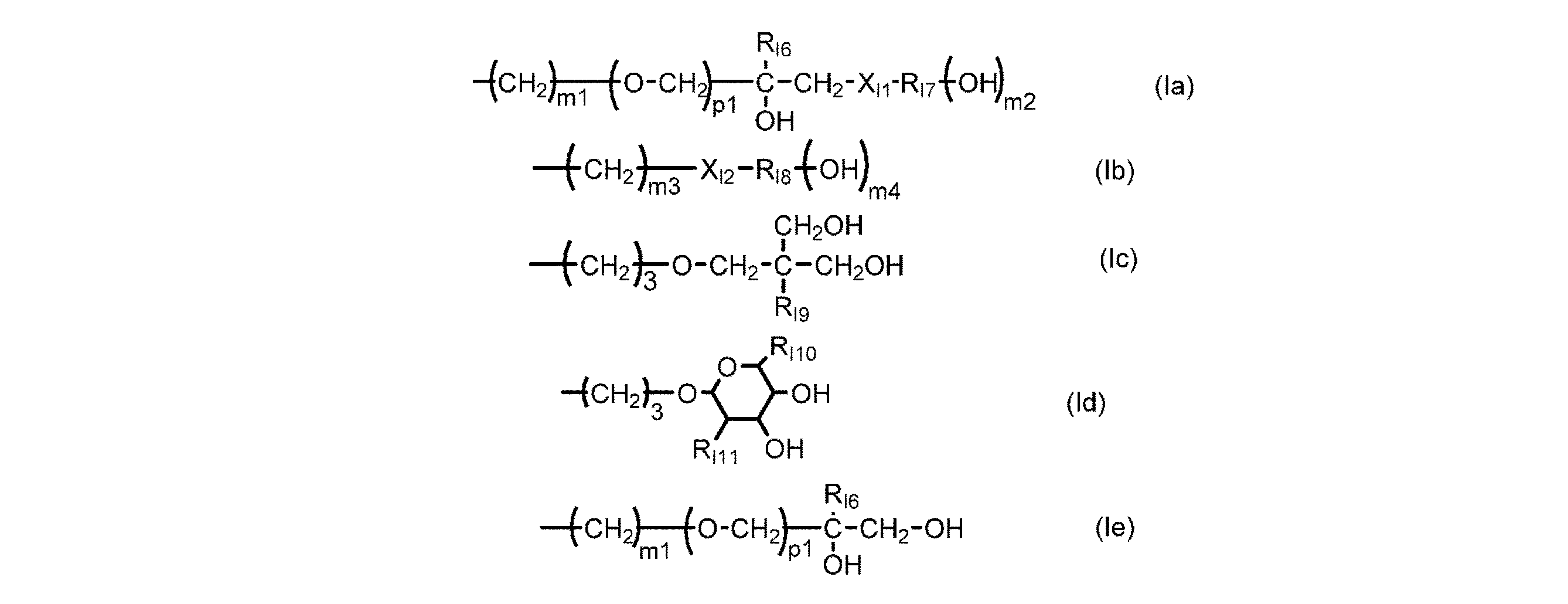
のいずれか1つの一価ラジカルであり;
p1は、ゼロ又は1であり;m1は、2~4の整数であり;m2は、1~5の整数であり;m3は、3~6の整数であり;m4は、2~5の整数であり;
RI6は、水素又はメチルであり;
RI7は、(m2+1)の価数を有するC2~C6炭化水素ラジカルであり;
RI8は、(m4+1)の価数を有するC2~C6炭化水素ラジカルであり;
RI9は、エチル又はヒドロキシメチルであり;
RI10は、メチル又はヒドロメチルであり;
RI11は、ヒドロキシル又はメトキシであり;
XI1は、-S-の硫黄結合又は-NRI12-の三級アミノ結合であり、RI12は、C1~C1アルキル、ヒドロキシエチル、ヒドロキシプロピル又は2,3-ジヒドロキシプロピルであり;
XI2は、

のアミド結合であり、RI13は、水素又はC1~C10アルキルである)
のビニル系架橋剤を含む、実施形態47に記載の眼科用製品又は方法。
50.前記少なくも1種のポリシロキサンビニル系架橋剤が、式(1)~(7)

(式中、
υ1は、30~500の整数であり;
υ2は、5~50の整数であり;
υ3は、5~100の整数であり;
ω2及びω3は、互いに独立して、1~15の整数であり;
a1及びg1は、互いに独立して、ゼロ又は1であり;
h1は、1~20の整数であり、h2は、0~20の整数であり;
m1及びm3は、互いに独立して、0又は1であり、m2は、1~6の整数であり、m4は、1~5の整数であり、m5は、2又は3であり;
q1は、1~20の整数であり、q2は、0~20の整数であり、q3は、0~2の整数であり、q4は、2~50の整数であり、q5及びq6は、互いに独立して、0~35の数であるが、(q4+q5+q6)は、2~50の整数であることを条件とし;
x+yは、10~30の整数であり;
e1は、5~100の整数であり、p1及びb1は、互いに独立して、0~50の整数であるが、(p1+b1)≧1である場合、(e1+p1+b1)≧10、且つ

(好ましくは約2:1~約10:1、より好ましくは約3:1~約6:1)であることを条件とし;
Roは、H又はメチルであり;
R1、R1n、R2n、R3n及びR4nは、互いに独立して、Hであるか、又は0~2つのヒドロキシル基を有するC1~C4アルキルであり;
Rn5は、H又はC1~C10アルキルであり;
R2は、C4~C14の炭化水素二価ラジカルであり;
R3は、C2~C6アルキレン二価ラジカルであり;
R4及びR5は、互いに独立して、C1~C6アルキレン二価ラジカルであるか、又はC1~C6アルキレン-オキシ-C1~C6アルキレン二価ラジカルであり;
R6及びR7は、互いに独立して、C1~C6アルキレン二価ラジカル又は1~C6アルコキシ-C1~C6アルキレン二価ラジカルであり;
R8及びR9は、互いに独立して、置換又は無置換C1~C12アルキレン二価ラジカルであり;
Xo、X1’、Xo1、X02及びX03は、互いに独立して、O又はNR1であり;
X1は、O、NR1、NHCOO、OCONH、CONR1又はNR1COであり;
Xo4は、-COO-又は-CONRn5-であり;
Xo5及びXo7は、互いに独立して、直接結合、-COO-又は-CONRn5-であり;
Xo6は、直接結合、C1~C6アルキレン二価ラジカル、C1~C6アルキレンオキシ二価ラジカル、-COO-又は-CONRn5-であり;
Xo8は、直接結合又は-COO-であり;
Xo9は、O又はNRn5であり;
X10は、直接結合、C1~C6アルキレン二価ラジカル、-COO-又は-CONRn5-であり;
E1’は、

の一価のラジカルであり;
E2は、

の一価のラジカルであり;
E3は、

の一価のラジカルであり;
E4は、

の一価のラジカルであり;
L1は、C2~C8アルキレン二価ラジカルであるか、又は

の二価のラジカルであり;
L1’は、0又は1つのヒドロキシル基を有するC2~C8アルキレン二価ラジカルであり;
L1”は、0又は1つのヒドロキシル基を有するC3~C8アルキレン二価ラジカルであり;
L3は、

の二価ラジカルであり;
PEは、

の二価ラジカルであり;
L3’は、C3~C8アルキレン二価ラジカルであり;
L4は、

の二価ラジカルであり;
hpL1は、

の二価ラジカルであり;
hpL2は、

の二価ラジカルであり;
hpL3は、

の二価ラジカルであり;
hpL4は、

の二価ラジカルであり;
pOAlkは、

の二価ラジカルであり、
EOは、オキシエチレン単位(-CH2CH2O-)であり、POは、オキシプロピレン単位(

)であり、BOは、オキシブチレン単位(

)であり;
M0は、C3~C8アルキレン二価ラジカルであり;
M1は、C4~C14炭化水素二価ラジカルであり;
M2及びM3は、互いに独立して、C1~C6アルキレン二価ラジカルであり;
J0は、0~2つのヒドロキシル基又はカルボキシル基を有するC1~C12炭化水素ラジカルであり;
G1は、直接結合、C1~C4アルキレン二価ラジカル、又は

の二価のラジカルであり、
ここで、Moは、Si原子に結合しており、X04~X10は、式(7)の-CH2-の基に結合しており、式(7)のJ0及びG1の少なくとも1つは、ヒドロキシル基、-OCONH-のウレタン結合、-NHRoのアミノ基、-NH-のアミノ結合、-CONH-のアミド結合、カルボキシル基及びこれらの組み合わせからなる群から選択される少なくとも1つの部位を含み;
G2は、C1~C4アルキレン二価ラジカルであるか、又は

の二価ラジカルであり;
G3は、

の二価ラジカルであり、
h3及びh4は、互いに独立して、1又は0であり;
G4は、(a)-NR3’-(式中、R3’は、水素又はC1~C3アルキルである)、(b)

、(c)-NR0-G5-NR0-(式中、G5は、C1~C6アルキレン二価ラジカル、2-ヒドロキシルプロピレン二価ラジカル、2-(ホスホニルオキシ)プロピレン二価ラジカル、1,2-ジヒドロキシエチレン二価ラジカル、2,3-ジヒドロキシブチレン二価ラジカルである)、及び(d)-O-G6-O-、式中、G6は、C1~C6アルキレン二価ラジカル、

の二価ラジカル
(式中、h4’は、1又は2である)、

の二価ラジカル、

の二価ラジカル
(式中、h5は、1~5である)、

の二価ラジカル
(式中、h6は、2又は3である)又はヒドロキシル基若しくはホスホニルオキシ基を有する置換C3~C8アルキレン二価ラジカルのいずれか1つの二価ラジカルであり;
Y1は、C1~C6アルキレン二価ラジカル、2-ヒドロキシルプロピレン二価ラジカル、2-(ホスホニルオキシ)プロピレン二価ラジカル、1,2-ジヒドロキシエチレン二価ラジカル、

の二価ラジカル、又は

の二価ラジカルであり;
Y2は、

の二価ラジカルであり;
Y3は、

の二価ラジカルであり;
Z0は、直接結合又はC1~C12アルキレン二価ラジカルであり;
Z1は、C1~C6アルキレン二価ラジカル、ヒドロキシ若しくはメトキシ置換C1~C6アルキレン二価ラジカル、又は置換若しくは無置換フェニレン二価ラジカルであり、
Z2は、C1~C6アルキレン二価ラジカル、ヒドロキシル若しくはメトキシ-置換C1~C6アルキレン二価ラジカル、ジヒドロキシル若しくはジメトキシ-置換C2~C6アルキレン二価ラジカル、-C2H4-(O-C2H4)m2-の二価ラジカル、-Z4-S-S-Z4-の二価ラジカル、ヒドロキシル-若しくはメトキシ置換C1~C6アルキレン二価ラジカル又は置換若しくは無置換フェニレン二価ラジカルであり、
Z3は、(a)-NRn3-、(b)

、(c)-NR0-Z5-NR0-、及び(d)-O-Z6-O-のいずれか1つの二価ラジカルであり、
Z4は、C1~C6アルキレン二価ラジカルであり、
Z5は、C1~C6アルキレン二価ラジカル、2-ヒドロキシルプロピレン二価ラジカル、2-(ホスホニルオキシ)プロピレン二価ラジカル、1,2-ジヒドロキシエチレン二価ラジカル、2,3-ジヒドロキシブチレン二価ラジカルであり、
Z6は、(a)C1~C6アルキレン二価ラジカル、(b)

の二価ラジカル、又は(c)ヒドロキシル基又はホスホニルオキシ基を有する置換C3~C8アルキレン二価ラジカルであり、
Z7は、

の二価のラジカルである)
のいずれか1つのビニル系架橋剤を含む、実施形態47に記載の眼科用製品又は方法。
51.前記少なくとも1種のポリシロキサンビニル系架橋剤が、α,ω-ビス[3-(メタ)アクリルアミドプロピル]-末端ポリジメチルシロキサン、α,ω-ビス[3-(メタ)アクリルオキシプロピル]-末端ポリジメチルシロキサン、α,ω-ビス[3-(メタ)アクリルオキシ-2-ヒドロキシプロピルオキシプロピル]-末端ポリジメチルシロキサン、α,ω-ビス[3-(メタ)アクリルオキシエトキシ-2-ヒドロキシプロピルオキシプロピル]-末端ポリジメチルシロキサン、α,ω-ビス[3-(メタ)アクリルオキシプロピルオキシ-2-ヒドロキシプロピルオキシプロピル]-末端ポリジメチルシロキサン、α,ω-ビス[3-(メタ)アクリルオキシ-イソプロピルオキシ-2-ヒドロキシプロピルオキシプロピル]-末端ポリジメチルシロキサン、α,ω-ビス[3-(メタ)アクリルオキシブチルオキシ-2-ヒドロキシプロピルオキシプロピル]-末端ポリジメチルシロキサン、α,ω-ビス[3-(メタ)アクリルアミドエトキシ-2-ヒドロキシプロピルオキシプロピル]-末端ポリジメチルシロキサン、α,ω-ビス[3-(メタ)アクリルアミドプロピルオキシ-2-ヒドロキシプロピルオキシプロピル]-末端ポリジメチルシロキサン、α,ω-ビス[3-(メタ)アクリルアミドイソプロピルオキシ-2-ヒドロキシプロピルオキシプロピル]-末端ポリジメチルシロキサン、α,ω-ビス[3-(メタ)アクリルアミドブチルオキシ-2-ヒドロキシプロピルオキシプロピル]-末端ポリジメチルシロキサン、α,ω-ビス[3-(メタ)アクリルオキシエチルアミノ-2-ヒドロキシプロピルオキシプロピル]-末端ポリジメチルシロキサン、α,ω-ビス[3-(メタ)アクリルオキシプロピルアミノ-2-ヒドロキシプロピルオキシプロピル]-末端ポリジメチルシロキサン、α,ω-ビス[3-(メタ)アクリルオキシブチルアミノ-2-ヒドロキシプロピルオキシプロピル]-末端ポリジメチルシロキサン、α,ω-ビス[(メタ)アクリルアミドエチルアミノ-2-ヒドロキシプロピルオキシ-プロピル]-末端ポリジメチルシロキサン、α,ω-ビス[3-(メタ)アクリルアミドプロピルアミノ-2-ヒドロキシプロピルオキシプロピル]-末端ポリジメチルシロキサン、α,ω-ビス[3-(メタ)アクリルアミド-ブチルアミノ-2-ヒドロキシプロピルオキシプロピル]-末端ポリジメチルシロキサン、α,ω-ビス[(メタ)アクリルオキシ-2-ヒドロキシプロピルオキシ-エトキシプロピル]-末端ポリジメチルシロキサン、α,ω-ビス[(メタ)アクリルオキシ-2-ヒドロキシプロピル-N-エチルアミノプロピル]-末端ポリジメチルシロキサン、α,ω-ビス[(メタ)アクリルオキシ-2-ヒドロキシプロピル-アミノプロピル]-ポリジメチルシロキサン、α,ω-ビス[(メタ)アクリルオキシ-2-ヒドロキシプロピルオキシ-(ポリエチレンオキシ)プロピル]-末端ポリジメチルシロキサン、α,ω-ビス[(メタ)アクリルオキシエチルアミノ-カルボニルオキシ-エトキシプロピル]-末端ポリジメチルシロキサン、α,ω-ビス[(メタ)アクリルオキシエチルアミノ-カルボニルオキシ-(ポリエチレンオキシ)プロピル]-末端ポリジメチルシロキサン、又はこれらの組み合わせである、実施形態47に記載の眼科用製品又は方法。
52.前記シリコーンヒドロゲル材料が、少なくとも1種の親水性ビニルモノマーの繰り返し単位を含む、実施形態43~51のいずれか1つに記載の眼科用製品又は方法。
53.前記少なくとも1種の親水性ビニルモノマーが、(1)(メタ)アクリルアミド、N,N-ジメチル(メタ)アクリルアミド、N-エチル(メタ)アクリルアミド、N,N-ジエチル(メタ)アクリルアミド、N-プロピル(メタ)アクリルアミド、N-イソプロピル(メタ)アクリルアミド、N-3-メトキシプロピル(メタ)アクリルアミド、及びそれらの組み合わせからなる群から選択されるアルキル(メタ)アクリルアミド;(2)N-2-ヒドロキシルエチル(メタ)アクリルアミド、N,N-ビス(ヒドロキシエチル)(メタ)アクリルアミド、N-3-ヒドロキシプロピル(メタ)アクリルアミド、N-2-ヒドロキシプロピル(メタ)アクリルアミド、N-2,3-ジヒドロキシプロピル(メタ)アクリルアミド、N-トリス(ヒドロキシメチル)メチル(メタ)アクリルアミド、2-ヒドロキシエチル(メタ)アクリレート、3-ヒドロキシプロピル(メタ)アクリレート、2-ヒドロキシプロピル(メタ)アクリレート、グリセロールメタクリレート(GMA)、ジ(エチレングリコール)(メタ)アクリレート、トリ(エチレングリコール)(メタ)アクリレート、テトラ(エチレングリコール)(メタ)アクリレート、最大1500の数平均分子量を有するポリ(エチレングリコール)(メタ)アクリレート、最大1500の数平均分子量を有するポリ(エチレングリコール)エチル(メタ)アクリルアミド、及びそれらの組み合わせからなる群から選択されるヒドロキシル含有アクリルモノマー;(3)2-(メタ)アクリルアミドグリコール酸、(メタ)アクリル酸、エチルアクリル酸、3-(メタ)アクリルアミドプロピオン酸、5-(メタ)アクリルアミドペンタン酸、4-(メタ)アクリルアミドブタン酸、3-(メタ)アクリルアミド-2-メチルブタン酸、3-(メタ)アクリルアミド-3-メチルブタン酸、2-(メタ)アクリルアミド-2-メチル-3,3-ジメチルブタン酸、3-(メタ)アクリルアミドヘキサン酸、4-(メタ)アクリルアミド-3,3-ジメチルヘキサン酸、及びそれらの組み合わせからなる群から選択されるカルボキシル含有アクリルモノマー;(4)N-2-アミノエチル(メタ)アクリルアミド、N-2-メチルアミノエチル(メタ)アクリルアミド、N-2-エチルアミノエチル(メタ)アクリルアミド、N-2-ジメチルアミノエチル(メタ)アクリルアミド、N-3-アミノプロピル(メタ)アクリルアミド、N-3-メチルアミノプロピル(メタ)アクリルアミド、N-3-ジメチルアミノプロピル(メタ)アクリルアミド、2-アミノエチル(メタ)アクリレート、2-メチルアミノエチル(メタ)アクリレート、2-エチルアミノエチル(メタ)アクリレート、3-アミノプロピル(メタ)アクリレート、3-メチルアミノプロピル(メタ)アクリレート、3-エチルアミノプロピル(メタ)アクリレート、3-アミノ-2-ヒドロキシプロピル(メタ)アクリレート、トリメチルアンモニウム2-ヒドロキシプロピル(メタ)アクリレート塩酸塩、ジメチルアミノエチル(メタ)アクリレート、及びそれらの組み合わせからなる群から選択されるアミノ含有アクリルモノマー;(5)N-ビニルピロリドン(別名N-ビニル-2-ピロリドン)、N-ビニル-3-メチル-2-ピロリドン、N-ビニル-4-メチル-2-ピロリドン、N-ビニル-5-メチル-2-ピロリドン、N-ビニル-6-メチル-2-ピロリドン、N-ビニル-3-エチル-2-ピロリドン、N-ビニル-4,5-ジメチル-2-ピロリドン、N-ビニル-5,5-ジメチル-2-ピロリドン、N-ビニル-3,3,5-トリメチル-2-ピロリドン、N-ビニルピペリドン(別名N-ビニル-2-ピペリドン)、N-ビニル-3-メチル-2-ピペリドン、N-ビニル-4-メチル-2-ピペリドン、N-ビニル-5-メチル-2-ピペリドン、N-ビニル-6-メチル-2-ピペリドン、N-ビニル-6-エチル-2-ピペリドン、N-ビニル-3,5-ジメチル-2-ピペリドン、N-ビニル-4,4-ジメチル-2-ピペリドン、N-ビニルカプロラクタム(別名N-ビニル-2-カプロラクタム)、N-ビニル-3-メチル-2-カプロラクタム、N-ビニル-4-メチル-2-カプロラクタム、N-ビニル-7-メチル-2-カプロラクタム、N-ビニル-7-エチル-2-カプロラクタム、N-ビニル-3,5-ジメチル-2-カプロラクタム、N-ビニル-4,6-ジメチル-2-カプロラクタム、N-ビニル-3,5,7-トリメチル-2-カプロラクタム、N-ビニル-N-メチルアセトアミド、N-ビニルホルムアミド、N-ビニルアセトアミド、N-ビニルイソプロピルアミド、N-ビニル-N-エチルアセトアミド、N-ビニル-N-エチルホルムアミド、及びそれらの混合物からなる群から選択されるN-ビニルアミドモノマー;(6)1-メチル-3-メチレン-2-ピロリドン、1-エチル-3-メチレン-2-ピロリドン、1-メチル-5-メチレン-2-ピロリドン、1-エチル-5-メチレン-2-ピロリドン、5-メチル-3-メチレン-2-ピロリドン、5-エチル-3-メチレン-2-ピロリドン、1-n-プロピル-3-メチレン-2-ピロリドン、1-n-プロピル-5-メチレン-2-ピロリドン、1-イソプロピル-3-メチレン-2-ピロリドン、1-イソプロピル-5-メチレン-2-ピロリドン、1-n-ブチル-3-メチレン-2-ピロリドン、1-tert-ブチル-3-メチレン-2-ピロリドン、及びそれらの組み合わせからなる群から選択されるメチレン含有ピロリドンモノマー;(7)C1~C4アルコキシエトキシ基を有し、且つエチレングリコールメチルエーテル(メタ)アクリレート、ジ(エチレングリコール)メチルエーテル(メタ)アクリレート、トリ(エチレングリコール)メチルエーテル(メタ)アクリレート、テトラ(エチレングリコール)メチルエーテル(メタ)アクリレート、最大1500の数平均分子量を有するC1~C4-アルコキシポリ(エチレングリコール)(メタ)アクリレート、最大1500の数平均分子量を有するメトキシ-ポリ(エチレングリコール)エチル(メタ)アクリルアミド、及びそれらの組み合わせからなる群から選択されるアクリルモノマー;(8)エチレングリコールモノビニルエーテル、ジ(エチレングリコール)モノビニルエーテル、トリ(エチレングリコール)モノビニルエーテル、テトラ(エチレングリコール)モノビニルエーテル、ポリ(エチレングリコール)モノビニルエーテル、エチレングリコールメチルビニルエーテル、ジ(エチレングリコール)メチルビニルエーテル、トリ(エチレングリコール)メチルビニルエーテル、テトラ(エチレングリコール)メチルビニルエーテル、ポリ(エチレングリコール)メチルビニルエーテル、及びそれらの組み合わせからなる群から選択されるビニルエーテルモノマー;(9)エチレングリコールモノアリルエーテル、ジ(エチレングリコール)モノアリルエーテル、トリ(エチレングリコール)モノアリルエーテル、テトラ(エチレングリコール)モノアリルエーテル、ポリ(エチレングリコール)モノアリルエーテル、エチレングリコールメチルアリルエーテル、ジ(エチレングリコール)メチルアリルエーテル、トリ(エチレングリコール)メチルアリルエーテル、テトラ(エチレングリコール)メチルアリルエーテル、ポリ(エチレングリコール)メチルアリルエーテル、及びそれらの組み合わせからなる群から選択されるアリルエーテルモノマー;(10)(メタ)アクリロイルオキシエチルホスホリルコリン、(メタ)アクリロイルオキシプロピルホスホリルコリン、4-((メタ)アクリロイルオキシ)ブチル-2’-(トリメチルアンモニオ)エチルホスフェート、2-[(メタ)アクリロイルアミノ]エチル-2’-(トリメチルアンモニオ)-エチルホスフェート、3-[(メタ)アクリロイルアミノ]プロピル-2’-(トリメチルアンモニオ)エチルホスフェート、4-[(メタ)アクリロイルアミノ]ブチル-2’-(トリメチルアンモニオ)エチルホスフェート、5-((メタ)アクリロイルオキシ)ペンチル-2’-(トリメチルアンモニオ)エチルホスフェート、6-((メタ)アクリロイルオキシ)ヘキシル-2’-(トリメチルアンモニオ)-エチルホスフェート、2-((メタ)アクリロイルオキシ)エチル-2’-(トリエチルアンモニオ)エチルホスフェート、2-((メタ)アクリロイルオキシ)エチル-2’-(トリプロピルアンモニオ)エチルホスフェート、2-((メタ)アクリロイルオキシ)エチル-2’-(トリブチルアンモニオ)エチルホスフェート、2-((メタ)アクリロイルオキシ)プロピル-2’-(トリメチルアンモニオ)-エチルホスフェート、2-((メタ)アクリロイルオキシ)ブチル-2’-(トリメチルアンモニオ)エチルホスフェート、2-((メタ)アクリロイルオキシ)ペンチル-2’-(トリメチルアンモニオ)エチルホスフェート、2-((メタ)アクリロイルオキシ)ヘキシル-2’-(トリメチルアンモニオ)エチルホスフェート、2-(ビニルオキシ)エチル-2’-(トリメチルアンモニオ)エチルホスフェート、2-(アリルオキシ)エチル-2’-(トリメチルアンモニオ)エチルホスフェート、2-(ビニルオキシカルボニル)エチル-2’-(トリメチルアンモニオ)エチルホスフェート、2-(アリルオキシカルボニル)エチル-2’-(トリメチルアンモニオ)-エチルホスフェート、2-(ビニルカルボニルアミノ)エチル-2’-(トリメチルアンモニオ)エチルホスフェート、2-(アリルオキシカルボニルアミノ)エチル-2’-(トリメチルアンモニオ)エチルホスフェート、2-(ブテノイルオキシ)エチル-2’-(トリメチルアンモニオ)エチルホスフェート、及びそれらの組み合わせからなる群から選択されるホスホリルコリン含有ビニルモノマー;(11)アリルアルコール;(12)N-2-ヒドロキシエチルビニルカルバメート;(13)N-カルボキシビニル-β-アラニン(VINAL);(14)N-カルボキシビニル-α-アラニン;(15)又はそれらの組み合わせ;を含む、実施形態52に記載の眼科用製品又は方法。
54.前記少なくとも1種の親水性ビニルモノマーが、N-ビニルピロリドン、N-ビニル-N-メチルアセトアミド、又はこれらの組み合わせを含む、実施形態52又は53に記載の眼科用製品又は方法。
55.前記少なくとも1種の親水性ビニルモノマーが、N,N-ジメチル(メタ)アクリルアミドを含む、実施形態52~54のいずれか1つに記載の眼科用製品又は方法。
56.前記少なくとも1種の親水性ビニルモノマーが、N-2-ヒドロキシルエチル(メタ)アクリルアミド、N,N-ビス(ヒドロキシエチル)(メタ)アクリルアミド、N-3-ヒドロキシプロピル(メタ)アクリルアミド、N-2-ヒドロキシプロピル(メタ)アクリルアミド、N-2,3-ジヒドロキシプロピル(メタ)アクリルアミド、N-トリス(ヒドロキシメチル)メチル(メタ)アクリルアミド、2-ヒドロキシエチル(メタ)アクリレート、3-ヒドロキシプロピル(メタ)アクリレート、2-ヒドロキシプロピル(メタ)アクリレート、グリセロールメタクリレート(GMA)、ジ(エチレングリコール)(メタ)アクリレート、トリ(エチレングリコール)(メタ)アクリレート、テトラ(エチレングリコール)(メタ)アクリレート、最大で1500の数平均分子量を有するポリ(エチレングリコール)(メタ)アクリレート、最大で1500の数平均分子量を有するポリ(エチレングリコール)エチル(メタ)アクリルアミド材料、又はこれらの組み合わせを含む、実施形態52~55のいずれか1つに記載の眼科用製品又は方法。
57.前記シリコーンヒドロゲル材料が、少なくとも1種の非シリコーン系ビニル系架橋剤の繰り返し単位を含む、実施形態43~56のいずれか1つに記載の眼科用製品又は方法。
58.前記少なくとも1種の非シリコーン系ビニル系架橋剤が、エチレングリコールジ-(メタ)アクリレート、ジエチレングリコールジ-(メタ)アクリレート、トリエチレングリコールジ-(メタ)アクリレート、テトラエチレングリコールジ-(メタ)アクリレート、グリセロールジ-(メタ)アクリレート、1,3-プロパンジオールジ-(メタ)アクリレート、1,3-ブタンジオールジ-(メタ)アクリレート、1,4-ブタンジオールジ-(メタ)アクリレート、グリセロール1,3-ジグリセロレートジ-(メタ)アクリレート、エチレンビス[オキシ(2-ヒドロキシプロパン-1,3-ジイル)]ジ-(メタ)アクリレート、ビス[2-(メタ)アクリルオキシエチル]ホスフェート、トリメチロールプロパンジ-(メタ)アクリレート、及び3,4-ビス[(メタ)アクリロイル]テトラヒドロフラン、ジアクリルアミド、ジメタクリルアミド、N,N-ジ(メタ)アクリロイル-N-メチルアミン、N,N-ジ(メタ)アクリロイル-N-エチルアミン、N,N’-メチレンビス(メタ)アクリルアミド、N,N’-エチレンビス(メタ)アクリルアミド、N,N’-ジヒドロキシエチレンビス(メタ)アクリルアミド、N,N’-プロピレンビス(メタ)アクリルアミド、N,N’-2-ヒドロキシプロピレンビス(メタ)アクリルアミド、N,N’-2,3-ジヒドロキシブチレンビス(メタ)アクリルアミド、1,3-ビス(メタ)アクリルアミドプロパン-2-イルリン酸二水素塩、ピペラジンジアクリルアミド、テトラエチレングリコールジビニルエーテル、トリエチレングリコールジビニルエーテル、ジエチレングリコールジビニルエーテル、エチレングリコールジビニルエーテル、トリアリルイソシアヌレート、トリアリルシアヌレート、トリメチロプロパントリメタクリレート、ペンタエリスリトールテトラメタクリレート、ビスフェノールAジメタクリレート、アリルメタクリレート、アリルアクリレート、N-アリル-メタアクリルアミド、N-アリル-アクリルアミド、又はこれらの組み合わせを含む、実施形態57に記載の眼科用製品又は方法。
59.前記シリコーンヒドロゲル材料が、少なくとも1種のブレンドビニルモノマーの繰り返し単位を含む、実施形態43~58のいずれか1つに記載の眼科用製品又は方法。
60.前記少なくとも1種のブレンドビニルモノマーが、C1~C10アルキル(メタ)アクリレート、シクロペンチルアクリレート、シクロヘキシルメタクリレート、シクロヘキシルアクリレート、イソボルニル(メタ)アクリレート、スチレン、4,6-トリメチルスチレン(TMS)、t-ブチルスチレン(TBS)、トリフルオロエチル(メタ)アクリレート、ヘキサフルオロ-イソプロピル(メタ)アクリレート、ヘキサフルオロブチル(メタ)アクリレート、又はこれらの組み合わせを含む、実施形態43~58のいずれか1つに記載の眼科用製品又は方法。
61.前記少なくとも1種のブレンドビニルモノマーがメタクリル酸メチルを含む、実施形態43~58のいずれか1つに記載の眼科用製品又は方法。
62.前記シリコーンヒドロゲル材料が、少なくとも1種のUV吸収性ビニルモノマーの繰り返し単位及び/又は少なくとも1種のUV/HEVL吸収性ビニルモノマーの繰り返し単位を含む、実施形態43~61のいずれか1つに記載の眼科用製品又は方法。
63.前記シリコーンヒドロゲル材料が、2-[2’-ヒドロキシ-5’-(2-メタクリロキシエチル)フェニル)]-2H-ベンゾトリアゾール(Norbloc)の繰り返し単位と、2-{2’-ヒドロキシ-3’-tert-ブチル-5’-[3’-メタクリロイルオキシプロポキシ]フェニル}-2H-ベンゾトリアゾール、2-{2’-ヒドロキシ-3’-tert-ブチル-5’-[3’-メタクリロイルオキシプロポキシ]フェニル}-5-メトキシ-2H-ベンゾトリアゾール(UV13)、2-{2’-ヒドロキシ-3’-tert-ブチル-5’-[3’-メタクリロイルオキシプロポキシ]フェニル}-5-クロロ-2H-ベンゾトリアゾール(UV28)、2-[2’-ヒドロキシ-3’-tert-ブチル-5’-(3’-アクリロイルオキシプロポキシ)フェニル]-5-トリフルオロメチル-2H-ベンゾトリアゾール(UV23)、又はそれらの組み合わせである少なくとも1種のUV/HEVL吸収性ビニルモノマーの繰り返し単位とを含む、実施形態43~61のいずれか1つに記載の眼科用製品又は方法。
64.前記すぐに使用可能なシリコーンヒドロゲルコンタクトレンズが、280~315ナノメートルで約10%以下のUVB透過率、315~380ナノメートルで約30%以下のUVA透過率、及び380nm~440nmで約70%以下、好ましくは約60%以下、より好ましくは約50%以下、さらに好ましくは約40%以下のバイオレット透過率を有する、実施形態1及び3~63のいずれか1つに記載の眼科用製品若しくは方法、又は実施形態3~63のいずれか1つに記載の方法。
65.前記すぐに使用可能なシリコーンヒドロゲルコンタクトレンズが、280~315ナノメートルで約5%以下のUVB透過率を有する、実施形態64に記載の眼科用製品又は方法。
66.前記すぐに使用可能なシリコーンヒドロゲルコンタクトレンズが、280~315ナノメートルで約2.5%以下のUVB透過率を有する、実施形態63に記載の眼科用製品又は方法。
67.前記すぐに使用可能なシリコーンヒドロゲルコンタクトレンズが、280~315ナノメートルで約1%以下のUVB透過率を有する、実施形態64に記載の眼科用製品又は方法。
68.前記すぐに使用可能なシリコーンヒドロゲルコンタクトレンズが、315~380ナノメートルで約20%以下のUVA透過率を有する、実施形態64~67のいずれか1つに記載の眼科用製品又は方法。
69.前記すぐに使用可能なシリコーンヒドロゲルコンタクトレンズが、315~380ナノメートルで約10%以下のUVA透過率を有する、実施形態64~67のいずれか1つに記載の眼科用製品又は方法。
70.前記すぐに使用可能なシリコーンヒドロゲルコンタクトレンズが、315~380ナノメートルで約5%以下のUVA透過率を有する、実施形態64~67のいずれか1つに記載の眼科用製品又は方法。
71.前記すぐに使用可能なシリコーンヒドロゲルコンタクトレンズが、380nm~440nmで約60%以下のバイオレット透過率を有する、実施形態64~67のいずれか1つに記載の眼科用製品又は方法。
72.前記すぐに使用可能なシリコーンヒドロゲルコンタクトレンズが、380nm~440nmで約50%以下のバイオレット透過率を有する、実施形態64~67のいずれか1つに記載の眼科用製品又は方法。
73.前記すぐに使用可能なシリコーンヒドロゲルコンタクトレンズが、380nm~440nmで約40%以下のバイオレット透過率を有する、実施形態64~67のいずれか1つに記載の眼科用製品又は方法。
74.前記密封されオートクレーブ滅菌されたパッケージから直接取り出された、前記すぐに使用可能なシリコーンヒドロゲルコンタクトレンズの前記静的水接触角が、前記予め形成されたシリコーンヒドロゲルコンタクトレンズの静的水接触角よりも少なくとも10°小さい、実施形態1及び3~73のいずれか1つに記載の眼科用製品又は実施形態2~73のいずれか1つに記載の方法。
75.前記密封されオートクレーブ滅菌されたパッケージから直接取り出された、前記すぐに使用可能なシリコーンヒドロゲルコンタクトレンズの前記静的水接触角が、前記予め形成されたシリコーンヒドロゲルコンタクトレンズの静的水接触角よりも少なくとも15°小さい、実施形態1及び3~73のいずれか1つに記載の眼科用製品又は実施形態2~73のいずれか1つに記載の方法。
76.前記密封されオートクレーブ滅菌されたパッケージから直接取り出された、前記すぐに使用可能なシリコーンヒドロゲルコンタクトレンズの前記静的水接触角が、前記予め形成されたシリコーンヒドロゲルコンタクトレンズの静的水接触角よりも少なくとも20°小さい、実施形態1及び3~73のいずれか1つに記載の眼科用製品又は実施形態2~73のいずれか1つに記載の方法。
77.前記すぐに使用可能なSiHyコンタクトレンズと、前記高分子界面活性剤を含まないリン酸緩衝生理食塩水中でオートクレーブ処理された予め形成されたSiHyコンタクトレンズである対照のレンズとの間のレンズ直径の差が、確実に約0.20mm未満であるように選択された量で、前記オートクレーブ処理前のパッケージング溶液中に前記高分子界面活性剤が存在する、実施形態1及び3~76のいずれか1つに記載の眼科用製品又は実施形態2~76のいずれか1つに記載の方法。
78.前記すぐに使用可能なSiHyコンタクトレンズと、前記高分子界面活性剤を含まないリン酸緩衝生理食塩水中でオートクレーブ処理された予め形成されたSiHyコンタクトレンズである対照のレンズとの間のレンズ直径の差が、確実に約0.17mm未満であるように選択された量で、前記オートクレーブ処理前のパッケージング溶液中に前記高分子界面活性剤が存在する、実施形態1及び3~76のいずれか1つに記載の眼科用製品又は実施形態2~76のいずれか1つに記載の方法。
79.前記すぐに使用可能なSiHyコンタクトレンズと、前記高分子界面活性剤を含まないリン酸緩衝生理食塩水中でオートクレーブ処理された予め形成されたSiHyコンタクトレンズである対照のレンズとの間のレンズ直径の差が、確実に約0.15mm未満であるように選択された量で、前記オートクレーブ処理前のパッケージング溶液中に前記高分子界面活性剤が存在する、実施形態1及び3~76のいずれか1つに記載の眼科用製品又は実施形態2~76のいずれか1つに記載の方法。
80.前記すぐに使用可能なSiHyコンタクトレンズと、前記高分子界面活性剤を含まないリン酸緩衝生理食塩水中でオートクレーブ処理された予め形成されたSiHyコンタクトレンズである対照のレンズとの間のレンズ直径の差が、確実に約0.12mm未満であるように選択された量で、前記オートクレーブ処理前のパッケージング溶液中に前記高分子界面活性剤が存在する、実施形態1及び3~76のいずれか1つに記載の眼科用製品又は実施形態2~76のいずれか1つに記載の方法。
81.前記オートクレーブ処理前のパッケージング溶液が約0.005重量%~約0.038重量%の前記高分子界面活性剤を含む、実施形態2~80のいずれか1つに記載の方法又は実施形態1及び3~80のいずれか1つの眼科用製品。
82.前記オートクレーブ処理前のパッケージング溶液が約0.007重量%~約0.036重量%の前記高分子界面活性剤を含む、実施形態2~80のいずれか1つに記載の方法又は実施形態1及び3~80のいずれか1つの眼科用製品。
83.前記オートクレーブ処理前のパッケージング溶液が約0.008重量%~約0.034重量%の前記高分子界面活性剤を含む、実施形態2~80のいずれか1つに記載の方法又は実施形態1及び3~80のいずれか1つの眼科用製品。
84.前記オートクレーブ処理前のパッケージング溶液が約0.009重量%~約0.032重量%の前記高分子界面活性剤を含む、実施形態2~80のいずれか1つに記載の方法又は実施形態1及び3~80のいずれか1つの眼科用製品。
85.前記オートクレーブ処理前のパッケージング溶液が約0.010重量%~約0.030重量%の前記高分子界面活性剤を含む、実施形態2~80のいずれか1つに記載の方法又は実施形態1及び3~80のいずれか1つの眼科用製品。
86.前記予め形成されたシリコーンヒドロゲルコンタクトレンズを中に含む前記密封されたパッケージが少なくとも約45分間オートクレーブ処理される、実施形態2~85のいずれか1つに記載の方法又は実施形態1及び3~85のいずれか1つの眼科用製品。
1. An ophthalmic product comprising a sealed, autoclave-sterilized package containing a post-autoclaved packaging solution and a ready-to-use silicone hydrogel contact lens immersed therein, comprising:
the post-autoclaving packaging solution is a buffered saline solution having a pH of about 6.0 to about 8.0 and comprises a polymeric surfactant, the polymeric surfactant comprising at least one hydrophilic poly(oxyethylene) segment and at least one hydrophobic poly(oxybutylene) segment and having an HLB value of about 11 to about 16 and a number average molecular weight of about 800 to about 20,000 Daltons; the ready-to-use silicone hydrogel contact lens is obtained by placing a preformed silicone hydrogel contact lens in a package, sealing and autoclaving in a pre-autoclaving packaging solution comprising the polymeric surfactant; the ready-to-use silicone hydrogel contact lens does not have a coating thereon; The ready-to-use silicone hydrogel contact lens comprises a polymeric surfactant physically distributed within a polymer matrix of the ready-to-use silicone hydrogel contact lens as evidenced by an ability to release the polymeric surfactant in an amount of at least 0.2 μg/lens/24 hours as measured in an aqueous extraction process consisting of seven cycles of simulated one-day-wear extraction, the ability to release the polymeric surfactant being the amount of the polymeric surfactant released per lens over 24 hours into an extraction medium used in the last cycle of seven cycles of simulated one-day-wear extraction, and the ready-to-use silicone hydrogel contact lens has a first static water contact angle, WCA, of about 75° or less as measured by a sessile drop method directly removed from the sealed package. an OOP ; a second static water contact angle, WCA 7_S1DW , of about 85° or less as measured by a Sessile Drop Method immediately after seven cycles of said simulated one-day wear-extraction; an oxygen permeability of at least 50 barrers; an elastic modulus of about 0.2 MPa to about 1.5 MPa; and an equilibrium water content of about 38% to about 80% by weight.
2.
a) sealing a preformed silicone hydrogel contact lens in a container containing a pre-autoclaved packaging solution, the preformed silicone hydrogel contact lens being free of a coating and having an oxygen permeability of at least 50 barrers, a modulus of elasticity of about 0.2 MPa to about 1.5 MPa, and an equilibrium water content of about 38% to about 80% by weight, the pre-autoclaved packaging solution being a buffered saline solution having a pH of about 6.0 to about 8.0, and comprising a polymeric surfactant, the polymeric surfactant comprising at least one hydrophilic poly(oxyethylene) segment and at least one hydrophobic poly(oxybutylene) segment, having an HLB value of about 11 to about 16, and a number average molecular weight of about 800 to about 20,000 Daltons; and b) sealing the preformed silicone hydrogel contact lens in a container containing a pre-autoclaved packaging solution, the preformed silicone hydrogel contact lens being free of a coating and having an oxygen permeability of at least 50 barrers, a modulus of elasticity of about 0.2 MPa to about 1.5 MPa, and an equilibrium water content of about 38% to about 80% by weight, the pre-autoclaved packaging solution being a buffered saline solution having a pH of about 6.0 to about 8.0, and comprising a polymeric surfactant comprising at least one hydrophilic poly(oxyethylene) segment and at least one hydrophobic poly(oxybutylene) segment, having an HLB value of about 11 to about 16, and a number average molecular weight of about 800 to about 20,000 Daltons. autoclaving the sealed package comprising: a) a first static water contact angle (WCA) of about 75° or less measured by a sessile drop method directly from the sealed package; b) a second static water contact angle (WCA) of about 75° or less measured by a sessile drop method directly from the sealed package; c) a second static water contact angle (WCA) of about 75° or less measured by a sessile drop method directly from the sealed package; OOP and a second static water contact angle, WCA 7_S1DW , of about 85° or less as measured by a sessile drop method immediately after seven cycles of the simulated one-day-wear-extraction, and the ability to release the polymeric surfactant is the amount of the polymeric surfactant released per lens over 24 hours into the extraction medium used in the last cycle of the seven cycles of the simulated one-day-wear-extraction;
A method for producing an ophthalmic product comprising:
3. The ophthalmic product of embodiment 1 or the method of embodiment 2, wherein the polymeric surfactant has a number average molecular weight of about 800 to about 10,000 Daltons.
4. The ophthalmic product of embodiment 1 or the method of embodiment 2, wherein the polymeric surfactant has a number average molecular weight of about 1,000 to about 8,000 Daltons.
5. The ophthalmic product of embodiment 1, 3, or 4 or the method of any one of embodiments 2-4, wherein the packaging solution after autoclaving has a pH of about 6.5 to about 7.5.
6. The ophthalmic product of any one of embodiments 1 and 3-5 or the method of any one of embodiments 2-5, wherein the ready-to-use silicone hydrogel contact lens has a WCA OOP of about 70° or less as measured by the sessile drop method directly from the sealed package, and optionally a WCA 7_S1DW of about 80° or less as measured by the sessile drop method immediately after seven cycles of the simulated daily wear-extraction.
7. The ophthalmic product of any one of embodiments 1 and 3-5 or the method of any one of embodiments 2-5, wherein the ready-to-use silicone hydrogel contact lens has a WCA OOP of about 65° or less as measured by the sessile drop method directly from the sealed package, and optionally a WCA 7_S1DW of about 75° or less as measured by the sessile drop method immediately after seven cycles of the simulated daily wear extraction.
8. The ophthalmic product of any one of embodiments 1 and 3-5 or the method of any one of embodiments 2-5, wherein the ready-to-use silicone hydrogel contact lens has a WCA OOP of about 60° or less as measured by the sessile drop method directly from the sealed package, and optionally a WCA 7_S1DW of about 70° or less as measured by the sessile drop method immediately after seven cycles of the simulated daily wear-extraction.
9. The ophthalmic product of any one of embodiments 1 and 3-8 or the method of any one of embodiments 2-8, wherein the ready-to-use silicone hydrogel contact lens has the ability to release the polymeric surfactant in an amount of at least 0.4 μg/lens/24 hours as measured in the aqueous extraction process consisting of 7 cycles of the simulated daily wear extraction.
10. The ophthalmic product of any one of embodiments 1 and 3-8 or the method of any one of embodiments 2-8, wherein the ready-to-use silicone hydrogel contact lens has the ability to release the polymeric surfactant in an amount of at least 0.6 μg/lens/24 hours as measured in the aqueous extraction process consisting of 7 cycles of the simulated daily wear extraction.
11. The ophthalmic product of any one of embodiments 1 and 3-8 or the method of any one of embodiments 2-8, wherein the ready-to-use silicone hydrogel contact lens has the ability to release the polymeric surfactant in an amount of at least 0.8 μg/lens/24 hours as measured in the aqueous extraction process consisting of 7 cycles of the simulated daily wear extraction.
12. The ophthalmic product of any one of embodiments 1 and 3-8 or the method of any one of embodiments 2-8, wherein the ready-to-use silicone hydrogel contact lens has the ability to release the polymeric surfactant in an amount of at least 1.0 μg/lens/24 hours as measured in the aqueous extraction process consisting of 7 cycles of the simulated daily wear extraction.
13. The ophthalmic product of any one of embodiments 1 and 3-12 or the method of any one of embodiments 2-12, wherein the polymeric surfactant is a diblock copolymer designated as PEO-PBO or a triblock copolymer designated as PEO-PBO-PEO or BO-PEO-PBO, where PEO represents the poly(oxyethylene) segment and PBO represents the poly(oxybutylene) segment.
14. The ophthalmic product of any one of embodiments 1 and 3-12 or the method of any one of embodiments 2-12, wherein the polymeric surfactant is a diblock copolymer of formula (S1): RO-(EO) m (BO) n -H(S1)
where R is selected from the group consisting of hydrogen, methyl, ethyl, propyl, and butyl; EO is ethylene oxide, --C 2 H 4 O--; BO is butylene oxide, --C 4 H 8 O--; m is an integer having an average value from 10 to 250; and n is an integer having an average value from 5 to 125, with the proviso that the value of m/n is from about 2:1 to about 10:1.
15. The ophthalmic product or method of embodiment 14, wherein in formula (S1), the value of m/n is from about 3:1 to about 6:1.
16. The ophthalmic product of any one of embodiments 1 and 3 to 12 or the method of any one of embodiments 2 to 12, wherein the polymeric surfactant is a diblock copolymer of formula (S2).
wherein R is selected from the group consisting of hydrogen, methyl, ethyl, propyl, and butyl; m is an integer having an average value from 10 to 250; and n is an integer having an average value from 5 to 125, provided that the value of m/n is from about 2:1 to about 10:1.
17. The ophthalmic product or method of embodiment 16, wherein in formula (S1), the value of m/n is from about 3:1 to about 6:1.
18. The ophthalmic product or method of embodiment 16 or 17, wherein in formula (S1), R is methyl.
19. The ophthalmic product or method of any one of embodiments 16 to 18, wherein in formula (S1), m has an average value of 45 and n has an average value of 10.
20. The ophthalmic product of any one of embodiments 1 and 3-19 or the method of any one of embodiments 2-19, wherein the ready-to-use silicone hydrogel contact lenses comprise at least about 25 μg/lens of the polymeric surfactant.
21. The ophthalmic product of any one of embodiments 1 and 3-19 or the method of any one of embodiments 2-19, wherein the ready-to-use silicone hydrogel contact lenses comprise at least about 30 μg/lens of the polymeric surfactant.
22. The ophthalmic product of any one of embodiments 1 and 3-19 or the method of any one of embodiments 2-19, wherein the ready-to-use silicone hydrogel contact lenses comprise at least about 35 μg/lens of the polymeric surfactant.
23. The ophthalmic product of any one of embodiments 1 and 3-19 or the method of any one of embodiments 2-19, wherein the ready-to-use silicone hydrogel contact lenses comprise at least about 40 μg/lens of the polymeric surfactant.
24. The ophthalmic product of any one of embodiments 1 and 3-19 or the method of any one of embodiments 2-19, wherein the ready-to-use silicone hydrogel contact lenses comprise at least about 50 μg/lens of the polymeric surfactant.
25. The ophthalmic product of any one of embodiments 1 and 3-19 or the method of any one of embodiments 2-19, wherein the ready-to-use silicone hydrogel contact lenses comprise at least about 60 μg/lens of the polymeric surfactant.
26. The ophthalmic product of any one of embodiments 1 and 3-19 or the method of any one of embodiments 2-19, wherein the ready-to-use silicone hydrogel contact lenses comprise at least about 70 μg/lens of the polymeric surfactant.
27. The ophthalmic product of any one of embodiments 1 and 3-19 or the method of any one of embodiments 2-19, wherein the ready-to-use silicone hydrogel contact lenses comprise at least about 80 μg/lens of the polymeric surfactant.
28. The ophthalmic product of any one of embodiments 1 and 3-19 or the method of any one of embodiments 2-19, wherein the ready-to-use silicone hydrogel contact lenses comprise at least about 90 μg/lens of the polymeric surfactant.
29. The ophthalmic product of any one of embodiments 1 and 3-28 or the method of any one of embodiments 2-28, wherein the pre-autoclaved packaging solution further comprises about 0.1% to about 2% by weight of a hydrophilic polymer having a number average molecular weight of at least 100,000 Daltons.
30. The ophthalmic product of any one of embodiments 1 and 3-28 or the method of any one of embodiments 2-28, wherein the pre-autoclaved packaging solution further comprises about 0.1% to about 2% by weight of a hydrophilic polymer having a number average molecular weight of at least 200,000 Daltons.
31. The ophthalmic product or method of embodiment 29 or 30, wherein the hydrophilic polymer is polyvinylpyrrolidone.
32. The ophthalmic product or method of embodiment 29 or 30, wherein the hydrophilic polymer is a copolymer of N-vinylpyrrolidone and at least one amino-containing vinylic monomer selected from the group consisting of alkylaminoalkyl methacrylates having 8 to 15 carbon atoms, alkylaminoalkyl acrylates having 7 to 15 carbon atoms, dialkylaminoalkyl methacrylates having 8 to 20 carbon atoms, dialkylaminoalkyl acrylates having 7 to 20 carbon atoms, and N-vinylalkylamides having 3 to 10 carbon atoms.
33. The ophthalmic product or method of embodiment 31 or 32, wherein the amino-containing vinyl monomer is dimethylaminoethyl methacrylate or dimethylaminoethyl acrylate.
34. The ophthalmic product of any one of embodiments 1 and 3-33 or the method of any one of embodiments 2-33, wherein the ready-to-use silicone hydrogel contact lens has an oxygen permeability of about 60 to about 180 barrers.
35. The ophthalmic product of any one of embodiments 1 and 3-33 or the method of any one of embodiments 2-33, wherein the ready-to-use silicone hydrogel contact lens has an oxygen permeability of about 70 to about 180 barrers.
36. The ophthalmic product of any one of embodiments 1 and 3-33 or the method of any one of embodiments 2-33, wherein the ready-to-use silicone hydrogel contact lens has an oxygen permeability of about 80 to about 180 barrers.
37. The ophthalmic product of any one of embodiments 1 and 3-33 or the method of any one of embodiments 2-33, wherein the ready-to-use silicone hydrogel contact lens has an oxygen permeability of about 90 to about 180 barrers.
38. The ophthalmic product of any one of embodiments 1 and 3-37 or the method of any one of embodiments 2-37, wherein the ready-to-use silicone hydrogel contact lens has an equilibrium water content of about 40% to about 80% by weight.
39. The ophthalmic product of any one of embodiments 1 and 3-37 or the method of any one of embodiments 2-37, wherein the ready-to-use silicone hydrogel contact lens has an equilibrium water content of about 45% to about 80% by weight.
40. The ophthalmic product of any one of embodiments 1 and 3-39 or the method of any one of embodiments 2-39, wherein the ready-to-use silicone hydrogel contact lens has an elastic modulus of 0.3 MPa to about 1.3 MPa.
41. The ophthalmic product of any one of embodiments 1 and 3-39 or the method of any one of embodiments 2-39, wherein the ready-to-use silicone hydrogel contact lens has an elastic modulus of 0.4 MPa to about 1.2 MPa.
42. The ophthalmic product of any one of embodiments 1 and 3-41 or the method of any one of embodiments 2-41, wherein the preformed silicone hydrogel contact lens is an essentially wettable silicone hydrogel contact lens.
43. The ophthalmic product of any one of embodiments 1 and 3-42 or the method of any one of embodiments 2-42, wherein the preformed silicone hydrogel contact lens is comprised of a silicone hydrogel material including repeat units of at least one silicone-containing vinyl monomer selected from the group consisting of vinyl monomers having bis(trialkylsilyloxy)alkylsilyl groups, vinyl monomers having tris(trialkylsilyloxy)silyl groups, polysiloxane vinyl monomers, 3-methacryloxypropylpentamethyldisiloxane, t-butyldimethyl-siloxyethyl vinyl carbonate, trimethylsilylethyl vinyl carbonate, and trimethylsilylmethyl vinyl carbonate, and combinations thereof.
44. The at least one silicone-containing vinyl monomer is represented by formula (M1) or (M2):
where a1 is zero or 1; R o is H or methyl; X o is O or NR 1 ; L 1 is a C 2 -C 8 alkylene divalent radical; or
L 1 ' is a C 2 -C 8 alkylene divalent radical having 0 or 1 hydroxyl group; L 1 '' is a C 3 -C 8 alkylene divalent radical having 0 or 1 hydroxyl group; X 1 is O, NR 1 , NHCOO, OCONH, CONR 1 or NR 1 CO; R 1 is H or a C 1 -C 4 alkyl having 0-2 hydroxyl groups; R t1 and R t2 are, independently of each other, a C 1 -C 6 alkyl; X 1 ' is O or NR 1 ; q1 is an integer from 1 to 30; q2 is an integer from 0 to 30; n1 is an integer from 3 to 40; r1 is an integer from 2 or 3).
44. The ophthalmic product or method of embodiment 43, comprising a vinyl monomer of
45. The at least one silicone-containing vinyl monomer is selected from the group consisting of tris(trimethylsilyloxy)silylpropyl(meth)acrylate, [3-(meth)acryloxy-2-hydroxypropyloxy]propylbis(trimethylsiloxy)methylsilane, [3-(meth)acryloxy-2-hydroxypropyloxy]propylbis(trimethylsiloxy)butylsilane, 3-(meth)acryloxy-2-(2-hydroxyethoxy)-propyloxy)propylbis(trimethylsiloxy)methylsilane, 3-(meth)acryloxy-2-hydroxypropyloxy)propyltris(trimethylsiloxy)silane, N-[tris(trimethylsiloxy)silylpropyl]-(meth)acrylamide, N-(2-hydroxy-3-(3-(bis(trimethylsilyloxy)methylsilyl) )propyloxy)propyl)-2-methyl(meth)acrylamide, N-(2-hydroxy-3-(3-(bis(trimethylsilyloxy)methylsilyl)propyloxy)-propyl)(meth)acrylamide, N-(2-hydroxy-3-(3-(tris(trimethylsilyloxy))silyl)propyloxy)propyl)-2-methylacrylamide, N-(2-hydroxy-3-(3-(tris(trimethylsilyloxy)silyl)propyloxy)propyl)(meth)acrylamide, N-[tris(dimethylpropylsiloxy)silylpropyl]-(meth)acrylamide, N-[tris(dimethylphenylsiloxy)silylpropyl](meth)acrylamide, N-[tris(dimethylethylsiloxy)-silylpropyl](meth)acrylamide, N,N-bis[2-hydroxy N,N-bis[2-hydroxy-3-(3-(bis(trimethylsilyloxy)methylsilyl)propyloxy)propyl]-2-methyl(meth)acrylamide, N,N-bis[2-hydroxy-3-(3-(tris(trimethylsilyloxy)silyl)propyloxy)propyl]-2-methyl(meth)acrylamide, N,N-bis[2-hydroxy-3-(3-(tris(trimethylsilyloxy)silyl)propyloxy)propyl]-2-methyl(meth)acrylamide, N,N-bis[2-hydroxy-3-(3-(tris(trimethylsilyloxy)silyl)propyloxy)propyl]-2-methyl(meth)acrylamide, N-[2-hydroxy-3-(3-(t-butyldimethylsilyl)propyloxy)propyl]-2-methyl(meth)acrylamide, N-[2-hydroxy-3-(3-(t-butyldimethylsilyl)propyloxy)propyl]-2-methyl(meth)acrylamide 45. The ophthalmic product or method of embodiment 43 or 44, comprising N,N-bis[2-hydroxy-3-(3-(t-butyldimethylsilyl)propyloxy)propyl](meth)acrylamide, N,N-bis[2-hydroxy-3-(3-(t-butyldimethylsilyl)propyloxy)propyl]-2-methyl(meth)acrylamide, N-2-(meth)acryloxyethyl-O-(methyl-bis-trimethylsiloxy-3-propyl)silylcarbamate, 3-(trimethylsilyl)propyl vinyl carbonate, 3-(vinyloxycarbonylthio)propyl-tris(trimethyl-siloxy)silane, 3-[tris(trimethylsiloxy)silyl]propyl vinyl carbamate, 3-[tris(trimethylsiloxy)silyl]propyl allyl carbamate, 3-[tris(trimethylsiloxy)silyl]propyl vinyl carbonate, or combinations thereof.
46. The at least one silicone-containing vinyl monomer is selected from the group consisting of α-(meth)acryloxypropyl-terminated ω-C 1 -C 4 -alkyl terminated polydimethylsiloxane, α-(meth)acryloxy-2-hydroxypropyloxypropyl-terminated ω-C 1 -C 4 -alkyl terminated polydimethylsiloxane, α-(2-hydroxyl-methacryloxypropyloxypropyl)-ω-C 1 -C 4 -alkyl-decamethylpentasiloxane, α-[3-(meth)acryloxyethoxy-2-hydroxypropyloxypropyl]-terminated ω-C 1 -C 4 -alkyl terminated polydimethylsiloxane, α-[3-(meth)acryloxy-propyloxy-2-hydroxypropyloxypropyl]-terminated ω-C 1 -C 4 -alkyl terminated polydimethylsiloxane, α-[3-(meth)acryloxyisopropyloxy-2-hydroxypropyloxypropyl]-terminated ω-C 1 -C 4 -alkyl terminated polydimethylsiloxane, α-[3-(meth)acryloxybutyloxy-2-hydroxypropyloxypropyl]-terminated ω-C 1 -C 4 -alkyl terminated polydimethylsiloxane, α-[3-(meth)acryloxyethylamino-2-hydroxypropyloxypropyl]-terminated ω-C 1 -C 4 -alkyl terminated polydimethylsiloxane, α-[3-(meth)acryloxypropylamino-2-hydroxypropyloxypropyl]-terminated ω-C 1 -C 4 -alkyl terminated polydimethylsiloxane, α-[3-(meth)acryloxy-butylamino-2-hydroxypropyloxypropyl]-terminated ω-C 1 -C 4 -alkyl terminated polydimethylsiloxane, α-(meth)acryloxy(polyethyleneoxy)-2-hydroxypropyloxypropyl]-terminated ω-C 1 -C 4 -alkyl terminated polydimethylsiloxane, α-[(meth)acryloxy-2-hydroxypropyloxy-ethoxypropyl]-terminated ω-C 1 -C 4 -alkyl terminated polydimethylsiloxane, α-[(meth)acryloxy-2-hydroxypropyl-N-ethylaminopropyl]-terminated ω-C 1 -C 4 -alkyl terminated polydimethylsiloxane, α-[(meth)acryloxy-2-hydroxypropyl-aminopropyl]-terminated ω-C 1 -C 4 -alkyl terminated polydimethylsiloxane, α-[(meth)acryloxy-2-hydroxypropyloxy-(polyethyleneoxy)propyl]-terminated ω-C 1 -C 4 -alkyl terminated polydimethylsiloxane, α-(meth)acryloylamidopropyloxypropyl-terminated ω-C 1 -C 4 -alkyl terminated polydimethylsiloxane, α-N-methyl-(meth)acryloylamidopropyloxypropyl-terminated ω-C 1 -C 4 -alkyl terminated polydimethylsiloxane, α-[3-(meth)acrylamidoethoxy-2-hydroxypropyloxypropyl]-terminated ω-C 1 -C 4 -alkyl polydimethylsiloxane, α-[3-(meth)acrylamidopropyloxy-2-hydroxypropyloxypropyl]-terminated ω-C 1 -C 4 -alkyl terminated polydimethylsiloxane, α-[3-(meth)acrylamidoisopropyloxy-2-hydroxypropyloxypropyl]-terminated ω-C 1 -C 4 -alkyl terminated polydimethylsiloxane, α-[3-(meth)acrylamidobutyloxy-2-hydroxypropyloxypropyl]-terminated ω-C 1 -C 4 -alkyl terminated polydimethylsiloxane, α-[3-(meth)acrylamidobutyloxy-2-hydroxypropyloxypropyl]-terminated ω-C 1 -C 4 -alkyl terminated polydimethylsiloxane, α-[3-(meth)acryloylamido-2-hydroxypropyloxypropyl]-terminated ω-C 1 -C 4 46. The ophthalmic product or method of any one of embodiments 43 to 45, comprising a hydroxypropyl acrylate or acrylate-N-alkylpolydimethylsiloxane, α-[3-[N-methyl-(meth)acryloylamido]-2-hydroxypropyloxypropyl]-terminated ω-C 1 -C 4 -alkyl terminated polydimethylsiloxane, N-methyl-N'-(propyltetra(dimethylsiloxy)dimethylbutylsilane)(meth)acrylamide, N-(2,3-dihydroxypropane)-N'-(propyltetra(dimethylsiloxy)dimethylbutylsilane)(meth)acrylamide, (meth)acryloylamidopropyltetra(dimethylsiloxy)dimethylbutylsilane, α-vinylcarbonate-terminated ω-C 1 -C 4 -alkyl terminated polydimethylsiloxane, α-vinylcarbamate-terminated ω-C 1 -C 4 -alkyl terminated polydimethylsiloxane, or a mixture thereof.
47. The ophthalmic product or method of any one of embodiments 43-46, wherein the silicone hydrogel material comprises repeat units of at least one polysiloxane vinyl crosslinker.
48. The ophthalmic product or method of embodiment 47, wherein the at least one polysiloxane vinyl crosslinker comprises di-(meth)acryloyl terminated polydimethylsiloxane, divinyl carbonate terminated polydimethylsiloxane, divinyl carbamate terminated polydimethylsiloxane; N,N,N',N'-tetrakis(3-methacryloxy-2-hydroxypropyl)-alpha,omega-bis-3-aminopropyl-polydimethylsiloxane, or combinations thereof.
49. The at least one polysiloxane vinyl crosslinker is represented by the formula (I):
(Wherein,
υ1 is an integer from 30 to 500 and ω1 is an integer from 1 to 75, with the proviso that υ1/ω1 is from about 0.035 to about 0.15 (preferably from about 0.040 to about 0.12, more preferably from about 0.045 to about 0.10);
X 01 is O or NR 3 N , where R 3 N is hydrogen or C 1 -C 10 -alkyl;
R o is hydrogen or methyl;
R I1 and R I2 are, independently of each other, a substituted or unsubstituted C 1 -C 10 alkylene divalent radical or a divalent radical of -R I4 -O-R I5 -, and R I4 and R I5 are, independently of each other, a substituted or unsubstituted C 1 -C 10 alkylene divalent radical;
R I3 is a compound represented by the formula (Ia) to (Ie)
is one of the monovalent radicals
p1 is zero or 1; m1 is an integer from 2 to 4; m2 is an integer from 1 to 5; m3 is an integer from 3 to 6; m4 is an integer from 2 to 5;
R I6 is hydrogen or methyl;
R I7 is a C 2 -C 6 hydrocarbon radical having a valence of (m2+1);
R I8 is a C 2 -C 6 hydrocarbon radical having a valence of (m4+1);
R I9 is ethyl or hydroxymethyl;
R I10 is methyl or hydromethyl;
R I11 is hydroxyl or methoxy;
X I1 is a sulfur bond of -S- or a tertiary amino bond of -NR I12 -, where R I12 is C 1 -C 1 alkyl, hydroxyethyl, hydroxypropyl or 2,3-dihydroxypropyl;
X I2 is
and R I13 is hydrogen or C 1 -C 10 alkyl.
48. The ophthalmic product or method of embodiment 47, comprising a vinyl crosslinker of
50. The at least one polysiloxane vinyl crosslinking agent is represented by the formula (1) to (7):
(Wherein,
υ1 is an integer from 30 to 500;
υ2 is an integer from 5 to 50;
υ3 is an integer from 5 to 100;
ω2 and ω3 are, independently of each other, integers from 1 to 15;
a1 and g1 are independently zero or 1;
h1 is an integer from 1 to 20, and h2 is an integer from 0 to 20;
m1 and m3 are each independently 0 or 1, m2 is an integer from 1 to 6, m4 is an integer from 1 to 5, and m5 is 2 or 3;
q1 is an integer from 1 to 20, q2 is an integer from 0 to 20, q3 is an integer from 0 to 2, q4 is an integer from 2 to 50, and q5 and q6 are each independently a number from 0 to 35, provided that (q4+q5+q6) is an integer from 2 to 50;
x+y is an integer from 10 to 30;
e1 is an integer from 5 to 100, p1 and b1 are each independently an integer from 0 to 50, provided that if (p1+b1)≧1, then (e1+p1+b1)≧10; and
(preferably from about 2:1 to about 10:1, more preferably from about 3:1 to about 6:1);
R o is H or methyl;
R 1 , R 1n , R 2n , R 3n and R 4n are, independently of each other, H or C 1 -C 4 alkyl having 0-2 hydroxyl groups;
R n5 is H or C 1 -C 10 alkyl;
R2 is a C4 - C14 hydrocarbon divalent radical;
R3 is a C2 - C6 alkylene divalent radical;
R 4 and R 5 are, independently of each other, a C 1 -C 6 alkylene divalent radical or a C 1 -C 6 alkylene-oxy-C 1 -C 6 alkylene divalent radical;
R 6 and R 7 are each independently a C 1 -C 6 alkylene divalent radical or a 1 -C 6 alkoxy-C 1 -C 6 alkylene divalent radical;
R 8 and R 9 are, independently of each other, a substituted or unsubstituted C 1 -C 12 alkylene divalent radical;
X o , X 1 ', X o1 , X 02 and X 03 are each independently O or NR 1 ;
X1 is O, NR1 , NHCOO, OCONH, CONR1 or NR1CO ;
X o4 is —COO— or —CONR n5 —;
X o5 and X o7 are each independently a direct bond, —COO— or —CONR n5 —;
X o6 is a direct bond, a C 1 -C 6 alkylene divalent radical, a C 1 -C 6 alkyleneoxy divalent radical, -COO- or -CONR n5 -;
X o8 is a direct bond or -COO-;
X o9 is O or NR n5 ;
X 10 is a direct bond, a C 1 -C 6 alkylene divalent radical, -COO- or -CONR n5 -;
E 1 ' is
is a monovalent radical of
E2 is
is a monovalent radical of
E3 is
is a monovalent radical of
E4 is
is a monovalent radical of
L1 is a C2 - C8 alkylene divalent radical; or
is a divalent radical of
L 1 ' is a C 2 -C 8 alkylene divalent radical having 0 or 1 hydroxyl group;
L 1 ″ is a C 3 -C 8 alkylene divalent radical having 0 or 1 hydroxyl group;
L3 is
is a divalent radical of
P.E.
is a divalent radical of
L 3 ' is a C 3 -C 8 alkylene divalent radical;
L4 is
is a divalent radical of
hpL1 is
is a divalent radical of
hpL2 is
is a divalent radical of
hpL3 is
is a divalent radical of
hpL4 is
is a divalent radical of
pOAlk is
is a divalent radical of
EO is an oxyethylene unit (-CH 2 CH 2 O-), and PO is an oxypropylene unit (
), and BO is an oxybutylene unit (
) and
M 0 is a C 3 -C 8 alkylene divalent radical;
M1 is a C4 - C14 hydrocarbon divalent radical;
M2 and M3 are, independently of each other, a C1 - C6 alkylene divalent radical;
J 0 is a C 1 -C 12 hydrocarbon radical having 0-2 hydroxyl or carboxyl groups;
G1 is a direct bond, a C 1 -C 4 alkylene divalent radical, or
is a divalent radical of
wherein M 0 is bonded to a Si atom, X 04 to X 10 are bonded to a —CH 2 — group in formula (7), and at least one of J 0 and G1 in formula (7) contains at least one moiety selected from the group consisting of a hydroxyl group, a urethane bond of —OCONH—, an amino group of —NHR 0 , an amino bond of —NH—, an amide bond of —CONH—, a carboxyl group, and combinations thereof;
G2 is a C1 - C4 alkylene divalent radical; or
is a divalent radical of
G3 :
is a divalent radical of
h3 and h4 are independently 1 or 0;
G4 is (a) -NR 3 '-, where R 3 ' is hydrogen or C 1 -C 3 alkyl; (b)
(c) -NR 0 -G 5 -NR 0 -, where G 5 is a C 1 -C 6 alkylene divalent radical, a 2-hydroxylpropylene divalent radical, a 2-(phosphonyloxy)propylene divalent radical, a 1,2-dihydroxyethylene divalent radical, a 2,3-dihydroxybutylene divalent radical, and (d) -O-G 6 -O-, where G 6 is a C 1 -C 6 alkylene divalent radical,
where h4′ is 1 or 2;
A divalent radical of
where h5 is 1 to 5;
where h6 is 2 or 3, or a substituted C 3 -C 8 alkylene divalent radical having a hydroxyl group or a phosphonyloxy group;
Y 1 is a C 1 -C 6 alkylene divalent radical, a 2-hydroxylpropylene divalent radical, a 2-(phosphonyloxy)propylene divalent radical, a 1,2-dihydroxyethylene divalent radical,
or
is a divalent radical of
Y2 is
is a divalent radical of
Y3 is
is a divalent radical of
Z 0 is a direct bond or a C 1 -C 12 alkylene divalent radical;
Z1 is a C1 - C6 alkylene divalent radical, a hydroxy- or methoxy-substituted C1 - C6 alkylene divalent radical, or a substituted or unsubstituted phenylene divalent radical;
Z 2 is a C 1 -C 6 alkylene divalent radical, a hydroxyl or methoxy-substituted C 1 -C 6 alkylene divalent radical, a dihydroxyl or dimethoxy-substituted C 2 -C 6 alkylene divalent radical, a -C 2 H 4 -(O-C 2 H 4 ) m2 - divalent radical, a -Z 4 -S-S-Z 4 - divalent radical, a hydroxyl- or methoxy-substituted C 1 -C 6 alkylene divalent radical or a substituted or unsubstituted phenylene divalent radical,
Z3 is (a) -NR n3 -, (b)
(c) —NR 0 -Z 5 -NR 0 —; and (d) —O—Z 6 -O—;
Z4 is a C1 - C6 alkylene divalent radical;
Z5 is a C1 - C6 alkylene divalent radical, a 2-hydroxylpropylene divalent radical, a 2-(phosphonyloxy)propylene divalent radical, a 1,2-dihydroxyethylene divalent radical, a 2,3-dihydroxybutylene divalent radical;
Z6 is (a) a C 1 -C 6 alkylene divalent radical;
or (c) a substituted C 3 -C 8 alkylene divalent radical having a hydroxyl group or a phosphonyloxy group;
Z7 is
is a divalent radical of
48. The ophthalmic product or method of embodiment 47, comprising a vinyl crosslinker according to any one of the following:
51. The at least one polysiloxane vinyl crosslinker is selected from the group consisting of α,ω-bis[3-(meth)acrylamidopropyl]-terminated polydimethylsiloxane, α,ω-bis[3-(meth)acryloxypropyl]-terminated polydimethylsiloxane, α,ω-bis[3-(meth)acryloxy-2-hydroxypropyloxypropyl]-terminated polydimethylsiloxane, α,ω-bis[3-(meth)acryloxyethoxy-2-hydroxypropyloxypropyl]-terminated polydimethylsiloxane, α,ω-bis[3-(meth)acryloxypropyloxy-2-hydroxypropyloxypropyl]-terminated polydimethylsiloxane, α,ω-bis[3-(meth)acryloxy-isopropyloxy-2-hydroxypropyloxypropyl]-terminated polydimethylsiloxane, α,ω-bis [3-(meth)acryloxybutyloxy-2-hydroxypropyloxypropyl]-terminated polydimethylsiloxane, α,ω-bis[3-(meth)acrylamideethoxy-2-hydroxypropyloxypropyl]-terminated polydimethylsiloxane, α,ω-bis[3-(meth)acrylamidepropyloxy-2-hydroxypropyloxypropyl]-terminated polydimethylsiloxane, α,ω-bis[3-(meth)acrylamideisopropyloxy-2-hydroxypropyloxypropyl]-terminated polydimethylsiloxane, α,ω-bis[3-(meth)acrylamidebutyloxy-2-hydroxypropyloxypropyl]-terminated polydimethylsiloxane, α,ω-bis[3-(meth)acrylamidebutyloxy-2-hydroxypropyloxypropyl]-terminated polydimethylsiloxane, ethylsiloxane, α,ω-bis[3-(meth)acryloxypropylamino-2-hydroxypropyloxypropyl]-terminated polydimethylsiloxane, α,ω-bis[3-(meth)acryloxybutylamino-2-hydroxypropyloxypropyl]-terminated polydimethylsiloxane, α,ω-bis[(meth)acrylamideethylamino-2-hydroxypropyloxypropyl]-terminated polydimethylsiloxane, α,ω-bis[3-(meth)acrylamidepropylamino-2-hydroxypropyloxypropyl]-terminated polydimethylsiloxane, α,ω-bis[3-(meth)acrylamidebutylamino-2-hydroxypropyloxypropyl]-terminated polydimethylsiloxane, α,ω-bis[(meth)acryloxy-2-hydroxypropyloxyethoxy 48. The ophthalmic product or method of embodiment 47, wherein the compound is selected from the group consisting of α,ω-bis[(meth)acryloxy-2-hydroxypropyl-N-ethylaminopropyl]-terminated polydimethylsiloxane, α,ω-bis[(meth)acryloxy-2-hydroxypropyl-aminopropyl]-terminated polydimethylsiloxane, α,ω-bis[(meth)acryloxy-2-hydroxypropyloxy-(polyethyleneoxy)propyl]-terminated polydimethylsiloxane, α,ω-bis[(meth)acryloxyethylamino-carbonyloxy-ethoxypropyl]-terminated polydimethylsiloxane, α,ω-bis[(meth)acryloxyethylamino-carbonyloxy-(polyethyleneoxy)propyl]-terminated polydimethylsiloxane, or combinations thereof.
52. The ophthalmic product or method of any one of embodiments 43 to 51, wherein the silicone hydrogel material comprises repeat units of at least one hydrophilic vinyl monomer.
53. The at least one hydrophilic vinyl monomer is (1) an alkyl(meth)acrylamide selected from the group consisting of (meth)acrylamide, N,N-dimethyl(meth)acrylamide, N-ethyl(meth)acrylamide, N,N-diethyl(meth)acrylamide, N-propyl(meth)acrylamide, N-isopropyl(meth)acrylamide, N-3-methoxypropyl(meth)acrylamide, and combinations thereof; (2) N-2-hydroxyethyl(meth)acrylamide, N,N-bis(hydroxyethyl)(meth)acrylamide, N-3-hydroxypropyl(meth)acrylamide, N-2 ... acrylamide, N-2,3-dihydroxypropyl(meth)acrylamide, N-tris(hydroxymethyl)methyl(meth)acrylamide, 2-hydroxyethyl(meth)acrylate, 3-hydroxypropyl(meth)acrylate, 2-hydroxypropyl(meth)acrylate, glycerol methacrylate (GMA), di(ethylene glycol)(meth)acrylate, tri(ethylene glycol)(meth)acrylate, tetra(ethylene glycol)(meth)acrylate, poly(ethylene glycol)(meth)acrylate having a number average molecular weight of up to 1500, poly(ethylene glycol)ethylene having a number average molecular weight of up to 1500 (3) hydroxyl-containing acrylic monomers selected from the group consisting of 2-(meth)acrylamidoglycolic acid, (meth)acrylic acid, ethylacrylic acid, 3-(meth)acrylamidopropionic acid, 5-(meth)acrylamidopentanoic acid, 4-(meth)acrylamidobutanoic acid, 3-(meth)acrylamido-2-methylbutanoic acid, 3-(meth)acrylamido-3-methylbutanoic acid, 2-(meth)acrylamido-2-methyl-3,3-dimethylbutanoic acid, 3-(meth)acrylamidohexanoic acid, 4-(meth)acrylamido-3,3-dimethylhexanoic acid, and combinations thereof; (4) a carboxyl-containing acrylic monomer selected from the group consisting of N-2-aminoethyl(meth)acrylamide, N-2-methylaminoethyl(meth)acrylamide, N-2-ethylaminoethyl(meth)acrylamide, N-2-dimethylaminoethyl(meth)acrylamide, N-3-aminopropyl(meth)acrylamide, N-3-methylaminopropyl(meth)acrylamide, N-3-dimethylaminopropyl(meth)acrylamide, 2-aminoethyl(meth)acrylate, 2-methylaminoethyl(meth)acrylate, 2-ethylaminoethyl(meth)acrylate, 3-aminopropyl(meth)acrylate, 3-methylaminopropyl(meth)acrylamide ... (5) amino-containing acrylic monomers selected from the group consisting of N-vinylpyrrolidone (also known as N-vinyl-2-pyrrolidone), N-vinyl-3-methyl-2-pyrrolidone, N-vinyl-4-methyl-2-pyrrolidone, N-vinyl-5-methyl-2-pyrrolidone, N-vinyl-6-methyl-2-pyrrolidone, N-vinyl-3-ethyl-2-pyrrolidone, N-vinyl-6-methyl-2-pyrrolidone, N-vinyl-3-ethyl-2-pyrrolidone, N-vinyl-6-methyl-2-pyrrolidone, N-vinyl-6-ethyl ... N-vinyl-4,5-dimethyl-2-pyrrolidone, N-vinyl-5,5-dimethyl-2-pyrrolidone, N-vinyl-3,3,5-trimethyl-2-pyrrolidone, N-vinylpiperidone (also known as N-vinyl-2-piperidone), N-vinyl-3-methyl-2-piperidone, N-vinyl-4-methyl-2-piperidone, N-vinyl-5-methyl-2-piperidone, N-vinyl-6-methyl-2-piperidone, N-vinyl-6-ethyl-2-piperidone, N-vinyl-3,5-dimethyl-2-piperidone, N-vinyl-4,4-dimethyl-2-piperidone, N-vinylcaprolactam (also known as N-vinyl-2-caprolactam), N-vinyl-3-methyl-2-caprolactam N-vinyl amide monomers selected from the group consisting of N-vinyl-4-methyl-2-caprolactam, N-vinyl-7-methyl-2-caprolactam, N-vinyl-7-ethyl-2-caprolactam, N-vinyl-3,5-dimethyl-2-caprolactam, N-vinyl-4,6-dimethyl-2-caprolactam, N-vinyl-3,5,7-trimethyl-2-caprolactam, N-vinyl-N-methylacetamide, N-vinylformamide, N-vinylacetamide, N-vinylisopropylamide, N-vinyl-N-ethylacetamide, N-vinyl-N-ethylformamide, and mixtures thereof; (6) 1-methyl-3-methylene-2-pyrrolidone methylene-containing pyrrolidone monomers selected from the group consisting of 1-ethyl-3-methylene-2-pyrrolidone, 1-methyl-5-methylene-2-pyrrolidone, 1-ethyl-5-methylene-2-pyrrolidone, 5-methyl-3-methylene-2-pyrrolidone, 5-ethyl-3-methylene-2-pyrrolidone, 1-n-propyl-3-methylene-2-pyrrolidone, 1-n-propyl-5-methylene-2-pyrrolidone, 1-isopropyl-3-methylene-2-pyrrolidone, 1-isopropyl-5-methylene-2-pyrrolidone, 1-n-butyl-3-methylene-2-pyrrolidone, 1-tert-butyl-3-methylene-2-pyrrolidone, and combinations thereof; (7) C C 1 -C 4 alkoxyethoxy groups and ethylene glycol methyl ether (meth)acrylate, di(ethylene glycol) methyl ether (meth)acrylate, tri(ethylene glycol) methyl ether (meth)acrylate, tetra(ethylene glycol) methyl ether (meth)acrylate , ... - acrylic monomers selected from the group consisting of alkoxy poly(ethylene glycol) (meth)acrylates, methoxy-poly(ethylene glycol) ethyl (meth)acrylamides having a number average molecular weight of up to 1500, and combinations thereof; (8) vinyl ether monomers selected from the group consisting of ethylene glycol monovinyl ether, di(ethylene glycol) monovinyl ether, tri(ethylene glycol) monovinyl ether, tetra(ethylene glycol) monovinyl ether, poly(ethylene glycol) monovinyl ether, ethylene glycol methyl vinyl ether, di(ethylene glycol) methyl vinyl ether, tri(ethylene glycol) methyl vinyl ether, tetra(ethylene glycol) methyl vinyl ether, poly(ethylene glycol) methyl vinyl ether, and combinations thereof; (9) ethylene glycol monoallyl ether, di(ethylene glycol) monoallyl ether, tri(ethylene glycol) monoallyl ether , tetra(ethylene glycol) monoallyl ether, poly(ethylene glycol) monoallyl ether, ethylene glycol methyl allyl ether, di(ethylene glycol) methyl allyl ether, tri(ethylene glycol) methyl allyl ether, tetra(ethylene glycol) methyl allyl ether, poly(ethylene glycol) methyl allyl ether, and combinations thereof; (10) allyl ether monomers selected from the group consisting of (meth)acryloyloxyethyl phosphorylcholine, (meth)acryloyloxypropyl phosphorylcholine, 4-((meth)acryloyloxy)butyl-2'-(trimethylammonio)ethyl phosphate, 2-[(meth)acryloylamino]ethyl-2'-(trimethylammonio)-ethyl phosphate, 3-[(meth)acryloylamino]propyl-2'-(trimethylammonio)ethyl phosphate, 4-[(meth)acryloylamino]butyl-2'-(trimethylammonio)ethyl phosphate, 5-(( meth)acryloyloxy)pentyl-2'-(trimethylammonio)ethyl phosphate, 6-((meth)acryloyloxy)hexyl-2'-(trimethylammonio)-ethyl phosphate, 2-((meth)acryloyloxy)ethyl-2'-(triethylammonio)ethyl phosphate, 2-((meth)acryloyloxy)ethyl-2'-(tripropylammonio)ethyl phosphate, 2-((meth)acryloyloxy)ethyl-2'-(tributylammonio)ethyl phosphate, 2-((meth)acryloyloxy)propyl-2'-(trimethylammonio)-ethyl phosphate, 2-((meth)acryloyloxy)butyl-2'-(trimethylammonio)ethyl phosphate, 2-((meth)acryloyloxy)pentyl-2'-(trimethylammonio)ethyl phosphate, 2-((meth)acryloyloxy)hexyl-2'-(trimethylammonio)ethyl phosphate, 2-(vinyloxy)ethyl-2'-(trimethylammonio)ethyl 2-(allyloxycarbonyl)ethyl-2'-(trimethylammonio)ethyl phosphate, 2-(vinyloxycarbonyl)ethyl-2'-(trimethylammonio)ethyl phosphate, 2-(allyloxycarbonyl)ethyl-2'-(trimethylammonio)-ethyl phosphate, 2-(vinylcarbonylamino)ethyl-2'-(trimethylammonio)ethyl phosphate, 2-(allyloxycarbonylamino)ethyl-2'-(trimethylammonio)ethyl phosphate 53. The ophthalmic product or method of embodiment 52, comprising a phosphorylcholine-containing vinyl monomer selected from the group consisting of phosphorylcholine-containing vinyl monomers selected from the group consisting of 2-(butenoyloxy)ethyl-2'-(trimethylammonio)ethyl phosphate, 2-(butenoyloxy)ethyl-2'-(trimethylammonio)ethyl phosphate, and combinations thereof; (11) allyl alcohol; (12) N-2-hydroxyethyl vinyl carbamate; (13) N-carboxyvinyl-β-alanine (VINAL); (14) N-carboxyvinyl-α-alanine; (15) or combinations thereof.
54. The ophthalmic product or method of embodiment 52 or 53, wherein the at least one hydrophilic vinyl monomer comprises N-vinylpyrrolidone, N-vinyl-N-methylacetamide, or a combination thereof.
55. The ophthalmic product or method of any one of embodiments 52 through 54, wherein the at least one hydrophilic vinyl monomer comprises N,N-dimethyl(meth)acrylamide.
56. The ophthalmic product or method of any one of embodiments 52-55, wherein the at least one hydrophilic vinyl monomer comprises N-2-hydroxylethyl(meth)acrylamide, N,N-bis(hydroxyethyl)(meth)acrylamide, N-3-hydroxypropyl(meth)acrylamide, N-2-hydroxypropyl(meth)acrylamide, N-2,3-dihydroxypropyl(meth)acrylamide, N-tris(hydroxymethyl)methyl(meth)acrylamide, 2-hydroxyethyl(meth)acrylate, 3-hydroxypropyl(meth)acrylate, 2-hydroxypropyl(meth)acrylate, glycerol methacrylate (GMA), di(ethylene glycol)(meth)acrylate, tri(ethylene glycol)(meth)acrylate, tetra(ethylene glycol)(meth)acrylate, poly(ethylene glycol)(meth)acrylate having a number average molecular weight of up to 1500, poly(ethylene glycol)ethyl(meth)acrylamide material having a number average molecular weight of up to 1500, or combinations thereof.
57. The ophthalmic product or method of any one of embodiments 43-56, wherein the silicone hydrogel material comprises repeat units of at least one non-silicone vinylic crosslinker.
58. The at least one non-silicone vinyl crosslinking agent is selected from the group consisting of ethylene glycol di-(meth)acrylate, diethylene glycol di-(meth)acrylate, triethylene glycol di-(meth)acrylate, tetraethylene glycol di-(meth)acrylate, glycerol di-(meth)acrylate, 1,3-propanediol di-(meth)acrylate, 1,3-butanediol di-(meth)acrylate, 1,4-butanediol di-(meth)acrylate, glycerol 1,3-diol di-(meth)acrylate, 1,4-butanediol di-(meth)acrylate, 1,5-dimethylphenyl di-(meth)acrylate, 1,6-dimethylphenyl di-(meth)acrylate, 1,7-dimethylphenyl di-(meth)acrylate, 1,8-dimethylphenyl di-(meth)acrylate, 1,9-dimethylphenyl di-(meth)acrylate, 1,10-dimethylphenyl di-(meth)acrylate, 1,11-dimethylphenyl di-(meth)acrylate, 1,12-dimethylphenyl di-(meth)acrylate, 1,13-dimethylphenyl di-(meth)acrylate, 1,14-dimethylphenyl di-(meth)acrylate, 1,15-dimethylphenyl di-(meth)acrylate, 1,16-dimethylphenyl di-(meth)acrylate, 1,17-dimethylphenyl di-(meth)acrylate, 1,18-dimethylphenyl di-(meth)acrylate, 1,19-dimethylphenyl di-(meth)acrylate, 1,20-dimethylphenyl di-(meth)acrylate, 1,21-dimethylphenyl di-(meth)acrylate, 1,22-dimethylphenyl di-(meth)acrylate, 1,23-dimethylphenyl di-(meth)acrylate, 1,24-dimethylphenyl di-(meth)acrylate, 1,25-dimethylphenyl di-(meth)acrylate, 1,26-dimethylphenyl di-(meth)acrylate, 1,27-dimethylphenyl di-(meth)acrylate, 1,28-dimethylphenyl di-(meth Lyserolate di-(meth)acrylate, ethylene bis[oxy(2-hydroxypropane-1,3-diyl)]di-(meth)acrylate, bis[2-(meth)acryloxyethyl]phosphate, trimethylolpropane di-(meth)acrylate, and 3,4-bis[(meth)acryloyl]tetrahydrofuran, diacrylamide, dimethacrylamide, N,N-di(meth)acryloyl-N-methylamine, N,N-di(meth)acryloyl-N-ethylamine, N,N'-methylene biphenyl 58. The ophthalmic product or method of embodiment 57, comprising bis(meth)acrylamide, N,N'-ethylene bis(meth)acrylamide, N,N'-dihydroxyethylene bis(meth)acrylamide, N,N'-propylene bis(meth)acrylamide, N,N'-2-hydroxypropylene bis(meth)acrylamide, N,N'-2,3-dihydroxybutylene bis(meth)acrylamide, 1,3-bis(meth)acrylamidopropan-2-yl dihydrogen phosphate, piperazine diacrylamide, tetraethylene glycol divinyl ether, triethylene glycol divinyl ether, diethylene glycol divinyl ether, ethylene glycol divinyl ether, triallyl isocyanurate, triallyl cyanurate, trimethylopropane trimethacrylate, pentaerythritol tetramethacrylate, bisphenol A dimethacrylate, allyl methacrylate, allyl acrylate, N-allyl-methacrylamide, N-allyl-acrylamide, or combinations thereof.
59. The ophthalmic product or method of any one of embodiments 43 to 58, wherein the silicone hydrogel material comprises repeat units of at least one blended vinyl monomer.
60. The ophthalmic product or method of any one of embodiments 43-58, wherein the at least one blend vinyl monomer comprises a C 1 -C 10 alkyl (meth)acrylate, cyclopentyl acrylate, cyclohexyl methacrylate, cyclohexyl acrylate, isobornyl (meth)acrylate, styrene, 4,6-trimethylstyrene (TMS), t-butylstyrene (TBS), trifluoroethyl (meth)acrylate, hexafluoro-isopropyl (meth)acrylate, hexafluorobutyl (meth)acrylate, or a combination thereof.
61. The ophthalmic product or method of any one of embodiments 43 through 58, wherein the at least one blended vinyl monomer comprises methyl methacrylate.
62. The ophthalmic product or method of any one of embodiments 43-61, wherein the silicone hydrogel material comprises repeat units of at least one UV absorbing vinyl monomer and/or repeat units of at least one UV/HEVL absorbing vinyl monomer.
63. The silicone hydrogel material comprises a repeating unit of 2-[2'-hydroxy-5'-(2-methacryloxyethyl)phenyl]-2H-benzotriazole (Norbloc) and a repeating unit of 2-{2'-hydroxy-3'-tert-butyl-5'-[3'-methacryloyloxypropoxy]phenyl}-2H-benzotriazole, 2-{2'-hydroxy-3'-tert-butyl-5'-[3'-methacryloyloxypropoxy]phenyl}-5-methoxy-2H-benzotriazole (UV13), 2-{2'-hydroxy-3'-tert-butyl-5'-[3'-methacryloyloxypropoxy]phenyl}-5-methoxy-2H-benzotriazole (UV13), and at least one UV/HEVL absorbing vinyl monomer repeat unit that is 2-[2'-hydroxy-3'-tert-butyl-5'-(3'-acryloyloxypropoxy)phenyl]-5-trifluoromethyl-2H-benzotriazole (UV23), 2-[2'-hydroxy-3'-tert-butyl-5'-(3'-acryloyloxypropoxy)phenyl]-5-trifluoromethyl-2H-benzotriazole (UV24), or a combination thereof.
64. The ophthalmic product or method of any one of embodiments 1 and 3-63, or the method of any one of embodiments 3-63, wherein the ready-to-use silicone hydrogel contact lens has a UVB transmittance of about 10% or less from 280 to 315 nanometers, a UVA transmittance of about 30% or less from 315 to 380 nanometers, and a violet transmittance of about 70% or less, preferably about 60% or less, more preferably about 50% or less, and even more preferably about 40% or less from 380 nm to 440 nm.
65. The ophthalmic product or method of embodiment 64, wherein the ready-to-use silicone hydrogel contact lens has a UVB transmittance of about 5% or less from 280 to 315 nanometers.
66. The ophthalmic product or method of embodiment 63, wherein the ready-to-use silicone hydrogel contact lens has a UVB transmittance of about 2.5% or less from 280 to 315 nanometers.
67. The ophthalmic product or method of embodiment 64, wherein the ready-to-use silicone hydrogel contact lens has a UVB transmittance of about 1% or less from 280 to 315 nanometers.
68. The ophthalmic product or method of any one of embodiments 64-67, wherein the ready-to-use silicone hydrogel contact lens has a UVA transmittance of about 20% or less from 315 to 380 nanometers.
69. The ophthalmic product or method of any one of embodiments 64-67, wherein the ready-to-use silicone hydrogel contact lens has a UVA transmittance of about 10% or less from 315 to 380 nanometers.
70. The ophthalmic product or method of any one of embodiments 64-67, wherein the ready-to-use silicone hydrogel contact lens has a UVA transmittance of about 5% or less from 315 to 380 nanometers.
71. The ophthalmic product or method of any one of embodiments 64-67, wherein the ready-to-use silicone hydrogel contact lens has a violet transmittance of about 60% or less from 380 nm to 440 nm.
72. The ophthalmic product or method of any one of embodiments 64-67, wherein the ready-to-use silicone hydrogel contact lens has a violet transmittance of about 50% or less from 380 nm to 440 nm.
73. The ophthalmic product or method of any one of embodiments 64-67, wherein the ready-to-use silicone hydrogel contact lens has a violet transmittance of about 40% or less from 380 nm to 440 nm.
74. The ophthalmic product of any one of embodiments 1 and 3-73 or the method of any one of embodiments 2-73, wherein the static water contact angle of the ready-to-use silicone hydrogel contact lens directly removed from the sealed, autoclaved package is at least 10° less than the static water contact angle of the preformed silicone hydrogel contact lens.
75. The ophthalmic product of any one of embodiments 1 and 3-73 or the method of any one of embodiments 2-73, wherein the static water contact angle of the ready-to-use silicone hydrogel contact lens directly removed from the sealed, autoclaved package is at least 15° less than the static water contact angle of the preformed silicone hydrogel contact lens.
76. The ophthalmic product of any one of embodiments 1 and 3-73 or the method of any one of embodiments 2-73, wherein the static water contact angle of the ready-to-use silicone hydrogel contact lens directly removed from the sealed, autoclaved package is at least 20° less than the static water contact angle of the preformed silicone hydrogel contact lens.
77. The ophthalmic product of any one of embodiments 1 and 3-76 or the method of any one of embodiments 2-76, wherein the polymeric surfactant is present in the packaging solution prior to autoclaving in an amount selected to ensure that the difference in lens diameter between the ready-to-use SiHy contact lens and a control lens, which is a preformed SiHy contact lens autoclaved in phosphate buffered saline without the polymeric surfactant, is less than about 0.20 mm.
78. The ophthalmic product of any one of embodiments 1 and 3-76 or the method of any one of embodiments 2-76, wherein the polymeric surfactant is present in the packaging solution prior to autoclaving in an amount selected to ensure that the difference in lens diameter between the ready-to-use SiHy contact lens and a control lens, which is a preformed SiHy contact lens autoclaved in phosphate buffered saline without the polymeric surfactant, is less than about 0.17 mm.
79. The ophthalmic product of any one of embodiments 1 and 3-76 or the method of any one of embodiments 2-76, wherein the polymeric surfactant is present in the packaging solution prior to autoclaving in an amount selected to ensure that the difference in lens diameter between the ready-to-use SiHy contact lens and a control lens, which is a preformed SiHy contact lens autoclaved in phosphate buffered saline without the polymeric surfactant, is less than about 0.15 mm.
80. The ophthalmic product of any one of embodiments 1 and 3-76 or the method of any one of embodiments 2-76, wherein the polymeric surfactant is present in the packaging solution prior to autoclaving in an amount selected to ensure that the difference in lens diameter between the ready-to-use SiHy contact lens and a control lens, which is a preformed SiHy contact lens autoclaved in phosphate buffered saline without the polymeric surfactant, is less than about 0.12 mm.
81. The method of any one of embodiments 2-80 or the ophthalmic product of any one of embodiments 1 and 3-80, wherein the pre-autoclaved packaging solution comprises from about 0.005% to about 0.038% by weight of the polymeric surfactant.
82. The method of any one of embodiments 2-80 or the ophthalmic product of any one of embodiments 1 and 3-80, wherein the pre-autoclaved packaging solution comprises from about 0.007% to about 0.036% by weight of the polymeric surfactant.
83. The method of any one of embodiments 2-80 or the ophthalmic product of any one of embodiments 1 and 3-80, wherein the pre-autoclaved packaging solution comprises from about 0.008% to about 0.034% by weight of the polymeric surfactant.
84. The method of any one of embodiments 2-80 or the ophthalmic product of any one of embodiments 1 and 3-80, wherein the pre-autoclaved packaging solution comprises from about 0.009% to about 0.032% by weight of the polymeric surfactant.
85. The method of any one of embodiments 2-80 or the ophthalmic product of any one of embodiments 1 and 3-80, wherein the pre-autoclaved packaging solution comprises from about 0.010% to about 0.030% by weight of the polymeric surfactant.
86. The method of any one of embodiments 2-85 or the ophthalmic product of any one of embodiments 1 and 3-85, wherein the sealed package containing the preformed silicone hydrogel contact lens therein is autoclaved for at least about 45 minutes.
上記本開示により、当業者が本発明を実施することが可能となる。本明細書に記載される種々の実施形態に対する種々の修正形態、変更形態及び組み合わせがなされ得る。読者が特定の実施形態及びその利点を理解することをよりよく可能にするために、以下の実施例の参照が提案される。本明細書及び実施例は、例示的であると考えられることが意図される。 The above disclosure enables one skilled in the art to practice the invention. Various modifications, variations and combinations may be made to the various embodiments described herein. In order to better enable the reader to understand the particular embodiments and their advantages, reference to the following examples is suggested. It is intended that the present specification and examples be considered as illustrative.
実施例1
酸素透過性の測定
指定がない限り、酸素透過性(Dk/t)、レンズ及びレンズ材料の固有の(又はエッジ補正された)酸素透過性(Dki又はDkc)は、ISO 18369-4に記載の手順に従って決定する。
Example 1
Measurement of Oxygen Permeability Unless otherwise specified, oxygen permeability (Dk/t), the intrinsic (or edge-corrected) oxygen permeability (Dk i or Dk c) of lenses and lens materials is determined according to the procedure described in ISO 18369-4.
表面湿潤試験。
コンタクトレンズの水接触角(WCA)は、コンタクトレンズの表面湿潤性の一般的な尺度である。特に、低い水接触角は、より濡れやすい表面に対応する。コンタクトレンズの平均接触角(液滴)は、AST,Inc.,located in Boston,MassachusettsのVCA2500XE接触角測定装置を使用して測定する。この装置は、前進接触角(θa)又は後退接触角(θr)又は液滴(静的)接触角を測定することができる。別段の指定のない限り、水接触角は、コンタクトレンズの前面での液滴(静的)接触角である。測定は、完全に水和したコンタクトレンズで、拭き取り乾燥の直後に行う。その後、拭き取り乾燥したレンズを前面を上にして接触角測定台座に取り付け、メーカーが提供するソフトウェアを使用して液滴接触角を自動で測定する。水接触角の測定に使用される脱イオン水(超純水)の抵抗率は>18MΩcmであり、使用された液滴の体積は2μlである。ピンセット及び台座はイソプロパノールでよく洗浄し、コンタクトレンズと接触する前に脱イオン水ですすぎ洗いする。各静的水接触角は、左右の水接触角の平均である。コンタクトレンズを基準とした静的水接触角は、少なくとも5つのコンタクトレンズで測定された静的水接触角を平均することによって得られる平均水接触角である。
Surface wetting test.
The water contact angle (WCA) of a contact lens is a general measure of the surface wettability of a contact lens. In particular, a lower water contact angle corresponds to a more wettable surface. The average contact angle (droplet) of a contact lens is measured using a VCA2500XE contact angle measuring instrument from AST, Inc., located in Boston, Massachusetts. This instrument can measure advancing contact angles (θ a ) or receding contact angles (θ r ) or drop (static) contact angles. Unless otherwise specified, the water contact angle is the drop (static) contact angle on the front surface of the contact lens. Measurements are taken on fully hydrated contact lenses immediately after wiping dry. The wiped dry lenses are then mounted front side up on a contact angle measuring platform and the drop contact angle is measured automatically using software provided by the manufacturer. The resistivity of deionized water (ultrapure water) used in measuring the water contact angle is >18 MΩcm, and the drop volume used is 2 μl. The tweezers and pedestal are thoroughly cleaned with isopropanol and rinsed with deionized water before contacting the contact lens. Each static water contact angle is the average of the left and right water contact angles. The static water contact angle based on the contact lens is the average water contact angle obtained by averaging the static water contact angles measured on at least five contact lenses.
水切れ時間(WBUT)試験
レンズの表面親水性(オートクレーブ処理後)は、水膜がレンズ表面で壊れ始めるのに要する時間を測定することによって評価する。WBUT≧5秒を示すレンズは、親水性の表面を有すると見なされ、眼に十分な湿潤性(涙液膜を支持する能力)を示すことが期待される。
Water Break-Off Time (WBUT) Test The surface hydrophilicity of lenses (after autoclaving) is assessed by measuring the time it takes for the water film to begin to break down on the lens surface. Lenses exhibiting a WBUT of ≥ 5 seconds are considered to have a hydrophilic surface and are expected to exhibit sufficient wettability (ability to support a tear film) on the eye.
レンズは、柔らかいプラスチックのピンセット(Menicon)を用いてブリスター(又は容器)からレンズを取り出し、リン酸緩衝生理食塩水が入っているビーカーの中にレンズを入れることにより、水切れ測定のために準備する。ビーカーには、レンズごとに少なくとも20mLのリン酸緩衝生理食塩水が入っており、1つのビーカーあたり最大3個のレンズが含まれる。レンズを最低30分から最大24時間浸漬した後、柔らかいプラスチックのピンセットを用いて、新鮮なリン酸緩衝生理食塩水が入っている96ウェルのプラスチックトレイにレンズを移す。 The lenses are prepared for drainage measurements by removing the lenses from the blisters (or containers) with soft plastic tweezers (Menicon) and placing the lenses into a beaker containing phosphate buffered saline. The beaker contains at least 20 mL of phosphate buffered saline per lens, with a maximum of three lenses per beaker. After the lenses have soaked for a minimum of 30 minutes and a maximum of 24 hours, the lenses are transferred with soft plastic tweezers into a 96-well plastic tray containing fresh phosphate buffered saline.
水切れ時間は、以下の通りに室温で測定する:生理食塩水から取り出された後にレンズがウェルの側面に触れないように注意しながら、ベースカーブが測定者に向くようにして、レンズ端部に可能な限り近くで、レンズを柔らかいプラスチックのピンセットでつまみ上げる。図1に概略的に示されているように、レンズ(101)が1回振られて過剰の生理食塩水が除去され、タイマーが開始される。理想的には、レンズのベースカーブ面の水膜(120)は、ピンセットの先端(111)との接触点から均一な円形パターン(125)で後退する。水和領域(125)の約30%が後退したときにタイマーが停止され、この時間を水切れ時間(WBUT)として記録する。理想的な後退パターンを示さないレンズは、少なくとも30秒間再水和した後、トレイに戻し、再測定することができる。 Water break-off time is measured at room temperature as follows: the lens is picked up with soft plastic tweezers as close as possible to the lens end, with the base curve facing the user, taking care not to let the lens touch the sides of the well after removal from the saline solution. The lens (101) is shaken once to remove excess saline, as shown diagrammatically in FIG. 1, and a timer is started. Ideally, the water film (120) on the base curve surface of the lens will recede in a uniform circular pattern (125) from the point of contact with the tweezers tip (111). The timer is stopped when approximately 30% of the hydration area (125) has receded, and this time is recorded as the water break-off time (WBUT). Lenses that do not show an ideal retraction pattern can be rehydrated for at least 30 seconds, then returned to the tray and remeasured.
平衡含水率
コンタクトレンズの平衡含水率(EWC)は、以下の通りに決定する。生理食塩水で完全に平衡化された水和ヒドロゲルコンタクトレンズ中に存在する水の量(重量パーセントで表される)は、室温で測定する。レンズを迅速に積み重ね、レンズを布で拭った後、レンズのスタックを分析天びんのアルミパンに移す。各サンプルパンのレンズの数は、典型的には、5つである。パン+レンズの水和重量を記録する。パンをアルミニウムホイルで被う。パンを100±2℃の実験室用オーブンの中に入れ、16~18時間乾燥させる。パン+レンズをオーブンから取り出し、デシケーター内で少なくとも30分間冷却する。デシケーターから1つのパンを取り出し、アルミニウムホイルを捨てる。分析天びんでパン+乾燥レンズサンプルを秤量する。全てのパンについて繰り返す。レンズサンプルの湿潤重量及び乾燥重量は、空の秤量パンの重量を差し引くことで計算することができる。
Equilibrium Water Content The equilibrium water content (EWC) of contact lenses is determined as follows: The amount of water (expressed as weight percent) present in a hydrated hydrogel contact lens that has been fully equilibrated with saline is measured at room temperature. The lenses are quickly stacked and after wiping the lenses with a cloth, the stack of lenses is transferred to an aluminum pan on an analytical balance. The number of lenses in each sample pan is typically five. The hydrated weight of the pan + lenses is recorded. Cover the pan with aluminum foil. Place the pan in a laboratory oven at 100±2° C. and dry for 16-18 hours. Remove the pan + lenses from the oven and cool in a desiccator for at least 30 minutes. Remove one pan from the desiccator and discard the aluminum foil. Weigh the pan + dry lens sample on the analytical balance. Repeat for all pans. The wet and dry weights of the lens sample can be calculated by subtracting the weight of the empty weighing pan.
弾性率
コンタクトレンズの弾性率は、MTSインサイト装置を使用して決定する。コンタクトレンズを、最初にPrecision Conceptの2ステージカッターを使用して幅3.12mmのストリップにカットする。6.5mm以内のゲージ長で5つの厚さの値を測定する。ストリップを装置のグリップに取り付け、21±2℃に制御された温度でPBS(リン酸緩衝生理食塩水)中に沈める。典型的には、5Nのロードセルが試験に使用される。サンプルが破損するまで、一定の力及び速度をサンプルに加える。力及び変位のデータをTestWorksソフトウェアによって収集する。弾性率の値は、TestWorksソフトウェアによって計算され、これは、弾性変形領域における、ゼロの伸び近傍での応力対ひずみ曲線の傾き又は接線である。
Elastic Modulus The elastic modulus of contact lenses is determined using an MTS Insight instrument. The contact lenses are first cut into 3.12 mm wide strips using a Precision Concept two-stage cutter. Five thickness values are measured within a gauge length of 6.5 mm. The strips are attached to the grips of the instrument and submerged in PBS (phosphate buffered saline) at a controlled temperature of 21±2° C. Typically, a 5 N load cell is used for testing. A constant force and rate is applied to the sample until it breaks. Force and displacement data are collected by TestWorks software. The elastic modulus value is calculated by the TestWorks software and is the slope or tangent of the stress versus strain curve near zero elongation in the elastic deformation region.
透過率
コンタクトレンズを、目の上に乗せたときと同じようにレンズの形状を維持できる特別に製造されたサンプルホルダーなどに手作業で配置する。次いで、このホルダーを、参照としてリン酸緩衝生理食塩水(PBS、pH約7.0~7.4)が入っている1cmの光路長の石英セルの中に浸漬する。この測定では、LabSphere DRA-CA-302ビームスプリッターなどを備えたVarian Cary 3E UV-Visible分光光度計などのUV/可視分光光度計を使用することができる。パーセント透過スペクトルは、250~800nmの波長範囲で収集され、%T値は0.5nm間隔で収集される。このデータはExcelスプレッドシートに移され、レンズがクラス1のUV吸光度に一致しているか否かを判断するために使用される。透過率は、以下の式を使用して計算される:
UVA%T=315nm~380nmの平均%透過率×100
UVB%T=280nm~315nmの平均%透過率×100
バイオレット%T=380nm~440nmの平均%透過率×100。
Transmittance A contact lens is manually placed into a specially manufactured sample holder or similar that maintains the shape of the lens as it would be on the eye. The holder is then immersed in a 1 cm path length quartz cell containing phosphate buffered saline (PBS, pH 7.0-7.4) as a reference. A UV/Visible spectrophotometer such as a Varian Cary 3E UV-Visible spectrophotometer equipped with a LabSphere DRA-CA-302 beam splitter or similar can be used for this measurement. Percent transmission spectra are collected in the wavelength range of 250-800 nm, with %T values collected at 0.5 nm intervals. This data is transferred into an Excel spreadsheet and used to determine whether the lens meets Class 1 UV absorbance. Transmittance is calculated using the following formula:
UVA%T = average % transmittance from 315nm to 380nm x 100
UVB%T = average % transmittance from 280nm to 315nm x 100
Violet %T = average % transmittance from 380 nm to 440 nm x 100.
水和コンタクトレンズの直径の決定
図2は、コンタクトレンズ製造業者によって通常決定される一般的なレンズ寸法を概略的に示している。一般的な寸法には、中心の厚さ(CT)(210)、前面サジタルハイト(ASag)(220)、後面サジタルハイト(PSag)(240)、ベースカーブ相当(BCE)(250)、エッジ厚さ(ET)(260)、及び直径(280)が含まれる。一般的なレンズ寸法の測定は、HeidemanaとGreivenkampinの論文(Optical Engineering 55(3),034106(March 2016))に記載されているものと同様の低コヒーレンス干渉計を使用して、ウェットセル内の完全に水和したコンタクトレンズで行うことができる。
Determination of Hydrated Contact Lens Diameters Figure 2 shows a schematic of typical lens dimensions that are typically determined by contact lens manufacturers. Typical dimensions include center thickness (CT) (210), anterior sagittal height (ASag) (220), posterior sagittal height (PSag) (240), base curve equivalent (BCE) (250), edge thickness (ET) (260), and diameter (280). Measurements of typical lens dimensions can be performed on fully hydrated contact lenses in a wet cell using a low coherence interferometer similar to that described by Heidemana and Greivenkampin in Optical Engineering 55(3), 034106 (March 2016).
測定のために、リン酸緩衝生理食塩水で満たされたウェットセルの平らな底面にコンタクトレンズを固定し、モーションコントローラーを使用してレンズの幾何学的中心に低コヒーレンス干渉計を配置する。干渉計によって、異なる材料表面間の反射に基づいた材料の厚さが測定される。レンズの中心は、カメラによる測定によって決定する。 For the measurement, a contact lens is fixed on the flat bottom surface of a wet cell filled with phosphate-buffered saline, and a motion controller is used to position a low-coherence interferometer at the geometric center of the lens. The interferometer measures the material thickness based on the reflection between different material surfaces. The center of the lens is determined by camera measurement.
直径は、レンズの上から見たレンズの最も外側のエッジとして定義する。エッジポイントを楕円にフィッティングし、直径は長楕円と短楕円の直径の平均として計算する。典型的には、コンタクトレンズは高度に真円の直径を有しており、円形と楕円形のフィッティングのいずれでも同様の値が得られる。ただし、レンズがわずかに真円から外れている場合には、円よりも楕円がコンタクトレンズの直径の形状をより正確に表す。コンタクトレンズの単一のバッチからの3~10個のコンタクトレンズのレンズ直径を測定し、平均化して、そのバッチのコンタクトレンズの平均レンズ直径を得る。 The diameter is defined as the outermost edge of the lens as viewed from above the lens. The edge points are fitted to an ellipse and the diameter is calculated as the average of the long and short ellipse diameters. Typically, contact lenses have a highly circular diameter and both circular and elliptical fits will give similar values. However, if the lens is slightly out of round, an ellipse will more accurately represent the shape of the contact lens diameter than a circle. Lens diameters of 3-10 contact lenses from a single batch of contact lenses are measured and averaged to obtain the average lens diameter of the contact lenses in that batch.
シミュレートされた1日装着抽出の7サイクル
シミュレートされた1日装着抽出の7サイクル(S1DW抽出)は、以下の通りに行う。S1DW抽出の1サイクル目では、1~3個のすぐに使用可能なSiHyコンタクトレンズを密封されたパッケージから取り出し、拭き取る。全ての拭き取ったすぐに使用可能なSiHyコンタクトレンズを、35℃の水浴の中で24時間振とうされながら保持されている1つのバイアルの中で、抽出媒体としての1.0mLの新鮮なリン酸緩衝生理食塩水(PBS)に一緒に浸漬する。次いで、S1DW抽出の1サイクル目で使用した全てのPBSをバイアルからピペットで取り出し、後のUPLC(超高速液体クロマトグラフィー)分析のために保存する。S1DW抽出の2回目から7回目のサイクルでは、抽出媒体としての1.0mLのフリーのPBSを、S1DW抽出の先行するサイクルが行われたすぐに使用可能なSiHyコンタクトレンズが入っているバイアルに添加する。すぐに使用可能なSiHyコンタクトレンズを、35℃の水浴の中で24時間振とうされながら保持されているバイアルの中で、添加された1.0mLの新鮮PBSに一緒に浸漬する。その後、S1DW抽出のその時点のサイクルで使用された全てのPBSをバイアルからピペットで取り出し、後のUPLC分析のために保存する。
Seven cycles of simulated one-day-wear extraction Seven cycles of simulated one-day-wear extraction (S1DW extraction) are performed as follows: In the first cycle of S1DW extraction, one to three ready-to-use SiHy contact lenses are removed from the sealed package and wiped. All wiped ready-to-use SiHy contact lenses are immersed together in 1.0 mL of fresh phosphate buffered saline (PBS) as extraction medium in one vial that is kept shaking in a 35° C. water bath for 24 hours. All PBS used in the first cycle of S1DW extraction is then pipetted out of the vial and saved for later UPLC (ultra performance liquid chromatography) analysis. In the second to seventh cycles of S1DW extraction, 1.0 mL of free PBS as extraction medium is added to the vial containing the ready-to-use SiHy contact lenses that were subjected to the preceding cycle of S1DW extraction. The ready-to-use SiHy contact lenses are co-immersed in the added 1.0 mL of fresh PBS in a vial that is kept shaking in a water bath at 35° C. for 24 hours, after which all the PBS used in the current cycle of S1DW extraction is pipetted out of the vial and saved for later UPLC analysis.
化学物質
以下の実施例では、以下の略語が使用される:TFAはトリフルオロ酢酸を表し:UPWは、>18MΩcmの抵抗率を有する超純水を表し:UPLCは超高性能液体クロマトグラフィーを表し:NVPはN-ビニルピロリドンを表し;MMAはメタクリル酸メチルを表し;TEGDMAはトリエチレングリコールジメタクリレートを表し;VAZO 64は2,2’-ジメチル-2,2’アゾジプロピオノニトリルを表し;NoblocはAldrichの2-[3-(2H-ベンゾトリアゾール-2-イル)-4-ヒドロキシフェニル]エチルメタクリレートを表し;UV28は、2-{2’-ヒドロキシ-3’-tert-ブチル-5’-[3’-メタクリロイルオキシプロポキシ]フェニル}-5-クロロ-2H-ベンゾトリアゾールを表し;RB247はReactive Blue247を表し;TAAはtert-アミルアルコールを表し;PrOHは1-プロパノールを表し;IPAはイソプロパノールを表し;PBSは、25℃で7.2±0.2のpHを有し、且つ約0.077重量%のNaH2PO4・H2Oと、約0.31重量%のNa2HPO4・2H2Oと、約0.77重量%のNaClとを含むリン酸緩衝生理食塩水を表し;重量%は重量パーセントを表し;D9は、モノブチル末端モノメタクリロキシプロピル末端ポリジメチルシロキサン(Shin-EtsuからのMw約984g/mol)を表し;「G4」マクロマーは、式(A)のジメタクリロイルオキシプロピル末端ポリシロキサン(Mn約13.5Kg/mol、OH含有量約1.8meq/g)を表す。

実施例2
重合性組成物の調製
レンズ配合物(重合性組成物)、I~IVは、表1に示す組成(単位:部)を有するように調製される。
Example 2
Preparation of Polymerizable Compositions Lens formulations (polymerizable compositions), I-IV, are prepared having the compositions shown in Table 1 (in parts).
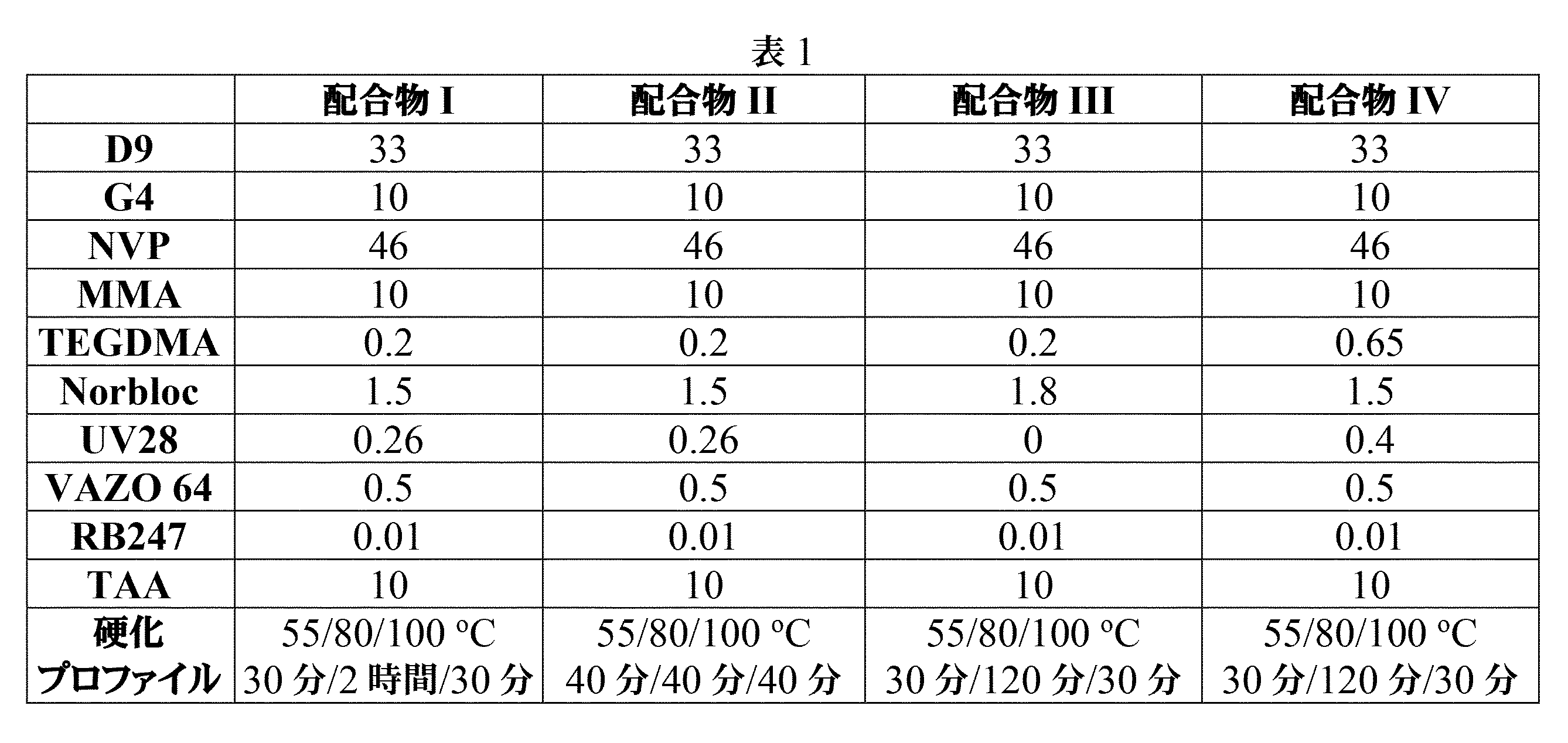
配合物は、記載の成分をそれらの目標量で清浄な瓶内に入れ、撹拌子を用いて室温において30分間600rpmで混合することによって調製する。全ての固形物が溶解した後、2.7μmのグラスマイクロファイバーフィルターを使用することにより、配合物の濾過を行う。 The formulation is prepared by combining the listed ingredients in their target amounts in a clean bottle and mixing with a stir bar at 600 rpm for 30 minutes at room temperature. After all solids are dissolved, the formulation is filtered using a 2.7 μm glass microfiber filter.
キャストモールドされたSiHyコンタクトレンズ
レンズ配合物を、室温で30~35分間窒素でパージする。N2パージしたレンズ配合物をポリプロピレン製モールド内に入れ、以下の硬化条件下でオーブン内で熱硬化させる:室温から第1の温度まで昇温し、次いで第1の温度で第1の硬化時間保持;第1の温度から第2の温度まで昇温し、第2の温度で第2の硬化時間保持;任意選択的に、第2の温度から第3の温度まで昇温し、第3の温度で第3の硬化時間保持;及び任意選択的に、第3の温度から第4の温度まで昇温し、第4の温度で第4の硬化時間保持。
Cast Molded SiHy Contact Lenses The lens formulation is purged with nitrogen for 30-35 minutes at room temperature. The N2 purged lens formulation is placed into a polypropylene mold and heat cured in an oven under the following cure conditions: ramp from room temperature to a first temperature and then hold at the first temperature for a first cure time; ramp from the first temperature to a second temperature and hold at the second temperature for a second cure time; optionally ramp from the second temperature to a third temperature and hold at the third temperature for a third cure time; and optionally ramp from the third temperature to a fourth temperature and hold at the fourth temperature for a fourth cure time.
レンズモールドは、プッシュピン付きの離型機を使用して開ける。レンズを、プッシュピンでベースカーブモールドに押し込み、次いでモールドをベースカーブハーフモールドとフロントカーブハーフモールドとに分ける。上にレンズを有するベースカーブハーフモールドを、超音波装置(例えばDukaneのシングルホーン超音波装置)の中に入れる。一定のエネルギー力で、乾いた状態のレンズをモールドから取り出す。乾燥状態のレンズを、設計された抽出トレイに入れる。或いは、レンズは、浮き上がることによって(すなわち超音波なしで、有機溶媒、例えばIPAに浸漬することによって)、ベースカーブハーフモールドから取り出すことができる。 The lens mold is opened using a demolder with push pins. The lens is pushed into the base curve mold with the push pins, and then the mold is separated into a base curve half mold and a front curve half mold. The base curve half mold with the lens on it is placed into an ultrasonic device (e.g., Dukane single horn ultrasonic device). With a certain energy force, the dry lens is removed from the mold. The dry lens is placed into a designed extraction tray. Alternatively, the lens can be removed from the base curve half mold by floating (i.e., without ultrasound, by immersion in an organic solvent, e.g., IPA).
モールドから取り出した後、キャストモールドされたSiHyコンタクトレンズをPrOHで180分間抽出してレンズを抽出し、水(55/45)で約25分間すすぎ洗いし、PB(約0.077重量%のNaH2PO4・H2O及び約0.31重量%のNa2HPO4・2H2Oを含むリン酸緩衝液)で約50~60分間すすぎ洗いし、その後、以下の実施例に記載されるように、0.65mLのパッケージング溶液と共にポリプロピレン(PP)レンズパッケージングシェル(ブリスター)に包装/密封する。密封されたレンズパッケージを、約121℃で約45分間オートクレーブ処理する。得られるSiHyコンタクトレンズは、手順に従って以下の特性を有すると特性評価される:Dkc約105barrer~118barrer;EWC約54%~57%;弾性率約0.45MPa~0.62MPa;WBUT約23秒~40秒;キャプティブバブルによる水接触角約47°~52°、摩擦等級約2.0。 After removal from the mold, the cast molded SiHy contact lenses are extracted with PrOH for 180 minutes to extract the lenses, rinsed with water (55/45) for about 25 minutes, rinsed with PB ( phosphate buffer containing about 0.077 wt . % NaH2PO4.H2O and about 0.31 wt. % Na2HPO4.2H2O ) for about 50-60 minutes, and then packaged/sealed in polypropylene ( PP ) lens packaging shells (blisters) with 0.65 mL of packaging solution as described in the Examples below. The sealed lens packages are autoclaved at about 121° C. for about 45 minutes. The resulting SiHy contact lenses are characterized according to the procedure as having the following properties: Dkc about 105 barrer to 118 barrer; EWC about 54% to 57%; Elastic modulus about 0.45 MPa to 0.62 MPa; WBUT about 23 seconds to 40 seconds; water contact angle with captive bubble about 47° to 52°, friction rating about 2.0.
後続の実施例では、別段の指定がない限り、配合物IVから作製したSiHyコンタクトレンズを使用する。 In the examples that follow, unless otherwise specified, SiHy contact lenses made from Formulation IV are used.
実施例3
パッケージング溶液の調製
Copolymer 845は、N-ビニルピロリドンとジメチルアミノエチルメタクリレートとのコポリマー(ポリエチレンオキシド標準に対してGPCでMw約700,000~1,200,000g/mol、Mw/Mn約5.7~8.5)であり、ISPから入手する。
Example 3
Preparation of Packaging Solution Copolymer 845 is a copolymer of N-vinylpyrrolidone and dimethylaminoethyl methacrylate (M w approx. 700,000-1,200,000 g/mol by GPC versus polyethylene oxide standards, M w /M n approx. 5.7-8.5) obtained from ISP.
Rがメチルであり、mの平均値が45であり、nの平均値が10である、式(S2)のPEO-PBOブロックコポリマー(「EO45BO10」)は、米国特許第8318144号明細書に記載の手順に従って調製する。この高分子界面活性剤のHLBは約14.7であり、下記式

(式中、WEOは、コポリマーEO45BO10中の親水性ポリ(オキシエチレン)部分の総重量であり、
WEO45BO10は、コポリマーEO45BO10の分子量である)
に基づいて計算する。
The PEO-PBO block copolymer of formula (S2) ("EO 45 BO 10 ") where R is methyl, the average value of m is 45, and the average value of n is 10 is prepared according to the procedure described in U.S. Pat. No. 8,318,144. This polymeric surfactant has an HLB of about 14.7 and has the following formula:
where W EO is the total weight of hydrophilic poly(oxyethylene) moieties in the copolymer EO 45 BO 10 ;
W EO45BO10 is the molecular weight of the copolymer EO 45 BO 10 )
Calculate based on:
表2に示す様々な成分を1Lの水に溶解して、4つのパッケージング溶液を調製する。濃度は重量パーセントである。 Prepare four packaging solutions by dissolving the various components shown in Table 2 in 1 L of water. Concentrations are in weight percent.
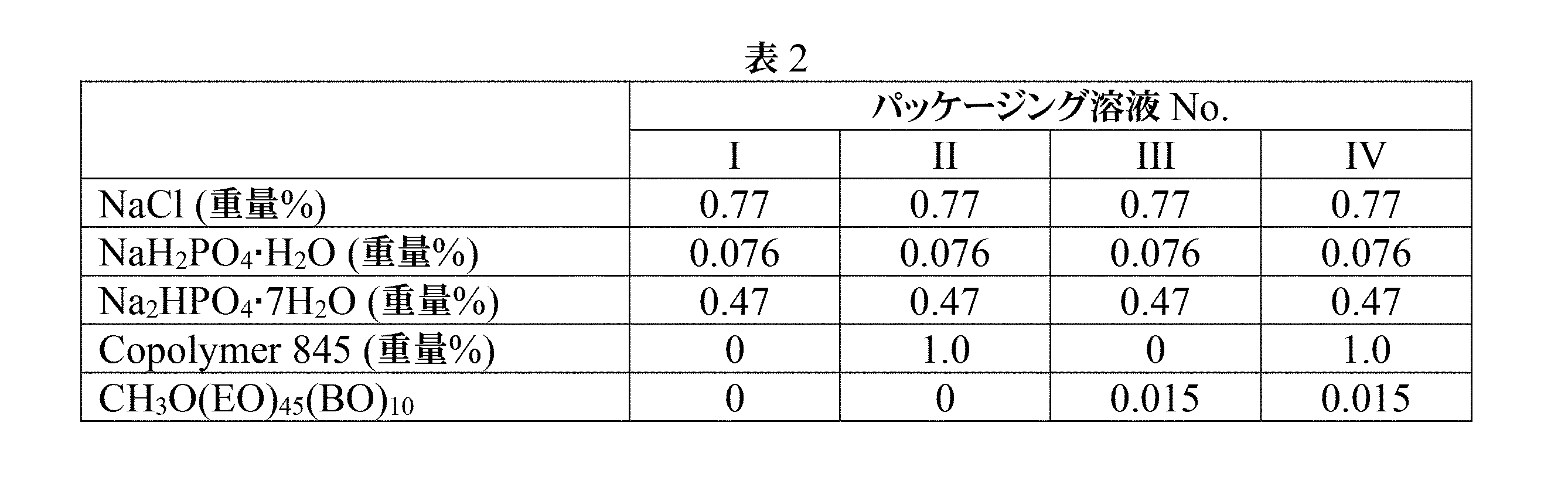
レンズのパッケージング
実施例2で作製したSiHyコンタクトレンズを、それぞれ0.65mLのパッケージング溶液(上で調製したパッケージング溶液I~IVのうちの1つ)が入っているPPブリスターパッケージの中に個別にパッケージング及び密封する。密封されたレンズパッケージを、約121℃で45分間オートクレーブ処理する。
Lens Packaging The SiHy contact lenses made in Example 2 are individually packaged and sealed in PP blister packages, each containing 0.65 mL of packaging solution (one of packaging solutions I-IV prepared above). The sealed lens packages are autoclaved at approximately 121° C. for 45 minutes.
すぐに使用可能なSiHyコンタクトレンズの湿潤性
室温で約12ヶ月間保管した後、パッケージから直接取り出したすぐに使用可能なSiHyコンタクトレンズの静的水接触角(WCAOOP)を、実施例1に記載の手順に従って決定する。結果を表3に報告する。
Wettability of Ready-to-Use SiHy Contact Lenses After storage at room temperature for approximately 12 months, the static water contact angle (WCA OOP ) of the ready-to-use SiHy contact lenses taken directly from the package is determined according to the procedure described in Example 1. The results are reported in Table 3.

表3は、高分子界面活性剤(EO45BO10)を含むパッケージング溶液の中にパッケージングされオートクレーブ処理されてから室温で約12か月間保管された、すぐに使用可能なSiHyレンズの湿潤性が、EO45BO10を含まないパッケージング溶液(対照としてのパッケージング溶液I)にパッケージングされたすぐに使用可能なSiHyレンズ(すなわち元の予め形成されたSiHyコンタクトレンズに対応)と比較して大幅に改善されたこと、及びCopolymer-845単独でも、Copolymer-845を含むパッケージング溶液の中にパッケージングされたすぐに使用可能なSiHyレンズの湿潤性をわずかに改善することができるものの、EO45BO10と高分子量親水性ポリマー(Copolymer-845)との組み合わせは、EO45BO10とCopolymer-845との混合物を含むパッケージング溶液中にパッケージングされたすぐに使用可能なSiHyレンズの水接触角を下げる(すなわち湿潤性を改善する)相乗効果をある程度有することができることを示している。 Table 3 shows that the wettability of ready-to-use SiHy lenses packaged in a packaging solution containing a polymeric surfactant (EO 45 BO 10 ), autoclaved, and then stored at room temperature for about 12 months is significantly improved compared to ready-to-use SiHy lenses (i.e., corresponding to the original preformed SiHy contact lenses) packaged in a packaging solution without EO 45 BO 10 (Packaging Solution I as a control), and that although Copolymer-845 alone can slightly improve the wettability of ready-to-use SiHy lenses packaged in a packaging solution containing Copolymer-845, the combination of EO 45 BO 10 and high molecular weight hydrophilic polymer (Copolymer-845) can have some synergistic effect of lowering the water contact angle (i.e., improving the wettability) of ready-to-use SiHy lenses packaged in a packaging solution containing a mixture of EO 45 BO 10 and Copolymer-845.
実施例4
すぐに使用可能なSiHyコンタクトレンズにおける高分子界面活性剤の有効時間は、蛍光標識高分子界面活性剤(NBD標識(EO45BO10、NBDはニトロベンゾオキサジアゾールでありEO45BO10は式(S2)のPEO-PBOブロックコポリマーであり、Rはメチルであり、mの平均値は45であり、nの平均値は10である)(EO45BO10と表す)を使用して推定する。蛍光標識(NBD)により、コンタクトレンズ内の高分子界面活性剤の共焦点可視化が可能になり、高分子界面活性剤が、シミュレートされた1日装着及び洗浄抽出の7サイクル(すなわち7日間の毎日の装着及び洗浄のルーチンを模倣)後も存在したままであることが実証される。
Example 4
The effective time of the polymeric surfactant in ready-to-use SiHy contact lenses is estimated using a fluorescently labeled polymeric surfactant (NBD label (EO 45 BO 10 , where NBD is nitrobenzoxadiazole and EO 45 BO 10 is a PEO-PBO block copolymer of formula (S2), R is methyl, the average value of m is 45, and the average value of n is 10) (denoted as EO 45 BO 10 ). The fluorescent label (NBD) allows for confocal visualization of the polymeric surfactant within the contact lenses, demonstrating that the polymeric surfactant remains present after seven cycles of simulated daily wear and wash extraction (i.e., mimicking a seven-day daily wear and wash routine).
NBD-EO45BO10の合成
NBD-EO45BO10は、以下のスキームに従って調製する。
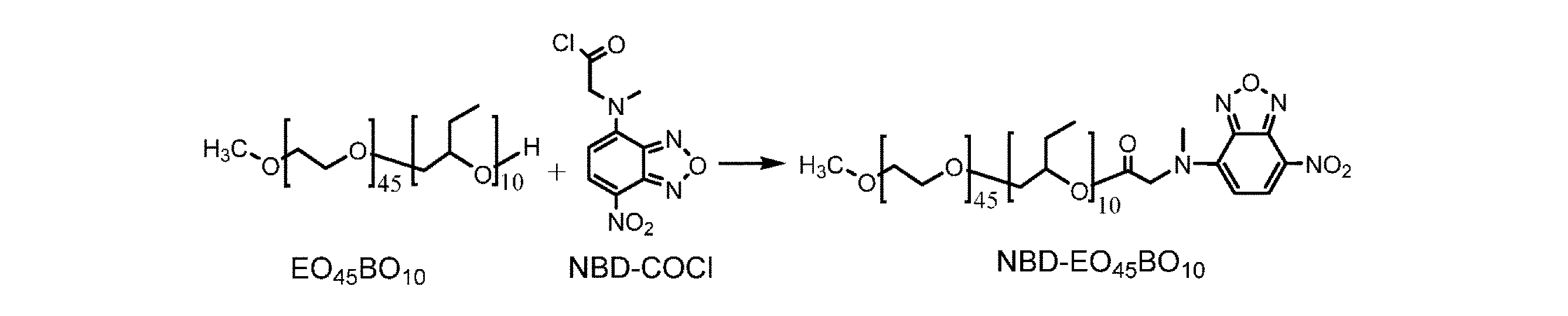
100mgのNBD-COCl(4-(N-クロロホルミルメチル-N-メチルアミノ)-7-ニトロ-2,1,3-ベンゾオキサジアゾール)を0.5mLのヘキサンと2.5mLの塩化メチレンとに溶解する。次いで、約1gのEO45BO10(Mn約3000g/mol)及び0.7gの乾燥K2CO3を添加する。反応を、N2下で室温で48時間以上実施する。K2CO3を遠心分離し、溶媒を留去する。NBD-EO45BO10の精製は、透析又はSECカラムを使用する。高純度のNBD-EO45BO10(99.5重量%)を得るために、HPLCカラムフラクションの回収によるさらなる精製を行う。 100 mg of NBD-COCl (4-(N-chloroformylmethyl-N-methylamino)-7-nitro-2,1,3-benzoxadiazole) is dissolved in 0.5 mL of hexane and 2.5 mL of methylene chloride. Then, about 1 g of EO 45 BO 10 (Mn approx. 3000 g/mol) and 0.7 g of dry K 2 CO 3 are added. The reaction is carried out at room temperature under N 2 for 48 hours or more. The K 2 CO 3 is centrifuged and the solvent is distilled off. Purification of NBD-EO 45 BO 10 uses dialysis or SEC column. Further purification by collection of HPLC column fractions is performed to obtain high purity NBD-EO 45 BO 10 (99.5 wt%).
このNBD標識高分子界面活性剤のHLBは約13.4であり、以下の式に基づいて計算される:

(式中、WEOはコポリマーEO45BO10中の親水性ポリ(オキシエチレン)の総重量であり、
WNBD-EO45BO10は、NBD標識コポリマーNBD-EO45BO10の分子量である。
The HLB of this NBD-labeled polymeric surfactant is about 13.4, calculated based on the following formula:
where W EO is the total weight of hydrophilic poly(oxyethylene) in the copolymer EO 45 BO 10 ;
W NBD-EO45BO10 is the molecular weight of the NBD-labeled copolymer NBD-EO 45 BO 10 .
パッケージング溶液の調製
パッケージング溶液は、上で調製した精製したNBD-EO45BO10、Copolymer 845、及びその他の必要な成分を水に溶解して、以下の組成:150ppmのNBD-O45BO10、1重量%のcopolymer 845、0.77重量%のNaCl、0.076重量%のNaH2PO4・H2O、及び0.47重量%のNa2HPO4・7H2Oを有するように調製する。
Preparation of Packaging Solution A packaging solution is prepared by dissolving the purified NBD-EO 45 BO 10 prepared above, Copolymer 845, and other required ingredients in water to have the following composition: 150 ppm NBD-O 45 BO 10 , 1 wt % Copolymer 845, 0.77 wt % NaCl, 0.076 wt % NaH 2 PO 4.H 2 O, and 0.47 wt % Na 2 HPO 4.7H 2 O.
レンズのパッケージング
実施例2に記載の手順に従って作製したSiHyコンタクトレンズを、個別にパッケージングし、0.65mLの調製されたパッケージング溶液をそれぞれ含むPPブリスターパッケージに密封する。密封されたレンズパッケージを、約121℃で45分間オートクレーブ処理する。
Lens Packaging SiHy contact lenses made according to the procedure described in Example 2 are individually packaged and sealed in PP blister packages each containing 0.65 mL of the prepared packaging solution. The sealed lens packages are autoclaved at approximately 121° C. for 45 minutes.
NBD-EO45BO10の取り込み
オートクレーブ処理前後のパッケージング溶液中のNBD-EO45BO10の濃度をHPLC法で測定する。
Uptake of NBD-EO 45 BO 10 The concentration of NBD-EO 45 BO 10 in the packaging solution before and after autoclaving is measured by HPLC method.
パッケージング溶液中のNBD-EO45BO10の分析は、蛍光検出器と直径150×2.1mm、粒径1.9μmのUPLCカラム(例えばThermoScientific Hypersil GOLDなど)とが取り付けられた逆相Waters UPLCシステムを使用して行う。移動相は、移動相:A-50:30:19.8:0.2(v/v)メタノール/アセトニトリル/水/ギ酸及び移動相:B-59.8:40:0.2(v/v)メタノール/アセトン/ギ酸との混合物として調製する。移動相を0.45μmナイロンフィルターでろ過する。流量は毎分0.3mLである。カラム温度は60℃に設定する。分析時間は30分である。蛍光NBD-EO45BO10(励起λ=460nm;発光λ=510nm)は、保持時間(RT)4分からRT12分の範囲で検出される。 Analysis of NBD-EO 45 BO 10 in the packaging solution is performed using a reversed-phase Waters UPLC system equipped with a fluorescence detector and a 150×2.1 mm diameter, 1.9 μm particle size UPLC column (e.g., ThermoScientific Hypersil GOLD). The mobile phase is prepared as a mixture of Mobile Phase: A-50:30:19.8:0.2 (v/v) methanol/acetonitrile/water/formic acid and Mobile Phase: B-59.8:40:0.2 (v/v) methanol/acetone/formic acid. The mobile phase is filtered through a 0.45 μm nylon filter. The flow rate is 0.3 mL per minute. The column temperature is set at 60° C. The analysis time is 30 minutes. Fluorescence NBD-EO 45 BO 10 (excitation λ=460 nm; emission λ=510 nm) is detected in the retention time (RT) range from 4 min to RT12 min.
すぐに使用可能なSiHyの中に取り込まれたNBD-EO45BO10の量は、(Cbefore autoclave-Cafter autoclave)*0.65mLで計算される。すぐに使用可能なSiHyコンタクトレンズに取り込まれたNBD-EO45BO10の平均量を得るために、5個のすぐに使用可能なレンズを使用する。NBD-EO45BO10の取り込み量は、約100μg/レンズと決定される。 The amount of NBD-EO 45 BO 10 incorporated into the ready-to-use SiHy is calculated as (C before autoclave - C after autoclave ) * 0.65 mL. Five ready-to-use lenses are used to obtain the average amount of NBD-EO 45 BO 10 incorporated into the ready-to-use SiHy contact lenses. The amount of NBD-EO 45 BO 10 incorporated is determined to be approximately 100 μg/lens.
また、すぐに使用可能なSiHyコンタクトレンズに取り込まれたNBD-EO45BO10の量は、抽出媒体としてのアセトン/ヘキサン1:1混合物で完全に抽出し、抽出媒体中のNBD-EO45BO10の量を決定することによって決定することができる。同様に、すぐに使用可能なSiHyコンタクトレンズの中に取り込まれたNBD-EO45BO10の平均量を得るために、5個のすぐに使用可能なレンズが使用される。 Also, the amount of NBD-EO 45 BO 10 incorporated in ready-to-use SiHy contact lenses can be determined by exhaustively extracting them with a 1:1 mixture of acetone/hexane as the extraction medium and determining the amount of NBD-EO 45 BO 10 in the extraction medium. Similarly, five ready-to-use lenses are used to obtain the average amount of NBD-EO 45 BO 10 incorporated in ready-to-use SiHy contact lenses.
NBD-EO45BO10の取り込みの可視化
すぐに使用可能なSiHyコンタクトレンズに取り込まれたNBD-EO45BO10は、共焦点顕微鏡によって視覚化される。対照として、オートクレーブ処理工程を受けずにパッケージング溶液に浸漬されたSiHyコンタクトレンズも共焦点顕微鏡で調べる。なお、PBS(NBD-EO45BO10を含まない)中でオートクレーブ処理されたSiHyコンタクトレンズを調べる場合、ベースライン蛍光として機能する蛍光がないことに留意する。
Visualization of NBD-EO 45 BO 10 Incorporation NBD-EO 45 BO 10 incorporated into ready-to-use SiHy contact lenses is visualized by confocal microscopy. As a control, SiHy contact lenses that have not undergone the autoclaving step and have been immersed in packaging solution are also examined by confocal microscopy. It is noted that there is no fluorescence when examining SiHy contact lenses autoclaved in PBS (without NBD-EO 45 BO 10 ), which serves as the baseline fluorescence.
すぐに使用可能なSiHyコンタクトレンズと対照のレンズを、直交するように断面切断し、Nikon蛍光顕微鏡を使用して画像化する。NBD-EO45BO10を励起するために488nmのレーザーを選択する。この実験では63倍の倍率を使用する。スケールバーは50μmである。すぐに使用可能なSiHyコンタクトレンズのレンズ断面の蛍光画像は、NBD-EO45BO10がレンズ表面に吸着され、すぐに使用可能なSiHyコンタクトレンズのバルク材料の中に深く浸透することを示している(図3A)。対照的に、対照コンタクトレンズNBD-EO45BO10のレンズ断面の蛍光画像は、NBD-EO45BO10がほとんどレンズ表面に吸着され、コンタクトレンズの表面領域のバルク材料の中に浸透することを示している(図4A)。共焦点顕微鏡ラインスキャン(図3B及び4B)は、視覚的観察を裏付ける。 Ready-to-use SiHy contact lenses and control lenses are cross-sectioned orthogonally and imaged using a Nikon fluorescence microscope. A 488 nm laser is selected to excite NBD-EO 45 BO 10. 63x magnification is used in this experiment. Scale bar is 50 μm. Fluorescence images of lens cross sections of ready-to-use SiHy contact lenses show that NBD-EO 45 BO 10 is adsorbed to the lens surface and penetrates deep into the bulk material of the ready-to-use SiHy contact lenses (FIG. 3A). In contrast, fluorescence images of lens cross sections of control contact lenses NBD-EO 45 BO 10 show that NBD-EO 45 BO 10 is mostly adsorbed to the lens surface and penetrates into the bulk material of the surface region of the contact lens (FIG. 4A). Confocal microscopy line scans (FIGS. 3B and 4B) confirm the visual observations.
これらの実験は、かなりの量のNBD-EO45BO10が表面及び表面近傍の領域に位置し、オートクレーブ処理工程が高分子界面活性剤をSiHyコンタクトレンズの奥深くに取り込ませるために重要であることを示している。 These experiments indicate that significant amounts of NBD-EO 45 BO 10 are located in the surface and near-surface regions and that the autoclaving step is important for incorporating the polymeric surfactant deep into the SiHy contact lenses.
シミュレートされた1日装着及び洗浄抽出の7サイクル
シミュレートされた1日装着及び洗浄抽出(S1DWC抽出)の7サイクルは以下の通りに行う。1サイクル目では、各レンズを密封されたパッケージから取り出し、拭き取り、その後35℃の水浴の中で8時間振とうされながら保持されているバイアルの中で、1mLの新鮮なPBSに浸漬する。8時間浸漬した後、レンズを優しく拭き取り、バイアル内の2mLの新鮮なOpti-Free補充(OFR)液の中に室温で16時間浸漬する。2サイクル目では、レンズを1サイクル目で使用したOFR溶液から取り出し、再度優しく拭き取り、35℃の水浴の中で8時間振とうされながら保持されているバイアルの中で、1mLの新鮮なPBSに浸漬する。8時間浸漬した後、レンズを優しく拭き取り、バイアル内の2mLの新鮮なOFRの中に室温で16時間浸漬する。3~6サイクル目では、2サイクル目と同様に抽出を行う。7サイクル目では、6サイクル目で使用したOFR溶液からレンズを取り出し、再度優しく拭き取り、35℃の水浴の中で8時間振とうされながら保持されているバイアルの中で、1mLの新鮮なPBSに浸漬する。7サイクル目ではOFR溶液の中に浸漬されない。
Seven Cycles of Simulated Daily Wear and Wash Extraction Seven cycles of simulated daily wear and wash extraction (S1DWC extraction) are performed as follows: In cycle 1, each lens is removed from the sealed package, wiped, and then immersed in 1 mL of fresh PBS in a vial that is held in a 35° C. water bath with shaking for 8 hours. After 8 hours of soaking, the lens is gently wiped and immersed in 2 mL of fresh Opti-Free Refill (OFR) solution in a vial at room temperature for 16 hours. In cycle 2, the lens is removed from the OFR solution used in cycle 1, gently wiped again, and immersed in 1 mL of fresh PBS in a vial that is held in a 35° C. water bath with shaking for 8 hours. After 8 hours of soaking, the lens is gently wiped and immersed in 2 mL of fresh OFR in a vial at room temperature for 16 hours. In cycles 3-6, extraction is performed as in cycle 2. In the seventh cycle, the lenses are removed from the OFR solution used in the sixth cycle, gently wiped again, and immersed in 1 mL of fresh PBS in a vial that is kept shaking in a 35° C. water bath for 8 hours. No immersion in OFR solution in the seventh cycle.
浸漬後の全てのPBS及びOFR溶液は、HPLC注入まで冷凍庫に保管する。 All PBS and OFR solutions after soaking are stored in the freezer until HPLC injection.
1個のSiHyコンタクトレンズを1mLの新鮮なPBSの中に35℃で8時間浸漬する工程は、患者による眼へのコンタクトレンズの通常の毎日の装着(約8時間)をシミュレートすることを目的としている一方で、2mLのOFRの中に1個のSiHyコンタクトレンズを浸漬する工程は、通常のレンズケア方法に従う患者の日常的な行為をシミュレートすることを目的としていることを指摘しておく必要がある。 It should be pointed out that the process of soaking one SiHy contact lens in 1 mL of fresh PBS at 35°C for 8 hours is intended to simulate the normal daily wearing of a contact lens on the eye by a patient (approximately 8 hours), while the process of soaking one SiHy contact lens in 2 mL of OFR is intended to simulate the daily behavior of a patient following a normal lens care method.
NBD-EO45BO10と共にオートクレーブ処理した後のレンズをバタフライカットし、Nikonの従来の顕微鏡を使用して、時間0及びシミュレートされた1日装着及び洗浄抽出の7サイクル後に画像化する。蛍光量は、画像解析ソフトウェアImageJを使用して積算することにより推定する。結果は、7日後もコンタクトレンズに少なくとも約70%の蛍光が残存していることを示している。
Lenses after autoclaving with NBD-EO 45 BO 10 are butterfly cut and imaged using a Nikon conventional microscope at
表4は、上述したHPLC法によって決定された、各抽出媒体へのNBD-EO45BO10の放出の結果を示している。 Table 4 shows the results of the release of NBD-EO 45 BO 10 into each extraction medium, as determined by the HPLC method described above.
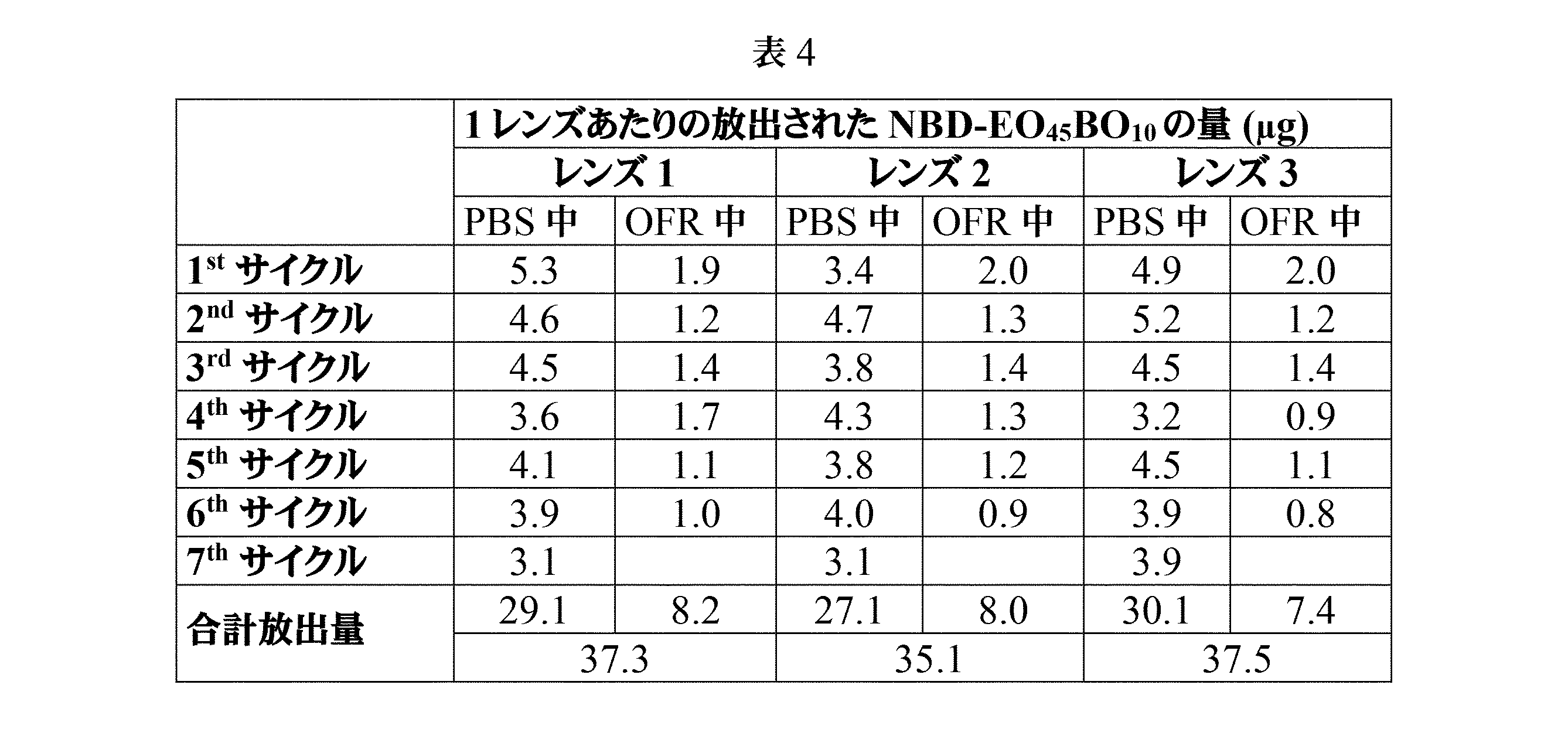
表4の結果は、この実施例のすぐに使用可能なSiHyコンタクトレンズが少なくとも3.1μg/レンズ/8時間、つまり0.00646μg/レンズ/分のNBD-EO45BO10を放出できることを示している。6.2±2.0μLの通常の平均涙液量では(S.Mishima et al.,Invest.Ophthalmol.Vis.Sci.1966,5:264-276)、上述した高分子界面活性剤の放出速度により、眼の涙液において0.00646μg・分-1/6.2μL=1.04μg/mLの高分子活性剤濃度が得られる。 The results in Table 4 show that the ready-to-use SiHy contact lenses of this example can release at least 3.1 μg/lens/8 hours, or 0.00646 μg/lens/min of NBD-EO 45 BO 10. With a normal average tear volume of 6.2±2.0 μL (S. Mishima et al., Invest. Ophthalmol. Vis. Sci. 1966, 5:264-276), the release rate of the polymeric surfactant described above results in a concentration of the polymeric surfactant in the tear fluid of the eye of 0.00646 μg min −1 /6.2 μL=1.04 μg/mL.
実施例5
この実施例は、シミュレートされた1日装着抽出の7サイクルを示している。
Example 5
This example shows seven cycles of simulated one-day wear extraction.
パッケージング溶液の調製
パッケージング溶液は、上の実施例3で調製した、式(S2)のPEO-PBOブロックコポリマー(Rはメチルであり、mの平均値は45であり、nの平均値は10である)を有する精製したEO45BO10、ISPのCopolymer 845(GPCによるポリエチレンオキシド標準に対するMw約700,000~1,200,000g/mol、Mw/Mn約5.7~8.5)、及び水中で以下の組成を有するために必要なその他の成分を溶解することによって調製する:150ppmのEO45BO10、1重量%のCopolymer 845、0.77重量%のNaCl、0.076重量%のNaH2PO4・H2O、及び0.47重量%のNa2HPO4・7H2O。
Preparation of Packaging Solution A packaging solution is prepared by dissolving purified EO 45 BO 10 having the PEO-PBO block copolymer of formula (S2) (R is methyl, the average value of m is 45, and the average value of n is 10) prepared in Example 3 above , Copolymer 845 from ISP ( Mw about 700,000-1,200,000 g/mol by GPC against polyethylene oxide standards, Mw / Mn about 5.7-8.5), and other ingredients required to have the following composition in water: 150 ppm EO 45 BO 10 , 1 wt % Copolymer 845, 0.77 wt % NaCl, 0.076 wt % NaH 2 PO 4.H 2 O, and 0.47 wt % Na 2 HPO 4.7H 2 O.
レンズのパッケージング
実施例2で作製したSiHyコンタクトレンズを、個別にパッケージングし、0.65mLの上記調製したパッケージング溶液をそれぞれ含むPPブリスターパッケージに密封する。密封されたレンズパッケージを、約121℃で45分間オートクレーブ処理する。
Lens Packaging The SiHy contact lenses made in Example 2 are individually packaged and sealed in PP blister packages each containing 0.65 mL of the above prepared packaging solution. The sealed lens packages are autoclaved at about 121° C. for 45 minutes.
すぐに使用可能なSiHyコンタクトレンズに取り込まれたEO45BO10の量は、(Cbefore autoclave-Cafter autoclave)*0.65mLによって計算される。Cbefore autoclaveは、オートクレーブ処理前のパッケージング溶液中のEO45BO10の濃度であり、150ppmであると決定され;Cafter autoclaveは、オートクレーブ処理後のパッケージング溶液中のEO45BO10の濃度であり、84~91ppmであると決定され;すぐに使用可能なSiHyレンズに取り込まれたEO45BO10の量は、38~43μg/レンズであると決定される。 The amount of EO 45 BO 10 incorporated into the ready-to-use SiHy contact lenses is calculated by (C before autoclave - C after autoclave ) * 0.65 mL, where C before autoclave is the concentration of EO 45 BO 10 in the packaging solution before autoclaving, determined to be 150 ppm; C after autoclave is the concentration of EO 45 BO 10 in the packaging solution after autoclaving, determined to be 84-91 ppm; the amount of EO 45 BO 10 incorporated into the ready-to-use SiHy lenses is determined to be 38-43 μg/lens.
UPLC法
UPLC分析は、ELSD(蒸発光散乱検出器)及びPDA(フォトダイオードアレイ検出器)を備えたWaters H-Classシステムで、カラムヒーター又は同等のものを用いて行う。カラムは5μmのC-4300Å;50mm×4.6mm(例えばPhenomenex Jupiter又は同等のものなど)であり、ソフトウェアはEmpower3である。ELSD検出器は、以下の設定でEO45BO10を検出するためのものである:ガス(50psi);ネブライザー(モード-加熱)。PDA検出器は、227nmのUV波長でのCopolymer 845検出用である。注入量は250.0μLである。サンプルコンパートメント温度は25℃に設定される。カラム条件は:カラム温度:60℃;圧力:約2000PSIである。移動相Aは0.5Mのギ酸アンモニウムであり;移動相Bは0.04%のTFA(トリフルオロ酸)/メタノールである。実行時間は30分である。
UPLC Method The UPLC analysis is performed on a Waters H-Class system equipped with an ELSD (Evaporative Light Scattering Detector) and a PDA (Photodiode Array Detector) with a column heater or equivalent. The column is 5 μm C-4 300 Å; 50 mm×4.6 mm (e.g., Phenomenex Jupiter or equivalent) and the software is Empower 3. The ELSD detector is for detection of EO 45 BO 10 with the following settings: Gas (50 psi); Nebulizer (Mode-Heated). The PDA detector is for detection of Copolymer 845 at a UV wavelength of 227 nm. The injection volume is 250.0 μL. The sample compartment temperature is set at 25° C. The column conditions are: Column temperature: 60° C.; Pressure: approximately 2000 PSI. Mobile phase A is 0.5 M ammonium formate; mobile phase B is 0.04% TFA (trifluoroacetic acid)/methanol. Run time is 30 min.
システムの適合性は、1.0%のCo-845及び150ppmのEO45BO10の注入の最初の5つの目標濃度のピーク面積%RSD(相対標準偏差)を計算することによって確認する。各分析物の%RSDは全て1.0%未満であり、最大有効仕様である10%を下回っている。ピーク位置も、1分間の保持時間変動の仕様の範囲内である。 System suitability is confirmed by calculating the peak area %RSD (relative standard deviation) for the first five target concentrations of injections of 1.0% Co-845 and 150 ppm EO 45 BO 10. The %RSD for each analyte is all less than 1.0%, below the maximum valid specification of 10%. Peak positions are also within the specification for 1 minute retention time variation.
UPLC分析用のサンプルは以下の通りに調製する。7サイクルのそれぞれで使用する各抽出媒体の分析では、溶媒(水)を留去し、高分子界面活性剤(EO45BO10)を含む物質をUPLC分析のために500μLのUPWに再溶解する。 Samples for UPLC analysis are prepared as follows: For analysis of each extraction medium used in each of the seven cycles, the solvent (water) is evaporated and the material, including the polymeric surfactant ( EO45BO10 ) , is redissolved in 500 μL of UPW for UPLC analysis.
当業者は、UPLCサンプル調製においてより少量(例えば0.25mL)のUPWを使用することによって、高分子界面活性剤の濃度を増加させ、それにより分析精度を上げることができることを理解するであろう。 Those skilled in the art will appreciate that by using smaller amounts of UPW (e.g., 0.25 mL) in UPLC sample preparation, the concentration of polymeric surfactant can be increased, thereby improving analytical accuracy.
7サイクルのそれぞれで使用される各抽出媒体の分析では、UPLC分析のための溶媒(PBS又はOFR)を直接注入する。 For analysis of each extraction medium used in each of the seven cycles, the solvent for UPLC analysis (PBS or OFR) is directly injected.
24時間の水性抽出の7サイクル
密封及びオートクレーブ処理されたレンズパッケージを室温で約12か月間保管した後、SiHyコンタクトレンズの24時間の水性抽出を7サイクルを以下の通りに行う。1サイクル目では、各10個のレンズを密封されたパッケージから取り出し、拭き取り、その後35℃の水浴の中で24時間振とうされながら保持されているバイアルの中で、10個の拭き取った1つのレンズを2mLの新鮮なPBS(又はこの実施例では比較のみ水)に一緒に浸漬する。2サイクル目では、1サイクル目で使用した全てのPBS(又は水)をバイアルからピペットで取り出し、後のUPLC分析のために保存する。2mLの新鮮なPBS(又は水)をバイアルに添加し、次に10個レンズを35℃で24時間浸漬するために水浴中で振とうしながら保持する。3~7サイクル目では、2サイクル目と同様に抽出を行う。浸漬後の全ての抽出媒体(PBS又は水)は、UPLC分析まで冷凍庫に保管する。
Seven Cycles of 24-Hour Aqueous Extraction After storing the sealed and autoclaved lens packages at room temperature for approximately 12 months, seven cycles of 24-hour aqueous extraction of SiHy contact lenses are performed as follows: In the first cycle, 10 lenses each are removed from the sealed package, wiped, and then the 10 wiped lenses are soaked together in 2 mL of fresh PBS (or water for comparison only in this example) in a vial that is kept shaking in a 35° C. water bath for 24 hours. In the second cycle, all of the PBS (or water) used in the first cycle is pipetted out of the vial and saved for later UPLC analysis. 2 mL of fresh PBS (or water) is added to the vial, and then the 10 lenses are kept shaking in a water bath for soaking at 35° C. for 24 hours. In cycles 3-7, the extraction is performed as in cycle 2. All extraction media (PBS or water) after soaking are stored in a freezer until UPLC analysis.
すぐに使用可能なSiHyレンズ1個あたりに放出されるEO45BO10の量(Wreleased)は、次式で計算される:

(式中、CUPLCは、7サイクルのそれぞれで使用された各抽出媒体から調製された注入したUPLCサンプル中のEO45BO10の濃度であり、VUPLCは、UPLCサンプルの調製に使用したUPW又はPBSの量(UPWについては0.5mL、PBSについては1.0mL)であり、Nlensは、24時間の水性抽出の7サイクルで使用されたレンズの数(10)である。24時間で1個のレンズあたりの放出されたEO45BO10及びCopolymer-845(Co-845)の量が表5に報告されている。
The amount of EO 45 BO 10 released per ready-to-use SiHy lens (W released ) is calculated by the following formula:
where C UPLC is the concentration of EO 45 BO 10 in the injected UPLC samples prepared from each extraction medium used in each of the seven cycles, V UPLC is the amount of UPW or PBS used to prepare the UPLC samples (0.5 mL for UPW and 1.0 mL for PBS), and N lens is the number of lenses used in the seven cycles of 24 hour aqueous extraction (10). The amounts of EO 45 BO 10 and Copolymer-845 (Co-845) released per lens in 24 hours are reported in Table 5.
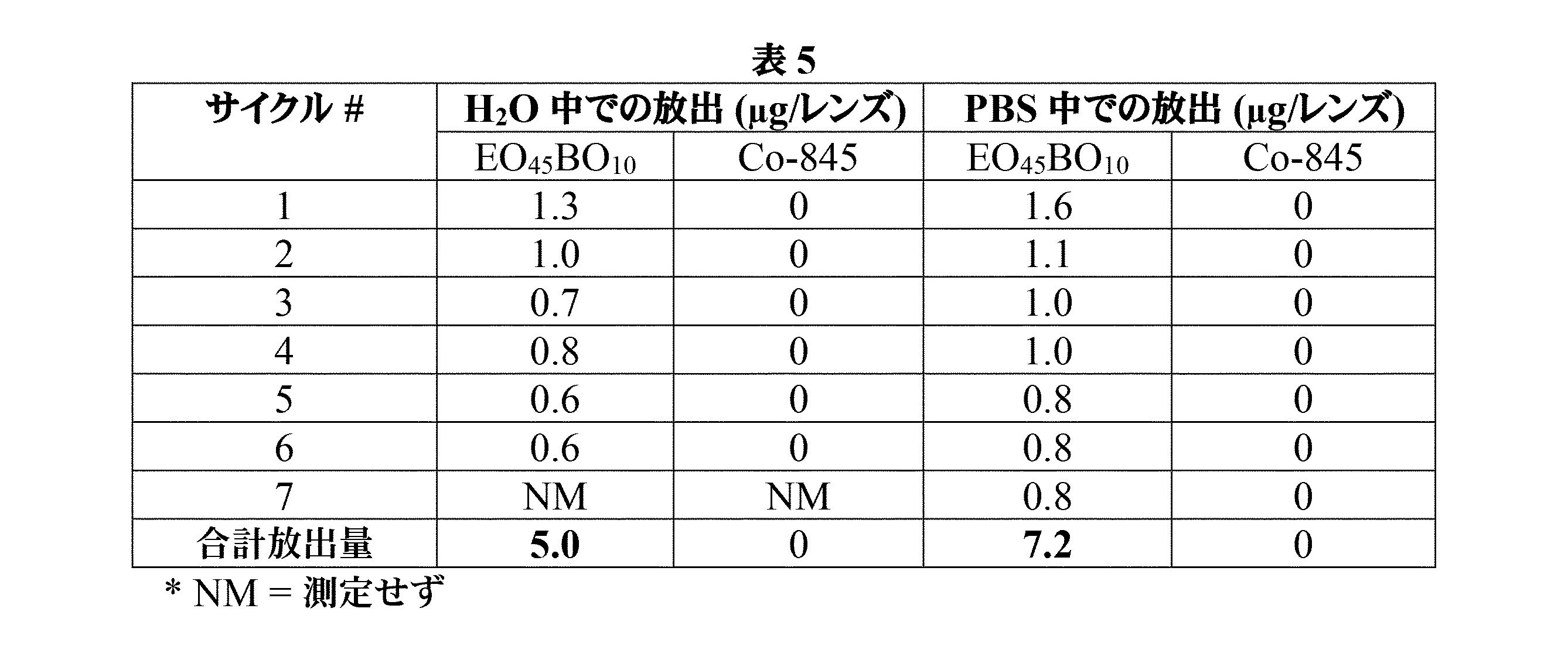
2mLのPBSの中に放出された10個のレンズについては、24時間の水性抽出を7サイクル行った後、各レンズに約35.8~38μgのEO45BO10が残存する。 For 10 lenses released into 2 mL of PBS, approximately 35.8-38 μg of EO 45 BO 10 remains in each lens after seven cycles of 24 hour aqueous extraction.
すぐに使用可能なSiHyコンタクトレンズによって、検出可能な量のCopolymer-845は放出されないことが見出された。これは、Copolymer-845がオートクレーブ処理中にSiHyレンズの中に浸透できず、1サイクル目で抽出媒体中に放出されるのに十分な量で表面に結合できなかった可能性を示唆している。 No detectable amounts of Copolymer-845 were found to be released by ready-to-use SiHy contact lenses, suggesting that Copolymer-845 may not have been able to penetrate into the SiHy lenses during autoclaving and bind to the surface in sufficient quantities to be released into the extraction medium during the first cycle.
また、すぐに使用可能なSiHyレンズが、35℃で水中よりもPBS中でEO45BO10を多く放出できることも見出された。PBSは、後のシミュレートされた1日装着(S1DW)抽出の7サイクルで使用される抽出媒体として選択される。 It was also found that ready-to-use SiHy lenses were able to release more EO 45 BO 10 in PBS than in water at 35° C. PBS was selected as the extraction medium to be used in the subsequent 7 cycles of simulated daily wear (S1DW) extractions.
さらに、1サイクル目の抽出媒体中で放出されるEO45BO10の量が、他のサイクルの抽出媒体中よりも大幅に多いことが見出された。これは、表面上及び表面のすぐ下の領域に位置する高分子界面活性剤が1サイクル目の抽出媒体中に放出されることを示唆している。 Furthermore, it was found that the amount of EO 45 BO 10 released in the extraction medium of the first cycle was significantly higher than in the extraction medium of the other cycles, suggesting that the polymeric surfactant located in the surface and subsurface regions is released in the extraction medium of the first cycle.
シミュレートされた1日装着抽出の7サイクル
この実施例では、密封及びオートクレーブ処理されたレンズパッケージを室温で約12か月間保管した後、1個のレンズを使用することを除いて、SiHyコンタクトレンズのS1DW抽出の7サイクルを実施例1に記載の手順に従って実行する。S1DW抽出の各サイクル後の抽出媒体としての全てのPBSは、UPLC分析まで冷凍庫に保管する。密封されたレンズパッケージは
Seven Cycles of Simulated Daily Wear Extraction In this example, seven cycles of S1DW extraction of SiHy contact lenses are carried out according to the procedure described in Example 1, except that one lens is used after the sealed and autoclaved lens packages are stored at room temperature for approximately 12 months. All PBS as the extraction medium after each cycle of S1DW extraction is stored in a freezer until UPLC analysis. The sealed lens packages are
すぐに使用可能なSiHyレンズ1個あたりに放出されるEO45BO10 の量(Wreleased)は、以下の式で計算される:

(式中、CUPLCは、7サイクルのそれぞれで使用される各抽出媒体から調製された注入したUPLCサンプル中のEO45BO10の濃度であり、VUPLCは、UPLCサンプルの調製に使用したPBSの量(1.0mL)であり、Nlensは、この実施例のS1DW抽出の7サイクルで使用されたレンズの数(1)である。24時間で1個のレンズあたりの放出されたEO45BO10及びCopolymer-845(Co-845)の量が表6に報告されている。
The amount of EO 45 BO 10 released per ready-to-use SiHy lens (W released ) is calculated by the following formula:
(where C UPLC is the concentration of EO 45 BO 10 in the injected UPLC samples prepared from each extraction medium used in each of the seven cycles, V UPLC is the amount of PBS used to prepare the UPLC samples (1.0 mL), and N lens is the number of lenses used in the seven cycles of S1DW extraction in this example (1). The amounts of EO 45 BO 10 and Copolymer-845 (Co-845) released per lens in 24 hours are reported in Table 6.
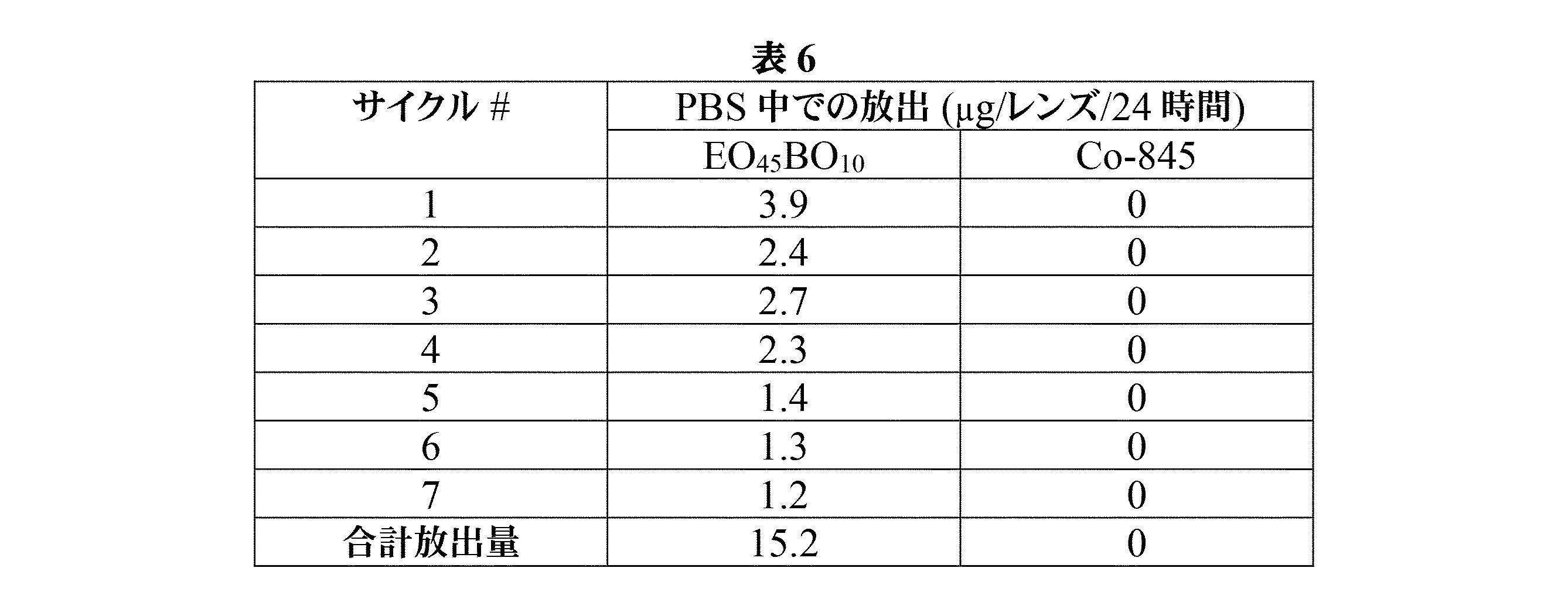
表7は、S1DW抽出の7サイクル後、各レンズに約27.8μgのEO45BO10が残っていること、及びすぐに使用可能なSiHyコンタクトレンズが検出可能な量のCopolymer-845を放出できないことを示しており、これは、Copolymer-845がオートクレーブ処理中にSiHyレンズの中に浸透できず、1サイクル目で抽出媒体に放出されるのに十分な量で表面に結合できなかった可能性があることを示唆しており、また、1サイクル目の抽出媒体中に放出されたEO45BO10の量が他のサイクルの抽出媒体よりも大幅に多く、このことは表面及び表面のすぐ下の領域にある高分子界面活性剤が1サイクル目の抽出媒体に放出されることを示唆している。 Table 7 shows that after seven cycles of S1DW extraction, approximately 27.8 μg of EO 45 BO 10 remained on each lens, and the ready-to-use SiHy contact lenses were unable to release detectable amounts of Copolymer-845, suggesting that Copolymer-845 may not have been able to penetrate into the SiHy lenses during autoclaving and bind to the surface in sufficient amounts to be released into the extraction medium in the first cycle, and the amount of EO 45 BO 10 released into the extraction medium in the first cycle was significantly higher than the extraction media in the other cycles, suggesting that the polymeric surfactant in the surface and subsurface regions was released into the extraction medium in the first cycle.
実施例6
パッケージング溶液の調製
5つのパッケージング溶液は、上の実施例3で調製した、式(S2)のPEO-PBOブロックコポリマー(Rはメチルであり、mの平均値は45であり、nの平均値は10である)を有する精製したEO45BO10、ISPのCopolymer 845(ポリエチレンオキシド標準に対するGPCによるMw 約700,000~1,200,000g/mol、Mw/Mn約5.7~8.5)、及び水中で以下の組成を有するために必要なその他の成分を溶解することによって調製する:5つの異なる濃度(50ppm、100ppm、150ppm、250ppm、及び400ppm)のうちの1つのEO45BO10、1重量%のcopolymer 845、0.77重量%のNaCl、0.076重量%のNaH2PO4・H2O、及び0.47重量%のNa2HPO4・7H2O。
Example 6
Preparation of Packaging Solutions Five packaging solutions are prepared by dissolving purified EO 45 BO 10 having the PEO-PBO block copolymer of formula (S2) prepared in Example 3 above (R is methyl, m is an average of 45 , and n is an average of 10), ISP's Copolymer 845 (M w about 700,000-1,200,000 g/mol by GPC against polyethylene oxide standards, M w /M n about 5.7-8.5), and other ingredients required to have the following composition in water: EO 45 BO 10 at one of five different concentrations (50 ppm, 100 ppm, 150 ppm, 250 ppm, and 400 ppm), 1 wt % Copolymer 845, 0.77 wt % NaCl, 0.076 wt % NaH 2 . PO4.H2O , and 0.47 wt % Na2HPO4.7H2O .
レンズのパッケージング
2種類のSiHyレンズ:実施例2で記載した手順に従って作製したSiHyコンタクトレンズと、約33重量%の平衡含水率(EWC)を有し、米国特許第9829723号明細書の実施例3に記載の手順に従って製造したプラズマ処理されたSiHyコンタクトレンズを、個別にパッケージングし、0.65mLの上記調製した5つのパッケージング溶液のうちの1つをそれぞれ含むPPブリスターパッケージに密封する。密封されたレンズパッケージを、約121℃で45分間オートクレーブ処理する。密封されたレンズパッケージの中のオートクレーブ処理された得られたレンズに対して、以下の調査及び特性評価を行う。密封及びオートクレーブ処理されたレンズパッケージは、以下で説明する試験の前に3週間未満室温で保管する。
Packaging of the lenses Two types of SiHy lenses: a SiHy contact lens made according to the procedure described in Example 2 and a plasma-treated SiHy contact lens with an equilibrium water content (EWC) of about 33% by weight and made according to the procedure described in Example 3 of US Pat. No. 9,829,723, are individually packaged and sealed in PP blister packages each containing 0.65 mL of one of the five packaging solutions prepared above. The sealed lens packages are autoclaved at about 121° C. for 45 minutes. The following investigations and characterizations are performed on the resulting autoclaved lenses in the sealed lens packages. The sealed and autoclaved lens packages are stored at room temperature for less than three weeks before the tests described below.
シミュレートされた1日装着抽出の7サイクル
新たに作製したSiHyコンタクトレンズのS1DW抽出の7サイクル(室温での保存時間は約3週間未満である)は、実施例5に記載の手順に従って実行される。実施例5と同様に、この実施例では1つのレンズがS1DW抽出の7サイクルにおいて使用される。
Seven Cycles of Simulated Daily Wear Extraction Seven cycles of S1DW extraction of a freshly made SiHy contact lens (storage time at room temperature is less than about 3 weeks) are carried out according to the procedure described in Example 5. As in Example 5, in this example one lens is used in seven cycles of S1DW extraction.
S1DW抽出の7サイクル後のレンズ直径の変化
レンズの直径は、実施例1に記載の手順に従って決定される。実施例2に記載の手順に従って作製されたSiHyコンタクトレンズであり、それぞれ0.65mLのPBSを含むPPブリスターパッケージ中のPBSの中で個別に密封及びオートクレーブ処理された対照のレンズは、14.04±0.02mmの平均レンズ直径(DIAcontrol)を有すると決定される。実施例2に記載の手順に従って作製された、レンズパッケージ中の上記調製した5つのパッケージング溶液のうちの1つの中で密封及びオートクレーブ処理された試験用SiHyコンタクトレンズは、パッケージから直接取り出したレンズ直径の値(DIAOOP)(表7に報告)及びS1DW抽出の7サイクル後のレンズ直径(DIA7S1DW extraction)を有していると決定される。
Lens diameter change after 7 cycles of S1DW extraction Lens diameter is determined according to the procedure described in Example 1. Control lenses, SiHy contact lenses made according to the procedure described in Example 2, individually sealed and autoclaved in PBS in PP blister packages each containing 0.65 mL of PBS, are determined to have an average lens diameter (DIA control ) of 14.04±0.02 mm. Test SiHy contact lenses made according to the procedure described in Example 2, sealed and autoclaved in one of the five packaging solutions prepared above in a lens package, are determined to have lens diameter values directly out of the package (DIA OOP ) (reported in Table 7) and lens diameter after 7 cycles of S1DW extraction (DIA 7S1DW extraction ).

結果は、約54重量%のEWCを有し、EO45BO10を含むパッケージング溶液中でオートクレーブ処理される前にコーティングがないSiHyコンタクトレンズのレンズ直径が、オートクレーブ処理後に増加できることを示している。これは、EO45BO10がSiHyコンタクトレンズの中に浸透することができ、EO45BO10を含むパッケージング溶液中でのオートクレーブ処理中にポリマーマトリックス内に分布できることを示唆している。 The results show that the lens diameter of SiHy contact lenses having an EWC of about 54 wt % and no coating before autoclaving in a packaging solution containing EO 45 BO 10 can increase after autoclaving, suggesting that EO 45 BO 10 can penetrate into the SiHy contact lenses and distribute within the polymer matrix during autoclaving in a packaging solution containing EO 45 BO 10 .
結果は、本発明のすぐに使用可能なSiHyコンタクトレンズのレンズ直径が、S1DW抽出の7サイクル(すなわち7日間の連続装着にほぼ対応)後に減少し得ることも示しており、これは、EO45BO10がはっきりとは捕らえられてはおらず、本発明のすぐに使用可能なSiHyコンタクトレンズのポリマーマトリックス中に分布しており、レンズが眼に装着されたときに涙液に放出され得ることを示唆している。 The results also show that the lens diameter of the ready-to-use SiHy contact lenses of the present invention can be reduced after seven cycles of S1DW extraction (i.e., roughly corresponding to seven days of continuous wear), suggesting that EO 45 BO 10 is not specifically trapped but is distributed in the polymer matrix of the ready-to-use SiHy contact lenses of the present invention and can be released into the tear fluid when the lenses are worn on the eye.
実施例7
パッケージング溶液の調製
Copolymer 845(ポリエチレンオキシド標準に対するGPCによるMw約700,000~1,200,000g/mol、Mw/Mn約5.7~8.5)は、ISPから入手する。式(S2)のPEO-PBOブロックコポリマー(Rはメチルであり、mの平均値は45であり、nの平均値は10である)を有する高分子活性剤であるコポリマーEO45BO10は、米国特許第8318144号明細書に記載の手順に従って調製する。
Example 7
Preparation of Packaging Solution Copolymer 845 ( Mw about 700,000-1,200,000 g/mol by GPC against polyethylene oxide standards, Mw / Mn about 5.7-8.5) is obtained from ISP. Copolymer EO 45 BO 10, a polymeric activator having the formula ( S2 ) PEO-PBO block copolymer, where R is methyl, the average value of m is 45, and the average value of n is 10 , is prepared according to the procedure described in US Pat. No. 8,318,144.
4つのパッケージング溶液(パッケージング溶液I~IV)は、実施例3に記載の手順に従って、表2に示す通りに様々な成分を水に溶解することによって調製する。 Four packaging solutions (packaging solutions I-IV) are prepared by dissolving the various components in water as shown in Table 2, following the procedure described in Example 3.
レンズのパッケージング
実施例2で作製したSiHyコンタクトレンズを、それぞれ0.65mLのパッケージング溶液III又はIV(上で調製)を含むPPブリスターパッケージの中に、又はそれぞれ約2mLのパッケージング溶液I又はII(上で調製)を含むバイアルの中に、個別にパッケージング及び密封する。密封されたレンズパッケージを、約121℃で約45分間オートクレーブ処理する。密封及びオートクレーブ処理されたレンズパッケージは、以下で説明する試験の前に3週間未満室温で保管する。
Lens Packaging SiHy contact lenses made in Example 2 are individually packaged and sealed in PP blister packages containing 0.65 mL each of Packaging Solution III or IV (prepared above) or in vials containing about 2 mL each of Packaging Solution I or II (prepared above). The sealed lens packages are autoclaved at about 121° C. for about 45 minutes. The sealed and autoclaved lens packages are stored at room temperature for less than 3 weeks before testing as described below.
シミュレートされた1日装着抽出の7サイクル
新たに作製したSiHyコンタクトレンズのS1DW抽出の7サイクル(室温での保存時間は約3週間未満である)は、実施例5に記載の手順に従って行う。実施例5と同様に、この実施例では1つのレンズをS1DW抽出の7サイクルにおいて使用する。
Seven Cycles of Simulated Daily Wear Extraction Seven cycles of S1DW extraction of freshly made SiHy contact lenses (room temperature storage time is less than about 3 weeks) are performed according to the procedure described in Example 5. As in Example 5, in this example one lens is used for seven cycles of S1DW extraction.
すぐに使用可能なSiHyコンタクトレンズの湿潤性
パッケージから直接取り出した、すぐに使用可能なSiHyコンタクトレンズの静的水接触角(WCAOOP)と、S1DW抽出の7サイクル後のすぐに使用可能なSiHyコンタクトレンズの静的水接触角(WCA7_S1DW)は、実施例1に記載の手順に従って決定する。結果を表8に報告する。
Wettability of Ready-to-Use SiHy Contact Lenses The static water contact angle of the ready-to-use SiHy contact lenses directly out of the package (WCA OOP ) and the static water contact angle of the ready-to-use SiHy contact lenses after 7 cycles of S1DW extraction (WCA 7_S1DW ) are determined according to the procedure described in Example 1. The results are reported in Table 8.

本出願において上記に引用された刊行物、特許及び特許出願の刊行物の全ては、その全体が参考として本明細書に組み込まれる。 All publications, patents, and patent application publications cited above in this application are hereby incorporated by reference in their entirety.
Claims (20)
a)その上にプラズマであるエネルギーによる表面処理によって得られるコーティングを有さず、前記高分子界面活性剤を含まない、予め形成されたシリコーンヒドロゲルコンタクトレンズを得る工程であって、前記予め形成されたシリコーンヒドロゲルコンタクトレンズが、38重量%~80重量%の平衡含水率、0.2MPa~1.5MPaの弾性率、及び少なくとも50barrerの酸素透過性を有する工程、
b)前記予め形成されたシリコーンヒドロゲルコンタクトレンズをオートクレーブ処理前のパッケージング溶液を含む容器に入れる工程であって、前記オートクレーブ処理前のパッケージング溶液が、6.0~8.0のpHを有する緩衝生理食塩水であり、且つ高分子界面活性剤を含み、前記高分子界面活性剤が、前記オートクレーブ処理前のパッケージング溶液中に、0.009重量%~0.032重量%の量で存在し、
(i) 少なくとも25μg/レンズの前記高分子界面活性剤が前記予め形成されたシリコーンヒドロゲルコンタクトレンズに前記オートクレーブ処理中に浸透し、次いでオートクレーブ処理後に得られるすぐに使用可能なシリコーンヒドロゲルコンタクトレンズのポリマーマトリックス内に拡散すること、及び
(ii) 前記すぐに使用可能なシリコーンヒドロゲルコンタクトレンズと、前記高分子界面活性剤を含まないリン酸緩衝生理食塩水中でオートクレーブ処理された予め形成されたシリコーンヒドロゲルコンタクトレンズである対照のレンズとの間のレンズ直径の差が0.20mm未満であること
を確保するように選択される工程、
c)前記容器を密封して、前記オートクレーブ処理後のパッケージング溶液中に浸漬された前記すぐに使用可能なシリコーンヒドロゲルコンタクトレンズを含む密封されたパッケージを得る工程、並びに
d)前記予め形成されたシリコーンヒドロゲルコンタクトレンズを中に含む前記密封されたパッケージを少なくとも30分間オートクレーブ処理して、オートクレーブ処理中に、前記すぐに使用可能なシリコーンヒドロゲルコンタクトレンズの前記ポリマーマトリックス内に少なくとも25μg/レンズの前記高分子界面活性剤を浸透させ、物理的に分散させる工程であって、前記すぐに使用可能なシリコーンヒドロゲルコンタクトレンズは、シミュレートされた1日装着抽出の7サイクルからなる水性抽出プロセスで測定される少なくとも0.2μg/レンズ/24時間の量で前記高分子界面活性剤を放出する能力を有し、前記高分子界面活性剤を放出する能力が、前記シミュレートされた1日装着抽出の7サイクルの最後のサイクルで使用された抽出媒体に24時間かけて1レンズあたりの放出された前記高分子界面活性剤の量であり、前記すぐに使用可能なシリコーンヒドロゲルコンタクトレンズは、前記密封されたパッケージから直接取り出して液滴法によって測定される75°以下の第1の静的水接触角、WCAOOPと、前記シミュレートされた1日装着抽出の7サイクルを行った直後に液滴法で測定される85°以下の第2の静的水接触角、WCA7_S1DWとを更に有する工程
を含む眼科用製品の製造方法。 1. A method of making an ophthalmic product comprising a sealed, autoclave sterilized package containing a post-autoclaving packaging solution and a ready-to-use silicone hydrogel contact lens immersed therein, said ready-to-use silicone hydrogel contact lens comprising at least 25 μg/lens of a polymeric surfactant, said polymeric surfactant comprising at least one hydrophilic poly(oxyethylene) segment and at least one hydrophobic poly(oxybutylene) segment, having an HLB value of 11-16 and a number average molecular weight of 800-20,000 Daltons, physically distributed within a polymer matrix of said ready-to-use silicone hydrogel contact lens,
a) obtaining a preformed silicone hydrogel contact lens having no coating thereon resulting from an energetic surface treatment that is a plasma , the preformed silicone hydrogel contact lens being free of said polymeric surfactant, the preformed silicone hydrogel contact lens having an equilibrium water content of 38% to 80% by weight, an elastic modulus of 0.2 MPa to 1.5 MPa, and an oxygen permeability of at least 50 barrers;
b) placing said preformed silicone hydrogel contact lens in a container containing a pre-autoclaved packaging solution, said pre-autoclaved packaging solution being a buffered saline solution having a pH of from 6.0 to 8.0 and containing a polymeric surfactant, said polymeric surfactant being present in said pre-autoclaved packaging solution in an amount of from 0.009% to 0.032% by weight;
(i) at least 25 μg/lens of said polymerized surfactant permeates said preformed silicone hydrogel contact lens during said autoclaving and then diffuses into the polymer matrix of the resulting ready-to-use silicone hydrogel contact lens after autoclaving; and
(ii) a step selected to ensure that the difference in lens diameter between said ready-to-use silicone hydrogel contact lenses and control lenses which are preformed silicone hydrogel contact lenses autoclaved in phosphate buffered saline without said polymeric surfactant is less than 0.20 mm;
c) sealing the container to obtain a sealed package containing the ready-to-use silicone hydrogel contact lens immersed in the autoclaved packaging solution; and d) autoclaving the sealed package containing the preformed silicone hydrogel contact lens therein for at least 30 minutes to infiltrate and physically disperse at least 25 μg/lens of the polymeric surfactant within the polymer matrix of the ready-to-use silicone hydrogel contact lens during autoclaving, wherein the ready-to-use silicone hydrogel contact lens has a capacity to release the polymeric surfactant in an amount of at least 0.2 μg/lens/24 hours as measured in an aqueous extraction process consisting of seven cycles of simulated one-day-wear extraction, the capacity to release the polymeric surfactant being the amount of the polymeric surfactant released per lens over 24 hours into an extraction medium used in the last cycle of the seven cycles of simulated one-day-wear extraction, and the ready-to-use silicone hydrogel contact lens has a first static water contact angle, WCA, of 75° or less as measured by the Sessile Drop Method directly removed from the sealed package. and a second static water contact angle, WCA 7_S1DW , of 85° or less as measured by a Sessile Drop Method immediately after seven cycles of the simulated one-day wear-extraction.
RO-(EO)m(BO)n-H(S1)
(式中、Rは、水素、メチル、エチル、プロピル、及びブチルからなる群から選択され;EOはエチレンオキシド-C2H4O-であり;BOはブチレンオキシド-C4H8O-であり;mは10~250の平均値を有する整数であり;nは5~125の平均値を有する整数であるが、m/nの値は2:1~10:1であることを条件とする)。 The method according to any one of claims 1 to 3, wherein the polymeric surfactant is a diblock copolymer of formula (S1):
RO-(EO) m (BO) n -H(S1)
where R is selected from the group consisting of hydrogen, methyl, ethyl, propyl, and butyl; EO is ethylene oxide -C 2 H 4 O-; BO is butylene oxide -C 4 H 8 O-; m is an integer having an average value from 10 to 250; and n is an integer having an average value from 5 to 125, with the proviso that the value of m/n is from 2:1 to 10:1.

(式中、Rは、水素、メチル、エチル、プロピル、及びブチルからなる群から選択され;mは10~250の平均値を有する整数であり;nは5~125の平均値を有する整数であるが、前記m/nの値は2:1~10:1であることを条件とする)。 The method according to any one of claims 1 to 4, wherein the polymeric surfactant is a diblock copolymer of formula (S2):
wherein R is selected from the group consisting of hydrogen, methyl, ethyl, propyl, and butyl; m is an integer having an average value from 10 to 250; and n is an integer having an average value from 5 to 125, provided that the value of m/n is from 2:1 to 10:1.

(式中、
ω1/υ1が0.035~0.15であることを条件として、υ1は、30~500の整数であり、ω1は、1~75の整数であり;
X01は、O又はNRNであり、RNは、水素又はC1~C10-アルキルであり;
Roは、水素又メチルであり;
RI1及びRI2は、互いに独立して、置換若しくは無置換C1~C10アルキレン二価ラジカルであるか、又は-RI4-O-RI5-の二価ラジカルであり、RI4及びRI5は、互いに独立して、置換若しくは無置換C1~C10アルキレン二価ラジカルであり;
RI3は、式(Ia)~(Ie)
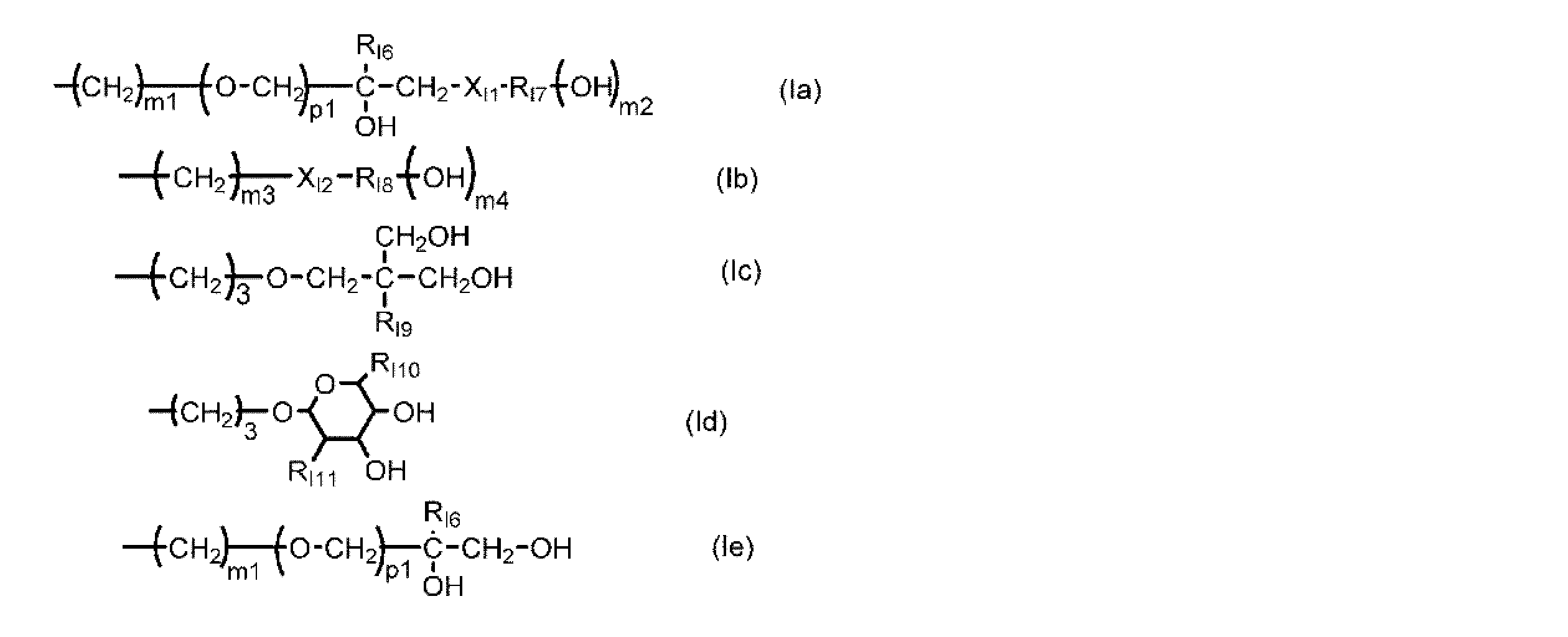
のいずれか1つの一価ラジカルであり;
p1は、ゼロ又は1であり;m1は、2~4の整数であり;m2は、1~5の整数であり;m3は、3~6の整数であり;m4は、2~5の整数であり;
RI6は、水素又はメチルであり;
RI7は、(m2+1)の価数を有するC2~C6炭化水素ラジカルであり;
RI8は、(m4+1)の価数を有するC2~C6炭化水素ラジカルであり;
RI9は、エチル又はヒドロキシメチルであり;
RI10は、メチル又はヒドロメチルであり;
RI11は、ヒドロキシル又はメトキシであり;
XI1は、-S-の硫黄結合又は-NRI12-の三級アミノ結合であり、RI12は、C1~C1アルキル、ヒドロキシエチル、ヒドロキシプロピル又は2,3-ジヒドロキシプロピルであり;
XI2は、

のアミド結合であり、RI13は、水素又はC1~C10アルキルである)
のビニル系架橋剤を含む、請求項10に記載の方法。 The silicone hydrogel material comprises repeating units of at least one polysiloxane vinyl crosslinker, the at least one polysiloxane vinyl crosslinker having the formula (I):
(Wherein,
υ1 is an integer between 30 and 500, and ω1 is an integer between 1 and 75, provided that ω1/υ1 is between 0.035 and 0.15;
X 01 is O or NR 3 N , where R 3 N is hydrogen or C 1 -C 10 -alkyl;
R o is hydrogen or methyl;
R I1 and R I2 are, independently of each other, a substituted or unsubstituted C 1 -C 10 alkylene divalent radical or a divalent radical of -R I4 -O-R I5 -, and R I4 and R I5 are, independently of each other, a substituted or unsubstituted C 1 -C 10 alkylene divalent radical;
R I3 is a compound represented by the formula (Ia) to (Ie)
is one of the monovalent radicals
p1 is zero or 1; m1 is an integer from 2 to 4; m2 is an integer from 1 to 5; m3 is an integer from 3 to 6; m4 is an integer from 2 to 5;
R I6 is hydrogen or methyl;
R I7 is a C 2 -C 6 hydrocarbon radical having a valence of (m2+1);
R I8 is a C 2 -C 6 hydrocarbon radical having a valence of (m4+1);
R I9 is ethyl or hydroxymethyl;
R I10 is methyl or hydromethyl;
R I11 is hydroxyl or methoxy;
X I1 is a sulfur bond of -S- or a tertiary amino bond of -NR I12 -, where R I12 is C 1 -C 1 alkyl, hydroxyethyl, hydroxypropyl or 2,3-dihydroxypropyl;
X I2 is
and R I13 is hydrogen or C 1 -C 10 alkyl.
The method of claim 10, comprising a vinyl crosslinker of
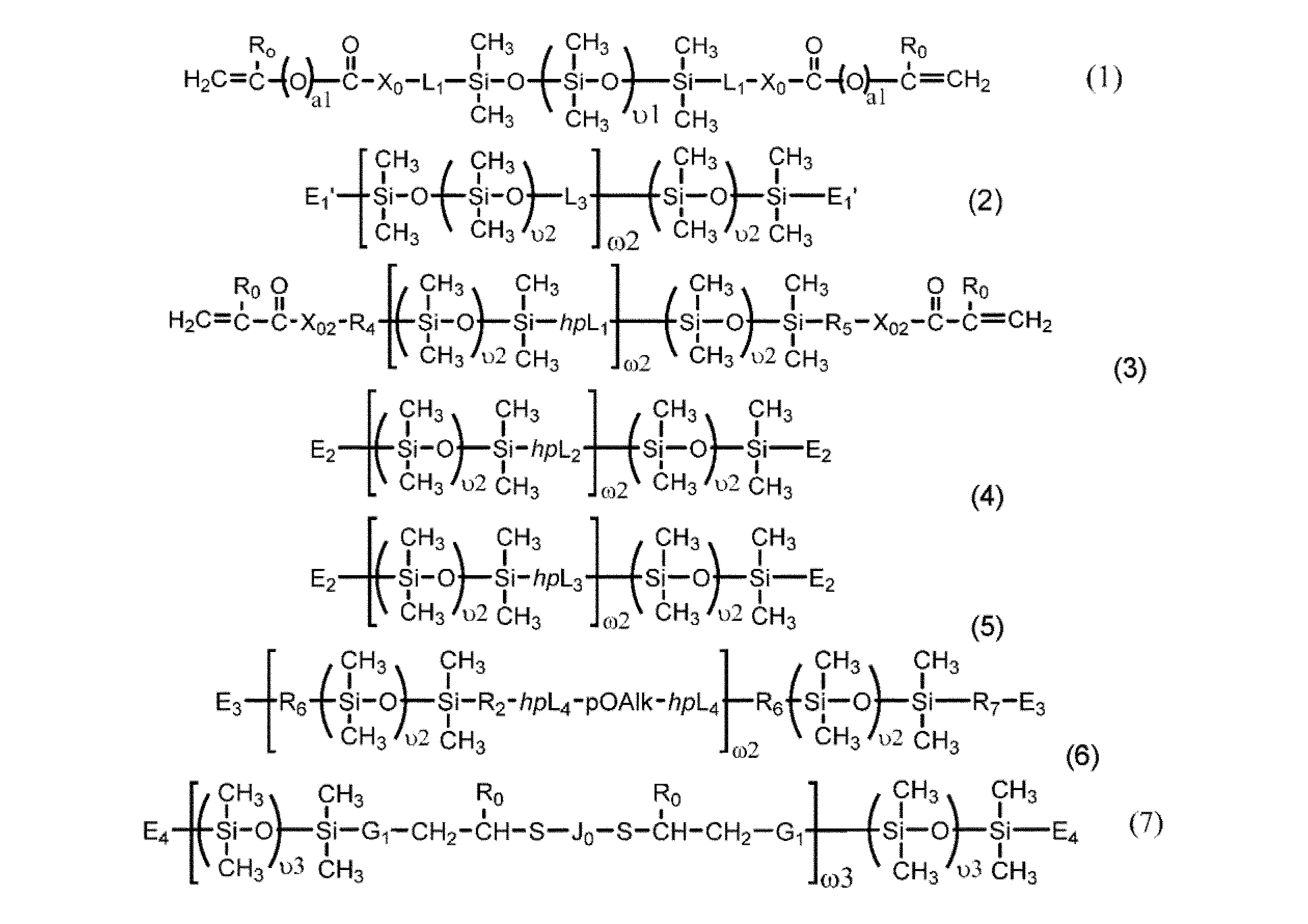
(式中、
υ1は、30~500の整数であり;
υ2は、5~50の整数であり;
υ3は、5~100の整数であり;
ω2及びω3は、互いに独立して、1~15の整数であり;
a1及びg1は、互いに独立して、ゼロ又は1であり;
h1は、1~20の整数であり、h2は、0~20の整数であり;
m1及びm3は、互いに独立して、0又は1であり、m2は、1~6の整数であり、m4は、1~5の整数であり、m5は、2又は3であり;
q1は、1~20の整数であり、q2は、0~20の整数であり、q3は、0~2の整数であり、q4は、2~50の整数であり、q5及びq6は、互いに独立して、0~35の数であるが、(q4+q5+q6)は、2~50の整数であることを条件とし;
x+yは、10~30の整数であり;
e1は、5~100の整数であり、p1及びb1は、互いに独立して、0~50の整数であるが、(p1+b1)≧1である場合、(e1+p1+b1)≧10、且つ

であることを条件とし;
Roは、H又はメチルであり;
R1、R1n、R2n、R3n及びR4nは、互いに独立して、Hであるか、又は0~2つのヒドロキシル基を有するC1~C4アルキルであり;
Rn5は、H又はC1~C10アルキルであり;
R2は、C4~C14の炭化水素二価ラジカルであり;
R3は、C2~C6アルキレン二価ラジカルであり;
R4及びR5は、互いに独立して、C1~C6アルキレン二価ラジカルであるか、又はC1~C6アルキレン-オキシ-C1~C6アルキレン二価ラジカルであり;
R6及びR7は、互いに独立して、C1~C6アルキレン二価ラジカル又はC1~C6アルコキシ-C1~C6アルキレン二価ラジカルであり;
R8及びR9は、互いに独立して、置換又は無置換C1~C12アルキレン二価ラジカルであり;
Xo、X1’、Xo1、X02及びX03は、互いに独立して、O又はNR1であり;
X1は、O、NR1、NHCOO、OCONH、CONR1又はNR1COであり;
Xo4は、-COO-又は-CONRn5-であり;
Xo5及びXo7は、互いに独立して、直接結合、-COO-又は-CONRn5-であり;
Xo6は、直接結合、C1~C6アルキレン二価ラジカル、C1~C6アルキレンオキシ二価ラジカル、-COO-又は-CONRn5-であり;
Xo8は、直接結合又は-COO-であり;
Xo9は、O又はNRn5であり;
X10は、直接結合、C1~C6アルキレン二価ラジカル、-COO-又は-CONRn5-であり;
E1’は、

の一価のラジカルであり;
E2は、

の一価のラジカルであり;
E3は、

の一価のラジカルであり;
E4は、

の一価のラジカルであり;
L1は、C2~C8アルキレン二価ラジカルであるか、又は
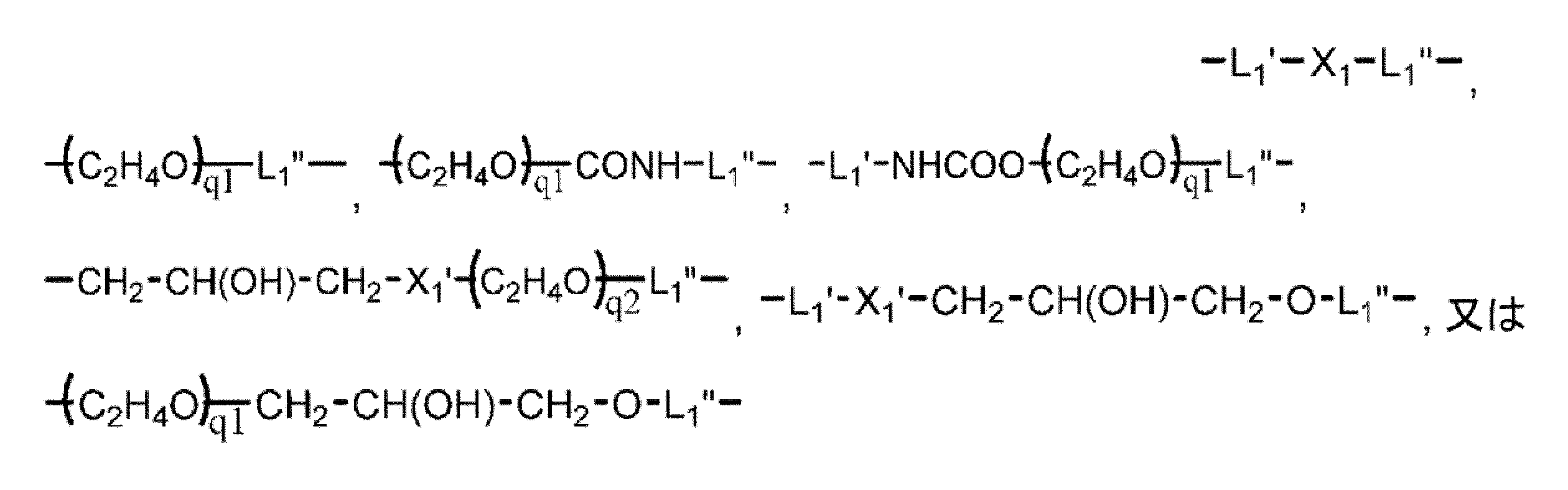
の二価のラジカルであり;
L1’は、0又は1つのヒドロキシル基を有するC2~C8アルキレン二価ラジカルであり;
L1”は、0又は1つのヒドロキシル基を有するC3~C8アルキレン二価ラジカルであり;
L3は、

の二価ラジカルであり;
PEは、

の二価ラジカルであり;
L3’は、C3~C8アルキレン二価ラジカルであり;
L4は、
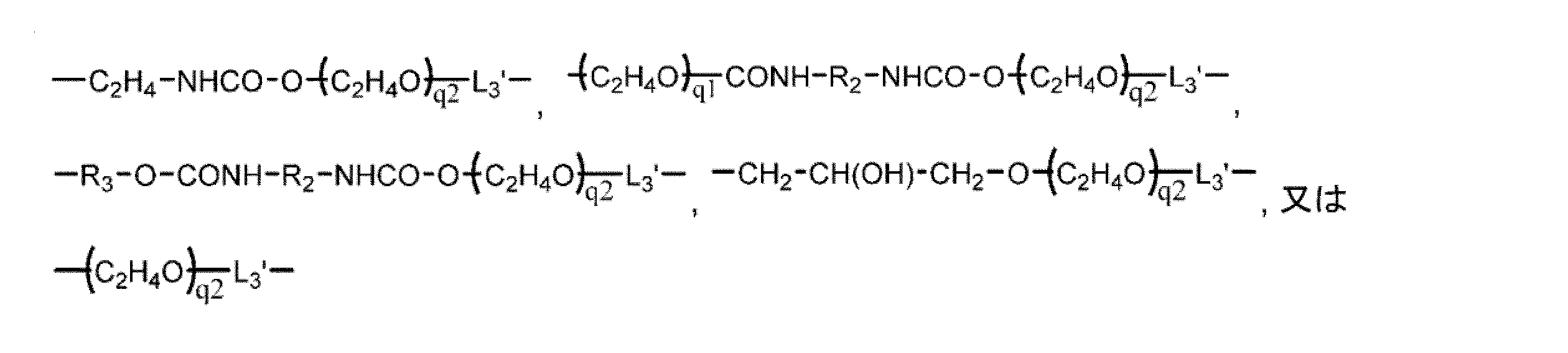
の二価ラジカルであり;
hpL1は、

の二価ラジカルであり;
hpL2は、

の二価ラジカルであり;
hpL3は、

の二価ラジカルであり;
hpL4は、
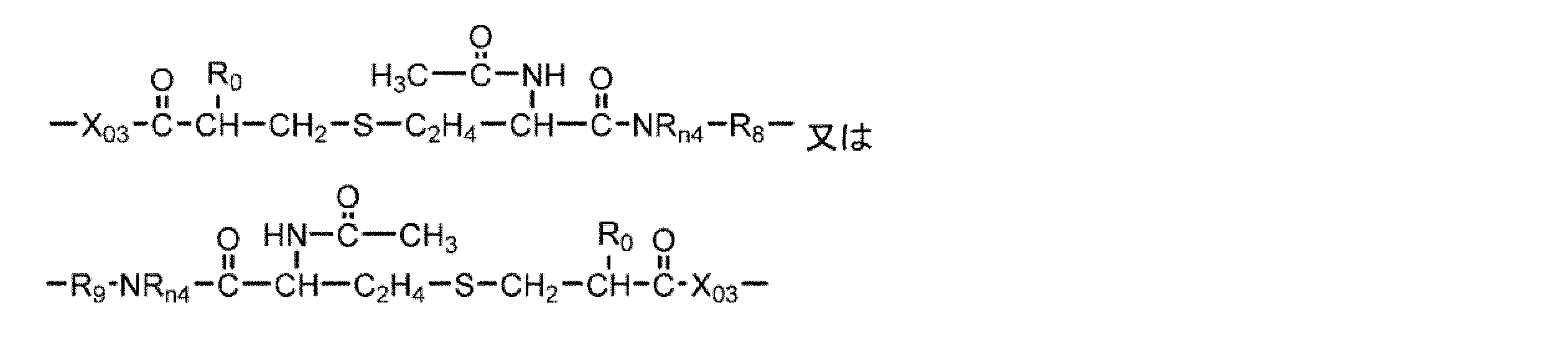
の二価ラジカルであり;
pOAlkは、

の二価ラジカルであり、
EOは、オキシエチレン単位(-CH2CH2O-)であり、POは、オキシプロピレン単位

であり、BOは、オキシブチレン単位

であり;
M0は、C3~C8アルキレン二価ラジカルであり;
M1は、C4~C14炭化水素二価ラジカルであり;
M2及びM3は、互いに独立して、C1~C6アルキレン二価ラジカルであり;
J0は、0~2つのヒドロキシル基又はカルボキシル基を有するC1~C12炭化水素ラジカルであり;
G1は、直接結合、C1~C4アルキレン二価ラジカル、又は
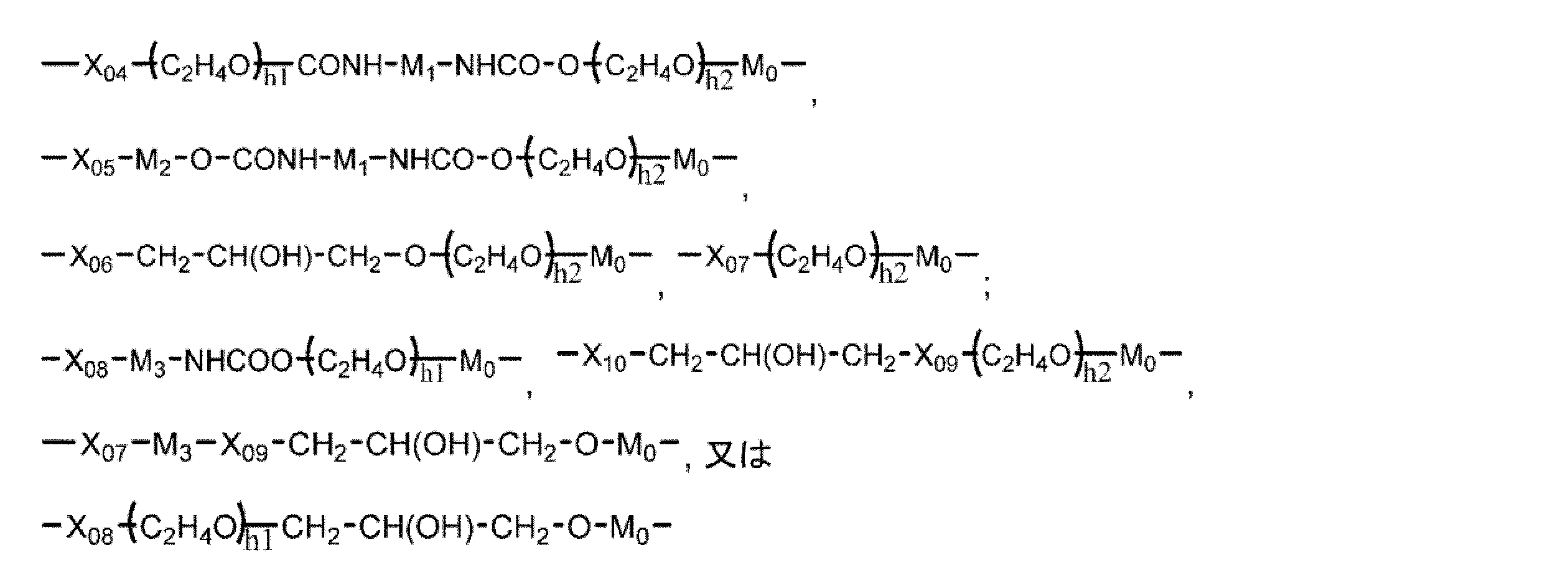
の二価のラジカルであり、
ここで、Moは、Si原子に結合しており、X04~X10は、式(7)の-CH2-の基に結合しており、式(7)のJ0及びG1の少なくとも1つは、ヒドロキシル基、-OCONH-のウレタン結合、-NHRoのアミノ基、-NH-のアミノ結合、-CONH-のアミド結合、カルボキシル基及びこれらの組み合わせからなる群から選択される少なくとも1つの部位を含み;
G2は、C1~C4アルキレン二価ラジカルであるか、又は
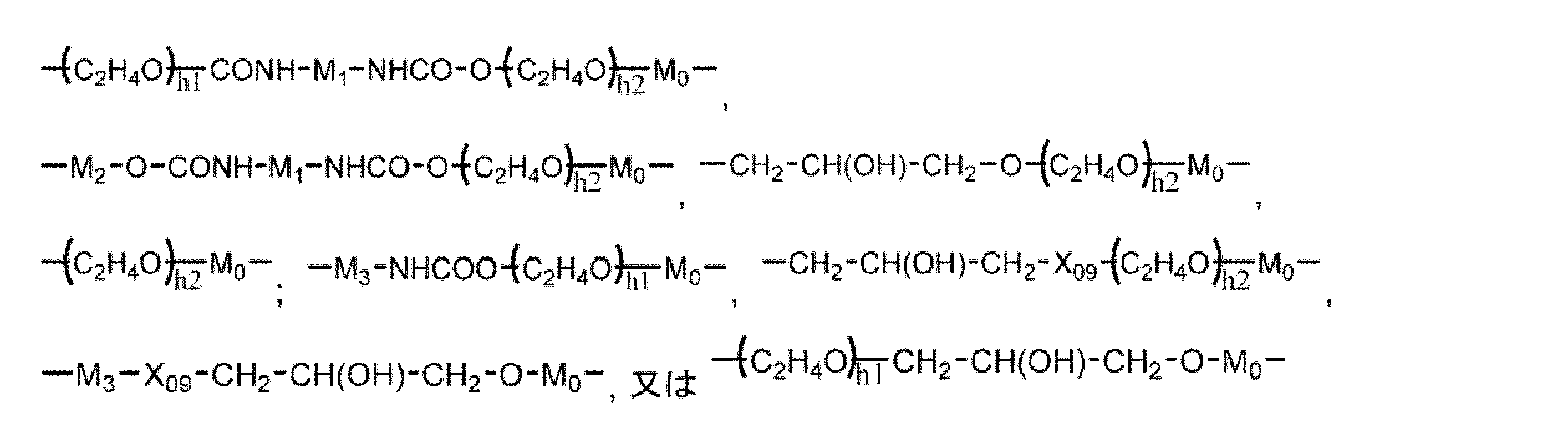
の二価ラジカルであり;
G3は、

の二価ラジカルであり;
ここで、h3及びh4は、互いに独立して、1又は0であり;
G4は、(a)-NR3’-(式中、R3’は、水素又はC1~C3アルキルである)、
(b)

、(c)-NR0-G5-NR0-(式中、G5は、C1~C6アルキレン二価ラジカル、2-ヒドロキシルプロピレン二価ラジカル、2-(ホスホニルオキシ)プロピレン二価ラジカル、1,2-ジヒドロキシエチレン二価ラジカル、2,3-ジヒドロキシブチレン二価ラジカルである)、及び(d)-O-G6-O-、式中、G6は、C1~C6アルキレン二価ラジカル、

の二価ラジカル
(式中、h4’は、1又は2である)、

の二価ラジカル、

の二価ラジカル
(式中、h5は、1~5である)、

の二価ラジカル
(式中、h6は、2又は3である)又はヒドロキシル基若しくはホスホニルオキシ基を有する置換C3~C8アルキレン二価ラジカルのいずれか1つの二価ラジカルであり;
Y1は、C1~C6アルキレン二価ラジカル、2-ヒドロキシルプロピレン二価ラジカル、2-(ホスホニルオキシ)プロピレン二価ラジカル、1,2-ジヒドロキシエチレン二価ラジカル、

の二価ラジカル、又は

の二価ラジカルであり;
Y2は、

の二価ラジカルであり;
Y3は、

の二価ラジカルであり;
Z0は、直接結合又はC1~C12アルキレン二価ラジカルであり;
Z1は、C1~C6アルキレン二価ラジカル、ヒドロキシ若しくはメトキシ置換C1~C6アルキレン二価ラジカル又は置換若しくは無置換フェニレン二価ラジカルであり、
Z2は、C1~C6アルキレン二価ラジカル、ヒドロキシル若しくはメトキシ-置換C1~C6アルキレン二価ラジカル、ジヒドロキシル若しくはジメトキシ-置換C2~C6アルキレン二価ラジカル、-C2H4-(O-C2H4)m2-の二価ラジカル、-Z4-S-S-Z4-の二価ラジカル、ヒドロキシル-若しくはメトキシ置換C1~C6アルキレン二価ラジカル又は置換若しくは無置換フェニレン二価ラジカルであり、
Z3は、(a)-NRn3-、(b)

、(c)-NR0-Z5-NR0-、及び(d)-O-Z6-O-のいずれか1つの二価ラジカルであり、
Z4は、C1~C6アルキレン二価ラジカルであり、
Z5は、C1~C6アルキレン二価ラジカル、2-ヒドロキシルプロピレン二価ラジカル、2-(ホスホニルオキシ)プロピレン二価ラジカル、1,2-ジヒドロキシエチレン二価ラジカル、2,3-ジヒドロキシブチレン二価ラジカルであり、
Z6は、(a)C1~C6アルキレン二価ラジカル、(b)

の二価ラジカル、又は(c)ヒドロキシル基又はホスホニルオキシ基を有する置換C3~C8アルキレン二価ラジカルであり、
Z7は、

の二価のラジカルである)
のいずれか1つのビニル系架橋剤を含む、請求項10に記載の方法。 The silicone hydrogel material comprises repeating units of at least one polysiloxane vinyl crosslinker, the at least one polysiloxane vinyl crosslinker being represented by the formulas (1) to (7):
(Wherein,
υ1 is an integer from 30 to 500;
υ2 is an integer from 5 to 50;
υ3 is an integer from 5 to 100;
ω2 and ω3 are, independently of each other, integers from 1 to 15;
a1 and g1 are independently zero or 1;
h1 is an integer from 1 to 20, and h2 is an integer from 0 to 20;
m1 and m3 are each independently 0 or 1, m2 is an integer from 1 to 6, m4 is an integer from 1 to 5, and m5 is 2 or 3;
q1 is an integer from 1 to 20, q2 is an integer from 0 to 20, q3 is an integer from 0 to 2, q4 is an integer from 2 to 50, and q5 and q6 are each independently a number from 0 to 35, provided that (q4+q5+q6) is an integer from 2 to 50;
x+y is an integer from 10 to 30;
e1 is an integer from 5 to 100, p1 and b1 are each independently an integer from 0 to 50, provided that if (p1+b1)≧1, then (e1+p1+b1)≧10; and
provided that;
R o is H or methyl;
R 1 , R 1n , R 2n , R 3n and R 4n are, independently of each other, H or C 1 -C 4 alkyl having 0-2 hydroxyl groups;
R n5 is H or C 1 -C 10 alkyl;
R2 is a C4 - C14 hydrocarbon divalent radical;
R3 is a C2 - C6 alkylene divalent radical;
R 4 and R 5 are, independently of each other, a C 1 -C 6 alkylene divalent radical or a C 1 -C 6 alkylene-oxy-C 1 -C 6 alkylene divalent radical;
R 6 and R 7 are each independently a C 1 -C 6 alkylene divalent radical or a C 1 -C 6 alkoxy-C 1 -C 6 alkylene divalent radical;
R 8 and R 9 are, independently of each other, a substituted or unsubstituted C 1 -C 12 alkylene divalent radical;
X o , X 1 ', X o1 , X 02 and X 03 are each independently O or NR 1 ;
X1 is O, NR1 , NHCOO, OCONH, CONR1 or NR1CO ;
X o4 is —COO— or —CONR n5 —;
X o5 and X o7 are each independently a direct bond, —COO— or —CONR n5 —;
X o6 is a direct bond, a C 1 -C 6 alkylene divalent radical, a C 1 -C 6 alkyleneoxy divalent radical, -COO- or -CONR n5 -;
X o8 is a direct bond or -COO-;
X o9 is O or NR n5 ;
X 10 is a direct bond, a C 1 -C 6 alkylene divalent radical, -COO- or -CONR n5 -;
E 1 ' is
is a monovalent radical of
E2 is
is a monovalent radical of
E3 is
is a monovalent radical of
E4 is
is a monovalent radical of
L1 is a C2 - C8 alkylene divalent radical; or
is a divalent radical of
L 1 ' is a C 2 -C 8 alkylene divalent radical having 0 or 1 hydroxyl group;
L 1 ″ is a C 3 -C 8 alkylene divalent radical having 0 or 1 hydroxyl group;
L3 is
is a divalent radical of
P.E.
is a divalent radical of
L 3 ' is a C 3 -C 8 alkylene divalent radical;
L4 is
is a divalent radical of
hpL1 is
is a divalent radical of
hpL2 is
is a divalent radical of
hpL3 is
is a divalent radical of
hpL4 is
is a divalent radical of
pOAlk is
is a divalent radical of
EO is an oxyethylene unit (-CH 2 CH 2 O-) and PO is an oxypropylene unit.
where BO is an oxybutylene unit.
and
M 0 is a C 3 -C 8 alkylene divalent radical;
M1 is a C4 - C14 hydrocarbon divalent radical;
M2 and M3 are, independently of each other, a C1 - C6 alkylene divalent radical;
J 0 is a C 1 -C 12 hydrocarbon radical having 0-2 hydroxyl or carboxyl groups;
G1 is a direct bond, a C 1 -C 4 alkylene divalent radical, or
is a divalent radical of
wherein M 0 is bonded to a Si atom, X 04 to X 10 are bonded to a —CH 2 — group in formula (7), and at least one of J 0 and G1 in formula (7) contains at least one moiety selected from the group consisting of a hydroxyl group, a urethane bond of —OCONH—, an amino group of —NHR 0 , an amino bond of —NH—, an amide bond of —CONH—, a carboxyl group, and combinations thereof;
G2 is a C1 - C4 alkylene divalent radical; or
is a divalent radical of
G3 :
is a divalent radical of
wherein h3 and h4 are, independently of each other, 1 or 0;
G4 is (a) -NR 3 '-, where R 3 ' is hydrogen or C 1 -C 3 alkyl;
(b)
(c) -NR 0 -G 5 -NR 0 -, where G 5 is a C 1 -C 6 alkylene divalent radical, a 2-hydroxylpropylene divalent radical, a 2-(phosphonyloxy)propylene divalent radical, a 1,2-dihydroxyethylene divalent radical, a 2,3-dihydroxybutylene divalent radical, and (d) -O-G 6 -O-, where G 6 is a C 1 -C 6 alkylene divalent radical,
where h4′ is 1 or 2;
A divalent radical of
where h5 is 1 to 5;
where h6 is 2 or 3, or a substituted C 3 -C 8 alkylene divalent radical having a hydroxyl group or a phosphonyloxy group;
Y 1 is a C 1 -C 6 alkylene divalent radical, a 2-hydroxylpropylene divalent radical, a 2-(phosphonyloxy)propylene divalent radical, a 1,2-dihydroxyethylene divalent radical,
or
is a divalent radical of
Y2 is
is a divalent radical of
Y3 is
is a divalent radical of
Z 0 is a direct bond or a C 1 -C 12 alkylene divalent radical;
Z1 is a C 1 -C 6 alkylene divalent radical, a hydroxy- or methoxy-substituted C 1 -C 6 alkylene divalent radical, or a substituted or unsubstituted phenylene divalent radical;
Z 2 is a C 1 -C 6 alkylene divalent radical, a hydroxyl or methoxy-substituted C 1 -C 6 alkylene divalent radical, a dihydroxyl or dimethoxy-substituted C 2 -C 6 alkylene divalent radical, a -C 2 H 4 -(O-C 2 H 4 ) m2 - divalent radical, a -Z 4 -S-S-Z 4 - divalent radical, a hydroxyl- or methoxy-substituted C 1 -C 6 alkylene divalent radical or a substituted or unsubstituted phenylene divalent radical,
Z3 is (a) -NR n3 -, (b)
(c) —NR 0 -Z 5 -NR 0 —; and (d) —O—Z 6 -O—;
Z4 is a C1 - C6 alkylene divalent radical;
Z5 is a C1 - C6 alkylene divalent radical, a 2-hydroxylpropylene divalent radical, a 2-(phosphonyloxy)propylene divalent radical, a 1,2-dihydroxyethylene divalent radical, a 2,3-dihydroxybutylene divalent radical;
Z6 is (a) a C 1 -C 6 alkylene divalent radical;
or (c) a substituted C 3 -C 8 alkylene divalent radical having a hydroxyl group or a phosphonyloxy group;
Z7 is
is a divalent radical of
The method of claim 10, further comprising the step of:
Applications Claiming Priority (4)
| Application Number | Priority Date | Filing Date | Title |
|---|---|---|---|
| US201962948490P | 2019-12-16 | 2019-12-16 | |
| US62/948,490 | 2019-12-16 | ||
| JP2022529944A JP7664244B2 (en) | 2019-12-16 | 2020-12-15 | Wettable Silicone Hydrogel Contact Lenses |
| PCT/IB2020/061962 WO2021124099A1 (en) | 2019-12-16 | 2020-12-15 | Wettable silicone hydrogel contact lenses |
Related Parent Applications (1)
| Application Number | Title | Priority Date | Filing Date |
|---|---|---|---|
| JP2022529944A Division JP7664244B2 (en) | 2019-12-16 | 2020-12-15 | Wettable Silicone Hydrogel Contact Lenses |
Publications (2)
| Publication Number | Publication Date |
|---|---|
| JP2024023375A JP2024023375A (en) | 2024-02-21 |
| JP7629074B2 true JP7629074B2 (en) | 2025-02-12 |
Family
ID=73856218
Family Applications (2)
| Application Number | Title | Priority Date | Filing Date |
|---|---|---|---|
| JP2022529944A Active JP7664244B2 (en) | 2019-12-16 | 2020-12-15 | Wettable Silicone Hydrogel Contact Lenses |
| JP2023198110A Active JP7629074B2 (en) | 2019-12-16 | 2023-11-22 | Wettable Silicone Hydrogel Contact Lenses |
Family Applications Before (1)
| Application Number | Title | Priority Date | Filing Date |
|---|---|---|---|
| JP2022529944A Active JP7664244B2 (en) | 2019-12-16 | 2020-12-15 | Wettable Silicone Hydrogel Contact Lenses |
Country Status (12)
| Country | Link |
|---|---|
| US (1) | US11513257B2 (en) |
| EP (2) | EP4076916B1 (en) |
| JP (2) | JP7664244B2 (en) |
| KR (2) | KR20250007692A (en) |
| CN (1) | CN114981072B (en) |
| AU (1) | AU2020408087B2 (en) |
| BR (1) | BR112022009342A2 (en) |
| CA (1) | CA3159036A1 (en) |
| ES (2) | ES2993009T3 (en) |
| MX (1) | MX2022007311A (en) |
| TW (1) | TWI779424B (en) |
| WO (1) | WO2021124099A1 (en) |
Families Citing this family (15)
| Publication number | Priority date | Publication date | Assignee | Title |
|---|---|---|---|---|
| GB201813229D0 (en) | 2018-08-14 | 2018-09-26 | Ocutec Ltd | Formulation |
| TWI754546B (en) * | 2021-02-09 | 2022-02-01 | 望隼科技股份有限公司 | Manufacturing method of contact lenses |
| WO2022263994A1 (en) * | 2021-06-14 | 2022-12-22 | Alcon Inc. | Multifocal diffractive silicone hydrogel contact lenses |
| JP7692112B2 (en) | 2021-09-01 | 2025-06-12 | アルコン インク. | Method for producing wettable silicone hydrogel contact lenses - Patents.com |
| TWI793944B (en) * | 2021-12-24 | 2023-02-21 | 永勝光學股份有限公司 | Blue light filtering ophthalmic lens and manufacturing method for the same |
| TWI836438B (en) * | 2022-05-23 | 2024-03-21 | 晶碩光學股份有限公司 | Packaging container for contact lens and product of the same |
| WO2023228054A1 (en) * | 2022-05-23 | 2023-11-30 | Alcon Inc. | Method for making hevl-filtering contact lenses |
| WO2023225789A1 (en) | 2022-05-23 | 2023-11-30 | 晶硕光学股份有限公司 | Contact lens packaging container and product thereof |
| US20240280834A1 (en) | 2023-02-02 | 2024-08-22 | Alcon Inc. | Water gradient silicone hydrogel contact lenses |
| TW202441215A (en) * | 2023-02-27 | 2024-10-16 | 瑞士商愛爾康公司 | A method for producing wettable silicone hydrogel contact lenses |
| JP2025519733A (en) | 2023-05-15 | 2025-06-26 | クーパーヴィジョン インターナショナル リミテッド | Radiation blocking agents for contact lenses |
| EP4465097A1 (en) | 2023-05-15 | 2024-11-20 | CooperVision International Limited | Radiation blockers for contact lenses |
| WO2024241239A1 (en) | 2023-05-25 | 2024-11-28 | Alcon Inc. | Coated silicone hydrogel contact lenses and method for making the same |
| CN117264492A (en) * | 2023-11-21 | 2023-12-22 | 成都虹润制漆有限公司 | Indoor expansion type steel structure fireproof coating and preparation method thereof |
| TWI871197B (en) * | 2024-02-22 | 2025-01-21 | 望隼科技股份有限公司 | Hydrophilic and lubricious contact lens |
Citations (4)
| Publication number | Priority date | Publication date | Assignee | Title |
|---|---|---|---|---|
| JP2013065026A (en) | 2006-12-11 | 2013-04-11 | Alcon Research Ltd | Use of peo-pbo block copolymers in ophthalmic compositions |
| US20180355112A1 (en) | 2017-06-07 | 2018-12-13 | Novartis Ag | Silicone hydrogel contact lenses |
| JP2019507908A (en) | 2015-12-03 | 2019-03-22 | ノバルティス アーゲー | Contact lens packaging solution |
| JP2019531515A (en) | 2016-10-11 | 2019-10-31 | ノバルティス アーゲー | Polymerizable polydimethylsiloxane-polyoxyalkylene block copolymer |
Family Cites Families (143)
| Publication number | Priority date | Publication date | Assignee | Title |
|---|---|---|---|---|
| US1022509A (en) | 1911-03-25 | 1912-04-09 | Ernst C Schmidhofer | Horn. |
| NL128305C (en) | 1963-09-11 | |||
| US4182822A (en) | 1976-11-08 | 1980-01-08 | Chang Sing Hsiung | Hydrophilic, soft and oxygen permeable copolymer composition |
| US4343927A (en) | 1976-11-08 | 1982-08-10 | Chang Sing Hsiung | Hydrophilic, soft and oxygen permeable copolymer compositions |
| US4136250A (en) | 1977-07-20 | 1979-01-23 | Ciba-Geigy Corporation | Polysiloxane hydrogels |
| US4189546A (en) | 1977-07-25 | 1980-02-19 | Bausch & Lomb Incorporated | Polysiloxane shaped article for use in biomedical applications |
| US4153641A (en) | 1977-07-25 | 1979-05-08 | Bausch & Lomb Incorporated | Polysiloxane composition and contact lens |
| FR2402525A1 (en) | 1977-09-12 | 1979-04-06 | Toray Industries | PROCESS FOR MANUFACTURING COMPOSITIONS OF SOFT CONTACT LENSES AND NEW PRODUCTS THUS OBTAINED |
| US4261875A (en) | 1979-01-31 | 1981-04-14 | American Optical Corporation | Contact lenses containing hydrophilic silicone polymers |
| US4254248A (en) | 1979-09-13 | 1981-03-03 | Bausch & Lomb Incorporated | Contact lens made from polymers of polysiloxane and polycyclic esters of acrylic acid or methacrylic acid |
| US4276402A (en) | 1979-09-13 | 1981-06-30 | Bausch & Lomb Incorporated | Polysiloxane/acrylic acid/polcyclic esters of methacrylic acid polymer contact lens |
| US4259467A (en) | 1979-12-10 | 1981-03-31 | Bausch & Lomb Incorporated | Hydrophilic contact lens made from polysiloxanes containing hydrophilic sidechains |
| US4260725A (en) | 1979-12-10 | 1981-04-07 | Bausch & Lomb Incorporated | Hydrophilic contact lens made from polysiloxanes which are thermally bonded to polymerizable groups and which contain hydrophilic sidechains |
| US4355147A (en) | 1981-02-26 | 1982-10-19 | Bausch & Lomb Incorporated | Polysiloxane with polycyclic modifier composition and biomedical devices |
| US4327203A (en) | 1981-02-26 | 1982-04-27 | Bausch & Lomb Incorporated | Polysiloxane with cycloalkyl modifier composition and biomedical devices |
| US4341889A (en) | 1981-02-26 | 1982-07-27 | Bausch & Lomb Incorporated | Polysiloxane composition and biomedical devices |
| US4444711A (en) | 1981-12-21 | 1984-04-24 | Husky Injection Molding Systems Ltd. | Method of operating a two-shot injection-molding machine |
| US4661575A (en) | 1982-01-25 | 1987-04-28 | Hercules Incorporated | Dicyclopentadiene polymer product |
| US4460534A (en) | 1982-09-07 | 1984-07-17 | International Business Machines Corporation | Two-shot injection molding |
| US4486577A (en) | 1982-10-12 | 1984-12-04 | Ciba-Geigy Corporation | Strong, silicone containing polymers with high oxygen permeability |
| US4543398A (en) | 1983-04-28 | 1985-09-24 | Minnesota Mining And Manufacturing Company | Ophthalmic devices fabricated from urethane acrylates of polysiloxane alcohols |
| US4605712A (en) | 1984-09-24 | 1986-08-12 | Ciba-Geigy Corporation | Unsaturated polysiloxanes and polymers thereof |
| US4833218A (en) | 1984-12-18 | 1989-05-23 | Dow Corning Corporation | Hydrophilic silicone-organic copolymer elastomers containing bioactine agent |
| US4684538A (en) | 1986-02-21 | 1987-08-04 | Loctite Corporation | Polysiloxane urethane compounds and adhesive compositions, and method of making and using the same |
| DE3708308A1 (en) | 1986-04-10 | 1987-10-22 | Bayer Ag | CONTACT OPTICAL ITEMS |
| US4837289A (en) | 1987-04-30 | 1989-06-06 | Ciba-Geigy Corporation | UV- and heat curable terminal polyvinyl functional macromers and polymers thereof |
| US5070170A (en) | 1988-02-26 | 1991-12-03 | Ciba-Geigy Corporation | Wettable, rigid gas permeable, substantially non-swellable contact lens containing block copolymer polysiloxane-polyoxyalkylene backbone units, and use thereof |
| US4954587A (en) | 1988-07-05 | 1990-09-04 | Ciba-Geigy Corporation | Dimethylacrylamide-copolymer hydrogels with high oxygen permeability |
| JPH0651795B2 (en) | 1988-09-16 | 1994-07-06 | 信越化学工業株式会社 | Methacryl functional dimethyl polysiloxane |
| US4954586A (en) | 1989-01-17 | 1990-09-04 | Menicon Co., Ltd | Soft ocular lens material |
| US5070215A (en) | 1989-05-02 | 1991-12-03 | Bausch & Lomb Incorporated | Novel vinyl carbonate and vinyl carbamate contact lens material monomers |
| US5034461A (en) | 1989-06-07 | 1991-07-23 | Bausch & Lomb Incorporated | Novel prepolymers useful in biomedical devices |
| US5079319A (en) | 1989-10-25 | 1992-01-07 | Ciba-Geigy Corporation | Reactive silicone and/or fluorine containing hydrophilic prepolymers and polymers thereof |
| US5010141A (en) | 1989-10-25 | 1991-04-23 | Ciba-Geigy Corporation | Reactive silicone and/or fluorine containing hydrophilic prepolymers and polymers thereof |
| WO1993005085A1 (en) | 1991-09-12 | 1993-03-18 | Bausch & Lomb Incorporated | Wettable silicone hydrogel compositions and methods |
| US5310779A (en) | 1991-11-05 | 1994-05-10 | Bausch & Lomb Incorporated | UV curable crosslinking agents useful in copolymerization |
| JP3354571B2 (en) | 1991-11-05 | 2002-12-09 | ボシュ・アンド・ロム・インコーポレイテッド | Wettable silicone hydrogel composition and method for producing the same |
| US5358995A (en) | 1992-05-15 | 1994-10-25 | Bausch & Lomb Incorporated | Surface wettable silicone hydrogels |
| JP3195662B2 (en) | 1992-08-24 | 2001-08-06 | 株式会社メニコン | Ophthalmic lens materials |
| JP2774233B2 (en) | 1992-08-26 | 1998-07-09 | 株式会社メニコン | Ophthalmic lens materials |
| IL106922A (en) | 1992-09-14 | 1998-08-16 | Novartis Ag | Composite materials with one or more wettable surfaces and process for their preparation |
| TW328535B (en) | 1993-07-02 | 1998-03-21 | Novartis Ag | Functional photoinitiators and their manufacture |
| US6800225B1 (en) | 1994-07-14 | 2004-10-05 | Novartis Ag | Process and device for the manufacture of mouldings and mouldings manufactured in accordance with that process |
| TW272976B (en) | 1993-08-06 | 1996-03-21 | Ciba Geigy Ag | |
| US5894002A (en) | 1993-12-13 | 1999-04-13 | Ciba Vision Corporation | Process and apparatus for the manufacture of a contact lens |
| US5843346A (en) | 1994-06-30 | 1998-12-01 | Polymer Technology Corporation | Method of cast molding contact lenses |
| US5760100B1 (en) | 1994-09-06 | 2000-11-14 | Ciba Vision Corp | Extended wear ophthalmic lens |
| TW353086B (en) | 1994-12-30 | 1999-02-21 | Novartis Ag | Method for multistep coating of a surface |
| AR009439A1 (en) | 1996-12-23 | 2000-04-12 | Novartis Ag | AN ARTICLE THAT INCLUDES A SUBSTRATE WITH A PRIMARY POLYMERIC COATING THAT CARRIES REACTIVE GROUPS PREDOMINANTLY ON ITS SURFACE, A METHOD FOR PREPARING SUCH AN ARTICLE, AN ARTICLE THAT HAS A HYBRID-TYPE COATING AND A CONTACT LENS |
| GB9711818D0 (en) * | 1997-06-06 | 1997-08-06 | Bausch & Lomb | Contact lens packing solutions and methods for improving the comfort of disposable contact lenses |
| TW429327B (en) | 1997-10-21 | 2001-04-11 | Novartis Ag | Single mould alignment |
| US6451871B1 (en) | 1998-11-25 | 2002-09-17 | Novartis Ag | Methods of modifying surface characteristics |
| US5962548A (en) | 1998-03-02 | 1999-10-05 | Johnson & Johnson Vision Products, Inc. | Silicone hydrogel polymers |
| US6367929B1 (en) | 1998-03-02 | 2002-04-09 | Johnson & Johnson Vision Care, Inc. | Hydrogel with internal wetting agent |
| US7052131B2 (en) | 2001-09-10 | 2006-05-30 | J&J Vision Care, Inc. | Biomedical devices containing internal wetting agents |
| US6822016B2 (en) | 2001-09-10 | 2004-11-23 | Johnson & Johnson Vision Care, Inc. | Biomedical devices containing internal wetting agents |
| TW473488B (en) | 1998-04-30 | 2002-01-21 | Novartis Ag | Composite materials, biomedical articles formed thereof and process for their manufacture |
| US6500481B1 (en) | 1998-06-11 | 2002-12-31 | Johnson & Johnson Vision Care, Inc. | Biomedical devices with amid-containing coatings |
| US6039913A (en) | 1998-08-27 | 2000-03-21 | Novartis Ag | Process for the manufacture of an ophthalmic molding |
| US5981675A (en) | 1998-12-07 | 1999-11-09 | Bausch & Lomb Incorporated | Silicone-containing macromonomers and low water materials |
| US6274133B1 (en) * | 1998-12-22 | 2001-08-14 | Bausch & Lomb Incorporated | Method for treating extended-wear contact lenses in the eyes |
| US6440571B1 (en) | 1999-05-20 | 2002-08-27 | Bausch & Lomb Incorporated | Surface treatment of silicone medical devices with reactive hydrophilic polymers |
| WO2001007523A1 (en) | 1999-07-27 | 2001-02-01 | Bausch & Lomb Incorporated | Contact lens material |
| JP2001163933A (en) | 1999-10-27 | 2001-06-19 | Novartis Ag | Method for moldifying surface of material |
| JP2001158813A (en) | 1999-10-27 | 2001-06-12 | Novartis Ag | Method for covering surface of material |
| JP2001163932A (en) | 1999-10-27 | 2001-06-19 | Novartis Ag | Method of modifying material surface |
| CA2394939C (en) | 1999-12-16 | 2007-10-30 | Asahikasei Aime Co., Ltd. | Long-wearable soft contact lens |
| AR027348A1 (en) | 2000-02-04 | 2003-03-26 | Novartis Ag | PROCESS TO COVER A SURFACE |
| US6719929B2 (en) | 2000-02-04 | 2004-04-13 | Novartis Ag | Method for modifying a surface |
| JP4043789B2 (en) | 2001-01-24 | 2008-02-06 | ノバルティス アクチエンゲゼルシャフト | Method for modifying a surface |
| US6835410B2 (en) | 2001-05-21 | 2004-12-28 | Novartis Ag | Bottle-brush type coatings with entangled hydrophilic polymer |
| JP2003066381A (en) | 2001-05-23 | 2003-03-05 | Novartis Ag | Systems and methods for treating articles with a fluid |
| US6891010B2 (en) | 2001-10-29 | 2005-05-10 | Bausch & Lomb Incorporated | Silicone hydrogels based on vinyl carbonate endcapped fluorinated side chain polysiloxanes |
| TW200407367A (en) | 2001-11-13 | 2004-05-16 | Novartis Ag | Method for modifying the surface of biomedical articles |
| TWI255224B (en) | 2002-01-09 | 2006-05-21 | Novartis Ag | Polymeric articles having a lubricious coating and method for making the same |
| US6926965B2 (en) | 2002-09-11 | 2005-08-09 | Novartis Ag | LbL-coated medical device and method for making the same |
| US6896926B2 (en) | 2002-09-11 | 2005-05-24 | Novartis Ag | Method for applying an LbL coating onto a medical device |
| US7384590B2 (en) | 2002-12-17 | 2008-06-10 | Novartis Ag | System and method for curing polymeric moldings |
| US7387759B2 (en) | 2002-12-17 | 2008-06-17 | Novartis Ag | System and method for curing polymeric moldings having a masking collar |
| CA2532729A1 (en) * | 2003-07-14 | 2005-01-27 | Alcon, Inc. | System and method for dynamic contact angle measurement |
| US7214809B2 (en) | 2004-02-11 | 2007-05-08 | Johnson & Johnson Vision Care, Inc. | (Meth)acrylamide monomers containing hydroxy and silicone functionalities |
| HUE044130T2 (en) | 2004-08-27 | 2019-09-30 | Coopervision Int Holding Co Lp | Silicone hydrogel contact lenses |
| US7249848B2 (en) | 2004-09-30 | 2007-07-31 | Johnson & Johnson Vision Care, Inc. | Wettable hydrogels comprising reactive, hydrophilic, polymeric internal wetting agents |
| CA2592206A1 (en) | 2004-12-29 | 2006-07-06 | Bausch & Lomb Incorporated | Polysiloxane prepolymers for biomedical devices |
| US8038711B2 (en) | 2005-07-19 | 2011-10-18 | Clarke Gerald P | Accommodating intraocular lens and methods of use |
| ATE526597T1 (en) | 2005-08-09 | 2011-10-15 | Coopervision Int Holding Co Lp | MANUFACTURING PROCESS AND CONDITIONS FOR SILICONE HYDROGEL POLYMER CONTACT LENSES |
| US20070122540A1 (en) | 2005-11-29 | 2007-05-31 | Bausch & Lomb Incorporated | Coatings on ophthalmic lenses |
| US20070131611A1 (en) * | 2005-12-13 | 2007-06-14 | General Electric Company | Membrane-based article and associated method |
| US20070195261A1 (en) | 2006-02-17 | 2007-08-23 | Jurgen Vogt | Method for sterilization of hydrogel contact lenses |
| US8044112B2 (en) | 2006-03-30 | 2011-10-25 | Novartis Ag | Method for applying a coating onto a silicone hydrogel lens |
| US7858000B2 (en) | 2006-06-08 | 2010-12-28 | Novartis Ag | Method of making silicone hydrogel contact lenses |
| US7572841B2 (en) | 2006-06-15 | 2009-08-11 | Coopervision International Holding Company, Lp | Wettable silicone hydrogel contact lenses and related compositions and methods |
| US8231218B2 (en) | 2006-06-15 | 2012-07-31 | Coopervision International Holding Company, Lp | Wettable silicone hydrogel contact lenses and related compositions and methods |
| US7540609B2 (en) | 2006-06-15 | 2009-06-02 | Coopervision International Holding Company, Lp | Wettable silicone hydrogel contact lenses and related compositions and methods |
| EP1905415B1 (en) | 2006-09-27 | 2009-07-01 | Ivoclar Vivadent AG | Polymerisable compositions comprising acyl-germanium as initiators |
| GB0623299D0 (en) | 2006-11-22 | 2007-01-03 | Sauflon Cl Ltd | Contact lens |
| AU2013200591B2 (en) | 2006-12-11 | 2015-04-23 | Alcon Inc. | Use of peo-pbo block copolymers in ophthalmic compositions |
| US20080142038A1 (en) | 2006-12-15 | 2008-06-19 | Bausch & Lomb Incorporated | Surface treatment of medical devices |
| ATE489975T1 (en) | 2006-12-21 | 2010-12-15 | Novartis Ag | METHOD FOR COATING CONTACT LENSES |
| US8147897B2 (en) | 2007-02-09 | 2012-04-03 | Novartis Ag | Cross-linkable polyionic coatings for medical devices |
| US7934830B2 (en) | 2007-12-03 | 2011-05-03 | Bausch & Lomb Incorporated | High water content silicone hydrogels |
| US20090145091A1 (en) | 2007-12-11 | 2009-06-11 | Richard Connolly | Method for treating ophthalmic lenses |
| US20090145086A1 (en) | 2007-12-11 | 2009-06-11 | Reynolds Ger M | Method for treating ophthalmic lenses |
| EP2234798B1 (en) | 2008-01-23 | 2012-03-28 | Novartis AG | Method for coating silicone hydrogels |
| GB0917806D0 (en) | 2009-10-12 | 2009-11-25 | Sauflon Cl Ltd | Fluorinated silicone hydrogels |
| US8409599B2 (en) | 2009-11-04 | 2013-04-02 | Novartis Ag | Silicone hydrogel lens with a grafted hydrophilic coating |
| TWI483996B (en) | 2009-12-08 | 2015-05-11 | Novartis Ag | A silicone hydrogel lens with a covalently attached coating |
| JP5720103B2 (en) | 2010-03-18 | 2015-05-20 | 東レ株式会社 | Silicone hydrogels, ophthalmic lenses and contact lenses |
| TWI875491B (en) | 2010-07-30 | 2025-03-01 | 瑞士商愛爾康公司 | Hydrated contact lens |
| CA2813469C (en) | 2010-10-06 | 2016-01-12 | Novartis Ag | Polymerizable chain-extended polysiloxanes with pendant hydrophilic groups |
| EP2625217B1 (en) | 2010-10-06 | 2018-07-04 | Novartis AG | Chain-extended polysiloxane crosslinkers with dangling hydrophilic polymer chains |
| MY164149A (en) | 2011-02-28 | 2017-11-30 | Coopervision Int Holding Co Lp | Wettable silicone hydrogel contact lenses |
| HUE044131T2 (en) | 2011-02-28 | 2019-09-30 | Coopervision Int Holding Co Lp | Silicone hydrogel contact lenses |
| KR101743801B1 (en) | 2011-02-28 | 2017-06-05 | 쿠퍼비젼 인터내셔날 홀딩 캄파니, 엘피 | Silicone hydrogel contact lenses having acceptable levels of energy loss |
| EP2681120B1 (en) | 2011-02-28 | 2018-10-31 | CooperVision International Holding Company, LP | Silicone hydrogel contact lenses and related compositions and methods |
| ES2449709T3 (en) | 2011-02-28 | 2014-03-20 | Coopervision International Holding Company, Lp | Silicone Hydrogel Contact Lenses |
| SG192201A1 (en) | 2011-02-28 | 2013-09-30 | Coopervision Int Holding Co Lp | Silicone hydrogel contact lenses |
| US9360594B2 (en) | 2011-02-28 | 2016-06-07 | Coopervision International Holding Company, Lp | High water content silicone hydrogel contact lenses |
| WO2012118673A2 (en) | 2011-02-28 | 2012-09-07 | Coopervision International Holding Company, Lp | Dimensionally stable silicone hydrogel contact lenses |
| ES2693275T3 (en) | 2011-02-28 | 2018-12-10 | Coopervision International Holding Company, Lp | Silicone hydrogel contact lenses |
| US9217813B2 (en) | 2011-02-28 | 2015-12-22 | Coopervision International Holding Company, Lp | Silicone hydrogel contact lenses |
| HUE040372T2 (en) | 2011-02-28 | 2019-03-28 | Coopervision Int Holding Co Lp | Silicone hydrogel contact lenses |
| SG192236A1 (en) | 2011-02-28 | 2013-09-30 | Coopervision Int Holding Co Lp | Wettable silicone hydrogel contact lenses |
| EP2681252B1 (en) | 2011-02-28 | 2020-04-01 | Coopervision International Holding Company, LP. | Silicone hydrogel contact lenses |
| US9170349B2 (en) | 2011-05-04 | 2015-10-27 | Johnson & Johnson Vision Care, Inc. | Medical devices having homogeneous charge density and methods for making same |
| US9188702B2 (en) | 2011-09-30 | 2015-11-17 | Johnson & Johnson Vision Care, Inc. | Silicone hydrogels having improved curing speed and other properties |
| US9505184B2 (en) | 2011-11-15 | 2016-11-29 | Novartis Ag | Silicone hydrogel lens with a crosslinked hydrophilic coating |
| US8937111B2 (en) | 2011-12-23 | 2015-01-20 | Johnson & Johnson Vision Care, Inc. | Silicone hydrogels comprising desirable water content and oxygen permeability |
| US9156934B2 (en) | 2011-12-23 | 2015-10-13 | Johnson & Johnson Vision Care, Inc. | Silicone hydrogels comprising n-vinyl amides and hydroxyalkyl (meth)acrylates or (meth)acrylamides |
| US9140825B2 (en) | 2011-12-23 | 2015-09-22 | Johnson & Johnson Vision Care, Inc. | Ionic silicone hydrogels |
| US9125808B2 (en) | 2011-12-23 | 2015-09-08 | Johnson & Johnson Vision Care, Inc. | Ionic silicone hydrogels |
| US8937110B2 (en) | 2011-12-23 | 2015-01-20 | Johnson & Johnson Vision Care, Inc. | Silicone hydrogels having a structure formed via controlled reaction kinetics |
| US9423528B2 (en) * | 2012-06-25 | 2016-08-23 | Johnson & Johnson Vision Care, Inc. | Method of making silicone containing contact lens with reduced amount of diluents |
| CN104641261B (en) | 2012-08-28 | 2016-07-20 | 库柏维景国际控股公司 | Contact lenses made with HEMA-compatible polysiloxane macromers |
| EP2931767B1 (en) | 2012-12-14 | 2017-11-08 | Novartis AG | Amphiphilic siloxane-containing (meth)acrylamides and uses thereof |
| WO2014093751A2 (en) | 2012-12-14 | 2014-06-19 | Novartis Ag | Amphiphilic siloxane-containing vinylic monomers and uses thereof |
| CA2889925C (en) | 2012-12-14 | 2017-07-04 | Novartis Ag | Tris(trimethyl siloxy)silane vinylic monomers and uses thereof |
| JP5452756B1 (en) | 2013-07-02 | 2014-03-26 | Hoya株式会社 | Method for producing silicone-containing copolymer molded article having hydrophilic surface and silicone hydrogel contact lens having hydrophilic surface |
| ES2877408T3 (en) | 2015-12-15 | 2021-11-16 | Alcon Inc | Hydrophilized Polydiorganosiloxane Vinyl Crosslinkers and Uses Thereof |
| EP3526278B1 (en) | 2016-10-11 | 2020-12-30 | Alcon Inc. | Chain-extended polydimethylsiloxane vinylic crosslinkers and uses thereof |
| US10618986B2 (en) * | 2016-10-19 | 2020-04-14 | Alcon Inc. | Hydrophilic copolymer with pendant thiol groups |
| MX2019014537A (en) | 2017-06-07 | 2020-08-17 | Alcon Inc | Silicone hydrogel contact lenses. |
| HUE057348T2 (en) | 2017-12-13 | 2022-05-28 | Alcon Inc | Method for producing mps-compatible water gradient contact lenses |
-
2020
- 2020-12-15 BR BR112022009342A patent/BR112022009342A2/en unknown
- 2020-12-15 MX MX2022007311A patent/MX2022007311A/en unknown
- 2020-12-15 ES ES20828326T patent/ES2993009T3/en active Active
- 2020-12-15 KR KR1020247042636A patent/KR20250007692A/en active Pending
- 2020-12-15 WO PCT/IB2020/061962 patent/WO2021124099A1/en not_active Ceased
- 2020-12-15 ES ES24166118T patent/ES3039534T3/en active Active
- 2020-12-15 AU AU2020408087A patent/AU2020408087B2/en active Active
- 2020-12-15 JP JP2022529944A patent/JP7664244B2/en active Active
- 2020-12-15 EP EP20828326.7A patent/EP4076916B1/en active Active
- 2020-12-15 US US17/122,109 patent/US11513257B2/en active Active
- 2020-12-15 CN CN202080075816.4A patent/CN114981072B/en active Active
- 2020-12-15 KR KR1020227018454A patent/KR102747607B1/en active Active
- 2020-12-15 EP EP24166118.0A patent/EP4369081B1/en active Active
- 2020-12-15 CA CA3159036A patent/CA3159036A1/en active Pending
- 2020-12-16 TW TW109144571A patent/TWI779424B/en active
-
2023
- 2023-11-22 JP JP2023198110A patent/JP7629074B2/en active Active
Patent Citations (4)
| Publication number | Priority date | Publication date | Assignee | Title |
|---|---|---|---|---|
| JP2013065026A (en) | 2006-12-11 | 2013-04-11 | Alcon Research Ltd | Use of peo-pbo block copolymers in ophthalmic compositions |
| JP2019507908A (en) | 2015-12-03 | 2019-03-22 | ノバルティス アーゲー | Contact lens packaging solution |
| JP2019531515A (en) | 2016-10-11 | 2019-10-31 | ノバルティス アーゲー | Polymerizable polydimethylsiloxane-polyoxyalkylene block copolymer |
| US20180355112A1 (en) | 2017-06-07 | 2018-12-13 | Novartis Ag | Silicone hydrogel contact lenses |
Also Published As
| Publication number | Publication date |
|---|---|
| EP4369081A2 (en) | 2024-05-15 |
| CN114981072A (en) | 2022-08-30 |
| TWI779424B (en) | 2022-10-01 |
| US20210181379A1 (en) | 2021-06-17 |
| EP4076916A1 (en) | 2022-10-26 |
| ES3039534T3 (en) | 2025-10-22 |
| CA3159036A1 (en) | 2021-06-24 |
| AU2020408087B2 (en) | 2023-10-05 |
| TW202128052A (en) | 2021-08-01 |
| ES2993009T3 (en) | 2024-12-20 |
| BR112022009342A2 (en) | 2022-08-09 |
| JP2023504385A (en) | 2023-02-03 |
| WO2021124099A1 (en) | 2021-06-24 |
| EP4369081A3 (en) | 2024-05-29 |
| AU2020408087A1 (en) | 2022-07-21 |
| CN114981072B (en) | 2024-03-26 |
| KR20250007692A (en) | 2025-01-14 |
| KR20220093174A (en) | 2022-07-05 |
| US11513257B2 (en) | 2022-11-29 |
| KR102747607B1 (en) | 2025-01-02 |
| JP7664244B2 (en) | 2025-04-17 |
| MX2022007311A (en) | 2022-07-12 |
| EP4369081B1 (en) | 2025-06-25 |
| JP2024023375A (en) | 2024-02-21 |
| EP4076916B1 (en) | 2024-06-12 |
Similar Documents
| Publication | Publication Date | Title |
|---|---|---|
| JP7629074B2 (en) | Wettable Silicone Hydrogel Contact Lenses | |
| JP7635289B2 (en) | Weekly and monthly disposable water gradient contact lenses | |
| US10968319B2 (en) | Silicone hydrogel contact lenses | |
| US20250340028A1 (en) | Contact lenses with softer lens surfaces | |
| JP7564197B2 (en) | Contact lenses having surfaces with different flexibility | |
| US11459479B2 (en) | Method for making coated silicone hydrogel contact lenses | |
| RU2801573C1 (en) | Wet silicone hydrogel contact lenses | |
| US12515423B2 (en) | Contact lens with a hydrogel coating thereon |
Legal Events
| Date | Code | Title | Description |
|---|---|---|---|
| A521 | Request for written amendment filed |
Free format text: JAPANESE INTERMEDIATE CODE: A523 Effective date: 20231122 |
|
| A621 | Written request for application examination |
Free format text: JAPANESE INTERMEDIATE CODE: A621 Effective date: 20231122 |
|
| A977 | Report on retrieval |
Free format text: JAPANESE INTERMEDIATE CODE: A971007 Effective date: 20240612 |
|
| A131 | Notification of reasons for refusal |
Free format text: JAPANESE INTERMEDIATE CODE: A131 Effective date: 20240618 |
|
| A521 | Request for written amendment filed |
Free format text: JAPANESE INTERMEDIATE CODE: A523 Effective date: 20240805 |
|
| A131 | Notification of reasons for refusal |
Free format text: JAPANESE INTERMEDIATE CODE: A131 Effective date: 20240917 |
|
| A521 | Request for written amendment filed |
Free format text: JAPANESE INTERMEDIATE CODE: A523 Effective date: 20241111 |
|
| TRDD | Decision of grant or rejection written | ||
| A01 | Written decision to grant a patent or to grant a registration (utility model) |
Free format text: JAPANESE INTERMEDIATE CODE: A01 Effective date: 20250107 |
|
| A61 | First payment of annual fees (during grant procedure) |
Free format text: JAPANESE INTERMEDIATE CODE: A61 Effective date: 20250130 |
|
| R150 | Certificate of patent or registration of utility model |
Ref document number: 7629074 Country of ref document: JP Free format text: JAPANESE INTERMEDIATE CODE: R150 |