JP7628554B2 - Treatment of Migraine-Associated Most Bothersome Symptoms (MBS) with Anti-CGRP Antibodies - Google Patents
Treatment of Migraine-Associated Most Bothersome Symptoms (MBS) with Anti-CGRP Antibodies Download PDFInfo
- Publication number
- JP7628554B2 JP7628554B2 JP2022560868A JP2022560868A JP7628554B2 JP 7628554 B2 JP7628554 B2 JP 7628554B2 JP 2022560868 A JP2022560868 A JP 2022560868A JP 2022560868 A JP2022560868 A JP 2022560868A JP 7628554 B2 JP7628554 B2 JP 7628554B2
- Authority
- JP
- Japan
- Prior art keywords
- seq
- antibody
- cgrp antibody
- cgrp
- migraine
- Prior art date
- Legal status (The legal status is an assumption and is not a legal conclusion. Google has not performed a legal analysis and makes no representation as to the accuracy of the status listed.)
- Active
Links
Classifications
-
- C—CHEMISTRY; METALLURGY
- C07—ORGANIC CHEMISTRY
- C07K—PEPTIDES
- C07K16/00—Immunoglobulins [IGs], e.g. monoclonal or polyclonal antibodies
- C07K16/18—Immunoglobulins [IGs], e.g. monoclonal or polyclonal antibodies against material from animals or humans
-
- A—HUMAN NECESSITIES
- A61—MEDICAL OR VETERINARY SCIENCE; HYGIENE
- A61K—PREPARATIONS FOR MEDICAL, DENTAL OR TOILETRY PURPOSES
- A61K9/00—Medicinal preparations characterised by special physical form
- A61K9/0012—Galenical forms characterised by the site of application
- A61K9/0019—Injectable compositions; Intramuscular, intravenous, arterial, subcutaneous administration; Compositions to be administered through the skin in an invasive manner
-
- A—HUMAN NECESSITIES
- A61—MEDICAL OR VETERINARY SCIENCE; HYGIENE
- A61P—SPECIFIC THERAPEUTIC ACTIVITY OF CHEMICAL COMPOUNDS OR MEDICINAL PREPARATIONS
- A61P25/00—Drugs for disorders of the nervous system
- A61P25/06—Antimigraine agents
-
- A—HUMAN NECESSITIES
- A61—MEDICAL OR VETERINARY SCIENCE; HYGIENE
- A61K—PREPARATIONS FOR MEDICAL, DENTAL OR TOILETRY PURPOSES
- A61K39/00—Medicinal preparations containing antigens or antibodies
- A61K2039/505—Medicinal preparations containing antigens or antibodies comprising antibodies
-
- A—HUMAN NECESSITIES
- A61—MEDICAL OR VETERINARY SCIENCE; HYGIENE
- A61K—PREPARATIONS FOR MEDICAL, DENTAL OR TOILETRY PURPOSES
- A61K39/00—Medicinal preparations containing antigens or antibodies
- A61K2039/545—Medicinal preparations containing antigens or antibodies characterised by the dose, timing or administration schedule
-
- A—HUMAN NECESSITIES
- A61—MEDICAL OR VETERINARY SCIENCE; HYGIENE
- A61K—PREPARATIONS FOR MEDICAL, DENTAL OR TOILETRY PURPOSES
- A61K39/00—Medicinal preparations containing antigens or antibodies
- A61K39/395—Antibodies; Immunoglobulins; Immune serum, e.g. antilymphocytic serum
- A61K39/39591—Stabilisation, fragmentation
-
- C—CHEMISTRY; METALLURGY
- C07—ORGANIC CHEMISTRY
- C07K—PEPTIDES
- C07K2317/00—Immunoglobulins specific features
- C07K2317/50—Immunoglobulins specific features characterized by immunoglobulin fragments
- C07K2317/56—Immunoglobulins specific features characterized by immunoglobulin fragments variable (Fv) region, i.e. VH and/or VL
- C07K2317/565—Complementarity determining region [CDR]
-
- C—CHEMISTRY; METALLURGY
- C07—ORGANIC CHEMISTRY
- C07K—PEPTIDES
- C07K2317/00—Immunoglobulins specific features
- C07K2317/70—Immunoglobulins specific features characterized by effect upon binding to a cell or to an antigen
- C07K2317/76—Antagonist effect on antigen, e.g. neutralization or inhibition of binding
Landscapes
- Health & Medical Sciences (AREA)
- Chemical & Material Sciences (AREA)
- Organic Chemistry (AREA)
- Medicinal Chemistry (AREA)
- General Health & Medical Sciences (AREA)
- Life Sciences & Earth Sciences (AREA)
- Veterinary Medicine (AREA)
- Public Health (AREA)
- Animal Behavior & Ethology (AREA)
- Pharmacology & Pharmacy (AREA)
- Proteomics, Peptides & Aminoacids (AREA)
- Immunology (AREA)
- Molecular Biology (AREA)
- Genetics & Genomics (AREA)
- Biophysics (AREA)
- Biochemistry (AREA)
- Biomedical Technology (AREA)
- General Chemical & Material Sciences (AREA)
- Engineering & Computer Science (AREA)
- Nuclear Medicine, Radiotherapy & Molecular Imaging (AREA)
- Neurology (AREA)
- Neurosurgery (AREA)
- Chemical Kinetics & Catalysis (AREA)
- Bioinformatics & Cheminformatics (AREA)
- Pain & Pain Management (AREA)
- Dermatology (AREA)
- Epidemiology (AREA)
- Medicines Containing Antibodies Or Antigens For Use As Internal Diagnostic Agents (AREA)
- Peptides Or Proteins (AREA)
- Medicinal Preparation (AREA)
- Medicines That Contain Protein Lipid Enzymes And Other Medicines (AREA)
- Pharmaceuticals Containing Other Organic And Inorganic Compounds (AREA)
Description
特許法第30条第2項適用 (i)発行日: 2019年5月1日 (ii)刊行物:Value in Health、22巻、増刊2号、2019年5月、S285、「PND81:Eptinezumabによる治療後の最も煩わしい症状の改善に関する患者の全般的印象変化」(https://www.valueinhealthjournal.com/article/S1098-3015(19)31546-3/abstract) (iii)公開者: 1.Lipton RB 2.McGill L 3.Hirman J 4.Biondi D 5.Cady R (iv)公開された発明の内容:頻発反復性の慢性片頭痛患者に見られた臨床結果。Article 30, paragraph 2 of the Patent Act applies (i) Publication date: May 1, 2019 (ii) Publication: Value in Health, Vol. 22, Supplementary Issue 2, May 2019, S285, “PND81: Change in Patient Global Impression of Improvement of Most Bothersome Symptoms Following Treatment with Eptinezumab” (https://www.valueinhealthjournal.com/article/S1098-3015(19)31546-3/abstract) (iii) Publisher: 1. Lipton RB 2. McGill L 3. Hirman J 4. Biondi D 5. Cady R (iv) Published invention: Clinical outcomes seen in patients with frequent episodic chronic migraine headaches.
特許法第30条第2項適用 (i)口頭発表の日: 2019年5月8日 (ii)口頭発表の場所:米国ペンシルベニア州のフィラデルフィアで開催されたAAN第71回年次総会、 「セクション38(S38)-頭痛:臨床試験II」 (iii)公開者: 1.Richard B.Lipton 2.Lora McGill 3.Joe Hirman 4.David Biondi 5.Roger Cady (iv)公開された発明の内容:「Eptinezumabによる治療後の最も煩わしい症状の改善に関する患者の全般的印象変化」。Eptinezumabによる治療を受けた、頻発反復性の慢性片頭痛患者に見受けられた臨床結果を検証するもの。Application of Article 30, paragraph 2 of the Patent Law (i) Date of oral presentation: May 8, 2019 (ii) Place of oral presentation: 71st Annual Meeting of the AAN held in Philadelphia, Pennsylvania, USA, "Section 38 (S38) - Headache: Clinical Trials II" (iii) Disclosure: 1. Richard B. Lipton 2. Lora McGill 3. Joe Hirman 4. David Biondi 5. Roger Cady (iv) Disclosure of invention: "Changes in Patient Global Impression of Improvement in Most Bothersome Symptoms Following Treatment with Eptinezumab". This study examines the clinical outcomes observed in patients with frequent episodic chronic migraine treated with Eptinezumab.
特許法第30条第2項適用 (i)発行日: 2019年4月16日 (ii)刊行物:Wolters Kluwer Health,Inc.のNeurology、2019年の92巻(15号増刊)、「Eptinezumabによる治療後の最も煩わしい症状の改善に関する患者の全般的印象変化(S38.009)」(https://n.neurology.org/content/92/15_Supplement) (iii)公開者:1.Roger Cady 2.Lora McGill 3.Joe Hirman 4.David Biondi 5.Richard Lipton (iv)公開された発明の内容:臨床試験に参加した慢性片頭痛患者の、特定の最も煩わしい症状(MBS)の驚異的な改善に関する見解。Article 30, paragraph 2 of the Patent Act applies (i) Publication date: April 16, 2019 (ii) Publication: Wolters Kluwer Health, Inc., Neurology, Vol. 92 (Supplementary Issue No. 15), 2019, “Change in Patient Global Impression of Improvement in Most Bothersome Symptoms Following Treatment with Eptinezumab (S38.009)” (https://n.neurology.org/content/92/15_Supplement) (iii) Publisher: 1. Roger Cady 2. Lora McGill 3. Joe Hirman 4. David Biondi 5. Richard Lipton (iv) Description of the disclosed invention: Observations regarding the extraordinary improvement of certain of the most bothersome symptoms (MBS) in chronic migraine patients participating in clinical trials.
特許法第30条第2項適用 (i)口頭発表の日: 2019年5月21日 (ii)口頭発表の場所:ISPOR2019年会議が開催された米国ルイジアナ州のNew Orleans、ポスタープレゼンテーション会議場ロケーションL10、「PND81」 (iii)公開者: 1.Richard B.Lipton 2.Lora McGill 3.Joe Hirman 4.David Biondi 5.Roger Cady (iv)公開された発明の内容:Eptinezumabによる治療後の最も煩わしい症状の改善に関する患者の全般的印象変化。頻発反復性の慢性片頭痛患者に見られた臨床結果。Applicable under Article 30, paragraph 2 of the Patent Act (i) Date of oral presentation: May 21, 2019 (ii) Place of oral presentation: ISPOR 2019 Conference held in New Orleans, Louisiana, USA, Poster Presentation Conference Room Location L10, "PND81" (iii) Publishers: 1. Richard B. Lipton 2. Lora McGill 3. Joe Hirman 4. David Biondi 5. Roger Cady (iv) Published invention: Changes in Patient Global Impression of Improvement in Most Bothersome Symptoms Following Treatment with Epinezumab. Clinical results observed in patients with chronic frequent episodic migraine.
特許法第30条第2項適用 (i)発行日: 2019年9月1日または2019年9月5日 (ii)刊行物:IHC-PO-167(Cephalalgia 39巻、1号、IHC2019年要約別冊233頁)(https://journals.sagepub.com/toc/cepa/39/1_suppl) (iii)公開者: 1.Richard B.Lipton 2.Lora McGill 3.Joe Hirman 4.David Biondi 5.Roger Cady (iv)公開された発明の内容:臨床試験に参加した頻発反復性の慢性片頭痛患者が報告した臨床結果。Article 30, Paragraph 2 of the Patent Act applies (i) Publication date: September 1, 2019 or September 5, 2019 (ii) Publication: IHC-PO-167 (Cephalalgia Volume 39, No. 1, IHC 2019 Summary Supplement, page 233) (https://journals.sagepub.com/toc/cepa/39/1_suppl) (iii) Publisher: 1. Richard B. Lipton 2. Lora McGill 3. Joe Hirman 4. David Biondi 5. Roger Cady (iv) Published invention: Clinical results reported by patients with frequent episodic chronic migraine who participated in a clinical trial.
特許法第30条第2項適用 (i)口頭[ポスター]発表の日: 2019年9月5日 (ii)口頭発表の場所:IHC2019年会議。アイルランドDublin。ポスターIHC-PO-167。 (iii)公開者: 1.Richard B.Lipton 2.Lora McGill 3.Joe Hirman 4.David Biondi 5.Roger Cady (iv)公開された発明の内容:Eptinezumabによる治療後の最も煩わしい症状の改善に関する患者の全般的印象変化(IHC-PO-167)。頻発反復性の慢性片頭痛患者に見られた臨床結果。Application of Section 30, paragraph 2 of the Patent Act (i) Date of oral [poster] presentation: September 5, 2019 (ii) Place of oral presentation: IHC 2019 Congress. Dublin, Ireland. Poster IHC-PO-167. (iii) Publishers: 1. Richard B. Lipton 2. Lora McGill 3. Joe Hirman 4. David Biondi 5. Roger Cady (iv) Published invention: Changes in Patient Global Impression of Improvement in Most Bothersome Symptoms Following Treatment with Epinezumab (IHC-PO-167). Clinical results in patients with chronic frequent episodic migraine.
特許法第30条第2項適用 (i)発行日: 2020年3月24日 (ii)刊行物:「慢性片頭痛患者におけるeptinezumabの有効性と安全性;PROMISE-2」Wolters Kluwer Health,Inc.、Neurology▲R▼2020;94:e1365-e1377。(https://n.neurology.org/content/94/13) (iii)公開者: 1.Richard B.Lipton 2.Peter J.Goadsby 3.Jeffery Smith 4.Barbara A. Schaeffler 5.David M.Biondi 6.Joe Hirman 7.Susan Pederson 8.Brent Allan 9.Roger Cady (iv)公開された発明の内容:慢性片頭痛(CM)の予防的治療としてのeptinezumabの有効性を評価する二重盲検第3相臨床試験の結果。Article 30, paragraph 2 of the Patent Act applies (i) Publication date: March 24, 2020 (ii) Publication: "Efficacy and Safety of Eptinezumab in Patients with Chronic Migraine; PROMISE-2" Wolters Kluwer Health, Inc., Neurology ▲R▼2020; 94: e1365-e1377. (https://n.neurology.org/content/94/13) (iii) Publisher: 1. Richard B. Lipton 2. Peter J. Goadsby 3. Jeffery Smith 4. Barbara A. Schaeffler 5. 5. David M. Biondi 6. Joe Hirman 7. Susan Pederson 8. Brent Allan 9. Roger Cady (iv) Published invention: Results of a double-blind, Phase 3 clinical trial evaluating the efficacy of eptinezumab as a preventive treatment for chronic migraine (CM).
特許法第30条第2項適用 (i)発行日: 2020年3月5日 (ii)刊行物:「慢性片頭痛患者における患者を特定する最も煩わしい症状:PROMISE-2の分析」というタイトルの要約。(https://index.mirasmart.com/AAN2020/PDFfiles/AAN2020-000541.html) (iii)公開者: 1.Richard B.Lipton 2.David W.Dodick 3.Jessica Ailani 4.Paul Winner 5.Nada A. Hindiyeh 6.Joe Hirman 7.Steven Snapinn 8.Lahar Mehta 9.Roger Cady (iv)公開された発明の内容:臨床試験に参加した頻発反復性の慢性片頭痛患者に見られた臨床結果に関係するもの。Application of Article 30, paragraph 2 of the Patent Act (i) Publication date: March 5, 2020 (ii) Publication: Abstract titled "Most bothersome symptoms identifying patients in chronic migraine patients: An analysis of PROMISE-2" (https://index.mirasmart.com/AAN2020/PDFfiles/AAN2020-000541.html) (iii) Publisher: 1. Richard B. Lipton 2. David W. Dodick 3. Jessica Ailani 4. Paul Winner 5. Nada A. Hindiyeh 6. Joe Hirman 7. 8. Steven Snapinn 9. Lahar Mehta 10. Roger Cady (iv) Published invention: relates to clinical outcomes seen in patients with frequent episodic chronic migraine who participated in a clinical trial.
特許法第30条第2項適用 (i)発行日: 2020年2月14日 (ii)刊行物:「Eptinezumabによる治療後の患者を特定する最も煩わしい症状の改善に関する患者の全般的印象変化」の要約(Diamond Headache Clinic Research & Educational Foundation(DHCREF)の主催により2020年2月14日~17日に米国カリフォルニア州のSan Diegoで開催された会議(困難患者に対する開業医の取り組みの第33回年次会議))。 (iii)公開者: 1.Roger Cady 2.Lora McGill 3.Joe Hirman 4.David Biondi 5.Richard Lipton (iv)公開された発明の内容:臨床試験に参加した頻発反復性の慢性片頭痛患者に見られた臨床結果。Application of Article 30, paragraph 2 of the Patent Act (i) Publication date: February 14, 2020 (ii) Publication: Abstract of "Change in Patient Global Impression of Improvement in Patient-Identifying Most Bothersome Symptoms Following Treatment with Eptinezumab" (Conference held in San Diego, California, USA, February 14-17, 2020, sponsored by Diamond Headache Clinic Research & Educational Foundation (DHCREF) (33rd Annual Conference on Practitioner Engagement with Challenging Patients)). (iii) Publishers: 1. Roger Cady 2. Lora McGill 3. Joe Hirman 4. David Biondi 5. Richard Lipton (iv) Published invention: Clinical results observed in patients with frequent episodic chronic migraine headaches who participated in a clinical trial.
特許法第30条第2項適用 (i)口頭(ポスター)発表の日:2020年2月14日、15日、16日または17日 (ii)口頭発表の場所:「Eptinezumabによる治療後の最も煩わしい症状の改善に関する変化に対する患者の全般的心象」のポスターに関する口頭ポスター発表は、33回年次困難頭痛患者に対する開業医の取り組み会議の開催地である、米国カリフォルニア州のSan Diegoで行われた。 (iii)公開者: 1.Roger Cady 2.Lora McGill 3.Joe Hirman 4.David Biondi 5.Richard B.Lipton (iv)公開された発明の内容:Eptinezumabによる治療を受けた頻発反復性または慢性片頭痛患者のうちのかなりの割合に見られた最も煩わしい症状(MBS)の改善についての臨床的見解。Application of Article 30, paragraph 2 of the Patent Act (i) Date of oral (poster) presentation: February 14, 15, 16 or 17, 2020 (ii) Place of oral presentation: The oral poster presentation for the poster "Patient's general impression of changes in improvement of most bothersome symptoms after treatment with Eptinezumab" was held in San Diego, California, USA, at the venue of the 33rd Annual General Practitioner's Approach to Severe Headache Patients Conference. (iii) Publisher: 1. Roger Cady 2. Lora McGill 3. Joe Hirman 4. David Biondi 5. Richard B. Lipton (iv) Description of the disclosed invention: Clinical findings of improvement in the most bothersome symptom (MBS) in a significant proportion of patients with frequent episodic or chronic migraine treated with eptinezumab.
特許法第30条第2項適用 (i)口頭[ポスター]発表の日: 2020年1月24日または25日(ii)口頭発表の場所:「Eptinezumabによる治療後の最も煩わしい症状の改善に関する患者の全般的印象変化」(ポスターIP11)。Headache Cooperative of the Pacific(HCOP)第13回年次冬季会議の開催地である、米国カリフォルニア州のOjai。(iii)公開者: 1.Richard B.Lipton 2.Lora McGill 3.Joe Hirman 4.David Biondi 5.Roger Cady(iv)公開された発明の内容:「Eptinezumabによる治療後の最も煩わしい症状の改善に関する患者の全般的印象変化」(ポスターIP11)。Eptinezumabによる治療を受けた頻発反復性の慢性片頭痛患者のうちのかなりの割合に見られた最も煩わしい症状(MBS)の改善に関する臨床見解。Article 30, paragraph 2 of the Patent Act applies (i) Date of oral [poster] presentation: January 24 or 25, 2020 (ii) Place of oral presentation: "Patient Global Impression Change in Improvement of Most Bothersome Symptoms After Treatment with Eptinezumab" (Poster IP11). Ojai, California, USA, the venue of the Headache Cooperative of the Pacific (HCOP) 13th Annual Winter Meeting. (iii) Publishers: 1. Richard B. Lipton 2. Lora McGill 3. Joe Hirman 4. David Biondi 5. Roger Cady (iv) Published invention: "Patient Global Impression of Improvement in Most Bothersome Symptoms Following Treatment with Eptinezumab" (Poster IP11). Clinical insight into the improvement of most bothersome symptoms (MBS) in a significant proportion of patients with chronic frequent episodic migraine treated with Eptinezumab.
特許法第30条第2項適用 (i)発行日: 2020年3月31日 (ii)刊行物:「慢性片頭痛患者におけるeptinezumabの有効性と安全性;PROMISE-2」Wolters Kluwer Health, Inc.、Neurology▲R▼ 2020;94:e1365-e1377。 (https://n.neurology.org/content/94/13) (iii)公開者: 1.Richard B.Lipton 2.Peter J.Goadsby 3.Jeffery Smith 4.Barbara A. Schaeffler 5.David M.Biondi 6.Joe Hirman 7.Susan Pederson 8.Brent Allan 9.Roger Cady (iv)公開された発明の内容:慢性片頭痛(CM)の予防的治療としてのeptinezumabの有効性を評価する二重盲検第3相臨床試験の結果。(i) Publication date: March 31, 2020 (ii) Publication: "Efficacy and Safety of Eptinezumab in Patients with Chronic Migraine; PROMISE-2" Wolters Kluwer Health, Inc., Neurology® 2020; 94: e1365-e1377. (https://n.neurology.org/content/94/13) (iii) Publisher: 1. Richard B. Lipton 2. Peter J. Goadsby 3. Jeffery Smith 4. Barbara A. Schaeffler 5. 5. David M. Biondi 6. Joe Hirman 7. Susan Pederson 8. Brent Allan 9. Roger Cady (iv) Published invention: Results of a double-blind, Phase 3 clinical trial evaluating the efficacy of eptinezumab as a preventive treatment for chronic migraine (CM).
特許法第30条第2項適用 (i)発行日: 2020年1月24日 (ii)刊行物:Eptinezumabによる治療後の患者の選択する最も煩わしい症状の改善に関する患者の全般的印象変化。Headache Cooperative of the Pacific(HCOP)第13回年次冬季会議Headache Cooperative of the Pacific(HCOP)の要約。 (iii)公開者: 1.Richard B.Lipton 2.Lora McGill 3.Joe Hirman 4.David Biondi 5.Roger Cady (iv)公開された発明の内容:臨床試験に参加した片頭痛患者に見られた臨床結果。Application of Article 30, paragraph 2 of the Patent Act (i) Publication date: January 24, 2020 (ii) Publication: Change in Patient Global Impression of Improvement in Patient-Selected Most Bothersome Symptoms Following Treatment with Eptinezumab. Headache Cooperative of the Pacific (HCOP) 13th Annual Winter Meeting Abstract of Headache Cooperative of the Pacific (HCOP). (iii) Publisher: 1. Richard B. Lipton 2. Lora McGill 3. Joe Hirman 4. David Biondi 5. Roger Cady (iv) Published invention: Clinical results seen in migraine patients participating in clinical trials.
特許法第30条第2項適用 (i)プレスリリースのウェブサイト掲載日: 2019年5月8日 (ii)ウェブサイトのアドレス:https://investor.alderbio.com/news-releases/news-release-details/alder-biopharmaceuticalsr-presents-new-analysis-patient-reported. (iii)公開者:ALDER BIOPHARMACEUTICALS INC. (iv)公開された発明の内容:頻発反復性の慢性片頭痛患者に対するEptinezumabによる治療に関する臨床試験結果の新たな分析。Application of Article 30, Paragraph 2 of the Patent Act (i) Date of press release posted on website: May 8, 2019 (ii) Website address: https://investor.alderbio.com/news-releases/news-release-details/alder-biopharmaceuticalsr-presents-new-analysis-patient-reported. (iii) Publisher: ALDER BIOPHARMACEUTICALS INC. (iv) Contents of the disclosed invention: A new analysis of clinical trial results regarding the treatment of patients with frequent episodic chronic migraine with eptinezumab.
配列表の開示
本出願は、EFS-Webを介してASCIIフォーマットで提出された配列表を含み、その全体が参照により本明細書に組み込まれる。前記ASCIIコピーは、2020年4月6日に作成され、「1250-US-PSP_ST25.txt」と命名され、349KBのサイズである。
SEQUENCE LISTING DISCLOSURE This application contains a Sequence Listing that was submitted in ASCII format via EFS-Web and is hereby incorporated by reference in its entirety. The ASCII copy was created on April 6, 2020, is named "1250-US-PSP_ST25.txt", and is 349KB in size.
発明の分野
本発明は、ヒトカルシトニン遺伝子関連ペプチド(以下「CGRP」)に特異的に結合する抗体及びその断片(Fab断片を含む)を用いた、片頭痛に関連する最も煩わしい症状(most bothersome symptom associated with migraine)の治療方法に関する。
FIELD OF THEINVENTION The present invention relates to methods of treating the most bothersome symptoms associated with migraine using antibodies and fragments thereof (including Fab fragments) that specifically bind to human calcitonin gene-related peptide (hereinafter "CGRP").
関連技術の説明
カルシトニン遺伝子関連ペプチド(CGRP)は、37アミノ酸長の多機能神経ペプチドとして産生される。CGRPの2つの形態、CGRP-α及びCGRP-β形態は、ヒトに存在し、同様の活性を有する。CGRP-α及びCGRP-βは、ヒトでは3つのアミノ酸が異なり、異なる遺伝子に由来する。CGRPは、三叉神経などの多数の組織から放出され、活性化されると髄膜内で神経ペプチドが放出され、血管拡張、血管漏出、肥満細胞の分解を特徴とする神経原性炎症を媒介する。Durham,P.L.,New Eng.J.Med.,350(11):1073-75(2004)。CGRPの生物学的作用は、7回膜貫通成分からなるCGRP受容体(CGRP-R)を介して、受容体関連膜タンパク質(RAMP)と結合して媒介される。CGRP‐Rは、Gタンパク質を介したアデニル酸シクラーゼへの効率的な共役とcAMPの産生に必須である受容体成分タンパク質(RCP)の活性を更に必要とする。Doods,H.,Curr.Op.Invest.Drugs,2(9):1261-68(2001)。
2. Description of the Related Art Calcitonin gene-related peptide (CGRP) is produced as a 37 amino acid long multifunctional neuropeptide. Two forms of CGRP, CGRP-α and CGRP-β, exist in humans and have similar activity. CGRP-α and CGRP-β differ in humans by three amino acids and originate from different genes. CGRP is released from numerous tissues, including the trigeminal nerve, and upon activation releases neuropeptides in the meninges that mediate neurogenic inflammation characterized by vasodilation, vascular leakage, and mast cell degradation. Durham, P. L., New Eng. J. Med., 350(11):1073-75 (2004). The biological actions of CGRP are mediated through the seven-transmembrane CGRP receptor (CGRP-R) by binding to receptor-associated membrane proteins (RAMPs). CGRP-R further requires receptor component protein (RCP) activity, which is essential for efficient G protein-mediated coupling to adenylate cyclase and production of cAMP. Doods, H., Curr. Op. Invest. Drugs, 2(9):1261-68 (2001).
片頭痛は、米国の成人人口の約10%が罹患する神経血管障害であり、典型的には、激しい頭痛を伴う。CGRPは、片頭痛の発症において顕著な役割を果たすと考えられている。実際、いくつかの会社、即ち、Amgen、Eli Lilly、Teva及びAlder Biopharmaceuticals(Lundbeck A/Sによって最近得られた)は、片頭痛の治療又は予防における使用のための抗CGRP抗体及び抗CGRP-R抗体を開発した。本譲受人は、「ANTI-CGRP COMPOSITIONS AND USE THEREOF」と題された、2012年5月21日に出願されたPCT出願国際公開第2012/162243号パンフレット、「USE OF ANTI-CGRP ANTIBODIES AND ANTIBODY FRAGMENTS TO PREVENT OR INHIBIT PHOTOPHOBIA OR LIGHT AVERSION IN SUBJECTS IN NEED THEREOF,ESPECIALLY MIGRAINE SUFFERERS」と題された、2012年5月21日に出願されたPCT出願国際公開第2012/162257号パンフレット、「USE OF ANTI-CGRP OR ANTI-CGRP-R ANTIBODIES OR ANTIBODY FRAGMENTS TO TREAT OR PREVENT CHRONIC AND ACUTE FORMS OF DIARRHEA」と題された、2012年5月21日に出願されたPCT出願国際公開第2012/162253号パンフレット、及び「REGULATION OF GLUCOSE METABOLISM USING ANTI-CGRP ANTIBODIES」と題された、2014年7月3日に出願されたPCT出願国際公開第2015/003122号パンフレット(これらの出願の全ては、全体が参照により組み込まれる)を含む、抗CGRP抗体及びその使用に関する特許出願を以前に出願している。 Migraine is a neurovascular disorder that affects approximately 10% of the adult population in the United States and is typically accompanied by a severe headache. CGRP is believed to play a prominent role in the pathogenesis of migraine. Indeed, several companies, namely Amgen, Eli Lilly, Teva and Alder Biopharmaceuticals (recently acquired by Lundbeck A/S), have developed anti-CGRP and anti-CGRP-R antibodies for use in the treatment or prevention of migraine. The present assignee has filed PCT application WO 2012/162243, entitled "ANTI-CGRP COMPOSITIONS AND USE THEREOF," on May 21, 2012, and which is incorporated herein by reference in its entirety. PCT application WO 2012/162257, filed May 21, 2012, entitled "USE OF ANTI-CGRP OR ANTI-CGRP-R ANTIBODIES OR ANTIBODY FRAGMENTS TO TREAT OR PREVENT CHRONIC AND ACUTE FORMS OF DIARRHEA" and PCT application WO 2012/162253, filed May 21, 2012, entitled "REGULATION OF GLUCOSE METABOLISM USING ANTI-CGRP The company has previously filed patent applications relating to anti-CGRP antibodies and uses thereof, including PCT Application WO 2015/003122, filed July 3, 2014, entitled "ANTIBODIES" (all of which are incorporated by reference in their entireties).
本開示は、慢性片頭痛に罹患している患者における、片頭痛に関連する最も煩わしい症状(MBS)の治療方法を提供し、この方法は、有効量の少なくとも1つの抗CGRP抗体若しくはその抗体断片、又は抗CGRP-R抗体若しくはその抗体断片、又は本明細書に開示される前記抗体若しくは抗体断片を含む1つ以上の製剤を、必要とする患者に投与することを含む。前記抗体治療は、発作間欠期、即ち片頭痛発作と発作の間に、又は発作期、即ち片頭痛エピソード中に開始されてもよい。前記片頭痛は、患者が慢性片頭痛に罹患している本発明の特定の態様において、例えば慢性(chronic)片頭痛又は反復性(episodic)片頭痛を含み得る。本発明において、前記抗CGRP抗体又は抗体断片はAb6と表される。Ab6は、各々配列番号224;配列番号226;及び配列番号228の軽鎖CDR 1、2、及び3ポリペプチド配列と、配列番号204;配列番号206;及び配列番号208の重鎖CDR 1、2、及び3ポリペプチド配列とを有する;又は、各々配列番号234;配列番号236;及び配列番号238によってコードされる軽鎖CDR 1、2、及び3ポリペプチド配列と、各々配列番号214;配列番号216;及び配列番号218によってコードされる重鎖CDR 1、2、及び3ポリペプチド配列とを有する、抗CGRP抗体又はその抗体断片である。前記抗CGRP抗体は、配列番号222の可変軽鎖ポリペプチド及び配列番号202の可変重鎖ポリペプチドを含み得る。前記抗CGRP抗体は、配列番号232によってコードされる可変軽鎖ポリペプチド及び配列番号212によってコードされる可変重鎖ポリペプチドを含み得る。前記抗CGRP抗体は、配列番号221の軽鎖ポリペプチド及び配列番号201又は配列番号566の重鎖ポリペプチドを含み得る。前記抗CGRP抗体は、配列番号231によってコードされる軽鎖ポリペプチド及び配列番号211又は配列番号567よってコードされる重鎖ポリペプチドを含み得る。前記抗CGRP抗体は、配列番号222の可変軽鎖ポリペプチド及び配列番号202の可変重鎖ポリペプチドをコードする核酸配列を発現する組換え細胞から単離された抗体発現産物を含んでもよく、これらのポリペプチドは、任意選択で、ヒト軽鎖及び重鎖定常領域ポリペプチド、例えば、ヒトIgG1、IgG2、IgG3又はIgG4定常領域に各々連結され、これらの定常領域は、任意選択で、グリコシル化又はタンパク質分解を変更するように修飾されてもよく、前記組換え細胞は、任意選択で、酵母若しくは哺乳動物細胞、例えば、ピキア・パストリス(Pichia pastoris)又はCHO細胞を含む。前記抗CGRP抗体は、配列番号221の軽鎖及び配列番号201又は配列番号566の重鎖ポリペプチドをコードする核酸配列を発現する組換え細胞から単離された抗体発現産物を含むことができ、前記組換え細胞は、酵母若しくは哺乳動物細胞、例えば、ピキア・パストリス(Pichia pastoris)又はCHO細胞を任意選択で含み、その定常領域は、グリコシル化又はタンパク質分解又は他のエフェクター機能を変更するように任意選択で修飾することができる。任意の前述の抗CGRP抗体又は抗体断片、好ましくはAb6は、任意選択で、例えば、約5.8のpHを有する、ヒスチジン(L-ヒスチジン)、ソルビトール、ポリソルベート80、例えば1mL容量当たり約100mgの抗CGRP抗体、約3.1mgのL-ヒスチジン、約40.5mgのソルビトール、及び約0.15mgのポリソルベート80を含む、本明細書に開示される製剤中に含まれてもよい。前記抗体の投与量は、約100mg~約300mg、例えば、約100mg、約300mg、100mg、又は300mgであってもよい。投与量は、異なる手段によって、例えば、静脈内に、例えば、適切な容量(例えば、100mL)の0.9%塩化ナトリウムのような生理食塩水中で投与されてもよい。 The present disclosure provides a method for treating most bothersome symptoms associated with migraine (MBS) in a patient suffering from chronic migraine, comprising administering to a patient in need thereof an effective amount of at least one anti-CGRP antibody or antibody fragment thereof, or an anti-CGRP-R antibody or antibody fragment thereof, or one or more formulations comprising said antibody or antibody fragment disclosed herein. The antibody treatment may be initiated in the interictal period, i.e., between migraine attacks, or in the ictal period, i.e., during a migraine episode. The migraine may comprise, for example, chronic migraine or episodic migraine, in certain aspects of the present invention where the patient suffers from chronic migraine. In the present invention, the anti-CGRP antibody or antibody fragment is designated Ab6. Ab6 is an anti-CGRP antibody or antibody fragment thereof having light chain CDR 1, 2, and 3 polypeptide sequences of SEQ ID NO:224; SEQ ID NO:226; and SEQ ID NO:228, respectively, and heavy chain CDR 1, 2, and 3 polypeptide sequences of SEQ ID NO:204; SEQ ID NO:206; and SEQ ID NO:208, respectively; or having light chain CDR 1, 2, and 3 polypeptide sequences encoded by SEQ ID NO:234; SEQ ID NO:236; and SEQ ID NO:238, respectively, and heavy chain CDR 1, 2, and 3 polypeptide sequences encoded by SEQ ID NO:214; SEQ ID NO:216; and SEQ ID NO:218, respectively. The anti-CGRP antibody may comprise a variable light chain polypeptide of SEQ ID NO:222 and a variable heavy chain polypeptide of SEQ ID NO:202. The anti-CGRP antibody may comprise a variable light chain polypeptide encoded by SEQ ID NO:232 and a variable heavy chain polypeptide encoded by SEQ ID NO:212. The anti-CGRP antibody may comprise a light chain polypeptide of SEQ ID NO: 221 and a heavy chain polypeptide of SEQ ID NO: 201 or SEQ ID NO: 566. The anti-CGRP antibody may comprise a light chain polypeptide encoded by SEQ ID NO: 231 and a heavy chain polypeptide encoded by SEQ ID NO: 211 or SEQ ID NO: 567. The anti-CGRP antibody may comprise an antibody expression product isolated from a recombinant cell expressing a nucleic acid sequence encoding a variable light chain polypeptide of SEQ ID NO: 222 and a variable heavy chain polypeptide of SEQ ID NO: 202, which polypeptides are optionally linked to human light and heavy chain constant region polypeptides, respectively, e.g., human IgG1, IgG2, IgG3 or IgG4 constant regions, which constant regions may optionally be modified to alter glycosylation or proteolysis, and the recombinant cell optionally comprises a yeast or mammalian cell, e.g., a Pichia pastoris or a CHO cell. The anti-CGRP antibody may comprise an antibody expression product isolated from a recombinant cell expressing a nucleic acid sequence encoding a light chain polypeptide of SEQ ID NO:221 and a heavy chain polypeptide of SEQ ID NO:201 or SEQ ID NO:566, the recombinant cell optionally comprising a yeast or mammalian cell, e.g., Pichia pastoris or CHO cell, the constant region of which may optionally be modified to alter glycosylation or proteolysis or other effector function. Any of the aforementioned anti-CGRP antibodies or antibody fragments, preferably Ab6, may optionally be included in a formulation disclosed herein, e.g., histidine (L-histidine), sorbitol, polysorbate 80, e.g., about 100 mg anti-CGRP antibody, about 3.1 mg L-histidine, about 40.5 mg sorbitol, and about 0.15 mg polysorbate 80, per mL volume, having a pH of about 5.8. The dosage of the antibody may be from about 100 mg to about 300 mg, e.g., about 100 mg, about 300 mg, 100 mg, or 300 mg. Doses may be administered by different means, e.g., intravenously, e.g., in an appropriate volume (e.g., 100 mL) of saline, such as 0.9% sodium chloride.
前記患者は、月当たり25日未満の頭痛日数、月当たり20日未満の頭痛日数、月当たり15日未満の頭痛日数、又は月当たり10日未満の頭痛日数を示し得る。例えば、前記患者は、月当たり、14日未満の頭痛日数、13日未満の頭痛日数、12日未満の頭痛日数、11日未満の頭痛日数、10日未満の頭痛日数、9日未満の頭痛日数、8日未満の頭痛日数、7日未満の頭痛日数、又は6日未満の頭痛日数を示し得る。前記患者は、月当たり、2~15日の頭痛日数、例えば、3~14日の頭痛日数、4~13日の頭痛日数、5~12日数の頭痛日数、6~11日の頭痛日数、又は7~10日の頭痛日数を示し得る。 The patient may have fewer than 25 headache days per month, fewer than 20 headache days per month, fewer than 15 headache days per month, or fewer than 10 headache days per month. For example, the patient may have fewer than 14 headache days, fewer than 13 headache days, fewer than 12 headache days, fewer than 11 headache days, fewer than 10 headache days, fewer than 9 headache days, fewer than 8 headache days, fewer than 7 headache days, or fewer than 6 headache days per month. The patient may have 2-15 headache days per month, e.g., 3-14 headache days, 4-13 headache days, 5-12 headache days, 6-11 headache days, or 7-10 headache days.
前記患者は、月当たり10回未満の片頭痛、例えば月当たり1~9回の片頭痛、例えば月当たり2~8回の片頭痛、月当たり3~7回の片頭痛、月当たり4~6回の片頭痛、又は月当たり約5回の片頭痛を示し得る。前記患者は、平均して、月当たり1回未満の片頭痛、例えば、平均して、2ヵ月毎に1回、3ヵ月毎に1回、4若しくは6ヵ月毎に1回、又は3ヵ月毎に2回などの中間値回数の片頭痛を示し得る。前記片頭痛は、ICHD-3ガイドラインに従って診断され得る。 The patient may have less than 10 migraines per month, e.g., 1-9 migraines per month, e.g., 2-8 migraines per month, 3-7 migraines per month, 4-6 migraines per month, or about 5 migraines per month. The patient may have, on average, less than 1 migraine per month, e.g., an average of 1 migraine every 2 months, 1 migraine every 3 months, 1 migraine every 4 or 6 months, or an average of 2 migraines every 3 months. The migraines may be diagnosed according to ICHD-3 guidelines.
前兆を伴う又は伴わない片頭痛についての国際頭痛分類(International Classification of Headache Disorders)(ICHD-3)の診断基準に記載されている頭痛及び関連する症状に加えて、片頭痛患者は、片頭痛が起こっている間に種々の自律神経症状、認知症状、感覚症状及び運動症状を経験し、これらの症状は、個々の患者によって独自に経験される。本発明において、患者は、自分が最も煩わしいと思う慢性片頭痛に関連する特定の症状を自分で特定することを許された。本出願において、これらの症状を、片頭痛に関連する最も煩わしい症状(MBS)と呼ぶことにする。本発明において、患者は自分のMBSを制限なしに特定することが可能であり、このことは、これらの片頭痛に関連する最も煩わしい症状の治療としての本発明の抗体の有効性を確認及び測定するための独特の患者中心のアプローチを提供し、それ故、片頭痛が起こっている間に機能する患者の能力に対する有意義な影響を有することが期待される。悪心、嘔吐、羞明、及び音声恐怖は、ICDH-3の診断基準に含まれる片頭痛に関する症状であるが、多くの他の症状が、診断可能な片頭痛を有する日々の前、後、及びその日々の最中でさえも発生することが認められ得る。片頭痛発作の間にわたって、これらは、認知症状(例えば、記憶障害、実行機能障害、注意力障害)、情動症状(例えば、気分変動、抑うつ状態、不安、易刺激性)、他の感覚性症状(例えば、臭気恐怖、味覚異常)、並びにかすみ目、鼻閉、鼻漏、流涙、発汗、眼瞼下垂、あくび、多尿、腹部痙攣、下痢、めまい、及び頚部痛を含み得る。実施例2に記載される臨床試験に登録された患者によって報告された片頭痛に関連するMBSは、表1にまとめられている。悪心/嘔吐、羞明、及び音声恐怖は、実施例2における患者集団によく見られたが、ICDH-3の診断基準に含まれるこれら3つの症状のうち1つを、患者が特定した自分のMBSとして挙げたのは、これらの患者の半数未満であった。 In addition to the headache and associated symptoms described in the International Classification of Headache Disorders (ICHD-3) diagnostic criteria for migraine with or without aura, migraine patients experience a variety of autonomic, cognitive, sensory, and motor symptoms during a migraine attack, which are experienced uniquely by each individual patient. In the present invention, patients were allowed to self-identify the specific symptoms associated with chronic migraine that they find most bothersome. In this application, these symptoms will be referred to as most bothersome symptoms associated with migraine (MBS). In the present invention, patients are able to identify their own MBS without restriction, which provides a unique patient-centered approach to identify and measure the efficacy of the antibodies of the present invention as a treatment for these most bothersome symptoms associated with migraine, and is therefore expected to have a meaningful impact on the patient's ability to function during a migraine attack. Nausea, vomiting, photophobia, and phonophobia are symptoms associated with migraine that are included in the diagnostic criteria of ICDH-3, but many other symptoms may be noted to occur before, after, and even during days with diagnosable migraines. Over the course of a migraine attack, these may include cognitive symptoms (e.g., memory impairment, executive dysfunction, attention problems), emotional symptoms (e.g., mood swings, depression, anxiety, irritability), other sensory symptoms (e.g., odour phobia, taste disorders), as well as blurred vision, nasal congestion, rhinorrhea, lacrimation, sweating, ptosis, yawning, polyuria, abdominal cramps, diarrhea, dizziness, and neck pain. Migraine-associated MBS reported by patients enrolled in the clinical trial described in Example 2 are summarized in Table 1. Nausea/vomiting, photophobia, and phonophobia were common in the patient population in Example 2, but fewer than half of these patients listed one of these three symptoms included in the ICDH-3 diagnostic criteria as their patient-identified MBS.
片頭痛は、やはり個別に独自の形で現れる多面的な総体症状に関連する脳の複雑な障害である。片頭痛の発作期前後は、何日にもわたって持続することが多いため、4つの異なる時期-前駆症状/前駆、発作前/前兆、発作/頭痛、後発症状/発作後-に分類することができ、片頭痛の各時期中に起こる症状は重複する。片頭痛の過程におけるMBSの様々な種類及びタイミングは図15に図示されている。臨床試験中に片頭痛患者においてMBSを評価することは極めて適切である。なぜなら、患者の日常生活及び健康状態に及ぼす片頭痛の影響を適切に取り除くためには頭痛単独では十分と考えられないということが認識されているからである。平均の毎月の片頭痛日数(MMD)の減少又は臨床試験における類似のエンドポイントでは、治療介入に影響される片頭痛の負荷及び関連する症状を十分にとらえられない。本発明の発明者らは、MMDを減少させることに加えて、Ab6(抗CGRP抗体)はまた、片頭痛患者においてMBSを改善するのにも有効であることを発見した。治療に関連するこれらの症状の改善は、患者の疾患の状態の知覚の改善と相関し、治療応答に対する満足度に間接的に相関していた。片頭痛患者は、MBSの負荷が原因で、片頭痛の治療を探し続けることが多く、したがって、主な片頭痛の病態及び前記片頭痛に関連するMBSの両方の治療の臨床値を支持することが知られている。 Migraine is a complex disorder of the brain associated with a multifaceted symptomatology that also manifests in a unique way. The migraine pre- and post-ictal phases often last for many days and can be divided into four different phases - prodromal/prodromal, preictal/aura, attack/headache, postictal/postictal - with overlapping symptoms occurring during each migraine phase. The various types and timing of MBS during the course of a migraine are illustrated in Figure 15. It is highly appropriate to assess MBS in migraine patients during clinical trials, as it is recognized that headache alone is not considered sufficient to adequately relieve the impact of migraine on a patient's daily life and well-being. Reduction in mean monthly migraine days (MMD) or similar endpoints in clinical trials does not adequately capture the migraine burden and associated symptoms that are affected by therapeutic intervention. The inventors of the present invention have discovered that in addition to reducing MMD, Ab6 (an anti-CGRP antibody) is also effective in improving MBS in migraine patients. These treatment-related symptom improvements correlated with improvements in patients' perception of their disease state and indirectly correlated with satisfaction with treatment response. It is known that migraine patients often continue to seek treatment for migraine due to the burden of MBS, thus supporting the clinical value of treating both the primary migraine pathology and the MBS associated with said migraine.
本発明は、慢性片頭痛又は反復性片頭痛などの片頭痛に罹患している患者において、片頭痛に関連するMBSを改善することができる抗CGRP抗体又はその抗体断片を提供する。MBSパラメーターは、この症状における変化(試験の開始からの改善又は悪化)の患者の評価を査定する。 The present invention provides an anti-CGRP antibody or antibody fragment thereof that can improve migraine-associated MBS in patients suffering from migraine, such as chronic migraine or episodic migraine. The MBS parameter assesses the patient's assessment of the change in this symptom (improvement or worsening since the start of the study).
本発明は、慢性片頭痛又は反復性片頭痛などの片頭痛に冒されている患者において、片頭痛治療に関連する変化についての患者の全般印象度(PGIC)(patient global impression of change)を改善することができる抗CGRP抗体又はその抗体断片を提供する。片頭痛に関連する変化についての患者の全般印象度(PGIC)のパラメーターは、患者の疾患の状態の全体的な変化(試験の開始からの改善又は悪化)の患者自身の印象に関する単一の質問を含み、それは、極めて大幅に改善、及び極めて大幅に悪化を軸とした7段階のリッカート尺度で評価される。 The present invention provides an anti-CGRP antibody or antibody fragment thereof that can improve the patient global impression of change (PGIC) associated with migraine treatment in patients suffering from migraine, such as chronic or episodic migraine. The patient global impression of change (PGIC) parameter includes a single question regarding the patient's own impression of the overall change in the patient's disease status (improvement or worsening since the start of the study), which is rated on a 7-point Likert scale with the axes being very much improved and very much worse.
本発明は、MMDを減少させること、及び患者の片頭痛に関連する最も煩わしい症状(MBS)を、片頭痛治療の、変化についての患者の全般印象度(PGIC)における好ましい変化に高く相関するように改善することができる抗CGRP抗体又はその抗体断片を提供する。この二重作用は、片頭痛に罹患している患者にとって、片頭痛の治療に勝る改善型の治療選択肢になり、片頭痛及び片頭痛に関連するMBSの両方を含む、患者が経験する総体的な片頭痛の負荷の治療を提供する。 The present invention provides an anti-CGRP antibody or antibody fragment thereof that can reduce MMD and improve a patient's migraine-associated most bothersome symptoms (MBS) in a manner that is highly correlated with favorable changes in the Patient's Global Impression of Change (PGIC) of migraine treatment. This dual action provides an improved treatment option for patients suffering from migraine over migraine treatment, providing treatment of the overall migraine burden experienced by the patient, including both migraine and migraine-associated MBS.
本発明は、片頭痛に関連する最も煩わしい症状(MBS)を改善する方法を提供し、この方法は、それを必要とする患者に、約100mg~約300mgの抗CGRP抗体を静脈内投与することを含み、前記抗CGRP抗体は、好ましくは、配列番号221の軽鎖ポリペプチド及び配列番号201又は566の重鎖ポリペプチドを含む。 The present invention provides a method for ameliorating the most bothersome symptoms associated with migraine headaches (MBS), the method comprising intravenously administering to a patient in need thereof about 100 mg to about 300 mg of an anti-CGRP antibody, the anti-CGRP antibody preferably comprising a light chain polypeptide of SEQ ID NO: 221 and a heavy chain polypeptide of SEQ ID NO: 201 or 566.
本発明は、変化についての患者の全般印象度(PGIC)を改善する方法を提供し、この方法は、それを必要とする患者に、約100mg~約300mgの抗CGRP抗体を静脈内投与することを含み、前記抗CGRP抗体は、好ましくは、配列番号221の軽鎖ポリペプチド及び配列番号201又は566の重鎖ポリペプチドを含む。 The present invention provides a method for improving Patient Global Impression of Change (PGIC), the method comprising intravenously administering to a patient in need thereof about 100 mg to about 300 mg of an anti-CGRP antibody, the anti-CGRP antibody preferably comprising a light chain polypeptide of SEQ ID NO: 221 and a heavy chain polypeptide of SEQ ID NO: 201 or 566.
別の態様において、本発明は、片頭痛に関連する最も煩わしい症状(MBS)を改善し、同時にMMDを減少させる方法を提供し、この方法は、それを必要とする患者に、約100mg~約300mgの抗CGRP抗体を静脈内投与することを含み、前記抗CGRP抗体は、好ましくは、配列番号221の軽鎖ポリペプチド及び配列番号201又は566の重鎖ポリペプチドを含む。 In another aspect, the present invention provides a method for improving the most bothersome symptoms associated with migraine (MBS) and simultaneously reducing MMD, the method comprising intravenously administering to a patient in need thereof about 100 mg to about 300 mg of an anti-CGRP antibody, the anti-CGRP antibody preferably comprising a light chain polypeptide of SEQ ID NO: 221 and a heavy chain polypeptide of SEQ ID NO: 201 or 566.
別の態様において、本発明は、片頭痛に関連する変化についての患者の全般印象度(PGIC)を改善し、同時にMMDを減少させる方法を提供し、この方法は、それを必要とする患者に、約100mg~約300mgの抗CGRP抗体を静脈内投与することを含み、前記抗CGRP抗体は、好ましくは、配列番号221の軽鎖ポリペプチド及び配列番号201又は566の重鎖ポリペプチドを含む。 In another aspect, the present invention provides a method for improving a patient's global impression of migraine-related changes (PGIC) and simultaneously reducing MMD, the method comprising intravenously administering to a patient in need thereof about 100 mg to about 300 mg of an anti-CGRP antibody, the anti-CGRP antibody preferably comprising a light chain polypeptide of SEQ ID NO: 221 and a heavy chain polypeptide of SEQ ID NO: 201 or 566.
別の態様において、本発明は、片頭痛に関連する最も煩わしい症状(MBS)及び片頭痛に関連する変化についての患者の全般印象度(PGIC)を改善する方法を提供し、この方法は、それを必要とする患者に、約100mg~約300mgの抗CGRP抗体を静脈内投与することを含み、前記抗CGRP抗体は、好ましくは、配列番号221の軽鎖ポリペプチド及び配列番号201又は566の重鎖ポリペプチドを含む。 In another aspect, the present invention provides a method for improving migraine-related most bothersome symptoms (MBS) and patient global impression of changes (PGIC) associated with migraine, the method comprising intravenously administering to a patient in need thereof about 100 mg to about 300 mg of an anti-CGRP antibody, the anti-CGRP antibody preferably comprising a light chain polypeptide of SEQ ID NO: 221 and a heavy chain polypeptide of SEQ ID NO: 201 or 566.
別の態様において、本発明は、片頭痛に関連する最も煩わしい症状(MBS)及び/又は片頭痛に関連する変化についての患者の全般印象度(PGIC)を改善し、同時にMMDを減少させる方法を提供し、この方法は、それを必要とする患者に、約100mg~約300mgの抗CGRP抗体を静脈内投与することを含み、前記抗CGRP抗体は、好ましくは、配列番号221の軽鎖ポリペプチド及び配列番号201又は566の重鎖ポリペプチドを含む。 In another aspect, the present invention provides a method for improving migraine-related most bothersome symptoms (MBS) and/or Patient Global Impression of Migraine-related Changes (PGIC) while simultaneously reducing MMD, the method comprising intravenously administering to a patient in need thereof about 100 mg to about 300 mg of an anti-CGRP antibody, the anti-CGRP antibody preferably comprising a light chain polypeptide of SEQ ID NO: 221 and a heavy chain polypeptide of SEQ ID NO: 201 or 566.
いくつかの例示的な実施形態では、前記抗CGRP抗体の投与量は、100mgであってもよい。 In some exemplary embodiments, the dose of the anti-CGRP antibody may be 100 mg.
他の例示的な実施形態では、前記抗CGRP抗体の投与量は、300mgであってもよい。 In another exemplary embodiment, the dose of the anti-CGRP antibody may be 300 mg.
本方法は、更に、100mgの前記抗CGRP抗体を10~14週間毎、好ましくは、11~13週間毎、より好ましくは、12週間毎に静脈内投与することを含んでもよい。 The method may further include administering 100 mg of the anti-CGRP antibody intravenously every 10-14 weeks, preferably every 11-13 weeks, and more preferably every 12 weeks.
本方法は、更に、300mgの前記抗CGRP抗体を10~14週間毎、好ましくは、11~13週間毎、より好ましくは、12週間毎に静脈内投与することを含んでもよい。 The method may further include administering 300 mg of the anti-CGRP antibody intravenously every 10-14 weeks, preferably every 11-13 weeks, and more preferably every 12 weeks.
抗体は、例えば、約5.8のpHを有する、ヒスチジン(L-ヒスチジン)、ソルビトール、ポリソルベート80、例えば1mL容量当たり約100mgの抗CGRP抗体、約3.1mgのL-ヒスチジン、約40.5mgのソルビトール、及び約0.15mgのポリソルベート80を含む、本明細書に開示される製剤中で提供又は投与されてもよい。 The antibody may be provided or administered in a formulation disclosed herein, for example, comprising histidine (L-histidine), sorbitol, and polysorbate 80, e.g., about 100 mg of anti-CGRP antibody, about 3.1 mg of L-histidine, about 40.5 mg of sorbitol, and about 0.15 mg of polysorbate 80 per mL volume, having a pH of about 5.8.
第1の投与量の前に、患者は、月当たり約10~約22の片頭痛日数、例えば、月当たり約13~約19の片頭痛日数、例えば、月当たり約16の片頭痛日数を示し得る。 Prior to the first dose, the patient may experience about 10 to about 22 migraine days per month, e.g., about 13 to about 19 migraine days per month, e.g., about 16 migraine days per month.
第1の投与量の前に、患者は、月当たり約14~約27頭痛日、例えば、月当たり約17~約24の頭痛日数、例えば、月当たり約20又は約21の頭痛日数を示し得る。 Prior to the first dose, the patient may experience about 14 to about 27 headache days per month, e.g., about 17 to about 24 headache days per month, e.g., about 20 or about 21 headache days per month.
前記患者は、前記第1の投与量の少なくとも10年前、例えば、前記第1の投与量の少なくとも15年前、例えば、前記第1の投与量の少なくとも18年前又は少なくとも19年前に片頭痛と診断されていてもよい。 The patient may have been diagnosed with migraine at least 10 years prior to the first dose, e.g., at least 15 years prior to the first dose, e.g., at least 18 years or at least 19 years prior to the first dose.
前記患者は、前記第1の投与量の少なくとも5年前、例えば、前記第1の投与量の少なくとも8年前、例えば、前記第1の投与量の少なくとも11年前又は少なくとも12年前に慢性片頭痛と診断されていてもよい。 The patient may have been diagnosed with chronic migraine at least 5 years prior to the first dose, e.g., at least 8 years prior to the first dose, e.g., at least 11 years or at least 12 years prior to the first dose.
患者は、本発明の抗CGRP抗体又はその断片の投与時に頭痛を有してもよい。 The patient may have a headache upon administration of the anti-CGRP antibody or fragment thereof of the present invention.
患者は、本発明の抗CGRP抗体又はその断片の投与時に、片頭痛、例えば前兆を伴う片頭痛を有してもよい。 The patient may have a migraine headache, e.g., a migraine headache with aura, upon administration of the anti-CGRP antibody or fragment thereof of the present invention.
前記患者は、前記第1の用量の前にその患者が経験する片頭痛日数のベースライン数と比較して、前記第1の用量を投与した後の1ヵ月間で、片頭痛日数の少なくとも50%の減少を有してもよい。 The patient may have at least a 50% reduction in the number of migraine days during the month following administration of the first dose compared to the baseline number of migraine days experienced by the patient prior to the first dose.
前記患者は、前記第1の用量の前にその患者が経験する片頭痛日数のベースライン数と比較して、前記第1の用量を投与した後の1ヵ月間で、片頭痛日数の少なくとも75%の減少を有してもよい。 The patient may have at least a 75% reduction in the number of migraine days during the month after administration of the first dose compared to the baseline number of migraine days experienced by the patient prior to the first dose.
前記患者は、前記第1の用量の前にその患者が経験する片頭痛日数のベースライン数と比較して、前記第1の用量を投与した後の1ヵ月間で、片頭痛日数の100%の減少を有してもよい。 The patient may have a 100% reduction in the number of migraine days during the month after administration of the first dose compared to the baseline number of migraine days experienced by the patient prior to the first dose.
前記患者は、前記第1の用量の前にその患者が経験する片頭痛日数のベースライン数と比較して、前記第1の用量を投与した後の12週間で、片頭痛日数の少なくとも50%の減少を有してもよい。 The patient may have at least a 50% reduction in the number of migraine days during the 12 weeks after administration of the first dose compared to the baseline number of migraine days experienced by the patient prior to the first dose.
前記患者は、前記第1の用量の前にその患者が経験する片頭痛日数のベースライン数と比較して、前記第1の用量を投与した後の12週間で、片頭痛日数の少なくとも75%の減少を有してもよい。 The patient may have at least a 75% reduction in the number of migraine days during the 12 weeks after administration of the first dose compared to the baseline number of migraine days experienced by the patient prior to the first dose.
前記患者は、前記第1の用量の前にその患者が経験する片頭痛日数のベースライン数と比較して、前記第1の用量を投与した後の12週間で、片頭痛日数の100%の減少を有してもよい。 The patient may have a 100% reduction in migraine days in the 12 weeks after administration of the first dose compared to the baseline number of migraine days experienced by the patient prior to the first dose.
前記患者は、前記第1の用量を投与した後の1ヵ月間で、ベースラインのMBSからの変化として測定される、片頭痛に関連するMBSの改善を経験してもよい。 The patient may experience improvement in migraine-associated MBS, measured as a change from baseline MBS, one month after administration of the first dose.
前記患者は、前記第1の用量を投与した後の3ヵ月間で、ベースラインのMBSからの変化として測定される、片頭痛に関連するMBSの改善を経験してもよい。 The patient may experience improvement in migraine-associated MBS, measured as a change from baseline MBS, three months after administration of the first dose.
前記患者は、前記第1の用量を投与した後の6ヵ月間で、ベースラインのMBSからの変化として測定される、片頭痛に関連するMBSの改善を経験してもよい。 The patient may experience improvement in migraine-associated MBS, measured as a change from baseline MBS, six months after administration of the first dose.
前記患者は、前記第1の用量を投与した後の1ヵ月間で、ベースラインからの変化として測定される、片頭痛に関連するPGICの改善を経験してもよい。 The patient may experience improvement in migraine-related PGIC measured as a change from baseline one month after administration of the first dose.
前記患者は、前記第1の用量を投与した後の3ヵ月間で、ベースラインからの変化として測定される、片頭痛に関連するPGICの改善を経験してもよい。 The patient may experience improvement in migraine-related PGIC measured as a change from baseline three months after administration of the first dose.
前記患者は、前記第1の用量を投与した後の6ヵ月間で、ベースラインからの変化として測定される、片頭痛に関連するPGICの改善を経験してもよい。 The patient may experience improvement in migraine-related PGIC measured as a change from baseline six months after administration of the first dose.
本方法は、更に、前記第1の用量の後、約10~14週間、好ましくは、11~13週間、より好ましくは、約12週間又は約3ヵ月以内に、本発明の抗CGRP抗体の第2の用量を前記患者に、例えば静脈内投与することを含み得る。 The method may further include administering to the patient, for example intravenously, a second dose of an anti-CGRP antibody of the invention within about 10-14 weeks, preferably 11-13 weeks, and more preferably about 12 weeks or about 3 months, after the first dose.
前記第1の用量は、約100mg、約125mg、約150mg、約175mg、約200mg、約225mg、約250mg、約275mg、又は約300mgの記抗CGRP抗体を含み得る。 The first dose may contain about 100 mg, about 125 mg, about 150 mg, about 175 mg, about 200 mg, about 225 mg, about 250 mg, about 275 mg, or about 300 mg of the anti-CGRP antibody.
前記投与の前に、患者は、月当たり約15~約30の片頭痛日数、例えば月当たり約16~約28の片頭痛日数、例えば月当たり約17~約26の片頭痛日数、例えば月当たり約16の片頭痛日数を示し得る。 Prior to said administration, the patient may exhibit about 15 to about 30 migraine days per month, e.g., about 16 to about 28 migraine days per month, e.g., about 17 to about 26 migraine days per month, e.g., about 16 migraine days per month.
前記投与の前に、患者は、月当たり約15~約27の頭痛日数、例えば、月当たり約17~約24の頭痛日数、例えば、月当たり約20又は約21の頭痛日数を示し得る。 Prior to said administration, the patient may experience about 15 to about 27 headache days per month, e.g., about 17 to about 24 headache days per month, e.g., about 20 or about 21 headache days per month.
前記患者は、前記投与の少なくとも10年前、例えば、前記投与の少なくとも15年前、例えば、前記投与の少なくとも18年前又は少なくとも19年前に片頭痛と診断されていてもよい。 The patient may have been diagnosed with migraine at least 10 years prior to the administration, e.g., at least 15 years prior to the administration, e.g., at least 18 years or at least 19 years prior to the administration.
前記患者は、前記投与の少なくとも5年前、例えば、前記投与の少なくとも8年前、例えば、前記投与の少なくとも11年前又は少なくとも12年前に慢性片頭痛と診断されていてもよい。 The patient may have been diagnosed with chronic migraine at least 5 years prior to the administration, e.g., at least 8 years prior to the administration, e.g., at least 11 years or at least 12 years prior to the administration.
前記患者は、前記投与の前にその患者が経験する片頭痛日数のベースライン数と比較して、前記抗体を投与した後の1ヵ月間で、片頭痛日数の少なくとも50%の減少を有してもよい。 The patient may have at least a 50% reduction in the number of migraine days during the month following administration of the antibody compared to the baseline number of migraine days experienced by the patient prior to said administration.
前記患者は、前記投与の前にその患者が経験する片頭痛日数のベースライン数と比較して、前記抗体を投与した後の1ヵ月間で、片頭痛日数の少なくとも75%の減少を有してもよい。 The patient may have at least a 75% reduction in the number of migraine days during the month following administration of the antibody compared to the baseline number of migraine days experienced by the patient prior to said administration.
前記患者は、前記投与の前にその患者が経験する片頭痛日数のベースライン数と比較して、前記抗体を投与した後の1ヵ月間で、片頭痛日数の100%の減少を有してもよい。 The patient may have a 100% reduction in the number of migraine days over a one-month period after administration of the antibody compared to the baseline number of migraine days experienced by the patient prior to said administration.
前記患者は、前記投与の前にその患者が経験する片頭痛日数のベースライン数と比較して、前記抗体を投与した後の12週間で、片頭痛日数の少なくとも50%の減少を有してもよい。 The patient may have at least a 50% reduction in the number of migraine days over a 12-week period after administration of the antibody compared to the baseline number of migraine days experienced by the patient prior to said administration.
前記患者は、前記投与の前にその患者が経験する片頭痛日数のベースライン数と比較して、前記抗体を投与した後の12週間で、片頭痛日数の少なくとも75%の減少を有してもよい。 The patient may have at least a 75% reduction in the number of migraine days over a 12 week period after administration of the antibody compared to the baseline number of migraine days experienced by the patient prior to said administration.
前記患者は、前記投与の前にその患者が経験する片頭痛日数のベースライン数と比較して、前記抗体を投与した後の12週間で、片頭痛日数の100%の減少を有してもよい。 The patient may have a 100% reduction in migraine days over a 12 week period after administration of the antibody compared to a baseline number of migraine days experienced by the patient prior to said administration.
本方法は、更に、前記投与の後、約10~14週間、好ましくは、11~13週間、より好ましくは、約12週間又は約3ヵ月以内に、前記抗CGRP抗体の第2の用量を前記患者に、例えば静脈内投与することを含み得る。 The method may further include administering a second dose of the anti-CGRP antibody to the patient, e.g., intravenously, within about 10-14 weeks, preferably 11-13 weeks, and more preferably within about 12 weeks or about 3 months, after the administration.
前記投与は、約100mg、約125mg、約150mg、約175mg、約200mg、約225mg、約250mg、約275mg、又は約300mgの記抗CGRP抗体を含み得る。 The administration may include about 100 mg, about 125 mg, about 150 mg, about 175 mg, about 200 mg, about 225 mg, about 250 mg, about 275 mg, or about 300 mg of the anti-CGRP antibody.
前記抗CGRP抗体はアグリコシル化されていてもよく、又はグリコシル化されている場合にのみマンノース残基のみを含んでもよい。 The anti-CGRP antibody may be aglycosylated, or, if glycosylated, may contain only mannose residues.
前記抗CGRP抗体は、配列番号221の軽鎖ポリペプチド及び配列番号201又は配列番号566の重鎖ポリペプチドからなり得る。前記抗CGRP抗体は、配列番号231によってコードされる軽鎖ポリペプチド及び配列番号211又は配列番号567よってコードされる重鎖ポリペプチドからなり得る。 The anti-CGRP antibody may consist of a light chain polypeptide of SEQ ID NO: 221 and a heavy chain polypeptide of SEQ ID NO: 201 or SEQ ID NO: 566. The anti-CGRP antibody may consist of a light chain polypeptide encoded by SEQ ID NO: 231 and a heavy chain polypeptide encoded by SEQ ID NO: 211 or SEQ ID NO: 567.
いくつかの実施形態では、前記抗ヒトCGRP抗体又は抗体断片は、配列番号222の可変軽鎖及び/又は配列番号202の可変重鎖を含む。いくつかの実施形態では、前記抗ヒトCGRP抗体又は抗体断片は、配列番号232によってコードされる可変軽鎖及び/又は配列番号212によってコードされる可変重鎖を含む。 In some embodiments, the anti-human CGRP antibody or antibody fragment comprises a variable light chain of SEQ ID NO:222 and/or a variable heavy chain of SEQ ID NO:202. In some embodiments, the anti-human CGRP antibody or antibody fragment comprises a variable light chain encoded by SEQ ID NO:232 and/or a variable heavy chain encoded by SEQ ID NO:212.
いくつかの実施形態では、前記抗ヒトCGRP抗体又は抗体断片は、配列番号221の軽鎖及び/又は配列番号201又は配列番号566の重鎖を含む。いくつかの実施形態では、前記抗ヒトCGRP抗体又は抗体断片は、配列番号231によってコードされる軽鎖及び/又は配列番号211又は配列番号567によってコードされる重鎖を含む。 In some embodiments, the anti-human CGRP antibody or antibody fragment comprises a light chain of SEQ ID NO:221 and/or a heavy chain of SEQ ID NO:201 or SEQ ID NO:566. In some embodiments, the anti-human CGRP antibody or antibody fragment comprises a light chain encoded by SEQ ID NO:231 and/or a heavy chain encoded by SEQ ID NO:211 or SEQ ID NO:567.
いくつかの実施形態では、前記抗CGRP抗体は、配列番号222のVLポリペプチド及び配列番号202のVHポリペプチドをコードする核酸配列を発現する組換え細胞から単離された抗体発現産物を含んでもよく、これらのポリペプチドは、任意選択で、ヒト軽鎖及び重鎖定常領域ポリペプチド、例えば、ヒトIgG1、IgG2、IgG3又はIgG4定常領域に各々連結され、これらの定常領域は、任意選択で、グリコシル化又はタンパク質分解を変更するように修飾されてもよく、前記組換え細胞は、任意選択で、酵母若しくは哺乳動物細胞、例えば、ピキア・パストリス(Pichia pastoris)又はCHO細胞を含む。 In some embodiments, the anti-CGRP antibody may comprise an antibody expression product isolated from a recombinant cell expressing a nucleic acid sequence encoding the V L polypeptide of SEQ ID NO:222 and the V H polypeptide of SEQ ID NO:202, which are optionally linked to human light and heavy chain constant region polypeptides, e.g., human IgG1, IgG2, IgG3, or IgG4 constant regions, respectively, which may optionally be modified to alter glycosylation or proteolysis, and the recombinant cell optionally comprises a yeast or mammalian cell, e.g., a Pichia pastoris or a CHO cell.
いくつかの実施形態では、前記抗CGRP抗体は、配列番号221の軽鎖及び配列番号201又は配列番号566の重鎖ポリペプチドをコードする核酸配列を発現する組換え細胞から単離された抗体発現産物を含むことができ、前記組換え細胞は、酵母若しくは哺乳動物細胞、例えば、ピキア・パストリス(Pichia pastoris)又はCHO細胞を任意選択で含み、その定常領域は、グリコシル化又はタンパク質分解又は他のエフェクター機能を変更するように任意選択で修飾することができる。 In some embodiments, the anti-CGRP antibody can include an antibody expression product isolated from a recombinant cell expressing a nucleic acid sequence encoding a light chain polypeptide of SEQ ID NO:221 and a heavy chain polypeptide of SEQ ID NO:201 or SEQ ID NO:566, the recombinant cell optionally including a yeast or mammalian cell, e.g., a Pichia pastoris or a CHO cell, the constant region of which can optionally be modified to alter glycosylation or proteolysis or other effector function.
いくつかの実施形態では、前述の抗CGRP抗体又は抗体断片のいずれかは、例えば、約5.8のpHを有する、ヒスチジン(L-ヒスチジン)、ソルビトール、ポリソルベート80、例えば1mL容量当たり約100mgの抗CGRP抗体、約3.1mgのL-ヒスチジン、約40.5mgのソルビトール、及び約0.15mgのポリソルベート80を含む、本明細書に開示される製剤中に含まれてもよい。抗体又は断片は、異なる手段によって、例えば、静脈内に、例えば、適切な容量(例えば、100mL)の0.9%塩化ナトリウムのような生理食塩水中で投与され得る。 In some embodiments, any of the aforementioned anti-CGRP antibodies or antibody fragments may be included in a formulation disclosed herein, for example, comprising histidine (L-histidine), sorbitol, polysorbate 80, e.g., about 100 mg of anti-CGRP antibody, about 3.1 mg of L-histidine, about 40.5 mg of sorbitol, and about 0.15 mg of polysorbate 80 per mL volume, having a pH of about 5.8. The antibody or fragment may be administered by different means, for example, intravenously, for example, in an appropriate volume (e.g., 100 mL) of saline, such as 0.9% sodium chloride.
いくつかの実施形態では、約100mg、約125mg、約150mg、約175mg、約200mg、約225mg、約250mg、約275mg、又は約300mgの前記抗CGRP抗体又は抗体断片が、例えば、静脈内に投与される。 In some embodiments, about 100 mg, about 125 mg, about 150 mg, about 175 mg, about 200 mg, about 225 mg, about 250 mg, about 275 mg, or about 300 mg of the anti-CGRP antibody or antibody fragment is administered, e.g., intravenously.
別の実施形態では、約100mgの前記抗CGRP抗体又は抗体断片が投与される。 In another embodiment, about 100 mg of the anti-CGRP antibody or antibody fragment is administered.
別の実施形態では、約300mgの前記抗CGRP抗体又は抗体断片が、例えば、静脈内に投与される。 In another embodiment, about 300 mg of the anti-CGRP antibody or antibody fragment is administered, for example, intravenously.
例示的な実施形態では、抗ヒトCGRP抗体又は抗体断片は、多くとも10~14週毎、好ましくは11~13週毎、より好ましくは3ヵ月毎又は12週毎の頻度で、例えば、静脈内に投与され、抗体投与量は、単一の製剤で投与されるか、又は異なる製剤に分割され、これは約10~14週毎、好ましくは11~13週毎、より好ましくは3ヵ月毎又は12週毎の頻度で投与される。「抗体投与量は、単一の製剤で投与されるか、又は異なる製剤に分割される」という表現は、同じ又は異なる投与経路(例えば、v.i.、i.m.及び/又はs.c.)によることができる、比較的短期間、例えば、数時間、例えば、1~8時間、約1日以内、約2日以内、又は約1週間以内での列挙された量の抗体の投与を指す。この文脈における「異なる製剤」という用語は、各投与量が投与される医薬製剤の化学組成に関して投与量が同じであるか又は異なるかにかかわらず、異なる時間及び/又は異なる部位及び/又は異なる経路で投与される抗体投与量を指し;例えば、濃度、賦形剤、担体、pHなどは、異なる投与量の間で同じであっても異なっていてもよい。 In an exemplary embodiment, the anti-human CGRP antibody or antibody fragment is administered, e.g., intravenously, at most every 10-14 weeks, preferably every 11-13 weeks, more preferably every 3 months or every 12 weeks, and the antibody dose is administered in a single formulation or split into different formulations, which are administered at a frequency of about every 10-14 weeks, preferably every 11-13 weeks, more preferably every 3 months or every 12 weeks. The phrase "antibody dose is administered in a single formulation or split into different formulations" refers to administration of the recited amount of antibody in a relatively short period of time, e.g., a few hours, e.g., 1-8 hours, within about 1 day, within about 2 days, or within about 1 week, which may be by the same or different routes of administration (e.g., v.i., i.m. and/or s.c.). The term "different formulations" in this context refers to antibody doses that are administered at different times and/or at different sites and/or by different routes, regardless of whether the doses are the same or different with respect to the chemical composition of the pharmaceutical formulation in which each dose is administered; e.g., concentrations, excipients, carriers, pH, etc. may be the same or different between the different doses.
他の例示的な実施形態では、抗ヒトCGRP抗体又は抗体断片の投与量は、単一の製剤で投与されるか、又は異なる製剤に分割され、これは、約8週毎又は2ヵ月毎の頻度で投与される。 In other exemplary embodiments, the dose of anti-human CGRP antibody or antibody fragment is administered in a single formulation or split into different formulations that are administered at a frequency of about every 8 weeks or every two months.
他の例示的な実施形態では、抗ヒトCGRP抗体又は抗体断片の投与量は、単一の製剤で投与されるか、又は異なる製剤に分割され、これは、約10~14週毎、好ましくは11~13週毎、より好ましくは12週毎又は3ヵ月毎の頻度で投与される。 In other exemplary embodiments, the dose of anti-human CGRP antibody or antibody fragment is administered in a single formulation or split into different formulations, which are administered at a frequency of about every 10-14 weeks, preferably every 11-13 weeks, and more preferably every 12 weeks or every 3 months.
他の例示的な実施形態では、抗ヒトCGRP抗体又は抗体断片の投与量は、単一の製剤で投与されるか、又は異なる製剤に分割され、これは、約16週毎又は4ヵ月毎の頻度で投与される。 In other exemplary embodiments, the dose of anti-human CGRP antibody or antibody fragment is administered in a single formulation or split into different formulations that are administered at a frequency of about every 16 weeks or every 4 months.
他の例示的な実施形態では、抗ヒトCGRP抗体又は抗体断片の投与量は、単一の製剤で投与されるか、又は異なる製剤に分割され、これは、約20週毎又は5ヵ月毎の頻度で投与される。 In other exemplary embodiments, the dose of anti-human CGRP antibody or antibody fragment is administered in a single formulation or split into different formulations, which are administered at a frequency of about every 20 weeks or every 5 months.
他の例示的な実施形態では、抗ヒトCGRP抗体又は抗体断片の投与量は、単一の製剤で投与されるか、又は異なる製剤に分割され、これは、約24週毎又は6ヵ月毎の頻度で投与される。 In other exemplary embodiments, the dose of anti-human CGRP antibody or antibody fragment is administered in a single formulation or split into different formulations that are administered at a frequency of about every 24 weeks or every 6 months.
他の例示的な実施形態では、抗ヒトCGRP抗体又は抗体断片の投与量は、単一の製剤で投与されるか、又は異なる製剤に分割され、これは、約28週毎又は7ヵ月毎の頻度で投与される。 In other exemplary embodiments, the dose of anti-human CGRP antibody or antibody fragment is administered in a single formulation or split into different formulations, which are administered at a frequency of about every 28 weeks or every 7 months.
他の例示的な実施形態では、抗ヒトCGRP抗体又は抗体断片の投与量は、単一の製剤で投与されるか、又は異なる製剤に分割され、これは、約32週毎又は8ヵ月毎の頻度で投与される。 In other exemplary embodiments, the dose of anti-human CGRP antibody or antibody fragment is administered in a single formulation or split into different formulations, which are administered at a frequency of about every 32 weeks or every 8 months.
他の例示的な実施形態では、抗ヒトCGRP抗体又は抗体断片の投与量は、単一の製剤で投与されるか、又は異なる製剤に分割され、これは、約36週毎又は9ヵ月毎の頻度で投与される。 In other exemplary embodiments, the dose of anti-human CGRP antibody or antibody fragment is administered in a single formulation or split into different formulations, which are administered at a frequency of about every 36 weeks or every 9 months.
他の例示的な実施形態では、抗ヒトCGRP抗体又は抗体断片の投与量は、単一の製剤で投与されるか、又は異なる製剤に分割され、これは、約40週毎又は8ヵ月毎の頻度で投与される。 In other exemplary embodiments, the dose of anti-human CGRP antibody or antibody fragment is administered in a single formulation or split into different formulations, which are administered at a frequency of about every 40 weeks or every 8 months.
他の例示的な実施形態では、抗ヒトCGRP抗体又は抗体断片の投与量は、単一の製剤で投与されるか、又は異なる製剤に分割され、これは、約44週毎又は9ヵ月毎の頻度で投与される。 In other exemplary embodiments, the dose of anti-human CGRP antibody or antibody fragment is administered in a single formulation or split into different formulations, which are administered at a frequency of about every 44 weeks or every 9 months.
他の例示的な実施形態では、抗ヒトCGRP抗体又は抗体断片の投与量は、単一の製剤で投与されるか、又は異なる製剤に分割され、これは、約48週毎又は10ヵ月毎の頻度で投与される。 In other exemplary embodiments, the dose of anti-human CGRP antibody or antibody fragment is administered in a single formulation or split into different formulations, which are administered at a frequency of about every 48 weeks or every 10 months.
他の例示的な実施形態では、抗ヒトCGRP抗体又は抗体断片の投与量は、単一の製剤で投与されるか、又は異なる製剤に分割され、これは、約52週毎又は11ヵ月毎の頻度で投与される。 In other exemplary embodiments, the dose of anti-human CGRP antibody or antibody fragment is administered in a single formulation or split into different formulations, which are administered at a frequency of about every 52 weeks or every 11 months.
他の例示的な実施形態では、抗ヒトCGRP抗体又は抗体断片の投与量は、単一の製剤で投与されるか、又は異なる製剤に分割され、これは、約56週毎又は12ヵ月毎の頻度で投与される。 In other exemplary embodiments, the dose of anti-human CGRP antibody or antibody fragment is administered in a single formulation or split into different formulations, which are administered at a frequency of about every 56 weeks or every 12 months.
他の例示的な実施形態では、抗ヒトCGRP抗体又は抗体断片の投与量は、単一の製剤で投与されるか、又は異なる製剤に分割され、これは、約15~18ヵ月毎の頻度で投与される。 In other exemplary embodiments, the dose of anti-human CGRP antibody or antibody fragment is administered in a single formulation or split into different formulations, which are administered at a frequency of about every 15-18 months.
他の例示的な実施形態では、抗ヒトCGRP抗体又は抗体断片の投与量は、単一の製剤で投与されるか、又は異なる製剤に分割され、これは、約18~21ヵ月毎の頻度で投与される。 In other exemplary embodiments, the dose of anti-human CGRP antibody or antibody fragment is administered in a single formulation or split into different formulations, which are administered at a frequency of about every 18-21 months.
他の例示的な実施形態では、前述の方法で使用される抗ヒトCGRP抗体投与量又は抗体断片は、単一の製剤で投与されるか、又は異なる製剤に分割され、これは、約2年毎の頻度で投与される。 In another exemplary embodiment, the anti-human CGRP antibody dose or antibody fragment used in the above method is administered in a single formulation or divided into different formulations, which are administered at a frequency of about every two years.
他の例示的な実施形態では、前述の方法で使用される抗ヒトCGRP抗体は、全身投与される。 In another exemplary embodiment, the anti-human CGRP antibody used in the above method is administered systemically.
他の例示的な実施形態では、前述の方法で使用される抗ヒトCGRP抗体又は抗体断片は、静脈内、筋肉内、静脈内、髄腔内、頭蓋内、局所、鼻腔内、及び経口から選択される投与モードによって投与される。好ましい実施形態では、前述の方法で使用される抗ヒトCGRP抗体又は抗体断片は、静脈内投与される。 In other exemplary embodiments, the anti-human CGRP antibody or antibody fragment used in the aforementioned methods is administered by a mode of administration selected from intravenous, intramuscular, intravenous, intrathecal, intracranial, topical, intranasal, and oral. In a preferred embodiment, the anti-human CGRP antibody or antibody fragment used in the aforementioned methods is administered intravenously.
他の例示的な実施形態では、前述の方法で使用される抗ヒトCGRP抗体は、少なくとも10日のインビボ半減期を有する。 In another exemplary embodiment, the anti-human CGRP antibody used in the above method has an in vivo half-life of at least 10 days.
他の例示的な実施形態では、抗ヒトCGRP抗体は、少なくとも15日のインビボ半減期を有する。 In another exemplary embodiment, the anti-human CGRP antibody has an in vivo half-life of at least 15 days.
他の例示的な実施形態では、前述の方法で使用される抗ヒトCGRP抗体は、少なくとも20日のインビボ半減期を有する。 In another exemplary embodiment, the anti-human CGRP antibody used in the above method has an in vivo half-life of at least 20 days.
他の例示的な実施形態では、前述の方法で使用される抗ヒトCGRP抗体は、少なくとも20~30日のインビボ半減期を有する。 In another exemplary embodiment, the anti-human CGRP antibody used in the above method has an in vivo half-life of at least 20-30 days.
他の例示的な実施形態では、抗ヒトCGRP抗体は、約100mg~約300mgの投与量で投与され、少なくとも約(284±44時間)の±20%のインビボ半減期を有する。 In another exemplary embodiment, the anti-human CGRP antibody is administered at a dose of about 100 mg to about 300 mg and has an in vivo half-life of at least about (284±44 hours)±20%.
他の例示的な実施形態では、前述の方法で使用される抗ヒトCGRP抗体は、ヒトα-及びβ-CGRPに結合する。 In another exemplary embodiment, the anti-human CGRP antibody used in the above method binds to human α- and β-CGRP.
他の例示的な実施形態では、投与された抗ヒトCGRP抗体投与量は、抗体投与の少なくとも30日後に局所的に適用されるカプサイシンによって誘導される血管拡張の阻害をもたらす。 In another exemplary embodiment, the administered anti-human CGRP antibody dose results in inhibition of vasodilation induced by locally applied capsaicin at least 30 days after antibody administration.
他の例示的な実施形態では、投与された抗ヒトCGRP抗体投与量は、抗体投与の少なくとも60日後に局所的に適用されるカプサイシンによって誘導される血管拡張の阻害をもたらす。 In another exemplary embodiment, the administered anti-human CGRP antibody dose results in inhibition of vasodilation induced by locally applied capsaicin at least 60 days after antibody administration.
他の例示的な実施形態では、投与された抗ヒトCGRP抗体投与量は、抗体投与の少なくとも90日後に局所的に適用されるカプサイシンによって誘導される血管拡張の阻害をもたらす。 In another exemplary embodiment, the administered anti-human CGRP antibody dose results in inhibition of vasodilation induced by locally applied capsaicin at least 90 days after antibody administration.
他の例示的な実施形態では、投与された抗ヒトCGRP抗体投与量は、抗体投与の少なくとも120日後に局所的に適用されるカプサイシンによって誘導される血管拡張の阻害をもたらす。 In another exemplary embodiment, the administered anti-human CGRP antibody dose results in inhibition of vasodilation induced by locally applied capsaicin at least 120 days after antibody administration.
他の例示的な実施形態では、投与された抗ヒトCGRP抗体投与量は、抗体投与の少なくとも150日後に局所的に適用されるカプサイシンによって誘導される血管拡張の阻害をもたらす。 In another exemplary embodiment, the administered anti-human CGRP antibody dose results in inhibition of vasodilation induced by locally applied capsaicin at least 150 days after antibody administration.
他の例示的な実施形態では、投与された抗ヒトCGRP抗体投与量は、抗体投与の少なくとも180日後に局所的に適用されるカプサイシンによって誘導される血管拡張の阻害をもたらす。 In another exemplary embodiment, the administered anti-human CGRP antibody dose results in inhibition of vasodilation induced by locally applied capsaicin at least 180 days after antibody administration.
他の例示的な実施形態では、投与された抗ヒトCGRP抗体投与量は、抗体投与から180日を超えた後に局所的に適用されるカプサイシンによって誘導される血管拡張の阻害をもたらす。 In another exemplary embodiment, the administered anti-human CGRP antibody dose results in inhibition of vasodilation induced by topically applied capsaicin more than 180 days after antibody administration.
他の例示的な実施形態では、投与された抗ヒトCGRP抗体投与量は、(より低い抗体用量と比較して)最大応答(Imax)の5%以内の持続的な薬力学(PK)活性をもたらす。 In other exemplary embodiments, the administered anti-human CGRP antibody dose provides sustained pharmacodynamic (PK) activity within 5% of the maximum response (Imax) (compared to lower antibody doses).
他の例示的な実施形態では、投与された抗ヒトCGRP抗体投与量は、抗体投与後少なくとも2~3ヵ月間維持される持続的な薬力学(PK)活性をもたらし、ここで抗ヒトCGRP抗体のPK分析は、血漿濃度に由来する。 In other exemplary embodiments, the administered anti-human CGRP antibody dose provides sustained pharmacodynamic (PK) activity that is maintained for at least 2-3 months after antibody administration, where the PK analysis of the anti-human CGRP antibody is derived from plasma concentrations.
他の例示的な実施形態では、投与された抗ヒトCGRP抗体投与量は、約100mg~約300mg又はそれ以上であり、これは、2ヵ月毎より頻繁には投与されない。 In other exemplary embodiments, the administered anti-human CGRP antibody dose is about 100 mg to about 300 mg or more, which is administered no more frequently than every two months.
本発明は、更に、CGRPに対する結合特異性を有する特異的抗体及びその断片、特に所望のエピトープ特異性、高い親和性又は結合活性及び/又は機能特性を有する抗体の使用に関する。本発明の好ましい実施形態は、CGRPに結合することができ、及び/又はCGRPのCGRP受容体(「CGRP-R」)への結合によって媒介される生物学的活性を阻害することができるキメラ又はヒト化抗体及びその断片(Fab断片を含む)の使用に関し、例えば、このような抗体は、任意選択で、これを発現するように操作された組換え細胞、任意選択で酵母又は哺乳動物細胞、更に任意選択でピキア・パストリス(Pichia pastoris)及びCHO細胞に由来する。 The present invention further relates to the use of specific antibodies and fragments thereof having binding specificity for CGRP, particularly antibodies having desired epitope specificity, high affinity or avidity and/or functional properties. A preferred embodiment of the present invention relates to the use of chimeric or humanized antibodies and fragments thereof (including Fab fragments) capable of binding to CGRP and/or inhibiting biological activity mediated by binding of CGRP to the CGRP receptor ("CGRP-R"), for example such antibodies optionally derived from recombinant cells engineered to express them, optionally yeast or mammalian cells, and further optionally Pichia pastoris and CHO cells.
本発明の別の好ましい実施形態では、cAMPのCGRP-α-、CGRP-β-、及びラットCGRP駆動産生を阻害する全長及びそのFab断片が意図される。本発明の更なる好ましい実施形態では、投与後のレシピエントにおける血管拡張を減少させる、全長及びそのFab断片が意図される。 In another preferred embodiment of the invention, full length and Fab fragments thereof are contemplated that inhibit CGRP-α-, CGRP-β-, and rat CGRP-driven production of cAMP. In a further preferred embodiment of the invention, full length and Fab fragments thereof are contemplated that reduce vasodilation in a recipient following administration.
本発明はまた、1つ以上の機能的又は検出可能な部分にコンジュゲートされた抗CGRP抗体及びその結合断片のコンジュゲートの使用を意図する。本発明はまた、キメラ又はヒト化抗CGRP又は抗CGRP/CGRP-R複合体抗体及びその結合断片の使用を意図する。一実施形態では、結合断片には、Fab、Fab’、F(ab’)2、Fv、scFv断片、SMIP(小分子免疫医薬品)、ラクダ抗体(camelbody)、ナノボディ、及びIgNARが含まれるが、これらに限定されない。 The present invention also contemplates the use of conjugates of anti-CGRP antibodies and binding fragments thereof conjugated to one or more functional or detectable moieties. The present invention also contemplates the use of chimeric or humanized anti-CGRP or anti-CGRP/CGRP-R complex antibodies and binding fragments thereof. In one embodiment, the binding fragments include, but are not limited to, Fab, Fab', F(ab') 2 , Fv, scFv fragments, SMIPs (small molecule immunopharmaceuticals), camelbodies, nanobodies, and IgNAR.
詳細な説明
片頭痛、例えば慢性片頭痛又は反復性片頭痛に関連するMBS及び/又はPGICの処置のための抗CGRP抗体の使用が本明細書に記載される。加えて、抗CGRP抗体は、本明細書において、MMDの処置に有効であることが実証されている。MBS及びPGICの両方に対する処置有効性は、本発明の抗CGRP抗体又はその断片の第1の注入後、1ヵ月、3ヵ月及び6ヵ月で、MBS及びPGICの救済を提供するのに有効であることが示されている。
DETAILED DESCRIPTION The use of anti-CGRP antibodies for the treatment of MBS and/or PGICs associated with migraine, e.g., chronic migraine or episodic migraine, is described herein. In addition, anti-CGRP antibodies are demonstrated herein to be effective in the treatment of MMD. Treatment efficacy against both MBS and PGICs is shown to be effective in providing relief of MBS and PGICs at 1 month, 3 months, and 6 months after the first injection of the anti-CGRP antibody or fragment thereof of the present invention.
定義
本発明は、特定の方法論、プロトコル、細胞ライン、動物種又は属、及び記載される試薬に限定されない(それらは変更し得るため)ことを理解するべきである。また、本明細書で使用される用語は、特定の実施形態を説明することのみを目的としており、添付の特許請求の範囲によってのみ限定される本発明の範囲を限定することを意図しないことを理解するべきである。本明細書で使用される単数形「a」、「and」、及び「the」は、文脈が明らかにそうではないことを示さない限り、複数の指示対象を含む。したがって、例えば、「細胞」への言及は、複数のそのような細胞を含み、「タンパク質」への言及は、1つ以上のタンパク質及び当業者に知られている等価物を含むなどである。本明細書で使用される全ての技術及び科学用語は、明らかにそうではないことを示さない限り、本発明が属する技術分野の当業者により通常理解されるものと同じ意味を有する。
DEFINITIONS It should be understood that the present invention is not limited to the particular methodology, protocols, cell lines, animal species or genera, and reagents described, as these may vary. It should also be understood that the terms used herein are for the purpose of describing particular embodiments only, and are not intended to limit the scope of the present invention, which is limited only by the appended claims. As used herein, the singular forms "a,""and," and "the" include plural referents unless the context clearly dictates otherwise. Thus, for example, a reference to a "cell" includes a plurality of such cells, a reference to a "protein" includes one or more proteins and equivalents known to those of skill in the art, and so forth. All technical and scientific terms used herein have the same meaning as commonly understood by one of ordinary skill in the art to which this invention belongs, unless clearly dictated otherwise.
本明細書で使用される場合、用語「片頭痛に関連する最も煩わしい症状」は、個々の患者が自分の片頭痛に関連する最も煩わしい症状であると、その患者が特定する症状を指す。本発明において、「片頭痛に関連する最も煩わしい症状」は、表1に特定されている。患者によって、患者の症状の医学的解釈を助ける試験責任医師に説明される、本発明の「片頭痛に関連する最も煩わしい症状」。臨床試験の試験責任医師は、光に対する過敏(羞明)、悪心/嘔吐、頭痛、音に対する過敏(音声恐怖)、前兆、活動に伴う疼痛、疼痛、拍動/脈動、認知の混乱(cognitive disruption)、疲労、気分変動、匂いに対する過敏(臭気恐怖(osmophobia又はolfactophobia))、視覚影響、圧迫/緊張、疼痛(解剖学的)、眼痛、頚部痛、めまい、異痛症、不活動、感覚障害、睡眠障害及び言語障害からなる既知の片頭痛の症状の群から選択される患者の診察をすることができた。患者の「片頭痛に関連する最も煩わしい症状」は、本発明で使用される場合、自分で特定した「片頭痛に関連する最も煩わしい症状」を指し、それは本明細書の上記に記載した症状のうち1つ以上でもよく、又は「その他」として分類されてもよい。 As used herein, the term "most bothersome symptoms associated with migraine" refers to the symptoms that an individual patient identifies as the most bothersome symptoms associated with his or her migraine. In the present invention, the "most bothersome symptoms associated with migraine" are identified in Table 1. The "most bothersome symptoms associated with migraine" of the present invention are described by the patient to an investigator who assists in the medical interpretation of the patient's symptoms. Clinical trial investigators were able to see patients with a group of known migraine symptoms selected from the group consisting of sensitivity to light (photophobia), nausea/vomiting, headache, sensitivity to sound (phonophobia), aura, pain with activity, pain, pulsation/pulsation, cognitive disruption, fatigue, mood swings, sensitivity to smells (osmophobia or olfactophobia), visual effects, pressure/tension, pain (anatomical), eye pain, neck pain, dizziness, allodynia, inactivity, sensory disturbances, sleep disturbances, and speech disturbances. A patient's "most bothersome symptoms associated with migraine", as used herein, refers to their self-identified "most bothersome symptoms associated with migraine", which may be one or more of the symptoms listed above in this specification, or may be classified as "other".
本明細書で使用される場合、片頭痛に関連する最も煩わしい症状「の改善」又は「を改善すること」という用語は、ベースライン(即ち、本発明の抗CGRP抗体又はその断片の第1の投与の前のMBS)と比較した際のMBSの患者の評価における変化を指す。改善は、実施例2に記載される7段階のリッカート尺度でベースラインと比較したMBSの、患者の評価における1以上のカテゴリー変化を特徴とする。 As used herein, the term "improvement" or "ameliorating" the most bothersome symptoms associated with migraine refers to a change in the patient's assessment of MBS compared to baseline (i.e., MBS prior to the first administration of an anti-CGRP antibody or fragment thereof of the invention). Improvement is characterized by a one or more category change in the patient's assessment of MBS compared to baseline on a 7-point Likert scale as described in Example 2.
本明細書で使用される場合、片頭痛に関連する変化についての患者の全般印象度「の改善」又は「を改善すること」という用語は、ベースライン(即ち、本発明の抗CGRP抗体又はその断片の第1の投与の前の疾患の状態)と比較した際の疾患の状態の患者の評価における変化を指す。改善は、実施例2に記載される7段階の尺度でベースラインと比較したPGICの、患者の評価における1以上のカテゴリー変化を特徴とする。 As used herein, the term "improvement" or "improving" Patient Global Impression of Migraine-related Changes refers to a change in the patient's assessment of the disease state as compared to baseline (i.e., the disease state prior to the first administration of an anti-CGRP antibody or fragment thereof of the invention). Improvement is characterized by a one or more category change in the patient's assessment of PGIC as compared to baseline on the 7-point scale described in Example 2.
本明細書で使用される場合、用語「慢性片頭痛」は、患者が、平均して、月当たり少なくとも15日の頭痛日数を示し、これらの頭痛日数の部分集合がICHD-3の前兆を伴う又は伴わない片頭痛の基準を満たす状態を指す。用語「反復性片頭痛」は、患者が、平均して、月当たり15日未満の頭痛日数を示し、典型的には4~15日がICHD-3の前兆を伴う又は伴わない片頭痛の定義を満たす片頭痛の表現型である状態を指す。 As used herein, the term "chronic migraine" refers to a condition in which patients, on average, experience at least 15 headache days per month, with a subset of these headache days meeting ICHD-3 criteria for migraine with or without aura. The term "episodic migraine" refers to a condition in which patients, on average, experience fewer than 15 headache days per month, with typically 4-15 days of the migraine phenotype meeting the ICHD-3 definition of migraine with or without aura.
本明細書で使用される場合、用語「慢性片頭痛と診断される」は、その患者の正式な診断が行われるか否かにかかわらず、患者が慢性片頭痛の基準を満たすことを指す。 As used herein, the term "diagnosed with chronic migraine" refers to a patient meeting the criteria for chronic migraine, regardless of whether a formal diagnosis has been made for the patient.
本明細書で使用される場合、用語「静脈内投与する」は、物質、例えば抗体が、その患者の循環中、最も典型的には静脈循環中に直接導入される投与モードを指す。物質は、水溶液などの担体流体、例えば通常の生理食塩水中で導入されてもよい。物質は、投与が短時間で完了しさえすれば(例えば、1日以内、好ましくは12時間以内、より好ましくは6時間以内、最も好ましく1~2時間以内)、単一製剤で、又は複数の製剤で投与されてもよい。 As used herein, the term "administered intravenously" refers to a mode of administration in which a substance, e.g., an antibody, is introduced directly into the patient's circulation, most typically into the venous circulation. The substance may be introduced in a carrier fluid, such as an aqueous solution, e.g., normal saline. The substance may be administered in a single formulation or in multiple formulations, so long as administration is completed within a short period of time (e.g., within one day, preferably within 12 hours, more preferably within 6 hours, and most preferably within 1-2 hours).
本明細書で使用される場合、用語「片頭痛日数のベースライン数」は、特定の時間の間に、例えば治療前に、患者が示す片頭痛日数を指す。例えば、片頭痛日数のベースライン数は、1ヵ月以上にわたって、例えば、各日に片頭痛が生じたか否かを記録することにより決定され得る。 As used herein, the term "baseline number of migraine days" refers to the number of migraine days a patient exhibits during a particular period of time, e.g., prior to treatment. For example, the baseline number of migraine days may be determined over a period of one or more months, e.g., by recording whether or not a migraine occurred on each day.
本明細書で使用される場合、用語「月当たりの頭痛日数」は、患者が片頭痛を有する、即ち、その日の任意の時間に患者が片頭痛の臨床的定義を満たす症状を有する、月当たりの日数を指す。月当たりの片頭痛の日数は、各日に片頭痛が生じたか否かを記録することにより決定され得る。 As used herein, the term "headache days per month" refers to the number of days per month on which a patient has a migraine, i.e., on which the patient has symptoms that meet the clinical definition of a migraine at any time during that day. The number of migraine days per month may be determined by recording whether or not a migraine occurred on each day.
本明細書で使用される場合、用語「月当たりの頭痛日数」は、患者が頭痛を有する、即ち、その日の任意の時間に患者が頭痛の臨床的定義を満たす症状を有する、月当たりの日数を指す。月当たりの頭痛日数は、各日に頭痛が生じたか否かを記録することにより決定され得る。 As used herein, the term "headache days per month" refers to the number of days per month on which a patient has headache, i.e., on which the patient has symptoms that meet the clinical definition of headache at any time during that day. Headache days per month may be determined by recording whether or not a headache occurred on each day.
カルシトニン遺伝子関連ペプチド(CGRP):本明細書で使用される場合、CGRPは、American Peptides(Sunnyvale CA)及びBachem(Torrance、CA)から入手可能な以下のホモサピエンス(Homo sapiens)CGRP-α及びホモサピエンス(Homo sapiens)CGRP-βアミノ酸配列を包含するだけではない:
CGRP-α:ACDTATCVTHRLAGLLSRSGGVVKNNFVPTNVGSKAF-NH2(配列番号561)、ここで、末端フェニルアラニンはアミド化されている;
CGRP-β:ACNTATCVTHRLAGLLSRSGGMVKSNFVPTNVGSKAF-NH2(配列番号562)、ここで、末端フェニルアラニンはアミド化されているが;これらのCGRPアミノ酸配列の任意の膜結合型、並びにこの配列の突然変異体(mutiens)、スプライス変異体、アイソフォーム、オルソログ、相同体及び変異体も、である。
Calcitonin Gene-Related Peptide (CGRP): As used herein, CGRP includes but is not limited to the following Homo sapiens CGRP-α and Homo sapiens CGRP-β amino acid sequences available from American Peptides (Sunnyvale Calif.) and Bachem (Torrance, Calif.):
CGRP-α: ACDTATCVTHRLAGLLSRSGGVVKNNFVPTNVGSKAF-NH 2 (SEQ ID NO:561), where the terminal phenylalanine is amidated;
CGRP-β: ACNTATCVTHRLAGLLSRSGGMVKSNFVPTNVGSKAF-NH 2 (SEQ ID NO:562), where the terminal phenylalanine is amidated; any membrane-bound forms of these CGRP amino acid sequences, as well as mutants, splice variants, isoforms, orthologs, homologs and variants of this sequence.
発現ベクター:これらのDNAベクターは、標的宿主細胞、例えば、酵母又は哺乳動物細胞、例えばピキア・パストリス(Pichia pastoris)又はCHO細胞内での外来タンパク質の発現のための操作を容易にするエレメントを含む。都合よくは、形質転換のための配列の操作及びDNAの産生は、細菌宿主、例えば大腸菌(E.coli)において最初に行われ、通常ベクターは、細菌の複製起点及び適切な細菌選択マーカーを含む、そのような操作を容易にするための配列を含むであろう。選択マーカーは、選択培地中で増殖させる形質転換宿主細胞の生存又は増殖に必要なタンパク質をコードする。選択遺伝子を含むベクターで形質転換されなかった宿主細胞は、培地中で生存しないであろう。典型的な選択遺伝子は、(a)抗生物質若しくは他の毒素に対する抵抗性を与える、(b)栄養要求性の欠損を補う、又は(c)複合培地からは得られない重要な栄養素を供給する、タンパク質をコードしている。酵母の形質転換のための例示的なベクター及び方法は、例えば、Burke,D.,Dawson,D.,& Stearns,T.(2000).Methods in yeast genetics:a Cold Spring Harbor Laboratory course manual.Plainview,N.Y.:Cold Spring Harbor Laboratory Pressに記載されている。 Expression Vectors: These DNA vectors contain elements that facilitate manipulation for the expression of foreign proteins in target host cells, such as yeast or mammalian cells, such as Pichia pastoris or CHO cells. Conveniently, manipulation of sequences for transformation and production of DNA is first performed in a bacterial host, such as E. coli, and the vector will usually contain sequences to facilitate such manipulation, including a bacterial origin of replication and an appropriate bacterial selection marker. Selection markers encode proteins necessary for the survival or growth of transformed host cells grown in selective media. Host cells not transformed with a vector containing a selection gene will not survive in the medium. Typical selection genes encode proteins that (a) confer resistance to antibiotics or other toxins, (b) complement auxotrophic deficiencies, or (c) supply important nutrients not available from complex media. Exemplary vectors and methods for transformation of yeast are described, for example, in Burke, D., Dawson, D., & Stearns, T. (2000). Methods in yeast genetics: a Cold Spring Harbor Laboratory course manual. Plainview, N.Y.: Cold Spring Harbor Laboratory Press.
酵母又は哺乳動物細胞で使用するための発現ベクターは、一般に、形質転換酵母株又は形質転換哺乳動物細胞を同定するための選択可能な栄養要求性又は薬物マーカーを含む酵母又は哺乳動物特異的配列を更に含むであろう。薬物マーカーは、更に、宿主細胞中のベクターのコピー数を増幅するために使用され得る。 Expression vectors for use in yeast or mammalian cells will generally further include yeast or mammalian specific sequences, including selectable auxotrophic or drug markers for identifying transformed yeast strains or transformed mammalian cells. Drug markers can further be used to amplify the copy number of the vector in the host cell.
目的のポリペプチドコード配列は、宿主細胞、例えば、ピキア・パストリス(Pichia pastoris)又はCHO細胞におけるポリペプチドの発現を提供する転写及び翻訳調節配列に作動可能に連結される。これらのベクター成分は、以下の1つ以上を含み得るが、これらに限定されない:エンハンサーエレメント、プロモーター、及び転写終結配列。ポリペプチドの分泌のための配列、例えばシグナル配列なども含まれ得る。発現ベクターはしばしば宿主細胞ゲノムに組み込まれるので、酵母又は哺乳類の複製起点は、任意選択である。本発明の一実施形態では、目的のポリペプチドは、酵母二倍体細胞からのポリペプチドの最適化された分泌を提供する配列に作動可能に連結又は融合される。 The polypeptide coding sequence of interest is operably linked to transcriptional and translational regulatory sequences that provide for expression of the polypeptide in a host cell, e.g., Pichia pastoris or CHO cells. These vector components may include, but are not limited to, one or more of the following: enhancer elements, promoters, and transcription termination sequences. Sequences for secretion of the polypeptide, such as a signal sequence, may also be included. A yeast or mammalian origin of replication is optional, since expression vectors often integrate into the host cell genome. In one embodiment of the invention, the polypeptide of interest is operably linked or fused to sequences that provide for optimized secretion of the polypeptide from yeast diploid cells.
核酸は、別の核酸配列と機能的な関係に置かれると「作動可能に連結」される。例えば、シグナル配列のDNAは、ポリペプチドの分泌に関与するプレタンパク質として発現される場合、ポリペプチドのDNAに作動可能に連結され;プロモーター又はエンハンサーは、配列の転写に影響を及ぼす場合、コード配列に作動可能に連結される。一般に、「作動可能に連結される」とは、連結されるDNA配列が隣接し、分泌リーダーの場合、隣接し、リーディングフレーム内にあることを意味する。しかしながら、エンハンサーは、隣接している必要はない。好都合な制限部位での連結によって、又は、当業者によく知られているPCR/組換え方法(Gateway(登録商標)Technology;Invitrogen、Carlsbad California)を介して達成される。このような部位が存在しない場合、合成オリゴヌクレオチドアダプター又はリンカーが、従来の実践に従って使用される。 A nucleic acid is "operably linked" when it is placed into a functional relationship with another nucleic acid sequence. For example, DNA for a signal sequence is operably linked to DNA for a polypeptide if it is expressed as a preprotein that participates in the secretion of the polypeptide; a promoter or enhancer is operably linked to a coding sequence if it affects the transcription of the sequence. Generally, "operably linked" means that the DNA sequences being linked are contiguous, and, in the case of a secretory leader, contiguous and in reading frame. Enhancers, however, need not be contiguous. This can be accomplished by ligation at convenient restriction sites, or via PCR/recombination methods well known to those of skill in the art (Gateway® Technology; Invitrogen, Carlsbad California). If such sites do not exist, synthetic oligonucleotide adaptors or linkers are used in accordance with conventional practice.
プロモーターは、それらが作動可能に連結されている特定の核酸配列の転写及び翻訳を制御する、構造遺伝子の開始コドンの上流(5’)に位置する(一般に、約100~1000bp以内)非翻訳配列である。このようなプロモーターは、いくつかのクラスに分類される:誘導性、構成性、及び抑制性プロモーター(リプレッサーの非存在に応答して転写レベルを増加させる)。誘導性プロモーターは、培養条件のいくつかの変化、例えば、栄養素の存在若しくは非存在、又は温度の変化に応答して、それらの制御下でDNAからの増加したレベルの転写を開始し得る。 Promoters are untranslated sequences located upstream (5') of the start codon of a structural gene (generally within about 100-1000 bp) that control the transcription and translation of the particular nucleic acid sequence to which they are operably linked. Such promoters are divided into several classes: inducible, constitutive, and repressible promoters (which increase transcription levels in response to the absence of a repressor). Inducible promoters can initiate increased levels of transcription from DNA under their control in response to some change in culture conditions, e.g., the presence or absence of a nutrient or a change in temperature.
プロモーター断片はまた、相同組換え及び発現ベクターの宿主ゲノムの同じ部位への組み込みのための部位として機能し得;或いは、選択可能なマーカーが相同組換えの部位として使用される。ピキア(Pichia)からの適切なプロモーターの例としては、AOX1及びプロモーター(Cregg et al.(1989)Mol.Cell.Biol.9:1316-1323);ICL1プロモーター(Menendez et al.(2003)Yeast 20(13):1097-108);グリセルアルデヒド-3-リン酸デヒドロゲナーゼプロモーター(GAP)(Waterham et al.(1997)Gene 186(1):37-44);並びにFLD1プロモーター(Shen et al.(1998)Gene 216(1):93-102)が挙げられる。GAPプロモーターは、強力な構成性プロモーターであり、AOX及びFLD1プロモーターは、誘導性である。 The promoter fragment may also serve as a site for homologous recombination and integration of the expression vector into the same site of the host genome; alternatively, a selectable marker is used as the site of homologous recombination. Examples of suitable promoters from Pichia include the AOX1 and promoters (Cregg et al. (1989) Mol. Cell. Biol. 9:1316-1323); the ICL1 promoter (Menendez et al. (2003) Yeast 20(13):1097-108); the glyceraldehyde-3-phosphate dehydrogenase promoter (GAP) (Waterham et al. (1997) Gene 186(1):37-44); and the FLD1 promoter (Shen et al. (1998) Gene 216(1):93-102). The GAP promoter is a strong constitutive promoter, and the AOX and FLD1 promoters are inducible.
他の酵母プロモーターとしては、ADH1、アルコールデヒドロゲナーゼII、GAL4、PHO3、PHO5、Pyk、及びこれらに由来するキメラプロモーターが挙げられる。加えて、非酵母プロモーター、例えば哺乳動物、昆虫、植物、爬虫類、両生類、ウイルス、及び鳥類プロモーターが、本発明において使用され得る。最も典型的には、プロモーターは、哺乳動物プロモーター(発現された遺伝子に対して内因性である可能性がある)を含み、又は酵母系において効率的な転写を提供する酵母若しくはウイルスプロモーターを含むであろう。 Other yeast promoters include ADH1, alcohol dehydrogenase II, GAL4, PHO3, PHO5, Pyk, and chimeric promoters derived therefrom. In addition, non-yeast promoters, such as mammalian, insect, plant, reptile, amphibian, viral, and avian promoters, may be used in the present invention. Most typically, the promoter will include a mammalian promoter (which may be endogenous to the expressed gene) or a yeast or viral promoter that provides efficient transcription in a yeast system.
哺乳動物プロモーターの例には、中でも、サイトメガロウイルス(CMV)由来のプロモーター、ニワトリ3-アクチン(CBM)由来のプロモーター、大腸腺腫性ポリポーシス(adenomatous polyposis coli)(APC)由来のプロモーター、ロイシンリッチリピート含有Gタンパク質共役受容体5(LGR5)プロモーター、CAGプロモーター、βアクチンプロモーター、伸長因子-1(EF1)プロモーター、初期成長応答1(EGR-1)プロモーター、真核生物開始因子4A(EIF4A1)プロモーター、サルウイルス40(SV40)初期プロモーター、マウス乳房腫瘍ウイルス(MMTV)、ヒト免疫不全ウイルス(HIV)長末端反復(LTR)プロモーター、MoMuLVプロモーター、鳥類白血病ウイルスプロモーター、エプスタイン-バーウイルス最初期プロモーター、ラウス肉腫ウイルスプロモーター、並びに、アクチンプロモーター、ミオシンプロモーター、ヘモグロビンプロモーター、及びクレアチンキナーゼプロモーターなどであるがこれらに限定されないヒト遺伝子プロモーターが含まれる。前述のプロモーターの2つ以上の組み合わせを使用してもよい。更に、誘導性プロモーターを使用してもよい。誘導性プロモーターの使用により、このような発現が所望される場合、作動的に連結されるポリヌクレオチド配列の発現をオンにするか、又は発現が所望されない場合、発現をオフにすることができる分子スイッチが提供される。誘導性プロモーターの例には、メタロチオニンププロモーター、グルココルチコイドプロモーター、プロゲステロンプロモーター、及びテトラサイクリンプロモーターが含まれるがこれらに限定されない。 Examples of mammalian promoters include, among others, promoters derived from cytomegalovirus (CMV), promoters derived from chicken 3-actin (CBM), promoters derived from adenomatous polyposis coli (adenomatous polyposis Examples of promoters that may be used include promoters derived from E. coli (APC), leucine-rich repeat-containing G protein-coupled receptor 5 (LGR5) promoter, CAG promoter, β-actin promoter, elongation factor-1 (EF1) promoter, early growth response 1 (EGR-1) promoter, eukaryotic initiation factor 4A (EIF4A1) promoter, simian virus 40 (SV40) early promoter, mouse mammary tumor virus (MMTV), human immunodeficiency virus (HIV) long terminal repeat (LTR) promoter, MoMuLV promoter, avian leukemia virus promoter, Epstein-Barr virus immediate early promoter, Rous sarcoma virus promoter, and human gene promoters such as, but not limited to, actin promoter, myosin promoter, hemoglobin promoter, and creatine kinase promoter. Combinations of two or more of the foregoing promoters may also be used. Additionally, inducible promoters may also be used. The use of an inducible promoter provides a molecular switch that can turn on expression of an operably linked polynucleotide sequence when such expression is desired, or turn off expression when expression is not desired. Examples of inducible promoters include, but are not limited to, metallothionine promoters, glucocorticoid promoters, progesterone promoters, and tetracycline promoters.
目的のポリペプチドは、異種ポリペプチド(例えば、成熟タンパク質又はポリペプチドのN末端に特異的切断部位を有するシグナル配列又は他のポリペプチド)との融合ポリペプチドとしても産生され得る。一般に、シグナル配列は、ベクターの成分であってもよく、又はベクターに挿入されるポリペプチドコード配列の一部であってもよい。選択される異種シグナル配列は、好ましくは、宿主細胞内で利用可能な標準経路の1つを通して認識され、プロセシングされるものである。出芽酵母(S.cerevisiae)α因子プレプロシグナルは、P.パストリス(P.pastoris)からの多様な組換えタンパク質の分泌に有効であることが証明されている。他の酵母 シグナル配列には、α接合因子シグナル配列、インベルターゼシグナル配列、及び他の分泌酵母ポリペプチドに由来するシグナル配列が含まれる。加えて、これらのシグナルペプチド配列は、二倍体酵母発現系において増強された分泌を提供するように操作され得る。哺乳動物及び酵母細胞において使用される分泌シグナルには、分泌されるタンパク質に対して異種であり得るか、又は分泌されるタンパク質の天然配列であり得る哺乳動物シグナル配列が含まれる。シグナル配列はプレペプチド配列を含み、いくつかの例では、プロペプチド配列を含んでもよい。免疫グロブリン鎖上に見出されるシグナル配列、例えば、K28プレプロトキシン配列、PHA-E、FACE、ヒトMCP-1、ヒト血清アルブミンシグナル配列、ヒトIg重鎖、ヒトIg軽鎖などを含む、多くのそのようなシグナル配列が当技術分野で公知である。例えば、Hashimoto et.al.Protein Eng 11(2)75(1998);及びKobayashi et.al.Therapeutic Apheresis 2(4)257(1998)を参照されたい。 The polypeptide of interest may also be produced as a fusion polypeptide with a heterologous polypeptide (e.g., a signal sequence or other polypeptide with a specific cleavage site at the N-terminus of the mature protein or polypeptide). In general, the signal sequence may be a component of the vector or may be part of the polypeptide coding sequence inserted into the vector. The heterologous signal sequence selected is preferably one that is recognized and processed through one of the standard pathways available in the host cell. The S. cerevisiae alpha-factor prepro signal has proven effective for secretion of a variety of recombinant proteins from P. pastoris. Other yeast signal sequences include the alpha-mating factor signal sequence, the invertase signal sequence, and signal sequences derived from other secreted yeast polypeptides. In addition, these signal peptide sequences can be engineered to provide enhanced secretion in diploid yeast expression systems. Secretion signals used in mammalian and yeast cells include mammalian signal sequences that may be heterologous to the protein to be secreted or may be the native sequence of the protein to be secreted. The signal sequence includes a pre-peptide sequence and, in some instances, may include a propeptide sequence. Many such signal sequences are known in the art, including signal sequences found on immunoglobulin chains, e.g., K28 preprotoxin sequence, PHA-E, FACE, human MCP-1, human serum albumin signal sequence, human Ig heavy chain, human Ig light chain, and the like. See, e.g., Hashimoto et. al. Protein Eng 11(2)75 (1998); and Kobayashi et. al. Therapeutic Apheresis 2(4)257 (1998).
転写は、転写アクチベーター配列をベクターに挿入することによって増加させることができる。これらのアクチベーターは、通常約10~300bpのDNAのシス作用性エレメントであり、プロモーターに作用してその転写を増加させる。転写エンハンサーは、比較的向き及び位置非依存性であり、転写単位の5’及び3’側に、イントロン内、及びコード配列自体内に見出されている。エンハンサーは、コード配列の5’及び3’側の位置で発現ベクターにスプライシングされ得るが、好ましくは、プロモーターから5’の部位に位置する。 Transcription can be increased by inserting a transcriptional activator sequence into the vector. These activators are cis-acting elements of DNA, usually about 10-300 bp, that act on a promoter to increase its transcription. Transcriptional enhancers are relatively orientation- and position-independent and have been found 5' and 3' to transcription units, within introns, and within the coding sequence itself. Enhancers can be spliced into the expression vector at positions 5' and 3' to the coding sequence, but are preferably located at a site 5' from the promoter.
真核生物宿主細胞で使用される発現ベクターは、転写の終結及びmRNAの安定化に必要な配列を含んでもよい。そのような配列は、真核生物又はウイルスDNA又はcDNAの非翻訳領域において、翻訳終止コドンの3’側から一般的に入手可能である。これらの領域は、mRNAの非翻訳部分内に、ポリアデニル化断片として転写されるヌクレオチド断片を含む。 Expression vectors used in eukaryotic host cells may contain sequences necessary for the termination of transcription and stabilization of the mRNA. Such sequences are commonly available 3' to the translation stop codon in the untranslated regions of eukaryotic or viral DNA or cDNA. These regions contain nucleotide fragments that are transcribed as polyadenylated fragments into the untranslated portion of the mRNA.
上記に列挙した成分の1つ以上を含む適切なベクターの構築は、標準的なライゲーション技術又はPCR/組換え方法を使用する。単離されたプラスミド又はDNA断片は、切断され、調整され、所望の形態で再連結されて、必要とされるプラスミドを生成するか、又は組換え方法を介して生成される。構築されたプラスミドにおける正しい配列を確認するための分析のために、ライゲーション混合物を使用して宿主細胞を形質転換し、適切な場合には、抗生物質耐性(例えば、アンピシリン又はゼオシン)によって成功した形質転換体を選択する。形質転換体由来のプラスミドを調製し、制限エンドヌクレアーゼ消化により分析し、及び/又は配列決定する。 Construction of suitable vectors containing one or more of the components listed above uses standard ligation techniques or PCR/recombination methods. Isolated plasmids or DNA fragments are cleaved, tailored, and religated in the desired form to generate the required plasmid, or are generated via recombination methods. The ligation mixture is used to transform host cells and successful transformants are selected by antibiotic resistance (e.g., ampicillin or zeocin), where appropriate, for analysis to confirm correct sequences in the constructed plasmid. Plasmids from the transformants are prepared, analyzed by restriction endonuclease digestion, and/or sequenced.
断片の制限及びライゲーションの代替として、att部位及び組換え酵素に基づく組換え方法を用いて、DNA配列をベクターに挿入することができる。このような方法は、例えば、Landy(1989)Ann.Rev.Biochem.58:913-949によって記載され;当業者に知られている。このような方法は、ラムダ及び大腸菌(E.coli)によりコードされる組換えタンパク質の混合物により媒介される分子間DNA組換えを利用する。組換えは、相互作用するDNA分子上の特定の結合(att)部位間で起こる。att部位の説明については、Weisberg and Landy(1983)Site-Specific Recombination in Phage Lambda,in Lambda II,Weisberg,ed.(Cold Spring Harbor,NY:Cold Spring Harbor Press),pp.211-250を参照されたい。組換え部位に隣接するDNAセグメントは交換され、それにより、組換え後、att 部位は各親ベクターによって供与される配列からなるハイブリッド配列である。組換えは、任意のトポロジーのDNA間で起こり得る。 As an alternative to restriction and ligation of fragments, DNA sequences can be inserted into vectors using recombination methods based on att sites and recombinase enzymes. Such methods are described, for example, by Landy (1989) Ann. Rev. Biochem. 58:913-949; and are known to those of skill in the art. Such methods utilize intermolecular DNA recombination mediated by a mixture of recombination proteins encoded by lambda and E. coli. Recombination occurs between specific binding (att) sites on interacting DNA molecules. For a description of att sites, see Weisberg and Landy (1983) Site-Specific Recombination in Phage Lambda, in Lambda II, Weisberg, ed. (Cold Spring Harbor, NY: Cold Spring Harbor Press), pp. 211-250. The DNA segments flanking the recombination sites are exchanged, so that after recombination, the att site is a hybrid sequence consisting of sequences contributed by each parent vector. Recombination can occur between DNA of any topology.
Att部位は、目的の配列を適切なベクターに連結すること;特定のプライマーの使用によってattB部位を含むPCR産物を生成すること;att部位を含む適切なベクターにクローニングされたcDNAライブラリーを生成することなどによって、目的の配列に導入され得る。 Att sites can be introduced into a sequence of interest by ligating the sequence into a suitable vector; generating a PCR product containing attB sites by use of specific primers; generating a cDNA library cloned into a suitable vector containing att sites, etc.
折り畳みは、本明細書で使用される場合、ポリペプチド及びタンパク質の三次元構造を指し、ここで、アミノ酸残基間の相互作用は、構造を安定化するように作用する。適切な折り畳みは、典型的には、最適な生物学的活性をもたらすポリペプチドの配置であり、抗体の場合、活性(例えば、抗原結合)についてのアッセイによって都合よくモニターされ得る。 Folding, as used herein, refers to the three-dimensional structure of polypeptides and proteins in which interactions between amino acid residues act to stabilize the structure. Proper folding is typically the configuration of a polypeptide that results in optimal biological activity, and in the case of antibodies, may be conveniently monitored by assays for activity (e.g., antigen binding).
発現宿主は、折り畳み及びジスルフィド結合形成を増強する1つ以上の酵素、即ちフォールダーゼ、シャペロニンなどをコードする配列の導入によって更に改変され得る。このような配列は、当技術分野で公知のベクター、マーカーなどを使用して、酵母宿主細胞において構成的に又は誘導的に発現され得る。好ましくは、所望の発現パターンに十分な転写調節エレメントを含む配列が標的化された方法論によって酵母ゲノムに安定に組み込まれる。 The expression host may be further modified by the introduction of sequences encoding one or more enzymes that enhance folding and disulfide bond formation, i.e., foldases, chaperonins, etc. Such sequences may be constitutively or inducibly expressed in the yeast host cell using vectors, markers, etc. known in the art. Preferably, sequences containing sufficient transcriptional regulatory elements for the desired expression pattern are stably integrated into the yeast genome by targeted methodologies.
例えば、真核生物PDIは、タンパク質システイン酸化及びジスルフィド結合異性化の効率的な触媒であるだけでなく、シャペロン活性も示す。PDIの共発現は、複数のジスルフィド結合を有する活性タンパク質の産生を促進することができる。BIP(免疫グロブリン重鎖結合タンパク質);シクロフィリンなどの発現も興味深い。本発明の一実施形態では、単数体親株の各々は異なる折り畳み酵素を発現し、例えば、1つの株はBIPを発現し得、他の株はPDI又はそれらの組み合わせを発現し得る。 For example, eukaryotic PDI is not only an efficient catalyst of protein cysteine oxidation and disulfide bond isomerization, but also exhibits chaperone activity. Co-expression of PDI can promote the production of active proteins with multiple disulfide bonds. Expression of BIP (immunoglobulin heavy chain binding protein); cyclophilin, etc. is also of interest. In one embodiment of the present invention, each of the monoploid parent strains expresses a different folding enzyme, e.g., one strain may express BIP and the other strain may express PDI or a combination thereof.
用語「所望のタンパク質」又は「所望の抗体」は、互換的に使用され、一般に、標的に特異的な親抗体即ち、本明細書に記載されるようなCGRP又はキメラ若しくはヒト化抗体又はそれらに由来するその結合部分を指す。用語「抗体」は、エピトープに適合し、認識する特異的形状を有する任意のポリペプチド鎖含有分子構造を含むことが意図され、ここで、1つ以上の非共有結合相互作用が、分子構造とエピトープとの間の複合体を安定化する。原型抗体分子は、免疫グロブリンであり、全ての供給源、例えばヒト、齧歯類、ウサギ、ウシ、ヒツジ、ブタ、イヌ、他の哺乳動物、ニワトリ、他の鳥類等からの免疫グロブリン、特にIgGetcは、「抗体」であると考えられる。本発明による出発物質として有用な抗体を産生するための好ましい供給源は、ウサギである。多数の抗体コード配列が記載されており;その他は、当技術分野で周知の方法によって作製され得る。Eその例には、キメラ抗体、ヒト抗体及び他の非ヒト哺乳動物抗体、ヒト化抗体、単鎖抗体(例えばscFvs)、ラクダ抗体、ナノボディ、IgNAR(サメ由来の単鎖抗体)、小モジュール免疫医薬品(SMIP)、並びにFabs、Fab’、F(ab’)2などの抗体断片が含まれる。Streltsov VA,et al.,Structure of a shark IgNAR antibody variable domain and modeling of an early-developmental isotype,Protein Sci.2005 Nov;14(11):2901-9.Epub 2005 Sep 30;Greenberg AS,et al.,A new antigen receptor gene family that undergoes rearrangement and extensive somatic diversification in sharks,Nature.1995 Mar 9;374(6518):168-73;Nuttall SD,et al.,Isolation of the new antigen receptor from wobbegong sharks,and use as a scaffold for the display of protein loop libraries,Mol Immunol.2001 Aug;38(4):313-26;Hamers-Casterman C,et al.,Naturally occurring antibodies devoid of light chains,Nature.1993 Jun 3;363(6428):446-8;Gill DS,et al.,Biopharmaceutical drug discovery using novel protein scaffolds,Curr Opin Biotechnol.2006 Dec;17(6):653-8.Epub 2006 Oct 19を参照されたい。 The terms "desired protein" or "desired antibody" are used interchangeably and generally refer to a target-specific parent antibody, i.e., CGRP or a chimeric or humanized antibody as described herein, or a binding portion thereof derived therefrom. The term "antibody" is intended to include any polypeptide chain-containing molecular structure having a specific shape that matches and recognizes an epitope, where one or more non-covalent interactions stabilize the complex between the molecular structure and the epitope. The prototypic antibody molecule is an immunoglobulin, and immunoglobulins from all sources, e.g., human, rodent, rabbit, bovine, ovine, porcine, canine, other mammals, chicken, other birds, etc., particularly IgGetc, are considered to be "antibodies." The preferred source for producing antibodies useful as starting materials according to the present invention is rabbit. Numerous antibody coding sequences have been described; others can be made by methods well known in the art. Examples include chimeric antibodies, human antibodies and other non-human mammalian antibodies, humanized antibodies, single chain antibodies (e.g., scFvs), camelid antibodies, nanobodies, IgNAR (single chain antibody from shark), small modular immunopharmaceuticals (SMIPs), and antibody fragments such as Fabs, Fab', and F(ab') 2 . Strertsov VA, et al., Structure of a shark IgNAR antibody variable domain and modeling of an early-developmental isotype, Protein Sci. 2005 Nov;14(11):2901-9. Epub 2005 Sep 30; Greenberg AS, et al. , A new antigen receptor gene family that undergoes rearrangement and extended somatic diversification in sharks, Nature. 1995 Mar 9; 374 (6518): 168-73; Nuttall SD, et al. , Isolation of the new antigen receptor from wobbegong sharks, and use as a scaffold for the display of protein loop Libraries, Mol Immunol. 2001 Aug; 38(4):313-26; Hamers-Casterman C, et al. , Naturally occurring antibodies devoid of light chains, Nature. 1993 Jun 3;363(6428):446-8; Gill DS, et al., Biopharmaceutical drug discovery using novel protein scaffolds, Curr Opin Biotechnol. 2006 Dec;17(6):653-8. See Epub 2006 Oct 19.
例えば、抗体又は抗原結合断片は、遺伝子工学によって産生され得る。この技術において、他の方法と同様に、抗体産生細胞は、所望の抗原又は免疫原に対して感作される。抗体産生細胞から単離されたメッセンジャーRNAを鋳型として使用して、PCR増幅を使用してcDNAを作製する。最初の抗原特異性を保持する1つの重鎖遺伝子と1つの軽鎖遺伝子を各々含むベクターのライブラリーは、増幅された免疫グロブリンcDNAの適当な切片を発現ベクターに挿入することによって作製される。コンビナトリアルライブラリーは、重鎖遺伝子ライブラリーを軽鎖遺伝子ライブラリーと組み合わせることによって構築される。これは、(抗体分子のFab断片又は抗原結合断片に類似する)重鎖及び軽鎖を共発現するクローンのライブラリーを生じる。これらの遺伝子を有するベクターを宿主細胞に共トランスフェクトする。抗体遺伝子合成がトランスフェクトされた宿主において誘導される場合、重鎖及び軽鎖タンパク質は、自己集合して、抗原又は免疫原を用いたスクリーニングによって検出され得る活性抗体を産生する。 For example, antibodies or antigen-binding fragments can be produced by genetic engineering. In this technique, as in other methods, antibody-producing cells are sensitized to the desired antigen or immunogen. Using messenger RNA isolated from the antibody-producing cells as a template, cDNA is made using PCR amplification. A library of vectors, each containing one heavy chain gene and one light chain gene that retains the original antigen specificity, is made by inserting appropriate segments of the amplified immunoglobulin cDNA into an expression vector. Combinatorial libraries are constructed by combining a heavy chain gene library with a light chain gene library. This results in a library of clones that co-express heavy and light chains (analogous to the Fab fragment or antigen-binding fragment of an antibody molecule). The vectors carrying these genes are co-transfected into a host cell. When antibody gene synthesis is induced in the transfected host, the heavy and light chain proteins self-assemble to produce active antibodies that can be detected by screening with the antigen or immunogen.
目的の抗体コード配列は、天然配列によってコードされるもの、並びに遺伝子コードの縮重のために、開示される核酸及びその変異体と配列が同一ではない核酸、並びにそれらの変異体を含む。変異体ポリペプチドは、アミノ酸(aa)置換、付加又は欠失を含み得る。アミノ酸置換は、非必須アミノ酸を排除するための、例えば、グリコシル化部位を改変するための、又は機能に必要でない1つ以上のシステイン残基の置換若しくは欠失によるミスフォールディングを最小限にするための、保存的アミノ酸置換であり得る。変異体は、タンパク質の特定の領域(例えば、機能ドメイン、触媒アミノ酸残基など)の増強された生物学的活性を保持するか、又は有するように設計され得る。変異体はまた、本明細書に開示されるポリペプチドの断片、特に生物学的に活性な断片及び/又は機能的ドメインに対応する断片を含む。クローン化遺伝子のインビトロ変異誘発の技術が知られている。タンパク質分解に対するそれらの耐性を改善するために、又は溶解特性を最適化するために、又はそれらを治療剤としてより適切にするために、通常の分子生物学的技術を使用して改変されたポリペプチドもまた、本発明に含まれる。 Antibody coding sequences of interest include those encoded by native sequences, as well as nucleic acids that are not identical in sequence to the disclosed nucleic acids and variants thereof due to the degeneracy of the genetic code, and variants thereof. Variant polypeptides may include amino acid (aa) substitutions, additions, or deletions. Amino acid substitutions may be conservative amino acid substitutions to eliminate non-essential amino acids, e.g., to modify glycosylation sites, or to minimize misfolding by substitution or deletion of one or more cysteine residues not required for function. Variants may be designed to retain or have enhanced biological activity of specific regions of the protein (e.g., functional domains, catalytic amino acid residues, etc.). Variants also include fragments of the polypeptides disclosed herein, particularly biologically active fragments and/or fragments corresponding to functional domains. Techniques for in vitro mutagenesis of cloned genes are known. Polypeptides that have been modified using routine molecular biology techniques to improve their resistance to proteolysis, or to optimize solubility properties, or to make them more suitable as therapeutic agents, are also included in the present invention.
キメラ抗体は、1つの種の抗体産生細胞から得られた可変軽鎖及び重鎖領域(VL及びVH)を、別の種からの定常軽鎖及び重鎖領域と組み合わせることによって、組換え方法によって作製され得る。典型的には、キメラ抗体は、主にヒトドメインを有する抗体を産生するために、齧歯類又はウサギ可変領域及びヒト定常領域を利用する。このようなキメラ抗体の産生は、当技術分野で周知であり、標準的な手段によって達成することができる(例えば、米国特許第5,624,659号明細書(その全体が参照により本明細書に組み込まれる)に記載されているように)。更に、本発明のキメラ抗体のヒト定常領域は、IgG1、IgG2、IgG3、及びIgG4定常領域から選択され得ることが意図される。 Chimeric antibodies can be produced by recombinant methods by combining variable light and heavy chain regions ( VL and VH ) obtained from an antibody-producing cell of one species with constant light and heavy chain regions from another species. Typically, chimeric antibodies utilize rodent or rabbit variable regions and human constant regions to produce an antibody with predominantly human domains. The production of such chimeric antibodies is well known in the art and can be accomplished by standard means (e.g., as described in U.S. Pat. No. 5,624,659, which is incorporated herein by reference in its entirety). It is further contemplated that the human constant regions of the chimeric antibodies of the present invention can be selected from IgG1, IgG2, IgG3, and IgG4 constant regions.
ヒト化抗体は、更に多くのヒト様免疫グロブリンドメインを含むように操作され、動物由来抗体の相補性決定領域のみを組み込む。これは、モノクローナル抗体の可変領域の超可変ループの配列を注意深く調べ、ヒト抗体鎖の構造に適合させることによって達成される。表面的には複雑であるが、このプロセスは、実際には簡単である。例えば、全体が参照により本明細書に組み込まれる米国特許第6,187,287号明細書を参照されたい。 Humanized antibodies are engineered to contain more human-like immunoglobulin domains and incorporate only the complementarity determining regions of the animal-derived antibody. This is accomplished by carefully sequencing the hypervariable loops of the variable regions of a monoclonal antibody to match the structure of human antibody chains. Although superficially complex, the process is straightforward in practice. See, for example, U.S. Patent No. 6,187,287, the entire contents of which are incorporated herein by reference.
全免疫グロブリン(又はそれらの組換え対応物)に加えて、エピトープ結合部位を含む免疫グロブリン断片(例えば、Fab’、F(ab’)2、又は他の断片)が合成され得る。「断片」、又は最小限の免疫グロブリンは、組換え免疫グロブリン技術を使用して設計することができる。例えば、本発明において使用するための「Fv」免疫グロブリンは、融合された可変軽鎖領域及び可変重鎖領域を合成することによって産生され得る。抗体の組み合わせ、例えば、2つの異なるFv特異性を含むダイアボディも興味深い。本発明の別の実施形態では、SMIP(小分子免疫医薬品)、ラクダ抗体、ナノボディ、及びIgNARは、免疫グロブリン断片によって包含される。 In addition to whole immunoglobulins (or their recombinant counterparts), immunoglobulin fragments (e.g., Fab', F(ab') 2 , or other fragments) containing epitope binding sites can be synthesized. "Fragments", or minimal immunoglobulins, can be engineered using recombinant immunoglobulin technology. For example, "Fv" immunoglobulins for use in the present invention can be produced by synthesizing fused variable light and variable heavy chain regions. Combinations of antibodies are also of interest, for example diabodies containing two different Fv specificities. In another embodiment of the present invention, SMIPs (small molecule immunopharmaceuticals), camelid antibodies, nanobodies, and IgNARs are encompassed by immunoglobulin fragments.
免疫グロブリン及びその断片は、例えば、化学リンカーなどのエフェクター部分、蛍光色素、酵素、毒素、基質、生物発光物質、放射性物質、化学発光部分などの検出可能な部分を付加するために翻訳後修飾されてもよく、又はストレプトアビジン、アビジン、若しくはビオチンなどの特異的結合部分を本発明の方法及び組成物に使用してもよい。追加のエフェクター分子の例は、以下に提供される。 Immunoglobulins and fragments thereof may be post-translationally modified to add effector moieties such as, for example, chemical linkers, detectable moieties such as fluorochromes, enzymes, toxins, substrates, bioluminescent materials, radioactive materials, chemiluminescent moieties, or specific binding moieties such as streptavidin, avidin, or biotin may be used in the methods and compositions of the invention. Examples of additional effector molecules are provided below.
ポリヌクレオチド配列は、遺伝子コードに従うポリヌクレオチド配列の翻訳がポリペプチド配列を生じる場合、ポリペプチド配列に「対応し」(即ち、ポリヌクレオチド配列は、ポリペプチド配列を「コードし」)、2つの配列が同じポリペプチド配列をコードする場合、1つのポリヌクレオチド配列は別のポリヌクレオチド配列に「対応する」。 A polynucleotide sequence "corresponds to" a polypeptide sequence (i.e., the polynucleotide sequence "encodes" the polypeptide sequence) if translation of the polynucleotide sequence according to the genetic code results in the polypeptide sequence, and one polynucleotide sequence "corresponds to" another polynucleotide sequence if the two sequences encode the same polypeptide sequence.
DNA構築物の「異種」領域又はドメインは、より大きな天然の分子に関連して見出されない、より大きなDNA分子内のDNAの同定可能なセグメントである。したがって、異種領域が哺乳動物遺伝子をコードする場合、遺伝子は、通常、供給源生物のゲノム中の哺乳動物ゲノムDNAに隣接しないDNAに隣接するであろう。異種領域の別の例は、コード配列自体が天然に見出されない構築物である(例えば、ゲノムコード配列がイントロンを含むcDNA、又は天然遺伝子とは異なるコドンを有する合成配列)。対立遺伝子変異又は天然に存在する突然変異事象は、本明細書に定義されるようなDNAの異種領域を生じない。 A "heterologous" region or domain of a DNA construct is an identifiable segment of DNA within a larger DNA molecule that is not found in association with the larger naturally occurring molecule. Thus, if the heterologous region encodes a mammalian gene, the gene will usually be flanked by DNA that does not flank the mammalian genomic DNA in the genome of the source organism. Another example of a heterologous region is a construct in which the coding sequence itself is not found in nature (e.g., a cDNA where the genomic coding sequence contains introns, or a synthetic sequence having codons that differ from the native gene). Allelic variations or naturally occurring mutational events do not give rise to a heterologous region of DNA as defined herein.
「コード配列」とは、(遺伝コードの観点から)タンパク質又はペプチド配列に対応するコドンのインフレーム配列である。2つのコード配列は、配列又はその相補配列が同じアミノ酸配列をコードする場合、互いに対応する。適当な調節配列と関連したコード配列は、転写され、ポリペプチドに翻訳され得る。ポリアデニル化シグナル及び転写終結配列は、通常、コード配列の3’側に位置するであろう。「プロモーター配列」は、細胞内のRNAポリメラーゼに結合することができ、下流(3’方向)コード配列の転写を開始するDNA調節領域である。プロモーター配列は、典型的には、コード配列の転写に影響する調節分子(例えば、転写因子)の結合のための追加の部位を含む。コード配列は、RNAポリメラーゼが細胞内のプロモーター配列に結合し、コード配列をmRNAに転写する場合、プロモーター配列の「制御下にあり」又はプロモーターに「作動的に連結され」、mRNAは次いで、コード配列によりコードされるタンパク質に翻訳される。 A "coding sequence" is an in-frame sequence of codons that corresponds to a protein or peptide sequence (in terms of the genetic code). Two coding sequences correspond to each other if the sequences or their complementary sequences code for the same amino acid sequence. A coding sequence in association with appropriate regulatory sequences can be transcribed and translated into a polypeptide. A polyadenylation signal and a transcription termination sequence will usually be located 3' to the coding sequence. A "promoter sequence" is a DNA regulatory region that can bind RNA polymerase in a cell and initiate transcription of a downstream (3' direction) coding sequence. Promoter sequences typically contain additional sites for the binding of regulatory molecules (e.g., transcription factors) that affect transcription of the coding sequence. A coding sequence is "under the control" of a promoter sequence or "operably linked" to a promoter when RNA polymerase binds to the promoter sequence in a cell and transcribes the coding sequence into mRNA, which is then translated into the protein encoded by the coding sequence.
ベクターは、外来物質、例えばDNA、RNA又はタンパク質を、生物又は宿主細胞に導入するのに使用される。典型的なベクターには、組換えウイルス(ポリヌクレオチド用)及びリポソーム(ポリペプチド用)が含まれる。「DNAベクター」は、プラスミド、ファージ、コスミドなどのレプリコンであり、これらに別のポリヌクレオチドセグメントを結合させて、結合したセグメントの複製をもたらすことができる。「発現ベクター」は、適切な宿主細胞によるポリペプチド合成を指示する調節配列を含むDNAベクターである。これは、通常、プロモーターがRNAポリメラーゼに結合し、mRNAの転写を開始し、またリボソーム結合部位及び開始シグナルがmRNAのポリペプチドへの翻訳を指示することを意味する。適切な部位及び正確なリーディングフレームでの発現ベクターへのポリヌクレオチド配列の組み込み、続いてベクターによる適切な宿主細胞の形質転換は、記ポリヌクレオチド配列によってコードされるポリペプチドの産生を可能にする。 Vectors are used to introduce foreign substances, such as DNA, RNA or proteins, into organisms or host cells. Typical vectors include recombinant viruses (for polynucleotides) and liposomes (for polypeptides). A "DNA vector" is a replicon, such as a plasmid, phage, or cosmid, to which another polynucleotide segment can be attached and which results in the replication of the attached segment. An "expression vector" is a DNA vector that contains regulatory sequences that direct polypeptide synthesis by a suitable host cell. This usually means that a promoter binds RNA polymerase and initiates transcription of mRNA, and that a ribosome binding site and initiation signal direct translation of the mRNA into a polypeptide. Incorporation of a polynucleotide sequence into an expression vector at the appropriate site and in the correct reading frame, followed by transformation of a suitable host cell with the vector, allows for the production of the polypeptide encoded by the polynucleotide sequence.
ポリヌクレオチド配列の「増幅」は、特定の核酸配列の複数コピーのインビトロ産生である。増幅された配列は、通常、DNAの形態である。このような増幅を実施するための多様な技術は、Van Brunt(1990,Bio/Technol.,8(4):291-294)よる総説論文に記載されている。ポリメラーゼ連鎖反応、即ちPCRは、核酸増幅のプロトタイプであり、本明細書のPCRの使用は、他の適切な増幅技術の例示であると考えられるべきである。 "Amplification" of a polynucleotide sequence is the in vitro production of multiple copies of a particular nucleic acid sequence. The amplified sequence is usually in the form of DNA. Various techniques for carrying out such amplification are described in a review article by Van Brunt (1990, Bio/Technol., 8(4):291-294). The polymerase chain reaction, or PCR, is the prototype for nucleic acid amplification, and the use of PCR herein should be considered as illustrative of other suitable amplification techniques.
脊椎動物における抗体の一般的な構造は、現在よく理解されている(Edelman,G.M.,Ann.N.Y.Acad.Sci.,190:5(1971))。抗体は、分子量約23,000ダルトンの2つの同一のポリペプチド軽鎖(「軽鎖」)と、分子量53,000~70,000の2つの同一の重鎖(「重鎖」)とからなる。4つの鎖は、ジスルフィド結合によって「Y」立体配置で連結されており、軽鎖は、「Y」立体配置の口から始まる重鎖を包み込む。「Y」立体配置の「分岐」部分は、Fab領域と呼ばれ、「Y」立体配置のステム部分は、FC領域と呼ばれる。アミノ酸配列の向きは、「Y」立体配置の上部のN末端から各鎖の下部のC末端まで延びている。N末端は、それを誘発した抗原に対して特異性を有する可変領域を有し、長さが約100アミノ酸であり、軽鎖と重鎖との間、及び抗体から抗体へのわずかな変動がある。 The general structure of antibodies in vertebrates is now well understood (Edelman, G.M., Ann. N.Y. Acad. Sci., 190:5 (1971)). Antibodies consist of two identical light polypeptide chains ("light chains") of molecular weight approximately 23,000 daltons, and two identical heavy chains ("heavy chains") of molecular weight 53,000-70,000. The four chains are linked by disulfide bonds in a "Y" configuration, with the light chains wrapping around the heavy chains beginning at the mouth of the "Y" configuration. The "branch" portion of the "Y" configuration is referred to as the Fab region, and the stem portion of the "Y" configuration is referred to as the F C region. The amino acid sequences are oriented from the N-terminus at the top of the "Y" configuration to the C-terminus at the bottom of each chain. The N-terminus contains a variable region with specificity for the antigen that induced it, is about 100 amino acids in length, and there is little variation between light and heavy chains and from antibody to antibody.
可変領域は、各鎖において、鎖の残りの長さを伸長する定常領域に連結され、抗体の特定のクラスのものは、抗体(即ち、それを誘発する抗原)の特異性によって変化しない。免疫グロブリン分子のクラスを決定する5つの既知の主要クラスの定常領域が存在する(γ、μ、α、δ、及びε(ガンマ、ミュー、アルファ、デルタ、又はイプシロン)重鎖定常領域に対応するIgG、IgM、IgA、IgD、及びIgE)。定常領域又はクラスは、補体の活性化(Kabat,E.A.,Structural Concepts in Immunology and Immunochemistry,2nd Ed.,p.413-436,Holt,Rinehart,Winston(1976))、及び他の細胞応答(Andrews,D.W.,et al.,Clinical Immunobiology,pp 1-18,W.B.Sanders(1980);Kohl,S.,et al.,Immunology,48:187(1983))を含む、抗体の後続のエフェクター機能を決定し;一方、可変領域は、それが反応する抗原を決定する。軽鎖は、κ(カッパ)又はλ(ラムダ)のいずれかに分類される。各重鎖クラスは、カッパ又はラムダ軽鎖のいずれかと共に調製することができる。軽鎖と重鎖は、互いに共有結合し、免疫グロブリンがハイブリドーマ又はB細胞のいずれかによって生成される場合、2つの重鎖の「尾部」部分は、共有結合ジスルフィド結合によって互いに結合する。 The variable regions are linked in each chain to a constant region that extends the remaining length of the chain and that of the particular class of antibody does not vary depending on the specificity of the antibody (i.e., the antigen that elicited it). There are five known major classes of constant regions that determine the class of immunoglobulin molecule (IgG, IgM, IgA, IgD, and IgE, which correspond to the gamma, mu, alpha, delta, and epsilon (gamma, mu, alpha, delta, or epsilon) heavy chain constant regions). The constant region or class determines the subsequent effector functions of the antibody, including activation of complement (Kabat, E. A., Structural Concepts in Immunology and Immunochemistry, 2nd Ed., p. 413-436, Holt, Rinehart, Winston (1976)), and other cellular responses (Andrews, D. W., et al., Clinical Immunobiology, pp 1-18, W. B. Sanders (1980); Kohl, S., et al., Immunology, 48:187 (1983)); while the variable region determines the antigen with which it reacts. Light chains are classified as either κ (kappa) or λ (lambda). Each heavy chain class can be prepared with either kappa or lambda light chains. The light and heavy chains are covalently bonded to each other, and when the immunoglobulin is produced either by a hybridoma or a B cell, the "tail" portions of the two heavy chains are joined to each other by a covalent disulfide bond.
「可変領域」又は「VR」という表現は、抗体の抗原への結合に直接関与する、抗体の軽鎖と重鎖の各対内のドメインを指す。各重鎖は、一端に可変ドメイン(VH)を有し、その後に多数の定常ドメインが続く。各軽鎖は、一端に可変ドメイン(VL)を有し、他端に定常ドメインを有し;軽鎖の定常ドメインは、重鎖の第1の定常ドメインと整列され、軽鎖可変ドメインは、重鎖の可変ドメインと整列される。 The expression "variable region" or "VR" refers to the domains within each pair of light and heavy chains of an antibody that are directly involved in binding the antibody to the antigen. Each heavy chain has a variable domain at one end ( VH ) followed by a number of constant domains. Each light chain has a variable domain at one end (VL ) and a constant domain at its other end; the constant domain of the light chain is aligned with the first constant domain of the heavy chain and the light chain variable domain is aligned with the variable domain of the heavy chain.
「相補性決定領域」、「超可変領域」、又は「CDR」という表現は、抗体の軽鎖又は重鎖の可変領域に見出される超可変又は相補性決定領域(CDR)の1つ以上を指す(Kabat,E.A.et al.,Sequences of Proteins of Immunological Interest,National Institutes of Health,Bethesda,Md.,(1987))を参照されたい。これらの発現は、Kabat et al.(“Sequences of Proteins of Immunological Interest,” Kabat E.,et al.,US Dept.of Health and Human Services,1983)によって定義されるような超可変領域、又は抗体の3次元構造における超可変ループ(Chothia and Lesk,J Mol.Biol.196 901-917(1987))を含む。各鎖のCDRは、フレームワーク領域によって近接して保持され、他の鎖からのCDRと共に、抗原結合部位の形成に寄与する。CDR内には、抗体-抗原相互作用においてCDRによって使用される重要な接触残基を表す選択性決定領域(SDR)として記載されている選択アミノ酸が存在する(Kashmiri,S.,Methods,36:25-34(2005))。本発明において、特定の抗体アミノ酸又は核酸残基が数によって参照される場合、これは一般に、特定のアミノ酸又は核酸配列内のその位置(即ち、特定の配列識別子)、及び/又はKabatらの番号付けによるその位置を指す。 The terms "complementarity determining region," "hypervariable region," or "CDR" refer to one or more of the hypervariable or complementarity determining regions (CDRs) found in the variable regions of the light or heavy chains of an antibody (Kabat, E. A. et al., Sequences of Proteins of Immunological Interest, National Institutes of Health, Bethesda, Md., (1987)). These expressions are set forth in Kabat et al. ("Sequences of Proteins of Immunological Interest," Kabat E., et al., US Dept. of Health and Human Services, 1983), or hypervariable loops in the three-dimensional structure of an antibody (Chothia and Lesk, J Mol. Biol. 196 901-917 (1987)). The CDRs in each chain are held in close proximity by framework regions and, with the CDRs from the other chain, contribute to the formation of the antigen binding site. Within the CDRs are select amino acids that have been described as selectivity determining regions (SDRs) that represent important contact residues used by the CDRs in antibody-antigen interactions (Kashmiri, S., Methods, 36:25-34 (2005)). In the present invention, when a particular antibody amino acid or nucleic acid residue is referred to by a number, this generally refers to its position within a particular amino acid or nucleic acid sequence (i.e., a particular sequence identifier) and/or its position according to the numbering system of Kabat et al.
「フレームワーク領域」又は「FR」という表現は、抗体の軽鎖又は重鎖の可変領域内のフレームワーク領域の1つ以上を指す(Kabat,E.A.et al.,Sequences of Proteins of Immunological Interest,National Institutes of Health,Bethesda,Md.,(1987)を参照されたい)。これらの表現は抗体の軽鎖及び重鎖の可変領域内のCDRの間に介在するアミノ酸配列領域を含む。 The terms "framework region" or "FR" refer to one or more of the framework regions in the variable regions of the light or heavy chains of an antibody (see Kabat, E. A. et al., Sequences of Proteins of Immunological Interest, National Institutes of Health, Bethesda, Md., (1987)). These terms include the amino acid sequence regions intervening between the CDRs in the variable regions of the light and heavy chains of an antibody.
「Cmax」は、薬物が投与された後に、抗体又は他の化合物が試験領域(例えば、血清又は脳脊髄液などの別の区画)において達成する最大(又はピーク)濃度を指す。例えば、血清Cmaxは血清から測定され得、これは例えば、血液サンプルを収集し、それを凝固させ、遠心分離又は他の手段によって固体成分を分離して血清(血液細胞も凝固因子も含まない血液)を産生することにより調製され、次いで、ELISA又は当技術分野で公知の他の手段によって血清中の分析物の濃度を検出する。 "Cmax" refers to the maximum (or peak) concentration that an antibody or other compound achieves in a test region (e.g., serum or another compartment such as cerebrospinal fluid) after a drug is administered. For example, serum Cmax may be measured from serum, which is prepared, for example, by collecting a blood sample, allowing it to clot, and separating the solid components by centrifugation or other means to produce serum (blood without blood cells or clotting factors), and then detecting the concentration of an analyte in the serum by ELISA or other means known in the art.
「AUC」は、特に明記しない限りmg/mL×hr(又は等価的にmg×hr/ml)の単位で表される濃度-時間曲線下面積を指す。「AUC0-t」は、時間=0から最後の定量可能な濃度までの濃度-時間曲線下面積を指す。「AUC0-inf」は、時間=0から無限大に外挿された濃度-時間曲線下面積を指す。 "AUC" refers to the area under the concentration-time curve, expressed in units of mg/mL x hr (or equivalently, mg x hr/ml), unless otherwise specified. "AUC 0-t " refers to the area under the concentration-time curve from time = 0 to the last quantifiable concentration. "AUC 0-inf " refers to the area under the concentration-time curve extrapolated from time = 0 to infinity.
「Imax」は、より低い抗CGRP抗体用量によって誘発される応答と比較して、抗CGRP抗体投与量、好ましくは350mg以上、より典型的には少なくとも750又は1000mgの投与量によって誘発される最大薬力学的応答を指し、例えば、このような応答は、カプサイシンの局所適用後の血管拡張の阻害によって検出され得る。 "I max " refers to the maximum pharmacodynamic response elicited by an anti-CGRP antibody dose, preferably 350 mg or more, more typically at least 750 or 1000 mg, compared to the response elicited by a lower anti-CGRP antibody dose; for example, such a response may be detected by inhibition of vasodilation following topical application of capsaicin.
CGRPに対する結合特異性を有する抗CGRP抗体及びその結合断片
本発明は、特定の抗CGRP抗体又は抗体断片であるAb6の使用を特に含み、これは、図1~12に特定されたCDR、VL、VH、CL、CHポリペプチド配列を含み、又はそれらからなる。抗CGRP抗体であるAb6に含まれるポリペプチドは、更に以下に記載される。
Anti-CGRP Antibodies and Binding Fragments Thereof with Binding Specificity for CGRP The present invention specifically includes the use of a particular anti-CGRP antibody or antibody fragment, Ab6, which comprises or consists of the CDR, VL, VH, CL, CH polypeptide sequences identified in Figures 1-12. The polypeptides comprised in anti-CGRP antibody Ab6 are further described below.
抗体Ab6
好ましい例示的な実施形態において、本発明は、CGRPに対する結合特異性を有し、以下に記載される配列を含む可変軽鎖配列を有するヒト化抗体を含む:
QVLTQSPSSLSASVGDRVTINCQASQSVYHNTYLAWYQQKPGKVPKQLIYDASTLASGVPSRFSGSGSGTDFTLTISSLQPEDVATYYCLGSYDCTNGDCFVFGGGTKVEIKR(配列番号222)
Antibody Ab6
In a preferred exemplary embodiment, the invention includes a humanized antibody that has binding specificity for CGRP and has a variable light chain sequence comprising the sequence set forth below:
QVLTQSPSSLSASVGDRVTINCQASQSVYHNTYLAWYQQKPGKVPKQLIYDASTLASGVPSRFSGSGSGTDFTLTISSLQPEDVATYYCLGSYDCTNGDCFVFGGGTKVEIKR (SEQ ID NO: 222)
本発明はまた、CGRPに対する結合特異性を有し、以下に記載される配列を含む軽鎖配列を有するヒト化抗体を含む:

本発明はまた、CGRPに対する結合特異性を有し、以下に記載される配列を含む可変重鎖配列を有するヒト化抗体を含む:
EVQLVESGGGLVQPGGSLRLSCAVSGIDLSGYYMNWVRQAPGKGLEWVGVIGINGATYYASWAKGRFTISRDNSKTTVYLQMNSLRAEDTAVYFCARGDIWGQGTLVTVSS(配列番号202)
The invention also includes a humanized antibody that has binding specificity for CGRP and has a variable heavy chain sequence comprising the sequence set forth below:
EVQLVESGGGLVQPGGSLRLSCAVSGIDLSGYYMNWVRQAPGKGLEWVGVIGINGATYYASWAKGRFTISRDNSKTTVYLQMNSLRAEDTAVYFCARGDIWGQGTLVTVSS (SEQ ID NO: 202)
本発明はまた、CGRPに対する結合特異性を有し、以下に記載される配列を含む重鎖配列を有するヒト化抗体を含む:

或いは、Ab6の重鎖は、配列番号201のC末端リシンを欠いてもよく、即ち、重鎖配列は、以下に記載される配列を含む:

本発明は、更に、配列番号222の可変軽鎖配列又は配列番号221の軽鎖配列の相補性決定領域(CDR、又は超可変領域)に対応する、配列番号224;配列番号226;及び配列番号228のポリペプチド配列の1つ以上、並びに/又は、配列番号202の可変重鎖配列又は配列番号201又は配列番号566の重鎖配列の相補性決定領域(CDR、又は超可変領域)に対応する、配列番号204;配列番号206;及び配列番号208のポリペプチド配列の1つ以上、又はこれらのポリペプチド配列の組み合わせを含む抗体を意図する。本発明の別の実施形態では、本発明の抗体又はその断片は、CDRの1つ以上、可変重鎖及び可変軽鎖配列、並びに上記に記載された重鎖及び軽鎖配列(それらの全てを含む)の組み合わせを含み、又はそれらからなる。 The present invention further contemplates an antibody comprising one or more of the polypeptide sequences of SEQ ID NO:224; SEQ ID NO:226; and SEQ ID NO:228, which correspond to the complementarity determining regions (CDRs, or hypervariable regions) of the variable light chain sequence of SEQ ID NO:222 or the light chain sequence of SEQ ID NO:221, and/or one or more of the polypeptide sequences of SEQ ID NO:204; SEQ ID NO:206; and SEQ ID NO:208, which correspond to the complementarity determining regions (CDRs, or hypervariable regions) of the variable heavy chain sequence of SEQ ID NO:202 or the heavy chain sequence of SEQ ID NO:201 or SEQ ID NO:566, or a combination of these polypeptide sequences. In another embodiment of the present invention, the antibody or fragment thereof of the present invention comprises or consists of one or more of the CDRs, variable heavy and variable light chain sequences, and combinations of the heavy and light chain sequences described above (including all of them).
本発明はまた、CGRPに対する結合特異性を有する抗体の断片を意図する。本発明の一実施形態では、本発明の抗体断片は、配列番号222又は配列番号221のポリペプチド配列を含み、又はそれからなる。本発明の別の実施形態では、本発明の抗体断片は、配列番号202又は配列番号201又は配列番号566のポリペプチド配列を含み、又はそれからなる。 The present invention also contemplates fragments of antibodies that have binding specificity for CGRP. In one embodiment of the invention, an antibody fragment of the invention comprises or consists of the polypeptide sequence of SEQ ID NO:222 or SEQ ID NO:221. In another embodiment of the invention, an antibody fragment of the invention comprises or consists of the polypeptide sequence of SEQ ID NO:202 or SEQ ID NO:201 or SEQ ID NO:566.
本発明の更なる実施形態では、CGRPに対する結合特異性を有する抗体の断片は、配列番号222の可変軽鎖配列又は配列番号221の軽鎖配列の相補性決定領域(CDR、又は超可変領域)に対応する、配列番号224;配列番号226;及び配列番号228のポリペプチド配列の1つ以上を含み、又はそれらからなる。 In further embodiments of the invention, an antibody fragment having binding specificity for CGRP comprises or consists of one or more of the polypeptide sequences of SEQ ID NO:224; SEQ ID NO:226; and SEQ ID NO:228, which correspond to the complementarity determining regions (CDRs, or hypervariable regions) of the variable light chain sequence of SEQ ID NO:222 or the light chain sequence of SEQ ID NO:221.
本発明の更なる実施形態では、CGRPに対する結合特異性を有する抗体の断片は、配列番号202の可変重鎖配列又は配列番号201若しくは配列番号566の重鎖配列の相補性決定領域(CDR、又は超可変領域)に対応する、配列番号204;配列番号206;及び配列番号208のポリペプチド配列の1つ以上を含み、又はそれらからなる。 In further embodiments of the invention, an antibody fragment having binding specificity for CGRP comprises or consists of one or more of the polypeptide sequences of SEQ ID NO:204; SEQ ID NO:206; and SEQ ID NO:208, which correspond to the complementarity determining regions (CDRs, or hypervariable regions) of the variable heavy chain sequence of SEQ ID NO:202 or the heavy chain sequence of SEQ ID NO:201 or SEQ ID NO:566.
本発明はまた、本明細書に記載される抗体断片の1つ以上を含む抗体断片を意図する。本発明の一実施形態では、CGRPに対する結合特異性を有する抗体の断片は、以下の抗体断片の全てを含む、1つ、2つ、3つ以上を含み、又はそれらからなる:配列番号222の可変軽鎖領域;配列番号202の可変重鎖領域;配列番号222の可変軽鎖領域の相補性決定領域(配列番号224;配列番号226;及び配列番号228);及び配列番号202の可変重鎖領域の相補性決定領域(配列番号204;配列番号206;及び配列番号208)。 The present invention also contemplates antibody fragments comprising one or more of the antibody fragments described herein. In one embodiment of the present invention, the antibody fragment having binding specificity for CGRP comprises, or consists of, one, two, three or more of the following antibody fragments: the variable light chain region of SEQ ID NO:222; the variable heavy chain region of SEQ ID NO:202; the complementarity determining regions of the variable light chain region of SEQ ID NO:222 (SEQ ID NO:224; SEQ ID NO:226; and SEQ ID NO:228); and the complementarity determining regions of the variable heavy chain region of SEQ ID NO:202 (SEQ ID NO:204; SEQ ID NO:206; and SEQ ID NO:208).
本発明の特に好ましい実施形態では、ヒト化抗CGRP抗体は、配列番号221及び配列番号201又は配列番号566を含み又はそれからなり、本明細書に記載される生物学的活性の少なくとも1つを有する、Ab6である。 In a particularly preferred embodiment of the invention, the humanized anti-CGRP antibody is Ab6, comprising or consisting of SEQ ID NO:221 and SEQ ID NO:201 or SEQ ID NO:566, and having at least one of the biological activities described herein.
本発明の更に特に好ましい実施形態では、抗体断片は、CGRP.に対する結合特異性を有するFab(断片抗原結合)断片を含み、又はそれからなる。抗体Ab6に関連して、Fab断片は、配列番号222の可変軽鎖領域及び配列番号202の可変重鎖領域を含む。本発明のこの実施形態は、更に、CGRPに対する結合特異性を保持しながら、前記Fabにおける配列番号222及び/又は配列番号202の付加、欠失、及び変異体を意図する。 In a further particularly preferred embodiment of the invention, the antibody fragment comprises or consists of a Fab (fragment antigen binding) fragment having binding specificity for CGRP. In the context of the antibody Ab6, the Fab fragment comprises the variable light chain region of SEQ ID NO:222 and the variable heavy chain region of SEQ ID NO:202. This embodiment of the invention further contemplates additions, deletions and variants of SEQ ID NO:222 and/or SEQ ID NO:202 in said Fab while retaining binding specificity for CGRP.
本発明の別の特に好ましい実施形態では、前記抗CGRP抗体は、配列番号222の可変軽鎖ポリペプチド及び配列番号202の可変重鎖ポリペプチドをコードする核酸配列を発現する組換え細胞から単離された抗体発現産物を含んでもよく、これらのポリペプチドは、任意選択で、ヒト軽鎖及び重鎖定常領域ポリペプチド、例えば、ヒトIgG1、IgG2、IgG3又はIgG4定常領域に各々連結され、これらの定常領域は、任意選択で、グリコシル化又はタンパク質分解を変更するように修飾されてもよく、前記組換え細胞は、任意選択で、酵母若しくは哺乳動物細胞、例えば、ピキア・パストリス(Pichia pastoris)又はCHO細胞を含む。 In another particularly preferred embodiment of the invention, the anti-CGRP antibody may comprise an antibody expression product isolated from a recombinant cell expressing a nucleic acid sequence encoding a variable light chain polypeptide of SEQ ID NO:222 and a variable heavy chain polypeptide of SEQ ID NO:202, which are optionally linked to human light and heavy chain constant region polypeptides, e.g., human IgG1, IgG2, IgG3 or IgG4 constant regions, respectively, which may optionally be modified to alter glycosylation or proteolysis, and the recombinant cell optionally comprises a yeast or mammalian cell, e.g., a Pichia pastoris or a CHO cell.
本発明の別の特に好ましい実施形態では、前記抗CGRP抗体は、配列番号221の軽鎖及び配列番号201又は配列番号566の重鎖ポリペプチドをコードする核酸配列を発現する組換え細胞から単離された抗体発現産物を含むことができ、前記組換え細胞は、酵母若しくは哺乳動物細胞、例えば、ピキア・パストリス(Pichia pastoris)又はCHO細胞を任意選択で含み、その定常領域は、グリコシル化又はタンパク質分解又は他のエフェクター機能を変更するように任意選択で修飾することができる。 In another particularly preferred embodiment of the invention, the anti-CGRP antibody can include an antibody expression product isolated from a recombinant cell expressing a nucleic acid sequence encoding a light chain polypeptide of SEQ ID NO:221 and a heavy chain polypeptide of SEQ ID NO:201 or SEQ ID NO:566, the recombinant cell optionally comprising a yeast or mammalian cell, e.g., a Pichia pastoris or a CHO cell, the constant region of which can optionally be modified to alter glycosylation or proteolysis or other effector function.
本発明の特に好ましい別の実施形態では、前述の抗CGRP抗体又は抗体断片のいずれかは、例えば、約5.8のpHを有する、ヒスチジン(L-ヒスチジン)、ソルビトール、ポリソルベート80、例えば1mL容量当たり約100mgの抗CGRP抗体、約3.1mgのL-ヒスチジン、約40.5mgのソルビトール、及び約0.15mgのポリソルベート80を含む、本明細書に開示される製剤中に含まれてもよい。 In another particularly preferred embodiment of the invention, any of the aforementioned anti-CGRP antibodies or antibody fragments may be included in a formulation disclosed herein, e.g., having a pH of about 5.8, comprising histidine (L-histidine), sorbitol, and polysorbate 80, e.g., about 100 mg of anti-CGRP antibody, about 3.1 mg of L-histidine, about 40.5 mg of sorbitol, and about 0.15 mg of polysorbate 80 per mL volume.
本明細書に記載される本発明の一実施形態(以下)では、Fab断片は、Ab6の酵素的消化(例えば、パパイン)によって産生され得る。本発明の別の実施形態では、抗CGRP抗体、例えばAb6又はそのFab断片は、哺乳動物細胞、例えばCHO、NSO又はHEK 293細胞、真菌、昆虫、又は微生物系、例えば酵母細胞(例えば二倍体酵母、例えば二倍体ピキア(Pichia))及び他の酵母株における発現を介して産生され得る。適切なピキア(Pichia)種には、ピキア・パストリス(Pichia pastoris)が含まれるがこれに限定されない。 In one embodiment of the invention described herein (below), Fab fragments may be produced by enzymatic digestion of Ab6 (e.g., papain). In another embodiment of the invention, anti-CGRP antibodies, such as Ab6 or Fab fragments thereof, may be produced via expression in mammalian cells, such as CHO, NSO or HEK 293 cells, fungal, insect, or microbial systems, such as yeast cells (e.g., diploid yeast, e.g., diploid Pichia) and other yeast strains. Suitable Pichia species include, but are not limited to, Pichia pastoris.
別の実施形態では、抗体断片は、以下の非限定的な形態の1つ以上で存在し得る:Fab、Fab’、F(ab’)2、Fv及び単鎖Fv抗体形態。好ましい実施形態では、本明細書に記載される抗CGRP抗体は、更に、以下に記載される配列を含むκ定常軽鎖配列を含む:
VAAPSVFIFPPSDEQLKSGTASVVCLLNNFYPREAKVQWKVDNALQSGNSQESVTEQDSKDSTYSLSSTLTLSKADYEKHKVYACEVTHQGLSSPVTKSFNRGEC(配列番号563)
In another embodiment, the antibody fragment may exist in one or more of the following non-limiting forms: Fab, Fab', F(ab') 2 , Fv and single chain Fv antibody formats. In a preferred embodiment, the anti-CGRP antibodies described herein further comprise a kappa constant light chain sequence comprising the sequence set forth below:
VAAPSVFIFPPSDEQLKSGTASVVCLLNNFYPREAKVQWKVDNALQSGNSQESVTEQDSKDSTYSLSSTLTLSKADYEKHKVYACEVTHQGLSSPVTKSFNRGEC (SEQ ID NO: 563)
別の好ましい実施形態では、本明細書に記載される抗CGRP抗体は、更に、以下に記載される配列を含むγ-1定常重鎖ポリペプチド配列、又はカルボキシ末端リジン残基を欠く同じ配列(各々、配列番号564及び配列番号565)を含む:

明確さのために、本明細書に開示される任意の抗体は、開示される定常領域変異体配列の任意の変異体を含むことが意図され、例えば、Ab6は、C末端リシンを含む配列番号564の定常領域を含み得、又はC末端リシンを欠く配列番号565の定常領域を含み得る。したがって、配列番号201の重鎖の本明細書の全ての開示は、そのC末端リシン残基を欠く、即ち、Ab6(配列番号202)の重鎖可変領域配列と、配列番号565の定常領域配列とを有する変異体も含む。例えば、重鎖におけるC末端リシンを含む抗体をコードする配列は、細胞ライン、例えばCHO細胞中で発現され得る場合、タンパク質分解のために前記C末端リシンを欠く抗体、又は前記C末端リシンを含むか若しくは欠く重鎖の混合物を産生し得る。 For clarity, any antibody disclosed herein is intended to include any variant of the constant region variant sequence disclosed, for example, Ab6 may include the constant region of SEQ ID NO:564 including a C-terminal lysine, or may include the constant region of SEQ ID NO:565 lacking the C-terminal lysine. Thus, all disclosures herein of the heavy chain of SEQ ID NO:201 also include variants lacking its C-terminal lysine residue, i.e., having the heavy chain variable region sequence of Ab6 (SEQ ID NO:202) and the constant region sequence of SEQ ID NO:565. For example, a sequence encoding an antibody that includes a C-terminal lysine in the heavy chain, when expressed in a cell line, e.g., CHO cells, may produce an antibody lacking said C-terminal lysine due to proteolysis, or a mixture of heavy chains that include or lack said C-terminal lysine.
本発明の一実施形態では、抗体又はVH又はVLポリペプチドは、本明細書で参照されるヒト化プロセスの開始前に、1つ以上のウサギB細胞集団から生じさせ又はそれらから選択される。 In one embodiment of the invention, antibodies or VH or VL polypeptides are generated or selected from one or more rabbit B cell populations prior to initiation of the humanization process referred to herein.
本発明の別の実施形態では、抗CGRP抗体及びその断片は、CGRP-Rに対する結合特異性を有さない。本発明の更なる実施形態では、抗CGRP抗体及びその断片は、CGRPとCGRP-Rとの会合を阻害する。本発明の別の実施形態では、抗CGRP抗体及びその断片は、CGRPとCGRP-R及び/又は追加のタンパク質及び/又はその多量体との会合を阻害し、並びに/又はその生物学的効果に拮抗する。 In another embodiment of the invention, the anti-CGRP antibodies and fragments thereof have no binding specificity for CGRP-R. In a further embodiment of the invention, the anti-CGRP antibodies and fragments thereof inhibit the association of CGRP with CGRP-R. In another embodiment of the invention, the anti-CGRP antibodies and fragments thereof inhibit the association of CGRP with CGRP-R and/or additional proteins and/or multimers thereof and/or antagonize the biological effect thereof.
本明細書に記載されるように、抗体及びその断片は、翻訳後に改変されて、化学リンカーなどのエフェクター部分、例えば蛍光色素、酵素、基質、生物発光材料、放射性材料、及び化学発光部分などの検出可能な部分、又は、例えばストレプトアビジン、アビジン、ビオチン、細胞毒素、細胞毒性材料、及び放射性材料などの機能的部分を付加し得る。 As described herein, antibodies and fragments thereof may be post-translationally modified to add effector moieties, such as chemical linkers, detectable moieties, e.g., fluorochromes, enzymes, substrates, bioluminescent materials, radioactive materials, and chemiluminescent moieties, or functional moieties, e.g., streptavidin, avidin, biotin, cytotoxins, cytotoxic materials, and radioactive materials.
抗体又はその断片はまた、ポリペプチドの溶解性、安定性及び循環時間(インビボ半減期)の増加、又は免疫原性の減少などの更なる利点を提供するために化学的に修飾され得る(米国特許第4,179,337号明細書を参照されたい)。誘導体化のための化学的部分は、ポリエチレングリコール、エチレングリコール/プロピレングリコールコポリマー、カルボキシメチルセルロース、デキストラン、ポリビニルアルコールなどの水溶性ポリマーから選択され得る。抗体及びその断片は、分子内のランダムな位置で、又は分子内の所定の位置で修飾され得、1つ、2つ、3つ以上の結合化学部分を含み得る。 Antibodies or fragments thereof may also be chemically modified to provide additional advantages such as increasing the solubility, stability and circulation time (in vivo half-life) of the polypeptide, or decreasing immunogenicity (see U.S. Pat. No. 4,179,337). Chemical moieties for derivatization may be selected from water-soluble polymers such as polyethylene glycol, ethylene glycol/propylene glycol copolymers, carboxymethylcellulose, dextran, polyvinyl alcohol, and the like. Antibodies and fragments thereof may be modified at random positions within the molecule or at predetermined positions within the molecule and may contain one, two, three or more attached chemical moieties.
ポリマーは、任意の分子量であってもよく、分岐状であっても、非分岐状であってもよい。ポリエチレングリコールの場合、取り扱い及び製造を容易にするために、好ましい分子量は約1kD~約100kDaである(用語「約」は、ポリエチレングリコールの調製物において、いくつかの分子は、記載された分子量よりも重く、いくつかは軽いことを示す)。所望の治療プロファイル(例えば、所望の持続放出の持続時間、生物学的活性に対する効果(存在する場合)、取り扱いの容易さ、抗原性の程度又は欠如、及び治療タンパク質又は類似体に対するポリエチレングリコールの他の公知の効果)に応じて他のサイズを使用することができる。例えば、ポリエチレングリコールは、約200、500、1000、1500、2000、2500、3000、3500、4000、4500、5000、5500、6000、6500、7000、7500、8000、8500、9000、9500、10,000、10,500、11,000、11,500、12,000、12,500、13,000、13,500、14,000、14,500、15,000、15,500、16,000、16,500、17,000、17,500、18,000、18,500、19,000、19,500、20,000、25,000、30,000、35,000、40,000、50,000、55,000、60,000、65,000、70,000、75,000、80,000、85,000、90,000、95,000、又は100,000kDaの平均分子量を有してもよい。分枝状ポリエチレングリコールは、例えば、米国特許第5,643,575号明細書;Morpurgo et al.,Appl.Biochem.Biotechnol.56:59-72(1996);Vorobjev et al.,Nucleosides Nucleotides 18:2745-2750(1999);及びCaliceti et al.,Bioconjug.Chem.10:638-646(1999)に記載されており、これらの各々の開示は、参照により本明細書に組み込まれる。 The polymers may be of any molecular weight, branched or unbranched. For polyethylene glycol, the preferred molecular weight is about 1 kD to about 100 kDa for ease of handling and manufacturing (the term "about" indicates that in a preparation of polyethylene glycol, some molecules will be heavier and some will be lighter than the stated molecular weight). Other sizes can be used depending on the desired therapeutic profile (e.g., the desired duration of sustained release, the effect on biological activity (if any), ease of handling, the degree or lack of antigenicity, and other known effects of polyethylene glycol on the therapeutic protein or analogue). For example, polyethylene glycol may be about 200, 500, 1000, 1500, 2000, 2500, 3000, 3500, 4000, 4500, 5000, 5500, 6000, 6500, 7000, 7500, 8000, 8500, 9000, 9500, 10,000, 10,500, 11,000, 11,500, 12,000, 12,500, 13,000, 13,500, 14,000, 14,500, 15,000, The branched polyethylene glycol may have an average molecular weight of 15,500, 16,000, 16,500, 17,000, 17,500, 18,000, 18,500, 19,000, 19,500, 20,000, 25,000, 30,000, 35,000, 40,000, 50,000, 55,000, 60,000, 65,000, 70,000, 75,000, 80,000, 85,000, 90,000, 95,000, or 100,000 kDa. Branched polyethylene glycols are described, for example, in U.S. Patent No. 5,643,575; Morpurgo et al., Appl. Biochem. Biotechnol. 56:59-72 (1996); Vorobjev et al., Nucleosides Nucleotides 18:2745-2750 (1999); and Caliceti et al., Bioconjug. Chem. 10:638-646 (1999), the disclosures of each of which are incorporated herein by reference.
当業者に利用可能な多数の結合方法が存在する。例えば、参照により本明細書に組み込まれる欧州特許第0 401 384号明細書を参照されたい(G-CSFへのPEGの連結)。Malik et al.,Exp.Hematol.20:1028-1035(1992)(reporting pegylation of GM-CSF using tresyl chloride)も参照されたい。例えば、ポリエチレングリコールは、遊離アミノ又はカルボキシル基などの反応基を介してアミノ酸残基に共有結合できる。反応性基は、活性化ポリエチレングリコール分子が結合され得るものである。遊離アミノ基を有するアミノ酸残基は、リシン残基及びN末端アミノ酸残基を含み得;遊離カルボキシル基を有するアミノ酸残基は、アスパラギン酸残基、グルタミン酸残基及びC末端アミノ酸残基を含み得る。スルフヒドリル基も、ポリエチレングリコール分子を結合させるための反応性基として使用され得る。治療目的のために好ましいのは、アミノ基での結合、例えばN末端又はリシン基での結合である。 There are numerous methods of attachment available to one of skill in the art. See, for example, EP 0 401 384 (linking PEG to G-CSF), which is incorporated herein by reference. See also Malik et al., Exp. Hematol. 20:1028-1035 (1992) (reporting pegylation of GM-CSF using tresyl chloride). For example, polyethylene glycol can be covalently attached to amino acid residues via reactive groups such as free amino or carboxyl groups. Reactive groups are those to which an activated polyethylene glycol molecule can be attached. Amino acid residues having a free amino group can include lysine residues and the N-terminal amino acid residue; amino acid residues having a free carboxyl group can include aspartic acid residues, glutamic acid residues and the C-terminal amino acid residue. Sulfhydryl groups can also be used as reactive groups for attaching polyethylene glycol molecules. Preferred for therapeutic purposes is attachment at an amino group, e.g., at the N-terminus or at a lysine group.
上記で示唆されるように、ポリエチレングリコールは、多数のアミノ酸残基のいずれかへの連結を介してタンパク質に結合され得る。例えば、ポリエチレングリコールは、リシン、ヒスチジン、アスパラギン酸、グルタミン酸、又はシステイン残基への共有結合を介してポリペプチドに連結され得る。1つ以上の反応化学を用いて、ポリエチレングリコールを特定のアミノ酸残基(例えば、リシン、ヒスチジン、アスパラギン酸、グルタミン酸、又はシステイン)に、又は2つ以上のタイプのアミノ酸残基(例えば、リシン、ヒスチジン、アスパラギン酸、グルタミン酸、システイン及びそれらの組み合わせ)に結合してもよい。 As alluded to above, polyethylene glycol can be attached to proteins via linkage to any of a number of amino acid residues. For example, polyethylene glycol can be linked to a polypeptide via a covalent bond to a lysine, histidine, aspartic acid, glutamic acid, or cysteine residue. One or more reaction chemistries may be used to attach polyethylene glycol to a particular amino acid residue (e.g., lysine, histidine, aspartic acid, glutamic acid, or cysteine) or to two or more types of amino acid residues (e.g., lysine, histidine, aspartic acid, glutamic acid, cysteine, and combinations thereof).
或いは、抗体又はその断片は、アルブミン(組換えヒト血清アルブミン又はその断片若しくは変異体を含むが、これらに限定されない(例えば、それらの全体が参照により本明細書に組み込まれる1999年3月2日に発行された米国特許第5,876,969号明細書、欧州特許第0 413 622号明細書、及び1998年6月16日に発行された米国特許第5,766,883号明細書を参照されたい))又は他の循環血液タンパク質、例えばトランスフェリン又はフェリチンとの融合を介したインビボ半減期の増加を有することができる。好ましい実施形態では、本発明のポリペプチド及び/又は抗体(その断片又は変異体を含む)は、ヒト血清アルブミンの成熟形態(即ち、その全体が参照により本明細書に組み込まれる欧州特許第0 322 094号明細書の図1及び2に示されるようなヒト血清アルブミンのアミノ酸1~585)と融合される。本発明の融合タンパク質をコードするポリヌクレオチドも、本発明によって包含される。 Alternatively, the antibodies or fragments thereof may have increased in vivo half-life via fusion with albumin (including but not limited to recombinant human serum albumin or fragments or variants thereof (see, for example, U.S. Pat. No. 5,876,969, issued Mar. 2, 1999; European Patent No. 0 413 622; and U.S. Pat. No. 5,766,883, issued Jun. 16, 1998, which are incorporated herein by reference in their entireties)) or other circulating blood proteins, such as transferrin or ferritin. In a preferred embodiment, the polypeptides and/or antibodies of the invention (including fragments or variants thereof) are fused to the mature form of human serum albumin (i.e., amino acids 1-585 of human serum albumin as shown in Figures 1 and 2 of European Patent No. 0 322 094, which are incorporated herein by reference in their entireties). Polynucleotides encoding the fusion proteins of the invention are also encompassed by the invention.
検出可能な部分に関して、更なる例示的な酵素としては、西洋ワサビペルオキシダーゼ、アセチルコリンエステラーゼ、アルカリホスファターゼ、β-ガラクトシダーゼ及びルシフェラーゼが挙げられるが、これらに限定されない。更なる例示的な蛍光材料としては、ローダミン、フルオレセイン、フルオレセインイソチオシアネート、ウンベリフェロン、ジクロロトリアジニルアミン、フィコエリスリン及びダンシルクロリドが挙げられるが、これらに限定されない。更なる例示的な化学発光部分としては、ルミノールが挙げられるが、これに限定されない。更なる例示的な生物発光材料としては、ルシフェリン及びエクオリンが挙げられるが、これらに限定されない。更なる例示的な放射性材料としては、ヨウ素125(125I)、炭素14(14C)、硫黄35(35S)、トリチウム(3H)及びリン32(32P)が挙げられるが、これらに限定されない。 With respect to detectable moieties, further exemplary enzymes include, but are not limited to, horseradish peroxidase, acetylcholinesterase, alkaline phosphatase, β-galactosidase, and luciferase. Further exemplary fluorescent materials include, but are not limited to, rhodamine, fluorescein, fluorescein isothiocyanate, umbelliferone, dichlorotriazinylamine, phycoerythrin, and dansyl chloride. Further exemplary chemiluminescent moieties include, but are not limited to, luminol. Further exemplary bioluminescent materials include, but are not limited to, luciferin and aequorin. Further exemplary radioactive materials include, but are not limited to, iodine-125 ( 125 I), carbon-14 ( 14 C), sulfur-35 ( 35 S), tritium ( 3 H), and phosphorus-32 ( 32 P).
機能的部分に関して、例示的な細胞毒性剤としては、メトトレキサート、アミノプテリン、6-メルカプトプリン、6-チオグアニン、シタラビン、5-フルオロウラシルデカルバジン;アルキル化剤、例えばメクロレタミン、チオエパ(thioepa)クロラムブシル、メルファラン、カルムスチン(BSNU)、マイトマイシンC、ロムスチン(CCNU)、1-メチルニトロソウレア、クルルトスファミド(cyclothosphamide)、メクロレタミン、ブスルファン、ジブロモマンニトール、ストレプトゾトシン、マイトマイシンC、シス-ジクロロジアミン白金(II)(DDP)シスプラチン及びカルボプラチン(パラプラチン);アントラサイクリンは、ダウノルビシン(以前はダウノマイシン)、ドキソルビシン(アドリアマイシン)、デトルビシン、カルミノマイシン、イダルビシン、エピルビシン、ミトキサントロン及びビサントレンを含み;抗生物質は、ダクチノマイシン(アクチノマイシンD)、ブレオマイシン、カリケアミシン、ミトラマイシン、及びアントラマイシン(AMC)を含み;並びに有糸分裂阻害剤、例えばビンカアルカロイド、ビンクリスチン及びビンブラスチンが挙げられるが、これらに限定されない。他の細胞毒性剤としては、パクリタキセル(タキソール)、リシン、シュードモナス外毒素、ゲムシタビン、サイトカラシンB、グラミシジンD、臭化エチジウム、エメチン、エトポシド、テノポシド、コルヒチン、ジヒドロキシアントラシンジオン、1-デヒドロテストステロン、グルココルチコイド、プロカイン、テトラカイン、リドカイン、プロプラノロール、ピューロマイシン、プロカルバジン、ヒドロキシ尿素、アスパラギナーゼ、コルチコステロイド、マイトタン(O,P’-(DDD))、インターフェロン、及びこれらの細胞毒性剤の混合物が挙げられる。 Regarding functional moieties, exemplary cytotoxic agents include methotrexate, aminopterin, 6-mercaptopurine, 6-thioguanine, cytarabine, 5-fluorouracil decarbazine; alkylating agents such as mechlorethamine, thioepa, chlorambucil, melphalan, carmustine (BSNU), mitomycin C, lomustine (CCNU), 1-methylnitrosourea, cyclothosphamide, mechlorethamine, busulfan, dibromomannitol, streptozotocin, mitomycin C, cis-dichlorodiamine Platinum(II) (DDP) cisplatin and carboplatin (paraplatin); anthracyclines include daunorubicin (formerly daunomycin), doxorubicin (adriamycin), detorubicin, carminomycin, idarubicin, epirubicin, mitoxantrone and bisantrene; antibiotics include dactinomycin (actinomycin D), bleomycin, calicheamicin, mithramycin, and anthramycin (AMC); and mitotic inhibitors such as, but not limited to, the vinca alkaloids, vincristine and vinblastine. Other cytotoxic agents include paclitaxel (taxol), ricin, pseudomonas exotoxin, gemcitabine, cytochalasin B, gramicidin D, ethidium bromide, emetine, etoposide, tenoposide, colchicine, dihydroxyanthracin dione, 1-dehydrotestosterone, glucocorticoids, procaine, tetracaine, lidocaine, propranolol, puromycin, procarbazine, hydroxyurea, asparaginase, corticosteroids, mitotane (O,P'-(DDD)), interferon, and mixtures of these cytotoxic agents.
更なる細胞毒性剤には、化学療法剤、例えばカルボプラチン、シスプラチン、パクリタキセル、ゲムシタビン、カリケアマイシン、ドキソルビシン、5-フルオロウラシル、マイトマイシンC、アクチノマイシンD、シクロホスファミド、ビンクリスチン及びブレオマイシンが含まれるが、これらに限定されない。植物及び細菌由来の毒性酵素、例えばリシン、ジフテリア毒素及びシュードモナス(Pseudomonas)毒素を、ヒト化若しくはキメラ抗体、又はその結合断片にコンジュゲートして、細胞型特異的殺傷試薬を生成し得る(Youle,et al.,Proc.Nat’l Acad.Sci.USA 77:5483(1980);Gilliland,et al.,Proc.Nat’l Acad.Sci.USA 77:4539(1980);Krolick,et al.,Proc.Nat’l Acad.Sci.USA 77:5419(1980))。 Additional cytotoxic agents include, but are not limited to, chemotherapeutic agents such as carboplatin, cisplatin, paclitaxel, gemcitabine, calicheamicin, doxorubicin, 5-fluorouracil, mitomycin C, actinomycin D, cyclophosphamide, vincristine and bleomycin. Toxic enzymes from plants and bacteria, such as ricin, diphtheria toxin, and Pseudomonas toxin, can be conjugated to humanized or chimeric antibodies, or binding fragments thereof, to generate cell type-specific killing reagents (Youle, et al., Proc. Nat'l Acad. Sci. USA 77:5483 (1980); Gilliland, et al., Proc. Nat'l Acad. Sci. USA 77:4539 (1980); Krolick, et al., Proc. Nat'l Acad. Sci. USA 77:5419 (1980)).
他の細胞毒性剤には、Goldenbergにより米国特許第6,653,104号明細書に記載されているような細胞毒性リボヌクレアーゼが含まれる。本発明の実施形態はまた、アルファ又はベータ粒子を放出する放射性核種が、複合体形成剤の使用の有無にかかわらず、抗体、又はその結合断片に安定に結合される、放射性免疫複合体に関する。このような放射性核種には、β-エミッター、例えばリン-32(32P)、スカンジウム-47(47Sc)、銅-67(67Cu)、ガリウム-67(67Ga)、イットリウム-88(88Y)、イットリウム-90(90Y)、ヨウ素-125(125I)、ヨウ素-131(131I)、サマリウム-153(153Sm)、ルテチウム-177(177Lu)、レニウム-186(186Re)又はレニウム-188(188Re)、及びα-エミッター、例えばアスタチン-211(211At)、鉛-212(212Pb)、ビスマス-212(212Bi)又は-213(213Bi)又はアクチニウム-225(225Ac)が含まれる。 Other cytotoxic agents include cytotoxic ribonucleases, such as those described by Goldenberg in U.S. Patent No. 6,653, 104. Embodiments of the present invention also relate to radioimmunoconjugates in which an alpha- or beta-particle-emitting radionuclide is stably bound to an antibody, or binding fragment thereof, with or without the use of a complexing agent. Such radionuclides include β-emitters, such as phosphorus-32 ( 32 P), scandium-47 ( 47 Sc), copper-67 ( 67 Cu), gallium-67 ( 67 Ga), yttrium-88 ( 88 Y), yttrium-90 ( 90 Y), iodine-125 ( 125 I), iodine-131 ( 131 I), samarium-153 ( 153 Sm), lutetium-177 ( 177 Lu), rhenium-186 ( 186 Re) or rhenium-188 ( 188 Re), and α-emitters, such as astatine-211 ( 211 At), lead-212 ( 212 Pb), bismuth-212 ( 212 Bi) or -213 ( 213 Bi) or actinium-225 ( 225 Ac).
例えばHunter et al,Nature 144:945(1962);David et al,Biochemistry 13:1014(1974);Pain et al,J.Immunol.Meth.40:219(1981);及びNygren,J.,Histochem.and Cytochem.30:407(1982)によって記載される方法などの、抗体又はその結合断片を検出可能な部分などにコンジュゲートするための方法が、当技術分野で公知である。 Methods for conjugating antibodies or binding fragments thereof to detectable moieties, etc., are known in the art, such as those described by Hunter et al, Nature 144:945 (1962); David et al, Biochemistry 13:1014 (1974); Pain et al, J. Immunol. Meth. 40:219 (1981); and Nygren, J., Histochem. and Cytochem. 30:407 (1982).
本明細書に記載される実施形態は、本明細書に記載される抗体、抗体断片、ダイアボディ、SMIP、ラクダ抗体、ナノボディ、IgNAR、ポリペプチド、可変領域及びCDRに実質的に相同である変異体及び同等物を更に含む。これらは、例えば、保存的置換突然変異(即ち、類似のアミノ酸による1つ以上のアミノ酸の置換)を含み得る。例えば、保存的置換とは、同じ一般的クラス内の別のアミノ酸、例えば、1つの酸性アミノ酸と別の酸性アミノ酸との置換、1つの塩基性アミノ酸と別の塩基性アミノ酸との置換、又は1つの中性アミノ酸と別の中性アミノ酸との置換を指す。保存的アミノ酸置換によって意図されるものは、当技術分野で周知である。 The embodiments described herein further include variants and equivalents that are substantially homologous to the antibodies, antibody fragments, diabodies, SMIPs, camelid antibodies, nanobodies, IgNARs, polypeptides, variable regions and CDRs described herein. These may include, for example, conservative substitution mutations (i.e., the replacement of one or more amino acids with similar amino acids). For example, a conservative substitution refers to the replacement of amino acids within the same general class, e.g., one acidic amino acid with another acidic amino acid, one basic amino acid with another basic amino acid, or one neutral amino acid with another neutral amino acid. What is intended by conservative amino acid substitutions is well known in the art.
別の実施形態では、本発明は、本明細書に記載される抗体断片、可変領域及びCDRのポリペプチド配列のいずれか1つ以上に対して少なくとも90%以上の配列相同性を有するポリペプチド配列を意図する。より好ましくは、本発明は、本明細書に記載される抗体断片、可変領域及びCDRのポリペプチド配列のいずれか1つ以上に対して、少なくとも95%以上の配列相同性、更により好ましくは、少なくとも98%以上の配列相同性、更により好ましくは、少なくとも99%以上の配列相同性を有するポリペプチド配列を意図する。核酸配列及びアミノ酸配列の間の相同性を決定するための方法は、当業者に周知である。 In another embodiment, the present invention contemplates a polypeptide sequence having at least 90% or more sequence identity to any one or more of the polypeptide sequences of the antibody fragments, variable regions, and CDRs described herein. More preferably, the present invention contemplates a polypeptide sequence having at least 95% or more sequence identity, even more preferably at least 98% or more sequence identity, and even more preferably at least 99% or more sequence identity to any one or more of the polypeptide sequences of the antibody fragments, variable regions, and CDRs described herein. Methods for determining homology between nucleic acid sequences and amino acid sequences are well known to those of skill in the art.
別の実施形態では、本発明は、更に、抗CGRP活性を更に有する、本明細書に記載される抗体断片、可変領域及びCDRの上記のポリペプチド相同体を意図する。抗CGRP活性の非限定的な例は、本明細書に記載される。 In another embodiment, the present invention further contemplates the above polypeptide homologs of the antibody fragments, variable regions and CDRs described herein, which further have anti-CGRP activity. Non-limiting examples of anti-CGRP activity are described herein.
本発明は、更に、上記に論じた1つ以上の抗ヒトCGRP抗体が、非グリコシル化され、又はグリコシル化されている場合、マンノシル化のみされており;エフェクター機能、半減期、タンパク質分解、及び/又はグリコシル化を変更するように改変されたFc領域を含み;ヒト、ヒト化、単鎖又はキメラであり;ウサギ(親)抗ヒトCGRP抗体に由来するヒト化抗体である、治療方法を意図する。グリコシル化を損なう例示的な突然変異は、全体が参照により本明細書に組み込まれる米国特許第5,624,821号明細書に記載されているような、IgG1などのIgG重鎖定常領域の297位のAsn残基の、Alaなどの別のアミノ酸への突然変異を含む。 The present invention further contemplates therapeutic methods in which one or more of the anti-human CGRP antibodies discussed above are non-glycosylated or, if glycosylated, are only mannosylated; contain an Fc region modified to alter effector function, half-life, proteolysis, and/or glycosylation; are human, humanized, single chain, or chimeric; and are humanized antibodies derived from a rabbit (parent) anti-human CGRP antibody. Exemplary mutations that impair glycosylation include mutations of the Asn residue at position 297 of an IgG heavy chain constant region, such as IgG1, to another amino acid, such as Ala, as described in U.S. Pat. No. 5,624,821, the entirety of which is incorporated herein by reference.
本発明は、更に、前記抗体の可変軽鎖領域及び可変重鎖領域中のフレームワーク領域(FR)が、各々、改変されていないか、又は可変軽鎖若しくは重鎖領域中の1つ以上のヒトFR残基が、親ウサギ抗体の対応するFR残基で置換することによって改変されているヒトFRであり、前記ヒトFRは、ライブラリーに含まれる他のヒト生殖系列抗体配列と比較して、対応するウサギ可変重鎖又は軽鎖領域に対する高レベルの相同性に基づいて、ヒト生殖系列抗体配列のライブラリーから選択されたヒト可変重鎖及び軽鎖抗体配列に由来する、1つ以上の抗ヒトCGRP抗体を意図する。 The invention further contemplates one or more anti-human CGRP antibodies, wherein the framework regions (FRs) in the variable light and variable heavy regions of said antibodies are either unaltered or are human FRs modified by replacing one or more human FR residues in the variable light or heavy regions with corresponding FR residues of a parent rabbit antibody, said human FRs being derived from human variable heavy and light chain antibody sequences selected from a library of human germline antibody sequences based on their high level of homology to the corresponding rabbit variable heavy or light chain regions compared to other human germline antibody sequences contained in the library.
本発明はまた、治療方法が、本明細書に開示される2つ以上の抗CGRP抗体又はその断片の投与を含み得ることを意図する。2つ以上の抗体が患者に投与される場合、複数の抗体は、同時に若しくは同時発生的に投与され得るか、又はそれらの投与において互い違いにされ得る。CGRPに対する結合特異性を有する本発明の抗CGRP抗体及びその断片の抗CGRP活性はまた、CGRPに対するそれらの結合強度又はそれらの親和性によって記載され得る。本発明の一実施形態では、CGRPに対する結合特異性を有する本発明の抗CGRP抗体及びその断片は、5x10⁻⁷M、10-7M、5x10⁻⁸M、10-8M、5x10⁻⁹M、10-9M、5x10⁻¹⁰M、10-10M、5x10-11M、10-11M、5x10-12M、10-12M、5x10-13M、又は10-13M以下の解離定数(KD)でCGRPに結合する。好ましくは、抗CGRP抗体及びその断片は、10-11M、5x10-12M、又は10-12Mの解離定数でCGRPに結合する。本発明の特定の実施形態では、抗CGRP抗体は、表面プラズモン共鳴法を使用して測定した場合に、10pM以下、例えば2~8pM、例えば3~6pM、例えば約5pM以下の解離定数を有するAb6である(Misura、K et al、July 2019、Poster P220LB、AHS第61回年次学術大会)。本発明の別の実施形態では、CGRPに対する結合特異性を有する本発明の抗CGRP抗体及びその断片は、線状又は立体構造CGRPエピトープに結合する。 The present invention also contemplates that a method of treatment may include administration of two or more anti-CGRP antibodies or fragments thereof disclosed herein. When two or more antibodies are administered to a patient, the antibodies may be administered simultaneously or concurrently, or may be staggered in their administration. The anti-CGRP activity of the anti-CGRP antibodies and fragments thereof of the present invention having binding specificity for CGRP may also be described by their binding strength or their affinity for CGRP. In one embodiment of the invention, the anti-CGRP antibodies and fragments thereof of the invention having binding specificity for CGRP bind to CGRP with a dissociation constant ( K D ) of less than or equal to 5x10 −7 M, 10 −7 M, 5x10 −8 M, 10 −8 M, 5x10 −9 M, 10 −9 M, 5x10 −10 M, 10 −10 M, 5x10 −11 M, 10 −11 M, 5x10 −12 M, 10 −12 M, 5x10 −13 M, or 10 −13 M. Preferably, the anti-CGRP antibodies and fragments thereof bind to CGRP with a dissociation constant of 10 −11 M, 5x10 −12 M, or 10 −12 M. In certain embodiments of the invention, the anti-CGRP antibody is an Ab6 with a dissociation constant of 10 pM or less, e.g., 2-8 pM, e.g., 3-6 pM, e.g., about 5 pM or less, as measured using surface plasmon resonance (Misura, K et al, July 2019, Poster P220LB, AHS 61st Annual Scientific Meeting). In another embodiment of the invention, the anti-CGRP antibodies and fragments thereof of the invention having binding specificity for CGRP bind to a linear or conformational CGRP epitope.
本発明の別の実施形態では、CGRPに対する結合特異性を有する本発明の抗CGRP抗体及びその断片の抗CGRP活性は、10-4 S-1、5x10⁻⁵ S-1、10-5 S-1、5x10⁻⁶ S-1、10-6 S-1、5x10⁻⁷ S-1、又は10-7 S-1以下のオフレートでCGRPに結合する。本発明の特定の実施形態では、抗CGRP抗体は、表面プラズモン共鳴法を使用して測定した場合に、5×10⁻⁶S-1以下、例えば4×10⁻⁶S-1以下、例えば3×10⁻⁶S-1以下、例えば2×10⁻⁶S-以下1、例えば1×10⁻⁶S-1以下のオフの速度を有するAb6である。 In another embodiment of the invention, the anti-CGRP activity of the anti-CGRP antibodies and fragments thereof of the invention having binding specificity for CGRP binds to CGRP with an off rate of 10 −4 S −1 , 5× 10 −5 S −1 , 10 −5 S −1 , 5×10 −6 S −1 , 10 −6 S −1 , 5×10 −7 S −1 , or 10 −7 S −1 or less. In a particular embodiment of the invention, the anti-CGRP antibody is an Ab6 having an off rate of 5×10 −6 S −1 or less, such as 4×10 −6 S −1 or less, such as 3×10 −6 S −1 or less, such as 2×10 −6 S −1 or less , such as 1×10 −6 S −1 or less, as measured using surface plasmon resonance.
抗CGRP抗体ポリペプチドをコードするポリヌクレオチド
前述のように、本発明は、本明細書でAb6と称される特定の抗CGRP抗体又は抗体断片の使用を特に含み、これは、図1~12に特定された配列を有するCDR、VL、VH、CL、及びCHポリペプチドを含み、又はそれらからなる。前述のAb6に含まれるVL、VH、CL、及びCHポリペプチドをコードする核酸配列もまた、図1~12に含まれている。特に好ましい抗CGRP抗体であるAb6のCDR、VL、VH、CL、及びCHポリペプチドをコードする核酸配列は、更に以下に記載される。
Polynucleotides Encoding Anti-CGRP Antibody Polypeptides As noted above, the present invention specifically includes the use of a particular anti-CGRP antibody or antibody fragment, designated herein as Ab6, which comprises or consists of the CDR, VL, VH, CL, and CH polypeptides having the sequences identified in Figures 1-12. Nucleic acid sequences encoding the VL, VH, CL, and CH polypeptides contained in Ab6 described above are also included in Figures 1-12. Nucleic acid sequences encoding the CDR, VL, VH, CL, and CH polypeptides of the particularly preferred anti-CGRP antibody, Ab6, are further described below.
抗体Ab6をコードするポリヌクレオチド
本発明は更に、CGRPに対する結合特異性を有する抗体ポリペプチドをコードするポリヌクレオチドに関する。本発明の一実施形態では、本発明のポリヌクレオチドは、配列番号222の可変軽鎖ポリペプチド配列をコードする以下のポリヌクレオチド配列を含み、又はそれらからなる:

本発明の一実施形態では、本発明のポリヌクレオチドは、配列番号221の軽鎖ポリペプチド配列をコードする以下のポリヌクレオチド配列を含み、又はそれらからなる:

本発明の別の実施形態では、本発明のポリヌクレオチドは、配列番号202の可変重鎖ポリペプチド配列をコードする以下のポリヌクレオチド配列を含み、又はそれらからなる:

本発明の一実施形態では、本発明のポリヌクレオチドは、配列番号201の重鎖ポリペプチド配列をコードする以下のポリヌクレオチド配列を含み、又はそれらからなる:

本発明の一実施形態では、本発明のポリヌクレオチドは、配列番号566の重鎖ポリペプチド配列をコードする以下のポリヌクレオチド配列を含み、又はそれらからなる:
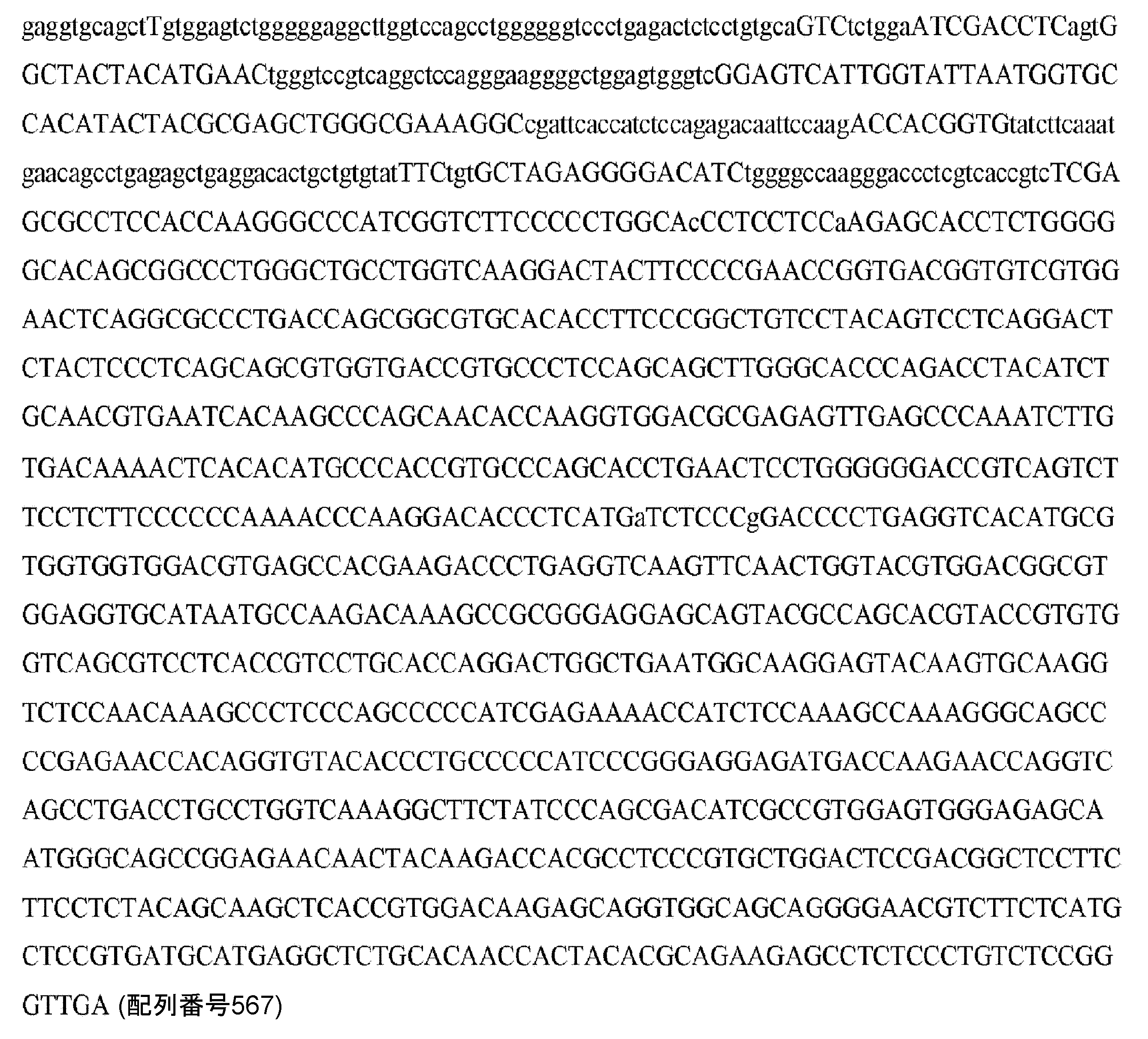
本発明の更なる実施形態では、CGRPに対する結合特異性を有する抗体断片をコードするポリヌクレオチドは、配列番号222の軽鎖可変配列又は配列番号221の軽鎖配列の相補性決定領域(CDR、又は超可変領域)をコードするポリヌクレオチドに対応する、配列番号234;配列番号236;及び配列番号238のポリヌクレオチド配列の1つ以上を含み、又はそれらからなる。 In further embodiments of the invention, the polynucleotide encoding the antibody fragment with binding specificity for CGRP comprises or consists of one or more of the polynucleotide sequences of SEQ ID NO:234; SEQ ID NO:236; and SEQ ID NO:238, which correspond to polynucleotides encoding the complementarity determining regions (CDRs, or hypervariable regions) of the light chain variable sequence of SEQ ID NO:222 or the light chain sequence of SEQ ID NO:221.
本発明の更なる実施形態では、CGRPに対する結合特異性を有する抗体断片をコードするポリヌクレオチドは、配列番号202の重鎖可変配列又は配列番号201若しくは配列番号566の重鎖配列の相補性決定領域(CDR、又は超可変領域)をコードするポリヌクレオチドに対応する、配列番号214;配列番号216;及び配列番号218のポリヌクレオチド配列の1つ以上を含み、又はそれらからなる。 In further embodiments of the invention, the polynucleotide encoding the antibody fragment with binding specificity for CGRP comprises or consists of one or more of the polynucleotide sequences of SEQ ID NO:214; SEQ ID NO:216; and SEQ ID NO:218, which correspond to polynucleotides encoding the complementarity determining regions (CDRs, or hypervariable regions) of the heavy chain variable sequence of SEQ ID NO:202 or the heavy chain sequence of SEQ ID NO:201 or SEQ ID NO:566.
本発明はまた、本明細書に記載される抗体断片をコードするポリヌクレオチド配列の1つ以上を含むポリヌクレオチド配列を意図する。本発明の一実施形態では、CGRPに対する結合特異性を有する抗体断片をコードするポリヌクレオチドは、抗体断片をコードする以下のポリヌクレオチドの1つ、2つ、3つ以上を含み、又はそれらからなる:配列番号222の軽鎖可変配列をコードするポリヌクレオチド配列番号232;配列番号221の軽鎖配列をコードするポリヌクレオチド配列番号231;配列番号202の重鎖可変領域をコードするポリヌクレオチド配列番号212;配列番号201の重鎖配列をコードするポリヌクレオチド配列番号211;配列番号566の重鎖配列をコードするポリヌクレオチド配列番号567;配列番号222の軽鎖可変配列又は配列番号221の軽鎖配列の相補性決定領域(配列番号234;配列番号236;及び配列番号238)をコードするポリヌクレオチド;並びに配列番号202の重鎖可変配列又は配列番号201又は配列番号566の重鎖配列の相補性決定領域(配列番号214;配列番号216;及び配列番号218)をコードするポリヌクレオチド。 The present invention also contemplates polynucleotide sequences comprising one or more of the polynucleotide sequences encoding the antibody fragments described herein. In one embodiment of the present invention, the polynucleotide encoding the antibody fragment having binding specificity for CGRP comprises or consists of one, two, three or more of the following polynucleotides encoding the antibody fragment: polynucleotide SEQ ID NO:232 encoding the light chain variable sequence of SEQ ID NO:222; polynucleotide SEQ ID NO:231 encoding the light chain sequence of SEQ ID NO:221; polynucleotide SEQ ID NO:212 encoding the heavy chain variable region of SEQ ID NO:202; polynucleotide SEQ ID NO:211 encoding the heavy chain sequence of SEQ ID NO:201; polynucleotide SEQ ID NO:567 encoding the heavy chain sequence of SEQ ID NO:566; polynucleotides encoding the light chain variable sequence of SEQ ID NO:222 or the complementarity determining regions of the light chain sequence of SEQ ID NO:221 (SEQ ID NO:234; SEQ ID NO:236; and SEQ ID NO:238); and polynucleotides encoding the heavy chain variable sequence of SEQ ID NO:202 or the complementarity determining regions of the heavy chain sequence of SEQ ID NO:201 or SEQ ID NO:566 (SEQ ID NO:214; SEQ ID NO:216; and SEQ ID NO:218).
本発明の好ましい実施形態では、本発明のポリヌクレオチドは、CGRPに対する結合特異性を有するFab(断片抗原結合)断片をコードするポリヌクレオチドを含み、又はそれらからなる。抗体Ab6に関連して、全長Ab6抗体をコードするポリヌクレオチドは、配列番号221の軽鎖配列をコードするポリヌクレオチド配列番号231及び配列番号201の重鎖配列をコードするポリヌクレオチド配列番号211又は配列番号566の重鎖配列をコードするポリヌクレオチド配列番号567を含み、又はそれらからなる。 In a preferred embodiment of the invention, the polynucleotide of the invention comprises or consists of a polynucleotide encoding a Fab (fragment antigen binding) fragment having binding specificity for CGRP. In relation to the antibody Ab6, the polynucleotide encoding the full length Ab6 antibody comprises or consists of polynucleotide SEQ ID NO:231 encoding the light chain sequence of SEQ ID NO:221 and polynucleotide SEQ ID NO:211 encoding the heavy chain sequence of SEQ ID NO:201 or polynucleotide SEQ ID NO:567 encoding the heavy chain sequence of SEQ ID NO:566.
本発明の別の実施形態は、哺乳動物細胞、例えばCHO、NSO、HEK-293、又は真菌、昆虫、若しくは微生物系、例えば酵母細胞、例えば酵母ピキア(Pichia)における発現のための発現ベクターに組み込まれたこれらのポリヌクレオチドを意図する。適切なピキア(Pichia)種には、ピキア・パストリス(Pichia pastoris)が含まれるがこれに限定されない。本明細書に記載される本発明の一実施形態(以下)では、Fab断片は、適切な宿主内での全長ポリヌクレオチドの発現後、Ab6の酵素的消化(例えば、パパイン)によって産生され得る。本発明の別の実施形態では、抗CGRP抗体、例えばAb6又はそのFab断片は、哺乳動物細胞、例えばCHO、NSO又はHEK 293細胞、真菌、昆虫、又は微生物系、例えば酵母細胞(例えば二倍体酵母、例えば二倍体ピキア(Pichia))及び他の酵母株におけるAb6ポリヌクレオチドの発現を介して産生され得る。適切なピキア(Pichia)種には、ピキア・パストリス(Pichia pastoris)が含まれるがこれに限定されない。 Another embodiment of the invention contemplates these polynucleotides incorporated into an expression vector for expression in mammalian cells, e.g., CHO, NSO, HEK-293, or fungal, insect, or microbial systems, e.g., yeast cells, e.g., the yeast Pichia. Suitable Pichia species include, but are not limited to, Pichia pastoris. In one embodiment of the invention described herein (below), Fab fragments may be produced by enzymatic digestion (e.g., papain) of Ab6 after expression of the full-length polynucleotide in a suitable host. In another embodiment of the invention, anti-CGRP antibodies, e.g., Ab6 or Fab fragments thereof, may be produced via expression of Ab6 polynucleotides in mammalian cells, e.g., CHO, NSO, or HEK 293 cells, fungal, insect, or microbial systems, e.g., yeast cells (e.g., diploid yeast, e.g., diploid Pichia) and other yeast strains. Suitable Pichia species include, but are not limited to, Pichia pastoris.
前記ポリヌクレオチドを含む宿主細胞及びベクターも意図される。 Host cells and vectors containing the polynucleotides are also contemplated.
本発明は、更に、可変重鎖及び軽鎖ポリペプチド配列をコードするポリヌクレオチド、並びに本明細書に記載される個々の相補性決定領域(CDR、又は超可変領域)を含むベクター、並びに前記ベクター配列を含む宿主細胞を意図する。本発明の一実施形態では、宿主細胞は酵母細胞である。本発明の別の実施形態では、酵母宿主細胞は、ピキア(Pichia)属に属する。 The present invention further contemplates vectors comprising polynucleotides encoding the variable heavy and light chain polypeptide sequences and the individual complementarity determining regions (CDRs, or hypervariable regions) described herein, as well as host cells comprising said vector sequences. In one embodiment of the invention, the host cell is a yeast cell. In another embodiment of the invention, the yeast host cell belongs to the genus Pichia.
抗体及びその断片を産生する方法
別の実施形態では、本発明は、抗CGRP抗体及びその断片を産生するための方法を意図する。交配適格(mating competent)酵母の倍数体、好ましくは二倍体又は四倍体株から分泌される抗体及びその断片を産生するための方法は、例えば、Olson et al.への米国特許出願第2009/0022659号明細書、及びGarcia-Martinez et al.への米国特許第7,935,340号明細書(各々の開示は、全体が参照により本明細書に組み込まれる)に教示されている。哺乳動物細胞、例えば、CHO細胞において抗体及びその断片を産生するための方法は、当技術分野で更に周知である。
Methods for Producing Antibodies and Fragments Thereof In another embodiment, the present invention contemplates a method for producing anti-CGRP antibodies and fragments thereof. Methods for producing antibodies and fragments thereof secreted from polyploid, preferably diploid or tetraploid strains of mating competent yeast are taught, for example, in U.S. Patent Application Publication No. 2009/0022659 to Olson et al., and U.S. Patent No. 7,935,340 to Garcia-Martinez et al., the disclosures of each of which are incorporated herein by reference in their entireties. Methods for producing antibodies and fragments thereof in mammalian cells, e.g., CHO cells, are further well known in the art.
抗体を産生するための他の方法もまた、当業者に周知である。例えば、キメラ抗体を産生する方法は、現在、当技術分野で周知である(例えば、Cabilly et al.への米国特許第4,816,567号明細書;Morrison et al.,P.N.A.S.USA,81:8651-55(1984);Neuberger,M.S.et al.,Nature,314:268-270(1985);Boulianne,G.L.et al.,Nature,312:643-46(1984)(各々の開示は、全体が参照により本明細書に組み込まれる)を参照されたい)。 Other methods for producing antibodies are also known to those of skill in the art. For example, methods for producing chimeric antibodies are now well known in the art (see, e.g., U.S. Pat. No. 4,816,567 to Cabilly et al.; Morrison et al., P.N.A.S. USA, 81:8651-55 (1984); Neuberger, M.S. et al., Nature, 314:268-270 (1985); Boulianne, G.L. et al., Nature, 312:643-46 (1984), the disclosures of each of which are incorporated herein by reference in their entirety).
同様に、ヒト化抗体を産生する他の方法は、現在、当技術分野で周知である(例えば、Queen et alへの米国特許第5,530,101号明細書、同第5,585,089号明細書、同第5,693,762号明細書、及び同第6,180,370号明細書;Winterへの米国特許第5,225,539号明細書及び同第6,548,640号明細書;Carter et alへの米国特許第6,054,297号明細書、同第6,407,213号明細書及び同第6,639,055号明細書;Adairへの米国特許第6,632,927号明細書;Jones,P.T.et al,Nature,321:522-525(1986);Reichmann,L.,et al,Nature,332:323-327(1988);Verhoeyen,M,et al,Science,239:1534-36(1988)(各々の開示は、全体が参照により本明細書に組み込まれる)を参照されたい)。 Similarly, other methods for producing humanized antibodies are now known in the art (e.g., U.S. Pat. Nos. 5,530,101, 5,585,089, 5,693,762, and 6,180,370 to Queen et al.; U.S. Pat. Nos. 5,225,539 and 6,548,640 to Winter; U.S. Pat. Nos. 6,054,297, 6,407,213, and 6,639,055 to Carter et al.; U.S. Pat. No. 6,632,927 to Adair; Jones, P.T. et al., Nature, 321:522-525 (1986); Reichmann, L., et al., Nature, 321:522-525 (1986); al, Nature, 332:323-327 (1988); Verhoeyen, M, et al, Science, 239:1534-36 (1988) (the disclosures of each are incorporated herein by reference in their entirety).
本発明は、片頭痛に関連する最も煩わしい症状の治療、予防及び/又は改善のための医薬の製造における、本明細書に開示される医薬製剤のうちいずれかの使用を更に含む。 The present invention further includes the use of any of the pharmaceutical formulations disclosed herein in the manufacture of a medicament for the treatment, prevention and/or amelioration of the most bothersome symptoms associated with migraine.
投与
本発明の一実施形態では、本明細書に記載される抗CGRP抗体、又はそのCGRP結合断片、並びに前記抗体又は抗体断片の組み合わせは、レシピエント対象の体重の約0.1~100.0mg/kgの濃度で対照に投与される。本発明の好ましい実施形態では、本明細書に記載される抗CGRP抗体、又はそのCGRP結合断片、並びに前記抗体又は抗体断片の組み合わせは、レシピエント対象の体重の約0.4mg/kgの濃度で、及び/又は100若しくは300mgの投与量で対象に投与される。本発明の好ましい実施形態では、本明細書に記載される抗CGRP抗体、又はそのCGRP結合断片、並びに前記抗体又は抗体断片の組み合わせは、26週間又は6ヵ月以下毎に1回の頻度、16週間又は4ヵ月以下毎に1回、8週間又は2ヵ月以下毎に1回、4週間又は1ヵ月以下毎に1回、2週間又は半月以下毎に1回、1週間以下毎に1回、又は1日以下毎に1回の頻度でレシピエント対象に投与される。一般に、連続用量の投与は、前述のスケジュールからプラス又はマイナス数日変動し得る、例えば、3ヵ月毎又は12週毎の投与は、スケジュール日からプラス又はマイナス1、2、3、4、5、5、又は7日変動する用量の投与を含む。
Administration In one embodiment of the invention, the anti-CGRP antibodies, or CGRP binding fragments thereof, as well as combinations of said antibodies or antibody fragments, described herein are administered to a subject at a concentration of about 0.1-100.0 mg/kg of the recipient subject's body weight. In a preferred embodiment of the invention, the anti-CGRP antibodies, or CGRP binding fragments thereof, as well as combinations of said antibodies or antibody fragments, described herein are administered to a subject at a concentration of about 0.4 mg/kg of the recipient subject's body weight and/or at a dosage of 100 or 300 mg. In a preferred embodiment of the invention, the anti-CGRP antibodies, or CGRP binding fragments thereof, as well as combinations of said antibodies or antibody fragments, described herein are administered to a recipient subject at a frequency of once every 26 weeks or 6 months or less, once every 16 weeks or 4 months or less, once every 8 weeks or 2 months or less, once every 4 weeks or month or less, once every 2 weeks or 6 months or less, once every week or less, or once every day or less. Generally, administration of successive doses may vary by plus or minus several days from the aforementioned schedule, for example, administration every three months or every twelve weeks would involve administration of doses that vary by plus or minus 1, 2, 3, 4, 5, 5, or 7 days from the scheduled dates.
Fab断片は、2週間以下毎、1週間以下毎、1日以下毎、1日に複数回、及び/又は数時間毎に投与され得る。本発明の一実施形態では、患者は、所望の結果を得るために有効な、1mg/kg~40mg/kg/日のFab断片を、1日に1~6回の分割用量で、又は持続放出形態で受ける。 The Fab fragment may be administered every two weeks or less, every week or less, every day or less, multiple times per day, and/or every few hours. In one embodiment of the invention, the patient receives 1 mg/kg to 40 mg/kg/day of the Fab fragment in divided doses 1-6 times per day or in sustained release form effective to obtain the desired result.
所与の患者に投与される抗体又はFabの濃度は、上記の例示的な投与濃度よりも高くても低くてもよいことを理解するべきである。 It should be understood that the concentration of antibody or Fab administered to a given patient may be higher or lower than the exemplary administration concentrations listed above.
当業者は、例えば、本明細書の開示及びGoodman,L.S.,Gilman,A.,Brunton,L.L.,Lazo,J.S.,& Parker,K.L.(2006).Goodman & Gilman’s the pharmacological basis of therapeutics.New York:McGraw-Hill;Howland,R.D.,Mycek,M.J.,Harvey,R.A.,Champe,P.C.,& Mycek,M.J.(2006).Pharmacology.Lippincott’s illustrated reviews.Philadelphia:Lippincott Williams & Wilkins;and Golan,D.E.(2008).Principles of pharmacology:the pathophysiologic basis of drug therapy.Philadelphia,Pa.,[etc.]:Lippincott Williams & Wilkinsにおける教示によって導かれる日常的な実験によって、有効な投与量及び投与頻度を決定することができるであろう。 Those skilled in the art will appreciate that, for example, the disclosures herein and Goodman, L. S., Gilman, A., Brunton, L. L., Lazo, J. S., & Parker, K. L. (2006). Goodman & Gilman's the pharmacological basis of therapeutics. New York: McGraw-Hill; Howland, R. D., Mycek, M. J., Harvey, R. A., Champe, P. C., & Mycek, M. J. (2006). Pharmacology. Effective dosages and frequency of administration may be determined by routine experimentation guided by the teachings in Lippincott's illustrated reviews. Philadelphia: Lippincott Williams &Wilkins; and Golan, D. E. (2008). Principles of pharmacology: the pathophysiologic basis of drug therapy. Philadelphia, Pa., [etc.]: Lippincott Williams & Wilkins.
本発明の別の実施形態では、本明細書に記載される抗CGRP抗体、又はそのCGRP結合断片、並びに前記抗体又は抗体断片の組み合わせは、医薬製剤で対照に投与される。 In another embodiment of the invention, the anti-CGRP antibodies, or CGRP-binding fragments thereof, described herein, as well as combinations of said antibodies or antibody fragments, are administered to a subject in a pharmaceutical formulation.
「医薬組成物」は、哺乳動物への投与に適した化学的又は生物学的組成物を指す。そのような組成物は、頬、皮膚外、硬膜外、吸入、動脈内、心臓内、脳室内、皮内、筋肉内、鼻腔内、眼内、腹腔内、脊髄内、髄腔内、静脈内、経口、非経口、注腸又は坐剤による直腸、皮下(subcutaneous)、皮下(subdermal)、舌下、経皮、及び経粘膜、好ましくは静脈内を含むがこれらに限定されない多数の経路のうちの1つ以上を介した投与のために特に処方され得る。加えて、投与は、注射、粉末、液体、ゲル、液滴、又は他の投与手段によって行うことができる。 "Pharmaceutical composition" refers to a chemical or biological composition suitable for administration to a mammal. Such compositions may be specifically formulated for administration via one or more of a number of routes, including, but not limited to, buccal, epidermal, epidural, inhalation, intra-arterial, intracardiac, intraventricular, intradermal, intramuscular, intranasal, intraocular, intraperitoneal, intraspinal, intrathecal, intravenous, oral, parenteral, rectal by enema or suppository, subcutaneous, subdermal, sublingual, transdermal, and transmucosal, preferably intravenous. In addition, administration may be by injection, powder, liquid, gel, drop, or other means of administration.
「医薬賦形剤」又は「薬学的に許容され得る賦形剤」は、活性な治療剤が処方されている担体、通常は液体である。本発明の一実施形態では、活性治療剤は、本明細書に記載されるヒト化抗体、又はその1つ以上の断片である。賦形剤は、一般に、製剤に薬理学的活性を全く提供しないが、化学的及び/又は生物学的安定性、並びに放出特性を提供し得る。例示的な製剤は、例えば、Remington’s Pharmaceutical Sciences,19th Ed.,Grennaro,A.,Ed.,1995(参照により組み込まれる)に見出され得る。 A "pharmaceutical excipient" or "pharmaceutical acceptable excipient" is a carrier, usually a liquid, in which an active therapeutic agent is formulated. In one embodiment of the present invention, the active therapeutic agent is a humanized antibody, or one or more fragments thereof, as described herein. The excipient generally does not provide any pharmacological activity to the formulation, but may provide chemical and/or biological stability, and release characteristics. Exemplary formulations can be found, for example, in Remington's Pharmaceutical Sciences, 19th Ed., Grennaro, A., Ed., 1995 (incorporated by reference).
本明細書で使用される「薬学的に許容され得る担体」又は「賦形剤」は、生理学的に適合性である任意の及び全ての溶媒、分散媒体、コーティング、抗菌剤及び抗真菌剤、等張剤及び吸収遅延剤を含む。一実施形態では、担体は、非経口投与に適している。或いは、担体は、静脈内、腹腔内、筋肉内、又は舌下投与に適している場合がある。薬学的に許容され得る担体は、滅菌水溶液又は分散液、及び滅菌注射溶液又は分散液の即時調製のための滅菌粉末を含む。薬学的に活性な物質のためのこのような媒体及び薬剤の使用は、当業界では周知である。任意の従来の媒体又は薬剤が活性化合物と不適合である場合を除いて、本発明の医薬組成物におけるそれらの使用が意図される。補助活性化合物も組成物に組み込むことができる。 As used herein, a "pharmaceutically acceptable carrier" or "excipient" includes any and all solvents, dispersion media, coatings, antibacterial and antifungal agents, isotonic and absorption delaying agents that are physiologically compatible. In one embodiment, the carrier is suitable for parenteral administration. Alternatively, the carrier may be suitable for intravenous, intraperitoneal, intramuscular, or sublingual administration. Pharmaceutically acceptable carriers include sterile aqueous solutions or dispersions and sterile powders for the extemporaneous preparation of sterile injectable solutions or dispersions. The use of such media and agents for pharmaceutically active substances is well known in the art. Except insofar as any conventional media or agent is incompatible with the active compound, their use in the pharmaceutical compositions of the present invention is contemplated. Supplementary active compounds can also be incorporated into the compositions.
医薬組成物は、典型的には、製造及び貯蔵の条件下で無菌且つ安定でなければならない。本発明は、医薬組成物が凍結乾燥形態で存在することを意図する。この組成物は、溶液、マイクロエマルジョン、リポソーム、又は高薬物濃度に適切な他の秩序構造として処方され得る。担体は、例えば、水、エタノール、ポリオール(例えば、グリセロール、プロピレングリコール、及び液体ポリエチレングリコール)、及びそれらの適切な混合物を含む溶媒又は分散媒体であり得る。本発明は、更に、医薬組成物中に安定剤を含有することを意図する。適切な流動性は、例えば、分散液の場合には、必要とされる粒径を維持することによって、及び界面活性剤を使用することによって維持することができる。 Pharmaceutical compositions typically must be sterile and stable under the conditions of manufacture and storage. The invention contemplates that the pharmaceutical composition is in lyophilized form. The composition may be formulated as a solution, microemulsion, liposome, or other ordered structure suitable to high drug concentration. The carrier may be a solvent or dispersion medium containing, for example, water, ethanol, polyol (e.g., glycerol, propylene glycol, and liquid polyethylene glycol), and suitable mixtures thereof. The invention further contemplates including a stabilizer in the pharmaceutical composition. Proper fluidity can be maintained, for example, by maintaining the required particle size in the case of dispersions and by the use of surfactants.
多くの場合、等張剤、例えば糖、ポリアルコール、例えばマンニトール、ソルビトール、又は塩化ナトリウムを組成物中に含めることが好ましいであろう。注射可能な組成物の延長された吸収は、組成物中に、吸収を遅延させる薬剤、例えばモノステアリン酸塩及びゼラチンを含めることによってもたらされ得る。更に、アルカリ性ポリペプチドを、例えば、徐放性ポリマーを含む組成物中で、時間放出製剤に処方することができる。活性化合物は、インプラント及びマイクロカプセル化送達システムを含む制御放出製剤などの、化合物を急速放出から保護する担体を用いて調製することができる。エチレンビニルアセテート、ポリ無水物、ポリグリコール酸、コラーゲン、ポリオルトエステル、ポリ乳酸、及びポリ乳酸、ポリグリコール酸コポリマー(PLG)などの生分解性の生体適合性ポリマーを用いることができる。このような製剤の調製のための多くの方法は、当業者に公知である。 In many cases, it will be preferable to include an isotonic agent, such as sugars, polyalcohols, such as mannitol, sorbitol, or sodium chloride, in the composition. Prolonged absorption of the injectable composition can be brought about by including in the composition an agent that delays absorption, such as monostearates and gelatin. In addition, the alkaline polypeptides can be formulated in a time-release formulation, for example in a composition that includes a sustained release polymer. The active compound can be prepared with a carrier that will protect the compound against rapid release, such as a controlled release formulation, including implants and microencapsulated delivery systems. Biodegradable, biocompatible polymers can be used, such as ethylene vinyl acetate, polyanhydrides, polyglycolic acid, collagen, polyorthoesters, polylactic acid, and polylactic acid, polyglycolic acid copolymers (PLG). Many methods for the preparation of such formulations are known to those skilled in the art.
例示的な組成物は、水溶液中のAb6、ヒスチジンなどの賦形剤、ソルビトールなどの等張剤、及びポリソルベート80などの界面活性剤を含むか、それらから本質的になるか、又はそれらからなる。例えば、組成物は、約5.8のpHを有する、ヒスチジン(L-ヒスチジン)、ソルビトール、ポリソルベート80、例えば1mL容量当たり、約100mgAb6、約3.1mg L-ヒスチジン、約40.5mgソルビトール、及び約0.15mgポリソルベート80、又はほぼその構成、例えば、これらの値の10%以内、これらの値の5%以内、これらの値の1%以内、これらの値の0.5%以内、又はこれらの値の0.1%、並びに水を含み、又はそれらから本質的になり、又はそれらからなり得る。例えば、pH値は、5.8の10%以内、即ち、5.22~6.38であり得る。Ab6抗体は、各々、配列番号222及び配列番号202の可変軽鎖及び重鎖ポリペプチド、又は各々、配列番号221及び配列番号201の可変軽鎖及び重鎖ポリペプチド、又は各々、配列番号221及び配列番号566の可変軽鎖及び重鎖ポリペプチドを含み、又はそれからなる。組成物は、水溶液、又は、例えば水の添加によって再構成される場合に、前述の構成を生じる濃縮物(例えば、凍結乾燥)の形態であってもよい。例示的な組成物は、1mL当たり100mgの、各々、配列番号221及び配列番号201の軽鎖及び重鎖ポリペプチド、約3.1mgのL-ヒスチジン、約40.5mgのソルビトール、及び約0.15mgのポリソルベート80、並びに水Q.S、又はほぼその構成、例えば、これらの量の10%以内、これらの量の5%、これらの量の1%以内、これらの量の0.5%以内、又はこれらの量の0.1%以内からなる。別の例示的な組成物は、1mL当たり100mgの、各々、配列番号221及び配列番号566の軽鎖及び重鎖ポリペプチド、約3.1mgのL-ヒスチジン、約40.5mgのソルビトール、及び約0.15mgのポリソルベート80、並びに水Q.S、又はほぼその構成、例えば、これらの量の10%以内、これらの量の5%、これらの量の1%以内、これらの量の0.5%以内、又はこれらの量の0.1%以内からなる。組成物は、静脈内又は皮下投与、好ましくは、静脈内投与に適していている場合がある。例えば、組成物は、100mLの静脈内溶液に添加された約100mg~約300mgの抗体の量で、静脈内溶液(例えば0.9%塩化ナトリウム)と混合するのに適している場合がある。好ましくは、組成物は、少なくとも1、3、6、12、18、又は24ヵ月間貯蔵安定であり得、例えば、室温での貯蔵後、又は特定の期間4℃で冷蔵された場合、又はその期間の貯蔵をシミュレートする加速劣化試験において、抗体又は断片の5%以下又は10%以下の凝集体の形成を示す。 An exemplary composition comprises, consists essentially of, or consists of Ab6 in an aqueous solution, an excipient such as histidine, an isotonicity agent such as sorbitol, and a surfactant such as polysorbate 80. For example, the composition may comprise, consist essentially of, or consist of histidine (L-histidine), sorbitol, polysorbate 80, e.g., about 100 mg Ab6, about 3.1 mg L-histidine, about 40.5 mg sorbitol, and about 0.15 mg polysorbate 80 per mL volume, having a pH of about 5.8, or about the composition thereof, e.g., within 10% of these values, within 5% of these values, within 1% of these values, within 0.5% of these values, or within 0.1% of these values, and water. For example, the pH value may be within 10% of 5.8, i.e., 5.22 to 6.38. The Ab6 antibody comprises or consists of the variable light and heavy chain polypeptides of SEQ ID NO:222 and SEQ ID NO:202, respectively, or the variable light and heavy chain polypeptides of SEQ ID NO:221 and SEQ ID NO:201, respectively, or the variable light and heavy chain polypeptides of SEQ ID NO:221 and SEQ ID NO:566, respectively. The composition may be in the form of an aqueous solution or a concentrate (e.g., lyophilized) that, when reconstituted, e.g., by the addition of water, results in the aforementioned configuration. An exemplary composition consists of 100 mg of the light and heavy chain polypeptides of SEQ ID NO:221 and SEQ ID NO:201, respectively, about 3.1 mg L-histidine, about 40.5 mg sorbitol, and about 0.15 mg polysorbate 80, and water Q.S per mL, or about that configuration, e.g., within 10% of these amounts, 5% of these amounts, within 1% of these amounts, within 0.5% of these amounts, or within 0.1% of these amounts. Another exemplary composition consists of 100 mg of light and heavy chain polypeptides of SEQ ID NO:221 and SEQ ID NO:566, respectively, about 3.1 mg L-histidine, about 40.5 mg sorbitol, and about 0.15 mg polysorbate 80, and water Q.S, or about the composition thereof, e.g., within 10% of these amounts, 5% of these amounts, within 1% of these amounts, within 0.5% of these amounts, or within 0.1% of these amounts, per mL. The composition may be suitable for intravenous or subcutaneous administration, preferably intravenous administration. For example, the composition may be suitable for mixing with intravenous solution (e.g., 0.9% sodium chloride) in an amount of about 100 mg to about 300 mg of antibody added to 100 mL of intravenous solution. Preferably, the composition may be shelf-stable for at least 1, 3, 6, 12, 18, or 24 months, e.g., exhibiting no more than 5% or no more than 10% aggregate formation of the antibody or fragment after storage at room temperature or when refrigerated at 4°C for a specified period of time, or in an accelerated degradation test simulating storage for that period of time.
列挙された実施形態の各々について、化合物は、多様な剤形によって投与することができる。当業者に公知の任意の生物学的に許容され得る剤形、及びそれらの組み合わせが意図される。このような剤形の例としては、再構成可能な粉末、エリキシル剤、液剤、懸濁剤、エマルジョン、粉末、顆粒、粒子、微粒子、分散性顆粒、カシェ剤、吸入剤、エアロゾル吸入剤、パッチ、粒子吸入剤、インプラント、デポーインプラント、注射剤(皮下、筋肉内、静脈内、及び皮内、好ましくは、静脈内を含む)、注入、及びそれらの組み合わせが挙げられるが、これらに限定されない。 For each of the enumerated embodiments, the compounds can be administered in a variety of dosage forms. Any biologically acceptable dosage form known to one of skill in the art, and combinations thereof, are contemplated. Examples of such dosage forms include, but are not limited to, reconstitutable powders, elixirs, solutions, suspensions, emulsions, powders, granules, particles, microparticles, dispersible granules, cachets, inhalants, aerosol inhalants, patches, particle inhalants, implants, depot implants, injections (including subcutaneous, intramuscular, intravenous, and intradermal, preferably intravenous), infusions, and combinations thereof.
本発明の様々な例示された実施形態の上記の記載は、網羅的であること、又は本発明を開示された厳密な形態に限定することを意図していない。例示を目的として、本発明の特定の実施形態及び例が本明細書に記載されているが、当業者が認識するように、本発明の範囲内で様々な同等の変形が可能である。本明細書で提供される本発明の教示は、上述の例以外の他の目的に適用することができる。 The above description of various exemplary embodiments of the present invention is not intended to be exhaustive or to limit the invention to the precise form disclosed. For illustrative purposes, specific embodiments and examples of the present invention are described herein, but those skilled in the art will recognize that various equivalent modifications are possible within the scope of the present invention. The teachings of the present invention provided herein may be applied to other purposes other than the examples described above.
上記の詳細な説明に照らして、本発明にこれら及び他の変更を加えることができる。一般に、以下の特許請求の範囲において、使用される用語は、本明細書及び特許請求の範囲に開示される特定の実施形態に本発明を限定するように解釈されるべきではない。したがって、本発明は、本開示によって限定されず、代わりに、本発明の範囲は、以下の特許請求の範囲によって完全に決定されるべきである。 These and other changes can be made to the invention in light of the above detailed description. In general, the terms used in the following claims should not be construed to limit the invention to the specific embodiments disclosed in the specification and the claims. Therefore, the invention is not limited by this disclosure; instead, the scope of the invention should be determined entirely by the following claims.
本発明は、前述の記載及び例に特に記載された方法以外の方法で実施されてもよい。上記の教示に照らして、本発明の多数の修正及び変形が可能であり、したがって、これらは添付の特許請求の範囲内にある。 The invention may be practiced other than as specifically described in the foregoing description and examples. Numerous modifications and variations of the present invention are possible in light of the above teachings and, therefore, are within the scope of the appended claims.
特定のCGRP抗体ポリヌクレオチド及びポリペプチドは、この特許出願に付随する配列表に開示され、前記配列表の開示は、全体が参照により本明細書に組み込まれる。 Certain CGRP antibody polynucleotides and polypeptides are disclosed in the Sequence Listing accompanying this patent application, the disclosure of which is incorporated herein by reference in its entirety.
「背景技術」、「発明を実施するための形態」、及び「実施例」において引用された各文献(特許、特許出願、雑誌論文、要約、マニュアル、書籍、又は他の開示を含む)の開示全体は、全体が参照により本明細書に組み込まれる。 The entire disclosure of each document cited in the "Background," "Description of the Invention," and "Examples" sections (including patents, patent applications, journal articles, abstracts, manuals, books, or other disclosures) is hereby incorporated by reference in its entirety.
以下の実施例は、本発明をどのように作製及び使用するかの完全な開示及び説明を当業者に提供するために記載され、本発明とみなされるものの範囲を限定することを意図しない。使用される数(例えば、量、温度、濃度など)に関して正確さを保証するための努力がなされてきたが、いくらかの実験誤差及び偏差が許容されるべきである。特に断らない限り、部は重量部であり、分子量は平均分子量であり、温度は摂氏度であり、圧力は大気圧又はその近傍である。 The following examples are set forth to provide those of ordinary skill in the art with a complete disclosure and description of how to make and use the present invention, and are not intended to limit the scope of what is considered to be the invention. Efforts have been made to ensure accuracy with respect to numbers used (e.g., amounts, temperatures, concentrations, etc.), but some experimental error and deviation should be allowed for. Unless otherwise specified, parts are parts by weight, molecular weight is average molecular weight, temperature is in degrees Celsius, and pressure is at or near atmospheric.
追加の例示的な実施形態
本発明の追加の例示的な実施形態は、以下の通りである。
Additional Exemplary Embodiments Additional exemplary embodiments of the present invention are as follows.
S1.片頭痛患者に抗CGRP抗体を投与することを含む、片頭痛に関連する最も煩わしい症状(MBS)を治療するための医薬の製造のための抗CGRP抗体の使用。 S1. Use of an anti-CGRP antibody for the manufacture of a medicament for treating most bothersome symptoms associated with migraine (MBS), comprising administering an anti-CGRP antibody to a migraine patient.
S2.片頭痛に関連する最も煩わしい症状(MBS)を治療するための医薬の製造のための抗CGRP抗体の使用であって、この使用は片頭痛患者に抗CGRP抗体を投与することを含み、前記片頭痛患者は慢性片頭痛に罹患している、使用。 S2. Use of an anti-CGRP antibody for the manufacture of a medicament for treating most bothersome symptoms (MBS) associated with migraine, the use comprising administering an anti-CGRP antibody to a migraine patient, the migraine patient suffering from chronic migraine.
S3.片頭痛に関連する最も煩わしい症状(MBS)を治療するための医薬の製造のための抗CGRP抗体の使用であって、この使用は片頭痛患者に抗CGRP抗体を投与することを含み、前記患者は反復性片頭痛に罹患している、使用。 S3. Use of an anti-CGRP antibody for the manufacture of a medicament for treating most bothersome symptoms (MBS) associated with migraine, the use comprising administering the anti-CGRP antibody to a migraine patient, the patient suffering from episodic migraine headaches.
S4.患者の片頭痛に関連する最も煩わしい症状(MBS)は、投与若しくは注入の完了後1~12時間で、例えば投与若しくは注入の完了後1~5時間で、投与若しくは注入の完了後1~2時間で、又は投与若しくは注入の完了後約2時間で改善される、実施形態S1~S3のいずれか1つに記載の抗CGRP抗体の使用。 S4. The use of an anti-CGRP antibody according to any one of embodiments S1 to S3, wherein the patient's most bothersome migraine-related symptoms (MBS) are improved 1 to 12 hours after completion of the administration or infusion, e.g., 1 to 5 hours after completion of the administration or infusion, 1 to 2 hours after completion of the administration or infusion, or about 2 hours after completion of the administration or infusion.
S5.患者の片頭痛に関連する最も煩わしい症状(MBS)は、前記抗CGRP抗体の第1の投与から1ヵ月以内に改善される、実施形態S1~S4のいずれか1つに記載の抗CGRP抗体の使用。 S5. Use of an anti-CGRP antibody according to any one of embodiments S1 to S4, wherein the patient's migraine-related most bothersome symptoms (MBS) improve within one month of the first administration of the anti-CGRP antibody.
S6.患者の片頭痛に関連する最も煩わしい症状(MBS)は、前記抗CGRP抗体の第1の投与から3ヵ月以内に改善される、実施形態S1~S5のいずれか1つに記載の抗CGRP抗体の使用。 S6. Use of an anti-CGRP antibody according to any one of embodiments S1 to S5, wherein the patient's migraine-related most bothersome symptoms (MBS) improve within 3 months of the first administration of the anti-CGRP antibody.
S7.患者の片頭痛に関連する最も煩わしい症状(MBS)は、前記抗CGRP抗体の第1の投与から6ヵ月以内に改善される、実施形態S1~S6のいずれか1つに記載の抗CGRP抗体の使用。 S7. Use of an anti-CGRP antibody according to any one of embodiments S1 to S6, wherein the patient's migraine-related most bothersome symptoms (MBS) improve within 6 months of the first administration of the anti-CGRP antibody.
S8.改善は前記抗CGRP抗体の第1の投与から少なくとも3ヵ月間持続する、実施形態S1~S7のいずれか1つに記載の抗CGRP抗体の使用。 S8. Use of an anti-CGRP antibody according to any one of embodiments S1 to S7, wherein the improvement persists for at least 3 months after the first administration of the anti-CGRP antibody.
S9.改善は前記抗CGRP抗体の第1の投与から少なくとも6ヵ月間持続する、実施形態S1~S8のいずれか1つに記載の抗CGRP抗体の使用。 S9. Use of an anti-CGRP antibody according to any one of embodiments S1 to S8, wherein the improvement persists for at least 6 months after the first administration of the anti-CGRP antibody.
S10.MBSは、光に対する過敏(羞明)、悪心/嘔吐、頭痛、音に対する過敏(音声恐怖)、前兆、活動に伴う疼痛、疼痛、拍動/脈動、認知の混乱、疲労、気分変動、匂いに対する過敏(臭気恐怖(osmophobia又はolfactophobia))、視覚影響、圧迫/緊張、疼痛(解剖学的)、眼痛、頚部痛、めまい、異痛症、不活動、感覚障害、睡眠障害及び言語障害からなる群から選択される、実施形態S1~S9のいずれか1つに記載の抗CGRP抗体の使用。 S10. The use of an anti-CGRP antibody according to any one of embodiments S1 to S9, wherein MBS is selected from the group consisting of sensitivity to light (photophobia), nausea/vomiting, headache, sensitivity to sound (phonophobia), aura, pain with activity, pain, pulsation/pulsation, cognitive confusion, fatigue, mood swings, sensitivity to smells (osmophobia or olfactophobia), visual effects, pressure/tension, pain (anatomical), eye pain, neck pain, dizziness, allodynia, inactivity, sensory disturbances, sleep disturbances and speech disturbances.
S11.MBSは、光に対する過敏(羞明)、悪心/嘔吐、頭痛、音に対する過敏(音声恐怖)、活動に伴う疼痛、疼痛、拍動/脈動、認知の混乱、疲労、気分変動及び匂いに対する過敏(臭気恐怖(osmophobia又はolfactophobia))からなる群から選択される、実施形態S1~S10のいずれか1つに記載の抗CGRP抗体の使用。 S11. Use of an anti-CGRP antibody according to any one of embodiments S1 to S10, wherein MBS is selected from the group consisting of sensitivity to light (photophobia), nausea/vomiting, headache, sensitivity to sound (phonophobia), pain with activity, pain, pulsation/pulsation, cognitive confusion, fatigue, mood swings and sensitivity to smells (osmophobia or olfactophobia).
S12.片頭痛患者に抗CGRP抗体を投与することを含む、片頭痛に関連する変化についての患者の全般印象度(PGIC)を改善するための医薬の製造のための抗CGRP抗体の使用。 S12. Use of an anti-CGRP antibody for the manufacture of a medicament for improving a patient's global impression of migraine-related changes (PGIC), comprising administering an anti-CGRP antibody to a migraine patient.
S13.片頭痛に関連する変化についての患者の全般印象度(PGIC)を改善するための医薬の製造のための抗CGRP抗体の使用であって、この使用は片頭痛患者に抗CGRP抗体を投与することを含み、前記片頭痛患者は慢性片頭痛に罹患している、使用。 S13. Use of an anti-CGRP antibody for the manufacture of a medicament for improving a patient's global impression of changes associated with migraine (PGIC), the use comprising administering an anti-CGRP antibody to a migraine patient, the migraine patient suffering from chronic migraine.
S14.片頭痛に関連する変化についての患者の全般印象度(PGIC)を改善するための医薬の製造のための抗CGRP抗体の使用であって、この使用は片頭痛患者に抗CGRP抗体を投与することを含み、前記患者は反復性片頭痛に罹患している、使用。 S14. Use of an anti-CGRP antibody for the manufacture of a medicament for improving a patient's global impression of changes associated with migraine (PGIC), the use comprising administering an anti-CGRP antibody to a migraine patient, the patient suffering from episodic migraine.
S15.前記医薬の投与は、片頭痛に関連する変化についての患者の全般印象度(PGIC)を、前記抗CGRP抗体の第1の投与から1ヵ月以内に改善する、実施形態S12~S14のいずれか1つに記載の抗CGRP抗体の使用。 S15. Use of an anti-CGRP antibody according to any one of embodiments S12 to S14, in which administration of the medicament improves Patient Global Impression of Changes (PGIC) associated with migraine headache within one month of the first administration of the anti-CGRP antibody.
S16.前記医薬の投与は、片頭痛に関連する変化についての患者の全般印象度(PGIC)を、前記抗CGRP抗体の第1の投与から3ヵ月以内に改善する、実施形態S12~S14のいずれか1つに記載の抗CGRP抗体の使用。 S16. Use of an anti-CGRP antibody according to any one of embodiments S12 to S14, in which administration of the medicament improves Patient Global Impression of Changes (PGIC) associated with migraine headache within 3 months of the first administration of the anti-CGRP antibody.
S17.前記医薬の投与は、片頭痛に関連する変化についての患者の全般印象度(PGIC)を、前記抗CGRP抗体の第1の投与から6ヵ月以内に改善する、実施形態S12~S14のいずれか1つに記載の抗CGRP抗体の使用。 S17. Use of an anti-CGRP antibody according to any one of embodiments S12 to S14, in which administration of the medicament improves Patient Global Impression of Changes (PGIC) associated with migraine headaches within 6 months of the first administration of the anti-CGRP antibody.
S18.前記医薬の投与は、片頭痛に関連する変化についての患者の全般印象度(PGIC)を改善し、この改善は前記抗CGRP抗体の第1の投与から少なくとも3ヵ月間持続する、実施形態S12~S17のいずれか1つに記載の抗CGRP抗体の使用。 S18. Use of an anti-CGRP antibody according to any one of embodiments S12 to S17, in which administration of the medicament improves Patient Global Impression of Changes (PGIC) associated with migraine, and the improvement persists for at least 3 months after the first administration of the anti-CGRP antibody.
S19.前記医薬の投与は、片頭痛に関連する変化についての患者の全般印象度(PGIC)を改善し、この改善は前記抗CGRP抗体の第1の投与から少なくとも6ヵ月間持続する、実施形態S12~S18のいずれか1つに記載の抗CGRP抗体の使用。 S19. Use of an anti-CGRP antibody according to any one of embodiments S12 to S18, in which administration of the medicament improves Patient Global Impression of Changes (PGIC) associated with migraine, and the improvement persists for at least 6 months after the first administration of the anti-CGRP antibody.
S20.前記医薬は静脈内又は皮下注入用である、実施形態S1~S19のいずれか1つに記載の抗CGRP抗体の使用。 S20. Use of an anti-CGRP antibody according to any one of embodiments S1 to S19, wherein the medicament is for intravenous or subcutaneous injection.
S21.前記医薬は静脈内注入用である、実施形態S1~S20のいずれか1つに記載の抗CGRP抗体の使用。 S21. Use of an anti-CGRP antibody according to any one of embodiments S1 to S20, wherein the medicament is for intravenous infusion.
S22.前記患者は、投与又は注入の完了から2時間後に頭痛がない、実施形態S1~S21のいずれか1つに記載の抗CGRP抗体の使用。 S22. The use of an anti-CGRP antibody according to any one of embodiments S1 to S21, wherein the patient is headache-free 2 hours after completion of administration or infusion.
S23.前記抗CGRP抗体はAb6を含む、実施形態S1~S22のいずれか1つに記載の抗CGRP抗体の使用。 S23. Use of an anti-CGRP antibody according to any one of embodiments S1 to S22, wherein the anti-CGRP antibody comprises Ab6.
S24.前記抗CGRP抗体は、各々配列番号224;配列番号226;及び配列番号228の軽鎖相補性決定領域(CDR)1、2、及び3ポリペプチド配列を含む、実施形態S1~S23のいずれか1つに記載の抗CGRP抗体の使用。 S24. Use of an anti-CGRP antibody according to any one of embodiments S1 to S23, wherein the anti-CGRP antibody comprises light chain complementarity determining region (CDR) 1, 2, and 3 polypeptide sequences of SEQ ID NO:224; SEQ ID NO:226; and SEQ ID NO:228, respectively.
S25.前記抗CGRP抗体は、各々配列番号234;配列番号236;及び配列番号238によってコードされる軽鎖CDR 1、2、及び3ポリペプチド配列を含む、実施形態S1~S24のいずれか1つに記載の抗CGRP抗体の使用。 S25. Use of an anti-CGRP antibody according to any one of embodiments S1 to S24, wherein the anti-CGRP antibody comprises light chain CDR 1, 2, and 3 polypeptide sequences encoded by SEQ ID NO:234; SEQ ID NO:236; and SEQ ID NO:238, respectively.
S26.前記抗CGRP抗体は、各々配列番号204;配列番号206;及び配列番号208の重鎖CDR 1、2、及び3ポリペプチド配列を含む、実施形態S1~S25のいずれか1つに記載の抗CGRP抗体の使用。 S26. Use of an anti-CGRP antibody according to any one of embodiments S1 to S25, wherein the anti-CGRP antibody comprises heavy chain CDR 1, 2, and 3 polypeptide sequences of SEQ ID NO:204; SEQ ID NO:206; and SEQ ID NO:208, respectively.
S27.前記抗CGRP抗体は、各々配列番号214;配列番号216;及び配列番号218によってコードされる重鎖CDR 1、2、及び3ポリペプチド配列を含む、実施形態S1~S26のいずれか1つに記載の抗CGRP抗体の使用。 S27. Use of an anti-CGRP antibody according to any one of embodiments S1 to S26, wherein the anti-CGRP antibody comprises heavy chain CDR 1, 2, and 3 polypeptide sequences encoded by SEQ ID NO:214; SEQ ID NO:216; and SEQ ID NO:218, respectively.
S28.前記抗CGRP抗体は、各々配列番号224;配列番号226;及び配列番号228の軽鎖CDR 1、2、及び3ポリペプチド配列と、各々配列番号204;配列番号206;及び配列番号208の重鎖CDR 1、2、及び3ポリペプチド配列とを含む、実施形態S1~S27のいずれか1つに記載の抗CGRP抗体の使用。 S28. The use of an anti-CGRP antibody according to any one of embodiments S1 to S27, wherein the anti-CGRP antibody comprises light chain CDR 1, 2, and 3 polypeptide sequences of SEQ ID NO:224; SEQ ID NO:226; and SEQ ID NO:228, respectively, and heavy chain CDR 1, 2, and 3 polypeptide sequences of SEQ ID NO:204; SEQ ID NO:206; and SEQ ID NO:208, respectively.
S29.前記抗CGRP抗体は、各々配列番号234;配列番号236;及び配列番号238によってコードされる軽鎖CDR 1、2、及び3ポリペプチド配列と、各々配列番号214;配列番号216;及び配列番号218によってコードされる重鎖CDR 1、2、及び3ポリペプチド配列とを含む、実施形態S1~S28のいずれか1つに記載の抗CGRP抗体の使用。 S29. The use of an anti-CGRP antibody according to any one of embodiments S1 to S28, wherein the anti-CGRP antibody comprises light chain CDR 1, 2, and 3 polypeptide sequences encoded by SEQ ID NO:234; SEQ ID NO:236; and SEQ ID NO:238, respectively, and heavy chain CDR 1, 2, and 3 polypeptide sequences encoded by SEQ ID NO:214; SEQ ID NO:216; and SEQ ID NO:218, respectively.
S30.前記抗CGRP抗体は、配列番号222の可変軽鎖ポリペプチドを含む、実施形態S1~S29のいずれか1つに記載の抗CGRP抗体の使用。 S30. Use of an anti-CGRP antibody according to any one of embodiments S1 to S29, wherein the anti-CGRP antibody comprises a variable light chain polypeptide of SEQ ID NO: 222.
S31.前記抗CGRP抗体は、配列番号232によってコードされる可変軽鎖ポリペプチドを含む、実施形態S1~S30のいずれか1つに記載の抗CGRP抗体の使用。 S31. Use of an anti-CGRP antibody according to any one of embodiments S1 to S30, wherein the anti-CGRP antibody comprises a variable light chain polypeptide encoded by SEQ ID NO:232.
S32.前記抗CGRP抗体は、配列番号202の可変重鎖ポリペプチドを含む、実施形態S1~S31のいずれか1つに記載の抗CGRP抗体の使用。 S32. Use of an anti-CGRP antibody according to any one of embodiments S1 to S31, wherein the anti-CGRP antibody comprises a variable heavy chain polypeptide of SEQ ID NO: 202.
S33.前記抗CGRP抗体は、配列番号212によってコードされる可変重鎖ポリペプチドを含む、実施形態S1~S32のいずれか1つに記載の抗CGRP抗体の使用。 S33. Use of an anti-CGRP antibody according to any one of embodiments S1 to S32, wherein the anti-CGRP antibody comprises a variable heavy chain polypeptide encoded by SEQ ID NO:212.
S34.前記抗CGRP抗体は、配列番号222の可変軽鎖ポリペプチドと、配列番号202の可変重鎖ポリペプチドとを含む、実施形態S1~S33のいずれか1つに記載の抗CGRP抗体の使用。 S34. Use of an anti-CGRP antibody according to any one of embodiments S1 to S33, wherein the anti-CGRP antibody comprises a variable light chain polypeptide of SEQ ID NO: 222 and a variable heavy chain polypeptide of SEQ ID NO: 202.
S35.前記抗CGRP抗体は、配列番号232によってコードされる可変軽鎖ポリペプチドと、配列番号212によってコードされる可変重鎖ポリペプチドとを含む、実施形態S1~S34のいずれか1つに記載の抗CGRP抗体の使用。 S35. Use of an anti-CGRP antibody according to any one of embodiments S1 to S34, wherein the anti-CGRP antibody comprises a variable light chain polypeptide encoded by SEQ ID NO:232 and a variable heavy chain polypeptide encoded by SEQ ID NO:212.
S36.前記抗CGRP抗体は、配列番号221の軽鎖ポリペプチドを含む、実施形態S1~S35のいずれか1つに記載の抗CGRP抗体の使用。 S36. Use of an anti-CGRP antibody according to any one of embodiments S1 to S35, wherein the anti-CGRP antibody comprises a light chain polypeptide of SEQ ID NO: 221.
S37.前記抗CGRP抗体は、配列番号231によってコードされる軽鎖ポリペプチドを含む、実施形態S1~S36のいずれか1つに記載の抗CGRP抗体の使用。 S37. Use of an anti-CGRP antibody according to any one of embodiments S1 to S36, wherein the anti-CGRP antibody comprises a light chain polypeptide encoded by SEQ ID NO:231.
S38.前記抗CGRP抗体は、配列番号201又は配列番号566の重鎖ポリペプチドを含む、実施形態S1~S37のいずれか1つに記載の抗CGRP抗体の使用。 S38. Use of an anti-CGRP antibody according to any one of embodiments S1 to S37, wherein the anti-CGRP antibody comprises a heavy chain polypeptide of SEQ ID NO: 201 or SEQ ID NO: 566.
S39.前記抗CGRP抗体は、配列番号211又は配列番号567によってコードされる重鎖ポリペプチドを含む、実施形態S1~S38のいずれか1つに記載の抗CGRP抗体の使用。 S39. Use of an anti-CGRP antibody according to any one of embodiments S1 to S38, wherein the anti-CGRP antibody comprises a heavy chain polypeptide encoded by SEQ ID NO:211 or SEQ ID NO:567.
S40.前記抗CGRP抗体は、配列番号221の軽鎖ポリペプチドと、配列番号201又は配列番号566の重鎖ポリペプチドとを含む、実施形態S1~S39のいずれか1つに記載の抗CGRP抗体の使用。 S40. Use of an anti-CGRP antibody according to any one of embodiments S1 to S39, wherein the anti-CGRP antibody comprises a light chain polypeptide of SEQ ID NO: 221 and a heavy chain polypeptide of SEQ ID NO: 201 or SEQ ID NO: 566.
S41.前記抗CGRP抗体は、配列番号231によってコードされる軽鎖ポリペプチドと、配列番号211又は配列番号567によってコードされる重鎖ポリペプチドとを含む、実施形態S1~S40のいずれか1つに記載の抗CGRP抗体の使用。 S41. The use of an anti-CGRP antibody according to any one of embodiments S1 to S40, wherein the anti-CGRP antibody comprises a light chain polypeptide encoded by SEQ ID NO:231 and a heavy chain polypeptide encoded by SEQ ID NO:211 or SEQ ID NO:567.
S42.前記抗CGRP抗体の投与量は、約100mg~約300mgであり、又は約100mgであり、又は約300mgである、実施形態S1~S41のいずれか1つに記載の抗CGRP抗体の使用。 S42. Use of an anti-CGRP antibody according to any one of embodiments S1 to S41, wherein the dose of the anti-CGRP antibody is from about 100 mg to about 300 mg, or is about 100 mg, or is about 300 mg.
S43.前記抗CGRP抗体の投与量は、100mgである、実施形態S1~S42のいずれか1つに記載の抗CGRP抗体の使用。 S43. Use of an anti-CGRP antibody according to any one of embodiments S1 to S42, wherein the dose of the anti-CGRP antibody is 100 mg.
S44.前記医薬は、10~14週毎、好ましくは11~13週毎、より好ましくは12週毎の、100mgの前記抗CGRP抗体の投与量の静脈内投与用である、実施形態S1~S43のいずれか1つに記載の抗CGRP抗体の使用。 S44. Use of an anti-CGRP antibody according to any one of embodiments S1 to S43, wherein the medicament is for intravenous administration at a dose of 100 mg of the anti-CGRP antibody every 10 to 14 weeks, preferably every 11 to 13 weeks, more preferably every 12 weeks.
S45.前記医薬は、10~14週毎、好ましくは11~13週毎、より好ましくは12週毎の、300mgの前記抗CGRP抗体の投与量の静脈内投与用である、実施形態S1~S42のいずれか1つに記載の抗CGRP抗体の使用。 S45. Use of an anti-CGRP antibody according to any one of embodiments S1 to S42, wherein the medicament is for intravenous administration at a dose of 300 mg of the anti-CGRP antibody every 10 to 14 weeks, preferably every 11 to 13 weeks, more preferably every 12 weeks.
S46.前記医薬の投与前に、患者が投与前の月又は3ヵ月に月当たり1~10回の片頭痛発作を示す、実施形態S1~S45のいずれか1つに記載の抗CGRP抗体の使用。 S46. Use of an anti-CGRP antibody according to any one of embodiments S1 to S45, in which, prior to administration of the medicament, the patient exhibits 1 to 10 migraine attacks per month in the month or three months prior to administration.
S47.前記医薬の投与前に、患者が投与前の月又は3ヵ月に月当たり2~8回の片頭痛発作を示す、実施形態S1~S46のいずれか1つに記載の抗CGRP抗体の使用。 S47. Use of an anti-CGRP antibody according to any one of embodiments S1 to S46, in which, prior to administration of the medicament, the patient exhibits 2 to 8 migraine attacks per month in the month or three months prior to administration.
S48.前記医薬の投与前に、患者が投与前の月又は3ヵ月に月当たり3~7回の片頭痛発作を示す、実施形態S1~S47のいずれか1つに記載の抗CGRP抗体の使用。 S48. Use of an anti-CGRP antibody according to any one of embodiments S1 to S47, in which, prior to administration of the medicament, the patient exhibits 3 to 7 migraine attacks per month in the month or three months prior to administration.
S49.前記医薬の投与前に、患者が投与前の月又は3ヵ月に月当たり25日未満の頭痛日数を示す、実施形態S1~S48のいずれか1つに記載の抗CGRP抗体の使用。 S49. Use of an anti-CGRP antibody according to any one of embodiments S1 to S48, in which, prior to administration of the medicament, the patient exhibits fewer than 25 headache days per month in the month or three months prior to administration.
S50.前記医薬の投与前に、患者が投与前の月又は3ヵ月に月当たり20日未満の頭痛日数を示す、実施形態S1~S49のいずれか1つに記載の抗CGRP抗体の使用。 S50. Use of an anti-CGRP antibody according to any one of embodiments S1 to S49, in which, prior to administration of the medicament, the patient exhibits fewer than 20 headache days per month in the month or three months prior to administration.
S51.前記医薬の投与前に、患者が投与前の月又は3ヵ月に月当たり15未満の頭痛日数を示す、実施形態S1~S50のいずれか1つに記載の抗CGRP抗体の使用。 S51. Use of an anti-CGRP antibody according to any one of embodiments S1 to S50, in which, prior to administration of the medicament, the patient exhibits fewer than 15 headache days per month in the month or three months prior to administration.
S52.前記医薬の投与前に、患者が投与前の月又は3ヵ月に月当たり10未満の頭痛日数を示す、実施形態S1~S51のいずれか1つに記載の抗CGRP抗体の使用。 S52. Use of an anti-CGRP antibody according to any one of embodiments S1 to S51, in which, prior to administration of the medicament, the patient exhibits less than 10 headache days per month in the month or three months prior to administration.
S53.前記患者が、前記医薬の投与の少なくとも10年前に片頭痛と診断された、実施形態S1~S52のいずれか1つに記載の抗CGRP抗体の使用。 S53. Use of an anti-CGRP antibody according to any one of embodiments S1 to S52, wherein the patient was diagnosed with migraine headache at least 10 years prior to administration of the medicament.
S54.前記患者が、前記医薬の投与の少なくとも15年前に片頭痛と診断された、実施形態S1~S53のいずれか1つに記載の抗CGRP抗体の使用。 S54. Use of an anti-CGRP antibody according to any one of embodiments S1 to S53, wherein the patient was diagnosed with migraine headache at least 15 years prior to administration of the medicament.
S55.前記患者が、前記医薬の投与の少なくとも18又は少なくとも19年前に片頭痛と診断された、実施形態S1~S54のいずれか1つに記載の抗CGRP抗体の使用。 S55. Use of an anti-CGRP antibody according to any one of embodiments S1 to S54, wherein the patient was diagnosed with migraine at least 18 or at least 19 years prior to administration of the medicament.
S56.前記患者は、前記医薬の投与の前にその患者が経験する片頭痛日数のベースライン数と比較して、前記抗体を投与した後の1ヵ月間で、片頭痛日数の少なくとも50%の減少を更に有する、実施形態S1~S55のいずれか1つに記載の抗CGRP抗体の使用。 S56. The use of an anti-CGRP antibody according to any one of embodiments S1 to S55, wherein the patient further has at least a 50% reduction in the number of migraine days during the month following administration of the antibody compared to the baseline number of migraine days experienced by the patient prior to administration of the medicament.
S57.前記患者は、前記医薬の投与の前にその患者が経験する片頭痛日数のベースライン数と比較して、前記抗体を投与した後の1ヵ月間で、片頭痛日数の少なくとも75%の減少を更に有する、実施形態S1~S56のいずれか1つに記載の抗CGRP抗体の使用。 S57. The use of an anti-CGRP antibody according to any one of embodiments S1 to S56, wherein the patient further has at least a 75% reduction in the number of migraine days during the month following administration of the antibody compared to the baseline number of migraine days experienced by the patient prior to administration of the medicament.
S58.前記患者は、前記医薬の投与の前にその患者が経験する片頭痛日数のベースライン数と比較して、前記抗体を投与した後の1ヵ月間で、片頭痛日数の100%の減少を更に有する、実施形態S1~S57のいずれか1つに記載の抗CGRP抗体の使用。 S58. The use of an anti-CGRP antibody according to any one of embodiments S1 to S57, wherein the patient further has a 100% reduction in the number of migraine days in the one month period following administration of the antibody compared to the baseline number of migraine days experienced by the patient prior to administration of the medicament.
S59.前記患者は、前記医薬の投与の前にその患者が経験する片頭痛日数のベースライン数と比較して、前記抗体を投与した後の12週間で、片頭痛日数の少なくとも50%の減少を更に有する、実施形態S1~S58のいずれか1つに記載の抗CGRP抗体の使用。 S59. The use of an anti-CGRP antibody according to any one of embodiments S1 to S58, wherein the patient further has at least a 50% reduction in the number of migraine days in the 12 weeks following administration of the antibody compared to the baseline number of migraine days experienced by the patient prior to administration of the medicament.
S60.前記患者は、前記医薬の投与の前にその患者が経験する片頭痛日数のベースライン数と比較して、前記抗体を投与した後の12週間で、片頭痛日数の少なくとも75%の減少を更に有する、実施形態S1~S59のいずれか1つに記載の抗CGRP抗体の使用。 S60. The use of an anti-CGRP antibody according to any one of embodiments S1 to S59, wherein the patient further has at least a 75% reduction in the number of migraine days in the 12 weeks following administration of the antibody compared to the baseline number of migraine days experienced by the patient prior to administration of the medicament.
S61.前記患者は、前記医薬の投与の前にその患者が経験する片頭痛日数のベースライン数と比較して、前記抗体を投与した後の12週間で、片頭痛日数の100%の減少を更に有する、実施形態S1~S60のいずれか1つに記載の抗CGRP抗体の使用。 S61. The use of an anti-CGRP antibody according to any one of embodiments S1 to S60, wherein the patient further has a 100% reduction in the number of migraine days in the 12 weeks following administration of the antibody compared to the baseline number of migraine days experienced by the patient prior to administration of the medicament.
S62.前記医薬は更に、前記医薬の投与後約10~14週間、好ましくは11~13週間、より好ましくは約12週間又は約3ヵ月の前記抗CGRP抗体の第2の用量での投与用である、実施形態S1~S61のいずれか1つに記載の抗CGRP抗体の使用。 S62. The use of an anti-CGRP antibody according to any one of embodiments S1 to S61, wherein the medicament is further for administration of a second dose of the anti-CGRP antibody about 10 to 14 weeks, preferably 11 to 13 weeks, more preferably about 12 weeks or about 3 months after administration of the medicament.
S63.前記医薬は、約100mg、約125mg、約150mg、約175mg、約200mg、約225mg、約250mg、約275mg、又は約300mgの前記抗CGRP抗体を含む、実施形態S1~S62のいずれか1つに記載の抗CGRP抗体の使用。 S63. Use of an anti-CGRP antibody according to any one of embodiments S1 to S62, wherein the medicament comprises about 100 mg, about 125 mg, about 150 mg, about 175 mg, about 200 mg, about 225 mg, about 250 mg, about 275 mg, or about 300 mg of the anti-CGRP antibody.
S64.前記抗CGRP抗体は、非グリコシル化され、又はグリコシル化されている場合、マンノース残基のみを含むのみである、実施形態S1~S63のいずれか1つに記載の抗CGRP抗体の使用。 S64. Use of an anti-CGRP antibody according to any one of embodiments S1 to S63, wherein the anti-CGRP antibody is non-glycosylated or, if glycosylated, contains only mannose residues.
S65.前記抗CGRP抗体は、配列番号221によってコードされる軽鎖ポリペプチドと、配列番号201又は配列番号566によってコードされる重鎖ポリペプチドとからなる、実施形態S1~S64のいずれか1つに記載の抗CGRP抗体の使用。 S65. Use of an anti-CGRP antibody according to any one of embodiments S1 to S64, wherein the anti-CGRP antibody consists of a light chain polypeptide encoded by SEQ ID NO: 221 and a heavy chain polypeptide encoded by SEQ ID NO: 201 or SEQ ID NO: 566.
S66.前記抗CGRP抗体は、配列番号231によってコードされる軽鎖ポリペプチドと、配列番号211又は配列番号567によってコードされる重鎖ポリペプチドとからなる、実施形態S1~S65のいずれか1つに記載の抗CGRP抗体の使用。 S66. Use of an anti-CGRP antibody according to any one of embodiments S1 to S65, wherein the anti-CGRP antibody comprises a light chain polypeptide encoded by SEQ ID NO:231 and a heavy chain polypeptide encoded by SEQ ID NO:211 or SEQ ID NO:567.
S67.前記頭痛又は前記片頭痛は、International Classification of Headache Disordersの第3版に従って診断される、実施形態S1~S56のいずれか1つに記載の抗CGRP抗体の使用。 S67. The use of an anti-CGRP antibody according to any one of embodiments S1 to S56, wherein the headache or migraine is diagnosed according to the International Classification of Headache Disorders, 3rd Edition.
S68.前記抗CGRP抗体は、ピキア・パストリス(Pichia pastoris)中で発現され、又はピキア・パストリス(Pichia pastoris)によって得られる、実施形態S1~S67のいずれか1つのいずれかに記載の抗CGRP抗体の使用。 S68. Use of an anti-CGRP antibody according to any one of embodiments S1 to S67, wherein the anti-CGRP antibody is expressed in or obtained by Pichia pastoris.
S69.前記抗CGRP抗体は、CHO細胞中で発現され、又はCHO細胞よって得られる、実施形態S1~S67のいずれか1つのいずれかに記載の抗CGRP抗体の使用。 S69. Use of an anti-CGRP antibody according to any one of embodiments S1 to S67, wherein the anti-CGRP antibody is expressed in or obtained by a CHO cell.
S70.前記抗CGRP抗体又は抗CGRP抗体断片は、ヒスチジン(L-ヒスチジン)、ソルビトール、ポリソルベート80、及び水を含む、又はそれらからなる製剤中に含まれる、実施形態S1~S69のいずれか1つに記載の抗CGRP抗体の使用。 S70. Use of an anti-CGRP antibody according to any one of embodiments S1 to S69, wherein the anti-CGRP antibody or anti-CGRP antibody fragment is contained in a formulation comprising or consisting of histidine (L-histidine), sorbitol, polysorbate 80, and water.
S71.前記製剤は、1mL容量当たり100mgの抗CGRP抗体、3.1mgのL-ヒスチジン、40.5mgのソルビトール、及び0.15mgのポリソルベート80を含み若しくはそれらからなり、又は前記値の+/-10%以内の各成分の量を有し、5.8のpHを有し、又は前記値の+/-10%以内の量を有する、実施形態S70に記載の抗CGRP抗体の使用。 S71. Use of an anti-CGRP antibody according to embodiment S70, wherein the formulation comprises or consists of 100 mg of anti-CGRP antibody, 3.1 mg of L-histidine, 40.5 mg of sorbitol, and 0.15 mg of polysorbate 80 per mL volume, or has amounts of each component within +/- 10% of said values, and has a pH of 5.8, or has amounts within +/- 10% of said values.
S72.前記製剤は、1mL容量当たり100mgの抗CGRP抗体、3.1mgのL-ヒスチジン、40.5mgのソルビトール、及び0.15mgのポリソルベート80を含み若しくはそれらからなり、又は前記値の+/-5%以内の各成分の量を有し、及び/又は5.8のpHを有し、又は前記値の+/-5%以内の量を有する、実施形態S70に記載の抗CGRP抗体の使用。 S72. Use of an anti-CGRP antibody according to embodiment S70, wherein the formulation comprises or consists of 100 mg of anti-CGRP antibody, 3.1 mg of L-histidine, 40.5 mg of sorbitol, and 0.15 mg of polysorbate 80 per mL volume, or has amounts of each component within +/- 5% of said values, and/or has a pH of 5.8, or has amounts within +/- 5% of said values.
S73.前記製剤は、1mL容量当たり100mgの抗CGRP抗体、3.1mgのL-ヒスチジン、40.5mgのソルビトール、及び0.15mgのポリソルベート80を含み若しくはそれらからなり、又は前記値の+/-1%以内の各成分の量を有し、及び/又は5.8のpHを有し、又は前記値の+/-1%以内の量を有する、実施形態S70に記載の抗CGRP抗体の使用。 S73. Use of an anti-CGRP antibody according to embodiment S70, wherein the formulation comprises or consists of 100 mg of anti-CGRP antibody, 3.1 mg of L-histidine, 40.5 mg of sorbitol, and 0.15 mg of polysorbate 80 per mL volume, or has amounts of each component within +/- 1% of said values, and/or has a pH of 5.8, or has amounts within +/- 1% of said values.
S74.前記製剤は、1mL容量当たり100mgの抗CGRP抗体、3.1mgのL-ヒスチジン、40.5mgのソルビトール、及び0.15mgのポリソルベート80を含み若しくはそれらからなり、又は前記値の+/-0.5%以内の各成分の量を有し、及び/又は5.8のpHを有し、又は前記値の+/-0.5%以内の量を有する、実施形態S70に記載の抗CGRP抗体の使用。 S74. Use of an anti-CGRP antibody according to embodiment S70, wherein the formulation comprises or consists of 100 mg of anti-CGRP antibody, 3.1 mg of L-histidine, 40.5 mg of sorbitol, and 0.15 mg of polysorbate 80 per mL volume, or has amounts of each component within +/- 0.5% of said values, and/or has a pH of 5.8, or has amounts within +/- 0.5% of said values.
S75.前記製剤は、1mL容量当たり100mgの抗CGRP抗体、3.1mgのL-ヒスチジン、40.5mgのソルビトール、及び0.15mgのポリソルベート80を含み若しくはそれらからなり、又は前記値の+/-0.1%以内の各成分の量を有し、及び/又は5.8のpHを有し、又は前記値の+/-0.1%以内の量を有する、実施形態S70に記載の抗CGRP抗体の使用。 S75. Use of an anti-CGRP antibody according to embodiment S70, wherein the formulation comprises or consists of 100 mg of anti-CGRP antibody, 3.1 mg of L-histidine, 40.5 mg of sorbitol, and 0.15 mg of polysorbate 80 per mL volume, or has amounts of each component within +/- 0.1% of said values, and/or has a pH of 5.8, or has amounts within +/- 0.1% of said values.
S76.抗CGRP抗体は、10pM以下、例えば2~8pM、例えば3~6pM、例えば約5pM以下の解離定数を有する、実施形態S1~S75のいずれか1つのいずれかに記載の抗CGRP抗体の使用。 S76. Use of an anti-CGRP antibody according to any one of embodiments S1 to S75, wherein the anti-CGRP antibody has a dissociation constant of 10 pM or less, e.g., 2-8 pM, e.g., 3-6 pM, e.g., about 5 pM or less.
更なる例示的な実施形態
本発明の更なる例示的な実施形態は、以下の通りである。
Further exemplary embodiments of the present invention are as follows.
E1.片頭痛に罹患している患者の片頭痛に関連する最も煩わしい症状(MBS)の治療における使用のための抗CGRP抗体。 E1. An anti-CGRP antibody for use in treating migraine-associated most bothersome symptoms (MBS) in a patient suffering from migraine.
E2.患者は慢性片頭痛に罹患している、実施形態E1に記載の使用のための抗CGRP抗体。 E2. An anti-CGRP antibody for use as described in embodiment E1, wherein the patient suffers from chronic migraine headaches.
E3.患者は反復性片頭痛に罹患している、実施形態E1に記載の使用のための抗CGRP抗体。 E3. An anti-CGRP antibody for use as described in embodiment E1, wherein the patient suffers from episodic migraine headaches.
E4.患者の片頭痛に関連する最も煩わしい症状(MBS)は、投与若しくは注入の完了後1~12時間で、例えば投与若しくは注入の完了後1~5時間で、投与若しくは注入の完了後1~2時間で、又は投与若しくは注入の完了後約2時間で改善される、実施形態E1~E3のいずれか1つに記載の使用のための抗CGRP抗体。 E4. An anti-CGRP antibody for use according to any one of embodiments E1-E3, wherein the patient's migraine-related most bothersome symptoms (MBS) are improved 1-12 hours after completion of the administration or infusion, e.g., 1-5 hours after completion of the administration or infusion, 1-2 hours after completion of the administration or infusion, or about 2 hours after completion of the administration or infusion.
E5.患者の片頭痛に関連する最も煩わしい症状(MBS)は、前記抗CGRP抗体の第1の投与から1ヵ月以内に改善される、実施形態E1~E4のいずれか1つに記載の使用のための抗CGRP抗体。 E5. An anti-CGRP antibody for use according to any one of embodiments E1-E4, wherein the patient's migraine-related most bothersome symptoms (MBS) improve within one month of the first administration of the anti-CGRP antibody.
E6.患者の片頭痛に関連する最も煩わしい症状(MBS)は、前記抗CGRP抗体の第1の投与から3ヵ月以内に改善される、実施形態E1~E5のいずれか1つに記載の使用のための抗CGRP抗体。 E6. An anti-CGRP antibody for use according to any one of embodiments E1-E5, wherein the patient's migraine-related most bothersome symptoms (MBS) improve within 3 months of the first administration of the anti-CGRP antibody.
E7.患者の片頭痛に関連する最も煩わしい症状(MBS)は、前記抗CGRP抗体の第1の投与から6ヵ月以内に改善される、実施形態E1~E6のいずれか1つに記載の使用のための抗CGRP抗体。 E7. An anti-CGRP antibody for use according to any one of embodiments E1-E6, wherein the patient's migraine-related most bothersome symptoms (MBS) improve within 6 months of the first administration of the anti-CGRP antibody.
E8.改善は前記抗CGRP抗体の第1の投与から少なくとも3ヵ月間持続する、実施形態E1~E7のいずれか1つに記載の使用のための抗CGRP抗体。 E8. An anti-CGRP antibody for use according to any one of embodiments E1 to E7, wherein the improvement persists for at least 3 months after the first administration of the anti-CGRP antibody.
E9.改善は前記抗CGRP抗体の第1の投与から少なくとも6ヵ月間持続する、実施形態E1~E8のいずれか1つに記載の使用のための抗CGRP抗体。 E9. An anti-CGRP antibody for use according to any one of embodiments E1 to E8, wherein the improvement persists for at least 6 months from the first administration of the anti-CGRP antibody.
E10.MBSは、光に対する過敏(羞明)、悪心/嘔吐、頭痛、音に対する過敏(音声恐怖)、前兆、活動に伴う疼痛、疼痛、拍動/脈動、認知の混乱、疲労、気分変動、匂いに対する過敏(臭気恐怖(osmophobia又はolfactophobia))、視覚影響、圧迫/緊張、疼痛(解剖学的)、眼痛、頚部痛、めまい、異痛症、不活動、感覚障害、睡眠障害及び言語障害からなる群から選択される、実施形態E1~E9のいずれか1つに記載の使用のための抗CGRP抗体。 E10. An anti-CGRP antibody for use according to any one of embodiments E1 to E9, wherein the MBS is selected from the group consisting of sensitivity to light (photophobia), nausea/vomiting, headache, sensitivity to sound (phonophobia), aura, pain with activity, pain, pulsation/pulsation, cognitive confusion, fatigue, mood swings, sensitivity to smells (osmophobia or olfactophobia), visual effects, pressure/tension, pain (anatomical), eye pain, neck pain, dizziness, allodynia, inactivity, sensory disturbances, sleep disturbances and speech disturbances.
E11.MBSは、光に対する過敏(羞明)、悪心/嘔吐、頭痛、音に対する過敏(音声恐怖)、前兆、活動に伴う疼痛、疼痛、拍動/脈動、認知の混乱、疲労、気分変動及び匂いに対する過敏(臭気恐怖(osmophobia又はolfactophobia))からなる群から選択される、実施形態E1~E10のいずれか1つに記載の使用のための抗CGRP抗体。 E11. An anti-CGRP antibody for use according to any one of embodiments E1 to E10, wherein MBS is selected from the group consisting of sensitivity to light (photophobia), nausea/vomiting, headache, sensitivity to sound (phonophobia), aura, pain with activity, pain, pulsation/pulsation, cognitive confusion, fatigue, mood swings and sensitivity to smells (osmophobia or olfactophobia).
E12.片頭痛に罹患している患者における、片頭痛に関連する変化についての患者の全般印象度(PGIC)の改善における使用のための抗CGRP抗体。 E12. An anti-CGRP antibody for use in improving Patient Global Impression of Migraine-related Changes (PGIC) in a patient suffering from migraine.
E13.患者は慢性片頭痛に罹患している、実施形態E12に記載の使用のための抗CGRP抗体。 E13. An anti-CGRP antibody for use as described in embodiment E12, wherein the patient suffers from chronic migraine headaches.
E14.患者は反復性片頭痛に罹患している、実施形態E12に記載の使用のための抗CGRP抗体。 E14. An anti-CGRP antibody for use as described in embodiment E12, wherein the patient suffers from episodic migraine headaches.
E15.片頭痛に関連する変化についての患者の全般印象度(PGIC)の改善は、前記抗CGRP抗体の第1の投与から1ヵ月以内に認められる、実施形態E12~E14のいずれか1つに記載の使用のための抗CGRP抗体。 E15. An anti-CGRP antibody for use according to any one of embodiments E12 to E14, wherein an improvement in Patient Global Impression of Migraine-related Changes (PGIC) is observed within one month of the first administration of the anti-CGRP antibody.
E16.片頭痛に関連する変化についての患者の全般印象度(PGIC)の改善は、前記抗CGRP抗体の第1の投与から3ヵ月以内に認められる、実施形態E12~E14のいずれか1つに記載の使用のための抗CGRP抗体。 E16. An anti-CGRP antibody for use according to any one of embodiments E12 to E14, wherein an improvement in Patient Global Impression of Migraine-related Changes (PGIC) is observed within 3 months of the first administration of the anti-CGRP antibody.
E17.片頭痛に関連する変化についての患者の全般印象度(PGIC)の改善は、前記抗CGRP抗体の第1の投与から6ヵ月以内に認められる、実施形態E12~E14のいずれか1つに記載の使用のための抗CGRP抗体。 E17. An anti-CGRP antibody for use according to any one of embodiments E12 to E14, wherein an improvement in Patient Global Impression of Migraine-related Changes (PGIC) is observed within 6 months of the first administration of the anti-CGRP antibody.
E18.片頭痛に関連する変化についての患者の全般印象度(PGIC)の改善は、前記抗CGRP抗体の第1の投与から3ヵ月間持続する、実施形態E12~E17のいずれか1つに記載の使用のための抗CGRP抗体。 E18. An anti-CGRP antibody for use according to any one of embodiments E12 to E17, wherein the improvement in Patient Global Impression of Migraine-related Changes (PGIC) persists for 3 months after the first administration of the anti-CGRP antibody.
E19.片頭痛に関連する変化についての患者の全般印象度(PGIC)の改善は、前記抗CGRP抗体の第1の投与から6ヵ月間持続する、実施形態E12~E18のいずれか1つに記載の使用のための抗CGRP抗体。 E19. An anti-CGRP antibody for use according to any one of embodiments E12 to E18, wherein the improvement in Patient Global Impression of Migraine-related Changes (PGIC) persists for 6 months after the first administration of the anti-CGRP antibody.
E20.前記抗CGRP抗体は、静脈内又は皮下注入用である、実施形態E1~E19に記載の使用のための抗CGRP抗体。 E20. An anti-CGRP antibody for use according to any one of embodiments E1 to E19, wherein the anti-CGRP antibody is for intravenous or subcutaneous infusion.
E21.前記抗CGRP抗体は静脈内注入用である、実施形態E1~E20のいずれか1つに記載の使用のための抗CGRP抗体。 E21. An anti-CGRP antibody for use according to any one of embodiments E1 to E20, wherein the anti-CGRP antibody is for intravenous infusion.
E22.前記患者は、投与又は注入の完了から2時間後に頭痛がない、実施形態E1~E21のいずれか1つに記載の使用のための抗CGRP抗体。 E22. An anti-CGRP antibody for use according to any one of embodiments E1 to E21, wherein the patient is headache-free 2 hours after completion of administration or infusion.
E23.前記抗CGRP抗体はAb6を含む、実施形態E1~E22のいずれか1つに記載の使用のための抗CGRP抗体。 E23. An anti-CGRP antibody for use according to any one of embodiments E1 to E22, wherein the anti-CGRP antibody comprises Ab6.
E24.前記抗CGRP抗体は、各々配列番号224;配列番号226;及び配列番号228の軽鎖相補性決定領域(CDR)1、2、及び3ポリペプチド配列を含む、実施形態E1~E23のいずれか1つに記載の使用のための抗CGRP抗体。 E24. An anti-CGRP antibody for use according to any one of embodiments E1 to E23, wherein the anti-CGRP antibody comprises light chain complementarity determining region (CDR) 1, 2, and 3 polypeptide sequences of SEQ ID NO:224; SEQ ID NO:226; and SEQ ID NO:228, respectively.
E25.前記抗CGRP抗体は、各々配列番号234;配列番号236;及び配列番号238によってコードされる軽鎖CDR 1、2、及び3ポリペプチド配列を含む、実施形態E1~E24のいずれか1つに記載の使用のための抗CGRP抗体。 E25. An anti-CGRP antibody for use according to any one of embodiments E1-E24, wherein the anti-CGRP antibody comprises light chain CDR 1, 2, and 3 polypeptide sequences encoded by SEQ ID NO:234; SEQ ID NO:236; and SEQ ID NO:238, respectively.
E26.前記抗CGRP抗体は、各々配列番号204;配列番号206;及び配列番号208の重鎖CDR 1、2、及び3ポリペプチド配列を含む、実施形態E1~E25のいずれか1つに記載の使用のための抗CGRP抗体。 E26. An anti-CGRP antibody for use according to any one of embodiments E1 to E25, wherein the anti-CGRP antibody comprises heavy chain CDR 1, 2, and 3 polypeptide sequences of SEQ ID NO:204; SEQ ID NO:206; and SEQ ID NO:208, respectively.
E27.前記抗CGRP抗体は、各々配列番号214;配列番号216;及び配列番号218によってコードされる重鎖CDR 1、2、及び3ポリペプチド配列を含む、実施形態E1~E26のいずれか1つに記載の使用のための抗CGRP抗体。 E27. An anti-CGRP antibody for use according to any one of embodiments E1 to E26, wherein the anti-CGRP antibody comprises heavy chain CDR 1, 2, and 3 polypeptide sequences encoded by SEQ ID NO:214; SEQ ID NO:216; and SEQ ID NO:218, respectively.
E28.前記抗CGRP抗体は、各々配列番号224;配列番号226;及び配列番号228の軽鎖CDR 1、2、及び3ポリペプチド配列と、各々配列番号204;配列番号206;及び配列番号208の重鎖CDR 1、2、及び3ポリペプチド配列とを含む、実施形態E1~E27のいずれか1つに記載の使用のための抗CGRP抗体。 E28. An anti-CGRP antibody for use according to any one of embodiments E1 to E27, wherein the anti-CGRP antibody comprises light chain CDR 1, 2, and 3 polypeptide sequences of SEQ ID NO:224; SEQ ID NO:226; and SEQ ID NO:228, respectively, and heavy chain CDR 1, 2, and 3 polypeptide sequences of SEQ ID NO:204; SEQ ID NO:206; and SEQ ID NO:208, respectively.
E29.前記抗CGRP抗体は、各々配列番号234;配列番号236;及び配列番号238によってコードされる軽鎖CDR 1、2、及び3ポリペプチド配列と、各々配列番号214;配列番号216;及び配列番号218によってコードされる重鎖CDR 1、2、及び3ポリペプチド配列とを含む、実施形態E1~E28のいずれか1つに記載の使用のための抗CGRP抗体。 E29. An anti-CGRP antibody for use according to any one of embodiments E1 to E28, wherein the anti-CGRP antibody comprises light chain CDR 1, 2, and 3 polypeptide sequences encoded by SEQ ID NO:234; SEQ ID NO:236; and SEQ ID NO:238, respectively, and heavy chain CDR 1, 2, and 3 polypeptide sequences encoded by SEQ ID NO:214; SEQ ID NO:216; and SEQ ID NO:218, respectively.
E30.前記抗CGRP抗体は、配列番号222の可変軽鎖ポリペプチドを含む、実施形態E1~E29のいずれか1つに記載の使用のための抗CGRP抗体。 E30. An anti-CGRP antibody for use according to any one of embodiments E1 to E29, wherein the anti-CGRP antibody comprises a variable light chain polypeptide of SEQ ID NO: 222.
E31.前記抗CGRP抗体は、配列番号232によってコードされる可変軽鎖ポリペプチドを含む、実施形態E1~E30のいずれか1つに記載の使用のための抗CGRP抗体。 E31. An anti-CGRP antibody for use according to any one of embodiments E1 to E30, wherein the anti-CGRP antibody comprises a variable light chain polypeptide encoded by SEQ ID NO:232.
E32.前記抗CGRP抗体は、配列番号202の可変重鎖ポリペプチドを含む、実施形態E1~E31のいずれか1つに記載の使用のための抗CGRP抗体。 E32. The anti-CGRP antibody for use according to any one of embodiments E1 to E31, wherein the anti-CGRP antibody comprises a variable heavy chain polypeptide of SEQ ID NO: 202.
E33.前記抗CGRP抗体は、配列番号212によってコードされる可変重鎖ポリペプチドを含む、実施形態E1~E32のいずれか1つに記載の使用のための抗CGRP抗体。 E33. An anti-CGRP antibody for use according to any one of embodiments E1 to E32, wherein the anti-CGRP antibody comprises a variable heavy chain polypeptide encoded by SEQ ID NO:212.
E34.前記抗CGRP抗体は、配列番号222の可変軽鎖ポリペプチドと、配列番号202の可変重鎖ポリペプチドとを含む、実施形態E1~E33のいずれか1つに記載の使用のための抗CGRP抗体。 E34. An anti-CGRP antibody for use according to any one of embodiments E1 to E33, wherein the anti-CGRP antibody comprises a variable light chain polypeptide of SEQ ID NO: 222 and a variable heavy chain polypeptide of SEQ ID NO: 202.
E35.前記抗CGRP抗体は、配列番号232によってコードされる可変軽鎖ポリペプチドと、配列番号212によってコードされる可変重鎖ポリペプチドとを含む、実施形態E1~E34のいずれか1つに記載の使用のための抗CGRP抗体。 E35. An anti-CGRP antibody for use according to any one of embodiments E1 to E34, wherein the anti-CGRP antibody comprises a variable light chain polypeptide encoded by SEQ ID NO:232 and a variable heavy chain polypeptide encoded by SEQ ID NO:212.
E36.前記抗CGRP抗体は、配列番号221の軽鎖ポリペプチドを含む、実施形態E1~E35のいずれか1つに記載の使用のための抗CGRP抗体。 E36. An anti-CGRP antibody for use according to any one of embodiments E1 to E35, wherein the anti-CGRP antibody comprises a light chain polypeptide of SEQ ID NO: 221.
E37.前記抗CGRP抗体は、配列番号231によってコードされる軽鎖ポリペプチドを含む、実施形態E1~E36のいずれか1つに記載の使用のための抗CGRP抗体。 E37. An anti-CGRP antibody for use according to any one of embodiments E1 to E36, wherein the anti-CGRP antibody comprises a light chain polypeptide encoded by SEQ ID NO:231.
E38.前記抗CGRP抗体は、配列番号201又は配列番号566の重鎖ポリペプチドを含む、実施形態E1~E37のいずれか1つに記載の使用のための抗CGRP抗体。 E38. An anti-CGRP antibody for use according to any one of embodiments E1 to E37, wherein the anti-CGRP antibody comprises a heavy chain polypeptide of SEQ ID NO: 201 or SEQ ID NO: 566.
E39.前記抗CGRP抗体は、配列番号211又は配列番号567によってコードされる重鎖ポリペプチドを含む、実施形態E1~E38のいずれか1つに記載の使用のための抗CGRP抗体。 E39. An anti-CGRP antibody for use according to any one of embodiments E1 to E38, wherein the anti-CGRP antibody comprises a heavy chain polypeptide encoded by SEQ ID NO:211 or SEQ ID NO:567.
E40.前記抗CGRP抗体は、配列番号221の軽鎖ポリペプチドと、配列番号201又は配列番号566の重鎖ポリペプチドとを含む、実施形態E1~E39のいずれか1つに記載の使用のための抗CGRP抗体。 E40. An anti-CGRP antibody for use according to any one of embodiments E1 to E39, wherein the anti-CGRP antibody comprises a light chain polypeptide of SEQ ID NO: 221 and a heavy chain polypeptide of SEQ ID NO: 201 or SEQ ID NO: 566.
E41.前記抗CGRP抗体は、配列番号231によってコードされる軽鎖ポリペプチドと、配列番号211又は配列番号567によってコードされる重鎖ポリペプチドとを含む、実施形態E1~E40のいずれか1つに記載の使用のための抗CGRP抗体。 E41. An anti-CGRP antibody for use according to any one of embodiments E1 to E40, wherein the anti-CGRP antibody comprises a light chain polypeptide encoded by SEQ ID NO:231 and a heavy chain polypeptide encoded by SEQ ID NO:211 or SEQ ID NO:567.
E42.前記抗CGRP抗体の投与量は、約100mg~約300mgであり、又は約100mgであり、又は約300mgである、実施形態E1~E41のいずれか1つに記載の使用のための抗CGRP抗体。 E42. An anti-CGRP antibody for use according to any one of embodiments E1 to E41, wherein the dose of the anti-CGRP antibody is from about 100 mg to about 300 mg, or is about 100 mg, or is about 300 mg.
E43.前記抗CGRP抗体の投与量は100mgである、実施形態E1~E42のいずれか1つに記載の使用のための抗CGRP抗体。 E43. An anti-CGRP antibody for use according to any one of embodiments E1 to E42, wherein the dose of the anti-CGRP antibody is 100 mg.
E44.前記抗CGRP抗体は、10~14週毎、好ましくは11~13週毎、より好ましくは12週毎の、100mgの前記抗CGRP抗体の投与量の静脈内投与用である、実施形態E1~E43のいずれか1つに記載の使用のための抗CGRP抗体。 E44. An anti-CGRP antibody for use according to any one of embodiments E1 to E43, wherein the anti-CGRP antibody is for intravenous administration at a dose of 100 mg of the anti-CGRP antibody every 10 to 14 weeks, preferably every 11 to 13 weeks, more preferably every 12 weeks.
E45.前記抗CGRP抗体は、10~14週毎、好ましくは11~13週毎、より好ましくは12週毎に、300mgの前記抗CGRP抗体を投与する投与量の静脈内投与用である、実施形態E1~E44のいずれか1つに記載の使用のための抗CGRP抗体。 E45. An anti-CGRP antibody for use according to any one of embodiments E1 to E44, wherein the anti-CGRP antibody is for intravenous administration at a dose of 300 mg of the anti-CGRP antibody administered every 10 to 14 weeks, preferably every 11 to 13 weeks, more preferably every 12 weeks.
E46.前記抗CGRP抗体の投与前に、患者が投与前の月又は3ヵ月に月当たり1~10回の片頭痛発作を示す、実施形態E1~E45のいずれか1つに記載の使用のための抗CGRP抗体。 E46. An anti-CGRP antibody for use according to any one of embodiments E1 to E45, wherein prior to administration of the anti-CGRP antibody, the patient exhibits 1 to 10 migraine attacks per month in the month or three months prior to administration.
E47.前記抗CGRP抗体の投与前に、患者が投与前の月又は3ヵ月に月当たり2~8回の片頭痛発作を示す、実施形態E1~E46のいずれか1つに記載の使用のための抗CGRP抗体。 E47. An anti-CGRP antibody for use according to any one of embodiments E1 to E46, wherein prior to administration of the anti-CGRP antibody, the patient exhibits 2 to 8 migraine attacks per month in the month or three months prior to administration.
E48.前記抗CGRP抗体の投与前に、患者が投与前の月又は3ヵ月に月当たり3~7回の片頭痛発作を示す、実施形態E1~E47のいずれか1つに記載の使用のための抗CGRP抗体。 E48. An anti-CGRP antibody for use according to any one of embodiments E1 to E47, wherein prior to administration of the anti-CGRP antibody, the patient exhibits 3 to 7 migraine attacks per month in the month or 3 months prior to administration.
E49.前記抗CGRP抗体の投与前に、患者が投与前の月又は3ヵ月に月当たり25日未満の頭痛日数を示す、実施形態E1~E48のいずれか1つに記載の使用のための抗CGRP抗体。 E49. An anti-CGRP antibody for use according to any one of embodiments E1 to E48, wherein prior to administration of the anti-CGRP antibody, the patient exhibits fewer than 25 headache days per month in the month or three months prior to administration.
E50.前記抗CGRP抗体の投与前に、患者が投与前の月又は3ヵ月に月当たり20日未満の頭痛日数を示す、実施形態E1~E49のいずれか1つに記載の使用のための抗CGRP抗体。 E50. An anti-CGRP antibody for use according to any one of embodiments E1 to E49, wherein prior to administration of the anti-CGRP antibody, the patient exhibits fewer than 20 headache days per month in the month or three months prior to administration.
E51.前記抗CGRP抗体の投与前に、患者が投与前の月又は3ヵ月に月当たり15日未満の頭痛日数を示す、実施形態E1~E50のいずれか1つに記載の使用のための抗CGRP抗体。 E51. An anti-CGRP antibody for use according to any one of embodiments E1 to E50, wherein prior to administration of the anti-CGRP antibody, the patient exhibits fewer than 15 headache days per month in the month or three months prior to administration.
E52.前記抗CGRP抗体の投与前に、患者が投与前の月又は3ヵ月に月当たり10未満の頭痛日数を示す、実施形態E1~E51のいずれか1つに記載の使用のための抗CGRP抗体。 E52. An anti-CGRP antibody for use according to any one of embodiments E1 to E51, wherein prior to administration of the anti-CGRP antibody, the patient exhibits less than 10 headache days per month in the month or three months prior to administration.
E53.前記患者が、前記抗CGRP抗体の投与の少なくとも10年前に片頭痛と診断された、実施形態E1~E52のいずれか1つに記載の使用のための抗CGRP抗体。 E53. An anti-CGRP antibody for use according to any one of embodiments E1 to E52, wherein the patient was diagnosed with migraine headache at least 10 years prior to administration of the anti-CGRP antibody.
E54.前記患者が、前記抗CGRP抗体の投与の少なくとも15年前に片頭痛と診断された、実施形態E1~E53のいずれか1つに記載の使用のための抗CGRP抗体。 E54. An anti-CGRP antibody for use according to any one of embodiments E1 to E53, wherein the patient was diagnosed with migraine headache at least 15 years prior to administration of the anti-CGRP antibody.
E55.前記患者が、前記抗CGRP抗体の投与の少なくとも18又は少なくとも19年前に片頭痛と診断された、実施形態E1~E54のいずれか1つに記載の使用のための抗CGRP抗体。 E55. An anti-CGRP antibody for use according to any one of embodiments E1 to E54, wherein the patient was diagnosed with migraine headache at least 18 or at least 19 years prior to administration of the anti-CGRP antibody.
E56.前記患者は、前記抗CGRP抗体の投与の前にその患者が経験する片頭痛日数のベースライン数と比較して、前記抗体を投与した後の1ヵ月間で、片頭痛日数の少なくとも50%の減少を有する、実施形態E1~E55のいずれか1つに記載の使用のための抗CGRP抗体。 E56. An anti-CGRP antibody for use according to any one of embodiments E1 to E55, wherein the patient has at least a 50% reduction in the number of migraine days during the month following administration of the antibody compared to the baseline number of migraine days experienced by the patient prior to administration of the anti-CGRP antibody.
E57.前記患者は、前記抗CGRP抗体の投与の前にその患者が経験する片頭痛日数のベースライン数と比較して、前記抗体を投与した後の1ヵ月間で、片頭痛日数の少なくとも75%の減少を有する、実施形態E1~E56のいずれか1つに記載の使用のための抗CGRP抗体。 E57. An anti-CGRP antibody for use according to any one of embodiments E1 to E56, wherein the patient has at least a 75% reduction in the number of migraine days during the month following administration of the antibody compared to the baseline number of migraine days experienced by the patient prior to administration of the anti-CGRP antibody.
E58.前記患者は、前記抗CGRP抗体の投与の前にその患者が経験する片頭痛日数のベースライン数と比較して、前記抗体を投与した後の1ヵ月間で、片頭痛日数100%の減少を有する、実施形態E1~E57のいずれか1つに記載の使用のための抗CGRP抗体。 E58. An anti-CGRP antibody for use according to any one of embodiments E1 to E57, wherein the patient has a 100% reduction in migraine days during the month following administration of the antibody compared to the baseline number of migraine days experienced by the patient prior to administration of the anti-CGRP antibody.
E59.前記患者は、前記抗CGRP抗体の投与の前にその患者が経験する片頭痛日数のベースライン数と比較して、前記抗体を投与した後の12週間で、片頭痛日数の少なくとも50%の減少を有する、実施形態E1~E58のいずれか1つに記載の使用のための抗CGRP抗体。 E59. An anti-CGRP antibody for use according to any one of embodiments E1-E58, wherein the patient has at least a 50% reduction in the number of migraine days in the 12 weeks following administration of the antibody compared to the baseline number of migraine days experienced by the patient prior to administration of the anti-CGRP antibody.
E60.前記患者は、前記抗CGRP抗体の投与の前にその患者が経験する片頭痛日数のベースライン数と比較して、前記抗体を投与した後の12週間で、片頭痛日数の少なくとも75%の減少を有する、実施形態E1~E59のいずれか1つに記載の使用のための抗CGRP抗体。 E60. An anti-CGRP antibody for use according to any one of embodiments E1 to E59, wherein the patient has at least a 75% reduction in the number of migraine days in the 12 weeks following administration of the antibody compared to the baseline number of migraine days experienced by the patient prior to administration of the anti-CGRP antibody.
E61.前記患者は、前記抗CGRP抗体の投与の前にその患者が経験する片頭痛日数のベースライン数と比較して、前記抗体を投与した後の12週間で、片頭痛日数の100%の減少を有する、実施形態E1~E60のいずれか1つに記載の使用のための抗CGRP抗体。 E61. An anti-CGRP antibody for use according to any one of embodiments E1 to E60, wherein the patient has a 100% reduction in migraine days in the 12 weeks following administration of the antibody compared to the baseline number of migraine days experienced by the patient prior to administration of the anti-CGRP antibody.
E62.前記使用は、前記抗CGRP抗体の投与の約10~14週間後、好ましくは11~13週間後、より好ましくは約12週間後又は約3ヵ月後に前記患者に前記抗CGRP抗体の第2の用量を投与することを含む、実施形態E1~E61のいずれか1つに記載の使用のための抗CGRP抗体。 E62. An anti-CGRP antibody for use according to any one of embodiments E1 to E61, wherein the use comprises administering to the patient a second dose of the anti-CGRP antibody about 10 to 14 weeks, preferably 11 to 13 weeks, more preferably about 12 weeks or about 3 months after administration of the anti-CGRP antibody.
E63.前記使用は、約100mg、約125mg、約150mg、約175mg、約200mg、約225mg、約250mg、約275mg、又は約300mgの前記抗CGRP抗体を投与することを含む、実施形態E1~E62のいずれか1つに記載の使用のための抗CGRP抗体。 E63. An anti-CGRP antibody for use according to any one of embodiments E1 to E62, wherein the use comprises administering about 100 mg, about 125 mg, about 150 mg, about 175 mg, about 200 mg, about 225 mg, about 250 mg, about 275 mg, or about 300 mg of the anti-CGRP antibody.
E64.前記抗CGRP抗体は、非グリコシル化され、又はグリコシル化されている場合、マンノース残基のみを含むのみである、実施形態E1~E63のいずれか1つに記載の使用のための抗CGRP抗体。 E64. An anti-CGRP antibody for use according to any one of embodiments E1 to E63, wherein the anti-CGRP antibody is non-glycosylated or, if glycosylated, contains only mannose residues.
E65.前記抗CGRP抗体は、配列番号221の軽鎖ポリペプチドと、配列番号201又は配列番号566の重鎖ポリペプチドとからなる、実施形態E1~E64のいずれか1つに記載の使用のための抗CGRP抗体。 E65. An anti-CGRP antibody for use according to any one of embodiments E1 to E64, wherein the anti-CGRP antibody consists of a light chain polypeptide of SEQ ID NO: 221 and a heavy chain polypeptide of SEQ ID NO: 201 or SEQ ID NO: 566.
E66.前記抗CGRP抗体は、配列番号231によってコードされる軽鎖ポリペプチドと、配列番号211又は配列番号567によってコードされる重鎖ポリペプチドとからなる、実施形態E1~E65のいずれか1つに記載の使用のための抗CGRP抗体。 E66. An anti-CGRP antibody for use according to any one of embodiments E1 to E65, wherein the anti-CGRP antibody consists of a light chain polypeptide encoded by SEQ ID NO:231 and a heavy chain polypeptide encoded by SEQ ID NO:211 or SEQ ID NO:567.
E67.前記頭痛又は前記片頭痛は、International Classification of Headache Disordersの第3版に従って診断される、実施形態E1~E66のいずれか1つに記載の使用のための抗CGRP抗体。 E67. An anti-CGRP antibody for use according to any one of embodiments E1 to E66, wherein the headache or migraine is diagnosed according to the International Classification of Headache Disorders, 3rd Edition.
E68.前記抗CGRP抗体は、ピキア・パストリス(Pichia pastoris)中で発現され、又はピキア・パストリス(Pichia pastoris)によって得られる、実施形態E1~E67のいずれか1つのいずれかに記載の使用のための抗CGRP抗体。 E68. An anti-CGRP antibody for use according to any one of embodiments E1 to E67, wherein the anti-CGRP antibody is expressed in or obtained by Pichia pastoris.
E69.前記抗CGRP抗体は、CHO細胞中で発現され、又はCHO細胞よって得られる、実施形態E1~E68のいずれか1つのいずれかに記載の使用のための抗CGRP抗体。 E69. An anti-CGRP antibody for use according to any one of embodiments E1 to E68, wherein the anti-CGRP antibody is expressed in or obtained by a CHO cell.
E70.前記抗CGRP抗体又は抗CGRP抗体断片は、ヒスチジン(L-ヒスチジン)、ソルビトール、ポリソルベート80、及び水を含む、又はそれらからなる製剤中に含まれる、実施形態E1~E69のいずれか1つに記載の使用のための抗CGRP抗体。 E70. An anti-CGRP antibody for use according to any one of embodiments E1 to E69, wherein the anti-CGRP antibody or anti-CGRP antibody fragment is in a formulation comprising or consisting of histidine (L-histidine), sorbitol, polysorbate 80, and water.
E71.前記製剤は、1mL容量当たり100mgの抗CGRP抗体、3.1mgのL-ヒスチジン、40.5mgのソルビトール、及び0.15mgのポリソルベート80を含み若しくはそれらからなり、又は前記値の+/-10%以内の各成分の量を有し、5.8のpHを有し、又は前記値の+/-10%以内の量を有する、実施形態E70に記載の使用のための抗CGRP抗体。 E71. An anti-CGRP antibody for use according to embodiment E70, wherein the formulation comprises or consists of 100 mg of anti-CGRP antibody, 3.1 mg of L-histidine, 40.5 mg of sorbitol, and 0.15 mg of polysorbate 80 per mL volume, or has amounts of each component within +/- 10% of said values, and has a pH of 5.8, or has amounts within +/- 10% of said values.
E72.前記製剤は、1mL容量当たり100mgの抗CGRP抗体、3.1mgのL-ヒスチジン、40.5mgのソルビトール、及び0.15mgのポリソルベート80を含み若しくはそれらからなり、又は前記値の+/-5%以内の各成分の量を有し、及び/又は5.8のpHを有し、又は前記値の+/-5%以内の量を有する、実施形態E70に記載の使用のための抗CGRP抗体。 E72. An anti-CGRP antibody for use according to embodiment E70, wherein the formulation comprises or consists of 100 mg of anti-CGRP antibody, 3.1 mg of L-histidine, 40.5 mg of sorbitol, and 0.15 mg of polysorbate 80 per mL volume, or has amounts of each component within +/- 5% of said values, and/or has a pH of 5.8, or has amounts within +/- 5% of said values.
E73.前記製剤は、1mL容量当たり100mgの抗CGRP抗体、3.1mgのL-ヒスチジン、40.5mgのソルビトール、及び0.15mgのポリソルベート80を含み若しくはそれらからなり、又は前記値の+/-1%以内の各成分の量を有し、及び/又は5.8のpHを有し、又は前記値の+/-1%以内の量を有する、実施形態E70に記載の使用のための抗CGRP抗体。 E73. An anti-CGRP antibody for use according to embodiment E70, wherein the formulation comprises or consists of 100 mg of anti-CGRP antibody, 3.1 mg of L-histidine, 40.5 mg of sorbitol, and 0.15 mg of polysorbate 80 per mL volume, or has amounts of each component within +/- 1% of said values, and/or has a pH of 5.8, or has amounts within +/- 1% of said values.
E74.前記製剤は、1mL容量当たり100mgの抗CGRP抗体、3.1mgのL-ヒスチジン、40.5mgのソルビトール、及び0.15mgのポリソルベート80を含み若しくはそれらからなり、又は前記値の+/-0.5%以内の各成分の量を有し、及び/又は5.8のpHを有し、又は前記値の+/-0.5%以内の量を有する、実施形態E70に記載の使用のための抗CGRP抗体。 E74. An anti-CGRP antibody for use according to embodiment E70, wherein the formulation comprises or consists of 100 mg of anti-CGRP antibody, 3.1 mg of L-histidine, 40.5 mg of sorbitol, and 0.15 mg of polysorbate 80 per mL volume, or has amounts of each component within +/- 0.5% of said values, and/or has a pH of 5.8, or has amounts within +/- 0.5% of said values.
E75.前記製剤は、1mL容量当たり100mgの抗CGRP抗体、3.1mgのL-ヒスチジン、40.5mgのソルビトール、及び0.15mgのポリソルベート80を含み若しくはそれらからなり、又は前記値の+/-0.1%以内の各成分の量を有し、及び/又は5.8のpHを有し、又は前記値の+/-0.1%以内の量を有する、実施形態E70に記載の使用のための抗CGRP抗体。 E75. An anti-CGRP antibody for use according to embodiment E70, wherein the formulation comprises or consists of 100 mg of anti-CGRP antibody, 3.1 mg of L-histidine, 40.5 mg of sorbitol, and 0.15 mg of polysorbate 80 per mL volume, or has amounts of each component within +/- 0.1% of said values, and/or has a pH of 5.8, or has amounts within +/- 0.1% of said values.
E76.抗CGRP抗体は、10pM以下、例えば2~8pM、例えば3~6pM、例えば約5pM以下の解離定数を有する、実施形態E1~E75のいずれか1つに記載の使用のための抗CGRP抗体。
本発明は以下の態様を含み得る。
[1]
有効量の抗CGRP抗体を、必要とする患者に投与することを含む、片頭痛に関連する最も煩わしい症状(MBS)を改善する方法。
[2]
患者は慢性片頭痛に罹患している、請求項1に記載の方法。
[3]
患者は反復性片頭痛に罹患している、請求項1に記載の方法。
[4]
患者の片頭痛に関連する最も煩わしい症状(MBS)は、投与若しくは注入の完了後1~12時間で、例えば投与若しくは注入の完了後1~5時間で、投与若しくは注入の完了後1~2時間で、又は投与若しくは注入の完了後約2時間で改善される、先行請求項のいずれか一項に記載の方法。
[5]
患者の片頭痛に関連する最も煩わしい症状(MBS)は、前記抗CGRP抗体の第1の投与から1ヵ月以内に改善される、先行請求項のいずれか一項に記載の方法。
[6]
患者の片頭痛に関連する最も煩わしい症状(MBS)は、前記抗CGRP抗体の第1の投与から3ヵ月以内に改善される、先行請求項のいずれか一項に記載の方法。
[7]
患者の片頭痛に関連する最も煩わしい症状(MBS)は、前記抗CGRP抗体の第1の投与から6ヵ月以内に改善される、先行請求項のいずれか一項に記載の方法。
[8]
改善は前記抗CGRP抗体の第1の投与から少なくとも3ヵ月間持続する、先行請求項のいずれか一項に記載の方法。
[9]
改善は前記抗CGRP抗体の第1の投与から少なくとも6ヵ月間持続する、先行請求項のいずれか一項に記載の方法。
[10]
MBSは、光に対する過敏(羞明)、悪心/嘔吐、頭痛、音に対する過敏(音声恐怖)、前兆、活動に伴う疼痛、疼痛、拍動/脈動、認知の混乱、疲労、気分変動、匂いに対する過敏(臭気恐怖(osmophobia又はolfactophobia))、視覚影響、圧迫/緊張、疼痛(解剖学的)、眼痛、頚部痛、めまい、異痛症、不活動、感覚障害、睡眠障害及び言語障害からなる群から選択される、先行請求項のいずれか一項に記載の方法。
[11]
MBSは、光に対する過敏(羞明)、悪心/嘔吐、頭痛、音に対する過敏(音声恐怖)、前兆、活動に伴う疼痛、疼痛、拍動/脈動、認知の混乱、疲労、気分変動及び匂いに対する過敏(臭気恐怖(osmophobia又はolfactophobia))からなる群から選択される、先行請求項のいずれか一項に記載の方法。
[12]
有効量の抗CGRP抗体を、必要とする患者に投与することを含む、片頭痛に関連する変化についての患者の全般印象度(PGIC)を改善する方法。
[13]
患者は慢性片頭痛に罹患している、請求項12に記載の方法。
[14]
患者は反復性片頭痛に罹患している、請求項13に記載の方法。
[15]
片頭痛に関連する変化についての患者の全般印象度(PGIC)の改善は、前記抗CGRP抗体の第1の投与から1ヵ月以内に認められる、請求項12~14のいずれか一項に記載の方法。
[16]
片頭痛に関連する変化についての患者の全般印象度(PGIC)の改善は、前記抗CGRP抗体の第1の投与から3ヵ月以内に認められる、請求項12~14のいずれか一項に記載の方法。
[17]
片頭痛に関連する変化についての患者の全般印象度(PGIC)の改善は、前記抗CGRP抗体の第1の投与から6ヵ月以内に認められる、請求項12~14のいずれか一項に記載の方法。
[18]
改善は前記抗CGRP抗体の第1の投与から少なくとも3ヵ月間持続する、請求項12~17のいずれか一項に記載の方法。
[19]
改善は前記抗CGRP抗体の第1の投与から少なくとも6ヵ月間持続する、請求項12~18のいずれか一項に記載の方法。
[20]
前記投与は、静脈内又は皮下注入などの注入によって行われる、先行請求項のいずれか一項に記載の方法。
[21]
前記投与は、静脈内注入によって行われる、先行請求項のいずれか一項に記載の方法。
[22]
前記患者は、投与又は注入の完了後2時間で、頭痛がない、先行請求項のいずれか一項に記載の方法。
[23]
前記抗CGRP抗体はAb6を含む、先行請求項のいずれか一項に記載の方法。
[24]
前記抗CGRP抗体は、各々、配列番号224;配列番号226;及び配列番号228の軽鎖相補性決定領域(CDR)1、2、及び3ポリペプチド配列を含む、先行請求項のいずれか一項に記載の方法。
[25]
前記抗CGRP抗体は、各々配列番号234;配列番号236;及び配列番号238によってコードされる軽鎖CDR 1、2、及び3ポリペプチド配列を含む、先行請求項のいずれか一項に記載の方法。
[26]
前記抗CGRP抗体は、各々配列番号204;配列番号206;及び配列番号208の重鎖CDR 1、2、及び3ポリペプチド配列を含む、先行請求項のいずれか一項に記載の方法。
[27]
前記抗CGRP抗体は、各々配列番号214;配列番号216;及び配列番号218によってコードされる重鎖CDR 1、2、及び3ポリペプチド配列を含む、先行請求項のいずれか一項に記載の方法。
[28]
前記抗CGRP抗体は、各々配列番号224;配列番号226;及び配列番号228の軽鎖CDR 1、2、及び3ポリペプチド配列と、各々配列番号204;配列番号206;及び配列番号208の重鎖CDR 1、2、及び3ポリペプチド配列とを含む、先行請求項のいずれか一項に記載の方法。
[29]
前記抗CGRP抗体は、各々配列番号234;配列番号236;及び配列番号238によってコードされる軽鎖CDR 1、2、及び3ポリペプチド配列と、各々配列番号214;配列番号216;及び配列番号218によってコードされる重鎖CDR 1、2、及び3ポリペプチド配列とを含む、先行請求項のいずれか一項に記載の方法。
[30]
前記抗CGRP抗体は、配列番号222の可変軽鎖ポリペプチドを含む、先行請求項のいずれか一項に記載の方法。
[31]
前記抗CGRP抗体は、配列番号232によってコードされる可変軽鎖ポリペプチドを含む、先行請求項のいずれか一項に記載の方法。
[32]
前記抗CGRP抗体は、配列番号202の可変重鎖ポリペプチドを含む、先行請求項のいずれか一項に記載の方法。
[33]
前記抗CGRP抗体は、配列番号212によってコードされる可変重鎖ポリペプチドを含む、先行請求項のいずれか一項に記載の方法。
[34]
前記抗CGRP抗体は、配列番号222の可変軽鎖ポリペプチドと、配列番号202の可変重鎖ポリペプチドとを含む、先行請求項のいずれか一項に記載の方法。
[35]
前記抗CGRP抗体は、配列番号232によってコードされる可変軽鎖ポリペプチドと、配列番号212によってコードされる可変重鎖ポリペプチドとを含む、先行請求項のいずれか一項に記載の方法。
[36]
前記抗CGRP抗体は、配列番号221の軽鎖ポリペプチドを含む、先行請求項のいずれか一項に記載の方法。
[37]
前記抗CGRP抗体は、配列番号231によってコードされる軽鎖ポリペプチドを含む、先行請求項のいずれか一項に記載の方法。
[38]
前記抗CGRP抗体は、配列番号201又は配列番号566の重鎖ポリペプチドを含む、先行請求項のいずれか一項に記載の方法。
[39]
前記抗CGRP抗体は、配列番号211又は配列番号567によってコードされる重鎖ポリペプチドを含む、先行請求項のいずれか一項に記載の方法。
[40]
前記抗CGRP抗体は、配列番号221の軽鎖ポリペプチドと、配列番号201又は配列番号566の重鎖ポリペプチドとを含む、先行請求項のいずれか一項に記載の方法。
[41]
前記抗CGRP抗体は、配列番号231によってコードされる軽鎖ポリペプチドと、配列番号211又は配列番号567によってコードされる重鎖ポリペプチドとを含む、先行請求項のいずれか一項に記載の方法。
[42]
前記抗CGRP抗体の投与量は、約100mg~約300mgであり、又は約100mgであり、又は約300mgである、先行請求項のいずれか一項に記載の方法。
[43]
前記抗CGRP抗体の投与量は、100mgである、先行請求項のいずれか一項に記載の方法。
[44]
更に、100mgの前記抗CGRP抗体を10~14週間毎、好ましくは、11~13週間毎、より好ましくは、12週間毎に静脈内投与することを含む、先行請求項のいずれか一項に記載の方法。
[45]
前記抗CGRP抗体の投与量は100mgである、請求項1~42のいずれか一項に記載の方法。
[46]
更に、300mgの前記抗CGRP抗体を10~14週間毎、好ましくは、11~13週間毎、より好ましくは、12週間毎に静脈内投与することを含む、請求項1~42又は45のいずれか一項に記載の方法。
[47]
前記投与の前に、患者が投与前の月又は3ヵ月に月当たり1~10回の片頭痛発作を示す、先行請求項のいずれか一項に記載の方法。
[48]
前記投与の前に、患者が投与前の月又は3ヵ月に月当たり2~8回の片頭痛発作を示す、先行請求項のいずれか一項に記載の方法。
[49]
前記投与の前に、患者が投与前の月又は3ヵ月に月当たり3~7回の片頭痛発作を示す、先行請求項のいずれか一項に記載の方法。
[50]
前記投与の前に、患者が投与前の月又は3ヵ月に月当たり25日未満の頭痛日数を示す、先行請求項のいずれか一項に記載の方法。
[51]
前記投与の前に、患者が投与前の月又は3ヵ月に月当たり20日未満の頭痛日数を示す、先行請求項のいずれか一項に記載の方法。
[52]
前記投与の前に、患者が投与前の月又は3ヵ月に月当たり15日未満の頭痛日数を示す、先行請求項のいずれか一項に記載の方法。
[53]
前記投与の前に、患者が投与前の月又は3ヵ月に月当たり10日未満の頭痛日数を示す、先行請求項のいずれか一項に記載の方法。
[54]
前記患者は、前記投与の少なくとも10年前に片頭痛と診断された、先行請求項のいずれか一項に記載の方法。
[55]
前記患者は、前記投与の少なくとも15年前に片頭痛と診断された、先行請求項のいずれか一項に記載の方法。
[56]
前記患者は、前記投与の少なくとも18年前又は少なくとも19年前に片頭痛と診断された、先行請求項のいずれか一項に記載の方法。
[57]
前記患者は、前記投与の前にその患者が経験する片頭痛日数のベースライン数と比較して、前記抗体を投与した後の1ヵ月間で、片頭痛日数の少なくとも50%の減少を有する、先行請求項のいずれか一項に記載の方法。
[58]
前記患者は、前記投与の前にその患者が経験する片頭痛日数のベースライン数と比較して、前記抗体を投与した後の1ヵ月間で、片頭痛日数の少なくとも75%の減少を有する、先行請求項のいずれか一項に記載の方法。
[59]
前記患者は、前記投与の前にその患者が経験する片頭痛日数のベースライン数と比較して、前記抗体を投与した後の1ヵ月間で、片頭痛日数の100%の減少を有する、先行請求項のいずれか一項に記載の方法。
[60]
前記患者は、前記投与の前にその患者が経験する片頭痛日数のベースライン数と比較して、前記抗体を投与した後の12週間で、片頭痛日数の少なくとも50%の減少を有する、先行請求項のいずれか一項に記載の方法。
[61]
前記患者は、前記投与の前にその患者が経験する片頭痛日数のベースライン数と比較して、前記抗体を投与した後の12週間で、片頭痛日数の少なくとも75%の減少を有する、先行請求項のいずれか一項に記載の方法。
[62]
前記患者は、前記投与の前にその患者が経験する片頭痛日数のベースライン数と比較して、前記抗体を投与した後の12週間で、片頭痛日数の100%の減少を有する、先行請求項のいずれか一項に記載の方法。
[63]
更に、前記投与の後、約10~14週間、好ましくは、11~13週間、より好ましくは、約12週間又は約3ヵ月で、前記抗CGRP抗体の第2の用量を前記患者に投与することを含む、先行請求項のいずれか一項に記載の方法。
[64]
前記投与は、約100mg、約125mg、約150mg、約175mg、約200mg、約225mg、約250mg、約275mg、又は約300mgの前記抗CGRP抗体を投与することを含む、先行請求項のいずれか一項に記載の方法。
[65]
前記抗CGRP抗体は、非グリコシル化され、又はグリコシル化されている場合、マンノース残基のみを含むのみである、先行請求項のいずれか一項に記載の方法。
[66]
前記抗CGRP抗体は、配列番号221の軽鎖ポリペプチドと、配列番号201又は配列番号566の重鎖ポリペプチドとからなる、先行請求項のいずれか一項に記載の方法。
[67]
前記抗CGRP抗体は、配列番号231によってコードされる軽鎖ポリペプチドと、配列番号211又は配列番号567によってコードされる重鎖ポリペプチドとからなる、先行請求項のいずれか一項に記載の方法。
[68]
前記頭痛又は前記片頭痛は、国際頭痛分類(International Classification of Headache Disorders)の第3版に従って診断される、先行請求項のいずれか一項に記載の方法。
[69]
前記抗CGRP抗体は、ピキア・パストリス(Pichia pastoris)中で発現され、又はピキア・パストリス(Pichia pastoris)中の発現によって得られる、先行請求項のいずれか一項のいずれかに記載の方法。
[70]
前記抗CGRP抗体は、CHO細胞中で発現され、又はCHO細胞中の発現によって得られる、請求項1~68のいずれか一項のいずれかに記載の方法。
[71]
前記抗CGRP抗体又は抗CGRP抗体断片は、ヒスチジン(L-ヒスチジン)、ソルビトール、ポリソルベート80、及び水を含む、又はそれらからなる製剤中に含まれる、先行請求項のいずれか一項に記載の方法。
[72]
前記製剤は、1mL容量当たり100mgの抗CGRP抗体、3.1mgのL-ヒスチジン、40.5mgのソルビトール、及び0.15mgのポリソルベート80を含み若しくはそれらからなり、又は前記値の+/-10%以内の各成分の量を有し、及び5.8のpHを有し、又は前記値の+/-10%以内のpHを有する、請求項71に記載の方法。
[73]
前記製剤は、1mL容量当たり100mgの抗CGRP抗体、3.1mgのL-ヒスチジン、40.5mgのソルビトール、及び0.15mgのポリソルベート80を含み若しくはそれらからなり、又は前記値の+/-5%以内の各成分の量を有し、及び/又は5.8のpHを有し、又は前記値の+/-5%以内のpHを有する、請求項71に記載の方法。
[74]
前記製剤は、1mL容量当たり100mgの抗CGRP抗体、3.1mgのL-ヒスチジン、40.5mgのソルビトール、及び0.15mgのポリソルベート80を含み若しくはそれらからなり、又は前記値の+/-1%以内の各成分の量を有し、及び/又は5.8のpHを有し、又は前記値の+/-1%以内のpHを有する、請求項71に記載の方法。
[75]
前記製剤は、1mL容量当たり100mgの抗CGRP抗体、3.1mgのL-ヒスチジン、40.5mgのソルビトール、及び0.15mgのポリソルベート80を含み若しくはそれらからなり、又は前記値の+/-0.5%以内の各成分の量を有し、及び/又は5.8のpHを有し、又は前記値の+/-0.5%以内のpHを有する、請求項71に記載の方法。
[76]
前記製剤は、1mL容量当たり100mgの抗CGRP抗体、3.1mgのL-ヒスチジン、40.5mgのソルビトール、及び0.15mgのポリソルベート80を含み若しくはそれらからなり、又は前記値の+/-0.1%以内の各成分の量を有し、及び/又は5.8のpHを有し、又は前記値の+/-0.1%以内のpHを有する、請求項71に記載の方法。
[77]
前記抗CGRP抗体は、任意選択で25℃又は37℃で行われる表面プラズモン共鳴法によって任意選択で測定した場合に、10pM以下、例えば2~8pM、例えば3~6pM、例えば約5pM以下の解離定数を有する、先行請求項のいずれか一項に記載の方法。
[78]
前記患者におけるMBS及びPGICの両方を改善する、先行請求項のいずれか一項に記載の方法。
The anti-CGRP antibody for use according to any one of embodiments E1-E75, wherein the anti-CGRP antibody has a dissociation constant of 10 pM or less, such as between 2 and 8 pM, such as between 3 and 6 pM, such as about 5 pM or less.
The present invention may include the following aspects.
[1]
A method of ameliorating the most bothersome symptoms associated with migraine (MBS), comprising administering to a patient in need thereof an effective amount of an anti-CGRP antibody.
[2]
10. The method of claim 1, wherein the patient suffers from chronic migraine headaches.
[3]
10. The method of claim 1, wherein the patient suffers from episodic migraine headaches.
[4]
13. The method of any one of the preceding claims, wherein the patient's migraine-associated most bothersome symptoms (MBS) are improved 1 to 12 hours after completion of the administration or infusion, such as 1 to 5 hours after completion of the administration or infusion, such as 1 to 2 hours after completion of the administration or infusion, or about 2 hours after completion of the administration or infusion.
[5]
2. The method of any one of the preceding claims, wherein the patient's migraine-associated most bothersome symptoms (MBS) improves within one month of the first administration of the anti-CGRP antibody.
[6]
2. The method of any one of the preceding claims, wherein the patient's migraine-associated most bothersome symptoms (MBS) improves within three months of the first administration of the anti-CGRP antibody.
[7]
2. The method of any one of the preceding claims, wherein the patient's migraine-associated most bothersome symptoms (MBS) improves within six months of the first administration of the anti-CGRP antibody.
[8]
2. The method of any one of the preceding claims, wherein the improvement persists for at least three months from the first administration of the anti-CGRP antibody.
[9]
2. The method of any one of the preceding claims, wherein the improvement persists for at least 6 months from the first administration of the anti-CGRP antibody.
[10]
10. The method of any one of the preceding claims, wherein the MBS is selected from the group consisting of sensitivity to light (photophobia), nausea/vomiting, headache, sensitivity to sound (phonophobia), aura, pain with activity, pain, pulsation/pulsation, cognitive confusion, fatigue, mood swings, sensitivity to smells (osmophobia or olfactophobia), visual effects, pressure/tension, pain (anatomical), eye pain, neck pain, dizziness, allodynia, inactivity, sensory disturbances, sleep disturbances and speech disturbances.
[11]
10. The method of any one of the preceding claims, wherein the MBS is selected from the group consisting of sensitivity to light (photophobia), nausea/vomiting, headache, sensitivity to sound (phonophobia), aura, pain with activity, pain, pulsation/pulsation, cognitive confusion, fatigue, mood swings and sensitivity to smells (osmophobia or olfactophobia).
[12]
1. A method of improving a Patient's Global Impression of Changes (PGIC) associated with migraine, comprising administering to a patient in need thereof an effective amount of an anti-CGRP antibody.
[13]
13. The method of claim 12, wherein the patient suffers from chronic migraine headaches.
[14]
14. The method of claim 13, wherein the patient suffers from episodic migraine headaches.
[15]
15. The method of any one of claims 12-14, wherein an improvement in Patient Global Impression of Migraine-related Changes (PGIC) is observed within one month of the first administration of the anti-CGRP antibody.
[16]
15. The method of any one of claims 12-14, wherein an improvement in Patient Global Impression of Migraine-related Changes (PGIC) is observed within 3 months of the first administration of the anti-CGRP antibody.
[17]
15. The method of any one of claims 12-14, wherein an improvement in Patient Global Impression of Migraine-related Changes (PGIC) is observed within 6 months of the first administration of the anti-CGRP antibody.
[18]
The method of any one of claims 12 to 17, wherein the improvement persists for at least 3 months from the first administration of the anti-CGRP antibody.
[19]
The method of any one of claims 12 to 18, wherein the improvement persists for at least 6 months from the first administration of the anti-CGRP antibody.
[20]
13. The method of any one of the preceding claims, wherein the administration is by injection, such as intravenous or subcutaneous injection.
[21]
10. The method of any one of the preceding claims, wherein the administration is by intravenous infusion.
[22]
2. The method of any one of the preceding claims, wherein the patient is headache-free two hours after completion of the administration or infusion.
[23]
2. The method of any one of the preceding claims, wherein the anti-CGRP antibody comprises Ab6.
[24]
2. The method of any one of the preceding claims, wherein the anti-CGRP antibody comprises light chain complementarity determining region (CDR) 1, 2, and 3 polypeptide sequences of SEQ ID NO:224; SEQ ID NO:226; and SEQ ID NO:228, respectively.
[25]
2. The method of any one of the preceding claims, wherein the anti-CGRP antibody comprises light chain CDR 1, 2, and 3 polypeptide sequences encoded by SEQ ID NO:234; SEQ ID NO:236; and SEQ ID NO:238, respectively.
[26]
20. The method of any one of the preceding claims, wherein the anti-CGRP antibody comprises the heavy chain CDR 1, 2, and 3 polypeptide sequences of SEQ ID NO:204; SEQ ID NO:206; and SEQ ID NO:208, respectively.
[27]
2. The method of any one of the preceding claims, wherein the anti-CGRP antibody comprises heavy chain CDR 1, 2, and 3 polypeptide sequences encoded by SEQ ID NO:214; SEQ ID NO:216; and SEQ ID NO:218, respectively.
[28]
20. The method of any one of the preceding claims, wherein the anti-CGRP antibody comprises light chain CDR 1, 2, and 3 polypeptide sequences of SEQ ID NO:224; SEQ ID NO:226; and SEQ ID NO:228, respectively, and heavy chain CDR 1, 2, and 3 polypeptide sequences of SEQ ID NO:204; SEQ ID NO:206; and SEQ ID NO:208, respectively.
[29]
20. The method of any one of the preceding claims, wherein the anti-CGRP antibody comprises light chain CDR 1, 2, and 3 polypeptide sequences encoded by SEQ ID NO:234; SEQ ID NO:236; and SEQ ID NO:238, respectively, and heavy chain CDR 1, 2, and 3 polypeptide sequences encoded by SEQ ID NO:214; SEQ ID NO:216; and SEQ ID NO:218, respectively.
[30]
2. The method of any one of the preceding claims, wherein the anti-CGRP antibody comprises a variable light chain polypeptide of SEQ ID NO:222.
[31]
2. The method of any one of the preceding claims, wherein the anti-CGRP antibody comprises a variable light chain polypeptide encoded by SEQ ID NO:232.
[32]
2. The method of any one of the preceding claims, wherein the anti-CGRP antibody comprises a variable heavy chain polypeptide of SEQ ID NO: 202.
[33]
2. The method of any one of the preceding claims, wherein the anti-CGRP antibody comprises a variable heavy chain polypeptide encoded by SEQ ID NO:212.
[34]
2. The method of any one of the preceding claims, wherein the anti-CGRP antibody comprises a variable light chain polypeptide of SEQ ID NO:222 and a variable heavy chain polypeptide of SEQ ID NO:202.
[35]
2. The method of any one of the preceding claims, wherein the anti-CGRP antibody comprises a variable light chain polypeptide encoded by SEQ ID NO:232 and a variable heavy chain polypeptide encoded by SEQ ID NO:212.
[36]
2. The method of any one of the preceding claims, wherein the anti-CGRP antibody comprises a light chain polypeptide of SEQ ID NO:221.
[37]
2. The method of any one of the preceding claims, wherein the anti-CGRP antibody comprises a light chain polypeptide encoded by SEQ ID NO:231.
[38]
2. The method of any one of the preceding claims, wherein the anti-CGRP antibody comprises a heavy chain polypeptide of SEQ ID NO:201 or SEQ ID NO:566.
[39]
2. The method of any one of the preceding claims, wherein the anti-CGRP antibody comprises a heavy chain polypeptide encoded by SEQ ID NO:211 or SEQ ID NO:567.
[40]
2. The method of any one of the preceding claims, wherein the anti-CGRP antibody comprises a light chain polypeptide of SEQ ID NO:221 and a heavy chain polypeptide of SEQ ID NO:201 or SEQ ID NO:566.
[41]
2. The method of any one of the preceding claims, wherein the anti-CGRP antibody comprises a light chain polypeptide encoded by SEQ ID NO:231 and a heavy chain polypeptide encoded by SEQ ID NO:211 or SEQ ID NO:567.
[42]
2. The method of any one of the preceding claims, wherein the dosage of the anti-CGRP antibody is from about 100 mg to about 300 mg, or is about 100 mg, or is about 300 mg.
[43]
2. The method of any one of the preceding claims, wherein the dosage of the anti-CGRP antibody is 100 mg.
[44]
13. The method of any one of the preceding claims, further comprising intravenously administering 100 mg of said anti-CGRP antibody every 10-14 weeks, preferably every 11-13 weeks, more preferably every 12 weeks.
[45]
The method of any one of claims 1 to 42, wherein the dosage of the anti-CGRP antibody is 100 mg.
[46]
46. The method of any one of claims 1-42 or 45, further comprising intravenously administering 300 mg of the anti-CGRP antibody every 10-14 weeks, preferably every 11-13 weeks, more preferably every 12 weeks.
[47]
10. The method of any one of the preceding claims, wherein prior to said administration, the patient exhibits 1 to 10 migraine attacks per month in the month or three months prior to administration.
[48]
10. The method of any one of the preceding claims, wherein prior to said administration, the patient exhibits 2 to 8 migraine attacks per month in the month or three months prior to administration.
[49]
10. The method of any one of the preceding claims, wherein prior to said administration, the patient exhibits 3 to 7 migraine attacks per month in the month or three months prior to administration.
[50]
10. The method of any one of the preceding claims, wherein prior to said administration, the patient exhibits fewer than 25 headache days per month in the month or three months prior to administration.
[51]
10. The method of any one of the preceding claims, wherein prior to said administration, the patient exhibits fewer than 20 headache days per month in the month or three months prior to administration.
[52]
10. The method of any one of the preceding claims, wherein prior to said administration, the patient exhibits fewer than 15 headache days per month in the month or three months prior to administration.
[53]
10. The method of any one of the preceding claims, wherein prior to said administration, the patient exhibits fewer than 10 headache days per month in the month or three months prior to administration.
[54]
2. The method of any one of the preceding claims, wherein the patient was diagnosed with migraine headache at least 10 years prior to said administering.
[55]
2. The method of any one of the preceding claims, wherein the patient was diagnosed with migraine headache at least 15 years prior to said administering.
[56]
2. The method of any one of the preceding claims, wherein the patient was diagnosed with migraine at least 18 or at least 19 years prior to said administering.
[57]
2. The method of any one of the preceding claims, wherein the patient has at least a 50% reduction in the number of migraine days over a one-month period after administering the antibody, compared to the baseline number of migraine days experienced by the patient prior to said administration.
[58]
2. The method of any one of the preceding claims, wherein the patient has at least a 75% reduction in the number of migraine days over a one-month period after administering the antibody, compared to the baseline number of migraine days experienced by the patient prior to said administration.
[59]
2. The method of any one of the preceding claims, wherein the patient has a 100% reduction in migraine days over the course of one month after administering the antibody, compared to the baseline number of migraine days experienced by the patient prior to said administration.
[60]
2. The method of any one of the preceding claims, wherein the patient has at least a 50% reduction in the number of migraine days in the 12 week period after administering the antibody, compared to the baseline number of migraine days experienced by the patient prior to said administration.
[61]
2. The method of any one of the preceding claims, wherein the patient has at least a 75% reduction in the number of migraine days in the 12 week period after administering the antibody, compared to the baseline number of migraine days experienced by the patient prior to said administration.
[62]
2. The method of any one of the preceding claims, wherein the patient has a 100% reduction in migraine days in the 12 week period after administering the antibody, compared to the baseline number of migraine days experienced by the patient prior to said administration.
[63]
2. The method of any one of the preceding claims, further comprising administering to the patient a second dose of the anti-CGRP antibody about 10 to 14 weeks, preferably 11 to 13 weeks, more preferably about 12 weeks or about 3 months after said administration.
[64]
2. The method of any one of the preceding claims, wherein said administering comprises administering about 100 mg, about 125 mg, about 150 mg, about 175 mg, about 200 mg, about 225 mg, about 250 mg, about 275 mg, or about 300 mg of the anti-CGRP antibody.
[65]
2. The method of any one of the preceding claims, wherein the anti-CGRP antibody is aglycosylated or, if glycosylated, contains only mannose residues.
[66]
2. The method of any one of the preceding claims, wherein the anti-CGRP antibody consists of a light chain polypeptide of SEQ ID NO:221 and a heavy chain polypeptide of SEQ ID NO:201 or SEQ ID NO:566.
[67]
2. The method of any one of the preceding claims, wherein the anti-CGRP antibody consists of a light chain polypeptide encoded by SEQ ID NO:231 and a heavy chain polypeptide encoded by SEQ ID NO:211 or SEQ ID NO:567.
[68]
10. The method of any one of the preceding claims, wherein the headache or migraine is diagnosed according to the International Classification of Headache Disorders, 3rd edition.
[69]
13. The method according to any one of the preceding claims, wherein the anti-CGRP antibody is expressed in or obtained by expression in Pichia pastoris.
[70]
The method of any one of claims 1 to 68, wherein said anti-CGRP antibody is expressed in or obtained by expression in CHO cells.
[71]
13. The method of any one of the preceding claims, wherein the anti-CGRP antibody or anti-CGRP antibody fragment is in a formulation comprising or consisting of histidine (L-histidine), sorbitol, polysorbate 80, and water.
[72]
72. The method of claim 71, wherein the formulation comprises or consists of 100 mg anti-CGRP antibody, 3.1 mg L-histidine, 40.5 mg sorbitol, and 0.15 mg polysorbate 80 per mL volume, or has amounts of each component within +/- 10% of said values, and has a pH of 5.8, or has a pH within +/- 10% of said values.
[73]
72. The method of claim 71, wherein the formulation comprises or consists of 100 mg anti-CGRP antibody, 3.1 mg L-histidine, 40.5 mg sorbitol, and 0.15 mg polysorbate 80 per mL volume, or has amounts of each component within +/- 5% of said values, and/or has a pH of 5.8, or has a pH within +/- 5% of said values.
[74]
72. The method of claim 71, wherein the formulation comprises or consists of 100 mg anti-CGRP antibody, 3.1 mg L-histidine, 40.5 mg sorbitol, and 0.15 mg polysorbate 80 per mL volume, or has amounts of each component within +/- 1% of said values, and/or has a pH of 5.8, or has a pH within +/- 1% of said values.
[75]
72. The method of claim 71, wherein the formulation comprises or consists of 100 mg anti-CGRP antibody, 3.1 mg L-histidine, 40.5 mg sorbitol, and 0.15 mg polysorbate 80 per mL volume, or has amounts of each component within +/- 0.5% of said values, and/or has a pH of 5.8, or has a pH within +/- 0.5% of said values.
[76]
72. The method of claim 71, wherein the formulation comprises or consists of 100 mg anti-CGRP antibody, 3.1 mg L-histidine, 40.5 mg sorbitol, and 0.15 mg polysorbate 80 per mL volume, or has amounts of each component within +/- 0.1% of said values, and/or has a pH of 5.8, or has a pH within +/- 0.1% of said values.
[77]
2. The method of any one of the preceding claims, wherein said anti-CGRP antibody has a dissociation constant of 10 pM or less, such as 2-8 pM, such as 3-6 pM, such as about 5 pM or less, optionally measured by surface plasmon resonance, optionally performed at 25°C or 37°C.
[78]
13. The method of any one of the preceding claims, which improves both MBS and PGIC in the patient.
以下の実施例は、本発明を例示するために提供されるが、決して特許請求の範囲を限定するものとして解釈されるべきではない。 The following examples are provided to illustrate the invention, but should not be construed as limiting the scope of the claims in any way.
実施例1
CGRPに結合する抗体の調製
図1~12の配列を有する例示的な抗CGRP抗体Ab6の調製は、その内容が参照により本明細書に組み込まれる、2012年11月29に公開された共同所有のPCT出願国際公開第2012/162243号パンフレットに開示されている。この出願は、ピキア・パストリス(Pichia pastoris)細胞におけるこれらの抗体の合成を例示する。本出願は更に、特にCHO細胞中での抗CGRP抗体、Ab6の合成を意図する。
Example 1
Preparation of Antibodies that Bind CGRP The preparation of an exemplary anti-CGRP antibody, Ab6, having the sequence of Figures 1-12, is disclosed in co-owned PCT application WO 2012/162243, published Nov. 29, 2012, the contents of which are incorporated herein by reference. This application illustrates the synthesis of these antibodies in Pichia pastoris cells. This application further contemplates the synthesis of the anti-CGRP antibody, Ab6, specifically in CHO cells.
実施例2
慢性片頭痛患者における抗CGRP抗体の安全性及び有効性を評価するヒト臨床試験
この実施例では、慢性片頭痛予防のためのAb6の安全性及び有効性を評価する無作為化二重盲検プラセボ対照臨床試験について記載する。本試験では、1,072患者を、12週毎に1回、注入により投与される、Ab6(300mg又は100mg)、又はプラセボを受けるように無作為化した。試験デザインは図13に示されている。本試験に適格であるためには、患者は月当たり少なくとも15日の頭痛を経験し、そのうち少なくとも8日が片頭痛の基準を満たしていなければならない。試験に参加した患者は、ベースライン時に、平均で月当たり16.1日の片頭痛日数を有した。本試験の主要エンドポイントは、Ab6の第1の注入後の1~12週目にわたる、平均の毎月の片頭痛日数(MMD)のベースラインからの変化とした。12週目の第2の注入後の平均の毎月の片頭痛日数(MMD)のベースラインからの変化も評価した。結果が図14に示されている。
Example 2
Human Clinical Trial Evaluating the Safety and Efficacy of Anti-CGRP Antibodies in Chronic Migraine Patients This example describes a randomized, double-blind, placebo-controlled clinical trial evaluating the safety and efficacy of Ab6 for chronic migraine prevention. In this study, 1,072 patients were randomized to receive Ab6 (300 mg or 100 mg) or placebo, administered by infusion once every 12 weeks. The study design is shown in Figure 13. To be eligible for the study, patients must experience at least 15 headache days per month, of which at least 8 days met the criteria for migraine. Patients who participated in the study had an average of 16.1 migraine days per month at baseline. The primary endpoint of the study was the change from baseline in mean monthly migraine days (MMD) over weeks 1-12 after the first infusion of Ab6. The change from baseline in mean monthly migraine days (MMD) after the second infusion at week 12 was also evaluated. The results are shown in Figure 14.
試験エンドポイントには、定義済みの主要副次的エンドポイントの一部として、患者が特定したMBSを更に含めた。スクリーニング時に、患者は自分の片頭痛に関連するMBSを言葉で特定し、それはこの分析の各治療群においてプールされた。次に、これらの症状のベースラインからの変化は、0日目から始まって、試験の各月に患者によって査定された。 Study endpoints further included patient-identified MBS as part of the predefined key secondary endpoint. At screening, patients verbally identified their migraine-related MBS, which were pooled across treatment arms in this analysis. Changes from baseline in these symptoms were then assessed by patients during each month of the study, beginning on day 0.
本試験において、患者は、スクリーニング時に、自分の片頭痛に関連する最も煩わしい症状(MBS)を言葉で特定した。患者の片頭痛に関連するMBSは、次に、試験責任医師によって、定義済みの8症状のリスト又は「その他」の選択肢に分類された。定義済みのリストには、悪心、嘔吐、光に対する過敏、音に対する過敏、意識混濁、疲労、活動に伴う疼痛、及び気分変動という用語が含まれていた。「その他」の選択肢は、患者が最も煩わしいと説明するが、作業研究チェックリストに含まれる症状のチェックリストには容易に当てはまらない任意の片頭痛に関する症状を、制限なく特定する機会を試験責任医師らにもたらした。自分のMBSについて「その他」のカテゴリーを選択した患者については、その患者が「記入した」回答を事後に記録し、定義済みのリストに、又は新たな症状の種類に再分類した。その後の来院時に、患者に、自分が自己申告したMBSについてスクリーニング来院からの変化を以下に示される7段階尺度で査定するように求めた。 In this study, patients verbally identified their most bothersome migraine-related symptoms (MBS) at screening. The patients' migraine-related MBS were then categorized by the investigator into a predefined list of eight symptoms or into an "other" option. The predefined list included the terms nausea, vomiting, light sensitivity, sound sensitivity, confusion, fatigue, pain with activity, and mood swings. The "other" option provided investigators with an open-ended opportunity to identify any migraine-related symptom that the patient described as most bothersome but that did not easily fit into the symptom checklist included in the Work Study Checklist. For patients who selected the "other" category for their MBS, the patient's "written" response was subsequently recorded and reclassified into the predefined list or into a new symptom type. At subsequent visits, patients were asked to assess the change in their self-reported MBS from the screening visit on a 7-point scale as shown below.

MBSに加えて、患者にはまた、変化についての患者の全般印象度(PGIC)(これは、試験の開始からの疾患の状態の全体的な変化についての患者自身の印象を評価する単一の質問を含むパラメーターである)に関しても、治療の有効性を評価するように依頼した。このパラメーターもまた、上に示したMBSの変化を評価するために使用したものと同一の7段階尺度で、試験中の同じ時点で、患者に査定してもらった。図16~22において、「悪化」のカテゴリーには、「最小限悪化」、「大幅に悪化」、及び「極めて大幅に悪化」が含まれる。 In addition to the MBS, patients were also asked to evaluate the effectiveness of the treatment in terms of the Patient Global Impression of Change (PGIC), a parameter that includes a single question assessing the patient's own impression of the overall change in their disease status since the start of the study. This parameter was also assessed by patients at the same time points during the study on the same 7-point scale used to evaluate the change in the MBS shown above. In Figures 16-22, the "worsening" category includes "minimal worsening," "significant worsening," and "very significant worsening."
スクリーニング来院時、患者は自分のMBSとして広範な症状を示し、「その他」のカテゴリーが最も多い回答であった(3治療群にわたり40%~42%)。「その他」のカテゴリーを選択した患者は概して、より詳細な情報を提供し、及び/又は自分のMBSとして1つより多い症状を有し、これにより、これらの症状は記録されることになった。MBSの総合的なリストが下の表1にまとめられている。 At the screening visit, patients presented with a wide range of symptoms as part of their MBS, with the "other" category being the most common response (40%-42% across the three treatment groups). Patients who selected the "other" category generally provided more detailed information and/or had more than one symptom as part of their MBS, which resulted in these symptoms being recorded. A comprehensive list of MBS is summarized in Table 1 below.
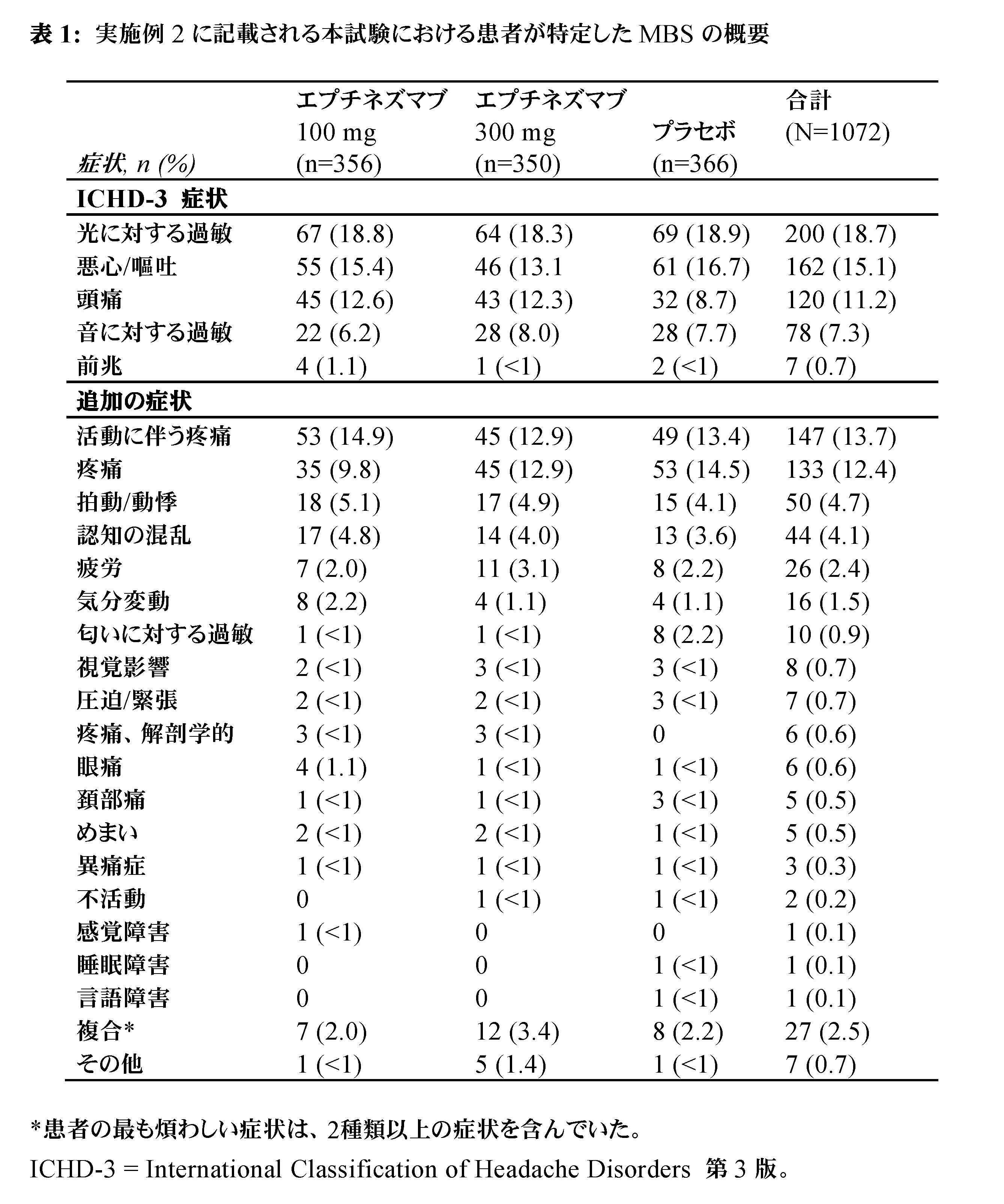
最もよく報告された症状は、光過敏、悪心/嘔吐、活動に伴う疼痛、疼痛、頭痛、音過敏、拍動/脈動、認知の混乱、疲労、気分変動、及び匂いに対する過敏であり、各カテゴリーには、これらのイベントを自分のMBSとして報告した患者が少なくとも10名いた。28日間のスクリーニング期間の終わりに(即ち、ベースライン来院時の投与の前)、患者に、自分の特定したMBSの変化を極めて大幅に悪化から極めて大幅に改善までで査定するように求め、>90%が自分のMBSについて変化なしと報告した。これは図16に示されている。このことは、慢性片頭痛を有するこのコホートにおいて、スクリーニング期間中、患者が特定したMBSの煩わしさはほとんど変動していないことを示唆する。 The most commonly reported symptoms were photophobia, nausea/vomiting, pain with activity, pain, headache, phonophobia, pulsation/pulsation, cognitive confusion, fatigue, mood swings, and sensitivity to smell, with at least 10 patients in each category reporting these events as their MBS. At the end of the 28-day screening period (i.e., prior to dosing at the baseline visit), patients were asked to rate the change in their identified MBS from very much worse to very much better, and >90% reported no change in their MBS. This is shown in Figure 16. This suggests that in this cohort with chronic migraine, there was little fluctuation in the bothersomeness of patient-identified MBS over the screening period.
100mg及び300mgの用量でAb6を注入すると、試験の1~3ヵ月にわたって平均MMDが有意に減少し、試験の12週目の追加の注入後に更に減少した。この効果は図14に示されている。 Infusions of Ab6 at doses of 100 mg and 300 mg significantly reduced mean MMD over months 1-3 of the study, with further reductions following an additional infusion in week 12 of the study. This effect is shown in Figure 14.
MBSに対するAb6の有効性は、100mg及び300mgの用量でのAb6の第1の注入後、1ヵ月(図17)、3ヵ月(図19)、及び6ヵ月(図21)で実証された。PGICに対するAb6の有効性は、100mg及び300mgの用量でのAb6の第1の注入後、1ヵ月(図18)、3ヵ月(図20)、及び6ヵ月(図22)で実証された。これらのパラメーターに対する有効性は、Ab6の2回用量を通して6ヵ月にわたって持続し、又は上昇した。1ヵ月目に、Ab6で治療した患者の75~82%が、プラセボで治療した患者の56~59%と比較して、あるレベルの改善を示した。3ヵ月目に、改善の評価は1ヵ月目の評価と類似していた。6ヵ月目に、Ab6で治療した患者の約80%が、MBS及びPGICにおいて1以上のカテゴリーレベルの改善を示した。MBSの改善及びPGICについての評価の分布は各時点において類似しており、慢性片頭痛を有する患者において同様に評価された2つの尺度は平行に移動することを示唆していた。これらのデータは、患者が特定した片頭痛に関する最も煩わしい症状の改善は、慢性片頭痛を有する患者における疾患の状態の改善についての患者の知覚に高く相関することを示唆する。 Efficacy of Ab6 on MBS was demonstrated at 1 month (FIG. 17), 3 months (FIG. 19), and 6 months (FIG. 21) after the first infusion of Ab6 at doses of 100 mg and 300 mg. Efficacy of Ab6 on PGIC was demonstrated at 1 month (FIG. 18), 3 months (FIG. 20), and 6 months (FIG. 22) after the first infusion of Ab6 at doses of 100 mg and 300 mg. Efficacy on these parameters was sustained or increased over 6 months through two doses of Ab6. At 1 month, 75-82% of patients treated with Ab6 showed some level of improvement compared to 56-59% of patients treated with placebo. At 3 months, the assessment of improvement was similar to that at 1 month. At 6 months, approximately 80% of patients treated with Ab6 showed one or more category levels of improvement in MBS and PGIC. The distribution of improvements on the MBS and PGIC ratings was similar across time points, suggesting that two similarly rated scales move in parallel in patients with chronic migraine. These data suggest that improvement in patient-identified most bothersome migraine symptoms is highly correlated with patient perception of improvement in disease state in patients with chronic migraine.
投与した抗体であるAb6は、配列番号221の軽鎖ポリペプチドと、配列番号201の重鎖ポリペプチドとからなる抗CGRP抗体である。 The administered antibody, Ab6, is an anti-CGRP antibody consisting of a light chain polypeptide of SEQ ID NO: 221 and a heavy chain polypeptide of SEQ ID NO: 201.
患者の特徴を以下の表2にまとめ、プラセボ、100mgの抗体、又は300mgの抗体を受けている患者について別々の列を有する。患者の片頭痛診断からの平均年数は17.0~19.0年、慢性片頭痛を患っている平均期間は11.5~12.4年であり、患者の44.3~45.2%が少なくとも1つの予防薬を利用していた。加えて、慢性片頭痛と、オピオイド及びブタルビタール過剰を除く薬物過剰使用との重複診断を有する患者を本試験に含めた。ベースライン時に、両方の抗体治療群において、月当たり片頭痛日数の平均数は16.1日であり、プラセボ群では、月当たり片頭痛日数の平均数は16.2日であった。 Patient characteristics are summarized in Table 2 below, with separate columns for patients receiving placebo, 100 mg antibody, or 300 mg antibody. The mean number of years since migraine diagnosis for patients ranged from 17.0 to 19.0 years, the mean duration of suffering from chronic migraine ranged from 11.5 to 12.4 years, and 44.3 to 45.2% of patients were utilizing at least one preventive medication. In addition, patients with a dual diagnosis of chronic migraine and medication overuse, excluding opioid and butalbital overuse, were included in the study. At baseline, the mean number of migraine days per month in both antibody treatment groups was 16.1 days, and in the placebo group the mean number of migraine days per month was 16.2 days.

Claims (2)
MBSは、悪心または嘔吐であり、
前記抗CGRP抗体は、配列番号231によってコードされる軽鎖ポリペプチドと、配列番号211又は配列番号567によってコードされる重鎖ポリペプチドとを含み;かつ
前記医薬組成物中の前記抗CGRP抗体の量は、約100mg~約300mgであるか、又は約100mgであるか、又は約300mgである、
医薬組成物。 1. A pharmaceutical composition for improving migraine associated most bothersome symptoms (MBS) in a patient comprising an anti-CGRP antibody,
MBS is nausea or vomiting ;
the anti -CGRP antibody comprises a light chain polypeptide encoded by SEQ ID NO:231 and a heavy chain polypeptide encoded by SEQ ID NO:211 or SEQ ID NO:567; and
the amount of the anti-CGRP antibody in the pharmaceutical composition is about 100 mg to about 300 mg, or about 100 mg, or about 300 mg ;
Pharmaceutical compositions.
任意選択で前記製剤は、1mL容量当たり100mgの抗CGRP抗体、3.1mgのL-ヒスチジン、40.5mgのソルビトール、及び0.15mgのポリソルベート80を含み若しくはそれらからなり、又は前記値の+/-10%以内の各成分の量を有し、及び5.8のpHを有し、又は前記値の+/-10%以内のpHを有するか、又は
任意選択で前記製剤は、1mL容量当たり100mgの抗CGRP抗体、3.1mgのL-ヒスチジン、40.5mgのソルビトール、及び0.15mgのポリソルベート80を含み若しくはそれらからなり、又は前記値の+/-5%以内の各成分の量を有し、及び/又は5.8のpHを有し、又は前記値の+/-5%以内のpHを有するか、又は
任意選択で前記製剤は、1mL容量当たり100mgの抗CGRP抗体、3.1mgのL-ヒスチジン、40.5mgのソルビトール、及び0.15mgのポリソルベート80を含み若しくはそれらからなり、又は前記値の+/-1%以内の各成分の量を有し、及び/又は5.8のpHを有し、又は前記値の+/-1%以内のpHを有するか、又は
任意選択で前記製剤は、1mL容量当たり100mgの抗CGRP抗体、3.1mgのL-ヒスチジン、40.5mgのソルビトール、及び0.15mgのポリソルベート80を含み若しくはそれらからなり、又は前記値の+/-0.5%以内の各成分の量を有し、及び/又は5.8のpHを有し、又は前記値の+/-0.5%以内のpHを有するか、又は
任意選択で前記製剤は、1mL容量当たり100mgの抗CGRP抗体、3.1mgのL-ヒスチジン、40.5mgのソルビトール、及び0.15mgのポリソルベート80を含み若しくはそれらからなり、又は前記値の+/-0.1%以内の各成分の量を有し、及び/又は5.8のpHを有し、又は前記値の+/-0.1%以内のpHを有する、
請求項1に記載の医薬組成物。 The anti -CGRP antibody is contained in a formulation comprising or consisting of histidine (L-histidine), sorbitol, polysorbate 80, and water, wherein:
Optionally, the formulation comprises or consists of 100 mg of anti-CGRP antibody, 3.1 mg of L-histidine, 40.5 mg of sorbitol, and 0.15 mg of polysorbate 80 per mL volume, or has amounts of each component within +/- 10% of said values, and has a pH of 5.8, or has a pH within +/- 10% of said values; or Optionally, the formulation comprises or consists of 100 mg of anti-CGRP antibody, 3.1 mg of L-histidine, 40.5 mg of sorbitol, and 0.15 mg of polysorbate 80 per mL volume, or has amounts of each component within +/- 5% of said values, and/or has a pH of 5.8, or has a pH within +/- 5% of said values; or Optionally, the formulation comprises or consists of 100 mg of anti-CGRP antibody, 3.1 mg of L-histidine, 40.5 mg of sorbitol, and 0.15 mg of polysorbate 80 per mL volume, or has amounts of each component within +/- 1% of said values, and/or has a pH of 5.8, or has a pH within +/- 1% of said values; or Optionally, the formulation comprises or consists of 100 mg of anti-CGRP antibody, 3.1 mg of L-histidine, 40.5 mg of sorbitol, and 0.15 mg of polysorbate 80 per mL volume, or has amounts of each component within +/- 0.5% of said values, and/or has a pH of 5.8, or has a pH within +/- 0.5% of said values; or Optionally, the formulation comprises or consists of 100 mg of anti-CGRP antibody, 3.1 mg of L-histidine, 40.5 mg of sorbitol, and 0.15 mg of polysorbate 80 per mL volume, or has amounts of each component within +/- 0.1% of said values, and/or has a pH of 5.8, or has a pH within +/- 0.1% of said values .
The pharmaceutical composition of claim 1 .
Applications Claiming Priority (3)
| Application Number | Priority Date | Filing Date | Title |
|---|---|---|---|
| US202063005950P | 2020-04-06 | 2020-04-06 | |
| US63/005,950 | 2020-04-06 | ||
| PCT/IB2020/053568 WO2021205216A1 (en) | 2020-04-06 | 2020-04-15 | Treatment of most bothersome symptom (mbs) associated with migraine using anti-cgrp antibodies |
Publications (2)
| Publication Number | Publication Date |
|---|---|
| JP2023531120A JP2023531120A (en) | 2023-07-21 |
| JP7628554B2 true JP7628554B2 (en) | 2025-02-10 |
Family
ID=70457082
Family Applications (1)
| Application Number | Title | Priority Date | Filing Date |
|---|---|---|---|
| JP2022560868A Active JP7628554B2 (en) | 2020-04-06 | 2020-04-15 | Treatment of Migraine-Associated Most Bothersome Symptoms (MBS) with Anti-CGRP Antibodies |
Country Status (9)
| Country | Link |
|---|---|
| US (2) | US20210309725A1 (en) |
| JP (1) | JP7628554B2 (en) |
| KR (1) | KR20210124867A (en) |
| AU (1) | AU2020202454A1 (en) |
| BR (1) | BR102020007149A8 (en) |
| CA (1) | CA3077973A1 (en) |
| MX (2) | MX2020004652A (en) |
| SG (1) | SG10202003296VA (en) |
| WO (1) | WO2021205216A1 (en) |
Families Citing this family (2)
| Publication number | Priority date | Publication date | Assignee | Title |
|---|---|---|---|---|
| US10766952B2 (en) | 2017-03-02 | 2020-09-08 | Beth Israel Deaconess Medical Center, Inc. | Methods for reducing migraine frequency in a subject in need thereof |
| US20260001942A1 (en) * | 2024-06-21 | 2026-01-01 | H. Lundbeck A/S | Treatment of headache disorders and/or psychiatric symptoms using anti-cgrp antibodies, and compositions and methods related thereto |
Citations (1)
| Publication number | Priority date | Publication date | Assignee | Title |
|---|---|---|---|---|
| JP2014517699A (en) | 2011-05-20 | 2014-07-24 | アルダーバイオ・ホールディングズ・エルエルシー | Anti-CGRP composition and use thereof |
Family Cites Families (103)
| Publication number | Priority date | Publication date | Assignee | Title |
|---|---|---|---|---|
| US4179337A (en) | 1973-07-20 | 1979-12-18 | Davis Frank F | Non-immunogenic polypeptides |
| US4816567A (en) | 1983-04-08 | 1989-03-28 | Genentech, Inc. | Recombinant immunoglobin preparations |
| DE134631T1 (en) | 1983-06-15 | 1985-12-05 | Roger Kingdom Craig | PEPTIDES, PHARMACEUTICAL COMPOSITIONS, GENES, VECTORS, HOST ORGANISMS, METHODS FOR THEIR PRODUCTION AND DIAGNOSTIC REAGENTS. |
| JPS62129297A (en) | 1985-08-09 | 1987-06-11 | Toyo Jozo Co Ltd | Calcitonin gene-related peptide derivative |
| US5225539A (en) | 1986-03-27 | 1993-07-06 | Medical Research Council | Recombinant altered antibodies and methods of making altered antibodies |
| US6548640B1 (en) | 1986-03-27 | 2003-04-15 | Btg International Limited | Altered antibodies |
| WO1988007089A1 (en) | 1987-03-18 | 1988-09-22 | Medical Research Council | Altered antibodies |
| GB8725529D0 (en) | 1987-10-30 | 1987-12-02 | Delta Biotechnology Ltd | Polypeptides |
| US5364841A (en) | 1988-01-11 | 1994-11-15 | Amylin Pharmaceuticals, Inc. | Treatment of obesity and essential hypertension and related disorders |
| US5266561A (en) | 1988-01-11 | 1993-11-30 | Amylin Pharmaceuticals, Inc. | Treatment of type 2 diabetes mellitus |
| CA2006596C (en) | 1988-12-22 | 2000-09-05 | Rika Ishikawa | Chemically-modified g-csf |
| US5530101A (en) | 1988-12-28 | 1996-06-25 | Protein Design Labs, Inc. | Humanized immunoglobulins |
| US5116964A (en) | 1989-02-23 | 1992-05-26 | Genentech, Inc. | Hybrid immunoglobulins |
| US5766883A (en) | 1989-04-29 | 1998-06-16 | Delta Biotechnology Limited | Polypeptides |
| FR2650598B1 (en) | 1989-08-03 | 1994-06-03 | Rhone Poulenc Sante | DERIVATIVES OF ALBUMIN WITH THERAPEUTIC FUNCTION |
| US5859205A (en) | 1989-12-21 | 1999-01-12 | Celltech Limited | Humanised antibodies |
| JP4124480B2 (en) | 1991-06-14 | 2008-07-23 | ジェネンテック・インコーポレーテッド | Immunoglobulin variants |
| WO1994004679A1 (en) | 1991-06-14 | 1994-03-03 | Genentech, Inc. | Method for making humanized antibodies |
| FR2686899B1 (en) | 1992-01-31 | 1995-09-01 | Rhone Poulenc Rorer Sa | NOVEL BIOLOGICALLY ACTIVE POLYPEPTIDES, THEIR PREPARATION AND PHARMACEUTICAL COMPOSITIONS CONTAINING THEM. |
| AU6445894A (en) | 1993-03-19 | 1994-10-11 | Duke University | Method of treatment of tumors with an antibody binding to tenascin |
| US5643575A (en) | 1993-10-27 | 1997-07-01 | Enzon, Inc. | Non-antigenic branched polymer conjugates |
| ATE306930T1 (en) | 1994-08-12 | 2005-11-15 | Immunomedics Inc | IMMUNE CONJUGATES AND HUMAN ANTIBODIES SPECIFIC FOR B-CELL LYMPHOMA AND LEUKEMIA CELLS |
| JPH10504457A (en) | 1994-08-16 | 1998-05-06 | ヒューマン ジノーム サイエンシーズ, インコーポレイテッド | Calcitonin receptor |
| FR2732221B1 (en) | 1995-03-28 | 1997-04-25 | Oreal | USE OF A CGRP ANTAGONIST TO TREAT CUTANEOUS REDNESS OF NEUROGENIC ORIGIN AND COMPOSITION OBTAINED |
| JPH11512396A (en) | 1995-09-05 | 1999-10-26 | スミスクライン・ビーチャム・コーポレイション | Compounds and methods |
| CA2264942A1 (en) | 1996-09-09 | 1998-03-12 | Smithkline Beecham Corporation | Compounds and methods |
| SK285631B6 (en) | 1996-09-10 | 2007-05-03 | Dr. Karl Thomae Gmbh | Modified amino acids, pharmaceutical composition comprising its and its use |
| US6653104B2 (en) | 1996-10-17 | 2003-11-25 | Immunomedics, Inc. | Immunotoxins, comprising an internalizing antibody, directed against malignant and normal cells |
| WO1998056779A1 (en) | 1997-06-13 | 1998-12-17 | Smithkline Beecham Corporation | 4-sulfinyl benzamides as calcitonin gene-related peptide receptor antagonists |
| US6956107B2 (en) | 1998-02-20 | 2005-10-18 | Tanox, Inc. | Inhibitors of complement activation |
| AU6211499A (en) | 1998-09-30 | 2000-04-17 | Merck & Co., Inc. | Benzimidazolinyl piperidines as cgrp ligands |
| WO2000023579A1 (en) | 1998-10-22 | 2000-04-27 | The Regents Of The University Of California | Functionally assembled antigen-specific intact recombinant antibody and a method for production thereof |
| US6737056B1 (en) | 1999-01-15 | 2004-05-18 | Genentech, Inc. | Polypeptide variants with altered effector function |
| EP1031350A1 (en) | 1999-02-23 | 2000-08-30 | Warner-Lambert Company | Use of a gabapentin-analog for the manufacture of a medicament for preventing and treating visceral pain |
| US6313097B1 (en) | 1999-03-02 | 2001-11-06 | Boehringer Ingelheim Pharma Kg | Antagonists of calcitonin gene-related peptide |
| US6521609B1 (en) | 1999-08-10 | 2003-02-18 | Boehringer Ingelheim Pharma Kg | Use of CGRP antagonists and CGRP release inhibitors for combating menopausal hot flushes |
| KR100863630B1 (en) | 1999-09-25 | 2008-10-15 | 유니버시티 오브 아이오와 리써치 파운데이션 | Immunostimulatory nucleic acids |
| EP2341075A1 (en) | 2000-03-01 | 2011-07-06 | MedImmune, LLC | Antibodies binding to the f protein of a respiratory syncytial virus (rsv) |
| US6406863B1 (en) | 2000-06-23 | 2002-06-18 | Genetastix Corporation | High throughput generation and screening of fully human antibody repertoire in yeast |
| US20020162125A1 (en) | 2001-03-06 | 2002-10-31 | Anne-Marie Salmon | Methods and compositions for the modulation of neurogenic inflammatory pain and physical opiate withdrawal |
| US20030181462A1 (en) | 2001-08-17 | 2003-09-25 | Boehringer Ingelheim Pharma Kg | Use of BIBN4096 in combination with other antimigraine drugs for the treatment of migraine |
| AU2002356469A1 (en) | 2001-11-26 | 2003-06-10 | Protemix Corp Ltd | Methods of compositions for normalizing lipid levels in mammalian tissues |
| SI1527100T1 (en) | 2002-03-29 | 2009-12-31 | Schering Corp | Human monoclonal antibodies to interleukin-5 and methods and compositions comprising same |
| WO2003093472A2 (en) | 2002-05-06 | 2003-11-13 | Grünenthal GmbH | Cgrp binding nucleic acids |
| US20040110170A1 (en) | 2002-05-18 | 2004-06-10 | The Regents Of The University Of California | Cloning and characterization of calcitonin gene related peptide receptors |
| US7345065B2 (en) | 2002-05-21 | 2008-03-18 | Allergan, Inc. | Methods and compositions for alleviating pain |
| DK1539766T3 (en) | 2002-06-05 | 2017-04-03 | Bristol Myers Squibb Co | CALCITONIN GEN-RELATED PEPTIDE RECEPTOR ANTAGONISTS |
| EP1600459A3 (en) | 2002-06-28 | 2005-12-07 | Domantis Limited | Ligand |
| NZ538615A (en) | 2002-08-12 | 2008-03-28 | Actavis Group Hf | Use of CGRP antagonist compounds for treatment of psoriasis |
| UA80447C2 (en) | 2002-10-08 | 2007-09-25 | Methods for treating pain by administering nerve growth factor antagonist and opioid analgesic | |
| DE10250082A1 (en) | 2002-10-25 | 2004-05-13 | Boehringer Ingelheim Pharma Gmbh & Co. Kg | Selected CGRP antagonists, process for their preparation and their use as pharmaceuticals |
| EP1578799B8 (en) | 2002-12-02 | 2011-03-23 | Amgen Fremont Inc. | Antibodies directed to tumor necrosis factor and uses thereof |
| EP3539569A1 (en) | 2002-12-24 | 2019-09-18 | Rinat Neuroscience Corp. | Anti-ngf antibodies and methods using the same in treating pain associated with musculo-skeletal disorders |
| US7288559B2 (en) | 2003-03-14 | 2007-10-30 | Merck + Co, Inc. | Carboxamide spirohydantoin CGRP receptor antagonists |
| AU2004226018B2 (en) | 2003-03-14 | 2009-08-27 | Merck Sharp & Dohme Corp. | Benzodiazepine spirohydantoin CGRP receptor antagonists |
| AU2004221891B2 (en) | 2003-03-14 | 2009-11-19 | Merck Sharp & Dohme Corp. | Monocyclic anilide spirohydantoin CGRP receptor antagonists |
| WO2004082605A2 (en) | 2003-03-14 | 2004-09-30 | Merck & Co. Inc. | Bicyclic anilide spirohydantoin cgrp receptor antagonists |
| AU2004222328B2 (en) | 2003-03-14 | 2009-10-08 | Merck Sharp & Dohme Corp. | Aryl spirohydantoin CGRP receptor antagonists |
| JO2355B1 (en) | 2003-04-15 | 2006-12-12 | ميرك شارب اند دوم كوربوريشن | CGRP receptor antagonists |
| CN100572379C (en) | 2003-04-15 | 2009-12-23 | 麦克公司 | CGRP receptor antagonist |
| WO2004097421A2 (en) | 2003-04-29 | 2004-11-11 | Bayer Healthcare Ag | Diagnostics and therapeutics for diseases associated with calcitonin receptor-like receptor (calcrl) |
| CA2529528A1 (en) | 2003-06-20 | 2004-12-29 | Ronald Aung-Din | Topical therapy for the treatment of migraines, muscle sprains, muscle spasm, spasticity and related conditions |
| JP2007523870A (en) | 2003-07-15 | 2007-08-23 | メルク エンド カムパニー インコーポレーテッド | Hydroxypyridine CGRP receptor antagonist |
| US8268582B2 (en) | 2003-10-22 | 2012-09-18 | Keck Graduate Institute | Methods of synthesizing heteromultimeric polypeptides in yeast using a haploid mating strategy |
| US20080070239A1 (en) | 2003-10-29 | 2008-03-20 | University Of Rochester | Detection of neureopeptides associated with pelvic pain disorders and uses thereof |
| US20090023644A1 (en) | 2004-01-13 | 2009-01-22 | Southard Jeffery L | Methods of using cgrp for cardiovascular and renal indications |
| DE102004015723A1 (en) | 2004-03-29 | 2005-10-20 | Boehringer Ingelheim Pharma | Selected CGRP antagonists, process for their preparation and their use as pharmaceuticals |
| DE102004018794A1 (en) | 2004-04-15 | 2005-10-27 | Boehringer Ingelheim Pharma Gmbh & Co. Kg | Selected CGRP antagonists, process for their preparation and their use as pharmaceuticals |
| US7279471B2 (en) | 2004-04-15 | 2007-10-09 | Boehringer Ingelheim International Gmbh | Selected CGRP-antagonists, process for preparing them and their use as pharmaceutical compositions |
| TWI432196B (en) | 2005-01-18 | 2014-04-01 | Euro Celtique Sa | Method of treating visceral pain |
| EP1770091A1 (en) | 2005-09-29 | 2007-04-04 | Boehringer Ingelheim Pharma GmbH & Co. KG | CGRP-antagonists, process for their preparation as well as their use as medicaments |
| ITRM20050290A1 (en) | 2005-06-07 | 2006-12-08 | Lay Line Genomics Spa | USE OF MOLECULES ABLE TO INHIBIT THE BOND BETWEEN NGF AND ITS TRKA RECEPTOR AS AN EXTENDED EFFECT ANALGESICS. |
| US20100144767A1 (en) | 2005-08-25 | 2010-06-10 | Wex Pharmaceuticals, Inc. | Use of sodium channel blockers for the treatment of visceral pain or pain caused by cancer treatment |
| US8168592B2 (en) | 2005-10-21 | 2012-05-01 | Amgen Inc. | CGRP peptide antagonists and conjugates |
| EP1957106B2 (en) | 2005-11-14 | 2019-07-24 | Teva Pharmaceuticals International GmbH | Antagonist antibodies directed against calcitonin gene-related peptide and methods using same |
| US20070108378A1 (en) | 2005-11-14 | 2007-05-17 | Toru Terabayashi | High pressure optical cell for a downhole optical fluid analyzer |
| ATE493412T1 (en) | 2005-11-18 | 2011-01-15 | Merck Sharp & Dohme | SPIROHYDANTOIN-ARYL-CGRP RECEPTOR ANTAGONISTS |
| WO2007076336A1 (en) | 2005-12-22 | 2007-07-05 | Eli Lilly And Company | Treatment of migraine with anti-cgrp antibodies |
| US9074352B2 (en) | 2006-03-27 | 2015-07-07 | John R. Ramun | Universal control scheme for mobile hydraulic equipment and method for achieving the same |
| BRPI0712492A2 (en) | 2006-06-08 | 2012-08-21 | Boehringer Ingelheim Int | use of cgpr antagonists and pharmaceutical composition comprising cgpr antagonists. |
| CN101516875A (en) | 2006-07-21 | 2009-08-26 | 沃泰克斯药物股份有限公司 | CGRP receptor antagonists |
| JP2008268874A (en) | 2007-03-23 | 2008-11-06 | Nec Corp | Labeled body and method for producing the same |
| WO2008144757A1 (en) | 2007-05-21 | 2008-11-27 | Alder Biopharmaceuticals, Inc. | Novel rabbit antibody humanization methods and humanized rabbit antibodies |
| CA2688146C (en) | 2007-05-21 | 2018-03-06 | Alder Biopharmaceuticals, Inc. | Antibodies to il-6 and use thereof |
| WO2008144753A2 (en) | 2007-05-21 | 2008-11-27 | Alder Biopharmaceuticals, Inc. | Antibodies to tnf alpha and use thereof |
| JP5537441B2 (en) | 2008-03-04 | 2014-07-02 | ファイザー・リミテッド | How to treat chronic pain |
| CA2716799C (en) | 2008-03-04 | 2018-05-22 | Pfizer Limited | Methods of treating inflammatory pain |
| JO3382B1 (en) | 2008-12-23 | 2019-03-13 | Amgen Inc | Human cgrp receptor binding antibodies |
| KR101519192B1 (en) | 2009-08-28 | 2015-05-11 | 리나트 뉴로사이언스 코프. | Methods for treating visceral pain by administering antagonist antibodies directed against calcitonin gene-related peptide |
| JO3330B1 (en) | 2010-06-10 | 2019-03-13 | Lilly Co Eli | Cgrp antibodies |
| DK2709663T3 (en) * | 2011-05-20 | 2019-05-20 | Alderbio Holdings Llc | Use of anti-CGRP antibodies and antibody fragments to prevent or inhibit photophobia or aversion to light in individuals in need thereof, especially migraineurs |
| US9855332B2 (en) | 2011-05-20 | 2018-01-02 | Alderbio Holdings Llc | Use of anti-CGRP antibodies and antibody fragments to treat diarrhea in subjects with diseases or treatments that result in elevated CGRP levels |
| US20170114122A1 (en) | 2015-10-23 | 2017-04-27 | Alderbio Holdings Llc | Regulation of glucose metabolism using anti-cgrp antibodies |
| SG10201906172XA (en) | 2013-07-03 | 2019-08-27 | Alder Biopharmaceuticals Inc | Regulation of glucose metabolism using anti-cgrp antibodies |
| SI3119431T1 (en) | 2014-03-21 | 2024-06-28 | Teva Pharmaceuticals International Gmbh | Antagonist antibodies directed against calcitonin gene-related peptide and methods using same |
| GB201408469D0 (en) | 2014-05-13 | 2014-06-25 | Obs Medical Ltd | Method and apparatus for monitoring patient status |
| JOP20200116A1 (en) | 2015-04-24 | 2017-06-16 | Amgen Inc | Methods for treating or preventing migraine headache |
| AR104847A1 (en) | 2015-06-17 | 2017-08-16 | Lilly Co Eli | FORMULATION OF ANTI-CGRP ANTIBODY |
| EA201890578A1 (en) | 2015-09-24 | 2018-12-28 | Тева Фармасьютикалз Интернэшнл Гмбх | PREVENTION, TREATMENT AND REDUCTION (PERSISTENT) OF POST-TRAUMATIC HEADACHE |
| WO2017186928A1 (en) | 2016-04-29 | 2017-11-02 | Curevac Ag | Rna encoding an antibody |
| PE20191148A1 (en) | 2016-09-23 | 2019-09-02 | Teva Pharmaceuticals Int Gmbh | TREATMENT OF REFRACTORY MIGRANA |
| CR20210373A (en) * | 2019-01-08 | 2021-08-19 | H Lundbeck As | Acute treatment and rapid treatment of headache using anti-cgrp antibodies |
| EP3908607A4 (en) | 2019-01-08 | 2022-10-05 | H. Lundbeck A/S | TREATMENT OF DRUG-INDUCED HEADACHE WITH ANTI-CGRP OR ANTI-CGRP-R ANTIBODIES |
-
2020
- 2020-04-09 AU AU2020202454A patent/AU2020202454A1/en active Pending
- 2020-04-09 BR BR102020007149A patent/BR102020007149A8/en unknown
- 2020-04-09 KR KR1020200043507A patent/KR20210124867A/en active Pending
- 2020-04-09 CA CA3077973A patent/CA3077973A1/en active Pending
- 2020-04-09 SG SG10202003296VA patent/SG10202003296VA/en unknown
- 2020-04-15 JP JP2022560868A patent/JP7628554B2/en active Active
- 2020-04-15 WO PCT/IB2020/053568 patent/WO2021205216A1/en not_active Ceased
- 2020-04-28 US US16/860,239 patent/US20210309725A1/en not_active Abandoned
- 2020-07-13 MX MX2020004652A patent/MX2020004652A/en unknown
- 2020-08-05 MX MX2020008262A patent/MX2020008262A/en unknown
-
2023
- 2023-03-13 US US18/182,822 patent/US12384837B2/en active Active
Patent Citations (1)
| Publication number | Priority date | Publication date | Assignee | Title |
|---|---|---|---|---|
| JP2014517699A (en) | 2011-05-20 | 2014-07-24 | アルダーバイオ・ホールディングズ・エルエルシー | Anti-CGRP composition and use thereof |
Non-Patent Citations (3)
| Title |
|---|
| Handbook of experimental pharmacology,2019年,Vol.255,pp.121-130,http://dx.doi.org/10.1007/164_2018_201 |
| Headache,2019年,Vol.59,pp.383-393 |
| The journal of headache and pain,2019年06月28日,Vol.20, No.1, Article No.75,pp.1-11,DOI http://dx.doi.org/10.1186/s10194-019-1024-x |
Also Published As
| Publication number | Publication date |
|---|---|
| AU2020202454A1 (en) | 2021-10-21 |
| US20210309725A1 (en) | 2021-10-07 |
| US20240101653A1 (en) | 2024-03-28 |
| US12384837B2 (en) | 2025-08-12 |
| WO2021205216A1 (en) | 2021-10-14 |
| KR20210124867A (en) | 2021-10-15 |
| CA3077973A1 (en) | 2021-10-06 |
| MX2020008262A (en) | 2021-10-07 |
| MX2020004652A (en) | 2021-10-07 |
| JP2023531120A (en) | 2023-07-21 |
| BR102020007149A8 (en) | 2023-09-26 |
| SG10202003296VA (en) | 2021-11-29 |
| BR102020007149A2 (en) | 2021-12-07 |
Similar Documents
| Publication | Publication Date | Title |
|---|---|---|
| US12215144B2 (en) | Acute treatment and rapid treatment of headache using anti-CGRP antibodies | |
| AU2020207299A1 (en) | Treatment of medication overuse headache using anti-cgrp or anti-CGRP-R antibodies | |
| US12384837B2 (en) | Treatment of most bothersome symptom (MBS) associated with migraine using anti-CGRP antibodies | |
| US20220251178A1 (en) | Treatment of headache using anti-cgrp antibodieshereof | |
| US20250215069A1 (en) | Treatment of cluster headache using anti-cgrp antibodies | |
| WO2024261733A1 (en) | Combinational treatment | |
| AU2024313073A1 (en) | Combinational treatment | |
| JP2026016471A (en) | Treatment of headache with anti-CGRP antibodies |
Legal Events
| Date | Code | Title | Description |
|---|---|---|---|
| A80 | Written request to apply exceptions to lack of novelty of invention |
Free format text: JAPANESE INTERMEDIATE CODE: A80 Effective date: 20221227 Free format text: JAPANESE INTERMEDIATE CODE: A801 Effective date: 20221005 |
|
| A521 | Request for written amendment filed |
Free format text: JAPANESE INTERMEDIATE CODE: A523 Effective date: 20230414 |
|
| A621 | Written request for application examination |
Free format text: JAPANESE INTERMEDIATE CODE: A621 Effective date: 20230414 |
|
| A521 | Request for written amendment filed |
Free format text: JAPANESE INTERMEDIATE CODE: A523 Effective date: 20230531 |
|
| A131 | Notification of reasons for refusal |
Free format text: JAPANESE INTERMEDIATE CODE: A131 Effective date: 20240402 |
|
| A601 | Written request for extension of time |
Free format text: JAPANESE INTERMEDIATE CODE: A601 Effective date: 20240520 |
|
| A521 | Request for written amendment filed |
Free format text: JAPANESE INTERMEDIATE CODE: A523 Effective date: 20241001 |
|
| A521 | Request for written amendment filed |
Free format text: JAPANESE INTERMEDIATE CODE: A821 Effective date: 20241001 |
|
| TRDD | Decision of grant or rejection written | ||
| A01 | Written decision to grant a patent or to grant a registration (utility model) |
Free format text: JAPANESE INTERMEDIATE CODE: A01 Effective date: 20250114 |
|
| A61 | First payment of annual fees (during grant procedure) |
Free format text: JAPANESE INTERMEDIATE CODE: A61 Effective date: 20250129 |
|
| R150 | Certificate of patent or registration of utility model |
Ref document number: 7628554 Country of ref document: JP Free format text: JAPANESE INTERMEDIATE CODE: R150 |