JP7625186B2 - Bioartificial Pancreas - Google Patents
Bioartificial Pancreas Download PDFInfo
- Publication number
- JP7625186B2 JP7625186B2 JP2022519479A JP2022519479A JP7625186B2 JP 7625186 B2 JP7625186 B2 JP 7625186B2 JP 2022519479 A JP2022519479 A JP 2022519479A JP 2022519479 A JP2022519479 A JP 2022519479A JP 7625186 B2 JP7625186 B2 JP 7625186B2
- Authority
- JP
- Japan
- Prior art keywords
- scaffold
- cell complex
- bioartificial
- cells
- cell
- Prior art date
- Legal status (The legal status is an assumption and is not a legal conclusion. Google has not performed a legal analysis and makes no representation as to the accuracy of the status listed.)
- Active
Links
Images




Classifications
-
- A—HUMAN NECESSITIES
- A61—MEDICAL OR VETERINARY SCIENCE; HYGIENE
- A61F—FILTERS IMPLANTABLE INTO BLOOD VESSELS; PROSTHESES; DEVICES PROVIDING PATENCY TO, OR PREVENTING COLLAPSING OF, TUBULAR STRUCTURES OF THE BODY, e.g. STENTS; ORTHOPAEDIC, NURSING OR CONTRACEPTIVE DEVICES; FOMENTATION; TREATMENT OR PROTECTION OF EYES OR EARS; BANDAGES, DRESSINGS OR ABSORBENT PADS; FIRST-AID KITS
- A61F2/00—Filters implantable into blood vessels; Prostheses, i.e. artificial substitutes or replacements for parts of the body; Appliances for connecting them with the body; Devices providing patency to, or preventing collapsing of, tubular structures of the body, e.g. stents
- A61F2/02—Prostheses implantable into the body
- A61F2/022—Artificial gland structures using bioreactors
-
- A—HUMAN NECESSITIES
- A61—MEDICAL OR VETERINARY SCIENCE; HYGIENE
- A61F—FILTERS IMPLANTABLE INTO BLOOD VESSELS; PROSTHESES; DEVICES PROVIDING PATENCY TO, OR PREVENTING COLLAPSING OF, TUBULAR STRUCTURES OF THE BODY, e.g. STENTS; ORTHOPAEDIC, NURSING OR CONTRACEPTIVE DEVICES; FOMENTATION; TREATMENT OR PROTECTION OF EYES OR EARS; BANDAGES, DRESSINGS OR ABSORBENT PADS; FIRST-AID KITS
- A61F2/00—Filters implantable into blood vessels; Prostheses, i.e. artificial substitutes or replacements for parts of the body; Appliances for connecting them with the body; Devices providing patency to, or preventing collapsing of, tubular structures of the body, e.g. stents
- A61F2/02—Prostheses implantable into the body
- A61F2/04—Hollow or tubular parts of organs, e.g. bladders, tracheae, bronchi or bile ducts
- A61F2/06—Blood vessels
- A61F2/07—Stent-grafts
-
- A—HUMAN NECESSITIES
- A61—MEDICAL OR VETERINARY SCIENCE; HYGIENE
- A61F—FILTERS IMPLANTABLE INTO BLOOD VESSELS; PROSTHESES; DEVICES PROVIDING PATENCY TO, OR PREVENTING COLLAPSING OF, TUBULAR STRUCTURES OF THE BODY, e.g. STENTS; ORTHOPAEDIC, NURSING OR CONTRACEPTIVE DEVICES; FOMENTATION; TREATMENT OR PROTECTION OF EYES OR EARS; BANDAGES, DRESSINGS OR ABSORBENT PADS; FIRST-AID KITS
- A61F2/00—Filters implantable into blood vessels; Prostheses, i.e. artificial substitutes or replacements for parts of the body; Appliances for connecting them with the body; Devices providing patency to, or preventing collapsing of, tubular structures of the body, e.g. stents
- A61F2/82—Devices providing patency to, or preventing collapsing of, tubular structures of the body, e.g. stents
- A61F2/844—Devices providing patency to, or preventing collapsing of, tubular structures of the body, e.g. stents folded prior to deployment
-
- A—HUMAN NECESSITIES
- A61—MEDICAL OR VETERINARY SCIENCE; HYGIENE
- A61F—FILTERS IMPLANTABLE INTO BLOOD VESSELS; PROSTHESES; DEVICES PROVIDING PATENCY TO, OR PREVENTING COLLAPSING OF, TUBULAR STRUCTURES OF THE BODY, e.g. STENTS; ORTHOPAEDIC, NURSING OR CONTRACEPTIVE DEVICES; FOMENTATION; TREATMENT OR PROTECTION OF EYES OR EARS; BANDAGES, DRESSINGS OR ABSORBENT PADS; FIRST-AID KITS
- A61F2/00—Filters implantable into blood vessels; Prostheses, i.e. artificial substitutes or replacements for parts of the body; Appliances for connecting them with the body; Devices providing patency to, or preventing collapsing of, tubular structures of the body, e.g. stents
- A61F2/82—Devices providing patency to, or preventing collapsing of, tubular structures of the body, e.g. stents
- A61F2/86—Stents in a form characterised by the wire-like elements; Stents in the form characterised by a net-like or mesh-like structure
- A61F2/90—Stents in a form characterised by the wire-like elements; Stents in the form characterised by a net-like or mesh-like structure characterised by a net-like or mesh-like structure
-
- A—HUMAN NECESSITIES
- A61—MEDICAL OR VETERINARY SCIENCE; HYGIENE
- A61F—FILTERS IMPLANTABLE INTO BLOOD VESSELS; PROSTHESES; DEVICES PROVIDING PATENCY TO, OR PREVENTING COLLAPSING OF, TUBULAR STRUCTURES OF THE BODY, e.g. STENTS; ORTHOPAEDIC, NURSING OR CONTRACEPTIVE DEVICES; FOMENTATION; TREATMENT OR PROTECTION OF EYES OR EARS; BANDAGES, DRESSINGS OR ABSORBENT PADS; FIRST-AID KITS
- A61F2/00—Filters implantable into blood vessels; Prostheses, i.e. artificial substitutes or replacements for parts of the body; Appliances for connecting them with the body; Devices providing patency to, or preventing collapsing of, tubular structures of the body, e.g. stents
- A61F2/82—Devices providing patency to, or preventing collapsing of, tubular structures of the body, e.g. stents
- A61F2/86—Stents in a form characterised by the wire-like elements; Stents in the form characterised by a net-like or mesh-like structure
- A61F2/90—Stents in a form characterised by the wire-like elements; Stents in the form characterised by a net-like or mesh-like structure characterised by a net-like or mesh-like structure
- A61F2/91—Stents in a form characterised by the wire-like elements; Stents in the form characterised by a net-like or mesh-like structure characterised by a net-like or mesh-like structure made from perforated sheets or tubes, e.g. perforated by laser cuts or etched holes
-
- A—HUMAN NECESSITIES
- A61—MEDICAL OR VETERINARY SCIENCE; HYGIENE
- A61K—PREPARATIONS FOR MEDICAL, DENTAL OR TOILETRY PURPOSES
- A61K35/00—Medicinal preparations containing materials or reaction products thereof with undetermined constitution
- A61K35/12—Materials from mammals; Compositions comprising non-specified tissues or cells; Compositions comprising non-embryonic stem cells; Genetically modified cells
- A61K35/37—Digestive system
- A61K35/39—Pancreas; Islets of Langerhans
-
- A—HUMAN NECESSITIES
- A61—MEDICAL OR VETERINARY SCIENCE; HYGIENE
- A61L—METHODS OR APPARATUS FOR STERILISING MATERIALS OR OBJECTS IN GENERAL; DISINFECTION, STERILISATION OR DEODORISATION OF AIR; CHEMICAL ASPECTS OF BANDAGES, DRESSINGS, ABSORBENT PADS OR SURGICAL ARTICLES; MATERIALS FOR BANDAGES, DRESSINGS, ABSORBENT PADS OR SURGICAL ARTICLES
- A61L27/00—Materials for grafts or prostheses or for coating grafts or prostheses
- A61L27/50—Materials characterised by their function or physical properties, e.g. injectable or lubricating compositions, shape-memory materials, surface modified materials
-
- A—HUMAN NECESSITIES
- A61—MEDICAL OR VETERINARY SCIENCE; HYGIENE
- A61L—METHODS OR APPARATUS FOR STERILISING MATERIALS OR OBJECTS IN GENERAL; DISINFECTION, STERILISATION OR DEODORISATION OF AIR; CHEMICAL ASPECTS OF BANDAGES, DRESSINGS, ABSORBENT PADS OR SURGICAL ARTICLES; MATERIALS FOR BANDAGES, DRESSINGS, ABSORBENT PADS OR SURGICAL ARTICLES
- A61L27/00—Materials for grafts or prostheses or for coating grafts or prostheses
- A61L27/50—Materials characterised by their function or physical properties, e.g. injectable or lubricating compositions, shape-memory materials, surface modified materials
- A61L27/52—Hydrogels or hydrocolloids
-
- A—HUMAN NECESSITIES
- A61—MEDICAL OR VETERINARY SCIENCE; HYGIENE
- A61L—METHODS OR APPARATUS FOR STERILISING MATERIALS OR OBJECTS IN GENERAL; DISINFECTION, STERILISATION OR DEODORISATION OF AIR; CHEMICAL ASPECTS OF BANDAGES, DRESSINGS, ABSORBENT PADS OR SURGICAL ARTICLES; MATERIALS FOR BANDAGES, DRESSINGS, ABSORBENT PADS OR SURGICAL ARTICLES
- A61L27/00—Materials for grafts or prostheses or for coating grafts or prostheses
- A61L27/50—Materials characterised by their function or physical properties, e.g. injectable or lubricating compositions, shape-memory materials, surface modified materials
- A61L27/56—Porous materials, e.g. foams or sponges
-
- A—HUMAN NECESSITIES
- A61—MEDICAL OR VETERINARY SCIENCE; HYGIENE
- A61L—METHODS OR APPARATUS FOR STERILISING MATERIALS OR OBJECTS IN GENERAL; DISINFECTION, STERILISATION OR DEODORISATION OF AIR; CHEMICAL ASPECTS OF BANDAGES, DRESSINGS, ABSORBENT PADS OR SURGICAL ARTICLES; MATERIALS FOR BANDAGES, DRESSINGS, ABSORBENT PADS OR SURGICAL ARTICLES
- A61L31/00—Materials for other surgical articles, e.g. stents, stent-grafts, shunts, surgical drapes, guide wires, materials for adhesion prevention, occluding devices, surgical gloves, tissue fixation devices
- A61L31/005—Ingredients of undetermined constitution or reaction products thereof
-
- A—HUMAN NECESSITIES
- A61—MEDICAL OR VETERINARY SCIENCE; HYGIENE
- A61L—METHODS OR APPARATUS FOR STERILISING MATERIALS OR OBJECTS IN GENERAL; DISINFECTION, STERILISATION OR DEODORISATION OF AIR; CHEMICAL ASPECTS OF BANDAGES, DRESSINGS, ABSORBENT PADS OR SURGICAL ARTICLES; MATERIALS FOR BANDAGES, DRESSINGS, ABSORBENT PADS OR SURGICAL ARTICLES
- A61L31/00—Materials for other surgical articles, e.g. stents, stent-grafts, shunts, surgical drapes, guide wires, materials for adhesion prevention, occluding devices, surgical gloves, tissue fixation devices
- A61L31/08—Materials for coatings
-
- A—HUMAN NECESSITIES
- A61—MEDICAL OR VETERINARY SCIENCE; HYGIENE
- A61P—SPECIFIC THERAPEUTIC ACTIVITY OF CHEMICAL COMPOUNDS OR MEDICINAL PREPARATIONS
- A61P3/00—Drugs for disorders of the metabolism
- A61P3/08—Drugs for disorders of the metabolism for glucose homeostasis
- A61P3/10—Drugs for disorders of the metabolism for glucose homeostasis for hyperglycaemia, e.g. antidiabetics
-
- C—CHEMISTRY; METALLURGY
- C12—BIOCHEMISTRY; BEER; SPIRITS; WINE; VINEGAR; MICROBIOLOGY; ENZYMOLOGY; MUTATION OR GENETIC ENGINEERING
- C12N—MICROORGANISMS OR ENZYMES; COMPOSITIONS THEREOF; PROPAGATING, PRESERVING, OR MAINTAINING MICROORGANISMS; MUTATION OR GENETIC ENGINEERING; CULTURE MEDIA
- C12N5/00—Undifferentiated human, animal or plant cells, e.g. cell lines; Tissues; Cultivation or maintenance thereof; Culture media therefor
- C12N5/06—Animal cells or tissues; Human cells or tissues
- C12N5/0602—Vertebrate cells
- C12N5/0676—Pancreatic cells
- C12N5/0678—Stem cells; Progenitor cells; Precursor cells
-
- A—HUMAN NECESSITIES
- A61—MEDICAL OR VETERINARY SCIENCE; HYGIENE
- A61F—FILTERS IMPLANTABLE INTO BLOOD VESSELS; PROSTHESES; DEVICES PROVIDING PATENCY TO, OR PREVENTING COLLAPSING OF, TUBULAR STRUCTURES OF THE BODY, e.g. STENTS; ORTHOPAEDIC, NURSING OR CONTRACEPTIVE DEVICES; FOMENTATION; TREATMENT OR PROTECTION OF EYES OR EARS; BANDAGES, DRESSINGS OR ABSORBENT PADS; FIRST-AID KITS
- A61F2210/00—Particular material properties of prostheses classified in groups A61F2/00 - A61F2/26 or A61F2/82 or A61F9/00 or A61F11/00 or subgroups thereof
- A61F2210/0004—Particular material properties of prostheses classified in groups A61F2/00 - A61F2/26 or A61F2/82 or A61F9/00 or A61F11/00 or subgroups thereof bioabsorbable
-
- A—HUMAN NECESSITIES
- A61—MEDICAL OR VETERINARY SCIENCE; HYGIENE
- A61F—FILTERS IMPLANTABLE INTO BLOOD VESSELS; PROSTHESES; DEVICES PROVIDING PATENCY TO, OR PREVENTING COLLAPSING OF, TUBULAR STRUCTURES OF THE BODY, e.g. STENTS; ORTHOPAEDIC, NURSING OR CONTRACEPTIVE DEVICES; FOMENTATION; TREATMENT OR PROTECTION OF EYES OR EARS; BANDAGES, DRESSINGS OR ABSORBENT PADS; FIRST-AID KITS
- A61F2210/00—Particular material properties of prostheses classified in groups A61F2/00 - A61F2/26 or A61F2/82 or A61F9/00 or A61F11/00 or subgroups thereof
- A61F2210/0076—Particular material properties of prostheses classified in groups A61F2/00 - A61F2/26 or A61F2/82 or A61F9/00 or A61F11/00 or subgroups thereof multilayered, e.g. laminated structures
-
- A—HUMAN NECESSITIES
- A61—MEDICAL OR VETERINARY SCIENCE; HYGIENE
- A61F—FILTERS IMPLANTABLE INTO BLOOD VESSELS; PROSTHESES; DEVICES PROVIDING PATENCY TO, OR PREVENTING COLLAPSING OF, TUBULAR STRUCTURES OF THE BODY, e.g. STENTS; ORTHOPAEDIC, NURSING OR CONTRACEPTIVE DEVICES; FOMENTATION; TREATMENT OR PROTECTION OF EYES OR EARS; BANDAGES, DRESSINGS OR ABSORBENT PADS; FIRST-AID KITS
- A61F2220/00—Fixations or connections for prostheses classified in groups A61F2/00 - A61F2/26 or A61F2/82 or A61F9/00 or A61F11/00 or subgroups thereof
- A61F2220/0025—Connections or couplings between prosthetic parts, e.g. between modular parts; Connecting elements
- A61F2220/0075—Connections or couplings between prosthetic parts, e.g. between modular parts; Connecting elements sutured, ligatured or stitched, retained or tied with a rope, string, thread, wire or cable
-
- A—HUMAN NECESSITIES
- A61—MEDICAL OR VETERINARY SCIENCE; HYGIENE
- A61F—FILTERS IMPLANTABLE INTO BLOOD VESSELS; PROSTHESES; DEVICES PROVIDING PATENCY TO, OR PREVENTING COLLAPSING OF, TUBULAR STRUCTURES OF THE BODY, e.g. STENTS; ORTHOPAEDIC, NURSING OR CONTRACEPTIVE DEVICES; FOMENTATION; TREATMENT OR PROTECTION OF EYES OR EARS; BANDAGES, DRESSINGS OR ABSORBENT PADS; FIRST-AID KITS
- A61F2240/00—Manufacturing or designing of prostheses classified in groups A61F2/00 - A61F2/26 or A61F2/82 or A61F9/00 or A61F11/00 or subgroups thereof
- A61F2240/001—Designing or manufacturing processes
- A61F2240/002—Designing or making customized prostheses
-
- A—HUMAN NECESSITIES
- A61—MEDICAL OR VETERINARY SCIENCE; HYGIENE
- A61F—FILTERS IMPLANTABLE INTO BLOOD VESSELS; PROSTHESES; DEVICES PROVIDING PATENCY TO, OR PREVENTING COLLAPSING OF, TUBULAR STRUCTURES OF THE BODY, e.g. STENTS; ORTHOPAEDIC, NURSING OR CONTRACEPTIVE DEVICES; FOMENTATION; TREATMENT OR PROTECTION OF EYES OR EARS; BANDAGES, DRESSINGS OR ABSORBENT PADS; FIRST-AID KITS
- A61F2250/00—Special features of prostheses classified in groups A61F2/00 - A61F2/26 or A61F2/82 or A61F9/00 or A61F11/00 or subgroups thereof
- A61F2250/0058—Additional features; Implant or prostheses properties not otherwise provided for
- A61F2250/0067—Means for introducing or releasing pharmaceutical products into the body
-
- A—HUMAN NECESSITIES
- A61—MEDICAL OR VETERINARY SCIENCE; HYGIENE
- A61L—METHODS OR APPARATUS FOR STERILISING MATERIALS OR OBJECTS IN GENERAL; DISINFECTION, STERILISATION OR DEODORISATION OF AIR; CHEMICAL ASPECTS OF BANDAGES, DRESSINGS, ABSORBENT PADS OR SURGICAL ARTICLES; MATERIALS FOR BANDAGES, DRESSINGS, ABSORBENT PADS OR SURGICAL ARTICLES
- A61L2300/00—Biologically active materials used in bandages, wound dressings, absorbent pads or medical devices
- A61L2300/60—Biologically active materials used in bandages, wound dressings, absorbent pads or medical devices characterised by a special physical form
- A61L2300/606—Coatings
- A61L2300/608—Coatings having two or more layers
-
- A—HUMAN NECESSITIES
- A61—MEDICAL OR VETERINARY SCIENCE; HYGIENE
- A61L—METHODS OR APPARATUS FOR STERILISING MATERIALS OR OBJECTS IN GENERAL; DISINFECTION, STERILISATION OR DEODORISATION OF AIR; CHEMICAL ASPECTS OF BANDAGES, DRESSINGS, ABSORBENT PADS OR SURGICAL ARTICLES; MATERIALS FOR BANDAGES, DRESSINGS, ABSORBENT PADS OR SURGICAL ARTICLES
- A61L2300/00—Biologically active materials used in bandages, wound dressings, absorbent pads or medical devices
- A61L2300/60—Biologically active materials used in bandages, wound dressings, absorbent pads or medical devices characterised by a special physical form
- A61L2300/64—Animal cells
-
- A—HUMAN NECESSITIES
- A61—MEDICAL OR VETERINARY SCIENCE; HYGIENE
- A61L—METHODS OR APPARATUS FOR STERILISING MATERIALS OR OBJECTS IN GENERAL; DISINFECTION, STERILISATION OR DEODORISATION OF AIR; CHEMICAL ASPECTS OF BANDAGES, DRESSINGS, ABSORBENT PADS OR SURGICAL ARTICLES; MATERIALS FOR BANDAGES, DRESSINGS, ABSORBENT PADS OR SURGICAL ARTICLES
- A61L2420/00—Materials or methods for coatings medical devices
- A61L2420/08—Coatings comprising two or more layers
-
- C—CHEMISTRY; METALLURGY
- C12—BIOCHEMISTRY; BEER; SPIRITS; WINE; VINEGAR; MICROBIOLOGY; ENZYMOLOGY; MUTATION OR GENETIC ENGINEERING
- C12N—MICROORGANISMS OR ENZYMES; COMPOSITIONS THEREOF; PROPAGATING, PRESERVING, OR MAINTAINING MICROORGANISMS; MUTATION OR GENETIC ENGINEERING; CULTURE MEDIA
- C12N2513/00—3D culture
Landscapes
- Health & Medical Sciences (AREA)
- Life Sciences & Earth Sciences (AREA)
- Engineering & Computer Science (AREA)
- Biomedical Technology (AREA)
- General Health & Medical Sciences (AREA)
- Public Health (AREA)
- Veterinary Medicine (AREA)
- Animal Behavior & Ethology (AREA)
- Transplantation (AREA)
- Chemical & Material Sciences (AREA)
- Heart & Thoracic Surgery (AREA)
- Vascular Medicine (AREA)
- Oral & Maxillofacial Surgery (AREA)
- Cardiology (AREA)
- Epidemiology (AREA)
- Medicinal Chemistry (AREA)
- Cell Biology (AREA)
- Diabetes (AREA)
- Biotechnology (AREA)
- Zoology (AREA)
- Gastroenterology & Hepatology (AREA)
- Organic Chemistry (AREA)
- Bioinformatics & Cheminformatics (AREA)
- Pharmacology & Pharmacy (AREA)
- Developmental Biology & Embryology (AREA)
- Chemical Kinetics & Catalysis (AREA)
- Genetics & Genomics (AREA)
- Wood Science & Technology (AREA)
- Immunology (AREA)
- Nutrition Science (AREA)
- Physiology (AREA)
- Virology (AREA)
- Surgery (AREA)
- Dermatology (AREA)
- Pulmonology (AREA)
- Dispersion Chemistry (AREA)
- Hematology (AREA)
- Obesity (AREA)
- General Chemical & Material Sciences (AREA)
- Nuclear Medicine, Radiotherapy & Molecular Imaging (AREA)
Description
関連出願の相互参照
本出願は、2019年9月27日に出願された米国仮出願第62/907,434号に基づく利益を主張するものであり、この出願は参照によりその全体が本明細書に援用される。
CROSS-REFERENCE TO RELATED APPLICATIONS This application claims the benefit of U.S. Provisional Application No. 62/907,434, filed September 27, 2019, which is incorporated herein by reference in its entirety.
参照による援用
本明細書に記載のすべての刊行物および特許出願は、個々の刊行物または特許出願が参照により援用されることを目的としてそれぞれ具体的に記載されているのと同程度に、いずれも参照によりその全体が本明細書に援用される。
INCORPORATION BY REFERENCE All publications and patent applications mentioned in this specification are herein incorporated by reference in their entirety to the same extent as if each individual publication or patent application was specifically and specifically indicated to be incorporated by reference.
本明細書では、管状形状を有する血管内バイオ人工装置について述べる。特定の実施形態において、本発明の血管内バイオ人工装置は、生体吸収性であり、細胞と生体適合性材料からなる細胞複合体を含む。いくつかの実施形態において、この細胞は膵島細胞である。 Described herein is an endovascular bioprosthetic device having a tubular shape. In certain embodiments, the endovascular bioprosthetic device of the invention is bioabsorbable and includes a cell complex comprising cells and a biocompatible material. In some embodiments, the cells are pancreatic islet cells.
1型糖尿病は、血糖を調節するインスリンを十分に産生することができないことを特徴とする慢性代謝性疾患である。1型糖尿病は、世界中で4億2000万症例を超える糖尿病の約10%を占める。1型糖尿病の原因は不明であるが、その発症機序には、インスリンを産生するβ細胞が膵臓内で自己免疫により破壊されることが関与していると考えられている。治療をしないまま放置すれば、高血糖に伴う合併症により、血管、神経および臓器が損傷を受け、痙攣や糖尿病性ケトアシドーシスを起こし、死亡に至ることもある。したがって、1型糖尿病患者は、従来、一生インスリンに頼らなければならない。インスリン療法では、一般に、インスリンを静脈内に送達する注射器またはインスリンポンプが使用される。しかしながら、インスリン療法を毎日行っても、制御不能に変動するストレス、食事摂取量および身体活動量から生じる負担を必ずしも常に厳密に軽減できるわけではない。 Type 1 diabetes is a chronic metabolic disease characterized by an inability to produce sufficient insulin to regulate blood sugar. Type 1 diabetes accounts for approximately 10% of the more than 420 million cases of diabetes worldwide. The cause of type 1 diabetes is unknown, but its pathogenesis is thought to involve autoimmune destruction of insulin-producing beta cells in the pancreas. If left untreated, complications associated with hyperglycemia can damage blood vessels, nerves, and organs, leading to seizures, diabetic ketoacidosis, and even death. Thus, type 1 diabetes patients traditionally must rely on insulin for the rest of their lives. Insulin therapy typically involves the use of syringes or insulin pumps to deliver insulin intravenously. However, daily insulin therapy does not always provide rigorous relief from the strain caused by uncontrollable fluctuations in stress, food intake, and physical activity.
正確な血糖値のモニタリングの負担を軽減する代替療法として、膵島移植がある。膵島移植は、インスリンを産生させ、それを送達する手段として信頼性がより高い。また、近年の技術進歩により、バイオ人工膵臓が開発されている。バイオ人工膵臓では、通常、膵島が半透過性環境に封入されることによって、膵島細胞への酸素とブドウ糖の供給と、膵島細胞からのインスリンと老廃物の放出が可能となっている。様々な種類のバイオ人工膵臓が開発されているものの、これらのバイオ人工膵臓の多くに制限があることが判明している。 An alternative therapy that reduces the burden of accurate blood glucose monitoring is pancreatic islet transplantation, which provides a more reliable means of producing and delivering insulin. Recent advances have also led to the development of bioartificial pancreases, in which the islets are typically encapsulated in a semi-permeable environment that allows the islet cells to receive oxygen and glucose and release insulin and waste products. Although various types of bioartificial pancreases have been developed, many of these have been found to have limitations.
したがって、糖尿病およびその他の代謝性疾患の治療および管理を行うための改良されたバイオ人工膵臓および方法が必要とされている。 Therefore, there is a need for improved bioartificial pancreases and methods for treating and managing diabetes and other metabolic diseases.
本明細書では、患者に対してホルモン(インスリンなど)を自律的かつ持続的に制御することができるバイオ人工移植片(バイオ人工膵臓移植片など)について述べる。「バイオ人工」移植片とは、生きた成分と人工の成分から構成された移植片を指す。本発明のバイオ人工移植片は、細胞複合体を含んでいてもよく、この細胞複合体は、生きた細胞と、この細胞の生存を維持するための1種以上の生体適合性材料との組み合わせを含む。場合によっては、前記細胞は、生体適合性材料のマトリックス内に分散されている。また、前記細胞は、生体適合性材料内に封入されていてもよく、この生体適合性材料は、半透過性の免疫障壁として機能することができる。前記細胞を患者の体内に移植することによって、前記細胞から1種以上のホルモンを産生させて、患者の内分泌系を調節することができる。例えば、前記細胞からインスリンおよび/またはグルカゴンを分泌させることによって、患者の血液中の血糖値を調節してもよい。前記細胞は、生体内のフィードバック系に関与することにより、血流中のホルモン濃度に基づいて血糖値を制御する。 The present specification describes a bioartificial graft (e.g., a bioartificial pancreas graft) that can autonomously and sustainably regulate hormones (e.g., insulin) in a patient. A "bioartificial" graft refers to a graft composed of living and artificial components. The bioartificial graft of the present invention may include a cell complex, which includes a combination of living cells and one or more biocompatible materials to maintain the survival of the cells. In some cases, the cells are dispersed within a matrix of a biocompatible material. The cells may also be encapsulated within a biocompatible material, which may function as a semi-permeable immune barrier. The cells may be implanted into a patient's body to produce one or more hormones to regulate the patient's endocrine system. For example, the cells may secrete insulin and/or glucagon to regulate the blood glucose level in the patient's blood. The cells participate in a feedback system in the body to regulate blood glucose levels based on hormone concentrations in the bloodstream.
いくつかの実施形態によれば、前記細胞複合体は、管状構造(ステントなど)に形成することができ、あるいは管状構造(ステントなど)に担持させることもできる。この管状構造の大きさおよび形状は、生体適合性材料により細胞の生存を維持しながら、患者の血管内に挿入できるように構成することができる。この管状移植片は、折りたたまれた状態で患者の血管内に挿入することができ、患者の血管内の標的部位において拡張できるように、拡張可能なものであってもよい。また、管状移植片を血管内で展開した際に、管状移植片の外壁が血管壁に固定されてもよい。管状移植片を患者の血流の近くに留置することによって、十分な量の酸素および栄養を細胞に供給することができ、細胞により産生されたホルモンを速やかに患者の血流へと送達することができる。 In some embodiments, the cell complex may be formed into or supported by a tubular structure (e.g., a stent). The size and shape of the tubular structure may be configured to allow insertion into a patient's blood vessel while maintaining cell viability with a biocompatible material. The tubular graft may be expandable such that it may be inserted into the patient's blood vessel in a collapsed state and expanded at a target site within the patient's blood vessel. The outer wall of the tubular graft may be secured to the vessel wall when deployed within the vessel. By placing the tubular graft close to the patient's bloodstream, sufficient oxygen and nutrients may be provided to the cells, and hormones produced by the cells may be rapidly delivered to the patient's bloodstream.
場合によっては、本発明のバイオ人工移植片は、このバイオ人工移植片を覆う内皮細胞層の形成を促進するように構成されており、この内皮細胞層は、半透過性の免疫障壁としても機能してもよい。本発明のバイオ人工移植片は、内皮細胞層と血管壁の間のポケット内に封入することができ、このポケットは、患者の免疫系から細胞を保護する役割を果たすこともできる。 In some cases, the bioartificial grafts of the invention are configured to promote the formation of an endothelial cell layer over the bioartificial graft, which may also function as a semi-permeable immune barrier. The bioartificial grafts of the invention may be encapsulated within a pocket between the endothelial cell layer and the vessel wall, which may also serve to protect the cells from the patient's immune system.
本発明のバイオ人工移植片は、生体内で徐々に分解して吸収される1種以上の生体吸収性材料(生体再吸収性材料とも呼ばれる)で構成されていてもよい。例えば、本発明のステントは、生体吸収性ポリマーまたは生体吸収性金属で構成されていてもよく、細胞の生存を支持および維持する生体適合性材料も、生体吸収性ポリマーから構成されていてもよい。したがって、細胞が劣化したり、ホルモンを産生しなくなった時点で、本発明のバイオ人工移植片が患者の体内に吸収されるように構成することができ、これによって、患者の体内からバイオ人工移植片を回収する必要性がなくなる。本発明のバイオ人工移植片が生体内に吸収されて排除された後、必要に応じて、1つ以上の追加の移植片を患者の体内に挿入してもよい。 The bioartificial graft of the present invention may be composed of one or more bioabsorbable materials (also called bioresorbable materials) that are gradually degraded and absorbed in the body. For example, the stent of the present invention may be composed of a bioabsorbable polymer or a bioabsorbable metal, and the biocompatible material that supports and maintains cell survival may also be composed of a bioabsorbable polymer. Thus, the bioartificial graft of the present invention may be configured to be absorbed into the patient's body when the cells deteriorate or no longer produce hormones, thereby eliminating the need to retrieve the bioartificial graft from the patient's body. After the bioartificial graft of the present invention has been absorbed and eliminated in the body, one or more additional grafts may be inserted into the patient's body, if desired.
本明細書で述べるバイオ人工移植片はいずれも1種以上の疾患または病態の治療に使用することができる。場合によっては、本発明のバイオ人工移植片を使用して、代謝性疾患(1型糖尿病など)に罹患した患者が治療される。しかしながら、本発明のバイオ人工移植片の使用は、何らかの種類の代謝性疾患の治療や代謝性疾患全般に限定されない。例えば、本発明のバイオ人工移植片は、膵島で構成されていてもよく、この膵島から、インスリン、グルカゴン、アミリン、ソマトスタチン、グレリン、および/または膵ポリペプチドが産生されてもよく、これらのホルモンはどのような組み合わせであってもよく、どのような比率であってもよい。別の方法としてあるいは前述の方法に加えて、本発明のバイオ人工移植片は、甲状腺ホルモン産生細胞、副甲状腺ホルモン産生細胞、または副腎ホルモン(例えばコルチゾール)産生細胞で構成することもできる。別の方法としてあるいは前述の方法に加えて、本発明のバイオ人工移植片は、化学療法剤または生物学的薬剤で構成された、細胞以外の粒子で構成することもできる。 Any of the bioartificial grafts described herein can be used to treat one or more diseases or conditions. In some cases, the bioartificial grafts of the invention are used to treat patients suffering from metabolic diseases (e.g., type 1 diabetes). However, the use of the bioartificial grafts of the invention is not limited to the treatment of any type of metabolic disease or to metabolic diseases in general. For example, the bioartificial grafts of the invention can be comprised of pancreatic islets that produce insulin, glucagon, amylin, somatostatin, ghrelin, and/or pancreatic polypeptide, in any combination and ratio of these hormones. Alternatively or in addition, the bioartificial grafts of the invention can be comprised of thyroid hormone-producing cells, parathyroid hormone-producing cells, or adrenal hormone (e.g., cortisol)-producing cells. Alternatively or in addition, the bioartificial grafts of the invention can be comprised of non-cellular particles that are comprised of chemotherapeutic or biological agents.
いくつかの実施形態によれば、患者の血管内に留置されるバイオ人工膵臓移植片は、
患者の血管内に留置できるように十分に小さい直径を規定する外面と、血液が流れる内腔を規定する内面とを有するステント;および
前記ステントの内面と外面の少なくとも一部を覆う細胞複合体
を含み、
前記細胞複合体が、膵島細胞と、該膵島細胞の生存を維持するための1種以上の生体適合性材料とを含むことを特徴とする。
このステントは生体吸収性ステントであってもよい。このステントは、複数のストラットを含んでいてもよく、このストラットの少なくとも一部が前記細胞複合体で覆われている。前記膵島細胞は、前記1種以上の生体適合性材料のマトリックスの細孔内に埋め込まれていてもよい。前記膵島細胞は、前記1種以上の生体適合性材料のマトリックス内に分散されていてもよい。前記1種以上の生体適合性材料は生体吸収性材料であってもよい。前記生体吸収性ステントは、吸収速度が約3ヶ月~約3年の生体吸収性材料を含んでいてもよい。前記生体吸収性ステントは、生体吸収性ポリマーおよび/または生体吸収性金属を含んでいてもよい。前記細胞複合体は、生体適合性材料からなる1つ以上の外層を備えていてもよく、この1つ以上の外層により前記膵島細胞が完全に封入されていてもよい。前記生体吸収性ステントの管状壁は、前記血管に酸素を供給し、かつ前記膵島細胞の血管新生を促進するための1つ以上の血流路を含んでいてもよい。前記管状壁は、互いに間隙を空けて配置された複数のストラットを含んでいてもよく、該複数のストラット間の間隙が、前記1つ以上の血流路に相当する。前記移植片は、成長因子および/または抗凝固剤などの1種以上の化学薬剤を含むことができる。前記細胞複合体は、約50,000個~100万個の膵島細胞を含んでいてもよい。前記移植片は、前記患者の血流と前記移植片の間に位置する内皮細胞の増殖を促進するように構成されていてもよい。前記移植片は、前記生体吸収性ステント、前記細胞複合体および前記細胞を取り囲む半透膜をさらに含んでいてもよく、該半透膜は、前記膵島細胞に対する前記患者の免疫応答を実質的に阻止し、ホルモン、酸素、栄養素および老廃物を透過させるように構成されている。
According to some embodiments, a bioartificial pancreatic graft placed in a patient's vasculature comprises:
a stent having an outer surface defining a diameter small enough to be placed within a patient's vasculature and an inner surface defining a lumen through which blood flows; and a cellular composite covering at least a portion of the inner and outer surfaces of the stent,
The cell complex is characterized in that it contains pancreatic islet cells and one or more biocompatible materials for maintaining the survival of the pancreatic islet cells.
The stent may be a bioabsorbable stent. The stent may include a plurality of struts, at least a portion of which is covered with the cell composite. The islet cells may be embedded within pores of a matrix of the one or more biocompatible materials. The islet cells may be dispersed within a matrix of the one or more biocompatible materials. The one or more biocompatible materials may be bioabsorbable materials. The bioabsorbable stent may include a bioabsorbable material having an absorption rate of about 3 months to about 3 years. The bioabsorbable stent may include a bioabsorbable polymer and/or a bioabsorbable metal. The cell composite may include one or more outer layers of a biocompatible material, the one or more outer layers may completely encapsulate the islet cells. The tubular wall of the bioabsorbable stent may include one or more blood flow channels for supplying oxygen to the blood vessels and promoting vascularization of the islet cells. The tubular wall may include a plurality of struts spaced apart from one another, the spaces between the struts corresponding to the one or more blood flow paths. The implant may include one or more chemical agents, such as growth factors and/or anticoagulants. The cell complex may include between about 50,000 and 1 million pancreatic islet cells. The implant may be configured to promote the growth of endothelial cells located between the patient's bloodstream and the implant. The implant may further include a semi-permeable membrane surrounding the bioabsorbable stent, the cell complex, and the cells, the semi-permeable membrane configured to substantially block an immune response of the patient against the pancreatic islet cells and to be permeable to hormones, oxygen, nutrients, and waste products.
いくつかの実施形態によれば、患者の血管内に留置されるバイオ人工膵臓移植片は、
膵島の生存が維持されるように構成され、膵島が内部に分散された生体吸収性材料を含み、
前記膵島が前記生体吸収性材料内に封入されていること、および
前記生体吸収性材料が、患者の血管に接触するように構成された外面と、血液が流れる内腔を規定する内面とを備える管状形状を有すること
を特徴とする。
前記管状の生体吸収性材料の直径は、前記患者の血管の内径と実質的に同じであってもよい。前記管状の生体吸収性材料は、複数の開口部を備えるメッシュ様構造を有する壁面を備えていてもよい。前記移植片は、前記患者の血流と前記生体吸収性材料の間に位置する内皮細胞の増殖を促進するように構成することができる。前記膵島細胞は、前記生体吸収性材料のマトリックスの細孔内に埋め込むことができる。前記生体吸収性材料は、1種以上のポリマー材料を含んでいてもよい。前記生体吸収性材料は、生体吸収性材料からなる1つ以上の外層を備えていてもよく、この1つ以上の外層により前記膵島が完全に封入されていてもよい。前記管状の生体吸収性材料の壁面は、前記血管に酸素を供給し、かつ前記膵島の血管新生を促進するための1つ以上の血流路を含んでいてもよい。前記1つ以上の血流路は、前記管状の生体吸収性材料の壁面の開口部を含んでいてもよい。前記移植片における前記膵島の濃度は約5重量%~約99重量%であってもよい。
According to some embodiments, a bioartificial pancreatic graft placed in a patient's vasculature comprises:
a bioabsorbable material configured to maintain the viability of the pancreatic islets and having the pancreatic islets dispersed therein;
the pancreatic islets are encapsulated within the bioabsorbable material; and the bioabsorbable material has a tubular shape with an outer surface configured to contact a patient's blood vessel and an inner surface defining a lumen through which blood flows.
The diameter of the tubular bioabsorbable material may be substantially the same as the inner diameter of the patient's blood vessel. The tubular bioabsorbable material may have a wall having a mesh-like structure with a plurality of openings. The implant may be configured to promote the growth of endothelial cells located between the patient's blood stream and the bioabsorbable material. The islet cells may be embedded within pores of a matrix of the bioabsorbable material. The bioabsorbable material may include one or more polymeric materials. The bioabsorbable material may include one or more outer layers of a bioabsorbable material, the one or more outer layers may completely encapsulate the islets. The wall of the tubular bioabsorbable material may include one or more blood flow channels for oxygenating the blood vessel and promoting vascularization of the islets. The one or more blood flow channels may include openings in the wall of the tubular bioabsorbable material. The concentration of the islets in the implant may be about 5% to about 99% by weight.
いくつかの実施形態によれば、バイオ人工膵臓移植片を形成させる方法は、
膵島の生存を維持できるように構成された1種以上の生体適合性材料と膵島を混合することにより細胞複合体を形成させる工程;および
前記膵島の少なくとも一部が前記生体適合性材料に封入された前記細胞複合体でステント(生体吸収性ステント)の少なくとも一部をコーティングする工程
を含む。
この方法は、前記1種以上の生体適合性材料からなる1つ以上の層で前記細胞複合体をコーティングすることにより、前記膵島を完全に封入する工程をさらに含んでいてもよい。前記細胞複合体で前記ステントをコーティングする工程は、液相堆積法、超音波コーティング法、またはその組み合わせを使用することを含んでいてもよい。前記ステントは、互いに間隙を空けて配置された複数のストラットを有する管状壁を備えていてもよく、前記ステントのコーティング工程は、前記複数のストラットの少なくとも一部を覆うことを含む。前記細胞複合体における膵島の濃度は約5%~約99%である。
According to some embodiments, a method of forming a bioartificial pancreatic graft includes:
forming a cell complex by mixing the islets with one or more biocompatible materials configured to maintain the viability of the islets; and coating at least a portion of a stent (a bioabsorbable stent) with the cell complex, in which at least a portion of the islets are encapsulated in the biocompatible material.
The method may further include coating the cell complex with one or more layers of the one or more biocompatible materials to completely encapsulate the islets. Coating the stent with the cell complex may include using a liquid deposition method, an ultrasonic coating method, or a combination thereof. The stent may include a tubular wall having a plurality of struts spaced apart from one another, and coating the stent includes covering at least a portion of the plurality of struts. The concentration of islets in the cell complex is about 5% to about 99%.
いくつかの実施形態によれば、糖尿病に罹患している患者を治療する方法は、
膵島と、該膵島の生存を維持するための1種以上の生体適合性材料とを含む細胞複合体で覆われた生体吸収性ステントを含むバイオ人工膵臓移植片を収縮状態で前記患者の血管内に挿入する工程;および
前記患者の血管内の標的部位において前記生体吸収性ステントを拡張させて、前記バイオ人工膵臓移植片を前記血管の壁面と接触させる工程
を含む。
According to some embodiments, the method of treating a patient suffering from diabetes includes:
The method includes inserting a bioartificial pancreatic graft in a contracted state into the patient's blood vessel, the bioartificial pancreatic graft including a bioabsorbable stent covered with a cell composite including pancreatic islets and one or more biocompatible materials for maintaining the survival of the islets; and expanding the bioabsorbable stent at a target site in the patient's blood vessel to bring the bioartificial pancreatic graft into contact with a wall of the blood vessel.
本発明の別の一態様は、バイオ人工膵臓であって、
血管の内壁に嵌合するように構成された足場と、
前記足場により支持された細胞複合体支持体と
を含み、
前記足場が、その内部空洞を長手方向に貫通して延びる血流内腔を備えることにより、該足場が血管に嵌合した際に、該内腔を通って血液が流れること、
前記細胞複合体支持体が、前記足場の内部空洞内を長手方向に延びることにより、前記足場が血管に嵌合した際に、該細胞複合体支持体が血流に暴露されること、
前記細胞複合体支持体が、薄膜により境界が規定された1つ以上のポケットを備えること、
前記1つ以上のポケット内に、膵島を含む(ただしこれに限定されない)細胞複合体が配置されていること、および
前記薄膜が、前記膵島の生存を支持するのに十分な速度で、血流から酸素とブドウ糖を前記1つ以上のポケット内へと拡散させるように構成されていること
を特徴とするバイオ人工膵臓を提供する。
Another aspect of the present invention is a bioartificial pancreas, comprising:
a scaffold configured to fit into an interior wall of a blood vessel;
A cell complex support supported by the scaffold,
the scaffold comprises a blood flow lumen extending longitudinally through an internal cavity thereof, such that blood flows through the lumen when the scaffold is engaged with a blood vessel;
The cell complex support extends longitudinally within an internal cavity of the scaffold, thereby exposing the cell complex support to blood flow when the scaffold engages with a blood vessel;
the cell complex support comprises one or more pockets bounded by a membrane;
The bioartificial pancreas is characterized in that a cell complex including, but not limited to, pancreatic islets is disposed within the one or more pockets, and the thin membrane is configured to diffuse oxygen and glucose from the bloodstream into the one or more pockets at a rate sufficient to support survival of the pancreatic islets.
この態様によるバイオ人工膵臓の実施形態のいくつかにおいて、前記細胞複合体を担持した際の前記細胞複合体支持体の厚さは0.30mm~1.0mmである。前記実施形態のすべてまたはそのいくつかにおいて、前記細胞複合体支持体は、前記1つ以上のポケット間に接合領域をさらに含んでいてもよく、該接合領域において該細胞複合体支持体が前記足場に接合されている。このような実施形態において、前記バイオ人工膵臓は、前記接合領域と前記足場が熱接着されていることにより、前記細胞複合体支持体が該足場に接合されていてもよく、前記細胞複合体支持体が縫合により前記足場に接合されていてもよく、かつ/または前記接合領域と前記足場が圧着されていることにより、前記細胞複合体支持体が該足場に接合されていてもよい。前記細胞複合体支持体は、複数のポケットを備え、かつ各ポケット間に接合領域をさらに含んでいてもよく、膵島を含む(ただしこれに限定されない)細胞複合体が各ポケット内に配置されていてもよい。 In some embodiments of the bioartificial pancreas according to this aspect, the thickness of the cell complex support when carrying the cell complex is 0.30 mm to 1.0 mm. In all or some of the embodiments, the cell complex support may further include a junction area between the one or more pockets, where the cell complex support is joined to the scaffold. In such embodiments, the bioartificial pancreas may include a junction area between the junction area and the scaffold, where the cell complex support is joined to the scaffold by thermal bonding between the junction area and the scaffold, where the cell complex support is joined to the scaffold by suturing, and/or where the junction area and the scaffold are crimped. The cell complex support may include a plurality of pockets and may further include a junction area between each pocket, where a cell complex including, but not limited to, a pancreatic islet may be disposed in each pocket.
前記実施形態のすべてまたはそのいくつかにおいて、前記細胞複合体支持体は、2つの微多孔質薄膜層を備える。各微多孔質薄膜層は、例えば、直径100μm未満の細孔を複数備えていてもよく、各微多孔質薄膜層の厚さは0.1mm未満であってもよい。 In all or some of the above embodiments, the cell complex support comprises two microporous thin film layers. Each microporous thin film layer may have a plurality of pores, for example, less than 100 μm in diameter, and each microporous thin film layer may have a thickness of less than 0.1 mm.
前記実施形態のすべてまたはそのいくつかにおいて、前記細胞複合体における膵島の密度は2.5%~100%であってもよく、例えば、12%~30%であってもよい。 In all or some of the above embodiments, the density of islets in the cell complex may be between 2.5% and 100%, for example between 12% and 30%.
いくつかの実施形態において、前記細胞複合体支持体は、前記足場の内部空洞の実質的に全周に沿って延びており、いくつかの実施形態において、前記細胞複合体支持体は、前記足場の内部空洞の全周の一部に沿って延びている。 In some embodiments, the cell complex support extends along substantially the entire circumference of the internal cavity of the scaffold, and in some embodiments, the cell complex support extends along a portion of the entire circumference of the internal cavity of the scaffold.
いくつかの実施形態において、前記足場は拡張型ステントである。このような実施形態において、前記細胞複合体支持体は、前記拡張型ステントのストラットに接合されていてもよい。 In some embodiments, the scaffold is an expandable stent. In such embodiments, the cell complex support may be attached to a strut of the expandable stent.
前記実施形態のすべてまたはそのいくつかにおいて、前記足場および前記細胞複合体支持体は、第1の直径を有する送達形態と、第1の直径よりも大きい第2の直径を有する展開形態とを有し、前記バイオ人工膵臓が、前記送達形態でカテーテルにより血管内の移植部位に送達され、該移植部位において該カテーテルの外部で前記展開形態に拡張するように構成されている。前記実施形態のすべてまたはそのいくつかにおいて、前記足場は生体吸収性であってもよい。 In any or all of the above embodiments, the scaffold and the cell complex support have a delivery configuration having a first diameter and a deployed configuration having a second diameter larger than the first diameter, and the bioartificial pancreas is configured to be delivered in the delivery configuration by a catheter to an implantation site in a blood vessel and to expand to the deployed configuration outside the catheter at the implantation site. In any or all of the above embodiments, the scaffold may be bioabsorbable.
本発明のさらに別の一態様において、バイオ人工膵臓であって、
血管の内壁に嵌合するように構成された足場と、
前記足場により支持された細胞複合体支持体と
を含み、
前記足場が、その内部空洞を長手方向に貫通して延びる血流内腔を備えることにより、該足場が血管に嵌合した際に、該内腔を通って血液が流れること、
前記細胞複合体支持体が、前記足場の内部空洞内を長手方向に延びることにより、前記足場が血管に嵌合した際に、該細胞複合体支持体が血流に暴露されること、
前記細胞複合体支持体が、密閉された複数のポケットと、複数の接合領域とを備え、該接合領域が前記足場に接合されていること、
前記密閉されたポケット内に、膵島を含む細胞複合体が配置されていること、および
前記細胞複合体支持体が、膵島の生存を支持するのに十分な速度で、血流から酸素とブドウ糖を前記密閉されたポケット内へと拡散させるように構成されていること
を特徴とするバイオ人工膵臓が提供される。
前記細胞複合体を担持した際の前記細胞複合体支持体の厚さは0.30mm~1.0mmであってもよい。
In yet another aspect of the present invention, there is provided a bioartificial pancreas, comprising:
a scaffold configured to fit into an interior wall of a blood vessel;
A cell complex support supported by the scaffold,
the scaffold comprises a blood flow lumen extending longitudinally through an internal cavity thereof, such that blood flows through the lumen when the scaffold is engaged with a blood vessel;
The cell complex support extends longitudinally within an internal cavity of the scaffold, thereby exposing the cell complex support to blood flow when the scaffold engages with a blood vessel;
the cell complex support comprises a plurality of enclosed pockets and a plurality of bonding regions, the bonding regions being bonded to the scaffold;
A bioartificial pancreas is provided, characterized in that a cell complex including a pancreatic islet is disposed within the sealed pocket, and the cell complex support is configured to diffuse oxygen and glucose from the bloodstream into the sealed pocket at a rate sufficient to support survival of the pancreatic islets.
The thickness of the cell complex support when the cell complex is supported may be 0.30 mm to 1.0 mm.
この態様によるバイオ人工膵臓の実施形態において、前記1つ以上の接合領域と前記足場が熱接着されていることにより、前記細胞複合体支持体が該足場に接合されていてもよく、前記細胞複合体支持体が1箇所以上の縫合により前記足場に接合されていてもよく、かつ/または前記1つ以上の接合領域と前記足場が圧着されていることにより、前記細胞複合体支持体が該足場に接合されていてもよい。 In an embodiment of the bioartificial pancreas according to this aspect, the cell complex support may be attached to the scaffold by thermal bonding of the one or more junction regions and the scaffold, the cell complex support may be attached to the scaffold by one or more sutures, and/or the cell complex support may be attached to the scaffold by crimping the one or more junction regions and the scaffold.
前記実施形態のすべてまたはそのいくつかにおいて、前記細胞複合体支持体は、2つの微多孔質薄膜層を備える。各微多孔質薄膜層は、例えば、直径100μm未満の細孔を複数備えていてもよく、各微多孔質薄膜層の厚さは0.1mm未満であってもよい。 In all or some of the above embodiments, the cell complex support comprises two microporous thin film layers. Each microporous thin film layer may have a plurality of pores, for example, less than 100 μm in diameter, and each microporous thin film layer may have a thickness of less than 0.1 mm.
前記実施形態のすべてまたはそのいくつかにおいて、前記細胞複合体における膵島の密度は、2.5%~100%であってもよく、例えば、12%~30%であってもよい。 In all or some of the above embodiments, the density of islets in the cell complex may be between 2.5% and 100%, for example between 12% and 30%.
いくつかの実施形態において、前記細胞複合体支持体は、前記足場の内部空洞の実質的に全周に沿って延びており、いくつかの実施形態において、前記細胞複合体支持体は、前記足場の内部空洞の全周の一部に沿って延びている。 In some embodiments, the cell complex support extends along substantially the entire circumference of the internal cavity of the scaffold, and in some embodiments, the cell complex support extends along a portion of the entire circumference of the internal cavity of the scaffold.
いくつかの実施形態において、前記足場は拡張型ステントである。このような実施形態において、前記細胞複合体支持体は、前記拡張型ステントのストラットに接合されていてもよい。 In some embodiments, the scaffold is an expandable stent. In such embodiments, the cell complex support may be attached to a strut of the expandable stent.
前記実施形態のすべてまたはそのいくつかにおいて、前記足場および前記細胞複合体支持体は、第1の直径を有する送達形態と、第1の直径よりも大きい第2の直径を有する展開形態とを有し、前記バイオ人工膵臓が、前記送達形態でカテーテルにより血管内の移植部位に送達され、該移植部位において該カテーテルの外部で前記展開形態に拡張するように構成されている。前記実施形態のすべてまたはそのいくつかにおいて、前記足場は生体吸収性であってもよい。 In any or all of the above embodiments, the scaffold and the cell complex support have a delivery configuration having a first diameter and a deployed configuration having a second diameter larger than the first diameter, and the bioartificial pancreas is configured to be delivered in the delivery configuration by a catheter to an implantation site in a blood vessel and to expand to the deployed configuration outside the catheter at the implantation site. In any or all of the above embodiments, the scaffold may be bioabsorbable.
本発明のさらに別の一態様において、バイオ人工膵臓であって、
血管の内壁に嵌合するように構成された足場と、
前記足場により支持された細胞複合体支持体と
を含み、
前記足場が、その内部空洞を長手方向に貫通して延びる血流内腔を備えることにより、該足場が血管に嵌合した際に、該内腔を通って血液が流れること、
前記細胞複合体支持体が、前記足場の内部空洞内を長手方向に延びることにより、前記足場が血管に嵌合した際に、該細胞複合体支持体が血流に暴露されること、
前記細胞複合体支持体が、1つ以上のポケットを備えること、
前記1つ以上のポケット内に、膵島を含む細胞複合体が配置されていること、および
前記細胞複合体を担持した際の前記細胞複合体支持体の厚さが0.30mm~1.0mmであること
を特徴とするバイオ人工膵臓が提供される。
In yet another aspect of the present invention, there is provided a bioartificial pancreas, comprising:
a scaffold configured to fit into an interior wall of a blood vessel;
A cell complex support supported by the scaffold,
the scaffold comprises a blood flow lumen extending longitudinally through an internal cavity thereof, such that blood flows through the lumen when the scaffold is engaged with a blood vessel;
The cell complex support extends longitudinally within an internal cavity of the scaffold, thereby exposing the cell complex support to blood flow when the scaffold engages with a blood vessel;
the cell complex support comprises one or more pockets;
The bioartificial pancreas is characterized in that a cell complex containing a pancreatic islet is placed in the one or more pockets, and the thickness of the cell complex support when the cell complex is supported is 0.30 mm to 1.0 mm.
一実施形態において、前記細胞複合体支持体は、前記1つ以上のポケット間に接合領域をさらに含み、該接合領域において該細胞複合体支持体が前記足場に接合されている。このような実施形態において、前記バイオ人工膵臓は、前記接合領域と前記足場が熱接着されていることにより、前記細胞複合体支持体が該足場に接合されていてもよく、前記細胞複合体支持体が縫合により前記足場に接合されていてもよく、かつ/または前記接合領域と前記足場が圧着されていることにより、前記細胞複合体支持体が該足場に接合されていてもよい。前記細胞複合体支持体は、複数のポケットを備え、かつ各ポケット間に接合領域をさらに含んでいてもよく、膵島を含む(ただしこれに限定されない)細胞複合体が各ポケット内に配置されていてもよい。 In one embodiment, the cell complex support further includes a junction region between the one or more pockets, and the cell complex support is joined to the scaffold at the junction region. In such an embodiment, the bioartificial pancreas may be joined to the scaffold by thermal bonding between the junction region and the scaffold, the cell complex support may be joined to the scaffold by suturing, and/or the cell complex support may be joined to the scaffold by crimping between the junction region and the scaffold. The cell complex support may include a plurality of pockets and further include a junction region between each pocket, and a cell complex including, but not limited to, a pancreatic islet may be disposed in each pocket.
前記実施形態のすべてまたはそのいくつかにおいて、前記細胞複合体支持体は、2つの微多孔質薄膜層を備える。各微多孔質薄膜層は、例えば、直径100μm未満の細孔を複数備えていてもよく、各微多孔質薄膜層の厚さは0.1mm未満であってもよい。 In all or some of the above embodiments, the cell complex support comprises two microporous thin film layers. Each microporous thin film layer may have a plurality of pores, for example, less than 100 μm in diameter, and each microporous thin film layer may have a thickness of less than 0.1 mm.
前記実施形態のすべてまたはそのいくつかにおいて、前記細胞複合体における膵島の密度は、2.5%~100%であってもよく、例えば、12%~30%であってもよい。 In all or some of the above embodiments, the density of islets in the cell complex may be between 2.5% and 100%, for example between 12% and 30%.
いくつかの実施形態において、前記細胞複合体支持体は、前記足場の内部空洞の実質的に全周に沿って延びており、いくつかの実施形態において、前記細胞複合体支持体は、前記足場の内部空洞の全周の一部に沿って延びている。 In some embodiments, the cell complex support extends along substantially the entire circumference of the internal cavity of the scaffold, and in some embodiments, the cell complex support extends along a portion of the entire circumference of the internal cavity of the scaffold.
いくつかの実施形態において、前記足場は拡張型ステントである。このような実施形態において、前記細胞複合体支持体は、前記拡張型ステントのストラットに接合されていてもよい。 In some embodiments, the scaffold is an expandable stent. In such embodiments, the cell complex support may be attached to a strut of the expandable stent.
前記実施形態のすべてまたはそのいくつかにおいて、前記足場および前記細胞複合体支持体は、第1の直径を有する送達形態と、第1の直径よりも大きい第2の直径を有する展開形態とを有し、前記バイオ人工膵臓が、前記送達形態でカテーテルにより血管内の移植部位に送達され、該移植部位において該カテーテルの外部で前記展開形態に拡張するように構成されている。前記実施形態のすべてまたはそのいくつかにおいて、前記足場は生体吸収性であってもよい。 In any or all of the above embodiments, the scaffold and the cell complex support have a delivery configuration having a first diameter and a deployed configuration having a second diameter larger than the first diameter, and the bioartificial pancreas is configured to be delivered in the delivery configuration by a catheter to an implantation site in a blood vessel and to expand to the deployed configuration outside the catheter at the implantation site. In any or all of the above embodiments, the scaffold may be bioabsorbable.
本発明のさらに別の一態様において、バイオ人工膵臓であって、
血管の内壁に嵌合するように構成された足場と、
前記足場により支持され、薄膜を備えた細胞複合体支持体と
を含み、
前記足場が、その内部空洞を長手方向に貫通して延びる血流内腔を備えることにより、該足場が血管に嵌合した際に、該内腔を通って血液が流れること、
前記細胞複合体支持体が、前記足場の内部空洞内を長手方向に延びることにより、前記足場が血管に嵌合した際に、該細胞複合体支持体が血流に暴露されること、
前記細胞複合体支持体が、2つの微多孔質薄膜層により境界が規定された1つ以上のポケットを備えること、
前記微多孔質薄膜層の厚さが0.1mm未満であり、その細孔の直径が100μm未満であること、および
前記1つ以上のポケット内に、膵島を含む細胞複合体が配置されていること
を特徴とするバイオ人工膵臓が提供される。
In yet another aspect of the present invention, there is provided a bioartificial pancreas, comprising:
a scaffold configured to fit into an interior wall of a blood vessel;
A cell complex support supported by the scaffold and provided with a thin film;
the scaffold comprises a blood flow lumen extending longitudinally through an internal cavity thereof, such that blood flows through the lumen when the scaffold is engaged with a blood vessel;
The cell complex support extends longitudinally within an internal cavity of the scaffold, thereby exposing the cell complex support to blood flow when the scaffold engages with a blood vessel;
said cell complex support comprising one or more pockets bounded by two microporous thin film layers;
The bioartificial pancreas is characterized in that the microporous thin film layer has a thickness of less than 0.1 mm and a diameter of the pores is less than 100 μm, and a cell complex including a pancreatic islet is disposed in the one or more pockets.
前記実施形態のすべてまたはそのいくつかにおいて、前記細胞複合体支持体は、前記1つ以上のポケット間に接合領域をさらに含んでいてもよく、該接合領域において該細胞複合体支持体が前記足場に接合されている。このような実施形態において、前記バイオ人工膵臓は、前記接合領域と前記足場が熱接着されていることにより、前記細胞複合体支持体が該足場に接合されていてもよく、前記細胞複合体支持体が縫合により前記足場に接合されていてもよく、かつ/または前記接合領域と前記足場が圧着されていることにより、前記細胞複合体支持体が該足場に接合されていてもよい。前記細胞複合体支持体は、複数のポケットを備え、かつ各ポケット間に接合領域をさらに含んでいてもよく、膵島を含む(ただしこれに限定されない)細胞複合体が各ポケット内に配置されていてもよい。 In all or some of the above embodiments, the cell complex support may further include a junction region between the one or more pockets, where the cell complex support is joined to the scaffold. In such an embodiment, the bioartificial pancreas may be joined to the scaffold by thermal bonding between the junction region and the scaffold, may be joined to the scaffold by suturing, and/or may be joined to the scaffold by crimping between the junction region and the scaffold. The cell complex support may include a plurality of pockets and may further include a junction region between each pocket, and a cell complex, including but not limited to a pancreatic islet, may be disposed in each pocket.
前記実施形態のすべてまたはそのいくつかにおいて、前記細胞複合体支持体は、2つの微多孔質薄膜層を備える。各微多孔質薄膜層は、例えば、直径100μm未満の細孔を複数備えていてもよく、各微多孔質薄膜層の厚さは0.1mm未満であってもよい。 In all or some of the above embodiments, the cell complex support comprises two microporous thin film layers. Each microporous thin film layer may have a plurality of pores, for example, less than 100 μm in diameter, and each microporous thin film layer may have a thickness of less than 0.1 mm.
前記実施形態のすべてまたはそのいくつかにおいて、前記細胞複合体における膵島の密度は、2.5%~100%であってもよく、例えば、12%~30%であってもよい。 In all or some of the above embodiments, the density of islets in the cell complex may be between 2.5% and 100%, for example between 12% and 30%.
いくつかの実施形態において、前記細胞複合体支持体は、前記足場の内部空洞の実質的に全周に沿って延びており、いくつかの実施形態において、前記細胞複合体支持体は、前記足場の内部空洞の全周の一部に沿って延びている。 In some embodiments, the cell complex support extends along substantially the entire circumference of the internal cavity of the scaffold, and in some embodiments, the cell complex support extends along a portion of the entire circumference of the internal cavity of the scaffold.
いくつかの実施形態において、前記足場は拡張型ステントである。このような実施形態において、前記細胞複合体支持体は、前記拡張型ステントのストラットに接合されていてもよい。 In some embodiments, the scaffold is an expandable stent. In such embodiments, the cell complex support may be attached to a strut of the expandable stent.
前記実施形態のすべてまたはそのいくつかにおいて、前記足場および前記細胞複合体支持体は、第1の直径を有する送達形態と、第1の直径よりも大きい第2の直径を有する展開形態とを有し、前記バイオ人工膵臓が、前記送達形態でカテーテルにより血管内の移植部位に送達され、該移植部位において該カテーテルの外部で前記展開形態に拡張するように構成されている。 In all or some of the above embodiments, the scaffold and the cell complex support have a delivery configuration having a first diameter and a deployed configuration having a second diameter larger than the first diameter, and the bioartificial pancreas is configured to be delivered in the delivery configuration by a catheter to an implantation site in a blood vessel and to expand to the deployed configuration outside the catheter at the implantation site.
本発明の別の一態様において、足場と細胞複合体支持体を含むバイオ人工膵臓を製造する方法が提供される。この方法の実施形態のいくつかは、
膵島を含む細胞複合体を、細胞複合体支持体のポケット内に開口部から注入する工程;および
前記開口部を閉じる工程
を含む。
In another aspect of the invention, a method for producing a bioartificial pancreas comprising a scaffold and cell composite support is provided. Some embodiments of the method include:
injecting the cell complex containing the pancreatic islets into the pocket of the cell complex support through the opening; and closing the opening.
いくつかの実施形態において、前記注入工程は、前記開口部から延びる細管を通して前記細胞複合体を注入する工程を含む。いくつかの実施形態は、前記細管を引き抜く工程をさらに含み、この工程は、例えば、前記細胞複合体を注入しながら前記細管を引き抜くことにより行ってもよい。 In some embodiments, the injecting step includes injecting the cell complex through a capillary extending from the opening. Some embodiments further include withdrawing the capillary, which may be performed, for example, by withdrawing the capillary while injecting the cell complex.
いくつかの実施形態は、前記足場に前記細胞複合体支持体を接合させる工程を含み、例えば、前記足場に前記細胞複合体支持体を接合させる工程を行った後に、前記細胞複合体支持体のポケット内に前記細胞複合体を注入する工程を行ってもよく、あるいは前記細胞複合体支持体のポケット内に前記細胞複合体を注入する工程を行った後に、前記足場に前記細胞複合体支持体を接合させる工程を行ってもよい。 Some embodiments include a step of attaching the cell complex support to the scaffold. For example, the step of attaching the cell complex support to the scaffold may be followed by a step of injecting the cell complex into a pocket of the cell complex support, or the step of injecting the cell complex into a pocket of the cell complex support may be followed by a step of attaching the cell complex support to the scaffold.
前記細胞複合体支持体が、複数のポケットと複数の接合領域とをさらに含む実施形態において、前記注入工程は、前記複数のポケット内に前記細胞複合体を注入する工程をさらに含んでいてもよく、前記接合工程は、前記足場に前記複数の接合領域を接合する工程を含んでいてもよい。 In an embodiment in which the cell complex support further comprises a plurality of pockets and a plurality of bonding regions, the injection step may further comprise the step of injecting the cell complex into the plurality of pockets, and the bonding step may comprise the step of bonding the plurality of bonding regions to the scaffold.
本発明のさらに別の一態様において、糖尿病に罹患している患者を治療する方法が提供される。いくつかの実施形態において、この方法は、
細胞複合体支持体と、該細胞複合体支持体内に配置され、膵島を含む細胞複合体とを含むバイオ人工膵臓を、前記患者の血管内の移植部位に移植する工程;
前記血管から前記バイオ人工膵臓内へと血液を流れさせる工程;
前記血液から前記細胞複合体内へと酸素を拡散させて、前記膵島における最低酸素濃度を0.05mMに維持する工程;
前記血液から前記細胞複合体内へとブドウ糖を拡散させる工程;
前記血液から前記細胞複合体内へと拡散されたブドウ糖の濃度に応じて前記膵島からインスリンを産生させる工程;および
前記膵島により産生されたインスリンを前記血液に送達する工程
を含む。
いくつかの実施形態において、前記移植工程は、カテーテルを通して前記血管内の移植部位に前記バイオ人工膵臓を送達する工程、および該バイオ人工膵臓を拡張させて送達形態から展開形態にする工程を含む。
In yet another aspect of the present invention, a method of treating a patient suffering from diabetes is provided. In some embodiments, the method comprises:
implanting a bioartificial pancreas comprising a cell complex support and a cell complex comprising pancreatic islets disposed within the cell complex support at an implantation site within the patient's blood vessel;
allowing blood to flow from the blood vessel into the bioartificial pancreas;
Diffusing oxygen from the blood into the cell complex to maintain a minimum oxygen concentration in the islets of 0.05 mM;
allowing glucose to diffuse from the blood into the cell complex;
Producing insulin from the pancreatic islets in response to the concentration of glucose diffused from the blood into the cell complex; and delivering the insulin produced by the pancreatic islets to the blood.
In some embodiments, the implanting step includes delivering the bioartificial pancreas to an implantation site within the blood vessel through a catheter, and expanding the bioartificial pancreas from a delivery configuration to a deployed configuration.
これらの特徴および利点ならびにその他の特徴および利点は、本明細書において説明されている。 These and other features and advantages are described herein.
本明細書に記載の実施形態の新規な特徴は、添付の請求項において具体的に記載されている。本明細書に記載の実施形態の特徴および利点は、一例としての実施形態および添付の図面に記載の以下の詳細な説明を参照することによって理解を深めてもよい。 The novel features of the embodiments described herein are set forth with particularity in the appended claims. The features and advantages of the embodiments described herein may be better understood by reference to the following detailed description of exemplary embodiments and the accompanying drawings.
本明細書では、患者の体内に移植することにより、患者の血流中に1種以上のホルモンを放出させて、患者の内分泌系を調節するためのバイオ人工移植片(バイオ人工膵臓移植片など)を開示する。本発明のバイオ人工移植片は、血管壁に隣接するように、あるいは血管壁に一体化するように血管内に留置することができる。本発明のバイオ人工移植片は、ホルモンを産生する生きた細胞(膵島など)を含むことができる。本発明のバイオ人工移植片は、患者の血流の近傍に留置されることから、患者の血流にホルモンを速やかに送達することができ、細胞に対して良好な血管新生を促すことができる。 Disclosed herein is a bioartificial graft (e.g., a bioartificial pancreas graft) for regulating the patient's endocrine system by implanting it into the patient's body to release one or more hormones into the patient's bloodstream. The bioartificial graft of the present invention can be placed in a blood vessel adjacent to or integrated into the vessel wall. The bioartificial graft of the present invention can include living cells (e.g., pancreatic islets) that produce hormones. Because the bioartificial graft of the present invention is placed in close proximity to the patient's bloodstream, it can rapidly deliver hormones to the patient's bloodstream and promote good vascularization of the cells.
図1Aおよび図1Bは、いくつかの実施形態によるバイオ人工移植片100を血管102内に留置した状態を示す。バイオ人工移植片100は、足場104(ステントなど)と、この足場により支持された細胞複合体107とを含んでいてもよい。この細胞複合体107は、細胞(膵島など)と、1種以上の生体適合性材料とを含む。バイオ人工移植片が患者の血管102内に留置されると、血流からブドウ糖と酸素が細胞複合体107に供給され、細胞複合体107から1種以上のホルモンを産生させることができる。この1種以上のホルモンが、バイオ人工移植片100の内腔110および血管102の内部の患者の血液中に放出されることによって、患者の内分泌系が調節されてもよい。場合によっては、このバイオ人工移植片100を使用して、糖尿病を含む代謝性疾患などの疾患または症状を治療する。バイオ人工移植片100を使用して糖尿病を治療する場合、バイオ人工移植片100はバイオ人工膵臓である。
1A and 1B show some embodiments of a
細胞複合体はどのような種類のものであってもよい。いくつかの実施形態において、細胞複合体は、膵島を含んでいてもよく、例えば、ヒト成人の膵島(自家移植片または同種移植片);異種膵島(例えばブタ);胎児β細胞;幹細胞から分化した膵島様細胞;肝細胞、膵腺房細胞、膵管細胞などのその他の種類の細胞から分化転換した膵島様細胞;遺伝子組換え非β細胞および/もしくは遺伝子改変非β細胞;またはこれらの任意の組み合わせを含んでいてもよい。場合によっては、細胞複合体は、甲状腺ホルモン産生細胞および/または副腎ホルモン産生細胞などの、膵島以外の種類の細胞を含む。また、細胞複合体は、膵島とその他の種類の細胞の組み合わせを含んでいてもよい。細胞の種類は、疾患または症状に応じて選択してもよく、そのような疾患または症状の治療用ホルモンに応じて選択してもよい。様々な種類の細胞を使用することによって、様々な種類のホルモンを産生させてもよく、かつ/または産生されるホルモンの量を変えてもよい。細胞複合体に含まれる細胞が膵島の場合、この膵島は、インスリン、アミリン、グルカゴン、ソマトスタチン、グレリンおよび膵ポリペプチドのうちの1種以上を産生してもよく、これらのホルモンはどのような組み合わせであってもよく、どのような比率であってもよい。いくつかの実施形態において、細胞複合体に含まれる細胞はヒト細胞であり、このヒト細胞は、例えば、細胞の単離を行う研究室から得られたものであってもよい。いくつかの実施形態において、細胞複合体に含まれる細胞は動物細胞(ブタ細胞)である。場合によっては、細胞複合体に含まれる細胞は遺伝子改変細胞である。場合によっては、バイオ人工移植片は幹細胞を含む。 The cell complex may be of any type. In some embodiments, the cell complex may include pancreatic islets, such as human adult pancreatic islets (autograft or allograft); xenogeneic pancreatic islets (e.g., porcine); fetal beta cells; islet-like cells differentiated from stem cells; islet-like cells transdifferentiated from other cell types, such as hepatocytes, pancreatic acinar cells, pancreatic ductal cells; genetically modified non-beta cells and/or genetically altered non-beta cells; or any combination thereof. In some cases, the cell complex includes cell types other than pancreatic islets, such as thyroid hormone-producing cells and/or adrenal hormone-producing cells. The cell complex may also include a combination of pancreatic islets and other cell types. The type of cell may be selected depending on the disease or condition and the hormone to be used to treat such disease or condition. Different types of cells may be used to produce different types of hormones and/or to vary the amount of hormone produced. If the cells in the cell complex are pancreatic islets, the islets may produce one or more of insulin, amylin, glucagon, somatostatin, ghrelin, and pancreatic polypeptide, in any combination and ratio of these hormones. In some embodiments, the cells in the cell complex are human cells, which may be obtained, for example, from a laboratory that performs cell isolation. In some embodiments, the cells in the cell complex are animal cells (pig cells). In some cases, the cells in the cell complex are genetically modified cells. In some cases, the bioartificial graft includes stem cells.
細胞複合体は、生体適合性材料のマトリックス内に埋め込まれた細胞を含んでいてもよく、このマトリックスは、この細胞の生存を維持するように構成されていてもよい。この細胞は、生体適合性材料に封入されていてもよい。場合によっては、図1Bに示すように、細胞複合体107は、生体適合性材料108からなる1つ以上の外層112を含み、この外層112は、細胞106を覆うことにより実質的に完全に細胞106を封入することによって、膵島細胞と患者の免疫応答(例えば、血流中のリンパ球、抗体、マクロファージおよび/または補体分子)の間に障壁を形成することができる。生体適合性材料108は半透過性材料であってもよく、生体適合性材料108が半透過性材料であると、栄養素(ブドウ糖など)および/または酸素が該生体適合性材料108を透過して拡散することにより細胞106へと到達し、かつ細胞106から放出されたホルモンおよび/または老廃物が該生体適合性材料108を透過して拡散することにより細胞複合体107から出て行くことが可能となる。場合によっては、生体適合性材料108は、1種以上の栄養素が浸透するものであってもよい。
The cell complex may include cells embedded in a matrix of a biocompatible material, which may be configured to maintain the viability of the cells. The cells may be encapsulated in the biocompatible material. In some cases, as shown in FIG. 1B, the
生体適合性材料108は、細胞106を含む細孔の網状構造を備えた多孔質材料であってもよい。したがって、細胞106は生体適合性材料108のマトリックス内に分散されていてもよい。場合によっては、生体適合性材料108のマトリックス内において細胞106が集塊を形成している。生体適合性材料108は、生体吸収性材料であってもよく、すなわち、生体内で安全に溶解し、かつ/または生体内に吸収されるように構成された材料であってもよい。場合によっては、生体適合性材料108は、人工ポリマー材料および/または天然ポリマー材料を含む。特定の実施形態において、生体適合性材料108は、アルギン酸塩、ポリエチレングリコール(PEG)、アガロース、ポリテトラフルオロエチレン(PTFE)、これらの任意の組み合わせなどを含む。いくつかの実施形態において、生体適合性材料108は、2種以上のポリマーを含む。
The
バイオ人工移植片100の細胞複合体107に含まれる細胞の数およびその濃度は、様々に変更してもよい。いくつかの実施形態において、細胞複合体107は、約50,000~100万個(例えば、約50,000~100,000個、約500,000~100万個、または約100,000~約100万個)の細胞(例えば膵島)を含む。いくつかの実施形態において、細胞複合体107に含まれる細胞(例えば膵島)の濃度(重量濃度)は、約5%~約100%(例えば、約5%~99%、約5%~約90%、約50%~約90%、または約60%~約80%)である。
The number and concentration of cells contained in the
生体適合性材料108は、生きた細胞および/または生きた組織に実質的に有害でなく毒性を持たない材料であれば、どのような材料であってもよい。生体適合性材料108は、所定の期間にわたって膵島の生存を維持できるように構成されていてもよい。場合によっては、この所定の期間は、約3ヶ月~約5年間(例えば、約6ヶ月~2年間、約3ヶ月~2年間、約1年~3年間、または約9ヶ月~2年間)であってもよい。いくつかの実施形態によれば、生体適合性材料108は、細胞106の生存の維持を補助する1種以上の薬剤を含む。例えば、1種以上の酵素および/またはpH調整剤を、生体適合性材料108の内部に注入または組み込むことによって、細胞106に好適な環境を維持してもよい。場合によっては、VEG-Aおよび/またはVEG-Fを用いて血管新生を促進する。生体適合性材料108は、内皮細胞や間葉系幹細胞などのその他の種類の細胞も含むことができる。また、生体適合性材料108は、コラーゲン、エラスチン、フィブロネクチン、ラミニンおよび/またはプロテオグリカンなどの細胞外マトリックス成分を含むこともできる。さらに、生体適合性材料108は、酸素ラジカル捕捉剤および/または酸素含有分子を含んでいてもよい。
The
足場104は、通常、管状壁を備えていてもよく、血管102の内部でステントが展開されると、この管状壁の外面によって、血管102の内部にステントを留置できるように十分に小さい外径が規定され、この管状壁の内面によって、血液が流れる内腔110が規定される。例えば、足場104の壁面は、互いに間隙を空けて配置されたストラットで構成された網状構造を含んでいてもよい。このストラットは、ワイヤーまたは細線で構成されたメッシュ構造または網目状構造であってもよく、ワイヤーとワイヤーの間または細線と細線の間に開口部(間隙または穴とも呼ぶ)を備えている。足場104により、細胞複合体107(細胞106と生体適合性材料108)が支持される。例えば、足場104の内面の少なくとも一部は、細胞マトリックス107で覆われていてもよい。場合によっては、足場104の外面の少なくとも一部も、細胞マトリックス107で覆われている(あるいは、足場104の内面は細胞マトリックス107で覆われていないが、足場104の外面の少なくとも一部が細胞マトリックス107で覆われている)。足場が複数のストラットを備える実施形態において、足場104のストラットの少なくとも一部は細胞マトリックス107で覆われていてもよい。場合によっては、足場104は、径方向に折りたたむことができ、かつ/または径方向に拡張できるように設計されている。
The
いくつかの実施形態において、細胞複合体107が、足場104の開口部(例えば、ステントのストラット間の開口部)の一部またはそのすべてを部分的または実質的に完全に塞ぐように、細胞複合体107により足場104が覆われている。足場104のストラット間の開口部の少なくとも一部が塞がれずに残った場合、塞がれなかった開口部は、バイオ人工移植片100の壁内を通る経路として機能することによって、細胞106および/または血管102への酸素の供給を向上させてもよい。いくつかの実施形態において、バイオ人工移植片100の壁面に沿った領域における足場104の開口部の大きさは、約0.5mm2~25mm2(例えば、約1~5mm2、約5~25mm2、または約0.5~20mm2)である。バイオ人工移植片100の壁面は、血流路として機能する1つ以上の別の開口部を備えていてもよい。このような、バイオ人工移植片100の壁面に沿った追加の血流開口部または別の血流開口部の大きさは、100μm2~10,000μm2(例えば、約144~10,000μm2、約1,000~5,000μm2、または約500~9,000μm2)であってもよい。
In some embodiments, the
足場104は、適切な材料であればどのような材料から構成されていてもよい。いくつかの実施形態において、足場104は、生体内で溶解し、かつ/または生体内に吸収されるように構成された1種以上の生体吸収性材料を含む。いくつかの実施形態において、足場104の生体吸収性材料は、細胞複合体107の生体適合性材料108と同じ生体吸収性材料を含む。いくつかの実施形態において、足場104の生体吸収性材料は、細胞複合体107の生体適合性材料108とは異なる材料を含む。足場104の生体吸収性材料は、ポリ乳酸系ポリマー、チロシンポリカーボネートポリマーおよびサリチル酸ポリマーのうちの1種以上などのポリマー系材料を含んでいてもよい。ステント104の生体吸収性材料は、鉄、マグネシウムおよび亜鉛のうちの1種以上などの金属系材料を含んでいてもよい。この金属系材料は1種以上の金属合金を含んでいてもよい。
The
いくつかの変形例において、バイオ人工移植片100は、実質的に生体吸収性ではない1種以上の材料を含む。例えば、足場104および/または生体適合性材料108は、生体内で実質的に分解されず、かつ/または実質的に生体内に吸収されない材料で構成されていてもよい。このような場合、バイオ人工移植片100またはその一部は、患者の血管から回収されるように構成されていてもよい。例えば、細胞106が十分な量のホルモンを産生できなくなった時点で、バイオ人工移植片100を患者の体内から回収してもよい。特定の一実施形態において、生体適合性材料108と細胞106は生体吸収性であるが、足場104は実質的に生体吸収性ではない(例えば、ニチノール、チタン、ステンレス鋼、および/または生体内に吸収されないポリマーで構成されている)。したがって、生体適合性材料108と細胞106が生体内に吸収された時点で(あるいはその一部が吸収された時点で)、例えば、回収用カテーテル装置を使用して足場104を回収してもよい。いくつかの実施形態において、ステント104は生体内に吸収されない材料で構成されている。
In some variations, the
足場104が生体吸収性材料で構成されている場合、この生体吸収性材料は、所定の期間内に生体内で溶解して吸収されるように構成されていてもよい。この所定の期間は、生体吸収性材料の種類、足場104の大きさ、および/または患者の体内のバイオ人工移植片100の位置などの様々な要因に応じて様々に変動しうる。いくつかの実施形態において、足場104の生体吸収性材料の吸収速度は、約3ヶ月~約3年間(例えば、約6ヶ月~2年間、約3ヶ月~2年間、約1年~3年間、または約9ヶ月~2年間)であってもよい。いくつかの実施形態において、足場104の生体吸収性材料は、細胞106がホルモンを産生しなくなる時点付近で生体内に吸収されるように構成されている。いくつかの実施形態において、足場104の生体吸収性材料は、細胞106がホルモンを産生できなくなった時点を過ぎてから生体内に吸収されるように構成されている。このような構成とすることによって、細胞106からホルモンが産生されている期間から少なくとも細胞106がホルモンの産生を停止するまで、この細胞106を含む細胞複合体が確実に足場104の生体吸収性材料により支持される。いくつかの実施形態において、足場104の生体吸収性材料は、細胞106がホルモンを産生できなくなる前に生体内に吸収されるように構成されている。例えば、細胞106は、足場104が吸収された後でも、「ポケット」内において機能し続けてもよい。
If the
バイオ人工移植片100は、患者の体内のどの動脈内に留置してもよく、患者の体内のどの静脈内に留置してもよい。場合によっては、酸素を豊富に含む血液および栄養素に細胞複合体を暴露することができるように、動脈内に留置することが好ましい。すなわち、動脈は、静脈よりも酸素分圧が高い場合がある。さらに、動脈内の血流は、体内でも比較的免疫保護された部位であってもよい。また、静脈は、血流が遅く、血圧が低い場合があることから、恐らくは血栓のリスクが高い。一方で、静脈が損傷を受けた場合、生体は側副静脈経路を形成できる可能性があることから、静脈内にバイオ人工移植片を留置することにも利点がある。
The
いくつかの実施形態において、血管102の直径は少なくとも約0.5cmであってもよい。いくつかの実施形態において、血管102の直径は、約0.5cm~約4cm(例えば、約0.5~3cm、約1~2cm、約1~3cm、約2~3cm、約1~4cm、約3~4cm、約1.5~3.5cm、または約2.5~4cm)であってもよい。
In some embodiments, the diameter of the
いくつかの実施形態によれば、バイオ人工移植片100は、患者の膵臓内、脾臓内、腎臓内、肝臓内、心臓内および/もしくはその他の臓器内の動脈もしくは静脈の内部、または患者の膵臓、脾臓、腎臓、肝臓、心臓および/もしくはその他の臓器の近傍の動脈もしくは静脈の内部に留置される。場合によっては、バイオ人工移植片100は、特定の臓器から離れた部位または臓器全般から離れた部位に留置される。いくつかの実施形態において、脾動脈、脾静脈、腹腔動脈、腸骨動脈、腎動脈下大動脈、胸大動脈、腹大動脈、頸動脈、肝動脈、後膵動脈、大膵動脈、膵横動脈、前後上膵十二指腸動脈、前後下膵十二指腸動脈、前後上膵十二指腸静脈および/または前後下膵十二指腸静脈のうちの1箇所以上に1つ以上のバイオ人工移植片100を展開してもよい。場合によっては、脾臓は不可欠な臓器とは考えられていない場合があることから、バイオ人工移植片100を脾臓の近傍またはその内部に留置する。場合によっては、脾動脈は比較的長いため、複数のステントおよび/または長いステントを展開できることから、バイオ人工移植片100を脾動脈に留置することによって、いくつかの利点が得られる。また、場合によっては、腎動脈下大動脈は比較的大きな直径を有しうるため、生理学的な細胞量を支持できる大きな直径のステントを留置できることから、バイオ人工移植片100を腎動脈下大動脈に留置することによって、いくつかの利点が得られる。さらに、腎動脈下大動脈は、大腿動脈から比較的容易にアクセス可能であってもよく、ステント内再狭窄が極めて起こりにくい。いくつかの実施形態において、バイオ人工移植片100は、腎動脈下大動脈および/または腸骨動脈などの腸骨動脈分岐部またはその近傍に留置される。場合によっては、腸骨動脈分岐部などの分岐部またはその近傍にバイオ人工移植片100を移植することによって、バイオ人工移植片100が血管内を移動してしまう可能性を低下させてもよい。また、腹大動脈および腸骨動脈は、比較的直径が大きいことから、ステント内再狭窄がほとんど発生しないと考えられる。バイオ人工移植片100の留置に関しては、血栓形成の可能性、免疫反応の可能性、血管の形状(例えば、蛇行した血管は、まっすぐな血管と比べてバイオ人工移植片の留置が難しい場合がある)などが考慮に入れられる場合もある。場合によっては、2つ以上のバイオ人工移植片100を患者の血管系に留置する。例えば、2つ以上のバイオ人工移植片100を、同じ動脈内、別の動脈内、同じ静脈内、別の静脈内、または動脈と静脈の任意の組み合わせにおいて展開してもよい。
According to some embodiments, the
バイオ人工移植片100は、患者の血管102に展開されると、該血管102の内壁と接触するように構成することができる。バイオ人工移植片100の外面の直径は、血管102の内径と実質的に同じであってもよい。場合によっては、足場104は、血流による力に耐えられるように構成されていてもよい。すなわち、足場104が折りたたまれることなく、血液が足場104の内腔110を通って流れることが可能となる。足場104は、折りたたまれることなく、血管102の壁面からの半径方向内向きの圧力に耐えられるように構成されていてもよい。いくつかの実施形態において、足場104は、血管内腔の直径を部分的かつ効果的に増大させるのに十分な半径方向力を加えることができるように構成することができる。このような構成とすることによって、血管102の内腔を閉塞することなく、全体的な直径が大きいステントを留置することが可能であってもよい。
When deployed in a
場合によっては、足場104と生体適合性材料108は、管状の連続した生体吸収性材料で構成されていてもよく、その内部に細胞106が分散されていてもよい。この管状の生体吸収性材料の壁面は、メッシュ状または網目状のストラット間に開口部を有するメッシュ構造または網目状構造を備えていてもよく、これらの開口部は、本明細書で述べるように、細胞106および/または血管102に酸素を供給するための血流路として機能してもよい。場合によっては、本明細書で述べるように、管状の生体吸収性材料の壁面は、ストラット間において血流路として機能する複数の開口部の代わりに別の開口部を備えており、あるいは、ストラット間において血流路として機能する複数の開口部に加えて別の開口部を備えている。管状の生体吸収性材料の壁面は、血管102の内壁に接着するように構成されてもよく、このような構成とすることによって、足場104の内腔110を血液が流れることができるように、この内腔110の形状を維持してもよい。
In some cases, the
バイオ人工移植片100は、患者の体内に移植した際に遭遇すると予想される温度範囲内で動作するように設計してもよい。すなわち、バイオ人工移植片100は、名目上、平均体温付近(例えば約37℃)および体温の変動幅の範囲内で動作するように構成することができる。
The
バイオ人工移植片100の大きさは、例えば、血管102の大きさに応じて変更してもよい。いくつかの実施形態において、バイオ人工移植片100の長さは、約2cm~10cm(例えば、約2~3cm、約3~10cm、約5~10cm、または約6~10cm)である。
The size of the
場合によっては、再内皮化により増殖した内皮層によってバイオ人工移植片が覆われる。図2Aおよび図2Bは、いくつかの実施形態において、バイオ人工移植片100上で再内皮化した血管壁102の一例を示す。図2Aは、移植されたバイオ人工移植片100が、血糖値の変化に応答して、バイオ人工移植片100の内腔110内(および血管102内)でインスリンを分泌することを示す。図2Bに示すように、一定期間の経過後、バイオ人工移植片100上に内皮細胞層120が形成されてもよい。この再内皮化により、内皮細胞層120と血管壁102の間に、バイオ人工移植片100を留置可能なスペース、すなわち「ポケット」を形成することができる。バイオ人工移植片100内の細胞は、ポケット内においてホルモン(例えばインスリン)を産生し続け、内腔110内へとホルモンを分泌する。内皮細胞層120は、患者の免疫応答から細胞106を保護するとともに、膵島細胞106への栄養素および/または酸素の拡散と、細胞106からのホルモンおよび/または老廃物の拡散とを可能とする半透過性の障壁として機能してもよい。内皮細胞層120は、本明細書で述べるように、生体適合性材料108からなる1つ以上の外層112を備えていてもよく、このような外層を備えていなくてもよい。
In some cases, the re-endothelialization results in a covered bioartificial graft with a proliferated endothelial layer. In some embodiments, FIGS. 2A and 2B show an example of a
バイオ人工移植片100(例えば、足場104および/または生体適合性材料108)の生体吸収性材料は、細胞106がホルモン(例えばインスリン)を産生し続けている間に、徐々に生体内に吸収されるように構成することができる。細胞106は、一定期間が経過すると、ホルモン(例えばインスリン)を産生することができなくなってもよく、これは、生体適合性材料108が生体内に吸収されることによるものであってもよく、細胞の自然寿命によるものであってもよく、その両方によるものであってもよい。バイオ人工移植片が吸収されて、ポケット内において細胞が崩壊し、かつ/またはホルモン(例えばインスリン)の分泌を停止した時点で、新たなバイオ人工移植片を血管102内に展開してもよい。
The bioabsorbable material of the bioartificial graft 100 (e.g., the
いくつかの実施形態によれば、バイオ人工移植片は、1種以上の化学薬剤(例えば、低分子、薬剤および/またはタンパク質)が含まれるように修飾されてもよい。例えば、バイオ人工移植片100は、内皮細胞の増殖を促進するように、血管内皮細胞成長因子(例えば、VEG-Aおよび/またはVEG-F)などの成長因子を含んでいてもよい。バイオ人工移植片100は、抗凝固剤(ヘパリンなど)を含んでいてもよい。前記薬剤の代わりとなる化学薬剤または追加の化学薬剤として、TNF-α阻害剤などの抗炎症薬、および/またはシロリムスやタクロリムスなどの免疫抑制剤を挙げることができる。このような化学薬剤は、細胞複合体および/または足場104の生体適合性材料108の表面に塗布されていてもよく、またはこれらの生体適合性材料に組み込まれていてもよい。いくつかの実施形態によれば、バイオ人工移植片100は、膵島細胞以外の1種以上の細胞をさらに含むことができる。例えば、甲状腺ホルモン(例えば、甲状腺ホルモンT4/T3)が放出されるように、瀘胞細胞を細胞複合体108に組み込んでもよく、内分泌系を調節するその他の薬剤を細胞複合体108に組み込んでもよい。細胞複合体108は、副甲状腺ホルモン(PTH)を産生する細胞、副腎ホルモン(例えば、コルチゾールおよび/もしくはアルドステロン)を産生する細胞、ならびに/または性ホルモンを産生する細胞を含んでいてもよい。また、バイオ人工移植片100が幹細胞を含む場合もある。
According to some embodiments, the bioartificial graft may be modified to include one or more chemical agents (e.g., small molecules, drugs, and/or proteins). For example, the
バイオ人工移植片は、どのような方法で患者の体内に送達してもよい。場合によっては、バイオ人工移植片は、カテーテル法を使用して血管内に送達される。また、本明細書で述べるように、バイオ人工移植片は折りたたむことができ、拡張することもできる。したがって、いくつかの実施形態において、バイオ人工移植片は、血管内手技を使用して血管内に展開することができる。そのような手技の一例では、バルーン送達システムが使用される。 The bioprosthetic graft may be delivered into the patient's body by any method. In some cases, the bioprosthetic graft is delivered intravascularly using catheterization. Also, as described herein, the bioprosthetic graft may be collapsible and expandable. Thus, in some embodiments, the bioprosthetic graft may be deployed intravascularly using an endovascular procedure. One example of such a procedure uses a balloon delivery system.
図3Aおよび図3Bは、バイオ人工移植片100の一変形例を示す。このバイオ人工移植片100では、半透過性材料からなる1つ以上の層によって、足場104と細胞複合体107と細胞106が取り囲まれている。図3Aは、バイオ人工移植片100の縦断面図を示し、図3Bは、バイオ人工移植片100の軸方向断面図を示す。1つ以上の半透膜層320により、足場104と細胞複合体107を封入することができる。すなわち、1つ以上の半透膜層320は、足場の内径350と足場の外径352を覆うことができる。この1つ以上の半透膜層320の間に細胞複合体107を注入することができる。1つ以上の半透膜層320は、細胞106に対する患者の免疫応答を実質的に阻止することができ、かつ細胞複合体内の細胞への酸素および栄養素の透過と、細胞複合体内の細胞からのホルモンおよび老廃物の透過が可能な生体適合性材料であれば、どのような生体適合性材料で構成されていてもよい。いくつかの実施形態において、1つ以上の半透膜層320は、天然ポリマーおよび/または合成ポリマー(例えばPTFE)で構成されている。場合によっては、1つ以上の半透膜層320は、バイオ人工移植片100の近位端340と遠位端342で互いに密閉接合された2枚の半透過性材料を含む。いくつかの実施形態において、この2枚の半透過性材料は、(例えば加熱成形により)互いに密閉接合される。いくつかの実施形態において、シーラント360を用いて、2枚の半透過性材料を互いに密閉接合する。シーラント360は、患者の血管内に留置中に密閉を維持することができる生体適合性材料であれば、どのようなもので構成されていてもよい。いくつかの実施形態において、シーラント360は、生体適合性接着剤および/または生体適合性化学物質からなるシーラントであってもよい。
3A and 3B show a variation of a
図4A~4Cは、バルーン送達システムを使用して血管内に留置したバイオ人工移植片の一例を示す。バルーン送達システムは、膨張式バルーン450とガイドワイヤー452を備えていてもよい。バイオ人工移植片100のステントを折りたたんだ状態で、バイオ人工移植片100の内部に、空気を抜いた状態のバルーン450を装着して、バイオ人工移植片100を血管内に挿入することができる。バイオ人工移植片100は、バルーン450に装着した状態で製造してもよく、あるいは、バイオ人工移植片100を製造した後に、バルーン450に装着してもよい。図4Aは、バイオ人工移植片100を装着したバルーン450が、ガイドワイヤー452の補助によって、血管102の内腔を通るように案内されることを示している。バルーン送達システムが挿入されるアクセス部位は、標的血管と標的血管内の標的部位に応じて様々に異なっていてもよい。アクセス部位が、大腿動脈や橈骨動脈などの動脈である場合もある。
4A-4C show an example of a bioartificial graft deployed in a blood vessel using a balloon delivery system. The balloon delivery system may include an
図4Bに示すように、バルーン送達システムが血管102内の標的部位に到達したら、バルーン450を膨張させて、血管102内でバルーン450を拡張させることができる。バルーン450を拡張することによって、バイオ人工移植片100を拡張させて、折りたたまれた状態から拡張された状態へと展開させ、血管102の内面と接触させることができる。場合によっては、バイオ人工移植片100は、展開されて完全に拡張した状態またはほぼ完全に拡張した状態になる。バイオ人工移植片100を拡張させた後、バルーン450の空気を抜き、ガイドワイヤー452を用いて血管102からバルーン450を除去することができる。
As shown in FIG. 4B, once the balloon delivery system reaches the target site within the
いくつかの実施形態において、1種以上の放射線不透過性マーカーを使用して、患者の体内への送達中に、バルーン送達システムおよび/またはバイオ人工移植片100を可視化してもよい。例えば、バイオ人工移植片100の両端またはその近傍にリング状マーカーを配置し、高周波イメージング技術を使用することによって、医師がこのリング状マーカーを確認することができ、これによって、患者の体内への送達中にバイオ人工移植片100の位置を推定できるようにしてもよい。バイオ人工移植片100を患者の体内に留置した後、バルーン送達システムおよび/またはバイオ人工移植片100と患者の体内から放射線不透過性マーカーを除去可能であってもよい。
In some embodiments, one or more radiopaque markers may be used to visualize the balloon delivery system and/or the
別の実施形態において、バイオ人工移植片100は、バルーンを使用せずに血管102内に移植できるように構成されている。例えば、足場104(図1A~3B)は、自己拡張型ステントであってもよい。特定の一変形例において、この自己拡張型ステントは、送達カテーテル内に圧縮収納されて血管102内に留置してもよい。送達カテーテルの外側シースを引き抜くことによって、自己拡張型ステントをばねのように拡張させて、血管102内の標的部位において所望の拡張径とすることができる。
In another embodiment, the
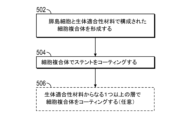
本明細書で述べるバイオ人工移植片は、様々な技術を使用して製造することができる。図5は、いくつかの実施形態に従ってバイオ人工移植片を形成させる方法を示したフローチャートを示す。例えば、生体吸収性であってもよい1種以上の生体適合性材料と細胞を組み合わせることによって、細胞複合体を形成してもよい(502)。特定の実施形態において、生体適合性材料は、アルギン酸塩、PEG、アガロースおよび/またはコラーゲンポリマーを含んでいてもよい。生体適合性ポリマーの溶液(例えば水溶液)と膵島細胞を混合して、スラリーを形成してもよい。いくつかの実施形態において、1種以上の化学薬剤(例えば薬物)および/または膵島細胞以外の細胞をスラリーに加えて、これらの化学薬剤および/または膵島細胞以外の細胞を細胞複合体に組み込む。 The bioartificial grafts described herein can be manufactured using a variety of techniques. FIG. 5 shows a flow chart illustrating a method for forming a bioartificial graft according to some embodiments. For example, a cell composite can be formed (502) by combining cells with one or more biocompatible materials, which may be bioabsorbable. In certain embodiments, the biocompatible materials can include alginate, PEG, agarose, and/or collagen polymers. A solution (e.g., an aqueous solution) of a biocompatible polymer can be mixed with the islet cells to form a slurry. In some embodiments, one or more chemical agents (e.g., drugs) and/or cells other than islet cells are added to the slurry to incorporate the chemical agents and/or cells other than islet cells into the cell composite.
患者の血管内に挿入するように設計された足場(例えばステント)は、細胞複合体でコーティングすることができる(504)。足場は、生体吸収性ポリマーまたは金属ステントなどの、生体吸収性材料および/または生体適合性材料で構成されていてもよい。場合によっては、1種以上の化学薬剤で足場を前処理して、ステントへの細胞複合体の接着を促進する。この化学薬剤は、1種以上のペプチドコーティングを含んでいてもよい。例えば、RGDモチーフ(アルギニン-グリシン-アスパラギン酸からなるペプチド)などの、インテグリン結合モチーフを用いて、足場への細胞の接着を促進することができる。場合によっては、生体適合性材料からなる1つ以上の層で足場をコーティングする。いくつかの実施形態において、患者の体内に留置した際に足場から化学薬剤(例えば薬物)が溶出されるように、足場は1種以上の化学薬剤を含む。1種以上の化学薬剤は、ステントにコーティングされていてもよく、かつ/または足場の材料中に組み込まれていてもよい。様々なコーティング法を使用してもよい。いくつかの実施形態において、液相堆積法、超音波コーティング法、スプレー堆積法、またはこれらの任意の組み合わせを使用して細胞複合体を堆積させる。いくつかの実施形態において、細胞複合体は、溶液(例えば水溶液)として堆積させる。細胞複合体を含む溶液を堆積させた後、ある程度乾燥させてもよい。場合によっては、細胞複合体を含む溶液は、溶液の状態(例えば水分を保ったまま)で維持してもよい。 A scaffold (e.g., a stent) designed for insertion into a patient's blood vessel may be coated with the cell complex (504). The scaffold may be composed of a bioabsorbable and/or biocompatible material, such as a bioabsorbable polymer or a metal stent. Optionally, the scaffold is pretreated with one or more chemical agents to promote adhesion of the cell complex to the stent. The chemical agents may include one or more peptide coatings. For example, an integrin binding motif, such as an RGD motif (a peptide consisting of arginine-glycine-aspartic acid), may be used to promote cell adhesion to the scaffold. Optionally, the scaffold is coated with one or more layers of a biocompatible material. In some embodiments, the scaffold includes one or more chemical agents such that the chemical agents (e.g., drugs) are eluted from the scaffold upon placement in the patient. The one or more chemical agents may be coated on the stent and/or incorporated into the material of the scaffold. Various coating methods may be used. In some embodiments, the cell complex is deposited using liquid deposition, ultrasonic coating, spray deposition, or any combination thereof. In some embodiments, the cell complexes are deposited as a solution (e.g., an aqueous solution). After the solution containing the cell complexes is deposited, it may be allowed to dry to some extent. In some cases, the solution containing the cell complexes may be maintained in solution (e.g., kept wet).
いくつかの実施形態において、足場上に堆積させた細胞複合体は、生体適合性材料からなる1つ以上の層でコーティングしてもよい(506)。生体適合性コーティングは、患者の血流中を流れる血液に暴露されることによって細胞が足場から徐々に削り取られないように、細胞複合体に含まれる細胞を封入する役割を果たし、これと同時に、酸素およびブドウ糖が細胞に到達でき、細胞から老廃物が除去できるように構成されていてもよい。これらの生体適合性コーティングの各層は、非常に薄くてもよく、例えば、約1nm~約1mmであってもよい。生体適合性コーティング全体の厚さは、約1nm~約5mmであってもよい。 In some embodiments, the cell complex deposited on the scaffold may be coated with one or more layers of a biocompatible material (506). The biocompatible coating may serve to encapsulate the cells in the cell complex so that they are not gradually scraped off the scaffold by exposure to blood flowing in the patient's bloodstream, while at the same time allowing oxygen and glucose to reach the cells and waste products to be removed from the cells. Each layer of these biocompatible coatings may be very thin, for example, from about 1 nm to about 1 mm. The total thickness of the biocompatible coating may be from about 1 nm to about 5 mm.
図6A~図9は、バイオ人工膵臓600の一実施形態を示す。膵島と生体適合性材料から構成された細胞複合体602は、細胞複合体支持体606のポケット604内に配置される。いくつかの実施形態において、細胞複合体602における膵島の密度は、2.5%~100%であってもよく、12%~30%であってもよい。細胞複合体602における膵島の密度が100%未満である実施形態では、多孔質媒体が残りの割合を占めてもよく、この多孔質媒体としては、例えば、アルギン酸塩、アガロース、PEG、キトサンなどのうちの1種以上が挙げられる。
Figures 6A-9 show one embodiment of a bioartificial pancreas 600. A
バイオ人工膵臓が血管内に移植された際に膵島の生存を維持し、かつ血糖値に応答してインスリンを放出することができるように、バイオ人工膵臓内を流れる血液(恐らくは血管壁内の栄養血管の毛細血管網からの血液)から供給される酸素とブドウ糖をバイオ人工膵臓内の膵島に到達させなければならない。血糖値が高いほど、膵島による酸素消費量は多くなる。したがって、本発明のバイオ人工膵臓移植片は、膵島の生存を維持するのに十分な速度で、血流から酸素とブドウ糖が細胞複合体の内部へと拡散可能な構造を備える。また、本発明のバイオ人工膵臓移植片の細胞複合体内の膵島の密度は、膵島に到達する酸素濃度で支持可能な膵島密度を超えず、かつ細胞複合体内の膵島に到達したブドウ糖に応答して十分な量のインスリンを供給することが可能な膵島密度である。本明細書に記載の実施形態において、最低濃度0.05mMの酸素が細胞複合体支持体を通過して細胞複合体内のすべての膵島に行き渡る。 In order to maintain the survival of the islets when the bioartificial pancreas is implanted in a blood vessel and release insulin in response to blood glucose levels, oxygen and glucose supplied from the blood flowing through the bioartificial pancreas (presumably blood from the capillary network of nutrient blood vessels in the blood vessel wall) must reach the islets in the bioartificial pancreas. The higher the blood glucose level, the greater the oxygen consumption by the islets. Thus, the bioartificial pancreas graft of the present invention has a structure that allows oxygen and glucose to diffuse from the bloodstream into the interior of the cell complex at a rate sufficient to maintain the survival of the islets. In addition, the density of the islets in the cell complex of the bioartificial pancreas graft of the present invention is an islet density that does not exceed the islet density that can be supported by the oxygen concentration reaching the islets, and is an islet density that can supply a sufficient amount of insulin in response to glucose reaching the islets in the cell complex. In the embodiment described herein, a minimum concentration of 0.05 mM oxygen passes through the cell complex support to reach all the islets in the cell complex.
この実施形態において、細胞複合体支持体606は、ポケット604の境界を規定する2つの微多孔質薄膜層608,610を備える。微多孔質薄膜層608と微多孔質薄膜層610は、細胞複合体支持体602の外縁と各ポケット604間の接合領域612において互いに接合されている。細胞複合体602は各ポケット604内に配置される。いくつかの実施形態において、各微多孔質薄膜層の厚さは0.1mm未満である。いくつかの実施形態において、足場を通って流れる血液中のブドウ糖と酸素が、膵島の生存を維持するのに十分な速度でポケット604内に侵入して細胞複合体602に到達することができ、かつ細胞複合体内の膵島により産生されたインスリンが血流に到達できるように、微多孔質薄膜層の細孔の直径は100μm未満であってもよい。また、微多孔質薄膜層の細孔は、バイオ人工膵臓600が移植された血管の栄養毛細血管からブドウ糖および/または酸素が細胞複合体に到達できるように構成されていてもよい。血管内にバイオ人工膵臓を留置することによって、その血管内で栄養毛細血管網の血管新生が起こってもよい。いくつかの実施形態において、図6Bに示すように、構築された細胞複合体支持体の厚さTは、0.30mm~1.0mmであってもよい。
In this embodiment, the
本発明の実施形態において、細胞複合体支持体606が備える2つの微多孔質薄膜層608,610は、ePTFE、親水性ePTFE、ナイロン、ポリエチレン、PEEKなどのポリマーで構成されていてもよい。微多孔質薄膜層608の上面において、微多孔質薄膜層608の外縁618の全周と接合領域612部位に接着剤(例えばFEPやポリウレタンなど)を塗布し、微多孔質薄膜層608と微多孔質薄膜層610を熱接着してもよい。細管620(例えば、直径が300~500μmのポリエチレン管)を、各ポケット604部位の微多孔質薄膜層608の上面に配置してもよい。図7に示すように、各細管620はポケットの一端において開放端を有し、各細管620の一部が微多孔質薄膜層608の境界を超えて延びている。次に、第2の微多孔質薄膜層610の底面を微多孔質薄膜層608の上面に載せて、第2の微多孔質薄膜層610を細管620上に覆い被せてもよい。次に、オーブンまたはシール装置を用いて2枚の微多孔質薄膜層と接着剤を(例えば200°F~500°Fに)加熱することにより、接合領域612と細胞複合体支持体606の外縁618において微多孔質薄膜層を互いに熱接着してもよい。
In an embodiment of the present invention, the two microporous thin film layers 608, 610 of the
別の実施形態では、接着剤を使用せずに、微多孔質薄膜層608,610を構成するポリマーの融点が十分に低いことを利用して微多孔質薄膜層608,610同士を接合する。接合領域612および/または外縁618において、微多孔質薄膜層608の底面と微多孔質薄膜層610の上面に熱を加えることによって、微多孔質薄膜層608,610を構成するポリマーを局所的に溶解させる。次に、ポリマーが再凝固して、接合領域612および/または外縁618において溶着部が形成される。
In another embodiment, the microporous thin film layers 608, 610 are bonded together without the use of adhesives, taking advantage of the fact that the polymers that make up the microporous thin film layers 608, 610 have sufficiently low melting points. The polymers that make up the microporous thin film layers 608, 610 are locally melted by applying heat to the bottom surface of the microporous
細胞複合体602と細胞複合体支持体606を製造する方法の1つとして、微多孔質ヒドロゲル(例えば、アルギン酸塩、フィブリン、キトサン、アガロース、ポリエチレングリコール)と膵島を37℃で混合して膵島密度を12%~30%とし、ポリマー架橋剤を加えてヒドロゲルを硬化させることによって、膵島を保護するための物理的安定性を高めてもよい。ハミルトンシリンジを用いて、細管620を通して細胞複合体をポケット604内に注入してもよい。細胞複合体を注入しながら、各ポケット604から各細管620を徐々に引き抜くことにより、各ポケット内に細胞複合体が均一に分布されるようにしてもよい。細胞複合体の注入が完了し、各ポケット604から各細管620を引き抜いたら、前述の方法で各ポケット604の外縁をヒートシールすることにより各ポケットを密閉し、細胞複合体の漏れを防いでもよい。各ポケット604をヒートシールした後、細胞複合体支持体を室温(すなわち4℃)で冷却してもよい。細胞複合体支持体606への細胞複合体602の注入は、足場に細胞複合体支持体を接合する前に行ってもよく、足場に細胞複合体支持体を接合した後に行ってもよい。
In one method of producing the
バイオ人工膵臓600は、下行大動脈などの血管の内壁に嵌合できるように、円筒体として構成してもよく、またはその一部を円筒体として構成してもよい。図8および図9は、説明を目的として、足場614および細胞複合体支持体606を平面状に示したものである。この実施形態において、足場614は、その内部に空洞を持つ円筒状のメッシュステントである。足場614は、例えば、ニチノールなどの形状記憶合金で形成してもよく、生体吸収性材料で形成してもよい。足場614は、圧縮して患者の血管内(下行大動脈など)に送達することができ、(例えば自己拡張により)拡張して患者の血管内に展開することができる。細胞複合体支持体606の接合領域612および/または外縁618は、熱接着、圧着、縫合、接着剤、またはその他の適切な接合機構によって、足場614のフィラメント616に接合することができる。この実施形態において、細胞複合体支持体606は、実質的に足場の内部空洞全体を取り囲んでいる。別の実施形態において、細胞複合体支持体は、足場の内部空洞の一部のみの境界を規定している。
The bioartificial pancreas 600 may be configured as a cylinder, or a portion of the body may be configured as a cylinder, so as to fit into the inner wall of a blood vessel, such as the descending aorta. For illustrative purposes, FIGS. 8 and 9 show the
いくつかの実施形態において、一方または両方の微多孔質薄膜層は、その外表面に、ヒドロゲル、ヘパリン、成長因子(例えば、VEGFやVEGAなど)および免疫療法剤(例えば、シロリムスやタクロリムスなど)のうちの1種以上を備えていてもよい。 In some embodiments, one or both microporous thin film layers may have one or more of the following on their outer surface: hydrogel, heparin, growth factors (e.g., VEGF, VEGA, etc.), and immunotherapeutic agents (e.g., sirolimus, tacrolimus, etc.).
本発明のバイオ人工膵臓は、カテーテルを通して腎動脈下大動脈などの血管内の所望の移植部位に送達してもよい。送達形態のバイオ人工膵臓の直径は小さくてもよく、展開形態のバイオ人工膵臓の直径は大きくてもよい。送達形態のバイオ人工膵臓の直径は1~10mmであってもよく、展開形態のバイオ人工膵臓の直径は5mm~25mmであってもよい。 The bioartificial pancreas of the present invention may be delivered to a desired implantation site in a blood vessel, such as the infrarenal aorta, through a catheter. The diameter of the bioartificial pancreas in the delivered form may be small, and the diameter of the bioartificial pancreas in the deployed form may be large. The diameter of the bioartificial pancreas in the delivered form may be 1-10 mm, and the diameter of the bioartificial pancreas in the deployed form may be 5 mm-25 mm.
図10A~Bは、本発明の一実施形態によるバイオ人工膵臓700の送達形態および展開形態を示す。前述の実施形態と同様に、バイオ人工膵臓700は、足場714に接合された細胞複合体支持体706を備える。細胞複合体(例えば、前述した膵島と微多孔質ヒドロゲルからなる細胞複合体)を細胞複合体支持体706内に担持させる。図10Aに示すように、バイオ人工膵臓700は、直径が小さくなった送達形態で送達カテーテル730内に装着され、このとき、細胞複合体を含むポケット704は半径方向内向きに延びており、接合領域712は足場714に接合された状態のままである。足場714の外表面(例えば、足場のストラット734など)は、カテーテル730の内面の突出部732に係合されている。血管736内の所望の移植部位において、カテーテルの遠位端からバイオ人工膵臓700が押し出されると、足場714が自己拡張し、各ポケット704が半径方向外向きに移動する。図10A~Bは、必ずしも正確な寸法ではない。
10A-B show a delivery and deployment configuration of a
図11A~Bは、本発明の別の一実施形態によるバイオ人工膵臓800の送達形態および展開形態を示す。前述の実施形態と同様に、バイオ人工膵臓800は、足場814に接合された細胞複合体支持体806を備える。細胞複合体(例えば、前述した膵島と微多孔質ヒドロゲルからなる細胞複合体)を細胞複合体支持体806内に担持させる。この実施形態では、他の実施形態と比べて、細胞複合体支持体806により覆われている足場814の内表面の面積が小さく、足場814は、閉じた円筒形でなく、開放端838と開放端840を有している。図11Aに示すように、バイオ人工膵臓800は、足場814が螺旋状に巻かれて直径が小さくなった送達形態で送達カテーテル830内に装着されている。血管836内の所望の移植部位においてカテーテルの遠位端からバイオ人工膵臓800が押し出されると、螺旋状に巻かれた足場814がほどけて自己拡張する。図11Bは、足場814がほどけて、開放端同士が実質的に対向している状態を示す。しかしながら、血管836の直径に応じて、足場814の開放端838と開放端840は離れて配置されて、側面が閉じていない円筒形または細管を形作ってもよく、あるいは、開放端838と開放端840が一部重なって一部が螺旋状になっていてもよい。図11A~Bは、必ずしも正確な寸法ではない。
11A-B show a delivery and deployment configuration of a
図12A~Bは、本発明のさらに別の一実施形態によるバイオ人工膵臓900の送達形態および展開形態を示す。前述の実施形態と同様に、バイオ人工膵臓900は、足場914に接合された細胞複合体支持体906を備える。細胞複合体(例えば、前述した膵島と微多孔質ヒドロゲルからなる細胞複合体)を細胞複合体支持体906内に担持させる。図12Aに示すように、バイオ人工膵臓900は、細胞複合体支持体906と足場914が半径方向内向きに折りたたまれた部分938を形成することにより直径が小さくなった送達形態で送達カテーテル930内に装着されている。血管936内の所望の移植部位においてカテーテルの遠位端からバイオ人工膵臓900が押し出されると、図12Bに示すように、足場914が自己拡張して、折りたたまれた部分938が実質的になくなる。図12A~Bは、必ずしも正確な寸法ではない。
12A-B show a delivery and deployment configuration of a
いくつかの実施形態において、本発明のステントおよび/または細胞複合体は、三次元(3D)プリンティングを使用して製造される。場合によっては、本発明のステントおよび/または細胞複合体を含む移植片の全体が、三次元(3D)プリンティングを使用して製造される。 In some embodiments, the stents and/or cell complexes of the present invention are manufactured using three-dimensional (3D) printing. In some cases, the entire graft including the stents and/or cell complexes of the present invention is manufactured using three-dimensional (3D) printing.
本明細書において、特定の特徴または構成要素が、別の特徴または構成要素に「基づく」とされる場合、この特定の特徴または構成要素は、この別の特徴または構成要素に直接基づいていてもよく、中間的な特徴および/または構成要素が存在していてもよい。これに対して、特定の特徴または構成要素が、別の特徴または構成要素に「直接基づく」とされる場合、中間的な特徴や構成要素は存在しない。また、特定の特徴または構成要素が、別の特徴もしくは構成要素と「関連性があるもの」、別の特徴もしくは構成要素に「追加されたもの」、または別の特徴もしくは構成要素に「組み合わせたもの」である場合、この特定の特徴または構成要素は、この別の特徴または構成要素と直接関連性があってもよく、この別の特徴または構成要素に直接追加されたものであってもよく、この別の特徴または構成要素に直接組み合わせたものであってもよく、あるいは中間的な特徴または構成要素が存在していてもよい。これに対して、特定の特徴または構成要素が、別の特徴もしくは構成要素と「直接関連性があるもの」、別の特徴もしくは構成要素に「直接追加されたもの」、または別の特徴もしくは構成要素に「直接組み合わせたもの」であるとされる場合、中間的な特徴や構成要素は存在しない。本明細書において、一実施形態を参照しながら特定の特徴および構成要素について説明または提示してきたが、これらの特徴および構成要素は、別の実施形態にも適用することができる。当業者であれば、別の特徴に「関連して」述べられた構造または特徴に関する説明が、この関連する特徴と一部重複した部分や、この関連する特徴の基礎となる部分を含んでいてもよいことは十分に理解できるであろう。 In this specification, when a particular feature or component is said to be "based on" another feature or component, the particular feature or component may be directly based on the other feature or component, or intermediate features and/or components may be present. In contrast, when a particular feature or component is said to be "directly based on" another feature or component, there are no intermediate features or components. In addition, when a particular feature or component is said to be "related to", "added to", or "combined with" another feature or component, the particular feature or component may be directly related to, directly added to, or directly combined with the other feature or component, or intermediate features or components may be present. In contrast, when a particular feature or component is said to be "directly related to", "directly added to", or "directly combined with" another feature or component, there are no intermediate features or components. Although certain features and components have been described or presented herein with reference to one embodiment, these features and components may also be applicable to other embodiments. Those skilled in the art will appreciate that a description of a structure or feature described "in relation to" another feature may include some overlap with or underlying the related feature.
本明細書において使用された用語は、特定の実施形態を説明することのみを目的としており、本発明を限定するものではない。例えば、本明細書において、単数形の「a」、「an」および「the」は、別段の明確な記載がない限り複数のものも含む。また、本明細書において、「含む(comprises)」および/または「含んでいる(comprising)」という用語は、本明細書に記載の特徴、工程、操作、構成要素および/または成分の存在を特定するものであるが、1つ以上の別の特徴、工程、操作、構成要素、成分および/またはこれらの群の存在や追加を除外するものではない。本明細書において、「および/または」という用語は、先に挙げた関連する1つ以上の項目のあらゆる組み合わせを含み、「/」と略記してもよい。 The terms used herein are for the purpose of describing particular embodiments only and are not intended to be limiting. For example, the singular forms "a," "an," and "the" are intended to include the plural unless expressly stated otherwise. Also, the terms "comprises" and/or "comprising" are intended to specify the presence of features, steps, operations, components, and/or ingredients described herein, but do not exclude the presence or addition of one or more other features, steps, operations, components, ingredients, and/or groups thereof. As used herein, the term "and/or" includes any combination of one or more of the associated items listed above and may be abbreviated as "/".
本明細書において、「~の下」、「~の下方」、「~よりも下方」、「~の上」、「~の上方」などの空間的関係を表す用語は、図面に示すような、1つの構成要素または特徴と別の構成要素または特徴との関係性に関する説明を容易にするために使用されることがある。このような空間的関係を表す用語は、使用時または操作時の図示した装置の方向に加えて、この装置の様々な方向を包含する。例えば、別の構成要素または特徴に対して「下」または「下方」として図示された構成要素は、図面中の装置を上下逆さにした場合、この別の構成要素または特徴に対して「上方」に位置することになる。したがって、「~の下」という代表的な用語は、「上方」と「下方」の両方の方向を包含していてもよい。また、図面に記載の装置は別の方向に配置してもよく(90度回転してもよく、その他の方向であってもよい)、これに応じて、本明細書において使用される空間的関係を示す用語が解釈される。同様に、「上方向」「下方向」、「垂直」、「水平」などの用語も、別段の記載がない限り、本明細書において説明のみを目的として使用される。 In this specification, spatial terms such as "below," "below," "belower than," "above," and the like, may be used to facilitate the description of the relationship of one component or feature to another, as illustrated in the drawings. Such spatial terms encompass various orientations of the device in addition to the orientation of the device as illustrated in use or operation. For example, a component illustrated as "below" or "below" another component or feature would be "above" the other component or feature if the device in the drawings were inverted. Thus, the representative term "below" may encompass both an orientation of "above" and "below." Additionally, the devices depicted in the drawings may be oriented in other ways (rotated 90 degrees or at other orientations) and the spatial terms used herein interpreted accordingly. Similarly, terms such as "upward," "downward," "vertical," "horizontal," and the like, are used herein for descriptive purposes only, unless otherwise noted.
本明細書において、様々な特徴/構成要素(工程を含む)を説明するために、「第1」や「第2」という用語が使用される場合があるが、別段の記載がない限り、これらの特徴/構成要素はこれらの用語に限定されない。これらの用語は、1つの特徴/構成要素を、別の特徴/構成要素と区別するために使用してもよい。したがって、本発明の教示から逸脱することなく、以下に記載の第1の特徴/構成要素を第2の特徴/構成要素と呼んでもよく、これと同様に、以下に記載の第2の特徴/構成要素を第1の特徴/構成要素と呼んでもよい。 In this specification, the terms "first" and "second" may be used to describe various features/components (including steps), but unless otherwise stated, these features/components are not limited to these terms. These terms may be used to distinguish one feature/component from another feature/component. Thus, a first feature/component described below may be referred to as a second feature/component, and similarly, a second feature/component described below may be referred to as a first feature/component, without departing from the teachings of the present invention.
本明細書および後述の請求項において、別段の記載がない限り、「含む(comprise)」という用語、ならびにこの変化形である「含む(comprises)」および「含んでいる(comprising)」という用語は、本発明の方法および物(例えば、組成物、装置を含む機器、方法など)において様々な構成要素を組み合わせて使用できることを意味する。例えば、「含む」という用語は、本明細書に記載の構成要素または工程のいずれかを含むことを示唆しているが、その他の構成要素や工程を除外するものではない。 In this specification and in the claims that follow, unless otherwise indicated, the term "comprise," and its variants "comprises" and "comprising," means that various components can be used in combination in the methods and articles of the invention (e.g., compositions, devices including apparatus, methods, etc.). For example, the term "comprise" suggests the inclusion of any of the components or steps described herein, but does not exclude other components or steps.
概して、本明細書に記載の装置および方法は包括的なものであるが、すべての構成要素および/もしくは工程、または構成要素のサブセットおよび/もしくは工程のサブセットは排他的なものであってもよく、様々な構成要素、工程、副構成要素または副工程「からなる」と表現してもよく、あるいは様々な構成要素、工程、副構成要素または副工程「から実質的になる」と表現してもよい。 Generally, the apparatus and methods described herein are inclusive, although all components and/or steps, or a subset of components and/or steps, may be exclusive and may be expressed as "consisting of" or "consisting essentially of" the various components, steps, subcomponents, or substeps.
別段の記載がない限り、本明細書(実施例を含む)および請求項に記載のあらゆる数値は、明確な記載がなくとも、「約」または「程度」という用語で修飾されているものとして解釈してもよい。「約」または「程度」という用語は、本明細書に記載の数値および/またはレベルが、妥当な想定範囲内にあることを示す場合に使用してもよい。例えば、数値は、本明細書に記載の数値(または数値範囲)の±0.1%の範囲内の数値、本明細書に記載の数値(または数値範囲)の±1%の範囲内の数値、本明細書に記載の数値(または数値範囲)の±2%の範囲内の数値、本明細書に記載の数値(または数値範囲)の±5%の範囲内の数値、本明細書に記載の数値(または数値範囲)の±10%の範囲内の数値などであってもよい。別段の記載がない限り、本明細書に記載の数値はいずれもその数値のおおよその数値を含むと解釈すべきである。例えば、「10」という数値が開示されている場合、「約10」という数値も開示されている。本明細書に記載のあらゆる数値範囲は、その数値範囲の一部に含まれるあらゆる部分範囲を含む。また、当業者であれば容易に理解できるように、特定の数値が開示されている場合、「その数値以下」、「その数値以上」およびそれらの数値の間で設定可能な数値範囲も開示されている。例えば、「X」という数値が開示されている場合(例えば、Xが数値である場合)、「X以下」や「X以上」といった数値も開示されている。また、本出願の全体を通して、様々な形式でデータが提供されているが、これらのデータは、上限値および下限値を示すとともに、データ点の任意の組み合わせを示す範囲を示す。例えば、「10」という特定のデータ点と「15」という別の特定のデータ点が開示されている場合、10よりも大きい数値、10以上の数値、10未満の数値、10以下の数値、10と等しい数値、15よりも大きい数値、15以上の数値、15未満の数値、15以下の数値、15と等しい数値も開示されており、10~15という範囲も開示されている。また、特定の2つの単位の間の各単位も開示されている。例えば、「10」および「15」という数値が開示されている場合、11、12、13および14という数値も開示されている。 Unless otherwise stated, any numerical value in this specification (including the examples) and claims may be interpreted as being modified by the term "about" or "to the extent of" even if not expressly stated. The term "about" or "to the extent of" may be used to indicate that the numerical value and/or level described herein is within a reasonable expected range. For example, a numerical value may be within ±0.1% of the numerical value (or numerical range) described herein, within ±1% of the numerical value (or numerical range) described herein, within ±2% of the numerical value (or numerical range) described herein, within ±5% of the numerical value (or numerical range) described herein, within ±10% of the numerical value (or numerical range) described herein, etc. Unless otherwise stated, any numerical value described herein should be interpreted as including an approximation of that numerical value. For example, if the numerical value "10" is disclosed, the numerical value "about 10" is also disclosed. Any numerical range described herein includes any subranges within a portion of that numerical range. Also, as can be easily understood by those skilled in the art, when a specific numerical value is disclosed, "less than or equal to that numerical value," "more than or equal to that numerical value," and a range that can be set between those numerical values are also disclosed. For example, when a numerical value "X" is disclosed (e.g., when X is a numerical value), numerical values such as "less than or equal to X" and "more than or equal to X" are also disclosed. Also, data is provided throughout this application in various formats, and these data indicate upper and lower limits as well as ranges that indicate any combination of data points. For example, when a specific data point "10" and another specific data point "15" are disclosed, numerical values greater than 10, greater than or equal to 10, less than 10, less than or equal to 10, greater than 15, greater than or equal to 15, less than 15, less than or equal to 15, and equal to 15 are also disclosed, and a range of 10 to 15 is also disclosed. Also, each unit between two specific units is disclosed. For example, when the numerical values "10" and "15" are disclosed, the numerical values 11, 12, 13, and 14 are also disclosed.
一例として様々な実施形態を説明してきたが、請求項に記載の本発明の範囲から逸脱することなく、様々な実施形態において様々な変更を行ってもよい。例えば、前述の方法において様々な工程を実施する順序は、別の実施形態では変更されることが多くてもよく、さらに別の実施形態では、前述の方法の1つ以上の工程をまとめて省略してもよい。様々な装置およびシステムの実施形態の任意の特徴が、いくつかの実施形態に含まれていてもよく、別のいくつかの実施形態には含まれていなくてもよい。したがって、前述の説明は、主に典型的な目的に対して提供されたものであり、請求項で規定される本発明の範囲を限定するものとして解釈すべきではない。 Although various embodiments have been described by way of example, various changes may be made in the various embodiments without departing from the scope of the invention as set forth in the claims. For example, the order in which the various steps in the methods described above are performed may often be changed in other embodiments, and in yet other embodiments, one or more steps of the methods may be omitted altogether. Any feature of the various apparatus and system embodiments may be included in some embodiments and not included in other embodiments. Thus, the foregoing description has been provided primarily for exemplary purposes and should not be construed as limiting the scope of the invention as defined in the claims.
本明細書に記載の例示および実例は、本発明の主題が実施されうる特定の実施形態を説明することのみを目的として示されており、本発明を限定するものではない。本明細書で述べるように、本開示の範囲から逸脱することなく、構造的かつ論理的な置換および変更を行えるように、その他の実施形態を利用してもよく、本明細書の記載からその他の実施形態を派生させてもよい。本明細書において、このような進歩的な主題の実施形態は、実際に2つ以上の実施形態が開示されている場合、便宜上、個別にあるいはまとめて単に「発明」と呼んでもよいが、本願の範囲を1つの発明または1つの発明概念に自発的に限定するものではない。したがって、本明細書において特定の実施形態が例示および記載されていたとしても、本明細書に記載の特定の実施形態を、同じ目的を達成できると見込まれる別の構成で置き換えてもよい。本開示は、様々な実施形態のあらゆる適用例または変形例を包含する。前述の説明を精査した当業者であれば、前述の実施形態の組み合わせ、および本明細書に具体的に記載されていないその他の実施形態を容易に理解できるであろう。 The illustrations and examples described herein are provided only for the purpose of illustrating specific embodiments in which the subject matter of the present invention may be practiced, and are not intended to limit the present invention. As described herein, other embodiments may be utilized and derived from the description herein, allowing for structural and logical substitutions and changes without departing from the scope of the present disclosure. In this specification, the embodiments of such inventive subject matter may be referred to simply as "inventions" individually or collectively for convenience, when in fact more than one embodiment is disclosed, but without intentionally limiting the scope of this application to one invention or one inventive concept. Thus, even if a specific embodiment is illustrated and described herein, the specific embodiment described herein may be replaced with another configuration that is expected to achieve the same purpose. The present disclosure encompasses any application or modification of the various embodiments. A person skilled in the art reviewing the foregoing description will readily recognize combinations of the foregoing embodiments, as well as other embodiments not specifically described herein.
Claims (11)
対象の血管の内壁に嵌合するように構成された足場と、
前記足場により支持された細胞複合体支持体と
を含み、
前記足場が、その内部空洞を長手方向に貫通して延びる血流内腔を備えることにより、該足場が血管に嵌合した際に、該内腔を通って血液が流れること、
前記細胞複合体支持体が、前記足場の内部空洞内を長手方向に延びることにより、前記足場が血管に嵌合した際に、該細胞複合体支持体が血流に暴露されること、
前記細胞複合体支持体が、密閉された複数のポケットと、複数の接合領域とを備え、該接合領域が前記足場に接合されていること、
前記密閉されたポケット内に、膵島を含む細胞複合体が配置されていること、
前記細胞複合体支持体が、前記ポケットの境界を規定する2つの微多孔質薄膜層を備えること、および
前記細胞複合体支持体が、血流から栄養素を前記密閉されたポケット内へと拡散させるよう構成されていること
を特徴とするバイオ人工膵臓。 1. A bioartificial pancreas, comprising:
a scaffold configured to engage an interior wall of a blood vessel of a subject;
A cell complex support supported by the scaffold,
the scaffold comprises a blood flow lumen extending longitudinally through an internal cavity thereof, such that blood flows through the lumen when the scaffold is engaged with a blood vessel;
The cell complex support extends longitudinally within an internal cavity of the scaffold, thereby exposing the cell complex support to blood flow when the scaffold engages with a blood vessel;
the cell complex support comprises a plurality of enclosed pockets and a plurality of bonding regions, the bonding regions being bonded to the scaffold;
A cell complex including a pancreatic islet is disposed in the sealed pocket;
the cell complex support comprises two microporous thin film layers defining the boundaries of the pocket; and the cell complex support is configured to allow nutrients to diffuse from the bloodstream into the sealed pocket.
Applications Claiming Priority (3)
| Application Number | Priority Date | Filing Date | Title |
|---|---|---|---|
| US201962907434P | 2019-09-27 | 2019-09-27 | |
| US62/907,434 | 2019-09-27 | ||
| PCT/US2020/052432 WO2021061940A1 (en) | 2019-09-27 | 2020-09-24 | Bioartificial pancreas |
Publications (3)
| Publication Number | Publication Date |
|---|---|
| JP2022550537A JP2022550537A (en) | 2022-12-02 |
| JPWO2021061940A5 JPWO2021061940A5 (en) | 2023-09-29 |
| JP7625186B2 true JP7625186B2 (en) | 2025-02-03 |
Family
ID=75163726
Family Applications (1)
| Application Number | Title | Priority Date | Filing Date |
|---|---|---|---|
| JP2022519479A Active JP7625186B2 (en) | 2019-09-27 | 2020-09-24 | Bioartificial Pancreas |
Country Status (9)
| Country | Link |
|---|---|
| US (5) | US20210093435A1 (en) |
| EP (1) | EP4034174A4 (en) |
| JP (1) | JP7625186B2 (en) |
| KR (1) | KR20220070474A (en) |
| CN (1) | CN114728083B (en) |
| AU (1) | AU2020352623A1 (en) |
| CA (1) | CA3155905A1 (en) |
| IL (1) | IL291624B2 (en) |
| WO (1) | WO2021061940A1 (en) |
Families Citing this family (3)
| Publication number | Priority date | Publication date | Assignee | Title |
|---|---|---|---|---|
| JP2024530690A (en) * | 2021-08-10 | 2024-08-23 | ユニフェルシテイト マーストリヒト | Open implantable cell delivery device |
| US20240358494A1 (en) * | 2021-08-31 | 2024-10-31 | Universität Heidelberg | Perivascular implant |
| CA3264527A1 (en) * | 2022-08-09 | 2024-02-15 | The General Hospital Corporation | Endovascular biologic stent |
Citations (5)
| Publication number | Priority date | Publication date | Assignee | Title |
|---|---|---|---|---|
| JP2004275718A (en) | 2003-02-26 | 2004-10-07 | Kuraray Medical Inc | Module for bionic artificial pancreas and bionic artificial pancreas |
| JP2006514848A (en) | 2002-11-13 | 2006-05-18 | セタゴン インコーポレーティッド | Medical device having porous layer and method for producing the same |
| US20090105811A1 (en) | 2007-10-18 | 2009-04-23 | Medtronic, Inc. | Intravascular Devices for Cell-Based Therapies |
| JP2013503014A (en) | 2009-08-28 | 2013-01-31 | セルノバ コーポレイション | Methods and devices for cell transplantation |
| WO2018155622A1 (en) | 2017-02-23 | 2018-08-30 | 日本酢ビ・ポバール株式会社 | Cell- or tissue-embedding device |
Family Cites Families (58)
| Publication number | Priority date | Publication date | Assignee | Title |
|---|---|---|---|---|
| DE439468C (en) | 1923-12-11 | 1927-01-13 | Esslingen Maschf | Arrangement of the power cylinders and the compressor cylinders in diesel locomotives |
| US4281669A (en) | 1975-05-09 | 1981-08-04 | Macgregor David C | Pacemaker electrode with porous system |
| CA1085104A (en) | 1977-03-21 | 1980-09-09 | Anthony M. Sun | Artificial endocrine pancreas |
| US4378016A (en) | 1981-07-15 | 1983-03-29 | Biotek, Inc. | Artificial endocrine gland containing hormone-producing cells |
| US4402694A (en) | 1981-07-16 | 1983-09-06 | Biotek, Inc. | Body cavity access device containing a hormone source |
| WO1983003536A1 (en) | 1982-04-19 | 1983-10-27 | Massachusetts Inst Technology | A multilayer bioreplaceable blood vessel prosthesis |
| FR2531333B1 (en) | 1982-08-09 | 1986-04-04 | Centre Nat Rech Scient | BIO-ARTIFICIAL PANCREAS WITH ULTRAFILTRATION |
| US4689293A (en) | 1983-06-06 | 1987-08-25 | Connaught Laboratories Limited | Microencapsulation of living tissue and cells |
| US4997443A (en) | 1985-08-26 | 1991-03-05 | Hana Biologics, Inc. | Transplantable artificial tissue and process |
| CA1340581C (en) * | 1986-11-20 | 1999-06-08 | Joseph P. Vacanti | Chimeric neomorphogenesis of organs by controlled cellular implantation using artificial matrices |
| US4911717A (en) | 1987-06-18 | 1990-03-27 | Gaskill Iii Harold V | Intravasular artificial organ |
| US5182111A (en) | 1987-11-17 | 1993-01-26 | Boston University Research Foundation | In vivo delivery of active factors by co-cultured cell implants |
| US4867066A (en) | 1988-10-21 | 1989-09-19 | Olin Corporation | Shotshell casing with reduced volume basewad and increased interior volume for larger shot loads |
| US5002661A (en) * | 1989-08-25 | 1991-03-26 | W. R. Grace & Co.-Conn. | Artificial pancreatic perfusion device |
| US5116494A (en) | 1989-08-25 | 1992-05-26 | W. R. Grace & Co.-Conn. | Artificial pancreatic perfusion device with temperature sensitive matrix |
| US5545223A (en) | 1990-10-31 | 1996-08-13 | Baxter International, Inc. | Ported tissue implant systems and methods of using same |
| US5314471A (en) | 1991-07-24 | 1994-05-24 | Baxter International Inc. | Tissue inplant systems and methods for sustaining viable high cell densities within a host |
| JPH04292169A (en) * | 1991-03-19 | 1992-10-16 | Sekisui Chem Co Ltd | Hybrid type artificial pancreas |
| US5453278A (en) | 1991-07-24 | 1995-09-26 | Baxter International Inc. | Laminated barriers for tissue implants |
| US5387237A (en) | 1992-07-30 | 1995-02-07 | The University Of Toledo | Bioartificial pancreas |
| US5425764A (en) * | 1992-07-30 | 1995-06-20 | The University Of Toledo | Bioartificial pancreas |
| US5262055A (en) | 1992-10-19 | 1993-11-16 | The University Of Utah | Implantable and refillable biohybrid artificial pancreas |
| GB9311784D0 (en) | 1993-06-08 | 1993-07-28 | Univ Alberta | Vascular bioartificial organ |
| US5704910A (en) | 1995-06-05 | 1998-01-06 | Nephros Therapeutics, Inc. | Implantable device and use therefor |
| US5626561A (en) | 1995-06-07 | 1997-05-06 | Gore Hybrid Technologies, Inc. | Implantable containment apparatus for a therapeutical device and method for loading and reloading the device therein |
| US5741334A (en) | 1995-06-07 | 1998-04-21 | Circe Biomedical, Inc. | Artificial pancreatic perfusion device |
| CA2190628C (en) | 1995-06-07 | 2000-05-30 | Mark D. Butler | An implantable containment apparatus for a therapeutical device and method for loading and reloading the device therein |
| US5702444A (en) | 1995-09-11 | 1997-12-30 | Struthers, Mehta And Maxwell | Implantable artificial endocrine pancreas |
| US5855613A (en) | 1995-10-13 | 1999-01-05 | Islet Sheet Medical, Inc. | Retrievable bioartificial implants having dimensions allowing rapid diffusion of oxygen and rapid biological response to physiological change |
| CA2218623A1 (en) * | 1996-02-23 | 1997-08-28 | Circe Biomedical, Inc. | Novel artificial pancreas |
| US6206914B1 (en) | 1998-04-30 | 2001-03-27 | Medtronic, Inc. | Implantable system with drug-eluting cells for on-demand local drug delivery |
| US6716445B2 (en) | 1999-04-12 | 2004-04-06 | Cornell Research Foundation, Inc. | Hydrogel entrapping therapeutic agent and stent with coating comprising this |
| AU2001283055A1 (en) | 2000-07-28 | 2002-02-13 | Emory University | Biological component comprising artificial membrane |
| US7651696B2 (en) | 2000-08-25 | 2010-01-26 | Nexeon Medical Systems, Inc. | Implantable device for treating disease states and methods of using same |
| US20040220660A1 (en) | 2001-02-05 | 2004-11-04 | Shanley John F. | Bioresorbable stent with beneficial agent reservoirs |
| US6582955B2 (en) | 2001-05-11 | 2003-06-24 | Spectrum Laboratories, Inc. | Bioreactor with application as blood therapy device |
| US20060121080A1 (en) | 2002-11-13 | 2006-06-08 | Lye Whye K | Medical devices having nanoporous layers and methods for making the same |
| US9770349B2 (en) | 2002-11-13 | 2017-09-26 | University Of Virginia Patent Foundation | Nanoporous stents with enhanced cellular adhesion and reduced neointimal formation |
| US7044965B1 (en) | 2002-12-13 | 2006-05-16 | Spielberg Theodore E | Therapeutic cellular stent |
| AU2004244962A1 (en) | 2003-04-10 | 2004-12-16 | 3M Innovative Properties Company | Delivery of immune response modifier compounds using metal-containing particulate support materials |
| SE526959C2 (en) | 2003-10-02 | 2005-11-29 | Tikomed Ab | Bioartificial implant comprising a semipermeable barrier and a method for reducing the risk of connective tissue formation in the implant after implantation by providing the barrier with a permeable coating of bioactive metal |
| US20050255230A1 (en) | 2004-05-17 | 2005-11-17 | Clerc Claude O | Method of manufacturing a covered stent |
| US9788978B2 (en) | 2004-12-20 | 2017-10-17 | Nicholas A. Rojo | Implantable systems and stents containing cells for therapeutic uses |
| US20070173787A1 (en) | 2005-11-01 | 2007-07-26 | Huang Mark C T | Thin-film nitinol based drug eluting stent |
| US20080292690A1 (en) * | 2006-04-07 | 2008-11-27 | Technology Center | Multi-membrane immunoisolation system for cellular transplant |
| EP2056759B1 (en) | 2006-08-29 | 2015-01-14 | The University of Akron | Implantable devices for producing insulin |
| US9127254B2 (en) | 2006-12-18 | 2015-09-08 | Ben-Gurion University Of The Negev Research And Development Authority | Scaffolding for tissue regeneration or repair |
| WO2008079997A2 (en) * | 2006-12-22 | 2008-07-03 | Medtronic, Inc. | Implantable device, angiogenesis mechanism and methods |
| US9540630B2 (en) | 2008-09-17 | 2017-01-10 | Beta O2 Technologies Ltd. | Optimization of alginate encapsulation of islets for transplantation |
| EP2356227B1 (en) * | 2008-11-14 | 2018-03-28 | Viacyte, Inc. | Encapsulation of pancreatic cells derived from human pluripotent stem cells |
| SG10201402599PA (en) * | 2010-03-29 | 2014-07-30 | Greene Tweed Inc | Fluoroelastomer Compositions Having Self-Bonding Characteristics And Methods Of Making Same |
| US20120083767A1 (en) | 2010-10-01 | 2012-04-05 | The Johns Hopkins University | Implantable bioreactor for delivery of paracrine factors |
| EP3426319B1 (en) | 2016-03-07 | 2022-10-26 | The Regents of The University of California | Bioartificial ultrafiltration device and methods related thereto |
| US20200253192A1 (en) | 2016-07-22 | 2020-08-13 | University Of Washington | Zwitterionic microgels, their assemblies and related formulations, and methods for their use |
| US20180085492A1 (en) | 2016-09-29 | 2018-03-29 | Northwestern University | Antioxidant scaffolds for beta cell delivery |
| EP3534793B1 (en) * | 2016-11-03 | 2025-12-31 | Arizona Board of Regents on behalf of the University of Arizona | METHODS, SYSTEMS AND IMPLANTABLE DEVICES FOR IMPROVED BLOOD SUGAR LEVEL REGULATION |
| US12171910B2 (en) | 2017-05-11 | 2024-12-24 | Northwestern University | Intravascular retrievable cell delivery system |
| US20200297474A1 (en) | 2017-10-05 | 2020-09-24 | The Johns Hopkins University | Implantable bioreactor and methods for making and using same |
-
2020
- 2020-09-24 JP JP2022519479A patent/JP7625186B2/en active Active
- 2020-09-24 IL IL291624A patent/IL291624B2/en unknown
- 2020-09-24 CN CN202080080504.2A patent/CN114728083B/en active Active
- 2020-09-24 CA CA3155905A patent/CA3155905A1/en active Pending
- 2020-09-24 AU AU2020352623A patent/AU2020352623A1/en active Pending
- 2020-09-24 US US17/031,206 patent/US20210093435A1/en not_active Abandoned
- 2020-09-24 KR KR1020227013552A patent/KR20220070474A/en not_active Ceased
- 2020-09-24 WO PCT/US2020/052432 patent/WO2021061940A1/en not_active Ceased
- 2020-09-24 EP EP20870062.5A patent/EP4034174A4/en active Pending
- 2020-09-24 US US17/753,901 patent/US20220323194A1/en active Pending
-
2022
- 2022-03-17 US US17/697,692 patent/US11517416B2/en active Active
- 2022-11-04 US US17/981,287 patent/US11642212B2/en active Active
-
2023
- 2023-03-31 US US18/193,959 patent/US11950995B2/en active Active
Patent Citations (5)
| Publication number | Priority date | Publication date | Assignee | Title |
|---|---|---|---|---|
| JP2006514848A (en) | 2002-11-13 | 2006-05-18 | セタゴン インコーポレーティッド | Medical device having porous layer and method for producing the same |
| JP2004275718A (en) | 2003-02-26 | 2004-10-07 | Kuraray Medical Inc | Module for bionic artificial pancreas and bionic artificial pancreas |
| US20090105811A1 (en) | 2007-10-18 | 2009-04-23 | Medtronic, Inc. | Intravascular Devices for Cell-Based Therapies |
| JP2013503014A (en) | 2009-08-28 | 2013-01-31 | セルノバ コーポレイション | Methods and devices for cell transplantation |
| WO2018155622A1 (en) | 2017-02-23 | 2018-08-30 | 日本酢ビ・ポバール株式会社 | Cell- or tissue-embedding device |
Also Published As
| Publication number | Publication date |
|---|---|
| JP2022550537A (en) | 2022-12-02 |
| US11950995B2 (en) | 2024-04-09 |
| US20230248505A1 (en) | 2023-08-10 |
| EP4034174A4 (en) | 2023-11-01 |
| US11517416B2 (en) | 2022-12-06 |
| IL291624A (en) | 2022-05-01 |
| EP4034174A1 (en) | 2022-08-03 |
| CA3155905A1 (en) | 2021-04-01 |
| AU2020352623A1 (en) | 2022-05-12 |
| IL291624B1 (en) | 2025-05-01 |
| US20220202554A1 (en) | 2022-06-30 |
| US20210093435A1 (en) | 2021-04-01 |
| WO2021061940A1 (en) | 2021-04-01 |
| US11642212B2 (en) | 2023-05-09 |
| CN114728083A (en) | 2022-07-08 |
| US20220323194A1 (en) | 2022-10-13 |
| US20230053679A1 (en) | 2023-02-23 |
| CN114728083B (en) | 2024-05-14 |
| IL291624B2 (en) | 2025-09-01 |
| KR20220070474A (en) | 2022-05-31 |
Similar Documents
| Publication | Publication Date | Title |
|---|---|---|
| US11950995B2 (en) | Bioartificial pancreas | |
| US6491720B1 (en) | Angioplasty stent adapted to counter restenosis respective kit and components | |
| EP1830745B1 (en) | Implantable systems and stents containing cells for therapeutic uses | |
| US6379382B1 (en) | Stent having cover with drug delivery capability | |
| US7044965B1 (en) | Therapeutic cellular stent | |
| AU2025256225A1 (en) | Tricuspid regurgitation control devices for orthogonal transcatheter heart valve prosthesis | |
| US6613082B2 (en) | Stent having cover with drug delivery capability | |
| JPH07501956A (en) | Implantable first lumen device with controlled porosity | |
| JP2007505687A5 (en) | ||
| EP1670389A1 (en) | Covered stent with biologically active material | |
| JP2007500571A (en) | Improved hermetic attachment of an endovascular stent to a graft | |
| EP0652735A1 (en) | Bioartificial pancreas | |
| US7875072B2 (en) | Cellular transplant stent | |
| US20200390938A1 (en) | Intravascular retrievable cell delivery system | |
| US7060684B1 (en) | Device for treating diabetes and methods thereof | |
| HK40077046A (en) | Bioartificial pancreas | |
| HK40077046B (en) | Bioartificial pancreas | |
| JP2022519171A (en) | Covered stent for local drug delivery | |
| MXPA98002936A (en) | Porosa medicated endoprotesis and method of |
Legal Events
| Date | Code | Title | Description |
|---|---|---|---|
| A521 | Request for written amendment filed |
Free format text: JAPANESE INTERMEDIATE CODE: A523 Effective date: 20220418 |
|
| A521 | Request for written amendment filed |
Free format text: JAPANESE INTERMEDIATE CODE: A523 Effective date: 20230921 |
|
| A621 | Written request for application examination |
Free format text: JAPANESE INTERMEDIATE CODE: A621 Effective date: 20230921 |
|
| A131 | Notification of reasons for refusal |
Free format text: JAPANESE INTERMEDIATE CODE: A131 Effective date: 20240827 |
|
| A977 | Report on retrieval |
Free format text: JAPANESE INTERMEDIATE CODE: A971007 Effective date: 20240828 |
|
| A521 | Request for written amendment filed |
Free format text: JAPANESE INTERMEDIATE CODE: A523 Effective date: 20241115 |
|
| TRDD | Decision of grant or rejection written | ||
| A01 | Written decision to grant a patent or to grant a registration (utility model) |
Free format text: JAPANESE INTERMEDIATE CODE: A01 Effective date: 20241224 |
|
| RD02 | Notification of acceptance of power of attorney |
Free format text: JAPANESE INTERMEDIATE CODE: A7422 Effective date: 20241228 |
|
| A61 | First payment of annual fees (during grant procedure) |
Free format text: JAPANESE INTERMEDIATE CODE: A61 Effective date: 20250107 |
|
| R150 | Certificate of patent or registration of utility model |
Ref document number: 7625186 Country of ref document: JP Free format text: JAPANESE INTERMEDIATE CODE: R150 |