JP7602464B2 - Quantitative amplicon sequencing for multiple copy number variation detection and allelic ratio quantification - Google Patents
Quantitative amplicon sequencing for multiple copy number variation detection and allelic ratio quantification Download PDFInfo
- Publication number
- JP7602464B2 JP7602464B2 JP2021538955A JP2021538955A JP7602464B2 JP 7602464 B2 JP7602464 B2 JP 7602464B2 JP 2021538955 A JP2021538955 A JP 2021538955A JP 2021538955 A JP2021538955 A JP 2021538955A JP 7602464 B2 JP7602464 B2 JP 7602464B2
- Authority
- JP
- Japan
- Prior art keywords
- region
- umi
- target
- sequence
- genomic dna
- Prior art date
- Legal status (The legal status is an assumption and is not a legal conclusion. Google has not performed a legal analysis and makes no representation as to the accuracy of the status listed.)
- Active
Links
Images


Classifications
-
- C—CHEMISTRY; METALLURGY
- C12—BIOCHEMISTRY; BEER; SPIRITS; WINE; VINEGAR; MICROBIOLOGY; ENZYMOLOGY; MUTATION OR GENETIC ENGINEERING
- C12Q—MEASURING OR TESTING PROCESSES INVOLVING ENZYMES, NUCLEIC ACIDS OR MICROORGANISMS; COMPOSITIONS OR TEST PAPERS THEREFOR; PROCESSES OF PREPARING SUCH COMPOSITIONS; CONDITION-RESPONSIVE CONTROL IN MICROBIOLOGICAL OR ENZYMOLOGICAL PROCESSES
- C12Q1/00—Measuring or testing processes involving enzymes, nucleic acids or microorganisms; Compositions therefor; Processes of preparing such compositions
- C12Q1/68—Measuring or testing processes involving enzymes, nucleic acids or microorganisms; Compositions therefor; Processes of preparing such compositions involving nucleic acids
- C12Q1/6806—Preparing nucleic acids for analysis, e.g. for polymerase chain reaction [PCR] assay
-
- C—CHEMISTRY; METALLURGY
- C12—BIOCHEMISTRY; BEER; SPIRITS; WINE; VINEGAR; MICROBIOLOGY; ENZYMOLOGY; MUTATION OR GENETIC ENGINEERING
- C12Q—MEASURING OR TESTING PROCESSES INVOLVING ENZYMES, NUCLEIC ACIDS OR MICROORGANISMS; COMPOSITIONS OR TEST PAPERS THEREFOR; PROCESSES OF PREPARING SUCH COMPOSITIONS; CONDITION-RESPONSIVE CONTROL IN MICROBIOLOGICAL OR ENZYMOLOGICAL PROCESSES
- C12Q1/00—Measuring or testing processes involving enzymes, nucleic acids or microorganisms; Compositions therefor; Processes of preparing such compositions
- C12Q1/68—Measuring or testing processes involving enzymes, nucleic acids or microorganisms; Compositions therefor; Processes of preparing such compositions involving nucleic acids
- C12Q1/6844—Nucleic acid amplification reactions
- C12Q1/686—Polymerase chain reaction [PCR]
-
- C—CHEMISTRY; METALLURGY
- C12—BIOCHEMISTRY; BEER; SPIRITS; WINE; VINEGAR; MICROBIOLOGY; ENZYMOLOGY; MUTATION OR GENETIC ENGINEERING
- C12Q—MEASURING OR TESTING PROCESSES INVOLVING ENZYMES, NUCLEIC ACIDS OR MICROORGANISMS; COMPOSITIONS OR TEST PAPERS THEREFOR; PROCESSES OF PREPARING SUCH COMPOSITIONS; CONDITION-RESPONSIVE CONTROL IN MICROBIOLOGICAL OR ENZYMOLOGICAL PROCESSES
- C12Q1/00—Measuring or testing processes involving enzymes, nucleic acids or microorganisms; Compositions therefor; Processes of preparing such compositions
- C12Q1/68—Measuring or testing processes involving enzymes, nucleic acids or microorganisms; Compositions therefor; Processes of preparing such compositions involving nucleic acids
- C12Q1/6844—Nucleic acid amplification reactions
- C12Q1/6851—Quantitative amplification
-
- C—CHEMISTRY; METALLURGY
- C12—BIOCHEMISTRY; BEER; SPIRITS; WINE; VINEGAR; MICROBIOLOGY; ENZYMOLOGY; MUTATION OR GENETIC ENGINEERING
- C12Q—MEASURING OR TESTING PROCESSES INVOLVING ENZYMES, NUCLEIC ACIDS OR MICROORGANISMS; COMPOSITIONS OR TEST PAPERS THEREFOR; PROCESSES OF PREPARING SUCH COMPOSITIONS; CONDITION-RESPONSIVE CONTROL IN MICROBIOLOGICAL OR ENZYMOLOGICAL PROCESSES
- C12Q1/00—Measuring or testing processes involving enzymes, nucleic acids or microorganisms; Compositions therefor; Processes of preparing such compositions
- C12Q1/68—Measuring or testing processes involving enzymes, nucleic acids or microorganisms; Compositions therefor; Processes of preparing such compositions involving nucleic acids
- C12Q1/6844—Nucleic acid amplification reactions
- C12Q1/6853—Nucleic acid amplification reactions using modified primers or templates
-
- C—CHEMISTRY; METALLURGY
- C12—BIOCHEMISTRY; BEER; SPIRITS; WINE; VINEGAR; MICROBIOLOGY; ENZYMOLOGY; MUTATION OR GENETIC ENGINEERING
- C12Q—MEASURING OR TESTING PROCESSES INVOLVING ENZYMES, NUCLEIC ACIDS OR MICROORGANISMS; COMPOSITIONS OR TEST PAPERS THEREFOR; PROCESSES OF PREPARING SUCH COMPOSITIONS; CONDITION-RESPONSIVE CONTROL IN MICROBIOLOGICAL OR ENZYMOLOGICAL PROCESSES
- C12Q1/00—Measuring or testing processes involving enzymes, nucleic acids or microorganisms; Compositions therefor; Processes of preparing such compositions
- C12Q1/68—Measuring or testing processes involving enzymes, nucleic acids or microorganisms; Compositions therefor; Processes of preparing such compositions involving nucleic acids
- C12Q1/6844—Nucleic acid amplification reactions
- C12Q1/6858—Allele-specific amplification
-
- C—CHEMISTRY; METALLURGY
- C12—BIOCHEMISTRY; BEER; SPIRITS; WINE; VINEGAR; MICROBIOLOGY; ENZYMOLOGY; MUTATION OR GENETIC ENGINEERING
- C12Q—MEASURING OR TESTING PROCESSES INVOLVING ENZYMES, NUCLEIC ACIDS OR MICROORGANISMS; COMPOSITIONS OR TEST PAPERS THEREFOR; PROCESSES OF PREPARING SUCH COMPOSITIONS; CONDITION-RESPONSIVE CONTROL IN MICROBIOLOGICAL OR ENZYMOLOGICAL PROCESSES
- C12Q1/00—Measuring or testing processes involving enzymes, nucleic acids or microorganisms; Compositions therefor; Processes of preparing such compositions
- C12Q1/68—Measuring or testing processes involving enzymes, nucleic acids or microorganisms; Compositions therefor; Processes of preparing such compositions involving nucleic acids
- C12Q1/6869—Methods for sequencing
-
- C—CHEMISTRY; METALLURGY
- C12—BIOCHEMISTRY; BEER; SPIRITS; WINE; VINEGAR; MICROBIOLOGY; ENZYMOLOGY; MUTATION OR GENETIC ENGINEERING
- C12Q—MEASURING OR TESTING PROCESSES INVOLVING ENZYMES, NUCLEIC ACIDS OR MICROORGANISMS; COMPOSITIONS OR TEST PAPERS THEREFOR; PROCESSES OF PREPARING SUCH COMPOSITIONS; CONDITION-RESPONSIVE CONTROL IN MICROBIOLOGICAL OR ENZYMOLOGICAL PROCESSES
- C12Q2537/00—Reactions characterised by the reaction format or use of a specific feature
- C12Q2537/10—Reactions characterised by the reaction format or use of a specific feature the purpose or use of
- C12Q2537/143—Multiplexing, i.e. use of multiple primers or probes in a single reaction, usually for simultaneously analyse of multiple analysis
-
- C—CHEMISTRY; METALLURGY
- C12—BIOCHEMISTRY; BEER; SPIRITS; WINE; VINEGAR; MICROBIOLOGY; ENZYMOLOGY; MUTATION OR GENETIC ENGINEERING
- C12Q—MEASURING OR TESTING PROCESSES INVOLVING ENZYMES, NUCLEIC ACIDS OR MICROORGANISMS; COMPOSITIONS OR TEST PAPERS THEREFOR; PROCESSES OF PREPARING SUCH COMPOSITIONS; CONDITION-RESPONSIVE CONTROL IN MICROBIOLOGICAL OR ENZYMOLOGICAL PROCESSES
- C12Q2563/00—Nucleic acid detection characterized by the use of physical, structural and functional properties
- C12Q2563/179—Nucleic acid detection characterized by the use of physical, structural and functional properties the label being a nucleic acid
Landscapes
- Chemical & Material Sciences (AREA)
- Life Sciences & Earth Sciences (AREA)
- Organic Chemistry (AREA)
- Proteomics, Peptides & Aminoacids (AREA)
- Zoology (AREA)
- Wood Science & Technology (AREA)
- Health & Medical Sciences (AREA)
- Engineering & Computer Science (AREA)
- Analytical Chemistry (AREA)
- Biophysics (AREA)
- Immunology (AREA)
- Microbiology (AREA)
- Molecular Biology (AREA)
- Biotechnology (AREA)
- Physics & Mathematics (AREA)
- Chemical Kinetics & Catalysis (AREA)
- Biochemistry (AREA)
- Bioinformatics & Cheminformatics (AREA)
- General Engineering & Computer Science (AREA)
- General Health & Medical Sciences (AREA)
- Genetics & Genomics (AREA)
- Measuring Or Testing Involving Enzymes Or Micro-Organisms (AREA)
Description
関連出願の参照
本出願は、2019年1月4日出願された、米国特許仮出願第62/788,375号の優先権を主張し、その内容全体が参照により本明細書に組み込まれる。
REFERENCE TO RELATED APPLICATIONS This application claims priority to U.S. Provisional Patent Application No. 62/788,375, filed January 4, 2019, the entire contents of which are incorporated herein by reference.
連邦政府による資金提供を受けた研究開発の記載
本発明は、アメリカ国立衛生研究所によって認可された助成金番号R01 HG008752のもとで、政府の支援によってなされた。政府は本発明に特定の権利を有する。
STATEMENT REGARDING FEDERALLY SPONSORED RESEARCH OR DEVELOPMENT This invention was made with Government support under Grant No. R01 HG008752 awarded by the National Institutes of Health. The Government has certain rights in the invention.
配列表の参照
本出願は配列表を含み、これはEFS-Webを介したASCII形式で提示されており、その全体が参照により本明細書に組み込まれる。2019年11月26日に作成された当該ASCIIコピーは、RICEP0058WO_ST25.txtと名付けられており、サイズが145.6キロバイトである。
REFERENCE TO SEQUENCE LISTING This application contains a Sequence Listing, which has been provided in ASCII format via EFS-Web and is incorporated herein by reference in its entirety. The ASCII copy, created on November 26, 2019, is named RICEP0058WO_ST25.txt and is 145.6 kilobytes in size.
1.分野
本発明は、全般的には、分子生物学および医学の分野に関する。より具体的には、多重化コピー数変異検出および定量的アンプリコン配列決定を使用した対立遺伝子割当定量化のための組成物および方法に関する。
1. Field The present invention relates generally to the fields of molecular biology and medicine, and more specifically to compositions and methods for multiplexed copy number variation detection and allele assignment quantification using quantitative amplicon sequencing.
2.関連技術の記載
コピー数変異(CNV)は、癌形成および進行に関与する重要な癌バイオマーカーである。それらは腫瘍の著しい割合で存在し、癌タイプに応じて3%~98%である。多くのCNVは、ターゲティング療法に感受性または抵抗性を付与し、例えば、MET増幅は非小細胞肺癌においてMET TKIに対する感受性の増加を付与し、PTEN欠失はメラノーマにおいてBRAF阻害剤抵抗性を付与する。腫瘍試料では、特定遺伝子のCNVは、腫瘍の不均一性および正常細胞混入に起因して、細胞の小さい割合(<10%)でのみ存在し得る。
2. Description of Related Art Copy number variations (CNVs) are important cancer biomarkers involved in cancer formation and progression. They are present in a significant proportion of tumors, from 3% to 98%, depending on the cancer type. Many CNVs confer sensitivity or resistance to targeted therapies, for example, MET amplification confers increased sensitivity to MET TKI in non-small cell lung cancer, and PTEN deletion confers BRAF inhibitor resistance in melanoma. In tumor samples, CNVs of specific genes may only be present in a small percentage of cells (<10%) due to tumor heterogeneity and normal cell contamination.
変異およびインデルと異なり、CNVは、固有の配列ではなく、そのため、CNVの検出は正確な定量化を必要とする。この定量化は、DNA分子のサンプリングにおける偶然性によって困難である。例えば、遺伝子座当たり1200分子(すなわち、600個の正常細胞からの1200半数体ゲノムコピー、4ngのゲノムDNA)の標準偏差(σ)は、ポアソン分布:


分子診断におけるCNV検出のための現在の標準法は、in situハイブリダイゼーション(ISH)であり、少数の細胞の観察に基づいてCNV状態を決定することができる。しかしながら、ISH技術は、多数のゲノム領域の同時分析を実行する能力を欠いており、蛍光および明視野顕微鏡の両方で区別可能な色調の数が限定されていることに起因する。さらに、ISHは、特殊な検査室によって実行されることを必要とする複雑な工程であり、それが広く採用されることを妨げている。 The current standard method for CNV detection in molecular diagnostics is in situ hybridization (ISH), which can determine CNV status based on the observation of a small number of cells. However, ISH techniques lack the ability to perform simultaneous analysis of multiple genomic regions, due to the limited number of distinguishable hues in both fluorescent and bright-field microscopy. Furthermore, ISH is a complex process that needs to be performed by specialized laboratories, preventing it from being widely adopted.
CNV検出のための別の方法は、液滴デジタルPCR(ddPCR)であり、それはDNA分子の絶対的定量化のためのPCRをベースとした方法である。しかしながら、CNVにおけるその検出限度(LoD)は、多くの反復実験を伴う約20%過剰コピーである。ISHと同様に、ddPCRもまた、蛍光チャネルの限定された数に起因して多重化することができないことに悩まされている。アレイ比較ゲノムハイブリダイゼーションおよびSNPアレイを含むマイクロアレイをベースとした方法は、多くのCNVおよび異数性のスクリーニングのために使用される高度に多重化された方法である。しかしながら、それらは<40kbの小さいCNVまたは<30%過剰コピーの低頻度CNVを検出するには優れていない。 Another method for CNV detection is droplet digital PCR (ddPCR), which is a PCR-based method for absolute quantification of DNA molecules. However, its limit of detection (LoD) for CNV is about 20% overcopy with many replicates. Similar to ISH, ddPCR also suffers from the inability to multiplex due to the limited number of fluorescent channels. Microarray-based methods, including array comparative genomic hybridization and SNP arrays, are highly multiplexed methods used for many CNV and aneuploidy screenings. However, they are not good at detecting small CNVs of <40 kb or low-frequency CNVs of <30% overcopy.
次世代配列決定(NGS)は、過去10年にわたって急速に費用を低下させていることが示されているハイスループット技術である。NGSは、癌分子診断の分野において一般的である。<0.1%変異体対立遺伝子頻度のLoDを有する高度に多重化した変異検出は、NGSプラットホームで達成され、商業化されている。しかしながら、CNV検出のためのNGS法の現在のLoDは、優れたものではなく、全エクソーム配列(WES)は約30%過剰コピーのレベルでCNV発見のために使用されているが、高価であり、より低いLoDを達成するには、より多くのNGSリード(費用の比例した増加を伴う)さえ必要とする。FoundationOne市販パネルなどのより小さいハイブリッド-キャプチャーパネルは、約30%の過剰コピーのLoDを、より低い費用で達成することができる。 Next-generation sequencing (NGS) is a high-throughput technology that has shown rapid cost declines over the past decade. NGS is common in the field of cancer molecular diagnostics. Highly multiplexed mutation detection with LoD of <0.1% mutant allele frequency has been achieved and commercialized with NGS platforms. However, the current LoD of NGS methods for CNV detection is not excellent, and whole exome sequencing (WES), which has been used for CNV discovery at levels of approximately 30% overcopy, is expensive and requires even more NGS reads (with a proportional increase in cost) to achieve a lower LoD. Smaller hybrid-capture panels, such as the FoundationOne commercial panel, can achieve an LoD of approximately 30% overcopy at a lower cost.
診断用のNGSパネルでは、標的豊富化が、関連しないゲノム領域で浪費されるNGSリードを低下させるために必要である。標的豊富化のための2つの一般的な方法は、ハイブリッド-キャプチャーおよび多重PCRである。現在のNGSをベースとしたCNVパネルはほとんどがハイブリッド-キャプチャーをベースとしており、標的領域がビオチン化核酸プローブによって捕捉され、ストレプトアビジン磁性ビーズを使用してゲノムの残りから分離されることを意味する。ハイブリッド-キャプチャーパネルは、パネルサイズが小さい場合に低い的中率を有し、そのため、ほとんどのパネルは>100kb(すなわち、>1000プローブまたは遺伝子座)であり、これはビーズ表面、プローブ、および捕捉された標的における望ましくないDNAの非特異的結合に起因する。遺伝子座の大きい数によって、ハイブリッド-キャプチャーパネルの適用範囲は、均一ではなく、95%および5%パーセンタイルの遺伝子座が少なくとも30倍異なり、定量化にバイアスの別の層を導入する。ハイブリッド-キャプチャーパネルはまた、不完全な端修復および連結によって生じる低い変換率(すなわち、配列決定された入力分子の割合)、バイアス化したサンプリング処理を生じ、変動に関与する。 In diagnostic NGS panels, target enrichment is necessary to reduce NGS reads wasted on unrelated genomic regions. Two common methods for target enrichment are hybrid-capture and multiplex PCR. Current NGS-based CNV panels are mostly hybrid-capture based, meaning that target regions are captured by biotinylated nucleic acid probes and separated from the rest of the genome using streptavidin magnetic beads. Hybrid-capture panels have low hit values when the panel size is small, so most panels are >100 kb (i.e., >1000 probes or loci), which is due to non-specific binding of unwanted DNA on the bead surface, probes, and captured targets. Due to the large number of loci, the coverage of hybrid-capture panels is not uniform, with the 95% and 5% percentile loci differing by at least 30-fold, introducing another layer of bias into the quantification. Hybrid-capture panels also suffer from low conversion rates (i.e., the proportion of input molecules sequenced) caused by incomplete end-repair and ligation, and biased sampling processes, which contribute to variability.
DNA試料におけるターゲティングされたゲノム遺伝子座の各鎖を、ポリメラーゼ連鎖反応によってオリゴヌクレオチドバーコード配列で標識して、ハイスループット配列決定のためのゲノム領域を増幅させるための、定量的アンプリコン配列決定の方法が本明細書で提供される。本方法は、各遺伝子の過剰コピーの頻度を定量化することによって、一連の関心対象の遺伝子におけるコピー数変異(CNV)の同時検出のために使用することができる。さらに、これらの方法は、多重PCRを使用した、ターゲティングされたゲノム遺伝子座についての異なる遺伝的同一性の対立遺伝子比の定量化を提供する。 Quantitative amplicon sequencing methods are provided herein in which each strand of a targeted genomic locus in a DNA sample is labeled with an oligonucleotide barcode sequence by polymerase chain reaction to amplify the genomic region for high-throughput sequencing. The methods can be used for simultaneous detection of copy number variations (CNVs) in a set of genes of interest by quantifying the frequency of excess copies of each gene. Additionally, the methods provide for quantification of allelic ratios of different genetic identities for targeted genomic loci using multiplex PCR.
一実施形態において、ハイスループット配列決定のためにゲノムDNAのターゲティングされた領域を調製するための方法が本明細書で提供され、本方法は、(a)ゲノムDNA試料を得ることと、(b)(i)5’から3’に向かって、第1の領域、0~50ヌクレオチド(例えば、0、1、2、3、4、5、6、7、8、9、10、11、12、13、14、15、16、17、18、19、20、21、22、23、24、25、26、27、28、29、30、31、32、33、34、35、36、37、38、39、40、41、42、43、44、45、46、47、48、49、または50ヌクレオチド)の長さを有する第2の領域、少なくとも4個の縮重ヌクレオチド(例えば、4、5、6、7、8、9、10、11、または12個の縮重ヌクレオチド)を含む第3の領域、および第1の標的ゲノムDNA領域に相補的である配列を含む第4の領域を含む、第1のオリゴヌクレオチド、ならびに(ii)5’から3’に向かって、第5の領域、0~50ヌクレオチド(例えば、0、1、2、3、4、5、6、7、8、9、10、11、12、13、14、15、16、17、18、19、20、21、22、23、24、25、26、27、28、29、30、31、32、33、34、35、36、37、38、39、40、41、42、43、44、45、46、47、48、49、または50ヌクレオチド)の長さを有する第6の領域、および第2の標的ゲノムDNA領域に相補的である配列を含む第7の領域を含む、第2のオリゴヌクレオチドを使用して2サイクルのPCRを実行することによって、ゲノムDNA試料の少なくとも一部を増幅させることと、(c)ステップ(b)で使用されるアニーリング温度よりも0~10℃(例えば、1~10、2~10、3~10、4~10、5~10、1~9、1~8、1~7、1~6、1~5、2~9、2~8、2~7℃、またはそこに引き出すことができる任意の範囲もしくは値)高いアニーリング温度で、かつ(i)第1の領域の少なくとも一部の逆相補体とハイブリダイズすることができる配列を含む第3のオリゴヌクレオチド、および(ii)第5の領域の少なくとも一部の逆相補体にハイブリダイズすることができる配列を含む第4のオリゴヌクレオチドを使用して、少なくとも3サイクルのPCRを実行することによってステップ(b)の生成物を増幅させることと、(d)5’から3’に向かって、第8の領域、0~50ヌクレオチド(例えば、0、1、2、3、4、5、6、7、8、9、10、11、12、13、14、15、16、17、18、19、20、21、22、23、24、25、26、27、28、29、30、31、32、33、34、35、36、37、38、39、40、41、42、43、44、45、46、47、48、49、または50ヌクレオチド)の長さを有する第9の領域、および第3の標的ゲノムDNA領域に相補的である配列を含む第10の領域を含む、第5のオリゴヌクレオチドを使用して、少なくとも1サイクルのPCRを実行することによってステップ(c)の生成物を増幅させることと、を含み、第3の標的ゲノムDNA領域は、第2の標的ゲノムDNA領域よりも、第1の標的ゲノムDNAに少なくとも1ヌクレオチド近い。 In one embodiment, provided herein is a method for preparing a targeted region of genomic DNA for high throughput sequencing, the method including: (a) obtaining a genomic DNA sample; and (b) (i) sequencing a first region, 0-50 nucleotides (e.g., 0, 1, 2, 3, 4, 5, 6, 7, 8, 9, 10, 11, 12, 13, 14, 15, 16, 17, 18, 19, 20, 21, 22, 23, 24, 25, 26, 27, 28, 29, 30, 31, 32, 33, 34, 35, 36, 37, 38, 39, 40, 41, 42, 43, 44, 45, 46, 47, 48, 49, 50, 51, 52, 53, 54, 55, 56, 57, 58, 59, 60, 61, 62, 63, 64, 65, 66, 67, 68, 69, 70, 71, 72, 73, 74, 75, 76, 77, 78, 79, 80, 81, 82, 83, 84, 85, 86, 87, 88, 89, 90, 91, 92, 93, 94, 95, 96, 97, 98, 99, 100, 101, 102, 103, 104, 105, 106, 107, 108, 109, 108, a second region having a length of 18, 19, 20, 21, 22, 23, 24, 25, 26, 27, 28, 29, 30, 31, 32, 33, 34, 35, 36, 37, 38, 39, 40, 41, 42, 43, 44, 45, 46, 47, 48, 49, or 50 nucleotides, at least four degenerate nucleotides (e.g., 4, 5, 6, 7, 8, 9, 10, 11, or 12 degenerate nucleotides); and (i) a second oligonucleotide comprising, from 5' to 3', a fifth region, a sixth region having a length of 0 to 50 nucleotides (e.g., 0, 1, 2, 3, 4, 5, 6, 7, 8, 9, 10, 11, 12, 13, 14, 15, 16, 17, 18, 19, 20, 21, 22, 23, 24, 25, 26, 27, 28, 29, 30, 31, 32, 33, 34, 35, 36, 37, 38, 39, 40, 41, 42, 43, 44, 45, 46, 47, 48, 49, or 50 nucleotides), and a seventh region comprising a sequence complementary to the second target genomic DNA region. amplifying at least a portion of the DNA sample; (c) amplifying the product of step (b) by performing at least three cycles of PCR at an annealing temperature 0-10° C. (e.g., 1-10, 2-10, 3-10, 4-10, 5-10, 1-9, 1-8, 1-7, 1-6, 1-5, 2-9, 2-8, 2-7° C., or any range or value that can be derivable therein) higher than the annealing temperature used in step (b) and using (i) a third oligonucleotide comprising a sequence capable of hybridizing to a reverse complement of at least a portion of the first region, and (ii) a fourth oligonucleotide comprising a sequence capable of hybridizing to a reverse complement of at least a portion of the fifth region; (d) amplifying from 5' to 3' an eighth region, and amplifying the product of step (c) by performing at least one cycle of PCR using a fifth oligonucleotide including a ninth region having a length of 0 to 50 nucleotides (e.g., 0, 1, 2, 3, 4, 5, 6, 7, 8, 9, 10, 11, 12, 13, 14, 15, 16, 17, 18, 19, 20, 21, 22, 23, 24, 25, 26, 27, 28, 29, 30, 31, 32, 33, 34, 35, 36, 37, 38, 39, 40, 41, 42, 43, 44, 45, 46, 47, 48, 49, or 50 nucleotides) and a tenth region including a sequence complementary to the third target genomic DNA region, wherein the third target genomic DNA region is at least one nucleotide closer to the first target genomic DNA than the second target genomic DNA region.
いくつかの態様において、方法は、ハイスループット配列決定のためにゲノムDNAの1~10,000個のターゲティングされた領域(例えば、少なくとも1、2、3、4、5、6、7、8、9、10、15、20、25、30、35、40、45、50、75、100、250、500、750、1,000、2,000、3,000、4,000、もしくは5,000個、および最大で10,000、9,000、8,000、7,000、6,000、5,000、4,000、3,000、2,000、1,000、750、500、250、100、75、もしくは50個のターゲティングされた領域、またはそこに引き出すことができる任意の範囲または値)を調製するための方法である。いくつかの態様において、第3の領域は、固有分子識別子(UMI)である。いくつかの態様において、第3の標的ゲノムDNA領域は、第2の標的ゲノムDNA領域よりも、第1の標的ゲノムDNA領域に1~10(例えば、1、2、3、4、5、6、7、8、9、または10)塩基近い。いくつかの態様において、第1の領域および第8の領域は、ユニバーサルプライマー結合部位である。いくつかの態様において、第1の領域および第8の領域は、完全または部分的なNGSアダプター配列である。いくつかの態様において、第5の領域は、ヒトゲノム中に認めることができない配列を含む。いくつかの態様において、第5の領域は、NGSアダプター配列とは異なる配列を含む。いくつかの態様において、第1の領域および第5の領域の融解温度は、第4の領域および第7の領域の融解温度よりも0~10℃(例えば、1~10、2~10、3~10、4~10、5~10、1~9、1~8、1~7、1~6、1~5、2~9、2~8、2~7℃、またはそこに引き出される任意の範囲もしくは値)高い。いくつかの態様において、第3の領域における縮重ヌクレオチドは、各々独立して、A、T、またはCのうちの1つである。いくつかの態様において、第3の領域における縮重ヌクレオチドにGはない。いくつかの態様において、各々が固有の第3の領域を有する第1のオリゴヌクレオチドの集団がある。 In some embodiments, the method is for preparing 1 to 10,000 targeted regions of genomic DNA for high throughput sequencing (e.g., at least 1, 2, 3, 4, 5, 6, 7, 8, 9, 10, 15, 20, 25, 30, 35, 40, 45, 50, 75, 100, 250, 500, 750, 1,000, 2,000, 3,000, 4,000, or 5,000, and up to 10,000, 9,000, 8,000, 7,000, 6,000, 5,000, 4,000, 3,000, 2,000, 1,000, 750, 500, 250, 100, 75, or 50 targeted regions, or any range or value that can be derived therein). In some embodiments, the third region is a unique molecular identifier (UMI). In some embodiments, the third target genomic DNA region is 1-10 (e.g., 1, 2, 3, 4, 5, 6, 7, 8, 9, or 10) bases closer to the first target genomic DNA region than the second target genomic DNA region. In some embodiments, the first region and the eighth region are universal primer binding sites. In some embodiments, the first region and the eighth region are full or partial NGS adaptor sequences. In some embodiments, the fifth region comprises a sequence that cannot be found in the human genome. In some embodiments, the fifth region comprises a sequence that is different from an NGS adaptor sequence. In some embodiments, the melting temperatures of the first and fifth regions are 0-10° C. (e.g., 1-10, 2-10, 3-10, 4-10, 5-10, 1-9, 1-8, 1-7, 1-6, 1-5, 2-9, 2-8, 2-7° C., or any range or value derivable therein) higher than the melting temperatures of the fourth and seventh regions. In some embodiments, the degenerate nucleotides in the third region are each independently one of A, T, or C. In some embodiments, the degenerate nucleotides in the third region are not G. In some embodiments, there is a population of first oligonucleotides each having a unique third region.
いくつかの態様において、本方法は、ステップ(c)の生成物を精製することをさらに含む。いくつかの態様において、精製することは、SPRI精製またはカラム精製を含む。いくつかの態様において、本方法は、ステップ(d)の生成物を精製することをさらに含む。いくつかの態様において、精製することは、SPRI精製またはカラム精製を含む。いくつかの態様において、本方法は、(e)ステップ(d)の生成物を、第1の領域および第8の領域にハイブリダイズするプライマーを使用したPCRによって増幅させることであって、プライマーが、次世代配列決定のためのインデックス配列を含む、ことを、さらに含む。いくつかの態様において、本方法は、ステップ(e)の生成物を精製することをさらに含む。いくつかの態様において、精製することは、SPRI精製またはカラム精製を含む。いくつかの態様において、本方法は、ステップ(e)の生成のハイスループットDNA配列決定を実行する(f)をさらに含む。いくつかの態様において、ハイスループットDNA配列決定は、次世代配列決定を含む。 In some embodiments, the method further comprises purifying the product of step (c). In some embodiments, the purifying comprises SPRI purification or column purification. In some embodiments, the method further comprises purifying the product of step (d). In some embodiments, the purifying comprises SPRI purification or column purification. In some embodiments, the method further comprises (e) amplifying the product of step (d) by PCR using primers that hybridize to the first region and the eighth region, the primers comprising index sequences for next generation sequencing. In some embodiments, the method further comprises purifying the product of step (e). In some embodiments, the purifying comprises SPRI purification or column purification. In some embodiments, the method further comprises (f) performing high throughput DNA sequencing of the product of step (e). In some embodiments, the high throughput DNA sequencing comprises next generation sequencing.
いくつかの態様において、第1の標的ゲノムDNA領域および第2の標的ゲノムDNA領域は、ゲノムDNAの向かい合う鎖上にある。いくつかの態様において、第1の標的ゲノムDNA領域および第2の標的ゲノムDNA領域は、40ヌクレオチド~500ヌクレオチド(例えば40、45、50、55、60、65、70、75、80、90、100、125、150、175、200、225、250、275、300、325、350、375、400、425、450、475、もしくは500ヌクレオチド、またはそこに引き出される任意の範囲および値)離れている。いくつかの態様において、ステップ(b)は、約30分(例えば、27、28、29、30、31、32、または33分)の伸長時間を含む。いくつかの態様において、ステップ(c)は、約30秒(例えば、27、28、29、30、31、32、または33秒)の伸長時間を含む。いくつかの態様において、ステップ(d)は、約30分(例えば、27、28、29、30、31、32、または33分)の伸長時間を含む。 In some embodiments, the first target genomic DNA region and the second target genomic DNA region are on opposite strands of genomic DNA. In some embodiments, the first target genomic DNA region and the second target genomic DNA region are separated by 40 nucleotides to 500 nucleotides (e.g., 40, 45, 50, 55, 60, 65, 70, 75, 80, 90, 100, 125, 150, 175, 200, 225, 250, 275, 300, 325, 350, 375, 400, 425, 450, 475, or 500 nucleotides, or any ranges and values derivable therein). In some embodiments, step (b) includes an extension time of about 30 minutes (e.g., 27, 28, 29, 30, 31, 32, or 33 minutes). In some embodiments, step (c) comprises an extension time of about 30 seconds (e.g., 27, 28, 29, 30, 31, 32, or 33 seconds). In some embodiments, step (d) comprises an extension time of about 30 minutes (e.g., 27, 28, 29, 30, 31, 32, or 33 minutes).
いくつかの実施形態において、少なくとも1つの標的遺伝子の過剰コピーの頻度(FEC)を定量化するための方法が本明細書で提供され、本方法は、(a)ゲノムDNA試料を得ることと、(b)本実施形態のうちのいずれか1つの方法に従ってハイスループット配列決定のためにゲノムDNAを調製することであって、第4の領域、第7の領域、および第10の領域の配列は、少なくとも1つの標的遺伝子にハイブリダイズする、ことと、(c)本実施形態のうちのいずれか1つの方法に従ってハイスループット配列決定を実行することと、(d)ステップ(c)で得られる配列決定情報に基づいて少なくとも1つの標的遺伝子についてFECを計算することと、を含む。 In some embodiments, a method is provided herein for quantifying the frequency of overcopy (FEC) of at least one target gene, the method comprising: (a) obtaining a genomic DNA sample; (b) preparing the genomic DNA for high-throughput sequencing according to any one of the methods of the present embodiments, wherein sequences of the fourth region, the seventh region, and the tenth region hybridize to at least one target gene; (c) performing high-throughput sequencing according to any one of the methods of the present embodiments; and (d) calculating the FEC for the at least one target gene based on the sequencing information obtained in step (c).
いくつかの態様において、本方法は、一連の標的遺伝子についてFECを定量化するための方法であり、一連の標的遺伝子は、2~1000個の標的遺伝子(例えば、少なくとも2、3、4、5、6、7、8、9、10、15、20、25、30、35、40、45、50、75、100、250、500、もしくは750個、および最大で1,000、900、800、750、700、650、600、550、500、450、400、350、300、250、200、150、100、75、50、25、20、15、10、9、8、7、6、5、4、もしくは3個のターゲティングされた領域、またはそこに引き出される任意の範囲および値)を含む。いくつかの態様において、ステップ(b)は、第1のオリゴヌクレオチドの集団、第2のオリゴヌクレオチドの集団、および第5のオリゴヌクレオチドの集団を使用して実行され、第1、第2、および第5のオリゴヌクレオチドの集団の各々の一部は、一連の標的遺伝子のうちの1つに相補的である第4、第7、および第10の領域をそれぞれ含む。いくつかの態様において、第4、第7、および第10の領域の各々は、ヒトゲノム中に一度のみ認められる配列を含む。いくつかの態様において、1つの標的遺伝子にハイブリダイズする各第1のオリゴヌクレオチドは、同じ標的遺伝子にハイブリダイズする各他の第1のオリゴヌクレオチドと比較して固有の第3の領域を有する。いくつかの態様において、ステップ(b)は、参照遺伝子に相補的である第4、第7、および第10の領域をそれぞれ含む、第1のオリゴヌクレオチド、第2のオリゴヌクレオチド、および第5のヌクレオチドを使用して実行される。いくつかの態様において、ステップ(b)は、ハイスループット配列決定のための各標的遺伝子または参照遺伝子の一部を調製し、一部は、40ヌクレオチド~500ヌクレオチド(例えば、40、45、50、55、60、65、70、75、80、90、100、125、150、175、200、225、250、275、300、325、350、375、400、425、450、475、もしくは500ヌクレオチド、またはそこに引き出される任意の範囲および値)長である。いくつかの態様において、FECは以下:

いくつかの態様において、ステップ(d)は、(i)NGSリードを各標的遺伝子のターゲティングされた部分とアラインメントして、NGSリードをそれらがアラインメントする遺伝子座に基づいてサブグループにグループ化することと、(ii)同じUMI配列を担持する全てのNGSリードが1つのUMIファミリーとしてグループ化されるように、各遺伝子座でのNGSリードを、それらのUMI配列に基づいて分類することと、(iii)PCRエラーまたはNGSエラーから生じるUMIファミリーを取り除くことと、(iv)各遺伝子座での固有UMI配列の数を計数することと、(v)各標的遺伝子および参照遺伝子における各遺伝子座での固有UMIの数に基づいてFECを計算することと、を含む。いくつかの態様において、ステップ(d)(iii)は、UMI縮重塩基設計に適合しないUMI配列を取り除くことを含む。いくつかの態様において、ステップ(d)(iii)は、Fminよりも小さいUMIファミリーサイズを有するUMIファミリーを取り除くことを含み、UMIファミリーサイズは、同じUMIを担持するリードの数であり、Fminは、2~20(例えば、2、3、4、5、6、7、8、9、10、11、12、13、14、15、16、17、18、19、または20)である。いくつかの態様において、ステップ(d)(iv)は、より大きいファミリーサイズを有する別のUMI配列と1または2個の塩基のみが異なるUMI配列を取り除くことを含む。 In some embodiments, step (d) includes (i) aligning the NGS reads with the targeted portion of each target gene and grouping the NGS reads into subgroups based on the locus to which they align; (ii) classifying the NGS reads at each locus based on their UMI sequence such that all NGS reads carrying the same UMI sequence are grouped as one UMI family; (iii) removing UMI families resulting from PCR or NGS errors; (iv) counting the number of unique UMI sequences at each locus; and (v) calculating the FEC based on the number of unique UMIs at each locus in each target gene and reference gene. In some embodiments, step (d)(iii) includes removing UMI sequences that do not fit the UMI degenerate base design. In some embodiments, step (d)(iii) comprises removing UMI families with a UMI family size smaller than Fmin, where UMI family size is the number of reads carrying the same UMI, and Fmin is between 2 and 20 (e.g., 2, 3, 4, 5, 6, 7, 8, 9, 10, 11, 12, 13, 14, 15, 16, 17, 18, 19, or 20). In some embodiments, step (d)(iv) comprises removing UMI sequences that differ by only 1 or 2 bases from another UMI sequence with a larger family size.
いくつかの態様において、FECは以下:


一実施形態において、少なくとも1つの標的ゲノム遺伝子座について異なる遺伝的同一性の対立遺伝子比を定量化するための方法が本明細書で提供され、本方法は、(a)ゲノムDNA試料を得ることと、(b)本実施形態のうちのいずれか1つの方法に従ってハイスループット配列決定のためにゲノムDNAを調製することであって、第4の領域、第7の領域、および第10の領域の配列は、少なくとも1つの標的遺伝子の付近でゲノムDNAにハイブリダイズする、ことと、(c)本実施形態のうちのいずれか1つの方法に従ってハイスループット配列決定を実行することと、(d)ステップ(c)で得られる配列決定情報に基づいて、少なくとも1つの標的ゲノム遺伝子座について異なる遺伝的同一性の対立遺伝子比を計算することと、を含む。 In one embodiment, a method for quantifying allele ratios of different genetic identities for at least one target genomic locus is provided herein, the method comprising: (a) obtaining a genomic DNA sample; (b) preparing the genomic DNA for high-throughput sequencing according to any one of the methods of the present embodiment, wherein sequences of the fourth region, the seventh region, and the tenth region hybridize to the genomic DNA near at least one target gene; (c) performing high-throughput sequencing according to any one of the methods of the present embodiment; and (d) calculating allele ratios of different genetic identities for at least one target genomic locus based on the sequencing information obtained in step (c).
いくつかの態様において、本方法は、一連の標的ゲノム遺伝子座について異なる遺伝的同一性の対立遺伝子比を特定するための方法であり、一連の標的ゲノム遺伝子座は、2~10,000個の標的ゲノム遺伝子座(例えば、少なくとも、2、3、4、5、6、7、8、9、10、15、20、25、30、35、40、45、50、75、100、250、500、750、1,000、2,000、3,000、4,000、もしくは5,000個、および最大で10,000、9,000、8,000、7,000、6,000、5,000、4,000、3,000、2,000、1,000、750、500、250、100、75、もしくは50個の標的ゲノム遺伝子座、またはそこに引き出される任意の範囲もしくは値)を含む。いくつかの態様において、ステップ(b)は、第一のオリゴヌクレオチドの集団、第2のオリゴヌクレオチドの集団、および第5のオリゴヌクレオチドの集団を使用して実行され、第1、第2、および第5のオリゴヌクレオチドの集団の各々の一部は、一連の標的ゲノム遺伝子座の少なくとも1つの付近でゲノムDNAに相補的である第4、第7、および第10の領域をそれぞれ含む。いくつかの態様において、第4、第7、および第10の領域の各々は、ステップ(b)の条件下で、ゲノムDNAの非標的領域にハイブリダイズすることができない配列を含む。いくつかの態様において、1つの標的ゲノム遺伝子座の付近でゲノムDNAにハイブリダイズする各第1のオリゴヌクレオチドは、同じ標的ゲノム遺伝子座の付近でゲノムDNAにハイブリダイズする各他の第1のオリゴヌクレオチドと比べて固有の第3の領域を有する。いくつかの態様において、各標的ゲノム遺伝子座は、40ヌクレオチド~500ヌクレオチド(例えば、40、45、50、55、60、65、70、75、80、90、100、125、150、175、200、225、250、275、300、325、350、375、400、425、450、475、もしくは500ヌクレオチド、またはそこに引き出される任意の範囲および値)長である。 In some embodiments, the method is for identifying allele ratios of different genetic identities for a set of target genomic loci, where the set of target genomic loci includes between 2 and 10,000 target genomic loci (e.g., at least 2, 3, 4, 5, 6, 7, 8, 9, 10, 15, 20, 25, 30, 35, 40, 45, 50, 75, 100, 250, 500, 750, 1,000, 2,000, 3,000, 4,000, or 5,000, and up to 10,000, 9,000, 8,000, 7,000, 6,000, 5,000, 4,000, 3,000, 2,000, 1,000, 750, 500, 250, 100, 75, or 50 target genomic loci, or any range or value derivable therein). In some embodiments, step (b) is performed using a first population of oligonucleotides, a second population of oligonucleotides, and a fifth population of oligonucleotides, wherein a portion of each of the first, second, and fifth populations of oligonucleotides comprises a fourth, seventh, and tenth region, respectively, that is complementary to genomic DNA near at least one of a set of target genomic loci. In some embodiments, each of the fourth, seventh, and tenth regions comprises a sequence that cannot hybridize to a non-target region of genomic DNA under the conditions of step (b). In some embodiments, each first oligonucleotide that hybridizes to genomic DNA near a target genomic locus has a unique third region compared to each other first oligonucleotide that hybridizes to genomic DNA near the same target genomic locus. In some embodiments, each target genomic locus is between 40 nucleotides and 500 nucleotides in length (e.g., 40, 45, 50, 55, 60, 65, 70, 75, 80, 90, 100, 125, 150, 175, 200, 225, 250, 275, 300, 325, 350, 375, 400, 425, 450, 475, or 500 nucleotides, or any ranges and values derivable therein).
いくつかの態様において、ステップ(d)は、(i)NGSリードをターゲティングされたゲノム遺伝子座とアラインメントして、NGSリードをそれらがアラインメントする遺伝子座に基づいてサブグループにグループ化することと、(ii)同じUMI配列を担持する全てのNGSリードが1つのUMIファミリーとしてグループ化されるように、各遺伝子座でのNGSリードを、それらのUMI配列に基づいて分類することと、(iii)PCRエラーまたはNGSエラーから生じるUMIファミリーを取り除くことと、(iv)遺伝的同一性を各残存UMIファミリーについて求めることと、(v)固有UMI配列の数を各遺伝子座で計数することと、(vi)対立遺伝子比を計算することと、を含む。いくつかの態様において、ステップ(d)(iii)は、UMI縮重塩基設計に適合しないUMI配列を取り除くことを含む。いくつかの態様において、ステップ(d)(iii)は、Fminよりも小さいUMIファミリーサイズを有するUMIファミリーを取り除くことを含み、UMIファミリーサイズは、同じUMIを担持するリードの数であり、Fminは、2~20(例えば、2、3、4、5、6、7、8、9、10、11、12、13、14、15、16、17、18、19、または20)である。いくつかの態様において、ステップ(d)(iii)は、より大きいファミリーサイズを有する別のUMI配列と1または2個の塩基のみが異なるUMI配列を取り除くことを含む。いくつかの態様において、ステップ(d)(iv)は、UMIファミリーにおける少なくとも70%(例えば、70%、75%、80%、85%、90%、95%、または98%)のリードが関心対象の遺伝的遺伝子座において同じである場合にのみ遺伝的同一性を求めることを含む。いくつかの態様において、対立遺伝子比は、R対立遺伝子=N1/N2として定義され、式中、N1は、第1の遺伝的同一性についての固有UMI数であり、N2は、第2の遺伝的同一性についての固有UMI数である。 In some embodiments, step (d) comprises: (i) aligning the NGS reads with the targeted genomic loci and grouping the NGS reads into subgroups based on the loci to which they align, (ii) classifying the NGS reads at each locus based on their UMI sequence such that all NGS reads carrying the same UMI sequence are grouped as one UMI family, (iii) removing UMI families resulting from PCR or NGS errors, (iv) determining the genetic identity for each remaining UMI family, (v) counting the number of unique UMI sequences at each locus, and (vi) calculating the allele ratio. In some embodiments, step (d)(iii) comprises removing UMI sequences that do not fit the UMI degenerate base design. In some embodiments, step (d)(iii) comprises removing UMI families with a UMI family size smaller than Fmin, where UMI family size is the number of reads carrying the same UMI, and Fmin is between 2 and 20 (e.g., 2, 3, 4, 5, 6, 7, 8, 9, 10, 11, 12, 13, 14, 15, 16, 17, 18, 19, or 20). In some embodiments, step (d)(iii) comprises removing UMI sequences that differ by only 1 or 2 bases from another UMI sequence with a larger family size. In some embodiments, step (d)(iv) comprises determining genetic identity only if at least 70% (e.g., 70%, 75%, 80%, 85%, 90%, 95%, or 98%) of the reads in a UMI family are the same at the genetic locus of interest. In some embodiments, the allelic ratio is defined as R allele = N1 / N2 , where N1 is the number of unique UMIs for the first genetic identity and N2 is the number of unique UMIs for the second genetic identity.
いくつかの態様において、ステップ(d)(iv)は、各UMIファミリーの共通配列を特定することを含む。いくつかの態様において、共通配列は、UMIファミリーにおいて最も大きい回数で現れる配列である。いくつかの態様において、その遺伝子座について共通配列を野生型配列と比較し、それによって共通配列における変異を特定することをさらに含む。いくつかの態様において、本方法は、特定された変異の変異体対立遺伝子頻度(VAF)を計算することをさらに含む。いくつかの態様において、特定された変異のVAFは、変異を有するUMIファミリーの数/UMIファミリーの全数として定義される。 In some embodiments, step (d)(iv) comprises identifying a consensus sequence for each UMI family. In some embodiments, the consensus sequence is the sequence that occurs most frequently in the UMI family. In some embodiments, the method further comprises comparing the consensus sequence to a wild-type sequence for the locus, thereby identifying a mutation in the consensus sequence. In some embodiments, the method further comprises calculating a variant allele frequency (VAF) of the identified mutation. In some embodiments, the VAF of the identified mutation is defined as the number of UMI families with the mutation/total number of UMI families.
本明細書で使用される場合、指定された構成要素に関して「本質的に含まない」は、指定された構成要素のいずれも、組成物に意図的に配合されていないか、および/または混入物質として、もしくは痕跡量のみが存在することを意味するために本明細書で使用される。したがって、ある組成物の意図しない混入から生じる指定された構成要素の合計量は、0.05%より十分に低く、好ましくは、0.01%より低い。最も好ましいのは、具体的な構成成分の量が標準的な分析方法を用いて分析できない組成物である。 As used herein, "essentially free" with respect to a named component is used herein to mean that none of the named components are intentionally incorporated into the composition and/or are present as contaminants or in only trace amounts. Thus, the total amount of the named components resulting from unintentional contamination of a composition is well below 0.05%, and preferably below 0.01%. Most preferred are compositions in which the amount of the specific component cannot be analyzed using standard analytical methods.
本明細書で使用されるとき、「1つの(a)」または「1つの(an)」は1つ以上を意味してもよい。特許請求の範囲で使用される場合、「~を含む」との用語と組み合わせて使用される場合、「1つの(a)」または「1つの(an)」といった用語は、1つ、または1つより多くを意味していてもよい。 As used herein, "a" or "an" may mean one or more. When used in the claims, when used in conjunction with the term "comprising," the terms "a" or "an" may mean one or more than one.
特許請求の範囲における用語「または」の使用は、本開示が代替のみおよび「および/または」を指す定義を支持するけれども、代替のみを指すまたは代替が相互に排他的であることを指すように明白に指示されない限り、「および/または」を意味するように使用される。本明細書で使用されるとき、「別の」は少なくとも第2以上を意味してもよい。 The use of the term "or" in the claims is used to mean "and/or" unless expressly indicated to refer to only alternatives or that the alternatives are mutually exclusive, although the present disclosure supports a definition that refers to only alternatives and "and/or." As used herein, "another" may mean at least a second or more.
本出願の全体を通して、用語「約」は、値が、値を決定するのに採用される装置、方法に関する誤差の固有の変動、または試験対象間に存在する変動を含むことを示すのに使用される。 Throughout this application, the term "about" is used to indicate that a value includes the inherent variation of error for the device, method employed to determine the value, or the variation that exists among test subjects.
[本発明1001]
ハイスループット配列決定のためにゲノムDNAのターゲティングされた領域を調製するための方法であって、
(a)ゲノムDNA試料を得ることと、
(b)(i)5’から3’に向かって、第1の領域、0~50ヌクレオチドの長さを有する第2の領域、少なくとも4個の縮重ヌクレオチドを含む第3の領域、および第1の標的ゲノムDNA領域に相補的である配列を含む第4の領域を含む、第1のオリゴヌクレオチド、ならびに
(ii)5’から3’に向かって、第5の領域、0~50ヌクレオチドの長さを有する第6の領域、および第2の標的ゲノムDNA領域に相補的である配列を含む第7の領域を含む、第2のオリゴヌクレオチド
を使用して、2サイクルのPCRを実行することによって前記ゲノムDNA試料の少なくとも一部を増幅させることと、
(c)ステップ(b)で使用されるアニーリング温度よりも0~10℃高いアニーリング温度で、かつ
(i)前記第1の領域の少なくとも一部の逆相補体にハイブリダイズすることができる配列を含む第3のオリゴヌクレオチド、および
(ii)前記第5の領域の少なくとも一部の逆相補体にハイブリダイズすることができる配列を含む第4のオリゴヌクレオチド
を使用して、少なくとも3サイクルのPCRを実行することによって、ステップ(b)の生成物を増幅させることと、
(d)5’から3’に向かって、第8の領域、0~50ヌクレオチドの長さを有する第9の領域、および第3の標的ゲノムDNA領域に相補的である配列を含む第10の領域を含む、第5のオリゴヌクレオチド
を使用して、少なくとも1サイクルのPCRを実行することによって、ステップ(c)の生成物を増幅させることと
を含み、前記第3の標的ゲノムDNA領域は、前記第2の標的ゲノムDNA領域よりも、前記第1の標的ゲノムDNA領域に少なくとも1ヌクレオチド近い、前記方法。
[本発明1002]
ハイスループット配列決定のためにゲノムDNAの1~10,000個のターゲティングされた領域を調製するための方法である、本発明1001の方法。
[本発明1003]
前記第3の領域は、固有分子識別子(UMI)である、本発明1001または1002の方法。
[本発明1004]
前記第3の標的ゲノムDNA領域は、前記第2の標的ゲノムDNA領域よりも、前記第1の標的ゲノムDNA領域に1~10塩基近い、本発明1001~1003のいずれかの方法。
[本発明1005]
前記第1の領域および前記第8の領域は、ユニバーサルプライマー結合部位である、本発明1001~1004のいずれかの方法。
[本発明1006]
前記第1の領域および前記第8の領域は、完全または部分的なNGSアダプター配列を含む、本発明1001~1005のいずれかの方法。
[本発明1007]
前記第5の領域は、ヒトゲノム中に認めることができない配列を含む、本発明1001~1006のいずれかの方法。
[本発明1008]
前記第5の領域は、NGSアダプター配列と異なる配列を含む、本発明1001~1007のいずれかの方法。
[本発明1009]
前記第1の領域および前記第5の領域の融解温度は、前記第4の領域および前記第7の領域の融解温度よりも0~10℃高い、本発明1001~1008のいずれかの方法。
[本発明1010]
前記第3の領域における前記縮重ヌクレオチドは、各々独立して、A、T、またはCのうちの1つである、本発明1001~1009のいずれかの方法。
[本発明1011]
前記第3の領域における前記縮重ヌクレオチドのいずれも、Gではない、本発明1001~1010のいずれかの方法。
[本発明1012]
各々が固有の第3の領域を有する第1のオリゴヌクレオチドの集団がある、本発明1001~1011のいずれかの方法。
[本発明1013]
前記ステップ(c)の生成物を精製することをさらに含む、本発明1001~1012のいずれかの方法。
[本発明1014]
精製することは、SPRI精製またはカラム精製を含む、本発明1013の方法。
[本発明1015]
前記ステップ(d)の生成物を精製することをさらに含む、本発明1001~1014のいずれかの方法。
[本発明1016]
精製することは、SPRI精製またはカラム精製を含む、本発明1015の方法。
[本発明1017]
(e)前記ステップ(d)の生成物を、前記第1の領域および前記第8の領域にハイブリダイズするプライマーを使用したPCRによって増幅させることであって、前記プライマーは次世代配列決定のためのインデックス配列を含む、こと
をさらに含む、本発明1001~1016のいずれかの方法。
[本発明1018]
前記ステップ(e)の生成物を精製することをさらに含む、本発明1017の方法。
[本発明1019]
精製することは、SPRI精製またはカラム精製を含む、本発明1018の方法。
[本発明1020]
(f)前記ステップ(e)の生成のハイスループットDNA配列決定を実行すること
をさらに含む、本発明1017~1019のいずれかの方法。
[本発明1021]
ハイスループットDNA配列決定は、次世代配列決定を含む、本発明1020の方法。
[本発明1022]
前記第1の標的ゲノムDNA領域および前記第2の標的ゲノムDNA領域は、前記ゲノムDNAの向かい合う鎖上にある、本発明1001~1021のいずれかの方法。
[本発明1023]
前記第1の標的ゲノムDNA領域および前記第2の標的ゲノムDNA領域は、40ヌクレオチド~500ヌクレオチド離れている、本発明1001~1022のいずれかの方法。
[本発明1024]
ステップ(b)は、約30分の伸長時間を含む、本発明1001~1023のいずれかの方法。
[本発明1025]
ステップ(c)は、約30秒の伸長時間を含む、本発明1001~1024のいずれかの方法。
[本発明1026]
ステップ(d)は、約30分の伸長時間を含む、本発明1001~1025のいずれかの方法。
[本発明1027]
少なくとも1つの標的遺伝子の過剰コピーの頻度(FEC)を定量化するための方法であって、
(a)ゲノムDNA試料を得ることと、
(b)本発明1001~1026のいずれかの方法に従ってハイスループット配列決定のために前記ゲノムDNAを調製することであって、前記第4の領域、前記第7の領域、および前記第10の領域の前記配列が、前記少なくとも1つの標的遺伝子にハイブリダイズする、ことと、
(c)本発明1020の方法に従ってハイスループット配列決定を実行することと、
(d)ステップ(c)で得られる配列情報に基づいて、前記少なくとも1つの標的遺伝子について前記FECを計算することと
を含む、前記方法。
[本発明1028]
前記方法は、一連の標的遺伝子について前記FECを定量化するための方法であり、前記一連の標的遺伝子は、2~1000個の標的遺伝子を含む、本発明1027の方法。
[本発明1029]
ステップ(b)は、第1のオリゴヌクレオチドの集団、第2のオリゴヌクレオチドの集団、および第5のオリゴヌクレオチドの集団を使用して実行され、前記第1、第2、および第5のオリゴヌクレオチドの集団の各々の一部は、前記一連の標的遺伝子のうちの1つに相補的である第4、第7、および第10の領域をそれぞれ含む、本発明1027または1028の方法。
[本発明1030]
前記第4、第7、および第10の領域の各々が、ヒトゲノム中に一度だけ認められる配列を含む、本発明1027~1029のいずれかの方法。
[本発明1031]
1つの標的遺伝子にハイブリダイズする各第1のオリゴヌクレオチドが、同じ標的遺伝子にハイブリダイズする各他の第1のオリゴヌクレオチドと比較して固有の第3の領域を有する、本発明1027~1030のいずれかの方法。
[本発明1032]
ステップ(b)は、参照遺伝子に相補的である第4、第7、および第10の領域をそれぞれ含む第1のオリゴヌクレオチド、第2のオリゴヌクレオチド、および第5のオリゴヌクレオチドを使用して実行される、本発明1027~1031のいずれかの方法。
[本発明1033]
ステップ(b)は、ハイスループット配列決定のために各標的遺伝子または参照遺伝子の一部を調製し、前記一部は、40ヌクレオチド~500ヌクレオチド長である、本発明1027~1032のいずれかの方法。
[本発明1034]
FECは、以下:

[本発明1035]
ステップ(d)は、
(i)NGSリードを各標的遺伝子の前記ターゲティングされた部分とアラインメントして、前記NGSリードを、それらがアラインメントする遺伝子座に基づいてサブグループにグループ化することと、
(ii)同じUMI配列を担持する全てのNGSリードが1つのUMIファミリーとしてグループ化されるように、各遺伝子座での前記NGSリードを、それらのUMI配列に基づいて分類することと、
(iii)PCRエラーまたはNGSエラーから生じるUMIファミリーを取り除くことと、
(iv)各遺伝子座での固有のUMI配列の数を計数することと、
(v)各標的遺伝子および参照遺伝子における各遺伝子座について、前記固有のUMI配列の数に基づいて前記FECを計算することと
を含む、本発明1027~1034のいずれかの方法。
[本発明1036]
ステップ(d)(iii)は、前記UMI縮重塩基設計に適合しないUMI配列を取り除くことを含む、本発明1035の方法。
[本発明1037]
ステップ(d)(iii)は、Fminよりも小さいUMIファミリーサイズを有するUMIファミリーを取り除くことを含み、前記UMIファミリーサイズは、前記同じUMIを担持する前記リードの数であり、Fminは、2~20である、本発明1035または1036の方法。
[本発明1038]
ステップ(d)(iv)は、より大きいファミリーサイズを有する別のUMI配列と1または2個の塩基のみが異なるUMI配列を取り除くことを含む、本発明1035~1037のいずれかの方法。
[本発明1039]
FECは、以下:


[本発明1040]
前記FECを使用して、前記標的遺伝子のコピー数変異(CNV)状態を特定する、本発明1027~1039のいずれかの方法。
[本発明1041]
少なくとも1つの標的ゲノム遺伝子座について異なる遺伝的同一性の対立遺伝子比を定量化するための方法であって、
(a)ゲノムDNA試料を得ることと、
(b)本発明1001~1026のいずれかの方法に従ってハイスループット配列決定のために前記ゲノムDNAを調製することであって、前記第4の領域、前記第7の領域、および前記第10の領域の前記配列は、前記少なくとも1つの標的ゲノム遺伝子座付近で前記ゲノムDNAにハイブリダイズする、ことと、
(c)本発明1020の方法に従ってハイスループット配列決定を実行することと、
(d)ステップ(c)で得られた配列決定情報に基づいて前記少なくとも1つの標的ゲノム遺伝子座について異なる遺伝的同一性の対立遺伝子比を計算することと
を含む、前記方法。
[本発明1042]
前記方法は、一連の標的ゲノム遺伝子座について異なる遺伝的同一性の前記対立遺伝子比を定量化するための方法であり、前記一連の標的ゲノム遺伝子座は、2~10,000個の標的ゲノム遺伝子座を含む、本発明1041の方法。
[本発明1043]
ステップ(b)は、第1のオリゴヌクレオチドの集団、第2のオリゴヌクレオチドの集団、および第5のオリゴヌクレオチドの集団を使用して実行され、前記第1、第2、および第5のオリゴヌクレオチドの集団の各々の一部は、前記一連の標的ゲノム遺伝子座の少なくとも1つの付近で前記ゲノムDNAに相補的である第4、第7、および第10の領域をそれぞれ含む、本発明1041または1042の方法。
[本発明1044]
前記第4、第7、および第10の領域の各々は、ステップ(b)の条件下で、前記ゲノムDNAの非標的領域とハイブリダイズすることができない配列を含む、本発明1041~1043のいずれかの方法。
[本発明1045]
1つの標的ゲノム遺伝子座の付近で前記ゲノムDNAにハイブリダイズする各第1のオリゴヌクレオチドは、同じ標的ゲノム遺伝子座の付近で前記ゲノムDNAにハイブリダイズする各他の第1のオリゴヌクレオチドと比べて固有の第3の領域を有する、本発明1041~1044のいずれかの方法。
[本発明1046]
各標的ゲノム遺伝子座は、40ヌクレオチド~500ヌクレオチド長である、本発明1041~1045のいずれかの方法。
[本発明1047]
ステップ(d)は、
(i)NGSリードを前記ターゲティングされたゲノム遺伝子座とアラインメントして、前記NGSリードを、それらがアラインメントする前記遺伝子座に基づいてサブグループにグループ化することと、
(ii)前記同じUMI配列を担持する全てのNGSリードが1つのUMIファミリーとしてグループ化されるように、各遺伝子座での前記NGSリードを、それらのUMI配列に基づいて分類することと、
(iii)PCRエラーまたはNGSエラーから生じるUMIファミリーを取り除くことと、
(iv)前記遺伝的同一性を各残存UMIファミリーについて求めることと、
(v)前記固有UMI配列の数を各遺伝子座で計数することと、
(vi)前記対立遺伝子比を計算することと
を含む、本発明1041~1046のいずれかの方法。
[本発明1048]
ステップ(d)(iii)は、前記UMI縮重塩基設計に適合しないUMI配列を取り除くことを含む、本発明1047の方法。
[本発明1049]
ステップ(d)(iii)は、Fminよりも小さいUMIファミリーサイズを有するUMIファミリーを取り除くことを含み、前記UMIファミリーサイズは、同じUMIを担持する前記リードの数であり、Fminは、2~20である、本発明1047または1048の方法。
[本発明1050]
ステップ(d)(iii)は、より大きいファミリーサイズを有する別のUMI配列と1または2個の塩基のみが異なるUMI配列を取り除くことを含む、本発明1047~1049のいずれかの方法。
[本発明1051]
ステップ(d)(iv)は、UMIファミリーにおける前記リードの少なくとも70%が関心対象の遺伝的遺伝子座において同じである場合にのみ前記遺伝的同一性を求めることを含む、本発明1047~1050のいずれかの方法。
[本発明1052]
前記対立遺伝子比は、R 対立遺伝子 =N 1 /N 2 として定義され、式中、N 1 は第1の遺伝的同一性についての固有UMI数であり、N 2 は、前記第2の遺伝的同一性についての固有UMI数である、本発明1041~1051のいずれかの方法。
[本発明1053]
ステップ(d)(iv)は、各UMIファミリーの共通配列を特定することを含む、本発明1047~1051のいずれかの方法。
[本発明1054]
前記共通配列は、前記UMIファミリーにおいて最も高い回数で現れる配列である、本発明1053の方法。
[本発明1055]
前記遺伝子座について前記共通配列を野生型配列と比較し、それによって前記共通配列における変異を特定することをさらに含む、本発明1053または1054の方法。
[本発明1056]
前記特定された変異の変異体対立遺伝子頻度(VAF)を計算することをさらに含む、本発明1055の方法。
[本発明1057]
前記特定された変異の前記VAFは、前記変異を有するUMIファミリーの数/UMIファミリーの全数、として定義される、本発明1056の方法。
本発明の他の目的、特徴および利点は、以下の詳細な説明から明らかになるだろう。しかしながら、本発明の趣旨と範囲の中にある種々の変更および改変がこの詳細な記載から当業者に明らかになるので、詳細な記載および具体的な実施例は、本発明の好ましい実施形態を示しながら、説明目的のみで提供されることが理解されるべきである。
[The present invention 1001]
1. A method for preparing a targeted region of genomic DNA for high throughput sequencing, comprising:
(a) obtaining a genomic DNA sample;
(b)(i) a first oligonucleotide comprising, from 5' to 3', a first region, a second region having a length of 0-50 nucleotides, a third region comprising at least 4 degenerate nucleotides, and a fourth region comprising a sequence complementary to a first target genomic DNA region; and
(ii) a second oligonucleotide comprising, from 5' to 3', a fifth region, a sixth region having a length of 0 to 50 nucleotides, and a seventh region comprising a sequence complementary to a second target genomic DNA region;
amplifying at least a portion of the genomic DNA sample by performing two cycles of PCR using
(c) at an annealing temperature that is 0-10° C. higher than the annealing temperature used in step (b); and
(i) a third oligonucleotide comprising a sequence capable of hybridizing to the reverse complement of at least a portion of the first region; and
(ii) a fourth oligonucleotide comprising a sequence capable of hybridizing to the reverse complement of at least a portion of the fifth region;
amplifying the product of step (b) by performing at least three cycles of PCR using
(d) a fifth oligonucleotide comprising, from 5' to 3', an eighth region, a ninth region having a length of 0 to 50 nucleotides, and a tenth region comprising a sequence complementary to a third target genomic DNA region;
amplifying the product of step (c) by performing at least one cycle of PCR using
wherein the third target genomic DNA region is at least one nucleotide closer to the first target genomic DNA region than the second target genomic DNA region.
[The present invention 1002]
The method of the present invention 1001, which is a method for preparing 1 to 10,000 targeted regions of genomic DNA for high throughput sequencing.
[The present invention 1003]
The method of any one of claims 1001 to 1002, wherein the third region is a unique molecular identifier (UMI).
[The present invention 1004]
The method of any of claims 1001 to 1003, wherein the third target genomic DNA region is 1 to 10 bases closer to the first target genomic DNA region than the second target genomic DNA region.
[The present invention 1005]
1005. The method of any of claims 1001 to 1004, wherein said first region and said eighth region are universal primer binding sites.
[The present invention 1006]
The method of any of claims 1001 to 1005, wherein the first region and the eighth region comprise a complete or partial NGS adapter sequence.
[The present invention 1007]
The method of any of claims 1001 to 1006, wherein said fifth region comprises a sequence not found in the human genome.
[The present invention 1008]
The method of any one of claims 1001 to 1007, wherein the fifth region comprises a sequence different from the NGS adaptor sequence.
[The present invention 1009]
The method of any one of claims 1001 to 1008, wherein the melting temperatures of the first region and the fifth region are 0 to 10°C higher than the melting temperatures of the fourth region and the seventh region.
[The present invention 1010]
1009. The method of any of claims 1001-1009, wherein said degenerate nucleotides in said third region are each independently one of A, T, or C.
[The present invention 1011]
The method of any of claims 1001 to 1010, wherein none of said degenerate nucleotides in said third region is G.
[The present invention 1012]
The method of any of claims 1001-1011, wherein there is a population of first oligonucleotides, each having a unique third region.
[The present invention 1013]
The method of any one of claims 1001 to 1012, further comprising purifying the product of step (c).
[The present invention 1014]
The method of the present invention, wherein the purifying comprises SPRI purification or column purification.
[The present invention 1015]
The method of any one of claims 1001 to 1014, further comprising purifying the product of step (d).
[The present invention 1016]
The method of the present invention 1015, wherein the purifying comprises SPRI purification or column purification.
[The present invention 1017]
(e) amplifying the product of step (d) by PCR using primers that hybridize to the first region and the eighth region, the primers comprising index sequences for next-generation sequencing.
Any of the methods 1001 to 1016 of the present invention further comprising:
[The present invention 1018]
The process of claim 1017, further comprising purifying the product of step (e).
[The present invention 1019]
The method of claim 1018, wherein the purifying comprises SPRI purification or column purification.
[The present invention 1020]
(f) performing high throughput DNA sequencing of the product of step (e).
Any of the methods of 1017 to 1019, further comprising:
[The present invention 1021]
High throughput DNA sequencing includes next generation sequencing, a method of the present invention 1020.
[The present invention 1022]
The method of any of claims 1001 to 1021, wherein said first target genomic DNA region and said second target genomic DNA region are on opposite strands of said genomic DNA.
[The present invention 1023]
The method of any of claims 1001 to 1022, wherein said first target genomic DNA region and said second target genomic DNA region are separated by 40 nucleotides to 500 nucleotides.
[The present invention 1024]
Any of the methods of claims 1001-1023, wherein step (b) comprises an extension time of about 30 minutes.
[The present invention 1025]
Any of the methods of claims 1001-1024, wherein step (c) comprises an extension time of about 30 seconds.
[The present invention 1026]
Any of the methods of claims 1001-1025, wherein step (d) comprises an extension time of about 30 minutes.
[The present invention 1027]
1. A method for quantifying the frequency of overcopy (FEC) of at least one target gene, comprising:
(a) obtaining a genomic DNA sample;
(b) preparing the genomic DNA for high throughput sequencing according to any of the methods of claims 1001 to 1026, wherein the sequences of the fourth region, the seventh region, and the tenth region hybridize to the at least one target gene;
(c) performing high-throughput sequencing according to the method of the present invention 1020;
(d) calculating the FEC for the at least one target gene based on the sequence information obtained in step (c);
The method comprising:
[The present invention 1028]
1027. The method of claim 1027, wherein the method is for quantifying the FEC for a set of target genes, the set of target genes comprising between 2 and 1000 target genes.
[The present invention 1029]
The method of any one of claims 1027 to 1028, wherein step (b) is carried out using a first population of oligonucleotides, a second population of oligonucleotides, and a fifth population of oligonucleotides, each of which includes a fourth, seventh, and tenth region, respectively, that is complementary to one of the set of target genes.
[The present invention 1030]
1029. The method of any of claims 1027 to 1029, wherein each of said fourth, seventh and tenth regions comprises a sequence that is found only once in the human genome.
[The present invention 1031]
The method of any of claims 1027 to 1030, wherein each first oligonucleotide that hybridizes to one target gene has a unique third region compared to each other first oligonucleotide that hybridizes to the same target gene.
[The present invention 1032]
The method of any of claims 1027 to 1031, wherein step (b) is carried out using a first oligonucleotide, a second oligonucleotide, and a fifth oligonucleotide, each of which comprises a fourth, seventh, and tenth region that is complementary to the reference gene, respectively.
[The present invention 1033]
1033. The method of any of claims 1027 to 1032, wherein step (b) comprises preparing a portion of each target or reference gene for high-throughput sequencing, said portion being between 40 nucleotides and 500 nucleotides in length.
[The present invention 1034]
The FEC is as follows:
[The present invention 1035]
Step (d)
(i) aligning NGS reads to the targeted portion of each target gene and grouping the NGS reads into subgroups based on the loci to which they align;
(ii) classifying the NGS reads at each locus based on their UMI sequences such that all NGS reads carrying the same UMI sequence are grouped into one UMI family;
(iii) removing UMI families resulting from PCR or NGS errors;
(iv) counting the number of unique UMI sequences at each locus; and
(v) calculating the FEC for each locus in each target gene and each reference gene based on the number of unique UMI sequences;
Any of the methods of claims 1027 to 1034, comprising:
[The present invention 1036]
The method of claim 1035, wherein step (d)(iii) comprises removing UMI sequences that do not fit the UMI degenerate base design.
[The present invention 1037]
The method of any one of claims 1035 to 1036, wherein step (d)(iii) comprises removing UMI families having a UMI family size smaller than Fmin, said UMI family size being the number of reads carrying the same UMI, and Fmin being between 2 and 20.
[The present invention 1038]
The method of any of claims 1035 to 1037, wherein step (d)(iv) comprises removing UMI sequences that differ by only one or two bases from another UMI sequence having a larger family size.
[The present invention 1039]
The FEC is as follows:
[The present invention 1040]
The method of any of claims 1027 to 1039, wherein said FEC is used to identify the copy number variation (CNV) status of said target gene.
[The present invention 1041]
1. A method for quantifying allelic ratios of different genetic identities for at least one target genomic locus, comprising:
(a) obtaining a genomic DNA sample;
(b) preparing the genomic DNA for high throughput sequencing according to any of the methods of claims 1001 to 1026, wherein the sequences of the fourth region, the seventh region, and the tenth region hybridize to the genomic DNA near the at least one target genomic locus;
(c) performing high-throughput sequencing according to the method of the present invention 1020;
(d) calculating allele ratios of different genetic identities for the at least one target genomic locus based on the sequencing information obtained in step (c);
The method comprising:
[The present invention 1042]
The method of claim 1041, wherein the method is for quantifying the allelic ratios of different genetic identities for a set of target genomic loci, and the set of target genomic loci comprises 2 to 10,000 target genomic loci.
[The present invention 1043]
The method of claim 1041 or 1042, wherein step (b) is carried out using a first population of oligonucleotides, a second population of oligonucleotides, and a fifth population of oligonucleotides, each of which includes a fourth, seventh, and tenth region, respectively, that is complementary to the genomic DNA near at least one of the set of target genomic loci.
[The present invention 1044]
Any of the methods of claims 1041 to 1043, wherein each of the fourth, seventh, and tenth regions comprises a sequence that cannot hybridize to a non-target region of the genomic DNA under the conditions of step (b).
[The present invention 1045]
Any of the methods of claims 1041 to 1044, wherein each first oligonucleotide that hybridizes to the genomic DNA near a target genomic locus has a third region that is unique compared to each other first oligonucleotide that hybridizes to the genomic DNA near the same target genomic locus.
[The present invention 1046]
The method of any of claims 1041 to 1045, wherein each target genomic locus is between 40 nucleotides and 500 nucleotides in length.
[The present invention 1047]
Step (d)
(i) aligning NGS reads to the targeted genomic loci and grouping the NGS reads into subgroups based on the loci to which they align;
(ii) classifying the NGS reads at each locus based on their UMI sequences such that all NGS reads carrying the same UMI sequence are grouped as one UMI family;
(iii) removing UMI families resulting from PCR or NGS errors; and
(iv) determining the genetic identity for each remaining UMI family; and
(v) counting the number of unique UMI sequences at each locus; and
(vi) calculating said allelic ratio;
Any of the methods of 1041 to 1046 of the present invention.
[The present invention 1048]
The method of claim 1047, wherein step (d)(iii) comprises removing UMI sequences that do not fit the UMI degenerate base design.
[The present invention 1049]
The method of any one of claims 1047 to 1048, wherein step (d)(iii) comprises removing UMI families having a UMI family size smaller than Fmin, said UMI family size being the number of reads carrying the same UMI, and Fmin being between 2 and 20.
[The present invention 1050]
The method of any of claims 1047 to 1049, wherein step (d)(iii) comprises removing UMI sequences that differ by only one or two bases from another UMI sequence having a larger family size.
[The present invention 1051]
Any of the methods of claims 1047 to 1050, wherein step (d)(iv) comprises determining said genetic identity only if at least 70% of said reads in a UMI family are identical at the genetic locus of interest.
[The present invention 1052]
Any of the methods of claims 1041 to 1051, wherein the allele ratio is defined as R allele = N1 / N2 , where N1 is the number of unique UMIs for the first genetic identity and N2 is the number of unique UMIs for the second genetic identity.
[The present invention 1053]
The method of any of claims 1047 to 1051, wherein step (d)(iv) comprises identifying a consensus sequence for each UMI family.
[The present invention 1054]
The method of
[The present invention 1055]
The method of any one of claims 1053 to 1054, further comprising comparing said consensus sequence to a wild-type sequence for said locus, thereby identifying mutations in said consensus sequence.
[The present invention 1056]
The method of any one of
[The present invention 1057]
The method of claim 1056, wherein the VAF of the identified mutation is defined as the number of UMI families having the mutation/total number of UMI families.
Other objects, features and advantages of the present invention will become apparent from the following detailed description. It should be understood, however, that the detailed description and specific examples, while indicating preferred embodiments of the present invention, are given for illustrative purposes only, since various changes and modifications within the spirit and scope of the invention will become apparent to those skilled in the art from this detailed description.
添付の図面は、本明細書の一部を形成し、本発明の特定の態様をさらに示すために含まれている。本発明は、本明細書に提示する具体的な実施形態の詳細な説明と組み合わせて、これら1つ以上の図面を参照することによって、よりよく理解されるだろう。 The accompanying drawings form part of the present specification and are included to further demonstrate certain aspects of the present invention. The invention may be better understood by reference to one or more of these drawings in combination with the detailed description of specific embodiments presented herein.
(図1)QASeqプライマー設計および実験ワークフローの図式。各プライマーセットは、3つの異なるオリゴ:特異的フォワードプライマー(SfP)、特異的リバースプライマーA(SrPA)、および特異的リバースプライマーB(SrPB)を含む。各QASeqパネルは、1つのユニバーサルフォワードプライマー(UfP)および1つのユニバーサルリバースプライマー(UrP)のみが必要である。UfPまたはUrPにおける領域1または領域5の5’端に追加の塩基が存在し得る。1つの推奨されるワークフローでは、DNA試料は最初に、SfP、SrPA、DNAポリメラーゼ、dNTP、およびPCR緩衝液の全てと混合される。2サイクルの長伸長PCRが、全ての標的遺伝子座でUMIの付加のために実行される。次いで、同じ元分子への複数のUMIの付加を防ぎながら分子を増幅させるため、アニーリング温度は、UfPおよびUrP(短伸長、約30秒)を使用する約7サイクルについてPCR増幅温度で約8℃上昇させ、UfPおよびUrPの反応への添加は、サーモサイクラーでの開口チューブステップであることに注意する。SPRI磁性ビーズまたはカラムを使用した精製後、SrPBプライマー、DNAポリメラーゼ、dNTP、およびPCR緩衝液をアダプター置換のためにPCR生成物と混合し、2サイクルの長伸長(約30分)後、NGSアダプターが、プライマーダイマーまたは非特異的生成物ではなく、正しいPCR生成物にのみ付加される。SPRI磁性ビーズまたはカラムを使用した別の精製後、標準NGSインデックスPCRを実行して、ライブラリーを正規化してIlluminaシークエンサーにロードする。
(図2)UMI交差結合エネルギーのシミュレーション。UMIとして(N)20または(SWW)6SWの代わりに(H)20を使用して、配列は、平均交差結合エネルギーを低下させ、わずかなプライマー-ダイマー相互作用を示す。ここで、500例のシミュレーションを各UMIパターンについて実行し、各シミュレーションで、パターンと一致している2つの配列がランダムに生じ、これらの配列間の交差結合ΔG°を、60℃および0.18MK+を想定して計算した。
(図3A~B)プライマーとUMIの間のスペーサはPCRバイアスを低減する。(図3A)プライマーとUMIの間のスペーサの重要性を評価するためのワークフロー。スペーサを有さない(セット1)、フォワードプライマーとUMIの間に5ntスペーサおよびリバースプライマーとUMIの間に5ntスペーサを有する(セット2)、またはフォワードプライマーとUMIの間に12ntスペーサおよびリバースプライマーとUMIの間に11ntスペーサを有する(セット3)、3セットのプライマーを使用して、インプット分子を別々に増幅させた。Illumina MiSeqによるNGS分析の前にインデックスを付加させた。(図3B)3セットのプライマーにおける実験的UMIファミリーサイズ分布ヒストグラム。UMI設計パターンと一致しなかったUMI配列を取り除いた。
(図4A~B)CNVにおけるUMIベースの絶対定量化のためのデータ分析。(図4A)CNV検出におけるデータ分析ワークフロー。FASTQアウトプットファイルにおけるNGSリードを分析して、結果としてCNV状態を得る。標的遺伝子のFECは、


(図5)実験的UMIファミリーサイズ分布の例。同じNGSライブラリーにおける10個のERBB2および10個の参照アンプリコンの例示的なUMIファミリーサイズ分布20プレックスQASeq実験のための鋳型インプットとして正常な細胞株gDNA NA18562(Coriellから購入)を使用し、インプット試料は2500半数体ゲノムコピーを含む。調製したNGSライブラリーを、150万リードを使用して、Illumina MiSeq Reagent Kit v3(150サイクル)によって配列決定した。許容および破棄されたUMIの割合が円グラフとして示される。全てのUMIの中で、約20%がPCRまたは配列決定エラーによって破棄され(すなわち、G塩基がポリ(H)UMI中に認められる)、約40%が小さいファミリーサイズ(≦3)のために破棄される。
(図6)異なる遺伝子座についての実験的固有UMI数の例。図5に示されるデータに対応する、各遺伝子座の例示的な固有UMI数。白色バーはERBB2アンプリコンであり、灰色バーは参照アンプリコンである。インプット試料は、2500半数体ゲノムコピーを含む。調製したNGSライブラリーを、150万リードを使用して、Illumina MiSeq Reagent Kit v3(150サイクル)によって配列決定した。
(図7)正常細胞株gDNA NA18562での実験的較正結果およびシミュレートした理論的標準偏差限度。CNV比の標準偏差(σCNV比)は、インプット分子数に対してプロットされる。LoDは、3σCNV比として見積もられ得る。異なるインプット量(75、250、750、および2500半数体ゲノムコピー)について5回繰り返して実験を実行した。実験結果は×印としてプロットした。シミュレーションは、サンプリングした分子数のポアソン分布を想定して実行した。シミュレートしたσCNV比(破線としてプロット)は、サンプリングの偶然性による理論的下限である。
(図8A~C)FFPE試料でのCNV検出の実験的結果の例。同じ腫瘍からの2つの肺癌FFPEスライドを試験し、ERBB2 CNVは生じないようだった。インプット抽出DNA試料は、各NGSライブラリーについて2500半数体ゲノムコピーを含む。調製したNGSライブラリーを、150万リードを使用して、Illumina MiSeq Reagent Kit v3(150サイクル)によって配列決定した。(図8A)UMIファミリーサイズの例示的な分布が、アンプリコンERBB2_1および参照_1についてプロットされ、許容および破棄されたUMIの割合が円グラフとして示される。(図8B)各アンプリコン領域についての例示的な固有UMI数。白色バーはERBB2アンプリコンであり、灰色バーは参照アンプリコンである。(図8C)CNV比が、同じ肺癌腫瘍からの2つFFPEスライドについてプロットされる。ERBB2のCNVは、先の較正データに基づいたQASeqを使用して、これらのFFPEスライドで検出されない。平均およびLoD=3σCNV比は、750ゲノムコピーインプット細胞株gDNAライブラリーのデータに基づいて計算され(図7を参照)、FFPE試料と同様な固有UMI数を有する。
(図9A~E)一次実験ワークフローを使用したプライマーダイマー低下。(図9A)試験している最も単純なフローは、ワンポット反応だった。UMI添加後、プライマーをサーモサイクラーで開口チューブステップとして反応物に直接的に添加し、インデックスPCR(すなわち、ユニバーサルPCR)をその後に実行した。的中率はこのワークフローでは低く(0.5%)、標的外NGSリードはほとんどプライマーダイマーだった。(図9B)SPRI精製ステップを6サイクルのユニバーサルPCR後に添加して、プライマーダイマーを低減させた。的中率は20%に改善された。(図9C)アガロースゲルを使用したサイズ選択ステップをインデックスPCR後に加えてプライマーダイマーをさらに低減させた。的中率は図9Bと比較して改善したが、それでも50%よりも低かった。(図9D)ユニバーサルPCR後にアダプター置換および精製の両方を含む一次実験ワークフローは、66%の高い平均的中率を有する。(図9E)ワークフロー図9A~Dにおけるプライマーダイマーの源。
(図10A~C)NGSインデックスPCRを必要としない例示的なワークフロー。(図10A)インデックスおよびP5配列が、UfPの5’に付加され、他のインデックスおよびP7配列がSrPBの5’に付加される。アダプター置換から得られるアンプリコンは、P5、P7、および二重インデックスを含み、そのため、配列決定のために準備できている。(図10B)インデックスおよびP7配列がSrPBの5’に付加され、インデックスプライマーがアダプター置換ステップでSrPBとともに付加される。アンプリコンは、配列決定のために準備できている。(図10C)インデックスおよびP5配列がSfPの5’に付加され、P5配列を担持するプライマーがユニバーサルPCRステップでUfPとして使用される。他のインデックスおよびP7配列が、SrPBの5’に付加される。アンプリコンは、配列決定のために準備できている。
(図11)QASeqプライマーの設計およびワークフローの変形。各プライマーセットは、3つの異なるオリゴ:特異的フォワードプライマー(SfP)、特異的リバースプライマーA(SrPA)、および特異的リバースプライマーB(SrPB)を含む。元の設計と比較して、SrPAのみが鋳型結合領域を必要とし、ユニバーサルリバースプライマー(UrP)は必要ではない。各QASeqパネルのみがユニバーサルフォワードプライマー(UfP)を必要とし、UfPにおける領域1の5’端で追加の塩基が存在し得る。元の実験ワークフローと比較して、より多くのサイクルのPCRがユニバーサルPCRステップで必要とされ、≧10サイクルが推奨される。
(図12A~B)QASeqをベースとした対立遺伝子比定量化のためのデータ分析。(図12A)対立遺伝子比定量化のためのデータ分析ワークフローFASTQアウトプットファイルにおけるNGSリードを分析して、異なる遺伝的同一性間の対立遺伝子比を得る。各ターゲティングされた遺伝子座における対立遺伝子比は、R対立遺伝子=N1/N2として計算され、式中、N1は、第1の遺伝的同一性についての固有UMI数であり、N2は、第2の遺伝的同一性についての固有UMI数である。(図12B)多数決に基づいて各UMIファミリーについて求める遺伝的同一性。
(図13)負荷臨床FFPE試料におけるCNV検出の実験的結果の例。2つの既に特徴付けられたFFPE DNA試料(1つの「正常」試料および1つの「ERBB2増幅した異常」試料)を混合して、2.5%、5%、および10%ERBB2 FEC試料を得た。「正常」試料は、0%のERBB2 FECを有し、「ERBB2増幅した異常」試料は、78%のERBB2 FECを有する。実験的な正規化FEC値は、予測されるERBB2 FECに対してプロットした。「正常」試料は、5回繰り返して試験し、100プレックスCNVパネルのLoDは、「正常」試料の3標準偏差として推定した。2.5%、5%、および10%ERBB2 FEC試料におけるCNVは良好に検出されたが、これらの計算されたFECは3標準偏差範囲の外側だったためである。
(図14)QASeqを使用した変異定量化に関するバイオインフォマティクスワークフロー。変異定量化に関するデータ処理ワークフローのまとめが示される。
(図15)179プレックス包括パネルで観察された分子数。インプットは、8.3ng(5000個の予測された分子数)の100%Multiplex I Wild Type cfDNA Reference Standard(Horizon Discovery)だった。変換率は、62%の平均を有し、プレックスの97%は>10%の変換率を有する。
(図16)179プレックス包括パネルにおけるエラー率。インプットは、8.3ngの100%Multiplex I Wild Type cfDNA Reference Standard(Horizon Discovery)であり、同じ試料を3回繰り返して試験した。3840個の異なる遺伝子座におけるエラー率(UMIを使用したエラー補正後)をプロットした。最大のエラー率は、0.23%、0.20%、および0.23%であり、平均エラー率は、3回繰り返して0.006%、0.005%、および0.005%だった。
(図17)179プレックス包括パネルにおける変異定量化結果。使用した試料は、3回繰り返して試験した0.3%cfDNA Reference Standard(Horizon Discoveryからの0.1%Multiplex I cfDNA Reference Standardおよび1%Multiplex I cfDNA Reference Standardを混合して調製した)だった。6個の変異の実験的VAFは、予想されたVAFと全般的に一致し、差は、変異分子の少数(≦9)をサンプリングする際の偶発性にほとんど起因した。
(FIG. 1) Schematic of QASeq primer design and experimental workflow. Each primer set contains three different oligos: specific forward primer (SfP), specific reverse primer A (SrPA), and specific reverse primer B (SrPB). Each QASeq panel only needs one universal forward primer (UfP) and one universal reverse primer (UrP). There may be additional bases at the 5′ end of
(FIG. 2) Simulation of UMI cross-binding energy. Using (H) 20 instead of (N) 20 or (SWW) 6SW as the UMI, the sequence lowers the average cross-binding energy and shows little primer-dimer interaction. Here, 500 simulations were performed for each UMI pattern, and in each simulation, two sequences matching the pattern were randomly generated, and the cross-binding ΔG° between these sequences was calculated assuming 60°C and 0.18 MK + .
(Fig. 3A-B) Spacer between primer and UMI reduces PCR bias. (Fig. 3A) Workflow to evaluate the importance of spacer between primer and UMI. Input molecules were amplified separately using three sets of primers with no spacer (set 1), with a 5 nt spacer between forward primer and UMI and a 5 nt spacer between reverse primer and UMI (set 2), or with a 12 nt spacer between forward primer and UMI and an 11 nt spacer between reverse primer and UMI (set 3). Indexing was performed prior to NGS analysis by Illumina MiSeq. (Fig. 3B) Experimental UMI family size distribution histograms for the three sets of primers. UMI sequences that did not match the UMI design pattern were removed.
(FIG. 4A-B) Data analysis for UMI-based absolute quantification of CNV. (FIG. 4A) Data analysis workflow for CNV detection. NGS reads in the FASTQ output file are analyzed to result in CNV status. The FEC of the target gene is
(FIG. 5) Example of experimental UMI family size distribution. Exemplary UMI family size distribution of 10 ERBB2 and 10 reference amplicons in the same NGS library. Normal cell line gDNA NA18562 (purchased from Coriell) was used as template input for a 20-plex QASeq experiment, and the input sample contains 2500 haploid genome copies. The prepared NGS library was sequenced by Illumina MiSeq Reagent Kit v3 (150 cycles) using 1.5 million reads. The percentage of accepted and discarded UMIs is shown as a pie chart. Among all UMIs, about 20% are discarded due to PCR or sequencing errors (i.e., G bases are found in poly(H) UMIs), and about 40% are discarded due to small family size (≦3).
(FIG. 6) Examples of experimental unique UMI counts for different loci. Exemplary unique UMI counts for each locus, corresponding to the data shown in FIG. 5. White bars are ERBB2 amplicons and grey bars are reference amplicons. Input samples contain 2500 haploid genome copies. Prepared NGS libraries were sequenced by Illumina MiSeq Reagent Kit v3 (150 cycles) using 1.5 million reads.
(FIG. 7) Experimental calibration results and simulated theoretical standard deviation limits for normal cell line gDNA NA18562. Standard deviation of CNV ratio (σ CNV ratio ) is plotted against the number of input molecules. LoD can be estimated as 3σ CNV ratio . Experiments were performed in five replicates for different input amounts (75, 250, 750, and 2500 haploid genome copies). Experimental results are plotted as crosses. Simulations were performed assuming a Poisson distribution of the number of sampled molecules. The simulated σ CNV ratio (plotted as a dashed line) is the theoretical lower limit due to sampling chance.
(FIG. 8A-C) Example experimental results of CNV detection in FFPE samples. Two lung cancer FFPE slides from the same tumor were tested and no ERBB2 CNVs appeared to occur. Input extracted DNA samples contain 2500 haploid genome copies for each NGS library. Prepared NGS libraries were sequenced by Illumina MiSeq Reagent Kit v3 (150 cycles) using 1.5 million reads. (FIG. 8A) Exemplary distribution of UMI family sizes is plotted for amplicons ERBB2_1 and reference_1, with the percentage of accepted and discarded UMIs shown as pie charts. (FIG. 8B) Exemplary unique UMI counts for each amplicon region. White bars are ERBB2 amplicons and grey bars are reference amplicons. (FIG. 8C) CNV ratios are plotted for two FFPE slides from the same lung cancer tumor. No ERBB2 CNVs are detected in these FFPE slides using QASeq based on previous calibration data. Mean and LoD=3σ CNV ratios were calculated based on data from a 750 genome copy input cell line gDNA library (see FIG. 7), with similar unique UMI counts as the FFPE samples.
(FIG. 9A-E) Primer dimer reduction using the primary experimental workflow. (FIG. 9A) The simplest flow tested was a one-pot reaction. After UMI addition, primers were added directly to the reaction as an open tube step in the thermocycler and index PCR (i.e., universal PCR) was performed afterwards. The hit rate was low (0.5%) with this workflow and off-target NGS reads were mostly primer dimers. (FIG. 9B) An SPRI purification step was added after 6 cycles of universal PCR to reduce primer dimers. The hit rate improved to 20%. (FIG. 9C) A size selection step using agarose gel was added after index PCR to further reduce primer dimers. The hit rate improved compared to FIG. 9B but was still lower than 50%. (FIG. 9D) The primary experimental workflow including both adapter replacement and purification after universal PCR has a high average hit rate of 66%. (FIG. 9E) Sources of primer dimers in workflows FIG. 9A-D.
(FIG. 10A-C) An exemplary workflow that does not require NGS index PCR. (FIG. 10A) An index and P5 sequence are added 5' of UfP and another index and P7 sequence are added 5' of SrPB. The amplicon resulting from adapter replacement contains P5, P7 and double index and is therefore ready for sequencing. (FIG. 10B) An index and P7 sequence are added 5' of SrPB and an index primer is added with SrPB in the adapter replacement step. The amplicon is ready for sequencing. (FIG. 10C) An index and P5 sequence are added 5' of SfP and a primer carrying the P5 sequence is used as UfP in the universal PCR step. Another index and P7 sequence are added 5' of SrPB. The amplicon is ready for sequencing.
(FIG. 11) Variation of QASeq primer design and workflow. Each primer set contains three different oligos: specific forward primer (SfP), specific reverse primer A (SrPA), and specific reverse primer B (SrPB). Compared to the original design, only SrPA needs a template binding region, and the universal reverse primer (UrP) is not required. Only each QASeq panel needs a universal forward primer (UfP), and there may be an additional base at the 5′ end of
(FIG. 12A-B) Data analysis for QASeq-based allele ratio quantification. (FIG. 12A) Data analysis workflow for allele ratio quantification. NGS reads in FASTQ output files are analyzed to obtain allele ratios between different genetic identities. The allele ratio at each targeted locus is calculated as R allele =N 1 /N 2 , where N 1 is the number of unique UMIs for the first genetic identity and N 2 is the number of unique UMIs for the second genetic identity. (FIG. 12B) Genetic identity determined for each UMI family based on majority vote.
(FIG. 13) Example of experimental results of CNV detection in burden clinical FFPE samples. Two previously characterized FFPE DNA samples (one "normal" and one "ERBB2 amplified abnormal") were mixed to obtain 2.5%, 5%, and 10% ERBB2 FEC samples. The "normal" sample has 0% ERBB2 FEC and the "ERBB2 amplified abnormal" sample has 78% ERBB2 FEC. The experimental normalized FEC values were plotted against the expected ERBB2 FEC. The "normal" samples were tested in five replicates, and the LoD of the 100-plex CNV panel was estimated as 3 standard deviations of the "normal" sample. CNVs in the 2.5%, 5%, and 10% ERBB2 FEC samples were successfully detected, since their calculated FECs were outside the 3 standard deviation range.
FIG. 14: Bioinformatics workflow for mutation quantification using QASeq. A summary of the data processing workflow for mutation quantification is shown.
(FIG. 15) Molecular counts observed in a 179-plex comprehensive panel. Input was 8.3 ng (5000 expected molecules) of 100% Multiplex I Wild Type cfDNA Reference Standard (Horizon Discovery). Conversion had an average of 62%, with 97% of the plexes having >10% conversion.
(FIG. 16) Error rates in a 179-plex comprehensive panel. The input was 8.3 ng of 100% Multiplex I Wild Type cfDNA Reference Standard (Horizon Discovery), and the same sample was tested in triplicate. The error rates (after error correction using UMI) at 3840 different loci were plotted. The maximum error rates were 0.23%, 0.20%, and 0.23%, and the average error rates were 0.006%, 0.005%, and 0.005% for the triplicates.
(FIG. 17) Mutation quantification results in a 179-plex comprehensive panel. The sample used was a 0.3% cfDNA Reference Standard (prepared by mixing 0.1% Multiplex I cfDNA Reference Standard and 1% Multiplex I cfDNA Reference Standard from Horizon Discovery) tested in triplicate. The experimental VAFs of the six mutations were generally consistent with the expected VAFs, with differences mostly attributable to chance in sampling a small number (≦9) of mutant molecules.
詳細な説明
元のDNA試料におけるターゲティングされたゲノム遺伝子座の各鎖をポリメラーゼ連鎖反応によりオリゴヌクレオチドバーコード配列で標識して、ハイスループット配列決定のためのゲノム領域を増幅させるための、定量的アンプリコン配列決定の方法が本明細書で提供される。また、各遺伝子の過剰コピーの頻度を定量化することによって、一連の関心対象の遺伝子におけるコピー数変異(CNV)の同時検出を可能にする方法が、本明細書で提供される。多重PCRを使用した、ターゲティングされたゲノム遺伝子座についての異なる遺伝的同一性の対立遺伝子比の定量化もまた、本開示の方法によって提供される。これらの方法は、腫瘍試料における関心対象の遺伝子におけるCNVの検出に適用することができ、ターゲティング療法の選択を誘導し、癌形成および進行の理解に役立つ。
Detailed Description Provided herein is a method of quantitative amplicon sequencing, in which each strand of targeted genomic loci in original DNA samples is labeled with oligonucleotide barcode sequences by polymerase chain reaction to amplify genomic regions for high-throughput sequencing.Also provided herein is a method that allows simultaneous detection of copy number variations (CNVs) in a series of genes of interest by quantifying the frequency of excess copies of each gene.The method of the present disclosure also provides quantification of the allele ratios of different genetic identities for targeted genomic loci using multiplex PCR.These methods can be applied to the detection of CNVs in genes of interest in tumor samples, guiding the selection of targeting therapy and helping to understand cancer formation and progression.
単一遺伝子疾患の出生前診断における現在の標準的な方法は、侵襲的で危険性のある絨毛生研または羊水穿刺から得られる胎児の遺伝子材料を配列決定することである。単一遺伝子疾患の非侵襲性出生前遺伝学的検査(NIPT)は、母体血漿における胎児由来細胞フリーDNA(cfDNA)の循環に基づいている。バックグランドの母体DNAの存在によって、特に、母体DNAが関心対象の遺伝子座でヘテロ接合である場合、胎児のcfDNAから生じる対立遺伝子比変化を確信して検出することは困難になる。液滴デジタルPCR(ddPCR)を使用して、NIPTにおいて疾患原因変異を担持する変異体対立遺伝子と野生型対立遺伝子との間の対立遺伝子比を定量化している(Lun et al.,2008)が、実際の実行可能性は、技術の正確性および信頼性によって限定されている。QASeqは、元のインプット分子の各鎖に、固有分子識別子を付加することによってDNA分子の絶対的定量化を可能にし、NIPTにおける対立遺伝子比定量化に適用することができる。そのため、QASeqは対立遺伝子比定量化のためにも使用することができる。対立遺伝子比定量化は、DNA分子の比を異なる遺伝的同一性によって定量化することを目的とする。正確な対立遺伝子比定量化は、βサラセミアおよび嚢胞性線維症などの単一遺伝子疾患のNIPTに対する手がかりである。 The current standard method for prenatal diagnosis of monogenic diseases is to sequence fetal genetic material obtained from invasive and risky chorionic villus biopsy or amniocentesis. Non-invasive prenatal genetic testing (NIPT) of monogenic diseases is based on circulating fetal cell-free DNA (cfDNA) in maternal plasma. The presence of background maternal DNA makes it difficult to confidently detect allele ratio changes arising from fetal cfDNA, especially when the maternal DNA is heterozygous at the locus of interest. Droplet digital PCR (ddPCR) has been used to quantify the allele ratio between mutant alleles carrying disease-causing mutations and wild-type alleles in NIPT (Lun et al., 2008), but the practical feasibility is limited by the accuracy and reliability of the technique. QASeq allows absolute quantification of DNA molecules by adding a unique molecular identifier to each strand of the original input molecule and can be applied to allele ratio quantification in NIPT. Therefore, QASeq can also be used for allelic ratio quantification, which aims to quantify the ratio of DNA molecules with different genetic identities. Accurate allelic ratio quantification is a clue to NIPT of monogenic diseases such as β-thalassemia and cystic fibrosis.
I.CNVの過剰コピーの頻度
ゲノムDNA試料におけるCNVの過剰コピーの頻度(FEC)は、以下:

QASeqを使用してFECを定量化することができるが、それは腫瘍組織試料におけるCNVを含む細胞の割合に関する情報を提供しない。例えば、腫瘍試料中の1%の細胞が4コピーのERBB2を含み、残りの99%の細胞が2コピーを含む場合、FECは1%であり、腫瘍試料中の0.5%の細胞が6コピーのERBB2を含み、残りの99.5%の細胞が2コピーを含む場合、FECはまだ1%である。さらに、QASeqは、過剰コピーのゲノム位置に関する情報を提供しない。 Although QASeq can be used to quantify FEC, it does not provide information about the percentage of cells containing CNVs in a tumor tissue sample. For example, if 1% of cells in a tumor sample contain 4 copies of ERBB2 and the remaining 99% of cells contain 2 copies, the FEC is 1%, and if 0.5% of cells in a tumor sample contain 6 copies of ERBB2 and the remaining 99.5% of cells contain 2 copies, the FEC is still 1%. Furthermore, QASeq does not provide information about the genomic location of the extra copies.
II.多重PCRパネル設計
QASeq多重PCRパネルでは、1つの標的遺伝子は、M(M=1~1000)セットのプライマーを必要とし、各々は標的遺伝子領域における非重複小領域(40nt~500nt、通常≦200nt)を増幅させる。パネルが複数の標的遺伝子を有する場合、各遺伝子で使用されるプライマーセットの数は同様である(約M)。パネルはまた、参照ゲノム領域を増幅させるプライマーセットの同様な数(約M)を含む。参照遺伝子座は、負荷されるゲノムDNA(gDNA)の量における内部標準として働き、それによって試料中のDNA濃度の正確な定量化を必要としない。少なくとも1つの参照プライマーセットが各パネルで使用され得る。標的遺伝子における入力分子または遺伝子座の数を増加させると、ランダムサンプリングにおける変異をともに減少させることができるため、遺伝子あたり大きい数のプライマーセットを使用して、より少ない量のDNAを含む試料タイプについてLoDを改善することができ、参照プライマーセットの数はこの場合、比例して増加させることが必要である。
II. Multiplex PCR Panel Design In a QASeq multiplex PCR panel, one target gene requires M (M=1-1000) sets of primers, each amplifying a non-overlapping small region (40nt-500nt, usually ≦200nt) in the target gene region. When a panel has multiple target genes, the number of primer sets used in each gene is similar (approximately M). The panel also contains a similar number of primer sets (approximately M) amplifying reference genomic regions. The reference loci serve as an internal standard in the amount of genomic DNA (gDNA) loaded, thereby eliminating the need for precise quantification of DNA concentration in the sample. At least one reference primer set may be used in each panel. Increasing the number of input molecules or loci in a target gene can both reduce mutations in random sampling, so a larger number of primer sets per gene can be used to improve LoD for sample types containing lesser amounts of DNA, and the number of reference primer sets needs to be increased proportionately in this case.
各プライマーセットは、3つの異なるオリゴ:特異的フォワードプライマー(SfP)、特異的リバースプライマーA(SrPA)、および特異的リバースプライマーB(SrPB)を含む(図1を参照)。SfPは、5’から3’に向かって、領域1、2、3、および4を含む。領域4は、鋳型結合領域であり、領域3は、UMI領域であり、領域1は、完全または部分的なNGSアダプターであり、領域2は、UMIの均一な増幅のために付加される任意選択的なスペーサ領域(典型的には0~15nt)である。SrPAは、5’から3’に向かって、領域5、6、および7を含む。領域7は、鋳型結合領域であり、領域5は、ユニバーサル増幅のためのカスタムアダプター(すなわち、NGSアダプターと異なり、ヒトゲノム中に認められない配列)であり、領域6は、異なる遺伝子座の均一な増幅のために付加される任意選択的なスペーサ領域(典型的には0~15nt)である。SrPBは、5’~3’に、領域8、9、および10を含む。領域10は、鋳型結合領域であり、その3’端は、領域7より、領域4に少なくとも1塩基近く、領域8は、完全または部分的なNGSアダプターであり、領域9は、異なる遺伝子座の均一な増幅のために付加される任意選択的なスペーサ領域(典型的には0~15nt)である。各QASeqパネルは、1つのユニバーサルフォワードプライマー(UfP)および1つのユニバーサルリバースプライマー(UrP)のみが必要である。UfPは領域1を含み、UrPは領域5を含み、UfPまたはUrPにおける領域1または領域5の5’端に追加の塩基が存在し得る。鋳型結合領域4、7、および10の融解温度(Tm)は、PCRアニーリング温度とほぼ同じであり、UfPおよびUrPのTmは、実験的なPCR条件において領域4、7、および10よりも低くない。
Each primer set contains three different oligos: a specific forward primer (SfP), a specific reverse primer A (SrPA), and a specific reverse primer B (SrPB) (see Figure 1). SfP contains
プライマーを設計するとき、有意に少ない対立遺伝子頻度(MAF)を有する一塩基多型(SNP)は、プライマー結合領域において避けられるべきであり、そうすることで、プライマーの結合親和性が、異なる患者試料におけるヌクレオチド配列変異によって影響される可能性がないであろう。さらに、プライマーが非標的領域の非特異的増幅を起こしやすい傾向がないことを確実にするために、全ヒトゲノムヌクレオチド配列は検索されるべきである。 When designing primers, single nucleotide polymorphisms (SNPs) with significantly less allele frequency (MAF) should be avoided in the primer binding region, so that the binding affinity of the primers will not be affected by nucleotide sequence variations in different patient samples. Furthermore, the entire human genome nucleotide sequence should be searched to ensure that the primers are not prone to non-specific amplification of non-target regions.
腫瘍試料のホルマリン固定パラフィン包理(FFPE)した標本におけるERBB2のCNVをターゲティングした例示的なパネルでは、各々が60~70ntアンプリコンを増幅させる10セットのプライマーが、ERBB2遺伝子領域において設計された。さらに、10セットの参照プライマーが設計され、各々が異なる染色体からの異なるハウスキーピング遺伝子における領域を増幅させる(表1)。プライマーは、Matlabコードを使用して自動的に設計され、上記設計原則を満たしながら、プライマー相互作用を最小限にする。さらに、集団において>0.2%MAFを有する非病原性SNPが回避された。オンラインツールであるPrimer-BLASTを使用して、各プライマーセットのみがヒトゲノムにおける1つのアンプリコンを有することを確実にした。プライマー配列は、表2に示される。 In an exemplary panel targeting ERBB2 CNVs in formalin-fixed paraffin-embedded (FFPE) specimens of tumor samples, 10 sets of primers were designed in the ERBB2 gene region, each amplifying a 60-70 nt amplicon. In addition, 10 sets of reference primers were designed, each amplifying a region in a different housekeeping gene from a different chromosome (Table 1). Primers were automatically designed using Matlab code to minimize primer interactions while fulfilling the above design principles. In addition, non-pathogenic SNPs with >0.2% MAF in the population were avoided. An online tool, Primer-BLAST, was used to ensure that each primer set had only one amplicon in the human genome. Primer sequences are shown in Table 2.
(表1)アンプリコンの位置
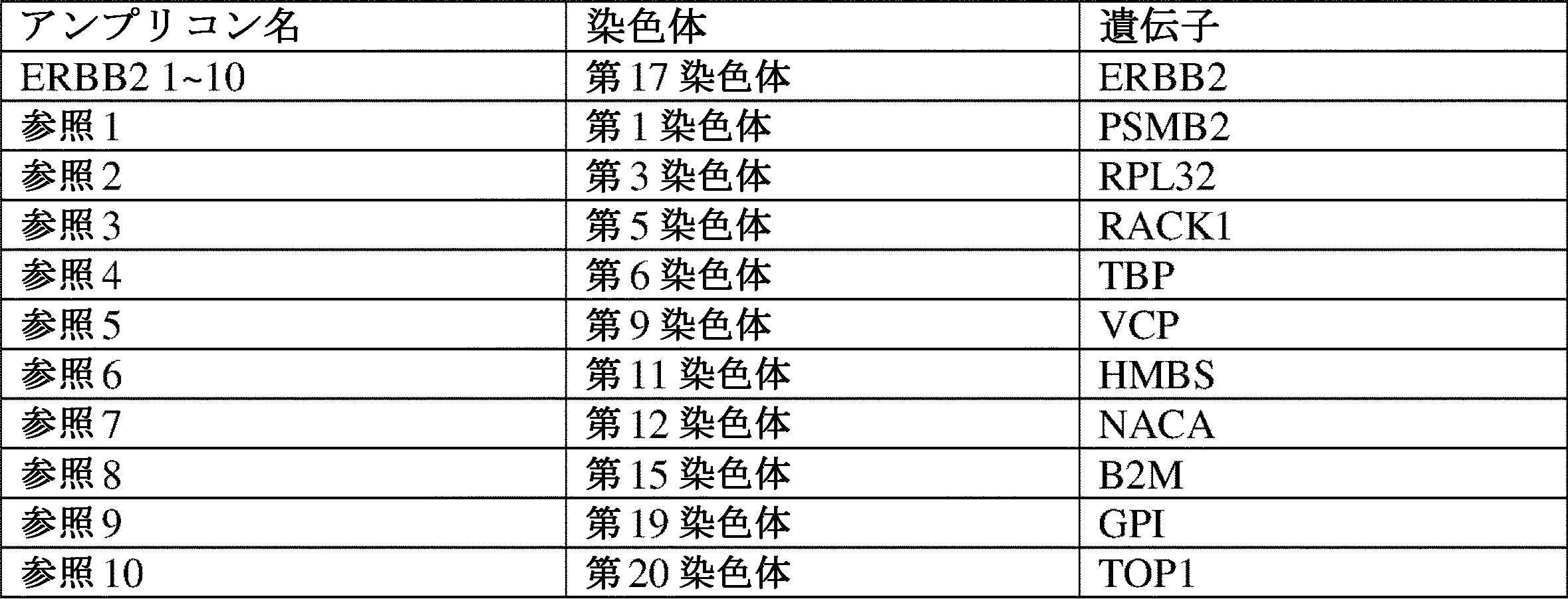
(表2)例示的なQASeqパネルにおけるプライマー配列
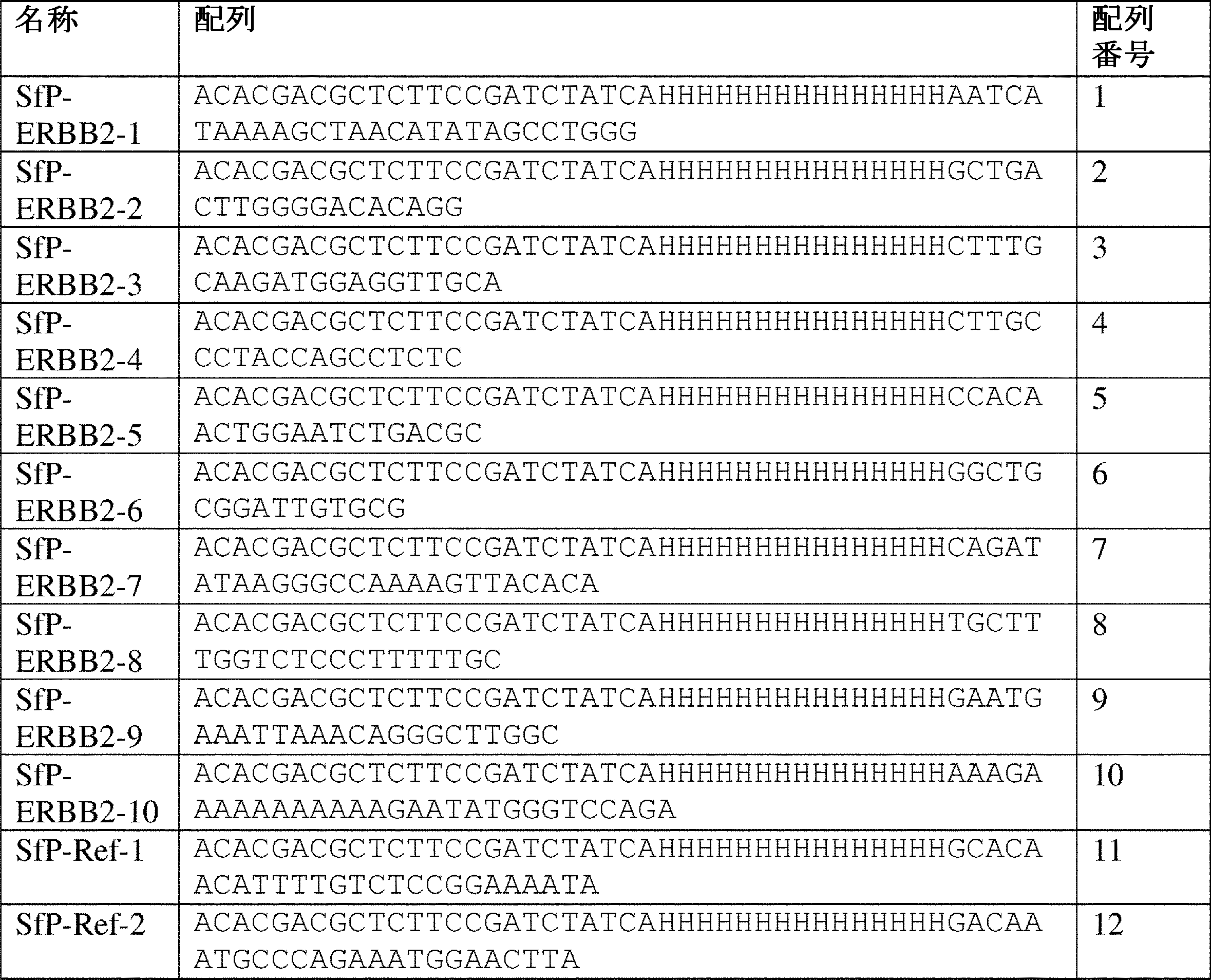

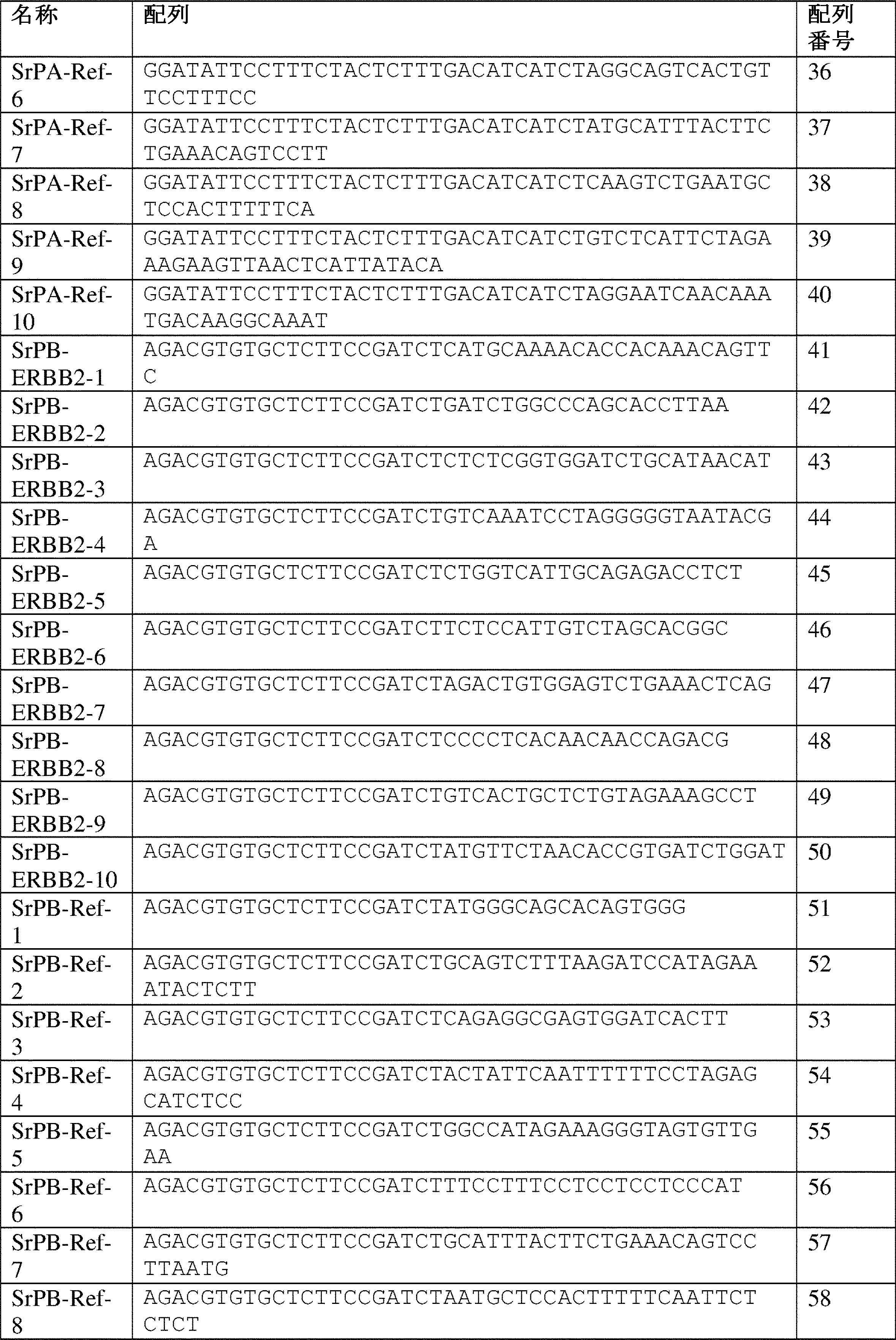
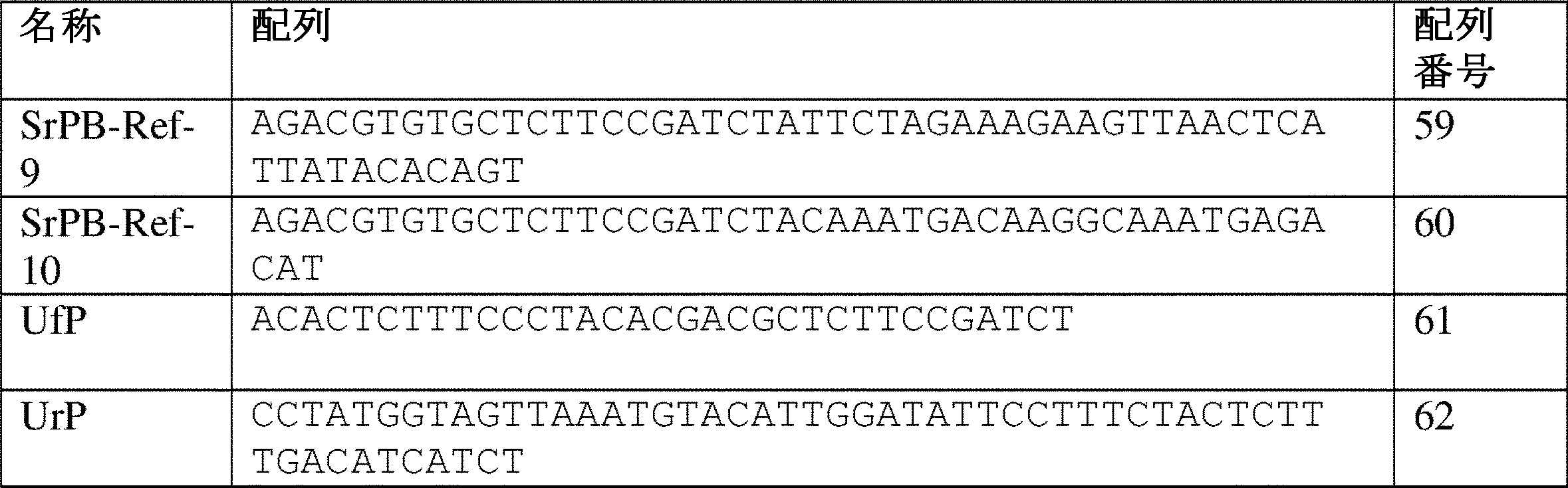
(表3)179プレックス広範プレートにおけるプライマー配列


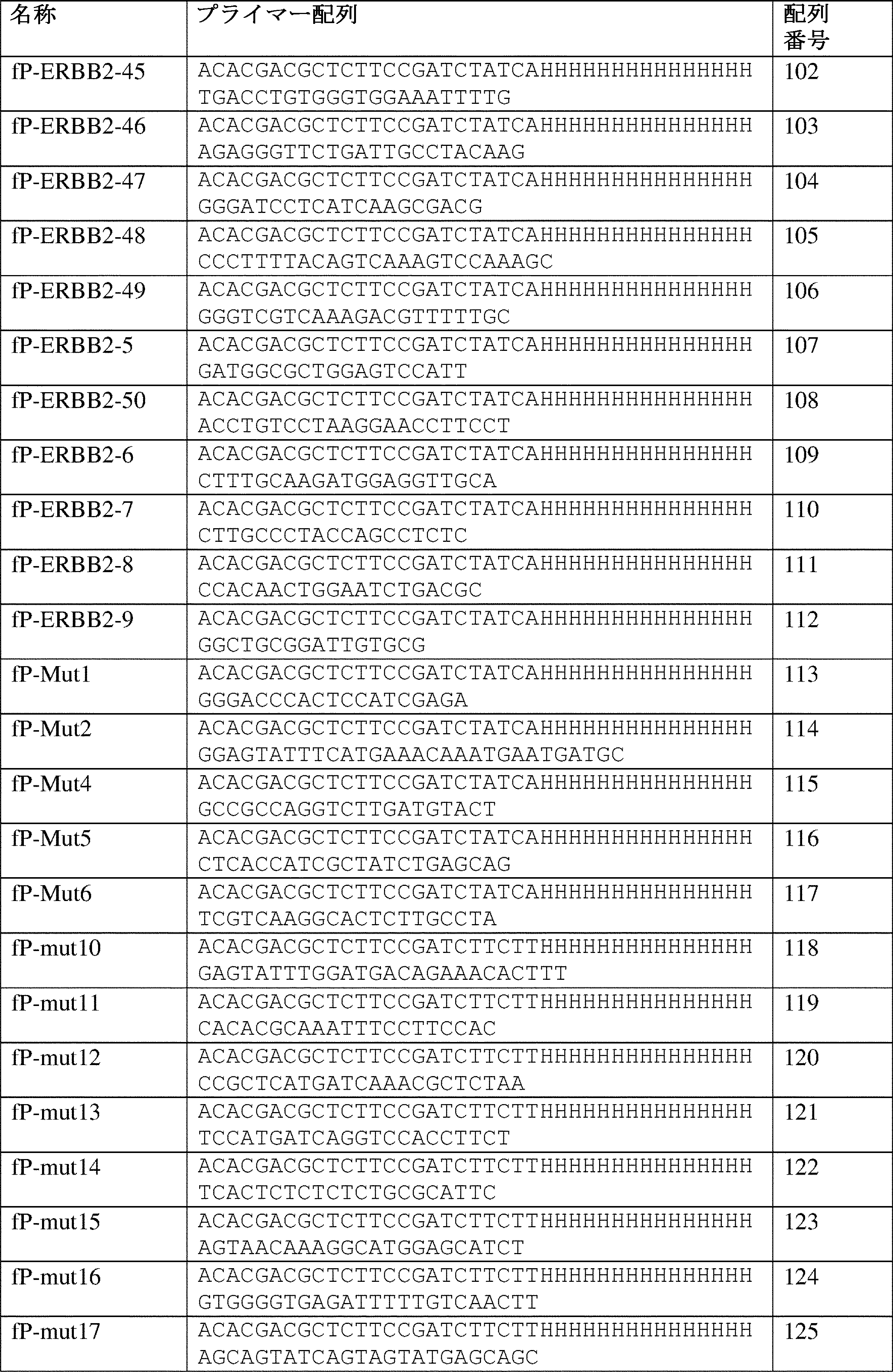


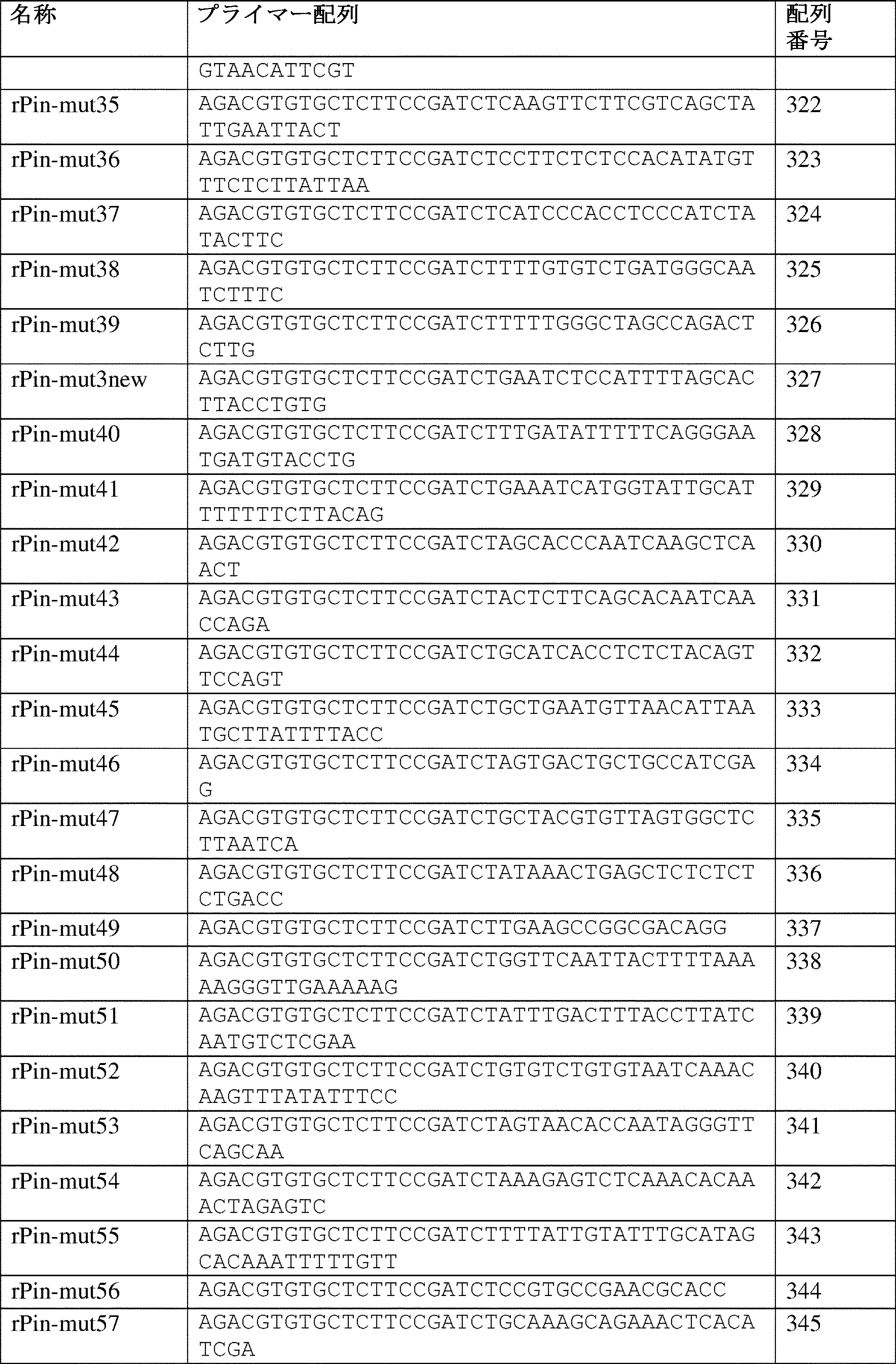
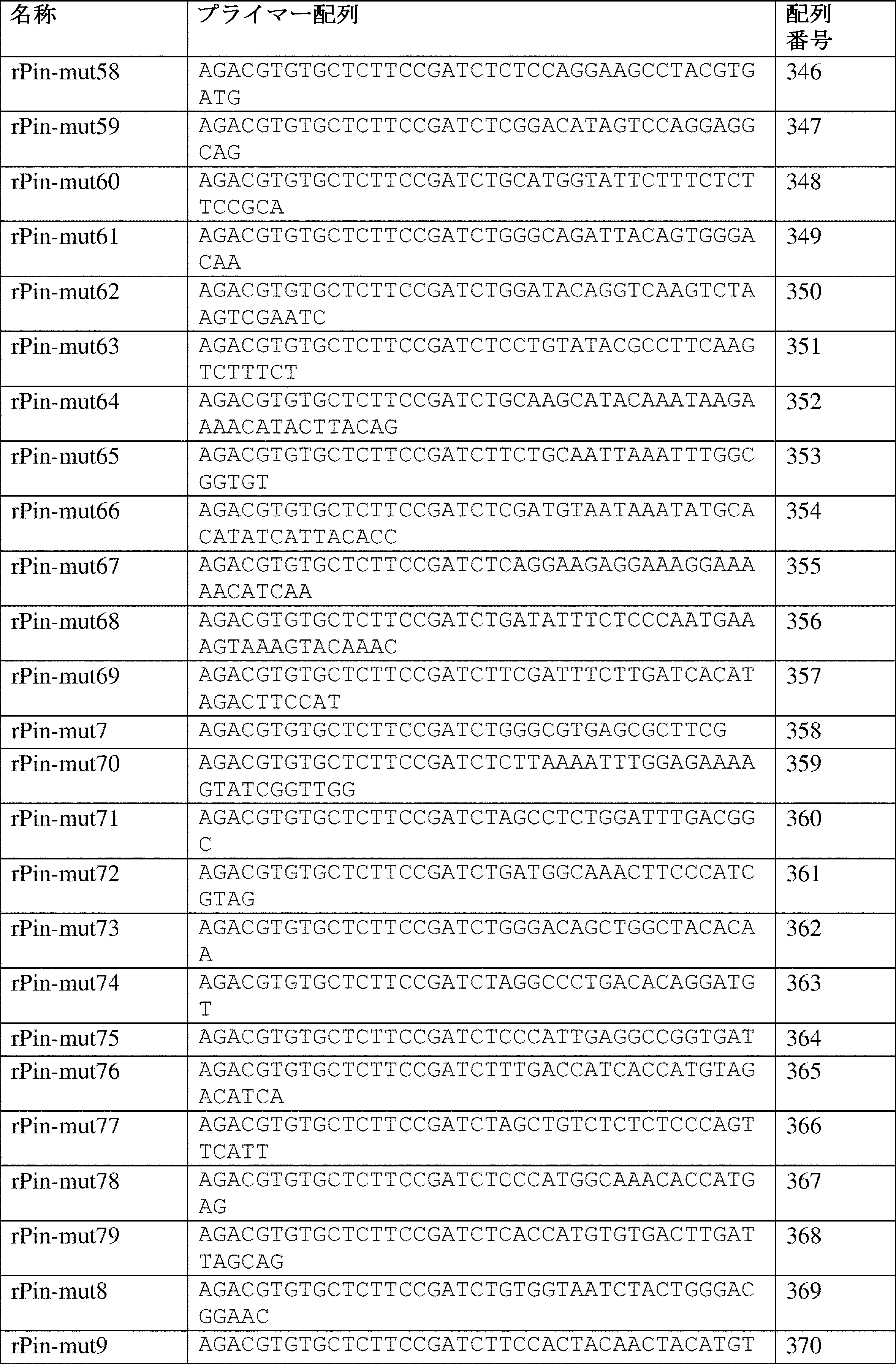


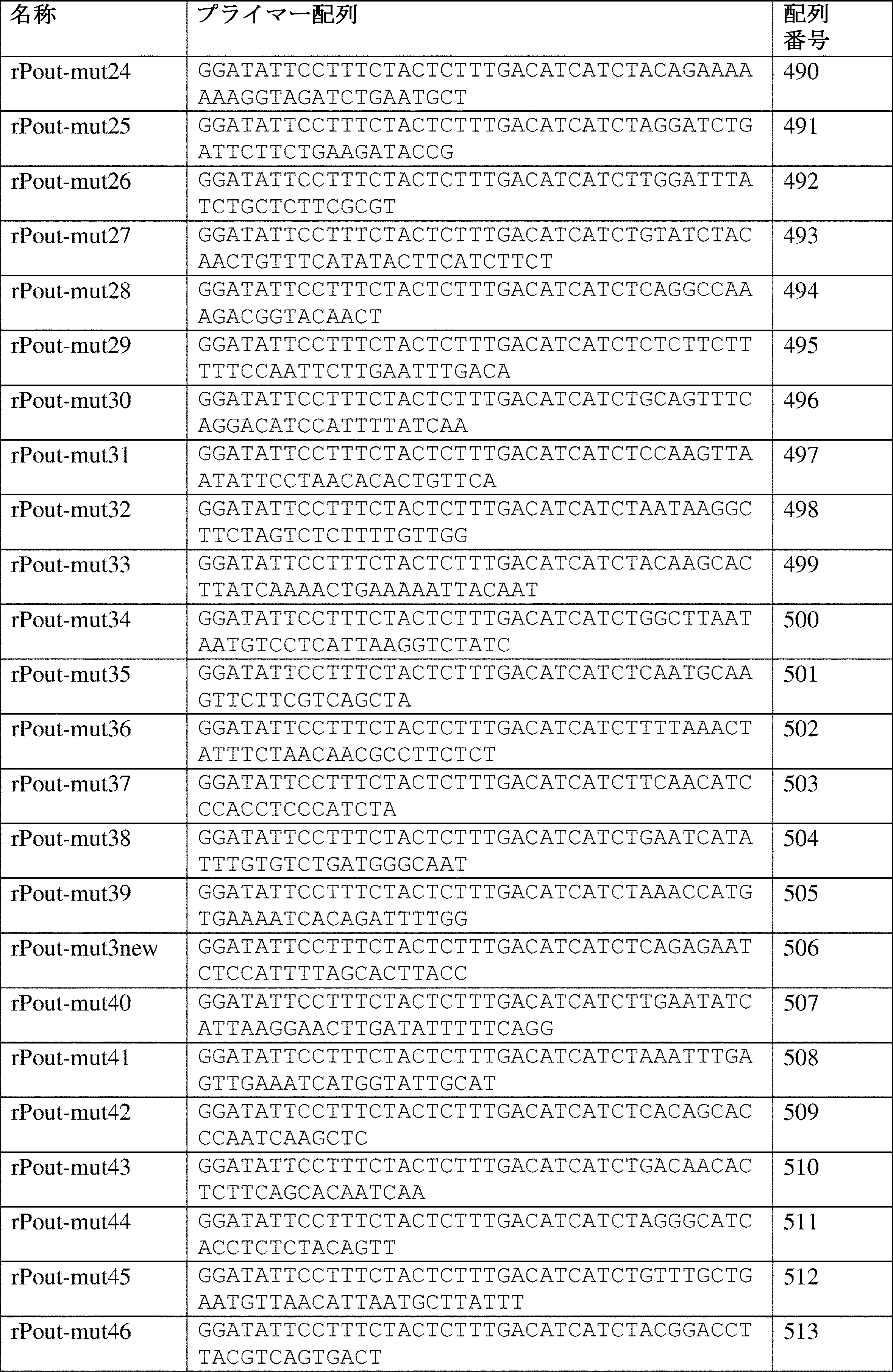
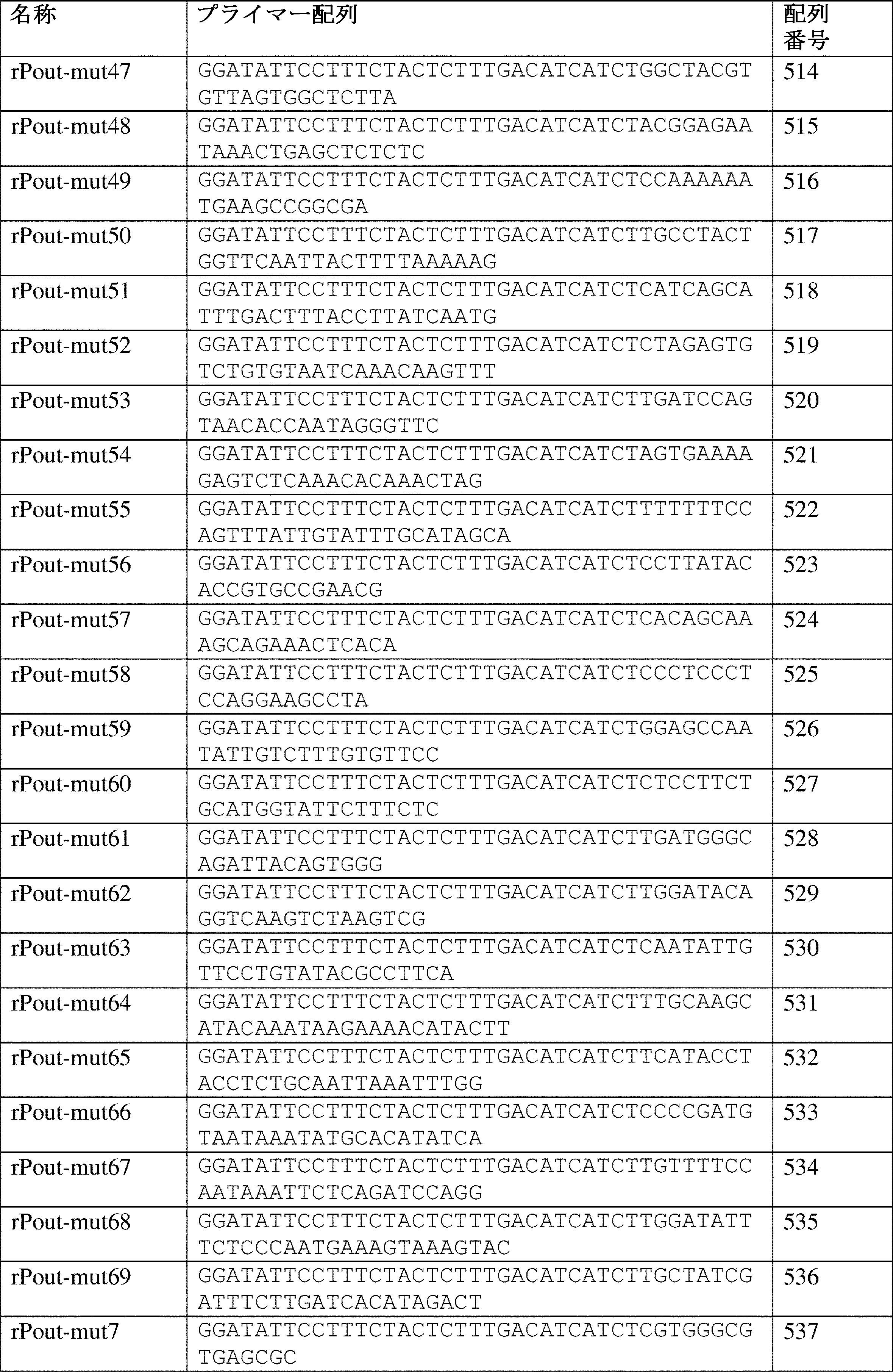

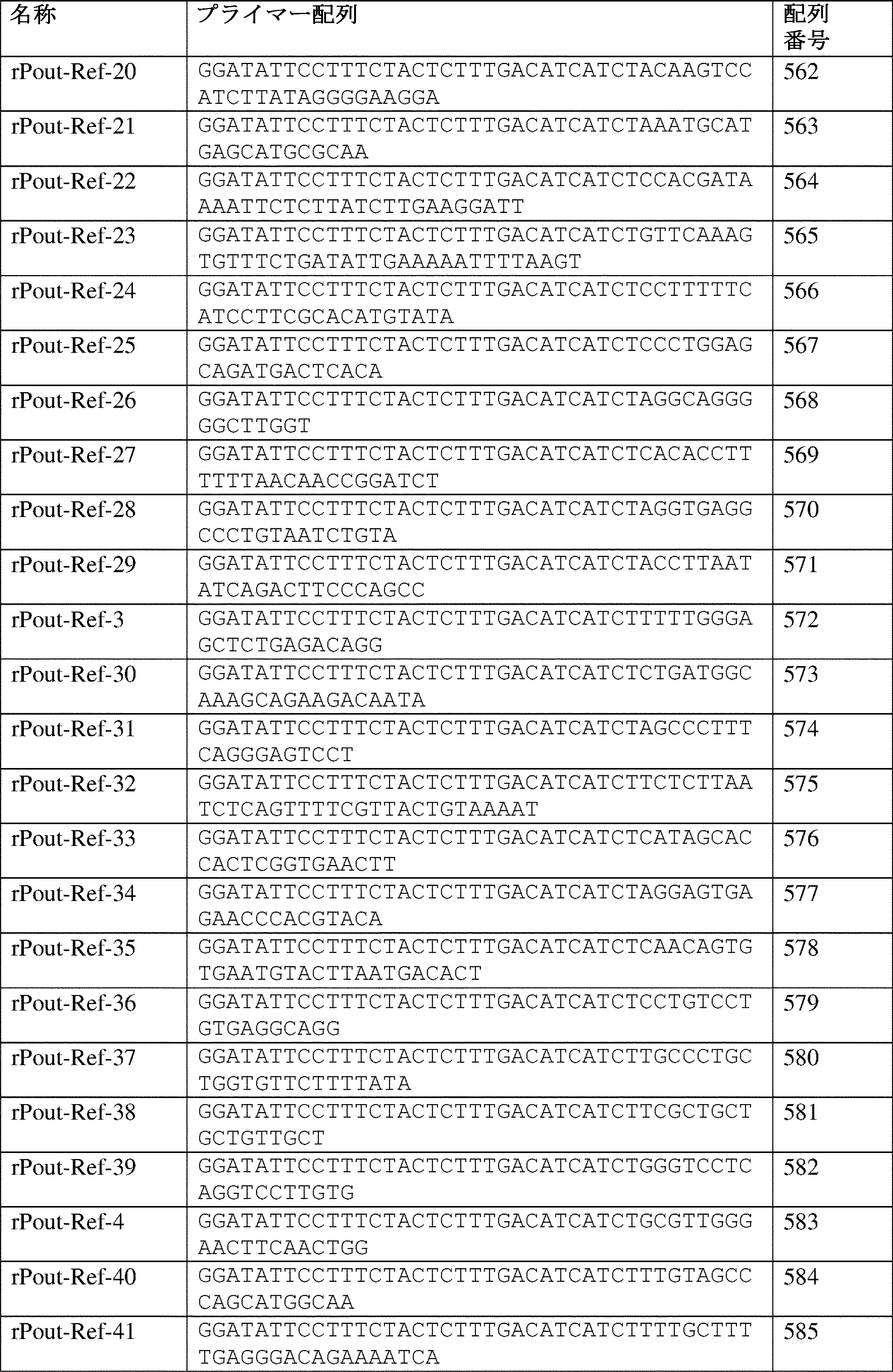

III.UMI設計
NGSライブラリー調製プロセスにおいて、PCR増幅ステップは定量化変動を有意に増加し得え、元の分子数における小さい変化を識別することを困難にする。UMI技術を使用して、PCRバイアスを低下させて、元のDNA分子の絶対的定量化を達成し得る。UMIの概念は、全ての元のDNA分子に異なるDNA配列を「バーコード」として与えることであり、それによって各NGSリードの起源をバーコード配列に基づいて追跡することができる。十分なNGSリードを得ると、NGSアウトプット中に認められる固有のUMIの数は、元のDNA分子の数を反映することができる。以前、UMI技術は、低頻度変異のNGSをベースとした検出におけるエラー補正のために主に使用された。それはまた、定量化にも応用されている。各元分子を固有に標識することは、非常に多くの異なるUMI配列を使用することによって達成され、例えば、100,000個の元分子について109個の異なるUMI配列を使用することは、反復するUMIを担持する<0.006%の分子を生じる。
III. UMI Design In the NGS library preparation process, the PCR amplification step can significantly increase quantification variation, making it difficult to identify small changes in the number of original molecules. UMI technology can be used to reduce PCR bias and achieve absolute quantification of original DNA molecules. The concept of UMI is to give every original DNA molecule a different DNA sequence as a "barcode", so that the origin of each NGS read can be traced based on the barcode sequence. With enough NGS reads, the number of unique UMIs found in the NGS output can reflect the number of original DNA molecules. Previously, UMI technology was mainly used for error correction in NGS-based detection of low frequency mutations. It has also been applied to quantification. Unique labeling of each original molecule is achieved by using a large number of different UMI sequences, for example, using 10 9 different UMI sequences for 100,000 original molecules results in <0.006% molecules carrying repeating UMIs.
ポリ(N)(すなわち、各位置でA、T、C、またはGの混合)などの縮重塩基を含むDNA配列は、しばしばUMI配列として使用される。QASeqでは、ポリ(H)(A、T、またはC)がUMIとして使用されるが、それは、ポリ(N)またはS(CまたはG)およびW(AまたはT)塩基の混合と比べて弱い交差結合エネルギーを有するためであり、シミュレーションによって示される(図2)。(H)20は、3.5×10⁹個の異なる配列を含み、インプットとして100,000個の分子について十分であり、(H)15は1.4×10⁷個の異なる配列を含み、インプットとして6,000個の分子について十分である。 DNA sequences containing degenerate bases such as poly(N) (i.e., a mixture of A, T, C, or G at each position) are often used as UMI sequences. In QASeq, poly(H) (A, T, or C) is used as UMI because it has weaker cross-binding energy compared to poly(N) or a mixture of S (C or G) and W (A or T) bases, as shown by simulations (Figure 2). (H) 20 contains 3.5 x 10 9 different sequences, sufficient for 100,000 molecules as input, and (H) 15 contains 1.4 x 10 7 different sequences, sufficient for 6,000 molecules as input.
IV.PCRバイアスを低減するスペーサ
PCR効率は、異なる配列を有するアンプリコンで変動する。UMIは多くの異なる配列からなるため、プライマーと可変的なUMI領域との間のスペーサを使用して、より均一なPCR効率を達成し得る。
IV. Spacers to Reduce PCR Bias PCR efficiency varies for amplicons with different sequences. Because the UMI consists of many different sequences, a spacer between the primer and the variable UMI region can be used to achieve more uniform PCR efficiency.
NGSを実行して、PCRバイアスにおけるスペーサの影響を評価した(図3A)。鋳型分子は、増幅のために5’端および3’端に2つのアダプターを有し、UMI領域は、中間で(D)15からなる。スペーサを有さない(セット1)、フォワードプライマーとUMIの間に5ntスペーサおよびリバースプライマーとUMIの間に5ntスペーサを有する(セット2)、またはフォワードプライマーとUMIの間に12ntスペーサおよびリバースプライマーとUMIの間に11ntスペーサを有する(セット3)、3セットのプライマーを使用して、鋳型を別々に増幅させた。インデックスは、PCRを介してNGS分析前に付加された。(D)15は、1.4×10⁷個の異なる配列を含む。インプット鋳型分子数は、可能な配列数よりもかなり少ないため、各固有のUMI配列のみが増幅前に1コピーを有する。同じUMIを担持する全てのNGSリードが、同じ分子からおそらく派生される。そのため、UMIファミリーサイズ(すなわち、同じUMIを担持するリードの数)は、PCR効率の指標である。 NGS was performed to evaluate the effect of spacers on PCR bias (Figure 3A). The template molecule has two adapters at the 5' and 3' ends for amplification, and the UMI region consists of (D) 15 in the middle. The templates were amplified separately using three sets of primers: no spacer (set 1), a 5 nt spacer between the forward primer and UMI and a 5 nt spacer between the reverse primer and UMI (set 2), or a 12 nt spacer between the forward primer and UMI and an 11 nt spacer between the reverse primer and UMI (set 3). An index was added before NGS analysis via PCR. (D) 15 contains 1.4 x 10⁷ different sequences. Because the number of input template molecules is much less than the number of possible sequences, only each unique UMI sequence has one copy before amplification. All NGS reads carrying the same UMI are likely derived from the same molecule. Therefore, the UMI family size (i.e., the number of reads carrying the same UMI) is an indicator of PCR efficiency.
UMIファミリーサイズ分布を、PCRバイアスにおけるスペーサの有意性を評価するために比較した(図3B)。プライマーとUMIの間のスペーサが長いほど、より均一な分布が観察された。プライマーセット3では、スペーサ長は両端で10ntよりも長く、有意に改善された分布が達成された。 UMI family size distributions were compared to assess the significance of spacers in PCR bias (Figure 3B). A more uniform distribution was observed with longer spacers between primers and UMIs. In primer set 3, where the spacer length was longer than 10 nt on both ends, a significantly improved distribution was achieved.
V.QASeqワークフロー
QASeq NGSライブラリー調製ワークフローの概略が図1に示される。最初に、DNA試料を、SfP、SrPA、DNAポリメラーゼ、dNTP、およびPCR緩衝液と混合する。2サイクルの長伸長(約30分)PCRを、全ての標的遺伝子座でのUMI付加のために実行する。その後で、1つのDNA分子における各鎖は、異なるUMIを担持するであろう。次に、同じ元分子への複数のUMIの付加を防ぎながら分子を増幅させるため、アニーリング温度を8℃上昇させ、増幅を、UfPおよびUrPを使用して、短伸長(約30秒)で、少なくとも2サイクル(例えば、約7サイクル)について実行する。反応物へのUfPおよびUrPの添加は、サーモサイクラーでのチューブ開口ステップである。SPRI磁性ビーズまたはカラムを使用した精製後、SrPBプライマー、DNAポリメラーゼ、dNTP、およびPCR緩衝液をアダプター置換のためにPCR生成物と混合し、少なくとも1サイクル(例えば、2サイクル)の長伸長(約30分)後、NGSアダプターが、プライマーダイマーまたは非特異的生成物ではなく、正しいPCR生成物にのみ付加される。SPRI磁性ビーズまたはカラムを使用した別の精製簿、標準NGSインデックスPCRを実行して、ライブラリーを正規化してIlluminaシークエンサーにロードする。
V. QASeq Workflow The outline of the QASeq NGS library preparation workflow is shown in Figure 1. First, the DNA sample is mixed with SfP, SrPA, DNA polymerase, dNTPs, and PCR buffer. Two cycles of long extension (~30 min) PCR are performed for UMI addition at all target loci. After that, each strand in one DNA molecule will carry a different UMI. Next, to amplify the molecule while preventing the addition of multiple UMIs to the same original molecule, the annealing temperature is increased by 8°C and amplification is performed with UfP and UrP for at least two cycles (e.g., ~7 cycles) with short extension (~30 s). The addition of UfP and UrP to the reaction is a tube opening step in the thermocycler. After purification using SPRI magnetic beads or columns, SrPB primer, DNA polymerase, dNTPs, and PCR buffer are mixed with the PCR products for adapter replacement, and after at least one cycle (e.g., two cycles) of long extension (about 30 minutes), NGS adapters are added only to the correct PCR products, not primer dimers or non-specific products. After another purification using SPRI magnetic beads or columns, a standard NGS index PCR is performed to normalize the library and load it into an Illumina sequencer.
全てのタイプのDNAポリメラーゼおよびPCRスーパーミックスを使用することができる。使用される特異的ポリメラーゼのための標準的なアニーリング、伸長、および変性温度に従うべきである(アニーリング温度を上昇させるユニバーサルPCRを除く)。 All types of DNA polymerases and PCR supermixes can be used. Standard annealing, extension, and denaturation temperatures for the specific polymerase used should be followed (except for universal PCR, which increases the annealing temperature).
VI.代替のQASeqワークフロー
ワークフローは、2サイクルのPCRを使用して、UMIを付加するためにSfPおよびSrPBを使用し、次いで、インデックスPCR用のインデックスプライマーを直接的に添加して実行され得る。これを試験するため、SfPとSrPBの20セットを同じ反応に使用した。本方法の実験的な的中率は、非常に低く(0.5%)、そのため、本方法は診断のためのNGSアッセイに有用ではあり得ない(図9A)。オフターゲットNGSリードは、ほとんどがプライマーダイマーだった。第2の代替ワークフローでは、ユニバーサルPCRは、6サイクルのユニバーサルPCRのためのUfPおよびUrpを使用して実行され、これには精製ステップが続く。これらの追加のステップは、異なるライブラリーについて的中率を12~28%(平均的中率=20%)に改善した(図9B)。第2の代替ワークフローに基づいた第3の代替ワークフローを試験した。これでは、アガロースゲルを使用したサイズ選択ステップをインデックスPCR後に加えて、さらにプライマーダイマーを低減させた。実験的な平均的中率は42%に改善したが、まだ50%よりも低かった(図9C)。プライマーダイマー低下は、最初の実験ワークフローを使用して達成され、両方のアダプター置換およびユニバーサルPCR後の精製を含み、66%の高い平均的中率をもたらす(図9D)。上記ワークフローにおけるプライマーダイマーの1つの源が、図9Eに示される。SfPの3’部分がSfPBに結合するか、またはSfPBの3’部分がSfPに結合する場合、5’および3’端の両方にユニバーサル領域を有するダイマー鎖が生じ得、そのためユニバーサルまたはインデックスPCRステップで増幅され得る。
VI. Alternative QASeq Workflows A workflow can be performed using SfP and SrPB to add UMIs using two cycles of PCR, and then directly adding the index primer for index PCR. To test this, 20 sets of SfP and SrPB were used in the same reaction. The experimental hit rate of this method was very low (0.5%), so this method may not be useful for diagnostic NGS assays (Figure 9A). Off-target NGS reads were mostly primer dimers. In the second alternative workflow, universal PCR was performed using UfP and Urp for 6 cycles of universal PCR, followed by a purification step. These additional steps improved the hit rate to 12-28% (average hit rate = 20%) for the different libraries (Figure 9B). A third alternative workflow based on the second alternative workflow was tested. In this, a size selection step using agarose gel was added after index PCR to further reduce primer dimers. The experimental average hit rate improved to 42%, but was still below 50% (Figure 9C). Primer dimer reduction was achieved using the first experimental workflow, including both adapter replacement and purification after universal PCR, resulting in a high average hit rate of 66% (Figure 9D). One source of primer dimers in the above workflow is shown in Figure 9E. If the 3' portion of SfP binds to SfPB, or the 3' portion of SfPB binds to SfP, a dimer strand with universal regions at both the 5' and 3' ends can be generated and therefore amplified in the universal or index PCR step.
最初のワークフローは、インデックス配列およびシークエンサーのP5/P7配列をアンプリコンの末端に付加する最終インデックスステップを含むが、しかしUMI付加、ユニバーサルPCR、またはアダプター置換ステップの際に上記配列を加え、そのためインデックスPCRステップを必要としない、代替ワークフローがある。図10A~Cは、3つの例を示す。第一に、インデックスおよびP5配列がUfPの5’に付加され、他のインデックスおよびP7配列がSrPBの5’に付加される。アダプター置換から得られるアンプリコンは、P5、P7、および二重インデックスを含み、そのため、配列決定のために用意できている(図10A)。第二に、インデックスおよびP7配列がSrPBの5’に付加され、この修飾SrPBは、アダプター置換ステップで正常なP5インデックスプライマーと混合される(図10B)。第三に、インデックスおよびP5配列はSfPの5’に付加され、P5配列を担持するプライマーは、ユニバーサルPCRステップにおいてUfPとして使用される。他のインデックスおよびP7配列が、SrPBの5’に付加される(図10C)。 The first workflow includes a final index step that adds an index sequence and a sequencer P5/P7 sequence to the end of the amplicon, but there are alternative workflows that add the sequences during the UMI addition, universal PCR, or adapter replacement step, and thus do not require an index PCR step. Figures 10A-C show three examples. First, an index and P5 sequence are added 5' to UfP, and another index and P7 sequence are added 5' to SrPB. The amplicon resulting from adapter replacement contains P5, P7, and a double index, and is therefore ready for sequencing (Figure 10A). Second, an index and P7 sequence are added 5' to SrPB, and this modified SrPB is mixed with a normal P5 index primer in the adapter replacement step (Figure 10B). Third, an index and P5 sequence are added 5' to SfP, and the primer carrying the P5 sequence is used as UfP in the universal PCR step. Another index and P7 sequence are added 5' to SrPB (Figure 10C).
代替QASeqプライマー設計およびワークフローが、図11に示される。各プライマーセットは3つの異なるオリゴ:特異的フォワードプライマー(SfP)、特異的リバースプライマーA(SrPA)、および特異的リバースプライマーB(SrPB)を含む。SfPは、5’から3’に向かって、領域1、2、3、および4を含む。領域4は、鋳型結合領域であり、領域3は、UMI領域であり、領域1は、完全または部分的なNGSアダプターであり、領域2は、UMIの均一増幅のために付加される任意選択的なスペーサ領域(0~15nt)である。SrPAは、領域5を含み、これは鋳型結合領域である。SrPBは、5’から3’に向かって、領域6、7、および8を含む。領域8は、鋳型結合領域であり、その3’端は、領域5より、領域4に少なくとも1塩基近く、領域6は、完全または部分的なNGSアダプターであり、領域7は、異なる遺伝子座の均一な増幅のために付加される任意選択的なスペーサ領域(0~15nt)である。各QASeqパネルは、領域1を含む、1つのユニバーサルフォワードプライマー(UfP)のみを必要とし、UfPにおける領域1の5’末端で追加の塩基が存在し得る鋳型結合領域4、5、および8の融解温度(Tm)は、PCRアニーリング温度とほぼ同じであり、UfPのTmは、実験的PCR条件で領域4、5、および8よりも低くない。元の設計と比較して、SrPAのみが鋳型結合領域を必要とし、ユニバーサルリバースプライマー(UrP)は必要ではない。実験ワークフローにおいて、より多いサイクルのPCR(例えば、少なくとも10サイクル)が、この代替プライマー設計下でユニバーサルPCRステップに必要とされる。
The alternative QASeq primer design and workflow is shown in Figure 11. Each primer set contains three different oligos: a specific forward primer (SfP), a specific reverse primer A (SrPA), and a specific reverse primer B (SrPB). SfP contains
VII.データ分析ワークフロー
CNV検出のためのデータ分析ワークフローの概略が図4Aに示される。最初に、生NGSデータをアンプリコン領域にアラインメントし、任意選択的なアダプタートリミングをアラインメント前に実行することができる。非アラインメントリードを破棄し、アラインメントリードをそれらがアラインメントする遺伝子座によってグループ化される。
VII. Data Analysis Workflow An overview of the data analysis workflow for CNV detection is shown in Figure 4A. First, raw NGS data are aligned to amplicon regions, and optional adapter trimming can be performed before alignment. Non-aligned reads are discarded, and aligned reads are grouped by the loci to which they align.
そして、同じ遺伝子座にアラインメントされた全てのリードを、UMI配列によってさらに割り当て、すなわち、同じUMIを担持するリードを1つのUMIファミリーとしてグループ化する。UMIファミリーサイズは、同じUMIを担持するリードの数であり、固有UMI数は、1つの遺伝子座での異なるUMI配列の全数である(図4B)。次いで、PCRまたはNGSエラーの結果の可能性がある全ての固有UMIファミリーが、取り除かれる。例えば、設計されたUMIパターン(例えば、ポリ(H)UMI配列中に認められるG塩基)と一致しないUMI配列は、エラーであり、取り除かれるべきである。さらに、2つのUMI配列が1~2個の塩基のみで異なる場合、小さいUMIファミリーサイズを有する1つが他から変異された可能性があり、そのため、任意選択的に取り除かれ得る。UMIエラーの除去後、ファミリーサイズ<Fminを有するUMIファミリーも取り除かれる。Fminは、UMIファミリーサイズの分布に基づいて決定され、Fmin=4が使用される最も多い例であり得る。UMI除去後の固有UMI数(N)は、次のステップで使用される。 Then, all reads aligned to the same locus are further assigned by UMI sequence, i.e., reads carrying the same UMI are grouped as one UMI family. The UMI family size is the number of reads carrying the same UMI, and the unique UMI number is the total number of different UMI sequences at one locus (Figure 4B). Then, all unique UMI families that may be the result of PCR or NGS errors are removed. For example, UMI sequences that do not match the designed UMI pattern (e.g., G bases found in poly(H) UMI sequences) are erroneous and should be removed. Furthermore, if two UMI sequences differ by only 1-2 bases, the one with the small UMI family size may have been mutated from the other and therefore can be optionally removed. After removal of UMI errors, UMI families with family size < F min are also removed. F min is determined based on the distribution of UMI family sizes, and F min = 4 may be the most common example used. The number of unique UMIs (N) after UMI removal is used in the next step.
標的遺伝子のFECは以下:


VIII.対立遺伝子比定量化
QASeqを適用して、1~10,000個のゲノム遺伝子座について異なる遺伝的同一性の対立遺伝子比を、多重PCRを使用して定量化することができる。ターゲティングされたゲノム遺伝子座のための多重PCRパネル設計、およびPCRによってターゲティングされたゲノム遺伝子座の各鎖をオリゴヌクレオチドバーコード配列で標識するための実験的ワークフロー、それに続くハイスループット配列決定のためのゲノム領域の増幅は、CNV検出と同様である。
VIII. Allele Ratio Quantification QASeq can be applied to quantify allele ratios of different genetic identities for 1-10,000 genomic loci using multiplex PCR. The multiplex PCR panel design for targeted genomic loci and the experimental workflow for labeling each strand of the targeted genomic loci by PCR with oligonucleotide barcode sequences, followed by amplification of the genomic region for high-throughput sequencing, are similar to CNV detection.
対立遺伝子比定量化のためのデータ分析ワークフローの概略が、図12Aに示される。最初に、生NGSデータをアンプリコン領域にアラインメントし、任意選択的なアダプタートリミングをアラインメント前に実行することができる。非アラインメントリードを破棄し、アラインメントリードをそれらがアラインメントする遺伝子座によってグループ化される。各遺伝子座では、NGSリードはUMIによって割り当てられ、同じUMI配列を担持する全てのNGSリードは1つのUMIファミリーとしてグループ化する。UMIにおけるエラーを有する固有UMIファミリーは、PCRまたはNGSエラーの結果である可能性があり、データ分析ワークフローセクションに記載されるように、取り除かれる。 An overview of the data analysis workflow for allelic ratio quantification is shown in Figure 12A. First, raw NGS data are aligned to amplicon regions, and optional adapter trimming can be performed before alignment. Non-aligned reads are discarded, and aligned reads are grouped by the locus to which they align. At each locus, NGS reads are assigned by UMI, and all NGS reads carrying the same UMI sequence are grouped as one UMI family. Unique UMI families with errors in the UMI may be the result of PCR or NGS errors, and are removed as described in the data analysis workflow section.
各残存UMIファミリーにおける遺伝的同一性(野生型または変異)は、多数決に基づいて求められ、遺伝的同一性は同じUMIファミリーにおける少なくとも70%のメンバー(リード)によって裏付けられる必要がある。図12Bにおける例のように、UMIファミリーサイズ=7を有するUMIファミリーでは、7リード全てが同じUMI配列を共有する(2Dバーコードによって示される)。関心対象の遺伝子座での遺伝的同一性は、6リードで「A」、1リードで「G」である。UMIファミリーにおける70%超のリードが「A」を裏付けるため、このUMIファミリーでの遺伝的同一性は、「A」と呼ばれる。「G」に対応する1リードは、PCRまたはNGSエラーの結果である。1つの共通遺伝的同一性を裏付ける70%超のリードを有さないUMIは、破棄される。 The genetic identity (wild type or mutant) in each remaining UMI family is determined based on majority vote, and the genetic identity must be supported by at least 70% of the members (reads) in the same UMI family. As an example in Figure 12B, in a UMI family with UMI family size = 7, all 7 reads share the same UMI sequence (indicated by the 2D barcode). The genetic identity at the locus of interest is "A" in 6 reads and "G" in 1 read. Since more than 70% of the reads in the UMI family support "A", the genetic identity in this UMI family is called "A". The 1 read corresponding to "G" is the result of a PCR or NGS error. UMIs that do not have more than 70% of the reads supporting one common genetic identity are discarded.
次に、固有のUMI数N(1つの遺伝子座での異なるUMI配列の総数)は、ターゲティングされた遺伝子座で各異なる遺伝的同一性について計数され、Nは元の鎖の数を示す。標的遺伝子座の対立遺伝子比は、R対立遺伝子=N1/N2として計算され、式中、N1は、第1の遺伝的同一性についての固有UMI数であり、N2は、第2の遺伝的同一性についての固有UMI数である。 The number of unique UMIs, N (the total number of different UMI sequences at a locus) is then counted for each different genetic identity at the targeted locus, where N denotes the number of original strands. The allelic ratio of the targeted locus is calculated as R alleles = N1 / N2 , where N1 is the number of unique UMIs for the first genetic identity and N2 is the number of unique UMIs for the second genetic identity.
IX.定義
本明細書で使用される「増幅」は、1つのヌクレオチド配列または複数の配列のコピー数を増加させるための任意のインビトロプロセスを指す。核酸増幅は、ヌクレオチドのDNAまたはRNAへの組み込みをもたらす。本明細書で使用される場合、1つの増幅反応は、多くの回数のDNA複製からなり得る。例えば、1つのPCR反応は、30~100「サイクル」の変性および複製からなり得る。
IX. Definitions "Amplification," as used herein, refers to any in vitro process for increasing the number of copies of a nucleotide sequence or sequences. Nucleic acid amplification results in the incorporation of nucleotides into DNA or RNA. As used herein, an amplification reaction can consist of many rounds of DNA replication. For example, a PCR reaction can consist of 30-100 "cycles" of denaturation and replication.
「ポリメラーゼ連鎖反応」、または「PCR」は、DNAの相補鎖の同時的なプライマー伸長による特定のDNA配列のインビトロ増幅のための反応を意味する。言い換えると、PCRは、プライマー結合部位によって隣接される標的核酸の複数のコピーまたは複製のための反応であり、かかる反応は、(i)標的核酸を変性させるステップと、(ii)プライマーをプライマー結合部位にアニーリングさせるステップと、(iii)プライマーを核酸ポリメラーゼによってヌクレオシド三リン酸の存在中で伸長させるステップと、の1回以上の反復を含む。通常、反応は、サーマルサイクラー装置において各ステップに最適化された異なる温度によってサイクル化される。特定の温度、各ステップでの期間、およびステップ間の変動率は、当技術分野の当業者に周知である多くの要因に依存し、例えば、参照:McPhersonet al.,editors,PCR:A Practical ApproachおよびPCR2:A Practical Approach(IRL Press,Oxford,それぞれ1991年および1995年)によって例示される。 "Polymerase chain reaction", or "PCR", refers to a reaction for the in vitro amplification of specific DNA sequences by simultaneous primer extension of complementary strands of DNA. In other words, PCR is a reaction for multiple copies or replication of a target nucleic acid flanked by primer binding sites, which reaction includes one or more repetitions of (i) denaturing the target nucleic acid, (ii) annealing primers to the primer binding sites, and (iii) extending the primers in the presence of nucleoside triphosphates by a nucleic acid polymerase. Typically, the reaction is cycled in a thermal cycler device with different temperatures optimized for each step. The specific temperatures, durations at each step, and rate of variation between steps depend on many factors well known to those skilled in the art, see, for example, McPherson et al. , editors, PCR: A Practical Approach and PCR2: A Practical Approach (IRL Press, Oxford, 1991 and 1995, respectively).
「プライマー」は、ポリヌクレオチド鋳型と二本鎖を形成する際に、核酸合成の開始点として作用することができ、鋳型に沿ってその3’末端から伸長され得、それによって伸長した二本鎖が形成される、天然または合成いずれかのオリゴヌクレオチドを指す。伸長プロセスの際に添加されるヌクレオチドの配列は、鋳型ポリヌクレオチドの配列によって決定される。通常、プライマーはDNAポリメラーゼによって伸長される。プライマーは一般に、プライマー伸長生成物の合成におけるその使用に適合性のある長さのものであり、通常、長さが8~100ヌクレオチドの範囲、例えば、10~75、15~60、15~40、18~30、20~40、21~50、22~45、25~40などであり、より一般的には、18~40、20~35、21~30ヌクレオチド長の範囲、および記載された範囲の間の任意の長さであるである。典型的なプライマーは、15~45、18~40、20~30、21~25などの10~50ヌクレオチド長の任意の範囲にあり、記載された範囲の間の任意の長さであることができる。いくつかの実施形態において、プライマーは、約10、12、15、20、21、22、23、24、25、26、27、28、29、30、35、40、45、50、55、60、65、または70ヌクレオチドの長さを通常超えない。 "Primer" refers to an oligonucleotide, either natural or synthetic, that, when it forms a duplex with a polynucleotide template, can act as an initiation point for nucleic acid synthesis and can be extended from its 3' end along the template, thereby forming an extended duplex. The sequence of nucleotides added during the extension process is determined by the sequence of the template polynucleotide. Typically, the primer is extended by a DNA polymerase. Primers are generally of a length compatible with their use in synthesizing primer extension products, and typically range from 8-100 nucleotides in length, e.g., 10-75, 15-60, 15-40, 18-30, 20-40, 21-50, 22-45, 25-40, etc., more typically in the range of 18-40, 20-35, 21-30 nucleotides in length, and any length between the recited ranges. Typical primers can range anywhere from 10-50 nucleotides in length, such as 15-45, 18-40, 20-30, 21-25, and any length between the ranges listed. In some embodiments, primers typically do not exceed about 10, 12, 15, 20, 21, 22, 23, 24, 25, 26, 27, 28, 29, 30, 35, 40, 45, 50, 55, 60, 65, or 70 nucleotides in length.
本明細書で使用される「組み込むこと」は、核酸ポリマーの一部になることを意味する。 As used herein, "incorporating" means becoming part of a nucleic acid polymer.
本明細書で使用される「外因的操作の非存在において」という用語は、核酸分子が改変されている溶液を変更することなく核酸分子の改変が存在していることを指す。特定の実施形態において、それはヒトの手が存在することなく、または緩衝液状態としても言及され得る、溶液状態を変化させる機械が存在することなく生じる。しかしながら、温度における変化は、改変の際に生じ得る。 As used herein, the term "in the absence of exogenous manipulation" refers to the modification of a nucleic acid molecule occurring without changing the solution in which the nucleic acid molecule is modified. In certain embodiments, it occurs without the presence of the human hand or a machine that changes the solution conditions, which may also be referred to as buffer conditions. However, changes in temperature may occur during the modification.
「ヌクレオシド」は、塩基-糖組み合わせ、すなわち、リン酸を欠くヌクレオチドである。用語ヌクレオシドおよびヌクレオチドの使用において特定の互換性のあることが、当技術分野で認識される。例えば、ヌクレオチドデオキシウリジン三リン酸であるdUTPは、デオキシリボヌクレオシド三リン酸である。DNAへの組み込み後、それはDNAモノマーとして機能し、形式上、デオキシウリジル酸、すなわち、dUMPまたはデオキシウリジンモノリン酸である。dUTPをDNAに組み込んでも、得られるDNAにはdUTP部分がないと言い得る。同様に、デオキシウリジンをDNAに組み込んでも、それは基質分子の一部のみであると言い得る。 A "nucleoside" is a base-sugar combination, i.e., a nucleotide lacking a phosphate. Certain interchangeability in the use of the terms nucleoside and nucleotide is recognized in the art. For example, the nucleotide deoxyuridine triphosphate, dUTP, is a deoxyribonucleoside triphosphate. After incorporation into DNA, it functions as a DNA monomer and is formally deoxyuridylic acid, i.e., dUMP or deoxyuridine monophosphate. When dUTP is incorporated into DNA, it may be said that the resulting DNA has no dUTP moieties. Similarly, when deoxyuridine is incorporated into DNA, it may be said that it is only part of the substrate molecule.
本明細書で使用される「ヌクレオチド」は、塩基-糖-リン酸組み合わせを指す。ヌクレオチドは、核酸ポリマーの、すなわち、DNAおよびRNAのモノマー単位である。本用語には、rATP、rCTP、rGTP、またはrUTPなどのリボヌクレオチド三リン酸、およびdATP、dCTP、dUTP、dGTP、またはdTTPなどのデオキシリボヌクレオチド三リン酸が含まれる。 As used herein, "nucleotide" refers to a base-sugar-phosphate combination. Nucleotides are monomeric units of nucleic acid polymers, i.e., DNA and RNA. The term includes ribonucleotide triphosphates, such as rATP, rCTP, rGTP, or rUTP, and deoxyribonucleotide triphosphates, such as dATP, dCTP, dUTP, dGTP, or dTTP.
「核酸」または「ポリヌクレオチド」という用語は、一般に、DNA、RNA、DNA-RNAキメラ、またはそれらの誘導体もしくはアナログの少なくとも1つの分子もしくは鎖を指し、例えば、DNA(例えば、アデニン「A」、グアニン「G」、チミン「T]、およびシトシン「C」)またはRNA(例えば、A、G、ウラシル「U」、およびC)中に認められる天然由来プリンまたはピリミジン塩基などの少なくとも1つの核酸塩基が含まれる。「核酸」という用語は、「オリゴヌクレオチド」および「ポリヌクレオチド」という用語を包含する。本明細書で使用される「オリゴヌクレオチド」は、当技術分野の2つの用語である「オリゴヌクレオチド」および「ポリヌクレオチド」を、まとめて、互換的に指す。オリゴヌクレオチドおよびポリヌクレオチドは、当技術分野の異なる用語であるが、それらの間に正確な分割線はなく、それらは本明細書において互換的に使用されることに留意する。「アダプター」という用語もまた、「オリゴヌクレオチド」および「ポリヌクレオチド」という用語と互換的に使用され得る。さらに、「アダプター」という用語は、線形アダプター(一本鎖または二本鎖のいずれか)またはステムループアダプターを示すことができる。これらの定義は、一般に、少なくとも1つの一本鎖分子を指すが、特定の実施形態において、少なくとも1つの一本鎖分子に部分的、実質的、または完全に相補的である少なくとも1つの追加の鎖も包含する。そのため、核酸は、分子の鎖を含んでいる特定の配列の1つ以上の相補的鎖または「相補体」を含む、少なくとも1つの二本鎖分子または少なくとも1つの三重鎖分子を包含し得る。本明細書で使用される場合、一本鎖核酸は接頭辞「ss」によって、二本鎖核酸は接頭辞「ds]によって、三本鎖核酸は接頭辞「ts」によって、表され得る。 The term "nucleic acid" or "polynucleotide" generally refers to at least one molecule or strand of DNA, RNA, DNA-RNA chimera, or derivatives or analogs thereof, including at least one nucleic acid base, such as the naturally occurring purine or pyrimidine bases found in DNA (e.g., adenine "A", guanine "G", thymine "T", and cytosine "C") or RNA (e.g., A, G, uracil "U", and C). The term "nucleic acid" encompasses the terms "oligonucleotide" and "polynucleotide". As used herein, "oligonucleotide" refers collectively and interchangeably to two terms in the art, "oligonucleotide" and "polynucleotide". It is noted that although oligonucleotide and polynucleotide are different terms in the art, there is no precise dividing line between them, and they are used interchangeably herein. The term "adapter" may also be used interchangeably with the terms "oligonucleotide" and "polynucleotide". Additionally, the term "adapter" can refer to a linear adapter (either single-stranded or double-stranded) or a stem-loop adapter. These definitions generally refer to at least one single-stranded molecule, but also encompass, in certain embodiments, at least one additional strand that is partially, substantially, or completely complementary to at least one single-stranded molecule. Thus, a nucleic acid can encompass at least one double-stranded molecule or at least one triplex molecule that includes one or more complementary strands or "complements" of a particular sequence comprising a strand of the molecule. As used herein, single-stranded nucleic acids can be designated by the prefix "ss", double-stranded nucleic acids by the prefix "ds", and triple-stranded nucleic acids by the prefix "ts".
「核酸分子」または「核酸標的分子」は、標準の基本的な塩基、過修飾塩基、非天然塩基、もしくはそれらの塩基の任意の組み合わせを含む任意の一本鎖または二本鎖核酸分子を指す。例えば限定されることなく、核酸分子は、4つの標準DNA塩基-アデニン、シトシン、グアニン、およびチミン、ならびに/または4つの標準RNA塩基-アデニン、シトシン、グアニン、およびウラシル、を含む。ウラシルは、ヌクレオシドが2’-デオキシリボース基を含む場合、チミンで置換することができる。核酸分子は、RNAからDNAに、そしてDNAからRNAに変換され得る。例えば、限定されることなく、mRNAは、逆転写酵素を使用して相補的DNA(cDNA)に生成され得、DNAは、RNAポリメラーゼを使用してRNAに生成され得る。核酸分子は、生物学的または合成的な起源であることができる。核酸分子の例には、ゲノムDNA、cDNA、RNA、DNA/RNAハイブリッド、増幅したDNA、既存核酸ライブラリーなどが含まれる。核酸は、ヒト試料から得られ得、血液、血清、血漿、脳脊髄液、頬掻把、生検、精液、尿、糞便、唾液、汗などが挙げられる。核酸分子は、修復処置および断片化処置などの様々な処置に供され得る。断片化処置には、機械的、音波、および流体力学的な剪断が含まれる。修復処置には、伸長および/または連結を介したニック修復、平滑末端を生じる平滑化、損傷した塩基の除去、例えば、脱アミノ化、誘導体化、脱塩基性、または交差結合化ヌクレオチドなどが含まれる。興味対象の核酸分子はまた、化学的修飾(例えば、重亜硫酸塩変換、メチル化/脱メチル化)、伸長、増幅(例えば、PCR、等温など)などに供され得る。 "Nucleic acid molecule" or "nucleic acid target molecule" refers to any single-stranded or double-stranded nucleic acid molecule that contains standard basic bases, per-modified bases, unnatural bases, or any combination of those bases. For example, and without limitation, a nucleic acid molecule contains the four standard DNA bases-adenine, cytosine, guanine, and thymine, and/or the four standard RNA bases-adenine, cytosine, guanine, and uracil. Uracil can be substituted for thymine when the nucleoside contains a 2'-deoxyribose group. Nucleic acid molecules can be converted from RNA to DNA and from DNA to RNA. For example, and without limitation, mRNA can be made into complementary DNA (cDNA) using reverse transcriptase, and DNA can be made into RNA using RNA polymerase. Nucleic acid molecules can be of biological or synthetic origin. Examples of nucleic acid molecules include genomic DNA, cDNA, RNA, DNA/RNA hybrids, amplified DNA, existing nucleic acid libraries, and the like. Nucleic acids may be obtained from human samples, including blood, serum, plasma, cerebrospinal fluid, cheek scrapes, biopsies, semen, urine, feces, saliva, sweat, etc. Nucleic acid molecules may be subjected to various treatments, such as repair and fragmentation treatments. Fragmentation treatments include mechanical, sonic, and hydrodynamic shearing. Repair treatments include nick repair via extension and/or ligation, blunting to produce blunt ends, removal of damaged bases, e.g., deamination, derivatization, abasic, or cross-linked nucleotides, etc. Nucleic acid molecules of interest may also be subjected to chemical modification (e.g., bisulfite conversion, methylation/demethylation), extension, amplification (e.g., PCR, isothermal, etc.), etc.
「相補的」または「相補体」である核酸は、標準的なワトソン-クリック、フーグスティンもしくは非フーグスティン結合相補性規則に従って塩基対形成することができるものである。本明細書で使用される場合、「相補的」または「相補体」という用語は、上記と同じヌクレオチド比較によって評価され得るとき、実質的に相補的である核酸を指し得る。「実質的に相補的」という用語は、少なくとも1つの配列の連続した核酸塩基、または1つ以上の核酸塩基部分が分子に存在しない場合に半連続的な核酸塩基を含み、たとえ全てに満たない核酸塩基が対応する核酸塩基と塩基対を形成しない場合でさえ、少なくとも1つの核酸鎖または二本鎖にハイブリダイズすることができる、核酸を指す。特定の実施形態において、「実質的に相補的」核酸は、核酸配列の約70%、約71%、約72%、約73%、約74%、約75%、約76%、約77%、約77%、約78%、約79%、約80%、約81%、約82%、約83%、約84%、約85%、約86%、約87%、約88%、約89%、約90%、約91%、約92%、約93%、約94%、約95%、約96%、約97%、約98%、約99%、約100%、およびそれらの任意の範囲が、ハイブリダイゼーションの間に少なくとも1つの一本鎖または二本鎖核酸と塩基対を形成することができる、少なくとも1つの配列を含む。特定の実施形態において、「実質的に相補的」という用語は、ストリンジェントな条件で少なくとも1つの核酸鎖または二本鎖とハイブリダイズし得る少なくとも1つの核酸を指す。特定の実施形態において、「部分的に相補的」核酸は、低いストリンジェントな条件で少なくとも1つの一本鎖または二本鎖核酸にハイブリダイズし得る少なくとも1つの配列を含むか、または核酸塩基配列の約70%未満がハイブリダイゼーションの間に少なくとも1つの一本鎖または二本鎖核酸分子と塩基対形成することができる少なくとも1つの配列を含む。 A nucleic acid that is "complementary" or "complementary" is one that can base pair according to standard Watson-Crick, Hoogsteen or non-Hoogsteen binding complementarity rules. As used herein, the term "complementary" or "complement" can refer to a nucleic acid that is substantially complementary, as can be assessed by the same nucleotide comparisons described above. The term "substantially complementary" refers to a nucleic acid that includes at least one sequence of contiguous nucleobases, or semi-contiguous nucleobases when one or more nucleobase portions are not present in the molecule, and can hybridize to at least one nucleic acid strand or duplex, even if less than all of the nucleobases do not base pair with the corresponding nucleobases. In certain embodiments, a "substantially complementary" nucleic acid comprises at least one sequence in which about 70%, about 71%, about 72%, about 73%, about 74%, about 75%, about 76%, about 77%, about 77%, about 78%, about 79%, about 80%, about 81%, about 82%, about 83%, about 84%, about 85%, about 86%, about 87%, about 88%, about 89%, about 90%, about 91%, about 92%, about 93%, about 94%, about 95%, about 96%, about 97%, about 98%, about 99%, about 100%, and any ranges thereof, of the nucleic acid sequence can form base pairs with at least one single-stranded or double-stranded nucleic acid during hybridization. In certain embodiments, the term "substantially complementary" refers to at least one nucleic acid capable of hybridizing under stringent conditions with at least one nucleic acid strand or duplex. In certain embodiments, a "partially complementary" nucleic acid comprises at least one sequence capable of hybridizing under less stringent conditions with at least one single-stranded or double-stranded nucleic acid, or comprises at least one sequence in which less than about 70% of the nucleic acid base sequence can base pair with at least one single-stranded or double-stranded nucleic acid molecule during hybridization.
「非相補的」という用語は、特定の水素結合を通して少なくとも1つのワトソン-クリック塩基対を形成する能力を欠いている核酸配列を指す。 The term "non-complementary" refers to a nucleic acid sequence that lacks the ability to form at least one Watson-Crick base pair through specific hydrogen bonds.
本明細書で使用される「縮重」という用語は、同一性が所定の配列の反対として、ヌクレオチドの様々な選択から選択することができる、ヌクレオチドまたは一連のヌクレオチドを指す。特定の実施形態において、2つ以上の異なるヌクレオシドからの選択があり得る。さらなる特定の実施形態において、1つの特定の位置でのヌクレオチドの選択は、プリンのみ、ピリミジンのみ、または非対形成プリンおよびピリミジンからの選択を含む。 The term "degenerate" as used herein refers to a nucleotide or series of nucleotides whose identity can be selected from a variety of selections of nucleotides as opposed to a given sequence. In certain embodiments, there can be a selection from two or more different nucleosides. In further particular embodiments, the selection of nucleotides at one particular position includes a selection from only purines, only pyrimidines, or non-pairing purines and pyrimidines.
「試料」は、関心対象の核酸を含有する新鮮または保存された生物学的試料または合成的に生成された供給源から得られるか、または単離される材料を意味する。試料には、少なくとも1つの細胞、胎児細胞、細胞培養、組織標本、血液、血清、血漿、唾液、尿、涙、膣分泌物、汗、リンパ液、脳脊髄液、粘膜分泌物、腹腔液、腹水、糞便、体滲出液、臍帯血、絨毛膜絨毛、羊水、胚組織、多細胞胚、溶解物、抽出物、溶液、または関心対象の免疫核酸を含むことが疑われる反応混合物が含まれる。試料はまた、非ヒト霊長類、げっ歯類、他の哺乳動物、他の動物、植物、真菌、細菌、およびウイルスなどのヒト以外の供給源も含むことができる。 "Sample" means material obtained or isolated from a fresh or preserved biological sample or synthetically produced source that contains the nucleic acid of interest. Samples include at least one cell, fetal cell, cell culture, tissue specimen, blood, serum, plasma, saliva, urine, tears, vaginal secretions, sweat, lymphatic fluid, cerebrospinal fluid, mucosal secretions, peritoneal fluid, ascites, feces, body exudates, umbilical cord blood, chorionic villi, amniotic fluid, embryonic tissue, multicellular embryo, lysate, extract, solution, or reaction mixture suspected of containing the immune nucleic acid of interest. Samples can also include non-human sources such as non-human primates, rodents, other mammals, other animals, plants, fungi, bacteria, and viruses.
ヌクレオチド配列に関連して本明細書で使用される場合、「実質的に知られている」とは、増幅を含む核酸分子の調製を可能にするのに十分な配列情報を有することを指す。これは典型的には約100%であるが、いくつかの実施形態において、アダプター配列のいくつかの部分はランダムまたは縮重である。そのため、特定の実施形態において、実質的に知られているは、約50%~約100%、約60%~約100%、約70%~約100%、約80%~約100%、約90%~約100%、約95%~約100%、約97%~約100%、約98%~約100%、または約99%~約100%を指す。 As used herein in reference to a nucleotide sequence, "substantially known" refers to having sufficient sequence information to allow for the preparation of a nucleic acid molecule, including amplification. This is typically about 100%, but in some embodiments, some portions of the adapter sequence are random or degenerate. Thus, in certain embodiments, substantially known refers to about 50% to about 100%, about 60% to about 100%, about 70% to about 100%, about 80% to about 100%, about 90% to about 100%, about 95% to about 100%, about 97% to about 100%, about 98% to about 100%, or about 99% to about 100%.
X.標的核酸のさらなる処理
A.DNAの増幅
多くの鋳型依存性プロセスが、所与の鋳型試料に存在する核酸を増幅するために利用可能である。最も知られている増幅方法の1つは、ポリメラーゼ連鎖反応(PCR(商標)も呼ばれる)であり、米国特許第4,683,195号、第4,683,202号、および第4,800,159号、ならびにInnis et al.,1990に詳細に記載されており、その各々が参照によって本明細書にその全体が組み込まれる。簡単に説明すると、鋳型DNAの2つの領域(各鎖について1つ)に相補的である2つの合成オリゴヌクレオチドプライマーを、過剰なデオキシヌクレオチド(dNTP)および例えば、Taq(Thermus aquaticus)DNAポリメラーゼなどの熱安定性ポリメラーゼの存在において、鋳型DNA(純粋である必要はない)を添加する。一連の温度サイクル(典型的には30~35)において、標的DNAは繰り返して、変性され(約90℃)、プライマーおよびプライマーから伸長(72℃)した娘鎖にアニーリング(一般的に50~60℃で)される。娘鎖が生成されると、それらはその後に続くサイクルで鋳型として作用する。そのため、2つのプライマー間の鋳型領域は、直線的よりもむしろ指数関数的に増幅する。
X. Further processing of target nucleic acid A. Amplification of DNA Many template-dependent processes are available for amplifying the nucleic acid present in a given template sample. One of the most well-known amplification methods is the polymerase chain reaction (also called PCR™), which is described in detail in U.S. Patent Nos. 4,683,195, 4,683,202, and 4,800,159, and Innis et al., 1990, each of which is incorporated herein by reference in its entirety. Briefly, two synthetic oligonucleotide primers that are complementary to two regions of the template DNA (one for each strand) are added to the template DNA (not necessarily pure) in the presence of excess deoxynucleotides (dNTPs) and a thermostable polymerase, such as, for example, Taq (Thermus aquaticus) DNA polymerase. In a series of temperature cycles (typically 30-35), the target DNA is repeatedly denatured (at about 90° C.) and annealed (generally at 50-60° C.) to primers and daughter strands extended from the primers (72° C.). As daughter strands are generated, they act as templates in subsequent cycles. Thus, the template region between the two primers amplifies exponentially rather than linearly.
B.DNAの配列決定
方法は、アダプター結合フラグメントのライブラリーを配列決定するためにも提供される。当業者に知られている核酸を配列決定するための任意の技術を、本開示の方法に使用することができる。DNA配列決定技術には、標識したターミネーターまたはプライマーおよびスラブまたはキャピラリーにおけるゲル分離使用を使用した古典的なジデオキシ配列決定反応(サンガー法)、可逆的に終結した標識ヌクレオチドを使用した合成による配列決定、パイロ配列決定、454配列決定、標識オリゴヌクレオチドプローブのライブラリーとの対立遺伝子特異的ハイブリダイゼーション、連結が続く標識クローンのライブラリーとの対立遺伝子特異的ハイブリダイゼーションを使用した合成による配列決定、重合化ステップ中の標識ヌクレオチドの組み込みのリアルタイムモニタリング、ならびにSOLiD配列決定が含まれる。
B. DNA Sequencing Methods are also provided for sequencing the library of adapter-ligated fragments. Any technique for sequencing nucleic acids known to those skilled in the art can be used in the disclosed method. DNA sequencing techniques include classical dideoxy sequencing reactions (Sanger method) using labeled terminators or primers and gel separation in slabs or capillaries, sequencing by synthesis using reversibly terminated labeled nucleotides, pyrosequencing, 454 sequencing, allele-specific hybridization with a library of labeled oligonucleotide probes, sequencing by synthesis using allele-specific hybridization with a library of labeled clones followed by ligation, real-time monitoring of the incorporation of labeled nucleotides during the polymerization step, and SOLiD sequencing.
核酸ライブラリーは、Nextera(商標)DNA試料調製キットなどのIllumina配列決定と互換性のある方法によって作成され得、Illumina次世代配列決定ライブラリー調製物を作成するための追加の方法は、例えば、Oyola et al.(2012)に記載されている。 他の実施形態において、核酸ライブラリーは、SOLiD(商標)またはIon Torrent配列決定法(例えば、SOLiD(登録商標)Fragment Library Construction Kit、SOLiD(登録商標)Mate-Paired Library Construction Kit、SOLiD(登録商標)ChIP-Seq Kit、SOLiD(登録商標)Total RNA-Seq Kit、SOLiD(登録商標)SAGE(商標)Kit、Ambion(登録商標)RNA-Seq Library Construction Kitなど)と互換性のある方法によって作成される。 次世代配列決定法のための追加の方法は、本発明の実施形態で使用され得るライブラリー構築のための様々な方法を含み、例えば、Pareek(2011)およびThudi(2012)に記載されている。 Nucleic acid libraries can be created by methods compatible with Illumina sequencing, such as the Nextera™ DNA Sample Preparation Kit; additional methods for creating Illumina next-generation sequencing library preparations are described, for example, in Oyola et al. (2012). In other embodiments, the nucleic acid library is generated by a method compatible with SOLiD™ or Ion Torrent sequencing methods (e.g., SOLiD® Fragment Library Construction Kit, SOLiD® Mate-Paired Library Construction Kit, SOLiD® ChIP-Seq Kit, SOLiD® Total RNA-Seq Kit, SOLiD® SAGE™ Kit, Ambion® RNA-Seq Library Construction Kit, etc.). Additional methods for next-generation sequencing, including various methods for library construction that may be used in embodiments of the present invention, are described, for example, in Pareek (2011) and Thudi (2012).
特定の態様において、本開示の方法で使用される配列決定技術には、HiSeq(商標)システム(例えば、HiSeq(商標)2000およびHiSeq(商標)1000)、NextSeq(商標)500、およびIllumina,Inc.のMiSeq(商標)システムが含まれる。HiSeq(商標)システムは、ランダムに断片化されたゲノムDNAの平面的な光学的に透明な表面への付着、および固相増幅を使用して、各々が平方センチメートル当たり約1,000コピーの鋳型を含有する数百万のクラスターによる高密度配列決定フローセルを作成する、数百万の断片の大量並列配列決定に基づいている。これらの鋳型は、合成による4色DNA配列決定技術を使用して配列決定される。MiSeq(商標)システムは、Illuminaの可逆的ターミネーターベースの合成による配列決定であるTruSeq(商標)を使用する。
In certain aspects, sequencing technologies used in the methods of the present disclosure include the HiSeq™ system (e.g.,
本開示の方法で使用することができるDNA配列決定技術の別の例は、454配列決定(Roche)(Margulieset al.,2005)である。454配列決定には2つのステップが含まれる。第1のステップでは、DNAは約300~800塩基対のフラグメントに剪断され、フラグメントは平滑末端化される。そして、オリゴヌクレオチドアダプターをフラグメントの末端に連結させる。アダプターは、増幅およびフラグメントの配列決定のためのプライマーとして機能する。フラグメントは、5’-ビオチンタグを含有する、例えば、アダプターBを使用して、DNA捕捉ビーズ、例えば、ストレプトアビジンコーティングビーズに結合させることができる。ビーズに結合したフラグメントは、油-水エマルションの液滴内でPCR増幅される。結果は、各ビーズにおける複数コピーのクローン的に増幅したDNAフラグメントである。第2のステップでは、ビーズはウェル(ピコリットルサイズ)中で捕捉される。パイロ配列決定は、並行して各DNAフラグメントに実行される。1つ以上のヌクレオチドの付加は、配列決定装置におけるCCDカメラによって記録される光シグナルを生じる。シグナル強度は、組み込まれたヌクレオチドの数に比例する。 Another example of a DNA sequencing technique that can be used in the disclosed method is 454 sequencing (Roche) (Margulies et al., 2005). 454 sequencing involves two steps. In the first step, DNA is sheared into fragments of about 300-800 base pairs, and the fragments are blunt-ended. Oligonucleotide adapters are then ligated to the ends of the fragments. The adapters serve as primers for amplification and sequencing of the fragments. The fragments can be attached to DNA capture beads, e.g., streptavidin-coated beads, using, e.g., adapter B, that contains a 5'-biotin tag. The bead-bound fragments are PCR amplified within droplets of an oil-water emulsion. The result is multiple copies of clonally amplified DNA fragments on each bead. In the second step, the beads are captured in wells (picoliter size). Pyrosequencing is performed on each DNA fragment in parallel. The addition of one or more nucleotides results in a light signal that is recorded by a CCD camera in the sequencing instrument. The signal intensity is proportional to the number of nucleotides incorporated.
本開示の方法で使用することができるDNA配列決定技術の別の例は、SOLiD技術(Life Technologies,Inc.)である。SOLiD配列決定技術では、ゲノムDNAはフラグメントに剪断され、アダプターがフラグメントの5’および3’端に結合されてフラグメントライブラリーを生じる。あるいは、アダプターをフラグメントの5’および3’端に連結させることと、フラグメントを環状化させることと、環状化フラグメントを消化して内部アダプターを生じさせることと、アダプターを得られるフラグメントの5’および3’末端に結合させて対形成したライブラリーを生じることと、によって内部アダプターを導入することができる。次いで、クローンビーズ集団を、ビーズ、プライマー、鋳型、およびPCR成分を含有するマイクロリアクター内で調製する。PCR後、鋳型を変性させて、ビーズを豊富化させて伸長した鋳型を有するビーズを分離する。選択されたビーズでの鋳型は、ガラススライドへの結合を可能にする3’修飾に供される。 Another example of a DNA sequencing technology that can be used in the disclosed method is the SOLiD technology (Life Technologies, Inc.). In the SOLiD sequencing technology, genomic DNA is sheared into fragments and adapters are attached to the 5' and 3' ends of the fragments to generate a fragment library. Alternatively, internal adapters can be introduced by ligating adapters to the 5' and 3' ends of the fragments, circularizing the fragments, digesting the circularized fragments to generate internal adapters, and attaching adapters to the 5' and 3' ends of the resulting fragments to generate a paired library. A clonal bead population is then prepared in a microreactor containing beads, primers, templates, and PCR components. After PCR, the templates are denatured to enrich the beads and separate beads with extended templates. The templates on the selected beads are subjected to a 3' modification that allows for attachment to a glass slide.
本開示の方法で使用することがDNA配列決定技術の別の例は、Ion Torrentシステム(Life Technologies,Inc.)である。Ion Torrentは、高密度アレイのマイクロ機械化ウェルを使用して、この生化学的プロセスを大量の並行方式で実行する。各ウェルは、異なるDNA鋳型を保持する。ウェルの下はイオン感受性層であり、その下は特許権のあるIonセンサーである。ヌクレオチド、例えばCが、DNA鋳型に添加されて、次いでDNAの鎖に組み込まれる場合、水素イオンが放出される。そのイオンからの電荷は、溶液のpHを変化させ、特許権のあるイオンセンサーによって検出することができる。シークエンサーは塩基を求め、化学的情報からデジタル情報に直接的に進む。Ion Personal Genome Machine(PGM(商標))シークエンサーは、チップを次々とヌクレオチドによって連続して満たす。チップを満たす次のヌクレオチドが適合しない場合、電流変化が記録されず、塩基は求められない。DNA鎖に2つの同一塩基がある場合、電圧は倍化し、チップは求められた2つの同一の塩基を記録する。これは直接的な検出-スキャンなし、カメラなし、光なし-であり、各ヌクレオチド組み込みは数秒で記録される。 Another example of a DNA sequencing technology that may be used in the methods of this disclosure is the Ion Torrent system (Life Technologies, Inc.). The Ion Torrent uses a high-density array of micromachined wells to perform this biochemical process in a massively parallel fashion. Each well holds a different DNA template. Under the well is an ion-sensitive layer, and under that is the proprietary Ion sensor. When a nucleotide, such as C, is added to the DNA template and then incorporated into a strand of DNA, a hydrogen ion is released. The charge from that ion changes the pH of the solution and can be detected by the proprietary ion sensor. The sequencer searches for a base, going directly from chemical information to digital information. The Ion Personal Genome Machine (PGM™) sequencer sequentially fills the chip with one nucleotide after another. If the next nucleotide filling the chip is not a match, no current change is recorded and the base is not searched for. If there are two identical bases in the DNA strand, the voltage is doubled and the chip records the two identical bases found. It's direct detection -- no scanning, no cameras, no light -- and each nucleotide incorporation is recorded in a few seconds.
本開示の方法で使用することが配列決定技術の別の例には、Pacific Biosciencesの一分子、リアルタイム(SMRT(商標))技術が含まれる。SMRT(商標)では、4つのDNA塩基の各々は、4つの異なる蛍光色素のうちの1つに結合される。これらの色素はホスホ結合される。単一DNAポリメラーゼは、ゼロモード導波管(ZMW)の底で、鋳型一本鎖DNAの一分子によって固定化される。ZMWは、ZMWの中で、そしてそこから急速(数マイクロ秒)に拡散する蛍光ヌクレオチドのバックグランドに対して、DNAポリメラーゼによる1ヌクレオチドの組み込みの観察を可能にする封じ込め構造である。ヌクレオチドを成長する鎖に組み込むのに数マイクロ秒かかる。この時間の際、蛍光標識は励起されて蛍光シグナルを生じ、蛍光タグが切断される。対応する色素の蛍光の検出は、どの塩基が組み込まれたかを示す。プロセスは繰り返される。 Another example of a sequencing technology that may be used in the disclosed methods includes Pacific Biosciences' Single Molecule, Real-Time (SMRT™) technology. In SMRT™, each of the four DNA bases is attached to one of four different fluorescent dyes. These dyes are phospholinked. A single DNA polymerase is immobilized by one molecule of template single-stranded DNA at the bottom of a zero-mode waveguide (ZMW). The ZMW is a containment structure that allows observation of the incorporation of a single nucleotide by the DNA polymerase against a background of fluorescent nucleotides that diffuse rapidly (microseconds) into and out of the ZMW. It takes a few microseconds to incorporate the nucleotide into the growing strand. During this time, the fluorescent label is excited, producing a fluorescent signal, and the fluorescent tag is cleaved. Detection of the fluorescence of the corresponding dye indicates which base has been incorporated. The process is repeated.
さらなる配列決定プラットホームには、CGAプラットホーム(Complete Genomics)が含まれる。CGA技術は環状DNAライブラリーの調製およびローリングサークル増幅(RCA)に基づいて、固相支持体に整列されるDNAナノボールを生じる(Drmanacet al.、2009)。Complete GenomicsのCGAプラットホームは、配列決定のために組み合わせプローブアンカー連結(cPAL)と呼ばれる新規戦略を使用する。プロセスは、アンカー分子と、固有アダプターのうちの1つとの間のハイブリダイゼーションによって開始される。4つの縮重9マーオリゴヌクレオチドが、プローブの第1の位置で特定のヌクレオチド(A、C、G、またはT)に対応する特定のフルオロフォアによって標識される。配列決定は、正しくマッチングするプローブが鋳型にハイブリダイズして、T4 DNAリガーゼを使用してアンカーに連結される反応で生じる。連結した生成物の画像化後、連結したアンカー-プローブ分子が変性される。ハイブリダイゼーション、連結、画像化、および変性のプロセスが、既知の塩基をn+1、n+2、n+3、およびn+4の位置で含有する新規セットの蛍光標識9マープローブを使用して、5回繰り返される。 Further sequencing platforms include the CGA platform (Complete Genomics). The CGA technology is based on the preparation of circular DNA libraries and rolling circle amplification (RCA) resulting in DNA nanoballs that are aligned on a solid support (Drmanace et al., 2009). Complete Genomics' CGA platform uses a novel strategy called combinatorial probe anchor ligation (cPAL) for sequencing. The process is initiated by hybridization between the anchor molecule and one of the unique adapters. Four degenerate 9-mer oligonucleotides are labeled with a specific fluorophore that corresponds to a specific nucleotide (A, C, G, or T) at the first position of the probe. Sequencing occurs in a reaction where the correctly matching probe hybridizes to the template and is ligated to the anchor using T4 DNA ligase. After imaging of the ligated product, the ligated anchor-probe molecules are denatured. The process of hybridization, ligation, imaging, and denaturation is repeated five times using a new set of fluorescently labeled 9-mer probes containing known bases at positions n+1, n+2, n+3, and n+4.
XI.キット
本明細書の技術には、DNA試料におけるコピー数変異または対立遺伝子頻度を分析するためのキットが含まれる。「キット」は、物理的構成要素の組み合わせを指す。例えば、キットは、例えば、核酸プライマー、酵素、反応緩衝液、説明書、および本明細書に記載される技術を実行するために有用である他の要素などの1つ以上の構成要素を含み得る。これらの物理的要素は、本発明を実行するために適した任意の方法で配置することができる。
XI. Kit The technology herein includes a kit for analyzing copy number variation or allele frequency in a DNA sample. "Kit" refers to a combination of physical components. For example, a kit may include one or more components, such as, for example, nucleic acid primers, enzymes, reaction buffers, instructions, and other elements that are useful for carrying out the technology described herein. These physical elements can be arranged in any manner suitable for carrying out the present invention.
キットの構成要素は、水性媒体中または凍結乾燥した形態のいずれかでパッキングされ得る。キットの容器手段は、一般に、少なくとも1つのバイアル、テストチューブ、フラスコ、ボトル、シリンジ、または他の容器手段を含み、その中に構成要素が配置され、好ましくは、適切に小分けされる(例えば、マイクロタイタープレートのウェルに小分けされる)。キットに1つを超える構成要素がある場合、キットまた、一般に、追加の構成要素が別々に配置され得る第2、第3、または他の追加の容器も含む。しかしながら、構成要素の様々な組み合わせが、単一バイアル中に含まれ得る。本発明のキットはまた、典型的には、核酸を含むための手段、および市販のための密閉した封じ込めで任意の他の試薬容器も含む。かかる容器は、所望のバイアルが保持される射出または吹き込み成型したプラスチック容器を含み得る。キットはまた、キット構成要素を使用するため、その上、キットに含まれない任意の他の試薬の使用のための説明書を含む。説明書は、実行することができる変化を含み得る。 The components of the kit may be packaged either in aqueous media or in lyophilized form. The container means of the kit will generally include at least one vial, test tube, flask, bottle, syringe, or other container means into which the components are disposed, and preferably appropriately aliquoted (e.g., aliquoted into the wells of a microtiter plate). Where there is more than one component in the kit, the kit will also generally include a second, third, or other additional container into which the additional components may be separately disposed. However, various combinations of components may be included in a single vial. The kits of the present invention will also typically include a means for containing the nucleic acids, and any other reagent containers in hermetically sealed containment for commercial sale. Such containers may include injection or blow molded plastic containers into which the desired vials are retained. The kits will also include instructions for using the kit components, as well as for the use of any other reagents not included in the kit. The instructions may include variations that can be implemented.
XII.実施例
以下の実施例は、本発明の好ましい実施形態を示すために含まれる。後に続く実施例で開示した技術は、発明者により発見された技術が、本発明の実施に際して十分機能することを示し、それ故、その実施のための好ましい方式を構成すると考えることができるということが、当業者により理解されなければならない。しかしながら、当業者は、本開示の観点で、開示される具体的な実施形態において、本発明の趣旨および範囲から逸脱することなく、同じまたは同様の結果が依然として得られる多くの変更をなし得ることを理解するべきである。
XII. EXAMPLES The following examples are included to demonstrate preferred embodiments of the invention. It should be understood by those of skill in the art that the techniques disclosed in the examples which follow demonstrate techniques discovered by the inventors to function well in the practice of the invention and therefore can be considered to constitute preferred modes for its practice. However, those of skill in the art should understand, in light of this disclosure, that many changes can be made in the specific embodiments disclosed which will still yield the same or similar results without departing from the spirit and scope of the invention.
実施例1-較正結果
ERBB2 QASeqパネルの例示的な較正実験は、ERBB2増幅を含まないであろう、正常細胞株gDNA試料NA18562で実行して、定量化変動性および可能性のあるLoDを分析した。ワークフローは、「QASeqワークフロー」セクションに記載の通りだった。Taqポリメラーゼを、全てのPCRステップで使用した。変性は95℃で実行し、アニーリング/伸長は60℃(アニーリング/伸長が68℃で実行されたユニバーサルPCRステップは除く)で実行した。結合されたUMIを有する全ての元の分子は、NGSアウトプットに存在する必要があるため、15リードを各分子/UMIのために確保した。2500半数体ゲノムコピーのインプットおよび20アンプリコンパネルのため、必要とされる全リードは、約2×2500×20×15=1,500,000である。1つのDNA二本鎖における各々の鎖は、このワークフローでは異なるUMIを担持し、そのため2500半数体ゲノムコピー=5000分子数=8.3ngのgDNAであることに留意する。この実験は、Illumina MiSeq装置で実行された。
Example 1 - Calibration Results An exemplary calibration experiment of the ERBB2 QASeq panel was performed on normal cell line gDNA sample NA18562, which would not contain ERBB2 amplification, to analyze quantification variability and possible LoD. The workflow was as described in the "QASeq Workflow" section. Taq polymerase was used for all PCR steps. Denaturation was performed at 95°C and annealing/extension was performed at 60°C (except for the universal PCR step, where annealing/extension was performed at 68°C). 15 reads were reserved for each molecule/UMI, since all original molecules with attached UMIs must be present in the NGS output. For an input of 2500 haploid genome copies and a 20 amplicon panel, the total reads required is approximately 2 x 2500 x 20 x 15 = 1,500,000. Note that each strand in one DNA duplex carries a different UMI in this workflow, so 2500 haploid genome copies = 5000 molecules = 8.3 ng of gDNA. This experiment was performed on an Illumina MiSeq instrument.
正確な鎖のマッチングを使用してNGSリードをアンプリコン配列とアラインメントさせ、アラインメント率は異なるライブラリーで50%~70%だった。次いで、UMIファミリーサイズおよび固有UMI数が分析された。UMIファミリーサイズの分布は、最も多い遺伝子座において約20でピークだった(図5)。明らかなPCRエラー(すなわち、ポリ(H)UMI配列で認められるG塩基)を含むUMIファミリーおよびファミリーサイズ<4を有するUMIが取り除かれた(図5)。UMI結合率が完全である場合、固有UMI数は、試料における元の分子数と等しくあるべきである。2500半数体ゲノムコピー(5000分子)のインプットでは、632~3065の固有UMI数が遺伝子座に応じて得られた(図6)。 NGS reads were aligned to amplicon sequences using exact strand matching, and the alignment rate was between 50% and 70% for the different libraries. Then, UMI family size and unique UMI count were analyzed. The distribution of UMI family sizes peaked at about 20 in the most abundant loci (Figure 5). UMI families containing obvious PCR errors (i.e., G bases found in poly(H) UMI sequences) and UMIs with family size <4 were removed (Figure 5). If the UMI binding rate is perfect, the unique UMI count should be equal to the original number of molecules in the sample. With an input of 2500 haploid genome copies (5000 molecules), a unique UMI count of 632 to 3065 was obtained depending on the locus (Figure 6).
このアッセイのLoDを推定するため、ライブラリーを4つの異なるDNAインプット:75、250、750、および2500半数体ゲノムコピーのために調製し、各条件を5回繰り返した。試料のCNV比を「データ分析ワークフロー」セクションに記載のように計算した。5回繰り返しにわたるCNV比の標準偏差(σCNV比)を使用して、定量化変動性を評価し、アッセイのLoDは、3σCNV比として推定することができる。シミュレーションも実行して理論的σCNV比を計算した。インプット分子数が増加する場合、σCNV比およびLoDが低下することに留意する。σCNV比は、理論値よりも高く(図7)、UMI結合バイアスおよび増幅バイアスを排除することができないためと予測された。現在の最善のσCNV比は、2500半数体ゲノムコピーで1%であり、控え目にみて、全ての4データポイントに基づいた線形近似を使用し、σCNV比=2%が得られ、したがって、推定されたLoDは、約6%の過剰コピーだった。50,000半数体ゲノムコピーインプットまでの外挿に基づいて、可能性のあるσCNV比は0.3%であり、LoDは約1%だった。LoDを評価する別の方法は、過剰コピーの異なる頻度を含む一連の較正試料を試験することによるものであり、過剰コピーの最も低い検出可能な頻度がLoDである。 To estimate the LoD of this assay, libraries were prepared for four different DNA inputs: 75, 250, 750, and 2500 haploid genome copies, with each condition replicated five times. The CNV ratios of the samples were calculated as described in the "Data Analysis Workflow" section. The standard deviation of the CNV ratios (σ CNV ratios ) over the five replicates was used to assess the quantification variability, and the LoD of the assay can be estimated as the 3σ CNV ratios . Simulations were also performed to calculate the theoretical σ CNV ratios . It is noted that the σ CNV ratios and LoD decrease when the number of input molecules increases. The σ CNV ratios are higher than the theoretical values (Figure 7), which was expected due to the inability to eliminate UMI binding and amplification biases. The current best σ CNV ratio is 1% at 2500 haploid genome copies, and using a conservative linear approximation based on all 4 data points, a σ CNV ratio = 2% was obtained, and therefore the estimated LoD was approximately 6% excess copies. Based on extrapolation to 50,000 haploid genome copies input, the possible σ CNV ratio was 0.3%, with an LoD of approximately 1%. Another way to assess the LoD is by testing a series of calibration samples containing different frequencies of excess copies, with the lowest detectable frequency of excess copies being the LoD.
実施例2-FFPE試料におけるCNV検出結果
2つのFFPEスライドを、「多重PCRパネル設計」セクションおよび実施例1に記載される例示的なERBB2パネルを使用して分析した。FFPEスライド(Asterandから購入)は、ERBB2 CNVを含むことが予測されない、同じ肺癌腫瘍から得られた。最初に、DNAを、QIAamp DNA FFPE Tissue Kit(Qiagen)を使用して抽出し、試料当たり>6μgのDNAを得た。ライブラリーを、実施例1に記載されるのと同じ方法を使用して調製した。8.3ngの抽出DNAを各ライブラリーに使用し、それは2500半数体ゲノムコピーおよび5000分子インプットに相当する。各ライブラリーで確保されたNGSリードの数(1,500,000リード)は、2500半数体ゲノムコピーインプット細胞株gDNAライブラリーと同じだった。
Example 2 - CNV Detection Results in FFPE Samples Two FFPE slides were analyzed using the exemplary ERBB2 panel described in the "Multiplex PCR Panel Design" section and in Example 1. The FFPE slides (purchased from Asterand) were obtained from the same lung cancer tumor not predicted to contain ERBB2 CNVs. First, DNA was extracted using QIAamp DNA FFPE Tissue Kit (Qiagen) to obtain >6 μg DNA per sample. Libraries were prepared using the same method as described in Example 1. 8.3 ng of extracted DNA was used for each library, which corresponds to 2500 haploid genome copies and 5000 molecular input. The number of NGS reads secured for each library (1,500,000 reads) was the same as the 2500 haploid genome copy input cell line gDNA library.
データ分析は、実施例1に記載されるのと同じ方法を使用して実行した。細胞株gDNAライブラリーと同様なUMIファミリーサイズ分布のパターンが得られた(図8A)固有UMI数は、2500半数体ゲノムコピーインプットを有する細胞株gDNAライブラリーよりも小さかった。FFPE試料のUMI結合収量は、平均で細胞株gDNAのものの約1/4であり、300%超のFFPE DNAが、細胞株gDNA試料と同じLoDを達成するためにロードされる必要があることを示す(図8B)。 Data analysis was performed using the same method as described in Example 1. A similar pattern of UMI family size distribution was obtained as for the cell line gDNA library (Figure 8A). The number of unique UMIs was smaller than for the cell line gDNA library with 2500 haploid genome copies input. The UMI binding yield of the FFPE samples was, on average, about 1/4 that of the cell line gDNA, indicating that 300% more FFPE DNA needs to be loaded to achieve the same LoD as the cell line gDNA samples (Figure 8B).
FFPE試料の計算されたCNV比が図8Cに示される。このアッセイの推測されたLoD=15%は、750半数体ゲノムコピーインプット細胞株gDNAでの較正結果に基づいており、FFPEライブラリーと同様な固有UMI数を有する。本結果に基づき、ERBB2のCNVは、これらのFFPEスライドで検出されなかった。LoDは、インプット分子数が増加すると減少するため、2500半数体ゲノムコピーインプット細胞株gDNAでの較正結果に基づいて、6%のLoDを達成することができる。 The calculated CNV ratios for the FFPE samples are shown in Figure 8C. The estimated LoD of this assay = 15% is based on a calibration result with 750 haploid genome copies input cell line gDNA, which has a similar number of unique UMIs as the FFPE library. Based on this result, no CNVs of ERBB2 were detected in these FFPE slides. Since the LoD decreases with increasing number of input molecules, a LoD of 6% can be achieved based on a calibration result with 2500 haploid genome copies input cell line gDNA.
実施例3-負荷した臨床FFPE試料におけるCNV定量化結果
100プレックスQASeqパネルを使用して、乳癌FFPE試料におけるERBB2の倍数性を定量化した。50プレックスは、ERBB2遺伝子領域(プライマー配列について表3を参照する、プライマー名はそこで「ERBB2」を有する)についてであり、50プレックスは、参照として第17染色体の短腕(プライマー配列について表3を参照する、プライマー名はそこで「Ref」を有する)についてだった。
Example 3 - CNV quantification results in loaded clinical FFPE samples A 100-plex QASeq panel was used to quantify ERBB2 ploidy in breast cancer FFPE samples: 50-plex for the ERBB2 gene region (see Table 3 for primer sequences, primer name has "ERBB2" therein) and 50-plex for the short arm of
2つの既に特徴付けられたFFPE DNA試料(1つの「正常」試料および1つの「ERBB2増幅した異常」試料)を混合して、2.5%、5%、および10%ERBB2 FEC試料を得た。「正常」試料DNAは、FFPE肺癌試料(Asterandから購入)から抽出し、これはERBB2増幅を有さないべきであり(FEC=0%)、「ERBB2増幅した異常」試料DNAは、FFPE乳癌試料(OriGeneから購入)から抽出し、78%のERBB2 FECを有する。試料インプットは、ライブラリー当たり8.3ngのDNA(qPCRによって定量した)だった。「正常」試料を、別々に各々8.3ngのDNAインプットで調製した5回繰り返したNGSライブラリーによって試験した。実験的に正規化したFEC値が、図13に示される。正規化FECは、以下のように計算した。
正規化FEC試料=(1+FEC試料)/(1+FEC正常試料)-1
Two previously characterized FFPE DNA samples (one "normal" and one "ERBB2 amplified abnormal") were mixed to obtain 2.5%, 5%, and 10% ERBB2 FEC samples. The "normal" sample DNA was extracted from a FFPE lung cancer sample (purchased from Asterand) which should have no ERBB2 amplification (FEC=0%), and the "ERBB2 amplified abnormal" sample DNA was extracted from a FFPE breast cancer sample (purchased from OriGene) with an ERBB2 FEC of 78%. Sample input was 8.3 ng DNA (quantified by qPCR) per library. The "normal" sample was tested separately with five replicate NGS libraries each prepared with 8.3 ng DNA input. The experimentally normalized FEC values are shown in FIG. 13. The normalized FEC was calculated as follows:
Normalized FEC sample =(1+FEC sample )/(1+FEC normal sample )−1
FEC正常試料は、5回繰り返しの平均だった。CNVのLoDは、以下のように推定した。
FECLoD=3×σ正常試料/(1+FEC正常試料)=0.85%
FEC normal samples were the average of five replicates. The LoD of CNV was estimated as follows:
FEC LoD = 3 × σ normal sample / (1 + FEC normal sample ) = 0.85%
ここで、σ正常試料は、5回繰り返しの標準偏差だった。CNVは、2.5%、5%、および10%ERBB2 FEC試料で良好に検出されたが、それはそれらの計算したFECが3標準偏差範囲外であるためである(図13を参照)。ERBB2の実験的に正規化したFECは、予測された値と十分相関する。 Here, σ normal sample was the standard deviation of 5 replicates. CNVs were successfully detected in the 2.5%, 5%, and 10% ERBB2 FEC samples because their calculated FECs were outside the 3 standard deviation range (see FIG. 13). The experimentally normalized FECs of ERBB2 correlate well with the predicted values.
実施例4-変異およびCNV定量化のための包括パネル
提供される方法(QASeq)は、CNV定量化のためだけではなく、NGSエラー補正および変異定量化のためにも使用することができる。各QASeqアンプリコンでは、fPの3’とrPinの3’の間の領域が変異検出領域(MDR)であり、MDRにおける任意の小さい変異(500bpよりも小さい塩基置換、欠失、および挿入を含む)を、0.1%~0.3%のLoDで検出することができる。これは、変異検出のための標準的な非UMI NGSよりも非常に優れており、約1%のLoDを有する。
Example 4 - Comprehensive Panel for Mutation and CNV Quantification The provided method (QASeq) can be used not only for CNV quantification but also for NGS error correction and mutation quantification. In each QASeq amplicon, the region between 3' of fP and 3' of rPin is the mutation detection region (MDR), and any small mutations (including base substitutions, deletions, and insertions smaller than 500 bp) in the MDR can be detected with an LoD of 0.1% to 0.3%, which is much better than standard non-UMI NGS for mutation detection, which has an LoD of about 1%.
179プレックス包括パネルを開発し、乳癌試料における変異およびCNV定量化の両方について試験した。プレックスは全て、前のセクションに記載される3つのプライマー:fP(fP(別名SfP)、rPin(別名SrPB)、およびrPout(別名SrPA)を含む。95プライマーセットをCNV定量化のために単独で使用し、遺伝子ERBB2に45セット、および参照として第17染色体の短腕に50セットを含んだ。ERBB2遺伝子における5プライマーセットを、CNVおよび変異の定量化の両方のために使用した。別の79プライマーセットを、変異定量化のみのために使用した。UfPおよびUrPは、ユニバーサル増幅のために使用した(配列について表3を参照)。
A 179-plex comprehensive panel was developed and tested for both mutation and CNV quantification in breast cancer samples. All plexes contain the three primers described in the previous section: fP (fP (aka SfP), rPin (aka SrPB), and rPout (aka SrPA). 95 primer sets were used solely for CNV quantification, including 45 sets in the gene ERBB2 and 50 sets in the short arm of
CNV定量化を前のセクションに記載されたのと同じ方法で行った。変異定量化に関するデータ処理ワークフローを図14にまとめる。任意選択的なアダプタートリミング後、NGSリードをアンプリコン配列とアラインメントさせた。各遺伝子座で、リードはUMIファミリーに割り当てられ、UMI配列にエラーを有するUMIファミリーを取り除き、小さいUMIファミリーサイズ(≦3)を有するUMIファミリーも取り除いた。次いで、通常、UMIファミリーにおける最大回数を表すMDR配列である、各UMIファミリーの共通MDR配列を見出した。最後のステップは、共通配列を野生型MDR配列と比較すること、および初めから変異コーリングを実行することだった。1つの変異のVAFは、以下のように計算することができる。VAF=変異を有するUMIファミリーの数/UMIファミリーの全数 CNV quantification was performed in the same way as described in the previous section. The data processing workflow for mutation quantification is summarized in Figure 14. After optional adapter trimming, NGS reads were aligned with the amplicon sequences. At each locus, reads were assigned to UMI families, and UMI families with errors in the UMI sequence were removed, as well as those with small UMI family sizes (≤3). We then found the consensus MDR sequence for each UMI family, which is usually the MDR sequence that represents the maximum number of occurrences in the UMI family. The final step was to compare the consensus sequence with the wild-type MDR sequence and perform mutation calling from scratch. The VAF of a mutation can be calculated as follows: VAF = number of UMI families with mutations / total number of UMI families
この179プレックスパネルを、Horizon DiscoveryのMultiplex I cfDNA Reference Standard Setで試験した。3回繰り返したWild Type cfDNA Reference StandardのNGSライブラリー、および3回繰り返した0.3%cfDNA Reference Standard(0.1%cfDNA Reference Standardおよび1%cfDNA Reference Standardを混合して調製した)を試験した。試料インプットは、ライブラリー当たり8.3ngのDNA(qPCRによって定量した)だった。 This 179-plex panel was tested with Horizon Discovery's Multiplex I cfDNA Reference Standard Set. Triplicate NGS libraries of Wild Type cfDNA Reference Standard and triplicate 0.3% cfDNA Reference Standard (prepared by mixing 0.1% cfDNA Reference Standard and 1% cfDNA Reference Standard) were tested. Sample input was 8.3ng DNA per library (quantified by qPCR).
全的中率は、全てのライブラリーについて50%よりも大きく(すなわち、>50%のNGSリードがアンプリコンとアラインメントされ得る)、変換率(すなわち、配列決定されたインプット分子の割合)は62%の平均を有し、プレックスの97%は、>10%変換率を有する(図15を参照)。UMI補正後のエラー率は、異なるヌクレオチド位置で変化し、3回繰り返したHorizon Discovery Multiplex I Wild Type cfDNA Reference Standardのライブラリーでは、最大エラー率は、0.23%、0.20%、および0.23%であり、平均エラー率は、0.006%、0.005%、および0.005%だった(図16を参照)。変異定量化キャピラリーを、0.3%cfDNA Reference Standardを使用して検証した。6変異の実験的VAFは、全般的に予測されたVAFと一致し、差は、変異分子の小さい数(≦9)のサンプリングにおける偶発性にほとんど起因した(図17を参照)。 The overall hit rate was greater than 50% for all libraries (i.e., >50% of NGS reads could be aligned to the amplicon), the conversion rate (i.e., the percentage of input molecules sequenced) had an average of 62%, with 97% of the plexes having a conversion rate of >10% (see Figure 15). The error rate after UMI correction varied at different nucleotide positions, with the maximum error rates being 0.23%, 0.20%, and 0.23% and the average error rates being 0.006%, 0.005%, and 0.005% for the libraries of the Horizon Discovery Multiplex I Wild Type cfDNA Reference Standard repeated three times (see Figure 16). The mutation quantification capillary was validated using a 0.3% cfDNA Reference Standard. The experimental VAFs of the six mutations were generally consistent with the predicted VAFs, with differences mostly attributable to chance in sampling a small number (≦9) of mutant molecules (see FIG. 17).
本明細書に開示され、特許請求される全ての方法は、本開示の観点で過度な実験を行うことなく、なされ、実行されてもよい。本発明の組成物および方法は、好ましい実施形態の観点で記載されてきたが、本発明の概念、趣旨および範囲を逸脱することなく、本明細書に記載の方法、工程または工程の順序に変化が加えられてもよいことは当業者には明らかであろう。より具体的には、化学的および生理学的に関連する特定の作用物質を、同じ結果または同様の結果が達成されつつ、本明細書に記載される作用物質に交換されてもよいことは明らかであろう。当業者に明らかな全てのこのような同様の代替物および改変は、添付の特許請求の範囲に定義されるような本発明の趣旨、範囲および概念の範囲内であると考えられる。 All of the methods disclosed and claimed herein may be made and executed without undue experimentation in light of the present disclosure. While the compositions and methods of this invention have been described in terms of preferred embodiments, it will be apparent to those of skill in the art that changes may be made in the methods, steps, or sequence of steps described herein without departing from the concept, spirit and scope of the invention. More specifically, it will be apparent that certain agents which are both chemically and physiologically related may be substituted for the agents described herein while the same or similar results would be achieved. All such similar substitutes and modifications apparent to those skilled in the art are deemed to be within the spirit, scope and concept of the invention as defined in the appended claims.
参考文献
以下の参考文献は、本明細書に示されるものに対して補助的に例示的な手順または他の詳細を与える程度まで、本明細書に参照により組み込まれる。

Claims (54)
(a)ゲノムDNA試料を得ることと、
(b)(i)5’から3’に向かって、第1の領域、0~50ヌクレオチドの長さを有する第2の領域、少なくとも4個の縮重ヌクレオチドを含む第3の領域、および第1の標的ゲノムDNA領域に相補的である配列を含む第4の領域を含む、第1のオリゴヌクレオチドであって、前記第3の領域は固有分子識別子(UMI)である、前記第1のオリゴヌクレオチド、ならびに
(ii)5’から3’に向かって、第5の領域、0~50ヌクレオチドの長さを有する第6の領域、および第2の標的ゲノムDNA領域に相補的である配列を含む第7の領域を含む、第2のオリゴヌクレオチド
を使用して、2サイクルのPCRを実行することによって前記ゲノムDNA試料の少なくとも一部を増幅させることと、
(c)ステップ(b)で使用されるアニーリング温度よりも1~10℃高いアニーリング温度で、かつ
(i)前記第1の領域の少なくとも一部の逆相補体にハイブリダイズすることができる配列を含む第3のオリゴヌクレオチド、および
(ii)前記第5の領域の少なくとも一部の逆相補体にハイブリダイズすることができる配列を含む第4のオリゴヌクレオチド
を使用して、少なくとも3サイクルのPCRを実行することによって、ステップ(b)の生成物を増幅させることと、
(d)5’から3’に向かって、第8の領域、0~50ヌクレオチドの長さを有する第9の領域、および第3の標的ゲノムDNA領域に相補的である配列を含む第10の領域を含む、第5のオリゴヌクレオチド
を使用して、少なくとも1サイクルのPCRを実行することによって、ステップ(c)の生成物を増幅させることと
を含み、前記第3の標的ゲノムDNA領域は、前記第2の標的ゲノムDNA領域よりも、前記第1の標的ゲノムDNA領域に少なくとも1ヌクレオチド近い、前記方法。 1. A method for preparing a targeted region of genomic DNA for high throughput sequencing, comprising:
(a) obtaining a genomic DNA sample;
(b) amplifying at least a portion of the genomic DNA sample by performing two cycles of PCR using (i) a first oligonucleotide comprising, from 5' to 3', a first region, a second region having a length of 0-50 nucleotides, a third region comprising at least four degenerate nucleotides, and a fourth region comprising a sequence that is complementary to a first target genomic DNA region, wherein the third region is a unique molecular identifier (UMI); and (ii) a second oligonucleotide comprising, from 5' to 3', a fifth region, a sixth region having a length of 0-50 nucleotides, and a seventh region comprising a sequence that is complementary to a second target genomic DNA region;
(c) amplifying the product of step (b) by performing at least three cycles of PCR at an annealing temperature 1-10 ° C. higher than the annealing temperature used in step (b) and using: (i) a third oligonucleotide comprising a sequence capable of hybridizing to a reverse complement of at least a portion of said first region; and (ii) a fourth oligonucleotide comprising a sequence capable of hybridizing to a reverse complement of at least a portion of said fifth region;
(d) amplifying the product of step (c) by performing at least one cycle of PCR using a fifth oligonucleotide comprising, from 5' to 3', an eighth region, a ninth region having a length of 0-50 nucleotides, and a tenth region comprising a sequence complementary to a third target genomic DNA region, wherein the third target genomic DNA region is at least one nucleotide closer to the first target genomic DNA region than the second target genomic DNA region.
をさらに含む、請求項1~15のいずれか一項に記載の方法。 16. The method of claim 1, further comprising: (e) amplifying the product of step ( d ) by PCR using primers that hybridize to the first region and the eighth region, the primers comprising index sequences for next generation sequencing.
をさらに含む、請求項16~18のいずれか一項に記載の方法。 The method of any one of claims 16 to 18 , further comprising: (f) performing high-throughput DNA sequencing of the products of step (e).
(a)ゲノムDNA試料を得ることと、
(b)請求項1~25のいずれか一項に記載の方法に従ってハイスループット配列決定のために前記ゲノムDNAを調製することであって、前記第4の領域、前記第7の領域、および前記第10の領域の前記配列は、前記少なくとも1つの標的遺伝子にハイブリダイズし、1つの標的遺伝子にハイブリダイズする各第1のオリゴヌクレオチドは、同じ標的遺伝子にハイブリダイズする各他の第1のオリゴヌクレオチドと比較して固有の第3の領域を有する、ことと、
(c)請求項19に記載の方法に従ってハイスループット配列決定を実行することと、
(d)ステップ(c)で得られる配列情報に基づいて、前記少なくとも1つの標的遺伝子について前記FECを計算することと
を含む、前記方法。 1. A method for quantifying the frequency of overcopy (FEC) of at least one target gene, comprising:
(a) obtaining a genomic DNA sample;
(b) preparing the genomic DNA for high throughput sequencing according to the method of any one of claims 1 to 25 , wherein the sequences of the fourth region, the seventh region, and the tenth region hybridize to the at least one target gene , and each first oligonucleotide hybridizing to a target gene has a unique third region compared to each other first oligonucleotide hybridizing to the same target gene ;
(c) performing high throughput sequencing according to the method of claim 19 ;
and (d) calculating the FEC for the at least one target gene based on the sequence information obtained in step (c).

(i)NGSリードを各標的遺伝子の前記ターゲティングされた部分とアラインメントして、前記NGSリードを、それらがアラインメントする遺伝子座に基づいてサブグループにグループ化することと、
(ii)同じUMI配列を担持する全てのNGSリードが1つのUMIファミリーとしてグループ化されるように、各遺伝子座での前記NGSリードを、それらのUMI配列に基づいて分類することと、
(iii)PCRエラーまたはNGSエラーから生じるUMIファミリーを取り除くことと、
(iv)各遺伝子座での固有のUMI配列の数を計数することと、
(v)各標的遺伝子および参照遺伝子における各遺伝子座について、前記固有のUMI配列の数に基づいて前記FECを計算することと
を含む、請求項26~32のいずれか一項に記載の方法。 Step (d)
(i) aligning NGS reads to the targeted portion of each target gene and grouping the NGS reads into subgroups based on the loci to which they align;
(ii) classifying the NGS reads at each locus based on their UMI sequences such that all NGS reads carrying the same UMI sequence are grouped as one UMI family;
(iii) removing UMI families resulting from PCR or NGS errors; and
(iv) counting the number of unique UMI sequences at each locus; and
and (v) calculating the FEC for each locus in each target gene and reference gene based on the number of unique UMI sequences.


(a)ゲノムDNA試料を得ることと、
(b)請求項1~25のいずれか一項に記載の方法に従ってハイスループット配列決定のために前記ゲノムDNAを調製することであって、前記第4の領域、前記第7の領域、および前記第10の領域の前記配列は、前記少なくとも1つの標的ゲノム遺伝子座付近で前記ゲノムDNAにハイブリダイズし、1つの標的ゲノム遺伝子座の付近で前記ゲノムDNAにハイブリダイズする各第1のオリゴヌクレオチドは、同じ標的ゲノム遺伝子座の付近で前記ゲノムDNAにハイブリダイズする各他の第1のオリゴヌクレオチドと比べて固有の第3の領域を有する、ことと、
(c)請求項19に記載の方法に従ってハイスループット配列決定を実行することと、
(d)ステップ(c)で得られた配列決定情報に基づいて前記少なくとも1つの標的ゲノム遺伝子座について異なる遺伝的同一性の対立遺伝子比を計算することと
を含む、前記方法。 1. A method for quantifying allelic ratios of different genetic identities for at least one target genomic locus, comprising:
(a) obtaining a genomic DNA sample;
(b) preparing the genomic DNA for high throughput sequencing according to the method of any one of claims 1 to 25 , wherein the sequences of the fourth region, the seventh region, and the tenth region hybridize to the genomic DNA near the at least one target genomic locus, and each first oligonucleotide that hybridizes to the genomic DNA near a target genomic locus has a unique third region compared to each other first oligonucleotide that hybridizes to the genomic DNA near the same target genomic locus;
(c) performing high throughput sequencing according to the method of claim 19 ;
and (d) calculating an allelic ratio of different genetic identities for the at least one target genomic locus based on the sequencing information obtained in step (c).
(i)NGSリードを前記ターゲティングされたゲノム遺伝子座とアラインメントして、前記NGSリードを、それらがアラインメントする前記遺伝子座に基づいてサブグループにグループ化することと、
(ii)前記同じUMI配列を担持する全てのNGSリードが1つのUMIファミリーとしてグループ化されるように、各遺伝子座での前記NGSリードを、それらのUMI配列に基づいて分類することと、
(iii)PCRエラーまたはNGSエラーから生じるUMIファミリーを取り除くことと、
(iv)前記遺伝的同一性を各残存UMIファミリーについて求めることと、
(v)前記固有UMI配列の数を各遺伝子座で計数することと、
(vi)前記対立遺伝子比を計算することと
を含む、請求項39~43のいずれか一項に記載の方法。 Step (d)
(i) aligning NGS reads to the targeted genomic loci and grouping the NGS reads into subgroups based on the loci to which they align;
(ii) classifying the NGS reads at each locus based on their UMI sequences such that all NGS reads carrying the same UMI sequence are grouped as one UMI family;
(iii) removing UMI families resulting from PCR or NGS errors;
(iv) determining the genetic identity for each remaining UMI family; and
(v) counting the number of unique UMI sequences at each locus; and
( vi ) calculating the allelic ratio .
Applications Claiming Priority (3)
| Application Number | Priority Date | Filing Date | Title |
|---|---|---|---|
| US201962788375P | 2019-01-04 | 2019-01-04 | |
| US62/788,375 | 2019-01-04 | ||
| PCT/US2020/012089 WO2020142631A2 (en) | 2019-01-04 | 2020-01-02 | Quantitative amplicon sequencing for multiplexed copy number variation detection and allele ratio quantitation |
Publications (2)
| Publication Number | Publication Date |
|---|---|
| JP2022516307A JP2022516307A (en) | 2022-02-25 |
| JP7602464B2 true JP7602464B2 (en) | 2024-12-18 |
Family
ID=71406971
Family Applications (1)
| Application Number | Title | Priority Date | Filing Date |
|---|---|---|---|
| JP2021538955A Active JP7602464B2 (en) | 2019-01-04 | 2020-01-02 | Quantitative amplicon sequencing for multiple copy number variation detection and allelic ratio quantification |
Country Status (8)
| Country | Link |
|---|---|
| US (1) | US20220098642A1 (en) |
| EP (1) | EP3906320A4 (en) |
| JP (1) | JP7602464B2 (en) |
| KR (1) | KR20210112350A (en) |
| CN (1) | CN113710815B (en) |
| AU (1) | AU2020204908A1 (en) |
| CA (1) | CA3125458A1 (en) |
| WO (1) | WO2020142631A2 (en) |
Families Citing this family (5)
| Publication number | Priority date | Publication date | Assignee | Title |
|---|---|---|---|---|
| CN115996938A (en) * | 2020-05-01 | 2023-04-21 | 威廉马歇莱思大学 | Quantitative Blocker Displacement Amplification (QBDA) sequencing for calibration-free and multiplex variant allele frequency quantification |
| WO2023077121A1 (en) * | 2021-11-01 | 2023-05-04 | Nuprobe Usa, Inc. | Rna quantitative amplicon sequencing for gene expression quantitation |
| CN117437978A (en) * | 2023-12-12 | 2024-01-23 | 北京旌准医疗科技有限公司 | Low-frequency gene mutation analysis method and device for second-generation sequencing data and application of low-frequency gene mutation analysis method and device |
| CN117497056B (en) * | 2024-01-03 | 2024-04-23 | 广州迈景基因医学科技有限公司 | Non-contrast HRD detection method, system and device |
| EP4603595A1 (en) * | 2024-02-13 | 2025-08-20 | ImmuneDiscover Sweden AB | A method for typing the immune genes and the allelic variants thereof |
Citations (1)
| Publication number | Priority date | Publication date | Assignee | Title |
|---|---|---|---|---|
| JP2015526073A (en) | 2012-07-24 | 2015-09-10 | ナテラ, インコーポレイテッド | Advanced multiplex PCR methods and compositions |
Family Cites Families (7)
| Publication number | Priority date | Publication date | Assignee | Title |
|---|---|---|---|---|
| WO2007101075A2 (en) * | 2006-02-22 | 2007-09-07 | Applera Corporation | Double-ligation method for haplotype and large-scale polymorphism detection |
| WO2009120372A2 (en) * | 2008-03-28 | 2009-10-01 | Pacific Biosciences Of California, Inc. | Compositions and methods for nucleic acid sequencing |
| EP2729580B1 (en) * | 2011-07-08 | 2015-09-16 | Keygene N.V. | Sequence based genotyping based on oligonucleotide ligation assays |
| CN103060924B (en) * | 2011-10-18 | 2016-04-20 | 深圳华大基因科技有限公司 | The library preparation method of trace dna sample and application thereof |
| EP2971160B1 (en) * | 2013-03-15 | 2018-05-30 | Bio-Rad Laboratories, Inc. | Digital assays for mutation detection |
| WO2016181128A1 (en) * | 2015-05-11 | 2016-11-17 | Genefirst Ltd | Methods, compositions, and kits for preparing sequencing library |
| JP6970205B2 (en) * | 2017-03-08 | 2021-11-24 | エフ.ホフマン−ラ ロシュ アーゲーF. Hoffmann−La Roche Aktiengesellschaft | Primer extension target enrichment, including simultaneous enrichment of DNA and RNA, and improvements to it |
-
2020
- 2020-01-02 JP JP2021538955A patent/JP7602464B2/en active Active
- 2020-01-02 US US17/420,476 patent/US20220098642A1/en active Pending
- 2020-01-02 AU AU2020204908A patent/AU2020204908A1/en not_active Abandoned
- 2020-01-02 CN CN202080013877.8A patent/CN113710815B/en active Active
- 2020-01-02 EP EP20736142.9A patent/EP3906320A4/en active Pending
- 2020-01-02 KR KR1020217024656A patent/KR20210112350A/en active Pending
- 2020-01-02 CA CA3125458A patent/CA3125458A1/en active Pending
- 2020-01-02 WO PCT/US2020/012089 patent/WO2020142631A2/en not_active Ceased
Patent Citations (1)
| Publication number | Priority date | Publication date | Assignee | Title |
|---|---|---|---|---|
| JP2015526073A (en) | 2012-07-24 | 2015-09-10 | ナテラ, インコーポレイテッド | Advanced multiplex PCR methods and compositions |
Non-Patent Citations (1)
| Title |
|---|
| MASUNAGA et al.,Breast Cancer Research and Treatment,2017年,Vol. 167, No. 1,p.49-58,DOI: 10.1007/s10549-017-4487-y |
Also Published As
| Publication number | Publication date |
|---|---|
| AU2020204908A1 (en) | 2021-07-29 |
| JP2022516307A (en) | 2022-02-25 |
| CA3125458A1 (en) | 2020-07-09 |
| EP3906320A2 (en) | 2021-11-10 |
| EP3906320A4 (en) | 2022-10-19 |
| WO2020142631A3 (en) | 2021-05-27 |
| US20220098642A1 (en) | 2022-03-31 |
| KR20210112350A (en) | 2021-09-14 |
| CN113710815A (en) | 2021-11-26 |
| WO2020142631A2 (en) | 2020-07-09 |
| CN113710815B (en) | 2025-03-14 |
Similar Documents
| Publication | Publication Date | Title |
|---|---|---|
| US12252743B2 (en) | Safe sequencing system | |
| JP7602464B2 (en) | Quantitative amplicon sequencing for multiple copy number variation detection and allelic ratio quantification | |
| US20220073909A1 (en) | Methods and compositions for rapid nucleic library preparation | |
| KR102709499B1 (en) | Single cell whole genome libraries and combinatorial indexing methods of making thereof | |
| KR20190140961A (en) | Compositions and Methods for Library Fabrication and Sequencing | |
| CN104334739A (en) | Genotyping by Next Generation Sequencing | |
| CN108463559A (en) | The deep sequencing profile analysis of tumour | |
| US20250084403A1 (en) | Compositions and methods for making controls for sequence-based genetic testing | |
| KR20230006852A (en) | Quantitative blocker displacement amplification (QBDA) sequencing for quantification of uncorrected and multiple variant allele frequencies | |
| HK40062228A (en) | Quantitative amplicon sequencing for multiplexed copy number variation detection and allele ratio quantitation | |
| JP2022546485A (en) | Compositions and methods for tumor precision assays | |
| US20250109446A1 (en) | Compositions and methods for oncology assays |
Legal Events
| Date | Code | Title | Description |
|---|---|---|---|
| A621 | Written request for application examination |
Free format text: JAPANESE INTERMEDIATE CODE: A621 Effective date: 20221209 |
|
| RD04 | Notification of resignation of power of attorney |
Free format text: JAPANESE INTERMEDIATE CODE: A7424 Effective date: 20230801 |
|
| A131 | Notification of reasons for refusal |
Free format text: JAPANESE INTERMEDIATE CODE: A131 Effective date: 20240201 |
|
| A601 | Written request for extension of time |
Free format text: JAPANESE INTERMEDIATE CODE: A601 Effective date: 20240430 |
|
| A521 | Request for written amendment filed |
Free format text: JAPANESE INTERMEDIATE CODE: A523 Effective date: 20240730 |
|
| TRDD | Decision of grant or rejection written | ||
| A01 | Written decision to grant a patent or to grant a registration (utility model) |
Free format text: JAPANESE INTERMEDIATE CODE: A01 Effective date: 20241015 |
|
| A601 | Written request for extension of time |
Free format text: JAPANESE INTERMEDIATE CODE: A601 Effective date: 20241113 |
|
| A61 | First payment of annual fees (during grant procedure) |
Free format text: JAPANESE INTERMEDIATE CODE: A61 Effective date: 20241206 |
|
| R150 | Certificate of patent or registration of utility model |
Ref document number: 7602464 Country of ref document: JP Free format text: JAPANESE INTERMEDIATE CODE: R150 |