JP7592634B2 - Method and apparatus for recording work history and proving reputation in a blockchain network - Google Patents
Method and apparatus for recording work history and proving reputation in a blockchain network Download PDFInfo
- Publication number
- JP7592634B2 JP7592634B2 JP2021566554A JP2021566554A JP7592634B2 JP 7592634 B2 JP7592634 B2 JP 7592634B2 JP 2021566554 A JP2021566554 A JP 2021566554A JP 2021566554 A JP2021566554 A JP 2021566554A JP 7592634 B2 JP7592634 B2 JP 7592634B2
- Authority
- JP
- Japan
- Prior art keywords
- mining
- transaction
- block
- node
- miner
- Prior art date
- Legal status (The legal status is an assumption and is not a legal conclusion. Google has not performed a legal analysis and makes no representation as to the accuracy of the status listed.)
- Active
Links
Images


Classifications
-
- H—ELECTRICITY
- H04—ELECTRIC COMMUNICATION TECHNIQUE
- H04L—TRANSMISSION OF DIGITAL INFORMATION, e.g. TELEGRAPHIC COMMUNICATION
- H04L9/00—Cryptographic mechanisms or cryptographic arrangements for secret or secure communications; Network security protocols
- H04L9/32—Cryptographic mechanisms or cryptographic arrangements for secret or secure communications; Network security protocols including means for verifying the identity or authority of a user of the system or for message authentication, e.g. authorization, entity authentication, data integrity or data verification, non-repudiation, key authentication or verification of credentials
- H04L9/3263—Cryptographic mechanisms or cryptographic arrangements for secret or secure communications; Network security protocols including means for verifying the identity or authority of a user of the system or for message authentication, e.g. authorization, entity authentication, data integrity or data verification, non-repudiation, key authentication or verification of credentials involving certificates, e.g. public key certificate [PKC] or attribute certificate [AC]; Public key infrastructure [PKI] arrangements
-
- G—PHYSICS
- G06—COMPUTING OR CALCULATING; COUNTING
- G06Q—INFORMATION AND COMMUNICATION TECHNOLOGY [ICT] SPECIALLY ADAPTED FOR ADMINISTRATIVE, COMMERCIAL, FINANCIAL, MANAGERIAL OR SUPERVISORY PURPOSES; SYSTEMS OR METHODS SPECIALLY ADAPTED FOR ADMINISTRATIVE, COMMERCIAL, FINANCIAL, MANAGERIAL OR SUPERVISORY PURPOSES, NOT OTHERWISE PROVIDED FOR
- G06Q20/00—Payment architectures, schemes or protocols
- G06Q20/04—Payment circuits
- G06Q20/06—Private payment circuits, e.g. involving electronic currency used among participants of a common payment scheme
- G06Q20/065—Private payment circuits, e.g. involving electronic currency used among participants of a common payment scheme using e-cash
-
- G—PHYSICS
- G06—COMPUTING OR CALCULATING; COUNTING
- G06Q—INFORMATION AND COMMUNICATION TECHNOLOGY [ICT] SPECIALLY ADAPTED FOR ADMINISTRATIVE, COMMERCIAL, FINANCIAL, MANAGERIAL OR SUPERVISORY PURPOSES; SYSTEMS OR METHODS SPECIALLY ADAPTED FOR ADMINISTRATIVE, COMMERCIAL, FINANCIAL, MANAGERIAL OR SUPERVISORY PURPOSES, NOT OTHERWISE PROVIDED FOR
- G06Q20/00—Payment architectures, schemes or protocols
- G06Q20/38—Payment protocols; Details thereof
- G06Q20/382—Payment protocols; Details thereof insuring higher security of transaction
- G06Q20/3821—Electronic credentials
- G06Q20/38215—Use of certificates or encrypted proofs of transaction rights
-
- G—PHYSICS
- G06—COMPUTING OR CALCULATING; COUNTING
- G06Q—INFORMATION AND COMMUNICATION TECHNOLOGY [ICT] SPECIALLY ADAPTED FOR ADMINISTRATIVE, COMMERCIAL, FINANCIAL, MANAGERIAL OR SUPERVISORY PURPOSES; SYSTEMS OR METHODS SPECIALLY ADAPTED FOR ADMINISTRATIVE, COMMERCIAL, FINANCIAL, MANAGERIAL OR SUPERVISORY PURPOSES, NOT OTHERWISE PROVIDED FOR
- G06Q20/00—Payment architectures, schemes or protocols
- G06Q20/38—Payment protocols; Details thereof
- G06Q20/382—Payment protocols; Details thereof insuring higher security of transaction
- G06Q20/3825—Use of electronic signatures
-
- G—PHYSICS
- G06—COMPUTING OR CALCULATING; COUNTING
- G06Q—INFORMATION AND COMMUNICATION TECHNOLOGY [ICT] SPECIALLY ADAPTED FOR ADMINISTRATIVE, COMMERCIAL, FINANCIAL, MANAGERIAL OR SUPERVISORY PURPOSES; SYSTEMS OR METHODS SPECIALLY ADAPTED FOR ADMINISTRATIVE, COMMERCIAL, FINANCIAL, MANAGERIAL OR SUPERVISORY PURPOSES, NOT OTHERWISE PROVIDED FOR
- G06Q20/00—Payment architectures, schemes or protocols
- G06Q20/38—Payment protocols; Details thereof
- G06Q20/382—Payment protocols; Details thereof insuring higher security of transaction
- G06Q20/3829—Payment protocols; Details thereof insuring higher security of transaction involving key management
-
- G—PHYSICS
- G06—COMPUTING OR CALCULATING; COUNTING
- G06Q—INFORMATION AND COMMUNICATION TECHNOLOGY [ICT] SPECIALLY ADAPTED FOR ADMINISTRATIVE, COMMERCIAL, FINANCIAL, MANAGERIAL OR SUPERVISORY PURPOSES; SYSTEMS OR METHODS SPECIALLY ADAPTED FOR ADMINISTRATIVE, COMMERCIAL, FINANCIAL, MANAGERIAL OR SUPERVISORY PURPOSES, NOT OTHERWISE PROVIDED FOR
- G06Q20/00—Payment architectures, schemes or protocols
- G06Q20/38—Payment protocols; Details thereof
- G06Q20/40—Authorisation, e.g. identification of payer or payee, verification of customer or shop credentials; Review and approval of payers, e.g. check credit lines or negative lists
- G06Q20/401—Transaction verification
- G06Q20/4014—Identity check for transactions
-
- H—ELECTRICITY
- H04—ELECTRIC COMMUNICATION TECHNIQUE
- H04L—TRANSMISSION OF DIGITAL INFORMATION, e.g. TELEGRAPHIC COMMUNICATION
- H04L9/00—Cryptographic mechanisms or cryptographic arrangements for secret or secure communications; Network security protocols
- H04L9/32—Cryptographic mechanisms or cryptographic arrangements for secret or secure communications; Network security protocols including means for verifying the identity or authority of a user of the system or for message authentication, e.g. authorization, entity authentication, data integrity or data verification, non-repudiation, key authentication or verification of credentials
- H04L9/3236—Cryptographic mechanisms or cryptographic arrangements for secret or secure communications; Network security protocols including means for verifying the identity or authority of a user of the system or for message authentication, e.g. authorization, entity authentication, data integrity or data verification, non-repudiation, key authentication or verification of credentials using cryptographic hash functions
-
- H—ELECTRICITY
- H04—ELECTRIC COMMUNICATION TECHNIQUE
- H04L—TRANSMISSION OF DIGITAL INFORMATION, e.g. TELEGRAPHIC COMMUNICATION
- H04L9/00—Cryptographic mechanisms or cryptographic arrangements for secret or secure communications; Network security protocols
- H04L9/50—Cryptographic mechanisms or cryptographic arrangements for secret or secure communications; Network security protocols using hash chains, e.g. blockchains or hash trees
-
- H—ELECTRICITY
- H04—ELECTRIC COMMUNICATION TECHNIQUE
- H04W—WIRELESS COMMUNICATION NETWORKS
- H04W12/00—Security arrangements; Authentication; Protecting privacy or anonymity
- H04W12/10—Integrity
Landscapes
- Engineering & Computer Science (AREA)
- Business, Economics & Management (AREA)
- Computer Security & Cryptography (AREA)
- Accounting & Taxation (AREA)
- Signal Processing (AREA)
- Computer Networks & Wireless Communication (AREA)
- General Physics & Mathematics (AREA)
- General Business, Economics & Management (AREA)
- Physics & Mathematics (AREA)
- Theoretical Computer Science (AREA)
- Strategic Management (AREA)
- Finance (AREA)
- Financial Or Insurance-Related Operations Such As Payment And Settlement (AREA)
- Management, Administration, Business Operations System, And Electronic Commerce (AREA)
- Information Retrieval, Db Structures And Fs Structures Therefor (AREA)
- Storage Device Security (AREA)
Description
本開示は、ブロックチェーンネットワークに関し、特に、ブロックチェーンネットワークにおいて作業履歴を記録すること及び評判を証明することに関する。 The present disclosure relates to blockchain networks, and in particular to recording work history and proving reputation in blockchain networks.
マイニングノード(又は「マイナー」)は、ブロックチェーンネットワークの主要な要素である。「proof-of-work」ブロックチェーンネットワークでは、マイニングノードは、ブロックをマイニングする競争に「勝つ」ためにproof-of-workを達成するために争い、それにより、トランザクション手数料、及び新しいブロック内のコインベーストランザクションに反映される新たに鋳造(mint)されたトークンを集める。この方法では、マイナーは、ネットワークをセキュアにし、トランザクションが有効であること、及び全部の参加ノードが一般的ブロックチェーンプロトコルに従うことを保証している。しかしながら、大部分のブロックチェーンは許可不要のプロトコルとして動作するので、任意のノードはネットワークに参加し退出してよく、任意のノードは任意の他のノードから事前承認を確保することなくマイニングノードとして動作することができる。ブロックチェーンは使用量及びトランザクション量において増大しているので、マイニングノードのアイデンティティ(又はマイニングノードのプール)を正しく登録し及び検証することも、重要性を増している。 Mining nodes (or "miners") are the main elements of a blockchain network. In a "proof-of-work" blockchain network, mining nodes compete to achieve proof-of-work to "win" the race to mine a block, thereby collecting transaction fees and newly minted tokens that are reflected in the coinbase transaction in the new block. In this way, miners secure the network and ensure that transactions are valid and that all participating nodes follow the general blockchain protocol. However, most blockchains operate as permissionless protocols, so any node may join and leave the network, and any node can operate as a mining node without securing prior approval from any other node. As blockchains grow in usage and transaction volume, the correct registration and verification of mining node identities (or pools of mining nodes) also becomes more important.
例えば、ブロックチェーンプロトコルに変更が生じるとき、任意の又は「トップダウンの」コードの変更は、システムの安定性及び確実性に対する信頼を損ない、ブロックチェーンネットワークを攻撃又は潜在的な詐欺若しくは盗難に晒す可能性がある。合意に基づくシステムのように、ブロックチェーンネットワークの基礎にあるコードに対する変更は、システムを構成するエンティティにより合意される必要がある。実際に、これは、マイニングノードがトランザクションを検証し、候補ブロックを組み立て、新しいブロックのコストのかかるマイニング作業を実行するエンティティであるので、マイニングノードが変更に合意しなければならないことを意味する。マイニングノードのアイデンティティ(又はマイニングプール)を追跡及び検証することが可能であることは有利であり得る。 For example, when changes occur to a blockchain protocol, arbitrary or "top-down" code changes can undermine confidence in the stability and reliability of the system, exposing the blockchain network to attacks or potential fraud or theft. As in any consensus-based system, changes to the underlying code of a blockchain network need to be agreed upon by the entities that make up the system. In practice, this means that mining nodes must agree to changes, as they are the entities that validate transactions, assemble candidate blocks, and perform the costly mining work of new blocks. It can be advantageous to be able to track and verify the identity of mining nodes (or mining pools).
コンピュータネットワークにアイデンティティを登録し及び検証する1つのメカニズムは、公開鍵暗号基盤の使用を通じることである。鍵ペアの公開鍵は、ノード識別子を表してよい。そのようなシステムでは、ノードは、公開鍵ペアを取得し、次に、第三者証明機関によるその公開鍵の登録を要求する。証明機関は、何らかのレベルのノードのオンライン又はオフライン認証を実行し、公開鍵のためのデジタル証明を発行して、公開鍵がノードに関連付けられていることを検証する。デジタル証明は、証明機関により署名されてよい。ノードのアイデンティティを検証したいと望む異なるノードは、証明機関への信頼に依存して、デジタル証明により表されるノードのアイデンティティの証明を補強する。 One mechanism for registering and verifying identities in a computer network is through the use of a public key cryptography infrastructure. The public key of a key pair may represent a node identifier. In such a system, a node obtains a public key pair and then requests registration of its public key with a third-party certification authority. The certification authority performs some level of online or offline authentication of the node and issues a digital certificate for the public key to verify that the public key is associated with the node. The digital certificate may be signed by the certification authority. Different nodes wishing to verify the identity of the node rely on trust in the certification authority to buttress the proof of the node's identity, represented by the digital certificate.
ブロックチェーンシステムは、通常、許可不要であり、任意のノードがネットワークに参加し又は退出してよく、ノードがネットワークに参加するかどうかを他のノードが制御できないことを意味する。この柔軟性は、リソースが効率的に割り当てられ、必要に応じて経済的に正当な理由でコンピューティングリソースを追加できるようにすることを保証するために重要である。しかしながら、幾つかの例では、及び幾つかの状況では、信頼、信頼性、及び安定性の目的のために、マイニングノードのようなノードがブロックチェーンネットワーク内で「評判の良いノードであるかどうかを検証できることは有利である。 Blockchain systems are typically permissionless, meaning that any node may join or leave the network and that other nodes have no control over whether a node participates in the network. This flexibility is important to ensure that resources are allocated efficiently and to allow for the addition of additional computing resources when needed and for economically justifiable reasons. However, in some instances and in some situations, for purposes of trust, reliability, and stability, it is advantageous to be able to verify whether a node, such as a mining node, is a "reputable node" within the blockchain network.
一態様では、ブロックチェーンネットワーク内のブロックチェーンにマイニングノードの作業履歴を記録する、コンピュータにより実施される方法が提供されてよい。前記方法は、前記マイニングノードにより、登録生成トランザクションを含む第1ブロックをマイニングするステップであって、前記登録生成トランザクションは、登録情報フィールドにマイニングノードのマイナー識別子を含む、ステップと、前記マイニングノードにより、2つ以上の追加ブロックを順番にマイニングするステップであって、各追加ブロックは、前記マイナー識別子と前記順番の中で先行する追加ブロックの生成トランザクションへの参照と、を含む生成トランザクションを含み、前記登録生成トランザクションは前記順番の中の第1ブロックである、ステップと、を含んでよい。 In one aspect, a computer-implemented method may be provided for recording a mining node's activity history in a blockchain within a blockchain network. The method may include mining, by the mining node, a first block including a registration generation transaction, the registration generation transaction including a miner identifier of the mining node in a registration information field; and mining, by the mining node, two or more additional blocks in sequence, each additional block including a generation transaction including the minor identifier and a reference to a generation transaction of a preceding additional block in the sequence, the registration generation transaction being the first block in the sequence.
幾つかの実装では、前記マイナー識別子は公開鍵であってよく、該公開鍵について前記マイニングノードは秘密鍵を保持する。 In some implementations, the miner identifier may be a public key for which the mining node holds a private key.
幾つかの実装では、前記追加ブロックの各々の中の前記生成トランザクションは、前記登録生成トランザクションを指す登録参照とデジタル署名とを含んでよい。 In some implementations, the creation transaction in each of the additional blocks may include a registration reference that points to the registration creation transaction and a digital signature.
幾つかの実装では、前記順番の中で先行する追加ブロックの前記生成トランザクションへの前記参照は、トランザクション識別子、ブロック番号、又はアウトポイントのうちの1つを含んでよい。 In some implementations, the reference to the generating transaction of the preceding additional block in the sequence may include one of a transaction identifier, a block number, or an outpoint.
幾つかの実装では、前記方法は、コンピューティングノードにより、前記ブロックチェーンに記録された前記作業履歴を検証するステップを更に含んでよい。幾つかの例では、前記検証するステップは、前記順番の中の最後のブロックを識別するステップと、前記ブロックチェーンから、逆順に、前記生成トランザクションの各々に含まれる先行する追加ブロックの前記生成トランザクションへの前記参照に基づき、前記追加ブロックから前記生成トランザクションを検索するステップと、前記登録生成トランザクションを検索するステップと、前記登録生成トランザクション内の前記マイナー識別子の前記登録を検証するステップと、を含んでよい。前記登録生成トランザクション及び前記生成トランザクションは、前記マイニングノードの前記作業履歴を提供する。 In some implementations, the method may further include verifying, by a computing node, the operation history recorded in the blockchain. In some examples, the verifying may include identifying a last block in the sequence, retrieving the generating transactions from the blockchain in reverse order based on the references to the generating transactions of the preceding additional blocks contained in each of the generating transactions, retrieving the registration generating transactions, and verifying the registration of the miner identifier in the registration generating transactions. The registration generating transactions and the generating transactions provide the operation history of the mining node.
幾つかの実装では、前記方法は、前記マイニングノードの評判スコアを、該マイニングノードの作業履歴に基づき決定するステップを更に含んでよい。幾つかの例では、決定するステップは、前記順番の中のブロックの数のカウントに基づき、前記評判スコアを計算するステップを含む。幾つかの例では、決定するステップは、前記順番の中の各ブロックにそれぞれの重みを割り当てること、及び前記それぞれの重みの和を計算すること、に基づき前記評判スコアを計算するステップを含む。幾つかのそのような例では、各ブロックにそれぞれの重みを割り当てるステップは、ブロック毎に、
該ブロックをマイニングする際に適用される採掘難易度閾値に基づき、該ブロックの採掘難易度スコアを決定するステップと、
前記採掘難易度スコアに基づき、前記それぞれの重みを設定するステップと、
を含む。幾つかの例では、前記評判スコアは、以下のように計算されてよい:

determining a mining difficulty score for the block based on a mining difficulty threshold applied when mining the block;
setting the respective weights based on the mining difficulty scores;
In some examples, the reputation score may be calculated as follows:
上式において、RepIDは前記評判スコアであり、iはi番目のブロックを参照するインデックスであり、Bは前記順番の中のブロックの数であり、Tiはブロックiをマイニングする際に適用される目標採掘難易度である。 In the above formula, Rep ID is the reputation score, i is an index referring to the i-th block, B is the number of blocks in the sequence, and Ti is the target mining difficulty to be applied when mining block i.
幾つかの実装では、前記方法は、前記マイニングノードにより、投票ブロックをマイニングすることにより、セキュアなブロックチェーンに基づく投票システムに重み付けられた投票を記録するステップを更に含んでよく、前記投票ブロックは、そのマイナー識別子と、その最近の生成トランザクションへの参照と、投票信号と、を含む生成トランザクションを含む。幾つかの例では、前記投票ブロック生成トランザクションは、前記マイニングノードについて計算された評判スコアを更に含む。 In some implementations, the method may further include recording, by the mining node, a weighted vote in a secure blockchain-based voting system by mining a voting block, the voting block including a generation transaction that includes the miner identifier, a reference to the recent generation transaction, and a voting signal. In some examples, the voting block generation transaction further includes a reputation score calculated for the mining node.
別の態様では、本願は、ブロックチェーンネットワーク内のブロックチェーンにマイニングノードの作業履歴を検証する、コンピュータにより実施される方法を記載し得る。前記方法は、
前記マイニングノードによりマイニングされた、生成トランザクションを有するブロックを識別するステップであって、前記生成トランザクションは、マイナー識別子と前の生成トランザクションへの参照とを情報フィールド内に含む、ステップと、
前記ブロックチェーンから、逆の順番で、複数の前の生成トランザクションを検索するステップであって、該前の生成トランザクションの各々は、前記マイナー識別子と、前記マイナー識別子に関する登録を含む最後の生成トランザクションまで、前記逆の順番の中の前記前の生成トランザクションのそれぞれの先行する生成トランザクションへの参照と、を含む、ステップと、
前記最後の生成トランザクション内の前記マイナー識別子の前記登録を検証するステップと、
を含んでよい。前記生成トランザクション及び前記複数の前の生成トランザクションは、前記マイニングノードの前記作業履歴を提供する。
In another aspect, the present application may describe a computer-implemented method for verifying the operation history of a mining node in a blockchain in a blockchain network, the method comprising:
Identifying blocks mined by the mining node that have generation transactions, the generation transactions including a miner identifier and a reference to a previous generation transaction in an information field;
retrieving, from the blockchain, in reverse order, a number of previous generating transactions, each of the previous generating transactions including the minor identifier and a reference to a respective preceding generating transaction in the reverse order, up to a last generating transaction including an entry for the minor identifier;
verifying the registration of the minor identifier in the last generated transaction;
The production transaction and the plurality of prior production transactions provide the operating history of the mining node.
更に別の態様では、本願は、ブロックチェーンに基づくブロックチェーンネットワークにおいてマイニングノードの評判スコアを決定する、コンピュータにより実施される方法を提供し得る。前記方法は、
リンクされた生成トランザクションのチェーンをトレースするステップであって、前記生成トランザクションは、それぞれ、前記マイニングノードのマイナー識別子を情報フィールド内に含み、第1生成トランザクションを除く前記生成トランザクションの各々は、前記チェーン内のリンクされた生成トランザクションのうちの前の生成トランザクションへの参照を前記情報フィールド内に含み、各生成トランザクションは、前記マイニングノードによりマイニングされたそれぞれのブロック内にある、ステップと、
前記生成トランザクションの各々について、そのそれぞれのブロックの採掘難易度スコアを決定するステップと、
前記チェーン内の前記生成トランザクションに関連付けられたそれぞれのブロックの前記採掘難易度スコアに基づき、前記マイニングノードの前記評判スコアを決定するステップと、
を含んでよい。
In yet another aspect, the present application may provide a computer-implemented method for determining a reputation score of a mining node in a blockchain network based on a blockchain, the method comprising:
tracing a chain of linked generating transactions, each of which includes a miner identifier of the mining node in an information field, each of which, except for a first generating transaction, includes a reference in the information field to a previous one of the linked generating transactions in the chain, each generating transaction being in a respective block mined by the mining node;
determining, for each of the generated transactions, a mining difficulty score for its respective block;
determining the reputation score of the mining node based on the mining difficulty score of each block associated with the originating transaction in the chain;
may include:
別の態様では、ネットワーク内のノードを実装するコンピューティング装置が提供されてよい。前記コンピューティング装置は、メモリと、1つ以上のプロセッサと、実行されると前記プロセッサに本願明細書に記載の方法のうちの1つ以上を実行させるコンピュータ実行可能命令と、を含んでよい。 In another aspect, a computing device may be provided that implements a node in a network. The computing device may include memory, one or more processors, and computer-executable instructions that, when executed, cause the processors to perform one or more of the methods described herein.
更に別の態様では、ネットワーク内のノードを差動させるためのプロセッサ実行可能命令を格納しているコンピュータ可読媒体であって、前記プロセッサ実行可能命令は、1つ以上のプロセッサにより実行されると、前記プロセッサに本願明細書に記載の方法のうちの少なくとも1つを実行させる、コンピュータ可読媒体が提供され得る。 In yet another aspect, a computer-readable medium may be provided having processor-executable instructions for differentiating nodes in a network, the processor-executable instructions, when executed by one or more processors, causing the processors to perform at least one of the methods described herein.
本開示の他の例示的な実施形態は、図面と関連して以下の詳細な説明を読むことから当業者に明らかになるだろう。 Other exemplary embodiments of the present disclosure will become apparent to those skilled in the art from reading the following detailed description in conjunction with the drawings.
例として、本願の例示的な実施形態を示す以下の添付の図面を参照する。 By way of example, reference is made to the following accompanying drawings, which show exemplary embodiments of the present application:
本願では、用語「及び/又は」は、列挙された要素単独、任意の一部の組合せ、又は要素の全部、を含む列挙された要素の全部の可能な組合せ及び一部の組合せをカバーすることを意図しており、必ずしも追加要素を排除しない。 As used herein, the term "and/or" is intended to cover all possible combinations and subcombinations of the listed elements, including the listed elements alone, any subcombination, or all of the elements, and does not necessarily exclude additional elements.
本願では、用語「...又は...のうちの少なくとも1つ」は、列挙された要素単独、任意の一部の組合せ、又は要素の全部、を含む列挙された要素の全部の可能な組合せ及び一部の組合せをカバーすることを意図しており、必ずしも追加要素を排除せず、必ずしも全部の要素を必要としない。 As used herein, the term "at least one of...or..." is intended to cover all possible combinations and subcombinations of the enumerated elements, including the enumerated elements alone, any subcombination, or all of the elements, and does not necessarily exclude additional elements, and does not necessarily require all of the elements.
本願は、任意のデータセット又は「メッセージ」に適用されるとユニークな固定長英数字文字列を決定論的に(deterministically)生成する多数の暗号ハッシュ関数のうちの任意の1つを含むことを意図している、ハッシング(hashing)又はハッシュ(hash)関数を参照する。ハッシュ関数の結果は、ハッシュ値、フィンガープリント、ハッシュ結果、又はそれらの均等物と呼ばれてよい。例は、限定ではないが、SHA-2、SHA-3、及びBLAKE2を含む。 This application refers to hashing or hash functions, which are intended to include any one of a number of cryptographic hash functions that, when applied to any data set or "message," deterministically generate a unique fixed-length alphanumeric string. The result of a hash function may be referred to as a hash value, fingerprint, hash result, or equivalents thereof. Examples include, but are not limited to, SHA-2, SHA-3, and BLAKE2.
本願明細書では、用語「ブロックチェーン」は、全ての形式の電子的な、コンピュータに基づく、分散型台帳を包含すると理解される。これらは、総意に基づくブロックチェーン及びトランザクションチェーン技術、許可及び未許可台帳、共有台帳、並びにこれらの変形を含む。他のブロックチェーン実装が提案され開発されているが、ブロックチェーン技術の最も広く知られているアプリケーションは、Bitcoin台帳である。Bitcoin SVプロトコルにより例示されるBitcoinは、ここでは、便宜上及び説明の目的で参照されることがあるが、本発明はBitcoinブロックチェーンと共に使用することに限定されず、代替のブロックチェーン実装及びプロトコルが本発明の範囲に包含されることに留意すべきである。 As used herein, the term "blockchain" is understood to encompass all forms of electronic, computer-based, distributed ledgers. These include consensus-based blockchain and transaction chain technologies, permissioned and permissionless ledgers, shared ledgers, and variations thereof. While other blockchain implementations have been proposed and developed, the most widely known application of blockchain technology is the Bitcoin ledger. Bitcoin, as exemplified by the Bitcoin SV protocol, may be referenced herein for convenience and illustrative purposes, but it should be noted that the present invention is not limited to use with the Bitcoin blockchain, and alternative blockchain implementations and protocols are within the scope of the present invention.
ブロックチェーンは、コンピュータに基づく非集中型の分散型システムを用いて実装されるピアツーピアの電子台帳である。ブロックチェーンはブロックで構成され、ブロックはまた、トランザクションで構成される。各トランザクションは、特に、ブロックチェーンシステムの中の参加者間でデジタルアセットの制御の移転を符号化するデータ構造であり、少なくとも1つのインプット及び少なくとも1つのアウトプットを含む。各ブロックヘッダは、マークル(Merkle)ルートの形式のようなブロックのコンテンツの要約を含み、各ブロックヘッダは前のブロックヘッダのハッシュを含む。その結果、ブロックは一緒に繋がれるようになり、永久の変更不可能な、開始以来ブロックチェーンに書き込まれた全部のトランザクションのレコードを生成する。トランザクションは、スクリプトとして知られている小さなプログラムを含む。スクリプトは、それらのインプット及びアウトプットを埋め込まれ、トランザクションのアウトプットがどのように及び誰によりアクセス可能であるかを指定する。Bitcoinプラットフォームでは、これらのスクリプトはスタックに基づくスクリプト言語を用いて記述される。 A blockchain is a peer-to-peer electronic ledger implemented using a computer-based decentralized system. Blockchains are composed of blocks, which in turn are composed of transactions. Each transaction is a data structure that encodes, among other things, the transfer of control of a digital asset between participants in the blockchain system, and contains at least one input and at least one output. Each block header contains a summary of the block's contents, such as in the form of a Merkle root, and each block header contains a hash of the previous block header. As a result, blocks become strung together to create a permanent, immutable record of all transactions written to the blockchain since inception. Transactions contain small programs, known as scripts, that embed their inputs and outputs and specify how and by whom the transaction's outputs are accessible. In the Bitcoin platform, these scripts are written using a scripting language based on the stack.
ブロックチェーンは、ノードのネットワークにより実装される。各ノードは、ネットワーク接続と適用可能なブロックチェーンプロトコルを実行する実行ソフトウェアとを有するコンピューティング装置である。ノードは、トランザクションを検証し、それらをネットワーク内の他のノードへ伝播させる。「マイニングノード」又は「マイナー」と呼ばれる専用ネットワークノードは、未確定のトランザクション、つまり保留中のトランザクションのセットを集めて、ブロックにし、該ブロックを「マイニング」しようとする。マイニングは、これらの例では、ネットワーク内の他のマイナーが彼らのそれぞれのブロックのproof-of-workを解くことに成功する前に、proof-of-work(POW)を解くことを表す。Bitcoinの例では、POWは、結果が採掘難易度(difficultly)パラメータにより設定された閾値より下になるまで、ノンス(nonce)を含むブロックヘッダをハッシングすることを含む。ノンスは、繰り返されインクリメントされ、結果が閾値より下になるまで、又は別のマイナーが成功したノンスをマイナーが受信するまで、ハッシングが繰り返される。マイニング処理における変形は、当業者によく知られている。 A blockchain is implemented by a network of nodes. Each node is a computing device with a network connection and running software that implements the applicable blockchain protocol . The nodes validate transactions and propagate them to other nodes in the network. Dedicated network nodes, called "mining nodes" or "miners," attempt to collect a set of unconfirmed or pending transactions into a block and "mine" the block. Mining, in these examples, represents solving a proof-of-work (POW) before other miners in the network succeed in solving their respective block's proof-of-work. In the Bitcoin example, the POW involves hashing a block header, including a nonce, until the result is below a threshold set by a mining difficulty parameter. The nonce is repeatedly incremented and hashing is repeated until the result is below the threshold or the miner receives a nonce that another miner has succeeded in. Variations in the mining process are well known to those skilled in the art.
チェックされる事柄の中でも特に、トランザクションを検証するとき、ノードは、トランザクションへのインプットが有効であるかどうかを決定する。特に、ノードは、アンロックスクリプトが真と評価するかどうかを評価し、インプットが前のトランザクションからの「未使用トランザクションアウトプット」(unspent transaction output (UTXO))を参照するかどうかを決定する。幾つかのノードは、参照されるトランザクションアウトプットがUTXOセットの中にあるか否かの高速な決定を可能にするために、UTXOの実行中リスト又はセットを維持してよい。トランザクションは、幾つかの実装ではトランザクションのハッシュである自身のユニークなトランザクション識別子TxIDにより識別されてよい。幾つかのトランザクションは、1つより多くのアウトプットを有してよく、従って、ユニークなトランザクション「アウトポイント」は、TxID及びインデックスにより識別されてよい。ここで、インデックスは、トランザクションからのアウトプットの順序付きセットの中のアウトプットのうちの1つを指す。トランザクションアウトプット(例えば、アウトポイント)がUTXOセットの中に存在する場合、該トランザクションのアウトプットは「未使用(unspent)」であり、インプットとして機能することが可能である。 Among other things checked, when validating a transaction, a node determines whether the inputs to the transaction are valid. In particular, the node evaluates whether the unlock script evaluates to true and determines whether the inputs reference an unspent transaction output (UTXO) from a previous transaction. Some nodes may maintain a running list or set of UTXOs to allow fast determination of whether a referenced transaction output is in the UTXO set. A transaction may be identified by its unique transaction identifier TxID, which in some implementations is a hash of the transaction. Some transactions may have more than one output, and thus a unique transaction "outpoint" may be identified by the TxID and an index, where the index points to one of the outputs in the ordered set of outputs from the transaction. If a transaction output (e.g., an outpoint) is in the UTXO set, the transaction output is "unspent" and can serve as an input.
トランザクションアウトポイントのアンロックスクリプトは、実行されるためにアウトプットに対する「制御」をどのように証明するかを定める。多くの場合に、トランザクションアウトプットに関連付けられたアドレスは、公開鍵のハッシュである。アウトプットに対する制御を証明するために、アンロックスクリプトは、公開鍵と、対応する秘密鍵を用いて生成されたデジタル署名と、を必要とする場合が多い。この方法では、秘密鍵を制御するノードは、トランザクションアウトプットが任意の後続のインプットでいつ及びどのように使用されるかを制御できる。以下に更に議論されるように、これは、特定の公開鍵に対応するトランザクションインプットがデジタル署名を含み、従って、該特定の公開鍵に関連付けられたエンティティがトランザクションの内容に事実上署名している又は証明しているという推論を有する。 The unlock script of a transaction outpoint defines how to prove "control" over the output in order to be executed. Often the address associated with a transaction output is a hash of a public key. To prove control over the output, the unlock script often requires a public key and a digital signature generated with the corresponding private key. In this way, the node that controls the private key can control when and how the transaction output is used in any subsequent input. As discussed further below, this has the inference that a transaction input corresponding to a particular public key contains a digital signature, and therefore the entity associated with that particular public key has effectively signed or attested to the contents of the transaction.
公開鍵暗号法は、オンライン通信において至る所に現れている。多くの例では、公開鍵が特定のエンティティとの関連付けにより所有されているという確実性を提供するために、処理及びポリシが必要とされる。公開鍵が真正であり信用を落としていないことを保証するための最も一般的なアプローチは、公開鍵基盤(public key infrastructure (PKI))である。PKIは、公開鍵を有効であると「認証する」信頼できる第三者に依存する。これらのエンティティは「証明機関」(certificate authority (CA))である。CAは、公開鍵と特定の所有者との間の結び付きを確認するデジタル証明の登録及び発行を提供する。公開鍵の保持者は、自身の公開鍵及び自身のデジタル証明を、別のエンティティに提供する。他のエンティティは、次に、信頼できるCAが証明にデジタル署名していることを確認することにより、公開鍵の真正さを検証してよい。 Public key cryptography is ubiquitous in online communications. In many instances, processes and policies are required to provide certainty that a public key is owned in association with a particular entity. The most common approach to ensuring that public keys are genuine and uncompromised is the public key infrastructure (PKI). PKI relies on trusted third parties to "certify" public keys as valid. These entities are "certificate authorities (CAs)." CAs provide registration and issuance of digital certificates that confirm the binding between a public key and a particular owner. A public key holder provides its public key and its digital certificate to another entity. The other entity may then verify the authenticity of the public key by verifying that a trusted CA has digitally signed the certificate.
上述のように、マイニングノードは、ブロックチェーンネットワークをセキュアにするための鍵である。マイニングノードは、彼らが有効な新しいブロックを見付ける競争に勝つと、それらの作業を補償される。補償は、個々のトランザクションからの、及び新しいブロックに含まれる「コインベース」トランザクションからの、トランザクション手数料を通じて生じる。コインベーストランザクションは、インプットを持たず、所定量のトークン(例えば、コイン)をマイナーに出力し、事実上新しいトークンを生成する。コインベーストランザクションは、「生成トランザクション」とも呼ばれてよく、それらの用語は本願明細書において同義的に使用され得る。コインベース又は生成トランザクションは、通常のトランザクションと区別される特定の特性を有する。例えば、各有効ブロックは、1つの生成トランザクションのみを含む。各生成トランザクションは、インプットを持たず、統治しているブロックチェーンプロトコルに従い成功したマイナーに起因する次に優勢な(then-prevailing)ブロック報酬により設定された量のトークンのアウトプットを生成する。生成トランザクションは、ブロックをマイニングするのに成功した、つまりproof-of-workを達成したマイニングノードによってのみ生成できるので、「proof-of-workトランザクション」である。 As mentioned above, mining nodes are key to securing the blockchain network. Mining nodes are compensated for their work when they win the race to find a valid new block. Compensation comes through transaction fees from individual transactions and from "coinbase" transactions included in the new block. Coinbase transactions have no input and output a predefined amount of tokens (e.g., coins) to miners, effectively generating new tokens. Coinbase transactions may also be called "generation transactions" and the terms may be used interchangeably herein. Coinbase or generation transactions have certain properties that distinguish them from regular transactions. For example, each valid block contains only one generation transaction. Each generation transaction has no input and generates an output of an amount of tokens set by the then-prevailing block reward attributed to a successful miner according to the governing blockchain protocol. Generation transactions are "proof-of-work transactions" because they can only be generated by mining nodes that have successfully mined a block, i.e., achieved proof-of-work.
多くのブロックチェーンシステムでは、単一のエンティティが、マイニングノードとして動作する膨大な数の個々のコンピュータを所有し、制御し、又は指示してよい。幾つかの例では、複数のマイニングノードのリソースは、膨大な数の個々のプロセッサの計算能力を利用するマイニングプールに一緒にプーリングされてよい。以下の例のうちの多くは、「マイナー」、「マイニングノード」、又はマイナー/マイニングノードにより保持される又は制御される公開-秘密鍵ペアを参照し得る。文脈から理解されるように、これらの参照は、マイニングノードを実装する個々のコンピュータ、及び/又はマイニングエンティティにより所有される若しくは制御されるマイニングプールを実施するコンピュータ/プロセッサの集合若しくはプールを含んでよい。 In many blockchain systems, a single entity may own, control, or direct a large number of individual computers that operate as mining nodes. In some examples, the resources of multiple mining nodes may be pooled together into a mining pool that harnesses the computing power of a large number of individual processors. Many of the examples below may refer to "miners," "mining nodes," or public-private key pairs held or controlled by a miner/mining node. As understood from the context, these references may include individual computers that implement mining nodes and/or a collection or pool of computers/processors that implement a mining pool owned or controlled by a mining entity.
マイニングノードの重要性を考えると、マイニングノード及び/又はマイニングノードの称する公開鍵の真正さ及びアイデンティティを検証できることは有利であり得る。特に、第三者認証機関への信頼に頼ることなく検証を行うことができることは有利であり得る。 Given the importance of mining nodes, it may be advantageous to be able to verify the authenticity and identity of a mining node and/or its purported public key. In particular, it may be advantageous to be able to do so without relying on trust in a third-party certification authority.
検証可能なマイナーアイデンティティの確立
本願の一態様によると、マイナーは、コインベーストランザクションの中にマイナーアイデンティティの宣言を含むブロックをマイニングすることにより、マイナーアイデンティティを確立してよい。新たにマイニングされたブロックの有効性及びその中の全部のトランザクションの有効性は、ブロックチェーンネットワークにより確認される。コインベーストランザクションの中のマイニングノードの自身のマイナーアイデンティティの包含は、proof-of-workにより裏打ちされたアイデンティティの宣言である。以下の例におけるマイナーアイデンティティは、公開鍵である。第三者CAは、マイニングノードとその宣言された公開鍵との間の関連付けを検証する必要がない。なぜなら、関連付けはブロックチェーンネットワーク及びproof-of-workにより裏打ちされるからである。
Establishing a Verifiable Minor Identity According to one aspect of the present application, a miner may establish a miner identity by mining a block that includes a declaration of the miner identity in the coinbase transaction. The validity of the newly mined block and all transactions therein are verified by the blockchain network. The inclusion of a mining node's own miner identity in the coinbase transaction is a declaration of identity backed by proof-of-work. The miner identity in the following example is a public key. A third-party CA does not need to verify the association between the mining node and its declared public key because the association is backed by the blockchain network and the proof-of-work.
マイナーアイデンティティの可能な取消を実現するために、例えば、対応する秘密鍵が損なわれた場合、マイナーは先ず有効性チェックトランザクションを生成し、その中でマイナーアイデンティティが宣言され、それについてマイナーにより制御されるアウトプットがある。コインベーストランザクションは、この有効性チェックトランザクションへの参照を含んでよい。別のノードにより実行されるアイデンティティ検証動作の部分は、有効性チェックトランザクションがマイナーにより制御されるアウトプットの移転を通じて「取り消され」ていないことを確認することであってよい。つまり、マイナーは、有効性チェックトランザクションのアウトプットを「使用する」ことにより、それにより、それを未使用トランザクション(unspent transaction (UXTO))セットから除去することにより、自身のマイナーアイデンティティを無効にしてよい。これは、マイナーアイデンティティを取り消すために新しいブロックをマイニングすることに依存しない高速取消メカニズムを提供する。 To realize possible revocation of a miner identity, for example if the corresponding private key is compromised, the miner first generates a validity check transaction in which the miner identity is declared and for which there is an output controlled by the miner. The coinbase transaction may contain a reference to this validity check transaction. Part of the identity verification operation performed by another node may be to verify that the validity check transaction has not been "revoked" through the transfer of an output controlled by the miner. That is, the miner may invalidate its own miner identity by "spending" the output of the validity check transaction, thereby removing it from the unspent transaction (UXTO) set. This provides a fast revocation mechanism that does not rely on mining a new block to revoke the miner identity.
図1を参照すると、ブロックチェーンネットワークにおいてマイナーアイデンティティを確立する1つの例示的な方法100をフローチャートの形式で図示する。方法100は、設定動作102と、登録動作104と、を含む。設定動作102は、有効性チェックトランザクション(validity-check transaction (VCT))を生成し伝播させることを含む。VCTは、任意のインプットと2つのアウトプットとを含む。1つのアウトプットは、マイナーにより制御されるアウトプットであり、任意のトークンをマイナーにより制御されるアドレスに割り当てる。VCTの第2アウトプットは、本例ではマイナーにより選択された公開鍵PKIDであるマイナーアイデンティティを含む情報フィールドを含む。マイナーは、対応する秘密鍵skIDを保持する。情報フィールドは、Bitcoinに基づく実装のOP_RETURNフィールドであってよい。マイナーアイデンティティ(例えば、マイナーID)は、本例では、公開鍵PKIDである。
Referring to FIG. 1, one
VCTは、ブロックチェーンネットワーク上を伝播し、最終的にはマイニング済みブロックへの包含により確定される。その結果、VCTはオンチェーンになる。 VCT propagates across the blockchain network and is eventually finalized by inclusion in a mined block. As a result, VCT becomes on-chain.
登録動作104は、マイニングノードが新しいブロックをマイニングすることに成功することを含む。ブロックをマイニングすることは、未確定トランザクションのメモリプールから選択された複数のトランザクションを含む候補ブロックを組み立てることを含む。マイニングノードは、更に、コインベーストランザクションを自身の候補ブロックに挿入する。マイニングノードは、次に、採掘難易度設定より低いハッシュを見付けるために、ヘッダ内のノンスを繰り返し増大し、ブロックヘッダをハッシングすることにより、ブロックをマイニングしようとする。別のマイニングノードが成功した場合、マイナーは、他のマイニングノードの新しいブロックが有効であることを検証し、次に、新しい候補ブロックを生成し、再び試行する。
The
動作104で、マイニングノードは新しいブロックをマイニングすることに成功し、新しいブロックはコインベーストランザクションを含む。コインベーストランザクションは、それ自体が、マイナーアイデンティティ、例えばPKIDを含み及びVCTへの参照を含む。参照は、VCTのトランザクション識別子、例えばTxIDVCTであってよい。
In
マイニングノードがマイナーアイデンティティを宣言するコインベーストランザクションを含むブロックをマイニングすることに成功すると、それは、自身のマイナーアイデンティティを確立することに成功している。アイデンティティは、検証可能であり、マイニングノードにより、必要に応じて、証明可能且つ追跡可能な方法で、取り消され又は更新できる。更に、アイデンティティ及びマイニングノードとのその関連付けは、proof-of-workにより裏打ちされ、ネットワークによりセキュアにされ、第三者が証明機関における信頼を要求することなく、マイナーアイデンティティ(例えば、その公開鍵PKID)に依存することを可能にする。マイナーアイデンティティは、次に、特に、マイナーアクティビティを追跡すること、マイナーアイデンティティ又は状態を証明すること、マイナーとのセキュアな暗号化通信を確立する又は従事すること、及び様々な目的のためにマイナーをランク付けすること、を含む多数の目的のために使用されてよい。 When a mining node successfully mines a block containing a coinbase transaction that declares its miner identity, it has successfully established its own miner identity. The identity is verifiable and can be revoked or updated by the mining node, if necessary, in a provable and traceable manner. Furthermore, the identity and its association with the mining node are backed by proof-of-work and secured by the network, allowing third parties to rely on the miner identity (e.g., its public key PK ID ) without requiring trust in a certification authority. The miner identity may then be used for a number of purposes, including, among others, tracking miner activity, proving miner identity or status, establishing or engaging in secure encrypted communications with miners, and ranking miners for various purposes.
図2も参照すると、マイナーアイデンティティを確立する方法100で使用されてよい1つの例示的な設定方法200を示す。方法は、本例では、マイニングノードにより実行される。
Referring also to FIG. 2, an
動作202及び304で、マイニングノードは、秘密鍵sskIDを選択し、対応する公開鍵PKIDを見付ける。公開鍵PKIDはマイナー識別子である。
In
動作206で、マイニングノードは、次に、任意のインプットと、2個のアウトプットと、を含む有効性チェックトランザクションを生成する。インプットは、任意のUTXOであってよく、該UTXOについて、マイニングノードは対応する秘密鍵を保持する。つまり、任意のUTXOはマイナーにより制御される。多くの実装では、インプットは、VCTがブロックに含まれることを保証するためにVCTに関連付けられたトランザクションコストを相殺するのに十分なコイン又はトークン量であってよい。幾つかの実装では、最小トークン量はポリシにより確立されてよい。
In
アウトプットのうちの1つは、マイニングノードにより制御されるアドレスへのアウトプットである。つまり、アウトプットは、マイニングノードが関連するロックスクリプトをアンロックできるようにする、マイニングノードが対応する秘密鍵を保持するアドレスへのものである。幾つかの例では、アウトプットアドレスは、PKVCTとラベル付けされてよく、PKVCTはマイニングノードにより選択された任意の公開鍵であり、PKVCTについて、マイニングノードが対応する秘密鍵を保持する。アウトプットは、例えば、マイニングノードにより選択され制御される公開鍵ハッシュ(例えば、Bitcoinアドレス)への移転を指定するP2PKH(pay to public key hash)演算であってよい。 One of the outputs is to an address controlled by the mining node, i.e., the output is to an address where the mining node holds a corresponding private key that allows the mining node to unlock the associated lock script. In some examples, the output address may be labeled PK VCT , where PK VCT is an arbitrary public key selected by the mining node for which the mining node holds a corresponding private key. The output may be, for example, a pay to public key hash (P2PKH) operation specifying a transfer to a public key hash (e.g., a Bitcoin address) selected and controlled by the mining node.
他のアウトプットは、情報が挿入されてよい非運用情報フィールドを含む。特に、フィールドは、マイナー識別子を含む。Bitcoinに基づく実装では、アウトプットは、OP_RETURNオペコードを使用して、情報フィールドを提供してよい。 Other outputs include non-operational information fields into which information may be inserted. In particular, the fields include the miner identifier. In Bitcoin-based implementations, outputs may provide the information field using the OP_RETURN opcode.
非運用情報フィールドが、その用語が理解されるように、必ずしもトランザクションの「アウトプット」として実装されないトランザクション内の情報を公開する目的で、トランザクションに含まれてよいブロックチェーンプロトコルがあってよい。しかしながら、情報フィールドを参照するこれらの例における用語「アウトプット」は、代替ブロックチェーンプロトコルにそのような可能な実装を含むことを意図している。 There may be blockchain protocols in which non-operational information fields may be included in transactions for the purpose of publishing information within the transaction that is not necessarily implemented as an "output" of the transaction as that term is understood. However, the term "output" in these examples referring to information fields is intended to include such possible implementations in alternative blockchain protocols.
動作206でVCTが生成されると、動作208で、マイニングノードは、次にVCTをブロックチェーンネットワーク上で伝播させる。当業者は、VCTの伝播が、トランザクションを検証し及び次にそれをVCTが接続された全部の他のノードへ送信するネットワークの各ノードに関与してよく、その結果、トランザクションが全ブロックチェーンネットワークを通じて迅速に伝播されることを理解する。未確定トランザクションとして、それはメモリプールに挿入される。該メモリプールから、個々のマイニングノードは、候補ブロックに包含するためにトランザクションを選択する。従って、それは、マイニング済みブロックへの包含により、最終的に「確定」される。動作210で、マイニングノードは、VCTがマイニング済みブロックに含まれることにより、確定されるかどうかを評価する。確定されると、動作212で、マイニングノードは、トランザクション識別子TxIDVCTを記録する。マイニングノードは、幾つかの実装では、VCTがマイニングされる前に、トランザクション識別子を記録してよいことが理解される。
Once the VCT is generated in
ブロックチェーンのVCT部分により、PKVCTへのその第1アウトプットは、マイニングノードが該アウトプットに関連付けられたトークンを移動する/移転することを選択するまで、「未使用」アウトプットのUXTOセットの部分を形成する。このUXTOは、有効性チェックトランザクションとして機能する。それがUTXOセットの部分である限り、VCT内のマイナー識別子は有効のままであり取り消されない。それがUTXOセットの中に存在しなくなると直ぐに、VCT内のマイナー識別子はもはや有効ではない。 Due to the VCT portion of the blockchain, that first output to the PK VCT forms part of the UXTO set of "unspent" outputs until a mining node chooses to move/transfer the tokens associated with that output. This UXTO acts as a validity check transaction. As long as it is part of the UTXO set, the miner identifier in the VCT remains valid and cannot be revoked. As soon as it is no longer present in the UTXO set, the miner identifier in the VCT is no longer valid.
図3も参照すると、マイナーアイデンティティを確立する方法100で使用されてよい1つの例示的な登録方法300を示す。方法は、本例では、マイニングノードにより実行される。方法300は、マイナー識別子に関連付けられた有効性チェックトランザクションを生成する設定動作が既に生じていると仮定する。
Referring also to FIG. 3, an
動作302で、マイニングノードは候補ブロックを生成する。候補ブロックは、未確定トランザクションのメモリプールから選択された多数のトランザクションを含む。動作304により反映されるように、マイニングノードは、次に、候補ブロックにコインベーストランザクションを挿入する。コインベーストランザクションは、マイニングノードのために所定数の新しいトークン又はコインをマイニングすることに加えて、マイナー識別子PKID及びVCTへの参照.を含む情報フィールドを含む。参照は、トランザクション識別子TxIDVCTであってよい。情報フィールドは、例えばOP_RETURNコード又は式を用いて提供されてよい。
In
マイナー識別子及びVCTへの参照に加えて情報フィールドは、追加情報を含んでよい。例えば、それは、どんなアクションがコインベーストランザクションにより実装されているかを示すアクション識別子又はコードを含んでよい。この例では、アクションは、「登録」であってよく、マイニングノードがそのマイナー識別子を公に登録していることを示す。それは、代替として、署名を含んでもよい。例として、署名は、前記情報フィールドの残りの部分の署名であってよく、例えば、

このコインベーストランザクションを有する候補ブロックが生成されると、動作306により示されるように、マイニングノードは、ブロックをマイニングしようとする。それは、また、動作308により示されるように、競争しているノードが別のブロックをマイニングするのに成功するかどうかを評価する。競争しているノードがブロックをマイニングする競争に勝つと、マイニングノードは、他のブロックを評価し、それをブロックチェーンに追加し、動作302に戻って新しい候補ブロックを構築し再び挑戦する。
Once a candidate block with this coinbase transaction is generated, the mining node attempts to mine the block, as shown by
マイニングノードが候補ブロックのマイニングに成功した場合、それは、コインベーストランザクションのトランザクション識別子TxIDREGを記録する。代替として、それが1つのコインベーストランザクションのみを含むので、ブロック数にだけ注意すればよく、他のノードはブロック数に基づき識別できることに留意する。 If a mining node successfully mines a candidate block, it records the transaction identifier TxID REG of the coinbase transaction. Alternatively, note that since it only contains one coinbase transaction, it only needs to note the block number, and other nodes can identify it based on the block number.
登録コインベーストランザクションを有するブロックをマイニングすることに成功すると、マイニングノードは、自身のマイナー識別子を登録することに成功し、それをブロックチェーン上に発行する。マイナー識別子、例えば公開鍵PKIDを受信した別のノードは、公開鍵が有効であり、マイニングノードに関連付けられていることを、別個の証明機関への信頼に依存することなく、検証してよい。 Upon successfully mining a block with a registration coinbase transaction, a mining node successfully registers its miner identifier and publishes it on the blockchain. Another node that receives the miner identifier, e.g., public key PK ID , may verify that the public key is valid and associated with the mining node without relying on trust in a separate certification authority.
図4は、本願の態様に従い、ノードがマイナー識別子を検証するために実行し得る1つの例示的な方法400をフローチャートの形式で示す。ノードは、マイナー識別子PKIDを検証すべき、ブロックチェーン内の又は外の任意のノードである。検証は、例えば、マイナーからの要求を検証する又は認可すること、マイナーとの通信セッションを確立すること、又は公開鍵PKIDの有効性及びそのマイニングノードとの関連付けを証明すること、の部分として生じてよい。
4 illustrates, in flow chart form, one
動作402で、ノードは、マイナーID(PKID)及び登録トランザクション識別子(TxIDREG、又は幾つかの例では、登録コインベーストランザクションが現れるブロック数)を受信し又は検索する。動作402は、マイニングノードが署名したと主張するメッセージを検索し又は受信することを更に含んでよい。メッセージm及び署名σmは、マイニングノードにより提供されてよい。幾つかの例では、メッセージ及びその署名は、マイニングノードにより、そのアイデンティティの証明として提供される又は発行されるデジタル証明の部分であってよい。
At
動作404で、ノードは、登録トランザクション識別子TxIDREG.に基づき、ブロックチェーンから登録コインベーストランザクションを検索する。動作406で、それは、次に、登録コインベーストランザクション内の特定のデータを検証し又は確認する。例えば、ノードは、OP_RETURNフィールドをパースして、コインベーストランザクションからの該フィールド内の情報を抽出してよい。パースした情報から、それは、VCTトランザクション識別子TxIDVCTを取得する。それは、OP_RETURNフィールドがマイニングノードにより提供された同じ公開鍵PKIDを含むこと、及び「アクション」が「登録」であることを確認してよい。
At
動作408で、登録コインベーストランザクション内で発行されたVCTトランザクション識別子から、ノードは、VCTを検索してよい。動作410により示されるように、ノードは、VCT内のOP_RETURNフィールドが同じ公開鍵PKIDを有することを確認してよい。それは、次に、VCTの他のアウトプットが「未使用」のままであるかどうか、つまり、利用可能なアウトプットポイントのうちのUTXOセットの部分を残していることを評価してよい。これは、直接に又は中間ノードを通じて、UXTOセットデータベースをクエリすることを含んでよい。クエリは、トランザクション識別子TxIDVCTを含んでよいアウトポイント識別子、及びどのアウトプットかを示すインデックスに基づいてよい。アウトプットがUXTOセット内に現れない場合、マイナー識別子は、取り消された又は置き換えられているので、無効である。従って、検証は失敗する。
At
しかしながら、アウトポイントがUXTOセット内にある場合、動作414で、ノードは、PKIDを、マイニングノードの検証済み公開鍵として取り扱ってよく、PKIDを用いてマイニングノードの署名を検証して、マイニングノードの署名を確認してよい。動作414は、ノードがコインベーストランザクションのOP_RETURNフィールド内にある署名を確認すること、又は存在する場合には、メッセージmに対する署名σmを確認すること、又はその両方を含んでよいことに留意する。明らかに、署名チェックが失敗した場合、意図されたマイニングノードは、対応する秘密鍵の保持者として検証できず、検証は失敗する。署名チェックが成功した場合、マイニングノードは、マイニング識別子、つまり検証された登録された公開鍵PKIDに関連付けられたマイニングノードとして検証される。
However, if the outpoint is within the UXTO set, in
上述のように、登録されたマイナーIDは、UXTOセットからVCTの第1アウトプットを除去することにより取り消すことができる。これは、そのアウトプットを、任意の他のトランザクションへのインプットとして用いることにより、「使用する」ことを通じて行われる。これは、該第1アウトプットに割り当てられた任意のトークンを、取消トランザクション内の新しいアドレスへと移転することを含んでよい。取消トランザクションの生成及び伝播は、検証ノードがUXTOセット内のアウトプットを特定することができなくなるので、マイナーIDの任意の検証を失敗させるのに十分である。しかしながら、マイナーは、更に、自身の次のマイニングされるブロックのためのコインベーストランザクションにOP_RETURNフィールドを含めることにより、取消を登録してよい。一例では、OP_RETURNは、アクション「取消」、及びマイナーIDを含んでよい。幾つかの実装では、それは、登録トランザクション及び取消トランザクションの両方のトランザクション識別子、及び署名を更に含んでよい。 As mentioned above, a registered miner ID can be revoked by removing the first output of the VCT from the UXTO set. This is done through "spending" the output by using it as an input to any other transaction. This may include transferring any tokens assigned to the first output to a new address in the revocation transaction. The creation and propagation of the revocation transaction is sufficient to cause any validation of the miner ID to fail, as validating nodes will no longer be able to identify the output in the UXTO set. However, the miner may also register the revocation by including an OP_RETURN field in the coinbase transaction for its next mined block. In one example, the OP_RETURN may include the action "revoked" and the miner ID. In some implementations, it may further include the transaction identifiers and signatures of both the registration transaction and the revocation transaction.
多くの場合には、マイナーIDをその秘密鍵を損なうことにより単に取り消すのではなく、マイニングノードは、自身のマイナーIDを「更新」又は置き換えたいと望むことがある。これは、秘密鍵の開示又は窃盗に起因してよく、又は鍵マテリアルの定期的な更新を保証するために、リスク管理の部分として定期的に行われてよい。 In many cases, rather than simply revoking a miner ID by compromising its private key, a mining node may wish to "update" or replace its miner ID. This may be due to disclosure or theft of the private key, or may be done periodically as part of risk management to ensure regular updating of key material.
古いマイナーID PKID-OLDを更新するために、マイニングノードは、先ず、新しい公開鍵PKID-NEWのために新しいVCTを生成する。その処理から、マイニングノードは、VCTトランザクション識別子TxIDVCT-NEWを取得する。マイニングノードは、次に、新しいコインベーストランザクションを有する新しいブロックをマイニングして、新しいマイナーIDを登録する。しかしながら、それを古いID及び古いIDの任意の作業履歴にリンクするために、マイナーはアクション「更新(Update ID)」又は「ID更新(Update ID)」を使用して、コインベーストランザクションがマイナーIDの最初の登録ではなく、前のマイナーIDを置き換えることであることをシグナリングしてよい。更新コインベーストランザクション内のOP_RETURNフィールドの内容は、以下を含んでよい:

本例では、更新動作は、マイニングノードが最大3個の署名を供給することを含み、1つは古いIDに関連し、1つは古いVCTに関連し、1つは新しいマイナーIDに関連する、ことが理解される。幾つかの例では、古いVCT署名は含まれなくてよい。 In this example, it is understood that the update operation involves the mining node providing up to three signatures, one associated with the old ID, one associated with the old VCT, and one associated with the new miner ID. In some examples, the old VCT signature may not be included.
また、マイニングノードは、何らかの他のトランザクションへのインプットとしての、古いVCTからのアウトプットの使用を通じて、前のマイナーIDを無効にしてよいことが理解される。一例では、アウトプットは、新しいVCTへのインプットであってよい。別の例では、マイニングノードは、ブロックをマイニングすることに成功して更新マイナーIDを登録するまで、別個の取消トランザクションを伝播させて自身の古いマイナーIDを無効にするのを、待ってよい。 It is also understood that a mining node may invalidate a previous miner ID through the use of the output from the old VCT as an input to some other transaction. In one example, the output may be an input to a new VCT. In another example, a mining node may wait to propagate a separate revocation transaction to invalidate its old miner ID until it has successfully mined a block and registered an updated miner ID.
上述のシステムを用いると、マイナーは、自身の証明可能な識別子をブロックチェーン上で確立し登録することができる。それをマイニング済みブロックのコインベーストランザクション内に含めることにより、マイナーは、自身が善意のマイニングノードであることを証明し、識別子及び関連するマテリアルの有効性はproof-of-workにより裏打ちされる。VCTは、必要な場合には、高速取消のためのメカニズムを提供する。幾つかの例示的な実装では、VCTは、ポリシにより、少なくとも所定のトークン又はコイン値がアウトプットに割り当てられ、それによりproof-of-workをproof-of-stakeにより補強する必要があってよい。有利なことに、上述のシステムは、信頼機関への信頼の必要を回避し、マイニングノードの追加作業を含まず、ブロックに僅かな追加データしか含まない。 The above-described system allows miners to establish and register their provable identifier on the blockchain. By including it in the coinbase transaction of a mined block, the miner proves that they are a bona fide mining node, and the validity of the identifier and associated materials is backed by the proof-of-work. The VCT provides a mechanism for rapid revocation, if necessary. In some exemplary implementations, the VCT may require, by policy, that at least a predefined token or coin value be assigned to outputs, thereby backing up the proof-of-work with proof-of-stake. Advantageously, the above-described system avoids the need for trust in a trust authority, involves no additional work for mining nodes, and involves little additional data in blocks.
上述の登録システム及び方法は、マイナーがアイデンティティを証明することを可能にし、別のノードが信頼機関に依存することなく検証可能なデジタル証明をマイニングノードに提供する。更に、後述するように、マイナー識別子は、マイナーによりマイニングされるブロックからのコインベーストランザクションを一緒に証明可能に繋げるために使用されてよい。これは、マイナーに、彼らのマイナーIDに関連付けられた検証可能な作業履歴を提供する。この作業履歴は、マイナー状態、特定のリソースにアクセスするための資格付与、何らかの目的のためのマイナーの階層構造内のランク付け、等を含む多数の事柄を確立するときに有用であってよい。以下の説明では、この作業履歴は、「評判証明(proof of reputation)」システムと呼ばれてよい。 The registration system and method described above allows miners to prove their identity and provides mining nodes with digital proof that can be verified by other nodes without relying on a trusted authority. Additionally, as described below, the miner identifier may be used to provably chain together coinbase transactions from blocks mined by the miner. This provides miners with a verifiable history of activity associated with their miner ID. This history of activity may be useful in establishing a number of things, including miner status, entitlements to access certain resources, ranking within a hierarchy of miners for some purpose, etc. In the following description, this history of activity may be referred to as a "proof of reputation" system.
評判証明(proof of reputation)
一態様では、本願は、ブロックチェーン上にマイナー作業履歴を記録する及びマイナー作業履歴を検証する方法及びシステムを提供する。説明されるように、以下の例では、作業履歴は、マイニングノードによりマイニングされるブロック内のリンクされたコインベーストランザクションのチェーンにより記録される。作業履歴は、幾つかの実装では、マイニングノードの評判スコアを決定するために使用されてよい。評判スコアは、例としてマイナー投票動作を含む多数の用途で使用されてよい。
Proof of reputation
In one aspect, the present application provides a method and system for recording and verifying miner activity history on a blockchain. As described, in the following example, the activity history is recorded by a chain of linked coinbase transactions in a block mined by a mining node. The activity history may be used in some implementations to determine a reputation score for the mining node. The reputation score may be used in a number of applications, including, by way of example, miner voting behavior.
後述する実装のうちの幾つかでは、コインベースドキュメントは、それぞれ、情報フィールド内にマイナー識別子を含む。マイナー識別子は、幾つかの実装では、上述の方法及びシステムを用いて確立され検証可能であってよい。しかしながら、幾つかの実装では、他の技術またはシステムが、マイナー識別子を確立するために、及び検証目的で使用されてよい。従って、以下に説明される作業履歴及びproof-of-reputationの例は、必ずしも、全部の実装において上述のマイナー識別子登録処理の使用を必要としない。 In some of the implementations described below, the coinbase documents each include a minor identifier in an information field. The minor identifier may, in some implementations, be established and verifiable using the methods and systems described above. However, in some implementations, other techniques or systems may be used to establish and verify the minor identifier. Thus, the work history and proof-of-reputation examples described below do not necessarily require the use of the minor identifier registration process described above in all implementations.
上述のように、マイナー識別子を登録する1つのメカニズムは、マイナー識別子を、関連するマイニングノードによりマイニングされたブロックのコインベーストランザクションに入れることである。マイナー識別子は、コインベーストランザクション内のOP_RETURNフィールドのような情報フィールドに現れてよい。情報フィールドは、署名又は他のデータを更に含んでよい。上述のように、幾つかの実装では、情報フィールドは、有効性チェックトランザクションへの参照を含んでよい。これは、マイナー識別子が取り消されていない他者による、マイナー識別子の高速取消及び簡易検証を可能にする。 As mentioned above, one mechanism for registering a miner identifier is to include the miner identifier in the coinbase transaction of a block mined by the associated mining node. The miner identifier may appear in an information field, such as an OP_RETURN field, in the coinbase transaction. The information field may further include a signature or other data. As mentioned above, in some implementations, the information field may include a reference to a validity check transaction. This allows for fast revocation and easy verification of the miner identifier by others who have not revoked the miner identifier.
コインベーストランザクションは、更に、マイニングノードの作業履歴を記録するために、登録されたマイナー識別子と関連して利用されてよい。図5は、ブロックチェーンにマイナー作業履歴を記録する1つの例示的な方法500を、フローチャートの形式で示す。方法500は、マイナー識別子に関連付けられたマイニングノードにより実行される。マイナー識別子は公開鍵であってよく、マイニングノードは該公開鍵の対応する秘密鍵を保持しており、つまりマイナー識別子はPKIDであってよい。
The coinbase transaction may further be used in conjunction with the registered miner identifier to record the activity of the mining node. Figure 5 illustrates, in flow chart form, one
方法500は、動作502で、マイナー識別子を登録するステップを含む。上述のように、登録動作は、マイニングノードによりマイニングされるブロック内の登録コインベーストランザクション内でマイナー識別子を発行することを含む。
The
動作504で、マイニングノードは、新しいブロックをマイニングしようとし続ける。特に、マイニングノードは、新しい候補ブロックを構築し、マイナー識別子を含む情報フィールドを含むコインベーストランザクションを挿入する。コインベーストランザクションの情報フィールドは、同じマイナーによりマイニングされるブロック内の前のコインベーストランザクションへの参照を更に含む。該前のコインベーストランザクションは、最近にマイニングされたブロックであり、コインベーストランザクションはマイナー識別子を含む。第2ブロックがマイニングされる場合、参照は登録コインベーストランザクションへのものである。該マイニングノードからの後にマイニングされるブロックは、最近にマイニングされたブロックのコインベーストランザクションへの参照によりリンクされたコインベーストランザクションを、それらがマイニングされた順序に含む。参照は、例えば、コインベーストランザクションのトランザクション識別子、例えばTxIDであってよい。幾つかの例では、参照は、ノードがブロック内のコインベーストランザクションを識別し得ることに基づき、コインベーストランザクションを含むブロック番号へのものであってよい。幾つかの例では、参照は、TxID及びコインベーストランザクションのアウトプットのうちの1つ、特にOP_RETURNアウトプットを指すインデックスを含む「アウトポイント」であってよい。
At
幾つかの実装では、情報フィールドは追加情報を含む。例えば、情報フィールドは、マイニングノードからの最近マイニングされたブロックからのコインベーストランザクションへの参照に加えて、マイニングノードによりマイニングされた全ての後続のブロックの中の登録コインベーストランザクションへの参照を含んでよい。別の例として、情報フィールドは、マイナー識別子に基づき、つまりマイナー識別子に関連付けられた秘密鍵を用いて生成されたデジタル署名を含んでよい。デジタル署名は、例えば情報フィールドに含まれる参照のものであってよい。 In some implementations, the information field includes additional information. For example, the information field may include references to registered coinbase transactions in all subsequent blocks mined by the mining node in addition to references to the coinbase transaction from the most recently mined block from the mining node. As another example, the information field may include a digital signature generated based on the miner identifier, i.e., using a private key associated with the miner identifier. The digital signature may be, for example, of a reference included in the information field.
動作504で、コインベーストランザクションを有する候補ブロックが生成されると、動作506で、マイニングノードは、該ブロックをマイニングしようとする。動作508で、マイニングノードは、更に、別のマイニングノードからの新しいブロックの通知の受信をモニタする。別のノードが新しいブロックを見付けるのに成功した場合、マイニングノードは、動作510で適用可能なブロックチェーンプロトコルに従い新しいブロックが有効であることを検証し、ブロックチェーンに該新しいブロックを追加する。マイニングノードが、別のノードから新しいブロックの通知を受信する前に、候補ブロックをマイニングすることに成功した場合、動作512で、マイニングノードは、ブロックチェーンネットワーク上の候補ブロックのマイニングの成功を迅速に伝播させ、該新しいブロックをブロックチェーンに追加する。ブロックチェーン上の新しいブロックがマイニングノード又は別のノードに由来するかに拘わらず、新しいブロックが見付かると、マイニングノードは、動作504へ戻り、新しい候補ブロックを構築して再び挑戦する。
Once a candidate block with a coinbase transaction is generated in
明らかに、上述のサイクルは、マイニングノードが新しいブロックをマイニングするのに時に成功するならば、最近のブロックから元の登録コインベーストランザクションへと戻る、マイニングノードによりマイニングされたブロックをリンクするリンクされたコインベーストランザクションのチェーンをもたらす。OP_RETURNデータはブロックチェーン上で見えるので、それぞれがマイナー識別子を含むコインベーストランザクションのリンクされたセットは、マイニングノードの作業履歴の公開記録として直ちに識別可能である。 Notably, the cycle described above results in a chain of linked coinbase transactions linking blocks mined by a mining node, if the mining node is ever successful in mining a new block, back to the original registered coinbase transaction from the most recent block. Because the OP_RETURN data is visible on the blockchain, the linked set of coinbase transactions, each containing a miner identifier, is immediately identifiable as a public record of the mining node's work history.
図6を参照すると、ブロックチェーンからのマイナー作業履歴を検証する1つの例示的な方法600示す。方法600は、ノードのブロックチェーンネットワークの一部であるか否かに拘わらず、任意のコンピューティングノードにより実行されてよい。
Referring to FIG. 6, one
動作602で、コンピューティングノードは、コインベーストランザクションを識別する。この識別は、多数の可能な方法で生じてよい。例えば、マイニングノードは、自身の意図されたアイデンティティ及びコインベーストランザクションのトランザクション識別子を有するコンピューティングノードを提供してよい。トランザクション識別子は、マイニングノードにより生成された最近マイニングされたコインベーストランザクションを指してよい。幾つかの状況では、マイニングノードは、参加、投票、通信する要求と関連して、又はマイニングノードが特にアイデンティティ及び作業履歴の関連する評判を有することの表明(assertion)の部分として、この情報をコンピューティングノードに提供してよい。この表明は、同じ方法により、マイニングノードにより発行されてよく、コンピューティングノードは、評判からの情報にアクセスし及び検索してよい。コンテキスト又はメカニズムに無関係に、コンピューティングノードは、特定のコインベーストランザクションを特定のマイニングノードの意図された作業履歴の部分として識別する情報を取得する。
At
動作604で、コンピューティングノードは、コインベーストランザクションが、情報フィールド内にマイナー識別子を含むかどうかを評価する。多くの状況では、コンピューティングノードは、マイニングノードの意図された識別子を取得しており、動作604は、同じ識別子がコインベーストランザクション内に現れることを確認することを含んでよい。否の場合、コインベーストランザクションは意図されたマイナーアイデンティティについて作業履歴を検証しないので、方法600は失敗する。
At
動作606で、コンピューティングノードは、更に、コインベーストランザクションの情報フィールドが前のコインベーストランザクションへの参照を含むかどうかを決定する。参照は、例えば、TxID番号であってよい。幾つかの例では、参照は、コインベーストランザクションが発見されるべきブロックを識別するブロック数又は高であってよく、或いは前のコインベーストランザクションのアウトポイントであってよい。参照が存在し、前の(低いブロック高の)マイニングされたコインベーストランザクションへのものである場合、動作608で、コンピューティングノードは、該コインベーストランザクションのコピーをブロックチェーンから検索し、動作604に戻り、それがマイナー識別子及び前のコインベーストランザクションを指すことを確認する。この方法では、コンピューティング装置は、マイニングされた順序の中の前のものにリンクされるコインベーストランザクションの情報フィールドの中の参照を用いて、コインベーストランザクションのリンクされたセットを通じて逆にトレースする。
At
動作606で、コインベーストランザクションのうちの1つが前のコインベーストランザクションへの参照を含まない場合、コンピューティングノードは、それが登録コインベーストランザクション、つまりチェーン内の最初であるかどうかを評価する。それらは、登録コインベーストランザクションであるという指示を含み得る、例えば「アクション:登録(Action:Registration)」又は等価コード又は指示子を含み得る情報フィールドから検証可能であってよい。幾つかの例では、代替又は追加で、それは、チェーン内の全部の他のコインベーストランザクションがそれを登録コインベーストランザクションとして識別することに基づき、検証されてよい。それが登録コインベーストランザクションではない場合、チェーンは壊され、方法600は作業履歴を検証することに失敗する。是である場合、作業履歴は識別され、動作612で、コンピューティングノードは、マイナー識別子を検証することに進んでよい。上述のように、幾つかの実施形態では、これは、有効性チェックトランザクション及び関連する検証処理を利用することを含んでよい。
At
上述の処理は、一例として、第三者コンピューティングノードが、特定のマイニングノードが特定の作業履歴を有することを検証できるようにする。つまり、コンピューティングノードは、マイニングノードの作業履歴を直ちにトレースでき、これは、マイニングノードに検証可能な評判証明を提供する。有効なブロックを生成する長い履歴を有するマイニングノードは、作業履歴が僅かしか又は全く有しないマイニングノードよりも、信頼でき、重要であり、信頼する価値があり、委任され、又は投資されると考えられる。これに基づき、「proof-of-work」は、どのブロックが有効であるか及びどのマイナーが計算能力へのその投資に対して現在報酬を受けているかを決定するために機能するだけでなく、計算能力に投資するためのマイナー評判及び特定のブロックチェーンを構築するための委任の土台を補強するよう機能する。 The above process, by way of example, allows a third-party computing node to verify that a particular mining node has a particular work history. That is, a computing node can immediately trace the work history of a mining node, which provides the mining node with a verifiable reputation proof. A mining node with a long history of producing valid blocks is considered more trustworthy, important, trustworthy, and delegable or invested in than a mining node with little or no work history. Based on this, the "proof-of-work" not only serves to determine which blocks are valid and which miners are currently being rewarded for their investment in computing power, but also serves to underpin miner reputations for investing in computing power and delegation to build a particular blockchain.
マイニング処理は、目標採掘難易度閾値より低いブロックヘッダハッシュを探求することを含む。探求は、ヘッダ内のノンス値をインクリメントし、ブロックヘッダをハッシングし、ハッシュ結果が採掘難易度閾値より低い数値をもたらすかどうかを評価し、そうでない場合には、ノンス値をインクリメントして再び挑戦することを含む。採掘難易度閾値は、プロトコルにより設定され、約10分毎にブロックを生じるよう、ブロックチェーンプロトコルに基づき周期的に調整される。調整は、ブロックチェーンネットワークがネットワーク内のハッシュパワー全体の中の変化を考慮するように生じる。ハッシュパワーが追加されると、採掘難易度は、高速過ぎる及び簡単過ぎる生成にならないことを保証するよう変更される。Bitcoin Coreプロトコルでは、例えば、採掘難易度は2016ブロック(約14日間)に調整される。Bitcoin Cash又はBitcoin SVプロトコルでは、採掘難易度は例えば144ブロックに調整される。 The mining process involves searching for a block header hash that is lower than a target mining difficulty threshold. The search involves incrementing a nonce value in the header, hashing the block header, evaluating whether the hash result yields a number lower than the mining difficulty threshold, and if not, incrementing the nonce value and trying again. The mining difficulty threshold is set by the protocol and is adjusted periodically based on the blockchain protocol to produce blocks approximately every 10 minutes. The adjustment occurs as the blockchain network takes into account changes in the overall hash power in the network. As hash power is added, the mining difficulty is changed to ensure that it is not generated too quickly and too easily. In the Bitcoin Core protocol, for example, the mining difficulty is adjusted to 2016 blocks (approximately 14 days). In the Bitcoin Cash or Bitcoin SV protocol, the mining difficulty is adjusted to 144 blocks, for example.
ブロックヘッダは、フィールド、そのブロックのために使用される現在採掘難易度閾値を指定するnBitsフィールドを含む。採掘難易度閾値は、基数256の科学的表記(base 256 scientific notation)で表現される。従って、次式が4バイトである場合:


a1の値は、目標が常に2256より小さく維持されることを保証するために、次の範囲内になければならない:


本願の別の態様では、評判スコアは、マイニングノードについて、その検証された作業履歴に基づき決定されてよい。上述のように、作業履歴は、マイニングノードとそのマイナー識別子と該マイニングノードによりマイニングされたブロックのセットとの間の関連付けを証明するリンクされたコインベースドキュメントのチェーンにより表現されてよい。 In another aspect of the present application, a reputation score may be determined for a mining node based on its verified operating history. As described above, the operating history may be represented by a chain of linked coinbase documents that attest to an association between the mining node, its miner identifier, and the set of blocks mined by the mining node.
1つの例示的な実装では、マイニングノードの評判スコアは、マイニングしたブロックの数、つまりリンクされたコインベースドキュメントの数に基づき決定される。この例は、ブロックチェーン履歴の中の任意のポイントにある任意のブロックに、それがリンクされたコインベーストランザクションを介してマイニングされたブロックのチェーンの一部を形成するならば、等しく重み付けを提供する。 In one example implementation, a mining node's reputation score is determined based on the number of blocks it has mined, and therefore the number of linked coinbase documents. This example provides equal weighting to any block at any point in the blockchain history if it forms part of a chain of mined blocks via a linked coinbase transaction.
別の例示的な実装では、評判スコアは、マイニングされたブロックの重み付けされた数に基づき決定されてよい。つまり、各ブロックは、それに関連付けられた重みを有してよい。1つの例示的な実装では、重みはブロック高に基づいてよい。例えば、1つの実装は、古いブロックよりも大きな重みを与えることであってよい。別の例では、実装は、より最近のブロックに、より大きな重みを与えることであってよい。 In another example implementation, the reputation score may be determined based on a weighted number of blocks mined. That is, each block may have a weight associated with it. In one example implementation, the weight may be based on the block height. For example, one implementation may be to give a greater weight to older blocks. In another example, an implementation may be to give a greater weight to more recent blocks.
別の実装は、ブロックに割り当てられた重みは、ブロック採掘難易度に基づいてよい。つまり、低い採掘難易度閾値を有する、つまり平均でマイニングするためのより大きなハッシュパワーを必要とするブロックは、評判スコアの決定において、より大きな重みを与えられてよい。そのような実装の一例では、評判スコアは、リンクされたコインベースドキュメントのチェーンの中のコインベースドキュメントのうちの1つを含む各ブロックの目標採掘難易度の関数として決定されてよい。 In another implementation, the weights assigned to blocks may be based on the block mining difficulty. That is, blocks that have a lower mining difficulty threshold, i.e., blocks that require more hash power to mine on average, may be given more weight in determining the reputation score. In one example of such an implementation, the reputation score may be determined as a function of the target mining difficulty of each block that includes one of the coinbase documents in the chain of linked coinbase documents.
例として、マイナー評判スコアがRepIDであり、ブロックiの目標採掘難易度がTiであり、作業履歴の中のブロック数がBである場合、マイナー評判スコアは、以下のように計算されてよい:

幾つかの例では、評判スコアは、作業履歴全体に基づいてよく、又は最近のブロックの最大数までのウインドウに基づいてよい、つまり「ローリング」評判スコアである。幾つかの例では、ウインドウは、ブロックチェーン高、例えば、現在ブロックチェーン高のブロック数Xの範囲内に含まれる作業履歴からの任意のブロックに基づいてよい。 In some examples, the reputation score may be based on the entire history of work, or may be based on a window up to a maximum number of recent blocks, i.e., a "rolling" reputation score. In some examples, the window may be based on any blocks from the history of work that fall within the blockchain height, e.g., within X number of blocks of the current blockchain height.
幾つかの例示的な実装では現在評判スコアは、マイニングノードにより計算され、各コインベーストランザクションの情報フィールドに含まれてよい。 In some example implementations, the current reputation score may be calculated by the mining node and included in the information field of each coinbase transaction.
幾つかの例では、評判スコアは、正規化され、例えば、評判スコアを最大評判スコア、例えばブロックチェーン又はウインドウ内の全部のブロックから生じる評判スコアにより除算してよい。これは、全部の評判スコアが0と1の間であることを保証する。 In some examples, the reputation scores may be normalized, e.g., by dividing the reputation score by the maximum reputation score, e.g., the reputation scores resulting from all blocks in the blockchain or window. This ensures that all reputation scores are between 0 and 1.
図7を参照すると、マイニングノードの評判スコアを決定する例示的な方法700を示す。例示的な方法700は、マイニングノードにより、別のブロックチェーンノードにより、又はブロックチェーンネットワークの外部のコンピューティングノードにより実行されてよい。
Referring to FIG. 7, an
動作702で、特定のマイニングノードにういてリンクされたコインベーストランザクションのチェーンは、例えば図6に関して上述したようにトレースされる。コインベーストランザクションをトレースすることから、マイニングノードの作業履歴が識別される。動作704で、コインベーストランザクションのうちの1つを含む各ブロックの採掘難易度閾値が決定される。次に、動作706で、マイニングノードの評判スコアは、採掘難易度閾値のセットに関数を適用することにより決定される。上述のように、これは、採掘難易度閾値(又はそれらの逆数)を加算することを含んでよい。追加又は代替として、重み付けた関数により適用されてよい。結果は、マイニングノードの評判スコアであり、動作708の出力である。
At
評判スコアは、多数のシナリオで使用され得るブロックチェーンへのマイニングノードの貢献の定量化可能な指標である。有利なことに、マイナーアイデンティティ及びその関連付けられた評判スコアを決定し評価する全部のデータは、ブロックチェーンから公衆に利用可能であり、proof-of-workにより裏打ちされたブロックチェーンの不変特性のおかげで検証される。悪意ある振る舞いを防ぐために、マイニングノードの評判スコアは、マイニングブロックを通じてのみ、つまり、ブロックチェーンネットワークの安定性への肯定的貢献を通じて、向上できる。 The reputation score is a quantifiable measure of a mining node's contribution to the blockchain that can be used in a multitude of scenarios. Advantageously, all data determining and assessing miner identities and their associated reputation scores are publicly available from the blockchain and are verifiable thanks to the immutable properties of the blockchain backed by proof-of-work. To prevent malicious behavior, a mining node's reputation score can only be improved through mining blocks, i.e. through positive contributions to the stability of the blockchain network.
評判スコアは、マイニングノードが自身のマイナー識別子を含め、コインベースドキュメント内の前のブロックにリンクすることにより開発される。コインベースドキュメントの内容は、マイニングノードの制御にありマイニングノードが評判を構築するために第三者検証若しくは証明に依存する必要がないことを意味する。更に、マイニングノードは、評判を偽造又は改ざんできない。 Reputation scores are developed by mining nodes by including their miner identifier and linking it to the previous block in the coinbase document. The contents of the coinbase document are in the control of the mining node, meaning that mining nodes do not need to rely on third-party verification or attestation to build reputations. Furthermore, mining nodes cannot forge or tamper with reputations.
関連するマイナー識別子を有するマイニングノードの評判スコアを検証可能に決定する能力は、多数の用途で使用できる。例えば、特定のプロトコル又は活動に参加する資格は、特定の経歴を有するマイナーのみが関与することを許可するために、最小閾値評判スコアを有するマイニングノードに基づいてよい。別の可能な用途は、投票である。特に、基礎にあるブロックチェーンプロトコルに変更が提案されると、マイナーは、投票を提出することを任され、その投票は何らかの方法で重み付けされてよい。1つの選択肢は、評判スコアに基づき投票を重み付けすることである。それにより、マイナーが既存のブロックチェーンを構築するためにより多くの作業を行っていることに基づき、より高い評判スコアを有するマイナーにより大きな重みを与える。 The ability to verifiably determine the reputation score of a mining node with an associated miner identifier can be used in a number of applications. For example, eligibility to participate in a particular protocol or activity may be based on mining nodes having a minimum threshold reputation score, to allow only miners with a particular background to be involved. Another possible application is voting. In particular, when changes are proposed to the underlying blockchain protocol, miners are tasked with submitting a vote, which may be weighted in some way. One option is to weight the vote based on the reputation score, thereby giving more weight to miners with higher reputation scores based on the fact that they have done more work to build on the existing blockchain.
ブロックチェーンで使用された1つの例示的な投票方式は、マイナーが投票できる時間ウインドウを開き、次に該時間ウインドウの間にマイニングされたブロックに基づき投票を勘定することを含む。これは、時間ウインドウの間に最大ハッシュパワーを有するマイナーに最も多くの投票を提供し、貢献の履歴を考慮しない。これは、「ハッシュ戦争」を生じることがあり、「レンタルハッシュ(rented hash)」に対してシステムを脆弱にする。これは、投票結果を歪曲することに関心のあるマイナーが、ウインドウ中のブロックチェーンのハッシュパワーを支配するために、膨大な量の計算能力をブロックチェーンに一時的にコミットするが、長期に渡りブロックチェーンにそのような量の計算能力をコミットするリソース又は関心を有しないことである。幾つかの例では、「レンタルハッシュ」は、それがリソースの非経済的な割り当てであるという点で持続可能であるが、投票の結果を強制するために該マイナーにコストを生じる。マイナーは、従って、該マイナーのブロックチェーンへの実際の関与及び投資に比例しない投票への影響力を取得する。 One exemplary voting scheme used in blockchains involves opening a time window during which miners can vote, then counting votes based on blocks mined during the time window. This awards the most votes to miners with the most hash power during the time window, and does not take into account contribution history. This can result in "hash wars" and makes the system vulnerable to "rented hashes," where a miner interested in skewing the voting outcome temporarily commits a huge amount of computing power to the blockchain in order to dominate the blockchain's hash power during the window, but does not have the resources or interest to commit such an amount of computing power to the blockchain for the long term. In some instances, "rented hashes" are sustainable in that they are an uneconomical allocation of resources, but they incur a cost to the miner to force the outcome of the vote. Miners thus obtain voting influence that is out of proportion to the miner's actual involvement and investment in the blockchain.
一例では、マイナーが投票する処理は、マイニングノードが、彼らがマイナー識別子、例えばPKID及び関連する評判スコアRepIDを登録したならば、参加することを可能にしてよい。投票は、開始時間から終了時間までの(又は開始ブロック高から終了ブロック高までの)合意した時間ウインドウに渡り生じる。任意の投票についてウインドウ及びタイミングについての合意を達成するメカニズムは、オンチェーン又はオフチェーンであってよい。 In one example, a miner voting process may allow mining nodes to participate once they register a miner identifier, e.g., PK ID and an associated reputation score, Rep ID . Voting occurs over an agreed upon time window from a start time to an end time (or from a start block height to an end block height). The mechanism for achieving agreement on the window and timing for any vote may be on-chain or off-chain.
投票を投じるために、マイニングノードは、投票ウインドウの間に投票ブロックをマイニングしなければならない。投票ブロックの中で、マイナーは、コインベーストランザクション内に、自身のマイナー識別子及び最近のコインベーストランザクションへの参照を挿入する。マイナーは、更に、幾つかの実装では、自身の計算した評判スコアを含めてよい。マイニングノードは、投票信号も含んでよい。投票に依存して、信号は、2進値「はい/いいえ」又は「賛成/反対」であってよく、又は3個以上の選択肢の間の選択のような複数値の信号、3個以上の選択肢のランク付け、等であってよい。幾つかの例では、コインベーストランザクションは、マイナー識別子に対応する秘密鍵に基づき、デジタル署名を更に含んでよい。デジタル署名は、コインベーストランザクション内の情報フィールドの他のコンテンツに渡ってよい。 To cast a vote, a mining node must mine a voting block during a voting window. In the voting block, the miner inserts its miner identifier and a reference to the recent coinbase transaction in the coinbase transaction. The miner may also include its calculated reputation score in some implementations. The mining node may also include a voting signal. Depending on the vote, the signal may be a binary "yes/no" or "for/against" value, or may be a multi-valued signal, such as a choice between three or more options, a ranking of three or more options, etc. In some examples, the coinbase transaction may further include a digital signature based on a private key corresponding to the miner identifier. The digital signature may be over other contents of information fields in the coinbase transaction.
幾つかの実装では、単一のマイナーは、投票ウインドウの間に複数回投票する資格があってよい。幾つかの他の実装では、マイナーあたり、つまり関連するマイナー識別子PKIDあたり、1回のみの投票が許可される。後者の場合、マイナーが投票を投じることを意図する1個より多くのブロックをマイニングする場合、どれをカウントすべきかを決定するためにポリシが適用されてよい。例えば、ポリシは、最も早い(最も低いブロック高)の投票を取り入れるものであってよい。代替として、ポリシは、最後の(最も高いブロック高)の投票を取り入れるものであってよく、マイナーがウインドウ中に彼らの投票を変更することを許容する。 In some implementations, a single miner may be eligible to vote multiple times during a voting window. In some other implementations, only one vote is allowed per miner, i.e., per associated miner identifier PK ID . In the latter case, if a miner mines more than one block for which they intend to cast a vote, a policy may be applied to determine which one to count. For example, the policy may be to take the earliest (lowest block height) vote. Alternatively, the policy may be to take the latest (highest block height) vote, allowing miners to change their vote during the window.
任意の投票モニタは、上述のようにマイナー識別子を検証することにより、及び上述のように該マイナー識別子に関連付けられた評判スコアを検証することにより、投票が有効であると検証してよい。署名が投票コインベーストランザクションの部分として要求される場合、それは、別のマイナーが悪意を持ってブロックをマイニングすること及び彼らのPKIDを使用して別のマイナーの投票を投じると称することに対して保護する。投票ウインドウが終了した後に、全部の情報はブロックチェーンに記録され検証できるので、任意の観察者は、選択肢毎に評判スコアで加重された投票票を加算することにより、結果を決定してよい。 Any voting monitor may verify that a vote is valid by verifying the miner identifier as described above, and by verifying the reputation score associated with the miner identifier as described above. If a signature is required as part of the voting coinbase transaction, it protects against another miner maliciously mining a block and purporting to cast another miner's vote using their PK ID . After the voting window has ended, all information is recorded and can be verified on the blockchain, so any observer may determine the outcome by adding up the votes weighted by the reputation score for each option.
現在及び将来のブロックデータではなく、履歴ブロックデータを使用して投票を集計することにより、投票は、比較的短い時間期間に渡り行うことができ、その間、チェーンワークを正確に反映するために、投票重みが十分なproof-of-workデータを用いて計算される。これは、投票重みが一時的なハッシュバーストにより乱されるリスクを有しないで、比較的短い投票期間を可能にする。 By tallying votes using historical block data, rather than current and future block data, votes can be cast over a relatively short period of time, during which vote weights are calculated with enough proof-of-work data to accurately reflect the chain. This allows for relatively short voting periods without the risk of vote weights being disrupted by temporary hash bursts.
しかしながら、投票は、新しいブロックをマイニングするためにPKIDを要求するので、マイナーが投票を投じることができるために、十分な時間が与えられなければならない。10分間のブロック時間を想定すると、PKIDを有するマイナーがx%のネットワークハッシュレートを有する場合、t時間のうちに少なくとも1つのブロックをマイニングする可能性は、以下の通りである:

以下の表1は、種々のx及びtについてPを与える。
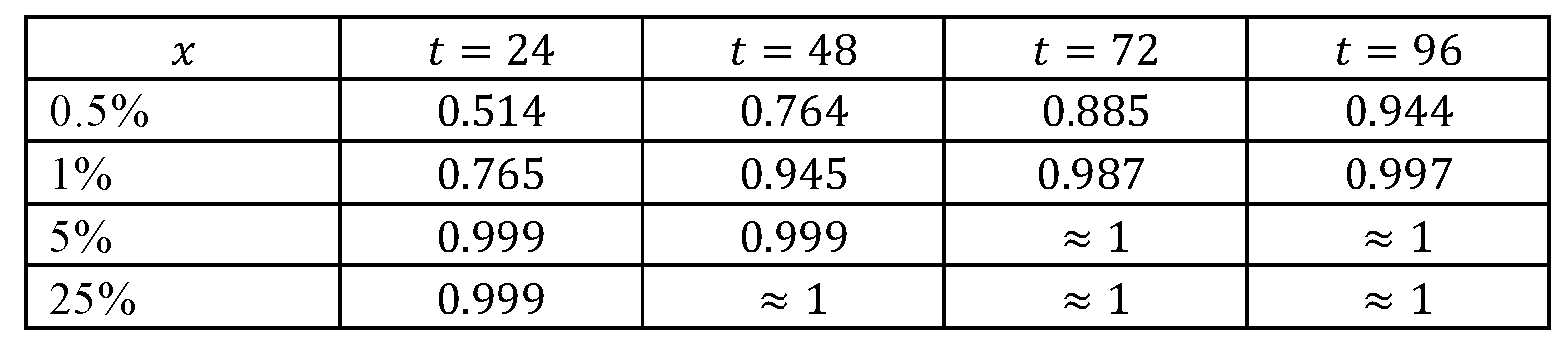
上記の表から、PKIDが1%しかネットワークハッシュレートを有しない場合でも、72時間の投票期間が、彼らが投票ブロックをマイニング可能であることをほぼ保証する。 From the table above, even if PK ID only has 1% of the network hashrate, the 72 hour voting period almost guarantees that they will be able to mine a voting block.
可能なハッシュ戦争シナリオの少なくとも1つの例示的なモデルでは、上述の評判システムは、レンタルハッシュの有効性を低下させることを示すことができる。その結果、攻撃者が14日間にわたりネットワークの75%を支配した場合でも、攻撃者は投票権の23%しか蓄積できない。 In at least one exemplary model of a possible hash war scenario, the reputation system described above can be shown to reduce the effectiveness of rented hashes. As a result, even if an attacker controls 75% of the network for 14 days, he can only accumulate 23% of the voting power.
種々の上述の例示的な方法の上述の動作のうちの一部又は全部は示されたものと異なる順序で実行されてよいこと、及び/又はそれらの方法の全体的な動作を変更することなく同時に実行されてよいことが理解される。 It is understood that some or all of the above operations of the various exemplary methods described above may be performed in a different order than shown and/or may be performed simultaneously without changing the overall operation of the methods.
図8を参照すると、本願の例に従う、簡易コンピューティング装置800をブロック図の形式で示す。コンピューティング装置800は、上述の機能のうちの1つ以上を実行してよい。コンピューティング装置800は、例えばマイニングノードであってよい。幾つかの実装では、コンピューティング装置800は、例えばマイナー識別子、マイナー作業履歴、マイナー評判スコア、又はマイナー投票ブロック、のようなブロックチェーンに記録されるデータを検証するよう動作する非マイニングノードであってよい。
Referring to FIG. 8, a
コンピューティング装置800は、1つ以上のマイクロプロセッサ、特定用途向け集積回路(ASIC)、マイクロコントローラ、又は同様のコンピュータ処理装置を含んでよいプロセッサ802を含む。コンピューティング装置800は、値、変数、及び幾つかの例ではプロセッサ実行可能プログラム命令を格納するための永久及び非永久メモリを含んでよいメモリ804と、ネットワークインタフェース806と、を更に含んでよい。
コンピューティング装置800は、実行されるとプロセッサ802に本願明細書に記載の機能又は動作のうちの1つ以上を実行させるプロセッサ実行可能命令を含むプロセッサ実行可能アプリケーション808を含んでよい。
上述の種々の実施形態は、単なる例であり、本願の範囲を限定することを意味しない。本願の意図された範囲内にある変形のように、ここに記載された種々の技術革新は、当業者に明らかである。特に、上述の例示的な実施形態のうちの1つ以上からの特徴は、以上に明示的に示されない特徴の部分結合を含む代替の例示的な実施形態を生成するために選択されてよい。更に、上述の例示的な実施形態のうちの1つ以上からの特徴は、以上に明示的に示されない特徴の結合を含む代替の例示的な実施形態を生成するために選択され結合されてよい。このような結合及び部分結合に適する特徴は、本願の全体的に吟味することにより当業者に直ちに明らかになるだろう。本願明細書及び請求項に記載された主題は、あらゆる適切な技術的変更をカバーし包含する。 The various embodiments described above are merely examples and are not meant to limit the scope of the present application. Various innovations described herein will be apparent to those skilled in the art, as will variations within the intended scope of the present application. In particular, features from one or more of the exemplary embodiments described above may be selected to generate alternative exemplary embodiments, including combinations of features not expressly shown above. Furthermore, features from one or more of the exemplary embodiments described above may be selected and combined to generate alternative exemplary embodiments, including combinations of features not expressly shown above. Features suitable for such combinations and combinations will be readily apparent to those skilled in the art upon review of the present application as a whole. The subject matter described in the present specification and claims covers and encompasses all appropriate technical modifications.
Claims (13)
登録生成トランザクションを含む第1ブロックをマイニングするステップであって、前記登録生成トランザクションは、登録情報フィールドに前記マイニングノードのマイナー識別子を含む、ステップと、
2つ以上の追加ブロックを順番にマイニングするステップであって、各追加ブロックは、前記マイナー識別子と前記順番の中で先行する追加ブロックの生成トランザクションへの参照とを含む情報フィールドを含む生成トランザクションを含み、前記登録生成トランザクションは前記順番の中の第1ブロックである、ステップと、
を含む方法。 A computer-implemented method for recording an operation history of a mining node in a blockchain in a blockchain network, the computer being a mining node, the method including, by the mining node:
mining a first block including a registration generation transaction, the registration generation transaction including a miner identifier of the mining node in a registration information field;
mining two or more additional blocks in sequence, each additional block including a creation transaction including an information field including the miner identifier and a reference to a creation transaction of a preceding additional block in the sequence, the registration creation transaction being a first block in the sequence;
The method includes:
前記順番の中の最後のブロックを識別するステップと、
前記ブロックチェーンから、前記生成トランザクションの各々に含まれる前記先行する追加ブロックの前記生成トランザクションへの前記参照に基づき、逆順に、前記追加ブロックから前記生成トランザクションを検索するステップと、
前記登録生成トランザクションを検索するステップと、
前記登録生成トランザクション内の前記マイナー識別子を検証するステップと、
を含み、それにより、前記登録生成トランザクション及び前記生成トランザクションは、前記マイニングノードの前記作業履歴を提供する、請求項1~4のいずれか一項に記載の方法。 The method further includes a step of verifying the operation history recorded in the blockchain by the mining node , the verifying step including:
identifying a last block in the sequence;
retrieving the generation transactions from the blockchain in reverse order based on the references contained in each of the generation transactions to the generation transactions of the preceding additional blocks;
retrieving the registration generation transaction;
verifying the minor identifier in the registration generation transaction;
The method according to any one of claims 1 to 4, wherein the registration generation transaction and the generation transaction provide the operation history of the mining node.
前記順番の中の各ブロックにそれぞれの重みを割り当て、
前記それぞれの重みの和を計算する、
ことに基づき、前記評判スコアを計算するステップを含む、請求項1~5のいずれか一項に記載の方法。 The method further includes determining , by the mining node, a reputation score of the mining node based on a recorded operation history of the mining node, the determining step comprising:
assigning a respective weight to each block in said sequence;
Calculating the sum of said respective weights;
The method of any one of claims 1 to 5, further comprising the step of calculating the reputation score based on:
該ブロックをマイニングする際に適用される採掘難易度閾値に基づき、該ブロックの採掘難易度スコアを決定するステップと、
前記採掘難易度スコアに基づき、前記それぞれの重みを設定するステップと、
を含む、請求項7に記載の方法。 The step of assigning each weight to each block includes the following steps for each block:
determining a mining difficulty score for the block based on a mining difficulty threshold applied when mining the block;
setting the respective weights based on the mining difficulty scores;
The method of claim 7, comprising:

1つ以上のプロセッサと、
メモリと、
前記メモリに格納されたコンピュータ実行可能命令であって、前記1つ以上のプロセッサにより実行されると、前記プロセッサに請求項1~11のいずれか一項に記載の方法を実行させる、コンピュータ実行可能命令と、
を含むコンピューティング装置。 A computing device that manages a public key infrastructure using a blockchain network, the computing device being a mining node,
one or more processors;
Memory,
computer-executable instructions stored in said memory, which, when executed by said one or more processors, cause said processors to perform a method according to any one of claims 1 to 11 ;
2. A computing device comprising:
Priority Applications (1)
| Application Number | Priority Date | Filing Date | Title |
|---|---|---|---|
| JP2024201967A JP2025019113A (en) | 2019-05-10 | 2024-11-20 | Method and apparatus for recording work history and proving reputation in a blockchain network |
Applications Claiming Priority (3)
| Application Number | Priority Date | Filing Date | Title |
|---|---|---|---|
| GB1906634.9A GB2583766A (en) | 2019-05-10 | 2019-05-10 | Methods and devices for recording work history and proving reputation in a blockchain network |
| GB1906634.9 | 2019-05-10 | ||
| PCT/IB2020/054262 WO2020229950A1 (en) | 2019-05-10 | 2020-05-05 | Methods and devices for recording work history and proving reputation in a blockchain network |
Related Child Applications (1)
| Application Number | Title | Priority Date | Filing Date |
|---|---|---|---|
| JP2024201967A Division JP2025019113A (en) | 2019-05-10 | 2024-11-20 | Method and apparatus for recording work history and proving reputation in a blockchain network |
Publications (2)
| Publication Number | Publication Date |
|---|---|
| JP2022531742A JP2022531742A (en) | 2022-07-08 |
| JP7592634B2 true JP7592634B2 (en) | 2024-12-02 |
Family
ID=67384756
Family Applications (2)
| Application Number | Title | Priority Date | Filing Date |
|---|---|---|---|
| JP2021566554A Active JP7592634B2 (en) | 2019-05-10 | 2020-05-05 | Method and apparatus for recording work history and proving reputation in a blockchain network |
| JP2024201967A Pending JP2025019113A (en) | 2019-05-10 | 2024-11-20 | Method and apparatus for recording work history and proving reputation in a blockchain network |
Family Applications After (1)
| Application Number | Title | Priority Date | Filing Date |
|---|---|---|---|
| JP2024201967A Pending JP2025019113A (en) | 2019-05-10 | 2024-11-20 | Method and apparatus for recording work history and proving reputation in a blockchain network |
Country Status (8)
| Country | Link |
|---|---|
| US (2) | US12212965B2 (en) |
| EP (2) | EP4525346A1 (en) |
| JP (2) | JP7592634B2 (en) |
| KR (1) | KR20220006619A (en) |
| CN (2) | CN120223316A (en) |
| GB (1) | GB2583766A (en) |
| SG (1) | SG11202112444QA (en) |
| WO (1) | WO2020229950A1 (en) |
Families Citing this family (14)
| Publication number | Priority date | Publication date | Assignee | Title |
|---|---|---|---|---|
| FR3099017B1 (en) * | 2019-07-16 | 2021-08-06 | Idemia Identity & Security France | Process for verifying a transaction in a blockchain-type database |
| US11676135B2 (en) * | 2019-07-19 | 2023-06-13 | Ebay Inc. | Blockchain consensus protocol using predictive proof of metrics |
| GB2592211A (en) | 2020-02-19 | 2021-08-25 | Nchain Holdings Ltd | Adapting connections of a layered network |
| GB2592225A (en) | 2020-02-19 | 2021-08-25 | Nchain Holdings Ltd | Attestation service for use with a blockchain network |
| GB2594684A (en) | 2020-02-19 | 2021-11-10 | Nchain Holdings Ltd | Layered network |
| CN112600917B (en) * | 2020-12-11 | 2022-05-03 | 重庆邮电大学 | Reputation-based block chain work proving method |
| US11755981B2 (en) | 2021-05-17 | 2023-09-12 | International Business Machines Corporation | Peer review system with polynomial discounting |
| CN113364596A (en) * | 2021-05-27 | 2021-09-07 | 南方科技大学 | Ore digging method and device based on block chain, mobile terminal and storage medium |
| US20230308427A1 (en) * | 2022-03-28 | 2023-09-28 | Bank Of America Corporation | Consensus authentication utilizing nodes in a distributed network of nodes |
| KR102740994B1 (en) * | 2022-04-29 | 2024-12-10 | 국립금오공과대학교 산학협력단 | Auto Integrated Mining Method for Private Wireless Blockchain Network |
| US12212698B2 (en) * | 2022-08-17 | 2025-01-28 | Saudi Arabian Oil Company | Method for integrating blockchain node compliance data within blockchain transaction data |
| CN116599959B (en) * | 2023-05-10 | 2025-09-26 | 安徽农业大学 | A cross-chain transaction implementation method and device based on blockchain technology |
| KR102646519B1 (en) * | 2023-09-14 | 2024-03-13 | 주식회사 호원소프트 | Device and method for providing electronic research note service |
| CN117668033A (en) * | 2023-12-28 | 2024-03-08 | 北京理工大学 | A non-interactive and verifiable privacy-preserving blockchain sequential query method |
Citations (3)
| Publication number | Priority date | Publication date | Assignee | Title |
|---|---|---|---|---|
| CN109064124A (en) | 2018-07-17 | 2018-12-21 | 腾讯科技(深圳)有限公司 | Method and apparatus based on the verifying of block chain, storage track record |
| WO2019021105A1 (en) | 2017-07-24 | 2019-01-31 | nChain Holdings Limited | Methods and Systems For Blockchain-Implemented Event-Lock Encryption |
| WO2019021107A1 (en) | 2017-07-24 | 2019-01-31 | nChain Holdings Limited | Computer-implemented system and method for managing a large distributed memory pool in a blockchain network |
Family Cites Families (44)
| Publication number | Priority date | Publication date | Assignee | Title |
|---|---|---|---|---|
| US9898782B1 (en) | 2013-06-28 | 2018-02-20 | Winklevoss Ip, Llc | Systems, methods, and program products for operating exchange traded products holding digital math-based assets |
| US11270298B2 (en) * | 2014-04-14 | 2022-03-08 | 21, Inc. | Digital currency mining circuitry |
| WO2016161073A1 (en) * | 2015-03-31 | 2016-10-06 | Nasdaq, Inc. | Systems and methods of blockchain transaction recordation |
| CN104915249A (en) | 2015-05-21 | 2015-09-16 | 北京比特大陆科技有限公司 | Method and device for digging virtual digital coins in mining pool |
| US10839378B1 (en) * | 2016-01-12 | 2020-11-17 | 21, Inc. | Systems and methods for performing device authentication operations using cryptocurrency transactions |
| CA3014392C (en) | 2016-02-12 | 2024-04-16 | Royal Bank Of Canada | Methods and systems for digital reward processing |
| KR101799343B1 (en) | 2016-05-16 | 2017-11-22 | 주식회사 코인플러그 | Method for using, revoking certificate information and blockchain-based server using the same |
| US9635000B1 (en) | 2016-05-25 | 2017-04-25 | Sead Muftic | Blockchain identity management system based on public identities ledger |
| US10291627B2 (en) | 2016-10-17 | 2019-05-14 | Arm Ltd. | Blockchain mining using trusted nodes |
| US10540652B2 (en) * | 2016-11-18 | 2020-01-21 | Intel Corporation | Technology for secure partitioning and updating of a distributed digital ledger |
| US10862959B2 (en) * | 2016-11-28 | 2020-12-08 | Keir Finlow-Bates | Consensus system and method for adding data to a blockchain |
| CN107078910B (en) | 2016-12-23 | 2021-02-05 | 深圳前海达闼云端智能科技有限公司 | Method, device, node, signature device and system for generating block chain block |
| US9992022B1 (en) | 2017-02-06 | 2018-06-05 | Northern Trust Corporation | Systems and methods for digital identity management and permission controls within distributed network nodes |
| US20200082361A1 (en) * | 2017-03-16 | 2020-03-12 | Hong Kong R&D Centre for Logistics and Supply Chain Management Enabling Technologies Limited | System and method for controlling a ledger of transactions |
| US11538031B2 (en) | 2017-03-31 | 2022-12-27 | Vijay Madisetti | Method and system for identity and access management for blockchain interoperability |
| US20180285996A1 (en) * | 2017-04-03 | 2018-10-04 | FutureLab Consulting Inc. | Methods and system for managing intellectual property using a blockchain |
| JP6340107B1 (en) | 2017-04-10 | 2018-06-06 | アイビーシー株式会社 | Electronic certification system |
| US10397328B2 (en) * | 2017-05-17 | 2019-08-27 | Nec Corporation | Method and system for providing a robust blockchain with an integrated proof of storage |
| WO2019029430A1 (en) | 2017-08-05 | 2019-02-14 | Proclus Technologies Limited | Method and system for securing blockchain with proof-of-transactions |
| WO2019040119A1 (en) | 2017-08-23 | 2019-02-28 | Sintez, Llc | Crypt - decentralized crypto-monetization system and method |
| KR101827373B1 (en) * | 2017-08-29 | 2018-02-08 | 주식회사 더블체인 | Block window module having agreement algorithm for limiting mining, managing server and virtual money exchange system and method |
| US10581591B1 (en) | 2017-10-17 | 2020-03-03 | Matthew Branton | Probabilistic secondary token issuance on a blockchain based on burning of a primary token of the blockchain |
| CN107944848A (en) | 2017-11-20 | 2018-04-20 | 北京比特大陆科技有限公司 | Monetary settlement method, apparatus and electronic equipment |
| US10997125B2 (en) | 2017-11-29 | 2021-05-04 | Technion Research & Development Foundation Limited | Proof of lottery (PoL) blockchain |
| US11257077B2 (en) | 2017-11-30 | 2022-02-22 | Visa International Service Association | Blockchain system for confidential and anonymous smart contracts |
| US11038669B2 (en) * | 2018-02-27 | 2021-06-15 | Mydream Interactive, Inc. | Systems and methods for blockchains with serial proof of work |
| US11177937B1 (en) | 2018-03-08 | 2021-11-16 | Anonyome Labs, Inc. | Apparatus and method for establishing trust of anonymous identities |
| WO2019185148A1 (en) | 2018-03-29 | 2019-10-03 | Telefonaktiebolaget Lm Ericsson (Publ) | Technique for computing a block in a blockchain network |
| US10764325B2 (en) | 2018-03-30 | 2020-09-01 | Konica Minolta Laboratory U.S.A., Inc. | Method for adjusting mining difficulty of a cryptocurrency blockchain system by monitoring malicious forks and implementing a miners blockchain |
| GB201806112D0 (en) | 2018-04-13 | 2018-05-30 | Nchain Holdings Ltd | Computer-implemented system and method |
| CN108876332B (en) * | 2018-06-04 | 2020-09-22 | 清华大学 | A blockchain security transaction method and device based on biometric signature authentication |
| CN109040014A (en) * | 2018-06-13 | 2018-12-18 | 湖南搜云网络科技股份有限公司 | Block chain processing method and processing device, block chain node and storage medium |
| US11418336B2 (en) * | 2018-06-20 | 2022-08-16 | Google Llc | Digital ledger for unique item IDs with ownership |
| CN109194482B (en) * | 2018-08-03 | 2021-02-12 | 中山大学 | Reputation certification based block chain consensus method |
| CN109146684B (en) * | 2018-08-07 | 2021-12-03 | 农夫铺子发展集团有限公司 | Decentralized transaction verification method |
| US10250395B1 (en) * | 2018-08-29 | 2019-04-02 | Accenture Global Solutions Limited | Cryptologic blockchain interoperation |
| CN109146483B (en) * | 2018-08-31 | 2022-01-07 | 刘一涵 | Credit recording method and system based on block chain network |
| US10951408B2 (en) * | 2018-09-05 | 2021-03-16 | Nec Corporation | Method and system for publicly verifiable proofs of retrievability in blockchains |
| US10984412B2 (en) | 2018-09-20 | 2021-04-20 | Coinbase, Inc. | System and method for management of cryptocurrency systems |
| CN109697606A (en) | 2018-09-30 | 2019-04-30 | 贝克链区块链技术有限公司 | The distributed network and the ecosystem of common recognition agreement are proved based on innovative prestige |
| GB2585816A (en) | 2018-12-12 | 2021-01-27 | Univ York | Proof-of-work for blockchain applications |
| WO2020153552A1 (en) | 2019-01-22 | 2020-07-30 | 인제대학교 산학협력단 | Method and apparatus for blockchain, allowing modification of transaction recorded therein |
| US11379462B2 (en) | 2019-04-05 | 2022-07-05 | Comcast Cable Communications, Llc | Systems and methods for a reputation-based consensus protocol |
| US20200349554A1 (en) | 2019-04-30 | 2020-11-05 | Hands-Free Bitcoin, LLC | Systems, methods, and storage media for assigning user-specific blockchain mining pool data to a computing device |
-
2019
- 2019-05-10 GB GB1906634.9A patent/GB2583766A/en not_active Withdrawn
-
2020
- 2020-05-05 SG SG11202112444QA patent/SG11202112444QA/en unknown
- 2020-05-05 CN CN202510085619.5A patent/CN120223316A/en active Pending
- 2020-05-05 JP JP2021566554A patent/JP7592634B2/en active Active
- 2020-05-05 US US17/609,742 patent/US12212965B2/en active Active
- 2020-05-05 KR KR1020217040495A patent/KR20220006619A/en active Pending
- 2020-05-05 EP EP25155623.9A patent/EP4525346A1/en active Pending
- 2020-05-05 EP EP20727375.6A patent/EP3963824B1/en active Active
- 2020-05-05 CN CN202080042882.1A patent/CN113940032B/en active Active
- 2020-05-05 WO PCT/IB2020/054262 patent/WO2020229950A1/en not_active Ceased
-
2024
- 2024-11-20 JP JP2024201967A patent/JP2025019113A/en active Pending
- 2024-12-16 US US18/982,222 patent/US20250119743A1/en active Pending
Patent Citations (3)
| Publication number | Priority date | Publication date | Assignee | Title |
|---|---|---|---|---|
| WO2019021105A1 (en) | 2017-07-24 | 2019-01-31 | nChain Holdings Limited | Methods and Systems For Blockchain-Implemented Event-Lock Encryption |
| WO2019021107A1 (en) | 2017-07-24 | 2019-01-31 | nChain Holdings Limited | Computer-implemented system and method for managing a large distributed memory pool in a blockchain network |
| CN109064124A (en) | 2018-07-17 | 2018-12-21 | 腾讯科技(深圳)有限公司 | Method and apparatus based on the verifying of block chain, storage track record |
Non-Patent Citations (3)
| Title |
|---|
| Richard Dennis et al.,A Temporal Blockchain: A formal Analysis,2016 International Conference on Collaboration Technologies and Systems (CTS),米国,IEEE,2016年10月31日,pp. 430-437 |
| 佐古 和恵 ほか,ブロックチェーン技術の社会実装に向けた観点,電子情報通信学会論文誌B,日本,電子情報通信学会,2017年11月01日,Vol.J100-B No.11,pp.893-900 |
| 東角 芳樹 ほか,コンソーシアムチェーンにおける証明書管理に関する一考察,2017年 暗号と情報セキュリティシンポジウム(SCIS2017) [USB],日本,2017年 暗号と情報セキュリティシンポジウム実行,2017年01月24日,1F2-3,pp. 1-4 |
Also Published As
| Publication number | Publication date |
|---|---|
| SG11202112444QA (en) | 2021-12-30 |
| EP3963824B1 (en) | 2025-03-19 |
| CN113940032B (en) | 2025-02-14 |
| CN113940032A (en) | 2022-01-14 |
| GB2583766A (en) | 2020-11-11 |
| EP3963824A1 (en) | 2022-03-09 |
| JP2022531742A (en) | 2022-07-08 |
| CN120223316A (en) | 2025-06-27 |
| KR20220006619A (en) | 2022-01-17 |
| JP2025019113A (en) | 2025-02-06 |
| EP4525346A1 (en) | 2025-03-19 |
| US20250119743A1 (en) | 2025-04-10 |
| GB201906634D0 (en) | 2019-06-26 |
| WO2020229950A1 (en) | 2020-11-19 |
| US12212965B2 (en) | 2025-01-28 |
| US20220092593A1 (en) | 2022-03-24 |
Similar Documents
| Publication | Publication Date | Title |
|---|---|---|
| JP7592634B2 (en) | Method and apparatus for recording work history and proving reputation in a blockchain network | |
| JP7608364B2 (en) | Method and apparatus for registering and authenticating miner identities in a blockchain network | |
| US12452033B2 (en) | Blockchain for general computation | |
| JP7665616B2 (en) | Method and device for automated digital certificate validation - Patents.com | |
| CN110892674A (en) | The transaction generation method of the blockchain and the block verification method of the blockchain | |
| JP7600260B2 (en) | METHOD AND APPARATUS FOR PROPAGATING BLOCKS IN A BLOCKCHAIN NETWORK | |
| KR102915557B1 (en) | Method and device for registering and authenticating miner identities in a blockchain network. | |
| HK40073296A (en) | Methods and devices for registering and authenticating miner identity in a blockchain network | |
| RU2791865C2 (en) | Blockchain transaction generation method and blockchain block validity verification method | |
| HK40039843A (en) | Blockchain-based transaction processing method and device and electronic equipment | |
| HK40039845A (en) | Blockchain-based transaction processing method and device and electronic equipment | |
| HK1263119A1 (en) | Transaction processing method and device based on block chain and electronic equipment | |
| HK1263119B (en) | Transaction processing method and device based on block chain and electronic equipment |
Legal Events
| Date | Code | Title | Description |
|---|---|---|---|
| A621 | Written request for application examination |
Free format text: JAPANESE INTERMEDIATE CODE: A621 Effective date: 20230406 |
|
| A977 | Report on retrieval |
Free format text: JAPANESE INTERMEDIATE CODE: A971007 Effective date: 20240424 |
|
| A131 | Notification of reasons for refusal |
Free format text: JAPANESE INTERMEDIATE CODE: A131 Effective date: 20240521 |
|
| A521 | Request for written amendment filed |
Free format text: JAPANESE INTERMEDIATE CODE: A523 Effective date: 20240816 |
|
| TRDD | Decision of grant or rejection written | ||
| A01 | Written decision to grant a patent or to grant a registration (utility model) |
Free format text: JAPANESE INTERMEDIATE CODE: A01 Effective date: 20241022 |
|
| A61 | First payment of annual fees (during grant procedure) |
Free format text: JAPANESE INTERMEDIATE CODE: A61 Effective date: 20241120 |
|
| R150 | Certificate of patent or registration of utility model |
Ref document number: 7592634 Country of ref document: JP Free format text: JAPANESE INTERMEDIATE CODE: R150 |