JP7580819B2 - Composition for sequential polymerase chain reaction and method for amplifying genes using the same - Google Patents
Composition for sequential polymerase chain reaction and method for amplifying genes using the same Download PDFInfo
- Publication number
- JP7580819B2 JP7580819B2 JP2022580308A JP2022580308A JP7580819B2 JP 7580819 B2 JP7580819 B2 JP 7580819B2 JP 2022580308 A JP2022580308 A JP 2022580308A JP 2022580308 A JP2022580308 A JP 2022580308A JP 7580819 B2 JP7580819 B2 JP 7580819B2
- Authority
- JP
- Japan
- Prior art keywords
- reverse primer
- polymerase chain
- chain reaction
- product
- gene
- Prior art date
- Legal status (The legal status is an assumption and is not a legal conclusion. Google has not performed a legal analysis and makes no representation as to the accuracy of the status listed.)
- Active
Links
- 238000003752 polymerase chain reaction Methods 0.000 title claims description 253
- 108090000623 proteins and genes Proteins 0.000 title claims description 155
- 238000000034 method Methods 0.000 title claims description 45
- 230000002441 reversible effect Effects 0.000 claims description 121
- 239000000047 product Substances 0.000 claims description 99
- 238000000137 annealing Methods 0.000 claims description 26
- 239000000523 sample Substances 0.000 claims description 19
- 230000000295 complement effect Effects 0.000 claims description 18
- 230000015572 biosynthetic process Effects 0.000 claims description 17
- 238000003786 synthesis reaction Methods 0.000 claims description 17
- 230000004913 activation Effects 0.000 claims description 11
- 108010014303 DNA-directed DNA polymerase Proteins 0.000 claims description 10
- 102000016928 DNA-directed DNA polymerase Human genes 0.000 claims description 10
- 238000004925 denaturation Methods 0.000 claims description 10
- 230000036425 denaturation Effects 0.000 claims description 10
- 239000012467 final product Substances 0.000 claims description 9
- 108700026220 vif Genes Proteins 0.000 claims description 5
- 230000002194 synthesizing effect Effects 0.000 claims description 3
- 230000036961 partial effect Effects 0.000 claims description 2
- GNFTZDOKVXKIBK-UHFFFAOYSA-N 3-(2-methoxyethoxy)benzohydrazide Chemical compound COCCOC1=CC=CC(C(=O)NN)=C1 GNFTZDOKVXKIBK-UHFFFAOYSA-N 0.000 claims 1
- 230000001105 regulatory effect Effects 0.000 claims 1
- 230000003362 replicative effect Effects 0.000 claims 1
- 238000006243 chemical reaction Methods 0.000 description 22
- 230000003321 amplification Effects 0.000 description 20
- 238000003199 nucleic acid amplification method Methods 0.000 description 20
- 108020004414 DNA Proteins 0.000 description 14
- 230000035772 mutation Effects 0.000 description 11
- 238000007857 nested PCR Methods 0.000 description 9
- 238000010586 diagram Methods 0.000 description 7
- 230000002829 reductive effect Effects 0.000 description 7
- 230000008901 benefit Effects 0.000 description 5
- 238000011109 contamination Methods 0.000 description 5
- 230000001965 increasing effect Effects 0.000 description 5
- 230000000977 initiatory effect Effects 0.000 description 5
- WZFUQSJFWNHZHM-UHFFFAOYSA-N 2-[4-[2-(2,3-dihydro-1H-inden-2-ylamino)pyrimidin-5-yl]piperazin-1-yl]-1-(2,4,6,7-tetrahydrotriazolo[4,5-c]pyridin-5-yl)ethanone Chemical compound C1C(CC2=CC=CC=C12)NC1=NC=C(C=N1)N1CCN(CC1)CC(=O)N1CC2=C(CC1)NN=N2 WZFUQSJFWNHZHM-UHFFFAOYSA-N 0.000 description 4
- 230000004544 DNA amplification Effects 0.000 description 4
- 241000700605 Viruses Species 0.000 description 4
- 230000002068 genetic effect Effects 0.000 description 4
- 238000000338 in vitro Methods 0.000 description 4
- 230000010076 replication Effects 0.000 description 4
- 230000035945 sensitivity Effects 0.000 description 4
- VZSRBBMJRBPUNF-UHFFFAOYSA-N 2-(2,3-dihydro-1H-inden-2-ylamino)-N-[3-oxo-3-(2,4,6,7-tetrahydrotriazolo[4,5-c]pyridin-5-yl)propyl]pyrimidine-5-carboxamide Chemical compound C1C(CC2=CC=CC=C12)NC1=NC=C(C=N1)C(=O)NCCC(N1CC2=C(CC1)NN=N2)=O VZSRBBMJRBPUNF-UHFFFAOYSA-N 0.000 description 3
- 238000011529 RT qPCR Methods 0.000 description 3
- 238000001514 detection method Methods 0.000 description 3
- 239000012153 distilled water Substances 0.000 description 3
- 239000000376 reactant Substances 0.000 description 3
- XLYOFNOQVPJJNP-UHFFFAOYSA-N water Chemical compound O XLYOFNOQVPJJNP-UHFFFAOYSA-N 0.000 description 3
- IHCCLXNEEPMSIO-UHFFFAOYSA-N 2-[4-[2-(2,3-dihydro-1H-inden-2-ylamino)pyrimidin-5-yl]piperidin-1-yl]-1-(2,4,6,7-tetrahydrotriazolo[4,5-c]pyridin-5-yl)ethanone Chemical compound C1C(CC2=CC=CC=C12)NC1=NC=C(C=N1)C1CCN(CC1)CC(=O)N1CC2=C(CC1)NN=N2 IHCCLXNEEPMSIO-UHFFFAOYSA-N 0.000 description 2
- MKYBYDHXWVHEJW-UHFFFAOYSA-N N-[1-oxo-1-(2,4,6,7-tetrahydrotriazolo[4,5-c]pyridin-5-yl)propan-2-yl]-2-[[3-(trifluoromethoxy)phenyl]methylamino]pyrimidine-5-carboxamide Chemical compound O=C(C(C)NC(=O)C=1C=NC(=NC=1)NCC1=CC(=CC=C1)OC(F)(F)F)N1CC2=C(CC1)NN=N2 MKYBYDHXWVHEJW-UHFFFAOYSA-N 0.000 description 2
- NIPNSKYNPDTRPC-UHFFFAOYSA-N N-[2-oxo-2-(2,4,6,7-tetrahydrotriazolo[4,5-c]pyridin-5-yl)ethyl]-2-[[3-(trifluoromethoxy)phenyl]methylamino]pyrimidine-5-carboxamide Chemical compound O=C(CNC(=O)C=1C=NC(=NC=1)NCC1=CC(=CC=C1)OC(F)(F)F)N1CC2=C(CC1)NN=N2 NIPNSKYNPDTRPC-UHFFFAOYSA-N 0.000 description 2
- AFCARXCZXQIEQB-UHFFFAOYSA-N N-[3-oxo-3-(2,4,6,7-tetrahydrotriazolo[4,5-c]pyridin-5-yl)propyl]-2-[[3-(trifluoromethoxy)phenyl]methylamino]pyrimidine-5-carboxamide Chemical compound O=C(CCNC(=O)C=1C=NC(=NC=1)NCC1=CC(=CC=C1)OC(F)(F)F)N1CC2=C(CC1)NN=N2 AFCARXCZXQIEQB-UHFFFAOYSA-N 0.000 description 2
- 238000012408 PCR amplification Methods 0.000 description 2
- 230000008859 change Effects 0.000 description 2
- 239000002299 complementary DNA Substances 0.000 description 2
- 239000000356 contaminant Substances 0.000 description 2
- 230000003247 decreasing effect Effects 0.000 description 2
- 201000010099 disease Diseases 0.000 description 2
- 208000037265 diseases, disorders, signs and symptoms Diseases 0.000 description 2
- 238000003912 environmental pollution Methods 0.000 description 2
- 150000007523 nucleic acids Chemical group 0.000 description 2
- 238000006116 polymerization reaction Methods 0.000 description 2
- 230000008569 process Effects 0.000 description 2
- 238000003757 reverse transcription PCR Methods 0.000 description 2
- 230000007480 spreading Effects 0.000 description 2
- 239000000126 substance Substances 0.000 description 2
- OHVLMTFVQDZYHP-UHFFFAOYSA-N 1-(2,4,6,7-tetrahydrotriazolo[4,5-c]pyridin-5-yl)-2-[4-[2-[[3-(trifluoromethoxy)phenyl]methylamino]pyrimidin-5-yl]piperazin-1-yl]ethanone Chemical compound N1N=NC=2CN(CCC=21)C(CN1CCN(CC1)C=1C=NC(=NC=1)NCC1=CC(=CC=C1)OC(F)(F)F)=O OHVLMTFVQDZYHP-UHFFFAOYSA-N 0.000 description 1
- LDXJRKWFNNFDSA-UHFFFAOYSA-N 2-(2,4,6,7-tetrahydrotriazolo[4,5-c]pyridin-5-yl)-1-[4-[2-[[3-(trifluoromethoxy)phenyl]methylamino]pyrimidin-5-yl]piperazin-1-yl]ethanone Chemical compound C1CN(CC2=NNN=C21)CC(=O)N3CCN(CC3)C4=CN=C(N=C4)NCC5=CC(=CC=C5)OC(F)(F)F LDXJRKWFNNFDSA-UHFFFAOYSA-N 0.000 description 1
- 108020004635 Complementary DNA Proteins 0.000 description 1
- 102000053602 DNA Human genes 0.000 description 1
- 102000004190 Enzymes Human genes 0.000 description 1
- 108090000790 Enzymes Proteins 0.000 description 1
- 108060002716 Exonuclease Proteins 0.000 description 1
- 102100034343 Integrase Human genes 0.000 description 1
- 108091028043 Nucleic acid sequence Proteins 0.000 description 1
- 108010092799 RNA-directed DNA polymerase Proteins 0.000 description 1
- 108010006785 Taq Polymerase Proteins 0.000 description 1
- 230000000903 blocking effect Effects 0.000 description 1
- 238000010804 cDNA synthesis Methods 0.000 description 1
- 239000007795 chemical reaction product Substances 0.000 description 1
- 238000000354 decomposition reaction Methods 0.000 description 1
- 230000000694 effects Effects 0.000 description 1
- 102000013165 exonuclease Human genes 0.000 description 1
- 125000002887 hydroxy group Chemical group [H]O* 0.000 description 1
- 230000001939 inductive effect Effects 0.000 description 1
- 230000000670 limiting effect Effects 0.000 description 1
- 108091070501 miRNA Proteins 0.000 description 1
- 239000002679 microRNA Substances 0.000 description 1
- 108020004707 nucleic acids Proteins 0.000 description 1
- 102000039446 nucleic acids Human genes 0.000 description 1
- 238000003753 real-time PCR Methods 0.000 description 1
- 238000004904 shortening Methods 0.000 description 1
Images


Classifications
-
- C—CHEMISTRY; METALLURGY
- C12—BIOCHEMISTRY; BEER; SPIRITS; WINE; VINEGAR; MICROBIOLOGY; ENZYMOLOGY; MUTATION OR GENETIC ENGINEERING
- C12Q—MEASURING OR TESTING PROCESSES INVOLVING ENZYMES, NUCLEIC ACIDS OR MICROORGANISMS; COMPOSITIONS OR TEST PAPERS THEREFOR; PROCESSES OF PREPARING SUCH COMPOSITIONS; CONDITION-RESPONSIVE CONTROL IN MICROBIOLOGICAL OR ENZYMOLOGICAL PROCESSES
- C12Q1/00—Measuring or testing processes involving enzymes, nucleic acids or microorganisms; Compositions therefor; Processes of preparing such compositions
- C12Q1/68—Measuring or testing processes involving enzymes, nucleic acids or microorganisms; Compositions therefor; Processes of preparing such compositions involving nucleic acids
- C12Q1/6844—Nucleic acid amplification reactions
- C12Q1/686—Polymerase chain reaction [PCR]
-
- C—CHEMISTRY; METALLURGY
- C12—BIOCHEMISTRY; BEER; SPIRITS; WINE; VINEGAR; MICROBIOLOGY; ENZYMOLOGY; MUTATION OR GENETIC ENGINEERING
- C12Q—MEASURING OR TESTING PROCESSES INVOLVING ENZYMES, NUCLEIC ACIDS OR MICROORGANISMS; COMPOSITIONS OR TEST PAPERS THEREFOR; PROCESSES OF PREPARING SUCH COMPOSITIONS; CONDITION-RESPONSIVE CONTROL IN MICROBIOLOGICAL OR ENZYMOLOGICAL PROCESSES
- C12Q1/00—Measuring or testing processes involving enzymes, nucleic acids or microorganisms; Compositions therefor; Processes of preparing such compositions
- C12Q1/68—Measuring or testing processes involving enzymes, nucleic acids or microorganisms; Compositions therefor; Processes of preparing such compositions involving nucleic acids
- C12Q1/6844—Nucleic acid amplification reactions
- C12Q1/6851—Quantitative amplification
-
- C—CHEMISTRY; METALLURGY
- C12—BIOCHEMISTRY; BEER; SPIRITS; WINE; VINEGAR; MICROBIOLOGY; ENZYMOLOGY; MUTATION OR GENETIC ENGINEERING
- C12Q—MEASURING OR TESTING PROCESSES INVOLVING ENZYMES, NUCLEIC ACIDS OR MICROORGANISMS; COMPOSITIONS OR TEST PAPERS THEREFOR; PROCESSES OF PREPARING SUCH COMPOSITIONS; CONDITION-RESPONSIVE CONTROL IN MICROBIOLOGICAL OR ENZYMOLOGICAL PROCESSES
- C12Q1/00—Measuring or testing processes involving enzymes, nucleic acids or microorganisms; Compositions therefor; Processes of preparing such compositions
- C12Q1/68—Measuring or testing processes involving enzymes, nucleic acids or microorganisms; Compositions therefor; Processes of preparing such compositions involving nucleic acids
- C12Q1/6844—Nucleic acid amplification reactions
- C12Q1/6853—Nucleic acid amplification reactions using modified primers or templates
-
- C—CHEMISTRY; METALLURGY
- C12—BIOCHEMISTRY; BEER; SPIRITS; WINE; VINEGAR; MICROBIOLOGY; ENZYMOLOGY; MUTATION OR GENETIC ENGINEERING
- C12Q—MEASURING OR TESTING PROCESSES INVOLVING ENZYMES, NUCLEIC ACIDS OR MICROORGANISMS; COMPOSITIONS OR TEST PAPERS THEREFOR; PROCESSES OF PREPARING SUCH COMPOSITIONS; CONDITION-RESPONSIVE CONTROL IN MICROBIOLOGICAL OR ENZYMOLOGICAL PROCESSES
- C12Q2527/00—Reactions demanding special reaction conditions
- C12Q2527/101—Temperature
-
- C—CHEMISTRY; METALLURGY
- C12—BIOCHEMISTRY; BEER; SPIRITS; WINE; VINEGAR; MICROBIOLOGY; ENZYMOLOGY; MUTATION OR GENETIC ENGINEERING
- C12Q—MEASURING OR TESTING PROCESSES INVOLVING ENZYMES, NUCLEIC ACIDS OR MICROORGANISMS; COMPOSITIONS OR TEST PAPERS THEREFOR; PROCESSES OF PREPARING SUCH COMPOSITIONS; CONDITION-RESPONSIVE CONTROL IN MICROBIOLOGICAL OR ENZYMOLOGICAL PROCESSES
- C12Q2537/00—Reactions characterised by the reaction format or use of a specific feature
- C12Q2537/10—Reactions characterised by the reaction format or use of a specific feature the purpose or use of
- C12Q2537/149—Sequential reactions
Landscapes
- Chemical & Material Sciences (AREA)
- Organic Chemistry (AREA)
- Life Sciences & Earth Sciences (AREA)
- Zoology (AREA)
- Wood Science & Technology (AREA)
- Proteomics, Peptides & Aminoacids (AREA)
- Health & Medical Sciences (AREA)
- Engineering & Computer Science (AREA)
- Chemical Kinetics & Catalysis (AREA)
- Biophysics (AREA)
- Immunology (AREA)
- Microbiology (AREA)
- Molecular Biology (AREA)
- Biotechnology (AREA)
- Analytical Chemistry (AREA)
- Physics & Mathematics (AREA)
- Biochemistry (AREA)
- Bioinformatics & Cheminformatics (AREA)
- General Engineering & Computer Science (AREA)
- General Health & Medical Sciences (AREA)
- Genetics & Genomics (AREA)
- Measuring Or Testing Involving Enzymes Or Micro-Organisms (AREA)
Description
本発明は、逐次ポリメラーゼ連鎖反応用組成物及びそれを用いた遺伝子増幅方法に関し、より詳細には、鋳型遺伝子、DNAポリメラーゼ、dNTP、第1のフォワードプライマー、第1のリバースプライマー、第2のリバースプライマー及び第3のリバースプライマーを含む組成物を1つの容器に準備し、ポリメラーゼ連鎖反応を連続的に行うことができる方法で、温度に応じてそれぞれのポリメラーゼ連鎖反応の調節が可能であり、一つの容器で順次行うことができるため、遺伝子増幅時に外部から汚染物質の流入が少なく、遺伝子ポリメラーゼ連鎖反応(PCR)の収率を高めることができる方法に関する。 The present invention relates to a composition for sequential polymerase chain reaction and a method for amplifying genes using the same. More specifically, the present invention relates to a method for continuously performing polymerase chain reactions by preparing a composition containing a template gene, DNA polymerase, dNTPs, a first forward primer, a first reverse primer, a second reverse primer, and a third reverse primer in one container, and the method is capable of adjusting each polymerase chain reaction according to temperature and performing the reactions sequentially in one container, thereby reducing the inflow of external contaminants during gene amplification and increasing the yield of gene polymerase chain reaction (PCR).
分子診断は、遺伝子を分析して疾患を診断する分野で、現在、体外診断分野の中で最も高い成長傾向を見せているのが実状である。実際、急速な環境汚染と気候変動によるものと推定される新種ウイルスが大きく拡散しながら、体外診断分野の中で最も高い診断の精度が確保され、新種ウイルスが出現する場合、迅速に感染の有無を確認できるという利点がある分子診断に対する多くの研究が続いている。 Molecular diagnostics is a field that analyzes genes to diagnose diseases, and is currently showing the fastest growth trend among in vitro diagnostic fields. In fact, as new viruses, believed to be caused by rapid environmental pollution and climate change, are rapidly spreading, much research is ongoing into molecular diagnostics, which have the advantage of ensuring the highest diagnostic accuracy among in vitro diagnostics and being able to quickly confirm whether or not someone is infected when a new virus emerges.
塩基配列または塩基の変異を分析するために様々な方法があるが、これらすべての方法を使用する前に基本的に大量の遺伝子試料を得なければならない。現在、研究者が遺伝子試料を得るために最も一般的に使用する方法は、DNAポリメラーゼを用いたポリメラーゼ連鎖反応(以下、「PCR」という)である。前記方法は、鋳型と結合できるプライマーを設計し、遺伝子の所望の部位のみを増幅させることができる。遺伝子から増幅しようとする領域を決定し、決定した部位の3’末端の塩基配列と相補的に結合できる塩基配列を決定してプライマーを設計する。 There are various methods for analyzing base sequences or base mutations, but all of these methods require obtaining a large amount of genetic samples before they can be used. Currently, the method most commonly used by researchers to obtain genetic samples is the polymerase chain reaction (hereafter referred to as "PCR") using DNA polymerase. This method allows the amplification of only the desired portion of a gene by designing primers that can bind to a template. The region to be amplified from the gene is determined, and a primer is designed by determining a base sequence that can bind complementarily to the base sequence at the 3' end of the determined portion.
PCRの応用技法のうち、ネステッド(nested)PCRは、PCR増幅の特異性と敏感度を増加させることができる技法として、通常、純度の低いDNAやRNAを増幅するために用いられる。この方法は、2種のプライマー(primer)により連続的なPCRとして目的遺伝子のプライマー(primer)を用いて第1のポリメラーゼ連鎖反応を行い、最初の第1のPCR産物と結合する2次プライマー(primer)を用いて第2のポリメラーゼ連鎖反応を行う。特に、ネステッド(nested)PCR法は、最初の増幅プライマー(primer)で増幅した後、再び2次プライマーを添加して増幅する方法で敏感度を高めるか、または特殊な目的の増幅が必要な場合に多く使われる方法である。しかし、ネステッド(nested)PCRは、通常、2回異なるチューブを使用しなければならないため、実験者の手間が多くかかり不便であり、増幅産物を扱う途中で汚染を引き起こすことがあるという問題点がある。従来のPCRと比較して外部からの汚染は減らすが、鋳型遺伝子の増幅時間を減らし、増幅量を増やすことができ、点突然変異を検出するために用いられる通常のポリメラーゼ連鎖反応における収率(PCR YIELD)問題点(一般に、点突然変異を検出するためのPCR進行時にプライマーの量を低濃度で使用し、一般的なアニーリング段階の温度よりも少し高い温度でアニーリング段階を行うことにより、PCR YIELDが減少するという問題点がある。)を解消できるPCR法が求められるのが実状である。 Among the applied techniques of PCR, nested PCR is a technique that can increase the specificity and sensitivity of PCR amplification, and is usually used to amplify DNA or RNA with low purity. This method is a sequential PCR using two primers, in which a first polymerase chain reaction is performed using a primer for the target gene, and a second polymerase chain reaction is performed using a second primer that binds to the first PCR product. In particular, nested PCR is a method in which a first amplification primer is used and then a second primer is added to amplify again, and is often used to increase sensitivity or when amplification for a special purpose is required. However, nested PCR usually requires the use of two different tubes, which is inconvenient and time-consuming for the experimenter, and has problems in that contamination may occur during handling of the amplified product. The reality is that there is a demand for a PCR method that reduces external contamination compared to conventional PCR, but can reduce the amplification time of the template gene and increase the amount of amplification, and resolves the yield (PCR YIELD) issue in the normal polymerase chain reaction used to detect point mutations (generally, a low concentration of primers is used during PCR to detect point mutations, and the annealing step is performed at a temperature slightly higher than the general annealing step temperature, resulting in a reduced PCR YIELD).
分子診断は、遺伝子を分析して疾患を診断する分野で、現在、体外診断分野の中で最も高い成長傾向を見せているのが実状である。実際、急速な環境汚染と気候変動によるものと推定される新種ウイルスが大きく拡散しながら、体外診断分野の中で最も高い診断の精度が確保され、新種ウイルスが出現する場合、迅速に感染の有無を確認できるという利点がある分子診断に対する多くの研究が続いている。 Molecular diagnostics is a field that analyzes genes to diagnose diseases, and is currently showing the fastest growth trend among in vitro diagnostic fields. In fact, as new viruses, believed to be caused by rapid environmental pollution and climate change, are rapidly spreading, much research is ongoing into molecular diagnostics, which have the advantage of ensuring the highest diagnostic accuracy among in vitro diagnostics and being able to quickly confirm whether or not someone is infected when a new virus emerges.
塩基配列または塩基の変異を分析するために様々な方法があるが、これらすべての方法を使用する前に基本的に大量の遺伝子試料を得なければならない。現在、研究者が遺伝子試料を得るために最も一般的に使用する方法は、DNAポリメラーゼを用いたポリメラーゼ連鎖反応(以下、「PCR」という)である。前記方法は、鋳型と結合できるプライマーを設計し、遺伝子の所望の部位のみを増幅させることができる。遺伝子から増幅しようとする領域を決定し、決定した部位の3’末端の塩基配列と相補的に結合できる塩基配列を決定してプライマーを設計する。 There are various methods for analyzing base sequences or base mutations, but all of these methods require obtaining a large amount of genetic samples before they can be used. Currently, the method most commonly used by researchers to obtain genetic samples is the polymerase chain reaction (hereafter referred to as "PCR") using DNA polymerase. This method allows the amplification of only the desired portion of a gene by designing primers that can bind to a template. The region to be amplified from the gene is determined, and a primer is designed by determining a base sequence that can bind complementarily to the base sequence at the 3' end of the determined portion.
PCRの応用技法のうち、ネステッド(nested)PCRは、PCR増幅の特異性と敏感度を増加させることができる技法として、通常、純度の低いDNAやRNAを増幅するために用いられる。この方法は、2種のプライマー(primer)により連続的なPCRとして目的遺伝子のプライマー(primer)を用いて第1のポリメラーゼ連鎖反応を行い、最初の第1のPCR産物と結合する2次プライマー(primer)を用いて第2のポリメラーゼ連鎖反応を行う。特に、ネステッド(nested)PCR法は、最初の増幅プライマー(primer)で増幅した後、再び2次プライマーを添加して増幅する方法で敏感度を高めるか、または特殊な目的の増幅が必要な場合に多く使われる方法である。しかし、ネステッド(nested)PCRは、通常、2回異なるチューブを使用しなければならないため、実験者の手間が多くかかり不便であり、増幅産物を扱う途中で汚染を引き起こすことがあるという問題点がある。従来のPCRと比較して外部からの汚染は減らすが、鋳型遺伝子の増幅時間を減らし、増幅量を増やすことができ、点突然変異を検出するために用いられる通常のポリメラーゼ連鎖反応における収率(PCR YIELD)問題点(一般に、点突然変異を検出するためのPCR進行時にプライマーの量を低濃度で使用し、一般的なアニーリング段階の温度よりも少し高い温度でアニーリング段階を行うことにより、PCR YIELDが減少するという問題点がある。)を解消できるPCR法が求められるのが実状である。 Among the applied techniques of PCR, nested PCR is a technique that can increase the specificity and sensitivity of PCR amplification, and is usually used to amplify DNA or RNA with low purity. This method is a sequential PCR using two primers, in which a first polymerase chain reaction is performed using a primer for the target gene, and a second polymerase chain reaction is performed using a second primer that binds to the first PCR product. In particular, nested PCR is a method in which a first amplification primer is used and then a second primer is added to amplify again, and is often used to increase sensitivity or when amplification for a special purpose is required. However, nested PCR usually requires the use of two different tubes, which is inconvenient and time-consuming for the experimenter, and has problems in that contamination may occur during handling of the amplified product. The reality is that there is a demand for a PCR method that reduces external contamination compared to conventional PCR, but can reduce the amplification time of the template gene and increase the amount of amplification, and resolves the yield (PCR YIELD) issue in the normal polymerase chain reaction used to detect point mutations (generally, a low concentration of primers is used during PCR to detect point mutations, and the annealing step is performed at a temperature slightly higher than the general annealing step temperature, resulting in a reduced PCR YIELD).
上述した課題を解決するため、本願発明は、鋳型遺伝子、DNAポリメラーゼ、dNTP、第1のフォワードプライマー、第1のリバースプライマー、第2のリバースプライマー及び第3のリバースプライマーを含む組成物を1つの容器に準備する段階、第1のポリメラーゼ連鎖反応、及び第2のポリメラーゼ連鎖反応を含む逐次ポリメラーゼ連鎖反応の遂行方法を提供する。 To solve the above-mentioned problems, the present invention provides a method for performing sequential polymerase chain reactions, including the steps of preparing a composition containing a template gene, a DNA polymerase, dNTPs, a first forward primer, a first reverse primer, a second reverse primer, and a third reverse primer in one container, a first polymerase chain reaction, and a second polymerase chain reaction.
本発明の一実施例によれば、前記第1のポリメラーゼ連鎖反応は、a)鋳型遺伝子の二重らせんが解かれる第1の変性段階、b)前記a)段階による鋳型遺伝子に第1のフォワードプライマー及び第1のリバースプライマーが結合する第1のアニーリング段階、及びc)前記b)段階で結合された第1のフォワードプライマー及び第2のリバースプライマーによって鋳型遺伝子が複製され、第1の産物が合成される段階を含んでもよい。前記第2のポリメラーゼ連鎖反応は、d)前記第1の産物の二重らせんが解かれる第2の変性段階、e)前記d)段階による第1の産物に第1のフォワードプライマー及び第2のリバースプライマーが結合する第2のアニーリング段階、f)前記e)段階で結合された第1のフォワードプライマー及び第2のリバースプライマーによって第1の産物が複製されて第2の産物が合成される段階、及びg)前記第2の産物に第1のフォワードプライマーが結合して第3の産物が合成され、第3の産物に第3のリバースプライマーが結合して最終産物を合成する段階を含んでもよい。 According to one embodiment of the present invention, the first polymerase chain reaction may include: a) a first denaturation step in which the double helix of the template gene is unwound; b) a first annealing step in which a first forward primer and a first reverse primer are bound to the template gene in step a); and c) a step in which the template gene is replicated by the first forward primer and the second reverse primer bound in step b) to synthesize a first product. The second polymerase chain reaction may include d) a second denaturation step in which the double helix of the first product is unwound; e) a second annealing step in which a first forward primer and a second reverse primer are bound to the first product of step d); f) a step in which the first product is replicated by the first forward primer and the second reverse primer bound in step e) to synthesize a second product; and g) a step in which the first forward primer is bound to the second product to synthesize a third product, and a third reverse primer is bound to the third product to synthesize a final product.
本発明の前記第1のポリメラーゼ連鎖反応及び第2のポリメラーゼ連鎖反応は、温度に応じて調節されてもよく、前記e)段階の遂行温度はb)段階の遂行温度より高くてもよい。本発明の一実施例によれば、前記e)段階は、前記b)段階より5℃~30℃高い温度で行われてもよい。本発明の他の実施例によれば、前記b)段階が40℃以上50℃未満の温度で行われる場合、前記e)段階は、50℃以上72℃以下の温度で行われ、前記b)段階が40℃以上60℃未満の温度で行われる場合、前記e)段階は、60℃以上72℃以下の温度で行われてもよい。
The first and second polymerase chain reactions of the present invention may be adjusted according to temperature, and the temperature at which step e) is performed may be higher than the temperature at which step b) is performed. According to one embodiment of the present invention, step e) may be performed at a
本発明の一実施例によれば、前記第2のリバースプライマーは、鋳型遺伝子と結合する配列の他に任意の遺伝子(アダプター遺伝子)配列をさらに含んでもよい。前記第2のリバースプライマーは、任意の遺伝子配列をさらに含み、第2の産物または第3の産物に前記任意の遺伝子配列またはその相補的な配列が含まれてもよい。 According to one embodiment of the present invention, the second reverse primer may further include an arbitrary gene (adapter gene) sequence in addition to the sequence that binds to the template gene. The second reverse primer may further include an arbitrary gene sequence, and the arbitrary gene sequence or a complementary sequence thereof may be included in the second product or the third product.
本発明の前記第2のリバースプライマーに含まれる任意の遺伝子配列は、特に制限されるものではないが、第1の産物の遺伝子配列と相補的な遺伝子配列を含まず、第1の産物とは結合しないことが好ましい。 The arbitrary gene sequence contained in the second reverse primer of the present invention is not particularly limited, but it is preferable that it does not contain a gene sequence complementary to the gene sequence of the first product and does not bind to the first product.
本発明の一実施例によれば、前記組成物は、前記第3の産物に結合するプローブをさらに含んでもよい。本発明において前記プローブが結合する第3の産物の遺伝子配列は、第2のリバースプライマーに含まれた任意の遺伝子配列と相補的な遺伝子配列またはその一部配列であってもよい。本発明において、前記プローブは、前記任意の遺伝子配列と相補的な遺伝子配列に結合することにより、第2の産物の存在の有無、すなわち、第2のポリメラーゼ連鎖反応の進行の有無を確認しうる。 According to one embodiment of the present invention, the composition may further include a probe that binds to the third product. In the present invention, the gene sequence of the third product to which the probe binds may be a gene sequence complementary to an arbitrary gene sequence contained in the second reverse primer or a partial sequence thereof. In the present invention, the probe can confirm the presence or absence of the second product, i.e., the progress or absence of the second polymerase chain reaction, by binding to the gene sequence complementary to the arbitrary gene sequence.
本発明の一実施例によれば、鋳型遺伝子、DNAポリメラーゼ、dNTP、第1のフォワードプライマー、第1のリバースプライマー、第2のリバースプライマー及び第3のリバースプライマーを含む逐次ポリメラーゼ連鎖反応用組成物を提供する。 According to one embodiment of the present invention, a composition for sequential polymerase chain reaction is provided, comprising a template gene, a DNA polymerase, dNTPs, a first forward primer, a first reverse primer, a second reverse primer, and a third reverse primer.
本発明は、さらに鋳型遺伝子、DNAポリメラーゼ、dNTP、第1のフォワードプライマー、第1のリバースプライマー、第2のリバースプライマー及び第3のリバースプライマーを含む逐次ポリメラーゼ連鎖反応用キットを提供する。 The present invention further provides a kit for sequential polymerase chain reaction, comprising a template gene, a DNA polymerase, dNTPs, a first forward primer, a first reverse primer, a second reverse primer, and a third reverse primer.
本発明による逐次ポリメラーゼ連鎖反応用キット及びそれを用いた遺伝子増幅方法は、従来のネステッド(nested)PCRとは異なり、反応物添加段階が省略されるため、外部から汚染物質の流入が少なく、増幅時間を短縮させることができる。 The sequential polymerase chain reaction kit and the gene amplification method using the same according to the present invention are different from conventional nested PCR in that the reactant addition step is omitted, resulting in less inflow of external contaminants and shortening the amplification time.
本発明の逐次ポリメラーゼ連鎖反応(スイッチングPCR)は、低濃度のターゲット遺伝子(該当PCRで複製対象となる遺伝子)が存在する場合でも高い再現性を有する特徴がある。 The sequential polymerase chain reaction (switching PCR) of the present invention is characterized by high reproducibility even in the presence of low concentrations of the target gene (the gene to be replicated in the PCR).
例えば、一般的な103copyRT-PCRの場合、102copyのターゲット遺伝子(target template)が存在するとき、初めて再現性のあるPCR結果を示す。一方、本発明による逐次ポリメラーゼ連鎖反応は、第2のポリメラーゼ連鎖反応、第2のリバースプライマー及び第3のリバースプライマーを用いてターゲット遺伝子の濃度が低い場合でも高い再現性を持つ。 For example, in the case of a general 10 3 copy RT-PCR, reproducible PCR results can only be obtained when 10 2 copies of the target template are present, whereas the sequential polymerase chain reaction according to the present invention has high reproducibility even when the concentration of the target gene is low, by using a second polymerase chain reaction, a second reverse primer, and a third reverse primer.
本発明の逐次ポリメラーゼ連鎖反応方法によれば、第2のリバースプライマーの濃度は下げるが、第3のリバースプライマーの濃度は高めて早い時間内により多くの産物を合成することができるため、点突然変異を検出するために用いられる通常のポリメラーゼ連鎖反応における収率(PCR YIELD)という問題点を解消できる利点がある。 According to the sequential polymerase chain reaction method of the present invention, the concentration of the second reverse primer is reduced, but the concentration of the third reverse primer is increased, so that more products can be synthesized in a short time, which has the advantage of eliminating the problem of yield (PCR YIELD) in the conventional polymerase chain reaction used to detect point mutations.
また、本発明によるポリメラーゼ連鎖反応用キットは、少量(低濃度)の遺伝子(template)を容易に増幅させて敏感度が高いという長所がある。 In addition, the polymerase chain reaction kit according to the present invention has the advantage of being highly sensitive, as it can easily amplify a small amount (low concentration) of gene (template).
以下、本発明の好ましい実施例を詳細に説明する。本発明の利点及び特徴、それらを達成する後述の実施例を参照すれば明確になるだろう。しかし、本発明は、以下の実施例に限定されるものではなく、互いに異なる形態で具現されてもよく、単に本実施例は、本発明が完全になるようにし、本発明が属する技術分野で通常の知識を持つ者に発明の範疇を完全に知らせるために提供されるものであり、本発明は、請求項の範疇によって定義されるだけである。明細書の全体にわたって同じ参照符号は、同じ構成要素を指す。 The preferred embodiments of the present invention will be described in detail below. The advantages and features of the present invention will become apparent from the following embodiments. However, the present invention is not limited to the following embodiments, and may be embodied in different forms. The embodiments are provided merely to complete the present invention and to fully inform those skilled in the art of the present invention of the scope of the invention, and the present invention is only defined by the scope of the claims. The same reference characters refer to the same elements throughout the specification.
他の定義がない限り、本明細書で使用されるすべての用語(技術及び科学的用語を含む)は、本発明が属する技術分野で通常の知識を有する者に共通して理解される意味で使用されてもよい。また、一般的に使用される予め定義されている用語は、特に明確に定義されていない限り、理想的または過度に解釈されない。本明細書において使用される用語は、実施例を説明するためのものであり、本発明が制限されるものではない。本明細書において、単数形は、文句で特に言及しない限り、複数形も含む。 Unless otherwise defined, all terms (including technical and scientific terms) used herein may be used in the sense commonly understood by those having ordinary skill in the art to which the present invention belongs. In addition, commonly used predefined terms are not to be interpreted ideally or excessively unless specifically defined. The terms used herein are for the purpose of explaining the examples and are not intended to limit the present invention. In this specification, the singular form includes the plural form unless otherwise specified in the phrase.
本明細書において、「PCR(polymerase chain reaction)」は、検出を望む特定の鋳型遺伝子を増幅する方法であり、ポリメラーゼ連鎖反応の変形方法としてRNAを対象として逆転写酵素を用いてcomplementary DNAを合成し、これを鋳型として用いてポリメラーゼ連鎖反応を行う逆転写ポリメラーゼ連鎖反応(reverse transcriptase polymerase chain reaction,RT-PCR)と蛍光物質を使用してDNAを増幅させながら増幅産物を同時に検出するリアルタイムポリメラーゼ連鎖反応などを含む。 In this specification, "PCR (polymerase chain reaction)" is a method for amplifying a specific template gene to be detected, and includes a modified polymerase chain reaction method, RT-PCR, in which complementary DNA is synthesized using reverse transcriptase enzyme for RNA as a template and a polymerase chain reaction is performed using this as a template, and a real-time polymerase chain reaction, in which DNA is amplified using a fluorescent substance while the amplified product is simultaneously detected.
本明細書で特に言及しない限り、本発明の逐次ポリメラーゼ連鎖反応は、当業界で一般的に用いられる方法で行う過程を含む。 Unless otherwise specified herein, the step-wise polymerase chain reaction of the present invention includes processes carried out by methods commonly used in the art.
例えば、本発明の逐次ポリメラーゼ連鎖反応に用いられる酵素には、核酸外部加水分解酵素(exonuclease)活性を有するDNA Taq-polymeraseが含まれてもよく、これは第1のポリメラーゼ連鎖反応と第2のポリメラーゼ連鎖反応において同様に使用されてもよい。 For example, the enzyme used in the sequential polymerase chain reactions of the present invention may include DNA Taq-polymerase having exonuclease activity, which may be used in the first polymerase chain reaction and the second polymerase chain reaction in a similar manner.
本発明において、「プライマー」は、複製しようとする短い遊離3’末端水酸化基(free 3’ hydroxyl group)を有する核酸配列で相補的な鋳型(template)と塩基対を形成することができ、鋳型遺伝子コピーのための開始点として機能する短い核酸配列を意味する。前記プライマーの長さ及び配列は、伸長産物の合成を開始することを可能にしなければならない。プライマーの具体的な長さ及び配列は、要求されるDNAまたはRNA標的の複雑性(complexity)だけでなく、温度及びイオン強度などのプライマー利用条件に依存する。 In the present invention, a "primer" refers to a short nucleic acid sequence having a short free 3' hydroxyl group to be replicated, which can form base pairs with a complementary template and serves as a starting point for template gene copying. The length and sequence of the primer must be capable of initiating the synthesis of an extension product. The specific length and sequence of the primer depend on the complexity of the required DNA or RNA target as well as the primer use conditions, such as temperature and ionic strength.
本明細書において、「鋳型遺伝子」は、二本鎖であるDNA、一本鎖であるRNA、cDNA、miRNAを含んでもよく、最も好ましくは、鋳型遺伝子は、DNA形態である。 As used herein, the "template gene" may include double-stranded DNA, single-stranded RNA, cDNA, and miRNA, and most preferably, the template gene is in the form of DNA.
本明細書において「産物」とは、ポリメラーゼ連鎖反応によって合成された遺伝子を意味する。 As used herein, "product" refers to a gene synthesized by polymerase chain reaction.
本明細書においてプローブまたはプライマーの「分解」とは、プローブまたはプライマーの構造が物理的または化学的に変形または破壊されることを意味する。 As used herein, "decomposition" of a probe or primer means that the structure of the probe or primer is physically or chemically altered or destroyed.
一般的に知られているポリメラーゼ連鎖反応(PCR)技術と同様に、1つのPCR段階は、3段階からなる。熱を用いて遺伝子を分離する熱変性過程(denaturation変性段階)を経た後、温度を下げてプライマー(primer)が増幅を望む配列末端に結合(annealing、アニーリング段階)させ、再び熱を少し上げて遺伝子を合成する重合反応(polymerization or extension、遺伝子合成段階)が行われる。前記熱変性段階、アニーリング段階及び遺伝子合成段階は、順次行われ、各段階が一度ずつ行われたことを一つのcycleが行われたと言える。例えば、本発明の第1のポリメラーゼ連鎖反応の場合、95℃で15秒間変性段階、65℃で30秒間アニーリング段階、72℃で30秒間遺伝子合成段階を経た場合、このときに第1のポリメラーゼ連鎖反応が1cycle(回)行われたと言える。 Like the commonly known polymerase chain reaction (PCR) technology, one PCR step consists of three steps. After a thermal denaturation process (denaturation step) in which genes are separated using heat, the temperature is lowered to allow primers to bind to the ends of the sequence to be amplified (annealing step), and the temperature is raised again slightly to perform a polymerization reaction (polymerization or extension, gene synthesis step) in which genes are synthesized. The thermal denaturation step, annealing step, and gene synthesis step are performed sequentially, and each step performed once can be said to be one cycle. For example, in the case of the first polymerase chain reaction of the present invention, when the denaturation step is performed at 95°C for 15 seconds, the annealing step is performed at 65°C for 30 seconds, and the gene synthesis step is performed at 72°C for 30 seconds, it can be said that the first polymerase chain reaction has been performed one cycle.
本発明の「逐次ポリメラーゼ連鎖反応」は、鋳型遺伝子、DNAポリメラーゼ、dNT、第1のフォワードプライマー、第1のリバースプライマー、第2のリバースプライマー及び第3のリバースプライマーを含む組成物を1つの容器に準備する段階、第1のポリメラーゼ連鎖反応段階、及び第2のポリメラーゼ連鎖反応段階を含んでもよい。 The "sequential polymerase chain reaction" of the present invention may include a step of preparing a composition containing a template gene, a DNA polymerase, dNT, a first forward primer, a first reverse primer, a second reverse primer, and a third reverse primer in one container, a first polymerase chain reaction step, and a second polymerase chain reaction step.
本発明の前記第1のポリメラーゼ連鎖反応段階は、a)鋳型遺伝子の二重らせんが解かれる第1の変性段階、b)前記a)段階による鋳型遺伝子に第1のフォワードプライマー及び第1のリバースプライマーが結合する第1のアニーリング段階、及びc)前記b)段階で結合された第1のフォワードプライマー及び第2のリバースプライマーによって鋳型遺伝子が複製され、第1の産物が合成される段階を含んでもよい。前記第2のポリメラーゼ連鎖反応段階は、d)前記第1の産物の二重らせんが解かれる第2の変性段階、e)前記d)段階による第1の産物に第1のフォワードプライマー及び第2のリバースプライマーが結合する第2のアニーリング段階、f)前記e)段階で結合された第1のフォワードプライマー及び第2のリバースプライマーによって第1の産物が複製されて第2の産物が合成される段階、及びg)前記第2の産物に第1のフォワードプライマーが結合して第3の産物が合成され、第3の産物に第3のリバースプライマーが結合して最終産物を合成する段階を含んでもよい。 The first polymerase chain reaction step of the present invention may include: a) a first denaturation step in which the double helix of the template gene is unwound; b) a first annealing step in which a first forward primer and a first reverse primer are bound to the template gene in step a); and c) a step in which the template gene is replicated by the first forward primer and the second reverse primer bound in step b) to synthesize a first product. The second polymerase chain reaction step may include: d) a second denaturation step in which the double helix of the first product is unwound; e) a second annealing step in which a first forward primer and a second reverse primer are bound to the first product of step d); f) a step in which the first product is replicated by the first forward primer and the second reverse primer bound in step e) to synthesize a second product; and g) a step in which the first forward primer is bound to the second product to synthesize a third product, and a third reverse primer is bound to the third product to synthesize a final product.
本明細書において「容器」とは、ポリメラーゼ連鎖反応を引き起こすことができるあらゆる形態の実験ツールを含む。本発明は、1つの容器内で互いに異なるポリメラーゼ連鎖反応が連続的かつ独立的に行われることを特徴とする。 In this specification, the term "container" includes any form of experimental tool capable of inducing a polymerase chain reaction. The present invention is characterized in that different polymerase chain reactions are carried out continuously and independently in one container.
本明細書において「逐次ポリメラーゼ連鎖反応(以下、「スイッチング(switching)PCR」)」とは、鋳型遺伝子を増幅する第1のポリメラーゼ連鎖反応及び第1のポリメラーゼ連鎖反応の産物を増幅する第2のポリメラーゼ連鎖反応が連続的かつ順次的に起こる反応を意味し、それぞれのポリメラーゼ連鎖反応の開始可否は、温度で調節されてもよい。本発明による逐次ポリメラーゼ連鎖反応は、第3、第4のポリメラーゼ連鎖反応またはその後の段階までさらに行われてもよい。 In this specification, "sequential polymerase chain reaction (hereinafter, "switching PCR")" refers to a reaction in which a first polymerase chain reaction that amplifies a template gene and a second polymerase chain reaction that amplifies the product of the first polymerase chain reaction occur consecutively and sequentially, and the initiation of each polymerase chain reaction may be controlled by temperature. The sequential polymerase chain reaction according to the present invention may be further carried out to a third or fourth polymerase chain reaction or a subsequent stage.
本発明の逐次ポリメラーゼ連鎖反応は、第1のポリメラーゼ連鎖反応と第2のポリメラーゼ連鎖反応との間で別途の反応物添加段階が除外され、一つの容器で第1のポリメラーゼ連鎖反応と第2のポリメラーゼ連鎖反応が連続的かつ独立的に行われてもよい。従来のネステッド(nested PCR)反応とは異なり、本発明による「逐次ポリメラーゼ連鎖反応」は、反応物を添加する中間段階が省略されるため、遺伝子増幅時間を短縮することができ、外部物質から汚染を防止しうる。 The sequential polymerase chain reaction of the present invention may eliminate the step of adding a separate reactant between the first polymerase chain reaction and the second polymerase chain reaction, and the first polymerase chain reaction and the second polymerase chain reaction may be performed continuously and independently in one vessel. Unlike the conventional nested PCR reaction, the "sequential polymerase chain reaction" of the present invention may shorten the gene amplification time and prevent contamination from external substances because the intermediate step of adding reactants is omitted.
前記第1のポリメラーゼ連鎖反応または第2のポリメラーゼ連鎖反応は、いくつかのcycleが行われてもよく、本発明の逐次ポリメラーゼ連鎖反応は、一部としてネステッド(nested)PCR技術が用いられてもよい。本発明は、多数のPCR段階を経ることによって、鋳型遺伝子(template)が低濃度で存在しても早い時間内に遺伝子を増幅しうる。 The first or second polymerase chain reaction may be performed in several cycles, and the sequential polymerase chain reaction of the present invention may use a nested PCR technique as a part. By going through multiple PCR steps, the present invention can amplify genes in a short time even when the template gene is present at a low concentration.
通常のポリメラーゼ連鎖反応(PCR)のように、本発明は、鋳型遺伝子の量を増幅させることを主目的とし、本発明による「逐次ポリメラーゼ連鎖反応」の第1のポリメラーゼ連鎖反応と第2のポリメラーゼ連鎖反応は、数回行って多量の最終遺伝子(最終産物)を合成しうる。上述したように、本発明の各段階で合成された遺伝子は、その後、反応に用いられるか、または残存することになる。 Like conventional polymerase chain reactions (PCR), the present invention has as its main purpose the amplification of the amount of template gene, and the first and second polymerase chain reactions of the "sequential polymerase chain reaction" of the present invention may be carried out several times to synthesize a large amount of the final gene (final product). As described above, the gene synthesized at each stage of the present invention may be used in subsequent reactions or may remain.
本発明において、プライマーの合成開始方向を示す「正方向」または「逆方向」とは、各プライマー間の合成方向が異なるか、または同一であることを意味するものであり、複製対象遺伝子(例えば、鋳型遺伝子)による5’->3’または3’->5’の遺伝子合成の方向を特定するものではない。すなわち、複製対象遺伝子によるプライマーの遺伝子合成方向は異なりうるが、リバースプライマー間の合成方向は同一であり、フォワードプライマーとは反対である。 In the present invention, the terms "forward" and "reverse" referring to the direction of primer synthesis initiation mean that the synthesis directions of each primer are different or the same, and do not specify the direction of gene synthesis of 5'->3' or 3'->5' according to the gene to be replicated (e.g., template gene). In other words, the gene synthesis direction of the primers according to the gene to be replicated may differ, but the synthesis direction between reverse primers is the same and is opposite to that of the forward primer.
例えば、鋳型遺伝子が二本鎖の場合、第1のフォワードプライマー及び第1のリバースプライマーは、それぞれ相補的な鋳型遺伝子鎖を複製しうる(第1のポリメラーゼ連鎖反応)。その後、第1のフォワードプライマーは、第1のリバースプライマーによって合成された第2の産物に結合し、第2のリバースプライマーは、第1のフォワードプライマーによって合成された第2の産物に結合して遺伝子鎖を複製しうる(第2のポリメラーゼ連鎖反応)。前記第1のフォワードプライマーは、第2のリバースプライマーによって合成された第2の産物に結合し、第3の産物の合成を開始することができ、このとき、第2のリバースプライマーに任意の遺伝子配列がさらに含まれた場合、第3の産物には任意の遺伝子配列に相補的な遺伝子配列がさらに合成されてもよい。第3のリバースプライマーは、第1のフォワードプライマーによって合成された第3の産物に結合し、最終産物の合成を開始しうる。このとき、第3の産物に含まれた「任意の遺伝子配列と相補的な配列」にプローブ及び第3のリバースプライマーが結合すれば、第3のリバースプライマーの遺伝子合成開始により前記プローブは、第3の産物から離れて発光することになる。この場合、第3の産物が合成されるとプローブによる発光が確認されるので、第2のポリメラーゼ連鎖反応が行われたことが分かる。 For example, if the template gene is double-stranded, the first forward primer and the first reverse primer may each replicate the complementary template gene strand (first polymerase chain reaction). Then, the first forward primer binds to the second product synthesized by the first reverse primer, and the second reverse primer binds to the second product synthesized by the first forward primer to replicate the gene strand (second polymerase chain reaction). The first forward primer may bind to the second product synthesized by the second reverse primer to initiate the synthesis of a third product, and in this case, if the second reverse primer further contains an arbitrary gene sequence, the third product may further synthesize a gene sequence complementary to the arbitrary gene sequence. The third reverse primer may bind to the third product synthesized by the first forward primer to initiate the synthesis of the final product. In this case, if the probe and the third reverse primer bind to the "sequence complementary to an arbitrary gene sequence" contained in the third product, the probe will separate from the third product and emit light as the third reverse primer begins to synthesize genes. In this case, light emitted by the probe is confirmed when the third product is synthesized, indicating that a second polymerase chain reaction has occurred.
前記内容から分かるように、本発明の第1の産物または第2の産物は、二本鎖から構成されてもよく、本発明の各プライマーは、それぞれの遺伝子と相補的な遺伝子配列に結合し、その後の反応を行う。 As can be seen from the above, the first product or the second product of the present invention may be composed of a double strand, and each primer of the present invention binds to a gene sequence complementary to the respective gene, and then the subsequent reaction is carried out.
本明細書において「第1のフォワードプライマー」及び「第1のリバースプライマーー」とは、鋳型遺伝子に結合して鋳型遺伝子の複製を開始するプライマーを意味する。第1のフォワードプライマー及び第1のリバースプライマーの鋳型遺伝子複製の開始によって第1の産物が合成される。本発明において、「第1のリバースプライマー」は、鋳型遺伝子にのみ結合するように設計するが、「第1のフォワードプライマー」は、鋳型遺伝子だけでなく、第1の産物、第2の産物または第3の産物にも結合して複製を開始してもよい。 In this specification, the terms "first forward primer" and "first reverse primer" refer to primers that bind to a template gene and initiate replication of the template gene. A first product is synthesized by the initiation of template gene replication by the first forward primer and the first reverse primer. In the present invention, the "first reverse primer" is designed to bind only to the template gene, but the "first forward primer" may bind to not only the template gene but also the first product, the second product, or the third product to initiate replication.
本明細書において「第2のリバースプライマー」とは、前記第1の産物に結合するプライマーを意味し、第2のリバースプライマーは、鋳型鎖にも結合できるが、活性温度及び第1のアニーリング段階の温度を調節して第1のポリメラーゼ連鎖反応には関与しないように設計する。鋳型遺伝子がDNAの場合、第1の産物も二本鎖であるため、第1のフォワードプライマーは、第2のリバースプライマーが結合する第1の産物遺伝子鎖の相補的鎖に結合して第1の産物遺伝子の複製を開始する。このとき、第2のリバースプライマーは、第1の産物または鋳型遺伝子に含まれない任意の遺伝子(アダプター遺伝子)配列をさらに含んでもよく、前記任意の遺伝子は、第2のリバースプライマーの5’末端に位置してもよい。したがって、第2のリバースプライマーによって合成された第2の産物には、鋳型遺伝子に含まれていない前記任意の遺伝子配列が含まれてもよい。 In this specification, the term "second reverse primer" refers to a primer that binds to the first product. The second reverse primer can also bind to the template strand, but is designed not to be involved in the first polymerase chain reaction by adjusting the activation temperature and the temperature of the first annealing step. When the template gene is DNA, the first product is also double-stranded, so the first forward primer binds to the complementary strand of the first product gene strand to which the second reverse primer binds to initiate replication of the first product gene. In this case, the second reverse primer may further include an arbitrary gene (adapter gene) sequence that is not contained in the first product or template gene, and the arbitrary gene may be located at the 5' end of the second reverse primer. Therefore, the second product synthesized by the second reverse primer may include the arbitrary gene sequence that is not contained in the template gene.
前記第2のリバースプライマーにより合成された第2の産物には、第1のフォワードプライマーが結合して第3の産物の合成を開始してもよい。 The second product synthesized by the second reverse primer may be bound by the first forward primer to initiate synthesis of a third product.
本明細書において「第3のリバースプライマー」とは、前記第3の産物に結合するプライマーを意味する。前記第3のリバースプライマーは、「第3の産物」に存在する「前記任意の遺伝子配列と相補的な遺伝子配列」に結合してもよい。本発明によれば、第3のリバースプライマーは、前記「任意の遺伝子配列と相補的な遺伝子配列」に結合するものであるため、第1のポリメラーゼ連鎖反応に関与しない。 In this specification, the "third reverse primer" refers to a primer that binds to the third product. The third reverse primer may bind to a "gene sequence complementary to the arbitrary gene sequence" present in the "third product." According to the present invention, the third reverse primer binds to the "gene sequence complementary to the arbitrary gene sequence," and therefore is not involved in the first polymerase chain reaction.
ポリメラーゼ連鎖反応(PCR)時、鋳型遺伝子の点突然変異(point mutation)を検出するため、用いられるプライマーの濃度を減少させることが一般的であるが、この場合、最終生成される産物の量(収率)が減少するという問題点がある。この問題点を解消するため、本発明は、任意の遺伝子を含む第2のリバースプライマー及び第3のリバースプライマーを用いる。本発明において、第2のリバースプライマーは、(好ましくは、5’末端に)任意の遺伝子(アダプター遺伝子)を含んでもよく、第1の産物を鋳型として第2のポリメラーゼ連鎖反応を開始する。本発明によれば、前記第2のリバースプライマーによって合成された第2の産物には、第1のフォワードプライマーが結合することができ、これにより前記「任意の遺伝子(アダプター遺伝子)と相補的な遺伝子」を含む第3の産物が合成される。第3のリバースプライマーは、前記第3の産物に含まれた「任意の遺伝子(アダプター遺伝子)と相補的な遺伝子」に結合して最終産物の合成を開始するため、第3のリバースプライマーの濃度は、点突然変異にかかわらず高い濃度で用いることができるため、より多くの産物を生成できる。すなわち、点突然変異を検出するために用いられる通常のポリメラーゼ連鎖反応における収率(PCR YIELD)の問題点(一般的に、点突然変異を検出するためのPCR進行時にプライマーの量を低濃度で使用し、一般的なアニーリング段階の温度よりも少し高い温度でアニーリング段階を行うことにより、PCR YIELDが減少するという問題点がある。)を解消するために用いられる第2のリバースプライマーの濃度は下げるが、第3のリバースプライマーの濃度は、高めることができるので、早い時間内により多くの量の産物を合成しうる。 In polymerase chain reaction (PCR), the concentration of the primers used is generally reduced to detect point mutations in the template gene, but in this case, there is a problem that the amount (yield) of the final product produced is reduced. To solve this problem, the present invention uses a second reverse primer and a third reverse primer containing an arbitrary gene. In the present invention, the second reverse primer may contain an arbitrary gene (adapter gene) (preferably at the 5' end) and initiates a second polymerase chain reaction using the first product as a template. According to the present invention, the first forward primer can be bound to the second product synthesized by the second reverse primer, thereby synthesizing a third product containing the "gene complementary to the arbitrary gene (adapter gene)". The third reverse primer binds to the "gene complementary to the arbitrary gene (adapter gene)" contained in the third product to initiate the synthesis of the final product, so that the concentration of the third reverse primer can be used at a high concentration regardless of point mutations, and more products can be produced. That is, to solve the problem of yield (PCR YIELD) in the normal polymerase chain reaction used to detect point mutations (generally, a low concentration of primers is used during PCR to detect point mutations, and the annealing step is performed at a temperature slightly higher than the temperature of the general annealing step, resulting in a reduced PCR YIELD), the concentration of the second reverse primer used is reduced, but the concentration of the third reverse primer can be increased, allowing a larger amount of product to be synthesized in a shorter time.
本明細書においてプライマーの「設計」とは、プライマーが特定の条件(例えば、温度)で活性化されるか、またはブロッキング(blocking)されるようにプライマーを製造することを意味し、当業界で一般的に使用されるプライマー設計方法が用いられてもよい。前記設計方法には、プライマーの長さ(mer)または配列を調節する方法が含まれるが、これに限定されるものではない。 As used herein, "designing" a primer means producing a primer so that the primer is activated or blocked under a specific condition (e.g., temperature), and a primer design method commonly used in the industry may be used. The design method includes, but is not limited to, a method of adjusting the length (mer) or sequence of the primer.
本明細書において、「ブロッキング(blocking)」とは、ターゲット遺伝子(当該PCRで複製対象となる遺伝子(template))にプライマーがアニーリングされないことを意味しうる。 In this specification, "blocking" may mean that the primer is not annealed to the target gene (the gene (template) to be replicated in the PCR).
図1は、本発明の一実施例による逐次ポリメラーゼ連鎖反応(スイッチングPCR)の模式図である。図1を参照すると、第1のプライマーは、鋳型遺伝子に、誘導プライマーは、第1の産物に結合して第2の産物を合成しうる。図1は、第1のポリメラーゼ連鎖反応と第2のポリメラーゼ連鎖反応段階を一つの模式図で表すだけで、第1のポリメラーゼ連鎖反応と第2のポリメラーゼ連鎖反応が同時に行われるものではない。 Figure 1 is a schematic diagram of sequential polymerase chain reaction (switching PCR) according to one embodiment of the present invention. Referring to Figure 1, a first primer binds to a template gene, and a guide primer binds to the first product to synthesize a second product. Figure 1 merely shows the steps of the first polymerase chain reaction and the second polymerase chain reaction in a single schematic diagram, and does not indicate that the first polymerase chain reaction and the second polymerase chain reaction are performed simultaneously.
本発明において、第1のポリメラーゼ連鎖反応と第2のポリメラーゼ連鎖反応の各アニーリング段階は、温度を異にすることができ、好ましくは、第2のポリメラーゼ連鎖反応のアニーリング段階の温度が第1のポリメラーゼ連鎖反応のアニーリング温度より高い。例えば、前記第2のポリメラーゼ連鎖反応のアニーリング段階は、前記第1のポリメラーゼ連鎖反応のアニーリング段階より5℃~30℃高い温度で行われてもよい。本発明によれば、各プライマーが活性化される温度は互いに異なってもよい。このとき、第1のフォワードプライマーの活性化温度は、最も広い範囲で設計されることが好ましく、第2のリバースプライマー及び第3のリバースプライマーの活性化温度は、第1のリバースプライマーの活性化温度より高く設計されることが好ましい。例えば、第2のリバースプライマーまたは第3のリバースプライマーの活性化温度は、第1のリバースプライマーの活性化温度よりも5℃~30℃高く設計されてもよい。
In the present invention, the annealing steps of the first and second polymerase chain reactions may be performed at different temperatures, and preferably, the temperature of the annealing step of the second polymerase chain reaction is higher than the annealing temperature of the first polymerase chain reaction. For example, the annealing step of the second polymerase chain reaction may be performed at a
本発明による第1のポリメラーゼ連鎖反応のアニーリング段階は、第2のポリメラーゼ連鎖反応のアニーリング段階よりも5℃~30℃低い温度で行われてもよく、第1のリバースプライマーの遺伝子合成開始により核酸外部加水分解酵素が活性化される。すなわち、第1のポリメラーゼ連鎖反応では、第1のフォワードプライマー及び第1のリバースプライマーによる第1の産物のみを合成しうる。第2のポリメラーゼ連鎖反応のアニーリング段階は、第1のポリメラーゼ連鎖反応のアニーリング段階よりも5℃~30℃高い温度で行われてもよく、相対的に高い温度により第1のリバースプライマーによる反応は行われず、一方、第2のリバースプライマーは、第1の産物に結合することができ、第2のポリメラーゼ連鎖反応のみが行われる。
The annealing step of the first polymerase chain reaction according to the present invention may be performed at a
具体的に、図3及び図4は、本発明による逐次ポリメラーゼ連鎖反応の模式図を示す。 Specifically, Figures 3 and 4 show schematic diagrams of the sequential polymerase chain reaction according to the present invention.
図3によれば、第1のポリメラーゼ連鎖反応では、鋳型遺伝子鎖10に第1のフォワードプライマー20及び第1のリバースプライマー30が結合して遺伝子合成を開始する。第1のポリメラーゼ連鎖反応により第1の産物21が合成され、第1の産物に再び第1のフォワードプライマー20及び第2のリバースプライマー40が結合して第2のポリメラーゼ連鎖反応が行われる。図3を参照すると、第1のリバースプライマー30は、第1のポリメラーゼ連鎖反応では活性化されるが、第2のポリメラーゼ連鎖反応では活性化されない。
According to FIG. 3, in the first polymerase chain reaction, a first
図4を参照すると、第2のポリメラーゼ連鎖反応による第1の産物に第1のフォワードプライマー20及び第2のリバースプライマー40とが結合して遺伝子を合成してもよい。このとき、第2のリバースプライマー40は、第1の産物に結合する遺伝子配列(または鋳型遺伝子に結合する遺伝子配列)の他に任意の遺伝子配列をさらに含んでもよい。第2のリバースプライマーによって合成される第2の産物は、鋳型遺伝子の他に任意の遺伝子配列をさらに含む。本発明のプローブは、第2の産物に合成された任意の遺伝子に結合してもよい。第3のリバースプライマー50が第2の産物に結合して遺伝子の合成を開始する場合、前記プローブは、第2の産物から離れて特定のシグナルを示すことができ、当該シグナルを把握して第2のポリメラーゼ連鎖反応が行われることが分かる。
Referring to FIG. 4, the first
本発明の一実施例によれば、第1のフォワードプライマー、第1のリバースプライマー、第2のリバースプライマー、第3のリバースプライマー及びプローブは、下記表1のような配列から構成されてもよい。 According to one embodiment of the present invention, the first forward primer, the first reverse primer, the second reverse primer, the third reverse primer and the probe may be composed of sequences as shown in Table 1 below.
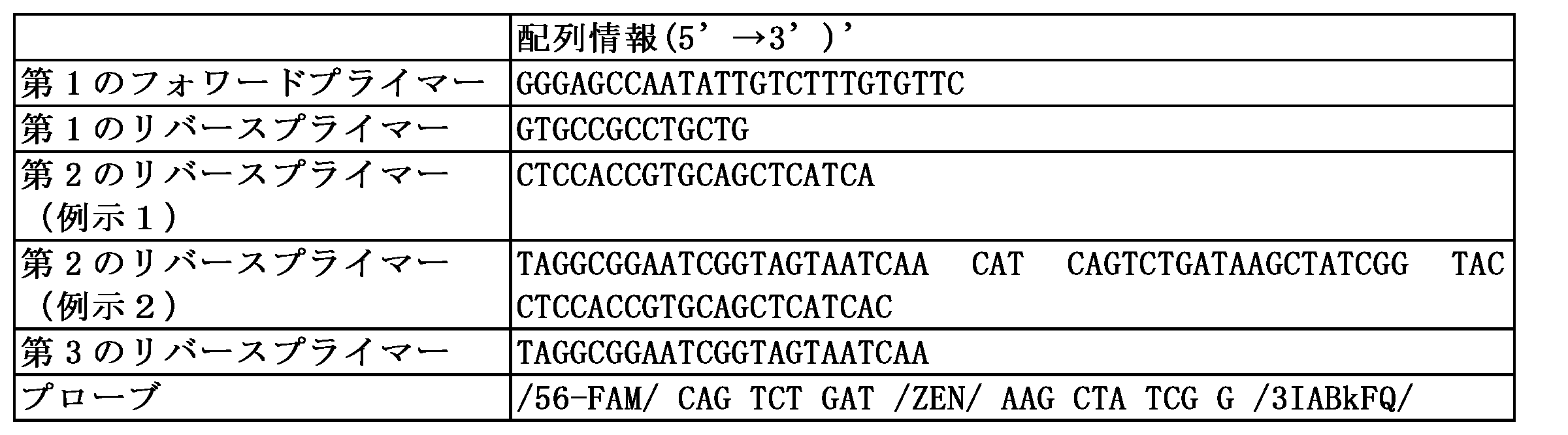
以下、実施例を通じて本発明をさらに詳細に説明する。これらの実施例は本発明をより具体的に説明するためのものであり、本発明の要旨によって本発明の範囲がこれらの実施例によって制限されないことは、当業界で通常の知識を有する者にとって自明であろう。 The present invention will be described in more detail below through examples. These examples are provided to more specifically explain the present invention, and it will be obvious to those skilled in the art that the scope of the present invention is not limited to these examples according to the gist of the present invention.
[実施例1]
<1-1>基準濃度のtemplateを用いたswitching PCR反応
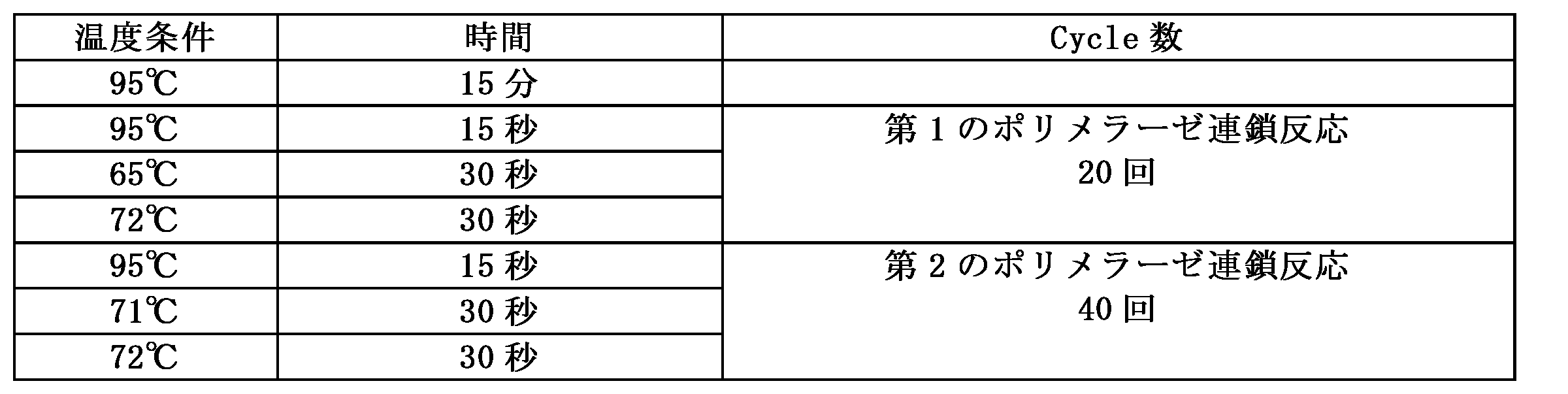
PCRチューブにqPCR Master mix 10μlを入れる。その後、Template DNA(T790M)1μlを入れ、10uM濃度の第1のフォワードプライマー及び第1のリバースプライマーをそれぞれ1μlずつ、10μM濃度の第2のリバースプライマー1ul、第3のリバースプライマー1ul、プローブ0.5ulを入れる。前記チューブに蒸留水7μlをさらに入れた後、ピペッティング(pipetting)する(このときに製造されたキットを実験群1という)。その後、PCR machine(Bio-Rad CFX96TM)のwellにチューブを入れ、下記表2のように温度を調節して第1のポリメラーゼ連鎖反応を20回、第2のポリメラーゼ連鎖反応を40回行った。
[Example 1]
<1-1> Switching PCR reaction using a template of
<1-2>希釈濃度のtemplateを用いたswitching PCR反応
Template DNA(T790M)を1/2μl(実験群2)、1/4μl(実験群3)、1/6μl(実験群4)、1/8μl(実験群5)、1/10μl(実験群6)濃度として実験群を製造し、残りの条件は、実験例1-1と同様に実験した。
<1-2> Switching PCR reaction using diluted template concentrations Experimental groups were prepared by using template DNA (T790M) at concentrations of 1/2 μl (experimental group 2), 1/4 μl (experimental group 3), 1/6 μl (experimental group 4), 1/8 μl (experimental group 5), and 1/10 μl (experimental group 6). The remaining conditions were the same as in Experimental Example 1-1.
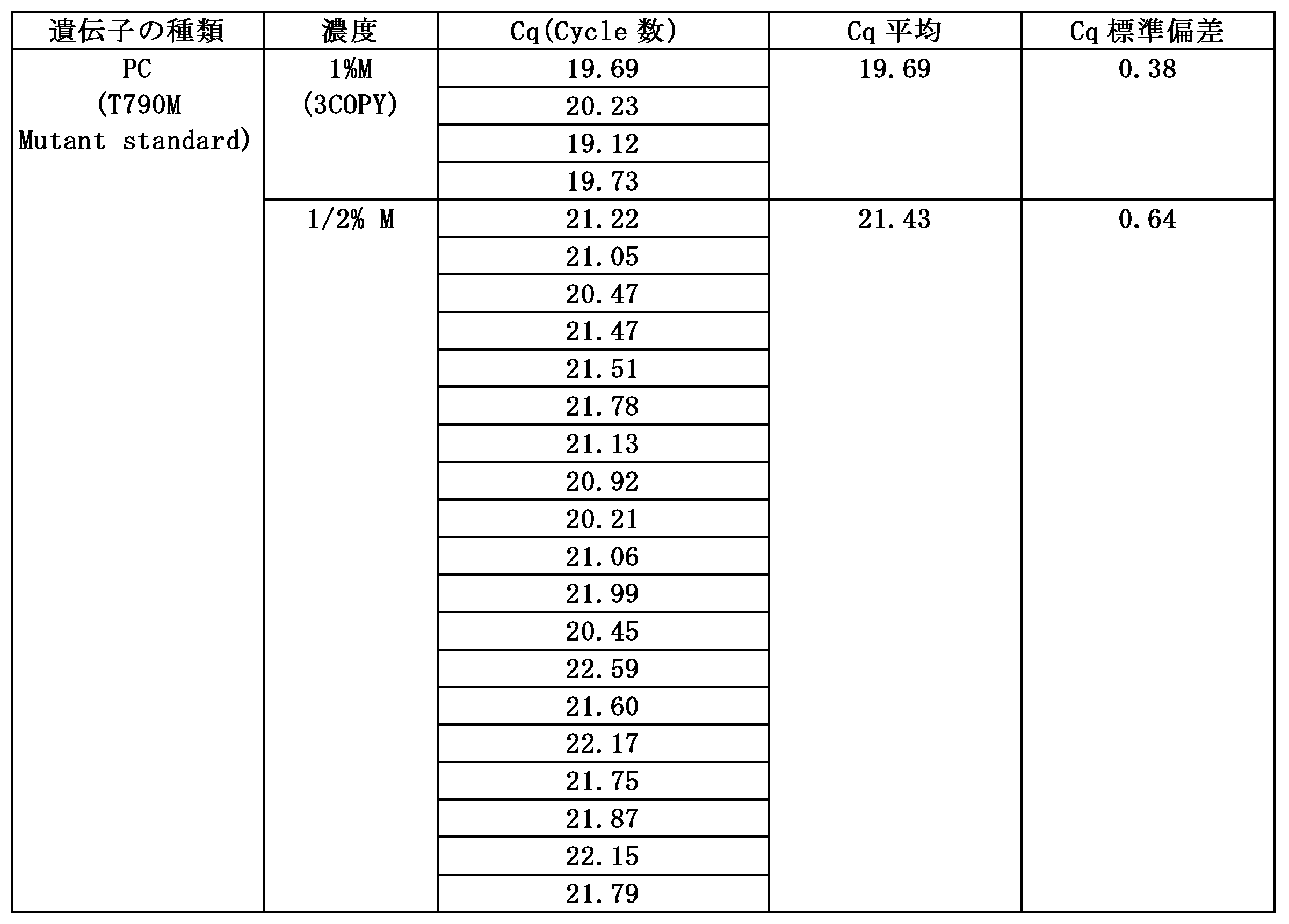
実施例1-1、1-2による結果値は、下記表3及び表4の通りである。図5は、本発明の実施例1-1、1-2による逐次ポリメラーゼ連鎖反応(スイッチングPCR)のT790M遺伝子の増幅結果を示すグラフである。 The results of Examples 1-1 and 1-2 are shown in Tables 3 and 4 below. Figure 5 is a graph showing the results of amplification of the T790M gene by sequential polymerase chain reaction (switching PCR) according to Examples 1-1 and 1-2 of the present invention.

<1-3>基準濃度のtemplateを用いた標準PCR反応
PCRチューブにqPCR Master mix 10μlを入れる。その後、Template DNA(T790M)1μlを入れ、10uM濃度の第1のフォワードプライマー及び第1のリバースプライマーをそれぞれ0.5μlずつ入れる。前記チューブに蒸留水7μlをさらに入れた後、ピペッティング(pipetting)する(このときに製造されたキットを対照群1とする)。その後、PCR machine(Bio-Rad CFX96TM)のwellにチューブを入れ、下記表5のように温度を調節してPCRを60回行った。
<1-3> Standard PCR reaction using a template of

<1-4>希釈濃度のtemplateを用いた標準PCR反応
Template DNA(T790M)を1/2μl(実験群2)、1/4μl(実験群3)、1/6μl(実験群4)、1/8μl(実験群5)、1/10μl(実験群6)濃度として実験群を製造し、残りの条件は、実験例2-1と同様に実験した。
<1-4> Standard PCR reaction using diluted template concentrations Experimental groups were prepared by using template DNA (T790M) at concentrations of 1/2 μl (experimental group 2), 1/4 μl (experimental group 3), 1/6 μl (experimental group 4), 1/8 μl (experimental group 5), and 1/10 μl (experimental group 6). The remaining conditions were the same as in Experimental Example 2-1.
実施例1-3、1-4による結果値は、下記表6及び7の通りである。図6は、本発明の実施例1-3、1-4によるT790M遺伝子の増幅結果を示すグラフである。 The results of Examples 1-3 and 1-4 are shown in Tables 6 and 7 below. Figure 6 is a graph showing the results of amplification of the T790M gene according to Examples 1-3 and 1-4 of the present invention.

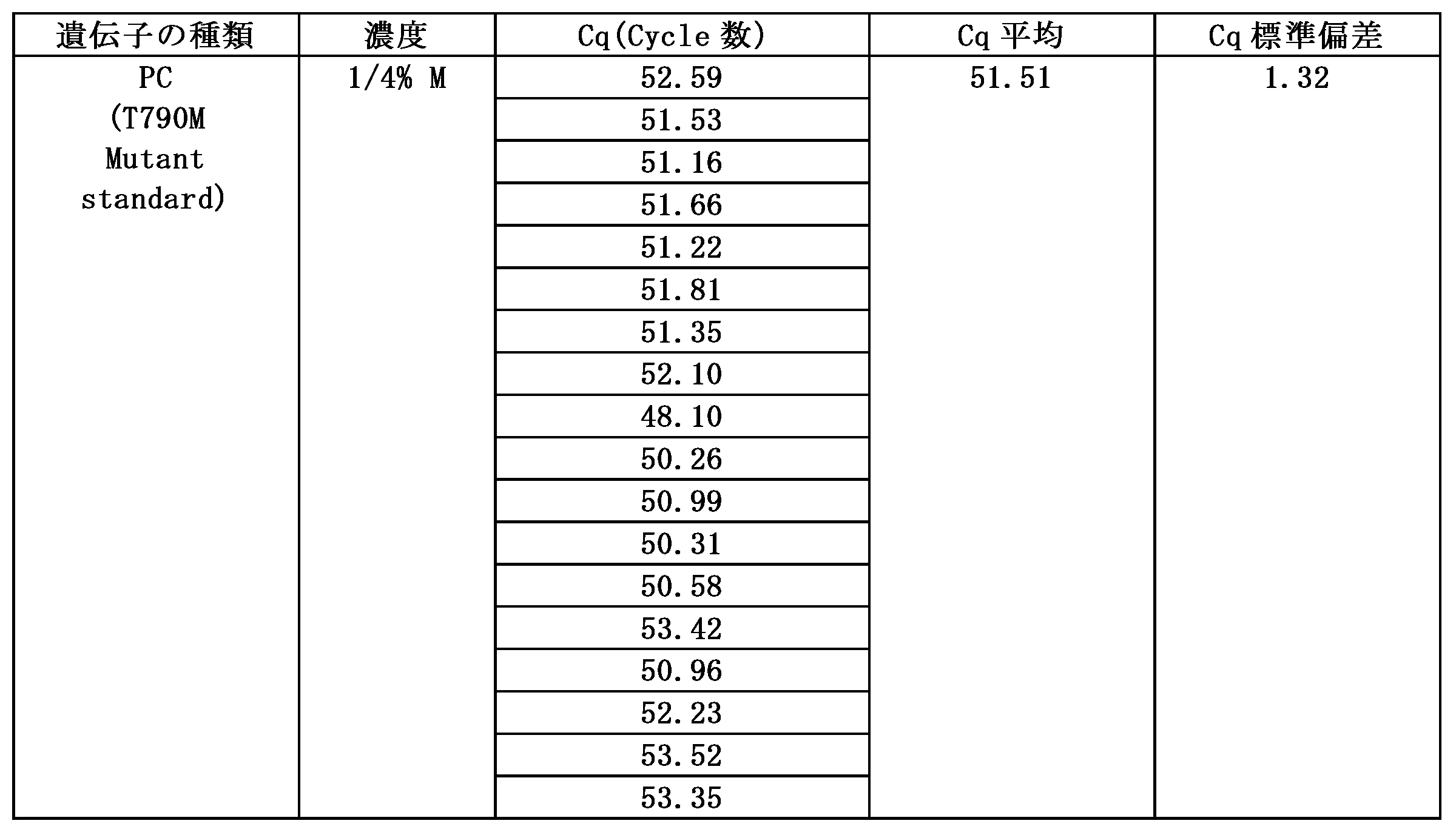
図5を参照すると、実施例1-1、1-2による逐次ポリメラーゼ連鎖反応(スイッチングPCR)の結果T790M遺伝子は、18~24cycleのCqまたはCt値を示し、図6を参照すると、実施例1-3、1-4による標準PCR法によってT790M遺伝子を増幅させたとき、48~50cycleで増幅される。これは表3、4、6及び7の内容と同じである。本発明による逐次ポリメラーゼ連鎖反応(スイッチングPCR)は、第2のポリメラーゼ連鎖反応で増幅されることを勘案すれば、実施例1-1、1-2による逐次ポリメラーゼ連鎖反応(スイッチングPCR)の結果T790M遺伝子は、38~44cycle(最初のポリメラーゼ連鎖反応が20cycle発生)でCqまたはCt値を持つことが分かる。実施例1-1~1-4は、すべてtemplateであるT790M遺伝子濃度が低いほどCq又はCt値が増加し、濃度にかかわらず実施例1-1及び1-2の増幅cycle値が実施例1-3及び1-4の値より低かった。したがって、本発明による逐次ポリメラーゼ連鎖反応(スイッチングPCR)方法は、1つの実験器具において第1のポリメラーゼ連鎖反応と第2のポリメラーゼ連鎖反応を独立して行うことができることが分かる。 Referring to FIG. 5, the T790M gene exhibits a Cq or Ct value of 18 to 24 cycles as a result of sequential polymerase chain reaction (switching PCR) according to Examples 1-1 and 1-2, and referring to FIG. 6, when the T790M gene is amplified by the standard PCR method according to Examples 1-3 and 1-4, it is amplified in 48 to 50 cycles. This is the same as the contents of Tables 3, 4, 6 and 7. Considering that the sequential polymerase chain reaction (switching PCR) according to the present invention is amplified by a second polymerase chain reaction, it can be seen that the T790M gene exhibits a Cq or Ct value of 38 to 44 cycles (the first polymerase chain reaction occurs after 20 cycles) as a result of sequential polymerase chain reaction (switching PCR) according to Examples 1-1 and 1-2. In Examples 1-1 to 1-4, the lower the concentration of the template T790M gene, the higher the Cq or Ct value, and the amplification cycle values of Examples 1-1 and 1-2 were lower than those of Examples 1-3 and 1-4, regardless of the concentration. Therefore, it can be seen that the sequential polymerase chain reaction (switching PCR) method according to the present invention can perform a first polymerase chain reaction and a second polymerase chain reaction independently in one laboratory instrument.
[実施例2]
<2-1>基準濃度のtemplateを用いたswitching PCR反応
実施例1-1と同じ条件でPCRを行った。
[Example 2]
<2-1> Switching PCR reaction using a template of standard concentration PCR was carried out under the same conditions as in Example 1-1.
<2-2>希釈濃度のtemplateを用いたswitching PCR反応
実施例1-2と同じ条件でPCRを行った。
実施例2-1、2-2による結果値は、下記表8及び表9の通りである。図7は、本発明の実施例2-1、2-2による逐次ポリメラーゼ連鎖反応(スイッチングPCR)のT790M遺伝子の増幅結果を示すグラフである。
<2-2> Switching PCR reaction using diluted template PCR was carried out under the same conditions as in Example 1-2.
The results of Examples 2-1 and 2-2 are shown in the following Tables 8 and 9. Fig. 7 is a graph showing the results of amplification of the T790M gene by sequential polymerase chain reaction (switching PCR) according to Examples 2-1 and 2-2 of the present invention.


<2-3>基準濃度のtemplateを用いた標準PCR反応
実施例1-3と同じ条件でPCRを行った。
<2-3> Standard PCR reaction using a template of standard concentration PCR was carried out under the same conditions as in Example 1-3.
<2-4>希釈濃度のtemplateを用いた標準PCR反応
実施例1-4と同じ条件でPCRを行った。
<2-4> Standard PCR reaction using diluted template PCR was carried out under the same conditions as in Example 1-4.
実施例2-3、2-4による結果値は、下記表10及び表11の通りである。図8は、本発明の実施例2-3、2-4によるT790M遺伝子の増幅結果を示すグラフである。 The results of Examples 2-3 and 2-4 are shown in Tables 10 and 11 below. Figure 8 is a graph showing the results of amplification of the T790M gene in Examples 2-3 and 2-4 of the present invention.

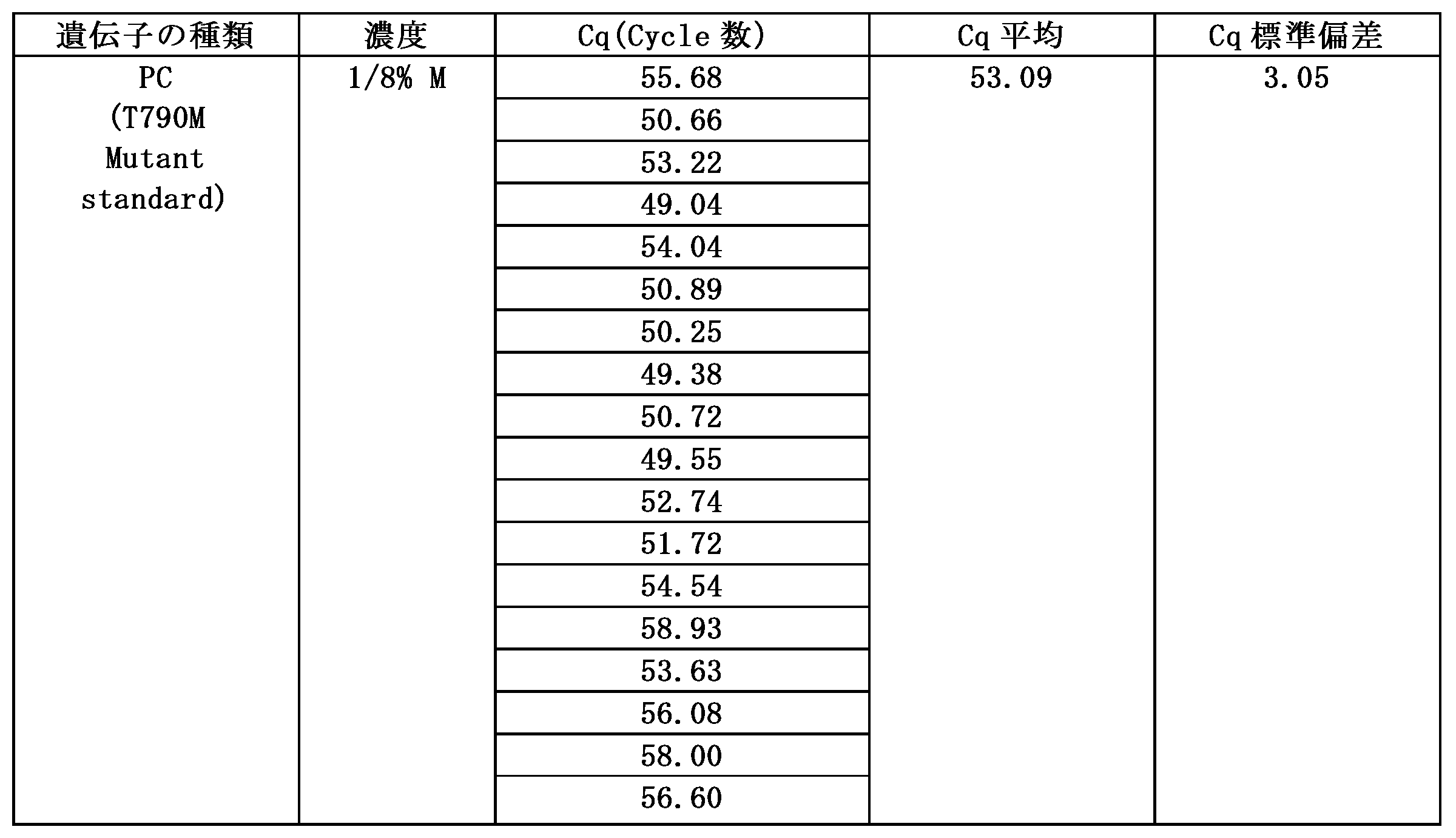
図7を参照すると、実施例2-1、2-2による逐次ポリメラーゼ連鎖反応(スイッチングPCR)の結果T790M遺伝子は、18~24cycleのCqまたはCt値を示し、図8を参照すると、実施例2-3、2-4による標準PCR法によってT790M遺伝子を増幅させたとき、48~60cycleでCqまたはCt値を示す。これは表8、9、10及び11の内容と同じである。本発明による逐次ポリメラーゼ連鎖反応(スイッチングPCR)は、第2のポリメラーゼ連鎖反応で増幅されることを勘案すれば、実施例2-1、2-2による逐次ポリメラーゼ連鎖反応(スイッチングPCR)の結果T790M遺伝子は、38~44cycle(第1のポリメラーゼ連鎖反応が20cycle発生)でCqまたはCt値を示すことが分かる。実施例2-1~2-4は、すべてtemplateであるT790M遺伝子濃度が低いほどCqまたはCt値が増加し、濃度にかかわらず実施例2-1及び2-2のCqまたはCt値が実施例2-3及び2~4の値より低かった。したがって、本発明による逐次ポリメラーゼ連鎖反応(スイッチングPCR)方法は、遺伝子ポリメラーゼ連鎖反応(PCR)の収率を高めることができ、非常に低い遺伝子が存在する場合でも再現性の高いポリメラーゼ連鎖反応結果が得られることが分かる。 Referring to FIG. 7, the T790M gene exhibits a Cq or Ct value of 18 to 24 cycles as a result of sequential polymerase chain reaction (switching PCR) according to Examples 2-1 and 2-2, and referring to FIG. 8, when the T790M gene is amplified by the standard PCR method according to Examples 2-3 and 2-4, it exhibits a Cq or Ct value of 48 to 60 cycles. This is the same as the contents of Tables 8, 9, 10 and 11. Considering that the sequential polymerase chain reaction (switching PCR) according to the present invention is amplified by the second polymerase chain reaction, it can be seen that the T790M gene exhibits a Cq or Ct value of 38 to 44 cycles (20 cycles of the first polymerase chain reaction) as a result of sequential polymerase chain reaction (switching PCR) according to Examples 2-1 and 2-2. In all of Examples 2-1 to 2-4, the Cq or Ct value increased as the concentration of the template T790M gene decreased, and regardless of the concentration, the Cq or Ct values of Examples 2-1 and 2-2 were lower than those of Examples 2-3 and 2-4. Therefore, it can be seen that the sequential polymerase chain reaction (switching PCR) method according to the present invention can increase the yield of gene polymerase chain reaction (PCR) and can obtain highly reproducible polymerase chain reaction results even in the presence of very low levels of the gene.
[実施例3]
<3-1>基準濃度のtemplateを用いたswitching PCR反応
実施例1-1と同じ条件でPCRを行った。
[Example 3]
<3-1> Switching PCR reaction using a template of standard concentration PCR was carried out under the same conditions as in Example 1-1.
<3-2>希釈濃度のtemplateを用いたswitching PCR反応
実施例1-2と同じ条件でPCRを行った。
<3-2> Switching PCR reaction using diluted template PCR was carried out under the same conditions as in Example 1-2.
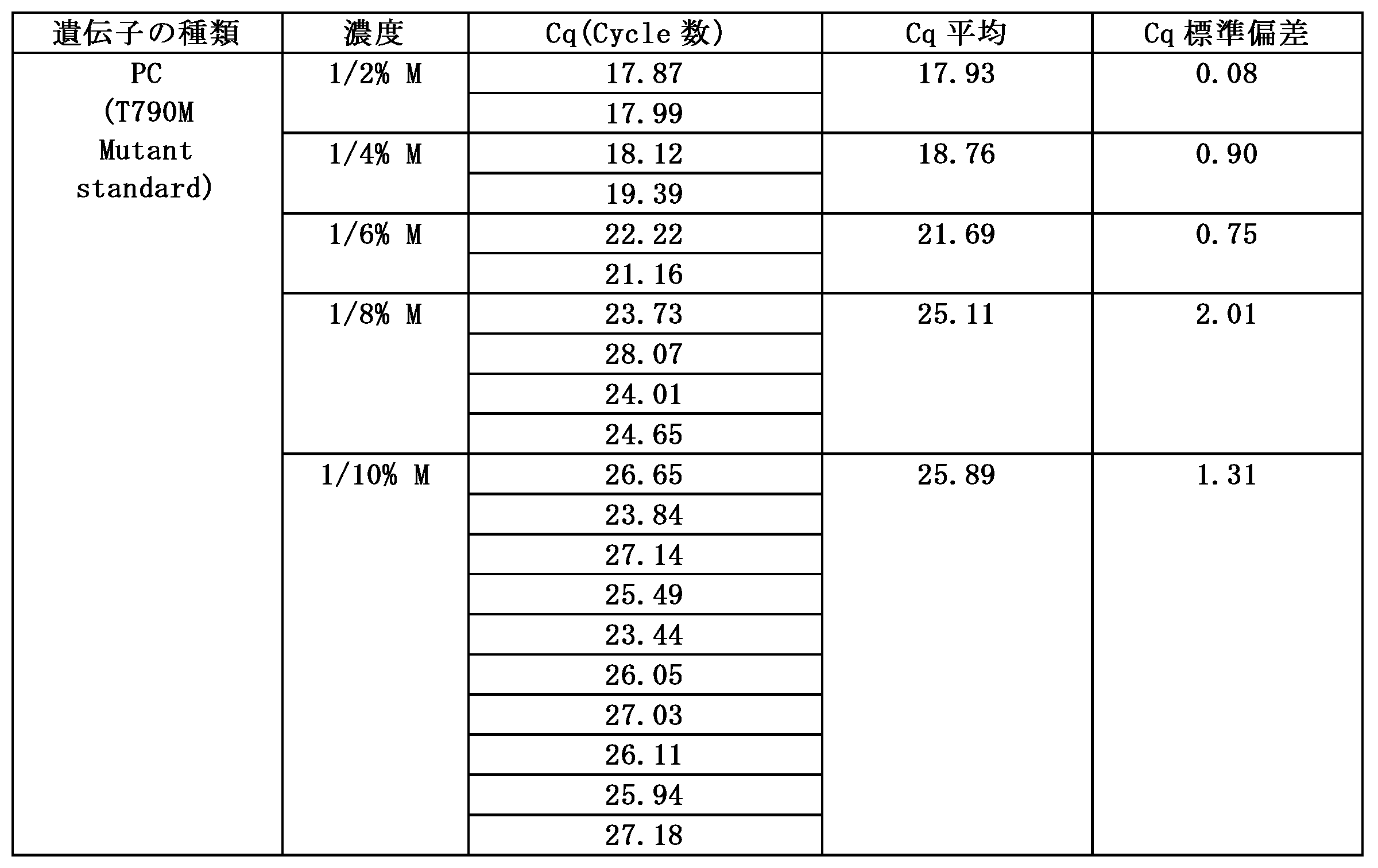
実施例3-1、3-2による結果値は、下記表12の通りである。図9は、本発明の実施例3-1、3-2による逐次ポリメラーゼ連鎖反応(スイッチングPCR)のT790M遺伝子の増幅結果を示すグラフである。 The results of Examples 3-1 and 3-2 are shown in Table 12 below. Figure 9 is a graph showing the results of amplification of the T790M gene by sequential polymerase chain reaction (switching PCR) according to Examples 3-1 and 3-2 of the present invention.
<3-3>基準濃度のtemplateを用いた標準PCR反応
実施例1-3と同じ条件でPCRを行った。
<3-3> Standard PCR reaction using a template of standard concentration PCR was carried out under the same conditions as in Example 1-3.
<3-4>希釈濃度のtemplateを用いた標準PCR反応
実施例1-4と同じ条件でPCRを行った。
<3-4> Standard PCR reaction using a diluted template PCR was carried out under the same conditions as in Example 1-4.
実施例3-3、3-4による結果値は、下記表13の通りである。図10は、本発明の実施例3-3、3-4による逐次ポリメラーゼ連鎖反応(スイッチングPCR)のT790M遺伝子の増幅結果を示すグラフである。 The results of Examples 3-3 and 3-4 are shown in Table 13 below. Figure 10 is a graph showing the results of amplification of the T790M gene by sequential polymerase chain reaction (switching PCR) according to Examples 3-3 and 3-4 of the present invention.
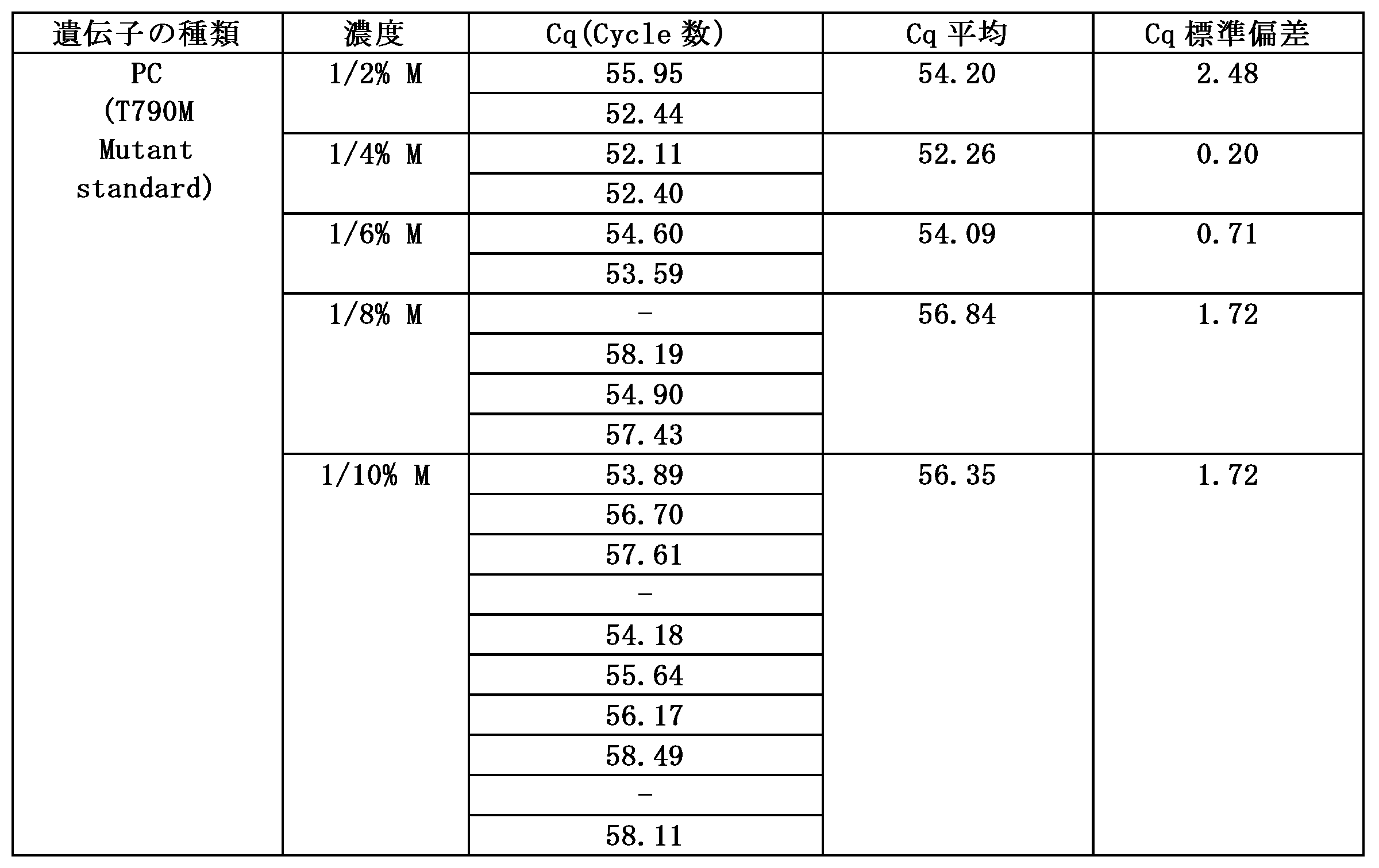
図9を参照すると、実施例3-1、3-2による逐次ポリメラーゼ連鎖反応(スイッチングPCR)の結果T790M遺伝子は、18~24cycleでCqまたはCt値を示し、図10を参照すると、実施例3-3、3-4による標準PCR法によってT790M遺伝子を増幅させたとき、48~60cycleでCqまたはCt値を有する。これは表12及び13の内容と同じである。本発明による逐次ポリメラーゼ連鎖反応(スイッチングPCR)は、第2のポリメラーゼ連鎖反応においても増幅されることを勘案すれば、実施例3-1、3-2による逐次ポリメラーゼ連鎖反応(スイッチングPCR)の結果T790M遺伝子は、38~44cycle(第1のポリメラーゼ連鎖反応が20cycle発生)でCqまたはCt値を示すことが分かる。実施例3-1~3-4は、すべてtemplateであるT790M遺伝子濃度が低いほどCqまたはCt値が増加し、濃度にかかわらず実施例3-1及び3-2のCqまたはCt値が実施例3-3及び3~4の値より低かった。したがって、本発明によるスイッチングPCR法は、遺伝子増幅時間を短縮させることができ、遺伝子ポリメラーゼ連鎖反応(PCR)の収率を高めることができ、非常に低い遺伝子が存在する場合でも再現性の高いポリメラーゼ連鎖反応結果が得られることが分かる。 Referring to FIG. 9, the T790M gene exhibits a Cq or Ct value in 18 to 24 cycles as a result of sequential polymerase chain reaction (switching PCR) according to Examples 3-1 and 3-2, and referring to FIG. 10, when the T790M gene is amplified by the standard PCR method according to Examples 3-3 and 3-4, it has a Cq or Ct value in 48 to 60 cycles. This is the same as the contents of Tables 12 and 13. Considering that the sequential polymerase chain reaction (switching PCR) according to the present invention is also amplified in the second polymerase chain reaction, it can be seen that the T790M gene exhibits a Cq or Ct value in 38 to 44 cycles (20 cycles of the first polymerase chain reaction) as a result of sequential polymerase chain reaction (switching PCR) according to Examples 3-1 and 3-2. In Examples 3-1 to 3-4, the Cq or Ct value increased as the concentration of the template T790M gene decreased, and the Cq or Ct values of Examples 3-1 and 3-2 were lower than those of Examples 3-3 and 3-4 regardless of the concentration. Therefore, it can be seen that the switching PCR method according to the present invention can shorten the gene amplification time, increase the yield of gene polymerase chain reaction (PCR), and obtain highly reproducible polymerase chain reaction results even in the presence of very low levels of genes.
また、本発明の実施例3-2において、逐次ポリメラーゼ連鎖反応(スイッチングPCR)は、1/8%(実験群5)、1/10%(実験群6)の両方の濃度で100%detection rateを示し、実施例3-4の標準PCRの場合、1/8%の濃度では75%のdetection rateを示し、1/10%の濃度では80%のdetection rateを示し、両方の濃度ですべて95%未満のdetection rateを示すことが分かる。すなわち、本発明による逐次ポリメラーゼ連鎖反応(Switching PCR)は、鋳型遺伝子(template)の濃度が低い場合でも増幅が容易に発生するので、本発明によるキットを用いた逐次ポリメラーゼ連鎖反応(スイッチングPCR)は、敏感度がより高いことが分かる。 In addition, in Example 3-2 of the present invention, the sequential polymerase chain reaction (switching PCR) showed a 100% detection rate at both concentrations of 1/8% (experimental group 5) and 1/10% (experimental group 6), while in the case of the standard PCR of Example 3-4, the detection rate was 75% at a concentration of 1/8% and 80% at a concentration of 1/10%, showing a detection rate of less than 95% at both concentrations. In other words, the sequential polymerase chain reaction (switching PCR) according to the present invention easily amplifies even when the concentration of the template gene is low, and therefore the sequential polymerase chain reaction (switching PCR) using the kit according to the present invention is more sensitive.
[実施例4]
<4-1>基準濃度のtemplateを用いた標準PCR反応
PCRチューブにqPCR Master mix 10μlを入れる。その後、Template DNA(T790M)100fg/μlを入れ、10uM濃度の第1のフォワードプライマー及び第1のリバースプライマーをそれぞれ0.5μlずつ、10μM濃度の第2のリバースプライマー1ul、10uM濃度の第3のリバースプライマー1ul及びプローブ0.5ulを入れる。前記チューブに蒸留水7μlをさらに入れた後、ピペッティング(pipetting)する。その後、PCR machine(Bio-Rad CFX96TM)のwellにチューブを入れ、下記表14のように温度を調節してPCRを40cycle行った。
[Example 4]
<4-1> Standard PCR reaction using a template of

<4-2>基準濃度のtemplateを用いた標準PCR反応
温度を下記表15のようにし、他の実験条件は、実施例4-1と同じ条件でPCRを行った。
<4-2> Standard PCR reaction using a template of standard concentration PCR was performed at a temperature as shown in Table 15 below, with other experimental conditions being the same as those in Example 4-1.

<4-3>基準濃度のtemplateを用いた標準PCR反応
温度を下記表16のようにして第1のポリメラーゼ連鎖反応及び第2のポリメラーゼ連鎖反応を行い、他の実験条件は、実施例4-1と同じ条件でPCRを行った。
<4-3> Standard PCR reaction using a template of standard concentration The first and second polymerase chain reactions were carried out at temperatures as shown in Table 16 below, and other experimental conditions were the same as those in Example 4-1.
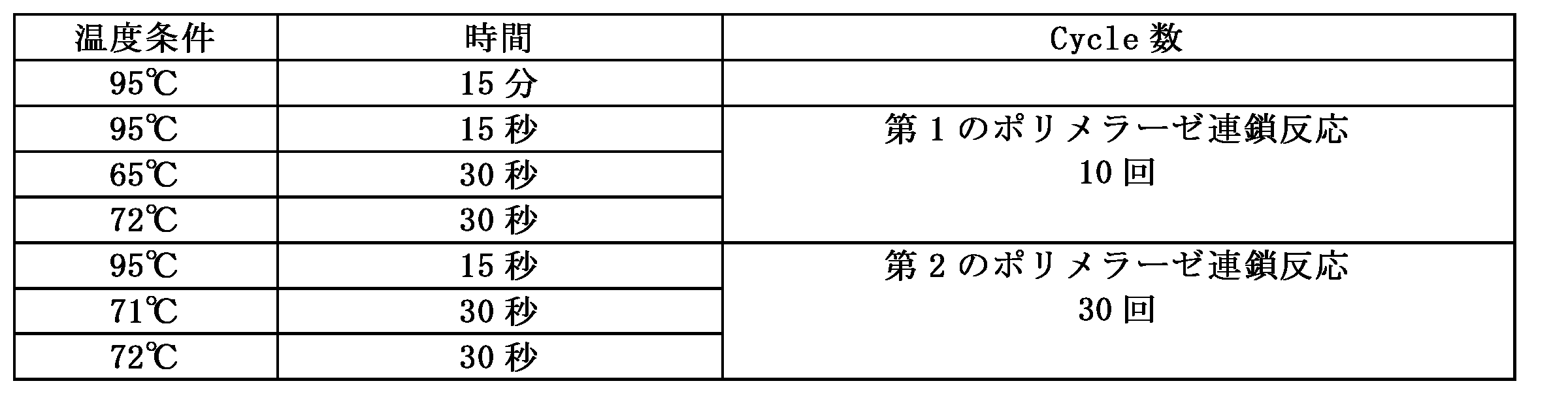
<4-4>基準濃度のtemplateを用いた標準PCR反応
Template DNA(T790M)の濃度を0とし、他の実験条件は、実施例4-1と同じ条件でPCRを行った。
<4-4> Standard PCR reaction using template of standard concentration PCR was performed under the same experimental conditions as in Example 4-1, except that the concentration of template DNA (T790M) was set to 0.
図11は、本発明の一実施例によるPCR産物の電気泳動画像である。図11の(1)は実施例4-1による結果であり、(2)は実施例4-2による結果を、(3)は実施例4-3による結果を、(4)は実施例4-4による結果を示す。図11を参照すると、(1)では110bpで蛍光を示し、(2)では131bp付近でbandが現れ、(4)ではbandが現れなかった。これに基づいて(3)を判断すると、110bpで弱く、131bp付近で強くbandが現れ、110bp、131bpサイズの産物をすべて生成したことが分かる。すなわち、(1)及び(2)ではそれぞれ一つの産物のみ合成できることが、(3)では(1)、(2)の産物がすべて合成されることが分かる。 Figure 11 is an electrophoretic image of PCR products according to one embodiment of the present invention. In Figure 11, (1) shows the results from Example 4-1, (2) shows the results from Example 4-2, (3) shows the results from Example 4-3, and (4) shows the results from Example 4-4. Referring to Figure 11, (1) showed fluorescence at 110 bp, (2) showed a band around 131 bp, and (4) showed no band. Judging (3) based on this, it shows that a weak band appeared at 110 bp and a strong band appeared around 131 bp, and it was found that both 110 bp and 131 bp sized products were generated. In other words, it can be seen that only one product can be synthesized in each of (1) and (2), and that all of the products in (1) and (2) were synthesized in (3).
図11の前記(1)では第1のポリメラーゼ連鎖反応で第2のリバースプライマーが活性化されず、第1の産物110bpのみが形成されるものであり、(2)では第1のリバースプライマーが高い温度のため非活性化されて第2の産物131bpのみが合成される。一方、図11の(3)では、第1のポリメラーゼ連鎖反応が10cycle、第2のポリメラーゼ連鎖反応が30cycleの間行われたため、行われたcycleに比例した遺伝子のbandが共存することが確認できる(110bp、131bp)。本発明の実施例である4-3によれば、各ポリメラーゼ連鎖反応のアニーリング温度で活性化できるプライマーを設計し、第1のポリメラーゼ連鎖反応では第1のフォワードプライマー及び第1のリバースプライマーが、第2のポリメラーゼ連鎖反応では第1のフォワードプライマー及び第2のリバースプライマーが活性化され、それによって第1の産物及び第2の産物の両方が形成されたことが分かる。 In (1) of FIG. 11, the second reverse primer is not activated in the first polymerase chain reaction, and only the first product 110 bp is formed, and in (2), the first reverse primer is inactivated due to the high temperature, and only the second product 131 bp is synthesized. On the other hand, in (3) of FIG. 11, the first polymerase chain reaction was performed for 10 cycles and the second polymerase chain reaction was performed for 30 cycles, so it can be confirmed that gene bands proportional to the number of cycles performed coexist (110 bp, 131 bp). According to Example 4-3 of the present invention, primers that can be activated at the annealing temperature of each polymerase chain reaction were designed, and the first forward primer and the first reverse primer were activated in the first polymerase chain reaction, and the first forward primer and the second reverse primer were activated in the second polymerase chain reaction, and both the first product and the second product were formed.
以上、本発明の実施例を説明したが、本発明が属する技術分野で通常の知識を有する者は、本発明がその技術的思想や必須的な特徴を変更することなく、他の具体的な形態で実施できることが理解できるだろう。したがって、以上で述べた実施例は、すべての点で例示的なものであり、限定的なものではないと理解しなければならない。 Although the embodiments of the present invention have been described above, those having ordinary skill in the art to which the present invention pertains will understand that the present invention can be embodied in other specific forms without changing its technical concept or essential features. Therefore, it should be understood that the embodiments described above are illustrative in all respects and not limiting.
10:鋳型遺伝子
20:第1のフォワードプライマー
21:第1の産物
30:第1のリバースプライマー
40:第2のリバースプライマー
50:第3のリバースプライマー
60:プローブ
10: template gene 20: first forward primer 21: first product 30: first reverse primer 40: second reverse primer 50: third reverse primer 60: probe
Claims (7)
前記第2のリバースプライマーは、鋳型遺伝子と相補的な配列の他に任意の遺伝子配列をさらに含むものであり、
前記第1のポリメラーゼ連鎖反応段階は、
a)鋳型遺伝子の二重らせんが解かれる第1の変性段階、
b)前記a)段階による鋳型遺伝子に第1のフォワードプライマー及び第1のリバースプライマーが結合する第1のアニーリング段階、及び
c)前記b)段階で結合された第1のフォワードプライマー及び第2のリバースプライマーによって鋳型遺伝子が複製され、第1の産物が合成される段階を含み、
前記第2のポリメラーゼ連鎖反応段階は、
d)前記第1の産物の二重らせんが解かれる第2の変性段階、
e)前記d)段階による第1の産物に第1のフォワードプライマー及び第2のリバースプライマーが結合する第2のアニーリング段階、
f)前記e)段階で結合された第1のフォワードプライマー及び第2のリバースプライマーによって第1の産物が複製されて第2の産物が合成される段階、
g)前記第2の産物の二重らせんが解かれる段階、
h)前記g)段階の前記第2の産物に第1のフォワードプライマー及び第2のリバースプライマーが結合する段階、
i)第3の産物が合成される段階、
j)前記第3の産物の二重らせんが解かれる段階、
k)プローブが前記第3の産物の一部配列に結合する段階
l)前記k)段階の前記第3の産物に前記第1のフォワードプライマー及び前記第3のリバースプライマーが結合する段階、及び
m)前記l)段階で組み合わされた前記第1のフォワードプライマー及び前記第3のリバースプライマーによって最終産物が合成され、前記プローブが除去されたときに前記最終産物が合成されたか否かを検出する段階を含み、
前記e)段階は、前記b)段階より5℃~30℃高い温度で行われ、
前記第2のリバースプライマーの活性化温度は、第1のリバースプライマーの活性化温度よりも5℃~30℃高く設計され、
前記第1のフォワードプライマーは、前記第1のリバースプライマーの活性化温度及び前記第2のリバースプライマーの活性化温度の両方において活性化されるように設計される、
逐次ポリメラーゼ連鎖反応を行う方法。 A sequential polymerase chain reaction comprising the steps of: preparing a composition in a container, the composition comprising a template gene, a DNA polymerase, dNTPs, a first forward primer, a first reverse primer, a second reverse primer, and a third reverse primer; a first polymerase chain reaction step; and a second polymerase chain reaction step,
the second reverse primer further contains an arbitrary gene sequence in addition to a sequence complementary to a template gene,
The first polymerase chain reaction step comprises:
a) a first denaturation step in which the double helix of the template gene is unwound;
b) a first annealing step in which a first forward primer and a first reverse primer are bound to the template gene according to the step a); and c) a step in which the template gene is replicated by the first forward primer and the second reverse primer bound in the step b) to synthesize a first product,
The second polymerase chain reaction step comprises:
d) a second denaturation step in which the double helix of said first product is unwound;
e) a second annealing step in which a first forward primer and a second reverse primer bind to the first product of step d);
f) synthesizing a second product by replicating the first product using the first forward primer and the second reverse primer bound in the e) step;
g) unwinding the double helix of said second product;
h) binding of a first forward primer and a second reverse primer to the second product of step g);
i) a third product is synthesized;
j) unwinding the double helix of said third product;
k) binding of a probe to a partial sequence of the third product
l) binding the first forward primer and the third reverse primer to the third product of step k); and
m) synthesizing a final product by the first forward primer and the third reverse primer combined in the l) step, and detecting whether the final product has been synthesized when the probe is removed;
The step e) is carried out at a temperature 5° C. to 30° C. higher than that of the step b);
The activation temperature of the second reverse primer is designed to be 5° C. to 30° C. higher than the activation temperature of the first reverse primer;
The first forward primer is designed to be activated at both the activation temperature of the first reverse primer and the activation temperature of the second reverse primer;
A method for performing sequential polymerase chain reactions.
前記第3のリバースプライマーは、前記第3の産物に含まれる前記任意の遺伝子配列と相補的な前記遺伝子配列に結合して最終産物を合成するものである、請求項1に記載の逐次ポリメラーゼ連鎖反応を行う方法。 a gene sequence complementary to said arbitrary gene sequence is contained in said third product;
2. The method of claim 1 , wherein the third reverse primer binds to the gene sequence complementary to the arbitrary gene sequence contained in the third product to synthesize a final product.
前記プローブが結合する第3の産物の遺伝子配列は、第2のリバースプライマーに含まれる任意の遺伝子配列と相補的な遺伝子配列である、請求項1に記載の逐次ポリメラーゼ連鎖反応を行う方法。 the composition further comprises a probe that binds to the third product;
2. The method for performing sequential polymerase chain reaction according to claim 1, wherein the gene sequence of the third product to which the probe binds is a gene sequence complementary to an arbitrary gene sequence contained in the second reverse primer.
Applications Claiming Priority (5)
| Application Number | Priority Date | Filing Date | Title |
|---|---|---|---|
| KR10-2020-0076683 | 2020-06-23 | ||
| KR20200076683 | 2020-06-23 | ||
| PCT/KR2021/007920 WO2021261928A1 (en) | 2020-06-23 | 2021-06-23 | Composition for sequential polymerase chain reaction, and gene amplification method using same |
| KR1020210081843A KR102475713B1 (en) | 2020-06-23 | 2021-06-23 | Composition for sequential polymerase chain reaction and gene amplification method using same |
| KR10-2021-0081843 | 2021-06-23 |
Publications (2)
| Publication Number | Publication Date |
|---|---|
| JP2023542064A JP2023542064A (en) | 2023-10-05 |
| JP7580819B2 true JP7580819B2 (en) | 2024-11-12 |
Family
ID=77923327
Family Applications (1)
| Application Number | Title | Priority Date | Filing Date |
|---|---|---|---|
| JP2022580308A Active JP7580819B2 (en) | 2020-06-23 | 2021-06-23 | Composition for sequential polymerase chain reaction and method for amplifying genes using the same |
Country Status (6)
| Country | Link |
|---|---|
| US (1) | US20230250471A1 (en) |
| EP (1) | EP4170046A4 (en) |
| JP (1) | JP7580819B2 (en) |
| KR (1) | KR102475713B1 (en) |
| CN (1) | CN115735008A (en) |
| WO (1) | WO2021261928A1 (en) |
Citations (2)
| Publication number | Priority date | Publication date | Assignee | Title |
|---|---|---|---|---|
| WO2010082640A1 (en) | 2009-01-15 | 2010-07-22 | 北海道三井化学株式会社 | Enzymatic preparation containing thermostable dna polymerase, process for producing same, and method for detecting analyte organism |
| JP2018183189A (en) | 2012-07-24 | 2018-11-22 | ナテラ, インコーポレイテッド | High degree multiple pcr method and composition |
Family Cites Families (8)
| Publication number | Priority date | Publication date | Assignee | Title |
|---|---|---|---|---|
| WO2002038757A1 (en) * | 2000-11-10 | 2002-05-16 | Amicogen, Inc. | Method for generating recombinant dna library using unidirectional single-stranded dna fragments |
| KR100812259B1 (en) * | 2006-06-12 | 2008-03-10 | 주식회사 씨젠 | How to amplify an unknown DNA sequence adjacent to a known sequence |
| US20130123120A1 (en) * | 2010-05-18 | 2013-05-16 | Natera, Inc. | Highly Multiplex PCR Methods and Compositions |
| KR101707992B1 (en) * | 2014-10-31 | 2017-02-20 | 경북대학교 산학협력단 | Composition for diagnosing porcine reproductive and respiratory syndrome virus and method for diagnosing the same |
| PT3234188T (en) * | 2014-12-15 | 2020-01-16 | Cepheid | Exponential base-greater-than-2 nucleic acid amplification |
| KR101785687B1 (en) * | 2016-07-20 | 2017-10-17 | (주)다이오진 | Method for detection of target nucleic acid sequence by multiple amplification nested signal amplification |
| ES3002386T3 (en) * | 2017-03-23 | 2025-03-06 | Univ Washington | Methods for targeted nucleic acid sequence enrichment with applications to error corrected nucleic acid sequencing |
| CN111511925B (en) * | 2017-11-29 | 2023-11-14 | 帕纳金股份有限公司 | Methods for amplifying target nucleic acids and compositions for expanding target nucleic acids |
-
2021
- 2021-06-23 JP JP2022580308A patent/JP7580819B2/en active Active
- 2021-06-23 EP EP21830294.1A patent/EP4170046A4/en active Pending
- 2021-06-23 CN CN202180045225.7A patent/CN115735008A/en active Pending
- 2021-06-23 KR KR1020210081843A patent/KR102475713B1/en active Active
- 2021-06-23 US US18/012,633 patent/US20230250471A1/en active Pending
- 2021-06-23 WO PCT/KR2021/007920 patent/WO2021261928A1/en not_active Ceased
Patent Citations (2)
| Publication number | Priority date | Publication date | Assignee | Title |
|---|---|---|---|---|
| WO2010082640A1 (en) | 2009-01-15 | 2010-07-22 | 北海道三井化学株式会社 | Enzymatic preparation containing thermostable dna polymerase, process for producing same, and method for detecting analyte organism |
| JP2018183189A (en) | 2012-07-24 | 2018-11-22 | ナテラ, インコーポレイテッド | High degree multiple pcr method and composition |
Also Published As
| Publication number | Publication date |
|---|---|
| CN115735008A (en) | 2023-03-03 |
| US20230250471A1 (en) | 2023-08-10 |
| EP4170046A4 (en) | 2024-07-24 |
| KR20210117223A (en) | 2021-09-28 |
| WO2021261928A1 (en) | 2021-12-30 |
| JP2023542064A (en) | 2023-10-05 |
| EP4170046A1 (en) | 2023-04-26 |
| KR102475713B1 (en) | 2022-12-08 |
Similar Documents
| Publication | Publication Date | Title |
|---|---|---|
| US12040049B2 (en) | Directional polymerisation fluorescent probe PCR and test kit | |
| Fraga et al. | Real‐time PCR | |
| CA2140877C (en) | Amplification and detection process | |
| JP3426262B2 (en) | Method for amplifying and detecting nucleic acid using rapid PCR cycle | |
| JPH05184397A (en) | Homogeneous method for nucleic acid amplification and detection | |
| JPH02299599A (en) | Diagnosis kit, primer composition, and their use for replication or detection of nucleic acid | |
| US10260090B2 (en) | Accelerated isothermal amplification of DNA | |
| JP3844996B2 (en) | Melting curve analysis method for repetitive PCR products | |
| CN112795699A (en) | Universal primer, probe and detection method for detecting different subtypes of HIV-1 virus by RT-RAA fluorescence method | |
| US20220267852A1 (en) | Method for detecting or quantifying smn1 gene | |
| CN113832258A (en) | RNA amplification and detection using attenuated probes | |
| CN111808929A (en) | An improved homogeneous recombinase polymerase nucleic acid amplification detection method and kit | |
| AU756742B2 (en) | Quantitative analysis of gene expression using PCR | |
| CN112553307A (en) | One-pot nucleic acid detection method based on CasRNAse and application | |
| CN116287433A (en) | A high-sensitivity monkeypox virus detection kit and detection method | |
| JP2016049106A (en) | Oligonucleotides for controlling nucleic acid amplification | |
| JP7580819B2 (en) | Composition for sequential polymerase chain reaction and method for amplifying genes using the same | |
| CN113862339B (en) | Nucleic acid combination, detection kit and method for amplifying target nucleic acid | |
| CN107406891A (en) | Pcr method | |
| CN105177169B (en) | A kind of quantifying PCR method containing dyestuff EvaGreen with double thermal starting enzymes | |
| CN109415762B (en) | Method for detecting target nucleic acid sequence by multiplex amplification double signal amplification | |
| JP2009050217A (en) | Method for detecting target dna | |
| Soheili et al. | Real time PCR: principles and application | |
| CN110612355B (en) | Compositions for quantitative PCR amplification and applications thereof | |
| CN112322782A (en) | Primer group, kit and method for quickly detecting KSHV through polymerase helix reaction |
Legal Events
| Date | Code | Title | Description |
|---|---|---|---|
| A621 | Written request for application examination |
Free format text: JAPANESE INTERMEDIATE CODE: A621 Effective date: 20230224 |
|
| A131 | Notification of reasons for refusal |
Free format text: JAPANESE INTERMEDIATE CODE: A131 Effective date: 20240130 |
|
| A601 | Written request for extension of time |
Free format text: JAPANESE INTERMEDIATE CODE: A601 Effective date: 20240425 |
|
| A601 | Written request for extension of time |
Free format text: JAPANESE INTERMEDIATE CODE: A601 Effective date: 20240701 |
|
| A521 | Request for written amendment filed |
Free format text: JAPANESE INTERMEDIATE CODE: A523 Effective date: 20240731 |
|
| TRDD | Decision of grant or rejection written | ||
| A01 | Written decision to grant a patent or to grant a registration (utility model) |
Free format text: JAPANESE INTERMEDIATE CODE: A01 Effective date: 20241001 |
|
| A61 | First payment of annual fees (during grant procedure) |
Free format text: JAPANESE INTERMEDIATE CODE: A61 Effective date: 20241023 |
|
| R150 | Certificate of patent or registration of utility model |
Ref document number: 7580819 Country of ref document: JP Free format text: JAPANESE INTERMEDIATE CODE: R150 |