JP7554636B2 - Absorbent articles - Google Patents
Absorbent articles Download PDFInfo
- Publication number
- JP7554636B2 JP7554636B2 JP2020185279A JP2020185279A JP7554636B2 JP 7554636 B2 JP7554636 B2 JP 7554636B2 JP 2020185279 A JP2020185279 A JP 2020185279A JP 2020185279 A JP2020185279 A JP 2020185279A JP 7554636 B2 JP7554636 B2 JP 7554636B2
- Authority
- JP
- Japan
- Prior art keywords
- region
- waist region
- width direction
- length
- absorbent article
- Prior art date
- Legal status (The legal status is an assumption and is not a legal conclusion. Google has not performed a legal analysis and makes no representation as to the accuracy of the status listed.)
- Active
Links
- 230000002745 absorbent Effects 0.000 title claims description 229
- 239000002250 absorbent Substances 0.000 title claims description 229
- 210000001015 abdomen Anatomy 0.000 claims description 144
- 230000008602 contraction Effects 0.000 claims description 134
- 210000001364 upper extremity Anatomy 0.000 claims description 32
- 230000003187 abdominal effect Effects 0.000 claims description 12
- 210000001217 buttock Anatomy 0.000 description 43
- 210000002414 leg Anatomy 0.000 description 34
- 239000000463 material Substances 0.000 description 12
- 230000007423 decrease Effects 0.000 description 9
- 238000004904 shortening Methods 0.000 description 9
- 238000012360 testing method Methods 0.000 description 9
- 230000037237 body shape Effects 0.000 description 7
- 230000002401 inhibitory effect Effects 0.000 description 7
- 238000005259 measurement Methods 0.000 description 7
- 230000037303 wrinkles Effects 0.000 description 7
- 238000005452 bending Methods 0.000 description 6
- 210000001124 body fluid Anatomy 0.000 description 6
- 210000003608 fece Anatomy 0.000 description 6
- 238000010521 absorption reaction Methods 0.000 description 4
- 230000006866 deterioration Effects 0.000 description 4
- 238000000034 method Methods 0.000 description 4
- 239000004745 nonwoven fabric Substances 0.000 description 4
- NIXOWILDQLNWCW-UHFFFAOYSA-N acrylic acid group Chemical group C(C=C)(=O)O NIXOWILDQLNWCW-UHFFFAOYSA-N 0.000 description 3
- 238000010586 diagram Methods 0.000 description 3
- 238000011160 research Methods 0.000 description 3
- 239000000853 adhesive Substances 0.000 description 2
- 230000001070 adhesive effect Effects 0.000 description 2
- 230000000694 effects Effects 0.000 description 2
- 230000002829 reductive effect Effects 0.000 description 2
- 229920000247 superabsorbent polymer Polymers 0.000 description 2
- 210000002700 urine Anatomy 0.000 description 2
- 239000010839 body fluid Substances 0.000 description 1
- 230000003247 decreasing effect Effects 0.000 description 1
- 238000013461 design Methods 0.000 description 1
- 230000002542 deteriorative effect Effects 0.000 description 1
- 238000009963 fulling Methods 0.000 description 1
- 238000007373 indentation Methods 0.000 description 1
- 230000000670 limiting effect Effects 0.000 description 1
- 239000000203 mixture Substances 0.000 description 1
- 102220300650 rs181048561 Human genes 0.000 description 1
- 210000000689 upper leg Anatomy 0.000 description 1
Images


Classifications
-
- A—HUMAN NECESSITIES
- A61—MEDICAL OR VETERINARY SCIENCE; HYGIENE
- A61F—FILTERS IMPLANTABLE INTO BLOOD VESSELS; PROSTHESES; DEVICES PROVIDING PATENCY TO, OR PREVENTING COLLAPSING OF, TUBULAR STRUCTURES OF THE BODY, e.g. STENTS; ORTHOPAEDIC, NURSING OR CONTRACEPTIVE DEVICES; FOMENTATION; TREATMENT OR PROTECTION OF EYES OR EARS; BANDAGES, DRESSINGS OR ABSORBENT PADS; FIRST-AID KITS
- A61F13/00—Bandages or dressings; Absorbent pads
- A61F13/15—Absorbent pads, e.g. sanitary towels, swabs or tampons for external or internal application to the body; Supporting or fastening means therefor; Tampon applicators
- A61F13/45—Absorbent pads, e.g. sanitary towels, swabs or tampons for external or internal application to the body; Supporting or fastening means therefor; Tampon applicators characterised by the shape
- A61F13/49—Absorbent pads, e.g. sanitary towels, swabs or tampons for external or internal application to the body; Supporting or fastening means therefor; Tampon applicators characterised by the shape specially adapted to be worn around the waist, e.g. diapers, nappies
Landscapes
- Health & Medical Sciences (AREA)
- Epidemiology (AREA)
- Engineering & Computer Science (AREA)
- Biomedical Technology (AREA)
- Heart & Thoracic Surgery (AREA)
- Vascular Medicine (AREA)
- Life Sciences & Earth Sciences (AREA)
- Animal Behavior & Ethology (AREA)
- General Health & Medical Sciences (AREA)
- Public Health (AREA)
- Veterinary Medicine (AREA)
- Absorbent Articles And Supports Therefor (AREA)
Description
本発明は、使い捨ておむつ等の吸収性物品に関する。 The present invention relates to absorbent articles such as disposable diapers.
使い捨ておむつ等の吸収性物品は、身体の腹部及び背部を覆うように装着され、ずれ下がりを抑制するように構成されている(例えば、下記特許文献1)。特許文献1の吸収性物品は、着用者の身体の動きに対して吸収性物品がずれ難いように構成されている。より詳細には、後胴回り域には、第1伸縮部と、第1伸縮部よりも股下側に位置する第2伸縮部が設けられている。第1伸縮部と第2伸縮部は、長手方向に間隔を空けて配置されている。第1伸縮部の伸縮応力及び第2伸縮部の伸縮応力は、第1伸縮部と第2伸縮部の間の領域の伸縮応力よりも大きい。そのため、吸収性物品が着用された状態で、第1伸縮部と第2伸縮部は、身体に密着し、第1伸縮部と第2伸縮部の間の領域は、身体に比較的密着しない。
Absorbent articles such as disposable diapers are worn to cover the abdominal and back regions of the body and are configured to prevent slipping down (for example, see
例えば、着用者が脚を曲げ伸ばし等で動くと、後胴回り域において股下域側に位置する第2伸縮部が股下側に引っ張られる。また、第2伸縮部の股下側への移動に伴って、第1伸縮部と第2伸縮部の間の領域も股下側に引っ張られる。第1伸縮部と第2伸縮部の間の領域は、伸縮応力が比較的小さく身体に密着していない。よって、着用者の身体の動きによって使い捨ておむつの後胴回り域に長手方向に引っ張られる力が掛かった際に、当該第1伸縮部と第2伸縮部の間の領域が緩衝領域となり、身体の動きによる皮膚の伸縮変化を吸収することができる。そのため、第1伸縮部が股下側にずれることを抑制できる。また、第1伸縮部と第3伸縮部は、連なり、第2伸縮部と第3伸縮部は、連なっている。すなわち、前胴回り域の伸縮部と後胴回り域の伸縮部が、着用者の腰回りを一周覆うように配置されている。よって、第2伸縮部が股下側にずれた場合に、第3伸縮部によって元の位置に引き上げることができる。このようにして、特許文献1の吸収性物品は、ずれを抑制するように構成されている。
For example, when the wearer bends and straightens his/her legs, the second elastic part located on the crotch side in the rear waist region is pulled toward the crotch side. In addition, as the second elastic part moves toward the crotch side, the area between the first elastic part and the second elastic part is also pulled toward the crotch side. The area between the first elastic part and the second elastic part has a relatively small elastic stress and is not in close contact with the body. Therefore, when a force pulling in the longitudinal direction is applied to the rear waist region of the disposable diaper due to the wearer's body movement, the area between the first elastic part and the second elastic part becomes a buffer area and can absorb the elastic change of the skin due to the body movement. Therefore, it is possible to suppress the first elastic part from shifting toward the crotch side. In addition, the first elastic part and the third elastic part are connected, and the second elastic part and the third elastic part are connected. In other words, the elastic part in the front waist region and the elastic part in the rear waist region are arranged to cover the entire waist of the wearer. Therefore, if the second stretchable part shifts toward the crotch area, it can be pulled back to its original position by the third stretchable part. In this way, the absorbent article of
吸収性物品のずれ抑制のニーズは大きく、未だ改善の余地がある。特に、着用者の体形に吸収性物品が合っていないと、当該合っていない箇所におけるずれが生じ、着用時に吸収性物品全体のずれが生じるおそれがあった。そこで、吸収性物品のずれ下がりをより抑制できる吸収性物品を提供することを目的とする。 There is a great need to prevent absorbent articles from slipping, and there is still room for improvement. In particular, if the absorbent article does not fit the wearer's body shape, slippage occurs at the mismatched parts, and there is a risk that the entire absorbent article will slip when worn. Therefore, the objective is to provide an absorbent article that can further prevent the absorbent article from slipping down.
一態様に係る吸収性物品は、互いに直交する長手方向及び幅方向と、前胴回り域、後胴回り域、及び前記前胴回り域及び前記後胴回り域との間に配置された股下域と、少なくとも股下域に配置された吸収コアと、を有する。前記前胴回り域及び前記後胴回り域には、前記前胴回り域及び前記後胴回り域を長手方向に分割した複数の領域が設けられている。前記複数の領域は、前記前胴回り域の前端縁から前記前胴回り域の前記長手方向の全長に対する0~25%後方に位置する前ウエスト領域と、前記前胴回り域の前端縁から前記前胴回り域の前記長手方向の全長に対する25~50%後方に位置する上腹領域と、前記前胴回り域の前端縁から前記前胴回り域の前記長手方向の全長に対する50~75%後方に位置する下腹領域と、前記前胴回り域の前端縁から前記前胴回り域の前記長手方向の全長に対する75~100%後方に位置する前脚領域と、を有する。前記下腹領域の前記幅方向の収縮長さは、前記前脚領域の前記幅方向の収縮長さよりも長い。 The absorbent article according to one embodiment has a longitudinal direction and a transverse direction perpendicular to each other, a front waist region, a rear waist region, a crotch region disposed between the front waist region and the rear waist region, and an absorbent core disposed at least in the crotch region. The front waist region and the rear waist region are provided with a plurality of regions that divide the front waist region and the rear waist region in the longitudinal direction. The plurality of regions include a front waist region located 0-25% rearward from the front edge of the front waist region with respect to the entire longitudinal length of the front waist region, an upper abdomen region located 25-50% rearward from the front edge of the front waist region with respect to the entire longitudinal length of the front waist region, a lower abdomen region located 50-75% rearward from the front edge of the front waist region with respect to the entire longitudinal length of the front waist region, and a front leg region located 75-100% rearward from the front edge of the front waist region with respect to the entire longitudinal length of the front waist region. The widthwise contraction length of the lower abdomen region is longer than the widthwise contraction length of the front leg region.
(1)実施形態の概要
本明細書及び添付図面の記載により、少なくとも以下の事項が明らかとなる。
一態様に係る吸収性物品は、互いに直交する長手方向及び幅方向と、前胴回り域、後胴回り域、及び前記前胴回り域及び前記後胴回り域との間に配置された股下域と、少なくとも股下域に配置された吸収コアと、を有する。前記前胴回り域及び前記後胴回り域には、前記前胴回り域及び前記後胴回り域を長手方向に分割した複数の領域が設けられている。前記複数の領域は、前記前胴回り域の前端縁から前記前胴回り域の前記長手方向の全長に対する0~25%後方に位置する前ウエスト領域と、前記前胴回り域の前端縁から前記前胴回り域の前記長手方向の全長に対する25~50%後方に位置する上腹領域と、前記前胴回り域の前端縁から前記前胴回り域の前記長手方向の全長に対する50~75%後方に位置する下腹領域と、前記前胴回り域の前端縁から前記前胴回り域の前記長手方向の全長に対する75~100%後方に位置する前脚領域と、を有する。前記下腹領域の前記幅方向の収縮長さは、前記前脚領域の前記幅方向の収縮長さよりも長い。着用者の体形は、吸収性物品の長手方向において胴回り寸法が変化する。出願人が鋭意研究したところ、着用者の腹部の胴回り寸法は、腹部の下端の凹み付近の胴回り寸法が短く、下端の凹みから股下側に向かって徐々に長くなる。吸収性物品において収縮長さが長い領域は、伸長状態から自然状態に変化する過程で、収縮する長さが長く、収縮による変化が大きい。腹部において胴回り寸法が短い部分(凹み)に当接する下腹領域の収縮長さが長く、凹みよりも膨らむ部分に当接する前脚領域の収縮長さが比較的短いため、吸収性物品自体が身体の凹凸に沿う形状に変形する。身体の凹みに吸収性物品の寸法が短い部分が配置されることで、当該凹みに吸収性物品が引っ掛かり、吸収性物品のずれを抑制できる。
(1) Overview of the embodiment At least the following points will become apparent from the description of this specification and the accompanying drawings.
An absorbent article according to one embodiment has a longitudinal direction and a transverse direction perpendicular to each other, a front waist region, a rear waist region, a crotch region disposed between the front waist region and the rear waist region, and an absorbent core disposed at least in the crotch region. The front waist region and the rear waist region are provided with a plurality of regions obtained by dividing the front waist region and the rear waist region in the longitudinal direction. The plurality of regions include a front waist region located 0-25% rearward from the front edge of the front waist region with respect to the entire length of the front waist region in the longitudinal direction, an upper abdomen region located 25-50% rearward from the front edge of the front waist region with respect to the entire length of the front waist region in the longitudinal direction, a lower abdomen region located 50-75% rearward from the front edge of the front waist region with respect to the entire length of the front waist region in the longitudinal direction, and a front leg region located 75-100% rearward from the front edge of the front waist region with respect to the entire length of the front waist region in the longitudinal direction. The contraction length of the lower abdomen region in the width direction is longer than the contraction length of the front leg region in the width direction. The wearer's body shape changes in the waist size in the longitudinal direction of the absorbent article. As a result of the applicant's intensive research, the waist size of the wearer's abdomen is short near the depression at the lower end of the abdomen, and gradually increases from the depression at the lower end toward the crotch side. In the absorbent article, the region with a long contraction length has a long contraction length in the process of changing from the stretched state to the natural state, and changes due to contraction are large. Since the contraction length of the lower abdomen region abutting on the part of the abdomen with a short waist size (depression) is long and the contraction length of the front leg region abutting on the part that bulges out more than the depression is relatively short, the absorbent article itself deforms into a shape that follows the unevenness of the body. By arranging the part of the absorbent article with a short dimension in the depression of the body, the absorbent article can be caught in the depression and the absorbent article can be prevented from slipping.
好ましい態様によれば、前記下腹領域の前記幅方向の収縮長さは、前記上腹領域の前記幅方向の収縮長さよりも長い。着用者の腹部の胴回り寸法は、腹部の下端の凹み付近の胴回り寸法が短く、下端の凹みから上側に向かって徐々に長くなる。本態様によれば、下腹領域の収縮長さが長く、凹みから膨らむ部分に当接する上腹領域及び前脚領域の収mm縮長さが比較的短いため、吸収性物品自体が身体の凹凸に沿う形状に変形する。身体の凹みに吸収性物品の寸法が短い部分が配置されることで、当該凹みに吸収性物品が引っ掛かり、吸収性物品のずれを抑制できる。 According to a preferred embodiment, the contraction length of the lower abdomen region in the width direction is longer than the contraction length of the upper abdomen region in the width direction. The waist size of the wearer's abdomen is short near the depression at the lower end of the abdomen, and gradually increases from the depression upward. According to this embodiment, the contraction length of the lower abdomen region is long, and the contraction length of the upper abdomen region and the front leg region that abut the portion that bulges from the depression is relatively short, so that the absorbent article itself deforms into a shape that follows the unevenness of the body. By arranging the short portion of the absorbent article in the depression of the body, the absorbent article can be caught in the depression and the absorbent article can be prevented from shifting.
好ましい態様によれば、前記上腹領域の前記幅方向の収縮長さは、前記前ウエスト領域の前記幅方向の収縮長さよりも長い。着用者の腹部の胴回り寸法は、腹部の下端の凹み付近の胴回り寸法が短く、下端の凹みから上側に向かって徐々に長くなる。本態様によれば、吸収性物品の胴回り寸法は、自然状態で、下腹領域、上腹領域、及び前ウエスト領域の順で長くなる。腹部の膨らみに沿う形状に、吸収性物品自体が変形することで、ずれを抑制できる。 According to a preferred embodiment, the contraction length of the upper abdominal region in the width direction is longer than the contraction length of the front waist region in the width direction. The waist circumference of the wearer's abdomen is short near the depression at the lower end of the abdomen and gradually increases from the depression at the lower end upward. According to this embodiment, the waist circumference of the absorbent article in its natural state increases in the order of the lower abdominal region, the upper abdominal region, and the front waist region. The absorbent article itself deforms to a shape that conforms to the bulge of the abdomen, thereby preventing slippage.
好ましい態様によれば、前記前ウエスト領域の前記幅方向の前記収縮長さと前記上腹領域の前記幅方向の前記収縮長さの差は、前記上腹領域の前記幅方向の前記収縮長さと前記下腹領域の前記幅方向の前記収縮長さの差よりも小さい。着用者の腹部の胴回り寸法の変化率は、一定でなく、異なっている。より詳細には、着用者の腹側の胴回り寸法の変化率は、F12-F11<F13-F12である。当該態様によれば、吸収性物品の形状が、より身体の形状に合うこととなり、吸収性物品のずれを抑制できる。 According to a preferred embodiment, the difference between the contraction length in the width direction of the front waist region and the contraction length in the width direction of the upper abdominal region is smaller than the difference between the contraction length in the width direction of the upper abdominal region and the contraction length in the width direction of the lower abdominal region. The rate of change in the waist size of the wearer's abdomen is not constant but varies. More specifically, the rate of change in the waist size of the wearer's abdomen is F12-F11<F13-F12. According to this embodiment, the shape of the absorbent article is more closely matched to the shape of the body, and slippage of the absorbent article can be suppressed.
好ましい態様によれば、前記上腹領域の前記幅方向の収縮長さは、前記前脚領域の前記幅方向の収縮長さよりも長い。前脚領域は、足の付け根が配置され、足の動きに追従して動きやすい領域である。本態様によれば、当該前脚領域の収縮長さが比較的短いため、着用状態における前脚領域の幅方向の長さを確保し、足の付け根の動きを阻害せずに装着感を向上できる。 According to a preferred embodiment, the contracted length of the upper abdomen region in the width direction is longer than the contracted length of the front leg region in the width direction. The front leg region is an area where the base of the foot is located and is easy to move in accordance with the movement of the foot. According to this embodiment, the contracted length of the front leg region is relatively short, so that the width direction length of the front leg region when worn is secured, and the fit can be improved without inhibiting the movement of the base of the foot.
好ましい態様によれば、前記下腹領域の前記幅方向の収縮長さは、前記前胴回り域のいずれの領域の収縮長さよりも長い。本態様によれば、腹部において胴回り寸法が短い部分(凹み)に当接する下腹領域の収縮長さが長く、当該凹みに吸収性物品が引っ掛かり易く、吸収性物品のずれを抑制できる。 According to a preferred embodiment, the contraction length of the lower abdominal region in the width direction is longer than the contraction length of any of the front waist regions. According to this embodiment, the contraction length of the lower abdominal region that abuts against a portion (depression) with a short waist dimension in the abdomen is long, so that the absorbent article can be easily caught in the depression, and the absorbent article can be prevented from slipping.
好ましい態様によれば、前記複数の領域は、前記後胴回り域の後端縁から前記後胴回り域の前記長手方向の全長に対する0~25%前方に位置する後ウエスト領域と、前記後胴回り域の後端縁から前記後胴回り域の前記長手方向の全長に対する25~50%前方に位置する上背領域と、前記後胴回り域の後端縁から前記後胴回り域の前記長手方向の全長に対する50~75%前方に位置する下背領域と、前記後胴回り域の後端縁から前記後胴回り域の前記長手方向の全長に対する75~100%前方に位置する後脚領域と、を有する。前記上背領域の前記幅方向の収縮長さは、前記後ウエスト領域の前記幅方向の収縮長さよりも長い。着用者の背部においては、臀部の膨らみよりも上側に離れるにしたがって胴回り寸法が短くなる。上背領域は、臀部の膨らみの頂点よりも上側の部分にあたり、後ウエスト領域は、ウエスト(胴の一番細い部分)近傍に当たる。胴回り寸法の変化は、臀部の膨らみの頂点から上側に向かって徐々に少なくなり、ウエスト近傍では、ほぼ身体の外側への膨らみが少なくフラットな形状である。上背領域の収縮長さが後ウエスト領域の収縮長さよりも長いため、背部において臀部の膨らみから上側に向けて、吸収性物品自体が身体の凹凸に沿う形状に変形し、吸収性物品のずれを抑制できる。また、上背領域の収縮長さが比較的長いため、着用時に上背領域の胴回り寸法が短くなり、臀部の膨らみの上側の窪みにフィットし、吸収性物品のずれを抑制できる。また、ウエスト近傍のフラットな形状の部分に当たる後ウエスト領域の収縮長さが短く、着用時におけるウエスト周りの胴回り寸法を確保できる。よって、後ウエスト領域が収縮によって股下側へずれ下がることを抑制できる。 According to a preferred embodiment, the multiple regions include a rear waist region located 0-25% forward of the rear end edge of the rear waist region in the longitudinal direction of the entire length of the rear waist region, an upper back region located 25-50% forward of the rear end edge of the rear waist region in the longitudinal direction of the entire length of the rear waist region, a lower back region located 50-75% forward of the rear end edge of the rear waist region in the longitudinal direction of the entire length of the rear waist region, and a rear leg region located 75-100% forward of the rear end edge of the rear waist region in the longitudinal direction of the entire length of the rear waist region. The contraction length of the upper back region in the width direction is longer than the contraction length of the rear waist region in the width direction. At the wearer's back, the waist size decreases as it moves away from the bulge of the buttocks to the upper side. The upper back region is located above the apex of the bulge of the buttocks, and the rear waist region is located near the waist (the narrowest part of the torso). The change in the waist circumference gradually decreases from the apex of the buttocks toward the upper side, and the waist area is flat with little outward bulge. Since the contraction length of the upper back region is longer than that of the rear waist region, the absorbent article itself deforms to a shape that conforms to the contours of the body from the buttocks toward the upper side at the back, preventing the absorbent article from slipping. Furthermore, since the contraction length of the upper back region is relatively long, the waist circumference of the upper back region becomes shorter when worn, fitting into the depression above the buttocks, preventing the absorbent article from slipping. Furthermore, the contraction length of the rear waist region, which corresponds to the flat-shaped portion near the waist, is short, ensuring the waist circumference around the waist when worn. Therefore, the rear waist region is prevented from slipping down toward the crotch due to contraction.
好ましい態様によれば、前記上背領域の前記幅方向の収縮長さは、前記下背領域の前記幅方向の収縮長さよりも長い。下背領域は、臀部の膨らみの頂点を覆うように配置される。下背領域の幅方向の長さを確保することができ、臀部の膨らみを押圧し過ぎずに装着感を向上できる。また、臀部の膨らみの頂点の上側に位置する上背領域の幅方向の長さを短くすることで、臀部の膨らみの頂点よりも上側の窪みに吸収性物品が引っ掛かり、吸収性物品のずれ下がりを抑制できる。すなわち、背部において臀部の膨らみから上側に向けて、吸収性物品自体が身体の凹凸に沿う形状に変形し、吸収性物品のずれを抑制できる。 According to a preferred embodiment, the contraction length of the upper back region in the width direction is longer than the contraction length of the lower back region in the width direction. The lower back region is positioned so as to cover the apex of the buttocks. The width direction length of the lower back region can be secured, and the fit can be improved without excessively pressing on the buttocks. In addition, by shortening the width direction length of the upper back region located above the apex of the buttocks, the absorbent article can be caught in a depression above the apex of the buttocks, and the absorbent article can be prevented from slipping down. In other words, the absorbent article itself deforms in a shape that follows the unevenness of the body from the buttocks bulge upward in the back, and the absorbent article can be prevented from slipping down.
好ましい態様によれば、前記後脚領域の前記幅方向の収縮長さは、前記下背領域の前記幅方向の収縮長さよも短い。本態様によれば、後脚領域の収縮長さが短く、股下域側に向かって後胴回り域の幅方向の長さを確保することができる。そのため、吸収コアが縮むことを抑制し、体液の吸収性能を確保できる。加えて、吸収コアが縮むことを抑制することで、吸収コアに意図しない皺が発生することを抑制し、意図しない皺が股下域側に連続することに起因して体液の吸収性能が低下することを抑制できる。後脚領域の収縮長さが比較的短いため、着用状態における後脚領域の幅方向の長さを確保し、足の付け根の動きを阻害せずに装着感を向上できる。 According to a preferred embodiment, the contraction length of the rear leg region in the width direction is shorter than the contraction length of the lower back region in the width direction. According to this embodiment, the contraction length of the rear leg region is short, and the width direction length of the rear waist region toward the crotch region can be secured. Therefore, the absorbent core is prevented from shrinking, and the absorption performance of bodily fluids can be secured. In addition, by suppressing the shrinkage of the absorbent core, the occurrence of unintended wrinkles in the absorbent core can be suppressed, and the deterioration of the absorption performance of bodily fluids due to the unintended wrinkles continuing to the crotch region can be suppressed. Since the contraction length of the rear leg region is relatively short, the width direction length of the rear leg region when worn can be secured, and the wearing comfort can be improved without inhibiting the movement of the hips.
好ましい態様によれば、上背領域の前記収縮長さと前記下背領域の前記収縮長さの差は、前記上背領域の前記収縮長さと前記後ウエスト領域の前記収縮長さの差よりも大きい。下背領域が配置される臀部の膨らみの頂点から上背領域が配置される膨らみの上側に向けては、胴回り寸法の変化率が高く、特に屈曲時の胴回り寸法の変化率が高い。本態様によれば、上背領域の収縮長さと下背領域の収縮長さの差が大きく、身体の形状により沿い易くなる。 According to a preferred embodiment, the difference between the contracted length of the upper back region and the contracted length of the lower back region is greater than the difference between the contracted length of the upper back region and the contracted length of the rear waist region. From the apex of the buttocks bulge where the lower back region is located to the upper side of the bulge where the upper back region is located, the rate of change in the waist circumference is high, and the rate of change in the waist circumference when bending is particularly high. According to this embodiment, the difference between the contracted length of the upper back region and the contracted length of the lower back region is large, making it easier to conform to the shape of the body.
好ましい態様によれば、前記後ウエスト領域の収縮長さは、前記下背領域の収縮長さよりも長い。後ウエスト領域が当てられるウエスト近傍の胴回り寸法は、下背領域が当てられる臀部の膨らみ部分の胴回り寸法よりも短い。本態様によれば、吸収性物品自体が身体の凹凸に沿う形状に変形することで、身体の膨らみに吸収性物品が密着しすぎずに、当該凹みに吸収性物品が引っ掛かり、吸収性物品のずれを抑制できる。 According to a preferred embodiment, the contracted length of the rear waist region is longer than the contracted length of the lower back region. The waist circumference of the area near the waist where the rear waist region is applied is shorter than the waist circumference of the bulging part of the buttocks where the lower back region is applied. According to this embodiment, the absorbent article itself deforms into a shape that conforms to the irregularities of the body, so that the absorbent article does not adhere too closely to the bulging part of the body, but is caught in the depression, and the absorbent article is prevented from shifting.
好ましい態様によれば、前記上背領域の前記幅方向の収縮長さは、前記後胴回り域のいずれの領域の収縮長さよりも長い。本態様によれば、臀部の膨らみの上側に当てられる上背領域の胴回り寸法を短くすることで、後胴回り域が股下側に引っ張られても、上背領域が臀部の膨らみの上側に引っ掛かり、ずれ下がりを抑制できる。 According to a preferred embodiment, the contraction length of the upper back region in the width direction is longer than the contraction length of any of the rear waist regions. According to this embodiment, by shortening the waist dimension of the upper back region that is placed above the bulge of the buttocks, even if the rear waist region is pulled toward the crotch, the upper back region can be caught above the bulge of the buttocks and prevented from slipping down.
好ましい態様によれば、前記後胴回り域において最も長い収縮長さと最も短い収縮長さの差は、前記前胴回り域において最も長い収縮長さと最も短い収縮長さの差よりも大きい。背側は、腹側よりも、着用者の脚の曲げ伸ばし等の動作時に伸び縮みし易い。吸収性物品自体の形状が身体の凹凸に対してずれていると、動作時に吸収性物品がよりずれ易くなる。本態様によれば、身体の凹凸に沿う形状を吸収性物品が実現することにより、動作時の吸収性物品の追従性が高くなり、ずれを抑制できる。 According to a preferred embodiment, the difference between the longest and shortest contraction lengths in the rear waist region is greater than the difference between the longest and shortest contraction lengths in the front waist region. The back side is more likely to expand and contract than the ventral side during movements such as bending and straightening the wearer's legs. If the shape of the absorbent article itself is misaligned with the contours of the body, the absorbent article will be more likely to slip during movement. According to this embodiment, the absorbent article achieves a shape that follows the contours of the body, which increases the conformability of the absorbent article during movement and reduces slippage.
好ましい態様によれば、前記後ウエスト領域の前記幅方向の引張り応力は、前記上背領域の前記引張り応力よりも高い。本態様によれば、後ウエスト領域は、上背領域と比較して、引張り応力が高く、身体に対する着圧が高くなりやすい。また、後ウエスト領域は、上背領域と比較して、収縮長さが短く、収縮量が少なく、身体に対する位置をキープし易い。後ウエスト領域のずれが少なく、その着圧が高いため、着用者の動作時に背側のウエスト開口と着用者との隙間が生じることを抑制できる。 According to a preferred embodiment, the tensile stress in the width direction of the rear waist region is higher than that of the upper back region. According to this embodiment, the rear waist region has a higher tensile stress than the upper back region, and tends to exert a higher pressure on the body. Also, the rear waist region has a shorter contraction length and a smaller contraction amount than the upper back region, and is therefore easier to maintain its position relative to the body. Because the rear waist region shifts less and exerts a higher pressure on the body, it is possible to prevent a gap from being created between the rear waist opening and the wearer when the wearer moves.
(2)吸収性物品の全体概略構成
以下、図面を参照して、実施形態に係る吸収性物品について説明する。なお、以下の図面の記載において、同一又は類似の部分には、同一又は類似の符号を付している。ただし、図面は模式的なものであり、各寸法の比率等は現実のものとは異なることに留意すべきである。したがって、具体的な寸法等は、以下の説明を参酌して判断すべきである。また、図面相互間においても互いの寸法の関係や比率が異なる部分が含まれ得る。図1は、本実施形態に係る吸収性物品の模式正面図である。図2は、本実施形態に係る吸収性物品の展開状態の模式平面図である。図2は、後述するサイド接合部の接合を解除した状態において吸収性物品1を皺が形成されない状態まで伸長させた伸長状態を示している。図3は、図2におけるF3-F3線に沿った吸収性物品の模式断面図である。なお、説明の便宜上、図示が省略されている部材がある。また、説明の便宜上、各部材が厚さ方向において離間していたとしても、実際の製品では厚さ方向に接していることがある。
(2) Overall Schematic Configuration of Absorbent Article Hereinafter, the absorbent article according to the embodiment will be described with reference to the drawings. In the following description of the drawings, the same or similar parts are denoted by the same or similar reference numerals. However, it should be noted that the drawings are schematic, and the ratios of the dimensions are different from the actual ones. Therefore, the specific dimensions should be determined with reference to the following description. In addition, the drawings may include parts with different dimensional relationships and ratios. FIG. 1 is a schematic front view of the absorbent article according to the present embodiment. FIG. 2 is a schematic plan view of the absorbent article according to the present embodiment in an unfolded state. FIG. 2 shows an extended state in which the
吸収性物品1は、例えば、パンツ型の使い捨ておむつ、テープ型の使い捨ておむつ、又はショーツ型の生理用ナプキンなどである。実施形態の吸収性物品1は、パンツ型の使い捨ておむつである。図1に示すように、吸収性物品1は、長手方向L及び長手方向Lに直交する幅方向Wを有する。長手方向Lは、身体前側と身体後側とに延びる方向である。吸収性物品1は、長手方向Lと幅方向Wの両方の直交する厚さ方向Tを有する。厚さ方向Tは、着用者側に向かう肌面側T1と、肌面側と反対側の非肌面側T2と、に延びる。
The
吸収性物品1は、着用者の腹側に配置される前胴回り域S1と、着用者の背側に配置される後胴回り域S2と、着用者の股下に配置され、前胴回り域S1及び後胴回り域の間に配置された股下域S3と、を有する。図1に示すように、吸収性物品1は、前胴回り域S1の外側部と、後胴回り域S2の外側部を接合するサイド接合部16を有してよい。図1に示すように、サイド接合部16が形成された状態で、吸収性物品1には、着用者の胴が通されるウエスト開口部17と、着用者の脚がそれぞれ挿入される一対の脚回り開口部18と、が形成される。ウエスト開口部17は、前胴回り域S1の前端縁S1Fと、後胴回り域S2の後端縁S2Rとによって規定されていてよい。
The
パンツ型の吸収性物品1においては、股下域S3は、長手方向Lにおけるサイド接合部16の内端縁により規定されてよい。前胴回り域S1と股下域S3との境界は、前胴回り域S1におけるサイド接合部16の後端縁16Rによって規定されてよい。後胴回り域S2と股下域S3との境界は、後胴回り域S2におけるサイド接合部16の前端縁16Fによって規定されてよい。なお、股下域S3は、脚回り開口部18が設けられた領域により規定されてもよい。脚回り開口部18は、吸収性物品1の外側縁から幅方向Wの内側に凹む部分である。前胴回り域S1と股下域S3との境界は、脚回り開口部18の前端縁によって規定されてよい。後胴回り域S2と股下域S3との境界は、脚回り開口部18の後端縁によって規定されてよい。
In the pants-type
なお、本明細書における外側部とは、幅方向Wにおける外縁を含む幅方向Wに一定の範囲を占める部分であり、外側縁とは、幅方向Wにおける外縁である。本明細書における内側部とは、幅方向Wにおける内縁を含む幅方向Wに一定の範囲を占める部分であり、内側縁とは、幅方向Wにおける内縁である。また、本明細書における前端部及び後端部は、長手方向Lにおける縁を含む長手方向Lに一定の範囲を占める部分であり、前端縁及び後端縁は、長手方向Lにおける縁である。外端部は、前端部及び後端部を含んでおり、外端縁は、前端縁及び後端縁を含んでいる。 In this specification, the outer portion refers to a portion occupying a certain range in the width direction W including the outer edge in the width direction W, and the outer edge refers to the outer edge in the width direction W. In this specification, the inner portion refers to a portion occupying a certain range in the width direction W including the inner edge in the width direction W, and the inner edge refers to the inner edge in the width direction W. In addition, the front end and rear end refer to portions occupying a certain range in the longitudinal direction L including edges in the longitudinal direction L, and the front end edge and rear end edge are edges in the longitudinal direction L. The outer end includes the front end and rear end, and the outer edge includes the front end edge and rear end edge.
吸収性物品1は、吸収性本体20及び外装体50を有してよい。吸収性本体20は、外装体50とは別体として構成されていてよい。吸収性本体20は、少なくとも股下域S3に配置されている。吸収性本体20は、股下域S3から少なくとも前胴回り域S1へ長手方向Lに延びてもよいし、前胴回り域S1、後胴回り域S2及び股下域S3にわたって延びてもよい。吸収性本体20は、前胴回り域S1及び後胴回り域S2において、外装体50と厚さ方向Tに重なっている。外装体50は、前胴回り域S1と後胴回り域S2に少なくとも配置される。吸収性本体20は、吸収体30、表面シート41、裏面シート42、サイドシート47を有してよい。吸収体30は、吸収材料を含む吸収コア31を少なくとも有する。吸収材料は、例えば粉砕パルプもしくは高吸収性ポリマー(SAP)、又はこれらの混合物を含んでいてよい。吸収コア31は、少なくとも股下域S3に配置されており、前胴回り域S1から後胴回り域S2にわたって延びていてもよい。吸収体30は、吸収コア31を覆うコアラップ32を有してよい。コアラップ32は、例えば、ティッシュ又は不織布によって構成されていてよい。
The
吸収体30は、周囲よりも吸収材料の坪量が低い低坪量部LRを有してよい。本実施形態では、低坪量部LRには、厚さ方向Tにおいて吸収コア31が配置されずコアラップ32が配置されている。従って、低坪量部LRの吸収材料の坪量は0である。なお、吸収材料の坪量が0とは、実質的に0であればよく、低坪量部LRには、吸収コア31が実質的に存在しなければよい。低坪量部LRには、周囲の吸収コア31の一部が流入することで存在してもよい。
The
表面シート41は、吸収体30よりも肌面側T1に位置する。表面シート41の少なくとも一部(例えば、サイドシート47によって覆われていない部分)は、吸収性物品において最も肌面側T1に配置され、着用者の肌に当接する。表面シート41は、液透過性を有していればよく、例えば、不織布によって構成されていてよい。裏面シート42は、吸収体30よりも非肌面側T2に位置する。裏面シート42は、液不透過性を有していればよく、例えば、フィルムによって構成されてよい。サイドシート47は、吸収コア31の幅方向Wの中心よりも幅方向Wの外側に配置される。サイドシート47は、表面シートの肌面側T1に配置されてよい。サイドシート47は、例えば、不織布によって構成されていてよい。
The
外装体50は、吸収性本体20よりも非肌面側T2に配置されてよい。外装体50は、複数のシート部材により構成されてよい。複数のシート材は、例えば不織布により構成されてよい。前胴回り域S1の外装体と後胴回り域S2の外装体は、長手方向Lに離間してよい。外装体50は、前胴回り域S1及び後胴回り域S2において幅方向Wに伸長した状態で配置されているウエスト弾性部材55を有してよい。ウエスト弾性部材55は、幅方向Wに延びている糸状又は紐状の弾性部材によって構成されてもよいし、シート状の弾性部材によって構成されてよい。
The
本実施の形態の吸収性物品1は、吸収性物品1のずれ下がりを抑制できるように構成されている。次いで、吸収性物品1のずれ下がりを抑制する構成について詳細に説明する。前胴回り域S1及び後胴回り域S2には、前胴回り域S1及び後胴回り域S2を長手方向Lに分割した複数の領域が設けられている。各領域は、それぞれ適切な収縮長さとなるように構成されている。収縮長さの違いによって各領域が異なる態様で変形し、吸収性物品1がずれ下がり難く構成されている。複数の領域は、前胴回り域S1の前端縁S1Fから前胴回り域S1の長手方向Lの全長に対する0~25%後方に位置する前ウエスト領域F11と、前胴回り域S1の前端縁S1Fから前胴回り域S1の長手方向Lの全長に対する25~50%後方に位置する上腹領域F12と、前胴回り域S1の前端縁S1Fから前胴回り域S1の長手方向Lの全長に対する50~75%後方に位置する下腹領域F13と、前胴回り域S1の前端縁S1Fから前胴回り域S1の長手方向Lの全長に対する75~100%後方に位置する前脚領域F14と、後胴回り域S2の後端縁S2Rから後胴回り域S2の長手方向Lの全長に対する0~25%前方に位置する後ウエスト領域R11と、後胴回り域S2の後端縁S2Rから後胴回り域S2の長手方向Lの全長に対する25~50%前方に位置する上背領域R12と、後胴回り域S2の後端縁から後胴回り域S2の長手方向Lの全長に対する50~75%前方に位置する下背領域R13と、後胴回り域S2の後端縁から後胴回り域S2の長手方向Lの全長に対する75~100%前方に位置する後脚領域R14と、を有する。
The
収縮長さにおける各領域は、吸収性物品1全体の領域(外装体50と吸収性本体20を合わせた領域)である。各領域の幅方向Wの収縮長さの測定は、以下の方法によって得ることができる。吸収性物品1を、温度23℃±2℃、湿度50%±5%の環境下で2時間放置した後に、吸収性物品1を皺が見えなくなるまで伸長させた状態で、前胴回り域S1及び後胴回り域S2の領域の境界に印を付すとともに、各領域の幅方向Wの長さを測定する。サイド接合部を有する吸収性物品にあっては、各領域の幅方向Wの長さは、サイド接合部の内側縁間の長さとする。領域内で幅方向の長さが変化する場合には、最も長い部分の長さと最も短い部分の長さの平均値を用いる。次いで、サイド接合部16を有する吸収性物品1は、サイド接合部16を引き裂いて、前胴回り域S1と後胴回り域S2を分離する。前胴回り域S1及び後胴回り域S2に吸収性本体20が接合されている場合には、接合を解除せずに、領域毎に切断し、試験片を得る。台の上に試験片をのせて60分放置し、試験片を自然状態とする。次いで、試験片の上に5mmのアクリル板を乗せて、台とアクリル板によって試験片を挟み、試験片の幅方向の長さを測定する。試験片が湾曲する場合には、ソフトメジャーを湾曲させて測定する。なお、吸収体が領域に配置されている場合には、吸収体の厚みによって、台とアクリル板によって試験片を挟み難いため、吸収体が3mm以上の場合には、吸収体を除去して測定する。収縮長さは、以下の(式1)によって算出できる。
(式1) 収縮長さ=伸長状態の長さ―自然状態の長さ(単位:mm)
実施例1及び実施例2にかかる吸収性物品1にて得られた収縮長さの測定データを表1に示す。
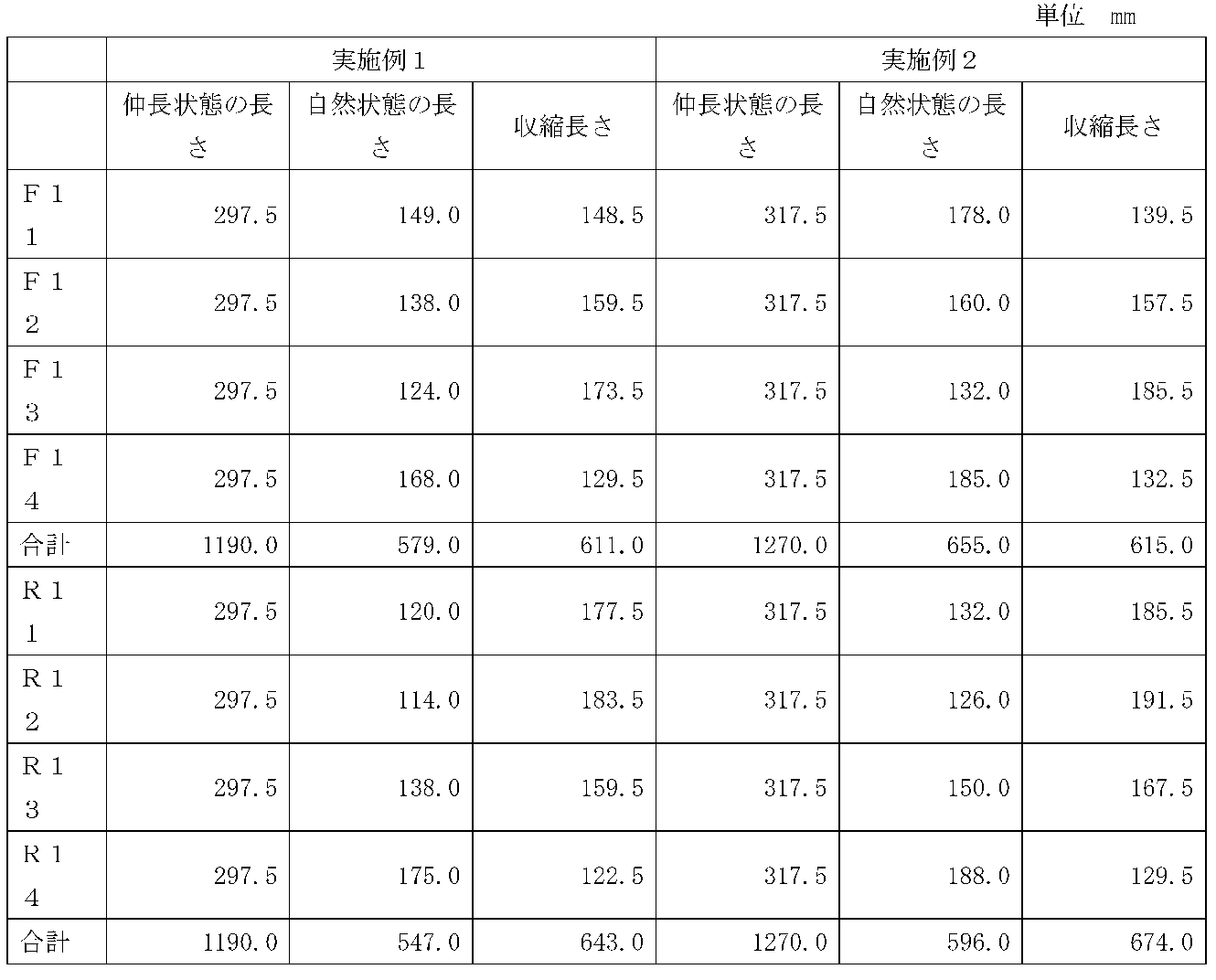
(Formula 1) Contracted length = Length in extended state - Length in natural state (unit: mm)
The measurement data of the contracted length obtained for the
図4は、吸収性物品1が着用者に装着された状態を模式的に示した図である。図4は、立った状態における側面側の装着状態を示した図である。着用者の身体のラインを一点鎖線BLで示す。図4に示すように、着用者の体形は、腹側と背側で異なり、吸収性物品1の長手方向Lにおいて胴回り寸法が変化する。出願人が鋭意研究したところ、着用者の腹部の胴回り寸法は、腹部の下端の凹み付近の胴回り寸法が短く、下端の凹みから股下側に向かって徐々に長くなる。吸収性物品1において収縮長さが長い領域は、伸長状態から自然状態(装着補助者等が幅方向に引張り力を除去した状態)に変化する過程で、収縮する長さが長く、収縮による変化が大きい。そのため、吸収性物品1において収縮長さが長い領域は、着用状態において胴回りに沿う寸法が短くなり、身体の凹んでいる部分に対してフィットし易い。本実施の形態の吸収性物品1において、下腹領域F13の幅方向Wの収縮長さは、前脚領域F14の幅方向Wの収縮長さよりも長い。すなわち、収縮長さの関係は、F13>F14を満たす。腹部において胴回り寸法が短い部分(凹み)に当接する下腹領域F13の収縮長さが長く、凹みよりも膨らむ部分に当接する前脚領域F14の収縮長さが比較的短いため、吸収性物品1自体が身体の凹凸に沿う形状に変形する。身体の凹みに吸収性物品1の寸法が短い部分が配置されることで、当該凹みに吸収性物品1が引っ掛かり、吸収性物品1のずれを抑制できる。
Figure 4 is a schematic diagram showing the state in which the
下腹領域F13の幅方向Wの収縮長さは、上腹領域F12の幅方向Wの収縮長さよりも長くてよい。すなわち、収縮長さの関係は、F13>F12を満たしてよい。着用者の腹部の胴回り寸法は、腹部の下端の凹み付近の胴回り寸法が短く、下端の凹みから上側に向かって徐々に長くなる。下腹領域F13の収縮長さが長く、凹みから膨らむ部分に当接する上腹領域F12及び前脚領域F14の収縮長さが比較的短いため、吸収性物品1自体が身体の凹凸に沿う形状に変形する。吸収性物品1の寸法が短い部分が身体の凹みに配置されることで、当該凹みに吸収性物品1が引っ掛かり、吸収性物品1のずれを抑制できる。また、仮に、上腹領域F12の収縮長さが下腹領域F13の収縮長さよりも長いと、上腹領域F12によって膨らむ部分を圧迫してしまったり上腹領域F12が腹の凹み側にずれたりする不具合が生じるおそれがある。しかし、身体の形状に吸収性物品1が沿うことにより、当該不具合を抑制できる。
The contraction length in the width direction W of the lower abdomen region F13 may be longer than the contraction length in the width direction W of the upper abdomen region F12. In other words, the contraction length relationship may satisfy F13>F12. The waist size of the wearer's abdomen is short near the depression at the lower end of the abdomen and gradually increases from the depression to the upper side. Since the contraction length of the lower abdomen region F13 is long and the contraction length of the upper abdomen region F12 and the front leg region F14 that abut the part that bulges from the depression is relatively short, the
上腹領域F12の幅方向Wの収縮長さは、前ウエスト領域F11の幅方向Wの収縮長さよりも長くてよい。すなわち、収縮長さの関係は、F12>F11を満たしてよい。着用者の腹部の胴回り寸法は、腹部の下端の凹み付近の胴回り寸法が短く、下端の凹みから上側に向かって徐々に長くなる。自然状態における吸収性物品1の胴回り寸法は、下腹領域F13、上腹領域F12、及び前ウエスト領域F11の順で長くなる。腹部の膨らみに沿う形状に、吸収性物品1自体が変形することで、ずれを抑制できる。また、前ウエスト領域F11が配置されるへその近傍は、足の曲げ伸ばし時等に動きやすい部分である。動きやすい部分を覆う領域の収縮長さを短くすることで、吸収性物品1が身体に密着して身体の動きに吸収性物品1が追従し過ぎることによる吸収性物品1の移動を抑制し、吸収性物品1のたくれを抑制できる。
The contraction length in the width direction W of the upper abdomen region F12 may be longer than the contraction length in the width direction W of the front waist region F11. In other words, the contraction length relationship may satisfy F12>F11. The waist circumference of the wearer's abdomen is short near the depression at the lower end of the abdomen, and gradually increases from the depression at the lower end to the upper side. The waist circumference of the
前ウエスト領域F11の幅方向Wの収縮長さと上腹領域F12の幅方向Wの収縮長さの差は、上腹領域F12の幅方向Wの収縮長さと下腹領域F13の幅方向Wの収縮長さの差よりも小さくてよい。すなわち、収縮長さの関係は、F12-F11<F13-F12を満たしてよい。着用者の腹部の胴回り寸法の変化率は、一定でなく、異なっている。より詳細には、着用者の腹側の胴回り寸法の変化率は、F12-F11<F13-F12である。当該態様によれば、吸収性物品の形状が、より身体の形状に合うこととなり、吸収性物品のずれを抑制できる。 The difference between the contraction length in the width direction W of the front waist region F11 and the contraction length in the width direction W of the upper abdomen region F12 may be smaller than the difference between the contraction length in the width direction W of the upper abdomen region F12 and the contraction length in the width direction W of the lower abdomen region F13. That is, the relationship of the contraction lengths may satisfy F12-F11<F13-F12. The rate of change in the waist size of the wearer's abdomen is not constant but varies. More specifically, the rate of change in the waist size of the wearer's abdomen is F12-F11<F13-F12. According to this aspect, the shape of the absorbent article is more closely matched to the shape of the body, and slippage of the absorbent article can be suppressed.
上腹領域F12の幅方向Wの収縮長さは、前脚領域F14の幅方向Wの収縮長さよりも長くてよい。すなわち、収縮長さの関係は、F12>F14を満たしてよい。前脚領域F14は、足の付け根が配置され、足の動きに追従して動きやすい領域である。前脚領域F14の収縮長さを比較的短くすることにより、着用状態における前脚領域F14の幅方向の長さを確保し、足の付け根の動きを阻害せずに装着感を向上できる。好適には、前脚領域F14の幅方向Wの収縮長さは、前胴回り域S1のいずれの領域の収縮長さよりも短くてよい。すなわち、収縮長さの関係は、F14<F11、F14<F12、F14<F13を満たしてよい。前脚領域F14の幅方向Wの収縮長さが短いため、足の動きを阻害せず、装着感をより向上できる。 The contraction length in the width direction W of the upper abdomen region F12 may be longer than the contraction length in the width direction W of the front leg region F14. That is, the relationship of the contraction lengths may satisfy F12>F14. The front leg region F14 is an area where the base of the foot is located and is easy to move in accordance with the movement of the foot. By making the contraction length of the front leg region F14 relatively short, the width direction length of the front leg region F14 when worn is secured, and the fit can be improved without inhibiting the movement of the base of the foot. Preferably, the contraction length in the width direction W of the front leg region F14 may be shorter than the contraction length of any region of the front waist region S1. That is, the relationship of the contraction lengths may satisfy F14<F11, F14<F12, F14<F13. Since the contraction length in the width direction W of the front leg region F14 is short, the fit can be improved without inhibiting the movement of the foot.
下腹領域F13の幅方向Wの収縮長さは、前胴回り域S1のいずれの領域の収縮長さよりも長くてよい。すなわち、収縮長さの関係は、F13>F11、F13>F12、F13>F14を満たしてよい。着用者の腹部の胴回り寸法は、腹部の下端の凹み付近の胴回り寸法が最も短い。腹部において胴回り寸法が短い部分(凹み)に当接する下腹領域F13の収縮長さが長く、当該凹みに吸収性物品が引っ掛かり易く、ずれを抑制できる。 The contraction length in the width direction W of the lower abdomen region F13 may be longer than the contraction length of any region of the front waist region S1. That is, the contraction length relationships may satisfy F13>F11, F13>F12, and F13>F14. The waist circumference of the wearer's abdomen is shortest near the depression at the lower end of the abdomen. The contraction length of the lower abdomen region F13, which abuts against the portion of the abdomen with a short waist circumference (depression), is long, and the absorbent article is more likely to get caught in the depression, preventing slippage.
着用者の背部においては、臀部の膨らみよりも上側に離れるにしたがって胴回り寸法が短くなる。臀部の膨らみの頂点は、下背領域R13によって覆われる。上背領域R12及び後ウエスト領域R11によって覆う部分は、下背領域R13によって覆う部分よりも凹んでいる。上背領域R12の幅方向Wの収縮長さは、下背領域R13の幅方向の収縮長さよりも長くてよい。すなわち、収縮長さの関係は、R12>R13を満たしてよい。下背領域R13は、臀部の膨らみの頂点を覆うように配置される。下背領域R13の幅方向Wの長さを確保することができ、臀部の膨らみを押圧し過ぎずに装着感を向上できる。また、臀部の膨らみの頂点の上側に位置する上背領域R12の自然状態の幅方向Wの長さを短くすることで、臀部の膨らみの頂点よりも上側の部分に吸収性物品1が引っ掛かり、吸収性物品1のずれ下がりを抑制できる。すなわち、背部において臀部の膨らみから上側に向けて、吸収性物品1自体が身体の凹凸に沿う形状に変形し、吸収性物品1のずれを抑制できる。また、下背領域R13が配置される臀部の頂点近傍は、足の曲げ伸ばし時等に動きやすい部分である。動きやすい部分を覆う領域の収縮長さを短くすることで、身体の動きに吸収性物品が追従し過ぎることによる吸収性物品の移動を抑制し、吸収性物品のたくれを抑制できる。加えて、下背領域R13は、排出された便に対向して配置される。仮に下背領域R13の収縮長さが長いと、便が体に密着し、装着感が悪化するおそれがある。しかし、下背領域R13は、比較的収縮長さが短く、身体に密着しない。よって、排出された便を体に密着させずに収容し続けることができ、装着感の悪化を抑制できる。
At the wearer's back, the waist size decreases as it moves upward away from the buttocks bulge. The apex of the buttocks bulge is covered by the lower back region R13. The portion covered by the upper back region R12 and rear waist region R11 is recessed more than the portion covered by the lower back region R13. The contracted length in the width direction W of the upper back region R12 may be longer than the contracted length in the width direction of the lower back region R13. In other words, the relationship of the contracted lengths may be R12>R13. The lower back region R13 is positioned so as to cover the apex of the buttocks bulge. The length in the width direction W of the lower back region R13 can be secured, improving the fit without applying too much pressure to the buttocks bulge. In addition, by shortening the length in the width direction W in the natural state of the upper back region R12 located above the apex of the buttocks, the
上背領域R12の幅方向の収縮長さは、後ウエスト領域R11の幅方向の収縮長さよりも長くてよい。すなわち、収縮長さの関係は、R12>R11を満たしてよい。着用者の背部においては、臀部の膨らみよりも上側に離れるにしたがって胴回り寸法が短くなる。上背領域R12は、臀部の膨らみの頂点よりも上側の部分にあたり、後ウエスト領域R11は、ウエスト(胴の一番細い部分)近傍に当たる。胴回り寸法の変化は、臀部の膨らみの頂点から上側に向かって徐々に少なくなり、ウエスト近傍では、ほぼ身体の外側への膨らみが少なくフラットな形状である。上背領域R12の収縮長さが後ウエスト領域R11の収縮長さよりも長いため、背部において臀部の膨らみから上側に向けて、吸収性物品1自体が身体の凹凸に沿う形状に変形し、吸収性物品1のずれを抑制できる。また、上背領域R12の収縮長さが比較的長いため、着用時に上背領域の胴回り寸法が短くなり、臀部の膨らみの上側の窪みにフィットし、吸収性物品のずれを抑制できる。また、ウエスト近傍のフラットな形状の部分に当たる後ウエスト領域の収縮長さが短く、着用時におけるウエスト周りの胴回り寸法を確保できる。よって、後ウエスト領域が収縮によって股下側へずれ下がることを抑制できる。
The contraction length in the width direction of the upper back region R12 may be longer than the contraction length in the width direction of the rear waist region R11. In other words, the contraction length relationship may satisfy R12>R11. In the back of the wearer, the waist size decreases as it moves upward from the bulge of the buttocks. The upper back region R12 is located above the apex of the bulge of the buttocks, and the rear waist region R11 is located near the waist (the narrowest part of the torso). The change in the waist size gradually decreases from the apex of the bulge of the buttocks toward the upper side, and in the vicinity of the waist, the shape is flat with little bulging outward from the body. Since the contraction length of the upper back region R12 is longer than the contraction length of the rear waist region R11, the
後脚領域R14の幅方向の収縮長さは、下背領域R13の幅方向の収縮長さよりも短くてよい。すなわち、収縮長さの関係は、R14<R13を満たしてよい。後脚領域R14の収縮長さが短く、股下域S3側に向かって後胴回り域S2の幅方向の長さを確保することができる。そのため、吸収コア31が縮むことを抑制し、体液の吸収性能を確保できる。加えて、吸収コア31が縮むことを抑制することで、吸収コア31に意図しない皺が発生することを抑制し、意図しない皺が股下域S3側に連続することに起因して体液の吸収性能が低下することを抑制できる。更に、後脚領域R14は、足の付け根が配置され、足の動きに追従して動きやすい領域である。後脚領域R14の収縮長さを短くすることにより、足の付け根の動きを阻害せずに装着感を向上できる。好適には、後脚領域R14の幅方向Wの収縮長さは、後胴回り域S2のいずれの領域の収縮長さよりも短くてよい。すなわち、収縮長さの関係は、R14<R11、R14<R12、R14<R13を満たしてよい。後脚領域R14は、足の付け根が配置され、足の動きに追従して動きやすい領域である。当該後脚領域R14の収縮長さを短くすることにより、足の付け根の動きを阻害せずに装着感を向上できる。
The contraction length in the width direction of the rear leg region R14 may be shorter than the contraction length in the width direction of the lower back region R13. That is, the relationship of the contraction lengths may satisfy R14<R13. The contraction length of the rear leg region R14 is short, and the width direction length of the rear waist region S2 toward the crotch region S3 side can be secured. Therefore, the
上背領域R12の収縮長さと下背領域R13の収縮長さの差は、上背領域R12の収縮長さと後ウエスト領域R11の収縮長さの差よりも大きくてよい。すなわち、収縮長さの関係は、R12-R13>R12―R11を満たしてよい。着用者の背部の胴回り寸法は、臀部の膨らみの頂点から上側に向かって膨らむ程度が変化している。下背領域R13が配置される臀部の膨らみの頂点から上背領域R12が配置される膨らみの上側に向けては、胴回り寸法の変化率が高く、特に屈曲時の胴回り寸法の変化率が高い。上背領域R12の収縮長さと下背領域R13の収縮長さの差が大きく、身体の形状に吸収性物品がより沿い易くなる。 The difference between the contraction length of the upper back region R12 and the contraction length of the lower back region R13 may be greater than the difference between the contraction length of the upper back region R12 and the rear waist region R11. In other words, the relationship of the contraction lengths may satisfy R12-R13>R12-R11. The waist measurement of the wearer's back changes in the degree of bulging upward from the apex of the buttocks. The rate of change in the waist measurement is high from the apex of the buttocks where the lower back region R13 is located to the upper side of the bulge where the upper back region R12 is located, and the rate of change in the waist measurement is particularly high when bending. The large difference between the contraction length of the upper back region R12 and the contraction length of the lower back region R13 makes it easier for the absorbent article to conform to the shape of the body.
後ウエスト領域R11の収縮長さは、下背領域R13の収縮長さよりも長くてよい。すなわち、収縮長さの関係は、R11>R13を満たしてよい。後ウエスト領域R11が当てられるウエスト近傍の胴回り寸法は、下背領域R13が当てられる臀部の膨らみ部分の胴回り寸法よりも短い。着用状態において吸収性物品1自体が身体の凹凸に沿う形状に変形することで、身体の膨らみに吸収性物品1が密着しすぎずに、当該凹みに吸収性物品1が引っ掛かり、吸収性物品1のずれを抑制できる。
The contracted length of the rear waist region R11 may be longer than the contracted length of the lower back region R13. In other words, the contracted length relationship may satisfy R11>R13. The waist circumference near the waist where the rear waist region R11 is applied is shorter than the waist circumference of the bulging part of the buttocks where the lower back region R13 is applied. When worn, the
上背領域R12の幅方向の収縮長さは、後胴回り域S2のいずれの領域の収縮長さよりも長くてよい。すなわち、収縮長さの関係は、R12>R11、R12>R13、R12>R14を満たしてよい。臀部の膨らみの上側に当てられる上背領域R12の胴回り寸法を短くすることで、後胴回り域S2が股下域S3側に引っ張られても、上背領域R12が臀部の膨らみの上側に引っ掛かり、ずれ下がりを抑制できる。 The contracted length in the width direction of the upper back region R12 may be longer than the contracted length of any region of the rear waist region S2. In other words, the contracted length relationships may satisfy R12>R11, R12>R13, and R12>R14. By shortening the waist dimension of the upper back region R12 that is placed above the bulge of the buttocks, even if the rear waist region S2 is pulled toward the crotch region S3, the upper back region R12 can be caught above the bulge of the buttocks and prevented from slipping down.
後胴回り域S2において最も長い収縮長さと最も短い収縮長さの差は、前胴回り域S1において最も長い収縮長さと最も短い収縮長さの差よりも大きくてよい。本実施の形態では、後胴回り域S2において最も収縮長さが長い上背領域R12の収縮長さと後胴回り域S2において最も収縮長さが短い後脚領域R14との差は、前胴回り域S1において最も収縮長さが長い下腹領域F13の収縮長さと前胴回り域S1において最も収縮長さが短い前脚領域F14との差よりも大きい。背側は、腹側よりも、着用者の脚の曲げ伸ばし等の動作時に伸び縮みし易い。吸収性物品1自体の形状が身体の凹凸に対してずれていると、動作時に吸収性物品1がよりずれ易くなる。しかし、身体の凹凸に沿う形状を吸収性物品1が実現することにより、動作時の吸収性物品1の追従性が高くなり、ずれを抑制できる。
The difference between the longest and shortest contraction lengths in the rear waist region S2 may be greater than the difference between the longest and shortest contraction lengths in the front waist region S1. In this embodiment, the difference between the contraction length of the upper back region R12, which has the longest contraction length in the rear waist region S2, and the rear leg region R14, which has the shortest contraction length in the rear waist region S2, is greater than the difference between the contraction length of the lower abdomen region F13, which has the longest contraction length in the front waist region S1, and the front leg region F14, which has the shortest contraction length in the front waist region S1. The back side is more likely to stretch and contract during movements such as bending and straightening the wearer's legs than the ventral side. If the shape of the
また、吸収性物品1の各領域は、それぞれ適切な引張り応力となるように構成されている。引張り応力の違いによって各領域が異なる態様で変形し、吸収性物品1がずれ下がり難く構成されている。引張り応力における各領域は、外装体50の領域(吸収性本体20を含まない領域)である。各領域の規定及び引張り応力の測定は、以下の方法によって得ることができる。サイド接合部16を有する吸収性物品1は、サイド接合部16を引き裂いて、前胴回り域S1と後胴回り域S2を分離する。次に、外装体50から吸収性本体20を分離する。外装体50を、温度23℃±2℃、湿度50%±5%の環境下で2時間放置した後に、外装体50を皺が見えなくなるまで伸長させた状態で、前胴回り域S1及び後胴回り域S2の領域の境界に印を付す。当該印に基づいて外装体50を切断し、複数の領域に分割した試験片を得ることができる。次に、切り出した試験片の両端部(5mm幅)を引張試験器(インストロン)のチャック(挟持具)によって挟持する。このとき、チャック間の距離を100mmとする。次に、幅方向Wにおけるチャックの一方を固定した状態で、チャック間の距離を変えるようにチャックのもう一方を移動させる。このときのチャックの移動スピードは、254mm/minとする。チャックの移動中に、チャックに係る応力を測定し、伸長状態から70%(一定幅)の状態で得られた応力(N)を「引張り応力」と定義する。上記実施例2にかかる吸収性物品1にて得られた引張り応力の測定データを表2に示す。なお、表2においては、実施例2にかかる測定結果のみを示しているが、以下の説明における引張り応力の関係は、実施例1にかかる吸収性物品においても同様である。

上述のように、着用者の体形は、腹側と背側で異なり、吸収性物品1の長手方向Lにおいて胴回り寸法が変化する。出願人が鋭意研究したところ、着用者の腹部においては、腹部の下端の凹み付近の胴回り寸法が最も短く、腹部の下端の凹みから上側及び股下側に向かって胴回り寸法が長くなる。また、着用者の背部においては、臀部の膨らみよりも上側に離れるにしたがって胴回り寸法が短くなり、ウエスト(胴の一番細い部分)近傍では、胴回り寸法の変化が少なく、ほぼ身体の外側への膨らみが少なくフラットな形状である。吸収性物品1において応力が大きい領域は、身体に対して密着する。このとき、例えば、応力が大きい領域が身体の胴回り寸法が比較的長い部分に密着すると、応力が大きい領域が吸収性物品1の収縮によって胴回り寸法が短い部分に移動することで吸収性物品1がずれてしまうことがある。しかし、本実施の形態において、下腹領域F13の幅方向Wの引張り応力は、前胴回り域S1のいずれの領域の引張り応力よりも大きい。すなわち、引張り応力の関係は、F13>F11、F13>F12、F13>F14を満たす。また、後ウエスト領域R11の幅方向Wの引張り応力は、後胴回り域S2のいずれの領域の引張り応力よりも大きい。すなわち、引張り応力の関係は、R11>R12、R11>R13、R11>R14を満たす。腹部において最も胴回り寸法が短い部分に当接する下腹領域F13の引張り応力が最も大きく、背部において最も胴回り寸法が短い部分に当接する後ウエスト領域R11の引張り応力がもっとも大きく、身体の胴回り寸法が短い部分に最も応力が大きい領域が当たる。身体の最も凹んだ部分に最も大きい応力の領域を当てることで、吸収性物品1の収縮によって吸収性物品1が身体の形状にフィットし、吸収性物品1が長手方向Lにずれることを抑制できる。すなわち、身体の凹みに応力が大きい領域を配置することで、身体の形状と吸収性物品1の応力が合い、吸収性物品1のずれを抑制できる。加えて、比較的応力が大きい後ウエスト領域R11は、身体がフラットな形状となる背側のウエスト近傍にフィットするため、フィット時の長手方向Lのずれが生じ難く、適した吸収性物品1の位置を維持し続け易い。
As described above, the wearer's body shape differs between the abdominal side and the back side, and the waist size changes in the longitudinal direction L of the
上背領域R12の幅方向Wの引張り応力は、下背領域R13の幅方向Wの引張り応力よりも大きくてよい。すなわち、引張り応力の関係は、R12>R13を満たしてよい。後胴回り域S2の引張り応力は、下背領域R13、上背領域R12、及び後ウエスト領域R11の順で徐々に大きくなる。下背領域R13は、着用者の臀部の膨らみを覆う部分である。背側の胴回り寸法は、臀部の膨らみから上側に向かって徐々に短くなる。身体の胴回り寸法が小さくなるにつれて、吸収性物品1の応力を大きくすることで、着用者の体形に吸収性物品1を沿わせ、吸収性物品1の長手方向Lのずれを抑制できる。加えて、下背領域R13は、排出された便に対向して配置される。仮に下背領域R13の引張り応力が大きいと、便が体に密着し、装着感が悪化するおそれがある。しかし、下背領域R13は、後ウエスト領域R11及び上背領域R12と比較して応力が小さく、身体に密着しない。よって、排出された便を体に密着させずに収容し続けることができ、装着感の悪化を抑制できる。また、下背領域R13が覆う臀部の膨らみ部分は、動作時に身体が動きやすい部分である。当該動作時に身体が動きやすい部分に吸収性物品1が密着しすぎないことにより、身体の動きに起因して吸収性物品1がたくれ難くなり、ずれを抑制できる。
The tensile stress in the width direction W of the upper back region R12 may be greater than the tensile stress in the width direction W of the lower back region R13. That is, the relationship of the tensile stresses may satisfy R12>R13. The tensile stress in the rear waist region S2 gradually increases in the order of the lower back region R13, the upper back region R12, and the rear waist region R11. The lower back region R13 is a portion that covers the bulge of the wearer's buttocks. The waist size on the back side gradually decreases from the bulge of the buttocks to the upper side. By increasing the stress of the
下背領域R13の幅方向Wの引張り応力は、後脚領域R14の幅方向Wの引張り応力よりも大きくてよい。すなわち、引張り応力の関係は、R13>R14を満たし、R11>R12>R13>R14を満たしてよい。後胴回り域S2の引張り応力は、後脚領域R14、下背領域R13、上背領域R12、及び後ウエスト領域R11の順で徐々に大きくなる。背側の胴回り寸法は、臀部の膨らみから股下側に向かって短くなる。そのため、下背領域R13が配置される部分の胴回り寸法よりも、後脚領域R14が配置される部分の胴回り寸法の方が短い。しかし、後脚領域R14は、足の付け根が配置され、足の動きに追従して動きやすい領域である。当該後脚領域R14の引張り応力を比較的小さくすることにより、足の付け根の動きを阻害せずに装着感を向上できる。 The tensile stress in the width direction W of the lower back region R13 may be greater than the tensile stress in the width direction W of the rear leg region R14. That is, the relationship of the tensile stress may be R13>R14, or R11>R12>R13>R14. The tensile stress in the rear waist region S2 gradually increases in the order of the rear leg region R14, the lower back region R13, the upper back region R12, and the rear waist region R11. The waist size on the rear side becomes shorter from the bulge of the buttocks toward the crotch side. Therefore, the waist size of the part where the rear leg region R14 is located is shorter than the waist size of the part where the lower back region R13 is located. However, the rear leg region R14 is an area where the base of the foot is located and is easy to move following the movement of the foot. By making the tensile stress in the rear leg region R14 relatively small, the fit can be improved without inhibiting the movement of the base of the foot.
前ウエスト領域F11の幅方向Wの引張り応力は、上腹領域F12の幅方向Wの引張り応力よりも小さくてよい。すなわち、引張り応力の関係は、F11<F12を満たしてよい。着用者の腹部の胴回り寸法は、腹部の下端の凹みが最も短く、当該凹みから上側に離れるにしたがって長くなる。前胴回り域S1の引張り応力は、下腹領域F13、上腹領域F12、及び前ウエスト領域F11の順で徐々に大きくなる。身体の胴回り寸法が小さくなるにつれて吸収性物品1の応力を大きくすることで、着用者の体形に吸収性物品1を沿わせ、吸収性物品1の長手方向Lのずれを抑制できる。また、前ウエスト領域F11が覆う腹の膨らみ部分は、動作時に身体が動きやすい部分である。当該動作時に身体が動きやすい部分に吸収性物品1が密着しすぎないことにより、身体の動きに起因して吸収性物品1がたくれ難くなり、ずれを抑制できる。
The tensile stress in the width direction W of the front waist region F11 may be smaller than the tensile stress in the width direction W of the upper abdomen region F12. That is, the relationship of the tensile stresses may satisfy F11<F12. The waist size of the wearer's abdomen is shortest at the depression at the lower end of the abdomen, and increases as it moves away from the depression to the upper side. The tensile stress in the front waist region S1 gradually increases in the order of the lower abdomen region F13, the upper abdomen region F12, and the front waist region F11. By increasing the stress of the
下腹領域F13の幅方向Wの引張り応力は、前ウエスト領域F11の幅方向Wの引張り応力、上腹領域F12の幅方向Wの引張り応力、及び前脚領域F14の幅方向Wの引張り応力の合計値以下であってよい。すなわち、引張り応力の関係は、F13<F11+F12+F14、又はF13=F11+F12+F14を満たしてよい。下腹領域F13の引張り応力が周囲と比較して大き過ぎると、吸収性物品1のずれ下がりを抑制できる一方で、局所的な締め付けによって装着感が悪化するおそれがある。下腹領域F13の引張り応力が、前胴回り域S1の他の領域の引張り応力の合計値以下であることにより、前胴回り域S1の全体の着圧に対して下腹領域F13が突出し過ぎず、違和感を抑制しつつずれ下がりを抑制できる。
The tensile stress in the width direction W of the lower abdomen region F13 may be equal to or less than the sum of the tensile stress in the width direction W of the front waist region F11, the tensile stress in the width direction W of the upper abdomen region F12, and the tensile stress in the width direction W of the front leg region F14. That is, the relationship of the tensile stresses may be F13<F11+F12+F14, or F13=F11+F12+F14. If the tensile stress in the lower abdomen region F13 is too large compared to the surroundings, the
前胴回り域S1の領域の引張り応力の関係は、F13>F12>F11>F14を満たしてよい。腹部の胴回りの周長に合わせて引張り応力の関係を配置することができ、比較的周長が短い下腹領域F13に吸収性物品1をフィットさせることができる、かつ足回りの弾性部材の跡がつきやすい前脚領域F14において応力をさげることにより、太もも付近を締め付けずに着用者の装着感を向上できる。
The relationship of the tensile stress in the front waist region S1 may satisfy F13>F12>F11>F14. The relationship of the tensile stress can be arranged according to the circumference of the waist of the abdomen, and the
後ウエスト領域R11の幅方向Wの引張り応力は、他のいかなる領域の引張り応力よりも大きい。すなわち、引張り応力の関係は、R11>F11、R11>F12、R11>F13、R11>F14を満たす。背部において身体の最も凹んだ部分に最も大きい応力を当てることで、吸収性物品1の収縮によって吸収性物品1が長手方向Lにずれることを抑制できる。また、後ウエスト領域R11の幅方向Wの引張り応力が、他のいかなる領域の引張り応力よりも大きいため、腹部に対する着圧を抑えつつ、背部の着圧を高めることでずれを抑制できる。着用者の腹部に対する圧迫感を抑えることができ、装着感を向上できる。
The tensile stress in the width direction W of the rear waist region R11 is greater than the tensile stress in any other region. That is, the tensile stress relationships satisfy R11>F11, R11>F12, R11>F13, and R11>F14. By applying the greatest stress to the most recessed part of the body at the back, it is possible to prevent the
後胴回り域S2の4つの領域の幅方向Wの引張り応力の合計値は、前胴回り域S1の4つの領域の幅方向Wの引張り応力の合計値よりも大きくてよい。すなわち、引張り応力の関係は、R11+R12+R13+R14>F11+F12+F13+F14を満たす。着用者の体形は、腹部と背部で異なり、腹側の方が背側よりも膨らんでいる。前胴回り域S1の複数の領域の引張り応力の合計値が比較的小さく、身体の膨らみが多い腹側に対して締め付けすぎず、かつ後胴回り域S2の複数の領域の引張り応力の合計値が比較的大きく、身体の膨らみが少ない背側に対して吸収性物品1がフィットし、装着感の向上とずれの抑制を両立できる。
The sum of the tensile stresses in the width direction W of the four regions of the rear waist region S2 may be greater than the sum of the tensile stresses in the width direction W of the four regions of the front waist region S1. That is, the relationship of the tensile stresses satisfies R11+R12+R13+R14>F11+F12+F13+F14. The wearer's body shape is different between the abdomen and the back, with the abdomen being more bulging than the back. The sum of the tensile stresses in the multiple regions of the front waist region S1 is relatively small, so that the
前ウエスト領域F11の幅方向Wの引張り応力と後ウエスト領域R11の幅方向Wの引張り応力の合計値は、下腹領域F13の幅方向Wの引張り応力と下背領域R13の幅方向Wの引張り応力の合計値よりも大きくてよい。すなわち、引張り応力の関係は、F11+R11>F13+R13を満たしてよい。着用状態において、前胴回り域S1と後胴回り域S2は、連なっており、両者が連携して着用者の胴回りを覆う。着用者の胴回り一周の寸法は、下腹近傍よりもウエスト開口近傍において短くなりやすい。ウエスト開口近傍の引張り応力の合計値を大きくすることにより、身体の前後を足した周長にあった応力設計にでき、吸収性物品1のずれを抑制できる。
The sum of the tensile stress in the width direction W of the front waist region F11 and the tensile stress in the width direction W of the rear waist region R11 may be greater than the sum of the tensile stress in the width direction W of the lower abdomen region F13 and the tensile stress in the width direction W of the lower back region R13. In other words, the relationship of the tensile stresses may satisfy F11+R11>F13+R13. When worn, the front waist region S1 and the rear waist region S2 are connected and work together to cover the waist of the wearer. The circumference of the wearer's waist is likely to be shorter near the waist opening than near the lower abdomen. By increasing the sum of the tensile stresses near the waist opening, a stress design that matches the circumference of the front and back of the body can be achieved, and the
前ウエスト領域F11の幅方向Wの引張り応力と後ウエスト領域R11の幅方向Wの引張り応力の合計値、及び下腹領域F13の幅方向Wの引張り応力と下背領域R13の幅方向の引張り応力の合計値は、上腹領域F12の幅方向Wの引張り応力と上背領域R12の幅方向Wの引張り応力の合計値よりも大きくてよい。すなわち、引張り応力の関係は、F11+R11>F12+R12を満たし、F13+R13>F12+R12を満たしてよい。胴回りの周長は、ウエスト開口近傍において最も短く、ウエスト開口から股下側に向かって長くなる。長くなる理由は、腹のふくらみと臀部の頂点からの傾斜とによるものである。腹のふくらみと臀部の頂点からの傾斜は、主に上腹領域F12と上背領域R12に対応する。上腹領域F12と上背領域R12の引張り応力の合算値が前ウエスト領域F11の引張り応力と後ウエスト領域R11の引張り応力の合算値よりも小さいことにより、身体のふくらみを締め付けずに、身体に沿って吸収性物品1が配置される。胴回りの周長は、腹のふくらみと臀部の頂点からの傾斜よりも股下側に向かって、下腹部の凹みによって短くなる。下腹領域F13の引張り応力と下背領域R13の引張り応力の合算値は、上腹領域F12と上背領域R12の引張り応力の合算値よりも大きく、下腹部の凹みにフィットする。ウエスト開口近傍から腹部の下端までの領域が、身体の周長に合わせて配置され、局所的な締め付けによる装着感の悪化を抑制しつつ、吸収性物品1全体のずれを抑制できる。
The sum of the tensile stress in the width direction W of the front waist region F11 and the tensile stress in the width direction W of the rear waist region R11, and the sum of the tensile stress in the width direction W of the lower abdomen region F13 and the tensile stress in the width direction W of the lower back region R13 may be greater than the sum of the tensile stress in the width direction W of the upper abdomen region F12 and the tensile stress in the width direction W of the upper back region R12. In other words, the relationship of the tensile stresses may satisfy F11+R11>F12+R12 and F13+R13>F12+R12. The circumference of the waist is shortest near the waist opening and becomes longer from the waist opening toward the crotch side. The reason for the longer circumference is due to the bulge of the abdomen and the inclination from the apex of the buttocks. The bulge of the abdomen and the inclination from the apex of the buttocks mainly correspond to the upper abdomen region F12 and the upper back region R12. The combined tensile stress of the upper abdomen region F12 and the upper back region R12 is smaller than the combined tensile stress of the front waist region F11 and the rear waist region R11, so that the
後ウエスト領域R11の幅方向Wの引張り応力と上背領域R12の幅方向Wの引張り応力の合計値は、下腹領域F13の幅方向Wの引張り応力と後脚領域R14の幅方向Wの引張り応力の合計値よりも大きくてよい。すなわち、引張り応力の関係は、R11+R12>R13+R14を満たしてよい。背部の身体の形状は、上側の方が窪んでおり、後ウエスト領域R11及び上背領域R12は、背部において比較的窪んでいる領域である。当該背部の窪んでいる部分を、強い応力でフィットさせることにより、吸収性物品1のずれを抑制する。また、後ウエスト領域R11の幅方向Wの引張り応力と上背領域R12の幅方向Wの引張り応力の合計値は、下腹領域F13の幅方向Wの引張り応力と後脚領域R14の幅方向Wの引張り応力の合計値よりも大きくてよい。すなわち、引張り応力の関係は、F11+F12>F13+F14を満たしてよい。腹部の身体の形状は、下側の方が窪んでおり、下腹領域F13及び前脚領域F14は、腹部において比較的窪んでいる領域である。当該腹部の窪んでいる部分を、強い応力でフィットさせることにより、吸収性物品1のずれを抑制する。下腹領域F13の幅方向Wの引張り応力と前脚領域F14の幅方向Wの平均値よりも大きくてよい。引張り応力の関係は、R11+R12>F13+F14を満たしてよい。後ウエスト領域R11及び上背領域R12は、背部において比較的凹んでいる領域である。また、下腹領域F13及び前脚領域F14は、腹部において比較的凹んでいる領域である。腹部及び背部において凹んでいる領域に対して強く締め、ずれ下がりを抑制できる。また、腹側よりも背側を強く締め付けることで、背側の上に向かって引っ張る力を大きくし、腹側が下にずれる方向と逆の力を加えられる。よって、吸収性物品1がずれ下がることを抑制できる。
The sum of the tensile stress in the width direction W of the rear waist region R11 and the tensile stress in the width direction W of the upper back region R12 may be greater than the sum of the tensile stress in the width direction W of the lower abdomen region F13 and the tensile stress in the width direction W of the rear leg region R14. That is, the relationship of the tensile stresses may satisfy R11+R12>R13+R14. The shape of the body in the back is recessed toward the upper side, and the rear waist region R11 and the upper back region R12 are relatively recessed regions in the back. By fitting the recessed portion of the back with a strong stress, the
後ウエスト領域のR11の幅方向Wの引張り応力は、下腹領域F13の幅方向Wの引張り応力よりも大きくてよい。すなわち、引張り応力の関係は、R11>F13を満たしてよい。前胴回り域S1において下腹領域の引張り応力が最も大きく、後胴回り域S2において後ウエスト領域の引張り応力が最も大きく、装着状態において下腹領域と後ウエスト領域が互いに引っ張り合う。このとき、後ウエスト領域の引張り応力が下腹領域の引張り応力よりも大きいため、腹の中央から身体の側部に向かって斜め上方向の力が作用する。よって、尿等の体液の吸収時に股下域側の力が作用しても、吸収性物品1の引き下がりを抑制できる。
The tensile stress in the width direction W of the rear waist region R11 may be greater than the tensile stress in the width direction W of the lower abdomen region F13. That is, the relationship of the tensile stresses may satisfy R11>F13. The tensile stress of the lower abdomen region is greatest in the front waist region S1, and the tensile stress of the rear waist region is greatest in the rear waist region S2, so that the lower abdomen region and the rear waist region pull against each other when worn. At this time, because the tensile stress of the rear waist region is greater than the tensile stress of the lower abdomen region, a force acts obliquely upward from the center of the abdomen toward the side of the body. Therefore, even if a force acts on the crotch region side when absorbing bodily fluids such as urine, the
上背領域のR12の幅方向Wの引張り応力は、下腹領域F13の幅方向Wの引張り応力よりも大きくてよい。すなわち、引張り応力の関係は、R12>F13を満たしてよい。装着状態において下腹領域F13と上背領域R12が互いに引っ張り合う。このとき、上背領域R12の引張り応力が下腹領域の引張り応力よりも大きいため、腹の中央から身体の側部に向かって斜め上方向の力が作用する。よって、尿等の体液の吸収時に股下域側の力が作用しても、吸収性物品1の引き下がりを抑制できる。
The tensile stress in the width direction W of the upper back region R12 may be greater than the tensile stress in the width direction W of the lower abdomen region F13. In other words, the tensile stress relationship may satisfy R12>F13. When worn, the lower abdomen region F13 and the upper back region R12 pull against each other. At this time, since the tensile stress of the upper back region R12 is greater than the tensile stress of the lower abdomen region, a force acts obliquely upward from the center of the abdomen toward the side of the body. Therefore, even if a force acts on the crotch region side when absorbing body fluids such as urine, the
下腹領域F13の幅方向Wの引張り応力は、下背領域R13の幅方向Wの引張り応力よりも大きくてよい。すなわち、引張り応力の関係は、F13>R13を満たしてよい。下腹領域F13と下背領域R13は、サイド接合部16を介して互いに引っ張り合う。このとき、引張り応力の関係がF13>R13を満たすため、相対的に引張り応力の大きい下腹領域が背側を腹側に引っ張り、腹の下端に対するフィット性をより向上できる。また、背部では、後ウエスト領域R11の引張り応力が比較的大きいため、上方向の力が生じ、吸収性物品1のずれ下がりを抑制できる。
The tensile stress in the width direction W of the lower abdomen region F13 may be greater than the tensile stress in the width direction W of the lower back region R13. That is, the tensile stress relationship may satisfy F13>R13. The lower abdomen region F13 and the lower back region R13 pull on each other via the side joint 16. At this time, since the tensile stress relationship satisfies F13>R13, the lower abdomen region, which has a relatively large tensile stress, pulls the back side toward the abdomen, thereby improving the fit to the lower end of the abdomen. In addition, since the tensile stress in the rear waist region R11 is relatively large in the back, an upward force is generated, which prevents the
上背領域R12の幅方向Wの引張り応力は、上腹領域F12の幅方向Wの引張り応力よりも大きくてよい。すなわち、引張り応力の関係は、R12>F12を満たしてよい。また、好適には、上背領域R12の幅方向Wの引張り応力は、上腹領域F12の幅方向Wの引張り応力の2倍以上であってよい。身体の形状は、上背領域R12があたる臀部の頂点よりも上側が凹んでおり、上腹領域F12が配置される腹の下端部よりも上側の部分が膨らんでいる。臀部の頂点に対して凹み初めの領域と腹の下端に対して膨らみ始めの領域のその胴回り周長の差が大きくなりやすい。引張り応力の関係は、R12>F12を満たすことにより、身体の形状により合った応力配置にすることができ、吸収性物品1のずれ下がりを抑制できる。
The tensile stress in the width direction W of the upper back region R12 may be greater than the tensile stress in the width direction W of the upper abdomen region F12. That is, the tensile stress relationship may satisfy R12>F12. Also, preferably, the tensile stress in the width direction W of the upper back region R12 may be at least twice the tensile stress in the width direction W of the upper abdomen region F12. The shape of the body is recessed above the apex of the buttocks where the upper back region R12 contacts, and the part above the lower end of the abdomen where the upper abdomen region F12 is located is bulging. The difference in the waist circumference between the region that starts to recess with respect to the apex of the buttocks and the region that starts to bulge with respect to the lower end of the abdomen tends to be large. By satisfying R12>F12, the tensile stress relationship can be arranged to be more suitable for the shape of the body, and the
後ウエスト領域R11の幅方向Wの引張り応力と上背領域R12の幅方向Wの引張り応力の合計値は、前ウエスト領域F11の幅方向Wの引張り応力と上腹領域F12の幅方向Wの引張り応力の合計値以上であってよい。本態様によれば、身体の形状でくぼんでいる付近に対して、腹側よりも、背側を強く締め付けることで、腹側が下にずれる方向と逆の力を加えられるため、吸収性物品1のずれ下がりを抑制できる。
The sum of the tensile stress in the width direction W of the rear waist region R11 and the tensile stress in the width direction W of the upper back region R12 may be equal to or greater than the sum of the tensile stress in the width direction W of the front waist region F11 and the tensile stress in the width direction W of the upper abdomen region F12. According to this embodiment, by tightening the back side more strongly than the ventral side near the area that is indented according to the shape of the body, a force is applied in the opposite direction to the downward shift of the ventral side, thereby preventing the
外装体の応力の違いに加えて、吸収性本体の構成を変化させてもよい。より詳細には、低坪量部LRは、下腹領域F13と重なる領域に配置されてよい。低坪量部LRによって吸収コア31が変形し易く、下腹領域F13がより腹部の下端の凹みにフィットし、前胴回り域S1のずれをより抑制できる。
In addition to the difference in the stress of the outer body, the configuration of the absorbent body may be changed. More specifically, the low basis weight portion LR may be disposed in a region overlapping with the lower abdomen region F13. The low basis weight portion LR makes it easier for the
このように、本実施の形態の吸収性物品は、応力毎に適した引張り応力及び収縮長さになるように設計されている。引張り応力が高い領域は、着用者に密着する。これにより、当該領域は、身体にフィットし、着圧が高くなる。一方、引張り応力が低い領域は、身体に対して密着しすぎない。そのため、身体と吸収性物品の空間を適度に確保し、排せつ物の収容空間を確保したり、締め付けによる装着感の悪化を抑制したり、身体の動き追従し過ぎに起因した吸収性物品のずれを抑制できる。また、収縮長さが短い領域は、着用時に幅方向Wの長さが短くなり難く、身体の膨らみに沿って配置されやすい。更に、収縮長さが短い領域は、伸長状態の長さと自然状態の長さの差が少ない。当該領域における収縮可能な長さが少ないため、位置ずれし難くなる。一方、収縮長さが長い領域は、着用時に幅方向Wの長さが短くなり、身体の凹みに沿って配置されやすい。 In this way, the absorbent article of this embodiment is designed to have an appropriate tensile stress and contraction length for each stress. Areas with high tensile stress fit closely to the wearer. This allows the area to fit the body and provide high pressure. On the other hand, areas with low tensile stress do not fit too closely to the body. This allows an appropriate amount of space between the body and the absorbent article, ensuring space for storing excrement, preventing the wearer from feeling uncomfortable due to tightness, and preventing the absorbent article from shifting due to excessive movement of the body. In addition, areas with short contraction lengths are less likely to shorten in the width direction W when worn, and are more likely to be positioned along the bulge of the body. Furthermore, areas with short contraction lengths have a small difference between the length in the stretched state and the length in the natural state. Since the contractible length in the area is small, the area is less likely to shift out of position. On the other hand, areas with long contraction lengths are less likely to shorten in the width direction W when worn, and are more likely to be positioned along the indentations of the body.
また、各領域の応力を大きくする構成は、例えば、以下によって実現できる。外装体に配置されるウエスト弾性部材の伸長倍率を高くする。または、糸状又紐状のウエスト弾性部材55の本数を増やす。または、外装体に配置される糸状のウエスト弾性部材の番手を高くする。また、各領域の応力を小さくする構成は、大きくする構成の逆の構成を採用すればよい。また、各領域の収縮長さを長くする構成は、例えば、以下によって実現できる。外装体に配置されるウエスト弾性部材の伸長倍率を高くする。または、糸状又紐状のウエスト弾性部材55の本数を増やす。または、外装体に配置される糸状のウエスト弾性部材の番手を高くする。なお、弾性部材の番手は、引張り応力への影響が比較的大きく、収縮長さへの影響が比較的小さい。ウエスト弾性部材が配置された資材(シートの坪量又は枚数)を減らす。または、ウエスト弾性部材を資材に接着するための接着剤を減らす。または、吸収コアを配置しない。または、吸収コアの吸収材料の坪量を低くする。資材及び接着剤を減らしたり、吸収コアを配置しなかったり、吸収材料の坪量を低くしたりすることにより、剛性が低くなり、収縮し易くなる。また、各領域の収縮長さを短くする構成は、長くする構成の逆の構成を採用すればよい。上述のように、収縮長さは、吸収性物品1全体における各領域の伸長状態に対する自然状態の長さであり、引張り応力は、外装体50における各領域の引張り応力である。収縮長さと引張り応力は、定義が異なり、その大小関係も異なるものである。より詳細には、任意の第1の領域の収縮長さが任意の第2の領域の収縮長さよりも長い(第1の領域がより収縮する)場合、第1の領域の引張り応力が第2の領域の引張り応力よりも大きいとは限らず、第1の領域の引張り応力が第2の領域の引張り応力よりも小さいこともある。
The configuration for increasing the stress in each region can be realized, for example, by: Increasing the stretch ratio of the waist elastic member placed on the exterior body; Or increasing the number of thread-like or string-like waist
後ウエスト領域R11の幅方向の引張り応力は、上背領域R12の引張り応力よりも高く、上背領域R12の幅方向の収縮長さは、後ウエスト領域R11の幅方向の収縮長さよりも長くてよい。すなわち、引張り応力の関係は、R11>R12を満たし、収縮長さの関係は、R12>R11を満たしてよい。後ウエスト領域は、上背領域と比較して、引張り応力が高く、身体に対する着圧が高くなりやすい。また、好ましい形態によれば、後ウエスト領域R11は、上背領域R12と比較して、収縮長さが短く、収縮量が少なく、身体に対する位置をキープし易い。後ウエスト領域R11のずれが少なく、その着圧が高いため、着用者の動作時に背側のウエスト開口と着用者との隙間が生じることを抑制できる。 The tensile stress in the width direction of the rear waist region R11 may be higher than that of the upper back region R12, and the contraction length in the width direction of the upper back region R12 may be longer than the contraction length in the width direction of the rear waist region R11. That is, the relationship of the tensile stress may be R11>R12, and the relationship of the contraction length may be R12>R11. The rear waist region has a higher tensile stress than the upper back region, and tends to exert a higher pressure on the body. In addition, according to a preferred embodiment, the rear waist region R11 has a shorter contraction length and a smaller contraction amount than the upper back region R12, and is therefore easier to maintain its position on the body. The rear waist region R11 is less likely to shift and exerts a higher pressure on the body, which can prevent a gap from being created between the back waist opening and the wearer during the wearer's movements.
以上、上述の実施形態を用いて本発明について詳細に説明したが、当業者にとっては、本発明が本明細書中に説明した実施形態に限定されるものではないということは明らかである。本発明は、特許請求の範囲の記載により定まる本発明の趣旨及び範囲を逸脱することなく修正及び変更態様として実施することができる。したがって、本明細書の記載は、例示説明を目的とするものであり、本発明に対して何ら制限的な意味を有するものではない。 Although the present invention has been described in detail using the above-mentioned embodiment, it is clear to those skilled in the art that the present invention is not limited to the embodiment described in this specification. The present invention can be implemented in modified and altered forms without departing from the spirit and scope of the present invention as defined by the claims. Therefore, the description in this specification is intended to be illustrative and does not have any limiting meaning on the present invention.
吸収性物品のずれ下がりを抑制できる吸収性物品を提供することができる。 It is possible to provide an absorbent article that can prevent the absorbent article from slipping down.
1:吸収性物品、31:吸収コア、LR:低坪量部、F11:前ウエスト領域、F12:上腹領域、F13:下腹領域、F14:前脚領域、R11:後ウエスト領域、R12:上背領域、R13:下背領域、R14:後脚領域、S1:前胴回り域、S1F:前端縁、S2:後胴回り域、S2R:後端縁、S3:股下域、L:長手方向、W:幅方向 1: absorbent article, 31: absorbent core, LR: low basis weight section, F11: front waist region, F12: upper abdomen region, F13: lower abdomen region, F14: front leg region, R11: rear waist region, R12: upper back region, R13: lower back region, R14: rear leg region, S1: front waist region, S1F: front edge, S2: rear waist region, S2R: rear edge, S3: crotch region, L: longitudinal direction, W: width direction
Claims (15)
前胴回り域、後胴回り域、及び前記前胴回り域及び前記後胴回り域との間に配置された股下域と、
少なくとも前記股下域に配置された吸収コアと、を有する吸収性物品であって、
前記前胴回り域及び前記後胴回り域には、前記前胴回り域及び前記後胴回り域を前記長手方向に分割した複数の領域が設けられており、
前記複数の領域は、前記前胴回り域の前端縁から前記前胴回り域の前記長手方向の全長に対する0~25%後方に位置する前ウエスト領域と、前記前胴回り域の前端縁から前記前胴回り域の前記長手方向の全長に対する25~50%後方に位置する上腹領域と、前記前胴回り域の前端縁から前記前胴回り域の前記長手方向の全長に対する50~75%後方に位置する下腹領域と、前記前胴回り域の前端縁から前記前胴回り域の前記長手方向の全長に対する75~100%後方に位置する前脚領域と、前記後胴回り域の後端縁から前記後胴回り域の前記長手方向の全長に対する0~25%前方に位置する後ウエスト領域と、前記後胴回り域の後端縁から前記後胴回り域の前記長手方向の全長に対する25~50%前方に位置する上背領域と、前記後胴回り域の後端縁から前記後胴回り域の前記長手方向の全長に対する50~75%前方に位置する下背領域と、前記後胴回り域の後端縁から前記後胴回り域の前記長手方向の全長に対する75~100%前方に位置する後脚領域と、を有し、
前記下腹領域の前記幅方向の収縮長さは、前記前脚領域の前記幅方向の収縮長さよりも長く、
前記上背領域の前記幅方向の収縮長さは、前記後胴回り域のいずれの領域の収縮長さよりも長い、吸収性物品。 A longitudinal direction and a width direction perpendicular to each other;
a front waist region, a rear waist region, and a crotch region disposed between the front waist region and the rear waist region;
an absorbent article having an absorbent core disposed at least in the crotch region,
The front waist region and the rear waist region are provided with a plurality of regions that divide the front waist region and the rear waist region in the longitudinal direction,
The plurality of regions include a front waist region located 0 to 25% rearward from the front edge of the front waist region with respect to the entire length of the front waist region in the longitudinal direction, an upper abdomen region located 25 to 50% rearward from the front edge of the front waist region with respect to the entire length of the front waist region in the longitudinal direction, a lower abdomen region located 50 to 75% rearward from the front edge of the front waist region with respect to the entire length of the front waist region in the longitudinal direction, and a front leg region located 75 to 100% rearward from the front edge of the front waist region with respect to the entire length of the front waist region in the longitudinal direction. a rear waist region located 0-25% forward from the rear end edge of the rear waist region with respect to the entire length of the rear waist region in the longitudinal direction; an upper back region located 25-50% forward from the rear end edge of the rear waist region with respect to the entire length of the rear waist region in the longitudinal direction; a lower back region located 50-75% forward from the rear end edge of the rear waist region with respect to the entire length of the rear waist region in the longitudinal direction; and a rear leg region located 75-100% forward from the rear end edge of the rear waist region with respect to the entire length of the rear waist region in the longitudinal direction ,
A contracted length in the width direction of the lower abdomen region is longer than a contracted length in the width direction of the front leg region,
An absorbent article , wherein the contraction length of the upper back region in the width direction is longer than the contraction length of any region of the rear waist region .
前胴回り域、後胴回り域、及び前記前胴回り域及び前記後胴回り域との間に配置された股下域と、a front waist region, a rear waist region, and a crotch region disposed between the front waist region and the rear waist region;
少なくとも前記股下域に配置された吸収コアと、を有する吸収性物品であって、an absorbent article having an absorbent core disposed at least in the crotch region,
前記前胴回り域及び前記後胴回り域には、前記前胴回り域及び前記後胴回り域を前記長手方向に分割した複数の領域が設けられており、The front waist region and the rear waist region are provided with a plurality of regions that divide the front waist region and the rear waist region in the longitudinal direction,
前記複数の領域は、前記前胴回り域の前端縁から前記前胴回り域の前記長手方向の全長に対する0~25%後方に位置する前ウエスト領域と、前記前胴回り域の前端縁から前記前胴回り域の前記長手方向の全長に対する25~50%後方に位置する上腹領域と、前記前胴回り域の前端縁から前記前胴回り域の前記長手方向の全長に対する50~75%後方に位置する下腹領域と、前記前胴回り域の前端縁から前記前胴回り域の前記長手方向の全長に対する75~100%後方に位置する前脚領域と、前記後胴回り域の後端縁から前記後胴回り域の前記長手方向の全長に対する0~25%前方に位置する後ウエスト領域と、前記後胴回り域の後端縁から前記後胴回り域の前記長手方向の全長に対する25~50%前方に位置する上背領域と、前記後胴回り域の後端縁から前記後胴回り域の前記長手方向の全長に対する50~75%前方に位置する下背領域と、前記後胴回り域の後端縁から前記後胴回り域の前記長手方向の全長に対する75~100%前方に位置する後脚領域と、を有し、The plurality of regions include a front waist region located 0 to 25% rearward from the front edge of the front waist region with respect to the entire length of the front waist region in the longitudinal direction, an upper abdomen region located 25 to 50% rearward from the front edge of the front waist region with respect to the entire length of the front waist region in the longitudinal direction, a lower abdomen region located 50 to 75% rearward from the front edge of the front waist region with respect to the entire length of the front waist region in the longitudinal direction, and a front leg region located 75 to 100% rearward from the front edge of the front waist region with respect to the entire length of the front waist region in the longitudinal direction. a rear waist region located 0-25% forward from the rear end edge of the rear waist region with respect to the entire length of the rear waist region in the longitudinal direction; an upper back region located 25-50% forward from the rear end edge of the rear waist region with respect to the entire length of the rear waist region in the longitudinal direction; a lower back region located 50-75% forward from the rear end edge of the rear waist region with respect to the entire length of the rear waist region in the longitudinal direction; and a rear leg region located 75-100% forward from the rear end edge of the rear waist region with respect to the entire length of the rear waist region in the longitudinal direction,
前記下腹領域の前記幅方向の収縮長さは、前記前脚領域の前記幅方向の収縮長さよりも長く、A contracted length in the width direction of the lower abdomen region is longer than a contracted length in the width direction of the front leg region,
前記後ウエスト領域の前記幅方向の引張り応力は、前記上背領域の前記幅方向の前記引張り応力よりも高い、吸収性物品。An absorbent article, wherein the tensile stress in the width direction of the rear waist region is higher than the tensile stress in the width direction of the upper back region.
Priority Applications (4)
| Application Number | Priority Date | Filing Date | Title |
|---|---|---|---|
| JP2020185279A JP7554636B2 (en) | 2020-11-05 | 2020-11-05 | Absorbent articles |
| CN202180073983.XA CN116472015A (en) | 2020-11-05 | 2021-10-27 | absorbent article |
| PCT/JP2021/039657 WO2022097551A1 (en) | 2020-11-05 | 2021-10-27 | Absorbent article |
| JP2024148307A JP7706620B2 (en) | 2020-11-05 | 2024-08-30 | Absorbent articles |
Applications Claiming Priority (1)
| Application Number | Priority Date | Filing Date | Title |
|---|---|---|---|
| JP2020185279A JP7554636B2 (en) | 2020-11-05 | 2020-11-05 | Absorbent articles |
Related Child Applications (1)
| Application Number | Title | Priority Date | Filing Date |
|---|---|---|---|
| JP2024148307A Division JP7706620B2 (en) | 2020-11-05 | 2024-08-30 | Absorbent articles |
Publications (2)
| Publication Number | Publication Date |
|---|---|
| JP2022074871A JP2022074871A (en) | 2022-05-18 |
| JP7554636B2 true JP7554636B2 (en) | 2024-09-20 |
Family
ID=81457843
Family Applications (2)
| Application Number | Title | Priority Date | Filing Date |
|---|---|---|---|
| JP2020185279A Active JP7554636B2 (en) | 2020-11-05 | 2020-11-05 | Absorbent articles |
| JP2024148307A Active JP7706620B2 (en) | 2020-11-05 | 2024-08-30 | Absorbent articles |
Family Applications After (1)
| Application Number | Title | Priority Date | Filing Date |
|---|---|---|---|
| JP2024148307A Active JP7706620B2 (en) | 2020-11-05 | 2024-08-30 | Absorbent articles |
Country Status (3)
| Country | Link |
|---|---|
| JP (2) | JP7554636B2 (en) |
| CN (1) | CN116472015A (en) |
| WO (1) | WO2022097551A1 (en) |
Families Citing this family (1)
| Publication number | Priority date | Publication date | Assignee | Title |
|---|---|---|---|---|
| JP2025019946A (en) * | 2023-07-28 | 2025-02-07 | ユニ・チャーム株式会社 | Absorbent articles |
Citations (3)
| Publication number | Priority date | Publication date | Assignee | Title |
|---|---|---|---|---|
| JP2015506790A (en) | 2012-02-13 | 2015-03-05 | ザ プロクター アンド ギャンブルカンパニー | Disposable pull-on clothing |
| JP2017525483A (en) | 2014-08-27 | 2017-09-07 | ザ プロクター アンド ギャンブル カンパニー | Wearable article having an elastic belt |
| JP2020000755A (en) | 2018-06-29 | 2020-01-09 | ユニ・チャーム株式会社 | Absorbent articles |
Family Cites Families (9)
| Publication number | Priority date | Publication date | Assignee | Title |
|---|---|---|---|---|
| JP3515834B2 (en) * | 1995-08-02 | 2004-04-05 | ユニ・チャーム株式会社 | Pants-type absorbent article |
| KR101454048B1 (en) * | 2007-02-28 | 2014-10-27 | 다이오 페이퍼 코퍼레이션 | Paper diaper |
| JP5659006B2 (en) * | 2010-12-27 | 2015-01-28 | 花王株式会社 | Pants-type absorbent article |
| JP5898947B2 (en) * | 2010-12-27 | 2016-04-06 | 花王株式会社 | Pants-type absorbent article |
| JP5999878B2 (en) * | 2011-07-04 | 2016-09-28 | ユニ・チャーム株式会社 | Disposable wearing items |
| JP6132638B2 (en) * | 2013-04-11 | 2017-05-24 | ユニ・チャーム株式会社 | Pants-type wearing article |
| JP6449135B2 (en) * | 2015-11-20 | 2019-01-09 | ユニ・チャーム株式会社 | Disposable wearing items |
| JP6659776B2 (en) * | 2018-07-23 | 2020-03-04 | ユニ・チャーム株式会社 | Worn article |
| JP2020025748A (en) * | 2018-08-13 | 2020-02-20 | ユニ・チャーム株式会社 | Absorbent article |
-
2020
- 2020-11-05 JP JP2020185279A patent/JP7554636B2/en active Active
-
2021
- 2021-10-27 WO PCT/JP2021/039657 patent/WO2022097551A1/en not_active Ceased
- 2021-10-27 CN CN202180073983.XA patent/CN116472015A/en active Pending
-
2024
- 2024-08-30 JP JP2024148307A patent/JP7706620B2/en active Active
Patent Citations (3)
| Publication number | Priority date | Publication date | Assignee | Title |
|---|---|---|---|---|
| JP2015506790A (en) | 2012-02-13 | 2015-03-05 | ザ プロクター アンド ギャンブルカンパニー | Disposable pull-on clothing |
| JP2017525483A (en) | 2014-08-27 | 2017-09-07 | ザ プロクター アンド ギャンブル カンパニー | Wearable article having an elastic belt |
| JP2020000755A (en) | 2018-06-29 | 2020-01-09 | ユニ・チャーム株式会社 | Absorbent articles |
Also Published As
| Publication number | Publication date |
|---|---|
| JP7706620B2 (en) | 2025-07-11 |
| JP2024159947A (en) | 2024-11-08 |
| CN116472015A (en) | 2023-07-21 |
| WO2022097551A1 (en) | 2022-05-12 |
| JP2022074871A (en) | 2022-05-18 |
Similar Documents
| Publication | Publication Date | Title |
|---|---|---|
| CN108883004B (en) | absorbent articles | |
| JP2002065734A (en) | Pants-type disposable diapers | |
| JP6195772B2 (en) | Disposable diapers | |
| JP2009125087A (en) | Pants-type disposable diaper | |
| TWI569788B (en) | Disposable disposable diaper | |
| CN110809459A (en) | Length versus Side Profile for Boxer/Boxer Type Disposable Absorbent Articles and Collections | |
| CN110785154A (en) | Hip-to-side contours for boxer panty-type disposable absorbent articles and series | |
| CN110785155A (en) | Disposable absorbent articles and arrays of length-to-hip contours and length-to-waist contours | |
| JP7706620B2 (en) | Absorbent articles | |
| JP6720281B2 (en) | Disposable diapers | |
| JP5140374B2 (en) | Absorbent wearing article and method for producing the same | |
| JP7558758B2 (en) | Absorbent articles | |
| JP7366881B2 (en) | Pants type disposable diaper | |
| CN112334105A (en) | absorbent articles | |
| JP3425348B2 (en) | Disposable wearing articles | |
| JP7217148B2 (en) | absorbent article | |
| JPWO2019038867A1 (en) | Absorbent articles | |
| CN112566596B (en) | Disposable diaper having a disposable diaper | |
| CN112566600A (en) | Disposable diaper having a disposable diaper | |
| JP7200088B2 (en) | absorbent article | |
| JP7203719B2 (en) | absorbent article | |
| JP7288748B2 (en) | absorbent article | |
| JP2001333931A (en) | Disposable diapers | |
| JP2024046688A (en) | absorbent articles | |
| WO2025134589A1 (en) | Underpants-type absorbent article |
Legal Events
| Date | Code | Title | Description |
|---|---|---|---|
| A621 | Written request for application examination |
Free format text: JAPANESE INTERMEDIATE CODE: A621 Effective date: 20231025 |
|
| A131 | Notification of reasons for refusal |
Free format text: JAPANESE INTERMEDIATE CODE: A131 Effective date: 20240416 |
|
| A521 | Request for written amendment filed |
Free format text: JAPANESE INTERMEDIATE CODE: A523 Effective date: 20240613 |
|
| TRDD | Decision of grant or rejection written | ||
| A01 | Written decision to grant a patent or to grant a registration (utility model) |
Free format text: JAPANESE INTERMEDIATE CODE: A01 Effective date: 20240813 |
|
| A61 | First payment of annual fees (during grant procedure) |
Free format text: JAPANESE INTERMEDIATE CODE: A61 Effective date: 20240909 |
|
| R150 | Certificate of patent or registration of utility model |
Ref document number: 7554636 Country of ref document: JP Free format text: JAPANESE INTERMEDIATE CODE: R150 |