JP7549202B2 - Pneumatic tires - Google Patents
Pneumatic tires Download PDFInfo
- Publication number
- JP7549202B2 JP7549202B2 JP2020171224A JP2020171224A JP7549202B2 JP 7549202 B2 JP7549202 B2 JP 7549202B2 JP 2020171224 A JP2020171224 A JP 2020171224A JP 2020171224 A JP2020171224 A JP 2020171224A JP 7549202 B2 JP7549202 B2 JP 7549202B2
- Authority
- JP
- Japan
- Prior art keywords
- sealant
- mass
- layer
- tire
- tread portion
- Prior art date
- Legal status (The legal status is an assumption and is not a legal conclusion. Google has not performed a legal analysis and makes no representation as to the accuracy of the status listed.)
- Active
Links
Images


Classifications
-
- B—PERFORMING OPERATIONS; TRANSPORTING
- B60—VEHICLES IN GENERAL
- B60C—VEHICLE TYRES; TYRE INFLATION; TYRE CHANGING; CONNECTING VALVES TO INFLATABLE ELASTIC BODIES IN GENERAL; DEVICES OR ARRANGEMENTS RELATED TO TYRES
- B60C19/00—Tyre parts or constructions not otherwise provided for
- B60C19/12—Puncture preventing arrangements
- B60C19/122—Puncture preventing arrangements disposed inside of the inner liner
-
- B—PERFORMING OPERATIONS; TRANSPORTING
- B60—VEHICLES IN GENERAL
- B60C—VEHICLE TYRES; TYRE INFLATION; TYRE CHANGING; CONNECTING VALVES TO INFLATABLE ELASTIC BODIES IN GENERAL; DEVICES OR ARRANGEMENTS RELATED TO TYRES
- B60C19/00—Tyre parts or constructions not otherwise provided for
- B60C19/12—Puncture preventing arrangements
-
- B—PERFORMING OPERATIONS; TRANSPORTING
- B29—WORKING OF PLASTICS; WORKING OF SUBSTANCES IN A PLASTIC STATE IN GENERAL
- B29C—SHAPING OR JOINING OF PLASTICS; SHAPING OF MATERIAL IN A PLASTIC STATE, NOT OTHERWISE PROVIDED FOR; AFTER-TREATMENT OF THE SHAPED PRODUCTS, e.g. REPAIRING
- B29C73/00—Repairing of articles made from plastics or substances in a plastic state, e.g. of articles shaped or produced by using techniques covered by this subclass or subclass B29D
- B29C73/16—Auto-repairing or self-sealing arrangements or agents
- B29C73/163—Sealing compositions or agents, e.g. combined with propellant agents
-
- B—PERFORMING OPERATIONS; TRANSPORTING
- B29—WORKING OF PLASTICS; WORKING OF SUBSTANCES IN A PLASTIC STATE IN GENERAL
- B29C—SHAPING OR JOINING OF PLASTICS; SHAPING OF MATERIAL IN A PLASTIC STATE, NOT OTHERWISE PROVIDED FOR; AFTER-TREATMENT OF THE SHAPED PRODUCTS, e.g. REPAIRING
- B29C73/00—Repairing of articles made from plastics or substances in a plastic state, e.g. of articles shaped or produced by using techniques covered by this subclass or subclass B29D
- B29C73/16—Auto-repairing or self-sealing arrangements or agents
- B29C73/22—Auto-repairing or self-sealing arrangements or agents the article containing elements including a sealing composition, e.g. powder being liberated when the article is damaged
-
- B—PERFORMING OPERATIONS; TRANSPORTING
- B29—WORKING OF PLASTICS; WORKING OF SUBSTANCES IN A PLASTIC STATE IN GENERAL
- B29L—INDEXING SCHEME ASSOCIATED WITH SUBCLASS B29C, RELATING TO PARTICULAR ARTICLES
- B29L2030/00—Pneumatic or solid tyres or parts thereof
-
- B—PERFORMING OPERATIONS; TRANSPORTING
- B60—VEHICLES IN GENERAL
- B60C—VEHICLE TYRES; TYRE INFLATION; TYRE CHANGING; CONNECTING VALVES TO INFLATABLE ELASTIC BODIES IN GENERAL; DEVICES OR ARRANGEMENTS RELATED TO TYRES
- B60C1/00—Tyres characterised by the chemical composition or the physical arrangement or mixture of the composition
-
- B—PERFORMING OPERATIONS; TRANSPORTING
- B60—VEHICLES IN GENERAL
- B60C—VEHICLE TYRES; TYRE INFLATION; TYRE CHANGING; CONNECTING VALVES TO INFLATABLE ELASTIC BODIES IN GENERAL; DEVICES OR ARRANGEMENTS RELATED TO TYRES
- B60C1/00—Tyres characterised by the chemical composition or the physical arrangement or mixture of the composition
- B60C1/0008—Compositions of the inner liner
-
- B—PERFORMING OPERATIONS; TRANSPORTING
- B60—VEHICLES IN GENERAL
- B60C—VEHICLE TYRES; TYRE INFLATION; TYRE CHANGING; CONNECTING VALVES TO INFLATABLE ELASTIC BODIES IN GENERAL; DEVICES OR ARRANGEMENTS RELATED TO TYRES
- B60C11/00—Tyre tread bands; Tread patterns; Anti-skid inserts
-
- C—CHEMISTRY; METALLURGY
- C08—ORGANIC MACROMOLECULAR COMPOUNDS; THEIR PREPARATION OR CHEMICAL WORKING-UP; COMPOSITIONS BASED THEREON
- C08K—Use of inorganic or non-macromolecular organic substances as compounding ingredients
- C08K5/00—Use of organic ingredients
- C08K5/04—Oxygen-containing compounds
- C08K5/14—Peroxides
-
- Y—GENERAL TAGGING OF NEW TECHNOLOGICAL DEVELOPMENTS; GENERAL TAGGING OF CROSS-SECTIONAL TECHNOLOGIES SPANNING OVER SEVERAL SECTIONS OF THE IPC; TECHNICAL SUBJECTS COVERED BY FORMER USPC CROSS-REFERENCE ART COLLECTIONS [XRACs] AND DIGESTS
- Y02—TECHNOLOGIES OR APPLICATIONS FOR MITIGATION OR ADAPTATION AGAINST CLIMATE CHANGE
- Y02T—CLIMATE CHANGE MITIGATION TECHNOLOGIES RELATED TO TRANSPORTATION
- Y02T10/00—Road transport of goods or passengers
- Y02T10/80—Technologies aiming to reduce greenhouse gasses emissions common to all road transportation technologies
- Y02T10/86—Optimisation of rolling resistance, e.g. weight reduction
Landscapes
- Engineering & Computer Science (AREA)
- Mechanical Engineering (AREA)
- Tires In General (AREA)
- Compositions Of Macromolecular Compounds (AREA)
Description
本発明は、タイヤ内表面にシーラント層を備えたセルフシールタイプの空気入りタイヤに関する。 The present invention relates to a self-sealing type pneumatic tire with a sealant layer on the inner surface of the tire.
空気入りタイヤにおいて、トレッド部におけるインナーライナー層のタイヤ径方向内側にシーラント層を設けることが提案されている(例えば、特許文献1参照)。このような空気入りタイヤでは、釘等の異物がトレッド部に突き刺さった際に、その貫通孔にシーラント層を構成するシーラント材が流入することにより、空気圧の減少を抑制し、走行を維持することが可能になる。 It has been proposed to provide a sealant layer on the radially inner side of the inner liner layer in the tread of a pneumatic tire (see, for example, Patent Document 1). In such a pneumatic tire, when a foreign object such as a nail penetrates the tread, the sealant material constituting the sealant layer flows into the through hole, suppressing the decrease in air pressure and making it possible to maintain driving.
上述したセルフシールタイプの空気入りタイヤにおいて、シーラント材の粘度が低いと、シーラント材が貫通孔内に流入し易くなるという点でシール性の向上が見込めるが、走行中に加わる熱や遠心力の影響によりシーラント材がタイヤセンター側に向かって流動し、その結果、貫通孔がタイヤセンター領域から外れると、シーラント材が不足して、シール性が充分に得られない虞がある。一方、シーラント材の粘度が高いと、前述のシーラント材の流動は防止することができるが、シーラント材が貫通孔内に流入しにくくなり、シール性が低下する虞がある。そのため、シーラント層(シーラント材)においては、走行に伴うシーラント材の流動の抑制と、良好なシール性の確保とをバランスよく両立することが求められている。 In the above-mentioned self-sealing type pneumatic tire, if the viscosity of the sealant is low, the sealant can be expected to improve sealing performance in that it can easily flow into the through-holes. However, if the sealant flows toward the tire center due to the heat and centrifugal force applied during driving, and as a result, if the through-holes are outside the tire center region, there is a risk that the sealant will be insufficient and sufficient sealing performance will not be obtained. On the other hand, if the viscosity of the sealant is high, the flow of the sealant can be prevented, but the sealant will not easily flow into the through-holes, and there is a risk that the sealing performance will be reduced. Therefore, it is necessary for the sealant layer (sealant) to achieve a good balance between suppressing the flow of the sealant during driving and ensuring good sealing performance.
更に、シーラント層を設けることで、結果的に、タイヤ本体と別にシーラント層の分の荷重が追加されてタイヤ全体としての重量が重くなる傾向がある。そのため、セルフシールタイプの空気入りタイヤは、転がり抵抗を良好に維持することが難しい傾向がある。従って、上述のシーラント層としての性能を確保する一方で、タイヤ重量の増加や転がり抵抗の悪化を抑制する対策も求められている。 Furthermore, by providing a sealant layer, the load of the sealant layer is added to the tire body, which tends to make the tire heavier overall. As a result, it tends to be difficult for self-sealing pneumatic tires to maintain good rolling resistance. Therefore, while ensuring the performance of the sealant layer described above, there is also a need for measures to suppress increases in tire weight and deterioration of rolling resistance.
本発明の目的は、良好なシール性を確保しながら、タイヤ重量および転がり抵抗の増加を抑制し、これら性能をバランスよく両立することを可能にした空気入りタイヤを提供することにある。 The object of the present invention is to provide a pneumatic tire that achieves a good balance between these performance characteristics by suppressing increases in tire weight and rolling resistance while ensuring good sealing properties.
上記目的を達成する本発明の空気入りタイヤは、タイヤ周方向に延在して環状をなすトレッド部と、該トレッド部の両側に配置された一対のサイドウォール部と、これらサイドウォール部のタイヤ外径方向内側に配置された一対のビード部とを備え、前記一対のビード部間に装架されたカーカス層と、前記トレッド部における前記カーカス層の外周側に隣接して配置された内側ベルト層を含む少なくとも1層のベルト層とを有し、少なくとも前記トレッド部の内表面に粘着性シーラント材からなるシーラント層が設けられた空気入りタイヤにおいて、前記シーラント層の幅SWと、前記内側ベルト層の幅BW1と、実接地幅CWとが、CW≦SW≦BW1の関係を満たし、且つ、タイヤ赤道位置におけるトレッド表面と実接地領域の端部におけるトレッド表面とのタイヤ径方向に沿った垂直距離Lが10.0mm以下であるか、或いはタイヤ赤道位置における前記トレッド部の厚さT1および前記シーラント層の厚さS1が0.15<S1/T1<0.35の関係を満たし、且つ、前記シーラント層の端部位置における前記トレッド部の厚さT2および前記シーラント層の厚さS2が0.20<S2/T2<0.40の関係を満たすことを特徴とする。 The pneumatic tire of the present invention for achieving the above object includes a tread portion extending in a circumferential direction of the tire to form an annular shape, a pair of sidewall portions disposed on both sides of the tread portion, and a pair of bead portions disposed on the inner side of the sidewall portions in the outer radial direction of the tire, the pneumatic tire having a carcass layer mounted between the pair of bead portions, and at least one belt layer including an inner belt layer disposed adjacent to the outer peripheral side of the carcass layer in the tread portion, and a sealant layer made of an adhesive sealant material is provided on at least the inner surface of the tread portion, a width BW1 of the inner belt layer and an actual contact width CW satisfy a relationship of CW≦SW≦BW1, and a vertical distance L along the tire radial direction between the tread surface at the tire equator and the tread surface at an end of the actual contact area is 10.0 mm or less, or a thickness T1 of the tread portion and a thickness S1 of the sealant layer at the tire equator satisfy a relationship of 0.15<S1/T1<0.35, and a thickness T2 of the tread portion and a thickness S2 of the sealant layer at an end position of the sealant layer satisfy a relationship of 0.20<S2/T2<0.40 .
本発明の空気入りタイヤは、トレッド部の内表面にシーラント層を設けるにあたって、シーラント層の幅SWと、内側ベルト層の幅BW1と、実接地幅CWとが、CW≦SW≦BW1の関係を満たすようにしているので、十分なシール性を確保しながら、タイヤ重量および転がり抵抗の増加を抑制することができる。即ち、シーラント層を設ける範囲(シーラント層の幅SW)が実接地幅CW以上であることで、貫通孔が形成される可能性がある領域を十分に覆うことができ、良好なシール性を確保することができる。一方で、シーラント層を設ける範囲(シーラント層の幅SW)を内側ベルト層の幅BW1以下にしているので、タイヤに追加されるシーラント層(粘着性シーラント材)の量を抑制することができ、タイヤ重量および転がり抵抗の増加を抑制することができる。 In the pneumatic tire of the present invention, when a sealant layer is provided on the inner surface of the tread portion, the width SW of the sealant layer, the width BW1 of the inner belt layer, and the actual ground contact width CW satisfy the relationship CW≦SW≦BW1, so that the tire weight and rolling resistance can be suppressed while ensuring sufficient sealing. In other words, by setting the range in which the sealant layer is provided (the width SW of the sealant layer) to be equal to or greater than the actual ground contact width CW, the area in which a through hole may be formed can be sufficiently covered, and good sealing can be ensured. On the other hand, since the range in which the sealant layer is provided (the width SW of the sealant layer) is set to be equal to or less than the width BW1 of the inner belt layer, the amount of the sealant layer (adhesive sealant material) added to the tire can be suppressed, and the increase in the tire weight and rolling resistance can be suppressed.
本発明においては、ベルト層が、内側ベルト層の他に、内側ベルト層の外周側に隣接して配置された外側ベルト層を含み、シーラント層の幅SWと、外側ベルト層の幅BW2とが、BW2≦SWの関係を満たすことが好ましい。これにより、シーラント層の幅が更に適正化されるので、十分なシール性を確保しながら、タイヤ重量および転がり抵抗の増加を抑制するには有利になる。 In the present invention, it is preferable that the belt layer includes an outer belt layer disposed adjacent to the outer peripheral side of the inner belt layer in addition to the inner belt layer, and the width SW of the sealant layer and the width BW2 of the outer belt layer satisfy the relationship BW2≦SW. This further optimizes the width of the sealant layer, which is advantageous in suppressing increases in tire weight and rolling resistance while ensuring sufficient sealing performance.
本発明においては、上記のように、タイヤ赤道位置におけるトレッド表面と実接地領域の端部におけるトレッド表面とのタイヤ径方向に沿った垂直距離Lが10.0mm以下である。これにより、トレッド部のプロファイルがフラットになるため、走行中の接地変形に起因するシーラント層の変形を抑制することが可能になる。 In the present invention, as described above, the vertical distance L along the tire radial direction between the tread surface at the tire equator and the tread surface at the end of the actual contact area is 10.0 mm or less, which makes the profile of the tread flat, making it possible to suppress deformation of the sealant layer caused by contact deformation during running.
本発明においては、粘着性シーラント材の60℃におけるtanδが1.0以下であることが好ましい。これにより、粘着性シーラント材の物性が良好になり、転がり抵抗の増加を抑制するには有利になる。尚、「60℃におけるtanδ」は、JIS K6394に準拠して、粘弾性スペクトロメーターを用いて、温度60℃、伸長変形歪率10%±2%、振動数20Hzの条件で測定した値である。 In the present invention, it is preferable that the tan δ of the adhesive sealant at 60°C is 1.0 or less. This improves the physical properties of the adhesive sealant, which is advantageous in suppressing an increase in rolling resistance. Note that "tan δ at 60°C" is a value measured using a viscoelasticity spectrometer in accordance with JIS K6394 under conditions of a temperature of 60°C, an elongation deformation rate of 10% ± 2%, and a vibration frequency of 20 Hz.
本発明においては、上記のように、タイヤ赤道位置におけるトレッド部の厚さT1およびシーラント層の厚さS1が0.15<S1/T1<0.35の関係を満たし、且つ、シーラント層の端部位置におけるトレッド部の厚さT2およびシーラント層の厚さS2が0.20<S2/T2<0.40の関係を満たす。このようにタイヤ幅方向の各部(タイヤ赤道位置およびシーラント層の端部位置)においてシーラント層の厚さをトレッド部の厚さに対して適度な範囲に設定することで、シール性を損ねることなく、走行中のシーラントの流動を抑制することが可能になる。即ち、トレッド部の厚さはタイヤの変形しやすさに影響を及ぼし、タイヤが変形しやすいほど走行中にシーラントの流動が生じやすくなるので、トレッド部の厚さとシーラント層の厚さの比率を適度な範囲に設定することで、走行中の流動を抑制することが可能になる。 In the present invention, as described above, the thickness T1 of the tread portion at the tire equator and the thickness S1 of the sealant layer satisfy the relationship of 0.15<S1/T1<0.35, and the thickness T2 of the tread portion at the end of the sealant layer and the thickness S2 of the sealant layer satisfy the relationship of 0.20<S2/T2<0.40. In this way, by setting the thickness of the sealant layer at each part in the tire width direction (the tire equator and the end of the sealant layer) to a suitable range with respect to the thickness of the tread portion, it is possible to suppress the flow of the sealant during running without impairing the sealing property. That is, the thickness of the tread portion affects the ease of deformation of the tire, and the more easily the tire deforms, the more easily the sealant flows during running, so by setting the ratio of the thickness of the tread portion to the thickness of the sealant layer to a suitable range, it is possible to suppress the flow during running.
本発明においては、粘着性シーラント材を構成するシーラント材組成物(以下、「本発明のシーラント材組成物」という)において、下記(1)式で表されるシーラント材組成物中に占めるトルエン不溶分の割合Aが30質量%~60質量%であることが好ましい。これにより、適度な架橋密度が達成でき、シーラント材として好適な物性(低い流動性と優れたシール性)を確保することができる。
A=(W2/W1)×100 (1)
(式中、W2はシーラント材組成物をトルエンに浸漬させて1週間放置した後に残存したトルエン不溶分の質量〔単位:g〕であり、W1はシーラント材組成物をトルエンに浸漬する前の初期質量〔単位:g〕である。)
In the present invention, in the sealant composition constituting the adhesive sealant (hereinafter referred to as "sealant composition of the present invention"), the ratio A of the toluene-insoluble matter in the sealant composition represented by the following formula (1) is preferably 30% by mass to 60% by mass. This makes it possible to achieve an appropriate crosslinking density and ensure suitable physical properties (low fluidity and excellent sealing property) as a sealant.
A=(W2/W1)×100 (1)
(In the formula, W2 is the mass (unit: g) of the toluene insoluble matter remaining after the sealant material composition was immersed in toluene and left to stand for one week, and W1 is the initial mass (unit: g) of the sealant material composition before it was immersed in toluene.)
本発明のシーラント材組成物は、ゴム成分100質量部に対して、架橋剤が0.1質量部~40質量部配合されていることが好ましい。このように適度な量の架橋剤によって架橋を行うことで、良好なシール性を得るのに充分な粘性を確保しながら、走行中に流動しない適度な弾性を得て、これら性能をバランスよく両立するには有利になる。 The sealant composition of the present invention preferably contains 0.1 to 40 parts by mass of crosslinking agent per 100 parts by mass of rubber component. By crosslinking with an appropriate amount of crosslinking agent in this way, it is possible to obtain a suitable elasticity that does not flow during driving while ensuring sufficient viscosity to obtain good sealing properties, which is advantageous in achieving a good balance between these performance characteristics.
本発明のシーラント材組成物では、架橋剤が硫黄成分を含むことが好ましい。これにより、ゴム成分(例えばブチル系ゴム)と架橋剤との反応性が高まり、シーラント材組成物の加工性を向上することができる。 In the sealant composition of the present invention, the crosslinking agent preferably contains a sulfur component. This increases the reactivity between the rubber component (e.g., butyl rubber) and the crosslinking agent, improving the processability of the sealant composition.
本発明のシーラント材組成物では、ゴム成分がブチルゴムを含み、ゴム成分100質量%に対するブチルゴムの配合量が10質量%以上であることが好ましい。更に、ブチルゴムが塩素化ブチルゴムを含み、ゴム成分100質量%に対する塩素化ブチルゴムの配合量が5質量%以上であることが好ましい。このような配合にすることで、タイヤ内面に対する接着性を向上することができる。 In the sealant composition of the present invention, it is preferable that the rubber component contains butyl rubber, and the amount of butyl rubber per 100% by mass of the rubber component is 10% by mass or more. Furthermore, it is preferable that the butyl rubber contains chlorinated butyl rubber, and the amount of chlorinated butyl rubber per 100% by mass of the rubber component is 5% by mass or more. By using such a composition, it is possible to improve adhesion to the inner surface of a tire.
本発明のシーラント材組成物では、ゴム成分100質量部に対して、有機過酸化物1質量部~40質量部、架橋助剤0質量部超1質量部未満が配合されていることが好ましい。このように有機過酸化物や架橋助剤を併用して架橋を行うことで、良好なシール性を得るのに充分な粘性を確保しながら、走行中あるいは保管中に流動しない適度な弾性を得て、これら性能をバランスよく両立するには有利になる。 In the sealant composition of the present invention, it is preferable that 1 to 40 parts by mass of an organic peroxide and more than 0 parts by mass but less than 1 part by mass of a crosslinking aid are blended per 100 parts by mass of the rubber component. By using an organic peroxide and a crosslinking aid in combination in this way to crosslink the rubber, it is possible to obtain a viscosity sufficient to obtain good sealing properties while obtaining a suitable elasticity that does not flow during driving or storage, which is advantageous in achieving a good balance between these performance characteristics.
尚、本発明において、「シーラント層の幅SW」は、タイヤ周上の任意の8箇所で測定した幅の平均値であり、任意の8箇所における幅は、各箇所においてシーラント層の厚さが2mm以上である領域のタイヤ幅方向に沿った距離である。「実接地幅CW」は、タイヤを後述の正規リムにリム組みして、空気圧230kPaを充填した状態で、平面上に垂直に置いて後述の正規荷重の70%に相当する荷重を加えたときに測定されるタイヤ軸方向の接地幅である。「内側ベルト層の幅BW1」および「外側ベルト層の幅BW2」はそれぞれ、タイヤ周上の任意の8箇所におけるカット断面で測定した幅の平均値である。 In the present invention, the "sealant layer width SW" is the average value of the widths measured at eight arbitrary points on the circumference of the tire, and the width at any eight points is the distance along the tire width direction in the area where the sealant layer is 2 mm or more thick at each point. The "actual contact width CW" is the tire axial contact width measured when the tire is mounted on a regular rim described below, inflated to an air pressure of 230 kPa, placed vertically on a flat surface, and subjected to a load equivalent to 70% of the regular load described below. The "inner belt layer width BW1" and the "outer belt layer width BW2" are the average values of the widths measured on cut cross sections at any eight arbitrary points on the circumference of the tire.
また、「垂直距離L」は、タイヤを後述の正規リムにリム組みして、後述の正規内圧を充填した無負荷状態のタイヤ形状に基づいて特定される。「厚さT1」、「厚さS1」、「厚さT2」、「厚さS2」も同様に、タイヤを後述の正規リムにリム組みして、後述の正規内圧を充填した無負荷状態のタイヤ形状に基づいて特定される。尚、「厚さT1」、「厚さS1」、「厚さT2」、「厚さS2」はいずれも、カーカスライン(子午線断面におけるカーカス層の外周側の表面の輪郭線)の法線に沿って測定した値である。具体的には、「厚さT1」および「厚さS1」はそれぞれ、カーカスラインとタイヤ赤道の交点を通るカーカスラインの法線(基本的にタイヤ赤道と一致)に沿って測定されるトレッド部およびシーラント層の厚さである。「厚さT2」および「厚さS2」はそれぞれ、シーラント層の端部(シーラント層の幅SWを測定する際の端点)を通るカーカスラインの法線に沿って測定されるトレッド部およびシーラント層の厚さである。 The "vertical distance L" is determined based on the tire shape in an unloaded state when the tire is assembled to a regular rim as described below and inflated to a regular internal pressure as described below. Similarly, the "thickness T1", "thickness S1", "thickness T2", and "thickness S2" are determined based on the tire shape in an unloaded state when the tire is assembled to a regular rim as described below and inflated to a regular internal pressure as described below. Note that "thickness T1", "thickness S1", "thickness T2", and "thickness S2" are all values measured along the normal to the carcass line (the contour line of the outer peripheral surface of the carcass layer in the meridian cross section). Specifically, "thickness T1" and "thickness S1" are the thicknesses of the tread portion and the sealant layer measured along the normal to the carcass line (basically coincident with the tire equator) that passes through the intersection of the carcass line and the tire equator. "thickness T2" and "thickness S2" are the thicknesses of the tread portion and the sealant layer measured along the normal to the carcass line that passes through the end of the sealant layer (the end point when measuring the width SW of the sealant layer).
本発明において、「正規リム」とは、タイヤが基づいている規格を含む規格体系において、当該規格がタイヤ毎に定めるリムであり、例えば、JATMAであれば標準リム、TRAであれば“Design Rim”、或いはETRTOであれば“Measuring Rim”とする。「正規内圧」とは、タイヤが基づいている規格を含む規格体系において、各規格がタイヤ毎に定めている空気圧であり、JATMAであれば最高空気圧、TRAであれば表“TIRE LOAD LIMITS AT VARIOUS COLD INFLATION PRESSURES”に記載の最大値、ETRTOであれば“INFLATION PRESSURE”であるが、タイヤが乗用車用である場合には180kPaとする。「正規荷重」は、タイヤが基づいている規格を含む規格体系において、各規格がタイヤ毎に定めている荷重であり、JATMAであれば最大負荷能力、TRAであれば表“TIRE LOAD LIMITS AT VARIOUS COLD INFLATION PRESSURES”に記載の最大値、ETRTOであれば“LOAD CAPACITY”であるが、タイヤが乗用車用である場合には前記荷重の88%に相当する荷重とする。 In the present invention, the term "regular rim" refers to the rim that is determined for each tire by the standard system that includes the standard on which the tire is based, for example, the standard rim for JATMA, the "Design Rim" for TRA, or the "Measuring Rim" for ETRTO. The term "regular internal pressure" refers to the air pressure determined for each tire by the standard system that includes the standard on which the tire is based, for example, the maximum air pressure for JATMA, the maximum value listed in the table "TIRE LOAD LIMITS AT VARIOUS COLD INFLATION PRESSURES" for TRA, and the "INFLATION PRESSURE" for ETRTO, but is 180 kPa when the tire is for a passenger car. "Normal load" is the load determined for each tire by each standard, including the standard on which the tire is based. For JATMA, it is the maximum load capacity. For TRA, it is the maximum value listed in the table "TIRE LOAD LIMITS AT VARIOUS COLD INFLATION PRESSURES." For ETRTO, it is the "LOAD CAPACITY." However, if the tire is for passenger cars, it is a load equivalent to 88% of the above load.
以下、本発明の構成について添付の図面を参照しながら詳細に説明する。 The configuration of the present invention will be described in detail below with reference to the attached drawings.
本発明の空気入りタイヤ(セルフシールタイプの空気入りタイヤ)は、例えば図1,2に示すように、タイヤ周方向に延在して環状をなすトレッド部1と、このトレッド部1の両側に配置された一対のサイドウォール部2と、サイドウォール部2のタイヤ径方向内側に配置された一対のビード部3とを備えている。図1,2において、符号CLはタイヤ赤道を示す。尚、図1,2は子午線断面図であるため描写されないが、トレッド部1、サイドウォール部2、ビード部3は、それぞれタイヤ周方向に延在して環状を成しており、これにより空気入りタイヤのトロイダル状の基本構造が構成される。また、子午線断面図における他のタイヤ構成部材についても、特に断りがない限り、タイヤ周方向に延在して環状を成している。
As shown in Figs. 1 and 2, the pneumatic tire of the present invention (self-sealing type pneumatic tire) has a tread portion 1 that extends in the tire circumferential direction and forms an annular shape, a pair of
図1,2の例において、左右一対のビード部3間にはカーカス層4が装架されている。カーカス層4は、タイヤ径方向に延びる複数本の補強コードを含み、各ビード部3に配置されたビードコア5およびビードフィラー6の廻りに車両内側から外側に折り返されている。ビードフィラー6はビードコア5の外周側に配置され、カーカス層の本体部と折り返し部とにより包み込まれている。
In the example shown in Figures 1 and 2, a
トレッド部1におけるカーカス層4の外周側には、少なくとも1層のベルト層7が埋設されている。ベルト層7は、カーカス層の外周側に隣接して配置された内側ベルト層7aを必ず含み、任意で図示の例のように、内側ベルト層7aの外周側に隣接して配置された外側ベルト層7bを設けることができる。各ベルト層7(内側ベルト層7a、外側ベルト層7b)は、タイヤ周方向に対して傾斜する複数本の補強コードを含み、かつ層間で補強コードが互いに交差するように配置されている。これらベルト層7において、補強コードのタイヤ周方向に対する傾斜角度は例えば10°~40°の範囲に設定されている。トレッド部1におけるベルト層7の外周側にはベルト補強層8が設けられている。図示の例では、ベルト層7の全幅を覆うフルカバー層とフルカバー層の更に外周側に配置されてベルト層7の端部のみを覆うエッジカバー層の2層のベルト補強層8が設けられている。ベルト補強層8は、タイヤ周方向に配向する有機繊維コードを含み、この有機繊維コードはタイヤ周方向に対する角度が例えば0°~5°に設定されている。
At least one
タイヤ内面にはカーカス層4に沿ってインナーライナー層9が設けられている。このインナーライナー層9は、タイヤ内に充填された空気がタイヤ外に透過することを防ぐための層である。インナーライナー層9は、例えば、空気透過防止性能を有するブチルゴムを主体とするゴム組成物で構成される。或いは、熱可塑性樹脂をマトリクスとする樹脂層で構成することもできる。樹脂層の場合、熱可塑性樹脂のマトリクス中にエラストマー成分を分散させたものであってもよい。
An
図1に示すように、トレッド部1におけるインナーライナー層9のタイヤ径方向内側には、シーラント層10が設けられている。シーラント層10は、上述の基本構造を有する空気入りタイヤの内表面に貼付されるものであり、例えば釘等の異物がトレッド部1に突き刺さった際に、その貫通孔にシーラント層10を構成する粘着性シーラント材が流入し、貫通孔を封止することにより、空気圧の減少を抑制し、走行を維持することを可能にするものである。
As shown in FIG. 1, a
シーラント層10は、例えば2.0mm~5.0mmの厚さを有する。この程度の厚さを有することで、シール性を良好に確保しながら、走行時のシーラントの流動を抑制することができる。また、シーラント層10をタイヤ内面に貼付する際の加工性も良好になる。シーラント層10の厚さが2.0mm未満であると充分なシール性を確保することが難しくなる。シーラント層10の厚さが5.0mmを超えるとタイヤ重量が増加して転がり抵抗が悪化する。尚、ここで言う「シーラント層10の厚さ」とは平均厚さである。
The
シーラント層10は、加硫済みの空気入りタイヤの内面に後から貼り付けることで形成することができる。例えば、後述のシーラント材組成物からなりシート状に成型された粘着性シーラント材をタイヤ内表面の全周に亘って貼付したり、後述のシーラント材組成物からなり紐状または帯状に成型された粘着性シーラント材をタイヤ内表面に螺旋状に貼付することでシーラント層10を形成することができる。その際、粘着性シーラント材は架橋されているものを用いることが好ましい。即ち、予め架橋された粘着性シーラント材は変形が生じにくいので、シーラント層10としてタイヤ内面に設置した後であっても、走行に伴う変形や流動が発生しにくくなる。
The
このようにシーラント層10を設けるにあたって、本発明では、シーラント層10の幅SWと、内側ベルト層7aの幅BW1と、実接地幅CWとが、CW≦SW≦BW1の関係を満たすようにシーラント層10を配置している。これにより、シーラント層10を設ける範囲(シーラント層10の幅SW)が実接地幅CW以上の広さを有するため、貫通孔が形成される可能性がある領域を十分に覆うことができ、良好なシール性を確保することができる。一方で、シーラント層10を設ける範囲(シーラント層10の幅SW)を内側ベルト層7aの幅BW1以下にしているので、タイヤに追加されるシーラント層10(粘着性シーラント材)の量を抑制することができ、タイヤ重量および転がり抵抗の増加を抑制することができる。
In providing the
図示の例のように、ベルト層7が、内側ベルト層7aおよび外側ベルト層7bを含む場合、更に、シーラント層10の幅SWと、外側ベルト層7bの幅BW2とが、BW2≦SWの関係を満たすことが好ましい。これにより、シーラント層10の幅が更に適正化されるので、十分なシール性を確保しながら、タイヤ重量および転がり抵抗の増加を抑制するには有利になる。より好ましくは、シーラント層10の幅SWと、内側ベルト層7aの幅BW1と、外側ベルト層7bの幅BW2と、実接地幅CWとが、CW≦BW2<SW<BW1の関係を満たしているとよい。また、前述のように、シーラント層10の幅SWは、シーラント層10の厚さが2mm以上である領域に基づいて特定されるので、シーラント層10の端部にシーラント層10の厚さが2mm未満の部分が存在する可能性があるが、シーラント層10の端部にシーラント層10の厚さが2mm未満の部分が存在する場合であっても、シーラント層10の厚さが2mm未満の部分を含むシーラント層10の全体が内側ベルト層7aの端部よりもタイヤ幅方向内側に存在していることが好ましい。
As shown in the example, when the
シーラント層10は、上述のようにタイヤ内面に設けられるので、走行中のタイヤの変形の影響を受けやすい傾向がある。そのため、タイヤ赤道CLの位置におけるトレッド表面と実接地領域の端部(実接地幅CWを測定する際の端点の位置)におけるトレッド表面とのタイヤ径方向に沿った垂直距離Lを好ましくは10.0mm以下に設定するとよい。これにより、トレッド部1のプロファイルがフラットになるため、無負荷状態と走行時(接地時)とのタイヤ形状の変化が抑制されて、走行中の接地変形に起因するシーラント層10の変形を抑制することが可能になる。このとき、垂直距離Lが10.0mmを超えると、シーラント層10の変形を十分に抑制することができず、シール性に影響を及ぼす虞がある。尚、垂直距離Lはタイヤサイズによって変動するものであるため、その下限値は特に限定されないが、例えば3.0mmに設定することができる。
As described above, the
図示のように、タイヤ赤道CLの位置におけるトレッド部1の厚さをT1、タイヤ赤道CLの位置におけるシーラント層10の厚さをS1、シーラント層10の端部位置におけるトレッド部1の厚さをT2、シーラント層10の端部位置におけるシーラント層10の厚さをS2とすると、本発明では、厚さT1,S1が0.15<S1/T1<0.35の関係を満たし、且つ、厚さT2,S2が0.20<S2/T2<0.40の関係を満たすことが好ましい。このように各部(タイヤ赤道CLの位置およびシーラント層10の端部位置)においてシーラント層10の厚さをトレッド部1の厚さに対して適度な範囲に設定することで、シール性を損ねることなく、走行中のシーラントの流動を抑制することが可能になる。即ち、トレッド部1の厚さはタイヤの変形しやすさに影響を及ぼし、タイヤが変形しやすいほど走行中にシーラント層10の変形や流動が生じやすくなるので、トレッド部1の厚さとシーラント層10の厚さの比率を適度な範囲に設定することで、走行中のシーラント層10の変形や流動を抑制するには有利になる。
As shown in the figure, the thickness of the tread portion 1 at the position of the tire equator CL is T1, the thickness of the
このとき、比S1/T1が0.15以下であると、シーラント層10が薄すぎるため、シール性を十分に確保することが難しくなる。比S1/T1が0.35以上であると、シーラント層10が厚すぎるため、シーラント層10の重量(シーラント材の使用量)が増加して、転がり抵抗が増加したり、ユニフォミティが低下することが懸念される。比S2/T2が0.20以下であると、シーラント層10が薄すぎるため、シール性を十分に確保することが難しくなる。比S2/T2が0.40以上であると、シーラント層10が厚すぎるため、シーラント層10の重量(シーラント材の使用量)が増加して、転がり抵抗が低下したり、ユニフォミティが低下することが懸念される。
In this case, if the ratio S1/T1 is 0.15 or less, the
一般的な空気入りタイヤでは、タイヤ赤道CLからタイヤ幅方向外側に向かって、トレッド部1の厚さが漸減する傾向がある。即ち、厚さT1および厚さT2は、T1>T2という関係を有することが多い。そこで、このトレッド部1の幅方向の厚さの変化を考慮して、上述の比S1/T1,比S2/T2の関係を設定するにあたって、シーラント層10の厚さはタイヤ幅方向全域にわたって均一にしながら、上述の範囲を満たすようにすることが好ましい。このようにシーラント層10の厚さを均一にすることで、タイヤ幅方向の全域において、優れたシール性を発揮することが可能になる。その一方で、シーラント層10の厚さが均一であっても、上述の比S1/T1,比S2/T2の関係を満たすことができるので、シーラントの変形や流動も効果的に抑制することができる。
In a typical pneumatic tire, the thickness of the tread portion 1 tends to decrease gradually from the tire equator CL toward the outside in the tire width direction. That is, the thickness T1 and the thickness T2 often have a relationship of T1>T2. Therefore, in setting the relationship of the ratio S1/T1 and the ratio S2/T2 described above, taking into consideration the change in the thickness of the tread portion 1 in the width direction, it is preferable to make the thickness of the
シーラント層10は、上述のように、粘着性シーラント材によって構成されるが、転がり抵抗を抑制する観点から、粘着性シーラント材の60℃におけるtanδは、好ましくは1.0以下、より好ましくは0.2~0.7であるとよい。このようにtanδを設定することで、粘着性シーラント材の物性が良好になり、シーラント層10としてタイヤ内面に設けるにあたって、転がり抵抗の増加を抑制するには有利になる。このとき、粘着性シーラント材の60℃におけるtanδが1.0を超えると、転がり抵抗を低く抑える効果が十分に見込めなくなる。
As described above, the
粘着性シーラント材を構成するシーラント材組成物(以下、「本発明のシーラント材組成物」という)は、下記(1)式で表されるトルエン不溶分の割合Aが好ましくは30質量%~60質量%、より好ましくは35質量%~50質量%という特性を有する。
A=(W2/W1)×100 (1)
(式中、W2はシーラント材組成物をトルエンに浸漬させて1週間放置した後に残存したトルエン不溶分の質量〔単位:g〕であり、W1はシーラント材組成物をトルエンに浸漬する前の初期質量〔単位:g〕である。)
The sealant composition constituting the adhesive sealant (hereinafter referred to as "the sealant composition of the present invention") has a property that the proportion A of the toluene-insoluble matter represented by the following formula (1) is preferably 30 mass % to 60 mass %, more preferably 35 mass % to 50 mass %.
A=(W2/W1)×100 (1)
(In the formula, W2 is the mass (unit: g) of the toluene insoluble matter remaining after the sealant material composition was immersed in toluene and left to stand for one week, and W1 is the initial mass (unit: g) of the sealant material composition before it was immersed in toluene.)
このような特性を有するシーラント材組成物は、走行中のシーラントの流動を抑制しながら、良好なシール性を確保し、これら性能をバランスよく両立することができる。具体的には、トルエン不溶分の割合Aが30質量%~60質量%であることで、適度な架橋密度が達成でき、シーラント材として好適な物性(低い流動性と優れたシール性)を確保することができる。トルエン不溶分の割合Aが30質量%未満であると、架橋密度が低くなり、流動を抑制する効果が十分に得られない。トルエン不溶分の割合Aが60質量%を超えると、架橋密度が高くなりすぎて、シール性が低下する虞がある。 A sealant composition having such properties can ensure good sealing properties while suppressing the flow of the sealant during driving, achieving a good balance between these performance properties. Specifically, by setting the toluene insoluble content ratio A to 30% to 60% by mass, an appropriate crosslink density can be achieved, ensuring suitable physical properties for a sealant (low flowability and excellent sealing properties). If the toluene insoluble content ratio A is less than 30% by mass, the crosslink density will be low and the effect of suppressing flow will not be sufficient. If the toluene insoluble content ratio A exceeds 60% by mass, the crosslink density will be too high, which may result in a decrease in sealing properties.
本発明のシーラント材組成物は、上述の特性を有していれば、その具体的な配合は特に限定されない。但し、上述の特性を確実に得るために、例えば後述の配合を採用することが好ましい。 The specific composition of the sealant material composition of the present invention is not particularly limited as long as it has the above-mentioned properties. However, in order to reliably obtain the above-mentioned properties, it is preferable to adopt, for example, the composition described below.
本発明のシーラント材組成物において、ゴム成分はブチル系ゴムを含むとよい。ゴム成分中に占めるブチル系ゴムの割合は、好ましくは10質量%以上、より好ましくは20質量%~90質量%であるとよい。このようにブチル系ゴムを含むことで、タイヤ内面に対する良好な接着性を確保することができる。ブチル系ゴムの割合が10質量%未満であると、タイヤ内面に対する接着性を十分に確保することができない。 In the sealant material composition of the present invention, the rubber component may contain a butyl-based rubber. The proportion of the butyl-based rubber in the rubber component is preferably 10% by mass or more, and more preferably 20% by mass to 90% by mass. By containing the butyl-based rubber in this way, good adhesion to the inner surface of the tire can be ensured. If the proportion of the butyl-based rubber is less than 10% by mass, sufficient adhesion to the inner surface of the tire cannot be ensured.
本発明のシーラント材組成物においては、ブチル系ゴムとして、ハロゲン化ブチルゴムを含むことが好ましい。ハロゲン化ブチルゴムとしては、塩素化ブチルゴム、臭素化ブチルゴムを例示することができ、特に塩素化ブチルゴムを好適に用いることができる。塩素化ブチルゴムを用いる場合、ゴム成分100質量%に占める塩素化ブチルゴムの割合は、好ましくは5質量%以上、より好ましくは10質量%~85質量%である。ハロゲン化ブチルゴム(塩素化ブチルゴム)を含むことで、ゴム成分と後述の架橋剤や有機過酸化物との反応性が高まり、シール性の確保とシーラントの流動の抑制とを両立するには有利になる。また、シーラント材組成物の加工性を向上することもできる。塩素化ブチルゴムの割合が5質量%未満であると、ゴム成分と後述の架橋剤や有機過酸化物との反応性が充分に向上せず、所望の効果が充分に得られない。 In the sealant composition of the present invention, it is preferable to include halogenated butyl rubber as the butyl-based rubber. Examples of halogenated butyl rubber include chlorinated butyl rubber and brominated butyl rubber, and chlorinated butyl rubber is particularly suitable. When chlorinated butyl rubber is used, the proportion of chlorinated butyl rubber in 100% by mass of the rubber component is preferably 5% by mass or more, more preferably 10% by mass to 85% by mass. By including halogenated butyl rubber (chlorinated butyl rubber), the reactivity of the rubber component with the crosslinking agent and organic peroxide described below is increased, which is advantageous for ensuring the sealing property and suppressing the flow of the sealant. In addition, the processability of the sealant composition can be improved. If the proportion of chlorinated butyl rubber is less than 5% by mass, the reactivity of the rubber component with the crosslinking agent and organic peroxide described below is not sufficiently improved, and the desired effect cannot be sufficiently obtained.
本発明のシーラント材組成物において、ブチル系ゴムの全量がハロゲン化ブチルゴム(塩素化ブチルゴム)である必要はなく、非ハロゲン化ブチルゴムを併用することもできる。非ハロゲン化ブチルゴムとしては、シーラント材組成物に通常用いられる未変性のブチルゴム、例えば、JSR社製BUTYL‐065、LANXESS社製BUTYL‐301などが挙げられる。ハロゲン化ブチルゴムと非ハロゲン化ブチルゴムとを併用する場合、非ハロゲン化ブチルゴムの配合量はゴム成分100質量%中に、好ましくは20質量%未満、より好ましくは10質量%未満にするとよい。 In the sealant composition of the present invention, the entire amount of the butyl-based rubber does not need to be halogenated butyl rubber (chlorinated butyl rubber), and non-halogenated butyl rubber can also be used in combination. Examples of non-halogenated butyl rubber include unmodified butyl rubbers that are commonly used in sealant compositions, such as BUTYL-065 manufactured by JSR Corporation and BUTYL-301 manufactured by LANXESS Corporation. When halogenated butyl rubber and non-halogenated butyl rubber are used in combination, the amount of non-halogenated butyl rubber is preferably less than 20% by mass, more preferably less than 10% by mass, based on 100% by mass of the rubber component.
本発明のシーラント材組成物においては、ブチル系ゴムとして2種以上のゴムを併用することが好ましい。即ち、塩素化ブチルゴムに対して、他のハロゲン化ブチルゴム(例えば、臭素化ブチルゴム)または非ハロゲン化ブチルゴムを組み合わせて用いることが好ましい。塩素化ブチルゴム、他のハロゲン化ブチルゴム(臭素化ブチルゴム)、非ハロゲン化ブチルゴムの3種は、加硫速度が互いに異なるため、少なくとも2種類を組み合わせて用いると、加硫速度の違いに起因して、加硫後のシーラント材組成物の物性(粘度や弾性等)は均質にならない。即ち、シーラント材組成物内での加硫速度の異なるゴムの分布(濃度のばらつき)によって、加硫後のシーラント層において相対的に硬い部分と相対的に柔らかい部分とが混在することになる。その結果、相対的に硬い部分では流動性が抑制され、相対的に柔らかい部分ではシール性が発揮されて、これら性能をバランスよく両立するには有利になる。 In the sealant composition of the present invention, it is preferable to use two or more types of rubber in combination as the butyl-based rubber. That is, it is preferable to use chlorinated butyl rubber in combination with other halogenated butyl rubber (e.g., brominated butyl rubber) or non-halogenated butyl rubber. Since the three types of chlorinated butyl rubber, other halogenated butyl rubber (brominated butyl rubber), and non-halogenated butyl rubber have different vulcanization rates, when at least two types are used in combination, the physical properties (viscosity, elasticity, etc.) of the sealant composition after vulcanization are not uniform due to the difference in vulcanization rate. That is, due to the distribution (variation in concentration) of rubbers with different vulcanization rates in the sealant composition, relatively hard parts and relatively soft parts are mixed in the sealant layer after vulcanization. As a result, the flowability is suppressed in the relatively hard parts, and the sealing property is exhibited in the relatively soft parts, which is advantageous for achieving a good balance between these performances.
本発明のシーラント材組成物においては、ゴム成分としてブチル系ゴム以外の他のジエン系ゴムを配合することもできる。他のジエン系ゴムとしては、天然ゴム(NR)、イソプレンゴム(IR)、ブタジエンゴム(BR)、スチレンブタジエンゴム(SBR)、スチレンイソプレンブタジエンゴム(SIBR)、エチレンプロピレンジエンゴム(EPDM)、クロロプレンゴム(CR)、アクリロニトリルブタジエンゴム(NBR)等のシーラント材組成物に一般的に用いられるゴムを使用することができる。これら他のジエン系ゴムは、単独または任意のブレンドとして使用することができる。 In the sealant composition of the present invention, other diene rubbers than butyl rubber can also be blended as the rubber component. As the other diene rubbers, rubbers commonly used in sealant compositions, such as natural rubber (NR), isoprene rubber (IR), butadiene rubber (BR), styrene butadiene rubber (SBR), styrene isoprene butadiene rubber (SIBR), ethylene propylene diene rubber (EPDM), chloroprene rubber (CR), and acrylonitrile butadiene rubber (NBR), can be used. These other diene rubbers can be used alone or as any blend.
本発明のシーラント材組成物においては、架橋剤を配合することが好ましい。尚、本発明における「架橋剤」とは、有機過酸化物を除いた架橋剤であり、例えば硫黄、亜鉛華、環状スルフィド、樹脂(樹脂加硫)、アミン(アミン加硫)等を例示することができる。架橋剤としては、特に硫黄成分を含むもの(例えば、硫黄)を用いることが好ましい。このように架橋剤を配合することで、シール性の確保とシーラントの流動の防止とを両立するための適度な架橋を実現できる。架橋剤の配合量は、上述のゴム成分100質量部に対して、好ましくは0.1質量部~40質量部、より好ましくは0.5質量部~20質量部である。架橋剤の配合量が0.1質量部未満であると、実質的に架橋剤が含まれないのと同等になり、適切な架橋を行うことができない。架橋剤の配合量が40質量部を超えると、シーラント材組成物の架橋が進みすぎてシール性が低下する。 In the sealant composition of the present invention, it is preferable to add a crosslinking agent. The "crosslinking agent" in the present invention is a crosslinking agent excluding organic peroxides, and examples thereof include sulfur, zinc oxide, cyclic sulfide, resin (resin vulcanization), and amine (amine vulcanization). As the crosslinking agent, it is preferable to use one that contains a sulfur component (e.g., sulfur). By adding a crosslinking agent in this way, it is possible to achieve appropriate crosslinking to ensure sealing properties and prevent the sealant from flowing. The amount of the crosslinking agent is preferably 0.1 to 40 parts by mass, more preferably 0.5 to 20 parts by mass, relative to 100 parts by mass of the above-mentioned rubber component. If the amount of the crosslinking agent is less than 0.1 parts by mass, it is essentially the same as if no crosslinking agent was included, and appropriate crosslinking cannot be performed. If the amount of the crosslinking agent is more than 40 parts by mass, the crosslinking of the sealant composition proceeds too much, resulting in a decrease in sealing properties.
本発明のシーラント材組成物においては、上述の架橋剤を単独で用いるのではなく、有機過酸化物と併用することが好ましい。このように架橋剤および有機過酸化物を併用して配合することで、シール性の確保とシーラントの流動の防止とを両立するための適度な架橋を実現できる。有機過酸化物の配合量は、上述のゴム成分100質量部に対して、好ましくは1質量部~40質量部、より好ましくは1.0質量部~20質量部である。有機過酸化物の配合量が1質量部未満であると、有機過酸化物が過少であり架橋が十分に行うことができず、所望の物性を得ることができない。有機過酸化物の配合量が40質量部を超えると、シーラント材組成物の架橋が進みすぎてシール性が低下する。 In the sealant composition of the present invention, it is preferable to use the above-mentioned crosslinking agent in combination with an organic peroxide, rather than using it alone. By compounding a crosslinking agent and an organic peroxide in combination in this way, it is possible to achieve an appropriate crosslinking to ensure sealing properties and prevent the sealant from flowing at the same time. The amount of organic peroxide compounded is preferably 1 part by mass to 40 parts by mass, more preferably 1.0 part by mass to 20 parts by mass, relative to 100 parts by mass of the above-mentioned rubber component. If the amount of organic peroxide compounded is less than 1 part by mass, the amount of organic peroxide is too small and crosslinking cannot be performed sufficiently, making it impossible to obtain the desired physical properties. If the amount of organic peroxide compounded exceeds 40 parts by mass, crosslinking of the sealant composition proceeds too much, reducing the sealability.
このように架橋剤と有機過酸化物とを併用するにあたって、架橋剤の配合量Aと有機過酸化物の配合量Bとの質量比A/Bを、好ましくは5/1~1/200、より好ましくは1/10~1/20にするとよい。このような配合割合とすることで、シール性の確保とシーラントの流動の防止とを、よりバランスよく両立することが可能になる。 When using a crosslinking agent and an organic peroxide in combination in this way, the mass ratio A/B of the amount of crosslinking agent A to the amount of organic peroxide B is preferably 5/1 to 1/200, more preferably 1/10 to 1/20. By using such a mixing ratio, it is possible to achieve a better balance between ensuring sealing properties and preventing the sealant from flowing.
有機過酸化物としては、例えば、ジクミルパーオキサイド、t-ブチルクミルパーオキサイド、ベンゾイルパーオキサイド、ジベンゾイルパーオキサイド、ブチルヒドロパーオキサイド、p-クロロベンゾイルパーオキサイド、1,1,3,3-テトラメチルブチルヒドロパーオキサイド等が挙げられる。特に、1分間半減期温度が100℃~200℃である有機過酸化物が好ましく、前述の具体例の中では、ジクミルパーオキサイド、t-ブチルクミルパーオキサイドが特に好ましい。尚、本発明において、「1分間半減期温度」は、一般に、日本油脂社の「有機過酸化物カタログ第10版」に記載された値を採用し、記載のない場合は、カタログに記載された方法と同様に、有機溶媒中における熱分解から求めた値を採用する。 Examples of organic peroxides include dicumyl peroxide, t-butylcumyl peroxide, benzoyl peroxide, dibenzoyl peroxide, butyl hydroperoxide, p-chlorobenzoyl peroxide, and 1,1,3,3-tetramethylbutyl hydroperoxide. In particular, organic peroxides with a one-minute half-life temperature of 100°C to 200°C are preferred, and among the specific examples mentioned above, dicumyl peroxide and t-butylcumyl peroxide are particularly preferred. In the present invention, the "one-minute half-life temperature" generally refers to the value listed in NOF Corp.'s "Organic Peroxide Catalog, 10th Edition." If no value is listed, the value determined from thermal decomposition in an organic solvent using the same method as that listed in the catalog is used.
本発明のシーラント材組成物には、架橋助剤を配合することが好ましい。架橋助剤とは、硫黄成分を含む架橋剤と共に配合することで架橋反応触媒として作用する化合物である。架橋剤および架橋助剤を配合することで、加硫速度を早めることができ、シーラント材組成物の生産性を高めることができる。架橋助剤の配合量は、上述のゴム成分100質量部に対して好ましくは0質量部超1質量部未満、より好ましく0.1質量部~0.9質量部である。このように架橋助剤の配合量を抑えることで、触媒として架橋反応を促進させつつシーラント材組成物の劣化(熱劣化)を抑制することができる。架橋助剤の配合量が1質量部以上であると熱劣化を抑制する効果が十分に得られない。尚、架橋助剤は、上記のように硫黄成分を含む架橋剤と共に配合することにより架橋反応触媒として作用するものであるので、硫黄成分の代わりに有機過酸化物と共存させても架橋反応触媒としての作用は得られず、架橋助剤を多く使用しなければならず、熱劣化を促進してしまう。 It is preferable to compound a crosslinking aid in the sealant composition of the present invention. The crosslinking aid is a compound that acts as a crosslinking reaction catalyst when compounded with a crosslinking agent containing a sulfur component. By compounding a crosslinking agent and a crosslinking aid, the vulcanization speed can be increased, and the productivity of the sealant composition can be improved. The compounding amount of the crosslinking aid is preferably more than 0 parts by mass and less than 1 part by mass, more preferably 0.1 parts by mass to 0.9 parts by mass, relative to 100 parts by mass of the above-mentioned rubber component. By suppressing the compounding amount of the crosslinking aid in this way, it is possible to suppress the deterioration (thermal deterioration) of the sealant composition while promoting the crosslinking reaction as a catalyst. If the compounding amount of the crosslinking aid is 1 part by mass or more, the effect of suppressing thermal deterioration cannot be sufficiently obtained. In addition, since the crosslinking aid acts as a crosslinking reaction catalyst when compounded with a crosslinking agent containing a sulfur component as described above, even if it is coexisted with an organic peroxide instead of the sulfur component, it does not act as a crosslinking reaction catalyst, and a large amount of the crosslinking aid must be used, which promotes thermal deterioration.
架橋剤の配合量は、上述の架橋助剤の配合量の好ましく50質量%~400質量%、より好ましくは100質量%~200質量%であるとよい。このように架橋剤と架橋助剤をバランスよく配合することで、架橋助剤の触媒としての機能を良好に発揮することができ、シール性の確保とシーラントの流動の防止とを両立するには有利になる。架橋剤の配合量が架橋助剤の配合量の50質量%未満であると流動性が低下する。架橋剤の配合量が架橋助剤の配合量の400質量%を超えると耐劣化性が低下する。 The amount of the crosslinking agent is preferably 50% to 400% by mass, more preferably 100% to 200% by mass, of the amount of the crosslinking aid described above. By mixing the crosslinking agent and the crosslinking aid in a well-balanced manner in this way, the crosslinking aid can function well as a catalyst, which is advantageous for ensuring sealing properties while preventing the sealant from flowing. If the amount of the crosslinking agent is less than 50% by mass of the amount of the crosslinking aid, the flowability decreases. If the amount of the crosslinking agent is more than 400% by mass of the amount of the crosslinking aid, the deterioration resistance decreases.
架橋助剤としては、例えば、スルフェンアミド系、チアゾール系、チウラム系、チオ尿素系、グアニジン系、ジチオカルバミン酸塩系、アルデヒド‐アミン系、アルデヒド‐アンモニア系、イミダゾリン系、キサントゲン酸系の化合物(加硫促進剤)を例示することができる。これらの中でも、チアゾール系、チウラム系、グアニジン系、ジチオカルバミン酸塩系の加硫促進剤を好適に用いることができる。チアゾール系の加硫促進剤としては、例えば、2-メルカプトベンゾチアゾール、ジベンゾチアジルジスルフィド等を挙げることができる。チウラム系の加硫促進剤としては、例えば、テトラメチルチウラムモノスルフィド、テトラメチルチウラムジスルフィド等を挙げることができる。グアニジン系の加硫促進剤としては、例えば、ジフェニルグアニジン、ジオルトトリルグアニジン等を挙げることができる。ジチオカルバミン酸塩系の加硫促進剤としては、例えば、ジメチルジチオカルバミン酸ナトリウム、ジエチルジチオカルバミン酸ナトリウム等を挙げることができる。特に、本発明においては、チアゾール系またはチウラム系の加硫促進剤を用いることが好ましく、得られるシーラント材組成物の性能のばらつきを抑えることができる。 Examples of crosslinking assistants include sulfenamide-based, thiazole-based, thiuram-based, thiourea-based, guanidine-based, dithiocarbamate-based, aldehyde-amine-based, aldehyde-ammonia-based, imidazoline-based, and xanthogenic acid-based compounds (vulcanization accelerators). Among these, thiazole-based, thiuram-based, guanidine-based, and dithiocarbamate-based vulcanization accelerators can be preferably used. Examples of thiazole-based vulcanization accelerators include 2-mercaptobenzothiazole and dibenzothiazyl disulfide. Examples of thiuram-based vulcanization accelerators include tetramethylthiuram monosulfide and tetramethylthiuram disulfide. Examples of guanidine-based vulcanization accelerators include diphenylguanidine and diorthotolylguanidine. Examples of dithiocarbamate-based vulcanization accelerators include sodium dimethyldithiocarbamate and sodium diethyldithiocarbamate. In particular, in the present invention, it is preferable to use a thiazole-based or thiuram-based vulcanization accelerator, which can suppress variation in the performance of the resulting sealant composition.
尚、例えばキノンジオキシムのような実際は架橋剤として機能する化合物を便宜的に架橋助剤と呼称する場合があるが、本発明における架橋助剤は、上述のように架橋剤による架橋反応の触媒として機能する化合物であるので、キノンジオキシムは本発明における架橋助剤には該当しない。 For example, a compound that actually functions as a crosslinking agent, such as quinone dioxime, may be conveniently referred to as a crosslinking assistant. However, the crosslinking assistant in the present invention is a compound that functions as a catalyst for the crosslinking reaction by the crosslinking agent, as described above, so quinone dioxime does not fall under the category of crosslinking assistant in the present invention.
本発明のシーラント材組成物は、液状ポリマーを配合することが好ましい。このように液状ポリマーを配合することで、シーラント材組成物の粘性を高めてシール性を向上することができる。液状ポリマーの配合量は、上述のゴム成分100質量部に対して、好ましくは50質量部~400質量部、より好ましくは70質量部~200質量部である。液状ポリマーの配合量が50質量部未満であると、シーラント材組成物の粘性を高める効果が充分に得られないことがある。液状ポリマーの配合量が400質量部を超えると、シーラントの流動を充分に防止することができない。 The sealant composition of the present invention preferably contains a liquid polymer. By containing a liquid polymer in this way, the viscosity of the sealant composition can be increased, improving the sealing properties. The amount of liquid polymer contained is preferably 50 to 400 parts by mass, more preferably 70 to 200 parts by mass, per 100 parts by mass of the rubber component. If the amount of liquid polymer contained is less than 50 parts by mass, the effect of increasing the viscosity of the sealant composition may not be sufficiently obtained. If the amount of liquid polymer contained exceeds 400 parts by mass, the flow of the sealant cannot be sufficiently prevented.
液状ポリマーとしては、シーラント材組成物中のゴム成分(ブチルゴム)と共架橋可能であることが好ましく、例えば、パラフィンオイル、ポリブテンオイル、ポリイソプレンオイル、ポリブタジエンオイル、ポリイソブテンオイル、アロマオイル、ポリプロピレングリコール等が挙げられる。シーラント材組成物の物性の温度依存性を低く抑えて、低温環境下におけるシール性を良好に確保する観点から、これらの中でも、パラフィンオイル、ポリブテンオイル、ポリイソプレンオイル、ポリブタジエンオイル、アロマオイル、ポリプロピレングリコールが好ましく、特にパラフィンオイルを用いることが好ましい。パラフィンオイルを用いることで、上述の温度ごとの粘度をそれぞれ適切な範囲に設定するには有利になる。また、液状ポリマーの分子量は好ましくは800以上、より好ましくは1000以上、更に好ましくは1200以上3000以下であるとよい。このように分子量の大きいものを用いることで、タイヤ内面に設けたシーラント層からタイヤ本体にオイル分が移行してタイヤに影響を及ぼすことを防止することができる。 The liquid polymer is preferably capable of co-crosslinking with the rubber component (butyl rubber) in the sealant composition, and examples thereof include paraffin oil, polybutene oil, polyisoprene oil, polybutadiene oil, polyisobutene oil, aromatic oil, polypropylene glycol, etc. From the viewpoint of suppressing the temperature dependency of the physical properties of the sealant composition to a low temperature and ensuring good sealing properties in a low temperature environment, paraffin oil, polybutene oil, polyisoprene oil, polybutadiene oil, aromatic oil, and polypropylene glycol are preferred, and paraffin oil is particularly preferred. By using paraffin oil, it is advantageous to set the viscosity for each of the above-mentioned temperatures to an appropriate range. In addition, the molecular weight of the liquid polymer is preferably 800 or more, more preferably 1000 or more, and even more preferably 1200 to 3000. By using a liquid polymer with such a large molecular weight, it is possible to prevent the oil from migrating from the sealant layer provided on the inner surface of the tire to the tire body and affecting the tire.
上述の配合からなるシーラント材組成物は、少なくともブチル系ゴムを含有していることでゴム成分に適度に高い粘性を付与しながら、適度な量の架橋剤(好ましくは有機過酸化物を併用)によって架橋を行うことで良好なシール性を得るのに充分な粘性を確保しつつ走行中に流動しない適度な弾性を得て、これら性能をバランスよく両立することができる。そのため、セルフシールタイプの空気入りタイヤのシーラント層10(シーラント材)に好適に用いることができ、走行中のシーラントの流動を抑制しながら、良好なシール性を確保し、これら性能をバランスよく両立することができる。 The sealant composition having the above-mentioned composition contains at least butyl-based rubber, which gives the rubber component a moderately high viscosity, while crosslinking with an appropriate amount of crosslinking agent (preferably in combination with an organic peroxide) ensures sufficient viscosity to obtain good sealing properties while obtaining appropriate elasticity that does not flow during driving, thereby achieving a good balance between these performance properties. Therefore, it can be suitably used in the sealant layer 10 (sealant material) of a self-sealing type pneumatic tire, and can ensure good sealing properties while suppressing the flow of the sealant during driving, thereby achieving a good balance between these performance properties.
以下、実施例によって本発明を更に説明するが、本発明の範囲はこれらの実施例に限定されるものではない。 The present invention will be further explained below with reference to examples, but the scope of the present invention is not limited to these examples.
タイヤサイズが235/55R18であり、図1,2に示す基本構造を有し、トレッド部におけるインナーライナー層のタイヤ径方向内側にシーラントからなるシーラント層を有する空気入りタイヤにおいて、実接地幅CWとシーラント層の幅SWとの大小関係、シーラント層の幅SWと内側ベルト層の幅BW1との大小関係、シーラント層の幅SWと外側ベルト層の幅BW2との大小関係、タイヤ赤道位置におけるトレッド表面と実接地領域の端部におけるトレッド表面とのタイヤ径方向に沿った垂直距離L、粘着性シーラント材の60℃におけるtanδ、タイヤ赤道位置におけるトレッド部の厚さT1とシーラント層の厚さS1との比S1/T1、シーラント層の端部位置におけるトレッド部の厚さT2とシーラント層の厚さS2との比S2/T2、シーラント材組成物中に占めるトルエン不溶分の割合Aを表1に記載のように設定した従来例1、比較例1~2 、実施例1~11の空気入りタイヤ(試験タイヤ)を製作した(尚、垂直距離Lが10.0mm以下、または0.15<S1/T1<0.35且つ0.20<S2/T2<0.40の関係を満たさない、実施例1,5,9,10は参考例である)。 In a pneumatic tire having a tire size of 235/55R18 and a basic structure shown in Figs. 1 and 2, and having a sealant layer made of a sealant on the tire radially inner side of the inner liner layer in the tread portion, the relationship between the actual contact width CW and the width SW of the sealant layer, the relationship between the width SW of the sealant layer and the width BW1 of the inner belt layer, the relationship between the width SW of the sealant layer and the width BW2 of the outer belt layer, the vertical distance L along the tire radial direction between the tread surface at the tire equator and the tread surface at the end of the actual contact area, the tan δ at 60°C of the adhesive sealant, the ratio S1/T1 of the thickness T1 of the tread portion at the tire equator to the thickness S1 of the sealant layer, the ratio S2/T2 of the thickness T2 of the tread portion at the end position of the sealant layer to the thickness S2 of the sealant layer, and the proportion A of toluene insolubles in the sealant material composition were set as shown in Table 1. Pneumatic tires (test tires) of Examples 1 to 11 were manufactured (Note that Examples 1, 5, 9, and 10 are reference examples in which the vertical distance L is 10.0 mm or less or the relationship of 0.15<S1/T1<0.35 and 0.20<S2/T2<0.40 is not satisfied) .
これら試験タイヤについて、下記試験方法により、タイヤ質量、転がり抵抗、シール性、走行時の流動性を評価し、その結果を表1に併せて示した。 These test tires were evaluated for tire mass, rolling resistance, sealing performance, and fluidity during driving using the following test methods, and the results are shown in Table 1.
タイヤ質量
各試験タイヤの質量について4本の質量を測定し、その平均値を求めた。得られた結果は、測定値の逆数を使用し、従来例1の値を100とする指数として、表1の「タイヤ質量」の欄に示した。この指数値が大きいほどタイヤ質量が小さいことを意味する。
Tire mass The mass of four test tires was measured and the average value was calculated. The results obtained were shown in the "Tire mass" column in Table 1 as an index using the reciprocal of the measured value, with the value of Conventional Example 1 set at 100. The larger the index value, the smaller the tire mass.
転がり抵抗
各試験タイヤを、リムサイズ18×7.5Jのホイールに組み付け、ISO28580に準拠して、ドラム径1707.6mmのドラム試験機を用い、空気圧230kPa、荷重4.82kN、速度80km/hの条件で転がり抵抗を測定した。評価結果は、測定値の逆数を使用し、従来例1の値を100とする指数として、表1の「転がり抵抗」の欄に示した。この指数値が大きいほど転がり抵抗が低いことを意味する。
Rolling resistance Each test tire was mounted on a wheel with a rim size of 18 x 7.5J, and the rolling resistance was measured in accordance with ISO28580 using a drum testing machine with a drum diameter of 1707.6 mm under the conditions of an air pressure of 230 kPa, a load of 4.82 kN, and a speed of 80 km/h. The evaluation results are shown in the "Rolling resistance" column of Table 1 as an index using the reciprocal of the measured value, with the value of Conventional Example 1 being set at 100. The higher the index value, the lower the rolling resistance.
シール性
各試験タイヤをリムサイズ18×7.5Jのホイールに組み付けて試験車両に装着し、初期空気圧230kPa、荷重8.5kN、温度23℃(室温)の条件で、直径5.0mmの釘をトレッド部に打ち込んだ後に、その釘を抜いた状態で1時間タイヤを静置した後の空気圧を測定した。評価結果は、以下の4段階で示した。尚、評価結果が「○」或いは「◎」であれば十分なシール性を発揮しており、「◎」の場合に特に優れたシール性を発揮したことを意味する。
◎:静置後の空気圧が240kPa以上かつ250kPa以下
○:静置後の空気圧が230kPa以上かつ240kPa未満
△:静置後の空気圧が200kPa以上かつ230kPa未満
×:静置後の空気圧が200kPa未満
Sealing property Each test tire was mounted on a wheel with a rim size of 18 x 7.5J and mounted on a test vehicle, and a nail with a diameter of 5.0 mm was driven into the tread portion under the conditions of an initial air pressure of 230 kPa, a load of 8.5 kN, and a temperature of 23°C (room temperature), and the air pressure was measured after the nail was removed and the tire was left to stand for 1 hour. The evaluation results were shown in the following four stages. The evaluation result of "○" or "◎" means that sufficient sealing property was exhibited, and "◎" means that particularly excellent sealing property was exhibited.
◎: Air pressure after standing is 240 kPa or more and 250 kPa or less. ○: Air pressure after standing is 230 kPa or more and less than 240 kPa. △: Air pressure after standing is 200 kPa or more and less than 230 kPa. ×: Air pressure after standing is less than 200 kPa.
シーラントの流動性
試験タイヤをリムサイズ18×7.5Jのホイールに組み付けてドラム試験機に装着し、空気圧230kPa、荷重8.5kN、走行速度80km/hの条件で1時間走行し、走行後のシーラントの流動状態を調べた。評価結果は、走行前にシーラント層の表面に5mm方眼罫20×40マスの線を引き、走行後に形状が歪んだマスの個数を数えて、シーラントの流動が全く認められない場合(歪んだマスの個数が0個)を「○」で示し、歪んだマスの個数が全体の1/4未満である場合を「△」で示し、歪んだマスの個数が全体の1/4以上である場合を「×」で示した。
The test tire was mounted on a wheel with a rim size of 18×7.5J and mounted on a drum test machine, and the tire was driven for 1 hour under the conditions of an air pressure of 230 kPa, a load of 8.5 kN, and a running speed of 80 km/h, and the flow state of the sealant after the run was examined. The evaluation results were obtained by drawing 20×40 squares of 5 mm grid lines on the surface of the sealant layer before the run, and counting the number of squares whose shape was distorted after the run. If no flow of the sealant was observed (the number of distorted squares was 0), it was indicated by "○", if the number of distorted squares was less than 1/4 of the total, it was indicated by "△", and if the number of distorted squares was 1/4 or more of the total, it was indicated by "×".
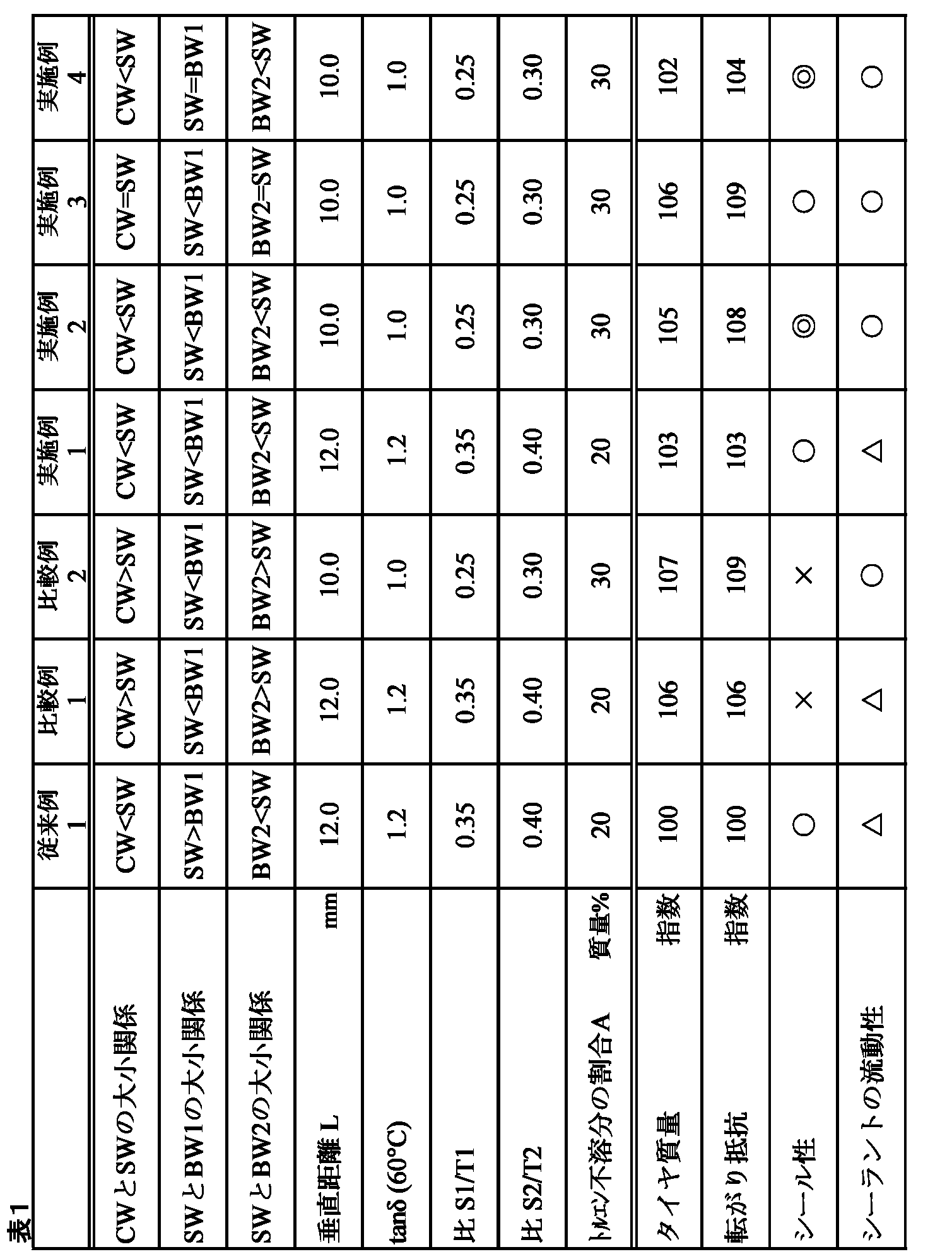
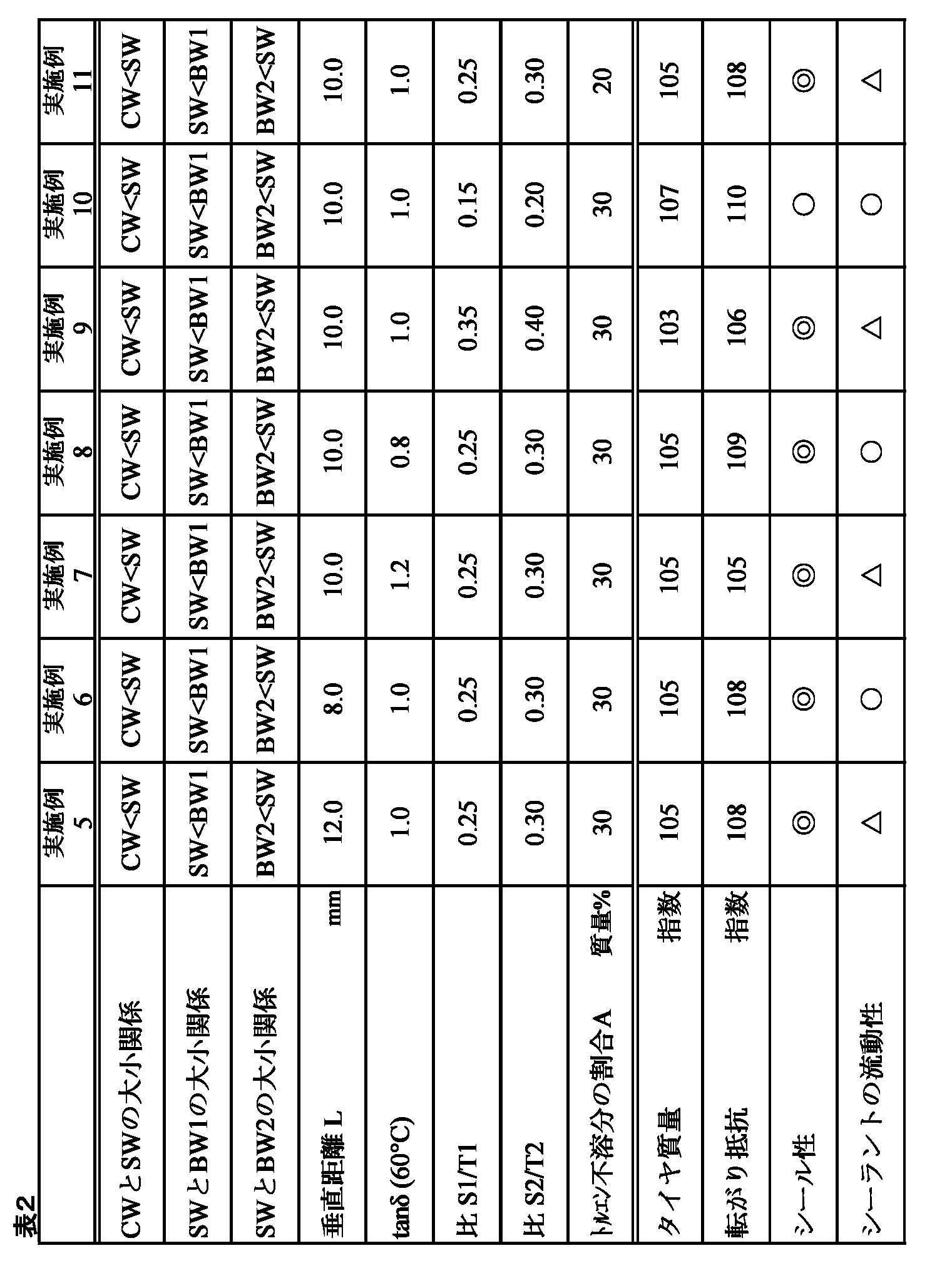
表1~2から明らかなように、実施例1~11の空気入りタイヤは、従来例1と比較してタイヤ質量および転がり抵抗を低減しながら、優れたシール性を発揮し、且つ、走行時のシーラントの流動を抑制した。一方、比較例1,2は、シーラント層の幅SWが実接地幅CWよりも小さいため、十分なシール性を発揮することができなかった。 As is clear from Tables 1 and 2, the pneumatic tires of Examples 1 to 11 exhibited excellent sealing properties while reducing tire mass and rolling resistance compared to Conventional Example 1, and also suppressed the flow of the sealant during driving. On the other hand, Comparative Examples 1 and 2 were unable to exhibit sufficient sealing properties because the width SW of the sealant layer was smaller than the actual contact width CW.
1 トレッド部
2 サイドウォール部
3 ビード部
4 カーカス層
5 ビードコア
6 ビードフィラー
7 ベルト層
7a 内側ベルト層
7b 外側ベルト層
8 ベルト補強層
9 インナーライナー層
10 シーラント層
CL タイヤ赤道
Reference Signs List 1: tread portion 2: sidewall portion 3: bead portion 4: carcass layer 5: bead core 6: bead filler 7:
Claims (10)
前記シーラント層の幅SWと、前記内側ベルト層の幅BW1と、実接地幅CWとが、CW≦SW≦BW1の関係を満たし、且つ、タイヤ赤道位置におけるトレッド表面と実接地領域の端部におけるトレッド表面とのタイヤ径方向に沿った垂直距離Lが10.0mm以下であることを特徴とする空気入りタイヤ。 A pneumatic tire comprising a tread portion extending in a circumferential direction of the tire and forming an annular shape, a pair of sidewall portions disposed on both sides of the tread portion, and a pair of bead portions disposed on the inner side of the sidewall portions in the outer radial direction of the tire, a carcass layer mounted between the pair of bead portions, and at least one belt layer including an inner belt layer disposed adjacent to the outer circumferential side of the carcass layer in the tread portion, and a sealant layer made of an adhesive sealant material is provided on at least the inner surface of the tread portion,
A pneumatic tire characterized in that a width SW of the sealant layer, a width BW1 of the inner belt layer, and an actual contact width CW satisfy a relationship of CW≦SW≦BW1, and a vertical distance L along the tire radial direction between a tread surface at the tire equator and the tread surface at an end of the actual contact region is 10.0 mm or less .
前記シーラント層の幅SWと、前記内側ベルト層の幅BW1と、実接地幅CWとが、CW≦SW≦BW1の関係を満たし、タイヤ赤道位置における前記トレッド部の厚さT1および前記シーラント層の厚さS1が0.15<S1/T1<0.35の関係を満たし、且つ、前記シーラント層の端部位置における前記トレッド部の厚さT2および前記シーラント層の厚さS2が0.20<S2/T2<0.40の関係を満たすことを特徴とする空気入りタイヤ。a width SW of the sealant layer, a width BW1 of the inner belt layer, and an actual contact width CW satisfy the relationship CW≦SW≦BW1; a thickness T1 of the tread portion and a thickness S1 of the sealant layer at the tire equator satisfy the relationship 0.15<S1/T1<0.35; and a thickness T2 of the tread portion and a thickness S2 of the sealant layer at an end position of the sealant layer satisfy the relationship 0.20<S2/T2<0.40.
A=(W2/W1)×100 (1)
(式中、W2は前記シーラント材組成物をトルエンに浸漬させて1週間放置した後に残存したトルエン不溶分の質量〔単位:g〕であり、W1は前記シーラント材組成物をトルエンに浸漬する前の初期質量〔単位:g〕である。) The pneumatic tire according to any one of claims 1 to 4, characterized in that in a sealant composition constituting the adhesive sealant, a ratio A of a toluene-insoluble matter in the sealant composition represented by the following formula ( 1 ) is 30 mass% to 60 mass%:
A=(W2/W1)×100 (1)
(In the formula, W2 is the mass (unit: g) of the toluene insoluble matter remaining after the sealant material composition is immersed in toluene and left to stand for one week, and W1 is the initial mass (unit: g) of the sealant material composition before being immersed in toluene.)
Priority Applications (5)
| Application Number | Priority Date | Filing Date | Title |
|---|---|---|---|
| JP2020171224A JP7549202B2 (en) | 2020-10-09 | 2020-10-09 | Pneumatic tires |
| DE112021004105.3T DE112021004105T5 (en) | 2020-10-09 | 2021-09-07 | tire |
| CN202180050742.3A CN116056910A (en) | 2020-10-09 | 2021-09-07 | pneumatic tire |
| US18/247,826 US20230415522A1 (en) | 2020-10-09 | 2021-09-07 | Pneumatic tire |
| PCT/JP2021/032797 WO2022074989A1 (en) | 2020-10-09 | 2021-09-07 | Pneumatic tire |
Applications Claiming Priority (1)
| Application Number | Priority Date | Filing Date | Title |
|---|---|---|---|
| JP2020171224A JP7549202B2 (en) | 2020-10-09 | 2020-10-09 | Pneumatic tires |
Publications (2)
| Publication Number | Publication Date |
|---|---|
| JP2022062978A JP2022062978A (en) | 2022-04-21 |
| JP7549202B2 true JP7549202B2 (en) | 2024-09-11 |
Family
ID=81126457
Family Applications (1)
| Application Number | Title | Priority Date | Filing Date |
|---|---|---|---|
| JP2020171224A Active JP7549202B2 (en) | 2020-10-09 | 2020-10-09 | Pneumatic tires |
Country Status (5)
| Country | Link |
|---|---|
| US (1) | US20230415522A1 (en) |
| JP (1) | JP7549202B2 (en) |
| CN (1) | CN116056910A (en) |
| DE (1) | DE112021004105T5 (en) |
| WO (1) | WO2022074989A1 (en) |
Families Citing this family (3)
| Publication number | Priority date | Publication date | Assignee | Title |
|---|---|---|---|---|
| WO2025084238A1 (en) * | 2023-10-18 | 2025-04-24 | 横浜ゴム株式会社 | Pneumatic tire and manufacturing method therefor |
| WO2025089118A1 (en) * | 2023-10-24 | 2025-05-01 | 横浜ゴム株式会社 | Pneumatic tire and manufacturing method therefor |
| CN119312641B (en) * | 2024-12-13 | 2025-06-03 | 中策橡胶集团股份有限公司 | Method, system and computer software product for rapid partitioning of tire complex pattern grid |
Citations (12)
| Publication number | Priority date | Publication date | Assignee | Title |
|---|---|---|---|---|
| US20060194898A1 (en) | 2002-08-01 | 2006-08-31 | Sanda Joseph C Jr | Puncture sealing composition and tire |
| WO2017179576A1 (en) | 2016-04-14 | 2017-10-19 | 住友ゴム工業株式会社 | Rubber composition for pneumatic tires |
| JP2018069978A (en) | 2016-10-31 | 2018-05-10 | 住友ゴム工業株式会社 | Rubber composition for sealant material |
| JP2018525484A (en) | 2015-07-27 | 2018-09-06 | アランセオ・ドイチュランド・ゲーエムベーハー | Sealing gel, process for its production and its use in sealing compounds for self-sealing tires |
| US20180281322A1 (en) | 2015-10-06 | 2018-10-04 | Continental Reifen Deutschland Gmbh | Self-Sealing Vehicle Tyre |
| WO2019181415A1 (en) | 2018-03-20 | 2019-09-26 | 横浜ゴム株式会社 | Sealant material composition and pneumatic tire |
| WO2019181414A1 (en) | 2018-03-20 | 2019-09-26 | 横浜ゴム株式会社 | Sealant material composition and pneumatic tire |
| JP2020023152A (en) | 2018-08-01 | 2020-02-13 | 住友ゴム工業株式会社 | Method and apparatus for manufacturing pneumatic tire with sealant |
| US20200156419A1 (en) | 2017-07-20 | 2020-05-21 | Bridgestone Americas Tire Operations, Llc | Puncture resistant tire |
| JP2020515654A (en) | 2016-12-15 | 2020-05-28 | ブリヂストン アメリカズ タイヤ オペレーションズ、 エルエルシー | Sealant-containing tires and related processes |
| JP2020093776A (en) | 2018-12-11 | 2020-06-18 | ハンコック タイヤ アンド テクノロジー カンパニー リミテッドHankook Tire & Technology Co., Ltd. | Tire including a sealant layer and a sound absorbing layer |
| JP2021130348A (en) | 2020-02-18 | 2021-09-09 | 横浜ゴム株式会社 | Pneumatic tires |
Family Cites Families (7)
| Publication number | Priority date | Publication date | Assignee | Title |
|---|---|---|---|---|
| ZA765304B (en) * | 1976-05-06 | 1978-04-26 | Uniroyal Inc | Puncture sealing composition and tire |
| FR2383032A1 (en) * | 1977-03-08 | 1978-10-06 | Michelin & Cie | PNEUMATIC WITH SELF-CLOSING INTERNAL COATING |
| JP4476037B2 (en) * | 2004-06-16 | 2010-06-09 | 株式会社ブリヂストン | Pneumatic tire |
| JP2006152110A (en) | 2004-11-29 | 2006-06-15 | Yokohama Rubber Co Ltd:The | Anti-puncture sealant composition and pneumatic tire |
| CN105764677B (en) * | 2013-11-29 | 2018-10-16 | 倍耐力轮胎股份公司 | Self-sealing tires and self-sealing tires for wheels |
| ITUB20159519A1 (en) * | 2015-12-22 | 2017-06-22 | Pirelli | SELF-SEALING TIRE FOR VEHICLE WHEELS |
| JP2019104471A (en) * | 2017-12-14 | 2019-06-27 | 株式会社ブリヂストン | tire |
-
2020
- 2020-10-09 JP JP2020171224A patent/JP7549202B2/en active Active
-
2021
- 2021-09-07 US US18/247,826 patent/US20230415522A1/en active Pending
- 2021-09-07 CN CN202180050742.3A patent/CN116056910A/en active Pending
- 2021-09-07 DE DE112021004105.3T patent/DE112021004105T5/en active Pending
- 2021-09-07 WO PCT/JP2021/032797 patent/WO2022074989A1/en not_active Ceased
Patent Citations (12)
| Publication number | Priority date | Publication date | Assignee | Title |
|---|---|---|---|---|
| US20060194898A1 (en) | 2002-08-01 | 2006-08-31 | Sanda Joseph C Jr | Puncture sealing composition and tire |
| JP2018525484A (en) | 2015-07-27 | 2018-09-06 | アランセオ・ドイチュランド・ゲーエムベーハー | Sealing gel, process for its production and its use in sealing compounds for self-sealing tires |
| US20180281322A1 (en) | 2015-10-06 | 2018-10-04 | Continental Reifen Deutschland Gmbh | Self-Sealing Vehicle Tyre |
| WO2017179576A1 (en) | 2016-04-14 | 2017-10-19 | 住友ゴム工業株式会社 | Rubber composition for pneumatic tires |
| JP2018069978A (en) | 2016-10-31 | 2018-05-10 | 住友ゴム工業株式会社 | Rubber composition for sealant material |
| JP2020515654A (en) | 2016-12-15 | 2020-05-28 | ブリヂストン アメリカズ タイヤ オペレーションズ、 エルエルシー | Sealant-containing tires and related processes |
| US20200156419A1 (en) | 2017-07-20 | 2020-05-21 | Bridgestone Americas Tire Operations, Llc | Puncture resistant tire |
| WO2019181415A1 (en) | 2018-03-20 | 2019-09-26 | 横浜ゴム株式会社 | Sealant material composition and pneumatic tire |
| WO2019181414A1 (en) | 2018-03-20 | 2019-09-26 | 横浜ゴム株式会社 | Sealant material composition and pneumatic tire |
| JP2020023152A (en) | 2018-08-01 | 2020-02-13 | 住友ゴム工業株式会社 | Method and apparatus for manufacturing pneumatic tire with sealant |
| JP2020093776A (en) | 2018-12-11 | 2020-06-18 | ハンコック タイヤ アンド テクノロジー カンパニー リミテッドHankook Tire & Technology Co., Ltd. | Tire including a sealant layer and a sound absorbing layer |
| JP2021130348A (en) | 2020-02-18 | 2021-09-09 | 横浜ゴム株式会社 | Pneumatic tires |
Also Published As
| Publication number | Publication date |
|---|---|
| WO2022074989A1 (en) | 2022-04-14 |
| JP2022062978A (en) | 2022-04-21 |
| DE112021004105T5 (en) | 2023-06-01 |
| CN116056910A (en) | 2023-05-02 |
| US20230415522A1 (en) | 2023-12-28 |
Similar Documents
| Publication | Publication Date | Title |
|---|---|---|
| JP6874821B1 (en) | Sealant composition | |
| JP6874822B1 (en) | Sealant composition | |
| JP6620851B2 (en) | Method for producing sealant composition and method for producing pneumatic tire | |
| JP7549202B2 (en) | Pneumatic tires | |
| CN114867812B (en) | Sealant material composition | |
| CN113906096B (en) | Sealant material composition | |
| JP7602108B2 (en) | Adhesive sealant | |
| JP7620178B2 (en) | Pneumatic tires | |
| JP7127617B2 (en) | sealant composition | |
| JP7319533B2 (en) | sealant composition | |
| JP7147690B2 (en) | sealant composition | |
| JP7332877B2 (en) | sealant composition | |
| EP3981831A1 (en) | Sealant material composition | |
| JP7587108B2 (en) | Sealant composition | |
| JP7663801B2 (en) | Sealant composition | |
| JP7389358B2 (en) | Sealant composition | |
| JP7425308B2 (en) | Sealant composition | |
| JP7545029B2 (en) | Pneumatic tires | |
| JP7397283B2 (en) | pneumatic tires | |
| JP7332876B2 (en) | sealant composition | |
| WO2021256570A1 (en) | Sealant composition |
Legal Events
| Date | Code | Title | Description |
|---|---|---|---|
| A621 | Written request for application examination |
Free format text: JAPANESE INTERMEDIATE CODE: A621 Effective date: 20230906 |
|
| A131 | Notification of reasons for refusal |
Free format text: JAPANESE INTERMEDIATE CODE: A131 Effective date: 20240312 |
|
| A521 | Request for written amendment filed |
Free format text: JAPANESE INTERMEDIATE CODE: A523 Effective date: 20240507 |
|
| TRDD | Decision of grant or rejection written | ||
| A01 | Written decision to grant a patent or to grant a registration (utility model) |
Free format text: JAPANESE INTERMEDIATE CODE: A01 Effective date: 20240730 |
|
| A61 | First payment of annual fees (during grant procedure) |
Free format text: JAPANESE INTERMEDIATE CODE: A61 Effective date: 20240812 |
|
| R150 | Certificate of patent or registration of utility model |
Ref document number: 7549202 Country of ref document: JP Free format text: JAPANESE INTERMEDIATE CODE: R150 |