JP7548475B1 - Antibody preparations - Google Patents
Antibody preparations Download PDFInfo
- Publication number
- JP7548475B1 JP7548475B1 JP2024534766A JP2024534766A JP7548475B1 JP 7548475 B1 JP7548475 B1 JP 7548475B1 JP 2024534766 A JP2024534766 A JP 2024534766A JP 2024534766 A JP2024534766 A JP 2024534766A JP 7548475 B1 JP7548475 B1 JP 7548475B1
- Authority
- JP
- Japan
- Prior art keywords
- formulation
- pharmaceutical composition
- bispecific antibody
- aqueous pharmaceutical
- heavy chain
- Prior art date
- Legal status (The legal status is an assumption and is not a legal conclusion. Google has not performed a legal analysis and makes no representation as to the accuracy of the status listed.)
- Active
Links
Images


Classifications
-
- C—CHEMISTRY; METALLURGY
- C07—ORGANIC CHEMISTRY
- C07K—PEPTIDES
- C07K16/00—Immunoglobulins [IGs], e.g. monoclonal or polyclonal antibodies
- C07K16/18—Immunoglobulins [IGs], e.g. monoclonal or polyclonal antibodies against material from animals or humans
- C07K16/28—Immunoglobulins [IGs], e.g. monoclonal or polyclonal antibodies against material from animals or humans against receptors, cell surface antigens or cell surface determinants
- C07K16/2803—Immunoglobulins [IGs], e.g. monoclonal or polyclonal antibodies against material from animals or humans against receptors, cell surface antigens or cell surface determinants against the immunoglobulin superfamily
- C07K16/2818—Immunoglobulins [IGs], e.g. monoclonal or polyclonal antibodies against material from animals or humans against receptors, cell surface antigens or cell surface determinants against the immunoglobulin superfamily against CD28 or CD152
-
- A—HUMAN NECESSITIES
- A61—MEDICAL OR VETERINARY SCIENCE; HYGIENE
- A61K—PREPARATIONS FOR MEDICAL, DENTAL OR TOILETRY PURPOSES
- A61K39/00—Medicinal preparations containing antigens or antibodies
- A61K39/395—Antibodies; Immunoglobulins; Immune serum, e.g. antilymphocytic serum
- A61K39/39591—Stabilisation, fragmentation
-
- A—HUMAN NECESSITIES
- A61—MEDICAL OR VETERINARY SCIENCE; HYGIENE
- A61K—PREPARATIONS FOR MEDICAL, DENTAL OR TOILETRY PURPOSES
- A61K47/00—Medicinal preparations characterised by the non-active ingredients used, e.g. carriers or inert additives; Targeting or modifying agents chemically bound to the active ingredient
- A61K47/02—Inorganic compounds
-
- A—HUMAN NECESSITIES
- A61—MEDICAL OR VETERINARY SCIENCE; HYGIENE
- A61K—PREPARATIONS FOR MEDICAL, DENTAL OR TOILETRY PURPOSES
- A61K47/00—Medicinal preparations characterised by the non-active ingredients used, e.g. carriers or inert additives; Targeting or modifying agents chemically bound to the active ingredient
- A61K47/06—Organic compounds, e.g. natural or synthetic hydrocarbons, polyolefins, mineral oil, petrolatum or ozokerite
- A61K47/08—Organic compounds, e.g. natural or synthetic hydrocarbons, polyolefins, mineral oil, petrolatum or ozokerite containing oxygen, e.g. ethers, acetals, ketones, quinones, aldehydes, peroxides
- A61K47/12—Carboxylic acids; Salts or anhydrides thereof
-
- A—HUMAN NECESSITIES
- A61—MEDICAL OR VETERINARY SCIENCE; HYGIENE
- A61K—PREPARATIONS FOR MEDICAL, DENTAL OR TOILETRY PURPOSES
- A61K47/00—Medicinal preparations characterised by the non-active ingredients used, e.g. carriers or inert additives; Targeting or modifying agents chemically bound to the active ingredient
- A61K47/06—Organic compounds, e.g. natural or synthetic hydrocarbons, polyolefins, mineral oil, petrolatum or ozokerite
- A61K47/16—Organic compounds, e.g. natural or synthetic hydrocarbons, polyolefins, mineral oil, petrolatum or ozokerite containing nitrogen, e.g. nitro-, nitroso-, azo-compounds, nitriles, cyanates
- A61K47/18—Amines; Amides; Ureas; Quaternary ammonium compounds; Amino acids; Oligopeptides having up to five amino acids
-
- A—HUMAN NECESSITIES
- A61—MEDICAL OR VETERINARY SCIENCE; HYGIENE
- A61K—PREPARATIONS FOR MEDICAL, DENTAL OR TOILETRY PURPOSES
- A61K47/00—Medicinal preparations characterised by the non-active ingredients used, e.g. carriers or inert additives; Targeting or modifying agents chemically bound to the active ingredient
- A61K47/06—Organic compounds, e.g. natural or synthetic hydrocarbons, polyolefins, mineral oil, petrolatum or ozokerite
- A61K47/20—Organic compounds, e.g. natural or synthetic hydrocarbons, polyolefins, mineral oil, petrolatum or ozokerite containing sulfur, e.g. dimethyl sulfoxide [DMSO], docusate, sodium lauryl sulfate or aminosulfonic acids
-
- A—HUMAN NECESSITIES
- A61—MEDICAL OR VETERINARY SCIENCE; HYGIENE
- A61K—PREPARATIONS FOR MEDICAL, DENTAL OR TOILETRY PURPOSES
- A61K47/00—Medicinal preparations characterised by the non-active ingredients used, e.g. carriers or inert additives; Targeting or modifying agents chemically bound to the active ingredient
- A61K47/06—Organic compounds, e.g. natural or synthetic hydrocarbons, polyolefins, mineral oil, petrolatum or ozokerite
- A61K47/26—Carbohydrates, e.g. sugar alcohols, amino sugars, nucleic acids, mono-, di- or oligo-saccharides; Derivatives thereof, e.g. polysorbates, sorbitan fatty acid esters or glycyrrhizin
-
- A—HUMAN NECESSITIES
- A61—MEDICAL OR VETERINARY SCIENCE; HYGIENE
- A61K—PREPARATIONS FOR MEDICAL, DENTAL OR TOILETRY PURPOSES
- A61K9/00—Medicinal preparations characterised by special physical form
- A61K9/0012—Galenical forms characterised by the site of application
- A61K9/0019—Injectable compositions; Intramuscular, intravenous, arterial, subcutaneous administration; Compositions to be administered through the skin in an invasive manner
-
- A—HUMAN NECESSITIES
- A61—MEDICAL OR VETERINARY SCIENCE; HYGIENE
- A61K—PREPARATIONS FOR MEDICAL, DENTAL OR TOILETRY PURPOSES
- A61K9/00—Medicinal preparations characterised by special physical form
- A61K9/08—Solutions
-
- A—HUMAN NECESSITIES
- A61—MEDICAL OR VETERINARY SCIENCE; HYGIENE
- A61P—SPECIFIC THERAPEUTIC ACTIVITY OF CHEMICAL COMPOUNDS OR MEDICINAL PREPARATIONS
- A61P1/00—Drugs for disorders of the alimentary tract or the digestive system
- A61P1/04—Drugs for disorders of the alimentary tract or the digestive system for ulcers, gastritis or reflux esophagitis, e.g. antacids, inhibitors of acid secretion, mucosal protectants
-
- A—HUMAN NECESSITIES
- A61—MEDICAL OR VETERINARY SCIENCE; HYGIENE
- A61P—SPECIFIC THERAPEUTIC ACTIVITY OF CHEMICAL COMPOUNDS OR MEDICINAL PREPARATIONS
- A61P17/00—Drugs for dermatological disorders
- A61P17/06—Antipsoriatics
-
- A—HUMAN NECESSITIES
- A61—MEDICAL OR VETERINARY SCIENCE; HYGIENE
- A61P—SPECIFIC THERAPEUTIC ACTIVITY OF CHEMICAL COMPOUNDS OR MEDICINAL PREPARATIONS
- A61P19/00—Drugs for skeletal disorders
- A61P19/02—Drugs for skeletal disorders for joint disorders, e.g. arthritis, arthrosis
-
- A—HUMAN NECESSITIES
- A61—MEDICAL OR VETERINARY SCIENCE; HYGIENE
- A61P—SPECIFIC THERAPEUTIC ACTIVITY OF CHEMICAL COMPOUNDS OR MEDICINAL PREPARATIONS
- A61P21/00—Drugs for disorders of the muscular or neuromuscular system
- A61P21/04—Drugs for disorders of the muscular or neuromuscular system for myasthenia gravis
-
- A—HUMAN NECESSITIES
- A61—MEDICAL OR VETERINARY SCIENCE; HYGIENE
- A61P—SPECIFIC THERAPEUTIC ACTIVITY OF CHEMICAL COMPOUNDS OR MEDICINAL PREPARATIONS
- A61P29/00—Non-central analgesic, antipyretic or antiinflammatory agents, e.g. antirheumatic agents; Non-steroidal antiinflammatory drugs [NSAID]
-
- A—HUMAN NECESSITIES
- A61—MEDICAL OR VETERINARY SCIENCE; HYGIENE
- A61P—SPECIFIC THERAPEUTIC ACTIVITY OF CHEMICAL COMPOUNDS OR MEDICINAL PREPARATIONS
- A61P35/00—Antineoplastic agents
-
- A—HUMAN NECESSITIES
- A61—MEDICAL OR VETERINARY SCIENCE; HYGIENE
- A61P—SPECIFIC THERAPEUTIC ACTIVITY OF CHEMICAL COMPOUNDS OR MEDICINAL PREPARATIONS
- A61P37/00—Drugs for immunological or allergic disorders
- A61P37/02—Immunomodulators
-
- A—HUMAN NECESSITIES
- A61—MEDICAL OR VETERINARY SCIENCE; HYGIENE
- A61P—SPECIFIC THERAPEUTIC ACTIVITY OF CHEMICAL COMPOUNDS OR MEDICINAL PREPARATIONS
- A61P37/00—Drugs for immunological or allergic disorders
- A61P37/02—Immunomodulators
- A61P37/06—Immunosuppressants, e.g. drugs for graft rejection
-
- C—CHEMISTRY; METALLURGY
- C07—ORGANIC CHEMISTRY
- C07K—PEPTIDES
- C07K16/00—Immunoglobulins [IGs], e.g. monoclonal or polyclonal antibodies
- C07K16/18—Immunoglobulins [IGs], e.g. monoclonal or polyclonal antibodies against material from animals or humans
- C07K16/28—Immunoglobulins [IGs], e.g. monoclonal or polyclonal antibodies against material from animals or humans against receptors, cell surface antigens or cell surface determinants
- C07K16/2803—Immunoglobulins [IGs], e.g. monoclonal or polyclonal antibodies against material from animals or humans against receptors, cell surface antigens or cell surface determinants against the immunoglobulin superfamily
- C07K16/2809—Immunoglobulins [IGs], e.g. monoclonal or polyclonal antibodies against material from animals or humans against receptors, cell surface antigens or cell surface determinants against the immunoglobulin superfamily against the T-cell receptor (TcR)-CD3 complex
-
- A—HUMAN NECESSITIES
- A61—MEDICAL OR VETERINARY SCIENCE; HYGIENE
- A61K—PREPARATIONS FOR MEDICAL, DENTAL OR TOILETRY PURPOSES
- A61K39/00—Medicinal preparations containing antigens or antibodies
- A61K2039/505—Medicinal preparations containing antigens or antibodies comprising antibodies
-
- C—CHEMISTRY; METALLURGY
- C07—ORGANIC CHEMISTRY
- C07K—PEPTIDES
- C07K2317/00—Immunoglobulins specific features
- C07K2317/30—Immunoglobulins specific features characterized by aspects of specificity or valency
- C07K2317/31—Immunoglobulins specific features characterized by aspects of specificity or valency multispecific
-
- C—CHEMISTRY; METALLURGY
- C07—ORGANIC CHEMISTRY
- C07K—PEPTIDES
- C07K2317/00—Immunoglobulins specific features
- C07K2317/90—Immunoglobulins specific features characterized by (pharmaco)kinetic aspects or by stability of the immunoglobulin
- C07K2317/94—Stability, e.g. half-life, pH, temperature or enzyme-resistance
Landscapes
- Health & Medical Sciences (AREA)
- Chemical & Material Sciences (AREA)
- Life Sciences & Earth Sciences (AREA)
- Medicinal Chemistry (AREA)
- Immunology (AREA)
- General Health & Medical Sciences (AREA)
- Pharmacology & Pharmacy (AREA)
- Animal Behavior & Ethology (AREA)
- Public Health (AREA)
- Veterinary Medicine (AREA)
- Organic Chemistry (AREA)
- Engineering & Computer Science (AREA)
- General Chemical & Material Sciences (AREA)
- Chemical Kinetics & Catalysis (AREA)
- Epidemiology (AREA)
- Bioinformatics & Cheminformatics (AREA)
- Nuclear Medicine, Radiotherapy & Molecular Imaging (AREA)
- Molecular Biology (AREA)
- Biochemistry (AREA)
- Proteomics, Peptides & Aminoacids (AREA)
- Oil, Petroleum & Natural Gas (AREA)
- Genetics & Genomics (AREA)
- Biophysics (AREA)
- Dermatology (AREA)
- Microbiology (AREA)
- Mycology (AREA)
- Transplantation (AREA)
- Inorganic Chemistry (AREA)
- Rheumatology (AREA)
- Orthopedic Medicine & Surgery (AREA)
- Physical Education & Sports Medicine (AREA)
- Pain & Pain Management (AREA)
- Neurology (AREA)
- Medicines Containing Antibodies Or Antigens For Use As Internal Diagnostic Agents (AREA)
- Medicinal Preparation (AREA)
- Peptides Or Proteins (AREA)
Abstract
本発明の課題は、抗PD-1/CD3二重特異性抗体を有効成分とする、自己免疫疾患もしくは移植片対宿主病(GVHD)あるいは血液がんの予防、症状進展抑制、再発抑制または治療のための新たな製剤を提供することにある。
本発明は、抗PD-1/CD3二重特異性抗体を有効成分として含み、さらに、例えば、酢酸緩衝剤、トレハロース、L-メチオニン、ポリソルベート80および塩化ナトリウムを含む、単一の添加物組成にて、皮下投与用および静脈内投与用の何れにも使用できる水性医薬組成物ならびにその製剤を提供する。
An object of the present invention is to provide a novel preparation for preventing, inhibiting the progression of, or inhibiting the recurrence of, an autoimmune disease, a graft-versus-host disease (GVHD), or a blood cancer, which contains an anti-PD-1/CD3 bispecific antibody as an active ingredient.
The present invention provides an aqueous pharmaceutical composition and a formulation thereof which contain an anti-PD-1/CD3 bispecific antibody as an active ingredient, and further contain, for example, an acetate buffer, trehalose, L-methionine, polysorbate 80, and sodium chloride, in a single additive composition that can be used for both subcutaneous and intravenous administration.
Description
本開示は、抗体、特に、PD-1およびCD3に各々特異的に結合することができる二重特異性抗体(以下、「抗PD-1/CD3二重特異性抗体」と略記することがある。)を有効成分とする医薬組成物(以下、「本発明の医薬組成物」と略記することがある。)およびその製剤(以下、「本発明の製剤」と略記することがある。)に関する。The present disclosure relates to a pharmaceutical composition (hereinafter sometimes abbreviated as the "pharmaceutical composition of the present invention") containing as an active ingredient an antibody, in particular a bispecific antibody capable of specifically binding to PD-1 and CD3, respectively (hereinafter sometimes abbreviated as "anti-PD-1/CD3 bispecific antibody"), and a formulation thereof (hereinafter sometimes abbreviated as the "formulation of the present invention").
PD-1は免疫グロブリンファミリーに属する免疫抑制受容体であり、抗原レセプターからの刺激により活性化したT細胞の免疫活性化シグナルを抑制する機能を持つ分子である。PD-1ノックアウトマウスの解析等から、このPD-1シグナルは、自己免疫性拡張型心筋症、ループス様症候群、自己免疫性脳脊髄炎、全身性ループスエリテマトーデス、移植片対宿主病、I型糖尿病およびリウマチ性関節炎などの自己免疫疾患の抑制に重要な役割を果たすことが知られている。したがって、PD-1シグナルを増強する物質は自己免疫疾患等の予防または治療剤となり得ることが指摘されている。 PD-1 is an immunosuppressive receptor belonging to the immunoglobulin family, and is a molecule that has the function of suppressing immune activation signals of T cells activated by stimulation from antigen receptors. From the analysis of PD-1 knockout mice, it is known that this PD-1 signal plays an important role in suppressing autoimmune diseases such as autoimmune dilated cardiomyopathy, lupus-like syndrome, autoimmune encephalomyelitis, systemic lupus erythematosus, graft-versus-host disease, type I diabetes, and rheumatoid arthritis. Therefore, it has been pointed out that substances that enhance PD-1 signals could be used as preventive or therapeutic agents for autoimmune diseases.
これまでにPD-1シグナルを増強する物質として、PD-1を認識する二重特異性抗体が知られている(特許文献1~5)。この二重特異性抗体は、T細胞受容体複合体のメンバーであるCD3を認識する抗体の抗原認識部位とPD-1を認識する抗体の抗原認識部位とが遺伝子工学的に連結されたものであり、PD-1をT細胞受容体複合体近傍に位置させる頻度を上げることによって、T細胞受容体複合体に対するPD-1の抑制シグナルを増強する作用をもつ。Bispecific antibodies that recognize PD-1 have been known to date as substances that enhance PD-1 signals (
本発明の医薬組成物は、約0.01 mg/mL~約200 mg/mLの濃度範囲の抗PD-1/CD3二重特異性抗体を有効成分とし、その製剤添加物の一実施態様として、酢酸緩衝剤、トレハロース、L-メチオニン、ポリソルベート80および塩化ナトリウムを含むことを特徴とするものであるが、抗体製剤として、特許文献6~14に挙げられる製剤が報告されている。The pharmaceutical composition of the present invention is characterized in that it contains an anti-PD-1/CD3 bispecific antibody as an active ingredient in a concentration range of about 0.01 mg/mL to about 200 mg/mL, and contains acetate buffer, trehalose, L-methionine,
特許文献6は、抗CD3抗体によって標的組織特異的な免疫調節を行うために、静注などの全身投与ではない投与によって、標的組織での免疫抑制作用を最小化できる製剤に関するものである。そのような製剤例として、単位投与量が0.1~10 mgとなる抗CD3抗体を有効成分とし、その製剤添加物として、酢酸ナトリウム三水和物、塩化ナトリウム、ポリソルベート80、トレハロースおよびメチオニンを含む経口製剤と、2 mg/mLの抗CD3抗体を有効成分とし、その製剤添加物として、酢酸ナトリウム三水和物、塩化ナトリウムおよびポリソルベート80を含む皮下注製剤が各々開示されているが、標的組織での免疫抑制作用の最小化が難しい静注用製剤として、それら添加物からなる製剤が使用され得ることは実質的に開示されておらず、また、当該皮下注製剤に、さらに、トレハロースおよびL-メチオニンを添加することも一切示唆されていない。さらに、当該文献の両製剤におけるポリソルベート80の濃度は0.02 %(w/v)相当とされているが、本発明の医薬組成物については、凝集抑制の観点から、さらに約0.1 %(w/v)を至適ないし必要とすることは一切示唆されていない。
特許文献7には、150 mg/mLの抗OX40L抗体を有効成分とし、その製剤添加物として、酢酸緩衝剤、トレハロース、ポリソルベート20およびメチオニンを含む製剤が開示されている。ここで、当該文献の製剤の添加物のうち、トレハロースおよびメチオニンは、等張化剤または安定化剤として用いられているが、同様に等張化剤または安定化剤として機能し得る塩化ナトリウムに関して、トレハロースおよびメチオニンの存在下において、さらに添加することは一切示唆されていない。また、好ましい性能を示す製剤例に含まれるポリソルベート20を、ポリソルベート80に代えて使用することについても一切示唆されていない。
特許文献8には、150 mg/mLの抗GM-CSF-Rα抗体を有効成分とし、その製剤添加物として、酢酸緩衝剤、塩化ナトリウム、ポリソルベート80およびトレハロースを含む製剤が開示されているが、L-メチオニンの添加については一切示唆されていない。
また、低または中性pI値を有する抗体に適用される製剤は、その抗体のコロイド安定性を配慮して、通常、抗体のpI値よりも1pH分乖離したpHが設定されるのが通常とされているが、特許文献8は、そのpHを抗体のpI値に近い5.5~7.5の範囲で実現させる製剤に適用することを目的とするものであり、当該製剤組成は、それ以外のpHの医薬組成物(例えば、pHが4.7~5.3の本発明の医薬組成物)には本来適用されない。In addition, formulations applied to antibodies with low or neutral pI values are usually set at a pH that is one pH difference from the pI value of the antibody, taking into consideration the colloidal stability of the antibody. However,
特許文献9には、約45~55 mg/mLのアダリムマブを有効成分とし、その製剤添加物として、酢酸緩衝剤、塩化ナトリウム、ポリソルベート80およびトレハロースを含む製剤が開示されているが、遊離アミノ酸を実質的にないし全く含有しないか、あるいは含有していても0.1 mM以下であることが示されており、さらには、L-メチオニンを含む遊離アミノ酸の存在が抗体の安定性を顕著に悪化させること(pH 5.0以下での抗体の断片化)が開示されている。また、より少ない成分を採用する、より複雑でない製剤が望まれるところ、トレハロースが抗酸化特性に関して極めて有望であることから、さらなる抗酸化剤の添加は必要とされていないことが示唆されている。
特許文献10および11には、20 mg/mLの抗EGFR抗体を有効成分とし、その製剤添加物として、酢酸緩衝剤、塩化ナトリウム、ポリソルベート80およびトレハロースを含む製剤が開示されているが、塩化ナトリウムの濃度は100 mM相当である。一方、本発明の医薬組成物では、塩化ナトリウムの濃度は約34.2 mM以下とされており、100 mM相当の濃度では凝集体の発生が顕著であり、適用できない。また、L-メチオニンの添加については一切示唆されていない。
特許文献12および13には、IgG4アイソタイプ抗体に顕著に発生する可視微粒子に対処するため、酢酸緩衝剤、ポリソルベート80、トレハロース、メチオニンおよびDTPAを含む製剤が開示されているが、その物性が異なるIgG1アイソタイプ抗体(DOI(JaLC):10.15083/00006491)である本発明にかかる抗PD-1/CD3二重特異性抗体に適用できるかについては一切示唆されていない。また、当該文献の製剤におけるポリソルベート80の濃度は0.02 %(w/v)とされているが、本発明の医薬組成物については、凝集抑制の観点から、さらに約0.1 %(w/v)を至適ないし必要とすることも一切示唆されていない。
特許文献14には、抗TIGIT抗体を有効成分とし、その製剤の一態様として、酢酸緩衝剤、トレハロース、塩化ナトリウムおよびポリソルベート80を添加剤として含む製剤が開示されているが、実際には、塩化ナトリウムの添加は、抗体のモノマー純度の急速な低下を示したため、これを含まない方が好ましいこと、また、ポリソルベート80の濃度について、0.02%と0.04%を比較した結果、モノマー純度の急速な低下の観点から、0.02%の低い濃度の方が好ましいことが開示されている。一方、本発明の医薬組成物では、塩化ナトリウムが添加されており、ポリソルベート80の濃度としては、約0.1 %(w/v)がより好ましいとされている。
これまで、抗PD-1/CD3二重特異性抗体を有効成分とし、当該添加物組成を有する医薬組成物であって、また、その単一組成によって、幅広い濃度範囲の抗体を皮下投与と静脈内投与の両方に適用できる本発明の医薬組成物は見出されておらず、上記特許文献に開示される製剤からも一切示唆されない。 To date, no pharmaceutical composition of the present invention has been found that contains an anti-PD-1/CD3 bispecific antibody as an active ingredient and an additive composition, and that, with its single composition, is applicable to both subcutaneous and intravenous administration of an antibody over a wide range of concentrations. Nor is such a composition suggested at all by the formulations disclosed in the above patent documents.
本発明の課題は、幅広い濃度範囲で使用される抗体、特に、抗PD-1/CD3二重特異性抗体について、皮下投与用および静脈内投与用の何れにも適用できる単一組成の医薬組成物およびその製剤を提供することにある。The objective of the present invention is to provide a pharmaceutical composition and its formulation having a single composition that can be used for both subcutaneous and intravenous administration for an antibody used in a wide concentration range, particularly an anti-PD-1/CD3 bispecific antibody.
本発明の発明者らは鋭意検討した結果、かかる課題を解決する医薬組成物およびその製剤を見出し、本発明を完成した。After extensive research, the inventors of the present invention discovered a pharmaceutical composition and its formulation that solves these problems, and completed the present invention.
すなわち、本発明は、主に以下の実施態様を提供する。
<1> 抗体(好ましくは、抗PD-1/CD3二重特異性抗体)を有効成分として含み、さらに、緩衝剤(好ましくは、酢酸緩衝剤)、トレハロース、酸化防止剤(好ましくは、L-メチオニン)、ポリソルベート80および塩化ナトリウムを含む、皮下投与用もしくは静脈内投与用水性医薬組成物またはその製剤、
<2> 前項<1>記載の水性医薬組成物またはその製剤と生物学的同等性を有する皮下投与用もしくは静脈内投与用水性医薬組成物またはその製剤、ならびに
<3> 前項<1>もしくは<2>記載の水性医薬組成物またはその製剤の自己免疫疾患もしくは移植片対宿主病(GVHD)あるいは血液がんの予防、症状進展抑制、再発抑制および/または治療における使用。
That is, the present invention mainly provides the following embodiments.
<1> An aqueous pharmaceutical composition for subcutaneous or intravenous administration, comprising an antibody (preferably, an anti-PD-1/CD3 bispecific antibody) as an active ingredient, and further comprising a buffer (preferably, an acetate buffer), trehalose, an antioxidant (preferably, L-methionine),
<2> An aqueous pharmaceutical composition for subcutaneous or intravenous administration, which is biologically equivalent to the aqueous pharmaceutical composition or a formulation thereof described in the preceding paragraph <1>, and <3> use of the aqueous pharmaceutical composition or a formulation thereof described in the preceding paragraph <1> or <2> in the prevention, inhibition of progression of symptoms, inhibition of recurrence, and/or treatment of autoimmune disease, graft-versus-host disease (GVHD), or blood cancer.
抗PD-1/CD3二重特異性抗体にかかる本発明の医薬組成物またはその製剤は、自己免疫疾患もしくは移植片対宿主病(GVHD)あるいは血液がんの予防、症状進展抑制、再発抑制および/または治療のための新たな薬剤となる。The pharmaceutical composition of the present invention relating to an anti-PD-1/CD3 bispecific antibody or a preparation thereof will be a new drug for preventing, inhibiting the progression of symptoms, inhibiting recurrence and/or treating autoimmune diseases, graft-versus-host disease (GVHD) or blood cancer.
本発明は、抗体、特に、二つの異なる抗原分子あるいはエピトープに対する結合特異性を一分子に備え持つ抗体、すなわち、二重特異性抗体に関する。本発明にかかる抗PD-1/CD3二重特異性抗体は、
(i)PD-1に特異的に結合する抗原結合部位を構成する重鎖および軽鎖、ならびに
(ii)CD3に特異的に結合する抗原結合部位を構成する重鎖および軽鎖から構成される。ここで、
(a)前項(i)の重鎖は、配列番号1、配列番号2、配列番号3、配列番号4および配列番号5から選択される何れか一つのアミノ酸配列からなり、
(b)前項(ii)の重鎖は、配列番号6のアミノ酸配列からなり、ならびに
(c)前項(i)および前項(ii)の軽鎖はともに、配列番号7のアミノ酸配列からなる。
The present invention relates to antibodies, in particular to antibodies that have binding specificities for two different antigen molecules or epitopes in a single molecule, i.e., bispecific antibodies. The anti-PD-1/CD3 bispecific antibodies of the present invention are
(i) a heavy chain and a light chain that form an antigen-binding site that specifically binds to PD-1, and (ii) a heavy chain and a light chain that form an antigen-binding site that specifically binds to CD3, wherein:
(a) the heavy chain of the preceding paragraph (i) consists of any one of the amino acid sequences selected from SEQ ID NO:1, SEQ ID NO:2, SEQ ID NO:3, SEQ ID NO:4 and SEQ ID NO:5;
(b) the heavy chain of (ii) above consists of the amino acid sequence of SEQ ID NO:6; and (c) the light chains of (i) and (ii) above both consist of the amino acid sequence of SEQ ID NO:7.
ここで、「PD-1に特異的に結合する抗原結合部位を構成する重鎖および軽鎖」は、重鎖および軽鎖がジスルフィド結合を介して会合することで、PD-1に特異的に結合する抗原結合部位を形成する重鎖・軽鎖複合体を意味する。「抗原結合部位」とは、抗体がその抗原に対する結合活性を有するための最小単位であり、「PD-1に特異的に結合する」とは、少なくとも、1x10⁻⁵ M、好ましくは1x10⁻⁷ M、より好ましくは1x10⁻⁹ Mより高い親和性(解離定数(Kd値))を有する結合活性でPD-1に対して直接結合することができ、少なくとも、CD28、CTLA-4およびICOSなどの、所謂、CD28ファミリー受容体に属するほかの受容体メンバーには実質的に結合しない特徴として使用される。 Here, "heavy and light chains constituting an antigen-binding site that specifically binds to PD-1" refers to a heavy and light chain complex in which the heavy and light chains associate with each other via disulfide bonds to form an antigen-binding site that specifically binds to PD-1. An "antigen-binding site" is the minimum unit for an antibody to have binding activity to its antigen, and "specifically binds to PD-1" is used to mean a characteristic in which an antibody can directly bind to PD-1 with a binding activity having an affinity (dissociation constant (Kd value)) of at least 1x10⁻⁵ M, preferably 1x10⁻⁷ M, more preferably 1x10⁻⁹ M or higher, and does not substantially bind to at least other receptor members belonging to the so-called CD28 family of receptors, such as CD28, CTLA-4, and ICOS.
また、「CD3に特異的に結合する抗原結合部位を構成する重鎖および軽鎖」は、重鎖および軽鎖がジスルフィド結合を介して会合することで、CD3に特異的に結合する抗原結合部位を形成する重鎖・軽鎖複合体を意味する。ここで、「CD3に特異的に結合する」とは、少なくとも、1x10⁻⁵ M、好ましくは1x10⁻⁷ M、より好ましくは1x10⁻⁹ Mより高い親和性(解離定数(Kd値))を有する結合活性でCD3に対して直接結合することができ、他のタンパク質には実質的に結合しない特徴として使用される。 Furthermore, "heavy and light chains constituting an antigen-binding site that specifically binds to CD3" refers to a heavy and light chain complex in which the heavy and light chains associate with each other via disulfide bonds to form an antigen-binding site that specifically binds to CD3. Here, "specifically binds to CD3" is used to mean a characteristic of being able to directly bind to CD3 with a binding activity having an affinity (dissociation constant (Kd value)) of at least 1x10⁻⁵ M, preferably 1x10⁻⁷ M, more preferably 1x10⁻⁹ M or higher, and not substantially binding to other proteins.
前述の抗PD-1/CD3二重特異性抗体(以下、総称して、「抗PD-1/CD3二重特異性抗体A」と略記することがある。)のうち、本発明の医薬組成物またはその製剤が適用される抗体として好ましくは、PD-1に特異的に結合する抗原結合部位を構成する重鎖が、配列番号5のアミノ酸配列からなる抗PD-1/CD3二重特異性抗体(以下、「抗体α」と略記することがある。)である。Among the above-mentioned anti-PD-1/CD3 bispecific antibodies (hereinafter sometimes collectively referred to as "anti-PD-1/CD3 bispecific antibody A"), the antibody to which the pharmaceutical composition or formulation of the present invention is applied is preferably an anti-PD-1/CD3 bispecific antibody (hereinafter sometimes abbreviated as "antibody α") in which the heavy chain constituting the antigen-binding site that specifically binds to PD-1 has the amino acid sequence of SEQ ID NO:5.
抗PD-1/CD3二重特異性抗体Aは、WO2019/156199に開示された方法に従って製造することができ、各々抗PD-1/CD3二重特異性抗体クローンPD1-1(Bi)~PD1-5(Bi)に対応し、このうち、抗体αは、クローンPD1-5(Bi)に対応する。Anti-PD-1/CD3 bispecific antibody A can be produced according to the method disclosed in WO2019/156199 and corresponds to anti-PD-1/CD3 bispecific antibody clones PD1-1(Bi) to PD1-5(Bi), of which antibody α corresponds to clone PD1-5(Bi).
さらに、抗体αのPD-1に特異的に結合する抗原結合部位を構成する重鎖の重鎖定常領域が、配列番号8、配列番号9、配列番号10、配列番号11、配列番号12および配列番号13から選択される何れか一つのアミノ酸配列からなる重鎖定常領域に置換され、CD3に特異的に結合する抗原結合部位を構成する重鎖の重鎖定常領域が、配列番号14、配列番号15、配列番号16、配列番号17、配列番号18および配列番号19から選択される何れか一つのアミノ酸配列からなる重鎖定常領域に置換された抗PD-1/CD3二重特異性抗体(以下、総称して、「抗PD-1/CD3二重特異性抗体B」と略記することがある。)も同様に本発明の医薬組成物またはその製剤が適用され得る。なお、抗PD-1/CD3二重特異性抗体Bは、WO2021/020416に開示された方法に従って製造できる。 Furthermore, the pharmaceutical composition or formulation thereof of the present invention may also be applied to an anti-PD-1/CD3 bispecific antibody in which the heavy chain constant region of the heavy chain constituting the antigen-binding site that specifically binds to PD-1 of antibody α is replaced with a heavy chain constant region consisting of any one of the amino acid sequences selected from SEQ ID NO:8, SEQ ID NO:9, SEQ ID NO:10, SEQ ID NO:11, SEQ ID NO:12, and SEQ ID NO:13, and the heavy chain constant region of the heavy chain constituting the antigen-binding site that specifically binds to CD3 is replaced with a heavy chain constant region consisting of any one of the amino acid sequences selected from SEQ ID NO:14, SEQ ID NO:15, SEQ ID NO:16, SEQ ID NO:17, SEQ ID NO:18, and SEQ ID NO:19 (hereinafter, collectively referred to as "anti-PD-1/CD3 bispecific antibody B"). Anti-PD-1/CD3 bispecific antibody B can be produced according to the method disclosed in WO2021/020416.
なお、抗PD-1/CD3二重特異性抗体Aおよび抗PD-1/CD3二重特異性抗体Bの何れも、そのアイソタイプはIgG1である。 The isotype of both anti-PD-1/CD3 bispecific antibody A and anti-PD-1/CD3 bispecific antibody B is IgG1.
本発明の医薬組成物は、当該抗PD-1/CD3二重特異性抗体を、約0.01~約200 mg/mLにおける任意の濃度(例えば、約0.01 mg/mL、約0.02 mg/mL、約0.03 mg/mL、約0.04 mg/mL、約0.05 mg/mL、約0.06 mg/mL、約0.07 mg/mL、約0.08 mg/mL、約0.09 mg/mL、約0.1 mg/mL、約0.2 mg/mL、約0.3 mg/mL、約0.4 mg/mL、約0.5 mg/mL、約0.6 mg/mL、約0.7 mg/mL、約0.8 mg/mL、約0.9 mg/mL、約1 mg/mL、約1.1 mg/mL、約1.2 mg/mL、約1.3 mg/mL、約1.4 mg/mL、約1.5 mg/mL、約2 mg/mL、約5 mg/mL、約10 mg/mL、約15 mg/mL、約20 mg/mL、約25 mg/mL、約30 mg/mL、約40 mg/mL、約50 mg/mL、約60 mg/mL、約70 mg/mL、約80 mg/mL、約90 mg/mL、約100 mg/mL、約120 mg/mL、約130 mg/mL、約140 mg/mL、約150 mg/mL、約160 mg/mL、約170 mg/mL、約180 mg/mL、約190 mg/mLまたは約200 mg/mL)にて含み、好ましくは、約0.1~約150 mg/mLにおける任意の濃度にて含み、より好ましくは、約0.1~約1.2 mg/mLにおける任意の濃度(例えば、約0.1 mg/mL、約0.2 mg/mL、約0.3 mg/mL、約0.4 mg/mL、約0.5 mg/mL、約0.6 mg/mL、約0.7 mg/mL、約0.8 mg/mL、約0.9 mg/mL、約1 mg/mL、約1.1 mg/mLまたは約1.2 mg/mL)、約5~約25 mg/mLにおける任意の濃度(例えば、約5 mg/mL、約10 mg/mL、約15 mg/mL、約20 mg/mLまたは約25 mg/mL)または約80~約150 mg/mLにおける任意の濃度(例えば、約80 mg/mL、約90 mg/mL、約100 mg/mL、約110 mg/mL、約120 mg/mL、約130 mg/mL、約140 mg/mLまたは約150 mg/mL)にて含む。さらにより好ましくは、約0.5 mg/mL、約1 mg/mL、約10 mg/mLまたは約100 mg/mLである。The pharmaceutical composition of the present invention contains the anti-PD-1/CD3 bispecific antibody at any concentration between about 0.01 and about 200 mg/mL (e.g., about 0.01 mg/mL, about 0.02 mg/mL, about 0.03 mg/mL, about 0.04 mg/mL, about 0.05 mg/mL, about 0.06 mg/mL, about 0.07 mg/mL, about 0.08 mg/mL, about 0.09 mg/mL, about 0.1 mg/mL, about 0.2 mg/mL, about 0.3 mg/mL, about 0.4 mg/mL, about 0.5 mg/mL, about 0.6 mg/mL, about 0.7 mg/mL, about 0.8 mg/mL, about 0.9 mg/mL, about 1 mg/mL, about 1.1 mg/mL, about 1.2 mg/mL, about 1.3 mg/mL, about 1.4 mg/mL, about 1.5 mg/mL, about 2 mg/mL, about 5 mg/mL, about 6 mg/mL, about 7 mg/mL, about 8 mg/mL, about 9 mg/mL, about 10 mg/mL, about 11 mg/mL, about 12 mg/mL, about 13 mg/mL, about 14 mg/mL, about 15 mg/mL, about 16 mg/mL, about 17 mg/mL, about 18 mg/mL, about 19 mg/mL, about 20 mg/mL, about 21 mg/mL, about 22 mg/mL, about 23 mg/mL, about 24 mg/mL, about 25 mg/mL, about 26 mg/mL, about 27 mg/mL, about 28 mg/mL, about 29 mg/mL, about 30 mg/mL, about 31 mg/mL, about 32 mg/mL, about 33 mg/mL, about 34 mg/mL, about The present invention is preferably used in a concentration range of about 0.1 to about 150 mg/mL, more preferably about 0.1 to about 1.2 mg/mL (e.g., about 0.1 mg/mL, about 0.2 mg/mL, about 0.3 mg/mL, about 0.4 mg/mL, about 0.5 mg/mL, about 0.6 mg/mL, about 0.7 mg/mL, about 0.8 mg/mL, about 0.9 mg/mL, about 10 mg/mL, about 15 mg/mL, about 20 mg/mL, about 25 mg/mL, about 30 mg/mL, about 40 mg/mL, about 50 mg/mL, about 60 mg/mL, about 70 mg/mL, about 80 mg/mL, about 90 mg/mL, about 100 mg/mL, about 120 mg/mL, about 130 mg/mL, about 140 mg/mL, about 150 mg/mL, about 160 mg/mL, about 170 mg/mL, about 180 mg/mL, about 190 mg/mL, or about 200 mg/mL). More preferably, the glycerol is at about 0.5 mg/mL, about 1 mg/mL, about 10 mg/mL, about 15 mg/mL, about 20 mg/mL, about 25 mg/mL, about 30 mg/mL, about 35 mg/mL, about 40 mg/mL, about 45 mg/mL, about 50 mg/mL, about 60 mg/mL, about 70 mg/mL, about 80 mg/mL, about 90 mg/mL, about 100 mg/mL, about 110 mg/mL, about 120 mg/mL, about 130 mg/mL, about 140 mg/mL, or about 150 mg/mL.
その単位製剤当たりの容量が、例えば、5 mLとなる本発明の水性医薬組成物(好ましくは、静脈内投与用)に適用される抗PD-1/CD3二重特異性抗体は、約0.05~約1000 mgにおける任意の分量(好ましくは、約0.5~約750 mg、より好ましくは、約0.5~約6.0 mg、約25~約125 mgまたは約400~約750 mg、さらにより好ましくは、約2.5 mg、約5 mg、約50 mgまたは約500 mg)となり、一方、その容量が、例えば、1 mLとなる水性医薬組成物(好ましくは、皮下投与用)に適用される抗PD-1/CD3二重特異性抗体は、前記5 mL容量の水性医薬組成物に適用される同抗体の前記分量の1/5量となり、その容量が、例えば、各々約2 mL、約0.8 mL、約0.6 mL、約0.5 mL、約0.4 mLおよび約0.2 mLとなる場合には、前記5 mL容量の水性医薬組成物に適用される同抗体の前記分量の各々約2/5量、約4/25量、約3/25量、約1/10量、約2/25量および約1/25量となる。 The anti-PD-1/CD3 bispecific antibody to be applied to an aqueous pharmaceutical composition of the present invention (preferably for intravenous administration) having a volume per unit formulation of, for example, 5 mL may be any amount between about 0.05 and about 1000 mg (preferably, about 0.5 to about 750 mg, more preferably, about 0.5 to about 6.0 mg, about 25 to about 125 mg, or about 400 to about 750 mg, and even more preferably, about 2.5 mg, about 5 mg, about 50 mg, or about 500 mg) . On the other hand, the anti-PD-1/CD3 bispecific antibody to be applied to an aqueous pharmaceutical composition (preferably for subcutaneous administration) having a volume of, for example, 1 mL may be 1/5 of the amount of the antibody to be applied to the 5 mL aqueous pharmaceutical composition, and the volumes of the 5 mL aqueous pharmaceutical composition may be, for example, about 2 mL, about 0.8 mL, about 0.6 mL, about 0.5 mL, about 0.4 mL, or about 0.2 mL, respectively. The amounts are about 2/5, about 4/25, about 3/25, about 1/10, about 2/25 and about 1/25 of the above amounts of the antibody to be applied to mL of the aqueous pharmaceutical composition.
なお、本明細書において用いられる「医薬組成物」とは、有効成分とそれ以外の一以上の添加物との混合物を言い、また、「水性医薬組成物」とは、当該医薬組成物が、水性溶媒に実質的に溶解しているものを意味する。本発明の医薬組成物の好ましい形態としては、水性医薬組成物である。As used herein, the term "pharmaceutical composition" refers to a mixture of an active ingredient and one or more other additives, and the term "aqueous pharmaceutical composition" refers to a pharmaceutical composition that is substantially dissolved in an aqueous solvent. The preferred form of the pharmaceutical composition of the present invention is an aqueous pharmaceutical composition.
本明細書において用いられる「製剤」とは、当該医薬組成物を、適宜選択した投与経路や投与方法に適した形態にした薬剤を言う。また、本明細書において用いられる「約」とは、表記される数値を10%以内の範囲で下回って、または上回って変化してよいことを意味し、範囲を表す「~」は、その下限と上限の各数値を含むことを意味する。As used herein, the term "formulation" refers to a pharmaceutical composition in a form suitable for an appropriately selected route or method of administration. In addition, as used herein, "about" means that the value may vary within a range of 10% below or above the indicated value, and the range "to" means that the lower and upper limits are included.
本発明の水性医薬組成物は、そのpHを安定させるために緩衝剤を含む。当該緩衝剤として、本発明の水性医薬組成物が取り得るpHの安定に十分対応でき、抗PD-1/CD3二重特異性抗体の安定化に影響しないものであれば何れのものも許容されるが、好ましくは、酢酸緩衝剤である。本発明の水性医薬組成物における酢酸緩衝剤の濃度としては、約7.3~約73.0 mMにおける任意の濃度(例えば、約7.3 mM、約10 mM、約14.6 mM、約15 mM、約18 mM、約20 mM、約20.07 mM、約21 mM、約22 mM、約25 mM、約30 mM、約35 mM、約40 mM、約43.8 mM、約45 mM、約50 mM、約55 mM、約60 mM、約70 mMおよび約73.0 mM)であり、好ましくは、約14.6~約43.8 mMにおける任意の濃度であり、より好ましくは、約18~約22 mMにおける任意の濃度であり、さらにより好ましくは、約20 mMであり、より具体的には、約20.07 mMである。なお、本明細書中、例えば、「10 mMの酢酸緩衝剤」あるいは「10 mMの酢酸緩衝液」と表記する場合、本発明の水性医薬組成物において、10mMに相当する濃度となる酢酸緩衝剤が含まれることを意味する。The aqueous pharmaceutical composition of the present invention contains a buffer to stabilize its pH. Any buffer is acceptable as long as it is sufficiently compatible with the pH stability of the aqueous pharmaceutical composition of the present invention and does not affect the stabilization of the anti-PD-1/CD3 bispecific antibody, but an acetate buffer is preferred. The concentration of the acetate buffer in the aqueous pharmaceutical composition of the present invention is any concentration between about 7.3 and about 73.0 mM (e.g., about 7.3 mM, about 10 mM, about 14.6 mM, about 15 mM, about 18 mM, about 20 mM, about 20.07 mM, about 21 mM, about 22 mM, about 25 mM, about 30 mM, about 35 mM, about 40 mM, about 43.8 mM, about 45 mM, about 50 mM, about 55 mM, about 60 mM, about 70 mM, and about 73.0 mM), preferably any concentration between about 14.6 and about 43.8 mM, more preferably any concentration between about 18 and about 22 mM, even more preferably about 20 mM, and more specifically about 20.07 mM. In the present specification, for example, when the term "10 mM acetate buffer" or "10 mM acetate buffer" is used, it means that the aqueous pharmaceutical composition of the present invention contains an acetate buffer having a concentration equivalent to 10 mM.
ここで、当該酢酸緩衝剤は、酢酸ナトリウム溶液(例えば、酢酸ナトリウム無水物、酢酸ナトリウム二水和物または酢酸ナトリウム三水和物の水溶液)に任意のpHとなるよう酢酸を添加する公知の方法で調製することができる。例えば、単位製剤当たりの容量が5 mLとなる水性医薬組成物(好ましくは、静脈内投与用)に適用される当該酢酸緩衝剤は、(i)約3.4~約34 mg(好ましくは、約6.8~約20.4 mg、より好ましくは、約8.4~約10.2 mg)の任意の分量に相当する酢酸ナトリウム三水和物、ならびに(ii)酢酸ナトリウム三水和物の前記分量に対応して、例えば、当該酢酸緩衝剤の溶液のpHが約4.9~5.1となる任意の分量に相当する氷酢酸から構成され、さらにこの場合における好ましい態様の当該酢酸緩衝剤は、約9.4 mg(具体的には、約9.35 mg)の酢酸ナトリウム三水和物および約1.9 mgの氷酢酸から構成される。Here, the acetate buffer can be prepared by a known method of adding acetic acid to a sodium acetate solution (e.g., an aqueous solution of sodium acetate anhydrous, sodium acetate dihydrate, or sodium acetate trihydrate) to obtain a desired pH. For example, the acetate buffer applied to an aqueous pharmaceutical composition (preferably for intravenous administration) with a volume of 5 mL per unit preparation is composed of (i) sodium acetate trihydrate equivalent to any amount of about 3.4 to about 34 mg (preferably, about 6.8 to about 20.4 mg, more preferably, about 8.4 to about 10.2 mg), and (ii) glacial acetic acid equivalent to any amount of sodium acetate trihydrate such that the pH of the acetate buffer solution is about 4.9 to 5.1, for example, corresponding to the amount of sodium acetate trihydrate. In this case, the acetate buffer in a preferred embodiment is composed of about 9.4 mg (specifically, about 9.35 mg) of sodium acetate trihydrate and about 1.9 mg of glacial acetic acid.
一方、その容量が、例えば、約1 mLとなる水性医薬組成物(好ましくは、皮下投与用)に適用される当該酢酸緩衝剤は、前記5 mL容量の水性医薬組成物に適用される酢酸ナトリウム三水和物および氷酢酸の前記各分量の約1/5量で構成され、その容量が、例えば、各々約2 mL、約0.8 mL、約0.6 mL、約0.5 mL、約0.4 mLおよび約0.2 mLとなる場合には、前記5 mL容量の水性医薬組成物に適用される酢酸ナトリウム三水和物および氷酢酸の前記各分量の約2/5量、約4/25量、約3/25量、約1/10量、約2/25量および約1/25量で各々構成される。On the other hand, the acetate buffer applied to an aqueous pharmaceutical composition having a volume of, for example, about 1 mL (preferably for subcutaneous administration) is composed of about 1/5 of the amounts of sodium acetate trihydrate and glacial acetic acid applied to the 5 mL aqueous pharmaceutical composition, and when the volumes are, for example, about 2 mL, about 0.8 mL, about 0.6 mL, about 0.5 mL, about 0.4 mL, and about 0.2 mL, respectively, it is composed of about 2/5, about 4/25, about 3/25, about 1/10, about 2/25, and about 1/25 of the amounts of sodium acetate trihydrate and glacial acetic acid applied to the 5 mL aqueous pharmaceutical composition, respectively.
本発明の水性医薬組成物における緩衝剤には、前記の酢酸緩衝剤と同等のpH緩衝性能を有する緩衝剤も含まれる。The buffering agent in the aqueous pharmaceutical composition of the present invention also includes a buffering agent having pH buffering properties equivalent to those of the above-mentioned acetate buffering agent.
本発明の水性医薬組成物は、約4.7~約5.3(すなわち、約5.0±0.3の範囲)における任意のpH(例えば、約4.7、約4.8、約4.9、約5.0、約5.1、約5.2または約5.3)を有し、好ましくは、約4.9~約5.1(すなわち、約5.0±0.1の範囲)における任意のpHを有し、より好ましくは、約5.0のpHを有する。The aqueous pharmaceutical composition of the present invention has any pH (e.g., about 4.7, about 4.8, about 4.9, about 5.0, about 5.1, about 5.2 or about 5.3) in the range of about 4.7 to about 5.3 (i.e., in the range of about 5.0±0.3), preferably has any pH in the range of about 4.9 to about 5.1 (i.e., in the range of about 5.0±0.1), and more preferably has a pH of about 5.0.
本発明の水性医薬組成物は、主に、その浸透圧の調整のため、糖類を含む。当該糖類としては、本発明の水性医薬組成物の浸透圧を十分調整でき、抗PD-1/CD3二重特異性抗体の安定化に影響しないものであれば何れのものも許容されるが、好ましくは、トレハロースであり、トレハロースは水和物(例えば、一水和物、好ましくは、二水和物)または無水物の形態で添加されてもよい。本発明の水性医薬組成物中のトレハロースの濃度としては、約5~約286.1 mMにおける任意の濃度(例えば、約5 mM、約10 mM、約20 mM、約30 mM、約40 mM、約50 mM、約60 mM、約70 mM、約80 mM、約90 mM、約100 mM、約110 mM、約120 mM、約130 mM、約140 mM、約150 mM、約160 mM、約170 mM、約172 mM、約180 mM、約182 mM、約182.3 mM、約182.38 mM、約182.4 mM、約190 mM、約193 mM、約200 mM、約207.9 mM、約210 mM、約220 mM、約225 mM、約230 mM、約240 mM、約250 mM、約260 mM、約270 mM、約280 mM、約285 mM、約286 mMまたは約286.1 mM)であり、好ましくは、約10~約207.9 mMにおける任意の濃度であり、より好ましくは、約172~約193 mMにおける任意の濃度であり、さらにより好ましくは、約182 mMであり、具体的には、約182.4 mMであり、より具体的には、約182.38 mMである。The aqueous pharmaceutical composition of the present invention contains a saccharide mainly for adjusting its osmotic pressure. Any saccharide is acceptable as long as it can sufficiently adjust the osmotic pressure of the aqueous pharmaceutical composition of the present invention and does not affect the stabilization of the anti-PD-1/CD3 bispecific antibody, but trehalose is preferred, and trehalose may be added in the form of a hydrate (e.g., monohydrate, preferably dihydrate) or anhydrous. The concentration of trehalose in the aqueous pharmaceutical composition of the present invention may be any concentration between about 5 and about 286.1 mM (e.g., about 5 mM, about 10 mM, about 20 mM, about 30 mM, about 40 mM, about 50 mM, about 60 mM, about 70 mM, about 80 mM, about 90 mM, about 100 mM, about 110 mM, about 120 mM, about 130 mM, about 140 mM, about 150 mM, about 160 mM, about 170 mM, about 172 mM, about 180 mM, about 182 mM, about 182.3 mM, about 182.38 mM, about 182.4 mM, about 190 mM, about 193 mM, about 200 mM, about 207.9 mM, about 210 mM, about 220 mM, about 225 mM, about 230 mM, about 240 mM, about 250 mM, about 260 mM, about 270 mM, about 280 mM, about 290 mM, about 300 mM, about 310 mM, about 320 mM, about 330 mM, about 340 mM, about 350 mM, about 360 mM, about 370 mM, about 380 mM, about 390 mM, about 400 mM, about 410 mM, about 420 mM, about 430 mM, about 440 mM, about 450 mM, about 460 mM, about 470 mM, about 480 mM, about 490 mM, about 500 mM, about 510 mM, about 520 mM, about 530 mM, about 540 mM, about 550 mM, about 560 mM, about 570 mM, about 580 mM, about 590 1 mM, about 285 mM, about 286 mM or about 286.1 mM), preferably any concentration from about 10 to about 207.9 mM, more preferably any concentration from about 172 to about 193 mM, even more preferably about 182 mM, particularly about 182.4 mM, and more particularly about 182.38 mM.
本発明の水性医薬組成物における糖類がトレハロースであって、その単位製剤当たりの容量が、例えば、5 mLとなる水性医薬組成物(好ましくは、静脈内投与用)に適用されるトレハロースは、その二水和物として、約9.46~約541.2 mgにおける任意の分量(好ましくは、約18.9~約393.3 mg、より好ましくは、約325~約365.1 mg、さらにより好ましくは、約345 mg)となり、一方、その容量が、例えば、1 mLとなる水性医薬組成物(好ましくは、皮下投与用)に適用されるトレハロースは、前記5 mL容量の水性医薬組成物に適用されるトレハロース二水和物の前記分量の1/5量となり、その容量が、例えば、各々約2 mL、約0.8 mL、約0.6 mL、約0.5 mL、約0.4 mLおよび約0.2 mLとなる場合には、前記5 mL容量の水性医薬組成物に適用されるトレハロース二水和物の前記分量の各々約2/5量、約4/25量、約3/25量、約1/10量、約2/25量および約1/25量となる。When the saccharide in the aqueous pharmaceutical composition of the present invention is trehalose, the trehalose to be applied to an aqueous pharmaceutical composition having a volume per unit preparation of, for example, 5 mL (preferably for intravenous administration) is an arbitrary amount of about 9.46 to about 541.2 mg as its dihydrate (preferably, about 18.9 to about 393.3 mg, more preferably, about 325 to about 365.1 mg, and even more preferably, about 345 mg). On the other hand, when the trehalose to be applied to an aqueous pharmaceutical composition having a volume of, for example, 1 mL (preferably for subcutaneous administration) is 1/5 of the amount of trehalose dihydrate to be applied to the aqueous pharmaceutical composition having a volume of 5 mL, and the volumes are, for example, about 2 mL, about 0.8 mL, about 0.6 mL, about 0.5 mL, about 0.4 mL, and about 0.2 mL, respectively, the trehalose to be applied to the aqueous pharmaceutical composition having a volume of 5 mL is 1/5 of the amount of trehalose dihydrate to be applied to the aqueous pharmaceutical composition having a volume of 5 mL. The amounts of trehalose dihydrate to be applied to mL of the aqueous pharmaceutical composition are about 2/5, about 4/25, about 3/25, about 1/10, about 2/25 and about 1/25, respectively.
本発明の水性医薬組成物における糖類には、前記トレハロースと同等の浸透圧調整能を有する糖類も含まれる。The sugars in the aqueous pharmaceutical composition of the present invention also include sugars that have the same osmotic pressure adjusting ability as trehalose.
本発明の水性医薬組成物は、抗PD-1/CD3二重特異性抗体に対する酸化またはそれによる薬理活性の低下を抑制するため、酸化防止剤を含む。当該酸化防止剤は、目的とする程度において、抗PD-1/CD3二重特異性抗体の酸化またはそれによる薬理活性の低下を抑制できるものであれば何れのものも許容されるが、好ましくは、L-メチオニンまたはDTPA(Diethylene Triamine Pentaacetic Acid)であり、より好ましくは、L-メチオニンである。本発明の水性医薬組成物における酸化防止剤がL-メチオニンである場合における、その濃度としては、約5~約30.2 mMにおける任意の濃度(例えば、約5 mM、約8 mM、約10 mM、約10.05 mM、約12 mM、約15 mM、約20 mM、約25 mM、約30 mMまたは約30.2 mM)であり、好ましくは、約5~約20 mMにおける任意の濃度であり、より好ましくは、約5~約15 mMにおける任意の濃度であり、さらにより好ましくは、約8~約12 mMにおける任意の濃度であり、最も好ましくは、約10 mMであり、より具体的には、約10.05 mMである。The aqueous pharmaceutical composition of the present invention contains an antioxidant to suppress oxidation of the anti-PD-1/CD3 bispecific antibody or the resulting decrease in pharmacological activity. Any antioxidant is acceptable as long as it can suppress the oxidation of the anti-PD-1/CD3 bispecific antibody or the resulting decrease in pharmacological activity to the desired extent, but L-methionine or DTPA (Diethylene Triamine Pentaacetic Acid) is preferred, and L-methionine is more preferred. When the antioxidant in the aqueous pharmaceutical composition of the present invention is L-methionine, the concentration thereof may be any concentration between about 5 and about 30.2 mM (e.g., about 5 mM, about 8 mM, about 10 mM, about 10.05 mM, about 12 mM, about 15 mM, about 20 mM, about 25 mM, about 30 mM, or about 30.2 mM), preferably any concentration between about 5 and about 20 mM, more preferably any concentration between about 5 and about 15 mM, even more preferably any concentration between about 8 and about 12 mM, and most preferably about 10 mM, and more specifically, about 10.05 mM.
本発明の水性医薬組成物における酸化防止剤がL-メチオニンであって、その単位製剤当たりの容量が、例えば、5 mLとなる水性医薬組成物(好ましくは、静脈内投与用)に適用されるL-メチオニンは、約3.75~約22.5 mgにおける任意の分量(好ましくは、約3.75~約15.0 mg、より好ましくは、約3.75~約11.25 mg、さらにより好ましくは、約6~約9 mg、最も好ましくは、約7.5 mg)となり、一方、その容量が、例えば、1 mLとなる水性医薬組成物(好ましくは、皮下投与用)に適用されるL-メチオニンは、前記5 mL容量の水性医薬組成物に適用されるL-メチオニンの前記分量の1/5量となり、その容量が、例えば、各々約2 mL、約0.8 mL、約0.6 mL、約0.5 mL、約0.4 mLおよび約0.2 mLとなる場合には、前記5 mL容量の水性医薬組成物に適用されるL-メチオニンの前記分量の各々約2/5量、約4/25量、約3/25量、約1/10量、約2/25量および約1/25量となる。When the antioxidant in the aqueous pharmaceutical composition of the present invention is L-methionine, the L-methionine to be applied to an aqueous pharmaceutical composition (preferably for intravenous administration) having a volume per unit preparation of, for example, 5 mL is any amount in the range of about 3.75 to about 22.5 mg (preferably, about 3.75 to about 15.0 mg, more preferably, about 3.75 to about 11.25 mg, even more preferably, about 6 to about 9 mg, and most preferably, about 7.5 mg), while the L-methionine to be applied to an aqueous pharmaceutical composition (preferably for subcutaneous administration) having a volume of, for example, 1 mL is 1/5 of the amount of L-methionine to be applied to the aqueous pharmaceutical composition having a volume of 5 mL, and the volumes are, for example, about 2 mL, about 0.8 mL, about 0.6 mL, about 0.5 mL, about 0.4 mL, and about 0.2 mL, respectively, the L-methionine to be applied to the aqueous pharmaceutical composition having a volume of 5 mL is any amount in the range of about 3.75 to about 22.5 mg (preferably, about 3.75 to about 15.0 mg, more preferably, about 3.75 to about 11.25 mg, even more preferably, about 6 to about 9 mg, and most preferably, about 7.5 mg). The amounts of L-methionine to be applied to mL of the aqueous pharmaceutical composition are about 2/5, about 4/25, about 3/25, about 1/10, about 2/25 and about 1/25, respectively.
本発明の水性医薬組成物における酸化防止剤には、前記L-メチオニンと同等の、抗PD-1/CD3二重特異性抗体に対する酸化防止能を有するものも含まれる。The antioxidants in the aqueous pharmaceutical composition of the present invention also include those that have antioxidant activity against anti-PD-1/CD3 bispecific antibodies equivalent to that of L-methionine.
本発明の水性医薬組成物は、主に、抗PD-1/CD3二重特異性抗体の凝集を抑制するため、界面活性剤を含む。当該界面活性剤は、抗PD-1/CD3二重特異性抗体の凝集を抑制できるものであれば何れのものも許容されるが、好ましくは、ポリソルベート80であり、その濃度としては、約0.01~約0.5 %(w/v)における任意の濃度(例えば、約0.01 %(w/v)、約0.02 %(w/v)、約0.04 %(w/v)、約0.05 %(w/v)、約0.06 %(w/v)、約0.08 %(w/v)、約0.1 %(w/v)、約0.12 %(w/v)、約0.15 %(w/v)、約0.2 %(w/v)、約0.25 %(w/v)、約0.3 %(w/v)、約0.35 %(w/v)、約0.4 %(w/v)、約0.45 %(w/v)または約0.5 %(w/v))であり、好ましくは、約0.05~約0.3 %(w/v)における任意の濃度であり、より好ましくは、約0.08~約0.12 %(w/v)における任意の濃度であり、さらに好ましくは、約0.1 %(w/v)である。 The aqueous pharmaceutical composition of the present invention contains a surfactant primarily to inhibit aggregation of the anti-PD-1/CD3 bispecific antibody. Any surfactant is acceptable as long as it can suppress aggregation of the anti-PD-1/CD3 bispecific antibody, but polysorbate 80 is preferred, and the concentration of the surfactant may be any concentration between about 0.01 and about 0.5% (w/v) (e.g., about 0.01% (w/v), about 0.02% (w/v), about 0.04% (w/v), about 0.05% (w/v), about 0.06% (w/v), about 0.08% (w/v), about 0.1% (w/v), about 0.12% (w/v), about 0.15% (w/v), about 0.2% (w/v), about 0.25% (w/v), about 0.3% (w/v), about 0.35% (w/v), about 0.4% (w/v), about 0.5% (w/v), about 0.6% (w/v), about 0.7% (w/v), about 0.8% (w/v), about 0.9% (w/v), about 10% (w/v), about 11% (w/v), about 12% (w/v), about 15% (w/v), about 16% (w/v), about 17% (w/v), about 18% (w/v), about 19% (w/v), about 20% (w/v), about 21% (w/v), about 22% (w/v), about 23% (w/v), about 24% (w/v), about 25% (w/v), about 26% (w/v), about 27% (w/v), about 28% (w/v), about 29% (w/v), about 30% (w/v), about 31% (w/v), about 32% (w/v), about 33% (w/v), about % (w/v), about 0.45% (w/v), or about 0.5% (w/v), preferably any concentration between about 0.05 and about 0.3% (w/v), more preferably any concentration between about 0.08 and about 0.12% (w/v), and even more preferably about 0.1% (w/v).
本発明の水性医薬組成物における界面活性剤がポリソルベート80であって、その単位製剤当たりの容量が、例えば、5 mLとなる水性医薬組成物(好ましくは、静脈内投与用)に適用されるポリソルベート80は、約0.5~約25 mgにおける任意の分量(好ましくは、約2.5~約15 mg、より好ましくは、約4~約6 mg、さらに好ましくは、約5 mg)となり、一方、その容量が、例えば、1 mLとなる水性医薬組成物(好ましくは、皮下投与用)に適用されるポリソルベート80は、前記5 mL容量の水性医薬組成物に適用されるポリソルベート80の前記分量の1/5量となり、その容量が、例えば、各々約2 mL、約0.8 mL、約0.6 mL、約0.5 mL、約0.4 mLおよび約0.2 mLとなる場合には、前記5 mL容量の水性医薬組成物に適用されるポリソルベート80の前記分量の各々約2/5量、約4/25量、約3/25量、約1/10量、約2/25量および約1/25量となる。When the surfactant in the aqueous pharmaceutical composition of the present invention is
本発明の水性医薬組成物における界面活性剤には、前記ポリソルベート80と同等の、抗PD-1/CD3二重特異性抗体の凝集抑制能を有するものも含まれる。The surfactants in the aqueous pharmaceutical composition of the present invention also include those that have the ability to inhibit aggregation of anti-PD-1/CD3 bispecific antibodies equivalent to that of
本発明の水性医薬組成物は、安定化(凝集抑制)のため、塩を含む。当該塩は、当該安定化を可能とするものであれば何れのものも許容されるが、好ましくは、塩化ナトリウムであり、その濃度としては、約0.5~約34.2 mMにおける任意の濃度(例えば、約0.5 mM、約1 mM、約2 mM、約3 mM、約4 mM、約5 mM、約6 mM、約7 mM、約8 mM、約9 mM、約10 mM、約11 mM、約12 mM、約13 mM、約14 mM、約15 mM、約16 mM、約17 mM、約18 mM、約19 mM、約19.6 mM、約20 mM、約21 mM、約22 mM、約23 mM、約23.27 mM、約24.0 mM、約25 mM、約25.7 mM、約30 mMまたは約34.2 mM)であり、好ましくは、約1.0~約25.7 mMにおける任意の濃度であり、より好ましくは、約19.6~約25.7 mMにおける任意の濃度であり、さらにより好ましくは、約23 mMであり、より具体的には、約23.27 mMである。The aqueous pharmaceutical composition of the present invention contains a salt for stabilization (inhibition of aggregation). The salt may be any salt capable of stabilizing the composition, but is preferably sodium chloride, and may be at any concentration in the range of about 0.5 to about 34.2 mM (e.g., about 0.5 mM, about 1 mM, about 2 mM, about 3 mM, about 4 mM, about 5 mM, about 6 mM, about 7 mM, about 8 mM, about 9 mM, about 10 mM, about 11 mM, about 12 mM, about 13 mM, about 14 mM, about 15 mM, about 16 mM, about 17 mM, about 18 mM, about 19 mM, about 19.6 mM, about 20 mM, about 21 mM, about 22 mM, about 23 mM, about 23.27 mM, about 24.0 mM, about 25 mM, about 25.7 mM, about 30 mM, or about 34.2 mM), preferably at any concentration in the range of about 1.0 to about 25.7 mM, more preferably at about 19.6 to about 25.7 mM. Any concentration in mM, even more preferably about 23 mM, and more particularly about 23.27 mM.
なお、本発明の水性医薬組成物は、その導電率が、約2.6~約3.1 mS/cm(例えば、約2.6 mS/cm、約2.7 mS/cm、約2.8 mS/cm、約2.9 mS/cm、約3.0 mS/cmまたは約3.1 mS/cm)であるものが好ましく、さらに、約2.8 mS/cmであるものがより好ましい。The aqueous pharmaceutical composition of the present invention preferably has a conductivity of about 2.6 to about 3.1 mS/cm (e.g., about 2.6 mS/cm, about 2.7 mS/cm, about 2.8 mS/cm, about 2.9 mS/cm, about 3.0 mS/cm or about 3.1 mS/cm), and more preferably has a conductivity of about 2.8 mS/cm.
本発明の水性医薬組成物における塩が塩化ナトリウムであって、その単位製剤当たりの容量が、例えば、5 mLとなる水性医薬組成物(好ましくは、静脈内投与用)に適用される塩化ナトリウムは、約0.15~約10.0 mgにおける任意の分量(好ましくは、約0.29~約7.5 mg、より好ましくは、約5.8~約7.5 mg、さらにより好ましくは、約6.8 mg)となり、その容量が、例えば、1 mLとなる水性医薬組成物(好ましくは、皮下投与用)に適用される塩化ナトリウムは、前記5 mL容量の水性医薬組成物に適用される前記分量の1/5量となり、その容量が、例えば、各々約2 mL、約0.8 mL、約0.6 mL、約0.5 mL、約0.4 mLおよび約0.2 mLとなる場合には、前記5 mL容量の水性医薬組成物に適用される塩化ナトリウムの前記分量の各々約2/5量、約4/25量、約3/25量、約1/10量、約2/25量および約1/25量となる。The salt in the aqueous pharmaceutical composition of the present invention is sodium chloride, and the amount of sodium chloride applied to an aqueous pharmaceutical composition (preferably for intravenous administration) having a volume of, for example, 5 mL per unit preparation is any amount between about 0.15 and about 10.0 mg (preferably, about 0.29 to about 7.5 mg, more preferably, about 5.8 to about 7.5 mg, and even more preferably, about 6.8 mg). The amount of sodium chloride applied to an aqueous pharmaceutical composition (preferably for subcutaneous administration) having a volume of, for example, 1 mL is 1/5 of the amount applied to the aqueous pharmaceutical composition having a volume of 5 mL. In the case where the volumes are, for example, about 2 mL, about 0.8 mL, about 0.6 mL, about 0.5 mL, about 0.4 mL, and about 0.2 mL, respectively, the amount of sodium chloride applied to the aqueous pharmaceutical composition having a volume of 5 mL is about 2/5, about 4/25, about 3/25, about 1/10, about 2/25, and about 1/25, respectively.
本発明の水性医薬組成物における塩には、前記塩化ナトリウムと同等の安定化能を有するものも含まれる。The salts in the aqueous pharmaceutical composition of the present invention include those that have a stabilizing ability equivalent to that of sodium chloride.
なお、本明細書において、本発明の水性医薬組成物に含まれる各添加物の分量は、単位容量(例えば、1 mL)に相当する前述の各添加物の分量であってもよく、例えば、その一態様として、1.87 mg/mLの酢酸ナトリウム三水和物、0.38 mg/mLの酢酸、69 mg/mLのトレハロース二水和物、1.5 mg/mLのL-メチオニン、1.0 mg/mLのポリソルベート80、および1.36 mg/mLの塩化ナトリウムなどが挙げられる。In this specification, the amount of each additive contained in the aqueous pharmaceutical composition of the present invention may be the amount of each of the aforementioned additives corresponding to a unit volume (e.g., 1 mL), and an example of such an amount includes 1.87 mg/mL sodium acetate trihydrate, 0.38 mg/mL acetic acid, 69 mg/mL trehalose dihydrate, 1.5 mg/mL L-methionine, 1.0 mg/
本発明の水性医薬組成物のうちの一つの実施形態としては、例えば、
(A)(a)約0.1~約1.2 mg/mLまたは約5~約25 mg/mL(各々好ましくは、約1 mg/mLまたは約10 mg/mL)の抗PD-1/CD3二重特異性抗体(好ましくは、抗体α)を有効成分として含み、さらに、
(b)緩衝剤(好ましくは、約7.3~約73.0 mM(好ましくは、約14.6~約43.8 mM、より好ましくは、約18~約22 mM、さらにより好ましくは、約20 mM、より具体的には、約20.07 mM)の酢酸緩衝剤または当該酢酸緩衝剤と同等のpH緩衝性能を有する緩衝剤)、
(c)約5~約286.1 mM(好ましくは、約10~約207.9 mM、より好ましくは、約172~約193 mM、さらにより好ましくは、約182 mM、より具体的には、約182.38 mM)のトレハロース、
(d)約5~約30.2 mM(好ましくは、約5~約20 mM、より好ましくは、約5~約15 mM、さらにより好ましくは、約10 mM、より具体的には、約10.05 mM)のL-メチオニン、
(e)約0.01~約0.5 %(w/v)(好ましくは、約0.05~約0.3 %(w/v)、より好ましくは、約0.08~約0.12 %(w/v)、さらに好ましくは、約0.1 %(w/v))のポリソルベート80、および
(f)約0.5~約34.2 mM(好ましくは、約1.0~約25.7 mM、より好ましくは、約19.6~約25.7 mM、さらにより好ましくは、約23 mM、より具体的には、約23.27 mM)の塩化ナトリウムを含み、pHが約4.7~約5.3(好ましくは、約4.9~約5.1、より好ましくは、約5.0)である医薬組成物、
(B)(a)約0.1~約1.2 mg/mLまたは約5~約25 mg/mL(各々好ましくは、約1 mg/mLまたは約10 mg/mL)の抗PD-1/CD3二重特異性抗体(好ましくは、抗体α)を有効成分として含み、さらに、
(b)約7.3~約73.0 mM(好ましくは、約14.6~約43.8 mM、より好ましくは、約18~約22 mM、さらにより好ましくは、約20 mM、より具体的には、約20.07 mM)の酢酸緩衝剤、
(c)約5~約286.1 mM(好ましくは、約10~約207.9 mM、より好ましくは、約172~約193 mM、さらにより好ましくは、約182 mM、より具体的には、約182.38 mM)のトレハロース、
(d)酸化防止剤(好ましくは、約5~約30.2 mM(好ましくは、約5~約20 mM、より好ましくは、約5~約15 mM、さらにより好ましくは、約10 mM、より具体的には、約10.05 mM)のL-メチオニンまたは当該L-メチオニンと同等の酸化防止能を有する酸化防止剤)、
(e)約0.01~約0.5 %(w/v)(好ましくは、約0.05~約0.3 %(w/v)、より好ましくは、約0.08~約0.12 %(w/v)、さらに好ましくは、約0.1 %(w/v))のポリソルベート80、および
(f)約0.5~約34.2 mM(好ましくは、約1.0~約25.7 mM、より好ましくは、約19.6~約25.7 mM、さらにより好ましくは、約23 mM、より具体的には、約23.27 mM)の塩化ナトリウムを含み、pHが約4.7~約5.3(好ましくは、約4.9~約5.1、より好ましくは、約5.0)である医薬組成物、ならびに、
(C)(a)約0.1~約1.2 mg/mLまたは約5~約25 mg/mL(各々好ましくは、約1 mg/mLまたは約10 mg/mL)の抗PD-1/CD3二重特異性抗体(好ましくは、抗体α)を有効成分として含み、さらに、
(b)緩衝剤(好ましくは、約7.3~約73.0 mM(好ましくは、約14.6~約43.8 mM、より好ましくは、約18~約22 mM、さらにより好ましくは、約20 mM、より具体的には、約20.07 mM)の酢酸緩衝剤または当該酢酸緩衝剤と同等のpH緩衝性能を有する緩衝剤)、
(c)約5~約286.1 mM(好ましくは、約10~約207.9 mM、より好ましくは、約172~約193 mM、さらにより好ましくは、約182 mM、より具体的には、約182.38 mM)のトレハロース、
(d)酸化防止剤(好ましくは、約5~約30.2 mM(好ましくは、約5~約20 mM、より好ましくは、約5~約15 mM、さらにより好ましくは、約10 mM、より具体的には、約10.05 mM)のL-メチオニンまたは当該L-メチオニンと同等の酸化防止能を有する酸化防止剤)、
(e)約0.01~約0.5 %(w/v)(好ましくは、約0.05~約0.3 %(w/v)、より好ましくは、約0.08~約0.12 %(w/v)、さらに好ましくは、約0.1 %(w/v))のポリソルベート80、および
(f)約0.5~約34.2 mM(好ましくは、約1.0~約25.7 mM、より好ましくは、約19.6~約25.7 mM、さらにより好ましくは、約23 mM、より具体的には、約23.27 mM)の塩化ナトリウムを含み、pHが約4.7~約5.3(好ましくは、約4.9~約5.1、より好ましくは、約5.0)である医薬組成物である。なお、これら(A)~(C)の水性医薬組成物は、静脈内投与および皮下投与の何れにおいても使用できる。
One embodiment of the aqueous pharmaceutical composition of the present invention is, for example,
(A) (a) about 0.1 to about 1.2 mg/mL or about 5 to about 25 mg/mL (preferably about 1 mg/mL or about 10 mg/mL, respectively) of an anti-PD-1/CD3 bispecific antibody (preferably antibody α) as an active ingredient, and further comprising:
(b) a buffering agent (preferably, an acetate buffer of about 7.3 to about 73.0 mM (preferably, about 14.6 to about 43.8 mM, more preferably, about 18 to about 22 mM, even more preferably, about 20 mM, more specifically, about 20.07 mM) or a buffering agent having a pH buffering capacity equivalent to that of the acetate buffering agent);
(c) about 5 to about 286.1 mM (preferably, about 10 to about 207.9 mM, more preferably, about 172 to about 193 mM, even more preferably, about 182 mM, and more specifically, about 182.38 mM) trehalose;
(d) about 5 to about 30.2 mM (preferably about 5 to about 20 mM, more preferably about 5 to about 15 mM, even more preferably about 10 mM, and more specifically about 10.05 mM) L-methionine;
(e) a pharmaceutical composition comprising about 0.01 to about 0.5% (w/v) (preferably, about 0.05 to about 0.3% (w/v), more preferably, about 0.08 to about 0.12% (w/v), even more preferably, about 0.1% (w/v))
(B)(a) about 0.1 to about 1.2 mg/mL or about 5 to about 25 mg/mL (preferably about 1 mg/mL or about 10 mg/mL, respectively) of an anti-PD-1/CD3 bispecific antibody (preferably antibody α) as an active ingredient, and further comprising:
(b) about 7.3 to about 73.0 mM (preferably, about 14.6 to about 43.8 mM, more preferably, about 18 to about 22 mM, even more preferably, about 20 mM, and more specifically, about 20.07 mM) acetate buffer;
(c) about 5 to about 286.1 mM (preferably, about 10 to about 207.9 mM, more preferably, about 172 to about 193 mM, even more preferably, about 182 mM, and more specifically, about 182.38 mM) trehalose;
(d) an antioxidant (preferably, about 5 to about 30.2 mM (preferably, about 5 to about 20 mM, more preferably, about 5 to about 15 mM, even more preferably, about 10 mM, more specifically, about 10.05 mM) L-methionine or an antioxidant having an antioxidant capacity equivalent to that of said L-methionine);
(e) about 0.01 to about 0.5% (w/v) (preferably, about 0.05 to about 0.3% (w/v), more preferably, about 0.08 to about 0.12% (w/v), even more preferably, about 0.1% (w/v))
(C)(a) about 0.1 to about 1.2 mg/mL or about 5 to about 25 mg/mL (preferably about 1 mg/mL or about 10 mg/mL, respectively) of an anti-PD-1/CD3 bispecific antibody (preferably antibody α) as an active ingredient, and further comprising:
(b) a buffering agent (preferably, an acetate buffer of about 7.3 to about 73.0 mM (preferably, about 14.6 to about 43.8 mM, more preferably, about 18 to about 22 mM, even more preferably, about 20 mM, more specifically, about 20.07 mM) or a buffering agent having a pH buffering capacity equivalent to that of the acetate buffering agent);
(c) about 5 to about 286.1 mM (preferably, about 10 to about 207.9 mM, more preferably, about 172 to about 193 mM, even more preferably, about 182 mM, and more specifically, about 182.38 mM) trehalose;
(d) an antioxidant (preferably, about 5 to about 30.2 mM (preferably, about 5 to about 20 mM, more preferably, about 5 to about 15 mM, even more preferably, about 10 mM, more specifically, about 10.05 mM) L-methionine or an antioxidant having an antioxidant capacity equivalent to that of said L-methionine);
(e) about 0.01 to about 0.5% (w/v) (preferably about 0.05 to about 0.3% (w/v), more preferably about 0.08 to about 0.12% (w/v), even more preferably about 0.1% (w/v))
一方、本発明の水性医薬組成物のうち、皮下投与用の水性医薬組成物の一つの実施形態としては、例えば、
(D)(a)約80~約150 mg/mL(好ましくは、約100 mg/mL)の抗PD-1/CD3二重特異性抗体(好ましくは、抗体α)を有効成分として含み、さらに、
(b)緩衝剤(好ましくは、約7.3~約73.0 mM(好ましくは、約14.6~約43.8 mM、より好ましくは、約18~約22 mM、さらにより好ましくは、約20 mM、より具体的には、約20.07 mM)の酢酸緩衝剤または当該酢酸緩衝剤と同等のpH緩衝性能を有する緩衝剤)、
(c)約5~約286.1 mM(好ましくは、約10~約207.9 mM、より好ましくは、約172~約193 mM、さらにより好ましくは、約182 mM、より具体的には、約182.38 mM)のトレハロース、
(d)約5~約30.2 mM(好ましくは、約5~約20 mM、より好ましくは、約5~約15 mM、さらにより好ましくは、約10 mM、より具体的には、約10.05 mM)のL-メチオニン、
(e)約0.01~約0.5 %(w/v)(好ましくは、約0.05~約0.3 %(w/v)、より好ましくは、約0.08~約0.12 %(w/v)、さらに好ましくは、約0.1 %(w/v))のポリソルベート80、および
(f)約0.5~約34.2 mM(好ましくは、約1.0~約25.7 mM、より好ましくは、約19.6~約25.7 mM、さらにより好ましくは、約23 mM、より具体的には、約23.27 mM)の塩化ナトリウムを含み、pHが約4.7~約5.3(好ましくは、約4.9~約5.1、より好ましくは、約5.0)である医薬組成物、
(E)(a)約80~約150 mg/mL(好ましくは、約100 mg/mL)の抗PD-1/CD3二重特異性抗体(好ましくは、抗体α)を有効成分として含み、さらに、
(b)約7.3~約73.0 mM(好ましくは、約14.6~約43.8 mM、より好ましくは、約18~約22 mM、さらにより好ましくは、約20 mM、より具体的には、約20.07 mM)の酢酸緩衝剤、
(c)約5~約286.1 mM(好ましくは、約10~約207.9 mM、より好ましくは、約172~約193 mM、さらにより好ましくは、約182 mM、より具体的には、約182.38 mM)のトレハロース、
(d)酸化防止剤(好ましくは、約5~約30.2 mM(好ましくは、約5~約20 mM、より好ましくは、約5~約15 mM、さらにより好ましくは、約10 mM、より具体的には、約10.05 mM)のL-メチオニンまたは当該L-メチオニンと同等の酸化防止能を有する酸化防止剤)、
(e)約0.01~約0.5 %(w/v)(好ましくは、約0.05~約0.3 %(w/v)、より好ましくは、約0.08~約0.12 %(w/v)、さらに好ましくは、約0.1 %(w/v))のポリソルベート80、および
(f)約0.5~約34.2 mM(好ましくは、約1.0~約25.7 mM、より好ましくは、約19.6~約25.7 mM、さらにより好ましくは、約23 mM、より具体的には、約23.27 mM)の塩化ナトリウムを含み、pHが約4.7~約5.3(好ましくは、約4.9~約5.1、より好ましくは、約5.0)である医薬組成物、ならびに、
(F)(a)約80~約150 mg/mL(好ましくは、約100 mg/mL)の抗PD-1/CD3二重特異性抗体(好ましくは、抗体α)を有効成分として含み、さらに、
(b)緩衝剤(好ましくは、約7.3~約73.0 mM(好ましくは、約14.6~約43.8 mM、より好ましくは、約18~約22 mM、さらにより好ましくは、約20 mM、より具体的には、約20.07 mM)の酢酸緩衝剤または当該酢酸緩衝剤と同等のpH緩衝性能を有する緩衝剤)、
(c)約5~約286.1 mM(好ましくは、約10~約207.9 mM、より好ましくは、約172~約193 mM、さらにより好ましくは、約182 mM、より具体的には、約182.38 mM)のトレハロース、
(d)酸化防止剤(好ましくは、約5~約30.2 mM(好ましくは、約5~約20 mM、より好ましくは、約5~約15 mM、さらにより好ましくは、約10 mM、より具体的には、約10.05 mM)のL-メチオニンまたは当該L-メチオニンと同等の酸化防止能を有する酸化防止剤)、
(e)約0.01~約0.5 %(w/v)(好ましくは、約0.05~約0.3 %(w/v)、より好ましくは、約0.08~約0.12 %(w/v)、さらに好ましくは、約0.1 %(w/v))のポリソルベート80、および
(f)約0.5~約34.2 mM(好ましくは、約1.0~約25.7 mM、より好ましくは、約19.6~約25.7 mM、さらにより好ましくは、約23 mM、より具体的には、約23.27 mM)の塩化ナトリウムを含み、pHが約4.7~約5.3(好ましくは、約4.9~約5.1、より好ましくは約5.0)である医薬組成物である。
On the other hand, among the aqueous pharmaceutical compositions of the present invention, one embodiment of the aqueous pharmaceutical composition for subcutaneous administration is, for example,
(D) (a) about 80 to about 150 mg/mL (preferably, about 100 mg/mL) of an anti-PD-1/CD3 bispecific antibody (preferably, antibody α) as an active ingredient, and further comprising:
(b) a buffering agent (preferably, an acetate buffer of about 7.3 to about 73.0 mM (preferably, about 14.6 to about 43.8 mM, more preferably, about 18 to about 22 mM, even more preferably, about 20 mM, more specifically, about 20.07 mM) or a buffering agent having a pH buffering capacity equivalent to that of the acetate buffering agent);
(c) about 5 to about 286.1 mM (preferably, about 10 to about 207.9 mM, more preferably, about 172 to about 193 mM, even more preferably, about 182 mM, and more specifically, about 182.38 mM) trehalose;
(d) about 5 to about 30.2 mM (preferably about 5 to about 20 mM, more preferably about 5 to about 15 mM, even more preferably about 10 mM, and more specifically about 10.05 mM) L-methionine;
(e) a pharmaceutical composition comprising about 0.01 to about 0.5% (w/v) (preferably, about 0.05 to about 0.3% (w/v), more preferably, about 0.08 to about 0.12% (w/v), even more preferably, about 0.1% (w/v))
(E)(a) about 80 to about 150 mg/mL (preferably, about 100 mg/mL) of an anti-PD-1/CD3 bispecific antibody (preferably, antibody α) as an active ingredient, and further comprising:
(b) about 7.3 to about 73.0 mM (preferably, about 14.6 to about 43.8 mM, more preferably, about 18 to about 22 mM, even more preferably, about 20 mM, and more specifically, about 20.07 mM) acetate buffer;
(c) about 5 to about 286.1 mM (preferably, about 10 to about 207.9 mM, more preferably, about 172 to about 193 mM, even more preferably, about 182 mM, and more specifically, about 182.38 mM) trehalose;
(d) an antioxidant (preferably, about 5 to about 30.2 mM (preferably, about 5 to about 20 mM, more preferably, about 5 to about 15 mM, even more preferably, about 10 mM, more specifically, about 10.05 mM) L-methionine or an antioxidant having an antioxidant ability equivalent to that of said L-methionine);
(e) about 0.01 to about 0.5% (w/v) (preferably, about 0.05 to about 0.3% (w/v), more preferably, about 0.08 to about 0.12% (w/v), even more preferably, about 0.1% (w/v))
(F) (a) about 80 to about 150 mg/mL (preferably, about 100 mg/mL) of an anti-PD-1/CD3 bispecific antibody (preferably, antibody α) as an active ingredient, and further comprising:
(b) a buffering agent (preferably, an acetate buffer of about 7.3 to about 73.0 mM (preferably, about 14.6 to about 43.8 mM, more preferably, about 18 to about 22 mM, even more preferably, about 20 mM, more specifically, about 20.07 mM) or a buffering agent having a pH buffering capacity equivalent to that of the acetate buffering agent);
(c) about 5 to about 286.1 mM (preferably, about 10 to about 207.9 mM, more preferably, about 172 to about 193 mM, even more preferably, about 182 mM, and more specifically, about 182.38 mM) trehalose;
(d) an antioxidant (preferably, about 5 to about 30.2 mM (preferably, about 5 to about 20 mM, more preferably, about 5 to about 15 mM, even more preferably, about 10 mM, more specifically, about 10.05 mM) L-methionine or an antioxidant having an antioxidant capacity equivalent to that of said L-methionine);
(e) about 0.01 to about 0.5% (w/v) (preferably, about 0.05 to about 0.3% (w/v), more preferably, about 0.08 to about 0.12% (w/v), even more preferably, about 0.1% (w/v))
また、本発明の水性医薬組成物のうちの別の実施形態としては、例えば、
(A1)(a)約0.1~約1.2 mg/mLまたは約5~約25 mg/mL(各々好ましくは、約0.5 mg/mL、約1 mg/mLまたは約10 mg/mL)の抗PD-1/CD3二重特異性抗体(好ましくは、抗体α)を有効成分として含み、さらに、
(b)約7.3~約73.0 mMの酢酸緩衝剤、
(c)約5~約286.1 mMのトレハロース、
(d)約5~約30.2 mMのL-メチオニン、
(e)約0.01~約0.5 %(w/v)のポリソルベート80、および
(f)約0.5~約34.2 mMの塩化ナトリウムを含み、pHが約4.7~約5.3である医薬組成物であり、好ましくは、
(B1)(a)約0.1~約1.2 mg/mLまたは約5~約25 mg/mL(各々好ましくは、約0.5 mg/mL、約1 mg/mLまたは約10 mg/mL)の抗PD-1/CD3二重特異性抗体(好ましくは、抗体α)を有効成分として含み、さらに、
(b)約14.6~約43.8 mM(好ましくは、約18~約22 mM)の酢酸緩衝剤、
(c)約10~約207.9 mM(好ましくは、約172~約193 mM)のトレハロース、
(d)約5~約20 mM(好ましくは、約5~約15 mM)のL-メチオニン、
(e)約0.05~約0.3 %(w/v)(好ましくは、約0.08~約0.12 %(w/v))のポリソルベート80、および
(f)約1.0~約25.7 mM(好ましくは、約19.6~約25.7 mM)の塩化ナトリウムを含み、pHが約4.9~約5.1である医薬組成物であり、より好ましくは、
(C1)(a)約0.5 mg/mL、約1 mg/mLまたは約10 mg/mLの抗PD-1/CD3二重特異性抗体を有効成分(好ましくは、抗体α)として含み、さらに、
(b)約20.1 mM(具体的には、約20.07 mM)の酢酸緩衝剤、
(c)約182.4 mM(具体的には、約182.38 mM)のトレハロース、
(d)約10.1 mM(具体的には、約10.05 mM)のL-メチオニン、
(e)約0.1 %(w/v)のポリソルベート80、および
(f)約23.3 mM(具体的には、約23.27 mM)の塩化ナトリウムを含み、pHが約5.0である医薬組成物である。なお、これら(A1)~(C1)の水性医薬組成物も、静脈内投与および皮下投与の何れにおいても使用できる。
In addition, another embodiment of the aqueous pharmaceutical composition of the present invention is, for example,
(A1)(a) about 0.1 to about 1.2 mg/mL or about 5 to about 25 mg/mL (preferably about 0.5 mg/mL, about 1 mg/mL, or about 10 mg/mL, respectively) of an anti-PD-1/CD3 bispecific antibody (preferably antibody α) as an active ingredient, and further comprising:
(b) about 7.3 to about 73.0 mM acetate buffer;
(c) about 5 to about 286.1 mM trehalose;
(d) about 5 to about 30.2 mM L-methionine;
(e) about 0.01 to about 0.5% (w/v)
(B1)(a) about 0.1 to about 1.2 mg/mL or about 5 to about 25 mg/mL (preferably about 0.5 mg/mL, about 1 mg/mL, or about 10 mg/mL, respectively) of an anti-PD-1/CD3 bispecific antibody (preferably antibody α) as an active ingredient, and further comprising:
(b) about 14.6 to about 43.8 mM (preferably, about 18 to about 22 mM) acetate buffer;
(c) about 10 to about 207.9 mM (preferably, about 172 to about 193 mM) trehalose;
(d) about 5 to about 20 mM (preferably, about 5 to about 15 mM) L-methionine;
(e) about 0.05 to about 0.3% (w/v), preferably about 0.08 to about 0.12% (w/v),
(C1)(a) about 0.5 mg/mL, about 1 mg/mL, or about 10 mg/mL of an anti-PD-1/CD3 bispecific antibody as an active ingredient (preferably, antibody α), and further comprising:
(b) about 20.1 mM (specifically, about 20.07 mM) acetate buffer;
(c) about 182.4 mM (specifically, about 182.38 mM) trehalose;
(d) about 10.1 mM (specifically, about 10.05 mM) L-methionine;
(e) about 0.1% (w/v)
一方、本発明の水性医薬組成物のうち、皮下投与用の水性医薬組成物の別の実施形態としては、例えば、
(D1)(a)約80~約150 mg/mL(好ましくは、約100 mg/mL)の抗PD-1/CD3二重特異性抗体(好ましくは、抗体α)を有効成分として含み、さらに、
(b)約7.3~約73.0 mMの酢酸緩衝剤、
(c)約5~約286.1 mMのトレハロース、
(d)約5~約30.2 mMのL-メチオニン、
(e)約0.01~約0.5 %(w/v)のポリソルベート80、および
(f)約0.5~約34.2 mMの塩化ナトリウムを含み、pHが約4.7~約5.3である医薬組成物であり、好ましくは、
(E1)(a)約80~約150 mg/mL(好ましくは、約100 mg/mL)の抗PD-1/CD3二重特異性抗体(好ましくは、抗体α)を有効成分として含み、さらに、
(b)約14.6~約43.8 mM(好ましくは、約18~約22 mM)の酢酸緩衝剤、
(c)約10~約207.9 mM(好ましくは、約172~約193 mM)のトレハロース、
(d)約5~約20 mM(好ましくは、約5~約15 mM)のL-メチオニン、
(e)約0.05~約0.3 %(w/v)(好ましくは、約0.08~約0.12 %(w/v))のポリソルベート80、および
(f)約1.0~約25.7 mM(好ましくは、約19.6~約25.7 mM)の塩化ナトリウムを含み、pHが約4.9~約5.1である医薬組成物であり、より好ましくは、
(F1)(a)約100 mg/mLの抗PD-1/CD3二重特異性抗体(好ましくは、抗体α)を有効成分として含み、さらに、
(b)約20.1 mM(具体的には、約20.07 mM)の酢酸緩衝剤、
(c)約182.4 mM(具体的には、約182.38 mM)のトレハロース、
(d)約10.1 mM(具体的には、約10.05 mM)のL-メチオニン、
(e)約0.1 %(w/v)のポリソルベート80、および
(f)約23.3 mM(具体的には、約23.27 mM)の塩化ナトリウムを含み、pHが約5.0である医薬組成物である。
On the other hand, among the aqueous pharmaceutical compositions of the present invention, another embodiment of the aqueous pharmaceutical composition for subcutaneous administration is, for example,
(D1)(a) about 80 to about 150 mg/mL (preferably, about 100 mg/mL) of an anti-PD-1/CD3 bispecific antibody (preferably, antibody α) as an active ingredient, and further comprising:
(b) about 7.3 to about 73.0 mM acetate buffer;
(c) about 5 to about 286.1 mM trehalose;
(d) about 5 to about 30.2 mM L-methionine;
(e) about 0.01 to about 0.5% (w/v)
(E1)(a) about 80 to about 150 mg/mL (preferably, about 100 mg/mL) of an anti-PD-1/CD3 bispecific antibody (preferably, antibody α) as an active ingredient, and further comprising:
(b) about 14.6 to about 43.8 mM (preferably, about 18 to about 22 mM) acetate buffer;
(c) about 10 to about 207.9 mM (preferably, about 172 to about 193 mM) trehalose;
(d) about 5 to about 20 mM (preferably, about 5 to about 15 mM) L-methionine;
(e) about 0.05 to about 0.3% (w/v), preferably about 0.08 to about 0.12% (w/v),
(F1)(a) about 100 mg/mL of an anti-PD-1/CD3 bispecific antibody (preferably, antibody α) as an active ingredient, and further comprising:
(b) about 20.1 mM (specifically, about 20.07 mM) acetate buffer;
(c) about 182.4 mM (specifically, about 182.38 mM) trehalose;
(d) about 10.1 mM (specifically, about 10.05 mM) L-methionine;
(e) about 0.1% (w/v)
さらに、本発明の水性医薬組成物のもう一つ別の実施形態としては、例えば、その単位製剤当たりの容量が約5 mLである場合には、
(A2)(a)約0.5~約6 mgまたは約25~約125 mg(各々好ましくは、約2.5 mg、約5 mgまたは約50 mg)の抗PD-1/CD3二重特異性抗体(好ましくは、抗体α)を有効成分として含み、さらに、
(b)(b1)約3.4~約34.0 mgの酢酸ナトリウム三水和物、および(b2)前項(b1)の酢酸ナトリウム三水和物の分量に対応して、pHが約4.7~約5.3となる分量の氷酢酸からなる酢酸緩衝剤、
(c)約9.46~約541.2 mgのトレハロース二水和物、
(d)約3.75~約22.5 mgのL-メチオニン、
(e)約0.5~約25.0 mgのポリソルベート80、ならびに
(f)約0.15~約10.0 mgの塩化ナトリウムを含み、pHが約4.7~約5.3である医薬組成物であり、好ましくは、
(B2)(a)約0.5~約6 mgまたは約25~約125 mg(各々好ましくは、約2.5 mg、約5 mgまたは約50 mg)の抗PD-1/CD3二重特異性抗体(好ましくは、抗体α)を有効成分として含み、さらに、
(b)(b1)約6.8~約20.4 mg(好ましくは、約8.4~約10.2 mg)の酢酸ナトリウム三水和物、および(b2)前項(b1)の酢酸ナトリウム三水和物の分量に対応して、pHが約4.9~約5.1となる分量の氷酢酸からなる酢酸緩衝剤、
(c)約18.9~約393.3 mg(好ましくは、約325~約365.1 mg)のトレハロース二水和物、
(d)約3.75~約15.0 mg(好ましくは、約3.75~11.25 mg)のL-メチオニン、
(e)約2.5~約15.0 mg(好ましくは、約4~6 mg)のポリソルベート80、ならびに
(f)約0.29~約7.5 mg(好ましくは、約5.8~約7.5 mg)の塩化ナトリウムを含み、pHが約4.9~約5.1である医薬組成物であり、より好ましくは、
(C2)(a)約2.5 mg、約5 mgまたは約50 mgの抗PD-1/CD3二重特異性抗体(好ましくは、抗体α)を有効成分として含み、さらに、
(b)約9.4 mg(具体的には、約9.35 mg)の酢酸ナトリウム三水和物および約1.9 mgの氷酢酸からなる酢酸緩衝剤、
(c)約345 mgのトレハロース二水和物、
(d)約7.5 mgのL-メチオニン、
(e)約5.0 mgのポリソルベート80、ならびに
(f)約6.8 mgの塩化ナトリウムを含み、pHが約5.0である医薬組成物である。なお、これら(A2)~(C2)の水性医薬組成物も、静脈内投与および皮下投与の何れにおいても使用できる。
Furthermore, in another embodiment of the aqueous pharmaceutical composition of the present invention, for example, when the volume per unit preparation is about 5 mL,
(A2)(a) about 0.5 to about 6 mg or about 25 to about 125 mg (preferably about 2.5 mg, about 5 mg, or about 50 mg, respectively) of an anti-PD-1/CD3 bispecific antibody (preferably, antibody α) as an active ingredient, and further comprising:
(b) an acetate buffer comprising (b1) about 3.4 to about 34.0 mg of sodium acetate trihydrate, and (b2) glacial acetic acid in an amount corresponding to the amount of sodium acetate trihydrate in (b1) above, such that the pH is about 4.7 to about 5.3;
(c) about 9.46 to about 541.2 mg of trehalose dihydrate;
(d) about 3.75 to about 22.5 mg L-methionine;
(e) about 0.5 to about 25.0 mg of
(B2)(a) about 0.5 to about 6 mg or about 25 to about 125 mg (preferably about 2.5 mg, about 5 mg, or about 50 mg, respectively) of an anti-PD-1/CD3 bispecific antibody (preferably, antibody α) as an active ingredient, and further comprising:
(b) (b1) about 6.8 to about 20.4 mg (preferably about 8.4 to about 10.2 mg) of sodium acetate trihydrate, and (b2) an acetate buffer consisting of glacial acetic acid in an amount corresponding to the amount of sodium acetate trihydrate in (b1) above, such that the pH is about 4.9 to about 5.1;
(c) about 18.9 to about 393.3 mg (preferably, about 325 to about 365.1 mg) of trehalose dihydrate;
(d) about 3.75 to about 15.0 mg (preferably, about 3.75 to 11.25 mg) of L-methionine;
(e) about 2.5 to about 15.0 mg (preferably, about 4 to 6 mg) of
(C2)(a) about 2.5 mg, about 5 mg, or about 50 mg of an anti-PD-1/CD3 bispecific antibody (preferably, antibody α) as an active ingredient, and further comprising:
(b) an acetate buffer consisting of about 9.4 mg (specifically, about 9.35 mg) of sodium acetate trihydrate and about 1.9 mg of glacial acetic acid;
(c) about 345 mg of trehalose dihydrate;
(d) about 7.5 mg of L-methionine;
(e) about 5.0 mg of
なお、本発明の水性医薬組成物の製剤において、単位製剤当たりの容量は、投与1回当たりの投与量に応じて選択され得、例えば、前項(A2)~(C2)の医薬組成物からなる場合、単位製剤当たり約1 mL、約2 mL、約3 mL、約4 mL、約6 mL、約8 mL、約10 mLおよび約20 mLの容量の何れかからも選択され得る。その場合の抗PD-1/CD3二重特異性抗体および各添加物の分量は、前項(A2)~(C2)に記載した単位製剤当たりの容量が約5 mLである場合の各分量の各々約1/5量、約2/5量、約3/5量、約4/5量、約6/5量、約8/5量、約2倍量および約4倍量となる。In the formulation of the aqueous pharmaceutical composition of the present invention, the volume per unit formulation may be selected according to the dosage per administration. For example, in the case of the pharmaceutical composition of the preceding paragraphs (A2) to (C2), the volume per unit formulation may be selected from about 1 mL, about 2 mL, about 3 mL, about 4 mL, about 6 mL, about 8 mL, about 10 mL, and about 20 mL. In this case, the amounts of the anti-PD-1/CD3 bispecific antibody and each additive are about 1/5, about 2/5, about 3/5, about 4/5, about 6/5, about 8/5, about 2 times, and about 4 times the amounts of the respective amounts when the volume per unit formulation described in the preceding paragraphs (A2) to (C2) is about 5 mL.
さらに、本発明の水性医薬組成物のさらにもう一つ別の実施形態としては、
(D2)(a)約0.1~約1.2 mg/mLまたは約5~約25 mg/mL(各々好ましくは、約0.5 mg/mL、約1 mg/mLまたは約10 mg/mL)の抗PD-1/CD3二重特異性抗体(好ましくは、抗体α)を有効成分として含み、さらに、
(b)(b1)約0.68~約6.8 mg/mLの酢酸ナトリウム三水和物、および(b2)前項(b1)の酢酸ナトリウム三水和物の分量に対応して、pHが約4.7~約5.3となる分量の酢酸からなる酢酸緩衝剤、
(c)約1.9~約108.3 mg/mLのトレハロース二水和物、
(d)約0.75~約4.5 mg/mLのL-メチオニン、
(e)約0.1~約5.0 mg/mLのポリソルベート80、ならびに
(f)約0.03~約2.0 mg/mLの塩化ナトリウムを含み、pHが約4.7~約5.3である医薬組成物であり、好ましくは、
(E2)(a)約0.1~約1.2 mg/mLまたは約5~約25 mg/mL(各々好ましくは、約0.5 mg/mL、約1 mg/mLまたは約10 mg/mL)の抗PD-1/CD3二重特異性抗体(好ましくは、抗体α)を有効成分として含み、さらに、
(b)(b1)約1.36~約4.08 mg/mL(好ましくは、約1.68~約2.05 mg/mL)の酢酸ナトリウム三水和物、および(b2)前項(b1)の酢酸ナトリウム三水和物の分量に対応して、pHが約4.9~約5.1となる分量の酢酸からなる酢酸緩衝剤、
(c)約3.8~約78.7 mg/mL(好ましくは、約65.1~約72.6 mg/mL)のトレハロース二水和物、
(d)約0.75~約3.0 mg/mL(好ましくは、約0.75~約2.25 mg/mL)のL-メチオニン、
(e)約0.5~約3.0 mg/mL(好ましくは、約0.8~約1.2 mg/mL)のポリソルベート80、ならびに
(f)約0.06~約1.5 mg/mL(好ましくは、約1.15~約1.5 mg/mL)の塩化ナトリウムを含み、pHが約4.9~約5.1である医薬組成物であり、より好ましくは、
(F2)(a)約0.5 mg/mL、約1 mg/mLまたは約10 mg/mLの抗PD-1/CD3二重特異性抗体(好ましくは、抗体α)を有効成分として含み、さらに、
(b)約1.9 mg/mL(具体的には、約1.87 mg/mL)の酢酸ナトリウム三水和物および約0.4 mg/mL(具体的には、約0.38 mg/mL)の酢酸からなる酢酸緩衝剤、
(c)約69 mg/mLのトレハロース二水和物、
(d)約1.5 mg/mLのL-メチオニン、
(e)約1.0 mg/mLのポリソルベート80、ならびに
(f)約1.4 mg/mL(具体的には、約1.36 mg/mL)の塩化ナトリウムを含み、pHが約5.0である医薬組成物である。なお、これら(D2)~(F2)の水性医薬組成物も、同様に、静脈内投与および皮下投与の何れにおいても使用できる。
Furthermore, in yet another embodiment of the aqueous pharmaceutical composition of the present invention,
(D2)(a) about 0.1 to about 1.2 mg/mL or about 5 to about 25 mg/mL (preferably about 0.5 mg/mL, about 1 mg/mL, or about 10 mg/mL, respectively) of an anti-PD-1/CD3 bispecific antibody (preferably antibody α) as an active ingredient, and further comprising:
(b) an acetate buffer comprising (b1) about 0.68 to about 6.8 mg/mL of sodium acetate trihydrate, and (b2) an amount of acetic acid corresponding to the amount of sodium acetate trihydrate in (b1) above, such that the pH is about 4.7 to about 5.3;
(c) about 1.9 to about 108.3 mg/mL of trehalose dihydrate;
(d) about 0.75 to about 4.5 mg/mL L-methionine;
(e) about 0.1 to about 5.0 mg/mL of
(E2)(a) about 0.1 to about 1.2 mg/mL or about 5 to about 25 mg/mL (preferably about 0.5 mg/mL, about 1 mg/mL, or about 10 mg/mL, respectively) of an anti-PD-1/CD3 bispecific antibody (preferably antibody α) as an active ingredient, and further comprising:
(b) (b1) an acetate buffer comprising about 1.36 to about 4.08 mg/mL (preferably about 1.68 to about 2.05 mg/mL) of sodium acetate trihydrate, and (b2) an amount of acetic acid corresponding to the amount of sodium acetate trihydrate in (b1) above, such that the pH is about 4.9 to about 5.1;
(c) about 3.8 to about 78.7 mg/mL (preferably, about 65.1 to about 72.6 mg/mL) trehalose dihydrate;
(d) about 0.75 to about 3.0 mg/mL (preferably, about 0.75 to about 2.25 mg/mL) L-methionine;
(e) about 0.5 to about 3.0 mg/mL (preferably, about 0.8 to about 1.2 mg/mL) of
(F2)(a) about 0.5 mg/mL, about 1 mg/mL, or about 10 mg/mL of an anti-PD-1/CD3 bispecific antibody (preferably, antibody α) as an active ingredient, and further comprising:
(b) an acetate buffer consisting of about 1.9 mg/mL (specifically, about 1.87 mg/mL) sodium acetate trihydrate and about 0.4 mg/mL (specifically, about 0.38 mg/mL) acetic acid;
(c) about 69 mg/mL trehalose dihydrate;
(d) about 1.5 mg/mL L-methionine;
(e) about 1.0 mg/
一方、本発明の水性医薬組成物のうち、皮下投与用の水性医薬組成物のもう一つ別の実施形態としては、例えば、その単位製剤当たりの容量が約1 mLである場合には、
(A3)(a)約80~約150 mg(好ましくは、約100 mg)の抗PD-1/CD3二重特異性抗体(好ましくは、抗体α)を有効成分として含み、さらに、
(b)(b1)約0.68~約6.8 mgの酢酸ナトリウム三水和物、および(b2)前項(b1)の酢酸ナトリウム三水和物の分量に対応して、pHが約4.7~約5.3となる分量の氷酢酸からなる酢酸緩衝剤、
(c)約1.9~約108.3 mgのトレハロース二水和物、
(d)約0.75~約4.5 mgのL-メチオニン、
(e)約0.1~約5.0 mgのポリソルベート80、ならびに
(f)約0.03~約2.0 mgの塩化ナトリウムを含み、pHが約4.7~約5.3である医薬組成物であり、好ましくは、
(B3)(a)約80~約150 mg(好ましくは、約100 mg)の抗PD-1/CD3二重特異性抗体(好ましくは、抗体α)を有効成分として含み、さらに、
(b)(b1)約1.36~約4.08 mg(好ましくは、約1.68~約2.05 mg)の酢酸ナトリウム三水和物、および(b2)前項(b1)の酢酸ナトリウム三水和物の分量に対応して、pHが約4.9~約5.1となる分量の氷酢酸からなる酢酸緩衝剤、
(c)約3.8~約78.7 mgの(好ましくは、約65.1~約72.6 mg)トレハロース二水和物、
(d)約0.75~約3.0 mg(好ましくは、約0.75~約2.25 mg)のL-メチオニン、
(e)約0.5~約3.0 mgのポリソルベート80、ならびに
(f)約0.06~約1.5 mg(好ましくは、約1.15~約1.5 mg)の塩化ナトリウムを含み、pHが約4.9~約5.1である医薬組成物であり、より好ましくは、
(C3)(a)約100 mgの抗PD-1/CD3二重特異性抗体(好ましくは、抗体α)を有効成分として含み、さらに、
(b)約1.9 mg(具体的には、約1.87 mg)の酢酸ナトリウム三水和物および約0.4 mg(具体的には、約0.38 mg)の氷酢酸からなる酢酸緩衝剤、
(c)約69 mgのトレハロース二水和物、
(d)約1.5 mgのL-メチオニン、
(e)約1.0 mgのポリソルベート80、ならびに
(f)約1.4 mg(具体的には、約1.36 mg)の塩化ナトリウムを含み、pHが約5.0である医薬組成物である。
On the other hand, among the aqueous pharmaceutical compositions of the present invention, another embodiment of the aqueous pharmaceutical composition for subcutaneous administration is, for example, when the volume per unit preparation is about 1 mL,
(A3)(a) about 80 to about 150 mg (preferably, about 100 mg) of an anti-PD-1/CD3 bispecific antibody (preferably, antibody α) as an active ingredient, and further comprising:
(b) an acetate buffer comprising (b1) about 0.68 to about 6.8 mg of sodium acetate trihydrate, and (b2) glacial acetic acid in an amount corresponding to the amount of sodium acetate trihydrate in (b1) above, such that the pH is about 4.7 to about 5.3;
(c) about 1.9 to about 108.3 mg of trehalose dihydrate;
(d) about 0.75 to about 4.5 mg of L-methionine;
(e) about 0.1 to about 5.0 mg of
(B3)(a) about 80 to about 150 mg (preferably, about 100 mg) of an anti-PD-1/CD3 bispecific antibody (preferably, antibody α) as an active ingredient, and further comprising:
(b) (b1) about 1.36 to about 4.08 mg (preferably about 1.68 to about 2.05 mg) of sodium acetate trihydrate, and (b2) an acetate buffer consisting of glacial acetic acid in an amount corresponding to the amount of sodium acetate trihydrate in (b1) above, such that the pH is about 4.9 to about 5.1;
(c) about 3.8 to about 78.7 mg (preferably, about 65.1 to about 72.6 mg) trehalose dihydrate;
(d) about 0.75 to about 3.0 mg (preferably, about 0.75 to about 2.25 mg) of L-methionine;
(e) about 0.5 to about 3.0 mg of
(C3) (a) about 100 mg of an anti-PD-1/CD3 bispecific antibody (preferably, antibody α) as an active ingredient, and further comprising:
(b) an acetate buffer consisting of about 1.9 mg (specifically, about 1.87 mg) of sodium acetate trihydrate and about 0.4 mg (specifically, about 0.38 mg) of glacial acetic acid;
(c) about 69 mg of trehalose dihydrate;
(d) about 1.5 mg of L-methionine;
(e) about 1.0 mg of
本発明の水性医薬組成物の製剤が、前項(A3)~(C3)の医薬組成物からなる場合、その単位製剤当たりの容量は、例えば、約0.1 mL、約0.2 mL、約0.4 mL、約0.5 mL、約0.6 mL、約0.8 mLおよび約1.2 mLの容量の何れかからも選択され得る。その場合、抗PD-1/CD3二重特異性抗体および各添加物の分量は、前項(A3)~(C3)に記載した単位製剤当たりの容量が約1 mLである場合の各分量の各々約1/10量、約1/5量、約2/5量、約1/2量、約3/5量、約4/5量および約6/5倍量となる。When the formulation of the aqueous pharmaceutical composition of the present invention is composed of the pharmaceutical composition of the preceding paragraphs (A3) to (C3), the volume per unit formulation may be selected from, for example, about 0.1 mL, about 0.2 mL, about 0.4 mL, about 0.5 mL, about 0.6 mL, about 0.8 mL, and about 1.2 mL. In this case, the amounts of the anti-PD-1/CD3 bispecific antibody and each additive are about 1/10, about 1/5, about 2/5, about 1/2, about 3/5, about 4/5, and about 6/5 times the amount of each additive when the volume per unit formulation described in the preceding paragraphs (A3) to (C3) is about 1 mL.
さらに、本発明の水性医薬組成物のうち、皮下投与用の水性医薬組成物のさらにもう一つ別の実施形態としては、例えば、
(D3)(a)約80~約150 mg/mL(好ましくは、約100 mg/mL)の抗PD-1/CD3二重特異性抗体(好ましくは、抗体α)を有効成分として含み、さらに、
(b)(b1)約0.68~約6.8 mg/mLの酢酸ナトリウム三水和物、および(b2)前項(b1)の酢酸ナトリウム三水和物の分量に対応して、pHが約4.7~約5.3となる分量の酢酸からなる酢酸緩衝剤、
(c)約1.9~約108.3 mg/mLのトレハロース二水和物、
(d)約0.75~約4.5 mg/mLのL-メチオニン、
(e)約0.1~約5.0 mg/mLのポリソルベート80、ならびに
(f)約0.03~約2.0 mg/mLの塩化ナトリウムを含み、pHが約4.7~約5.3である医薬組成物であり、好ましくは、
(E3)(a)約80~約150 mg/mL(好ましくは、約100 mg/mL)の抗PD-1/CD3二重特異性抗体(好ましくは、抗体α)を有効成分として含み、さらに、
(b)(b1)約1.36~約4.08 mg/mL(好ましくは、約1.68~約2.05 mg/mL)の酢酸ナトリウム三水和物、および(b2)前項(b1)の酢酸ナトリウム三水和物の分量に対応して、pHが約4.9~約5.1となる分量の酢酸からなる酢酸緩衝剤、
(c)約3.8~約78.7 mg/mLの(好ましくは、約65.1~約72.6 mg/mL)トレハロース二水和物、
(d)約0.75~約3.0 mg/mL(好ましくは、約0.75~約2.25 mg/mL)のL-メチオニン、
(e)約0.5~約3.0 mg/mL(好ましくは、約0.8~約1.2 mg/mL)のポリソルベート80、ならびに
(f)約0.06~約1.5 mg/mL(好ましくは、約1.15~約1.5 mg/mL)の塩化ナトリウムを含み、pHが約4.9~約5.1である医薬組成物であり、より好ましくは、
(F3)(a)約100 mg/mLの抗PD-1/CD3二重特異性抗体(好ましくは、抗体α)を有効成分として含み、さらに、
(b)約1.9 mg/mL(具体的には、約1.87 mg/mL)の酢酸ナトリウム三水和物および約0.4 mg/mL(具体的には、約0.38 mg/mL)の酢酸からなる酢酸緩衝剤、
(c)約69 mg/mLのトレハロース二水和物、
(d)約1.5 mg/mLのL-メチオニン、
(e)約1.0 mg/mLのポリソルベート80、ならびに
(f)約1.4 mg/mL(具体的には、約1.36 mg/mL)の塩化ナトリウムを含み、pHが約5.0である医薬組成物である。
Furthermore, among the aqueous pharmaceutical compositions of the present invention, still another embodiment of the aqueous pharmaceutical composition for subcutaneous administration is, for example,
(D3)(a) about 80 to about 150 mg/mL (preferably, about 100 mg/mL) of an anti-PD-1/CD3 bispecific antibody (preferably, antibody α) as an active ingredient, and further comprising:
(b) an acetate buffer comprising (b1) about 0.68 to about 6.8 mg/mL of sodium acetate trihydrate, and (b2) an amount of acetic acid that provides a pH of about 4.7 to about 5.3, corresponding to the amount of sodium acetate trihydrate in (b1);
(c) about 1.9 to about 108.3 mg/mL of trehalose dihydrate;
(d) about 0.75 to about 4.5 mg/mL L-methionine;
(e) about 0.1 to about 5.0 mg/mL of
(E3)(a) about 80 to about 150 mg/mL (preferably, about 100 mg/mL) of an anti-PD-1/CD3 bispecific antibody (preferably, antibody α) as an active ingredient, and further comprising:
(b) (b1) an acetate buffer comprising about 1.36 to about 4.08 mg/mL (preferably about 1.68 to about 2.05 mg/mL) of sodium acetate trihydrate, and (b2) an amount of acetic acid corresponding to the amount of sodium acetate trihydrate in (b1) above, such that the pH is about 4.9 to about 5.1;
(c) about 3.8 to about 78.7 mg/mL (preferably, about 65.1 to about 72.6 mg/mL) trehalose dihydrate;
(d) about 0.75 to about 3.0 mg/mL (preferably, about 0.75 to about 2.25 mg/mL) L-methionine;
(e) about 0.5 to about 3.0 mg/mL (preferably, about 0.8 to about 1.2 mg/mL) of
(F3)(a) about 100 mg/mL of an anti-PD-1/CD3 bispecific antibody (preferably, antibody α) as an active ingredient, and further comprising:
(b) an acetate buffer consisting of about 1.9 mg/mL (specifically, about 1.87 mg/mL) sodium acetate trihydrate and about 0.4 mg/mL (specifically, about 0.38 mg/mL) acetic acid;
(c) about 69 mg/mL trehalose dihydrate;
(d) about 1.5 mg/mL L-methionine;
(e) about 1.0 mg/
本発明の水性医薬組成物には、上述の(A)~(F)、(A1)~(F1)、(A2)~(F2)および(A3)~(F3)に各々挙げられる医薬組成物の何れかと、生物学的同等性試験において生物学的利用能(バイオアベイラビリティ)が同等であり、本発明にかかる抗PD-1/CD3二重特異性抗体(好ましくは、抗体α)を有効成分として含有する静脈内投与用または皮下投与用水性医薬組成物も含まれる。当該医薬組成物には、上述の(A)~(F)、(A1)~(F1)、(A2)~(F2)および(A3)~(F3)に各々挙げられる医薬組成物の何れかにおけるものと同じ添加物を含むが、その組成比率が異なるものや、何れか一以上の添加物が異なるものも含まれる。例えば、(i)少なくとも、トレハロース、L-メチオニン、ポリソルベート80および塩化ナトリウムを含む医薬組成物、(ii)少なくとも、酢酸緩衝剤、トレハロース、ポリソルベート80および塩化ナトリウムを含む医薬組成物、ならびに(iii)少なくとも、トレハロース、ポリソルベート80および塩化ナトリウムを含む医薬組成物が挙げられる。The aqueous pharmaceutical composition of the present invention includes an aqueous pharmaceutical composition for intravenous or subcutaneous administration that has a bioavailability equivalent to any of the pharmaceutical compositions listed in (A) to (F), (A1) to (F1), (A2) to (F2), and (A3) to (F3) above in a bioequivalence test and contains the anti-PD-1/CD3 bispecific antibody of the present invention (preferably antibody α) as an active ingredient. The pharmaceutical composition includes those that contain the same additives as any of the pharmaceutical compositions listed in (A) to (F), (A1) to (F1), (A2) to (F2), and (A3) to (F3) above, but have different composition ratios or one or more additives different. For example, examples include (i) a pharmaceutical composition comprising at least trehalose, L-methionine,
ここで、生物学的同等性は、例えば、平成18年(2006年)11月24日付の薬食審査発第1124005において、厚生労働省が定める「後発医薬品の生物学的同等性試験ガイドライン」またはその後の改訂版に記載の生物学的同等性試験によって判定することができる。具体的には、当該ガイドラインでは、原則としてクロスオーバー法を行い、血液をサンプルとする場合には、単回投与試験でのAUCt(最終サンプリング時間tまでのAUC(血中濃度-時間曲線下面積))およびCmax(最高血中濃度)を生物学的同等性判定パラメータとする。Here, bioequivalence can be determined by a bioequivalence test as described in the "Guideline for Bioequivalence Testing of Generic Drugs" established by the Ministry of Health, Labour and Welfare in Notification No. 1124005 of the Pharmaceutical and Food Safety Bureau dated November 24, 2006, or in any subsequent revised versions. Specifically, the guideline stipulates that, in principle, a crossover method is used, and when blood is used as a sample, AUCt (AUC (area under the blood concentration-time curve) up to the final sampling time t) and Cmax (maximum blood concentration) in a single-dose test are used as bioequivalence determination parameters.
当該ガイドラインに従い、試験方法を適宜選択し、生物学的同等性が試験される製剤と標準製剤の前記生物学的同等性判定パラメータを統計処理し、所定の範囲内にあるときに、当該試験製剤は生物学的に標準製剤と同等であると判定できる。例えば、当該ガイドラインでは、生物学的同等の許容域は、AUCおよびCmaxが対数正規分布する場合には、当該試験製剤と標準製剤のパラメータの母平均の比で表すとき、0.80~1.25とされ、当該試験製剤と標準製剤の生物学的同等性判定パラメータの対数値の平均値の差の90%信頼区間がlog(0.80)~log(1.25)の範囲にあるとき、当該試験製剤と標準製剤は生物学的に同等と判定される。また、前記の判定基準に適合しない場合でも、当該試験製剤と標準製剤の生物学的同等性判定パラメータの対数値の平均値の差がlog(0.90)~log(1.11)であり、且つ、当該ガイドラインの第3章のA項のV.に従った溶出試験において溶出挙動が類似していると判定された場合には、生物学的に同等と判定される。ただし、この規定が適用されるのは、総被験者数20名(1群10名)以上が用いられた場合に限られる。なお、本発明において、上述の(A)~(F)、(A1)~(F1)、(A2)~(F2)および(A3)~(F3)に各々挙げられる医薬組成物からなる製剤が、「標準製剤」に相当する。According to the guidelines, the test method is appropriately selected, and the bioequivalence parameters of the test product and the reference product are statistically processed. If the parameters are within the specified range, the test product can be determined to be biologically equivalent to the reference product. For example, in the guidelines, the acceptable range of bioequivalence is 0.80 to 1.25 when expressed as the ratio of the population means of the parameters of the test product and the reference product when AUC and Cmax are log-normally distributed, and the test product and the reference product are determined to be biologically equivalent when the 90% confidence interval of the difference in the mean logarithmic values of the bioequivalence parameters of the test product and the reference product is in the range of log(0.80) to log(1.25). Even if the above criteria are not met, if the difference in the mean logarithmic values of the bioequivalence parameters of the test product and the reference product is in the range of log(0.90) to log(1.11) and the difference in the mean logarithmic values of the bioequivalence parameters of the test product and the reference product is in the range of V. If the dissolution profiles are determined to be similar in the dissolution test according to the above, the two products are deemed to be bioequivalent. However, this provision applies only when a total of 20 subjects (10 subjects per group) or more are used. In the present invention, the preparations consisting of the pharmaceutical compositions listed in (A) to (F), (A1) to (F1), (A2) to (F2), and (A3) to (F3) above correspond to the "reference preparation."
本発明の水性医薬組成物は、製造前に無菌処理されたものであることが好ましい。無菌処理として無菌操作法を採用する場合には、例えば、秤量した本発明にかかる抗体および各添加物を注射用水(例えば、滅菌精製水および注射用蒸留水)などに希釈または溶解させ、溶解液を濾過滅菌することにより製造することができる。当該医薬組成物には、本発明にかかる抗体および各添加物からなる凍結乾燥体を注射用水にて再構成させ、調製されたものも含まれる。The aqueous pharmaceutical composition of the present invention is preferably sterilized before production. When an aseptic procedure is used as the sterilization process, the composition can be produced, for example, by diluting or dissolving a weighed amount of the antibody of the present invention and each additive in water for injection (e.g., sterilized purified water and distilled water for injection) and sterilizing the solution by filtration. The pharmaceutical composition also includes one prepared by reconstituting a lyophilized product of the antibody of the present invention and each additive with water for injection.
本発明の製剤は、静脈内投与および皮下投与に応じて、各々適した形態を取ることができる。例えば、静脈内投与の場合には、バイアル容器またはアンプル容器に封入され得、水性医薬組成物の全液量の容量に応じてそのサイズを選択できる。なお、バイアル容器またはアンプル容器に封入された形態であっても、医療現場において、シリンジに採取されたのち、皮下投与されてもよい。The formulation of the present invention can take a suitable form for intravenous administration or subcutaneous administration. For example, in the case of intravenous administration, it can be enclosed in a vial container or an ampule container, the size of which can be selected according to the total liquid volume of the aqueous pharmaceutical composition. Even if it is enclosed in a vial container or an ampule container, it may be collected in a syringe in the medical field and then administered subcutaneously.
本発明の製剤が、皮下投与用製剤の形態を取る場合、当該医薬組成物を洗浄・滅菌処理された注射器に予め充填したプレフィルドシリンジ製剤として提供することができる。また、本発明の医薬組成物は、洗浄・滅菌処理されたカートリッジに充填・密封し、さらに、当該カートリッジをインジェクターペン、オートインジェクターまたは無針装置(例えば、MediJectorおよびBioJector(登録商標))に充填された形態として提供することもできる。When the formulation of the present invention is in the form of a formulation for subcutaneous administration, the pharmaceutical composition can be provided as a prefilled syringe formulation in which the pharmaceutical composition is prefilled in a cleaned and sterilized syringe. The pharmaceutical composition of the present invention can also be provided in a form in which the pharmaceutical composition is filled and sealed in a cleaned and sterilized cartridge, and the cartridge is further filled in an injector pen, an autoinjector, or a needleless device (e.g., MediJector and BioJector (registered trademark)).
[本発明の製剤の医薬的用途]
抗PD-1/CD3二重特異性抗体にかかる本発明の水性医薬組成物またはその製剤は、自己免疫疾患もしくは移植片対宿主病(GVHD)あるいは血液がんの予防、症状進展抑制、再発抑制および/または治療に有用である。
[Medicinal uses of the formulation of the present invention]
The aqueous pharmaceutical composition of the present invention relating to an anti-PD-1/CD3 bispecific antibody or a formulation thereof is useful for preventing, inhibiting the progression of symptoms, inhibiting recurrence, and/or treating autoimmune diseases, graft-versus-host disease (GVHD), or blood cancer.
本発明の水性医薬組成物またはその製剤が予防、症状進展抑制、再発抑制および/または治療可能な自己免疫疾患としては、例えば、ベーチェット病、全身性エリテマトーデス、慢性円板状エリテマトーデス、多発性硬化症(全身性強皮症、進行性全身性硬化症)、強皮症、多発性筋炎、皮膚筋炎、結節性動脈周囲炎(結節性多発動脈炎、顕微鏡的多発血管炎)、大動脈炎症候群(高安動脈炎)、悪性関節リウマチ、関節リウマチ、若年性特発性関節炎、脊椎関節炎、混合性結合組織病、シェーグレン症候群、成人スティル病、血管炎、アレルギー性肉芽腫性血管炎、過敏性血管炎、リウマトイド血管炎、大型血管炎、ANCA関連血管炎(例えば、多発血管炎性肉芽腫症および好酸球性多発血管炎性肉芽腫症)、コーガン症候群、RS3PE症候群、側頭動脈炎、リウマチ性多発筋痛症、線維筋痛症、抗リン脂質抗体症候群、好酸球性筋膜炎、IgG4関連疾患(例えば、原発性硬化性胆管炎、自己免疫性膵炎など)、ギラン・バレー症候群、重症筋無力症、慢性萎縮性胃炎、自己免疫性肝炎、非アルコール性脂肪肝炎、原発性胆汁性肝硬変、グッドパスチャー症候群、急速進行性糸球体腎炎、巨赤芽球性貧血、自己免疫性溶血性貧血、悪性貧血、自己免疫性好中球減少症、特発性血小板減少性紫斑病、バセドウ病(グレーブス病(甲状腺機能亢進症))、橋本病、自己免疫性副腎機能不全、原発性甲状腺機能低下症、アジソン病(慢性副腎皮質機能低下症)、特発性アジソン病、I型糖尿病、緩徐進行性I型糖尿病(成人潜在性自己免疫性糖尿病)、限局性強皮症、乾癬、乾癬性関節炎、水疱性類天疱瘡、天疱瘡、類天疱瘡、妊娠性疱疹、線状IgA水疱性皮膚症、後天性表皮水疱症、円形脱毛症、白斑、尋常性白斑、視神経脊髄炎、慢性炎症性脱髄性多発神経炎、多巣性運動ニューロパチー、サルコイドーシス、巨細胞性動脈炎、筋委縮性側索硬化症、原田病、自己免疫性視神経症、特発性無精子症、習慣性流産、炎症性腸疾患(例えば、潰瘍性大腸炎、クローン病)、セリアック病、強直性脊椎炎、重症喘息、慢性蕁麻疹、移植免疫、家族性地中海熱、好酸球性副鼻腔炎、拡張型心筋症、全身性肥満細胞症および封入体筋炎などが挙げられる。Examples of autoimmune diseases that can be prevented, inhibited in progression of symptoms, inhibited in recurrence, and/or treated with the aqueous pharmaceutical composition of the present invention or a formulation thereof include Behcet's disease, systemic lupus erythematosus, chronic discoid lupus erythematosus, multiple sclerosis (systemic sclerosis, progressive systemic sclerosis), scleroderma, polymyositis, dermatomyositis, periarteritis nodosa (polyarteritis nodosa, microscopic polyangiitis), aortitis syndrome (Takayasu's arteritis), malignant rheumatoid arthritis, rheumatoid arthritis, juvenile idiopathic arthritis, spondyloarthritis, mixed connective tissue disease, Sjogren's syndrome, adult Human Still's disease, vasculitis, allergic granulomatous vasculitis, hypersensitivity vasculitis, rheumatoid vasculitis, large vasculitis, ANCA-associated vasculitis (e.g., granulomatosis with polyangiitis and eosinophilic granulomatosis with polyangiitis), Cogan's syndrome, RS3PE syndrome, temporal arteritis, polymyalgia rheumatica, fibromyalgia, antiphospholipid syndrome, eosinophilic fasciitis, IgG4-related disease (e.g., primary sclerosing cholangitis, autoimmune pancreatitis, etc.), Guillain-Barré syndrome, myasthenia gravis, chronic atrophic gastritis, autoimmune hepatitis, nonalcoholic fatty liver disease, primary hepatitis, primary steatohepatitis, primary Primary biliary cirrhosis, Goodpasture's syndrome, rapidly progressive glomerulonephritis, megaloblastic anemia, autoimmune hemolytic anemia, pernicious anemia, autoimmune neutropenia, idiopathic thrombocytopenic purpura, Graves' disease (Graves' disease (hyperthyroidism)), Hashimoto's disease, autoimmune adrenal insufficiency, primary hypothyroidism, Addison's disease (chronic adrenal insufficiency), idiopathic Addison's disease, type I diabetes mellitus, slowly progressive type I diabetes mellitus (adult latent autoimmune diabetes mellitus), localized scleroderma, psoriasis, psoriatic arthritis, bullous pemphigoid, pemphigus, pemphigoid, bullous pemphigoid, bullous pemphigoid Examples of skin rashes include rash, linear IgA bullous dermatosis, epidermolysis bullosa acquisita, alopecia areata, vitiligo, vitiligo vulgaris, neuromyelitis optica, chronic inflammatory demyelinating polyneuropathy, multifocal motor neuropathy, sarcoidosis, giant cell arteritis, amyotrophic lateral sclerosis, Harada's disease, autoimmune optic neuropathy, idiopathic azoospermia, habitual abortion, inflammatory bowel disease (e.g. ulcerative colitis, Crohn's disease), celiac disease, ankylosing spondylitis, severe asthma, chronic urticaria, transplant immunity, familial Mediterranean fever, eosinophilic sinusitis, dilated cardiomyopathy, systemic mastocytosis, and inclusion body myositis.
特に、本発明の水性医薬組成物またはその製剤が予防、症状進展抑制、再発抑制および/または治療可能な自己免疫疾患として好ましくは、乾癬、乾癬性関節炎、関節リウマチ、クローン病、潰瘍性大腸炎および重症筋無力症などが挙げられる。In particular, preferred examples of autoimmune diseases that can be prevented, inhibited in progression of symptoms, inhibited in recurrence, and/or treated with the aqueous pharmaceutical composition of the present invention or a formulation thereof include psoriasis, psoriatic arthritis, rheumatoid arthritis, Crohn's disease, ulcerative colitis, and myasthenia gravis.
また、本発明の水性医薬組成物またはその製剤が予防、症状進展抑制、再発抑制および/または治療可能な血液がんとしては、例えば、多発性骨髄腫、悪性リンパ腫(例えば、非ホジキンリンパ腫(例えば、B細胞性非ホジキンリンパ腫およびT/NK細胞性非ホジキンリンパ腫(例えば、前駆T細胞リンパ芽球性リンパ腫、慢性Tリンパ球性白血病、T細胞型大顆粒リンパ球性白血病、大顆粒NK細胞性白血病、急速進行性NK細胞白血病、末梢性T細胞リンパ腫、末梢性T細胞リンパ腫・非特定型、分類不能末梢性T細胞リンパ腫、血管免疫芽球性T細胞性リンパ腫、未分化大細胞(CD30陽性)リンパ腫、血管中心性リンパ腫、腸管T細胞性リンパ腫、腸症型T細胞リンパ腫、肝脾型γ-δT細胞リンパ腫、皮膚T細胞性リンパ腫、皮下脂肪組織炎様T細胞リンパ腫、菌状息肉症、セザリー症候群、ホジキン様/ホジキン関連未分化大細胞リンパ腫、節外性NK/T細胞リンパ腫、成人T細胞性リンパ腫、T細胞前リンパ球性白血病、慢性NK細胞リンパ増殖異常症、小児全身性EBV陽性T細胞リンパ腫、種痘様水疱症様リンパ増殖異常症、節外性NK/T細胞リンパ腫・鼻型、腸症関連T細胞リンパ腫、単形性上皮向性腸管T細胞リンパ腫、胃腸管緩徐進行性T細胞リンパ増殖異常症、肝脾T細胞リンパ腫、原発性皮膚CD30陽性T細胞リンパ増殖異常症、リンパ腫様丘疹症、原発性皮膚未分化大細胞型リンパ腫、原発性皮膚γδT細胞リンパ腫、原発性皮膚CD8陽性急速進行性表皮向性細胞傷害性T細胞リンパ腫、原発性皮膚先端型CD8陽性T細胞リンパ腫、原発性皮膚CD4陽性小型/中型T細胞リンパ増殖性症、濾胞T細胞リンパ腫、濾胞ヘルパーT細胞形質を伴う節性末梢性T細胞リンパ腫、未分化大細胞リンパ腫・ALK陽性型、未分化大細胞リンパ腫・ALK陰性型および乳房インプラント関連未分化大細胞リンパ腫))およびホジキンリンパ腫)、白血病(例えば、急性骨髄性白血病、急性前骨髄球性白血病、急性リンパ芽球性白血病、慢性リンパ性白血病、骨髄異形成症候群および慢性骨髄性白血病)、中枢神経系原発悪性リンパ腫および骨髄増殖症候群などが挙げられる。 In addition, examples of blood cancers that can be prevented, inhibited in progression of symptoms, inhibited in recurrence, and/or treated with the aqueous pharmaceutical composition of the present invention or a formulation thereof include multiple myeloma, malignant lymphoma (e.g., non-Hodgkin's lymphoma (e.g., B-cell non-Hodgkin's lymphoma and T/NK-cell non-Hodgkin's lymphoma (e.g., precursor T-cell lymphoblastic lymphoma, chronic T-lymphocytic leukemia, T-cell large granular lymphocytic leukemia, large granular NK cell leukemia, rapidly progressive NK cell leukemia, peripheral T-cell lymphoma, peripheral T-cell lymphoma, non-specific type, Peripheral T-cell lymphoma, unclassified, angioimmunoblastic T-cell lymphoma, anaplastic large cell (CD30 positive) lymphoma, angiocentric lymphoma, intestinal T-cell lymphoma, enteropathy-type T-cell lymphoma, hepatosplenic gamma-delta T-cell lymphoma, cutaneous T-cell lymphoma, subcutaneous panniculitis-like T-cell lymphoma, mycosis fungoides, Sézary syndrome, Hodgkin-like/Hodgkin-related anaplastic large cell lymphoma, extranodal NK/T-cell lymphoma, adult T-cell lymphoma, T-cell prolymphocytic leukemia, chronic NK-cell lymphoproliferative disorder, pediatric systemic EBV-positive T-cell Lymphoma, varicella-like lymphoproliferative dysplasia, extranodal NK/T-cell lymphoma, nasal type, enteropathy-associated T-cell lymphoma, monomorphic epitheliotropic intestinal T-cell lymphoma, gastrointestinal indolent T-cell lymphoproliferative dysplasia, hepatosplenic T-cell lymphoma, primary cutaneous CD30+ T-cell lymphoproliferative dysplasia, lymphomatoid papulosis, primary cutaneous anaplastic large cell lymphoma, primary cutaneous gamma delta T-cell lymphoma, primary cutaneous CD8+ rapidly progressing epidermotropic cytotoxic T-cell lymphoma, primary cutaneous acral CD8+ T-cell lymphoma, primary cutaneous CD4+ small These include: myeloid leukemia (e.g., acute myeloid leukemia, acute promyelocytic leukemia, acute lymphoblastic leukemia, chronic lymphocytic leukemia, myelodysplastic syndrome, and chronic myeloid leukemia), primary central nervous system malignant lymphoma, and myeloproliferative syndrome.
特に、本発明の水性医薬組成物またはその製剤が予防、症状進展抑制、再発抑制および/または治療可能な血液がんとして好ましくは、末梢性T細胞リンパ腫および皮膚T細胞性リンパ腫などが挙げられる。In particular, preferred examples of blood cancers that can be prevented, inhibited progression of symptoms, inhibited recurrence, and/or treated with the aqueous pharmaceutical composition of the present invention or a formulation thereof include peripheral T-cell lymphoma and cutaneous T-cell lymphoma.
ここで、本発明における「治療」とは、例えば、ある疾患もしくはその症状を治癒させることまたは改善させることを意味し、「予防」とは、ある疾患もしくは症状の発現を未然に防止するあるいは一定期間遅延させることを意味し、「症状進展抑制」とは症状の進展または悪化を抑制して病態の進行を止めることを意味する。なお、「予防」の意味には再発抑制も含まれる。「再発抑制」とは、ある疾患もしくは症状の再発を防止または再発の可能性を低減させることを意味する。 In this invention, "treatment" means, for example, curing or improving a certain disease or its symptoms, "prevention" means preventing the onset of a certain disease or symptom or delaying it for a certain period of time, and "suppression of progression of symptoms" means suppressing the progression or worsening of symptoms to stop the progression of the pathology. Note that "prevention" also includes suppression of recurrence. "Suppression of recurrence" means preventing the recurrence of a certain disease or symptom or reducing the possibility of recurrence.
本発明は、例えば、下記[1]~[95]、[1-1]~[1-3]および[2-1]~[2-3]に挙げられる実施態様を各々提供する。
[1] 抗体(好ましくは、抗PD-1/CD3二重特異性抗体)を有効成分として含み、さらに、緩衝剤(好ましくは、酢酸緩衝剤)、トレハロース、酸化防止剤(好ましくは、L-メチオニン)、ポリソルベート80および塩化ナトリウムを含む、皮下投与用もしくは静脈内投与用の水性医薬組成物またはその製剤;
[2] 抗PD-1/CD3二重特異性抗体が、約0.01~約200 mg/mL(好ましくは、約0.1~約150 mg/mL(好ましくは、約0.1~約1.2 mg/mL、約5~約25 mg/mLまたは約80~約150 mg/mL))である、前項[1]記載の水性医薬組成物またはその製剤;
[3] 抗PD-1/CD3二重特異性抗体が、約0.01 mg/mL、約0.02 mg/mL、約0.03 mg/mL、約0.04 mg/mL、約0.05 mg/mL、約0.06 mg/mL、約0.07 mg/mL、約0.08 mg/mL、約0.09 mg/mL、約0.1 mg/mL、約0.2 mg/mL、約0.3 mg/mL、約0.4 mg/mL、約0.5 mg/mL、約0.6 mg/mL、約0.7 mg/mL、約0.8 mg/mL、約0.9 mg/mL、約1 mg/mL、約1.1 mg/mL、約1.2 mg/mL、約1.3 mg/mL、約1.4 mg/mL、約1.5 mg/mL、約2 mg/mL、約5 mg/mL、約10 mg/mL、約15 mg/mL、約20 mg/mL、約25 mg/mL、約30 mg/mL、約40 mg/mL、約50 mg/mL、約60 mg/mL、約70 mg/mL、約80 mg/mL、約90 mg/mL、約100 mg/mL、約110 mg/mL、約120 mg/mL、約130 mg/mL、約140 mg/mL、約150 mg/mL、約160 mg/mL、約170 mg/mL、約180 mg/mL、約190 mg/mLまたは約200 mg/mLである、前項[1]記載の水性医薬組成物またはその製剤;
[4] 抗PD-1/CD3二重特異性抗体が、約0.5 mg/mL、約1 mg/mL、約10 mg/mLまたは約100 mg/mLである、前項[1]記載の水性医薬組成物またはその製剤;
[5] 酢酸緩衝剤が、約7.3~約73.0 mM(好ましくは、約14.6~約43.8 mM、より好ましくは、約18~約22 mM)である、前項[1]~[4]の何れか一項記載の水性医薬組成物またはその製剤;
[6] 酢酸緩衝剤が、約7.3 mM、約10 mM、約14.6 mM、約15 mM、約18 mM、約20 mM、約20.07 mM、約21 mM、約22 mM、約25 mM、約30 mM、約35 mM、約40 mM、約43.8 mM、約45 mM、約50 mM、約55 mM、約60 mM、約70 mMまたは約73.0 mMである、前項[1]~[4]の何れか一項記載の水性医薬組成物またはその製剤;
[7] 酢酸緩衝剤が、約20.07 mMである、前項[1]~[4]の何れか一項記載の水性医薬組成物またはその製剤;
[8] 酢酸緩衝剤が、酢酸ナトリウム三水和物および酢酸の組み合わせからなる、前項[5]~[7]の何れか一項記載の水性医薬組成物またはその製剤;
[9] トレハロースが、約5~約286.1 mM(好ましくは、約10~約207.9 mM、より好ましくは、約172~約193 mM)である、前項[1]~[8]の何れか一項記載の水性医薬組成物またはその製剤;
[10] トレハロースが、約5 mM、約10 mM、約20 mM、約30 mM、約40 mM、約50 mM、約60 mM、約70 mM、約80 mM、約90 mM、約100 mM、約110 mM、約120 mM、約130 mM、約140 mM、約150 mM、約160 mM、約170 mM、約172 mM、約180 mM、約182 mM、約182.3 mM、約182.38 mM、約182.4 mM、約190 mM、約193 mM、約200 mM、約207.9 mM、約210 mM、約220 mM、約225 mM、約230 mM、約240 mM、約250 mM、約260 mM、約270 mM、約280 mM、約285 mM、約286 mMまたは約286.1 mMである、前項[1]~[8]の何れか一項記載の水性医薬組成物またはその製剤;
[11] トレハロースが、約182.38 mMである、前項[1]~[8]の何れか一項記載の水性医薬組成物またはその製剤;
[12] トレハロースが、トレハロース二水和物である、前項[1]~[8]の何れか一項記載の水性医薬組成物またはその製剤;
[13] L-メチオニンが、約5~約30.2 mM(好ましくは、約5~約20 mM、より好ましくは、約5~約15 mM)である、前項[1]~[12]の何れか一項記載の水性医薬組成物またはその製剤;
[14] L-メチオニンが、約5 mM、約10 mM、約10.05 mM、約15 mM、約20 mM、約25 mM、約30 mMまたは約30.2 mMである、前項[1]~[12]の何れか一項記載の水性医薬組成物またはその製剤;
[15] L-メチオニンが、約10.05 mMである、前項[1]~[12]の何れか一項記載の水性医薬組成物またはその製剤;
[16] ポリソルベート80が、約0.01~約0.5 %(w/v)(好ましくは、約0.05~約0.3 %(w/v)、さらに好ましくは、約0.08~約0.12 %(w/v))である、前項[1]~[15]の何れか一項記載の水性医薬組成物またはその製剤;
[17] ポリソルベート80が、約0.01 %(w/v)、約0.02 %(w/v)、約0.04 %(w/v)、約0.05 %(w/v)、約0.06 %(w/v)、約0.08 %(w/v)、約0.1 %(w/v)、約0.12 %(w/v)、約0.15 %(w/v)、約0.2 %(w/v)、約0.25 %(w/v)、約0.3 %(w/v)、約0.35 %(w/v)、約0.4 %(w/v)、約0.45 %(w/v)または約0.5 %(w/v)である、前項[1]~[15]の何れか一項記載の水性医薬組成物またはその製剤;
[18] ポリソルベート80が、約0.1 %(w/v)である、前項[1]~[15]の何れか一項記載の水性医薬組成物またはその製剤;
[19] 塩化ナトリウムが、約0.5~約34.2 mM(好ましくは、約1.0~約25.7 mM、より好ましくは、約19.6~約25.7 mM)である、前項[1]~[18]の何れか一項記載の水性医薬組成物またはその製剤;
[20] 塩化ナトリウムが、約0.5 mM、約1 mM、約2 mM、約3 mM、約4 mM、約5 mM、約6 mM、約7 mM、約8 mM、約9 mM、約10 mM、約11 mM、約12 mM、約13 mM、約14 mM、約15 mM、約16 mM、約17 mM、約18 mM、約19 mM、約19.6 mM、約20 mM、約21 mM、約22 mM、約23 mM、約23.27 mM、約24.0 mM、約25 mM、約25.7 mM、約30 mMまたは約34.2 mMである、前項[1]~[18]の何れか一項記載の水性医薬組成物またはその製剤;
[21] 塩化ナトリウムが、約23.27 mMである、前項[1]~[18]の何れか一項記載の水性医薬組成物またはその製剤;
[22] 水性医薬組成物(好ましくは、静脈内投与用)の単位製剤当たりの容量が約5 mLである、前項[1]~[21]の何れか一項記載の水性医薬組成物またはその製剤;
[23] 前項[22]記載の水性医薬組成物に適用される酢酸緩衝剤が、(i)約3.4~約34 mgの酢酸ナトリウム三水和物、および(ii)前項(i)の酢酸ナトリウム三水和物の分量に対応して、pHが約4.7~約5.3(好ましくは、約4.9~約5.1、より好ましくは、約5.0)となる分量の氷酢酸からなる、前項[22]記載の水性医薬組成物またはその製剤;
[24] 前項[22]記載の水性医薬組成物に適用される酢酸緩衝剤が、(i)約6.8~約20.4 mg(好ましくは、約8.4~約10.2 mg)の酢酸ナトリウム三水和物、および(ii)前項(i)の酢酸ナトリウム三水和物の分量に対応して、pHが約4.7~約5.3(好ましくは、約4.9~約5.1、より好ましくは、約5.0)となる分量の氷酢酸からなる、前項[22]記載の水性医薬組成物またはその製剤;
[25] 前項[22]記載の水性医薬組成物に適用される酢酸緩衝剤が、約9.4 mg(具体的には、約9.35 mg)の酢酸ナトリウム三水和物および約1.9 mgの氷酢酸からなる、前項[22]記載の水性医薬組成物またはその製剤;
[26] トレハロースがトレハロース二水和物である、前項[22]~[25]の何れか一項記載の水性医薬組成物またはその製剤;
[27] トレハロース二水和物が、約9.46~約541.2 mg(好ましくは、約18.9~約393.3 mg、より好ましくは、約325~約365.1 mg、さらにより好ましくは、約345 mg)である、前項[26]記載の水性医薬組成物またはその製剤;
[28] 酸化防止剤がL-メチオニンである、前項[22]~[27]の何れか一項記載の水性医薬組成物またはその製剤;
[29] L-メチオニンが、約3.75~約22.5 mg(好ましくは、約3.75~約15.0 mg、より好ましくは、約3.75~約11.25 mg、さらにより好ましくは、約7.5 mg)である、前項[28]記載の水性医薬組成物またはその製剤;
[30] ポリソルベート80が、約0.5~約25 mg(好ましくは、約2.5~約15 mg、より好ましくは、約5 mg)である、前項[22]~[29]の何れか一項記載の水性医薬組成物またはその製剤;
[31] 塩化ナトリウムが、約0.15~約10.0 mg(好ましくは、約0.29~約7.5 mg、より好ましくは、約5.8~約7.5 mg、さらにより好ましくは、約6.8 mg)である、前項[22]~[30]の何れか一項記載の水性医薬組成物またはその製剤;
[32] 水性医薬組成物の単位製剤当たりの容量が約2 mLであり、各添加物の分量が、前項[23]~[31]の何れか一または二以上に記載の各添加物の分量の約2/5量である、前項[1]~[21]の何れか一項記載の水性医薬組成物またはその製剤;
[33] 水性医薬組成物(好ましくは、皮下投与用)の単位製剤当たりの容量が約1 mLである、前項[1]~[21]の何れか一項記載の水性医薬組成物またはその製剤;
[34] 前項[33]記載の水性医薬組成物に適用される酢酸緩衝剤が、(i)約0.68~約6.8 mgの酢酸ナトリウム三水和物、および(ii)前項(i)の酢酸ナトリウム三水和物の分量に対応して、pHが約4.7~約5.3(好ましくは、約4.9~約5.1、より好ましくは、約5.0)となる分量の氷酢酸からなる、前項[33]記載の水性医薬組成物またはその製剤;
[35] 前項[33]記載の水性医薬組成物に適用される酢酸緩衝剤が、(i)約1.36~約4.08 mg(好ましくは、約1.68~約2.05 mg)の酢酸ナトリウム三水和物、および(ii)前項(i)の酢酸ナトリウム三水和物の分量に対応して、pHが約4.7~約5.3(好ましくは、約4.9~約5.1、より好ましくは、約5.0)となる分量の氷酢酸からなる、前項[33]記載の水性医薬組成物またはその製剤;
[36] 前項[33]記載の水性医薬組成物に適用される酢酸緩衝剤が、約1.9 mg(具体的には、約1.87 mg)の酢酸ナトリウム三水和物および約0.4 mg(具体的には、約0.38 mg)の氷酢酸からなる、前項[33]記載の水性医薬組成物またはその製剤;
[37] トレハロースがトレハロース二水和物である、前項[33]~[36]の何れか一項記載の水性医薬組成物またはその製剤;
[38] トレハロース二水和物が、約1.9~約108.3 mg(好ましくは、約3.8~約78.7 mg、より好ましくは、約65.1~約72.6 mg、さらにより好ましくは、約69 mg)である、前項[37]記載の水性医薬組成物またはその製剤;
[39] 酸化防止剤がL-メチオニンである、前項[33]~[38]の何れか一項記載の水性医薬組成物またはその製剤;
[40] L-メチオニンが、約0.75~約4.5 mg(好ましくは、約0.75~約3.0 mg、より好ましくは、約0.75~約2.25 mg、さらにより好ましくは、約1.5 mg)である、前項[39]記載の水性医薬組成物またはその製剤;
[41] ポリソルベート80が、約0.1~約5.0 mg(好ましくは、約0.5~約3.0 mg、より好ましくは、約1.0 mg)である、前項[33]~[40]の何れか一項記載の水性医薬組成物またはその製剤;
[42] 塩化ナトリウムが、約0.03~約2.0 mg(好ましくは、約0.06~約1.5 mg、より好ましくは、約1.15~約1.5 mg、さらにより好ましくは、約1.4 mg(具体的には、約1.36 mg))である、前項[33]~[41]の何れか一項記載の水性医薬組成物またはその製剤;
[43] 当該水性医薬組成物のpHが、約4.7~約5.3(好ましくは、約4.9~約5.1、より好ましくは、約5.0)である、前項[1]~[42]の何れか一項記載の水性医薬組成物またはその製剤;
[44] (a)約0.1~約1.2 mg/mLまたは約5~約25 mg/mL(各々好ましくは、約0.5 mg/mL、約1 mg/mLまたは約10 mg/mL)の抗PD-1/CD3二重特異性抗体を有効成分として含み、さらに、
(b)約7.3~約73.0 mMの酢酸緩衝剤、
(c)約5~約286.1 mMのトレハロース、
(d)約5~約30.2 mMのL-メチオニン、
(e)約0.01~約0.5 %(w/v)のポリソルベート80、ならびに
(f)約0.5~約34.2 mMの塩化ナトリウムを含み、pHが約4.7~約5.3である、皮下投与用もしくは静脈内投与用の水性医薬組成物またはその製剤;
[45] (a)約0.1~約1.2 mg/mLまたは約5~約25 mg/mL(各々好ましくは、約0.5 mg/mL、約1 mg/mLまたは約10 mg/mL)の抗PD-1/CD3二重特異性抗体を有効成分として含み、さらに、
(b)約14.6~約43.8 mM(好ましくは、約18~約22 mM)の酢酸緩衝剤、
(c)約10~約207.9 mM(好ましくは、約172~約193 mM)のトレハロース、
(d)約5~約20 mM(好ましくは、約5~約15 mM)のL-メチオニン、
(e)約0.05~約0.3 %(w/v)(好ましくは、約0.08~約0.12 %(w/v))のポリソルベート80、ならびに
(f)約1.0~約25.7 mM(好ましくは、約19.6~約25.7 mM)の塩化ナトリウムを含み、pHが約4.9~約5.1である、皮下投与用もしくは静脈内投与用の水性医薬組成物またはその製剤;
[46] (a)約0.5 mg/mL、約1 mg/mLまたは約10 mg/mLの抗PD-1/CD3二重特異性抗体を有効成分として含み、さらに、
(b)約20.07 mMの酢酸緩衝剤、
(c)約182.38 mMのトレハロース、
(d)約10.05 mMのL-メチオニン、
(e)約0.1 %(w/v)のポリソルベート80、ならびに
(f)約23.27 mMの塩化ナトリウムを含み、pHが約5.0である、皮下投与用もしくは静脈内投与用の水性医薬組成物またはその製剤;
[47] (a)約80~約150 mg/mL(好ましくは、約100 mg/mL)の抗PD-1/CD3二重特異性抗体を有効成分として含み、さらに、
(b)約7.3~約73.0 mMの酢酸緩衝剤、
(c)約5~約286.1 mMのトレハロース、
(d)約5~約30.2 mMのL-メチオニン、
(e)約0.01~約0.5 %(w/v)のポリソルベート80、ならびに
(f)約0.5~約34.2 mMの塩化ナトリウムを含み、pHが約4.7~約5.3である、皮下投与用の水性医薬組成物またはその製剤;
[48] (a)約80~約150 mg/mL(好ましくは、約100 mg/mL)の抗PD-1/CD3二重特異性抗体を有効成分として含み、さらに、
(b)約14.6~約43.8 mM(好ましくは、約18~約22 mM)の酢酸緩衝剤、
(c)約10~約207.9 mM(好ましくは、約172~約193 mM)のトレハロース、
(d)約5~約20 mM(好ましくは、約5~約15 mM)のL-メチオニン、
(e)約0.05~約0.3 %(w/v)(好ましくは、約0.08~約0.12 %(w/v))のポリソルベート80、ならびに
(f)約1.0~約25.7 mM(好ましくは、約19.6~約25.7 mM)の塩化ナトリウムを含み、pHが約4.9~約5.1である、皮下投与用の水性医薬組成物またはその製剤;
[49] (a)約100 mg/mLの抗PD-1/CD3二重特異性抗体を有効成分として含み、さらに、
(b)約20.07 mMの酢酸緩衝剤、
(c)約182.38 mMのトレハロース、
(d)約10.05 mMのL-メチオニン、
(e)約0.1 %(w/v)のポリソルベート80、ならびに
(f)約23.27 mMの塩化ナトリウムを含み、pHが約5.0である、皮下投与用の水性医薬組成物またはその製剤;
[50] (a)約0.1~約1.2 mg/mLまたは約5~約25 mg/mL(各々好ましくは、約0.5 mg/mL、約1 mg/mLまたは約10 mg/mL)の抗PD-1/CD3二重特異性抗体を有効成分として含み、さらに、
(b)(b1)約0.68~約6.8 mg/mLの酢酸ナトリウム三水和物、および(b2)前項(b1)の酢酸ナトリウム三水和物の分量に対応して、pHが約4.7~約5.3となる分量の酢酸からなる酢酸緩衝剤、
(c)約1.9~約108.3 mg/mLのトレハロース二水和物、
(d)約0.75~約4.5 mg/mLのL-メチオニン、
(e)約0.1~約5.0 mg/mLのポリソルベート80、ならびに
(f)約0.03~約2.0 mg/mLの塩化ナトリウムを含み、pHが約4.7~約5.3である、皮下投与用もしくは静脈内投与用の水性医薬組成物またはその製剤;
[51] (a)約0.1~約1.2 mg/mLまたは約5~約25 mg/mL(各々好ましくは、約0.5 mg/mL、約1 mg/mLまたは約10 mg/mL)の抗PD-1/CD3二重特異性抗体を有効成分として含み、さらに、
(b)(b1)約1.36~約4.08 mg/mL(好ましくは、約1.68~約2.05 mg/mL)の酢酸ナトリウム三水和物、および(b2)前項(b1)の酢酸ナトリウム三水和物の分量に対応して、pHが約4.9~約5.1となる分量の酢酸からなる酢酸緩衝剤、
(c)約3.8~約78.7 mg/mL(好ましくは、約65.1~約72.6 mg/mL)のトレハロース二水和物、
(d)約0.75~約3.0 mg/mL(好ましくは、約0.75~約2.25 mg/mL)のL-メチオニン、
(e)約0.5~約3.0 mg/mL(好ましくは、約0.8~約1.2 mg/mL)のポリソルベート80、ならびに
(f)約0.06~約1.5 mg/mL(好ましくは、約1.15~約1.5 mg/mL)の塩化ナトリウムを含み、pHが約4.9~約5.1である、皮下投与用もしくは静脈内投与用の水性医薬組成物またはその製剤;
[52] (a)約0.5 mg/mL、約1 mg/mLまたは約10 mg/mLの抗PD-1/CD3二重特異性抗体を有効成分として含み、さらに、
(b)約1.9 mg/mL(具体的には、約1.87 mg/mL)の酢酸ナトリウム三水和物および約0.4 mg/mL(具体的には、約0.38 mg/mL)の酢酸からなる酢酸緩衝剤、
(c)約69 mg/mLのトレハロース二水和物、
(d)約1.5 mg/mLのL-メチオニン、
(e)約1.0 mg/mLのポリソルベート80、ならびに
(f)約1.4 mg/mL(具体的には、約1.36 mg/mL)の塩化ナトリウムを含み、pHが約5.0である、皮下投与用もしくは静脈内投与用の水性医薬組成物またはその製剤;
[53] (a)約0.5~約6 mgまたは約25~約125 mg(各々好ましくは、約2.5 mg、約5 mgまたは約50 mg)の抗PD-1/CD3二重特異性抗体を有効成分として含み、さらに、
(b)(b1)約3.4~約34.0 mgの酢酸ナトリウム三水和物、および(b2)前項(b1)の酢酸ナトリウム三水和物の分量に対応して、pHが約4.7~約5.3となる分量の氷酢酸からなる酢酸緩衝剤、
(c)約9.46~約541.2 mgのトレハロース二水和物、
(d)約3.75~約22.5 mgのL-メチオニン、
(e)約0.5~約25.0 mgのポリソルベート80、ならびに
(f)約0.15~約10.0 mgの塩化ナトリウムを含み、pHが約4.7~約5.3であり、単位製剤当たりの容量が約5 mLである、皮下投与用もしくは静脈内投与用の水性医薬組成物またはその製剤;
[54] (a)約0.5~約6 mgまたは約25~約125 mg(各々好ましくは、約2.5 mg、約5 mgまたは約50 mg)の抗PD-1/CD3二重特異性抗体を有効成分として含み、さらに、
(b)(b1)約6.8~約20.4 mg(好ましくは、約8.4~約10.2 mg)の酢酸ナトリウム三水和物、および(b2)前項(b1)の酢酸ナトリウム三水和物の分量に対応して、pHが約4.9~約5.1となる分量の氷酢酸からなる酢酸緩衝剤、
(c)約18.9~約393.3 mg(好ましくは、約325~約365.1 mg)のトレハロース二水和物、
(d)約3.75~約15.0 mg(好ましくは、約3.75~約11.25 mg)のL-メチオニン、
(e)約2.5~約15.0 mg(好ましくは、約4~6 mg)のポリソルベート80、ならびに
(f)約0.29~約7.5 mg(好ましくは、約5.8~約7.5 mg)の塩化ナトリウムを含み、pHが約4.9~約5.1であり、単位製剤当たりの容量が約5 mLである、皮下投与用もしくは静脈内投与用の水性医薬組成物またはその製剤;
[55] (a)約2.5 mg、約5 mgまたは約50 mgの抗PD-1/CD3二重特異性抗体を有効成分として含み、さらに、
(b)約9.4 mg(具体的には、約9.35 mg)の酢酸ナトリウム三水和物および約1.9 mgの氷酢酸からなる酢酸緩衝剤、
(c)約345 mgのトレハロース二水和物、
(d)約7.5 mgのL-メチオニン、
(e)約5.0 mgのポリソルベート80、ならびに
(f)約6.8 mgの塩化ナトリウムを含み、pHが約5.0であり、単位製剤当たりの容量が約5 mLである、皮下投与用もしくは静脈内投与用の水性医薬組成物またはその製剤;
[56] (a)約0.2~約2.4 mgまたは約10~約50 mg(各々好ましくは、約1 mg、約2 mgまたは約20 mg)の抗PD-1/CD3二重特異性抗体を有効成分として含み、さらに、
(b)(b1)約1.36~約13.6 mgの酢酸ナトリウム三水和物、および(b2)前項(b1)の酢酸ナトリウム三水和物の分量に対応して、pHが約4.7~約5.3となる分量の氷酢酸からなる酢酸緩衝剤、
(c)約3.8~約216.6 mgのトレハロース二水和物、
(d)約1.5~約9.0 mgのL-メチオニン、
(e)約0.2~約10.0 mgのポリソルベート80、ならびに
(f)約0.06~約4.0 mgの塩化ナトリウムを含み、pHが約4.7~約5.3であり、単位製剤当たりの容量が約2 mLである、皮下投与用もしくは静脈内投与用の水性医薬組成物またはその製剤;
[57] (a)約0.2~約2.4 mgまたは約10~約50 mg(各々好ましくは、約1 mg、約2 mgまたは約20 mg)の抗PD-1/CD3二重特異性抗体を有効成分として含み、さらに、
(b)(b1)約2.72~約8.16 mg(好ましくは、約3.36~約4.1 mg)の酢酸ナトリウム三水和物、および(b2)前項(b1)の酢酸ナトリウム三水和物の分量に対応して、pHが約4.9~約5.1となる分量の氷酢酸からなる酢酸緩衝剤、
(c)約7.6~約157.4 mg(好ましくは、約130.2~約145.2 mg)のトレハロース二水和物、
(d)約1.5~約6.0 mg(好ましくは、約1.5~約4.5 mg)のL-メチオニン、
(e)約1.0~約6.0 mgのポリソルベート80、ならびに
(f)約0.12~約3.0 mg(好ましくは、約2.3~約3.0 mg)の塩化ナトリウムを含み、pHが約4.9~約5.1であり、単位製剤当たりの容量が約2 mLである、皮下投与用もしくは静脈内投与用の水性医薬組成物またはその製剤;
[58] (a)約1 mg、約2 mgまたは約20 mgの抗PD-1/CD3二重特異性抗体を有効成分として含み、さらに、
(b)約3.7 mg(具体的には、約3.74 mg)の酢酸ナトリウム三水和物および約0.8 mg(具体的には、約0.76 mg)の氷酢酸からなる酢酸緩衝剤、
(c)約138 mgのトレハロース二水和物、
(d)約3.0 mgのL-メチオニン、
(e)約2.0 mgのポリソルベート80、ならびに
(f)約2.7 mg(具体的には、約2.72 mg)の塩化ナトリウムを含み、pHが約5.0であり、単位製剤当たりの容量が約2 mLである、皮下投与用もしくは静脈内投与用の水性医薬組成物またはその製剤;
[59] (a)約80~約150 mg/mL(好ましくは、約100 mg/mL)の抗PD-1/CD3二重特異性抗体を有効成分として含み、さらに、
(b)(b1)約0.68~約6.8 mg/mLの酢酸ナトリウム三水和物、および(b2)前項(b1)の酢酸ナトリウム三水和物の分量に対応して、pHが約4.7~約5.3となる分量の酢酸からなる酢酸緩衝剤、
(c)約1.9~約108.3 mg/mLのトレハロース二水和物、
(d)約0.75~約4.5 mg/mLのL-メチオニン、
(e)約0.1~約5.0 mg/mLのポリソルベート80、ならびに
(f)約0.03~約2.0 mg/mLの塩化ナトリウムを含み、pHが約4.7~約5.3である、皮下投与用の水性医薬組成物またはその製剤;
[60] (a)約80~約150 mg/mL(好ましくは、約100 mg/mL)の抗PD-1/CD3二重特異性抗体を有効成分として含み、さらに、
(b)(b1)約1.36~約4.08 mg/mL(好ましくは、約1.68~約2.05 mg/mL)の酢酸ナトリウム三水和物、および(b2)前項(b1)の酢酸ナトリウム三水和物の分量に対応して、pHが約4.9~約5.1となる分量の酢酸からなる酢酸緩衝剤、
(c)約3.8~約78.7 mg/mL(好ましくは、約65.1~約72.6 mg/mL)のトレハロース二水和物、
(d)約0.75~約3.0 mg/mL(好ましくは、約0.75~約2.25 mg/mL)のL-メチオニン、
(e)約0.5~約3.0 mg/mL(好ましくは、約0.8~約1.2 mg/mL)のポリソルベート80、ならびに
(f)約0.06~約1.5 mg/mL(好ましくは、約1.15~約1.5 mg/mL)の塩化ナトリウムを含み、pHが約4.9~約5.1である、皮下投与用の水性医薬組成物またはその製剤;
[61] (a)約100 mg/mLの抗PD-1/CD3二重特異性抗体を有効成分として含み、さらに、
(b)約1.9 mg/mL(具体的には、約1.87 mg/mL)の酢酸ナトリウム三水和物および約0.4 mg/mL(具体的には、約0.38 mg/mL)の酢酸からなる酢酸緩衝剤、
(c)約69 mg/mLのトレハロース二水和物、
(d)約1.5 mg/mLのL-メチオニン、
(e)約1.0 mg/mLのポリソルベート80、ならびに
(f)約1.4 mg/mL(具体的には、約1.36 mg/mL)の塩化ナトリウムを含み、pHが約5.0である、皮下投与用の水性医薬組成物またはその製剤;
[62] (a)約80~約150 mg(好ましくは、約100 mg)の抗PD-1/CD3二重特異性抗体を有効成分として含み、さらに、
(b)(b1)約0.68~約6.8 mgの酢酸ナトリウム三水和物、および(b2)前記(b1)の酢酸ナトリウム三水和物の分量に対応して、pHが約4.7~約5.3となる分量の氷酢酸からなる酢酸緩衝剤、
(c)約1.9~約108.3 mgのトレハロース二水和物、
(d)約0.75~約4.5 mgのL-メチオニン、
(e)約0.1~約5.0 mgのポリソルベート80、ならびに
(f)約0.03~約2.0 mgの塩化ナトリウムを含み、pHが約4.7~約5.3であり、単位製剤当たりの容量が約1 mLである、皮下投与用の水性医薬組成物またはその製剤;
[63] (a)約80~約150 mg(好ましくは、約100 mg)の抗PD-1/CD3二重特異性抗体を有効成分として含み、さらに、
(b)(b1)約1.36~約4.08 mg(好ましくは、約1.68~約2.05 mg)の酢酸ナトリウム三水和物、および(b2)前項(b1)の酢酸ナトリウム三水和物の分量に対応して、pHが約4.9~約5.1となる分量の氷酢酸からなる酢酸緩衝剤、
(c)約3.8~約78.7 mg(好ましくは、約65.1~約72.6 mg)のトレハロース二水和物、
(d)約0.75~約3.0 mg(好ましくは、約0.75~約2.25 mg)のL-メチオニン、
(e)約0.5~約3.0 mgのポリソルベート80、ならびに
(f)約0.06~約1.5 mg(好ましくは、約1.15~約1.5 mg)の塩化ナトリウムを含み、pHが約4.9~約5.1であり、単位製剤当たりの容量が約1 mLである、皮下投与用の水性医薬組成物またはその製剤;
[64] (a)約100 mgの抗PD-1/CD3二重特異性抗体を有効成分として含み、さらに、
(b)約1.9 mg(具体的には、約1.87 mg)の酢酸ナトリウム三水和物および約0.4 mg(具体的には、約0.38 mg)の氷酢酸からなる酢酸緩衝剤、
(c)約69 mgのトレハロース二水和物、
(d)約1.5 mgのL-メチオニン、
(e)約1.0 mgのポリソルベート80、ならびに
(f)約1.4 mg(具体的には、約1.36 mg)の塩化ナトリウムを含み、pHが約5.0であり、単位製剤当たりの容量が約1 mLである、皮下投与用の水性医薬組成物またはその製剤;
[65] (a)約0.1~約1.2 mg/mLまたは約5~約25 mg/mL(各々好ましくは、約0.5 mg/mL、約1 mg/mLまたは約10 mg/mL)の抗PD-1/CD3二重特異性抗体を有効成分として含み、さらに、
(b)緩衝剤(好ましくは、約7.3~約73.0 mM(好ましくは、約14.6~約43.8 mM、より好ましくは、約18~約22 mM、さらにより好ましくは、約20.07 mM)の酢酸緩衝剤または当該酢酸緩衝剤と同等のpH緩衝性能を有する緩衝剤)、
(c)約5~約286.1 mM(好ましくは、約10~約207.9 mM、より好ましくは、約172~約193 mM、さらにより好ましくは、約182.38 mM)のトレハロース、
(d)約5~約30.2 mM(好ましくは、約5~約20 mM、より好ましくは、約5~約15 mM、さらにより好ましくは、約10.05 mM)のL-メチオニン、
(e)約0.01~約0.5 %(w/v)(好ましくは、約0.05~約0.3 %(w/v)、より好ましくは、約0.08~約0.12 %(w/v)、さらに好ましくは、約0.1 %(w/v))のポリソルベート80、ならびに
(f)約0.5~約34.2 mM(好ましくは、約1.0~約25.7 mM、より好ましくは、約19.6~約25.7 mM、さらにより好ましくは、約23.27 mM)の塩化ナトリウムを含み、pHが約4.7~約5.3(好ましくは、約4.9~約5.1、より好ましくは、約5.0)である、皮下投与用もしくは静脈内投与用の水性医薬組成物またはその製剤;
[66] (a)約0.1~約1.2 mg/mLまたは約5~約25 mg/mL(各々好ましくは、約0.5 mg/mL、約1 mg/mLまたは約10 mg/mL)の抗PD-1/CD3二重特異性抗体を有効成分として含み、さらに、
(b)約7.3~約73.0 mM(好ましくは、約14.6~約43.8 mM、より好ましくは、約18~約22 mM、さらにより好ましくは、約20.07 mM)の酢酸緩衝剤、
(c)約5~約286.1 mM(好ましくは、約10~約207.9 mM、より好ましくは、約172~約193 mM、さらにより好ましくは、約182.38 mM)のトレハロース、
(d)酸化防止剤(好ましくは、約5~約30.2 mM(好ましくは、約5~約20 mM、より好ましくは、約5~約15 mM、さらにより好ましくは、約10.05 mM)のL-メチオニンまたは当該L-メチオニンと同等の酸化防止能を有する酸化防止剤)、
(e)約0.01~約0.5 %(w/v)(好ましくは、約0.05~約0.3 %(w/v)であり、より好ましくは、約0.08~約0.12 %(w/v)、さらに好ましくは、約0.1 %(w/v)である)のポリソルベート80、ならびに
(f)約0.5~約34.2 mM(好ましくは、約1.0~約25.7 mM、より好ましくは、約19.6~約25.7 mM、さらにより好ましくは、約23.27 mM)の塩化ナトリウムを含み、pHが約4.7~約5.3(好ましくは、約4.9~約5.1、より好ましくは、約5.0)である、皮下投与用もしくは静脈内投与用の水性医薬組成物またはその製剤;
[67] (a)約0.1~約1.2 mg/mLまたは約5~約25 mg/mL(各々好ましくは、約0.5 mg/mL、約1 mg/mLまたは約10 mg/mL)の抗PD-1/CD3二重特異性抗体を有効成分として含み、さらに、
(b)緩衝剤(好ましくは、約7.3~約73.0 mM(好ましくは、約14.6~約43.8 mM、より好ましくは、約18~約22 mM、さらにより好ましくは、約20.07 mM)の酢酸緩衝剤または当該酢酸緩衝剤と同等のpH緩衝性能を有する緩衝剤)、
(c)約5~約286.1 mM(好ましくは、約10~約207.9 mM、より好ましくは、約172~約193 mM、さらにより好ましくは、約182.38 mM)のトレハロース、
(d)酸化防止剤(好ましくは、約5~約30.2 mM(好ましくは、約5~約20 mM、より好ましくは、約5~約15 mM、さらにより好ましくは、約10.05 mM)のL-メチオニンまたは当該L-メチオニンと同等の酸化防止能を有する酸化防止剤)、
(e)約0.01~約0.5 %(w/v)(好ましくは、約0.05~約0.3 %(w/v)、より好ましくは、約0.08~約0.12 %(w/v)、さらに好ましくは、約0.1 %(w/v))のポリソルベート80、ならびに
(f)約0.5~約34.2 mM(好ましくは、約1.0~約25.7 mM、より好ましくは、約19.6~約25.7 mM、さらにより好ましくは、約23.27 mM)の塩化ナトリウムを含み、pHが約4.7~約5.3(好ましくは、約4.9~約5.1、より好ましくは、約5.0)である、皮下投与用もしくは静脈内投与用の水性医薬組成物またはその製剤;
[68] (a)約80~約150 mg/mL(好ましくは、約100 mg/mL)の抗PD-1/CD3二重特異性抗体を有効成分として含み、さらに、
(b)緩衝剤(好ましくは、約7.3~約73.0 mM(好ましくは、約14.6~約43.8 mM、より好ましくは、約18~約22 mM、さらにより好ましくは、約20.07 mM)の酢酸緩衝剤または当該酢酸緩衝剤と同等のpH緩衝性能を有する緩衝剤)、
(c)約5~約286.1 mM(好ましくは、約10~約207.9 mM、より好ましくは、約172~約193 mM、さらにより好ましくは、約182.38 mM)のトレハロース、
(d)約5~約30.2 mM(好ましくは、約5~約20 mM、より好ましくは、約5~約15 mM、さらにより好ましくは、約10.05 mM)のL-メチオニン、
(e)約0.01~約0.5 %(w/v)(好ましくは、約0.05~約0.3 %(w/v)、より好ましくは、約0.08~約0.12 %(w/v)、さらに好ましくは、約0.1 %(w/v))のポリソルベート80、ならびに
(f)約0.5~約34.2 mMの塩化ナトリウム(好ましくは、約1.0~約25.7 mM、より好ましくは、約19.6~約25.7 mM、さらにより好ましくは、約23.27 mM)を含み、pHが約4.7~約5.3(好ましくは、約4.9~約5.1、より好ましくは、約5.0)である、皮下投与用の水性医薬組成物またはその製剤;
[69] (a)約80~約150 mg/mL(好ましくは、約100 mg/mL)の抗PD-1/CD3二重特異性抗体を有効成分として含み、さらに、
(b)約7.3~約73.0 mM(好ましくは、約14.6~約43.8 mM、より好ましくは、約18~約22 mM、さらにより好ましくは、約20.07 mM)の酢酸緩衝剤、
(c)約5~約286.1 mM(好ましくは、約10~約207.9 mM、より好ましくは、約172~約193 mM、さらにより好ましくは、約182.38 mM)のトレハロース、
(d)酸化防止剤(好ましくは、約5~約30.2 mM(好ましくは、約5~約20 mM、より好ましくは、約5~約15 mM、さらにより好ましくは、約10.05 mM)のL-メチオニンまたは当該L-メチオニンと同等の酸化防止能を有する酸化防止剤)、
(e)約0.01~約0.5 %(w/v)(好ましくは、約0.05~約0.3 %(w/v)、より好ましくは、約0.08~約0.12 %(w/v)、さらに好ましくは、約0.1 %(w/v))のポリソルベート80、ならびに
(f)約0.5~約34.2 mM(好ましくは、約1.0~約25.7 mM、より好ましくは、約19.6~約25.7 mM、さらにより好ましくは、約23.27 mM)の塩化ナトリウムを含み、pHが約4.7~約5.3(好ましくは、約4.9~約5.1、より好ましくは約5.0)である、皮下投与用の水性医薬組成物またはその製剤;
[70] (a)約80~約150 mg/mL(好ましくは、約100 mg/mL)の抗PD-1/CD3二重特異性抗体を有効成分として含み、さらに、
(b)緩衝剤(好ましくは、約7.3~約73.0 mM(好ましくは、約14.6~約43.8 mM、より好ましくは、約18~約22 mM、さらにより好ましくは、約20.07 mM)の酢酸緩衝剤または当該酢酸緩衝剤と同等のpH緩衝性能を有する緩衝剤)、
(c)約5~約286.1 mM(好ましくは、約10~約207.9 mM、より好ましくは、約172~約193 mM、さらにより好ましくは、約182.38 mM)のトレハロース、
(d)酸化防止剤(好ましくは、約5~約30.2 mM(好ましくは、約5~約20 mM、より好ましくは、約5~約15 mM、さらにより好ましくは、約10.05 mM)のL-メチオニンまたは当該L-メチオニンと同等の酸化防止能を有する酸化防止剤)、
(e)約0.01~約0.5 %(w/v)(好ましくは、約0.05~約0.3 %(w/v)、より好ましくは、約0.08~約0.12 %(w/v)、さらに好ましくは、約0.1 %(w/v))のポリソルベート80、ならびに
(f)約0.5~約34.2 mM(好ましくは、約1.0~約25.7 mM、より好ましくは、約19.6~約25.7 mM、さらにより好ましくは、約23.27 mM)の塩化ナトリウムを含み、pHが約4.7~約5.3(好ましくは、約4.9~約5.1、より好ましくは、約5.0)である、皮下投与用の水性医薬組成物またはその製剤;
[71] 当該抗PD-1/CD3二重特異性抗体が、WO2019/156199により特定される特許出願明細書に開示された当該抗PD-1/CD3二重特異性抗体である、前項[1]~[70]の何れか一項記載の水性医薬組成物またはその製剤;
[72] 当該抗PD-1/CD3二重特異性抗体が、
(i)PD-1に特異的に結合する抗原結合部位を構成する重鎖および軽鎖、ならびに
(ii)CD3に特異的に結合する抗原結合部位を構成する重鎖および軽鎖からなり、
(a)前項(i)の重鎖が、配列番号1、配列番号2、配列番号3、配列番号4および配列番号5から選択される何れか一つのアミノ酸配列からなり、
(b)前項(ii)の重鎖が、配列番号6のアミノ酸配列からなり、ならびに
(c)前項(i)および前項(ii)の軽鎖がともに、配列番号7のアミノ酸配列からなる当該二重特異性抗体である、前項[1]~[70]の何れか一項記載の水性医薬組成物またはその製剤;
[73] PD-1に特異的に結合する抗原結合部位を構成する重鎖が、配列番号5のアミノ酸配列からなる、前項[72]記載の水性医薬組成物またはその製剤;
[74] 前項[72]または[73]記載のPD-1に特異的に結合する抗原結合部位を構成する重鎖の重鎖定常領域が、配列番号8、配列番号9、配列番号10、配列番号11、配列番号12および配列番号13から選択される何れか一つのアミノ酸配列からなる重鎖定常領域に置換され、前項[72]記載のCD3に特異的に結合する抗原結合部位を構成する重鎖の重鎖定常領域が、配列番号14、配列番号15、配列番号16、配列番号17、配列番号18および配列番号19から選択される何れか一つのアミノ酸配列からなる重鎖定常領域に置換された、前項[71]~[73]の何れか一項記載の水性医薬組成物またはその製剤;
[75] (a)約0.5 mg/mL、約1 mg/mLまたは約10 mg/mLの抗PD-1/CD3二重特異性抗体を有効成分として含み、さらに、
(b)約14.6~約43.8 mM(好ましくは、約18~約22 mM)の酢酸緩衝剤、
(c)約10~約207.9 mM(好ましくは、約172~約193 mM)のトレハロース、
(d)約5~約20 mM(好ましくは、約5~約15 mM)のL-メチオニン、
(e)約0.05~約0.3 %(w/v)(好ましくは、約0.08~約0.12 %(w/v))のポリソルベート80、ならびに
(f)約1.0~約25.7 mM(好ましくは、約19.6~約25.7 mM)の塩化ナトリウムを含み、pHが約4.9~約5.1である、皮下投与用もしくは静脈内投与用の水性医薬組成物またはその製剤であって、
ここで、当該抗PD-1/CD3二重特異性抗体が、
(i)PD-1に特異的に結合する抗原結合部位を構成する重鎖および軽鎖、ならびに
(ii)CD3に特異的に結合する抗原結合部位を構成する重鎖および軽鎖からなり、
(α)前項(i)の重鎖が、配列番号5のアミノ酸配列からなり、
(β)前項(ii)の重鎖が、配列番号6のアミノ酸配列からなり、ならびに
(γ)前項(i)および前項(ii)の軽鎖がともに、配列番号7のアミノ酸配列からなる当該二重特異性抗体である、当該水性医薬組成物またはその製剤;
[76] (a)約0.5 mg/mL、約1 mg/mLまたは約10 mg/mLの抗PD-1/CD3二重特異性抗体を有効成分として含み、さらに、
(b)約20.07 mMの酢酸緩衝剤、
(c)約182.38 mMのトレハロース、
(d)約10.05 mMのL-メチオニン、
(e)約0.1 %(w/v)のポリソルベート80、ならびに
(f)約23.27 mMの塩化ナトリウムを含み、pHが約5.0である、皮下投与用もしくは静脈内投与用の水性医薬組成物またはその製剤であって、
ここで、当該抗PD-1/CD3二重特異性抗体が、
(i)PD-1に特異的に結合する抗原結合部位を構成する重鎖および軽鎖、ならびに
(ii)CD3に特異的に結合する抗原結合部位を構成する重鎖および軽鎖からなり、
(α)前項(i)の重鎖が、配列番号5のアミノ酸配列からなり、
(β)前項(ii)の重鎖が、配列番号6のアミノ酸配列からなり、ならびに
(γ)前項(i)および前項(ii)の軽鎖がともに、配列番号7のアミノ酸配列からなる当該二重特異性抗体である、当該水性医薬組成物またはその製剤;
[77] (a)約100 mg/mLの抗PD-1/CD3二重特異性抗体を有効成分として含み、さらに、
(b)約14.6~約43.8 mM(好ましくは、約18~約22 mM)の酢酸緩衝剤、
(c)約10~約207.9 mM(好ましくは、約172~約193 mM)のトレハロース、
(d)約5~約20 mM(好ましくは、約5~約15 mM)のL-メチオニン、
(e)約0.05~約0.3 %(w/v)(好ましくは、約0.08~約0.12 %(w/v))のポリソルベート80、ならびに
(f)約1.0~約25.7 mM(好ましくは、約19.6~約25.7 mM)の塩化ナトリウムを含み、pHが約4.9~約5.1である、皮下投与用の水性医薬組成物またはその製剤であって、
ここで、当該抗PD-1/CD3二重特異性抗体が、
(i)PD-1に特異的に結合する抗原結合部位を構成する重鎖および軽鎖、ならびに
(ii)CD3に特異的に結合する抗原結合部位を構成する重鎖および軽鎖からなり、
(α)前項(i)の重鎖が、配列番号5のアミノ酸配列からなり、
(β)前項(ii)の重鎖が、配列番号6のアミノ酸配列からなり、ならびに
(γ)前項(i)および前項(ii)の軽鎖がともに、配列番号7のアミノ酸配列からなる当該二重特異性抗体である、当該水性医薬組成物またはその製剤;
[78] (a)約100 mg/mLの抗PD-1/CD3二重特異性抗体を有効成分として含み、さらに、
(b)約20.07 mMの酢酸緩衝剤、
(c)約182.38 mMのトレハロース、
(d)約10.05 mMのL-メチオニン、
(e)約0.1 %(w/v)のポリソルベート80、ならびに
(f)約23.27 mMの塩化ナトリウムを含み、pHが約5.0である、皮下投与用の水性医薬組成物またはその製剤であって、
ここで、当該抗PD-1/CD3二重特異性抗体が、
(i)PD-1に特異的に結合する抗原結合部位を構成する重鎖および軽鎖、ならびに
(ii)CD3に特異的に結合する抗原結合部位を構成する重鎖および軽鎖からなり、
(α)前項(i)の重鎖が、配列番号5のアミノ酸配列からなり、
(β)前項(ii)の重鎖が、配列番号6のアミノ酸配列からなり、ならびに
(γ)前項(i)および前項(ii)の軽鎖がともに、配列番号7のアミノ酸配列からなる当該二重特異性抗体である、当該水性医薬組成物またはその製剤;
[79] (a)約0.5 mg/mL、約1 mg/mLまたは約10 mg/mLの抗PD-1/CD3二重特異性抗体を有効成分として含み、さらに、
(b)(b1)約1.36~約4.08 mg/mL(好ましくは、約1.68~約2.05 mg/mL)の酢酸ナトリウム三水和物、および(b2)前項(b1)の酢酸ナトリウム三水和物の分量に対応して、pHが約4.9~約5.1となる分量の酢酸からなる酢酸緩衝剤、
(c)約3.8~約78.7 mg/mL(好ましくは、約65.1~約72.6 mg/mL)のトレハロース二水和物、
(d)約0.75~約3.0 mg/mL(好ましくは、約0.75~約2.25 mg/mL)のL-メチオニン、
(e)約0.5~約3.0 mg/mL(好ましくは、約0.8~約1.2 mg/mL)のポリソルベート80、ならびに
(f)約0.06~約1.5 mg/mL(好ましくは、約1.15~約1.5 mg/mL)の塩化ナトリウムを含み、pHが約4.9~約5.1である、皮下投与用もしくは静脈内投与用の水性医薬組成物またはその製剤であって、
ここで、当該抗PD-1/CD3二重特異性抗体が、
(i)PD-1に特異的に結合する抗原結合部位を構成する重鎖および軽鎖、ならびに
(ii)CD3に特異的に結合する抗原結合部位を構成する重鎖および軽鎖からなり、
(α)前項(i)の重鎖が、配列番号5のアミノ酸配列からなり、
(β)前項(ii)の重鎖が、配列番号6のアミノ酸配列からなり、ならびに
(γ)前項(i)および前項(ii)の軽鎖がともに、配列番号7のアミノ酸配列からなる当該二重特異性抗体である、当該水性医薬組成物またはその製剤;
[80] (a)約0.5 mg/mL、約1 mg/mLまたは約10 mg/mLの抗PD-1/CD3二重特異性抗体を有効成分として含み、さらに、
(b)約1.9 mg/mL(具体的には、約1.87 mg/mL)の酢酸ナトリウム三水和物および約0.4 mg/mL(具体的には、約0.38 mg/mL)の酢酸からなる酢酸緩衝剤、
(c)約69 mg/mLのトレハロース二水和物、
(d)約1.5 mg/mLのL-メチオニン、
(e)約1.0 mg/mLのポリソルベート80、ならびに
(f)約1.4 mg/mL(具体的には、約1.36 mg/mL)の塩化ナトリウムを含み、pHが約5.0である、皮下投与用もしくは静脈内投与用の水性医薬組成物またはその製剤であって、
ここで、当該抗PD-1/CD3二重特異性抗体が、
(i)PD-1に特異的に結合する抗原結合部位を構成する重鎖および軽鎖、ならびに
(ii)CD3に特異的に結合する抗原結合部位を構成する重鎖および軽鎖からなり、
(α)前項(i)の重鎖が、配列番号5のアミノ酸配列からなり、
(β)前項(ii)の重鎖が、配列番号6のアミノ酸配列からなり、ならびに
(γ)前項(i)および前項(ii)の軽鎖がともに、配列番号7のアミノ酸配列からなる当該二重特異性抗体である、当該水性医薬組成物またはその製剤;
[81] (a)約100 mg/mLの抗PD-1/CD3二重特異性抗体を有効成分として含み、さらに、
(b)(b1)約1.36~約4.08 mg/mL(好ましくは、約1.68~約2.05 mg/mL)の酢酸ナトリウム三水和物、および(b2)前項(b1)の酢酸ナトリウム三水和物の分量に対応して、pHが約4.9~約5.1となる分量の酢酸からなる酢酸緩衝剤、
(c)約3.8~約78.7 mg/mL(好ましくは、約65.1~約72.6 mg/mL)のトレハロース二水和物、
(d)約0.75~約3.0 mg/mL(好ましくは、約0.75~約2.25 mg/mL)のL-メチオニン、
(e)約0.5~約3.0 mg/mL(好ましくは、約0.8~約1.2 mg/mL)のポリソルベート80、ならびに
(f)約0.06~約1.5 mg/mL(好ましくは、約1.15~約1.5 mg/mL)の塩化ナトリウムを含み、pHが約4.9~約5.1である、皮下投与用の水性医薬組成物またはその製剤であって、
ここで、当該抗PD-1/CD3二重特異性抗体が、
(i)PD-1に特異的に結合する抗原結合部位を構成する重鎖および軽鎖、ならびに
(ii)CD3に特異的に結合する抗原結合部位を構成する重鎖および軽鎖からなり、
(α)前項(i)の重鎖が、配列番号5のアミノ酸配列からなり、
(β)前項(ii)の重鎖が、配列番号6のアミノ酸配列からなり、および
(γ)前項(i)および前項(ii)の軽鎖がともに、配列番号7のアミノ酸配列からなる当該二重特異性抗体である、当該水性医薬組成物またはその製剤;
[82](a)約100 mg/mLの抗PD-1/CD3二重特異性抗体を有効成分として含み、さらに、
(b)約1.9 mg/mL(具体的には、約1.87 mg/mL)の酢酸ナトリウム三水和物および約0.4 mg/mL(具体的には、約0.38 mg/mL)の酢酸からなる酢酸緩衝剤、
(c)約69 mg/mLのトレハロース二水和物、
(d)約1.5 mg/mLのL-メチオニン、
(e)約1.0 mg/mLのポリソルベート80、ならびに
(f)約1.4 mg/mL(具体的には、約1.36 mg/mL)の塩化ナトリウムを含み、pHが約5.0である、皮下投与用の水性医薬組成物またはその製剤であって、
ここで、当該抗PD-1/CD3二重特異性抗体が、
(i)PD-1に特異的に結合する抗原結合部位を構成する重鎖および軽鎖、ならびに
(ii)CD3に特異的に結合する抗原結合部位を構成する重鎖および軽鎖からなり、
(α)前項(i)の重鎖が、配列番号5のアミノ酸配列からなり、
(β)前項(ii)の重鎖が、配列番号6のアミノ酸配列からなり、ならびに
(γ)前項(i)および前項(ii)の軽鎖がともに、配列番号7のアミノ酸配列からなる当該二重特異性抗体である、当該水性医薬組成物またはその製剤;
[83] (a)約2.5 mg、約5 mgまたは約50 mgの抗PD-1/CD3二重特異性抗体を有効成分として含み、さらに、
(b)(b1)約6.8~約20.4 mg(好ましくは、約8.4~約10.2 mg)の酢酸ナトリウム三水和物、および(b2)前項(b1)の酢酸ナトリウム三水和物の分量に対応して、pHが約4.9~約5.1となる分量の氷酢酸からなる酢酸緩衝剤、
(c)約18.9~約393.3 mg(好ましくは、約325~約365.1 mg)のトレハロース二水和物、
(d)約3.75~約15.0 mg(好ましくは、約3.75~約11.25 mg)のL-メチオニン、
(e)約2.5~約15.0 mg(好ましくは、約4~6 mg)のポリソルベート80、ならびに
(f)約0.29~約7.5 mg(好ましくは、約5.8~約7.5 mg)の塩化ナトリウムを含み、pHが約4.9~約5.1であり、単位製剤当たりの容量が約5 mLである、皮下投与用もしくは静脈内投与用の水性医薬組成物またはその製剤であって、
ここで、当該抗PD-1/CD3二重特異性抗体が、
(i)PD-1に特異的に結合する抗原結合部位を構成する重鎖および軽鎖、ならびに
(ii)CD3に特異的に結合する抗原結合部位を構成する重鎖および軽鎖からなり、
(α)前項(i)の重鎖が、配列番号5のアミノ酸配列からなり、
(β)前項(ii)の重鎖が、配列番号6のアミノ酸配列からなり、ならびに
(γ)前項(i)および前項(ii)の軽鎖がともに、配列番号7のアミノ酸配列からなる当該二重特異性抗体である、当該水性医薬組成物またはその製剤;
[84] (a)約2.5 mg、約5 mgまたは約50 mgの抗PD-1/CD3二重特異性抗体を有効成分として含み、さらに、
(b)約9.4 mg(具体的には、約9.35 mg)の酢酸ナトリウム三水和物および約1.9 mgの氷酢酸からなる酢酸緩衝剤、
(c)約345 mgのトレハロース二水和物、
(d)約7.5 mgのL-メチオニン、
(e)約5.0 mgのポリソルベート80、ならびに
(f)約6.8 mgの塩化ナトリウムを含み、pHが約5.0であり、単位製剤当たりの容量が約5 mLである、皮下投与用もしくは静脈内投与用の水性医薬組成物またはその製剤であって、
ここで、当該抗PD-1/CD3二重特異性抗体が、
(i)PD-1に特異的に結合する抗原結合部位を構成する重鎖および軽鎖、ならびに
(ii)CD3に特異的に結合する抗原結合部位を構成する重鎖および軽鎖からなり、
(α)前項(i)の重鎖が、配列番号5のアミノ酸配列からなり、
(β)前項(ii)の重鎖が、配列番号6のアミノ酸配列からなり、ならびに
(γ)前項(i)および前項(ii)の軽鎖がともに、配列番号7のアミノ酸配列からなる当該二重特異性抗体である、当該水性医薬組成物またはその製剤;
[85](a)約1 mgの抗PD-1/CD3二重特異性抗体を有効成分として含み、さらに、
(b)(b1)約2.72~約8.16 mg(好ましくは、約3.36~約4.1 mg)の酢酸ナトリウム三水和物、および(b2)前項(b1)の酢酸ナトリウム三水和物の分量に対応して、pHが約4.9~約5.1となる分量の氷酢酸からなる酢酸緩衝剤、
(c)約7.6~約157.4 mg(好ましくは、約130.2~約145.2 mg)のトレハロース二水和物、
(d)約1.5~約6.0 mg(好ましくは、約1.5~約4.5 mg)のL-メチオニン、
(e)約1.0~約6.0 mgのポリソルベート80、ならびに
(f)約0.12~約3.0 mg(好ましくは、約2.3~約3.0 mg)の塩化ナトリウムを含み、pHが約4.9~約5.1であり、単位製剤当たりの容量が約2 mLである、皮下投与用もしくは静脈内投与用の水性医薬組成物またはその製剤であって、
ここで、当該抗PD-1/CD3二重特異性抗体が、
(i)PD-1に特異的に結合する抗原結合部位を構成する重鎖および軽鎖、ならびに
(ii)CD3に特異的に結合する抗原結合部位を構成する重鎖および軽鎖からなり、
(α)前項(i)の重鎖が、配列番号5のアミノ酸配列からなり、
(β)前項(ii)の重鎖が、配列番号6のアミノ酸配列からなり、ならびに
(γ)前項(i)および前項(ii)の軽鎖がともに、配列番号7のアミノ酸配列からなる当該二重特異性抗体である、当該水性医薬組成物またはその製剤;
[86](a)約1 mgの抗PD-1/CD3二重特異性抗体を有効成分として含み、さらに、
(b)約3.7 mg(具体的には、約3.74 mg)の酢酸ナトリウム三水和物および約0.8 mg(具体的には、約0.76 mg)の氷酢酸からなる酢酸緩衝剤、
(c)約138 mgのトレハロース二水和物、
(d)約3.0 mgのL-メチオニン、
(e)約2.0 mgのポリソルベート80、ならびに
(f)約2.7 mg(具体的には、約2.72 mg)の塩化ナトリウムを含み、pHが約5.0であり、単位製剤当たりの容量が約2 mLである、皮下投与用もしくは静脈内投与用の水性医薬組成物またはその製剤であって、
ここで、当該抗PD-1/CD3二重特異性抗体が、
(i)PD-1に特異的に結合する抗原結合部位を構成する重鎖および軽鎖、ならびに
(ii)CD3に特異的に結合する抗原結合部位を構成する重鎖および軽鎖からなり、
(α)前項(i)の重鎖が、配列番号5のアミノ酸配列からなり、
(β)前項(ii)の重鎖が、配列番号6のアミノ酸配列からなり、ならびに
(γ)前項(i)および前項(ii)の軽鎖がともに、配列番号7のアミノ酸配列からなる当該二重特異性抗体である、当該水性医薬組成物またはその製剤;
[87] (a)約100 mgの抗PD-1/CD3二重特異性抗体を有効成分として含み、さらに、
(b)(b1)約1.36~約4.08 mg(好ましくは、約1.68~約2.05 mg)の酢酸ナトリウム三水和物、および(b2)前項(b1)の酢酸ナトリウム三水和物の分量に対応して、pHが約4.9~約5.1となる分量の氷酢酸からなる酢酸緩衝剤、
(c)約3.8~約78.7 mg(好ましくは、約65.1~約72.6 mg)のトレハロース二水和物、
(d)約0.75~約3.0 mg(好ましくは、約0.75~約2.25 mg)のL-メチオニン、
(e)約0.5~約3.0 mgのポリソルベート80、ならびに
(f)約0.06~約1.5 mg(好ましくは、約1.15~約1.5 mg)の塩化ナトリウムを含み、pHが約4.9~約5.1であり、単位製剤当たりの容量が約1 mLである、皮下投与用の水性医薬組成物またはその製剤であって、
ここで、当該抗PD-1/CD3二重特異性抗体が、
(i)PD-1に特異的に結合する抗原結合部位を構成する重鎖および軽鎖、ならびに
(ii)CD3に特異的に結合する抗原結合部位を構成する重鎖および軽鎖からなり、
(α)前項(i)の重鎖が、配列番号5のアミノ酸配列からなり、
(β)前項(ii)の重鎖が、配列番号6のアミノ酸配列からなり、および
(γ)前項(i)および前項(ii)の軽鎖がともに、配列番号7のアミノ酸配列からなる当該二重特異性抗体である、当該水性医薬組成物またはその製剤;
[88](a)約100 mgの抗PD-1/CD3二重特異性抗体を有効成分として含み、さらに、
(b)約1.9 mg(具体的には、約1.87 mg)の酢酸ナトリウム三水和物および約0.4 mg(具体的には、約0.38 mg)の氷酢酸からなる酢酸緩衝剤、
(c)約69 mgのトレハロース二水和物、
(d)約1.5 mgのL-メチオニン、
(e)約1.0 mgのポリソルベート80、ならびに
(f)約1.4 mg(具体的には、約1.36 mg)の塩化ナトリウムを含み、pHが約5.0であり、単位製剤当たりの容量が約1 mLである、皮下投与用の水性医薬組成物またはその製剤であって、
ここで、当該抗PD-1/CD3二重特異性抗体が、
(i)PD-1に特異的に結合する抗原結合部位を構成する重鎖および軽鎖、ならびに
(ii)CD3に特異的に結合する抗原結合部位を構成する重鎖および軽鎖からなり、
(α)前項(i)の重鎖が、配列番号5のアミノ酸配列からなり、
(β)前項(ii)の重鎖が、配列番号6のアミノ酸配列からなり、ならびに
(γ)前項(i)および前項(ii)の軽鎖がともに、配列番号7のアミノ酸配列からなる当該二重特異性抗体である、当該水性医薬組成物またはその製剤;
[89] 導電率が、約2.6~約3.1 mS/cmである、前項[1]~[88]の何れか一項記載の水性医薬組成物またはその製剤;
[90] 抗体(好ましくは、抗PD-1/CD3二重特異性抗体)を有効成分として含み、さらに、緩衝剤(好ましくは、酢酸緩衝剤)、トレハロース、酸化防止剤(好ましくは、L-メチオニン)、ポリソルベート80を含み、導電率が約2.6~約3.1 mS/cmである、皮下投与用もしくは静脈内投与用の水性医薬組成物またはその製剤;
[91] 導電率が、約2.8 mS/cmである、前項[1]~[90]の何れか一項記載の水性医薬組成物またはその製剤;
[92] 前項[75]、[76]、[79]、[80]、[83]~[86]および[89]~[91]の何れか一項記載の水性医薬組成物またはその製剤と生物学的同等性を示し、同項記載の抗PD-1/CD3二重特異性抗体を有効成分として含有する、静脈内投与用の水性医薬組成物またはその製剤;
[93] 前項[75]~[91]の何れか一項記載の水性医薬組成物またはその製剤と生物学的同等性を示し、同項記載の抗PD-1/CD3二重特異性抗体を有効成分として含有する、皮下投与用の水性医薬組成物またはその製剤;
[94] 生物学的同等性が、以下の(i)および(ii)の差の90%信頼区間がlog(0.80)~log(1.25)の範囲にある関係である、前項[92]記載の水性医薬組成物またはその製剤:
(i)その投与による生物学的同等性判定パラメータの対数値の平均値、および
(ii)前項[75]、[76]、[79]、[80]、[83]~[86]および[89]~[91]の何れか一項記載の水性医薬組成物またはその製剤の投与による生物学的同等性判定パラメータの対数値の平均値;
[95] 生物学的同等性が、以下の(i)および(ii)の差の90%信頼区間がlog(0.80)~log(1.25)の範囲にある関係である、前項[93]記載の水性医薬組成物またはその製剤:
(i)その投与による生物学的同等性判定パラメータの対数値の平均値、および
(ii)前項[75]~[91]の何れか一項記載の水性医薬組成物またはその製剤の投与による生物学的同等性判定パラメータの対数値の平均値;
The present invention provides, for example, the following embodiments [1] to [95], [1-1] to [1-3], and [2-1] to [2-3].
[1] An aqueous pharmaceutical composition or a formulation thereof for subcutaneous or intravenous administration, comprising an antibody (preferably, an anti-PD-1/CD3 bispecific antibody) as an active ingredient, and further comprising a buffer (preferably, an acetate buffer), trehalose, an antioxidant (preferably, L-methionine),
[2] The aqueous pharmaceutical composition or a formulation thereof according to the preceding item [1], wherein the anti-PD-1/CD3 bispecific antibody is at a concentration of about 0.01 to about 200 mg/mL (preferably, about 0.1 to about 150 mg/mL (preferably, about 0.1 to about 1.2 mg/mL, about 5 to about 25 mg/mL, or about 80 to about 150 mg/mL));
[3] The anti-PD-1/CD3 bispecific antibody is about 0.01 mg/mL, about 0.02 mg/mL, about 0.03 mg/mL, about 0.04 mg/mL, about 0.05 mg/mL, about 0.06 mg/mL, about 0.07 mg/mL, about 0.08 mg/mL, about 0.09 mg/mL, about 0.1 mg/mL, about 0.2 mg/mL, about 0.3 mg/mL, about 0.4 mg/mL, about 0.5 mg/mL, about 0.6 mg/mL, about 0.7 mg/mL, about 0.8 mg/mL, about 0.9 mg/mL, about 1 mg/mL, about 1.1 mg/mL, about 1.2 mg/mL, about 1.3 mg/mL, about 1.4 mg/mL, about 1.5 mg/mL, about 2 mg/mL, about 5 mg/mL, about 10 mg/mL, about 15 mg/mL, about 20 mg/mL, about 30 mg/mL, about 35 mg/mL, about 36 mg/mL, about 37 mg/mL, about 38 mg/mL, about 39 mg/mL, about 40 mg/mL, about 41 mg/mL, about 42 mg/mL, about 43 mg/mL, about 44 mg/mL, about 45 mg/mL, about 46 mg/mL, about 47 mg/mL, about 48 mg/mL, about 49 mg/mL, about 50 mg/mL, about 51 mg/mL, about 52 mg/mL, about 53 mg/mL, about 54 mg/mL, about 55 mg/mL, about 56 mg/mL, about 57 mg/mL, about 58 mg/mL, about 59 mg/mL, about 60 mg/mL, about 61 mg/mL, about 62 mg/mL, about the aqueous pharmaceutical composition or a formulation thereof according to the preceding item [1], wherein the aqueous pharmaceutical composition or a formulation thereof is about 25 mg/mL, about 30 mg/mL, about 40 mg/mL, about 50 mg/mL, about 60 mg/mL, about 70 mg/mL, about 80 mg/mL, about 90 mg/mL, about 100 mg/mL, about 110 mg/mL, about 120 mg/mL, about 130 mg/mL, about 140 mg/mL, about 150 mg/mL, about 160 mg/mL, about 170 mg/mL, about 180 mg/mL, about 190 mg/mL or about 200 mg/mL;
[4] The aqueous pharmaceutical composition or a formulation thereof according to the preceding item [1], wherein the anti-PD-1/CD3 bispecific antibody is at about 0.5 mg/mL, about 1 mg/mL, about 10 mg/mL, or about 100 mg/mL;
[5] The aqueous pharmaceutical composition or the formulation thereof according to any one of the above items [1] to [4], wherein the acetate buffer is about 7.3 to about 73.0 mM (preferably, about 14.6 to about 43.8 mM, more preferably, about 18 to about 22 mM);
[6] The aqueous pharmaceutical composition or the formulation thereof according to any one of the preceding items [1] to [4], wherein the acetate buffer is about 7.3 mM, about 10 mM, about 14.6 mM, about 15 mM, about 18 mM, about 20 mM, about 20.07 mM, about 21 mM, about 22 mM, about 25 mM, about 30 mM, about 35 mM, about 40 mM, about 43.8 mM, about 45 mM, about 50 mM, about 55 mM, about 60 mM, about 70 mM, or about 73.0 mM;
[7] The aqueous pharmaceutical composition or the formulation thereof according to any one of the above items [1] to [4], wherein the acetate buffer is about 20.07 mM;
[8] The aqueous pharmaceutical composition or the formulation thereof according to any one of the above items [5] to [7], wherein the acetate buffer comprises a combination of sodium acetate trihydrate and acetic acid;
[9] The aqueous pharmaceutical composition or the formulation thereof according to any one of the above items [1] to [8], wherein the trehalose concentration is about 5 to about 286.1 mM (preferably about 10 to about 207.9 mM, more preferably about 172 to about 193 mM);
[10] Trehalose is about 5 mM, about 10 mM, about 20 mM, about 30 mM, about 40 mM, about 50 mM, about 60 mM, about 70 mM, about 80 mM, about 90 mM, about 100 mM, about 110 mM, about 120 mM, about 130 mM, about 140 mM, about 150 mM, about 160 mM, about 170 mM, about 172 mM, about 180 mM, about 182 mM, about 182.3 mM, about 182.38 mM, about 182.4 mM, about 190 mM, about 193 mM, about 200 mM, about 207.9 mM, about 210 mM, about 220 mM, about 225 mM, about 230 mM, about 240 mM, about 250 mM, about 260 mM, about 270 mM, about 280 mM, about 285 mM, about 286 mM, about 287 mM, about 288 mM, about 289 mM, about 290 mM, about 300 mM, about 301 mM, about 302 mM, about 303 mM, about 304 mM, about 305 mM, about 306 mM, about 307 mM, about 308 mM, about 309 mM, about 310 mM, about 311 mM, about 312 mM, about 313 mM, about 314 mM, about 315 mM, about 316 mM, about 317 mM, about 318 mM, about 319 mM, about 320 mM, about 321 mM, about 322 mM, about 323 mM, about 324 mM, about 325 mM, about 326 mM, about 327 mM, about 328 mM, about 10. The aqueous pharmaceutical composition or formulation thereof according to any one of the preceding items [1] to [8], wherein the aqueous pharmaceutical composition is at a concentration of 286.1 mM or about 286.1 mM;
[11] The aqueous pharmaceutical composition or the formulation thereof according to any one of the above items [1] to [8], wherein the trehalose is about 182.38 mM;
[12] The aqueous pharmaceutical composition or a formulation thereof according to any one of the above items [1] to [8], wherein the trehalose is trehalose dihydrate;
[13] The aqueous pharmaceutical composition or the formulation thereof according to any one of the above items [1] to [12], wherein L-methionine is at a concentration of about 5 to about 30.2 mM (preferably, about 5 to about 20 mM, more preferably, about 5 to about 15 mM);
[14] The aqueous pharmaceutical composition or the formulation thereof according to any one of the preceding items [1] to [12], wherein L-methionine is about 5 mM, about 10 mM, about 10.05 mM, about 15 mM, about 20 mM, about 25 mM, about 30 mM or about 30.2 mM;
[15] The aqueous pharmaceutical composition or the formulation thereof according to any one of the above items [1] to [12], wherein L-methionine is about 10.05 mM;
[16] The aqueous pharmaceutical composition or the formulation thereof according to any one of the above items [1] to [15], wherein the
[17] The aqueous pharmaceutical composition or the formulation thereof according to any one of the preceding items [1] to [15], wherein the
[18] The aqueous pharmaceutical composition or the formulation thereof according to any one of the above items [1] to [15], wherein the content of
[19] The aqueous pharmaceutical composition or the formulation thereof according to any one of the above items [1] to [18], wherein the sodium chloride concentration is about 0.5 to about 34.2 mM (preferably, about 1.0 to about 25.7 mM, more preferably, about 19.6 to about 25.7 mM);
[20] The aqueous pharmaceutical composition or the formulation thereof according to any one of the preceding items [1] to [18], wherein the sodium chloride is about 0.5 mM, about 1 mM, about 2 mM, about 3 mM, about 4 mM, about 5 mM, about 6 mM, about 7 mM, about 8 mM, about 9 mM, about 10 mM, about 11 mM, about 12 mM, about 13 mM, about 14 mM, about 15 mM, about 16 mM, about 17 mM, about 18 mM, about 19 mM, about 19.6 mM, about 20 mM, about 21 mM, about 22 mM, about 23 mM, about 23.27 mM, about 24.0 mM, about 25 mM, about 25.7 mM, about 30 mM, or about 34.2 mM;
[21] The aqueous pharmaceutical composition or the formulation thereof according to any one of the above items [1] to [18], wherein the sodium chloride is about 23.27 mM;
[22] The aqueous pharmaceutical composition or a formulation thereof according to any one of the preceding items [1] to [21], wherein the volume of the aqueous pharmaceutical composition (preferably for intravenous administration) per unit formulation is about 5 mL;
[23] The aqueous pharmaceutical composition or a formulation thereof according to the preceding item [22], wherein the acetate buffer used in the aqueous pharmaceutical composition according to the preceding item [22] comprises (i) about 3.4 to about 34 mg of sodium acetate trihydrate, and (ii) glacial acetic acid in an amount that provides a pH of about 4.7 to about 5.3 (preferably about 4.9 to about 5.1, more preferably about 5.0) corresponding to the amount of sodium acetate trihydrate in the preceding item (i);
[24] The aqueous pharmaceutical composition or a formulation thereof according to the preceding item [22], wherein the acetate buffer used in the aqueous pharmaceutical composition according to the preceding item [22] comprises (i) about 6.8 to about 20.4 mg (preferably about 8.4 to about 10.2 mg) of sodium acetate trihydrate, and (ii) glacial acetic acid in an amount that provides a pH of about 4.7 to about 5.3 (preferably about 4.9 to about 5.1, more preferably about 5.0) corresponding to the amount of sodium acetate trihydrate in the preceding item (i);
[25] The aqueous pharmaceutical composition or a formulation thereof according to the preceding item [22], wherein the acetate buffer used in the aqueous pharmaceutical composition according to the preceding item [22] consists of about 9.4 mg (specifically, about 9.35 mg) of sodium acetate trihydrate and about 1.9 mg of glacial acetic acid;
[26] The aqueous pharmaceutical composition or a formulation thereof according to any one of the above items [22] to [25], wherein the trehalose is trehalose dihydrate;
[27] The aqueous pharmaceutical composition or a formulation thereof according to the above item [26], wherein the amount of trehalose dihydrate is about 9.46 to about 541.2 mg (preferably, about 18.9 to about 393.3 mg, more preferably, about 325 to about 365.1 mg, and even more preferably, about 345 mg);
[28] The aqueous pharmaceutical composition or a formulation thereof according to any one of the above items [22] to [27], wherein the antioxidant is L-methionine;
[29] The aqueous pharmaceutical composition or the formulation thereof according to the above item [28], wherein the L-methionine is present in an amount of about 3.75 to about 22.5 mg (preferably, about 3.75 to about 15.0 mg, more preferably, about 3.75 to about 11.25 mg, and even more preferably, about 7.5 mg);
[30] The aqueous pharmaceutical composition or the formulation thereof according to any one of the above items [22] to [29], wherein the amount of
[31] The aqueous pharmaceutical composition or the formulation thereof according to any one of the above items [22] to [30], wherein the sodium chloride content is about 0.15 to about 10.0 mg (preferably, about 0.29 to about 7.5 mg, more preferably, about 5.8 to about 7.5 mg, and even more preferably, about 6.8 mg);
[32] The aqueous pharmaceutical composition or a formulation thereof according to any one of the preceding items [1] to [21], wherein the volume of the aqueous pharmaceutical composition per unit preparation is about 2 mL, and the amount of each additive is about 2/5 of the amount of each additive according to any one or more of the preceding items [23] to [31];
[33] The aqueous pharmaceutical composition or a formulation thereof according to any one of the preceding items [1] to [21], wherein the volume of the aqueous pharmaceutical composition (preferably for subcutaneous administration) per unit formulation is about 1 mL;
[34] The aqueous pharmaceutical composition or a formulation thereof according to the preceding item [33], wherein the acetate buffer used in the aqueous pharmaceutical composition according to the preceding item [33] comprises (i) about 0.68 to about 6.8 mg of sodium acetate trihydrate, and (ii) glacial acetic acid in an amount that provides a pH of about 4.7 to about 5.3 (preferably about 4.9 to about 5.1, more preferably about 5.0) corresponding to the amount of sodium acetate trihydrate in the preceding item (i);
[35] The aqueous pharmaceutical composition or a formulation thereof according to the preceding item [33], wherein the acetate buffer used in the aqueous pharmaceutical composition according to the preceding item [33] comprises (i) about 1.36 to about 4.08 mg (preferably about 1.68 to about 2.05 mg) of sodium acetate trihydrate, and (ii) glacial acetic acid in an amount that provides a pH of about 4.7 to about 5.3 (preferably about 4.9 to about 5.1, more preferably about 5.0) corresponding to the amount of sodium acetate trihydrate in the preceding item (i);
[36] The aqueous pharmaceutical composition or a formulation thereof according to the preceding item [33], wherein the acetate buffer used in the aqueous pharmaceutical composition according to the preceding item [33] consists of about 1.9 mg (specifically, about 1.87 mg) of sodium acetate trihydrate and about 0.4 mg (specifically, about 0.38 mg) of glacial acetic acid;
[37] The aqueous pharmaceutical composition or a formulation thereof according to any one of the above items [33] to [36], wherein the trehalose is trehalose dihydrate;
[38] The aqueous pharmaceutical composition or a formulation thereof according to the above item [37], wherein the amount of trehalose dihydrate is about 1.9 to about 108.3 mg (preferably, about 3.8 to about 78.7 mg, more preferably, about 65.1 to about 72.6 mg, and even more preferably, about 69 mg);
[39] The aqueous pharmaceutical composition or a formulation thereof according to any one of the above items [33] to [38], wherein the antioxidant is L-methionine;
[40] The aqueous pharmaceutical composition or the formulation thereof according to the above item [39], wherein the L-methionine is present in an amount of about 0.75 to about 4.5 mg (preferably, about 0.75 to about 3.0 mg, more preferably, about 0.75 to about 2.25 mg, and even more preferably, about 1.5 mg);
[41] The aqueous pharmaceutical composition or the formulation thereof according to any one of the above items [33] to [40], wherein the amount of
[42] The aqueous pharmaceutical composition or the formulation thereof according to any one of the above items [33] to [41], wherein the sodium chloride content is about 0.03 to about 2.0 mg (preferably, about 0.06 to about 1.5 mg, more preferably, about 1.15 to about 1.5 mg, and even more preferably, about 1.4 mg (specifically, about 1.36 mg));
[43] The aqueous pharmaceutical composition or the formulation thereof according to any one of the above items [1] to [42], wherein the pH of the aqueous pharmaceutical composition is about 4.7 to about 5.3 (preferably about 4.9 to about 5.1, more preferably about 5.0);
[44] (a) about 0.1 to about 1.2 mg/mL or about 5 to about 25 mg/mL (preferably about 0.5 mg/mL, about 1 mg/mL, or about 10 mg/mL, respectively) of an anti-PD-1/CD3 bispecific antibody as an active ingredient, and further comprising:
(b) about 7.3 to about 73.0 mM acetate buffer;
(c) about 5 to about 286.1 mM trehalose;
(d) about 5 to about 30.2 mM L-methionine;
(e) about 0.01 to about 0.5% (w/v)
[45] (a) about 0.1 to about 1.2 mg/mL or about 5 to about 25 mg/mL (preferably about 0.5 mg/mL, about 1 mg/mL, or about 10 mg/mL, respectively) of an anti-PD-1/CD3 bispecific antibody as an active ingredient, and further comprising:
(b) about 14.6 to about 43.8 mM (preferably, about 18 to about 22 mM) acetate buffer;
(c) about 10 to about 207.9 mM (preferably, about 172 to about 193 mM) trehalose;
(d) about 5 to about 20 mM (preferably, about 5 to about 15 mM) L-methionine;
(e) about 0.05 to about 0.3% (w/v) (preferably about 0.08 to about 0.12% (w/v))
[46] (a) a pharmaceutical composition comprising about 0.5 mg/mL, about 1 mg/mL, or about 10 mg/mL of an anti-PD-1/CD3 bispecific antibody as an active ingredient, and further comprising:
(b) acetate buffer at about 20.07 mM;
(c) about 182.38 mM trehalose;
(d) about 10.05 mM L-methionine;
(e) about 0.1% (w/v)
[47] (a) about 80 to about 150 mg/mL (preferably, about 100 mg/mL) of an anti-PD-1/CD3 bispecific antibody as an active ingredient, and further comprising:
(b) about 7.3 to about 73.0 mM acetate buffer;
(c) about 5 to about 286.1 mM trehalose;
(d) about 5 to about 30.2 mM L-methionine;
(e) about 0.01 to about 0.5% (w/v)
[48] (a) about 80 to about 150 mg/mL (preferably, about 100 mg/mL) of an anti-PD-1/CD3 bispecific antibody as an active ingredient, and further comprising:
(b) about 14.6 to about 43.8 mM (preferably, about 18 to about 22 mM) acetate buffer;
(c) about 10 to about 207.9 mM (preferably, about 172 to about 193 mM) trehalose;
(d) about 5 to about 20 mM (preferably, about 5 to about 15 mM) L-methionine;
(e) about 0.05 to about 0.3% (w/v) (preferably about 0.08 to about 0.12% (w/v))
[49] (a) about 100 mg/mL of an anti-PD-1/CD3 bispecific antibody as an active ingredient, and further comprising:
(b) acetate buffer at about 20.07 mM;
(c) about 182.38 mM trehalose;
(d) about 10.05 mM L-methionine;
(e) about 0.1% (w/v)
[50] (a) about 0.1 to about 1.2 mg/mL or about 5 to about 25 mg/mL (preferably about 0.5 mg/mL, about 1 mg/mL, or about 10 mg/mL, respectively) of an anti-PD-1/CD3 bispecific antibody as an active ingredient, and further comprising:
(b) an acetate buffer comprising (b1) about 0.68 to about 6.8 mg/mL of sodium acetate trihydrate, and (b2) an amount of acetic acid that provides a pH of about 4.7 to about 5.3, corresponding to the amount of sodium acetate trihydrate in (b1);
(c) about 1.9 to about 108.3 mg/mL of trehalose dihydrate;
(d) about 0.75 to about 4.5 mg/mL L-methionine;
(e) about 0.1 to about 5.0 mg/mL of
[51] (a) a pharmaceutical composition comprising about 0.1 to about 1.2 mg/mL or about 5 to about 25 mg/mL (preferably about 0.5 mg/mL, about 1 mg/mL, or about 10 mg/mL, respectively) of an anti-PD-1/CD3 bispecific antibody as an active ingredient, and further comprising:
(b) (b1) an acetate buffer comprising about 1.36 to about 4.08 mg/mL (preferably about 1.68 to about 2.05 mg/mL) of sodium acetate trihydrate, and (b2) an amount of acetic acid corresponding to the amount of sodium acetate trihydrate in (b1) above, such that the pH is about 4.9 to about 5.1;
(c) about 3.8 to about 78.7 mg/mL (preferably, about 65.1 to about 72.6 mg/mL) trehalose dihydrate;
(d) about 0.75 to about 3.0 mg/mL (preferably, about 0.75 to about 2.25 mg/mL) L-methionine;
(e) about 0.5 to about 3.0 mg/mL (preferably about 0.8 to about 1.2 mg/mL) of
[52] (a) about 0.5 mg/mL, about 1 mg/mL, or about 10 mg/mL of an anti-PD-1/CD3 bispecific antibody as an active ingredient, and further comprising:
(b) an acetate buffer consisting of about 1.9 mg/mL (specifically, about 1.87 mg/mL) sodium acetate trihydrate and about 0.4 mg/mL (specifically, about 0.38 mg/mL) acetic acid;
(c) about 69 mg/mL trehalose dihydrate;
(d) about 1.5 mg/mL L-methionine;
(e) about 1.0 mg/
[53] (a) about 0.5 to about 6 mg or about 25 to about 125 mg (preferably about 2.5 mg, about 5 mg, or about 50 mg, respectively) of an anti-PD-1/CD3 bispecific antibody as an active ingredient, and further comprising:
(b) an acetate buffer comprising (b1) about 3.4 to about 34.0 mg of sodium acetate trihydrate, and (b2) glacial acetic acid in an amount corresponding to the amount of sodium acetate trihydrate in (b1) above, such that the pH is about 4.7 to about 5.3;
(c) about 9.46 to about 541.2 mg of trehalose dihydrate;
(d) about 3.75 to about 22.5 mg L-methionine;
(e) an aqueous pharmaceutical composition for subcutaneous or intravenous administration, comprising about 0.5 to about 25.0 mg of
[54] (a) about 0.5 to about 6 mg or about 25 to about 125 mg (preferably about 2.5 mg, about 5 mg, or about 50 mg, respectively) of an anti-PD-1/CD3 bispecific antibody as an active ingredient, and further comprising:
(b) (b1) about 6.8 to about 20.4 mg (preferably about 8.4 to about 10.2 mg) of sodium acetate trihydrate, and (b2) an acetate buffer consisting of glacial acetic acid in an amount corresponding to the amount of sodium acetate trihydrate in (b1) above, such that the pH is about 4.9 to about 5.1;
(c) about 18.9 to about 393.3 mg (preferably, about 325 to about 365.1 mg) of trehalose dihydrate;
(d) about 3.75 to about 15.0 mg (preferably, about 3.75 to about 11.25 mg) of L-methionine;
(e) about 2.5 to about 15.0 mg (preferably about 4 to 6 mg) of
[55] (a) about 2.5 mg, about 5 mg, or about 50 mg of an anti-PD-1/CD3 bispecific antibody as an active ingredient, and further comprising:
(b) an acetate buffer consisting of about 9.4 mg (specifically, about 9.35 mg) of sodium acetate trihydrate and about 1.9 mg of glacial acetic acid;
(c) about 345 mg of trehalose dihydrate;
(d) about 7.5 mg of L-methionine;
(e) about 5.0 mg of
[56] (a) about 0.2 to about 2.4 mg or about 10 to about 50 mg (preferably about 1 mg, about 2 mg, or about 20 mg, respectively) of an anti-PD-1/CD3 bispecific antibody as an active ingredient, and further comprising:
(b) an acetate buffer comprising (b1) about 1.36 to about 13.6 mg of sodium acetate trihydrate, and (b2) glacial acetic acid in an amount corresponding to the amount of sodium acetate trihydrate in (b1) above, such that the pH is about 4.7 to about 5.3;
(c) about 3.8 to about 216.6 mg of trehalose dihydrate;
(d) about 1.5 to about 9.0 mg L-methionine;
(e) an aqueous pharmaceutical composition for subcutaneous or intravenous administration, comprising about 0.2 to about 10.0 mg of
[57] (a) about 0.2 to about 2.4 mg or about 10 to about 50 mg (preferably about 1 mg, about 2 mg, or about 20 mg, respectively) of an anti-PD-1/CD3 bispecific antibody as an active ingredient, and further comprising:
(b) (b1) about 2.72 to about 8.16 mg (preferably about 3.36 to about 4.1 mg) of sodium acetate trihydrate, and (b2) an acetate buffer consisting of glacial acetic acid in an amount corresponding to the amount of sodium acetate trihydrate in (b1) above, such that the pH is about 4.9 to about 5.1;
(c) about 7.6 to about 157.4 mg (preferably, about 130.2 to about 145.2 mg) of trehalose dihydrate;
(d) about 1.5 to about 6.0 mg (preferably, about 1.5 to about 4.5 mg) of L-methionine;
(e) about 1.0 to about 6.0 mg of
[58] (a) about 1 mg, about 2 mg, or about 20 mg of an anti-PD-1/CD3 bispecific antibody as an active ingredient, and further comprising:
(b) an acetate buffer consisting of about 3.7 mg (specifically, about 3.74 mg) of sodium acetate trihydrate and about 0.8 mg (specifically, about 0.76 mg) of glacial acetic acid;
(c) about 138 mg of trehalose dihydrate;
(d) about 3.0 mg L-methionine;
(e) about 2.0 mg of
[59] (a) about 80 to about 150 mg/mL (preferably, about 100 mg/mL) of an anti-PD-1/CD3 bispecific antibody as an active ingredient, and further comprising:
(b) an acetate buffer comprising (b1) about 0.68 to about 6.8 mg/mL of sodium acetate trihydrate, and (b2) an amount of acetic acid that provides a pH of about 4.7 to about 5.3, corresponding to the amount of sodium acetate trihydrate in (b1);
(c) about 1.9 to about 108.3 mg/mL of trehalose dihydrate;
(d) about 0.75 to about 4.5 mg/mL L-methionine;
(e) about 0.1 to about 5.0 mg/mL of
[60] (a) about 80 to about 150 mg/mL (preferably, about 100 mg/mL) of an anti-PD-1/CD3 bispecific antibody as an active ingredient, and further comprising:
(b) (b1) an acetate buffer comprising about 1.36 to about 4.08 mg/mL (preferably about 1.68 to about 2.05 mg/mL) of sodium acetate trihydrate, and (b2) an amount of acetic acid corresponding to the amount of sodium acetate trihydrate in (b1) above, such that the pH is about 4.9 to about 5.1;
(c) about 3.8 to about 78.7 mg/mL (preferably, about 65.1 to about 72.6 mg/mL) trehalose dihydrate;
(d) about 0.75 to about 3.0 mg/mL (preferably, about 0.75 to about 2.25 mg/mL) L-methionine;
(e) about 0.5 to about 3.0 mg/mL (preferably about 0.8 to about 1.2 mg/mL) of
[61] (a) a pharmaceutical composition comprising about 100 mg/mL of an anti-PD-1/CD3 bispecific antibody as an active ingredient, and further comprising:
(b) an acetate buffer consisting of about 1.9 mg/mL (specifically, about 1.87 mg/mL) sodium acetate trihydrate and about 0.4 mg/mL (specifically, about 0.38 mg/mL) acetic acid;
(c) about 69 mg/mL trehalose dihydrate;
(d) about 1.5 mg/mL L-methionine;
(e) about 1.0 mg/
[62] (a) about 80 to about 150 mg (preferably about 100 mg) of an anti-PD-1/CD3 bispecific antibody as an active ingredient, and further comprising:
(b) an acetate buffer comprising (b1) about 0.68 to about 6.8 mg of sodium acetate trihydrate, and (b2) glacial acetic acid in an amount corresponding to the amount of sodium acetate trihydrate in (b1) such that the pH is about 4.7 to about 5.3;
(c) about 1.9 to about 108.3 mg of trehalose dihydrate;
(d) about 0.75 to about 4.5 mg of L-methionine;
(e) an aqueous pharmaceutical composition for subcutaneous administration or a formulation thereof, comprising about 0.1 to about 5.0 mg of
[63] (a) about 80 to about 150 mg (preferably about 100 mg) of an anti-PD-1/CD3 bispecific antibody as an active ingredient, and further comprising:
(b) (b1) about 1.36 to about 4.08 mg (preferably about 1.68 to about 2.05 mg) of sodium acetate trihydrate, and (b2) an acetate buffer consisting of glacial acetic acid in an amount corresponding to the amount of sodium acetate trihydrate in (b1) above, such that the pH is about 4.9 to about 5.1;
(c) about 3.8 to about 78.7 mg (preferably, about 65.1 to about 72.6 mg) of trehalose dihydrate;
(d) about 0.75 to about 3.0 mg (preferably, about 0.75 to about 2.25 mg) of L-methionine;
(e) about 0.5 to about 3.0 mg of
[64] (a) about 100 mg of an anti-PD-1/CD3 bispecific antibody as an active ingredient, and further comprising:
(b) an acetate buffer consisting of about 1.9 mg (specifically, about 1.87 mg) of sodium acetate trihydrate and about 0.4 mg (specifically, about 0.38 mg) of glacial acetic acid;
(c) about 69 mg of trehalose dihydrate;
(d) about 1.5 mg of L-methionine;
(e) about 1.0 mg of
[65] (a) a pharmaceutical composition comprising about 0.1 to about 1.2 mg/mL or about 5 to about 25 mg/mL (preferably about 0.5 mg/mL, about 1 mg/mL, or about 10 mg/mL, respectively) of an anti-PD-1/CD3 bispecific antibody as an active ingredient, and further comprising:
(b) a buffering agent (preferably, an acetate buffer of about 7.3 to about 73.0 mM (preferably, about 14.6 to about 43.8 mM, more preferably, about 18 to about 22 mM, even more preferably, about 20.07 mM) or a buffering agent having a pH buffering capacity equivalent to that of the acetate buffering agent);
(c) about 5 to about 286.1 mM (preferably, about 10 to about 207.9 mM, more preferably, about 172 to about 193 mM, even more preferably, about 182.38 mM) trehalose;
(d) about 5 to about 30.2 mM (preferably, about 5 to about 20 mM, more preferably, about 5 to about 15 mM, even more preferably, about 10.05 mM) L-methionine;
(e) an aqueous pharmaceutical composition or a formulation thereof for subcutaneous or intravenous administration, comprising about 0.01 to about 0.5% (w/v) (preferably, about 0.05 to about 0.3% (w/v), more preferably, about 0.08 to about 0.12% (w/v), and even more preferably, about 0.1% (w/v)) of
[66] (a) a pharmaceutical composition comprising about 0.1 to about 1.2 mg/mL or about 5 to about 25 mg/mL (preferably about 0.5 mg/mL, about 1 mg/mL, or about 10 mg/mL, respectively) of an anti-PD-1/CD3 bispecific antibody as an active ingredient, and further comprising:
(b) about 7.3 to about 73.0 mM (preferably, about 14.6 to about 43.8 mM, more preferably, about 18 to about 22 mM, even more preferably, about 20.07 mM) acetate buffer;
(c) about 5 to about 286.1 mM (preferably, about 10 to about 207.9 mM, more preferably, about 172 to about 193 mM, even more preferably, about 182.38 mM) trehalose;
(d) an antioxidant (preferably, about 5 to about 30.2 mM (preferably, about 5 to about 20 mM, more preferably, about 5 to about 15 mM, even more preferably, about 10.05 mM) L-methionine or an antioxidant having an antioxidant capacity equivalent to that of said L-methionine);
(e) an aqueous pharmaceutical composition or a formulation thereof for subcutaneous or intravenous administration, comprising about 0.01 to about 0.5% (w/v) (preferably about 0.05 to about 0.3% (w/v), more preferably about 0.08 to about 0.12% (w/v), and even more preferably about 0.1% (w/v)) of
[67] (a) a pharmaceutical composition comprising about 0.1 to about 1.2 mg/mL or about 5 to about 25 mg/mL (preferably about 0.5 mg/mL, about 1 mg/mL, or about 10 mg/mL, respectively) of an anti-PD-1/CD3 bispecific antibody as an active ingredient, and further comprising:
(b) a buffering agent (preferably, an acetate buffer of about 7.3 to about 73.0 mM (preferably, about 14.6 to about 43.8 mM, more preferably, about 18 to about 22 mM, even more preferably, about 20.07 mM) or a buffering agent having a pH buffering capacity equivalent to that of the acetate buffering agent);
(c) about 5 to about 286.1 mM (preferably, about 10 to about 207.9 mM, more preferably, about 172 to about 193 mM, even more preferably, about 182.38 mM) trehalose;
(d) an antioxidant (preferably, about 5 to about 30.2 mM (preferably, about 5 to about 20 mM, more preferably, about 5 to about 15 mM, even more preferably, about 10.05 mM) L-methionine or an antioxidant having an antioxidant capacity equivalent to that of said L-methionine);
(e) an aqueous pharmaceutical composition or a formulation thereof for subcutaneous or intravenous administration, comprising about 0.01 to about 0.5% (w/v) (preferably, about 0.05 to about 0.3% (w/v), more preferably, about 0.08 to about 0.12% (w/v), and even more preferably, about 0.1% (w/v)) of
[68] (a) about 80 to about 150 mg/mL (preferably, about 100 mg/mL) of an anti-PD-1/CD3 bispecific antibody as an active ingredient, and further comprising:
(b) a buffering agent (preferably, an acetate buffer of about 7.3 to about 73.0 mM (preferably, about 14.6 to about 43.8 mM, more preferably, about 18 to about 22 mM, even more preferably, about 20.07 mM) or a buffering agent having a pH buffering capacity equivalent to that of the acetate buffering agent);
(c) about 5 to about 286.1 mM (preferably, about 10 to about 207.9 mM, more preferably, about 172 to about 193 mM, even more preferably, about 182.38 mM) trehalose;
(d) about 5 to about 30.2 mM (preferably, about 5 to about 20 mM, more preferably, about 5 to about 15 mM, even more preferably, about 10.05 mM) L-methionine;
(e) an aqueous pharmaceutical composition for subcutaneous administration or a formulation thereof, comprising about 0.01 to about 0.5% (w/v) (preferably, about 0.05 to about 0.3% (w/v), more preferably, about 0.08 to about 0.12% (w/v), even more preferably, about 0.1% (w/v)) of
[69] (a) about 80 to about 150 mg/mL (preferably, about 100 mg/mL) of an anti-PD-1/CD3 bispecific antibody as an active ingredient, and further comprising:
(b) about 7.3 to about 73.0 mM (preferably, about 14.6 to about 43.8 mM, more preferably, about 18 to about 22 mM, even more preferably, about 20.07 mM) acetate buffer;
(c) about 5 to about 286.1 mM (preferably, about 10 to about 207.9 mM, more preferably, about 172 to about 193 mM, even more preferably, about 182.38 mM) trehalose;
(d) an antioxidant (preferably, about 5 to about 30.2 mM (preferably, about 5 to about 20 mM, more preferably, about 5 to about 15 mM, even more preferably, about 10.05 mM) L-methionine or an antioxidant having an antioxidant capacity equivalent to that of said L-methionine);
(e) an aqueous pharmaceutical composition for subcutaneous administration or a formulation thereof, comprising about 0.01 to about 0.5% (w/v) (preferably, about 0.05 to about 0.3% (w/v), more preferably, about 0.08 to about 0.12% (w/v), and even more preferably, about 0.1% (w/v)) of
[70] (a) about 80 to about 150 mg/mL (preferably, about 100 mg/mL) of an anti-PD-1/CD3 bispecific antibody as an active ingredient, and further comprising:
(b) a buffering agent (preferably, an acetate buffer of about 7.3 to about 73.0 mM (preferably, about 14.6 to about 43.8 mM, more preferably, about 18 to about 22 mM, even more preferably, about 20.07 mM) or a buffering agent having a pH buffering capacity equivalent to that of the acetate buffering agent);
(c) about 5 to about 286.1 mM (preferably, about 10 to about 207.9 mM, more preferably, about 172 to about 193 mM, even more preferably, about 182.38 mM) trehalose;
(d) an antioxidant (preferably, about 5 to about 30.2 mM (preferably, about 5 to about 20 mM, more preferably, about 5 to about 15 mM, even more preferably, about 10.05 mM) L-methionine or an antioxidant having an antioxidant capacity equivalent to that of said L-methionine);
(e) an aqueous pharmaceutical composition for subcutaneous administration or a formulation thereof, comprising about 0.01 to about 0.5% (w/v) (preferably, about 0.05 to about 0.3% (w/v), more preferably, about 0.08 to about 0.12% (w/v), even more preferably, about 0.1% (w/v)) of
[71] the aqueous pharmaceutical composition or a formulation thereof according to any one of the preceding paragraphs [1] to [70], wherein the anti-PD-1/CD3 bispecific antibody is an anti-PD-1/CD3 bispecific antibody disclosed in the patent application identified by WO2019/156199;
[72] The anti-PD-1/CD3 bispecific antibody,
(i) a heavy chain and a light chain that form an antigen-binding site that specifically binds to PD-1, and (ii) a heavy chain and a light chain that form an antigen-binding site that specifically binds to CD3;
(a) the heavy chain of the preceding paragraph (i) consists of any one of the amino acid sequences selected from SEQ ID NO:1, SEQ ID NO:2, SEQ ID NO:3, SEQ ID NO:4 and SEQ ID NO:5;
(b) the heavy chain of the preceding item (ii) consists of the amino acid sequence of SEQ ID NO: 6, and (c) the light chain of the preceding item (i) and item (ii) both consists of the amino acid sequence of SEQ ID NO: 7. The aqueous pharmaceutical composition or the formulation thereof according to any one of the preceding items [1] to [70],
[73] The aqueous pharmaceutical composition or a formulation thereof according to the preceding item [72], wherein the heavy chain constituting the antigen-binding site that specifically binds to PD-1 consists of the amino acid sequence of SEQ ID NO: 5;
[74] the aqueous pharmaceutical composition or a formulation thereof according to any one of the preceding paragraphs [71] to [73], wherein the heavy chain constant region of the heavy chain constituting the antigen-binding site that specifically binds to PD-1 according to the preceding paragraph [72] or [73] is replaced with a heavy chain constant region consisting of any one of the amino acid sequences selected from SEQ ID NO:8, SEQ ID NO:9, SEQ ID NO:10, SEQ ID NO:11, SEQ ID NO:12, and SEQ ID NO:13, and the heavy chain constant region of the heavy chain constituting the antigen-binding site that specifically binds to CD3 according to the preceding paragraph [72] is replaced with a heavy chain constant region consisting of any one of the amino acid sequences selected from SEQ ID NO:14, SEQ ID NO:15, SEQ ID NO:16, SEQ ID NO:17, SEQ ID NO:18, and SEQ ID NO:19;
[75] (a) a pharmaceutical composition comprising about 0.5 mg/mL, about 1 mg/mL, or about 10 mg/mL of an anti-PD-1/CD3 bispecific antibody as an active ingredient, and further comprising:
(b) about 14.6 to about 43.8 mM (preferably, about 18 to about 22 mM) acetate buffer;
(c) about 10 to about 207.9 mM (preferably, about 172 to about 193 mM) trehalose;
(d) about 5 to about 20 mM (preferably, about 5 to about 15 mM) L-methionine;
(e) about 0.05 to about 0.3% (w/v) (preferably about 0.08 to about 0.12% (w/v))
wherein the anti-PD-1/CD3 bispecific antibody is
(i) a heavy chain and a light chain that form an antigen-binding site that specifically binds to PD-1, and (ii) a heavy chain and a light chain that form an antigen-binding site that specifically binds to CD3;
(α) the heavy chain of the preceding paragraph (i) consists of the amino acid sequence of SEQ ID NO:5;
(β) the aqueous pharmaceutical composition or a formulation thereof, which is a bispecific antibody, the heavy chain of which consists of the amino acid sequence of SEQ ID NO: 6, and (γ) the light chains of which both consist of the amino acid sequences of SEQ ID NO: 7;
[76] (a) a pharmaceutical composition comprising about 0.5 mg/mL, about 1 mg/mL, or about 10 mg/mL of an anti-PD-1/CD3 bispecific antibody as an active ingredient, and further comprising:
(b) acetate buffer at about 20.07 mM;
(c) about 182.38 mM trehalose;
(d) about 10.05 mM L-methionine;
(e) about 0.1% (w/v)
wherein the anti-PD-1/CD3 bispecific antibody is
(i) a heavy chain and a light chain that form an antigen-binding site that specifically binds to PD-1, and (ii) a heavy chain and a light chain that form an antigen-binding site that specifically binds to CD3;
(α) the heavy chain of the preceding paragraph (i) consists of the amino acid sequence of SEQ ID NO:5;
(β) the aqueous pharmaceutical composition or a formulation thereof, which is a bispecific antibody, the heavy chain of which consists of the amino acid sequence of SEQ ID NO: 6, and (γ) the light chains of which both consist of the amino acid sequences of SEQ ID NO: 7;
[77] (a) a pharmaceutical composition comprising about 100 mg/mL of an anti-PD-1/CD3 bispecific antibody as an active ingredient, and further comprising:
(b) about 14.6 to about 43.8 mM (preferably, about 18 to about 22 mM) acetate buffer;
(c) about 10 to about 207.9 mM (preferably, about 172 to about 193 mM) trehalose;
(d) about 5 to about 20 mM (preferably, about 5 to about 15 mM) L-methionine;
(e) about 0.05 to about 0.3% (w/v) (preferably about 0.08 to about 0.12% (w/v))
wherein the anti-PD-1/CD3 bispecific antibody is
(i) a heavy chain and a light chain that form an antigen-binding site that specifically binds to PD-1, and (ii) a heavy chain and a light chain that form an antigen-binding site that specifically binds to CD3;
(α) the heavy chain of the preceding paragraph (i) consists of the amino acid sequence of SEQ ID NO:5;
(β) the aqueous pharmaceutical composition or a formulation thereof, which is a bispecific antibody, the heavy chain of which consists of the amino acid sequence of SEQ ID NO: 6, and (γ) the light chains of which both consist of the amino acid sequences of SEQ ID NO: 7;
[78] (a) a pharmaceutical composition comprising about 100 mg/mL of an anti-PD-1/CD3 bispecific antibody as an active ingredient, and further comprising:
(b) acetate buffer at about 20.07 mM;
(c) about 182.38 mM trehalose;
(d) about 10.05 mM L-methionine;
(e) about 0.1% (w/v)
wherein the anti-PD-1/CD3 bispecific antibody is
(i) a heavy chain and a light chain that form an antigen-binding site that specifically binds to PD-1, and (ii) a heavy chain and a light chain that form an antigen-binding site that specifically binds to CD3;
(α) the heavy chain of the preceding paragraph (i) consists of the amino acid sequence of SEQ ID NO:5;
(β) the aqueous pharmaceutical composition or a formulation thereof, which is a bispecific antibody, the heavy chain of which consists of the amino acid sequence of SEQ ID NO: 6, and (γ) the light chains of which both consist of the amino acid sequences of SEQ ID NO: 7;
[79] (a) a pharmaceutical composition comprising about 0.5 mg/mL, about 1 mg/mL, or about 10 mg/mL of an anti-PD-1/CD3 bispecific antibody as an active ingredient, and further comprising:
(b) (b1) an acetate buffer comprising about 1.36 to about 4.08 mg/mL (preferably about 1.68 to about 2.05 mg/mL) of sodium acetate trihydrate, and (b2) an amount of acetic acid corresponding to the amount of sodium acetate trihydrate in (b1) above, such that the pH is about 4.9 to about 5.1;
(c) about 3.8 to about 78.7 mg/mL (preferably, about 65.1 to about 72.6 mg/mL) trehalose dihydrate;
(d) about 0.75 to about 3.0 mg/mL (preferably, about 0.75 to about 2.25 mg/mL) L-methionine;
(e) about 0.5 to about 3.0 mg/mL (preferably about 0.8 to about 1.2 mg/mL) of
wherein the anti-PD-1/CD3 bispecific antibody is
(i) a heavy chain and a light chain that form an antigen-binding site that specifically binds to PD-1, and (ii) a heavy chain and a light chain that form an antigen-binding site that specifically binds to CD3;
(α) the heavy chain of the preceding paragraph (i) consists of the amino acid sequence of SEQ ID NO:5;
(β) the aqueous pharmaceutical composition or a formulation thereof, which is a bispecific antibody, the heavy chain of which consists of the amino acid sequence of SEQ ID NO: 6, and (γ) the light chains of which both consist of the amino acid sequences of SEQ ID NO: 7;
[80] (a) about 0.5 mg/mL, about 1 mg/mL, or about 10 mg/mL of an anti-PD-1/CD3 bispecific antibody as an active ingredient, and further comprising:
(b) an acetate buffer consisting of about 1.9 mg/mL (specifically, about 1.87 mg/mL) sodium acetate trihydrate and about 0.4 mg/mL (specifically, about 0.38 mg/mL) acetic acid;
(c) about 69 mg/mL trehalose dihydrate;
(d) about 1.5 mg/mL L-methionine;
An aqueous pharmaceutical composition or a formulation thereof for subcutaneous or intravenous administration, comprising (e) about 1.0 mg/
wherein the anti-PD-1/CD3 bispecific antibody is
(i) a heavy chain and a light chain that form an antigen-binding site that specifically binds to PD-1, and (ii) a heavy chain and a light chain that form an antigen-binding site that specifically binds to CD3;
(α) the heavy chain of the preceding paragraph (i) consists of the amino acid sequence of SEQ ID NO:5;
(β) the aqueous pharmaceutical composition or a formulation thereof, which is a bispecific antibody, the heavy chain of which consists of the amino acid sequence of SEQ ID NO: 6, and (γ) the light chains of which both consist of the amino acid sequences of SEQ ID NO: 7;
[81] (a) a pharmaceutical composition comprising about 100 mg/mL of an anti-PD-1/CD3 bispecific antibody as an active ingredient, and further comprising:
(b) (b1) an acetate buffer comprising about 1.36 to about 4.08 mg/mL (preferably about 1.68 to about 2.05 mg/mL) of sodium acetate trihydrate, and (b2) an amount of acetic acid corresponding to the amount of sodium acetate trihydrate in (b1) above, such that the pH is about 4.9 to about 5.1;
(c) about 3.8 to about 78.7 mg/mL (preferably, about 65.1 to about 72.6 mg/mL) trehalose dihydrate;
(d) about 0.75 to about 3.0 mg/mL (preferably, about 0.75 to about 2.25 mg/mL) L-methionine;
(e) about 0.5 to about 3.0 mg/mL (preferably about 0.8 to about 1.2 mg/mL) of
wherein the anti-PD-1/CD3 bispecific antibody is
(i) a heavy chain and a light chain that form an antigen-binding site that specifically binds to PD-1, and (ii) a heavy chain and a light chain that form an antigen-binding site that specifically binds to CD3;
(α) the heavy chain of the preceding paragraph (i) consists of the amino acid sequence of SEQ ID NO:5;
(β) the aqueous pharmaceutical composition or a formulation thereof, which is a bispecific antibody, the heavy chain of which consists of the amino acid sequence of SEQ ID NO: 6, and (γ) the light chains of which both consist of the amino acid sequences of SEQ ID NO: 7;
[82] (a) a pharmaceutical composition comprising about 100 mg/mL of an anti-PD-1/CD3 bispecific antibody as an active ingredient, and further comprising:
(b) an acetate buffer consisting of about 1.9 mg/mL (specifically, about 1.87 mg/mL) sodium acetate trihydrate and about 0.4 mg/mL (specifically, about 0.38 mg/mL) acetic acid;
(c) about 69 mg/mL trehalose dihydrate;
(d) about 1.5 mg/mL L-methionine;
An aqueous pharmaceutical composition or a formulation thereof for subcutaneous administration, comprising: (e) about 1.0 mg/
wherein the anti-PD-1/CD3 bispecific antibody is
(i) a heavy chain and a light chain that form an antigen-binding site that specifically binds to PD-1, and (ii) a heavy chain and a light chain that form an antigen-binding site that specifically binds to CD3;
(α) the heavy chain of the preceding paragraph (i) consists of the amino acid sequence of SEQ ID NO:5;
(β) the aqueous pharmaceutical composition or a formulation thereof, which is a bispecific antibody, the heavy chain of which consists of the amino acid sequence of SEQ ID NO: 6, and (γ) the light chains of which both consist of the amino acid sequences of SEQ ID NO: 7;
[83] (a) about 2.5 mg, about 5 mg, or about 50 mg of an anti-PD-1/CD3 bispecific antibody as an active ingredient, and further comprising:
(b) (b1) about 6.8 to about 20.4 mg (preferably about 8.4 to about 10.2 mg) of sodium acetate trihydrate, and (b2) an acetate buffer consisting of glacial acetic acid in an amount corresponding to the amount of sodium acetate trihydrate in (b1) above, such that the pH is about 4.9 to about 5.1;
(c) about 18.9 to about 393.3 mg (preferably, about 325 to about 365.1 mg) of trehalose dihydrate;
(d) about 3.75 to about 15.0 mg (preferably, about 3.75 to about 11.25 mg) of L-methionine;
An aqueous pharmaceutical composition or a formulation thereof for subcutaneous or intravenous administration, comprising: (e) about 2.5 to about 15.0 mg (preferably about 4 to 6 mg) of
wherein the anti-PD-1/CD3 bispecific antibody is
(i) a heavy chain and a light chain that form an antigen-binding site that specifically binds to PD-1, and (ii) a heavy chain and a light chain that form an antigen-binding site that specifically binds to CD3;
(α) the heavy chain of the preceding paragraph (i) consists of the amino acid sequence of SEQ ID NO:5;
(β) the aqueous pharmaceutical composition or a formulation thereof, which is a bispecific antibody, the heavy chain of which consists of the amino acid sequence of SEQ ID NO: 6, and (γ) the light chains of which both consist of the amino acid sequences of SEQ ID NO: 7;
[84] (a) about 2.5 mg, about 5 mg, or about 50 mg of an anti-PD-1/CD3 bispecific antibody as an active ingredient, and further comprising:
(b) an acetate buffer consisting of about 9.4 mg (specifically, about 9.35 mg) of sodium acetate trihydrate and about 1.9 mg of glacial acetic acid;
(c) about 345 mg of trehalose dihydrate;
(d) about 7.5 mg of L-methionine;
An aqueous pharmaceutical composition or a formulation thereof for subcutaneous or intravenous administration, comprising (e) about 5.0 mg of
wherein the anti-PD-1/CD3 bispecific antibody is
(i) a heavy chain and a light chain that form an antigen-binding site that specifically binds to PD-1, and (ii) a heavy chain and a light chain that form an antigen-binding site that specifically binds to CD3;
(α) the heavy chain of the preceding paragraph (i) consists of the amino acid sequence of SEQ ID NO:5;
(β) the aqueous pharmaceutical composition or a formulation thereof, which is a bispecific antibody, the heavy chain of which consists of the amino acid sequence of SEQ ID NO: 6, and (γ) the light chains of which both consist of the amino acid sequences of SEQ ID NO: 7;
[85] (a) a pharmaceutical composition comprising about 1 mg of an anti-PD-1/CD3 bispecific antibody as an active ingredient, and further comprising:
(b) (b1) about 2.72 to about 8.16 mg (preferably about 3.36 to about 4.1 mg) of sodium acetate trihydrate, and (b2) an acetate buffer consisting of glacial acetic acid in an amount corresponding to the amount of sodium acetate trihydrate in (b1) above, such that the pH is about 4.9 to about 5.1;
(c) about 7.6 to about 157.4 mg (preferably, about 130.2 to about 145.2 mg) of trehalose dihydrate;
(d) about 1.5 to about 6.0 mg (preferably, about 1.5 to about 4.5 mg) of L-methionine;
An aqueous pharmaceutical composition or a formulation thereof for subcutaneous or intravenous administration, comprising (e) about 1.0 to about 6.0 mg of
wherein the anti-PD-1/CD3 bispecific antibody is
(i) a heavy chain and a light chain that form an antigen-binding site that specifically binds to PD-1, and (ii) a heavy chain and a light chain that form an antigen-binding site that specifically binds to CD3;
(α) the heavy chain of the preceding paragraph (i) consists of the amino acid sequence of SEQ ID NO:5;
(β) the aqueous pharmaceutical composition or a formulation thereof, which is a bispecific antibody, the heavy chain of which consists of the amino acid sequence of SEQ ID NO: 6, and (γ) the light chains of which both consist of the amino acid sequences of SEQ ID NO: 7;
[86] (a) a pharmaceutical composition comprising about 1 mg of an anti-PD-1/CD3 bispecific antibody as an active ingredient, and further comprising:
(b) an acetate buffer consisting of about 3.7 mg (specifically, about 3.74 mg) of sodium acetate trihydrate and about 0.8 mg (specifically, about 0.76 mg) of glacial acetic acid;
(c) about 138 mg of trehalose dihydrate;
(d) about 3.0 mg L-methionine;
An aqueous pharmaceutical composition or a formulation thereof for subcutaneous or intravenous administration, comprising (e) about 2.0 mg of
wherein the anti-PD-1/CD3 bispecific antibody is
(i) a heavy chain and a light chain that form an antigen-binding site that specifically binds to PD-1, and (ii) a heavy chain and a light chain that form an antigen-binding site that specifically binds to CD3;
(α) the heavy chain of the preceding paragraph (i) consists of the amino acid sequence of SEQ ID NO:5;
(β) the aqueous pharmaceutical composition or a formulation thereof, which is a bispecific antibody, the heavy chain of which consists of the amino acid sequence of SEQ ID NO: 6, and (γ) the light chains of which both consist of the amino acid sequences of SEQ ID NO: 7;
[87] (a) about 100 mg of an anti-PD-1/CD3 bispecific antibody as an active ingredient, and further comprising:
(b) (b1) about 1.36 to about 4.08 mg (preferably about 1.68 to about 2.05 mg) of sodium acetate trihydrate, and (b2) an acetate buffer consisting of glacial acetic acid in an amount corresponding to the amount of sodium acetate trihydrate in (b1) above, such that the pH is about 4.9 to about 5.1;
(c) about 3.8 to about 78.7 mg (preferably, about 65.1 to about 72.6 mg) of trehalose dihydrate;
(d) about 0.75 to about 3.0 mg (preferably, about 0.75 to about 2.25 mg) of L-methionine;
An aqueous pharmaceutical composition or a formulation thereof for subcutaneous administration, comprising: (e) about 0.5 to about 3.0 mg of
wherein the anti-PD-1/CD3 bispecific antibody is
(i) a heavy chain and a light chain that form an antigen-binding site that specifically binds to PD-1, and (ii) a heavy chain and a light chain that form an antigen-binding site that specifically binds to CD3;
(α) the heavy chain of the preceding paragraph (i) consists of the amino acid sequence of SEQ ID NO:5;
(β) the aqueous pharmaceutical composition or a formulation thereof, which is a bispecific antibody, the heavy chain of which consists of the amino acid sequence of SEQ ID NO: 6, and (γ) the light chains of which both consist of the amino acid sequences of SEQ ID NO: 7;
[88] (a) about 100 mg of an anti-PD-1/CD3 bispecific antibody as an active ingredient, and further comprising:
(b) an acetate buffer consisting of about 1.9 mg (specifically, about 1.87 mg) of sodium acetate trihydrate and about 0.4 mg (specifically, about 0.38 mg) of glacial acetic acid;
(c) about 69 mg of trehalose dihydrate;
(d) about 1.5 mg of L-methionine;
An aqueous pharmaceutical composition or a formulation thereof for subcutaneous administration, comprising (e) about 1.0 mg of
wherein the anti-PD-1/CD3 bispecific antibody is
(i) a heavy chain and a light chain that form an antigen-binding site that specifically binds to PD-1, and (ii) a heavy chain and a light chain that form an antigen-binding site that specifically binds to CD3;
(α) the heavy chain of the preceding paragraph (i) consists of the amino acid sequence of SEQ ID NO:5;
(β) the aqueous pharmaceutical composition or a formulation thereof, which is a bispecific antibody, the heavy chain of which consists of the amino acid sequence of SEQ ID NO: 6, and (γ) the light chains of which both consist of the amino acid sequences of SEQ ID NO: 7;
[89] The aqueous pharmaceutical composition or a formulation thereof according to any one of items [1] to [88], wherein the electrical conductivity is about 2.6 to about 3.1 mS/cm;
[90] An aqueous pharmaceutical composition or a formulation thereof for subcutaneous or intravenous administration, which comprises an antibody (preferably, an anti-PD-1/CD3 bispecific antibody) as an active ingredient, and further comprises a buffer (preferably, an acetate buffer), trehalose, an antioxidant (preferably, L-methionine), and
[91] The aqueous pharmaceutical composition or a formulation thereof according to any one of items [1] to [90], wherein the electrical conductivity is about 2.8 mS/cm;
[92] An aqueous pharmaceutical composition or a formulation thereof for intravenous administration, which is biologically equivalent to the aqueous pharmaceutical composition or a formulation thereof described in any one of the preceding items [75], [76], [79], [80], [83] to [86], and [89] to [91], and contains, as an active ingredient, the anti-PD-1/CD3 bispecific antibody described in the same item;
[93] An aqueous pharmaceutical composition or a formulation thereof for subcutaneous administration, which is biologically equivalent to the aqueous pharmaceutical composition or a formulation thereof described in any one of the preceding items [75] to [91], and which contains the anti-PD-1/CD3 bispecific antibody described in the same item as an active ingredient;
[94] The aqueous pharmaceutical composition or a formulation thereof according to the above item [92], wherein the bioequivalence is such that the 90% confidence interval of the difference between the following (i) and (ii) is within the range of log(0.80) to log(1.25):
(i) the average value of the logarithmic value of the bioequivalence determination parameter resulting from the administration thereof, and (ii) the average value of the logarithmic value of the bioequivalence determination parameter resulting from the administration of the aqueous pharmaceutical composition or a formulation thereof described in any one of the preceding items [75], [76], [79], [80], [83] to [86], and [89] to [91];
[95] The aqueous pharmaceutical composition or a formulation thereof according to the above item [93], wherein the bioequivalence is such that the 90% confidence interval of the difference between the following (i) and (ii) is within the range of log(0.80) to log(1.25):
(i) the average value of the logarithmic values of the parameters for determining bioequivalence following administration of the same, and (ii) the average value of the logarithmic values of the parameters for determining bioequivalence following administration of the aqueous pharmaceutical composition or a formulation thereof described in any one of items [75] to [91];
[1-1] 前項[1]~[91]、[93]および[95]の何れか一項記載の皮下投与用の水性医薬組成物が予め充填されたプレフィルドシリンジまたはカートリッジ;
[1-2] 前項[1-1]記載のカートリッジが充填されたインジェクターペン、オートインジェクターまたは無針装置;
[1-3] 前項[1]~[95]の何れか一項記載の水性医薬組成物(好ましくは、静脈内投与用)が封入されたバイアル容器またはアンプル容器;
[1-1] A prefilled syringe or cartridge prefilled with the aqueous pharmaceutical composition for subcutaneous administration according to any one of the preceding items [1] to [91], [93] and [95];
[1-2] An injector pen, an autoinjector, or a needleless device loaded with the cartridge according to the preceding item [1-1];
[1-3] A vial or ampoule container containing the aqueous pharmaceutical composition (preferably for intravenous administration) according to any one of the above items [1] to [95];
[2-1] (i)前項[1]~[95]の何れか一項記載の水性医薬組成物もしくはその製剤、(ii)前項[1-1]記載のプレフィルドシリンジまたはカートリッジ、(iii)前項[1-2]記載のインジェクターペン、オートインジェクターもしくは無針装置または(iv)前項[1-3]記載のバイアル容器もしくはアンプル容器の、自己免疫疾患もしくは移植片対宿主病(GVHD)あるいは血液がんの予防、症状進展抑制、再発抑制および/または治療における使用;
[2-2] 自己免疫疾患が、乾癬、乾癬性関節炎、関節リウマチ、クローン病、潰瘍性大腸炎または重症筋無力症である、前項[2-1]記載の使用;ならびに
[2-3] 血液がんが、末梢性T細胞リンパ腫または皮膚T細胞性リンパ腫である、前項[2-1]記載の使用。
[2-1] (i) use of the aqueous pharmaceutical composition or a formulation thereof according to any one of the preceding items [1] to [95], (ii) the prefilled syringe or cartridge according to the preceding item [1-1], (iii) the injector pen, autoinjector, or needle-free device according to the preceding item [1-2], or (iv) the vial container or ampoule container according to the preceding item [1-3] in the prevention, inhibition of progression of symptoms, inhibition of recurrence, and/or treatment of an autoimmune disease, graft-versus-host disease (GVHD), or blood cancer;
[2-2] The use according to the preceding item [2-1], wherein the autoimmune disease is psoriasis, psoriatic arthritis, rheumatoid arthritis, Crohn's disease, ulcerative colitis, or myasthenia gravis; and [2-3] the use according to the preceding item [2-1], wherein the blood cancer is peripheral T-cell lymphoma or cutaneous T-cell lymphoma.
本明細書において、明示的に引用されるすべての特許文献および非特許文献もしくは参考文献の内容は、全て本明細書の一部としてここに引用し得る。The contents of all patent and non-patent literature or references explicitly cited in this specification may be incorporated herein by reference in their entirety.
本発明を以下の実施例によってさらに詳しく説明するが、本発明の範囲はこれに限定されない。本発明の記載に基づき種々の変更または修飾が当業者には可能であり、これらの変更または修飾も本発明に含まれる。The present invention will be described in more detail by the following examples, but the scope of the present invention is not limited thereto. Various changes or modifications can be made by those skilled in the art based on the description of the present invention, and these changes or modifications are also included in the present invention.
実施例1:処方スクリーニング
本発明にかかる抗PD-1/CD3二重特異性抗体である抗体αに最適な処方の基本条件の探索を行った。表1および表2の条件で、抗体濃度が各々20 mg/mLとなるよう、試料B1~B30の30種を調製した。 Example 1: Formulation screening We explored the optimal formulation conditions for antibody α, an anti-PD-1/CD3 bispecific antibody of the present invention. Thirty types of samples, B1 to B30, were prepared under the conditions shown in Tables 1 and 2, each with an antibody concentration of 20 mg/mL.


当該30種の試料について、拡散相互作用パラメータ(KD)、凝集開始温度(Tagg)および溶解度の測定を各々実施した。また、加速・保管試験も実施し、これらについては、濃度および濁度の測定ならびにSEC-HPLCでのモノマー残量の測定を実施した。The diffusion interaction parameter (KD), aggregation onset temperature (Tagg), and solubility were measured for each of the 30 samples. Accelerated storage tests were also conducted, and the concentration and turbidity of the samples were measured, as well as the amount of remaining monomer by SEC-HPLC.
拡散相互作用パラメータは、各試料の抗体濃度(1.25, 2.5, 5.0, 10および15 mg/mL)について25℃下で測定および解析を行い、各処方に対して拡散係数(Diffusion Coefficient, μm2/s)をプロットすることで算出した。 The diffusion interaction parameters were measured and analyzed at 25°C for each antibody concentration (1.25, 2.5, 5.0, 10 and 15 mg/mL) of each sample, and calculated by plotting the diffusion coefficient (μm 2 /s) for each formulation.
凝集開始温度は、各試料の抗体濃度1 mg/mLについて、25~80℃まで昇温することにより測定および解析を行った。各処方に対して粒径(nm)をプロットすることで、25℃下での平均粒径から10%平均粒径が大きくなったときの値を凝集開始温度とした。The aggregation onset temperature was measured and analyzed by heating each sample from 25 to 80°C for an antibody concentration of 1 mg/mL. By plotting particle size (nm) for each formulation, the value at which the average particle size increased by 10% from the average particle size at 25°C was determined as the aggregation onset temperature.
なお、拡散相互作用パラメータおよび凝集開始温度の測定には、プレートリーダー(DynaPro PlateReaderII(WYATT Technology))および解析ソフト(Dynamics V7)が使用された。 A plate reader (DynaPro PlateReaderII (WYATT Technology)) and analysis software (Dynamics V7) were used to measure the diffusion interaction parameters and aggregation onset temperature.
溶解度の測定は、2 mg/mLの各試料を硫安濃度0.1 M間隔で1.1 Mから2.0 Mまでの10点を含む溶媒と反応させた後、15,000 gで30分間遠心した。遠心後の上清について、280 nmの吸光度を測定した。各試料の硫安濃度に対する溶解度(%)をプロットし、溶解度50%の硫安濃度を比較した。なお、吸光度の測定にはプレートリーダー(INFINITE 200 PRO M PLEX(TECAN))が使用された。To measure solubility, 2 mg/mL samples were reacted with a solvent containing 10 ammonium sulfate concentrations ranging from 1.1 M to 2.0 M in 0.1 M intervals, and then centrifuged at 15,000 g for 30 minutes. The absorbance of the supernatant after centrifugation was measured at 280 nm. The solubility (%) of each sample was plotted against the ammonium sulfate concentration, and the ammonium sulfate concentration at 50% solubility was compared. A plate reader (INFINITE 200 PRO M PLEX (TECAN)) was used to measure absorbance.
保管・加速試験は、各試料(1 mg/mL)を0.22 μmフィルターにて滅菌し、バイアルに分注して実施した。 Storage and accelerated testing was performed by sterilizing each sample (1 mg/mL) using a 0.22 μm filter and dispensing it into vials.
保管試験は、4℃下および20℃下で、各々0週間および4週間保管した。保管したサンプルについて濃度、濁度、SEC-HPLC分析での評価を実施した。測定用のサンプルは何れも15,000 gで30分間遠心分離した後の上清を用いた。濃度は、280 nmの吸光度(光路長2 mm)をもとに算出した。濁度は、500 nmの吸光度(光路長1 cm)をもとに算出した。SEC-HPLCは、Alliance HPLCシステム(Waters)を用いて、表3に示す条件で実施した。The storage tests were carried out at 4°C and 20°C for 0 and 4 weeks, respectively. The stored samples were evaluated for concentration, turbidity, and SEC-HPLC analysis. The samples used for measurement were the supernatants obtained after centrifugation at 15,000 g for 30 minutes. The concentration was calculated based on the absorbance at 280 nm (
加速試験は、20℃下で3日間、500回転/分で振とうした。評価は、保管試験と同様に実施した。The accelerated test consisted of shaking at 500 rpm for three days at 20°C. Evaluation was carried out in the same manner as the storage test.

拡散相互作用パラメータ(KD)、凝集開始温度(Tagg)および溶解度の計算および測定結果を、降順に、各々表4に示す。また、保管試験(4℃下にて4週間)の結果を表5に、保管試験(20℃下にて4週間)の結果を表6に、加速試験(20℃下で3日間振とう)の結果を表7に各々示す。各表中、試料番号1~30は、表1および表2中の試料B1~B30に対応する番号である。The calculation and measurement results of the diffusion interaction parameter (KD), aggregation onset temperature (Tagg), and solubility are shown in Table 4 in descending order. The results of the storage test (4 weeks at 4°C) are shown in Table 5, the results of the storage test (4 weeks at 20°C) in Table 6, and the results of the accelerated test (shaking for 3 days at 20°C) in Table 7. In each table,


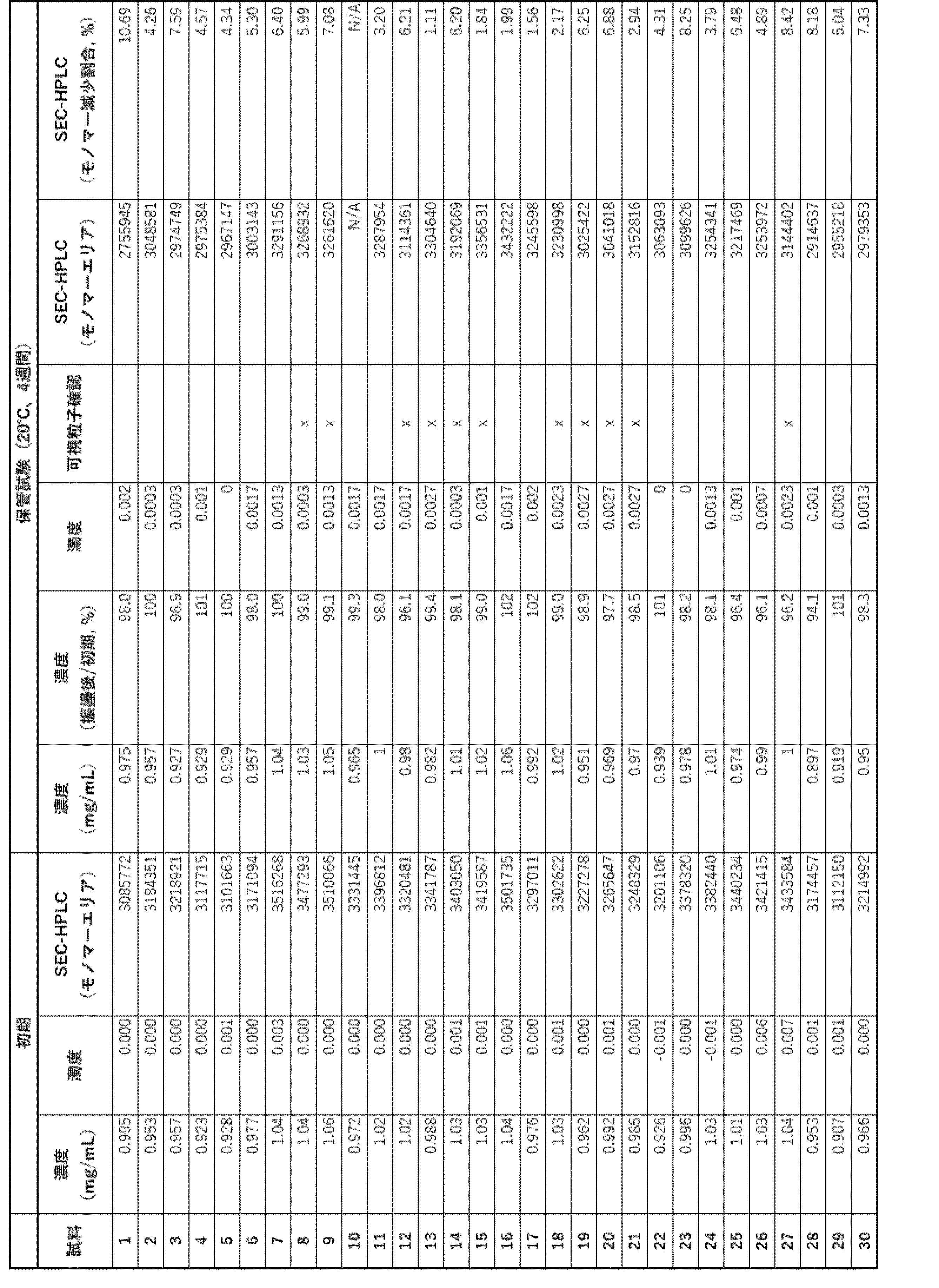

コロイド安定性、熱安定性、振とうおよび保管によるモノマー減少率を総合的に判断した結果、次の評価に進める処方として、試料4(20 mM酢酸緩衝液(pH 5.0))、試料5(20 mM 酢酸緩衝液(pH 5.0)、20 mM塩化ナトリウム)および試料22(20 mMヒスチジン緩衝液(pH 6.0))を選択した。なお、表1および表2に示された試料のうち、酢酸緩衝液の濃度として示される「20 mM」は簡略化された表記であり、正確には、20.07 mMである。また、表8~表11、表27、表33、表38、表45および表51ならびにそれらに対応する実施例1~10に記載中の「20 mM 酢酸緩衝液」の表記についても同様である。 As a result of comprehensively judging colloidal stability, thermal stability, and monomer reduction rate due to shaking and storage, sample 4 (20 mM acetate buffer (pH 5.0)), sample 5 (20 mM acetate buffer (pH 5.0), 20 mM sodium chloride), and sample 22 (20 mM histidine buffer (pH 6.0)) were selected as the formulations to proceed to the next evaluation. Note that, among the samples shown in Tables 1 and 2, "20 mM" shown as the acetate buffer concentration is a simplified notation, and the correct concentration is 20.07 mM. The same applies to the notation of "20 mM acetate buffer" in Tables 8 to 11, Tables 27, Tables 33, Tables 38, Tables 45 and 51, and the corresponding notations in Examples 1 to 10.
実施例2:添加剤の評価(1)
実施例1の評価にて選択された試料番号4、5および22の各処方に、糖(スクロース、トレハロース、D-マンニトールおよびソルビトール)を各々添加した処方S1~S24の24種を表8のとおり調製した。 Example 2: Evaluation of additives (1)
To each of the formulations of

24種の試料について、拡散相互作用パラメータ(KD)および凝集開始温度(Tagg)の測定を実施した。 The diffusion interaction parameter (KD) and aggregation onset temperature (Tagg) were measured for 24 samples.
拡散相互作用パラメータは、各試料の抗体濃度(1, 2, 4, 8および 10 mg/mL)について25℃下で測定および解析を行い、各処方に対して拡散係数(Diffusion Coefficient, μm2/s)をプロットすることで算出した。 The diffusion interaction parameters were measured and analyzed at 25°C for each antibody concentration (1, 2, 4, 8, and 10 mg/mL) of each sample, and calculated by plotting the diffusion coefficient (μm 2 /s) for each formulation.
凝集開始温度は、各試料の抗体濃度1 mg/mLについて25~80℃まで昇温することにより測定および解析を行った。各処方に対して、粒径(nm)をプロットすることで25℃下での平均粒径から10%平均粒径が大きくなったときの値を凝集開始温度とした。The aggregation onset temperature was measured and analyzed by heating each sample from 25 to 80°C for an antibody concentration of 1 mg/mL. The particle size (nm) for each formulation was plotted, and the value at which the average particle size increased by 10% from the average particle size at 25°C was defined as the aggregation onset temperature.
各試料について算出したKD値を降順に表9に示す。 The KD values calculated for each sample are shown in Table 9 in descending order.

各試料について測定した凝集開始温度(Tagg)を降順に表10に示す。The aggregation onset temperature (Tagg) measured for each sample is shown in Table 10 in descending order.

拡散相互作用パラメータ(KD)および凝集開始温度(Tagg)を総合的に判断した結果、次の評価に進める処方として、試料S3(20 mM酢酸緩衝液(pH 5.0)、285 mMトレハロース)、S5(20 mM酢酸緩衝液(pH 5.0)、285 mM D-マンニトール)およびS23(20 mMヒスチジン緩衝液(pH 6.0)、285 mM ソルビトール)を選択した。なお、塩化ナトリウムを含む酢酸緩衝液は何れもスコアが低いため、塩化ナトリウムを含まない処方が選択された。 After comprehensively assessing the diffusion interaction parameter (KD) and aggregation onset temperature (Tagg), samples S3 (20 mM acetate buffer (pH 5.0), 285 mM trehalose), S5 (20 mM acetate buffer (pH 5.0), 285 mM D-mannitol) and S23 (20 mM histidine buffer (pH 6.0), 285 mM sorbitol) were selected as formulations to proceed to the next evaluation. Note that, because acetate buffers containing sodium chloride all had low scores, formulations not containing sodium chloride were selected.
実施例3:添加剤の評価(2)
実施例2の評価にて選択された試料S3、S5およびS23の各処方に、ポリソルベート(PS)(ポリソルベート80(PS80)およびポリソルベート20(PD20))を各々添加した試料E1~E15の15種を表11のとおり調製した。 Example 3: Evaluation of additives (2)
Fifteen types of samples, E1 to E15, were prepared by adding polysorbate (PS) (polysorbate 80 (PS80) and polysorbate 20 (PD20)) to the formulations of samples S3, S5, and S23 selected in the evaluation of Example 2, as shown in Table 11.

15種の試料(1 mg/mL)を0.22 μmフィルターにて滅菌し、バイアルに分注後、保管試験、加速試験および凍結融解試験を各々実施した。 Fifteen types of samples (1 mg/mL) were sterilized using a 0.22 μm filter and dispensed into vials, after which storage tests, accelerated tests, and freeze-thaw tests were each performed.
保管試験は、各々20℃および40℃下にて4週間保管した。保管した試料について目視評価、濃度、濁度およびSEC-HPLC分析での評価を実施した。評価用の試料は何れも15,000 gで30分間遠心分離した上清を用いた。濃度は、280 nmの吸光度(光路長2 mm)をもとに算出した。濁度は、500 nmの吸光度(光路長1 cm)をもとに算出した。SEC-HPLC分析は、表2に示す条件で実施した。The storage tests were carried out at 20°C and 40°C for four weeks. The stored samples were visually evaluated and evaluated for concentration, turbidity, and by SEC-HPLC analysis. The samples used for evaluation were all supernatants obtained by centrifugation at 15,000 g for 30 minutes. The concentration was calculated based on the absorbance at 280 nm (
加速試験は、20℃下で3日間、500回/分で振とうした。 The accelerated test consisted of shaking at 500 rpm at 20°C for three days.
凍結融解試験は、凍結(-80℃下にて10分間、25℃下にて10分間)を3回繰り返した。 The freeze-thaw test consisted of freezing (-80°C for 10 minutes, then 25°C for 10 minutes) repeated three times.
調製直後の試料はいずれも透明であり、可視粒子は認められなかった。Immediately after preparation, all samples were transparent and no visible particles were observed.
保管試験(20℃下にて4週間)の結果を表12に、保管試験(40℃下にて4週間)の結果を表13に、加速試験(20℃下にて3日間振とう)の結果を表14に、凍結融解試験(-80℃下にて10分間、25℃下にて10分間)の結果を表15に各々示す。The results of the storage test (at 20°C for 4 weeks) are shown in Table 12, the results of the storage test (at 40°C for 4 weeks) are shown in Table 13, the results of the accelerated test (shaking at 20°C for 3 days) are shown in Table 14, and the results of the freeze-thaw test (at -80°C for 10 minutes and at 25°C for 10 minutes) are shown in Table 15.


表14に示す加速試験の結果から、ポリソルベートを含まない処方である試料E1、E6およびE11において明らかに凝集安定性が低く、ポリソルベートは必須であることが確認された。さらに、本実施例の評価を総合的に判断した結果、次の評価に進める処方として、試料E3(20 mM 酢酸緩衝液(pH 5.0)、285 mM トレハロース、0.1% PS80)、E4(20 mM 酢酸緩衝液(pH 5.0)、285 mM トレハロース, 0.01% PS20)、E10(20 mM 酢酸緩衝液(pH 5.0)、285 mM D-マンニトール、0.1% PS20)およびE13(20 mMヒスチジン緩衝液(pH 6.0)、285 mM ソルビトール、0.1% PS80)を選択した。 From the results of the accelerated test shown in Table 14, it was confirmed that the aggregation stability was clearly low in samples E1, E6, and E11, which were formulations that did not contain polysorbate, and that polysorbate was essential. Furthermore, as a result of comprehensively judging the evaluation of this example, samples E3 (20 mM acetate buffer (pH 5.0), 285 mM trehalose, 0.1% PS80), E4 (20 mM acetate buffer (pH 5.0), 285 mM trehalose, 0.01% PS20), E10 (20 mM acetate buffer (pH 5.0), 285 mM D-mannitol, 0.1% PS20), and E13 (20 mM histidine buffer (pH 6.0), 285 mM sorbitol, 0.1% PS80) were selected as formulations to proceed to the next evaluation.
実施例4:安定性評価試験(1)Example 4: Stability evaluation test (1)
実施例3の評価において選択された酢酸処方(20 mM酢酸緩衝液(pH 5.0)、285 mM トレハロース、0.1 % PS80)およびヒスチジン処方(20 mM ヒスチジン緩衝液(pH 6.0)、0.1 % PS80)各々について、100 mg/mLの抗体αを含む試料を調製した。 For each of the acetate formulation (20 mM acetate buffer (pH 5.0), 285 mM trehalose, 0.1% PS80) and histidine formulation (20 mM histidine buffer (pH 6.0), 0.1% PS80) selected for the evaluation in Example 3, samples containing 100 mg/mL antibody α were prepared.
同試料を0.22 μmフィルターにて滅菌し、1 mLずつ滅菌済みのバイアルに分注した後、表16に示す各条件に付したのちの各試料の安定性に関する評価試験を実施した。The samples were sterilized using a 0.22 μm filter and dispensed in 1 mL portions into sterilized vials. After subjecting each sample to the conditions shown in Table 16, an evaluation test was conducted on the stability of each sample.
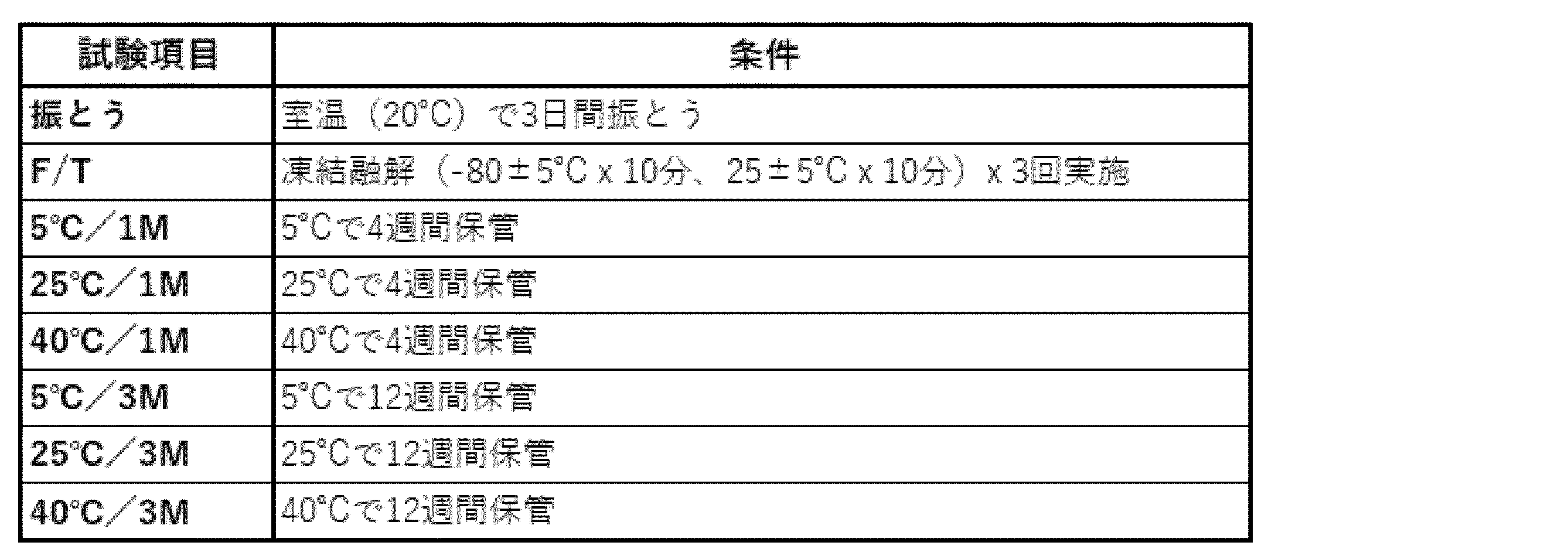
上表に示す各条件に付した試料について、(a)pH測定、(b)抗体濃度測定、(c)濁度測定、(d)SEC-HPLC(サイズ排除クロマトグラフィー)解析、(e)SDS-PAGE解析、(f)IE-HPLC(イオン交換クロマトグラフィー)解析、(g)粘度測定、(h)FIA(フローイメージング解析)および(i)摺動抵抗測定による評価を各々実施した。
(a)pH測定には、pHメーター(LAQUA F-74(HORIBA))および微量試料測定用電極(マイクロ Tou pH 電極(HORIBA))が使用された。
(b)抗体濃度は、各試料を15,000 g、30分間遠心した上清について、280 nmの吸光度を1 cmまたは2 mmの光路長で測定された。なお、各試料について、吸光度が0.1~1.0になるよう希釈して測定され、抗体の吸光係数ε280 = 1.51(mg/mL)-1cm-1から濃度が算出された。なお、測定には、分光光度計(BioSpectormeter(Eppendorf))が使用された。
(c)濁度測定においては、光路長1 cmで500 nmの吸光度を測定した。なお、測定には、分光光度計が使用された。
(d)SEC-HPLC解析は、表3に示した条件で実施された。
(e)SDS-PAGE解析は、各試料を15,000 g、30分間遠心分離した上清を用い、還元下(100 mM DTT)および非還元下(-DTT)において、2 μgの試料を、4~12% Bis-Trisゲル上で100 V、約30分間電気泳動して実施された。
(f)IE-HPLC解析は、表17に示す条件で実施された。
The samples subjected to each of the conditions shown in the above table were evaluated by (a) pH measurement, (b) antibody concentration measurement, (c) turbidity measurement, (d) SEC-HPLC (size exclusion chromatography) analysis, (e) SDS-PAGE analysis, (f) IE-HPLC (ion exchange chromatography) analysis, (g) viscosity measurement, (h) FIA (flow imaging analysis), and (i) sliding resistance measurement.
(a) A pH meter (LAQUA F-74 (HORIBA)) and a microsample measurement electrode (Micro Tou pH electrode (HORIBA)) were used for pH measurement.
(b) The antibody concentration was determined by measuring the absorbance at 280 nm of the supernatant obtained by centrifuging each sample at 15,000 g for 30 minutes, using an optical path length of 1 cm or 2 mm. Each sample was diluted to an absorbance of 0.1 to 1.0, and the antibody concentration was calculated from the antibody extinction coefficient ε280 = 1.51 (mg/mL) -1 cm -1 . A spectrophotometer (BioSpectormeter (Eppendorf)) was used for the measurement.
(c) Turbidity was measured using a spectrophotometer at 500 nm with an optical path length of 1 cm.
(d) SEC-HPLC analysis was performed under the conditions shown in Table 3.
(e) SDS-PAGE analysis was performed by centrifuging each sample at 15,000 g for 30 min, and
(f) IE-HPLC analysis was performed under the conditions shown in Table 17.

(g)粘度測定では、試料を15,000 g、30分間遠心分離した上清について、20℃下での粘度が測定された。なお、密度は1.0 g/cm3とし、相対粘度が決定された。
(h)摺動抵抗測定:測定試料として、15,000 g、30分間遠心分離した上清を用いた。29G staked 1mL COP syringeに試料を400 μLずつ充填し、5時間程度静置した。オートグラフを用い、6 mL/分でシリンジを押し出し、摺動抵抗値が測定された。なお、摺動抵抗測定は、初期状態の試料についてのみ実施した。
(i)FIAにおいては、フローイメージング装置を用いて、150 μLの試料を流速0.05 mL/分で測定し、1 μm以上のサイズの凝集体について評価された。
(g) In the viscosity measurement, the sample was centrifuged at 15,000 g for 30 minutes, and the viscosity of the supernatant was measured at 20°C. The density was set to 1.0 g/ cm3 , and the relative viscosity was determined.
(h) Sliding resistance measurement: The supernatant obtained by centrifugation at 15,000 g for 30 minutes was used as the measurement sample. 400 μL of the sample was filled into a 29G staked 1 mL COP syringe and left to stand for about 5 hours. The syringe was pushed out at 6 mL/min using an autograph, and the sliding resistance value was measured. The sliding resistance measurement was performed only on the samples in the initial state.
(i) In the FIA, a 150 μL sample was measured at a flow rate of 0.05 mL/min using a flow imaging device, and aggregates with a size of 1 μm or more were evaluated.
(安定性評価結果)
安定性評価試験前後の試料について、目視での状態確認が実施された。初期状態の試料では、酢酸処方の試料およびヒスチジン処方の試料ともに黄色を呈し、4週間および12週間保管ならびに3日間振とうした各条件下において、明らかな色の変化は見られなかった。ヒスチジン処方の試料に関して、5℃下での4週間保管後ならびに5℃および25℃下で各々12週間保管した後において微粒子が確認された。また、酢酸処方およびヒスチジン処方の試料ともに、40℃下での4週間保管後において微粒子は見られなかったが、全体が白く濁っていた。
(a)安定性評価試験後のすべての試料において、顕著なpHの変化は認められなかった。
(b)安定性試験後のすべての試料において、大きな濃度の変化は見られなかった。
(c)安定性試験前後の濁度の測定結果を表18に示す。
(Stability evaluation results)
The condition of the samples was visually confirmed before and after the stability evaluation test. In the initial state, both the acetic acid formulation and the histidine formulation samples were yellow, and no obvious color change was observed under each condition of storage for 4 weeks and 12 weeks and shaking for 3 days. For the histidine formulation sample, fine particles were observed after storage for 4 weeks at 5°C and after storage for 12 weeks at 5°C and 25°C, respectively. In addition, both the acetic acid formulation and the histidine formulation samples did not show fine particles after storage for 4 weeks at 40°C, but the whole was cloudy white.
(a) No significant change in pH was observed in any of the samples after the stability evaluation test.
(b) No significant changes in concentration were observed in any samples after the stability test.
(c) The results of turbidity measurements before and after the stability test are shown in Table 18.

4週間保管後では、初期状態(表中の「Initial」)の試料と比較して、酢酸処方の試料では、40℃下での保管により、ヒスチジン処方の試料では、25℃および40℃下での保管により、20%以上濁度が上昇した。酢酸処方の試料は、初期状態の試料と比較して、40℃下での12週間保管により、50%程度濁度が上昇した。ヒスチジン処方の試料では、5℃、25℃および40℃下での保管により、初期状態の試料と比べて、90%以上濁度が上昇した。
(d)安定性試験前後のSEC-HPLC解析の測定結果を表19に示す。
After 4 weeks of storage, compared to the sample in the initial state (labeled "Initial" in the table), the turbidity of the acetic acid formulation sample increased by 20% or more after storage at 40°C, and the histidine formulation sample increased by 20% or more after storage at 25°C and 40°C. Compared to the initial sample, the turbidity of the acetic acid formulation sample increased by about 50% after 12 weeks of storage at 40°C. The turbidity of the histidine formulation sample increased by 90% or more after storage at 5°C, 25°C, and 40°C, compared to the initial sample.
(d) The results of SEC-HPLC analysis before and after the stability test are shown in Table 19.

SEC-HPLC解析において、酢酸処方の試料では、40℃下にて4週間および12週間保管した何れにおいても、モノマー(Monomer area)が3~5%減少した。ヒスチジン処方の試料では、25℃および40℃下での12週間保管により、同抗体に由来するモノマーが2~5%および4%それぞれ減少した。これらモノマーの減少分は、抗体凝集による高分子種(HMWS)等に変化したと推測された。振とうおよび凍結融解による影響はほとんど見られなかった。
(e)安定性試験前後のSDS-PAGE解析から、還元条件および非還元条件の何れによっても、初期状態および各試料において、標品と同様のバンドが観察され、精製、濃縮などの試料調製で分解が生じていないことが確認された。
(f)安定性試験前後のIE-HPLC分析の結果を表20に示す。
In the SEC-HPLC analysis, the monomer area of the acetic acid formulation sample decreased by 3-5% after storage at 40°C for both 4 and 12 weeks. In the histidine formulation sample, the monomer area derived from the antibody decreased by 2-5% and 4% after storage at 25°C and 40°C for 12 weeks, respectively. It was presumed that the decrease in the monomer area was converted to high molecular weight species (HMWS) due to antibody aggregation. Shaking and freezing and thawing had almost no effect.
(e) SDS-PAGE analysis before and after the stability test showed that bands similar to those of the standard were observed in the initial state and in each sample, both under reducing and non-reducing conditions, confirming that no decomposition occurred during sample preparation, such as purification and concentration.
(f) The results of IE-HPLC analysis before and after the stability test are shown in Table 20.

酢酸処方およびヒスチジン処方の試料ともに、5℃下での4週間保管、12週間保管、振とうならびに凍結融解の何れの条件下において、その影響はほとんど認められなかった。 For both the acetic acid and histidine formulation samples, little effect was observed when they were stored at 5°C for four weeks, 12 weeks, or under any of the following conditions: shaking, or freezing and thawing.
25℃下での4週間保管の条件下では、ヒスチジン処方の試料において、酸性分子種が3%増加し、中性分子種が3%減少した。 After storage for four weeks at 25°C, the histidine formulation sample showed a 3% increase in acidic molecular species and a 3% decrease in neutral molecular species.
40℃下での4週間保管の条件下では、酢酸処方の試料において、酸性分子種が15%増加し、中性分子種が19%減少し、塩基性分子種が5%増加した。ヒスチジン処方の試料においても、酸性分子種が15%増加し、中性分子種が15%減少した。After storage at 40°C for four weeks, the acetic acid formulation sample showed a 15% increase in acidic molecular species, a 19% decrease in neutral molecular species, and a 5% increase in basic molecular species. The histidine formulation sample also showed a 15% increase in acidic molecular species and a 15% decrease in neutral molecular species.
25℃下での12週間保管の条件下では、酢酸処方の試料において、酸性分子種が9%増加し、中性分子種が9%減少した。ヒスチジン処方の試料においても、酸性分子種が8%増加し、中性分子種が8%減少した。After 12 weeks of storage at 25°C, the acetic acid formulation sample showed a 9% increase in acidic molecular species and a 9% decrease in neutral molecular species. The histidine formulation sample also showed an 8% increase in acidic molecular species and an 8% decrease in neutral molecular species.
40℃での12週間保管の条件下では、酢酸処方の試料において、酸性分子種が33%増加し、中性分子種が37%減少し、塩基性分子種が4%増加した。ヒスチジン処方の試料においても、酸性分子種が32%増加し、中性分子種が32%減少した。After 12 weeks of storage at 40°C, the acetic acid formulation sample showed a 33% increase in acidic molecular species, a 37% decrease in neutral molecular species, and a 4% increase in basic molecular species. The histidine formulation sample also showed a 32% increase in acidic molecular species and a 32% decrease in neutral molecular species.
中性分子種の減少分は、主に、酸化により酸性分子種に変化したと考えられた。 The decrease in neutral molecular species was thought to be mainly due to their conversion to acidic molecular species through oxidation.
25℃下での4週間保管の結果から、酢酸処方の方が、安定性が高いと考えられた。
(g)安定性評価試験前後での粘度測定の結果、何れの処方も、安定性評価試験前後において有意な粘度の変化は見られなかった。
The results of storage at 25°C for four weeks indicated that the acetic acid formulation was more stable.
(g) As a result of the viscosity measurement before and after the stability evaluation test, no significant change in viscosity was observed for any of the formulations before and after the stability evaluation test.
なお、初期状態の試料の粘度は、酢酸処方の試料が4.41 mPa・s、ヒスチジン処方の試料が4.2 mPa・sと、100 mg/mLの濃度であっても非常に低い値であった。
(h)初期状態の試料での摺動抵抗値測定の結果、酢酸処方およびヒスチジン処方の試料の何れにおいても、非常に低い摺動抵抗値(7.66 Nおよび7.46 N)であった。
(i)安定性評価試験前後の抗体を含む各処方の粒子濃度から、処方液のみの粒子濃度を引いた粒子濃度を表21に示す。
The initial viscosity of the samples was 4.41 mPa·s for the acetic acid formulation and 4.2 mPa·s for the histidine formulation, both of which were very low even at a concentration of 100 mg/mL.
(h) As a result of measuring the sliding resistance of the samples in the initial state, the sliding resistance values were very low (7.66 N and 7.46 N) for both the acetic acid formulation and the histidine formulation samples.
(i) Table 21 shows the particle concentrations obtained by subtracting the particle concentration of the formulation solution alone from the particle concentration of each antibody-containing formulation before and after the stability evaluation test.

酢酸処方の試料は、40℃下での12週間保管の条件において、ヒスチジン処方の試料では、25℃下での12週間保管の条件において、最も粒子濃度が高かった。 The acetic acid formulation sample had the highest particle concentration when stored for 12 weeks at 40°C, while the histidine formulation sample had the highest particle concentration when stored for 12 weeks at 25°C.
評価された何れの条件においても、酢酸処方と比較して、ヒスチジン処方の粒子濃度は、数十から数千倍高かった。 Under all conditions evaluated, particle concentrations were tens to thousands of times higher in the histidine formulation compared to the acetic acid formulation.
本実施例に示す安定性評価の結果から、本発明にかかる抗体αの処方としては、酢酸処方(20 mM酢酸緩衝液(pH 5.0)、285 mM トレハロース、0.1 % PS80)の方が適していると考えられた。 Based on the results of the stability evaluation shown in this Example, it was considered that the acetic acid formulation (20 mM acetate buffer (pH 5.0), 285 mM trehalose, 0.1% PS80) was more suitable as a formulation for the antibody α of the present invention.
実施例5:添加剤の評価(3)
実施例4の評価に基づき選択された酢酸処方(20 mM酢酸緩衝液(pH 5.0)、285 mM トレハロース、0.1 % PS80)について、さらに最適化検討を実施した。 Example 5: Evaluation of additives (3)
The acetic acid formulation (20 mM acetate buffer (pH 5.0), 285 mM trehalose, 0.1% PS80) selected based on the evaluation in Example 4 was further subjected to optimization studies.
導電率の安定性を確保するため、塩濃度の検討を実施した。 To ensure stability of conductivity, salt concentration was examined.
選択された同酢酸処方(20 mM酢酸緩衝液(pH 5.0)、285 mM トレハロース、0.1 % PS80)に、塩化ナトリウムを添加した試料N1~N8の8種を表22のとおり調製した。Eight types of samples, N1 to N8, were prepared by adding sodium chloride to the selected acetic acid formulation (20 mM acetate buffer (pH 5.0), 285 mM trehalose, 0.1% PS80) as shown in Table 22.

8種の同試料を0.22 μmフィルターにて滅菌し、1または5 mLずつ滅菌済みのバイアルに分注して、表23に示す各条件にて安定性評価を実施した。The eight samples were sterilized using a 0.22 μm filter and dispensed in 1 or 5 mL portions into sterilized vials, and stability evaluation was performed under the conditions shown in Table 23.

上表に示す各条件に付した試料について、(a)SEC-HPLC解析、(b)IE-HPLC解析、(c)RP-HPLC(逆相クロマトグラフィー)解析、(d)結合活性、(e)FIA、および(f)ペプチドマップ解析(液体クロマトグラフィー質量分析法(LC-MS)による変性部位の解析)の評価を各々実施した。The samples subjected to each of the conditions shown in the table above were evaluated by (a) SEC-HPLC analysis, (b) IE-HPLC analysis, (c) RP-HPLC (reverse-phase chromatography) analysis, (d) binding activity, (e) FIA, and (f) peptide map analysis (analysis of denatured sites by liquid chromatography mass spectrometry (LC-MS)).
なお、(a)SEC-HPLC解析は、表24の条件で実施された。 (a) SEC-HPLC analysis was performed under the conditions in Table 24.

(b)IE-HPLC解析は、表25の条件で実施された。 (b) IE-HPLC analysis was performed under the conditions in Table 25.

(c)RP-HPLC解析は、表26の条件で実施された。 (c) RP-HPLC analysis was performed under the conditions in Table 26.
なお、(蛍光強度値)/(UV280 nm吸光エリア値)×100の値を着色指標とした。標準品との着色指標の比((試料の着色指標)/(標準品の着色指標))を試料中の着色体量を示す指標値とした。The color index was calculated by dividing the fluorescence intensity by the UV280 nm absorption area x 100. The ratio of the color index to the standard (color index of sample/color index of standard) was used as an index value showing the amount of colored bodies in the sample.

(d)PD-1およびCD3への結合活性の測定は、表面プラズモン共鳴法(SPR)により実施された。
(e)FIAにおいては、フローイメージング装置を用いて、500 μLの試料を流速0.1 mL/分で測定し、2 μm以上のサイズの凝集体が評価された。
(f)ペプチドマップ解析は、LC-MSを用いて実施された。
(保管試験)
(a)SEC-HPLC解析にて評価した、保管試験前後での高分子種(HMWS)の割合を表27に示す。いずれの濃度においても、5℃下での12週間保管では、HMWSの顕著な増加は認められなかった。25℃下においては、抗体濃度が20 mg/mLの処方では、HMWSの増加は認められなかったものの、100 mg/mLの処方では、HMWSの直線的な増加傾向が認められた。一方、導電率による挙動の差は認められなかった。40℃下では、いずれの濃度においてもHMWSは増加したが、20 mg/mLの処方では、導電率の上昇に伴い、HMWSが高まる傾向が認められた。5℃および25℃下では、安定な処方であることが確認された。
(d) Binding activity to PD-1 and CD3 was measured by surface plasmon resonance (SPR).
(e) In the FIA, a 500 μL sample was measured at a flow rate of 0.1 mL/min using a flow imaging device, and aggregates with a size of 2 μm or more were evaluated.
(f) Peptide map analysis was performed using LC-MS.
(Storage test)
(a) The percentage of high molecular weight species (HMWS) before and after the storage test, evaluated by SEC-HPLC analysis, is shown in Table 27. At any concentration, no significant increase in HMWS was observed after 12 weeks of storage at 5°C. At 25°C, no increase in HMWS was observed in the formulation with an antibody concentration of 20 mg/mL, but a linear increase in HMWS was observed in the formulation with an antibody concentration of 100 mg/mL. On the other hand, no difference in behavior due to conductivity was observed. At 40°C, HMWS increased at any concentration, but in the formulation with 20 mg/mL, HMWS tended to increase with increasing conductivity. It was confirmed that the formulation was stable at 5°C and 25°C.

(b)IE-HPLC解析にて評価した、保管試験前後での酸性分子種の割合を表28に示す。 (b) The proportion of acidic molecular species before and after the storage test, evaluated by IE-HPLC analysis, is shown in Table 28.

40℃下では、酸性分子種が増大する傾向が認められたが、5℃および25℃下では、酸性分子種の増大は認められず、安定な処方であることが確認された。また、導電率による影響は認められなかった。
(c)RP-HPLC解析にて評価した、保管試験前後での着色体の割合を表29に示す。
At 40°C, a tendency for the acidic molecular species to increase was observed, but at 5°C and 25°C, no increase in the acidic molecular species was observed, confirming that the formulation was stable. In addition, no effect of electrical conductivity was observed.
(c) The percentage of colored bodies before and after the storage test, evaluated by RP-HPLC analysis, is shown in Table 29.
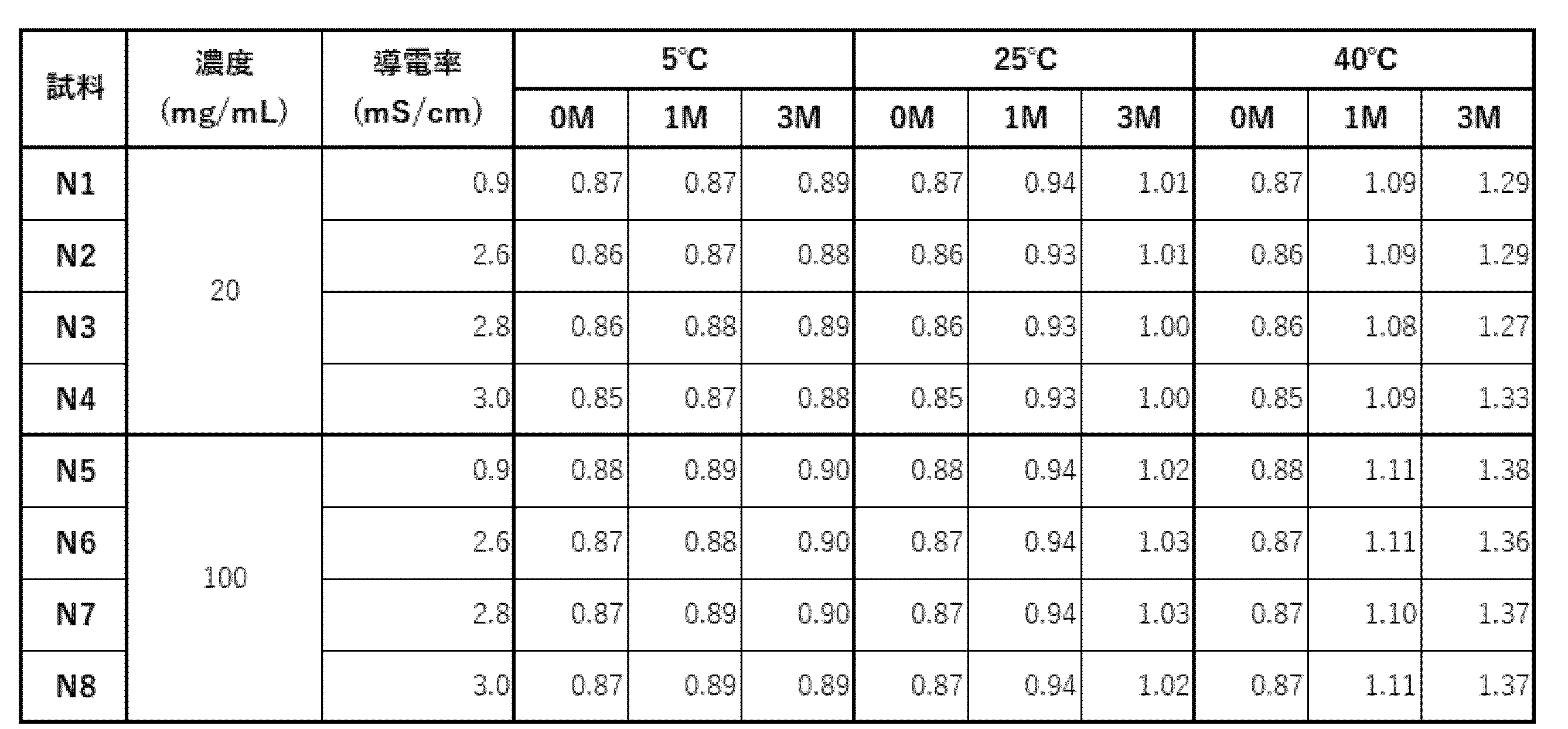
5℃下では変化がなかったものの、25℃および40℃下では、着色体割合の上昇が認められた。導電率の違いによる差は認められなかった。
(d)SPRにて評価した、保管試験前後でのPD-1への結合活性の結果を表30に、CD3結合活性の結果を表31に各々示す。各表中の数値は、抗体αの標準品に対する比活性(%)を表す。5℃および25℃下では、PD-1、CD3ともに結合活性の低下は認められなかった。一方、40℃下では、PD-1への結合活性の低下が認められ、さらに、抗体濃度が20 mg/mLにおいては、その結合活性の低下は顕著であった。
While there was no change at 5° C., an increase in the color body ratio was observed at 25° C. and 40° C. No difference was observed due to differences in electrical conductivity.
(d) The results of the binding activity to PD-1 and the binding activity to CD3 evaluated by SPR before and after the storage test are shown in Table 30 and Table 31, respectively. The values in each table represent the specific activity (%) relative to the standard antibody α. No decrease in binding activity to PD-1 or CD3 was observed at 5°C and 25°C. On the other hand, a decrease in binding activity to PD-1 was observed at 40°C, and further, the decrease in binding activity was significant at an antibody concentration of 20 mg/mL.


(e)FIAにて、試料N5およびN8の保管試験後の粒子数を各々評価したが、試料間で微粒子数および最大粒子数に有意な差は認められなかった。
(振とう試験)
(a)SEC-HPLCにて、振とう試験前後におけるHMWSの割合を評価したが、すべての試料および条件において、HMWSの顕著な増加は認められなかった。
(b)IE-HPLCにて、振とう試験前後における酸性分子種の割合を評価したが、すべての試料および条件において、酸性分子種の顕著な増加は認められなかった。
(c)RP-HPLCにて、振とう試験前後における着色体の割合を評価したが、すべての試料および条件において、着色体の顕著な増加は認められなかった。
(d)SPRにて、振とう試験前後におけるPD-1およびCD3に対する結合活性を各々評価したが、試料間において結合活性の低下に有意な差は認められなかった。
(e)FIAにて、試料N5およびN8の振とう試験後における粒子数を評価したが、何れについても、振とうストレスによる微粒子数および最大粒子径の増加は認められなかった。
(凍結融解)
(a)SEC-HPLCにて、凍結融解試験前後でのHMWSの割合を評価したが、すべての試料においてHMWSの割合に大きな変化はなく、凍結融解ストレスに安定であることが確認された。
(b)IE-HPLCにて、凍結融解試験前後での酸性分子種の割合を評価したが、すべての試料において酸性分子種の割合に大きな変化はなく、同様に、凍結融解ストレスに安定であることが確認された。
(c)RP-HPLCにて、凍結融解試験前後での着色体の割合を評価したが、すべての試料において着色体の割合にも大きな変化は認められなかった。
(d)SPRにて、凍結融解試験前後でのPD-1およびCD3への結合活性を各々評価したが、すべての試料において結合活性に大きな変化は認められなかった。
(e)FIAにて、試料N5およびN8の凍結融解試験後における粒子数を各々評価したが、何れについても凍結融解ストレスによる微粒子数および最大粒子径の増加は認められなかった。また、評価した試料間に有意な差も認められなかった。
(e) The particle counts of samples N5 and N8 after the storage test were evaluated using FIA, and no significant differences were found in the fine particle count and maximum particle count between the samples.
(Shaking test)
(a) The proportion of HMWS was evaluated by SEC-HPLC before and after the shaking test, but no significant increase in HMWS was observed in any sample or under any condition.
(b) The ratio of acidic molecular species was evaluated by IE-HPLC before and after the shaking test, but no significant increase in acidic molecular species was observed in any sample or under any condition.
(c) The proportion of colored bodies was evaluated by RP-HPLC before and after the shaking test, but no significant increase in colored bodies was observed in any sample or under any condition.
(d) The binding activity to PD-1 and CD3 was evaluated by SPR before and after the shaking test, and no significant difference was observed in the decrease in binding activity between the samples.
(e) The particle counts of samples N5 and N8 after the shaking test were evaluated using FIA, but no increase in the number of fine particles or the maximum particle size due to shaking stress was observed in either case.
(Freezing and thawing)
(a) The proportion of HMWS was evaluated before and after the freeze-thaw test using SEC-HPLC. There was no significant change in the proportion of HMWS in any sample, confirming that the samples were stable to freeze-thaw stress.
(b) The ratio of acidic molecular species was evaluated by IE-HPLC before and after the freeze-thaw test. No significant change was observed in the ratio of acidic molecular species in any of the samples, confirming that the samples were similarly stable to freeze-thaw stress.
(c) The proportion of colored bodies was evaluated by RP-HPLC before and after the freeze-thaw test, and no significant change was observed in the proportion of colored bodies in any of the samples.
(d) The binding activity to PD-1 and CD3 was evaluated by SPR before and after the freeze-thaw test, and no significant changes in binding activity were observed in any of the samples.
(e) The number of particles after the freeze-thaw test of samples N5 and N8 was evaluated by FIA, but no increase in the number of fine particles or the maximum particle size due to freeze-thaw stress was observed in either case. In addition, no significant difference was observed between the evaluated samples.
(シリンジ通液試験)
SEC-HPLCにて、試料N8のシリンジ通液試験前後におけるHMWSの割合(%)を評価したが、HMWSの生成は認められなかった。
(Syringe flow test)
The percentage of HMWS in sample N8 was evaluated by SEC-HPLC before and after the syringe flow test, but no HMWS was observed to be formed.
(ペプチドマップ解析)
表30に示したように、40℃下での長期保管におけるPD-1への結合活性の低下について、ペプチドマップによる要因解析を行った。代表例として、PD-1に対する相補性決定領域に存在する101番目のメチオニン残基(以下、「Met101」と略記することがある。)への酸化度(%)を表32に示す。5℃および25℃下では、Met101の酸化度は低値を示しており、試料間差は認められなかった。また、抗体濃度が100 mg/mLの場合に比べ、20 mg/mLの場合において顕著な酸化が認められた。図4に示すように、Met101の酸化とPD-1結合活性の低下には相関関係があった。このような酸化が、結合活性低下の原因である可能性が認められた。
(Peptide map analysis)
As shown in Table 30, the cause of the decrease in binding activity to PD-1 during long-term storage at 40°C was analyzed by peptide mapping. As a representative example, the degree of oxidation (%) of the 101st methionine residue (hereinafter sometimes abbreviated as "Met101") present in the complementarity determining region for PD-1 is shown in Table 32. At 5°C and 25°C, the degree of oxidation of Met101 was low, and no difference was observed between the samples. In addition, significant oxidation was observed when the antibody concentration was 20 mg/mL compared to when it was 100 mg/mL. As shown in Figure 4, there was a correlation between the oxidation of Met101 and the decrease in PD-1 binding activity. It was recognized that such oxidation may be the cause of the decrease in binding activity.

実施例6:安定性評価(2)
本発明にかかる抗体αが、低濃度において、安定性が低下する可能性が実施例5において示唆されたため、低濃度域での安定性を評価した。 Example 6: Stability evaluation (2)
Since Example 5 suggested that the antibody α of the present invention may have reduced stability at low concentrations, the stability in the low concentration range was evaluated.
酢酸処方(20 mM酢酸緩衝液(pH 5.0)、285 mM トレハロース、0.1 % PS80、1.25 mg/mL 塩化ナトリウム)に、1および50 mg/mLの抗体αを各々含む試料L1およびL2を表33のとおり調製した。Samples L1 and L2 containing 1 and 50 mg/mL of antibody α, respectively, in an acetic acid formulation (20 mM acetate buffer (pH 5.0), 285 mM trehalose, 0.1% PS80, 1.25 mg/mL sodium chloride) were prepared as shown in Table 33.

この2種の試料を0.22 μmフィルターにて滅菌し、1または5 mLずつ滅菌済みのバイアルに分注して、表34に示す条件下にて安定性評価を実施した。These two samples were sterilized using a 0.22 μm filter and dispensed into sterilized vials at 1 or 5 mL each, and stability evaluation was performed under the conditions shown in Table 34.

各条件下で保管した試料について、(a)SEC-HPLC解析、(b)IE-HPLC解析および(c)PD-1およびCD3への結合活性の測定を各々実施した。なお、SEC-HPLC解析は、表24に示された条件で実施され、IE-HPLC解析は、表25に示された条件で実施された。PD-1およびCD3への結合活性の測定は、SPRにより行われた。
(a)SEC-HPLCにて評価した、保管前後でのHMWSの割合を表35に示す。何れの処方においても、40℃下での長期保管においてHMWSが大幅に上昇したが、抗体が低濃度のL1において、HMWSの蓄積はより顕著であった。低濃度条件で凝集の可能性が高まることが示唆された。
The samples stored under each condition were subjected to (a) SEC-HPLC analysis, (b) IE-HPLC analysis, and (c) measurement of binding activity to PD-1 and CD3. The SEC-HPLC analysis was performed under the conditions shown in Table 24, and the IE-HPLC analysis was performed under the conditions shown in Table 25. The binding activity to PD-1 and CD3 was measured by SPR.
(a) The percentage of HMWS before and after storage, as evaluated by SEC-HPLC, is shown in Table 35. In all formulations, HMWS increased significantly after long-term storage at 40°C, but accumulation of HMWS was more significant in L1, which had a low antibody concentration. This suggests that the possibility of aggregation increases under low concentration conditions.

(b)IE-HPLCにて評価した、保管前後での酸性分子種の割合を表36に示す。何れの濃度においても、40℃下で酸性分子種が増大する傾向が認められ、1 mg/mLの場合の方が酸化の進行が速い傾向が認められた。 (b) The proportion of acidic molecular species before and after storage, evaluated by IE-HPLC, is shown in Table 36. At all concentrations, there was a tendency for the amount of acidic molecular species to increase at 40°C, and oxidation tended to proceed more quickly at 1 mg/mL.

(c)SPRにて評価した、保管前後でのPD-1への結合活性の結果を表37に示す。5℃および25℃下では、PD-1、CD3ともに結合活性の低下は認められなかったが、40℃下では両試料ともPD-1への結合活性の低下が顕著であった。PD-1に対する相補性決定部位の酸化により、抗体への酸化が進みやすくなった可能性が考えられた。 (c) The results of the binding activity to PD-1 evaluated by SPR before and after storage are shown in Table 37. No decrease in binding activity was observed for either PD-1 or CD3 at 5°C or 25°C, but at 40°C, both samples showed a significant decrease in binding activity to PD-1. It is thought that oxidation of the complementarity determining site for PD-1 may have made it easier for the antibody to be oxidized.

実施例7:添加剤の評価(4)
長期保管の影響により、本発明にかかる抗体αの酸化が進行し、PD-1およびCD3への結合活性の低下、特に、PD-1への結合活性の低下が顕著であることが実施例6において示唆された。 Example 7: Evaluation of additives (4)
Example 6 suggests that long-term storage causes the oxidation of the antibody α of the present invention, resulting in a significant decrease in binding activity to PD-1 and CD3, in particular, in binding activity to PD-1.
酢酸処方(20 mM酢酸緩衝液(pH 5.0)、193 mM トレハロース、0.1 % PS80、1.15 mg/mL 塩化ナトリウム)に、抗酸化剤(L-メチオニンまたはDTPA)を添加する検討を実施した。1および20 mg/mLの抗体αを各々含む処方試料A1~A8を表38のとおり調製した。 An investigation was conducted into the addition of antioxidants (L-methionine or DTPA) to an acetic acid formulation (20 mM acetate buffer (pH 5.0), 193 mM trehalose, 0.1% PS80, 1.15 mg/mL sodium chloride). Formulation samples A1 to A8 containing 1 and 20 mg/mL antibody α, respectively, were prepared as shown in Table 38.

8種の各試料を0.22 μmフィルターにて滅菌し、1 mLずつ滅菌済バイアルに分注して、表34と同様に安定性の評価を実施した。同評価では、表34において示される条件下で保管した試料について、(a)SEC-HPLC解析、(b)IE-HPLC解析、(c)RP-HPLC解析、(d)PD-1およびCD3への結合活性の測定、および(e)ペプチドマップ解析を各々実施した。なお、SEC-HPLC解析は、表24に示された条件で実施され、IE-HPLC解析は、表25に示された条件で実施され、RP-HPLC解析は、表26に示された条件で実施された。また、PD-1およびCD3への結合活性の測定は、SPRにより行われ、ペプチドマップ解析は、LC-MSを用いて実施された。
(a)SEC-HPLC解析にて評価した、保管前後でのHMWSの割合(%)を表39に示す。抗酸化剤未添加でも、5℃および25℃では変化はなかった。一方で、L-メチオニンを10 mMまたはDTPAを20 μM添加した試料について、40℃下で12週間保管した場合、HMWSの生成が劇的に抑制された。L-メチオニンまたはDTPAのHMWSの生成抑制効果は、抗体濃度1および20 mg/mLにおいても同様に認められた。
Each of the eight samples was sterilized using a 0.22 μm filter and dispensed into sterilized vials at 1 mL each, and stability was evaluated in the same manner as in Table 34. In this evaluation, the samples stored under the conditions shown in Table 34 were subjected to (a) SEC-HPLC analysis, (b) IE-HPLC analysis, (c) RP-HPLC analysis, (d) measurement of binding activity to PD-1 and CD3, and (e) peptide map analysis. The SEC-HPLC analysis was performed under the conditions shown in Table 24, the IE-HPLC analysis was performed under the conditions shown in Table 25, and the RP-HPLC analysis was performed under the conditions shown in Table 26. The measurement of binding activity to PD-1 and CD3 was performed by SPR, and the peptide map analysis was performed using LC-MS.
(a) The percentage of HMWS before and after storage, as evaluated by SEC-HPLC analysis, is shown in Table 39. Even without the addition of antioxidants, there was no change at 5°C and 25°C. On the other hand, when samples containing 10 mM L-methionine or 20 μM DTPA were stored at 40°C for 12 weeks, the formation of HMWS was dramatically suppressed. The inhibitory effect of L-methionine or DTPA on the formation of HMWS was also observed at antibody concentrations of 1 and 20 mg/mL.

(b)IE-HPLC解析にて評価した、保管前後での酸性分子種の割合(%)を表40に示す。抗体濃度1および20 mg/mLの何れにおいても、40℃下で酸性分子種が増大する傾向が認められた。特に、抗体濃度1 mg/mLにおいて、L-メチオニン 10 mMまたはDTPA 20 μMを添加した試料において、酸性分子種の生成を抑制する効果が認められた。 (b) The percentage of acidic molecular species before and after storage, as evaluated by IE-HPLC analysis, is shown in Table 40. At antibody concentrations of both 1 and 20 mg/mL, a tendency for acidic molecular species to increase at 40°C was observed. In particular, at an antibody concentration of 1 mg/mL, the effect of suppressing the generation of acidic molecular species was observed in samples to which 10 mM L-methionine or 20 μM DTPA had been added.

(c)IE-HPLC解析にて評価した、保管前後の着色指標を表41に示す。抗体濃度1および20 mg/mLの何れにおいても、40℃下での着色体の生成を劇的に抑制する効果が認められた。特に、抗体濃度1 mg/mLにおいて、L-メチオニン 10 mMまたはDTPA 20 μMを添加した試料において、着色体の生成を抑制する効果が認められた。 (c) The color index before and after storage, evaluated by IE-HPLC analysis, is shown in Table 41. A dramatic effect of suppressing the formation of colored bodies at 40°C was observed at both antibody concentrations of 1 and 20 mg/mL. In particular, at an antibody concentration of 1 mg/mL, the effect of suppressing the formation of colored bodies was observed in samples to which 10 mM L-methionine or 20 μM DTPA had been added.

(d)SPRにて評価した、保管前後のPD-1への結合活性(%)の結果を表42に、CD3への結合活性(%)の結果を表43に各々示す。抗酸化剤未添加のまま25℃以上で保管した場合、抗体濃度1および20 mg/mLの何れにおいても、PD-1およびCD3への結合活性の低下がともに認められた。一方で、40℃下では、抗体濃度1および20 mg/mLともに、抗酸化剤の添加により、結合活性低下の劇的な抑制効果が認められた。抗酸化剤の添加により、HMWSおよび酸性分子種の生成が抑制されたことが、結合活性の低下抑制につながったと考えられた。 (d) The results of the binding activity (%) to PD-1 and the binding activity (%) to CD3 before and after storage, evaluated by SPR, are shown in Table 42 and Table 43, respectively. When stored at 25°C or higher without the addition of antioxidants, a decrease in binding activity to PD-1 and CD3 was observed at both antibody concentrations of 1 and 20 mg/mL. On the other hand, at 40°C, the addition of antioxidants dramatically suppressed the decrease in binding activity at both antibody concentrations of 1 and 20 mg/mL. It is believed that the addition of antioxidants suppressed the generation of HMWS and acidic molecular species, which led to the suppression of the decrease in binding activity.


(e)表42に示したように、40℃下での長期保管におけるPD-1結合活性の低下について、ペプチドマップによる要因解析を行った。代表例として、PD-1に対する相補性決定領域に存在するメチオニン残基(Met101)の酸化度(%)を表44に示す。抗体濃度1 mg/mL、40℃下での保管において、Met101が高度に酸化されていることを確認した。一方で、抗酸化剤の添加により、Met101の酸化は劇的に抑制されており、さらには、PD-1への結合活性の低下も劇的に抑制されていた。従って、抗酸化剤の添加が、抗体αの安定性向上に極めて有用であることを確認できた。 (e) As shown in Table 42, a peptide map was used to analyze the causes of the decrease in PD-1 binding activity during long-term storage at 40°C. As a representative example, Table 44 shows the degree of oxidation (%) of the methionine residue (Met101) present in the complementarity determining region for PD-1. It was confirmed that Met101 was highly oxidized when the antibody was stored at a concentration of 1 mg/mL at 40°C. On the other hand, the addition of an antioxidant dramatically suppressed the oxidation of Met101, and furthermore, the decrease in binding activity to PD-1 was also dramatically suppressed. Therefore, it was confirmed that the addition of an antioxidant is extremely useful for improving the stability of antibody α.

実施例8:安定性試験(3)
実施例1~7までの検討において、本発明にかかる抗体αが、安定に保管され得る条件を見出した。さらに安定な条件を設定するため、糖の濃度範囲を決定することとした。 Example 8: Stability test (3)
In the studies of Examples 1 to 7, conditions were found under which the antibody α of the present invention can be stably stored. In order to set more stable conditions, it was decided to determine the sugar concentration range.
酢酸処方(20 mM酢酸緩衝液(pH 5.0)、172 mM、182.38 mMもしくは193 mMのトレハロース、0.1 % PS80、1.36 mg/mL 塩化ナトリウム、10 mM L-メチオニン)に、1 mg/mLの抗体αを各々含む試料T1~T3を表45のとおり調製した。なお、表45および表47~59に記載されるトレハロースの濃度である「182 mM」は、「182.38 mM」を略記した表記である。 Samples T1 to T3 containing 1 mg/mL of antibody α in an acetic acid formulation (20 mM acetate buffer (pH 5.0), 172 mM, 182.38 mM or 193 mM trehalose, 0.1% PS80, 1.36 mg/mL sodium chloride, 10 mM L-methionine) were prepared as shown in Table 45. Note that the trehalose concentration "182 mM" shown in Tables 45 and 47 to 59 is an abbreviation of "182.38 mM."
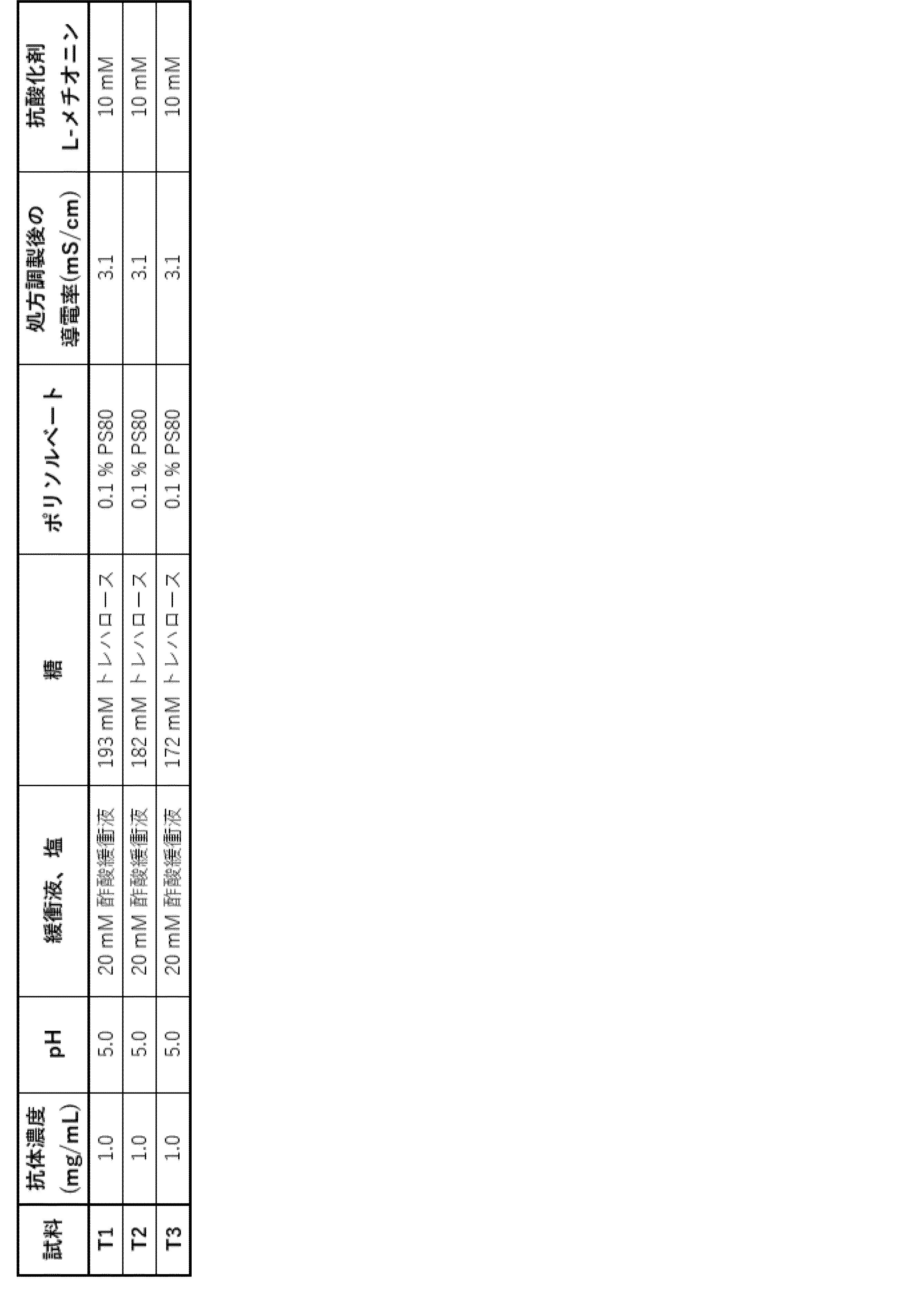
この2種の試料を0.22 μmフィルターにて滅菌し、1 mLずつ滅菌済みのバイアルに分注して、表46に示す条件下にて安定性評価を実施した。These two samples were sterilized using a 0.22 μm filter and dispensed in 1 mL portions into sterilized vials, and stability evaluation was performed under the conditions shown in Table 46.

各条件下で保管した試料について、(a)IE-HPLC解析 、(b)RP-HPLCおよび(c)PD-1およびCD3への結合活性の測定を各々実施した。IE-HPLC解析は、表25に示された条件で実施された。RP-HPLCは表26に示された条件で実施された。PD-1およびCD3への結合活性の測定は、SPRにより行われた。
(a)IE-HPLCにて評価した、保管前後での酸性分子種の割合(%)を表47に示す。何れの処方においても、25℃および40℃下での長期保管において酸性分子種が上昇した。通常の保管温度となる5℃下では安定であった。処方間で差は認められなかった。
Samples stored under each condition were subjected to (a) IE-HPLC analysis, (b) RP-HPLC, and (c) measurement of binding activity to PD-1 and CD3, respectively. IE-HPLC analysis was performed under the conditions shown in Table 25. RP-HPLC was performed under the conditions shown in Table 26. Measurement of binding activity to PD-1 and CD3 was performed by SPR.
(a) The percentages (%) of acidic molecular species before and after storage, as evaluated by IE-HPLC, are shown in Table 47. In all formulations, the acidic molecular species increased after long-term storage at 25°C and 40°C. They were stable at 5°C, the usual storage temperature. No difference was observed between the formulations.
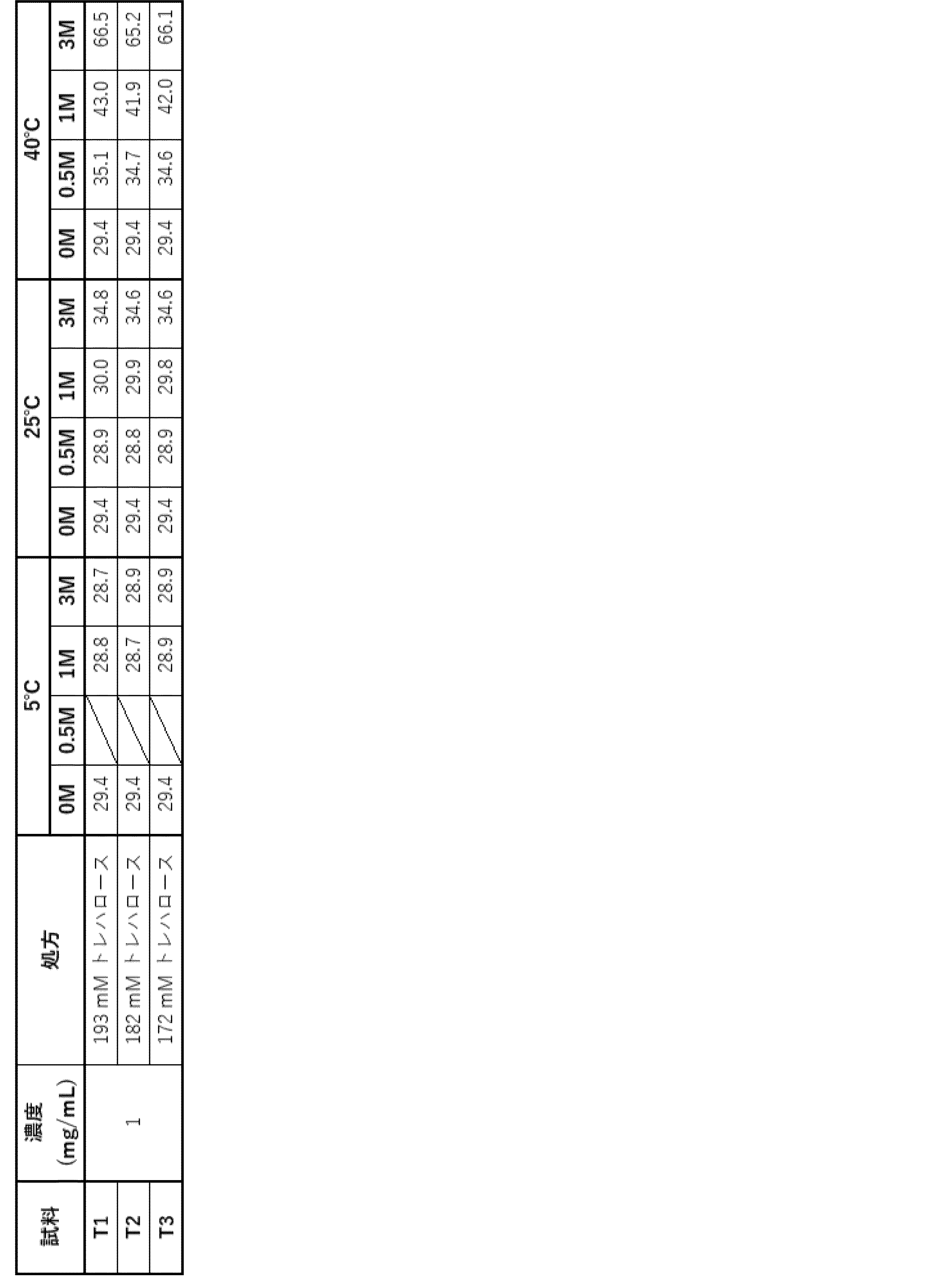
(b)RP-HPLCにて評価した、保管前後での着色体の割合を表48に示す。何れの処方においても、40℃下での長期保管において着色体が上昇した。処方間で差は認められなかった。 (b) The percentage of colored matter before and after storage, evaluated by RP-HPLC, is shown in Table 48. In all formulations, the amount of colored matter increased upon long-term storage at 40°C. No difference was observed between the formulations.

(C)SPRにて評価した、保管試験前後でのPD-1への結合活性の結果を表49に、CD3結合活性の結果を表50に各々示す。各表中の数値は、抗体αの標準品に対する比活性(%)を表す。いずれの条件においても、PD-1、CD-3への結合活性の大幅な低下は認められなかった。また、処方間でもその差は認められなかった。 (C) The results of the binding activity to PD-1 and the binding activity to CD3, evaluated by SPR before and after the storage test, are shown in Table 49 and Table 50, respectively. The values in each table represent the specific activity (%) relative to the standard antibody α. Under any of the conditions, no significant decrease in the binding activity to PD-1 or CD-3 was observed. Furthermore, no difference was observed between the formulations.


実施例9:安定性試験(4)
実施例1~8までの検討において、本発明にかかる抗体αが、安定に保管され得る条件を見出した。それらを総合して最適と考えられた条件の安定性試験を実施した。 Example 9: Stability test (4)
In the studies of Examples 1 to 8, conditions were found under which the antibody α of the present invention can be stably stored. Taking these conditions into consideration, a stability test was carried out under conditions that were deemed optimal.
酢酸処方(20 mM酢酸緩衝液(pH 5.0)、182.38 mMトレハロース、0.1 % PS80、1.36 mg/mL 塩化ナトリウム、10 mM L-メチオニン)に、1 mg/mLまたは100 mg/mLの抗体αを各々含む試料F1およびF2を表51のとおり調製した。Samples F1 and F2 containing 1 mg/mL or 100 mg/mL of antibody α, respectively, in an acetic acid formulation (20 mM acetate buffer (pH 5.0), 182.38 mM trehalose, 0.1% PS80, 1.36 mg/mL sodium chloride, 10 mM L-methionine) were prepared as shown in Table 51.

この2種の試料を0.22 μmフィルターにて滅菌し、1mLずつ滅菌済みのバイアルに分注して、表52に示す条件下にて安定性評価を実施した。These two samples were sterilized using a 0.22 μm filter and dispensed at 1 mL into sterilized vials, and stability evaluation was performed under the conditions shown in Table 52.

各条件下で保管した試料について、(a)SEC-HPLC、(b)IE-HPLC解析、(c)等電点電気泳動(iCIEF)、(d)RP-HPLC、および(e)PD-1およびCD3への結合活性の測定を各々実施した。SEC-HPLC解析は、表24に示された条件で実施された。IE-HPLC解析は、表25に示された条件で実施された。iCIEFはキャピラリー等電点電気泳動装置により行われた。RP-HPLCは表26に示された条件で実施された。PD-1およびCD3への結合活性の測定は、SPRにより行われた。
(a)SEC-HPLCにて評価した、保管前後でのHMWSの割合を表53に示す。100 mg/mLの濃度においては、25℃および40℃下の条件でHMWSの増加が認められたが、5℃下では顕著な増加は認められなかった。5℃下では安定であると考えられた。
The samples stored under each condition were subjected to (a) SEC-HPLC, (b) IE-HPLC analysis, (c) isoelectric focusing (iCIEF), (d) RP-HPLC, and (e) measurement of binding activity to PD-1 and CD3. SEC-HPLC analysis was performed under the conditions shown in Table 24. IE-HPLC analysis was performed under the conditions shown in Table 25. iCIEF was performed using a capillary isoelectric focusing apparatus. RP-HPLC was performed under the conditions shown in Table 26. Measurement of binding activity to PD-1 and CD3 was performed by SPR.
(a) The percentage of HMWS before and after storage evaluated by SEC-HPLC is shown in Table 53. At a concentration of 100 mg/mL, an increase in HMWS was observed at 25°C and 40°C, but no significant increase was observed at 5°C. It was considered stable at 5°C.

(b)IE-HPLCにて評価した、保管前後での酸性分子種の割合を表54に示す。25℃および40℃下での長期保管条件で酸性分子種の増加が認められたが、5℃下では顕著な増加は認められなかった。5℃下では安定であると考えられた。 (b) The ratio of acidic molecular species before and after storage, evaluated by IE-HPLC, is shown in Table 54. An increase in acidic molecular species was observed under long-term storage conditions at 25°C and 40°C, but no significant increase was observed at 5°C. It was considered to be stable at 5°C.

(c)iCIEFにて評価した、保管前後での酸性分子種の割合(%)を表55に示す。25℃および40℃下での長期保管条件で酸性分子種の増加が認められたが、5℃下では顕著な増加は認められなかった。5℃下では安定であると考えられた。 (c) The percentage of acidic molecular species before and after storage, evaluated by iCIEF, is shown in Table 55. An increase in acidic molecular species was observed under long-term storage conditions at 25°C and 40°C, but no significant increase was observed at 5°C. It was considered stable at 5°C.

(d)RP-HPLCにて評価した、保管前後での着色体の割合を表56に示す。25℃および40℃下での長期保管条件で着色体の増加が認められたが、5℃下では顕著な増加は認められなかった。5℃下では安定であると考えられた。 (d) The percentage of colored bodies before and after storage, evaluated by RP-HPLC, is shown in Table 56. An increase in colored bodies was observed under long-term storage conditions at 25°C and 40°C, but no significant increase was observed at 5°C. It was considered stable at 5°C.

(e)SPRにて評価した、保管試験前後でのPD-1への結合活性の結果を表57に、CD3結合活性の結果を表58に各々示す。各表中の数値は、標準品に対する比活性(%)を表す。40℃下では、PD-1の結合活性の低下を認めた。一方で、5℃および25℃下では、PD-1およびCD3ともに結合活性の低下は認められず、十分な安定性を有していると考えられた。 (e) The results of the binding activity to PD-1 and the binding activity to CD3 evaluated by SPR before and after the storage test are shown in Table 57 and Table 58, respectively. The values in each table represent the specific activity (%) relative to the standard product. A decrease in the binding activity to PD-1 was observed at 40°C. On the other hand, no decrease in the binding activity to either PD-1 or CD3 was observed at 5°C and 25°C, and the product was considered to have sufficient stability.


より低濃度での処方安定性を評価するため、酢酸処方(20 mM酢酸緩衝液(pH 5.0)、182.38 mMトレハロース、0.1 % PS80、1.36 mg/mL 塩化ナトリウム、10 mM L-メチオニン)に、0.01 mg/mLから1.0 mg/mLの抗体αを各々含む試料L1からL4を表59のとおり調製した。To evaluate the formulation stability at lower concentrations, samples L1 to L4 containing 0.01 mg/mL to 1.0 mg/mL of antibody α in an acetic acid formulation (20 mM acetate buffer (pH 5.0), 182.38 mM trehalose, 0.1% PS80, 1.36 mg/mL sodium chloride, 10 mM L-methionine) were prepared as shown in Table 59.

この2種の試料を0.22 μmフィルターにて滅菌し、滅菌済みのバイアルに分注して、表60に示す条件下にて安定性評価を実施した。These two samples were sterilized using a 0.22 μm filter and dispensed into sterilized vials, and stability evaluation was performed under the conditions shown in Table 60.

各条件下で保管した試料について、本実施例の前記評価と同様の分析評価を実施した。
(a)SEC-HPLCにて評価した、保管前後でのHMWSの割合を表61に示す。0.5 mg/mLおよび1.0 mg/mLの濃度において、5、25および40 ℃の条件下では、HMWSの割合の増加が認められなかった。
The samples stored under each condition were subjected to analytical evaluation similar to that described above in this example.
(a) The percentage of HMWS before and after storage evaluated by SEC-HPLC is shown in Table 61. At concentrations of 0.5 mg/mL and 1.0 mg/mL, no increase in the percentage of HMWS was observed under conditions of 5, 25, and 40°C.

(b)IE-HPLCにて評価した、保管前後での酸性分子種の割合を表62に示す。25 ℃および40 ℃下での長期保管条件で酸性分子種の増加が認められたが、5 ℃下では顕著な増加は認められなかった。5 ℃下では安定であると考えられた。 (b) The proportion of acidic molecular species before and after storage, evaluated by IE-HPLC, is shown in Table 62. An increase in acidic molecular species was observed under long-term storage conditions at 25°C and 40°C, but no significant increase was observed at 5°C. It was considered to be stable at 5°C.

(c)iCIEFにて評価した、保管前後での酸性分子種の割合(%)を表63に示す。25 ℃および40 ℃下での長期保管条件で酸性分子種の増加が認められたが、5 ℃下では顕著な増加は認められなかった。5 ℃下では安定であると考えられた。 (c) The percentage of acidic molecular species before and after storage, as evaluated by iCIEF, is shown in Table 63. An increase in acidic molecular species was observed under long-term storage conditions at 25°C and 40°C, but no significant increase was observed at 5°C. It was considered stable at 5°C.

(d)SPRにて評価した、保管試験前後でのPD-1への結合活性の結果を表64に、CD3結合活性の結果を表65に各々示す。各表中の数値は、標準品に対する比活性(%)を表す。全温度、濃度域においてPD-1およびCD3ともに結合活性の低下は認められず、十分な安定性を有していると考えられた。 (d) The results of the binding activity to PD-1 and the binding activity to CD3 evaluated by SPR before and after the storage test are shown in Table 64 and Table 65, respectively. The values in each table represent the specific activity (%) relative to the standard product. No decrease in binding activity was observed for either PD-1 or CD3 at all temperatures and concentration ranges, and the product was considered to have sufficient stability.
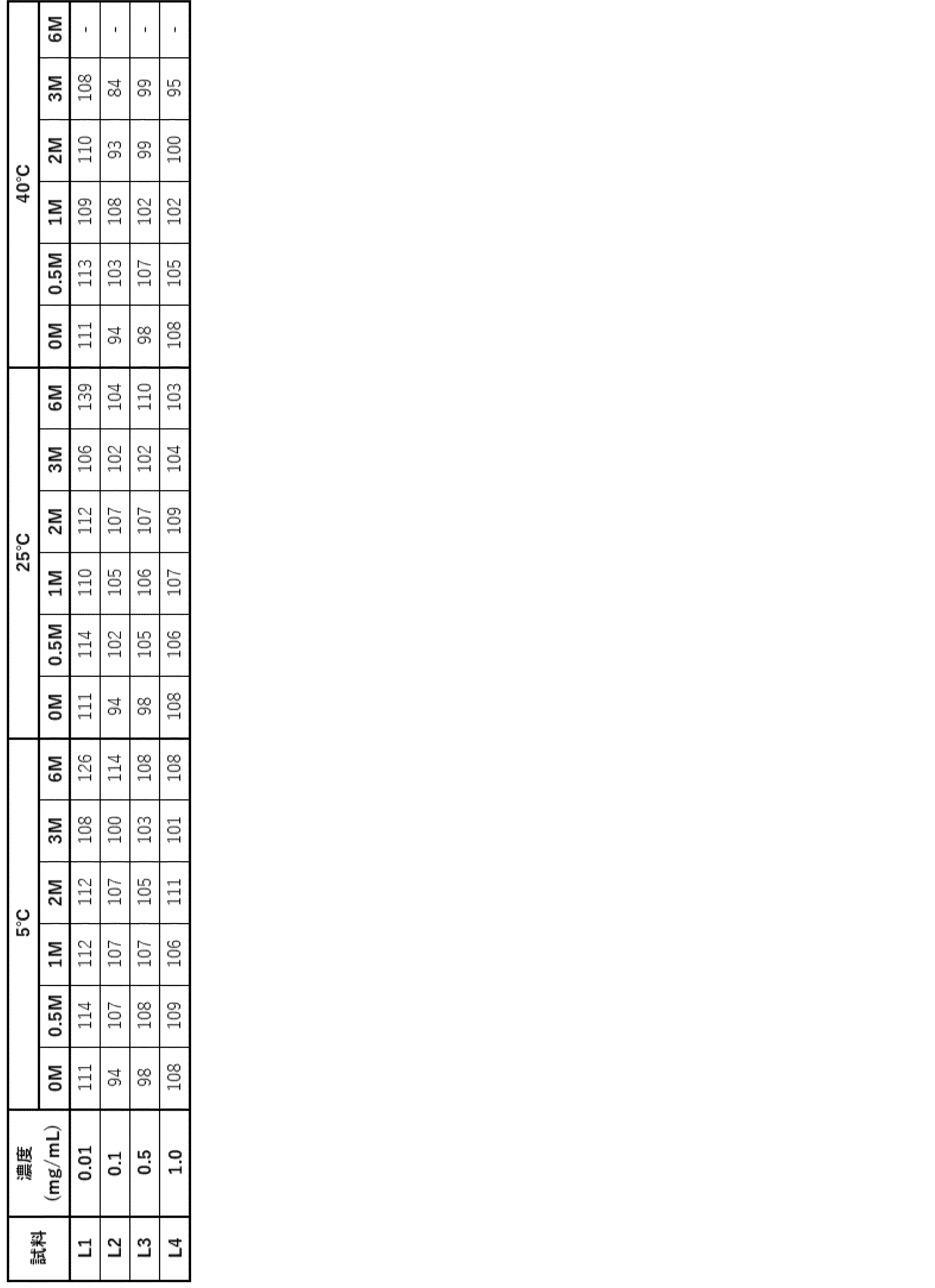

実施例10:処方調製法
本発明の水性医薬組成物を調製する方法について、実施例9の試料F2を例に、以下に示す。なお、同試料F2と抗体濃度が異なる本発明の水性医薬組成物についても、同様に調製することができる。
(a)処方調製液1を、20 mM酢酸緩衝液(pH 5.0)、182.38 mMトレハロース、1.36 mg/mL 塩化ナトリウムおよび10 mM L-メチオニンとなるように調製する。
(b)処方調製液2を、20 mM酢酸緩衝液(pH 5.0)、182.38 mMトレハロース、2 % PS80、1.36 mg/mL 塩化ナトリウムおよび10 mM L-メチオニンとなるように調製する。
(c)処方調製液3を、20 mM酢酸緩衝液(pH 5.0)、182.38 mMトレハロース、0.1 % PS80、1.36 mg/mL 塩化ナトリウムおよび10 mM L-メチオニンとなるように調製する。
(d)抗体αの製造工程のうち、ウイルスろ過工程から得られた工程液を、限外ろ過/透析ろ過膜で処方調製液1に溶液組成を置換する。
(e)前項(d)において、溶液組成を処方調製液1に置換した、抗体αを含む工程液を、限外ろ過/透析ろ過膜で約140 mg/mLまで濃縮する。
(f)前項(e)において濃縮した抗体αを含む工程液に、高濃度のPS80を含む処方調製液2を添加し、PS80濃度が0.1%となるように調製する。
(g)前項(f)において、目的のPS80濃度に調整した抗体αを含む工程液に、処方調製液3を添加し、抗体濃度が目的の100 mg/mLとなるように希釈する。 Example 10: Formulation preparation method A method for preparing the aqueous pharmaceutical composition of the present invention is described below using sample F2 of Example 9 as an example. Note that aqueous pharmaceutical compositions of the present invention having a different antibody concentration from that of sample F2 can also be prepared in the same manner.
(a) Prepare
(b)
(c) Prepare
(d) In the process for producing antibody α, the process solution obtained from the virus filtration step is replaced in solution composition with the
(e) In the preceding paragraph (d), the process solution containing antibody α, the solution composition of which has been replaced with
(f) To the process solution containing the antibody α concentrated in the previous section (e),
(g) In the preceding paragraph (f), the process solution containing antibody α adjusted to the desired PS80 concentration is added with
抗PD-1/CD3二重特異性抗体を有効成分とする、本発明の医薬組成物またはその製剤は、自己免疫疾患もしくは移植片対宿主病(GVHD)あるいは血液がんの予防、症状進展抑制、再発抑制または治療に有用である。The pharmaceutical composition of the present invention or a preparation thereof, which contains an anti-PD-1/CD3 bispecific antibody as an active ingredient, is useful for preventing, inhibiting the progression of symptoms, inhibiting recurrence, or treating autoimmune diseases, graft-versus-host disease (GVHD), or blood cancer.
Claims (12)
(b)18~22 mMの酢酸緩衝剤、
(c)172~193 mMのトレハロース、
(d)5~15 mMのL-メチオニン、
(e)0.05~0.3 %(w/v)のポリソルベート80、および
(f)19.6~25.7 mMの塩化ナトリウムを含み、pHが4.9~5.1である、皮下投与用もしくは静脈内投与用の水性医薬組成物またはその製剤であって、
ここで、当該抗PD-1/CD3二重特異性抗体が、
(i)PD-1に特異的に結合する抗原結合部位を構成する重鎖および軽鎖、ならびに
(ii)CD3に特異的に結合する抗原結合部位を構成する重鎖および軽鎖からなり、
(α)前項(i)の重鎖が、配列番号5のアミノ酸配列からなり、
(β)前項(ii)の重鎖が、配列番号6のアミノ酸配列からなり、ならびに
(γ)前項(i)および前項(ii)の軽鎖がともに、配列番号7のアミノ酸配列からなる当該二重特異性抗体である、当該水性医薬組成物またはその製剤。 (a) containing 0.1 to 1.2 mg/mL of an anti-PD-1/CD3 bispecific antibody as an active ingredient, and further comprising:
(b) 18-22 mM acetate buffer;
(c) 172-193 mM trehalose;
(d) 5 to 15 mM L-methionine;
(e) 0.05-0.3% (w/v) polysorbate 80; and (f) 19.6-25.7 mM sodium chloride, and a pH of 4.9-5.1, wherein the aqueous pharmaceutical composition or a formulation thereof for subcutaneous or intravenous administration is
wherein the anti-PD-1/CD3 bispecific antibody is
(i) a heavy chain and a light chain that form an antigen-binding site that specifically binds to PD-1, and (ii) a heavy chain and a light chain that form an antigen-binding site that specifically binds to CD3;
(α) the heavy chain of the preceding paragraph (i) consists of the amino acid sequence of SEQ ID NO:5;
(β) The aqueous pharmaceutical composition or the formulation thereof, which is a bispecific antibody, wherein the heavy chain of the preceding item (ii) consists of the amino acid sequence of SEQ ID NO: 6, and (γ) the light chains of the preceding items (i) and (ii) both consist of the amino acid sequences of SEQ ID NO: 7.
(b)20.07 mMの酢酸緩衝剤、
(c)182.38 mMのトレハロース、
(d)10.05 mMのL-メチオニン、
(e)0.1 %(w/v)のポリソルベート80、ならびに
(f)23.27 mMの塩化ナトリウムを含み、pHが5.0である、皮下投与用もしくは静脈内投与用の水性医薬組成物またはその製剤であって、
ここで、当該抗PD-1/CD3二重特異性抗体が、
(i)PD-1に特異的に結合する抗原結合部位を構成する重鎖および軽鎖、ならびに
(ii)CD3に特異的に結合する抗原結合部位を構成する重鎖および軽鎖からなり、
(α)前項(i)の重鎖が、配列番号5のアミノ酸配列からなり、
(β)前項(ii)の重鎖が、配列番号6のアミノ酸配列からなり、ならびに
(γ)前項(i)および前項(ii)の軽鎖がともに、配列番号7のアミノ酸配列からなる当該二重特異性抗体である、当該水性医薬組成物またはその製剤。 (a) containing 0.5 mg/mL or 1 mg/mL of an anti-PD-1/CD3 bispecific antibody as an active ingredient, and further comprising:
(b) 20.07 mM acetate buffer;
(c) 182.38 mM trehalose;
(d) 10.05 mM L-methionine;
(e) 0.1% (w/v) polysorbate 80; and (f) 23.27 mM sodium chloride, having a pH of 5.0, an aqueous pharmaceutical composition for subcutaneous or intravenous administration or a formulation thereof,
wherein the anti-PD-1/CD3 bispecific antibody is
(i) a heavy chain and a light chain that form an antigen-binding site that specifically binds to PD-1, and (ii) a heavy chain and a light chain that form an antigen-binding site that specifically binds to CD3;
(α) the heavy chain of the preceding paragraph (i) consists of the amino acid sequence of SEQ ID NO:5;
(β) The aqueous pharmaceutical composition or a formulation thereof, which is a bispecific antibody, wherein the heavy chain of the preceding item (ii) consists of the amino acid sequence of SEQ ID NO: 6, and (γ) the light chains of the preceding items (i) and (ii) both consist of the amino acid sequences of SEQ ID NO: 7.
(b)(b1)1.68~2.05 mg/mLの酢酸ナトリウム三水和物、および(b2)前項(b1)の酢酸ナトリウム三水和物の分量に対応して、pHが4.9~5.1となる分量の酢酸からなる酢酸緩衝剤、
(c)65.1~72.6 mg/mLのトレハロース二水和物、
(d)0.75~2.25 mg/mLのL-メチオニン、
(e)0.5~3.0 mg/mLのポリソルベート80、ならびに
(f)1.15~1.5 mg/mLの塩化ナトリウムを含み、pHが4.9~5.1である、皮下投与用もしくは静脈内投与用の水性医薬組成物またはその製剤であって、
ここで、当該抗PD-1/CD3二重特異性抗体が、
(i)PD-1に特異的に結合する抗原結合部位を構成する重鎖および軽鎖、ならびに
(ii)CD3に特異的に結合する抗原結合部位を構成する重鎖および軽鎖からなり、
(α)前項(i)の重鎖が、配列番号5のアミノ酸配列からなり、
(β)前項(ii)の重鎖が、配列番号6のアミノ酸配列からなり、ならびに
(γ)前項(i)および前項(ii)の軽鎖がともに、配列番号7のアミノ酸配列からなる当該二重特異性抗体である、当該水性医薬組成物またはその製剤。 (a) containing 0.1 to 1.2 mg/mL of an anti-PD-1/CD3 bispecific antibody as an active ingredient, and further comprising:
(b) an acetate buffer comprising (b1) 1.68 to 2.05 mg/mL sodium acetate trihydrate, and (b2) an amount of acetic acid that provides a pH of 4.9 to 5.1, corresponding to the amount of sodium acetate trihydrate in (b1);
(c) 65.1 to 72.6 mg/mL trehalose dihydrate;
(d) 0.75 to 2.25 mg/mL L-methionine;
(e) 0.5-3.0 mg/mL polysorbate 80; and (f) 1.15-1.5 mg/mL sodium chloride, and a pH of 4.9-5.1, comprising an aqueous pharmaceutical composition or a formulation thereof for subcutaneous or intravenous administration,
wherein the anti-PD-1/CD3 bispecific antibody is
(i) a heavy chain and a light chain that form an antigen-binding site that specifically binds to PD-1, and (ii) a heavy chain and a light chain that form an antigen-binding site that specifically binds to CD3;
(α) the heavy chain of the preceding paragraph (i) consists of the amino acid sequence of SEQ ID NO:5;
(β) The aqueous pharmaceutical composition or the formulation thereof, which is a bispecific antibody, wherein the heavy chain of the preceding item (ii) consists of the amino acid sequence of SEQ ID NO: 6, and (γ) the light chains of the preceding items (i) and (ii) both consist of the amino acid sequences of SEQ ID NO: 7.
(b)1.87 mg/mLの酢酸ナトリウム三水和物および0.38 mg/mLの酢酸からなる酢酸緩衝剤、
(c)69 mg/mLのトレハロース二水和物、
(d)1.5 mg/mLのL-メチオニン、
(e)1.0 mg/mLのポリソルベート80、ならびに
(f)1.36 mg/mLの塩化ナトリウムを含み、pHが5.0である、皮下投与用もしくは静脈内投与用の水性医薬組成物またはその製剤であって、
ここで、当該抗PD-1/CD3二重特異性抗体が、
(i)PD-1に特異的に結合する抗原結合部位を構成する重鎖および軽鎖、ならびに
(ii)CD3に特異的に結合する抗原結合部位を構成する重鎖および軽鎖からなり、
(α)前項(i)の重鎖が、配列番号5のアミノ酸配列からなり、
(β)前項(ii)の重鎖が、配列番号6のアミノ酸配列からなり、ならびに
(γ)前項(i)および前項(ii)の軽鎖がともに、配列番号7のアミノ酸配列からなる当該二重特異性抗体である、当該水性医薬組成物またはその製剤。 (a) containing 0.5 mg/mL or 1 mg/mL of an anti-PD-1/CD3 bispecific antibody as an active ingredient, and further comprising:
(b) acetate buffer consisting of 1.87 mg/mL sodium acetate trihydrate and 0.38 mg/mL acetic acid;
(c) 69 mg/mL trehalose dihydrate;
(d) 1.5 mg/mL L-methionine;
An aqueous pharmaceutical composition or a formulation thereof for subcutaneous or intravenous administration, comprising (e) 1.0 mg/mL polysorbate 80, and (f) 1.36 mg/mL sodium chloride, and having a pH of 5.0;
wherein the anti-PD-1/CD3 bispecific antibody is
(i) a heavy chain and a light chain that form an antigen-binding site that specifically binds to PD-1, and (ii) a heavy chain and a light chain that form an antigen-binding site that specifically binds to CD3;
(α) the heavy chain of the preceding paragraph (i) consists of the amino acid sequence of SEQ ID NO:5;
(β) The aqueous pharmaceutical composition or a formulation thereof, which is a bispecific antibody, wherein the heavy chain of the preceding item (ii) consists of the amino acid sequence of SEQ ID NO: 6, and (γ) the light chains of the preceding items (i) and (ii) both consist of the amino acid sequences of SEQ ID NO: 7.
(b)(b1)8.4~10.2 mgの酢酸ナトリウム三水和物、および(b2)前項(b1)の酢酸ナトリウム三水和物の分量に対応して、pHが4.9~5.1となる分量の氷酢酸からなる酢酸緩衝剤、
(c)325~365.1 mgのトレハロース二水和物、
(d)3.75~11.25 mgのL-メチオニン、
(e)2.5~15.0 mgのポリソルベート80、ならびに
(f)5.8~7.5 mgの塩化ナトリウムを含み、pHが4.9~5.1であり、単位製剤当たりの容量が5 mLである、皮下投与用もしくは静脈内投与用の水性医薬組成物またはその製剤であって、
ここで、当該抗PD-1/CD3二重特異性抗体が、
(i)PD-1に特異的に結合する抗原結合部位を構成する重鎖および軽鎖、ならびに
(ii)CD3に特異的に結合する抗原結合部位を構成する重鎖および軽鎖からなり、
(α)前項(i)の重鎖が、配列番号5のアミノ酸配列からなり、
(β)前項(ii)の重鎖が、配列番号6のアミノ酸配列からなり、ならびに
(γ)前項(i)および前項(ii)の軽鎖がともに、配列番号7のアミノ酸配列からなる当該二重特異性抗体である、当該水性医薬組成物またはその製剤。 (a) 0.5 to 6 mg of an anti-PD-1/CD3 bispecific antibody as an active ingredient, and further comprising:
(b) an acetate buffer consisting of (b1) 8.4 to 10.2 mg of sodium acetate trihydrate, and (b2) glacial acetic acid in an amount corresponding to the amount of sodium acetate trihydrate in (b1) above, such that the pH is 4.9 to 5.1;
(c) 325 to 365.1 mg of trehalose dihydrate;
(d) 3.75 to 11.25 mg of L-methionine;
An aqueous pharmaceutical composition or a formulation thereof for subcutaneous or intravenous administration, comprising (e) 2.5 to 15.0 mg of polysorbate 80 and (f) 5.8 to 7.5 mg of sodium chloride, a pH of 4.9 to 5.1, and a volume of 5 mL per unit formulation,
wherein the anti-PD-1/CD3 bispecific antibody is
(i) a heavy chain and a light chain that form an antigen-binding site that specifically binds to PD-1, and (ii) a heavy chain and a light chain that form an antigen-binding site that specifically binds to CD3;
(α) the heavy chain of the preceding paragraph (i) consists of the amino acid sequence of SEQ ID NO:5;
(β) The aqueous pharmaceutical composition or a formulation thereof, which is a bispecific antibody, wherein the heavy chain of the preceding item (ii) consists of the amino acid sequence of SEQ ID NO: 6, and (γ) the light chains of the preceding items (i) and (ii) both consist of the amino acid sequences of SEQ ID NO: 7.
(b)9.35 mgの酢酸ナトリウム三水和物および1.9 mgの氷酢酸からなる酢酸緩衝剤、
(c)345 mgのトレハロース二水和物、
(d)7.5 mgのL-メチオニン、
(e)5.0 mgのポリソルベート80、ならびに
(f)6.8 mgの塩化ナトリウムを含み、pHが5.0であり、単位製剤当たりの容量が5 mLである、皮下投与用もしくは静脈内投与用の水性医薬組成物またはその製剤であって、
ここで、当該抗PD-1/CD3二重特異性抗体が、
(i)PD-1に特異的に結合する抗原結合部位を構成する重鎖および軽鎖、ならびに
(ii)CD3に特異的に結合する抗原結合部位を構成する重鎖および軽鎖からなり、
(α)前項(i)の重鎖が、配列番号5のアミノ酸配列からなり、
(β)前項(ii)の重鎖が、配列番号6のアミノ酸配列からなり、ならびに
(γ)前項(i)および前項(ii)の軽鎖がともに、配列番号7のアミノ酸配列からなる当該二重特異性抗体である、当該水性医薬組成物またはその製剤。 (a) 2.5 mg or 5 mg of an anti-PD-1/CD3 bispecific antibody as an active ingredient, and further comprising:
(b) acetate buffer consisting of 9.35 mg of sodium acetate trihydrate and 1.9 mg of glacial acetic acid;
(c) 345 mg trehalose dihydrate;
(d) 7.5 mg L-methionine;
An aqueous pharmaceutical composition or a formulation thereof for subcutaneous or intravenous administration, comprising (e) 5.0 mg of polysorbate 80 and (f) 6.8 mg of sodium chloride, a pH of 5.0, and a volume of 5 mL per unit dosage form,
wherein the anti-PD-1/CD3 bispecific antibody is
(i) a heavy chain and a light chain that form an antigen-binding site that specifically binds to PD-1, and (ii) a heavy chain and a light chain that form an antigen-binding site that specifically binds to CD3;
(α) the heavy chain of the preceding paragraph (i) consists of the amino acid sequence of SEQ ID NO:5;
(β) The aqueous pharmaceutical composition or a formulation thereof, which is a bispecific antibody, wherein the heavy chain of the preceding item (ii) consists of the amino acid sequence of SEQ ID NO: 6, and (γ) the light chains of the preceding items (i) and (ii) both consist of the amino acid sequences of SEQ ID NO: 7.
(b)(b1)3.36~4.1 mgの酢酸ナトリウム三水和物、および(b2)前項(b1)の酢酸ナトリウム三水和物の分量に対応して、pHが4.9~5.1となる分量の氷酢酸からなる酢酸緩衝剤、
(c)130.2~145.2 mgのトレハロース二水和物、
(d)1.5~4.5 mgのL-メチオニン、
(e)1.0~6.0 mgのポリソルベート80、ならびに
(f)2.3~3.0 mgの塩化ナトリウムを含み、pHが4.9~5.1であり、単位製剤当たりの容量が2 mLである、皮下投与用もしくは静脈内投与用の水性医薬組成物またはその製剤であって、
ここで、当該抗PD-1/CD3二重特異性抗体が、
(i)PD-1に特異的に結合する抗原結合部位を構成する重鎖および軽鎖、ならびに
(ii)CD3に特異的に結合する抗原結合部位を構成する重鎖および軽鎖からなり、
(α)前項(i)の重鎖が、配列番号5のアミノ酸配列からなり、
(β)前項(ii)の重鎖が、配列番号6のアミノ酸配列からなり、ならびに
(γ)前項(i)および前項(ii)の軽鎖がともに、配列番号7のアミノ酸配列からなる当該二重特異性抗体である、当該水性医薬組成物またはその製剤。 (a) 0.2 to 2.4 mg of an anti-PD-1/CD3 bispecific antibody as an active ingredient, and further comprising:
(b) an acetate buffer comprising (b1) 3.36 to 4.1 mg of sodium acetate trihydrate, and (b2) glacial acetic acid in an amount corresponding to the amount of sodium acetate trihydrate in (b1) above, such that the pH is 4.9 to 5.1;
(c) 130.2 to 145.2 mg of trehalose dihydrate;
(d) 1.5 to 4.5 mg of L-methionine;
An aqueous pharmaceutical composition or a formulation thereof for subcutaneous or intravenous administration, comprising (e) 1.0 to 6.0 mg of polysorbate 80, and (f) 2.3 to 3.0 mg of sodium chloride, a pH of 4.9 to 5.1, and a volume of 2 mL per unit formulation,
wherein the anti-PD-1/CD3 bispecific antibody is
(i) a heavy chain and a light chain that form an antigen-binding site that specifically binds to PD-1, and (ii) a heavy chain and a light chain that form an antigen-binding site that specifically binds to CD3;
(α) the heavy chain of the preceding paragraph (i) consists of the amino acid sequence of SEQ ID NO:5;
(β) The aqueous pharmaceutical composition or a formulation thereof, which is a bispecific antibody, wherein the heavy chain of the preceding item (ii) consists of the amino acid sequence of SEQ ID NO: 6, and (γ) the light chains of the preceding items (i) and (ii) both consist of the amino acid sequences of SEQ ID NO: 7.
(b)3.74 mgの酢酸ナトリウム三水和物および0.76 mgの氷酢酸からなる酢酸緩衝剤、
(c)138 mgのトレハロース二水和物、
(d)3.0 mgのL-メチオニン、
(e)2.0 mgのポリソルベート80、ならびに
(f)2.72 mgの塩化ナトリウムを含み、pHが5.0であり、単位製剤当たりの容量が2 mLである、皮下投与用もしくは静脈内投与用の水性医薬組成物またはその製剤であって、
ここで、当該抗PD-1/CD3二重特異性抗体が、
(i)PD-1に特異的に結合する抗原結合部位を構成する重鎖および軽鎖、ならびに
(ii)CD3に特異的に結合する抗原結合部位を構成する重鎖および軽鎖からなり、
(α)前項(i)の重鎖が、配列番号5のアミノ酸配列からなり、
(β)前項(ii)の重鎖が、配列番号6のアミノ酸配列からなり、ならびに
(γ)前項(i)および前項(ii)の軽鎖がともに、配列番号7のアミノ酸配列からなる当該二重特異性抗体である、当該水性医薬組成物またはその製剤。 (a) 1 mg of an anti-PD-1/CD3 bispecific antibody as an active ingredient, and further comprising:
(b) acetate buffer consisting of 3.74 mg of sodium acetate trihydrate and 0.76 mg of glacial acetic acid;
(c) 138 mg trehalose dihydrate;
(d) 3.0 mg L-methionine;
An aqueous pharmaceutical composition or a formulation thereof for subcutaneous or intravenous administration, comprising (e) 2.0 mg of polysorbate 80 and (f) 2.72 mg of sodium chloride, a pH of 5.0, and a volume of 2 mL per unit formulation,
wherein the anti-PD-1/CD3 bispecific antibody is
(i) a heavy chain and a light chain that form an antigen-binding site that specifically binds to PD-1, and (ii) a heavy chain and a light chain that form an antigen-binding site that specifically binds to CD3;
(α) the heavy chain of the preceding paragraph (i) consists of the amino acid sequence of SEQ ID NO:5;
(β) The aqueous pharmaceutical composition or the formulation thereof, which is a bispecific antibody, wherein the heavy chain of the preceding item (ii) consists of the amino acid sequence of SEQ ID NO: 6, and (γ) the light chains of the preceding items (i) and (ii) both consist of the amino acid sequences of SEQ ID NO: 7.
Priority Applications (1)
| Application Number | Priority Date | Filing Date | Title |
|---|---|---|---|
| JP2024126120A JP2024153869A (en) | 2023-03-16 | 2024-08-01 | Antibody preparations |
Applications Claiming Priority (5)
| Application Number | Priority Date | Filing Date | Title |
|---|---|---|---|
| JP2023041761 | 2023-03-16 | ||
| JP2023041761 | 2023-03-16 | ||
| JP2023154195 | 2023-09-21 | ||
| JP2023154195 | 2023-09-21 | ||
| PCT/JP2024/010151 WO2024190892A1 (en) | 2023-03-16 | 2024-03-15 | Antibody preparation |
Related Child Applications (1)
| Application Number | Title | Priority Date | Filing Date |
|---|---|---|---|
| JP2024126120A Division JP2024153869A (en) | 2023-03-16 | 2024-08-01 | Antibody preparations |
Publications (3)
| Publication Number | Publication Date |
|---|---|
| JP7548475B1 true JP7548475B1 (en) | 2024-09-10 |
| JPWO2024190892A1 JPWO2024190892A1 (en) | 2024-09-19 |
| JPWO2024190892A5 JPWO2024190892A5 (en) | 2025-02-19 |
Family
ID=92673345
Family Applications (2)
| Application Number | Title | Priority Date | Filing Date |
|---|---|---|---|
| JP2024534766A Active JP7548475B1 (en) | 2023-03-16 | 2024-03-15 | Antibody preparations |
| JP2024126120A Pending JP2024153869A (en) | 2023-03-16 | 2024-08-01 | Antibody preparations |
Family Applications After (1)
| Application Number | Title | Priority Date | Filing Date |
|---|---|---|---|
| JP2024126120A Pending JP2024153869A (en) | 2023-03-16 | 2024-08-01 | Antibody preparations |
Country Status (6)
| Country | Link |
|---|---|
| EP (1) | EP4681730A1 (en) |
| JP (2) | JP7548475B1 (en) |
| KR (1) | KR20250156121A (en) |
| CN (1) | CN120752054A (en) |
| AU (1) | AU2024237533A1 (en) |
| MX (1) | MX2025010452A (en) |
Citations (7)
| Publication number | Priority date | Publication date | Assignee | Title |
|---|---|---|---|---|
| WO2011161226A2 (en) * | 2010-06-25 | 2011-12-29 | F. Hoffmann-La Roche Ag | Novel antibody formulation |
| WO2019156199A1 (en) * | 2018-02-09 | 2019-08-15 | 小野薬品工業株式会社 | Bispecific antibody |
| JP2019526627A (en) * | 2016-08-29 | 2019-09-19 | ティジアーナ ライフ サイエンシズ パブリック リミティド カンパニー | Anti-CD3 antibody preparation |
| WO2021210662A1 (en) * | 2020-04-17 | 2021-10-21 | 小野薬品工業株式会社 | Color removal method for protein formulation active ingredient |
| JP2022553058A (en) * | 2019-10-25 | 2022-12-21 | アムジェン インコーポレイテッド | Compositions and methods for minimizing protein loss at low protein concentrations |
| WO2023031970A1 (en) * | 2021-09-03 | 2023-03-09 | Dr. Reddy’S Laboratories Limited | A pharmaceutical formulation of immune check point inhibitors |
| WO2023031969A1 (en) * | 2021-09-03 | 2023-03-09 | Dr. Reddy’S Laboratories Limited | A method of improving stability of immune check point inhibitors |
Family Cites Families (11)
| Publication number | Priority date | Publication date | Assignee | Title |
|---|---|---|---|---|
| NZ519012A (en) | 2001-05-21 | 2003-10-31 | Orgapack Gmbh | Manually actuated strapping unit for wrapping a steel strap around a packaged item |
| EP1445264B1 (en) | 2001-07-31 | 2011-09-14 | Ono Pharmaceutical Co., Ltd. | Substance specific to pd-1 |
| JP2004072286A (en) | 2002-08-05 | 2004-03-04 | Nippon Telegr & Teleph Corp <Ntt> | Structural change detection method and communication network abnormal state detection method, and apparatus and program thereof |
| EP2270051B1 (en) | 2003-01-23 | 2019-05-15 | Ono Pharmaceutical Co., Ltd. | Antibody specific for human PD-1 and CD3 |
| US9701749B2 (en) | 2011-08-11 | 2017-07-11 | Ono Pharmaceutical Co., Ltd. | Therapeutic agent for autoimmune diseases comprising PD-1 agonist |
| EP2946765B1 (en) | 2014-05-23 | 2016-08-31 | Ares Trading S.A. | Liquid pharmaceutical composition |
| CN107987161B (en) | 2016-10-26 | 2021-04-16 | 泰州迈博太科药业有限公司 | anti-EGFR monoclonal antibody preparation |
| BR112019018022A2 (en) | 2017-03-01 | 2020-06-02 | Medimmune Limited | MONOCLONAL ANTIBODY FORMULATIONS |
| CN114174343A (en) | 2019-07-30 | 2022-03-11 | 小野药品工业株式会社 | Bispecific antibodies |
| US20240067720A1 (en) | 2021-01-14 | 2024-02-29 | Shanghai Junshi Biosciences Co., Ltd. | Anti-tigit antibody pharmaceutical composition and application thereof |
| CN115869395A (en) | 2021-09-26 | 2023-03-31 | 泰州迈博太科药业有限公司 | Antibody-buffer solution system |
-
2024
- 2024-03-15 JP JP2024534766A patent/JP7548475B1/en active Active
- 2024-03-15 KR KR1020257029539A patent/KR20250156121A/en active Pending
- 2024-03-15 EP EP24770994.2A patent/EP4681730A1/en active Pending
- 2024-03-15 AU AU2024237533A patent/AU2024237533A1/en active Pending
- 2024-03-15 CN CN202480016597.0A patent/CN120752054A/en active Pending
- 2024-08-01 JP JP2024126120A patent/JP2024153869A/en active Pending
-
2025
- 2025-09-04 MX MX2025010452A patent/MX2025010452A/en unknown
Patent Citations (7)
| Publication number | Priority date | Publication date | Assignee | Title |
|---|---|---|---|---|
| WO2011161226A2 (en) * | 2010-06-25 | 2011-12-29 | F. Hoffmann-La Roche Ag | Novel antibody formulation |
| JP2019526627A (en) * | 2016-08-29 | 2019-09-19 | ティジアーナ ライフ サイエンシズ パブリック リミティド カンパニー | Anti-CD3 antibody preparation |
| WO2019156199A1 (en) * | 2018-02-09 | 2019-08-15 | 小野薬品工業株式会社 | Bispecific antibody |
| JP2022553058A (en) * | 2019-10-25 | 2022-12-21 | アムジェン インコーポレイテッド | Compositions and methods for minimizing protein loss at low protein concentrations |
| WO2021210662A1 (en) * | 2020-04-17 | 2021-10-21 | 小野薬品工業株式会社 | Color removal method for protein formulation active ingredient |
| WO2023031970A1 (en) * | 2021-09-03 | 2023-03-09 | Dr. Reddy’S Laboratories Limited | A pharmaceutical formulation of immune check point inhibitors |
| WO2023031969A1 (en) * | 2021-09-03 | 2023-03-09 | Dr. Reddy’S Laboratories Limited | A method of improving stability of immune check point inhibitors |
Also Published As
| Publication number | Publication date |
|---|---|
| EP4681730A1 (en) | 2026-01-21 |
| MX2025010452A (en) | 2025-10-01 |
| AU2024237533A1 (en) | 2025-09-18 |
| CN120752054A (en) | 2025-10-03 |
| KR20250156121A (en) | 2025-10-31 |
| JPWO2024190892A1 (en) | 2024-09-19 |
| JP2024153869A (en) | 2024-10-29 |
Similar Documents
| Publication | Publication Date | Title |
|---|---|---|
| KR102397713B1 (en) | Stable Liquid Pharmaceutical Formulation | |
| JP5577098B2 (en) | Stable buffered formulations containing polypeptides | |
| KR101782203B1 (en) | Lyophilised and aqueous anti-cd40 antibody formulations | |
| EP3991745A1 (en) | Formulations containing anti-cd47/pd-l1 bispecific antibody and preparation method therefor and use thereof | |
| ES2783448T3 (en) | Methods of treating systemic lupus erythematosus using a domain antibody directed against CD28 | |
| JP7045327B2 (en) | Pharmaceutical composition and administration regimen for clinical use of anti-blood dendritic cell antigen 2 antibody | |
| KR20180135475A (en) | Compositions comprising a co-form of anti-PD-L1 and anti-CTLA-4 antibodies | |
| TW200831129A (en) | Stable formulations | |
| KR20210114989A (en) | therapeutic antibody formulation | |
| KR20220124208A (en) | Programmed cell death receptor 1 antibody preparations and uses thereof | |
| CN109498565B (en) | Stable anti-PD-1 antibody preparation and application thereof | |
| JP7548475B1 (en) | Antibody preparations | |
| WO2024190892A1 (en) | Antibody preparation | |
| RU2745814C1 (en) | Aqueous pharmaceutical composition of levilimab and the use thereof | |
| KR20220028972A (en) | Stable Pharmaceutical Formulation | |
| US11459399B2 (en) | Pharmaceutical compositions of a HER2/neu antibody and use of the same | |
| CN120239616A (en) | Antibody preparations | |
| KR20250106231A (en) | Stable Pharmaceutical Formulation | |
| HK40093464A (en) | Stable pharmaceutical preparation | |
| US20230053747A1 (en) | Pharmaceutical Compositions of a HER2/neu Antibody and Use of the Same | |
| NZ748101B2 (en) | Stable liquid pharmaceutical preparation | |
| HK40003220A (en) | Stable liquid pharmaceutical preparation |
Legal Events
| Date | Code | Title | Description |
|---|---|---|---|
| A521 | Request for written amendment filed |
Free format text: JAPANESE INTERMEDIATE CODE: A523 Effective date: 20240611 |
|
| A621 | Written request for application examination |
Free format text: JAPANESE INTERMEDIATE CODE: A621 Effective date: 20240611 |
|
| A871 | Explanation of circumstances concerning accelerated examination |
Free format text: JAPANESE INTERMEDIATE CODE: A871 Effective date: 20240611 |
|
| TRDD | Decision of grant or rejection written | ||
| A01 | Written decision to grant a patent or to grant a registration (utility model) |
Free format text: JAPANESE INTERMEDIATE CODE: A01 Effective date: 20240730 |
|
| A61 | First payment of annual fees (during grant procedure) |
Free format text: JAPANESE INTERMEDIATE CODE: A61 Effective date: 20240812 |
|
| R150 | Certificate of patent or registration of utility model |
Ref document number: 7548475 Country of ref document: JP Free format text: JAPANESE INTERMEDIATE CODE: R150 |