JP7515785B2 - Phosphoalkyl polymers containing biologically active compounds - Patents.com - Google Patents
Phosphoalkyl polymers containing biologically active compounds - Patents.com Download PDFInfo
- Publication number
- JP7515785B2 JP7515785B2 JP2020538716A JP2020538716A JP7515785B2 JP 7515785 B2 JP7515785 B2 JP 7515785B2 JP 2020538716 A JP2020538716 A JP 2020538716A JP 2020538716 A JP2020538716 A JP 2020538716A JP 7515785 B2 JP7515785 B2 JP 7515785B2
- Authority
- JP
- Japan
- Prior art keywords
- occurrence
- independently
- compound
- linker
- compounds
- Prior art date
- Legal status (The legal status is an assumption and is not a legal conclusion. Google has not performed a legal analysis and makes no representation as to the accuracy of the status listed.)
- Active
Links
Classifications
-
- A—HUMAN NECESSITIES
- A61—MEDICAL OR VETERINARY SCIENCE; HYGIENE
- A61K—PREPARATIONS FOR MEDICAL, DENTAL OR TOILETRY PURPOSES
- A61K47/00—Medicinal preparations characterised by the non-active ingredients used, e.g. carriers or inert additives; Targeting or modifying agents chemically bound to the active ingredient
- A61K47/50—Medicinal preparations characterised by the non-active ingredients used, e.g. carriers or inert additives; Targeting or modifying agents chemically bound to the active ingredient the non-active ingredient being chemically bound to the active ingredient, e.g. polymer-drug conjugates
- A61K47/51—Medicinal preparations characterised by the non-active ingredients used, e.g. carriers or inert additives; Targeting or modifying agents chemically bound to the active ingredient the non-active ingredient being chemically bound to the active ingredient, e.g. polymer-drug conjugates the non-active ingredient being a modifying agent
- A61K47/56—Medicinal preparations characterised by the non-active ingredients used, e.g. carriers or inert additives; Targeting or modifying agents chemically bound to the active ingredient the non-active ingredient being chemically bound to the active ingredient, e.g. polymer-drug conjugates the non-active ingredient being a modifying agent the modifying agent being an organic macromolecular compound, e.g. an oligomeric, polymeric or dendrimeric molecule
- A61K47/59—Medicinal preparations characterised by the non-active ingredients used, e.g. carriers or inert additives; Targeting or modifying agents chemically bound to the active ingredient the non-active ingredient being chemically bound to the active ingredient, e.g. polymer-drug conjugates the non-active ingredient being a modifying agent the modifying agent being an organic macromolecular compound, e.g. an oligomeric, polymeric or dendrimeric molecule obtained otherwise than by reactions only involving carbon-to-carbon unsaturated bonds, e.g. polyureas or polyurethanes
- A61K47/605—Medicinal preparations characterised by the non-active ingredients used, e.g. carriers or inert additives; Targeting or modifying agents chemically bound to the active ingredient the non-active ingredient being chemically bound to the active ingredient, e.g. polymer-drug conjugates the non-active ingredient being a modifying agent the modifying agent being an organic macromolecular compound, e.g. an oligomeric, polymeric or dendrimeric molecule obtained otherwise than by reactions only involving carbon-to-carbon unsaturated bonds, e.g. polyureas or polyurethanes the macromolecule containing phosphorus in the main chain, e.g. poly-phosphazene
-
- A—HUMAN NECESSITIES
- A61—MEDICAL OR VETERINARY SCIENCE; HYGIENE
- A61K—PREPARATIONS FOR MEDICAL, DENTAL OR TOILETRY PURPOSES
- A61K47/00—Medicinal preparations characterised by the non-active ingredients used, e.g. carriers or inert additives; Targeting or modifying agents chemically bound to the active ingredient
- A61K47/50—Medicinal preparations characterised by the non-active ingredients used, e.g. carriers or inert additives; Targeting or modifying agents chemically bound to the active ingredient the non-active ingredient being chemically bound to the active ingredient, e.g. polymer-drug conjugates
- A61K47/51—Medicinal preparations characterised by the non-active ingredients used, e.g. carriers or inert additives; Targeting or modifying agents chemically bound to the active ingredient the non-active ingredient being chemically bound to the active ingredient, e.g. polymer-drug conjugates the non-active ingredient being a modifying agent
- A61K47/68—Medicinal preparations characterised by the non-active ingredients used, e.g. carriers or inert additives; Targeting or modifying agents chemically bound to the active ingredient the non-active ingredient being chemically bound to the active ingredient, e.g. polymer-drug conjugates the non-active ingredient being a modifying agent the modifying agent being an antibody, an immunoglobulin or a fragment thereof, e.g. an Fc-fragment
- A61K47/6835—Medicinal preparations characterised by the non-active ingredients used, e.g. carriers or inert additives; Targeting or modifying agents chemically bound to the active ingredient the non-active ingredient being chemically bound to the active ingredient, e.g. polymer-drug conjugates the non-active ingredient being a modifying agent the modifying agent being an antibody, an immunoglobulin or a fragment thereof, e.g. an Fc-fragment the modifying agent being an antibody or an immunoglobulin bearing at least one antigen-binding site
- A61K47/6849—Medicinal preparations characterised by the non-active ingredients used, e.g. carriers or inert additives; Targeting or modifying agents chemically bound to the active ingredient the non-active ingredient being chemically bound to the active ingredient, e.g. polymer-drug conjugates the non-active ingredient being a modifying agent the modifying agent being an antibody, an immunoglobulin or a fragment thereof, e.g. an Fc-fragment the modifying agent being an antibody or an immunoglobulin bearing at least one antigen-binding site the antibody targeting a receptor, a cell surface antigen or a cell surface determinant
-
- A—HUMAN NECESSITIES
- A61—MEDICAL OR VETERINARY SCIENCE; HYGIENE
- A61K—PREPARATIONS FOR MEDICAL, DENTAL OR TOILETRY PURPOSES
- A61K47/00—Medicinal preparations characterised by the non-active ingredients used, e.g. carriers or inert additives; Targeting or modifying agents chemically bound to the active ingredient
- A61K47/50—Medicinal preparations characterised by the non-active ingredients used, e.g. carriers or inert additives; Targeting or modifying agents chemically bound to the active ingredient the non-active ingredient being chemically bound to the active ingredient, e.g. polymer-drug conjugates
- A61K47/51—Medicinal preparations characterised by the non-active ingredients used, e.g. carriers or inert additives; Targeting or modifying agents chemically bound to the active ingredient the non-active ingredient being chemically bound to the active ingredient, e.g. polymer-drug conjugates the non-active ingredient being a modifying agent
- A61K47/68—Medicinal preparations characterised by the non-active ingredients used, e.g. carriers or inert additives; Targeting or modifying agents chemically bound to the active ingredient the non-active ingredient being chemically bound to the active ingredient, e.g. polymer-drug conjugates the non-active ingredient being a modifying agent the modifying agent being an antibody, an immunoglobulin or a fragment thereof, e.g. an Fc-fragment
- A61K47/6835—Medicinal preparations characterised by the non-active ingredients used, e.g. carriers or inert additives; Targeting or modifying agents chemically bound to the active ingredient the non-active ingredient being chemically bound to the active ingredient, e.g. polymer-drug conjugates the non-active ingredient being a modifying agent the modifying agent being an antibody, an immunoglobulin or a fragment thereof, e.g. an Fc-fragment the modifying agent being an antibody or an immunoglobulin bearing at least one antigen-binding site
- A61K47/6851—Medicinal preparations characterised by the non-active ingredients used, e.g. carriers or inert additives; Targeting or modifying agents chemically bound to the active ingredient the non-active ingredient being chemically bound to the active ingredient, e.g. polymer-drug conjugates the non-active ingredient being a modifying agent the modifying agent being an antibody, an immunoglobulin or a fragment thereof, e.g. an Fc-fragment the modifying agent being an antibody or an immunoglobulin bearing at least one antigen-binding site the antibody targeting a determinant of a tumour cell
-
- A—HUMAN NECESSITIES
- A61—MEDICAL OR VETERINARY SCIENCE; HYGIENE
- A61P—SPECIFIC THERAPEUTIC ACTIVITY OF CHEMICAL COMPOUNDS OR MEDICINAL PREPARATIONS
- A61P35/00—Antineoplastic agents
-
- A—HUMAN NECESSITIES
- A61—MEDICAL OR VETERINARY SCIENCE; HYGIENE
- A61K—PREPARATIONS FOR MEDICAL, DENTAL OR TOILETRY PURPOSES
- A61K45/00—Medicinal preparations containing active ingredients not provided for in groups A61K31/00 - A61K41/00
- A61K45/06—Mixtures of active ingredients without chemical characterisation, e.g. antiphlogistics and cardiaca
Landscapes
- Health & Medical Sciences (AREA)
- Life Sciences & Earth Sciences (AREA)
- Animal Behavior & Ethology (AREA)
- Veterinary Medicine (AREA)
- Public Health (AREA)
- General Health & Medical Sciences (AREA)
- Chemical & Material Sciences (AREA)
- Medicinal Chemistry (AREA)
- Pharmacology & Pharmacy (AREA)
- Bioinformatics & Cheminformatics (AREA)
- Epidemiology (AREA)
- Engineering & Computer Science (AREA)
- Immunology (AREA)
- Cell Biology (AREA)
- Nuclear Medicine, Radiotherapy & Molecular Imaging (AREA)
- General Chemical & Material Sciences (AREA)
- Chemical Kinetics & Catalysis (AREA)
- Organic Chemistry (AREA)
- Medicinal Preparation (AREA)
- Pharmaceuticals Containing Other Organic And Inorganic Compounds (AREA)
- Acyclic And Carbocyclic Compounds In Medicinal Compositions (AREA)
- Compositions Of Macromolecular Compounds (AREA)
- Medicines Containing Antibodies Or Antigens For Use As Internal Diagnostic Agents (AREA)
Description
本発明の実施形態は、生物学的に活性なポリマー化合物、ならびにその調製方法および様々な治療方法における使用方法を一般に対象とする。 Embodiments of the present invention are generally directed to biologically active polymeric compounds and methods for their preparation and use in various therapeutic methods.
関連技術の説明
標的化薬物コンジュゲートは、例えば化学療法とは異なり、罹患細胞しか標的とせず、かつ健常な細胞を害さないよう意図されている。通常、コンジュゲートは、生物学的に活性なペイロードまたは薬物に連結されている標的指向性分子から構成される。コンジュゲートは、固有の標的能力と生物学的に活性な薬物の治療有効性とを組み合わせることにより、意図する標的だけに薬物を送達し、潜在的な副作用を最小化することができる。
抗体-薬物コンジュゲート(ADC)は、がん処置に特に関心がもたれる標的化薬物コンジュゲートのクラスの1つである。ADCは、モノクローナル抗体の標的指向性特徴と、細胞毒性剤のがん死滅能とを組み合わせて、他の化学療法剤よりもいくつかの利点を有する治療を実現する。しかし、ADC構築の複雑さ、具体的には、抗体と薬物との間の化学リンカーに関わる難題により、新規かつ有効な治療剤の開発はかなり困難である。最初のADCは、2001年に承認されたが、次のADCが承認されるまでに、ほとんど10年間が費やされた。現時点において、Adcetris(登録商標)およびKadcyla(登録商標)しか、世界中で市販されていない(Zevalin(登録商標)は、中国でしか承認されてない)。先駆者のPfizer/Wyethは、比較臨床試験の間に安全性問題が観察された後の2010年にMylotarg(登録商標)を取り消した。
したがって、大きな治療指数を有する強力な標的薬物コンジュゲートが当分野において必要とされている。理想的には、このような薬物コンジュゲートは、健常な組織と罹患組織(例えば、腫瘍細胞)との間の微妙な区別を実現すべきである。本発明は、この必要性に応え、さらなる関連する利点を実現する。
Description of Related Art Targeted drug conjugates are intended to target only diseased cells and not harm healthy cells, unlike chemotherapy, for example. Typically, conjugates are composed of a targeting molecule linked to a biologically active payload or drug. By combining the inherent targeting ability with the therapeutic efficacy of biologically active drugs, conjugates can deliver drugs only to the intended target and minimize potential side effects.
Antibody-drug conjugates (ADCs) are one of the classes of targeted drug conjugates that are of particular interest for cancer treatment. ADCs combine the targeting characteristics of monoclonal antibodies with the cancer-killing potential of cytotoxic agents, resulting in a therapy with several advantages over other chemotherapeutic agents. However, the complexity of ADC construction, specifically the challenges associated with the chemical linker between the antibody and the drug, make the development of new and effective therapeutic agents quite challenging. The first ADC was approved in 2001, but it took almost a decade for the next ADC to be approved. At present, only Adcetris® and Kadcyla® are commercially available worldwide (Zevalin® is only approved in China). Pioneer Pfizer/Wyeth withdrew Mylotarg® in 2010 after safety issues were observed during controlled clinical trials.
Therefore, there is a need in the art for potent targeted drug conjugates with large therapeutic index. Ideally, such drug conjugates should achieve fine discrimination between healthy and diseased tissues (e.g., tumor cells). The present invention meets this need and achieves further related advantages.
手短に述べると、本発明の実施形態は、腫瘍細胞などの標的への選択的送達を可能にする蛍光色素および/または着色色素を含んでもよい、標的化薬物コンジュゲートとして有用な化合物、ならびにその調製のための試薬を一般に対象とする。このような分子を調製する方法、およびそれを必要とする患者に治療処置を提供するための該分子の使用方法も記載されている。
現在開示されている化合物の実施形態は、リンカー(「L」)によって共有結合により連結されている、1つまたは複数の生物学的に活性な部分を含む。有利には、本発明の実施形態は、ポリマー合成の間に組み込まれ得るか、または合成後に結合され得る化合物を提供する。さらに、本明細書に記載されている実施形態は、同一化合物内の複数の生物学的に活性な部分の取り込み、および標的指向性部分の任意の含有を可能にする。
一実施形態では、以下の構造(I)を有する化合物:
Briefly, embodiments of the present invention are generally directed to compounds useful as targeted drug conjugates, which may include fluorescent and/or colored dyes that allow for selective delivery to targets such as tumor cells, as well as reagents for their preparation. Methods for preparing such molecules and methods of using the same to provide therapeutic treatment to patients in need thereof are also described.
The presently disclosed compound embodiments include one or more biologically active moieties covalently linked by a linker ("L"). Advantageously, the present invention embodiments provide compounds that can be incorporated during polymer synthesis or attached post-synthetically. Additionally, the embodiments described herein allow for the incorporation of multiple biologically active moieties within the same compound, and the optional inclusion of a targeting moiety.
In one embodiment, a compound having the following structure (I):

または、立体異性体、互変異性体もしくはその塩が提供される(式中、R1、R2、R3、R4、R5、L、L1、L2、L3、M、mおよびnは、本明細書で定義されている通りである)。構造(I)の化合物は、様々な処置法の治療剤としての使用を含めた、いくつかの用途における利用が見いだされる。
別の実施形態では、それを必要とする対象に、治療有効量の構造(I)の化合物または構造(I)の化合物を含む組成物を投与するステップを含む、疾患を処置する方法であって、Mはそれぞれ、独立して、疾患を処置するのに有効な生物活性部分を含む、方法が提供される。
本発明のこれらの態様および他の態様が、以下の詳細説明を参照すると明白になろう。
or a stereoisomer, tautomer or salt thereof is provided, wherein R1 , R2 , R3 , R4 , R5 , L, L1 , L2 , L3 , M, m and n are as defined herein. The compounds of structure (I) find utility in a number of applications, including use as therapeutic agents in a variety of treatment methods.
In another embodiment, a method of treating a disease is provided comprising administering to a subject in need thereof a therapeutically effective amount of a compound of structure (I) or a composition comprising a compound of structure (I), wherein each M independently comprises a biologically active moiety effective to treat the disease.
These and other aspects of the present invention will become evident upon reference to the following detailed description.
以下の記載において、ある種の具体的な詳細は、本発明の様々な実施形態の完全な理解をもたらすために記載されている。しかし、当業者は、これらの詳細なしに本発明が行われ得ることを理解しているであろう。
文脈上異なる解釈を要する場合を除き、本明細書および特許請求の範囲の全体を通して、語「含む(comprise)」、ならびに「含む(comprises)」および「含むこと(comprising)」などのその変化形は、オープンな包括的な意味で、すなわち、「以下に限定されないが、含む」として解釈されるべきである。
In the following description, certain specific details are set forth in order to provide a thorough understanding of various embodiments of the invention. However, it will be understood by one of ordinary skill in the art that the invention may be practiced without these details.
Unless the context requires otherwise, throughout this specification and the claims, the word "comprise" and variations thereof, such as "comprises" and "comprising," are to be interpreted in their open and inclusive sense, i.e., "including but not limited to."
本明細書全体を参照して、「一実施形態」または「実施形態」という場合、これらの実施形態に関連して記載されている、特定の特徴、構造または性質が、本発明の少なくとも1つの実施形態に含まれていることを意味する。したがって、本明細書の全体にわたる様々な位置における、「一実施形態では」または「実施形態では」という言い回しの出現は、すべてが、同じ実施形態を必ずしも指すわけではない。さらに、具体的な特徴、構造または性質は、1つまたは複数の実施形態における、任意の好適な方法において組み合わされてもよい。
「アミノ」とは、-NH2基を指す。
「カルボキシ」とは、-CO2H基を指す。
「シアノ」とは、-CN基を指す。
「ホルミル」」とは、-C(=O)H基を指す。
「ヒドロキシ」または「ヒドロキシル」とは、-OH基を指す。
「イミノ」とは、=NH基を指す。
「ニトロ」とは、-NO2基を指す。
「オキソ」とは、=O置換基を指す。
「スルフヒドリル」とは、-SH基を指す。
「チオキソ」とは、=S基を指す。
With reference to the entire specification, the references to "one embodiment" or "an embodiment" mean that the particular features, structures, or properties described in connection with the embodiment are included in at least one embodiment of the invention. Thus, the appearances of the phrases "in one embodiment" or "in an embodiment" in various places throughout the specification do not necessarily all refer to the same embodiment. Furthermore, the particular features, structures, or properties may be combined in any suitable manner in one or more embodiments.
"Amino" refers to the group --NH .
"Carboxy" refers to the group --CO 2 H.
"Cyano" refers to the group -CN.
"Formyl" refers to the group -C(=O)H.
"Hydroxy" or "hydroxyl" refers to an --OH group.
"Imino" refers to the group ═NH.
"Nitro" refers to the -NO2 group.
"Oxo" refers to the ═O substituent.
"Sulfhydryl" refers to a -SH group.
"Thioxo" refers to the group ═S.
「アルキル」とは、不飽和を含まず、1~12個の炭素原子(C1-C12アルキル),1~8個の炭素原子(C1-C8アルキル)または1~6個の炭素原子(C1-C6アルキル)を有する、炭素原子および水素原子のみからなる直鎖状または分岐状の炭化水素鎖の基であって、単結合によって分子の残りに結合している炭化水素鎖の基、例えば、メチル、エチル、n-プロピル、1-メチルエチル(イソ-プロピル)、n-ブチル、n-ペンチル、1,1-ジメチルエチル(t-ブチル)、3-メチルヘキシル、2-メチルヘキシルなどを指す。本明細書中において特に具体的に明記しない限り、アルキル基は、置換されていてもよい。 "Alkyl" refers to a straight or branched hydrocarbon chain radical containing no unsaturation and consisting solely of carbon and hydrogen atoms, having from 1 to 12 carbon atoms ( C1 - C12 alkyl), 1 to 8 carbon atoms ( C1 - C8 alkyl), or 1 to 6 carbon atoms ( C1 - C6 alkyl), and attached to the remainder of the molecule by a single bond, e.g., methyl, ethyl, n-propyl, 1-methylethyl (iso-propyl), n-butyl, n-pentyl, 1,1-dimethylethyl (t-butyl), 3-methylhexyl, 2-methylhexyl, and the like. Unless specifically stated otherwise in this specification, alkyl groups may be optionally substituted.
「アルキレン」または「アルキレン鎖」とは、不飽和を含まず、1~12個の炭素原子を有する、炭素および水素のみからなる、分子の残りをラジカル基に連結する、二価の直鎖状または分岐状炭化水素鎖、例えば、メチレン、エチレン、プロピレン、n-ブチレン、エテニレン、プロペニレン、n-ブテニレン、プロピニレン、n-ブチニレンなどを指す。アルキレン鎖は、単結合を介して分子の残りに、かつ単結合を介してラジカル基に結合している。分子の残りおよびラジカル基へのアルキレン鎖の結合点は、この鎖内の1個の炭素または任意の2つの炭素を介することができる。本明細書において特に具体的に明記しない限り、アルキレンは、置換されていてもよい。 "Alkylene" or "alkylene chain" refers to a divalent straight or branched hydrocarbon chain, containing no unsaturation and consisting only of carbon and hydrogen, having 1 to 12 carbon atoms, linking the rest of the molecule to a radical group, e.g., methylene, ethylene, propylene, n-butylene, ethenylene, propenylene, n-butenylene, propynylene, n-butynylene, etc. The alkylene chain is attached to the rest of the molecule through a single bond and to the radical group through a single bond. The points of attachment of the alkylene chain to the rest of the molecule and to the radical group can be through one carbon or any two carbons within the chain. Unless stated otherwise specifically in this specification, alkylene may be substituted.
「アルケニレン」または「アルケニレン鎖」とは、少なくとも1つの炭素-炭素二重結合を含み、2~12個の炭素原子を有する、炭素および水素のみからなる、分子の残りをラジカル基に連結する、二価の直鎖状または分岐状炭化水素鎖、例えば、エテニレン、プロペニレン、n-ブテニレンなどを指す。アルケニレン鎖は、単結合を介して分子の残りに、および二重結合または単結合を介してラジカル基に結合している。アルケニレン鎖の、分子の残りおよびラジカル基への結合点は、この鎖内の1個の炭素または任意の2個の炭素を介することができる。本明細書において特に具体的に明記しない限り、アルケニレンは置換されていてもよい。
「アルキニレン」または「アルキニレン鎖」とは、少なくとも1つの炭素-炭素三重結合を含有し、2~12個の炭素原子を有する、炭素および水素のみからなる、分子の残りをラジカル基に連結する、二価の直鎖状または分岐状炭化水素鎖、例えば、エテニレン、プロペニレン、n-ブテニレンなどを指す。アルキニレン鎖は、単結合を介して分子の残りに、および二重結合または単結合を介してラジカル基に結合している。アルキニレン鎖の、分子の残りおよびラジカル基への結合点は、この鎖内の1個の炭素または任意の2個の炭素を介することができる。本明細書において特に具体的に明記しない限り、アルキニレンは、置換されていてもよい。
"Alkenylene" or "alkenylene chain" refers to a divalent straight or branched hydrocarbon chain, consisting solely of carbon and hydrogen, containing at least one carbon-carbon double bond, having 2 to 12 carbon atoms, linking the rest of the molecule to a radical group, e.g., ethenylene, propenylene, n-butenylene, and the like. The alkenylene chain is attached to the rest of the molecule through a single bond and to the radical group through a double bond or a single bond. The points of attachment of the alkenylene chain to the rest of the molecule and to the radical group can be through one carbon or any two carbons within the chain. Unless stated otherwise specifically in the specification, alkenylene may be optionally substituted.
"Alkynylene" or "alkynylene chain" refers to a divalent straight or branched hydrocarbon chain, consisting only of carbon and hydrogen, containing at least one carbon-carbon triple bond, having 2 to 12 carbon atoms, e.g., ethenylene, propenylene, n-butenylene, and the like, that links the rest of the molecule to a radical group. The alkynylene chain is attached to the rest of the molecule through a single bond and to the radical group through a double bond or a single bond. The points of attachment of the alkynylene chain to the rest of the molecule and to the radical group can be through one carbon or any two carbons within the chain. Unless stated otherwise specifically in the specification, alkynylene can be optionally substituted.
「アルキルエーテル」とは、少なくとも1つの炭素-炭素結合が、炭素-酸素結合により置き換えられている、上で定義されている任意のアルキル基を指す。炭素-酸素結合は、末端(アルコキシ基中として)に存在していてもよく、または炭素-酸素結合は内部(すなわち、C-O-C)に存在していてもよい。アルキルエーテルは、少なくとも1つの炭素-酸素結合を含むが、1つ超で含むことがある。例えば、ポリエチレングリコール(PEG)は、アルキルエーテルの意味に含まれている。本明細書において特に具体的に明記しない限り、アルキルエーテル基は、置換されていてもよい。例えば、一部の実施形態では、アルキルエーテルは、アルコールまたは-OP(=Ra)(Rb)Rcにより置換されており、Ra、RbおよびRcはそれぞれ、構造(I)の化合物に関して定義されている通りである。
「アルコキシ」とは、式-ORaの基を指し、Raは、1~12個の炭素原子を含有する、上で定義したアルキル基である。本明細書において特に具体的に明記しない限り、アルコキシ基は、置換されていてもよい。
"Alkyl ether" refers to any alkyl group, as defined above, in which at least one carbon-carbon bond is replaced by a carbon-oxygen bond. The carbon-oxygen bond may be terminal (as in an alkoxy group) or the carbon-oxygen bond may be internal (i.e., C-O-C). An alkyl ether contains at least one carbon-oxygen bond, but may contain more than one. For example, polyethylene glycol (PEG) is included within the meaning of alkyl ether. Unless specifically stated otherwise herein, an alkyl ether group may be substituted. For example, in some embodiments, an alkyl ether is substituted with an alcohol or -OP(=R a )(R b )R c , where R a , R b and R c are each as defined for the compound of structure (I).
"Alkoxy" refers to a radical of the formula -OR a , where R a is an alkyl radical, as defined above, containing 1 to 12 carbon atoms. Unless stated otherwise specifically in the specification, an alkoxy group may be optionally substituted.
「アルコキシアルキルエーテル」とは、式-ORaRbの基を指し、Raは、1~12個の炭素原子を含有する、上で定義したアルキレン基であり、Rbは、本明細書で定義されているアルキルエーテル基である。本明細書において特に具体的に明記しない限り、アルコキシアルキルエーテル基は、置換されていてもよく、例えば、アルコールまたは-OP(=Ra)(Rb)Rcにより置換されていてもよく、Ra、RbおよびRcはそれぞれ、構造(I)の化合物に関して定義されている通りである。 "Alkoxyalkyl ether" refers to a group of formula -OR a R b where R a is an alkylene group as defined above containing 1 to 12 carbon atoms and R b is an alkyl ether group as defined herein. Unless otherwise specifically stated in the specification, an alkoxyalkyl ether group may be optionally substituted, for example, by an alcohol or -OP(=Ra)(Rb)R c , where Ra, Rb and R c are each defined for the compounds of structure (I).
「ヘテロアルキル」とは、アルキル基内、またはアルキル基の末端において、少なくとも1個のヘテロ原子(例えば、Si、N、O、PまたはS)を含む、上で定義したアルキル基を指す。一部の実施形態では、ヘテロ原子は、アルキル基内に存在する(すなわち、ヘテロアルキルは、少なくとも1つの炭素-[ヘテロ原子]x-炭素結合を含み、xは、1、2または3である)。他の実施形態では、ヘテロ原子は、アルキル基の末端に存在し、したがって、該アルキル基を分子の残りに結合させる働きをし(例えば、M1-H-A)、M1は、分子の一部であり、Hは、ヘテロ原子であり、Aは、アルキル基である。本明細書において特に具体的に明記しない限り、ヘテロアルキル基は、置換されていてもよい。例示的なヘテロアルキル基には、ホスホジエステル結合などのリン-酸素結合を含んでもよい、エチレンオキシド(例えば、ポリエチレンオキシド)が含まれる。
「ヘテロアルコキシ」とは、式-ORaの基を指し、Raは、1~12個の炭素原子を含有する、上で定義したヘテロアルキル基である。本明細書において特に具体的に明記しない限り、ヘテロアルコキシ基は、置換されていてもよい。
"Heteroalkyl" refers to an alkyl group, as defined above, that contains at least one heteroatom (e.g., Si, N, O, P, or S) within the alkyl group or at the terminus of the alkyl group. In some embodiments, the heteroatom is within the alkyl group (i.e., the heteroalkyl contains at least one carbon-[heteroatom] x -carbon bond, where x is 1, 2, or 3). In other embodiments, the heteroatom is at the terminus of the alkyl group, thus serving to attach the alkyl group to the remainder of the molecule (e.g., M1-H-A), where M1 is part of the molecule, H is the heteroatom, and A is the alkyl group. Unless otherwise specifically stated herein, heteroalkyl groups may be substituted. Exemplary heteroalkyl groups include ethylene oxide (e.g., polyethylene oxide), which may contain a phosphorus-oxygen bond, such as a phosphodiester bond.
"Heteroalkoxy" refers to a radical of the formula -OR a , where R a is a heteroalkyl radical, as defined above, containing 1 to 12 carbon atoms. Unless stated otherwise specifically in the specification, a heteroalkoxy group may be optionally substituted.
「ヘテロアルキレン」とは、アルキレン鎖内、またはアルキレン鎖の末端において、少なくとも1個のヘテロ原子(例えば、Si、N、O、PまたはS)を含む、上で定義したアルキレン基を指す。一部の実施形態では、ヘテロ原子は、アルキレン鎖内に存在する(すなわち、ヘテロアルキレンは、少なくとも1つの炭素-[ヘテロ原子]-炭素結合を含み、xは、1、2または3である)。他の実施形態では、ヘテロ原子は、アルキレンの末端に存在し、該アルキレンを分子の残りに結合させるよう働く(例えば、M1-H-A-M2、M1およびM2は、分子の一部であり、Hは、ヘテロ原子であり、Aは、アルキレンである)。本明細書において特に具体的に明記しない限り、ヘテロアルキレン基は、置換されていてもよい。例示的なヘテロアルキレン連結基が、以下に例示されている: "Heteroalkylene" refers to an alkylene group, as defined above, that includes at least one heteroatom (e.g., Si, N, O, P, or S) within the alkylene chain or at the terminus of the alkylene chain. In some embodiments, the heteroatom is within the alkylene chain (i.e., the heteroalkylene includes at least one carbon-[heteroatom]-carbon bond and x is 1, 2, or 3). In other embodiments, the heteroatom is at the terminus of the alkylene and serves to attach the alkylene to the remainder of the molecule (e.g., M1-H-A-M2, where M1 and M2 are part of the molecule, H is a heteroatom, and A is an alkylene). Unless otherwise specifically stated herein, heteroalkylene groups may be substituted. Exemplary heteroalkylene linking groups are illustrated below:

ヘテロアルキレンリンカーの様々な実施形態には、上記のC-リンカーの多量体が含まれる。
「ヘテロアルケニレン」は、少なくとも1つの炭素-炭素二重結合を含む、上で定義したヘテロアルキレンである。本明細書において特に具体的に明記しない限り、ヘテロアルケニレン基は、置換されていてもよい。
「ヘテロアルキニレン」は、少なくとも1つの炭素-炭素三重結合を含む、ヘテロアルキレンである。本明細書において特に具体的に明記しない限り、ヘテロアルキニレン基は、置換されていてもよい。
Various embodiments of heteroalkylene linkers include multimers of the C-linkers described above.
"Heteroalkenylene" is a heteroalkylene, as defined above, containing at least one carbon-carbon double bond. Unless stated otherwise specifically in the specification, a heteroalkenylene group may be optionally substituted.
"Heteroalkynylene" is a heteroalkylene containing at least one carbon-carbon triple bond. Unless stated otherwise specifically in the specification, a heteroalkynylene group may be optionally substituted.
「ヘテロ原子リンカー」に関連する「ヘテロ原子」とは、1個または複数のヘテロ原子からなる、リンカー基を指す。例示的なヘテロ原子リンカーには、Si、O、N、PおよびSからなる群から選択される単一原子、および複数のヘテロ原子、例えば、式-P(O-)(=O)O-または-OP(O-)(=O)O-および多量体、ならびにそれらの組合せを有するリンカーが含まれる。
「ホスフェート」とは、-OP(=O)(Ra)Rb基(Raは、OH、O-またはORcであり、Rbは、OH、O-、ORcである)、チオホスフェート基またはさらなるホスフェート基(Rcは、対イオン(例えば、Na+など)である)を指す。
"Heteroatom" in reference to a "heteroatom linker" refers to a linker group consisting of one or more heteroatoms. Exemplary heteroatom linkers include single atoms selected from the group consisting of Si, O, N, P, and S, and linkers having multiple heteroatoms, e.g., linkers having the formula -P(O - )(=O)O- or -OP(O - )(=O)O- and polymers, and combinations thereof.
"Phosphate" refers to the -OP(=O)(R a )R b group, where R a is OH, O - or OR c and R b is OH, O - , OR c , a thiophosphate group, or an additional phosphate group, where R c is a counterion, such as Na + .
「ホスホアルキル」とは、-OP(=O)(Ra)Rb基を指し、Raは、OH、O-またはORcであり、Rbは、-Oアルキルであり、Rcは、対イオン(例えば、Na+など)である。本明細書において特に具体的に明記しない限り、ホスホアルキル基は、置換されていてもよい。例えば、ある種の実施形態では、ホスホアルキル基中の-Oアルキル部分は、ヒドロキシル、アミノ、スルフヒドリル、ホスフェート、チオホスフェート、ホスホアルキル、チオホスホアルキル、ホスホアルキルエーテルまたはチオホスホアルキルエーテルのうちの1つまたは複数により置換されていてもよい。 "Phosphoalkyl" refers to the group -OP(=O)(R a )R b , where R a is OH, O - or OR c , R b is -Oalkyl, and R c is a counterion (e.g., Na + , etc.). Unless stated otherwise specifically in the specification, phosphoalkyl groups can be substituted. For example, in certain embodiments, the -Oalkyl portion in a phosphoalkyl group can be substituted with one or more of hydroxyl, amino, sulfhydryl, phosphate, thiophosphate, phosphoalkyl, thiophosphoalkyl, phosphoalkyl ether, or thiophosphoalkyl ether.
「ホスホアルキルエーテル」とは、-OP(=O)(Ra)Rb基を指し、Raは、OH、O-またはORcであり、Rbは、-Oアルキルエーテルであり、Rcは、対イオン(例えば、Na+など)である。本明細書において特に具体的に明記しない限り、ホスホアルキルエーテル基は、置換されていてもよい。例えば、ある種の実施形態では、ホスホアルキルエーテル基中の-Oアルキルエーテル部分は、ヒドロキシル、アミノ、スルフヒドリル、ホスフェート、チオホスフェート、ホスホアルキル、チオホスホアルキル、ホスホアルキルエーテルまたはチオホスホアルキルエーテルのうちの1つまたは複数により置換されていてもよい。
「チオホスフェート」とは、-OP(=Ra)(Rb)Rc基(Raは、OまたはSであり、Rbは、OH、O-、S-、ORdまたはSRdであり、Rcは、OH、SH、O-、S-、ORd、SRd、ホスフェート基またはさらなるチオホスフェート基であり、Rdは、対イオン(例えば、Na+など)であり、ただし、i)RaはSであり、ii)RbはS-またはSRdであり、iii)Rcは、SH、S-またはSRdであり、またはiv)i)、ii)および/またはiii)の組合せであることを条件とする)を指す。
"Phosphoalkyl ether" refers to the group -OP(=O)(R a )R b , where R a is OH, O - or OR c , R b is an -Oalkyl ether, and R c is a counterion (e.g., Na + , etc.). Unless stated otherwise specifically herein, a phosphoalkyl ether group may be optionally substituted. For example, in certain embodiments, the -Oalkyl ether moiety in a phosphoalkyl ether group may be substituted with one or more of hydroxyl, amino, sulfhydryl, phosphate, thiophosphate, phosphoalkyl, thiophosphoalkyl, phosphoalkyl ether, or thiophosphoalkyl ether.
"Thiophosphate" refers to the group -OP(=R a )(R b )R c , where R a is O or S; R b is OH, O - , S - , OR d or SR d ; R c is OH, SH, O - , S - , OR d , SR d , a phosphate group or a further thiophosphate group; and R d is a counterion (such as, for example, Na + ) with the proviso that i) R a is S; ii) R b is S - or SR d ; iii) R c is SH, S - or SR d ; or iv) a combination of i), ii) and/or iii).
「チオホスホアルキル」とは、-OP(=Ra)(Rb)Rc基を指し、Raは、OまたはSであり、Rbは、OH、O-、S-、ORdまたはSRdであり、Rcは、-Oアルキルであり、Rdは、対イオン(例えば、Na+など)であり、ただし、i)RaはSであり、ii)Rbは、S-またはSRdであり、またはiii)RaはSであり、Rbは、S-またはSRdであることを条件とする。本明細書において特に具体的に明記しない限り、チオホスホアルキル基は、置換されていてもよい。例えば、ある種の実施形態では、チオホスホアルキル基中の-Oアルキル部分は、ヒドロキシル、アミノ、スルフヒドリル、ホスフェート、チオホスフェート、ホスホアルキル、チオホスホアルキル、ホスホアルキルエーテルまたはチオホスホアルキルエーテルのうちの1つまたは複数により置換されていてもよい。 "Thiophosphoalkyl" refers to the group -OP(=R a )(R b )R c , where R a is O or S, R b is OH, O - , S - , OR d or SR d , R c is -Oalkyl, and R d is a counterion (such as Na + ), with the proviso that i) R a is S, ii) R b is S - or SR d , or iii) R a is S and R b is S - or SR d . Unless stated otherwise specifically herein, thiophosphoalkyl groups may be substituted. For example, in certain embodiments, the -Oalkyl portion in a thiophosphoalkyl group may be substituted with one or more of hydroxyl, amino, sulfhydryl, phosphate, thiophosphate, phosphoalkyl, thiophosphoalkyl, phosphoalkyl ether, or thiophosphoalkyl ether.
「チオホスホアルキルエーテル」とは、-OP(=Ra)(Rb)Rc基を指し、Raは、OまたはSであり、Rbは、OH、O-、S-、ORdまたはSRdであり、Rcは、-Oアルキルエーテルであり、Rdは、対イオン(例えば、Na+など)であり、ただし、i)Raは、Sであり、ii)Rbは、S-またはSRdであり、またはiii)Raは、Sであり、Rbは、S-またはSRdであることを条件とする。本明細書において特に具体的に明記しない限り、チオホスホアルキルエーテル基は、置換されていてもよい。例えば、ある種の実施形態では、チオホスホアルキル基中の-Oアルキルエーテル部分は、ヒドロキシル、アミノ、スルフヒドリル、ホスフェート、チオホスフェート、ホスホアルキル、チオホスホアルキル、ホスホアルキルエーテルまたはチオホスホアルキルエーテルのうちの1つまたは複数により置換されていてもよい。 "Thiophosphoalkyl ether" refers to the group -OP(=R a )(R b )R c , where R a is O or S, R b is OH, O - , S - , OR d or SR d , R c is an -Oalkyl ether, and R d is a counterion (such as Na + ), with the proviso that i) R a is S, ii) R b is S - or SR d , or iii) R a is S and R b is S - or SR d . Unless stated otherwise specifically herein, a thiophosphoalkyl ether group may be optionally substituted. For example, in certain embodiments, the -Oalkyl ether moiety in a thiophosphoalkyl group may be substituted with one or more of hydroxyl, amino, sulfhydryl, phosphate, thiophosphate, phosphoalkyl, thiophosphoalkyl, phosphoalkyl ether, or thiophosphoalkyl ether.
「炭素環式」とは、3~18個の炭素原子を含む、安定な3~18員の芳香族環または非芳香族環を指す。本明細書において特に具体的に明記しない限り、炭素環式環は、単環式環系、二環式環系、三環式環系または四環式環系とすることができ、これらは、縮合環系または架橋環系を含んでもよく、部分飽和または完全飽和であってもよい。非芳香族カルボシクリルラジカルには、シクロアルキルが含まれる一方、芳香族カルボシクリルラジカルには、アリールが含まれる。本明細書において特に具体的に明記しない限り、炭素環式基は、置換されていてもよい。
「シクロアルキル」とは、安定な非芳香族単環式環または多環式炭素環式環を指し、これらは、3~15個の炭素原子を有する、好ましくは3~10個の炭素原子を有する、飽和もしくは不飽和な縮合環系または架橋環系であって、単結合によって分子の残りに結合している、縮合環系または架橋環系を含んでもよい。単環式シクロカルキル(cyclocalkyl)には、例えば、シクロプロピル、シクロブチル、シクロペンチル、シクロヘキシル、シクロヘプチルおよびシクロオクチルが含まれる。多環式シクロアルキルには、例えば、アダマンチル、ノルボルニル、デカリニル、7,7-ジメチル-ビシクロ-[2.2.1]ヘプタニルなどが含まれる。本明細書において特に具体的に明記しない限り、シクロアルキル基は置換されていてもよい。
"Carbocyclic" refers to a stable 3- to 18-membered aromatic or non-aromatic ring containing from 3 to 18 carbon atoms. Unless stated otherwise specifically in the specification, a carbocyclic ring can be a monocyclic, bicyclic, tricyclic or tetracyclic ring system, which may include fused or bridged ring systems and may be partially saturated or fully saturated. Non-aromatic carbocyclyl radicals include cycloalkyl, while aromatic carbocyclyl radicals include aryl. Unless stated otherwise specifically in the specification, a carbocyclic group may be optionally substituted.
"Cycloalkyl" refers to a stable non-aromatic monocyclic or polycyclic carbocyclic ring, which may include saturated or unsaturated fused or bridged ring systems having from 3 to 15 carbon atoms, preferably from 3 to 10 carbon atoms, attached to the remainder of the molecule by a single bond. Monocyclic cycloalkyls include, for example, cyclopropyl, cyclobutyl, cyclopentyl, cyclohexyl, cycloheptyl, and cyclooctyl. Polycyclic cycloalkyls include, for example, adamantyl, norbornyl, decalinyl, 7,7-dimethyl-bicyclo-[2.2.1]heptanyl, and the like. Unless stated otherwise specifically in the specification, cycloalkyl groups may be optionally substituted.
「アリール」は、少なくとも1つの炭素環式芳香族環を含む環系を指す。一部の実施形態では、アリールは、6~18個の炭素原子を含む。アリール環は、単環式環系、二環式環系、三環式環系または四環式環系であってもよく、これらは、縮合環系または架橋環系を含んでもよい。アリールには、以下に限定されないが、アセアントリレン、アセナフチレン、アセフェナントリレン、アントラセン、アズレン、ベンゼン、クリセン、フルオランテン、フルオレン、as-インダセン、s-インダセン、インダン、インデン、ナフタレン、フェナレン、フェナントレン、プレイアデン、ピレンおよびトリフェニレンから誘導されるアリールが含まれる。本明細書において特に具体的に明記しない限り、アリール基は、置換されていてもよい。 "Aryl" refers to a ring system containing at least one carbocyclic aromatic ring. In some embodiments, an aryl contains 6 to 18 carbon atoms. The aryl ring may be a monocyclic, bicyclic, tricyclic, or tetracyclic ring system, which may include fused or bridged ring systems. Aryl includes, but is not limited to, aryls derived from aceanthrylene, acenaphthylene, acephenanthrylene, anthracene, azulene, benzene, chrysene, fluoranthene, fluorene, as-indacene, s-indacene, indane, indene, naphthalene, phenalene, phenanthrene, pleiadene, pyrene, and triphenylene. Unless otherwise specifically stated herein, aryl groups may be substituted.
「複素環式」は、1~12個の炭素原子、ならびに窒素、酸素および硫黄からなる群から選択される1~6個のヘテロ原子を含む、安定な3~18員の芳香族環または非芳香族環を指す。本明細書において特に具体的に明記しない限り、複素環式環は、単環式環系、二環式環系、三環式環系または四環式環系であってもよく、これらは、縮合環系または架橋環系を含んでもよく、複素環式環中の窒素原子、炭素原子または硫黄原子は、酸化されていてもよく、窒素原子は、四級化されていてもよく、複素環式環は、部分飽和または完全飽和であってもよい。芳香族複素環式環の例は、ヘテロアリールの定義において、以下に列挙されている(すなわち、ヘテロアリールは、複素環式のサブセットである)。非芳香族複素環式環の例には、以下に限定されないが、ジオキソラニル、チエニル[1,3]ジチアニル、デカヒドロイソキノリル、イミダゾリニル、イミダゾリジニル、イソチアゾリジニル、イソオキサゾリジニル、モルホリニル、オクタヒドロインドリル、オクタヒドロイソインドリル、2-オキソピペラジニル、2-オキソピペリジニル、2-オキソピロリジニル、オキサゾリジニル、ピペリジニル、ピペラジニル、4-ピペリドニル、ピロリジニル、ピラゾリジニル、ピラゾロピリミジニル、キヌクリジニル、チアゾリジニル、テトラヒドロフリル、トリオキサニル、トリチアニル、トリアジナニル、テトラヒドロピラニル、チオモルホリニル、チアモルホリニル、1-オキソ-チオモルホリニル、および1,1-ジオキソ-チオモルホリニルが含まれる。本明細書において特に具体的に明記しない限り、複素環式基は、置換されていてもよい。 "Heterocyclic" refers to a stable 3-18 membered aromatic or non-aromatic ring containing 1-12 carbon atoms and 1-6 heteroatoms selected from the group consisting of nitrogen, oxygen and sulfur. Unless otherwise specifically stated herein, a heterocyclic ring may be a monocyclic, bicyclic, tricyclic or tetracyclic ring system, which may include fused or bridged ring systems, the nitrogen, carbon or sulfur atoms in the heterocyclic ring may be oxidized, the nitrogen atoms may be quaternized, and the heterocyclic ring may be partially or fully saturated. Examples of aromatic heterocyclic rings are listed below in the definition of heteroaryl (i.e., heteroaryl is a subset of heterocyclic). Examples of non-aromatic heterocyclic rings include, but are not limited to, dioxolanyl, thienyl[1,3]dithianyl, decahydroisoquinolyl, imidazolinyl, imidazolidinyl, isothiazolidinyl, isoxazolidinyl, morpholinyl, octahydroindolyl, octahydroisoindolyl, 2-oxopiperazinyl, 2-oxopiperidinyl, 2-oxopyrrolidinyl, oxazolidinyl, piperidinyl, piperazinyl, 4-piperidonyl, pyrrolidinyl, pyrazolidinyl, pyrazolopyrimidinyl, quinuclidinyl, thiazolidinyl, tetrahydrofuryl, trioxanyl, trithianyl, triazinanyl, tetrahydropyranyl, thiomorpholinyl, thiamorpholinyl, 1-oxo-thiomorpholinyl, and 1,1-dioxo-thiomorpholinyl. Unless otherwise specifically stated in this specification, heterocyclic groups may be substituted.
「ヘテロアリール」とは、1~13個の炭素原子、窒素、酸素および硫黄からなる群から選択される1~6個のヘテロ原子、および少なくとも1つの芳香族環を含む、5~14員の環系を指す。本発明のある種の実施形態の目的のため、ヘテロアリールラジカルは、単環式環系、二環式環系、三環式環系または四環式環系であってもよく、これらは、縮合環系または架橋環系を含んでもよく、ヘテロアリールラジカル中の窒素原子、炭素原子または硫黄原子は、酸化されていてもよく、窒素原子は、四級化されていてもよい。例には、以下に限定されないが、アゼピニル、アクリジニル、ベンゾイミダゾリル、ベンズチアゾリル、ベンゾインドリル、ベンゾジオキソリル、ベンゾフラニル、ベンゾオキサゾリル、ベンゾチアゾリル、ベンゾチアジアゾリル、ベンゾ[b][1,4]ジオキセピニル、1,4-ベンゾジオキサニル、ベンゾナフトフラニル、ベンゾオキサゾリル、ベンゾジオキソリル、ベンゾジオキシニル、ベンゾピラニル、ベンゾピラノニル、ベンゾフラニル、ベンゾフラノニル、ベンゾチエニル(ベンゾチオフェニル)、ベンゾトリアゾリル、ベンゾ[4,6]イミダゾ[1,2-a]ピリジニル、ベンゾオキサゾリノニル、ベンゾイミダゾールチオニル、カルバゾリル、シンノリニル、ジベンゾフラニル、ジベンゾチオフェニル、フラニル、フラノニル、イソチアゾリル、イミダゾリル、インダゾリル、インドリル、インダゾリル、イソインドリル、インドリニル、イソインドリニル、イソキノリル、インドリジニル、イソオキサゾリル、ナフチリジニル、オキサジアゾリル、2-オキソアゼピニル、オキサゾリル、オキシラニル、1-オキシドピリジニル、1-オキシドピリミジニル、1-オキシドピラジニル、1-オキシドピリダジニル、1-フェニル-1H-ピロリル、フェナジニル、フェノチアジニル、フェノキサジニル、フタラジニル、プテリジニル、プテリジノニル、プリニル、ピロリル、ピラゾリル、ピリジニル、ピリジノニル、ピラジニル、ピリミジニル、プリルイミジノニル、ピリダジニル、ピロリル、ピリド[2,3-d]ピリミジノニル、キナゾリニル、キナゾリノニル、キノキサリニル、キノキサリノニル、キノリニル、イソキノリニル、テトラヒドロキノリニル、チアゾリル、チアジアゾリル、チエノ[3,2-d]ピリミジン-4-オニル、チエノ[2,3-d]ピリミジン-4-オニル、トリアゾリル、テトラゾリル、トリアジニル、およびチオフェニル(すなわちチエニル)が含まれる。本明細書において特に具体的に明記しない限り、ヘテロアリール基は、置換されていてもよい。 "Heteroaryl" refers to a 5-14 membered ring system containing 1-13 carbon atoms, 1-6 heteroatoms selected from the group consisting of nitrogen, oxygen and sulfur, and at least one aromatic ring. For purposes of certain embodiments of the present invention, the heteroaryl radical may be a monocyclic, bicyclic, tricyclic or tetracyclic ring system, which may include fused or bridged ring systems, and the nitrogen, carbon or sulfur atoms in the heteroaryl radical may be oxidized and the nitrogen atom may be quaternized. Examples include, but are not limited to, azepinyl, acridinyl, benzimidazolyl, benzthiazolyl, benzoindolyl, benzodioxolyl, benzofuranyl, benzoxazolyl, benzothiazolyl, benzothiadiazolyl, benzo[b][1,4]dioxepinyl, 1,4-benzodioxanyl, benzonaphthofuranyl, benzoxazolyl, benzodioxolyl, benzodioxinyl, benzopyranyl, benzopyranonyl, benzofuranyl, benzyl, benzofuranonyl, benzothienyl (benzothiophenyl), benzotriazolyl, benzo[4,6]imidazo[1,2-a]pyridinyl, benzoxazolinonyl, benzimidazolethionyl, carbazolyl, cinnolinyl, dibenzofuranyl, dibenzothiophenyl, furanyl, furanonyl, isothiazolyl, imidazolyl, indazolyl, indolyl, indazolyl, isoindolyl, indolinyl, isoindolinyl, isoquinolyl, indolizinyl aryl, isoxazolyl, naphthyridinyl, oxadiazolyl, 2-oxoazepinyl, oxazolyl, oxiranyl, 1-oxidopyridinyl, 1-oxidopyrimidinyl, 1-oxidopyrazinyl, 1-oxidopyridazinyl, 1-phenyl-1H-pyrrolyl, phenazinyl, phenothiazinyl, phenoxazinyl, phthalazinyl, pteridinyl, pteridinonyl, purinyl, pyrrolyl, pyrazolyl, pyridinyl, pyridinonyl, pyrazinyl, pyrimidinyl Heteroaryl groups include aryl, pyrimidinonyl, pyridazinyl, pyrrolyl, pyrido[2,3-d]pyrimidinonyl, quinazolinyl, quinazolinonyl, quinoxalinyl, quinoxalinonyl, quinolinyl, isoquinolinyl, tetrahydroquinolinyl, thiazolyl, thiadiazolyl, thieno[3,2-d]pyrimidin-4-onyl, thieno[2,3-d]pyrimidin-4-onyl, triazolyl, tetrazolyl, triazinyl, and thiophenyl (i.e., thienyl). Unless specifically stated otherwise in the specification, heteroaryl groups may be optionally substituted.
「縮合した」とは、少なくとも2つの環を含む環系を指し、この2つの環は、少なくとも1個の共通した環原子、例えば、2つの共通した環原子を共有する。縮合環が、ヘテロシクリル環またはヘテロアリール環である場合、共通環原子は、炭素または窒素とすることができる。縮合環は、二環式、三環式、四環式(tertracyclic)などを含む。 "Fused" refers to a ring system that includes at least two rings, where the two rings share at least one common ring atom, e.g., two common ring atoms. When the fused ring is a heterocyclyl or heteroaryl ring, the common ring atom can be carbon or nitrogen. Fused rings include bicyclic, tricyclic, tertracyclic, etc.
本明細書に使用されている用語「置換されている」は、上記の基(例えば、アルキル、アルキレン、アルケニレン、アルキニレン、ヘテロアルキレン、ヘテロアルケニレン、ヘテロアルキニレン、アルコキシ、アルキルエーテル、アルコキシアルキルエーテル、ヘテロアルキル、ヘテロアルコキシ、ホスホアルキル、ホスホアルキルエーテル、チオホスホアルキル、チオホスホアルキルエーテル、炭素環式、シクロアルキル、アリール、複素環式および/またはヘテロアリール)のいずれかを意味し、少なくとも1個の水素原子(例えば、1個、2個、3個またはすべての水素原子)が、以下に限定されないが:F、Cl、BrおよびIなどのハロゲン原子;ヒドロキシル基、アルコキシ基およびエステル基などの基中の酸素原子;チオール基、チオアルキル基、スルホン基、スルホニル基およびスルホキシド基などの基中の硫黄原子;アミン、アミド、アルキルアミン、ジアルキルアミン、アリールアミン、アルキルアリールアミン、ジアリールアミン、N-オキシド、イミドおよびエナミンなどの基中の窒素原子;トリアルキルシリル基、ジアルキルアリールシリル基、アルキルジアリールシリル基およびトリアリールシリル基などの基中のケイ素原子;および様々な他の基中の他のヘテロ原子などの非水素原子への結合によって置き換えられている。「置換されている」はまた、1個または複数の水素原子が、オキソ、カルボニル、カルボキシルおよびエステル基中の酸素、およびイミン、オキシム、ヒドラゾンおよびニトリルなどの基中の窒素などのヘテロ原子への高次結合(例えば、二重結合または三重結合)によって置き換えられている上記の基のいずれかを意味する。例えば、「置換されている」には、1個または複数の水素原子が、-NRgRh、-NRgC(=O)Rh、-NRgC(=O)NRgRh、-NRgC(=O)ORh、-NRgSO2Rh、-OC(=O)NRgRh、-ORg、-SRg、-SORg、-SO2Rg、-OSO2Rg、-SO2ORg、=NSO2Rgおよび-SO2NRgRhによって置き換えられている上記の基のいずれかが含まれる。「置換されている」はまた、1個または複数の水素原子が、-C(=O)Rg、-C(=O)ORg、-C(=O)NRgRh、-CH2SO2Rg、-CH2SO2NRgRhによって置き換えられている上記の基のいずれかを意味する。上述において、RgおよびRhは、同一であるかまたは異なっており、独立して、水素、アルキル、アルコキシ、アルキルアミノ、チオアルキル、アリール、アラルキル、シクロアルキル、シクロアルキルアルキル、ハロアルキル、ヘテロシクリル、N-ヘテロシクリル、ヘテロシクリルアルキル、ヘテロアリール、N-ヘテロアリールおよび/またはヘテロアリールアルキルである。「置換されている」は、1個または複数の水素原子が、アミノ、シアノ、ヒドロキシル、イミノ、ニトロ、オキソ、チオキソ、ハロ、アルキル、アルコキシ、アルキルアミノ、チオアルキル、アリール、アラルキル、シクロアルキル、シクロアルキルアルキル、ハロアルキル、ヘテロシクリル、N-ヘテロシクリル、ヘテロシクリルアルキル、ヘテロアリール、N-ヘテロアリールおよび/またはヘテロアリールアルキル基への結合によって置き換えられている、上記の基のいずれかをさらに意味する。一部の実施形態では、任意選択の置換基は、-OP(=Ra)(Rb)Rcであり、Ra、RbおよびRcはそれぞれ、構造(I)の化合物に関して定義されている通りである。さらに、上述の置換基のいずれかはまた、上述の置換基のうちの1つまたは複数により置換されていてもよい。 As used herein, the term "substituted" means any of the above groups (e.g., alkyl, alkylene, alkenylene, alkynylene, heteroalkylene, heteroalkenylene, heteroalkynylene, alkoxy, alkyl ether, alkoxyalkyl ether, heteroalkyl, heteroalkoxy, phosphoalkyl, phosphoalkyl ether, thiophosphoalkyl, thiophosphoalkyl ether, carbocyclic, cycloalkyl, aryl, heterocyclic, and/or heteroaryl) in which at least one hydrogen atom (e.g., one, two, three, or all of the hydrogen atoms) has been substituted with, but is not limited to, F, Cl, Br, or C. and I; oxygen atoms in groups such as hydroxyl, alkoxy, and ester groups; sulfur atoms in groups such as thiol, thioalkyl, sulfone, sulfonyl, and sulfoxide groups; nitrogen atoms in groups such as amines, amides, alkylamines, dialkylamines, arylamines, alkylarylamines, diarylamines, N-oxides, imides, and enamines; silicon atoms in groups such as trialkylsilyl, dialkylarylsilyl, alkyldiarylsilyl, and triarylsilyl groups; and by bonds to non-hydrogen atoms such as other heteroatoms in various other groups. "Substituted" also means any of the above groups in which one or more hydrogen atoms have been replaced by a higher bond (e.g., a double bond or a triple bond) to a heteroatom such as oxygen in oxo, carbonyl, carboxyl, and ester groups, and nitrogen in groups such as imines, oximes, hydrazones, and nitriles. For example, "substituted" includes any of the above groups in which one or more hydrogen atoms are replaced by -NRgRh , -NRgC ( = O) Rh , -NRgC(=O) NRgRh , -NRgC (=O) ORh , -NRgSO2Rh , -OC(=O)NRgRh , -ORg , -SRg , -SORg , -SO2Rg , -OSO2Rg , -SO2ORg , = NSO2Rg , and -SO2NRgRh . "Substituted" also refers to any of the above groups in which one or more hydrogen atoms are replaced by -C(=O) Rg , -C(=O) ORg , -C(=O ) NRgRh , -CH2SO2Rg , -CH2SO2NRgRh , where Rg and Rh are the same or different and are independently hydrogen, alkyl, alkoxy , alkylamino, thioalkyl, aryl, aralkyl, cycloalkyl, cycloalkylalkyl, haloalkyl, heterocyclyl, N-heterocyclyl, heterocyclylalkyl, heteroaryl, N-heteroaryl and/or heteroarylalkyl. "Substituted" further refers to any of the above groups in which one or more hydrogen atoms are replaced by a bond to an amino, cyano, hydroxyl, imino, nitro, oxo, thioxo, halo, alkyl, alkoxy, alkylamino, thioalkyl, aryl, aralkyl, cycloalkyl, cycloalkylalkyl, haloalkyl, heterocyclyl, N-heterocyclyl, heterocyclylalkyl, heteroaryl, N-heteroaryl, and/or heteroarylalkyl group. In some embodiments, the optional substituent is -OP(=R a )(R b )R c , where R a , R b and R c are each as defined for compounds of structure (I). Additionally, any of the above-mentioned substituents may also be substituted with one or more of the above-mentioned substituents.
「コンジュゲーション」または「バイオコンジュゲーション」とは、2つの分子間の安定な共有結合を形成する化学戦略を指す。用語「バイオコンジュゲーション」は、分子の1つが生体分子(例えば、抗体)である場合に、一般に使用される。このような戦略に由来する生成物または化合物が、コンジュゲートである、コンジュゲートされている、または文法的等価物である。
「蛍光」とは、特定の周波数の光を吸収して、異なる周波数の光を発光することが可能な分子を指す。蛍光は、当業者に周知である。
「有色の」とは、有色スペクトル(すなわち、赤色、黄色、青色など)内の光を吸収する分子を指す。
「リンカー」とは、炭素、酸素、窒素、硫黄、リンおよびそれらの組合せなどの少なくとも1個の原子の連続鎖であって、分子のある部分を同一分子の別の部分に、または異なる分子に、部分または固体支持体(例えば、マイクロ粒子)に連結させる連続鎖を指す。リンカーは、イオン性相互作用または水素結合相互作用などの、共有結合または他の手段を介して分子に結合することができる。
"Conjugation" or "bioconjugation" refers to a chemical strategy that forms a stable covalent bond between two molecules. The term "bioconjugation" is commonly used when one of the molecules is a biomolecule (e.g., an antibody). The product or compound that results from such a strategy is a conjugate, is conjugated, or a grammatical equivalent.
"Fluorescent" refers to a molecule that can absorb light of a particular frequency and emit light of a different frequency. Fluorescence is well known to those of skill in the art.
"Colored" refers to molecules that absorb light within the color spectrum (i.e., red, yellow, blue, etc.).
"Linker" refers to a continuous chain of at least one atom, such as carbon, oxygen, nitrogen, sulfur, phosphorus, and combinations thereof, that connects one portion of a molecule to another portion of the same molecule or to a different molecule, moiety, or solid support (e.g., a microparticle). The linker can be attached to the molecule through covalent bonds or other means, such as ionic or hydrogen bonding interactions.
用語「生体分子」とは、核酸、炭水化物、アミノ酸、ポリペプチド、グリコタンパク質、ホルモン、アプタマーおよびそれらの混合物を含めた、様々な生体物質のいずれかを指す。より詳細には、用語は、非限定的に、RNA、DNA、オリゴヌクレオチド、修飾または誘導化ヌクレオチド、酵素、受容体、プリオン、受容体リガンド(ホルモンを含む)、抗体、抗原および毒素、ならびに細菌、ウイルス、血液細胞および組織細胞を含むことが意図されている。本発明の目視により検出可能な生体分子(例えば、構造(I)の化合物に連結した生体分子を有する構造(I)の化合物)は、本明細書にさらに記載されている通り、生体分子上のアミノ、ヒドロキシ、カルボキシルまたはスルフヒドリル基などの任意の利用可能な原子または官能基を介して、生体分子の化合物への結合を可能にする反応性基を有する上記の化合物に生体分子を接触させることによって調製される。 The term "biomolecule" refers to any of a variety of biological substances, including nucleic acids, carbohydrates, amino acids, polypeptides, glycoproteins, hormones, aptamers, and mixtures thereof. More specifically, the term is intended to include, without limitation, RNA, DNA, oligonucleotides, modified or derivatized nucleotides, enzymes, receptors, prions, receptor ligands (including hormones), antibodies, antigens, and toxins, as well as bacteria, viruses, blood cells, and tissue cells. The visually detectable biomolecules of the present invention (e.g., compounds of structure (I) having a biomolecule linked thereto) are prepared by contacting a biomolecule with a compound as described above having a reactive group that allows for the attachment of the biomolecule to the compound through any available atom or functional group, such as an amino, hydroxyl, carboxyl, or sulfhydryl group, on the biomolecule, as further described herein.
「反応性基」は、例えば、置換、酸化、還元、付加または環化付加反応によって、第2の反応性基(例えば、「相補性反応性基」)と反応して、1つまたは複数の共有結合を形成することが可能な部分である。例示的な反応性基が、表1に提示されており、例えば、求核剤、求電子剤、ジエン、求ジエン体、アルデヒド、オキシム、ヒドラゾン、アルキン、アミン、アジド、アシルアジド、アシルハライド、ニトリル、ニトロン、スルフヒドリル、ジスルフィド、ハロゲン化スルホニル、イソチオシアネート、イミドエステル、活性化エステル、ケトン、α,β-不飽和カルボニル、アルケン、マレイミド、α-ハロイミド、エポキシド、アジリジン、テトラジン、テトラゾール、ホスフィン、ビオチン、チイランなどを含む。 A "reactive group" is a moiety that can react with a second reactive group (e.g., a "complementary reactive group") to form one or more covalent bonds, for example, by substitution, oxidation, reduction, addition, or cycloaddition reactions. Exemplary reactive groups are provided in Table 1 and include, for example, nucleophiles, electrophiles, dienes, dienophiles, aldehydes, oximes, hydrazones, alkynes, amines, azides, acyl azides, acyl halides, nitriles, nitrones, sulfhydryls, disulfides, sulfonyl halides, isothiocyanates, imidoesters, activated esters, ketones, α,β-unsaturated carbonyls, alkenes, maleimides, α-haloimides, epoxides, aziridines, tetrazines, tetrazoles, phosphines, biotins, thiiranes, and the like.
用語「目視可能な」および「目視により検出可能な」は、本明細書において、事前の照射、または化学的活性化もしくは酵素的活性化なしに、目視検査によって観察可能な物質を指すために使用される。このような目視により検出可能な物質は、約300~約900nmの範囲のスペクトル領域の光を吸収して、発光する。好ましくは、このような物質は、強く色を呈し、好ましくは、少なくとも約40,000M-1cm-1、より好ましくは少なくとも約50,000M-1cm-1、さらにより好ましくは少なくとも約60,000M-1cm-1、さらにより好ましくは少なくとも約70,000M-1cm-1、および最も好ましくは少なくとも約80,000M-1cm-1のモル吸光係数を有する。本開示の化合物の実施形態は、裸眼による観察によって検出され得るか、または非限定的に、吸収スペクトル光度計、透過型光学顕微鏡、デジタルカメラおよびスキャナを含めた光学に基づく検出デバイスを活用して検出され得る。目視により検出可能な物質は、可視スペクトルの光を発光および/または吸収するものに限定されない。紫外線(UV)領域(約10nm~約400nm)、赤外(IR)領域(約700nm~約1mm)の光を発光および/または吸収する物質、ならびに電磁スペクトルの他の領域において発光および/または吸収する物質が、「目視により検出可能な」物質の範囲内にやはり含まれる。 The terms "visible" and "visually detectable" are used herein to refer to a substance observable by visual inspection without prior illumination or chemical or enzymatic activation. Such visually detectable substances absorb and emit light in the spectral region ranging from about 300 to about 900 nm. Preferably, such substances are strongly colored and have a molar extinction coefficient of preferably at least about 40,000 M -1 cm -1 , more preferably at least about 50,000 M-1 cm -1 , even more preferably at least about 60,000 M -1 cm -1 , even more preferably at least about 70,000 M -1 cm -1 , and most preferably at least about 80,000 M -1 cm -1 . Compound embodiments of the present disclosure may be detected by observation with the naked eye or with the aid of optically based detection devices, including, but not limited to, absorption spectrophotometers, transmitted light microscopes, digital cameras, and scanners. Visually detectable substances are not limited to those that emit and/or absorb light in the visible spectrum: also included within the scope of "visually detectable" substances are substances that emit and/or absorb light in the ultraviolet (UV) region (about 10 nm to about 400 nm), the infrared (IR) region (about 700 nm to about 1 mm), and substances that emit and/or absorb in other regions of the electromagnetic spectrum.
本発明の実施形態の目的のため、用語「光安定性可視色素」とは、本明細書の上で定義されている通り、目視により検出可能であり、かつ光への曝露時に有意に改変または分解されない化学部分を指す。好ましくは、光安定性可視色素は、少なくとも1時間の光への曝露後に、有意な脱色または分解を示さない。より好ましくは、可視色素は、少なくとも12時間、さらにより好ましくは少なくとも24時間、さらにより好ましくは少なくとも1週間、最も好ましくは少なくとも1か月間、光への曝露後に安定である。本発明の化合物および方法に使用するのに好適な光安定性可視色素の非限定例は、アゾ色素、チオインジゴ色素、キナクリドン顔料、ジオキサジン、フタロシアニン、ペリノン、ジケトピロロピロール、キノフタロンおよびトルアリカルボニウム(truarycarbonium)を含む。 For purposes of the present invention, the term "photostable visible dye" refers to a chemical moiety that is visually detectable and is not significantly altered or decomposed upon exposure to light, as defined herein above. Preferably, the photostable visible dye does not exhibit significant decolorization or decomposition after exposure to light for at least 1 hour. More preferably, the visible dye is stable after exposure to light for at least 12 hours, even more preferably at least 24 hours, even more preferably at least 1 week, and most preferably at least 1 month. Non-limiting examples of photostable visible dyes suitable for use in the compounds and methods of the present invention include azo dyes, thioindigo dyes, quinacridone pigments, dioxazines, phthalocyanines, perinones, diketopyrrolopyrroles, quinophthalones, and truarycarboniums.
本明細書で使用する場合、用語「ペリレン誘導体」は、目視により検出可能な任意の置換ペリレンを含むことが意図されている。しかし、この用語は、ペリレンをそれ自体含むことを意図するものではない。用語「アントラセン誘導体」、「ナフタレン誘導体」、および「ピレン誘導体」が、同様に使用される。一部の好ましい実施形態では、誘導体(例えば、ペリレン、ピレン、アントラセンまたはナフタレン誘導体)は、イミド、ビス-イミドまたはペリレンのヒドラザムイミド(hydrazamimide)誘導体、アントラセン、ナフタレンまたはピレンである。
「固体支持体」とは、分子の固定相支持体に関して、当分野で公知の任意の固体基材を指し、例えば、「マイクロ粒子」とは、以下に限定されないが、ガラス製ビーズ、磁気ビーズ、ポリマー製ビーズ、非ポリマー製ビーズなどを含めた、本発明の化合物への結合に有用ないくつかの小型粒子のいずれかを指す。ある種の実施形態では、マイクロ粒子はポリスチレン製ビーズを含む。
「固体支持体残基」とは、分子が固体支持体から開裂されると、分子に結合した状態のままである官能基を指す。固体支持体残基は、当分野で公知であり、固体支持体の構造、および分子を固体支持体に連結する基に基づいて容易に誘導体化され得る。
As used herein, the term "perylene derivative" is intended to include any substituted perylene that is visually detectable. However, the term is not intended to include perylene itself. The terms "anthracene derivative,""naphthalenederivative," and "pyrene derivative" are used similarly. In some preferred embodiments, the derivative (e.g., a perylene, pyrene, anthracene, or naphthalene derivative) is an imide, bis-imide, or hydrazamimide derivative of perylene, anthracene, naphthalene, or pyrene.
"Solid support" refers to any solid substrate known in the art for stationary phase support of molecules, for example, "microparticle" refers to any of a number of small particles useful for binding to the compounds of the invention, including, but not limited to, glass beads, magnetic beads, polymeric beads, non-polymeric beads, etc. In certain embodiments, the microparticle comprises a polystyrene bead.
"Solid support moiety" refers to a functional group that remains attached to a molecule once the molecule is cleaved from the solid support. Solid support moieties are known in the art and can be readily derivatized based on the structure of the solid support and the group linking the molecule to the solid support.
「標的指向性部分」とは、腫瘍細胞抗原などの特定の標的に選択的に結合するか、またはこれと会合する部分である。「選択的に」結合するまたは会合するとは、標的指向性部分が、他の標的に比べて所望の標的と優先的に会合する、またはこれに結合することを意味する。一部の実施形態では、本明細書において開示されている化合物は、この化合物を腫瘍細胞抗原(すなわち、標的指向性部分の標的)に選択的に結合または会合させる目的のための標的指向性部分への連結基を含み、こうして、腫瘍細胞への生物活性部分の送達が可能になる。例示的な標的指向性部分は、以下に限定されないが、抗体、抗原、核酸配列、酵素、タンパク質、細胞表面受容体アンタゴニストなどを含む。一部の実施形態では、標的指向性部分は、細胞表面または細胞中の標的特徴、例えば細胞膜表面または他の細胞構造表面の標的特徴に選択的に結合または会合する、抗体などの部分であり、こうして目的の細胞またはその内部に生物活性部分を送達することが可能となる。所望の生物学的標的に選択的に結合または会合する低分子は、ある種の実施形態における標的指向性部分としても企図される。当業者は、様々な実施形態において有用な他の生物学的標的、および対応する標的指向性部分を理解しているであろう。 A "targeting moiety" is a moiety that selectively binds to or associates with a particular target, such as a tumor cell antigen. By "selectively" binds or associates, it is meant that the targeting moiety preferentially associates with or binds to a desired target over other targets. In some embodiments, the compounds disclosed herein include a linking group to the targeting moiety for the purpose of selectively binding or associating the compound with a tumor cell antigen (i.e., the target of the targeting moiety), thus enabling delivery of the bioactive moiety to the tumor cell. Exemplary targeting moieties include, but are not limited to, antibodies, antigens, nucleic acid sequences, enzymes, proteins, cell surface receptor antagonists, and the like. In some embodiments, the targeting moiety is a moiety, such as an antibody, that selectively binds to or associates with a targeting feature on or in a cell, such as a targeting feature on the cell membrane or other cellular structure, thus enabling delivery of the bioactive moiety to or within the cell of interest. Small molecules that selectively bind to or associate with a desired biological target are also contemplated as targeting moieties in certain embodiments. Those of skill in the art will recognize other biological targets and corresponding targeting moieties that are useful in various embodiments.
「生理的に開裂可能なリンカー」とは、生物または細胞系のインビボまたはインビトロ環境に存在している間に、規定の方法で分裂または分離されて、2つ以上の個別の分子をもたらすことができる分子連結基を指す。一般に、このような開裂事象または切断事象を含む生理的条件は、約20~40℃の範囲の温度、約1atm(101kPaまたは14.7psi)の大気圧、約6~8のpH、約1~20mMのグルコース濃度、大気酸素濃度および地球の重力を含むことができる。一部の実施形態では、生理的条件は、酵素条件(すなわち、酵素による開裂)を含む。結合開裂または切断は、均質開裂または不均質開裂とすることができる。 "Physiologically cleavable linker" refers to a molecular linking group that can be split or separated in a defined manner to yield two or more separate molecules while present in the in vivo or in vitro environment of an organism or cellular system. In general, physiological conditions that include such cleavage or scission events can include temperatures in the range of about 20-40° C., atmospheric pressure of about 1 atm (101 kPa or 14.7 psi), pH of about 6-8, glucose concentration of about 1-20 mM, atmospheric oxygen concentration, and Earth's gravity. In some embodiments, physiological conditions include enzymatic conditions (i.e., cleavage by an enzyme). Bond cleavage or scission can be homogeneous or heterogeneous.
本明細書において開示されている本発明の実施形態はまた、1個または複数の原子が異なる原子質量または質量数を有する原子によって置き換えられることによって同位体標識されている、構造(I)のすべての化合物を包含することが意図されている。開示化合物に組み込むことが可能な同位体の例には、それぞれ、2H、3H、11C、13C、14C、13N、15N、15O、17O、18O、31P、32P、35S、18F、36Cl、123Iおよび125Iなどの水素、炭素、窒素、酸素、リン、フッ素、塩素およびヨウ素の同位体を含む。
構造(I)の同位体標識化合物は、一般に、当業者に公知の従来技法により、または以下において、および以前に使用された非標識試薬の代わりに適切な同位体標識試薬を使用する以下の実施例に記載されているものに類似した方法によって一般に調製され得る。
「安定な化合物」および「安定な構造」は、反応混合物から有用な純度の程度となるまでの単離、および有効な治療剤への製剤化の間に分解しない(survive)ほど十分に頑強な化合物を示すことが意図されている。
The embodiments of the invention disclosed herein are also intended to encompass all compounds of structure (I) in which one or more atoms are isotopically labeled by replacing them with atoms having different atomic masses or mass numbers. Examples of isotopes that can be incorporated into the disclosed compounds include isotopes of hydrogen, carbon, nitrogen, oxygen, phosphorus, fluorine, chlorine and iodine, such as 2H , 3H , 11C , 13C , 14C , 13N , 15N , 15O , 17O , 18O , 31P , 32P , 35S , 18F , 36Cl , 123I and 125I , respectively.
Isotopically labeled compounds of structure (I) may generally be prepared by conventional techniques known to those of skill in the art, or by methods analogous to those described below and in the Examples below, substituting appropriate isotopically labeled reagents in place of the non-labeled reagents previously used.
"Stable compound" and "stable structure" are intended to indicate a compound that is sufficiently robust to survive isolation to a useful degree of purity from a reaction mixture, and formulation into an efficacious therapeutic agent.
「任意選択の(Optional)」または「してもよい(optionally)」は、その後に記載されている事象または状況が発生することがあるか、または発生しないことがあること、およびこの記載が、前記事象または状況が起こる場合、およびそれが起こらない場合を含むことを意味する。例えば、「置換されていてもよいアルキル」は、このアルキル基が置換されていてもよいこと、または置換されていなくてもよいこと、およびこの記載は置換アルキル基と置換基を有していないアルキル基の両方を含むことを意味する。
「塩」は、酸付加塩と塩基付加塩の両方を含む。
"Optional" or "optionally" means that the subsequently described event or circumstance may or may not occur, and that the description includes instances when said event or circumstance occurs as well as instances when it does not occur. For example, "optionally substituted alkyl" means that the alkyl group may be substituted or unsubstituted, and that the description includes both substituted and unsubstituted alkyl groups.
"Salt" includes both acid addition salts and base addition salts.
「酸付加塩」とは、以下に限定されないが、塩酸、臭化水素酸、硫酸、硝酸、リン酸などの無機酸、および以下に限定されないが、酢酸、2,2-ジクロロ酢酸、アジピン酸、アルギン酸、アスコルビン酸、アスパラギン酸、ベンゼンスルホン酸、安息香酸、4-アセトアミド安息香酸、シヨウノウ酸、カンファー-10-スルホン酸、カプリン酸、カプロン酸、カプリル酸、炭酸、桂皮酸、クエン酸、シクラミン酸、ドデシル硫酸、エタン-1,2-二スルホン酸、エタンスルホン酸、2-ヒドロキシエタンスルホン酸、ギ酸、フマル酸、粘膜酸、ゲンチジン酸、グルコヘプトン酸、グルコン酸、グルクロン酸、グルタミン酸、グルタル酸、2-オキソ-グルタル酸、グリセロリン酸、グリコール酸、馬尿酸、イソ酪酸、乳酸、ラクトビオン酸、ラウリン酸、マレイン酸、リンゴ酸、マロン酸、マンデル酸、メタンスルホン酸、粘液酸、ナフタレン-1,5-二スルホン酸、ナフタレン-2-スルホン酸、1-ヒドロキシ-2-ナフトエ酸、ニコチン酸、オレイン酸、オロチン酸、シュウ酸、パルミチン酸、パモ酸、プロピオン酸、ピログルタミン酸、ピルビン酸、サリチル酸、4-アミノサルチル酸、セバシン酸、ステアリン酸、コハク酸、酒石酸、チオシアン酸、p-トルエンスルホン酸、トリフルオロ酢酸、ウンデシレン酸などの有機酸と共に形成される塩を指す。 "Acid addition salts" include salts of inorganic acids, such as, but not limited to, hydrochloric acid, hydrobromic acid, sulfuric acid, nitric acid, and phosphoric acid, and salts of acids, such as, but not limited to, acetic acid, 2,2-dichloroacetic acid, adipic acid, alginic acid, ascorbic acid, aspartic acid, benzenesulfonic acid, benzoic acid, 4-acetamidobenzoic acid, schizoic acid, camphor-10-sulfonic acid, capric acid, caproic acid, caprylic acid, carbonic acid, cinnamic acid, citric acid, cyclamic acid, dodecylsulfuric acid, ethane-1,2-disulfonic acid, ethanesulfonic acid, 2-hydroxyethanesulfonic acid, formic acid, fumaric acid, mucous acid, gentisic acid, glucoheptonic acid, gluconic acid, glucuronic acid, glutamic acid, glutaric acid, and the like. It refers to salts formed with organic acids such as 2-oxo-glutaric acid, glycerophosphoric acid, glycolic acid, hippuric acid, isobutyric acid, lactic acid, lactobionic acid, lauric acid, maleic acid, malic acid, malonic acid, mandelic acid, methanesulfonic acid, mucic acid, naphthalene-1,5-disulfonic acid, naphthalene-2-sulfonic acid, 1-hydroxy-2-naphthoic acid, nicotinic acid, oleic acid, orotic acid, oxalic acid, palmitic acid, pamoic acid, propionic acid, pyroglutamic acid, pyruvic acid, salicylic acid, 4-aminosalicylic acid, sebacic acid, stearic acid, succinic acid, tartaric acid, thiocyanic acid, p-toluenesulfonic acid, trifluoroacetic acid, and undecylenic acid.
「塩基付加塩」とは、無機塩基または有機塩基の遊離酸への付加から調製される塩を指す。無機塩基に由来する塩には、以下に限定されないが、ナトリウム、カリウム、リチウム、アンモニウム、カルシウム、マグネシウム、鉄、亜鉛、銅、マンガン、アルミニウム塩などが含まれる。有機塩基に由来する塩には、以下に限定されないが、一級、二級および三級アミン、および天然の置換アミンを含めた置換アミン、環式アミンの塩、ならびにアンモニア、イソプロピルアミン、トリメチルアミン、ジエチルアミン、トリエチルアミン、トリプロピルアミン、ジエタノールアミン、エタノールアミン、デアノール、2-ジメチルアミノエタノール、2-ジエチルアミノエタノール、ジシクロヘキシルアミン、リシン、アルギニン、ヒスチジン、カフェイン、プロカイン、ヒドラバミン、コリン、ベタイン、ベネタミン、ベンザチン、エチレンジアミン、グルコサミン、メチルグルカミン、テオブロミン、トリエタノールアミン、トロメタミン、プリン、ピペラジン、ピペリジン、N-エチルピペリジン、ポリアミン樹脂などの塩基性イオン交換樹脂が含まれる。特に、好ましい有機塩基は、イソプロピルアミン、ジエチルアミン、エタノールアミン、トリメチルアミン、ジシクロヘキシルアミン、コリンおよびカフェインである。 "Base addition salt" refers to a salt prepared from the addition of an inorganic or organic base to a free acid. Salts derived from inorganic bases include, but are not limited to, sodium, potassium, lithium, ammonium, calcium, magnesium, iron, zinc, copper, manganese, aluminum salts, and the like. Salts derived from organic bases include, but are not limited to, salts of primary, secondary, and tertiary amines, and substituted amines, including naturally occurring substituted amines, cyclic amines, and basic ion exchange resins such as ammonia, isopropylamine, trimethylamine, diethylamine, triethylamine, tripropylamine, diethanolamine, ethanolamine, deanol, 2-dimethylaminoethanol, 2-diethylaminoethanol, dicyclohexylamine, lysine, arginine, histidine, caffeine, procaine, hydrabamine, choline, betaine, benethamine, benzathine, ethylenediamine, glucosamine, methylglucamine, theobromine, triethanolamine, tromethamine, purines, piperazine, piperidine, N-ethylpiperidine, and basic ion exchange resins such as polyamine resins. Particularly preferred organic bases are isopropylamine, diethylamine, ethanolamine, trimethylamine, dicyclohexylamine, choline and caffeine.
結晶化は、本明細書において記載されている化合物の溶媒和物を生じることがある。本発明の実施形態は、記載されている化合物の溶媒和物のすべてを含む。本明細書で使用する場合、用語「溶媒和物」とは、本発明の化合物の1つまたは複数の分子と1つまたは複数の溶媒分子を含む凝集物を指す。溶媒は水であってもよく、この場合、溶媒和物は水和物とすることができる。代替的に、溶媒は、有機溶媒であってもよい。したがって、本発明の化合物は、一水和物、二水和物、ヘミ水和物、セスキ水和物、三水和物、四水和物など、ならびに対応する溶媒和物形態を含めた、水和物として存在することがある。本発明の化合物は、真の溶媒和物であってもよい一方、他の場合では、本発明の化合物は、単に偶発的な水または別の溶媒を単に保持することがあるか、または水とある偶発的な溶媒との混合物となることがある。 Crystallization may result in solvates of the compounds described herein. The embodiments of the present invention include all solvates of the compounds described. As used herein, the term "solvate" refers to an aggregate that includes one or more molecules of a compound of the present invention and one or more solvent molecules. The solvent may be water, in which case the solvate may be a hydrate. Alternatively, the solvent may be an organic solvent. Thus, the compounds of the present invention may exist as hydrates, including monohydrates, dihydrates, hemihydrates, sesquihydrates, trihydrates, tetrahydrates, etc., as well as corresponding solvate forms. The compounds of the present invention may be true solvates, while in other cases the compounds of the present invention may simply retain incidental water or another solvent, or may be a mixture of water and some incidental solvent.
本発明の化合物(例えば、構造Iの化合物)の実施形態、またはその塩、互変異性体もしくは溶媒和物は、1個または複数の立体中心を含有してもよく、したがって、絶対立体化学に関して、(R)-もしくは(S)-、またはアミノ酸の場合、(D)-もしくは(L)-と定義され得る鏡像異性体、ジアステレオマーおよび他の立体異性体が生じることがある。本発明の実施形態は、すべてのこのような可能な異性体、ならびにそのラセミ体および光学的に純粋な形態を含むことが意図されている。光学活性な(+)および(-)、(R)-および(S)-、または(D)-および(L)-異性体は、キラルシントンもしくはキラル試薬を使用して調製することができるか、または従来の技法、例えばクロマトグラフィーおよび分別結晶化を使用して分割することができる。個々の鏡像異性体の調製/単離に関する従来の技法には、好適な光学的に純粋な前駆体からのキラル合成、または例えば、キラルな高圧液体クロマトグラフィー(HPLC)を使用するラセミ体(または、塩もしくは誘導体のラセミ体)の分割が含まれる。本明細書において記載されている化合物が、オレフィン性二重結合、または幾何対称性を生じる他の特徴を含有する場合、特に指定しない限り、この化合物は、EおよびZ幾何異性体を含むことが意図されている。同様に、互変異性体のすべてが含まれることがやはり意図されている。 Embodiments of the compounds of the invention (e.g., compounds of structure I), or salts, tautomers, or solvates thereof, may contain one or more stereocenters and may thus give rise to enantiomers, diastereomers, and other stereoisomers that may be defined, in terms of absolute stereochemistry, as (R)- or (S)-, or, in the case of amino acids, (D)- or (L)-. Embodiments of the invention are intended to include all such possible isomers, as well as their racemic and optically pure forms. Optically active (+)- and (-), (R)- and (S)-, or (D)- and (L)-isomers may be prepared using chiral synthons or chiral reagents, or resolved using conventional techniques, such as chromatography and fractional crystallization. Conventional techniques for the preparation/isolation of individual enantiomers include chiral synthesis from suitable optically pure precursors, or resolution of the racemates (or racemates of salts or derivatives) using, for example, chiral high pressure liquid chromatography (HPLC). When a compound described herein contains an olefinic double bond or other feature that results in geometric symmetry, unless otherwise specified, the compound is intended to include both E and Z geometric isomers. Likewise, all tautomers are also intended to be included.
「立体異性体」とは、同じ結合によって結合された同一原子から構成されているが、異なる三次元構造を有している化合物であって、相互変換することができない化合物を指す。本発明は、様々な立体異性体およびそれらの混合物を企図しており、「鏡像異性体」を含み、これは、それらの分子が互いに重なり合わない鏡像となる2つの立体異性体を指す。
「互変異性体」とは、分子の1個の原子から同一分子の別の原子へのプロトン移動を指す。本発明は、任意の前記化合物の互変異性体を含む。本化合物の様々な互変異性体は、当業者によって容易に誘導可能である。
本明細書において使用される化学命名プロトコルおよび構造略図は、ACD/命名バージョン9.07ソフトウェアプログラムおよび/またはChemDraw Ultraバージョン11.0ソフトウェア命名プログラム(CambridgeSoft)を使用する、I.U.P.A.C.命名法システムの修正版である。当業者が精通している一般名称も使用される。
"Stereoisomers" refers to compounds composed of the same atoms joined by the same bonds, but having different three-dimensional structures, and which cannot be interconverted. The present invention contemplates various stereoisomers and mixtures thereof, and includes "enantiomers," which refers to two stereoisomers whose molecules are non-superimposable mirror images of one another.
"Tautomer" refers to a proton migration from one atom of a molecule to another atom of the same molecule. The present invention includes tautomers of any of the above compounds. Various tautomers of the compounds can be readily derived by one skilled in the art.
The chemical naming protocols and structure diagrams used herein are a modification of the I.U.P.A.C. nomenclature system using the ACD/Nomenclature version 9.07 software program and/or the ChemDraw Ultra version 11.0 software naming program (CambridgeSoft). Common names familiar to those skilled in the art are also used.
上記の通り、本発明の一実施形態では、生物学的に活性な部分と標的指向性部分との間の共有結合性リンカーとして有用な化合物が提供される。他の実施形態では、1つまたは複数の生物学的に活性な部分を含む化合物の調製のための合成中間体として有用な化合物が提供される。一般用語では、本発明の実施形態は、生物学的に活性な部分側鎖を有するポリマーを対象としている。生物学的に活性な部分は、化合物が投与されるpHにおいて、親水性部分を含んでもよい、ホスホアルキルまたは他の連結基を有するリンカーによって連結されている。理論によって拘束されることを望むものではないが、リンカーの長さおよび特定の性質(例えば、親水性、電荷など)は、所望の標的に薬物が放出されるまで、生物活性を保護または保留する一助になると考えられる。別の態様では、リンカーは、所望の標的における生物学的に活性な部分の蓄積を増大するように作用する、生物学的に活性な部分と標的指向性部分との間の連結をもたらす。すなわち、生物活性は、もっぱら、所期の標的において蓄積するために生物活性に効力があるか、または生物活性が増大するのであり、これは、治療の潜在的な副作用(例えば、細胞毒性)を最小化する。 As noted above, in one embodiment of the present invention, compounds are provided that are useful as covalent linkers between biologically active moieties and targeting moieties. In other embodiments, compounds are provided that are useful as synthetic intermediates for the preparation of compounds that include one or more biologically active moieties. In general terms, embodiments of the present invention are directed to polymers having biologically active moiety side chains. The biologically active moieties are linked by linkers having phosphoalkyl or other linking groups that may include hydrophilic moieties at the pH at which the compound is administered. Without wishing to be bound by theory, it is believed that the length and specific properties of the linker (e.g., hydrophilicity, charge, etc.) help protect or withhold the biological activity until the drug is released at the desired target. In another aspect, the linker provides a link between the biologically active moiety and the targeting moiety that acts to increase the accumulation of the biologically active moiety at the desired target. That is, the biological activity is solely potentiated or increased in biological activity due to accumulation at the intended target, which minimizes potential side effects of the treatment (e.g., cytotoxicity).
例えば、リンカーは、負電荷が望ましい場合、カルボキシレート、ホスフェートおよび/またはチオホスフェートの部分を含んでもよい。正電荷が望ましい場合、一級もしくは四級アミン基、および/または正電荷を保持することが可能な他の基を含有する連結基が使用されてもよい。「電荷を帯びた部分」とは、この部分が、あるpHにおいて、例えば、化合物またはコンジュゲートが投与されるpHにおいて電荷を帯びているが、「電荷を帯びた部分」が、すべてのpHにおいて電荷を帯びていることが必要なわけではないことが理解される。
したがって、一実施形態では、以下の構造(I)を有する化合物:
For example, the linker may contain a carboxylate, phosphate and/or thiophosphate moiety if a negative charge is desired. If a positive charge is desired, a linking group containing a primary or quaternary amine group and/or other group capable of carrying a positive charge may be used. A "charged moiety" refers to a moiety that is charged at a certain pH, e.g., at the pH at which the compound or conjugate is administered, but it is understood that a "charged moiety" need not be charged at all pHs.
Thus, in one embodiment, a compound having the following structure (I):
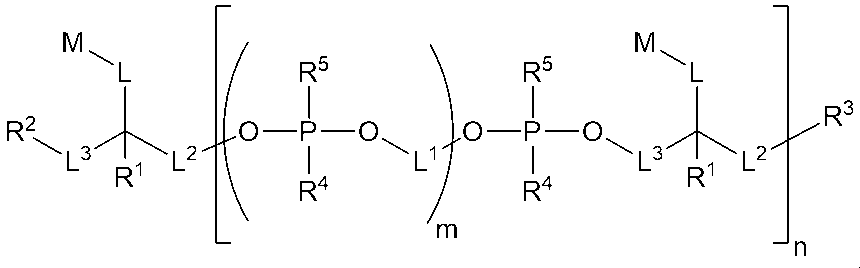
またはその立体異性体、薬学的に許容される塩もしくは互変異性体(式中、
Mは、出現毎に独立して、生物活性部分もしくはその断片、生物活性部分のプロドラッグもしくはその断片、蛍光色素、イメージング剤または放射性同位体結合部位であり、ただし、出現するMの少なくとも1つは、蛍光色素ではないことを条件とし、
Lは、生理的に開裂可能なリンカーであり、
L1は、出現毎に独立して、アルキレン、アルケニレン、アルキニレン、ヘテロアルキレン、ヘテロアルケニレンまたはヘテロアルキニレンリンカーであり、
L2およびL3は、出現毎に独立して、任意選択のアルキレン、アルケニレン、アルキニレン、ヘテロアルキレン、ヘテロアルケニレン、ヘテロアルキニレンまたはヘテロ原子リンカーであり、
R1は、出現毎に独立して、H、アルキルまたはアルコキシであり、
R2およびR3は、それぞれ独立して、-H、-OH、-SH、アルキル、アルコキシ、アルキルエーテル、ヘテロアルキル、アルキルアミニル、アルキルカルボニル、アルコキシカルボニル、Qもしくはそれらの保護形態、またはL’であり、アルキル、アルコキシ、アルキルエーテル、ヘテロアルキル、アルキルアミニル、アルキルカルボニルおよびアルキルオキシカルボニルは、ヒドロキシル、アミノ、スルフヒドリル、ホスフェート、チオホスフェート、ホスホアルキル、チオホスホアルキル、ホスホアルキルエーテルもしくはチオホスホアルキルエーテル、またはそれらの組合せにより置換されていてもよく、
R4は、出現毎に独立して、OH、SH、O-、S-、ORdまたはSRdであり、
R5は、出現毎に独立して、オキソ、チオキソであるか、または存在せず、
Rdは、陽イオンであり、
Qは、出現毎に独立して、標的指向性部分の相補性反応性基Q’と共有結合の形成が可能な、反応性基、またはその保護形態を含む部分であり、
L’は、出現毎に独立して、Qへの共有結合を含むリンカー、標的指向性部分、標的指向性部分への共有結合を含むリンカー、固体支持体もしくは固体支持体残基への共有結合を含むリンカー、固体支持体もしくは固体支持体残基への共有結合を含むリンカー、または構造(I)のさらなる化合物への共有結合を含むリンカーであり、
mは、出現毎に独立して、0以上の整数であり、ただし、出現するmの少なくとも1つは、3以上の整数であることを条件とし、
nは、1以上の整数である)
を提供する。
or a stereoisomer, pharma- ceutically acceptable salt, or tautomer thereof, wherein
M is, independently at each occurrence, a biologically active moiety or fragment thereof, a prodrug of a biologically active moiety or fragment thereof, a fluorescent dye, an imaging agent, or a radioisotope binding moiety, provided that at least one occurrence of M is not a fluorescent dye;
L is a physiologically cleavable linker;
L1 is independently at each occurrence an alkylene, alkenylene, alkynylene, heteroalkylene, heteroalkenylene, or heteroalkynylene linker;
L2 and L3 , independently at each occurrence, are an optional alkylene, alkenylene, alkynylene, heteroalkylene, heteroalkenylene, heteroalkynylene, or heteroatom linker;
R 1 is, independently at each occurrence, H, alkyl, or alkoxy;
R2 and R3 are each independently -H, -OH, -SH, alkyl, alkoxy, alkylether, heteroalkyl, alkylaminyl, alkylcarbonyl, alkoxycarbonyl, Q or a protected form thereof, or L', where the alkyl, alkoxy, alkylether, heteroalkyl, alkylaminyl, alkylcarbonyl and alkyloxycarbonyl are optionally substituted with hydroxyl, amino, sulfhydryl, phosphate, thiophosphate, phosphoalkyl, thiophosphoalkyl, phosphoalkylether or thiophosphoalkylether, or combinations thereof;
R4 is, independently at each occurrence, OH, SH, O- , S- , ORd , or SRd ;
R5 is independently at each occurrence oxo, thioxo, or absent;
R d is a cation;
Q is, independently at each occurrence, a moiety that contains a reactive group, or a protected form thereof, capable of forming a covalent bond with the complementary reactive group Q′ of the targeting moiety;
L' is, independently at each occurrence, a linker that includes a covalent bond to Q, a targeting moiety, a linker that includes a covalent bond to a targeting moiety, a linker that includes a covalent bond to a solid support or a solid support moiety, a linker that includes a covalent bond to a solid support or a solid support moiety, or a linker that includes a covalent bond to an additional compound of structure (I);
m, independently at each occurrence, is an integer greater than or equal to 0, provided that at least one occurrence of m is an integer greater than or equal to 3;
n is an integer of 1 or more.
I will provide a.
構造(I)の化合物中の様々なリンカーおよび置換基(例えば、M、Q、R1、R2、R3、R4、R5、L、L1、L2、L3およびL’)は、さらにもう1つの置換基により置換されていてもよい。例えば、一部の実施形態では、任意選択の置換基は、構造(I)の化合物の水溶解度、透過性、保持または他の特性を最適化するために選択される。ある種の実施形態では、構造(I)の化合物中のアルキル、アルコキシ、アルキルエーテル、ヘテロアルキル、アルキルアミニル、アルキルカルボニルまたはアルコキシカルボニルはそれぞれ、ヒドロキシル、アルコキシ、アルキルエーテル、アルコキシアルキルエーテル、スルフヒドリル、アミノ、アルキルアミノ、カルボキシル、ホスフェート、チオホスフェート、ホスホアルキル、チオホスホアルキル、ホスホアルキルエーテルおよびチオホスホアルキルエーテルからなる群から選択される、さらに1つの置換基により置換されていてもよい。ある種の実施形態では、任意選択の置換基は、-OP(=Ra)(Rb)Rcであり、Raは、OまたはSであり、Rbは、OH、SH、O-、S-、ORdまたはSRdであり、Rcは、OH、SH、O-、S-、ORd、SRd、アルキル、アルコキシ、ヘテロアルキル、ヘテロアルコキシ、アルキルエーテル、アルコキシアルキルエーテル、ホスフェート、チオホスフェート、ホスホアルキル、チオホスホアルキル、ホスホアルキルエーテルまたはチオホスホアルキルエーテルであり、Rdは、対イオンである。ある種の実施形態では、置換基は、細胞浸透度または組織浸透度が増大するように選択される。関連する実施形態では、置換基は、細胞保持または組織保持を増大させるよう選択される。 Various linkers and substituents (e.g., M, Q, R1 , R2 , R3 , R4 , R5 , L, L1 , L2 , L3 , and L') in the compounds of structure (I) may be further substituted with one more substituent. For example, in some embodiments, optional substituents are selected to optimize the aqueous solubility, permeability, retention, or other properties of the compounds of structure (I). In certain embodiments, each of the alkyl, alkoxy, alkyl ether, heteroalkyl, alkylaminyl, alkylcarbonyl, or alkoxycarbonyl in the compounds of structure (I) may be further substituted with one more substituent selected from the group consisting of hydroxyl, alkoxy, alkyl ether, alkoxyalkyl ether, sulfhydryl, amino, alkylamino, carboxyl, phosphate, thiophosphate, phosphoalkyl, thiophosphoalkyl, phosphoalkyl ether, and thiophosphoalkyl ether. In certain embodiments, the optional substituent is -OP(=R a )(R b )R c , where R a is O or S, R b is OH, SH, O - , S - , OR d or SR d , where R c is OH, SH, O - , S - , OR d , SR d , alkyl, alkoxy, heteroalkyl, heteroalkoxy, alkyl ether, alkoxyalkyl ether, phosphate, thiophosphate, phosphoalkyl, thiophosphoalkyl, phosphoalkyl ether or thiophosphoalkyl ether, and R d is a counterion. In certain embodiments, the substituents are selected to increase cell or tissue penetration. In related embodiments, the substituents are selected to increase cell or tissue retention.
ある種の実施形態では、本化合物は、以下の構造(IA):

(式中、x1およびx2は、出現毎に独立して、0~6の整数である)を有する。ある種の関連する実施形態では、L1は、出現毎に独立して、C1-C6アルキレンまたはC2-C6アルキニレンである。
In certain embodiments, the compound has the following structure (IA):
where x 1 and x 2 are, independently at each occurrence, an integer from 0 to 6. In certain related embodiments, L 1 is, independently at each occurrence, C 1 -C 6 alkylene or C 2 -C 6 alkynylene.
一部の実施形態では、本化合物は、以下の構造(IB):

(式中、
x1およびx2は、出現毎に独立して、0~6の整数であり、
yは、1~6の整数である)を有する。それらの実施形態の一部では、yは2である。一部の実施形態では、x1およびx2は、出現毎に、それぞれ1である。一部の他の実施形態では、出現毎に、x1は0であり、x2は1である。
In some embodiments, the compound has the following structure (IB):
(Wherein,
x 1 and x 2 are, independently at each occurrence, an integer from 0 to 6;
wherein y is an integer from 1 to 6. In some of these embodiments, y is 2. In some embodiments, x 1 and x 2 are each 1 at each occurrence. In some other embodiments, x 1 is 0 and x 2 is 1 at each occurrence.
一部の実施形態では、R4は、出現毎に独立して、OH、O-またはORdである。「ORd」および「SRd」は、陽イオンと結合したO-およびS-を指すことが意図されていることが理解される。例えば、ホスフェート基の二ナトリウム塩は、以下:

として表すことができる。
In some embodiments, R4 is, independently at each occurrence, OH, O-, or ORd . It is understood that " ORd " and " SRd " are intended to refer to O- and S- in combination with a cation. For example, the disodium salt of the phosphate group is:
It can be expressed as:
一部の実施形態では、R5は、出現毎に、オキソである。 In some embodiments, each occurrence of R 5 is oxo.
一部のさらなる具体的な実施形態では、本化合物は、以下の構造(IB’)または(IB”):
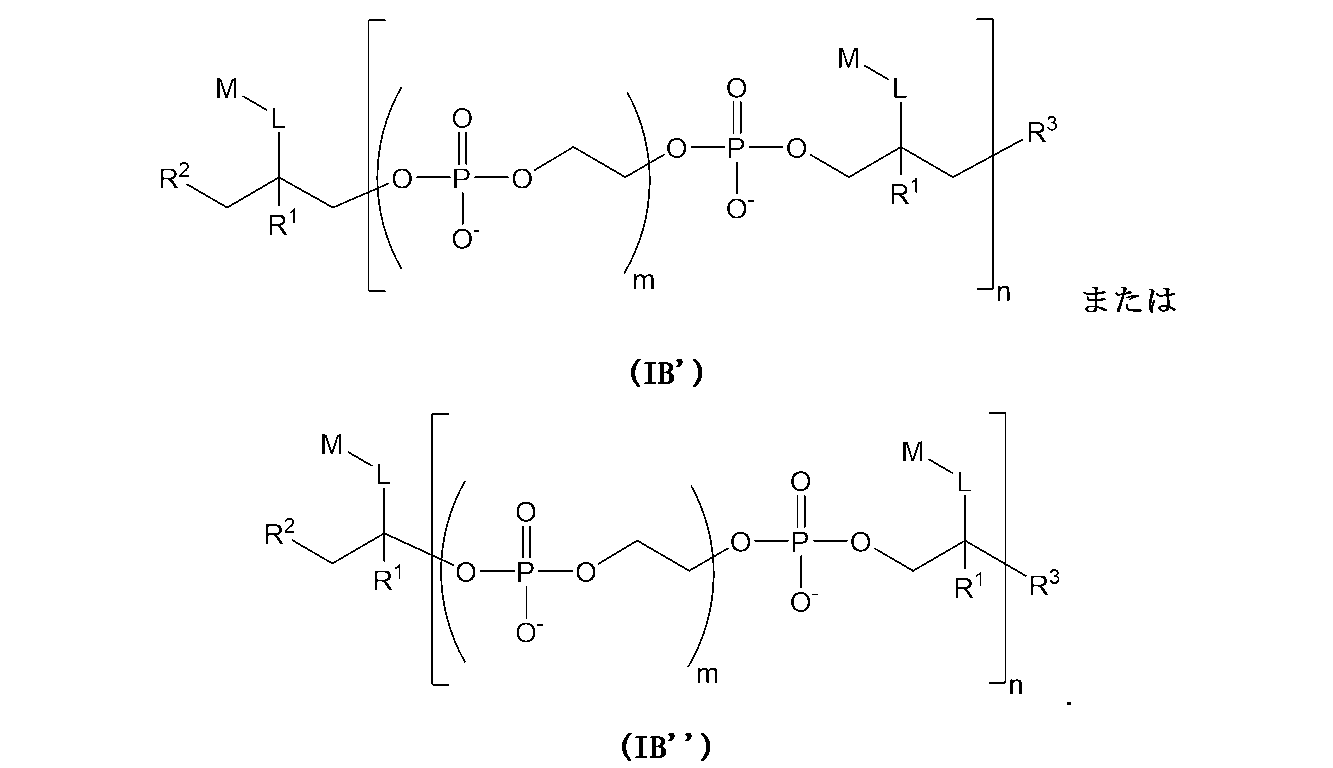
ある種の実施形態では、R1は、Hである。
一部の実施形態では、出現するMの少なくとも1つは、生物活性部分を含む。他の実施形態では、Mは、出現毎に独立して、生物活性部分を含む。
In certain embodiments, R 1 is H.
In some embodiments, at least one occurrence of M comprises a biologically active moiety. In other embodiments, each occurrence of M independently comprises a biologically active moiety.
一部の実施形態では、R2およびR3は、それぞれ独立して、OHまたは-OP(=Ra)(Rb)Rcである。より具体的な実施形態では、R2またはR3の一方はOHまたは-OP(=Ra)(Rb)Rcであり、R2またはR3のもう一方は、Q、またはQへの共有結合を含むリンカーである。
ある種の実施形態では、R2またはR3の1つは、L’であり、L’は、固体支持体への共有結合を含むリンカーである。そのような実施形態の一部では、固体支持体は、ポリマー製ビーズまたは非ポリマー製ビーズである。
ある種の他の実施形態では、R2またはR3の1つは、L’であり、L’は、標的指向性部分、または標的指向性部分へのリンカーである。それらの実施形態の一部では、L’は、標的指向性部分へのリンカーであり、このリンカーは、ヘテロアルキレンリンカーを含む。
In some embodiments, R2 and R3 are each independently OH or -OP(=R a )(R b )R c . In more specific embodiments, one of R2 or R3 is OH or -OP(=R a )(R b )R c , and the other of R2 or R 3 is Q or a linker that comprises a covalent bond to Q.
In certain embodiments, one of R2 or R3 is L', where L' is a linker that comprises a covalent bond to a solid support. In some such embodiments, the solid support is a polymeric or non-polymeric bead.
In certain other embodiments, one of R2 or R3 is L', where L' is a targeting moiety or a linker to a targeting moiety. In some of those embodiments, L' is a linker to a targeting moiety, where the linker comprises a heteroalkylene linker.
リンカーLは、化合物の残りへのM部分の結合点として使用され得る。例えば、一部の実施形態では、構造(I)の化合物への合成前駆体が調製され、M部分は、任意の数の、当分野において公知の容易に利用可能な方法、例えば、「クリックケミストリー」と称される方法を使用して合成前駆体に結合される。この目的の場合、迅速かつ実質的に不可逆な反応のいずれかを使用して、構造(I)の化合物を形成するための合成前駆体にMを結合することができる。例示的な反応には、アジドとアルキンとのトリアゾールを形成する銅触媒反応(Huisgen 1,3-双極子付加環化)、ジエンと求ジエンとの反応(Diels-Alder)、歪みにより促進されるアルキン-ニトロン環化付加、歪アルケンとアジド、テトラジンまたはテトラゾールとの反応、アルケンとアジドの[3+2]環化付加、アルケンとテトラジンの逆需要Diels-Alder、アルケンとテトラゾールの光反応、および求電子性原子への求核攻撃による脱離基の置換などの様々な置換反応が含まれる。例示的な置換反応は、活性化エステル(例えば、N-ヒドロキシスクシンイミドエステル)、イソシアネート、イソチオシアネートなどとのアミンの反応を含む。一部の実施形態では、Lを形成する反応は、水性環境で行われてもよい。 The linker L may be used as a point of attachment of the M moiety to the remainder of the compound. For example, in some embodiments, a synthetic precursor to a compound of structure (I) is prepared and the M moiety is attached to the synthetic precursor using any number of readily available methods known in the art, such as those referred to as "click chemistry." For this purpose, any of a number of rapid and substantially irreversible reactions may be used to attach M to the synthetic precursor to form a compound of structure (I). Exemplary reactions include the copper-catalyzed reaction of an azide with an alkyne to form a triazole (Huisgen 1,3-dipolar cycloaddition), the reaction of a diene with a dienophile (Diels-Alder), strain-promoted alkyne-nitrone cycloaddition, the reaction of a strained alkene with an azide, tetrazine or tetrazole, the [3+2] cycloaddition of an alkene with an azide, the inverse demand Diels-Alder of an alkene with a tetrazine, the photoreaction of an alkene with a tetrazole, and various substitution reactions such as the replacement of a leaving group by a nucleophilic attack on an electrophilic atom. Exemplary substitution reactions include reactions of amines with activated esters (e.g., N-hydroxysuccinimide esters), isocyanates, isothiocyanates, and the like. In some embodiments, the reaction to form L may be carried out in an aqueous environment.
したがって、一部の実施形態では、Lは、出現毎に、2つの相補性反応性基の反応によって形成可能な官能基、例えば、上述の「クリック」反応の1つの生成物である官能基を含むリンカーである。様々な実施形態では、出現するLの少なくとも1つについては、官能基は、アルデヒド、オキシム、ヒドラゾン、アルキン、アミン、アジド、アシルアジド、アシルハライド、ニトリル、ニトロン、スルフヒドリル、ジスルフィド、ハロゲン化スルホニル、イソチオシアネート、イミドエステル、活性化エステル(例えば、N-ヒドロキシスクシンイミドエステル)、ケトン、α,β-不飽和カルボニル、アルケン、マレイミド、α-ハロイミド、エポキシド、アジリジン、テトラジン、テトラゾール、ホスフィン、ビオチンまたはチイラン官能基と、相補性反応性基との反応、例えば、アミンとN-ヒドロキシスクシンイミドエステルまたはイソチオシアネートとの反応によって形成され得る。
他の実施形態では、出現するLの少なくとも1つについては、官能基は、アルキンおよびアジドの反応によって形成され得る。他の実施形態では、出現するLの少なくとも1つについては、官能基は、アミン(例えば、一級アミン)およびN-ヒドロキシスクシンイミドエステルまたはイソチオシアネートの反応によって形成され得る。
Thus, in some embodiments, L, for each occurrence, is a linker that includes a functional group formable by reaction of two complementary reactive groups, e.g., a functional group that is the product of one of the "click" reactions described above. In various embodiments, for at least one occurrence of L, the functional group can be formed by reaction of an aldehyde, oxime, hydrazone, alkyne, amine, azide, acyl azide, acyl halide, nitrile, nitrone, sulfhydryl, disulfide, sulfonyl halide, isothiocyanate, imido ester, activated ester (e.g., N-hydroxysuccinimide ester), ketone, α,β-unsaturated carbonyl, alkene, maleimide, α-haloimide, epoxide, aziridine, tetrazine, tetrazole, phosphine, biotin, or thiirane functional group with a complementary reactive group, e.g., reaction of an amine with an N-hydroxysuccinimide ester or an isothiocyanate.
In other embodiments, for at least one occurrence of L, the functional group may be formed by the reaction of an alkyne and an azide. In other embodiments, for at least one occurrence of L, the functional group may be formed by the reaction of an amine (e.g., a primary amine) and an N-hydroxysuccinimide ester or an isothiocyanate.
さらなる実施形態では、出現するLの少なくとも1つについては、官能基は、アルケン、エステル、アミド、チオエステル、ジスルフィド、炭素環式基、複素環式基またはヘテロアリール基を含む。さらなる実施形態では、出現するLの少なくとも1つについては、官能基は、アルケン、エステル、アミド、チオエステル、チオウレア、ジスルフィド、炭素環式基、複素環式基またはヘテロアリール基を含む。他の実施形態では、官能基は、アミドまたはチオウレアを含む。一部のさらなる具体的な実施形態では、出現するLの少なくとも1つについては、Lは、トリアゾリル官能基を含むリンカーである。他の実施形態では、出現するLの少なくとも1つについては、Lは、アミドまたはチオウレア官能基を含むリンカーである。
一部の実施形態は、適切な条件(例えば、生理的条件)下で、開裂可能なLを提供する。したがって、一部の実施形態では、Lは、アミド結合、エステル結合、ジスルフィド結合、ヒドラゾン、ホスホトリエステル、ジエステル、β-グルクロニド、二重結合、三重結合、エーテル結合、ケトンもしくはオキソ、ジオール、シアノ、ニトロまたはそれらの組合せを含む。
In further embodiments, for at least one occurrence of L, the functional group comprises an alkene, ester, amide, thioester, disulfide, carbocyclic, heterocyclic or heteroaryl group. In further embodiments, for at least one occurrence of L, the functional group comprises an alkene, ester, amide, thioester, thiourea, disulfide, carbocyclic, heterocyclic or heteroaryl group. In other embodiments, the functional group comprises an amide or thiourea. In some further specific embodiments, for at least one occurrence of L, L is a linker comprising a triazolyl functional group. In other embodiments, for at least one occurrence of L, L is a linker comprising an amide or thiourea functional group.
Some embodiments provide L that is cleavable under appropriate conditions (e.g., physiological conditions).Thus, in some embodiments, L comprises an amide bond, an ester bond, a disulfide bond, a hydrazone, a phosphotriester, a diester, a β-glucuronide, a double bond, a triple bond, an ether bond, a ketone or oxo, diol, cyano, nitro, or a combination thereof.
一部の実施形態では、Lは、tert-ブチルオキシカルボニル、パラメトキシベンジル、ジアルキルまたはジアリールジアルコキシシラン、オルトエステル、アセタール、β-チオプロピオネート、ケタール、ホスホロアミデート、ヒドラゾン、ビニルエーテル、イミン、アコニチル、トリチル、ポリケタール、ビスアリールヒドラゾン、ジアゾベンゼン、ビビナールジオール、ピロリン酸ジエステルまたはバリン シトルリンを含む。
ある種の実施形態では、Lは、出現毎に独立して、6~8の範囲のpHにおいて、開裂可能なリンカーである。例えば、一部の実施形態では、Lは、pH6.0、6.1、6.2、6.3、6.4、6.5、6.6、6.7、6.8、6.9、7.0、7.1、7.2、7.3、7.4、7.5、7.6、7.7、7.8、7.9、8.0、8.1または8.0において、開裂可能なリンカーである。
In some embodiments, L comprises tert-butyloxycarbonyl, paramethoxybenzyl, dialkyl or diaryldialkoxysilane, orthoester, acetal, β-thiopropionate, ketal, phosphoramidate, hydrazone, vinyl ether, imine, aconityl, trityl, polyketal, bisarylhydrazone, diazobenzene, bivinaldiol, pyrophosphate diester, or valine citrulline.
In certain embodiments, L, independently at each occurrence, is a linker that is cleavable at a pH in the range of 6 to 8. For example, in some embodiments, L is a linker that is cleavable at pH 6.0, 6.1, 6.2, 6.3, 6.4, 6.5, 6.6, 6.7, 6.8, 6.9, 7.0, 7.1, 7.2, 7.3, 7.4, 7.5, 7.6, 7.7, 7.8, 7.9, 8.0, 8.1, or 8.0.
ある種の実施形態では、Lは、出現毎に独立して、20℃~40℃、25℃~35℃、30℃~35℃、30℃~37℃、35℃~37℃、35℃~40℃、32℃~38℃の範囲の温度において、開裂可能なリンカーである。ある種の実施形態では、Lは、出現毎に独立して、約20℃、約21℃、約22℃、約23℃、約24℃、約25℃、約26℃、約27℃、約28℃、約29℃、約30℃、約31℃、約32℃、約33℃、約34℃、約35℃、約36℃、約37℃、約38℃、約39℃または約40℃の温度において開裂可能なリンカーである。
ある種の実施形態では、Lは、出現毎に独立して、酵素によって開裂可能なリンカーである。例えば、一部の実施形態では、酵素は、ヒドロラーゼ、オキシドレダクターゼまたはリアーゼである。ある種の実施形態では、酵素は、EC4.1(例えば、EC4.1.1、EC4.1.2、EC4.1.3またはEC4.1.99)、EC4.2、EC4.3、EC4.4、EC4.5、EC4.6またはEC4.99酵素である。
In certain embodiments, L, independently at each occurrence, is a linker that is cleavable at a temperature in the range of 20° C. to 40° C., 25° C. to 35° C., 30° C. to 35° C., 30° C. to 37° C., 35° C. to 37° C., 35° C. to 40° C., 32° C. to 38° C. In certain embodiments, L, independently at each occurrence, is a linker that is cleavable at a temperature in the range of about 20° C., about 21° C., about 22° C., about 23° C., about 24° C., about 25° C., about 26° C., about 27° C., about 28° C., about 29° C., about 30° C., about 31° C., about 32° C., about 33° C., about 34° C., about 35° C., about 36° C., about 37° C., about 38° C., about 39° C., or about 40° C.
In certain embodiments, L, independently at each occurrence, is an enzyme-cleavable linker. For example, in some embodiments, the enzyme is a hydrolase, oxidoreductase, or lyase. In certain embodiments, the enzyme is an EC 4.1 (e.g., EC 4.1.1, EC 4.1.2, EC 4.1.3, or EC 4.1.99), EC 4.2, EC 4.3, EC 4.4, EC 4.5, EC 4.6, or EC 4.99 enzyme.
ある種の実施形態では、Lは、以下の構造のうちの1つ:
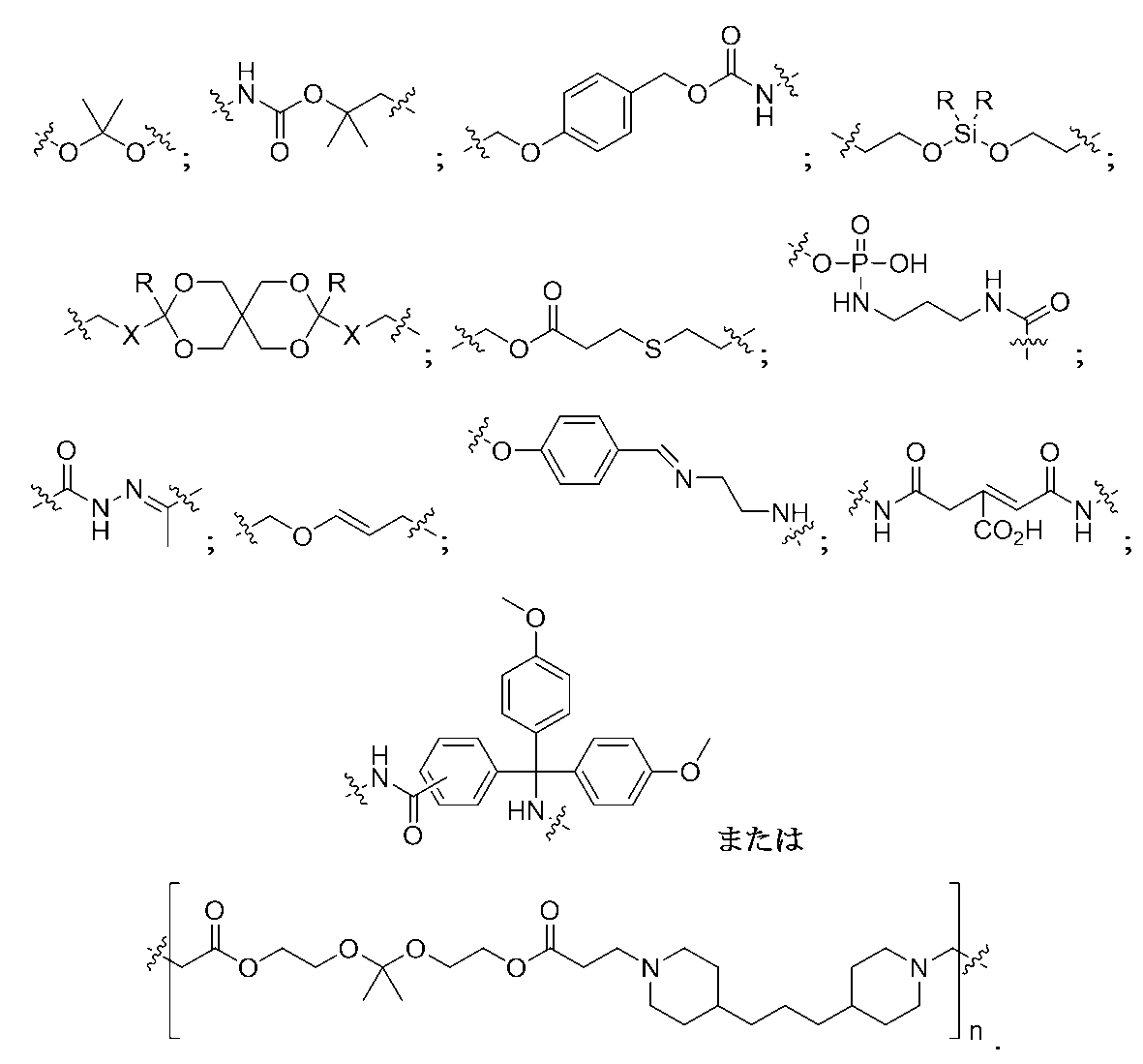
Rは、H、メチル、エチル、イソプロピル、tert-ブチルまたはフェニルであり、
Xは、OまたはCH2であり、
nは、0より大きな整数である)を含む。
In certain embodiments, L is one of the following structures:
R is H, methyl, ethyl, isopropyl, tert-butyl or phenyl;
X is O or CH2 ,
n is an integer greater than 0.
さらに他の実施形態では、出現するLの少なくとも1つについては、L-Mは、以下の構造:
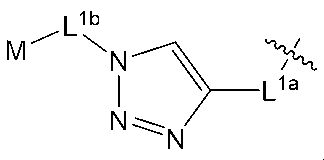
異なる実施形態では、出現するLの少なくとも1つについては、L-Mは、以下の構造:
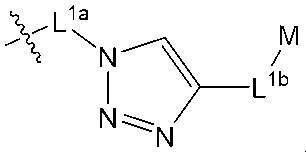
上述の様々な実施形態では、L1aもしくはL1b、またはそれらの両方が、存在しない。他の実施形態では、L1aもしくはL1b、またはそれらの両方が存在する。
In a different embodiment, for at least one occurrence of L, L-M has the following structure:
In various embodiments described above, L 1a or L 1b , or both, are absent, while in other embodiments, L 1a or L 1b , or both, are present.
一部の実施形態では、L1aまたはL1bは、存在する場合、それぞれ独立してアルキレンまたはヘテロアルキレンである。例えば、一部の実施形態では、L1aまたはL1bは、存在する場合、独立して、以下の構造の1つ:

構造(I)のさらに他の異なる実施形態では、Lは、出現毎に独立して、任意選択のアルキレンまたはヘテロアルキレンリンカーである。ある種の実施形態では、Lは、以下の構造の1つ:

一部の具体的な実施形態では、出現するLの少なくとも1つは、以下の構造:
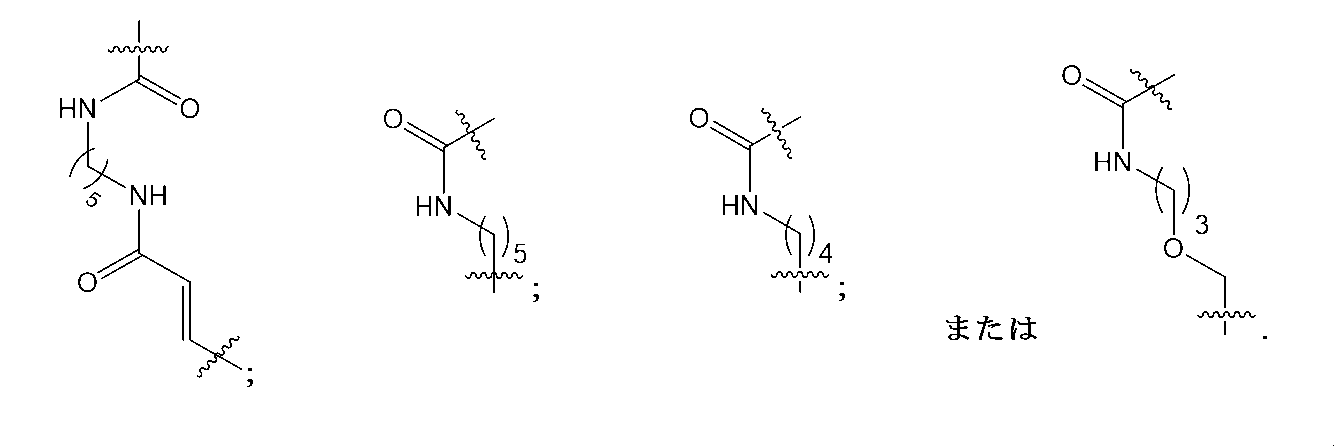
一部の実施形態では、Lは出現毎に、以下の構造のうちの1つ:

さらなる実施形態では、L2およびL3は、出現毎に独立して、C1-C6アルキレン、C2-C6アルケニレンまたはC2-C6アルキニレンである。
他の実施形態では、R2およびR3は、それぞれ独立して、-OP(=Ra)(Rb)OL’であり、L’は、Q、標的指向性部分、分析対象(例えば、分析対象分子)、固体支持体、固体支持体残基、アミノ酸、ヌクレオシド、または構造(I)のさらなる化合物へのアルキレンまたはヘテロアルキレンリンカーである。
In some embodiments, each occurrence of L is one of the following structures:
In a further embodiment, L 2 and L 3 are, independently at each occurrence, C 1 -C 6 alkylene, C 2 -C 6 alkenylene, or C 2 -C 6 alkynylene.
In other embodiments, R 2 and R 3 are each independently -OP(=R a )(R b )OL', where L' is an alkylene or heteroalkylene linker to Q, a targeting moiety, an analyte (e.g., an analyte molecule), a solid support, a solid support residue, an amino acid, a nucleoside, or an additional compound of structure (I).
リンカーL’は、Q、標的指向性部分、分析対象(例えば、分析対象分子)、固体支持体、固体支持体残基、ヌクレオシドまたは構造(I)のさらなる化合物を、構造(I)の化合物に結合させるのに好適な任意のリンカーとすることができる。有利には、ある種の実施形態は、化合物の水溶解度を増大または最適化するために選択される、L’部分の使用を含む。ある種の実施形態では、L’は、ヘテロアルキレン部分である。一部の他のある種の実施形態では、L’は、アルキレンオキシドもしくはホスホジエステル部分、またはそれらの組合せを含む。 The linker L' can be any linker suitable for attaching Q, a targeting moiety, an analyte (e.g., an analyte molecule), a solid support, a solid support residue, a nucleoside, or an additional compound of structure (I) to the compound of structure (I). Advantageously, certain embodiments include the use of an L' moiety selected to increase or optimize the aqueous solubility of the compound. In certain embodiments, L' is a heteroalkylene moiety. In some other certain embodiments, L' includes an alkylene oxide or phosphodiester moiety, or a combination thereof.
ある種の実施形態では、L’は、以下の構造:
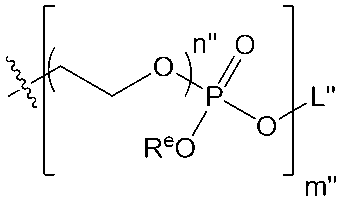
m”およびn”は、独立して、1~10の整数であり、
Reは、H、電子対または対イオンであり、
L”は、標的指向性部分または標的指向性部分への連結基(例えば、抗体)である)を有する。
一部の実施形態では、m”は、4~10の整数、例えば、4、6または10である。他の実施形態では、n”は、3~6の整数、例えば、3、4、5または6である。
In certain embodiments, L' has the following structure:
m″ and n″ are independently integers from 1 to 10;
R e is H, an electron pair or a counter ion;
L″ comprises a targeting moiety or a linking group to a targeting moiety (e.g., an antibody).
In some embodiments, m" is an integer from 4 to 10, such as 4, 6, or 10. In other embodiments, n" is an integer from 3 to 6, such as 3, 4, 5, or 6.
ある種の実施形態では、標的指向性部分は、抗体または細胞表面受容体アンタゴニストである。関連する実施形態では、抗体または細胞表面受容体アンタゴニストは、上皮成長因子受容体(EGFR)阻害剤、肝細胞成長因子受容体(HGFR)阻害剤、インスリン様成長因子受容体(IGFR)阻害剤、フォレートまたはMET阻害剤である。ある種の実施形態では、抗体または細胞表面受容体アンタゴニストは、チロシンキナーゼ阻害剤(例えば、ゲフィチニブ、エルロチニブ)、ラパチニブ、バンデタニブ、ネラチニブ、オシメルチニブ、トバンチニブ(ARQ197)、クリゾチニブ、カボザンチニブ、チルホスチン系(tyrphostin)(例えば、AG538、AG1024)、ピロロ(2,3-d)-ピリミジン誘導体(例えば、NVP-AEW541)、モノクローナル抗体(例えば、フィギツムマブ、セツキシマブ、パニツムマブ、ネシツムマブ、ガニツマブ、シクスツムマブ、ダロツズマブ、ロバツムマブ、オナルツズマブ、K1、ラベツズマブ、ミラツズマブ、ロルボツズマブ、イノツズマブ)、BMS-777607、PF-02341066、PF-04217903、AMG-458、MK-2461、JNJ-38877605、GSK1363089(フォレチニブ)、XL880、XL184、ARQ197、E7050またはINCB28060である。 In certain embodiments, the targeting moiety is an antibody or a cell surface receptor antagonist. In related embodiments, the antibody or cell surface receptor antagonist is an epidermal growth factor receptor (EGFR) inhibitor, a hepatocyte growth factor receptor (HGFR) inhibitor, an insulin-like growth factor receptor (IGFR) inhibitor, a folate or a MET inhibitor. In certain embodiments, the antibody or cell surface receptor antagonist is a tyrosine kinase inhibitor (e.g., gefitinib, erlotinib), lapatinib, vandetanib, neratinib, osimertinib, tovantinib (ARQ197), crizotinib, cabozantinib, tyrphostins (e.g., AG538, AG1024), pyrrolo(2,3-d)-pyrimidine derivatives (e.g., NVP-AEW541), monoclonal antibodies (e.g., figitumumab , cetuximab, panitumumab, necitumumab, ganitumab, cixutumumab, darotuzumab, lobatumumab, onartuzumab, K1, labetuzumab, milatuzumab, lorvotuzumab, inotuzumab), BMS-777607, PF-02341066, PF-04217903, AMG-458, MK-2461, JNJ-38877605, GSK1363089 (foretinib), XL880, XL184, ARQ197, E7050 or INCB28060.
ある種の実施形態では、抗体または細胞表面受容体アンタゴニストは、EGFR(例えば、EGFRvIII)、HER2、葉酸受容体、CD19、CD20、CD22、CD27L、CD30、CD33、CD37、CD56、CD66e、CD70、CD74、CD79b、CA6、CD138、CA6、メソテリン、ネクチン4、STEAP1、MUC16、MaPi2b、GCC、Trop-2、AGS-5、ENPP3、炭酸脱水酵素IX、GPNMB、PDMAを標的とする。 In certain embodiments, the antibody or cell surface receptor antagonist targets EGFR (e.g., EGFRvIII), HER2, folate receptor, CD19, CD20, CD22, CD27L, CD30, CD33, CD37, CD56, CD66e, CD70, CD74, CD79b, CA6, CD138, CA6, mesothelin, nectin4, STEAP1, MUC16, MaPi2b, GCC, Trop-2, AGS-5, ENPP3, carbonic anhydrase IX, GPNMB, PDMA.
一部の他の実施形態では、L”は、アルキレンまたはヘテロアルキレン部分である。一部の他のある種の実施形態では、L”は、アルキレンオキシド、ホスホジエステル部分、ペプチジルリンカー、スルフヒドリル、ジスルフィドもしくはマレイミド部分、またはそのそれらの組合せを含む。 In some other embodiments, L" is an alkylene or heteroalkylene moiety. In certain other embodiments, L" comprises an alkylene oxide, a phosphodiester moiety, a peptidyl linker, a sulfhydryl, a disulfide, or a maleimide moiety, or a combination thereof.
構造(I)の上述の化合物のいずれかの他のさらなる具体的な実施形態では、R2またはR3は、以下の構造の1つ:
R2またはR3は、以下の構造の1つ:

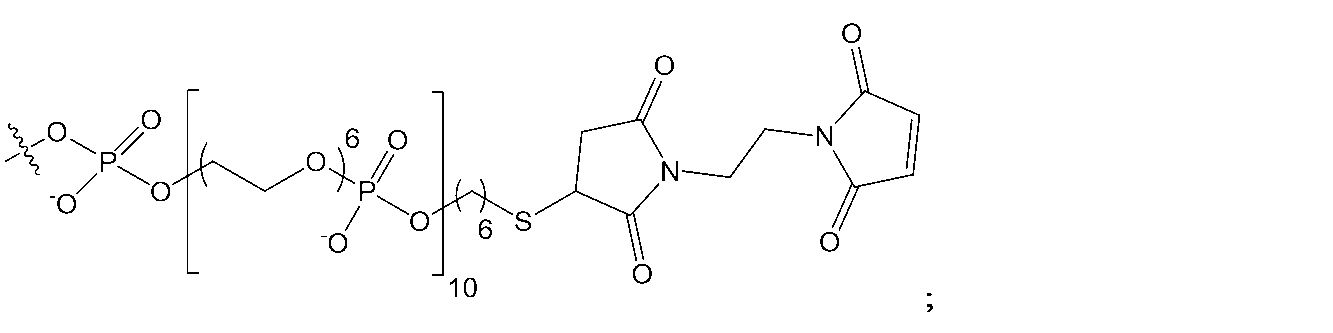
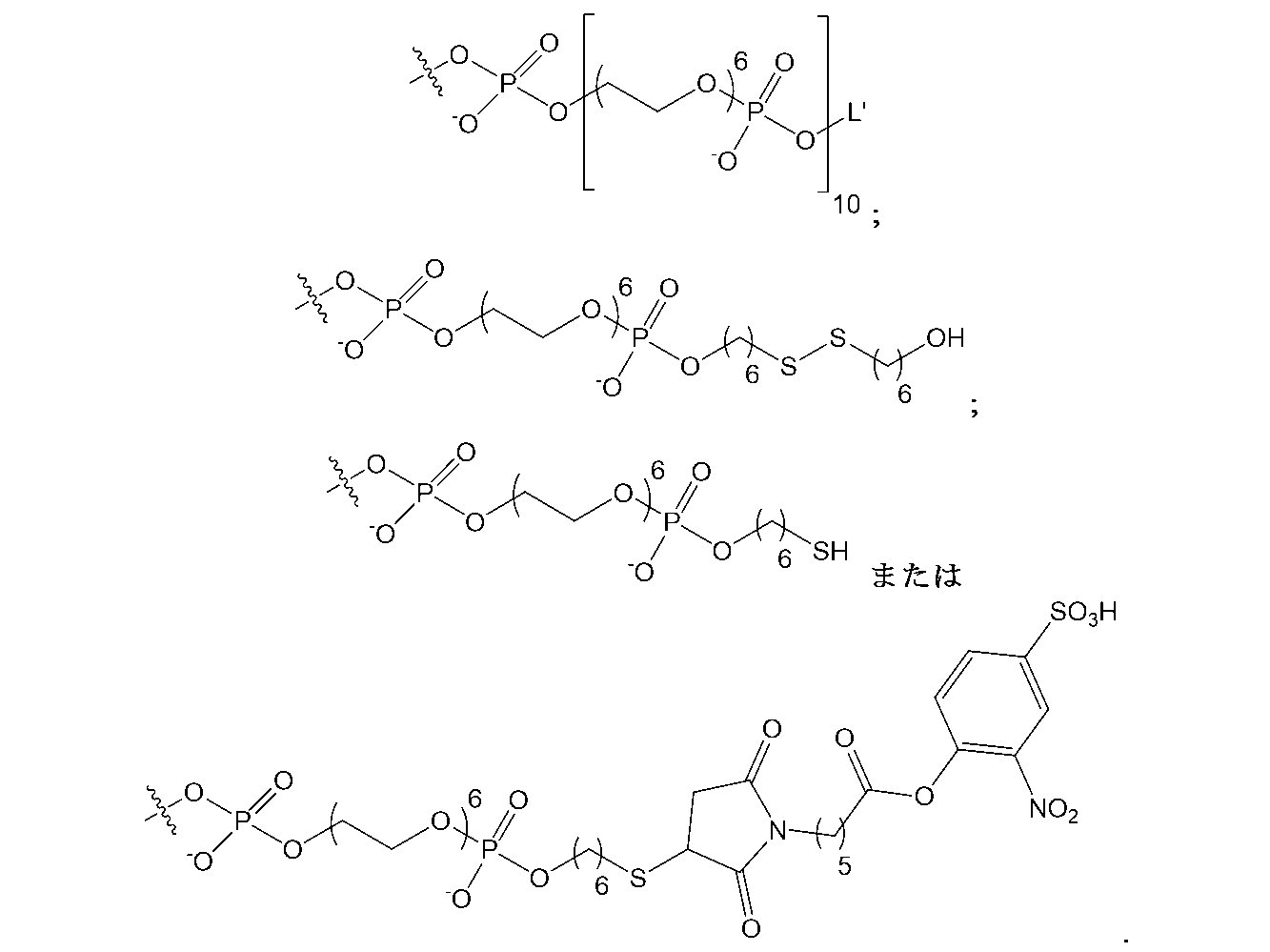
を有する。
In other further specific embodiments of any of the above-mentioned compounds of structure (I), R2 or R3 has one of the following structures:
R2 or R3 is one of the following structures:
has.
構造(I)の化合物のある種の実施形態は、ペプチドの調製に当分野で公知の合成法に類似した固相合成法に準拠して調製することができる。したがって、一部の実施形態では、L’は、固体支持体または固体支持体残基への連結基である。様々な固体支持体(例えば、ポリスチレン、ポリアミド、PEGをベースとする)、保護基(例えば、Fmoc、Boc、トリフェニルメチル)、活性基(例えば、カルボジイミド、トリアゾール)、および他の物質が、容易に入手可能であり、一部の実施形態では、構造(I)の化合物の調製に使用することができる。固体支持体残基は、合成後に除去または修飾され得る。 Certain embodiments of the compounds of structure (I) can be prepared according to solid phase synthesis methods similar to those known in the art for the preparation of peptides. Thus, in some embodiments, L' is a linking group to a solid support or solid support residue. A variety of solid supports (e.g., polystyrene, polyamide, PEG-based), protecting groups (e.g., Fmoc, Boc, triphenylmethyl), activating groups (e.g., carbodiimide, triazole), and other materials are readily available and can be used in some embodiments to prepare compounds of structure (I). The solid support residue can be removed or modified after synthesis.
さらに他の実施形態では、Qは、出現毎に独立して、分析対象分子または固体支持体と共有結合を形成することが可能な反応性基を含む部分である。他の実施形態では、Qは、出現毎に独立して、相補性反応性基Q’と共有結合を形成することが可能な反応性基を含む部分である。例えば、一部の実施形態では、Q’は、構造(I)のさらなる化合物に存在し(例えば、R2またはR3位における)、QおよびQ’は相補性反応性基を含み、こうして、構造(I)の化合物と構造(I)のさらなる化合物との反応により、構造(I)の化合物の共有結合による二量体をもたらす。構造(I)の多量体化合物もまた、類似の方法で調製することができ、本発明の実施形態の範囲内に含まれる。
Q基のタイプ、および構造(I)の化合物の残りへのQ基の結合性は、特に限定されないが、ただし、Qは、所望の結合を形成するために適切な反応性を有する部分を含むことを条件とする。
ある種の実施形態では、Qは、水性条件下で加水分解を受けにくいが、分析対象分子または固体支持体に対応する基と結合を形成するのに十分な反応性のある部分(例えば、アミン、アジドまたはアルキン)である。
In yet other embodiments, Q, independently at each occurrence, is a moiety that includes a reactive group capable of forming a covalent bond with an analyte molecule or a solid support. In other embodiments, Q, independently at each occurrence, is a moiety that includes a reactive group capable of forming a covalent bond with a complementary reactive group Q'. For example, in some embodiments, Q' is present in an additional compound of structure (I) (e.g., at the R2 or R3 position), and Q and Q' include complementary reactive groups, such that reaction of a compound of structure (I) with an additional compound of structure (I) results in a covalent dimer of the compound of structure (I). Multimeric compounds of structure (I) can also be prepared in an analogous manner and are included within the scope of embodiments of the present invention.
The type of Q group and its attachability to the remainder of the compound of structure (I) are not particularly limited, provided that Q contains a moiety having appropriate reactivity to form the desired bond.
In certain embodiments, Q is a moiety (e.g., an amine, azide, or alkyne) that is not susceptible to hydrolysis under aqueous conditions, yet is sufficiently reactive to form a bond with a corresponding group on the analyte molecule or solid support.
構造(I)の化合物のある種の実施形態は、バイオコンジュゲーションの分野において、一般に使用されているQ基を含む。例えば、一部の実施形態では、Qは、求核性反応性基、求電子性反応性基または環化付加反応性基を含む。一部のより具体的な実施形態では、Qは、スルフヒドリル、ジスルフィド、活性化エステル、イソチオシアネート、アジド、アルキン、アルケン、ジエン、求ジエン体、酸ハロゲン化物、ハロゲン化スルホニル、ホスフィン、α-ハロアミド、ビオチン、アミノまたはマレイミド官能基を含む。一部の実施形態では、活性化エステルは、N-スクシンイミドエステル、イミドエステルまたはポリフルオロフェニル(polyfluorophenyl)エステルである。他の実施形態では、アルキンは、アルキルアジドまたはアシルアジドである。 Certain embodiments of the compounds of structure (I) include Q groups that are commonly used in the field of bioconjugation. For example, in some embodiments, Q includes a nucleophilic reactive group, an electrophilic reactive group, or a cycloaddition reactive group. In some more specific embodiments, Q includes a sulfhydryl, disulfide, activated ester, isothiocyanate, azide, alkyne, alkene, diene, dienophile, acid halide, sulfonyl halide, phosphine, α-haloamide, biotin, amino, or maleimide functionality. In some embodiments, the activated ester is an N-succinimide ester, imido ester, or polyflu o rophenyl ester. In other embodiments, the alkyne is an alkyl azide or an acyl azide.
Q基は、保存安定性または他の所望の特性を増大させる保護形態で都合よく提供され得、次に、この保護基は、例えば、標的指向性部分または分析対象とのカップリングにとって適切な時に除去され得る。したがって、Q基は、上記および以下の表1中の反応性基のいずれかを含めた、反応性基の「保護形態」を含む。Qの「保護形態」とは、Qに対して所定の反応条件下で、一層低い反応性を有するが、好ましくは分解しない、または構造(I)の化合物の他の部分と反応しない条件下でQへと変換され得る部分を指す。当業者は、特定のQ、ならびに所望の最終使用および貯蔵条件に基づいて、Qの適切な保護形態を誘導することができる。例えば、Qが-SHである場合、Qの保護形態はジスルフィドを含み、ジスルフィドは、一般的な公知技法および試薬(例えば、TCEP)を使用して還元すると、-SH部分が現れ得る。 The Q group may be conveniently provided in a protected form that enhances storage stability or other desired properties, and the protecting group may then be removed at the appropriate time for coupling, for example, to a targeting moiety or analyte. Thus, the Q group includes "protected forms" of reactive groups, including any of the reactive groups described above and in Table 1 below. A "protected form" of Q refers to a moiety that has a lower reactivity under a given reaction condition relative to Q, but that can be converted to Q under conditions that preferably do not decompose or react with other portions of the compound of structure (I). One of skill in the art can derive an appropriate protected form of Q based on the particular Q and the desired end use and storage conditions. For example, if Q is -SH, the protected form of Q includes a disulfide that can be reduced using common known techniques and reagents (e.g., TCEP) to reveal the -SH moiety.
例示的なQ部分が、以下の表1に提示されている。
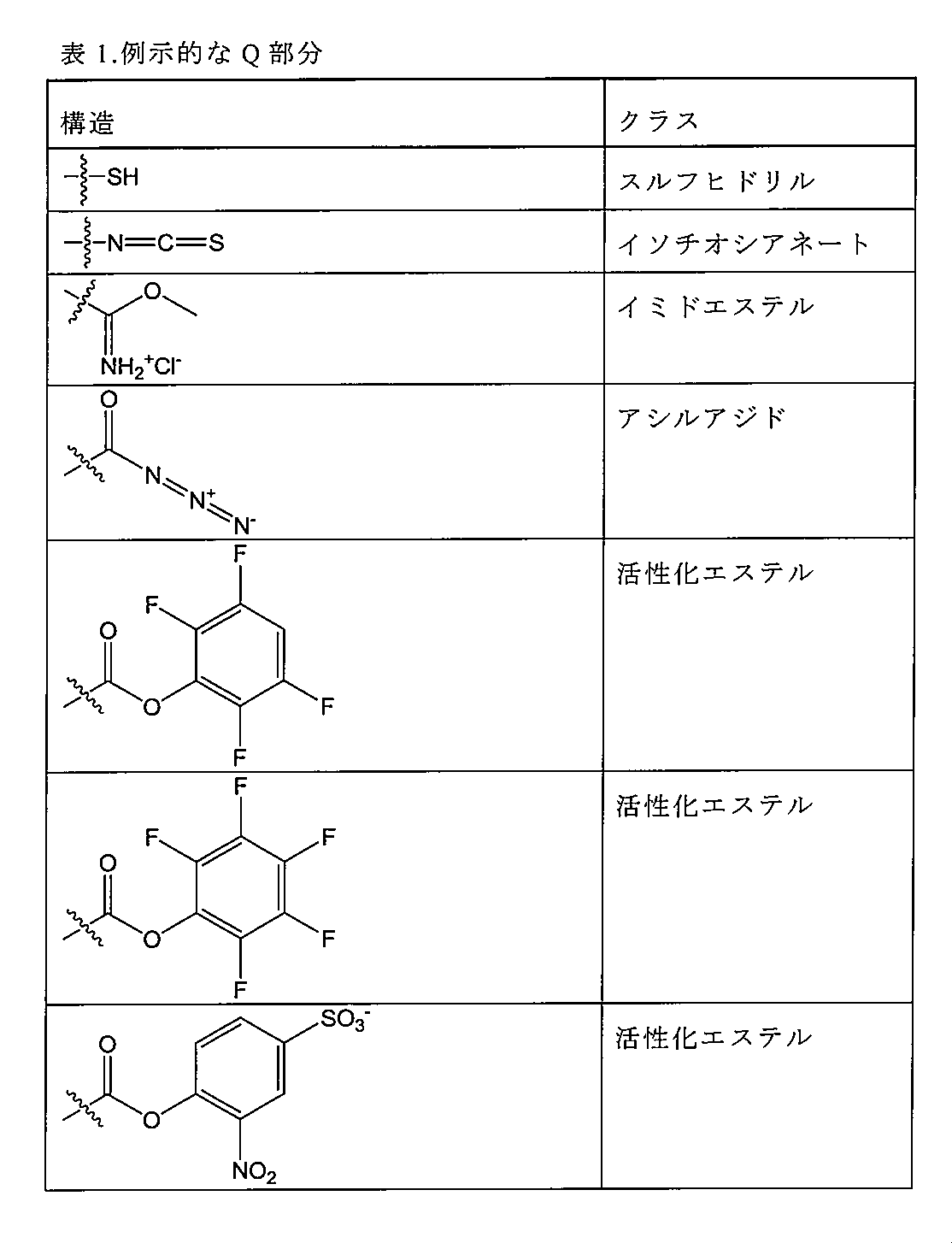
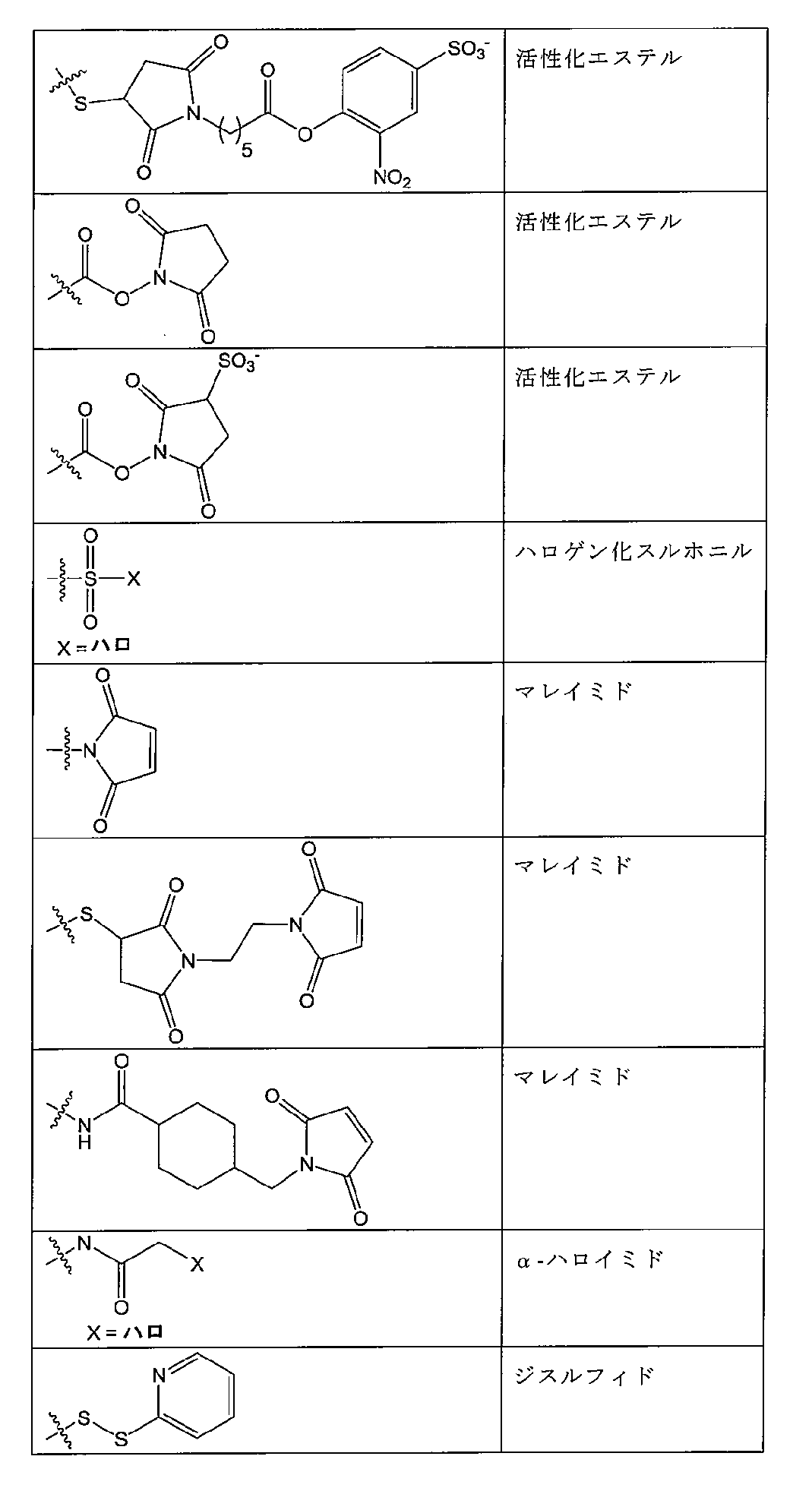

一部の実施形態では、Qが-SHである場合、-SH部分は、例えば、構造(I)の別の化合物の別のスルフヒドリル基とジスルフィド結合を形成する傾向があることに留意すべきである。したがって、一部の実施形態は、ジスルフィド二量体の形態にある、構造(I)の化合物を含み、ジスルフィド結合は、-SHであるQ基から誘導される。 It should be noted that in some embodiments, when Q is -SH, the -SH moiety tends to form a disulfide bond with, for example, another sulfhydryl group of another compound of structure (I). Thus, some embodiments include a compound of structure (I) in the form of a disulfide dimer, where the disulfide bond is derived from the Q group that is -SH.
他の実施形態では、Q部分は、ジスルフィド部分として都合よく隠され(例えば、保護されている)、この部分は、後に還元されて、所望の標的指向性部分への結合のために活性化されたQ部分をもたらすことができる。例えば、Q部分は、以下の構造:


同様に、構造(I)の化合物が、ある種の実施形態の範囲内に含まれ、この場合、R2およびR3の一方またはどちらも、構造(I)のさらなる化合物への連結基を含む。例えば、R2およびR3の1つまたはどちらも、-OP(=Ra)(Rb)Rcであり、RcはOL’であり、L’は、構造(I)のさらなる化合物への共有結合を含むリンカーである。このような化合物は、例えば、約10の「M」部分(すなわち、n=9)を有しており、かつ構造(I)の第2の化合物上の相補性Q’基との反応にとって適切な「Q」を有する、構造(I)の第1の化合物を調製することにより調製され得る。この方法では、任意の数、例えば100以上の「M」部分を有する、構造(I)の化合物は、各モノマーを逐次にカップリングする必要なしに調製することができる。構造(I)のこのような化合物の例示的な実施形態は、以下の構造(I’):
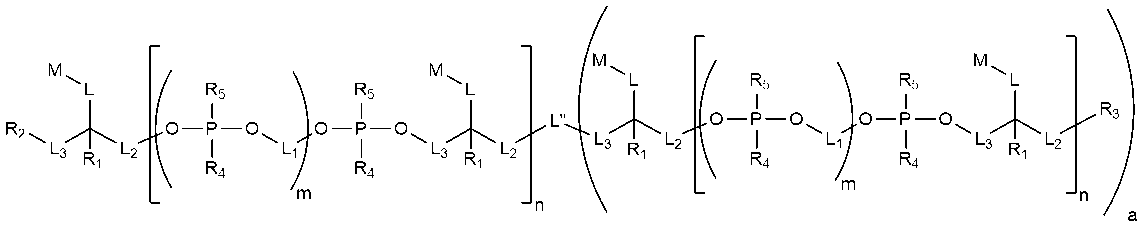
(式中、
R1、R2、R3、R4、R5、L、L1、L2、L3、M、mおよびnは出現毎に、独立して、構造(I)の化合物に関して定義されている通りであり、
L”は、Q部分と対応するQ’部分との反応から生じる官能基を含むリンカーであり、
αは、1より大きな整数、例えば1~100、または1~10である)を有する。
構造(I’)の他の化合物は、当業者によって、例えば、本明細書において提供されている構造(I)の化合物を二量化または重合することにより誘導可能である。
Similarly, compounds of structure (I) are included within the scope of certain embodiments, where one or both of R2 and R3 include a linking group to an additional compound of structure (I). For example, one or both of R2 and R3 are -OP(=R a )(R b )R c , where R c is OL', and L' is a linker that includes a covalent bond to an additional compound of structure (I). Such compounds can be prepared, for example, by preparing a first compound of structure (I) having about 10 "M" moieties (i.e., n=9) and having a suitable "Q" for reaction with a complementary Q' group on a second compound of structure (I). In this manner, compounds of structure (I) having any number of "M" moieties, for example 100 or more, can be prepared without the need to sequentially couple each monomer. An exemplary embodiment of such a compound of structure (I) is the following structure (I'):
(Wherein,
R1 , R2 , R3 , R4 , R5 , L, L1 , L2 , L3 , M, m and n are, at each occurrence, independently, as defined for the compounds of structure (I);
L″ is a linker that contains a functional group resulting from reaction of a Q moiety with the corresponding Q′ moiety;
α is an integer greater than 1, for example, 1 to 100, or 1 to 10.
Other compounds of structure (I') can be derived by one of skill in the art, for example, by dimerizing or polymerizing the compounds of structure (I) provided herein.
一部の他の実施形態では、R2またはR3の一方はOHまたは-OP(=Ra)(Rb)Rcであり、R2またはR3のもう一方は、標的指向性部分への共有結合を含むリンカー、または固体支持体への共有結合を含むリンカーである。例えば、一部の実施形態では、標的指向性部分は、抗体または細胞表面受容体アンタゴニストである。さらに異なる実施形態では、固体支持体は、ポリマー製ビーズまたは非ポリマー製ビーズである。
mに関する値は、所望の溶解度、浸透作用または治療用途に基づいて選択され得る別の可変因子である。一部の実施形態では、mは、出現毎に独立して、1~20の整数である。一部の実施形態では、mは、出現毎に独立して、1~10の整数である。他の実施形態では、mは、出現毎に独立して、1~5、例えば、1、2、3、4または5の整数である。
In some other embodiments, one of R2 or R3 is OH or -OP(=R a )(R b )R c and the other of R2 or R3 is a linker that includes a covalent bond to a targeting moiety or a linker that includes a covalent bond to a solid support. For example, in some embodiments, the targeting moiety is an antibody or a cell surface receptor antagonist. In yet another embodiment, the solid support is a polymeric or non-polymeric bead.
The value for m is another variable that can be selected based on the desired solubility, osmotic effect, or therapeutic application. In some embodiments, m, independently at each occurrence, is an integer from 1 to 20. In some embodiments, m, independently at each occurrence, is an integer from 1 to 10. In other embodiments, m, independently at each occurrence, is an integer from 1 to 5, e.g., 1, 2, 3, 4, or 5.
溶解度、浸透度または保持はまた、nの様々な値を選択することにより調節することができる。ある種の実施形態では、nは、1~100の整数である。他の実施形態では、nは、1~10の整数である。一部の実施形態では、nは1である。一部の実施形態では、nは2である。一部の実施形態では、nは3である。一部の実施形態では、nは4である。一部の実施形態では、nは5である。一部の実施形態では、nは6である。一部の実施形態では、nは7である。一部の実施形態では、nは8である。一部の実施形態では、nは9である。一部の実施形態では、nは10である。 The solubility, permeability or retention can also be adjusted by selecting different values of n. In certain embodiments, n is an integer between 1 and 100. In other embodiments, n is an integer between 1 and 10. In some embodiments, n is 1. In some embodiments, n is 2. In some embodiments, n is 3. In some embodiments, n is 4. In some embodiments, n is 5. In some embodiments, n is 6. In some embodiments, n is 7. In some embodiments, n is 8. In some embodiments, n is 9. In some embodiments, n is 10.
腫瘍細胞抗原には、腫瘍特異的抗原および腫瘍関連抗原、例えばEGFR、HER2、葉酸受容体、CD20、CD33、腫瘍胎児抗原(例えば、アルファフェトプロテイン、癌胎児性抗原、未成熟ラミニン受容体、TAG-72)、CA-125、MUC-1、上皮性腫瘍抗原、チロシナーゼ、黒色腫関連抗原(MAGE)およびRASまたはp53の異常生成物が含まれる。腫瘍細胞抗原はまた、腫瘍胎児、腫瘍ウイルス(例えば、HPV E6、E7)、過剰発現型/蓄積型(例えば、BING-4、カルシウム活性化塩化物チャネル2、9D7、Ep-CAM、EphA3、HER2、テロメラーゼ、メソテリン、SAP-1、サバイビン)、がん精巣(例えば、BAGEファミリー、CAGEファミリー、GAGEファミリー、MAGEファミリー、SAGEファミリー、XAGEファミリー)、系統限定型、変異型、翻訳後改変型、イディオタイプ、CT9またはCT10(例えば、NY-ESO-1/LAGE-1、PRAME)として特徴付けられる抗原を含むことができる。
一部の実施形態では、Mは、出現毎に独立して、NSAID、キナーゼ阻害剤、アントラサイクリン、EGFR阻害剤またはアルキル化剤である。
Tumor cell antigens include tumor-specific and tumor-associated antigens, such as EGFR, HER2, folate receptor, CD20, CD33, oncofetal antigens (e.g., alphafetoprotein, carcinoembryonic antigen, immature laminin receptor, TAG-72), CA-125, MUC-1, epithelial tumor antigen, tyrosinase, melanoma associated antigen (MAGE), and abnormal products of RAS or p53. Tumor cell antigens can also include antigens characterized as oncofetal, oncoviral (e.g., HPV E6, E7), overexpressed/accumulated (e.g., BING-4, calcium activated chloride channel 2, 9D7, Ep-CAM, EphA3, HER2, telomerase, mesothelin, SAP-1, survivin), cancer testis (e.g., BAGE family, CAGE family, GAGE family, MAGE family, SAGE family, XAGE family), lineage restricted, mutated, post-translationally modified, idiotypic, CT9 or CT10 (e.g., NY-ESO-1/LAGE-1, PRAME).
In some embodiments, M is, independently at each occurrence, an NSAID, a kinase inhibitor, an anthracycline, an EGFR inhibitor, or an alkylating agent.
一部の実施形態では、少なくとも1つのMは、抗がん薬である。ある種の特定の実施形態では、Mは、出現毎に独立して、抗がん薬であり、標的指向性部分は、腫瘍細胞抗原に特異的な抗体である。一部の実施形態では、腫瘍細胞抗原は、EGFR、HER2、葉酸受容体、CD20またはCD33である。
抗がん薬は、本明細書で使用する場合、誘導体を含む。これは、修飾または誘導体化された抗がん薬であり、こうしてこの薬物は、コンジュゲートされ得るか、または別の分子(例えば、Q部分を含むよう)に結合され得る。例えば、マイタンシンはがん薬であり、マイタンシノイドは、がん薬の誘導体である。
In some embodiments, at least one M is an anti-cancer drug. In certain particular embodiments, M, independently at each occurrence, is an anti-cancer drug and the targeting moiety is an antibody specific for a tumor cell antigen. In some embodiments, the tumor cell antigen is EGFR, HER2, folate receptor, CD20, or CD33.
Anti-cancer drugs, as used herein, include derivatives, which are anti-cancer drugs that have been modified or derivatized so that the drug may be conjugated or attached to another molecule (e.g., to include a Q moiety). For example, maytansine is a cancer drug and maytansinoids are derivatives of cancer drugs.
ある種の実施形態では、抗がん薬は、上皮成長因子受容体(EGFR)阻害剤、ホスファチジルイノシトールキナーゼ(PI3K)阻害剤、インスリン様成長因子受容体(IGF1R)阻害剤、ヤーヌスキナーゼ(JAK)阻害剤、Metキナーゼ阻害剤、SRCファミリーキナーゼ阻害剤、分裂促進因子活性化タンパク質キナーゼ(MEK)阻害剤、細胞外シグナル調節キナーゼ(ERK)阻害剤、トポイソメラーゼ阻害剤(イリノテカンなどまたはエトポシドなどまたはドキソルビシンなど)、タキサン(パクリタキセルおよびドセタキセルを含めた抗微小管剤など)、抗代謝産物剤(5-FUなどまたはゲムシタビンなど)、アルキル化剤(シスプラチンなどまたはシクロホスファミドなど)、またはタキサンである。
修飾され得る抗がん薬、および本開示の化合物の実施形態に組み込まれ得る抗がん薬には、例えば、オーリスタチンF、オーリスタチンE、マイタンシン、カリチアマイシン、パクリタキセル、ドキソルビシン、クリプトフィシン;エルロチニブ、CC-1065、カルゼレシン、SJG-136、DSB-120、アファチニブ、イレッサまたはメトトレキサートが含まれる。
In certain embodiments, the anti-cancer drug is an epidermal growth factor receptor (EGFR) inhibitor, a phosphatidylinositol kinase (PI3K) inhibitor, an insulin-like growth factor receptor (IGF1R) inhibitor, a Janus kinase (JAK) inhibitor, a Met kinase inhibitor, an SRC family kinase inhibitor, a mitogen-activated protein kinase (MEK) inhibitor, an extracellular signal-regulated kinase (ERK) inhibitor, a topoisomerase inhibitor (such as irinotecan or such as etoposide or such as doxorubicin), a taxane (such as an anti-microtubule agent, including paclitaxel and docetaxel), an antimetabolite agent (such as 5-FU or such as gemcitabine), an alkylating agent (such as cisplatin or such as cyclophosphamide), or a taxane.
Anti-cancer drugs that may be modified and incorporated into compound embodiments of the present disclosure include, for example, auristatin F, auristatin E, maytansine, calicheamicin, paclitaxel, doxorubicin, cryptophycin; erlotinib, CC-1065, carzelesin, SJG-136, DSB-120, afatinib, Iressa, or methotrexate.
抗がん薬の他の非限定例には、Gleevec(登録商標)(メシル酸イマチニブ)、Velcade(登録商標)(ボルテゾミブ)、Casodex(ビカルタミド)、Iressa(登録商標)(ゲフィチニブ)およびアドリアマイシン、アルキル化剤(チオテパおよびシクロスホスファミド(CYTOXAN(登録商標)など));ブスルファン、インプロスルファンおよびピポスルファンなどのスルホン酸アルキル;ベンゾドーパ、カルボクオン、メツレドーパおよびウレドーパなどのアジリジン;エチレンイミンおよびメチラメラミン(アルトレタミン、トリエチレンメラミン、トリエチレンホスホルアミド、トリエチレンチオホスホルアミドおよびトリメチロロメラミンを含む);クロラムブシル、クロルナファジン、クロホスファミド、エストラムスチン、イフォスアミド、メクロレタミン、メクロレタミンオキシド塩酸塩、メルファラン、ノベムビシン、フェネステリン、プレドニムスチン、トロホスファミド、ウラシルマスタードなどのナイトロジェンマスタード;カルムスチン、クロロゾトシン、フォテムスチン、ロムスチン、ニムスチン、ラニムスチンなどのニトロソウレア;アクラシノマイシン系、アクチノマイシン、アウスラマイシン、アザセリン、ブレオマイシン系、カクチノマイシン、カリチアマイシン、カラビシン、カルミノマイシン、カルジノフィリン、Casodex(登録商標)、クロモマイシン系、ダクチノマイシン、ダウノルビシン、デトルビシン、6-ジアゾ-5-オキソ-L-ノルロイシン、ドキソルビシン、エピルビシン、エソルビシン、イダルビシン、マルセロマイシン、マイトマイシン、ミコフェノール酸、ノガラマイシン、オリボマイシン系、ペプロマイシン、ポトフィロマイシン、ピューロマイシン、クエラマイシン、ロドルビシン、ストレプトニグリン、ストレプトゾシン、ツベルシジン、ウベニメクス、ジノスタチン、ゾルビシンなどの抗生物質;メトトレキサートおよび5-フルオロウラシル(5-FU)などの抗代謝産物;デノプテリン、メトトレキサート、プテロプテリン、トリメトレキサートなどの葉酸類似体;フルダラビン、6-メルカプトプリン、チアミプリン、チオグアニンなどのプリン類似体;アンシタビン、アザシチジン、6-アザウリジン、カルモフール、シタラビン、ジデオキシウリジン、ドキシフルリジン、エノシタビン、フロクスウリジンなどのピリミジン類似体、カルステロン、プロピオン酸ドロモスタノロン、エピチオスタノール、メピチオスタン、テストラクトンなどのアンドロゲン;アミノグルテチミド、ミトタン、トリロスタンなどの抗副腎剤;フロリニン酸などの葉酸補充物質;アセグラトン;アルドホスファミドグリコシド;アミノレブリン酸;アムサクリン;ベストラブシル;ビスアントレン;エダトラキサート;デフォファミン;デメコルチン;ジアジクオン;エルフォミチン;酢酸エリプチニウム;エトグルシド;硝酸ガリウム;ヒドロキシウレア;レンチナン;ロニダミン;ミトグアゾン;ミトキサントロン;モピダモル;ニトラクリン;ペントスタチン;フェナメト;ピラルビシン;ポドフィリン酸;2-エチルヒドラジド;プロカルバジン;PSK.RTM;ラゾキサン;シゾフィラン;スピロゲルマニウム;テヌアゾン酸;トリアジクオン;2,2’,2”-トリクロロトリエチルアミン;ウレタン;ビンデシン;ダカルバジン;マンノムスチン;ミトブロニトール;ミトラクトール;ピポブロマン;ガシトシン;アラビノシド(「Ara-C」);シクロホスファミド;チオテパ;タキサン、例えばパクリタキセル(TAXOL(商標)、Bristol-Myers Squibb Oncology、Princeton、N.J.)、およびドセタキセル(TAXOTERE(商標)、Rhone-Poulenc Rorer、Antony、フランス);レチノイン酸;エスペラミシン系またはカペシタビンが含まれる。同様に、例えばタモキシフェン(Nolvadex(商標))、ラロキシフェン、アロマターゼ阻害性4(5)-イミダゾール系、4-ヒドロキシタモキシフェン、トリオキシフェン、ケオキシフェン、LY117018、オナプリストンおよびトレミフェン(フェアストン);およびフルタミド、ニルタミド、ビカルタミド、ロイプロリドおよびゴセレリンなどの抗アンドロゲン薬;クロラムブシル;ゲムシタビン;6-チオグアニン;メルカプトプリン;メトトレキサート;シスプラチンおよびカルボプラチンなどの白金類似体;ビンブラスチン;白金;エトポシド(VP-16);イフォスファミド;マイトマイシンC;ミトキサントロン;ビンクリスチン;ビノレルビン;ナベルビン;ノバントロン;テニポシド;ダウノマイシン;アミノプテリン;キセローダ;イバンドロネート;カンプトテシン-11(CPT-11);トポイソメラーゼ阻害剤RFS2000;ジフルオロメチルオルニチン(DMFO)を含めた抗エストロゲン剤などの、腫瘍に対するホルモン作用を調節または阻害するように作用する抗ホルモン剤が、好適ながん薬として含まれる。 Other non-limiting examples of anticancer drugs include Gleevec® (imatinib mesylate), Velcade® (bortezomib), Casodex (bicalutamide), Iressa® (gefitinib) and adriamycin, alkylating agents (such as thiotepa and cyclosphosphamide (CYTOXAN®)); alkyl sulfonates such as busulfan, improsulfan and piposulfan; aziridines such as benzodopa, carboquone, meturedopa and uredopa; ethylenimines and methylamelamines (including altretamine, triethylenemelamine, triethylenephosphoramide, triethylenethiophosphoramide and trimethylolmelamine); chlorambucil, chlornaphazine, clophosphamide, cyclosulf ... Nitrogen mustards such as amide, estramustine, ifosamide, mechlorethamine, mechlorethamine oxide hydrochloride, melphalan, novembicin, phenesterine, prednimustine, trofosfamide, and uracil mustard; nitrosoureas such as carmustine, chlorozotocin, fotemustine, lomustine, nimustine, and ranimustine; aclacinomycins, actinomycin, ausramycin, azaserine, bleomycins, cactinomycin, calicheamicin, carabicin, carminomycin, carzinophilin, Casodex®, chromomycins, dactinomycin, daunorubicin, detorubicin, 6-diazo-5-oxo-L-norleucine, doxorubicin, epirubicin, esorubicin, Antibiotics such as cyclosporine, idarubicin, marcelomycin, mitomycin, mycophenolic acid, nogalamycin, olivomycins, peplomycin, potfilomycin, puromycin, queramycin, rodorubicin, streptonigrin, streptozocin, tubercidin, ubenimex, zinostatin, zorubicin; antimetabolites such as methotrexate and 5-fluorouracil (5-FU); folic acid analogues such as denopterin, methotrexate, pteropterin, trimetrexate; purine analogues such as fludarabine, 6-mercaptopurine, thiamiprine, thioguanine; ancitabine, azacitidine, 6-azauridine, carmofur, cytarabine, dideoxyuridine, doxifluridine, enocitabine, floxuridine, Pyrimidine analogues such as sirolimidine, androgens such as calsterone, dromostanolone propionate, epithiostanol, mepitiostane, testolactone; antiadrenal drugs such as aminoglutethimide, mitotane, trilostane; folic acid supplements such as florinic acid; aceglatone; aldophosphamide glycosides; aminolevulinic acid; amsacrine; bestravcil; bisantrene; edatraxate; defofamine; demecolcine; diaziquone; elfomitine; elliptinium acetate; etoglucide; gallium nitrate; hydroxyurea; lentinan; lonidamine; mitoguazone; mitoxantrone; mopidamol; nitracrine; pentostatin; fenameth; pirarubicin; podophyllic acid; 2-ethylhydrazide; procarbazine; PSK. RTM; razoxane; sizofiran; spirogermanium; tenuazonic acid; triaziquone; 2,2',2"-trichlorotriethylamine; urethane; vindesine; dacarbazine; mannomustine; mitobronitol; mitolactol; pipobroman; gacytosine; arabinoside ("Ara-C"); cyclophosphamide; thiotepa; taxanes such as paclitaxel (TAXOL™, Bristol-Myers Squibb Oncology, Princeton, N.J.), and docetaxel (TAXOTERE™, Rhone-Poulenc Rorer, Anthony, France); retinoic acid; esperamicins or capecitabine. Similarly, for example, tamoxifen (Nolvadex™), raloxifene, aromatase-inhibiting 4(5)-imidazoles, 4-hydroxytamoxifen, trioxyphene, keoxyphene, LY117018, onapristone, and toremifene (Fareston); and antiandrogens such as flutamide, nilutamide, bicalutamide, leuprolide, and goserelin; chlorambucil; gemcitabine; 6-thioguanine; mercaptopurine; methotrexate; platinum analogs such as cisplatin and carboplatin; Suitable cancer drugs include antihormonal agents that act to regulate or inhibit hormone action on tumors, such as vinblastine; platinum; etoposide (VP-16); ifosfamide; mitomycin C; mitoxantrone; vincristine; vinorelbine; navelbine; novantrone; teniposide; daunomycin; aminopterin; xeloda; ibandronate; camptothecin-11 (CPT-11); the topoisomerase inhibitor RFS2000; and antiestrogens, including difluoromethylornithine (DMFO).
ある種の実施形態では、少なくとも1つのMは、チロシンキナーゼ阻害剤(例えば、ゲフィチニブ、エルロチニブ)、ラパチニブ、バンデタニブ、ネラチニブ、オシメルチニブ、トバンチニブ(ARQ197)、クリゾチニブ、カボザンチニブ、チルホスチン系(例えば、AG538、AG1024)、ピロロ(2,3-d)-ピリミジン誘導体(例えば、NVP-AEW541)、モノクローナル抗体(例えば、フィギツムマブ、セツキシマブ、パニツムマブ、ネシツムマブ、ガニツマブ、シクスツムマブ、ダロツズマブ、ロバツムマブ、オナルツズマブ、K1、ラベツズマブ、ミラツズマブ、ロルボツズマブ、イノツズマブ)、BMS-777607、PF-02341066、PF-04217903、AMG-458、MK-2461、JNJ-38877605、GSK1363089(フォレチニブ)、XL880、XL184、ARQ197、E7050またはINCB28060である。 In certain embodiments, at least one M is selected from the group consisting of tyrosine kinase inhibitors (e.g., gefitinib, erlotinib), lapatinib, vandetanib, neratinib, osimertinib, tovantinib (ARQ197), crizotinib, cabozantinib, tyrphostins (e.g., AG538, AG1024), pyrrolo(2,3-d)-pyrimidine derivatives (e.g., NVP-AEW541), monoclonal antibodies (e.g., figitumumab, cetuximab, panitumumab, tuzumab, necitumumab, ganitumab, cixutumumab, darotuzumab, lobatuzumab, onartuzumab, K1, labetuzumab, milatuzumab, lorvotuzumab, inotuzumab), BMS-777607, PF-02341066, PF-04217903, AMG-458, MK-2461, JNJ-38877605, GSK1363089 (foretinib), XL880, XL184, ARQ197, E7050 or INCB28060.
所望の場合、本開示の化合物または組成物の実施形態は、Herceptin(登録商標)、Avastin(登録商標)、Erbitux(登録商標)、Rituxan(登録商標)、Taxol(登録商標)、Arimidex(登録商標)、Taxotere(登録商標)、ABVD、アビシン、アバゴボマブ、アクリジンカルボキサミド、アデカツムマブ、17-N-アリルアミノ-17-デメトキシゲルダナマイシン、アルファラジン、アルボシジブ、3-アミノピリジン-2-カルボキシアルデヒドチオセミカルバゾン、アモナフィド、アントラセンジオン、抗CD22イムノトキシン、抗新生物剤、抗腫瘍性ハーブ、アパジクオン、アチプリモド、アザチオプリン、ベロテカン、ベンダムスチン、BIBW2992、ビリコダル、ブロスタリシン、ブリオスタチン、ブチオニンスルホキシム、CBV(化学療法)、カリクリン、細胞周期非特異的抗新生物剤、ジクロロ酢酸、ディスコデルモライド、エルサミトルシン、エノシタビン、エポチロン、エリブリン、エベロリムス、エキサテカン、エキシスリンド、フェルジノール、ホロデシン、ホスフェストロール、ICE化学療法レジメン、IT-101、イメクソン、イミクイモド、インドロカルバゾール、イロフルベン、ラニクイダル、ラロタキセル、レナリドマイド、ルカントン、ルルトテカン、メホスファミド、ミトゾロミド、ナホキシジン、ネダプラチン、オラパリブ、オルタタキセル、PAC-1、ポーポー、ピクサントロン、プロテアソーム阻害剤、レベカマイシン、レシキモド、ルビテカン、SN-38、サリノスポラミドA、サパシタビン、スタンフォードV、スワインソニン、タラプロフィン、タリクイダール、テガフール-ウラシル、テモダル、テセタキセル、四硝酸トリプラチン、トリス(2-クロロエチル)アミン、トロキサシタビン、ウラムスチン、バジメザン、ビンフルニン、ZD6126またはゾスクイダルなどの一般に処方されている抗がん薬と組み合わせて使用され得る。 If desired, embodiments of the compounds or compositions disclosed herein include Herceptin (registered trademark), Avastin (registered trademark), Erbitux (registered trademark), Rituxan (registered trademark), Taxol (registered trademark), Arimidex (registered trademark), Taxotere (registered trademark), ABVD, avicin, abagovomab, acridine carboxamide, adecatumumab, 17-N-allylamino-17-demethoxygeldanamycin, alpharadin, alvocidib, 3-aryl ... minopyridine-2-carboxaldehyde thiosemicarbazone, amonafide, anthracenedione, anti-CD22 immunotoxin, antineoplastic agents, antitumor herbs, apaziquone, atiprimod, azathioprine, belotecan, bendamustine, BIBW2992, biricoderm, brostallicin, bryostatin, buthionine sulfoxime, CBV (chemotherapy), calyculin, cell cycle nonspecific antineoplastic agents, dichloroacetic acid, discodermolide, elsamitrucin, eno Citabine, epothilone, eribulin, everolimus, exatecan, exisulind, ferginol, holodesine, fosfestrol, ICE chemotherapy regimen, IT-101, imexon, imiquimod, indolocarbazole, irofulven, ranicuidar, larotaxel, lenalidomide, lucantone, lurtotecan, mefosfamide, mitozolomide, nafoxidine, nedaplatin, olaparib, ortataxel, PAC-1, pawpaw, pixantrone, progesterone, It may be used in combination with commonly prescribed anticancer drugs such as roteasome inhibitors, rebeccamycin, resiquimod, rubitecan, SN-38, salinosporamide A, sapacitabine, Stanford V, swainsonine, talaprofin, taliquidar, tegafur-uracil, temodar, tesetaxel, triplatin tetranitrate, tris(2-chloroethyl)amine, troxacitabine, uramustine, vadimezan, vinflunine, ZD6126, or zosquidar.
Mは、所望の治療的特性および/または光学特性に基づいて、例えば、特定の疾患または状態(例えば、がん)の処置、または特定の色調および/もしくは蛍光発光波長の発生に基づいて選択される。一部の実施形態では、Mは、出現毎に同じである。しかし、Mの各出現は、同一のMである必要はなく、ある種の実施形態には、Mが、各出現において同じではない化合物を含むことに留意することが重要である。例えば、一部の実施形態では、Mはそれぞれ、同じではなく、異なるM部分が、異なる治療的特性(例えば、細胞傷害性および抗炎症)を有するよう選択される。一部の実施形態では、Mはそれぞれ、同一ではなく、異なるM部分は、同じまたは類似の治療特性(例えば、細胞毒性)を有するように選択される。ある種の実施形態では、Mはそれぞれ、以下: M is selected based on desired therapeutic and/or optical properties, for example, treatment of a particular disease or condition (e.g., cancer), or generation of a particular color and/or wavelength of fluorescent emission. In some embodiments, M is the same at each occurrence. However, it is important to note that each occurrence of M need not be the same M, and certain embodiments include compounds in which M is not the same at each occurrence. For example, in some embodiments, M is not the same at each occurrence, and the different M moieties are selected to have different therapeutic properties (e.g., cytotoxicity and anti-inflammatory). In some embodiments, M is not the same at each occurrence, and the different M moieties are selected to have the same or similar therapeutic properties (e.g., cytotoxicity). In certain embodiments, M is each of the following:
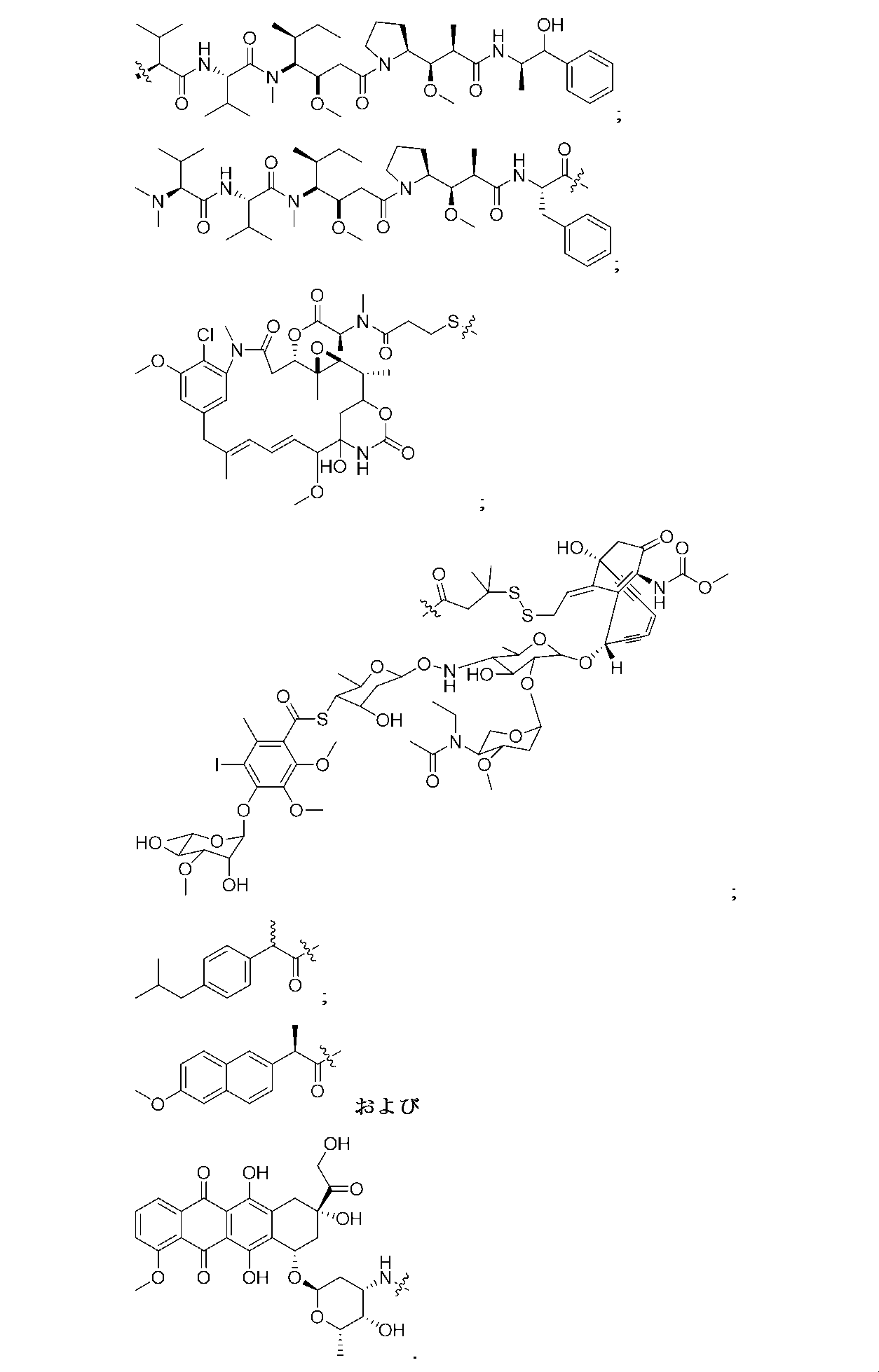
例示を容易にするため、分子の残りとの特定の結合点(すなわち、

ある種の実施形態では、L-Mは、以下の構造:
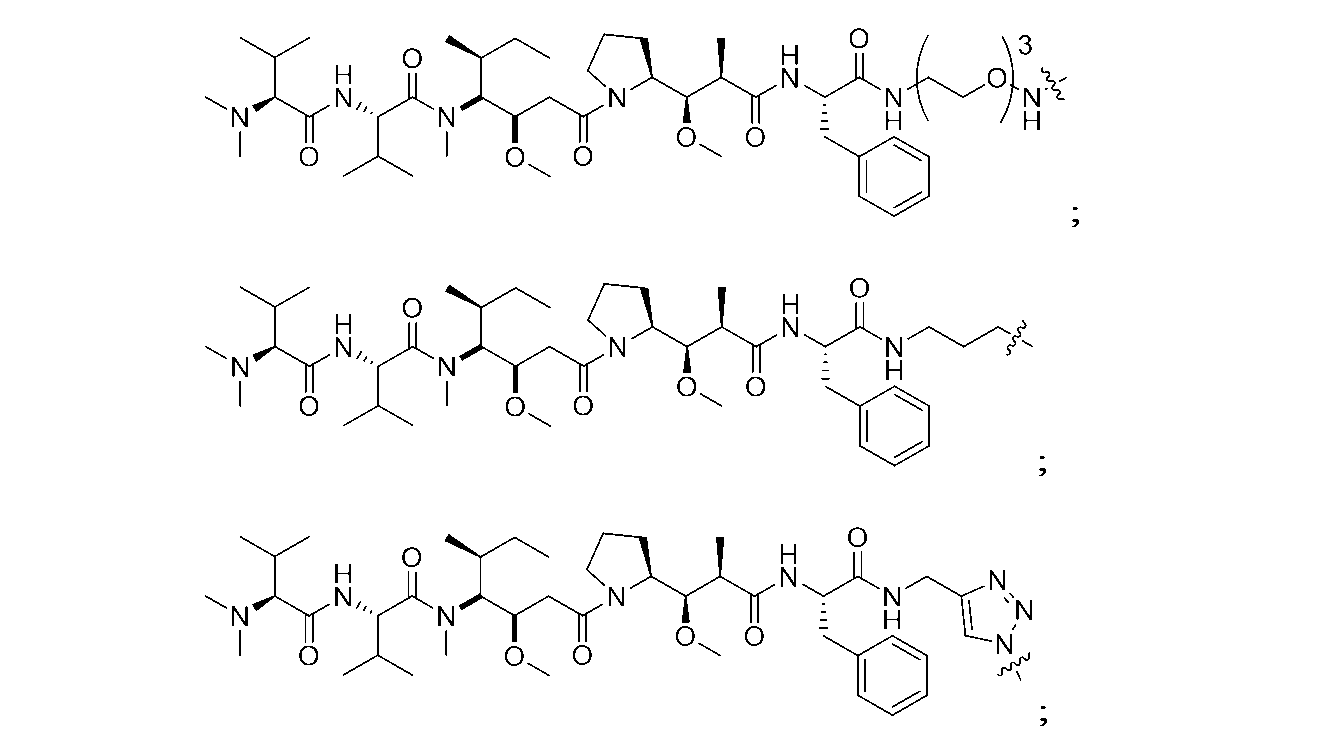
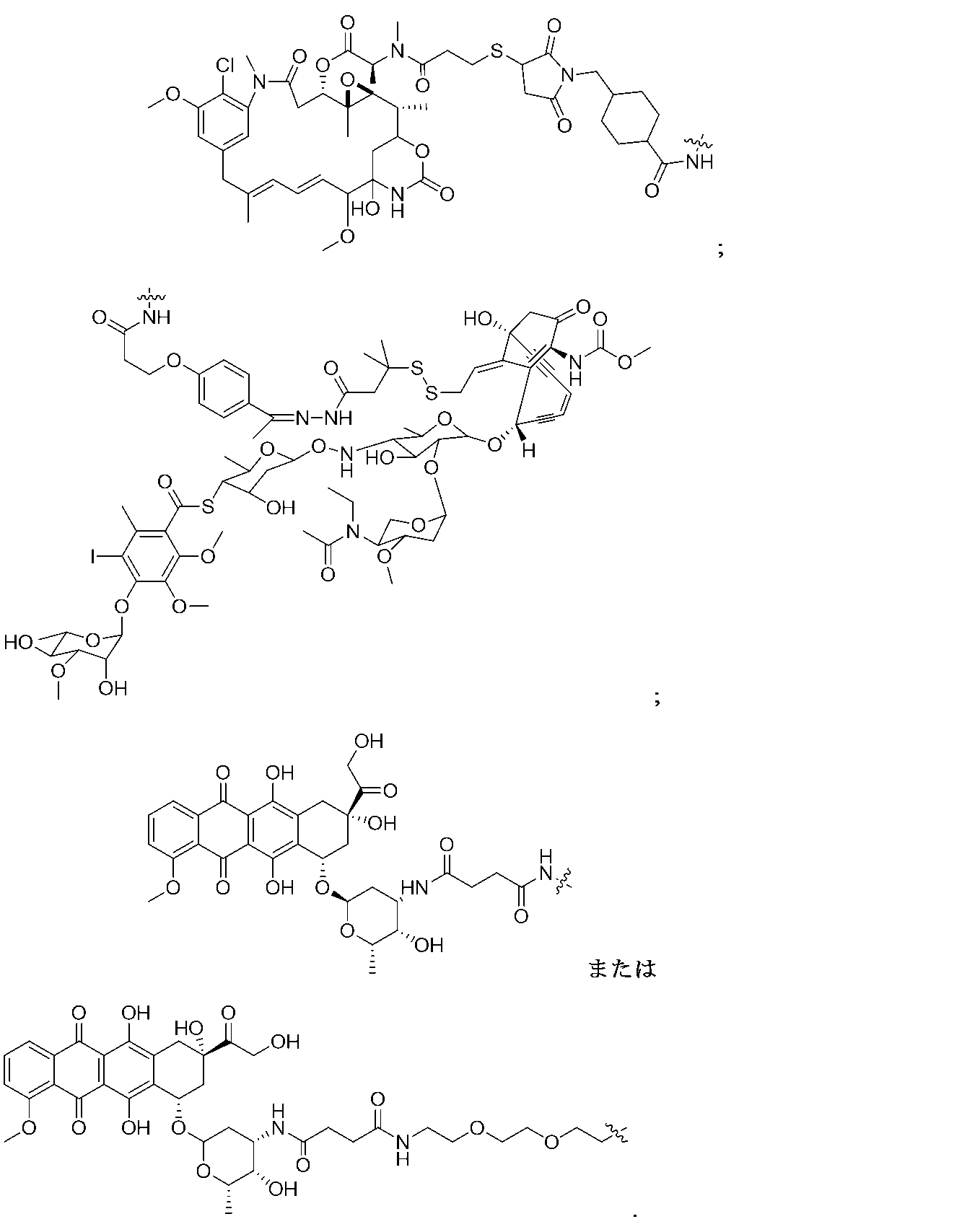
上述のいずれかのさらなる実施形態では、Mは、同じである。他の実施形態では、Mはそれぞれ、異なる。さらなる実施形態では、1つまたは複数のMは同じであり、1つまたは複数のMは異なる。
In certain embodiments, L-M has the following structure:
In further embodiments of any of the above, M are the same. In other embodiments, each M is different. In further embodiments, one or more M are the same and one or more M are different.
一部の実施形態では、出現するMの少なくとも1つは、以下の構造:

より具体的な実施形態では、Mは出現毎に、以下の構造:

一部の実施形態では、Mの選択される出現は、同じではなく、異なるM部分は、蛍光共鳴エネルギー移動(FRET)法において使用するための、吸光度および/または発光を有するように選択される。例えば、このような実施形態では、異なるM部分は、1つの波長における照射の吸光度が、FRET機構によって、異なる波長での照射の発光を引き起こすよう選択される。例示的なM部分は、所望の最終使用に基づいて、当業者により適切に選択され得る。FRET法に関する例示的なM部分には、フルオレセインおよび5-TAMRA(5-カルボキシテトラメチルローダミン、スクシンイミジルエステル)色素が含まれる。
Mは、M上の任意に位置(すなわち、原子)から分子の残りに結合し得る。当業者は、Mが分子の残りに結合するための手段を認識していよう。例示的な方法には、本明細書に記載されている「クリック」反応が含まれる。
In some embodiments, the selected occurrences of M are not the same, but rather the different M moieties are selected to have absorbance and/or emission for use in fluorescence resonance energy transfer (FRET) methods. For example, in such embodiments, the different M moieties are selected such that absorbance of radiation at one wavelength causes emission of radiation at a different wavelength by a FRET mechanism. Exemplary M moieties can be appropriately selected by one of skill in the art based on the desired end use. Exemplary M moieties for FRET methods include fluorescein and 5-TAMRA (5-carboxytetramethylrhodamine, succinimidyl ester) dyes.
M may be attached to the remainder of the molecule from any position (i.e., atom) on M. Those of skill in the art will recognize means by which M can be attached to the remainder of the molecule. Exemplary methods include the "click" reaction described herein.
一部の実施形態では、少なくとも1つのMは、蛍光部分または発色部分である。任意の蛍光部分および/または発色部分が使用されてもよく、例えば、当分野で公知のもの、および比色分析、UVおよび/または蛍光アッセイに通常使用されるものが使用されてもよい。本発明の様々な実施形態に有用なM部分の例には、以下に限定されないが、キサンテン誘導体(例えば、フルオレセイン、ローダミン、オレゴングリーン、エオシンまたはテキサスレッド);シアニン誘導体(例えば、シアニン、インドカルボシアニン、オキサカルボシアニン、チアカルボシアニンまたはメロシアニン);スクアライン誘導体および環置換スクアライン(セタ(Seta)、セタウ(SeTau)およびスクエア色素を含む);ナフタレン誘導体(例えば、ダンシルおよびポロダン誘導体);クマリン誘導体;オキサジアゾール誘導体(例えば、ピリジルオキサゾール、ニトロベンゾオキサジアゾールまたはベンゾオキサジアゾール);アントラセン誘導体(例えば、DRAQ5、DRAQ7およびCyTRAKオレンジを含むアントラキノン);カスケードブルーなどのピレン誘導体;オキサジン誘導体(例えば、ナイルレッド、ナイルブルー、クレシルバイオレット、オキサジン170);アクリジン誘導体(例えば、プロフラビン、アクリジンオレンジ、アクリジンイエロー);アリールメチン誘導体:アウラミン、クリスタルバイオレット、マラカイトグリーン;およびテラピロール誘導体(例えば、ポルフィン、フタロシアニンまたはビリルビン)が含まれる。他の例示的なM部分には、シアニン色素、キサンテート色素(例えば、Hex、Vic、Nedd、JoeまたはTet);ヤキマイエロー、レッドモンドレッド;タムラ;テキサスレッドおよびalexa fluor(登録商標)色素が含まれる。 In some embodiments, at least one M is a fluorescent or chromogenic moiety. Any fluorescent and/or chromogenic moiety may be used, such as those known in the art and commonly used in colorimetric, UV and/or fluorescent assays. Examples of M moieties useful in various embodiments of the invention include, but are not limited to, xanthene derivatives (e.g., fluorescein, rhodamine, Oregon Green, eosin or Texas Red); cyanine derivatives (e.g., cyanine, indocarbocyanine, oxacarbocyanine, thiacarbocyanine or merocyanine); squaraine derivatives and ring-substituted squaraines (including Seta, SeTau and Squara dyes); naphthalene derivatives (e.g., dansyl and polodan derivatives); coumarin derivatives; oxadiazole derivatives (e.g., pyridyloxazole, nitro benzoxadiazoles or benzoxadiazoles); anthracene derivatives (e.g., anthraquinones, including DRAQ5, DRAQ7, and CyTRAK orange); pyrene derivatives such as cascade blue; oxazine derivatives (e.g., Nile red, Nile blue, cresyl violet, oxazine 170); acridine derivatives (e.g., proflavine, acridine orange, acridine yellow); arylmethine derivatives: auramine, crystal violet, malachite green; and telapyrrole derivatives (e.g., porphine, phthalocyanine, or bilirubin). Other exemplary M moieties include cyanine dyes, xanthate dyes (e.g., Hex, Vic, Nedd, Joe, or Tet); Yakima yellow, Redmond red; Tamura; Texas red, and alexa fluor® dyes.
上述のいずれかのさらに他の実施形態では、少なくとも1つのMは、3つ以上のアリール環もしくはヘテロアリール環、またはそれらの組合せ、例えば、4つ以上のアリール環もしくはヘテロアリール環、またはそれらの組合せ、あるいは5つ以上のアリール環もしくはヘテロアリール環、またはそれらの組合せさえも含む。一部の実施形態では、少なくとも1つのMは、6つのアリール環もしくはヘテロアリール環、またはそれらの組合せを含む。さらなる実施形態では、環は縮合している。例えば、一部の実施形態では、少なくとも1つのMは、3つ以上の縮合環、4つ以上の縮合環、5つ以上の縮合環、または6つ以上にもなることさえある縮合環を含む。 In still other embodiments of any of the above, at least one M comprises three or more aryl or heteroaryl rings, or combinations thereof, such as four or more aryl or heteroaryl rings, or combinations thereof, or even five or more aryl or heteroaryl rings, or combinations thereof. In some embodiments, at least one M comprises six aryl or heteroaryl rings, or combinations thereof. In further embodiments, the rings are fused. For example, in some embodiments, at least one M comprises three or more fused rings, four or more fused rings, five or more fused rings, or even six or more fused rings.
一部の実施形態では、少なくとも1つのMは環式である。例えば、一部の実施形態では、少なくとも1つのMは、炭素環式である。他の実施形態では、少なくとも1つのMは、複素環式である。上述のさらに他の実施形態では、少なくとも1つのMは、出現毎に独立して、アリール部分を含む。これらの実施形態の一部では、アリール部分は多環式である。他のさらなる具体例では、アリール部分は、縮合多環式アリール部分であり、例えば、この縮合多環式アリール部分は、少なくとも3つ、少なくとも4つ、または4つを超えることさえあるアリール環を含むことができる。
構造(I)または(I’)の上述の化合物のいずれかの他の実施形態では、少なくとも1つのMは、少なくとも1個のヘテロ原子を含む。例えば、一部の実施形態では、ヘテロ原子は、窒素、酸素または硫黄である。
上述のいずれかのさらなる実施形態では、少なくとも1つのMは、少なくとも1つの置換基を含む。例えば、一部の実施形態では、置換基は、フルオロ、クロロ、ブロモ、ヨード、アミノ、アルキルアミノ、アリールアミノ、ヒドロキシ、スルフヒドリル、アルコキシ、アリールオキシ、フェニル、アリール、メチル、エチル、プロピル、ブチル、イソプロピル、t-ブチル、カルボキシ、スルホネート、アミドまたはホルミル基である。
In some embodiments, at least one M is cyclic. For example, in some embodiments, at least one M is carbocyclic. In other embodiments, at least one M is heterocyclic. In still other embodiments of the above, at least one M, independently at each occurrence, comprises an aryl moiety. In some of these embodiments, the aryl moiety is polycyclic. In other further specific examples, the aryl moiety is a fused polycyclic aryl moiety, for example, the fused polycyclic aryl moiety can include at least three, at least four, or even more than four aryl rings.
In other embodiments of any of the above-mentioned compounds of structure (I) or (I'), at least one M comprises at least one heteroatom. For example, in some embodiments, the heteroatom is nitrogen, oxygen, or sulfur.
In further embodiments of any of the above, at least one M comprises at least one substituent, for example, in some embodiments, the substituent is a fluoro, chloro, bromo, iodo, amino, alkylamino, arylamino, hydroxy, sulfhydryl, alkoxy, aryloxy, phenyl, aryl, methyl, ethyl, propyl, butyl, isopropyl, t-butyl, carboxy, sulfonate, amido, or formyl group.
上述の一部のさらに具体的な実施形態では、少なくとも1つのMは、ジメチルアミノスチルベン、キナクリドン、フルオロフェニル-ジメチル-BODIPY、his-フルオロフェニル-BODIPY、アクリジン、テリレン、セキシフェニル、ポルフィリン、ベンゾピレン、(フルオロフェニル-ジメチル-ジフルオロボラ-ジアザ-インダセン)フェニル、(ビス-フルオロフェニル-ジフルオロボラ-ジアザ-インダセン)フェニル、クワテルフェニル、ビ-ベンゾチアゾール、ター-ベンゾチアゾール、ビ-ナフチル、ビ-アントラシル、スクアライン、スクアリリウム、9,10-エチニルアントラセンまたはター-ナフチル部分である。他の実施形態では、少なくとも1つのMは、p-ターフェニル、ペリレン、アゾベンゼン、フェナジン、フェナントロリン、アクリジン、チオキサントレン、クリセン、ルブレン、コロネン、シアニン、ペリレンイミドもしくはペリレンアミド、またはそれらの誘導体である。さらなる実施形態では、少なくとも1つのMは、クマリン色素、レゾルフィン色素、ジピロメテンボロンジフルオライド色素、ルテニウムビピリジル色素、エネルギー移動色素、チアゾールオレンジ色素、ポリメチンまたはN-アリール-1,8-ナフタルイミド色素である。 In some more specific embodiments described above, at least one M is a dimethylaminostilbene, quinacridone, fluorophenyl-dimethyl-BODIPY, his-fluorophenyl-BODIPY, acridine, terylene, sexiphenyl, porphyrin, benzopyrene, (fluorophenyl-dimethyl-difluorobora-diaza-indacene)phenyl, (bis-fluorophenyl-difluorobora-diaza-indacene)phenyl, quaterphenyl, bi-benzothiazole, ter-benzothiazole, bi-naphthyl, bi-anthracyl, squaraine, squarylium, 9,10-ethynylanthracene, or ter-naphthyl moiety. In other embodiments, at least one M is p-terphenyl, perylene, azobenzene, phenazine, phenanthroline, acridine, thioxanthrene, chrysene, rubrene, coronene, cyanine, perylene imide, or perylene amide, or a derivative thereof. In further embodiments, at least one M is a coumarin dye, a resorufin dye, a dipyrrometheneboron difluoride dye, a ruthenium bipyridyl dye, an energy transfer dye, a thiazole orange dye, a polymethine, or an N-aryl-1,8-naphthalimide dye.
一部の実施形態では、少なくとも1つのMは、ピレン、ペリレン、ペリレンモノイミドもしくは6-FAM、またはそれらの誘導体である。一部の他の実施形態では、少なくとも1つのMは、以下の構造: In some embodiments, at least one M is pyrene, perylene, perylene monoimide, or 6-FAM, or a derivative thereof. In some other embodiments, at least one M has the following structure:
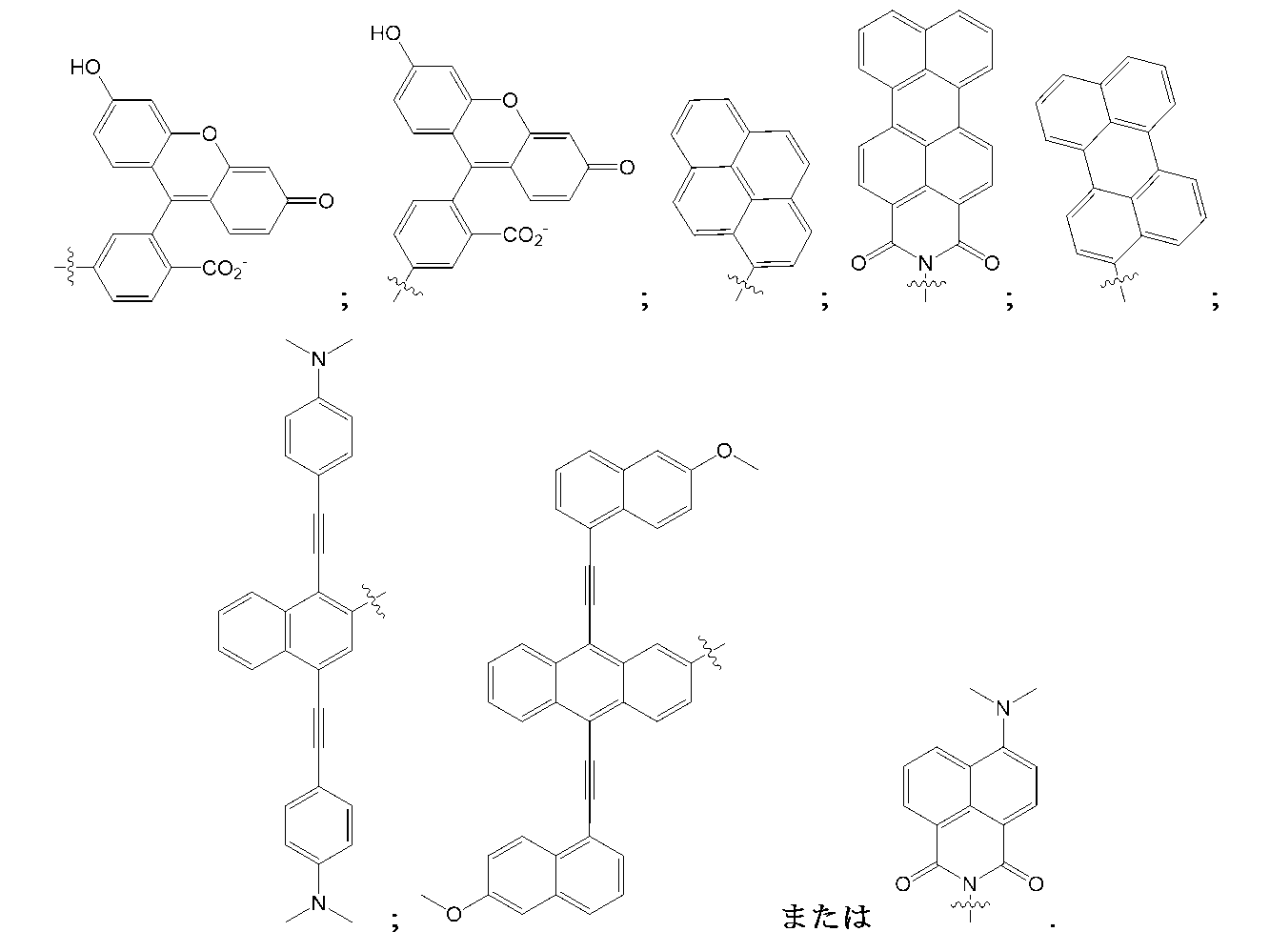
のうちの1つを有する。
カルボン酸基を含むM部分は、上記の陰イオン性形態(CO2
-)で図示されているが、当業者は、これは、pHに応じて様々になること、およびプロトン化形態(CO2H)は、様々な実施形態に含まれることを理解するであろう。
The first embodiment has one of the following:
The M moiety containing a carboxylic acid group is illustrated above in its anionic form (CO 2 − ), however, one of skill in the art will understand that this will vary depending on pH and that the protonated form (CO 2 H) is included in various embodiments.
一部の具体的な実施形態では、本化合物は、表2から選択される化合物である。
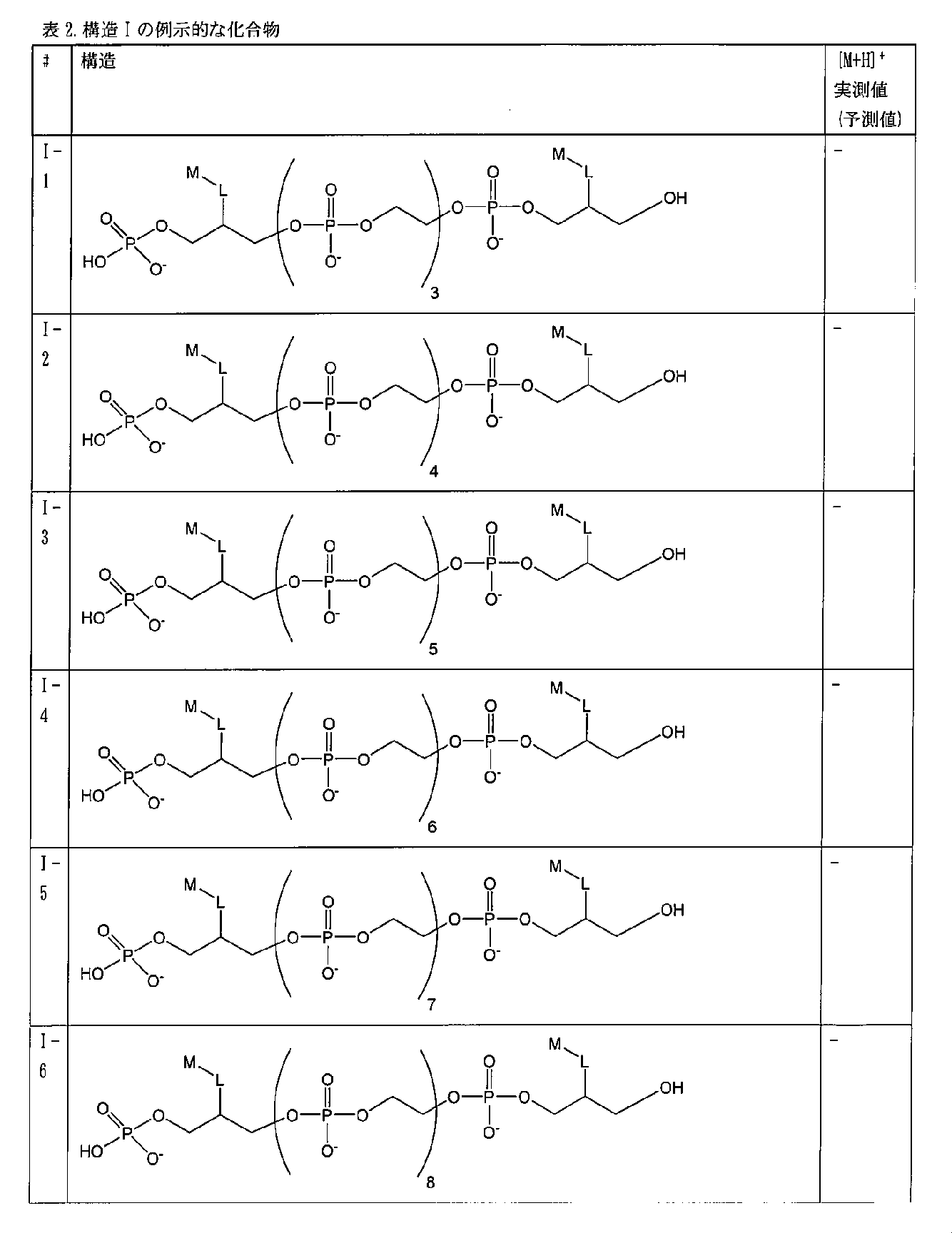
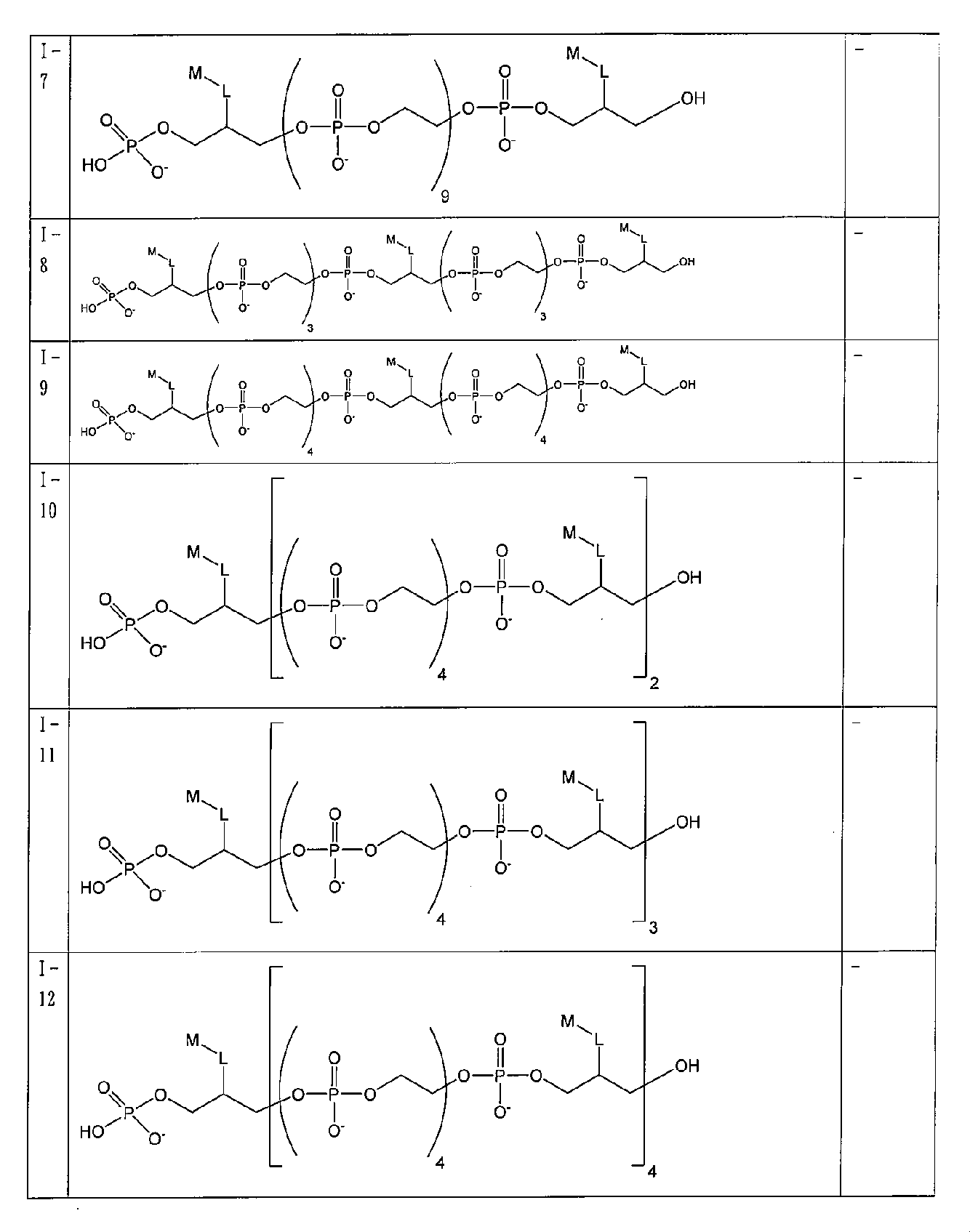
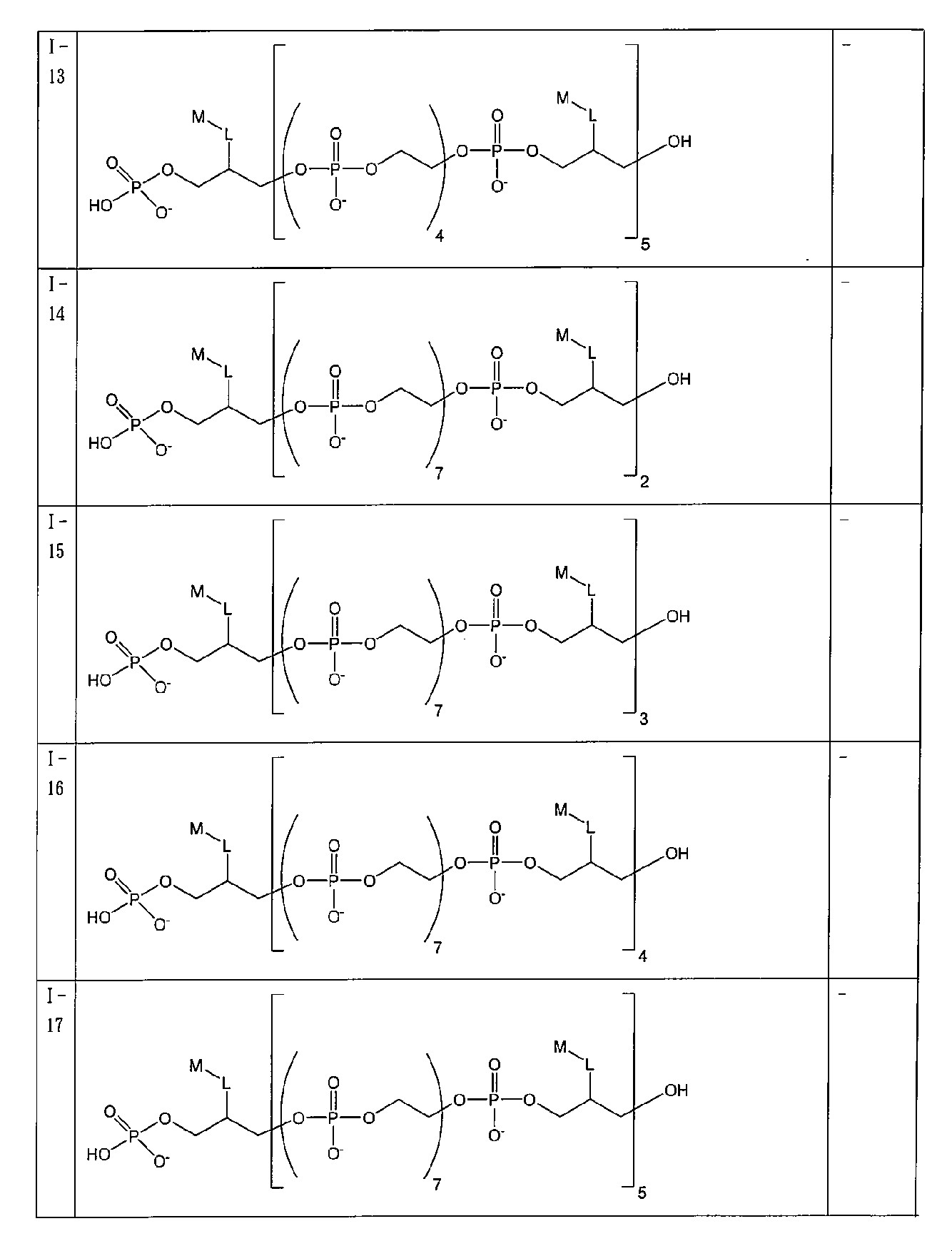
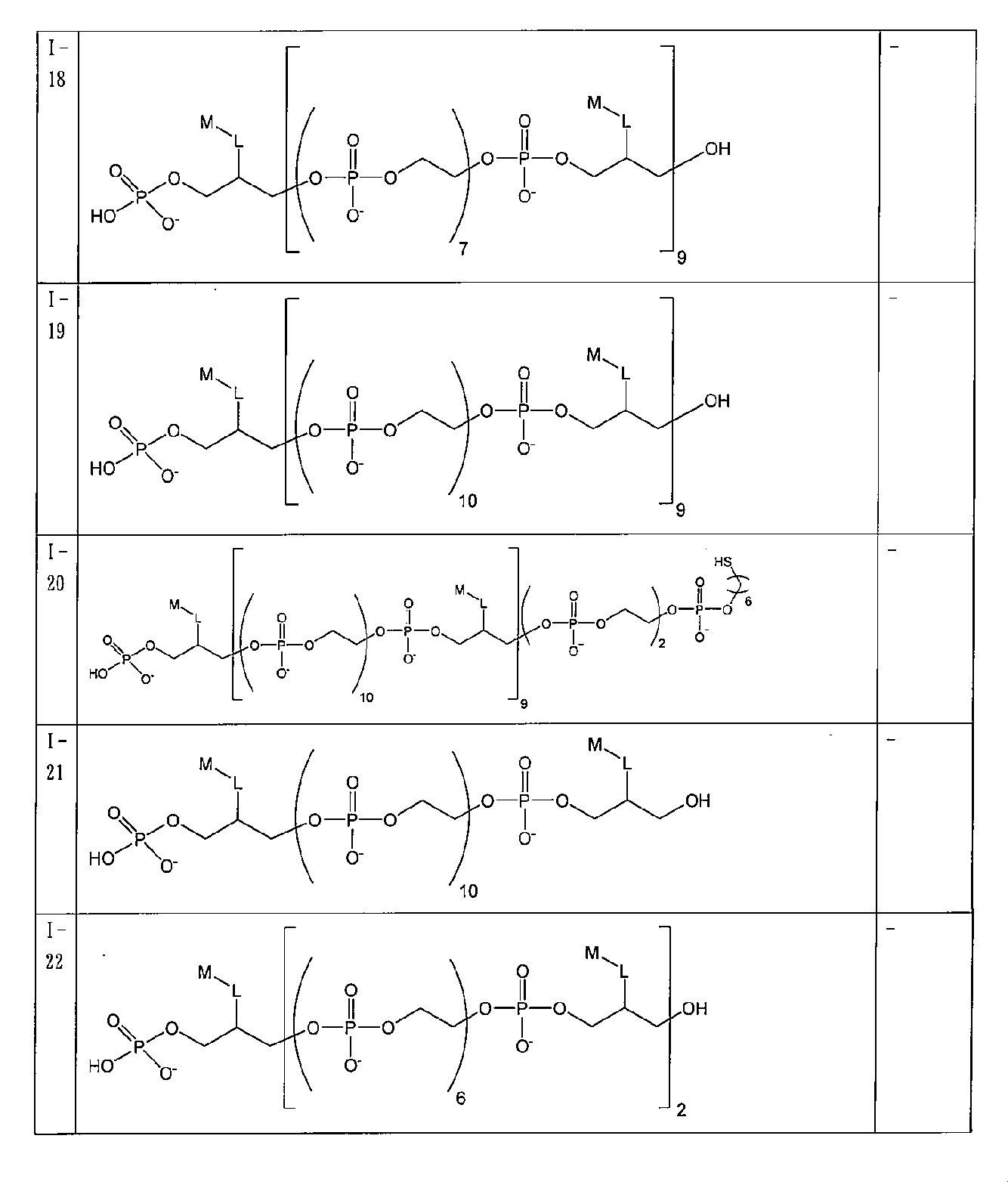

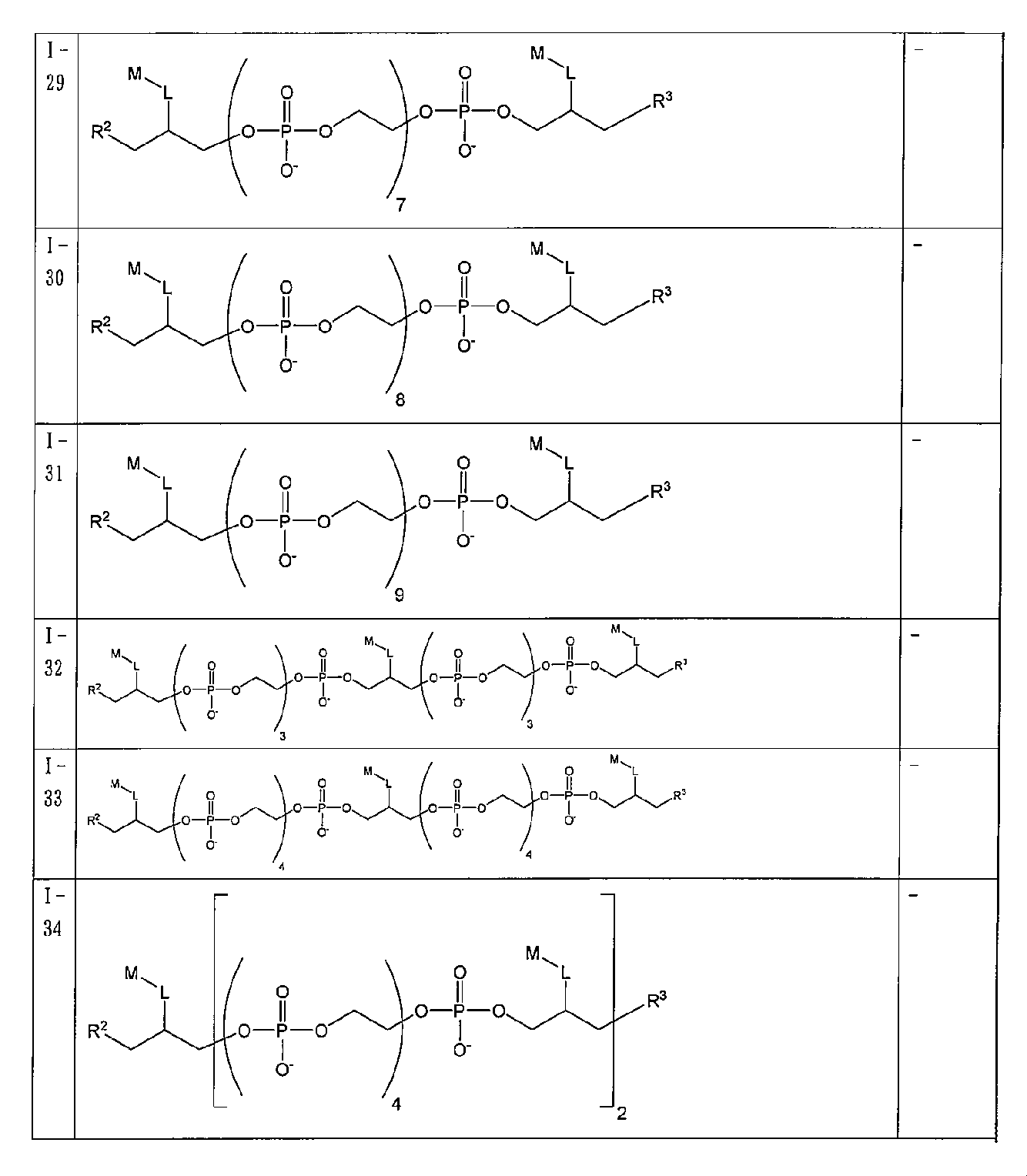
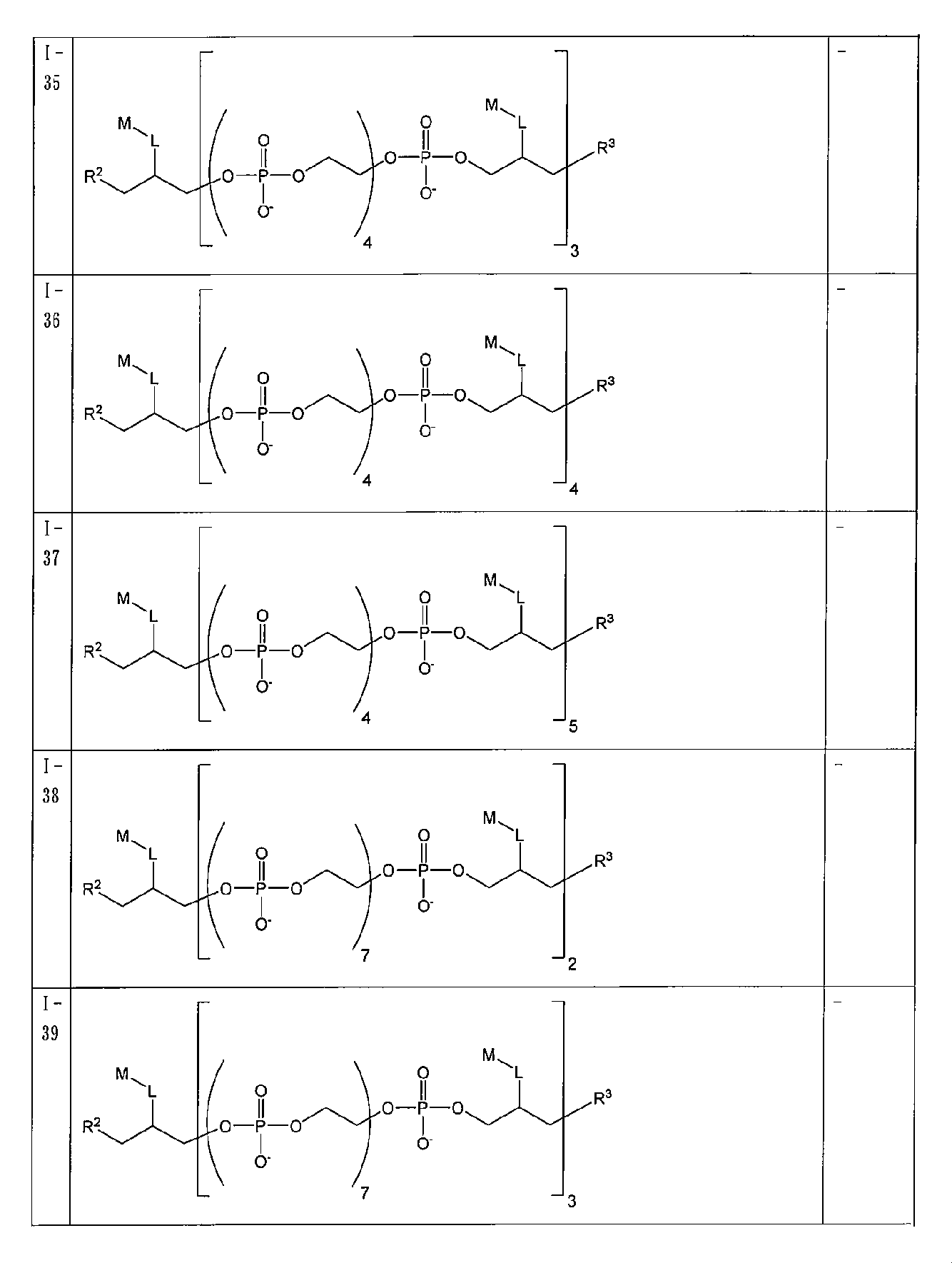


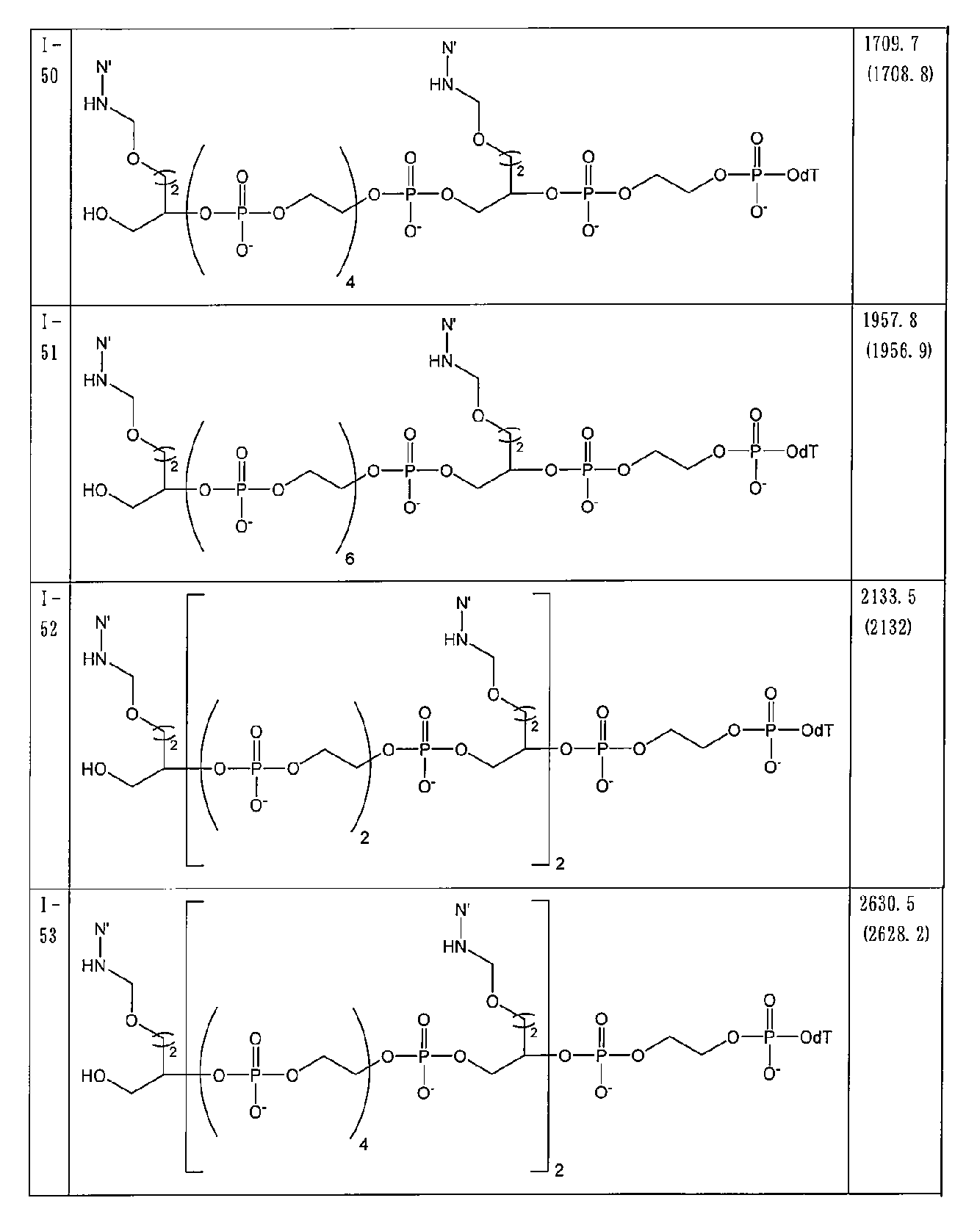
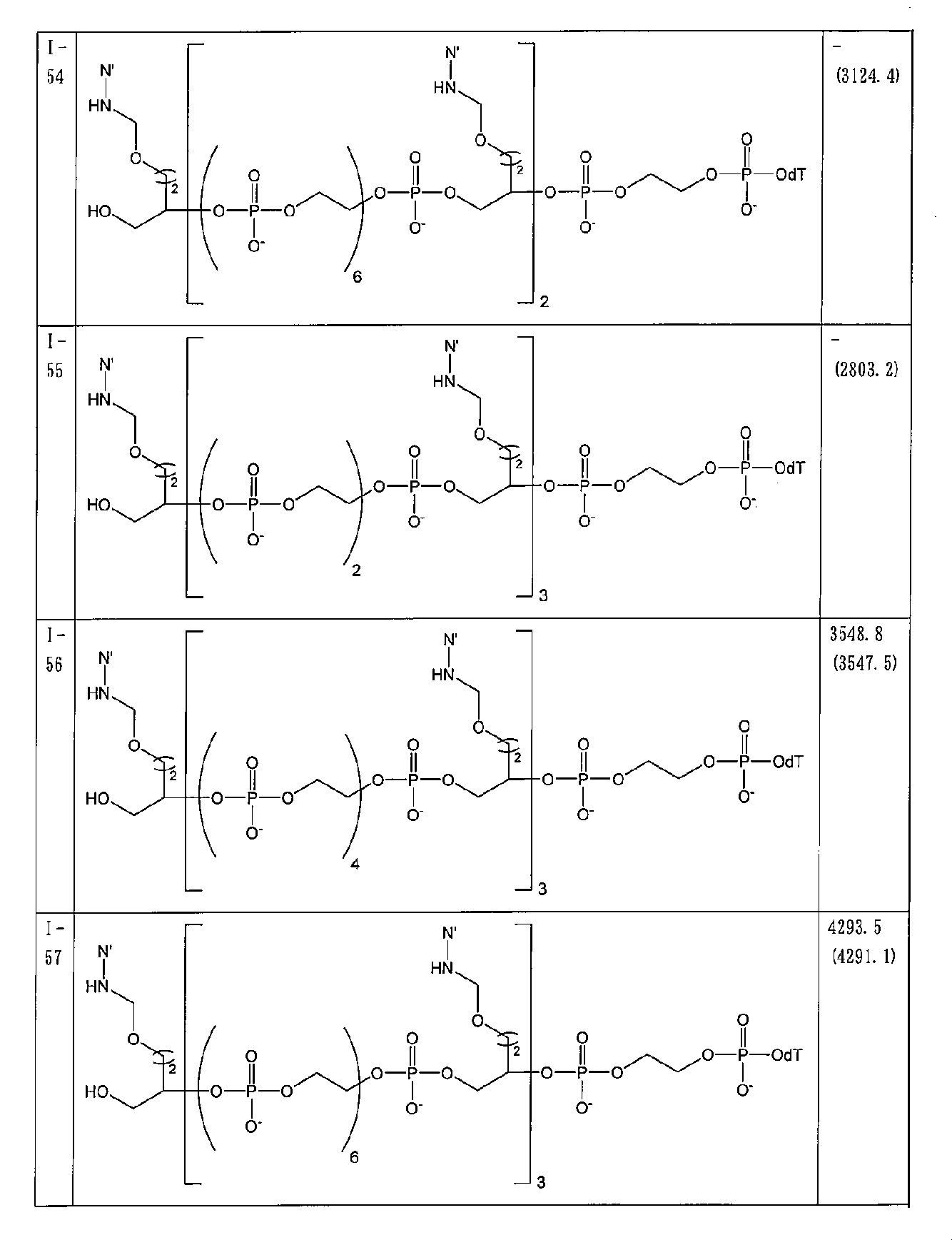
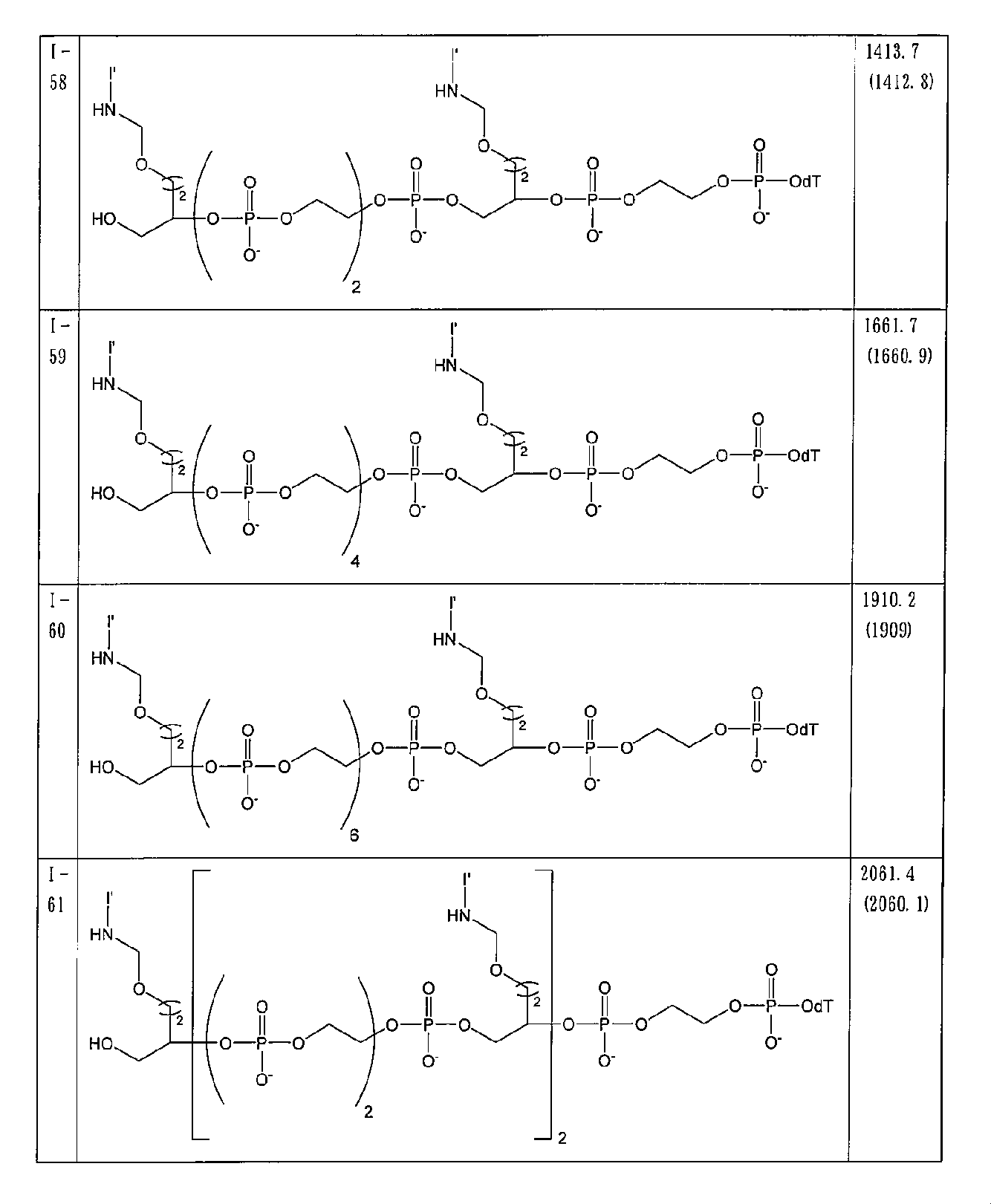
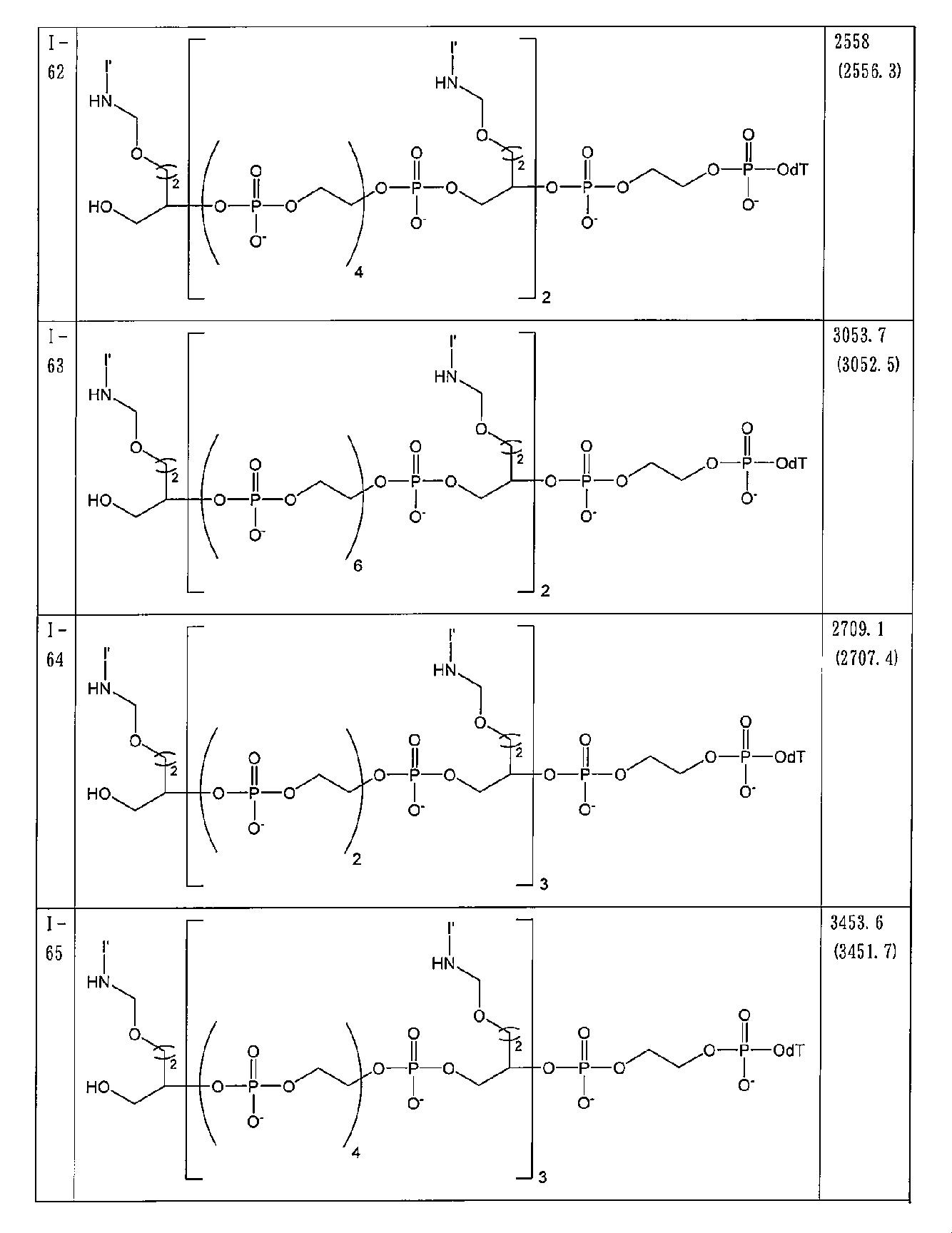
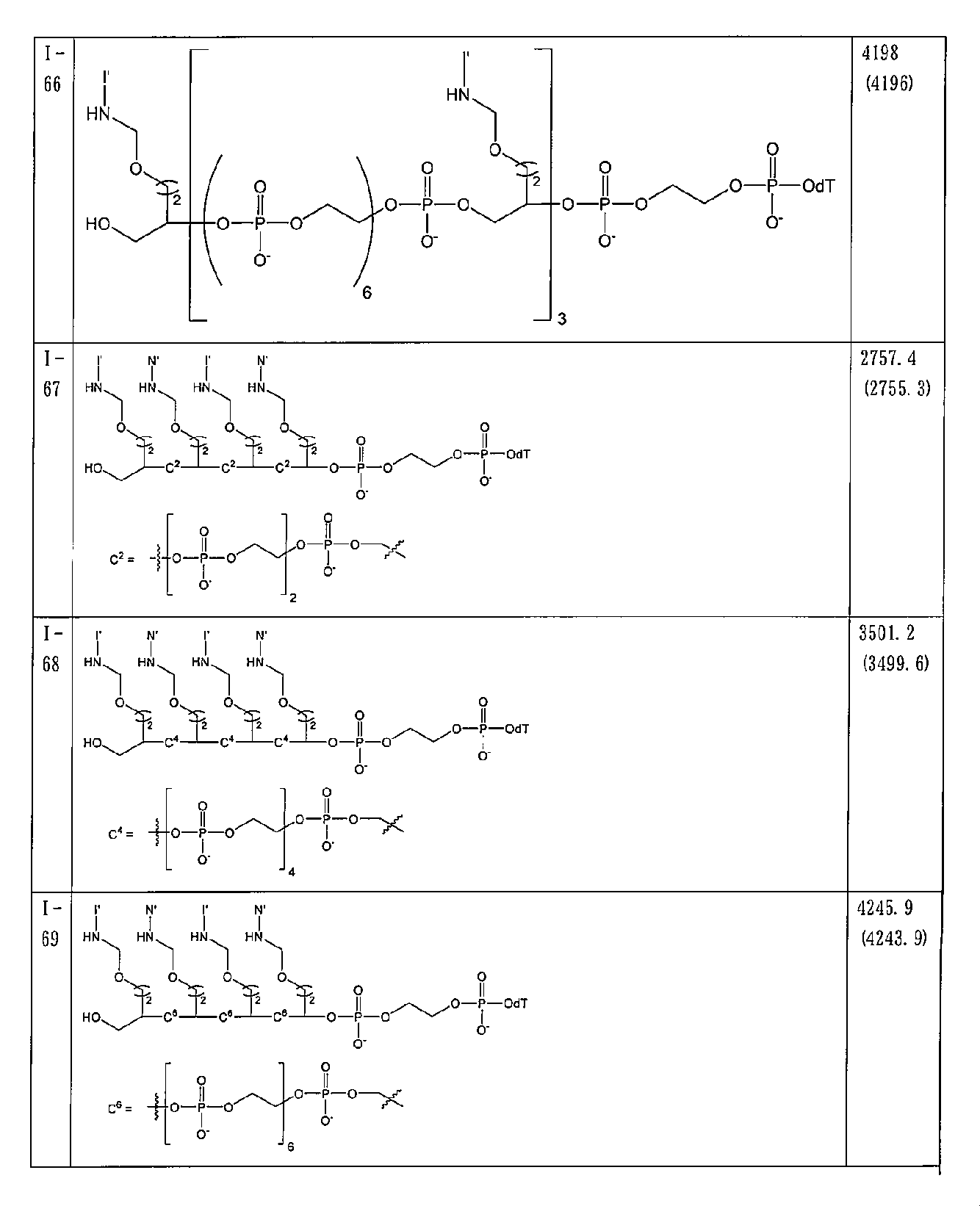
表2に使用されている通り、および本出願の全体にわたり、R2、R3、LおよびMは、特に示さない限り、構造(I)の化合物に対して提示されている定義を有する。表2の化合物の一部の実施形態では、R2は、-OL’である。一部の実施形態では、Mは、出現毎に独立して、F、F’、F”、E、Y、N’、I’、D’またはD”であり、ただし、少なくとも1つのMは、N’、I’、D’またはD”であることを条件とする。F、F’およびF’’は、それぞれ、以下の構造: As used in Table 2, and throughout this application, R 2 , R 3 , L, and M have the definitions provided for the compounds of structure (I) unless otherwise indicated. In some embodiments of the compounds of Table 2, R 2 is -OL'. In some embodiments, M is, independently at each occurrence, F, F', F", E, Y, N', I', D', or D", provided that at least one M is N', I', D', or D". F, F', and F'' each have the following structures:

「E」とは、以下の構造:

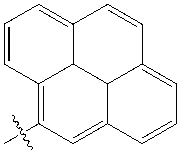
「N’」とは、以下の構造:
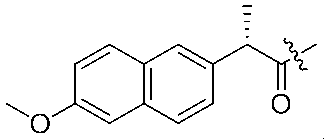
「I’」とは、以下の構造:
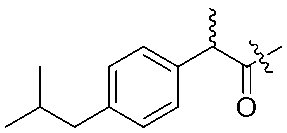
「D’」とは、以下の構造:

「D”」とは、以下の構造:
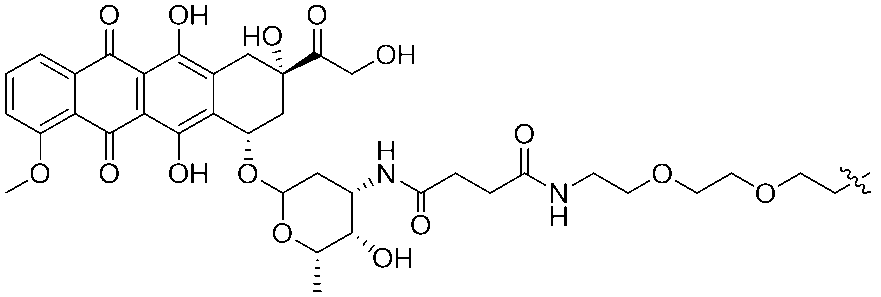
一部の実施形態は、表2に提示されており、抗体などの標的指向性部分にコンジュゲートされている具体的な化合物を含む、上述の化合物のいずれかを含む。一部の実施形態では、構造(I)の化合物の1つが、抗体にコンジュゲートされている。一部の実施形態では、構造(I)の1~2つの化合物が、抗体にコンジュゲートされている。一部の実施形態では、構造(I)の2つの化合物が、抗体にコンジュゲートされている。一部の実施形態では、構造(I)の3つの化合物が、抗体にコンジュゲートされている。一部の実施形態では、構造(I)の4つの化合物が、抗体にコンジュゲートされている。一部の実施形態では、構造(I)の5つの化合物が、抗体にコンジュゲートされている。一部の実施形態では、構造(I)の5つ以下の化合物が、抗体にコンジュゲートされている。
"D" refers to the following structure:
Some embodiments include any of the compounds presented in Table 2 and described above, including specific compounds that are conjugated to a targeting moiety, such as an antibody. In some embodiments, one of the compounds of structure (I) is conjugated to the antibody. In some embodiments, one to two compounds of structure (I) are conjugated to the antibody. In some embodiments, two compounds of structure (I) are conjugated to the antibody. In some embodiments, three compounds of structure (I) are conjugated to the antibody. In some embodiments, four compounds of structure (I) are conjugated to the antibody. In some embodiments, five compounds of structure (I) are conjugated to the antibody. In some embodiments, five or fewer compounds of structure (I) are conjugated to the antibody.
様々な実施形態では、反応性ポリマーは、構造(I)の化合物を調製するために使用することができる。ある種の実施形態では、これらの反応性ポリマーは、任意の数の合成方法論により、相補性部分と反応して、Mと反応性ポリマーとの間に共有結合を形成するのに有用な部分を含む合成中間体であり(例えば、上記の「クリック」反応)、こうして、構造(I)の化合物を形成する。したがって、様々な実施形態では、構造(I)の化合物は、以下の構造(II)を有する反応性ポリマー: In various embodiments, reactive polymers can be used to prepare compounds of structure (I). In certain embodiments, these reactive polymers are synthetic intermediates that contain moieties useful for reacting with a complementary moiety to form a covalent bond between M and the reactive polymer by any number of synthetic methodologies (e.g., the "click" reaction described above), thus forming a compound of structure (I). Thus, in various embodiments, a compound of structure (I) can be prepared by reacting a reactive polymer having the following structure (II):
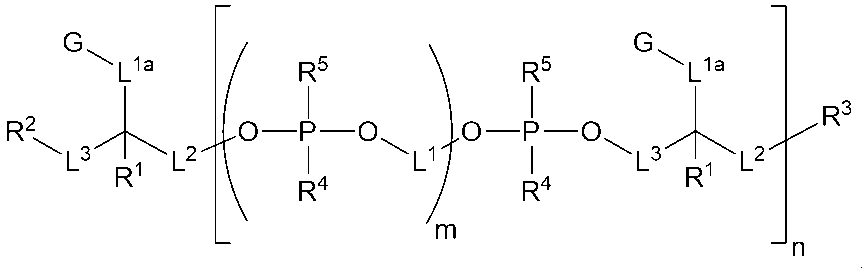
またはその立体異性体、塩または互変異性体(式中、
Gは、出現毎に独立して、相補性反応性基と共有結合を形成することが可能な、反応性基またはその保護類似体を含む部分であり、
L1a、L1、L2およびL3は、出現毎に独立して、任意選択のアルキレン、アルケニレン、アルキニレン、ヘテロアルキレン、ヘテロアルケニレン、ヘテロアルキニレンまたはヘテロ原子リンカーであり、
R1は、出現毎に独立して、天然または非天然アミノ酸側鎖であり、
R2およびR3は、それぞれ独立して、-H、-OH、-SH、アルキル、アルコキシ、アルキルエーテル、ヘテロアルキル、アルキルアミニル、アルキルカルボニル、アルコキシカルボニル、Qもしくはそれらの保護形態、またはL’であり、アルキル、アルコキシ、アルキルエーテル、ヘテロアルキル、アルキルアミニル、アルキルカルボニルおよびアルキルオキシカルボニルは、ヒドロキシル、アミノ、スルフヒドリル、ホスフェート、チオホスフェート、ホスホアルキル、チオホスホアルキル、ホスホアルキルエーテルもしくはチオホスホアルキルエーテル、またはそれらの組合せにより置換されていてもよく、
Qは、出現毎に独立して、標的指向性部分の相補性反応性基Q’と共有結合の形成が可能な、反応性基、またはその保護形態を含む部分であり、
L’は、出現毎に独立して、Qへの共有結合を含むリンカー、標的指向性部分、標的指向性部分への共有結合を含むリンカー、固体支持体への共有結合を含むリンカー、固体支持体への共有結合を含むリンカー、または構造(I)の化合物もしくは構造(II)のさらなる化合物への共有結合を含むリンカーであり、
mは、出現毎に独立して、0以上の整数であり、
nは、1以上の整数である)を使用して形成される。
or a stereoisomer, salt or tautomer thereof,
G is, independently at each occurrence, a moiety that contains a reactive group or a protected analogue thereof capable of forming a covalent bond with a complementary reactive group;
L 1a , L 1 , L 2 and L 3 are, independently at each occurrence, an optional alkylene, alkenylene, alkynylene, heteroalkylene, heteroalkenylene, heteroalkynylene or heteroatom linker;
R is, independently at each occurrence, a natural or unnatural amino acid side chain;
R2 and R3 are each independently -H, -OH, -SH, alkyl, alkoxy, alkylether, heteroalkyl, alkylaminyl, alkylcarbonyl, alkoxycarbonyl, Q or a protected form thereof, or L', where the alkyl, alkoxy, alkylether, heteroalkyl, alkylaminyl, alkylcarbonyl and alkyloxycarbonyl are optionally substituted with hydroxyl, amino, sulfhydryl, phosphate, thiophosphate, phosphoalkyl, thiophosphoalkyl, phosphoalkylether or thiophosphoalkylether, or combinations thereof;
Q is, independently at each occurrence, a moiety that contains a reactive group, or a protected form thereof, capable of forming a covalent bond with the complementary reactive group Q′ of the targeting moiety;
L' is, independently at each occurrence, a linker that includes a covalent bond to Q, a targeting moiety, a linker that includes a covalent bond to a targeting moiety, a linker that includes a covalent bond to a solid support, a linker that includes a covalent bond to a solid support, or a linker that includes a covalent bond to a compound of structure (I) or an additional compound of structure (II);
m is, independently at each occurrence, an integer equal to or greater than 0;
n is an integer equal to or greater than 1.
一部の実施形態では、反応性ポリマーは、以下の表3から選択される。

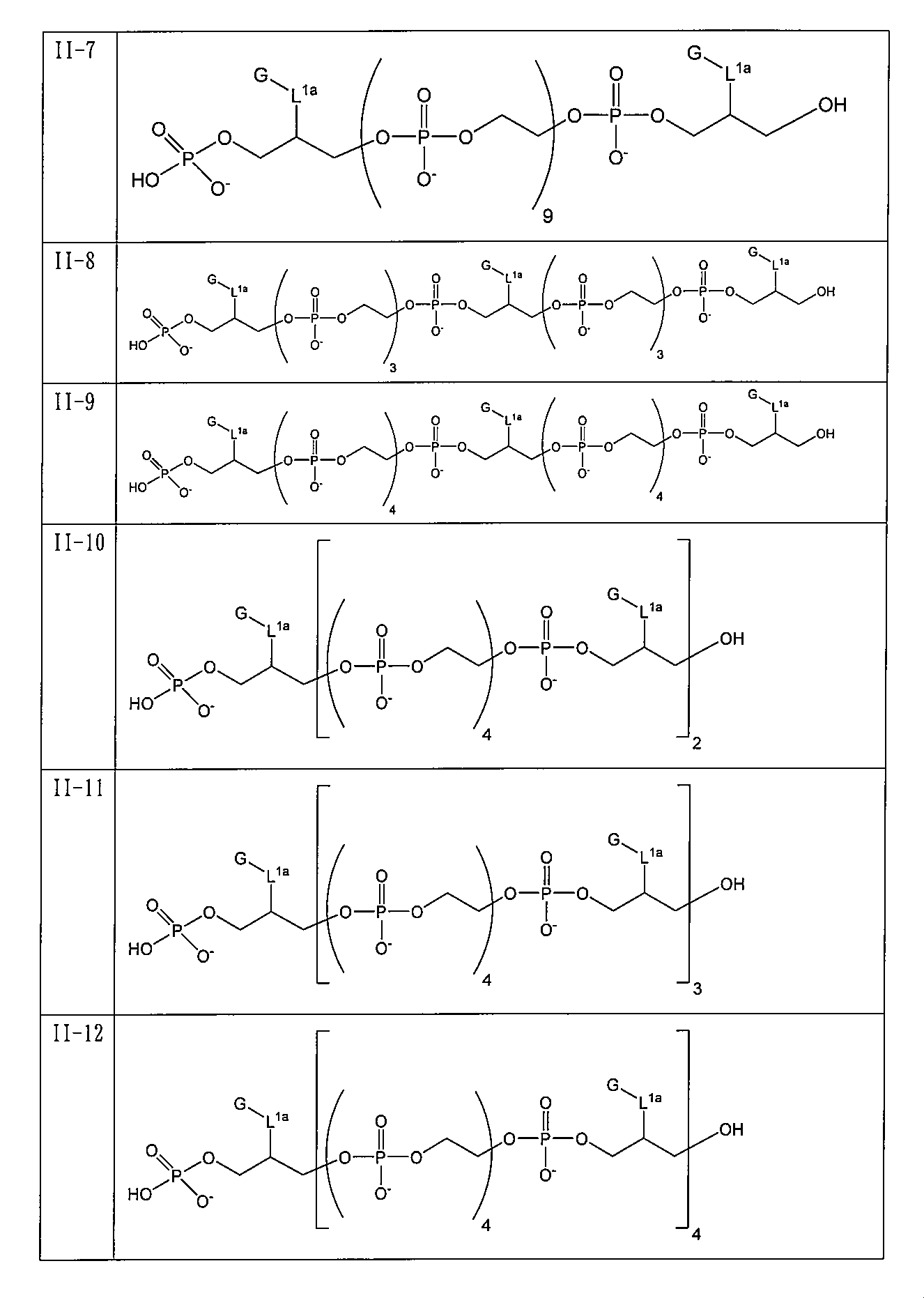

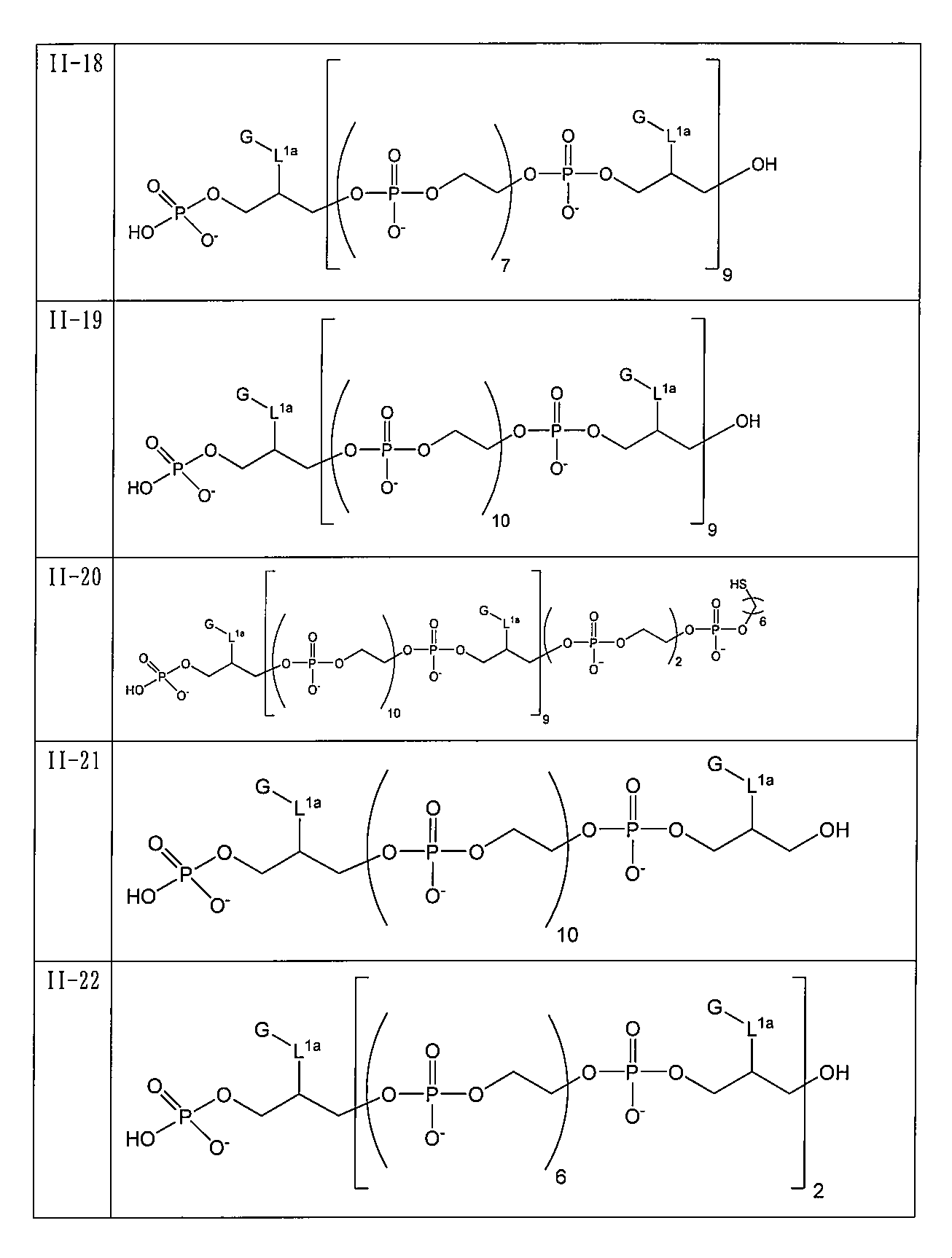
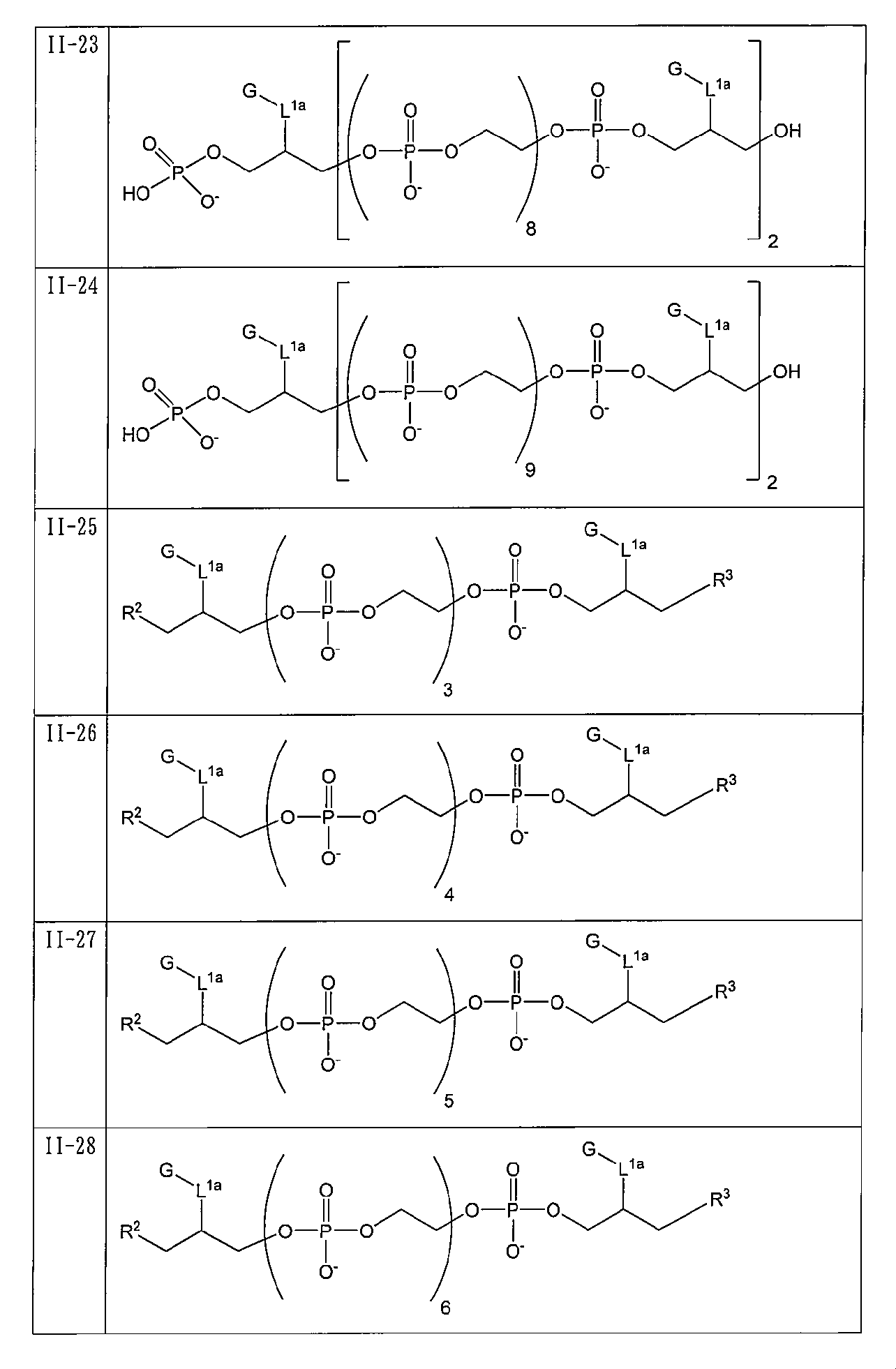
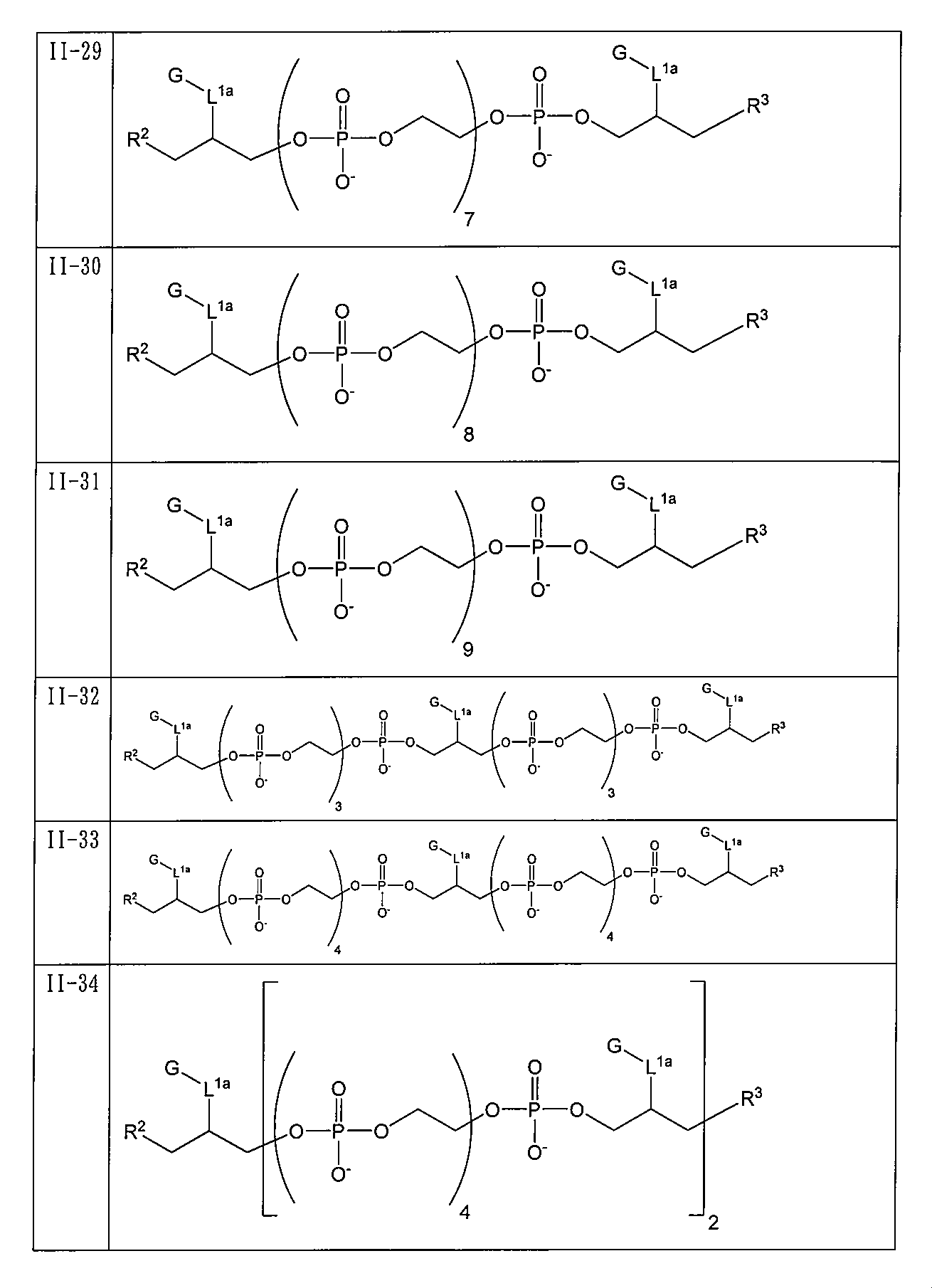
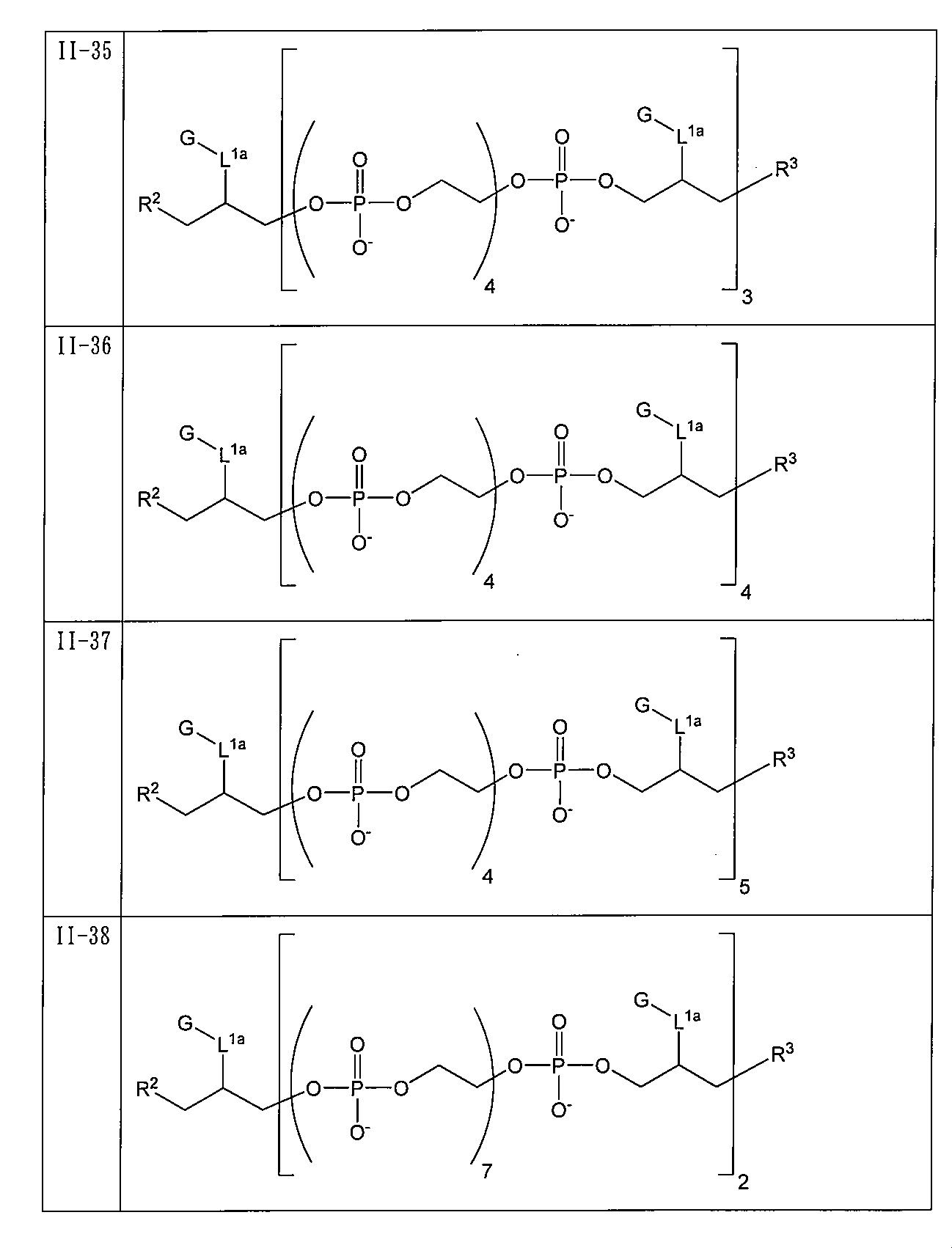
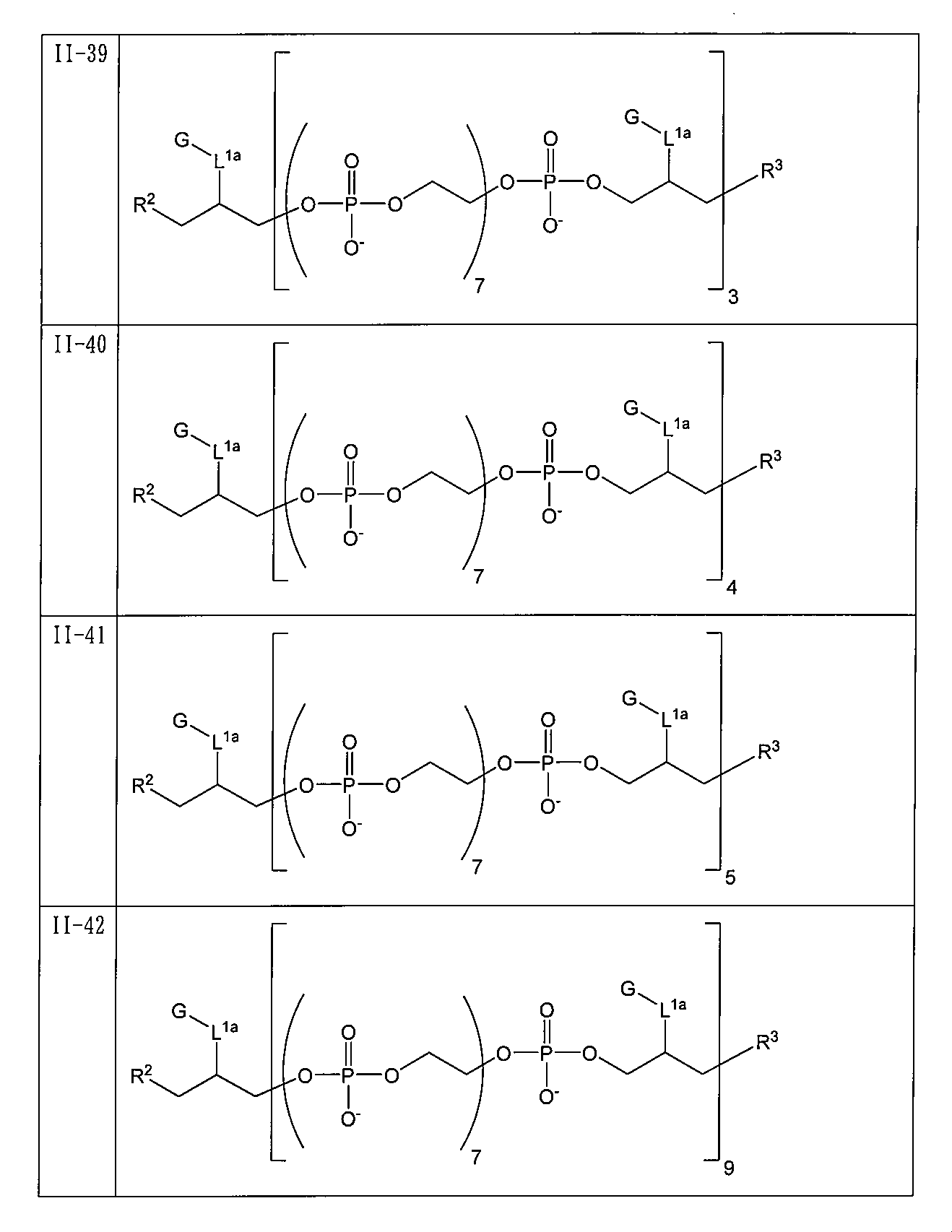
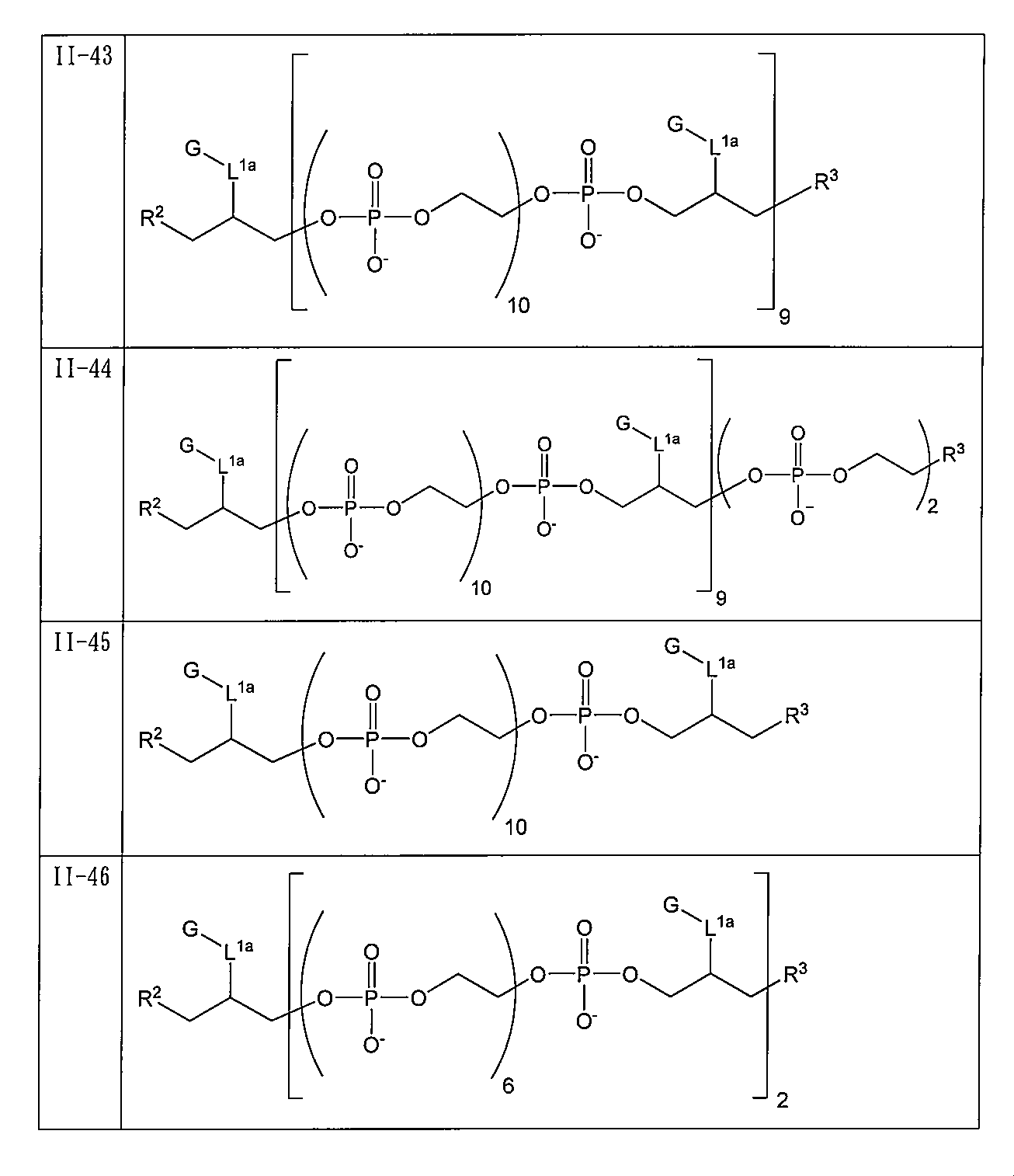

様々な実施形態では、表3の化合物中のGは、エチニルなどのアルキニルである。他の実施形態では、表3の化合物中のGは、アジドである。他の実施形態では、表3の化合物中のGは、アミノ(NH2)である。他の実施形態では、表3の化合物中のGは、イソチオシアネートである。他の実施形態では、表3の化合物中のGは、N-ヒドロキシスクシンイミドのエステルなどの活性化エステルである。
ある種の実施形態は、治療的に有効な蛍光化合物を対象とし、ただし、出現するMの少なくとも1つが蛍光色素ではなく、出現するMの少なくとも1つが蛍光色素である。治療的に有効な蛍光化合物には、少なくとも1つの生物活性部分もしくはその断片、または生物活性部分のプロドラッグもしくはその断片を含む化合物が含まれ、これらは、紫外線光などの光により励起されると、蛍光シグナルを発する。
In various embodiments, G in the compounds of Table 3 is alkynyl, such as ethynyl. In other embodiments, G in the compounds of Table 3 is azide. In other embodiments, G in the compounds of Table 3 is amino (NH 2 ). In other embodiments, G in the compounds of Table 3 is an isothiocyanate. In other embodiments, G in the compounds of Table 3 is an activated ester, such as an ester of N-hydroxysuccinimide.
Certain embodiments are directed to therapeutically effective fluorescent compounds, with the proviso that at least one of the occurrences of M is not a fluorescent dye, and at least one of the occurrences of M is a fluorescent dye. Therapeutically effective fluorescent compounds include compounds that contain at least one biologically active moiety or fragment thereof, or a prodrug of a biologically active moiety or fragment thereof, which emit a fluorescent signal when excited by light, such as ultraviolet light.
組成物
特許請求の範囲のいずれか1項の化合物、および標的指向性部分を含む組成物も提供される。
現在開示されている化合物の実施形態は、「調節可能」であり、これは、上述の化合物のいずれかにおける可変因子を適切に選択することにより、当業者は、所望のモル蛍光度(molar fluorescence)および/または所定のモル蛍光(モル輝度(molar brightness))を有する化合物に到達することができることを意味する。本化合物のある種の実施形態の「調節可能性」により、使用者は、特定のアッセイにおいて、使用するための所望の蛍光および/または色調を有する化合物に容易に到達することが可能となる。すべての可変因子は、本明細書において開示されている化合物のある種の実施形態のモル蛍光度に影響を及ぼし得るが、M、L1、mおよびnの適切な選択が、開示化合物の実施形態のモル蛍光度において重要な役割を果たすと考えられる。したがって、一実施形態では、所望のモル蛍光度を有する化合物を得るための方法であって、公知の蛍光度を有するM部分を選択するステップ、M部分を含む構造(I)の化合物を調製するステップ、および所望のモル蛍光度に到達するためのL1、mおよびnに対する適切な可変因子を選択するステップを含む方法が提供される。
Compositions Also provided are compositions comprising any one of the claimed compounds and a targeting moiety.
The presently disclosed compound embodiments are "tunable," meaning that by appropriate selection of variables in any of the compounds described above, one of skill in the art can arrive at a compound with a desired molar fluorescence and/or a predetermined molar fluorescence (molar brightness). The "tunability" of certain embodiments of the compounds allows the user to easily arrive at a compound with a desired fluorescence and/or color for use in a particular assay. While all variables may affect the molar fluorescence of certain embodiments of the compounds disclosed herein, it is believed that the appropriate selection of M, L 1 , m, and n plays an important role in the molar fluorescence of embodiments of the disclosed compounds. Thus, in one embodiment, a method is provided for obtaining a compound with a desired molar fluorescence, comprising the steps of selecting an M moiety with a known fluorescence, preparing a compound of structure (I) that includes an M moiety, and selecting appropriate variables for L 1 , m, and n to arrive at the desired molar fluorescence.
例示を容易にするため、リン部分(例えば、ホスフェートなど)を含む様々な化合物が、陰イオン性状態(例えば、-OPO(OH)O-、-OPO3
2-)で図示されている。当業者は、電荷はpHに依存し、非電荷(例えば、プロトン化されているか、またはナトリウムもしくは他の陽イオンなどの塩)形態も、本発明の実施形態の範囲内に含まれることを容易に理解するであろう。
上述の化合物のいずれかおよび1つまたは複数の標的指向性部分(例えば、抗体または細胞表面受容体アンタゴニスト)を含む組成物は、様々な他の実施形態において提供される。一部の実施形態では、疾患を処置するための方法であって、それを必要とする対象に治療有効量の構造(I)の化合物または構造(I)の化合物を含む組成物を投与するステップを含む方法における、このような組成物の使用であって、Mがそれぞれ独立して、該疾患を処置するのに有効な生物活性部分である使用も提供される。
For ease of illustration, various compounds containing phosphorus moieties (e.g., phosphate, etc.) are depicted in their anionic state (e.g., --OPO(OH) O.sup.- , --OPO.sub.3.sup.2- ). One of ordinary skill in the art will readily appreciate that charge is pH dependent, and that uncharged (e.g., protonated or salts such as sodium or other cations) forms are also included within the scope of embodiments of the present invention.
Compositions comprising any of the above-mentioned compounds and one or more targeting moieties (e.g., antibodies or cell surface receptor antagonists) are provided in various other embodiments. Also provided in some embodiments is the use of such compositions in a method for treating a disease, comprising administering to a subject in need thereof a therapeutically effective amount of a compound of structure (I) or a composition comprising a compound of structure (I), wherein each M is independently a biologically active moiety effective to treat the disease.
医薬組成物
一実施形態は、本明細書において開示されている実施形態のいずれか1つおよび薬学的に許容される担体による化合物を含む組成物を提供する。
別の実施形態は、単一連結基により抗体に共有結合している請求項1に記載の化合物を含む複数のコンジュゲートを含む組成物であって、複数のコンジュゲートが少なくとも90%の構造均質性を有する、組成物を提供する。「構造均質性」は、抗体への結合点を含めて、同じ構造を有する化合物を意味する。より具体的な実施形態では、複数のコンジュゲートは、少なくとも95%の構造均質性を有する。関連する実施形態では、複数のコンジュゲートは、99%を超える構造均質性を有する。ある種の実施形態では、R2およびR3の1つは、-OP(=Ra)(Rb)OL’またはL’であり、L’は、抗体、もしくはこの抗体への共有結合を含むリンカーである。
Pharmaceutical Compositions One embodiment provides a composition comprising a compound according to any one of the embodiments disclosed herein and a pharma- ceutically acceptable carrier.
Another embodiment provides a composition comprising a plurality of conjugates comprising a compound of claim 1 covalently attached to an antibody by a single linking group, wherein the plurality of conjugates have at least 90% structural homogeneity. "Structural homogeneity" means a compound having the same structure, including the point of attachment to the antibody. In more specific embodiments, the plurality of conjugates have at least 95% structural homogeneity. In related embodiments, the plurality of conjugates have greater than 99% structural homogeneity. In certain embodiments, one of R2 and R3 is -OP(=R a )(R b )OL' or L', where L' is an antibody or a linker comprising a covalent bond to the antibody.
他の実施形態は、医薬組成物を対象とする。本医薬組成物は、上述の化合物のいずれか1つ(または複数)および薬学的に許容される担体を含む。一部の実施形態では、本医薬組成物は、経口投与用に製剤化されている。他の実施形態では、本医薬組成物は、注射用に製剤化されている。さらさなる実施形態では、本医薬組成物は、本明細書において開示されている化合物および追加の治療剤(例えば、抗がん剤)を含む。このような治療剤の非限定例は、本明細書の以下に記載されている。
好適な投与経路には、以下に限定されないが、経口、静脈内、直腸、エアゾール、非経口、眼、肺、経粘膜、経皮、膣、耳、鼻腔および局所投与が含まれる。さらに、単なる例として、非経口送達には、筋肉内、皮下、静脈内、髄内の注射、ならびに鞘内、心室内に直接、腹腔内、リンパ内および鼻内への注射が含まれる。
Other embodiments are directed to pharmaceutical compositions. The pharmaceutical compositions include any one (or more) of the compounds described above and a pharma- ceutically acceptable carrier. In some embodiments, the pharmaceutical compositions are formulated for oral administration. In other embodiments, the pharmaceutical compositions are formulated for injection. In further embodiments, the pharmaceutical compositions include the compounds disclosed herein and an additional therapeutic agent (e.g., an anti-cancer agent). Non-limiting examples of such therapeutic agents are described herein below.
Suitable routes of administration include, but are not limited to, oral, intravenous, rectal, aerosol, parenteral, ocular, pulmonary, transmucosal, transdermal, vaginal, otic, nasal and topical administration. Further, by way of example only, parenteral delivery includes intramuscular, subcutaneous, intravenous, intramedullary injection, as well as intrathecal, direct intraventricular, intraperitoneal, intralymphatic and intranasal injection.
ある種の実施形態では、本明細書に記載されている化合物は、全身的よりもむしろ局所に、例えば、多くの場合、デポ調製物または持続放出製剤で器官に化合物を直接注射することにより投与される。具体的な実施形態では、長時間作用型製剤は、埋め込み(例えば、皮下または筋肉内)によって、または筋肉内注射によって投与される。さらに、他の実施形態では、薬物は、例えば、器官特異的抗体により被覆されたリポソーム中で、標的化した薬物送達系で送達される。このような実施形態では、リポソームはその器官へと標的化され、器官によって選択的に摂取される。さらに他の実施形態では、本明細書に記載されている化合物は、速放性製剤の形態、徐放性製剤の形態、または中間放出製剤の形態で提供される。さらに他の実施形態では、本明細書に記載されている化合物は、局所投与される。 In certain embodiments, the compounds described herein are administered locally rather than systemically, e.g., by injecting the compound directly into an organ, often in a depot or sustained release preparation. In specific embodiments, long-acting formulations are administered by implantation (e.g., subcutaneously or intramuscularly) or by intramuscular injection. In yet other embodiments, the drug is delivered in a targeted drug delivery system, e.g., in liposomes coated with organ-specific antibodies. In such embodiments, the liposomes are targeted to and selectively taken up by the organ. In still other embodiments, the compounds described herein are provided in the form of a fast-release formulation, a sustained-release formulation, or an intermediate-release formulation. In still other embodiments, the compounds described herein are administered locally.
本発明の実施形態による化合物は、幅広い投与量範囲にわたり有効である。例えば、成人ヒトの処置では、1日あたり0.01~1000mg、0.5~100mg、1~50mg、および1日あたり5~40mgの投与量が、ある実施形態において使用される投与量の例である。例示的な投与量は、1日あたり10~30mgである。正確な投与量は、投与経路、化合物が投与される形態、処置される対象、処置される対象の体重、および主治医の好みおよび経験に依存するであろう。
一部の実施形態では、本発明の化合物は単回用量で投与される。通常、このような投与は、薬剤を迅速に導入するため、注射によって、例えば静脈内注射になるであろう。しかし、適切な場合、他の経路が使用される。本発明の化合物の単回用量はまた、急性状態の処置に使用されることがある。
The compounds according to embodiments of the present invention are effective over a wide dosage range. For example, in adult human treatment, dosages of 0.01-1000 mg per day, 0.5-100 mg, 1-50 mg, and 5-40 mg per day are exemplary dosages that may be used in certain embodiments. An exemplary dosage is 10-30 mg per day. The exact dosage will depend on the route of administration, the form in which the compound is administered, the subject being treated, the weight of the subject being treated, and the preference and experience of the attending physician.
In some embodiments, the compound of the present invention is administered in a single dose.Usually, such administration will be by injection, for example intravenous injection, to rapidly introduce the drug.However, other routes can be used when appropriate.A single dose of the compound of the present invention can also be used to treat acute conditions.
一部の実施形態では、本発明の化合物は、多回用量で投与される。一部の実施形態では、投与は、1日あたり、ほぼ1回、2回、3回、4回、5回、6回またはそれより多い。他の実施形態では、投与は、ほぼ、1か月に1回、2週毎に1回、1週間に1回、または1日おきに1回である。別の実施形態では、本発明の化合物および別の薬剤が、ほぼ1日1回~1日約6回で一緒に投与される。別の実施形態では、本発明の化合物および薬剤の投与は、約7日未満の間、継続される。さらに別の実施形態では、投与は、約6、10、14、28日間、2か月、6か月または1年間を超えて継続される。一部の場合、必要な限り、連続投薬を実現して、これを維持する。
本発明の化合物の実施形態の投与は、必要な限り継続されてもよい。一部の実施形態では、本発明の化合物は、1、2、3、4、5、6、7、14または28日間を超えて、投与される。一部の実施形態では、本発明の化合物は、28、14、7、6、5、4、3、2または1日未満の間で投与される。一部の実施形態では、本発明の化合物は、例えば、作用が長期的な処置のために、継続的に長期間投与される。
一部の実施形態では、本発明の化合物は、投与量で投与される。化合物の薬物動態の対象間のばらつきのため、投与レジメンの個別化が最適治療に必要であることが当分野において公知である。本発明の化合物の実施形態のための投与は、本開示に照らし合わせて、型通りの実験により見いだすことができる。
In some embodiments, the compound of the invention is administered in multiple doses. In some embodiments, administration is about once, twice, three times, four times, five times, six times, or more per day. In other embodiments, administration is about once a month, once every two weeks, once a week, or once every other day. In another embodiment, the compound of the invention and another agent are administered together about once a day to about six times a day. In another embodiment, administration of the compound of the invention and the agent continues for less than about seven days. In yet another embodiment, administration continues for more than about 6, 10, 14, 28 days, 2 months, 6 months, or a year. In some cases, continuous dosing is achieved and maintained for as long as necessary.
Administration of the compound embodiments of the invention may continue for as long as necessary. In some embodiments, the compound of the invention is administered for more than 1, 2, 3, 4, 5, 6, 7, 14, or 28 days. In some embodiments, the compound of the invention is administered for less than 28, 14, 7, 6, 5, 4, 3, 2, or 1 day. In some embodiments, the compound of the invention is administered continuously for an extended period of time, e.g., for long-term treatment.
In some embodiments, the compound of the present invention is administered in a dosage.It is known in the art that due to subject-to-subject variability in the pharmacokinetics of compounds, individualization of dosage regimen is necessary for optimal treatment.Dosage for the embodiment of the compound of the present invention can be found by routine experimentation in light of this disclosure.
一部の実施形態では、本明細書において記載されている化合物は、医薬組成物に製剤化される。具体的な実施形態では、医薬組成物は、活性化合物の、薬学的に使用され得る調製物への加工を容易にする、賦形剤および補助剤を含む1種または複数の生理的に許容される担体を使用し、慣用的な方法で製剤化される。適切な製剤は、選択される投与経路に依存する。好適な場合、任意の薬学的に許容される技法、担体および賦形剤を使用して、本明細書に記載されている医薬組成物を製剤化する:Remington: The Science and Practice of Pharmacy, Nineteenth Ed (Easton, Pa.: Mack Publishing Company, 1995); Hoover, John E., Remington's Pharmaceutical Sciences, Mack Publishing Co., Easton, Pennsylvania 1975; Liberman, H.A. and Lachman, L., Eds., Pharmaceutical Dosage Forms, Marcel Decker, New York, N.Y., 1980;およびPharmaceutical Dosage Forms and Drug Delivery Systems, Seventh Ed. (Lippincott Williams & Wilkins 1999)。 In some embodiments, the compounds described herein are formulated into pharmaceutical compositions. In specific embodiments, the pharmaceutical compositions are formulated in a conventional manner using one or more physiologically acceptable carriers, including excipients and adjuvants, that facilitate processing of the active compound into a medicament for use. The appropriate formulation will depend on the route of administration selected. Any pharma- ceutical compositions described herein may be formulated using any suitable pharma- ceutical acceptable techniques, carriers, and excipients, see, for example, Remington: The Science and Practice of Pharmacy, Nineteenth Ed (Easton, Pa.: Mack Publishing Company, 1995); Hoover, John E., Remington's Pharmaceutical Sciences, Mack Publishing Co., Easton, Pennsylvania 1975; Liberman, H.A. and Lachman, L., Eds., Pharmaceutical Dosage Forms, Marcel Decker, New York, N.Y., 1980; and Pharmaceutical Dosage Forms and Drug Delivery Systems, Seventh Ed. (Lippincott Williams & Wilkins 1999).
構造(I)の化合物、および薬学的に許容される希釈剤、賦形剤または担体を含む医薬組成物が本明細書において提供される。ある種の実施形態では、記載されている化合物は、構造(I)の化合物が、併用療法における場合と同様に、他の活性成分と混合されている医薬組成物として投与される。本明細書において、以下および本開示の全体を通じて併用療法の項目に説明されている活性剤のすべての組合せが包含されている。具体的な実施形態では、本医薬組成物は、構造(I)の1つまたは複数の化合物を含む。 Provided herein are pharmaceutical compositions comprising a compound of structure (I) and a pharma- ceutically acceptable diluent, excipient, or carrier. In certain embodiments, the described compounds are administered as pharmaceutical compositions in which the compound of structure (I) is mixed with other active ingredients, as in combination therapy. All combinations of active agents described in the combination therapy section below and throughout this disclosure are encompassed herein. In specific embodiments, the pharmaceutical compositions include one or more compounds of structure (I).
医薬組成物は、本明細書で使用する場合、構造(I)の化合物と担体、安定化剤、希釈剤、分散剤、懸濁化剤、増粘剤および/または賦形剤などの他の化学的構成成分との混合物を指す。ある種の実施形態では、本医薬組成物は、生物への化合物の投与を容易にする。本明細書において提供される処置方法または使用方法を実施する一部の実施形態では、治療有効量の本明細書において提供されている構造(I)の化合物は、処置される疾患、障害または医療的状態を有する哺乳動物に医薬組成物で投与される。具体的な実施形態では、哺乳動物はヒトである。ある種の実施形態では、治療有効量は、疾患の重症度、対象の年齢および相対的な健康、使用される化合物の効力および他の因子に応じて様々である。本明細書において記載されている化合物は、単一で、または混合物の構成成分として、1種または複数の治療剤と組み合わせて使用される。 Pharmaceutical composition, as used herein, refers to a mixture of a compound of structure (I) and other chemical components, such as carriers, stabilizers, diluents, dispersants, suspending agents, thickeners, and/or excipients. In certain embodiments, the pharmaceutical composition facilitates administration of the compound to an organism. In some embodiments of practicing the methods of treatment or use provided herein, a therapeutically effective amount of a compound of structure (I) provided herein is administered in a pharmaceutical composition to a mammal having the disease, disorder, or medical condition to be treated. In specific embodiments, the mammal is a human. In certain embodiments, the therapeutically effective amount will vary depending on the severity of the disease, the age and relative health of the subject, the potency of the compound used, and other factors. The compounds described herein are used singly or as components of mixtures in combination with one or more therapeutic agents.
一実施形態では、構造(I)の1つまたは複数の化合物は、水溶液中で製剤化される。具体的な実施形態では、水溶液は、単なる例として、ハンクス溶液、リンゲル溶液または生理食塩水緩衝液などの生理学的に適合する緩衝液から選択される。他の実施形態では、構造(I)の1つまたは複数の化合物は、経粘膜投与向けに製剤化されている。具体的な実施形態では、経粘膜製剤は、浸透する障壁に適切な浸透剤を含む。さらに他の実施形態では、本明細書において記載されている化合物が、他の非経口注射向けに製剤される場合、適切な製剤には水性溶液剤または非水性溶液剤が含まれる。具体的な実施形態では、このような溶液剤は、生理学的に適合する緩衝液および/または賦形剤を含む。
別の実施形態では、本明細書に記載されている化合物は、経口投与向けに製剤化されている。本明細書に記載されている化合物は、活性化合物と、例えば薬学的に許容される担体または賦形剤とを組み合わせることにより製剤化される。様々な実施形態では、本明細書において記載されている化合物は、単なる例として、錠剤、散剤、丸剤、ドラジェ剤、カプセル剤、液体、ゲル剤、シロップ剤、エリキシル剤、スラリー剤、懸濁液剤などを含む経口剤形で製剤化される。
In one embodiment, one or more compounds of structure (I) are formulated in an aqueous solution. In a specific embodiment, the aqueous solution is selected from physiologically compatible buffers, such as Hanks' solution, Ringer's solution, or saline buffer, by way of example only. In other embodiments, one or more compounds of structure (I) are formulated for transmucosal administration. In a specific embodiment, the transmucosal formulation includes a penetrant appropriate for the barrier to be permeated. In yet other embodiments, when the compounds described herein are formulated for other parenteral injections, suitable formulations include aqueous or non-aqueous solutions. In a specific embodiment, such solutions include physiologically compatible buffers and/or excipients.
In another embodiment, the compounds described herein are formulated for oral administration.The compounds described herein are formulated by combining active compounds with, for example, pharma-ceutically acceptable carriers or excipients.In various embodiments, the compounds described herein are formulated in oral dosage forms, including, by way of example only, tablets, powders, pills, dragees, capsules, liquids, gels, syrups, elixirs, slurries, suspensions, etc.
ある種の実施形態では、経口使用するための医薬調製物は、1つまたは複数の固体賦形剤と1つまたは複数の本明細書において記載されている化合物とを混合し、得られた混合物を磨砕してもよく、所望の場合、好適な補助剤を添加した後、粒剤の混合物を加工して、錠剤またはドラジェ剤のコアを得ることにより得られる。好適な賦形剤は、特に、ラクトース、スクロース、マンニトールまたはソルビトールを含めた糖、例えば、トウモロコシデンプン、コムギデンプン、コメデンプン、バレイショデンプン、ゼラチン、トラガカントゴム、メチルセルロース、マイクロクリスタリンセルロース、ヒドロキシプロピルメチルセルロース、カルボキシメチルセルロースナトリウムなどのセルロース調製物、またはポリビニルピロリドン(PVPまたはポビドン)またはリン酸カルシウムなどの他のものなどの充填剤である。具体的な実施形態では、崩壊剤が、添加されてもよい。崩壊剤には、単なる例として、架橋クロスカルメロースナトリウム、ポリビニルピロリドン、寒天もしくはアルギン酸またはその塩(アルギン酸ナトリウムなど)が含まれる。 In certain embodiments, pharmaceutical preparations for oral use are obtained by mixing one or more solid excipients with one or more compounds described herein, optionally grinding the resulting mixture, and, if desired, processing the granule mixture after adding suitable auxiliary agents to obtain tablet or dragee cores. Suitable excipients are in particular sugars, including lactose, sucrose, mannitol or sorbitol, cellulose preparations, such as corn starch, wheat starch, rice starch, potato starch, gelatin, tragacanth gum, methylcellulose, microcrystalline cellulose, hydroxypropylmethylcellulose, sodium carboxymethylcellulose, or fillers such as polyvinylpyrrolidone (PVP or povidone) or others, such as calcium phosphate. In specific embodiments, disintegrants may be added. Disintegrants include, by way of example only, cross-linked sodium croscarmellose, polyvinylpyrrolidone, agar or alginic acid or a salt thereof, such as sodium alginate.
一実施形態では、ドラジェ剤のコアおよび錠剤などの剤形は、1つまたは複数の好適なコーティングが施される。具体的な実施形態では、剤形をコーティングするために濃縮糖溶液が使用される。糖溶液は、単なる例として、アラビアガム、タルク、ポリビニルピロリドン、カルボポールゲル、ポリエチレングリコールおよび/または二酸化チタン、ラッカー溶液、ならびに好適な有機溶媒または溶媒混合物などの追加の構成成分を含有してもよい。識別目的のために、コーティング剤に染料および/または顔料を添加してもよい。さらに、活性化合物の用量の異なる組合せを特徴付けるために、染料および/または顔料が利用されてもよい。 In one embodiment, dosage forms such as dragee cores and tablets are coated with one or more suitable coatings. In a specific embodiment, a concentrated sugar solution is used to coat the dosage form. The sugar solution may contain additional components such as, by way of example only, gum arabic, talc, polyvinylpyrrolidone, carbopol gel, polyethylene glycol and/or titanium dioxide, lacquer solutions, and suitable organic solvents or solvent mixtures. Dyes and/or pigments may be added to the coating for identification purposes. Additionally, dyes and/or pigments may be utilized to characterize different combinations of active compound doses.
ある種の実施形態では、治療有効量の本明細書に記載されている化合物の少なくとも1つが他の経口剤形に製剤化される。経口剤形は、ゼラチンから作製されたプッシュフィット式カプセル剤、ならびにゼラチンとグリセロールまたはソルビトールなどの可塑剤とから作製された軟質密封カプセル剤を含む。具体的な実施形態では、プッシュフィット式カプセル剤は、1種または複数の充填剤との混合物中に活性成分を含有する。充填剤は、単なる例として、ラクトース、デンプンなどの結合剤、および/またはタルクもしくはステアリン酸マグネシウムなどの滑沢剤を含み、さらに安定化剤を含んでもよい。他の実施形態では、軟質カプセル剤は、好適な液体に溶解または懸濁させた1つまたは複数の活性化合物を含有する。好適な液体には、単なる例として、1つまたは複数の脂肪油、流動パラフィンまたは液体ポリエチレングリコールが含まれる。さらに、安定化剤が添加されてもよい。 In certain embodiments, a therapeutically effective amount of at least one of the compounds described herein is formulated into other oral dosage forms. Oral dosage forms include push-fit capsules made of gelatin, as well as soft sealed capsules made of gelatin and a plasticizer, such as glycerol or sorbitol. In specific embodiments, the push-fit capsules contain the active ingredient in a mixture with one or more fillers. The fillers include, by way of example only, binders, such as lactose, starch, and/or lubricants, such as talc or magnesium stearate, and may further include stabilizers. In other embodiments, the soft capsules contain the active compound or compounds dissolved or suspended in a suitable liquid. Suitable liquids include, by way of example only, one or more fatty oils, liquid paraffin, or liquid polyethylene glycol. Additionally, stabilizers may be added.
他の実施形態では、治療有効量の本明細書に記載されている化合物の少なくとも1つは、口内投与または舌下投与向けに製剤化されている。口内投与または舌下投与に好適な製剤は、単なる例として、錠剤、ロゼンジ剤またはゲル剤を含む。さらに他の実施形態では、本明細書において記載されている化合物は、ボーラス注射または連続注入に好適な製剤を含めた、親(parental)投与向けに製剤化されている。具体的な実施形態では、注射用製剤は、単位剤形(例えば、アンプル中)で、または多回用量容器中で供給される。保存剤が、注射製剤に添加されてもよい。さらに他の実施形態では、本医薬組成物は、油性ビヒクルまたは水性ビヒクル中の滅菌懸濁液剤、溶液剤またはエマルション剤として、非経口注射に好適な形態で製剤化される。非経口注射製剤は、懸濁剤、安定化剤および/または分散剤などの製剤化用作用剤を含有してもよい。具体的な実施形態では、非経口投与向け医薬製剤は、水溶性形態にある活性化合物の水溶液剤を含む。追加的な実施形態では、活性化合物(例えば、構造(I)の化合物)の懸濁液剤は、適切な油性注射懸濁液剤として調製される。本明細書に記載されている医薬組成物において使用するのに好適な親油性溶媒またはビヒクルには、単なる例として、ゴマ油などの脂肪油、またはオレイン酸エチルもしくはトリグリセリドなどの合成脂肪酸エステル、またはリポソームが含まれる。ある特定の実施形態では、水性注射懸濁液剤は、カルボキシメチルセルロースナトリウム、ソルビトールまたはデキストランなどの懸濁液の粘度を増大させる物質を含有する。懸濁液剤は、高度に濃縮した溶液剤の調製を可能にするよう、化合物の溶解度を増大させる好適な安定化剤または作用剤を含有してもよい。代替的に、他の実施形態では、活性成分は、使用前に、好適なビヒクル、例えば滅菌発熱物質不含水を用いる構成用の粉末形態にある。 In other embodiments, a therapeutically effective amount of at least one of the compounds described herein is formulated for buccal or sublingual administration. Formulations suitable for buccal or sublingual administration include, by way of example only, tablets, lozenges, or gels. In yet other embodiments, the compounds described herein are formulated for parental administration, including formulations suitable for bolus injection or continuous infusion. In specific embodiments, the injectable formulations are provided in unit dosage form (e.g., in ampoules) or in multi-dose containers. Preservatives may be added to the injectable formulations. In still other embodiments, the pharmaceutical compositions are formulated in a form suitable for parenteral injection as sterile suspensions, solutions, or emulsions in oily or aqueous vehicles. Parenteral injection formulations may contain formulating agents such as suspending, stabilizing, and/or dispersing agents. In specific embodiments, the pharmaceutical formulation for parenteral administration comprises an aqueous solution of the active compound in water-soluble form. In additional embodiments, suspensions of the active compounds (e.g., compounds of structure (I)) are prepared as appropriate oily injection suspensions. Suitable lipophilic solvents or vehicles for use in the pharmaceutical compositions described herein include, by way of example only, fatty oils such as sesame oil, or synthetic fatty acid esters such as ethyl oleate or triglycerides, or liposomes. In certain embodiments, aqueous injection suspensions contain substances that increase the viscosity of the suspension, such as sodium carboxymethylcellulose, sorbitol, or dextran. The suspension may also contain suitable stabilizers or agents that increase the solubility of the compounds to allow for the preparation of highly concentrated solutions. Alternatively, in other embodiments, the active ingredient is in powder form for constitution with a suitable vehicle, e.g., sterile pyrogen-free water, before use.
さらに他の実施形態では、構造(I)の化合物は、局所投与される。本明細書において記載されている化合物は、溶液剤、懸濁液剤、ローション剤、ゲル剤、ペースト剤、薬用スティック剤、バーム剤、クリーム剤または軟膏剤などの局所投与が可能な様々な組成物に製剤化される。このような医薬組成物は、可溶化剤、安定化剤、張度増強剤、緩衝化剤および保存剤を含有してもよい。 In yet other embodiments, the compounds of structure (I) are administered topically. The compounds described herein are formulated into a variety of compositions that can be administered topically, such as solutions, suspensions, lotions, gels, pastes, medicated sticks, balms, creams, or ointments. Such pharmaceutical compositions may contain solubilizers, stabilizers, tonicity enhancing agents, buffering agents, and preservatives.
さらに他の実施形態では、構造(I)の化合物は、経皮投与向けに製剤化されている。具体的な実施形態では、経皮製剤は、経皮送達デバイスおよび経皮送達パッチ剤を使用し、ポリマーまたは粘着剤中に溶解および/または分散させた、親油性エマルション剤、または緩衝化水溶液剤とすることができる。様々な実施形態では、このようなパッチ剤は、医薬剤の連続送達、パルス送達、または必要に応じた送達向けに構築される。追加的な実施形態では、構造(I)の化合物の経皮送達は、イオン導入パッチ剤などにより行われる。ある種の実施形態では、経皮パッチ剤は、構造(I)の化合物の制御送達を実現する。具体的な実施形態では、吸収速度は、速度制御膜を使用することにより、またはポリマーマトリックスもしくはゲル内に化合物を捕捉することにより減速される。代替実施形態では、吸収を増大させるために、吸収促進剤が使用される。吸収促進剤または担体は、皮膚を通過するのを支援する、吸収可能な薬学的に許容される溶媒を含む。例えば、一実施形態では、経皮デバイスは、裏打ち部材、化合物を含有するレザーバー(担体を含んでもよい)、任意に、長期間にわたり制御された速度および所定速度で宿主の皮膚に化合物を送達するための速度制御障壁、ならびに皮膚にデバイスを固定するための手段を含む包帯の形態にある。 In yet other embodiments, the compounds of structure (I) are formulated for transdermal administration. In specific embodiments, transdermal formulations can be lipophilic emulsions or buffered aqueous solutions dissolved and/or dispersed in polymers or adhesives using transdermal delivery devices and transdermal delivery patches. In various embodiments, such patches are constructed for continuous, pulsatile, or on-demand delivery of pharmaceutical agents. In additional embodiments, transdermal delivery of the compounds of structure (I) is achieved by iontophoretic patches and the like. In certain embodiments, transdermal patches provide controlled delivery of the compounds of structure (I). In specific embodiments, the absorption rate is slowed by using rate-controlling membranes or by trapping the compound within a polymer matrix or gel. In alternative embodiments, absorption enhancers are used to increase absorption. Absorption enhancers or carriers include absorbable pharma- ceutically acceptable solvents that aid in passage through the skin. For example, in one embodiment, the transdermal device is in the form of a bandage that includes a backing member, a reservoir (which may include a carrier) containing the compound, optionally a rate-controlling barrier for delivering the compound to the host's skin at a controlled and predetermined rate over an extended period of time, and a means for securing the device to the skin.
他の実施形態では、構造(I)の化合物は、吸入により投与するよう製剤化されている。吸入により投与するのに好適な様々な形態には、以下に限定されないが、エアゾール剤、ミスト剤または散剤が含まれる。構造(I)の化合物のいずれかの医薬組成物は、好適な噴射剤(例えば、ジクロロジフルオロメタン、トリクロロフルオロメタン、ジクロロテトラフルオロエタン、二酸化炭素または他の好適なガス)の使用と共に、加圧パックまたはネブライザーからのエアゾールスプレー供給物の形態で都合よく、送達される。具体的な実施形態では、加圧エアゾールの投与量単位は、計量分を送達するための弁を設けることにより決定される。ある種の実施形態では、本化合物の粉末ミックス、およびラクトースまたはデンプンなどの好適な粉末基剤を含有する、吸入器または吸送器で使用するための、単なる例として、ゼラチンなどのカプセル剤またはカートリッジ剤が製剤化される。 In other embodiments, the compounds of structure (I) are formulated to be administered by inhalation. Various forms suitable for administration by inhalation include, but are not limited to, aerosols, mists, or powders. Any pharmaceutical composition of the compounds of structure (I) is conveniently delivered in the form of an aerosol spray supply from a pressurized pack or nebulizer with the use of a suitable propellant (e.g., dichlorodifluoromethane, trichlorofluoromethane, dichlorotetrafluoroethane, carbon dioxide, or other suitable gas). In a specific embodiment, the dosage unit of the pressurized aerosol is determined by providing a valve to deliver a metered amount. In certain embodiments, capsules or cartridges, such as, by way of example only, gelatin, for use in an inhaler or insufflator are formulated containing a powder mix of the compound and a suitable powder base, such as lactose or starch.
さらに他の実施形態では、構造(I)の化合物は、カカオ脂または他のグリセリドなどの慣用的な坐剤用基剤、およびポリビニルピロリドン、PEGなどの合成ポリマーを含有する、浣腸、直腸用ゲル、直腸用発泡体、直腸用エアゾール剤、坐剤、ジェリー坐剤または保持浣腸などの直腸用組成物に製剤化される。組成物の坐剤形態では、以下に限定されないが、カカオ脂と組み合わせてもよい、脂肪酸グリセリドとの混合物などの低融点ワックスが最初に融解する。 In yet another embodiment, the compounds of structure (I) are formulated into rectal compositions such as enemas, rectal gels, rectal foams, rectal aerosols, suppositories, jelly suppositories or retention enemas containing a conventional suppository base such as cocoa butter or other glycerides, and a synthetic polymer such as polyvinylpyrrolidone, PEG, etc. In the suppository form of the composition, a low melting wax, such as, but not limited to, a mixture of fatty acid glycerides, optionally in combination with cocoa butter, is melted first.
ある種の実施形態では、医薬組成物は、薬学的に使用され得る調製物への活性化合物の加工を容易にする、賦形剤および補助剤を含む1種または複数の生理的に許容される担体を使用して、任意の慣用的な方法で製剤化される。適切な製剤は、選択される投与経路に依存する。任意の薬学的に許容される技法、担体および賦形剤は、好適な場合、使用されてもよい。構造(I)の化合物を含む医薬組成物は、単なる例として、慣用的な混合、溶解、造粒、ドラジェ作製、湿式粉砕、エマルション化、カプセル封入化、捕捉または圧縮工程などによる慣用的な方法で製造される。 In certain embodiments, the pharmaceutical compositions are formulated in any conventional manner using one or more physiologically acceptable carriers, including excipients and adjuvants, which facilitate processing of the active compounds into medicamentously usable preparations. The appropriate formulation depends on the route of administration selected. Any pharma- ceutically acceptable techniques, carriers, and excipients may be used, where appropriate. Pharmaceutical compositions containing compounds of structure (I) are prepared in conventional manner, such as by conventional mixing, dissolving, granulating, dragee making, wet milling, emulsifying, encapsulating, entrapping, or compressing processes, by way of example only.
医薬組成物は、少なくとも1種の薬学的に許容される担体、希釈剤または賦形剤、および活性成分として、本明細書に記載されている構造(I)の少なくとも1つの化合物を含む。活性成分は、遊離酸形態または遊離塩基形態にあるか、または薬学的に許容される塩形態にある。さらに、本明細書に記載されている方法および医薬組成物は、N-オキシド、結晶形態(多形としても公知である)、ならびに同一タイプの活性を有するこれらの化合物の活性代謝産物の使用を含む。本明細書に記載されている化合物の互変異性体はすべて、本明細書において提供される化合物の範囲内に含まれる。さらに、本明細書において記載されている化合物は、非溶媒和形態、および水、エタノールなどの薬学的に許容される溶媒との溶媒和物形態を包含する。本明細書において提供される化合物の溶媒和物形態もまた、本明細書において開示されていると見なされる。さらに、本医薬組成物は、他の医療剤または医薬剤、担体、保存剤、安定化剤、湿潤剤もしくは乳化剤、溶液促進剤、浸透圧を調節するための塩、緩衝化剤などのアジュバント、および/または治療価値のある物質を含んでもよい。 The pharmaceutical compositions include at least one pharma- ceutically acceptable carrier, diluent or excipient, and at least one compound of structure (I) as described herein as an active ingredient. The active ingredient is in free acid or free base form, or in a pharma- ceutically acceptable salt form. Additionally, the methods and pharmaceutical compositions described herein include the use of N-oxides, crystalline forms (also known as polymorphs), and active metabolites of these compounds having the same type of activity. All tautomers of the compounds described herein are included within the scope of the compounds provided herein. Additionally, the compounds described herein include unsolvated forms and solvated forms with pharma- ceutically acceptable solvents such as water, ethanol, and the like. Solvated forms of the compounds provided herein are also considered to be disclosed herein. Additionally, the pharmaceutical compositions may include other medicinal or pharmaceutical agents, carriers, preservatives, stabilizing agents, wetting or emulsifying agents, solution promoters, adjuvants such as salts for regulating osmotic pressure, buffering agents, and/or substances of therapeutic value.
本明細書において記載されている化合物を含む組成物を調製する方法は、本化合物を1つまたは複数の不活性な薬学的に許容される賦形剤または担体と共に製剤化して、固体、半固体または液体を形成することを含む。固形組成物には、以下に限定されないが、散剤、錠剤、分散性顆粒剤、カプセル剤、カシェ剤および坐剤が含まれる。液状組成物は、化合物が溶解している溶液剤、化合物を含むエマルション剤、または本明細書において開示されている化合物を含むリポソーム、ミセルもしくはナノ粒子を含有する溶液剤を含む。半固体組成物は、以下に限定されないが、ゲル剤、懸濁液剤およびクリーム剤を含む。本明細書に記載されている医薬組成物の形態には、液状溶液剤または懸濁液剤、使用前に液体中の溶液剤もしくは懸濁液剤にする場合に好適な固体形態、またはエマルション剤が含まれる。これらの組成物はまた、湿潤剤または乳化剤、pH緩衝化剤などの非毒性の補助物質を少量含有してもよい。
一部の実施形態では、構造(I)の少なくとも1つの化合物を含む医薬組成物は、例示的に、薬剤が溶液中、懸濁液中、またはそれらの両方に存在する液体の形態をとる。通常、組成物が溶液剤または懸濁液剤として投与される場合、薬剤の第1の部分は溶液中に存在し、薬剤の第2の部分は、液体マトリックス中の懸濁液中の微粒子形態で存在する。一部の実施形態では、液体組成物はゲル製剤を含む。他の実施形態では、液体組成物は水性である。
Methods for preparing compositions containing the compounds described herein include formulating the compounds with one or more inert pharma- ceutically acceptable excipients or carriers to form solids, semi-solids, or liquids. Solid compositions include, but are not limited to, powders, tablets, dispersible granules, capsules, cachets, and suppositories. Liquid compositions include solutions in which the compounds are dissolved, emulsions containing the compounds, or solutions containing liposomes, micelles, or nanoparticles containing the compounds disclosed herein. Semi-solid compositions include, but are not limited to, gels, suspensions, and creams. The forms of the pharmaceutical compositions described herein include liquid solutions or suspensions, solid forms suitable for dissolving or suspending in liquid before use, or emulsions. These compositions may also contain small amounts of non-toxic auxiliary substances, such as wetting or emulsifying agents, pH buffering agents, and the like.
In some embodiments, the pharmaceutical composition comprising at least one compound of structure (I) is illustratively in the form of a liquid in which the drug is in solution, in suspension, or both.Usually, when the composition is administered as a solution or suspension, a first portion of the drug is in solution, and a second portion of the drug is in particulate form in suspension in a liquid matrix.In some embodiments, the liquid composition comprises a gel formulation.In other embodiments, the liquid composition is aqueous.
ある種の実施形態では、有用な水性懸濁液は、懸濁化剤として1つまたは複数のポリマーを含有する。有用なポリマーには、セルロースポリマー、例えば、ヒドロキシプロピルメチルセルロースなどの水溶性ポリマー、および架橋カルボキシル含有ポリマーなどの水不溶性ポリマーを含む。本明細書に記載されているある種の医薬組成物は、例えば、カルボキシメチルセルロース、カルボマー(アクリル酸ポリマー)、ポリ(メチルメタクリレート)、ポリアクリルアミド、ポリカルボフィル、アクリル酸/アクリル酸ブチルコポリマー、アルギン酸ナトリウムおよびデキストランから選択される、粘膜付着性ポリマーを含む。
有用な医薬組成物はまた、構造(I)の化合物の溶解を補助する可溶化剤を含んでもよい。用語「可溶化剤」は、薬剤のミセル溶液または真の溶液の形成をもたらす作用剤を一般に含む。許容されるある種の非イオン性界面活性剤、例えばポリソルベート80は、眼用として許容されるグリコール、ポリグリコール、例えば、ポリエチレングリコール400およびグリコールエーテルと同様に、可溶化剤として有用である。
In certain embodiments, useful aqueous suspensions contain one or more polymers as suspending agents. Useful polymers include water-soluble polymers such as cellulose polymers, e.g., hydroxypropylmethylcellulose, and water-insoluble polymers such as cross-linked carboxyl-containing polymers. Certain pharmaceutical compositions described herein include mucoadhesive polymers selected from, for example, carboxymethylcellulose, carbomer (acrylic acid polymer), poly(methyl methacrylate), polyacrylamide, polycarbophil, acrylic acid/butyl acrylate copolymer, sodium alginate, and dextran.
Useful pharmaceutical compositions may also include solubilizing agents to aid in the dissolution of the compounds of structure (I). The term "solubilizing agent" generally includes agents that result in the formation of a micellar or true solution of the drug. Certain acceptable non-ionic surfactants, such as polysorbate 80, are useful as solubilizing agents, as are ophthalmically acceptable glycols, polyglycols, such as polyethylene glycol 400, and glycol ethers.
さらに、有用な医薬組成物は、酢酸、ホウ酸、クエン酸、乳酸、リン酸および塩酸などの酸、水酸化ナトリウム、リン酸ナトリウム、ホウ酸ナトリウム、クエン酸ナトリウム、酢酸ナトリウム、乳酸ナトリウムおよびトリス-ヒドロキシメチルアミノメタンなどの塩基、およびクエン酸塩/デキストロース、炭酸水素ナトリウムおよび塩化アンモニウムなどの緩衝液を含めた、1つまたは複数のpH調節剤または緩衝化剤を含んでもよい。このような酸、塩基および緩衝液は、許容範囲における組成物のpHを維持するために必要な量で含まれる。 Furthermore, useful pharmaceutical compositions may include one or more pH adjusting or buffering agents, including acids such as acetic acid, boric acid, citric acid, lactic acid, phosphoric acid, and hydrochloric acid, bases such as sodium hydroxide, sodium phosphate, sodium borate, sodium citrate, sodium acetate, sodium lactate, and tris-hydroxymethylaminomethane, and buffers such as citrate/dextrose, sodium bicarbonate, and ammonium chloride. Such acids, bases, and buffers are included in amounts necessary to maintain the pH of the composition in an acceptable range.
さらに有用な組成物はまた、1種または複数の塩を組成物のオスモル濃度を許容範囲にするために必要な量で含んでもよい。このような塩には、ナトリウム、カリウムまたはアンモニウム陽イオンおよび塩化物陰イオン、クエン酸陰イオン、アスコルビン酸陰イオン、ホウ酸陰イオン、リン酸陰イオン、炭酸水素陰イオン、硫酸陰イオン、チオ硫酸陰イオンまたは亜硫酸水素陰イオンを有するものが含まれ、好適な塩には、塩化ナトリウム、塩化カリウム、チオ硫酸ナトリウム、亜硫酸水素ナトリウムおよび硫酸アンモニウムが含まれる。
他の有用な医薬組成物は、微生物活性を阻害するための1種または複数の保存剤を含んでもよい。好適な保存剤には、メルフェンおよびチオメルサールなどの水銀含有物質、安定化二酸化塩素、および塩化ベンザルコニウム、臭化セチルトリメチルアンモニウムおよび塩化セチルピリジニウムなどの四級アンモニウム化合物が含まれる。
Further useful compositions may also contain one or more salts in an amount necessary to bring the osmolality of the composition into an acceptable range. Such salts include those having sodium, potassium or ammonium cations and chloride, citrate, ascorbate, borate, phosphate, bicarbonate, sulfate, thiosulfate or bisulfite anions, with suitable salts including sodium chloride, potassium chloride, sodium thiosulfate, sodium bisulfite and ammonium sulfate.
Other useful pharmaceutical compositions may include one or more preservatives to inhibit microbial activity. Suitable preservatives include mercury-containing substances such as merfen and thiomersal, stabilized chlorine dioxide, and quaternary ammonium compounds such as benzalkonium chloride, cetyltrimethylammonium bromide, and cetylpyridinium chloride.
さらに他の有用な組成物は、物理的安定性を増強するため、または他の目的のために、1種または複数の界面活性剤を含む。好適な非イオン性界面活性剤には、ポリオキシエチレン脂肪酸グリセリドおよび植物油、例えば、ポリオキシエチレン(60)水素化ヒマシ油、およびポリオキシエチレンアルキルエーテルおよびアルキルフェニルエーテル、例えば、octoxynol10、octoxynol40が含まれる。
さらに他の有用な組成物は、必要な場合、化学安定性を増強するための1つまたは複数の抗酸化剤を含む。好適な抗酸化剤は、単なる例として、アスコルビン酸およびメタ重亜硫酸ナトリウムを含む。
ある種の実施形態では、水性懸濁液組成物は、単回用量用の再密閉不可能な容器に包装される。代替的に、多回用量用の再密閉可能な容器を使用し、この場合、組成物中に保存剤を含ませるのが通例である。
代替実施形態では、疎水性医薬品化合物のための他の送達系が使用される。リポソームおよびエマルションが、本明細書において有用な送達用ビヒクルまたは担体の例である。ある種の実施形態では、N-メチルピロリドンなどの有機溶媒も使用される。追加的な実施形態では、本明細書において記載されている化合物は、治療剤を含有する固体の疎水性ポリマーの半透明マトリックスなどの、持続放出系を使用して送達される。様々な持続放出物質が、本明細書において有用である。一部の実施形態では、持続放出カプセル剤は、最大で100日間にわたり数週間、化合物を放出する。治療試薬の化学的性質および生物学的安定性に応じて、タンパク質安定化に対するさらなる戦略が使用される。
Still other useful compositions contain one or more surfactants to enhance physical stability or for other purposes. Suitable non-ionic surfactants include polyoxyethylene fatty acid glycerides and vegetable oils, such as polyoxyethylene (60) hydrogenated castor oil, and polyoxyethylene alkyl ethers and alkyl phenyl ethers, such as octoxynol 10, octoxynol 40.
Still other useful compositions optionally contain one or more antioxidants to enhance chemical stability. Suitable antioxidants include, by way of example only, ascorbic acid and sodium metabisulfite.
In certain embodiments, aqueous suspension compositions are packaged in single-dose non-reclosable containers. Alternatively, multi-dose reclosable containers are used, in which case it is customary to include a preservative in the composition.
In alternative embodiments, other delivery systems for hydrophobic pharmaceutical compounds are used. Liposomes and emulsions are examples of delivery vehicles or carriers useful herein. In certain embodiments, organic solvents such as N-methylpyrrolidone are also used. In additional embodiments, the compounds described herein are delivered using sustained release systems, such as semi-transparent matrices of solid hydrophobic polymers containing the therapeutic agent. A variety of sustained release materials are useful herein. In some embodiments, sustained release capsules release the compound for several weeks over up to 100 days. Depending on the chemical nature and biological stability of the therapeutic reagent, additional strategies for protein stabilization are used.
ある種の実施形態では、本明細書に記載されている製剤は、1種または複数の抗酸化剤、金属キレート剤、チオール含有化合物、および/または他の一般的な安定化剤を含む。このような安定化剤の例には、以下に限定されないが、(a)約0.5%~約2%w/vのグリセロール、(b)約0.1%~約1%w/vのメチオニン、(c)約0.1%~約2%w/vのモノチオグリセロール、(d)約1mM~約10mMのEDTA、(e)約0.01%~約2%w/vのアスコルビン酸、(f)0.003%~約0.02%w/vのポリソルベート80、(g)0.001%~約0.05%w/vのポリソルベート20、(h)アルギニン、(i)ヘパリン、(j)硫酸デキストラン、(k)シクロデキストリン、(l)ポリ硫酸ペントサンおよび他のヘパリノイド、(m)マグネシウムおよび亜鉛などの二価陽イオン、または(n)それらの組合せが含まれる。 In certain embodiments, the formulations described herein include one or more antioxidants, metal chelators, thiol-containing compounds, and/or other general stabilizing agents. Examples of such stabilizers include, but are not limited to, (a) about 0.5% to about 2% w/v glycerol, (b) about 0.1% to about 1% w/v methionine, (c) about 0.1% to about 2% w/v monothioglycerol, (d) about 1 mM to about 10 mM EDTA, (e) about 0.01% to about 2% w/v ascorbic acid, (f) 0.003% to about 0.02% w/v polysorbate 80, (g) 0.001% to about 0.05% w/v polysorbate 20, (h) arginine, (i) heparin, (j) dextran sulfate, (k) cyclodextrin, (l) pentosan polysulfate and other heparinoids, (m) divalent cations such as magnesium and zinc, or (n) combinations thereof.
一部の実施形態では、医薬組成物中で提供される1つまたは複数の化合物の濃度は、100%、90%、80%、70%、60%、50%、40%、30%、20%、19%、18%、17%、16%、15%,14%、13%、12%、11%、10%、9%、8%、7%、6%、5%、4%、3%、2%、1%、0.5%、0.4%、0.3%、0.2%、0.1%、0.09%、0.08%、0.07%、0.06%、0.05%、0.04%、0.03%、0.02%、0.01%、0.009%、0.008%、0.007%、0.006%、0.005%、0.004%、0.003%、0.002%、0.001%、0.0009%、0.0008%、0.0007%、0.0006%、0.0005%、0.0004%、0.0003%、0.0002%、もしくは0.0001%w/w、w/vまたはv/v未満である。 In some embodiments, the concentration of one or more compounds provided in the pharmaceutical composition is 100%, 90%, 80%, 70%, 60%, 50%, 40%, 30%, 20%, 19%, 18%, 17%, 16%, 15%, 14%, 13%, 12%, 11%, 10%, 9%, 8%, 7%, 6%, 5%, 4%, 3%, 2%, 1%, 0.5%, 0.4%, 0.3%, 0.2%, 0.1%, 0.09%, 0.08%, 0.07%, 0.06%, 0.08%, 0.09%, 0.08%, 0.07%, 0.08%, 0.09 ... %, 0.05%, 0.04%, 0.03%, 0.02%, 0.01%, 0.009%, 0.008%, 0.007%, 0.006%, 0.005%, 0.004%, 0.003%, 0.002%, 0.001%, 0.0009%, 0.0008%, 0.0007%, 0.0006%, 0.0005%, 0.0004%, 0.0003%, 0.0002%, or less than 0.0001% w/w, w/v or v/v.
一部の実施形態では、1つまたは複数の化合物の濃度は、90%、80%、70%、60%、50%、40%、30%、20%、19.75%、19.50%、19.25% 19%、18.75%、18.50%、18.25% 18%、17.75%、17.50%、17.25% 17%、16.75%、16.50%、16.25% 16%、15.75%、15.50%、15.25% 15%、14.75%、14.50%、14.25% 14%、13.75%、13.50%、13.25% 13%、12.75%、12.50%、12.25% 12%、11.75%、11.50%、11.25% 11%、10.75%、10.50%、10.25% 10%、9.75%、9.50%、9.25% 9%、8.75%、8.50%、8.25% 8%、7.75%、7.50%、7.25% 7%、6.75%、6.50%、6.25% 6%、5.75%、5.50%、5.25% 5%、4.75%、4.50%、4.25%、4%、3.75%、3.50%、3.25%、3%、2.75%、2.50%、2.25%、2%、1.75%、1.50%、125% 、1%、0.5%、0.4%、0.3%、0.2%、0.1%、0.09%、0.08%、0.07%、0.06%、0.05%、0.04%、0.03%、0.02%、0.01%、0.009%、0.008%、0.007%、0.006%、0.005%、0.004%、0.003%、0.002%、0.001%、0.0009%、0.0008%、0.0007%、0.0006%、0.0005%、0.0004%、0.0003%、0.0002%、もしくは0.0001%w/w、w/vまたはv/vより高い。 In some embodiments, the concentration of one or more compounds is 90%, 80%, 70%, 60%, 50%, 40%, 30%, 20%, 19.75%, 19.50%, 19.25% 19%, 18.75%, 18.50%, 18.25% 18%, 17.75%, 17.50%, 17.25% 17%, 16.75%, 16.50%, 16.25% 16%, 15.75%, 15.50%, 15.25% 15%, 14.75%, 14.50%, 14.25% 14%, 13.75%, 13.50%, 13.25% 13%, 12.75%, 12.50%, 12.25% 12%, 11.75%, 11.50%, 11.25% 11%, 10.75%, 10.50%, 10.25% 10%, 9.75%, 9.50%, 9.25% 9%, 8.75%, 8.50%, 8.25% 8%, 7.75%, 7.50%, 7.25% 7%, 6.75% , 6.50%, 6.25% 6%, 5.75%, 5.50%, 5.25% 5%, 4.75%, 4.50%, 4.25%, 4%, 3.75%, 3.50%, 3.25%, 3%, 2.75%, 2.50%, 2.25%, 2%, 1.75%, 1.50%, 125% , 1%, 0.5%, 0.4%, 0.3%, 0.2%, 0.1%, 0.09%, 0.08%, 0.07%, 0.06%, 0.05%, 0.04%, 0.03%, 0.02%, 0.01%, 0.009%, 0.008%, 0.007%, 0.006%, 0.005%, 0.004%, 0.003%, 0.002%, 0.001%, 0.0009%, 0.0008%, 0.0007%, 0.0006%, 0.0005%, 0.0004%, 0.0003%, 0.0002%, or greater than 0.0001% w/w, w/v or v/v.
一部の実施形態では、1つまたは複数の化合物の濃度は、約0.0001%~約50%、約0.001%~約40%、約0.01%~約30%、約0.02%~約29%、約0.03%~約28%、約0.04%~約27%、約0.05%~約26%、約0.06%~約25%、約0.07%~約24%、約0.08%~約23%、約0.09%~約22%、約0.1%~約21%、約0.2%~約20%、約0.3%~約19%、約0.4%~約18%、約0.5%~約17%、約0.6%~約16%、約0.7%~約15%、約0.8%~約14%、約0.9%~約12%、約1%~約10%w/w、w/vまたはv/vの範囲内ある。
一部の実施形態では、1つまたは複数の化合物の濃度は、約0.001%~約10%、約0.01%~約5%、約0.02%~約4.5%、約0.03%~約4%、約0.04%~約3.5%、約0.05%~約3%、約0.06%~約2.5%、約0.07%~約2%、約0.08%~約1.5%、約0.09%~約1%、約0.1%~約0.9%w/w、w/vまたはv/vの範囲内にある。
In some embodiments, the concentration of the one or more compounds is from about 0.0001% to about 50%, from about 0.001% to about 40%, from about 0.01% to about 30%, from about 0.02% to about 29%, from about 0.03% to about 28%, from about 0.04% to about 27%, from about 0.05% to about 26%, from about 0.06% to about 25%, from about 0.07% to about 24%, from about 0.08% to about 29%, from about 0.09% to about 30%, from about 0.10% to about 30%, from about 0.15% to about 30%, from about 0.16% to about 30%, from about 0.18% to about 30%, from about 0.19% to about 40%, from about 0.20% to about 40%, from about 0.25% to about 40%, from about 0.26% to about 40%, from about 0.28% to about 40%, from about 0.29% to about 50%, from about 0.30% to about 50%, from about 0.31% to about 30%, from about 0.32% to about 30%, from about 0.33% to about 30%, from about 0.34% to about 30%, from about 0.35% to about 30%, from about 0.36% to about 30%, from about 0.37% to about 30%, from about 0.38% to about 30%, from about 0.39% to about 40%, from about 0.40% to about 40%, from about 0.40% to about 40%, from about 0.41% to about 40%, from about 0.42% to about 40%, from about 0. about 23%, about 0.09% to about 22%, about 0.1% to about 21%, about 0.2% to about 20%, about 0.3% to about 19%, about 0.4% to about 18%, about 0.5% to about 17%, about 0.6% to about 16%, about 0.7% to about 15%, about 0.8% to about 14%, about 0.9% to about 12%, about 1% to about 10% w/w, w/v or v/v.
In some embodiments, the concentration of the one or more compounds is within the range of about 0.001% to about 10%, about 0.01% to about 5%, about 0.02% to about 4.5%, about 0.03% to about 4%, about 0.04% to about 3.5%, about 0.05% to about 3%, about 0.06% to about 2.5%, about 0.07% to about 2%, about 0.08% to about 1.5%, about 0.09% to about 1%, about 0.1% to about 0.9% w/w, w/v or v/v.
一部の実施形態では、1つまたは複数の化合物の量は、10g、9.5g、9.0g、8.5g、8.0g、7.5g、7.0g、6.5g、6.0g、5.5g、5.0g、4.5g、4.0g、3.5g、3.0g、2.5g、2.0g、1.5g、1.0g、0.95g、0.9g、0.85g、0.8g、0.75g、0.7g、0.65g、0.6g、0.55g、0.5g、0.45g、0.4g、0.35g、0.3g、0.25g、0.2g、0.15g、0.1g、0.09g、0.08g、0.07g、0.06g、0.05g、0.04g、0.03g、0.02g、0.01g、0.009g、0.008g、0.007g、0.006g、0.005g、0.004g、0.003g、0.002g、0.001g、0.0009g、0.0008g、0.0007g、0.0006g、0.0005g、0.0004g、0.0003g、0.0002g、または0.0001g以下である。 In some embodiments, the amount of one or more compounds is 10g, 9.5g, 9.0g, 8.5g, 8.0g, 7.5g, 7.0g, 6.5g, 6.0g, 5.5g, 5.0g, 4.5g, 4.0g, 3.5g, 3.0g, 2.5g, 2.0g, 1.5g, 1.0g, 0.95g, 0.9g, 0.85g, 0.8g, 0.75g, 0.7g, 0.65g, 0.6g, 0.55g, 0.5g, 0.45g, 0.4g, 0.35g, 0.3g, 0.25g, 0.2g, 0. . 15g, 0.1g, 0.09g, 0.08g, 0.07g, 0.06g, 0.05g, 0.04g, 0.03g, 0.02g, 0.01g, 0.009g, 0.008g, 0.007g, 0.006g, 0.005g, 0.004g, 0.003g, 0.002g, 0.001g, 0.0009g, 0.0008g, 0.0007g, 0.0006g, 0.0005g, 0.0004g, 0.0003g, 0.0002g, or 0.0001g or less.
一部の実施形態では、1つまたは複数の化合物の量は、0.0001g、0.0002g、0.0003g、0.0004g、0.0005g、0.0006g、0.0007g、0.0008g、0.0009g、0.001g、0.0015g、0.002g、0.0025g、0.003g、0.0035g、0.004g、0.0045g、0.005g、0.0055g、0.006g、0.0065g、0.007g、0.0075g、0.008g、0.0085g、0.009g、0.0095g、0.01g、0.015g、0.02g、0.025g、0.03g、0.035g、0.04g、0.045g、0.05g、0.055g、0.06g、0.065g、0.07g、0.075g、0.08g、0.085g、0.09g、0.095g、0.1g、0.15g、0.2g、0.25g、0.3g、0.35g、0.4g、0.45g、0.5g、0.55g、0.6g、0.65g、0.7g、0.75g、0.8g、0.85g、0.9g、0.95g、1g、1.5g、2g、2.5、3g、3.5、4g、4.5g、5g、5.5g、6g、6.5g、7g、7.5g、8g、8.5g、9g、9.5g、または10gより多い。
一部の実施形態では、1つまたは複数の化合物の量は、0.0001~10g、0.0005~9g、0.001~8g、0.005~7g、0.01~6g、0.05~5g、0.1~4g、0.5~4gまたは1~3gの範囲である。
In some embodiments, the amount of one or more compounds is 0.0001g, 0.0002g, 0.0003g, 0.0004g, 0.0005g, 0.0006g, 0.0007g, 0.0008g, 0.0009g, 0.001g, 0.0015g, 0.002g, 0.0025g, 0.003g, 0.004 ... g, 0.0035g, 0.004g, 0.0045g, 0.005g, 0.0055g, 0.006g, 0.0065g, 0.007g, 0.0075g, 0.008g, 0.0085g, 0.009g, 0.0095g, 0.01g, 0.015g, 0.02g, 0. 025g, 0.03g, 0.035g, 0.04g, 0.045g, 0.05g, 0.055g, 0.06g, 0.065g, 0.07g, 0.075g, 0.08g, 0.085g, 0.09g, 0.095g, 0.1g, 0.15g, 0.2g, 0.25g, 0.3g, 0.35g, 0.4 g, 0.45g, 0.5 g, 0.55 g, 0.6 g, 0.65 g, 0.7 g, 0.75 g, 0.8 g, 0.85 g, 0.9 g, 0.95 g, 1 g, 1.5 g, 2 g, 2.5, 3 g, 3.5, 4 g, 4.5 g, 5 g, 5.5 g, 6 g, 6.5 g, 7 g, 7.5 g, 8 g, 8.5 g, 9 g, 9.5 g, or more than 10 g.
In some embodiments, the amount of one or more compounds ranges from 0.0001-10 g, 0.0005-9 g, 0.001-8 g, 0.005-7 g, 0.01-6 g, 0.05-5 g, 0.1-4 g, 0.5-4 g, or 1-3 g.
処置方法
さらに他の実施形態では、本化合物は、疾患または状態を処置する様々な方法に有用である。したがって、一実施形態は、それを必要とする対象に、治療有効量の本明細書において開示されている実施形態のいずれか1つによる化合物、または本明細書において開示されている実施形態のいずれか1つによる組成物を投与するステップを含む、疾患を処置する方法であって、Mがそれぞれ、独立して、該疾患を処置するのに有効な生物活性部分である方法を提供する。一部の実施形態では、疾患は、がんであり、Mはそれぞれ、独立して抗がん薬である。
Methods of Treatment In yet another embodiment, the compounds are useful in various methods of treating disease or condition.Thus, one embodiment provides a method of treating disease, comprising administering to a subject in need thereof a therapeutically effective amount of a compound according to any one of the embodiments disclosed herein or a composition according to any one of the embodiments disclosed herein, wherein each M is independently a biologically active moiety effective for treating the disease.In some embodiments, the disease is cancer, and each M is independently an anti-cancer drug.
例えば、ある種の実施形態では、本開示は、固形腫瘍、多発性骨髄腫、神経膠腫、明細胞型腎細胞がん、前立腺がん、卵巣がん、非小細胞肺がん、GI悪性腫瘍、急性リンパ芽球性白血病、急性骨髄性白血病、腎細胞がん、直腸結腸がん、上皮がん、膵臓および胃がん、腎細胞がん、非ホジキンリンパ腫、転移性腎細胞がん、悪性中皮腫、膵臓、卵巣および/または肺の腺がん、B細胞悪性腫瘍、乳がん、黒色腫、再発性多発性骨髄腫、小細胞肺がん、CD22ポジティブB細胞悪性腫瘍、ホジキンリンパ腫/未分化大細胞型リンパ腫またはHER2ポジティブ乳がんを処置する方法を提供する。 For example, in certain embodiments, the present disclosure provides methods of treating solid tumors, multiple myeloma, glioma, clear cell renal cell carcinoma, prostate cancer, ovarian cancer, non-small cell lung cancer, GI malignancies, acute lymphoblastic leukemia, acute myeloid leukemia, renal cell carcinoma, colorectal cancer, epithelial cancer, pancreatic and gastric cancer, renal cell carcinoma, non-Hodgkin's lymphoma, metastatic renal cell carcinoma, malignant mesothelioma, adenocarcinoma of the pancreas, ovary and/or lung, B-cell malignancies, breast cancer, melanoma, recurrent multiple myeloma, small cell lung cancer, CD22 positive B-cell malignancies, Hodgkin's lymphoma/anaplastic large cell lymphoma, or HER2 positive breast cancer.
ある種の実施形態はまた、哺乳動物(例えば、ヒト)に、治療有効量の化合物または薬学的に許容されるその塩、エステル、プロドラッグ、溶媒和物、水和物もしくは誘導体を投与するステップを含む、前記哺乳動物における過剰増殖性障害を処置する方法に関する。一部の実施形態では、前記方法は、急性骨髄性白血病、青年期のがん、幼年期の副腎皮質がん、AIDS関連がん(例えば、リンパ腫およびカポジ肉腫)、肛門がん、虫垂がん、星状細胞腫、非定型奇形腫様、基底細胞がん、胆管がん、膀胱がん、骨がん、脳幹グリオーマ、脳腫瘍、乳がん、気管支腫瘍、バーキットリンパ腫、カルチノイド腫瘍、非定型奇形腫様、胎児性腫瘍、胚細胞腫瘍、原発性リンパ腫、子宮頚がん、小児がん、脊索腫、心臓腫瘍、慢性リンパ球性白血病(CLL)、慢性骨髄性白血病(CML)、慢性骨髄増殖性障害、結腸がん、結腸直腸がん、頭蓋咽頭腫、皮膚T細胞リンパ腫、非浸潤性肝外胆管がん(DCIS)、胎児性腫瘍、CNSがん、子宮内膜がん、上衣腫、食道がん、鼻腔神経芽細胞腫、ユーイング肉腫、頭蓋外胚細胞腫瘍、性腺外胚細胞腫瘍、眼がん、骨の線維性組織球腫、胆嚢がん、胃がん、消化管カルチノイド腫瘍、胃腸管間質腫瘍(GIST)、胚細胞腫瘍、妊娠性絨毛腫瘍、有毛細胞白血病、頭頚部がん、心臓がん、肝臓がん、ホジキンリンパ腫、下咽頭がん、眼内黒色腫、膵島細胞腫瘍、膵神経内分泌腫瘍、腎臓がん、喉頭がん、口唇がんおよび口腔がん、肝臓がん、非浸潤性小葉がん(LCIS)、肺がん、リンパ腫、原発不明転移性扁平上皮性頚部がん、正中管がん、口のがん、多発性内分泌腫瘍症候群、多発性骨髄腫/プラズマ細胞新生物、菌状息肉腫、骨髄異形成症候群、骨髄異形成/脊髄増殖性新生物、多発性骨髄腫、メルケル細胞がん、悪性中皮腫、骨の悪性線維性組織球腫および骨肉腫、鼻腔および副鼻腔がん、鼻咽腔がん、神経芽細胞腫、非ホジキンリンパ腫、非小細胞肺がん(NSCLC)、口内がん、口唇がんおよび口腔がん、中咽頭がん、卵巣がん、膵臓がん、乳頭腫症、傍神経節腫、副鼻腔および鼻腔がん、副甲状腺がん、陰茎がん、咽頭がん、胸膜肺芽腫、原発性中枢神経系(CNS)リンパ腫、前立腺がん、直腸がん、移行上皮がん、網膜芽細胞腫、横紋筋肉腫、唾液腺がん、皮膚がん、胃(stomach)(胃(gastric))がん、小細胞肺がん、小腸がん、軟組織肉腫、T細胞リンパ腫、精巣がん、喉頭がん、胸腺腫および胸腺がん、甲状腺がん、腎盤および尿管の移行上皮がん、絨毛上皮性腫瘍、幼年期の希少がん、尿道がん、子宮肉腫、膣がん、外陰がんまたはウイルス誘発性がんなどのがんの処置に関する。一部の実施形態では、前記方法は、皮膚の良性過形成(例えば、乾癬)、再狭窄または前立腺(例えば、良性前立腺肥大症(BPH))などの非癌性過剰増殖性障害の処置に関する。 Certain embodiments also relate to a method of treating a hyperproliferative disorder in a mammal (e.g., a human), comprising administering to the mammal a therapeutically effective amount of a compound or a pharma- ceutically acceptable salt, ester, prodrug, solvate, hydrate, or derivative thereof. In some embodiments, the method relates to a cancer, such as acute myeloid leukemia, adolescent cancer, adrenocortical carcinoma of childhood, AIDS-related cancer (e.g., lymphoma and Kaposi's sarcoma), anal cancer, appendix cancer, astrocytoma, atypical teratoid, basal cell carcinoma, bile duct cancer, bladder cancer, bone cancer, brain stem glioma, brain tumor, breast cancer, bronchial tumor, Burkitt's lymphoma, carcinoid tumor, atypical teratoid, embryonal tumor, germ cell tumor, primary lymphoma, cervical cancer, childhood cancer, chordoma, cardiac tumor, chronic lymphocytic leukemia (CLL), chronic myelogenous leukemia (CML), chronic myeloproliferative disorder, colon cancer, or the like. , colorectal cancer, craniopharyngioma, cutaneous T-cell lymphoma, extrahepatic bile duct carcinoma in situ (DCIS), embryonal tumors, CNS cancer, endometrial cancer, ependymoma, esophageal cancer, nasal neuroblastoma, Ewing's sarcoma, extracranial germ cell tumors, extragonadal germ cell tumors, eye cancer, fibrous histiocytoma of bone, gallbladder cancer, gastric cancer, gastrointestinal carcinoid tumors, gastrointestinal stromal tumors (GIST), germ cell tumors, gestational trophoblastic tumors, hairy cell leukemia, head and neck cancer, cardiac cancer, liver cancer, Hodgkin's lymphoma, hypopharyngeal cancer, intraocular melanoma, pancreatic islet cell tumors, pancreatic neuroendocrine tumors, kidney cancer, laryngeal cancer, lip and oral cavity cancer , liver cancer, lobular carcinoma in situ (LCIS), lung cancer, lymphoma, metastatic squamous neck cancer of unknown primary site, midline canal carcinoma, cancer of the mouth, multiple endocrine neoplasia syndrome, multiple myeloma/plasma cell neoplasm, mycosis fungoides, myelodysplastic syndrome, myelodysplastic/myeloproliferative neoplasm, multiple myeloma, Merkel cell carcinoma, malignant mesothelioma, malignant fibrous histiocytoma and osteosarcoma of bone, nasal cavity and paranasal sinus cancer, nasopharyngeal cancer, neuroblastoma, non-Hodgkin's lymphoma, non-small cell lung cancer (NSCLC), oral cancer, lip and oral cavity cancer, oropharyngeal cancer, ovarian cancer, pancreatic cancer, papillomatosis, paraganglioma The present invention relates to the treatment of cancers such as sarcoma, paranasal sinus and nasal cancer, parathyroid cancer, penile cancer, pharyngeal cancer, pleuropulmonary blastoma, primary central nervous system (CNS) lymphoma, prostate cancer, rectal cancer, transitional cell carcinoma, retinoblastoma, rhabdomyosarcoma, salivary gland cancer, skin cancer, stomach (gastric) cancer, small cell lung cancer, small intestine cancer, soft tissue sarcoma, T-cell lymphoma, testicular cancer, laryngeal cancer, thymoma and thymic carcinoma, thyroid cancer, transitional cell carcinoma of the renal pelvis and ureter, chorioepithelial tumor, rare cancer of childhood, urethral cancer, uterine sarcoma, vaginal cancer, vulvar cancer, or virus-induced cancer. In some embodiments, the method relates to the treatment of non-cancerous hyperproliferative disorders such as benign hyperplasia of the skin (e.g., psoriasis), restenosis, or prostate (e.g., benign prostatic hyperplasia (BPH)).
ある種の特定の実施形態は、肺がんの処置の方法であって、それを必要とする対象に、有効量の上記の化合物(または、これを含む医薬組成物)のいずれかを投与するステップを含む方法を提供する。ある種の実施形態では、肺がんは、非小細胞肺がん(NSCLC)、例えば、腺がん、肺扁平上皮がんまたは大細胞肺がんである。他の実施形態では、肺がんは小細胞肺がんである。開示化合物により処置可能な他の肺がんには、以下に限定されないが、腺腫、カルチノイド腫瘍および未分化がんが含まれる。 Certain specific embodiments provide a method of treating lung cancer comprising administering to a subject in need thereof an effective amount of any of the above compounds (or a pharmaceutical composition comprising same). In certain embodiments, the lung cancer is non-small cell lung cancer (NSCLC), e.g., adenocarcinoma, squamous cell lung carcinoma, or large cell lung carcinoma. In other embodiments, the lung cancer is small cell lung cancer. Other lung cancers treatable by the disclosed compounds include, but are not limited to, adenoma, carcinoid tumor, and undifferentiated carcinoma.
したがって、上述の方法の一部の実施形態では、R2は、抗体または細胞表面受容体アンタゴニストなどの標的指向性部分への共有結合連結基を含むリンカーである。例えば、上皮成長因子受容体(EGFR)阻害剤、肝細胞成長因子受容体(HGFR)阻害剤、インスリン様成長因子受容体(IGFR)阻害剤、フォレートまたはMET阻害剤。
さらなる実施形態では、本方法は、アポトーシスを誘発することをさらに含む。
したがって、本化合物の実施形態は、以下に限定されないが、薬物送達、アポトーシスの定量化、治療薬の送達の適格化、アポトーシスの定量化、ならびに血液がんなどの疾患の診断および処置を含めた任意の数の方法において利用が見いだされる。
Thus, in some embodiments of the above-described methods, R2 is a linker that includes a covalent linking group to a targeting moiety, such as an antibody or a cell surface receptor antagonist, for example, an epidermal growth factor receptor (EGFR) inhibitor, a hepatocyte growth factor receptor (HGFR) inhibitor, an insulin-like growth factor receptor (IGFR) inhibitor, a folate or a MET inhibitor.
In a further embodiment, the method further comprises inducing apoptosis.
Thus, embodiments of the present compounds find use in any number of methods, including, but not limited to, drug delivery, quantification of apoptosis, qualifying the delivery of therapeutic agents, quantification of apoptosis, and the diagnosis and treatment of diseases such as hematological cancers.
構造(I)の化合物の実施形態は、上記の方法に加えて、以下に限定されないが、例えば、抗体もしくは糖、またはがん細胞に優先的に結合する他の部分などの標的指向性部分を構造(I)の化合物中に含ませることによるがん処置およびイメージング、ならびに/または薬物送達を含めた様々な分野および方法における利用が見いだされる。
一部の実施形態では、処置の方法は、腫瘍細胞受容体により腫瘍細胞を有する腫瘍を処置するステップを含む。一部の実施形態では、腫瘍細胞は、細胞あたり、1,000~100,000個、1,000~50,000個、1,000~25,000個の受容体、1,000~10,000個の受容体の範囲の受容体を有する。例えば、一部の実施形態では、腫瘍細胞は、細胞あたり、約1,000個、約10,000個の受容体を有するか、または100,000個未満の受容体を有する。
In addition to the methods described above, embodiments of the compounds of structure (I) find utility in a variety of fields and methods including, but not limited to, cancer treatment and imaging, and/or drug delivery, by including targeting moieties in the compounds of structure (I), such as antibodies or sugars, or other moieties that preferentially bind to cancer cells.
In some embodiments, the method of treatment includes treating a tumor having tumor cells with tumor cell receptors. In some embodiments, the tumor cells have receptors in the range of 1,000-100,000, 1,000-50,000, 1,000-25,000, 1,000-10,000 receptors per cell. For example, in some embodiments, the tumor cells have about 1,000, about 10,000 receptors, or less than 100,000 receptors per cell.
調製方法
上記の構造(I)の化合物の実施形態、ならびに上記の構造(I)の化合物中の可変因子R1、R2、R3、R4、R5、L、L1、L2、L3、M、mおよび/またはnに関して本明細書に記載されている任意の具体的な選択は、構造(I)の化合物の他の実施形態および/または可変因子と独立して組み合わされて、上記に具体的に記載されていない本発明の実施形態を形成してもよいことが理解される。さらに、最適なリストが、特定の実施形態および/または特許請求の範囲における任意の特定のR1、R2、R3、R4、R5、L、L1、L2、L3、M、mおよび/またはnの可変因子に関して一覧表示されている事例では、個々の選択はそれぞれ、特定の実施形態および/または特許請求の範囲から除かれ得ること、および最適な残りのリストは、本発明の範囲内にあると見なされることが理解される。
本記載では、図示されている式の置換基および/または可変因子の組合せは、このような寄与が安定な化合物をもたらす場合に許容可能となることが理解される。
Methods of Preparation It is understood that any specific choices described herein for the embodiments of the compounds of structure (I) above, and for the variables R1 , R2 , R3 , R4 , R5 , L, L1 , L2 , L3 , M, m and/or n in the compounds of structure (I) above, may be independently combined with other embodiments and/or variables of the compounds of structure (I) to form embodiments of the invention not specifically described above. Furthermore, in instances where optimal lists are listed for any particular R1 , R2 , R3 , R4 , R5 , L, L1 , L2 , L3 , M, m and/or n variables in a particular embodiment and/or claim, it is understood that each individual choice may be removed from the particular embodiment and/or claim, and that the remaining optimal lists are considered to be within the scope of the invention.
It is understood that in this description, combinations of substituents and/or variables of the depicted formulae are permissible if such contributions result in stable compounds.
本明細書に記載されている方法では、中間化合物の官能基が好適な保護基によって保護される必要があり得ることが当業者によってやはり理解されよう。このような官能基には、ヒドロキシ、アミノ、メルカプトおよびカルボン酸が含まれる。ヒドロキシに好適な保護基には、トリアルキルシリルまたはジアリールアルキルシリル(例えば、t-ブチルジメチルシリル、t-ブチルジフェニルシリルまたはトリメチルシリル)、テトラヒドロピラニル、ベンジルなどが含まれる。アミノ、アミジノおよびグアニジノに好適な保護基には、t-ブトキシカルボニル、ベンジルオキシカルボニルなどが含まれる。メルカプトに好適な保護基には、-C(O)-R”(式中、R”は、アルキル、アリールまたはアリールアルキルである)、p-メトキシベンジル、トリチルなどが含まれる。カルボン酸用の好適な保護基は、アルキル、アリールまたはアリールアルキルエステルを含む。保護基は、当業者に公知で、本明細書に記載されている、標準技法に従い付加または除去することができる。保護基の使用は、Green, T.W. and P.G.M. Wutz, Protective Groups in Organic Synthesis (1999), 3rd Ed., Wileyに詳述されている。当業者が理解しているように、これらの保護基は、Wang樹脂、Rink樹脂または塩化2-クロロトリチル樹脂などのポリマー樹脂とすることもできる。
さらに、遊離塩基形態または遊離酸形態で存在する本発明の化合物はすべて、当業者に公知の方法によって、適切な無機塩基もしくは有機塩基または無機酸もしくは有機酸による処理によってその塩に変換することができる。本発明の化合物の塩は、標準技法によってその遊離塩基形態または酸形態に変換することができる。
It will also be appreciated by those skilled in the art that in the processes described herein, functional groups of intermediate compounds may need to be protected by suitable protecting groups. Such functional groups include hydroxy, amino, mercapto and carboxylic acid. Suitable protecting groups for hydroxy include trialkylsilyl or diarylalkylsilyl (e.g., t-butyldimethylsilyl, t-butyldiphenylsilyl or trimethylsilyl), tetrahydropyranyl, benzyl, and the like. Suitable protecting groups for amino, amidino and guanidino include t-butoxycarbonyl, benzyloxycarbonyl, and the like. Suitable protecting groups for mercapto include -C(O)-R", where R" is alkyl, aryl or arylalkyl, p-methoxybenzyl, trityl, and the like. Suitable protecting groups for carboxylic acid include alkyl, aryl or arylalkyl esters. Protecting groups can be added or removed according to standard techniques known to those skilled in the art and described herein. The use of protecting groups is described in detail in Green, TW and PGM Wutz, Protective Groups in Organic Synthesis (1999), 3rd Ed., Wiley. As one of skill in the art will appreciate, these protecting groups can also be polymeric resins such as Wang resin, Rink resin or 2-chlorotrityl chloride resin.
Additionally, all compounds of the invention that exist in free base or free acid form can be converted to their salts by treatment with an appropriate inorganic or organic base or acid by methods known to those skilled in the art. Salts of compounds of the invention can be converted to their free base or acid form by standard techniques.
以下の反応スキームは、本発明の化合物を作製する例示的な方法を例示している。当業者は、類似の方法によって、または当業者に公知の他の方法を組み合わせることにより、これらの化合物を作製することが可能となり得ることが理解される。本明細書において開示されている化合物(例えば、構造(I)および(II))の実施形態を調製する方法は、例えば、その全体が参照により本明細書に組み込まれている、PCT公開番号WO2016/183185に見出すことができる。当業者は、適切な出発構成成分を使用し、必要に応じて合成パラメータを修正することにより、以下に具体的に例示されていない、構造(I)の他の化合物を、以下に記載されているような類似方法で作製することが可能になることがやはり理解される。一般に、出発構成成分は、Sigma Aldrich、Lancaster Synthesis,Inc.、Maybridge、Matrix Scientific、TCIおよびFluorochem USAなどの供給元から得ることができるか、または当業者に公知(例えば、Advanced Organic Chemistry: Reactions, Mechanisms, and Structure, 5th edition (Wiley, December 2000)を参照されたい)の情報源に従い合成され得るか、または本発明において記載されている通り調製され得る。 The following reaction schemes illustrate exemplary methods of making the compounds of the present invention. It is understood that one of ordinary skill in the art may be able to make these compounds by similar methods or by combining other methods known to one of ordinary skill in the art. Methods for preparing embodiments of the compounds disclosed herein (e.g., structures (I) and (II)) can be found, for example, in PCT Publication No. WO2016/183185, which is incorporated herein by reference in its entirety. It is also understood that one of ordinary skill in the art may be able to make other compounds of structure (I) not specifically exemplified below by similar methods as described below, by using appropriate starting components and modifying the synthesis parameters as necessary. In general, the starting components are available from Sigma Aldrich, Lancaster Synthesis, Inc. They can be obtained from sources such as Maybridge, Matrix Scientific, TCI and Fluorochem USA, or can be synthesized according to sources known to those skilled in the art (see, for example, Advanced Organic Chemistry: Reactions, Mechanisms, and Structure, 5th edition (Wiley, December 2000)), or can be prepared as described herein.
反応スキームI
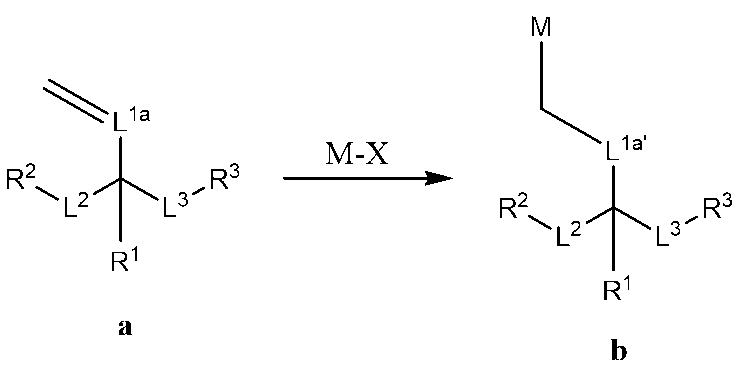
反応スキームII
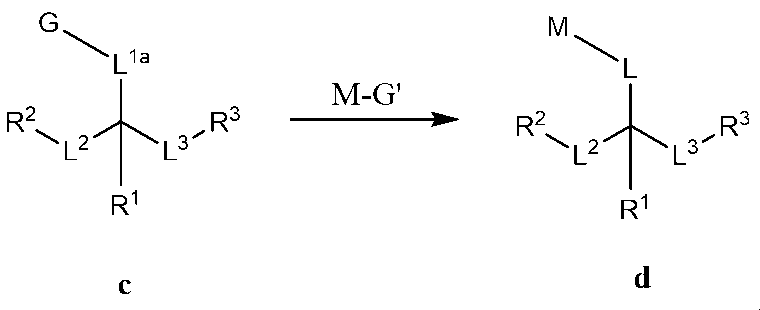
ある種の実施形態では、構造Iの化合物は、2~100の繰り返し単位を含むオリゴマーである。このようなオリゴマーは、周知の自動化DNA合成法に類似する方法を使用して調製することができる。DNA合成法は、当分野において周知である。手短に述べると、2つのアルコール基、例えば上の中間体bまたはd中のR2およびR3は、それぞれ、ジメトキシトリチル(DMT)基および2-シアノエチル-N,N-ジイソプロピルアミノホスホロアミダイト基により官能基化されている。ホスホロアミダイト基は、通常、テトラゾールなどの活性化剤の存在下で、アルコール基に結合させて、次に、ヨウ素によりリン原子を酸化する。ジメトキシトリチル基を、酸(例えば、クロロ酢酸)により除去して、遊離アルコールを露出させることができ、この遊離アルコールは、ホスホロアミダイト基と反応させることができる。2-シアノエチル基は、アンモニア水による処理によってオリゴマー化した後に除去され得る。 In certain embodiments, the compounds of structure I are oligomers containing 2-100 repeating units. Such oligomers can be prepared using methods similar to well-known automated DNA synthesis methods. DNA synthesis methods are well known in the art. Briefly, two alcohol groups, e.g., R2 and R3 in intermediates b or d above, are functionalized with a dimethoxytrityl (DMT) group and a 2-cyanoethyl-N,N-diisopropylamino phosphoramidite group, respectively. The phosphoramidite group is typically attached to the alcohol group in the presence of an activating agent such as tetrazole, followed by oxidation of the phosphorus atom with iodine. The dimethoxytrityl group can be removed with an acid (e.g., chloroacetic acid) to expose the free alcohol, which can be reacted with the phosphoramidite group. The 2-cyanoethyl group can be removed after oligomerization by treatment with aqueous ammonia.
オリゴマー化法に使用されるホスホロアミダイトの調製もまた、当分野で周知である。例えば、一級アルコール(例えば、R3)は、DMT-Clとの反応によってDMT基として保護され得る。次に、二級アルコール(例えば、R2)は、2-シアノエチルN,N-ジイソプロピルクロロホスホロアミダイトなどの適切な試薬との反応によって、ホスホロアミダイトとして官能基化される。ホスホロアミダイトの調製方法およびそのオリゴマー化の方法は、当分野において周知である。 The preparation of phosphoramidites used in the oligomerization method is also well known in the art. For example, a primary alcohol (e.g., R 3 ) can be protected as a DMT group by reaction with DMT-Cl. A secondary alcohol (e.g., R 2 ) is then functionalized as a phosphoramidite by reaction with an appropriate reagent such as 2-cyanoethyl N,N-diisopropylchlorophosphoramidite. Methods for the preparation of phosphoramidites and their oligomerization are well known in the art.
中間体bまたはdのオリゴマーは、上記の周知のホスホロアミダイト(phophoramidite)化学に従い調製される。所望の数の繰り返し単位mは、ホスホロアミダイトのカップリングを、適切な中間体、例えば、以下の構造: Oligomers of intermediates b or d are prepared according to the well-known phosphoramidite chemistry described above. The desired number of repeat units m is prepared by coupling phosphoramidites to a suitable intermediate, e.g., the following structure:
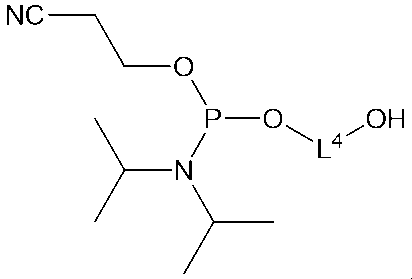
以下の実施例は、限定ではなく、例示目的で提示される。
The following examples are offered by way of illustration and not by way of limitation.
一般方法
1Hおよび31P NMRスペクトルは、JEOL400MHz分光計で得る。31P NMRスペクトルは、85%水性リン酸を参照し、1Hスペクトルは、TMSを参照する。逆相HPLC色素分析は、45℃に保持した2.1mmx50mm Acquity BEH-C18カラムを備えるWaters Acquity UHPLCシステムを使用して行う。質量スペクトル分析は、MassLynx4.1アクイジョンソフトウェアを使用する、Waters/Micromass QuattroマイクロMS/システムMS(MSモードのみ)で行う。LC/MSに使用した移動相は、100mMの1,1,1,3,3,3-ヘキサフルオロ-2-プロパノール(HFIP)、8.6mMのトリエチルアミン(TEA)、pH8である。ホスホロアミダイトおよび前駆体分子は、Aapptec(著作権)Spirit(商標)ペプチドC18カラム(4.6mmx100mm、5μmの粒子サイズ)を使用する、ダイオードアレイ検出器および高性能オートサンプラーを備えるAgilent Infinity1260 UHPLCシステムを使用して分析する。励起および発光プロファイル実験は、Cary Eclipseスペクトル光度計で記録する。
反応はすべて、特に明記しない限り、窒素雰囲気下、オーブン乾燥したガラス器具中で行った。市販のDNA合成試薬は、Glen Research(Sterling、VA)から購入する。無水ピリジン、トルエン、ジクロロメタン、ジイソプロピルエチルアミン、トリエチルアミン、酢酸、ピリジンおよびTHFは、Aldrichから購入する。他の化学物質はすべて、AldrichまたはTCIから購入し、さらに精製することなく、そのまま使用する。
General Methods
1 H and 31 P NMR spectra are obtained on a JEOL 400 MHz spectrometer. 31 P NMR spectra are referenced to 85% aqueous phosphoric acid and 1 H spectra are referenced to TMS. Reverse phase HPLC dye analysis is performed using a Waters Acquity UHPLC system equipped with a 2.1 mm×50 mm Acquity BEH-C18 column maintained at 45° C. Mass spectral analysis is performed on a Waters/Micromass Quattro micro MS/system MS (MS mode only) using MassLynx 4.1 acquisition software. The mobile phase used for LC/MS is 100 mM 1,1,1,3,3,3-hexafluoro-2-propanol (HFIP), 8.6 mM triethylamine (TEA), pH 8. Phosphoramidite and precursor molecules are analyzed using an Agilent Infinity1260 UHPLC system equipped with a diode array detector and a high performance autosampler using an Aapptec© Spirit™ peptide C18 column (4.6 mm x 100 mm, 5 μm particle size). Excitation and emission profile experiments are recorded on a Cary Eclipse spectrophotometer.
All reactions were carried out in oven-dried glassware under nitrogen unless otherwise stated. Commercially available DNA synthesis reagents are purchased from Glen Research (Sterling, VA). Anhydrous pyridine, toluene, dichloromethane, diisopropylethylamine, triethylamine, acetic acid, pyridine and THF are purchased from Aldrich. All other chemicals are purchased from Aldrich or TCI and used as is without further purification.
すべてのオリゴマー(すなわち、二量体以上)化合物は、ホスホロアミダイトに基づくカップリング手法に関する標準プロトコルを使用するABI394 DNA合成装置で合成する。オリゴマーの合成に関する鎖の構築サイクルは、以下:(i)脱トリチル化、ジクロロメタン中の3%トリクロロ酢酸(trichloroaceticacid)、1分間、(ii)カップリング、アセトニトリル中の0.1Mホスホロアミダイトおよび0.45Mテトラゾール、10分間、(iii)キャッピング、THF/ルチジン、1/1中の0.5M無水酢酸、v/v、15秒、(iv)酸化、THF/ピリジン/水、10/10/1中の0.1Mヨウ素、v/v/v、30秒、の通りである。 All oligomeric (i.e., dimers and above) compounds are synthesized on an ABI394 DNA synthesizer using standard protocols for phosphoramidite-based coupling procedures. The chain construction cycles for oligomer synthesis are as follows: (i) detritylation, 3% trichloroacetic acid in dichloromethane, 1 min; (ii) coupling, 0.1 M phosphoramidite and 0.45 M tetrazole in acetonitrile, 10 min; (iii) capping, 0.5 M acetic anhydride in THF/lutidine, 1/1, v/v, 15 sec; (iv) oxidation, 0.1 M iodine in THF/pyridine/water, 10/10/1, v/v/v, 30 sec.
このサイクル内の化学工程は、0.2~0.4分間の、アセトニトリルによる洗浄および乾燥アルゴンの吹込みが後に続く。塩基およびホスホロアミデート保護基の支持および除去に起因する開裂は、室温で1時間、アンモニアにより処理することによって実現される。次に、オリゴマー色素を、上記の逆相HPLCにより分析する。 The chemical steps in this cycle are followed by washing with acetonitrile and bubbling with dry argon for 0.2-0.4 min. Cleavage resulting from support and removal of the base and phosphoramidate protecting groups is achieved by treatment with ammonia for 1 h at room temperature. The oligomeric dyes are then analyzed by reversed-phase HPLC as described above.
(実施例1)
イブプロフェン-NHSおよびナプロキセン-NHSの合成
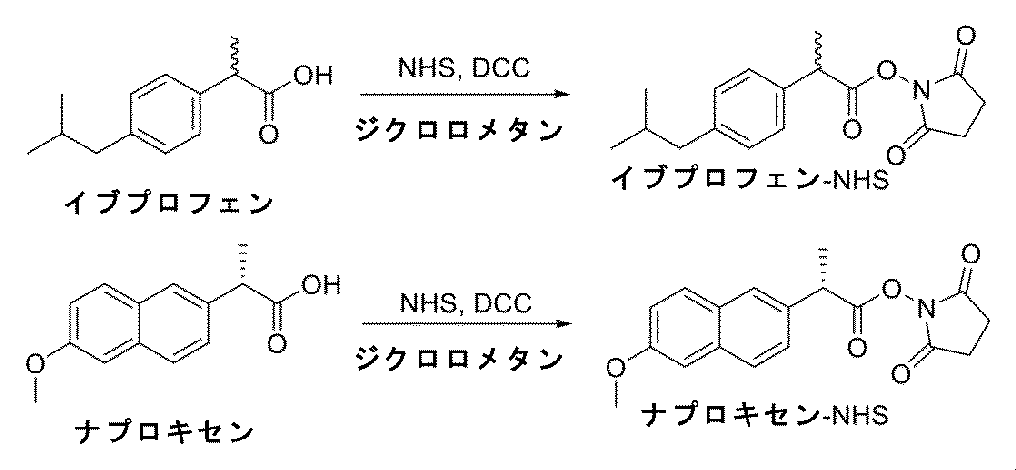
Synthesis of Ibuprofen-NHS and Naproxen-NHS
イブプロフェン-NHSおよびナプロキセン-NHSは、標準カップリング条件を使用して合成した。すなわち、イブプロフェンおよびナプロキセンを、ジクロロメタンに個別に溶解し、この混合物に、N,N’-ジシクロヘキシルカルボジイミド(DCC)およびN-ヒドロキシスクシンイミド(NHS)を加えた。次に、生成物を必要に応じて精製し、次の合成工程に使用した。イブプロフェン-NHSは、多グラムスケールで1工程で容易に合成される。 Ibuprofen-NHS and naproxen-NHS were synthesized using standard coupling conditions; ibuprofen and naproxen were dissolved separately in dichloromethane, and to this mixture was added N,N'-dicyclohexylcarbodiimide (DCC) and N-hydroxysuccinimide (NHS). The product was then purified as necessary and used in the next synthetic step. Ibuprofen-NHS is easily synthesized in one step on a multigram scale.
(実施例2)
イブプロフェンポリマーの合成
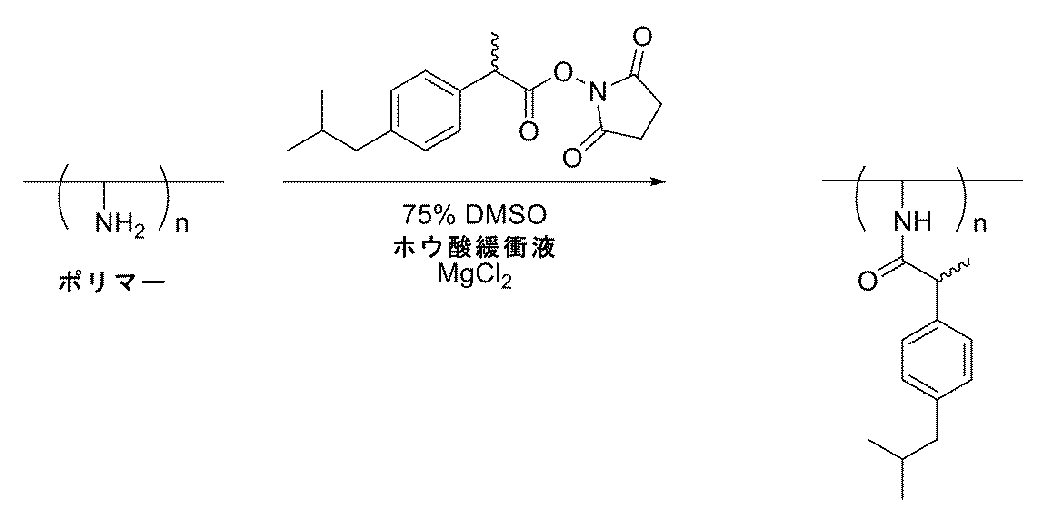
Synthesis of ibuprofen polymers
上の反応順序に示されている通り、例示的なポリマー(例えば、アミン官能基側鎖を有する)をイブプロフェン-NHSと連結する。この反応は、塩化マグネシウムを含むホウ酸緩衝化H2O/DMSO混合物を使用して行われる。この反応は、アミン官能基の各々にイブプロフェン部分を首尾よく付加して、所望の生成物を与える。 As shown in the reaction sequence above, an exemplary polymer (e.g., with amine functional side chains) is coupled with ibuprofen-NHS. The reaction is carried out using a borate buffered H2O /DMSO mixture containing magnesium chloride. This reaction successfully adds an ibuprofen moiety to each of the amine functional groups to give the desired product.
(実施例3)
ナプロキセンポリマーの合成
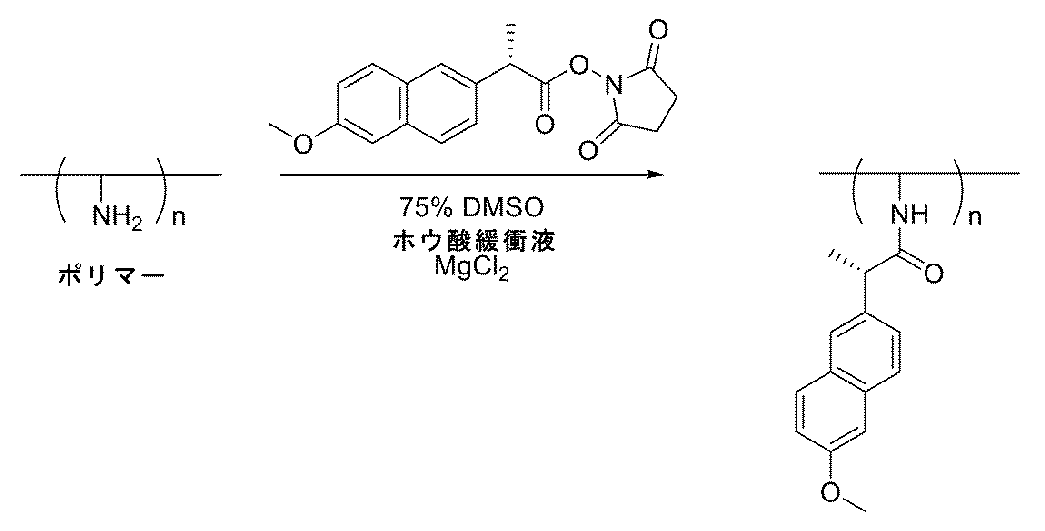
Synthesis of naproxen polymers
上の反応順序に示されている通り、例示的なポリマー(例えば、アミン官能基側鎖を有する)をナプロキセン-NHSに連結する。この反応は、塩化マグネシウムを含むホウ酸緩衝化H2O/DMSO混合物を使用して行われる。この反応は、アミン官能基の各々にイブプロフェン部分を首尾よく付加して、所望の生成物を与える。 As shown in the reaction sequence above, an exemplary polymer (e.g., with amine functional side chains) is coupled to naproxen-NHS. The reaction is carried out using a borate buffered H2O /DMSO mixture containing magnesium chloride. This reaction successfully adds an ibuprofen moiety to each of the amine functional groups to give the desired product.
(実施例4)
ドキソルビシン-NHSの合成
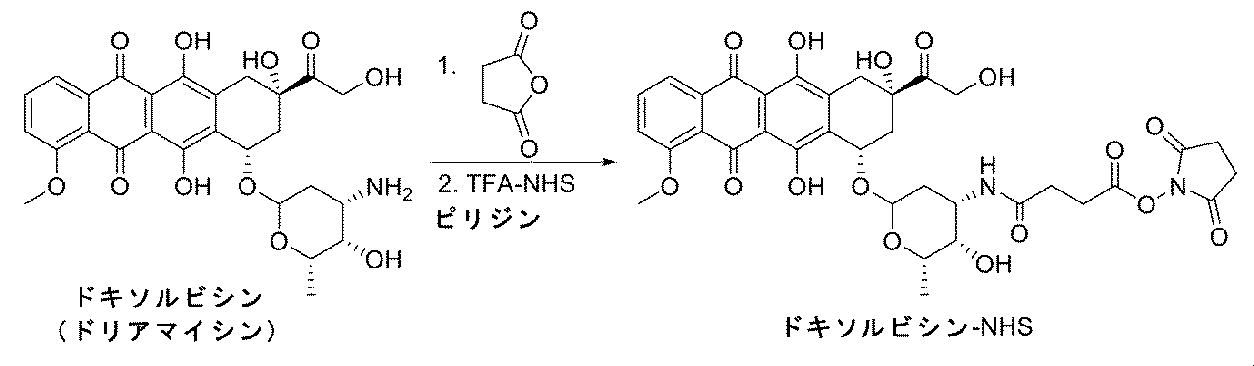
Synthesis of doxorubicin-NHS
(実施例5)
ドキソルビシンポリマーの合成

Synthesis of doxorubicin polymers
例示的なポリマーをドキソルビシン-NHSに連結する。この反応条件は、ドキソルビシン誘導体の溶解度に限界があるので、異なる溶媒混合物を使用する実験を必要とする。反応条件の代替肢は、有機溶媒の含有量を増量すること、反応温度を高くすること、および反応を支援するためドデシル硫酸ナトリウム(SDS)を添加することを含む。 An exemplary polymer is linked to doxorubicin-NHS. The reaction conditions require experimentation using different solvent mixtures due to the limited solubility of the doxorubicin derivative. Alternative reaction conditions include increasing the content of organic solvent, increasing the reaction temperature, and adding sodium dodecyl sulfate (SDS) to aid in the reaction.
(実施例6)
ドキソルビシン-PEG-アジドの合成

Synthesis of Doxorubicin-PEG-Azide
ドキソルビシン-PEG-アジドは、50mgスケールで、上に示した反応順序に従い合成した。アジド6-1は、ジヒドロフラン-2,5-ジオンと反応させて、中間体6-2を得て、これをパーフルオロフェノールと反応させて、中間体6-3を得た。中間体6-3をドキソルビシンに連結させて、所望の生成物である、ドキソルビシン-PEG-アジドが良好な収率(74%)で得られた。所望の生成物の存在は、LC-MSによって確認した。 Doxorubicin-PEG-azide was synthesized on a 50 mg scale following the reaction sequence shown above. Azide 6-1 was reacted with dihydrofuran-2,5-dione to give intermediate 6-2, which was reacted with perfluorophenol to give intermediate 6-3. Intermediate 6-3 was coupled to doxorubicin to give the desired product, doxorubicin-PEG-azide, in good yield (74%). The presence of the desired product was confirmed by LC-MS.
(実施例7)
ドキソルビシンポリマーの合成
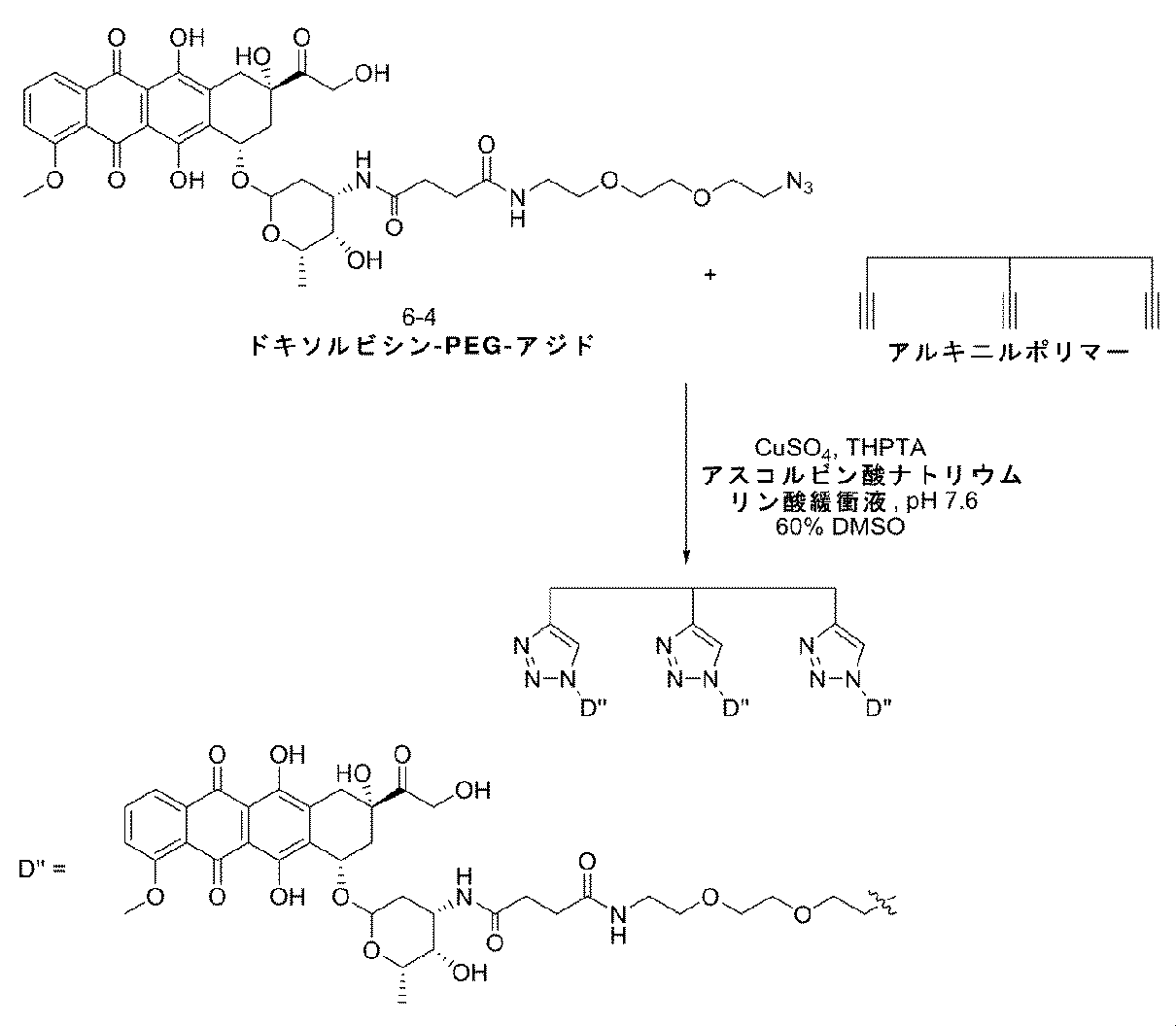
Synthesis of doxorubicin polymers
ポリマー、およびその後にいずれかの標的指向性部分に連結される生物活性部分または蛍光色素部分の数を制御することが可能であることを含めた、多数の利点が本明細書に開示されている実施形態によってもたらされる。ポリマー主鎖の組成はまた、例えば、電荷部分(例えば、数、頻度、間隔など)の組み込みを制御することによって、所望の溶解度特性を実現するように選択することができる。側鎖は、主鎖の組成によってもたらされる特性に加え、本明細書において開示されている化合物の溶解度を調節するための根本を提供するよう選択され得る。 Numerous advantages are provided by the embodiments disclosed herein, including the ability to control the number of bioactive or fluorescent dye moieties that are linked to the polymer and subsequently to any targeting moieties. The composition of the polymer backbone can also be selected to achieve desired solubility properties, for example, by controlling the incorporation of charge moieties (e.g., number, frequency, spacing, etc.). In addition to the properties provided by the backbone composition, the side chains can be selected to provide a basis for adjusting the solubility of the compounds disclosed herein.
本明細書において開示されている実施形態はまた、例えば、無料(complimentary)のまたは相乗的な治療的戦略のために、複数の治療剤を有利に含むことができる化合物を提供する。さらに、本開示の実施形態は、標的化、処置および検出を同時に行うために使用することができる、治療剤、標的指向性部分および色素部分(例えば、フルオロフォア)の組合せを提供する。ポリマー-薬物構築体を、抗体、抗体断片、タンパク質または他の臨床的に関心の高い薬剤などの標的剤にカップリングすることが容易であるため、幅広い関心の持たれる用途(例えば、表面化学、アッセイ開発など)に対して有用性がある。 The embodiments disclosed herein also provide compounds that can advantageously include multiple therapeutic agents, e.g., for complimentary or synergistic therapeutic strategies. Additionally, embodiments of the present disclosure provide combinations of therapeutic agents, targeting moieties, and dye moieties (e.g., fluorophores) that can be used for simultaneous targeting, treatment, and detection. The ease of coupling the polymer-drug constructs to targeting agents such as antibodies, antibody fragments, proteins, or other agents of clinical interest provides utility for a wide range of applications of interest (e.g., surface chemistry, assay development, etc.).
ある種の実施形態の化合物はまた、透過性の増強および保持作用を含めた、他の所望の特性を実現する。必要な溶解性の実現に加えて、本化合物の実施形態の化学的特徴は、本化合物が罹患細胞/組織を透過する能力およびこれらの内部に保持される能力をモジュレートするよう調節され得る。これらの特徴により、浸透度の増強による生物活性剤の効果的な送達、および保持の増強による有効性の増大が可能になる。 The compounds of certain embodiments also achieve other desirable properties, including enhanced permeability and retention. In addition to achieving the necessary solubility, the chemical characteristics of the compound embodiments can be adjusted to modulate the ability of the compounds to penetrate and be retained within diseased cells/tissues. These characteristics allow for effective delivery of bioactive agents through enhanced permeability, and increased efficacy through enhanced retention.
この明細書に言及されている、米国特許、米国特許出願公開、米国特許出願、外国特許、外国特許出願および非特許刊行物のすべては、2018年1月12日に出願の米国仮特許出願第62/616,668号を含め、本記載と一致しない程度に、それらの全体が参照により本明細書に組み込まれている。 All U.S. patents, U.S. patent application publications, U.S. patent applications, foreign patents, foreign patent applications, and non-patent publications referred to in this specification, including U.S. Provisional Patent Application No. 62/616,668, filed January 12, 2018, are hereby incorporated by reference in their entirety to the extent inconsistent with the present disclosure.
上述から、本発明の具体的な実施形態が、例示目的のために本明細書に記載されているが、本発明の趣旨および範囲から逸脱することなく様々な修正が行われてもよいことが理解されよう。したがって、本発明は、添付の特許請求の範囲によるもの以外の限定は受けない。
本発明のまた別の態様は、以下のとおりであってもよい。
〔1〕以下の構造(I)を有する化合物:
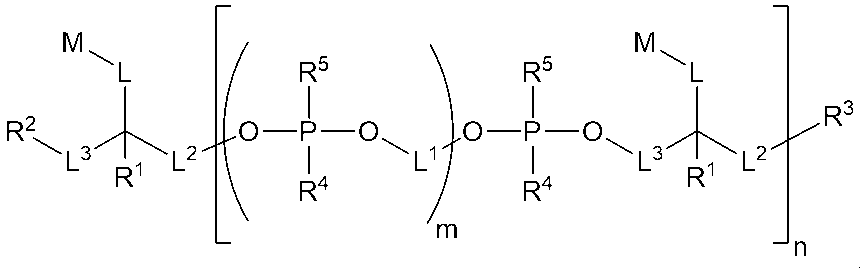
(I)
またはその立体異性体、薬学的に許容される塩もしくは互変異性体(式中、
Mは、出現毎に独立して、生物活性部分もしくはその断片、生物活性部分のプロドラッグもしくはその断片、蛍光色素、イメージング剤または放射性同位体結合部位であり、ただし、出現するMの少なくとも1つは、蛍光色素ではないことを条件とし、
Lは、生理的に開裂可能なリンカーであり、
L
1
は、出現毎に独立して、アルキレン、アルケニレン、アルキニレン、ヘテロアルキレン、ヘテロアルケニレンまたはヘテロアルキニレンリンカーであり、
L
2
およびL
3
は、出現毎に独立して、任意選択のアルキレン、アルケニレン、アルキニレン、ヘテロアルキレン、ヘテロアルケニレン、ヘテロアルキニレンまたはヘテロ原子リンカーであり、
R
1
は、出現毎に独立して、H、アルキルまたはアルコキシであり、
R
2
およびR
3
は、それぞれ独立して、-H、-OH、-SH、アルキル、アルコキシ、アルキルエーテル、ヘテロアルキル、アルキルアミニル、アルキルカルボニル、アルコキシカルボニル、Qもしくはそれらの保護形態、またはL’であり、アルキル、アルコキシ、アルキルエーテル、ヘテロアルキル、アルキルアミニル、アルキルカルボニルおよびアルキルオキシカルボニルは、ヒドロキシル、アミノ、スルフヒドリル、ホスフェート、チオホスフェート、ホスホアルキル、チオホスホアルキル、ホスホアルキルエーテルもしくはチオホスホアルキルエーテル、またはそれらの組合せにより置換されていてもよく、
R
4
は、出現毎に独立して、OH、SH、O
-
、S
-
、OR
d
またはSR
d
であり、
R
5
は、出現毎に独立して、オキソ、チオキソであるか、または存在せず、
R
d
は、陽イオンであり、
Qは、出現毎に独立して、標的指向性部分の相補性反応性基Q’と共有結合の形成が可能な、反応性基、またはその保護形態を含む部分であり、
L’は、出現毎に独立して、Qへの共有結合を含むリンカー、標的指向性部分、標的指向性部分への共有結合を含むリンカー、固体支持体もしくは固体支持体残基、固体支持体もしくは固体支持体残基への共有結合を含むリンカー、または構造(I)のさらなる化合物への共有結合を含むリンカーであり、
mは、出現毎に独立して、0以上の整数であり、ただし、出現するmの少なくとも1つは、3以上の整数であり、
nは、1以上の整数である)。
〔2〕以下の構造(IA):

(IA)
(式中、x
1
およびx
2
は、出現毎に独立して、0~6の整数である)
を有する、前記〔1〕に記載の化合物。
〔3〕L
1
が、出現毎に独立して、C
1
-C
6
アルキレンまたはC
2
-C
6
アルキニレンである、前記〔1〕~〔2〕のいずれか1項に記載の化合物。
〔4〕以下の構造(IB):
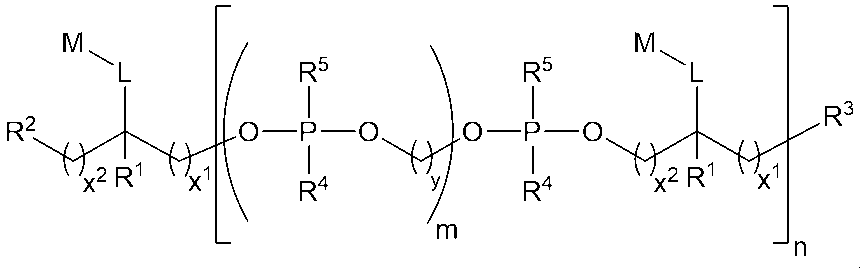
(IB)
(式中、
x
1
およびx
2
は、出現毎に独立して、0~6の整数であり、
yは、1~6の整数である)
を有する、前記〔1〕~〔3〕のいずれか1項に記載の化合物。
〔5〕yが2である、前記〔4〕に記載の化合物。
〔6〕x
1
およびx
2
が、出現毎に、それぞれ1である、前記〔2〕~〔5〕のいずれか1項に記載の化合物。
〔7〕出現毎に、x
1
が0であり、x
2
が1である、前記〔2〕~〔5〕のいずれか1項に記載の化合物。
〔8〕R
4
が、出現毎に独立して、OH、O
-
またはOR
d
である、前記〔1〕~〔7〕のいずれか1項に記載の化合物。
〔9〕R
5
が、出現毎に、オキソである、前記〔1〕~〔8〕のいずれか1項に記載の化合物。
〔10〕以下の構造(IB’)または(IB”):
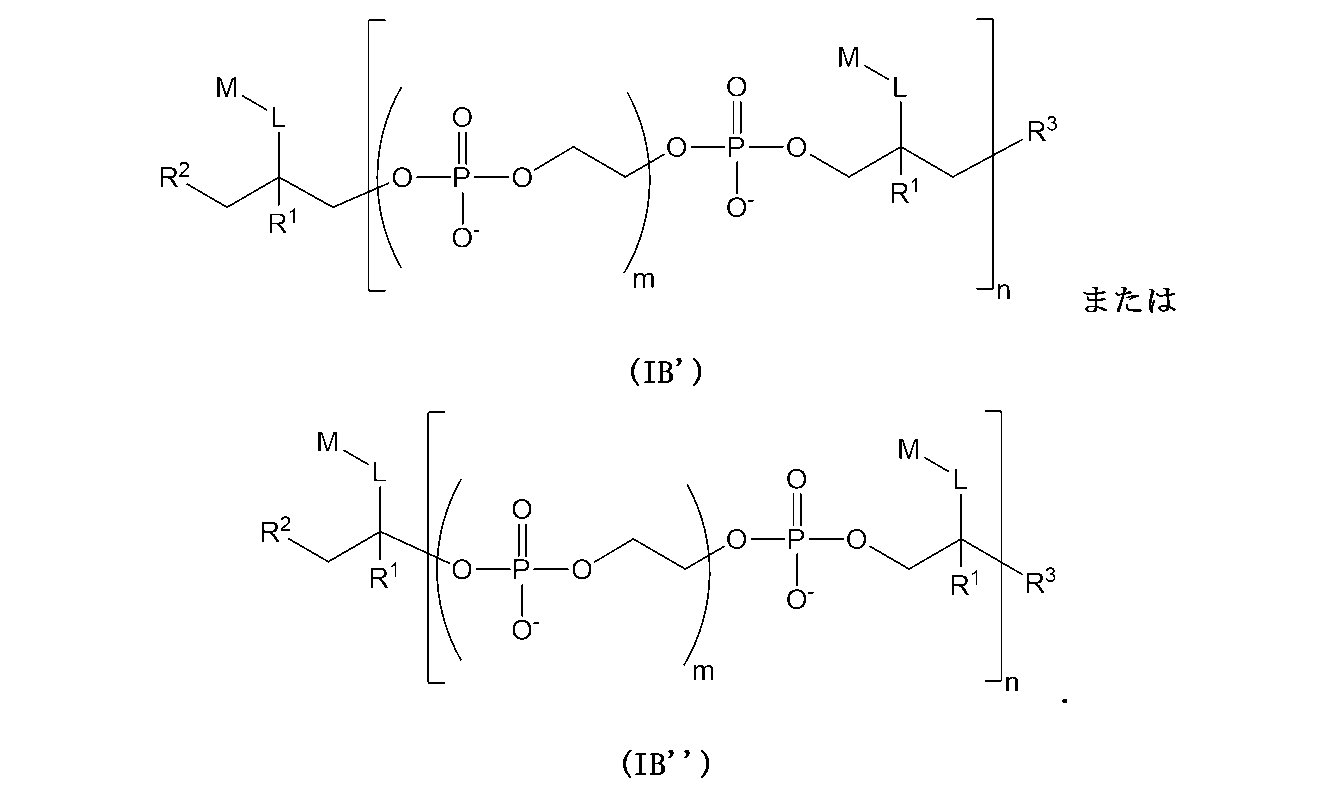
の一方を有する、前記〔1〕~〔9〕のいずれか1項に記載の化合物。
〔11〕R
1
が、Hである、前記〔1〕~〔10〕のいずれか1項に記載の化合物。
〔12〕R
2
およびR
3
が、それぞれ独立して、OHまたは-OP(=R
a
)(R
b
)R
c
である、前記〔1〕~〔11〕のいずれか1項に記載の化合物。
〔13〕R
2
またはR
3
の一方が、OHまたは-OP(=R
a
)(R
b
)R
c
であり、R
2
またはR
3
のもう一方が、Q、またはQへの共有結合を含むリンカーである、前記〔1〕~〔12〕のいずれか1項に記載の化合物。
〔14〕R
2
またはR
3
の1つがL’であり、L’が、固体支持体への共有結合を含むリンカーである、前記〔1〕~〔11〕のいずれか1項に記載の化合物。
〔15〕固体支持体が、ポリマー製ビーズまたは非ポリマー製ビーズである、前記〔14〕に記載の化合物。
〔16〕R
2
またはR
3
の1つがL’であり、L’が、標的指向性部分であるか、または標的指向部分へのリンカーである、前記〔1〕~〔11〕のいずれか1項に記載の化合物。
〔17〕L’が、標的指向性部分へのリンカーであり、リンカーが、ヘテロアルキレンリンカーを含む、前記〔16〕に記載の化合物。
〔18〕標的指向性部分が、抗体または細胞表面受容体アンタゴニストである、前記〔1〕~〔17〕のいずれか1項に記載の化合物。
〔19〕抗体または細胞表面受容体アンタゴニストが、上皮成長因子受容体(EGFR)阻害剤、肝細胞成長因子受容体(HGFR)阻害剤、インスリン様成長因子受容体(IGFR)阻害剤、フォレートまたはMET阻害剤である、前記〔18〕に記載の化合物。
〔20〕Qが、スルフヒドリル、ジスルフィド、活性化エステル、イソチオシアネート、アジド、アルキン、アルケン、ジエン、求ジエン体、酸ハロゲン化物、ハロゲン化スルホニル、ホスフィン、α-ハロアミド、ビオチン、アミノまたはマレイミド官能基を含む、前記〔1〕~〔19〕のいずれか1項に記載の化合物。
〔21〕Qが、表1から選択される部分を含む、前記〔1〕~〔20〕のいずれか1項に記載の化合物。
〔22〕mが、出現毎に独立して、1~20の整数である、前記〔1〕~〔21〕のいずれか1項に記載の化合物。
〔23〕mが、出現毎に独立して、1~10の整数である、前記〔1〕~〔22〕のいずれか1項に記載の化合物。
〔24〕nが、1~100の整数である、前記〔1〕~〔23〕のいずれか1項に記載の化合物。
〔25〕nが、1~10の整数である、前記〔1〕~〔24〕のいずれか1項に記載の化合物。
〔26〕Lが、出現毎に独立して、アミド結合、エステル結合、ジスルフィド結合、二重結合、三重結合、エーテル結合、ケトン、ジオール、シアノ、ニトロまたはそれらの組合せを含むリンカーである、前記〔1〕~〔25〕のいずれか1項に記載の化合物。
〔27〕Mが、出現毎に独立して、NSAID、キナーゼ阻害剤、アントラサイクリン、EGFR阻害剤またはアルキル化剤である、前記〔1〕~〔26〕のいずれか1項に記載の化合物。
〔28〕出現するMの少なくとも1つが、以下の構造:

のうちの1つを有する、前記〔1〕~〔27〕のいずれか1項に記載の化合物。
〔29〕Mが、出現毎に、以下の構造:

のうちの1つを有する、前記〔1〕~〔28〕のいずれか1項に記載の化合物。
〔30〕Mが、出現毎に独立して、抗がん薬であり、標的指向性部分が、腫瘍細胞抗原に特異的な抗体である、前記〔1〕~〔27〕のいずれか1項に記載の化合物。
〔31〕腫瘍細胞抗原が、EGFR、HER2、葉酸受容体、CD20またはCD33である、前記〔30〕に記載の化合物。
〔32〕表2中の化合物から選択される、前記〔1〕に記載の化合物。
〔33〕前記〔1〕~〔32〕のいずれか1項に記載の化合物、および薬学的に許容される担体を含む組成物。
〔34〕単一連結基により抗体に共有結合している前記〔1〕に記載の化合物を含む複数のコンジュゲートを含む組成物であって、複数のコンジュゲートが少なくとも90%の構造均質性を有する、組成物。
〔35〕複数のコンジュゲートが、少なくとも95%の構造均質性を有する、前記〔34〕に記載の組成物。
〔36〕複数のコンジュゲートが、99%を超える構造均質性を有する、前記〔35〕に記載の組成物。
〔37〕R
2
およびR
3
の1つが、-OP(=R
a
)(R
b
)OL’またはL’であり、L’が、抗体、もしくはこの抗体への共有結合を含むリンカーである、前記〔34〕~〔36〕のいずれか1項に記載の組成物。
〔38〕それを必要とする対象に、治療有効量の前記〔1〕~〔32〕のいずれか1項に記載の化合物、または前記〔33〕~〔37〕のいずれか1項に記載の組成物を投与するステップを含む、疾患を処置する方法であって、Mがそれぞれ、独立して、疾患を処置するのに有効な生物活性部分である、方法。
〔39〕疾患ががんであり、Mがそれぞれ、独立して抗がん薬である、前記〔38〕に記載の方法。
From the foregoing it will be appreciated that specific embodiments of the invention have been described herein for purposes of illustration, but that various modifications may be made without departing from the spirit and scope of the invention. Accordingly, the invention is not limited except as by the appended claims.
Yet another aspect of the present invention may be as follows.
[1] A compound having the following structure (I):
(I)
or a stereoisomer, pharma- ceutically acceptable salt, or tautomer thereof, wherein
M is, independently at each occurrence, a biologically active moiety or fragment thereof, a prodrug of a biologically active moiety or fragment thereof, a fluorescent dye, an imaging agent, or a radioisotope binding moiety, provided that at least one occurrence of M is not a fluorescent dye;
L is a physiologically cleavable linker;
L1 is independently at each occurrence an alkylene, alkenylene, alkynylene, heteroalkylene, heteroalkenylene, or heteroalkynylene linker ;
L2 and L3 , independently at each occurrence, are an optional alkylene, alkenylene, alkynylene, heteroalkylene, heteroalkenylene, heteroalkynylene, or heteroatom linker ;
R 1 is, independently at each occurrence, H, alkyl, or alkoxy;
R2 and R3 are each independently -H, -OH, -SH, alkyl, alkoxy, alkylether, heteroalkyl, alkylaminyl, alkylcarbonyl, alkoxycarbonyl, Q or a protected form thereof, or L', where the alkyl , alkoxy, alkylether, heteroalkyl, alkylaminyl, alkylcarbonyl and alkyloxycarbonyl are optionally substituted with hydroxyl, amino, sulfhydryl, phosphate, thiophosphate, phosphoalkyl, thiophosphoalkyl, phosphoalkylether or thiophosphoalkylether, or combinations thereof;
R4 is, independently at each occurrence, OH, SH, O- , S- , ORd , or SRd ;
R5 is independently at each occurrence oxo, thioxo, or absent;
R d is a cation;
Q is, independently at each occurrence, a moiety that contains a reactive group, or a protected form thereof, capable of forming a covalent bond with the complementary reactive group Q′ of the targeting moiety;
L' is, independently at each occurrence, a linker that includes a covalent bond to Q, a targeting moiety, a linker that includes a covalent bond to a targeting moiety, a solid support or a solid support moiety, a linker that includes a covalent bond to a solid support or a solid support moiety, or a linker that includes a covalent bond to an additional compound of structure (I);
m is, independently at each occurrence, an integer greater than or equal to 0, with the proviso that at least one occurrence of m is an integer greater than or equal to 3;
and n is an integer of 1 or greater.
[2] The following structure (IA):
(IA)
wherein x 1 and x 2 are, independently at each occurrence, an integer from 0 to 6.
The compound according to claim 1, having the formula:
[3] The compound according to any one of the above [1] to [2], wherein L 1 is, independently at each occurrence, C 1 -C 6 alkylene or C 2 -C 6 alkynylene.
[4] The following structure (IB):
(IB)
(Wherein,
x 1 and x 2 are, independently at each occurrence, an integer from 0 to 6;
y is an integer from 1 to 6.
The compound according to any one of the above items [1] to [3], having the formula:
[5] The compound according to [4] above, wherein y is 2.
[6] The compound according to any one of [2] to [5] above, wherein x 1 and x 2 each represent 1 each time they occur.
[7] The compound according to any one of [2] to [5] above, wherein x 1 is 0 and x 2 is 1 for each occurrence.
[8] The compound according to any one of the above [1] to [7], wherein R 4 is, independently at each occurrence, OH, O 2 - , or OR d .
[9] The compound according to any one of [1] to [8] above, wherein each occurrence of R 5 is oxo.
[10] The following structure (IB') or (IB"):
The compound according to any one of the above [1] to [9],
[11] The compound according to any one of the above [1] to [10], wherein R 1 is H.
[12] The compound according to any one of the above [1] to [11], wherein R 2 and R 3 are each independently OH or -OP(=R a )(R b )R c .
[13] The compound according to any one of the above [1 ] to [12] , wherein one of R2 or R3 is OH or -OP(=R a )(R b )R c , and the other of R2 or R 3 is Q or a linker containing a covalent bond to Q.
[14] The compound according to any one of [1] to [11] above, wherein one of R 2 or R 3 is L', and L' is a linker comprising a covalent bond to a solid support.
[15] The compound according to [14] above, wherein the solid support is a polymeric bead or a non-polymeric bead.
[16] The compound according to any one of [1] to [11] above, wherein one of R 2 or R 3 is L', and L' is a targeting moiety or a linker to a targeting moiety.
[17] The compound according to [16] above, wherein L' is a linker to a targeting moiety, the linker comprising a heteroalkylene linker.
[18] The compound according to any one of [1] to [17] above, wherein the targeting moiety is an antibody or a cell surface receptor antagonist.
[19] The compound according to [18] above, wherein the antibody or cell surface receptor antagonist is an epidermal growth factor receptor (EGFR) inhibitor, a hepatocyte growth factor receptor (HGFR) inhibitor, an insulin-like growth factor receptor (IGFR) inhibitor, a folate or a MET inhibitor.
[20] The compound according to any one of [1] to [19] above, wherein Q comprises a sulfhydryl, disulfide, activated ester, isothiocyanate, azide, alkyne, alkene, diene, dienophile, acid halide, sulfonyl halide, phosphine, α-haloamide, biotin, amino, or maleimide functional group.
[21] The compound according to any one of [1] to [20] above, wherein Q comprises a moiety selected from Table 1.
[22] The compound according to any one of [1] to [21] above, wherein m is, independently at each occurrence, an integer of 1 to 20.
[23] The compound according to any one of [1] to [22] above, wherein m is, independently at each occurrence, an integer of 1 to 10.
[24] The compound according to any one of the above [1] to [23], wherein n is an integer of 1 to 100.
[25] The compound according to any one of the above [1] to [24], wherein n is an integer of 1 to 10.
[26] The compound according to any one of [1] to [25] above, wherein L is, independently at each occurrence, a linker containing an amide bond, an ester bond, a disulfide bond, a double bond, a triple bond, an ether bond, a ketone, a diol, a cyano, a nitro, or a combination thereof.
[27] The compound according to any one of [1] to [26] above, wherein M is, independently at each occurrence, an NSAID, a kinase inhibitor, an anthracycline, an EGFR inhibitor, or an alkylating agent.
[28] At least one of the M's occurring is the following structure:
The compound according to any one of the above [1] to [27],
[29] Each occurrence of M has the following structure:
The compound according to any one of the above [1] to [28],
[30] The compound according to any one of [1] to [27], wherein M is, independently at each occurrence, an anticancer drug and the targeting moiety is an antibody specific for a tumor cell antigen.
[31] The compound according to [30] above, wherein the tumor cell antigen is EGFR, HER2, a folate receptor, CD20 or CD33.
[32] The compound according to [1] above, selected from the compounds in Table 2.
[33] A composition comprising the compound according to any one of [1] to [32] above and a pharma- ceutically acceptable carrier.
[34] A composition comprising a plurality of conjugates comprising the compound of [1] covalently bound to an antibody by a single linking group, wherein the plurality of conjugates have at least 90% structural homogeneity.
[35] The composition according to [34], wherein the multiple conjugates have at least 95% structural homogeneity.
[36] The composition according to [35], wherein the multiple conjugates have a structural homogeneity of more than 99%.
[37] The composition according to any one of [34] to [36] above, wherein one of R2 and R3 is -OP(=R a ) (R b )OL' or L', and L' is an antibody or a linker comprising a covalent bond to the antibody.
[38] A method for treating a disease, comprising the step of administering to a subject in need thereof a therapeutically effective amount of a compound according to any one of [1] to [32], or a composition according to any one of [33] to [37], wherein each M is independently a biologically active moiety effective for treating the disease.
[39] The method according to [38] above, wherein the disease is cancer and each M is independently an anticancer drug.
Claims (14)

またはその立体異性体、薬学的に許容される塩もしくは互変異性体(式中、
Mは、出現毎に独立して、NSAID、キナーゼ阻害剤、アントラサイクリン、EGFR阻害剤、アルキル化剤及び抗がん薬から選択される生物活性部分、または、アリール環及びヘテロアリール環から選択される3つ以上の環を含む蛍光色素であり、ただし、出現するMの少なくとも1つは、蛍光色素ではないことを条件とし、
Lは、6~8のpH、20~40℃の範囲の温度、又は酵素により開裂可能な、生理的に開裂可能なリンカーであり、
L1は、出現毎に独立して、アルキレン、アルケニレン、またはアルキニレンリンカーであり、
L2およびL3は、出現毎に独立して、直接結合、もしくはアルキレン、アルケニレン、またはアルキニレンリンカーであり、
R1は、出現毎に独立して、H、アルキルまたはアルコキシであり、
R2およびR3は、それぞれ独立して、-H、-OH、-SH、アルキル、アルコキシ、アルキルエーテル、ヘテロアルキル、アルキルアミニル、アルキルカルボニル、アルコキシカルボニル、Qもしくはそれらの保護形態、またはL’であり、アルキル、アルコキシ、アルキルエーテル、ヘテロアルキル、アルキルアミニル、アルキルカルボニルおよびアルキルオキシカルボニルは、ヒドロキシル、アミノ、スルフヒドリル、ホスフェート、チオホスフェート、ホスホアルキル、チオホスホアルキル、ホスホアルキルエーテルもしくはチオホスホアルキルエーテル、またはそれらの組合せにより置換されていてもよく、
R4は、出現毎に独立して、OH、O-、またはORdであり、
R5は、出現毎に、オキソであり、
Rdは、陽イオンであり、
Qは、出現毎に独立して、スルフヒドリル、ジスルフィド、N-スクシンイミドエステル、イミドエステル、ポリフルオロフェニルエステル、イソチオシアネート、アジド、アルキン、アルケン、ジエン、求ジエン体、酸ハロゲン化物、ハロゲン化スルホニル、ホスフィン、α-ハロアミド、ビオチン、アミノまたはマレイミド官能基を含む部分であり、
L’は、出現毎に独立して、Qへの共有結合を含むリンカー、抗体または細胞表面受容体アンタゴニストから選択される標的指向性部分、抗体または細胞表面受容体アンタゴニストから選択される標的指向性部分への共有結合を含むリンカー、ポリマー製ビーズまたは非ポリマー製ビーズから選択される固体支持体もしくは固体支持体残基、固体支持体もしくは固体支持体残基への共有結合を含むリンカー、または前記構造(I)を有する他の化合物への共有結合を含むリンカーであり、
mは、出現毎に独立して、0以上の整数であり、ただし、出現するmの少なくとも1つは、3以上の整数であり、
nは、1以上の整数である)。 A compound having the following structure (I):
or a stereoisomer, pharma- ceutically acceptable salt, or tautomer thereof, wherein
M is, independently at each occurrence, a biologically active moiety selected from an NSAID, a kinase inhibitor, an anthracycline, an EGFR inhibitor, an alkylating agent, and an anticancer drug, or a fluorescent dye comprising three or more rings selected from aryl and heteroaryl rings, provided that at least one occurrence of M is not a fluorescent dye;
L is a physiologically cleavable linker, cleavable at a pH of 6-8, at a temperature in the range of 20-40° C., or by an enzyme;
L1 is independently at each occurrence an alkylene, alkenylene, or alkynylene linker;
L and L are, independently at each occurrence, a direct bond or an alkylene, alkenylene, or alkynylene linker;
R 1 is, independently at each occurrence, H, alkyl, or alkoxy;
R2 and R3 are each independently -H, -OH, -SH, alkyl, alkoxy, alkylether, heteroalkyl, alkylaminyl, alkylcarbonyl, alkoxycarbonyl, Q or a protected form thereof, or L', where the alkyl, alkoxy, alkylether, heteroalkyl, alkylaminyl, alkylcarbonyl and alkyloxycarbonyl are optionally substituted with hydroxyl, amino, sulfhydryl, phosphate, thiophosphate, phosphoalkyl, thiophosphoalkyl, phosphoalkylether or thiophosphoalkylether, or combinations thereof;
R4 is, independently at each occurrence, OH, O- , or ORd ;
R5 at each occurrence is oxo;
R d is a cation;
Q is, independently at each occurrence, a moiety that contains a sulfhydryl, disulfide, N-succinimide ester, imidoester, polyfluorophenyl ester, isothiocyanate, azide, alkyne, alkene, diene, dienophile, acid halide, sulfonyl halide, phosphine, α-haloamide, biotin, amino, or maleimide functional group;
L' is, independently at each occurrence, a linker that includes a covalent bond to Q, a targeting moiety selected from an antibody or a cell surface receptor antagonist, a linker that includes a covalent bond to a targeting moiety selected from an antibody or a cell surface receptor antagonist, a solid support or solid support moiety selected from a polymeric bead or a non-polymeric bead, a linker that includes a covalent bond to a solid support or solid support moiety, or a linker that includes a covalent bond to another compound having the structure (I);
m is, independently at each occurrence, an integer greater than or equal to 0, with the proviso that at least one occurrence of m is an integer greater than or equal to 3;
and n is an integer of 1 or greater.
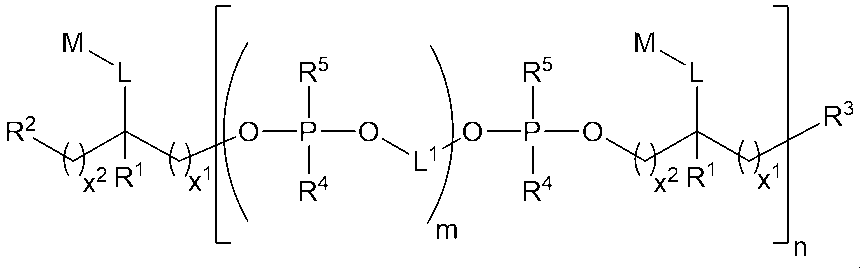
(式中、x1およびx2は、出現毎に独立して、0~6の整数である)
を有する、請求項1に記載の化合物。 The following structure (IA):
wherein x 1 and x 2 are, independently at each occurrence, an integer from 0 to 6.
2. The compound of claim 1 having the formula:
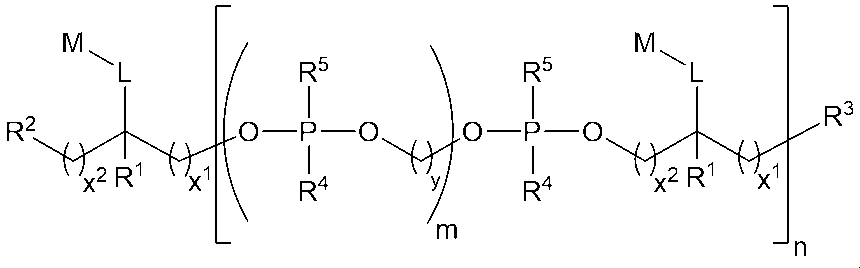
(式中、
x1およびx2は、出現毎に独立して、0~6の整数であり、
yは、1~6の整数である)
を有する、請求項1または2に記載の化合物。 The following structure (IB):
(Wherein,
x 1 and x 2 are, independently at each occurrence, an integer from 0 to 6;
y is an integer from 1 to 6.
3. The compound of claim 1 or 2, having the formula:
(B)出現毎に、x1が0であり、x2が1である、
請求項2または3に記載の化合物。 (A) x 1 and x 2 are each 1 for each occurrence; or (B) x 1 is 0 and x 2 is 1 for each occurrence;
4. A compound according to claim 2 or 3.
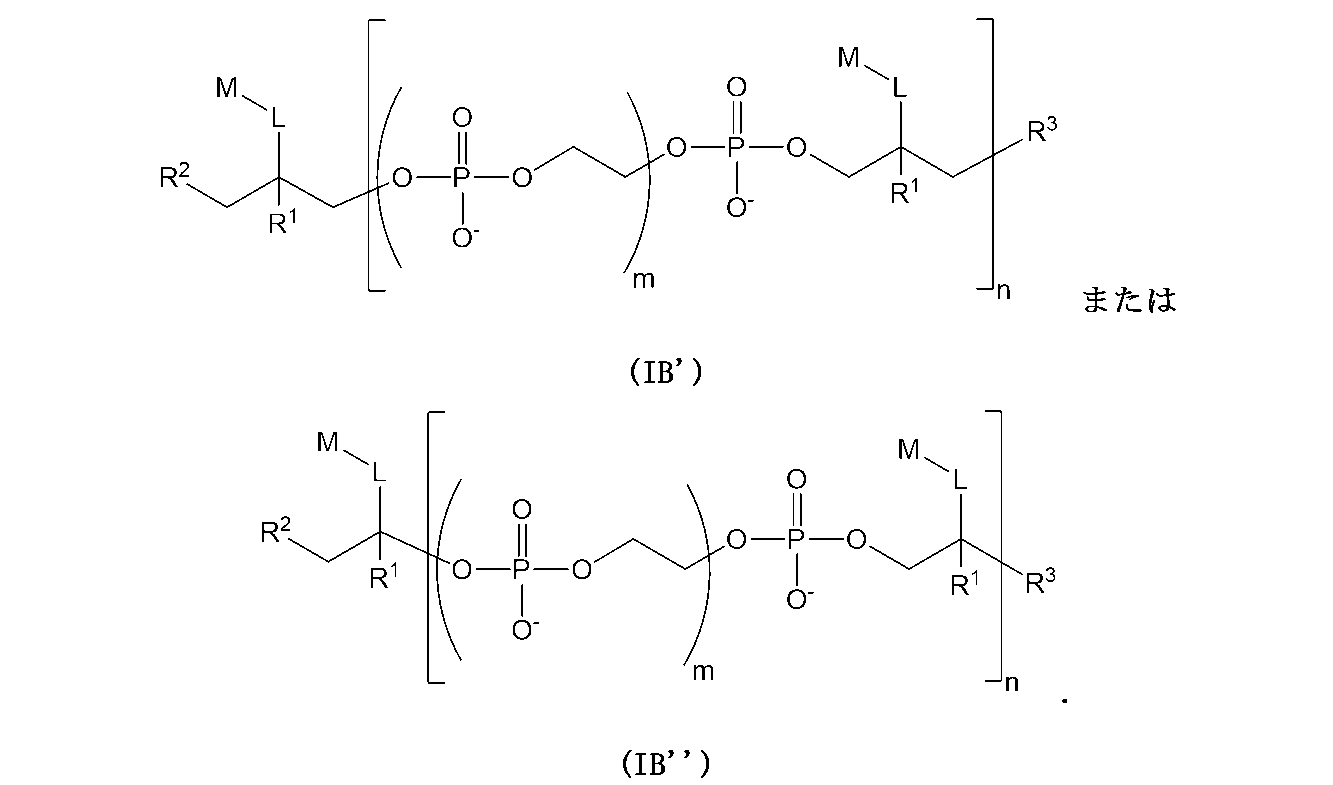
(B)R2またはR3の一方が、OHまたは-OP(=Ra)(Rb)Rcであり、R2またはR3のもう一方が、Q、またはQへの共有結合を含むリンカーであるか、
(C)R2またはR3の1つがL’であり、L’が、固体支持体への共有結合を含むリンカーであり、好ましくは、固体支持体が、ポリマー製ビーズまたは非ポリマー製ビーズであるか、または
(D)R2またはR3の1つがL’であり、L’が、標的指向性部分であるか、または標的指向部分へのリンカーであり、好ましくは、L’が、標的指向性部分へのリンカーであり、リンカーが、ヘテロアルキレンリンカーを含み、好ましくは、標的指向性部分が、抗体または細胞表面受容体アンタゴニストであり、好ましくは、抗体または細胞表面受容体アンタゴニストが、上皮成長因子受容体(EGFR)阻害剤、肝細胞成長因子受容体(HGFR)阻害剤、インスリン様成長因子受容体(IGFR)阻害剤、フォレートまたはMET阻害剤である、
請求項1~5のいずれか1項に記載の化合物。 (A) R2 and R3 are each independently OH or -OP(=R a )(R b )R c , where R a is O or S, R b is OH, SH, O - , S - , OR d or SR d , R c is OH, SH, O - , S - , OR d , SR d , alkyl, alkoxy, heteroalkyl, heteroalkoxy, alkyl ether, alkoxyalkyl ether, phosphate, thiophosphate, phosphoalkyl, thiophosphoalkyl, phosphoalkyl ether or thiophosphoalkyl ether, and R d is a counter ion;
(B) one of R2 or R3 is OH or -OP(=R a )(R b )R c and the other of R2 or R3 is Q or a linker containing a covalent bond to Q;
(C) one of R2 or R3 is L', where L' is a linker comprising a covalent bond to a solid support, preferably the solid support is a polymeric bead or a non-polymeric bead; or (D) one of R2 or R3 is L', where L' is a targeting moiety or a linker to a targeting moiety, preferably L' is a linker to a targeting moiety, where the linker comprises a heteroalkylene linker, preferably the targeting moiety is an antibody or a cell surface receptor antagonist, preferably the antibody or cell surface receptor antagonist is an epidermal growth factor receptor (EGFR) inhibitor, a hepatocyte growth factor receptor (HGFR) inhibitor, an insulin-like growth factor receptor (IGFR) inhibitor, a folate or a MET inhibitor.
The compound according to any one of claims 1 to 5.
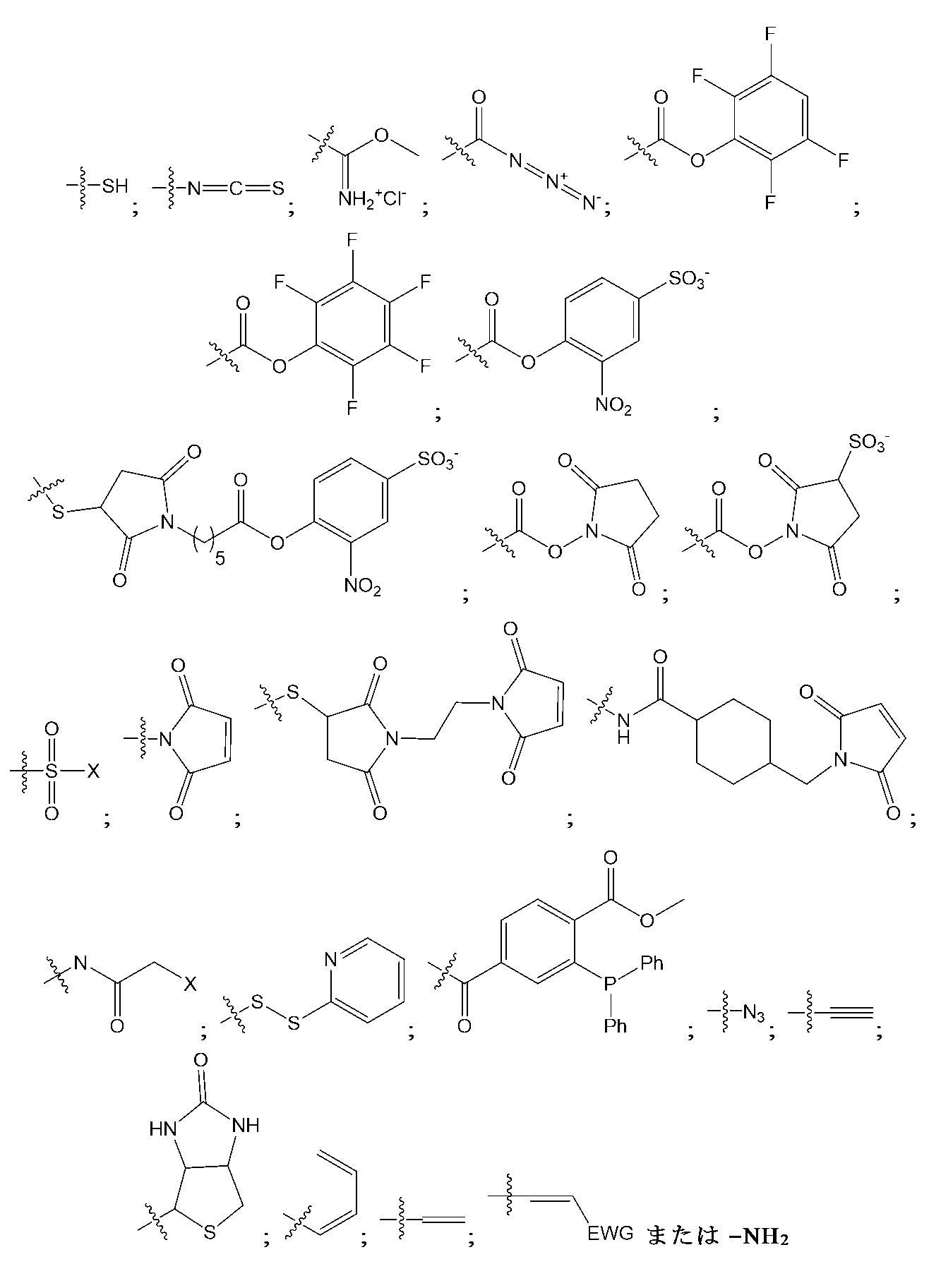
Xは、ハロであり、および
EWGは、電子求引基である)
の1つを有する部分を含む、請求項1~6のいずれか1項に記載の化合物。 Q has the following structure:
X is halo and EWG is an electron withdrawing group.
The compound of any one of claims 1 to 6, comprising a moiety having one of the following formula:
(B)mが、出現毎に独立して、1~10の整数である、
請求項1~7のいずれか1項に記載の化合物。 (A) m is, independently at each occurrence, an integer from 1 to 20; or (B) m is, independently at each occurrence, an integer from 1 to 10;
The compound according to any one of claims 1 to 7.
(B)nが、1~10の整数である、
請求項1~8のいずれか1項に記載の化合物。 (A) n is an integer from 1 to 100, or (B) n is an integer from 1 to 10;
The compound according to any one of claims 1 to 8.

(B)Mが、出現毎に、以下の構造:

(C)Mが、出現毎に独立して、抗がん薬であり、標的指向性部分が、腫瘍細胞抗原に特異的な抗体であり、好ましくは、腫瘍細胞抗原が、EGFR、HER2、葉酸受容体、CD20またはCD33である、
請求項1~10のいずれか1項に記載の化合物。 (A) at least one occurrence of M has the following structure:
(B) M, for each occurrence, has the structure:
The compound according to any one of claims 1 to 10.
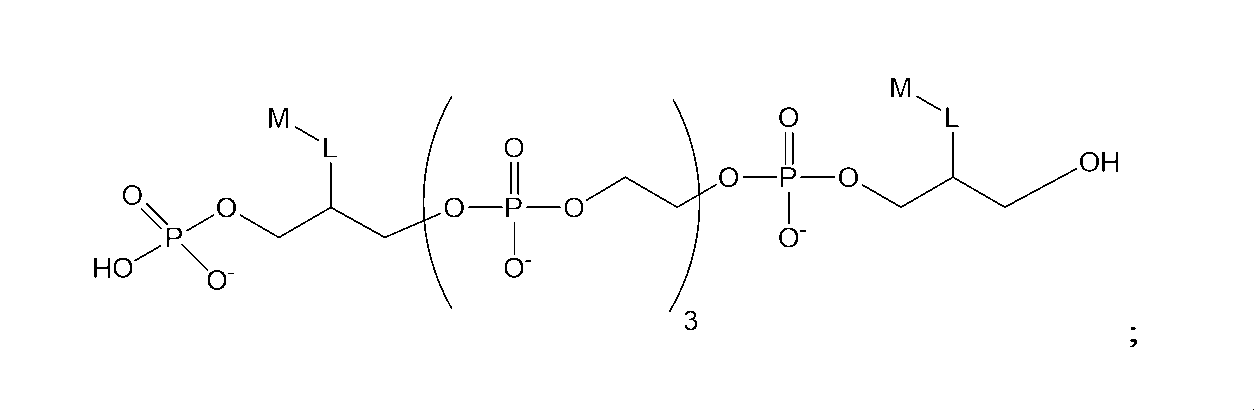
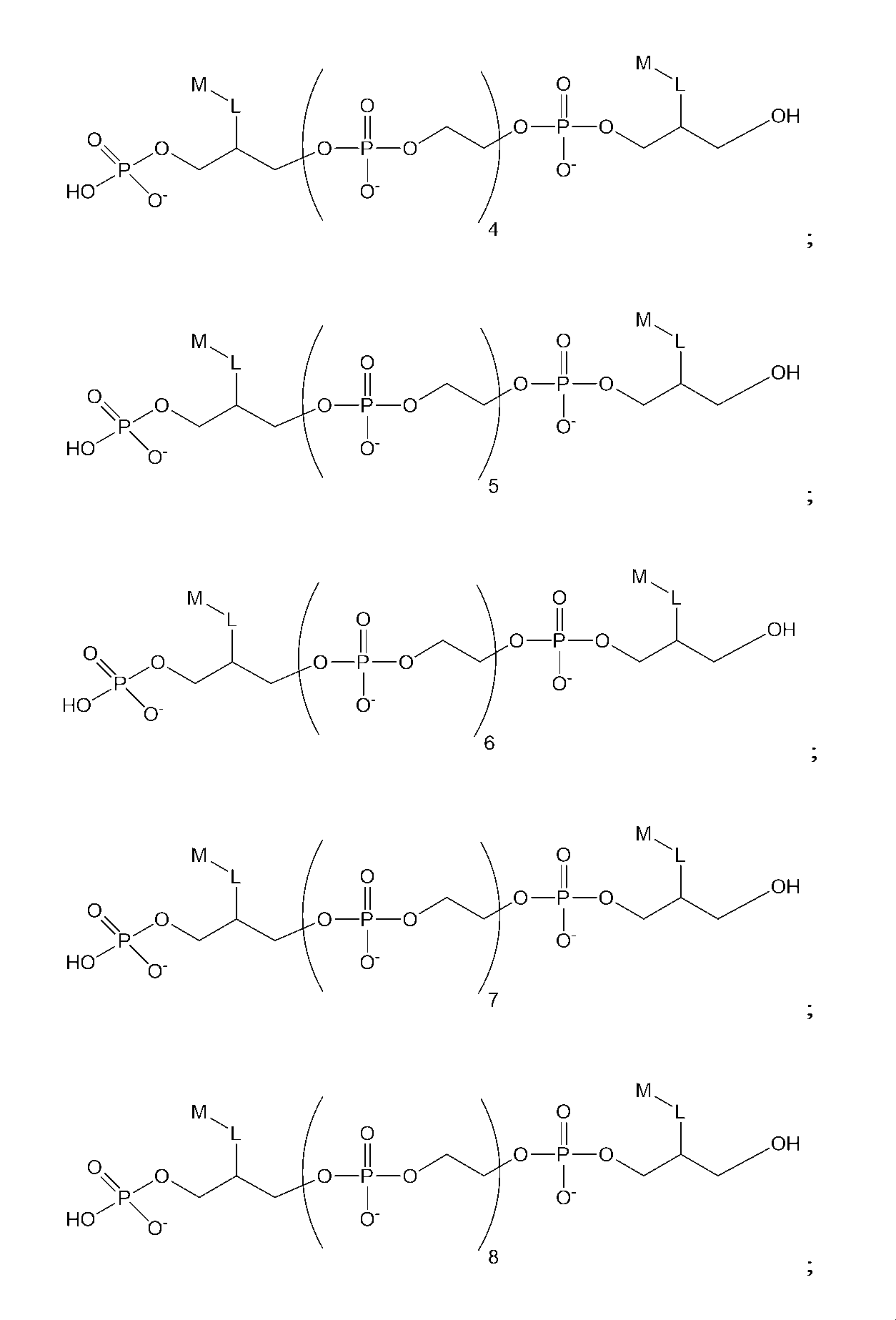
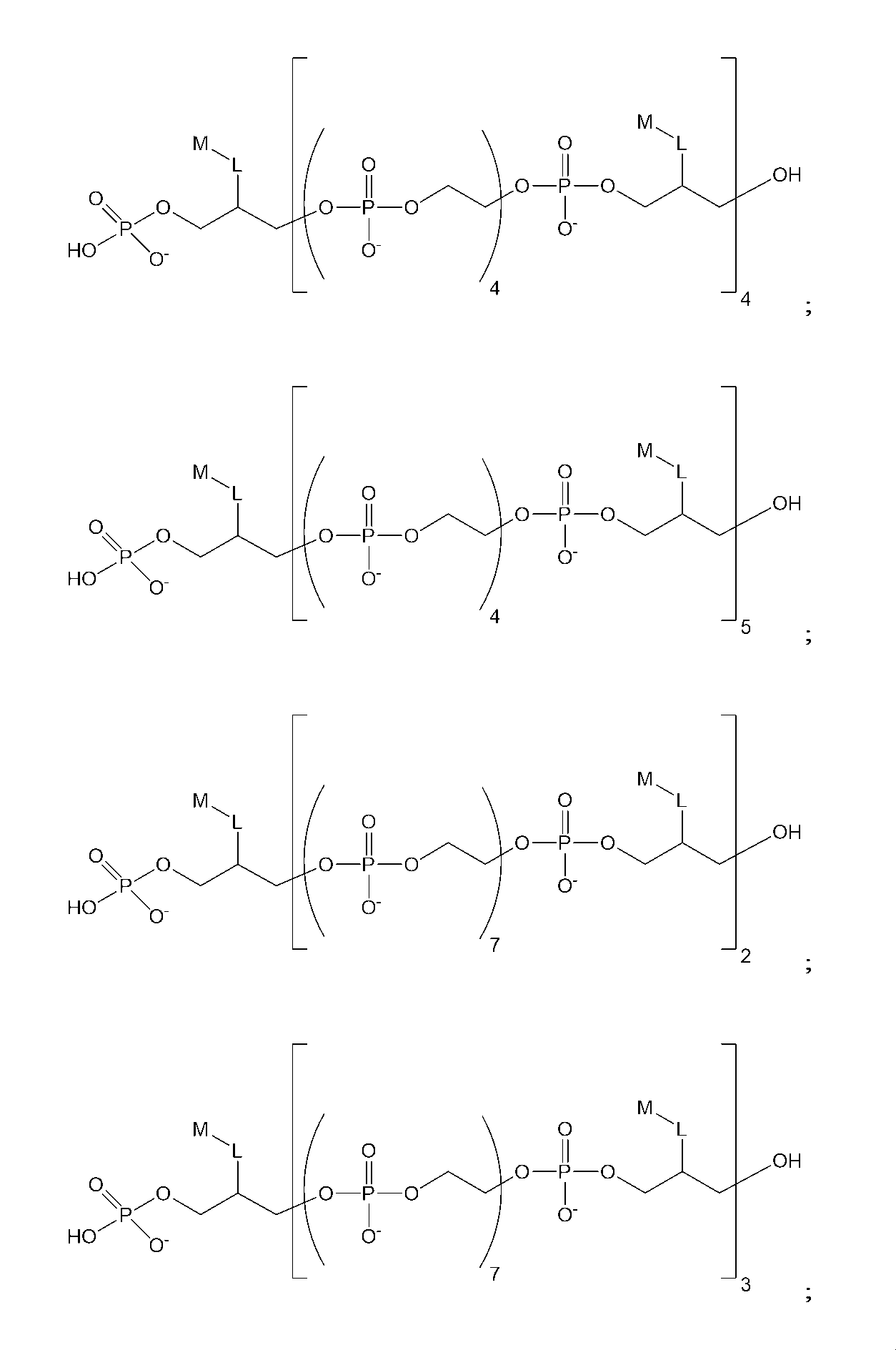
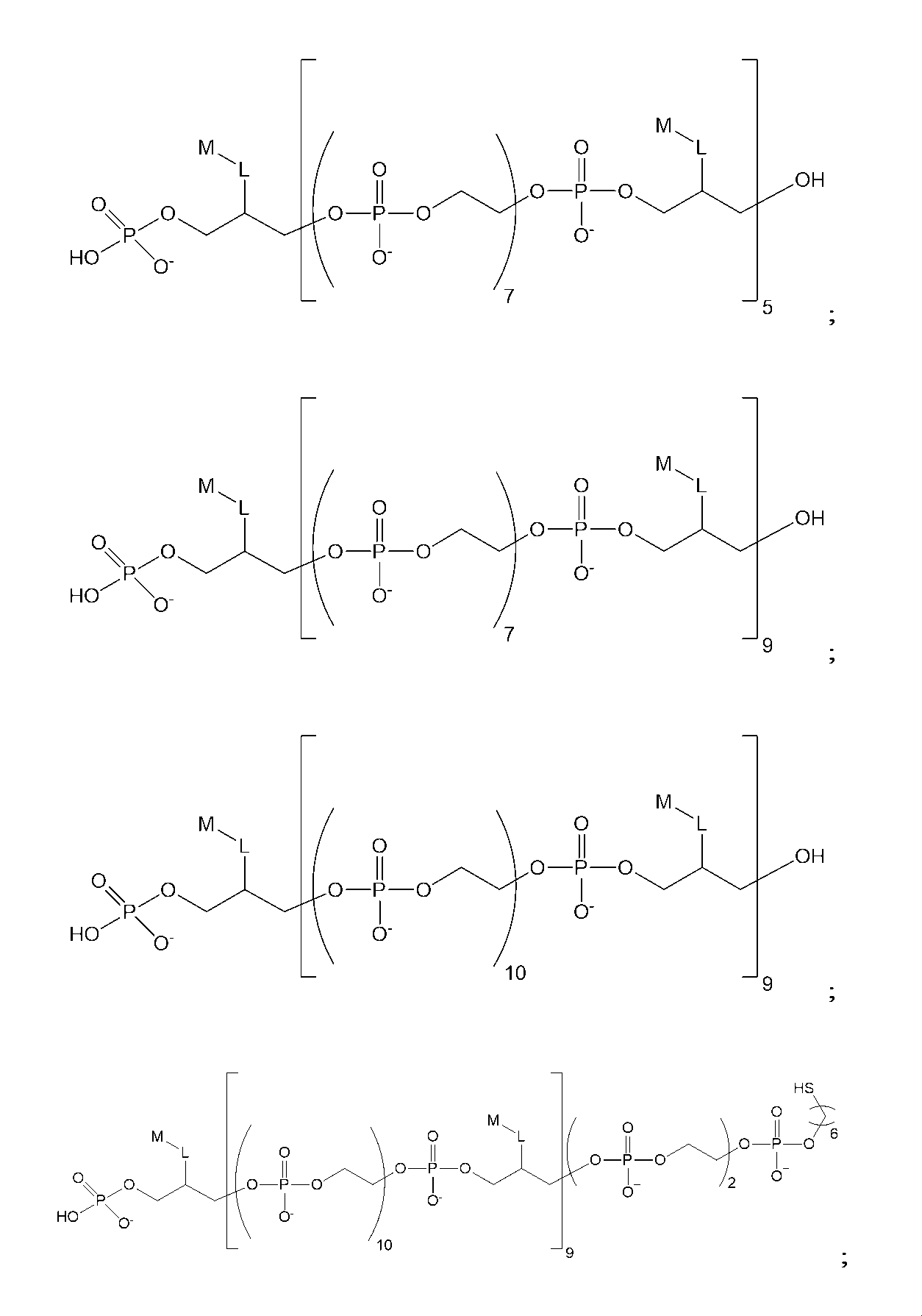
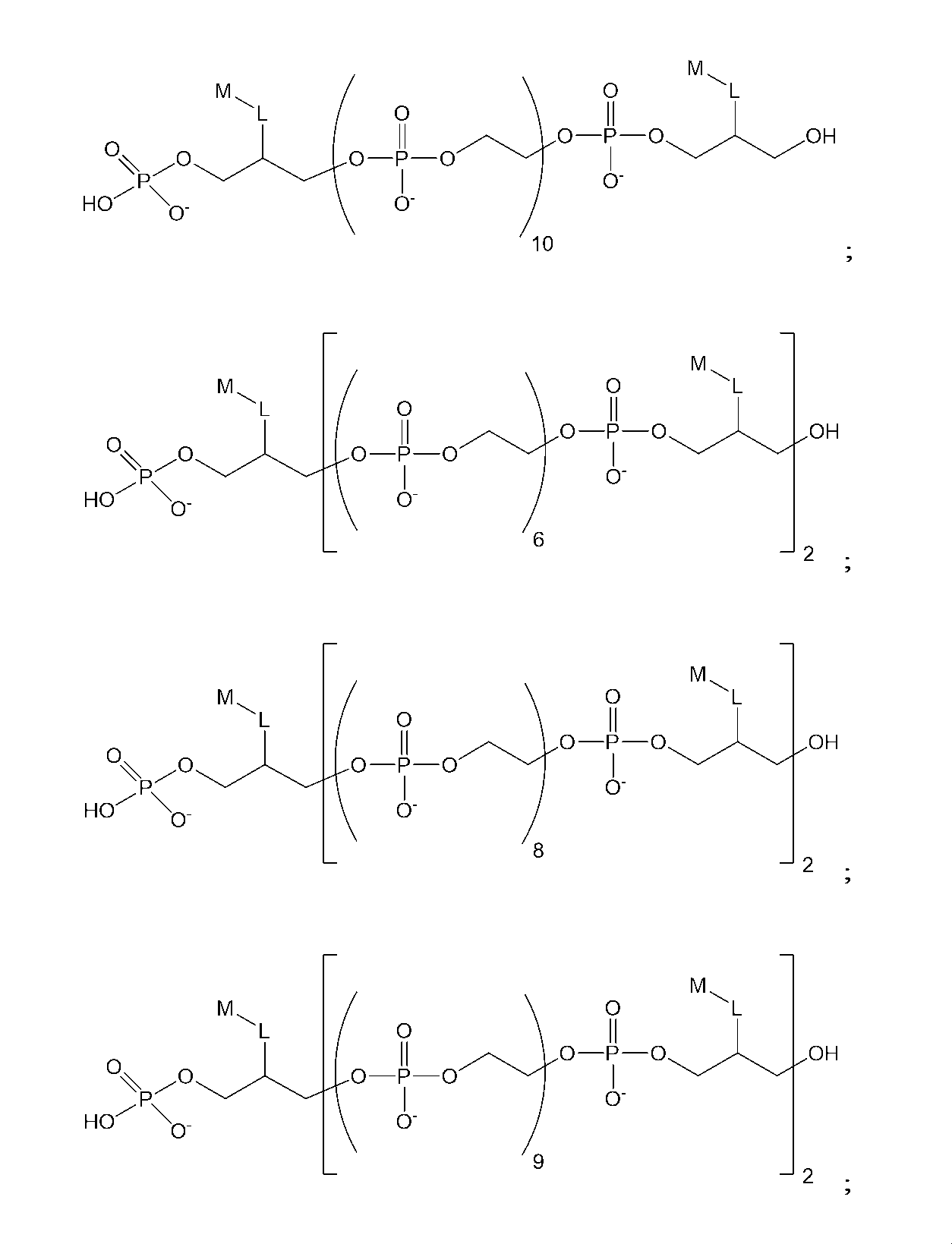
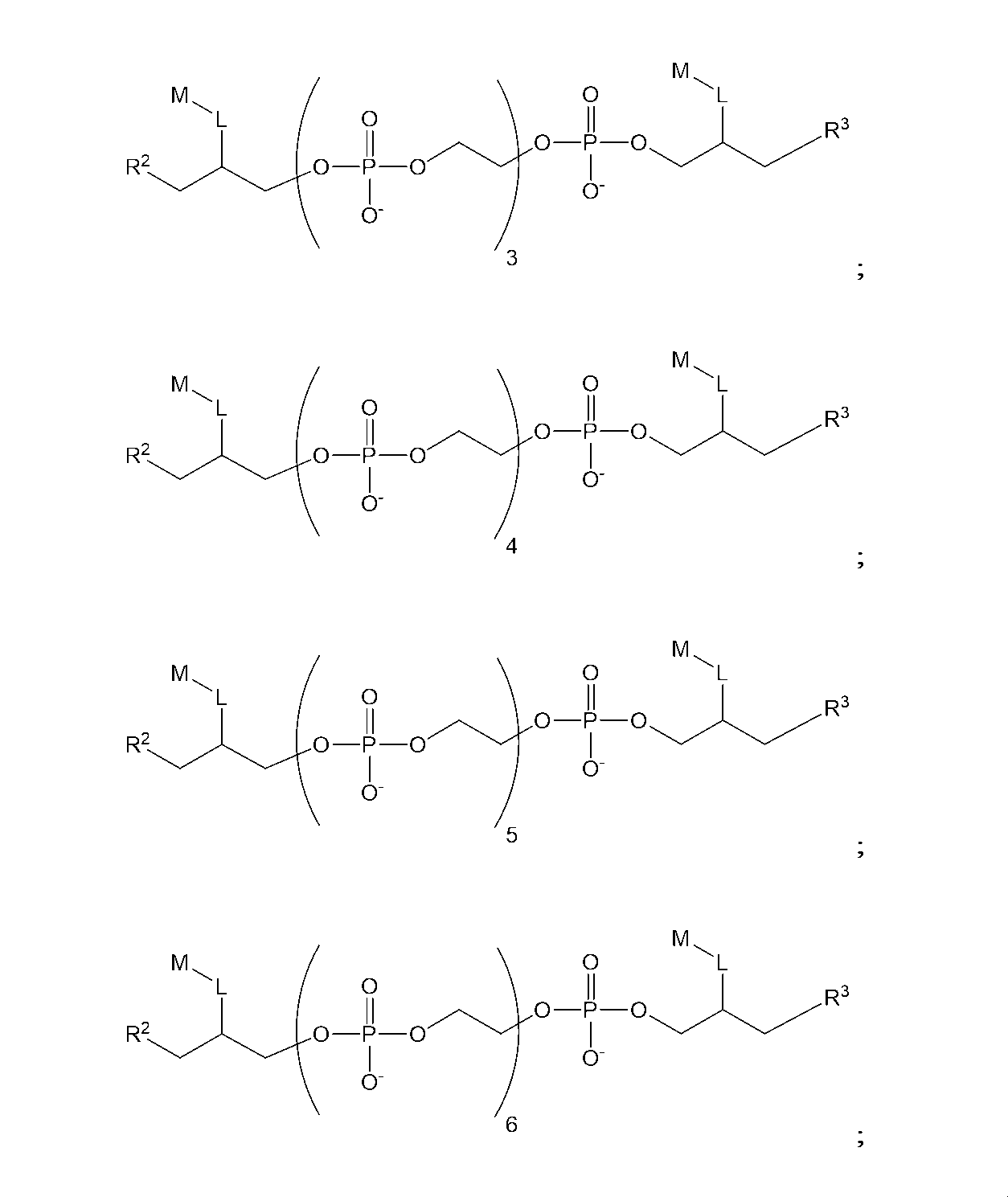
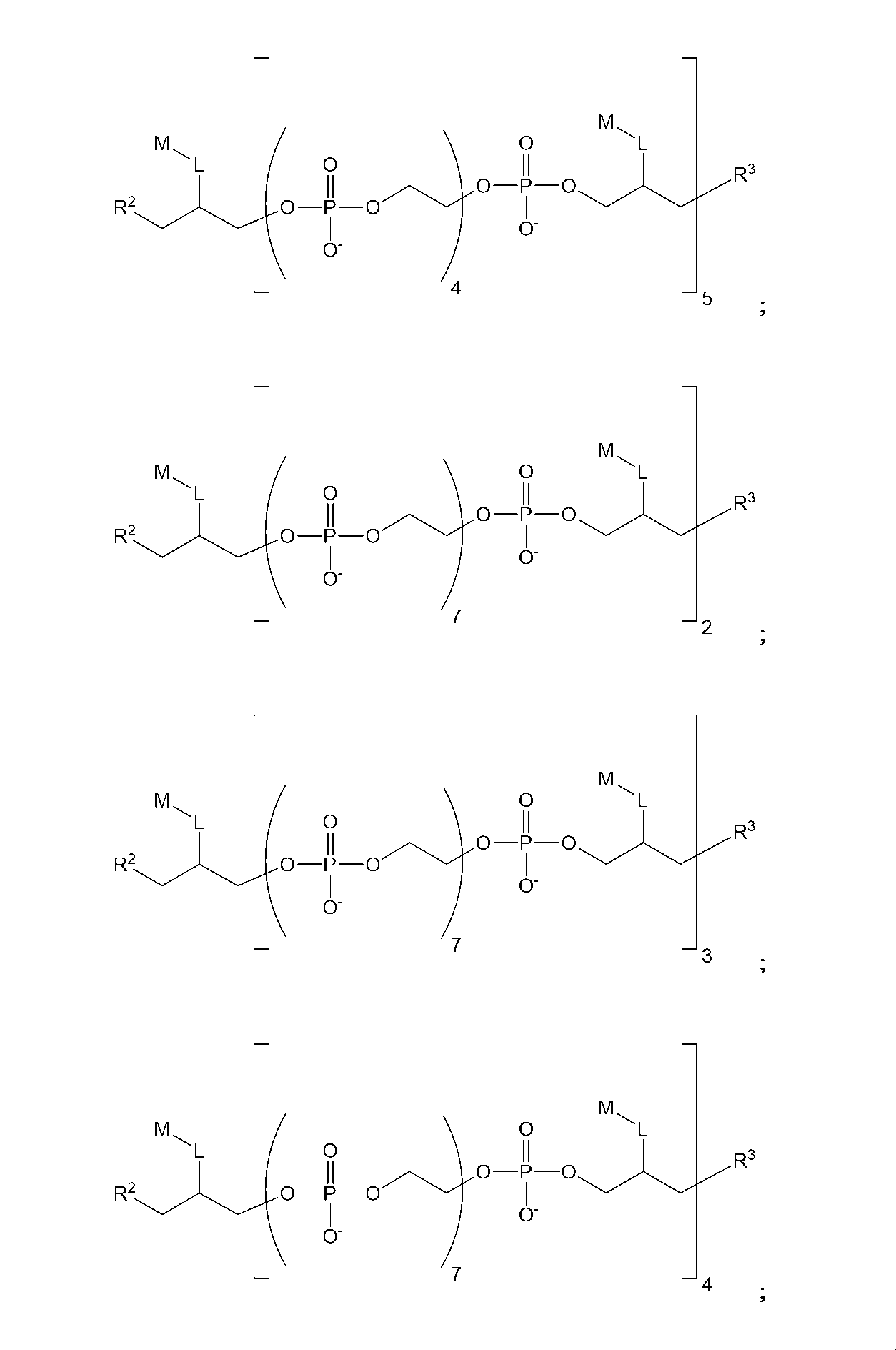
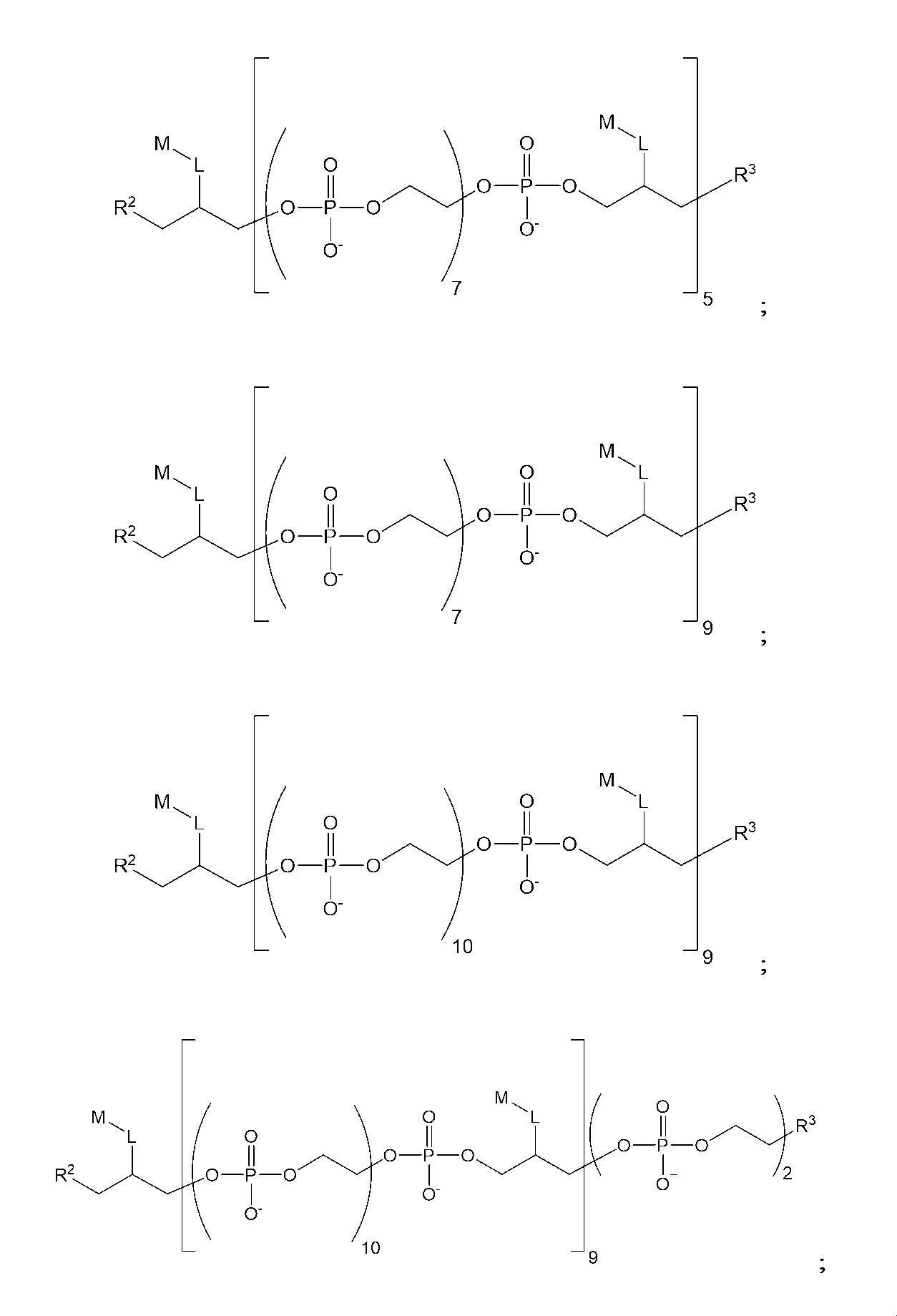
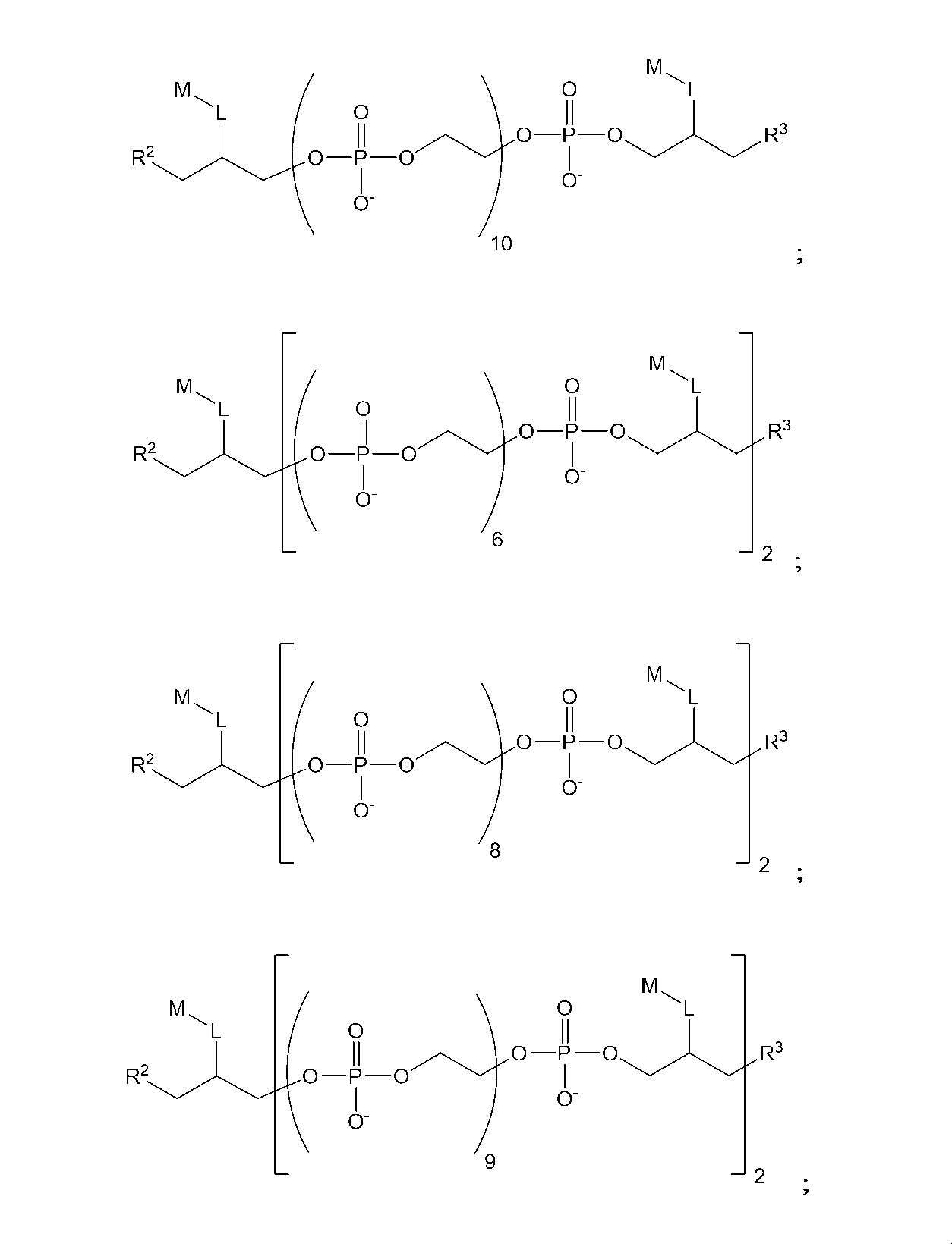

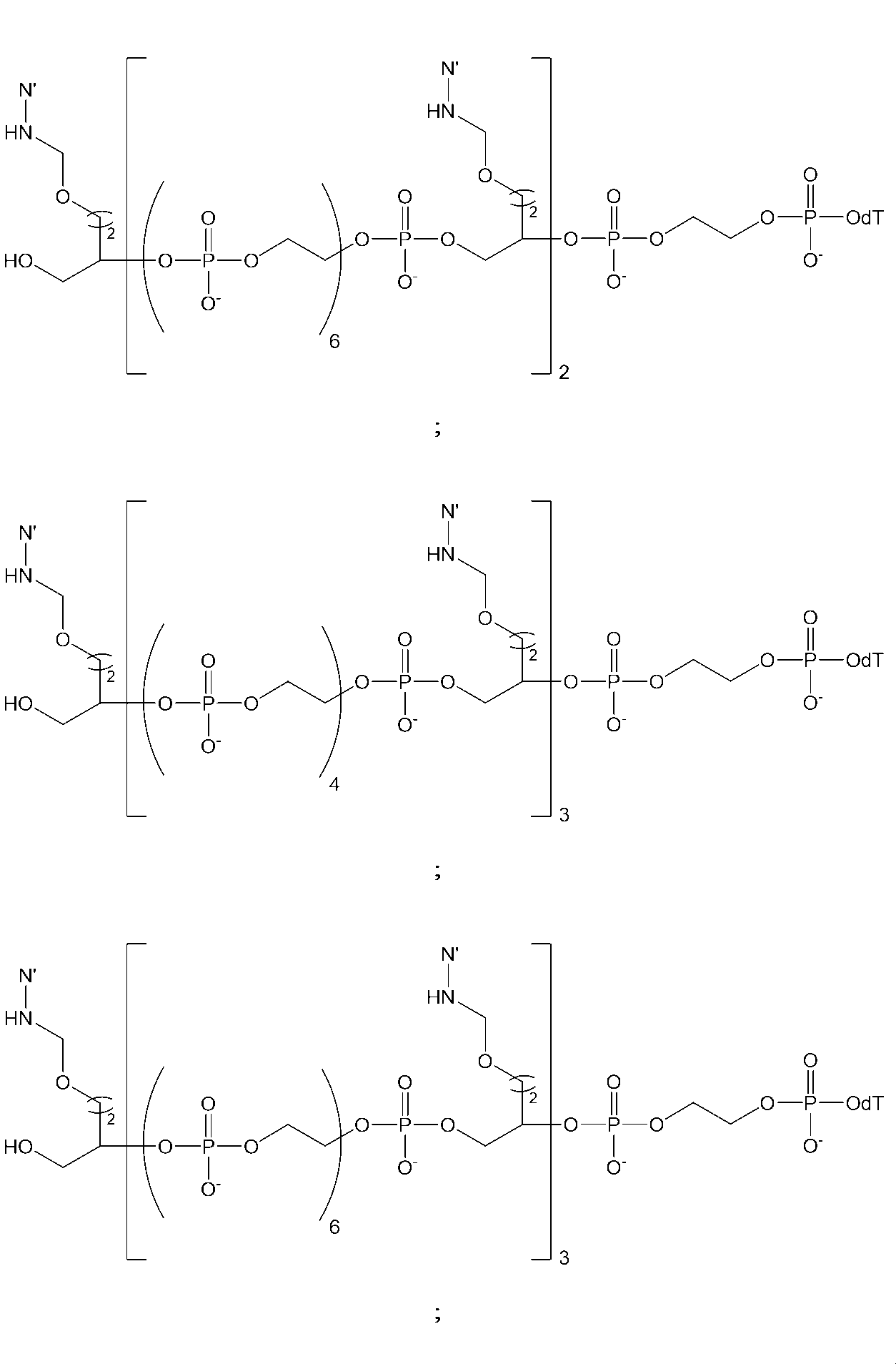
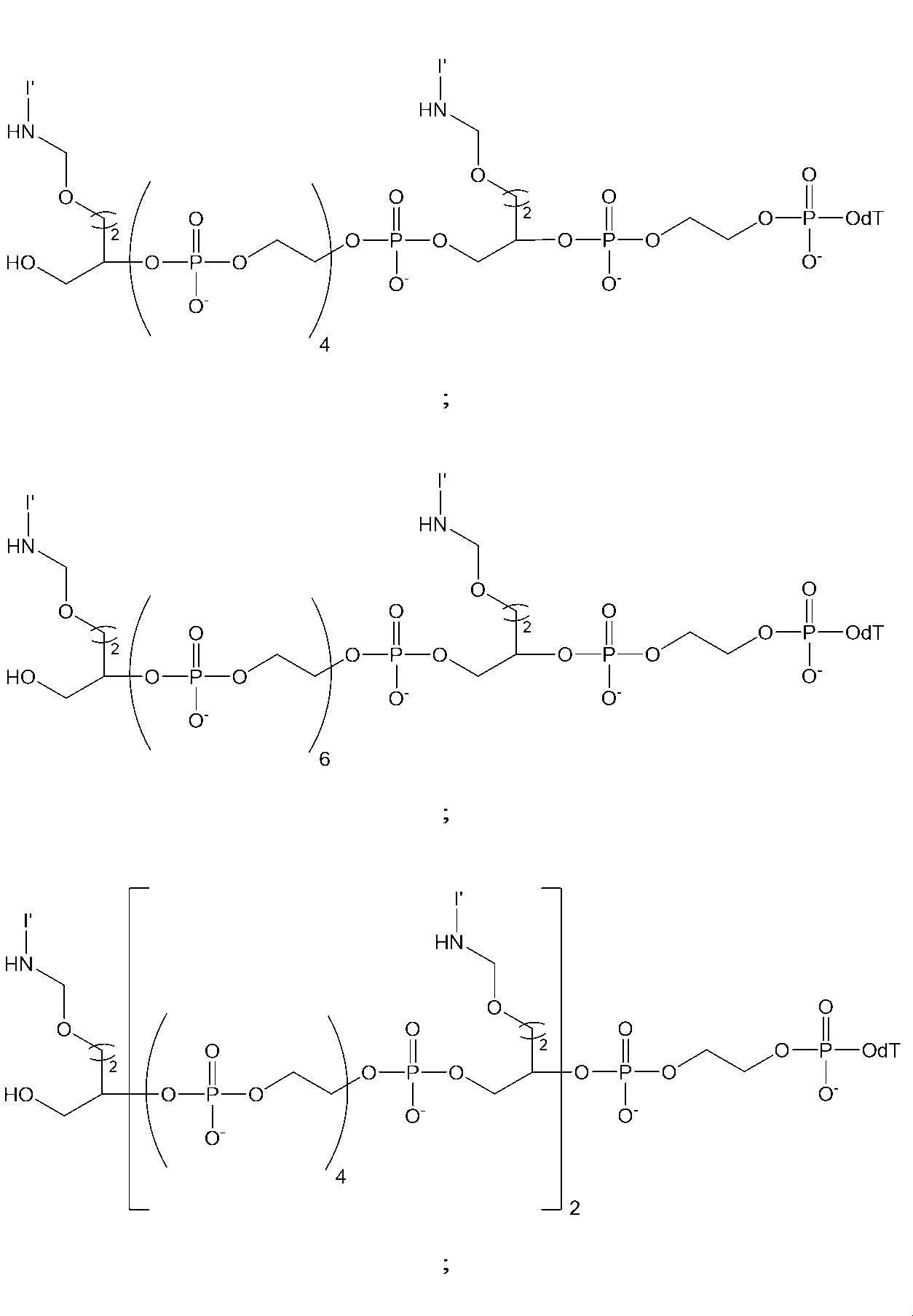
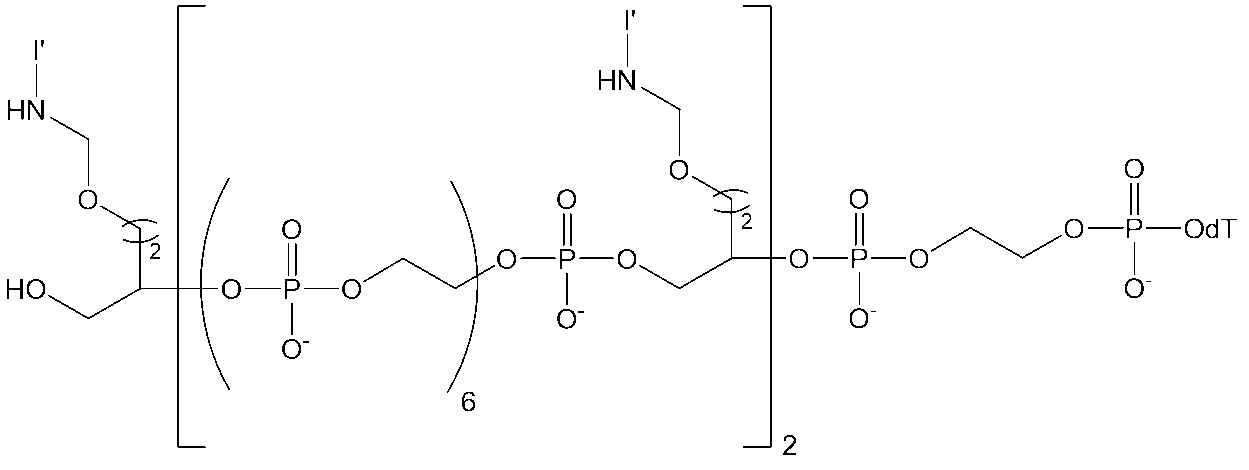
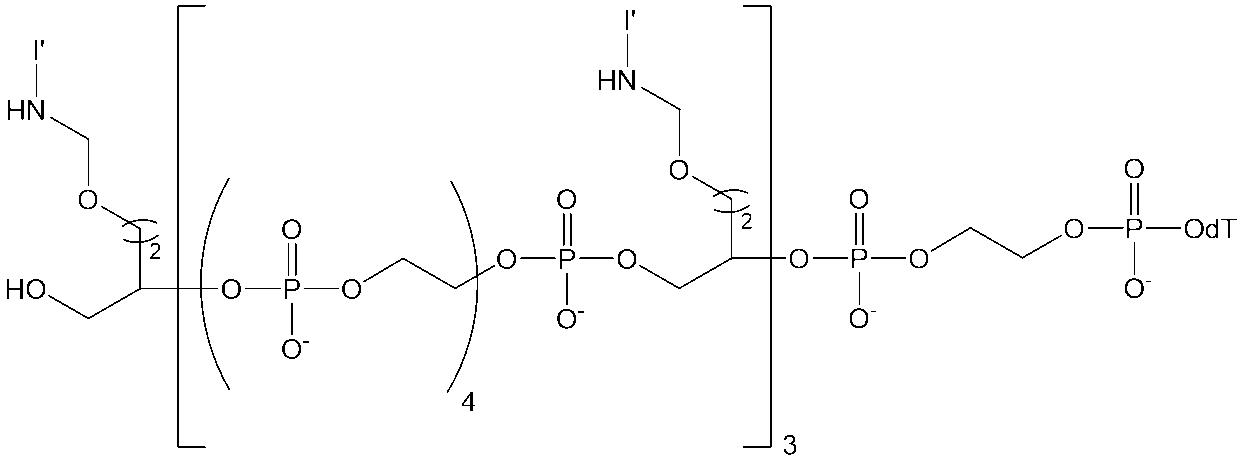
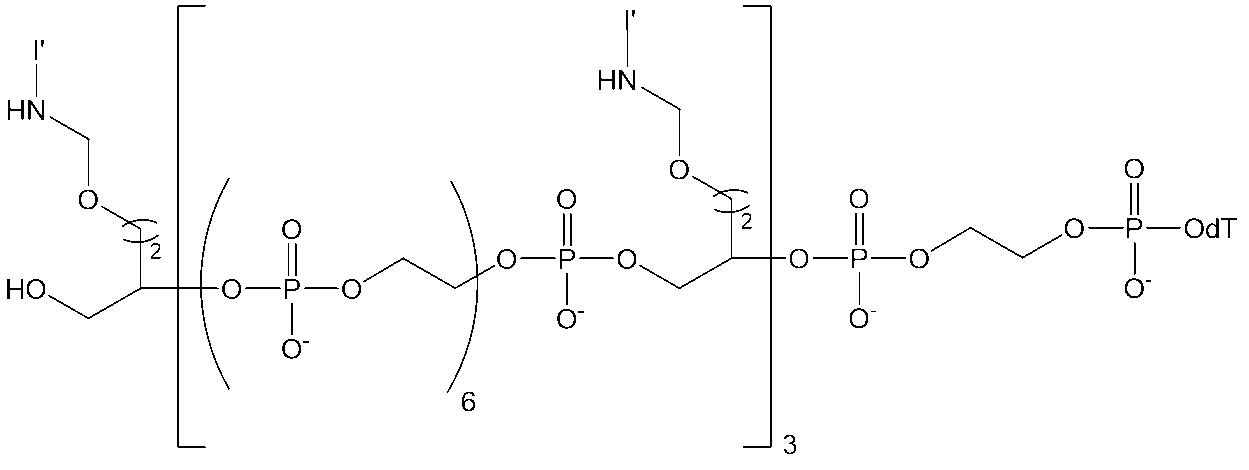
Mは、出現毎に独立して、F、F’、F’’、E、Y、N’、I’、D’またはD’’であり、ただし、Mの少なくとも1つはN’、I’、D’、またはD’’であり、
F、F’およびF’’はそれぞれ以下の構造:

Eは、以下の構造:

Yは、以下の構造:

N’は、以下の構造:

I’は、以下の構造:

D’は、以下の構造:

D’’は、以下の構造:

の1つを有する、請求項1に記載の化合物。 The structure:
M is, independently at each occurrence, F, F', F'', E, Y, N', I', D', or D'', provided that at least one of M is N', I', D', or D'';
F, F' and F'' each have the following structure:
E has the following structure:
Y has the following structure:
N′ has the following structure:
I′ has the following structure:
D' has the following structure:
The compound of claim 1 having one of the following formulas:
(A)複数のコンジュゲートが少なくとも90%の構造均質性を有するか、
(B)複数のコンジュゲートが、少なくとも95%の構造均質性を有するか、または
(C)複数のコンジュゲートが、99%を超える構造均質性を有し、
ここで構造均質性は、化合物が同じ構造を有することを意味する、
組成物。 10. A composition comprising a plurality of conjugates comprising the compound of claim 1 covalently attached to an antibody by a single linking group,
(A) the conjugates have at least 90% structural homogeneity;
(B) the plurality of conjugates has at least 95% structural homogeneity; or (C) the plurality of conjugates has greater than 99% structural homogeneity;
Here, structural homogeneity means that the compounds have the same structure.
Composition.
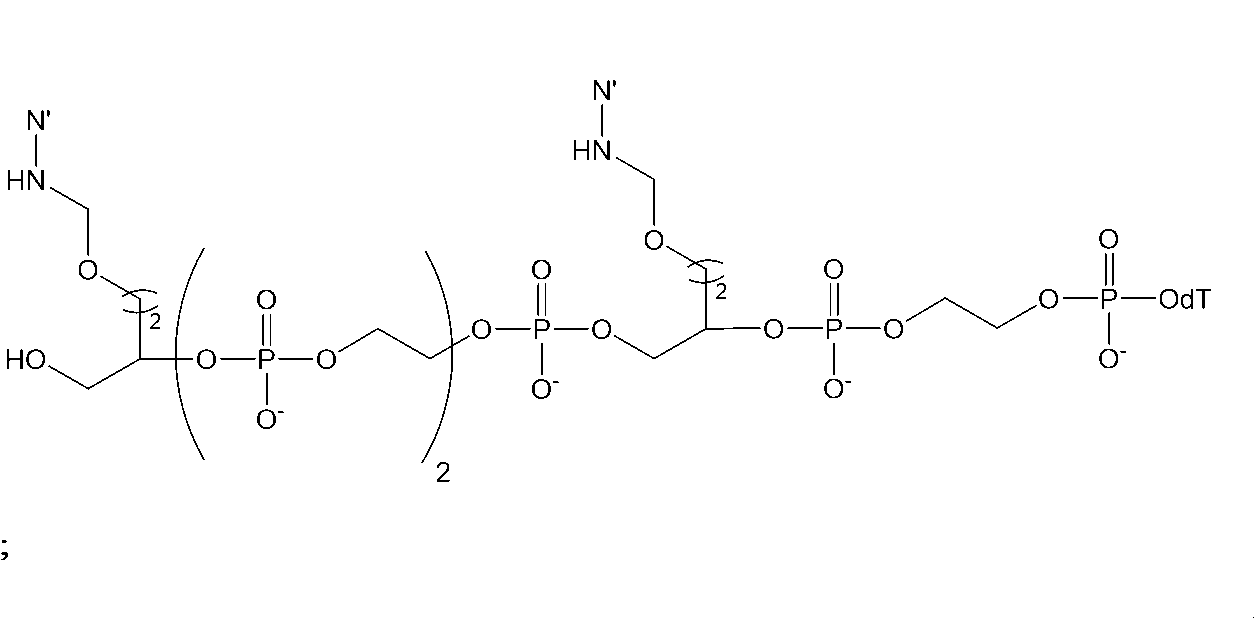
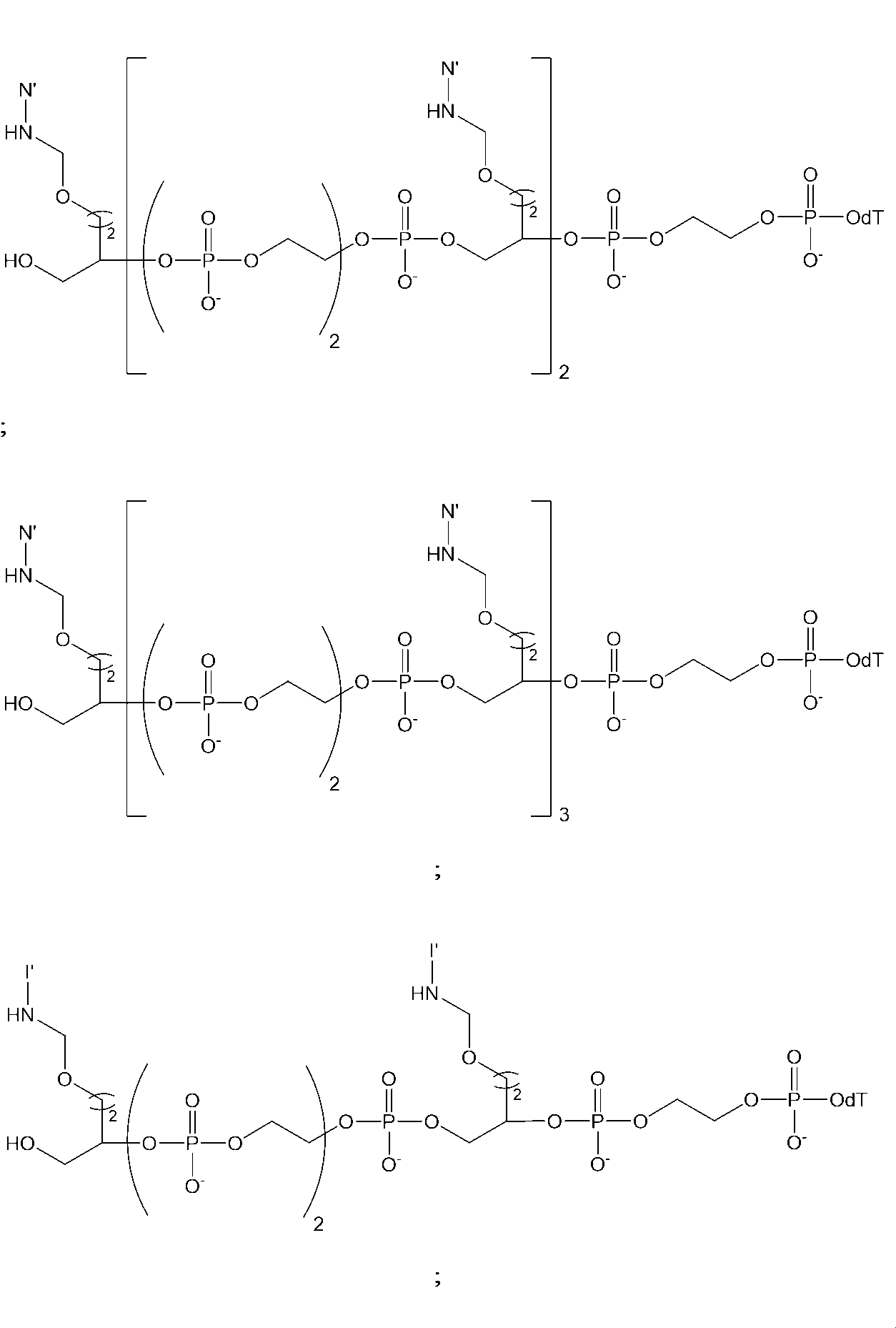
N’は以下の構造:

I’は、以下の構造:

の1つを有する、化合物。 The structure:
N' has the following structure:
A compound having one of the following:
Priority Applications (1)
| Application Number | Priority Date | Filing Date | Title |
|---|---|---|---|
| JP2023217997A JP2024028303A (en) | 2018-01-12 | 2023-12-25 | Phosphoalkyl polymers containing biologically active compounds |
Applications Claiming Priority (3)
| Application Number | Priority Date | Filing Date | Title |
|---|---|---|---|
| US201862616668P | 2018-01-12 | 2018-01-12 | |
| US62/616,668 | 2018-01-12 | ||
| PCT/US2019/013104 WO2019140128A1 (en) | 2018-01-12 | 2019-01-10 | Phosphoalkyl polymers comprising biologically active compounds |
Related Child Applications (1)
| Application Number | Title | Priority Date | Filing Date |
|---|---|---|---|
| JP2023217997A Division JP2024028303A (en) | 2018-01-12 | 2023-12-25 | Phosphoalkyl polymers containing biologically active compounds |
Publications (3)
| Publication Number | Publication Date |
|---|---|
| JP2021510700A JP2021510700A (en) | 2021-04-30 |
| JPWO2019140128A5 JPWO2019140128A5 (en) | 2022-01-13 |
| JP7515785B2 true JP7515785B2 (en) | 2024-07-16 |
Family
ID=65411941
Family Applications (2)
| Application Number | Title | Priority Date | Filing Date |
|---|---|---|---|
| JP2020538716A Active JP7515785B2 (en) | 2018-01-12 | 2019-01-10 | Phosphoalkyl polymers containing biologically active compounds - Patents.com |
| JP2023217997A Abandoned JP2024028303A (en) | 2018-01-12 | 2023-12-25 | Phosphoalkyl polymers containing biologically active compounds |
Family Applications After (1)
| Application Number | Title | Priority Date | Filing Date |
|---|---|---|---|
| JP2023217997A Abandoned JP2024028303A (en) | 2018-01-12 | 2023-12-25 | Phosphoalkyl polymers containing biologically active compounds |
Country Status (5)
| Country | Link |
|---|---|
| US (1) | US12539334B2 (en) |
| EP (1) | EP3737419B1 (en) |
| JP (2) | JP7515785B2 (en) |
| CN (1) | CN111565757A (en) |
| WO (1) | WO2019140128A1 (en) |
Families Citing this family (24)
| Publication number | Priority date | Publication date | Assignee | Title |
|---|---|---|---|---|
| US9765220B2 (en) | 2013-08-22 | 2017-09-19 | Sony Corporation | Water soluble fluorescent or colored dyes and methods for their use |
| CN107454903B (en) | 2015-02-26 | 2021-01-01 | 索尼公司 | Water-soluble fluorescent or colored dyes containing conjugated groups |
| EP3262022A4 (en) | 2015-02-26 | 2018-08-15 | Sony Corporation | Phenylethynylnaphthalene dyes and methods for their use |
| KR102525252B1 (en) | 2016-04-01 | 2023-04-26 | 소니그룹주식회사 | Very bright dimeric or polymeric dyes with rigid space groups |
| CN114806218A (en) | 2016-04-01 | 2022-07-29 | 索尼公司 | Super bright dimeric or polymeric dyes |
| KR102756931B1 (en) | 2016-04-06 | 2025-01-21 | 소니그룹주식회사 | Ultra bright dimeric or polymeric dyes with spacing linker groups |
| JP7068192B2 (en) | 2016-05-10 | 2022-05-16 | ソニーグループ株式会社 | Compositions containing polymer dyes and cyclodextrins, and their use |
| WO2017196954A1 (en) | 2016-05-10 | 2017-11-16 | Sony Corporation | Ultra bright polymeric dyes with peptide backbones |
| BR112018073199A2 (en) | 2016-05-11 | 2019-04-16 | Sony Corporation | ultra-bright dimeric or polymeric dyes |
| US11377563B2 (en) | 2016-06-06 | 2022-07-05 | Sony Corporation | Ionic polymers comprising fluorescent or colored reporter groups |
| JP7312929B2 (en) | 2016-07-29 | 2023-07-24 | ソニーグループ株式会社 | Superbright dimer or polymer dyes and methods for their preparation |
| CN111315415A (en) | 2017-10-05 | 2020-06-19 | 索尼公司 | Programmable polymeric pharmaceuticals |
| JP7403744B2 (en) | 2017-10-05 | 2023-12-25 | ソニーグループ株式会社 | programmable dendritic drug |
| EP3710062A1 (en) | 2017-11-16 | 2020-09-23 | Sony Corporation | Programmable polymeric drugs |
| JP7515785B2 (en) | 2018-01-12 | 2024-07-16 | ソニーグループ株式会社 | Phosphoalkyl polymers containing biologically active compounds - Patents.com |
| JP2021510698A (en) | 2018-01-12 | 2021-04-30 | ソニー株式会社 | Phosphoralkyl ribose polymers containing biologically active compounds |
| EP3737418B1 (en) | 2018-01-12 | 2024-02-28 | Sony Group Corporation | Polymers with rigid spacing groups comprising biologically active compounds |
| EP3769085B1 (en) | 2018-03-19 | 2022-08-24 | Sony Group Corporation | Use of divalent metals for enhancement of fluorescent signals |
| US12319817B2 (en) | 2018-03-21 | 2025-06-03 | Sony Group Corporation | Polymeric tandem dyes with linker groups |
| CN119220109A (en) | 2018-03-30 | 2024-12-31 | 贝克顿·迪金森公司 | Water-soluble polymeric dyes containing pendant chromophores |
| CN112313242A (en) | 2018-06-27 | 2021-02-02 | 索尼公司 | Polymer dyes with deoxyribose-containing linker groups |
| KR102718543B1 (en) | 2019-09-26 | 2024-10-18 | 소니그룹주식회사 | Polymeric tandem dyes with linker groups |
| WO2022125564A1 (en) | 2020-12-07 | 2022-06-16 | Sony Group Corporation | Spacing linker group design for brightness enhancement in dimeric or polymeric dyes |
| WO2022216450A1 (en) | 2021-04-07 | 2022-10-13 | Becton, Dickinson And Company | Water-soluble fluorescent polymeric dyes |
Citations (1)
| Publication number | Priority date | Publication date | Assignee | Title |
|---|---|---|---|---|
| WO2016183185A1 (en) | 2015-05-11 | 2016-11-17 | Sony Corporation | Ultra bright dimeric or polymeric dyes |
Family Cites Families (185)
| Publication number | Priority date | Publication date | Assignee | Title |
|---|---|---|---|---|
| US4450305A (en) | 1982-10-25 | 1984-05-22 | American Cyanamid Company | Poly(ethyleneoxy)-substituted-9,10-bis(phenylethynyl)anthracenes |
| US4476229A (en) | 1982-11-08 | 1984-10-09 | Abbott Laboratories | Substituted carboxyfluoresceins |
| EP0355864A3 (en) | 1984-03-15 | 1991-09-18 | Wako Pure Chemical Industries, Ltd. | Method of quantitatively measuring an oxidative substance by using triphenyl methane type leuco compounds as coloring matter |
| JPH0665677B2 (en) | 1985-03-09 | 1994-08-24 | 三菱化成株式会社 | Diole having phospholipid-like structure and method for producing the same |
| US5268486A (en) | 1986-04-18 | 1993-12-07 | Carnegie-Mellon Unversity | Method for labeling and detecting materials employing arylsulfonate cyanine dyes |
| US5053054A (en) | 1988-09-12 | 1991-10-01 | Ortho Pharmaceutical Corporation | Methods and reagents for staining intracellular components |
| US5318894A (en) | 1990-01-30 | 1994-06-07 | Miles Inc. | Composition, device and method of assaying for peroxidatively active substances |
| US6365730B1 (en) | 1990-06-19 | 2002-04-02 | Gene Shears Pty. Limited | DNA-Armed ribozymes and minizymes |
| JPH04282391A (en) | 1991-03-08 | 1992-10-07 | Fujisawa Pharmaceut Co Ltd | Ethanolamine derivative and production thereof |
| US5698391A (en) | 1991-08-23 | 1997-12-16 | Isis Pharmaceuticals, Inc. | Methods for synthetic unrandomization of oligomer fragments |
| WO1993006482A1 (en) | 1991-09-16 | 1993-04-01 | Molecular Probes, Inc. | Dimers of unsymmetrical cyanine dyes |
| US5565322A (en) | 1991-11-07 | 1996-10-15 | Nanogen, Inc. | Hybridization of polynucleotides conjugated with chromophores and fluorophores to generate donor-to donor energy transfer system |
| PT693065E (en) | 1993-04-13 | 2002-05-31 | Naxcor | CUMARINE DERIVATIVES, NON-NUCLEOSIDIC AS POLYPRENEURED REAGENTS |
| CA2172999A1 (en) | 1993-07-13 | 1995-01-26 | Jeffrey Bruce Huff | Fluorescent polymer labeled conjugates and intermediates |
| PT748382E (en) | 1993-09-02 | 2003-03-31 | Ribozyme Pharm Inc | NUCLEIC ENZYMAL ACIDS CONTAINING NON-NUCLEOTIDES |
| US5886177A (en) | 1994-01-11 | 1999-03-23 | Isis Pharmaceuticals, Inc. | Phosphate linked oligomers |
| US6171859B1 (en) | 1994-03-30 | 2001-01-09 | Mitokor | Method of targeting conjugate molecules to mitochondria |
| JP4098839B2 (en) | 1995-01-30 | 2008-06-11 | 株式会社同仁化学研究所 | Indocyanine compounds |
| US5994143A (en) | 1996-02-01 | 1999-11-30 | Abbott Laboratories | Polymeric fluorophores enhanced by moieties providing a hydrophobic and conformationally restrictive microenvironment |
| US6218108B1 (en) | 1997-05-16 | 2001-04-17 | Research Corporation Technologies, Inc. | Nucleoside analogs with polycyclic aromatic groups attached, methods of synthesis and uses therefor |
| DE19633268A1 (en) | 1996-08-19 | 1998-02-26 | Hoechst Ag | Polymeric bile acid absorption inhibitors with simultaneous bile acid adsorber action |
| US5696157A (en) | 1996-11-15 | 1997-12-09 | Molecular Probes, Inc. | Sulfonated derivatives of 7-aminocoumarin |
| JP2001511128A (en) | 1997-01-28 | 2001-08-07 | ファルマシア・アンド・アップジョン・カンパニー | Lyophilized product of lipid complex of water-insoluble porphyrin |
| US6893868B2 (en) | 1997-02-20 | 2005-05-17 | Onco Immunin, Inc. | Homo-doubly labeled compositions for the detection of enzyme activity in biological samples |
| US5986030A (en) | 1997-04-15 | 1999-11-16 | Nalco Chemical Company | Fluorescent water soluble polymers |
| DE19717904A1 (en) | 1997-04-23 | 1998-10-29 | Diagnostikforschung Inst | Acid-labile and enzymatically cleavable dye constructs for diagnostics with near infrared light and for therapy |
| JP3078793B2 (en) | 1998-04-30 | 2000-08-21 | 株式会社分子バイオホトニクス研究所 | Dye having rotaxane structure, labeling agent, and labeling method |
| US6716452B1 (en) | 2000-08-22 | 2004-04-06 | New River Pharmaceuticals Inc. | Active agent delivery systems and methods for protecting and administering active agents |
| US7060708B2 (en) | 1999-03-10 | 2006-06-13 | New River Pharmaceuticals Inc. | Active agent delivery systems and methods for protecting and administering active agents |
| US6514700B1 (en) | 1999-04-30 | 2003-02-04 | Aclara Biosciences, Inc. | Nucleic acid detection using degradation of a tagged sequence |
| US6627400B1 (en) | 1999-04-30 | 2003-09-30 | Aclara Biosciences, Inc. | Multiplexed measurement of membrane protein populations |
| US20020142329A1 (en) | 1999-04-30 | 2002-10-03 | Aclara Biosciences, Inc. | Compositions and methods employing cleavable electrophoretic tag reagents |
| US7037654B2 (en) | 1999-04-30 | 2006-05-02 | Aclara Biosciences, Inc. | Methods and compositions for enhancing detection in determinations employing cleavable electrophoretic tag reagents |
| AU5935300A (en) | 1999-07-22 | 2001-02-13 | Nalco Chemical Company | Fluorescent water-soluble polymers |
| US6479650B1 (en) | 1999-12-14 | 2002-11-12 | Research Corporation Technologies, Inc. | Fluorescent nucleoside analogs and combinatorial fluorophore arrays comprising same |
| EP1266222A2 (en) | 2000-03-14 | 2002-12-18 | Genigma Corporation | Visually detectable dye labelled biomolecules for analysis |
| CA2402955C (en) | 2000-03-28 | 2010-03-09 | Nanosphere, Inc. | Nanoparticles having oligonucleotides attached thereto and uses therefor |
| US20040067498A1 (en) | 2000-04-28 | 2004-04-08 | Ahmed Chenna | Detection of nucleic acid sequences by cleavage and separation of tag-containing structures |
| EP1301626A4 (en) | 2000-05-08 | 2004-06-02 | Qtl Biosystems Llc | Improvements to the fluorescent polymer-qtl approach to biosensing |
| US6852709B2 (en) | 2000-05-31 | 2005-02-08 | Johns Hopkins University | Biologically useful polyphosphates |
| US20020099013A1 (en) | 2000-11-14 | 2002-07-25 | Thomas Piccariello | Active agent delivery systems and methods for protecting and administering active agents |
| JP2004508838A (en) | 2000-09-11 | 2004-03-25 | ザ・トラスティーズ・オブ・コランビア・ユニバーシティー・イン・ザ・シティー・オブ・ニューヨーク | Combination fluorescent energy transfer tags and their use |
| ATE315066T1 (en) | 2000-09-19 | 2006-02-15 | Li Cor Inc | CYANINE DYES |
| US6448407B1 (en) | 2000-11-01 | 2002-09-10 | Pe Corporation (Ny) | Atropisomers of asymmetric xanthene fluorescent dyes and methods of DNA sequencing and fragment analysis |
| US8394813B2 (en) | 2000-11-14 | 2013-03-12 | Shire Llc | Active agent delivery systems and methods for protecting and administering active agents |
| GB2372256A (en) | 2001-02-14 | 2002-08-21 | Kalibrant Ltd | Detectable entity comprising a plurality of detectable units releasably connected together by stimulus-cleavable linkers for use in fluorescence detection |
| US6743905B2 (en) | 2001-04-16 | 2004-06-01 | Applera Corporation | Mobility-modified nucleobase polymers and methods of using same |
| US8323903B2 (en) | 2001-10-12 | 2012-12-04 | Life Technologies Corporation | Antibody complexes and methods for immunolabeling |
| JP3813890B2 (en) | 2002-03-22 | 2006-08-23 | 富士写真フイルム株式会社 | Intermediate layer material composition for three-layer resist process and pattern forming method using the same |
| US20040086914A1 (en) | 2002-07-12 | 2004-05-06 | Affymetrix, Inc. | Nucleic acid labeling methods |
| US7423133B2 (en) | 2002-08-23 | 2008-09-09 | The Board Of Trustees Of The Leland Stanford Junior University | Fluorescent glycosides and methods for their use |
| EP2316971A1 (en) | 2002-08-26 | 2011-05-04 | The Regents of the University of California | Methods and compositions for detection and analysis of polynucleotides using light harvesting multichromophores |
| US20040138467A1 (en) | 2002-11-26 | 2004-07-15 | French Roger Harquail | Aromatic and aromatic/heteroaromatic molecular structures with controllable electron conducting properties |
| US7759459B2 (en) | 2003-01-10 | 2010-07-20 | Albert Einstein College Of Medicine Of Yeshiva University | Fluorescent assays for protein kinases |
| US7238792B2 (en) | 2003-03-18 | 2007-07-03 | Washington State University Research Foundation | Foldable polymers as probes |
| US7172907B2 (en) | 2003-03-21 | 2007-02-06 | Ge Healthcare Bio-Sciences Corp. | Cyanine dye labelling reagents with meso-substitution |
| BRPI0413521A (en) | 2003-08-14 | 2006-10-10 | Diatos | amino acid sequences that facilitate the penetration of a substance of interest into cells and / or cell nuclei |
| EP1689764B1 (en) | 2003-11-19 | 2013-01-02 | AlleLogic Biosciences Corporation | Oligonucleotides labeled with a plurality of fluorophores |
| AU2003296419A1 (en) | 2003-12-09 | 2005-07-21 | Molecular Probes, Inc. | Pyrenyloxysulfonic acid fluorescent agents |
| EP1768998A2 (en) | 2004-04-27 | 2007-04-04 | Alnylam Pharmaceuticals Inc. | Single-stranded and double-stranded oligonucleotides comprising a 2-arylpropyl moiety |
| US8652851B2 (en) | 2004-06-17 | 2014-02-18 | University Of Florida Research Foundation, Inc. | Multi-acceptor molecular probes and applications thereof |
| US20060035302A1 (en) | 2004-06-21 | 2006-02-16 | Applera Corporation | Kinase substrates with multiple phosphorylation sites |
| EP1781675B1 (en) | 2004-08-13 | 2014-03-26 | Epoch Biosciences, Inc. | Phosphonate fluorescent dyes and conjugates |
| EP1789794A1 (en) | 2004-09-14 | 2007-05-30 | Applera Corporation, Applied Biosystems Group | Multi-chromophoric quencher constructs for use in high sensitivity energy transfer probes |
| US8153706B2 (en) | 2004-10-25 | 2012-04-10 | Hewlett-Packard Development Company, L.P. | Polymeric colorants having pigment and dye components and corresponding ink compositions |
| PL1655317T3 (en) | 2004-11-09 | 2007-10-31 | Ipagsa Ind Sl | Thermally reactive infrared absorption polymers and their use in a heat sensitive lithographic printing plate |
| EP2502946B1 (en) | 2005-01-10 | 2017-10-04 | The Regents of The University of California | Cationic conjugated polymers suitable for strand-specific polynucleiotide detection in homogeneous and solid state assays |
| AU2006223384B2 (en) | 2005-03-09 | 2012-08-02 | Cepheid | Polar dyes |
| US8227621B2 (en) | 2005-06-30 | 2012-07-24 | Li-Cor, Inc. | Cyanine dyes and methods of use |
| US8158801B2 (en) | 2005-09-26 | 2012-04-17 | Life Technologies Corporation | Violet laser excitable dyes and their method of use |
| CN101360997B (en) | 2005-11-18 | 2013-05-01 | 美国政府健康及人类服务部,疾病控制和预防中心 | Modified cardiolipin and uses therefor |
| EP2573833B1 (en) | 2005-12-12 | 2014-04-02 | Basf Se | Organic semiconductors, their manufacture and semiconductor devices comprising them |
| US20070148094A1 (en) | 2005-12-22 | 2007-06-28 | Uzgiris Egidijus E | Polymeric imaging agents and medical imaging methods |
| JP5493117B2 (en) | 2006-02-15 | 2014-05-14 | 国立大学法人岐阜大学 | Oligonucleotide derivatives and uses thereof |
| US8425915B2 (en) | 2006-04-13 | 2013-04-23 | Midatech Limited | Nanoparticles for providing immune responses against infectious agents |
| EP2054770A2 (en) | 2006-08-12 | 2009-05-06 | STX Aprilis, Inc. | Sensitizer dyes for photoacid generating systems using short visible wavelengths |
| JP5368797B2 (en) | 2006-10-12 | 2013-12-18 | 出光興産株式会社 | Organic thin film transistor device and organic thin film light emitting transistor |
| EP2064290B1 (en) | 2006-10-27 | 2013-10-09 | Life Technologies Corporation | Fluorogenic ph sensitive dyes and their method of use |
| US8053588B2 (en) | 2007-03-07 | 2011-11-08 | Kabushiki Kaisha Toyota Chuo Kenkyusho | Organosilane compound and organosilica obtained therefrom |
| ES2516827T3 (en) | 2007-04-23 | 2014-10-31 | Deliversir Ltd | A system to deliver therapeutic agents to living cells and cell nuclei |
| US9556210B2 (en) | 2007-04-23 | 2017-01-31 | Sabag-Rfa Ltd. | System for delivering therapeutic agents into living cells and cells nuclei |
| US9156865B2 (en) | 2007-04-23 | 2015-10-13 | Deliversir Ltd | System for delivering therapeutic agents into living cells and cells nuclei |
| US7976585B2 (en) | 2007-05-11 | 2011-07-12 | BASF SE Ludwigshafen | Polymeric dyes |
| EP2014698A1 (en) | 2007-07-12 | 2009-01-14 | Crystax Pharmaceuticals S.L. | Polymers and their use as fluorescent labels |
| TWI409280B (en) | 2007-07-31 | 2013-09-21 | American Dye Source Inc | Polymeric dyes, overcoat compositions and thermal lithographic printing plates |
| GB2456298A (en) | 2008-01-07 | 2009-07-15 | Anthony Ian Newman | Electroluminescent materials comprising oxidation resistant fluorenes |
| EP2272897B1 (en) | 2008-03-10 | 2016-12-28 | The University of Tokyo | Copolymer including uncharged hydrophilic block and cationic polyamino acid block having lateral chain to which hydrophobic radical is partially introduced, and use of copolymer |
| JP5623384B2 (en) | 2008-04-21 | 2014-11-12 | ザ リージェンツ オブ ザ ユニバーシティ オブ カリフォルニア | Selective high affinity ligands and methods of making them |
| US20100021901A1 (en) | 2008-05-22 | 2010-01-28 | Peng Yin | Compositions and methods for detecting analytes |
| KR101041446B1 (en) | 2008-07-21 | 2011-06-14 | 부산대학교 산학협력단 | Conjugated Polymer Phase 2 FRRET System and Biosensor |
| JPWO2010026957A1 (en) | 2008-09-03 | 2012-02-02 | 国立大学法人富山大学 | Water-soluble rotaxane-type fluorescent dyes and fluorescent organic molecules |
| US8354515B2 (en) | 2008-11-14 | 2013-01-15 | Japan Science And Technology Agency | Oligonucleotide derivative, labeling agent and use for labeling agent |
| WO2010059051A2 (en) | 2008-11-20 | 2010-05-27 | Nederlandse Organisatie Voor Toegepast-Natuurwetenschappelijk Onderzoek Tno | Rapid fret based pathogen diagnosis |
| AU2009324490A1 (en) | 2008-12-12 | 2011-06-23 | University Of Massachusetts | Zwitterionic polymers with therapeutic moieties |
| EP2454329B1 (en) | 2009-07-16 | 2018-04-18 | Beckman Coulter, Inc. | Fluorescent dyes and uses thereof |
| EP2499213B1 (en) | 2009-11-09 | 2019-01-16 | University Of Washington Center For Commercialization | Functionalized chromophoric polymer dots and bioconjugates thereof |
| US9400273B1 (en) | 2009-12-09 | 2016-07-26 | Life Technologies Corporation | 7-hydroxycoumarin-based cell-tracking reagents |
| JP2011135823A (en) | 2009-12-28 | 2011-07-14 | Nagoya Univ | Oligonucleotide probe and use of the same |
| US9221759B2 (en) | 2010-01-13 | 2015-12-29 | Rutgers, The State University Of New Jersey | Fluorophore chelated lanthanide luminescent probes with improved quantum efficiency |
| WO2011113020A1 (en) | 2010-03-11 | 2011-09-15 | Glumetrics, Inc. | Measurement devices and methods for measuring analyte concentration incorporating temperature and ph correction |
| WO2011120053A1 (en) | 2010-03-26 | 2011-09-29 | Mersana Therapeutics, Inc. | Modified polymers for delivery of polynucleotides, method of manufacture, and methods of use thereof |
| EP2577309B1 (en) | 2010-05-25 | 2016-11-23 | Carnegie Mellon University | Targeted probes of cellular physiology |
| WO2012005310A1 (en) | 2010-07-08 | 2012-01-12 | 旭硝子株式会社 | Fluorinated aromatic compound, organic semiconductor material, and organic thin-film device |
| US20140023590A1 (en) | 2010-09-22 | 2014-01-23 | The Board Of Regents Of The University Of Texas System | Novel block copolymer and micelle compositions and methods of use thereof |
| CA2821411C (en) | 2010-12-13 | 2020-02-25 | Marek Kwiatkowski | Functionalized polymers |
| WO2012086857A1 (en) | 2010-12-21 | 2012-06-28 | (주)파낙스이엠 | Combination body for photodynamic diagnosis or therapy and a production method therefor |
| CN102174078A (en) | 2011-01-10 | 2011-09-07 | 中国药科大学 | Application of tumor cell membrane selectively penetrating peptide |
| CA2857493C (en) | 2011-07-15 | 2019-06-11 | Glumetrics, Inc. | Combinations of fluorphores and pyridinium boronic acid quenchers for use in analyte sensors |
| EP2750712A2 (en) | 2011-08-31 | 2014-07-09 | Mallinckrodt LLC | Nanoparticle peg modification with h-phosphonates |
| US20130059343A1 (en) | 2011-09-06 | 2013-03-07 | Li-Cor, Inc. | Nucleotide derivatives |
| US9085761B1 (en) | 2012-06-14 | 2015-07-21 | Affymetrix, Inc. | Methods and compositions for amplification of nucleic acids |
| US9611474B2 (en) | 2012-09-12 | 2017-04-04 | Quark Pharmaceuticals, Inc. | Double-stranded oligonucleotide molecules to DDIT4 and methods of use thereof |
| WO2014055253A1 (en) | 2012-10-04 | 2014-04-10 | The General Hospital Corporation | Methods of synthesizing and using peg-like fluorochromes |
| CN104918639B (en) | 2012-10-22 | 2018-01-26 | 萨拜格Rfa公司 | System for being delivered to therapeutic agent in living cells and nucleus |
| WO2014102803A1 (en) | 2012-12-31 | 2014-07-03 | Yeda Research And Development Co. Ltd. | Molecular sensor and methods of use thereof |
| US9545447B2 (en) | 2013-01-04 | 2017-01-17 | The Texas A&M University System | Polymer-drug systems |
| WO2014175974A2 (en) | 2013-03-13 | 2014-10-30 | Elitech Holding B.V. | Artificial nucleic acids |
| US9714946B2 (en) | 2013-03-14 | 2017-07-25 | Dana-Farber Cancer Institute, Inc. | Bromodomain binding reagents and uses thereof |
| AU2014228504C1 (en) | 2013-03-15 | 2019-10-03 | Visen Medical, Inc. | Substituted silaxanthenium red to near-infrared fluorochromes for in vitro and in vivo imaging and detection |
| WO2014147642A1 (en) | 2013-03-19 | 2014-09-25 | Council Of Scientific & Industrial Research | Substituted fluoranthene-7-carbonitriles as fluorescent dyes for cell imaging applications |
| CN103319378B (en) | 2013-06-27 | 2015-06-10 | 中国科学院宁波材料技术与工程研究所 | Zwitterionic organic small molecular solar cell cathode interface material, as well as preparation method and use thereof |
| KR101572901B1 (en) | 2013-07-12 | 2015-12-15 | 부산대학교 산학협력단 | Method for detecting target material and fluorescence sensor based on conjugated polyelectrolyte and aptamer probe using 2-step FRET |
| US9765220B2 (en) | 2013-08-22 | 2017-09-19 | Sony Corporation | Water soluble fluorescent or colored dyes and methods for their use |
| US10406246B2 (en) | 2013-10-17 | 2019-09-10 | Deutsches Kresbsforschungszentrum | Double-labeled probe for molecular imaging and use thereof |
| JP5802865B1 (en) | 2013-11-11 | 2015-11-04 | オリンパス株式会社 | Treatment system |
| WO2015085204A1 (en) | 2013-12-06 | 2015-06-11 | Monosol Llc | Fluorescent tracer for water-soluble films, related methods, and related articles |
| WO2015091953A1 (en) | 2013-12-20 | 2015-06-25 | Roche Diagnostics Gmbh | Use of compounds comprising two or more hydrophobic domains and a hydrophilic domain comprising peg moieties for stabilization of a cell |
| WO2015109136A2 (en) | 2014-01-16 | 2015-07-23 | Sony Corporation | Water soluble fluorescent or colored dyes and methods for their use |
| JP6374172B2 (en) | 2014-01-31 | 2018-08-15 | 富士フイルム株式会社 | Colored composition, cured film using the same, color filter, pattern forming method, color filter manufacturing method, solid-state imaging device, image display device, and dye multimer |
| CN104072727A (en) | 2014-06-23 | 2014-10-01 | 华南理工大学 | 2, 7-fluorene conjugated polymer containing phosphatidylcholine and preparation method and application thereof |
| US10617670B2 (en) | 2014-10-10 | 2020-04-14 | Pfizer Inc. | Synergistic auristatin combinations |
| US10709791B2 (en) | 2014-11-12 | 2020-07-14 | University Of Washington | Stabilized polymeric carriers for therapeutic agent delivery |
| US20170326233A1 (en) | 2014-11-14 | 2017-11-16 | Angiochem Inc. | Conjugates including an antibody moiety, a polypeptide that traverses the blood-brain barrier, and a cytotoxin |
| CN107454903B (en) | 2015-02-26 | 2021-01-01 | 索尼公司 | Water-soluble fluorescent or colored dyes containing conjugated groups |
| EP3262022A4 (en) | 2015-02-26 | 2018-08-15 | Sony Corporation | Phenylethynylnaphthalene dyes and methods for their use |
| JP7390778B2 (en) | 2015-03-12 | 2023-12-06 | ベクトン・ディキンソン・アンド・カンパニー | Polymeric BODIPY dyes and methods of using them |
| MY181693A (en) | 2015-04-15 | 2021-01-01 | Biosearch Tech Inc | Dual quencher probes |
| US9670318B2 (en) | 2015-05-28 | 2017-06-06 | Miltenyi Biotec Gmbh | Bright fluorochromes based on multimerization of fluorescent dyes |
| CN107835826B (en) | 2015-06-02 | 2022-05-17 | 华盛顿大学 | Self-supporting non-fouling polymers, compositions thereof and related monomers |
| JP6817288B2 (en) | 2015-08-10 | 2021-01-20 | ハンジョウ ディーエーシー バイオテック シーオー.,エルティディ.Hangzhou Dac Biotech Co.,Ltd. | Its use in novel conjugates and specific conjugation of biomolecules with drugs |
| EP3359194A4 (en) | 2015-10-06 | 2019-04-24 | Merck Sharp & Dohme Corp. | ANTIBODY-MEDICINAL CONJUGATE FOR ANTI-INFLAMMATORY APPLICATIONS |
| SMT202400223T1 (en) | 2015-11-25 | 2024-07-09 | Ligachem Biosciences Inc | Conjugates comprising self-immolative groups and methods related thereto |
| US11013756B2 (en) | 2015-12-04 | 2021-05-25 | Zenyaku Kogyo Co., Ltd. | Anti-IL-17 aptamer having improved retention in blood |
| US9913992B2 (en) | 2015-12-22 | 2018-03-13 | Colgate-Palmolive Company | Oral treatment device |
| JP2017124994A (en) | 2016-01-15 | 2017-07-20 | 靖彦 中村 | Device for cancer treatment and cancer relapse prevention and porphyrin-containing formulation |
| CN114806218A (en) | 2016-04-01 | 2022-07-29 | 索尼公司 | Super bright dimeric or polymeric dyes |
| KR102525252B1 (en) | 2016-04-01 | 2023-04-26 | 소니그룹주식회사 | Very bright dimeric or polymeric dyes with rigid space groups |
| US10901940B2 (en) | 2016-04-02 | 2021-01-26 | Intel Corporation | Processors, methods, systems, and instructions to atomically store to memory data wider than a natively supported data width |
| KR102756931B1 (en) | 2016-04-06 | 2025-01-21 | 소니그룹주식회사 | Ultra bright dimeric or polymeric dyes with spacing linker groups |
| WO2017196954A1 (en) | 2016-05-10 | 2017-11-16 | Sony Corporation | Ultra bright polymeric dyes with peptide backbones |
| JP7068192B2 (en) | 2016-05-10 | 2022-05-16 | ソニーグループ株式会社 | Compositions containing polymer dyes and cyclodextrins, and their use |
| BR112018073199A2 (en) | 2016-05-11 | 2019-04-16 | Sony Corporation | ultra-bright dimeric or polymeric dyes |
| US11377563B2 (en) | 2016-06-06 | 2022-07-05 | Sony Corporation | Ionic polymers comprising fluorescent or colored reporter groups |
| JP7312929B2 (en) | 2016-07-29 | 2023-07-24 | ソニーグループ株式会社 | Superbright dimer or polymer dyes and methods for their preparation |
| ES2979129T3 (en) | 2016-09-01 | 2024-09-24 | Life Technologies Corp | Compositions and methods for enhanced fluorescence |
| GB2554666B (en) | 2016-09-30 | 2019-12-18 | Sumitomo Chemical Co | Composite Particle |
| CN106589005B (en) | 2016-11-01 | 2019-08-06 | 北京擎科生物科技有限公司 | A fluorescent signal amplification probe intermediate, fluorescent probe and preparation method thereof |
| JP7030133B2 (en) | 2017-02-27 | 2022-03-04 | イヴァンティ,インコーポレイテッド | Systems and methods of role-based computer security configuration |
| US12398104B2 (en) | 2017-04-27 | 2025-08-26 | The Procter & Gamble Company | Odorless thiols for permanent waving, straightening and depilatory applications |
| JP7403744B2 (en) | 2017-10-05 | 2023-12-25 | ソニーグループ株式会社 | programmable dendritic drug |
| CN111315415A (en) | 2017-10-05 | 2020-06-19 | 索尼公司 | Programmable polymeric pharmaceuticals |
| EP3710062A1 (en) | 2017-11-16 | 2020-09-23 | Sony Corporation | Programmable polymeric drugs |
| CN111465608A (en) | 2017-12-13 | 2020-07-28 | 索尼公司 | Ionic polymers containing biologically active compounds |
| EP3727463A1 (en) | 2017-12-21 | 2020-10-28 | Mersana Therapeutics, Inc. | Pyrrolobenzodiazepine antibody conjugates |
| JP2021510698A (en) | 2018-01-12 | 2021-04-30 | ソニー株式会社 | Phosphoralkyl ribose polymers containing biologically active compounds |
| EP3737418B1 (en) | 2018-01-12 | 2024-02-28 | Sony Group Corporation | Polymers with rigid spacing groups comprising biologically active compounds |
| JP7515785B2 (en) | 2018-01-12 | 2024-07-16 | ソニーグループ株式会社 | Phosphoalkyl polymers containing biologically active compounds - Patents.com |
| EP3769085B1 (en) | 2018-03-19 | 2022-08-24 | Sony Group Corporation | Use of divalent metals for enhancement of fluorescent signals |
| US12319817B2 (en) | 2018-03-21 | 2025-06-03 | Sony Group Corporation | Polymeric tandem dyes with linker groups |
| GB201807815D0 (en) | 2018-05-14 | 2018-06-27 | Hypha Discovery Ltd | Hydroxylation techniques |
| US10755781B2 (en) | 2018-06-06 | 2020-08-25 | Micron Technology, Inc. | Techniques for programming multi-level self-selecting memory cell |
| CN112313242A (en) | 2018-06-27 | 2021-02-02 | 索尼公司 | Polymer dyes with deoxyribose-containing linker groups |
| CN112399996A (en) | 2018-07-13 | 2021-02-23 | 索尼公司 | Polymeric dyes having a backbone comprising organophosphate units |
| EP3952917A1 (en) | 2019-04-11 | 2022-02-16 | Sony Group Corporation | Programmable polymeric drugs |
| CN114072178A (en) | 2019-04-11 | 2022-02-18 | 索尼集团公司 | Programmable polymeric pharmaceuticals |
| JP7603918B2 (en) | 2019-04-11 | 2024-12-23 | ソニーグループ株式会社 | Programmable polymer drugs |
| WO2020219959A1 (en) | 2019-04-24 | 2020-10-29 | Magenta Therapeutics, Inc. | Anti-cd45 antibody drug conjugates and uses thereof |
| KR102718543B1 (en) | 2019-09-26 | 2024-10-18 | 소니그룹주식회사 | Polymeric tandem dyes with linker groups |
| WO2021067483A1 (en) | 2019-09-30 | 2021-04-08 | Sony Corporation | Nucleotide probes |
| WO2022115388A1 (en) | 2020-11-25 | 2022-06-02 | Sony Group Corporation | Polymer dyes |
| WO2022125564A1 (en) | 2020-12-07 | 2022-06-16 | Sony Group Corporation | Spacing linker group design for brightness enhancement in dimeric or polymeric dyes |
| KR20240021812A (en) | 2021-06-16 | 2024-02-19 | 소니그룹주식회사 | Methods for preparing fluorophore- and chromophore-containing conjugates for visual detection of analyte molecules |
| JP2024526884A (en) | 2021-07-22 | 2024-07-19 | ソニーグループ株式会社 | Automated synthesis of polymeric drugs |
| JP2024536224A (en) | 2021-09-30 | 2024-10-04 | ソニーグループ株式会社 | Pyrrolobenzodiazepine conjugates for the treatment of cancer |
| EP4408473A1 (en) | 2021-09-30 | 2024-08-07 | Sony Group Corporation | Automated synthesis of polymeric dual drugs |
-
2019
- 2019-01-10 JP JP2020538716A patent/JP7515785B2/en active Active
- 2019-01-10 WO PCT/US2019/013104 patent/WO2019140128A1/en not_active Ceased
- 2019-01-10 EP EP19705264.0A patent/EP3737419B1/en active Active
- 2019-01-10 US US16/961,403 patent/US12539334B2/en active Active
- 2019-01-10 CN CN201980008138.7A patent/CN111565757A/en active Pending
-
2023
- 2023-12-25 JP JP2023217997A patent/JP2024028303A/en not_active Abandoned
Patent Citations (1)
| Publication number | Priority date | Publication date | Assignee | Title |
|---|---|---|---|---|
| WO2016183185A1 (en) | 2015-05-11 | 2016-11-17 | Sony Corporation | Ultra bright dimeric or polymeric dyes |
Also Published As
| Publication number | Publication date |
|---|---|
| US12539334B2 (en) | 2026-02-03 |
| CN111565757A (en) | 2020-08-21 |
| EP3737419B1 (en) | 2024-04-10 |
| WO2019140128A1 (en) | 2019-07-18 |
| EP3737419A1 (en) | 2020-11-18 |
| JP2021510700A (en) | 2021-04-30 |
| US20200360526A1 (en) | 2020-11-19 |
| JP2024028303A (en) | 2024-03-04 |
Similar Documents
| Publication | Publication Date | Title |
|---|---|---|
| JP7515785B2 (en) | Phosphoalkyl polymers containing biologically active compounds - Patents.com | |
| JP2024050717A (en) | Ionic polymers containing biologically active compounds - Patents.com | |
| JP7551056B2 (en) | Programmable polymer drugs | |
| EP3737418B1 (en) | Polymers with rigid spacing groups comprising biologically active compounds | |
| EP3737417B1 (en) | Phosphoalkyl ribose polymers comprising biologically active compounds | |
| JP7403744B2 (en) | programmable dendritic drug | |
| JP2021503450A (en) | Programmable polymer drug | |
| JP7813098B2 (en) | Polymers with rigid spacing groups containing biologically active compounds - Patent Application 20070122997 | |
| KR20260011205A (en) | Programmable polymeric drugs |
Legal Events
| Date | Code | Title | Description |
|---|---|---|---|
| A521 | Request for written amendment filed |
Free format text: JAPANESE INTERMEDIATE CODE: A523 Effective date: 20220104 |
|
| A621 | Written request for application examination |
Free format text: JAPANESE INTERMEDIATE CODE: A621 Effective date: 20220104 |
|
| A131 | Notification of reasons for refusal |
Free format text: JAPANESE INTERMEDIATE CODE: A131 Effective date: 20230125 |
|
| A601 | Written request for extension of time |
Free format text: JAPANESE INTERMEDIATE CODE: A601 Effective date: 20230418 |
|
| A601 | Written request for extension of time |
Free format text: JAPANESE INTERMEDIATE CODE: A601 Effective date: 20230607 |
|
| A711 | Notification of change in applicant |
Free format text: JAPANESE INTERMEDIATE CODE: A711 Effective date: 20230608 |
|
| A521 | Request for written amendment filed |
Free format text: JAPANESE INTERMEDIATE CODE: A523 Effective date: 20230725 |
|
| A02 | Decision of refusal |
Free format text: JAPANESE INTERMEDIATE CODE: A02 Effective date: 20230925 |
|
| A521 | Request for written amendment filed |
Free format text: JAPANESE INTERMEDIATE CODE: A523 Effective date: 20231225 |
|
| A911 | Transfer to examiner for re-examination before appeal (zenchi) |
Free format text: JAPANESE INTERMEDIATE CODE: A911 Effective date: 20240105 |
|
| A131 | Notification of reasons for refusal |
Free format text: JAPANESE INTERMEDIATE CODE: A131 Effective date: 20240219 |
|
| A521 | Request for written amendment filed |
Free format text: JAPANESE INTERMEDIATE CODE: A523 Effective date: 20240410 |
|
| TRDD | Decision of grant or rejection written | ||
| A01 | Written decision to grant a patent or to grant a registration (utility model) |
Free format text: JAPANESE INTERMEDIATE CODE: A01 Effective date: 20240603 |
|
| A61 | First payment of annual fees (during grant procedure) |
Free format text: JAPANESE INTERMEDIATE CODE: A61 Effective date: 20240616 |
|
| R150 | Certificate of patent or registration of utility model |
Ref document number: 7515785 Country of ref document: JP Free format text: JAPANESE INTERMEDIATE CODE: R150 |