JP7504967B2 - MeCP2 expression cassette - Google Patents
MeCP2 expression cassette Download PDFInfo
- Publication number
- JP7504967B2 JP7504967B2 JP2022177514A JP2022177514A JP7504967B2 JP 7504967 B2 JP7504967 B2 JP 7504967B2 JP 2022177514 A JP2022177514 A JP 2022177514A JP 2022177514 A JP2022177514 A JP 2022177514A JP 7504967 B2 JP7504967 B2 JP 7504967B2
- Authority
- JP
- Japan
- Prior art keywords
- mecp2
- nucleic acid
- acid molecule
- sequence
- mir
- Prior art date
- Legal status (The legal status is an assumption and is not a legal conclusion. Google has not performed a legal analysis and makes no representation as to the accuracy of the status listed.)
- Active
Links
Images

Classifications
-
- C—CHEMISTRY; METALLURGY
- C07—ORGANIC CHEMISTRY
- C07K—PEPTIDES
- C07K14/00—Peptides having more than 20 amino acids; Gastrins; Somatostatins; Melanotropins; Derivatives thereof
- C07K14/435—Peptides having more than 20 amino acids; Gastrins; Somatostatins; Melanotropins; Derivatives thereof from animals; from humans
- C07K14/46—Peptides having more than 20 amino acids; Gastrins; Somatostatins; Melanotropins; Derivatives thereof from animals; from humans from vertebrates
- C07K14/47—Peptides having more than 20 amino acids; Gastrins; Somatostatins; Melanotropins; Derivatives thereof from animals; from humans from vertebrates from mammals
- C07K14/4701—Peptides having more than 20 amino acids; Gastrins; Somatostatins; Melanotropins; Derivatives thereof from animals; from humans from vertebrates from mammals not used
- C07K14/4702—Regulators; Modulating activity
-
- A—HUMAN NECESSITIES
- A61—MEDICAL OR VETERINARY SCIENCE; HYGIENE
- A61K—PREPARATIONS FOR MEDICAL, DENTAL OR TOILETRY PURPOSES
- A61K9/00—Medicinal preparations characterised by special physical form
- A61K9/0012—Galenical forms characterised by the site of application
- A61K9/0019—Injectable compositions; Intramuscular, intravenous, arterial, subcutaneous administration; Compositions to be administered through the skin in an invasive manner
-
- A—HUMAN NECESSITIES
- A61—MEDICAL OR VETERINARY SCIENCE; HYGIENE
- A61K—PREPARATIONS FOR MEDICAL, DENTAL OR TOILETRY PURPOSES
- A61K9/00—Medicinal preparations characterised by special physical form
- A61K9/0012—Galenical forms characterised by the site of application
- A61K9/0085—Brain, e.g. brain implants; Spinal cord
-
- A—HUMAN NECESSITIES
- A61—MEDICAL OR VETERINARY SCIENCE; HYGIENE
- A61P—SPECIFIC THERAPEUTIC ACTIVITY OF CHEMICAL COMPOUNDS OR MEDICINAL PREPARATIONS
- A61P25/00—Drugs for disorders of the nervous system
- A61P25/14—Drugs for disorders of the nervous system for treating abnormal movements, e.g. chorea, dyskinesia
-
- C—CHEMISTRY; METALLURGY
- C07—ORGANIC CHEMISTRY
- C07K—PEPTIDES
- C07K14/00—Peptides having more than 20 amino acids; Gastrins; Somatostatins; Melanotropins; Derivatives thereof
- C07K14/001—Peptides having more than 20 amino acids; Gastrins; Somatostatins; Melanotropins; Derivatives thereof by chemical synthesis
-
- C—CHEMISTRY; METALLURGY
- C07—ORGANIC CHEMISTRY
- C07K—PEPTIDES
- C07K14/00—Peptides having more than 20 amino acids; Gastrins; Somatostatins; Melanotropins; Derivatives thereof
- C07K14/435—Peptides having more than 20 amino acids; Gastrins; Somatostatins; Melanotropins; Derivatives thereof from animals; from humans
- C07K14/46—Peptides having more than 20 amino acids; Gastrins; Somatostatins; Melanotropins; Derivatives thereof from animals; from humans from vertebrates
- C07K14/47—Peptides having more than 20 amino acids; Gastrins; Somatostatins; Melanotropins; Derivatives thereof from animals; from humans from vertebrates from mammals
- C07K14/4701—Peptides having more than 20 amino acids; Gastrins; Somatostatins; Melanotropins; Derivatives thereof from animals; from humans from vertebrates from mammals not used
- C07K14/4702—Regulators; Modulating activity
- C07K14/4703—Inhibitors; Suppressors
-
- C—CHEMISTRY; METALLURGY
- C12—BIOCHEMISTRY; BEER; SPIRITS; WINE; VINEGAR; MICROBIOLOGY; ENZYMOLOGY; MUTATION OR GENETIC ENGINEERING
- C12N—MICROORGANISMS OR ENZYMES; COMPOSITIONS THEREOF; PROPAGATING, PRESERVING, OR MAINTAINING MICROORGANISMS; MUTATION OR GENETIC ENGINEERING; CULTURE MEDIA
- C12N15/00—Mutation or genetic engineering; DNA or RNA concerning genetic engineering, vectors, e.g. plasmids, or their isolation, preparation or purification; Use of hosts therefor
- C12N15/09—Recombinant DNA-technology
- C12N15/63—Introduction of foreign genetic material using vectors; Vectors; Use of hosts therefor; Regulation of expression
- C12N15/79—Vectors or expression systems specially adapted for eukaryotic hosts
- C12N15/85—Vectors or expression systems specially adapted for eukaryotic hosts for animal cells
- C12N15/86—Viral vectors
-
- C—CHEMISTRY; METALLURGY
- C12—BIOCHEMISTRY; BEER; SPIRITS; WINE; VINEGAR; MICROBIOLOGY; ENZYMOLOGY; MUTATION OR GENETIC ENGINEERING
- C12N—MICROORGANISMS OR ENZYMES; COMPOSITIONS THEREOF; PROPAGATING, PRESERVING, OR MAINTAINING MICROORGANISMS; MUTATION OR GENETIC ENGINEERING; CULTURE MEDIA
- C12N7/00—Viruses; Bacteriophages; Compositions thereof; Preparation or purification thereof
-
- A—HUMAN NECESSITIES
- A01—AGRICULTURE; FORESTRY; ANIMAL HUSBANDRY; HUNTING; TRAPPING; FISHING
- A01K—ANIMAL HUSBANDRY; AVICULTURE; APICULTURE; PISCICULTURE; FISHING; REARING OR BREEDING ANIMALS, NOT OTHERWISE PROVIDED FOR; NEW BREEDS OF ANIMALS
- A01K2217/00—Genetically modified animals
- A01K2217/07—Animals genetically altered by homologous recombination
- A01K2217/072—Animals genetically altered by homologous recombination maintaining or altering function, i.e. knock in
-
- A—HUMAN NECESSITIES
- A01—AGRICULTURE; FORESTRY; ANIMAL HUSBANDRY; HUNTING; TRAPPING; FISHING
- A01K—ANIMAL HUSBANDRY; AVICULTURE; APICULTURE; PISCICULTURE; FISHING; REARING OR BREEDING ANIMALS, NOT OTHERWISE PROVIDED FOR; NEW BREEDS OF ANIMALS
- A01K2227/00—Animals characterised by species
- A01K2227/10—Mammal
- A01K2227/105—Murine
-
- A—HUMAN NECESSITIES
- A01—AGRICULTURE; FORESTRY; ANIMAL HUSBANDRY; HUNTING; TRAPPING; FISHING
- A01K—ANIMAL HUSBANDRY; AVICULTURE; APICULTURE; PISCICULTURE; FISHING; REARING OR BREEDING ANIMALS, NOT OTHERWISE PROVIDED FOR; NEW BREEDS OF ANIMALS
- A01K2267/00—Animals characterised by purpose
- A01K2267/03—Animal model, e.g. for test or diseases
- A01K2267/0306—Animal model for genetic diseases
-
- A—HUMAN NECESSITIES
- A61—MEDICAL OR VETERINARY SCIENCE; HYGIENE
- A61K—PREPARATIONS FOR MEDICAL, DENTAL OR TOILETRY PURPOSES
- A61K38/00—Medicinal preparations containing peptides
-
- A—HUMAN NECESSITIES
- A61—MEDICAL OR VETERINARY SCIENCE; HYGIENE
- A61K—PREPARATIONS FOR MEDICAL, DENTAL OR TOILETRY PURPOSES
- A61K48/00—Medicinal preparations containing genetic material which is inserted into cells of the living body to treat genetic diseases; Gene therapy
- A61K48/005—Medicinal preparations containing genetic material which is inserted into cells of the living body to treat genetic diseases; Gene therapy characterised by an aspect of the 'active' part of the composition delivered, i.e. the nucleic acid delivered
- A61K48/0066—Manipulation of the nucleic acid to modify its expression pattern, e.g. enhance its duration of expression, achieved by the presence of particular introns in the delivered nucleic acid
-
- C—CHEMISTRY; METALLURGY
- C12—BIOCHEMISTRY; BEER; SPIRITS; WINE; VINEGAR; MICROBIOLOGY; ENZYMOLOGY; MUTATION OR GENETIC ENGINEERING
- C12N—MICROORGANISMS OR ENZYMES; COMPOSITIONS THEREOF; PROPAGATING, PRESERVING, OR MAINTAINING MICROORGANISMS; MUTATION OR GENETIC ENGINEERING; CULTURE MEDIA
- C12N2750/00—MICROORGANISMS OR ENZYMES; COMPOSITIONS THEREOF; PROPAGATING, PRESERVING, OR MAINTAINING MICROORGANISMS; MUTATION OR GENETIC ENGINEERING; CULTURE MEDIA ssDNA viruses
- C12N2750/00011—Details
- C12N2750/14011—Parvoviridae
- C12N2750/14111—Dependovirus, e.g. adenoassociated viruses
- C12N2750/14141—Use of virus, viral particle or viral elements as a vector
- C12N2750/14143—Use of virus, viral particle or viral elements as a vector viral genome or elements thereof as genetic vector
Landscapes
- Health & Medical Sciences (AREA)
- Chemical & Material Sciences (AREA)
- Life Sciences & Earth Sciences (AREA)
- Organic Chemistry (AREA)
- General Health & Medical Sciences (AREA)
- Genetics & Genomics (AREA)
- Medicinal Chemistry (AREA)
- Engineering & Computer Science (AREA)
- Biochemistry (AREA)
- Bioinformatics & Cheminformatics (AREA)
- Biomedical Technology (AREA)
- Zoology (AREA)
- Veterinary Medicine (AREA)
- Molecular Biology (AREA)
- Animal Behavior & Ethology (AREA)
- Public Health (AREA)
- Pharmacology & Pharmacy (AREA)
- Biophysics (AREA)
- Biotechnology (AREA)
- Wood Science & Technology (AREA)
- Neurosurgery (AREA)
- Chemical Kinetics & Catalysis (AREA)
- General Chemical & Material Sciences (AREA)
- Neurology (AREA)
- Psychology (AREA)
- Proteomics, Peptides & Aminoacids (AREA)
- Gastroenterology & Hepatology (AREA)
- Epidemiology (AREA)
- General Engineering & Computer Science (AREA)
- Nuclear Medicine, Radiotherapy & Molecular Imaging (AREA)
- Toxicology (AREA)
- Microbiology (AREA)
- Virology (AREA)
- Plant Pathology (AREA)
- Physics & Mathematics (AREA)
- Orthopedic Medicine & Surgery (AREA)
- Immunology (AREA)
- Dermatology (AREA)
- Medicines That Contain Protein Lipid Enzymes And Other Medicines (AREA)
- Medicines Containing Material From Animals Or Micro-Organisms (AREA)
Description
本発明は、MeCP2タンパク質をコードする遺伝子を含む発現カセット、及びそのような発現カセットの治療的送達に使用するためのウイルスベクター、特にアデノ随伴ウイルス(AAV)由来のベクターに関する。 The present invention relates to expression cassettes containing a gene encoding the MeCP2 protein, and to viral vectors, in particular adeno-associated virus (AAV)-derived vectors, for use in the therapeutic delivery of such expression cassettes.
レット症候群(RTT;OMIM312750)は、一連の臨床診断的及び関連する特色によって特徴付けられる神経疾患であり、出生後数カ月で顕在的に発症する1。典型的なRTTは、X連鎖遺伝子であるMECP22のde novo生殖系列変異によってほぼ独占的に引き起こされ、3、4でレビューされている。Mecp2欠失5~7又はノックイン変異8~11を含むRTTのマウスモデルがいくつか生成されている。これらのモデルの多くは、ヒトのRTTを特徴付ける主要な特色を再現しているが、患者で見られる表現型の変動を反映する相違がある12~14。RTT様の表現型の重症度にもかかわらず、条件付きノックアウトマウスにおける発現抑制されたMecp2の遺伝的再活性化は表現型の頑強で永続的な反転をもたらした15~17。 Rett syndrome (RTT; OMIM312750) is a neurological disorder characterized by a series of clinical diagnostic and associated features, with overt onset several months after birth1 . Classic RTT is almost exclusively caused by de novo germline mutations in the X-linked gene MECP22 , reviewed in3,4 . Several mouse models of RTT have been generated, including Mecp2 deletion5-7 or knock-in mutations8-11 . Many of these models recapitulate the major features that characterize human RTT, although there are differences that reflect the phenotypic variability seen in patients12-14 . Despite the severity of the RTT-like phenotype, genetic reactivation of silenced Mecp2 in conditional knockout mice resulted in robust and durable reversal of the phenotype15-17 .
薬物療法の明らかな標的の欠如に加えて、表現型のこの特有の可逆性により、遺伝子療法がRTTの明白な候補の治療戦略である。しかしながら、遺伝子導入アプローチには、脳内の十分な数のニューロンを形質導入する必要性16及び有害な過剰発現の回避18を含む大きな課題がある。 This unique reversibility of the phenotype, along with the lack of obvious targets for drug therapy, makes gene therapy an obvious candidate therapeutic strategy for RTT. However, gene transfer approaches face significant challenges, including the need to transduce sufficient numbers of neurons in the brain16 and avoiding deleterious overexpression.18
AAV9ベクターを使用したMECP2遺伝子導入のこれまでの試みは、限られた脳形質導入効率と毒性のために難しく19、20、自己相補型AAV(scAAV)を使用する他の研究21の有効性は、ベクターのパッケージング能力を超えるコンストラクトを使用すると損なわれる可能性がある。 Previous attempts at MECP2 gene transfer using AAV9 vectors have been difficult due to limited brain transduction efficiency and toxicity, 19,20 and the efficacy of other studies using self-complementary AAV (scAAV) 21 may be compromised when constructs that exceed the packaging capacity of the vector are used.
遺伝子導入による処置に対するレット症候群の適合性の確立における近年の進展にもかかわらず、既存のベクターは有効性と安全性の懸念を提起している。低レベルの形質導入又は遺伝子発現は、影響を受けた表現型をうまくレスキューできない可能性があるが、過剰発現は毒性をもたらす。結果として、現在利用可能なオプションと比較して改善された有効性及び/又は安全性プロファイルを有するMeCP2の送達のためのベクターの必要性が依然としてある。 Despite recent progress in establishing the suitability of Rett syndrome for treatment by gene transfer, existing vectors raise efficacy and safety concerns. Low levels of transduction or gene expression may not successfully rescue the affected phenotype, while overexpression results in toxicity. As a result, there remains a need for vectors for the delivery of MeCP2 with improved efficacy and/or safety profiles compared to currently available options.
アデノ随伴ウイルス(AAV)に基づくベクターは、遺伝子送達の有望な候補であるが、容量が制限されており、約4.7kb~約5kbの一本鎖DNAのゲノムを運ぶことができる。AAVベクターゲノムは、各末端に145ヌクレオチドのパリンドローム反復配列(末端逆位配列、又はITRとしても知られる)を有し、導入遺伝子ペイロードの容量を約4.4kb~約4.7kbに減らす。 Vectors based on adeno-associated virus (AAV) are promising candidates for gene delivery, but they have limited capacity and can carry a genome of about 4.7 kb to about 5 kb of single-stranded DNA. The AAV vector genome has 145 nucleotide palindromic repeats (also known as inverted terminal repeats, or ITRs) at each end, reducing the capacity of the transgene payload to about 4.4 kb to about 4.7 kb.
ヒトMECP2遺伝子は大きく、プロモーター及びコード配列に加えて、8.5kbの非常に長い3'非翻訳領域を有する。したがって、組換えAAV(rAAV)ベクターに、その内因性の上流及び下流の調節配列の全てを含む遺伝子全体を含めることは不可能である。 The human MECP2 gene is large, with a very long 3' untranslated region of 8.5 kb in addition to the promoter and coding sequence. Therefore, it is not possible to include the entire gene, including all of its endogenous upstream and downstream regulatory sequences, in a recombinant AAV (rAAV) vector.
いわゆる「自己相補型AAV」(scAAV)は、従来のrAAVベクターと比較して、より効率的な導入遺伝子発現を提供できる。しかしながら、scAAVベクターゲノムには同一の導入遺伝子ペイロードの2つのコピーが反対方向に含まれているため、実際にはrAAVベクターの半分のコード能力しかなく、困難を更に悪化させる。 So-called "self-complementary AAV" (scAAV) can provide more efficient transgene expression compared to conventional rAAV vectors. However, because the scAAV vector genome contains two copies of the same transgene payload in opposite orientations, it effectively has only half the coding capacity of rAAV vectors, further exacerbating the challenge.
本発明は、MeCP2発現カセットを含む核酸分子を提供し、発現カセットは、5'から3'に向けての作動可能な連結において、
- 神経細胞における転写を駆動できるプロモーターを含む5'転写制御領域;
- MeCP2タンパク質をコードするオープンリーディングフレーム;
- 翻訳制御シグナル;
- 以下のうちの1つ又は複数を含む3'非翻訳領域(3'UTR):
(i) mir-22の結合部位;
(ii) mir-19の結合部位;
(iii) miR-132の結合部位;
(iv) miR124の結合部位;及び
(v) AUリッチエレメント;並びに
- 転写停止シグナル
を含み、MeCP2発現カセットは約5kb以下の長さである。
The present invention provides a nucleic acid molecule comprising an MeCP2 expression cassette, the expression cassette comprising, in operable 5' to 3' linkage:
- A 5' transcriptional control region containing a promoter capable of driving transcription in neuronal cells;
- an open reading frame encoding the MeCP2 protein;
- Translational control signals;
- a 3' untranslated region (3'UTR) comprising one or more of the following:
(i) mir-22 binding site;
(ii) the binding site of mir-19;
(iii) the binding site of miR-132;
(iv) the binding site of miR124; and
(v) AU-rich elements; and
- including the transcription termination signal, the MeCP2 expression cassette is approximately 5 kb or less in length.
核酸は、線状又は環状、及び一本鎖又は二本鎖であり得る。例えば、核酸は、プラスミドであり得るか、又はウイルスベクターを含む他の発現ベクターであり得る。以下の議論の多くはAAVベクターに集中しているが、発現カセットは、アデノウイルスベクター及びレトロウイルス(例えば、レンチウイルス)ベクターを含む他のウイルスベクターの文脈でも使用できることが理解されるだろう。 The nucleic acid can be linear or circular, and single-stranded or double-stranded. For example, the nucleic acid can be a plasmid or other expression vector, including a viral vector. While much of the discussion below focuses on AAV vectors, it will be understood that the expression cassettes can also be used in the context of other viral vectors, including adenoviral and retroviral (e.g., lentiviral) vectors.
いくつかの実施形態では、例えば、発現カセットがrAAVベクターへと組み込むためのものであるとき、発現カセットは約4.9kb、4.8kb、4.7kb、4.6kb、4.5kb、又は4.4kb以下の長さであり得る。好ましくは、4.4kb以下の長さである。 In some embodiments, for example, when the expression cassette is for incorporation into an rAAV vector, the expression cassette can be about 4.9 kb, 4.8 kb, 4.7 kb, 4.6 kb, 4.5 kb, or 4.4 kb or less in length. Preferably, the expression cassette is 4.4 kb or less in length.
核酸分子は、ITR配列を更に含んでもよい。したがって、核酸分子は5'ITR及び3'ITRを含むことができ、ITRは発現カセットに隣接する。 The nucleic acid molecule may further comprise an ITR sequence. Thus, the nucleic acid molecule may comprise a 5'ITR and a 3'ITR, the ITRs flanking the expression cassette.
核酸分子はrAAVゲノムであり得る。したがって、本発明は、5'ITR、本発明のMeCP2発現カセット、及び3'ITRを含むrAAVゲノムを更に提供する。 The nucleic acid molecule can be an rAAV genome. Thus, the present invention further provides an rAAV genome comprising a 5'ITR, an MeCP2 expression cassette of the present invention, and a 3'ITR.
他の実施形態では、例えば、発現カセットがscAAVベクターへと組み込むためのものであるとき、発現カセットは約2.4kb以下、2.3kb以下、又は2.2kb以下の長さであり得る。好ましくは、2.2kb以下の長さである。 In other embodiments, for example, when the expression cassette is for incorporation into an scAAV vector, the expression cassette can be about 2.4 kb or less, 2.3 kb or less, or 2.2 kb or less in length. Preferably, the expression cassette is 2.2 kb or less in length.
scAAVベクターゲノムは、ITR間に位置するペイロード配列の逆方向反復を含む。したがって、ベクターゲノム分子は、2つの相補的なペイロード配列が分子内で互いにハイブリダイズするヘアピン様構造を採用するか、又はペイロード配列を介して全長ゲノムの2つのコピーが互いにハイブリダイズすることが可能である。(各末端のITRには正確に相補的な配列がない可能性があり、また各ITRが独自の内部二次構造を形成する可能性があるため、ITR配列は必ずしも互いにハイブリダイズするわけではない。) The scAAV vector genome contains an inverted repeat of the payload sequence located between the ITRs. Thus, the vector genome molecule can adopt a hairpin-like structure in which two complementary payload sequences hybridize to each other intramolecularly, or two copies of the full-length genome can hybridize to each other via the payload sequence. (The ITR sequences do not necessarily hybridize to each other, since the ITRs at each end may not have exactly complementary sequences, and each ITR may form its own internal secondary structure.)
したがって、本発明は、5'から3'に向けて、本発明のMeCP2発現カセット及び前記発現カセットの逆相補体を含む核酸分子を更に提供する。 The present invention therefore further provides a nucleic acid molecule comprising, in a 5' to 3' orientation, an MeCP2 expression cassette of the present invention and a reverse complement of said expression cassette.
核酸分子は、ITR配列を更に含んでもよい。したがって、核酸分子は、5'ITR、本発明のMeCP2発現カセット、前記発現カセットの逆相補体、及び3'ITRを含み得る。核酸分子はscAAVベクターゲノムであり得る。 The nucleic acid molecule may further comprise an ITR sequence. Thus, the nucleic acid molecule may comprise a 5'ITR, an MeCP2 expression cassette of the invention, a reverse complement of said expression cassette, and a 3'ITR. The nucleic acid molecule may be an scAAV vector genome.
ITR配列は、任意の適切なAAV型からのものであり得る。例えば、AAV2からのものであり得る。 The ITR sequences can be from any suitable AAV type, for example, from AAV2.
AAVベクターは、第1の血清型(「A」)からのゲノムITR及び第2の血清型(「B」)からのタンパク質を有し得る。そのようなベクターは、「AAV A/B」型と呼ぶことができる。しかし、ウイルスタンパク質はビリオン粒子の血清学的特性を大きく決定するため、このようなベクターは依然として血清型Bのものと呼んでもよい。 An AAV vector may have genomic ITRs from a first serotype ("A") and proteins from a second serotype ("B"). Such vectors may be referred to as "AAV A/B" types. However, because the viral proteins largely determine the serological properties of the virion particle, such vectors may still be referred to as being of serotype B.
5'転写調節領域は、コアMeCP2プロモーター、MeCP2サイレンサーエレメント、及びCNS調節エレメントのうちの1つ、2つ、又は3つ全てを含んでもよい。 The 5' transcriptional regulatory region may include one, two, or all three of the core MeCP2 promoter, the MeCP2 silencer element, and the CNS regulatory elements.
典型的には、3'UTRは、miR-22、miR-19、miR-132、及びmiR-124のうちの1つ又は複数の結合部位を含む。例えば、それは、miR-22、miR-19、miR-132、及びmiR-124のうちの少なくとも2つ、少なくとも3つ、又は4つ全ての結合部位を含み得る。 Typically, the 3'UTR contains binding sites for one or more of miR-22, miR-19, miR-132, and miR-124. For example, it may contain binding sites for at least two, at least three, or all four of miR-22, miR-19, miR-132, and miR-124.
例えば、3'UTRには次の結合部位を含んでもよい:
miR-22及びmiR-19;
miR-22及びmir-132;
miR-22及びmiR124;
miR-19及びmiR-132;
miR-19及びmiR-124;
miR-132及びmiR-124;
miR-22、miR-19、及びmiR-132;
miR-22、miR-19、及びmiR-124;
miR-22、miR-132、及びmiR-124;
miR-19、miR-132、及びmiR-124;
又はmiR-22、miR-19、miR-132、及びmiR-124。
For example, the 3'UTR may contain the following binding sites:
miR-22 and miR-19;
miR-22 and mir-132;
miR-22 and miR124;
miR-19 and miR-132;
miR-19 and miR-124;
miR-132 and miR-124;
miR-22, miR-19, and miR-132;
miR-22, miR-19, and miR-124;
miR-22, miR-132, and miR-124;
miR-19, miR-132, and miR-124;
or miR-22, miR-19, miR-132, and miR-124.
更に又は代替的に、3'UTRは、AUリッチエレメントを含み得る。したがって、それは、AUリッチエレメントを、単独で、又はmiR-22、miR-19、miR-132、及びmiR-124のうちの1つ若しくは複数の結合部位と組み合わせて含み得る。例えば、3'UTRは、AUリッチエレメントと組み合わせて、miR-22、miR-19、miR-132、及びmiR-124のうちの少なくとも2つ、少なくとも3つ、又は4つ全ての結合部位を含み得る。 Additionally or alternatively, the 3'UTR may contain an AU-rich element. Thus, it may contain an AU-rich element alone or in combination with one or more binding sites for miR-22, miR-19, miR-132, and miR-124. For example, the 3'UTR may contain binding sites for at least two, at least three, or all four of miR-22, miR-19, miR-132, and miR-124 in combination with an AU-rich element.
例えば、3'UTRには次の結合部位と組み合わせてAUリッチエレメントを含んでもよい:
miR-22及びmiR-19;
miR-22及びmir-132;
miR-22及びmiR124;
miR-19及びmiR-132;
miR-19及びmiR-124;
miR-132及びmiR-124;
miR-22、miR-19、及びmiR-132;
miR-22、miR-19、及びmiR-124;
miR-22、miR-132、及びmiR-124;
miR-19、miR-132、及びmiR-124;
又はmiR-22、miR-19、miR-132、及びmiR-124。
For example, the 3'UTR may contain an AU-rich element in combination with the following binding sites:
miR-22 and miR-19;
miR-22 and mir-132;
miR-22 and miR124;
miR-19 and miR-132;
miR-19 and miR-124;
miR-132 and miR-124;
miR-22, miR-19, and miR-132;
miR-22, miR-19, and miR-124;
miR-22, miR-132, and miR-124;
miR-19, miR-132, and miR-124;
or miR-22, miR-19, miR-132, and miR-124.
AUリッチエレメントとmiRNA結合部位は、mRNAの安定性及び/又はmRNAからの発現を調節する。これらのエレメントは任意の順序で存在できる。しかしながら、これらのエレメントが、同一のセンス鎖の5'から3'に向けて、miR-22部位、miR-19部位、miR-132部位、AUリッチエレメント、及びmiR-124部位の順に存在することが望ましい場合がある。 The AU-rich element and miRNA binding site regulate the stability of and/or expression from the mRNA. These elements can be present in any order. However, it may be desirable for these elements to be present in the following order, from 5' to 3' on the same sense strand: miR-22 site, miR-19 site, miR-132 site, AU-rich element, and miR-124 site.
本発明は、記載されるような核酸分子又はAAVゲノムを含むAAVビリオン粒子を更に提供する。AAVゲノムは、rAAVゲノム又はscAAVゲノムであり得る。 The present invention further provides an AAV virion particle comprising a nucleic acid molecule or an AAV genome as described. The AAV genome can be an rAAV genome or an scAAV genome.
ビリオン粒子は、MeCP2タンパク質をコードする核酸を標的細胞に送達するための遺伝子送達ビヒクルとみなされ、標的細胞においてMeCP2タンパク質の発現を誘導することができる。 The virion particle is considered a gene delivery vehicle for delivering a nucleic acid encoding the MeCP2 protein to a target cell, and can induce expression of the MeCP2 protein in the target cell.
AAVビリオンは、任意の適切な血清型のものであり得る。血清型AAV9及びAAV PHP.Bは、神経細胞の形質導入の能力のために特に好ましい場合がある。 The AAV virion may be of any suitable serotype. Serotypes AAV9 and AAV PHP.B may be particularly preferred for their ability to transduce neuronal cells.
本発明は、本明細書に記載される核酸を含む細胞を更に提供する。細胞は、例えば、記載されるようなビリオン粒子を産生することができるパッケージング細胞であり得る。 The invention further provides a cell comprising a nucleic acid as described herein. The cell can be, for example, a packaging cell capable of producing virion particles as described.
細胞は、AAVタンパク質(例えば、rep及びcapタンパク質)を発現し、記載されるような感染性AAVビリオン粒子のアセンブリ及び放出をサポートすることができる。また、例えばアデノウイルス、El欠失アデノウイルス又はヘルペスウイルス由来のヘルパーウイルス機能を有し得る。 The cells express AAV proteins (e.g., rep and cap proteins) and can support assembly and release of infectious AAV virion particles as described, and can have helper virus functions, e.g., from adenovirus, El-deleted adenovirus, or herpesvirus.
本発明は、標的細胞におけるMeCP2タンパク質の発現を増強する際に使用するための本明細書に記載される核酸又はAAVビリオン粒子を更に提供する。 The present invention further provides a nucleic acid or AAV virion particle described herein for use in enhancing expression of MeCP2 protein in a target cell.
本発明は、レット症候群の治療に使用するための本明細書に記載される核酸又はAAVビリオン粒子を更に提供する。 The present invention further provides a nucleic acid or AAV virion particle described herein for use in treating Rett Syndrome.
本発明は、本発明の核酸又はAAVビリオンを、必要に応じて薬学的に許容される担体と組み合わせて含む医薬組成物を更に提供する。 The present invention further provides a pharmaceutical composition comprising the nucleic acid or AAV virion of the present invention, optionally in combination with a pharma- ceutically acceptable carrier.
本発明は、本明細書に記載される核酸又はAAVビリオン粒子を対象に投与する工程を含む、それを必要とする対象におけるレット症候群の処置方法を更に提供する。投与は、任意の適切な末梢経路又は中心的経路を介してもよいが、静脈内及び髄腔内投与が特に適切な場合がある。 The present invention further provides a method for treating Rett syndrome in a subject in need thereof, comprising administering to the subject a nucleic acid or AAV virion particle as described herein. Administration may be via any suitable peripheral or central route, although intravenous and intrathecal administration may be particularly suitable.
本発明は、レット症候群の処置のための医薬の調製における核酸又はAAVビリオン粒子の使用を更に提供する。 The present invention further provides the use of a nucleic acid or an AAV virion particle in the preparation of a medicament for the treatment of Rett Syndrome.
したがって、核酸又はビリオンが投与される対象は、すでにレット症候群に罹患している可能性があるか、又はレット症候群を発症するリスクがある可能性がある。対象は、例えば、遺伝子検査、例えばMECP2遺伝子における1つ又は複数の変異(特に機能喪失型突然変異)に関する遺伝子検査により、レット症候群に罹患しているか、発症するリスクがあると同定されている可能性がある。 Thus, the subject to whom the nucleic acid or virion is administered may already have Rett syndrome or may be at risk for developing Rett syndrome. The subject may have been identified as having or at risk for developing Rett syndrome, for example, by genetic testing, such as genetic testing for one or more mutations (particularly loss-of-function mutations) in the MECP2 gene.
したがって、本発明は、レット症候群の存在又は素因を示すMECP2遺伝子における1つ又は複数の変異の存在について対象を試験する工程と、1つ又は複数のそのような変異が同定された場合に本明細書に記載される核酸又はAAVビリオンによって処置するための対象を選択する工程とを含む方法を提供する。 The invention thus provides a method comprising testing a subject for the presence of one or more mutations in the MECP2 gene that are indicative of the presence of, or predisposition to, Rett Syndrome, and selecting the subject for treatment with a nucleic acid or AAV virion described herein if one or more such mutations are identified.
本明細書において「核酸分子」が言及される場合、文脈が別途必要としない限り、RNA又はDNA、及び一本鎖又は二本鎖であり得る。 When a "nucleic acid molecule" is referred to herein, it may be RNA or DNA, and single-stranded or double-stranded, unless the context requires otherwise.
AAVゲノム分子は必然的に一本鎖DNA分子である。scAAVゲノムにはヘアピン二次構造を採用する能力があるが、単一のscAAVゲノムは、DNAの単一の連続鎖のみからなるため、ここでは一般に一本鎖分子とみなされる。互いにハイブリダイズした2つのscAAVゲノムの複合体は、二本鎖分子とみなすことができる。 AAV genomic molecules are necessarily single-stranded DNA molecules. Although scAAV genomes have the ability to adopt hairpin secondary structures, a single scAAV genome is generally considered here as a single-stranded molecule, since it consists of only a single continuous strand of DNA. The complex of two scAAV genomes hybridized to each other can be considered as a double-stranded molecule.
本明細書では、DNA配列とRNA配列の両方を参照する。Tを含む配列はAAVゲノム配列又は発現構築物等のDNA分子を指し、Uを含む配列はDNA発現カセット、例えばAAVゲノムからの転写に由来するmRNA転写物等のRNA分子を指すことは読者には明らかであろう。 Reference is made herein to both DNA and RNA sequences. It will be apparent to the reader that sequences containing T refer to DNA molecules such as AAV genome sequences or expression constructs, and sequences containing U refer to RNA molecules such as DNA expression cassettes, e.g., mRNA transcripts derived from transcription from the AAV genome.
レット症候群
レット症候群(RTT)は、X連鎖遺伝子MECP21~4のde novo生殖系列変異によってほぼ排他的に引き起こされる神経障害である。それは一連の臨床診断的及び関連する特色によって特徴付けられ、症状は典型的に出生後6~18カ月で明らかになる。表現型は、条件付きノックアウトマウスでの発現抑制されたMecp2の遺伝的再活性化により、症状の頑健で永続的な反転をもたらすため、本質的に可逆的であると考えられる。しかしながら、遺伝子導入アプローチには、脳内の十分な数のニューロンを形質導入する必要性16及び有害な過剰発現の回避18を含む大きな課題がある。
Rett Syndrome Rett Syndrome (RTT) is a neurological disorder caused almost exclusively by de novo germline mutations in the X-linked genes MECP2 1-4 . It is characterized by a series of clinical diagnostic and associated features, with symptoms typically becoming evident between 6 and 18 months of age. The phenotype appears to be essentially reversible, as genetic reactivation of silenced Mecp2 in conditional knockout mice results in robust and durable reversal of symptoms. However, transgenic approaches present significant challenges, including the need to transduce sufficient numbers of neurons in the brain16 and avoiding deleterious overexpression18 .
本ベクターは、罹患した個体の処置のための実行可能な候補を提供し、症状が検出可能になる前にMECP2遺伝子に変異を有する個体に投与される場合、検出可能な表現型の発生を防ぐ見込みさえ提供し得る。したがって、処置は「治療的」又は「予防的」とみなされ得る。「治療」という用語は、確立された症状又は表現型の阻害又は反転を指すために使用され、「予防」は、すでに明白である症状を示していない個体の症状の進行を阻害又は防止を指すために使用される。このような個人は、通常、MECP2遺伝子の機能喪失変異を有するとして、人生の早い段階で、例えば、産後18カ月より前、例えば、産後12カ月より前又は6カ月より前に実施される適切な遺伝子検査によって特定されるであろう。 The present vectors provide a viable candidate for treatment of affected individuals and may even offer the prospect of preventing the development of a detectable phenotype if administered to individuals with a mutation in the MECP2 gene before symptoms are detectable. Thus, treatment may be considered "therapeutic" or "prophylactic." The term "treatment" is used to refer to the inhibition or reversal of an established symptom or phenotype, and "prophylaxis" is used to refer to the inhibition or prevention of progression of symptoms in individuals who do not already exhibit evident symptoms. Such individuals will usually be identified as having a loss-of-function mutation in the MECP2 gene by appropriate genetic testing performed early in life, e.g., before 18 months postpartum, e.g., before 12 months or before 6 months postpartum.
AAVベクター
アデノ随伴ウイルス(AAV)は、複製欠損パルボウイルスであり、その一本鎖DNAゲノムは、145ヌクレオチドの末端逆位配列(ITR)を含む約4.7kbの長さである。AAV血清型2(AAV2)ゲノムのヌクレオチド配列は、Ruffing等、J Gen Virol、75:3385~3392頁(1994年)によって修正されたSrivastava等、J Virol、45:555~564頁(1983年)に提示されている。ウイルスDNA複製(rep)、カプシド形成/パッケージング、及び宿主細胞染色体組み込みを指示するCis作用配列は、ITR内に含まれる。3つのAAVプロモーター(それらの相対マップ位置に対してp5、p19、及びp40と名付けられる)は、rep及びcap遺伝子をコードする2つのAAV内部オープンリーディングフレームの発現を駆動する。単一のAAVイントロンの差異的スプライシング(ヌクレオチド2107及び2227における)と相まって、2つのrepプロモーター(p5及びp19)により、rep遺伝子から4つのrepタンパク質(rep78、rep68、rep52、及びrep40)が生成される。Repタンパク質は、最終的にウイルスゲノムの複製に関与する複数の酵素特性を有する。cap遺伝子は、p40プロモーターから発現され、3つのカプシドタンパク質VP1、VP2、及びVP3をコードする。選択的スプライシング及び非コンセンサス翻訳開始部位は、3つの関連カプシドタンパク質の産生に関与する。
AAV Vectors Adeno-associated virus (AAV) is a replication-deficient parvovirus whose single-stranded DNA genome is approximately 4.7 kb in length, including 145 nucleotide inverted terminal repeats (ITRs). The nucleotide sequence of the AAV serotype 2 (AAV2) genome is presented in Srivastava et al., J Virol, 45:555-564 (1983), as amended by Ruffing et al., J Gen Virol, 75:3385-3392 (1994). Cis-acting sequences that direct viral DNA replication (rep), encapsidation/packaging, and host cell chromosomal integration are contained within the ITRs. Three AAV promoters (designated p5, p19, and p40 for their relative map positions) drive expression of two AAV internal open reading frames encoding the rep and cap genes. Two rep promoters (p5 and p19) coupled with differential splicing of a single AAV intron (at nucleotides 2107 and 2227) drive the generation of four rep proteins (rep78, rep68, rep52, and rep40) from the rep gene. The Rep proteins have multiple enzymatic properties that are ultimately involved in the replication of the viral genome. The cap gene is expressed from the p40 promoter and encodes three capsid proteins, VP1, VP2, and VP3. Alternative splicing and non-consensus translation start sites are responsible for the production of the three related capsid proteins.
AAV複製、ゲノムカプシド形成及び組み込みを指示するシグナルがAAVゲノムのITR内に含まれるので、ゲノムの内部約4.3kb(複製及び構造カプシドタンパク質、rep-capをコードする)のいくつか又は全てを、transでもたらされるrep及びcapタンパク質を有する発現カセット等の外来DNAと置換し得る。AAVベクターゲノムのITR間に位置する配列は、本明細書では「ペイロード」と呼ばれる。 Because signals directing AAV replication, genome encapsidation, and integration are contained within the ITRs of the AAV genome, some or all of the internal approximately 4.3 kb of the genome (encoding the replication and structural capsid proteins, rep-cap) can be replaced with foreign DNA, such as an expression cassette with the rep and cap proteins delivered in trans. The sequences located between the ITRs of the AAV vector genome are referred to herein as the "payload."
特定のAAV粒子の実際の能力は、使用するウイルスタンパク質によって異なる場合がある。典型的には、ベクターゲノム(ITRを含む)は、約5kb以下であり、例えば、約4.9kb、4.8kb、又は4.7 kb以下である。 The actual capacity of a particular AAV particle may vary depending on the viral proteins used. Typically, the vector genome (including the ITRs) is about 5 kb or less, e.g., about 4.9 kb, 4.8 kb, or 4.7 kb or less.
ITRはそれぞれ145塩基の長さである。したがって、ペイロードは典型的には、約4.7kb、4.6kb、4.5kb、又は4.4kb以下の長さである。好ましくは、4.4kb以下の長さである。したがって、組換えAAV(rAAV)は、約4.7kb、4.6kb、4.5kb、又は4.4kbまでの固有のペイロード配列を含むことができる。 The ITRs are each 145 bases in length. Thus, the payload is typically no more than about 4.7 kb, 4.6 kb, 4.5 kb, or 4.4 kb in length. Preferably, it is no more than 4.4 kb in length. Thus, a recombinant AAV (rAAV) can contain up to about 4.7 kb, 4.6 kb, 4.5 kb, or 4.4 kb of unique payload sequence.
しかしながら、標的細胞の感染後、ベクターからのタンパク質発現と複製には、二本鎖ゲノムを形成するための相補的DNA鎖の合成が必要である。この第2鎖合成は、導入遺伝子発現の律速段階を表す。ペイロードが互いに逆向きの同一の導入遺伝子ペイロードの2つのコピーを含む、すなわち、第1のペイロード配列にその配列の逆相補体が続く、いわゆる「自己相補型AAV」(scAAV)ベクターを使用して、第2鎖合成の要件を回避することができる。これらのscAAVゲノムは、相補的なペイロード配列が互いに分子内でハイブリダイズするヘアピン構造、又は互いにハイブリダイズした2つのゲノム分子の二本鎖複合体のいずれかを採用できる。そのようなscAAVからの導入遺伝子の発現は、従来のrAAVよりもはるかに効率的であるが、ゲノムがペイロード配列の2つの相補的なコピーを運ぶ必要があるため、ベクターゲノムの有効なペイロード容量は半分になる。 However, after infection of the target cell, protein expression and replication from the vector requires the synthesis of a complementary DNA strand to form a double-stranded genome. This second strand synthesis represents a rate-limiting step for transgene expression. The requirement for second strand synthesis can be circumvented by using so-called "self-complementary AAV" (scAAV) vectors, whose payloads contain two copies of an identical transgene payload in the opposite orientation to each other, i.e., the first payload sequence is followed by the reverse complement of its sequence. These scAAV genomes can adopt either a hairpin structure, where the complementary payload sequences hybridize intramolecularly to each other, or a double-stranded complex of two genome molecules hybridized to each other. Transgene expression from such scAAVs is much more efficient than conventional rAAVs, but the effective payload capacity of the vector genome is halved, since the genome must carry two complementary copies of the payload sequence.
scAAVベクターゲノムは、ITR配列の1つに1つ又は複数の変異を含み、1つの末端反復での分解を阻害し、その結果、scAAV調製物の収量を増加させることができる。したがって、scAAVのITRの1つは、末端分解部位から削除されるか、末端分解部位に不活性化変異を含む場合がある。例えば、Wang等、Gene Therapy(2003年)10、2105~2111頁、及びMcCarty等、Gene Therapy(2003年)10、2112~2118頁を参照されたい。したがって、AAVゲノムの両端の2つのITR配列が同一である必要はないことは明らかであろう。 The scAAV vector genome may contain one or more mutations in one of the ITR sequences to inhibit degradation at one of the terminal repeats, thereby increasing the yield of the scAAV preparation. Thus, one of the ITRs of the scAAV may be deleted from or contain an inactivating mutation at the terminal degradation site. See, for example, Wang et al., Gene Therapy (2003) 10, 2105-2111, and McCarty et al., Gene Therapy (2003) 10, 2112-2118. It should be clear, therefore, that the two ITR sequences at either end of the AAV genome need not be identical.
scAAVは、McCarty、Molecular Therapy、16(10)、2008年、1648~1656頁でレビューされている。 scAAVs are reviewed in McCarty, Molecular Therapy, 16(10), 2008, pp. 1648-1656.
本明細書において、「rAAVベクター」という用語は、一般に、任意の所与のペイロード配列のコピーを1つだけ持つベクターを指すために使用され(すなわちrAAVベクターはscAAVベクターではない)、「AAVベクター」という用語はrAAVとscAAVのベクターの両方を包含するために使用される。 As used herein, the term "rAAV vector" is used generally to refer to a vector that has only one copy of any given payload sequence (i.e., an rAAV vector is not a scAAV vector), and the term "AAV vector" is used to encompass both rAAV and scAAV vectors.
AAVベクターゲノムのAAV配列(例えば、ITR)は、AAV血清型AAV-1、AAV-2、AAV-3、AAV-4、AAV-5、AAV-6、AAV-7、AAV-8、AAV-9、AAV-10、AAV-11、及びAAV PHP.Bを含むがこれらに限定されない、組換えウイルスを誘導できる任意のAAV血清型に由来し得る。AAV血清型のゲノムのヌクレオチド配列は当該技術分野において公知である。例えば、AAV-1の完全なゲノムはGenBank受託番号NC_002077で提供され;AAV-2の完全なゲノムはGenBank受託番号NC 001401及びSrivastava等、J. Virol.、45:555~564頁(1983年)で提供され;AAV-3の完全なゲノムはGenBank受託番号NC_1829で提供され;AAV-4の完全なゲノムはGenBank受託番号NC_001829で提供され;AAV-5ゲノムはGenBank受託番号AF085716で提供され;AAV-6の完全なゲノムはGenBank受託番号NC_00 1862で提供され;AAV-7及びAAV-8ゲノムの少なくとも一部は、それぞれGenBank受託番号AX753246及びAX753249で提供され;AAV-9ゲノムはGao等、J. Virol.、78:6381~6388頁(2004年)で提供され;AAV-10ゲノムはMol.Ther.、13(1):67~76頁(2006年)で提供され;AAV-11ゲノムはVirology、330(2):375~383頁(2004年)で提供され;AAV PHP.Bは、Deverman等、Nature Biotech.、34(2)、204~209頁で記載され、その配列はGenBank受託番号KU056473.1で寄託されている。 The AAV sequences (e.g., ITRs) of the AAV vector genome can be derived from any AAV serotype capable of deriving recombinant virus, including, but not limited to, AAV serotypes AAV-1, AAV-2, AAV-3, AAV-4, AAV-5, AAV-6, AAV-7, AAV-8, AAV-9, AAV-10, AAV-11, and AAV PHP.B. The nucleotide sequences of the genomes of AAV serotypes are known in the art. For example, the complete genome of AAV-1 is provided under GenBank Accession No. NC_002077; the complete genome of AAV-2 is provided under GenBank Accession No. NC 001401 and in Srivastava et al., J. Virol., 45:555-564 (1983); the complete genome of AAV-3 is provided under GenBank Accession No. NC_1829; the complete genome of AAV-4 is provided under GenBank Accession No. NC_001829; the AAV-5 genome is provided under GenBank Accession No. AF085716; the complete genome of AAV-6 is provided under GenBank Accession No. NC_00 1862; at least portions of the AAV-7 and AAV-8 genomes are provided under GenBank Accession Nos. AX753246 and AX753249, respectively; and the AAV-9 genome is provided by Gao et al., J. Virol., 78:6381-6388 (2004); the AAV-10 genome is provided in Mol. Ther., 13(1):67-76 (2006); the AAV-11 genome is provided in Virology, 330(2):375-383 (2004); AAV PHP.B is described in Deverman et al., Nature Biotech., 34(2), 204-209, and its sequence has been deposited under GenBank accession number KU056473.1.
AAV-2 ITRを使用することが望ましい場合がある。以下の実施例で記載されるscAAVベクターには、以下の配列(配列番号1):
GCGCGCTCGCTCGCTCACTGAGGCCGCCCGGGCAAAGCCCGGGCGTCGGGCGACCTTTGGTCGCCCGGCCTCAGTGAGCGAGCGAGCGCGCAGAGAGGGAGTGG
及び(配列番号2):
CCACTCCCTCTCTGCGCGCTCGCTCGCTCACTGAGGCCGGGCGACCAAAGGTCGCCCGACGCCCGGGCTTTGCCCGGGCGGCCTCAGTGAGCGAGCGAGCGCGC
を持つAAV-2 ITRが含まれている。
It may be desirable to use the AAV-2 ITRs. The scAAV vectors described in the Examples below contain the following sequence (SEQ ID NO:1):
GCGCGCTCGCTCGCTCACTGAGGCCGCCCGGGCAAAGCCCGGGCGTCGGGCGACCTTTGGTCGCCCGGCCTCAGTGAGCGAGCGAGCGCGCAGAGAGGGAGTGG
and (SEQ ID NO:2):
CCACTCCCTCTCTGCGCGCTCGCTCGCTCACTGAGGCCGGGCGACCAAAGGTCGCCCGACGCCCGGGCTTTGCCCGGGCGGCCTCAGTGAGCGAGCGAGCGCGC
The AAV-2 ITR includes
同様に、本発明のAAVビリオン粒子に存在するタンパク質は、任意の適切なAAV血清型に由来し得る。一般に、ベクターは神経細胞を標的とするが、グリア細胞を形質導入する能力も望ましい場合がある。AAV-9及びAAV PHP.Bは、そのような細胞型の形質導入に特に効果的であり、それゆえ、AAV-9又はAAV PHP.B由来のビリオンタンパク質、特にカプシド(cap)タンパク質が特に好ましい場合がある。カプシドタンパク質は、標的細胞型の特異性又は形質導入効率を高めるために偽型化されてもよい。これらのAAV型は、血液脳関門を通過することもできるため、末梢投与が必要な場合に特に適している。 Similarly, the proteins present in the AAV virion particles of the invention may be derived from any suitable AAV serotype. Generally, the vectors target neuronal cells, although the ability to transduce glial cells may also be desirable. AAV-9 and AAV PHP.B are particularly effective at transducing such cell types, and therefore virion proteins, particularly capsid (cap) proteins, from AAV-9 or AAV PHP.B may be particularly preferred. The capsid proteins may be pseudotyped to increase specificity or transduction efficiency of the target cell type. These AAV types are also able to cross the blood-brain barrier, making them particularly suitable when peripheral administration is required.
本発明のベクターゲノムを含むビリオン粒子は、典型的には、ウイルスゲノムを複製し、ウイルスタンパク質(例えば、rep及びcapタンパク質)を発現し、ビリオン粒子を組み立てることができるパッケージング細胞において生成される。パッケージング細胞はまた、例えばアデノウイルス、El欠失アデノウイルス又はヘルペスウイルス由来のヘルパーウイルス機能を必要な場合がある。パッケージング細胞においてAAVベクター粒子を産生する技術は、当該技術分野において標準的である。偽型AAVの産生は、例えばWO01/83692に開示されている。様々な実施形態において、AAVカプシドタンパク質は、組換えベクターの送達を強化するために改変され得る。カプシドタンパク質の改変は当該技術分野において公知である。例えば、US2005/0053922及びUS2009/0202490を参照されたい。 Virion particles containing the vector genome of the invention are typically generated in packaging cells capable of replicating the viral genome, expressing viral proteins (e.g., rep and cap proteins), and assembling virion particles. Packaging cells may also require helper virus functions, e.g., from adenovirus, El-deleted adenovirus, or herpesvirus. Techniques for producing AAV vector particles in packaging cells are standard in the art. Production of pseudotyped AAV is disclosed, e.g., in WO01/83692. In various embodiments, AAV capsid proteins may be modified to enhance delivery of recombinant vectors. Modifications of capsid proteins are known in the art. See, e.g., US2005/0053922 and US2009/0202490.
パッケージング細胞を生成する一つの方法は、AAV粒子の産生に必要な全ての成分を安定して発現する細胞株を産生することである。例えば、AAVのrep及びcap遺伝子を欠くAAVゲノム、AAVゲノムから分離したAAVのrep及びcap遺伝子、及びネオマイシン耐性遺伝子等の選択マーカーを含むプラスミド(又は複数のプラスミド)が、細胞のゲノムに組み込まれる。AAVゲノムは、GCテーリング(Samulski等、1982年、Proc. Natl. Acad. S6. USA、79:2077~2081頁)、制限エンドヌクレアーゼ切断部位を含む合成リンカーの付加(Laughlin等、1983年、Gene、23:65~73頁)等の手順により、又は直接の平滑末端ライゲーションにより(Senapathy及びCarter、1984年、J. Biol. Chem.、259:4661~4666頁)、細菌プラスミドに導入されている。次いで、パッケージング細胞株にアデノウイルス等のヘルパーウイルスを感染させる。この方法の利点は、細胞が選択可能であり、AAVの大規模産生に適していることである。適切な方法の他の例は、プラスミドではなくアデノウイルス又はバキュロウイルスを使用して、AAVゲノム及び/又はrepとcapの遺伝子をパッケージング細胞に導入することである。 One method of generating packaging cells is to generate a cell line that stably expresses all components necessary for the production of AAV particles. For example, a plasmid (or multiple plasmids) containing an AAV genome lacking the AAV rep and cap genes, the AAV rep and cap genes separated from the AAV genome, and a selection marker such as a neomycin resistance gene is integrated into the genome of the cell. The AAV genome has been introduced into a bacterial plasmid by procedures such as GC tailing (Samulski et al., 1982, Proc. Natl. Acad. S6. USA, 79:2077-2081), addition of synthetic linkers containing restriction endonuclease cleavage sites (Laughlin et al., 1983, Gene, 23:65-73), or by direct blunt-end ligation (Senapathy and Carter, 1984, J. Biol. Chem., 259:4661-4666). The packaging cell line is then infected with a helper virus such as adenovirus. The advantage of this method is that the cells are selectable and it is suitable for large-scale production of AAV. Another example of a suitable method is to use adenovirus or baculovirus rather than plasmids to introduce the AAV genome and/or the rep and cap genes into the packaging cells.
代替的に、パッケージング細胞は、AAVゲノム、AAVタンパク質、及び必要なヘルパーウイルス機能をコードする1つ又は複数のプラスミドで適切な細胞を単に形質導入することによって生成できる。いわゆる「トリプルトランスフェクション」法は、それぞれこれらの遺伝子セットの1つを運ぶ3つのプラスミドを利用する。Grieger等、Nature Protocols、1(3)、1412~128頁(2006年)及び本明細書に引用される参照文献を参照されたい。 Alternatively, packaging cells can be generated by simply transducing suitable cells with one or more plasmids encoding the AAV genome, AAV proteins, and necessary helper virus functions. The so-called "triple transfection" method utilizes three plasmids, each carrying one of these gene sets. See Grieger et al., Nature Protocols, 1(3), 1412-128 (2006) and references cited therein.
AAV産生の一般的原理は、例えば、Carter、1992、Current Opinions in Biotechnology、1533~539頁、及びMuzyczka、1992年、Curr.Topics in Microbial.及びImmunol.,158:97~129頁)に概説されている。様々なアプローチは、Ratschin等、Mol.Cell.Biol.4:2072頁(1984年);Hermonat等、Proc.Natl.Acad.Sci.USA、81:6466頁(1984年);Tratschin等、 Mol.Cell.Biol.5:3251頁(1985年);McLaughlin等、J. Virol., 62:1963頁(1988年);及び、Lebkowski等、1988年、Mol.Cell.Biol.、7:349頁(1988年)、Samulski等、(1989年、J. Virol.、63:3822~3828頁);米国特許第5,173,414号;WO95/13365及び対応する米国特許第5,658.776号;WO95/13392;WO96/17947;PCT/US98/18600;WO97/09441(PCT/US96/14423);WO97/08298(PCT/US96/13872);WO97/21825(PCT/US96/20777);WO97/06243(PCT/FR96/01064);WO99/11764;Perrin等、(1995年)Vaccine、13:1244~1250頁;Paul等、(1993年) Human Gene Therapy、4:609~615頁;Clark等、(1996年) Gene Therapy、3:1124~1132頁;米国特許第5,786,211号;米国特許第5,871,982号;並びに米国特許第6,258,595号に記載される。 The general principles of AAV production are reviewed in, for example, Carter, 1992, Current Opinions in Biotechnology, pp. 1533-539, and Muzyczka, 1992, Curr. Topics in Microbial. and Immunol., 158:97-129. Various approaches have been described by Ratschin et al., Mol. Cell. Biol. 4:2072 (1984); Hermonat et al., Proc. Natl. Acad. Sci. USA, 81:6466 (1984); Tratschin et al., Mol. Cell. Biol. 5:3251 (1985); McLaughlin et al., J. Virol., 62:1963 (1988); and Lebkowski et al., 1988, Mol. Cell. Biol., 7:349 (1988), Samulski et al., (1989, J. Virol., 63:3822-3828; U.S. Pat. No. 5,173,414; WO95/13365 and corresponding U.S. Pat. No. 5,658.776; WO95/13392; WO96/17947; PCT/US98/18600; WO97/09441 (PCT/US96/14423); WO97/08298 (PCT/US96/13872); WO97/21825 (PCT/US96/20777); WO97/06243 (PCT/FR96/01064); WO99/11764; Perrin et al., (1995) Vaccine, 13:1244-1250; Paul et al., (1993) Human Gene Therapy, 4:609-615; Clark et al. (1996) Gene Therapy, 3:1124-1132; U.S. Patent No. 5,786,211; U.S. Patent No. 5,871,982; and U.S. Patent No. 6,258,595.
scAAV産生の技術はGrieger等、Molecular Therapy、24(2)、287~297頁、2016年によって記載される。 The technique for scAAV production is described by Grieger et al., Molecular Therapy, 24(2), 287-297, 2016.
したがって、本発明は、本発明の感染性AAVビリオン粒子を産生するパッケージング細胞を提供する。一実施形態では、パッケージング細胞は、HeLa細胞、293細胞、及びPerC.6細胞(同系293系統)等の安定的に形質転換されたがん細胞であり得る。別の実施形態では、パッケージング細胞は、低継代293細胞(アデノウイルスのE1で形質転換されたヒト胎児腎細胞)、MRC-5細胞(ヒト胎児線維芽細胞)、WI-38細胞(ヒト胎児線維芽細胞)、ベロ細胞(サル腎細胞)、及びFRhL-2細胞(アカゲザル胎児肺細胞)等の形質転換がん細胞ではない細胞である。 Thus, the present invention provides packaging cells that produce the infectious AAV virion particles of the present invention. In one embodiment, the packaging cells can be stably transformed cancer cells, such as HeLa cells, 293 cells, and PerC.6 cells (syngeneic 293 lineages). In another embodiment, the packaging cells are non-transformed cancer cells, such as low passage 293 cells (human fetal kidney cells transformed with adenovirus E1), MRC-5 cells (human fetal fibroblast cells), WI-38 cells (human fetal fibroblast cells), Vero cells (monkey kidney cells), and FRhL-2 cells (rhesus fetal lung cells).
MeCP2タンパク質
本明細書に記載されているベクターは、X染色体にコードされ、ニューロン、特に脳及びCNSのニューロンに高度に発現する転写調節因子である、メチルCpG結合タンパク質(MeCP2)をコードする発現カセットを運ぶ。MECP2及びMecp2という用語は、典型的には、それぞれヒト及びマウスの遺伝子を指すために使用される。本発明のベクターは、主にヒトでの使用が想定されるが、他の種、特にマウス及びレット症候群の他の動物モデルで使用することができる。したがって、MECP2及びMeCP2という用語は、適切な任意の種からの遺伝子及びタンパク質を指すために使用され、文脈から要求されない限り、種固有であると解釈されるべきではない。
MeCP2 Protein The vectors described herein carry an expression cassette encoding methyl-CpG binding protein (MeCP2), a transcriptional regulator encoded by the X chromosome and highly expressed in neurons, particularly neurons of the brain and CNS. The terms MECP2 and Mecp2 are typically used to refer to the human and mouse genes, respectively. The vectors of the invention are primarily intended for use in humans, but can be used in other species, particularly mice and other animal models of Rett syndrome. Thus, the terms MECP2 and MeCP2 are used to refer to genes and proteins from any appropriate species and should not be construed as species-specific unless required by context.
上述のように、MECP2遺伝子の機能喪失変異は、主に女性のレット症候群の発症に関係している。 As mentioned above, loss-of-function mutations in the MECP2 gene are primarily associated with the development of Rett syndrome in females.
MeCP2タンパク質は、幼若オスMeCP2-/yマウスの生存率の増加、体重の増加、及び/又はRTT様総重症度スコアの増加を誘導することができる。Guy等、Reversal of neurological symptoms in a mouse model of Rett syndrome;Science、315(5815):1143~1147頁(2007年)を参照されたい。 MeCP2 protein can induce increased survival, increased body weight, and/or increased RTT-like total severity score in young male MeCP2- /y mice. See Guy et al., Reversal of neurological symptoms in a mouse model of Rett syndrome; Science, 315(5815):1143-1147 (2007).
活性を評価する目的で、投与は任意の適切な経路、例えば、本明細書で記載されるAAVベクター経由であり得る。機能的なMeCP2タンパク質を欠く別の同一の対照処置を与えられた同一の対照マウスと比較して改善が見られる。 For purposes of assessing activity, administration can be by any suitable route, e.g., via an AAV vector as described herein. Improvement is seen compared to identical control mice given an otherwise identical control treatment lacking functional MeCP2 protein.
理論に拘束されることを望まないが、MeCP2タンパク質は典型的には、メチル化DNAに結合し、NCoR/SMRTコリプレッサー複合体の構成要素と相互作用(例えば、結合)することができる。コリプレッサー複合体の構成要素には、NCoR、HDAC3、SIN3A、GPS2、SMRT、TBL1X、及びTBLR1が含まれる。したがって、MeCP2タンパク質は、メチル化DNAにNCoR/SMRTコリプレッサー複合体の構成要素を動員することができる可能性がある。 Without wishing to be bound by theory, the MeCP2 protein typically binds to methylated DNA and can interact (e.g., bind) with components of the NCoR/SMRT corepressor complex. Components of the corepressor complex include NCoR, HDAC3, SIN3A, GPS2, SMRT, TBL1X, and TBLR1. Thus, it is possible that the MeCP2 protein can recruit components of the NCoR/SMRT corepressor complex to methylated DNA.
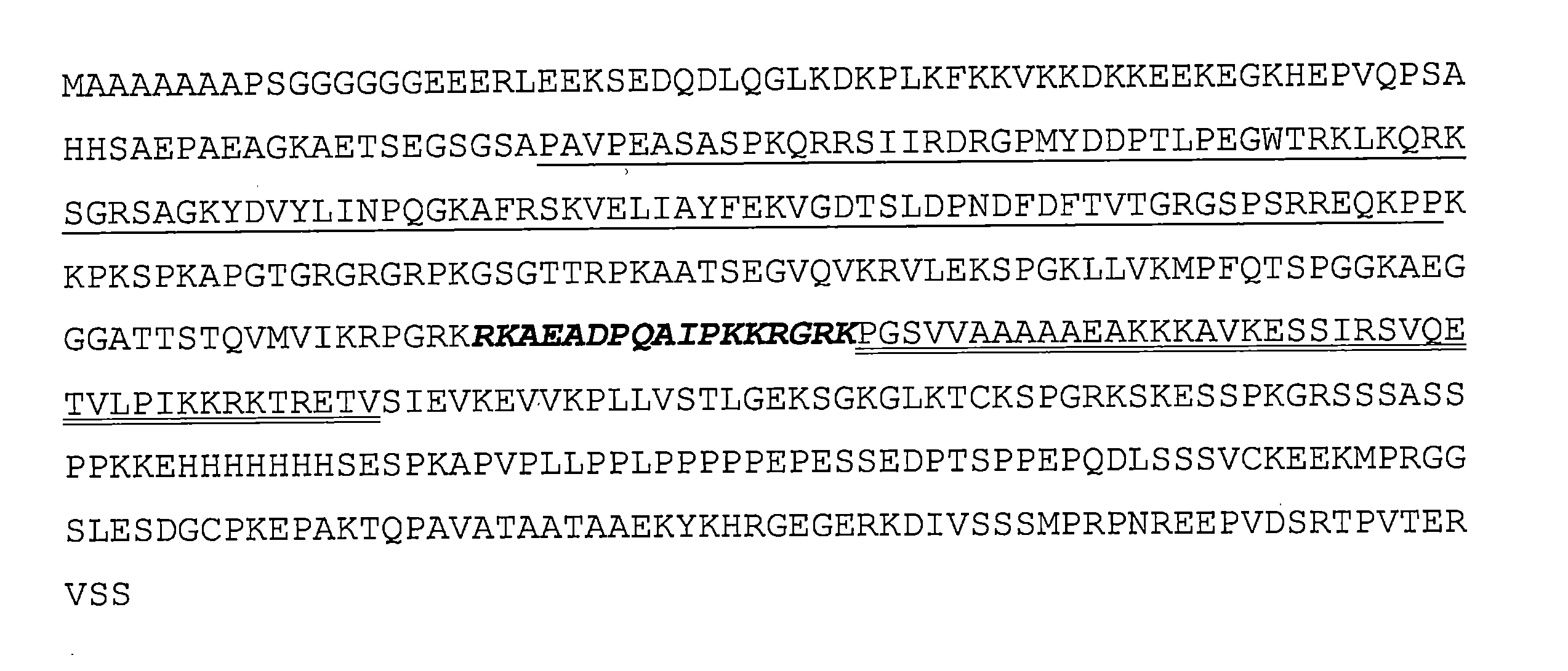
ヒトMeCP2タンパク質にはN末端配列が異なる2つのアイソフォームがある。 There are two isoforms of human MeCP2 protein that differ in their N-terminal sequences.
アイソフォーム1は、配列(配列番号3): Isoform 1 has the sequence (SEQ ID NO:3):
を有する。 has.
アイソフォーム2は、配列(配列番号4): Isoform 2 has the sequence (SEQ ID NO:4):

を有する。 has.
理論に拘束されることを望まないが、MeCP2タンパク質の最も重要な機能領域は、メチルCpG結合ドメイン(MBD;下線)、核局在化シグナル(NLS;太字斜体)、及びNCoR/SMRT相互作用ドメイン(NID、二重下線)であると考えられている。したがって、MeCP2タンパク質は、典型的には以下を含む:
(i) 配列(配列番号5):
Without wishing to be bound by theory, the most important functional regions of the MeCP2 protein are believed to be the methyl-CpG binding domain (MBD; underlined), the nuclear localization signal (NLS; bold italics), and the NCoR/SMRT interaction domain (NID, double underlined). Thus, the MeCP2 protein typically contains:
(i) Sequence (SEQ ID NO:5):

を有するメチルCpG結合ドメイン(MBD)、又は、それと少なくとも70%の同一性、例えば、少なくとも75%、80%、85%、90%、95%、96%、97%、98%、又は99%の同一性を有するそのバリアント;
(ii) 配列(配列番号6):
PGSVVAAAAAEAKKAVKESSIRSVQETVLPIKKRKTRETV
を有するNCoR/SMRT相互作用ドメイン(NID)、又は、それと少なくとも70%の同一性、例えば、少なくとも75%、80%、85%、90%、95%、96%、97%、98%、又は99%の同一性を有するそのバリアント;及び
(iii) 核局在化シグナル(NLS)。
or a variant thereof having at least 70% identity thereto, e.g., at least 75%, 80%, 85%, 90%, 95%, 96%, 97%, 98%, or 99% identity thereto;
(ii) Sequence (SEQ ID NO:6):
PGSVVAAAAEAKKAVKESSIRSVQETVLPIKKRKTRETV
or a variant thereof having at least 70% identity thereto, e.g., at least 75%, 80%, 85%, 90%, 95%, 96%, 97%, 98%, or 99% identity thereto; and
(iii) Nuclear localization signal (NLS).
典型的には、MBDはメチル化DNAに結合できる。それは、太字で示され、下線が付された多くのリン酸化部位を有すると考えられている。これらの部位はSer80、Ser86、Thr148、Ser149、及びSer164であり、ヒトアイソフォーム2配列における位置に従って付番されている。 Typically, MBD can bind to methylated DNA. It is believed to have a number of phosphorylation sites, which are shown in bold and underlined. These sites are Ser80, Ser86, Thr148, Ser149, and Ser164, numbered according to their position in the human isoform 2 sequence.
典型的には、NIDはNCoR/SMRTコリプレッサー複合体と相互作用又は結合することができる。 Typically, NID is capable of interacting with or binding to the NCoR/SMRT corepressor complex.
MBDは典型的には、NIDのN末端にある。 The MBD is typically located at the N-terminus of the NID.
NLSは、MBDとNIDの間に配置できる。 The NLS can be placed between the MBD and the NID.
NLSは、配列(配列番号7)RKAEADPQAIPKKRGRKを有する天然のMeCP2のNLSであり得る。しかしながら、SV40ラージT抗原NLS(配列番号8)(PKKKRKV)等、多くの異なるNLS配列が知られており、天然のMeCP2のNLSとは異なるNLS配列を使用することができる。 The NLS can be the native MeCP2 NLS having the sequence (SEQ ID NO: 7) RKAEADPQAIPKKRGRK. However, many different NLS sequences are known, such as the SV40 large T antigen NLS (SEQ ID NO: 8) (PKKKRKV), and an NLS sequence different from the native MeCP2 NLS can be used.
したがって、MeCP2タンパク質は、配列(配列番号9):
SEDQDLQGLKDKPLKFKKVKKDKKEEKEGKHEPVQPSAHHSAEPAEAGKAETSEGSGSAPAVPEASASPKQRRSIIRDRGPMYDDPTLPEGWTRKLKQRKSGRSAGKYDVYLINPQGKAFRSKVELIAYFEKVGDTSLDPNDFDFTVTGRGSPSRREQKPPKKPKSPKAPGTGRGRGRPKGSGTTRPKAATSEGVQVKRVLEKSPGKLLVKMPFQTSPGGKAEGGGATTSTQVMVIKRPGRKRKAEADPQAIPKKRGRKPGSVVAAAAAEAKKKAVKESSIRSVQETVLPIKKRKTRETVSIEVKEVVKPLLVSTLGEKSGKGLKTCKSPGRKSKESSPKGRSSSASSPPKKEHHHHHHHSESPKAPVPLLPPLPPPPPEPESSEDPTSPPEPQDLSSSVCKEEKMPRGGSLESDGCPKEPAKTQPAVATAATAAEKYKHRGEGERKDIVSSSMPRPNREEPVDSRTPVTERVSS;
を含むか、若しくはそれからなり、又は、それと少なくとも70%の同一性、例えば、少なくとも75%、80%、85%、90%、95%、96%、97%、98%、若しくは99%の同一性を有するその機能的バリアント、又はそのいずれかの機能的断片である。この配列との差異は、MBDとNIDの外側にあることが好ましく、機能的なNLSを保持する必要がある。
Thus, the MeCP2 protein has the sequence (SEQ ID NO:9):
SEDQDLQGLKDKPLKFKKVKKDKKEEKEGKHEPVQPSAHHSAEPAEAGKAETSEGSGSAPAVPEASASPKQRRSIIRDRGPMYDDPTLPEGWTRKLKQRKSGRSAGKYDVYLINPQGKAFRSKVELIAYFEKVGDTSLDPNDFDFTVTGRGSPSRREQKPPKKPKSPKAPGTGRGRGRPKGSGTTRPKAATSEGVQVKRVLEKSPGKLLVKMPFQTSPGGKAEGGGATTSTQVMVIKR PGRKRKAEADPQAIPKKRGRKPGSVVAAAAAEAKKKAVKESSIRSVQETVLPIKKRKTRETVSIEVKEVVKPLLVSTLGEKSGKGLKTCKSPGRKSKESSPKGRSSSASSPPKKEHHHHHHHSESPKAPVPLLPPLPPPPPEPESSEDPTSPEPQDLSSSVCKEEKMPRGGSLESDGCPKEPAKTQPAVATAATAAEKYKHRGEGERKDIVSSSMPRPNREEPVDSRTPVTERVSS;
or a functional variant thereof having at least 70% identity thereto, for example at least 75%, 80%, 85%, 90%, 95%, 96%, 97%, 98%, or 99% identity thereto, or a functional fragment of either. Differences from this sequence are preferably outside the MBD and NID and must retain a functional NLS.
機能的に同等であると考えられているΔNCと呼ばれるこの配列の断片は、配列(配列番号10):
PAVPEASASPKQRRSIIRDRGPMYDDPTLPEGWTRKLKQRKSGRSAGKYDVYLINPQGKAFRSKVELIAYFEKVGDTSLDPNDFDFTVTGRGSPSRREQKPPKKPKSPKAPGTGRGRGRPKGSGTTRPKAATSEGVQVKRVLEKSPGKLLVKMPFQTSPGGKAEGGGATTSTQVMVIKRPGRKRKAEADPQAIPKKRGRKPGSVVAAAAAEAKKKAVKESSIRSVQETVLPIKKRKTRETV
を有する。
A fragment of this sequence, called ΔNC, which is believed to be functionally equivalent, has the sequence (SEQ ID NO:10):
PAVPEASASPKQRRSIIRDRGPMYDDPTLPEGWTRKLKQRKSGRSAGKYDVYLINPQGKAFRSKVELIAYFEKVGDTSLDPNDFDFTVTGRGSPSRREQKPPKKPKSPKAPGTGRGRGRPKGSGTTRPKAATSEGVQVKRVLEKSPGKLLVKMPFQTSPGGKAEGGGATTSTQVMVIKRPGRKRKAEADPQAIPKKRGRKPGSVVAAAAAEAKKKAVKESSIRSVQETVLPIKKRKTRETV
has.
したがって、MeCP2タンパク質は、ΔNC配列を含むか若しくはそれからなるか、又はそれと少なくとも70%の同一性、例えば、少なくとも75%、80%、85%、90%、95%、96%、97%、98%、又は99%の同一性を有するその機能バリアントであり得る。同様に、この配列との差異は、MBDとNIDの外側にあることが好ましく、機能的なNLSを保持する必要がある。 Thus, the MeCP2 protein may comprise or consist of the ΔNC sequence, or a functional variant thereof having at least 70% identity thereto, e.g., at least 75%, 80%, 85%, 90%, 95%, 96%, 97%, 98%, or 99% identity thereto. Similarly, any differences from this sequence are preferably outside the MBD and NID and must retain a functional NLS.
ΔNICと呼ばれ、MBDとNIDを含み、代替のNLS配列(SV40ラージT抗原由来)を有するが、残りの天然MeCP2配列の多くが削除された更なるバリアントは、配列(配列番号11):
PAVPEASASPKQRRSIIRDRGPMYDDPTLPEGWTRKLKQRKSGRSAGKYDVYLINPQGKAFRSKVELIAYFEKVGDTSLDPNDFDFTVTGRGSPSRREQKPPGSSGSSGPKKKRKVPGSVVAAAAAEAKKKAVKESSIRSVQETVLPIKKRKTRETV
を有する。
A further variant, termed ΔNIC, which contains the MBD and NID and has an alternative NLS sequence (from the SV40 large T antigen) but deletes much of the remaining native MeCP2 sequence, has the sequence (SEQ ID NO:11):
PAVPEASASPKQRRSIIRDRGPMYDDPTLPEGWTRKLKQRKSGRSAGKYDVYLINPQGKAFRSKVELIAYFEKVGDTSLDPNDFDFTVTGRGSPSRREQKPPGSSGSSGPKKRKVPGSVVAAAAAEAKKKAVKESSIRSVQETVLPIKKRKTRETV
has.
したがって、MeCP2タンパク質は、ΔNIC配列を含むか若しくはそれからなるか、又はそれと少なくとも70%の同一性、例えば、少なくとも75%、80%、85%、90%、95%、96%、97%、98%、又は99%の同一性を有するその機能バリアントであり得る。同様に、この配列との差異は、MBDとNIDの外側にあることが好ましく、機能的なNLSを保持する必要がある。 Thus, the MeCP2 protein may comprise or consist of the ΔNIC sequence, or a functional variant thereof having at least 70% identity thereto, e.g., at least 75%, 80%, 85%, 90%, 95%, 96%, 97%, 98%, or 99% identity thereto. Similarly, any differences from this sequence are preferably outside the MBD and NID and must retain a functional NLS.
MeCP2タンパク質のMBD又はNIDが、提供された参照配列との1つ又は複数の差異を含む場合、それらの差異は保存的置換であることが望ましい場合がある。MBDのリン酸化部位が維持されることも望ましい場合がある。 Where the MBD or NID of the MeCP2 protein contains one or more differences from the reference sequence provided, it may be desirable for those differences to be conservative substitutions. It may also be desirable for the phosphorylation sites of the MBD to be maintained.
タンパク質は、配列:(配列番号12)MAAAAAAAPSGGGGGGEEERLEEK若しくはMVAGMLGLREEK(配列番号13)、又は、いずれかと少なくとも70%の同一性、例えば、いずれかと少なくとも75%、80%、85%、90%、95%、96%、97%、98%、又は99%の同一性を有するN末端部分を更に含んでもよい。 The protein may further comprise an N-terminal portion having the sequence: (SEQ ID NO:12) MAAAAAAAPSGGGGGGEEERLEEK or MVAGMLGLREEK (SEQ ID NO:13), or at least 70% identity to either, e.g., at least 75%, 80%, 85%, 90%, 95%, 96%, 97%, 98%, or 99% identity to either.
したがって、発現カセットによってコードされるMeCP2タンパク質は、例えば、配列:
MAAAAAAAPSGGGGGGEEERLEEKSEDQDLQGLKDKPLKFKKVKKDKKEEKEGKHEPVQPSAHHSAEPAEAGKAETSEGSGSAPAVPEASASPKQRRSIIRDRGPMYDDPTLPEGWTRKLKQRKSGRSAGKYDVYLINPQGKAFRSKVELIAYFEKVGDTSLDPNDFDFTVTGRGSPSRREQKPPKKPKSPKAPGTGRGRGRPKGSGTTRPKAATSEGVQVKRVLEKSPGKLLVKMPFQTSPGGKAEGGGATTSTQVMVIKRPGRKRKAEADPQAIPKKRGRKPGSVVAAAAAEAKKKAVKESSIRSVQETVLPIKKRKTRETVSIEVKEVVKPLLVSTLGEKSGKGLKTCKSPGRKSKESSPKGRSSSASSPPKKEHHHHHHHSESPKAPVPLLPPLPPPPPEPESSEDPTSPPEPQDLSSSVCKEEKMPRGGSLESDGCPKEPAKTQPAVATAATAAEKYKHRGEGERKDIVSSSMPRPNREEPVDSRTPVTERVSS(ヒトアイソフォーム1)(配列番号14)、
MVAGMLGLREEKSEDQDLQGLKDKPLKFKKVKKDKKEEKEGKHEPVQPSAHHSAEPAEAGKAETSEGSGSAPAVPEASASPKQRRSIIRDRGPMYDDPTLPEGWTRKLKQRKSGRSAGKYDVYLINPQGKAFRSKVELIAYFEKVGDTSLDPNDFDFTVTGRGSPSRREQKPPKKPKSPKAPGTGRGRGRPKGSGTTRPKAATSEGVQVKRVLEKSPGKLLVKMPFQTSPGGKAEGGGATTSTQVMVIKRPGRKRKAEADPQAIPKKRGRKPGSVVAAAAAEAKKKAVKESSIRSVQETVLPIKKRKTRETVSIEVKEVVKPLLVSTLGEKSGKGLKTCKSPGRKSKESSPKGRSSSASSPPKKEHHHHHHHSESPKAPVPLLPPLPPPPPEPESSEDPTSPPEPQDLSSSVCKEEKMPRGGSLESDGCPKEPAKTQPAVATAATAAEKYKHRGEGERKDIVSSSMPRPNREEPVDSRTPVTERVSS(ヒトアイソフォーム2)(配列番号15)
MAAAAAAAPSGGGGGGEEERLEEKPAVPEASASPKQRRSIIRDRGPMYDDPTLPEGWTRKLKQRKSGRSAGKYDVYLINPQGKAFRSKVELIAYFEKVGDTSLDPNDFDFTVTGRGSPSRREQKPPKKPKSPKAPGTGRGRGRPKGSGTTRPKAATSEGVQVKRVLEKSPGKLLVKMPFQTSPGGKAEGGGATTSTQVMVIKRPGRKRKAEADPQAIPKKRGRKPGSVVAAAAAEAKKKAVKESSIRSVQETVLPIKKRKTRETV(ΔNCアイソフォーム1)(配列番号16)
MVAGMLGLREEKPAVPEASASPKQRRSIIRDRGPMYDDPTLPEGWTRKLKQRKSGRSAGKYDVYLINPQGKAFRSKVELIAYFEKVGDTSLDPNDFDFTVTGRGSPSRREQKPPKKPKSPKAPGTGRGRGRPKGSGTTRPKAATSEGVQVKRVLEKSPGKLLVKMPFQTSPGGKAEGGGATTSTQVMVIKRPGRKRKAEADPQAIPKKRGRKPGSVVAAAAAEAKKKAVKESSIRSVQETVLPIKKRKTRETV(ΔNCアイソフォーム2)(配列番号17)
MAAAAAAAPSGGGGGGEEERLEEKPAVPEASASPKQRRSIIRDRGPMYDDPTLPEGWTRKLKQRKSGRSAGKYDVYLINPQGKAFRSKVELIAYFEKVGDTSLDPNDFDFTVTGRGSPSRREQKPPGSSGSSGPKKKRKVPGSVVAAAAAEAKKKAVKESSIRSVQETVLPIKKRKTRETV(ΔNICアイソフォーム1)(配列番号18)、
MVAGMLGLREEKPAVPEASASPKQRRSIIRDRGPMYDDPTLPEGWTRKLKQRKSGRSAGKYDVYLINPQGKAFRSKVELIAYFEKVGDTSLDPNDFDFTVTGRGSPSRREQKPPGSSGSSGPKKKRKVPGSVVAAAAAEAKKKAVKESSIRSVQETVLPIKKRKTRETV(ΔNICアイソフォーム2)(配列番号19)
のうちの1つを含み得るか、若しくはそれからなり得るか、又は、それらの配列のうちのいずれか1つと少なくとも70%の同一性、例えば、少なくとも75%、80%、85%、90%、95%、96%、97%、98%、又は99%の同一性を有し得る。
Thus, the MeCP2 protein encoded by the expression cassette can have, for example, the sequence:
MAAAAAAAPSGGGGGGEEERLEEKSEDQDLQGLKDKPLKFKKVKKDKKEEKEGKHEPVQPSAHHSAEPAEAGKAETSEGSGSAPAVPEASASPKQRRSIIRDRGPMYDDPTLPEGWTRKLKQRKSGRSAGKYDVYLINPQGKAFRSKVELIAYFEKVGDTSLDPNDFDFTVTGRGSPSRREQKPPKKPKSPKAPGTGRGRGRPKGSGTTRPKAATSEGVQVKRVLEKSPGKLLVKMPFQTSPGGKAEGGGATTSTQVMVI KRPGRKRKAEADPQAIPKKRGRKPGSVVAAAAAEAKKKAVKESSIRSVQETVLPIKKRKTRETVSIEVKEVVKPLLVSTLGEKSGKGLKTCKSPGRKSKESSPKGRSSSASSPPKKEHHHHHHHSESPKAPVPLLPPLPPPPPEPESSEDPTSPEPQDLSSSVCKEEKMPRGGSLESDGCPKEPAKTQPAVATAATAAEKYKHRGEGERKDIVSSSMPRPNREEPVDSRTPVTERVSS (human isoform 1) (SEQ ID NO: 14),
MVAGMLGLREEKSEDQDLQGLKDKPLKFKKVKKDKKEEKEGKHEPVQPSAHHSAEPAEAGKAETSEGSGSAPAVPEASASPKQRRSIIRDRGPMYDDPTLPEGWTRKLKQRKSGRSAGKYDVYLINPQGKAFRSKVELIAYFEKVGDTSLDPNDFDFTVTGRGSPSRREQKPPKKPKSPKAPGTGRGRGRPKGSGTTRPKAATSEGVQVKRVLEKSPGKLLVKMPFQTSPGGKAEGGGATTSTQVMVIKRPGR KRKAEADPQAIPKKRGRKPGSVVAAAAAEAKKKAVKESSIRSVQETVLPIKKRKTRETVSIEVKEVVKPLLVSTLGEKSGKGLKTCKSPGRKSKESSPKGRSSSASSPPKKEHHHHHHHSESPKAPVPLLPPLPPPPPEPESSEDPTSPEPQDLSSSVCKEEKMPRGGSLESDGCPKEPAKTQPAVATAATAAEKYKHRGEGERKDIVSSSMPRPNREEPVDSRTPVTERVSS (human isoform 2) (SEQ ID NO: 15)
MAAAAAAAPSGGGGGGEEERLEEKPAVPEASASPKQRRSIIRDRGPMYDDPTLPEGWTRKLKQRKSGRSAGKYDVYLINPQGKAFRSKVELIAYFEKVGDTSLDPNDFDFTVTGRGSPSRREQKPPKKPKSPKAPGTGRGRGRPKGSGTTRPKAATSEGVQVKRVLEKSPGKLLVKMPFQTSPGGKAEGGGATTSTQVMVIKRPGRKRKAEADPQAIPKKRGRKPGSVVAAAAAEAKKKAVKESSIRSVQETVLPIKKRKTRETV (ΔNC isoform 1) (SEQ ID NO: 16)
MVAGMLGLREEKPAVPEASASPKQRRSIIRDRGPMYDDPTLPEGWTRKLKQRKSGRSAGKYDVYLINPQGKAFRSKVELIAYFEKVGDTSLDPNDFDFTVTGRGSPSRREQKPPKKPKSPKAPGTGRGRGRPKGSGTTRPKAATSEGVQVKRVLEKSPGKLLVKMPFQTSPGGKAEGGGATTSTQVMVIKRPGRKRKAEADPQAIPKKRGRKPGSVVAAAAAEAKKKAVKESSIRSVQETVLPIKKRKTRETV (ΔNC isoform 2) (SEQ ID NO: 17)
MAAAAAAAPSGGGGGGEEERLEEKPAVPEASASPKQRRSIIRDRGPMYDDPTLPEGWTRKLKQRKSGRSAGKYDVYLINPQGKAFRSKVELIAYFEKVGDTSLDPNDFDFTVTGRGSPSRREQKPPGSSGSSGPKKRKVPGSVVAAAAAEAKKKAVKESSIRSVQETVLPIKKRKTRETV (ΔNIC isoform 1) (SEQ ID NO: 18),
MVAGMLGLREEKPAVPEASASPKQRRSIIRDRGPMYDDPTLPEGWTRKLKQRKSGRSAGKYDVYLINPQGKAFRSKVELIAYFEKVGDTSLDPNDFDFTVTGRGSPSRREQKPPGSSGSSGPKKRKVPGSVVAAAAAEAKKKAVKESSIRSVQETVLPIKKRKTRETV (ΔNIC isoform 2) (SEQ ID NO: 19)
or may have at least 70% identity, e.g., at least 75%, 80%, 85%, 90%, 95%, 96%, 97%, 98%, or 99% identity, to any one of those sequences.
提供される参照配列との少なくとも80%又は少なくとも90%の同一性値が特に好ましい場合がある。 Identity values of at least 80% or at least 90% with the provided reference sequence may be particularly preferred.
本発明の発現カセットはまた、他の種、特に他の哺乳動物種、例えば、非ヒト霊長類、又はげっ歯類(例えば、マウス、ラット、モルモット)、ウサギ目(例えば、ウサギ)、ネコ、イヌ、ブタ、ウシ、ウマ、ヒツジ、ヤギ等の飼育動物、実験動物、家畜動物由来のMeCP2タンパク質を有用にコードし得ることは当業者には明らかであろう。 It will be apparent to one of skill in the art that the expression cassettes of the present invention may also usefully encode MeCP2 proteins from other species, particularly other mammalian species, such as non-human primates, or domestic, laboratory, or livestock animals, such as rodents (e.g., mice, rats, guinea pigs), lagomorphs (e.g., rabbits), cats, dogs, pigs, cows, horses, sheep, goats, etc.
MeCP2タンパク質は、例えば、分子のC末端における分離又は同定を助けるエピトープタグ等の異種(すなわち、非MeCP2)配列を更に含んでもよい。例には、ポリヒスチジン(例、ヘキサヒスチジン)タグ、FLAGタグ、Mycタグ、緑色蛍光タンパク質(GFP)及び強化緑色蛍光タンパク質(eGFP)等の蛍光タンパク質等が含まれる。そのような異種部分は、典型的には、50個以下のアミノ酸の長さ、例えば、20個以下のアミノ酸の長さである。例えば、以下の実施例に記載される第2世代ベクターによりコードされるMeCP2タンパク質は、配列EQKLISEEDL(配列番号20)を有するC末端c-Mycエピトープタグを含む。このタンパク質は、配列(配列番号21): The MeCP2 protein may further comprise a heterologous (i.e., non-MeCP2) sequence, such as, for example, an epitope tag at the C-terminus of the molecule to aid in isolation or identification. Examples include polyhistidine (e.g., hexahistidine) tags, FLAG tags, Myc tags, fluorescent proteins such as green fluorescent protein (GFP) and enhanced green fluorescent protein (eGFP), and the like. Such heterologous moieties are typically 50 amino acids or less in length, e.g., 20 amino acids or less in length. For example, the MeCP2 protein encoded by the second generation vector described in the Examples below comprises a C-terminal c-Myc epitope tag having the sequence EQKLISEEDL (SEQ ID NO:20). This protein has the sequence (SEQ ID NO:21):

を有し、
MeCP2配列に下線が付され、c-Mycエピトープタグには二重下線が付される。
having
The MeCP2 sequence is underlined and the c-Myc epitope tag is double underlined.
上述のΔNCタンパク質のc-Mycタグ付きバージョンは、配列(配列番号22): The c-Myc tagged version of the above ΔNC protein has the sequence (SEQ ID NO:22):

を有し得、
MeCP2配列に下線が付され、c-Mycエピトープタグには二重下線が付される。
Is possible,
The MeCP2 sequence is underlined and the c-Myc epitope tag is double underlined.
上述のΔNICタンパク質のc-Mycタグ付きバージョンは、配列(配列番号23): The c-Myc tagged version of the ΔNIC protein described above has the sequence (SEQ ID NO:23):
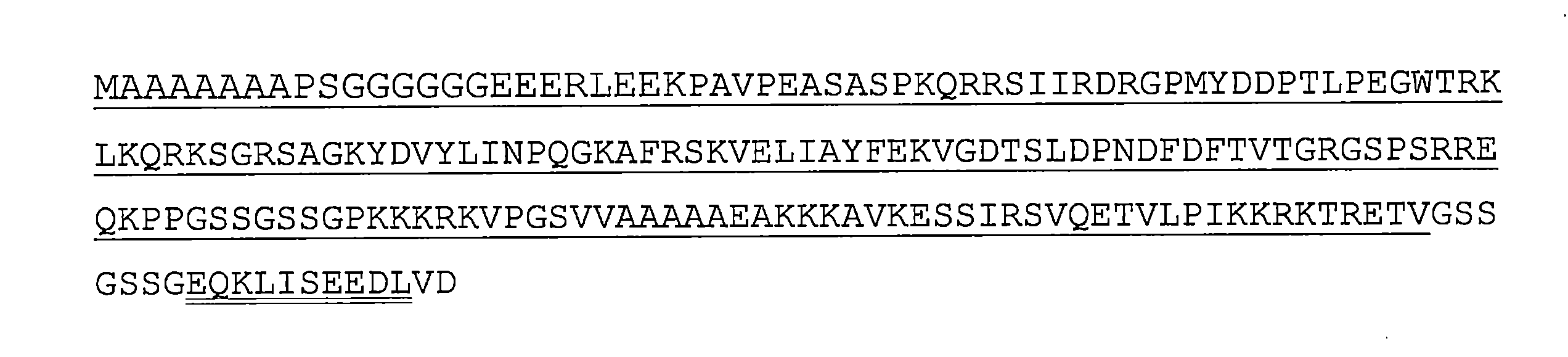
を有し得、
MeCP2配列に下線が付され、c-Mycエピトープタグには二重下線が付される。
Is possible,
The MeCP2 sequence is underlined and the c-Myc epitope tag is double underlined.
免疫原性及び他の副作用のリスクを低減するために、治療用途を目的とするタンパク質は一般にそのような異種エレメントを含まないことが理解されよう。 It will be appreciated that proteins intended for therapeutic use generally do not contain such heterologous elements, to reduce the risk of immunogenicity and other side effects.
いくつかの実施形態では、発現カセットによってコードされるMeCP2タンパク質は、600個以下のアミノ酸の長さ、例えば、550、540、530、又は520個以下のアミノ酸の長さである。したがって、MeCP2タンパク質をコードするオープンリーディングフレームは、1803塩基(トップコドンを含む)以下の長さ、例えば、1653、1623、1593、又は1563塩基以下の長さである。 In some embodiments, the MeCP2 protein encoded by the expression cassette is 600 amino acids or less in length, e.g., 550, 540, 530, or 520 amino acids or less in length. Thus, the open reading frame encoding the MeCP2 protein is 1803 bases or less in length (including the top codon), e.g., 1653, 1623, 1593, or 1563 bases or less in length.
候補配列と上記の参照配列の間のアミノ酸配列同一性パーセント(%)は、必要に応じて、最適なアラインメントを達成するためのギャップを導入し、配列の同一性の一部として保存的置換をいっさい考慮せずに配列をアライメントさせた後の、参照配列におけるアミノ酸残基と同一である候補配列におけるアミノ酸残基の割合として定義される。同一性%の値は、WU-BLAST-2によって決定できる(Altschul等、Methods in Enzymology、266:460~480頁(1996年))。WU-BLAST-2はいくつかの検索パラメーターを使用し、その多くはデフォルト値に設定されている。調整可能なパラメーターは、オーバーラップスパン=1、オーバーラップフラクション=0.125、ワードしきい値(T)=11の値で設定される。アミノ酸配列同一性%の値は、WU-BLAST-2によって決定される一致する同一残基の数を、参照配列の残基の総数で除算して、10倍することで決定される(アライメントスコアを最大化するためにWU-BLAST-2によって参照配列に導入されたギャップは無視する)。 The percent amino acid sequence identity (%) between a candidate sequence and the reference sequence described above is defined as the percentage of amino acid residues in the candidate sequence that are identical to those in the reference sequence after aligning the sequences, introducing gaps to achieve optimal alignment, if necessary, and without considering any conservative substitutions as part of the sequence identity. The value of the percent identity can be determined by WU-BLAST-2 (Altschul et al., Methods in Enzymology, 266:460-480 (1996)). WU-BLAST-2 uses several search parameters, most of which are set to default values. Adjustable parameters are set with the following values: overlap span=1, overlap fraction=0.125, and word threshold (T)=11. The percent amino acid sequence identity value is determined by dividing the number of matching identical residues as determined by WU-BLAST-2 by the total number of residues in the reference sequence and multiplying by 10 (ignoring gaps introduced into the reference sequence by WU-BLAST-2 to maximize the alignment score).
保存的置換は、アミノ酸クラス内の置換及び/又はBLOSUM62マトリックスで陽性と評価される置換として定義され得る。 Conservative substitutions can be defined as substitutions within an amino acid class and/or substitutions that score positive in the BLOSUM62 matrix.
一つの分類によると、アミノ酸クラスは酸性、塩基性、非荷電極性、及び非極性であり、酸性アミノ酸はAsp及びGluであり、塩基性アミノ酸は、Arg、Lys、及びHisであり、非荷電極性アミノ酸は、Asn、Gln、Ser、Thr、及びTyrであり、非極性アミノ酸は、Ala、Gly、Val、Leu、Ile、Pro、Phe、Met、Trp、及びCysである。 According to one classification, the amino acid classes are acidic, basic, uncharged polar, and nonpolar, with acidic amino acids being Asp and Glu, basic amino acids being Arg, Lys, and His, uncharged polar amino acids being Asn, Gln, Ser, Thr, and Tyr, and nonpolar amino acids being Ala, Gly, Val, Leu, Ile, Pro, Phe, Met, Trp, and Cys.
別の分類によると、アミノ酸クラスは小さい親水性、酸/酸アミド/親水性、塩基性、小さい疎水性、及び芳香族であり、小さい親水性アミノ酸はSer、Thr、Pro、Ala及びGlyであり、酸/酸アミド/親水性アミノ酸は、Asn、Asp、Glu、及びGlnであり、塩基性アミノ酸は、His、Arg、及びLysであり、小さい疎水性アミノ酸は、Met、Ile、Leu、及びValであり、芳香族アミノ酸はPhe、Tyr、及びTrpである。 According to another classification, the amino acid classes are small hydrophilic, acid/acid amide/hydrophilic, basic, small hydrophobic, and aromatic, with the small hydrophilic amino acids being Ser, Thr, Pro, Ala, and Gly, the acid/acid amide/hydrophilic amino acids being Asn, Asp, Glu, and Gln, the basic amino acids being His, Arg, and Lys, the small hydrophobic amino acids being Met, Ile, Leu, and Val, and the aromatic amino acids being Phe, Tyr, and Trp.
BLOSUM62マトリックスで正のスコアを有する置換は次のとおりである: Substitutions with positive scores in the BLOSUM62 matrix are:

5'転写制御領域
MeCP2発現カセットは、神経細胞、例えば、特に脳とCNSのニューロンにおいて転写を指示することができる5'転写制御領域を含む。グリア細胞でも発現が起こることが望ましい場合があるが、グリア細胞での高レベルの発現は一般に好ましくない。
5' transcriptional regulatory region
The MeCP2 expression cassette contains a 5' transcriptional control region capable of directing transcription in neural cells, e.g., neurons, particularly in the brain and CNS. It may be desirable for expression to also occur in glial cells, although high levels of expression in glial cells are generally not preferred.
5'転写制御領域には、プロモーターと転写開始部位が含まれる。また、エンハンサー及び/又はサイレンサーエレメントを含む他の制御エレメントを含む場合がある。 The 5' transcriptional regulatory region includes the promoter and transcription initiation site, and may also contain other regulatory elements, including enhancer and/or silencer elements.
ウイルスプロモーター(例えば、SV40プロモーター)又は哺乳類の「ハウスキーピング」プロモーター等の普遍的なプロモーターを使用することが可能な場合がある。しかし、好ましくは、プロモーターは他の細胞型と比較して神経細胞で優先的に発現を指示する。 It may be possible to use universal promoters such as viral promoters (e.g., the SV40 promoter) or mammalian "housekeeping" promoters. Preferably, however, the promoter directs expression preferentially in neural cells compared to other cell types.
実施例に記載されている第2世代の発現カセットは、コアプロモーター領域、コアプロモーター領域の上流(及びわずかに重複)のサイレンサー領域、及びコアプロモーター領域の下流かつ転写開始部位の上流に位置するCNS調節エレメントを含む、ヒトMeCP2遺伝子からの染色体配列の連続した区間を使用する。これらの配列は図14に示される。 The second generation expression cassette described in the Examples uses a contiguous stretch of chromosomal sequence from the human MeCP2 gene that includes the core promoter region, a silencer region upstream of (and slightly overlapping with) the core promoter region, and CNS regulatory elements located downstream of the core promoter region and upstream of the transcription start site. These sequences are shown in Figure 14.
理論に拘束されることを望まないが、コアプロモーターとCNS調節エレメントは神経細胞での適切な発現を確保すると考えられているが、サイレンサーは神経細胞とグリア細胞及び肝細胞を含む他の細胞型の両方で過剰発現、したがって毒性を防ぐ可能性がある。 Without wishing to be bound by theory, it is believed that the core promoter and CNS regulatory elements ensure proper expression in neuronal cells, while the silencer may prevent overexpression and therefore toxicity in both neurons and other cell types, including glial cells and hepatocytes.
したがって、5'転写制御領域は、配列(配列番号24):
AAACCAGCCCCTCTGTGCCCTAGCCGCCTCTTTTTTCCAAGTGACAGTAGAACTCCACCAATCCGCAGCTGAATGGGGTCCGCCTCTTTTCCCTGCCTAAACAGACAGGAACTCCTGCCAATTGAGGGCG
又はその機能的断片、又は20個以下のヌクレオチド変化、例えばその配列と比較して10個以下若しくは5個以下のヌクレオチド変化を有するそのバリアントを有するコアプロモーターエレメントを含み得、コアプロモーター領域は、単独又はCNS調節エレメントと組み合わせて、神経細胞、例えば、脳及び/又はCNSのニューロンにおいて転写を開始することができる。
Thus, the 5' transcriptional regulatory region has the sequence (SEQ ID NO:24):
AAACCAGCCCCTCTGTGCCCTAGCCGCCTCTTTTTTCCAAGTGACAGTAGAACTCCACCAATCCGCAGCTGAATGGGGTCCGCCTCTTTTCCCTGCCTAAACAGACAGGAACTCCTGCCAATTGAGGGCG
or a functional fragment thereof, or a variant thereof having 20 or fewer nucleotide changes, e.g., 10 or fewer or 5 or fewer nucleotide changes compared to the sequence, wherein the core promoter region, alone or in combination with CNS regulatory elements, is capable of initiating transcription in neural cells, e.g., neurons of the brain and/or CNS.
5'転写制御領域は、配列(配列番号25):
TTAAGCGCCAGAGTCCACAAGGGCCCAGTTAATCCTCAACATTCAAATGCTGCCCACAAAAC
又はその配列と比較して10個以下若しくは5個以下のヌクレオチド変化を有するそのバリアントを有するサイレンサーエレメントを含み得る。
The 5' transcriptional regulatory region has the sequence (SEQ ID NO:25):
TTAAGCGCCAGAGTCCACAAGGGCCCAGTTAATCCTCAACATTCAAATGCTGCCCACAAAAC
or a variant thereof having no more than 10 or no more than 5 nucleotide changes compared to the sequence.
5'転写制御領域は、配列(配列番号26):CAGCACACAGGCTGGTCGGを有するCNS調節エレメントを含んでもよい。 The 5' transcriptional control region may include a CNS regulatory element having the sequence (SEQ ID NO:26): CAGCACACAGGCTGGTCGG.
E-boxエレメント(配列CAGGTG)はコアプロモーター配列の3'末端と重複し、SP1部位(GGGCGG)はCNS調節エレメントの3'に位置する。必要に応じて、これらのエレメントが存在する場合もある。 An E-box element (sequence CAGGTG) overlaps the 3' end of the core promoter sequence and an SP1 site (GGGCGG) is located 3' to the CNS regulatory element. These elements may be present if desired.
5'転写制御領域は、図14にmMeP426として注釈が付けられた天然のMeCP2コアプロモーター配列を含んでもよい。 The 5' transcriptional regulatory region may include the native MeCP2 core promoter sequence annotated as mMeP426 in Figure 14.
マイクロRNA結合部位
MeCP2発現カセットの3'UTRには、MeCP2導入遺伝子発現の調節を促進するために、1つ又は複数のマイクロRNA(miRNA)結合部位が含まれる場合がある。
MicroRNA binding sites
The 3'UTR of the MeCP2 expression cassette may contain one or more microRNA (miRNA) binding sites to facilitate regulation of MeCP2 transgene expression.
マイクロRNAは小さな非コードRNAであり、翻訳の抑制(翻訳の阻害又はmRNA分解の誘導のいずれか)により細胞機能に大きな影響を及ぼす。マイクロRNAは、RNA pol IIによって合成された一次RNA転写産物(pri-miRNA)に由来するが、数千個のヌクレオチドの長さにもなる。単一のpri-miRNA転写産物は、1つを超える活性miRNAを生成する場合がある。 MicroRNAs are small non-coding RNAs that profoundly affect cellular function by translational repression (either by blocking translation or inducing mRNA degradation). MicroRNAs are derived from primary RNA transcripts (pri-miRNAs) synthesized by RNA pol II, but can be several thousand nucleotides long. A single pri-miRNA transcript may generate more than one active miRNA.
核では、タイプIII RNAse酵素Droshaがpri-miRNA転写産物をプロセシングして、通常約70~100個のヌクレオチドの長さのステムループ又はヘアピン構造からなる前駆体miRNA(pre-miRNA)にする。pre-miRNAは細胞質に輸送され、そこでRNAse Dicerによって更にプロセシングされ、ループを除去して、活性化された「ガイド」鎖(通常15~25個のヌクレオチドの長さ)が完全に又は部分的に相補的な「パッセンジャー」鎖にハイブリダイズした成熟二本鎖miRNA分子が得られる。 In the nucleus, the type III RNAse enzyme Drosha processes the pri-miRNA transcripts into precursor miRNAs (pre-miRNAs) that consist of stem-loop or hairpin structures, usually about 70-100 nucleotides in length. The pre-miRNAs are transported to the cytoplasm where they are further processed by the RNAse Dicer to remove the loop and yield mature double-stranded miRNA molecules in which an activated "guide" strand (usually 15-25 nucleotides in length) hybridizes to a fully or partially complementary "passenger" strand.
次いで、成熟した二本鎖miRNAはRNA誘導サイレンシング複合体に組み込まれ、そこでガイド鎖が標的mRNAの結合部位にハイブリダイズする。 The mature double-stranded miRNA is then incorporated into an RNA-induced silencing complex, where the guide strand hybridizes to the binding site on the target mRNA.
ガイド鎖は、標的結合部位と完全に相補的ではない場合がある。しかしながら、「シード」配列と呼ばれるガイド鎖の領域は、通常、標的結合部位の対応する「コア」配列に完全に相補的である。シード配列は通常2~8個のヌクレオチドの長さであり、ガイド鎖の5'末端又はその近く(1又は2個のヌクレオチド以内)にある。 The guide strand may not be perfectly complementary to the target binding site. However, a region of the guide strand, called the "seed" sequence, is usually perfectly complementary to the corresponding "core" sequence of the target binding site. The seed sequence is usually 2-8 nucleotides in length and is located at or near (within 1 or 2 nucleotides) the 5' end of the guide strand.
いずれかの特定の理論に拘束されることを望まずに、miR-22結合部位は、末梢細胞のMeCP2発現を調節する可能性がある。参照文献32を参照されたい。 Without wishing to be bound by any particular theory, miR-22 binding sites may regulate MeCP2 expression in peripheral cells. See reference 32.
miR-22結合部位は、典型的には、コア配列:
GGCAGCTを少なくとも含む。
The miR-22 binding site typically comprises the core sequence:
Contains at least GGCAGCT.
例えば、miR-22結合部位は、配列(配列番号27): For example, the miR-22 binding site has the sequence (SEQ ID NO:27):

を含んでもよく、コア配列には下線が付され;
又は、1つ若しくは複数の位置で、例えば5つまでの位置、10個までの位置、15個までの位置、又は20個までの位置で異なる場合があり、それらの全てはコア配列の外部にある必要がある。
wherein the core sequence is underlined;
Or, it may differ at one or more positions, for example, up to 5 positions, up to 10 positions, up to 15 positions, or up to 20 positions, all of which must be outside the core sequence.
miR-19結合部位は、グリア細胞のMeCP2発現を調節する可能性がある。参照文献33を参照されたい。 The miR-19 binding site may regulate MeCP2 expression in glial cells. See reference 33.
miR-19結合部位は、典型的には、コア配列:
TTTGCACを含む。
The miR-19 binding site typically comprises the core sequence:
Includes TTTGCAC.
例えば、miR-19結合部位は、配列(配列番号28): For example, the miR-19 binding site has the sequence (SEQ ID NO:28):

を含んでもよく、コア配列には下線が付され;
又は、1つ若しくは複数の位置で、例えば5つまでの位置、10個までの位置、15個までの位置、又は20個までの位置で異なる場合があり、それらの全てはコア配列の外部にある必要がある。
wherein the core sequence is underlined;
Or, it may differ at one or more positions, for example, up to 5 positions, up to 10 positions, up to 15 positions, or up to 20 positions, all of which must be outside the core sequence.
miR-124結合部位はまた、グリア細胞のMeCP2導入遺伝子発現を調節する可能性がある。参照文献35及び44を参照されたい。 The miR-124 binding site may also regulate MeCP2 transgene expression in glial cells. See references 35 and 44.
miR-124結合部位は、典型的には、コア配列:
TGCCTTAを含む。
The miR-124 binding site typically comprises the core sequence:
Includes TGCCTTA.
miR-124結合部位は、必要に応じて、コア配列の5'又は3'の更なる配列を含んでもよいが、コア配列は通常変化しない。 The miR-124 binding site may optionally contain additional sequence 5' or 3' of the core sequence, although the core sequence is typically unchanged.
miR-132結合部位は、BNDF2(脳由来神経栄養因子2)によるフィードバックループを介してMeCP2発現を調節する可能性がある。MeCP2は、BNDF2の発現レベルを増加させると考えられている。BNDF2は、miR132のレベルを増加させ、これは、MeCP2発現の負の調節因子である。参照文献34を参照されたい。 The miR-132 binding site may regulate MeCP2 expression through a feedback loop with BNDF2 (brain-derived neurotrophic factor 2). MeCP2 is thought to increase the expression levels of BNDF2. BNDF2 increases the levels of miR132, which is a negative regulator of MeCP2 expression. See reference 34.
miR-132結合部位は、典型的には、コア配列:
GACTGTTAを含む。
The miR-132 binding site typically comprises the core sequence:
Contains GACTGTTA.
例えば、miR-132結合部位は、配列(配列番号29): For example, the miR-132 binding site has the sequence (SEQ ID NO:29):

を含んでもよく、コア配列には下線が付され;
又は、1つ若しくは複数の位置で、例えば5つまでの位置、10個までの位置、15個までの位置、又は20個までの位置で異なる場合があり、それらの全てはコア配列の外部にある必要がある。
wherein the core sequence is underlined;
Or, it may differ at one or more positions, for example, up to 5 positions, up to 10 positions, up to 15 positions, or up to 20 positions, all of which must be outside the core sequence.
AUリッチエレメント
発現カセットの3'UTRは、AUリッチエレメントをコードする場合がある。
AU-Rich Elements The 3'UTR of the expression cassette may encode an AU-rich element.
AUリッチエレメント(ARE)は、3'-5'エキソソーム経路を介したmRNA安定性の一般的な調節因子であり、通常は3'UTRにある。 AU-rich elements (AREs) are common regulators of mRNA stability via the 3'-5' exosome pathway and are usually located in the 3'UTR.
AUリッチエレメントには、AUUUA配列の1つ又は複数の繰り返しが含まれる場合がある。また、配列AUAUAUを持つ1つ又は複数のいわゆるUS2Bエレメントを含んでもよい。 AU-rich elements may contain one or more repeats of the sequence AUUUA. They may also contain one or more so-called US2B elements with the sequence AUAUAU.
MeCP2遺伝子の3'UTRには、AUAUAUUUAAAAA(配列番号30)(参照文献38)の配列を持ち、AUUUAリピートが1つとES2Bエレメントが1つ含まれるAUリッチエレメントが含まれる。この配列の変更が可能である。 The 3'UTR of the MeCP2 gene contains an AU-rich element with the sequence AUAUAUUUAAAAA (SEQ ID NO: 30) (Reference 38), which contains one AUUUA repeat and one ES2B element. This sequence can be modified.
他の制御シグナル
当業者は、発現カセットの他のエレメントを設計して、所望の標的細胞型におけるMeCP2導入遺伝子の適切な発現を達成することができるであろう。
Other Regulatory Signals One of skill in the art will be able to design other elements of the expression cassette to achieve appropriate expression of the MeCP2 transgene in the desired target cell type.
例えば、転写終結及びポリアデニル化シグナルが典型的に存在し、一次転写物の切断及び得られるmRNAのポリアデニル化を指示する。これらは、「上流エレメント」(切断部位の5')及び「下流エレメント」(切断部位の3')を含み得る。 For example, transcription termination and polyadenylation signals are typically present, directing cleavage of the primary transcript and polyadenylation of the resulting mRNA. These may include "upstream elements" (5' of the cleavage site) and "downstream elements" (3' of the cleavage site).
一般的な上流エレメントは、典型的には、切断部位の10~30個のヌクレオチド上流に位置するヘキサマーであり、しばしば単にポリアデニル化又はポリ(A)シグナルと呼ばれる。MeCP2遺伝子には2つのポリアデニル化シグナルがあり、そのうち遠位のポリアデニル化シグナル(UAUAAA)の配列が好ましい場合がある。配列AAUAAAも一般的に使用されるポリアデニル化シグナルである。 A common upstream element is typically a hexamer located 10-30 nucleotides upstream of the cleavage site and is often simply called the polyadenylation or poly(A) signal. There are two polyadenylation signals in the MeCP2 gene, of which the sequence of the distal polyadenylation signal (UAUAAA) may be preferred. The sequence AAUAAA is also a commonly used polyadenylation signal.
下流エレメントは、Uリッチ又はGUリッチエレメントである。これらには、CstF(切断刺激因子)等のポリアデニル化機構の構成要素の結合部位が含まれる場合がある。MeCP2遺伝子は、配列(配列番号31)UGUCCGUUUGUGUCUUUUGUUGUを有し、それぞれ配列UUUGUを有する2つのCstF結合部位を含むGUリッチ領域を含む。 Downstream elements are U-rich or GU-rich elements. They may contain binding sites for components of the polyadenylation machinery, such as CstF (cleavage stimulation factor). The MeCP2 gene contains a GU-rich region with the sequence (SEQ ID NO: 31) UGUCCGUUUGUGUCUUUUGUUGU, containing two CstF binding sites, each with the sequence UUUGU.
U(ウリジン)はRNA配列の文脈で言及されることが理解されるだろう。対応するDNA配列、例えば、AAVベクターゲノムに見られるとき、代わりにTが組み込まれる。 It will be understood that U (uridine) is referred to in the context of the RNA sequence. When found in the corresponding DNA sequence, e.g., an AAV vector genome, T is incorporated instead.
発現カセットは、典型的には、翻訳開始シグナル、例えばコザック配列も含む。コザック配列には、MeCP2タンパク質の開始コドン、典型的にはAUGが含まれる。以下の実施例に記載のベクターで使用される適切なコザック配列の例は、 The expression cassette typically also includes a translation initiation signal, such as a Kozak sequence. The Kozak sequence includes the start codon of the MeCP2 protein, typically AUG. An example of a suitable Kozak sequence for use in the vectors described in the Examples below is:

であり、開始コドンに下線が付されている。 and the start codon is underlined.
ヒトMECP2遺伝子由来の天然のコザック配列は、配列 The natural Kozak sequence from the human MECP2 gene is the sequence

を有する、すなわち、以下に記載されるベクターに存在するCCダブレットを欠いている。CCダブレットは、一般的に認識されているコンセンサスコザック配列との適合性を高め、コザック配列の強度を高めるために導入された。しかしながら、少なくとも一部の組織では高レベルのMeCP2発現が有害である可能性があるため、場合によっては、修飾された配列ではなく、天然のコザック配列を使用することが望ましい場合がある。 i.e., it lacks the CC doublet present in the vectors described below. The CC doublet was introduced to improve compatibility with the commonly recognized consensus Kozak sequence and to increase the strength of the Kozak sequence. However, in some cases it may be desirable to use the native Kozak sequence rather than the modified sequence, since high levels of MeCP2 expression may be deleterious, at least in some tissues.
当業者は、コザック配列内でかなりの変更が可能であり、必要に応じて更なる代替配列を選択できることを認識するであろう。 Those skilled in the art will recognize that considerable variation is possible within the Kozak sequence and that further alternative sequences can be selected as desired.
医薬組成物及び投与経路
本明細書に記載される、核酸、ビリオン等は、医薬組成物に製剤化することができる。
Pharmaceutical Compositions and Routes of Administration The nucleic acids, virions, etc. described herein can be formulated into pharmaceutical compositions.
投与は抹消、例えば、静脈内、皮膚若しくは皮下、鼻腔、筋肉内若しくは腹腔内、又は中枢神経系(CNS)に直接、例えば、髄腔内注射又は頭蓋内注射によるものであり得る。 Administration can be peripheral, e.g., intravenous, cutaneous or subcutaneous, nasal, intramuscular or intraperitoneal, or directly into the central nervous system (CNS), e.g., by intrathecal or intracranial injection.
静脈内及び髄腔内投与が好ましい場合がある。 Intravenous and intrathecal administration may be preferred.
医薬組成物は、上記の物質の1つに加えて、薬学的に許容される賦形剤、担体、緩衝剤、安定剤、又は当業者に公知の他の材料を含んでもよい。そのような材料は、無毒でなければならず、また、活性成分の効力に干渉してはならない。担体又は他の材料の正確な性質は、投与経路に依存する場合がある。 A pharmaceutical composition may contain, in addition to one of the substances listed above, a pharma- ceutically acceptable excipient, carrier, buffer, stabilizer, or other material known to those skilled in the art. Such materials should be non-toxic and should not interfere with the efficacy of the active ingredient. The precise nature of the carrier or other material may depend on the route of administration.
静脈内、皮膚、又は皮下注射の場合、活性成分は、非経口で許容可能な水溶液の形状をとることになり、この溶液は、パイロジェンを含まず、かつ適切なpH、等張性、及び安定性を有する。当業者なら、例えば、塩化ナトリウム注射液、リンゲル注射液、乳酸リンゲル注射液等の等張性ビヒクルを用いて、適切な溶液を調製することが十分可能である。保存剤、安定化剤、緩衝剤、抗酸化剤、及び/又は他の添加剤を、必要に応じて含ませることができる。 For intravenous, cutaneous, or subcutaneous injection, the active ingredient will be in the form of a parenterally acceptable aqueous solution that is pyrogen-free and has suitable pH, isotonicity, and stability. Those skilled in the art are well able to prepare suitable solutions using, for example, isotonic vehicles such as Sodium Chloride Injection, Ringer's Injection, Lactated Ringer's Injection, and the like. Preservatives, stabilizers, buffers, antioxidants, and/or other additives may be included as required.
CNSへの直接投与のための組成物は、典型的には、保存剤及び他の賦形剤を欠く最小限の組成物であり、投与時に特別に調製されてもよい。 Compositions for direct administration to the CNS are typically minimal compositions lacking preservatives and other excipients and may be specially prepared at the time of administration.
投与は、好ましくは「予防有効量」又は「治療有効量」(場合によって)であり、これは個人に利益を示すのに十分である。実際の投与量、及び投与の速度と時間経過は、個々の対象とその状態の性質及び重症度に依存し得る。処置の処方、例えば、投与量等の決定は、開業医及び他の医師の責任の範囲内であり、典型的には、処置される障害、個々の患者の状態、分娩部位、投与方法、及びその他の開業医に既知の要因を考慮する。 Administration is preferably in a "prophylactically effective" or "therapeutically effective" amount (as the case may be), which is sufficient to show benefit to the individual. The actual amount administered, and the rate and time-course of administration, may depend on the individual subject and the nature and severity of his or her condition. Prescription of treatment, e.g., the determination of dosage, etc., is within the responsibility of the medical practitioner and other physicians, and typically takes into account the disorder being treated, the condition of the individual patient, the site of delivery, the method of administration, and other factors known to the medical practitioner.
上述の手法とプロトコールの例は、Remington's Pharmaceutical Sciences、20th Edition、2000年、pub. Lippincott, Williams & Wilkinsに記載される。 Examples of the above mentioned techniques and protocols can be found in Remington's Pharmaceutical Sciences, 20th Edition, 2000, pub. Lippincott, Williams & Wilkins.
AAV/MECP2による用量漸増により、全身投与後の治療濃度域が狭いことが明らかになった。
ベクター用量と治療効果の関係を調べるために、scAAV2/9ベクターを使用してマウスMecp2の内因性コアプロモーターの短い229bp領域(MeP229)19、22の制御下でMycタグ付きヒトMECP2_e1 cDNAを送達する用量漸増実験を実施したが、これは、これ以降、「第1世代ベクター」と呼ばれる。幼若オスMecp2-/y及び野生型(WT)マウスに4~5週齢で、ビヒクル又は、マウスあたり、1×1011(低用量)、1×1012(中用量)、若しくは1×1013(高用量)ウイルスゲノム(vg)(用量範囲約1×1013~1×1015vg/kg)のいずれかを尾静脈に注射した。このノックアウトラインのこれまでの研究6、7、15から予想されるように、ビヒクル対照で処置された15匹のMecp2-/yマウスにおけるRTT様表現型徴候の発症は4~5週齢から観察され、20週齢までに全てのマウスでの死亡又は打ち切りまで重症度は徐々に増加した(図1a~図1c)。低用量で処置されたMecp2-/yマウスは、生存率、体重、及び重症度スコアの点で、ビヒクルを注射したマウスと区別できなかった(図1a~図1c)。対照的に、中程度の用量(1×1012)で処置されたMecp2-/yマウスは、ビヒクル対照と比較して生存率と体重の有意な増加を示した(生存期間中央値=27.3週間対11.64週間、p=0.001、Mantel-Cox検定、図1a;11週齢で測定した平均体重、対照Mecp2-/yマウスの生存期間中央値について、p<0.05、図1b)。しかしながら、この用量ではRTT様表現型重症度スコアに差異がなかった(図1c)。最後に、最高用量を投与されたコホートは、注射後10~15日で急性毒性と致死性を示した(図1a)。
Dose escalation with AAV/MECP2 revealed a narrow therapeutic window following systemic administration.
To examine the relationship between vector dose and therapeutic efficacy, we performed a dose-escalation experiment using scAAV2/9 vectors to deliver Myc-tagged human MECP2_e1 cDNA under the control of a short 229-bp region of the endogenous core promoter of mouse Mecp2 (MeP229) 19,22 , henceforth referred to as the “first-generation vector.” Juvenile male Mecp2 −/y and wild-type (WT) mice were injected into the tail vein at 4–5 weeks of age with either vehicle or 1× 10¹¹ (low dose), 1× 10¹² (medium dose), or 1× 10¹³ (high dose) viral genomes (vg) per mouse (dose range approximately 1× 10¹³–1 × 10¹⁵ vg/kg). As expected from previous studies of this knockout line6,7,15 , the onset of RTT-like phenotypic signs in 15 Mecp2 -/y mice treated with vehicle control was observed from 4-5 weeks of age, with a gradual increase in severity until death or censoring in all mice by 20 weeks of age (Fig. 1a-c). Mecp2 -/y mice treated with the low dose were indistinguishable from vehicle-injected mice in terms of survival, body weight, and severity score (Fig. 1a-c). In contrast, Mecp2 -/y mice treated with the medium dose (1 × 10 12 ) showed a significant increase in survival and body weight compared to vehicle controls (median survival = 27.3 vs. 11.64 weeks, p = 0.001, Mantel-Cox test, Fig. 1a; mean body weight measured at 11 weeks of age, p < 0.05 for median survival of control Mecp2 -/y mice, Fig. 1b). However, there was no difference in RTT-like phenotype severity scores at this dose (Fig. 1c).Finally, the cohort receiving the highest dose showed acute toxicity and
処置したMecp2-/yマウスの形質導入パターンを抗Myc抗体免疫蛍光標識によりCNS内で評価し(図8)、WTマウスの内因性MeCP2で観察されたものに対応する細胞核内の点状パターンで外因性MeCP2タンパク質発現が明らかになった。低用量コホートの試料は、脳領域全体で低い形質導入効率を明らかにした(0.5~1%)。中程度の用量では、約3~5%の形質導入効率が得られたが、高用量では効率は10~22%であった(図1d)。 The transduction pattern of treated Mecp2 -/y mice was assessed in the CNS by anti-Myc antibody immunofluorescence labeling (Fig. 8), revealing exogenous MeCP2 protein expression in a punctate pattern in cell nuclei corresponding to that observed for endogenous MeCP2 in WT mice. Samples from the low-dose cohort revealed low transduction efficiencies across brain regions (0.5-1%). At mid-dose, transduction efficiencies of approximately 3-5% were obtained, whereas at high doses, efficiencies were between 10-22% (Fig. 1d).
天然レベルと比較した外因性MeCP2の細胞レベルを測定するために、WTマウスを上述のベクターで処置した。低用量及び中用量は耐容性があり、体重又は表現型の重症度スコアに観察可能な影響はなかった(図9a~図9c)。しかしながら、高用量で処置されたWTマウスは、ノックアウトマウスで観察された急性毒性と急速な致死性を示した(図9a~図9c)。この高用量を投与されたマウスのMeCP2の細胞レベルの定量化により、形質導入された海馬錐体細胞が内因性レベルの120%に相当する平均レベルで外因性MeCP2を発現し、MeCP2の総細胞レベルがこれらの細胞の通常よりもちょうど2倍高かった(図9d~図9f)。 To measure cellular levels of exogenous MeCP2 relative to native levels, WT mice were treated with the vectors described above. Low and medium doses were tolerated with no observable effect on body weight or phenotypic severity scores (Figures 9a-c). However, WT mice treated with the high dose showed the acute toxicity and rapid lethality observed in knockout mice (Figures 9a-c). Quantification of cellular levels of MeCP2 in mice receiving this high dose revealed that transduced hippocampal pyramidal cells expressed exogenous MeCP2 at an average level equivalent to 120% of endogenous levels, and total cellular levels of MeCP2 were exactly 2-fold higher than normal in these cells (Figures 9d-f).
第1世代ベクターの全身送達は、肝臓毒性をもたらした。
高用量での第1世代ベクターの全身注射後に遭遇する毒性効果を更に調査するために、外因性MeCP2発現のレベルを末梢組織の範囲で試験した。免疫組織化学により、肝臓のMyc陽性細胞の割合が高いことが明らかになった(図10)。内因性MeCP2レベルは、脳ニューロンよりも肝細胞ではるかに低いことが知られており23、24、典型的には、利用可能な抗体を使用した免疫組織化学の検出しきい値を下回っている(図10a)。しかしながら、処置されたWTマウスの肝細胞のサブセット(抗Myc免疫標識を使用)の外因性MeCP2レベルは、ニューロンで見られるMeCP2レベルよりも高いことが見出され(図10b~図10c)、そのような細胞で内因的に見出されるレベルよりも約20倍高かった。Myc陽性細胞は、処置されたMecp2-/yマウスの心臓、腎臓、及びその他の末梢組織でも検出された(データ示さず)。
Systemic delivery of first generation vectors resulted in liver toxicity.
To further explore the toxic effects encountered after systemic injection of the first-generation vector at high doses, the levels of exogenous MeCP2 expression were examined in a range of peripheral tissues. Immunohistochemistry revealed a high percentage of Myc-positive cells in the liver (Figure 10). Endogenous MeCP2 levels are known to be much lower in hepatocytes than in brain neurons23,24 and are typically below the detection threshold of immunohistochemistry using available antibodies (Figure 10a). However, exogenous MeCP2 levels in a subset of hepatocytes (using anti-Myc immunolabeling) from treated WT mice were found to be higher than MeCP2 levels seen in neurons (Figures 10b-c), and were approximately 20-fold higher than the levels found endogenously in such cells. Myc-positive cells were also detected in the heart, kidney, and other peripheral tissues of treated Mecp2 -/y mice (data not shown).
ビヒクル又は低用量のベクターを注射したマウスの肝臓切片の組織学的調査では、ところどころに単核浸潤の領域を伴うほぼ正常な肝臓構造が示された(図2a~図2b)。対照的に、高用量のベクターを注射したマウスは、細胞破壊と空胞形成、肝細胞の喪失、及び単核細胞浸潤を含む病理学的特徴の用量依存的増加を示した(図2c~図2d)。 Histological examination of liver sections from mice injected with vehicle or low doses of vector showed near-normal liver architecture with occasional areas of mononuclear infiltration (Figures 2a-b). In contrast, mice injected with high doses of vector showed a dose-dependent increase in pathological features including cell destruction and vacuolation, hepatocyte loss, and mononuclear cell infiltration (Figures 2c-d).
観察された肝病理がウイルス粒子自体の高いコピー数によるものなのか、又はMeCP2過剰発現の結果によるものなのかを明らかにするために、GFPの発現を駆動するがそれ以外は第1世代のベクターと同一であるベクターをマウスに注入した。肝臓での広範なGFP発現の検出にもかかわらず(図2e)、肝臓切片の組織学的検査では、細胞損傷又は免疫細胞浸潤の証拠は明らかにならなかった(図2f)。更に、このベクターではRTT総重症度スコアの変化は観察されなかった(データ示さず)。 To clarify whether the observed liver pathology was due to high copy numbers of the viral particles themselves or the result of MeCP2 overexpression, mice were injected with a vector driving expression of GFP but otherwise identical to the first-generation vector. Despite detection of widespread GFP expression in the liver (Fig. 2e), histological examination of liver sections revealed no evidence of cellular damage or immune cell infiltration (Fig. 2f). Furthermore, no changes in the RTT total severity score were observed with this vector (data not shown).
第1世代ベクターの全身投与により、Mecp2[T158M]ノックインマウスの生存率が向上する。
RTTでの遺伝子導入の重要な問題は、内因性変異型MeCP2の存在が外因性MeCP2の治療効果を低下させるかどうかである。融合タンパク質としてGFPでタグ付けされた天然MeCP2を発現し、一般的なRTTを引き起こすp.T158M変異、Mecp2T158M/y9を有するオスのマウスは、Mecp2-nullマウスの表現型と非常によく似た表現型を示す(図11)が、いくらか延長した生存を有する(それぞれ20.3週間と12.4週間の生存期間中央値、p=0.0016、Mantel-Cox検定)。
Systemic administration of first-generation vectors improves survival of Mecp2[T158M] knock-in mice.
An important question in gene transfer in RTT is whether the presence of endogenous mutant MeCP2 reduces the therapeutic efficacy of exogenous MeCP2. Male mice expressing native MeCP2 tagged with GFP as a fusion protein and carrying the p.T158M mutation, Mecp2 T158M/y9 , which causes general RTT, exhibit a phenotype very similar to that of Mecp2-null mice (Figure 11), but have a somewhat prolonged survival (median survival of 20.3 and 12.4 weeks, respectively, p=0.0016, Mantel-Cox test).
4~5週齢のMecp2T158M/yマウスへの第1世代ベクターの中程度の用量(1×1012vg/マウス)の静脈内送達により、生存率が有意に増加した(図3a;ベクター処置マウスにおける生存期間中央値=38.3週間対ビヒクル処置マウスにおける20.3週間;p=0.0019、Mantel-Cox検定、群あたりn=8~15)。ベクターで処置したコホートでは、体重がわずかに増加した(図3b、20週齢のデータを使用した一元配置分散分析、p<0.05)。しかしながら、群間でRTT様の総重症度スコアに差異はなく(図3c)、抗Myc標識(図3d)で明らかになったように、低い脳での形質導入効率(約2~4%)と一致している。 Intravenous delivery of a moderate dose ( 1x10¹²vg /mouse) of first-generation vectors to 4-5 week-old Mecp2T158M/y mice significantly increased survival (Fig. 3a; median survival in vector-treated mice=38.3 weeks vs. 20.3 weeks in vehicle-treated mice; p=0.0019, Mantel-Cox test, n=8-15 per group). Body weight was slightly increased in the vector-treated cohort (Fig. 3b, one-way ANOVA using 20 week-old data, p<0.05). However, there was no difference in RTT-like total severity scores between groups (Fig. 3c), consistent with low brain transduction efficiency (~2-4%) as revealed by anti-Myc labeling (Fig. 3d).
p.T158M変異は、MeCP2のクロマチン結合能に影響を及ぼし、核内のMeCP2標識の点状エレメントの喪失をもたらす(図4a)9。処置されたMecp2T158M/yマウスからの海馬ニューロンの免疫標識は、形質導入された(Myc陽性)細胞でのみ、DAPIの明るい点への局在の回復を伴うMeCP2発現のWTパターンを示した(図4b)。これは、同一の核内に変異型の内因性MeCP2タンパク質が存在するにもかかわらず、外因性MeCP2がヘテロコマチンに正常に局在化できることと一致する。 The p.T158M mutation affects the chromatin-binding ability of MeCP2, resulting in the loss of punctate elements of MeCP2 labeling in the nucleus (Figure 4a). 9 Immunolabeling of hippocampal neurons from treated Mecp2 T158M/y mice showed the WT pattern of MeCP2 expression with restoration of localization to DAPI bright puncta only in transduced (Myc-positive) cells (Figure 4b). This is consistent with exogenous MeCP2 being able to localize normally to heterocomatin despite the presence of mutant endogenous MeCP2 protein in the same nucleus.
全身投与後の肝臓毒性を低減する第2世代ベクターの開発
上述のデータに照らして、全身送達後に治療に適切なレベルの脳形質導入を達成するには、より高いAAVベクター用量が必要であることは明らかである。しかしながら、高用量の第1世代カセットを送達した後の深刻な毒性のため、新しい設計が必要であった。より低い細胞発現レベルをもたらし、及び/又は肝臓向性を減少させると予測される、発現カセット及びカプシドに対する一連の修飾を試験した。これには、(1)代替の、コンパクトで、おそらく弱いJeTプロモーター25、(2)短い合成ポリアデニル化(SpA)シグナル26、図12a)、及び(3)AAV927、28と比較した肝臓脱標的化カプシド配列のin vivoスクリーニングから現れた、scAAV9.47カプシドにパッケージ化される元の第1世代の発現カセットを利用する発現カセットの使用が含まれた。4~5週齢のMecp2-/yマウスに中程度の用量(1×1012vg/マウス)でこれらのベクターを全身注射すると、生存期間が大幅に延長し、体重が改善したが、RTT様の総重症度スコアには影響がなかった(図12b)。要約すると、これらの修飾はいずれも、第1世代ベクターを超える大幅な改善をもたらさなかった(全ての測定でp>0.05、分散分析及びMantel Cox検定)。重要なことは、これらの修飾されたベクターは全て、第1世代のベクターで観察されたものと同様の肝病理の発生を引き起こした(図2で前述したように;図12c)。
Development of second-generation vectors with reduced liver toxicity after systemic administration In light of the data described above, it is clear that higher AAV vector doses are required to achieve therapeutically relevant levels of brain transduction after systemic delivery. However, due to severe toxicity after delivering high doses of the first-generation cassette, a new design was required. A series of modifications to the expression cassette and capsid predicted to result in lower cellular expression levels and/or reduce liver tropism were tested. This included the use of (1) an alternative, compact, and possibly weaker JeT promoter25 , (2) a short synthetic polyadenylation (SpA) signal26 (Figure 12a), and (3) an expression cassette utilizing the original first-generation expression cassette packaged into scAAV9.47 capsids, which emerged from an in vivo screen of liver-detargeted capsid sequences compared to AAV927,28 . Systemic injection of these vectors at a moderate dose ( 1x10¹²vg /mouse) into 4-5 week old Mecp2- /y mice significantly extended survival and improved body weight, but had no effect on the RTT-like total severity score (Fig. 12b). In summary, none of these modifications provided significant improvements over the first generation vectors (p>0.05 for all measures, ANOVA and Mantel Cox test). Importantly, all of these modified vectors caused the development of liver pathology similar to that observed with the first generation vectors (as previously described in Fig. 2; Fig. 12c).
第1世代ベクターで内因性Mecp2コアプロモーター断片(MeP229)を使用する理由は、MeCP2発現の内因性組織レベルパターンを再現する22ことが主に示されていたことであった。しかしながら、このコアプロモーター断片には、MeCP2発現の細胞型特異的調節に重要であると予想される多くの予測される上流調節エレメントが欠落している29~31。したがって、追加のプロモーター調節エレメントと推定サイレンサーエレメントを組み込んだ拡張プロモーター断片(MeP426)を使用した第2世代ベクター(v2)を設計した(図13)。これにより、形質導入細胞の外因性MeCP2レベルの調節がより可能になると予測された。拡張プロモーターに加えて、Mecp2の調節に関与することが知られているmiRNAの結合部位32~35の選択パネルとともに、内因性MECP2 3'UTRの断片からなる新規3'UTRも組み込んだ(図13)。 The rationale for using the endogenous Mecp2 core promoter fragment (MeP229) in the first generation vector was that it had been shown primarily to recapitulate the endogenous tissue level pattern of MeCP2 expression22. However, this core promoter fragment lacks many predicted upstream regulatory elements that are expected to be important for cell type-specific regulation of MeCP2 expression29-31 . Therefore, we designed a second generation vector (v2) using an extended promoter fragment (MeP426) that incorporated additional promoter regulatory elements and putative silencer elements (Figure 13). This was predicted to allow better regulation of exogenous MeCP2 levels in transduced cells. In addition to the extended promoter, we also incorporated a novel 3'UTR consisting of a fragment of the endogenous MECP2 3'UTR along with a select panel of binding sites for miRNAs32-35 known to be involved in Mecp2 regulation (Figure 13).
第2世代ベクターの治療効果を試験するために、4~5週齢のMecp2-/yマウスに中程度の用量(1×1012vg/マウス)を静脈内注射した。ビヒクル処置したマウスと比較して、ベクター処置では生存期間の有意な延長があった(生存期間中央値=それぞれ29.9週間と11.6週間;p<0.0001、Mantel-Cox、図5b)。また、11週齢で体重に有意な改善があった(p<0.05、一元配置分散分析、Tukeyの事後一対比較検定、図5c)。対照的に、RTT様の総重症度スコアには影響がなかった(図5d)。したがって、第2世代のベクターは、全身送達後の第1世代のベクターを超える治療上の利点がなかった(図5b~図5d)。 To test the therapeutic efficacy of second-generation vectors, 4- to 5-week-old Mecp2 -/y mice were intravenously injected with a moderate dose (1x10 12 vg/mouse). Compared with vehicle-treated mice, there was a significant prolongation of survival with vector treatment (median survival = 29.9 vs. 11.6 weeks, respectively; p<0.0001, Mantel-Cox, Fig. 5b). There was also a significant improvement in body weight at 11 weeks of age (p<0.05, one-way ANOVA, Tukey's post hoc pairwise comparisons, Fig. 5c). In contrast, there was no effect on the RTT-like total severity score (Fig. 5d). Thus, second-generation vectors offered no therapeutic advantage over first-generation vectors after systemic delivery (Fig. 5b-d).
肝臓の安全性の観点から、このベクターを第1世代のベクターと直接比較するために、マウスに第1世代又は第2世代のベクターを1×10¹²vg/マウスの用量で静脈内注射した。これらのマウスを30日後に屠殺し、外因性MeCP2発現(抗Mycタグ抗体を使用)及び肝病変の徴候について組織を分析した(図6)。ベクター構築物間で形質導入効率に有意差はなかったが(図6b)、第1世代ベクターで処置したマウスの外因性MeCP2(抗Myc)の細胞レベルは、第2世代ベクターで処置したマウスの細胞レベルよりも有意に高かった(図6c;p<0.001、対応のないt検定)。形質導入細胞における細胞内MeCP2発現レベルの分布の分析により、MeCP2発現は第2世代のベクター(図6d)を注射したマウスでより厳密に調節され、非常に高い発現レベルを示す細胞がより少なくなった。更に、以前に第1世代のベクターで観察された肝構造又は空胞の破壊はなかった(図6e)。炎症病巣の密度は、第1世代のベクターを注射したマウスの肝臓試料では、第2世代のベクターを注射したものよりも大幅に高かった(図6f)。 To directly compare this vector with the first generation vector in terms of liver safety, mice were injected intravenously with either the first or second generation vector at a dose of 1x10¹² vg/mouse. The mice were sacrificed 30 days later and tissues were analyzed for exogenous MeCP2 expression (using anti-Myc tag antibody) and signs of liver pathology (Figure 6). Although there was no significant difference in transduction efficiency between the vector constructs (Figure 6b), the cellular levels of exogenous MeCP2 (anti-Myc) in mice treated with the first generation vector were significantly higher than those in mice treated with the second generation vector (Figure 6c; p<0.001, unpaired t-test). Analysis of the distribution of intracellular MeCP2 expression levels in transduced cells revealed that MeCP2 expression was more tightly regulated in mice injected with the second generation vector (Figure 6d), with fewer cells showing very high expression levels. Furthermore, there was no destruction of liver architecture or vacuoles previously observed with first-generation vectors (Fig. 6e).The density of inflammatory foci was significantly higher in liver samples from mice injected with first-generation vectors than in those injected with second-generation vectors (Fig. 6f).
第2世代のベクターの新生仔脳室注射は、RTT様の総重症度スコアを改善した
全身投与後の表現型への影響の欠如は、遺伝子回復後の表現型の重症度と改善の程度が脳内のMeCP2発現細胞の割合と相関することが確立されているため、観察された低脳形質導入効率と一致する16。したがって、マウス新生仔における、広範な導入遺伝子発現を可能にすることが知られている19送達経路である直接の脳室注射により、第2世代のベクターを試験することを決定した。1×10¹¹vg/マウスの用量で送達されるとき(図7a)、ビヒクル処置したマウスと比較して、第2世代のベクターで処置されたMecp2-/yマウスの生存に顕著な延長があった(生存期間中央値=それぞれ38.5及び12.4週間、p<0.0001、Mantel-Cox検定、図7b)。体重に対するベクターの影響は無視できるほどであったが(図7c)、重要な観察結果は、ビヒクルで処置したMecp2-nullマウス(図7d)と比較して、RTT様の総重症度スコアの明らかな改善であった。外因性MeCP2(抗Mycタグ免疫標識により明らかにされた)は、全ての脳領域で検出可能であり、脳領域全体での形質導入効率は約10~40%の範囲であった(図7e~図7f)。分布分析により、皮質内の形質導入細胞のモーダル細胞MeCP2レベルは、内因性MeCP2の約2倍であり(内因性レベルに等しい外因性発現レベルと一致)、一部の細胞は高レベルの外因性MeCP2を発現していた(図7g)。上述のΔNICタンパク質は、全長MeCP2タンパク質に匹敵する結果をもたらすことが示された(図17)。
Neonatal ventricular injection of second-generation vector improved RTT-like total severity scores The lack of phenotypic effects after systemic administration is consistent with the observed low brain transduction efficiency, as it has been established that the severity of the phenotype and the degree of improvement after gene restoration correlate with the percentage of MeCP2-expressing cells in the brain.16 Therefore, we decided to test the second-generation vector by direct ventricular injection, a delivery route known to allow widespread transgene expression in neonatal mice.19 When delivered at a dose of 1 × 10¹¹ vg/mouse (Figure 7a ), there was a significant extension in survival of Mecp2- /y mice treated with the second-generation vector compared to vehicle-treated mice (median survival = 38.5 and 12.4 weeks, respectively, p < 0.0001, Mantel-Cox test, Figure 7b). While the vector had negligible effects on body weight (Figure 7c), a key observation was the clear improvement in RTT-like total severity scores compared to vehicle-treated Mecp2-null mice (Figure 7d). Exogenous MeCP2 (revealed by anti-Myc tag immunolabeling) was detectable in all brain regions, with transduction efficiency across brain regions ranging from approximately 10-40% (Figure 7e-f). Distribution analysis revealed that modal cellular MeCP2 levels in transduced cells within the cortex were approximately twice as high as endogenous MeCP2 (consistent with exogenous expression levels equal to endogenous levels), with some cells expressing high levels of exogenous MeCP2 (Figure 7g). The ΔNIC protein described above was shown to produce results comparable to full-length MeCP2 protein (Figure 17).
議論
Mecp2の遅延した発現抑制解除後のマウスにおける広範囲のRTT様表現型の反転は、RTTの治療戦略としての遺伝子導入の強力な理論的根拠を提供する15、16。ヒトの臨床試験で最適な結果を確保するためには、翻訳の成功に対する様々な障壁が特定され、対処される必要がありそうである。本研究では、低い脳形質導入効率と更なる用量漸増による末梢での過剰発現毒性の出現によって引き起こされる狭い治療濃度域の観点からみた、MECP2を含む遺伝子治療ベクターの全身送達に関連する特定の課題を同定した。しかしながら、末梢での過剰発現は、カセットの設計を改良することで減らすことができる。新生仔マウスにおけるベクターの直接脳送達により、表現型の改善をもたらす治療的に適切なレベルの形質導入を達成できることを示す。また、最も一般的なRTTの原因となる変異を発現するマウスにおいて、ベクターが同様の有効性を示し、既存のMeCP2変異体の存在が翻訳の成功の障害になりそうにないことを示唆する。これらの結果は、タンパク質の変異体とWTの両方を発現するトランスジェニックマウスでの実験と一致している36。
Discussion
Reversal of a broad range of RTT-like phenotypes in mice after delayed derepression of Mecp2 provides a strong rationale for gene transfer as a therapeutic strategy for RTT15,16 . To ensure optimal outcomes in human clinical trials, various barriers to successful translation are likely to need to be identified and addressed. In this study, we identified specific challenges associated with systemic delivery of gene therapy vectors containing MECP2 in terms of a narrow therapeutic window caused by low brain transduction efficiency and the emergence of peripheral overexpression toxicity with further dose escalation. However, peripheral overexpression can be reduced by improving the cassette design. We show that direct brain delivery of vectors in neonatal mice can achieve therapeutically relevant levels of transduction leading to phenotypic improvement. We also show that the vectors showed similar efficacy in mice expressing the most common RTT-causing mutations, suggesting that the presence of pre-existing MeCP2 variants is unlikely to be an obstacle to successful translation. These results are consistent with experiments in transgenic mice expressing both mutant and WT forms of the protein36 .
RTTのマウスモデルでMECP2を外因的に送達する最近の試みでは、広く様々なベクター用量を使用したが、カセット設計及びウイルス産生、投与プロトコール、表現型測定における更なる相違に基づいて比較することは困難であった19~21。本研究では、以前に公開されたカセット設計(MeP229コアプロモーター断片の制御下にあるヒトMECP2_e1)19を使用して、有効性と安全性の観点から用量の影響を直接調査した。注目すべき所見は、RTT様表現型重症度スコアへの影響の観点から試験した用量範囲全体での全体的な有効性の欠如であった。これは、そのような表現型が本質的に反転に耐性があるためではなく、この送達経路によってもたらされる脳内導入遺伝子発現の低レベルによって説明される可能性が最も高い15、16。表現型の重症度スコアとは対照的に、生存に関して明確な用量応答関係があり、中間用量は平均体重のわずかな増加と生存の有意な延長を引き起こした。生存と体重の影響が、重要な脳領域での十分な(低い場合)形質導入レベルによるものなのか、死亡に関連する末梢組織でのMeCP2の発現によるものなのかは明らかではない。最近の証拠は、末梢組織のMeCP2レベルが体重に微妙に影響する可能性があることを示唆しており23、評価項目の基準として体重の急激な減少を使用する義務があるため、これが間接的に生存率測定に影響を与える可能性がある。別の潜在的な説明は、免疫組織化学的検出の感度に基づいて、生存に関連する形質導入効率のレベルを過小評価していたことである。しかしながら、qPCRを使用したベクター生体内分布の検証は測定値と一致し、全身送達後の非常に控えめな形質導入を確認した。試験された最高用量のみが脳形質導入のかなりのレベル(>10~20%)をもたらし、残念なことに、これに関連する重度の肝臓病理学及び致死性は、この状況での脳特異的治療効果の可能性の評価を妨げた。肝細胞は通常、ニューロンと比較して比較的低いレベルのMeCP2を発現し23、GFP発現ベクターの同一用量は毒性がなかったため、用量依存的な肝病理は外因性MeCP2の過剰発現に起因する可能性が高い。 Recent attempts to exogenously deliver MECP2 in mouse models of RTT have used widely varying vector doses that have been difficult to compare based on cassette design and further differences in virus production, administration protocols, and phenotypic measurements19-21. In this study, we directly investigated the effect of dose in terms of efficacy and safety using a previously published cassette design (human MECP2_e1 under the control of the MeP229 core promoter fragment) 19 . A notable finding was the overall lack of efficacy across the dose range tested in terms of effect on RTT-like phenotype severity scores. This is most likely explained by the low levels of transgene expression in the brain afforded by this delivery route, rather than because such phenotypes are inherently resistant to reversal15,16 . In contrast to phenotypic severity scores, there was a clear dose-response relationship with respect to survival, with intermediate doses causing a small increase in mean body weight and a significant extension of survival. It is unclear whether the effects on survival and body weight are due to sufficient (if low) transduction levels in critical brain regions or due to expression of MeCP2 in peripheral tissues associated with mortality. Recent evidence suggests that MeCP2 levels in peripheral tissues may subtly affect body weight, 23 and this may indirectly affect viability measurements, as we are obliged to use a rapid loss in body weight as an endpoint criterion. Another potential explanation is that we underestimated the level of transduction efficiency associated with survival based on the sensitivity of immunohistochemical detection. However, validation of vector biodistribution using qPCR was consistent with measurements and confirmed very modest transduction after systemic delivery. Only the highest dose tested resulted in significant levels of brain transduction (>10–20%), and unfortunately, the severe liver pathology and lethality associated with this precluded evaluation of possible brain-specific therapeutic effects in this setting. As hepatocytes normally express relatively low levels of MeCP2 compared to neurons, 23 and identical doses of GFP-expressing vector were not toxic, the dose-dependent liver pathology is likely due to overexpression of exogenous MeCP2.
毒性のMeCP2発現を低下させ、及び/又は肝臓向性を減少させる最初の試みには、発現カセット及びカプシドの修飾が含まれていた。しかしながら、推定の弱い合成プロモーターとポリアデニル化シグナルの使用は、肝臓毒性を回避するのに十分ではなかった。驚くべきことに、AAV9と比較して肝臓を脱標的化することを目的とするAAV9.47カプシドの使用は27、28、AAV9で見られるものと同様の肝臓病理をもたらした。したがって、本発明者らは、形質導入された細胞の外因性MeCP2のレベルをよりよく調節する内因性調節エレメントの包含に基づく設計である第2世代のベクターに努力を集中した。これには、拡張された内因性プロモーターと内因性3'-UTR断片の組み込みが含まれる。よく保存されたヒトMECP2及びマウスMecp2プロモーター領域を分析する研究により、転写開始部位のすぐ上流の1kbウィンドウ内に多数の推定調節エレメントが存在することが示された29~31。結果として、第2世代ベクターの拡張内因性プロモーター(426bp)は、RefSeq転写開始部位に対して-274~-335の位置に推定サイレンサーエレメントを含んでいた(図13)。 Initial attempts to lower toxic MeCP2 expression and/or decrease liver tropism included modifications of the expression cassette and capsid. However, the use of a putative weak synthetic promoter and polyadenylation signal was not sufficient to avoid liver toxicity. Surprisingly, the use of the AAV9.47 capsid, which aims to detarget the liver compared to AAV9,27,28 , led to liver pathology similar to that seen with AAV9. Therefore, we focused our efforts on second-generation vectors, a design based on the inclusion of endogenous regulatory elements to better regulate the levels of exogenous MeCP2 in transduced cells. This included the incorporation of an extended endogenous promoter and an endogenous 3'-UTR fragment. Studies analyzing the well-conserved human MECP2 and mouse Mecp2 promoter regions have shown the presence of a number of putative regulatory elements within a 1-kb window immediately upstream of the transcription start site29-31 . As a result, the expanded endogenous promoter (426 bp) of the second generation vector contained a putative silencer element at positions −274 to −335 relative to the RefSeq transcription start site (FIG. 13).
遠位のMECP2ポリアデニル化シグナルといくつかのクラスター化された推定調節エレメントを含む内因性3'-UTRも組み込まれた37~39。更に、多くのバイオインフォマティクスツール40~42を使用してMECP2の3'-UTRのmiRNA結合部位の分析を行い、脳でのMeCP2の調節に関与することが知られている3つの高度に保存されたmiRNA、miR-2243、miR-1944、及びmiR-13234の結合部位を含むコンパクト配列を組み込んだ。まとめると、これらの修飾は、肝臓でのMeCP2発現を大幅に減少させ、その後、第1世代ベクターで遭遇した肝毒性が減少した。様々な修飾(拡張されたプロモーターと新規3′-UTR内のエレメント)の相対的な重要性は調査されていない。しかしながら、中程度の用量の全身注射後の両方のベクターの有効性には有意差はなかった。第2世代のベクターの重要な利点は、ある程度の治療的利益をもたらす用量(すなわち、1×1012vg/マウス)で顕著な肝病理が欠如していることである。脳の形質導入効率が低いにもかかわらず、全身注射後の生存率の改善は、脳内の十分に多くの重要な細胞でのMeCP2レベルの回復、又は重要な末梢組織での回復による可能性がある。マウス新生仔への直接脳注射による脳内のより多くの細胞の標的化と、早期介入による潜在的により大きな影響により、1012全身用量にほぼ等しい用量(1×1011vg/マウス)で顕著な生存率の向上がもたらされた。この直接脳注射経路による送達は、体重の改善に関連していたが、重要なことには、RTT様表現型スコアの改善にも関連していた。改善は、遺伝的反転実験16で報告されたほど顕著ではなく、これは、(1)遺伝的反転実験(90%まで)と比較した脳全体でのMeCP2再発現の相対的な非効率(10~40%)、及び(2)形質導入細胞の割合でMeCP2を過剰発現の起こり得る有害な相殺効果の複合効果による可能性が高い。MeCP2レベルの分析により、MECP2を過剰発現している細胞のかなりのプールが、MECP2を送達するベクターの複数のコピーで形質導入されたと考えられる。これはまた、軽度の後肢の握りしめ(clasping)の形でのベクター処置WTマウス(図7d)のわずかに高い重症度スコアを説明する可能性がある。全体として、新生仔マウスでの直接脳送達を含む概念実証実験は、脳全体の形質導入効率が十分に高いレベルに達することができる場合、このベクター設計により行動の改善がもたらされることを示唆している。 The endogenous 3′-UTR, including the distal MECP2 polyadenylation signal and several clustered putative regulatory elements, was also incorporated37-39 . Furthermore, an analysis of miRNA binding sites in the 3′ -UTR of MECP2 was performed using a number of bioinformatics tools40-42, and a compact sequence was incorporated that contains binding sites for three highly conserved miRNAs known to be involved in the regulation of MeCP2 in the brain: miR- 2243 , miR- 1944 , and miR- 13234 . Taken together, these modifications significantly reduced MeCP2 expression in the liver and subsequently reduced the hepatotoxicity encountered with the first-generation vector. The relative importance of the various modifications (extended promoter and elements within the novel 3′-UTR) was not investigated. However, there was no significant difference in the efficacy of both vectors after systemic injection of moderate doses. An important advantage of the second-generation vector is the lack of significant liver pathology at doses that provide some therapeutic benefit (i.e., 1 × 10¹² vg/mouse). Despite the low brain transduction efficiency, the improved survival after systemic injection could be due to restoration of MeCP2 levels in a sufficient number of important cells in the brain or restoration in important peripheral tissues. Targeting more cells in the brain by direct brain injection into mouse neonates and the potentially greater impact of early intervention resulted in a marked improvement in survival at a dose nearly equivalent to a 10 12 systemic dose (1 × 10 11 vg/mouse). Delivery by this direct brain injection route was associated with improved body weight but, importantly, also with improved RTT-like phenotypic scores. The improvement was not as marked as reported in genetic inversion experiments16 , which is likely due to the combined effects of (1) the relative inefficiency of MeCP2 re-expression throughout the brain (10–40%) compared to genetic inversion experiments (up to 90%) and (2) the possible deleterious countervailing effect of overexpressing MeCP2 in a proportion of transduced cells. Analysis of MeCP2 levels suggested that a significant pool of cells overexpressing MECP2 was likely transduced with multiple copies of the vector delivering MECP2. This may also explain the slightly higher severity score in vector-treated WT mice (Figure 7d) in the form of milder hindlimb clasping. Overall, the proof-of-concept experiments involving direct brain delivery in neonatal mice suggest that this vector design could result in behavioral improvements if whole-brain transduction efficiency could be reached at a sufficiently high level.
結論
本研究の結果は、MECP2の全身及び直接脳送達に関連する課題を強調している。この発見は、広範な脳発現を達成すると同時に、MeCP2レベルの適切な細胞型の制御を維持することが、トランスレーショナル療法の開発を成功させるための必須要件であることを示唆している。MeCP2の効果的かつ亜毒性レベルを生成できる発現カセットの開発は、細胞の過剰発現の問題を克服し、脳脊髄液区画を介した直接送達を可能にする。AAV9は、MECP2の全身送達後の脳形質導入に関しては、望ましい治療効果を達成するのに不十分であるように見えるが、より安全な第2世代カセットと脳透過性の向上したカプシド45を組み合わせることで、効果的なCNS遺伝子導入と安全な末梢MeCP2導入遺伝子発現レベルを効果的に組み合わせることができる。このような組み合わせにより、トランスレーショナルな有望性が強化される。
Conclusion The results of this study highlight the challenges associated with systemic and direct brain delivery of MECP2. The findings suggest that achieving widespread brain expression while simultaneously maintaining appropriate cell-type control of MeCP2 levels is a prerequisite for successful development of translational therapies. Development of an expression cassette capable of generating effective and subtoxic levels of MeCP2 would overcome the problem of cellular overexpression and allow direct delivery via the cerebrospinal fluid compartment. Although AAV9 appears insufficient to achieve the desired therapeutic effect with regard to brain transduction following systemic delivery of MECP2, combining a safer second generation cassette with an improved brain-penetrable capsid 45 could effectively combine effective CNS gene transfer with safe peripheral MeCP2 transgene expression levels. Such a combination would strengthen its translational promise.
材料及び方法
動物
全ての実験は、欧州共同体理事会指令(86/609/EEC)及び英国科学的処置法(1986年)に基づくプロジェクトライセンスの条件に従って実施された。もともとエイドリアンバード教授からの親切な贈り物として提供されたMecp2-null、Mecp2tml.1Bird、及びMecp2T158Mマウスは、C57BL/6バックグラウンドで維持された。動物は、通常のマウスの餌に自由に摂取できるようにして、12時間の明暗サイクルで維持された。かつて報告されたように、マウスの遺伝子型決定した9、15。
Materials and Methods Animals All experiments were performed in accordance with the European Communities Council Directive (86/609/EEC) and the Project License under the UK Scientific Procedures Act (1986). Mecp2-null, Mecp2 tml.1Bird and Mecp2 T158M mice, originally provided as a kind gift from Professor Adrian Bird, were maintained on a C57BL/6 background. Animals were maintained on a 12-h light/dark cycle with ad libitum access to normal mouse chow . Mice were genotyped as previously reported9,15.
ウイルスベクター調製
組換えAAVベクター粒子は、UNC遺伝子治療センターベクターコア施設で生成された。自己相補型AAV(scAAV)粒子(AAV9又はAAV9.47カプシドにパッケージ化されたAAV2 ITR隣接ゲノム)は、ヘルパープラスミド(pXX6-80、pGSK2/9)及び適切なITRに隣接する導入遺伝子構築物を含むプラスミドを含むポリエチレンイミン(Polysciences社、Warrington、PA)を使用してトランスフェクトされた懸濁HEK293細胞から生成された。全てのMeCP2発現構築物は、特に明記しない限り、C末端Mycエピトープタグを備えたヒトMECP2_e1コード領域を利用した。かつて報告されたようにウイルス産生を行い46、5%ソルビトールを補充した高塩濃度リン酸緩衝生理食塩水(PBS;350mmol/l総NaClを含む)の最終製剤でベクターを調製した。
Viral Vector Preparation Recombinant AAV vector particles were generated at the UNC Gene Therapy Center Vector Core Facility. Self-complementary AAV (scAAV) particles (AAV2 ITR-flanked genome packaged into AAV9 or AAV9.47 capsids) were generated from suspension HEK293 cells transfected using polyethylenimine (Polysciences, Warrington, PA) containing helper plasmids (pXX6-80, pGSK2/9) and plasmids containing the appropriate ITR-flanked transgene constructs. All MeCP2 expression constructs utilized the human MECP2_e1 coding region with a C-terminal Myc epitope tag unless otherwise noted. Virus production was performed as previously reported46 and vectors were prepared in a final formulation of high salt phosphate-buffered saline (PBS; containing 350 mmol/l total NaCl) supplemented with 5% sorbitol.
scAAVベクター注射及びマウス表現型決定。
凍結したscAAV9ウイルス粒子のアリコートを解凍し、5%ソルビトールを含むPBS/350mmol/lのNaClで100μlに希釈した。対照注射は、ベクターを欠く同一の希釈剤を使用して行われた(「ビヒクル対照」)。マウス新生仔への直接脳注射では、同腹子は出生時に性別を決められ、ウイルスの直接両側注射(部位あたり3μl)は、かつて報告されたように麻酔されていないP0-3オスの神経網に送達された19。注射された胎仔は、注射されていないメスの同腹子を含むホームケージに戻された。遺伝子型判定は3週間で実施され、その時点で表現型解析が開始された。幼若オスマウスへの注射では、4~5週齢で尾静脈から注射した。注射後、全てのマウスは毎週計量された。表現型分類は、遺伝子型と処置については盲検で、週2回行われた。マウスは、確立されたプロトコールを使用して総重症度スケールでスコア付けされた(運動性、歩行、呼吸、後肢の握りしめ、振戦、全身状態を含むRTT様の表現型についてマウスがスコア付けされた;15、16、19、21。生存率分析のために、自然死後又は体重減少がピーク体重の20%を超えた場合、マウスを打ち切った。
scAAV vector injection and mouse phenotyping.
An aliquot of frozen scAAV9 viral particles was thawed and diluted to 100 μl in PBS/350 mmol/l NaCl with 5% sorbitol. Control injections were performed using the same diluent lacking vector ("vehicle control"). For direct brain injections into mouse neonates, littermates were sexed at birth, and direct bilateral injections of virus (3 μl per site) were delivered into the neuropil of unanesthetized P0-3 males as previously reported19 . Injected fetuses were returned to their home cages containing uninjected female littermates. Genotyping was performed at 3 weeks, at which point phenotyping began. For injections into juvenile male mice, injections were performed via the tail vein at 4–5 weeks of age. All mice were weighed weekly after injection. Phenotyping was performed twice weekly, blinded to genotype and treatment. Mice were scored on a total severity scale using established protocols ( Mice were scored for RTT-like phenotypes including mobility, gait, respiration, hindlimb clasping, tremor, and general condition; 15 , 16 , 19 , 21 ). For survival analysis, mice were censored after natural death or if weight loss exceeded 20% of peak body weight.
免疫組織化学
マウスをペントバルビトン(50mg、腹腔内)で麻酔し、4%パラホルムアルデヒド(0.1mol/lのPBS)を経心臓的に灌流した。振動ミクロトーム(ライカVT1200;ライカ社、Milton Keynes、UK)を使用して、脳、脊髄、及び肝臓の80μm切片を取得した。切片を0.3mol/lのPBSで3回洗浄した後、抗原回収のために10mMクエン酸ナトリウム(pH6、85℃、30分)に移した。次いで、切片をブロッキング溶液(0.3%Triton X-100を含む0.3mol/lのPBS中の5%正常ヤギ血清)中で室温で1時間インキュベートした。次いで、試料を次の1次抗体とともに4℃のシェーカーで48時間インキュベートした:ウサギ抗Myc(Abcam社、ab9106);マウスモノクローナル抗MeCP2(Sigma社、WH0004204M1)、ニワトリ抗GFP(Abcam社 ab13970)。その後、一次抗体を洗い流し(3×0.3mol/lのPBST)、二次抗体を4°Cで一晩切片に適用した:Alexa fluor 488ヤギ抗マウス/ウサギ(Invitrogen社、Carlsbad、CA;1/500)、Alexa fluor 546ヤギ抗マウス/ウサギ(Invitrogen社;1/500)、Alexa fluor 649、ヤギ抗マウス(Jackson immunoresearch社、112-495-003JIR)。最後に、切片を4',6-ジアミジノ-2-フェニルインドール(DAPI)核染色(Sigma社、Poole、UK;1/1,000)と室温で30分間インキュベートした後、Vectashield(Vector labs社、Peterborough、UK)でマウントした。
Immunohistochemistry Mice were anesthetized with pentobarbitone (50 mg, i.p.) and perfused transcardially with 4% paraformaldehyde (0.1 mol/l PBS). 80 μm sections of brain, spinal cord, and liver were obtained using a vibrating microtome (Leica VT1200; Leica, Milton Keynes, UK). Sections were washed three times with 0.3 mol/l PBS and then transferred to 10 mM sodium citrate (pH 6, 85°C, 30 min) for antigen retrieval. Sections were then incubated in blocking solution (5% normal goat serum in 0.3 mol/l PBS containing 0.3% Triton X-100) for 1 h at room temperature. The samples were then incubated with the following primary antibodies for 48 hours on a shaker at 4°C: rabbit anti-Myc (Abcam, ab9106); mouse monoclonal anti-MeCP2 (Sigma, WH0004204M1), chicken anti-GFP (Abcam, ab13970). Afterwards, the primary antibodies were washed out (3x 0.3 mol/l PBST) and secondary antibodies were applied to the sections overnight at 4°C: Alexa fluor 488 goat anti-mouse/rabbit (Invitrogen, Carlsbad, CA; 1/500), Alexa fluor 546 goat anti-mouse/rabbit (Invitrogen; 1/500), Alexa fluor 649, goat anti-mouse (Jackson immunoresearch, 112-495-003JIR). Finally, sections were incubated with 4',6-diamidino-2-phenylindole (DAPI) nuclear stain (Sigma, Poole, UK; 1/1,000) for 30 min at room temperature and then mounted with Vectashield (Vector labs, Peterborough, UK).
ヘマトキシリン及びエオシン(H&E)染色
肝臓試料を0.1mol/lのPBSでリンスした後、昇順のエタノールで脱水し、自動組織処理装置を使用して酢酸アミルで清浄化した。標本をパラプラストに包埋し、切片(厚さ10μm)をAPES(アミノプロピルトリエトキシシラン)コーティングスライド上に収集し、37℃のオーブンで一晩乾燥させた。次いで、切片をHisto-clear(Agar Scientific社、UK)の2回の交換で15分間脱パラフィンし、降順のアルコール(100%、90%、及び70%)で再水和した。切片をマイヤーのヘマトキシリンで8分間染色し、水道水で洗い流した。スライドをスコットの溶液に1分間入れることで核を青く染色し、水道水で洗い流した。次いで、切片を1%エオシンで2分間染色し、水で洗浄した。最後に、DPXでマウントする前に、昇順のアルコールと組織浄化ので切片を脱水した。画像は、光学顕微鏡(Zeiss社、ドイツ)に取り付けられたAxioCam MRc(Zeiss社、ドイツ)を使用してキャプチャした。
Hematoxylin and Eosin (H&E) Staining Liver samples were rinsed in 0.1 mol/l PBS, then dehydrated in ascending ethanol and cleared in amyl acetate using an automated tissue processor. Specimens were embedded in paraplast and sections (10 μm thick) were collected on APES (aminopropyltriethoxysilane)-coated slides and dried overnight in an oven at 37 °C. Sections were then deparaffinized in two changes of Histo-clear (Agar Scientific, UK) for 15 min and rehydrated in descending alcohols (100%, 90%, and 70%). Sections were stained with Mayer's hematoxylin for 8 min and rinsed with tap water. Nuclei were stained blue by placing slides in Scott's solution for 1 min and rinsed with tap water. Sections were then stained with 1% eosin for 2 min and washed with water. Finally, sections were dehydrated in ascending alcohols and tissue clearing before mounting in DPX. Images were captured using an AxioCam MRc (Zeiss, Germany) mounted on a light microscope (Zeiss, Germany).
画像解析
Zeiss LSM710又はZeiss Axiovert LSM510レーザー共焦点顕微鏡(Zeiss社、Cambridge、UK)を使用してキャプチャされた画像スタックで、核内の発現パターン、形質導入効率、及び外因性に由来するMeCP2レベルの定量化の分析を実行した。Zシリーズは、40倍対物レンズを使用して、目的の切片を通して1μm間隔で撮影した。形質導入効率を推定するために、画像は上述のようにキャプチャされ、Myc免疫陽性核のDAPI染色核に対する比率は、海馬の切片(CA1領域)、一次運動皮質5層、視床、視床下部、脳幹、及び線条の切片からのランダム視野(n=12画像/領域、3匹のマウスの各々から4つの画像)について計算された。WTマウスの核あたりの外因性に由来するMeCP2のレベルを定量化するために、上述のように共焦点スタック(厚さ20μm)を取得し、ImageJソフトウェア(http://rsbweb.nih.gov/ij/)を使用して形質導入(Myc+ve)及び非形質導入(Myc-ve)細胞内の平均MeCP2チャネル蛍光強度を決定した。DAPIチャネルの蛍光を使用して、核境界を画定した。
Image analysis
Analysis of nuclear expression patterns, transduction efficiency, and quantification of exogenously derived MeCP2 levels were performed on image stacks captured using a Zeiss LSM710 or Zeiss Axiovert LSM510 laser confocal microscope (Zeiss, Cambridge, UK). Z-series were taken at 1 μm intervals through the sections of interest using a 40x objective. To estimate transduction efficiency, images were captured as described above and the ratio of Myc-immunopositive to DAPI-stained nuclei was calculated for random fields (n=12 images/region, 4 images from each of 3 mice) from sections of hippocampus (CA1 region), primary motor cortex layer 5, thalamus, hypothalamus, brainstem, and striatum. To quantify the levels of exogenously derived MeCP2 per nucleus in WT mice, confocal stacks (20 μm thick) were acquired as described above and the mean MeCP2 channel fluorescence intensity was determined in transduced (Myc+ve) and non-transduced (Myc-ve) cells using ImageJ software (http://rsbweb.nih.gov/ij/). Fluorescence in the DAPI channel was used to define nuclear boundaries.
統計学的分析
必要に応じて、一元配置分散分析、スチューデントのt検定、及びMantel-Cox検定(生存曲線)を使用して、GraphPad PRISMで処置群間の差異の検定を実行した。統計的有意性を定義するために、p<0.05を使用した。複数群の比較では、Tukeyの事後分析を使用して、群間のペアワイズ検定の多重検定補正が適用された。
Statistical Analysis Tests of differences between treatment groups were performed in GraphPad PRISM using one-way ANOVA, Student's t-test, and Mantel-Cox test (survival curves) as appropriate. p<0.05 was used to define statistical significance. For multiple group comparisons, Tukey's post-hoc analysis was used to apply multiple testing correction for pairwise tests between groups.
本発明を上述の例示的な実施形態に関連して説明したが、本開示が与えられたとき、多くの同等の修正及び変形が当業者には明らかであろう。したがって、記載される本発明の例示的な実施形態は、例示的であり、限定的ではないとみなされる。本発明の趣旨及び範囲から逸脱することなく、記載された実施形態に対する様々な変更を行うことができる。本明細書に引用されている全ての文書は、参照により明示的に組み込まれる。 While the present invention has been described in conjunction with the exemplary embodiments set forth above, many equivalent modifications and variations will be apparent to those skilled in the art given this disclosure. Accordingly, the exemplary embodiments of the invention described are considered to be illustrative and not limiting. Various modifications to the described embodiments can be made without departing from the spirit and scope of the invention. All documents cited herein are expressly incorporated by reference.
特許出願及び付与された特許を含む本出願における全ての参考文献の教示は、参照により本明細書に完全に組み込まれている。本出願が優先権を主張する任意の特許出願は、刊行物及び参考文献について本明細書に記載される方法でその全体が参照により本明細書に組み込まれる。 The teachings of all references in this application, including patent applications and issued patents, are incorporated herein by reference in their entirety. Any patent application to which this application claims priority is incorporated herein by reference in its entirety in the manner described herein for publications and references.
誤解を避けるために、全ての例において、本明細書の「含むこと(comprising)」、「含む(comprise)」、及び「含む(comprises)」という用語は、発明者らによって、それぞれ「からなる(consisting of)」、「からなる(consist of)」、及び「からなる(consists of)」という用語と任意に置き換えられることを意図している。全ての数値の「約(about)」(又は「約(around)」)という用語は、5%の変動を許容し、すなわち、約1.25%の値は1.19%~1.31%を意味する。 For the avoidance of doubt, in all instances, the terms "comprising", "comprise", and "comprises" herein are intended by the inventors to be arbitrarily replaced with the terms "consisting of", "consist of", and "consists of", respectively. The term "about" (or "around") for all numerical values allows for a 5% variation, i.e., a value of about 1.25% means 1.19% to 1.31%.
本明細書に記載される特定の実施形態は、本発明の限定としてではなく、例示として示されることが理解されるであろう。本発明の主な特徴は、本発明の範囲から逸脱することなく、様々な実施形態で使用することができる。当業者は、日常的な研究にすぎないものを用いて、本明細書において記載される具体的な手順の多くの均等物を認識するか、又はそれを確かめることができるであろう。そのような均等物は、本発明の範囲内にあるとみなされ、特許請求の範囲に含まれる。本明細書中で言及されている全ての刊行物及び特許出願は、本発明が関係する当業者の技術水準を示している。全ての刊行物及び特許出願は、個々の刊行物又は特許出願が、参照により本明細書に組み入れられるように具体的かつ個別に示されているかのように、それと同程度まで、参照により本明細書に組み込まれる。 It will be understood that the specific embodiments described herein are shown by way of illustration and not as limitations of the invention. The principal features of this invention can be used in various embodiments without departing from the scope of the invention. Those skilled in the art will recognize, or be able to ascertain using no more than routine research, many equivalents to the specific procedures described herein. Such equivalents are considered to be within the scope of the present invention and are included in the claims. All publications and patent applications mentioned in this specification are indicative of the level of skill of those skilled in the art to which this invention pertains. All publications and patent applications are incorporated by reference herein to the same extent as if each individual publication or patent application was specifically and individually indicated to be incorporated by reference.
特許請求の範囲及び/又は本明細書において用語「含む」と合わせて使用される場合の「1つの(a)」又は「1つの(an)」という用語の使用は、「1つ」を意味する場合もあるが、それはまた「1つ又は複数」、「少なくとも1つ」、及び「1つ又は1つを超える」の意味とも一致する。特許請求の範囲における用語「又は」の使用は、本開示が選択肢のみ、及び「及び/又は」を指す定義を裏付けるとしても、選択肢のみを指すと明示的に示されない限り、又は選択肢が互いに排他的である場合を除いて、「及び/又は」を意味するのに使用される。この出願全体を通して、「約」という用語は、値が測定、すなわち値を決定するために採用されている方法の誤差の固有の変動、又は対象間に存在する変動を含むことを示すために使用される。 The use of the term "a" or "an" in the claims and/or this specification when used in conjunction with the term "comprising" may mean "one," but it is also consistent with the meanings of "one or more," "at least one," and "one or more than one." The use of the term "or" in the claims is used to mean "and/or," unless expressly indicated to refer to alternatives only, or unless the alternatives are mutually exclusive, even if the disclosure supports a definition that refers to alternatives only, and "and/or." Throughout this application, the term "about" is used to indicate that a value includes the inherent variation of error of measurement, i.e., the method employed to determine the value, or the variation that exists between subjects.
本明細書及び特許請求の範囲の請求項において使用されるとき、用語「含むこと(comprising)」(並びに、「含む(comprise)」及び「含む(comprises)」等の含むことの任意の形態)、「有すること(having)」(並びに、「有する(have)」及び「有する(has)」等の有することの任意の形態)、「含むこと(including)」(並びに、「含む(includes)」及び「含む(include)」等の含むことの任意の形態)又は「含むこと(containing)」(並びに、「含む(contains)」及び「含む(contain)」等の含むことの任意の形態)は、両立的又はオープンエンドであり、追加の、言及されていない要素又は方法の工程を排除しない。 As used in this specification and the claims, the terms "comprising" (and any form of including, such as "comprise" and "comprises"), "having" (and any form of having, such as "have" and "has"), "including" (and any form of including, such as "includes" and "include") or "containing" (and any form of including, such as "contains" and "contain") are inclusive or open-ended and do not exclude additional, unrecited elements or method steps.
本明細書において使用されるとき、用語「又はそれらの組み合わせ」は、用語に先行して列挙された項目の全ての順列及び組み合わせを指す。例えば、「A、B、C、又はそれらの組み合わせ」は、A、B、C、AB、AC、BC、又はABCの少なくとも1つを含むことを意図しており、特定の文脈において順序が重要である場合、BA、CA、CB、CBA、BCA、ACB、BAC、又はCABをも含む。この例を続けると、BB、AAA、BBC、AAABCCCC、CBBAAA、CABABB等の1つ又は複数の項目又は用語の繰り返しを含む組み合わせが明示的に含まれる。当業者であれば、文脈から他が明らかでない限り、典型的には、任意の組み合わせにおける項目又は用語の数に制限はないことを理解するであろう。 As used herein, the term "or combinations thereof" refers to all permutations and combinations of the items listed preceding the term. For example, "A, B, C, or combinations thereof" is intended to include at least one of A, B, C, AB, AC, BC, or ABC, and also includes BA, CA, CB, CBA, BCA, ACB, BAC, or CAB if order is important in the particular context. Continuing with this example, combinations including repeats of one or more items or terms, such as BB, AAA, BBC, AAABCCCC, CBBAAA, CABABB, etc., are expressly included. One of ordinary skill in the art will understand that there is typically no limit to the number of items or terms in any combination, unless otherwise clear from the context.
本明細書に開示され請求される全ての組成物及び/又は方法は、本開示に照らして過度の実験をすることなく作製及び実行することができる。本発明の組成物及び方法を好ましい実施形態に関して説明してきたが、本発明の概念、趣旨及び範囲から逸脱することなく、本明細書に記載される、組成物及び/又は方法、並びに方法の工程又は工程の順序に変更を加えてもよいことが当業者には明らかであろう。当業者に明らかなそのような類似の置換及び改変は全て、添付の特許請求の範囲によって定義される本発明の趣旨、範囲及び概念内にあるとみなされる。 All of the compositions and/or methods disclosed and claimed herein can be made and executed without undue experimentation in light of the present disclosure. While the compositions and methods of the present invention have been described in terms of preferred embodiments, it will be apparent to those skilled in the art that changes may be made in the compositions and/or methods, and in the steps or sequence of steps of the methods described herein, without departing from the concept, spirit and scope of the invention. All such similar substitutes and modifications apparent to those skilled in the art are deemed to be within the spirit, scope and concept of the invention as defined by the appended claims.
[参考文献]



Claims (21)
(a) 神経細胞における転写を駆動できるプロモーターを含む5'転写制御領域であって、プロモーターが、MeCP2サイレンサーエレメント及びCNS調節エレメントを含むMeCP2プロモーターである、5'転写制御領域;
(b) コザック配列;
(c) MeCP2タンパク質をコードするオープンリーディングフレーム;
(d) 5'から3'に向けて、miR-22の結合部位、miR-19の結合部位、miR-132の結合部位、配列AUUUAを有する1つ又は複数のAUリッチエレメント、MeCP2ポリアデニル化シグナル、及びmiR-124の結合部位を含む3'非翻訳領域(3'UTR):並びに
(e) 転写停止シグナル
を含み、
MeCP2発現カセットが約5kb以下の長さである、
核酸分子。 1. A nucleic acid molecule comprising an MeCP2 expression cassette, the expression cassette comprising, in operable 5' to 3' linkage:
(a) a 5' transcriptional control region comprising a promoter capable of driving transcription in a neuronal cell, the promoter being an MeCP2 promoter comprising an MeCP2 silencer element and a CNS regulatory element;
(b) Kozak sequence;
(c) the open reading frame encoding the MeCP2 protein;
(d) a 3' untranslated region (3'UTR) that includes, from 5' to 3', a binding site for miR-22, a binding site for miR-19, a binding site for miR-132, one or more AU-rich elements having the sequence AUUUA, a MeCP2 polyadenylation signal, and a binding site for miR-124; and
(e) containing a transcription termination signal;
The MeCP2 expression cassette is about 5 kb or less in length;
Nucleic acid molecule.
(i) 配列
PAVPEASASPKQRRSIIRDRGPMYDDPTLPEGWTRKLKQRKSGRSAGKYDVYLINPQGKAFRSKVELIAYFEKVGDTSLDPNDFDFTVTGRGSPSRREQKPP(配列番号5)を有するメチルCpG結合ドメイン(MBD);
(ii) 配列
PGSVVAAAAAEAKKAVKESSIRSVQETVLPIKKRKTRETV(配列番号6)を有するNCoR/SMRT相互作用ドメイン(NID);及び
(iii) 核局在化シグナル(NLS)
を含む、請求項1に記載の核酸分子。 The encoded MeCP2 protein is
(i) Sequence
Methyl CpG binding domain (MBD ) having PAVPEASASPKQRRSIIRDRGPMYDDPTLPEGWTRKLKQRKSGRSAGKYDVYLINPQGKAFRSKVELIAYFEKVGDTSLDPNDFDFTVTGRGSPSRREQKPP (SEQ ID NO:5);
(ii) Sequence
NCoR/SMRT interaction domain (NID ) having PGSVVAAAAAEAKKAVKESSIRSVQETVLPIKKRKTRETV (SEQ ID NO: 6); and
(iii) Nuclear localization signal (NLS)
The nucleic acid molecule of claim 1, comprising:
SEDQDLQGLKDKPLKFKKVKKDKKEEKEGKHEPVQPSAHHSAEPAEAGKAETSEGSGSAPAVPEASASPKQRRSIIRDRGPMYDDPTLPEGWTRKLKQRKSGRSAGKYDVYLINPQGKAFRSKVELIAYFEKVGDTSLDPNDFDFTVTGRGSPSRREQKPPKKPKSPKAPGTGRGRGRPKGSGTTRPKAATSEGVQVKRVLEKSPGKLLVKMPFQTSPGGKAEGGGATTSTQVMVIKRPGRKRKAEADPQAIPKKRGRKPGSVVAAAAAEAKKKAVKESSIRSVQETVLPIKKRKTRETVSIEVKEVVKPLLVSTLGEKSGKGLKTCKSPGRKSKESSPKGRSSSASSPPKKEHHHHHHHSESPKAPVPLLPPLPPPPPEPESSEDPTSPPEPQDLSSSVCKEEKMPRGGSLESDGCPKEPAKTQPAVATAATAAEKYKHRGEGERKDIVSSSMPRPNREEPVDSRTPVTERVSS(配列番号9);
を含むか、又はそれからなる、請求項2に記載の核酸分子。 The encoded MeCP2 protein has the sequence
SEDQDLQGLKDKPLKFKKVKKDKKEEKEGKHEPVQPSAHHSAEPAEAGKAETSEGSGSAPAVPEASASPKQRRSIIRDRGPMYDDPTLPEGWTRKLKQRKSGRSAGKYDVYLINPQGKAFRSKVELIAYFEKVGDTSLDPNDFDFTVTGRGSPSRREQKPPKKPKSPKAPGTGRGRGRPKGSGTTRPKAATSEGVQVKRVLEKSPGKLLVKMPFQTSPGGKAEGGGATTSTQVMVIKRPGR KRKAEADPQAIPKKRGRKPGSVVAAAAAEAKKKAVKESSIRSVQETVLPIKKRKTRETVSIEVKEVVKPLLVSTLGEKSGKGLKTCKSPGRKSKESSPKGRSSSASSPPKKEHHHHHHHSESPKAPVPLLPPLPPPPPEPESSEDPTSPEPQDLSSSVCKEEKMPRGGSLESDGCPKEPAKTQPAVATAATAAEKYKHRGEGERKDIVSSSMPRPNREEPVDSRTPVTERVSS (SEQ ID NO: 9);
3. The nucleic acid molecule of claim 2, comprising or consisting of:
PAVPEASASPKQRRSIIRDRGPMYDDPTLPEGWTRKLKQRKSGRSAGKYDVYLINPQGKAFRSKVELIAYFEKVGDTSLDPNDFDFTVTGRGSPSRREQKPPKKPKSPKAPGTGRGRGRPKGSGTTRPKAATSEGVQVKRVLEKSPGKLLVKMPFQTSPGGKAEGGGATTSTQVMVIKRPGRKRKAEADPQAIPKKRGRKPGSVVAAAAAEAKKKAVKESSIRSVQETVLPIKKRKTRETV(配列番号10)
を含むか、又はそれからなる、請求項2に記載の核酸分子。 The encoded MeCP2 protein has the sequence
PAVPEASASPKQRRSIIRDRGPMYDDPTLPEGWTRKLKQRKSGRSAGKYDVYLINPQGKAFRSKVELIAYFEKVGDTSLDPNDFDFTVTGRGSPSRREQKPPKKPKSPKAPGTGRGRGRPKGSGTTRPKAATSEGVQVKRVLEKSPGKLLVKMPFQTSPGGKAEGGGATTSTQVMVIKRPGRKRKAEADPQAIPKKRGRKPGSVVAAAAAEAKKKAVKESSIRSVQETVLPIKKRKTRETV (SEQ ID NO: 10)
3. The nucleic acid molecule of claim 2, comprising or consisting of:
PAVPEASASPKQRRSIIRDRGPMYDDPTLPEGWTRKLKQRKSGRSAGKYDVYLINPQGKAFRSKVELIAYFEKVGDTSLDPNDFDFTVTGRGSPSRREQKPPGSSGSSGPKKKRKVPGSVVAAAAAEAKKKAVKESSIRSVQETVLPIKKRKTRETV (配列番号11)
を含むか、又はそれからなる、請求項2に記載の核酸分子。 The encoded MeCP2 protein has the sequence
PAVPEASASPKQRRSIIRDRGPMYDDPTLPEGWTRKLKQRKSGRSAGKYDVYLINPQGKAFRSKVELIAYFEKVGDTSLDPNDFDFTVTGRGSPSRREQKPPGSSGSSGPKKRKVPGSVVAAAAAEAKKKAVKESSIRSVQETVLPIKKRKTRETV (SEQ ID NO: 11)
3. The nucleic acid molecule of claim 2, comprising or consisting of:
Applications Claiming Priority (6)
| Application Number | Priority Date | Filing Date | Title |
|---|---|---|---|
| GB1704704.4 | 2017-03-24 | ||
| GB1704722.6 | 2017-03-24 | ||
| GBGB1704722.6A GB201704722D0 (en) | 2017-03-24 | 2017-03-24 | MECP2 Based therapy |
| GBGB1704704.4A GB201704704D0 (en) | 2017-03-24 | 2017-03-24 | MeCP2 expression cassettes |
| JP2019552125A JP2020513831A (en) | 2017-03-24 | 2018-03-23 | MeCP2 expression cassette |
| PCT/GB2018/050773 WO2018172795A1 (en) | 2017-03-24 | 2018-03-23 | MeCP2 EXPRESSION CASSETTES |
Related Parent Applications (1)
| Application Number | Title | Priority Date | Filing Date |
|---|---|---|---|
| JP2019552125A Division JP2020513831A (en) | 2017-03-24 | 2018-03-23 | MeCP2 expression cassette |
Publications (2)
| Publication Number | Publication Date |
|---|---|
| JP2023011865A JP2023011865A (en) | 2023-01-24 |
| JP7504967B2 true JP7504967B2 (en) | 2024-06-24 |
Family
ID=61868541
Family Applications (3)
| Application Number | Title | Priority Date | Filing Date |
|---|---|---|---|
| JP2019552111A Active JP7170656B2 (en) | 2017-03-24 | 2018-03-23 | MECP2-based therapy |
| JP2019552125A Pending JP2020513831A (en) | 2017-03-24 | 2018-03-23 | MeCP2 expression cassette |
| JP2022177514A Active JP7504967B2 (en) | 2017-03-24 | 2022-11-04 | MeCP2 expression cassette |
Family Applications Before (2)
| Application Number | Title | Priority Date | Filing Date |
|---|---|---|---|
| JP2019552111A Active JP7170656B2 (en) | 2017-03-24 | 2018-03-23 | MECP2-based therapy |
| JP2019552125A Pending JP2020513831A (en) | 2017-03-24 | 2018-03-23 | MeCP2 expression cassette |
Country Status (10)
| Country | Link |
|---|---|
| US (4) | US20210101938A1 (en) |
| EP (1) | EP3601324A1 (en) |
| JP (3) | JP7170656B2 (en) |
| KR (1) | KR102747316B1 (en) |
| CN (2) | CN110869385A (en) |
| AU (1) | AU2018239498C1 (en) |
| BR (2) | BR112019019857A2 (en) |
| CA (2) | CA3057425A1 (en) |
| RU (1) | RU2019133002A (en) |
| WO (2) | WO2018172795A1 (en) |
Families Citing this family (14)
| Publication number | Priority date | Publication date | Assignee | Title |
|---|---|---|---|---|
| WO2020047234A1 (en) * | 2018-08-30 | 2020-03-05 | The University Of North Carolina At Chapel Hill | Feedback enabled synthetic genes, target seed match cassettes, and their uses |
| GB201905301D0 (en) * | 2019-04-15 | 2019-05-29 | Ospedale San Raffaele Srl | Gene therapy |
| SG11202111597UA (en) * | 2019-04-24 | 2021-11-29 | Stoke Therapeutics Inc | Methods and compositions for modulating splicing and translation |
| US20220202960A1 (en) * | 2019-04-24 | 2022-06-30 | The Trustees Of The University Of Pennsylvania | Compositions useful in treatment of rett syndrome |
| AU2020279751A1 (en) * | 2019-05-21 | 2021-12-02 | Beam Therapeutics Inc. | Methods of editing a single nucleotide polymorphism using programmable base editor systems |
| IL293431A (en) * | 2019-12-05 | 2022-07-01 | Univ Texas | Transgene cassettes designed to express a human mecp2 gene |
| EP3845554A1 (en) * | 2019-12-30 | 2021-07-07 | Technische Universität Dortmund | Method for determining 5-methylcytosine configurations in dna |
| CN111269976A (en) * | 2020-02-03 | 2020-06-12 | 清华大学 | Application of MeCP2 mutation detection substance in detecting whether MeCP2 mutation is pathogenic mutation or not and screening drugs |
| AU2021300615A1 (en) * | 2020-06-30 | 2023-02-02 | The University Court Of The University Of Edinburgh | Transgene expression system |
| CN114195866B (en) * | 2020-09-16 | 2024-05-28 | 中国科学院微生物研究所 | Establishment of a method to directly reduce protein levels in plants |
| WO2022094078A1 (en) | 2020-10-28 | 2022-05-05 | The Trustees Of The University Of Pennsylvania | Compositions useful in treatment of rett syndrome |
| WO2024235164A1 (en) * | 2023-05-15 | 2024-11-21 | 上海金珂博生物技术有限公司 | Gene therapy for rett syndrome |
| CN121335978A (en) * | 2023-06-16 | 2026-01-13 | 舒泰神(北京)生物制药股份有限公司 | Humanized MeCp2 promoter and application thereof |
| WO2025199339A2 (en) * | 2024-03-20 | 2025-09-25 | Shape Therapeutics Inc. | Mecp2-targeting engineered guide rnas and polynucleotides |
Citations (1)
| Publication number | Priority date | Publication date | Assignee | Title |
|---|---|---|---|---|
| US20130225666A1 (en) | 2008-12-19 | 2013-08-29 | Nationwide Children's Hospital, Inc. | Delivery of polynucleotides using recombinant aav9 |
Family Cites Families (7)
| Publication number | Priority date | Publication date | Assignee | Title |
|---|---|---|---|---|
| US5541087A (en) * | 1994-09-14 | 1996-07-30 | Fuji Immunopharmaceuticals Corporation | Expression and export technology of proteins as immunofusins |
| WO2005072340A2 (en) | 2004-01-27 | 2005-08-11 | Compugen Ltd. | Novel polynucleotides encoding polypeptides and methods using same |
| JP5830213B2 (en) * | 2004-02-17 | 2015-12-09 | ザ ホスピタル フォー シック チルドレン | MECP2E1 gene |
| SI2010563T1 (en) * | 2006-04-07 | 2011-07-29 | Univ Goettingen Georg August | Synthetic mecp2 sequence for protein substitution therapy |
| KR101026526B1 (en) * | 2009-01-23 | 2011-04-01 | 한국과학기술연구원 | How E. coli secrete foreign proteins |
| WO2010105096A2 (en) | 2009-03-11 | 2010-09-16 | University Of Massachusetts | Modulation of human cytomegalovirus replication by micro-rna 132 (mir132), micro-rna 145 (mir145) and micro-rna 212 (mir212) |
| WO2010138263A2 (en) * | 2009-05-28 | 2010-12-02 | University Of Massachusetts | Novel aav 's and uses thereof |
-
2018
- 2018-03-23 US US16/497,271 patent/US20210101938A1/en not_active Abandoned
- 2018-03-23 JP JP2019552111A patent/JP7170656B2/en active Active
- 2018-03-23 AU AU2018239498A patent/AU2018239498C1/en active Active
- 2018-03-23 WO PCT/GB2018/050773 patent/WO2018172795A1/en not_active Ceased
- 2018-03-23 EP EP18715097.4A patent/EP3601324A1/en active Pending
- 2018-03-23 US US16/497,277 patent/US11969479B2/en active Active
- 2018-03-23 BR BR112019019857-1A patent/BR112019019857A2/en unknown
- 2018-03-23 CN CN201880034077.7A patent/CN110869385A/en active Pending
- 2018-03-23 CA CA3057425A patent/CA3057425A1/en active Pending
- 2018-03-23 RU RU2019133002A patent/RU2019133002A/en unknown
- 2018-03-23 KR KR1020197031342A patent/KR102747316B1/en active Active
- 2018-03-23 BR BR112019019833-4A patent/BR112019019833A2/en unknown
- 2018-03-23 WO PCT/GB2018/050772 patent/WO2018172794A1/en not_active Ceased
- 2018-03-23 JP JP2019552125A patent/JP2020513831A/en active Pending
- 2018-03-23 CA CA3057430A patent/CA3057430A1/en active Pending
- 2018-03-23 CN CN201880034073.9A patent/CN110945015A/en active Pending
-
2022
- 2022-11-04 JP JP2022177514A patent/JP7504967B2/en active Active
-
2023
- 2023-11-07 US US18/503,439 patent/US20240165270A1/en active Pending
-
2025
- 2025-02-12 US US19/051,709 patent/US20250387519A1/en active Pending
Patent Citations (1)
| Publication number | Priority date | Publication date | Assignee | Title |
|---|---|---|---|---|
| US20130225666A1 (en) | 2008-12-19 | 2013-08-29 | Nationwide Children's Hospital, Inc. | Delivery of polynucleotides using recombinant aav9 |
Non-Patent Citations (5)
| Title |
|---|
| BAGGA J. S et al.,Human Genomics,2013年,7:19 |
| GADALLA K. K. E. et al.,Future Medicine,2015年,10(5),p.467-483 |
| GADALLA K. K. E. et al.,Molecular Therapy,2013年,21(1),p.18-30 |
| Garg S. K. et al.,The Journal of Neuroscience,2013年,33(34),p.13612-13620 |
| McGowan H. et al.,Cell Regeneration,2015年,4:9 |
Also Published As
| Publication number | Publication date |
|---|---|
| CN110945015A (en) | 2020-03-31 |
| US20240165270A1 (en) | 2024-05-23 |
| JP7170656B2 (en) | 2022-11-14 |
| US20200016279A1 (en) | 2020-01-16 |
| CA3057425A1 (en) | 2018-09-27 |
| JP2020513831A (en) | 2020-05-21 |
| JP2020513830A (en) | 2020-05-21 |
| JP2023011865A (en) | 2023-01-24 |
| US20250387519A1 (en) | 2025-12-25 |
| WO2018172795A1 (en) | 2018-09-27 |
| AU2018239498A1 (en) | 2019-11-07 |
| KR102747316B1 (en) | 2024-12-31 |
| CN110869385A (en) | 2020-03-06 |
| CA3057430A1 (en) | 2018-09-27 |
| AU2018239498C1 (en) | 2023-06-01 |
| WO2018172794A1 (en) | 2018-09-27 |
| US20210101938A1 (en) | 2021-04-08 |
| US11969479B2 (en) | 2024-04-30 |
| AU2018239498B2 (en) | 2022-03-10 |
| RU2019133002A (en) | 2021-04-26 |
| KR20200019846A (en) | 2020-02-25 |
| EP3601324A1 (en) | 2020-02-05 |
| BR112019019857A2 (en) | 2020-04-22 |
| BR112019019833A2 (en) | 2020-04-22 |
| RU2019133002A3 (en) | 2021-07-26 |
Similar Documents
| Publication | Publication Date | Title |
|---|---|---|
| JP7504967B2 (en) | MeCP2 expression cassette | |
| AU2023200576B2 (en) | Raav-based compositions and methods for treating amyotrophic lateral sclerosis | |
| EP3702466B1 (en) | Products and methods for treatment of amyotrophic lateral sclerosis | |
| WO2018132747A1 (en) | Bocaparvovirus small noncoding rna and uses thereof | |
| JP2024105681A (en) | Recombinant viral products and methods for inhibiting expression of myotonic dystrophy protein kinase and/or interfering with trinucleotide repeat expansions in the 3' untranslated region of the DMPK gene | |
| US20240318172A1 (en) | Products and methods for inhibition of expression of peripheral myelin protein-22 | |
| CN119213013A (en) | Adeno-associated virus compositions with increased cardiac enrichment | |
| US20250340887A1 (en) | Products and methods for treating diseases or conditions associated with mutant or pathogenic kcnq3 expression | |
| US20150191527A1 (en) | Methods of treating alzheimer's disease with apo a-1 milano | |
| JP2024515612A (en) | Compositions useful for treating spinal-bulbar muscular atrophy (SBMA) | |
| HK40115544A (en) | Raav-based compositions and methods for treating amyotrophic lateral sclerosis | |
| HK40098369A (en) | Products and methods for treatment of amyotrophic lateral sclerosis | |
| HK40031811B (en) | Products and methods for treatment of amyotrophic lateral sclerosis | |
| HK40031811A (en) | Products and methods for treatment of amyotrophic lateral sclerosis | |
| US20160237141A1 (en) | Methods of treating alzheimer's disease with apo a-1 milano | |
| HK40041919A (en) | Raav-based compositions and methods for treating amyotrophic lateral sclerosis | |
| HK1233649B (en) | Raav-based compositions and methods for treating amyotrophic lateral sclerosis | |
| HK1230232B (en) | Products and methods for treatment of amyotrophic lateral sclerosis |
Legal Events
| Date | Code | Title | Description |
|---|---|---|---|
| A521 | Request for written amendment filed |
Free format text: JAPANESE INTERMEDIATE CODE: A523 Effective date: 20221205 |
|
| A621 | Written request for application examination |
Free format text: JAPANESE INTERMEDIATE CODE: A621 Effective date: 20221205 |
|
| A131 | Notification of reasons for refusal |
Free format text: JAPANESE INTERMEDIATE CODE: A131 Effective date: 20231023 |
|
| A521 | Request for written amendment filed |
Free format text: JAPANESE INTERMEDIATE CODE: A523 Effective date: 20240123 |
|
| A131 | Notification of reasons for refusal |
Free format text: JAPANESE INTERMEDIATE CODE: A131 Effective date: 20240205 |
|
| A521 | Request for written amendment filed |
Free format text: JAPANESE INTERMEDIATE CODE: A523 Effective date: 20240501 |
|
| TRDD | Decision of grant or rejection written | ||
| A01 | Written decision to grant a patent or to grant a registration (utility model) |
Free format text: JAPANESE INTERMEDIATE CODE: A01 Effective date: 20240513 |
|
| A61 | First payment of annual fees (during grant procedure) |
Free format text: JAPANESE INTERMEDIATE CODE: A61 Effective date: 20240612 |
|
| R150 | Certificate of patent or registration of utility model |
Ref document number: 7504967 Country of ref document: JP Free format text: JAPANESE INTERMEDIATE CODE: R150 |