JP7497381B2 - FGF21 mutants - Google Patents
FGF21 mutants Download PDFInfo
- Publication number
- JP7497381B2 JP7497381B2 JP2022021706A JP2022021706A JP7497381B2 JP 7497381 B2 JP7497381 B2 JP 7497381B2 JP 2022021706 A JP2022021706 A JP 2022021706A JP 2022021706 A JP2022021706 A JP 2022021706A JP 7497381 B2 JP7497381 B2 JP 7497381B2
- Authority
- JP
- Japan
- Prior art keywords
- inhibitors
- nmol
- fgf21
- agonists
- less
- Prior art date
- Legal status (The legal status is an assumption and is not a legal conclusion. Google has not performed a legal analysis and makes no representation as to the accuracy of the status listed.)
- Active
Links
Images




Classifications
-
- C—CHEMISTRY; METALLURGY
- C07—ORGANIC CHEMISTRY
- C07K—PEPTIDES
- C07K14/00—Peptides having more than 20 amino acids; Gastrins; Somatostatins; Melanotropins; Derivatives thereof
- C07K14/435—Peptides having more than 20 amino acids; Gastrins; Somatostatins; Melanotropins; Derivatives thereof from animals; from humans
- C07K14/475—Growth factors; Growth regulators
- C07K14/50—Fibroblast growth factor [FGF]
-
- A—HUMAN NECESSITIES
- A61—MEDICAL OR VETERINARY SCIENCE; HYGIENE
- A61K—PREPARATIONS FOR MEDICAL, DENTAL OR TOILETRY PURPOSES
- A61K38/00—Medicinal preparations containing peptides
- A61K38/16—Peptides having more than 20 amino acids; Gastrins; Somatostatins; Melanotropins; Derivatives thereof
- A61K38/17—Peptides having more than 20 amino acids; Gastrins; Somatostatins; Melanotropins; Derivatives thereof from animals; from humans
- A61K38/18—Growth factors; Growth regulators
- A61K38/1825—Fibroblast growth factor [FGF]
-
- A—HUMAN NECESSITIES
- A61—MEDICAL OR VETERINARY SCIENCE; HYGIENE
- A61K—PREPARATIONS FOR MEDICAL, DENTAL OR TOILETRY PURPOSES
- A61K45/00—Medicinal preparations containing active ingredients not provided for in groups A61K31/00 - A61K41/00
- A61K45/06—Mixtures of active ingredients without chemical characterisation, e.g. antiphlogistics and cardiaca
-
- A—HUMAN NECESSITIES
- A61—MEDICAL OR VETERINARY SCIENCE; HYGIENE
- A61K—PREPARATIONS FOR MEDICAL, DENTAL OR TOILETRY PURPOSES
- A61K47/00—Medicinal preparations characterised by the non-active ingredients used, e.g. carriers or inert additives; Targeting or modifying agents chemically bound to the active ingredient
- A61K47/50—Medicinal preparations characterised by the non-active ingredients used, e.g. carriers or inert additives; Targeting or modifying agents chemically bound to the active ingredient the non-active ingredient being chemically bound to the active ingredient, e.g. polymer-drug conjugates
- A61K47/51—Medicinal preparations characterised by the non-active ingredients used, e.g. carriers or inert additives; Targeting or modifying agents chemically bound to the active ingredient the non-active ingredient being chemically bound to the active ingredient, e.g. polymer-drug conjugates the non-active ingredient being a modifying agent
- A61K47/56—Medicinal preparations characterised by the non-active ingredients used, e.g. carriers or inert additives; Targeting or modifying agents chemically bound to the active ingredient the non-active ingredient being chemically bound to the active ingredient, e.g. polymer-drug conjugates the non-active ingredient being a modifying agent the modifying agent being an organic macromolecular compound, e.g. an oligomeric, polymeric or dendrimeric molecule
- A61K47/59—Medicinal preparations characterised by the non-active ingredients used, e.g. carriers or inert additives; Targeting or modifying agents chemically bound to the active ingredient the non-active ingredient being chemically bound to the active ingredient, e.g. polymer-drug conjugates the non-active ingredient being a modifying agent the modifying agent being an organic macromolecular compound, e.g. an oligomeric, polymeric or dendrimeric molecule obtained otherwise than by reactions only involving carbon-to-carbon unsaturated bonds, e.g. polyureas or polyurethanes
- A61K47/60—Medicinal preparations characterised by the non-active ingredients used, e.g. carriers or inert additives; Targeting or modifying agents chemically bound to the active ingredient the non-active ingredient being chemically bound to the active ingredient, e.g. polymer-drug conjugates the non-active ingredient being a modifying agent the modifying agent being an organic macromolecular compound, e.g. an oligomeric, polymeric or dendrimeric molecule obtained otherwise than by reactions only involving carbon-to-carbon unsaturated bonds, e.g. polyureas or polyurethanes the organic macromolecular compound being a polyoxyalkylene oligomer, polymer or dendrimer, e.g. PEG, PPG, PEO or polyglycerol
-
- A—HUMAN NECESSITIES
- A61—MEDICAL OR VETERINARY SCIENCE; HYGIENE
- A61P—SPECIFIC THERAPEUTIC ACTIVITY OF CHEMICAL COMPOUNDS OR MEDICINAL PREPARATIONS
- A61P1/00—Drugs for disorders of the alimentary tract or the digestive system
- A61P1/16—Drugs for disorders of the alimentary tract or the digestive system for liver or gallbladder disorders, e.g. hepatoprotective agents, cholagogues, litholytics
-
- A—HUMAN NECESSITIES
- A61—MEDICAL OR VETERINARY SCIENCE; HYGIENE
- A61P—SPECIFIC THERAPEUTIC ACTIVITY OF CHEMICAL COMPOUNDS OR MEDICINAL PREPARATIONS
- A61P3/00—Drugs for disorders of the metabolism
-
- A—HUMAN NECESSITIES
- A61—MEDICAL OR VETERINARY SCIENCE; HYGIENE
- A61P—SPECIFIC THERAPEUTIC ACTIVITY OF CHEMICAL COMPOUNDS OR MEDICINAL PREPARATIONS
- A61P3/00—Drugs for disorders of the metabolism
- A61P3/04—Anorexiants; Antiobesity agents
-
- A—HUMAN NECESSITIES
- A61—MEDICAL OR VETERINARY SCIENCE; HYGIENE
- A61P—SPECIFIC THERAPEUTIC ACTIVITY OF CHEMICAL COMPOUNDS OR MEDICINAL PREPARATIONS
- A61P3/00—Drugs for disorders of the metabolism
- A61P3/06—Antihyperlipidemics
-
- A—HUMAN NECESSITIES
- A61—MEDICAL OR VETERINARY SCIENCE; HYGIENE
- A61P—SPECIFIC THERAPEUTIC ACTIVITY OF CHEMICAL COMPOUNDS OR MEDICINAL PREPARATIONS
- A61P3/00—Drugs for disorders of the metabolism
- A61P3/08—Drugs for disorders of the metabolism for glucose homeostasis
- A61P3/10—Drugs for disorders of the metabolism for glucose homeostasis for hyperglycaemia, e.g. antidiabetics
-
- A—HUMAN NECESSITIES
- A61—MEDICAL OR VETERINARY SCIENCE; HYGIENE
- A61P—SPECIFIC THERAPEUTIC ACTIVITY OF CHEMICAL COMPOUNDS OR MEDICINAL PREPARATIONS
- A61P9/00—Drugs for disorders of the cardiovascular system
- A61P9/10—Drugs for disorders of the cardiovascular system for treating ischaemic or atherosclerotic diseases, e.g. antianginal drugs, coronary vasodilators, drugs for myocardial infarction, retinopathy, cerebrovascula insufficiency, renal arteriosclerosis
-
- C—CHEMISTRY; METALLURGY
- C07—ORGANIC CHEMISTRY
- C07K—PEPTIDES
- C07K14/00—Peptides having more than 20 amino acids; Gastrins; Somatostatins; Melanotropins; Derivatives thereof
- C07K14/435—Peptides having more than 20 amino acids; Gastrins; Somatostatins; Melanotropins; Derivatives thereof from animals; from humans
- C07K14/78—Connective tissue peptides, e.g. collagen, elastin, laminin, fibronectin, vitronectin or cold insoluble globulin [CIG]
-
- A—HUMAN NECESSITIES
- A61—MEDICAL OR VETERINARY SCIENCE; HYGIENE
- A61K—PREPARATIONS FOR MEDICAL, DENTAL OR TOILETRY PURPOSES
- A61K38/00—Medicinal preparations containing peptides
-
- A—HUMAN NECESSITIES
- A61—MEDICAL OR VETERINARY SCIENCE; HYGIENE
- A61K—PREPARATIONS FOR MEDICAL, DENTAL OR TOILETRY PURPOSES
- A61K47/00—Medicinal preparations characterised by the non-active ingredients used, e.g. carriers or inert additives; Targeting or modifying agents chemically bound to the active ingredient
- A61K47/50—Medicinal preparations characterised by the non-active ingredients used, e.g. carriers or inert additives; Targeting or modifying agents chemically bound to the active ingredient the non-active ingredient being chemically bound to the active ingredient, e.g. polymer-drug conjugates
- A61K47/51—Medicinal preparations characterised by the non-active ingredients used, e.g. carriers or inert additives; Targeting or modifying agents chemically bound to the active ingredient the non-active ingredient being chemically bound to the active ingredient, e.g. polymer-drug conjugates the non-active ingredient being a modifying agent
- A61K47/56—Medicinal preparations characterised by the non-active ingredients used, e.g. carriers or inert additives; Targeting or modifying agents chemically bound to the active ingredient the non-active ingredient being chemically bound to the active ingredient, e.g. polymer-drug conjugates the non-active ingredient being a modifying agent the modifying agent being an organic macromolecular compound, e.g. an oligomeric, polymeric or dendrimeric molecule
- A61K47/61—Medicinal preparations characterised by the non-active ingredients used, e.g. carriers or inert additives; Targeting or modifying agents chemically bound to the active ingredient the non-active ingredient being chemically bound to the active ingredient, e.g. polymer-drug conjugates the non-active ingredient being a modifying agent the modifying agent being an organic macromolecular compound, e.g. an oligomeric, polymeric or dendrimeric molecule the organic macromolecular compound being a polysaccharide or a derivative thereof
-
- C—CHEMISTRY; METALLURGY
- C07—ORGANIC CHEMISTRY
- C07K—PEPTIDES
- C07K14/00—Peptides having more than 20 amino acids; Gastrins; Somatostatins; Melanotropins; Derivatives thereof
- C07K14/435—Peptides having more than 20 amino acids; Gastrins; Somatostatins; Melanotropins; Derivatives thereof from animals; from humans
- C07K14/76—Albumins
- C07K14/765—Serum albumin, e.g. HSA
-
- C—CHEMISTRY; METALLURGY
- C07—ORGANIC CHEMISTRY
- C07K—PEPTIDES
- C07K2319/00—Fusion polypeptide
- C07K2319/20—Fusion polypeptide containing a tag with affinity for a non-protein ligand
-
- C—CHEMISTRY; METALLURGY
- C07—ORGANIC CHEMISTRY
- C07K—PEPTIDES
- C07K2319/00—Fusion polypeptide
- C07K2319/20—Fusion polypeptide containing a tag with affinity for a non-protein ligand
- C07K2319/21—Fusion polypeptide containing a tag with affinity for a non-protein ligand containing a His-tag
-
- C—CHEMISTRY; METALLURGY
- C07—ORGANIC CHEMISTRY
- C07K—PEPTIDES
- C07K2319/00—Fusion polypeptide
- C07K2319/30—Non-immunoglobulin-derived peptide or protein having an immunoglobulin constant or Fc region, or a fragment thereof, attached thereto
-
- C—CHEMISTRY; METALLURGY
- C07—ORGANIC CHEMISTRY
- C07K—PEPTIDES
- C07K2319/00—Fusion polypeptide
- C07K2319/31—Fusion polypeptide fusions, other than Fc, for prolonged plasma life, e.g. albumin
Landscapes
- Health & Medical Sciences (AREA)
- Chemical & Material Sciences (AREA)
- Life Sciences & Earth Sciences (AREA)
- Medicinal Chemistry (AREA)
- General Health & Medical Sciences (AREA)
- Organic Chemistry (AREA)
- Veterinary Medicine (AREA)
- Public Health (AREA)
- Animal Behavior & Ethology (AREA)
- Pharmacology & Pharmacy (AREA)
- Bioinformatics & Cheminformatics (AREA)
- Engineering & Computer Science (AREA)
- Diabetes (AREA)
- Gastroenterology & Hepatology (AREA)
- Nuclear Medicine, Radiotherapy & Molecular Imaging (AREA)
- General Chemical & Material Sciences (AREA)
- Chemical Kinetics & Catalysis (AREA)
- Proteomics, Peptides & Aminoacids (AREA)
- Zoology (AREA)
- Epidemiology (AREA)
- Obesity (AREA)
- Hematology (AREA)
- Genetics & Genomics (AREA)
- Molecular Biology (AREA)
- Toxicology (AREA)
- Biochemistry (AREA)
- Biophysics (AREA)
- Immunology (AREA)
- Emergency Medicine (AREA)
- Endocrinology (AREA)
- Vascular Medicine (AREA)
- Urology & Nephrology (AREA)
- Heart & Thoracic Surgery (AREA)
- Cardiology (AREA)
- Child & Adolescent Psychology (AREA)
- Peptides Or Proteins (AREA)
- Medicines That Contain Protein Lipid Enzymes And Other Medicines (AREA)
- Micro-Organisms Or Cultivation Processes Thereof (AREA)
- Medicinal Preparation (AREA)
- Preparation Of Compounds By Using Micro-Organisms (AREA)
Description
本発明は、ヒト線維芽細胞増殖因子21(FGF21)のポリペプチド変異体およびその融合分子、ならびにそれをコードする核酸分子に関する。本発明はさらに、特に、肥満、太り過ぎ、メタボリック症候群、糖尿病、高血糖症、異常脂血症、非アルコール性脂肪性肝炎(NASH)、および/またはアテローム性動脈硬化症の治療のための医薬としてのそれらの使用に関する。 The present invention relates to polypeptide variants of human fibroblast growth factor 21 (FGF21) and fusion molecules thereof, as well as nucleic acid molecules encoding same. The present invention further relates to their use as pharmaceuticals, in particular for the treatment of obesity, overweight, metabolic syndrome, diabetes, hyperglycemia, dyslipidemia, nonalcoholic steatohepatitis (NASH), and/or atherosclerosis.
線維芽細胞増殖因子(FGF)は、発生中の組織および成体組織において広く発現するポリペプチドである。現在、FGFファミリーは、FGF1からFGF23の22のメンバーからなる(それらの1つは、FGF15/19と呼ばれる)。FGFファミリーのメンバーは、脊椎動物種の間において遺伝子構造およびアミノ酸配列の両方において高度に保存される。18の哺乳動物線維芽細胞増殖因子(FGF1~FGF10およびFGF16~FGF23)が存在し、これらは、配列相同性および系統発生における違いに基づいて6つのサブファミリーにグループ分けされる。番号付けされているがサブファミリーに割り当てられていない「FGF」、すなわちFGF相同因子(以前に、FGF11~FGF14として知られる)は、FGFファミリーとの高い配列同一性を有するが、FGF受容体(FGFR)を活性化せず、したがって、一般的に、FGFファミリーのメンバーと見なされない。ほとんどのFGFが、細胞の増殖および分化の局所的レギュレーターとして機能するが、最近の研究では、FGF15/19、FGF21、およびFGF23を含むFGF19サブファミリーのメンバーが、内分泌的に、重要な代謝効果を発揮することが示された。FGF19サブファミリーのメンバーは、古典的FGFによって影響を受けない様々な生理的プロセスを調整する。これらの内分泌因子の多種多様な代謝活性としては、胆汁酸、炭水化物、および脂質代謝の調整ならびにホスフェート、カルシウム、およびビタミンDのホメオスタシスが挙げられる。 Fibroblast growth factors (FGFs) are polypeptides that are widely expressed in developing and adult tissues. Currently, the FGF family consists of 22 members, FGF1 through FGF23 (one of which is called FGF15/19). FGF family members are highly conserved in both gene structure and amino acid sequence among vertebrate species. There are 18 mammalian fibroblast growth factors (FGF1-FGF10 and FGF16-FGF23), which are grouped into six subfamilies based on differences in sequence homology and phylogeny. The "FGFs" that are numbered but not assigned to a subfamily, i.e., FGF homologs (previously known as FGF11-FGF14), have high sequence identity with the FGF family but do not activate the FGF receptor (FGFR) and therefore are generally not considered members of the FGF family. While most FGFs function as local regulators of cell growth and differentiation, recent studies have demonstrated that members of the FGF19 subfamily, including FGF15/19, FGF21, and FGF23, exert important metabolic effects endocrinologically. Members of the FGF19 subfamily regulate a variety of physiological processes that are not affected by classical FGFs. The diverse metabolic activities of these endocrine factors include regulation of bile acid, carbohydrate, and lipid metabolism as well as phosphate, calcium, and vitamin D homeostasis.
FGF21は、元々、マウス胚から単離された。FGF21 mRNAは、肝臓で最も豊富に発現され、それより低い程度であるが胸腺でも発現されていた。ヒトFGF21は、マウスFGF21に高度に類似する(およそ81%のアミノ酸同一性)。ヒトFGFファミリーのメンバーの中で、FGF21は、FGF19に最も類似する(およそ30%のアミノ酸同一性)。FGF21は、FGFファミリーのメンバーの大部分にとって典型的である増殖性および発癌性の効果を呈示しない。 FGF21 was originally isolated from mouse embryos. FGF21 mRNA was most abundantly expressed in the liver and, to a lesser extent, in the thymus. Human FGF21 is highly similar to mouse FGF21 (approximately 81% amino acid identity). Among the members of the human FGF family, FGF21 is most similar to FGF19 (approximately 30% amino acid identity). FGF21 does not exhibit the proliferative and oncogenic effects typical of most members of the FGF family.
FGF21は、主に肝臓によって産生される代謝調節因子であり、肥満および2型糖尿病の動物モデルにおいて強力な抗糖尿病効果および脂質低下効果を発揮する。このホルモンは、体重調節に貢献し、マウスにおける栄養不足およびケトジェニック状態に対する応答に関与する。FGF21の代謝作用の主要部位は、脂肪組織、肝臓、および膵臓である。実験研究では、糖尿病のマウスおよび霊長類におけるFGF21投与後の糖尿病合併症および異常脂血症における改善が示されている。FGF21は、インスリンの存在下および不在下においてマウス3T3-L1脂肪細胞におけるグルコース摂取を刺激し、ならびに、ob/obおよびdb/dbマウスおよび8週齢ZDFラットにおいて、用量依存的に、給餌時および空腹時の血中グルコース、トリグリセリド、およびグルカゴンレベルを低下させ、結果として糖尿病および肥満を治療するための療法としてのFGF21の使用のための基礎を提供することが分かっている。 FGF21 is a metabolic regulator produced primarily by the liver that exerts potent antidiabetic and lipid-lowering effects in animal models of obesity and type 2 diabetes. The hormone contributes to body weight regulation and is involved in the response to nutritional deficiency and ketogenic states in mice. The primary sites of metabolic action of FGF21 are adipose tissue, liver, and pancreas. Experimental studies have shown improvements in diabetic complications and dyslipidemia following FGF21 administration in diabetic mice and primates. FGF21 has been shown to stimulate glucose uptake in mouse 3T3-L1 adipocytes in the presence and absence of insulin, as well as to dose-dependently reduce fed and fasting blood glucose, triglyceride, and glucagon levels in ob/ob and db/db mice and 8-week-old ZDF rats, thus providing the basis for the use of FGF21 as a therapy to treat diabetes and obesity.
肥満のレプチン欠損ob/obマウスおよびレプチン受容体欠損db/dbマウスならびに肥満のZDFラットへのFGF21の投与は、血中グルコースおよびトリグリセリド
を著しく低下させ、空腹時インスリンレベルを減少させ、経口グルコース負荷試験の際のグルコースクリアランスを向上させた。FGF21は、2週間にわたる投与において、食物摂取または体重/糖尿病もしくは痩せたマウスおよびラットの構成に影響を及ぼさなかった。重要なことに、FGF21は、糖尿病の動物または健康な動物において、あるいは過剰発現させる場合には遺伝子導入マウスにおいて、試験した全ての用量においてマイトジェン活性、低血糖、または体重増加を引き起こさなかった。FGF21過剰発現性遺伝子導入マウスは、食餌性肥満に対して抵抗性であった。
Administration of FGF21 to obese leptin-deficient ob/ob mice and leptin receptor-deficient db/db mice and obese ZDF rats significantly lowered blood glucose and triglycerides, reduced fasting insulin levels, and improved glucose clearance during oral glucose tolerance tests. FGF21 did not affect food intake or body weight/profile of diabetic or lean mice and rats over a 2-week period. Importantly, FGF21 did not cause mitogenic activity, hypoglycemia, or weight gain at all doses tested in diabetic or healthy animals, or in transgenic mice when overexpressed. FGF21-overexpressing transgenic mice were resistant to diet-induced obesity.
6週間にわたる糖尿病の赤毛ザルへのFGF21の投与は、空腹時の血漿中グルコース、フルクトサミン、トリグリセリド、インスリン、およびグルカゴンレベルを低減させた。重要なことに、著しいグルコース低下効果にもかかわらず、研究の間、低血糖は観察されなかった。FGF21の投与はさらに、LDL-コレステロールを著しく低下させ、HDL-コレステロールを増加させ、ならびにマウスとは対照的に、体重をわずかだが有意に減少させた。 Administration of FGF21 to diabetic rhesus monkeys for 6 weeks reduced fasting plasma glucose, fructosamine, triglyceride, insulin, and glucagon levels. Importantly, despite the significant glucose-lowering effect, no hypoglycemia was observed during the study. Administration of FGF21 also significantly reduced LDL-cholesterol and increased HDL-cholesterol, as well as, in contrast to mice, slightly but significantly reduced body weight.
糖尿病、肥満、メタボリック症候群、および他の兆候の治療のための治療法としてのヒト野生型FGF21の使用に関連する問題は、インビボでのその限られた半減期である。マウスにおいて、FGF21は、1時間未満の半減期を有し、マカクザル(カニクイザル(macaca fasciularis))では、約2~4時間のみである。したがって、治療法としての使用のためのFGF21タンパク質の開発において、ヒト野生型FGF21に勝る向上した薬学的特性、特に、プロテアーゼおよび/または誘起熱分解に対する増加した安定性および/または増加した効力/効能、を有する変異体が必要とされている。この目標を達成するために、増強した安定性を有するFGF21ポリペプチドが同定されるように、FGF21変異体を設計した。 A problem associated with the use of human wild-type FGF21 as a therapy for the treatment of diabetes, obesity, metabolic syndrome, and other indications is its limited half-life in vivo. In mice, FGF21 has a half-life of less than 1 hour, and in macaques (macaca fasciularis) only about 2-4 hours. Thus, in developing FGF21 proteins for use as therapeutics, there is a need for variants that have improved pharmaceutical properties over human wild-type FGF21, particularly increased stability against proteases and/or induced thermal degradation and/or increased potency/efficacy. To achieve this goal, FGF21 variants have been engineered such that FGF21 polypeptides with enhanced stability are identified.
第1の態様において、本発明は、配列番号171のアミノ酸配列を含むヒト線維芽細胞増殖因子21(FGF21)の変異体に関し、
- Xaa55は、Gまたは別のアミノ酸、例えば、GまたはCなどであり;
- Xaa147は、PもしくはCであるか、または欠失しており;
- Xaa148は、GもしくはCであるか、または欠失しており;
- Xaa149は、NもしくはCであるか、または欠失しており;
- Xaa150は、KまたはHのような別のアミノ酸であるか、または欠失しており;
- Xaa151は、Sであるか、または欠失しており;
- Xaa152は、PまたはAもしくはLのような別のアミノ酸であるか、または欠失しており;
- Xaa153は、HまたはQ、YもしくはKのような別のアミノ酸であるか、または欠失しており;
- Xaa154は、RまたはQもしくはKのような別のアミノ酸であるか、または欠失しており;
- Xaa155は、DまたはL、K、Y、P、E、NもしくはCのような別のアミノ酸であるか、または欠失しており;
- Xaa156は、PまたはAもしくはKのような別のアミノ酸であるか、または欠失しており;
- Xaa157は、AまたはV、GもしくはSのような別のアミノ酸であるか、または欠失しており;
- Xaa158は、PまたはHのような別のアミノ酸であるか、または欠失しており
;
- Xaa159は、RまたはH、KもしくはQのような別のアミノ酸であるか、または欠失しており;
- Xaa160は、Gであるか、または欠失しており;
- Xaa161は、PもしくはCであるか、または欠失しており;
- Xaa162は、AまたはCもしくはYのような別のアミノ酸であるか、または欠失しており;
- Xaa163は、RまたはHのような別のアミノ酸であるか、または欠失しており;
- Xaa184は、Qであるか、または欠失しており;
- Xaa185は、Pであるか、または欠失しており;
- Xaa186は、Pであるか、または欠失しており;
- Xaa187は、Dであるか、または欠失しており;
- Xaa188は、Vであるか、または欠失しており;
- Xaa189は、Gであるか、または欠失しており;
- Xaa190は、Sであるか、または欠失しており;
- Xaa191は、Sであるか、または欠失しており;
- Xaa192は、Dであるか、または欠失しており;
- Xaa193は、Pであるか、または欠失しており;
- Xaa194は、Lであるか、または欠失しており;
- Xaa195は、SまたはCであるか、または欠失しており;
- Xaa196は、MまたはP、V、もしくはCのような別のアミノ酸であるか、または欠失しており;
- Xaa197は、VまたはE、D、GもしくはMのような別のアミノ酸であるか、または欠失しており;
- Xaa198は、GまたはE、D、R、K、Y、PもしくはVのような別のアミノ酸であるか、または欠失しており;
- Xaa199は、PまたはS、Q、R、T、G、F、L、DもしくはMのような別のアミノ酸であるか、または欠失しており;
- Xaa200は、SまたはQ、M、C、P、NもしくはHのような別のアミノ酸であるか、または欠失しており;
- Xaa201は、QまたはPもしくはSのような別のアミノ酸であるか、または欠失しており;
- Xaa202は、GまたはTのような別のアミノ酸であるか、または欠失しており;
- Xaa203は、RまたはE、HもしくはCのような別のアミノ酸であるか、または欠失しており;
- Xaa204は、Sであるか、または欠失しており;
- Xaa205は、Pであるか、または欠失しており;
- Xaa206は、Sであるか、または欠失しており;、
- Xaa207は、Yであるか、または欠失しており;
場合により、配列番号171は、Cによる以下のアミノ酸:R47、L49、T51、A54、Q56、A59、H60、E62、I63、G67、V69、G71、A72、A73、S76、P77、E78、S79、L80、L81、Q82、L83、I91、L94、G95、V96、K97、T98、R100、L102、Q104、D107、G108、L110、G112、L114、A120、R124、D130、Y132、Q136、S137、A139、H140、L142、P143、H145、L146、L165、L167、L170、P174のうちの少なくとも1つの置換を含み:
ただし、配列番号171は、成熟ヒト野生型FGF21(配列番号2)ではなく、成熟ヒト野生型FGF21(配列番号2)と比較して、0、2、4、6、または8個の追加のシ
ステインを含み、
場合により、配列番号171は、変異G141Sおよび/または変異P174Lをさらに含む。
In a first aspect, the present invention relates to a variant of human fibroblast growth factor 21 (FGF21) comprising the amino acid sequence of SEQ ID NO: 171,
- Xaa55 is G or another amino acid, such as, for example, G or C;
- Xaal47 is P or C or is deleted;
- Xaal48 is G or C or is deleted;
- Xaal49 is N or C or is deleted;
- Xaa150 is another amino acid such as K or H or is deleted;
- Xaal51 is S or deleted;
- Xaa152 is P or another amino acid such as A or L, or is deleted;
- Xaa153 is H or another amino acid such as Q, Y or K, or is deleted;
- Xaa154 is R or another amino acid such as Q or K, or is deleted;
- Xaa155 is D or another amino acid such as L, K, Y, P, E, N or C, or is deleted;
- Xaa156 is P or another amino acid such as A or K, or is deleted;
- Xaa157 is A or another amino acid such as V, G or S, or is deleted;
- Xaal58 is another amino acid such as P or H or is deleted;
- Xaa159 is R or another amino acid such as H, K or Q, or is deleted;
- Xaal60 is G or deleted;
- Xaal61 is P or C or is deleted;
- Xaal62 is A or another amino acid such as C or Y, or is deleted;
- Xaal63 is another amino acid, such as R or H, or is deleted;
- Xaal84 is Q or deleted;
- Xaal85 is P or deleted;
- Xaal86 is P or deleted;
- Xaal87 is D or deleted;
- Xaal88 is V or deleted;
- Xaal89 is G or deleted;
- Xaa190 is S or deleted;
- Xaal91 is S or deleted;
- Xaa192 is D or deleted;
- Xaa193 is P or deleted;
- Xaa194 is L or deleted;
- Xaa195 is S or C or is deleted;
- Xaa196 is M or another amino acid such as P, V, or C, or is deleted;
- Xaa197 is V or another amino acid such as E, D, G or M, or is deleted;
- Xaa198 is G or another amino acid such as E, D, R, K, Y, P or V, or is deleted;
- Xaa199 is P or another amino acid such as S, Q, R, T, G, F, L, D or M, or is deleted;
- Xaa200 is S or another amino acid such as Q, M, C, P, N or H, or is deleted;
- Xaa201 is Q or another amino acid such as P or S, or is deleted;
- Xaa202 is another amino acid, such as G or T, or is deleted;
- Xaa203 is R or another amino acid such as E, H or C, or is deleted;
- Xaa204 is S or deleted;
- Xaa205 is P or deleted;
- Xaa206 is S or deleted;
- Xaa207 is Y or deleted;
Optionally, SEQ ID NO: 171 can be any of the following amino acids according to C: R47, L49, T51, A54, Q56, A59, H60, E62, I63, G67, V69, G71, A72, A73, S76, P77, E78, S79, L80, L81, Q82, L83, I91, L94, G95, V96, K97, T98 , R100, L102, Q104, D107, G108, L110, G112, L114, A120, R124, D130, Y132, Q136, S137, A139, H140, L142, P143, H145, L146, L165, L167, L170, P174.
However, SEQ ID NO:171 is not the mature human wild-type FGF21 (SEQ ID NO:2) and contains 0, 2, 4, 6, or 8 additional cysteines compared to the mature human wild-type FGF21 (SEQ ID NO:2);
Optionally, SEQ ID NO: 171 further comprises the mutation G141S and/or the mutation P174L.
一実施形態において、
- Xaa147からXaa159は、欠失し、プロテアーゼ耐性ペプチドリンカー、例えば、配列番号161または配列番号162のペプチドリンカーなどによって置き換えられており;
- Xaa149からXaa155は、欠失しており、プロテアーゼ耐性ペプチドリンカー、例えば、配列番号161、配列番号163、または配列番号164のペプチドリンカーなどによって置き換えられており;
- Xaa149からXaa159は、欠失しており、プロテアーゼ耐性ペプチドリンカー、例えば、配列番号161または配列番号162のペプチドリンカーなどによって置き換えられており;
- Xaa149からXaa162は、欠失しており、プロテアーゼ耐性ペプチドリンカー、例えば、配列番号163または配列番号165のペプチドリンカーなどによって置き換えられており;
- Xaa149からXaa163は、欠失しており、プロテアーゼ耐性ペプチドリンカー、例えば、配列番号161のペプチドリンカーなどによって置き換えられており;
- Xaa159からXaa163は、欠失しており、プロテアーゼ耐性ペプチドリンカー、例えば、GA、GY、HH、GE、またはHEなどによって置き換えられており;
- Xaa197からXaa203は、欠失しており、プロテアーゼ耐性ペプチドリンカー、例えば、配列番号166または配列番号167のペプチドリンカーなどによって置き換えられており;
- プロテアーゼ耐性ペプチドリンカー、例えば、配列番号168のペプチドリンカーなど、が、Xaa198とXaa199との間に挿入され;および/または、
- 配列番号169もしくは配列番号170のアミノ酸配列が、配列番号171のS209の後に付加される。
In one embodiment,
- Xaa147 to Xaa159 have been deleted and replaced by a protease resistant peptide linker, such as the peptide linker of SEQ ID NO: 161 or SEQ ID NO: 162;
- Xaa149 to Xaa155 have been deleted and replaced by a protease resistant peptide linker, such as the peptide linker of SEQ ID NO: 161, SEQ ID NO: 163, or SEQ ID NO: 164;
- Xaa149 to Xaa159 have been deleted and replaced by a protease resistant peptide linker, such as the peptide linker of SEQ ID NO: 161 or SEQ ID NO: 162;
- Xaa149 to Xaa162 have been deleted and replaced by a protease resistant peptide linker, such as the peptide linker of SEQ ID NO: 163 or SEQ ID NO: 165;
- Xaa149 to Xaa163 have been deleted and replaced by a protease resistant peptide linker, such as the peptide linker of SEQ ID NO: 161;
- Xaa159 to Xaa163 are deleted and replaced by a protease resistant peptide linker, such as GA, GY, HH, GE, or HE;
- Xaa197 to Xaa203 have been deleted and replaced by a protease resistant peptide linker, such as the peptide linker of SEQ ID NO: 166 or SEQ ID NO: 167;
a protease-resistant peptide linker, such as the peptide linker of SEQ ID NO: 168, is inserted between Xaa198 and Xaa199; and/or
- the amino acid sequence of SEQ ID NO: 169 or SEQ ID NO: 170 is added after S209 of SEQ ID NO: 171.
一実施形態において、配列番号171は、成熟ヒト野生型FGF21(配列番号2)に対して少なくとも90%、または少なくとも91%、または少なくとも92%、または少なくとも93%、または少なくとも94%、または少なくとも95%、または少なくとも96%、または少なくとも97%、または少なくとも98%の配列同一性を有する。 In one embodiment, SEQ ID NO:171 has at least 90%, or at least 91%, or at least 92%, or at least 93%, or at least 94%, or at least 95%, or at least 96%, or at least 97%, or at least 98% sequence identity to mature human wild-type FGF21 (SEQ ID NO:2).
一実施形態において、
- Xaa55は、QまたはCであり;
- Xaa147は、PまたはCであり;
- Xaa148は、GまたはCであり;
- Xaa149は、NまたはCであり;
- Xaa150は、Kであり;
- Xaa151は、Sであり;
- Xaa152は、Pであり;
- Xaa153は、Hであり;
- Xaa154は、Rであり;
- Xaa155は、DまたはCであり;
- Xaa156は、Pであり;
- Xaa157は、Aであり;
- Xaa158は、Pであり;
- Xaa159は、Rであり;
- Xaa160は、Gであり;
- Xaa161は、PまたはCであり;
- Xaa162は、AまたはCであり;
- Xaa163は、Rであり;
- Xaa184は、Qであり;
- Xaa185は、Pであり;
- Xaa186は、Pであり;
- Xaa187は、Dであり;
- Xaa188は、Vであり;
- Xaa189は、Gであり;
- Xaa190は、Sであり;
- Xaa191は、Sであり;
- Xaa192は、Dであり;
- Xaa193は、Pであり;
- Xaa194は、Lであり;
- Xaa195は、SまたはCであり;
- Xaa196は、MまたはP、V、もしくはCのような別のアミノ酸であるか、または欠失しており;
- Xaa197は、VまたはE、D、GもしくはMのような別のアミノ酸であるか、または欠失しており;
- Xaa198は、GまたはE、D、R、K、Y、PもしくはVのような別のアミノ酸であるか、または欠失しており;
- Xaa199は、PまたはS、Q、R、T、G、F、L、DもしくはMのような別のアミノ酸であるか、または欠失しており;
- Xaa200は、SまたはQ、M、C、P、NもしくはHのような別のアミノ酸であるか、または欠失しており;
- Xaa201は、QまたはPもしくはSのような別のアミノ酸であるか、または欠失しており;
- Xaa202は、GまたはTのような別のアミノ酸であるか、または欠失しており;
- Xaa203は、RまたはE、H、もしくはCのような別のアミノ酸であるか、または欠失しており;
- Xaa204は、Sであり;
- Xaa205は、Pであり;
- Xaa206は、Sであり;
- Xaa207は、Yであり;
場合により、配列番号171は、Cによる以下のアミノ酸:R47、L49、T51、A54、Q56、A59、H60、E62、I63、G67、V69、G71、A72、A73、S76、P77、E78、S79、L80、L81、Q82、L83、I91、L94、G95、V96、K97、T98、R100、L102、Q104、D107、G108、L110、G112、L114、A120、R124、D130、Y132、Q136、S137、A139、H140、L142、P143、H145、L146、L165、L167、L170、P174のうちの少なくとも1つの置換を含む。
In one embodiment,
- Xaa55 is Q or C;
- Xaal47 is P or C;
- Xaal48 is G or C;
- Xaal49 is N or C;
- Xaa150 is K;
- Xaal51 is S;
- Xaal52 is P;
- Xaal53 is H;
- Xaal54 is R;
- Xaal55 is D or C;
- Xaal56 is P;
- Xaal57 is A;
- Xaal58 is P;
- Xaal59 is R;
- Xaal60 is G;
- Xaal61 is P or C;
- Xaal62 is A or C;
- Xaal63 is R;
- Xaa184 is Q;
-
- Xaal86 is P;
- Xaal87 is D;
- Xaal88 is V;
- Xaal89 is G;
- Xaa190 is S;
- Xaal91 is S;
- Xaa192 is D;
- Xaal93 is P;
- Xaa194 is L;
- Xaa195 is S or C;
- Xaa196 is M or another amino acid such as P, V, or C, or is deleted;
- Xaa197 is V or another amino acid such as E, D, G or M, or is deleted;
- Xaa198 is G or another amino acid such as E, D, R, K, Y, P or V, or is deleted;
- Xaa199 is P or another amino acid such as S, Q, R, T, G, F, L, D or M, or is deleted;
- Xaa200 is S or another amino acid such as Q, M, C, P, N or H, or is deleted;
- Xaa201 is Q or another amino acid such as P or S, or is deleted;
- Xaa202 is another amino acid, such as G or T, or is deleted;
- Xaa203 is R or another amino acid such as E, H, or C, or is deleted;
- Xaa204 is S;
- Xaa205 is P;
- Xaa206 is S;
- Xaa207 is Y;
Optionally, SEQ ID NO: 171 can be any of the following amino acids according to C: R47, L49, T51, A54, Q56, A59, H60, E62, I63, G67, V69, G71, A72, A73, S76, P77, E78, S79, L80, L81, Q82, L83, I91, L94, G95, V96, K97, T98 , R100, L102, Q104, D107, G108, L110, G112, L114, A120, R124, D130, Y132, Q136, S137, A139, H140, L142, P143, H145, L146, L165, L167, L170, P174.
一実施形態において、変異体は、配列番号175のアミノ酸配列を含み(変数は本明細書において定義される通りである)、
場合により、配列番号175は、Cによる以下のアミノ酸:R47、L49、T51、A54、Q56、A59、H60、E62、I63、G67、V69、G71、A72、A73、S76、P77、E78、S79、L80、L81、Q82、L83、I91、L94、G95、V96、K97、T98、R100、L102、Q104、D107、G108、L110、G112、L114、A120、R124、D130、Y132、
Q136、S137、A139、H140、L142、P143、H145、L146、L165、L167、L170、P174のうちの少なくとも1つの置換を含み;
ただし、配列番号175は、成熟ヒト野生型FGF21(配列番号2)ではなく、成熟ヒト野生型FGF21(配列番号2)と比較して、0、2、4、6または8個の追加のシステインを含み、
場合により、配列番号175は、変異G141Sおよび/または変異P174Lをさらに含む。
In one embodiment, the variant comprises the amino acid sequence of SEQ ID NO: 175, wherein the variables are as defined herein:
Optionally, SEQ ID NO: 175 comprises the following amino acids according to C: R47, L49, T51, A54, Q56, A59, H60, E62, I63, G67, V69, G71, A72, A73, S76, P77, E78, S79, L80, L81, Q82, L83, I91, L94, G95, V96, K97, T98, R100, L102, Q104, D107, G108, L110, G112, L114, A120, R124, D130, Y132,
including at least one substitution of Q136, S137, A139, H140, L142, P143, H145, L146, L165, L167, L170, P174;
with the proviso that SEQ ID NO:175 is not the mature human wild-type FGF21 (SEQ ID NO:2) and contains 0, 2, 4, 6 or 8 additional cysteines compared to the mature human wild-type FGF21 (SEQ ID NO:2);
Optionally, SEQ ID NO: 175 further comprises the mutation G141S and/or the mutation P174L.
一実施形態において、
- Xaa55は、QまたはCであり;
- Xaa147は、PまたはCであり;
- Xaa148は、Gであり;
- Xaa149は、NまたはCであり;
- Xaa155は、DまたはCであり;
- Xaa161は、Pであり;
- Xaa162は、Aであり;
- Xaa195は、Sであり;
- Xaa196は、Mであり;
- Xaa197は、Vであり;
- Xaa198は、GまたはE、D、R、K、Y、PもしくはVのような別のアミノ酸であるか、または欠失しており;
- Xaa199は、PまたはS、Q、R、T、G、F、L、DもしくはMのような別のアミノ酸であるか、または欠失しており;
- Xaa200は、Sであり;
- Xaa201は、Qであり;
- Xaa202は、Gであり;
- Xaa203は、Rであり;
場合により、配列番号171は、Cによる以下のアミノ酸:R47、A59、H60、G71、S76、S79、D107、G108、L142、P174のうちの少なくとも1つの置換を含む。
In one embodiment,
- Xaa55 is Q or C;
- Xaal47 is P or C;
- Xaal48 is G;
- Xaal49 is N or C;
- Xaal55 is D or C;
- Xaal61 is P;
- Xaal62 is A;
- Xaa195 is S;
- Xaal96 is M;
- Xaa197 is V;
- Xaa198 is G or another amino acid such as E, D, R, K, Y, P or V, or is deleted;
- Xaa199 is P or another amino acid such as S, Q, R, T, G, F, L, D or M, or is deleted;
- Xaa200 is S;
- Xaa201 is Q;
- Xaa202 is G;
- Xaa203 is R;
Optionally, SEQ ID NO: 171 includes a substitution of at least one of the following amino acids with C: R47, A59, H60, G71, S76, S79, D107, G108, L142, P174.
一実施形態において、変異体は、配列番号176のアミノ酸配列を含み(変数は本明細書において定義される通りである)、
場合により、配列番号176は、Cによる以下のアミノ酸:R47、A59、H60、G71、S76、S79、D107、G108、L142、P174のうちの少なくとも1つの置換を含み:
ただし、配列番号176は、成熟ヒト野生型FGF21(配列番号2)ではなく、成熟ヒト野生型FGF21(配列番号2)と比較して、0、2、4、6または8個の追加のシステインを含み、
場合により、配列番号176は、変異G141Sおよび/または変異P174Lをさらに含む。
In one embodiment, the variant comprises the amino acid sequence of SEQ ID NO: 176, wherein the variables are as defined herein:
Optionally, SEQ ID NO: 176 includes a substitution of at least one of the following amino acids: R47, A59, H60, G71, S76, S79, D107, G108, L142, P174 with C:
However, SEQ ID NO:176 is not the mature human wild-type FGF21 (SEQ ID NO:2) and contains 0, 2, 4, 6 or 8 additional cysteines compared to the mature human wild-type FGF21 (SEQ ID NO:2);
Optionally, SEQ ID NO: 176 further comprises the mutation G141S and/or the mutation P174L.
一実施形態において、Xaa198は、G、R、KまたはYである。 In one embodiment, Xaa198 is G, R, K or Y.
一実施形態において、Xaa199は、Pであるか、または欠失している。 In one embodiment, Xaa199 is P or is deleted.
一実施形態において、配列番号171、175、または176は、Cによる以下のアミノ酸:
- R47およびP174;
- Xaa55およびXaa147;
- Xaa55およびXaa149;
- A59およびG71;
- H60およびS79;
- S76およびS79;
- D107およびXaa155;ならびに/または
- G108およびL142
の置換を含む。
In one embodiment, SEQ ID NO: 171, 175, or 176 has the following amino acid sequence according to C:
- R47 and P174;
- Xaa55 and Xaa147;
- Xaa55 and Xaa149;
- A59 and G71;
- H60 and S79;
- S76 and S79;
- D107 and Xaa155; and/or - G108 and L142
Includes substitutions of.
一実施形態において、配列番号171、175、または176は、Cによる以下のアミノ酸:
- Xaa55およびXaa147;
- Xaa55およびXaa149;
- A59およびG71;
- S76およびS79;
- D107およびXaa155;または
- G108およびL142
の置換を含む。
In one embodiment, SEQ ID NO: 171, 175, or 176 has the following amino acid sequence according to C:
- Xaa55 and Xaa147;
- Xaa55 and Xaa149;
- A59 and G71;
- S76 and S79;
- D107 and Xaa155; or - G108 and L142
Includes substitutions of.
一実施形態において、配列番号171、175、または176は、CによるXaa55およびXaa147の置換を含む。別の実施形態において、配列番号171、175、または176は、CによるXaa55およびXaa149の置換を含む。 In one embodiment, SEQ ID NO: 171, 175, or 176 includes substitutions of Xaa55 and Xaa147 with C. In another embodiment, SEQ ID NO: 171, 175, or 176 includes substitutions of Xaa55 and Xaa149 with C.
一実施形態において、
- Xaa55はCであり、Xaa147はCであり、Xaa149はNであり、Xaa155はDであり、Xaa198はGであり、Xaa199は欠失しており;
- Xaa55はCであり、Xaa147はCであり、Xaa149はNであり、Xaa155はDであり、Xaa198はYであり、Xaa199はPであり;
- Xaa55はCであり、Xaa147はPであり、Xaa149はCであり、Xaa155はDであり、Xaa198はGであり、Xaa199は欠失しており;
- Xaa55はCであり、Xaa147はPであり、Xaa149はCであり、Xaa155はDであり、Xaa198はYであり、Xaa199はPであり;
- Xaa55はQであり、Xaa147はPであり、Xaa149はNであり、Xaa155はDであり、Xaa198はGであり、Xaa199は欠失しており;
- Xaa55はQであり、Xaa147はPであり、Xaa149はNであり、Xaa155はDであり、Xaa198はRであり、Xaa199はPであり;
- Xaa55はQであり、Xaa147はPであり、Xaa149はNであり、Xaa155はDであり、Xaa198はKであり、Xaa199はPであり;
- Xaa55はQであり、Xaa147はPであり、Xaa149はNであり、Xaa155はDであり、Xaa198はYであり、Xaa199はPであり;
- Xaa55はCであり、Xaa147はCであり、Xaa149はNであり、Xaa155はDであり、Xaa198はGであり、Xaa199はPであり;
- Xaa55はCであり、Xaa147はPであり、Xaa149はCであり、Xaa155はDであり、Xaa198はGであり、Xaa199はPであり;
- Xaa55はQであり、Xaa147はPであり、Xaa149はNであり、Xaa155はDであり、Xaa198はGであり、Xaa199は欠失しており、配列番号171、175、または176は、CによるA59およびG71の置換を含み;
- Xaa55はQであり、Xaa147はPであり、Xaa149はNであり、Xaa155はDであり、Xaa198はYであり、Xaa199はPであり、配列番号171、175、または176は、CによるA59およびG71の置換を含み;
- Xaa55はQであり、Xaa147はPであり、Xaa149はNであり、Xa
a155はDであり、Xaa198はGであり、Xaa199は欠失しており、配列番号171、175、または176は、CによるS76およびS79の置換を含み;
- Xaa55はQであり、Xaa147はPであり、Xaa149はNであり、Xaa155はDであり、Xaa198はYであり、ならびにXaa199はPであり、配列番号171、175、または176は、CによるS76およびS79の置換を含み;
- Xaa55はQであり、Xaa147はPであり、Xaa149はNであり、Xaa155はDであり、Xaa198はGであり、Xaa199は欠失しており、配列番号171、175、または176は、CによるG108およびL142の置換を含み;
- Xaa55はQであり、Xaa147はPであり、Xaa149はNであり、Xaa155はDであり、Xaa198はYであり、Xaa199はPであり、配列番号171、175、または176は、CによるG108およびL142の置換を含み;
- Xaa55はQであり、Xaa147はPであり、Xaa149はNであり、Xaa155はCであり、Xaa198はGであり、Xaa199は欠失しており、この場合、配列番号171、175、または176は、CによるD107の置換を含み;または
- Xaa55はQであり、Xaa147はPであり、Xaa149はNであり、Xaa155はCであり、Xaa198はYであり、Xaa199はPであり、配列番号171、175、または176は、CによるD107の置換を含む。
In one embodiment,
- Xaa55 is C, Xaa147 is C, Xaa149 is N, Xaa155 is D, Xaa198 is G, and Xaa199 is deleted;
- Xaa55 is C, Xaal47 is C, Xaal49 is N, Xaal55 is D, Xaal98 is Y and Xaal99 is P;
- Xaa55 is C, Xaa147 is P, Xaa149 is C, Xaa155 is D, Xaa198 is G, and Xaa199 is deleted;
- Xaa55 is C, Xaal47 is P, Xaal49 is C, Xaal55 is D, Xaal98 is Y and Xaal99 is P;
- Xaa55 is Q, Xaa147 is P, Xaa149 is N, Xaa155 is D, Xaa198 is G, and Xaa199 is deleted;
- Xaa55 is Q, Xaal47 is P, Xaal49 is N, Xaal55 is D, Xaal98 is R and Xaal99 is P;
- Xaa55 is Q, Xaal47 is P, Xaal49 is N, Xaal55 is D, Xaal98 is K and Xaal99 is P;
- Xaa55 is Q, Xaal47 is P, Xaal49 is N, Xaal55 is D, Xaal98 is Y and Xaal99 is P;
- Xaa55 is C, Xaal47 is C, Xaal49 is N, Xaal55 is D, Xaal98 is G and Xaal99 is P;
- Xaa55 is C, Xaal47 is P, Xaal49 is C, Xaal55 is D, Xaal98 is G and Xaal99 is P;
- Xaa55 is Q, Xaal47 is P, Xaal49 is N, Xaal55 is D, Xaal98 is G, Xaal99 is deleted, and SEQ ID NO:171, 175, or 176 includes a replacement of A59 and G71 with C;
- Xaa55 is Q, Xaal47 is P, Xaal49 is N, Xaal55 is D, Xaal98 is Y, and Xaal99 is P, and SEQ ID NO:171, 175, or 176 includes the replacement of A59 and G71 with C;
- Xaa55 is Q, Xaa147 is P, Xaa149 is N,
a155 is D, Xaa198 is G, Xaa199 is deleted, and SEQ ID NO:171, 175, or 176 comprises a replacement of S76 and S79 with C;
- Xaa55 is Q, Xaal47 is P, Xaal49 is N, Xaal55 is D, Xaal98 is Y, and Xaal99 is P; and SEQ ID NO:171, 175, or 176 comprises the replacement of S76 and S79 with C;
- Xaa55 is Q, Xaal47 is P, Xaal49 is N, Xaal55 is D, Xaal98 is G, Xaal99 is deleted, and SEQ ID NO:171, 175, or 176 includes a replacement of G108 and L142 with C;
- Xaa55 is Q, Xaal47 is P, Xaal49 is N, Xaal55 is D, Xaal98 is Y, and Xaal99 is P; and SEQ ID NO:171, 175, or 176 comprises the replacement of G108 and L142 with C;
- Xaa55 is Q, Xaal47 is P, Xaal49 is N, Xaal55 is C, Xaal98 is G, and Xaal99 is deleted, where SEQ ID NO:171, 175, or 176 comprises a substitution of D107 with a C; or - Xaa55 is Q, Xaal47 is P, Xaal49 is N, Xaal55 is C, Xaal98 is Y, and Xaal99 is P, where SEQ ID NO:171, 175, or 176 comprises a substitution of D107 with a C.
一実施形態において、変異体は、そのN末端に少なくとも1つの追加のアミノ酸をさらに含む。 In one embodiment, the variant further comprises at least one additional amino acid at its N-terminus.
一実施形態において、少なくとも1つの追加のアミノ酸は、G、A、NおよびCからなる群から選択される。 In one embodiment, at least one additional amino acid is selected from the group consisting of G, A, N and C.
第2の態様において、本発明は、配列番号1から3、172、173、および174のうちの1つによるアミノ酸配列を含むかまたはそれからなる、ヒトFGF21の変異体に関し、
アミノ酸配列は、以下の変異のうちの少なくとも1つを含む:
Q55G、K150H、P152A、P152L、P152の欠失、H153Q、H153Y、H153K、H153の欠失、R154Q、R154K、D155L、D155K、D155Y、D155P、D155E、D155N、P156A、P156K、A157V、A157G、A157S、P158H、R159H、R159K、R159Q、A162Y、R163H、Q184の欠失、P185の欠失、P186の欠失、D187の欠失、V188の欠失、G189の欠失、S190の欠失、S191の欠失、D192の欠失、P193の欠失、L194の欠失、S195の欠失、M196の欠失、M196P、M196V、V197E、V197D、V197の欠失、V197G、V197M、G198E、G198D、G198R、G198K、G198Y、G198P、G198V、G198の欠失、P199S、P199Q、P199の欠失、P199R、P199T、P199G、P199F、P199L、P199D、P199M、S200Q、S200M、S200P、S200N、S200H、S200の欠失、Q201P、Q201S、Q201の欠失、G202T、G202の欠失、R203E、R203H、R203の欠失、S204の欠失、P205の欠失、S206の欠失、Y207の欠失、GSGS(配列番号161)によって置き換えられたP147~R159、GGSGGS(配列番号162)によって置き換えられたP147~R159、GSGS(配列番号161)によって置き換えられたN149~D155、GSHSG(配列番号163)によって置き換えられたN149~D155、ATTS(配列番号164)によって置き換えられたN149~D155、GSGS(配列番号161)によって置き換えられたN149~R159、GGSGGS(配列番号162)によって置き換えられたN149~R159、GSHSG(配列番号163)によって置き換えられたN149~A162、GSHSGS(配列番号165)によって置き換えられたP149~R162、GSGS(配列番号16
1)によって置き換えられたN149~R163、GA、GY、HH、GEまたはHEによって置き換えられたP159~R163、GHRSHLQTVF(配列番号166)によって置き換えられたP197~R203、GLNSMV(配列番号167)によって置き換えられたV197~R203、G198とP199との間に挿入されたGGGGS(配列番号168)、S209の後に追加されたPLSMVGPSQGRSPSYAS(配列番号169)またはPLSMVGSQGRSPSYAS(配列番号170);
および/または
アミノ酸配列は、Cによる、2つ、4つ、6つ、もしくは8つの以下のアミノ酸の置換を含む:
R47、L49、T51、A54、Q55、Q56、A59、H60、E62、I63、G67、V69、G71、A72、A73、S76、P77、E78、S79、L80、L81、Q82、L83、I91、L94、G95、V96、K97、T98、R100、L102、Q104、D107、G108、L110、G112、L114、A120、R124、D130、Y132、Q136、S137、A139、H140、L142、P143、H145、L146、P147、G148、N149、D155、P161、A162、L165、L167、L170、P174、S195、M196、S200、R203;
ここで、アミノ酸の番号付けは、配列番号1に従う。
In a second aspect, the present invention relates to a mutant of human FGF21 comprising or consisting of an amino acid sequence according to one of SEQ ID NOs: 1 to 3, 172, 173 and 174,
The amino acid sequence includes at least one of the following mutations:
Q55G, K150H, P152A, P152L, deletion of P152, H153Q, H153Y, H153K, deletion of H153, R154Q, R154K, D155L, D155K, D155Y, D155P, D155E, D155N, P156A, P156K, A157V, A157G, A157S, P158H, R159H, R159K, R159Q, A162Y, R163H, deletion of Q184, deletion of P185, deletion of P186, deletion of D187, deletion of V188, deletion of G189, S 190 deletion, S191 deletion, D192 deletion, P193 deletion, L194 deletion, S195 deletion, M196 deletion, M196P, M196V, V197E, V197D, V197 deletion, V197G, V197M, G198E, G198D, G198R, G198K, G198Y, G198P, G198V, G198 deletion, P199S, P199Q, P199 deletion, P199R, P199T, P199G, P199F, P199L, P199D, P199M, S200Q, S20 0M, S200P, S200N, S200H, deletion of S200, Q201P, Q201S, deletion of Q201, G202T, deletion of G202, R203E, R203H, deletion of R203, deletion of S204, deletion of P205, deletion of S206, deletion of Y207, P147-R159 replaced by GSGS (SEQ ID NO:161), P147-R159 replaced by GGSGGS (SEQ ID NO:162), N149-D155 replaced by GSGS (SEQ ID NO:161), G N149-D155 replaced by SHSG (SEQ ID NO:163), N149-D155 replaced by ATTS (SEQ ID NO:164), N149-R159 replaced by GSGS (SEQ ID NO:161), N149-R159 replaced by GGSGGS (SEQ ID NO:162), N149-A162 replaced by GSHSG (SEQ ID NO:163), P149-R162 replaced by GSHSGS (SEQ ID NO:165),
1), N149 to R163 replaced by GA, GY, HH, GE or HE, P197 to R203 replaced by GHRSHLQTVF (SEQ ID NO: 166), V197 to R203 replaced by GLNSMV (SEQ ID NO: 167), GGGGS (SEQ ID NO: 168) inserted between G198 and P199, PLSMVGPSQGRSPSYAS (SEQ ID NO: 169) or PLSMVGPSQGRSPSYAS (SEQ ID NO: 170) added after S209;
and/or the amino acid sequence comprises substitutions of 2, 4, 6, or 8 of the following amino acids with C:
R47, L49, T51, A54, Q55, Q56, A59, H60, E62, I63, G67, V69, G71, A72, A73, S76, P77, E78, S79, L80, L81, Q82, L83, I91, L94, G95, V96, K97, T98, R100, L102, Q104, D107, G108,
Here, the amino acid numbering is according to SEQ ID NO:1.
一実施形態において、アミノ酸配列は、以下の変異:
K150H、P152A、P152L、P152の欠失、H153Q、H153Y、H153K、H153の欠失、R154Q、R154K、D155L、D155K、D155Y、D155P、D155E、D155N、P156A、P156K、A157V、A157G、A157S、P158H、R159H、R159K、R159Q、A162Y、R163H、M196の欠失、M196P、M196V、V197E、V197D、V197の欠失、V197G、V197M、G198E、G198D、G198R、G198K、G198Y、G198P、G198V、G198の欠失、P199S、P199Q、P199の欠失、P199R、P199T、P199G、P199F、P199L、P199D、P199M、S200Q、S200M、S200P、S200N、S200H、S200の欠失、Q201P、Q201S、Q201の欠失、G202T、G202の欠失、R203E、R203H、R203の欠失;のうちの少なくとも1つを含む
および/または
アミノ酸配列は、Cによる2つ、4つ、6つまたは8つの以下のアミノ酸の置換を含む:R47、L49、T51、A54、Q55、Q56、A59、H60、E62、I63、G67、V69、G71、A72、A73、S76、P77、E78、S79、L80、L81、Q82、L83、I91、L94、G95、V96、K97、T98、R100、L102、Q104、D107、G108、L110、G112、L114、A120、R124、D130、Y132、Q136、S137、A139、H140、L142、P143、H145、L146、P147、G148、N149、D155、P161、A162、L165、L167、L170、P174、S195、M196、S200、R203。
In one embodiment, the amino acid sequence has the following mutation:
K150H, P152A, P152L, deletion of P152, H153Q, H153Y, H153K, deletion of H153, R154Q, R154K, D155L, D155K, D155Y, D155P, D155E, D155N, P156A, P156K, A157V, A157G, A157S, P158H, R159H, R159K, R159Q, A162Y, R163H, deletion of M196, M196P, M196V, V197E, V197D, deletion of V197, V197G, V197M, G198E, G198D, G198R, G198K, G198Y, G198P, G198V, deletion of G198, P199S, P199Q, deletion of P199, P199R, P199T, P199G, P199F, P199L, P199D, P199M, S200Q, S200M, S200P, S200N, S200H, deletion of S200, Q201P, Q201S, Q201 and/or the amino acid sequence includes at least one of the following substitutions of 2, 4, 6 or 8 amino acids with C: R47, L49, T51, A54, Q55, Q56, A59, H60, E62, I63, G67, V69, G71, A72, A73, S76, P77, E78, S79, L80, L81, Q82, L83, I 91, L94, G95, V96, K97, T98, R100, L102, Q104, D107, G108, L110, G112, L114, A120, R124, D130, Y132, Q136, S137, A139, H140, L142, P143, H145, L146, P147, G148, N149, D155, P161, A162, L165, L167, L170, P174, S195, M196, S200, R203.
一実施形態において、アミノ酸配列は、以下の変異:M196の欠失、M196P、M196V、V197E、V197D、V197の欠失、V197G、V197M、G198E、G198D、G198R、G198K、G198Y、G198P、G198V、G198の欠失、P199S、P199Q、P199の欠失、P199R、P199T、P199G、P199F、P199L、P199D、P199M、S200Q、S200M、S200P、S200N、S200H、S200の欠失、Q201P、Q201S、Q201の欠失、G202T、G202の欠失、R203E、R203H、R203の欠失;のうちの少なくとも1つを含む
および/または
アミノ酸配列は、Cによる2つ、4つ、6つまたは8つの以下のアミノ酸の置換を含む:R47、L49、T51、A54、Q55、Q56、A59、H60、E62、I63、G67、V69、G71、A72、A73、S76、P77、E78、S79、L80、L81、Q82、L83、I91、L94、G95、V96、K97、T98、R100、L102、Q104、D107、G108、L110、G112、L114、A120、R124、D130、Y132、Q136、S137、A139、H140、L142、P143、H145、L146、P147、G148、N149、D155、P161、A162、L165、L167、L170、P174。
In one embodiment, the amino acid sequence contains the following mutations: deletion of M196, M196P, M196V, V197E, V197D, deletion of V197, V197G, V197M, G198E, G198D, G198R, G198K, G198Y, G198P, G198V, deletion of G198, P199S, P199Q, deletion of P199, P199R , P199T, P199G, P199F, P199L, P199D, P199M, S200Q, S200M, S200P, S200N, S200H, S200 deletion, Q201P, Q201S, Q201 deletion, G202T, G202 deletion, R203E, R203H, R203 deletion; and/or The amino acid sequence contains substitutions of two, four, six or eight of the following amino acids with C: R47, L49, T51, A54, Q55, Q56, A59, H60, E62, I63, G67, V69, G71, A72, A73, S76, P77, E78, S79, L80, L81, Q82, L83, I91, L94, G95, V96, K97,
一実施形態において、アミノ酸配列は、Cによる以下のアミノ酸の置換を含む:
- R47およびP174;
- Q55およびP147;
- Q55およびN149;
- A59およびG71;
- H60およびS79;
- S76およびS79;
- D107およびD155;ならびに/または
- G108およびL142。
In one embodiment, the amino acid sequence includes the following amino acid substitutions with C:
- R47 and P174;
- Q55 and P147;
- Q55 and N149;
- A59 and G71;
- H60 and S79;
- S76 and S79;
- D107 and D155; and/or - G108 and L142.
一実施形態において、アミノ酸配列は、G198R、G198K、G198Y、およびP199の欠失からなる群から選択される変異を含む;
および/または
アミノ酸配列は、Cによる以下のアミノ酸の置換を含む:
- Q55およびP147;
- Q55およびN149;
- A59およびG71;
- S76およびS79;
- D107およびD155;または
- G108およびL142。
In one embodiment, the amino acid sequence comprises a mutation selected from the group consisting of G198R, G198K, G198Y, and a deletion of P199;
and/or the amino acid sequence comprises the substitution of the following amino acid with C:
- Q55 and P147;
- Q55 and N149;
- A59 and G71;
- S76 and S79;
- D107 and D155; or - G108 and L142.
一実施形態において、アミノ酸配列は、CによるQ55およびP147の置換を含む。 In one embodiment, the amino acid sequence includes substitutions of Q55 and P147 with C.
別の実施形態において、アミノ酸配列は、CによるQ55およびN149の置換を含む。 In another embodiment, the amino acid sequence includes substitutions of Q55 and N149 with C.
一実施形態において、アミノ酸配列は、配列番号1から3、172、173、および174のうちの1つの別の部位に、少なくとも1つのさらなる変異(例えば、1つ、2つ、3つ、4つまたは5つのさらなる変異)を含む。 In one embodiment, the amino acid sequence includes at least one additional mutation (e.g., one, two, three, four or five additional mutations) at another site in one of SEQ ID NOs: 1 to 3, 172, 173, and 174.
一実施形態において、アミノ酸配列は、配列番号1から3、172、173、および174のうちの1つに対して少なくとも90%、または少なくとも91%、または少なくとも92%、または少なくとも93%、または少なくとも94%、または少なくとも95%、または少なくとも96%、または少なくとも97%、または少なくとも98%の配列同一性を有する。 In one embodiment, the amino acid sequence has at least 90%, or at least 91%, or at least 92%, or at least 93%, or at least 94%, or at least 95%, or at least 96%, or at least 97%, or at least 98% sequence identity to one of SEQ ID NOs: 1 to 3, 172, 173, and 174.
第3の態様において、本発明は、配列番号8、9、10、11、12、13、14、15、16、17、18、19、20、21、22、23、24、25、26、27、28、29、30、31、32、33、34、35、36、37、38、39、40、41、42、43、44、45、46、47、48、49、50、51、52、53、54、5
5、56、57、58、59、60、61、62、63、64、65、66、67、68、69、70、71、72、73、74、75、76、77、78、79、80、81、82、83、84、85、86、87、88、89、90、91、92、93、94、95、96、97、98、99、100、101、102、103、104、105、106、107、108、109、110、111、112、113、114、115、116、117、118、119、120、121、122、123、124、125、126、127、128、129、130、131、132、133、134、135、136、137、138、139、140、141、142、143、144、145、146、147、148、149、150、151、152、153、154、155、156、157、158、159、160、177、178、179、180、181、182、183、184、185、186、187、188、189、190、191、192、193、194、195、196、197、198、199、200、201、202、203、204、205、206、207、208、209、210、211、212、213、214、215、216、217、218、219、220、221、222、223、224、225、226、227、228、229、230、231、232、233、234、235、236、237、238、239、240、241、242、243、244、245、246、247、248、249、250、251、252、253、254、255、256、257、258、259、260、261、262、263、264、265、266、267、268、269、270、271、272、273、274、275、276、277、278、279、280、281、282、283、284、285、286、287、288、289、290、291、292、293、294、295、296、297、298、299、300、301、302、303、304、305、306、307、308、309、310、311、312、313、314、315、316、317、318、319、320、321、322、323、324、325、326、327、および328のうちの1つによるアミノ酸配列を含むかまたはそれからなる、ヒトFGF21の変異体であって、場合により、変異G141Sおよび/または変異P174Lをさらに含み、アミノ酸の番号付けは、配列番号1に従う、変異体に関する。
In a third aspect, the present invention relates to a method for the preparation of a medicament for the treatment of a cancer, comprising administering to a patient a medicament the method of the present invention.
5, 56, 57, 58, 59, 60, 61, 62, 63, 64, 65, 66, 67, 68, 69, 70, 71, 72, 73, 74, 75, 76, 77, 78, 79, 80, 81, 82, 83, 84, 85, 86, 87, 88, 89, 90, 91, 92, 93, 94, 95, 96, 97, 98, 99, 10 0, 101, 102, 103, 104, 105, 106, 107, 108, 109, 110, 111, 112, 113, 114, 115, 116, 117, 118, 119, 120, 121, 122, 123, 124, 125, 126, 127, 128, 129, 130, 131, 132, 133, 134 , 135, 136, 137, 138, 139, 140, 141, 142, 143, 144, 145, 146, 147, 148, 149, 150, 151, 152, 153, 154, 155, 156, 157, 158, 159, 160, 177, 178, 179, 180, 181, 182, 183, 184, 185, 186, 187, 188, 189, 190, 191, 192, 193, 194, 195, 196, 197, 198, 199, 200, 201, 202, 203, 204, 205, 206, 207, 208, 209, 210, 211, 212, 213, 214, 215, 216, 217, 218, 2 19, 220, 221, 222, 223, 224, 225, 226, 227, 228, 229, 230, 231, 232, 233, 234, 235, 236, 237, 238, 239, 240, 241, 242, 243, 244, 245, 246, 247, 248, 249, 250, 251, 252, 25 3, 254, 255, 256, 257, 258, 259, 260, 261, 262, 263, 264, 265, 266, 267, 268, 269, 270, 271, 272, 273, 274, 275, 276, 277, 278, 279, 280, 281, 282, 283, 284, 285, 286, 287 , 288, 289, 290, 291, 292, 293, 294, 295, 296, 297, 298, 299, 300, 301, 302, 303, 304, 305, 306, 307, 308, 309, 310, 311, 312, 313, 314, 315, 316, 317, 318, 319, 320, 321, 322, 323, 324, 325, 326, 327, and 328, optionally further comprising the mutation G141S and/or the mutation P174L, wherein the amino acid numbering is according to SEQ ID NO:1.
一実施形態において、第1、第2、および第3の態様による変異体は、成熟ヒト野生型FGF21(配列番号2)と比べて、ヒトおよび/またはマウスの血漿中における、増加したタンパク分解安定性を有する。 In one embodiment, the variants according to the first, second and third aspects have increased proteolytic stability in human and/or mouse plasma compared to mature human wild-type FGF21 (SEQ ID NO:2).
一実施形態において、変異体は、成熟ヒト野生型FGF21(配列番号2)と比べて、増加した熱安定性を有する。 In one embodiment, the mutant has increased thermal stability compared to mature human wild-type FGF21 (SEQ ID NO:2).
一実施形態において、変異体は、マイトジェン活性化タンパク質キナーゼ(MAPK)ERK1/2のリン酸化を誘導する。 In one embodiment, the mutant induces phosphorylation of the mitogen-activated protein kinases (MAPK) ERK1/2.
一実施形態において、変異体は、例えば、哺乳動物細胞の培養などにおいて、In-Cell Western(ICW)アッセイによって決定される場合、100nmol/L以下、または90nmol/L以下、または80nmol/L以下、または70nmol/L以下、または60nmol/L以下、または50nmol/L以下、または40nmol/L以下、または30nmol/L以下、または20nmol/L以下、または15nmol/L以下、または12nmol/L以下、または11nmol/L以下、または10nmol/L以下、または9nmol/L以下、または8nmol/L以下、または7nmol/L以下、または6nmol/L以下、または5nmol/L以下、または4nmol/L以下、または3nmol/L以下、または2nmol/L以下のEC50で、マイトジェン活性化タンパク質キナーゼ(MAPK)ERK1/2のリン酸化を誘導する。 In one embodiment, the variant induces phosphorylation of mitogen-activated protein kinase (MAPK) ERK1/2 with an EC50 of 100 nmol/L or less, or 90 nmol/L or less, or 80 nmol/L or less, or 70 nmol/L or less, or 60 nmol/L or less, or 50 nmol/L or less, or 40 nmol/L or less, or 30 nmol/L or less, or 20 nmol/L or less, or 15 nmol/L or less, or 12 nmol/L or less, or 11 nmol/L or less, or 10 nmol/L or less, or 9 nmol/L or less, or 8 nmol/L or less, or 7 nmol/L or less, or 6 nmol/L or less, or 5 nmol/L or less, or 4 nmol/L or less, or 3 nmol/L or less, or 2 nmol/L or less, as determined by an In-Cell Western (ICW) assay, e.g., in mammalian cell cultures.
一実施形態において、変異体は、変異体の検出および/または単離を可能にする、少なくとも1つの標識またはタグをさらに含む。 In one embodiment, the variant further comprises at least one label or tag that allows for detection and/or isolation of the variant.
一実施形態において、変異体は、半減期延長モジュールに融合またはコンジュゲートされている。 In one embodiment, the variant is fused or conjugated to a half-life extension module.
一実施形態において、半減期延長モジュールは、ポリマー(例えば、ポリエチレングリコール(PEG)、ヒドロキシエチルデンプン(HES)、ヒアルロン酸、ポリシアル酸)、非構造化(ポリ)ペプチド鎖(例えば、PAS、XTEN)、エラスチン様ポリペプチド(ELP)、血清タンパク質(例えば、アルブミン)、血清タンパク質結合分子(例えば、アルブミン結合ドメイン(ABD)、アルブミン結合脂肪酸)、抗体、免疫グロブリン、免疫グロブリンのFc領域/ドメイン、および免疫グロブリン結合ドメインからなる群から選択される。 In one embodiment, the half-life extension module is selected from the group consisting of polymers (e.g., polyethylene glycol (PEG), hydroxyethyl starch (HES), hyaluronic acid, polysialic acid), unstructured (poly)peptide chains (e.g., PAS, XTEN), elastin-like polypeptides (ELPs), serum proteins (e.g., albumin), serum protein binding molecules (e.g., albumin binding domains (ABDs), albumin binding fatty acids), antibodies, immunoglobulins, immunoglobulin Fc regions/domains, and immunoglobulin binding domains.
別の態様において、本発明は、上記において定義されるヒトFGF21の変異体と、少なくとも1種の他の医薬品有効成分とを含む融合分子に関する。 In another aspect, the present invention relates to a fusion molecule comprising a mutant of human FGF21 as defined above and at least one other active pharmaceutical ingredient.
別の態様において、本発明は、上記において定義されるヒトFGF21の変異体または上記において定義される融合分子をコードする核酸分子に関する。 In another aspect, the present invention relates to a nucleic acid molecule encoding a mutant of human FGF21 as defined above or a fusion molecule as defined above.
一実施形態において、核酸分子は、ベクターに含まれているか、またはゲノムに統合されている。 In one embodiment, the nucleic acid molecule is contained in a vector or integrated into the genome.
別の態様において、本発明は、上記において定義される核酸分子を含有する宿主細胞に関する。 In another aspect, the present invention relates to a host cell containing the nucleic acid molecule defined above.
別の態様において、本発明は、上記において定義されるヒトFGF21の変異体または上記において定義される融合分子を生産する方法であって、上記において定義される宿主細胞を培養すること、および培養培地から変異体または融合分子を単離することを含む、方法に関する。 In another aspect, the present invention relates to a method for producing a mutant of human FGF21 as defined above or a fusion molecule as defined above, the method comprising culturing a host cell as defined above and isolating the mutant or fusion molecule from the culture medium.
別の態様において、本発明は、上記において定義されるヒトFGF21の変異体または上記において定義される融合分子または上記において定義される核酸分子または上記において定義される宿主細胞を、薬学的に許容される担体および/または賦形剤と一緒に含む、医薬組成物に関する。 In another aspect, the present invention relates to a pharmaceutical composition comprising a mutant of human FGF21 as defined above, or a fusion molecule as defined above, or a nucleic acid molecule as defined above, or a host cell as defined above, together with a pharma- ceutically acceptable carrier and/or excipient.
一実施形態において、医薬組成物は、少なくとも1種の他の医薬品有効成分をさらに含む。 In one embodiment, the pharmaceutical composition further comprises at least one other active pharmaceutical ingredient.
別の態様において、本発明は、上記において定義されるヒトFGF21の変異体と、少なくとも1種の他の医薬品有効成分との組合せに関する。 In another aspect, the present invention relates to a combination of a mutant of human FGF21 as defined above with at least one other active pharmaceutical ingredient.
一実施形態において、上記において定義される、融合分子または医薬組成物または組合せに含まれる少なくとも1種の他の医薬品有効成分は、インスリンおよびインシュリン誘導体、GLP-1、GLP1類似体、およびGLP-1受容体アゴニスト、ポリマー結合GLP-1およびGLP-1類似体、二重GLP-1/GIPアゴニスト、二重GLP-1/グルカゴン受容体アゴニスト、PYY3-36またはその類似体、膵臓ポリペプチドまたはその類似体、グルカゴン受容体アゴニストまたはアンタゴニスト、GIP受容体アゴニストまたはアンタゴニスト、グレリンアンタゴニストまたはインバースアゴニスト、
キセニンおよびその類似体、(詳細には)前述の受容体(例えば、GLP-1受容体、GIP受容体、グルカゴン受容体)のうちの1つに結合したペプチド、DDP-IV阻害剤、SGLT-2阻害剤、二重SGLT-2/SGLT-1阻害剤、ビグアニド、チアゾリジンジオン、PPARアゴニスト、PPARモジュレーター、スルホニルウレア、メグリチニド、アルファ-グルコシダーゼ阻害剤、アミリンおよびアミリン類似体、GPR119アゴニスト、GPR40アゴニスト、GPR120アゴニスト、GPR142アゴニスト、TGR5アゴニスト、AMPK刺激剤、AMPK活性剤、11-ベータ-HSDの阻害剤、グルコキナーゼの活性剤、DGATの阻害剤、プロテインチロシンホスファターゼ1の阻害剤、グルコース-6-ホスファターゼの阻害剤、フルクトース-1,6-ビスホスファターゼの阻害剤、グリコーゲンホスホリラーゼの阻害剤、ホスホエノールピルビン酸カルボキシキナーゼの阻害剤、グリコーゲンシンターゼキナーゼの阻害剤、ピルビン酸デヒドロゲナーゼキナーゼの阻害剤、CCR-2アンタゴニスト、グルコーストランスポーター-4のモジュレーター、ソマトスタチン受容体3アゴニスト、HMG-CoA-レダクターゼ阻害剤、フィブレート、ニコチン酸およびその誘導体、ニコチン酸受容体1アゴニスト、ACAT阻害剤、コレステロール吸収阻害剤、胆汁酸結合物質、IBAT阻害剤、MTP阻害剤、PCSK9のモジュレーター、LDL受容体アップレギュレーター(肝臓選択的甲状腺ホルモン受容体ベータアゴニスト)、HDL上昇化合物、脂質代謝モジュレーター、PLA2阻害剤、ApoA-Iエンハンサー、コレステロール合成阻害剤、オメガ-3脂肪酸およびその誘導体、肥満の治療のための活性物質、CB1受容体アンタゴニスト、MCH-1アンタゴニスト、MC4受容体アゴニストおよび部分的アゴニスト、NPY5またはNPY2アンタゴニスト、NPY4アゴニスト、ベータ-3アドレナリン受容体アゴニスト、レプチンまたはレプチン模倣物、5HT2c受容体アゴニスト、リパーゼ阻害剤、血管新生阻害剤、H3アンタゴニスト、AgRP阻害剤、三重モノアミン取り込み阻害剤、MetAP2阻害剤、線維芽細胞増殖因子受容体4またはプロヒビチン標的化ペプチド-1の産生に対するアンチセンスオリゴヌクレオチド、高血圧、慢性心不全、またはアテローム性動脈硬化症に影響を及ぼす薬物、アンジオテンシンII受容体アンタゴニスト、二重アンジオテンシン受容体遮断薬(ARB)、アンジオテンシン変換酵素(ACE)阻害剤、アンジオテンシン変換酵素2(ACE-2)活性剤、レニン阻害剤、プロレニン阻害剤、エンドセリン変換酵素(ECE)阻害剤、エンドセリン受容体遮断薬、エンドセリンアンタゴニスト、利尿薬、アルドステロンアンタゴニスト、アルドステロンシンターゼ阻害剤、アルファ-遮断薬、アルファ-2アドレナリン受容体のアンタゴニスト、ベータ-遮断薬、混合アルファ-/ベータ-遮断薬、カルシウムアンタゴニスト/カルシウムチャネル遮断薬(CBB)、二重ミネラルコルチコイド/CCB、中枢作用性抗高血圧症薬、中性エンドペプチダーゼの阻害剤、アミノペプチダーゼA阻害剤、バソペプチド阻害剤、二重バソペプチド阻害剤、ネプリリシン-ACE阻害剤、ネプリリシン-ECE阻害剤、二重作用性アンジオテンシン(AT)受容体-ネプリリシン阻害剤、二重AT1/エンドセリン-1(ETA)アンタゴニスト、進行糖化終末産物ブレーカー、遺伝子組換えレナラーゼ、血圧ワクチン、抗RAASワクチン、AT1-またはAT2-ワクチン、抗高血圧応答を伴う遺伝的多型のモジュレーター、ならびに栓球凝集抑制因子からなる群から選択される。
In one embodiment, the at least one other active pharmaceutical ingredient comprised in the fusion molecule or pharmaceutical composition or combination as defined above is selected from the group consisting of insulin and insulin derivatives, GLP-1, GLP-1 analogs and GLP-1 receptor agonists, polymer-bound GLP-1 and GLP-1 analogs, dual GLP-1/GIP agonists, dual GLP-1/Glucagon receptor agonists, PYY3-36 or analogs thereof, pancreatic polypeptide or analogs thereof, glucagon receptor agonists or antagonists, GIP receptor agonists or antagonists, ghrelin antagonists or inverse agonists,
Xenin and its analogues, (in particular) peptides that bind to one of the aforementioned receptors (e.g. GLP-1 receptor, GIP receptor, glucagon receptor), DDP-IV inhibitors, SGLT-2 inhibitors, dual SGLT-2/SGLT-1 inhibitors, biguanides, thiazolidinediones, PPAR agonists, PPAR modulators, sulfonylureas, meglitinides, alpha-glucosidase inhibitors, amylin and amylin analogues, G PR119 agonists, GPR40 agonists, GPR120 agonists, GPR142 agonists, TGR5 agonists, AMPK stimulators, AMPK activators, 11-beta-HSD inhibitors, glucokinase activators, DGAT inhibitors, protein tyrosine phosphatase 1 inhibitors, glucose-6-phosphatase inhibitors, fructose-1,6-bisphosphatase inhibitors, glycogen phosphorylase inhibitors, phosphoelastase inhibitors, Inhibitors of norpyruvate carboxykinase, inhibitors of glycogen synthase kinase, inhibitors of pyruvate dehydrogenase kinase, CCR-2 antagonists, modulators of glucose transporter-4, somatostatin receptor 3 agonists, HMG-CoA-reductase inhibitors, fibrates, nicotinic acid and its derivatives, nicotinic acid receptor 1 agonists, ACAT inhibitors, cholesterol absorption inhibitors, bile acid binders, IBAT inhibitors, MTP inhibitors, modulators of PCSK9, LDL receptor upregulators (liver-selective thyroid hormone receptor beta agonists), HDL-raising compounds, lipid metabolism modulators, PLA2 inhibitors, ApoA-I enhancers, cholesterol synthesis inhibitors, omega-3 fatty acids and their derivatives, active substances for the treatment of obesity, CB1 receptor antagonists, MCH-1 antagonists, MC4 receptor agonists and partial agonists, NPY5 or NPY2 antagonists, NPY4 agonists, beta-3 adrenergic receptor agonists, leptin or leptin mimetics, 5HT2c receptor agonists, lipase inhibitors, angiogenesis inhibitors, H3 antagonists, AgRP inhibitors, triple monoamine uptake inhibitors, MetAP2 inhibitors, antisense oligonucleotides against fibroblast growth factor receptor 4 or prohibitin targeting peptide-1 production, drugs affecting hypertension, chronic heart failure, or atherosclerosis, angiotensin II receptor antagonists, dual angiotensin receptor blockers (ARBs), angiotensin-converting enzyme (ACE) inhibitors, angiotensin-converting enzyme 2 (ACE-2) activators, renin inhibitors, prorenin inhibitors, endothelin-converting enzyme (ECE) inhibitors, endothelin receptor blockers, endothelin antagonists, diuretics , aldosterone antagonists, aldosterone synthase inhibitors, alpha-blockers, antagonists of alpha-2 adrenergic receptors, beta-blockers, mixed alpha-/beta-blockers, calcium antagonists/calcium channel blockers (CBBs), dual mineralocorticoids/CCBs, centrally acting antihypertensives, inhibitors of neutral endopeptidase, aminopeptidase A inhibitors, vasopeptide inhibitors, dual vasopeptide inhibitors, neprilysin-ACE inhibitors, neprilysin-ECE inhibitors, dual acting angiotensin (AT) receptor-neprilysin inhibitors, dual AT1/endothelin-1 (ETA) antagonists, advanced glycation end product breakers, recombinant renalase, blood pressure vaccines, anti-RAAS vaccines, AT1- or AT2-vaccines, modulators of genetic polymorphisms with antihypertensive response, and thrombocyte aggregation inhibitors.
一実施形態において、少なくとも1種の他の医薬品有効成分は、グルカゴン様ペプチド-1(GLP-1)受容体アゴニストである。 In one embodiment, the at least one other active pharmaceutical ingredient is a glucagon-like peptide-1 (GLP-1) receptor agonist.
別の態様において、本発明は、上記において定義されるヒトFGF21の変異体または上記において定義される融合分子または上記において定義される核酸分子または上記において定義される宿主細胞または上記において定義される医薬組成物を含むキットに関する。 In another aspect, the present invention relates to a kit comprising a mutant of human FGF21 as defined above, or a fusion molecule as defined above, or a nucleic acid molecule as defined above, or a host cell as defined above, or a pharmaceutical composition as defined above.
別の態様において、本発明は、医薬としての使用のための、上記において定義されるヒ
トFGF21の変異体または上記において定義される融合分子または上記において定義される核酸分子または上記において定義される宿主細胞または上記において定義される医薬組成物に関する。
In another aspect, the present invention relates to a mutant of human FGF21 as defined above, or a fusion molecule as defined above, or a nucleic acid molecule as defined above, or a host cell as defined above, or a pharmaceutical composition as defined above, for use as a medicament.
別の態様において、本発明は、肥満、太り過ぎ、メタボリック症候群、糖尿病、高血糖症、異常脂血症、非アルコール性脂肪性肝炎(NASH)、およびアテローム性動脈硬化症からなる群から選択される疾患または障害の治療での使用のための、上記において定義されるヒトFGF21の変異体または上記において定義される融合分子または上記において定義される核酸分子または上記において定義される宿主細胞または上記において定義される医薬組成物に関する。 In another aspect, the present invention relates to a mutant of human FGF21 as defined above, or a fusion molecule as defined above, or a nucleic acid molecule as defined above, or a host cell as defined above, or a pharmaceutical composition as defined above, for use in the treatment of a disease or disorder selected from the group consisting of obesity, overweight, metabolic syndrome, diabetes, hyperglycemia, dyslipidemia, nonalcoholic steatohepatitis (NASH), and atherosclerosis.
別の態様において、本発明は、肥満、太り過ぎ、メタボリック症候群、糖尿病、高血糖症、異常脂血症、非アルコール性脂肪性肝炎(NASH)、およびアテローム性動脈硬化症からなる群から選択される疾患または障害の治療のための医薬の製造における、上記において定義されるヒトFGF21の変異体または上記において定義される融合分子または上記において定義される核酸分子または上記において定義される宿主細胞または上記において定義される医薬組成物の使用に関する。 In another aspect, the present invention relates to the use of a mutant of human FGF21 as defined above, or a fusion molecule as defined above, or a nucleic acid molecule as defined above, or a host cell as defined above, or a pharmaceutical composition as defined above, in the manufacture of a medicament for the treatment of a disease or disorder selected from the group consisting of obesity, overweight, metabolic syndrome, diabetes, hyperglycemia, dyslipidemia, nonalcoholic steatohepatitis (NASH), and atherosclerosis.
別の態様において、本発明は、肥満、太り過ぎ、メタボリック症候群、糖尿病、高血糖症、異常脂血症、非アルコール性脂肪性肝炎(NASH)、およびアテローム性動脈硬化症からなる群から選択される疾患または障害を治療する方法であって、上記において定義されるヒトFGF21の変異体または上記において定義される融合分子または上記において定義される核酸分子または上記において定義される宿主細胞または上記において定義される医薬組成物を、それを必要とする対象に投与することを含む、上記方法に関する。 In another aspect, the present invention relates to a method for treating a disease or disorder selected from the group consisting of obesity, overweight, metabolic syndrome, diabetes, hyperglycemia, dyslipidemia, nonalcoholic steatohepatitis (NASH), and atherosclerosis, comprising administering to a subject in need thereof a mutant of human FGF21 as defined above, a fusion molecule as defined above, a nucleic acid molecule as defined above, a host cell as defined above, or a pharmaceutical composition as defined above.
一実施形態において、疾患または障害は、糖尿病である。 In one embodiment, the disease or disorder is diabetes.
本発明を以下において詳細に説明するが、本明細書において説明される特定の方法、プロトコール、および試薬は変わることがあるため、本発明はそれらに限定されるものではないことは理解されるべきである。本明細書において使用する専門用語は、特定の実施形態を説明する目的のみのためのものであり、添付の特許請求の範囲によってのみ限定される本発明の範囲を限定することを意図するものではないということも理解されるべきである。特に明記されない限り、本明細書において使用される全ての技術的および科学的用語は、当業者により一般的に理解されるものと同じ意味を有する。 Although the present invention is described in detail below, it should be understood that the present invention is not limited to the particular methods, protocols, and reagents described herein, as these may vary. It should also be understood that the terminology used herein is for the purpose of describing particular embodiments only, and is not intended to limit the scope of the present invention, which is limited only by the appended claims. Unless otherwise specified, all technical and scientific terms used herein have the same meaning as commonly understood by one of ordinary skill in the art.
以下において、本発明のある特定の要素について説明する。これらの要素は、特定の実施形態により列挙されるが、それらは、追加の実施形態を創出するためにあらゆる様式およびあらゆる数において組み合わせることができるということは理解されるべきである。様々に説明される実施例および実施形態は、明確に説明された実施形態のみに本発明を限定すると解釈すべきではない。この説明は、明確に説明される実施形態をいくつもの開示された要素と組み合わせる実施形態も、支持および包含すると理解されるべきである。さらに、本出願における全ての説明された要素のあらゆる順序および組合せは、文脈において明記されない限り、本出願の説明によって開示されるものと解釈すべきである。 In the following, certain elements of the present invention are described. Although these elements are recited according to certain embodiments, it should be understood that they can be combined in any manner and in any number to create additional embodiments. The various described examples and embodiments should not be construed as limiting the invention to only the embodiments specifically described. The description should be understood to support and encompass embodiments that combine the specifically described embodiment with any number of disclosed elements. Furthermore, all permutations and combinations of all described elements in this application should be construed as disclosed by the description of this application unless otherwise indicated by the context.
本明細書において使用される用語は、一般的に、「A multilingual glossary of biotechnological terms:(IUPAC
Recommendations)」,H.G.W.Leuenberger,B.Nagel,and H.Kolbl編,Helvetica Chimica Acta,CH-4010 Basel,Switzerland,(1995)に記載される通りに定義される。
The terms used herein generally fall within the scope of the International Union of Chemical Substances and Their Relevance to the General Conventions of the United Nations.
"Helvetica Chimica Acta, CH-4010 Basel, Switzerland," in "Helvetica Chimica Acta: Recommendations," edited by H. G. W. Leuenberger, B. Nagel, and H. Kollbl, (1995).
本発明の実施は、そうでないと明記されない限り、当技術分野における文献において説明される、化学、生化学、細胞生理学、免疫学、遺伝子組換えDNA技術における従来の方法を用いるであろう(Sambrook,J.ら(2001)Molecular Cloning:A Laboratory Manual,第3版、Cold Spring Harbor Laboratory Press、Cold Spring Harbor、NY)。 The practice of the present invention will employ, unless otherwise indicated, conventional methods in chemistry, biochemistry, cell physiology, immunology, and recombinant DNA technology as described in the art (Sambrook, J. et al. (2001) Molecular Cloning: A Laboratory Manual, 3rd Ed., Cold Spring Harbor Laboratory Press, Cold Spring Harbor, NY).
以下の本明細書および特許請求の範囲全体を通して、文脈上必要とされない限り、言葉「含む(comprise)」およびその変形、例えば、「含む(comprises)」および「含むこと(comprising)」などは、言明されたメンバー、整数、または工程の包含だけでなく、任意の他のメンバー、整数、もしくは工程、または、メンバー、整数、または工程の群の包含を含意するが、いくつかの実施形態では、そのような他のメンバー、整数、または工程、または、メンバー、整数、もしくは工程の群が除外される場合もある、すなわち、主題が、言明されたメンバー、整数、もしくは工程、またはメンバー、整数、または工程の群の包含からなることも理解されるべきである。本発明を説明する文脈において使用される用語「1つの(a)」および「1つの(an)」および「その(the)」ならびに同様の指示語は(特に特許請求の範囲の文脈において)、本明細書において別段の指示がないか、または文脈において明確に否定されない限り、単数および複数の両方を網羅すると解釈されるできである。本明細書における値の範囲の列挙は、単にその範囲内に属する別々の各値を個別に言及するための簡単な方法として機能する。本明細書において別段の指示がない限り、個々の各値は、それらが本明細書において個別に列挙されるかのように、本明細書に組み入れられる。本明細書において説明される全ての方法は、そうでないことが本明細書において示されていない限り、または文脈によって明確に否定されない限り、任意の適切な順序において実行することができる。本明細書
において提供されるありとあらゆる実施例または例示言語(例えば、「例えば、~など(such as)」)の使用は、単に本発明をよりよく解説することを意図するものであり、そうでないことが主張されない限り、発明の範囲に制限を課すものではない。明細書におけるいかなる言語も、非請求要素を発明の実施に不可欠なものと指摘していると解釈すべきではない。
Throughout the following specification and claims, unless otherwise required by context, the word "comprise" and variations thereof, such as "comprises" and "comprising", imply the inclusion of the stated members, integers, or steps, as well as any other members, integers, or steps, or groups of members, integers, or steps, although it should also be understood that in some embodiments such other members, integers, or steps, or groups of members, integers, or steps may be excluded, i.e., the subject matter consists of the inclusion of the stated members, integers, or steps, or groups of members, integers, or steps. The terms "a" and "an" and "the" and similar referents used in the context of describing the invention (particularly in the context of the claims) should be construed to cover both the singular and the plural, unless otherwise indicated herein or clearly contradicted by the context. The recitation of ranges of values herein merely serves as a shorthand method for individually referring to each separate value falling within the range. Unless otherwise indicated herein, each individual value is incorporated herein as if it were individually recited herein. All methods described herein can be performed in any suitable order unless otherwise indicated herein or clearly contradicted by context. The use of any and all examples or exemplary language (e.g., "such as") provided herein is intended merely to better illustrate the invention and does not impose limitations on the scope of the invention unless otherwise asserted. No language in the specification should be construed as indicating any non-claimed element as essential to the practice of the invention.
いくつかの文献が、本明細書の本文全体を通して引用されている。本明細書において引用された各文献(全ての特許、特許出願、科学的刊行物、製造業者の仕様書、取扱説明書などを含む)は、上記および下記に関わらず、それらを参照することによりその全体を本明細書に組み入れる。本明細書のいかなる記載も、先行発明によるそのような開示に先行する権利がないことの承認として、解釈されるべきではない。 Several documents are cited throughout the text of this specification. Each document cited herein (including all patents, patent applications, scientific publications, manufacturer's specifications, instructions, etc.), whether supra or infra, is hereby incorporated by reference in its entirety. Nothing herein should be construed as an admission that the disclosure is not entitled to antedate such disclosure by virtue of prior invention.
用語「ヒト線維芽細胞増殖因子21(FGF21)」は、本明細書において使用される場合、配列番号1のアミノ酸配列を有するヒト野生型FGF21(「全長ヒト野生型FGF21」とも呼ばれる)または天然に存在するその変異体を指す。用語「成熟ヒト野生型FGF21」は、本来のシグナル配列(シグナルペプチドとも呼ばれる)、すなわち、配列番号1のアミノ酸1から28(M1からA28)、を欠くヒト野生型FGF21を指し、配列番号2によって表される。別段の指示がない限り、本明細書において開示されるFGF21(ポリ)ペプチドにおける特定のアミノ酸残基の番号付けは、配列番号1に従う。
The term "human fibroblast growth factor 21 (FGF21)" as used herein refers to human wild-type FGF21 (also referred to as "full-length human wild-type FGF21") having the amino acid sequence of SEQ ID NO:1 or a naturally occurring variant thereof. The term "mature human wild-type FGF21" refers to human wild-type FGF21 lacking the native signal sequence (also referred to as the signal peptide), i.e.,
用語「天然に存在する」は、生体物質、例えば、核酸分子、(ポリ)ペプチド、宿主細胞などと関連して使用される場合、天然において見出され、人によって操作されていない材料を意味する。 The term "naturally occurring" when used in reference to biological material, e.g., nucleic acid molecules, (poly)peptides, host cells, etc., means material that is found in nature and has not been manipulated by man.
The Universal Protein Resource(UniProt、uniprot.orgにおいて利用可能なオンラインデータベース)のように一般に公開されているデータベースには、いくつかの天然に存在するヒトFGF21の変異体が記載されている。UniProtKBの受託番号Q9NSA1の下、2つのヒトFGF21変異体がリストされている:FGF21 G141→S(VAR_055375、配列番号172)およびFGF21 L174→P(VAR_049064)。174位におけるプロリンの出現は、ExACブラウザ(P=73%対L=27%;The Exome
Aggregation Consortium;exac.broadinstitute.org/variant/19-49261368-T-Cにおいてオンライン利用可能)およびAMP(Accelerating Medicines Partnership;type2diabetesgenetics.org/variantInfo/variantInfo/rs739320においてオンライン利用可能)のようなデータベースによれば、ロイシンより一般的である。したがって、P174を有するヒトFGF21は、本明細書において、ヒト野生型FGF21と呼ばれ(配列番号1を参照のこと)、その一方で、L174を有するヒトFGF21は、天然に存在する変異体(配列番号173を参照のこと)として本明細書に含まれる。174位における変異は、AMPによる2型糖尿病の発症に影響を及ぼさない。さらに、L174からPへの変異は、In-Cell Westernによって評価した場合、FGF21のインビトロ活性に影響を及ぼさない(実施例3において説明される)。174位にロイシンを有するG-FGF21(配列番号174)の0.21nmol/Lに対して、174位にプロリンを有するG-FGF21(配列番号3)のE50は0.24nmol/Lである。FGF21変異体G141→S(VAR_055375、配列番号172)は、0.1%未満の対立遺伝子頻度と非常にまれであり(exac.broadinstitute.org/variant/19-49261268-G-Aにおいて利用可能なオンライン)、さらにインビトロにおいて特徴付けられていなかった。
Publicly available databases such as The Universal Protein Resource (UniProt, an online database available at uniprot.org) describe several naturally occurring mutants of human FGF21. Two human FGF21 mutants are listed under the UniProtKB accession number Q9NSA1: FGF21 G141→S (VAR_055375, SEQ ID NO: 172) and FGF21 L174→P (VAR_049064). The occurrence of proline at position 174 is significantly different from the mutations found in the ExAC browser (P=73% vs. L=27%; The Exome Browser (Var_055375, SEQ ID NO: 172)).
According to databases such as the Aggregation Consortium; available online at exac. broadinstitute. org/variant/19-49261368-T-C) and AMP (Accelerating Medicines Partnership; available online at type2diabetesgenetics.org/variantInfo/variantInfo/rs739320), FGF21 with P174 is more common than leucine. Thus, human FGF21 with P174 is referred to herein as human wild-type FGF21 (see SEQ ID NO: 1), while human FGF21 with L174 is included herein as a naturally occurring variant (see SEQ ID NO: 173). Mutations at position 174 do not affect the development of type 2 diabetes by AMP. Furthermore, the L174 to P mutation does not affect the in vitro activity of FGF21 as assessed by In-Cell Western (described in Example 3). The E50 of G-FGF21 (SEQ ID NO: 3) with proline at position 174 is 0.24 nmol/L compared to 0.21 nmol/L for G-FGF21 (SEQ ID NO: 174) with leucine at position 174. The FGF21 variant G141→S (VAR_055375, SEQ ID NO: 172) is very rare with an allele frequency of less than 0.1% (available online at exac.broadinstitute.org/variant/19-49261268-G-A) and has not been further characterized in vitro.
本発明による「ヒト線維芽細胞増殖因子21(FGF21)の変異体」(「FGF21変異体」または「FGF21類似体」とも呼ばれる)は、天然に存在するFGF21における(例えば、配列番号1または2の)少なくとも1つのアミノ酸残基を欠失および/または置換することによって、および/または少なくとも1つのアミノ酸残基を追加することによって、ヒト野生型FGF21またはその天然に存在する変異体の構造に形式的に由来する分子構造を有するポリペプチドである。 The "human fibroblast growth factor 21 (FGF21) variants" (also referred to as "FGF21 variants" or "FGF21 analogs") according to the present invention are polypeptides having a molecular structure that is formally derived from the structure of human wild-type FGF21 or naturally occurring variants thereof by deleting and/or substituting at least one amino acid residue in naturally occurring FGF21 (e.g., of SEQ ID NO: 1 or 2) and/or by adding at least one amino acid residue.
一実施形態において、ヒトFGF21の変異体は、ヒトFGF21の生物学的に活性な変異体である。用語「ヒトFGF21の生物学的に活性な変異体」は、ヒト野生型FGF21ポリペプチドの活性、例えば、血中グルコース、インスリン、トリグリセリド、またはコレステロールを低下させる能力、体重を低減させる能力、および/またはグルコース耐性、エネルギー消費、またはインスリン感度を向上させる能力などを有する任意の変異体を指す。それでもなお、ヒト野生型FGF21ポリペプチドに対していくらか減少したレベルのFGF21活性を有する変異体も、ヒトFGF21の生物学的に活性な変異体と見なすことができる。 In one embodiment, the variant of human FGF21 is a biologically active variant of human FGF21. The term "biologically active variant of human FGF21" refers to any variant that has an activity of a human wild-type FGF21 polypeptide, such as the ability to lower blood glucose, insulin, triglycerides, or cholesterol, to reduce body weight, and/or to improve glucose tolerance, energy expenditure, or insulin sensitivity. Nevertheless, variants that have some reduced level of FGF21 activity relative to the human wild-type FGF21 polypeptide can also be considered biologically active variants of human FGF21.
いくつかの実施形態において、ヒト野生型FGF21アミノ酸配列(配列番号1または2のそれ)の特定のアミノ酸は、別のアミノ酸で置換される。用語「別のアミノ酸」は、本明細書において使用される場合、典型的には、ヒト野生型FGF21(例えば、配列番号1または2)と比較した場合に、変異体の安定性、例えば、タンパク質分解安定性および/または熱安定性などの増加に貢献するアミノ酸に関する。これは、例えば、置換されたアミノ酸においてかまたはその近くでのプロテアーゼ切断の防止によって、または1つまたはそれ以上の追加のジスルフィド架橋の形成によって達成される。 In some embodiments, a particular amino acid of the human wild-type FGF21 amino acid sequence (that of SEQ ID NO: 1 or 2) is replaced with another amino acid. The term "another amino acid" as used herein typically relates to an amino acid that contributes to increased stability, e.g., proteolytic stability and/or thermal stability, of the variant when compared to human wild-type FGF21 (e.g., SEQ ID NO: 1 or 2). This is accomplished, for example, by prevention of protease cleavage at or near the substituted amino acid or by the formation of one or more additional disulfide bridges.
用語「アミノ酸」または「アミノ酸残基」は、本明細書において使用される場合、天然に存在するアミノ酸、非天然アミノ酸、アミノ酸類似体、および天然に存在するアミノ酸と同様の様式で機能するアミノ酸模倣物、それらの構造がそのような立体異性形態を許容する場合にはそれらのDおよびL立体異性体の全てを指す。アミノ酸は、本明細書において、それらの名前もしくは一般的に知られるそれらの3文字記号のどちらかにおいて、またはIUPAC-IUB生化学命名法委員会(IUPAC-IUB Biochemical Nomenclature Commission)によって推奨される1文字記号によって呼ばれる。 The term "amino acid" or "amino acid residue," as used herein, refers to naturally occurring amino acids, unnatural amino acids, amino acid analogs, and amino acid mimetics that function in a manner similar to the naturally occurring amino acids, all of their D and L stereoisomers, if their structure permits such stereoisomeric forms. Amino acids are referred to herein by either their name or their commonly known three letter symbols, or by the one letter symbols recommended by the IUPAC-IUB Biochemical Nomenclature Commission.
アミノ酸に関連して使用される場合、用語「天然に存在する」は、慣習的な20のアミノ酸(すなわち、アラニン(A)、システイン(C)、アスパラギン酸(D)、グルタミン酸(E)、フェニルアラニン(F)、グリシン(G)、ヒスチジン(H)、イソロイシン(I)、リジン(K)、ロイシン(L)、メチオニン(M)、アスパラギン(N)、プロリン(P)、グルタミン(Q)、アルギニン(R)、セリン(S)、トレオニン(T)、バリン(V)、トリプトファン(W)、およびチロシン(Y))、ならびにセレノシステイン、ピロリシン(PYL)、およびピロリン-カルボキシリシン(PCL)を意味する。 When used in reference to amino acids, the term "naturally occurring" means the twenty conventional amino acids (i.e., alanine (A), cysteine (C), aspartic acid (D), glutamic acid (E), phenylalanine (F), glycine (G), histidine (H), isoleucine (I), lysine (K), leucine (L), methionine (M), asparagine (N), proline (P), glutamine (Q), arginine (R), serine (S), threonine (T), valine (V), tryptophan (W), and tyrosine (Y)), as well as selenocysteine, pyrrolysine (PYL), and pyrroline-carboxylysine (PCL).
用語「非天然アミノ酸」は、本明細書において使用される場合、自然にはコードされないかまたはどの有機体の遺伝子コードにも見出されないアミノ酸を意味することを指す。それらは、例えば、純粋に合成された化合物である場合がある。非天然アミノ酸の例としては、これらに限定されるわけではないが、ヒドロキシプロリン、ガンマ-カルボキシグルタメート、O-ホスホセリン、アゼチジンカルボン酸、2-アミノアジピン酸、3-アミノアジピン酸、ベータ-アラニン、アミノプロピオン酸、2-アミノ酪酸、4-アミノ酪酸、6-アミノカプロン酸、2-アミノヘプタン酸、2-アミノイソ酪酸、3-アミノ
イソ酪酸、2-アミノピメリン酸、第三級ブチルグリシン、2,4-ジアミノイソ酪酸、デスモシン、2,2’-ジアミノピメリン酸、2,3-ジアミノプロピオン酸、N-エチルグリシン、N-メチルグリシン、N-エチルアスパラギン、ホモプロリン、ヒドロキシリシン、アロ-ヒドロキシリシン、3-ヒドロキシプロリン、4-ヒドロキシプロリン、イソデスモシン、アロ-イソロイシン、N-メチルアラニン、N-メチルグリシン、N-メチルイソロイシン、N-メチルペンチルグリシン、N-メチルバリン、ナフトアラニン、ノルバリン、ノルロイシン、オルニチン、D-オルニチン、D-アルギニン、p-アミノフェニルアラニン、ペンチルグリシン、ピペコリン酸、およびチオプロリンが挙げられる。
The term "unnatural amino acid" as used herein is meant to mean an amino acid that is not naturally encoded or found in the genetic code of any organism. They may, for example, be purely synthetic compounds. Examples of unnatural amino acids include, but are not limited to, hydroxyproline, gamma-carboxyglutamate, O-phosphoserine, azetidine carboxylic acid, 2-aminoadipic acid, 3-aminoadipic acid, beta-alanine, aminopropionic acid, 2-aminobutyric acid, 4-aminobutyric acid, 6-aminocaproic acid, 2-aminoheptanoic acid, 2-aminoisobutyric acid, 3-aminoisobutyric acid, 2-aminopimelic acid, tert-butylglycine, 2,4-diaminoisobutyric acid, desmosine, 2,2'-diaminopimelic acid, 2,3-diaminopropionic acid. , N-ethylglycine, N-methylglycine, N-ethylasparagine, homoproline, hydroxylysine, allo-hydroxylysine, 3-hydroxyproline, 4-hydroxyproline, isodesmosine, allo-isoleucine, N-methylalanine, N-methylglycine, N-methylisoleucine, N-methylpentylglycine, N-methylvaline, naphthalanine, norvaline, norleucine, ornithine, D-ornithine, D-arginine, p-aminophenylalanine, pentylglycine, pipecolic acid, and thioproline.
用語「アミノ酸類似体」は、本明細書において使用される場合、天然に存在するアミノ酸と同じ基本的化学構造を有する化合物を指す。アミノ酸類似体は、可逆的もしくは非可逆的に化学的に遮断されるか、またはそれらのC末端カルボキシ基、それらのN末端アミノ基、および/またはそれらの側鎖の官能基が化学的に修飾された、天然および非天然アミノ酸を含む。そのような類似体としては、これらに限定されるわけではないが、メチオニンスルホキシド、メチオニンスルホン、S-(カルボキシメチル)-システイン、S-(カルボキシメチル)-システインスルホキシド、S-(カルボキシメチル)-システインスルホン、アスパラギン酸-(ベータメチルエステル)、N-エチルグリシン、アラニンカルボキサミド、ホモセリン、ノルロイシン、およびメチオニンメチルスルホニウムが挙げられる。 The term "amino acid analog" as used herein refers to a compound having the same basic chemical structure as a naturally occurring amino acid. Amino acid analogs include natural and unnatural amino acids that have been reversibly or irreversibly chemically blocked or chemically modified at their C-terminal carboxy group, their N-terminal amino group, and/or functional groups in their side chains. Such analogs include, but are not limited to, methionine sulfoxide, methionine sulfone, S-(carboxymethyl)-cysteine, S-(carboxymethyl)-cysteine sulfoxide, S-(carboxymethyl)-cysteine sulfone, aspartic acid-(beta methyl ester), N-ethylglycine, alanine carboxamide, homoserine, norleucine, and methionine methylsulfonium.
用語「アミノ酸模倣物」は、本明細書において使用される場合、アミノ酸の一般的化学構造とは異なる構造を有するが、天然に存在するアミノ酸と同様の様式で機能する化学化合物を指す。 The term "amino acid mimetic," as used herein, refers to a chemical compound that has a structure that is different from the general chemical structure of an amino acid, but that functions in a manner similar to a naturally occurring amino acid.
用語「ペプチド」は、本明細書において使用される場合、ペプチド結合によって供給結合的に連結された、例えば、2以上、または3以上、または4以上、または6以上、または8以上、または9以上、または10以上、または13以上、または16以上、または21以上のアミノ酸を含む、任意の長さのアミノ酸のポリマー形態を指す。用語「ポリペプチド」は、大きなペプチド、例えば、100を超えるアミノ酸残基を有するペプチドを指す。用語「ポリペプチド」および「タンパク質」は、本明細書において、互換的に使用される。 The term "peptide" as used herein refers to a polymeric form of amino acids of any length, including, for example, 2 or more, or 3 or more, or 4 or more, or 6 or more, or 8 or more, or 9 or more, or 10 or more, or 13 or more, or 16 or more, or 21 or more amino acids covalently linked by peptide bonds. The term "polypeptide" refers to large peptides, e.g., peptides having more than 100 amino acid residues. The terms "polypeptide" and "protein" are used interchangeably herein.
いくつかの実施形態において、変異体は、そのN末端に、少なくとも1つの追加のアミノ酸を含む。一実施形態において、少なくとも1つの追加のアミノ酸は、プロリンを除く天然に存在するアミノ酸、非天然アミノ酸、アミノ酸類似体、およびアミノ酸模倣物から選択される。一実施形態において、少なくとも1つの追加のアミノ酸は、G、A、N、およびCからなる群から選択される。特定の実施形態において、少なくとも1つの追加のアミノ酸は、Gである。 In some embodiments, the variant comprises at least one additional amino acid at its N-terminus. In one embodiment, the at least one additional amino acid is selected from naturally occurring amino acids, except proline, unnatural amino acids, amino acid analogs, and amino acid mimetics. In one embodiment, the at least one additional amino acid is selected from the group consisting of G, A, N, and C. In a particular embodiment, the at least one additional amino acid is G.
いくつかの実施形態において、本発明による変異体のアミノ酸配列は、配列番号1から3、172、173、および174のうちの1つ、例えば、成熟ヒト野生型FGF21(配列番号2)、に対して少なくとも90%、または少なくとも91%、または少なくとも92%、または少なくとも93%、または少なくとも94%、または少なくとも95%、または少なくとも96%、または少なくとも97%、または少なくとも98%の配列同一性を有する。 In some embodiments, the amino acid sequence of a variant according to the invention has at least 90%, or at least 91%, or at least 92%, or at least 93%, or at least 94%, or at least 95%, or at least 96%, or at least 97%, or at least 98% sequence identity to one of SEQ ID NOs: 1 to 3, 172, 173, and 174, e.g., mature human wild-type FGF21 (SEQ ID NO: 2).
2つのアミノ酸配列間の「配列同一性」は、配列間において同一であるアミノ酸の割合を示す。比較のための配列の最適化アラインメントは、手作業以外に、SmithおよびWaterman、1981、Ads App.Math.2、482の局所的相同性ア
ルゴリズムによって、NeddlemanおよびWunsch、1970、J.Mol.Biol.48、443の局所的相同性アルゴリズムによって、PearsonおよびLipman、1988、Proc.Natl Acad.Sci.USA 85、2444の類似検索方法によって、またはこれらのアルゴリズムを使用するコンピュータプログラム(Wisconsin Genetics Software Package、Genetics Computer Group、575 Science Drive,Madison,Wis.におけるGAP、BESTFIT、FASTA、BLASTP、BLASTN、およびTFASTA)によって、生成され得る。
"Sequence identity" between two amino acid sequences indicates the percentage of identical amino acids between the sequences. Optimized alignment of sequences for comparison can be performed manually or by the local homology algorithm of Smith and Waterman, 1981, Ads App. Math. 2, 482, by the local homology algorithm of Neddleman and Wunsch, 1970, J. Mol. Biol. 48, 443, by the local homology algorithm of Pearson and Lipman, 1988, Proc. Natl
本発明において取り上げたFGF21変異体は、典型的には、成熟ヒト野生型FGF21(配列番号2)と比べた場合、ヒトおよび/またはマウスの血漿中での増加したタンパク分解安定性を有する。 The FGF21 mutants featured in the present invention typically have increased proteolytic stability in human and/or mouse plasma when compared to mature human wild-type FGF21 (SEQ ID NO:2).
用語「タンパク質分解安定性」は、プロテアーゼによって触媒されるタンパク質分解に耐える、(ポリ)ペプチドの能力を指す。そのようなプロテアーゼの例は、セリンプロテアーゼ、トレオニンプロテアーゼ、システインプロテアーゼ、アスパラギン酸プロテアーゼ、および/またはグルタミン酸プロテアーゼである。セリンプロテアーゼの例は、トリプシン、キモトリプシン、プラスミン、トロンビン、グランザイム、および/またはカリクレインである。システインプロテアーゼの例は、カテプシンK、カスパーゼおよび/またはカルパインである。EC番号付けに従って、そのようなプロテアーゼは、例えば、酵素活性により、セリンカールボキシペプチダーゼ(EC3.4.16)、セリンエンドペプチダーゼ(EC3.4.21)、トレオニンエンドペプチダーゼ(EC3.4.25)、システインカルボキシペプチダーゼ(EC3.4.18)、システインエンドペプチダーゼ(EC3.4.22)、またはアスパラギン酸エンドペプチダーゼ(EC3.4.23)として分類される。用語「タンパク質分解安定性」は、インビトロまたはインビボでのタンパク質分解安定性を指す。所定の(ポリ)ペプチドのタンパク質分解安定性を測定するための手段および方法は、当業者に公知である。一実施形態において、タンパク質分解安定性は、例えば、本質的に実施例2において説明されるように、サンドイッチイムノアッセイによって測定される。 The term "proteolytic stability" refers to the ability of a (poly)peptide to withstand proteolysis catalyzed by proteases. Examples of such proteases are serine proteases, threonine proteases, cysteine proteases, aspartic acid proteases, and/or glutamic acid proteases. Examples of serine proteases are trypsin, chymotrypsin, plasmin, thrombin, granzymes, and/or kallikrein. Examples of cysteine proteases are cathepsin K, caspases, and/or calpains. According to the EC numbering, such proteases are classified, for example, by enzymatic activity, as serine carboxypeptidases (EC 3.4.16), serine endopeptidases (EC 3.4.21), threonine endopeptidases (EC 3.4.25), cysteine carboxypeptidases (EC 3.4.18), cysteine endopeptidases (EC 3.4.22), or aspartic endopeptidases (EC 3.4.23). The term "proteolytic stability" refers to proteolytic stability in vitro or in vivo. Means and methods for measuring the proteolytic stability of a given (poly)peptide are known to those skilled in the art. In one embodiment, proteolytic stability is measured, for example, by a sandwich immunoassay essentially as described in Example 2.
用語「プロテアーゼ耐性ペプチドリンカー」は、本明細書において使用される場合、プロテアーゼ、例えば、上記において説明されるようなプロテアーゼなど、によって触媒されるタンパク質分解に対して低感度を有するかまたは耐性を有するペプチドリンカーを指す。そのようなリンカーは、1から20、または1から15、または1から12、または1から10の長さのアミノ酸を有する。いくつかの実施形態において、リンカーは、最小2つのアミノ酸(例えば、GA、GY、HH、GE、またはHE)からなる。特定の実施形態において、プロテアーゼ耐性ペプチドリンカーは、配列番号161、配列番号162、配列番号163、配列番号164、配列番号165、配列番号166、配列番号167、または配列番号168のペプチドリンカーである。 The term "protease-resistant peptide linker" as used herein refers to a peptide linker that has low sensitivity or resistance to proteolysis catalyzed by proteases, such as those described above. Such linkers have a length of 1 to 20, or 1 to 15, or 1 to 12, or 1 to 10 amino acids. In some embodiments, the linker consists of a minimum of two amino acids (e.g., GA, GY, HH, GE, or HE). In certain embodiments, the protease-resistant peptide linker is a peptide linker of SEQ ID NO:161, SEQ ID NO:162, SEQ ID NO:163, SEQ ID NO:164, SEQ ID NO:165, SEQ ID NO:166, SEQ ID NO:167, or SEQ ID NO:168.
本発明において取り上げたFGF21変異体は、典型的には、成熟ヒト野生型FGF21(配列番号2)と比べた場合、増加した熱安定性を有する。 The FGF21 mutants featured in the present invention typically have increased thermal stability when compared to mature human wild-type FGF21 (SEQ ID NO:2).
用語「熱安定性」は、高温、例えば、40℃超、でのその化学的または物理的構造における不可逆的変化に抵抗する、(ポリ)ペプチドの能力を指す。特定の実施形態において、増加した熱安定性は、変異体における増加した溶融温度(TM)を指す。所定の(ポリ)ペプチドの熱安定性を測定するための手段および方法は、当業者に公知である。一実施形態において、熱安定性(例えば、TM)は、生理的緩衝液中、例えば、PBSなどにおいて測定される。一実施形態において、熱安定性(例えば、TM)は、例えば、本質的に実施例5において説明されるように、サーマルシフトアッセイによって測定される。 The term "thermal stability" refers to the ability of a (poly)peptide to resist irreversible changes in its chemical or physical structure at elevated temperatures, e.g., above 40°C. In certain embodiments, increased thermal stability refers to an increased melting temperature (T M ) in a variant. Means and methods for measuring the thermal stability of a given (poly)peptide are known to those skilled in the art. In one embodiment, thermal stability (e.g., T M ) is measured in a physiological buffer, such as, for example, PBS. In one embodiment, thermal stability (e.g., T M ) is measured by a thermal shift assay, e.g., essentially as described in Example 5.
一実施形態において、変異体の溶融温度(TM)は、成熟ヒト野生型FGF21(配列番号2)と比べた場合、少なくとも2℃、少なくとも4℃、少なくとも6℃、少なくとも8℃、少なくとも10℃、少なくとも12℃、少なくとも14℃、少なくとも16℃、少なくとも18℃、または少なくとも20℃高められる。一実施形態において、TMは、成熟ヒト野生型FGF21(配列番号2)と比べた場合、少なくとも18℃、例えば、18℃から30℃の間、または18℃から25℃の間など、高められる。 In one embodiment, the melting temperature (T M ) of the variant is increased by at least 2° C., at least 4° C., at least 6° C., at least 8° C., at least 10° C., at least 12° C., at least 14° C., at least 16° C., at least 18° C., or at least 20° C., when compared to mature human wild-type FGF21 (SEQ ID NO:2). In one embodiment, the T M is increased by at least 18° C., such as between 18° C. and 30° C., or between 18° C. and 25° C., when compared to mature human wild-type FGF21 (SEQ ID NO:2).
FGF21変異体の生物学的機能または活性は、通常、当業者に一般的に公知であるFGF21活性アッセイにおいて、測定および/またはヒト野生型FGF21、例えば、成熟ヒト野生型FGF21(配列番号2)などと比較される。FGF21活性アッセイは、例えば、Kharitonenkov A.ら(2005)J Clin Invest
115:1627~1635頁に記載されるような「グルコース取り込みアッセイ(glucose uptake assay)」である。あるいは、細胞アッセイ、例えば、In-Cell Western(ICW)アッセイのような自己リン酸化アッセイを使用して、FGF受容体:KLB複合体のFGF21受容体を活性化するための、または下流細胞内シグナル伝達を刺激するための、FGF21変異体の効能を測定することができる。
The biological function or activity of the FGF21 mutant is usually measured and/or compared to human wild-type FGF21, such as mature human wild-type FGF21 (SEQ ID NO: 2), in an FGF21 activity assay commonly known to those skilled in the art. FGF21 activity assays are described, for example, in Kharitonenkov A. et al. (2005) J Clin Invest.
115:1627-1635. Alternatively, cellular assays, e.g., autophosphorylation assays such as the In-Cell Western (ICW) assay, can be used to measure the efficacy of FGF21 mutants to activate the FGF21 receptor of the FGF receptor:KLB complex or to stimulate downstream intracellular signaling.
用語「In-Cell Western(ICW)アッセイ」は、本明細書において使用される場合、免疫細胞化学的アッセイ、より詳しくは、通常はマイクロプレート(例えば、96ウェル形式または384ウェル形式)において実施される、定量的免疫蛍光アッセイを指す。それは、ウェスタンブロットの特異性を、ELISAの再現性および処理能力と組み合わせるものである(例えば、Aguilar H.N.ら(2010)PLoS ONE 5(4):e9965を参照されたい)。適切なICWアッセイシステムは市販されている(例えば、LI-COR Biosciences、米国)。一実施形態において、ICWアッセイは、本質的に実施例3または4において説明されるように実施される。 The term "In-Cell Western (ICW) assay" as used herein refers to an immunocytochemical assay, more specifically a quantitative immunofluorescence assay, usually performed in a microplate (e.g., 96- or 384-well format). It combines the specificity of Western blot with the reproducibility and throughput of ELISA (see, e.g., Aguilar H.N. et al. (2010) PLoS ONE 5(4):e9965). Suitable ICW assay systems are commercially available (e.g., LI-COR Biosciences, USA). In one embodiment, the ICW assay is performed essentially as described in Example 3 or 4.
典型的には、FGF21変異体は、マイトジェン活性化タンパク質キナーゼ(MAPK)ERK1/2のリン酸化を誘導する。一実施形態において、変異体は、例えばIn-Cell Western(ICW)アッセイにおいて決定した場合、100nmol/L以下、または90nmol/L以下、または80nmol/L以下、または70nmol/L以下、または60nmol/L以下、または50nmol/L以下、または40nmol/L以下、または30nmol/L以下、または20nmol/L以下、または15nmol/L以下、または12nmol/L以下、または11nmol/L以下、または10nmol/L以下、または9nmol/L以下、または8nmol/L以下、または7nmol/L以下、または6nmol/L以下、または5nmol/L以下、または4nmol/L以下、または3nmol/L以下、または2nmol/L以下のEC50での、マイトジェン活性化タンパク質キナーゼ(MAPK)ERK1/2のリン酸化を誘導する。 Typically, FGF21 mutants induce phosphorylation of the mitogen-activated protein kinases (MAPKs) ERK1/2. In one embodiment, the variant induces phosphorylation of mitogen-activated protein kinase (MAPK) ERK1/2 with an EC50 of 100 nmol/L or less, or 90 nmol/L or less, or 80 nmol/L or less, or 70 nmol/L or less, or 60 nmol/L or less, or 50 nmol/L or less, or 40 nmol/L or less, or 30 nmol/L or less, or 20 nmol/L or less, or 15 nmol/L or less, or 12 nmol/L or less, or 11 nmol/L or less, or 10 nmol/L or less, or 9 nmol/L or less, or 8 nmol/L or less, or 7 nmol/L or less, or 6 nmol/L or less, or 5 nmol/L or less, or 4 nmol/L or less, or 3 nmol/L or less, or 2 nmol/L or less, as determined, for example, in an In-Cell Western (ICW) assay.
「変異体の検出および/または単離を可能にする標識またはタグ」は、これらの目的のために、当技術分野において公知の任意の標識/タグを含むことを意味する。例示的タグとしては、アフィニティータグ、例えば、キチン結合タンパク質(CBP)、マルトース結合タンパク質(MBP)、グルタチオン-S-トランスフェラーゼ(GST)、およびHisタグ、例えば、ヒスチジンリッチな配列(例えば、配列番号5または6)またはポリ(His)(例えば、His6)など;可溶化タグ、例えば、チオレドキシン(TRX)およびポリ(NANP)など;クロマトグラフィータグ、例えば、FLAGタグなど;エピトープタグ、例えば、V5タグ、mycタグ、およびHAタグなど;ならびに蛍光ま
たは発光標識またはタグ、例えば、蛍光タンパク質(例えば、GFP、YFP、RFPなど)、蛍光染料、およびルシフェラーゼなどが挙げられる。
"Label or tag that allows for detection and/or isolation of the variant" is meant to include any label/tag known in the art for these purposes. Exemplary tags include affinity tags, such as chitin-binding protein (CBP), maltose-binding protein (MBP), glutathione-S-transferase (GST), and His tags, such as histidine-rich sequences (e.g., SEQ ID NO: 5 or 6) or poly(His) (e.g., His 6 ); solubilization tags, such as thioredoxin (TRX) and poly(NANP); chromatography tags, such as FLAG tags; epitope tags, such as V5 tags, myc tags, and HA tags; and fluorescent or luminescent labels or tags, such as fluorescent proteins (e.g., GFP, YFP, RFP, etc.), fluorescent dyes, and luciferase.
(ポリ)ペプチド標識またはタグのアミノ酸配列は、変異体のアミノ酸配列内の任意の位置に導入してもよく、例えば、コードされたタンパク質構造内においてループ形状を取ってもよく、または、N末端またはC末端に融合させることもできる。一実施形態において、標識またはタグは、N末端に融合される。標識またはタグには、さらに、変異体からの標識またはタグの除去を可能にする切断部位(例えば、TEVプロテアーゼ切断部位)を含有することもできる。同様に、非ペプチド標識またはタグ、例えば、蛍光染料などを、任意の好適な部位において変異体にコンジュゲートさせることもできる。 The amino acid sequence of the (poly)peptide label or tag may be introduced at any position within the amino acid sequence of the variant, e.g., in the form of a loop within the encoded protein structure, or may be fused to the N-terminus or C-terminus. In one embodiment, the label or tag is fused to the N-terminus. The label or tag may further contain a cleavage site (e.g., a TEV protease cleavage site) that allows removal of the label or tag from the variant. Similarly, non-peptide labels or tags, such as fluorescent dyes, may be conjugated to the variant at any suitable site.
本明細書において取り上げたFGF21変異体はまた、N末端分泌シグナルなど、分子の分泌を促進するアミノ酸配列も含ませることができる。いくつかの実施形態において、分泌シグナルは、十分な分泌経路の通過および/または細胞外環境への分泌を可能にするシグナル配列である。いくつかの実施形態において、分泌シグナル配列は、切断可能であり、変異体から取り除かれる。一実施形態において、シグナル配列は、ヒトFGF21の天然のシグナル配列とは異なる。分泌シグナル配列は、変異体を産生する細胞または有機体での使用に対して好適である。一実施形態において、分泌シグナル配列は、配列番号4のアミノ酸配列を含むかまたはそのようなアミノ酸配列からなる。 The FGF21 variants featured herein can also include an amino acid sequence that facilitates secretion of the molecule, such as an N-terminal secretion signal. In some embodiments, the secretion signal is a signal sequence that allows for efficient passage through the secretory pathway and/or secretion into the extracellular environment. In some embodiments, the secretion signal sequence is cleavable and removed from the variant. In one embodiment, the signal sequence is different from the native signal sequence of human FGF21. The secretion signal sequence is suitable for use in the cell or organism in which the variant is produced. In one embodiment, the secretion signal sequence comprises or consists of the amino acid sequence of SEQ ID NO:4.
本発明において取り上げたFGF21変異体には、例えば、特異的な細胞タイプまたは組織に対する選択性を強化するのに役立つ結合ドメインをさらに含むことができる。これは、例えば、前記の細胞タイプまたは組織の表面において発現する特異的抗原に結合する結合ドメインを提供することなどによって達成することができる。 The FGF21 variants featured in the present invention can further include, for example, a binding domain that serves to enhance selectivity for a specific cell type or tissue. This can be achieved, for example, by providing a binding domain that binds to a specific antigen expressed on the surface of said cell type or tissue.
FGF21変異体はさらに、半減期延長モジュールに融合またはコンジュゲートされていてもよい。「半減期」は、例えば、インビボにおいて、分子の活性、量、または数の半分を排除するのに必要な期間に関する。そのようなモジュールは、当業者に公知であり、そのようなモジュールとしては、例えば、ポリマー(例えば、ポリエチレングリコール(PEG)、ヒドロキシエチルデンプン(HES)、ヒアルロン酸、ポリシアル酸)、非構造化(ポリ)ペプチド鎖、エラスチン様ポリペプチド(ELP)、血清タンパク質(例えば、ヒト血清アルブミン(HAS)のようなアルブミン)、血清タンパク質結合分子(例えば、アルブミン結合ドメイン(ABD)、アルブミン結合脂肪酸)、抗体、免疫グロブリン、免疫グロブリンのFc領域/ドメイン、および免疫グロブリン結合ドメインが挙げられる。 The FGF21 variant may further be fused or conjugated to a half-life extension module. "Half-life" refers to the period of time required to eliminate half of the activity, amount, or number of a molecule, for example, in vivo. Such modules are known to those skilled in the art and include, for example, polymers (e.g., polyethylene glycol (PEG), hydroxyethyl starch (HES), hyaluronic acid, polysialic acid), unstructured (poly)peptide chains, elastin-like polypeptides (ELPs), serum proteins (e.g., albumins such as human serum albumin (HAS)), serum protein binding molecules (e.g., albumin binding domains (ABDs), albumin binding fatty acids), antibodies, immunoglobulins, immunoglobulin Fc regions/domains, and immunoglobulin binding domains.
用語「非構造化(ポリ)ペプチド鎖」は、本明細書において使用される場合、固定された、または秩序立った三次元構造を持たない、典型的には親水性である(ポリ)ペプチド鎖を指す。融合したペプチドおよびタンパク質の(インビボでの)半減期を延長する非構造化(ポリ)ペプチド鎖は、当業者に公知であり、例えば、XTEN(Schellenberger V.ら(2009)Nat Biotechnol.27(12):1186~90頁)およびPAS配列 (Schlapschy M.ら(2013)Protein Eng Des Sel.26(8):489~501頁)が挙げられる。 The term "unstructured (poly)peptide chain" as used herein refers to a (poly)peptide chain that does not have a fixed or ordered three-dimensional structure and is typically hydrophilic. Unstructured (poly)peptide chains that extend the half-life (in vivo) of fused peptides and proteins are known to those of skill in the art and include, for example, XTEN (Schellenberger V. et al. (2009) Nat Biotechnol. 27(12): 1186-90) and PAS sequences (Schlapschy M. et al. (2013) Protein Eng Des Sel. 26(8): 489-501).
用語「融合した」は、本明細書において使用される場合、特に、例えば、遺伝子組換えDNA技術などによる、遺伝子融合を指す。(ポリ)ペプチド半減期延長モジュールのアミノ酸配列は、変異体のアミノ酸配列内の任意の位置に導入することができ、例えば、コードされたタンパク質構造内においてループ形状を取ってもよく、または、N末端もしくはC末端に融合させることもできる。 The term "fused" as used herein refers in particular to genetic fusion, e.g., by recombinant DNA techniques. The amino acid sequence of the (poly)peptide half-life extension module can be introduced at any position within the amino acid sequence of the variant, e.g., in the form of a loop within the encoded protein structure, or can be fused to the N-terminus or C-terminus.
用語「にコンジュゲートさせる」は、本明細書において使用される場合、特に、結果として(ポリ)ペプチドと別の分子との間、例えば、変異体および半減期延長モジュールなどとの間において安定な共有結合を生じる、化学的および/または酵素的コンジュゲーションを指す。そのようなコンジュゲーションは、(ポリ)ペプチドのN末端もしくはC末端または特定の側鎖において、例えば、リジン、システイン、チロシン、または非天然アミノ酸残基において、生じてもよい。 The term "conjugated to" as used herein refers in particular to chemical and/or enzymatic conjugation resulting in a stable covalent bond between the (poly)peptide and another molecule, such as, for example, a variant and a half-life extension module. Such conjugation may occur at the N-terminus or C-terminus of the (poly)peptide or at specific side chains, such as, for example, at lysine, cysteine, tyrosine, or non-natural amino acid residues.
用語「融合分子」は、一般的に、2つ以上の異なる分子(例えば、タンパク質および/またはペプチド)を連結、特に共有結合させ、結果として元の各分子に由来する機能特性を有する単一の分子を生じさせることよって作り出された分子を指す。タンパク質および/またはペプチドの場合、融合分子は、「融合タンパク質」と呼ばれる。融合分子は、遺伝子融合によって(例えば、遺伝子組換えDNA技術によって)、または化学的および/または酵素的コンジュゲーションによって生じさせることができる。2つ以上の異なる分子は、好適なリンカー分子、例えば、ペプチドリンカーまたは非ペプチドポリマー、例えば、ポリエチレングリコール(PEG)などによって連結させてもよい。ペプチドリンカーは、特異的プロテアーゼ切断部位をさらに含み得る。 The term "fusion molecule" generally refers to a molecule created by linking, especially covalently linking, two or more different molecules (e.g., proteins and/or peptides) resulting in a single molecule having functional properties derived from each of the original molecules. In the case of proteins and/or peptides, the fusion molecule is called a "fusion protein." Fusion molecules can be created by genetic fusion (e.g., by recombinant DNA technology) or by chemical and/or enzymatic conjugation. The two or more different molecules may be linked by a suitable linker molecule, e.g., a peptide linker or a non-peptide polymer, such as polyethylene glycol (PEG). The peptide linker may further include a specific protease cleavage site.
本発明によれば、融合分子は、FGF21変異体に加えて、少なくとも1つの他の医薬品有効成分を含む。 According to the present invention, the fusion molecule contains, in addition to the FGF21 mutant, at least one other active pharmaceutical ingredient.
用語「医薬品有効成分」(API)は、本明細書において使用される場合、いくつらかの薬理効果を提供し、例えば、本明細書において定義される疾患または障害などの状態を治療または予防するために使用される、任意の薬学的に活性な化学的または生物学的化合物ならびにそれらの任意の薬学的に許容される塩およびそれらの任意の混合物を含む。例示的な薬学的に許容される塩としては、塩酸、硫酸、硝酸、リン酸、臭化水素酸、マレイン酸、リンゴ酸、アスコルビン酸、クエン酸、酒石酸、パモン酸、ラウリン酸、ステアリン酸、パルミチン酸、オレイン酸、ミリスチン酸、ラウリル硫酸、ナフタリンスルホン酸、リノール酸、リノレン酸などが挙げられる。本明細書において使用される場合、用語「医薬品有効成分」、「活性剤」、「有効成分」、「活性物質」、「治療的に活性な化合物」、および「薬物」は、同義語であることが意図され、すなわち、同一の意味を有する。 The term "active pharmaceutical ingredient" (API), as used herein, includes any pharma- ceutically active chemical or biological compound that provides some pharmacological effect and is used to treat or prevent a condition, such as a disease or disorder, as defined herein, as well as any pharma- ceutically acceptable salts thereof and any mixtures thereof. Exemplary pharma- ceutically acceptable salts include hydrochloric acid, sulfuric acid, nitric acid, phosphoric acid, hydrobromic acid, maleic acid, malic acid, ascorbic acid, citric acid, tartaric acid, pamoic acid, lauric acid, stearic acid, palmitic acid, oleic acid, myristic acid, lauryl sulfuric acid, naphthalene sulfonic acid, linoleic acid, linolenic acid, and the like. As used herein, the terms "active pharmaceutical ingredient", "active agent", "active ingredient", "active substance", "therapeutically active compound", and "drug" are intended to be synonymous, i.e., have the same meaning.
本発明により、医薬品有効成分は、場合により、以下から選択される:
- Rote Liste 2014において言及される全ての薬物、例えば、Rote Liste 2014、chapter 12において言及される全ての抗糖尿病薬、Rote Liste 2014、chapter 06において言及される全ての体重減量剤または食欲抑制剤、Rote Liste 2014、chapter 58において言及される全ての脂質低下剤、Rote Liste 2014 chapter
17において言及される全ての抗高血圧症薬、Rote Listeにおいて言及される全ての腎臓保護薬(nephroprotective)、またはRote Liste 2014chapter 36において言及される全ての利尿薬など;
- インスリンおよびインスリン誘導体、例えば:インスリングラルギン(例えば、Lantus(登録商標))、100U/mL超に濃縮されたインスリングラルギン、例えば、270~330U/mLのインスリングラルギンまたは300U/mLのインスリングラルギン(EP2387989において開示される)、インスリングルリシン(例えば、Apidra(登録商標))、インスリンデテミル(例えば、Levemir(登録商標))、インスリンリスプロ(例えば、Humalog(登録商標)、Liprolog(登録商標))、インスリンデグルデク(例えば、DegludecPlus(登録商標)、IdegLira(NN9068))、インスリンアスパルトおよびアスパルト製剤(例えば、NovoLog(登録商標))、基礎インスリンおよび類似体(例えば、LY2605541、LY2963016、NN1436)、ペグ化インスリンリスプロ(例
えば、LY-275585)、長時間作用型インスリン(例えば、NN1436、Insumera(PE0139)、AB-101、AB-102、Sensulin LLC)、中間時間作用型インスリン(例えば、Humulin(登録商標)N、Novolin(登録商標)N)、速効性および短時間作用型インスリン(例えば、Humulin(登録商標)R、Novolin(登録商標)R、Linjeta(登録商標)(VIAject(登録商標))、PH20インスリン、NN1218、HinsBet(登録商標))、予備混合インスリン、SuliXen(登録商標)、NN1045、インスリン+Symlin(登録商標)、PE-0139、ACP-002ヒドロゲルインスリン、および経口、吸入可能、経皮、および口腔、または舌下インスリン(例えば、Exubera(登録商標)、Nasulin(登録商標)、Afrezza(登録商標)、インスリントレゴピル(tregopil)、TPM-02インスリン、Capsulin(登録商標)、Oral-lyn(登録商標)、Cobalamin(登録商標)、経口インスリン、ORMD-0801、Oshadi経口インスリン、NN1953、NN1954、NN1956、VIAtab(登録商標))。二官能性リンカーによってアルブミンまたは他のタンパク質に結合したこれらのインスリンの誘導体も好適である;
- グルカゴン様ペプチド1(GLP-1)、GLP-1類似体、およびGLP-1受容体アゴニスト、例えば:GLP-1(7~37)、GLP-1(7~36)アミド、リキシセナチド(例えば、Lyxumia(登録商標))、エキセナチド(例えば、エキセンディン-4、rエキセンディン-4、Byetta(登録商標)、Bydureon(登録商標)、エキセナチドNexP)、エキセナチド-LAR、リラグルチド(例えば、Victoza(登録商標))、セマグルチド、タスポグルチド、アルビグルチド、デュラグルチド、アルブゴン、オキシントモジュリン、ゲニプロシド、ACP-003、CJC-1131、CJC-1134-PC、GSK-2374697、PB-1023、TTP-054、ラングレナチド(HM-11260C)、CM-3、GLP-1Eligen、AB-201、ORMD-0901、NN9924、NN9926、NN9927、Nodexen、Viador-GLP-1、CVX-096、ZYOG-1、ZYD-1、ZP-3022、CAM-2036、DA-3091、DA-15864、ARI-2651、ARI-2255、エキセナチド-XTEN(VRS-859)、エキセナチド-XTEN+グルカゴン-XTEN(VRS-859+AMX-808)、およびポリマー結合GLP-1およびGLP-1類似体;
- 二重GLP-1/GIPアゴニスト(例えば、RG-7697(MAR-701)、MAR-709、BHM081、BHM089、BHM098);二重GLP-1/グルカゴン受容体アゴニスト(例えばBHM-034、OAP-189(PF-05212389、TKS-1225)、TT-401/402、ZP2929、LAPS-HMOXM25、MOD-6030);
- 二重GLP-1/ガストリンアゴニスト(例えば、ZP-3022);
- 胃腸ペプチド、例えば、ペプチドYY3-36(PYY3-36)またはその類似体および膵臓ポリペプチド(PP)またはその類似体;
- グルカゴン受容体アゴニストまたはアンタゴニスト、グルコース依存性インスリン分泌性ポリペプチド(GIP)受容体アゴニストまたはアンタゴニスト、グレリンアンタゴニストまたはインバースアゴニスト、キセニンおよびその類似体;
- ジペプチジルペプチダーゼ-IV(DPP-4)阻害剤、例えば:アログリプチン(例えば、Nesina(登録商標)、Kazano(登録商標))、リナグリプチン(例えば、Ondero(登録商標)、Trajenta(登録商標)、Tradjenta(登録商標)、Trayenta(登録商標))、サキサグリプチン(例えば、Onglyza(登録商標)、Komboglyze XR(登録商標))、シタグリプチン(例えば、Januvia(登録商標)、Xelevia(登録商標)、Tesavel(登録商標)、Janumet(登録商標)、Velmetia(登録商標)、Juvisync(登録商標)、Janumet XR(登録商標))、アナグリプチン、テネリグリプチン(例えば、Tenelia(登録商標))、トレラグリプチン、ビルダグリプチ
ン(例えば、Galvus(登録商標)、Galvumet(登録商標))、ゲミグリプチン、オマリグリプチン、エボグリプチン、デュトグリプチン、DA-1229、MK-3102、KM-223、KRP-104、PBL-1427、ピノキサシンヒドロクロリド、およびAri-2243;
- ナトリウム依存性グルコーストランスポーター2(SGLT-2)阻害剤、例えば:カナグリフロジン、ダパグリフロジン、レモグリフロジン、エタボン酸レモグリフロジン、セルグリフロジン、エンパグリフロジン、イプラグリフロジン、トホグリフロジン、ルセオグリフロジン、エルツグリフロジン、EGT-0001442、LIK-066、SBM-TFC-039、およびKGA-3235(DSP-3235);
- SGLT-2およびSGLT-1の二重阻害剤(例えば、LX-4211、LIK066)。
- 肥満防止薬、例えば、回腸型胆汁酸トランスポーター(IBAT)阻害剤(例えば、GSK-1614235+GSK-2330672)と組み合わせたSGLT-1阻害剤(例えばLX-2761、KGA-3235)またはSGLT-1阻害剤;
- ビグアニド(例えば、メトホルミン、ブホルミン、フェンホルミン);
- チアゾリジンジオン(例えば、ピオグリタゾン、ロシグリタゾン)、グリタゾン類似体(例えば、ロベグリタゾン);
- ペルオキシソーム増殖活性化受容体(PPAR-)(アルファ、ガンマ、またはアルファ/ガンマ)アゴニストまたはモジュレーター(例えば、サログリタザル(例えば、Lipaglyn(登録商標))、GFT-505)、またはPPARガンマ部分アゴニスト(例えば、Int-131);
- スルホニル尿素(例えば、トルブタミド、グリベンクラミド、グリメピリド、Amaryl(登録商標)、グリピザイド)およびメグリチニド(例えば、ナテグリニド、レパグリニド、ミチグリニド);
- アルファ-グルコシダーゼ阻害剤(例えば、アカルボース、ミグリトール、ボグリボース);
- アミリンおよびアミリン類似体(例えば、プラムリンチド、Symlin(登録商標));
- Gタンパク質結合受容体119(GPR119)アゴニスト(例えば、GSK-1292263、PSN-821、MBX-2982、APD-597、ARRY-981、ZYG-19、DS-8500、HM-47000、YH-Chem1);
- GPR40アゴニスト(例えば、TUG-424、P-1736、P-11187、JTT-851、GW9508、CNX-011-67、AM-1638、AM-5262);
- GPR120アゴニストおよびGPR142アゴニスト;
- 全身性または低吸収性TGR5(GPBAR1=Gタンパク質結合胆汁酸受容体1)アゴニスト(例えば、INT-777、XL-475、SB756050);
- 糖尿病免疫療法、例えば:経口C-Cケモカインレセプタータイプ2(CCR-2)アンタゴニスト(例えば、CCX-140、JNJ-41443532)、インターロイキン1ベータ(IL-1β)アンタゴニスト(例えばAC-201)、または経口モノクローナル抗体(MoA)(例えば、メタゾラミド、VVP808、PAZ-320、P-1736、PF-05175157、PF-04937319);
- メタボリック症候群および糖尿病の治療のための抗炎症剤、例えば:核内因子カッパB阻害剤(例えば、Triolex(登録商標));
- アデノシンモンリン酸-活性化プロテインキナーゼ(AMPK)刺激剤、例えば:Imeglimin(PXL-008)、Debio-0930(MT-63-78)、R-118;
- 11-ベータ-ヒドロキシステロイド脱水素酵素1(11-ベータ-HSD-1)の阻害剤(例えば、LY2523199、BMS770767、RG-4929、BMS816336、AZD-8329、HSD-016、BI-135585);
- グルコキナーゼの活性剤(例えば、PF-04991532、TTP-399(GK1-399)、GKM-001(ADV-1002401)、ARRY-403(AMG-151)、TAK-329、TMG-123、ZYGK1);
- ジアシルグリセロールO-アシルトランスフェラーゼ(DGAT)の阻害剤(例えば、プラジガスタット(LCQ-908))、プロテインチロシンホスファターゼ1の阻害剤(例えば、トロズスクエミン)、グルコース-6-ホスファターゼの阻害剤、フルクトース-1,6-ビスホスファターゼの阻害剤、グリコーゲンホスホリラーゼの阻害剤、ホスホエノールピルベートカルボキシキナーゼの阻害剤、グリコーゲンシンターゼキナーゼの阻害剤、ピルビン酸デヒドロゲナーゼキナーゼの阻害剤;
- グルコーストランスポーター-4のモジュレーター、ソマトスタチン受容体3アゴニスト(例えば、MK-4256);
- 1種またはそれ以上の脂質低下剤も組合せパートナーとして好適であり、例えば:3-ヒドロキシ-3-メチルグルタリル-コエンザイム-A-レダクターゼ(HMG-CoA-レダクターゼ)阻害剤、例えば、シンバスタチン(例えば、Zocor(登録商標)、Inegy(登録商標)、Simcor(登録商標))、アトルバスタチン(例えば、Sortis(登録商標)、Caduet(登録商標))、ロスバスタチン(例えば、Crestor(登録商標))、プラバスタチン(例えば、Lipostat(登録商標)、Selipran(登録商標))、フルバスタチン(例えば、Lescol(登録商標))、ピタバスタチン(例えば、Livazo(登録商標)、Livalo(登録商標))、ロバスタチン(例えば、Mevacor(登録商標)、Advicor(登録商標))、メバスタチン(例えば、Compactin(登録商標))、リバスタチン、セリバスタチン(Lipobay(登録商標))、フィブレート、例えば、ベザフィブレート(例えば、Cedur(登録商標)retard)、シプロフィブレート(例えば、Hyperlipen(登録商標))、フェノフィブレート(例えば、Antara(登録商標)、Lipofen(登録商標)、Lipanthyl(登録商標))、ゲンフィブロジル(例えば、Lopid(登録商標)、Gevilon(登録商標))、エトフィブレート、シンフィブレート、ロニフィブレート、クリノフィブレート、クロフィブリド、ニコチン酸およびその誘導体(例えば、ナイアシン、例えば、ナイアシンの徐放性製剤など)、ニコチン酸受容体1アゴニスト(例えば、GSK-256073)、PPAR-デルタアゴニスト、アセチル-CoA-アセチルトランスフェラーゼ(ACAT)阻害剤(例えば、アバシミベ)、コレステロール吸収阻害剤(例えば、エゼチミブ、Ezetrol(登録商標)、Zetia(登録商標)、Liptruzet(登録商標)、Vytorin(登録商標)、S-556971)、胆汁酸結合物質(例えば、コレスチラミン、コレセベラム)、回腸胆汁酸トランスポート(IBAT)阻害剤(例えば、GSK-2330672、LUM-002)、ミクロソーマールトリグリセリド移転タンパク質(MTP)阻害剤(例えば、ロミタピド(AEGR-733)、SLx-4090、グラノタピド)、前駆タンパク質転換酵素ズブチリシン/ケキシンタイプ9(PCSK9)のモジュレーター(例えば、アリロクマブ(REGN727/SAR236553)、AMG-145、LGT-209、PF-04950615、MPSK3169A、LY3015014、ALD-306、ALN-PCS、BMS-962476、SPC5001、ISIS-394814、1B20、LGT-210、1D05、BMS-PCSK9Rx-2、SX-PCK9、RG7652)、LDL受容体アップレギュレーター、例えば、肝臓選択性甲状腺ホルモン受容体ベータアゴニス(例えば、エプロチローム(KB-2115)、MB07811、ソベチロム(QRX-431)、VIA-3196、ZYT1)、HDL-上昇化合物(HDL-raising compound)、例えば:コレステリルエステル輸送タンパク質(CETP)阻害剤(例えば、アナセトラピブ(MK0859)、ダルセトラピブ、エバセトラピブ、JTT-302、DRL-17822、TA-8995、R-1658、LY-2484595、DS-1442)、または二重CETP/PCSK9阻害剤(例えばK-312)、ATP結合カセット(ABC1)レギュレーター、脂質代謝モジュレーター(例えば、BMS-823778、TAP-301、D
RL-21994、DRL-21995)、ホスホリパーゼA2(PLA2)阻害剤(例えば、ダラプラディブ、Tyrisa(登録商標)、バレスプラジブ、リラプラジブ)、ApoA-Iエンハンサー(例えば、RVX-208、CER-001、MDCO-216、CSL-112)、コレステロール合成阻害剤(例えば、ETC-1002)、脂質代謝モジュレーター(例えば、BMS-823778、TAP-301、DRL-21994、DRL-21995)、およびオメガ-3脂肪酸およびその誘導体(例えば、イコサペント酸エチル(AMR101)、Epanova(登録商標)、AKR-063、NKPL-66、PRC-4016、CAT-2003);
- ブロモクリプチン(例えば、Cycloset(登録商標)、Parlodel(登録商標))、フェンテルミンおよびフェンテルミン処方物または組合せ(例えば、Adipex-P、Ionamin、Qsymia(登録商標))、ベンズフェタミン(例えば、Didrex(登録商標))、ジエチルプロピオン(例えば、Tenuate(登録商標))、フェンジメトラジン(例えば、Adipost(登録商標)、Bontril(登録商標))、ブプロピオンおよび組合せ(例えば、Zyban(登録商標)、Wellbutrin XL(登録商標)、Contrave(登録商標)、Empatic(登録商標))、シブトラミン(例えば、Reductil(登録商標)、Meridia(登録商標))、トピラマート(例えば、Topamax(登録商標))、ゾニサミド(例えば、Zonegran(登録商標))、テソフェンシン、オピオイドアンタゴニスト、例えば、ナルトレキソン(例えば、Naltrexin(登録商標)、ナルトレキソン+ブプロピオン)、カンナビノイド受容体1(CB1)アンタゴニスト(例えば、TM-38837)、メラニン凝集ホルモン(MCH-1)アンタゴニスト(例えば、BMS-830216、ALB-127158(a))、MC4受容体アゴニストおよび部分的アゴニスト(例えば、AZD-2820、RM-493)、ニューロペプチドY5(NPY5)またはNPY2アンタゴニスト(例えば、ベルネペリト、S-234462)、NPY4アゴニスト(例えば、PP-1420)、ベータ-3-アドレナリン受容体アゴニスト、レプチンまたはレプチン模倣物、5-ヒドロキシトリプタミン2c(5HT2c)受容体のアゴニスト(例えば、ロルカセリン、Belviq(登録商標))、プラムリンチド/メトレレプチン、リパーゼ阻害剤、例えば、セチリスタット(例えば、Cametor(登録商標))、オルリスタット(例えば、Xenical(登録商標)、Calobalin(登録商標))、血管新生阻害剤(例えば、ALS-L1023)、ベータヒスチジンおよびヒスタミンH3アンタゴニスト(例えば、HPP-404)、AgRP(アグーチ関連タンパク質)阻害剤(例えば、TTP-435)、セロトニン再取り込み阻害剤、例えば、フルオキセチン(例えば、Fluctine(登録商標))、ジュロキセチン(例えば、Cymbalta(登録商標))、二重または三重モノアミン取り込み阻害剤(ドーパミン、ノルエピネフリン、およびセロトニン再取り込み)、例えば、セルトラリン(例えば、Zoloft(登録商標))、テソフェンシン、メチオニンアミノペプチダーゼ-2(MetAP2)阻害剤(例えば、ベロラニブ)、および線維芽細胞増殖因子受容体4(FGFR4)の産生に対するアンチセンスオリゴヌクレオチド(例えば、ISIS-FGFR4Rx)またはプロヒビチン標的指向性ペプチド-1(例えば、Adipotide(登録商標));
- 硝酸オキシド供与体、AT1アンタゴニストまたはアンジオテンシンII(AT2)受容体アンタゴニスト、例えば、テルミサルタン(例えば、Kinzal(登録商標)、Micardis(登録商標))、カンデサルタン(例えば、Atacand(登録商標)、Blopress(登録商標))、バルサルタ(例えば、Diovan(登録商標)、Co-Diovan(登録商標))、ロサルタン(例えば、Cosaar(登録商標))、エプロサルタン(例えば、Teveten(登録商標))、イルベサルタン(例えば、Aprovel(登録商標)、CoAprovel(登録商標))、オルメサルタン(例えば、Votum(登録商標)、Olmetec(登録商標))、タソサルタン、アジルサルタン(例えば、Edarbi(登録商標))、二重アンジオテンシン受容体遮断薬(二重ARB)、アンジオテンシン変換酵素(ACE)阻害剤、ACE-2活性剤、レ
ニン阻害剤、プロレニン阻害剤、エンドセリン変換酵素(ECE)阻害剤、エンドセリン受容体(ET1/ETA)遮断薬、エンドセリンアンタゴニスト、利尿薬、アルドステロンアンタゴニスト、アルドステロンシンターゼ阻害剤、アルファ遮断薬、アルファ-2アドレナリン受容体のアンタゴニスト、ベータ遮断薬、混合アルファ/ベータ遮断薬、カルシウムアンタゴニスト、カルシウムチャネル遮断薬(CCB)、カルシウムチャネル遮断薬ジルチアゼムの経鼻剤(例えば、CP-404)、二重ミネラルコルチコイド/CCB、中枢作用性抗高血圧症薬、中性エンドペプチダーゼの阻害剤、アミノペプチダーゼA阻害剤、バソペプチド阻害剤、二重バソペプチド阻害剤、例えば、ネプリリシンACE阻害剤またはネプリリシン-ECE阻害剤、二重作用性AT受容体-ネプリリシン阻害剤、二重AT1/ETAアンタゴニスト、終末糖化産物(AGE)分解剤、遺伝子組換えレナラーゼ、血圧ワクチン、例えば、抗RAAS(レニン-アンジオテンシン-アルドステロン-システム)ワクチン、AT1-またはAT2-ワクチンなど、高血圧症ファーマコゲノミクスに基づく薬物、例えば、抗高血圧応答を有する遺伝的多型のモジュレーター、栓球凝集抑制因子、および他のものまたはそれらの組合せが好適である。
In accordance with the present invention, the active pharmaceutical ingredient is optionally selected from the following:
- all drugs mentioned in the Rote Liste 2014, such as, for example, all antidiabetic drugs mentioned in Rote Liste 2014,
17, all nephroprotectives mentioned in the Rote Liste, or all diuretics mentioned in Rote Liste 2014 chapter 36;
- insulin and insulin derivatives, for example: insulin glargine (e.g. Lantus®), insulin glargine concentrated to more than 100 U/mL, for example 270-330 U/mL insulin glargine or 300 U/mL insulin glargine (disclosed in EP 2387989), insulin glulisine (e.g. Apidra®), insulin detemir (e.g. Levemir®), insulin lispro (e.g. Humalog®, Liprolo®), g®), insulin degludec (e.g., DegludecPlus®, IdegLira (NN9068)), insulin aspart and aspart formulations (e.g., NovoLog®), basal insulin and analogs (e.g., LY2605541, LY2963016, NN1436), pegylated insulin lispro (e.g., LY-275585), long-acting insulin (e.g., NN1436, Insumera (PE0139), AB-101, AB-102, Sensulin LLC), intermediate acting insulins (e.g., Humulin® N, Novolin® N), fast and short acting insulins (e.g., Humulin® R, Novolin® R, Linjeta® (VIAject®), PH20 insulin, NN1218, HinsBet®), premixed insulin, SuliXen®, NN1045, insulin + Symlin®, PE-0139, ACP-002 Hi injectable insulins, and oral, inhalable, transdermal, and buccal or sublingual insulins (e.g., Exubera®, Nasulin®, Afrezza®, insulin tregopil, TPM-02 insulin, Capsulin®, Oral-lyn®, Cobalamin®, oral insulin, ORMD-0801, Oshadi oral insulin, NN1953, NN1954, NN1956, VIAtab®). Derivatives of these insulins linked to albumin or other proteins by bifunctional linkers are also suitable;
- Glucagon-like peptide 1 (GLP-1), GLP-1 analogues and GLP-1 receptor agonists, such as: GLP-1(7-37), GLP-1(7-36)amide, lixisenatide (e.g. Lyxumia®), exenatide (e.g. exendin-4, rexendin-4, Byetta®, Bydureon®, exenatide NexP), exenatide-LAR, liraglutide (e.g. Victoza®), semaglutide, taspoglutide, albiglutide, dulaglutide, albugon, oxyntomodulin, geniproside, ACP-003, CJC-1131, CJC-1 134-PC, GSK-2374697, PB-1023, TTP-054, langrenatide (HM-11260C), CM-3, GLP-1Eligen, AB-201, ORMD-0901, NN9924, NN9926, NN9927, Nodexen, Viador-GLP-1, CVX-096, ZYOG-1, ZYD-1, ZP-3022, CAM-2036, DA-3091, DA-15864, ARI-2651, ARI-2255, exenatide-XTEN (VRS-859), exenatide-XTEN + glucagon-XTEN (VRS-859 + AMX-808), and polymer-linked GLP-1 and GLP-1 analogs;
- dual GLP-1/GIP agonists (e.g. RG-7697 (MAR-701), MAR-709, BHM081, BHM089, BHM098); dual GLP-1/Glucagon receptor agonists (e.g. BHM-034, OAP-189 (PF-05212389, TKS-1225), TT-401/402, ZP2929, LAPS-HMOXM25, MOD-6030);
- dual GLP-1/gastrin agonists (e.g. ZP-3022);
- gastrointestinal peptides, such as peptide YY3-36 (PYY3-36) or an analogue thereof and pancreatic polypeptide (PP) or an analogue thereof;
- glucagon receptor agonists or antagonists, glucose-dependent insulinotropic polypeptide (GIP) receptor agonists or antagonists, ghrelin antagonists or inverse agonists, xenin and its analogues;
- Dipeptidyl peptidase-IV (DPP-4) inhibitors, for example: alogliptin (e.g. Nesina®, Kazano®), linagliptin (e.g. Ondero®, Trajenta®, Tradjenta®, Trayenta®), saxagliptin (e.g. Onglyza®, Komboglize XR®), sitagliptin (e.g. Januvia®, Xelevia®, Tesavel®, Janumet®, Velmetia®, Juvisync®, Janumet®, XR®), anagliptin, teneligliptin (e.g., Tenelia®), trelagliptin, vildagliptin (e.g., Galvus®, Galvumet®), gemigliptin, omarigliptin, evogliptin, dutogliptin, DA-1229, MK-3102, KM-223, KRP-104, PBL-1427, pinoxacin hydrochloride, and Ari-2243;
- sodium-dependent glucose transporter 2 (SGLT-2) inhibitors, such as: canagliflozin, dapagliflozin, remogliflozin, remogliflozin etabonate, sergliflozin, empagliflozin, ipragliflozin, tofogliflozin, luseogliflozin, ertugliflozin, EGT-0001442, LIK-066, SBM-TFC-039, and KGA-3235 (DSP-3235);
- Dual inhibitors of SGLT-2 and SGLT-1 (e.g. LX-4211, LIK066).
- anti-obesity drugs, for example SGLT-1 inhibitors (e.g. LX-2761, KGA-3235) or SGLT-1 inhibitors in combination with ileal bile acid transporter (IBAT) inhibitors (e.g. GSK-1614235+GSK-2330672);
- biguanides (e.g. metformin, buformin, phenformin);
- thiazolidinediones (e.g. pioglitazone, rosiglitazone), glitazone analogues (e.g. lobeglitazone);
- peroxisome proliferator-activated receptor (PPAR-) (alpha, gamma, or alpha/gamma) agonists or modulators (e.g., saroglitazar (e.g., Lipaglyn®), GFT-505), or PPAR gamma partial agonists (e.g., Int-131);
- sulfonylureas (e.g. tolbutamide, glibenclamide, glimepiride, Amaryl®, glipizide) and meglitinides (e.g. nateglinide, repaglinide, mitiglinide);
- alpha-glucosidase inhibitors (e.g. acarbose, miglitol, voglibose);
- amylin and amylin analogues (e.g. pramlintide, Symlin®);
- G protein-coupled receptor 119 (GPR119) agonists (e.g. GSK-1292263, PSN-821, MBX-2982, APD-597, ARRY-981, ZYG-19, DS-8500, HM-47000, YH-Chem1);
- GPR40 agonists (e.g. TUG-424, P-1736, P-11187, JTT-851, GW9508, CNX-011-67, AM-1638, AM-5262);
- GPR120 agonists and GPR142 agonists;
- systemic or poorly absorbed TGR5 (GPBAR1 = G protein-coupled bile acid receptor 1) agonists (e.g. INT-777, XL-475, SB756050);
- diabetes immunotherapy, for example: oral C-C chemokine receptor type 2 (CCR-2) antagonists (e.g. CCX-140, JNJ-41443532),
- anti-inflammatory agents for the treatment of metabolic syndrome and diabetes, such as: nuclear factor kappa B inhibitors (e.g. Triolex®);
- adenosine monophosphate-activated protein kinase (AMPK) stimulators, such as: Imeglimin (PXL-008), Debio-0930 (MT-63-78), R-118;
- inhibitors of 11-beta-hydroxysteroid dehydrogenase 1 (11-beta-HSD-1) (e.g. LY2523199, BMS770767, RG-4929, BMS816336, AZD-8329, HSD-016, BI-135585);
- activators of glucokinase (e.g. PF-04991532, TTP-399 (GK1-399), GKM-001 (ADV-1002401), ARRY-403 (AMG-151), TAK-329, TMG-123, ZYGK1);
- inhibitors of diacylglycerol O-acyltransferase (DGAT) (e.g. prazigastat (LCQ-908)), inhibitors of protein tyrosine phosphatase 1 (e.g. trodusquemine), inhibitors of glucose-6-phosphatase, inhibitors of fructose-1,6-bisphosphatase, inhibitors of glycogen phosphorylase, inhibitors of phosphoenolpyruvate carboxykinase, inhibitors of glycogen synthase kinase, inhibitors of pyruvate dehydrogenase kinase;
- glucose transporter-4 modulators, somatostatin receptor 3 agonists (e.g. MK-4256);
One or more lipid-lowering agents are also suitable as combination partners, for example: 3-hydroxy-3-methylglutaryl-coenzyme-A-reductase (HMG-CoA-reductase) inhibitors, for example simvastatin (e.g. Zocor®, Inegy®, Simcor®), atorvastatin (e.g. Sortis®, Caduet®), rosuvastatin (e.g. Crestor®), pravastatin (e.g. Lipostat®, Selipran®), fluvastatin (e.g. Lescol®), pitavastatin (e.g. Livazo®, Livalo®), lovastatin (e.g. Mev acor®, Advicor®), mevastatin (e.g. Compactin®), rivastatin, cerivastatin (Lipobay®), fibrates such as bezafibrate (e.g. Cedur® retard), ciprofibrate (e.g. Hyperlipen®), fenofibrate (e.g. Antara®, Lipofen®, Lipanthyl®), gemfibrozil (e.g. Lopid®, Gevilon®), etofibrate, simfibrate, lonifibrate, clinofibrate, clofibrate, nicotinic acid and its derivatives (e.g. niacin, e.g. niacin sustained release formulations of nicotinic acid receptor 1 agonists (e.g., GSK-256073), PPAR-delta agonists, acetyl-CoA-acetyltransferase (ACAT) inhibitors (e.g., avasimibe), cholesterol absorption inhibitors (e.g., ezetimibe, Ezetrol®, Zetia®, Liptruzet®, Vytorin®, S-556971), bile acid binders (e.g., cholestyramine, colesevelam), ileal bile acid transport (IBAT) inhibitors (e.g., GSK-2330672, LUM-002), microsomal triglyceride transfer protein (MTP) inhibitors (e.g., lomitapide (AEGR-733), SLx-4090, granotapide), protanopeptides (e.g., sirolimide ... Modulators of protein convertase subtilisin/kexin type 9 (PCSK9) (e.g., alirocumab (REGN727/SAR236553), AMG-145, LGT-209, PF-04950615, MPSK3169A, LY3015014, ALD-306, ALN-PCS, BMS-962476, SPC5001, ISIS-394814, 1B20 , LGT-210, 1D05, BMS-PCSK9Rx-2, SX-PCK9, RG7652), LDL receptor upregulators, such as liver-selective thyroid hormone receptor beta agonists (e.g., eprotirom (KB-2115), MB07811, sobetirom (QRX-431), VIA-3196, ZYT1), HDL-raising compounds ( compounds), such as: cholesteryl ester transfer protein (CETP) inhibitors (e.g., anacetrapib (MK0859), dalcetrapib, evacetrapib, JTT-302, DRL-17822, TA-8995, R-1658, LY-2484595, DS-1442), or dual CETP/PCSK9 inhibitors (e.g., K-312), ATP-binding cassette (ABC1) regulators, lipid metabolism modulators (e.g., BMS-823778, TAP-301, D
RL-21994, DRL-21995), phospholipase A2 (PLA2) inhibitors (e.g., darapladib, Tyrisa®, varespladib, rilapladib), ApoA-I enhancers (e.g., RVX-208, CER-001, MDCO-216, CSL-112), cholesterol synthesis inhibitors (e.g., ETC-1002), lipid metabolism modulators (e.g., BMS-823778, TAP-301, DRL-21994, DRL-21995), and omega-3 fatty acids and derivatives thereof (e.g., ethyl icosapentate (AMR101), Epanova®, AKR-063, NKPL-66, PRC-4016, CAT-2003);
- bromocriptine (e.g. Cycloset®, Parlodel®), phentermine and phentermine formulations or combinations (e.g. Adipex-P, Ionamin, Qsymia®), benzphetamine (e.g. Didrex®), diethylpropion (e.g. Tenuate®), phendimetrazine (e.g. Adipost®, Bontril®), bupropion and combinations (e.g. Zyban®, Wellbutrin®), XL®, Contrave®, Empatic®), sibutramine (e.g., Reductil®, Meridia®), topiramate (e.g., Topamax®), zonisamide (e.g., Zonegran®), tesofensine, opioid antagonists such as naltrexone (e.g., Naltrexin®, naltrexone + bupropion), cannabinoid receptor 1 (CB1) antagonists (e.g., TM-38837), melanin-concentrating hormone (M CH-1) antagonists (e.g., BMS-830216, ALB-127158(a)), MC4 receptor agonists and partial agonists (e.g., AZD-2820, RM-493), neuropeptide Y5 (NPY5) or NPY2 antagonists (e.g., belneperit, S-234462), NPY4 agonists (e.g., PP-1420), beta-3-adrenergic receptor agonists, leptin or leptin mimetics, 5-hydroxytryptamine 2c (5HT2c) receptor agonists (e.g., lorcaserin, Belviq®), (trademark), pramlintide/metreleptin, lipase inhibitors such as cetilistat (e.g., Cametor®), orlistat (e.g., Xenical®, Calobalin®), angiogenesis inhibitors (e.g., ALS-L1023), beta-histidine and histamine H3 antagonists (e.g., HPP-404), AgRP (agouti-related protein) inhibitors (e.g., TTP-435), serotonin reuptake inhibitors such as fluoxetine (e.g., Fluctine®), duloxetine (e.g., Cymbalta®), dual or triple monoamine uptake inhibitors (dopamine, norepinephrine, and serotonin reuptake) such as sertraline (e.g., Zoloft®), tesofensine, methionine aminopeptidase-2 (MetAP2) inhibitors (e.g., Veroranib), and antisense oligonucleotides against fibroblast growth factor receptor 4 (FGFR4) production (e.g., ISIS-FGFR4Rx) or prohibitin targeting peptide-1 (e.g., Adipotide®);
- nitrate oxide donors, AT1 antagonists or angiotensin II (AT2) receptor antagonists, such as telmisartan (e.g. Kinzal®, Micardis®), candesartan (e.g. Atacand®, Blopress®), valsartan (e.g. Diovan®, Co-Diovan®), losartan (e.g. Cosaar®), eprosartan (e.g. Teveten®), irbesartan (e.g. for example, Aprovel®, CoAprovel®), olmesartan (e.g., Votum®, Olmetec®), tasosartan, azilsartan (e.g., Edarbi®), dual angiotensin receptor blockers (dual ARBs), angiotensin-converting enzyme (ACE) inhibitors, ACE-2 activators, renin inhibitors, prorenin inhibitors, endothelin-converting enzyme (ECE) inhibitors, endothelin receptor (ET1/ETA) blockers, endothelin antagonists, diuretics, aldosterone-receptor blockers, aldosterone-receptor blockers, aldosterone-receptor inhibitors ... and steroid antagonists, aldosterone synthase inhibitors, alpha blockers, alpha-2 adrenoceptor antagonists, beta blockers, mixed alpha/beta blockers, calcium antagonists, calcium channel blockers (CCBs), intranasal calcium channel blocker diltiazem (e.g., CP-404), dual mineralocorticoids/CCBs, centrally acting antihypertensives, inhibitors of neutral endopeptidase, aminopeptidase A inhibitors, vasopeptide inhibitors, dual vasopeptide inhibitors, e.g., neprilysin. Preferred are ACE inhibitors or neprilysin-ECE inhibitors, dual acting AT1 receptor-neprilysin inhibitors, dual AT1/ETA antagonists, advanced glycation end products (AGE) degraders, recombinant renalase, blood pressure vaccines, e.g. anti-RAAS (renin-angiotensin-aldosterone-system) vaccines, AT1- or AT2-vaccines, hypertension pharmacogenomics-based drugs, e.g. modulators of genetic polymorphisms with antihypertensive response, thrombocyte aggregation inhibitors, and others or combinations thereof.
「核酸分子」は、デオキシリボ核酸(DNA)またはリボ核酸(RNA)である。核酸分子は、一本鎖または二本鎖の、直鎖状であるかまたは共有結合により閉じて環を形成する分子の形態である。 A "nucleic acid molecule" is deoxyribonucleic acid (DNA) or ribonucleic acid (RNA). Nucleic acid molecules are in the form of molecules that are single-stranded or double-stranded, linear or covalently closed to form loops.
用語「DNA」は、デオキシリボヌクレオチド残基を含む分子、典型的には、完全にまたは実質的にデオキシリボヌクレオチド残基で構成される分子に関する。「デオキシリボヌクレオチド」は、ベータ-D-リボフラノシル基の2’位においてヒドロキシル基を欠くヌクレオチドに関する。用語「DNA」は、単離DNA、例えば、部分的または完全に精製されたDNA、本質的に純粋なDNA、合成DNA、および遺伝子組換えにより生じたDNAを含み、1つまたはそれ以上のヌクレオチドの追加、欠失、置換、および/または改変によって天然に存在するDNAとは異なる修飾DNAも含む。そのような改変は、DNAの末端または内部などへの、例えば、DNAの1つまたはそれ以上のヌクレオチドへの、非ヌクレオチド材料の追加を含み得る。DNA分子におけるヌクレオチドは、非標準的ヌクレオチド、例えば、天然に存在しないヌクレオチドまたは化学的に合成されたヌクレオチドなども含むことができる。これらの改変DNAは、類似体または天然に存在するDNAの類似体と呼ぶことができる。用語「天然に存在する」は、ヌクレオチドと組み合わせて使用される場合、アデニン(A)、シトシン(C)、グアニン(G)、チミン(T)、およびウラシル(U)の塩基を指す。 The term "DNA" refers to molecules that contain deoxyribonucleotide residues, typically molecules that are completely or substantially composed of deoxyribonucleotide residues. "Deoxyribonucleotide" refers to a nucleotide that lacks a hydroxyl group at the 2' position of the beta-D-ribofuranosyl group. The term "DNA" includes isolated DNA, e.g., partially or completely purified DNA, essentially pure DNA, synthetic DNA, and DNA produced by genetic recombination, and also includes modified DNA that differs from naturally occurring DNA by the addition, deletion, substitution, and/or modification of one or more nucleotides. Such modifications can include the addition of non-nucleotide material, e.g., to one or more nucleotides of the DNA, such as at the end or within the DNA. Nucleotides in a DNA molecule can also include non-standard nucleotides, e.g., non-naturally occurring or chemically synthesized nucleotides. These modified DNAs can be referred to as analogs or analogs of naturally occurring DNA. The term "naturally occurring" when used in conjunction with nucleotides refers to the bases adenine (A), cytosine (C), guanine (G), thymine (T), and uracil (U).
用語「RNA」は、リボヌクレオチド残基を含む分子、典型的には、完全にまたは実質的に、リボヌクレオチド残基で構成された分子に関する。「リボヌクレオチ」は、ベータ-D-リボフラノシル基の2’位にヒドロキシル基を有するヌクレオチドに関する。用語「RNA」は、単離RNA、例えば、部分的または完全に精製されたRNA、本質的に純粋なRNA、合成RNA、および遺伝子組換えにより生じたRNAを含み、1つまたはそれ以上のヌクレオチドの追加、欠失、置換、および/または改変によって、天然に存在するRNAとは異なる修飾RNAを含む。そのような改変は、RNAの末端または内部などへの、例えば、RNAの1つまたはそれ以上のヌクレオチドでの、非ヌクレオチド材料の追加を含み得る。RNA分子におけるヌクレオチドは、非標準的ヌクレオチド、例えば、天然に存在しないヌクレオチドもしくは化学的に合成されたヌクレオチドまたはデオキシヌクレオチドなども含むことができる。これらの改変RNAは、類似体または天然に存在するRNAの類似体と呼ぶことができる。本発明によれば、「RNA」は、一本鎖RNAまたは二本鎖RNAを指す。一実施形態において、RNAは、mRNA、例えば、インビトロにおいて転写されたRNA(IVT RNA)または合成RNAである。RNAは、例えば、RNAの安定性(例えば、半減期)を増加させる1つまたはそれ以上の修飾によって、修飾することができる。そのような変更は、当業者に公知であり、そのようなもの
として、例えば、5’-キャップまたは5’キャップ類似体が挙げられる。
The term "RNA" refers to a molecule that comprises ribonucleotide residues, typically a molecule that is completely or substantially composed of ribonucleotide residues. "Ribonucleoti" refers to a nucleotide that has a hydroxyl group at the 2' position of a beta-D-ribofuranosyl group. The term "RNA" includes isolated RNA, e.g., partially or completely purified RNA, essentially pure RNA, synthetic RNA, and RNA produced by genetic recombination, including modified RNA that differs from naturally occurring RNA by the addition, deletion, substitution, and/or modification of one or more nucleotides. Such modifications may include the addition of non-nucleotide material, e.g., at one or more nucleotides of the RNA, such as at the end or within the RNA. Nucleotides in an RNA molecule may also include non-standard nucleotides, e.g., non-naturally occurring or chemically synthesized nucleotides or deoxynucleotides. These modified RNAs may be referred to as analogs or analogs of naturally occurring RNA. According to the present invention, "RNA" refers to single-stranded RNA or double-stranded RNA. In one embodiment, the RNA is an mRNA, e.g., an in vitro transcribed RNA (IVT RNA) or a synthetic RNA. The RNA can be modified, for example, with one or more modifications that increase the stability (e.g., half-life) of the RNA. Such alterations are known to those of skill in the art and include, for example, a 5'-cap or a 5' cap analog.
本発明による核酸分子は、ベクターに含有させる/含ませることができる。用語「ベクター」は、本明細書において使用される場合、プラスミドベクター、コスミドベクター、ファージベクター、例えば、ラムダファージなど、ウイルスベクター、例えば、アデノウイルスもしくはバキュロウイルスベクターなど、または人工染色体ベクター、例えば、バクテリア人工染色体(BAC)、酵母人工染色体(YAC)、もしくはP1人工染色体(PAC)などを含む、当業者に公知の全てのベクターを含む。前記ベクターは、発現ベクターおよびクローニングベクターを含む。発現ベクターは、プラスミドおよびウイルスベクターを含み、一般的に、特定の宿主生物(例えば、細菌、酵母、植物、昆虫、または哺乳動物)における、またはインビトロ発現系における、所望のコード配列と、作動可能に連結されたコード配列の発現のために必要な適切なDNA配列とを含有する。クローニングベクターは、一般的に、ある特定の所望のDNA断片を設計および増幅するために使用され、所望のDNA断片の発現に必要な機能的配列を欠き得る。 The nucleic acid molecule according to the present invention can be contained/included in a vector. The term "vector" as used herein includes all vectors known to those skilled in the art, including plasmid vectors, cosmid vectors, phage vectors, such as lambda phage, viral vectors, such as adenovirus or baculovirus vectors, or artificial chromosome vectors, such as bacterial artificial chromosomes (BAC), yeast artificial chromosomes (YAC), or P1 artificial chromosomes (PAC). Said vectors include expression vectors and cloning vectors. Expression vectors include plasmids and viral vectors, and generally contain a desired coding sequence and appropriate DNA sequences required for expression of the operably linked coding sequence in a particular host organism (e.g., bacteria, yeast, plants, insects, or mammals) or in an in vitro expression system. Cloning vectors are generally used to design and amplify a particular desired DNA fragment and may lack functional sequences required for expression of the desired DNA fragment.
あるいは、本発明による核酸分子は、ゲノム、例えば、宿主細胞のゲノム、に統合させてもよい。特定の核酸分子をゲノムに統合するための手段および方法は、当業者に公知である。 Alternatively, the nucleic acid molecules according to the invention may be integrated into a genome, e.g., the genome of a host cell. Means and methods for integrating particular nucleic acid molecules into a genome are known to those skilled in the art.
用語「細胞」または「宿主細胞」は、典型的には、完全細胞、すなわち、その正常な細胞内成分、例えば、酵素、細胞小器官、または遺伝物質などを放出していない、完全膜を有する細胞に関する。完全細胞は、典型的には、生存細胞、すなわち、その正常な代謝機能を行うことができる生きた細胞である。この用語は、典型的には、外因性の核酸をトランスフェクトまたは形質転換することができる任意の細胞に関する。外因性の核酸をトランスフェクトまたは形質導入させ、レシピエントに移した細胞は、典型的には、レシピエントにおいてその核酸を発現することができる。用語「細胞」は、原核細胞、例えば、細菌細胞など、および真核生物細胞、例えば、酵母細胞、真菌細胞、または哺乳動物細胞などを含む。好適な細菌細胞としては、グラム陰性細菌株、例えば、大腸菌(Escherichia coli)、プロテウス(Proteus)、およびシュードモナス(Pseudomonas)の細菌株など、およびグラム陽性細菌株、例えば、バチルス属(Bacillus)、ストレプトマイセス属(Streptomyces)、ブドウ球菌属(Staphylococcus)、およびラクトコッカス属(Lactococcus)などに由来する細胞が挙げられる。好適な真菌細胞としては、トリコデルマ属(Trichoderma)、ニューロスポーラ属(Neurospor)、およびアスペルギルス属 (Aspergillus)の種に由来する細胞が挙げられる。好適な酵母細胞としては、サッカロマイセス属(Saccharomyces)の種(例えば、サッカロマイセス・セレビシエ(Saccharomyces cerevisiae))、シゾサッカロマイセス属(Schizosaccharomyces)の種(例えば、シゾサッカロミセス・ポンベ(Schizosaccharomyces pombe))、ピキア属(Pichia)の種(例えば、ピチア・パストリス(Pichia pastoris)およびピチア・メタノリカ(Pichia methanolica))、およびハンゼヌラ属(Hansenula)の種に由来する細胞が挙げられる。好適な哺乳動物細胞としては、例えば、CHO細胞、BHK細胞、HeLa細胞、COS細胞、HEK293などが挙げられる。一実施形態において、HEK293細胞が使用される。しかしながら、両生類細胞、昆虫細胞、植物細胞、および異種タンパク質の発現のために当技術分野において使用される任意の他の細胞も、使用することができる。哺乳動物細胞、例えば、哺乳動物脂肪細胞などは、養子移入にとって特に有用であり、ヒト、マウス、ハムスター、ブタ、ヤギ、および霊長類に由来する細胞が挙げられる。これらの細胞は、多くの組織型から誘導することができ、初代細胞および細胞株、例えば、免疫系の細胞など、特に抗原提示細胞、例えば、樹枝状細胞およびT細胞など、幹細胞、例えば、造血幹細胞およ
び間充織幹細胞など、ならびに他の細胞型を含む。抗原提示細胞は、その表面上の主要組織適合遺伝子複合体との関連において抗原を示す細胞である。T細胞は、それらのT細胞受容体(TCR)を使用して、この複合体を認識することができる。「細胞」または「宿主細胞」は、単離してもよく、または組織または有機体、特に「非人体」、の一部であってもよい。
The term "cell" or "host cell" typically refers to a complete cell, i.e. a cell with an intact membrane that has not released its normal intracellular components, such as enzymes, organelles, or genetic material. A complete cell is typically a viable cell, i.e. a living cell capable of performing its normal metabolic functions. The term typically refers to any cell that can be transfected or transformed with an exogenous nucleic acid. A cell that has been transfected or transduced with an exogenous nucleic acid and transferred to a recipient is typically capable of expressing the nucleic acid in the recipient. The term "cell" includes prokaryotic cells, such as bacterial cells, and eukaryotic cells, such as yeast cells, fungal cells, or mammalian cells. Suitable bacterial cells include cells from gram-negative bacterial strains, such as Escherichia coli, Proteus, and Pseudomonas bacterial strains, and gram-positive bacterial strains, such as Bacillus, Streptomyces, Staphylococcus, and Lactococcus. Suitable fungal cells include cells from species of Trichoderma, Neurospora, and Aspergillus. Suitable yeast cells include cells from Saccharomyces species (e.g., Saccharomyces cerevisiae), Schizosaccharomyces species (e.g., Schizosaccharomyces pombe), Pichia species (e.g., Pichia pastoris and Pichia methanolica), and Hansenula species. Suitable mammalian cells include, for example, CHO cells, BHK cells, HeLa cells, COS cells, HEK293, and the like. In one embodiment, HEK293 cells are used. However, amphibian cells, insect cells, plant cells, and any other cells used in the art for expression of heterologous proteins can also be used. Mammalian cells, such as mammalian adipocytes, are particularly useful for adoptive transfer, including cells from humans, mice, hamsters, pigs, goats, and primates. These cells can be derived from many tissue types, including primary cells and cell lines, such as cells of the immune system, particularly antigen-presenting cells, such as dendritic cells and T cells, stem cells, such as hematopoietic stem cells and mesenchymal stem cells, and other cell types. Antigen-presenting cells are cells that display antigens in the context of the major histocompatibility complex on their surface. T cells can recognize this complex using their T cell receptor (TCR). A "cell" or "host cell" may be isolated or may be part of a tissue or organism, particularly a "non-human body."
用語「非人体」は、本明細書において使用される場合、非ヒト霊長類または他の動物、特に哺乳動物、例えば、ウシ、ウマ、ブタ、ヒツジ、ヤギ、イヌ、ネコ、ウサギ、もしくはげっ歯類、例えば、マウス、ラット、モルモット、およびハムスターなどを含むことを意味する。 The term "non-human" as used herein is meant to include non-human primates or other animals, particularly mammals, such as cows, horses, pigs, sheep, goats, dogs, cats, rabbits, or rodents, such as mice, rats, guinea pigs, and hamsters.
本発明において取り上げた医薬組成物は、典型的には、所望の反応または所望の効果を生じさせるために、場合により、本明細書において説明されるような、融合分子、核酸分子、または宿主細胞の一部として(本明細書において、「薬剤」とも呼ばれる)、治療有効量のヒトFGF21の変異体を含有する。 The pharmaceutical compositions featured in the present invention typically contain a therapeutically effective amount of a mutant of human FGF21, optionally as part of a fusion molecule, a nucleic acid molecule, or a host cell, as described herein (also referred to herein as a "drug"), to produce a desired response or a desired effect.
本発明による医薬組成物は、少なくとも1種の他の医薬品有効生物、例えば、上記において定義されるような少なくとも1種の他の医薬品有効成分をさらに含んでもよい。 The pharmaceutical composition according to the invention may further comprise at least one other pharmacologic active ingredient, for example at least one other pharmacologic active ingredient as defined above.
本発明による医薬組成物は、典型的には、滅菌組成物である。医薬組成物は、通常、一様な剤形において提供され、それ自体公知の様式において製造される。医薬組成物は、例えば、溶液剤または懸濁剤の形態であってもよい。 The pharmaceutical composition according to the invention is typically a sterile composition. The pharmaceutical composition is usually provided in a uniform dosage form and is manufactured in a manner known per se. The pharmaceutical composition may be, for example, in the form of a solution or suspension.
医薬組成物はさらに、1種もしくはそれ以上の担体および/または賦形剤を含んでもよく、それら全ては、薬学的に許容されるものである。用語「薬学的に許容される」は、本明細書において使用される場合、該医薬組成物の活性剤の作用と相互作用しない材料の非毒性を意味する。 The pharmaceutical composition may further include one or more carriers and/or excipients, all of which are pharma- ceutically acceptable. The term "pharmaceutical acceptable" as used herein means non-toxic materials that do not interact with the action of the active agents of the pharmaceutical composition.
用語「担体」は、適用を促進、増強、または可能にするために有効成分と組み合わされる、天然または合成の有機または無機成分を指す。本発明によれば、用語「担体」は、対象への投与にとって好適な、1種またはそれ以上の適合性の固体または液体の充填剤、希釈剤、または封入物質も含む。 The term "carrier" refers to a natural or synthetic organic or inorganic component with which an active ingredient is combined to facilitate, enhance, or enable application. According to the present invention, the term "carrier" also includes one or more compatible solid or liquid fillers, diluents, or encapsulating substances suitable for administration to a subject.
非経口投与のための可能な担体物質は、例えば、滅菌水、リンゲル液、乳酸リンゲル液、生理食塩水、静菌性生理食塩水(例えば、0.9%ベンジルアルコールを含有する生理食塩水)、リン酸緩衝食塩水(PBS)、ハンクス液、ポリアルキレングリコール、水素化ナフタレン、および、特に、生体適合性ラクチドポリマー、ラクチド/グリコリドコポリマー、またはポリオキシエチレン/ポリオキシ-プロピレンコポリマーである。 Possible carrier substances for parenteral administration are, for example, sterile water, Ringer's solution, lactated Ringer's solution, physiological saline, bacteriostatic saline (e.g., saline containing 0.9% benzyl alcohol), phosphate-buffered saline (PBS), Hank's solution, polyalkylene glycols, hydrogenated naphthalenes, and, inter alia, biocompatible lactide polymers, lactide/glycolide copolymers, or polyoxyethylene/polyoxy-propylene copolymers.
用語「賦形剤」は、本明細書において使用される場合、有効成分ではないが医薬組成物中に存在していてもよい全ての物質、例えば、塩、結合剤(例えば、ラクトース、デキストロース、スクロース、トレハロース、ソルビトール、マンニトール)、潤滑剤、増粘剤、表面活性剤、防腐剤、乳化剤、緩衝剤物質、香味剤、または着色剤などを含むことが意図される。 The term "excipient" as used herein is intended to include any substance that is not an active ingredient but may be present in a pharmaceutical composition, such as, for example, salts, binders (e.g., lactose, dextrose, sucrose, trehalose, sorbitol, mannitol), lubricants, thickeners, surface active agents, preservatives, emulsifiers, buffer substances, flavorings, or coloring agents, etc.
薬学的に許容される塩を製造するために、薬学的に許容されない塩を使用してもよく、それらは本発明に含まれる。この種類の薬学的に許容される塩は、非限定的に以下の酸:塩酸、臭化水素酸、硫酸、硝酸、リン酸、マレイン酸、酢酸、サリチル酸、クエン酸、ギ酸、マロン酸、コハク酸などから製造されるものを含む。薬学的に許容される塩は、アルカリ金属塩またはアルカリ土類金属塩、例えば、ナトリウム塩、カリウム塩、またはカル
シウム塩などとして製造することもできる。塩は、イオン強度または張度を調節するために加えることができる。
To prepare pharmaceutically acceptable salts, pharmaceutically unacceptable salts may be used and are included in the present invention. This type of pharmaceutically acceptable salt includes, but is not limited to, those prepared from the following acids: hydrochloric acid, hydrobromic acid, sulfuric acid, nitric acid, phosphoric acid, maleic acid, acetic acid, salicylic acid, citric acid, formic acid, malonic acid, succinic acid, etc. Pharmaceutically acceptable salts can also be prepared as alkali metal salts or alkaline earth metal salts, such as sodium salts, potassium salts, or calcium salts. Salts can be added to adjust ionic strength or tonicity.
医薬組成物での使用のための好適な防腐剤としては、酸化防止剤、クエン酸、クエン酸ナトリウム、塩化ベンザルコニウム、クロロブタノール、システイン、メチオニン、パラベン、およびチメロサールが挙げられる。 Suitable preservatives for use in pharmaceutical compositions include antioxidants, citric acid, sodium citrate, benzalkonium chloride, chlorobutanol, cysteine, methionine, parabens, and thimerosal.
医薬組成物での使用のための好適な緩衝物質としては、塩での酢酸、塩でのクエン酸、塩でのホウ酸、および塩でのリン酸が挙げられる。 Suitable buffering substances for use in pharmaceutical compositions include acetic acid in a salt, citric acid in a salt, boric acid in a salt, and phosphoric acid in a salt.
医薬組成物は、適切な希釈剤によって再構成される、安定な凍結乾燥された製品として製剤化することもでき、場合により、上記において定義されるような1種またはそれ以上の賦形剤を含む。 The pharmaceutical composition may also be formulated as a stable lyophilized product to be reconstituted with a suitable diluent, optionally including one or more excipients as defined above.
本明細書において使用される場合、用語「部品のキット(簡潔に:キット)」は、1つまたはそれ以上の容器と、場合によりデータ媒体とを含む製品を指す。前記1つまたはそれ以上の容器は、上記において言及した薬剤(試薬)の1つまたはそれ以上で満たされる。キットには、例えば、希釈剤、緩衝剤、およびさらなる試薬を収容する追加の容器を含ませてもよい。前記データ媒体は、非電子的データ媒体、例えば、グラフィックデータ媒体、例えば、情報リーフレット、情報シート、バーコードもしくはアクセスコード、または電子的データ媒体、例えば、コンパクトディスク(CD)、デジタル多用途ディスク(DVD)、マイクロチップ、もしくは別の半導体ベースの電子的データ媒体である。アクセスコードは、データベース、例えば、インターネットデータベース、集中データベース、分散データベースなどへのアクセスの可能にする。前記データ媒体は、本発明において取り上げたFGF21変異体の使用のための取扱説明書を含んでいてもよい。 As used herein, the term "kit of parts" (briefly: kit) refers to a product comprising one or more containers and optionally a data medium. The one or more containers are filled with one or more of the agents (reagents) mentioned above. The kit may also comprise additional containers containing, for example, diluents, buffers, and further reagents. The data medium is a non-electronic data medium, for example a graphic data medium, for example an information leaflet, an information sheet, a bar code or an access code, or an electronic data medium, for example a compact disc (CD), a digital versatile disc (DVD), a microchip, or another semiconductor-based electronic data medium. The access code allows access to a database, for example an internet database, a centralized database, a distributed database, etc. The data medium may also comprise instructions for use of the FGF21 variants featured in the present invention.
本明細書において説明される薬剤および組成物は、任意の従来の経路、例えば、経口、経肺、吸入によって、または注射もしくは注入による非経口において投与することができる。一実施形態において、非経口投与は、静脈内、動脈内、皮下、皮内、または筋肉内において使用される。本明細書において説明される薬剤および組成物は、徐放性投与によって投与することもできる。 The agents and compositions described herein can be administered by any conventional route, e.g., orally, pulmonary, by inhalation, or parenterally by injection or infusion. In one embodiment, parenteral administration is used intravenously, intraarterially, subcutaneously, intradermally, or intramuscularly. The agents and compositions described herein can also be administered by sustained release administration.
非経口投与にとって好適な医薬組成物は、通常、活性物質の滅菌水性または非水性調製物を含み、これらは、通常、レシピエントの血液に対して等張である。適合性の担体/溶媒/希釈剤の例は、滅菌水、リンゲル液、乳酸リンゲル液、生理食塩水、静菌性生理食塩水(例えば、0.9%ベンジルアルコールを含有する生理食塩水)、リン酸緩衝食塩水(PBS)、およびハンクス液である。さらに、通常、滅菌の不揮発性油も、溶液または懸濁液媒体として使用することができる。 Pharmaceutical compositions suitable for parenteral administration usually comprise a sterile aqueous or nonaqueous preparation of the active agent, which is usually isotonic with the blood of the recipient. Examples of compatible carriers/solvents/diluents are sterile water, Ringer's solution, lactated Ringer's solution, physiological saline, bacteriostatic saline (e.g., saline containing 0.9% benzyl alcohol), phosphate-buffered saline (PBS), and Hank's solution. In addition, sterile, non-volatile oils can usually be used as solution or suspension media.
本明細書において説明される薬剤および組成物は、通常、治療有効量において投与される。「治療有効量」は、典型的には、許容できない副作用を引き起こすことなく、単独でまたはさらなる用量と一緒に、所望の治療反応または所望の治療効果を達成する量を指す。特定の疾患または特定の状態の治療の場合、所望の反応は、典型的には、疾患の経過の阻害に関する。これは、疾患の進行を減速させること、および、特に疾患の進行を中断または逆転させることを含む。疾患または状態の治療における所望の反応は、前記疾患または状態の発生の遅延または発生の予防であってもよい。本明細書において説明される薬剤および組成物の有効量は、治療される状態、疾患の重篤度、対象の個々のパラメータ、例えば、年齢、生理的条件、サイズ、および体重など、治療の持続期間、付随する療法のタイプ(存在する場合)、投与の特定の経路、ならびに同様の因子に依存するであろう。したがって、本明細書において説明される薬剤の投与される用量は、様々なそのようなパラ
メータに依存する。対象における反応が、初回用量において十分でない場合、より多い用量(または、別のより局所的経路の投与によって効果的に達成される、より多い用量)を使用することもできる。
The agents and compositions described herein are usually administered in a therapeutically effective amount. A "therapeutically effective amount" typically refers to an amount that achieves a desired therapeutic response or a desired therapeutic effect, alone or together with further doses, without causing unacceptable side effects. In the case of the treatment of a particular disease or a particular condition, the desired response typically relates to the inhibition of the course of the disease. This includes slowing down the progression of the disease, and in particular halting or reversing the progression of the disease. The desired response in the treatment of a disease or condition may be the delay or prevention of the onset of said disease or condition. The effective amount of the agents and compositions described herein will depend on the condition being treated, the severity of the disease, the individual parameters of the subject, such as age, physiological condition, size, and weight, the duration of the treatment, the type of concomitant therapy (if any), the specific route of administration, and similar factors. Thus, the dose of the agents described herein to be administered will depend on various such parameters. If the response in the subject is not sufficient at the initial dose, a higher dose (or a higher dose effectively achieved by another, more localized route of administration) can also be used.
本発明はさらに、本発明のヒトFGF21の変異体と、少なくとも1種の他の医薬品有効成分との組合せも提供する。 The present invention further provides a combination of the human FGF21 mutant of the present invention with at least one other active pharmaceutical ingredient.
一実施形態において、本発明のヒトFGF21の変異体と、少なくとも1種の他の医薬品有効成分との組合せは、患者への医薬品有効成分の別々の投与によって、または、複数の医薬品有効成分が1つの医薬組成物中に存在する併用製品の形態において、適用することができる。別々に投与される場合、投与は、同時にまたは逐次に、任意の順序において行うことができる。FGF21変異体および他の医薬品有効成分の量ならびに関連する投与のタイミングは、所望の組合せ療法効果を達成するように選択される。組合せ物の投与は、同時に、(1)全ての医薬品有効成分を含む単一の医薬組成物において;または(2)医薬品有効成分の少なくとも1つをそれぞれが含む別々の医薬組成物においてであってもよい。あるいは、組合せ物は、ある治療薬剤が最初に投与され、二番目に他の薬剤が投与されるか、またはその逆において、連続して別々に投与してもよい。そのような連続投与は、時間的に近くであっても、または時間的に離れていてもよい。 In one embodiment, the combination of the human FGF21 mutant of the present invention with at least one other active pharmaceutical ingredient can be applied by separate administration of the active pharmaceutical ingredients to the patient or in the form of a combination product in which multiple active pharmaceutical ingredients are present in one pharmaceutical composition. When administered separately, administration can be performed simultaneously or sequentially, in any order. The amounts of the FGF21 mutant and other active pharmaceutical ingredients and the relative timing of administration are selected to achieve the desired combination therapy effect. The administration of the combination may be simultaneously (1) in a single pharmaceutical composition containing all active pharmaceutical ingredients; or (2) in separate pharmaceutical compositions each containing at least one of the active pharmaceutical ingredients. Alternatively, the combination may be administered separately in a sequence, with one therapeutic agent being administered first and the other agent being administered second, or vice versa. Such sequential administration may be close in time or distant in time.
本発明により、用語「疾患または障害」は、任意の病理学的状態または不健康な状態、特に、肥満、太り過ぎ、メタボリック症候群、糖尿病、高血糖、異常脂血症、非アルコール性脂肪性肝炎(NASH)、および/またはアテローム性動脈硬化症を指す。 According to the present invention, the term "disease or disorder" refers to any pathological or unhealthy condition, in particular obesity, overweight, metabolic syndrome, diabetes, hyperglycemia, dyslipidemia, nonalcoholic steatohepatitis (NASH), and/or atherosclerosis.
用語「肥満」は、健康に負の影響を有し得る程度にまで過剰な体脂肪が蓄積された医学的状態を指す。ヒト(成人)対象に関して、肥満は、30kg/m2以上の肥満度指数(BMI)(BMI≧30kg/m2)として定義することができる。 The term "obesity" refers to a medical condition in which excess body fat has accumulated to an extent that can have negative effects on health. For human (adult) subjects, obesity can be defined as a body mass index (BMI) of 30 kg/ m2 or greater (BMI > 30 kg/ m2 ).
用語「太り過ぎ」は、体脂肪の量が、最適に健康である量を超えている医学的状態を指す。ヒト(成人)対象に関して、肥満は、25kg/m2以上の肥満度指数(BMI)(例えば、25kg/m2≦BMI<30kg/m2)として定義することができる。 The term "overweight" refers to a medical condition in which the amount of body fat exceeds what is optimally healthy. For human (adult) subjects, obesity can be defined as a body mass index (BMI) of 25 kg/ m2 or greater (e.g., 25 kg/ m2 ≦BMI<30 kg/ m2 ).
BMIは、成人において太り過ぎおよび肥満を分類するために一般的に使用される身長体重比の単純な指標である。それは、キログラムで表した人の体重をメートルで表したその人の身長の二乗で割ったものとして定義される(kg/m2)。 BMI is a simple measure of weight-to-height ratio commonly used to classify overweight and obesity in adults. It is defined as a person's weight in kilograms divided by the square of their height in meters (kg/ m2 ).
「メタボリック症候群」は、以下の医学的状態のうちの少なくとも3つのクラスタリングとして定義することができる:腹部(中心性)肥満(例えば、コーカソイドの男性の場合には胴回り≧94cmおよびコーカソイドの女性の場合は≧80cm、他の群に関しては民族的特有の値を有すると定義)、高い血圧(例えば、130/85mmHg以上)、高い空腹時血漿グルコース(例えば、少なくとも100mg/dL)、高い血清トリグリセリド(少なくとも150mg/dLE)、および低い高比重リポタンパク質(HDL)レベル(例えば、男性の場合には40mg/dL未満および女の場合は50mg/dL未満)。 "Metabolic syndrome" can be defined as a clustering of at least three of the following medical conditions: abdominal (central) obesity (e.g., waist circumference ≥ 94 cm for Caucasian men and ≥ 80 cm for Caucasian women, with other groups defined as having ethnic-specific values), high blood pressure (e.g., ≥ 130/85 mmHg), high fasting plasma glucose (e.g., at least 100 mg/dL), high serum triglycerides (at least 150 mg/dL), and low high-density lipoprotein (HDL) levels (e.g., < 40 mg/dL for men and < 50 mg/dL for women).
「糖尿病(diabetes mellitus)」(単に「糖尿病(diabetes)」とも呼ばれる)は、インスリン産生、インスリン作用、またはその両方における欠陥から結果として生じる血中グルコースの高濃度によって特徴付けられる代謝病の群を指す。一実施形態において、糖尿病は、1型糖尿病、2型糖尿病、妊娠性糖尿病、緩徐発症成人自己免疫性糖尿病(LADA)、若年発症成人型糖尿病(MODY)、ならびに特定の遺伝的条件、薬物、栄養不良、感染症、および他の病気からの結果として生じる他のタ
イプの糖尿病からなる群から選択される。
"Diabetes mellitus" (also simply referred to as "diabetes") refers to a group of metabolic diseases characterized by high levels of glucose in the blood resulting from defects in insulin production, insulin action, or both. In one embodiment, the diabetes is selected from the group consisting of
糖尿病の現在のWHO診断基準は以下の通りである:空腹時血漿グルコース≧7.0mmol/l(126mg/dL)または2時間血漿グルコース≧11.1mmol/l(200mg/dL)。 The current WHO diagnostic criteria for diabetes are: fasting plasma glucose ≥ 7.0 mmol/l (126 mg/dL) or 2-hour plasma glucose ≥ 11.1 mmol/l (200 mg/dL).
「1型糖尿病」(「インスリン依存性糖尿病(IDDM)」または「若年性糖尿病」としても知られる)は、インスリンの完全な欠乏によって引き起こされる高い血中グルコース濃度によって特徴付けられる状態である。これは、体の免疫システムが、膵臓におけるインスリンを産生するベータ細胞を攻撃し、それらを破壊する場合に生じる。膵臓は、インスリンを少ししか、または全く産生しない。膵臓除去または膵疾患も、インスリンを産生するベータ細胞の欠乏を生じ得る。1型糖尿病は、糖尿病の症例の5%から10%の間を占める。
"
「2型糖尿病」(「インスリン非依存性糖尿病(NIDDM)」または「成人発症型糖尿病」としても知られる)は、インスリンの可用性にかかわらない過剰なグルコース産生と、不十分なグルコースクリアランス(インスリン作用)の結果として過度に高いレベルのままにグルコースレベルが循環することによって特徴付けられる状態である。2型糖尿病は、糖尿病の全ての診断症例の約90から95%を占める。 "Type 2 diabetes" (also known as "non-insulin-dependent diabetes mellitus (NIDDM)" or "adult-onset diabetes") is a condition characterized by excessive glucose production regardless of insulin availability and by excessively high circulating glucose levels as a result of insufficient glucose clearance (insulin action). Type 2 diabetes accounts for approximately 90 to 95% of all diagnosed cases of diabetes.
「妊娠性糖尿病」は、それ以前に糖尿病と診断されていない女性が、妊娠中(特に妊娠第三期)に高い血中グルコースレベルを示す状態である。妊娠性糖尿病は、調査された集団に応じて、妊娠の3~10%に影響する。 "Gestational diabetes" is a condition in which women without previously diagnosed diabetes have high blood glucose levels during pregnancy, especially in the third trimester. Gestational diabetes affects 3-10% of pregnancies, depending on the population studied.
「緩徐発症成人自己免疫性糖尿病(LADA)」(「遅発性1型糖尿病」とも呼ばれる)は、成人において生じる、多くの場合において発症の経過がより遅い、1型糖尿病の形態である。
"Slow-onset adult autoimmune diabetes (LADA)" (also called "late-
「若年発症成人型糖尿病(MODY)」は、インスリン産生を妨害する常染色体優性遺伝子における変異によって引き起こされる、糖尿病の遺伝子型を指す。 "Maturity-onset diabetes of the young (MODY)" refers to a genetic form of diabetes caused by mutations in autosomal dominant genes that interfere with insulin production.
用語「高血糖」は、血液中の過剰な糖(グルコース)を指す。 The term "hyperglycemia" refers to excess sugar (glucose) in the blood.
用語「異常脂血症」は、リポタンパク質の過剰産生(高脂肪血症)または欠乏(低脂血症)を含む、リポタンパク質代謝の障害を指す。異常脂血症は、血中の総コレステロール、低比重リポタンパク質(LDL)コレステロールおよび/もしくはトリグリセリド濃度の上昇、ならびに/または高比重リポタンパク質(HDL)コレステロール濃度の減少によって明らかにされる。 The term "dyslipidemia" refers to disorders of lipoprotein metabolism, including overproduction (hyperlipidemia) or deficiency (hypolipidemia) of lipoproteins. Dyslipidemia is manifested by elevated blood total cholesterol, low-density lipoprotein (LDL) cholesterol and/or triglyceride concentrations, and/or decreased high-density lipoprotein (HDL) cholesterol concentrations.
非アルコール性脂肪性肝炎(NASH)は、肝細胞の炎症および変性を伴う、脂肪の蓄積(脂肪滴)によって特徴付けられる肝臓疾患である。一度罹患すると、この疾患は、肝臓機能が変化して肝不全へと進行し得る状態である、肝硬変の高リスクを伴う。その後、NASHは、多くの場合、肝臓がんへと進行する。 Nonalcoholic steatohepatitis (NASH) is a liver disease characterized by the accumulation of fat (lipid droplets) accompanied by inflammation and degeneration of liver cells. Once affected, the disease is associated with a high risk of cirrhosis, a condition in which liver function is altered and can progress to liver failure. NASH then often progresses to liver cancer.
「アテローム性動脈硬化症」は、動脈内腔の狭窄を引き起こして線維症および石灰化へと進行し得る、大動脈および中動脈の血管内膜におけるプラークと呼ばれる不規則に分布する脂質沈着によって特徴付けられる血管疾患である。病巣は、通常、限局性であり、ゆっくりと断続的に進行する。時折、血流障害を生じ、その結果として、閉塞に対して末梢側の組織死を引き起こす、プラークの破裂を生じる。血流の制限は、ほとんどの臨床徴候の主要因であり、これは、閉塞の分布および重篤度によって変わる。 "Atherosclerosis" is a vascular disease characterized by irregularly distributed lipid deposits, called plaques, in the intima of large and medium-sized arteries that can cause narrowing of the arterial lumen and progress to fibrosis and calcification. Lesions are usually focal and progress slowly and intermittently. Occasionally, plaques rupture, causing impaired blood flow and consequent tissue death distal to the obstruction. Blood flow restriction is the primary cause of most clinical manifestations, which vary with the distribution and severity of the obstruction.
用語「医薬」は、本明細書において使用される場合、治療法において、すなわち、疾患および障害の治療において使用される、物質/組成物を指す。 The term "medicine" as used herein refers to a substance/composition used in therapy, i.e., in the treatment of diseases and disorders.
「治療」は、疾患または障害を予防または除去するため;対象の疾患および障害を停止または鈍化させるため;対象における新たな疾患または障害の発生を阻害または鈍化させるため;現在または以前に疾患または障害を有している対象における症状の頻度もしくは重篤度および/または再発を減少させるため;および/または、対象の寿命を延長、すなわち増加させるために、化合物もしくは組成物または化合物もしくは組成物の組合せを対象に投与することを意味する。 "Treatment" means administering a compound or composition or a combination of compounds or compositions to a subject to prevent or eliminate a disease or disorder; to halt or slow the development of a disease or disorder in a subject; to inhibit or slow the development of new diseases or disorders in a subject; to reduce the frequency or severity and/or recurrence of symptoms in a subject with a current or previous disease or disorder; and/or to prolong or increase the longevity of the subject.
特に、用語「疾患または障害を治療すること/治療」は、治癒、期間の短縮、改善、予防、進行または悪化の鈍化または阻害、または疾患もしくは障害もしくはそれらの症状の発症を予防または遅延させることを包含する。 In particular, the term "treating/treatment of a disease or disorder" includes curing, shortening the duration, amelioration, prevention, slowing or inhibiting the progression or deterioration, or preventing or delaying the onset of a disease or disorder or symptoms thereof.
用語「対象」は、本明細書において、治療のための対象、特に罹患した対象(「患者」とも呼ばれる)、例えば、ヒト、非ヒト霊長類、または他の動物、特に哺乳動物、例えば、ウシ、ウマ、ブタ、ヒツジ、ヤギ、イヌ、ネコ、ウサギ、またはげっ歯類、例えば、マウス、ラット、モルモット、およびハムスターなどを意味する。一実施形態において、対象/患者は、ヒトである。 The term "subject" as used herein means a subject for treatment, particularly an affected subject (also called a "patient"), such as a human, non-human primate, or other animal, particularly a mammal, such as a cow, horse, pig, sheep, goat, dog, cat, rabbit, or rodent, such as a mouse, rat, guinea pig, and hamster. In one embodiment, the subject/patient is a human.
さらなる参考文献
Tomlinson E.ら(2002)Endocrinology 143:1741~1747頁;
Holt J.A.ら(2003)Genes Dev 17:1581~1591頁;Shimada T.ら(2004)J Bone Miner Res 19:429~435頁;
Inagaki T.ら(2005)Cell Metab 5:415~425頁;
Lundasen T.ら(2006)J Intern Med 260:530~536頁;
Nishimura T.ら(2000)Biochim Biophys Acta 1492:203~206頁;
Kharitonenkov A.ら(2005)J Clin Invest 115:1627~1635頁;
Kharitonenkov A.ら(2007)Endocrinology 148:774~781頁;
Huang X.ら(2006)Mol Carcinog 45:934~942頁;Wente W.ら(2006)Diabetes 55:2470~2478頁;
Ornitz D.M.ら(2001)Genome Biol 2:REVIEWS3005;
Nicholes K.ら(2002)Am J Pathol 160:2295~2307頁;
Eswarakumar V.P.ら(2005)Cytokine Growth Factor Rev 16:139~149頁;
Dostalova I.ら(2009)Physiol Res 58:1~7頁;
WO2003/011213A2およびUS2004/0259780A1;
WO2005/061712A1およびUS2007/0142278A1;
WO2006/028595A2およびUS2008/0103096A1;
WO2006/028714A1およびUS2007/0299007A1;
WO2006/065582A2およびUS2007/0293430A1;
WO2008/121563A2およびUS2008/0255045A1
Further references: Tomlinson E. et al. (2002) Endocrinology 143:1741-1747;
Holt J. A. et al. (2003) Genes Dev 17: 1581-1591; Shimada T. et al. (2004) J Bone Miner Res 19: 429-435;
Inagaki T. et al. (2005) Cell Metab 5: 415-425;
Lundasen T. et al. (2006) J Intern Med 260:530-536;
Nishimura T. et al. (2000) Biochim Biophys Acta 1492: 203-206;
Kharitonenkov A. et al. (2005) J Clin Invest 115:1627-1635;
Kharitonenkov A. et al. (2007) Endocrinology 148:774-781;
Huang X. et al. (2006) Mol Carcinog 45:934-942; Wente W. et al. (2006) Diabetes 55:2470-2478;
Ornitz D. M. et al. (2001) Genome Biol 2:REVIEWS3005;
Nichols K. et al. (2002) Am J Pathol 160:2295-2307;
Eswarakumar V. P. et al. (2005) Cytokine Growth Factor Rev 16:139-149;
Dostalova I. et al. (2009) Physiol Res 58:1-7;
WO2003/011213A2 and US2004/0259780A1;
WO2005/061712A1 and US2007/0142278A1;
WO2006/028595A2 and US2008/0103096A1;
WO2006/028714A1 and US2007/0299007A1;
WO2006/065582A2 and US2007/0293430A1;
WO2008/121563A2 and US2008/0255045A1
〔実施例1〕
HEK293細胞または大腸菌(E.coli)におけるFGF21変異体の発現
FGF21変異体は、HEK293細胞または大腸菌における一過性トランスフェクトによって作製した。
Example 1
Expression of FGF21 mutants in HEK293 cells or E. coli FGF21 mutants were generated by transient transfection in HEK293 cells or E. coli.
(a)HEK293細胞におけるFGF21変異体の発現
FGF21変異体のDNA配列を、N末端においてIL2シグナル配列(配列番号4)に融合させ、続いて、ヒスチジンリッチな配列(Hisタグ)およびTEVプロテアーゼ切断部位(配列番号5または6)に融合させた。シグナル配列は、培養培地への所望のタンパク質の分泌に必要であった。固定化金属イオン親和性クロマトグラフィ(IMAC)(cOmplete His-Tag Purification Column、Roche)を使用して、培養上清から所望のタンパク質を精製した。IMACカラムからの溶出後、場合により、N末端HisタグをTEVプロテアーゼの添加によって切断した。Hisタグ切断後、切断反応溶液をImmobilized-Metal Affinity Column(IMACカラム)(cOmplete His-Tag Purification Column、Roche)に2回通過させ、(Hisタグを有さない)フロースルー分画を収集した。これらのタンパク質をさらに、泳動用緩衝液としてリン酸緩衝生理食塩水(PBS、Gibco)を用いたゲルろ過カラムを使用して精製した。所望のタンパク質を含有する分画を収集し、プールし、濃縮して、さらなる使用まで-80℃で貯蔵した。
(a) Expression of FGF21 mutants in HEK293 cells The DNA sequence of the FGF21 mutants was fused at the N-terminus to the IL2 signal sequence (SEQ ID NO: 4), followed by a histidine-rich sequence (His tag) and a TEV protease cleavage site (SEQ ID NO: 5 or 6). The signal sequence was necessary for secretion of the desired protein into the culture medium. The desired protein was purified from the culture supernatant using immobilized metal ion affinity chromatography (IMAC) (cOmplete His-Tag Purification Column, Roche). After elution from the IMAC column, the N-terminal His tag was optionally cleaved by the addition of TEV protease. After His-tag cleavage, the cleavage reaction solution was passed twice through an Immobilized-Metal Affinity Column (IMAC column) (cComplete His-Tag Purification Column, Roche) and the flow-through fraction (without His-tag) was collected. These proteins were further purified using a gel filtration column with phosphate-buffered saline (PBS, Gibco) as the running buffer. Fractions containing the desired protein were collected, pooled, concentrated and stored at -80°C until further use.
(b)大腸菌におけるFGF21変異体の発現
配列番号2のFGF21タンパク質(成熟ヒト野生型FGF21、すなわち、シグナル配列を有さない;FGF21 H29~S209とも呼ばれる)および配列番号3のFGF21タンパク質(N末端にGを追加した成熟ヒト野生型FGF21;G+FGF21 H29~S209またはG-FGF21 H29~S209または単にG-FGF21とも呼ばれる)のFGF21タンパク質、ならびに配列番号124から配列番号157のタンパク質を大腸菌において発現させた。FGF21タンパク質のDNA配列を、N末端においてヒスチジンリッチな配列(Hisタグ)およびTEVまたはSUMOプロテアーゼ切断部位(配列番号6または7)に融合させた。所望のタンパク質を、固定化金属イオン親和性クロマトグラフィ(IMAC)(His Trap HP、GE Healthcare)を使用して精製し、続いて、TEVまたはSUMOプロテアーゼを添加することによってN末端Hisタグを切断した。Hisタグ切断後、切断反応溶液を、イオン交換カラムを使用して精製し、続いて、泳動用緩衝液としてリン酸緩衝生理食塩水(PBS、Gibco)を使用してゲルろ過工程を行った。所望のタンパク質を含有する分画を収集し、プールし、濃縮して、さらなる使用まで-80℃で貯蔵した。
(b) Expression of FGF21 Mutants in E. coli The FGF21 protein of SEQ ID NO:2 (mature human wild-type FGF21, i.e., without a signal sequence; also referred to as FGF21 H29-S209) and SEQ ID NO:3 (mature human wild-type FGF21 with an additional G at the N-terminus; also referred to as G+FGF21 H29-S209 or G-FGF21 H29-S209 or simply G-FGF21), as well as the proteins of SEQ ID NO:124 to SEQ ID NO:157, were expressed in E. coli. The DNA sequence of the FGF21 protein was fused at the N-terminus to a histidine-rich sequence (His tag) and a TEV or SUMO protease cleavage site (SEQ ID NO:6 or 7). The desired protein was purified using immobilized metal ion affinity chromatography (IMAC) (His Trap HP, GE Healthcare), followed by cleavage of the N-terminal His tag by adding TEV or SUMO protease. After His tag cleavage, the cleavage reaction solution was purified using an ion exchange column, followed by a gel filtration step using phosphate buffered saline (PBS, Gibco) as the running buffer. The fractions containing the desired protein were collected, pooled, concentrated, and stored at −80° C. until further use.
〔実施例2〕
ヒトおよびマウス血漿中でのFGF21変異体の安定性測定
マウスおよびラットにおける成熟ヒト野生型FGF21のインビボ薬物動態(PK)分析から、腎臓による急速なクリアランスによる、1時間未満の半減期が明らかとなった(Kharitonenkov A.ら(2007)Endocrinology 148(2):774~781頁;Stein S.ら(2009)Diabetes Care 32(1):126~8頁;Lin Z.ら(2011)PLoS ONE 6(4):e18398)。さらに、FGF21がインビボでのタンパク質分解を受けやすいことも見出された。この分解は、FGF21の治療有効性に対して著しい負の影響を及ぼす(表1)(Hecht R.ら(2012)PLoS ONE 7(11):e4934
5;Micanovic R.ら(2009)J Cell Physiol.219(2):227~34頁;Yie J.ら(2012)Chem Biol Drug Des.79(4):398~410頁)。
Example 2
Stability Measurement of FGF21 Mutants in Human and Mouse Plasma In vivo pharmacokinetic (PK) analysis of mature human wild-type FGF21 in mice and rats revealed a half-life of less than 1 hour due to rapid clearance by the kidney (Kharitonenkov A. et al. (2007) Endocrinology 148(2):774-781; Stein S. et al. (2009) Diabetes Care 32(1):126-8; Lin Z. et al. (2011) PLoS ONE 6(4):e18398). In addition, it was found that FGF21 is susceptible to proteolysis in vivo. This degradation has a significant negative impact on the therapeutic efficacy of FGF21 (Table 1) (Hecht R. et al. (2012) PLoS ONE 7(11):e4934).
5; Micanovic R. et al. (2009) J Cell Physiol. 219(2):227-34; Yie J. et al. (2012) Chem Biol Drug Des. 79(4):398-410).
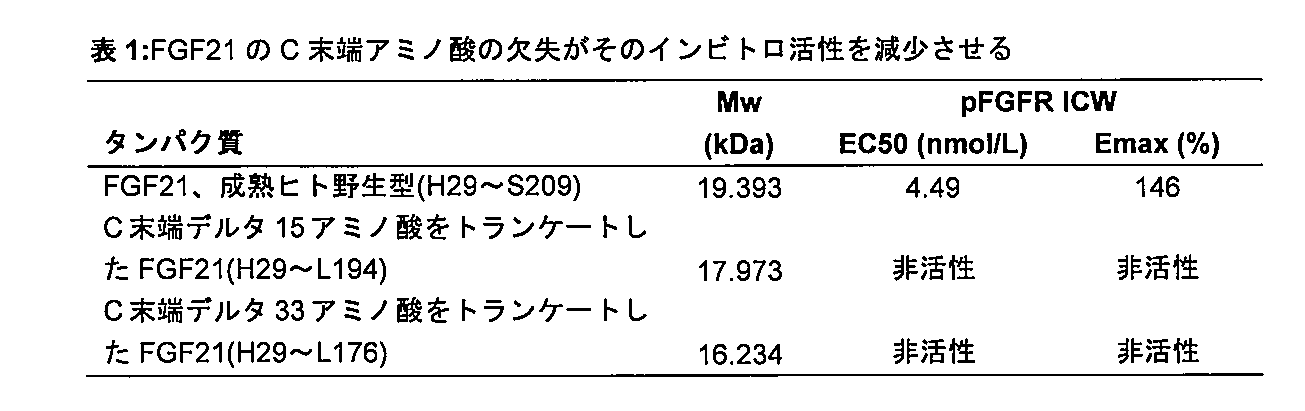
ヒトFGF21の代謝安定性についてさらに学ぶため、さらに血中でのタンパク質分解によって形成された代謝物質を特定するために、タンパク質を以下に説明されるように分析した。詳細には、15μmol/Lのヒト野生型FGF21(配列番号3)を、ヒト、マウス、およびラットのリチウムヘパリン血漿中において、37℃で60分間、インビトロでインキュベートした。インキュベーションの終了時に、試料を、製造元によって説明される手順に従って、Norgen Serum Depletion Kit(Norgen Biotek、ソロルド、オンタリオ、カナダ、17300番)によって後処理した。アルブミン、アルファ-アンチトリプシン、トランスフェリン、およびハプトグロビンを含む主要な血清タンパク質を、血漿試料から枯渇させた。4℃において、500μLの血漿試料を活性化スピンカラムに適用し、ベンチトップ微量遠心機において、6,700×gで1分間遠心分離し、フロースルーを捨てた。カラムを、500μLの洗浄緩衝液を加えて2回洗浄し、1分間の遠心分離を行った。カラムに100μLの溶離緩衝液を加えて1分間の遠心分離を2回繰り返すことによって、結合したタンパク質を溶出させた。 To learn more about the metabolic stability of human FGF21 and to identify metabolites formed by proteolysis in blood, the protein was analyzed as described below. In particular, 15 μmol/L human wild-type FGF21 (SEQ ID NO: 3) was incubated in vitro for 60 minutes at 37°C in human, mouse, and rat lithium heparin plasma. At the end of the incubation, the samples were post-treated with a Norgen Serum Depletion Kit (Norgen Biotek, Thorold, Ontario, Canada, #17300) according to the procedure described by the manufacturer. Major serum proteins, including albumin, alpha-antitrypsin, transferrin, and haptoglobin, were depleted from the plasma samples. At 4°C, 500 μL of plasma sample was applied to an activated spin column and centrifuged at 6,700×g for 1 minute in a benchtop microcentrifuge, and the flow-through was discarded. The column was washed twice with 500 μL of wash buffer and centrifuged for 1 min. Bound proteins were eluted by adding 100 μL of elution buffer to the column and centrifuging twice for 1 min.
代謝物質を、精密な質量計測(Thermo-Fisher LTQ-Orbitrap、NanoLC 1D Ultra、AS2 Autosampler)による陽イオン化モードでのm/z650からm/z1700の質量範囲内におけるイオントラップ質量分析計による液体クロマトグラフィ-質量分析(LC-MS)実験によって同定した。代謝物質同定に使用したHPLC条件は以下の通りであった:カラム、Vydac MS
C4 300 A、150mm×75μm(Grace、ローケレン、ベルギー);移動相:溶離液A、2%(v/v)のアセトニトリルを含む0.1%ギ酸溶液、および溶離液B、アセトニトリル+0.1%のギ酸;ランタイム、75分;流量:280nL/分。多荷電質量を、Magtranソフトウェア(Zhongqi Zhang)によってデコンボリューションし、形成された代謝物質のタンパク質配列を、GPMAWプログラム(Lighthouse Data、オデンセ、デンマーク)によって解明した。
Metabolites were identified by liquid chromatography-mass spectrometry (LC-MS) experiments with an ion trap mass spectrometer in the mass range of m/z 650 to m/z 1700 in positive ionization mode with accurate mass measurement (Thermo-Fisher LTQ-Orbitrap, NanoLC 1D Ultra, AS2 Autosampler). The HPLC conditions used for metabolite identification were as follows: column, Vydac MS
C4 300 A, 150 mm x 75 μm (Grace, Lokeren, Belgium); mobile phase: eluent A, 2% (v/v) acetonitrile in 0.1% formic acid solution, and eluent B, acetonitrile + 0.1% formic acid; runtime, 75 min; flow rate: 280 nL/min. Multiply charged masses were deconvoluted by Magtran software (Zhongqi Zhang) and protein sequences of the formed metabolites were elucidated by the GPMAW program (Lighthouse Data, Odense, Denmark).
血漿中での上記において説明したような1時間の配列番号3のFGF21のインキュベートにより、急速な切断が生じ、表2に一覧したようないくつかの代謝物質を検出することができた。ヒト野生型FGF21(配列番号1)の29位から199位までのアミノ酸配列に対応する切断生成物が、調査した全ての種の血漿中において形成された。この代謝物質は、18428.56Daの分子量を有するヒト-FGF21-デス-デカペプチドとして説明することができる。配列番号3のヒトFGF21およびその切断生成物の質量スペクトルおよびデコンボリューションを図1に提示する。 Incubation of FGF21 of SEQ ID NO:3 for 1 hour in plasma as described above resulted in rapid cleavage and allowed the detection of several metabolites, as listed in Table 2. A cleavage product corresponding to the amino acid sequence from positions 29 to 199 of human wild-type FGF21 (SEQ ID NO:1) was formed in the plasma of all species investigated. This metabolite can be described as human-FGF21-des-decapeptide with a molecular weight of 18428.56 Da. The mass spectrum and deconvolution of human FGF21 of SEQ ID NO:3 and its cleavage products are presented in Figure 1.
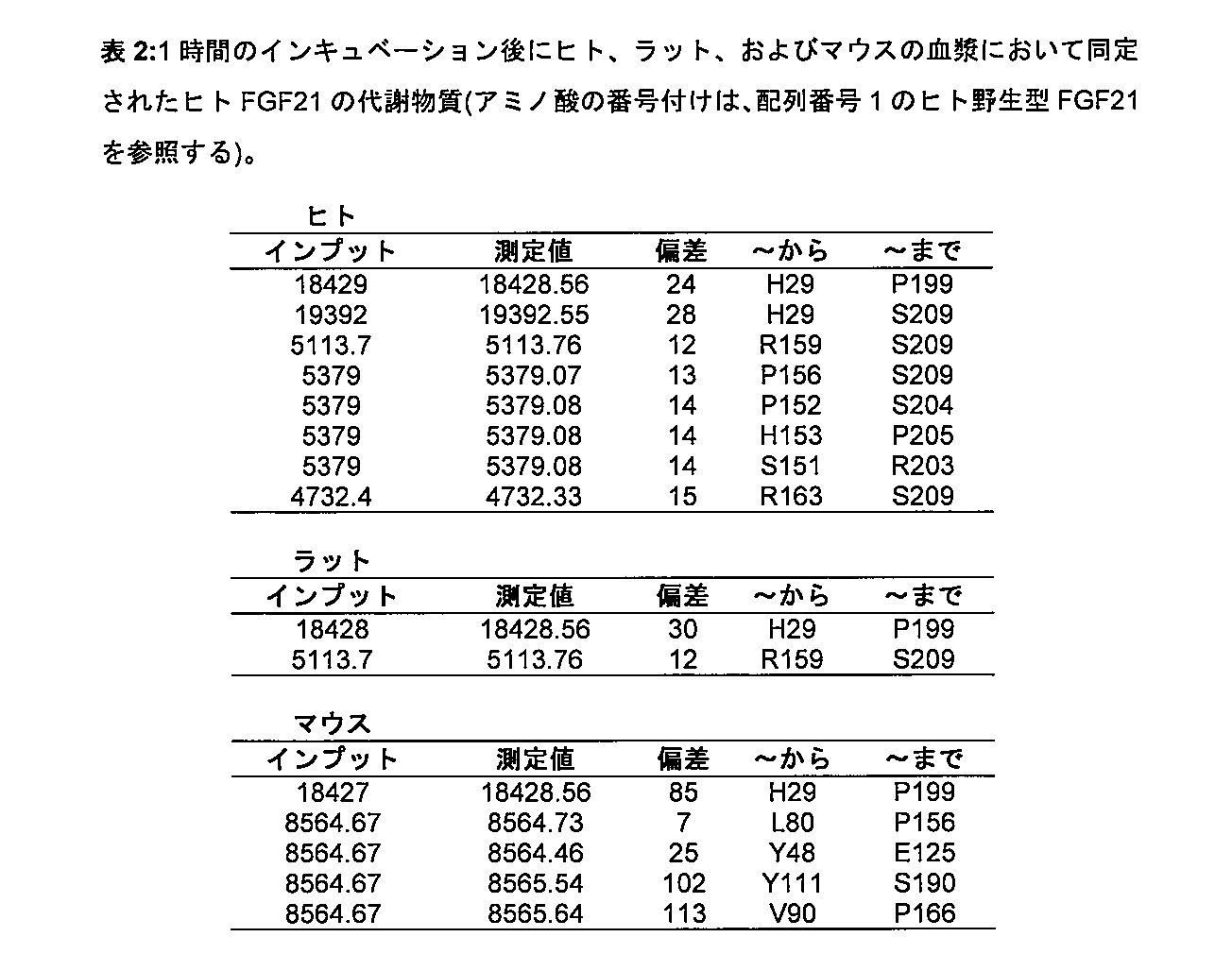
タンパク質をヒトまたはマウスの血漿中において最大24時間まで37℃でインキュベートし、サンドイッチイムノアッセイを使用した、残りの完全な全長FGF21タンパク質の分析によって、成熟ヒト野生型FGF21(配列番号2)および様々なFGF21変異体のインビトロ安定性を分析した。詳細には、成熟ヒトFGF21(配列番号2)または変異体を、血液試料(K2EDTA血漿、数人の健康なヒトドナーの混合物)に100ng/mLの濃度で加え、37℃で最大24時間までインキュベートした。0、1、8、および/または24時間後に、試料を採取し、2倍に濃縮したプロテアーゼ阻害剤(Protease Inhibitor Cocktail Tablets、Roche)を加えることによってインキュベーションを止めた。次いで、試料を、さらなる処理まで、-80℃に移した。続いて、残りの完全な全長FGF21タンパク質の量を、Human Intact FGF21 ELISA(F2131-K01、Eagle Biosciences、ナッシュア、ニューハンプシャー、米国)を使用して評価した。アッセイは、ベンダーによって説明される通りに、全長ヒト野生型FGF21(配列番号1)のアミノ酸aa29~35およびaa203~209に対応する、成熟ヒトFGF21のN末端(aa1-7)およびC末端(aa175~181)に特異的に結合する2種の選択された抗体によるサンドイッチ技術を利用した。インキュベート開始時の個々の試料それぞれの濃度を内部基準として使用し、後の時点で測定された濃度に関連付けた。 The in vitro stability of mature human wild-type FGF21 (SEQ ID NO:2) and various FGF21 mutants was analyzed by incubating the proteins in human or mouse plasma at 37°C for up to 24 hours and analyzing the remaining intact full-length FGF21 protein using a sandwich immunoassay. In particular, mature human FGF21 (SEQ ID NO:2) or mutants were added to blood samples (K2EDTA plasma, a mixture of several healthy human donors) at a concentration of 100 ng/mL and incubated at 37°C for up to 24 hours. After 0, 1, 8, and/or 24 hours, samples were taken and the incubation was stopped by adding 2-fold concentrated protease inhibitors (Protease Inhibitor Cocktail Tablets, Roche). Samples were then transferred to -80°C until further processing. The amount of intact full-length FGF21 protein remaining was then assessed using the Human Intact FGF21 ELISA (F2131-K01, Eagle Biosciences, Nashua, NH, USA). The assay utilized a sandwich technique with two selected antibodies that specifically bind to the N-terminus (aa1-7) and C-terminus (aa175-181) of mature human FGF21, corresponding to amino acids aa29-35 and aa203-209 of full-length human wild-type FGF21 (SEQ ID NO:1), as described by the vendor. The concentration of each individual sample at the start of incubation was used as an internal standard and related to the concentrations measured at later time points.
ヒトおよびマウスの血漿中での安定性について試験した組換えFGF21変異体の結果を表3にまとめ、代表的な結果を図2に示す。 The results of recombinant FGF21 mutants tested for stability in human and mouse plasma are summarized in Table 3, and representative results are shown in Figure 2.
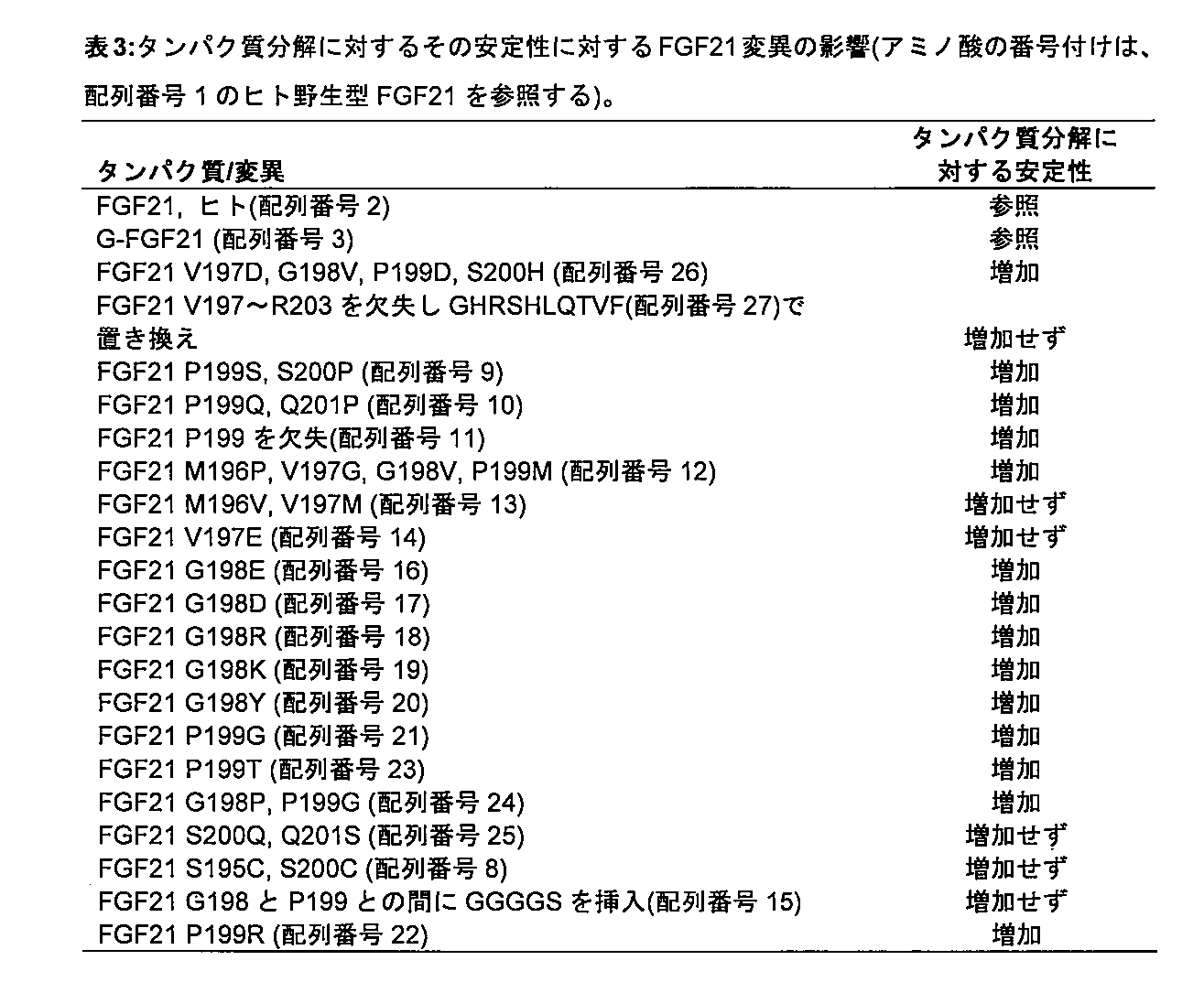
〔実施例3〕
CHO細胞におけるヒトFGF21受容体の有効性についてのインビトロ細胞アッセイ(In-Cell Western)
成熟ヒトFGF21(配列番号2)またはFGF21変異体の細胞インビトロ有効性を、特異的な高感度のIn-Cell Western(ICW)アッセイを使用して測定した。ICWアッセイは、通常、マイクロプレート形式において実施される、免疫細胞化学的アッセイである。In-Cell Western(Aguilar H.N.ら(2010)PLoS ONE 5(4):e9965頁)を使用するFGF21受容体自己リン酸化アッセイのために、ヒトベータ-Klotho(KLB)と共にヒトFGFR1cを安定して発現するCHO Flp-In細胞(Invitrogen、ダルムシュタット、ドイツ)を使用した。MPAキナーゼERK1/2の受容体自己リン酸化レベルまたは下流活性を決定するために、2×104細胞/ウェルを、96ウェルプレートに播種し、48時間培養した。細胞を、GlutaMAX(Gibco、ダルムシュタット、ドイツ)を伴う無血清培地ハムF-12 Nutrient Mixによって3~4時間、血清飢餓させた。続いて、細胞を、増加した濃度の、成熟ヒトFGF21(配列番号2)、示されたFGF21変異体、または他のペプチドのいずれかによって、37℃で5時間処理した。インキュベーション後、培地を捨て、細胞を、3.7%の新たに調製したパラ-ホルムアルデヒドにおいて20分間固定させた。20分間、PBS中で細胞に0.1%Triton-X-100を浸透させた。Odysseyブロッキングバッファー(LICOR、バートホンブルク、ドイツ)により、室温で2時間、ブロッキングを実施した。一次抗体として、抗pFGFR Tyr653/654(New England Biolabs、フランクフルト、ドイツ)または抗pERKホスホ-p44/42 MA
PキナーゼThr202/Tyr204(Cell Signaling)を加えて、4℃で一晩インキュベートした。一次抗体のインキュベーション後、細胞をPBS+0.1%Tween20で洗浄した。二次抗マウス800CW抗体(LICOR、バートホンブルク、ドイツ)を、室温で1時間インキュベートした。続いて、細胞をPBS+0.1%Tween20で再び洗浄し、Odyssey画像表示装置(LICOR、バートホンブルク、ドイツ)により、赤外色素シグナルを定量した。結果を、TO-PRO3染料(Invitrogen、カールスルーエ、ドイツ)によるDNAの定量化によって正規化した。任意単位(AU)としてデータを得て、用量-応答曲線からEC50値を得て、それらを表4にまとめる。図3は、ヒトFGFR1c+KLBを過剰発現するCHO細胞によるICWの結果を示している。
Example 3
In vitro cell assay for availability of human FGF21 receptor in CHO cells (In-Cell Western)
The cellular in vitro potency of mature human FGF21 (SEQ ID NO:2) or FGF21 mutants was measured using a specific and highly sensitive In-Cell Western (ICW) assay. The ICW assay is an immunocytochemical assay that is usually performed in a microplate format. For FGF21 receptor autophosphorylation assay using In-Cell Western (Aguilar H.N. et al. (2010) PLoS ONE 5(4):e9965), CHO Flp-In cells (Invitrogen, Darmstadt, Germany) stably expressing human FGFR1c with human beta-Klotho (KLB) were used. To determine receptor autophosphorylation levels or downstream activity of MPA kinase ERK1/2, 2x10⁴ cells/well were seeded in 96-well plates and cultured for 48 hours. Cells were serum-starved for 3-4 hours with serum-free medium Ham's F-12 Nutrient Mix with GlutaMAX (Gibco, Darmstadt, Germany). Subsequently, cells were treated with increasing concentrations of either mature human FGF21 (SEQ ID NO:2), the indicated FGF21 variants, or other peptides for 5 hours at 37°C. After incubation, medium was discarded and cells were fixed for 20 minutes in 3.7% freshly prepared para-formaldehyde. Cells were permeabilized with 0.1% Triton-X-100 in PBS for 20 minutes. Blocking was performed with Odyssey blocking buffer (LICOR, Bad Homburg, Germany) for 2 hours at room temperature. As primary antibodies, anti-pFGFR Tyr653/654 (New England Biolabs, Frankfurt, Germany) or anti-pERK phospho-p44/42 MA
P-kinase Thr202/Tyr204 (Cell Signaling) was added and incubated overnight at 4°C. After primary antibody incubation, cells were washed with PBS + 0.1
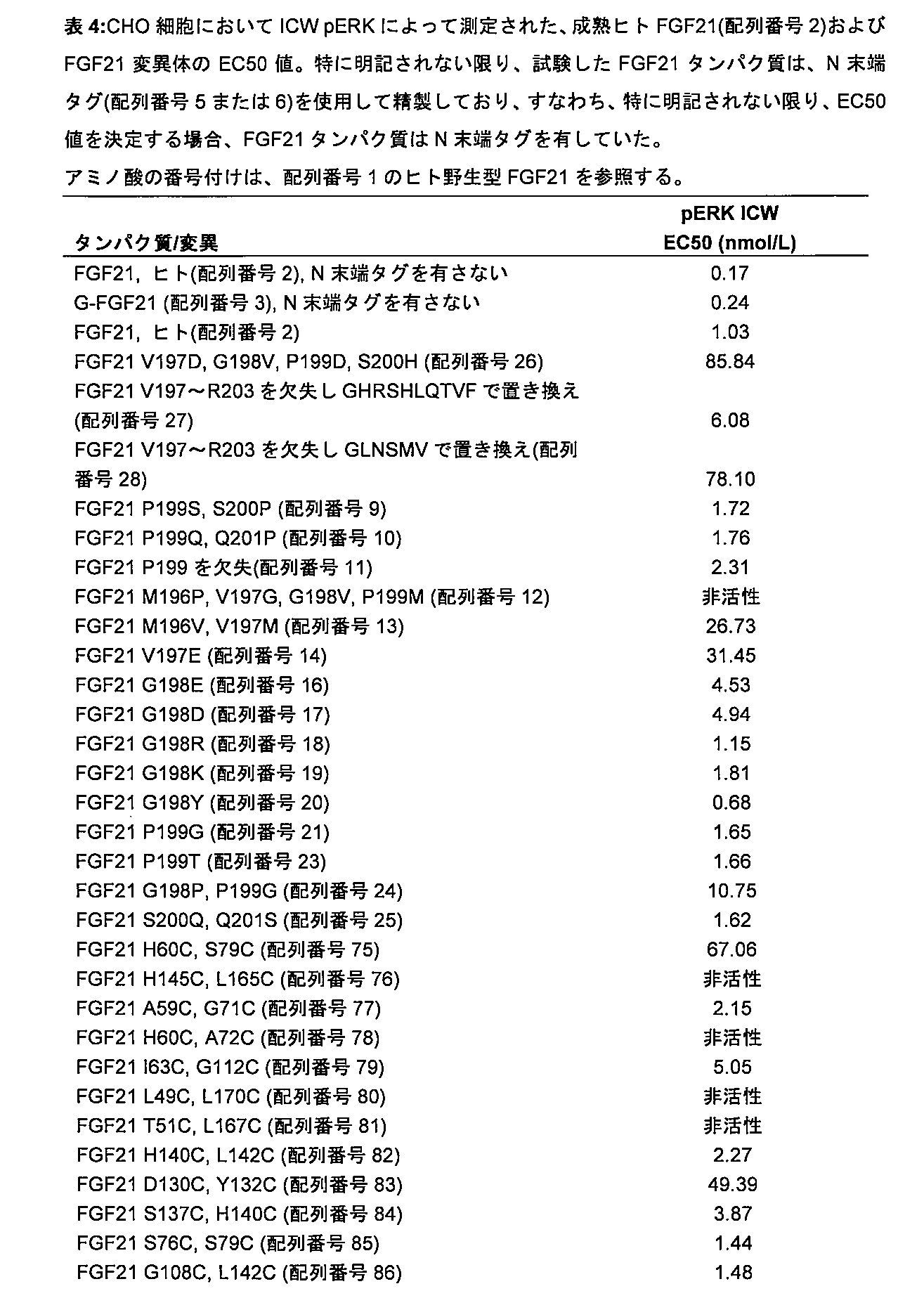
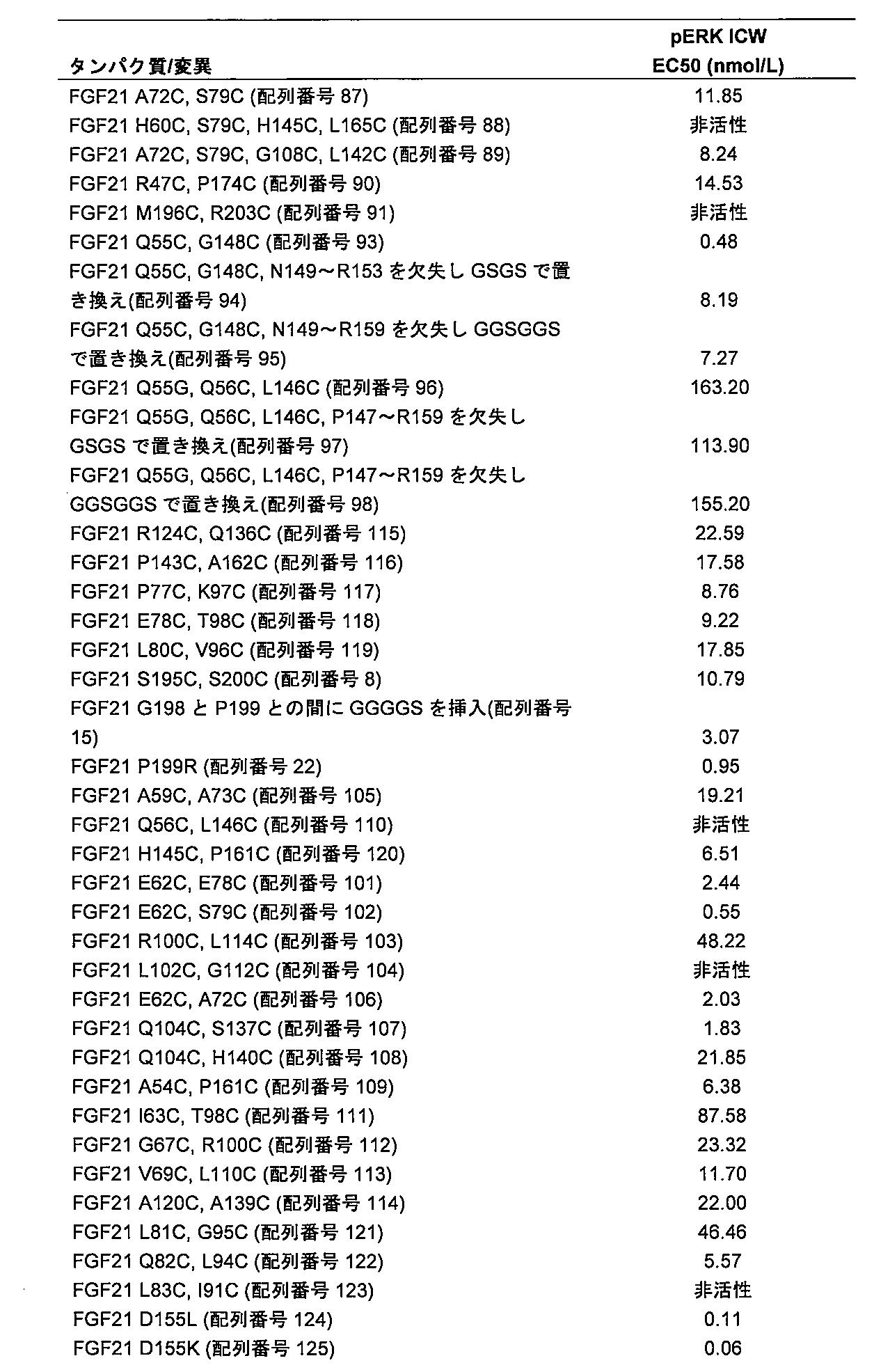

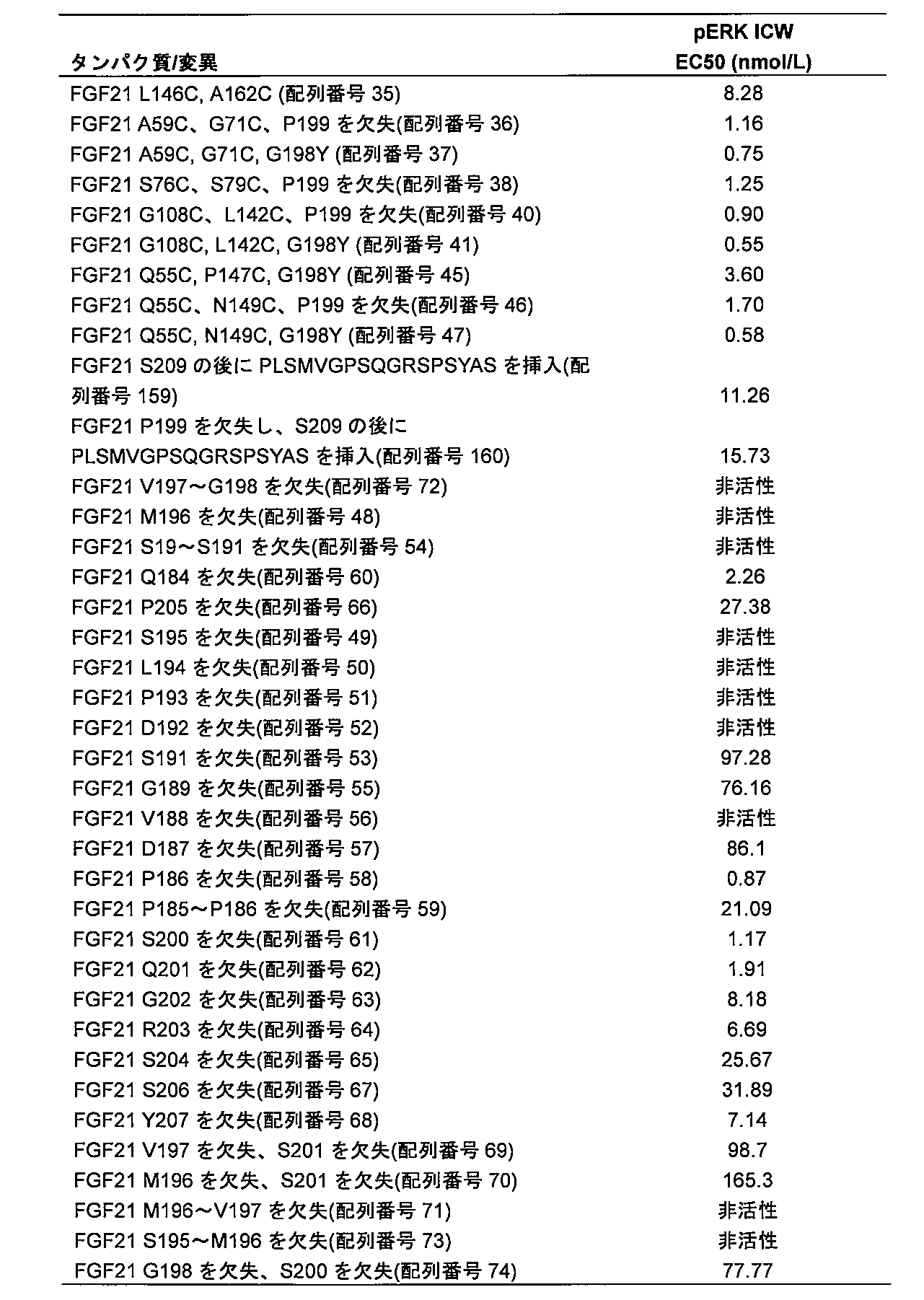
〔実施例4〕
初代ヒト脂肪細胞によるFGF21変異体のインビトロ活性測定
In-Cell Western(ICW)アッセイ(Aguilar H.N.ら(2010)PLoS ONE 5(4):e9965頁)を使用して、ヒト初代皮下脂肪
細胞により、ヒトFGF21(配列番号2)またはFGF21変異体の細胞インビトロ有効性も測定した。簡潔には、2.8×10⁴のヒト前脂肪細胞(PromoCell、ハイデルベルグ、ドイツ)を、96ウェルプレートの各ウェルに播種し、成熟脂肪細胞へと分化させた(Hemmrich K.ら(2005)Differentiation 73(1):28~35頁;Lee M.J.(2014)Methods Enzymol.538:49~65頁)。MAPキナーゼERK1/2活性化の刺激の前に、細胞を、無血清培地(1g/lのDMEM/ハムF-10培地(1:1、v/v)(PAN-Biotech、アイデンバッハ、ドイツ)、15mmol/LのHEPES、pH7.4、33μmol/Lのビオチン、17μmol/Lのパントテン酸)によって3~4時間、血清飢餓させた。続いて、細胞を、増加した濃度の、成熟ヒトFGF21(配列番号2)、示されたFGF21変異体、または他のペプチドのいずれかによって、37℃で5分間処理した。インキュベーション後、培地を捨て、細胞を、3.7%の新たに調製したパラ-ホルムアルデヒドにおいて20分間固定させた。20分間、PBS中において細胞に0.1%Triton-X-100を浸透させた。Odysseyブロッキングバッファー(LICOR、バートホンブルク、ドイツ)により、室温で2時間、ブロッキングを実施した。一次抗体として、抗pERK ホスホ-p44/42 MAPキナーゼThr202/Tyr204(Cell Signaling)を加えて、4℃で一晩インキュベートした。一次抗体のインキュベーション後、細胞をPBS+0.1%Tween20で洗浄した。二次抗マウス800CW抗体(LICOR、バートホンブルク、ドイツ)を、室温で1時間インキュベートした。続いて、細胞をPBS+0.1%Tween20で再び洗浄し、Odyssey画像表示装置(LICOR、バートホンブルク、ドイツ)により、赤外色素シグナルを定量した。結果を、TO-PRO3染料(Invitrogen、カールスルーエ、ドイツ)によるDNAの定量化によって正規化した。任意単位(AU)としてデータを得て、表4AおよびBに示すように、用量-応答曲線からEC50値を得た。EC50値を表5にまとめる。
Example 4
In Vitro Activity Measurement of FGF21 Mutants with Primary Human Adipocytes The cellular in vitro potency of human FGF21 (SEQ ID NO:2) or FGF21 mutants was also measured with primary human subcutaneous adipocytes using the In-Cell Western (ICW) assay (Aguilar H.N. et al. (2010) PLoS ONE 5 (4):e9965). Briefly, 2.8x10⁴ human preadipocytes (PromoCell, Heidelberg, Germany) were seeded into each well of a 96-well plate and differentiated into mature adipocytes (Hemmrich K. et al. (2005) Differentiation 73(1):28-35; Lee M.J. (2014) Methods Enzymol. 538:49-65). Prior to stimulation of MAP kinase ERK1/2 activation, cells were serum-starved for 3-4 hours with serum-free medium (1 g/l DMEM/Ham's F-10 medium (1:1, v/v) (PAN-Biotech, Aidenbach, Germany), 15 mmol/L HEPES, pH 7.4, 33 μmol/L biotin, 17 μmol/L pantothenic acid). Subsequently, cells were treated with increasing concentrations of either mature human FGF21 (SEQ ID NO:2), the indicated FGF21 variants, or other peptides for 5 minutes at 37°C. After incubation, the medium was discarded and cells were fixed in 3.7% freshly prepared para-formaldehyde for 20 minutes. Cells were permeabilized with 0.1% Triton-X-100 in PBS for 20 minutes. Blocking was performed with Odyssey blocking buffer (LICOR, Bad Homburg, Germany) for 2 h at room temperature. Primary antibody anti-pERK phospho-p44/42 MAP kinase Thr202/Tyr204 (Cell Signaling) was added and incubated overnight at 4°C. After primary antibody incubation, cells were washed with PBS + 0.1
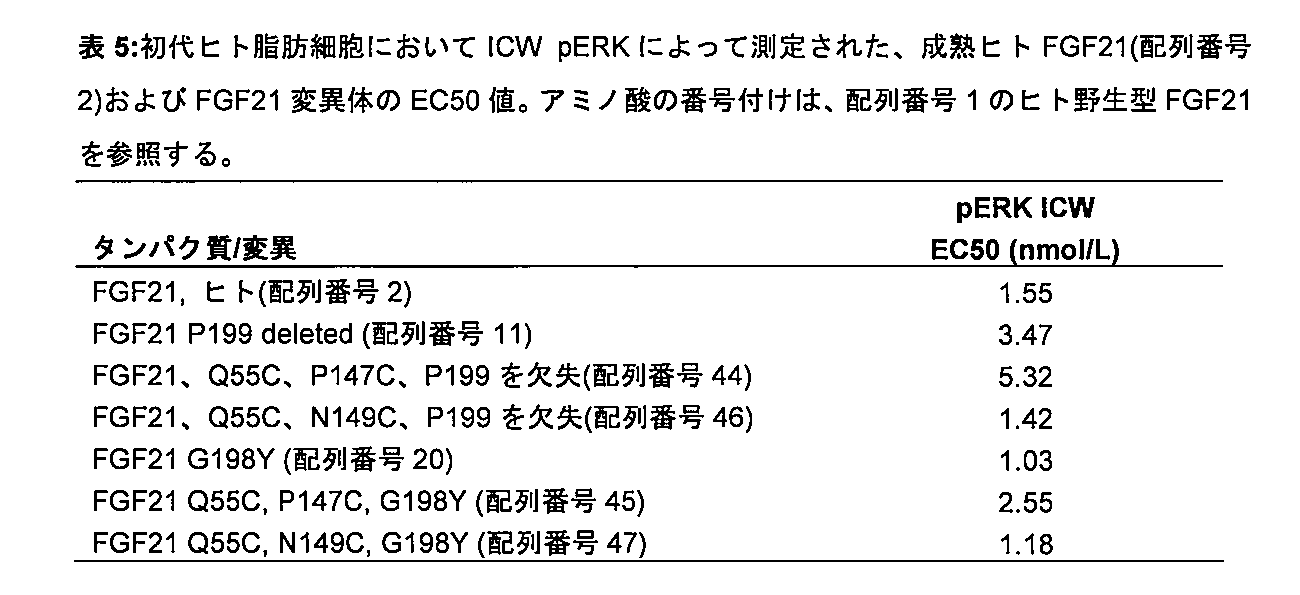
〔実施例5〕
ヒトFGF21およびFGF21変異体の熱安定性の分析
熱安定性に対するFGF21における変異の影響を分析するために、リガンドの安定化の探求に使用した示差走査型蛍光定量法(DSFまたはThermoFluor(商標))アッセイをまねて、サーマルシフトアッセイを適用した(Ahmad S.ら(2012)Protein Science 21:433~446頁;Pantolianoら(2001)J.Biomol.Screen 6:429~440頁;Niesen
ら(2007)Nat.Protoc.2:2212~21頁)。このアッセイは、疎水性蛍光染料、例えば、Sypro(商標)Orange(Life Technologies、カタログ番号S6651)など、の観察に基づいており、これらは、タンパク質上の疎水性パッチに結合したときにその蛍光を増加させる。タンパク質が加熱時にアンフォールドする場合、そのような疎水性パッチをタンパク質に曝露することにより、蛍光の増加を、アンフォールディングの程度の指標として、したがって、タンパク質の熱安定性のための指標として、使用することができる。
Example 5
Analysis of Thermal Stability of Human FGF21 and FGF21 Mutants To analyze the effect of mutations in FGF21 on thermal stability, a thermal shift assay was applied, mimicking the Differential Scanning Fluorometry (DSF or ThermoFluor™) assay used to explore ligand stabilization (Ahmad S. et al. (2012) Protein Science 21:433-446; Pantoliano et al. (2001) J. Biomol. Screen 6:429-440; Niesen et al. (2002) J. Biomol. Screen 6:429-440).
(2007) Nat. Protoc. 2:2212-21). This assay is based on the observation that hydrophobic fluorescent dyes, such as Sypro™ Orange (Life Technologies, Cat. No. S6651), increase their fluorescence when bound to hydrophobic patches on proteins. By exposing such hydrophobic patches to the protein, if the protein unfolds upon heating, the increase in fluorescence can be used as an indicator of the extent of unfolding and therefore for the thermal stability of the protein.
PBS(Gibco)中のタンパク質の溶液を、Sypro(商標)Orangeの160倍溶液(供給元によって提供される5000倍のDMSOストックから水中で希釈した)と混合することによって、FGF21変異体を試験した。試料体積を、PBSによって20μlに調節した。典型的な条件では、最終混合物中に0.8mg/mlのFGF21変異体タンパク質および8倍のSypro(商標)Orangeが含有されたが、タンパク質濃度は、0.4mg/mlから1.2mg/mlの間で変えることができた。試料を、96ウェルPCRプレート(BioRad Semi-Skirt 96 white)に分配し、気泡を除去するために簡潔に遠心分離した。プレートを、BioRad iQ5リアルタイムPCR装置に挿入し、1℃/分の昇温速度において10℃から90℃の熱勾配をかけた。蛍光の励起および量子化のために、485nmおよび575nmの波長のフィルタを選択した。データ処理のために、Biorad iQ5スタンダードエディションソフトウェア(v.2.0.148.60623)を使用した。温度に対する蛍光強度の曲線において、溶融温度(TM)のための指標として、変曲点を選択した。レファレンスとしてヒトFGF21(配列番号3)を各プレートに含ませた。図5は、選択されたFGF21変異体の代表的な溶融曲線を示しており、表6に、ヒトFGF21(配列番号3)に関するTM値の違いを一覧する。 FGF21 mutants were tested by mixing a solution of protein in PBS (Gibco) with a 160x solution of Sypro™ Orange (diluted in water from a 5000x DMSO stock provided by the supplier). Sample volume was adjusted to 20 μl with PBS. Typical conditions contained 0.8 mg/ml FGF21 mutant protein and 8x Sypro™ Orange in the final mixture, but protein concentration could vary between 0.4 mg/ml and 1.2 mg/ml. Samples were dispensed into a 96-well PCR plate (BioRad Semi-Skirt 96 white) and briefly centrifuged to remove air bubbles. The plate was inserted into a BioRad iQ5 real-time PCR instrument and a thermal gradient was applied from 10°C to 90°C at a heating rate of 1°C/min. Filters with wavelengths of 485 nm and 575 nm were selected for fluorescence excitation and quantization. Biorad iQ5 Standard Edition software (v.2.0.148.60623) was used for data processing. In the curves of fluorescence intensity versus temperature, the inflection point was selected as an indicator for the melting temperature (T M ). Human FGF21 (SEQ ID NO:3) was included in each plate as a reference. Figure 5 shows representative melting curves of selected FGF21 mutants, and Table 6 lists the differences in T M values with respect to human FGF21 (SEQ ID NO:3).

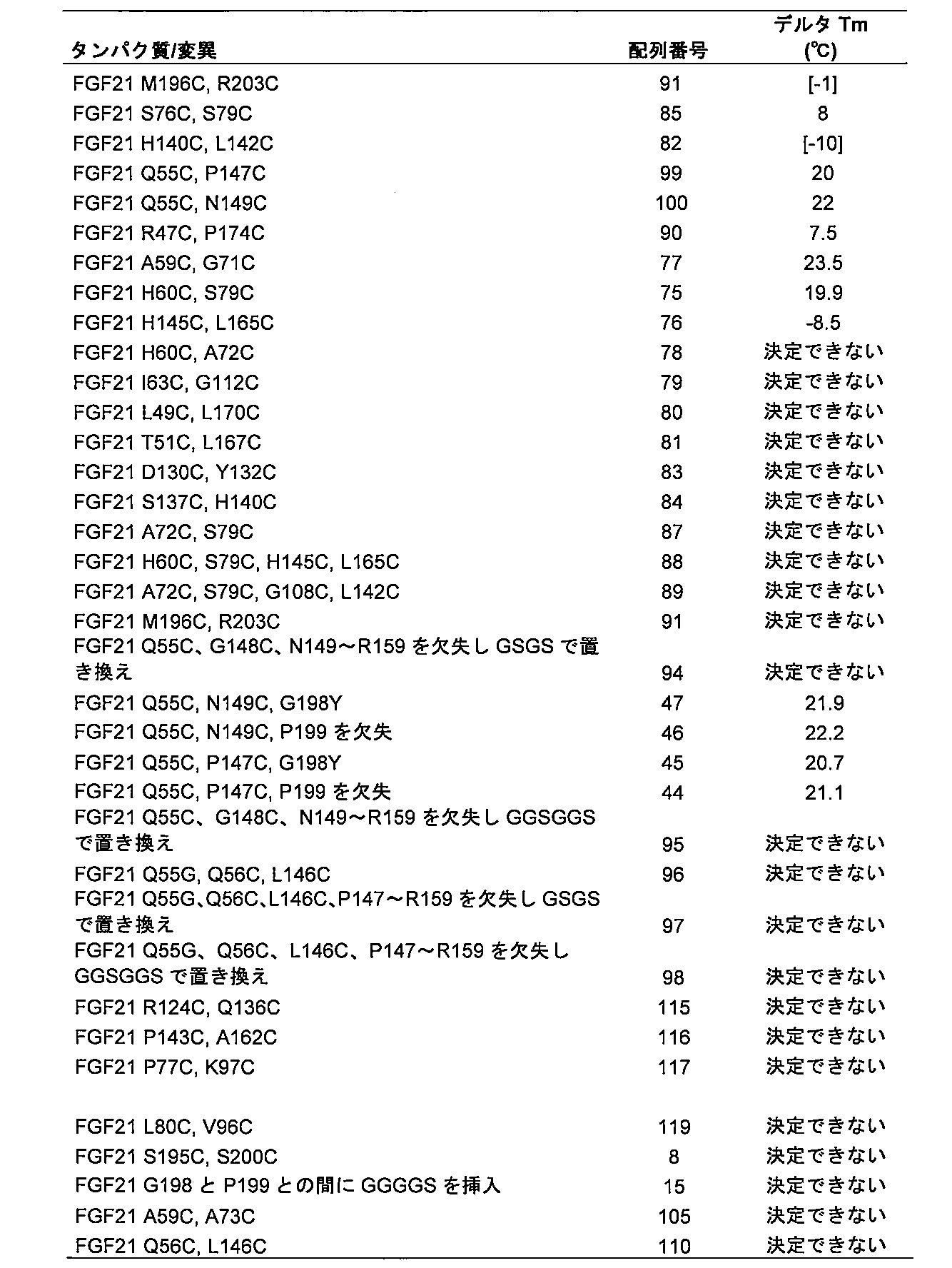
〔実施例6〕
熱安定性変異体の設計およびFGF21 Q55C、N149C(配列番号158)のX線結晶構造。
RCSB Protein Data Bank(PDB)のような公開データベース
には、FGF21の構造は蓄積されていないため、SWISS-MODEL相同モデリングサーバー(Kieferら(2009)Nucleic Acids Res.37:D387~D392)またはソフトウェアプログラムBioLuminate(BioLuminate、バージョン1.0、Schrodinger、 LLC、ニューヨーク、NY、2012)を使用して、ヒトFGF21(配列番号2)の様々な相同モデルを作り出した。これらのモデルは、公開されているFGF19(Goetzら(2007)Mol.Cell.Biol.27:3417~3428頁;PDBコード2P23;Harmer (2004)Biochemistry 43:629~640頁;PDBコード1PWA)およびFGF23(Goetzら(2007)Mol.Cell.Biol.27:3417~3428頁;PDBコード2P39)の結晶構造に基づいている(図6)。ジスルフィド架橋を導入するため、可能性のある部位の一覧を作製するために、BioLuminateを使用して、様々なモデルをさらなる分析にかけた。発現および実験的試験のための候補の最終選択のために、ソフトウェアプログラムPYMOL(The PyMOL Molecular Graphics System、バージョン1.7 Schrodinger,LLC)を使用して、可能性のある配置をモデル構造において目視により調べた。
Example 6
Design of thermostable mutants and the X-ray crystal structure of FGF21 Q55C, N149C (SEQ ID NO: 158).
Since the structure of FGF21 is not stored in public databases such as the RCSB Protein Data Bank (PDB), various homology models of human FGF21 (SEQ ID NO:2) were generated using the SWISS-MODEL homology modeling server (Kiefer et al. (2009) Nucleic Acids Res. 37:D387-D392) or the software program BioLumine (BioLumine, version 1.0, Schrödinger, LLC, New York, NY, 2012). These models were based on the published crystal structures of FGF19 (Goetz et al. (2007) Mol. Cell. Biol. 27:3417-3428; PDB code 2P23; Harmer (2004) Biochemistry 43:629-640; PDB code 1PWA) and FGF23 (Goetz et al. (2007) Mol. Cell. Biol. 27:3417-3428; PDB code 2P39) (Figure 6). The various models were subjected to further analysis using BioLumine to generate a list of potential sites for introducing disulfide bridges. For final selection of candidates for expression and experimental testing, potential configurations were visually inspected in the model structure using the software program PYMOL (The PyMOL Molecular Graphics System, version 1.7 Schrodinger, LLC).
ヒトFGF21を結晶化させるため、改変およびトランケートした変異体(ヒトFGF21 S34~E176、Q55C、N149C;配列番号158)を発現させ、上記において説明されるように精製した(実施例1)。結晶は、ハンギングドロップ蒸気拡散法によって成長させた。タンパク質を、50mmol/Lのトリス、pH8.0、0.5mol/LのNaCl中において12mg/mLまで濃縮した。リザーバ溶液は、100mmol/のトリス、pH8.5中に2mol/LのNH4SO4を含んでいた。100nLのタンパク質溶液を100nLのリザーバ溶液と混合し、20℃で平衡させた。2週間以内に結晶が現れた。20%から25%(体積/体積)のエチレングリコールを補ったリザーバ溶液に結晶を浸してから、液体窒素中において急速冷凍することによって、凍結保護を達成した。 To crystallize human FGF21, engineered and truncated mutants (human FGF21 S34-E176, Q55C, N149C; SEQ ID NO: 158) were expressed and purified as described above (Example 1). Crystals were grown by hanging drop vapor diffusion. Protein was concentrated to 12 mg/mL in 50 mmol/L Tris, pH 8.0, 0.5 mol/L NaCl. Reservoir solution contained 2 mol/L NH 4 SO 4 in 100 mmol/L Tris, pH 8.5. 100 nL of protein solution was mixed with 100 nL of reservoir solution and equilibrated at 20° C. Crystals appeared within 2 weeks. Cryoprotection was achieved by immersing the crystals in reservoir solution supplemented with 20% to 25% (vol/vol) ethylene glycol, followed by flash freezing in liquid nitrogen.
フィリゲン、スイスにおけるSwiss Light Source(SLS)のビームラインPX-IIIにおいてX線回折データを収集し、XDS(Kabsch W.(2010)Acta Crystallogr.D66:125~132頁)によって処理し、autoProc(Vonrhein C.ら(2011)Acta Crystallogr.D67:293~302頁)において実践されるようにAimless(Evans P.R.(2006)Acta Crystallogr.D62:72~82頁)によりスケーリングした。結晶は、空間群P4132のものであり、非対称単位に2つのFGF21 Q55C、N149C分子を含有していた。この結晶の単位格子寸法は、以下の通りであった:a=b=c=136.7Å。結晶は、2.97Åの解像度に回折され、Rmargeは10.5%であった。 X-ray diffraction data were collected at beamline PX-III at the Swiss Light Source (SLS) in Villigen, Switzerland, processed by XDS (Kabsch W. (2010) Acta Crystallogr. D66:125-132) and scaled by Aimless (Evans P.R. (2006) Acta Crystallogr. D62:72-82) as implemented in autoProc (Vonrhein C. et al. (2011) Acta Crystallogr. D67:293-302). The crystal was of space group P4 1 32 and contained two FGF21 Q55C, N149C molecules in the asymmetric unit. The unit cell dimensions of this crystal were as follows: a=b=c=136.7 Å. The crystal diffracted to a resolution of 2.97 Å with an Rmerge of 10.5%.
構造は、プログラムPhaserを使用して分子置換によって決定した(McCoy A.J.ら(2007)J.Appl.Crystallogr.40:658~674頁)。FGF19(Protein Data Bankコード1pwa)、FGF23(Protein Data Bankコード2p39)、およびFGF9(Protein Data Bankコード2P39)の結晶構造を重ね合わせ、約5Å超異なる全てのループを除去した。得られたアンサンブルを、サーチモデルとして使用し、結果として、明確な解を生じた。Phaserは、3つのFGFアンサンブルを位置した。しかしながら、三番目のアンサンブルの電子密度は非常に弱かったため、このアンサンブルは削除した。モデル構築は、Cootによって行い(Emsley P.ら(2010)Acta Crystallogr.D66:486~501頁)、洗練は、Buster(Bricogne G.ら(2011)Cambridge、United Kingd
om:Global Phasing Ltd.)およびRefmac5(Murshudov G.N.ら(2011)Acta Crystallogr.D67:355~367頁)によって行った。最終的なRfactorは25.5%であり、自由Rfactorは28.6%であった。これらのRfactorは比較的高く、結晶におけるある特定の量の無秩序性を示し得る。
The structure was determined by molecular replacement using the program Phaser (McCoy A.J. et al. (2007) J. Appl. Crystallogr. 40:658-674). The crystal structures of FGF19 (Protein Data Bank code 1pwa), FGF23 (Protein Data Bank code 2p39), and FGF9 (Protein Data Bank code 2P39) were superimposed and all loops differing by more than about 5 Å were removed. The resulting ensemble was used as a search model, resulting in an unambiguous solution. Phaser located three FGF ensembles. However, the electron density for the third ensemble was very weak, so this ensemble was deleted. Model building was performed by Coot (Emsley P. et al. (2010) Acta Crystallogr. D66:486-501) and refinement was performed by Buster (Bricogne G. et al. (2011) Cambridge, United Kingdom).
om: Global Phasing Ltd.) and Refmac5 (Murshudov G.N. et al. (2011) Acta Crystallogr. D67:355-367). The final Rfactor was 25.5% and the free Rfactor was 28.6%. These Rfactors are relatively high and may indicate a certain amount of disorder in the crystals.
FGF21 Q55C、N149C(配列番号158)の最終モデルにおいて、分子Aは、残基G42~K150およびP158~G169を含有しており;分子Bは、残基P36~H154およびP156~L170を含有していた。両分子において、P150とR159との間のループは、著しく無秩序であり、これは、この領域の高い柔軟性を示している。 In the final model of FGF21 Q55C, N149C (sequence number 158), molecule A contained residues G42-K150 and P158-G169; molecule B contained residues P36-H154 and P156-L170. In both molecules, the loop between P150 and R159 was highly disordered, indicating high flexibility in this region.
そのような高い柔軟性のループは、タンパク質の熱的アンフォールディングの出発点を表していると仮定することができる。したがって、ジスルフィド結合によるこの領域の安定化は、FGF21変異体H29~S209 Q55C、N149C(配列番号100)または隣接する変異体H29~S209 Q55C、P147C(配列番号99)に対して評価した場合の約20℃の熱安定性の著しい増加を説明することができる。 It can be hypothesized that such highly flexible loops represent the starting point for thermal unfolding of the protein. Stabilization of this region by disulfide bonds could therefore explain the significant increase in thermal stability of about 20°C when evaluated for the FGF21 mutant H29-S209 Q55C, N149C (SEQ ID NO: 100) or the adjacent mutant H29-S209 Q55C, P147C (SEQ ID NO: 99).
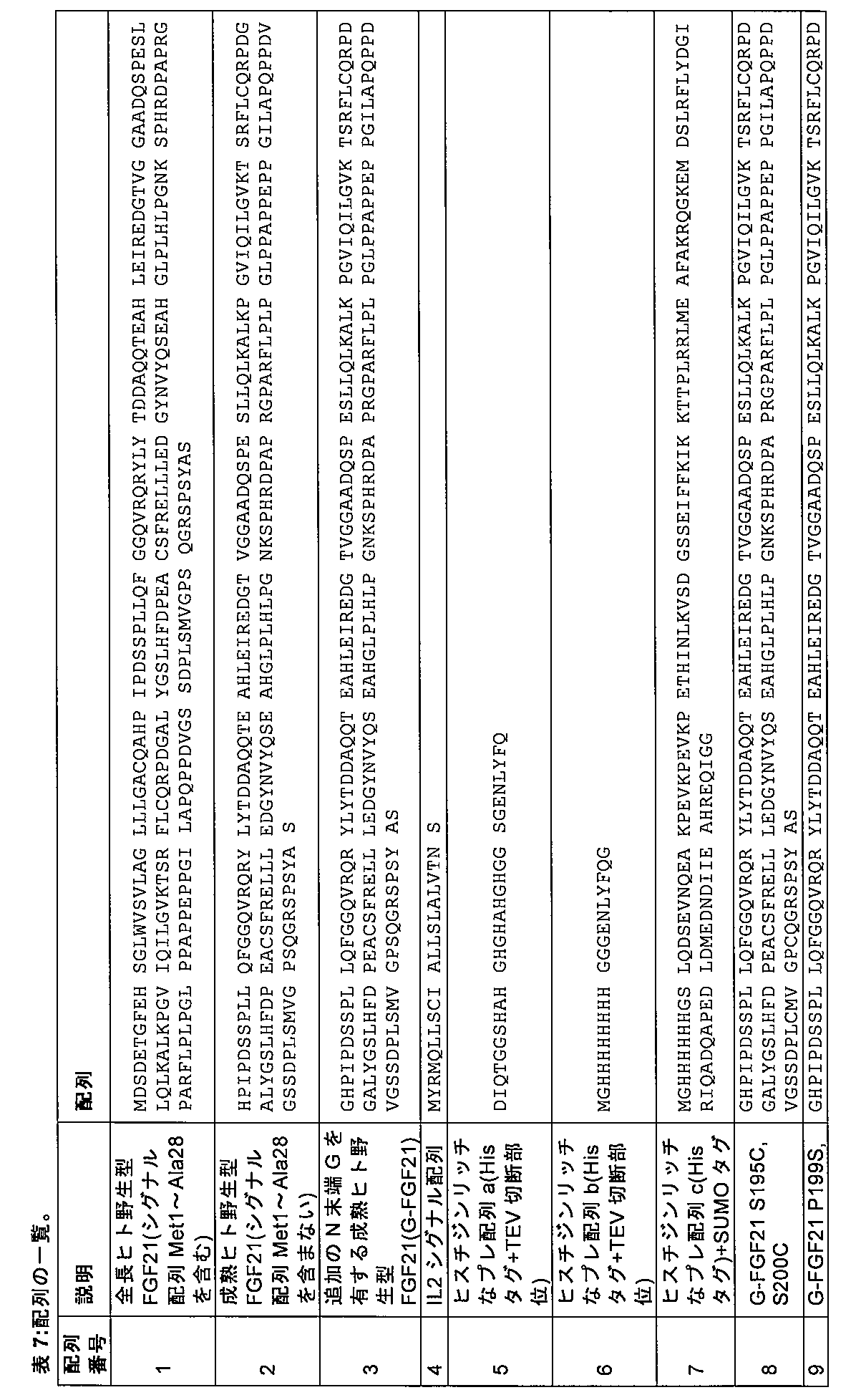

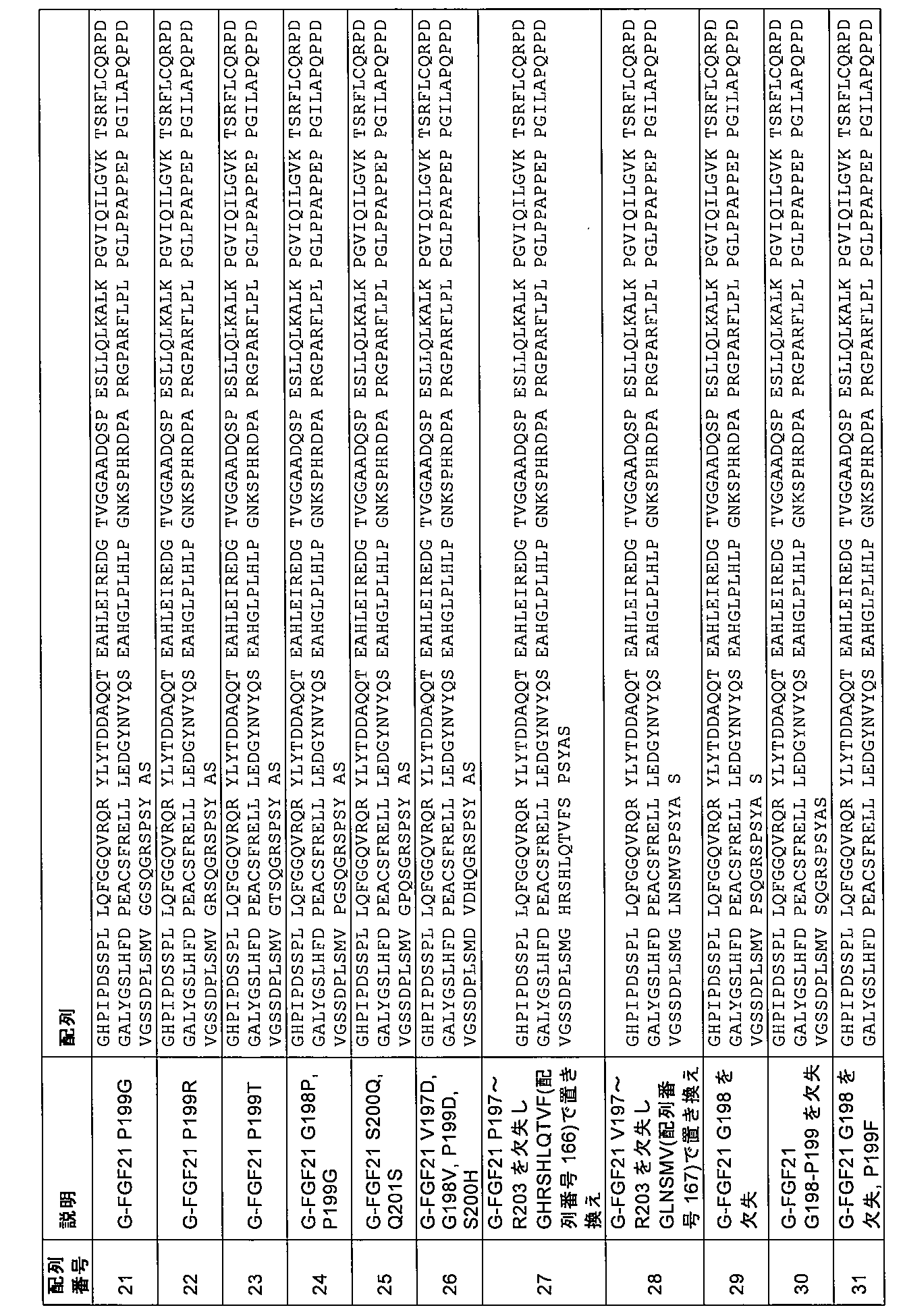
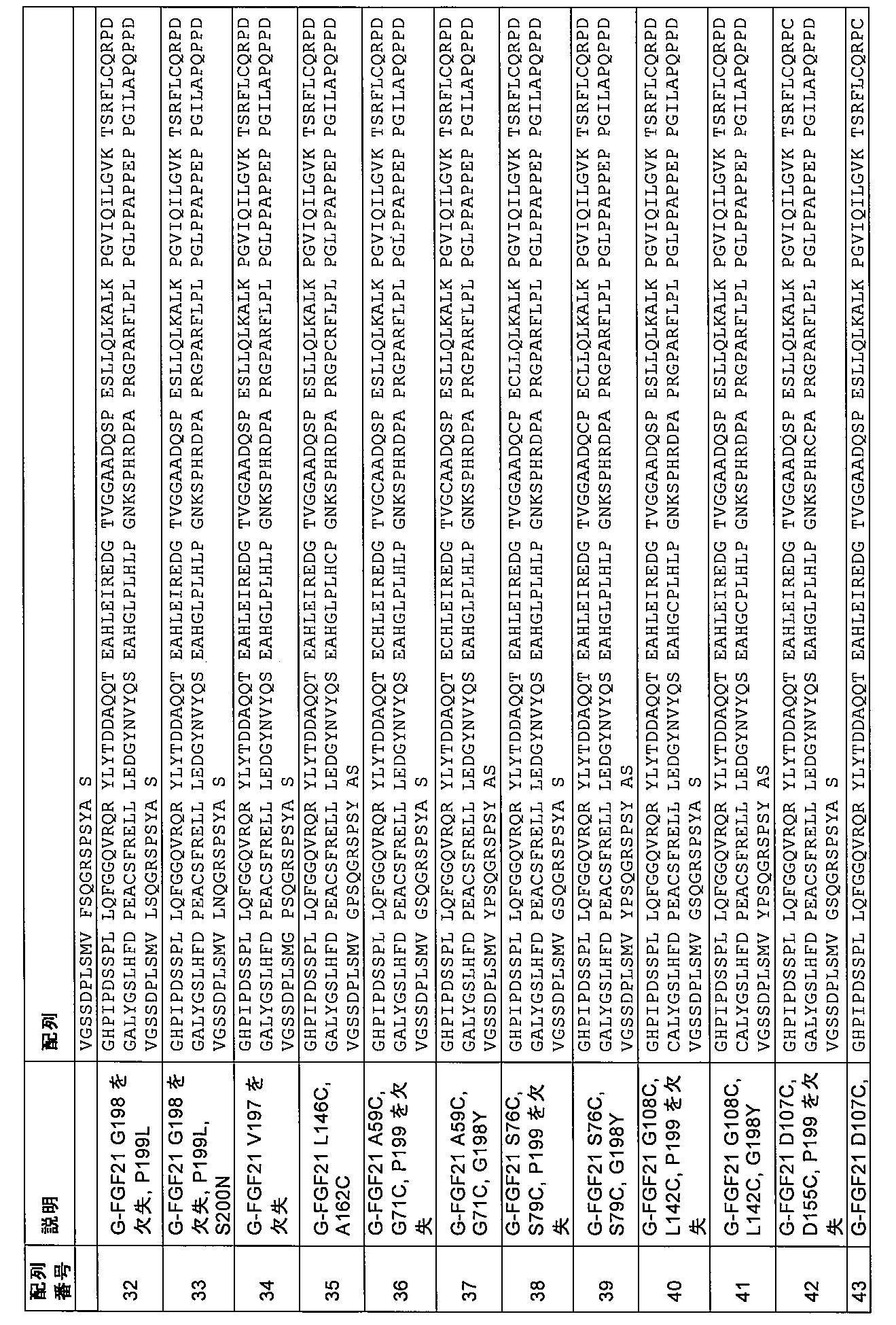


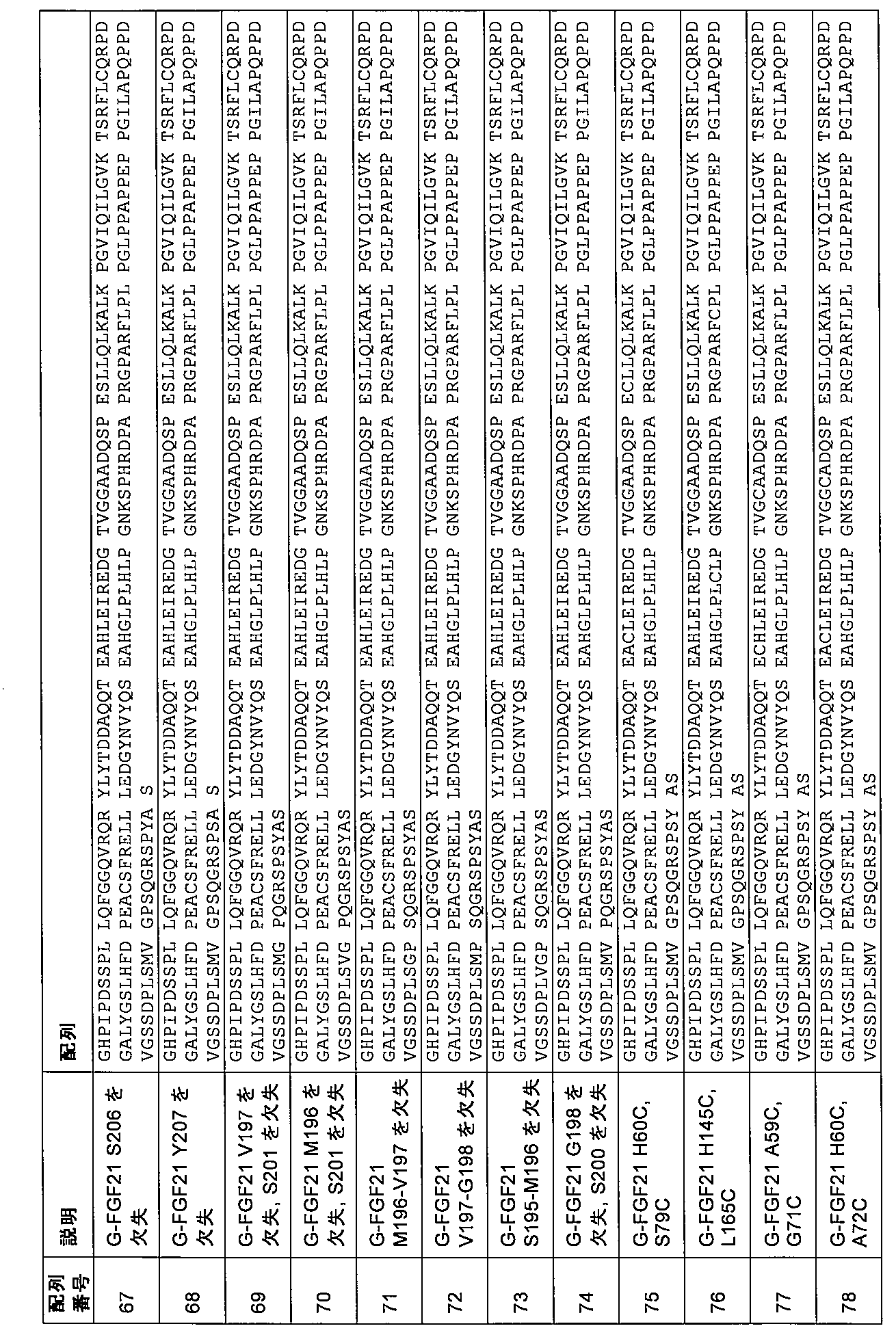
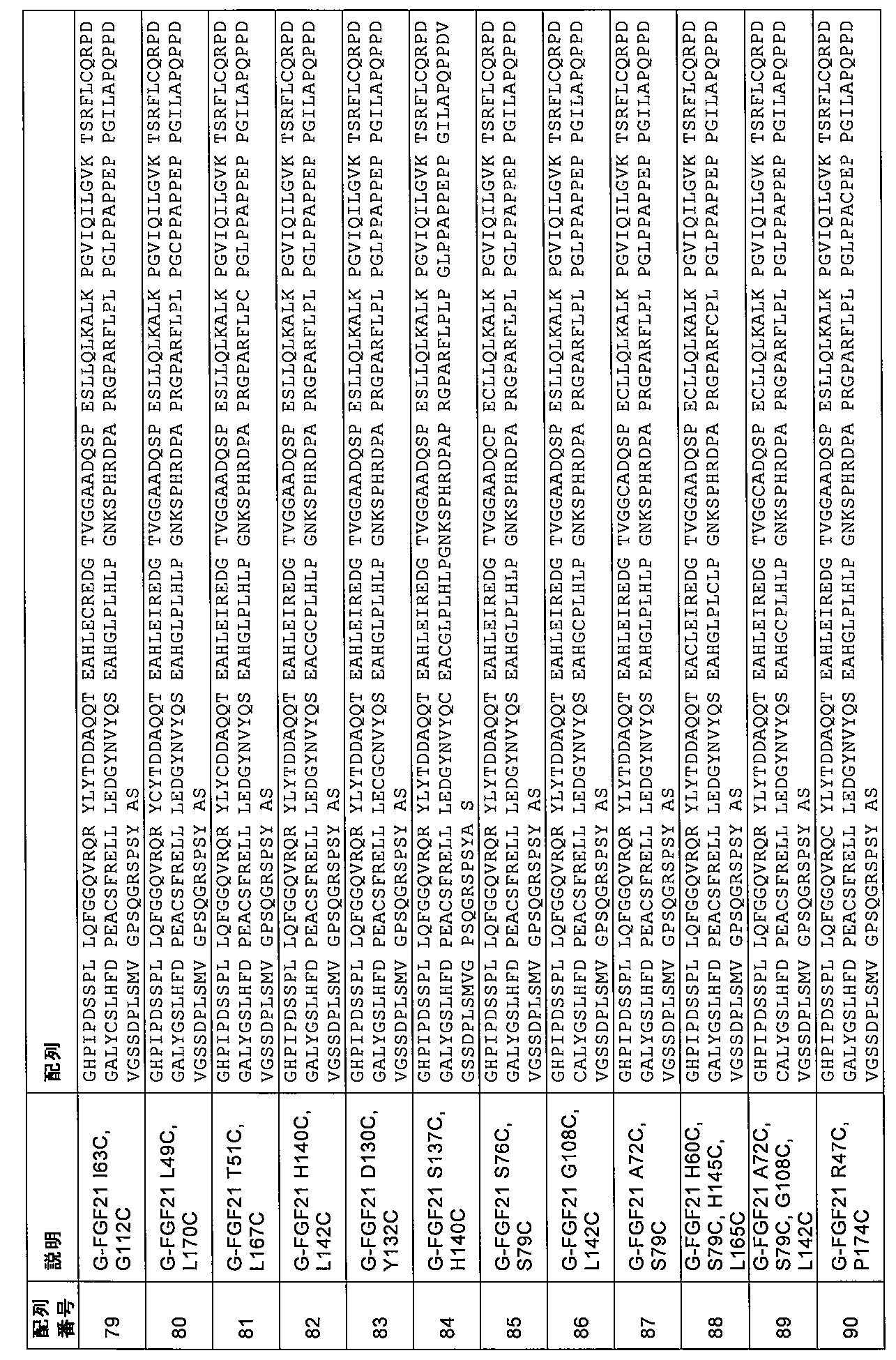

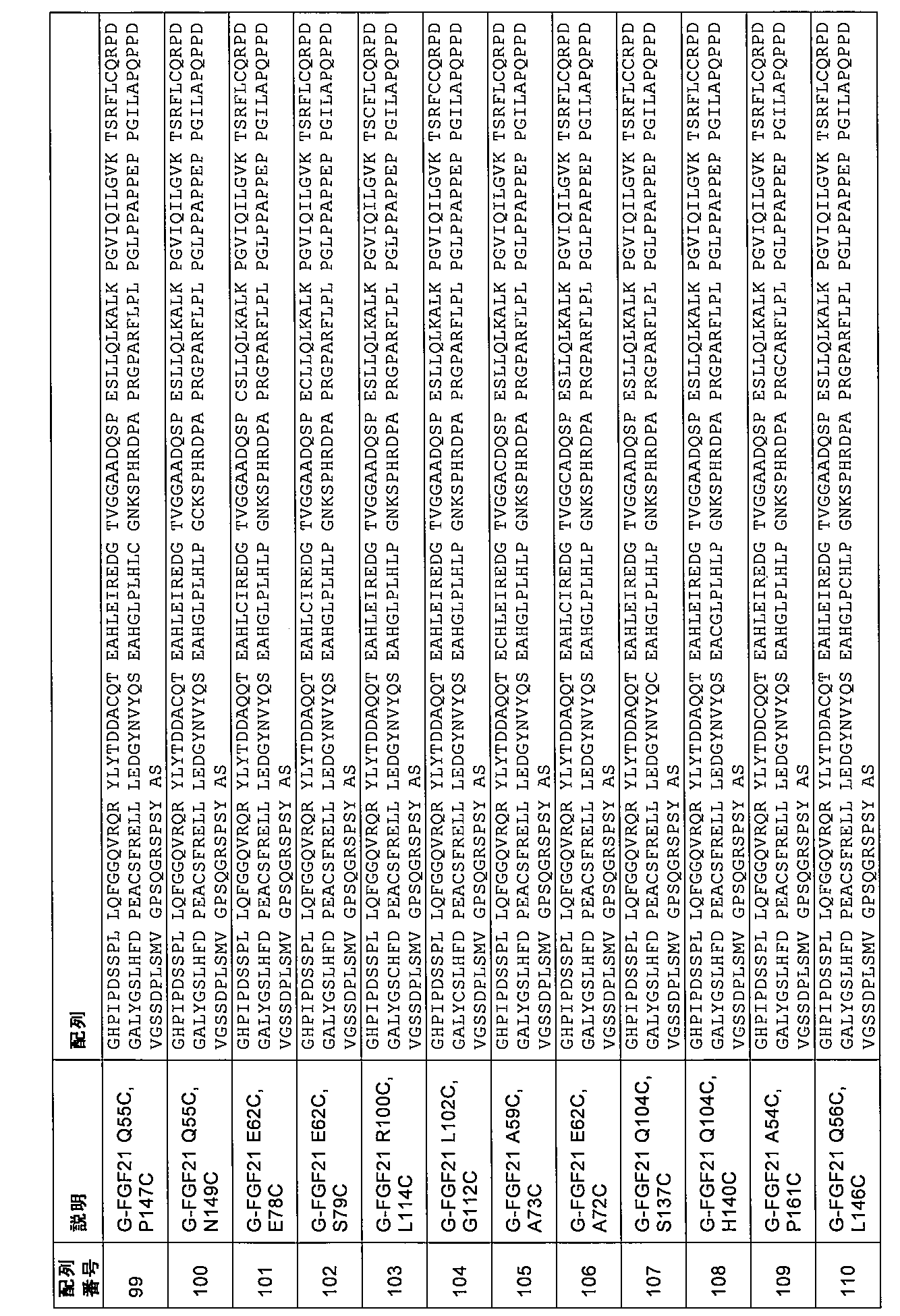
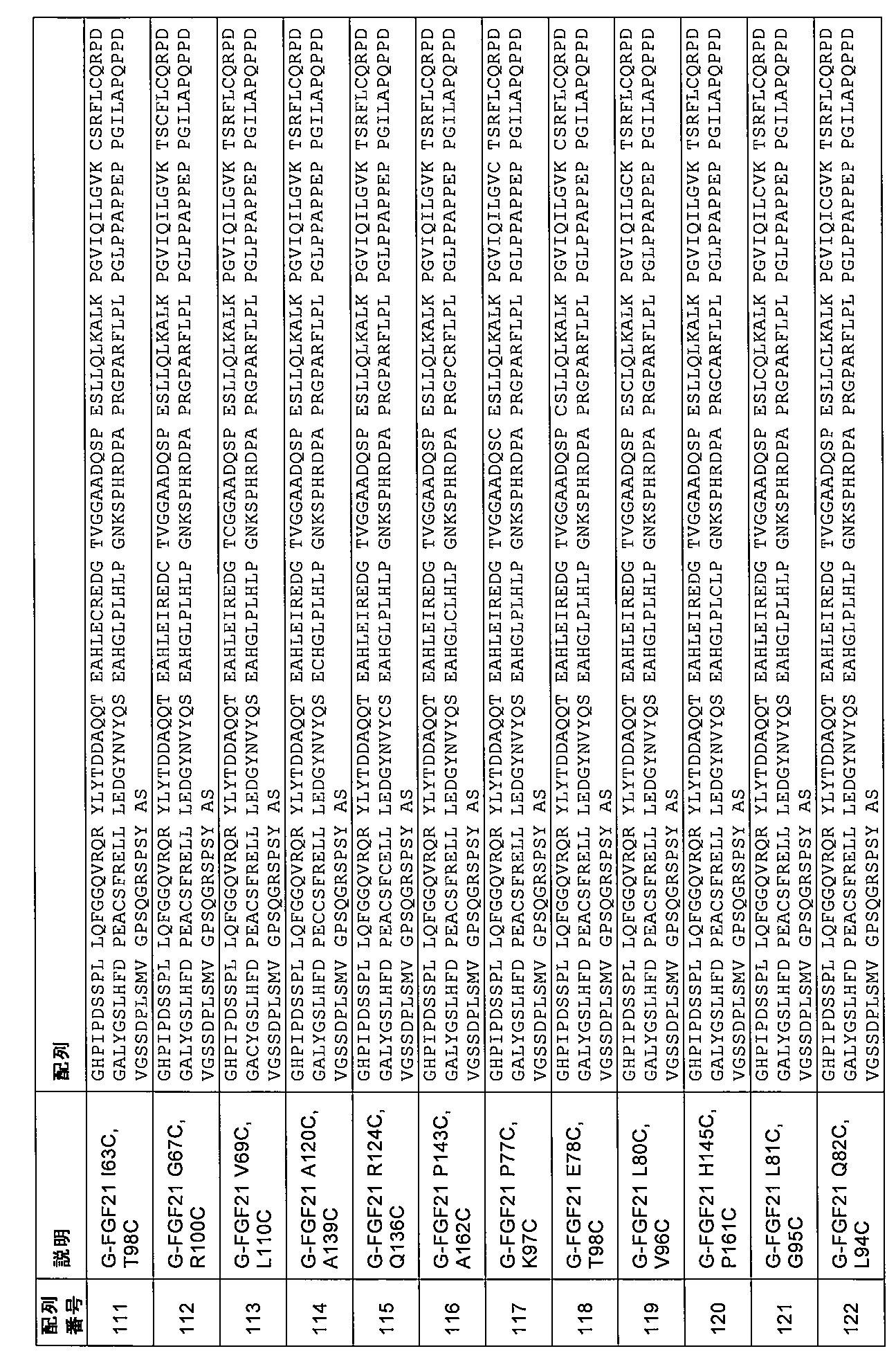
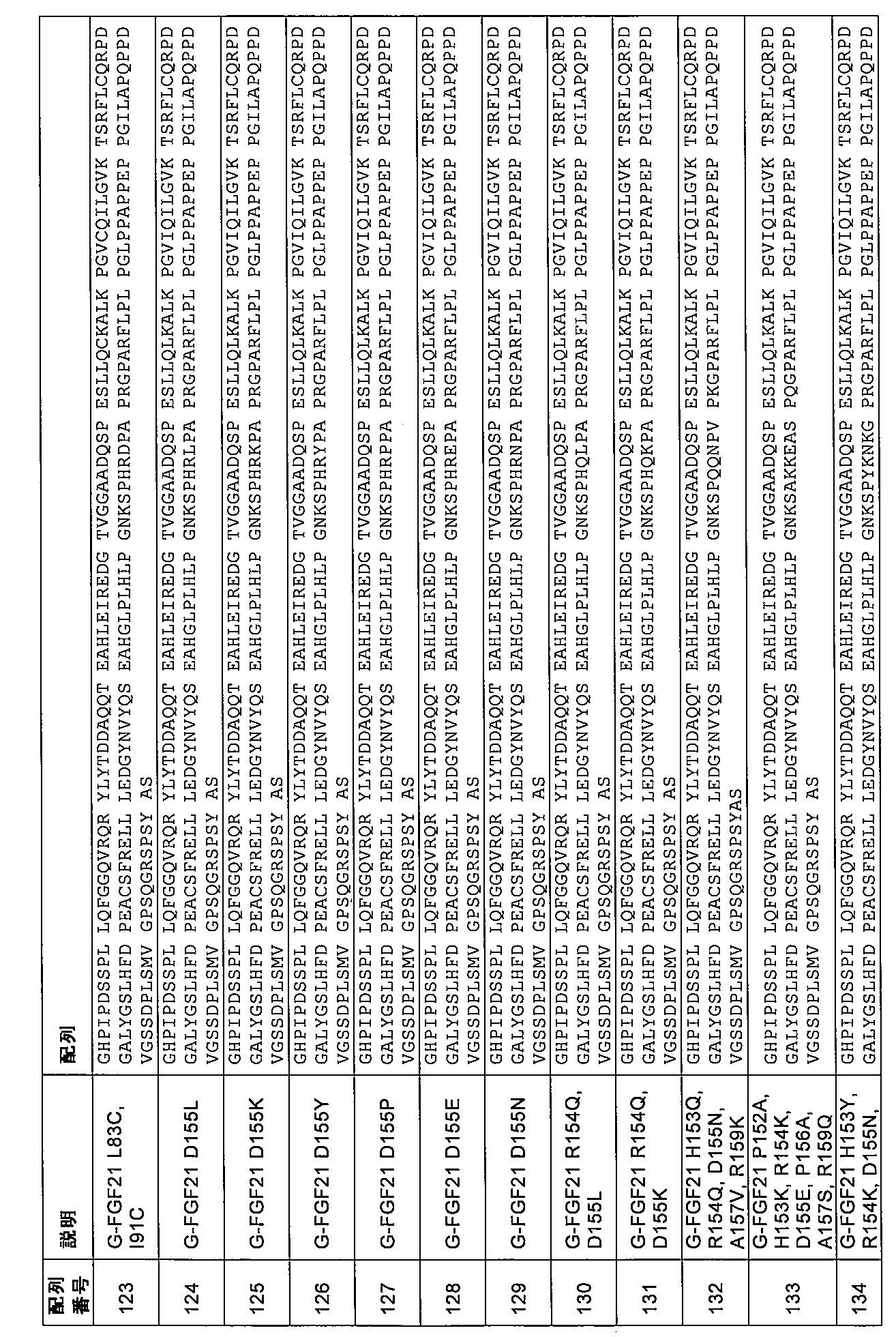

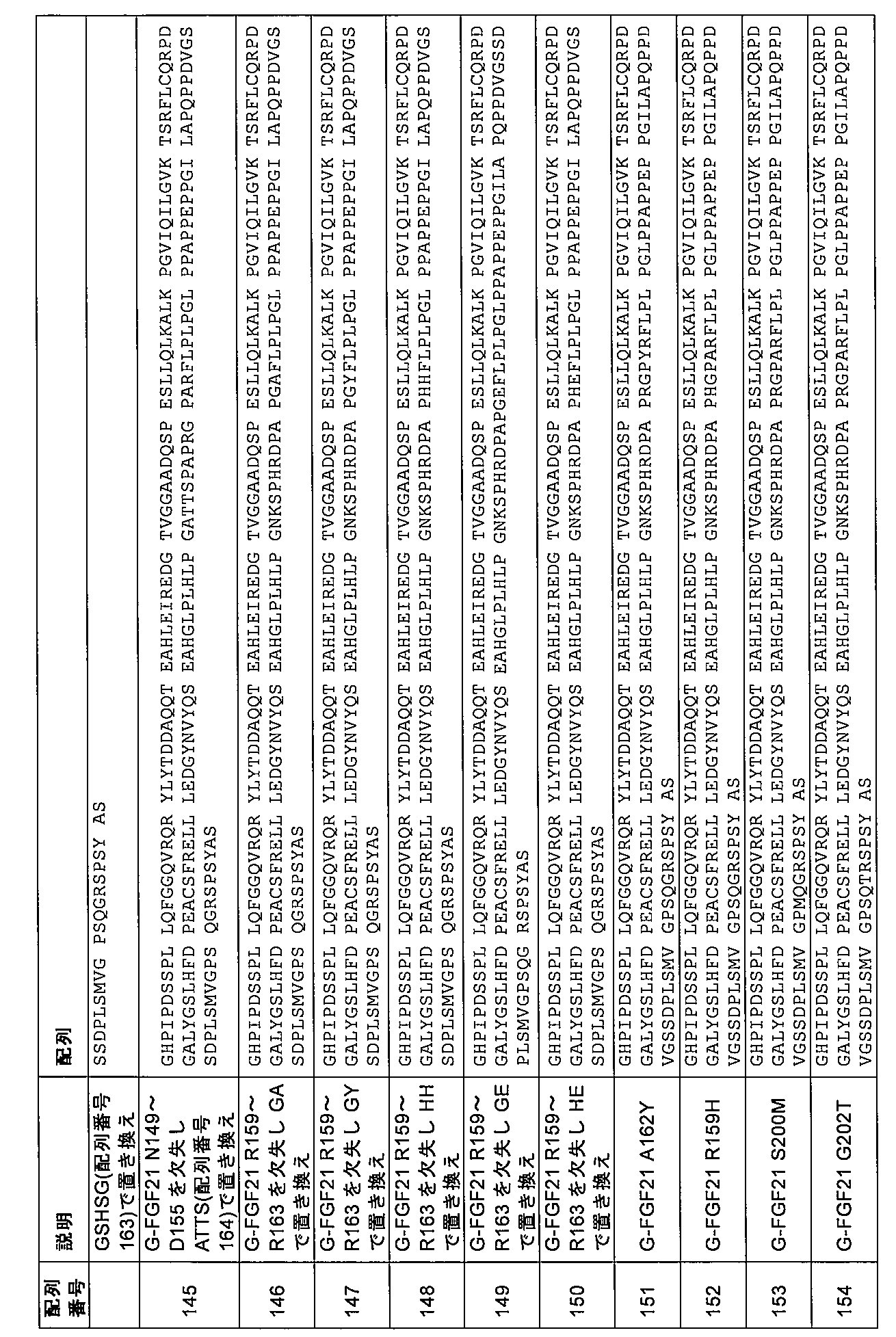

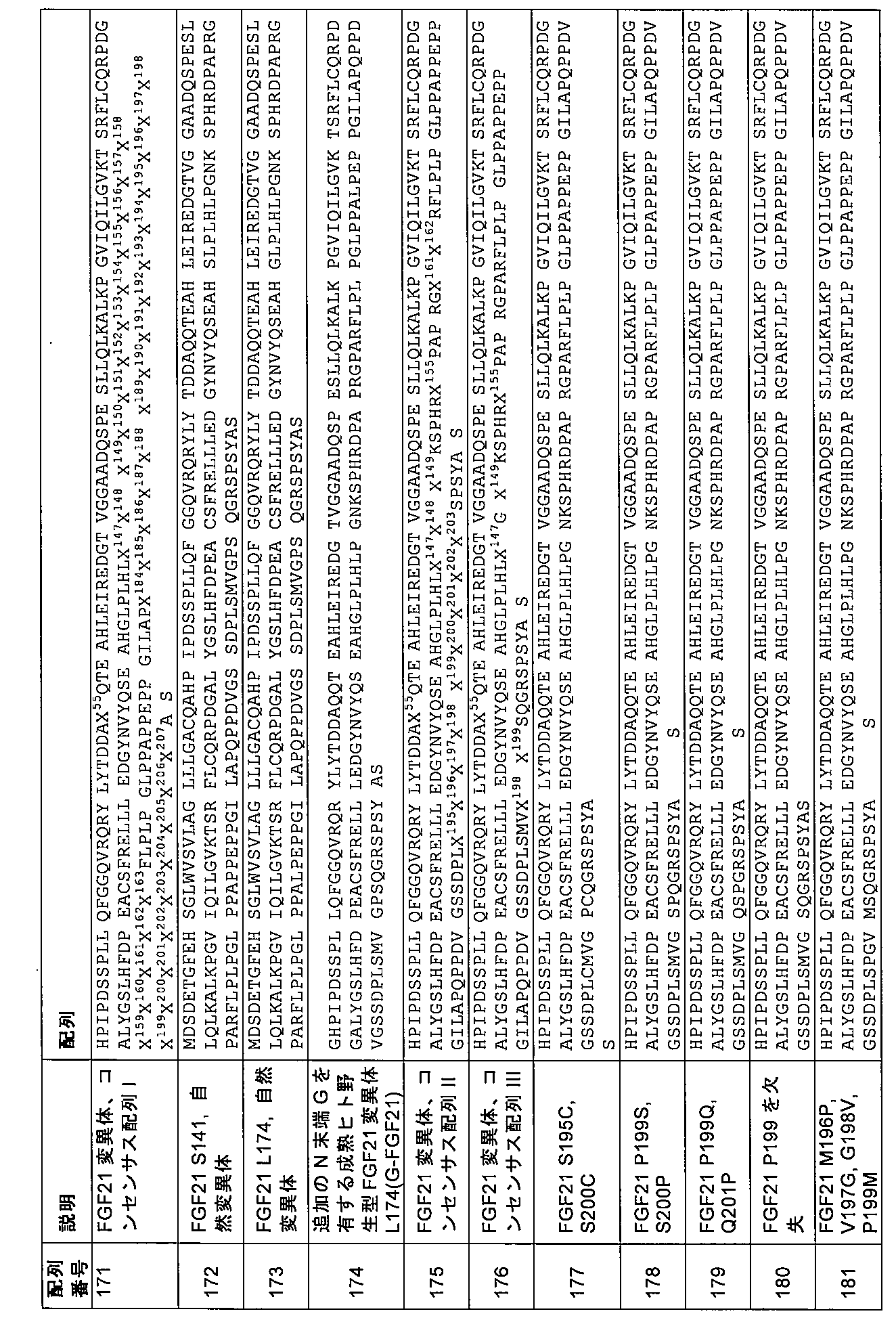


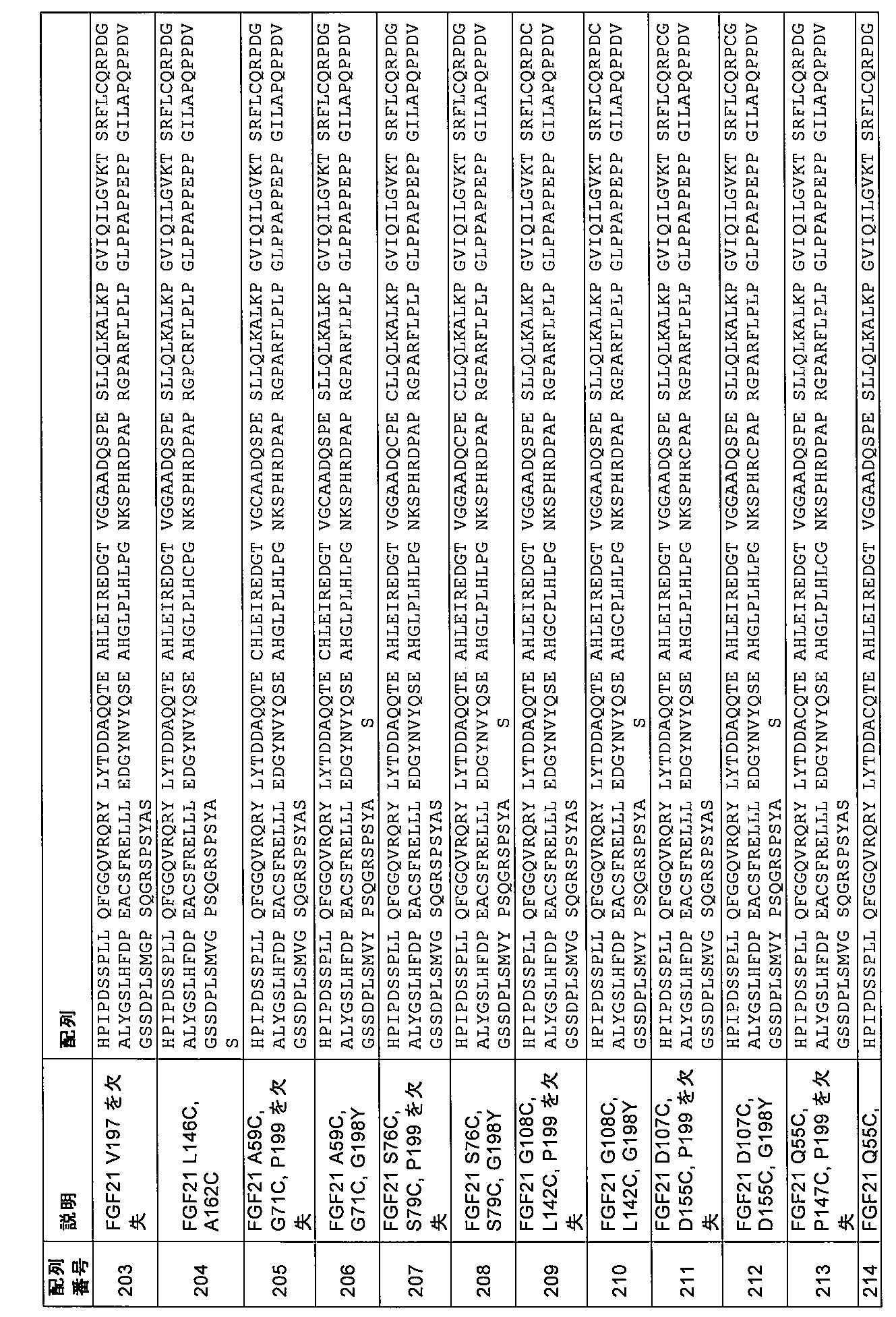
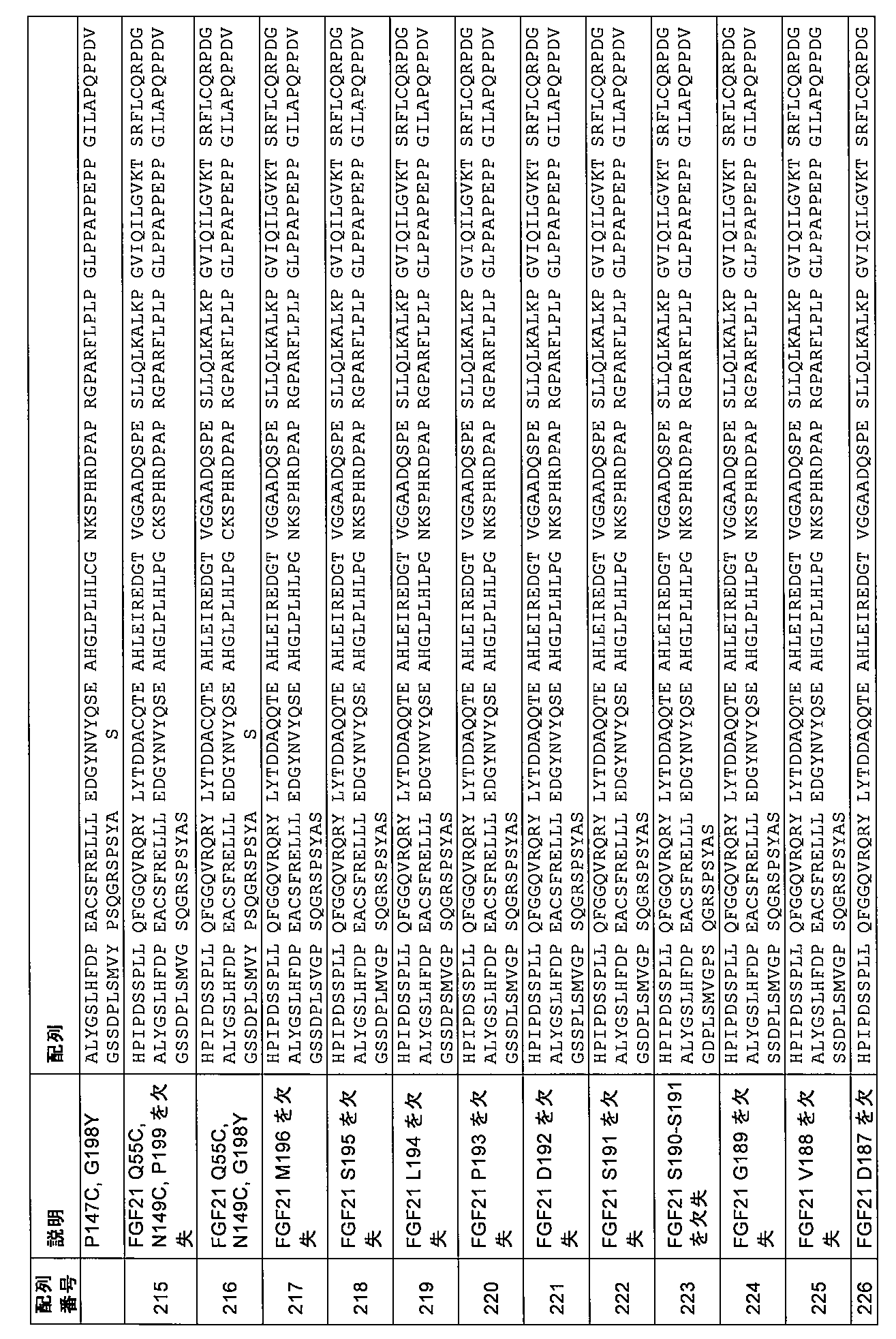
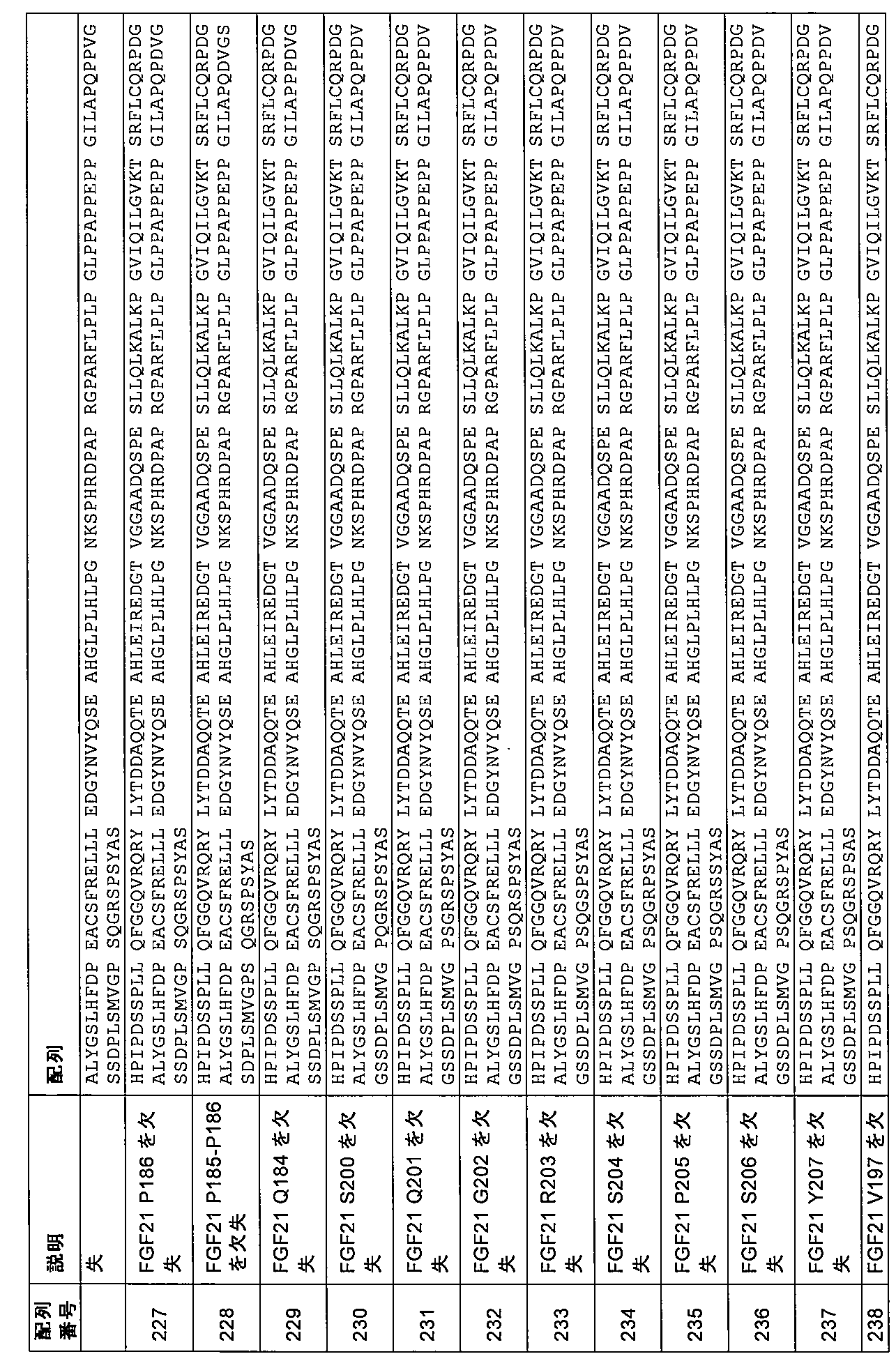


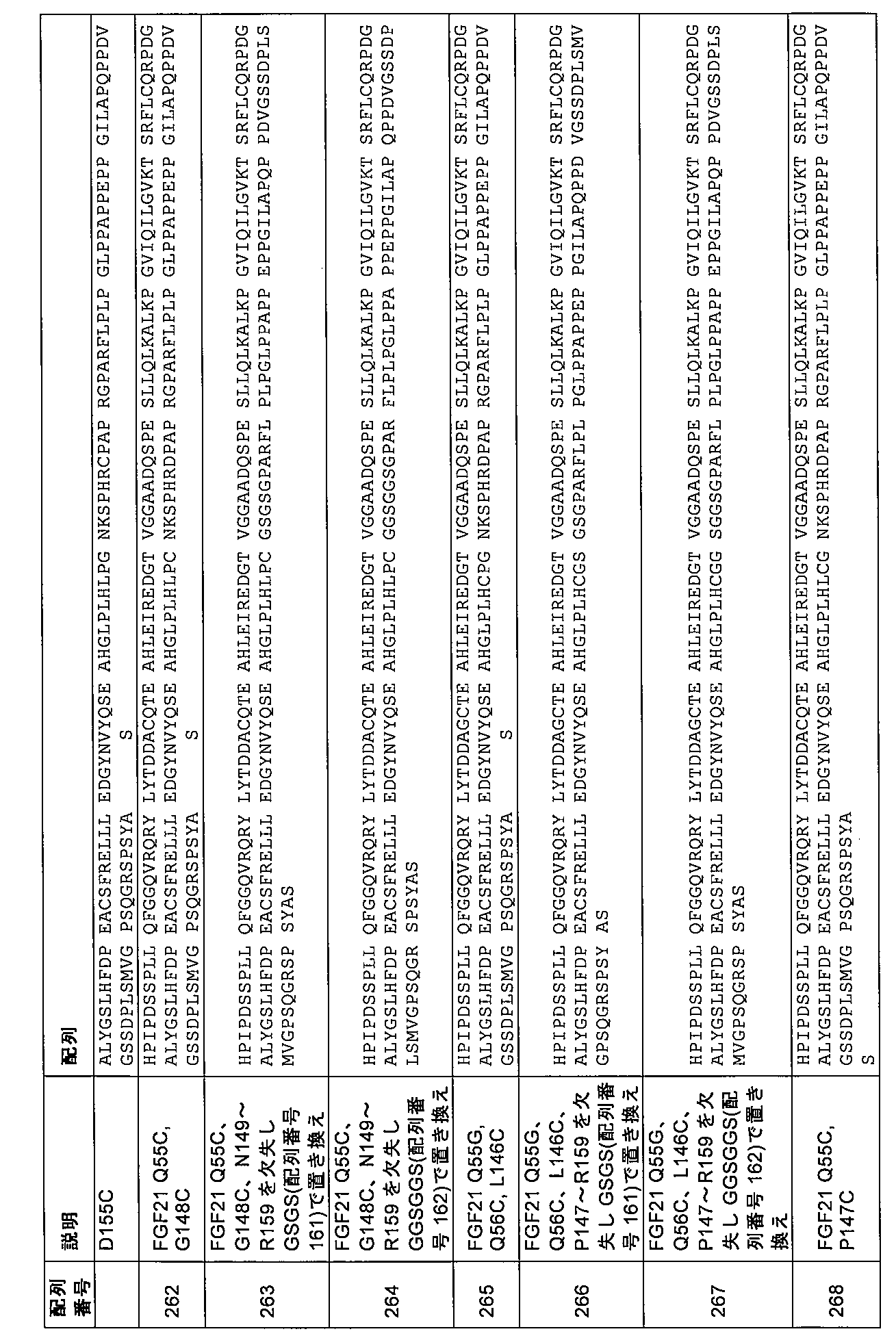

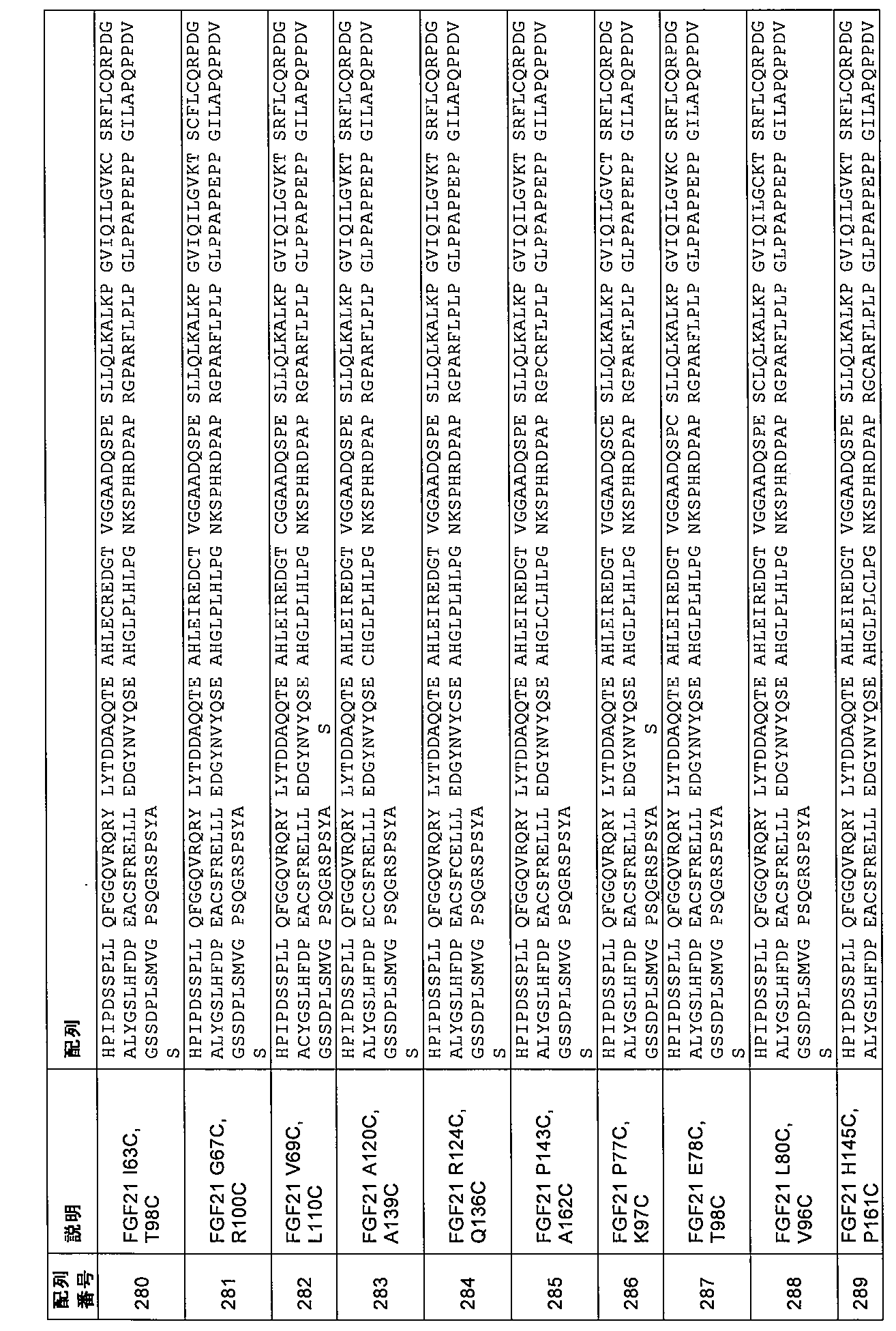


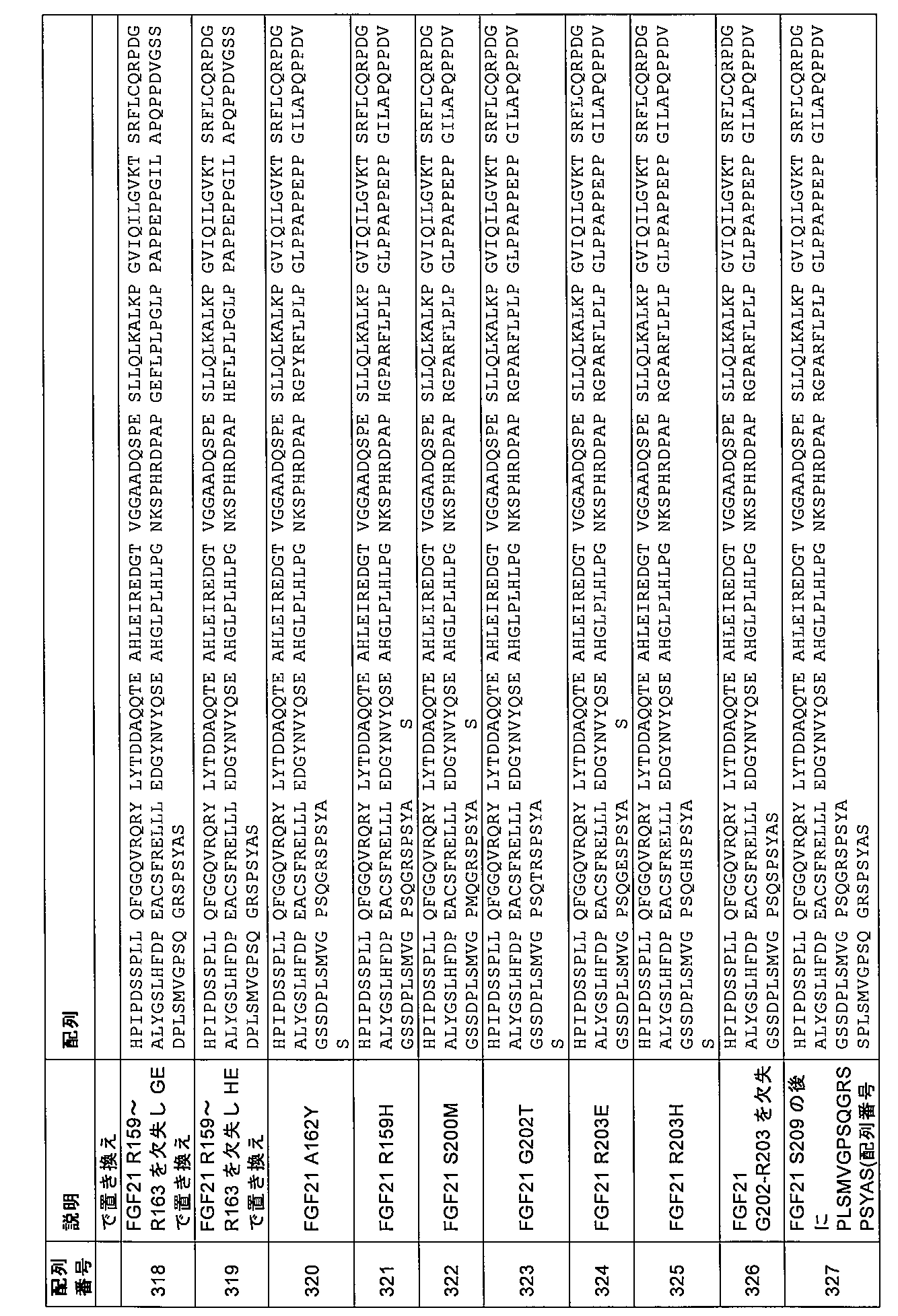
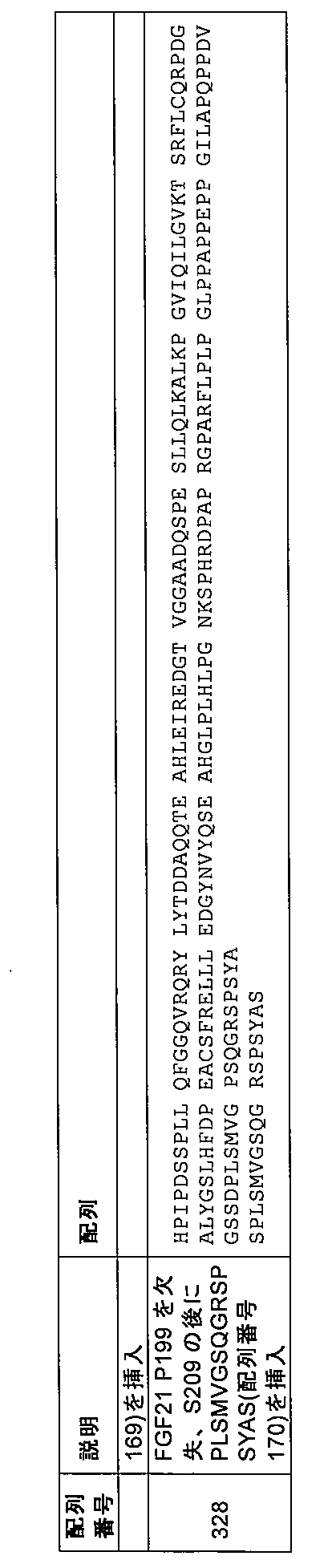
Claims (24)
体3アゴニスト、HMG-CoA-レダクターゼ阻害剤、フィブレート、ニコチン酸およびその誘導体、ニコチン酸受容体1アゴニスト、ACAT阻害剤、コレステロール吸収阻害剤、胆汁酸結合物質、IBAT阻害剤、MTP阻害剤、PCSK9のモジュレーター、LDL受容体アップレギュレーター(肝臓選択的甲状腺ホルモン受容体ベータアゴニスト)、HDL上昇化合物、脂質代謝モジュレーター、PLA2阻害剤、ApoA-Iエンハンサー、コレステロール合成阻害剤、オメガ-3脂肪酸およびその誘導体、肥満の治療のための活性物質、CB1受容体アンタゴニスト、MCH-1アンタゴニスト、MC4受容体アゴニストおよび部分的アゴニスト、NPY5またはNPY2アンタゴニスト、NPY4アゴニスト、ベータ-3アドレナリン受容体アゴニスト、レプチンまたはレプチン模倣物、5HT2c受容体アゴニスト、リパーゼ阻害剤、血管新生阻害剤、H3アンタゴニスト、AgRP阻害剤、三重モノアミン取り込み阻害剤、MetAP2阻害剤、線維芽細胞増殖因子受容体4またはプロヒビチン標的化ペプチド-1の産生に対するアンチセンスオリゴヌクレオチド、高血圧、慢性心不全、またはアテローム性動脈硬化症に影響を及ぼす薬物、アンジオテンシンII受容体アンタゴニスト、二重アンジオテンシン受容体遮断薬(ARB)、アンジオテンシン変換酵素(ACE)阻害剤、アンジオテンシン変換酵素2(ACE-2)活性剤、レニン阻害剤、プロレニン阻害剤、エンドセリン変換酵素(ECE)阻害剤、エンドセリン受容体遮断薬、エンドセリンアンタゴニスト、利尿薬、アルドステロンアンタゴニスト、アルドステロンシンターゼ阻害剤、アルファ-遮断薬、アルファ-2アドレナリン受容体のアンタゴニスト、ベータ-遮断薬、混合アルファ-/ベータ-遮断薬、カルシウムアンタゴニスト/カルシウムチャネル遮断薬(CBB)、二重ミネラルコルチコイド/CCB、中枢作用性抗高血圧症薬、中性エンドペプチダーゼの阻害剤、アミノペプチダーゼA阻害剤、バソペプチド阻害剤、二重バソペプチド阻害剤、ネプリリシン-ACE阻害剤、ネプリリシン-ECE阻害剤、二重作用性アンジオテンシン(AT)受容体-ネプリリシン阻害剤、二重AT1/エンドセリン-1(ETA)アンタゴニスト、進行糖化終末産物ブレーカー、遺伝子組換えレナラーゼ、血圧ワクチン、抗RAASワクチン、AT1-またはAT2-ワクチン、抗高血圧応答を伴う遺伝的多型のモジュレーター、ならびに栓球凝集抑制因子からなる群から選択される、請求項11に記載の融合分子または請求項17に記載の医薬組成物。 The at least one other active pharmaceutical ingredient is selected from the group consisting of insulin and insulin derivatives, GLP-1, GLP-1 analogs, and GLP-1 receptor agonists, polymer-bound GLP-1 and GLP-1 analogs, dual GLP-1/GIP agonists, dual GLP-1/glucagon receptor agonists, PYY3-36 or analogs thereof, pancreatic polypeptide or analogs thereof, glucagon receptor agonists or antagonists, GIP receptor agonists or antagonists, ghrelin antagonists, or are inverse agonists, xenin and its analogues, DDP-IV inhibitors, SGLT-2 inhibitors, dual SGLT-2/SGLT-1 inhibitors, biguanides, thiazolidinediones, PPAR agonists, PPAR modulators, sulfonylureas, meglitinides, alpha-glucosidase inhibitors, amylin and amylin analogues, GPR119 agonists, GPR40 agonists, GPR120 agonists, GPR142 agonists, TGR5 agonists, AMPK stimulants, AMPK activators, 1 Inhibitors of 1-beta-HSD, activators of glucokinase, inhibitors of DGAT, inhibitors of protein tyrosine phosphatase 1, inhibitors of glucose-6-phosphatase, inhibitors of fructose-1,6-bisphosphatase, inhibitors of glycogen phosphorylase, inhibitors of phosphoenolpyruvate carboxykinase, inhibitors of glycogen synthase kinase, inhibitors of pyruvate dehydrogenase kinase, CCR-2 antagonists, modulators of glucose transporter-4, somatostatin receptor 3 agonists, HMG-CoA-reductase inhibitors, fibrates, nicotinic acid and its derivatives, nicotinic acid receptor 1 agonists, ACAT inhibitors, cholesterol absorption inhibitors, bile acid binders, IBAT inhibitors, MTP inhibitors, modulators of PCSK9, LDL receptor upregulators (liver-selective thyroid hormone receptor beta agonists), HDL-raising compounds, lipid metabolism modulators, PLA2 inhibitors, ApoA-I enhancers, cholesterol synthesis inhibitors, omega-3 fatty acids and derivatives thereof, active substances for the treatment of obesity, CB1 receptor antagonists, MCH-1 antagonists, MC4 receptor agonists and partial agonists, NPY5 or NPY2 antagonists, NPY4 agonists, beta-3 adrenoceptor agonists, leptin or leptin mimetics, 5HT2c receptor agonists, lipase inhibitors, angiogenesis inhibitors, H3 antagonists, AgRP inhibitors, triple monoamine uptake inhibitors, MetAP2 inhibitors antisense oligonucleotides against the production of fibroblast growth factor receptor 4 or prohibitin targeting peptide-1; drugs affecting hypertension, chronic heart failure, or atherosclerosis; angiotensin II receptor antagonists; dual angiotensin receptor blockers (ARBs); angiotensin-converting enzyme (ACE) inhibitors; angiotensin-converting enzyme 2 (ACE-2) activators; renin inhibitors; prorenin inhibitors; endothelin-converting enzyme (ECE) inhibitors; endothelin receptor blockers Drug withdrawal, endothelin antagonists, diuretics, aldosterone antagonists, aldosterone synthase inhibitors, alpha-blockers, alpha-2 adrenoceptor antagonists, beta-blockers, mixed alpha-/beta-blockers, calcium antagonists/calcium channel blockers (CBBs), dual mineralocorticoids/CCBs, centrally acting antihypertensives, neutral endopeptidase inhibitors, aminopeptidase A inhibitors, vasopeptide inhibitors, dual vasopeptide inhibitors, nephrectomycin ... The fusion molecule of claim 11 or the pharmaceutical composition of claim 17 is selected from the group consisting of prilysin-ACE inhibitors, neprilysin-ECE inhibitors, dual acting angiotensin (AT) receptor-neprilysin inhibitors, dual AT1/endothelin-1 (ETA) antagonists, advanced advanced glycation end product breakers, recombinant renalase, blood pressure vaccines, anti-RAAS vaccines, AT1- or AT2-vaccines, modulators of genetic polymorphisms associated with antihypertensive response, and thrombocyte aggregation inhibitors.
12もしくは13に記載の核酸分子または請求項14に記載の宿主細胞または請求項16~18のいずれか1項に記載の医薬組成物の使用。 A human FGF21 variant according to any one of claims 1 to 10, or a fusion molecule according to claim 11 or 18 , or a fusion molecule according to claim 19 , in the manufacture of a medicament for the treatment of a disease or disorder selected from the group consisting of obesity, overweight, metabolic syndrome, diabetes, hyperglycemia, dyslipidemia, non -alcoholic steatohepatitis (NASH), and atherosclerosis.
Use of a nucleic acid molecule according to claim 12 or 13 , or a host cell according to claim 14 , or a pharmaceutical composition according to any one of claims 16 to 18 .
Applications Claiming Priority (4)
| Application Number | Priority Date | Filing Date | Title |
|---|---|---|---|
| EP15306913 | 2015-12-02 | ||
| EP15306913.3 | 2015-12-02 | ||
| PCT/EP2016/079551 WO2017093465A1 (en) | 2015-12-02 | 2016-12-02 | Fgf21 variants |
| JP2018528657A JP7028775B2 (en) | 2015-12-02 | 2016-12-02 | FGF21 mutant |
Related Parent Applications (1)
| Application Number | Title | Priority Date | Filing Date |
|---|---|---|---|
| JP2018528657A Division JP7028775B2 (en) | 2015-12-02 | 2016-12-02 | FGF21 mutant |
Publications (2)
| Publication Number | Publication Date |
|---|---|
| JP2022068275A JP2022068275A (en) | 2022-05-09 |
| JP7497381B2 true JP7497381B2 (en) | 2024-06-10 |
Family
ID=54838293
Family Applications (2)
| Application Number | Title | Priority Date | Filing Date |
|---|---|---|---|
| JP2018528657A Active JP7028775B2 (en) | 2015-12-02 | 2016-12-02 | FGF21 mutant |
| JP2022021706A Active JP7497381B2 (en) | 2015-12-02 | 2022-02-16 | FGF21 mutants |
Family Applications Before (1)
| Application Number | Title | Priority Date | Filing Date |
|---|---|---|---|
| JP2018528657A Active JP7028775B2 (en) | 2015-12-02 | 2016-12-02 | FGF21 mutant |
Country Status (14)
| Country | Link |
|---|---|
| US (3) | US11230582B2 (en) |
| EP (2) | EP3693382A1 (en) |
| JP (2) | JP7028775B2 (en) |
| KR (1) | KR20180083938A (en) |
| CN (1) | CN108602869A (en) |
| AU (1) | AU2016361912A1 (en) |
| BR (1) | BR112018011002A2 (en) |
| CA (1) | CA3006689A1 (en) |
| IL (1) | IL259675A (en) |
| MX (1) | MX2018005387A (en) |
| RU (1) | RU2018123704A (en) |
| SG (1) | SG11201804577RA (en) |
| TW (1) | TW201731867A (en) |
| WO (1) | WO2017093465A1 (en) |
Families Citing this family (22)
| Publication number | Priority date | Publication date | Assignee | Title |
|---|---|---|---|---|
| IL277958B2 (en) | 2011-11-18 | 2023-11-01 | Regeneron Pharma | Polymer protein microparticles |
| WO2018115401A1 (en) | 2016-12-22 | 2018-06-28 | Sanofi | Fgf21 compound / glp-1r agonist combinations with optimized activity ratio |
| EP3596130B1 (en) | 2017-03-14 | 2024-12-04 | Sunshine Lake Pharma Co., Ltd. | Dual-target fusion proteins comprising the fc portion of an immunoglobulin |
| KR102229037B1 (en) * | 2017-09-04 | 2021-03-17 | 89바이오 리미티드 | Mutant FGF-21 peptide conjugate and uses thereof |
| US11679143B2 (en) | 2018-02-08 | 2023-06-20 | Sunshine Lake Pharma Co., Ltd. | FGF21 variant, fusion protein and application thereof |
| WO2019243557A1 (en) | 2018-06-21 | 2019-12-26 | Sanofi | Fgf21 compound / glp-1r agonist combinations with optimized activity ratio |
| CA3104686A1 (en) | 2018-07-03 | 2020-01-09 | Bristol-Myers Squibb Company | Fgf-21 formulations |
| CN109836486B (en) * | 2019-01-30 | 2020-09-08 | 北京双因生物科技有限公司 | Fibroblast growth factor 21 variants, fusion proteins thereof, and uses thereof |
| CN110845596B (en) * | 2019-11-15 | 2021-09-03 | 上海交通大学 | Mutant xSUMO and related products |
| WO2021139744A1 (en) * | 2020-01-11 | 2021-07-15 | Beijing Ql Biopharmaceutical Co., Ltd. | Conjugates of fusion proteins of glp-1 and fgf21 |
| US20230265152A1 (en) * | 2020-07-02 | 2023-08-24 | Sanofi | Glp-1r agonist / fgf21 fusion proteins |
| KR102495299B1 (en) * | 2020-11-03 | 2023-02-06 | 토드제약 주식회사 | Methods for producing fgf21 using heat-elasticity of fgf21 |
| KR102631925B1 (en) * | 2021-06-10 | 2024-02-01 | 토드제약 주식회사 | Development of novel fgf21 variants, production techniques and uses thereof |
| CN113354745B (en) * | 2021-07-09 | 2022-10-04 | 温州医科大学 | Composition and method for large-scale production of fibroblast growth factor |
| CN116635402B (en) * | 2021-07-14 | 2024-03-15 | 北京质肽生物医药科技有限公司 | Fusion polypeptides for metabolic disorders |
| CN116162145A (en) * | 2021-09-08 | 2023-05-26 | 北京志道生物科技有限公司 | FGF21 mutant protein and application thereof |
| KR102774179B1 (en) * | 2021-09-29 | 2025-03-04 | (주)케어젠 | Peptide Having Anti-Aging Activity and Uses Thereof |
| CN113980147B (en) * | 2021-11-26 | 2023-07-28 | 中国药科大学 | A fusion protein mutant of polypolypeptide and FGF21 and its application |
| KR20250135288A (en) * | 2023-01-18 | 2025-09-12 | 베이징 큐엘 바이오파마슈티컬 컴퍼니 리미티드 | Liquid pharmaceutical composition of fusion polypeptide and method of use thereof |
| WO2024199481A1 (en) * | 2023-03-31 | 2024-10-03 | 上海多米瑞生物技术有限公司 | Protein analogue and use thereof |
| WO2025108432A1 (en) * | 2023-11-23 | 2025-05-30 | Therorna Shanghai Co., Ltd. | Circular rna encoding fgf21 and the use thereof |
| WO2026012311A1 (en) * | 2024-07-08 | 2026-01-15 | 浙江道尔生物科技有限公司 | Fgf21 derivative and use thereof |
Citations (4)
| Publication number | Priority date | Publication date | Assignee | Title |
|---|---|---|---|---|
| JP2011523561A (en) | 2008-06-04 | 2011-08-18 | アムジエン・インコーポレーテツド | FGF21 mutants and uses thereof |
| JP2013533227A (en) | 2010-06-08 | 2013-08-22 | ノヴォ ノルディスク アー/エス | FGF21 analogs and derivatives |
| JP2014530220A (en) | 2011-10-04 | 2014-11-17 | イーライ リリー アンド カンパニー | Fibroblast growth factor 21 mutant |
| US20150166622A1 (en) | 2011-09-26 | 2015-06-18 | Novartis Ag | Fusion proteins for treating metabolic disorders |
Family Cites Families (14)
| Publication number | Priority date | Publication date | Assignee | Title |
|---|---|---|---|---|
| US7459540B1 (en) | 1999-09-07 | 2008-12-02 | Amgen Inc. | Fibroblast growth factor-like polypeptides |
| AU2002322394A1 (en) | 2001-07-30 | 2003-02-17 | Eli Lilly And Company | Method for treating diabetes and obesity |
| BRPI0416683A (en) | 2003-12-10 | 2007-01-30 | Lilly Co Eli | human 21 fibroblast growth factor mutant (fgf-21), or a biologically active peptide thereof, polynucleotide, expression vector, host cell, process for producing a polypeptide, pharmaceutical composition, method for treating a patient, and, use da muteìna fgf-21 |
| EP1789443A1 (en) | 2004-09-02 | 2007-05-30 | Eli Lilly And Company | Muteins of fibroblast growth factor 21 |
| JP4809352B2 (en) * | 2004-09-02 | 2011-11-09 | イーライ リリー アンド カンパニー | Fibroblast growth factor 21 mutein |
| US7655627B2 (en) | 2004-12-14 | 2010-02-02 | Eli Lilly And Company | Muteins of fibroblast growth factor 21 |
| BRPI0809583B1 (en) | 2007-03-30 | 2022-02-22 | Ambrx, Inc | Modified fgf-21 polypeptide, composition comprising the same, method for producing said fgf-21 polypeptide, and cell comprising a polynucleotide |
| US9279013B2 (en) * | 2008-10-10 | 2016-03-08 | Amgen Inc. | FGF-21 mutants comprising polyethylene glycol and uses thereof |
| WO2010065439A1 (en) * | 2008-12-05 | 2010-06-10 | Eli Lilly And Company | Variants of fibroblast growth factor 21 |
| JP5823954B2 (en) * | 2009-05-05 | 2015-11-25 | アムジエン・インコーポレーテツド | FGF21 variants and uses thereof |
| CA2760674A1 (en) * | 2009-05-05 | 2010-11-11 | Amgen Inc. | Fgf21 mutants and uses thereof |
| AU2011202239C1 (en) | 2010-05-19 | 2017-03-16 | Sanofi | Long-acting formulations of insulins |
| US9422353B2 (en) * | 2012-06-11 | 2016-08-23 | Eli Lilly And Company | Fibroblast growth factor 21 variant, composition , and uses thereof |
| SG11201702824UA (en) * | 2014-10-24 | 2017-05-30 | Bristol Myers Squibb Co | Modified fgf-21 polypeptides and uses thereof |
-
2016
- 2016-11-30 TW TW105139356A patent/TW201731867A/en unknown
- 2016-12-02 JP JP2018528657A patent/JP7028775B2/en active Active
- 2016-12-02 WO PCT/EP2016/079551 patent/WO2017093465A1/en not_active Ceased
- 2016-12-02 EP EP20150761.3A patent/EP3693382A1/en active Pending
- 2016-12-02 BR BR112018011002A patent/BR112018011002A2/en not_active Application Discontinuation
- 2016-12-02 CA CA3006689A patent/CA3006689A1/en not_active Abandoned
- 2016-12-02 SG SG11201804577RA patent/SG11201804577RA/en unknown
- 2016-12-02 AU AU2016361912A patent/AU2016361912A1/en not_active Abandoned
- 2016-12-02 CN CN201680070380.3A patent/CN108602869A/en active Pending
- 2016-12-02 KR KR1020187018399A patent/KR20180083938A/en not_active Withdrawn
- 2016-12-02 MX MX2018005387A patent/MX2018005387A/en unknown
- 2016-12-02 RU RU2018123704A patent/RU2018123704A/en not_active Application Discontinuation
- 2016-12-02 EP EP16808969.6A patent/EP3383890A1/en not_active Withdrawn
- 2016-12-02 US US15/776,726 patent/US11230582B2/en active Active
-
2018
- 2018-05-29 IL IL259675A patent/IL259675A/en unknown
-
2021
- 2021-12-03 US US17/541,411 patent/US20220227825A1/en not_active Abandoned
-
2022
- 2022-02-16 JP JP2022021706A patent/JP7497381B2/en active Active
-
2024
- 2024-10-31 US US18/932,818 patent/US20250171512A1/en active Pending
Patent Citations (4)
| Publication number | Priority date | Publication date | Assignee | Title |
|---|---|---|---|---|
| JP2011523561A (en) | 2008-06-04 | 2011-08-18 | アムジエン・インコーポレーテツド | FGF21 mutants and uses thereof |
| JP2013533227A (en) | 2010-06-08 | 2013-08-22 | ノヴォ ノルディスク アー/エス | FGF21 analogs and derivatives |
| US20150166622A1 (en) | 2011-09-26 | 2015-06-18 | Novartis Ag | Fusion proteins for treating metabolic disorders |
| JP2014530220A (en) | 2011-10-04 | 2014-11-17 | イーライ リリー アンド カンパニー | Fibroblast growth factor 21 mutant |
Non-Patent Citations (1)
| Title |
|---|
| Bioconjugate Chemistry,2013年,Vol. 24, No. 6,pp. 915-925 |
Also Published As
| Publication number | Publication date |
|---|---|
| KR20180083938A (en) | 2018-07-23 |
| BR112018011002A2 (en) | 2018-12-04 |
| WO2017093465A1 (en) | 2017-06-08 |
| AU2016361912A1 (en) | 2018-07-19 |
| CA3006689A1 (en) | 2017-06-08 |
| EP3383890A1 (en) | 2018-10-10 |
| US20250171512A1 (en) | 2025-05-29 |
| US20220227825A1 (en) | 2022-07-21 |
| US11230582B2 (en) | 2022-01-25 |
| IL259675A (en) | 2018-07-31 |
| CN108602869A (en) | 2018-09-28 |
| JP2022068275A (en) | 2022-05-09 |
| EP3693382A1 (en) | 2020-08-12 |
| JP2019506138A (en) | 2019-03-07 |
| MX2018005387A (en) | 2018-08-14 |
| TW201731867A (en) | 2017-09-16 |
| US20180371041A1 (en) | 2018-12-27 |
| JP7028775B2 (en) | 2022-03-02 |
| RU2018123704A (en) | 2020-01-14 |
| SG11201804577RA (en) | 2018-06-28 |
Similar Documents
| Publication | Publication Date | Title |
|---|---|---|
| JP7497381B2 (en) | FGF21 mutants | |
| JP7756671B2 (en) | FGF21 compound/GLP-1R agonist combination with optimized activity ratio | |
| US20240325499A1 (en) | Fgf21 compound / glp-1r agonist combinations with optimized activity ratio | |
| JP2025169470A (en) | GLP-1R agonist/FGF21 fusion protein | |
| JP7751603B2 (en) | GLP-1R agonist peptides with reduced activity | |
| HK40034568A (en) | Fgf21 variants |
Legal Events
| Date | Code | Title | Description |
|---|---|---|---|
| A521 | Request for written amendment filed |
Free format text: JAPANESE INTERMEDIATE CODE: A523 Effective date: 20220317 |
|
| A621 | Written request for application examination |
Free format text: JAPANESE INTERMEDIATE CODE: A621 Effective date: 20220317 |
|
| A131 | Notification of reasons for refusal |
Free format text: JAPANESE INTERMEDIATE CODE: A131 Effective date: 20221206 |
|
| A601 | Written request for extension of time |
Free format text: JAPANESE INTERMEDIATE CODE: A601 Effective date: 20230224 |
|
| A521 | Request for written amendment filed |
Free format text: JAPANESE INTERMEDIATE CODE: A523 Effective date: 20230605 |
|
| A131 | Notification of reasons for refusal |
Free format text: JAPANESE INTERMEDIATE CODE: A131 Effective date: 20230822 |
|
| A601 | Written request for extension of time |
Free format text: JAPANESE INTERMEDIATE CODE: A601 Effective date: 20230928 |
|
| A521 | Request for written amendment filed |
Free format text: JAPANESE INTERMEDIATE CODE: A523 Effective date: 20240216 |
|
| TRDD | Decision of grant or rejection written | ||
| A01 | Written decision to grant a patent or to grant a registration (utility model) |
Free format text: JAPANESE INTERMEDIATE CODE: A01 Effective date: 20240507 |
|
| A61 | First payment of annual fees (during grant procedure) |
Free format text: JAPANESE INTERMEDIATE CODE: A61 Effective date: 20240529 |
|
| R150 | Certificate of patent or registration of utility model |
Ref document number: 7497381 Country of ref document: JP Free format text: JAPANESE INTERMEDIATE CODE: R150 |