JP7471819B2 - Antibodies with reduced binding to process impurities - Google Patents
Antibodies with reduced binding to process impurities Download PDFInfo
- Publication number
- JP7471819B2 JP7471819B2 JP2019518304A JP2019518304A JP7471819B2 JP 7471819 B2 JP7471819 B2 JP 7471819B2 JP 2019518304 A JP2019518304 A JP 2019518304A JP 2019518304 A JP2019518304 A JP 2019518304A JP 7471819 B2 JP7471819 B2 JP 7471819B2
- Authority
- JP
- Japan
- Prior art keywords
- igg4
- plbl2
- antibody
- binding
- seq
- Prior art date
- Legal status (The legal status is an assumption and is not a legal conclusion. Google has not performed a legal analysis and makes no representation as to the accuracy of the status listed.)
- Active
Links
- 230000027455 binding Effects 0.000 title claims description 168
- 238000000034 method Methods 0.000 title claims description 109
- 230000002829 reductive effect Effects 0.000 title claims description 44
- 239000012535 impurity Substances 0.000 title description 51
- 230000008569 process Effects 0.000 title description 46
- 102000004169 proteins and genes Human genes 0.000 claims description 111
- 108090000623 proteins and genes Proteins 0.000 claims description 111
- NFGXHKASABOEEW-UHFFFAOYSA-N 1-methylethyl 11-methoxy-3,7,11-trimethyl-2,4-dodecadienoate Chemical class COC(C)(C)CCCC(C)CC=CC(C)=CC(=O)OC(C)C NFGXHKASABOEEW-UHFFFAOYSA-N 0.000 claims description 82
- 150000001413 amino acids Chemical class 0.000 claims description 74
- 238000006467 substitution reaction Methods 0.000 claims description 51
- 238000012986 modification Methods 0.000 claims description 48
- 230000004048 modification Effects 0.000 claims description 48
- 239000000203 mixture Substances 0.000 claims description 28
- 102100036164 Putative phospholipase B-like 2 Human genes 0.000 claims description 15
- 101710200837 Putative phospholipase B-like 2 Proteins 0.000 claims description 15
- -1 fatty acid ester Chemical class 0.000 claims description 14
- 239000000872 buffer Substances 0.000 claims description 9
- 235000014113 dietary fatty acids Nutrition 0.000 claims description 8
- 229930195729 fatty acid Natural products 0.000 claims description 8
- 239000000194 fatty acid Substances 0.000 claims description 8
- 239000004295 calcium sulphite Substances 0.000 claims description 7
- WLKSPGHQGFFKGE-UHFFFAOYSA-N 1-chloropropan-2-yl n-(3-chlorophenyl)carbamate Chemical compound ClCC(C)OC(=O)NC1=CC=CC(Cl)=C1 WLKSPGHQGFFKGE-UHFFFAOYSA-N 0.000 claims description 6
- 108020004707 nucleic acids Proteins 0.000 claims description 5
- 102000039446 nucleic acids Human genes 0.000 claims description 5
- 150000007523 nucleic acids Chemical class 0.000 claims description 5
- 239000000244 polyoxyethylene sorbitan monooleate Substances 0.000 claims description 5
- 235000010482 polyoxyethylene sorbitan monooleate Nutrition 0.000 claims description 5
- 229920000053 polysorbate 80 Polymers 0.000 claims description 5
- 229940068968 polysorbate 80 Drugs 0.000 claims description 5
- 229920001213 Polysorbate 20 Polymers 0.000 claims description 4
- 239000000256 polyoxyethylene sorbitan monolaurate Substances 0.000 claims description 4
- 235000010486 polyoxyethylene sorbitan monolaurate Nutrition 0.000 claims description 4
- 229940068977 polysorbate 20 Drugs 0.000 claims description 4
- 210000004027 cell Anatomy 0.000 description 109
- 235000018102 proteins Nutrition 0.000 description 105
- 235000001014 amino acid Nutrition 0.000 description 78
- 229940024606 amino acid Drugs 0.000 description 73
- 229940027941 immunoglobulin g Drugs 0.000 description 50
- 239000000047 product Substances 0.000 description 49
- 210000004602 germ cell Anatomy 0.000 description 48
- 101100075831 Caenorhabditis elegans mab-7 gene Proteins 0.000 description 34
- DHMQDGOQFOQNFH-UHFFFAOYSA-N Glycine Natural products NCC(O)=O DHMQDGOQFOQNFH-UHFFFAOYSA-N 0.000 description 31
- 125000003275 alpha amino acid group Chemical group 0.000 description 30
- 230000003993 interaction Effects 0.000 description 29
- 238000002198 surface plasmon resonance spectroscopy Methods 0.000 description 28
- ONIBWKKTOPOVIA-UHFFFAOYSA-N Proline Natural products OC(=O)C1CCCN1 ONIBWKKTOPOVIA-UHFFFAOYSA-N 0.000 description 24
- 238000010790 dilution Methods 0.000 description 24
- 239000012895 dilution Substances 0.000 description 24
- 239000004471 Glycine Substances 0.000 description 21
- 108060003951 Immunoglobulin Proteins 0.000 description 21
- 102000018358 immunoglobulin Human genes 0.000 description 21
- 125000000539 amino acid group Chemical group 0.000 description 18
- 125000001500 prolyl group Chemical group [H]N1C([H])(C(=O)[*])C([H])([H])C([H])([H])C1([H])[H] 0.000 description 18
- 238000000746 purification Methods 0.000 description 18
- 239000004475 Arginine Substances 0.000 description 17
- ODKSFYDXXFIFQN-UHFFFAOYSA-N arginine Natural products OC(=O)C(N)CCCNC(N)=N ODKSFYDXXFIFQN-UHFFFAOYSA-N 0.000 description 17
- 235000009697 arginine Nutrition 0.000 description 17
- 238000002474 experimental method Methods 0.000 description 16
- 238000001042 affinity chromatography Methods 0.000 description 15
- KDXKERNSBIXSRK-UHFFFAOYSA-N Lysine Natural products NCCCCC(N)C(O)=O KDXKERNSBIXSRK-UHFFFAOYSA-N 0.000 description 14
- 239000004472 Lysine Substances 0.000 description 14
- 235000018977 lysine Nutrition 0.000 description 14
- OUYCCCASQSFEME-UHFFFAOYSA-N tyrosine Natural products OC(=O)C(N)CC1=CC=C(O)C=C1 OUYCCCASQSFEME-UHFFFAOYSA-N 0.000 description 14
- 101100075829 Caenorhabditis elegans mab-3 gene Proteins 0.000 description 12
- 101100075830 Caenorhabditis elegans mab-5 gene Proteins 0.000 description 12
- 238000002965 ELISA Methods 0.000 description 12
- 230000000694 effects Effects 0.000 description 12
- 125000003588 lysine group Chemical group [H]N([H])C([H])([H])C([H])([H])C([H])([H])C([H])([H])C([H])(N([H])[H])C(*)=O 0.000 description 12
- 108010047041 Complementarity Determining Regions Proteins 0.000 description 11
- MTCFGRXMJLQNBG-UHFFFAOYSA-N Serine Natural products OCC(N)C(O)=O MTCFGRXMJLQNBG-UHFFFAOYSA-N 0.000 description 11
- 239000000427 antigen Substances 0.000 description 11
- 108091007433 antigens Proteins 0.000 description 11
- 102000036639 antigens Human genes 0.000 description 11
- 125000003630 glycyl group Chemical group [H]N([H])C([H])([H])C(*)=O 0.000 description 11
- 238000004519 manufacturing process Methods 0.000 description 11
- WHUUTDBJXJRKMK-UHFFFAOYSA-N Glutamic acid Natural products OC(=O)C(N)CCC(O)=O WHUUTDBJXJRKMK-UHFFFAOYSA-N 0.000 description 10
- 238000004587 chromatography analysis Methods 0.000 description 10
- 235000013922 glutamic acid Nutrition 0.000 description 10
- 239000004220 glutamic acid Substances 0.000 description 10
- 230000035772 mutation Effects 0.000 description 10
- 230000009467 reduction Effects 0.000 description 10
- AYFVYJQAPQTCCC-UHFFFAOYSA-N Threonine Natural products CC(O)C(N)C(O)=O AYFVYJQAPQTCCC-UHFFFAOYSA-N 0.000 description 9
- 239000004473 Threonine Substances 0.000 description 9
- 125000000637 arginyl group Chemical group N[C@@H](CCCNC(N)=N)C(=O)* 0.000 description 9
- 108090000765 processed proteins & peptides Proteins 0.000 description 9
- 239000000523 sample Substances 0.000 description 9
- 235000008521 threonine Nutrition 0.000 description 9
- 125000001493 tyrosinyl group Chemical group [H]OC1=C([H])C([H])=C(C([H])=C1[H])C([H])([H])C([H])(N([H])[H])C(*)=O 0.000 description 9
- 238000001262 western blot Methods 0.000 description 9
- 238000012855 HCP-ELISA Methods 0.000 description 8
- ODKSFYDXXFIFQN-BYPYZUCNSA-P L-argininium(2+) Chemical group NC(=[NH2+])NCCC[C@H]([NH3+])C(O)=O ODKSFYDXXFIFQN-BYPYZUCNSA-P 0.000 description 8
- ROHFNLRQFUQHCH-UHFFFAOYSA-N Leucine Natural products CC(C)CC(N)C(O)=O ROHFNLRQFUQHCH-UHFFFAOYSA-N 0.000 description 8
- 238000012575 bio-layer interferometry Methods 0.000 description 8
- 238000012217 deletion Methods 0.000 description 8
- 230000037430 deletion Effects 0.000 description 8
- 239000013020 final formulation Substances 0.000 description 8
- 239000000499 gel Substances 0.000 description 8
- 230000014509 gene expression Effects 0.000 description 8
- 239000012528 membrane Substances 0.000 description 8
- 231100000617 superantigen Toxicity 0.000 description 8
- ONIBWKKTOPOVIA-BYPYZUCNSA-N L-Proline Chemical compound OC(=O)[C@@H]1CCCN1 ONIBWKKTOPOVIA-BYPYZUCNSA-N 0.000 description 7
- 238000004458 analytical method Methods 0.000 description 7
- 238000010494 dissociation reaction Methods 0.000 description 7
- 230000005593 dissociations Effects 0.000 description 7
- 239000012636 effector Substances 0.000 description 7
- 238000003780 insertion Methods 0.000 description 7
- 230000037431 insertion Effects 0.000 description 7
- 239000000463 material Substances 0.000 description 7
- COLNVLDHVKWLRT-UHFFFAOYSA-N phenylalanine Natural products OC(=O)C(N)CC1=CC=CC=C1 COLNVLDHVKWLRT-UHFFFAOYSA-N 0.000 description 7
- COLNVLDHVKWLRT-QMMMGPOBSA-N phenylalanine group Chemical group N[C@@H](CC1=CC=CC=C1)C(=O)O COLNVLDHVKWLRT-QMMMGPOBSA-N 0.000 description 7
- 238000012360 testing method Methods 0.000 description 7
- MTCFGRXMJLQNBG-REOHCLBHSA-N (2S)-2-Amino-3-hydroxypropansäure Chemical group OC[C@H](N)C(O)=O MTCFGRXMJLQNBG-REOHCLBHSA-N 0.000 description 6
- ROHFNLRQFUQHCH-YFKPBYRVSA-N L-leucine Chemical group CC(C)C[C@H](N)C(O)=O ROHFNLRQFUQHCH-YFKPBYRVSA-N 0.000 description 6
- AYFVYJQAPQTCCC-GBXIJSLDSA-N L-threonine Chemical group C[C@@H](O)[C@H](N)C(O)=O AYFVYJQAPQTCCC-GBXIJSLDSA-N 0.000 description 6
- 101000686985 Mouse mammary tumor virus (strain C3H) Protein PR73 Proteins 0.000 description 6
- 235000003704 aspartic acid Nutrition 0.000 description 6
- CKLJMWTZIZZHCS-REOHCLBHSA-N aspartic acid group Chemical group N[C@@H](CC(=O)O)C(=O)O CKLJMWTZIZZHCS-REOHCLBHSA-N 0.000 description 6
- 238000003556 assay Methods 0.000 description 6
- OQFSQFPPLPISGP-UHFFFAOYSA-N beta-carboxyaspartic acid Natural products OC(=O)C(N)C(C(O)=O)C(O)=O OQFSQFPPLPISGP-UHFFFAOYSA-N 0.000 description 6
- 229910052805 deuterium Inorganic materials 0.000 description 6
- 201000010099 disease Diseases 0.000 description 6
- 208000037265 diseases, disorders, signs and symptoms Diseases 0.000 description 6
- 230000008030 elimination Effects 0.000 description 6
- 238000003379 elimination reaction Methods 0.000 description 6
- 238000009472 formulation Methods 0.000 description 6
- ZDXPYRJPNDTMRX-UHFFFAOYSA-N glutamine Natural products OC(=O)C(N)CCC(N)=O ZDXPYRJPNDTMRX-UHFFFAOYSA-N 0.000 description 6
- 235000004554 glutamine Nutrition 0.000 description 6
- 229940072221 immunoglobulins Drugs 0.000 description 6
- 238000002347 injection Methods 0.000 description 6
- 239000007924 injection Substances 0.000 description 6
- AGPKZVBTJJNPAG-UHFFFAOYSA-N isoleucine Chemical group CCC(C)C(N)C(O)=O AGPKZVBTJJNPAG-UHFFFAOYSA-N 0.000 description 6
- 229960000310 isoleucine Drugs 0.000 description 6
- 108010026228 mRNA guanylyltransferase Proteins 0.000 description 6
- 238000002703 mutagenesis Methods 0.000 description 6
- 231100000350 mutagenesis Toxicity 0.000 description 6
- 239000000546 pharmaceutical excipient Substances 0.000 description 6
- 238000002864 sequence alignment Methods 0.000 description 6
- DCXYFEDJOCDNAF-UHFFFAOYSA-N Asparagine Chemical group OC(=O)C(N)CC(N)=O DCXYFEDJOCDNAF-UHFFFAOYSA-N 0.000 description 5
- BWGNESOTFCXPMA-UHFFFAOYSA-N Dihydrogen disulfide Chemical compound SS BWGNESOTFCXPMA-UHFFFAOYSA-N 0.000 description 5
- XUJNEKJLAYXESH-REOHCLBHSA-N L-Cysteine Chemical group SC[C@H](N)C(O)=O XUJNEKJLAYXESH-REOHCLBHSA-N 0.000 description 5
- QNAYBMKLOCPYGJ-REOHCLBHSA-N L-alanine Chemical group C[C@H](N)C(O)=O QNAYBMKLOCPYGJ-REOHCLBHSA-N 0.000 description 5
- DCXYFEDJOCDNAF-REOHCLBHSA-N L-asparagine Chemical group OC(=O)[C@@H](N)CC(N)=O DCXYFEDJOCDNAF-REOHCLBHSA-N 0.000 description 5
- WHUUTDBJXJRKMK-VKHMYHEASA-N L-glutamic acid Chemical group OC(=O)[C@@H](N)CCC(O)=O WHUUTDBJXJRKMK-VKHMYHEASA-N 0.000 description 5
- ZDXPYRJPNDTMRX-VKHMYHEASA-N L-glutamine Chemical group OC(=O)[C@@H](N)CCC(N)=O ZDXPYRJPNDTMRX-VKHMYHEASA-N 0.000 description 5
- HNDVDQJCIGZPNO-YFKPBYRVSA-N L-histidine Chemical group OC(=O)[C@@H](N)CC1=CN=CN1 HNDVDQJCIGZPNO-YFKPBYRVSA-N 0.000 description 5
- AGPKZVBTJJNPAG-WHFBIAKZSA-N L-isoleucine Chemical group CC[C@H](C)[C@H](N)C(O)=O AGPKZVBTJJNPAG-WHFBIAKZSA-N 0.000 description 5
- FFEARJCKVFRZRR-BYPYZUCNSA-N L-methionine Chemical group CSCC[C@H](N)C(O)=O FFEARJCKVFRZRR-BYPYZUCNSA-N 0.000 description 5
- QIVBCDIJIAJPQS-VIFPVBQESA-N L-tryptophane Chemical group C1=CC=C2C(C[C@H](N)C(O)=O)=CNC2=C1 QIVBCDIJIAJPQS-VIFPVBQESA-N 0.000 description 5
- OUYCCCASQSFEME-QMMMGPOBSA-N L-tyrosine Chemical group OC(=O)[C@@H](N)CC1=CC=C(O)C=C1 OUYCCCASQSFEME-QMMMGPOBSA-N 0.000 description 5
- KZSNJWFQEVHDMF-BYPYZUCNSA-N L-valine Chemical group CC(C)[C@H](N)C(O)=O KZSNJWFQEVHDMF-BYPYZUCNSA-N 0.000 description 5
- 101710120037 Toxin CcdB Proteins 0.000 description 5
- QIVBCDIJIAJPQS-UHFFFAOYSA-N Tryptophan Chemical group C1=CC=C2C(CC(N)C(O)=O)=CNC2=C1 QIVBCDIJIAJPQS-UHFFFAOYSA-N 0.000 description 5
- KZSNJWFQEVHDMF-UHFFFAOYSA-N Valine Chemical group CC(C)C(N)C(O)=O KZSNJWFQEVHDMF-UHFFFAOYSA-N 0.000 description 5
- 235000004279 alanine Nutrition 0.000 description 5
- 235000009582 asparagine Nutrition 0.000 description 5
- 229960001230 asparagine Drugs 0.000 description 5
- 229960000074 biopharmaceutical Drugs 0.000 description 5
- 230000015556 catabolic process Effects 0.000 description 5
- 238000004113 cell culture Methods 0.000 description 5
- 230000008859 change Effects 0.000 description 5
- XUJNEKJLAYXESH-UHFFFAOYSA-N cysteine Chemical group SCC(N)C(O)=O XUJNEKJLAYXESH-UHFFFAOYSA-N 0.000 description 5
- 235000018417 cysteine Nutrition 0.000 description 5
- 238000006731 degradation reaction Methods 0.000 description 5
- 239000003814 drug Substances 0.000 description 5
- 125000000291 glutamic acid group Chemical group N[C@@H](CCC(O)=O)C(=O)* 0.000 description 5
- HNDVDQJCIGZPNO-UHFFFAOYSA-N histidine Chemical group OC(=O)C(N)CC1=CN=CN1 HNDVDQJCIGZPNO-UHFFFAOYSA-N 0.000 description 5
- 238000002372 labelling Methods 0.000 description 5
- 239000003446 ligand Substances 0.000 description 5
- 229930182817 methionine Chemical group 0.000 description 5
- 230000004850 protein–protein interaction Effects 0.000 description 5
- 230000004044 response Effects 0.000 description 5
- 125000003607 serino group Chemical group [H]N([H])[C@]([H])(C(=O)[*])C(O[H])([H])[H] 0.000 description 5
- 239000007787 solid Substances 0.000 description 5
- 230000006641 stabilisation Effects 0.000 description 5
- 238000011105 stabilization Methods 0.000 description 5
- 230000001225 therapeutic effect Effects 0.000 description 5
- 239000004474 valine Chemical group 0.000 description 5
- YZCKVEUIGOORGS-OUBTZVSYSA-N Deuterium Chemical compound [2H] YZCKVEUIGOORGS-OUBTZVSYSA-N 0.000 description 4
- 239000006180 TBST buffer Substances 0.000 description 4
- 238000001514 detection method Methods 0.000 description 4
- 229940079593 drug Drugs 0.000 description 4
- 238000005516 engineering process Methods 0.000 description 4
- 210000004962 mammalian cell Anatomy 0.000 description 4
- 238000002360 preparation method Methods 0.000 description 4
- 101100476210 Caenorhabditis elegans rnt-1 gene Proteins 0.000 description 3
- 241000699800 Cricetinae Species 0.000 description 3
- PEDCQBHIVMGVHV-UHFFFAOYSA-N Glycerine Chemical compound OCC(O)CO PEDCQBHIVMGVHV-UHFFFAOYSA-N 0.000 description 3
- 108700005091 Immunoglobulin Genes Proteins 0.000 description 3
- 108091005804 Peptidases Proteins 0.000 description 3
- 239000004365 Protease Substances 0.000 description 3
- 102100037486 Reverse transcriptase/ribonuclease H Human genes 0.000 description 3
- 240000004808 Saccharomyces cerevisiae Species 0.000 description 3
- 235000014680 Saccharomyces cerevisiae Nutrition 0.000 description 3
- VYPSYNLAJGMNEJ-UHFFFAOYSA-N Silicium dioxide Chemical compound O=[Si]=O VYPSYNLAJGMNEJ-UHFFFAOYSA-N 0.000 description 3
- 238000013459 approach Methods 0.000 description 3
- 230000001580 bacterial effect Effects 0.000 description 3
- 239000011324 bead Substances 0.000 description 3
- 239000012512 bulk drug substance Substances 0.000 description 3
- 239000013590 bulk material Substances 0.000 description 3
- 210000004978 chinese hamster ovary cell Anatomy 0.000 description 3
- 239000012634 fragment Substances 0.000 description 3
- 238000011534 incubation Methods 0.000 description 3
- 238000004255 ion exchange chromatography Methods 0.000 description 3
- 229920001184 polypeptide Polymers 0.000 description 3
- 102000004196 processed proteins & peptides Human genes 0.000 description 3
- 239000011347 resin Substances 0.000 description 3
- 229920005989 resin Polymers 0.000 description 3
- 239000010979 ruby Substances 0.000 description 3
- 229910001750 ruby Inorganic materials 0.000 description 3
- 239000000243 solution Substances 0.000 description 3
- 125000000341 threoninyl group Chemical group [H]OC([H])(C([H])([H])[H])C([H])(N([H])[H])C(*)=O 0.000 description 3
- 238000005406 washing Methods 0.000 description 3
- 229920000936 Agarose Polymers 0.000 description 2
- 235000014469 Bacillus subtilis Nutrition 0.000 description 2
- 241000894006 Bacteria Species 0.000 description 2
- 108020004414 DNA Proteins 0.000 description 2
- 241000588724 Escherichia coli Species 0.000 description 2
- 102100026120 IgG receptor FcRn large subunit p51 Human genes 0.000 description 2
- 101710177940 IgG receptor FcRn large subunit p51 Proteins 0.000 description 2
- 241000235058 Komagataella pastoris Species 0.000 description 2
- 102000004882 Lipase Human genes 0.000 description 2
- 108090001060 Lipase Proteins 0.000 description 2
- 239000004367 Lipase Substances 0.000 description 2
- 241000221961 Neurospora crassa Species 0.000 description 2
- 102000007056 Recombinant Fusion Proteins Human genes 0.000 description 2
- 108010008281 Recombinant Fusion Proteins Proteins 0.000 description 2
- 241000235347 Schizosaccharomyces pombe Species 0.000 description 2
- 239000002253 acid Substances 0.000 description 2
- 239000004480 active ingredient Substances 0.000 description 2
- 239000002671 adjuvant Substances 0.000 description 2
- 230000002411 adverse Effects 0.000 description 2
- 239000012491 analyte Substances 0.000 description 2
- 238000005571 anion exchange chromatography Methods 0.000 description 2
- 230000010056 antibody-dependent cellular cytotoxicity Effects 0.000 description 2
- 239000012131 assay buffer Substances 0.000 description 2
- 230000000903 blocking effect Effects 0.000 description 2
- 238000006243 chemical reaction Methods 0.000 description 2
- 238000011210 chromatographic step Methods 0.000 description 2
- 238000011097 chromatography purification Methods 0.000 description 2
- 150000001875 compounds Chemical class 0.000 description 2
- 238000007796 conventional method Methods 0.000 description 2
- 238000012258 culturing Methods 0.000 description 2
- 230000003247 decreasing effect Effects 0.000 description 2
- 239000003085 diluting agent Substances 0.000 description 2
- 239000003937 drug carrier Substances 0.000 description 2
- 239000003995 emulsifying agent Substances 0.000 description 2
- 210000003527 eukaryotic cell Anatomy 0.000 description 2
- 230000002538 fungal effect Effects 0.000 description 2
- 230000002068 genetic effect Effects 0.000 description 2
- 238000003306 harvesting Methods 0.000 description 2
- 238000003018 immunoassay Methods 0.000 description 2
- 230000009851 immunogenic response Effects 0.000 description 2
- 125000001909 leucine group Chemical group [H]N(*)C(C(*)=O)C([H])([H])C(C([H])([H])[H])C([H])([H])[H] 0.000 description 2
- 235000019421 lipase Nutrition 0.000 description 2
- 239000007788 liquid Substances 0.000 description 2
- 238000004949 mass spectrometry Methods 0.000 description 2
- 239000011159 matrix material Substances 0.000 description 2
- 238000002552 multiple reaction monitoring Methods 0.000 description 2
- 239000008194 pharmaceutical composition Substances 0.000 description 2
- 229920000136 polysorbate Polymers 0.000 description 2
- 229940068965 polysorbates Drugs 0.000 description 2
- 230000000069 prophylactic effect Effects 0.000 description 2
- 238000000159 protein binding assay Methods 0.000 description 2
- 230000012846 protein folding Effects 0.000 description 2
- 238000011002 quantification Methods 0.000 description 2
- 238000003127 radioimmunoassay Methods 0.000 description 2
- 230000002441 reversible effect Effects 0.000 description 2
- 239000012898 sample dilution Substances 0.000 description 2
- 238000012216 screening Methods 0.000 description 2
- 230000035945 sensitivity Effects 0.000 description 2
- 239000002904 solvent Substances 0.000 description 2
- 241000894007 species Species 0.000 description 2
- 239000000126 substance Substances 0.000 description 2
- 239000004094 surface-active agent Substances 0.000 description 2
- 208000024891 symptom Diseases 0.000 description 2
- 239000003643 water by type Substances 0.000 description 2
- 210000005253 yeast cell Anatomy 0.000 description 2
- ZIIUUSVHCHPIQD-UHFFFAOYSA-N 2,4,6-trimethyl-N-[3-(trifluoromethyl)phenyl]benzenesulfonamide Chemical compound CC1=CC(C)=CC(C)=C1S(=O)(=O)NC1=CC=CC(C(F)(F)F)=C1 ZIIUUSVHCHPIQD-UHFFFAOYSA-N 0.000 description 1
- 241000228212 Aspergillus Species 0.000 description 1
- 241000228257 Aspergillus sp. Species 0.000 description 1
- 244000063299 Bacillus subtilis Species 0.000 description 1
- 241000283707 Capra Species 0.000 description 1
- 241000699802 Cricetulus griseus Species 0.000 description 1
- 229920002307 Dextran Polymers 0.000 description 1
- LFQSCWFLJHTTHZ-UHFFFAOYSA-N Ethanol Chemical compound CCO LFQSCWFLJHTTHZ-UHFFFAOYSA-N 0.000 description 1
- 108010021468 Fc gamma receptor IIA Proteins 0.000 description 1
- 108010021472 Fc gamma receptor IIB Proteins 0.000 description 1
- 108010073807 IgG Receptors Proteins 0.000 description 1
- 102000009490 IgG Receptors Human genes 0.000 description 1
- 102100029204 Low affinity immunoglobulin gamma Fc region receptor II-a Human genes 0.000 description 1
- 102100029205 Low affinity immunoglobulin gamma Fc region receptor II-b Human genes 0.000 description 1
- 102100029193 Low affinity immunoglobulin gamma Fc region receptor III-A Human genes 0.000 description 1
- 101710099301 Low affinity immunoglobulin gamma Fc region receptor III-A Proteins 0.000 description 1
- 241001465754 Metazoa Species 0.000 description 1
- 239000002033 PVDF binder Substances 0.000 description 1
- 102000015439 Phospholipases Human genes 0.000 description 1
- 108010064785 Phospholipases Proteins 0.000 description 1
- 229920000037 Polyproline Polymers 0.000 description 1
- 229920001214 Polysorbate 60 Polymers 0.000 description 1
- 239000004793 Polystyrene Substances 0.000 description 1
- 108020004511 Recombinant DNA Proteins 0.000 description 1
- 241000283984 Rodentia Species 0.000 description 1
- 229920002684 Sepharose Polymers 0.000 description 1
- 241000191967 Staphylococcus aureus Species 0.000 description 1
- 108091008874 T cell receptors Proteins 0.000 description 1
- 102000016266 T-Cell Antigen Receptors Human genes 0.000 description 1
- 239000007983 Tris buffer Substances 0.000 description 1
- 241000700605 Viruses Species 0.000 description 1
- 230000003213 activating effect Effects 0.000 description 1
- 239000008186 active pharmaceutical agent Substances 0.000 description 1
- 125000003545 alkoxy group Chemical group 0.000 description 1
- 239000003242 anti bacterial agent Substances 0.000 description 1
- 230000003466 anti-cipated effect Effects 0.000 description 1
- 229940088710 antibiotic agent Drugs 0.000 description 1
- 210000003719 b-lymphocyte Anatomy 0.000 description 1
- OGBUMNBNEWYMNJ-UHFFFAOYSA-N batilol Chemical class CCCCCCCCCCCCCCCCCCOCC(O)CO OGBUMNBNEWYMNJ-UHFFFAOYSA-N 0.000 description 1
- 230000009286 beneficial effect Effects 0.000 description 1
- 238000002306 biochemical method Methods 0.000 description 1
- 230000015572 biosynthetic process Effects 0.000 description 1
- 239000007853 buffer solution Substances 0.000 description 1
- 239000006172 buffering agent Substances 0.000 description 1
- 230000003139 buffering effect Effects 0.000 description 1
- 210000004899 c-terminal region Anatomy 0.000 description 1
- 238000004364 calculation method Methods 0.000 description 1
- 150000001732 carboxylic acid derivatives Chemical class 0.000 description 1
- 238000005277 cation exchange chromatography Methods 0.000 description 1
- 210000002421 cell wall Anatomy 0.000 description 1
- 230000001413 cellular effect Effects 0.000 description 1
- 239000003610 charcoal Substances 0.000 description 1
- 238000013375 chromatographic separation Methods 0.000 description 1
- 238000005352 clarification Methods 0.000 description 1
- 238000004440 column chromatography Methods 0.000 description 1
- 230000024203 complement activation Effects 0.000 description 1
- 239000000356 contaminant Substances 0.000 description 1
- 239000012228 culture supernatant Substances 0.000 description 1
- 230000002939 deleterious effect Effects 0.000 description 1
- 238000011118 depth filtration Methods 0.000 description 1
- 238000011161 development Methods 0.000 description 1
- 230000018109 developmental process Effects 0.000 description 1
- 238000002050 diffraction method Methods 0.000 description 1
- 150000002019 disulfides Chemical class 0.000 description 1
- 238000011143 downstream manufacturing Methods 0.000 description 1
- 229940126534 drug product Drugs 0.000 description 1
- 229940088679 drug related substance Drugs 0.000 description 1
- 238000001962 electrophoresis Methods 0.000 description 1
- 239000003623 enhancer Substances 0.000 description 1
- 231100000655 enterotoxin Toxicity 0.000 description 1
- 150000004665 fatty acids Chemical group 0.000 description 1
- 238000000855 fermentation Methods 0.000 description 1
- 230000004151 fermentation Effects 0.000 description 1
- 238000001914 filtration Methods 0.000 description 1
- 238000010353 genetic engineering Methods 0.000 description 1
- 239000011521 glass Substances 0.000 description 1
- 125000000404 glutamine group Chemical group N[C@@H](CCC(N)=O)C(=O)* 0.000 description 1
- 239000011544 gradient gel Substances 0.000 description 1
- 230000036541 health Effects 0.000 description 1
- 238000009396 hybridization Methods 0.000 description 1
- 210000004408 hybridoma Anatomy 0.000 description 1
- 238000004191 hydrophobic interaction chromatography Methods 0.000 description 1
- 125000002887 hydroxy group Chemical group [H]O* 0.000 description 1
- 238000007654 immersion Methods 0.000 description 1
- 230000028993 immune response Effects 0.000 description 1
- 230000003053 immunization Effects 0.000 description 1
- 230000000984 immunochemical effect Effects 0.000 description 1
- 230000002163 immunogen Effects 0.000 description 1
- 230000002779 inactivation Effects 0.000 description 1
- 239000000411 inducer Substances 0.000 description 1
- 238000009776 industrial production Methods 0.000 description 1
- 230000002401 inhibitory effect Effects 0.000 description 1
- 230000003834 intracellular effect Effects 0.000 description 1
- 238000011835 investigation Methods 0.000 description 1
- 230000002427 irreversible effect Effects 0.000 description 1
- 125000000741 isoleucyl group Chemical group [H]N([H])C(C(C([H])([H])[H])C([H])([H])C([H])([H])[H])C(=O)O* 0.000 description 1
- 230000000670 limiting effect Effects 0.000 description 1
- 150000002632 lipids Chemical class 0.000 description 1
- 238000001294 liquid chromatography-tandem mass spectrometry Methods 0.000 description 1
- 238000011068 loading method Methods 0.000 description 1
- 239000012092 media component Substances 0.000 description 1
- 230000000116 mitigating effect Effects 0.000 description 1
- 238000012434 mixed-mode chromatography Methods 0.000 description 1
- 238000001728 nano-filtration Methods 0.000 description 1
- 239000013642 negative control Substances 0.000 description 1
- 230000007935 neutral effect Effects 0.000 description 1
- 239000002736 nonionic surfactant Substances 0.000 description 1
- 150000002894 organic compounds Chemical class 0.000 description 1
- 210000001672 ovary Anatomy 0.000 description 1
- 238000010647 peptide synthesis reaction Methods 0.000 description 1
- 239000000825 pharmaceutical preparation Substances 0.000 description 1
- 150000003904 phospholipids Chemical class 0.000 description 1
- 229920000193 polymethacrylate Polymers 0.000 description 1
- 108091033319 polynucleotide Proteins 0.000 description 1
- 102000040430 polynucleotide Human genes 0.000 description 1
- 239000002157 polynucleotide Substances 0.000 description 1
- 239000001818 polyoxyethylene sorbitan monostearate Substances 0.000 description 1
- 235000010989 polyoxyethylene sorbitan monostearate Nutrition 0.000 description 1
- 108010026466 polyproline Proteins 0.000 description 1
- 229940113124 polysorbate 60 Drugs 0.000 description 1
- 229920002223 polystyrene Polymers 0.000 description 1
- 229920002981 polyvinylidene fluoride Polymers 0.000 description 1
- 230000004481 post-translational protein modification Effects 0.000 description 1
- 230000002265 prevention Effects 0.000 description 1
- 125000002924 primary amino group Chemical group [H]N([H])* 0.000 description 1
- 238000011028 process validation Methods 0.000 description 1
- 230000001737 promoting effect Effects 0.000 description 1
- 230000004853 protein function Effects 0.000 description 1
- 238000001742 protein purification Methods 0.000 description 1
- 239000012460 protein solution Substances 0.000 description 1
- 230000002797 proteolythic effect Effects 0.000 description 1
- 239000012521 purified sample Substances 0.000 description 1
- 108020003175 receptors Proteins 0.000 description 1
- 102000005962 receptors Human genes 0.000 description 1
- 238000010188 recombinant method Methods 0.000 description 1
- 230000008929 regeneration Effects 0.000 description 1
- 238000011069 regeneration method Methods 0.000 description 1
- 239000012146 running buffer Substances 0.000 description 1
- 239000012723 sample buffer Substances 0.000 description 1
- 239000004576 sand Substances 0.000 description 1
- 238000009738 saturating Methods 0.000 description 1
- 238000000926 separation method Methods 0.000 description 1
- 210000002966 serum Anatomy 0.000 description 1
- 239000000377 silicon dioxide Substances 0.000 description 1
- 238000002741 site-directed mutagenesis Methods 0.000 description 1
- 238000002415 sodium dodecyl sulfate polyacrylamide gel electrophoresis Methods 0.000 description 1
- 239000003381 stabilizer Substances 0.000 description 1
- 238000010561 standard procedure Methods 0.000 description 1
- 239000000758 substrate Substances 0.000 description 1
- 238000004114 suspension culture Methods 0.000 description 1
- 238000002560 therapeutic procedure Methods 0.000 description 1
- 230000004797 therapeutic response Effects 0.000 description 1
- 238000012546 transfer Methods 0.000 description 1
- 238000011830 transgenic mouse model Methods 0.000 description 1
- 230000010474 transient expression Effects 0.000 description 1
- 150000003626 triacylglycerols Chemical class 0.000 description 1
- LENZDBCJOHFCAS-UHFFFAOYSA-N tris Chemical compound OCC(N)(CO)CO LENZDBCJOHFCAS-UHFFFAOYSA-N 0.000 description 1
- 230000003612 virological effect Effects 0.000 description 1
- 238000001086 yeast two-hybrid system Methods 0.000 description 1
Classifications
-
- C—CHEMISTRY; METALLURGY
- C07—ORGANIC CHEMISTRY
- C07K—PEPTIDES
- C07K16/00—Immunoglobulins [IGs], e.g. monoclonal or polyclonal antibodies
- C07K16/40—Immunoglobulins [IGs], e.g. monoclonal or polyclonal antibodies against enzymes
-
- C—CHEMISTRY; METALLURGY
- C07—ORGANIC CHEMISTRY
- C07K—PEPTIDES
- C07K16/00—Immunoglobulins [IGs], e.g. monoclonal or polyclonal antibodies
-
- C—CHEMISTRY; METALLURGY
- C12—BIOCHEMISTRY; BEER; SPIRITS; WINE; VINEGAR; MICROBIOLOGY; ENZYMOLOGY; MUTATION OR GENETIC ENGINEERING
- C12N—MICROORGANISMS OR ENZYMES; COMPOSITIONS THEREOF; PROPAGATING, PRESERVING, OR MAINTAINING MICROORGANISMS; MUTATION OR GENETIC ENGINEERING; CULTURE MEDIA
- C12N15/00—Mutation or genetic engineering; DNA or RNA concerning genetic engineering, vectors, e.g. plasmids, or their isolation, preparation or purification; Use of hosts therefor
- C12N15/09—Recombinant DNA-technology
-
- C—CHEMISTRY; METALLURGY
- C07—ORGANIC CHEMISTRY
- C07K—PEPTIDES
- C07K2317/00—Immunoglobulins specific features
- C07K2317/50—Immunoglobulins specific features characterized by immunoglobulin fragments
- C07K2317/52—Constant or Fc region; Isotype
- C07K2317/522—CH1 domain
-
- C—CHEMISTRY; METALLURGY
- C07—ORGANIC CHEMISTRY
- C07K—PEPTIDES
- C07K2317/00—Immunoglobulins specific features
- C07K2317/50—Immunoglobulins specific features characterized by immunoglobulin fragments
- C07K2317/52—Constant or Fc region; Isotype
- C07K2317/53—Hinge
-
- C—CHEMISTRY; METALLURGY
- C07—ORGANIC CHEMISTRY
- C07K—PEPTIDES
- C07K2317/00—Immunoglobulins specific features
- C07K2317/90—Immunoglobulins specific features characterized by (pharmaco)kinetic aspects or by stability of the immunoglobulin
- C07K2317/92—Affinity (KD), association rate (Ka), dissociation rate (Kd) or EC50 value
Landscapes
- Chemical & Material Sciences (AREA)
- Health & Medical Sciences (AREA)
- Organic Chemistry (AREA)
- Genetics & Genomics (AREA)
- Life Sciences & Earth Sciences (AREA)
- General Health & Medical Sciences (AREA)
- Biophysics (AREA)
- Molecular Biology (AREA)
- Biochemistry (AREA)
- Medicinal Chemistry (AREA)
- Proteomics, Peptides & Aminoacids (AREA)
- Immunology (AREA)
- Engineering & Computer Science (AREA)
- Biomedical Technology (AREA)
- Wood Science & Technology (AREA)
- Biotechnology (AREA)
- General Engineering & Computer Science (AREA)
- Zoology (AREA)
- Bioinformatics & Cheminformatics (AREA)
- Plant Pathology (AREA)
- Microbiology (AREA)
- Physics & Mathematics (AREA)
- Peptides Or Proteins (AREA)
- Medicines Containing Antibodies Or Antigens For Use As Internal Diagnostic Agents (AREA)
- Preparation Of Compounds By Using Micro-Organisms (AREA)
- Micro-Organisms Or Cultivation Processes Thereof (AREA)
- Medicinal Preparation (AREA)
- Information Retrieval, Db Structures And Fs Structures Therefor (AREA)
Description
本発明は、非特異的及び/又は特異的相互作用を通じて、宿主細胞タンパク質などの製造工程不純物と結合する能力が低下している新規の抗体に関する。より詳細には、本発明は、抗体のアミノ酸配列に対する修飾により、そのような製造工程不純物を結合する能力が低下している新規の免疫グロブリンに関する。 The present invention relates to novel antibodies that have a reduced ability to bind process impurities, such as host cell proteins, through non-specific and/or specific interactions. More specifically, the present invention relates to novel immunoglobulins that have a reduced ability to bind such process impurities due to modifications to the amino acid sequence of the antibody.
モノクローナル抗体(mAb)は、広範な疾患の治療的処置に使用されるバイオ医薬品である。これらの複雑な組換えタンパク質の製造は、遺伝子工学によって適当な活性形態で製品を発現することができる生物学的宿主系の使用を典型的には必要とする。これに関して、チャイニーズハムスター卵巣細胞(CHO)細胞などの哺乳動物細胞株は、これらのタンパク質を折り畳み、組み立て、及びこれらのタンパク質に適当な翻訳後修飾を加え、ヒト系との適合性を確保することができるため、多数のmAb製品の工業生産に宿主として広く使用されている。 Monoclonal antibodies (mAbs) are biopharmaceuticals used in the therapeutic treatment of a wide range of diseases. The production of these complex recombinant proteins typically requires the use of biological host systems capable of expressing the product in an appropriate active form by genetic engineering. In this regard, mammalian cell lines such as Chinese Hamster Ovary (CHO) cells are widely used as hosts for the industrial production of many mAb products, as they are able to fold, assemble, and apply appropriate post-translational modifications to these proteins to ensure their compatibility with human systems.
mAbの作製に細胞ベースの系を使用することで生じる結果及びそれによる重要な課題は、一連の他の複合体不純物から製品タンパク質を単離する必要性である。これらは工程関連不純物と呼ばれ、宿主生物に内在する、又はそのような細胞と関連する多様なタンパク質を含む(ウイルス様タンパク質など)。これらのいわゆる宿主細胞タンパク質(HCP)は、バイオ医薬品の安定性及び安全性の両方にマイナスの影響を与える可能性がある広範なクラスの分子である。いくつかのHCPは、製品タンパク質の安定性に悪影響を与え得るタンパク質分解活性を有している可能性がある。他のHCPは、最終製剤に存在する場合、患者に免疫原性応答を引き起こす可能性がある。これらの理由のために、HCPのクリアランスは、全てのバイオ医薬品製品の製造にとって重要な課題である。 A consequence of, and a key challenge with, the use of cell-based systems for the production of mAbs is the need to isolate the product protein from a series of other complex impurities. These are called process-related impurities and include a wide variety of proteins that are endogenous to the host organism or associated with such cells (e.g. viral-like proteins). These so-called host cell proteins (HCPs) are a broad class of molecules that can negatively impact both the stability and safety of biopharmaceuticals. Some HCPs may have proteolytic activity that can adversely affect the stability of the product protein. Other HCPs may induce immunogenic responses in patients if present in the final formulation. For these reasons, the clearance of HCPs is a key challenge for the manufacture of all biopharmaceutical products.
宿主細胞タンパク質のクリアランスは、直交型分離化学を利用する複数のクロマトグラフィー精製法の使用により典型的には達成される。そのようなアプローチは通常は有効であるが、製品mAbが、HCP集団を含む1つ以上のタンパク質にいくつかの相互作用又は親和性を示し、これらのHCPと製品との同時精製をもたらす場合、課題が生じる。そのようなケースにおいて標準的なアプローチは、これらの相互作用を妨げるために物理化学的視点から設計された、適切なクロマトグラフィーカラム洗浄戦略を開発することである。HCP相互作用傾向は、mAb分子によって異なることから、抗体の超可変相補性決定領域(CDR)がこれらの相互作用に主に関与すると一般に考えられている。しかし、相互作用の増加につながるこれらの領域内の正確な配列及び構造モチーフは解明されていない。 Clearance of host cell proteins is typically achieved by the use of multiple chromatographic purification methods utilizing orthogonal separation chemistries. Although such approaches are usually effective, challenges arise when the product mAb exhibits several interactions or affinities to one or more proteins, including the HCP population, resulting in co-purification of these HCPs with the product. In such cases, the standard approach is to develop appropriate chromatographic column washing strategies designed from a physicochemical point of view to hinder these interactions. Since HCP interaction propensities vary between mAb molecules, it is generally believed that the hypervariable complementarity determining regions (CDRs) of antibodies are primarily responsible for these interactions. However, the exact sequence and structural motifs within these regions that lead to increased interactions remain to be elucidated.
G、A、M、D及びEで表される免疫グロブリン(Ig)の5つのクラスのうち、mAbバイオ医薬品の大多数は免疫グロブリンG(IgG)クラスに収まる。このうち、1~4の番号が付けられた4つのサブクラスがある。 Of the five classes of immunoglobulins (Ig), designated G, A, M, D, and E, the majority of mAb biopharmaceuticals fall into the immunoglobulin G (IgG) class. Of this, there are four subclasses, numbered 1 to 4.
近年、ホスホリパーゼBドメイン含有タンパク質2(PLBD2:phospholipase B domain containing protein 2)としても知られる推定ホスホリパーゼB様2(PLBL2:putative phospholipase B-Like 2)などのHCPは、特定の免疫グロブリンバリアントと同時精製する傾向が増加していることが示された。他ではなく、いくつかのIgGアイソタイプと同時精製する傾向のこの相違に対する明確な理由は不明であるが、以前の研究は、IgGとPLBL2の間の相互作用はCDRによって主に駆動されるが、IgG1サブクラスとIgG4を区別するIgG4定常領域の特徴によって促進されると推測している(Tranら (2016) J. Chromatogr. 1438:31-38)。しかし、これらの相違の正確な性質は不明のままである。PLBL2などの工程不純物は、患者において免疫応答を誘発する可能性がある。さらに、PLBL2などのリパーゼは、製剤賦形剤の劣化の潜在的原因物質として同定されている(Dixitら、(2016) J. Pharm. Sci.、105(5):1657-66及びUS2016/0101181)。これらの賦形剤は、最終製剤中の製品タンパク質の安定化に必要であり、その分解は、薬物の有効期間を損ない、したがって潜在的安全性を損なうことになる。これらの理由のために、最終製剤中の工程不純物及びPLBL2などのHCPの存在は、非常に望ましくない。 Recently, HCPs such as putative phospholipase B-Like 2 (PLBL2), also known as phospholipase B domain containing protein 2 (PLBD2), have been shown to have an increased tendency to copurify with certain immunoglobulin variants. Although the exact reasons for this difference in tendency to copurify with some IgG isotypes and not others are unclear, previous studies have speculated that the interaction between IgG and PLBL2 is primarily driven by CDRs but also facilitated by features of the IgG4 constant region that distinguish IgG1 subclasses from IgG4 (Tran et al. (2016) J. Chromatogr. 1438:31-38). However, the exact nature of these differences remains unclear. Process impurities such as PLBL2 may induce immune responses in patients. Additionally, lipases such as PLBL2 have been identified as potential contributors to the degradation of formulation excipients (Dixit et al., (2016) J. Pharm. Sci., 105(5):1657-66 and US2016/0101181). These excipients are necessary for the stabilization of product proteins in the final formulation, and their degradation would compromise the drug's shelf life and therefore potential safety. For these reasons, the presence of process impurities and HCPs such as PLBL2 in the final formulation is highly undesirable.
特定の免疫グロブリンがPLBL2などのHCPと相互作用する傾向の増加は、十分に安全な最終製剤を確保するために特殊精製スキームの開発を余儀なくした。そのようなアプローチは有効ではあるものの、製造の関連コストを増加させるだけでなく、工程の妥当性確認の負担を増加させ、精製工程が、工程不純物を許容可能なレベルまでロバストに取り除けることを示す必要があることから、理想ではない。これは、次いで分析要件の増加に関しても意味を持つ。その理由は、PLBL2は、従来の手法によって検出することが難しく、オーダーメイド化された免疫アッセイの使用をしばしば必要とすることが示されているためである(WO2015/038884)。 The increasing tendency of certain immunoglobulins to interact with HCPs such as PLBL2 has forced the development of specialized purification schemes to ensure a sufficiently safe final formulation. Although effective, such approaches are not ideal, as they increase the associated costs of production as well as the burden of process validation, which requires demonstrating that the purification process is robust in removing process impurities to acceptable levels. This in turn has implications in terms of increased analytical requirements, as PLBL2 has been shown to be difficult to detect by conventional techniques, often necessitating the use of tailored immunoassays (WO2015/038884).
したがって、治療用免疫グロブリンの最終製剤中のHCPのレベルをより効果的かつ費用効率良く低下させることが依然として必要とされている。 Therefore, there remains a need to more effectively and cost-effectively reduce the levels of HCPs in final therapeutic immunoglobulin formulations.
本発明の第1の態様によれば、重鎖定常領域においてKabat残基203~256の間の領域のアミノ酸のいずれか1つ又は組み合わせで修飾されているバリアントIgG4抗体が提供される。バリアントIgG4抗体は、非修飾IgG4抗体と比べて、宿主細胞タンパク質(HCP)への結合レベルが低下している。 According to a first aspect of the present invention, there is provided a variant IgG4 antibody in which the heavy chain constant region is modified at any one or a combination of amino acids in the region between Kabat residues 203 and 256. The variant IgG4 antibody has a reduced level of binding to host cell proteins (HCPs) compared to an unmodified IgG4 antibody.
本発明のさらなる態様によれば、本明細書に定義されるバリアントIgG4抗体をコードする細胞株が提供される。 According to a further aspect of the invention, there is provided a cell line encoding a variant IgG4 antibody as defined herein.
本発明のさらなる態様によれば、工程不純物への結合を低下させるためにIgG抗体を修飾する方法であって、
a)工程不純物の結合に関与する少なくとも1つのアミノ酸を同定するステップ、及び
b)工程不純物との結合に関与すると同定されたアミノ酸を異なるアミノ酸で置換することにより、IgG抗体のバリアントを作製するステップ
を含む方法が提供される。
According to a further aspect of the invention there is provided a method of modifying an IgG antibody to reduce binding to a process impurity comprising the steps of:
a) identifying at least one amino acid involved in binding of a process impurity; and
b) generating variants of the IgG antibody by replacing the amino acids identified as involved in binding to the process impurity with different amino acids.
本発明のさらなる態様によれば、宿主細胞タンパク質(HCP)への結合が低下しているIgG4抗体を作製する方法であって、抗体配列を重鎖定常領域においてKabat残基203~256の間の領域のアミノ酸のいずれか1つ又は組み合わせで修飾することを含む方法が提供される。 According to a further aspect of the invention, there is provided a method for producing an IgG4 antibody with reduced binding to host cell proteins (HCPs), comprising modifying the antibody sequence with any one or combination of amino acids in the region between Kabat residues 203-256 in the heavy chain constant region.
本発明のさらなる態様によれば、本明細書に定義されるバリアントIgG4抗体を含む組成物が提供される。
本発明はまた、以下に関する。
[項目1]
重鎖定常領域においてKabat残基203~256の間の領域のアミノ酸のいずれか1つ又は組み合わせで修飾されているバリアントIgG4抗体であって、非修飾IgG4抗体と比べて、宿主細胞タンパク質(HCP)への結合レベルが低下している、前記バリアントIgG4抗体。
[項目2]
修飾が、
(a)IgG1、IgG2、及び/若しくはIgG3抗体生殖系列配列における同等のアミノ酸配列への1つ以上の置換、並びに/又は
(b)Kabat残基203~256の間の領域のアミノ酸のいずれか1つ又は組み合わせの欠失、並びに/又は
(c)Kabat残基203~256の間の領域の1つ以上のアミノ酸の挿入
を含む、項目1記載のバリアントIgG4抗体。
[項目3]
修飾が、
(a)Kabat残基226~243(両端を含む)の間のヒンジ領域の1つ以上のアミノ酸の修飾、及び/又は
(b)Kabat残基203の修飾、並びに/又は
(c)Kabat残基222の修飾、並びに/又は
(d)K203からR、E、若しくはQ;R222からT、K、若しくはQ;E226からL若しくはI;S227からR、P、A、N、若しくはT;Y229からS、C、F、W、若しくはH;G230からC、A、N、若しくはS;P237からH、E、D、若しくはV;及び/又はP238からT、K、若しくはEを含む1つ以上のアミノ酸の置換、並びに/又は
(e)EPKSCDKTHT(配列番号27)、若しくはERKYGPP(配列番号28)、若しくはERKCCVE(配列番号29)、若しくはELKTPLGDTTHT(配列番号30)によるESKYGPP(配列番号26)(Kabat残基226~238)の置換、及び/又は
(f)SCDKTHT(配列番号24)、若しくはCCVE(配列番号25)によるYGPP(配列番号23)(Kabat残基229~238)の置換
を含む、項目1又は2記載のバリアントIgG4抗体。
[項目4]
非修飾IgG4抗体と比較して宿主細胞タンパク質(HCP)への結合親和性及び/又は結合活性が低下している、項目1~3のいずれか1項記載のバリアントIgG4抗体。
[項目5]
S241からP、及び/若しくはL248からEへのさらなる置換、並びに/又はPAAAP(配列番号33)若しくはPAAAS(配列番号32)によるEFLGGP(配列番号31)(Kabat残基246~251)の置換を含む、項目1~4のいずれか1項記載のバリアントIgG4抗体。
[項目6]
配列CPPC(配列番号20)(Kabat残基239~242)を含む、項目1~5のいずれか1項記載のバリアントIgG4抗体。
[項目7]
非修飾IgG4抗体と比較して重鎖定常領域においてさらなる修飾がない、項目1~6のいずれか1項記載のバリアントIgG4抗体。
[項目8]
宿主細胞タンパク質が、推定ホスホリパーゼB様2(PLBL2)である、項目1~7のいずれか1項記載のバリアントIgG4抗体。
[項目9]
項目1~8のいずれか1項記載のバリアントIgG4抗体をコードする細胞株。
[項目10]
工程不純物への結合を低下させるためにIgG抗体を修飾する方法であって、
a)工程不純物の結合に関与する少なくとも1つのアミノ酸を同定するステップ、及び
b)工程不純物との結合に関与すると同定されたアミノ酸を異なるアミノ酸で置換することにより、IgG抗体のバリアントを作出するステップ
を含む、前記方法。
[項目11]
工程不純物の結合に関与するアミノ酸が、タンパク質間相互作用を試験する方法又はタンパク質間相互作用を試験する方法の組み合わせを使用して同定される、項目10記載の方法。
[項目12]
タンパク質間相互作用を試験する方法が、水素重水素交換質量分析(HDX-MS)である、項目11記載の方法。
[項目13]
工程不純物との結合に関与すると同定されたアミノ酸が重鎖定常領域に存在する、項目10~12のいずれか1項記載の方法。
[項目14]
工程不純物が宿主細胞タンパク質である、項目10~13のいずれか1項記載の方法。
[項目15]
宿主細胞タンパク質(HCP)への結合が低下しているIgG4抗体を作製する方法であって、 抗体配列を重鎖定常領域においてKabat残基203~256の間の領域のアミノ酸のいずれか1つ又は組み合わせで修飾するステップ
を含む、前記方法。
[項目16]
宿主細胞タンパク質が、推定ホスホリパーゼB様2(PLBL2)である、項目14又は15記載の方法。
[項目17]
項目1~8のいずれか1項記載のバリアントIgG4抗体を含む組成物。
[項目18]
バリアントIgG4抗体が、少なくとも10mg/mL、少なくとも20mg/mL、少なくとも50mg/mL、少なくとも75mg/mL、又は少なくとも100mg/mLの濃度である、項目17記載の組成物。
[項目19]
組成物中の推定ホスホリパーゼB様2(PLBL2)の濃度が500ppm未満、100ppm未満、又は10ppm未満である、項目17又は18記載の組成物。
[項目20]
バッファー及び/又は脂肪酸エステルをさらに含み、場合により脂肪酸エステルがポリソルベート20又はポリソルベート80である、項目17~19のいずれか1項記載の組成物。
According to a further aspect of the invention there is provided a composition comprising a variant IgG4 antibody as defined herein.
The present invention also relates to the following:
[Item 1]
A variant IgG4 antibody modified at any one or combination of amino acids in the region between Kabat residues 203-256 in the heavy chain constant region, said variant IgG4 antibody having a reduced level of binding to host cell proteins (HCPs) compared to an unmodified IgG4 antibody.
[Item 2]
The modification is
(a) one or more substitutions with equivalent amino acid sequences in an IgG1, IgG2, and/or IgG3 antibody germline sequence; and/or
(b) any one or combination of deletions of amino acids in the region between Kabat residues 203 and 256; and/or
(c) an insertion of one or more amino acids in the region between Kabat residues 203 and 256
2. The variant IgG4 antibody of item 1, comprising:
[Item 3]
The modification is
(a) modification of one or more amino acids in the hinge region between Kabat residues 226 and 243 (inclusive); and/or
(b) modification of Kabat residue 203, and/or
(c) modification of Kabat residue 222, and/or
(d) substitution of one or more amino acids, including: K203 to R, E, or Q; R222 to T, K, or Q; E226 to L or I; S227 to R, P, A, N, or T; Y229 to S, C, F, W, or H; G230 to C, A, N, or S; P237 to H, E, D, or V; and/or P238 to T, K, or E; and/or
(e) replacement of ESKYGPP (SEQ ID NO:26) (Kabat residues 226-238) with EPKSCDKTHT (SEQ ID NO:27), or ERKYGPP (SEQ ID NO:28), or ERKCCVE (SEQ ID NO:29), or ELKTPLGDTTHT (SEQ ID NO:30), and/or
(f) Substitution of YGPP (SEQ ID NO:23) (Kabat residues 229-238) with SCDKTHT (SEQ ID NO:24), or CCVE (SEQ ID NO:25).
3. The variant IgG4 antibody of item 1 or 2, comprising:
[Item 4]
4. The variant IgG4 antibody of any one of items 1 to 3, which has reduced binding affinity and/or binding activity to host cell proteins (HCPs) compared to the unmodified IgG4 antibody.
[Item 5]
5. The variant IgG4 antibody of any one of items 1 to 4, comprising a further substitution of S241 to P and/or L248 to E, and/or a substitution of EFLGGP (SEQ ID NO: 31) (Kabat residues 246-251) by PAAAP (SEQ ID NO: 33) or PAAAS (SEQ ID NO: 32).
[Item 6]
6. The variant IgG4 antibody of any of the preceding items, comprising the sequence CPPC (SEQ ID NO: 20) (Kabat residues 239-242).
[Item 7]
7. The variant IgG4 antibody of any of the preceding items, which has no further modifications in the heavy chain constant region compared to the unmodified IgG4 antibody.
[Item 8]
8. The variant IgG4 antibody of any one of the preceding paragraphs, wherein the host cell protein is putative phospholipase B-like 2 (PLBL2).
[Item 9]
9. A cell line encoding the variant IgG4 antibody of any one of items 1 to 8.
[Item 10]
1. A method of modifying an IgG antibody to reduce binding to a process impurity, comprising the steps of:
a) identifying at least one amino acid involved in binding of a process impurity; and
b) generating variants of the IgG antibody by replacing the amino acids identified as involved in binding to the process impurities with different amino acids.
The method comprising:
[Item 11]
11. The method of claim 10, wherein the amino acids involved in the binding of the process impurity are identified using a method or a combination of methods studying protein-protein interactions.
[Item 12]
12. The method of claim 11, wherein the method for testing protein-protein interactions is hydrogen-deuterium exchange mass spectrometry (HDX-MS).
[Item 13]
13. The method of any one of items 10 to 12, wherein the amino acid identified as involved in binding to the process impurity is present in the heavy chain constant region.
[Item 14]
14. The method of any one of items 10 to 13, wherein the process impurities are host cell proteins.
[Item 15]
A method of producing an IgG4 antibody with reduced binding to host cell proteins (HCPs), comprising the steps of modifying the antibody sequence at any one or combination of amino acids in the region between Kabat residues 203-256 in the heavy chain constant region.
The method comprising:
[Item 16]
16. The method of claim 14 or 15, wherein the host cell protein is putative phospholipase B-like 2 (PLBL2).
[Item 17]
9. A composition comprising the variant IgG4 antibody of any one of items 1 to 8.
[Item 18]
18. The composition of item 17, wherein the variant IgG4 antibody is at a concentration of at least 10 mg/mL, at least 20 mg/mL, at least 50 mg/mL, at least 75 mg/mL, or at least 100 mg/mL.
[Item 19]
19. The composition of claim 17 or 18, wherein the concentration of putative phospholipase B-like 2 (PLBL2) in the composition is less than 500 ppm, less than 100 ppm, or less than 10 ppm.
[Item 20]
20. The composition according to any one of items 17 to 19, further comprising a buffer and/or a fatty acid ester, optionally wherein the fatty acid ester is polysorbate 20 or polysorbate 80.
本発明は、PLBL2を含むHCPなどの工程不純物との相互作用が低下している抗体に関する。特定の位置の残基のアミノ酸の修飾(例えば、置換、挿入、又は欠失による)は、PLBL2などのHCPを結合する特定の抗体の能力の低下をもたらすことが見出されている。相互作用に関するこの低下傾向は、PLBL2などの工程不純物の同時精製レベルの減少をもたらし、この工程関連不純物を取り除くことを目的とした特異的精製戦略を不要にする。実際に、例えば、これらのアミノ酸残基変化を組み込むIgG4分子に結合するPLBL2のレベルは、PLBL2同時精製が問題であるとは見出されないレベルと一致している。このことが、今度は製造工程の効率を向上させ、関連コストを減少させ、過度な製品試験の必要性を軽減し、最終的には患者の安全性を確保するのに役立つ。これに加えて、PLBL2などのリパーゼは、最終製剤における製品タンパク質(組換え抗体)の安定化に必要なポリソルベート80などの製剤賦形剤の劣化に関する潜在的な原因物質として同定されている。PLBL2の結合の低下は、最終製剤薬物におけるこのHCPの潜在的レベルを最小化するのに役立ち、これにより製品(組換え抗体)の有効期間を最大化し、コストをさらに下げ、安全性を確保するであろう。 The present invention relates to antibodies that have reduced interactions with process impurities such as HCPs, including PLBL2. It has been found that amino acid modifications (e.g., by substitution, insertion, or deletion) of residues at specific positions result in a reduced ability of certain antibodies to bind HCPs such as PLBL2. This reduced tendency for interaction results in reduced levels of co-purification of process impurities such as PLBL2, making specific purification strategies aimed at removing this process-related impurity unnecessary. Indeed, the levels of PLBL2 binding to, for example, IgG4 molecules incorporating these amino acid residue changes are consistent with levels at which PLBL2 co-purification is not found to be problematic. This in turn improves the efficiency of the manufacturing process, reduces associated costs, alleviates the need for excessive product testing, and ultimately helps ensure patient safety. In addition to this, lipases such as PLBL2 have been identified as potential contributors to the degradation of formulation excipients such as polysorbate 80, which are necessary for stabilization of product proteins (recombinant antibodies) in the final formulation. Reducing the binding of PLBL2 will help minimize the potential levels of this HCP in the final formulated drug, thereby maximizing the shelf life of the product (recombinant antibody), further reducing costs and ensuring safety.
IgG4のエフェクター機能
IgG4は、IgGアイソタイプIgG1、IgG2、及びIgG3と重鎖定常領域において95%を超える配列相同性を共有する。IgG4は、IgG1と比べて、活性化Fcガンマ受容体、すなわちFcγRIIa及びFcγRIIIaへの結合親和性が低い。IgG4は、IgG1と比べて、高親和性FcγRIに対する弱から中程度の結合親和性を有する。IgG4は、IgG1と似た抑制性FcγRIIbへの結合親和性を維持している。IgG4は、IgG1と同じようにFcRnにも結合する。IgG4は、C1qタンパク質複合体への結合を示さない、又はごくわずかな結合を示し、古典的補体経路を活性化することができず、これによりCDC活性が低下している。IgG4は、ADCC活性が低下している、又はADCC活性がない。エフェクター結合のこの低下は、エフェクター機能が不要である又は望ましくない、組換え抗体で使用するIgG4重鎖定常ドメインを選択することにつながった。
Effector functions of IgG4
IgG4 shares over 95% sequence homology in the heavy chain constant region with IgG isotypes IgG1, IgG2, and IgG3. IgG4 has lower binding affinity to the activating Fc gamma receptors, namely FcγRIIa and FcγRIIIa, compared to IgG1. IgG4 has weak to moderate binding affinity to the high affinity FcγRI, compared to IgG1. IgG4 maintains similar binding affinity to the inhibitory FcγRIIb as IgG1. IgG4 also binds to FcRn in a similar manner to IgG1. IgG4 shows no or negligible binding to the C1q protein complex and is unable to activate the classical complement pathway, resulting in reduced CDC activity. IgG4 has reduced or no ADCC activity. This reduced effector binding has led to the selection of IgG4 heavy chain constant domains for use in recombinant antibodies where effector function is unnecessary or undesirable.
コアIgG4ヒンジは配列CPSC(配列番号19)を含むのに対して、コアIgG1ヒンジは、低減しにくいCPPC(配列番号20)を含む。IgG4のS241(Kabat)は、鎖内環化ジスルフィドの形成を可能にするより柔軟なヒンジをもたらし、「半抗体」の出現につながる。半抗体は、一般にIgG4 Fabアーム交換として知られる、異なる抗体由来の非共有結合重鎖を含有する。IgG4のコアヒンジは、IgG1と同様にS241をプロリンに修飾して(すなわち、S241P)安定化することができる。 The core IgG4 hinge contains the sequence CPSC (SEQ ID NO: 19), whereas the core IgG1 hinge contains the less reducible CPPC (SEQ ID NO: 20). S241 (Kabat) in IgG4 results in a more flexible hinge that allows the formation of intrachain cyclizing disulfides, leading to the emergence of "half antibodies". Half antibodies contain non-covalently linked heavy chains from different antibodies, commonly known as IgG4 Fab arm exchange. The IgG4 core hinge can be stabilized by modifying S241 to proline (i.e., S241P) in a manner similar to IgG1.
多くの治療的IgG4抗体は、S241P置換を含むヒンジ改変領域を有する。IgG4‐S241P単一置換は、L248Eバリアントの非存在下で、通常のFcγRI結合を保持することができる。IgG4 L248Eバリアントは、IgG1と比べてFcγRIへのIgG4‐PEの結合親和性を低下させ、FcγRIへの親和性がIgG4野生型の約20分の1である。 Many therapeutic IgG4 antibodies have a hinge-modified region containing an S241P substitution. IgG4-S241P single substitution can retain normal FcγRI binding in the absence of the L248E variant. The IgG4 L248E variant reduces the binding affinity of IgG4-PE to FcγRI compared to IgG1, with an affinity for FcγRI that is approximately 20-fold lower than that of IgG4 wild type.
IgG4配列修飾
本発明者らは、IgG分子の保存領域と、PLBL2を含むがこれに限定されないHCPなどの工程不純物を前記分子が結合する能力の間の、予想外の関係を同定した。具体的には、本発明者らは、IgG4サブクラスの抗体の高度に保存されたヒンジ領域の主要なアミノ酸残基及び周囲の配列を同定した。これらは、PLBL2などのHCPにこれらの抗体を結合させることに関与する。これらのアミノ酸残基が修飾される場合、その結果生じる修飾IgG4分子は、前述の修飾がない親IgG4分子と比べて、前記修飾なしに、同じIgG4エフェクター機能(例えば、IgG4分子のFcRn受容体結合挙動)を維持しながら、PLBL2などのHCPを結合する能力の低下を示す。さらに、修飾IgG4分子は、前記修飾がないIgG4の、安定性、剪断挙動などの生物物理学的特性を少なくとも維持(又は増強)する。
IgG4 sequence modifications The inventors have identified an unexpected relationship between conserved regions of IgG molecules and the ability of the molecules to bind process impurities such as HCPs, including but not limited to PLBL2. Specifically, the inventors have identified key amino acid residues and surrounding sequences in the highly conserved hinge region of antibodies of the IgG4 subclass, which are involved in binding these antibodies to HCPs, such as PLBL2. When these amino acid residues are modified, the resulting modified IgG4 molecules show a reduced ability to bind HCPs, such as PLBL2, compared to the parent IgG4 molecule without said modifications, while maintaining the same IgG4 effector functions (e.g., FcRn receptor binding behavior of the IgG4 molecule) without said modifications. Furthermore, the modified IgG4 molecules at least maintain (or enhance) the biophysical properties, such as stability, shear behavior, etc., of IgG4 without said modifications.
したがって、本発明の第1の態様によれば、重鎖定常領域においてKabat残基203~256の間の領域のアミノ酸のいずれか1つ又は組み合わせで修飾されているバリアントIgG4抗体であって、非修飾IgG4抗体と比べて、宿主細胞タンパク質(HCP)への結合レベルが低下しているバリアントIgG4抗体が提供される。 Thus, according to a first aspect of the present invention, there is provided a variant IgG4 antibody modified at any one or a combination of amino acids in the region between Kabat residues 203 and 256 in the heavy chain constant region, the variant IgG4 antibody having a reduced level of binding to host cell proteins (HCPs) compared to an unmodified IgG4 antibody.
1つの実施形態において、アミノ酸の1つ又は組み合わせは、Kabat残基203~243の間である。さらなる実施形態において、アミノ酸の1つ又は組み合わせは、Kabat残基222~243の間である。代替の実施形態において、アミノ酸の1つ又は組み合わせは、Kabat残基222~256の間である。 In one embodiment, the one or combination of amino acids is between Kabat residues 203-243. In a further embodiment, the one or combination of amino acids is between Kabat residues 222-243. In an alternative embodiment, the one or combination of amino acids is between Kabat residues 222-256.
1つの実施形態において、アミノ酸の1つ又は組み合わせは、(i)Kabat残基226~243の間のヒンジ領域の1つ以上のアミノ酸、及び/又は(ii)Kabat残基203、及び/又は(iii)Kabat残基222から成る群から選択される。 In one embodiment, the one or combination of amino acids is selected from the group consisting of: (i) one or more amino acids in the hinge region between Kabat residues 226-243, and/or (ii) Kabat residue 203, and/or (iii) Kabat residue 222.
1つの実施形態において、非修飾IgG4抗体は、ESKYGPPCPSCP(配列番号21)又はESKYGPPCPPCP(配列番号22)(すなわち、Kabat 226~243位)のヒンジ領域配列を有する。 In one embodiment, the unmodified IgG4 antibody has a hinge region sequence of ESKYGPPCPSCP (SEQ ID NO: 21) or ESKYGPPCPPCP (SEQ ID NO: 22) (i.e., Kabat positions 226-243).
1つの実施形態において、ヒンジ領域はKabat残基203~256の間である。1つの実施形態において、ヒンジ領域はKabat残基226~243の間である。さらなる実施形態において、ヒンジ領域はKabat残基226~238の間である。代替の実施形態において、ヒンジ領域はKabat残基234~250の間である。 In one embodiment, the hinge region is between Kabat residues 203-256. In one embodiment, the hinge region is between Kabat residues 226-243. In a further embodiment, the hinge region is between Kabat residues 226-238. In an alternative embodiment, the hinge region is between Kabat residues 234-250.
1つの実施形態において、バリアントIgG4抗体は、配列CPPC(配列番号20)(Kabat残基239~242)を含む。これは、「コアヒンジ」として知られる。代替の実施形態において、バリアントIgG4抗体は、配列CPSC(配列番号19)(Kabat残基239~242)を含む。 In one embodiment, the variant IgG4 antibody comprises the sequence CPPC (SEQ ID NO:20) (Kabat residues 239-242), known as the "core hinge." In an alternative embodiment, the variant IgG4 antibody comprises the sequence CPSC (SEQ ID NO:19) (Kabat residues 239-242).
1つの実施形態において、修飾は、Kabat残基203~256の間の領域のアミノ酸のいずれか1つ又は組み合わせの欠失を含む。 In one embodiment, the modification includes the deletion of any one or combination of amino acids in the region between Kabat residues 203-256.
1つの実施形態において、修飾は、Kabat残基203~256の間の領域の1つ以上のアミノ酸の挿入を含む。 In one embodiment, the modification comprises the insertion of one or more amino acids in the region between Kabat residues 203-256.
1つの実施形態において、修飾は、Kabat残基203~256の間の領域の1つ以上のアミノ酸の置換を含む。 In one embodiment, the modification comprises a substitution of one or more amino acids in the region between Kabat residues 203-256.
重鎖のヒンジ領域の中又は近くに存在する主要なIgG4アミノ酸残基は、197位のセリン(S197)、198位のロイシン(L198)、203位のリジン(K203)、207位のスレオニン(T207)、211位のアスパラギン酸(D211)、222位のアルギニン(R222)、226位のグルタミン酸(E226)、227位のセリン(S227)、229位のチロシン(Y229)、230位のグリシン(G230)、237位のプロリン(P237)、238位のプロリン(P238)、246位のグルタミン酸(E246)、247位のフェニルアラニン(F247)、249位のグリシン(G249)、250位のグリシン(G250)、及び251位のプロリン(P251)である。目的とする配列は、図8及び9に示されている。 The major IgG4 amino acid residues present in or near the hinge region of the heavy chain are serine at position 197 (S197), leucine at position 198 (L198), lysine at position 203 (K203), threonine at position 207 (T207), aspartic acid at position 211 (D211), arginine at position 222 (R222), glutamic acid at position 226 (E226), serine at position 227 ( S227), tyrosine at position 229 (Y229), glycine at position 230 (G230), proline at position 237 (P237), proline at position 238 (P238), glutamic acid at position 246 (E246), phenylalanine at position 247 (F247), glycine at position 249 (G249), glycine at position 250 (G250), and proline at position 251 (P251). The target sequences are shown in Figures 8 and 9.
主要なIgG4アミノ酸残基は、203位のリジン(K203)、222位のアルギニン(R222)、226位のグルタミン酸(E226)、227位のセリン(S227)、229位のチロシン(Y229)、230位のグリシン(G230)、237位のプロリン(P237)、及び238位のプロリン(P238)である。IgG4ヒンジ領域の修飾は、これらの位置の周囲の1つ以上のアミノ酸置換を作り、PLBL2などのHCPを結合する能力が低下している修飾IgG4分子をもたらすことを含んでもよい。 The key IgG4 amino acid residues are lysine at position 203 (K203), arginine at position 222 (R222), glutamic acid at position 226 (E226), serine at position 227 (S227), tyrosine at position 229 (Y229), glycine at position 230 (G230), proline at position 237 (P237), and proline at position 238 (P238). Modification of the IgG4 hinge region may involve making one or more amino acid substitutions around these positions, resulting in a modified IgG4 molecule that has a reduced ability to bind HCPs such as PLBL2.
さらに、IgG4ヒンジ領域の修飾は、229位のチロシン(Y229)及び/又は230位のグリシン(G230)の除去を含んでもよく、特定の実施形態において、これらの排除は、以前に列挙した位置の1つにおける少なくとも1つのアミノ酸置換又はさらなる排除と組み合わされ、親IgG4抗体と比べてPLBL2などのHCPを結合する能力が低下しているバリアントIgG4抗体をもたらす。 Furthermore, modifications of the IgG4 hinge region may include removal of tyrosine at position 229 (Y229) and/or glycine at position 230 (G230), and in certain embodiments, these eliminations are combined with at least one amino acid substitution or further elimination at one of the previously listed positions, resulting in a variant IgG4 antibody with reduced ability to bind HCPs such as PLBL2 compared to the parent IgG4 antibody.
別の実施形態において、IgG4ヒンジ領域の修飾は、237位及び238位のプロリン残基(P237及びP238)の少なくとも1つのアミノ酸置換又はさらなる排除と組み合わされ、親IgG4抗体と比べてPLBL2などのHCPを結合する能力が低下しているバリアントIgG4抗体をもたらす、229位のチロシン(Y229)及び/又は230位のグリシン(G230)の除去を含んでもよい。1つの実施形態において、修飾は、SCDKTHT(配列番号24)又はCCVE(配列番号25)によるYGPP(配列番号23)(Kabat残基229~238)の置換を含む。 In another embodiment, the modification of the IgG4 hinge region may include removal of tyrosine at position 229 (Y229) and/or glycine at position 230 (G230) combined with at least one amino acid substitution or further elimination of proline residues at positions 237 and 238 (P237 and P238), resulting in a variant IgG4 antibody with a reduced ability to bind HCPs such as PLBL2 compared to the parent IgG4 antibody. In one embodiment, the modification comprises substitution of YGPP (SEQ ID NO:23) (Kabat residues 229-238) with SCDKTHT (SEQ ID NO:24) or CCVE (SEQ ID NO:25).
1つの実施形態において、修飾は、IgG1、IgG2、及び/又はIgG3抗体生殖系列配列における同等のアミノ酸配列への置換を含む。さらなる実施形態において、IgG1、IgG2、及び/又はIgG3抗体生殖系列配列はヒトである。IgG抗体生殖系列配列は、当技術分野で周知である。例えば、203位~256位(両端を含む)の間のIgG1生殖系列配列は、図8に、配列番号8として示されている。203位~256位(両端を含む)の間のIgG2生殖系列配列は、図8に、配列番号9として示されている。 In one embodiment, the modification comprises a substitution with an equivalent amino acid sequence in an IgG1, IgG2, and/or IgG3 antibody germline sequence. In a further embodiment, the IgG1, IgG2, and/or IgG3 antibody germline sequence is human. IgG antibody germline sequences are well known in the art. For example, an IgG1 germline sequence between positions 203 and 256 (inclusive) is shown in FIG. 8 as SEQ ID NO: 8. An IgG2 germline sequence between positions 203 and 256 (inclusive) is shown in FIG. 8 as SEQ ID NO: 9.
1つの実施形態において、IgG4ヒンジ領域の修飾は、1つ以上の以下の主要なアミノ酸残基、すなわち、203位のリジン(K203)、222位のアルギニン(R222)、226位のグルタミン酸(E226)、227位のセリン(S227)、229位のチロシン(Y229)、230位のグリシン(G230)、位のプロリン(P237)及び238位のプロリン(P238)を、代替アイソタイプのヒト抗体の生殖系列配列由来の対応する位置のアミノ酸残基と置換することを含む。代替アイソタイプは、IgG1、IgG2、又はIgG3であってもよい。1つを超える置換がなされるそのような実施形態において、置換は、必ずしもただ1つの代替IgGアイソタイプに基づき選択される必要はなく、その代わりに、1つを超える代替ヒト抗体アイソタイプ由来の残基の組み合わせであってもよい。したがって、そのような実施形態のバリアントIgG4は、これらの主要な位置において、IgG1生殖系列配列及びIgG2生殖系列配列、又はIgG1生殖系列配列及びIgG3生殖系列配列、又はIgG2生殖系列配列及びIgG3生殖系列配列、又はIgG1、IgG2、及びIgG3生殖系列配列由来のアミノ酸残基から成り得ることが予測される。 In one embodiment, the modification of the IgG4 hinge region comprises replacing one or more of the following key amino acid residues: lysine at position 203 (K203), arginine at position 222 (R222), glutamic acid at position 226 (E226), serine at position 227 (S227), tyrosine at position 229 (Y229), glycine at position 230 (G230), proline at position 237 (P237), and proline at position 238 (P238) with amino acid residues at the corresponding positions from a germline sequence of a human antibody of an alternative isotype. The alternative isotype may be IgG1, IgG2, or IgG3. In such embodiments in which more than one substitution is made, the substitutions need not necessarily be selected based on only one alternative IgG isotype, but may instead be a combination of residues from more than one alternative human antibody isotype. It is therefore anticipated that the variant IgG4 of such embodiments may consist of amino acid residues from IgG1 germline sequences and IgG2 germline sequences, or IgG1 germline sequences and IgG3 germline sequences, or IgG2 germline sequences and IgG3 germline sequences, or IgG1, IgG2, and IgG3 germline sequences at these key positions.
代替アイソタイプの生殖系列配列が、IgG4生殖系列配列中の主要な前述の残基と対応する位置にアミノ酸を含有しない実施形態において、そのような実施形態のバリアントIgG4は、該タンパク質配列から排除された前記位置(複数可)の1つ以上のアミノ酸残基を持つ。 In embodiments in which the alternative isotype germline sequence does not contain amino acids at positions corresponding to the major aforementioned residues in the IgG4 germline sequence, the variant IgG4 of such embodiments has one or more amino acid residues at said position(s) excluded from the protein sequence.
1つの実施形態において、修飾は、
(i)K203からR、E、若しくはQ;R222からT、K、若しくはQ;E226からL若しくはI;S227からR、P、A、N、若しくはT;Y229からS、C、F、W、若しくはH;G230からC、A、N、若しくはS;P237からH、E、D、若しくはV;及び/又はP238からT、K、若しくはEを含む1つ以上のアミノ酸の置換、及び/又は
(ii)EPKSCDKTHT(配列番号27)、若しくはERKYGPP(配列番号28)、若しくはERKCCVE(配列番号29)、若しくはELKTPLGDTTHT(配列番号30)によるESKYGPP(配列番号26)(Kabat残基226~238)の置換、及び/又は
(iii)SCDKTHT(配列番号24)、若しくはCCVE(配列番号25)によるYGPP(配列番号23)(Kabat残基229~238)の置換のいずれか1つ又は組み合わせを含む。これらの修飾は、表1にまとめられている。
In one embodiment, the modification is
(i) substitution of one or more amino acids, including: K203 to R, E, or Q; R222 to T, K, or Q; E226 to L or I; S227 to R, P, A, N, or T; Y229 to S, C, F, W, or H; G230 to C, A, N, or S; P237 to H, E, D, or V; and/or P238 to T, K, or E, and/or
(ii) replacement of ESKYGPP (SEQ ID NO:26) (Kabat residues 226-238) with EPKSCDKTHT (SEQ ID NO:27), or ERKYGPP (SEQ ID NO:28), or ERKCCVE (SEQ ID NO:29), or ELKTPLGDTTHT (SEQ ID NO:30), and/or
(iii) comprising any one or combination of substitutions of YGPP (SEQ ID NO:23) (Kabat residues 229-238) with SCDKTHT (SEQ ID NO:24), or CCVE (SEQ ID NO:25). These modifications are summarized in Table 1.
1つの実施形態において、バリアントIgG4分子は、生殖系列配列の203位にグルタミンで置換されたリジンを有する(K203Q)。 In one embodiment, the variant IgG4 molecule has a lysine at position 203 of the germline sequence substituted with glutamine (K203Q).
1つの実施形態において、バリアントIgG4分子は、生殖系列配列の222位に、リジン、スレオニン、アラニン、アルギニン、アスパラギン、アスパラギン酸、システイン、グルタミン酸、グルタミン、グリシン、ヒスチジン、イソロイシン、ロイシン、メチオニン、フェニルアラニン、プロリン、セリン、トリプトファン、チロシン、及びバリンから成る群から選択される残基で置換されたアルギニンを有する。さらなる実施形態において、バリアントIgG4分子は、生殖系列配列の222位に、リジン及びスレオニンから成る群から選択される残基で置換されたアルギニンを有する。さらなる実施形態において、バリアントIgG4分子は、生殖系列配列の222位に、スレオニンで置換されたアルギニン(R222T)を有する。さらなる実施形態において、バリアントIgG4分子は、生殖系列配列の222位に、リジンで置換されたアルギニン(R222K)を有する。本明細書に記載された実施例に示されるように、この位置での修飾は、PLBL2結合の最大の低下を示した。 In one embodiment, the variant IgG4 molecule has an arginine at position 222 of the germline sequence substituted with a residue selected from the group consisting of lysine, threonine, alanine, arginine, asparagine, aspartic acid, cysteine, glutamic acid, glutamine, glycine, histidine, isoleucine, leucine, methionine, phenylalanine, proline, serine, tryptophan, tyrosine, and valine. In a further embodiment, the variant IgG4 molecule has an arginine at position 222 of the germline sequence substituted with a residue selected from the group consisting of lysine and threonine. In a further embodiment, the variant IgG4 molecule has an arginine at position 222 of the germline sequence substituted with threonine (R222T). In a further embodiment, the variant IgG4 molecule has an arginine at position 222 of the germline sequence substituted with lysine (R222K). As shown in the Examples described herein, modifications at this position showed the greatest reduction in PLBL2 binding.
1つの実施形態において、バリアントIgG4分子は、生殖系列配列の226位に、イソロイシン及びロイシンから成る群から選択される残基で置換されたグルタミン酸を有する。例えば置換は、E226Lである。 In one embodiment, the variant IgG4 molecule has a glutamic acid at position 226 of the germline sequence substituted with a residue selected from the group consisting of isoleucine and leucine. For example, the substitution is E226L.
1つの実施形態において、バリアントIgG4分子は、227位にプロリン及びアルギニンから成る群から選択される残基で置換されたセリンを有する。例えば置換は、S227Pである。 In one embodiment, the variant IgG4 molecule has a serine at position 227 substituted with a residue selected from the group consisting of proline and arginine. For example, the substitution is S227P.
1つの実施形態において、バリアントIgG4分子は、生殖系列ヒトIgG4配列の229位にあるチロシンを含有しない。 In one embodiment, the variant IgG4 molecule does not contain the tyrosine at position 229 of the germline human IgG4 sequence.
1つの実施形態において、バリアントIgG4分子は、生殖系列ヒトIgG4配列の230位にあるグリシンを含有しない。 In one embodiment, the variant IgG4 molecule does not contain the glycine at position 230 of the germline human IgG4 sequence.
1つの実施形態において、バリアントIgG4分子は、生殖系列ヒトIgG4配列の237位にあるプロリンを含有しない。 In one embodiment, the variant IgG4 molecule does not contain the proline at position 237 of the germline human IgG4 sequence.
1つの実施形態において、バリアントIgG4分子は、生殖系列ヒトIgG4配列の238位にあるプロリンを含有しない。 In one embodiment, the variant IgG4 molecule does not contain the proline at position 238 of the germline human IgG4 sequence.
1つの実施形態において、バリアントIgG4分子は、リジン、アスパラギン、スレオニン、アルギニン、メチオニン、イソロイシン、グルタミン、ヒスチジン、プロリン、グルタミン酸、アスパラギン酸、アラニン、グリシン、バリン、チロシン、セリン、トリプトファン、システイン、ロイシン、及びフェニルアラニンから成る群から選択される残基で置換された229位のチロシンを有する。 In one embodiment, the variant IgG4 molecule has the tyrosine at position 229 substituted with a residue selected from the group consisting of lysine, asparagine, threonine, arginine, methionine, isoleucine, glutamine, histidine, proline, glutamic acid, aspartic acid, alanine, glycine, valine, tyrosine, serine, tryptophan, cysteine, leucine, and phenylalanine.
1つの実施形態において、バリアントIgG4分子は、リジン、アスパラギン、スレオニン、アルギニン、メチオニン、イソロイシン、グルタミン、ヒスチジン、プロリン、グルタミン酸、アスパラギン酸、アラニン、グリシン、バリン、チロシン、セリン、トリプトファン、システイン、ロイシン、及びフェニルアラニンから成る群から選択される残基で置換された230位のグリシンを有する。 In one embodiment, the variant IgG4 molecule has the glycine at position 230 substituted with a residue selected from the group consisting of lysine, asparagine, threonine, arginine, methionine, isoleucine, glutamine, histidine, proline, glutamic acid, aspartic acid, alanine, glycine, valine, tyrosine, serine, tryptophan, cysteine, leucine, and phenylalanine.
1つの実施形態において、バリアントIgG4分子は、リジン、アスパラギン、スレオニン、アルギニン、メチオニン、イソロイシン、グルタミン、ヒスチジン、プロリン、グルタミン酸、アスパラギン酸、アラニン、グリシン、バリン、チロシン、セリン、トリプトファン、システイン、ロイシン及び、フェニルアラニンから成る群から選択される残基で置換された237位のプロリンを有する。 In one embodiment, the variant IgG4 molecule has the proline at position 237 substituted with a residue selected from the group consisting of lysine, asparagine, threonine, arginine, methionine, isoleucine, glutamine, histidine, proline, glutamic acid, aspartic acid, alanine, glycine, valine, tyrosine, serine, tryptophan, cysteine, leucine, and phenylalanine.
1つの実施形態において、バリアントIgG4分子は、リジン、アスパラギン、スレオニン、アルギニン、メチオニン、イソロイシン、グルタミン、ヒスチジン、プロリン、グルタミン酸、アスパラギン酸、アラニン、グリシン、バリン、チロシン、セリン、トリプトファン、システイン、ロイシン、及びフェニルアラニンから成る群から選択される残基で置換された238位のプロリンを有する。 In one embodiment, the variant IgG4 molecule has the proline at position 238 substituted with a residue selected from the group consisting of lysine, asparagine, threonine, arginine, methionine, isoleucine, glutamine, histidine, proline, glutamic acid, aspartic acid, alanine, glycine, valine, tyrosine, serine, tryptophan, cysteine, leucine, and phenylalanine.
1つの実施形態において、バリアントIgG4分子は、229位のチロシン、230位のグリシン、237位のプロリン、及び238位のプロリンを含有せず、その代わりに以下のペプチド配列、SCDKTHT(配列番号24)を含有する。代替の実施形態において、バリアントIgG4分子は、229位のチロシン、230位のグリシン、237位のプロリン、及び238位のプロリンを含有せず、その代わりに以下のペプチド配列、CCVE(配列番号25)を含有する。例えば、バリアントIgG4は、Kabat 229~238 YGPP(配列番号23)の欠失、及びCCVE(配列番号25)の挿入を含む。例えば、バリアントIgG4は、CCVE(配列番号25)によるKabat 229~238 YGPP(配列番号23)の置換を含む。本明細書に記載された例、これらの位置での修飾は、PLBL2結合の最大の低下を示した。 In one embodiment, the variant IgG4 molecule does not contain tyrosine at position 229, glycine at position 230, proline at position 237, and proline at position 238, and instead contains the following peptide sequence, SCDKTHT (SEQ ID NO: 24). In an alternative embodiment, the variant IgG4 molecule does not contain tyrosine at position 229, glycine at position 230, proline at position 237, and proline at position 238, and instead contains the following peptide sequence, CCVE (SEQ ID NO: 25). For example, the variant IgG4 comprises a deletion of Kabat 229-238 YGPP (SEQ ID NO: 23) and an insertion of CCVE (SEQ ID NO: 25). For example, the variant IgG4 comprises a substitution of Kabat 229-238 YGPP (SEQ ID NO: 23) with CCVE (SEQ ID NO: 25). In the examples described herein, modifications at these positions showed the greatest reduction in PLBL2 binding.
1つの実施形態において、バリアントIgG4分子は、247位にロイシンで置換されたフェニルアラニンを有する。 In one embodiment, the variant IgG4 molecule has a phenylalanine substituted with leucine at position 247.
1つの実施形態において、修飾は、PAAAS(配列番号32)又はPAAAP(配列番号33)によるEFLGGP(配列番号31)(Kabat残基246~251)の置換を含む。 In one embodiment, the modification comprises the substitution of EFLGGP (SEQ ID NO:31) (Kabat residues 246-251) with PAAAS (SEQ ID NO:32) or PAAAP (SEQ ID NO:33).
表1にまとめられた、特定のKabat残基における可能性があるアミノ酸修飾(例えば置換、及び/又は挿入、及び/又は欠失)の例は、PLBL2などのHCPを結合する能力が低下している修飾IgG4抗体を作製するためにIgG4抗体に対して行われ得る。これらの修飾は、アミノ酸のいずれか1つ以上(すなわち、組み合わせ)において行われ得る。 Table 1 summarizes examples of possible amino acid modifications (e.g., substitutions, and/or insertions, and/or deletions) at specific Kabat residues that can be made to IgG4 antibodies to generate modified IgG4 antibodies that have a reduced ability to bind HCPs such as PLBL2. These modifications can be made at any one or more (i.e., combinations) of the amino acids.
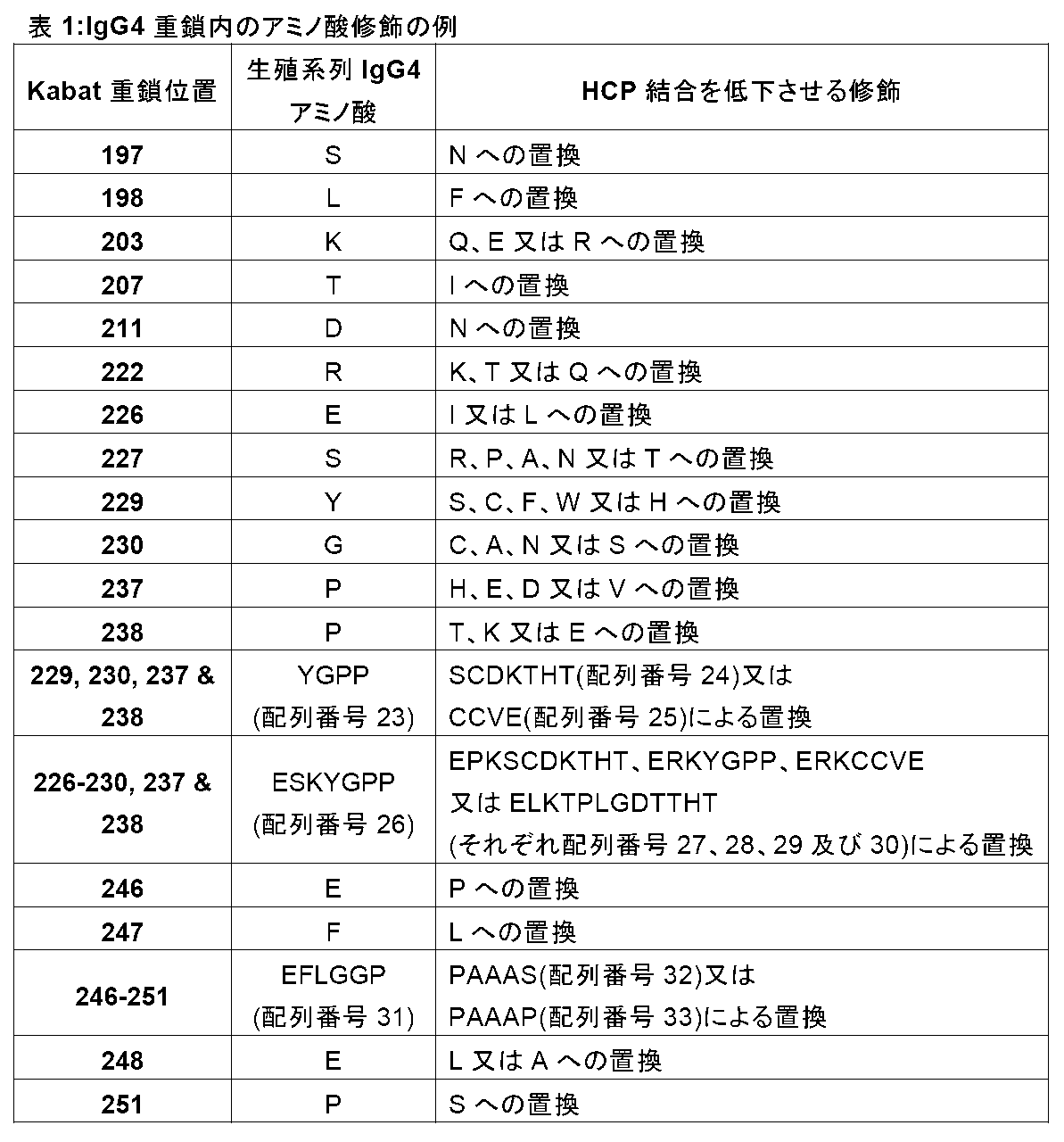
1つの実施形態において、バリアントIgG4抗体は、ヒト抗体又はヒト化抗体である。 In one embodiment, the variant IgG4 antibody is a human antibody or a humanized antibody.
別の実施形態において、IgG1、IgG2、及び/又はIgG3抗体生殖系列配列における同等のアミノ酸配列への置換は、ヒト抗体生殖系列配列を含む。 In another embodiment, the substitutions to equivalent amino acid sequences in IgG1, IgG2, and/or IgG3 antibody germline sequences include human antibody germline sequences.
1つの実施形態において、修飾は、バリアントIgG4分子の両方の重鎖に対して行われる。代替の実施形態において、修飾は、バリアントIgG4分子の重鎖の1つのみに行われる。 In one embodiment, the modifications are made to both heavy chains of the variant IgG4 molecule. In an alternative embodiment, the modifications are made to only one of the heavy chains of the variant IgG4 molecule.
1つの実施形態において、非修飾IgG4抗体と比較して重鎖定常領域においてさらなる修飾がない。 In one embodiment, there are no further modifications in the heavy chain constant region compared to the unmodified IgG4 antibody.
1つの実施形態において、修飾は、IgG4エフェクター機能に必要なアミノ酸残基には行われない。例えば、野生型IgG4 F247(Kabat)(EU F234)は、ADCC及びCDC活性の減衰に重要である。さらに、修飾E248(Kabat)は、エフェクター機能を弱め、具体的にはFcγRIへの結合を低下させることができる。 In one embodiment, the modifications are not made to amino acid residues required for IgG4 effector function. For example, wild-type IgG4 F247(Kabat)(EU F234) is important for attenuating ADCC and CDC activity. Furthermore, the modification E248(Kabat) can attenuate effector function, specifically reducing binding to FcγRI.
1つの実施形態において、バリアントIgG4抗体は、S241からP及び/又はL248からEへのさらなる置換を含む。1つの実施形態において、バリアントIgG4抗体は、S241からPへのさらなる置換を含む。この修飾は、IgG4分子の安定性を改善するのに役立つ。1つの実施形態において、バリアントIgG4抗体は、配列PAAAP(配列番号33)によるEFLGGP配列(配列番号31)(Kabat残基246-251)のさらなる置換を含む。 In one embodiment, the variant IgG4 antibody comprises an additional substitution of S241 to P and/or L248 to E. In one embodiment, the variant IgG4 antibody comprises an additional substitution of S241 to P. This modification serves to improve the stability of the IgG4 molecule. In one embodiment, the variant IgG4 antibody comprises an additional substitution of the EFLGGP sequence (SEQ ID NO: 31) (Kabat residues 246-251) with the sequence PAAAP (SEQ ID NO: 33).
本発明のさらなる態様によれば、本明細書に定義されるバリアントIgG4抗体をコードする核酸構築物が提供される。 According to a further aspect of the invention there is provided a nucleic acid construct encoding a variant IgG4 antibody as defined herein.
該核酸構築物は、宿主細胞株にトランスフェクトすることができる。したがって、本発明のさらなる態様によれば、本明細書に定義されるバリアントIgG4抗体をコードする細胞株が提供される。 The nucleic acid construct can be transfected into a host cell line. Thus, according to a further aspect of the invention, there is provided a cell line encoding a variant IgG4 antibody as defined herein.
さらなる配列修飾
本発明のさらなる態様によれば、重鎖定常領域においてKabat残基203~256の間の領域のアミノ酸のいずれか1つ又は組み合わせで修飾されているバリアントIgG抗体であって、非修飾IgG抗体と比べて、宿主細胞タンパク質(HCP)への結合レベルが低下しているバリアントIgG4抗体が提供される。例えば、バリアントIgG抗体は、Kabat残基203~256の間の重鎖定常領域の1~25個のアミノ酸で修飾されている。例えば、バリアントIgG抗体は、Kabat残基203~256の間の重鎖定常領域の1、2、3、4、5、6、7、8、9、10、11、12、13、14、15、16、17、18、19、20、21、22、又は23個のアミノ酸で修飾されている。例えば、バリアントIgG抗体は、重鎖定常領域のKabat 197位、198位、203位、207位、211位、222位、226位、227位、229位、230位、232位、233位、234位、235位、236位、237位、238位、246位、247位、248位、249位、250位、又は251位のいずれか1つ又は組み合わせで修飾されている。例えば、バリアントIgG抗体は、重鎖定常領域のKabat 203位、222位、226位、227位、229位、230位、232位、233位、234位、235位、236位、237位、238位、247位、248位、又は251位のいずれか1つ又は組み合わせで修飾されている。
Further sequence modifications According to a further aspect of the invention there is provided a variant IgG4 antibody modified at any one or combination of amino acids in the region between Kabat residues 203-256 in the heavy chain constant region, said variant IgG4 antibody having a reduced level of binding to host cell proteins (HCPs) compared to the unmodified IgG antibody. For example the variant IgG antibody is modified at 1 to 25 amino acids in the heavy chain constant region between Kabat residues 203-256. For example the variant IgG antibody is modified at 1, 2, 3, 4, 5, 6, 7, 8, 9, 10, 11, 12, 13, 14, 15, 16, 17, 18, 19, 20, 21, 22 or 23 amino acids in the heavy chain constant region between Kabat residues 203-256. For example, the variant IgG antibody is modified at any one or combination of Kabat positions 197, 198, 203, 207, 211, 222, 226, 227, 229, 230, 232, 233, 234, 235, 236, 237, 238, 246, 247, 248, 249, 250, or 251 in the heavy chain constant region. For example, the variant IgG antibody is modified at any one or combination of Kabat positions 203, 222, 226, 227, 229, 230, 232, 233, 234, 235, 236, 237, 238, 247, 248, or 251 in the heavy chain constant region.
宿主細胞タンパク質
宿主細胞タンパク質、又は「HCP」は、細胞培養又は発酵中に宿主細胞により産生される、細胞内及び/又は分泌タンパク質を含む目的とするタンパク質(すなわち、組換えタンパク質/バリアントIgG4)に関係のないタンパク質を指す。宿主細胞タンパク質の例は、精製中及び精製後に依然として存在するならば、目的とするタンパク質に損害をもたらし得るプロテアーゼである。例えば、プロテアーゼが、目的とするタンパク質を含む試料中に残留しているならば、もともと存在しなかった産物関連物質又は不純物を作り出す可能性がある。プロテアーゼの存在は、精製工程中の時間と共に、及び/又は最終製剤中の目的とするタンパク質の崩壊を引き起こす可能性がある。
Host cell proteins Host cell proteins, or "HCPs", refer to proteins unrelated to the protein of interest (i.e. recombinant protein/variant IgG4) that are produced by host cells during cell culture or fermentation, including intracellular and/or secreted proteins. An example of a host cell protein is a protease that can cause damage to the protein of interest if still present during and after purification. For example, if a protease remains in a sample containing the protein of interest, it can create product-related substances or impurities that were not originally present. The presence of a protease can cause the degradation of the protein of interest over time during the purification process and/or in the final formulation.
1つの実施形態において、宿主細胞タンパク質は、哺乳動物細胞又は細菌細胞から作製される/に由来する。さらなる実施形態において、哺乳動物細胞は、ヒト又はげっ歯類(ハムスター又はマウスなど)細胞から選択される。 In one embodiment, the host cell protein is made/derived from a mammalian cell or a bacterial cell. In a further embodiment, the mammalian cell is selected from a human or rodent (such as a hamster or mouse) cell.
特定の実施形態において抗体を発現するのに使用される宿主細胞は、CHO細胞、NS0細胞、Sp2/0細胞、COS細胞、K562細胞、BHK細胞、PER.C6細胞、及びHEK細胞から成る群から選択される(すなわち、宿主細胞タンパク質はこれらの宿主細胞に由来する)。あるいは、宿主細胞は、大腸菌(E. coli)(例えば、W3110、BL21)、枯草菌(B. subtilis)、及び/又は他の適切な細菌、すなわち、真菌若しくは酵母細胞(例えば、ピキア・パストリス(Pichia pastoris)、アスペルギルス属種(Aspergillus sp.)、サッカロマイセス・セレビシエ(Saccharomyces cerevisiae)、シゾサッカロマイセス・ポンベ(Schizosaccharomyces pombe)、アカパンカビ(Neurospora crassa))などの真核細胞から成る群から選択される細菌細胞であってもよい。例えば、宿主細胞はCHO細胞である。あるいは、宿主細胞はHEK細胞である。 In certain embodiments, the host cells used to express the antibody are selected from the group consisting of CHO cells, NS0 cells, Sp2/0 cells, COS cells, K562 cells, BHK cells, PER.C6 cells, and HEK cells (i.e., the host cell proteins are derived from these host cells). Alternatively, the host cells may be bacterial cells selected from the group consisting of eukaryotic cells such as E. coli (e.g., W3110, BL21), B. subtilis, and/or other suitable bacteria, i.e., fungal or yeast cells (e.g., Pichia pastoris, Aspergillus sp., Saccharomyces cerevisiae, Schizosaccharomyces pombe, Neurospora crassa). For example, the host cells are CHO cells. Alternatively, the host cell is a HEK cell.
1つの実施形態において、宿主細胞タンパク質は、推定ホスホリパーゼB様2(PLBL2)である。PLBL2は、ホスホリパーゼBドメイン含有タンパク質2(PLBD2)としても知られる。 In one embodiment, the host cell protein is putative phospholipase B-like 2 (PLBL2). PLBL2 is also known as phospholipase B domain-containing protein 2 (PLBD2).
PLBL2などのHCPへのIgG4分子の結合を低下させることは、これらの工程関連不純物と製品IgG4との同時精製のレベルを同時に減少させる結果になる。このことが、今度は、製剤からHCPを取り除くための特異的精製戦略、例えば、充填床カラムクロマトグラフィー(pack bed column chromatography)中のストリンジェントな洗浄条件などの必要性を排除する。そうすることで、製造工程の効率が向上し、関連コストが減少し、オーダーメイド化される可能性がある免疫アッセイを用いた過度な製品試験の必要性が軽減する。最終的に、これらの修飾は、PLBL2などのHCPが最終製剤中に存在するリスクを潜在的に軽減するのに役立ち、その結果、それらが患者において免疫原性応答を引き起こす可能性を最小化する。 Reducing the binding of IgG4 molecules to HCPs such as PLBL2 results in a concomitant reduction in the levels of these process-related impurities co-purified with the product IgG4. This in turn eliminates the need for specific purification strategies to remove HCPs from the formulation, such as stringent washing conditions during packed bed column chromatography. Doing so increases the efficiency of the manufacturing process, reduces the associated costs, and mitigates the need for excessive product testing with potentially tailored immunoassays. Ultimately, these modifications help to potentially reduce the risk of HCPs such as PLBL2 being present in the final formulation, thereby minimizing the possibility that they may cause an immunogenic response in patients.
PLBL2などのHCPを結合するこれらの修飾IgG4分子の能力の低下は、実施例に提供された方法に基づき定量化することができる。 The reduction in the ability of these modified IgG4 molecules to bind HCPs such as PLBL2 can be quantified based on the methods provided in the Examples.
宿主細胞タンパク質に結合するレベルの低下を測定することができるいくつかの方法がある。例えば、結合レベルの低下は、例えば親和性クロマトグラフィーによって精製された時点で、抗体を含む溶液中に存在する宿主細胞タンパク質の量を単に測定して評価することができる(非修飾IgG4と比べた量の低下は、宿主細胞タンパク質結合の低下を示している)。1つの実施形態において、IgG4抗体は、非修飾IgG4抗体と比較して宿主細胞タンパク質への結合親和性及び/又は結合活性が低下している。 There are several ways in which the reduced level of binding to host cell proteins can be measured. For example, the reduced level of binding can be assessed by simply measuring the amount of host cell protein present in a solution containing the antibody, once purified, for example by affinity chromatography (a reduced amount compared to unmodified IgG4 indicates reduced host cell protein binding). In one embodiment, the IgG4 antibody has reduced binding affinity and/or avidity to host cell proteins compared to unmodified IgG4 antibody.
1つの実施形態において、バリアントIgG4抗体は、非修飾IgG4抗体と比べて結合活性が少なくとも10%低下、例えば、結合活性が少なくとも15%、20%、25%、30%、35%、40%、45%、50%、55%、60%、65%、70%、75%、80%、85%、90%、95%、98%、99%低下している。 In one embodiment, the variant IgG4 antibody has at least 10% reduced binding activity compared to an unmodified IgG4 antibody, e.g., at least 15%, 20%, 25%, 30%, 35%, 40%, 45%, 50%, 55%, 60%, 65%, 70%, 75%, 80%, 85%, 90%, 95%, 98%, 99% reduced binding activity.
1つの実施形態において、バリアントIgG4抗体は、非修飾IgG4抗体と比べて結合親和性が少なくとも10分の1に低下、例えば、結合親和性が少なくとも10%、15%、20%、25%、30%、35%、40%、45%、50%、55%、60%、65%、70%、75%、80%、85%、90%、95%、98%、99%低下している。 In one embodiment, the variant IgG4 antibody has at least a 10-fold reduction in binding affinity compared to the unmodified IgG4 antibody, e.g., at least a 10%, 15%, 20%, 25%, 30%, 35%, 40%, 45%, 50%, 55%, 60%, 65%, 70%, 75%, 80%, 85%, 90%, 95%, 98%, 99% reduction in binding affinity.
抗体バリアントを含む組成物
本発明のさらなる態様によれば、本明細書に定義されるバリアントIgG4抗体を含む組成物が提供される。
Compositions Comprising Antibody Variants According to a further aspect of the invention there is provided a composition comprising a variant IgG4 antibody as defined herein.
本発明の組成物は、従来の手法に従って、薬学的に許容可能な担体又は希釈剤、及び任意の他の既知の補助剤及び賦形剤と共に製剤化することができる。薬学的に許容可能な担体又は希釈剤、及び任意の他の既知の補助剤及び賦形剤は、本発明の選択された化合物及び選択された投与方法に適切であるべきである。 The compositions of the present invention can be formulated according to conventional techniques with a pharma- ceutically acceptable carrier or diluent, and any other known adjuvants and excipients. The pharma-ceutically acceptable carrier or diluent, and any other known adjuvants and excipients, should be appropriate for the selected compound of the present invention and the selected method of administration.
1つの実施形態において、バリアントIgG4は、少なくとも10mg/mL、例えば、少なくとも20mg/mL、25mg/mL、30mg/mL、35mg/mL、40mg/mL、45mg/mL、50mg/mL、55mg/mL、60mg/mL、65mg/mL、70mg/mL、75mg/mL、80mg/mL、85mg/mL、90mg/mL又は95mg/mL又は100mg/mLの濃度である。 In one embodiment, the variant IgG4 is at a concentration of at least 10 mg/mL, e.g., at least 20 mg/mL, 25 mg/mL, 30 mg/mL, 35 mg/mL, 40 mg/mL, 45 mg/mL, 50 mg/mL, 55 mg/mL, 60 mg/mL, 65 mg/mL, 70 mg/mL, 75 mg/mL, 80 mg/mL, 85 mg/mL, 90 mg/mL or 95 mg/mL or 100 mg/mL.
本発明の医薬組成物の活性成分の実際の投与レベルは、患者に有害となることなく、特定の患者、組成物、及び投与方法に対して所望の治療的応答を達成するのに有効な活性成分量を得られるように異なってもよい。選択された投与レベルは、使用される本発明の特定の組成物の活性、投与経路、投与時期、処置期間、使用される特定の組成物と併用される他の薬物、化合物及び/又は材料、処置される患者の年齢、性別、体重、状態、全身の健康及び既往歴、並びに医学的技術分野で周知の同様の要因を含む、様々な薬物動態学的要因に依存するであろう。当技術分野で通常の技量を有する医師又は獣医師は、必要とされる医薬組成物の有効量を容易に決定及び処方することができる。 The actual dosage level of the active ingredient of the pharmaceutical composition of the present invention may vary to obtain an amount of the active ingredient effective to achieve the desired therapeutic response for a particular patient, composition, and method of administration without harming the patient. The dosage level selected will depend on a variety of pharmacokinetic factors, including the activity of the particular composition of the present invention used, the route of administration, the timing of administration, the duration of treatment, other drugs, compounds and/or materials used in combination with the particular composition used, the age, sex, weight, condition, general health and medical history of the patient being treated, and similar factors well known in the medical arts. A physician or veterinarian of ordinary skill in the art can readily determine and prescribe the effective amount of the pharmaceutical composition required.
1つの実施形態において、組成物中の推定ホスホリパーゼB様2(PLBL2)の濃度は、500ppm未満、例えば400ppm、300ppm、200ppm、100ppm、90ppm、80ppm、70ppm、60ppm、50ppm、40ppm、30ppm、20ppm又は10ppm未満である。 In one embodiment, the concentration of putative phospholipase B-like 2 (PLBL2) in the composition is less than 500 ppm, e.g., less than 400 ppm, 300 ppm, 200 ppm, 100 ppm, 90 ppm, 80 ppm, 70 ppm, 60 ppm, 50 ppm, 40 ppm, 30 ppm, 20 ppm, or 10 ppm.
1つの実施形態において、組成物中の推定ホスホリパーゼB様2(PLBL2)の濃度は、PLBL2約200ng/製品mg(すなわち、ng/mg)未満、約150ng/mg未満、約100ng/mg未満、又は約50ng/mg未満である。 In one embodiment, the concentration of putative phospholipase B-like 2 (PLBL2) in the composition is less than about 200 ng/mg of product (i.e., ng/mg), less than about 150 ng/mg, less than about 100 ng/mg, or less than about 50 ng/mg of PLBL2.
1つの実施形態において、組成物は、バッファー及び/又は脂肪酸エステルをさらに含む。さらなる実施形態において、脂肪酸エステルは、ポリソルベート20又はポリソルベート80である。 In one embodiment, the composition further comprises a buffer and/or a fatty acid ester. In a further embodiment, the fatty acid ester is polysorbate 20 or polysorbate 80.
上記に述べた通り、PLBL2は、最終製剤中の製品タンパク質の安定化に必要なポリソルベートなどの製剤賦形剤の劣化の潜在的な原因物質として同定されている。したがって、PLBL2の結合を低下させることが、今度は最終製剤薬物中のPLBL2のレベルを最小化し、これにより製品の有効期限を最大化するであろう。したがって、本発明のさらなる態様によれば、本明細書に定義されるバリアントIgG4抗体を含む、有効期間が延長/改善された組成物が提供される。 As noted above, PLBL2 has been identified as a potential contributor to the degradation of formulation excipients such as polysorbates, which are necessary for stabilization of product proteins in the final formulation. Therefore, reducing the binding of PLBL2 will in turn minimize the levels of PLBL2 in the final formulated drug, thereby maximizing the shelf life of the product. Thus, according to a further aspect of the present invention, there is provided a composition with extended/improved shelf life comprising a variant IgG4 antibody as defined herein.
さらに、本発明のさらなる態様によれば、抗体組成物の有効期間を延長する方法であって、抗体配列を重鎖定常領域においてKabat残基203~256の間の領域のアミノ酸のいずれか1つ又は組み合わせで修飾することにより、PLBL2への結合が低下しているIgG4抗体を作製することを含む方法が提供される。 Furthermore, according to a further aspect of the present invention, there is provided a method for extending the shelf life of an antibody composition, comprising modifying the antibody sequence with any one or a combination of amino acids in the region between Kabat residues 203 and 256 in the heavy chain constant region to produce an IgG4 antibody with reduced binding to PLBL2.
抗体バリアントの使用
本発明のさらなる態様によれば、治療において使用するための本明細書に定義されるバリアントIgG4抗体が提供される。本発明は、種々の標的に対する様々なIgG4抗体に適用し得、したがって前記IgG4バリアントは、一連の疾患を処置するのに使用することができることが、当業者によって理解されるであろう。
Use of antibody variants According to a further aspect of the invention there is provided a variant IgG4 antibody as defined herein for use in therapy. It will be appreciated by the skilled artisan that the present invention is applicable to various IgG4 antibodies against different targets and thus said IgG4 variants can be used to treat a range of diseases.
本明細書に記載された抗体は、処置方法に使用することもできる。処置は、治療的、予防的(prophylactic)又は防止的(preventative)であり得る。処置は、疾患の少なくとも1つの側面又は症状の軽減、低減、又は予防を包含し、本明細書に記載された疾患の予防又は治癒を包含する。 The antibodies described herein can also be used in methods of treatment. Treatment can be therapeutic, prophylactic, or preventative. Treatment includes alleviating, reducing, or preventing at least one aspect or symptom of a disease, including prevention or cure of a disease described herein.
本明細書に記載された抗体は、治療的、予防的又は防止的処置に有効な量で使用され得る。本明細書に記載された抗体の治療的に有効な量は、疾患の1つ以上の症状を改善若しくは低減する、又は疾患を予防若しくは治癒するのに有効な量である。 The antibodies described herein may be used in an amount effective for therapeutic, prophylactic or preventative treatment. A therapeutically effective amount of an antibody described herein is an amount effective to ameliorate or reduce one or more symptoms of a disease, or to prevent or cure a disease.
抗体バリアントを調製する方法
本明細書に提供されるのは、抗体バリアント、及び工程不純物結合レベルを低下させるために、アミノ酸配列変化により修飾されている前記抗体バリアントを作製する方法である。これらの修飾は、得られた医薬品中に存在する工程不純物の量を低下させる有益な効果がある。
Methods of Preparing Antibody Variants Provided herein are antibody variants and methods of making said antibody variants that have been modified by amino acid sequence changes to reduce the levels of process impurity binding. These modifications have the beneficial effect of lowering the amount of process impurities present in the resulting drug product.
したがって、本発明のさらなる態様によれば、工程不純物への結合を低下させるためにIgG抗体を修飾する方法であって、
a)工程不純物の結合に関与する少なくとも1つのアミノ酸を同定するステップ、及び
b)工程不純物との結合に関与すると同定されたアミノ酸を異なるアミノ酸で置換することにより、IgG抗体のバリアントを作出するステップ
を含む方法が提供される。
Thus, according to a further aspect of the invention there is provided a method of modifying an IgG antibody to reduce binding to a process impurity comprising the steps of:
a) identifying at least one amino acid involved in binding of a process impurity; and
b) generating variants of the IgG antibody by replacing the amino acids identified as involved in binding to the step impurity with different amino acids.
本発明のさらなる態様によれば、非修飾IgG抗体と比べて工程不純物への結合が低下しているIgG抗体のバリアントを作出する方法であって、
a)工程不純物の結合に関与する少なくとも1つのアミノ酸を同定するステップ、及び
b)工程不純物との結合に関与すると同定されたアミノ酸を異なるアミノ酸で置換することにより、IgG抗体のバリアントを作出するステップ
を含む方法が提供される。
According to a further aspect of the invention there is provided a method for producing an IgG antibody variant having reduced binding to process impurities compared to an unmodified IgG antibody, comprising the steps of:
a) identifying at least one amino acid involved in binding of a process impurity; and
b) generating variants of the IgG antibody by replacing the amino acids identified as involved in binding to the step impurity with different amino acids.
1つの実施形態において、工程不純物の結合に関与するアミノ酸は、タンパク質間相互作用を試験するのに使用することができる方法又は方法の組み合わせの使用により同定される。1つの実施形態において、タンパク質間相互作用を試験する方法は、水素重水素交換質量分析(HDX-MS)、結晶構造解析、酵母2ハイブリッドスクリーニング、コンピュータ3D構造モデリング、又はそれらの任意の組み合わせから成る群から選択される。そのような実施形態は、いくつかのこれらの方法のアウトプットの組み合わせを必要とする場合があり、適当な科学的推論の適用により、工程不純物の結合に関与するアミノ酸(複数可)の同定が推定され得る。 In one embodiment, the amino acids involved in the binding of the process impurity are identified by use of a method or combination of methods that can be used to test protein-protein interactions. In one embodiment, the method for testing protein-protein interactions is selected from the group consisting of hydrogen-deuterium exchange mass spectrometry (HDX-MS), crystallography, yeast two-hybrid screening, computational 3D structural modeling, or any combination thereof. Such an embodiment may require the combination of the output of several of these methods, and by application of appropriate scientific reasoning, the identity of the amino acid(s) involved in the binding of the process impurity can be deduced.
1つの実施形態において、工程不純物の結合に関与すると同定されたアミノ酸は、定常領域に存在する。さらなる実施形態において、工程不純物の結合に関与すると同定されたアミノ酸は、重鎖定常領域に存在する。 In one embodiment, the amino acids identified as involved in binding of process impurities are present in the constant region. In a further embodiment, the amino acids identified as involved in binding of process impurities are present in the heavy chain constant region.
タンパク質間相互作用方法(例えばHDX-MS)により決定された領域の、工程不純物と相互作用しないアイソタイプに対する工程不純物と相互作用するIgGアイソタイプの配列アライメントにより、工程不純物の結合に関与するアミノ酸を同定できるようになる。工程不純物と結合しないIgGアイソタイプから工程不純物と結合するIgGへの、生殖系列間保存的置換により、次いで工程不純物に結合しないバリアントを作出できるようになるであろう。したがって、1つの実施形態において、工程不純物との結合に関与すると同定されたアミノ酸が、代替のIgG抗体生殖系列配列由来の同等のアミノ酸で置換される。 Sequence alignment of the IgG isotype that interacts with the process impurity against an isotype that does not interact with the process impurity in the region determined by protein-protein interaction methods (e.g. HDX-MS) allows the amino acids involved in binding of the process impurity to be identified. Germline conservative substitutions from the IgG isotype that does not bind the process impurity to an IgG that does bind the process impurity would then allow the creation of variants that do not bind the process impurity. Thus, in one embodiment, the amino acids identified as involved in binding to the process impurity are replaced with the equivalent amino acids from an alternative IgG antibody germline sequence.
1つの実施形態において、工程不純物との結合に関与すると同定されたアミノ酸は、該抗体配列の保存領域における保存的な、同じ種の、免疫グロブリン生殖系列間アミノ酸変化により修飾される。 In one embodiment, the amino acids identified as involved in binding to process impurities are modified with conservative, same-species, immunoglobulin germline inter-amino acid changes in conserved regions of the antibody sequence.
したがって、本明細書では、宿主細胞タンパク質(HCP)への結合が低下しているIgG4抗体を作製する方法であって、抗体配列を重鎖定常領域においてKabat残基203~256の間の領域のアミノ酸のいずれか1つ又は組み合わせで修飾することを含む方法が提供される。1つの実施例において、宿主細胞タンパク質は、推定ホスホリパーゼB様2(PLBL2)である。方法は、親和性クロマトグラフィー法を用いてIgG4抗体を精製することをさらに含んでもよい。方法は、少なくとも1つの他の直交型クロマトグラフィー法を用いて、さらなるIgG4抗体を精製することをさらに含んでもよい。1つの実施例において、直交型クロマトグラフィー法は、イオン交換クロマトグラフィーである。 Thus, provided herein is a method of making an IgG4 antibody with reduced binding to a host cell protein (HCP), comprising modifying the antibody sequence with any one or combination of amino acids in the region between Kabat residues 203-256 in the heavy chain constant region. In one example, the host cell protein is putative phospholipase B-like 2 (PLBL2). The method may further comprise purifying the IgG4 antibody using an affinity chromatography method. The method may further comprise purifying a further IgG4 antibody using at least one other orthogonal chromatography method. In one example, the orthogonal chromatography method is ion exchange chromatography.
したがって、本発明は、結合する工程不純物のレベルを低下させるために、より古典的なクロマトグラフィー方法により精製されるものよりむしろ、部位特異的変異誘発により作製される抗体バリアントを提供する。本発明のさらなる態様によれば、本明細書に定義された方法により得られるIgG抗体が提供される。 The invention therefore provides antibody variants that are generated by site-directed mutagenesis, rather than purified by more classical chromatographic methods, to reduce the levels of binding process impurities. According to a further aspect of the invention, there is provided an IgG antibody obtained by the method defined herein.
1つの実施形態において、IgG抗体はIgG4抗体である。したがって、この実施形態において、工程不純物との結合に関与すると同定されたアミノ酸は、IgG1、IgG2、及び/又はIgG3抗体生殖系列配列由来の同等のアミノ酸で置換される。 In one embodiment, the IgG antibody is an IgG4 antibody. Thus, in this embodiment, the amino acids identified as involved in binding to process impurities are replaced with the equivalent amino acids from an IgG1, IgG2, and/or IgG3 antibody germline sequence.
IgG4抗体バリアントを調製する方法
本発明のさらなる態様によれば、宿主細胞タンパク質(HCP)への結合が低下しているIgG4抗体を作製する方法であって、抗体配列を重鎖定常領域においてKabat残基203~256の間の領域のアミノ酸のいずれか1つ又は組み合わせで修飾することを含む方法が提供される。
Methods for Preparing IgG4 Antibody Variants According to a further aspect of the invention, there is provided a method for making an IgG4 antibody with reduced binding to host cell proteins (HCPs), comprising modifying the antibody sequence at any one or combination of amino acids in the region between Kabat residues 203-256 in the heavy chain constant region.
抗体を作製する方法は、当業者に周知である。例えば、方法は、前記IgG4抗体をコードする組換えポリヌクレオチドで形質転換又はトランスフェクトされた組換え宿主細胞の懸濁培養物を調製すること、及び前記IgG4抗体の発現を可能にする条件下で前記宿主細胞培養物を培養することを含んでもよい。方法は、親和性クロマトグラフィー法を用いてIgG4抗体を精製することをさらに含んでもよい。方法は、少なくとも1つの他の直交型クロマトグラフィー法を用いてIgG4抗体をさらに精製することをさらに含んでもよい。1つの実施例において、直交型クロマトグラフィー法は、イオン交換クロマトグラフィーである。 Methods of producing antibodies are well known to those of skill in the art. For example, the method may include preparing a suspension culture of recombinant host cells transformed or transfected with a recombinant polynucleotide encoding said IgG4 antibody, and culturing said host cell culture under conditions that allow expression of said IgG4 antibody. The method may further include purifying the IgG4 antibody using an affinity chromatography method. The method may further include further purifying the IgG4 antibody using at least one other orthogonal chromatography method. In one embodiment, the orthogonal chromatography method is ion exchange chromatography.
1つの実施形態において、方法は、例えば親和性クロマトグラフィー法を用いてIgG4抗体を精製すること(例えば培養後に)をさらに含む。さらなる実施形態において、親和性クロマトグラフィー法は、スーパー抗原親和性クロマトグラフィーである。1つの実施形態において、スーパー抗原は、タンパク質A、タンパク質G、及びタンパク質Lから選択される。したがって、さらなる実施形態において、スーパー抗原親和性クロマトグラフィーは、タンパク質A親和性クロマトグラフィー、タンパク質G親和性クロマトグラフィー、及びタンパク質L親和性クロマトグラフィーから選択される。 In one embodiment, the method further comprises purifying the IgG4 antibodies (e.g., after culturing), e.g., using an affinity chromatography method. In a further embodiment, the affinity chromatography method is superantigen affinity chromatography. In one embodiment, the superantigen is selected from protein A, protein G, and protein L. Thus, in a further embodiment, the superantigen affinity chromatography is selected from protein A affinity chromatography, protein G affinity chromatography, and protein L affinity chromatography.
1つの実施形態において、方法は、イオン交換クロマトグラフィーなどの少なくとも1つの他のクロマトグラフィー法を用いて、IgG4抗体をさらに精製するステップをさらに含む。1つの実施形態において、1つ以上のさらなるクロマトグラフィーステップは、陰イオン交換クロマトグラフィー、陽イオン交換クロマトグラフィー、及び混合モードクロマトグラフィー、特に陰イオン交換クロマトグラフィーから成る群から選択される。1つの実施形態において、少なくとも1つの他のクロマトグラフィー法は、疎水性相互作用クロマトグラフィーを含まない。 In one embodiment, the method further comprises the step of further purifying the IgG4 antibody using at least one other chromatographic method, such as ion exchange chromatography. In one embodiment, the one or more further chromatographic steps are selected from the group consisting of anion exchange chromatography, cation exchange chromatography, and mixed mode chromatography, in particular anion exchange chromatography. In one embodiment, the at least one other chromatographic method does not include hydrophobic interaction chromatography.
方法は、深層濾過(細胞及び細胞残渣の除去のための)、及びナノ濾過(ウイルスの除去のための)などの濾過ステップも含んでもよい。精製ステップも、哺乳動物発現系を用いて生成される材料に対する任意のウイルス不活性化ステップを含むように講じることができる。 The method may also include filtration steps such as depth filtration (for removal of cells and cellular debris) and nanofiltration (for removal of viruses). Purification steps may also be taken to include an optional viral inactivation step for material produced using mammalian expression systems.
本発明のさらなる態様によれば、本明細書に定義されるバリアントIgG4抗体を作製する方法であって、前記抗体をコードする核酸構築物を宿主細胞で発現させるステップ、及び場合により前記抗体を精製するステップを含む方法が提供される。 According to a further aspect of the invention, there is provided a method of making a variant IgG4 antibody as defined herein, comprising expressing a nucleic acid construct encoding said antibody in a host cell, and optionally purifying said antibody.
本発明のさらなる態様によれば、本明細書に定義された方法により得られるIgG4抗体が提供される。 According to a further aspect of the present invention, there is provided an IgG4 antibody obtained by the method defined herein.
定義
特に定義されない限り、本明細書に使用された全ての技術的及び科学的用語は、(例えば、細胞培養、分子遺伝学、核酸化学、ハイブリダイゼーション法、タンパク質精製及び生化学における)当業者によって一般に理解されるのと同じ意味を有する。標準的な手法は、分子的、遺伝的、及び生化学的方法、並びに化学的方法に使用される。
DEFINITIONS Unless otherwise defined, all technical and scientific terms used herein have the same meaning as commonly understood by one of ordinary skill in the art (e.g., in cell culture, molecular genetics, nucleic acid chemistry, hybridization techniques, protein purification and biochemistry). Standard procedures are used for molecular, genetic, and biochemical methods, as well as chemical methods.
本明細書に使用される場合、用語「抗体」は、抗体を天然に産生する任意の種に由来するものであれ、又は組換えDNA技術により作出されたものであれ、血清、B細胞、ハイブリドーマ、トランスフェクトーマ、酵母、又は細菌から単離されたものであれ、全ての免疫グロブリン又はIgG(IgG1、IgG2、IgG3又はIgG4など)、IgM、IgA、IgD又はIgE抗体を指す。抗体は、モノクローナル、組換え、ポリクローナル、キメラ(例えば、異なる供給源(例えばヒト/マウスキメラ抗体)又は異なる抗体型(例えば、IgG2/4抗体)由来)、ヒト、ヒト化、多重特異性(二重特異性を含む)、又はヘテロコンジュゲート抗体であってもよい。該用語はまた、単一可変ドメイン(例えば、VH、VHH、VL)、ドメイン抗体(dAb(登録商標))、抗原結合断片、免疫学的に有効な断片、Fab、F(ab')2、Fv、ジスルフィド結合Fv、一本鎖Fv、閉鎖立体配座多重特異性抗体、ジスルフィド結合scFv、ダイアボディ、TANDABS(商標)等も含む。1つの実施形態において、抗体はIgG4である。別の実施形態において、抗体は組換えIgG4である。別の実施形態において、抗体はバリアントIgG4である。別の実施形態において、抗体は組換えバリアントIgG4である。 As used herein, the term "antibody" refers to all immunoglobulins or IgG (such as IgG1, IgG2, IgG3 or IgG4), IgM, IgA, IgD or IgE antibodies, whether from any species that naturally produces antibodies or produced by recombinant DNA technology, isolated from serum, B cells, hybridomas, transfectomas, yeast, or bacteria. Antibodies may be monoclonal, recombinant, polyclonal, chimeric (e.g., from different sources (e.g., human/mouse chimeric antibodies) or different antibody types (e.g., IgG2/4 antibodies)), human, humanized, multispecific (including bispecific), or heteroconjugate antibodies. The term also includes single variable domains (e.g., VH, VHH, VL), domain antibodies (dAbs®), antigen-binding fragments, immunologically effective fragments, Fab, F(ab')2, Fv, disulfide-linked Fv, single chain Fv, closed conformation multispecific antibodies, disulfide-linked scFv, diabodies, TANDABS™, and the like. In one embodiment, the antibody is an IgG4. In another embodiment, the antibody is a recombinant IgG4. In another embodiment, the antibody is a variant IgG4. In another embodiment, the antibody is a recombinant variant IgG4.
本明細書に使用される場合、用語「CDR」は、免疫グロブリン重鎖及び軽鎖の超可変領域である抗体の相補性決定領域アミノ酸配列として定義される。免疫グロブリンの30可変部分には3つの重鎖CDR及び3つの軽鎖CDR(又はCDR領域)がある。故に、「CDR」は本明細書に使用される場合、全ての3つの重鎖CDR、又は全ての3つの軽鎖CDR(又は、適切な場合、全ての重鎖CDR及び全ての軽鎖CDRの両方)を指す。抗体の構造及びタンパク質フォールディングは、他の残基が抗原結合領域の一部とみなされ、当業者によってそのように理解されることを意味し得る。 As used herein, the term "CDR" is defined as the complementarity determining region amino acid sequences of an antibody that are the hypervariable regions of the immunoglobulin heavy and light chains. There are three heavy chain CDRs and three light chain CDRs (or CDR regions) in the 30 variable portion of an immunoglobulin. Thus, "CDR" as used herein refers to all three heavy chain CDRs, or all three light chain CDRs (or both all heavy chain CDRs and all light chain CDRs, as appropriate). The structure and protein folding of an antibody may mean that other residues are considered part of the antigen binding region and would be understood as such by one of skill in the art.
本明細書に使用される場合、用語「ドメイン」は、タンパク質の残りの部分と無関係な三次構造を有するフォールディングされたタンパク質構造を指す。一般に、ドメインは、タンパク質の別々の機能特性に関与し、多くの場合、タンパク質及び/又はドメインの残りの部分の機能を喪失することなく他のタンパク質に付加、除去、又は導入することができる。 As used herein, the term "domain" refers to a folded protein structure that has a tertiary structure independent of the rest of the protein. Generally, domains are responsible for distinct functional properties of the protein and often can be added, removed, or introduced into other proteins without loss of function of the remainder of the protein and/or the domain.
抗体は、タンパク質産物、すなわち目的とするタンパク質である。例えば、タンパク質産物は、バリアントIgG4である。例えば、タンパク質産物は、組換えIgG4である。例えば、タンパク質産物は、組換えバリアントIgG4である。 The antibody is a protein product, i.e., a protein of interest. For example, the protein product is a variant IgG4. For example, the protein product is a recombinant IgG4. For example, the protein product is a recombinant variant IgG4.
本明細書に使用される場合、用語「ヒンジ領域」及び/又は「ヒンジ配列」は、慣例的に抗体のヒンジ領域として知られるもの、すなわち、アミノ酸番号がKabatナンバリングによる、分子タンパク質配列の226位~243位(両端を含む)、又はEUナンバリングによる216位~230位(両端を含む)のアミノ酸をカバーするIgG分子のドメインを指す。これらの領域は、「遺伝子ヒンジ」とも呼ばれ得る。これに加えて、用語「ヒンジ領域」及び「ヒンジ配列」は、本明細書に使用される場合、アミノ酸番号がKabatナンバリングによる分子タンパク質配列の203位~223位(両端を含む)、又はEUナンバリングによる196位~215位(両端を含む)のアミノ酸も含むと解釈されてもよい。さらに、用語「ヒンジ領域」及び「ヒンジ配列」は、本明細書に使用される場合、アミノ酸番号がKabatナンバリングによる分子タンパク質配列の244位~256位(両端を含む)、又はEUナンバリングによる231位~243位(両端を含む)のアミノ酸を含むと解釈されてもよい。 As used herein, the terms "hinge region" and/or "hinge sequence" refer to what is conventionally known as the hinge region of an antibody, i.e., the domain of an IgG molecule covering amino acids numbered from 226 to 243 (inclusive) of the molecule's protein sequence according to the Kabat numbering, or from 216 to 230 (inclusive) according to the EU numbering. These regions may also be referred to as "genetic hinges." In addition, the terms "hinge region" and "hinge sequence" as used herein may also be interpreted to include amino acids numbered from 203 to 223 (inclusive) of the molecule's protein sequence according to the Kabat numbering, or from 196 to 215 (inclusive) according to the EU numbering. Additionally, the terms "hinge region" and "hinge sequence" as used herein may be interpreted as including the amino acid numbers from 244 to 256 (inclusive) of the molecular protein sequence according to the Kabat numbering system, or from 231 to 243 (inclusive) according to the EU numbering system.
あるいは、「構造的ヒンジ」は、H/L鎖ジスルフィドの後の残基で始まり、Fcドメインの前の残基で終わるヒンジに基づき、Kabat 234位~250位(又はEU 221位~237位)として定義されている。 Alternatively, the "structural hinge" is defined as Kabat positions 234-250 (or EU positions 221-237), based on the hinge beginning with the residue after the H/L chain disulfide and ending with the residue before the Fc domain.
ヒンジは、1つのヘリックスターンにより形成される最初の重鎖間ジスルフィドのFabドメインの末端である上部ヒンジ(Kabat 234位~238位、又はEU 221位~225位)、及び最後のジスルフィドからFcドメインの始めまでの下部ヒンジ(Kabat 243位~250位又はEU 230位~237位)に構造的に分類することができる。中央又はコアヒンジは、ジスルフィド橋により結合された2つの平行ポリプロリン二重らせんを含む、ヒトIgG1における「CPPC」(配列番号20)モチーフ(Kabat 239~242位又はEU 226~229位)である。 The hinge can be structurally classified into the upper hinge (Kabat positions 234-238 or EU positions 221-225), which is the end of the Fab domain at the first inter-heavy chain disulfide formed by one helical turn, and the lower hinge (Kabat positions 243-250 or EU positions 230-237) from the last disulfide to the beginning of the Fc domain. The middle or core hinge is the "CPPC" (SEQ ID NO: 20) motif in human IgG1 (Kabat positions 239-242 or EU positions 226-229), which contains two parallel polyproline double helices linked by a disulfide bridge.
当技術分野のほとんどのナンバリングはヒトIgG1に基づいており、インデルのために特定のヒンジ配列で異なることが留意されるべきである。例えば、IgG4のコアヒンジの隣の「YGPP」(配列番号23)モチーフは、IgG1における「SCDKTHT」(配列番号24)モチーフと同等であり、したがってIgG4の「YGPP」(配列番号23)が、単に229位~232位ではなく、それぞれ229位、230位、237位及び238位である理由である。 It should be noted that most numbering in the art is based on human IgG1 and differs in certain hinge sequences due to indels. For example, the "YGPP" (SEQ ID NO: 23) motif next to the core hinge of IgG4 is equivalent to the "SCDKTHT" (SEQ ID NO: 24) motif in IgG1, hence why "YGPP" (SEQ ID NO: 23) in IgG4 is at positions 229, 230, 237 and 238, respectively, rather than simply 229-232.
本明細書に使用される場合、抗体分子を記載する文脈での用語「修飾されたヒンジ」は、タンパク質配列の203位~256位(両端を含む)の間のアミノ酸残基が、非修飾及び/又は親抗体の配列のアミノ酸残基から変えられている任意の抗体を指す。これらの変化は、代替アミノ酸の残基(複数可)の置換、又は代替配列のペプチド配列全体の置換のどちらかを含み得る。変化は、タンパク質からのアミノ酸、又はペプチド配列の排除も含み得る。 As used herein, the term "modified hinge" in the context of describing an antibody molecule refers to any antibody in which the amino acid residues between positions 203 and 256 (inclusive) of the protein sequence have been altered from the amino acid residues of the unmodified and/or parent antibody sequence. These changes may involve either the substitution of the residue(s) with an alternative amino acid, or the substitution of the entire peptide sequence with an alternative sequence. The changes may also involve the elimination of an amino acid or peptide sequence from the protein.
本明細書に使用される場合、用語「非修飾」は、工程不純物への結合を低下させる修飾の前の抗体を指す。これは、天然の生殖系列フォーマットでの抗体を含み得る。該用語は、安定性を改善するために多くのIgG4抗体において使用される置換S241P(すなわち、Kabat残基239~242の配列CPPC[配列番号20]をもたらす)などの、宿主細胞タンパク質結合を低下させる以外の特性を改善するために既に修飾されている抗体も含み得る。したがって、1つの実施形態において、非修飾抗体は置換S241Pを含む。非修飾抗体は、エフェクター機能を改善するために多くのIgG4抗体において使用される置換L248Eにより既に修飾されている抗体も含み得る。したがって、1つの実施形態において、非修飾抗体は置換L248Eを含む。 As used herein, the term "unmodified" refers to an antibody prior to modification to reduce binding to process impurities. This may include antibodies in their native germline format. The term may also include antibodies that have been modified to improve properties other than reducing host cell protein binding, such as the substitution S241P (i.e., resulting in the sequence CPPC [SEQ ID NO:20] at Kabat residues 239-242) used in many IgG4 antibodies to improve stability. Thus, in one embodiment, an unmodified antibody includes the substitution S241P. An unmodified antibody may also include antibodies that have been modified with the substitution L248E used in many IgG4 antibodies to improve effector function. Thus, in one embodiment, an unmodified antibody includes the substitution L248E.
用語「修飾」は、重鎖定常領域のKabat残基203~256の間の領域のアミノ酸の1つ又は組み合わせの置換、及び/又は欠失、及び/又は挿入のいずれか1つ又は組み合わせを記載するのに本明細書で使用される。例えば、修飾は、1つ以上のアミノ酸置換、及び/又は1つ以上のアミノ酸挿入、及び/又は1つ以上のアミノ酸欠失を含み得る。用語「欠失」、「除去」、「置換」、「排除」は、本明細書で互換的に使用される。 The term "modification" is used herein to describe any one or combination of substitutions, and/or deletions, and/or insertions of one or a combination of amino acids in the region between Kabat residues 203-256 of the heavy chain constant region. For example, a modification can include one or more amino acid substitutions, and/or one or more amino acid insertions, and/or one or more amino acid deletions. The terms "deletion," "removal," "substitution," and "elimination" are used interchangeably herein.
例えば、バリアントIgG抗体は、Kabat残基203~256の間の重鎖定常領域の1~25個のアミノ酸で修飾されている。例えば、バリアントIgG抗体は、Kabat残基203~256の間の重鎖定常領域の1、2、3、4、5、6、7、8、9、10、11、12、13、14、15、16、17、18、19、20、21、22、又は23個のアミノ酸で修飾されている。例えば、バリアントIgG抗体は、重鎖定常領域のKabat 197位、198位、203位、207位、211位、222位、226位、227位、229位、230位、232位、233位、234位、235位、236位、237位、238位、246位、247位、248位、249位、250位、又は251位のいずれか1つ又は組み合わせで修飾されている。例えば、バリアントIgG抗体は、重鎖定常領域のKabat 203位、222位、226位、227位、229位、230位、232位、233位、234位、235位、236位、237位、238位、247位、248位、又は251位のいずれか1つ又は組み合わせで修飾されている。 For example, the variant IgG antibody is modified at 1 to 25 amino acids in the heavy chain constant region between Kabat residues 203 and 256. For example, the variant IgG antibody is modified at 1, 2, 3, 4, 5, 6, 7, 8, 9, 10, 11, 12, 13, 14, 15, 16, 17, 18, 19, 20, 21, 22, or 23 amino acids in the heavy chain constant region between Kabat residues 203 and 256. For example, the variant IgG antibody is modified at any one or combination of Kabat positions 197, 198, 203, 207, 211, 222, 226, 227, 229, 230, 232, 233, 234, 235, 236, 237, 238, 246, 247, 248, 249, 250, or 251 in the heavy chain constant region. For example, the variant IgG antibody is modified at any one or combination of Kabat positions 203, 222, 226, 227, 229, 230, 232, 233, 234, 235, 236, 237, 238, 247, 248, or 251 in the heavy chain constant region.
本明細書に使用される場合、用語「宿主細胞」は、非改変生物によって発現されないポリペプチドを発現するように遺伝的に改変することができる原核生物及び真核生物の両方の任意の生物を指す。特定の実施形態において宿主細胞は、CHO細胞、NS0細胞、SP2/0細胞、COS細胞、K562細胞、BHK細胞、PER C6細胞、及びHEK細胞から成る群から選択される。宿主細胞は、大腸菌(例えば、W3110、BL21)、枯草菌、及び/又は真菌若しくは酵母細胞(例えば、ピキア・パストリス、アスペルギルス属種、サッカロマイセス・セレビシエ、シゾサッカロマイセス・ポンベ、アカパンカビ)などの他の適切な真核細胞から成る群から選択される細菌細胞であってもよい。 As used herein, the term "host cell" refers to any organism, both prokaryotic and eukaryotic, that can be genetically modified to express a polypeptide not expressed by the unmodified organism. In certain embodiments, the host cell is selected from the group consisting of CHO cells, NS0 cells, SP2/0 cells, COS cells, K562 cells, BHK cells, PER C6 cells, and HEK cells. The host cell may also be a bacterial cell selected from the group consisting of E. coli (e.g., W3110, BL21), Bacillus subtilis, and/or other suitable eukaryotic cells, such as fungal or yeast cells (e.g., Pichia pastoris, Aspergillus spp., Saccharomyces cerevisiae, Schizosaccharomyces pombe, Neurospora crassa).
本明細書に使用される場合、用語「宿主細胞タンパク質」及び略称「HCP」は互換的に使用され、宿主細胞が発現するように改変されている免疫グロブリン(すなわち目的とするタンパク質)、宿主細胞によって発現される免疫グロブリンを除いて、任意のポリペプチドを指す。 As used herein, the term "host cell protein" and the abbreviation "HCP" are used interchangeably and refer to any polypeptide, except for the immunoglobulin (i.e., protein of interest) that a host cell has been engineered to express, and the immunoglobulin expressed by the host cell.
本明細書に使用される場合、用語「工程不純物」は、医薬品規制調和国際会議(International Council for Harmonisation of Technical Requirements for Registration of Pharmaceuticals for Human Use (ICH))ガイドライン(例えばICH Q6B)により、目的とするタンパク質が製造される工程の結果存在する不純物として定義することができ、それを指すと解釈される。したがって、この定義は、製造工程に由来する不純物、すなわち、細胞基質(例えば、宿主細胞タンパク質、宿主細胞DNA/RNA)、細胞培養物(例えば、誘導物質、抗生物質、又は培地成分)、又はそれらの下流処理物を包含する。用語「工程不純物」は、製品関連不純物(例えば抗体凝集物及び/又は断片)を含まない。 As used herein, the term "process impurities" can be defined by International Council for Harmonisation of Technical Requirements for Registration of Pharmaceuticals for Human Use (ICH) guidelines (e.g., ICH Q6B) as impurities that are present as a result of the process by which the protein of interest is manufactured, and is intended to refer to them. This definition therefore encompasses impurities that originate from the manufacturing process, i.e., cell substrates (e.g., host cell proteins, host cell DNA/RNA), cell culture (e.g., inducers, antibiotics, or media components), or downstream processing thereof. The term "process impurities" does not include product-related impurities (e.g., antibody aggregates and/or fragments).
本明細書に同定された全ての「アミノ酸」残基は、天然のL体であってもよい。標準的なポリペプチド命名法に従って、アミノ酸残基の略号は表2に示す通りである。 All "amino acid" residues identified herein may be in the natural L-configuration. In accordance with standard polypeptide nomenclature, abbreviations for amino acid residues are as shown in Table 2.

全てのアミノ酸配列は、左から右方向がアミノ末端からカルボキシ末端の従来の方向である式により、本明細書に詳述される。 All amino acid sequences are detailed herein by formulas in the conventional left-to-right orientation from amino terminus to carboxy terminus.
本明細書に使用される場合、抗体のアミノ酸配列を記載する文脈で使用される用語「生殖系列」は、例えば、ヒト免疫グロブリン遺伝子を有するトランスジェニックマウスを免疫化することにより、又はヒト免疫グロブリン遺伝子ライブラリーをスクリーニングすることよりヒト免疫グロブリン配列を用いて1つの系から得られ、及び選択されたヒト抗体が、生殖系列免疫グロブリン遺伝子によりコードされるアミノ酸配列とアミノ酸配列において少なくとも90%同一である、任意の抗体のアミノ酸配列を記載する。 As used herein, the term "germline" used in the context of describing the amino acid sequence of an antibody describes the amino acid sequence of any antibody obtained from a lineage, e.g., by immunizing a transgenic mouse carrying human immunoglobulin genes or by screening a human immunoglobulin gene library, with a human immunoglobulin sequence, and the selected human antibody is at least 90% identical in amino acid sequence to the amino acid sequence encoded by the germline immunoglobulin gene.
本明細書に使用される場合、「生殖系列間保存的アミノ酸変化」に言及するとき、これは、抗体の最初の生殖系列配列の少なくとも1つのアミノ酸が、同じ種の別の抗体生殖系列配列の、アライメントされた同等の位置のアミノ酸に由来する異なるアミノ酸配列へと修飾される、抗体の保存的変化として定義される。 As used herein, when referring to a "germline conservative amino acid change," this is defined as a conservative change in an antibody in which at least one amino acid in the original germline sequence of the antibody is modified to a different amino acid sequence derived from an amino acid in an aligned equivalent position in another antibody germline sequence of the same species.
本明細書に使用される場合、抗体を記載する文脈での用語「親(parent)」又は「親の(parental)」は、天然に存在する生殖系列ヒト免疫グロブリンのアミノ酸配列から成る、任意の免疫グロブリンを指す。IgG4サブクラスの抗体を記載する文脈での用語「親(parent)」又は「親の(parental)」は、ヒトIgG4分子の保存された定常領域(重鎖及び軽鎖の両方)に、相補性決定領域を含む可変ドメインの任意のアミノ酸配列と共に、天然に存在するヒト生殖系列アミノ酸配列を含有し、ヒンジ領域が、アミノ酸配列、すなわち、システイン-プロリン-プロリン-システイン又はシステイン-プロリン-セリン-システインを含有する任意の免疫グロブリンを指す。 As used herein, the term "parent" or "parental" in the context of describing an antibody refers to any immunoglobulin that consists of the amino acid sequence of a naturally occurring germline human immunoglobulin. The term "parent" or "parental" in the context of describing an antibody of the IgG4 subclass refers to any immunoglobulin that contains the naturally occurring human germline amino acid sequence in the conserved constant regions (both heavy and light chains) of the human IgG4 molecule, together with any amino acid sequence in the variable domains, including the complementarity determining regions, and in which the hinge region contains the amino acid sequence, i.e., cysteine-proline-proline-cysteine or cysteine-proline-serine-cysteine.
本明細書に使用される場合、用語「修飾IgG4」又は「バリアントIgG4」又は「組換えIgG4」は互換的に使用され、「親」IgG4抗体と同じアミノ酸配列を含むが、1つ以上のアミノ酸が異なる任意のIgG4抗体を指す。特定の実施形態において、これらの相違は、表1に詳述した又は本明細書に記載される修飾の少なくとも1つに相当し得る。 As used herein, the terms "modified IgG4" or "variant IgG4" or "recombinant IgG4" are used interchangeably and refer to any IgG4 antibody that contains the same amino acid sequence as a "parent" IgG4 antibody, but differs in one or more amino acids. In certain embodiments, these differences may correspond to at least one of the modifications detailed in Table 1 or described herein.
本明細書に使用される場合、PLBL2などの宿主細胞タンパク質(HCP)への抗体の結合という文脈での用語「結合」は、抗体と前記宿主細胞タンパク質(HCP)の間の特異的及び/又は非特異的、可逆的及び不可逆的相互作用の両方を指す。「結合レベル」、「結合能力」、「相互作用傾向」、「相互作用」は、本明細書で互換的に使用される。抗体とHCPの間のそのような結合相互作用は、当業者によって定量的に決定することができる。例えば、抗PLBL2ウエスタンブロットが、実施例2と同じように実施されてもよい。 As used herein, the term "binding" in the context of antibody binding to a host cell protein (HCP) such as PLBL2 refers to both specific and/or non-specific, reversible and irreversible interactions between the antibody and said host cell protein (HCP). "Binding level", "binding ability", "interaction propensity", and "interaction" are used interchangeably herein. Such binding interactions between an antibody and an HCP can be quantitatively determined by one of skill in the art. For example, an anti-PLBL2 Western blot may be performed as in Example 2.
そのような結合相互作用は、リガンドとして抗体及び分析物として宿主細胞タンパク質を用いて、例えば、BIAcore(商標)3000又はBIAcore(商標)T200機器で表面プラズモン共鳴(SPR)技術を用いることにより、定量的に決定することもできる。 Such binding interactions can also be quantitatively determined by using surface plasmon resonance (SPR) technology, for example on a BIAcore™ 3000 or BIAcore™ T200 instrument, using an antibody as the ligand and a host cell protein as the analyte.
本明細書に使用される場合、用語「親和性」は、PLBL2などのHCPに対する1個の分子、例えば本発明の抗体の結合の強度を指す。抗体の、その標的又は混入物質(HCPなど)に対する結合親和性は、平衡法により決定することができる。結合親和性を定量する方法には、例えば、Octet(登録商標)RED 384機器と組み合わせたバイオレイヤー干渉法(BLI)が挙げられる(実施例6参照)。他の方法には、酵素結合免疫吸着測定法(ELISA)若しくは放射性免疫測定法(RIA))、又は速度論(例えばBIACORE(商標)分析)が挙げられる。 As used herein, the term "affinity" refers to the strength of binding of a molecule, such as an antibody of the invention, to an HCP, such as PLBL2. The binding affinity of an antibody to its target or to a contaminant (such as an HCP) can be determined by equilibrium methods. Methods for quantifying binding affinity include, for example, Biolayer Interferometry (BLI) in combination with an Octet® RED 384 instrument (see Example 6). Other methods include enzyme-linked immunosorbent assay (ELISA) or radioimmunoassay (RIA), or kinetics (e.g., BIACORE™ analysis).
本明細書に使用される場合、PLBL2などの宿主細胞タンパク質への抗体の結合という文脈での用語「活性」は、抗体に結合しているHCPの量を指す。例えば、PLBL2に結合される抗体の数。結合活性を定量する方法には、HCPがどれほど抗体に結合しているか(例えばPLBL2ng/mg)を決定する酵素結合免疫吸着測定法(ELISA)、実施例3参照;HCPがどれほど抗体に結合しているか(例えばPLBL2結合(RU))を決定する、BIAcore(商標)3000又はBIAcore(商標)T200機器における表面プラズモン共鳴(SPR)技術、実施例4参照、が挙げられる。 As used herein, the term "activity" in the context of antibody binding to a host cell protein such as PLBL2 refers to the amount of HCP bound to the antibody. For example, the number of antibodies bound to PLBL2. Methods for quantifying binding activity include enzyme-linked immunosorbent assays (ELISAs) to determine how much HCP is bound to the antibody (e.g., ng/mg PLBL2), see Example 3; and surface plasmon resonance (SPR) technology on a BIAcore™ 3000 or BIAcore™ T200 instrument to determine how much HCP is bound to the antibody (e.g., PLBL2 bound (RU)), see Example 4.
本明細書に使用される場合、宿主細胞タンパク質に対するある抗体の結合の変化を、同じ宿主細胞タンパク質に対する別の抗体の結合と比べて述べる文脈で使用されるときの用語「低下している」は、前記宿主細胞タンパク質に対する2つの抗体の結合の相対差を指す。親和性又は活性の差は、リガンドとして抗体及び分析物として宿主細胞タンパク質を用いて、例えば、BIAcore(商標)3000又はBIAcore(商標)T200機器で表面プラズモン共鳴(SPR)技術を用いることにより、定量的に決定することができる。この場合、結合活性が10%を超えて低下する、及び/又は結合親和性が10分の1未満に低下している場合、ある抗体は、別の抗体と比べて結合レベルが「低下している」と定義される。したがって、1つの実施形態において、バリアント抗体は、非修飾抗体と比べて結合活性が少なくとも10%低下している、及び/又は結合親和性が10分の1以下に低下している。 As used herein, the term "reduced" when used in the context of describing the change in binding of an antibody to a host cell protein compared to the binding of another antibody to the same host cell protein refers to the relative difference in binding of the two antibodies to said host cell protein. The difference in affinity or activity can be quantitatively determined by using surface plasmon resonance (SPR) technology, for example, on a BIAcore™ 3000 or BIAcore™ T200 instrument, using the antibody as the ligand and the host cell protein as the analyte. In this case, an antibody is defined as having "reduced" binding levels compared to another antibody if the binding activity is reduced by more than 10% and/or the binding affinity is reduced by more than 10-fold. Thus, in one embodiment, the variant antibody has at least 10% reduced binding activity and/or at least 10-fold reduced binding affinity compared to the unmodified antibody.
本明細書に使用される場合、PLBL2などの成分の濃度又は量を記載する文脈での用語「百万分率」又は「ppm」は、IgG4抗体などの製品の濃度と比較した前記成分の濃度を指す。「ppm」値は、基本的に成分と抗体製品のモル比であり、例えば、成分濃度(ng/mLで測定された)を抗体濃度(mg/mLで測定された)で除して計算することができる。次いで、この計算の結果が、抗体製品100万部あたりの成分の部となる。あるいは、検出されたHCPは、pg/mgに等しい「ppb」(「十億分率」)により測定されてもよい。 As used herein, the term "parts per million" or "ppm" in the context of describing the concentration or amount of a component, such as PLBL2, refers to the concentration of said component compared to the concentration of a product, such as an IgG4 antibody. The "ppm" value is essentially the molar ratio of component to antibody product and can be calculated, for example, by dividing the component concentration (measured in ng/mL) by the antibody concentration (measured in mg/mL). The result of this calculation is then the parts of component per million parts of antibody product. Alternatively, detected HCPs may be measured in terms of "ppb" ("parts per billion"), which is equivalent to pg/mg.
本明細書に使用される場合、「親和性クロマトグラフィー」は、等電点、疎水性、又は大きさなどの生体分子の一般的な特性ではなく、生体分子間の特異的、可逆的相互作用を利用してクロマトグラフィー分離を達成するクロマトグラフィー法である。 As used herein, "affinity chromatography" is a chromatographic method that exploits specific, reversible interactions between biomolecules to achieve chromatographic separation, rather than general properties of the biomolecules such as isoelectric point, hydrophobicity, or size.
「スーパー抗原」は、免疫グロブリンスーパーファミリーのメンバーと、これらのタンパク質の標的リガンド結合部位とは異なる部位で相互作用する一般的リガンドを指す。ブドウ球菌エンテロトキシンは、T細胞受容体と相互作用するスーパー抗原の例である。抗体を結合するスーパー抗原には、IgG定常領域を結合するプロテインG、IgG定常領域及びVHドメインを結合するプロテインA、並びにVLドメインを結合するプロテインLが挙げられるが、これらに限定されない。したがって、1つの実施形態においてスーパー抗原は、プロテインA、プロテインG、及びプロテインLから成る群から選択される。 "Superantigen" refers to a general ligand that interacts with members of the immunoglobulin superfamily at a site distinct from the target ligand binding site of these proteins. Staphylococcal enterotoxins are examples of superantigens that interact with T cell receptors. Superantigens that bind antibodies include, but are not limited to, Protein G, which binds the IgG constant region, Protein A, which binds the IgG constant region and the VH domain, and Protein L, which binds the VL domain. Thus, in one embodiment, the superantigen is selected from the group consisting of Protein A, Protein G, and Protein L.
本明細書に使用されるとき、用語「プロテインA」は、その天然の供給源(例えば、黄色ブドウ球菌(Staphylococcus aureus)の細胞壁)から回収されたプロテインA、合成によって作製されたプロテインA(例えば、ペプチド合成又は組換え法により)、及びCH2/CH3領域を有するタンパク質を結合する能力を保持するそれらのバリアントを包含する。 As used herein, the term "Protein A" encompasses Protein A recovered from its natural source (e.g., the cell wall of Staphylococcus aureus), Protein A produced synthetically (e.g., by peptide synthesis or recombinant methods), and variants thereof that retain the ability to bind proteins having a CH2 / CH3 region.
「プロテインA親和性クロマトグラフィー」又は「プロテインAクロマトグラフィー」は、免疫グロブリン分子のFc部分に対するプロテインAのIgG結合ドメインの親和性を利用する特異的親和性クロマトグラフィー法を指す。このFc部分は、ヒト又は動物免疫グロブリン定常ドメインCH2及びCH3、又はこれらに実質的に類似する免疫グロブリンドメインを含む。実際には、プロテインAクロマトグラフィーは、固体支持体に固定化されたプロテインAの使用を伴う。プロテインG及びプロテインLも、親和性クロマトグラフィーに使用することができる。固体支持体は、プロテインAが接着する非水性マトリックスである(例えば、カラム、樹脂、マトリックス、ビーズ、ゲル等)。そのような支持体には、アガロース、セファロース、ガラス、シリカ、ポリスチレン、コロジオンチャコール(collodion charcoal)、砂、ポリメタクリレート、架橋ポリ(スチレン-ジビニルベンゼン)、並びにデキストラン表面増量剤及び任意の他の適切な材料を含むアガロースが挙げられる。そのような材料は、当技術分野で周知である。任意の適切な方法が、スーパー抗原を固体支持体に付着させるのに使用され得る。タンパク質を適切な固体支持体に付着させる方法は、当技術分野で周知である。プロテインA又はプロテインLが固定化された及びされていないそのような固体支持体は、Vector Laboratory(バーリンゲーム、カリフォルニア)、Santa Cruz Biotechnology(サンタクルス、カリフォルニア)、BioRad(ハーキュリーズ、カリフォルニア)、Amersham Biosciences(GE Healthcareの一部門、ウプサラ、スウェーデン)、及びMillipore(ビルリカ、マサチューセッツ)などを含む多くの商業的供給源から容易に入手可能である。 "Protein A affinity chromatography" or "Protein A chromatography" refers to a specific affinity chromatography method that exploits the affinity of the IgG binding domain of Protein A for the Fc portion of immunoglobulin molecules. The Fc portion includes human or animal immunoglobulin constant domains C H 2 and C H 3, or immunoglobulin domains substantially similar thereto. In practice, Protein A chromatography involves the use of Protein A immobilized to a solid support. Protein G and Protein L can also be used for affinity chromatography. The solid support is a non-aqueous matrix to which Protein A adheres (e.g., a column, resin, matrix, beads, gel, etc.). Such supports include agarose, sepharose, glass, silica, polystyrene, collodion charcoal, sand, polymethacrylate, cross-linked poly(styrene-divinylbenzene), and agarose with a dextran surface enhancer and any other suitable material. Such materials are well known in the art. Any suitable method can be used to attach the superantigen to the solid support. Methods for attaching proteins to suitable solid supports are well known in the art. Such solid supports, with and without immobilized Protein A or Protein L, are readily available from a number of commercial sources, including Vector Laboratory (Burlingame, Calif.), Santa Cruz Biotechnology (Santa Cruz, Calif.), BioRad (Hercules, Calif.), Amersham Biosciences (a division of GE Healthcare, Uppsala, Sweden), and Millipore (Billerica, Massachusetts).
用語「バッファー」は、溶液のpHを安定化する緩衝液又は緩衝剤を意味する。バッファーは、一般に、弱酸及びその共役塩基、又は弱塩基及びその共役酸を含む。至適pHの又は至適pHに近いタンパク質溶液の緩衝は、正しいタンパク質フォールディング及び機能を確保するのに役立つ。 The term "buffer" refers to a buffer solution or buffering agent that stabilizes the pH of a solution. A buffer generally contains a weak acid and its conjugate base, or a weak base and its conjugate acid. Buffering a protein solution at or near its optimal pH helps ensure correct protein folding and function.
用語「脂肪酸エステル」は、エステル結合を介して頭部基に連結された脂肪酸鎖を含有する任意の有機化合物を意味する。エステル結合は、ヒドロキシル基(例えば、アルコール又はカルボン酸)がアルコキシ基に置換されるときに形成される。脂肪酸エステルの例は、一般に、リン脂質、脂質(例えば、頭部基が、モノグリセリド、ジグリセリド、及びトリグリセリドを含むグリセロールである)、並びに非イオン性界面活性剤であるポリソルベート20、ポリソルベート60、及びポリソルベート80のような例えばポリソルベートを含む表面活性剤及び乳化剤が挙げられる。表面活性剤及び乳化剤は、共溶媒及び安定剤として有用であり、タンパク質製剤に添加されて、気液界面及び固液界面剪断などの機械的ストレスに対するタンパク質安定性を増強することができる。 The term "fatty acid ester" refers to any organic compound containing a fatty acid chain linked to a head group via an ester bond. An ester bond is formed when a hydroxyl group (e.g., an alcohol or a carboxylic acid) is replaced with an alkoxy group. Examples of fatty acid esters generally include phospholipids, lipids (e.g., where the head group is glycerol, including monoglycerides, diglycerides, and triglycerides), and surfactants and emulsifiers, including, for example, polysorbates, such as the nonionic surfactants polysorbate 20, polysorbate 60, and polysorbate 80. Surfactants and emulsifiers are useful as co-solvents and stabilizers and can be added to protein formulations to enhance protein stability against mechanical stresses, such as air-liquid and solid-liquid interfacial shear.
本発明は、以下の非限定的な実施例を参照してこれより記載される。 The invention will now be described with reference to the following non-limiting examples.
[実施例1]
最終バルクmAbのHCP ELISA希釈直線性
以前の研究は、宿主細胞タンパク質(HCP)phospholipase B-Like 2(PLBL2)が、哺乳動物細胞宿主を用いて生成された抗体試料中に存在する可能性を示した。さらに、PLBL2の存在は、試料中の合計HCPレベルをELISAにより定量化する場合に観察される希釈非直線性の原因となり得る。最終バルク原体中にPLBL2を含有する可能性があるmAb製品を同定するために、HCP ELISAを行って試料の希釈直線性を評価した。CHO由来製品試料中の免疫原性HCPの合計量を定量化するために、独自のELISAを社内で開発した。このHCP ELISAは、GSKのCHO由来製品間の多品種使用のために、カスタムヤギ抗CHO HCPポリクローナル抗体及び社内作製HCP参照標準を使用し、複数のバイオ医薬品mAb製品の精製工程試料間の、HCPのクリアランスをモニタリングするプラットホーム方法として使用されている。このアッセイは、2.0ng/mLの感度を有する。工程内及び最終バルク物質試料の室内再現精度は5.7~14.9%CVに及び、繰り返し性は3.5~8.8%CVに及ぶ。
[Example 1]
HCP ELISA Dilution Linearity of Final Bulk mAb Previous studies have shown that the host cell protein (HCP) phospholipase B-Like 2 (PLBL2) may be present in antibody samples produced using mammalian cell hosts. Furthermore, the presence of PLBL2 may contribute to the dilution non-linearity observed when quantifying total HCP levels in samples by ELISA. To identify mAb products that may contain PLBL2 in the final bulk drug substance, an HCP ELISA was performed to evaluate the dilution linearity of samples. A unique ELISA was developed in-house to quantify the total amount of immunogenic HCP in CHO-derived product samples. This HCP ELISA is used as a platform method to monitor the clearance of HCPs between purification process samples of multiple biopharmaceutical mAb products using a custom goat anti-CHO HCP polyclonal antibody and an in-house generated HCP reference standard for multi-product use between GSK's CHO-derived products. The assay has a sensitivity of 2.0 ng/mL. Within-laboratory precision for in-process and final bulk material samples ranged from 5.7 to 14.9% CV, and repeatability ranged from 3.5 to 8.8% CV.
各試料の最低4つの希釈物を、ELISAにより分析する。補正HCP値は、測定されたHCP濃度に希釈係数を乗じ、次いで製品濃度で除して希釈物ごとに計算する。試料希釈ごとの補正HCP値を、希釈係数の関数としてlog-logスケールでプロットする。各試料の希釈勾配を、以下のlog-log式を用いて計算する:
Log (補正HCP) = A + B×Log (希釈係数)
(式中、Aはy切片であり、Bは勾配である)。希釈が増加するにつれて上昇する補正HCP値は、希釈非直線性を示しており、PLBL2の存在を示唆している可能性がある。
A minimum of four dilutions of each sample are analyzed by ELISA. Corrected HCP values are calculated for each dilution by multiplying the measured HCP concentration by the dilution factor and then dividing by the product concentration. Corrected HCP values for each sample dilution are plotted on a log-log scale as a function of the dilution factor. The dilution slope for each sample is calculated using the following log-log formula:
Log (corrected HCP) = A + B × Log (dilution factor)
(where A is the y-intercept and B is the slope.) Corrected HCP values that increase with increasing dilution indicate dilution non-linearity and may suggest the presence of PLBL2.
IgG1、IgG2、IgG4、及びIgG2/IgG4キメラを含む、異なるサブタイプのヒト化IgG製品を分析した。IgG2/IgG4キメラは、ヒンジ領域がヒトIgG2の生殖系列配列と交換されてはいるが、ヒトIgG4生殖系列配列を有する抗体である。結果は、希釈係数が増加するにつれて上昇する補正HCP値により決定した希釈非直線性が、mAb7、IgG4分子でのみ観察されることを示している(図1)。以下の表3は、HCP ELISAにおいてこれらのmAb製品ごとに得られた希釈勾配値を含有する。 Humanized IgG products of different subtypes were analyzed, including IgG1, IgG2, IgG4, and IgG2/IgG4 chimeras. IgG2/IgG4 chimeras are antibodies with human IgG4 germline sequences, but with the hinge region exchanged for human IgG2 germline sequences. The results show that dilution non-linearity, determined by the corrected HCP values increasing with increasing dilution factor, is observed only for mAb7, an IgG4 molecule (Figure 1). Table 3 below contains the dilution slope values obtained for each of these mAb products in the HCP ELISA.

これらの結果は、mAb7最終バルク物質中に、過剰な、ELISAで使用した抗CHO HCP検出抗体を飽和させているHCPがあることを示唆している。HCPがPLBL2であるかどうかを確認するために、さらなる実験が必要となった。 These results suggest that there is an excess of HCP in the mAb7 final bulk material that is saturating the anti-CHO HCP detection antibody used in the ELISA. Further experiments are required to confirm whether the HCP is PLBL2.
[実施例2]
異なるmAbの抗PLBL2ウエスタンブロット
実施例1は、mAb7がHCP ELISAにおいて希釈非直線性を示すことを示した。PLBL2が希釈非直線性に関与し得るかどうかを決定するために、抗PLBL2ウエスタンブロットを、ELISAにより以前に分析した(実施例1)同じヒト化IgG製品で行った。
[Example 2]
Anti-PLBL2 Western Blots of Different mAbs Example 1 showed that mAb7 exhibited dilution non-linearity in HCP ELISA. To determine whether PLBL2 could be responsible for the dilution non-linearity, anti-PLBL2 Western Blots were performed with the same humanized IgG preparations previously analyzed by ELISA (Example 1).
100μgのmAb製品を含有する試料を2×試料バッファー(Novex)で1:1希釈し、次いで4~20%勾配ゲル(Novex)にローディングした。SDS-PAGEを定電流下、1ゲルあたり24mAで30分間、その後1ゲルあたり36mAで50分間行った。電気泳動後、ゲルを固定し、タンパク質をSYPRO(登録商標)Ruby(Thermo Fisher Scientific)で染色した。Sypro(登録商標)RUBY染色ゲルを、FLA-3000 Fluorescent画像Analyzer(富士フイルム株式会社)で撮像した。Sypro(登録商標)RUBY画像(図2A)は、各製品がゲルに均等にローディングされたことを示している。 Samples containing 100 μg of mAb product were diluted 1:1 with 2× sample buffer (Novex) and then loaded onto a 4-20% gradient gel (Novex). SDS-PAGE was performed under constant current at 24 mA per gel for 30 min, followed by 36 mA per gel for 50 min. After electrophoresis, the gels were fixed and proteins were stained with SYPRO® Ruby (Thermo Fisher Scientific). Sypro® RUBY stained gels were imaged with an FLA-3000 Fluorescent Image Analyzer (FUJIFILM Corporation). The Sypro® RUBY image (Figure 2A) shows that each product was evenly loaded onto the gel.
ウエスタンブロッティングを、XCell II(商標)Blot Module(Novex)を用いてPVDF膜(Bio-Rad)にゲルを移し、25Vの定電圧で105分間流して行った。移した後、TBST(Sigma)で1:10希釈した蛍光ブロッキングバッファー(Rockland Immunochemicals)を用いて膜を一晩ブロックした。ブロッキング後、膜をTBSTで洗浄し、1μg/mLの抗PLBD2ポリクローナル抗体(Abcam、ab138334)と室温で2時間、インキュベートした。インキュベーション後、膜をTBSTで10分間、3回洗浄した。次いで、膜を1μg/mLのマウス抗ウサギcy3コンジュゲート(Jackson Immunoresearch)と室温で1時間インキュベートした。インキュベーション後、膜をTBSTで10分間、3回洗浄した。洗浄後、膜を30分間乾燥させた。乾燥膜をFLA-3000 Fluorescent Image Analyzerで撮像した。このウエスタンブロットは、20ngのPLBL2の検出下限を有する。ウエスタンブロット画像(図2B)は、PLBL2がmAb7に関して最終バルク物質で検出され、他のIgG製品のいずれでも検出されないことを示している。この結果は、実施例1に記載したmAb7に関して観察される希釈非直線性にPLBL2が関与しており、試料中に存在するPLBL2の量を定量化するためにさらなる分析が行われるべきであるという議論を支持している。 Western blotting was performed by transferring the gel to a PVDF membrane (Bio-Rad) using an XCell II™ Blot Module (Novex) and running at a constant voltage of 25 V for 105 min. After transfer, the membrane was blocked overnight with fluorescent blocking buffer (Rockland Immunochemicals) diluted 1:10 in TBST (Sigma). After blocking, the membrane was washed with TBST and incubated with 1 μg/mL anti-PLBD2 polyclonal antibody (Abcam, ab138334) for 2 h at room temperature. After incubation, the membrane was washed three times for 10 min with TBST. The membrane was then incubated with 1 μg/mL mouse anti-rabbit cy3 conjugate (Jackson Immunoresearch) for 1 h at room temperature. After incubation, the membrane was washed three times for 10 min with TBST. After washing, the membrane was allowed to dry for 30 min. The dried membrane was imaged with an FLA-3000 Fluorescent Image Analyzer. This Western blot has a lower limit of detection of 20 ng of PLBL2. The Western blot image (Figure 2B) shows that PLBL2 is detected in the final bulk material for mAb7 and not in any of the other IgG products. This result supports the argument that PLBL2 is responsible for the dilution non-linearity observed for mAb7 described in Example 1 and that further analysis should be performed to quantify the amount of PLBL2 present in the samples.
[実施例3]
mAb試料中のPLBL2の定量
mAb7中のPLBL2の検出を前提として、試料中のPLBL2の濃度を正確に定量化するためにELISAを開発した。このELISAは社内で開発され、参照標準として組換えハムスターPLBL2、及び検出用にカスタム社内生成ポリクローナル抗PLBL2抗体を使用する。このアッセイは2.0ng/mLの感度を有する。試料の室内再現精度は3.23%CVである。
[Example 3]
Quantification of PLBL2 in mAb samples
Given the detection of PLBL2 in mAb7, an ELISA was developed to accurately quantify the concentration of PLBL2 in samples. The ELISA was developed in-house and uses recombinant hamster PLBL2 as the reference standard and a custom in-house generated polyclonal anti-PLBL2 antibody for detection. The assay has a sensitivity of 2.0ng/mL. The intra-laboratory precision of the samples is 3.23%CV.
PLBL2 ELISAを使用して、以前に調べた4種類の異なるmAb製品の精製工程にわたって採取された試料中のPLBL2濃度を定量化した。PLBL2濃度は、採取後、最初のクロマトグラフィーステップ(ステップ1)後、及び最終バルク原体(最終)後に決定し、以下の表4に見出すことができる。 The PLBL2 ELISA was used to quantify PLBL2 concentrations in samples harvested across the purification steps of four different mAb products previously investigated. PLBL2 concentrations were determined after harvest, after the first chromatography step (Step 1), and after the final bulk drug substance (Final) and can be found in Table 4 below.

表4に見出される結果は、相当量のPLBL2がmAb7の最終バルク原体に残留しているが、テストした他のmAb製品には残留していないことを示している。興味深いことに、mAb7に関して採取材料中のPLBL2の52%のみが、最初のクロマトグラフィー精製ステップ中に除去され、一方99.92%がこのステップ中にmAb1から除去される。両方の製品が精製に同じ樹脂を使用していることを考えると、PLBL2はmAb分子と直接相互作用しており、クロマトグラフィー樹脂とは直接相互作用していない可能性がある。 The results found in Table 4 indicate that significant amounts of PLBL2 remain in the final bulk drug substance of mAb7, but not in the other mAb products tested. Interestingly, only 52% of the PLBL2 in the harvest material for mAb7 is removed during the first chromatographic purification step, whereas 99.92% is removed from mAb1 during this step. Given that both products use the same resin for purification, it is possible that PLBL2 is interacting directly with the mAb molecule and not with the chromatographic resin.
[実施例4]
SPRによる異なるmAbへのPLBL2の結合
前のデータに基づいて1つの可能性のある説明は、PLBL2が優先的にmAb7に結合し、他のmAb製品にはしないというものである。以前に述べたように、mAb7は、他のサブタイプには存在しないPLBL2の結合部位を提供し得るIgG4分子である。なぜPLBL2がmAb7の精製中に除去されないかをさらに調べるために、表面プラズモン共鳴(SPR)結合実験を行った。この実験では、抗ヒトIgG Fc抗体(GE Healthcare)を、Biacore(商標)T200機器(GE Healthcare)を用いて約7000応答単位(RU)のレベルまでSeries S CM5センサーチップ(GE Healthcare)の2つのフローセル(FC4及びFC3)に固定化した。固定化抗体を使用して、バックグラウンド除去のためのインライン参照セルとしてFC3を用いて、1×HBS-EP+バッファー(GE Healthcare)中のmAb製品を約2500RUのレベルまでFC4に捕捉した。HBS-EP+バッファーを用いて組換えハムスターPLBL2を5μMに希釈し、30μL/分で60秒間注入した。製造者の推奨プロトコルを用いて、表面の再生前にPLBL2の解離を180秒間測定した。
[Example 4]
Binding of PLBL2 to Different mAbs by SPR Based on the previous data, one possible explanation is that PLBL2 preferentially binds to mAb7 and not to other mAb products. As mentioned previously, mAb7 is an IgG4 molecule that may provide a binding site for PLBL2 that is not present in other subtypes. To further investigate why PLBL2 is not removed during purification of mAb7, a surface plasmon resonance (SPR) binding experiment was performed. In this experiment, anti-human IgG Fc antibody (GE Healthcare) was immobilized on two flow cells (FC4 and FC3) of a Series S CM5 sensor chip (GE Healthcare) to a level of approximately 7000 response units (RU) using a Biacore™ T200 instrument (GE Healthcare). The immobilized antibody was used to capture mAb products in 1×HBS-EP+ buffer (GE Healthcare) to a level of approximately 2500 RU on FC4, using FC3 as an in-line reference cell for background subtraction. Recombinant hamster PLBL2 was diluted to 5 μM in HBS-EP+ buffer and injected at 30 μL/min for 60 s. Dissociation of PLBL2 was measured for 180 s before regeneration of the surface using the manufacturer's recommended protocol.
IgG1、IgG2、IgG4、及びIgG2/IgG4キメラを含む異なるサブタイプの7種類の異なるヒト化IgG製品を、このプロトコルを用いてSPRによりPLBL2結合に関して分析した(以下の表5参照)。結果は、センサーチップでのmAbの捕捉はほぼ等しいにもかかわらず(図3A)、PLBL2がテストした3つのIgG4分子全てに結合し、他のサブタイプのいずれにも結合しないことを示している(図3B、図3C)。各mAbへのPLBL2結合レベルは、以下の表5に見出すことができる。 Seven different humanized IgG products of different subtypes, including IgG1, IgG2, IgG4, and IgG2/IgG4 chimeras, were analyzed for PLBL2 binding by SPR using this protocol (see Table 5 below). The results show that PLBL2 binds to all three IgG4 molecules tested and not to any of the other subtypes (Figure 3B, Figure 3C), despite approximately equal capture of the mAbs on the sensor chip (Figure 3A). The levels of PLBL2 binding to each mAb can be found in Table 5 below.

表5の結果は、PLBL2がIgG4サブタイプの抗体に結合する傾向が増加していることを示している。さらに、mAb 2、3、5及び6は全て、同じ可変領域を含有することから、該結果は、これがPLBL2を結合する能力の増強に関与するIgG4分子の定常領域であること示していることになる。 The results in Table 5 indicate that PLBL2 has an increased tendency to bind antibodies of the IgG4 subtype. Furthermore, since mAbs 2, 3, 5 and 6 all contain the same variable region, the results indicate that it is the constant region of the IgG4 molecule that is responsible for the enhanced ability to bind PLBL2.
特に、PLBL2は、mAb4に結合しなかった。mAb4は、IgG2の生殖系列ヒンジ領域を含有するが、定常領域の残りの部分はIgG4の生殖系列から成るIgG2/IgG4キメラである。これらの結果は、PLBL2がmAb製品に直接結合しているために、mAb7の精製中に除去されないことを示唆している。 Notably, PLBL2 did not bind to mAb4, an IgG2/IgG4 chimera that contains the IgG2 germline hinge region but the remainder of the constant region is IgG4 germline. These results suggest that PLBL2 is directly bound to the mAb preparation and therefore is not removed during purification of mAb7.
これらの結果は、PLBL2の結合の駆動に主に関与するのはIgG4分子の定常ドメインだけでなく、この定常ドメインのヒンジ領域もPLBL2の結合に関与する可能性があることを示していることになる。 These results indicate that not only is the constant domain of the IgG4 molecule primarily involved in driving PLBL2 binding, but that the hinge region of this constant domain may also be involved in PLBL2 binding.
mAb7に対する組換えPLBL2の結合親和性を計算するために、第2のSPR実験を行った。この実験は、同じ固定化された抗ヒトIgG Fcチップであるが、mAb7を約170RUレベルまでしか捕捉しないものを使用した。捕捉後、1.25μM~80μMにわたる濃度の分割注入により、PLBL2を30μL/分で120秒間注入した。結合親和性(KD)を、定常状態で1:1結合モデルを使用するBiacore T200評価ソフトウェアを用いて決定した。 A second SPR experiment was performed to calculate the binding affinity of recombinant PLBL2 for mAb7. This experiment used the same immobilized anti-human IgG Fc chip, but only captured mAb7 to a level of approximately 170 RU. After capture, PLBL2 was injected at 30 μL/min for 120 s with split injections of concentrations ranging from 1.25 μM to 80 μM. Binding affinity (K D ) was determined using Biacore T200 evaluation software using a 1:1 binding model at steady state.
結果は、濃度が増加するにつれてmAb7へのPLBL2の結合が増加することを示している(図4A)。定常状態の結合応答(PLBL2注入開始の約110秒後)を使用して、結合親和性を計算した(図4B)。mAb7へのPLBL2結合に関して、40.0μMのKDが計算された。これは比較的弱い結合であるが、HDX-MS実験においてmAb7分子をPLBL2で飽和させるように、該実験をセットアップするのにこの結果は有用であった。 The results show that binding of PLBL2 to mAb7 increases with increasing concentration (FIG. 4A). The steady-state binding response (approximately 110 seconds after the start of PLBL2 injection) was used to calculate the binding affinity (FIG. 4B). A K D of 40.0 μM was calculated for PLBL2 binding to mAb7. Although this is a relatively weak binding, this result was useful in setting up HDX-MS experiments to saturate mAb7 molecules with PLBL2 in the experiments.
[実施例5]
PLBL2の結合に対する発現系の影響
前の例は、他の抗体サブタイプ(例えば、IgG1及びIgG2)と比べて、IgG4サブタイプの抗体がPLBL2を結合する傾向の増加を示した。これらの抗体を生成するのに使用される宿主細胞発現系が、PLBL2を結合する抗体の能力に影響を与え得るかどうかを決定するために試験を行った。試験は、いずれも同じ可変ドメインを有するが、異なるIgGサブクラスのmAb6(IgG4)及びmAb3(IgG2)を用いて行った。したがって、これらの分子の挙動の差は、定常抗体ドメインに直接起因し得る。
[Example 5]
Effect of Expression System on PLBL2 Binding The previous examples showed an increased tendency of antibodies of IgG4 subtype to bind PLBL2 compared to other antibody subtypes (e.g., IgG1 and IgG2). Studies were performed to determine whether the host cell expression system used to generate these antibodies could affect the ability of the antibodies to bind PLBL2. Studies were performed with mAb6 (IgG4) and mAb3 (IgG2), both of which have the same variable domains but are of different IgG subclasses. Thus, the difference in the behavior of these molecules can be directly attributed to the constant antibody domains.
簡単には、mAb3(IgG2)を発現するCHO K1a細胞のもう1つの別個の培養と並行して、IgG4 mAb6を発現するCHO K1及びHEK293細胞(それぞれ、mAb6A及びmAb6Bを意味する)を別々に培養した。これらの培養物は、標準的なmAb清澄化及び下流の精製工程を通過させる前に、適当な時点で採取した。次いで、これらの抗体各々の精製試料を、Biacore(商標)T200を使用する表面プラズモン共鳴(SPR)を用いて、PLBL2を結合する抗体の能力について分析し、比較した。 Briefly, CHO K1 and HEK293 cells expressing IgG4 mAb6 (designated mAb6A and mAb6B, respectively) were cultured separately in parallel with another separate culture of CHO K1a cells expressing mAb3 (IgG2). These cultures were harvested at appropriate time points before passing through standard mAb clarification and downstream purification steps. Purified samples of each of these antibodies were then analyzed and compared for the ability of the antibodies to bind PLBL2 using surface plasmon resonance (SPR) using a Biacore™ T200.
試料(表6)をHBS-EPバッファー中20μg/mLに希釈し、前固定したプロテインAチップ(GE Healthcare)の反応フローセルに10μL/分で60秒間注入した。次いで、HBS-EP中100μg/mLに希釈したPLBL2を反応フローセル及び参照フローセルの両方に5μL/分で120秒間注入した。両方のフローセルを、10mMグリシン、pH1.5を30μL/分で10秒間、次いでHBS-EPを30μL/分で30秒間用いて再生した。 Samples (Table 6) were diluted to 20 μg/mL in HBS-EP buffer and injected into the reaction flow cell of a pre-immobilized Protein A chip (GE Healthcare) at 10 μL/min for 60 seconds. PLBL2 diluted to 100 μg/mL in HBS-EP was then injected into both the reaction and reference flow cells at 5 μL/min for 120 seconds. Both flow cells were regenerated with 10 mM glycine, pH 1.5 at 30 μL/min for 10 seconds, followed by HBS-EP at 30 μL/min for 30 seconds.
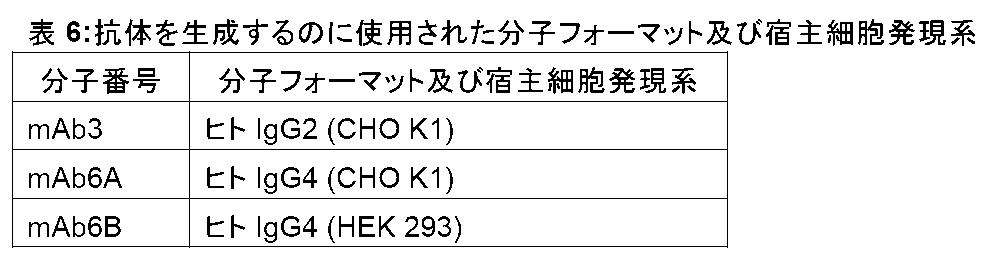
結果(図5)は、両方のIgG4分子が、異なる細胞株で生成されるにもかかわらず、PLBL2と同程度に相互作用することを示している。その一方で、IgG2分子は相互作用しない。表7は、各試料により生成された任意の値を示している。 The results (Figure 5) show that both IgG4 molecules interact to the same extent with PLBL2, despite being produced in different cell lines, whereas IgG2 molecules do not. Table 7 shows the arbitrary values produced by each sample.

[実施例6]
IgG2及びIgG4サブタイプの抗体の結合親和性の定量
前の実験は、他のサブクラスの抗体(例えば、IgG1及びIgG2)と比べて、IgG4サブクラスの抗体がPLBL2を結合する能力の増加を示した。PLBL2に対するIgG4の抗体の親和性を定量化する試験も行った。
[Example 6]
Quantification of the binding affinity of antibodies of IgG2 and IgG4 subtypes Previous experiments have demonstrated the increased ability of antibodies of the IgG4 subclass to bind PLBL2 compared to antibodies of other subclasses (e.g., IgG1 and IgG2). Studies were also performed to quantify the affinity of IgG4 antibodies for PLBL2.
試料は、実施例5に記載したように生成した。次いで、これらの試料中で抗体と結合するPLBL2の親和性を、Octet(登録商標)RED 384機器を用いてバイオレイヤー干渉法(BLI)により評価した。試料(表6に言及されているのと同じ)をPBS-T中10μg/mLに希釈した。市販のプロテインAバイオセンサー(Pall)を、各試料に1000RPMで120秒間浸漬した。次いで、ローディングしたバイオセンサーを様々な濃度(1538nMから16nMまで連続2倍希釈)で1000RPM、300秒間、PLBL2に浸漬して結合を評価した後、PBS-Tに1000RPMで300秒間浸漬して解離を評価した。バイオセンサーを、製造者の指示書に従って10mMグリシン、pH1.5、及びPBS-Tを用いて再生した。 Samples were generated as described in Example 5. The affinity of PLBL2 binding to the antibody in these samples was then evaluated by Biolayer Interferometry (BLI) using an Octet® RED 384 instrument. Samples (same as mentioned in Table 6) were diluted to 10 μg/mL in PBS-T. A commercial Protein A biosensor (Pall) was immersed in each sample for 120 seconds at 1000 RPM. The loaded biosensor was then immersed in PLBL2 at various concentrations (serial 2-fold dilutions from 1538 nM to 16 nM) for 300 seconds at 1000 RPM to evaluate binding, followed by immersion in PBS-T for 300 seconds at 1000 RPM to evaluate dissociation. The biosensor was regenerated with 10 mM glycine, pH 1.5, and PBS-T according to the manufacturer's instructions.
結果(表8)は、1:1結合モデルによるローカルフィットを用いて生成した。mAb3に関しては相互作用がなかったため、親和性データは得られなかった(図6A)。mAb6A及びmAb6Bは両方とも低親和性を有した。mAb6AはmAb6Bと比べて、より速い結合速度により親和性が約14倍増加した。その一方で、解離速度は類似していた。mAb6A及びmAb6Bのフィッティングを、それぞれ図6B及び6Cに示す。 Results (Table 8) were generated using a local fit with a 1:1 binding model. No affinity data was available for mAb3 since there was no interaction (Figure 6A). Both mAb6A and mAb6B had low affinity. mAb6A had a faster on-rate resulting in an approximately 14-fold increase in affinity compared to mAb6B, while the off-rates were similar. Fits for mAb6A and mAb6B are shown in Figures 6B and 6C, respectively.
これらの結果は、宿主細胞発現系は、PLBL2を結合する発現IgG4の能力に影響を与えないが、該分子の結合親和性に影響を与える可能性があり得ることを示している。 These results indicate that the host cell expression system does not affect the ability of expressed IgG4 to bind PLBL2, but may affect the binding affinity of the molecule.
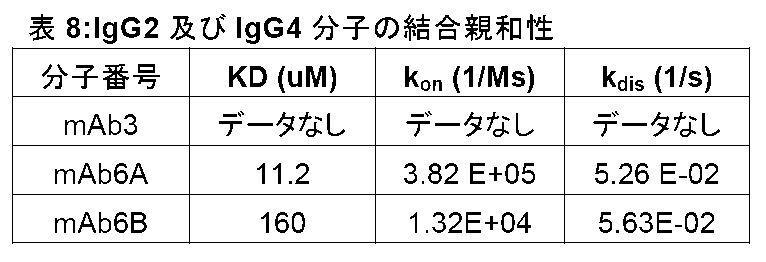
[実施例7]
HDX-MSにより探索されたmAb7とPLBL2の間の相互作用
mAb7及びPLBL2の相互作用の根底にある科学をさらに理解するために、Synapt G2-S質量分析計に連結されたWaters HDXマネージャーシステムを用いて、mAb7試料及びPLBL2と結合したmAb7試料のHDX-MS分析を行った。SPRによる40.0μMのKDに基づくと、重水素標識後、mAbの約70%がPLBL2と結合される。重水素標識を、0.5分、5分、60分、120分、180分、及び240分で測定した。データをWaters DynamXソフトウェアを用いて分析し、HDX差分プロットを生成した(図7)。縦棒は、6つの標識時点からの各ペプチドの合計HDX差を表す。非結合及びPLBL2結合mAb7のHDXプロフィールの比較は、PLBL2に結合すると、重鎖の領域K218-F256が重水素取り込みの低下を示すことを明らかにする。これは、mAb7へのPLBL2結合によるこの領域の安定化を示すものであり、他の実験の結合結果と十分に相関する。
[Example 7]
Interaction between mAb7 and PLBL2 probed by HDX-MS
To further understand the science underlying the interaction of mAb7 and PLBL2, HDX-MS analysis of mAb7 samples and mAb7 samples bound to PLBL2 was performed using a Waters HDX Manager system coupled to a Synapt G2-S mass spectrometer. Based on a K D of 40.0 μM by SPR, approximately 70% of the mAb is bound to PLBL2 after deuterium labeling. Deuterium labeling was measured at 0.5, 5, 60, 120, 180, and 240 min. Data was analyzed using Waters DynamX software to generate HDX difference plots (Figure 7). Vertical bars represent the total HDX difference for each peptide from the six labeling time points. Comparison of the HDX profiles of unbound and PLBL2-bound mAb7 reveals that upon binding to PLBL2, the region K218-F256 of the heavy chain shows reduced deuterium uptake. This indicates stabilization of this region by PLBL2 binding to mAb7 and correlates well with the binding results of other experiments.
[実施例8]
異なるmAbのヒンジ領域の配列アライメント
前の結果は、PLBL2が、製品への直接結合及び同時精製により、mAb7(IgG4分子)を汚染することを示している。同様に、前の例は、同じくIgG4サブタイプであるmAb5及びmAb6も、PLBL2を結合できることを示した。異なるアイソタイプのmAbへのPLBL2結合の分析は、結合がIgG4分子のヒンジ領域で生じる可能性が最も高いことを示唆した。これは、HDX-MSデータによって支持された。異なるIgGアイソタイプにおける少数の異なるアミノ酸を考えると、PLBL2結合に関与する個々のアミノ酸残基を同定し得る可能性がある。PLBL2結合に関与するIgG4アミノ酸残基を決定するために、mAb製品のヒンジ領域のアミノ酸配列アライメントを生成した。
[Example 8]
Sequence alignment of hinge regions of different mAbs The previous results show that PLBL2 contaminates mAb7 (an IgG4 molecule) by direct binding to the product and co-purification. Similarly, the previous example showed that mAb5 and mAb6, which are also IgG4 subtypes, can also bind PLBL2. Analysis of PLBL2 binding to mAbs of different isotypes suggested that binding most likely occurs at the hinge region of the IgG4 molecule. This was supported by the HDX-MS data. Given the small number of different amino acids in the different IgG isotypes, it is possible that individual amino acid residues involved in PLBL2 binding may be identified. To determine the IgG4 amino acid residues involved in PLBL2 binding, amino acid sequence alignments of the hinge regions of the mAb products were generated.
配列アライメントの分析において、目的とする残基は、PLBL2が結合することが観察されたIgG4分子(mAb5、mAb6、及びmAb7)で保存され、PLBL2が結合しなかった他のIgGサブタイプでは保存されないもの(すなわち異なる残基)である。この分析によりそのような残基が10個認められ、それらを黒い四角で囲む(図8)。具体的には、目的とする残基は、K203、R222、S227、Y229、G230、P237、P238、E246、F247及びE248である。 In the sequence alignment analysis, the residues of interest are those that are conserved in the IgG4 molecules to which PLBL2 was observed to bind (mAb5, mAb6, and mAb7) and are not conserved (i.e., different) in the other IgG subtypes to which PLBL2 did not bind. This analysis identified 10 such residues, which are boxed in black (Figure 8). Specifically, the residues of interest are K203, R222, S227, Y229, G230, P237, P238, E246, F247, and E248.
IgG2又はIgG1で見出されるものに対する、IgG4で見出されるアミノ酸由来のこれらの10個の残基の変異は、PLBL2がIgG4分子に結合するのを防ぐと予想された。 Mutation of these 10 residues from amino acids found in IgG4 relative to those found in IgG2 or IgG1 was predicted to prevent PLBL2 from binding to IgG4 molecules.
[実施例9]
PLBL2への結合を軽減するためのIgG4ヒンジ領域残基の変異誘発
実施例1から8まで詳述した試験は、IgG4分子の定常領域が、PLBL2へのこれらの免疫グロブリンの結合を可能にすることに主に関与することを示した。さらに、IgG4とIgG2/IgG4キメラの間で行われた比較は、PLBL2とのこれらの相互作用を、該分子のヒンジ領域又はその付近に局在化できるようにした。試験した様々な分子のアミノ酸配列のアライメントは、PLBL2結合において役割を果たすヒンジ領域内の特定のアミノ酸を、排除工程を通じて同定できるようにした。最終ステップは、IgG4分子のヒンジ領域の修飾が、PLBL2への免疫グロブリンのこのサブクラスの結合をどれほど軽減することができるかを示す確証的変異誘発実験を行うことである。
[Example 9]
Mutagenesis of IgG4 hinge region residues to reduce binding to PLBL2 The studies detailed in Examples 1 to 8 showed that the constant region of IgG4 molecules is mainly responsible for enabling the binding of these immunoglobulins to PLBL2. Furthermore, comparisons made between IgG4 and IgG2/IgG4 chimeras allowed these interactions with PLBL2 to be localized to or near the hinge region of the molecules. Alignment of the amino acid sequences of the various molecules tested allowed the identification, through a process of elimination, of specific amino acids in the hinge region that play a role in PLBL2 binding. The final step is to perform confirmatory mutagenesis experiments that show how modifications of the hinge region of IgG4 molecules can reduce the binding of this subclass of immunoglobulins to PLBL2.
IgG4サブクラスの抗体へのPLBL2の結合をもたらすことに関与するとして同定された10個のアミノ酸残基のうち7個を、代替のアミノ酸、例えば、ヒトIgG1及び/又はIgG2抗体の生殖系列ヒンジ配列で見出されるものに置換する試験を行った。mAb5をモデル分子として用いて、HEK293宿主細胞発現系を、ヒンジ領域が修飾されたいくつかのmAb5バリアントをコードするベクターDNAで一過性にトランスフェクトする変異誘発実験を実施した。 Seven of the ten amino acid residues identified as involved in mediating PLBL2 binding to antibodies of the IgG4 subclass were tested for replacement with alternative amino acids, e.g., those found in the germline hinge sequences of human IgG1 and/or IgG2 antibodies. Using mAb5 as a model molecule, mutagenesis experiments were performed in which the HEK293 host cell expression system was transiently transfected with vector DNA encoding several mAb5 variants with modifications in the hinge region.
mAb5のヒンジ領域に対する変異は、PLBL2結合に影響を与える役割をある程度果たしていると以前に同定されたアミノ酸配列位置においてであった(実施例8)。変異は、表1に記載されている単一点変異のいずれかとして、及びそれらの様々な組み合わせで導入され、7つの異なるヒンジ修飾IgG4バリアント分子(mAb5-1B、2B、3B、4B、6B及び7B)を生成した。同時に、非修飾親IgG4(mAb5B)を一過性に発現する培養物も準備した。これに加えて、異なる抗原標的に対する同じくIgG4バリアントであるmAb7のヒンジ領域に対する変異も、単一点変異のいずれかとして、及びそれらの様々な組み合わせで作出し、3つの異なるヒンジ修飾バリアント(mAb7-2B、4B及び5B)を生成した。 Mutations to the hinge region of mAb5 were at amino acid sequence positions previously identified as playing some role in influencing PLBL2 binding (Example 8). Mutations were introduced as either single point mutations listed in Table 1 and in various combinations thereof to generate seven different hinge-modified IgG4 variant molecules (mAb5-1B, 2B, 3B, 4B, 6B and 7B). Concurrently, cultures transiently expressing the unmodified parent IgG4 (mAb5B) were also prepared. In addition to this, mutations to the hinge region of mAb7, also an IgG4 variant against a different antigen target, were also made as either single point mutations and in various combinations thereof to generate three different hinge-modified variants (mAb7-2B, 4B and 5B).
これらのバリアントの接尾語ナンバリングは作出された変異を反映し、該ナンバリングは、ヒンジ修飾IgG4バリアントの両方のセットにわたって維持した。故に、mAb5-2Bのヒンジ領域は、mAb7-2Bのものと同じである。 The suffix numbering of these variants reflects the mutations made, and the numbering was maintained across both sets of hinge-modified IgG4 variants. Thus, the hinge region of mAb5-2B is the same as that of mAb7-2B.
さらに、追加の対照としてのIgG2(mAb3B)及びIgG4(mAb6B)、並びにヒンジ修飾IgG1バリアント(mAb2-αB)を発現する培養物も準備した。図9は、これらのIgG4バリアントの修飾ヒンジ領域を図示し、試験に含めた他のmAb分子のヒンジ領域配列に対してそれらをアライメントしている。表9は、評価した異なる分子を詳述する。分子名の接尾語「A」及び「B」は、抗体が、それぞれCHO K1又はHEK293細胞で発現されたかどうかを意味する。 Additionally, cultures expressing IgG2 (mAb3B) and IgG4 (mAb6B) as additional controls, as well as a hinge-modified IgG1 variant (mAb2-αB) were also prepared. Figure 9 illustrates the modified hinge regions of these IgG4 variants and aligns them to the hinge region sequences of the other mAb molecules included in the study. Table 9 details the different molecules evaluated. The suffixes "A" and "B" in the molecule names refer to whether the antibody was expressed in CHO K1 or HEK293 cells, respectively.

HEK293細胞により生成された材料を、標準的なmAb精製工程を用いて精製した。簡単には、製品mAbsの十分な一過性発現に適当な期間培養した後、細胞を除去し、清澄化した細胞培養上清をプロテインA親和性クロマトグラフィーを用いて精製した。プロテインA溶出液を、Tris溶液を用いて中性pHに滴定した。調査中の異なるmAb分子を含有する中和プロテインA溶出液を、実施例10~12に記載されるように、次いで一連の結合アッセイに供した。 The material produced by HEK293 cells was purified using standard mAb purification steps. Briefly, after a suitable period of culture for sufficient transient expression of the product mAbs, the cells were removed and the clarified cell culture supernatant was purified using Protein A affinity chromatography. The Protein A eluate was titrated to neutral pH using Tris solution. The neutralized Protein A eluate containing the different mAb molecules under investigation was then subjected to a series of binding assays as described in Examples 10-12.
[実施例10]
IgG2、IgG4及びIgG4バリアント分子におけるPLBL2相互作用アッセイ
実施例9で生成され、記載された様々なmAbの、組換えヒトPLBL2との相互作用を、Biacore(商標)T200(GE Healthcare)結合法を用いて表面プラズモン共鳴(SPR)により評価した。20μg/mLのmAbを、市販の前固定プロテインAチップ(GE Healthcare)のフローセル4に10μL/分で60秒間注入し、HBS-EP+ランニングバッファー中で10秒間安定化させた。捕捉抗体のレベルの変動は、10%未満であった。次いで、100μg/mL(1538nM)組換えヒトPLBL2を、フローセル4及び3に5μL/分で120秒間注入した。フローセル3は、インライン参照セルとして機能し、低下している5μL/分流速を使用して低親和性相互作用を促進した。次いで、センサーを10mMグリシン、pH1.5により30μL/分で10秒間再生した。
[Example 10]
PLBL2 interaction assay on IgG2, IgG4 and IgG4 variant molecules The interaction of various mAbs generated and described in Example 9 with recombinant human PLBL2 was assessed by surface plasmon resonance (SPR) using a Biacore™ T200 (GE Healthcare) binding assay. 20 μg/mL of mAb was injected into flow cell 4 of a commercial pre-immobilized Protein A chip (GE Healthcare) at 10 μL/min for 60 seconds and stabilized in HBS-EP+ running buffer for 10 seconds. The level of captured antibody fluctuated less than 10%. 100 μg/mL (1538 nM) recombinant human PLBL2 was then injected into flow cells 4 and 3 at 5 μL/min for 120 seconds. Flow cell 3 served as an in-line reference cell, and a decreasing 5 μL/min flow rate was used to promote low affinity interactions. The sensor was then regenerated with 10 mM glycine, pH 1.5 at 30 μL/min for 10 seconds.
前の実験の結果に基づき、mAb8A(IgG1である)は、組換えヒトPLBL2と相互作用しないことがわかっていた。そのため、mAb8Aは、結果を正規化する陰性対照として使用した。 Based on the results of previous experiments, mAb8A (which is an IgG1) was known not to interact with recombinant human PLBL2. Therefore, mAb8A was used as a negative control to normalize the results.
SPR分析の結果(図10)は、mAb5-2B及びmAb5-4Bに対する、それらの親分子(mAb5B)と比べたPLBL2のRUのおおよそ90%の減少、及びmAb7-2B及びmAb7-4Bに対する、それらの親分子(mAb7A)と比べたPLBL2のRUの約80%の低下を示している。mAb5-3Bは、結合の変化を示さなかった。これは、この変異単独が、相互作用の低下において失敗に終わったことを示している。mAb5-2Bは、222位にアルギニンからリジンへの単一のアミノ酸置換を含有する。mAb5-3Bは、227位にセリンからプロリンへの単一のアミノ酸置換を含有する。mAb5-4Bは、mAb5-2B及びmAb5-3Bの両方に存在する変異を含有する。これは、227位でのプロリンへの置換はPLBL2相互作用を低下させていないが、悪影響も有していないこと、及び観察されたPLBL2結合の低下は、222位でのリジンへの置換によるものであることを示している。実際に、当該位置でのIgG1からIgG4への生殖系列交換を表す、mAb2の222位でのリジンからアルギニンへの置換(図9)は、PLBL2への結合を示さなかった親分子(mAb2)と比べた場合、SPRによるPLBL2への結合の増加を有する変異体(mAb2-αB)をもたらした。当該位置でのIgG4からIgG2への生殖系列交換を表す、mAb5の222位でのアルギニンからスレオニンへの交換(図9)は、親分子(mAb5)と比べて、SPRによるPLBL2に対する結合の約30%の減少を有する変異体(mAb5-8B)をもたらした。 The results of the SPR analysis (Figure 10) show an approximately 90% reduction in the RU of PLBL2 for mAb5-2B and mAb5-4B compared to their parent molecules (mAb5B), and an approximately 80% reduction in the RU of PLBL2 for mAb7-2B and mAb7-4B compared to their parent molecules (mAb7A). mAb5-3B showed no change in binding, indicating that this mutation alone was unsuccessful in reducing the interaction. mAb5-2B contains a single amino acid substitution at position 222 from arginine to lysine. mAb5-3B contains a single amino acid substitution at position 227 from serine to proline. mAb5-4B contains a mutation present in both mAb5-2B and mAb5-3B. This indicates that the substitution of proline at position 227 does not reduce PLBL2 interaction, but does not have a deleterious effect, and that the observed decrease in PLBL2 binding is due to the substitution of lysine at position 222. Indeed, a lysine to arginine substitution at position 222 of mAb2 (Figure 9), representing a germline exchange from IgG1 to IgG4 at that position, resulted in a mutant (mAb2-αB) with increased binding to PLBL2 by SPR when compared to the parent molecule (mAb2), which showed no binding to PLBL2. An arginine to threonine substitution at position 222 of mAb5 (Figure 9), representing a germline exchange from IgG4 to IgG2 at that position, resulted in a mutant (mAb5-8B) with approximately 30% decreased binding to PLBL2 by SPR compared to the parent molecule (mAb5).
このデータは、PLBL2結合を促進する上で、222位のアルギニンが重要な要因であることを示唆しているが、mAb5-5Bにより示されたPLBL2結合の低下から明らかなように(図10)、他のヒンジ残基もこのHCPの結合に影響を与え得る。その一方で、mAb8AはPLBL2との相互作用を示さず、mAb6Bは最大量の結合を示した。 The data suggest that arginine at position 222 is a key factor in promoting PLBL2 binding, although other hinge residues may also affect the binding of this HCP, as evidenced by the reduced PLBL2 binding exhibited by mAb5-5B (Figure 10). On the other hand, mAb8A showed no interaction with PLBL2, and mAb6B showed the greatest amount of binding.
[実施例11]
IgG2、IgG4及びIgG4バリアント分子におけるPLBL2親和性アッセイ
実施例9で生成され、記載された様々なmAbに対するPLBL2の相互作用の親和性を、Octet(登録商標)RED 384機器(ForteBio)を用いてバイオレイヤー干渉法(BLI)により、実施例6に記載された同じ方法でテストした。
[Example 11]
PLBL2 Affinity Assay for IgG2, IgG4 and IgG4 Variant Molecules The interaction affinity of PLBL2 for the various mAbs generated and described in Example 9 was tested by Biolayer Interferometry (BLI) using an Octet® RED 384 instrument (ForteBio) in the same manner as described in Example 6.
市販のプロテインAバイオセンサーを、10μg/mL、120秒間、1000RPMで試料に浸漬した。バイオセンサーを、アッセイバッファー(HBS-EP+)に1000RPMで30秒間浸漬して、ゆるく結合したタンパク質を解離させた。ローディングしたバイオセンサーを、次いで様々な濃度(1538、769.2、384.6、192.3、96.15、48.15、24、0nM)で組換えヒトPLBL2に浸漬し、最後にHBS-EP+に5分間浸漬した。 A commercial Protein A biosensor was immersed in the sample at 10μg/mL for 120 seconds at 1000RPM. The biosensor was immersed in assay buffer (HBS-EP+) at 1000RPM for 30 seconds to dissociate loosely bound proteins. The loaded biosensor was then immersed in recombinant human PLBL2 at various concentrations (1538, 769.2, 384.6, 192.3, 96.15, 48.15, 24, 0nM) and finally in HBS-EP+ for 5 minutes.
結合及び解離速度を、グローバルフィットにより1:1結合モデルを用いて測定した。しかし、速い解離速度のため解離曲線の最初の50秒のみを分析した。結果を表10に示す。 Association and dissociation rates were measured using a 1:1 binding model with a global fit. However, due to the fast dissociation rates, only the first 50 seconds of the dissociation curves were analyzed. The results are shown in Table 10.

カーブフィッティング不良のため、mAb5-2B、mAb5-4B、mAb7-2B、mAb7-4B及びmAb8Aに関する速度論的値は計算することができなかった。これは、これらの分子に関してPLBL2との相互作用がなかったことを示すものである。これらの結果は、実施例10からの知見により生じ、これらの試料に関するPLBL2への結合の影響も示している。KDの大きな低下(10×以上)が、親分子(mAb5B)と比べてmAb5-6Bに関して見られた。mAb5-1B及びmAb5-7Bは、わずかにより速い結合速度(kon)に起因する、望ましくないPLBL2に対する親和性のわずかな増加を示した。全ての残りの変異体は、親分子と比べた場合、PLBL2への結合の10×未満の低下を示し、そのため結合親和性の変化は有意とはみなされなかった。 Kinetic values for mAb5-2B, mAb5-4B, mAb7-2B, mAb7-4B and mAb8A could not be calculated due to poor curve fitting, indicating that there was no interaction with PLBL2 for these molecules. These results arise from the findings from Example 10 and also show the effect of binding to PLBL2 for these samples. A large reduction in K D (more than 10×) was seen for mAb5-6B compared to the parent molecule (mAb5B). mAb5-1B and mAb5-7B showed a small increase in affinity for PLBL2, which is undesirable due to a slightly faster binding rate (k on ). All remaining mutants showed less than 10× reduction in binding to PLBL2 when compared to the parent molecule, so the changes in binding affinity were not considered significant.
[実施例12]
IgG2、IgG4及びバリアントIgG4分子の抗原結合
抗体分子mAb3、mAb5(ヒンジ修飾バリアントの全てを含む)及びmAb6は全て、これらの抗体が同じ抗原に対して標的にされることから、同じ可変領域を含む。試料の変異誘発が、各分子の抗原結合活性に悪影響を与えなかったことを示すために、抗原結合を、Biacore(商標)T200(GE Healthcare)を用いて表面プラズモン共鳴(SPR)により評価した。リガンドを捕捉する前固定したプロテインAセンサー(GE Healthcare)を使用して、活性を評価した。センサー表面を、使用前に再生するために(10mMグリシン、pH1.5を30μL/分で60秒間用いて)、5×スタートアップサイクルを全てのフローセルで実行した。各mAb試料をPBS-T中10μg/mLに希釈し、フローセル4に10μL/分で60秒間注入し、10秒の安定化期間を設けた。10μg/mLの標的抗原を、次いでフローセル4及び3に10μL/分で60秒間注入し、この後注入を停止し、アッセイバッファーを10μL/分の流速で100秒間注入して、解離を可能にした。次いで、センサー表面を次の注入に備えて、10mMグリシン、pH1.5を30μL/分で60秒間用いて再生した。
[Example 12]
Antigen Binding of IgG2, IgG4 and Variant IgG4 Molecules The antibody molecules mAb3, mAb5 (including all of the hinge-modified variants) and mAb6 all contain the same variable region since these antibodies are targeted against the same antigen. To show that mutagenesis of the samples did not adversely affect the antigen binding activity of each molecule, antigen binding was assessed by surface plasmon resonance (SPR) using a Biacore™ T200 (GE Healthcare). Activity was assessed using pre-immobilized Protein A sensors (GE Healthcare) to capture the ligand. 5x start-up cycles were performed on all flow cells to regenerate the sensor surface before use (using 10 mM glycine, pH 1.5 at 30 μL/min for 60 seconds). Each mAb sample was diluted to 10 μg/mL in PBS-T and injected into flow cell 4 at 10 μL/min for 60 seconds, followed by a 10 second stabilization period. 10 μg/mL of target antigen was then injected into flow cells 4 and 3 at 10 μL/min for 60 seconds, after which the injection was stopped and assay buffer was injected at a flow rate of 10 μL/min for 100 seconds to allow dissociation. The sensor surface was then regenerated with 10 mM glycine, pH 1.5 at 30 μL/min for 60 seconds in preparation for the next injection.
各分子の活性を計算するために、抗原結合応答(RU)を抗体捕捉応答(RU)で除し、百分率として報告した。報告された百分率は、依然としてその抗原に結合することができる、試料中に存在する抗体の量を示す。この実験に起因する検定誤差は10%である。表11は、全てのmAbが標的抗原に対して100±10%の活性を示したことを示している。これは、結合の喪失も変化もなかったことを示すものである。全ての変異体は同程度に行った。特に、mAb5B又はそのヒンジ修飾バリアントのいずれか(mAb5-1B~7B)の結合に差はなかった。 To calculate the activity of each molecule, the antigen binding response (RU) was divided by the antibody capture response (RU) and reported as a percentage. The reported percentage indicates the amount of antibody present in the sample that was still able to bind to the antigen. The assay error attributable to this experiment is 10%. Table 11 shows that all mAbs showed 100±10% activity against the target antigen, indicating that there was no loss or change in binding. All variants performed comparably. Notably, there was no difference in the binding of mAb5B or any of its hinge-modified variants (mAb5-1B to 7B).

[実施例13]
宿主細胞タンパク質(HCP)へのIgG4結合の軽減
問題のある宿主細胞タンパク質は、典型的には製品と同時精製し、通常はごく微量で存在するが、十分に精製された原体中に存在するレベルが、安全性及び薬効両方の問題を提起し得る場合があった。PLBL2の結合はこの重要な例を示しているが、他の問題のある宿主細胞タンパク質が、目的とする抗体製品と相互作用することが報告される場合があった。
[Example 13]
Mitigating IgG4 binding to host cell proteins (HCPs) Problematic host cell proteins typically co-purify with the product and are usually present in very small amounts, but there have been cases where the levels present in a fully purified drug substance can pose both safety and efficacy issues. PLBL2 binding represents an important example of this, but other problematic host cell proteins have been reported to interact with the antibody product of interest.
その結果、他のHCPの結合を軽減するためのIgG4ヒンジ領域修飾の効果を示すために、試験を行ってもよい。第1段階は、例えばmAb6をモデル分子として用いて、IgG4と相互作用する傾向があるHCPを同定することであろう。これらのHCPは、mAbのFc領域が市販のプロテインAビーズに結合し、ヌルCHO K1清澄化未処理バルク(CUB)材料と複数回の10分のインキュベーション期間を経るHCP濃縮方法を用いて同定することができる。次いで、最終的な結合複合体をビーズから溶離し、LC-MS/MSを用いて分析する。複数の反応モニタリング(MRM)方法を、本宿主細胞タンパク質を定量化するのに使用することができる。 As a result, tests may be performed to demonstrate the effect of IgG4 hinge region modifications to reduce binding of other HCPs. The first step would be to identify HCPs that tend to interact with IgG4, for example using mAb6 as a model molecule. These HCPs can be identified using an HCP enrichment method in which the Fc region of the mAb is bound to commercially available Protein A beads and undergoes multiple 10 minute incubation periods with null CHO K1 clarified unprocessed bulk (CUB) material. The final bound complex is then eluted from the beads and analyzed using LC-MS/MS. Multiple reaction monitoring (MRM) methods can be used to quantify this host cell protein.
これらのHCPを同定することに成功すれば、前の実施例に詳述された方法を使用して、修飾mAb5変異体と共に、もともとのmAb5分子の両方へのこれらのHCPの結合を評価することができる。これらの生成は、実施例9に記載されている。これらの試験は、本発明の主題であるヒンジ領域修飾を用いて、IgG4へのPLBL2結合を軽減するだけでなく、HCPに結合する傾向もより広範に低下させる能力をより一般的に図示するのに役立つであろう。 If these HCPs are successfully identified, the binding of these HCPs to both the original mAb5 molecule as well as the modified mAb5 variants can be assessed using the methods detailed in the previous examples. Their generation is described in Example 9. These studies will help to more generally illustrate the ability to use the hinge region modifications that are the subject of this invention to not only reduce PLBL2 binding to IgG4, but also more broadly reduce the propensity to bind HCPs.
Claims (12)
(a)Kabat残基K203からR、E、若しくはQ;Kabat残基R222からQ;Kabat残基E226からL若しくはI;Kabat残基S227からR、P、A、N、若しくはT;Kabat残基Y229からS、C、F、W、若しくはH;Kabat残基G230からC、A、N、若しくはS;Kabat残基P237からH、E、D、若しくはV;及び/又はKabat残基P238からT、K、若しくはEを含む1つ以上のアミノ酸の置換、及び/又は
(b)EPKSCDKTHT(配列番号27)、若しくはERKYGPP(配列番号28)、若しくはERKCCVE(配列番号29)、若しくはELKTPLGDTTHT(配列番号30)によるESKYGPP(配列番号26)(Kabat残基226~238)の置換、及び/又は
(c)SCDKTHT(配列番号24)によるYGPP(配列番号23)(Kabat残基229~238)の置換
をさらに含む、請求項1記載のバリアントIgG4抗体。 The modification is
(a) substitutions of one or more amino acids, including Kabat residue K203 to R, E, or Q; Kabat residue R222 to Q; Kabat residue E226 to L or I; Kabat residue S227 to R, P, A, N, or T; Kabat residue Y229 to S, C, F, W, or H; Kabat residue G230 to C, A, N, or S; Kabat residue P237 to H, E, D, or V; and/or Kabat residue P238 to T, K, or E, and/or
(b) replacement of ESKYGPP (SEQ ID NO:26) (Kabat residues 226-238) with EPKSCDKTHT (SEQ ID NO:27), or ERKYGPP (SEQ ID NO:28), or ERKCCVE (SEQ ID NO:29), or ELKTPLGDTTHT (SEQ ID NO:30), and/or
2. The variant IgG4 antibody of claim 1, further comprising: (c) a substitution of YGPP (SEQ ID NO: 23) (Kabat residues 229-238) with SCDKTHT (SEQ ID NO: 24).
抗体配列を重鎖定常領域において修飾するステップ
を含み、修飾が、
(a)Kabat残基K203からQ;Kabat残基R222からT若しくはK;及び/又はKabat残基E226からLを含む1つ以上のアミノ酸の置換、及び/又は
(b)SCDKTHT(配列番号24)、若しくはCCVE(配列番号25)によるYGPP(配列番号23)(Kabat残基229~238)の置換
のいずれか1つ又は組み合わせを含み、かつ宿主細胞タンパク質が、推定ホスホリパーゼB様2(PLBL2)である、前記方法。 1. A method for reducing binding of IgG4 to host cell proteins (HCPs), comprising:
modifying the antibody sequence in the heavy chain constant region,
(a) substitution of one or more amino acids, including Kabat residues K203 to Q; Kabat residues R222 to T or K; and/or Kabat residues E226 to L; and/or
(b) the substitution of YGPP (SEQ ID NO:23) (Kabat residues 229-238) with SCDKTHT (SEQ ID NO:24), or CCVE (SEQ ID NO:25), or any one or combination thereof, and wherein the host cell protein is putative phospholipase B-like 2 (PLBL2).
The composition according to any one of claims 9 to 11, further comprising a buffer and/or a fatty acid ester, optionally wherein the fatty acid ester is polysorbate 20 or polysorbate 80.
Applications Claiming Priority (3)
| Application Number | Priority Date | Filing Date | Title |
|---|---|---|---|
| US201662404849P | 2016-10-06 | 2016-10-06 | |
| US62/404,849 | 2016-10-06 | ||
| PCT/EP2017/075038 WO2018065389A1 (en) | 2016-10-06 | 2017-10-03 | Antibodies with reduced binding to process impurities |
Publications (2)
| Publication Number | Publication Date |
|---|---|
| JP2019532957A JP2019532957A (en) | 2019-11-14 |
| JP7471819B2 true JP7471819B2 (en) | 2024-04-22 |
Family
ID=60143674
Family Applications (1)
| Application Number | Title | Priority Date | Filing Date |
|---|---|---|---|
| JP2019518304A Active JP7471819B2 (en) | 2016-10-06 | 2017-10-03 | Antibodies with reduced binding to process impurities |
Country Status (14)
| Country | Link |
|---|---|
| US (1) | US11254753B2 (en) |
| EP (1) | EP3523329A1 (en) |
| JP (1) | JP7471819B2 (en) |
| KR (1) | KR20190057083A (en) |
| CN (1) | CN109790216A (en) |
| AU (1) | AU2017338291A1 (en) |
| BR (1) | BR112019004938A2 (en) |
| CA (1) | CA3037264A1 (en) |
| IL (1) | IL265748A (en) |
| MX (1) | MX2019003890A (en) |
| RU (1) | RU2771330C2 (en) |
| SG (1) | SG11201901468SA (en) |
| TW (1) | TW201829453A (en) |
| WO (1) | WO2018065389A1 (en) |
Families Citing this family (8)
| Publication number | Priority date | Publication date | Assignee | Title |
|---|---|---|---|---|
| JP7257335B2 (en) | 2017-05-25 | 2023-04-13 | ブリストル-マイヤーズ スクイブ カンパニー | Antagonistic CD40 monoclonal antibodies and uses thereof |
| AR117091A1 (en) | 2018-11-19 | 2021-07-07 | Bristol Myers Squibb Co | MONOCLONAL ANTIBODIES ANTAGONISTS AGAINST CD40 AND THEIR USES |
| MX2021014171A (en) * | 2019-05-21 | 2022-01-04 | Regeneron Pharma | Methods for identifying and quantitating host cell protein. |
| TWI869528B (en) | 2020-01-13 | 2025-01-11 | 美商威特拉公司 | Antibody molecules to c5ar1 and uses thereof |
| JP2023519602A (en) * | 2020-03-31 | 2023-05-11 | メディミューン,エルエルシー | Stabilized IgG4 antibody and uses thereof |
| WO2022155340A1 (en) | 2021-01-13 | 2022-07-21 | Visterra, Inc. | Humanized complement 5a receptor 1 antibodies and methods of use thereof |
| JP2024530402A (en) | 2021-07-12 | 2024-08-21 | ジェネンテック, インコーポレイテッド | Structures for reducing antibody-lipase binding |
| AR128689A1 (en) | 2022-03-03 | 2024-06-05 | Univ Yale | HUMANIZED 3E10 ANTIBODIES, VARIANTS AND FRAGMENTS BINDING TO THE ANTIGEN THEREOF |
Citations (1)
| Publication number | Priority date | Publication date | Assignee | Title |
|---|---|---|---|---|
| JP2013512258A (en) | 2009-11-30 | 2013-04-11 | ヤンセン バイオテツク,インコーポレーテツド | Antibody Fc mutation with effector function removed |
Family Cites Families (7)
| Publication number | Priority date | Publication date | Assignee | Title |
|---|---|---|---|---|
| AU2009307728B2 (en) * | 2008-10-20 | 2014-12-11 | Abbvie Inc. | Antibodies that bind to IL-18 and methods of purifying the same |
| GB201014033D0 (en) * | 2010-08-20 | 2010-10-06 | Ucb Pharma Sa | Biological products |
| GB201203051D0 (en) * | 2012-02-22 | 2012-04-04 | Ucb Pharma Sa | Biological products |
| GB201203071D0 (en) * | 2012-02-22 | 2012-04-04 | Ucb Pharma Sa | Biological products |
| JP6546178B2 (en) | 2013-09-13 | 2019-07-17 | ジェネンテック, インコーポレイテッド | Compositions and methods for detecting and quantifying host cell proteins and recombinant polypeptide products in cell lines |
| EP4331605A3 (en) * | 2013-09-13 | 2024-05-22 | F. Hoffmann-La Roche AG | Methods and compositions comprising purified recombinant polypeptides |
| AR102198A1 (en) | 2014-10-09 | 2017-02-08 | Regeneron Pharma | PROCESS TO REDUCE SUBVISIBLE PARTICLES IN A PHARMACEUTICAL FORMULATION |
-
2017
- 2017-10-03 MX MX2019003890A patent/MX2019003890A/en unknown
- 2017-10-03 BR BR112019004938A patent/BR112019004938A2/en not_active Application Discontinuation
- 2017-10-03 CA CA3037264A patent/CA3037264A1/en not_active Abandoned
- 2017-10-03 TW TW106134267A patent/TW201829453A/en unknown
- 2017-10-03 JP JP2019518304A patent/JP7471819B2/en active Active
- 2017-10-03 KR KR1020197010590A patent/KR20190057083A/en not_active Abandoned
- 2017-10-03 WO PCT/EP2017/075038 patent/WO2018065389A1/en not_active Ceased
- 2017-10-03 AU AU2017338291A patent/AU2017338291A1/en not_active Abandoned
- 2017-10-03 EP EP17787118.3A patent/EP3523329A1/en active Pending
- 2017-10-03 CN CN201780061885.8A patent/CN109790216A/en active Pending
- 2017-10-03 US US16/339,027 patent/US11254753B2/en active Active
- 2017-10-03 SG SG11201901468SA patent/SG11201901468SA/en unknown
- 2017-10-03 RU RU2019106819A patent/RU2771330C2/en active
-
2019
- 2019-04-01 IL IL265748A patent/IL265748A/en unknown
Patent Citations (1)
| Publication number | Priority date | Publication date | Assignee | Title |
|---|---|---|---|---|
| JP2013512258A (en) | 2009-11-30 | 2013-04-11 | ヤンセン バイオテツク,インコーポレーテツド | Antibody Fc mutation with effector function removed |
Non-Patent Citations (1)
| Title |
|---|
| The Journal of Biological Chemistry,2012,Vol.287,No.29,pp.24525-24533 |
Also Published As
| Publication number | Publication date |
|---|---|
| RU2771330C2 (en) | 2022-04-29 |
| AU2017338291A1 (en) | 2019-03-14 |
| SG11201901468SA (en) | 2019-03-28 |
| IL265748A (en) | 2019-06-30 |
| US11254753B2 (en) | 2022-02-22 |
| MX2019003890A (en) | 2019-08-12 |
| KR20190057083A (en) | 2019-05-27 |
| EP3523329A1 (en) | 2019-08-14 |
| RU2019106819A (en) | 2020-11-06 |
| CA3037264A1 (en) | 2018-04-12 |
| TW201829453A (en) | 2018-08-16 |
| JP2019532957A (en) | 2019-11-14 |
| US20190225708A1 (en) | 2019-07-25 |
| RU2019106819A3 (en) | 2021-06-04 |
| CN109790216A (en) | 2019-05-21 |
| BR112019004938A2 (en) | 2019-06-25 |
| WO2018065389A1 (en) | 2018-04-12 |
Similar Documents
| Publication | Publication Date | Title |
|---|---|---|
| JP7471819B2 (en) | Antibodies with reduced binding to process impurities | |
| US20250353878A1 (en) | Methods of Purifying Antibodies | |
| CN106103478B (en) | In vitro prediction of antibody half-life in vivo | |
| CN111479829B (en) | Antibody variants and isotypes with reduced biological activity | |
| US20170174721A1 (en) | Buffer system for protein purification | |
| TR201903707T4 (en) | Overloading and elution chromatography. | |
| Tran et al. | Investigating interactions between phospholipase B-Like 2 and antibodies during Protein A chromatography | |
| JP2019525925A (en) | Affinity chromatography wash buffer | |
| KR20200103740A (en) | Method for improved removal of impurities during protein A chromatography | |
| WO2023213779A1 (en) | Novel anti-angptl3 antibodies suitable for high concentration compositions and subcutaneous administration | |
| JP2024530402A (en) | Structures for reducing antibody-lipase binding | |
| HK40114848A (en) | Antibody variant and isoform with lowered biological activity | |
| HK40031063A (en) | Antibody variant and isoform with lowered biological activity | |
| AU2019340647A1 (en) | Systems and methods for affinity capillary electrophoresis | |
| HK40031063B (en) | Antibody variant and isoform with lowered biological activity | |
| HK1230632A1 (en) | In vitro prediction of in vivo half-life of antibodies | |
| HK1230632B (en) | In vitro prediction of in vivo half-life of antibodies |
Legal Events
| Date | Code | Title | Description |
|---|---|---|---|
| A621 | Written request for application examination |
Free format text: JAPANESE INTERMEDIATE CODE: A621 Effective date: 20200915 |
|
| A977 | Report on retrieval |
Free format text: JAPANESE INTERMEDIATE CODE: A971007 Effective date: 20210709 |
|
| A131 | Notification of reasons for refusal |
Free format text: JAPANESE INTERMEDIATE CODE: A131 Effective date: 20210803 |
|
| A521 | Request for written amendment filed |
Free format text: JAPANESE INTERMEDIATE CODE: A523 Effective date: 20211026 |
|
| A02 | Decision of refusal |
Free format text: JAPANESE INTERMEDIATE CODE: A02 Effective date: 20220104 |
|
| A521 | Request for written amendment filed |
Free format text: JAPANESE INTERMEDIATE CODE: A523 Effective date: 20220502 |
|
| C60 | Trial request (containing other claim documents, opposition documents) |
Free format text: JAPANESE INTERMEDIATE CODE: C60 Effective date: 20220502 |
|
| A911 | Transfer to examiner for re-examination before appeal (zenchi) |
Free format text: JAPANESE INTERMEDIATE CODE: A911 Effective date: 20220512 |
|
| C21 | Notice of transfer of a case for reconsideration by examiners before appeal proceedings |
Free format text: JAPANESE INTERMEDIATE CODE: C21 Effective date: 20220517 |
|
| A912 | Re-examination (zenchi) completed and case transferred to appeal board |
Free format text: JAPANESE INTERMEDIATE CODE: A912 Effective date: 20220610 |
|
| C211 | Notice of termination of reconsideration by examiners before appeal proceedings |
Free format text: JAPANESE INTERMEDIATE CODE: C211 Effective date: 20220614 |
|
| A521 | Request for written amendment filed |
Free format text: JAPANESE INTERMEDIATE CODE: A523 Effective date: 20231030 |
|
| A61 | First payment of annual fees (during grant procedure) |
Free format text: JAPANESE INTERMEDIATE CODE: A61 Effective date: 20240410 |
|
| R150 | Certificate of patent or registration of utility model |
Ref document number: 7471819 Country of ref document: JP Free format text: JAPANESE INTERMEDIATE CODE: R150 |