JP7455366B2 - Compound, ammonia detection material containing the same, method for producing the same, and method for detecting ammonia using the same - Google Patents
Compound, ammonia detection material containing the same, method for producing the same, and method for detecting ammonia using the same Download PDFInfo
- Publication number
- JP7455366B2 JP7455366B2 JP2020041889A JP2020041889A JP7455366B2 JP 7455366 B2 JP7455366 B2 JP 7455366B2 JP 2020041889 A JP2020041889 A JP 2020041889A JP 2020041889 A JP2020041889 A JP 2020041889A JP 7455366 B2 JP7455366 B2 JP 7455366B2
- Authority
- JP
- Japan
- Prior art keywords
- compound
- ammonia
- present
- same
- fluorescence
- Prior art date
- Legal status (The legal status is an assumption and is not a legal conclusion. Google has not performed a legal analysis and makes no representation as to the accuracy of the status listed.)
- Active
Links
- QGZKDVFQNNGYKY-UHFFFAOYSA-N Ammonia Chemical compound N QGZKDVFQNNGYKY-UHFFFAOYSA-N 0.000 title claims description 195
- 150000001875 compounds Chemical class 0.000 title claims description 119
- 229910021529 ammonia Inorganic materials 0.000 title claims description 90
- 238000001514 detection method Methods 0.000 title claims description 43
- 239000000463 material Substances 0.000 title claims description 43
- 238000000034 method Methods 0.000 title claims description 23
- 238000004519 manufacturing process Methods 0.000 title claims description 9
- 125000000217 alkyl group Chemical group 0.000 claims description 8
- 125000003545 alkoxy group Chemical group 0.000 claims description 4
- 150000001450 anions Chemical class 0.000 claims description 4
- 125000004432 carbon atom Chemical group C* 0.000 claims description 4
- -1 5 Chemical compound 0.000 description 21
- VLKZOEOYAKHREP-UHFFFAOYSA-N n-Hexane Chemical compound CCCCCC VLKZOEOYAKHREP-UHFFFAOYSA-N 0.000 description 15
- 239000007788 liquid Substances 0.000 description 13
- 239000000126 substance Substances 0.000 description 12
- JUJWROOIHBZHMG-UHFFFAOYSA-N Pyridine Chemical group C1=CC=NC=C1 JUJWROOIHBZHMG-UHFFFAOYSA-N 0.000 description 11
- 239000002904 solvent Substances 0.000 description 10
- YXFVVABEGXRONW-UHFFFAOYSA-N Toluene Chemical compound CC1=CC=CC=C1 YXFVVABEGXRONW-UHFFFAOYSA-N 0.000 description 9
- 239000007787 solid Substances 0.000 description 9
- PCLIMKBDDGJMGD-UHFFFAOYSA-N N-bromosuccinimide Chemical compound BrN1C(=O)CCC1=O PCLIMKBDDGJMGD-UHFFFAOYSA-N 0.000 description 8
- 238000006243 chemical reaction Methods 0.000 description 8
- 238000002189 fluorescence spectrum Methods 0.000 description 8
- 239000000243 solution Substances 0.000 description 8
- 125000003118 aryl group Chemical group 0.000 description 7
- 230000015572 biosynthetic process Effects 0.000 description 7
- 238000003786 synthesis reaction Methods 0.000 description 7
- XLYOFNOQVPJJNP-UHFFFAOYSA-N water Substances O XLYOFNOQVPJJNP-UHFFFAOYSA-N 0.000 description 7
- OISVCGZHLKNMSJ-UHFFFAOYSA-N 2,6-dimethylpyridine Chemical compound CC1=CC=CC(C)=N1 OISVCGZHLKNMSJ-UHFFFAOYSA-N 0.000 description 6
- YMWUJEATGCHHMB-UHFFFAOYSA-N Dichloromethane Chemical compound ClCCl YMWUJEATGCHHMB-UHFFFAOYSA-N 0.000 description 6
- ZMXDDKWLCZADIW-UHFFFAOYSA-N N,N-Dimethylformamide Chemical compound CN(C)C=O ZMXDDKWLCZADIW-UHFFFAOYSA-N 0.000 description 6
- WYURNTSHIVDZCO-UHFFFAOYSA-N Tetrahydrofuran Chemical compound C1CCOC1 WYURNTSHIVDZCO-UHFFFAOYSA-N 0.000 description 6
- 239000007864 aqueous solution Substances 0.000 description 6
- 239000000203 mixture Substances 0.000 description 6
- 229910052757 nitrogen Inorganic materials 0.000 description 6
- 239000012074 organic phase Substances 0.000 description 6
- HXITXNWTGFUOAU-UHFFFAOYSA-N phenylboronic acid Chemical group OB(O)C1=CC=CC=C1 HXITXNWTGFUOAU-UHFFFAOYSA-N 0.000 description 6
- NLKNQRATVPKPDG-UHFFFAOYSA-M potassium iodide Chemical compound [K+].[I-] NLKNQRATVPKPDG-UHFFFAOYSA-M 0.000 description 6
- 239000011541 reaction mixture Substances 0.000 description 6
- CGBLLFGVIKLZEI-UHFFFAOYSA-N 3,4-bis(2-octyldodecoxy)benzaldehyde Chemical compound C(CCCCCCC)C(COC=1C=C(C=O)C=CC=1OCC(CCCCCCCCCC)CCCCCCCC)CCCCCCCCCC CGBLLFGVIKLZEI-UHFFFAOYSA-N 0.000 description 4
- IBGBGRVKPALMCQ-UHFFFAOYSA-N 3,4-dihydroxybenzaldehyde Chemical compound OC1=CC=C(C=O)C=C1O IBGBGRVKPALMCQ-UHFFFAOYSA-N 0.000 description 4
- IJGRMHOSHXDMSA-UHFFFAOYSA-N Atomic nitrogen Chemical compound N#N IJGRMHOSHXDMSA-UHFFFAOYSA-N 0.000 description 4
- 239000004342 Benzoyl peroxide Substances 0.000 description 4
- ZOXJGFHDIHLPTG-UHFFFAOYSA-N Boron Chemical group [B] ZOXJGFHDIHLPTG-UHFFFAOYSA-N 0.000 description 4
- YLQBMQCUIZJEEH-UHFFFAOYSA-N Furan Chemical group C=1C=COC=1 YLQBMQCUIZJEEH-UHFFFAOYSA-N 0.000 description 4
- CSNNHWWHGAXBCP-UHFFFAOYSA-L Magnesium sulfate Chemical compound [Mg+2].[O-][S+2]([O-])([O-])[O-] CSNNHWWHGAXBCP-UHFFFAOYSA-L 0.000 description 4
- 238000000862 absorption spectrum Methods 0.000 description 4
- 235000019400 benzoyl peroxide Nutrition 0.000 description 4
- 229910052796 boron Inorganic materials 0.000 description 4
- 239000003153 chemical reaction reagent Substances 0.000 description 4
- 238000010586 diagram Methods 0.000 description 4
- 239000007789 gas Substances 0.000 description 4
- 125000004433 nitrogen atom Chemical group N* 0.000 description 4
- 239000010409 thin film Substances 0.000 description 4
- RIOQSEWOXXDEQQ-UHFFFAOYSA-N triphenylphosphine Chemical compound C1=CC=CC=C1P(C=1C=CC=CC=1)C1=CC=CC=C1 RIOQSEWOXXDEQQ-UHFFFAOYSA-N 0.000 description 4
- XEKOWRVHYACXOJ-UHFFFAOYSA-N Ethyl acetate Chemical compound CCOC(C)=O XEKOWRVHYACXOJ-UHFFFAOYSA-N 0.000 description 3
- 239000002253 acid Substances 0.000 description 3
- 239000011248 coating agent Substances 0.000 description 3
- 238000000576 coating method Methods 0.000 description 3
- 230000005284 excitation Effects 0.000 description 3
- 239000000706 filtrate Substances 0.000 description 3
- 239000011521 glass Substances 0.000 description 3
- 230000035945 sensitivity Effects 0.000 description 3
- KVLHZSYPYXPPSR-UHFFFAOYSA-L triphenyl-[[6-(triphenylphosphaniumylmethyl)pyridin-2-yl]methyl]phosphanium dibromide Chemical compound [Br-].[Br-].C=1C=CC=CC=1[P+](C=1C=CC=CC=1)(C=1C=CC=CC=1)CC(N=1)=CC=CC=1C[P+](C=1C=CC=CC=1)(C=1C=CC=CC=1)C1=CC=CC=C1 KVLHZSYPYXPPSR-UHFFFAOYSA-L 0.000 description 3
- QUTSYCOAZVHGGT-UHFFFAOYSA-N 2,6-bis(bromomethyl)pyridine Chemical compound BrCC1=CC=CC(CBr)=N1 QUTSYCOAZVHGGT-UHFFFAOYSA-N 0.000 description 2
- PCYGLFXKCBFGPC-UHFFFAOYSA-N 3,4-Dihydroxy hydroxymethyl benzene Natural products OCC1=CC=C(O)C(O)=C1 PCYGLFXKCBFGPC-UHFFFAOYSA-N 0.000 description 2
- VHUUQVKOLVNVRT-UHFFFAOYSA-N Ammonium hydroxide Chemical compound [NH4+].[OH-] VHUUQVKOLVNVRT-UHFFFAOYSA-N 0.000 description 2
- OMPJBNCRMGITSC-UHFFFAOYSA-N Benzoylperoxide Chemical compound C=1C=CC=CC=1C(=O)OOC(=O)C1=CC=CC=C1 OMPJBNCRMGITSC-UHFFFAOYSA-N 0.000 description 2
- HEDRZPFGACZZDS-UHFFFAOYSA-N Chloroform Chemical compound ClC(Cl)Cl HEDRZPFGACZZDS-UHFFFAOYSA-N 0.000 description 2
- 239000000919 ceramic Substances 0.000 description 2
- 239000013626 chemical specie Substances 0.000 description 2
- 238000001914 filtration Methods 0.000 description 2
- 230000005484 gravity Effects 0.000 description 2
- 238000010438 heat treatment Methods 0.000 description 2
- 125000005842 heteroatom Chemical group 0.000 description 2
- 125000004435 hydrogen atom Chemical group [H]* 0.000 description 2
- 238000004898 kneading Methods 0.000 description 2
- 229910052943 magnesium sulfate Inorganic materials 0.000 description 2
- 235000019341 magnesium sulphate Nutrition 0.000 description 2
- 239000000123 paper Substances 0.000 description 2
- 125000001997 phenyl group Chemical group [H]C1=C([H])C([H])=C(*)C([H])=C1[H] 0.000 description 2
- BWHMMNNQKKPAPP-UHFFFAOYSA-L potassium carbonate Chemical compound [K+].[K+].[O-]C([O-])=O BWHMMNNQKKPAPP-UHFFFAOYSA-L 0.000 description 2
- 239000011347 resin Substances 0.000 description 2
- 229920005989 resin Polymers 0.000 description 2
- 239000004065 semiconductor Substances 0.000 description 2
- 238000001228 spectrum Methods 0.000 description 2
- 125000001424 substituent group Chemical group 0.000 description 2
- VZGDMQKNWNREIO-UHFFFAOYSA-N tetrachloromethane Chemical compound ClC(Cl)(Cl)Cl VZGDMQKNWNREIO-UHFFFAOYSA-N 0.000 description 2
- 239000002023 wood Substances 0.000 description 2
- GCZWLZBNDSJSQF-UHFFFAOYSA-N 2-isothiocyanatohexane Chemical compound CCCCC(C)N=C=S GCZWLZBNDSJSQF-UHFFFAOYSA-N 0.000 description 1
- XSQSDBVMLJNZKU-UHFFFAOYSA-N 9-(bromomethyl)nonadecane Chemical compound CCCCCCCCCCC(CBr)CCCCCCCC XSQSDBVMLJNZKU-UHFFFAOYSA-N 0.000 description 1
- 239000002841 Lewis acid Substances 0.000 description 1
- FAPWRFPIFSIZLT-UHFFFAOYSA-M Sodium chloride Chemical class [Na+].[Cl-] FAPWRFPIFSIZLT-UHFFFAOYSA-M 0.000 description 1
- YTPLMLYBLZKORZ-UHFFFAOYSA-N Thiophene Chemical group C=1C=CSC=1 YTPLMLYBLZKORZ-UHFFFAOYSA-N 0.000 description 1
- 238000007239 Wittig reaction Methods 0.000 description 1
- PDNOURKEZJZJNZ-UHFFFAOYSA-N [4-(bromomethyl)phenyl]boronic acid Chemical compound OB(O)C1=CC=C(CBr)C=C1 PDNOURKEZJZJNZ-UHFFFAOYSA-N 0.000 description 1
- 238000010521 absorption reaction Methods 0.000 description 1
- 150000005215 alkyl ethers Chemical class 0.000 description 1
- 150000004303 annulenes Chemical group 0.000 description 1
- 125000001204 arachidyl group Chemical group [H]C([*])([H])C([H])([H])C([H])([H])C([H])([H])C([H])([H])C([H])([H])C([H])([H])C([H])([H])C([H])([H])C([H])([H])C([H])([H])C([H])([H])C([H])([H])C([H])([H])C([H])([H])C([H])([H])C([H])([H])C([H])([H])C([H])([H])C([H])([H])[H] 0.000 description 1
- 125000003828 azulenyl group Chemical group 0.000 description 1
- 125000000484 butyl group Chemical group [H]C([*])([H])C([H])([H])C([H])([H])C([H])([H])[H] 0.000 description 1
- 150000001768 cations Chemical class 0.000 description 1
- 238000004440 column chromatography Methods 0.000 description 1
- 239000000470 constituent Substances 0.000 description 1
- 238000000354 decomposition reaction Methods 0.000 description 1
- 125000002704 decyl group Chemical group [H]C([H])([H])C([H])([H])C([H])([H])C([H])([H])C([H])([H])C([H])([H])C([H])([H])C([H])([H])C([H])([H])C([H])([H])* 0.000 description 1
- 230000007812 deficiency Effects 0.000 description 1
- 230000002950 deficient Effects 0.000 description 1
- 239000012153 distilled water Substances 0.000 description 1
- 125000003438 dodecyl group Chemical group [H]C([H])([H])C([H])([H])C([H])([H])C([H])([H])C([H])([H])C([H])([H])C([H])([H])C([H])([H])C([H])([H])C([H])([H])C([H])([H])C([H])([H])* 0.000 description 1
- 238000010291 electrical method Methods 0.000 description 1
- 125000005678 ethenylene group Chemical group [H]C([*:1])=C([H])[*:2] 0.000 description 1
- 125000001495 ethyl group Chemical group [H]C([H])([H])C([H])([H])* 0.000 description 1
- 210000003608 fece Anatomy 0.000 description 1
- 239000003337 fertilizer Substances 0.000 description 1
- 230000014509 gene expression Effects 0.000 description 1
- 125000002887 hydroxy group Chemical group [H]O* 0.000 description 1
- 125000002883 imidazolyl group Chemical group 0.000 description 1
- 238000009434 installation Methods 0.000 description 1
- 125000001449 isopropyl group Chemical group [H]C([H])([H])C([H])(*)C([H])([H])[H] 0.000 description 1
- 150000007517 lewis acids Chemical class 0.000 description 1
- 125000002960 margaryl group Chemical group [H]C([*])([H])C([H])([H])C([H])([H])C([H])([H])C([H])([H])C([H])([H])C([H])([H])C([H])([H])C([H])([H])C([H])([H])C([H])([H])C([H])([H])C([H])([H])C([H])([H])C([H])([H])C([H])([H])C([H])([H])[H] 0.000 description 1
- QSHDDOUJBYECFT-UHFFFAOYSA-N mercury Chemical compound [Hg] QSHDDOUJBYECFT-UHFFFAOYSA-N 0.000 description 1
- 229910052753 mercury Inorganic materials 0.000 description 1
- 229910001507 metal halide Inorganic materials 0.000 description 1
- 150000005309 metal halides Chemical class 0.000 description 1
- 229910044991 metal oxide Inorganic materials 0.000 description 1
- 150000004706 metal oxides Chemical class 0.000 description 1
- 125000002496 methyl group Chemical group [H]C([H])([H])* 0.000 description 1
- 125000001570 methylene group Chemical group [H]C([H])([*:1])[*:2] 0.000 description 1
- 238000002156 mixing Methods 0.000 description 1
- 125000001421 myristyl group Chemical group [H]C([*])([H])C([H])([H])C([H])([H])C([H])([H])C([H])([H])C([H])([H])C([H])([H])C([H])([H])C([H])([H])C([H])([H])C([H])([H])C([H])([H])C([H])([H])C([H])([H])[H] 0.000 description 1
- 125000001624 naphthyl group Chemical group 0.000 description 1
- 125000001400 nonyl group Chemical group [H]C([*])([H])C([H])([H])C([H])([H])C([H])([H])C([H])([H])C([H])([H])C([H])([H])C([H])([H])C([H])([H])[H] 0.000 description 1
- 125000002347 octyl group Chemical group [H]C([*])([H])C([H])([H])C([H])([H])C([H])([H])C([H])([H])C([H])([H])C([H])([H])C([H])([H])[H] 0.000 description 1
- 125000004430 oxygen atom Chemical group O* 0.000 description 1
- 125000000913 palmityl group Chemical group [H]C([*])([H])C([H])([H])C([H])([H])C([H])([H])C([H])([H])C([H])([H])C([H])([H])C([H])([H])C([H])([H])C([H])([H])C([H])([H])C([H])([H])C([H])([H])C([H])([H])C([H])([H])C([H])([H])[H] 0.000 description 1
- 125000001147 pentyl group Chemical group C(CCCC)* 0.000 description 1
- 150000004714 phosphonium salts Chemical class 0.000 description 1
- 239000011591 potassium Substances 0.000 description 1
- 229910052700 potassium Inorganic materials 0.000 description 1
- 229910000027 potassium carbonate Inorganic materials 0.000 description 1
- LPNYRYFBWFDTMA-UHFFFAOYSA-N potassium tert-butoxide Chemical compound [K+].CC(C)(C)[O-] LPNYRYFBWFDTMA-UHFFFAOYSA-N 0.000 description 1
- 239000002244 precipitate Substances 0.000 description 1
- 230000002265 prevention Effects 0.000 description 1
- 239000000047 product Substances 0.000 description 1
- 125000001436 propyl group Chemical group [H]C([*])([H])C([H])([H])C([H])([H])[H] 0.000 description 1
- 125000003226 pyrazolyl group Chemical group 0.000 description 1
- UMJSCPRVCHMLSP-UHFFFAOYSA-N pyridine Natural products COC1=CC=CN=C1 UMJSCPRVCHMLSP-UHFFFAOYSA-N 0.000 description 1
- 125000000168 pyrrolyl group Chemical group 0.000 description 1
- 238000012372 quality testing Methods 0.000 description 1
- 230000001105 regulatory effect Effects 0.000 description 1
- 238000010898 silica gel chromatography Methods 0.000 description 1
- HPALAKNZSZLMCH-UHFFFAOYSA-M sodium;chloride;hydrate Chemical class O.[Na+].[Cl-] HPALAKNZSZLMCH-UHFFFAOYSA-M 0.000 description 1
- 125000004079 stearyl group Chemical group [H]C([*])([H])C([H])([H])C([H])([H])C([H])([H])C([H])([H])C([H])([H])C([H])([H])C([H])([H])C([H])([H])C([H])([H])C([H])([H])C([H])([H])C([H])([H])C([H])([H])C([H])([H])C([H])([H])C([H])([H])C([H])([H])[H] 0.000 description 1
- 239000000758 substrate Substances 0.000 description 1
- 229910052717 sulfur Inorganic materials 0.000 description 1
- 125000004434 sulfur atom Chemical group 0.000 description 1
- 230000002194 synthesizing effect Effects 0.000 description 1
- 239000012209 synthetic fiber Substances 0.000 description 1
- 229920002994 synthetic fiber Polymers 0.000 description 1
- AYEKOFBPNLCAJY-UHFFFAOYSA-O thiamine pyrophosphate Chemical compound CC1=C(CCOP(O)(=O)OP(O)(O)=O)SC=[N+]1CC1=CN=C(C)N=C1N AYEKOFBPNLCAJY-UHFFFAOYSA-O 0.000 description 1
- 125000002889 tridecyl group Chemical group [H]C([*])([H])C([H])([H])C([H])([H])C([H])([H])C([H])([H])C([H])([H])C([H])([H])C([H])([H])C([H])([H])C([H])([H])C([H])([H])C([H])([H])C([H])([H])[H] 0.000 description 1
- 125000002948 undecyl group Chemical group [H]C([*])([H])C([H])([H])C([H])([H])C([H])([H])C([H])([H])C([H])([H])C([H])([H])C([H])([H])C([H])([H])C([H])([H])C([H])([H])[H] 0.000 description 1
- 229910052724 xenon Inorganic materials 0.000 description 1
- FHNFHKCVQCLJFQ-UHFFFAOYSA-N xenon atom Chemical compound [Xe] FHNFHKCVQCLJFQ-UHFFFAOYSA-N 0.000 description 1
Images


Landscapes
- Investigating Or Analyzing Non-Biological Materials By The Use Of Chemical Means (AREA)
- Investigating, Analyzing Materials By Fluorescence Or Luminescence (AREA)
Description
本発明は、化合物、それを含んでなるアンモニア検出材料及びその製造方法、並びにそれを用いたアンモニアの検出方法に関するものである。 The present invention relates to a compound, an ammonia detection material containing the same, a method for producing the same, and a method for detecting ammonia using the same.
アンモニアは、化学肥料、合成繊維等をはじめ、各種の化学品の合成に用いられる有用な化合物であり、現代の化学産業において大量に生産及び消費されているのは周知の通りである。また、アンモニアは、生体やその排泄物等の分解や腐敗によって、天然にも産出される。大気中に放出されたアンモニアは、ガス状を呈し、極めて希薄な場合であってもその特異臭が感じられるため、悪臭防止法により大気中の濃度が規制されている。また、高濃度のアンモニアガスに人体が曝されると、有害であることも広く知られるところである。 Ammonia is a useful compound used in the synthesis of various chemical products, including chemical fertilizers and synthetic fibers, and as is well known, it is produced and consumed in large quantities in the modern chemical industry. Ammonia is also produced naturally through the decomposition and decay of living organisms and their excreta. Ammonia released into the atmosphere is gaseous and has a distinctive odor that can be felt even when it is extremely diluted, so its concentration in the atmosphere is regulated by the Offensive Odor Prevention Act. It is also widely known that exposing the human body to high concentrations of ammonia gas is harmful.
以上のような背景から、各種のアンモニアセンサーが開発されている。しかしながら、それらの多くは、金属酸化物を検出部位とした半導体型のガスセンサーであるため(例えば、特許文献1を参照。)、高感度ではあるが電源や設置場所の問題を生じがちである。また、そのようなガスセンサーの多くは、数値データ等の形でアンモニアの存在を示すものが多く、直感的にその存在を判別しにくいものではある。 Against the above background, various ammonia sensors have been developed. However, most of these are semiconductor gas sensors that use metal oxide as the detection site (see, for example, Patent Document 1), so although they are highly sensitive, they tend to have problems with power supplies and installation locations. . Further, many of such gas sensors indicate the presence of ammonia in the form of numerical data, etc., and it is difficult to intuitively determine the presence of ammonia.
半導体を用いた電気的なものでなく、化学的な手法を用いたアンモニアの検出法としては、ネスラー試薬を用いた手法が挙げられる。ネスラー試薬は、ヨウ化水銀(II)水溶液とヨウ化カリウムの混合物であり、アンモニアを含む溶液試料にこれを滴下して混合すると、褐色の沈殿を生じる。ネスラー試薬を用いたアンモニアの検出法は、かなりの高感度を期待できるので水質検査等の分野で用いられてきたが、水銀を含むネスラー試薬を用いるため環境への影響が懸念されるし、試料に試薬を添加する操作を必要とするため、手軽に実行できるものでもない。 As a method for detecting ammonia using a chemical method rather than an electrical method using a semiconductor, there is a method using a Nessler reagent. Nessler's reagent is a mixture of an aqueous mercury(II) iodide solution and potassium iodide, and when it is added dropwise to a solution sample containing ammonia and mixed, a brown precipitate is produced. The ammonia detection method using Nessler's reagent has been used in fields such as water quality testing because it can be expected to have fairly high sensitivity. It is not easy to carry out, as it requires the addition of reagents.
一方、これはアンモニアの検出とは関係が無いが、本発明者の関連する発明として、室温で液体状態を示す共役系化合物についての発明が特許文献2及び3に示されている。 On the other hand, although this is not related to the detection of ammonia, Patent Documents 2 and 3 disclose inventions relating to conjugated compounds that are in a liquid state at room temperature as related inventions by the present inventor.
本発明は、以上の背景からなされたものであり、感度良くアンモニアの存在を検出でき、かつ蛍光色調や強度の変化という形で目視でも直感的にアンモニアの存在を知覚することのできる、新規な化合物及びそれを用いたアンモニア検出材料等を提供することを目的とする。 The present invention was made against the above background, and is a novel method that can detect the presence of ammonia with high sensitivity and allows the presence of ammonia to be intuitively perceived by the naked eye in the form of changes in fluorescent color tone and intensity. The purpose is to provide a compound and an ammonia detection material using the same.
本発明者は、以上の課題を解決するために鋭意検討を重ねた結果、複数の芳香環を含んで共役系を形成している化合物において、その共役系の一部をピリジン環とし、そのピリジン環の窒素原子に、アンモニア結合部位であるフェニルボロン酸ユニットを結合させて得た化合物が、アンモニアの存在下で蛍光の変化を生じることを見出し、本発明を完成するに至った。具体的には、本発明は、以下のようなものを提供する。 As a result of extensive studies to solve the above problems, the inventors of the present invention discovered that in a compound containing multiple aromatic rings to form a conjugated system, a part of the conjugated system is a pyridine ring, and the pyridine The present inventors discovered that a compound obtained by bonding a phenylboronic acid unit, which is an ammonia bonding site, to the nitrogen atom of a ring causes a change in fluorescence in the presence of ammonia, leading to the completion of the present invention. Specifically, the present invention provides the following.
(1)本発明は、下記一般式(4)で表す化合物である。

(1) The present invention is a compound represented by the following general formula (4).
(2)本発明は、(1)項記載の化合物を含んでなるアンモニア検出材料でもある。
( 2 ) The present invention is also an ammonia detection material comprising the compound described in item (1) .
(3)本発明は、(1)項記載の化合物を基材に添加する工程を備えるアンモニア検出材料の製造方法でもある。
( 3 ) The present invention is also a method for producing an ammonia detection material, which includes the step of adding the compound described in item (1) to a base material.
(4)本発明は、(1)項記載の化合物を含む媒体に被測定試料を接触させ、前記化合物によりもたらされる蛍光の変化を調べることにより前記被測定試料に含まれるアンモニアの存在を検出することを特徴とするアンモニアの検出方法でもある。 ( 4 ) The present invention detects the presence of ammonia contained in the sample to be measured by contacting the sample to be measured with a medium containing the compound described in item (1) and examining the change in fluorescence caused by the compound. It is also a method for detecting ammonia characterized by the following.
本発明によれば、感度良くアンモニアの存在を検出でき、かつ蛍光色調や強度の変化という形で目視でも直感的にアンモニアの存在を知覚することのできる、新規な化合物及びそれを用いたアンモニア検出材料等が提供される。 According to the present invention, a novel compound and ammonia detection using the same are capable of detecting the presence of ammonia with high sensitivity and allowing the presence of ammonia to be intuitively perceived by the naked eye in the form of changes in fluorescent color tone and intensity. Materials etc. will be provided.
以下、本発明に係る化合物、アンモニア検出材料及びアンモニア検出材料の各一実施形態、本発明に係るアンモニア検出材料の製造方法及びアンモニアの検出方法の各一実施態様についてそれぞれ説明する。なお、本発明は、以下の実施形態及び実施態様に限定されるものではなく、本発明の範囲において適宜変更を加えて実施することができる。 Hereinafter, one embodiment each of the compound, ammonia detection material, and ammonia detection material according to the present invention, and one embodiment each of the method for producing the ammonia detection material and the method for detecting ammonia according to the present invention will be described. Note that the present invention is not limited to the following embodiments and embodiments, and can be implemented with appropriate changes within the scope of the present invention.
[化合物]
まずは、本発明の化合物の一実施形態について説明する。本発明の化合物は、下記一般式(1)で表すπ共役系化合物である。この化合物は、複数の芳香環を含むπ共役系を備えることから蛍光を示し、また、π共役系の中に組み込まれたピリジン環の窒素原子へメチレン基を介してフェニルボロン酸ユニットが結合している。この化合物の周囲にアンモニア分子が存在すると、フェニルボロン酸ユニットのホウ素原子にアンモニア分子が結合し、その結合によりπ共役系の電子状態が変化して蛍光の波長や強度が変化する。この蛍光の波長の変化は、蛍光の色調変化という形で肉眼でも判別が可能であり、また、蛍光の強度の変化も同様に肉眼で識別が可能である。ゆえに、本化合物は、アンモニアの存在により蛍光の色調を変化させる、肉眼により識別可能なアンモニアセンサーとなる。この場合、フェニルボロン酸ユニットがアンモニアセンサーとなり、分子中に含まれるπ共役系が情報発信ユニットとして機能することになる。
[Compound]
First, one embodiment of the compound of the present invention will be described. The compound of the present invention is a π-conjugated compound represented by the following general formula (1). This compound exhibits fluorescence because it has a π-conjugated system containing multiple aromatic rings, and a phenylboronic acid unit is bonded to the nitrogen atom of the pyridine ring incorporated in the π-conjugated system via a methylene group. ing. When ammonia molecules exist around this compound, the ammonia molecules bond to the boron atom of the phenylboronic acid unit, and this bond changes the electronic state of the π-conjugated system, changing the wavelength and intensity of fluorescence. This change in the wavelength of the fluorescence can be discerned with the naked eye in the form of a change in the color tone of the fluorescence, and the change in the intensity of the fluorescence can be similarly discerned with the naked eye. Therefore, the present compound becomes an ammonia sensor that changes the color of fluorescence due to the presence of ammonia and is discernible to the naked eye. In this case, the phenylboronic acid unit becomes an ammonia sensor, and the π-conjugated system contained in the molecule functions as an information transmitting unit.

上記一般式(1)中、各R1は、それぞれ独立に、水素原子、又は後述するRである。「各~は、それぞれ独立に」とは、複数存在する~のそれぞれが独立して決定されるという意味であり、これらは、互いに同一でもよいし異なってもよい。このような表現は、本明細書で度々用いられるが、いずれも意味は同じである。 In the above general formula (1), each R 1 is independently a hydrogen atom or R described below. "Each independently" means that each of the plurality of ~ is determined independently, and these may be the same or different from each other. Although such expressions are used frequently in this specification, they all have the same meaning.
上記一般式(1)中、各Rは、それぞれ独立に、分岐を有してもよい炭素数8~35のアルキル基、アルキルオキシ基又はアルキルシリルオキシ基である。アルキル基又はアルキルオキシ基中のアルキル基部分としては、オクチル基、2-エチルヘキシル基、ノニル基、デシル基、ドデシル基、ウンデシル基、2-オクチルドデシル基、トリデシル基、テトラデシル基、ヘキサデシル基、ヘプタデシル基、オクタデシル基、ナノデシル基、イコシル基等が挙げられ、これらの中でも、2-オクチルドデシル基を好ましく例示できる。 In the above general formula (1), each R is independently an alkyl group, an alkyloxy group, or an alkylsilyloxy group having 8 to 35 carbon atoms which may have a branch. Examples of the alkyl group or the alkyl group moiety in the alkyloxy group include octyl group, 2-ethylhexyl group, nonyl group, decyl group, dodecyl group, undecyl group, 2-octyldodecyl group, tridecyl group, tetradecyl group, hexadecyl group, heptadecyl group. group, octadecyl group, nanodecyl group, icosyl group, etc. Among these, 2-octyldodecyl group is preferably exemplified.
上記一般式(1)中、各Arは、それぞれ独立に、置換基及び/又はヘテロ原子を有してもよい芳香環である。このような芳香環としては、ベンゼン環、ナフタレン環、フラン環、チオフェン環、ピロール環、ピラゾール環、イミダゾール環、ピリジン環、アヌレン環、アズレン環等が挙げられ、これらの中でも、ベンゼン環を好ましく例示できる。芳香環に含まれてもよいヘテロ原子としては、酸素原子、硫黄原子、窒素原子等が挙げられる。 In the above general formula (1), each Ar is independently an aromatic ring which may have a substituent and/or a hetero atom. Examples of such aromatic rings include a benzene ring, a naphthalene ring, a furan ring, a thiophene ring, a pyrrole ring, a pyrazole ring, an imidazole ring, a pyridine ring, an annulene ring, and an azulene ring. Among these, a benzene ring is preferred. I can give an example. Examples of the heteroatom that may be included in the aromatic ring include an oxygen atom, a sulfur atom, and a nitrogen atom.
上記一般式(1)中、Lは、共役系を維持しながら各芳香環を連結する2価の基又は単結合である。各Lは、それぞれ独立に、-CR2=CR2-、-C≡C-又は単結合である。これらの基又は単結合であれば、共役系を維持したまま各芳香環が互いに連結されることになる。これらの中でも、Lとしては、エテニレン基(-CH2=CH2-)を好ましく例示できる。各R2は、それぞれ独立に、水素原子又は炭素数1~5のアルキル基である。このようなアルキル基としては、メチル基、エチル基、プロピル基、イソプロピル基、ブチル基、ペンチル基等が挙げられる。 In the above general formula (1), L is a divalent group or a single bond that connects each aromatic ring while maintaining a conjugated system. Each L independently represents -CR 2 =CR 2 -, -C≡C-, or a single bond. If these groups or single bonds are used, each aromatic ring will be connected to each other while maintaining a conjugated system. Among these, L is preferably exemplified by an ethenylene group (-CH 2 =CH 2 -). Each R 2 is independently a hydrogen atom or an alkyl group having 1 to 5 carbon atoms. Examples of such alkyl groups include methyl, ethyl, propyl, isopropyl, butyl, and pentyl groups.
上記一般式(1)中、X-は、ピリジン環に生じたカチオンに対する、任意のカウンターアニオンである。このようなアニオンとしては、Cl-、Br-、F-、I-、NO3 -、BF4 -、PF6 -等が挙げられ、これらの中でも、Br-を好ましく例示できる。 In the above general formula (1), X - is an arbitrary counter anion to the cation generated in the pyridine ring. Examples of such anions include Cl − , Br − , F − , I − , NO 3 − , BF 4 − , PF 6 − and the like, and among these, Br − can be preferably exemplified.
上記一般式(1)中、各kは、それぞれ独立に、1~5の整数である。このようなkとしては、1を好ましく例示できる。上記一般式(1)中、mは、0~4の整数である。このようなmとしては、0を好ましく例示できる。 In the above general formula (1), each k is independently an integer of 1 to 5. A preferable example of such k is 1. In the above general formula (1), m is an integer of 0 to 4. A preferable example of such m is 0.
上記一般式(1)で表す化合物として、より具体的には、下記一般式(2)で表す化合物を挙げることができる。 As the compound represented by the above general formula (1), more specifically, a compound represented by the following general formula (2) can be mentioned.

上記一般式(2)中、R、L、X-及びmについては、上記一般式(1)におけるものと同じである。 In the above general formula (2), R, L, X - and m are the same as in the above general formula (1).
上記一般式(2)中、各nは、それぞれ独立に、1~5の整数である。このようなnとしては、2を好ましく挙げることができる。 In the above general formula (2), each n is independently an integer of 1 to 5. As such n, 2 can be preferably mentioned.
上記一般式(1)及び(2)で表す化合物として、より具体的には、下記一般式(3)で表す化合物を挙げることができる。 More specifically, examples of the compounds represented by the above general formulas (1) and (2) include compounds represented by the following general formula (3).

上記一般式(3)中、R、L、及びX-については、上記一般式(1)におけるものと同じである。また、上記一般式(3)中、nについては、上記一般式(2)におけるものと同じである。 In the above general formula (3), R, L, and X - are the same as in the above general formula (1). Further, in the above general formula (3), n is the same as in the above general formula (2).
上記一般式(1)~(3)で表す化合物として、より具体的には、下記一般式(4)で表す化合物を挙げることができる。 More specifically, examples of the compounds represented by the above general formulas (1) to (3) include compounds represented by the following general formula (4).

上記一般式(4)中、R及びX-については、上記一般式(1)におけるものと同じである。また、上記一般式(4)中、nについては、上記一般式(2)におけるものと同じである。上記一般式(1)~(4)において、Rは、この化合物に溶解性を付与することに寄与する。特に、上記一般式(4)において、各nが2以上であり、Rとして長鎖のアルキル基、中でも分岐を有するものが選択されることにより、この化合物自体が室温で液状を呈するものとなり、基材に本化合物を塗布したり練り込んだりして用いるのが容易になって好ましい。このようなRとして2-オクチルドデシルオキシ基が選択された化合物が好ましく挙げられ、その一例として下記(5)で表す化合物を挙げることができる。 In the above general formula (4), R and X - are the same as in the above general formula (1). Further, in the above general formula (4), n is the same as in the above general formula (2). In the above general formulas (1) to (4), R contributes to imparting solubility to the compound. In particular, in the above general formula (4), each n is 2 or more, and R is a long-chain alkyl group, especially one having a branch, so that the compound itself becomes liquid at room temperature, This is preferred because it makes it easy to use the compound by coating or kneading it onto a base material. Compounds in which 2-octyldodecyloxy group is selected as such R are preferably mentioned, and one example thereof is the compound represented by the following (5).

上記化学式(5)で表す化合物は、室温で液状を呈し、254nmの紫外光照射を受けたときに約500nm付近(緑色)に蛍光を示す。この化合物を基材の表面に塗布して薄膜としてから、その薄膜の表面にアンモニアガスを接触させると、500nmに観察された蛍光が、400nmにシフトして青色を示すようになる。すなわち、この化合物は、アンモニアの存在を検知して、その検知結果を蛍光の変化という肉眼で判別可能な形で発信することができる。 The compound represented by the above chemical formula (5) exhibits a liquid state at room temperature, and exhibits fluorescence in the vicinity of about 500 nm (green) when irradiated with 254 nm ultraviolet light. When this compound is applied to the surface of a base material to form a thin film and then ammonia gas is brought into contact with the surface of the thin film, the fluorescence observed at 500 nm shifts to 400 nm and becomes blue. That is, this compound can detect the presence of ammonia and transmit the detection result in the form of a change in fluorescence, which can be discerned with the naked eye.
次に、この化合物がアンモニアを検知して、蛍光を変化させるメカニズムを調べるために、上記化学式(5)の化合物からフェニルボロン酸ユニットを取り除いた化合物(A)を合成し、下記化学反応式のように、その化合物(A)に酸を作用させたときの蛍光の変化を調べた。その結果、酸を作用させる前の化合物(A)の蛍光が405nmに観察されたのに対して、酸を作用させて、化合物(B)のようにピリジニウム塩としたときの蛍光は508nmに観察された。なお、下記化合物(A)及び(B)におけるRは、上記化学式(5)と同様に、2-オクチルドデシル基である。 Next, in order to investigate the mechanism by which this compound detects ammonia and changes fluorescence, a compound (A) was synthesized by removing the phenylboronic acid unit from the compound of chemical formula (5) above, and the compound (A) was synthesized using the following chemical reaction formula. The change in fluorescence when compound (A) was exposed to acid was investigated. As a result, the fluorescence of compound (A) before the action of acid was observed at 405 nm, while the fluorescence when it was made into a pyridinium salt like compound (B) by the action of acid was observed at 508 nm. It was done. Note that R in the following compounds (A) and (B) is a 2-octyldodecyl group as in the above chemical formula (5).

上記化学式(5)に示す化合物も、化合物(B)のようにピリジニウム塩を形成しており、これらがともに500nm付近に蛍光を示したことから、この共役系はピリジニウム塩を形成しているときに500nm付近の緑色蛍光を示すことがわかる。そして、ピリジニウム塩でない化合物(A)は、上記化学式(5)に示す化合物がアンモニアを検知したときと同様に400nm付近に青色蛍光を示した。このことから、下記に示すように、上記化学式(5)に示す化合物は、アンモニアと接触するとアンモニアがホウ素原子に結合してイオン化することで電子リッチな状態になり、この電子が電子不足のN+へと移動することでN+の電子不足が解消されて、上記化合物(A)のように青色蛍光を示すことになると推察される。なお、下記化学反応式におけるRは、上記化学式(5)と同様に、2-オクチルドデシル基である。 The compound shown in the above chemical formula (5) also forms a pyridinium salt like compound (B), and since both of them exhibited fluorescence around 500 nm, this conjugated system forms a pyridinium salt. It can be seen that green fluorescence around 500 nm is exhibited. Compound (A), which is not a pyridinium salt, exhibited blue fluorescence at around 400 nm, similar to when the compound represented by the above chemical formula (5) detected ammonia. Therefore, as shown below, when the compound shown in the chemical formula (5) above comes into contact with ammonia, the ammonia bonds to the boron atom and becomes ionized, resulting in an electron-rich state, and this electron is transferred to the electron-deficient N. It is presumed that the electron deficiency of N + is eliminated by the shift to + , and the compound exhibits blue fluorescence like the above compound (A). Note that R in the chemical reaction formula below is a 2-octyldodecyl group as in the above chemical formula (5).
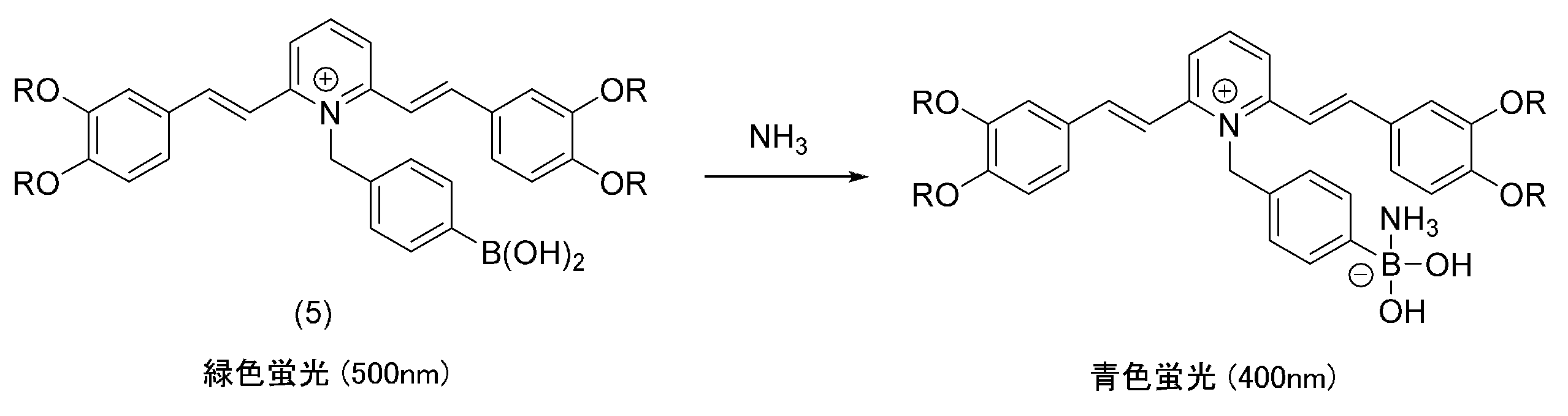
これまで説明したように、本発明の化合物は、アンモニアの存在を検知して、蛍光の変化という肉眼で識別可能な形でその情報を発信する。この化合物は、ppbレベルのアンモニアを検出可能であり、極めて高感度なセンサーとして用いることが可能である。また、この化合物は、溶液中に溶解状態で存在するアンモニアでも、気体中にガス状態で存在するアンモニアでも同様に検出することが可能である。さらには、本発明の化合物は、アンモニアガスに曝露されたときに上記の通り蛍光の変化を生じるが、アンモニアガスの曝露状態が解除されると速やかに蛍光が元の状態に戻る。したがって、本発明の化合物は、アンモニアガスに曝露されているときのみ蛍光変化を示すので、繰り返しアンモニア検知に用いることが可能である。 As explained above, the compounds of the present invention sense the presence of ammonia and transmit this information in the form of a change in fluorescence that is discernible to the naked eye. This compound can detect ppb level ammonia and can be used as an extremely sensitive sensor. Furthermore, this compound can be detected in the same way whether ammonia is present in a dissolved state in a solution or ammonia is present in a gaseous state in a gas. Furthermore, when the compound of the present invention is exposed to ammonia gas, the fluorescence changes as described above, but the fluorescence quickly returns to its original state when the exposure to ammonia gas is removed. Therefore, the compounds of the present invention exhibit a fluorescence change only when exposed to ammonia gas and can therefore be used repeatedly for ammonia detection.
ところで、既に説明したように、本発明の化合物は、フェニルボロン酸部位のホウ素原子にアンモニアが結合してこれを検知する。このとき、ホウ素原子が、アンモニアの窒素原子上の非共有電子対を受け入れて結合を形成しており、これはルイス酸として考えることができる。したがって、本発明の化合物は、アンモニア(pKa=9.3)と近いpKaを備え、かつ非共有電子対を備えた化学種もアンモニアと同様に検知することが可能と考えられる。このような化学種として、As(OH)3(pKa=9.29)を挙げることができる。 By the way, as already explained, the compound of the present invention detects ammonia bonded to the boron atom of the phenylboronic acid moiety. At this time, the boron atom accepts the lone pair of electrons on the nitrogen atom of ammonia to form a bond, which can be thought of as a Lewis acid. Therefore, it is considered that the compound of the present invention has a pKa close to that of ammonia (pKa=9.3) and can also detect chemical species having a lone pair of electrons in the same way as ammonia. As such a chemical species, As(OH) 3 (pKa=9.29) can be mentioned.
本発明の化合物の合成方法の一例として、上記化学式(5)で表す化合物の合成スキームの一例を下記に示す。下記のスキームは、2,6-ジメチルピリジンをブロモ化した後、トリフェニルホスフィンと反応させてホスホニウム塩(11)を得るとともに、3,4-ジヒドロキシベンズアルデヒドの水酸基をアルキルエーテルとして化合物(12)を得てから、1分子の化合物(12)と2分子の化合物(13)とをWittig反応により結合させて化合物(13)を得た後、ピリジニウム塩である化合物(5)を得るものである。なお、下記スキームにおいて、BPOは、過酸化ベンゾイルであり、NBSは、N-ブロモスクシンイミドをそれぞれ意味する。 As an example of the method for synthesizing the compound of the present invention, an example of a synthesis scheme for the compound represented by the above chemical formula (5) is shown below. In the scheme below, 2,6-dimethylpyridine is brominated and then reacted with triphenylphosphine to obtain a phosphonium salt (11), and the hydroxyl group of 3,4-dihydroxybenzaldehyde is converted into an alkyl ether to form a compound (12). After that, one molecule of compound (12) and two molecules of compound (13) are combined by Wittig reaction to obtain compound (13), and then compound (5), which is a pyridinium salt, is obtained. In the scheme below, BPO means benzoyl peroxide and NBS means N-bromosuccinimide.

[アンモニア検出材料]
次に、本発明のアンモニア検出材料について説明する。本発明のアンモニア検出材料は、上記本発明の化合物を含んでなることを特徴とする。既に説明したように、本発明の化合物は、アンモニアの存在を検知して自身の蛍光を変化させる。本発明のアンモニア検出材料は、そのような本発明の化合物の性質を応用したものである。なお、本発明のアンモニア検出材料の構成要素となる本発明の化合物については既に述べた通りなので、ここでの説明を省略する。
[Ammonia detection material]
Next, the ammonia detection material of the present invention will be explained. The ammonia detection material of the present invention is characterized by containing the above-mentioned compound of the present invention. As already explained, the compounds of the invention detect the presence of ammonia and change their fluorescence. The ammonia detection material of the present invention applies the properties of the compound of the present invention. Note that the compound of the present invention, which is a constituent element of the ammonia detection material of the present invention, has already been described, so a description thereof will be omitted here.
本発明のアンモニア検出材料に上記本発明の化合物を含ませる方法は、特に問わない。このような方法の一例として、本発明の化合物そのものをアンモニア検出材料とする方法、本発明の化合物を基材の表面に塗布してこれをアンモニア検出材料とする方法、本発明の化合物を樹脂等の基材に練り込んでこれをアンモニア検出材料とする方法、本発明の化合物を溶媒に溶解させてこれをアンモニアの検出材料とする方法等が挙げられる。特に、本発明の化合物は、置換基Rの選択によっては、室温においてそれ自身が液状を示すので、アンモニアの検出材料として所望の場所に適用することが可能である。 The method of incorporating the compound of the present invention into the ammonia detection material of the present invention is not particularly limited. Examples of such methods include a method in which the compound of the present invention itself is used as an ammonia detection material, a method in which the compound of the present invention is applied to the surface of a base material and used as an ammonia detection material, a method in which the compound of the present invention is used as an ammonia detection material, and a method in which the compound of the present invention is used as an ammonia detection material. Examples include a method in which the compound of the present invention is kneaded into a base material and used as an ammonia detection material, and a method in which the compound of the present invention is dissolved in a solvent and used as an ammonia detection material. In particular, the compound of the present invention exhibits a liquid state itself at room temperature depending on the selection of the substituent R, so that it can be applied to a desired location as a detection material for ammonia.
本発明のアンモニア検出材料がアンモニアを検出したか否かは、その蛍光を観察することで判別される。そのため、本発明のアンモニア検出材料を用いる場合、紫外光を含む光の照射が必要である。このような光を発する光源としては、太陽(すなわち太陽光)、ブラックライト、紫外LED、高圧水銀ランプ、メタルハライドランプ、キセノンランプ等を挙げることができる。 Whether or not the ammonia detection material of the present invention has detected ammonia is determined by observing its fluorescence. Therefore, when using the ammonia detection material of the present invention, irradiation with light including ultraviolet light is required. Examples of light sources that emit such light include the sun (ie, sunlight), a black light, an ultraviolet LED, a high-pressure mercury lamp, a metal halide lamp, a xenon lamp, and the like.
本発明のアンモニア検出材料は、上記の光源からの光を受けることにより蛍光を発し、アンモニアを検知するとその蛍光が変化する。これにより、本発明のアンモニア検出材料は、肉眼でも識別可能なアンモニア検出材料として機能する。蛍光の観察方法としては、肉眼のほか、蛍光スペクトル分光計をはじめとして、各種の分光器を用いることも可能である。 The ammonia detection material of the present invention emits fluorescence when receiving light from the above-mentioned light source, and the fluorescence changes when ammonia is detected. Thereby, the ammonia detection material of the present invention functions as an ammonia detection material that can be identified with the naked eye. As a method for observing fluorescence, in addition to the naked eye, it is also possible to use various spectrometers including a fluorescence spectrometer.
[アンモニア検出材料の製造方法]
次に、本発明のアンモニア検出材料の製造方法について説明する。本発明のアンモニア検出材料の製造方法は、上記本発明の化合物を基材に添加する工程を備えることを特徴とする。なお、本発明のアンモニア検出材料の製造方法で用いる上記本発明の化合物については既に述べた通りなので、ここでの説明を省略する。
[Method for producing ammonia detection material]
Next, a method for manufacturing the ammonia detection material of the present invention will be explained. The method for producing an ammonia detection material of the present invention is characterized by comprising a step of adding the compound of the present invention to a base material. Note that the compound of the present invention used in the method for producing the ammonia detection material of the present invention has already been described, so a description thereof will be omitted here.
本発明の化合物が添加される基材は、特に限定されず、本発明の化合物を塗布、混合、溶解等の手段により添加可能であれば何でもよい。このような基材としては、ガラス、樹脂、紙、木材、セラミック等を挙げることができる。 The substrate to which the compound of the present invention is added is not particularly limited, and any base material may be used as long as the compound of the present invention can be added by means such as coating, mixing, dissolving, etc. Examples of such base materials include glass, resin, paper, wood, ceramic, and the like.
本発明の化合物の基材への添加方法としては、特に限定されず、例えば塗布、練り込み等を挙げることができる。 The method of adding the compound of the present invention to the base material is not particularly limited, and examples thereof include coating, kneading, and the like.
[アンモニアの検出方法]
次に、本発明のアンモニアの検出方法について説明する。本発明のアンモニアの検出方法は、上記本発明の化合物を含む媒体に被測定試料を接触させ、その化合物によりもたらされる蛍光の変化を調べることにより被測定試料に含まれるアンモニアの存在を検出することを特徴とする。なお、この方法で用いる本発明の化合物については既に述べた通りなので、ここでの説明を省略する。
[Method of detecting ammonia]
Next, the ammonia detection method of the present invention will be explained. The ammonia detection method of the present invention involves contacting the sample to be measured with a medium containing the compound of the present invention, and detecting the presence of ammonia contained in the sample by examining the change in fluorescence caused by the compound. It is characterized by Note that the compound of the present invention used in this method has already been described, so the explanation here will be omitted.
媒体は、本発明の化合物が添加されるものであり、固体でも液体でもよい。このような媒体としては、ガラス、樹脂、紙、木材、セラミック、水、各種の溶媒等が挙げられる。媒体として液体のものが選択された場合、本発明の化合物を含む媒体は、溶液となる。媒体として固体のものが選択された場合、本発明の化合物を含む媒体は、固体の表面に本発明の化合物が塗布されたものや、固体中に本発明の化合物を含むもの等が挙げられる。 The medium to which the compound of the present invention is added may be solid or liquid. Examples of such a medium include glass, resin, paper, wood, ceramic, water, and various solvents. If a liquid medium is selected, the medium containing the compound of the invention will be a solution. When a solid medium is selected, examples of the medium containing the compound of the present invention include those in which the compound of the present invention is coated on the surface of the solid, and those containing the compound of the present invention in the solid.
被測定試料は、アンモニアが含まれるか否かの検査対象となるものであり、固体、液体、気体を問わない。 The sample to be measured is to be tested to see if it contains ammonia, and it does not matter if it is solid, liquid, or gas.
蛍光の変化の観察については、既に述べた通りなので、ここでの説明を省略する。 Observation of changes in fluorescence has already been described, so a description thereof will be omitted here.
以下、実施例を示すことにより本発明をさらに具体的に説明するが、本発明は以下の実施例に何ら限定されるものではない。 EXAMPLES Hereinafter, the present invention will be explained in more detail by showing examples, but the present invention is not limited to the following examples.
・2,6-ビス(ブロモメチル)ピリジンの合成

2,6-ジメチルピリジン(1.0g、9.33mmol)を四塩化炭素10mLに溶解させて溶液とした。この溶液へ、N-ブロモスクシンイミド(NBS,3.65g,20.5mmol)及び過酸化ベンゾイル(BPO,0.23g,0.933mmol)を加え、窒素気流下、75℃で16時間撹拌した。反応終了後、反応混合物を室温まで冷却し、自然濾過を行って濾液から溶媒を減圧留去した。その後、この残渣にヘキサンを加えて、再度自然濾過を行い、濾液から溶媒を減圧留去して透明な液体を得た。この液体を次の反応にそのまま用いた。収量は、2.30g(収率93%)だった。 2,6-dimethylpyridine (1.0 g, 9.33 mmol) was dissolved in 10 mL of carbon tetrachloride to form a solution. N-bromosuccinimide (NBS, 3.65 g, 20.5 mmol) and benzoyl peroxide (BPO, 0.23 g, 0.933 mmol) were added to this solution, and the mixture was stirred at 75° C. for 16 hours under a nitrogen stream. After the reaction was completed, the reaction mixture was cooled to room temperature, gravity filtered, and the solvent was distilled off from the filtrate under reduced pressure. Thereafter, hexane was added to this residue, gravity filtration was performed again, and the solvent was distilled off from the filtrate under reduced pressure to obtain a transparent liquid. This liquid was used directly in the next reaction. The yield was 2.30 g (yield 93%).
・(ピリジン-2,6-ジイルビス(メチレン))ビス(トリフェニルホスホニウム)ブロミド(11)の合成

2,6-ビス(ブロモメチル)ピリジン(2.30g,8.68mmol)をトルエン10mLに溶解させた。そこへ、トリフェニルホスフィン(TPP,3.43g,12.0mmol)を加えて、120℃で2時間撹拌した。反応終了後、反応混合物を温かいまま吸引濾過し、固体を得た。得られた固体をトルエン及びヘキサンでよく洗浄した。洗浄後の固体を60℃で乾燥させ、白色固体の化合物(11)を得た。収量は、2.55g(収率37%)だった。 2,6-bis(bromomethyl)pyridine (2.30 g, 8.68 mmol) was dissolved in 10 mL of toluene. Triphenylphosphine (TPP, 3.43 g, 12.0 mmol) was added thereto, and the mixture was stirred at 120° C. for 2 hours. After the reaction was completed, the reaction mixture was suction filtered while still warm to obtain a solid. The obtained solid was thoroughly washed with toluene and hexane. The washed solid was dried at 60°C to obtain a white solid compound (11). The yield was 2.55 g (yield 37%).
・3,4-ビス((2-オクチルドデシル)オキシ)ベンズアルデヒド(12)の合成

3,4-ジヒドロキシベンズアルデヒド(0.32g,2.30mmol)をジメチルホルムアミド(DMF)10mLに溶解させた。そこへ、炭酸カリウム(3.20g,23.0mmol)及びヨウ化カリウム(50mg)を加えて、65℃で30分間加熱しながら撹拌した。その後、反応混合物へ1-ブロモ-2-オクチルドデカン(2.0g,5.53mmol)を加えて、120℃で24時間撹拌した。反応後、反応混合物を氷中へ注ぎ入れ、酢酸エチルで抽出し、有機相を水で2回、飽和食塩水で1回それぞれ洗浄してから有機相を得た。得られた有機相を硫酸マグネシウムで乾燥させ、溶媒を減圧留去した。得られた残渣について、ジクロロメタン:ヘキサン=1:2の溶媒比でシリカゲルカラムクロマトグラフィーを行い、透明な液体の化合物(12)を得た。収量は、0.70g(収率43%)だった。 3,4-Dihydroxybenzaldehyde (0.32 g, 2.30 mmol) was dissolved in 10 mL of dimethylformamide (DMF). Potassium carbonate (3.20 g, 23.0 mmol) and potassium iodide (50 mg) were added thereto, and the mixture was stirred while heating at 65° C. for 30 minutes. Thereafter, 1-bromo-2-octyldodecane (2.0 g, 5.53 mmol) was added to the reaction mixture, and the mixture was stirred at 120° C. for 24 hours. After the reaction, the reaction mixture was poured into ice, extracted with ethyl acetate, and the organic phase was washed twice with water and once with saturated brine to obtain an organic phase. The resulting organic phase was dried over magnesium sulfate, and the solvent was distilled off under reduced pressure. The obtained residue was subjected to silica gel column chromatography using a solvent ratio of dichloromethane:hexane=1:2 to obtain a transparent liquid compound (12). The yield was 0.70 g (yield 43%).
2,6-ビス((E)-3,4-ビス((2-オクチルドデシル)オキシ)スチリル)ピリジン(13)の合成

化合物(11)(0.30g,0.377mmol)及び化合物(12)(0.58g,0.830mmol)をテトラヒドロフラン(THF)5.0mL中に加え、撹拌した。そこへ、tert-ブトキシカリウム(tert-BuOK,3,77mmol)を加えて、窒素気流下、65℃で16時間反応させた。反応終了後、反応混合物を水中に注ぎ入れ、クロロホルムで抽出し、有機相を水で2回、飽和食塩水で1回それぞれ洗浄してから有機相を得た。この有機相を硫酸マグネシウムで乾燥させ、溶媒を減圧留去した。得られた残渣について、ジクロロメタン:ヘキサン=1:2の溶媒比でカラムクロマトグラフィーを行い、透明な液体の化合物(13)を得た。収量は、0.20g(収率35%)だった。 Compound (11) (0.30 g, 0.377 mmol) and compound (12) (0.58 g, 0.830 mmol) were added to 5.0 mL of tetrahydrofuran (THF) and stirred. Potassium tert-butoxy (tert-BuOK, 3.77 mmol) was added thereto, and the mixture was reacted at 65° C. for 16 hours under a nitrogen stream. After the reaction was completed, the reaction mixture was poured into water, extracted with chloroform, and the organic phase was washed twice with water and once with saturated saline to obtain an organic phase. The organic phase was dried over magnesium sulfate and the solvent was distilled off under reduced pressure. The obtained residue was subjected to column chromatography using a solvent ratio of dichloromethane:hexane=1:2 to obtain a transparent liquid compound (13). The yield was 0.20 g (yield 35%).
・2,6-ビス((E)-3,4-ビス((2-オクチルドデシル)オキシ)スチリル)-1-(4-ボロノベンジル)ピリジン-1-イウムブロミド(5)の合成

化合物(13)(0.10g,0.0680mmol)及び4-ブロモメチルフェニルボロン酸(22mg,0.102mmol)をトルエン3.0mLに溶解させ、115℃で24時間加熱しながら撹拌した。反応終了後、反応混合物を室温に戻してから溶媒を減圧留去し、ヘキサンを加えて自然濾過を行い、濾液から溶媒を減圧留去して黄色液体の化合物(5)を得た。収量は、0.l0g(収率91%)だった。 Compound (13) (0.10 g, 0.0680 mmol) and 4-bromomethylphenylboronic acid (22 mg, 0.102 mmol) were dissolved in 3.0 mL of toluene and stirred while heating at 115° C. for 24 hours. After the reaction was completed, the reaction mixture was returned to room temperature, the solvent was distilled off under reduced pressure, hexane was added, natural filtration was performed, and the solvent was distilled off from the filtrate under reduced pressure to obtain a yellow liquid compound (5). The yield is 0. 10 g (yield 91%).
[水溶液中におけるアンモニア検知能]
本発明の化合物の水溶液中でのアンモニア検知能を調べた。まず、蒸留水、10-10Mのアンモニア水溶液、及び10-2Mのアンモニア水溶液を用意し、これらのそれぞれについて、化合物(5)の濃度が1.84×10⁻⁶Mとなるように化合物(5)のTHF溶液を混合した。得られた溶液のそれぞれについて、紫外可視吸収スペクトル及び蛍光スペクトル(励起波長335nm)を観察した。その結果を図1に示す。図1は、水溶液中におけるアンモニアの添加に伴う化合物(5)のスペクトル変化を表す図であり、図1(a)は、化合物(5)の紫外可視吸収スペクトルを表し、図1(b)は、化合物(5)の蛍光スペクトルを表す。なお、当業者にとって周知なように、単位の「M」はmol/Lを意味する。
[Ammonia detection in aqueous solution]
The ability of the compound of the present invention to detect ammonia in an aqueous solution was investigated. First, distilled water, a 10 −10 M ammonia aqueous solution, and a 10 −2 M ammonia aqueous solution were prepared, and the compound (5) was added to each of these so that the concentration of compound (5) was 1.84×10 −6 M. The THF solution of (5) was mixed. For each of the obtained solutions, the ultraviolet-visible absorption spectrum and fluorescence spectrum (
図1を参照すると、紫外可視吸収スペクトルでは、アンモニアの添加に伴って410nm付近の吸収の増加が観察されるとともに、405nmにおける蛍光の増加が観察された。この変化は、アンモニア濃度が10-10Mのときから生じており、本発明の化合物がppbオーダーの濃度のアンモニアを検知していることが理解できる。 Referring to FIG. 1, in the ultraviolet-visible absorption spectrum, an increase in absorption near 410 nm was observed with the addition of ammonia, and an increase in fluorescence at 405 nm was observed. This change occurs when the ammonia concentration is 10 −10 M, and it can be seen that the compound of the present invention detects ammonia at a concentration on the order of ppb.
[アンモニアガスの検知能]
次に、本発明の化合物のアンモニアガスの検知能を調べた。まず、ガラス板に液体状態である化合物(5)を塗布し、化合物(5)の薄膜(厚さ0.5μm)を形成させた。この薄膜の大気中での蛍光スペクトル(励起波長335nm)を測定した後、アンモニアガスの存在下、すなわちアンモニアガス曝露下での蛍光スペクトル(励起波長335nm)を測定した。その結果を図2に示す。図2は、化合物(5)のアンモニアガス未曝露下及び曝露下での蛍光スペクトル変化を表す図である。
[Detection of ammonia gas]
Next, the ability of the compound of the present invention to detect ammonia gas was investigated. First, compound (5) in a liquid state was applied to a glass plate to form a thin film (thickness: 0.5 μm) of compound (5). After measuring the fluorescence spectrum of this thin film in the atmosphere (
図2を参照すると、化合物(5)の蛍光スペクトルは、アンモニアガス未曝露状態で405nm(青色に相当)にピークを示していたのが、アンモニアガスの曝露により、そのピークが508nm(緑色に相当)へ長波長シフトしていることがわかる。また、図2には示さないが、化合物(5)は、アンモニアガスの曝露を解除すると、直ちに元の青色蛍光を発する状態となった。このことから、本発明の化合物は、アンモニアガスの存在を検知し、その情報を蛍光の変化により目視可能に発信することができ、かつ、繰り返し用いることが可能であることが示された。 Referring to Figure 2, the fluorescence spectrum of compound (5) showed a peak at 405 nm (corresponding to blue color) when not exposed to ammonia gas, but when exposed to ammonia gas, that peak changed to 508 nm (corresponding to green color). ), it can be seen that the wavelength has shifted to longer wavelengths. Although not shown in FIG. 2, compound (5) immediately returned to its original state of emitting blue fluorescence when the exposure to ammonia gas was removed. This indicates that the compound of the present invention can detect the presence of ammonia gas, visually transmit this information through a change in fluorescence, and can be used repeatedly.
Claims (4)

Detection of ammonia, characterized in that the presence of ammonia contained in the sample to be measured is detected by bringing the sample to be measured into contact with a medium containing the compound according to claim 1 and examining a change in fluorescence brought about by the compound. Method.
Priority Applications (1)
| Application Number | Priority Date | Filing Date | Title |
|---|---|---|---|
| JP2020041889A JP7455366B2 (en) | 2020-03-11 | 2020-03-11 | Compound, ammonia detection material containing the same, method for producing the same, and method for detecting ammonia using the same |
Applications Claiming Priority (1)
| Application Number | Priority Date | Filing Date | Title |
|---|---|---|---|
| JP2020041889A JP7455366B2 (en) | 2020-03-11 | 2020-03-11 | Compound, ammonia detection material containing the same, method for producing the same, and method for detecting ammonia using the same |
Publications (2)
| Publication Number | Publication Date |
|---|---|
| JP2021143140A JP2021143140A (en) | 2021-09-24 |
| JP7455366B2 true JP7455366B2 (en) | 2024-03-26 |
Family
ID=77765919
Family Applications (1)
| Application Number | Title | Priority Date | Filing Date |
|---|---|---|---|
| JP2020041889A Active JP7455366B2 (en) | 2020-03-11 | 2020-03-11 | Compound, ammonia detection material containing the same, method for producing the same, and method for detecting ammonia using the same |
Country Status (1)
| Country | Link |
|---|---|
| JP (1) | JP7455366B2 (en) |
Families Citing this family (2)
| Publication number | Priority date | Publication date | Assignee | Title |
|---|---|---|---|---|
| JP2023110935A (en) * | 2022-01-29 | 2023-08-10 | 学校法人東京電機大学 | Compound, acid- and base-sensitive gas sensor material, luminescent material, and acid-base indicator using the same |
| CN114773368B (en) * | 2022-05-06 | 2023-08-25 | 青岛大学 | Boron-nitrogen organic small molecule and preparation method and application thereof |
Citations (1)
| Publication number | Priority date | Publication date | Assignee | Title |
|---|---|---|---|---|
| JP2010526094A (en) | 2007-05-01 | 2010-07-29 | グルメトリクス、 インク. | Pyridinium boronic acid quenchers for use in analyte sensors |
-
2020
- 2020-03-11 JP JP2020041889A patent/JP7455366B2/en active Active
Patent Citations (1)
| Publication number | Priority date | Publication date | Assignee | Title |
|---|---|---|---|---|
| JP2010526094A (en) | 2007-05-01 | 2010-07-29 | グルメトリクス、 インク. | Pyridinium boronic acid quenchers for use in analyte sensors |
Also Published As
| Publication number | Publication date |
|---|---|
| JP2021143140A (en) | 2021-09-24 |
Similar Documents
| Publication | Publication Date | Title |
|---|---|---|
| Xin et al. | Aggregation-induced emissive copper (I) complexes for living cell imaging | |
| Malval et al. | A highly selective fluorescent molecular sensor for potassium based on a calix [4] bisazacrown bearing boron-dipyrromethene fluorophores | |
| Kim et al. | BODIPY appended cone-calix [4] arene: selective fluorescence changes upon Ca2+ binding | |
| Tümay et al. | Tripodal synthetic receptors based on cyclotriphosphazene scaffold for highly selective and sensitive spectrofluorimetric determination of iron (III) in water samples | |
| Ji et al. | Synthesis and sensing behavior of cyanoanthracene modified 1, 3-alternate calix [4] benzocrown-6: a new class of Cs+ selective optical sensors | |
| JP7455366B2 (en) | Compound, ammonia detection material containing the same, method for producing the same, and method for detecting ammonia using the same | |
| Li et al. | Precise control for the aggregation and deaggregation with the aid of a tetraphenylethylene derivative: luminescence modulation and sensing performance | |
| Çetindere et al. | Synthesis and physico-chemical properties of cyclotriphosphazene-BODIPY conjugates | |
| CN110156734B (en) | Fluorescent probe and fluorescent test paper for detecting nerve gas simulant and preparation method thereof | |
| Singh et al. | A Click‐Generated Triethoxysilane Tethered Ferrocene‐Chalcone‐Triazole Triad for Selective and Colorimetric Detection of Cu2+ Ions | |
| Yu et al. | High solid fluorescence of novel tetraphenylethene-porphyrin | |
| Shionari et al. | A pyrene-bridged macrocage showing no excimer fluorescence | |
| Liu et al. | Cholic acid-based high sensitivity fluorescent sensor for α, ω-dicarboxylate: an intramolecular excimer emission quenched by complexation | |
| Yang et al. | Three indole derived azo-azomethine dyes as effective chemosensors for F− ion and trace water detection | |
| CN104844475B (en) | Fluorescent probe molecule and its preparation method and application | |
| Philippe et al. | Quadruple Functionalization of a Tetraphenylethylene Aromatic Scaffold with Ynamides or Tetracyanobutadienes: Synthesis and Optical Properties | |
| Yan et al. | Synthesis and characterization of photoluminescent terbium-containing polymer precursors | |
| Baek et al. | Sensitized near-IR luminescence of lanthanide complexes based on push-pull diketone derivatives | |
| KR101722998B1 (en) | Composition for detecting sulfide ion and azide ion using nitrobenzoxadiazole-dansyl compound with the change in water content, and strip including the same | |
| Soh et al. | Novel fluorescent probe for detecting hydroperoxides with strong emission in the visible range | |
| KR20120057689A (en) | Compound for detecting nerve agents having selectivity for diethyl chlorophosphate and chemosensor using the same | |
| CN110845344A (en) | Chiral fluorescence sensor compound, synthetic method and use | |
| Wang et al. | Aggregation-induced emission of boryl substituted phenothiazine: synthesis and applications in fluoride ion sensing | |
| CN1701228B (en) | Single layer sensing element and system for measuring oxygen concentration | |
| CN116102494B (en) | A triphenylamine derivative and preparation method thereof, a photochromic thin film material and preparation method thereof and application thereof |
Legal Events
| Date | Code | Title | Description |
|---|---|---|---|
| A621 | Written request for application examination |
Free format text: JAPANESE INTERMEDIATE CODE: A621 Effective date: 20230104 |
|
| A977 | Report on retrieval |
Free format text: JAPANESE INTERMEDIATE CODE: A971007 Effective date: 20231207 |
|
| A131 | Notification of reasons for refusal |
Free format text: JAPANESE INTERMEDIATE CODE: A131 Effective date: 20231219 |
|
| A521 | Request for written amendment filed |
Free format text: JAPANESE INTERMEDIATE CODE: A523 Effective date: 20240209 |
|
| TRDD | Decision of grant or rejection written | ||
| A01 | Written decision to grant a patent or to grant a registration (utility model) |
Free format text: JAPANESE INTERMEDIATE CODE: A01 Effective date: 20240305 |
|
| A61 | First payment of annual fees (during grant procedure) |
Free format text: JAPANESE INTERMEDIATE CODE: A61 Effective date: 20240306 |
|
| R150 | Certificate of patent or registration of utility model |
Ref document number: 7455366 Country of ref document: JP Free format text: JAPANESE INTERMEDIATE CODE: R150 |