JP7431900B2 - Salts and solid forms of (S)-3-(4-((4-(morpholinomethyl)benzyl)oxy)-1-oxoisoindolin-2-yl)piperidine-2,6-dione and containing them Composition and method of use - Google Patents
Salts and solid forms of (S)-3-(4-((4-(morpholinomethyl)benzyl)oxy)-1-oxoisoindolin-2-yl)piperidine-2,6-dione and containing them Composition and method of use Download PDFInfo
- Publication number
- JP7431900B2 JP7431900B2 JP2022127689A JP2022127689A JP7431900B2 JP 7431900 B2 JP7431900 B2 JP 7431900B2 JP 2022127689 A JP2022127689 A JP 2022127689A JP 2022127689 A JP2022127689 A JP 2022127689A JP 7431900 B2 JP7431900 B2 JP 7431900B2
- Authority
- JP
- Japan
- Prior art keywords
- compound
- solid form
- solid
- salt
- peaks
- Prior art date
- Legal status (The legal status is an assumption and is not a legal conclusion. Google has not performed a legal analysis and makes no representation as to the accuracy of the status listed.)
- Active
Links
Images




Classifications
-
- A—HUMAN NECESSITIES
- A61—MEDICAL OR VETERINARY SCIENCE; HYGIENE
- A61K—PREPARATIONS FOR MEDICAL, DENTAL OR TOILETRY PURPOSES
- A61K31/00—Medicinal preparations containing organic active ingredients
- A61K31/33—Heterocyclic compounds
- A61K31/395—Heterocyclic compounds having nitrogen as a ring hetero atom, e.g. guanethidine or rifamycins
- A61K31/535—Heterocyclic compounds having nitrogen as a ring hetero atom, e.g. guanethidine or rifamycins having six-membered rings with at least one nitrogen and one oxygen as the ring hetero atoms, e.g. 1,2-oxazines
- A61K31/5375—1,4-Oxazines, e.g. morpholine
- A61K31/5377—1,4-Oxazines, e.g. morpholine not condensed and containing further heterocyclic rings, e.g. timolol
-
- C—CHEMISTRY; METALLURGY
- C07—ORGANIC CHEMISTRY
- C07D—HETEROCYCLIC COMPOUNDS
- C07D401/00—Heterocyclic compounds containing two or more hetero rings, having nitrogen atoms as the only ring hetero atoms, at least one ring being a six-membered ring with only one nitrogen atom
- C07D401/02—Heterocyclic compounds containing two or more hetero rings, having nitrogen atoms as the only ring hetero atoms, at least one ring being a six-membered ring with only one nitrogen atom containing two hetero rings
- C07D401/04—Heterocyclic compounds containing two or more hetero rings, having nitrogen atoms as the only ring hetero atoms, at least one ring being a six-membered ring with only one nitrogen atom containing two hetero rings directly linked by a ring-member-to-ring-member bond
-
- A—HUMAN NECESSITIES
- A61—MEDICAL OR VETERINARY SCIENCE; HYGIENE
- A61K—PREPARATIONS FOR MEDICAL, DENTAL OR TOILETRY PURPOSES
- A61K31/00—Medicinal preparations containing organic active ingredients
- A61K31/33—Heterocyclic compounds
- A61K31/395—Heterocyclic compounds having nitrogen as a ring hetero atom, e.g. guanethidine or rifamycins
- A61K31/40—Heterocyclic compounds having nitrogen as a ring hetero atom, e.g. guanethidine or rifamycins having five-membered rings with one nitrogen as the only ring hetero atom, e.g. sulpiride, succinimide, tolmetin, buflomedil
- A61K31/403—Heterocyclic compounds having nitrogen as a ring hetero atom, e.g. guanethidine or rifamycins having five-membered rings with one nitrogen as the only ring hetero atom, e.g. sulpiride, succinimide, tolmetin, buflomedil condensed with carbocyclic rings, e.g. carbazole
- A61K31/4035—Isoindoles, e.g. phthalimide
-
- A—HUMAN NECESSITIES
- A61—MEDICAL OR VETERINARY SCIENCE; HYGIENE
- A61K—PREPARATIONS FOR MEDICAL, DENTAL OR TOILETRY PURPOSES
- A61K31/00—Medicinal preparations containing organic active ingredients
- A61K31/33—Heterocyclic compounds
- A61K31/395—Heterocyclic compounds having nitrogen as a ring hetero atom, e.g. guanethidine or rifamycins
- A61K31/435—Heterocyclic compounds having nitrogen as a ring hetero atom, e.g. guanethidine or rifamycins having six-membered rings with one nitrogen as the only ring hetero atom
- A61K31/44—Non condensed pyridines; Hydrogenated derivatives thereof
- A61K31/4412—Non condensed pyridines; Hydrogenated derivatives thereof having oxo groups directly attached to the heterocyclic ring
-
- A—HUMAN NECESSITIES
- A61—MEDICAL OR VETERINARY SCIENCE; HYGIENE
- A61P—SPECIFIC THERAPEUTIC ACTIVITY OF CHEMICAL COMPOUNDS OR MEDICINAL PREPARATIONS
- A61P1/00—Drugs for disorders of the alimentary tract or the digestive system
-
- A—HUMAN NECESSITIES
- A61—MEDICAL OR VETERINARY SCIENCE; HYGIENE
- A61P—SPECIFIC THERAPEUTIC ACTIVITY OF CHEMICAL COMPOUNDS OR MEDICINAL PREPARATIONS
- A61P11/00—Drugs for disorders of the respiratory system
-
- A—HUMAN NECESSITIES
- A61—MEDICAL OR VETERINARY SCIENCE; HYGIENE
- A61P—SPECIFIC THERAPEUTIC ACTIVITY OF CHEMICAL COMPOUNDS OR MEDICINAL PREPARATIONS
- A61P13/00—Drugs for disorders of the urinary system
- A61P13/12—Drugs for disorders of the urinary system of the kidneys
-
- A—HUMAN NECESSITIES
- A61—MEDICAL OR VETERINARY SCIENCE; HYGIENE
- A61P—SPECIFIC THERAPEUTIC ACTIVITY OF CHEMICAL COMPOUNDS OR MEDICINAL PREPARATIONS
- A61P15/00—Drugs for genital or sexual disorders; Contraceptives
-
- A—HUMAN NECESSITIES
- A61—MEDICAL OR VETERINARY SCIENCE; HYGIENE
- A61P—SPECIFIC THERAPEUTIC ACTIVITY OF CHEMICAL COMPOUNDS OR MEDICINAL PREPARATIONS
- A61P17/00—Drugs for dermatological disorders
-
- A—HUMAN NECESSITIES
- A61—MEDICAL OR VETERINARY SCIENCE; HYGIENE
- A61P—SPECIFIC THERAPEUTIC ACTIVITY OF CHEMICAL COMPOUNDS OR MEDICINAL PREPARATIONS
- A61P17/00—Drugs for dermatological disorders
- A61P17/06—Antipsoriatics
-
- A—HUMAN NECESSITIES
- A61—MEDICAL OR VETERINARY SCIENCE; HYGIENE
- A61P—SPECIFIC THERAPEUTIC ACTIVITY OF CHEMICAL COMPOUNDS OR MEDICINAL PREPARATIONS
- A61P19/00—Drugs for skeletal disorders
- A61P19/02—Drugs for skeletal disorders for joint disorders, e.g. arthritis, arthrosis
-
- A—HUMAN NECESSITIES
- A61—MEDICAL OR VETERINARY SCIENCE; HYGIENE
- A61P—SPECIFIC THERAPEUTIC ACTIVITY OF CHEMICAL COMPOUNDS OR MEDICINAL PREPARATIONS
- A61P21/00—Drugs for disorders of the muscular or neuromuscular system
-
- A—HUMAN NECESSITIES
- A61—MEDICAL OR VETERINARY SCIENCE; HYGIENE
- A61P—SPECIFIC THERAPEUTIC ACTIVITY OF CHEMICAL COMPOUNDS OR MEDICINAL PREPARATIONS
- A61P21/00—Drugs for disorders of the muscular or neuromuscular system
- A61P21/02—Muscle relaxants, e.g. for tetanus or cramps
-
- A—HUMAN NECESSITIES
- A61—MEDICAL OR VETERINARY SCIENCE; HYGIENE
- A61P—SPECIFIC THERAPEUTIC ACTIVITY OF CHEMICAL COMPOUNDS OR MEDICINAL PREPARATIONS
- A61P21/00—Drugs for disorders of the muscular or neuromuscular system
- A61P21/06—Anabolic agents
-
- A—HUMAN NECESSITIES
- A61—MEDICAL OR VETERINARY SCIENCE; HYGIENE
- A61P—SPECIFIC THERAPEUTIC ACTIVITY OF CHEMICAL COMPOUNDS OR MEDICINAL PREPARATIONS
- A61P25/00—Drugs for disorders of the nervous system
- A61P25/14—Drugs for disorders of the nervous system for treating abnormal movements, e.g. chorea, dyskinesia
-
- A—HUMAN NECESSITIES
- A61—MEDICAL OR VETERINARY SCIENCE; HYGIENE
- A61P—SPECIFIC THERAPEUTIC ACTIVITY OF CHEMICAL COMPOUNDS OR MEDICINAL PREPARATIONS
- A61P25/00—Drugs for disorders of the nervous system
- A61P25/14—Drugs for disorders of the nervous system for treating abnormal movements, e.g. chorea, dyskinesia
- A61P25/16—Anti-Parkinson drugs
-
- A—HUMAN NECESSITIES
- A61—MEDICAL OR VETERINARY SCIENCE; HYGIENE
- A61P—SPECIFIC THERAPEUTIC ACTIVITY OF CHEMICAL COMPOUNDS OR MEDICINAL PREPARATIONS
- A61P25/00—Drugs for disorders of the nervous system
- A61P25/28—Drugs for disorders of the nervous system for treating neurodegenerative disorders of the central nervous system, e.g. nootropic agents, cognition enhancers, drugs for treating Alzheimer's disease or other forms of dementia
-
- A—HUMAN NECESSITIES
- A61—MEDICAL OR VETERINARY SCIENCE; HYGIENE
- A61P—SPECIFIC THERAPEUTIC ACTIVITY OF CHEMICAL COMPOUNDS OR MEDICINAL PREPARATIONS
- A61P27/00—Drugs for disorders of the senses
- A61P27/02—Ophthalmic agents
-
- A—HUMAN NECESSITIES
- A61—MEDICAL OR VETERINARY SCIENCE; HYGIENE
- A61P—SPECIFIC THERAPEUTIC ACTIVITY OF CHEMICAL COMPOUNDS OR MEDICINAL PREPARATIONS
- A61P29/00—Non-central analgesic, antipyretic or antiinflammatory agents, e.g. antirheumatic agents; Non-steroidal antiinflammatory drugs [NSAID]
-
- A—HUMAN NECESSITIES
- A61—MEDICAL OR VETERINARY SCIENCE; HYGIENE
- A61P—SPECIFIC THERAPEUTIC ACTIVITY OF CHEMICAL COMPOUNDS OR MEDICINAL PREPARATIONS
- A61P3/00—Drugs for disorders of the metabolism
- A61P3/12—Drugs for disorders of the metabolism for electrolyte homeostasis
- A61P3/14—Drugs for disorders of the metabolism for electrolyte homeostasis for calcium homeostasis
-
- A—HUMAN NECESSITIES
- A61—MEDICAL OR VETERINARY SCIENCE; HYGIENE
- A61P—SPECIFIC THERAPEUTIC ACTIVITY OF CHEMICAL COMPOUNDS OR MEDICINAL PREPARATIONS
- A61P31/00—Antiinfectives, i.e. antibiotics, antiseptics, chemotherapeutics
- A61P31/04—Antibacterial agents
-
- A—HUMAN NECESSITIES
- A61—MEDICAL OR VETERINARY SCIENCE; HYGIENE
- A61P—SPECIFIC THERAPEUTIC ACTIVITY OF CHEMICAL COMPOUNDS OR MEDICINAL PREPARATIONS
- A61P31/00—Antiinfectives, i.e. antibiotics, antiseptics, chemotherapeutics
- A61P31/12—Antivirals
-
- A—HUMAN NECESSITIES
- A61—MEDICAL OR VETERINARY SCIENCE; HYGIENE
- A61P—SPECIFIC THERAPEUTIC ACTIVITY OF CHEMICAL COMPOUNDS OR MEDICINAL PREPARATIONS
- A61P35/00—Antineoplastic agents
-
- A—HUMAN NECESSITIES
- A61—MEDICAL OR VETERINARY SCIENCE; HYGIENE
- A61P—SPECIFIC THERAPEUTIC ACTIVITY OF CHEMICAL COMPOUNDS OR MEDICINAL PREPARATIONS
- A61P35/00—Antineoplastic agents
- A61P35/02—Antineoplastic agents specific for leukemia
-
- A—HUMAN NECESSITIES
- A61—MEDICAL OR VETERINARY SCIENCE; HYGIENE
- A61P—SPECIFIC THERAPEUTIC ACTIVITY OF CHEMICAL COMPOUNDS OR MEDICINAL PREPARATIONS
- A61P37/00—Drugs for immunological or allergic disorders
-
- A—HUMAN NECESSITIES
- A61—MEDICAL OR VETERINARY SCIENCE; HYGIENE
- A61P—SPECIFIC THERAPEUTIC ACTIVITY OF CHEMICAL COMPOUNDS OR MEDICINAL PREPARATIONS
- A61P37/00—Drugs for immunological or allergic disorders
- A61P37/02—Immunomodulators
- A61P37/06—Immunosuppressants, e.g. drugs for graft rejection
-
- A—HUMAN NECESSITIES
- A61—MEDICAL OR VETERINARY SCIENCE; HYGIENE
- A61P—SPECIFIC THERAPEUTIC ACTIVITY OF CHEMICAL COMPOUNDS OR MEDICINAL PREPARATIONS
- A61P37/00—Drugs for immunological or allergic disorders
- A61P37/08—Antiallergic agents
-
- A—HUMAN NECESSITIES
- A61—MEDICAL OR VETERINARY SCIENCE; HYGIENE
- A61P—SPECIFIC THERAPEUTIC ACTIVITY OF CHEMICAL COMPOUNDS OR MEDICINAL PREPARATIONS
- A61P9/00—Drugs for disorders of the cardiovascular system
-
- A—HUMAN NECESSITIES
- A61—MEDICAL OR VETERINARY SCIENCE; HYGIENE
- A61P—SPECIFIC THERAPEUTIC ACTIVITY OF CHEMICAL COMPOUNDS OR MEDICINAL PREPARATIONS
- A61P9/00—Drugs for disorders of the cardiovascular system
- A61P9/04—Inotropic agents, i.e. stimulants of cardiac contraction; Drugs for heart failure
-
- A—HUMAN NECESSITIES
- A61—MEDICAL OR VETERINARY SCIENCE; HYGIENE
- A61P—SPECIFIC THERAPEUTIC ACTIVITY OF CHEMICAL COMPOUNDS OR MEDICINAL PREPARATIONS
- A61P9/00—Drugs for disorders of the cardiovascular system
- A61P9/10—Drugs for disorders of the cardiovascular system for treating ischaemic or atherosclerotic diseases, e.g. antianginal drugs, coronary vasodilators, drugs for myocardial infarction, retinopathy, cerebrovascula insufficiency, renal arteriosclerosis
-
- C—CHEMISTRY; METALLURGY
- C07—ORGANIC CHEMISTRY
- C07D—HETEROCYCLIC COMPOUNDS
- C07D401/00—Heterocyclic compounds containing two or more hetero rings, having nitrogen atoms as the only ring hetero atoms, at least one ring being a six-membered ring with only one nitrogen atom
- C07D401/14—Heterocyclic compounds containing two or more hetero rings, having nitrogen atoms as the only ring hetero atoms, at least one ring being a six-membered ring with only one nitrogen atom containing three or more hetero rings
-
- C—CHEMISTRY; METALLURGY
- C07—ORGANIC CHEMISTRY
- C07D—HETEROCYCLIC COMPOUNDS
- C07D413/00—Heterocyclic compounds containing two or more hetero rings, at least one ring having nitrogen and oxygen atoms as the only ring hetero atoms
- C07D413/14—Heterocyclic compounds containing two or more hetero rings, at least one ring having nitrogen and oxygen atoms as the only ring hetero atoms containing three or more hetero rings
Landscapes
- Health & Medical Sciences (AREA)
- Chemical & Material Sciences (AREA)
- Organic Chemistry (AREA)
- Life Sciences & Earth Sciences (AREA)
- Animal Behavior & Ethology (AREA)
- Pharmacology & Pharmacy (AREA)
- Veterinary Medicine (AREA)
- Public Health (AREA)
- Medicinal Chemistry (AREA)
- General Health & Medical Sciences (AREA)
- Nuclear Medicine, Radiotherapy & Molecular Imaging (AREA)
- Engineering & Computer Science (AREA)
- General Chemical & Material Sciences (AREA)
- Bioinformatics & Cheminformatics (AREA)
- Chemical Kinetics & Catalysis (AREA)
- Neurology (AREA)
- Immunology (AREA)
- Epidemiology (AREA)
- Biomedical Technology (AREA)
- Neurosurgery (AREA)
- Cardiology (AREA)
- Physical Education & Sports Medicine (AREA)
- Orthopedic Medicine & Surgery (AREA)
- Oncology (AREA)
- Heart & Thoracic Surgery (AREA)
- Rheumatology (AREA)
- Endocrinology (AREA)
- Communicable Diseases (AREA)
- Psychology (AREA)
- Urology & Nephrology (AREA)
- Pulmonology (AREA)
- Hematology (AREA)
- Hospice & Palliative Care (AREA)
- Dermatology (AREA)
- Pain & Pain Management (AREA)
- Virology (AREA)
- Psychiatry (AREA)
- Ophthalmology & Optometry (AREA)
- Transplantation (AREA)
- Vascular Medicine (AREA)
Description
本出願は、その全体が引用により本明細書中に組み込まれている、2012年8月9日に出願
された米国特許仮出願第61/681,481号に対する優先権を主張するものである。
This application claims priority to U.S. Provisional Patent Application No. 61/681,481, filed August 9, 2012, which is incorporated herein by reference in its entirety.
(1.分野)
式(I)の化合物の塩及び固体形態、又はそれらの立体異性体、塩の固体形態、並びに該
塩及び固体形態の合成方法が、本明細書に提供される。

用する、様々な障害を治療、予防及び管理する方法も、本明細書に提供される。
(1.Field)
Provided herein are salts and solid forms of compounds of formula (I), or stereoisomers thereof, solid forms of salts, and methods of synthesizing the salts and solid forms.
(2.背景)
(a)癌及び他の疾患の病理生物学
癌は、所与の正常組織から誘導された異常な細胞の数の増加、これらの異常な細胞によ
る隣接組織の浸潤、又は悪性細胞の局所的リンパ節及び遠位部位(転移)へのリンパ性若し
くは血液伝播性拡散により、主に特徴付けられる。臨床データ及び分子生物学的研究は、
癌は、ある種の条件下で新生物形成へと進行し得る、小さい前腫瘍性の変化で始まる多段
階プロセスであることを指摘している。新生物形成性病変は、クローン性に発展し、且つ
特に新生物形成性細胞が、宿主の免疫監視機構を回避する条件下で、侵襲、成長、転移、
及び異質の能力の増大を呈する。Roitt, I.、Brostoff, J及びKale, D.の文献、Immunolo
gy, 17.1-17.12 (第3版、Mosby, セントルイス, Mo., 1993)。
(2. Background)
(a) Pathobiology of Cancer and Other Diseases Cancer is caused by an increase in the number of abnormal cells derived from a given normal tissue, by the invasion of adjacent tissues by these abnormal cells, or by the local lymphocytosis of malignant cells. It is primarily characterized by lymphoid or hematogenous spread to nodes and distal sites (metastasis). Clinical data and molecular biological studies are
It points out that cancer is a multistep process that begins with small preneoplastic changes that can progress to neoplasia under certain conditions. Neoplastic lesions develop clonally and undergo invasion, growth, metastasis, and especially under conditions where neoplastic cells evade the host's immune surveillance mechanisms.
and exhibits increased heterogeneous abilities. References Roitt, I., Brostoff, J. and Kale, D., Immunolo
gy, 17.1-17.12 (3rd ed., Mosby, St. Louis, Mo., 1993).
多くの型の癌は、血管新生として公知のプロセスである、新たな血管形成に関連してい
る。腫瘍が誘導した血管新生に関与した機序がいくつか、解明されている。これらの機序
の最も直接的なものは、腫瘍壊死因子α(TNF-α)を含む、血管新生特性を持つサイトカイ
ンの腫瘍細胞による分泌である。
Many types of cancer are associated with the formation of new blood vessels, a process known as angiogenesis. Several mechanisms involved in tumor-induced angiogenesis have been elucidated. The most direct of these mechanisms is the secretion by tumor cells of cytokines with angiogenic properties, including tumor necrosis factor alpha (TNF-α).
多種多様な他の疾患及び障害も、望ましくない血管新生に関連しているか、又はこれに
より特徴付けられる。例えば、増強されるか又は調節されない血管新生は、非限定的に眼
血管新生疾患、脈絡膜血管新生疾患、網膜血管新生症、ルベオーシス(隅角の血管新生)、
ウイルス性疾患、遺伝疾患、炎症疾患、アレルギー性疾患、及び自己免疫疾患を含む、多
くの疾患及び病態に関係づけられている。そのような疾患及び状態の例は、糖尿病性網膜
症;未熟児網膜症;角膜移植拒絶反応;血管新生緑内障;水晶体後線維増殖症;関節炎;
及び、増殖性硝子体網膜症を含むが、これらに限定されるものではない。
A wide variety of other diseases and disorders are also associated with or characterized by unwanted angiogenesis. For example, enhanced or unregulated angiogenesis can include, but is not limited to, ocular neovascular disease, choroidal neovascular disease, retinal neovascular disease, rubeosis (angular neovascularization),
It has been implicated in many diseases and conditions, including viral, genetic, inflammatory, allergic, and autoimmune diseases. Examples of such diseases and conditions are diabetic retinopathy; retinopathy of prematurity; corneal transplant rejection; neovascular glaucoma; retrolental fibroplasia; arthritis;
and proliferative vitreoretinopathy, but are not limited to these.
従って、血管新生を制御することができるか又はTNF-αを含むある種のサイトカインの
生成を阻害することができる化合物は、様々な疾患及び状態の治療及び予防において有用
であることができる。
Accordingly, compounds that can control angiogenesis or inhibit the production of certain cytokines, including TNF-α, can be useful in the treatment and prevention of a variety of diseases and conditions.
(b)癌の治療方法
最新の癌療法は、患者の新生物形成性細胞を根絶するための、手術、化学療法、ホルモ
ン療法及び/又は放射線治療に関与している(例えば、Stockdaleの文献、1998年、「医学(
Medicine)」、第3巻、Rubenstein及びFederman編集、第12章IV節を参照されたい)。最近
、また癌療法は、生物学的療法又は免疫療法も関与している。これらの方式全てには、患
者にとって重大な欠点がある。例えば手術は、患者の健康又は年齢のために、禁忌である
ことがあり、また患者にとって受け容れ難いことがある。
(b) Methods of treating cancer Modern cancer therapy involves surgery, chemotherapy, hormonal therapy and/or radiation therapy to eradicate neoplastic cells in the patient (e.g. Stockdale, 1998, “Medicine (
Medicine),
加えて、手術は、新生物形成性組織を完全に除去することができない。放射線治療は、
新生物形成性組織が、放射線に対し正常組織よりもより高い感度を示す場合にのみ、有効
である。放射線治療はまた、重篤な副作用を引き起こすことが多い。ホルモン療法は、単
剤として投与されることは稀である。ホルモン療法は有効であることができるが、これは
、他の治療が癌細胞の大半を除去した後に、癌の再発を防止又は遅延するために使用され
ることが多い。生物学的療法及び免疫療法は、数が限定されており、且つ発疹又は腫脹、
発熱、悪寒及び疲労を含むインフルエンザに似た症状、消化管の問題又はアレルギー反応
などの副作用を生じ得る。
In addition, surgery cannot completely remove neoplastic tissue. Radiation therapy is
It is only effective if neoplastic tissue exhibits a higher sensitivity to radiation than normal tissue. Radiation therapy also often causes serious side effects. Hormone therapy is rarely administered as a single agent. Hormone therapy can be effective, but it is often used to prevent or delay cancer recurrence after other treatments have removed most of the cancer cells. Biological and immunotherapies are limited in number and are effective against rash or swelling,
Side effects can occur such as flu-like symptoms including fever, chills and fatigue, gastrointestinal problems or allergic reactions.
化学療法に関して、癌治療に利用可能な様々な化学療法薬が存在する。癌化学療法の主
なものは、DNA複製及び同時に細胞分裂を防止するために、デオキシリボヌクレオチド三
リン酸前駆体の生合成を阻害することにより、直接又は間接のいずれかで、DNA合成を阻
害することにより作用する。Gilmanらの文献、「グッドマンギルマン:治療の薬理学的基
礎(Goodman and Gilman's: The Pharmacological Basis of Therapeutics)」、第10版(Mc
Graw Hill社, ニューヨーク)。
Regarding chemotherapy, there are a variety of chemotherapy drugs available for cancer treatment. Cancer chemotherapy mainly inhibits DNA synthesis, either directly or indirectly, by inhibiting the biosynthesis of deoxyribonucleotide triphosphate precursors, in order to prevent DNA replication and at the same time cell division. It works by Gilman et al., "Goodman and Gilman's: The Pharmacological Basis of Therapeutics," 10th edition (Mc
Graw Hill, New York).
様々な化学療法薬の利用可能性にも拘わらず、化学療法は多くの欠点を有する。Stockd
aleの文献、「医学(Medicine)」、第3巻、Rubenstein及びFederman編集、第12章、10節、
1998年。ほぼ全ての化学療法薬は、毒性があり、且つ化学療法は、重篤な悪心、骨髄抑制
、及び免疫抑制を含む、重大な、時には危険な副作用を引き起こす。加えて、化学療法薬
の組合せ投与であっても、多くの腫瘍細胞は、その化学療法薬に対し抵抗性であるか又は
抵抗性を発達する。実際、治療プロトコールにおいて使用される特定の化学療法薬に対し
抵抗性があるこれらの細胞は、それらの物質が特定の治療において使用される薬物の機序
とは異なる機序で作用する場合であっても、他の薬物に対しても抵抗性であることが証明
されることが多い。この現象は、多面的薬物抵抗又は多剤抵抗と称される。この薬物の抵
抗性のために、多くの癌は、標準の化学療法的治療プロトコールに対し難治性であること
が証明されるか又は難治性となり始める。
Despite the availability of various chemotherapeutic drugs, chemotherapy has many drawbacks. Stockd
Bibliography of Ale, Medicine,
1998. Almost all chemotherapy drugs are toxic, and chemotherapy causes serious and sometimes dangerous side effects, including severe nausea, bone marrow suppression, and immunosuppression. In addition, even with combined administration of chemotherapeutic agents, many tumor cells are or develop resistance to the chemotherapeutic agents. In fact, these cells may be resistant to the specific chemotherapeutic drugs used in a treatment protocol if those agents act by a different mechanism than that of the drug used in the specific treatment. However, they often prove resistant to other drugs as well. This phenomenon is called pleiotropic drug resistance or multidrug resistance. Because of this drug resistance, many cancers prove or become refractory to standard chemotherapeutic treatment protocols.
望ましくない血管新生に関連付けられた、又はこれを特徴とする他の疾患又は状態も、
治療が困難である。しかし、プロタミン、ヘパリン(hepain)及びステロイドなどの一部の
化合物は、ある種の特定の疾患の治療において有用であることが提唱されている。Taylor
らの文献、Nature, 297:307 (1982);Folkmanらの文献、Science, 221 :719 (1983);及
び、米国特許第5,001,116号及び第4,994,443号。
Other diseases or conditions associated with or characterized by unwanted angiogenesis also include:
Difficult to treat. However, some compounds, such as protamine, heparin (hepain) and steroids, have been proposed to be useful in the treatment of certain specific diseases. Taylor
et al., Nature, 297:307 (1982); Folkman et al., Science, 221:719 (1983); and U.S. Patent Nos. 5,001,116 and 4,994,443.
依然、手術、放射線治療、化学療法及びホルモン療法などの標準の治療に対し難治性で
ある疾患を含む癌並びに他の疾患及び状態を治療、予防及び管理する一方で、従来の療法
に関連した毒性及び/又は副作用を軽減若しくは回避する、安全且つ有効な方法の著しい
必要性が存在する。
While treating, preventing and managing cancer and other diseases and conditions, including diseases that remain refractory to standard treatments such as surgery, radiation therapy, chemotherapy and hormonal therapy, the toxicities associated with conventional therapies There is a significant need for safe and effective methods of reducing or avoiding side effects.
(c)塩及び固体形態
塩基性部分を有する化合物は、酸により、様々な塩を形成することができる。所与の化
合物の様々な塩は、その化合物の安定性、加工性、医薬としてのインビボにおける性能に
影響を及ぼす異なる特性を有することができる。所与の化合物のある種の塩の物理的特性
はまた、該化合物の光学的又は立体化学的に純粋な形態の分離を可能にするか又は促進す
ることができる。
(c) Salts and Solid Forms Compounds with basic moieties can form various salts with acids. Different salts of a given compound can have different properties that affect the stability, processability, and in vivo performance of the compound as a pharmaceutical. The physical properties of certain salts of a given compound can also enable or facilitate the separation of optically or stereochemically pure forms of the compound.
化合物は、様々な固体形態で存在し得る。医薬化合物の固体形態の選択は、他の重要な
医薬特性の中でも、加工、製剤化、安定性、及びバイオアベイラビリティの点で利益又は
欠点を提供し得る、種々の物理的及び化学的特性に影響を及ぼす場合がある。潜在的な医
薬固体としては、結晶性固体及び非晶質固体が挙げられる。非晶質固体が長い範囲の構造
的秩序の欠如を特徴とするのに対し、結晶性固体は構造的周期性を特徴とする。医薬固体
の所望のクラスは、具体的な用途によって決まり;非晶質固体が、例えば、溶解プロファ
イルの改善に基づいて選択されることもある一方、結晶性固体は、例えば、物理的又は化
学的安定性などの特性にとって望ましい場合がある(例えば、S. R. Vippaguntaらの文献
、Adv. Drug. Deliv. Rev., (2001) 48:3-26;L. Yuの文献、Adv. Drug. Deliv. Rev., (
2001) 48:27-42を参照されたい)。
Compounds may exist in various solid forms. The selection of the solid form of a pharmaceutical compound affects a variety of physical and chemical properties that may offer advantages or disadvantages in terms of processing, formulation, stability, and bioavailability, among other important pharmaceutical properties. may cause Potential pharmaceutical solids include crystalline solids and amorphous solids. Whereas amorphous solids are characterized by a lack of long-range structural order, crystalline solids are characterized by structural periodicity. The desired class of pharmaceutical solids depends on the specific application; amorphous solids may be selected based on, e.g., improved dissolution profiles, whereas crystalline solids may be selected based on e.g. may be desirable for properties such as stability (e.g., SR Vippagunta et al., Adv. Drug. Deliv. Rev., (2001) 48:3-26; L. Yu, Adv. Drug. Deliv. Rev. ., (
2001) 48:27-42).
結晶性であれ、非晶質であれ、医薬化合物の潜在的固体形態は、単成分固体及び多成分
固体を含み得る。単成分固体は、他の化合物の非存在下の医薬化合物から本質的になる。
単成分結晶性物質間の多様性は、多形という現象から潜在的に生じ得、その場合、多数の
三次元配置が特定の医薬化合物について存在する(例えば、S. R. Byrnらの文献、「薬物
の固体状態化学(Solid State Chemistry of Drugs)」, (1999) SSCI, ウェストラファイ
エットを参照されたい)。
Potential solid forms of pharmaceutical compounds, whether crystalline or amorphous, can include single-component solids and multi-component solids. Monocomponent solids consist essentially of the pharmaceutical compound in the absence of other compounds.
Diversity among single-component crystalline materials can potentially arise from the phenomenon of polymorphism, in which a large number of three-dimensional configurations exist for a particular pharmaceutical compound (e.g., SR Byrn et al. Solid State Chemistry of Drugs, (1999) SSCI, West Lafayette).
医薬化合物の潜在的固体形態間のさらなる多様性は、多成分固体の可能性から生じ得る
。2以上のイオン種を含む結晶性固体は、塩と呼ばれる(例えば、「医薬塩のハンドブック
:特性、選択、及び使用(Handbook of Pharmaceutical Salts: Properties, Selection an
d Use)」、P. H. Stahl及びC. G. Wermuth編(2002), Wiley社, ヴェインハイムを参照さ
れたい)。医薬化合物又はその塩に他の特性改善を提供する可能性があり得るさらなるタ
イプの多成分固体としては、例えば、特に、水和物、溶媒和物、共結晶、及びクラスレー
トが挙げられる(例えば、S. R. Byrnらの文献、「薬物の固体状態化学(Solid State Chem
istry of Drugs)」、(1999) SSCI, ウェストラファイエットを参照されたい)。さらに、
多成分結晶形態は多形になりやすい可能性があり得、その場合、所与の多成分組成物は、
2以上の三次元結晶配置で存在し得る。固体形態の発見は、安全で、効果的で、安定で、
かつ市場性のある医薬化合物の開発において非常に重要である。
Further diversity among potential solid state forms of pharmaceutical compounds can arise from the possibility of multicomponent solids. Crystalline solids containing two or more ionic species are called salts (e.g., ``Handbook of Pharmaceutical Salts'').
Handbook of Pharmaceutical Salts: Properties, Selection and Use
d Use), edited by PH Stahl and CG Wermuth (2002), Wiley, Weinheim). Additional types of multicomponent solids that may have the potential to provide other property improvements to pharmaceutical compounds or salts thereof include, for example, hydrates, solvates, co-crystals, and clathrates, among others (e.g. , SR Byrn et al., “Solid State Chemistry of Drugs”
(1999) SSCI, West Lafayette). moreover,
Multi-component crystal forms may be prone to polymorphism, in which case a given multi-component composition is
May exist in two or more three-dimensional crystal configurations. The discovery of solid forms is safe, effective, stable and
and is of great importance in the development of marketable pharmaceutical compounds.
(3.概要)
式(I)の化合物の塩及び固体形態、又はそれらの立体異性体、該塩の固体形態、並びに
該塩及び固体形態を合成する方法が、本明細書において提供される:

Provided herein are salts and solid forms of compounds of formula (I), or stereoisomers thereof, solid forms of the salts, and methods of synthesizing the salts and solid forms:
一実施態様において、式(I)のラセミ化合物の塩及び固体形態、該塩の固体形態、並び
に該塩及び固体形態の合成方法が、本明細書において提供される。一実施態様において、
式(I)のラセミ化合物を含む固体形態、並びにイオン及び/又は分子などの1以上の追加の
種の有意な量が、本明細書において提供される。
In one embodiment, provided herein are salts and solid forms of racemic compounds of formula (I), solid forms of the salts, and methods of synthesizing the salts and solid forms. In one embodiment,
Solid forms including racemic compounds of formula (I) as well as significant amounts of one or more additional species such as ions and/or molecules are provided herein.
一実施態様において、式(I-S)の化合物の塩及び固体形態、該塩の固体形態、並びに該
塩及び固体形態の合成方法が、本明細書において提供される。一実施態様において、式(I
-S)の化合物を含む固体形態、並びにイオン及び/又は分子などの1以上の追加の種の有意
な量が、本明細書において提供される:

-S), as well as significant amounts of one or more additional species, such as ions and/or molecules, are provided herein:
本明細書に提供される固体形態は、水和物、無水物、溶媒和物に加え、結晶形態及び非
晶質形態を含むが、これらに限定されるものではない。本明細書に提供される固体形態は
、動物又はヒトにおける使用のための製剤の調製に関する活性医薬成分として有用である
。従って本明細書の実施態様は、これらの固体形態の最終の医薬製品としての使用を包含
している。特定の実施態様は、最終の医薬製品の製造、加工、製剤化及び/又は貯蔵に必
要とされる、改善された特性、例えば特に粉末流動特性、圧縮特性、打錠特性、安定性特
性、及び賦形剤適合性特性などを伴う最終剤形の製造において有用な固体形態を提供する
。本明細書の特定の実施態様は、式(I)の化合物又はそれらの立体異性体を含む単-成分結
晶形態、多成分結晶形態、単-成分非晶質形態及び/又は多成分非晶質形態、並びに医薬と
して許容し得る希釈剤、賦形剤又は担体を含有する医薬組成物を提供する。
Solid forms provided herein include, but are not limited to, hydrates, anhydrides, solvates, as well as crystalline and amorphous forms. The solid forms provided herein are useful as active pharmaceutical ingredients for the preparation of formulations for use in animals or humans. Embodiments herein therefore encompass the use of these solid forms as final pharmaceutical products. Certain embodiments provide improved properties needed for the manufacture, processing, formulation and/or storage of the final pharmaceutical product, such as, among others, powder flow properties, compression properties, tabletting properties, stability properties, and Solid forms useful in the manufacture of final dosage forms with excipient compatibility characteristics and the like are provided. Certain embodiments herein provide single-component crystalline forms, multi-component crystalline forms, single-component amorphous forms and/or multi-component amorphous forms comprising compounds of formula (I) or stereoisomers thereof. and a pharmaceutically acceptable diluent, excipient or carrier.
塩及び固体形態を含む医薬組成物、単一単位剤形、投薬レジメン、及びキットも、本明
細書において提供される。
Also provided herein are pharmaceutical compositions, single unit dosage forms, dosage regimens, and kits, including salts and solid forms.
前記組成物、塩、及び固体形態を使用し、様々な障害を治療、予防、及び管理する方法
も、本明細書において提供される。これらの方法は、本明細書に提供される塩又は固体形
態の治療的有効量を、そのような治療又は管理を必要とする患者へ、投与することを含む
。さらに、本明細書に提供される塩又は固体形態の予防的有効量を、そのような予防を必
要とする患者へ、投与することを含む、様々な疾患及び障害を予防する方法が提供される
。
Also provided herein are methods of treating, preventing, and managing various disorders using the compositions, salts, and solid forms. These methods include administering a therapeutically effective amount of a salt or solid form provided herein to a patient in need of such treatment or management. Further provided are methods of preventing various diseases and disorders comprising administering to a patient in need of such prophylaxis a prophylactically effective amount of a salt or solid form provided herein. .
(4.図面の簡単な説明)
(5. 詳細な説明)
(5.1 化合物(I-S)の塩及び固体形態並びにそれらの合成)
化合物(I-S)は、3-(4-((4-(モルホリノメチル)ベンジル)オキシ)-l-オキソイソインド
リン-2-イル)ピペリジン-2,6-ジオンの(S)立体異性体である。ラセミ体3-(4-((4-(モルホ
リノメチル)ベンジル)オキシ)-l-オキソイソインドリン-2-イル)ピペリジン-2,6-ジオン
の調製方法は、米国特許公報第2011/0196150号に報告されており、これはその全体が引用
により本明細書中に組み込まれている。化合物(I-S)は、下記構造を有する:

(5.1 Salt and solid forms of compound (IS) and their synthesis)
Compound (IS) is the (S) stereoisomer of 3-(4-((4-(morpholinomethyl)benzyl)oxy)-l-oxoisoindolin-2-yl)piperidine-2,6-dione . A method for preparing racemic 3-(4-((4-(morpholinomethyl)benzyl)oxy)-l-oxoisoindolin-2-yl)piperidine-2,6-dione is described in U.S. Patent Publication No. 2011/0196150. , which is incorporated herein by reference in its entirety. Compound (IS) has the following structure:
化合物(I-S)の塩が、本明細書において提供される。一部の実施態様において、化合物(
I-S)は、H-Xの塩であり、ここでXは、F、Cl、Br、I、RSO3、又はRCO2であり、ここでRは
、アルキル、アリール、置換アルキル、置換アリール、又はヒドロキシである。一部の実
施態様において、化合物(I-S)は、酒石酸塩、例えばD若しくはL、又はヘミ-酒石酸塩であ
る。一部の実施態様において、この塩は、塩酸、ベンゼンスルホン酸、p-トルエンスルホ
ン酸、(+)カンファースルホン酸の塩、D-酒石酸又はL-酒石酸の塩である。一部の実施態
様において、この塩は、炭酸塩又は硫酸塩である。いずれか特定の理論により限定される
ものではないが、これらの酸は、化合物(I-S)のモルホリン環上の窒素の塩基性窒素と会
合されている。
Salts of Compound (IS) are provided herein. In some embodiments, the compound (
IS) is a salt of HX, where X is F, Cl, Br, I, RSO3 , or RCO2 , where R is alkyl, aryl, substituted alkyl, substituted aryl, or hydroxy. be. In some embodiments, compound (IS) is a tartrate salt, such as D or L, or a hemi-tartrate salt. In some embodiments, the salt is a salt of hydrochloric acid, benzenesulfonic acid, p-toluenesulfonic acid, (+)camphorsulfonic acid, D-tartaric acid, or L-tartaric acid. In some embodiments, the salt is a carbonate or sulfate. Without being limited by any particular theory, these acids are associated with the basic nitrogen of the nitrogen on the morpholine ring of compound (IS).
また化合物(I-S)の固体形態及び化合物(I-S)の塩も、本明細書において提供される。一
部の実施態様において、固体形態は、無水物、水和物、又は溶媒和物である。一部の実施
態様において、溶媒和物は、テトラヒドロフラン又はジメチルスルホキシドの溶媒和物で
ある。
Also provided herein are solid forms of Compound (IS) and salts of Compound (IS). In some embodiments, the solid form is anhydrous, hydrate, or solvate. In some embodiments, the solvate is a solvate of tetrahydrofuran or dimethyl sulfoxide.
本明細書で使用されるように、及び別途規定されない限り、「固体形態」という用語及
び関連用語は、主として液体状態でも気体状態でもない物理的形態を指す。固体形態は、
結晶性、非晶質、又はそれらの混合物であってよい。特定の実施態様において、固体形態
は、液晶であってよい。
As used herein, and unless otherwise specified, the term "solid form" and related terms refer to a physical form that is neither primarily liquid nor gaseous. The solid form is
It may be crystalline, amorphous, or a mixture thereof. In certain embodiments, the solid form may be liquid crystal.
一部の実施態様において、化合物(I-S)は、単成分又は多成分固体形態である。化合物(
I-S)を含む「単成分」固体形態は、化合物(I-S)から本質的になる。化合物(I-S)を含む「
多成分」固体形態は、相当な量の1以上の追加の種、例えばイオン及び/又は分子を、該固
体形態内に含む。例えば特定の実施態様において、化合物(I-S)を含む結晶性多成分固体
形態は、結晶格子中の定位置で非共有結合している1以上の種をさらに含む。一実施態様
において、本明細書に提供される多成分固体形態は、共晶である。
In some embodiments, Compound (IS) is in mono- or multi-component solid form. Compound(
A "single component" solid form containing IS) consists essentially of the compound (IS). Containing compound (IS)
A "multicomponent" solid form includes a significant amount of one or more additional species, such as ions and/or molecules, within the solid form. For example, in certain embodiments, a crystalline multicomponent solid form comprising Compound (IS) further comprises one or more species non-covalently bound in position in the crystal lattice. In one embodiment, the multicomponent solid forms provided herein are eutectic.
本明細書で使用されるように、及び別途規定されない限り、本明細書で使用される「結
晶性」という用語及び関連用語は、物質、修飾、材料、成分、又は生成物を説明するため
に使用される場合、別途規定されない限り、該物質、修飾、材料、成分、又は生成物が、
X線回折により決定されたとき、実質的に結晶性であることを意味する。例えば、「レミ
ントン:薬学の科学と実践(Remington: The Science and Practice of Pharmacy)」、第21
版、Lippincott-Williams and Wilkins社、ボルチモア, MD (2005);米国薬局方(USP)、第
23版、1843-1844 (1995)を参照されたい。
As used herein, and unless otherwise specified, the term "crystalline" and related terms used herein to describe a substance, modification, material, component, or product When used, unless otherwise specified, the substance, modification, material, component, or product is
Means substantially crystalline as determined by X-ray diffraction. For example, "Remington: The Science and Practice of Pharmacy", No. 21.
Edition, Lippincott-Williams and Wilkins, Baltimore, MD (2005); United States Pharmacopeia (USP), No.
See 23rd edition, 1843-1844 (1995).
本明細書で使用されるように、及び別途規定されない限り、本明細書中の「結晶形態」
という用語及び関連用語は、結晶性である固体形態を指す。結晶形態には、単成分結晶形
態及び多成分結晶形態が含まれ、かつ多形、溶媒和物、水和物、及び他の分子複合体、並
びに塩、塩の溶媒和物、塩の水和物、塩の他の分子複合体、及びそれらの多形が含まれる
が、これらに限定されない。ある実施態様において、物質の結晶形態は、非晶質形態及び
/又は他の結晶形態を実質的に含まなくてもよい。ある実施態様において、物質の結晶形
態は、重量ベースで約1%、2%、3%、4%、5%、6%、7%、8%、9%、10%、15%、20
%、25%、30%、35%、40%、45%、又は50%未満の1以上の非晶質形態及び/又は他の結
晶形態を含み得る。ある実施態様において、物質の結晶形態は、物理的に及び/又は化学
的に純粋であり得る。ある実施態様において、物質の結晶形態は、約99%、98%、97%、
96%、95%、94%、93%、92%、91%、又は90%物理的に及び/又は化学的に純粋であり
得る。
As used herein, and unless otherwise specified, "crystalline form" herein
The term and related terms refer to solid forms that are crystalline. Crystal forms include single and multicomponent crystal forms, and include polymorphs, solvates, hydrates, and other molecular complexes, as well as salts, solvates of salts, hydrates of salts. compounds, other molecular complexes of salts, and polymorphs thereof. In certain embodiments, the crystalline form of the substance is an amorphous form and
/or may be substantially free of other crystalline forms. In certain embodiments, the crystalline form of the material is about 1%, 2%, 3%, 4%, 5%, 6%, 7%, 8%, 9%, 10%, 15%, 20% by weight.
%, 25%, 30%, 35%, 40%, 45%, or 50% of one or more amorphous forms and/or other crystalline forms. In certain embodiments, a crystalline form of a substance may be physically and/or chemically pure. In certain embodiments, the crystalline form of the material is about 99%, 98%, 97%,
It can be 96%, 95%, 94%, 93%, 92%, 91%, or 90% physically and/or chemically pure.
同じく、化合物(I-S)の様々な塩の多形が、本明細書において提供される。本明細書で
使用されるように、及び別途規定されない限り、本明細書中の「多形」、「多形形態」と
いう用語及び関連用語は、同じ分子(単数)、分子(複数)、又はイオンから本質的になる2
以上の結晶形態を指す。異なる結晶形態と同様、異なる多形は、結晶格子中の分子及び/
又はイオンの配置又は立体配座の結果として、例えば、融点、融解熱、溶解度、溶解速度
、及び/又は振動スペクトルなどの異なる物理的特性を有し得る。物理的特性の違いは、
貯蔵安定性、圧縮性及び密度(製剤化及び製品製造において重要)、並びに溶解速度(バイ
オアベイラビリティにおける重要な因子)などの医薬パラメータに影響を及ぼし得る。安
定性の違いは、化学反応性の変化(例えば、剤形が、ある多形から構成される場合に、別
の多形から構成される場合よりも急速に変色するような、示差酸化)もしくは機械的変化(
例えば、錠剤は、貯蔵時に、動力学的に有利な多形が熱力学的により安定な多形に変換す
るにつれて崩壊する)、又はその両方(例えば、ある多形の錠剤は、高湿度でより分解しや
すい)に起因することがある。溶解度/溶解性の違いの結果として、極端な場合、固体状態
転移は、効力の欠如をもたらし、又は別の極端な場合には、毒性をもたらすこともある。
さらに、物理的特性は、加工において重要である場合がある(例えば、ある多形は、溶媒
和物を形成する可能性がより高い場合があるか、又は不純物なく濾過及び洗浄することが
難しい場合があり、かつ粒子形状及び粒径分布は、多形間で異なる場合がある)。
Also provided herein are various salt polymorphs of Compound (IS). As used herein, and unless otherwise specified, the terms "polymorph", "polymorphic form" and related terms herein refer to the same molecule(s), molecules, or Becomes essentially from
Refers to the above crystalline forms. Similar to different crystal forms, different polymorphs are molecules in the crystal lattice and/or
or may have different physical properties as a result of the arrangement or conformation of the ions, such as, for example, melting point, heat of fusion, solubility, rate of dissolution, and/or vibrational spectrum. The difference in physical properties is
Pharmaceutical parameters such as storage stability, compressibility and density (important in formulation and product manufacturing), and dissolution rate (an important factor in bioavailability) can be affected. Differences in stability may be due to changes in chemical reactivity (e.g., differential oxidation, such that a dosage form changes color more rapidly when it is composed of one polymorph than when it is composed of another polymorph) or Mechanical change (
For example, tablets may disintegrate on storage as a kinetically favored polymorph converts to a thermodynamically more stable polymorph), or both (e.g., tablets of some polymorphs may be more susceptible to (easy to decompose). As a result of solubility/solubility differences, in extreme cases, solid state transition can lead to lack of efficacy, or in other extreme cases, toxicity.
Additionally, physical properties may be important in processing (e.g., certain polymorphs may be more likely to form solvates or be difficult to filter and wash without impurities). (and particle shape and size distribution may differ between polymorphs).
本明細書で使用されるように、及び別途規定されない限り、用語「溶媒和物」及び「溶
媒和される」は、溶媒を含む物質の結晶形態を指す。用語「水和物」及び「水和される」
は、溶媒が水を含む溶媒和物を指す。「溶媒和物の多形」は、特定の溶媒和物組成に関し
て、2種以上の結晶形態の存在を指す。同様に、「水和物の多形」は、特定の水和物組成
に関して、2種以上の結晶形態の存在を指す。本明細書で使用される用語「脱溶媒和され
た溶媒和物」は、溶媒和物から溶媒を除去することにより調製することができる物質の結
晶形態を指す。
As used herein, and unless otherwise specified, the terms "solvate" and "solvated" refer to a crystalline form of a substance that includes a solvent. The terms “hydrate” and “hydrated”
refers to a solvate in which the solvent contains water. "Solvate polymorphism" refers to the existence of more than one crystalline form for a particular solvate composition. Similarly, "hydrate polymorphism" refers to the existence of more than one crystalline form for a particular hydrate composition. The term "desolvated solvate" as used herein refers to a crystalline form of a substance that can be prepared by removing the solvent from a solvate.
本明細書で使用されるように、及び別途規定されない限り、用語「非晶質」、「非晶質
形態」及び本明細書で使用される関連用語は、問題の物質、成分又は生成物が、X線回折
により決定されたとき、実質的に結晶性でないことを意味する。特に、用語「非晶質形態
」は、無秩序な固体形態、すなわち、長い範囲の結晶秩序を欠いている固体形態を説明す
る。ある実施態様において、物質の非晶質形態は、他の非晶質形態及び/又は結晶形態を
実質的に含まないことができる。他の実施態様において、物質の非晶質形態は、重量ベー
スで約1%、2%、3%、4%、5%、10%、15%、20%、25%、30%、35%、40%、45%又
は50%未満の1以上の他の非晶質形態及び/又は他の結晶形態を含有し得る。ある実施態様
において、物質の非晶質形態は、物理的に及び/又は化学的に純粋であり得る。ある実施
態様において、物質の非晶質形態は、約99%、98%、97%、96%、95%、94%、93%、92
%、91%、又は90%物理的に及び/又は化学的に純粋であり得る。
As used herein, and unless otherwise specified, the terms "amorphous", "amorphous form" and related terms used herein mean that the substance, component or product in question is , means substantially non-crystalline as determined by X-ray diffraction. In particular, the term "amorphous form" describes a disordered solid form, ie, a solid form lacking long range crystalline order. In certain embodiments, an amorphous form of a substance can be substantially free of other amorphous and/or crystalline forms. In other embodiments, the amorphous form of the material is about 1%, 2%, 3%, 4%, 5%, 10%, 15%, 20%, 25%, 30%, 35% by weight. , 40%, 45% or 50% of one or more other amorphous forms and/or other crystalline forms. In certain embodiments, an amorphous form of a substance may be physically and/or chemically pure. In certain embodiments, the amorphous form of the material is about 99%, 98%, 97%, 96%, 95%, 94%, 93%, 92%
%, 91%, or 90% physically and/or chemically pure.
結晶形態及び非晶質形態の特徴決定の技術は、熱重量分析(TGA)、示差走査熱量測定(DS
C)、X線粉末回折法(XRPD)、単結晶X線回折法、振動分光法、例えば、赤外線(IR)及びラマ
ン分光法、固体状態及び液体核磁気共鳴(NMR)分光法、光学顕微鏡法、ホットステージ光
学顕微鏡法、走査型電子顕微鏡法(SEM)、電子線結晶学及び定量分析、粒径分析(PSA)、表
面積分析、溶解度測定、溶解測定、元素分析及びカールフィッシャー分析を含むが、これ
らに限定されるものではない。特徴的単位格子パラメータは、非限定的に、単結晶回折及
び粉末回折を含む、X線回折及び中性子回折などの、1以上の技術を用いて、決定すること
ができる。粉末回折データの解析に有用な技術は、例えば2種以上の固相を含む試料中の
単相に関連した回折ピークを分析するために使用することができる、リートベルト精密化
などの、プロファイルの精密化を含む。粉末回折データの解析に有用な他の方法は、当業
者が、結晶性粉末を含む試料から単位格子パラメータを決定することを可能にする、単位
格子指標付けを含む。
Techniques for characterizing crystalline and amorphous forms include thermogravimetric analysis (TGA), differential scanning calorimetry (DS
C), X-ray powder diffraction (XRPD), single crystal X-ray diffraction, vibrational spectroscopy, e.g. infrared (IR) and Raman spectroscopy, solid state and liquid nuclear magnetic resonance (NMR) spectroscopy, optical microscopy , hot stage optical microscopy, scanning electron microscopy (SEM), electron crystallography and quantitative analysis, particle size analysis (PSA), surface area analysis, solubility measurements, dissolution measurements, elemental analysis and Karl Fischer analysis. It is not limited to these. Characteristic unit cell parameters can be determined using one or more techniques, such as X-ray diffraction and neutron diffraction, including, but not limited to, single crystal diffraction and powder diffraction. Techniques useful in the analysis of powder diffraction data include Rietveld refinement, which can be used to analyze diffraction peaks associated with a single phase in samples containing two or more solid phases. Including refinement. Other methods useful for analyzing powder diffraction data include unit cell indexing, which allows one skilled in the art to determine unit cell parameters from samples containing crystalline powders.
本明細書で使用されるように、及び別途規定されない限りは、用語「約」及び「およそ
」は、例として、例えば、融解、脱水、脱溶媒和又はガラス転移温度を説明するものなど
の、具体的温度又は温度範囲;例えば温度又は湿度の関数としての質量変化などの、質量
変化;例えば質量又は割合に換算した溶媒又は水の含量;あるいは例えば、IR又はラマン
分光法又はXRPDによる分析などにおける、ピーク位置:などの特定の固体形態を特徴付け
るために提供される数値又は値の範囲に結びつけて使用される場合は、この値又は値の範
囲は、依然特定の固体形態を説明している限りは、当業者に妥当と思われる程度に逸脱し
てよいことを指摘している。例えば特定の実施態様において、用語「約」及び「およそ」
は、この文脈において使用される場合、数値又は値の範囲が、列記された値又は値の範囲
の25%、20%、15%、10%、9%、8%、7%、6%、5%、4%、3%、2%、1.5%、1%、0.
5%、又は0.25%以内で変動し得ることを指摘している。本明細書で使用されるように、
数値又は値の範囲の前のチルド(すなわち「~」)は、「約」及び「およそ」を指摘してい
る。
As used herein, and unless otherwise specified, the terms "about" and "approximately" include, by way of example, those describing melting, dehydration, desolvation, or glass transition temperature. a specific temperature or temperature range; a change in mass, e.g. a change in mass as a function of temperature or humidity; e.g. the content of solvent or water in terms of mass or proportion; or analysis, e.g. by IR or Raman spectroscopy or XRPD. , peak position: etc., when used in conjunction with a numerical value or range of values provided to characterize a particular solid form, as long as this value or range of values still describes the particular solid form. points out that deviations may be made to the extent deemed reasonable by those skilled in the art. For example, in certain embodiments, the terms "about" and "approximately"
is used in this context when a number or range of values is 25%, 20%, 15%, 10%, 9%, 8%, 7%, 6%, 5%, 4%, 3%, 2%, 1.5%, 1%, 0.
It points out that it can fluctuate within 5% or 0.25%. As used herein,
A tilde (ie, "~") before a number or range of values indicates "about" and "approximately."
一部の実施態様において、本明細書で説明される固体形態、例えば結晶形態又は非晶質
形態は、実質的に純粋であり、すなわち、1以上の他の固体形態及び/又は他の化合物を、
約25重量%、20重量%、15重量%、10重量%、9重量%、8重量%、7重量%、6重量%、5
重量%、4重量%、3重量%、2重量%、1重量%、0.75重量%、0.5重量%、0.25重量%又
は0.1重量%未満含有し、他の固体形態及び/又は他の化学化合物を実質的に含まない。
In some embodiments, the solid forms described herein, such as crystalline or amorphous forms, are substantially pure, i.e. free of one or more other solid forms and/or other compounds. ,
Approximately 25% by weight, 20% by weight, 15% by weight, 10% by weight, 9% by weight, 8% by weight, 7% by weight, 6% by weight, 5
Contains less than %, 4%, 3%, 2%, 1%, 0.75%, 0.5%, 0.25% or 0.1% by weight, other solid forms and/or other chemical compounds Substantially not included.
固体形態は、本明細書に記載の結晶形態など、特定の固体形態に特有である、個別の物
理的特性評価データを示すことができる。これらの特性評価データは、例えば、X線粉末
回折、示差走査熱量測定、熱重量分析、及び核磁気共鳴分光法を含む、当業者に公知の様
々な技術により得ることができる。これらの技術により提供されるデータは、特定の固体
形態を同定するために使用することができる。当業者は、これらの特性評価技術の一つを
実行することにより、及び得られたデータが、特定の固体形態に特徴的であると同定され
る本明細書に提供される参照データと「マッチする」かどうかを決定することにより、固
体形態は、本明細書に記載の形態の一つであるかどうかを決定することができる。参照固
体形態のデータと「マッチする」特性評価データは、参照固体形態と同じ固体形態に相当
すると当業者により理解される。データが「マッチする」かどうかの分析において、当業
者は、特定の特性評価データ点は、例えば、実験誤差及び通常の試料毎の分析のために、
所与の固体形態を説明しつつも、妥当な程度変動し得ることを理解している。
Solid state forms can exhibit individual physical characterization data that is unique to the particular solid state form, such as the crystalline forms described herein. These characterization data can be obtained by a variety of techniques known to those skilled in the art, including, for example, X-ray powder diffraction, differential scanning calorimetry, thermogravimetry, and nuclear magnetic resonance spectroscopy. The data provided by these techniques can be used to identify specific solid state forms. Those skilled in the art will be able to "match" the reference data provided herein by performing one of these characterization techniques and the data obtained is identified as being characteristic of a particular solid form. By determining whether the solid form is one of the forms described herein, one can determine whether the solid form is one of the forms described herein. It will be understood by those skilled in the art that characterization data that "matches" data of a reference solid form corresponds to the same solid form as the reference solid form. In analyzing whether data are "matched," those skilled in the art will understand that a particular characterization data point may be due to, e.g., experimental error and normal sample-to-sample analysis.
While describing a given solid state form, it is understood that variation may occur to a reasonable degree.
本明細書に提供される固体形態は、結晶性、非晶質、又は中間形態であることができる
。従って本明細書記載の結晶形態は、変動する結晶化度又は格子秩序を有することができ
る。本明細書記載の固体形態は、いずれか特定の結晶化度又は格子秩序に限定されず、0
~100%の結晶性であることができる。この結晶化度を決定する方法は、Suryanarayanan,
R.の文献(「X線粉末回折、医薬塩の物理的特性評価(X-Ray Power Diffractometry, Phys
ical Characterization of Pharmaceutical Salts,)」、H.G. Brittain編集, Mercel Dek
kter社, マレーヒル, N.J., 1995, pp. 187-199)において説明された方法などが、当業者
に公知であり、この文献はその全体が引用により本明細書中に組み込まれている。一部の
実施態様において、本明細書記載の固体形態は、約0、5、10、15、20、25、30、35、40、
45、50、55、60、65、70、75、80、85、90、95又は100%結晶である。
The solid forms provided herein can be crystalline, amorphous, or intermediate forms. Thus, the crystalline forms described herein can have varying degrees of crystallinity or lattice order. The solid forms described herein are not limited to any particular crystallinity or lattice order;
Can be ~100% crystalline. The method for determining this crystallinity is Suryanarayanan,
Reference by R. ("X-Ray Power Diffraction, Physical Characterization of Pharmaceutical Salts"
ical Characterization of Pharmaceutical Salts,), edited by HG Brittain, Mercel Dek
Kter Inc., Murray Hill, NJ, 1995, pp. 187-199), which is incorporated herein by reference in its entirety. In some embodiments, the solid forms described herein are about 0, 5, 10, 15, 20, 25, 30, 35, 40,
45, 50, 55, 60, 65, 70, 75, 80, 85, 90, 95 or 100% crystalline.
(i)遊離塩基無水物
化合物(I-S)の無水物が、本明細書において提供される。一部の実施態様において、本
無水物は、化合物(I-S)及びアセトニトリルの混合物を加熱することにより得られる。一
部の実施態様において、本無水物は、化合物(I-S)及びアセトニトリルの混合物を約40℃
まで加熱し、引き続きこの混合物を約室温まで冷却することにより得られる。一部の実施
態様において、本無水物は、化合物(I-S)及びアセトニトリルの混合物を約40℃まで加熱
し、引き続きこの混合物を約室温まで冷却し、且つ濾過により無水物を分離することによ
り得られる。
(i) Free Base Anhydride The anhydride of Compound (IS) is provided herein. In some embodiments, the anhydride is obtained by heating a mixture of compound (IS) and acetonitrile. In some embodiments, the anhydride contains a mixture of Compound (IS) and acetonitrile at about 40°C.
and subsequent cooling of the mixture to about room temperature. In some embodiments, the anhydride is obtained by heating a mixture of Compound (IS) and acetonitrile to about 40°C, subsequently cooling the mixture to about room temperature, and separating the anhydride by filtration. .
いずれか特定の理論により限定されるものではないが、一部の実施態様において、本無
水物は、下記式を有する:

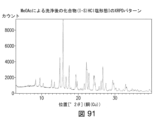
化合物(I-S)の無水物の代表的なXRPDパターンは、図1に提供されている。 A representative XRPD pattern of the anhydride form of compound (I-S) is provided in Figure 1.
一部の実施態様において、以下の位置又は以下の概算位置:4.76、7.15、8.72、12.10
、14.31、14.96、19.06、及び26.11度の2θのうち1箇所、2箇所、3箇所、4箇所、5箇所、
6箇所、7箇所、又は全てに位置するXRPDピークにより特徴付けられた化合物(I-S)を含む
固体形態が、本明細書において提供される。一実施態様において、本固体形態は、これら
のピークの3種により特徴付けられる。別の実施態様において、本固体形態は、これらの
ピークの5種により特徴付けられる。別の実施態様において、本固体形態は、これらのピ
ークの全てにより特徴付けられる。
In some embodiments, the following positions or approximate positions: 4.76, 7.15, 8.72, 12.10
, 1, 2, 3, 4, 5 of 2θ of 14.31, 14.96, 19.06, and 26.11 degrees,
Provided herein are solid forms comprising compounds (IS) characterized by XRPD peaks located at six, seven, or all positions. In one embodiment, the solid form is characterized by three of these peaks. In another embodiment, the solid form is characterized by five of these peaks. In another embodiment, the solid state form is characterized by all of these peaks.
一部の実施態様において、およそ4.76、8.72、14.31、及び14.96度の2θにピークを含
むXRPDパターンを有する化合物(I-S)を含む固体形態が、本明細書において提供される。
ある実施態様において、本固体形態はさらに、およそ7.15、12.10、19.06、及び26.11度
の2θにピークを含む。一部の実施態様において、本固体形態は、4.76、7.15、8.72、12.
10、14.31、14.96、19.06、及び26.11度の2θにピークを含む。
In some embodiments, provided herein is a solid form comprising a compound (IS) that has an XRPD pattern that includes peaks at approximately 4.76, 8.72, 14.31, and 14.96 degrees 2θ.
In certain embodiments, the solid form further comprises peaks at approximately 7.15, 12.10, 19.06, and 26.11 degrees 2θ. In some embodiments, the solid form is 4.76, 7.15, 8.72, 12.
Contains peaks at 10, 14.31, 14.96, 19.06, and 26.11 degrees 2θ.
一部の実施態様において、固体形態が図1に提示されたXRPDパターンにマッチするXRPD
回折パターンにより特徴付けられる、化合物(I-S)を含む固体形態が、本明細書において
提供される。
In some embodiments, an XRPD whose solid form matches the XRPD pattern presented in Figure 1
Provided herein is a solid form comprising a compound (IS) that is characterized by a diffraction pattern.
本無水物の代表的熱特性は、図2及び図3に提供される。代表的な示差走査熱量測定(DSC
)サーモグラムは、図2に提示されている。一部の実施態様において、ピーク温度約133℃
及びオンセット温度約127℃で、ピーク温度約155℃で、又はピーク温度約215℃で、DSCに
より特徴付けられた熱事象を示す、化合物(I-S)を含む固体形態が、本明細書に提供され
る。一部の実施態様において、ピーク温度約133℃及びオンセット温度約127℃で、ピーク
温度約155℃で、並びにピーク温度約215℃で、DSCにより特徴付けられた熱事象を示す、
化合物(I-S)を含む固体形態が、本明細書において提供される。ある実施態様において、
ピーク温度約133℃を伴う事象は、融解に対応している。ある実施態様において、ピーク
温度約155℃を伴う事象は、エピマー化及び結晶化に対応している。ある実施態様におい
て、ピーク温度約215℃を伴う事象は、融解に対応している。一部の実施態様において、
固体形態が、図2に提示されたDSCサーモグラムにマッチするDSCサーモグラムにより特徴
付けられている、化合物(I-S)を含む固体形態が、本明細書において提供される。
Representative thermal properties of the present anhydride are provided in FIGS. 2 and 3. A typical differential scanning calorimetry (DSC)
) The thermogram is presented in Figure 2. In some embodiments, a peak temperature of about 133°C
Provided herein is a solid form comprising a compound (IS) that exhibits a thermal event characterized by DSC with an onset temperature of about 127°C, a peak temperature of about 155°C, or a peak temperature of about 215°C. be done. In some embodiments, exhibiting a thermal event characterized by DSC with a peak temperature of about 133°C and an onset temperature of about 127°C, a peak temperature of about 155°C, and a peak temperature of about 215°C.
Solid forms comprising Compound (IS) are provided herein. In some embodiments,
Events with peak temperatures of approximately 133°C correspond to melting. In certain embodiments, events with peak temperatures of about 155°C correspond to epimerization and crystallization. In certain embodiments, events with peak temperatures of about 215°C correspond to melting. In some embodiments,
Provided herein is a solid form comprising a compound (IS), where the solid form is characterized by a DSC thermogram that matches the DSC thermogram presented in FIG.
本無水物の代表的な熱重量分析曲線は、図3に提供され、これは、約25℃から約150℃へ
加熱する際に、総試料重量の実質的変化を示さない。一部の実施態様において、固体形態
が、図3に提示されたTGAサーモグラムにマッチするTGAサーモグラムにより特徴付けられ
ている、化合物(I-S)を含む固体形態が、本明細書において提供される。
A representative thermogravimetric analysis curve for the present anhydride is provided in Figure 3, which shows no substantial change in total sample weight upon heating from about 25°C to about 150°C. In some embodiments, provided herein is a solid form comprising a compound (IS), wherein the solid form is characterized by a TGA thermogram that matches the TGA thermogram presented in FIG. .
本無水物の代表的なDVS等温線プロットが、図4に提供されている。一部の実施態様にお
いて、固体形態が、図4に提示されたDVS等温線プロットにマッチするDVS等温線プロット
により特徴付けられた、化合物(I-S)を含む固体形態が、本明細書において提供される。
A representative DVS isotherm plot of the present anhydride is provided in Figure 4. In some embodiments, provided herein is a solid form comprising Compound (IS), wherein the solid form is characterized by a DVS isotherm plot that matches the DVS isotherm plot presented in FIG. Ru.
(ii)遊離塩基水和物
化合物(I-S)の水和物が、本明細書において提供される。さらに、化合物(I-S)及び水を
含む固体形態が、本明細書において提供される。一部の実施態様において、本固体形態は
、化合物(I-S)及び水の混合物を加熱することにより得られる。一部の実施態様において
、本固体形態は、化合物(I-S)及び水の混合物を、約50℃まで加熱し、引き続きこの混合
物を約室温まで冷却することにより得られる。一部の実施態様において、本固体形態は、
化合物(I-S)及び水の混合物を、約50℃まで加熱し、引き続きこの混合物を約室温まで冷
却し、且つ濾過により固体形態を分離することにより得られる。一部の実施態様において
、化合物(I-S)対水のモル比は、およそ2:1から1:2である。一部の実施態様において、化
合物(I-S)対水のモル比は、およそ1:1である。
(ii) Free Base Hydrates Hydrates of Compound (IS) are provided herein. Further provided herein is a solid form comprising Compound (IS) and water. In some embodiments, the solid form is obtained by heating a mixture of compound (IS) and water. In some embodiments, the solid form is obtained by heating a mixture of compound (IS) and water to about 50° C. and subsequently cooling the mixture to about room temperature. In some embodiments, the solid form is
It is obtained by heating a mixture of compound (IS) and water to about 50° C., subsequently cooling the mixture to about room temperature, and separating the solid form by filtration. In some embodiments, the molar ratio of Compound (IS) to water is approximately 2:1 to 1:2. In some embodiments, the molar ratio of Compound (IS) to water is approximately 1:1.
いずれか特定の理論により限定されるものではないが、一部の実施態様において、本水
和物は、下記式を有する:

化合物(I-S)の水和物の代表的なXRPDパターンは、図5に提供されている。 A representative XRPD pattern of the hydrate of compound (I-S) is provided in Figure 5.
一部の実施態様において、以下の位置又は以下の概算位置:8.31、11.80、13.42、13.7
9、15.92、17.15、17.37、18.31、20.41、22.07、25.58、26.00、及び27.14度の2θのう
ち1箇所、2箇所、3箇所、4箇所、5箇所、6箇所、7箇所、8箇所、9箇所、10箇所、11箇所
、12箇所又は全てに位置するXRPDピークにより特徴付けられた化合物(I-S)及び水を含む
固体形態が、本明細書において提供される。一部の実施態様において、本固体形態は、こ
れらのピークの3種により特徴付けられる。一部の実施態様において、本固体形態は、こ
れらのピークの5種により特徴付けられる。一部の実施態様において、本固体形態は、こ
れらのピークの7種により特徴付けられる。一部の実施態様において、本固体形態は、こ
れらのピークの10種により特徴付けられる。一部の実施態様において、本固体形態は、こ
れらのピークの全てにより特徴付けられる。
In some embodiments, the following positions or approximate positions: 8.31, 11.80, 13.42, 13.7
1, 2, 3, 4, 5, 6, 7, 8, 9 of 2θ of 9, 15.92, 17.15, 17.37, 18.31, 20.41, 22.07, 25.58, 26.00, and 27.14 degrees Provided herein is a solid form comprising a compound (IS) characterized by XRPD peaks located at, 10, 11, 12, or all positions (IS) and water. In some embodiments, the solid form is characterized by three of these peaks. In some embodiments, the solid form is characterized by five of these peaks. In some embodiments, the solid form is characterized by seven of these peaks. In some embodiments, the solid state form is characterized by 10 of these peaks. In some embodiments, the solid state form is characterized by all of these peaks.
一部の実施態様において、およそ8.31、11.80、及び17.37度の2θにピークを含むXRPD
パターンを有する化合物(I-S)及び水を含む固体形態が、本明細書において提供される。
ある実施態様において、本固体形態はさらに、およそ13.79、17.15、26.00度の2θにピー
クを含む。一実施態様において、本固体形態は、およそ8.31、11.80、13.42、13.79、15.
92、17.15、17.37、18.31、20.41、22.07、25.58、26.00、及び27.14度の2θにピークを
含む。
In some embodiments, an XRPD containing peaks at approximately 8.31, 11.80, and 17.37 degrees 2θ
Solid forms comprising patterned compounds (IS) and water are provided herein.
In certain embodiments, the solid form further includes peaks at approximately 13.79, 17.15, and 26.00 degrees 2θ. In one embodiment, the solid form is approximately 8.31, 11.80, 13.42, 13.79, 15.
Contains peaks at 2θ of 92, 17.15, 17.37, 18.31, 20.41, 22.07, 25.58, 26.00, and 27.14 degrees.
一部の実施態様において、固体形態が図5に提示されたXRPDパターンにマッチするXRPD
回折パターンにより特徴付けられる、化合物(I-S)及び水を含む固体形態が、本明細書に
おいて提供される。
In some embodiments, an XRPD whose solid form matches the XRPD pattern presented in Figure 5
Provided herein is a solid form comprising a compound (IS) and water that is characterized by a diffraction pattern.
本水和物の代表的熱特性は、図6及び図7に提供される。代表的な示差走査熱量測定(DSC
)サーモグラムは、図6に提示されている。一部の実施態様において、ピーク温度約110℃
で、ピーク温度約188℃及びオンセット温度約180℃で、又はピーク温度約220℃及びオン
セット温度約217℃で、DSCにより特徴付けられた熱事象を示す、化合物(I-S)及び水を含
む固体形態が、本明細書に提供される。一部の実施態様において、ピーク温度約110℃で
、ピーク温度約188℃及びオンセット温度約180℃で、並びにピーク温度約220℃及びオン
セット温度約217℃で、DSCにより特徴付けられた熱事象を示す、化合物(I-S)及び水を含
む固体形態が、本明細書において提供される。一部の実施態様において、固体形態が、図
6に提示されたDSCサーモグラムにマッチするDSCサーモグラムにより特徴付けられている
、化合物(I-S)及び水を含む固体形態が、本明細書において提供される。
Representative thermal properties of the present hydrates are provided in FIGS. 6 and 7. A typical differential scanning calorimetry (DSC)
) The thermogram is presented in Figure 6. In some embodiments, a peak temperature of about 110°C
containing a compound (IS) and water exhibiting a thermal event characterized by DSC at a peak temperature of about 188°C and an onset temperature of about 180°C, or with a peak temperature of about 220°C and an onset temperature of about 217°C. Solid forms are provided herein. In some embodiments, the thermal Provided herein is a solid form comprising compound (IS) and water that exhibits the event. In some embodiments, the solid form is
Provided herein is a solid form comprising compound (IS) and water that is characterized by a DSC thermogram matching the DSC thermogram presented in No. 6.
本水和物の代表的な熱重量分析曲線は、図7に提供され、これは、約30℃から約150℃へ
加熱する際に、総試料重量の約5.43%の重量減少を示す。一部の実施態様において、固体
形態が、図7に提示されたTGAサーモグラムにマッチするTGAサーモグラムにより特徴付け
られている、化合物(I-S)及び水を含む固体形態が、本明細書において提供される。
A representative thermogravimetric analysis curve of the present hydrate is provided in FIG. 7, which shows a weight loss of about 5.43% of the total sample weight upon heating from about 30°C to about 150°C. In some embodiments, provided herein is a solid form comprising Compound (IS) and water, wherein the solid form is characterized by a TGA thermogram that matches the TGA thermogram presented in FIG. be done.
(iii)遊離塩基THF溶媒和物
化合物(I-S)のテトラヒドロフラン(THF)溶媒和物が、本明細書において提供される。さ
らに、化合物(I-S)及びTHFを含む固体形態が、本明細書において提供される。一部の実施
態様において、本固体形態は、化合物(I-S)及びTHFの混合物を加熱することにより得られ
る。一部の実施態様において、本固体形態は、化合物(I-S)及びTHFの混合物を、約40℃ま
で加熱し、引き続きこの混合物を約室温まで冷却することにより得られる。一部の実施態
様において、本固体形態は、化合物(I-S)及びTHFの混合物を、約40℃まで加熱し、引き続
きこの混合物を約室温まで冷却し、且つ濾過により本固体形態を分離することにより得ら
れる。一部の実施態様において、化合物(I-S)対THFのモル比は、およそ2:1から1:2である
。一部の実施態様において、化合物(I-S)対THFのモル比は、およそ1:1である。
(iii) Free Base THF Solvates Tetrahydrofuran (THF) solvates of Compound (IS) are provided herein. Further provided herein is a solid form comprising Compound (IS) and THF. In some embodiments, the solid form is obtained by heating a mixture of compound (IS) and THF. In some embodiments, the solid form is obtained by heating a mixture of compound (IS) and THF to about 40° C. and subsequently cooling the mixture to about room temperature. In some embodiments, the solid form is obtained by heating a mixture of compound (IS) and THF to about 40°C, subsequently cooling the mixture to about room temperature, and separating the solid form by filtration. can get. In some embodiments, the molar ratio of Compound (IS) to THF is approximately 2:1 to 1:2. In some embodiments, the molar ratio of Compound (IS) to THF is approximately 1:1.
いずれか特定の理論により限定されるものではないが、一部の実施態様において、本溶
媒和物は、下記式を有する:

化合物(I-S)のTHF溶媒和物の代表的なXRPDパターンは、図8に提供されている。 A representative XRPD pattern of the THF solvate of compound (I-S) is provided in Figure 8.
一部の実施態様において、以下の位置又は以下の概算位置:6.03、8.65、10.40、11.80
、15.12、17.71、17.90、18.23、18.59、20.49、20.89、22.16、23.24、26.47、及び29.1
4度の2θのうち1箇所、2箇所、3箇所、4箇所、5箇所、6箇所、7箇所、8箇所、9箇所、10
箇所、11箇所、12箇所、13箇所、14箇所又は全てに位置するXRPDピークにより特徴付けら
れた化合物(I-S)及びTHFを含む固体形態が、本明細書において提供される。一部の実施態
様において、本固体形態は、これらのピークの3種により特徴付けられる。一部の実施態
様において、本固体形態は、これらのピークの5種により特徴付けられる。一部の実施態
様において、本固体形態は、これらのピークの7種により特徴付けられる。一部の実施態
様において、本固体形態は、これらのピークの10種により特徴付けられる。一部の実施態
様において、本固体形態は、これらのピークの13種により特徴付けられる。一部の実施態
様において、本固体形態は、これらのピークの全てにより特徴付けられる。
In some embodiments, the following positions or approximate positions: 6.03, 8.65, 10.40, 11.80
, 15.12, 17.71, 17.90, 18.23, 18.59, 20.49, 20.89, 22.16, 23.24, 26.47, and 29.1
1, 2, 3, 4, 5, 6, 7, 8, 9, 10 of 4 degrees 2θ
Provided herein is a solid form comprising a compound (IS) and THF characterized by XRPD peaks located at, 11, 12, 13, 14, or all locations. In some embodiments, the solid form is characterized by three of these peaks. In some embodiments, the solid form is characterized by five of these peaks. In some embodiments, the solid form is characterized by seven of these peaks. In some embodiments, the solid state form is characterized by 10 of these peaks. In some embodiments, the solid state form is characterized by 13 of these peaks. In some embodiments, the solid state form is characterized by all of these peaks.
一部の実施態様において、およそ11.80、20.89、及び22.16度の2θにピークを含むXRPD
パターンを有する化合物(I-S)及びTHFを含む固体形態が、本明細書において提供される。
ある実施態様において、本固体形態はさらに、およそ6.03及び18.59度の2θにピークを含
む。一実施態様において、本固体形態は、およそ6.03、8.65、10.40、11.80、15.12、17.
71、17.90、18.23、18.59、20.49、20.89、22.16、23.24、26.47、及び29.14度の2θにピ
ークを含む。
In some embodiments, an XRPD containing peaks at approximately 11.80, 20.89, and 22.16 degrees 2θ
A solid form comprising a patterned compound (IS) and THF is provided herein.
In certain embodiments, the solid state form further comprises peaks at approximately 6.03 and 18.59 degrees 2θ. In one embodiment, the solid form is approximately 6.03, 8.65, 10.40, 11.80, 15.12, 17.
Contains peaks at 2θ of 71, 17.90, 18.23, 18.59, 20.49, 20.89, 22.16, 23.24, 26.47, and 29.14 degrees.
一部の実施態様において、固体形態が図8に提示されたXRPDパターンにマッチするXRPD
回折パターンにより特徴付けられる、化合物(I-S)及びTHFを含む固体形態が、本明細書に
おいて提供される。
In some embodiments, an XRPD whose solid form matches the XRPD pattern presented in Figure 8
Provided herein is a solid form comprising Compound (IS) and THF that is characterized by a diffraction pattern.
本溶媒和物の代表的熱特性は、図9及び図10に提供される。代表的な示差走査熱量測定(
DSC)サーモグラムは、図9に提示されている。一部の実施態様において、ピーク温度約114
℃及びオンセット温度約105℃で、ピーク温度約177℃及びオンセット温度約171℃で、又
はピーク温度約219℃及びオンセット温度約219℃で、DSCにより特徴付けられた熱事象を
示す、化合物(I-S)及びTHFを含む固体形態が、本明細書に提供される。一部の実施態様に
おいて、ピーク温度約114℃及びオンセット温度約105℃で、ピーク温度約177℃及びオン
セット温度約171℃で、並びにピーク温度約219℃及びオンセット温度約219℃で、DSCによ
り特徴付けられた熱事象を示す、化合物(I-S)及びTHFを含む固体形態が、本明細書におい
て提供される。一部の実施態様において、固体形態が、図9に提示されたDSCサーモグラム
にマッチするDSCサーモグラムにより特徴付けられている、化合物(I-S)及びTHFを含む固
体形態が、本明細書において提供される。
Representative thermal properties of the present solvates are provided in FIGS. 9 and 10. Typical differential scanning calorimetry (
DSC) thermogram is presented in Figure 9. In some embodiments, the peak temperature is about 114
C and an onset temperature of about 105 C; a peak temperature of about 177 C and an onset temperature of about 171 C; or a peak temperature of about 219 C and an onset temperature of about 219 C; A solid form comprising Compound (IS) and THF is provided herein. In some embodiments, at a peak temperature of about 114°C and an onset temperature of about 105°C, at a peak temperature of about 177°C and an onset temperature of about 171°C, and at a peak temperature of about 219°C and an onset temperature of about 219°C. Provided herein is a solid form comprising Compound (IS) and THF that exhibits thermal events characterized by DSC. In some embodiments, provided herein is a solid form comprising Compound (IS) and THF, wherein the solid form is characterized by a DSC thermogram that matches the DSC thermogram presented in FIG. be done.
本溶媒和物の代表的な熱重量分析曲線は、図10に提供され、これは、約50℃から約175
℃へ加熱する際に、総試料重量の約11.51%の重量減少を示す。一部の実施態様において
、固体形態が、図10に提示されたTGAサーモグラムにマッチするTGAサーモグラムにより特
徴付けられている、化合物(I-S)及びTHFを含む固体形態が、本明細書において提供される
。
A representative thermogravimetric analysis curve for the present solvate is provided in Figure 10, which ranges from about 50°C to about 175°C.
Upon heating to ℃, it shows a weight loss of about 11.51% of the total sample weight. In some embodiments, provided herein is a solid form comprising Compound (IS) and THF, wherein the solid form is characterized by a TGA thermogram that matches the TGA thermogram presented in FIG. be done.
(iv)ベシル酸塩
化合物(I-S)のベシル酸塩を含む固体形態が、本明細書において提供される。一部の実
施態様において、本固体形態は、化合物(II)、溶媒、及びベンゼンスルホン酸の混合物を
加熱し、引き続き結晶化することにより得られる。

一部の実施態様において、この溶媒は、アセトニトリルである。一部の実施態様におい
て、本固体形態は、(1)化合物(II)、ベンゼンスルホン酸、及びアセトニトリルの混合物
を、約82℃まで加熱する工程、並びに(2)結晶化工程により得られる。一部の実施態様に
おいて、本固体形態は、濾過により分離される。
In some embodiments, the solvent is acetonitrile. In some embodiments, the solid form is obtained by (1) heating a mixture of compound (II), benzenesulfonic acid, and acetonitrile to about 82° C., and (2) crystallizing. In some embodiments, the solid form is separated by filtration.
一部の実施態様において、本固体形態中の化合物(I-S)対ベンゼンスルホン酸のモル比
は、およそ2:1から1:2である。一部の実施態様において、このモル比は、およそ1:1であ
る。
In some embodiments, the molar ratio of Compound (IS) to benzenesulfonic acid in the solid form is approximately 2:1 to 1:2. In some embodiments, this molar ratio is approximately 1:1.
いずれか特定の理論により限定されるものではないが、一部の実施態様において、本ベ
シル酸塩は、下記式を有する:

ベシル酸塩化合物(I-S)の代表的なXRPDパターンは、図11に提供されている。 A representative XRPD pattern of the besylate compound (I-S) is provided in FIG. 11.
一部の実施態様において、以下の位置又は以下の概算位置:7.06、7.69、9.51、9.99、
15.48、15.92、16.42、18.28、19.07、20.36、20.71、21.34、21.66、22.33、22.52、23.
60、23.96、24.31、24.44、25.14、25.32、26.02、27.58、27.99、28.36、及び29.82度の
2θのうち1箇所、2箇所、3箇所、4箇所、5箇所、6箇所、7箇所、8箇所、9箇所、10箇所、
11箇所、12箇所、13箇所、14箇所、15箇所、16箇所、17箇所、18箇所、19箇所、20箇所、
21箇所、22箇所、23箇所、24箇所、25箇所又は全てに位置するXRPDピークにより特徴付け
られた化合物(I-S)のベシル酸塩を含む固体形態が、本明細書において提供される。一部
の実施態様において、本固体形態は、これらのピークの3種により特徴付けられる。一部
の実施態様において、本固体形態は、これらのピークの5種により特徴付けられる。一部
の実施態様において、本固体形態は、これらのピークの7種により特徴付けられる。一部
の実施態様において、本固体形態は、これらのピークの9種により特徴付けられる。一部
の実施態様において、本固体形態は、これらのピークの11種により特徴付けられる。一部
の実施態様において、本固体形態は、これらのピークの13種により特徴付けられる。一部
の実施態様において、本固体形態は、これらのピークの15種により特徴付けられる。一部
の実施態様において、本固体形態は、これらのピークの17種により特徴付けられる。一部
の実施態様において、本固体形態は、これらのピークの全てにより特徴付けられる。
In some embodiments, the following positions or the following approximate positions: 7.06, 7.69, 9.51, 9.99,
15.48, 15.92, 16.42, 18.28, 19.07, 20.36, 20.71, 21.34, 21.66, 22.33, 22.52, 23.
60, 23.96, 24.31, 24.44, 25.14, 25.32, 26.02, 27.58, 27.99, 28.36, and 29.82 degrees
1, 2, 3, 4, 5, 6, 7, 8, 9, 10 of 2θ,
11 places, 12 places, 13 places, 14 places, 15 places, 16 places, 17 places, 18 places, 19 places, 20 places,
Provided herein are solid forms comprising the besylate salt of compound (IS) characterized by XRPD peaks located at 21, 22, 23, 24, 25, or all positions. In some embodiments, the solid form is characterized by three of these peaks. In some embodiments, the solid form is characterized by five of these peaks. In some embodiments, the solid form is characterized by seven of these peaks. In some embodiments, the solid state form is characterized by nine of these peaks. In some embodiments, the solid state form is characterized by 11 of these peaks. In some embodiments, the solid state form is characterized by 13 of these peaks. In some embodiments, the solid state form is characterized by 15 of these peaks. In some embodiments, the solid state form is characterized by 17 of these peaks. In some embodiments, the solid state form is characterized by all of these peaks.
一部の実施態様において、およそ19.07、20.71、及び23.96度の2θにピークを含むXRPD
パターンを有する化合物(I-S)のベシル酸塩を含む固体形態が、本明細書において提供さ
れる。ある実施態様において、本固体形態はさらに、およそ15.48及び15.92度の2θにピ
ークを含む。一実施態様において、本固体形態は、およそ7.06、7.69、9.51、9.99、15.4
8、15.92、16.42、18.28、19.07、20.36、20.71、21.34、21.66、22.33、22.52、23.60、
23.96、24.31、24.44、25.14、25.32、26.02、27.58、27.99、28.36、及び29.82度の2θ
にピークを含む。
In some embodiments, an XRPD containing peaks at approximately 19.07, 20.71, and 23.96 degrees 2θ
Solid forms comprising besylate salts of compound (IS) with a pattern are provided herein. In certain embodiments, the solid state form further includes peaks at approximately 15.48 and 15.92 degrees 2θ. In one embodiment, the solid form is approximately 7.06, 7.69, 9.51, 9.99, 15.4
8, 15.92, 16.42, 18.28, 19.07, 20.36, 20.71, 21.34, 21.66, 22.33, 22.52, 23.60,
2θ of 23.96, 24.31, 24.44, 25.14, 25.32, 26.02, 27.58, 27.99, 28.36, and 29.82 degrees
including the peak.
一部の実施態様において、固体形態が図11に提示されたXRPDパターンにマッチするXRPD
回折パターンにより特徴付けられる、化合物(I-S)のベシル酸塩を含む固体形態が、本明
細書において提供される。
In some embodiments, an XRPD whose solid form matches the XRPD pattern presented in FIG. 11
Provided herein is a solid form comprising a besylate salt of Compound (IS) characterized by a diffraction pattern.
本ベシル酸塩の代表的熱特性は、図12及び図13に提供される。代表的な示差走査熱量測
定(DSC)サーモグラムは、図12に提示されている。一部の実施態様において、ピーク温度
約220℃及びオンセット温度約211℃で、DSCにより特徴付けられた熱事象を示す、化合物(
I-S)のベシル酸塩を含む固体形態が、本明細書に提供される。一部の実施態様において、
固体形態が、図12に提示されたDSCサーモグラムにマッチするDSCサーモグラムにより特徴
付けられている、化合物(I-S)のベシル酸塩を含む固体形態が、本明細書において提供さ
れる。
Representative thermal properties of the present besylate salts are provided in FIGS. 12 and 13. A representative differential scanning calorimetry (DSC) thermogram is presented in Figure 12. In some embodiments, the compound (
Provided herein are solid forms comprising the besylate salt of IS). In some embodiments,
Provided herein is a solid form comprising the besylate salt of Compound (IS), where the solid form is characterized by a DSC thermogram that matches the DSC thermogram presented in FIG.
本化合物(I-S)のベシル酸塩の代表的な熱重量分析曲線は、図13に提供され、これは、
約30℃から約125℃へ加熱する際に、総試料重量の実質的変化を示さない。一部の実施態
様において、固体形態が、図13に提示されたTGAサーモグラムにマッチするTGAサーモグラ
ムにより特徴付けられている、化合物(I-S)のベシル酸塩を含む固体形態が、本明細書に
おいて提供される。
A representative thermogravimetric analysis curve for the besylate salt of the present compound (IS) is provided in Figure 13, which is
There is no substantial change in total sample weight upon heating from about 30°C to about 125°C. In some embodiments, a solid form comprising a besylate salt of compound (IS) is characterized by a TGA thermogram that matches the TGA thermogram presented in FIG. provided in
化合物(I-S)のベシル酸塩の代表的なDVS等温線プロットは、図14に提供されている。一
部の実施態様において、固体形態が、図14に提示されたDVS等温線プロットにマッチするD
VS等温線プロットにより特徴付けられている、化合物(I-S)のベシル酸塩を含む固体形態
が、本明細書において提供される。
A representative DVS isotherm plot of the besylate salt of compound (IS) is provided in FIG. 14. In some embodiments, the solid form matches the DVS isotherm plot presented in Figure 14.
Provided herein is a solid form comprising the besylate salt of Compound (IS) that is characterized by a VS isotherm plot.
化合物(I-S)のベシル酸塩の代表的な1H-NMRスペクトルは、図15に提供されている。一
部の実施態様において、固体形態が、図15に提示された1H-NMRスペクトルにマッチする1H
-NMRスペクトルにより特徴付けられている、化合物(I-S)のベシル酸塩を含む固体形態が
、本明細書において提供される。
A representative 1 H-NMR spectrum of the besylate salt of compound (IS) is provided in FIG. 15. In some embodiments, the solid form matches the 1 H-NMR spectrum presented in Figure 15 .
Provided herein is a solid form comprising the besylate salt of Compound (IS) that has been characterized by -NMR spectroscopy.
(V)ベシル酸塩DMSO溶媒和物
化合物(I-S)のベシル酸塩のDMSO溶媒和物を含む固体形態が、本明細書において提供さ
れる。
(V) Besylate DMSO solvate
Provided herein is a solid form comprising a DMSO solvate of the besylate salt of Compound (IS).
一部の実施態様において、本固体形態は、化合物(I-S)のベシル酸塩を、DMSO及び溶媒
中で接触させることにより得られる。一部の実施態様において、この溶媒は、酢酸エチル
である。
In some embodiments, the solid form is obtained by contacting the besylate salt of compound (IS) in DMSO and a solvent. In some embodiments, the solvent is ethyl acetate.
一部の実施態様において、本固体形態中の化合物(I-S)対ベンゼンスルホン酸のモル比
は、およそ2:1から1:2である。一部の実施態様において、このモル比は、およそ1:1であ
る。
In some embodiments, the molar ratio of Compound (IS) to benzenesulfonic acid in the solid form is approximately 2:1 to 1:2. In some embodiments, this molar ratio is approximately 1:1.
一部の実施態様において、本固体形態中の化合物(I-S)対DMSOのモル比は、およそ2:1か
ら1:2である。一部の実施態様において、このモル比は、およそ1:1である。
In some embodiments, the molar ratio of Compound (IS) to DMSO in the solid form is approximately 2:1 to 1:2. In some embodiments, this molar ratio is approximately 1:1.
いずれか特定の理論により限定されるものではないが、一部の実施態様において、本溶
媒和物は、下記式を有する:

本溶媒和物の代表的なXRPDパターンは、図16に提供されている。 A representative XRPD pattern of the present solvate is provided in FIG. 16.
一部の実施態様において、以下の位置又は以下の概算位置:7.31、12.17、14.94、16.0
2、16.58、16.88、18.14、20.02、21.10、22.68、23.04、24.22、24.49、24.99、26.70、
及び28.52度の2θのうち1箇所、2箇所、3箇所、4箇所、5箇所、6箇所、7箇所、8箇所、9
箇所、10箇所、11箇所、12箇所、13箇所、14箇所、15箇所又は全てに位置するXRPDピーク
により特徴付けられた化合物(I-S)のベシル酸塩のDMSO溶媒和物を含む固体形態が、本明
細書において提供される。一部の実施態様において、本固体形態は、これらのピークの3
種により特徴付けられる。一部の実施態様において、本固体形態は、これらのピークの5
種により特徴付けられる。一部の実施態様において、本固体形態は、これらのピークの7
種により特徴付けられる。一部の実施態様において、本固体形態は、これらのピークの9
種により特徴付けられる。一部の実施態様において、本固体形態は、これらのピークの11
種により特徴付けられる。一部の実施態様において、本固体形態は、これらのピークの13
種により特徴付けられる。一部の実施態様において、本固体形態は、これらのピークの全
てにより特徴付けられる。
In some embodiments, the following positions or approximate positions: 7.31, 12.17, 14.94, 16.0
2, 16.58, 16.88, 18.14, 20.02, 21.10, 22.68, 23.04, 24.22, 24.49, 24.99, 26.70,
and 1, 2, 3, 4, 5, 6, 7, 8, 9 of 28.52 degrees 2θ
A solid form comprising a DMSO solvate of a besylate salt of compound (IS) characterized by XRPD peaks located at, 10, 11, 12, 13, 14, 15 or all Provided herein. In some embodiments, the solid state form has three of these peaks.
Characterized by species. In some embodiments, the solid form has 5 of these peaks.
Characterized by species. In some embodiments, the solid state form has seven of these peaks.
Characterized by species. In some embodiments, the solid form has 9 of these peaks.
Characterized by species. In some embodiments, the solid form has 11 of these peaks.
Characterized by species. In some embodiments, the solid form has 13 of these peaks.
Characterized by species. In some embodiments, the solid state form is characterized by all of these peaks.
一部の実施態様において、およそ16.88、18.14、及び20.02度の2θにピークを含むXRPD
パターンを有する化合物(I-S)のベシル酸塩のDMSO溶媒和物を含む固体形態が、本明細書
において提供される。ある実施態様において、本固体形態はさらに、およそ7.31及び24.4
9度の2θにピークを含む。一実施態様において、本固体形態は、およそ7.31、12.17、14.
94、16.02、16.58、16.88、18.14、20.02、21.10、22.68、23.04、24.22、24.49、24.99
、26.70、及び28.52度の2θにピークを含む。
In some embodiments, an XRPD containing peaks at approximately 16.88, 18.14, and 20.02 degrees 2θ
Provided herein is a solid form comprising a DMSO solvate of the besylate salt of a patterned compound (IS). In some embodiments, the solid form further comprises approximately 7.31 and 24.4
Contains a peak at 9 degrees 2θ. In one embodiment, the solid form is approximately 7.31, 12.17, 14.
94, 16.02, 16.58, 16.88, 18.14, 20.02, 21.10, 22.68, 23.04, 24.22, 24.49, 24.99
, 26.70, and 28.52 degrees 2θ.
一部の実施態様において、固体形態が図26に提示されたXRPDパターンにマッチするXRPD
回折パターンにより特徴付けられる、化合物(I-S)のベシル酸塩のDMSO溶媒和物を含む固
体形態が、本明細書において提供される。
In some embodiments, an XRPD whose solid form matches the XRPD pattern presented in FIG. 26
Provided herein is a solid form comprising a DMSO solvate of the besylate salt of Compound (IS) characterized by a diffraction pattern.
本DMSO溶媒和物の代表的熱特性は、図17及び図18に提供される。代表的な示差走査熱量
測定(DSC)サーモグラムは、図17に提示されている。一部の実施態様において、ピーク温
度約146℃及びオンセット温度約143℃で、DSCにより特徴付けられた熱事象を示す、化合
物(I-S)のベシル酸塩のDMSO溶媒和物を含む固体形態が、本明細書に提供される。一部の
実施態様において、固体形態が、図17に提示されたDSCサーモグラムにマッチするDSCサー
モグラムにより特徴付けられている、化合物(I-S)のベシル酸塩のDMSO溶媒和物を含む固
体形態が、本明細書において提供される。
Representative thermal properties of the present DMSO solvate are provided in FIGS. 17 and 18. A representative differential scanning calorimetry (DSC) thermogram is presented in FIG. 17. In some embodiments, a solid form comprising a DMSO solvate of the besylate salt of Compound (IS) exhibits a thermal event characterized by DSC with a peak temperature of about 146°C and an onset temperature of about 143°C. , provided herein. In some embodiments, the solid form comprises a DMSO solvate of the besylate salt of compound (IS), where the solid form is characterized by a DSC thermogram that matches the DSC thermogram presented in FIG. 17. are provided herein.
本化合物(I-S)のベシル酸塩のDMSO溶媒和物の代表的な熱重量分析曲線は、図18に提供
され、これは、約15℃から約110℃へ加熱する際に、総試料重量の実質的変化を示さない
。一部の実施態様において、固体形態が、図18に提示されたTGAサーモグラムにマッチす
るTGAサーモグラムにより特徴付けられている、化合物(I-S)のベシル酸塩のDMSO溶媒和物
を含む固体形態が、本明細書において提供される。
A representative thermogravimetric analysis curve of the DMSO solvate of the besylate salt of the present compound (IS) is provided in Figure 18, which shows that the total sample weight is Shows no substantial change. In some embodiments, the solid form comprises a DMSO solvate of the besylate salt of compound (IS), where the solid form is characterized by a TGA thermogram that matches the TGA thermogram presented in FIG. are provided herein.
化合物(I-S)のベシル酸塩のDMSO溶媒和物の代表的な1H-NMRスペクトルは、図19に提供
されている。一部の実施態様において、固体形態が、図19に提示された1H-NMRスペクトル
にマッチする1H-NMRスペクトルにより特徴付けられている、化合物(I-S)のベシル酸塩のD
MSO溶媒和物を含む固体形態が、本明細書において提供される。
A representative 1 H-NMR spectrum of the DMSO solvate of the besylate salt of compound (IS) is provided in FIG. 19. In some embodiments, the solid form is characterized by a 1 H-NMR spectrum that matches the 1 H-NMR spectrum presented in Figure 19.
Solid forms including MSO solvates are provided herein.
(vi)D-酒石酸塩
化合物(I-S)のD-酒石酸塩を含む固体形態が、本明細書において提供される。
(vi) D-Tartrate A solid form comprising the D-tartrate salt of Compound (IS) is provided herein.
一部の実施態様において、本固体形態は、化合物(I-S)の、D-酒石酸及び溶媒との混合
物を加熱することにより得られる。一部の実施態様において、この溶媒は、アセトニトリ
ルである。一部の実施態様において、この混合物は、約70℃まで加熱される。一部の実施
態様において、溶媒はアセトニトリルであり、且つ混合物は、約70℃で約5時間加熱され
、その後約50℃で約14時間維持され、引き続き冷却される。一部の実施態様において、本
固体形態は、濾過により分離される。
In some embodiments, the solid form is obtained by heating a mixture of compound (IS) with D-tartaric acid and a solvent. In some embodiments, the solvent is acetonitrile. In some embodiments, the mixture is heated to about 70°C. In some embodiments, the solvent is acetonitrile and the mixture is heated to about 70°C for about 5 hours, then maintained at about 50°C for about 14 hours, and subsequently cooled. In some embodiments, the solid form is separated by filtration.
一部の実施態様において、このモル比は、およそ1:1である。 In some embodiments, this molar ratio is approximately 1:1.
いずれか特定の理論により限定されるものではないが、一部の実施態様において、本酒
石酸塩は、下記式を有する:

本酒石酸塩の代表的なXRPDパターンは、図20に提供されている。 A representative XRPD pattern of the tartrate salt is provided in Figure 20.
一部の実施態様において、以下の位置又は以下の概算位置:6.84、17.00、18.01、19.2
5、19.73、20.51、21.25、21.67、及び25.86度の2θのうち1箇所、2箇所、3箇所、4箇所
、5箇所、6箇所、7箇所、8箇所又は全てに位置するXRPDピークにより特徴付けられた化合
物(I-S)のD-酒石酸塩を含む固体形態が、本明細書において提供される。一部の実施態様
において、本固体形態は、これらのピークの3種により特徴付けられる。一部の実施態様
において、本固体形態は、これらのピークの5種により特徴付けられる。一部の実施態様
において、本固体形態は、これらのピークの7種により特徴付けられる。一部の実施態様
において、本固体形態は、これらのピークの全てにより特徴付けられる。
In some embodiments, the following locations or approximate locations: 6.84, 17.00, 18.01, 19.2
Characterized by XRPD peaks located at 1, 2, 3, 4, 5, 6, 7, 8, or all of 5, 19.73, 20.51, 21.25, 21.67, and 25.86 degrees 2θ Provided herein is a solid form comprising the D-tartrate salt of Compound (IS). In some embodiments, the solid form is characterized by three of these peaks. In some embodiments, the solid form is characterized by five of these peaks. In some embodiments, the solid form is characterized by seven of these peaks. In some embodiments, the solid state form is characterized by all of these peaks.
一部の実施態様において、およそ17.00、19.73、及び25.86度の2θにピークを含むXRPD
パターンを有する化合物(I-S)のD-酒石酸塩を含む固体形態が、本明細書において提供さ
れる。ある実施態様において、本固体形態はさらに、およそ19.25及び21.25度の2θにピ
ークを含む。一実施態様において、本固体形態は、およそ6.84、17.00、18.01、19.25、1
9.73、20.51、21.25、21.67、及び25.86度の2θにピークを含む。
In some embodiments, an XRPD containing peaks at approximately 17.00, 19.73, and 25.86 degrees 2θ
Provided herein is a solid form comprising the D-tartrate salt of a patterned compound (IS). In certain embodiments, the solid form further comprises peaks at approximately 19.25 and 21.25 degrees 2θ. In one embodiment, the solid form is approximately 6.84, 17.00, 18.01, 19.25, 1
Contains peaks at 9.73, 20.51, 21.25, 21.67, and 25.86 degrees 2θ.
一部の実施態様において、固体形態が図20に提示されたXRPDパターンにマッチするXRPD
回折パターンにより特徴付けられる、化合物(I-S)のD-酒石酸塩を含む固体形態が、本明
細書において提供される。
In some embodiments, an XRPD whose solid form matches the XRPD pattern presented in Figure 20
Provided herein is a solid form comprising the D-tartrate salt of Compound (IS) characterized by a diffraction pattern.
本D-酒石酸塩の代表的熱特性は、図21A及び図21Bに提供される。代表的な示差走査熱量
測定(DSC)サーモグラムは、図21Aに提示されている。一部の実施態様において、ピーク温
度約181℃で、DSCにより特徴付けられた熱事象を示す、化合物(I-S)のD-酒石酸塩を含む
固体形態が、本明細書に提供される。一部の実施態様において、固体形態が、図21Aに提
示されたDSCサーモグラムにマッチするDSCサーモグラムにより特徴付けられている、化合
物(I-S)のD-酒石酸塩を含む固体形態が、本明細書において提供される。
Representative thermal properties of the present D-tartrate salts are provided in Figures 21A and 21B. A representative differential scanning calorimetry (DSC) thermogram is presented in Figure 21A. In some embodiments, provided herein is a solid form comprising the D-tartrate salt of Compound (IS) that exhibits a thermal event characterized by DSC with a peak temperature of about 181°C. In some embodiments, a solid form comprising the D-tartrate salt of compound (IS) is characterized by a DSC thermogram that matches the DSC thermogram presented in FIG. 21A. Provided in the book.
本D-酒石酸塩の代表的な熱重量分析曲線は、図21Bに提供され、これは、約140℃から約
250℃へ加熱する際に、総試料重量の約28.91%の重量減少を示す。一部の実施態様におい
て、固体形態が、図21Bに提示されたTGAサーモグラムにマッチするTGAサーモグラムによ
り特徴付けられている、化合物(I-S)のD-酒石酸塩を含む固体形態が、本明細書において
提供される。
A representative thermogravimetric analysis curve for the present D-tartrate salt is provided in Figure 21B, which ranges from about 140°C to about
Upon heating to 250°C, it shows a weight loss of about 28.91% of the total sample weight. In some embodiments, a solid form comprising the D-tartrate salt of compound (IS) is characterized by a TGA thermogram that matches the TGA thermogram presented in FIG. 21B. Provided in the book.
化合物(I-S)のD-酒石酸塩の代表的な1H-NMRスペクトルは、図22に提供されている。一
部の実施態様において、固体形態が、図22に提示された1H-NMRスペクトルにマッチする1H
-NMRスペクトルにより特徴付けられている、化合物(I-S)のD-酒石酸塩を含む固体形態が
、本明細書において提供される。
A representative 1 H-NMR spectrum of the D-tartrate salt of compound (IS) is provided in FIG. 22. In some embodiments, the solid form matches the 1 H-NMR spectrum presented in Figure 22 .
Provided herein is a solid form comprising the D-tartrate salt of compound (IS), which is characterized by -NMR spectroscopy.
(vii)ヘミD-酒石酸塩
化合物(I-S)のヘミD-酒石酸塩を含む固体形態が、本明細書において提供される。
(vii) Hemi-D-tartrate Solid forms comprising the hemi-D-tartrate salt of Compound (IS) are provided herein.
一部の実施態様において、本固体形態は、化合物(I-S)の、D-酒石酸及び溶媒との混合
物を加熱することにより得られる。一部の実施態様において、この溶媒は、アセトニトリ
ルである。一部の実施態様において、この混合物は、約60℃まで加熱される。一部の実施
態様において、溶媒はアセトニトリルであり、且つ混合物は、約60℃で約1時間加熱され
、その後約75℃で約1時間維持され、引き続き冷却される。一部の実施態様において、本
固体形態は、濾過により分離される。
In some embodiments, the solid form is obtained by heating a mixture of compound (IS) with D-tartaric acid and a solvent. In some embodiments, the solvent is acetonitrile. In some embodiments, the mixture is heated to about 60°C. In some embodiments, the solvent is acetonitrile and the mixture is heated to about 60°C for about 1 hour, then maintained at about 75°C for about 1 hour, and subsequently cooled. In some embodiments, the solid form is separated by filtration.
一部の実施態様において、本固体形態中の化合物(I-S)対酒石酸のモル比は、およそ2:1
である。
In some embodiments, the molar ratio of compound (IS) to tartaric acid in the solid form is approximately 2:1.
It is.
いずれか特定の理論により限定されるものではないが、一部の実施態様において、本ヘ
ミ酒石酸塩は、下記式を有する:

本ヘミ酒石酸塩の代表的なXRPDパターンは、図23に提供されている。 A representative XRPD pattern of the present hemitartrate salt is provided in Figure 23.
一部の実施態様において、以下の位置又は以下の概算位置:6.21、6.47、9.94、12.32
、12.91、16.32、16.64、17.73、19.09、19.78、19.88、21.32、24.60、25.89、26.00、
及び27.54度の2θのうち1箇所、2箇所、3箇所、4箇所、5箇所、6箇所、7箇所、8箇所、9
箇所、10箇所、11箇所、12箇所、13箇所、14箇所、15箇所又は全てに位置するXRPDピーク
により特徴付けられた化合物(I-S)のヘミD-酒石酸塩を含む固体形態が、本明細書におい
て提供される。一部の実施態様において、本固体形態は、これらのピークの3種により特
徴付けられる。一部の実施態様において、本固体形態は、これらのピークの5種により特
徴付けられる。一部の実施態様において、本固体形態は、これらのピークの7種により特
徴付けられる。一部の実施態様において、本固体形態は、これらのピークの9種により特
徴付けられる。一部の実施態様において、本固体形態は、これらのピークの11種により特
徴付けられる。一部の実施態様において、本固体形態は、これらのピークの13種により特
徴付けられる。一部の実施態様において、本固体形態は、これらのピークの全てにより特
徴付けられる。
In some embodiments, the following positions or approximate positions: 6.21, 6.47, 9.94, 12.32
, 12.91, 16.32, 16.64, 17.73, 19.09, 19.78, 19.88, 21.32, 24.60, 25.89, 26.00,
and 1, 2, 3, 4, 5, 6, 7, 8, 9 of 2θ of 27.54 degrees
The solid form comprising the hemi-D-tartrate salt of the compound (IS) characterized by XRPD peaks located at, 10, 11, 12, 13, 14, 15 or all of the provided in In some embodiments, the solid form is characterized by three of these peaks. In some embodiments, the solid form is characterized by five of these peaks. In some embodiments, the solid form is characterized by seven of these peaks. In some embodiments, the solid state form is characterized by nine of these peaks. In some embodiments, the solid state form is characterized by 11 of these peaks. In some embodiments, the solid state form is characterized by 13 of these peaks. In some embodiments, the solid state form is characterized by all of these peaks.
一部の実施態様において、およそ6.21、12.91、及び16.32度の2θにピークを含むXRPD
パターンを有する化合物(I-S)のヘミD-酒石酸塩を含む固体形態が、本明細書において提
供される。ある実施態様において、本固体形態はさらに、およそ12.32及び19.09度の2θ
にピークを含む。一実施態様において、本固体形態は、およそ66.21、6.47、9.94、12.32
、12.91、16.32、16.64、17.73、19.09、19.78、19.88、21.32、24.60、25.89、26.00、
及び27.54度の2θにピークを含む。
In some embodiments, an XRPD containing peaks at approximately 6.21, 12.91, and 16.32 degrees 2θ
Provided herein is a solid form comprising the hemi-D-tartrate salt of a patterned compound (IS). In some embodiments, the solid form further has a 2θ of approximately 12.32 and 19.09 degrees.
including peaks. In one embodiment, the solid form is approximately 66.21, 6.47, 9.94, 12.32
, 12.91, 16.32, 16.64, 17.73, 19.09, 19.78, 19.88, 21.32, 24.60, 25.89, 26.00,
and a peak at 27.54 degrees 2θ.
一部の実施態様において、固体形態が図23に提示されたXRPDパターンにマッチするXRPD
回折パターンにより特徴付けられる、化合物(I-S)のヘミD-酒石酸塩を含む固体形態が、
本明細書において提供される。
In some embodiments, an XRPD whose solid form matches the XRPD pattern presented in FIG. 23
A solid form containing the hemi-D-tartrate salt of compound (IS), characterized by a diffraction pattern,
Provided herein.
本ヘミD-酒石酸塩の代表的熱特性は、図24A及び図24Bに提供される。代表的な示差走査
熱量測定(DSC)サーモグラムは、図24Aに提示されている。一部の実施態様において、ピー
ク温度約111℃で、又はピーク温度約169℃で、DSCにより特徴付けられた熱事象を示す、
化合物(I-S)のヘミD-酒石酸塩を含む固体形態が、本明細書に提供される。一部の実施態
様において、ピーク温度約111℃で、及びピーク温度約169℃で、DSCにより特徴付けられ
た熱事象を示す、化合物(I-S)のヘミD-酒石酸塩を含む固体形態が、本明細書に提供され
る。一部の実施態様において、固体形態が、図24Aに提示されたDSCサーモグラムにマッチ
するDSCサーモグラムにより特徴付けられている、化合物(I-S)のヘミD-酒石酸塩を含む固
体形態が、本明細書において提供される。
Representative thermal properties of the present hemi-D-tartrate salts are provided in Figures 24A and 24B. A representative differential scanning calorimetry (DSC) thermogram is presented in Figure 24A. In some embodiments, exhibiting a thermal event characterized by DSC at a peak temperature of about 111°C, or at a peak temperature of about 169°C.
Provided herein is a solid form comprising the hemi-D-tartrate salt of Compound (IS). In some embodiments, the solid form comprising the hemi-D-tartrate salt of Compound (IS) exhibits thermal events characterized by DSC at a peak temperature of about 111°C and a peak temperature of about 169°C. Provided in the statement. In some embodiments, the solid form comprising the hemi-D-tartrate salt of compound (IS) is characterized by a DSC thermogram that matches the DSC thermogram presented in Figure 24A. Provided in the specification.
本ヘミD-酒石酸塩の代表的な熱重量分析曲線は、図24Bに提供され、これは、約20℃か
ら約150℃へ加熱する際に、総試料重量の約4.60%の重量減少を示す。一部の実施態様に
おいて、固体形態が、図24Bに提示されたTGAサーモグラムにマッチするTGAサーモグラム
により特徴付けられている、化合物(I-S)のヘミD-酒石酸塩を含む固体形態が、本明細書
において提供される。
A representative thermogravimetric analysis curve of the present hemi-D-tartrate salt is provided in Figure 24B, which shows a weight loss of about 4.60% of the total sample weight upon heating from about 20°C to about 150°C. . In some embodiments, the solid form comprising the hemi-D-tartrate salt of compound (IS) is characterized by a TGA thermogram that matches the TGA thermogram presented in Figure 24B. Provided in the specification.
本ヘミD-酒石酸塩の代表的な1H-NMRスペクトルは、図25に提供されている。一部の実施
態様において、固体形態が、図25に提示された1H-NMRスペクトルにマッチする1H-NMRスペ
クトルにより特徴付けられている、化合物(I-S)のヘミD-酒石酸塩を含む固体形態が、本
明細書において提供される。
A representative 1 H-NMR spectrum of the present hemi-D-tartrate salt is provided in FIG. 25. In some embodiments, the solid form comprises a hemi-D-tartrate salt of compound (IS) characterized by a 1 H-NMR spectrum that matches the 1 H-NMR spectrum presented in Figure 25. Forms are provided herein.
(viii)L-酒石酸塩
化合物(I-S)のL-酒石酸塩を含む固体形態が、本明細書において提供される。
(viii) L-tartrate
Solid forms comprising the L-tartrate salt of compound (IS) are provided herein.
一部の実施態様において、本固体形態は、化合物(I-S)の、L-酒石酸及び溶媒との混合
物を加熱することにより得られる。一部の実施態様において、この溶媒は、2-プロパノー
ルである。一部の実施態様において、この混合物は、約50℃まで加熱される。一部の実施
態様において、本固体形態は、濾過により分離される。
In some embodiments, the solid form is obtained by heating a mixture of compound (IS) with L-tartaric acid and a solvent. In some embodiments, the solvent is 2-propanol. In some embodiments, the mixture is heated to about 50°C. In some embodiments, the solid form is separated by filtration.
一部の実施態様において、化合物(I-S)対L-酒石酸のモル比は、およそ1:1である。 In some embodiments, the molar ratio of Compound (I-S) to L-tartaric acid is approximately 1:1.
いずれか特定の理論により限定されるものではないが、一部の実施態様において、本酒
石酸塩は、下記式を有する:

本酒石酸塩の代表的なXRPDパターンは、図26に提供されている。 A representative XRPD pattern of the tartrate salt is provided in Figure 26.
一部の実施態様において、以下の位置又は以下の概算位置:6.27、7.21、10.90、11.97
、14.41、15.32、17.08、17.75、18.79、20.82、23.40、及び25.28度の2θのうち1箇所、
2箇所、3箇所、4箇所、5箇所、6箇所、7箇所、8箇所、9箇所、10箇所、11箇所又は全てに
位置するXRPDピークにより特徴付けられた化合物(I-S)のL-酒石酸塩を含む固体形態が、
本明細書において提供される。一部の実施態様において、本固体形態は、これらのピーク
の3種により特徴付けられる。一部の実施態様において、本固体形態は、これらのピーク
の5種により特徴付けられる。一部の実施態様において、本固体形態は、これらのピーク
の7種により特徴付けられる。一部の実施態様において、本固体形態は、これらのピーク
の9種により特徴付けられる。一部の実施態様において、本固体形態は、これらのピーク
の全てにより特徴付けられる。
In some embodiments, the following positions or approximate positions: 6.27, 7.21, 10.90, 11.97
, 14.41, 15.32, 17.08, 17.75, 18.79, 20.82, 23.40, and one of 2θ of 25.28 degrees,
L-tartrate salt of compound (IS) characterized by XRPD peaks located at 2, 3, 4, 5, 6, 7, 8, 9, 10, 11 or all A solid form containing
Provided herein. In some embodiments, the solid form is characterized by three of these peaks. In some embodiments, the solid form is characterized by five of these peaks. In some embodiments, the solid form is characterized by seven of these peaks. In some embodiments, the solid state form is characterized by nine of these peaks. In some embodiments, the solid state form is characterized by all of these peaks.
一部の実施態様において、およそ6.27、10.90、及び15.32度の2θにピークを含むXRPD
パターンを有する化合物(I-S)のL-酒石酸塩を含む固体形態が、本明細書において提供さ
れる。ある実施態様において、本固体形態はさらに、およそ11.97、14.41、及び17.08度
の2θにピークを含む。一実施態様において、本固体形態は、6.27、7.21、10.90、11.97
、14.41、15.32、17.08、17.75、18.79、20.82、23.40、及び25.28度の2θにピークを含
む。
In some embodiments, an XRPD containing peaks at approximately 6.27, 10.90, and 15.32 degrees 2θ
Solid forms comprising the L-tartrate salt of compound (IS) with a pattern are provided herein. In certain embodiments, the solid form further includes peaks at approximately 11.97, 14.41, and 17.08 degrees 2θ. In one embodiment, the solid form is 6.27, 7.21, 10.90, 11.97
, including peaks at 2θ of 14.41, 15.32, 17.08, 17.75, 18.79, 20.82, 23.40, and 25.28 degrees.
一部の実施態様において、固体形態が図26に提示されたXRPDパターンにマッチするXRPD
回折パターンにより特徴付けられる、化合物(I-S)のL-酒石酸塩を含む固体形態が、本明
細書において提供される。
In some embodiments, an XRPD whose solid form matches the XRPD pattern presented in FIG. 26
Provided herein is a solid form comprising the L-tartrate salt of Compound (IS) characterized by a diffraction pattern.
本L-酒石酸塩の代表的熱特性は、図27A及び図27Bに提供される。代表的な示差走査熱量
測定(DSC)サーモグラムは、図27Aに提示されている。一部の実施態様において、ピーク温
度約114℃で、又はピーク温度約123℃で、DSCにより特徴付けられた熱事象を示す、化合
物(I-S)のL-酒石酸塩を含む固体形態が、本明細書に提供される。一部の実施態様におい
て、ピーク温度約114℃で、及びピーク温度約123℃で、DSCにより特徴付けられた熱事象
を示す、化合物(I-S)のL-酒石酸塩を含む固体形態が、本明細書に提供される。一部の実
施態様において、固体形態が、図27Aに提示されたDSCサーモグラムにマッチするDSCサー
モグラムにより特徴付けられている、化合物(I-S)のL-酒石酸塩を含む固体形態が、本明
細書において提供される。
Representative thermal properties of the present L-tartrate salts are provided in Figures 27A and 27B. A representative differential scanning calorimetry (DSC) thermogram is presented in Figure 27A. In some embodiments, a solid form comprising the L-tartrate salt of Compound (IS) that exhibits a thermal event characterized by DSC at a peak temperature of about 114°C, or at a peak temperature of about 123°C is described herein. provided in the book. In some embodiments, a solid form comprising the L-tartrate salt of Compound (IS) that exhibits thermal events characterized by DSC at a peak temperature of about 114°C and a peak temperature of about 123°C is provided herein. provided in the book. In some embodiments, the solid form comprising the L-tartrate salt of compound (IS) is characterized by a DSC thermogram that matches the DSC thermogram presented in FIG. 27A. Provided in the book.
本L-酒石酸塩の代表的な熱重量分析曲線は、図27Bに提供され、これは、約25℃から約1
25℃へ加熱する際に、総試料重量の約3.76%の重量減少を示す。一部の実施態様において
、固体形態が、図27Bに提示されたTGAサーモグラムにマッチするTGAサーモグラムにより
特徴付けられている、化合物(I-S)のL-酒石酸塩を含む固体形態が、本明細書において提
供される。
A representative thermogravimetric analysis curve for the present L-tartrate is provided in Figure 27B, which ranges from about 25°C to about 1
It exhibits a weight loss of approximately 3.76% of the total sample weight upon heating to 25°C. In some embodiments, the solid form comprising the L-tartrate salt of compound (IS) is characterized by a TGA thermogram that matches the TGA thermogram presented in FIG. 27B. Provided in the book.
化合物(I-S)のL-酒石酸塩の代表的な1H-NMRスペクトルは、図28に提供されている。一
部の実施態様において、固体形態が、図28に提示された1H-NMRスペクトルにマッチする1H
-NMRスペクトルにより特徴付けられている、化合物(I-S)のL-酒石酸塩を含む固体形態が
、本明細書において提供される。
A representative 1 H-NMR spectrum of the L-tartrate salt of compound (IS) is provided in FIG. 28. In some embodiments, the solid form matches the 1 H-NMR spectrum presented in Figure 28 .
Provided herein is a solid form comprising the L-tartrate salt of compound (IS), which is characterized by -NMR spectroscopy.
(ix)トシル酸塩
化合物(I-S)のトシル酸塩を含む固体形態が、本明細書において提供される。
(ix) Tosylate Salts Solid forms comprising tosylate salts of Compound (IS) are provided herein.
一部の実施態様において、本固体形態は、化合物(I-S)、溶媒及びp-トルエンスルホン
酸水和物の混合物を加熱することにより得られる。一部の実施態様において、この溶媒は
、アセトニトリルである。一部の実施態様において、本固体形態は、(1)アセトニトリル
、化合物(I-S)、及びp-トルエンスルホン酸水和物の混合物を、70℃で約1.5時間加熱する
工程;(2)引き続き温度約50℃で約5時間維持する工程;並びに、(3)最後に、温度約20℃
で約15時間維持する工程:により得られる。一部の実施態様において、本固体形態は、濾
過により分離される。
In some embodiments, the solid form is obtained by heating a mixture of compound (IS), solvent, and p-toluenesulfonic acid hydrate. In some embodiments, the solvent is acetonitrile. In some embodiments, the solid form is prepared by: (1) heating a mixture of acetonitrile, Compound (IS), and p-toluenesulfonic acid hydrate at 70° C. for about 1.5 hours; A step of maintaining the temperature at approximately 50°C for approximately 5 hours; and (3) finally, maintaining the temperature at approximately 20°C.
Obtained by: maintaining the temperature for about 15 hours. In some embodiments, the solid form is separated by filtration.
一部の実施態様において、固体形態中の化合物(I-S)対p-トルエンスルホン酸のモル比
は、およそ2:1から1:2である。一部の実施態様において、このモル比は、およそ1:1であ
る。
In some embodiments, the molar ratio of Compound (IS) to p-toluenesulfonic acid in the solid form is approximately 2:1 to 1:2. In some embodiments, this molar ratio is approximately 1:1.
いずれか特定の理論により限定されるものではないが、一部の実施態様において、本ベ
シル酸塩は、下記式を有する:

本化合物(I-S)のトシル酸塩の代表的なXRPDパターンは、図29に提供されている。 A representative XRPD pattern of the tosylate salt of the present compound (I-S) is provided in FIG. 29.
一部の実施態様において、以下の位置又は以下の概算位置:7.41、9.22、9.77、15.41
、18.70、18.84、19.25、20.66、20.89、21.98、22.37、22.97、23.83、24.36、24.89、2
5.29、25.55、27.69、及び28.08度の2θのうち1箇所、2箇所、3箇所、4箇所、5箇所、6箇
所、7箇所、8箇所、9箇所、10箇所、11箇所、12箇所、13箇所、14箇所、15箇所、16箇所
、17箇所、18箇所又は全てに位置するXRPDピークにより特徴付けられた化合物(I-S)のト
シル酸塩を含む固体形態が、本明細書において提供される。一部の実施態様において、本
固体形態は、これらのピークの3種により特徴付けられる。一部の実施態様において、本
固体形態は、これらのピークの5種により特徴付けられる。一部の実施態様において、本
固体形態は、これらのピークの7種により特徴付けられる。一部の実施態様において、本
固体形態は、これらのピークの9種により特徴付けられる。一部の実施態様において、本
固体形態は、これらのピークの11種により特徴付けられる。一部の実施態様において、本
固体形態は、これらのピークの13種により特徴付けられる。一部の実施態様において、本
固体形態は、これらのピークの15種により特徴付けられる。一部の実施態様において、本
固体形態は、これらのピークの17種により特徴付けられる。一部の実施態様において、本
固体形態は、これらのピークの全てにより特徴付けられる。
In some embodiments, the following positions or approximate positions: 7.41, 9.22, 9.77, 15.41
, 18.70, 18.84, 19.25, 20.66, 20.89, 21.98, 22.37, 22.97, 23.83, 24.36, 24.89, 2
1, 2, 3, 4, 5, 6, 7, 8, 9, 10, 11, 12, 13 of 2θ of 5.29, 25.55, 27.69, and 28.08 degrees Provided herein are solid forms comprising tosylate salts of compound (IS) characterized by XRPD peaks located at 1, 14, 15, 16, 17, 18, or all positions. In some embodiments, the solid form is characterized by three of these peaks. In some embodiments, the solid form is characterized by five of these peaks. In some embodiments, the solid form is characterized by seven of these peaks. In some embodiments, the solid state form is characterized by nine of these peaks. In some embodiments, the solid state form is characterized by 11 of these peaks. In some embodiments, the solid state form is characterized by 13 of these peaks. In some embodiments, the solid state form is characterized by 15 of these peaks. In some embodiments, the solid state form is characterized by 17 of these peaks. In some embodiments, the solid state form is characterized by all of these peaks.
一部の実施態様において、およそ9.77、15.41、及び19.25度の2θにピークを含むXRPD
パターンを有する化合物(I-S)のトシル酸塩を含む固体形態が、本明細書において提供さ
れる。ある実施態様において、本固体形態はさらに、およそ7.41及び22.97度の2θにピー
クを含む。一実施態様において、本固体形態は、およそ77.41、9.22、9.77、15.41、18.7
0、18.84、19.25、20.66、20.89、21.98、22.37、22.97、23.83、24.36、24.89、25.29、
25.55、27.69、及び28.08度の2θにピークを含む。
In some embodiments, an XRPD containing peaks at approximately 9.77, 15.41, and 19.25 degrees 2θ
Solid forms comprising tosylate salts of compound (IS) with a pattern are provided herein. In certain embodiments, the solid form further comprises peaks at approximately 7.41 and 22.97 degrees 2θ. In one embodiment, the solid form is approximately 77.41, 9.22, 9.77, 15.41, 18.7
0, 18.84, 19.25, 20.66, 20.89, 21.98, 22.37, 22.97, 23.83, 24.36, 24.89, 25.29,
Contains peaks at 2θ of 25.55, 27.69, and 28.08 degrees.
一部の実施態様において、固体形態が図29に提示されたXRPDパターンにマッチするXRPD
回折パターンにより特徴付けられる、化合物(I-S)のトシル酸塩を含む固体形態が、本明
細書において提供される。
In some embodiments, an XRPD whose solid form matches the XRPD pattern presented in Figure 29
Provided herein is a solid form comprising a tosylate salt of Compound (IS) characterized by a diffraction pattern.
本トシル酸塩の代表的熱特性は、図30A及び図30Bに提供される。代表的な示差走査熱量
測定(DSC)サーモグラムは、図30Aに提示されている。一部の実施態様において、ピーク温
度約242℃及びオンセット温度約237℃で、DSCにより特徴付けられた熱事象を示す、化合
物(I-S)のトシル酸塩を含む固体形態が、本明細書に提供される。一部の実施態様におい
て、固体形態が、図30Aに提示されたDSCサーモグラムにマッチするDSCサーモグラムによ
り特徴付けられている、化合物(I-S)のトシル酸塩を含む固体形態が、本明細書において
提供される。
Representative thermal properties of the present tosylate salts are provided in Figures 30A and 30B. A representative differential scanning calorimetry (DSC) thermogram is presented in Figure 30A. In some embodiments, a solid form comprising a tosylate salt of Compound (IS) is provided herein that exhibits a thermal event characterized by DSC with a peak temperature of about 242°C and an onset temperature of about 237°C. provided. In some embodiments, a solid form comprising a tosylate salt of compound (IS) is characterized by a DSC thermogram that matches the DSC thermogram presented in FIG. 30A. provided in
本トシル酸塩の代表的な熱重量分析曲線は、図30Bに提供され、これは、約25℃から約1
50℃へ加熱する際に、総試料重量の実質的変化を示さない。一部の実施態様において、固
体形態が、図30Bに提示されたTGAサーモグラムにマッチするTGAサーモグラムにより特徴
付けられている、化合物(I-S)のトシル酸塩を含む固体形態が、本明細書において提供さ
れる。
A representative thermogravimetric analysis curve for the present tosylate salt is provided in Figure 30B, which ranges from about 25°C to about 1
There is no substantial change in total sample weight upon heating to 50°C. In some embodiments, a solid form comprising a tosylate salt of compound (IS) is characterized by a TGA thermogram that matches the TGA thermogram presented in FIG. 30B. provided in
本トシル酸塩の代表的な1H-NMRスペクトルは、図31に提供されている。一部の実施態様
において、固体形態が、図31に提示された1H-NMRスペクトルにマッチする1H-NMRスペクト
ルにより特徴付けられている、化合物(I-S)のトシル酸塩を含む固体形態が、本明細書に
おいて提供される。
A representative 1 H-NMR spectrum of the present tosylate salt is provided in FIG. 31. In some embodiments, the solid form comprises a tosylate salt of Compound (IS), wherein the solid form is characterized by a 1 H-NMR spectrum that matches the 1 H-NMR spectrum presented in Figure 31. , provided herein.
(x)(+)カンファースルホン酸
化合物(I-S)の(+)カンファースルホン酸塩を含む固体形態が、本明細書において提供さ
れる。
(x)(+)camphorsulfonic acid
Provided herein is a solid form comprising the (+) camphor sulfonate salt of compound (IS).
一部の実施態様において、本固体形態は、化合物(I-S)、溶媒、及び(+)カンファースル
ホネートの混合物を加熱することにより得られる。

固体形態は、(1)化合物(II)、(+)カンファースルホネート、及び酢酸エチルの混合物を、
約28時間還流し、且つ水を除去する工程により得られる。一部の実施態様において、水は
、ディーンスターク装置により除去される。
In some embodiments, the solid form is obtained by heating a mixture of compound (IS), solvent, and (+)camphorsulfonate.
Obtained by refluxing for about 28 hours and removing water. In some embodiments, water is removed with a Dean-Stark apparatus.
一部の実施態様において、固体形態中の化合物(I-S)対(+)カンファースルホン酸のモル
比は、およそ2:1から1:2である。一部の実施態様において、このモル比は、およそ1:1で
ある。
In some embodiments, the molar ratio of Compound (IS) to (+)camphorsulfonic acid in the solid form is approximately 2:1 to 1:2. In some embodiments, this molar ratio is approximately 1:1.
いずれか特定の理論により限定されるものではないが、一部の実施態様において、本(+
)カンファースルホン酸塩は、下記式を有する:

) camphor sulfonate has the following formula:
本化合物(I-S)の(+)カンファースルホン酸塩の代表的なXRPDパターンは、図32に提供さ
れている。
A representative XRPD pattern of the (+) camphor sulfonate salt of the present compound (IS) is provided in FIG. 32.
一部の実施態様において、以下の位置又は以下の概算位置:5.61、9.05、11.12、13.97
、14.61、15.34、16.12、16.35、16.82、17.20、17.52、18.67、20.92、21.53、26.40、
及び27.34度の2θのうち1箇所、2箇所、3箇所、4箇所、5箇所、6箇所、7箇所、8箇所、9
箇所、10箇所、11箇所、12箇所、13箇所、14箇所、15箇所又は全てに位置するXRPDピーク
により特徴付けられた化合物(I-S)の(+)カンファースルホン酸塩を含む固体形態が、本明
細書において提供される。一部の実施態様において、本固体形態は、これらのピークの3
種により特徴付けられる。一部の実施態様において、本固体形態は、これらのピークの5
種により特徴付けられる。一部の実施態様において、本固体形態は、これらのピークの7
種により特徴付けられる。一部の実施態様において、本固体形態は、これらのピークの9
種により特徴付けられる。一部の実施態様において、本固体形態は、これらのピークの11
種により特徴付けられる。一部の実施態様において、本固体形態は、これらのピークの13
種により特徴付けられる。一部の実施態様において、本固体形態は、これらのピークの全
てにより特徴付けられる。
In some embodiments, the following positions or approximate positions: 5.61, 9.05, 11.12, 13.97
, 14.61, 15.34, 16.12, 16.35, 16.82, 17.20, 17.52, 18.67, 20.92, 21.53, 26.40,
and 1, 2, 3, 4, 5, 6, 7, 8, 9 of 27.34 degrees 2θ
The solid form containing the (+) camphor sulfonate of compound (IS) characterized by XRPD peaks located at 10, 11, 12, 13, 14, 15 or all Provided in the specification. In some embodiments, the solid state form has three of these peaks.
Characterized by species. In some embodiments, the solid form has 5 of these peaks.
Characterized by species. In some embodiments, the solid state form has seven of these peaks.
Characterized by species. In some embodiments, the solid form has 9 of these peaks.
Characterized by species. In some embodiments, the solid form has 11 of these peaks.
Characterized by species. In some embodiments, the solid form has 13 of these peaks.
Characterized by species. In some embodiments, the solid state form is characterized by all of these peaks.
一部の実施態様において、およそ9.05、14.61、及び16.82度の2θにピークを含むXRPD
パターンを有する化合物(I-S)の(+)カンファースルホン酸塩を含む固体形態が、本明細書
において提供される。ある実施態様において、本固体形態はさらに、およそ13.97、15.34
、及び16.35度の2θにピークを含む。一実施態様において、本固体形態は、およそ5.61、
9.05、11.12、13.97、14.61、15.34、16.12、16.35、16.82、17.20、17.52、18.67、20.9
2、21.53、26.40、及び27.34度の2θにピークを含む。
In some embodiments, an XRPD containing peaks at approximately 9.05, 14.61, and 16.82 degrees 2θ
Provided herein is a solid form comprising the (+)camphorsulfonate salt of Compound (IS) with a pattern. In certain embodiments, the solid form further comprises approximately 13.97, 15.34
, and contains a peak at 16.35 degrees 2θ. In one embodiment, the solid form is approximately 5.61,
9.05, 11.12, 13.97, 14.61, 15.34, 16.12, 16.35, 16.82, 17.20, 17.52, 18.67, 20.9
Contains peaks at 2θ of 2, 21.53, 26.40, and 27.34 degrees.
一部の実施態様において、固体形態が図32に提示されたXRPDパターンにマッチするXRPD
回折パターンにより特徴付けられる、化合物(I-S)の(+)カンファースルホン酸塩を含む固
体形態が、本明細書において提供される。
In some embodiments, an XRPD whose solid form matches the XRPD pattern presented in Figure 32
Provided herein is a solid form comprising the (+)camphorsulfonate salt of Compound (IS) characterized by a diffraction pattern.
本(+)カンファースルホン酸塩の代表的熱特性は、図33及び図34に提供される。代表的
な示差走査熱量測定(DSC)サーモグラムは、図33に提示されている。一部の実施態様にお
いて、ピーク温度約195℃及びオンセット温度約181℃で、又はピーク温度約251℃で、DSC
により特徴付けられた熱事象を示す、化合物(I-S)の(+)カンファースルホン酸塩を含む固
体形態が、本明細書に提供される。一部の実施態様において、ピーク温度約195℃及びオ
ンセット温度約181℃で、並びにピーク温度約251℃で、DSCにより特徴付けられた熱事象
を示す、化合物(I-S)の(+)カンファースルホン酸塩を含む固体形態が、本明細書に提供さ
れる。一部の実施態様において、固体形態が、図33に提示されたDSCサーモグラムにマッ
チするDSCサーモグラムにより特徴付けられている、化合物(I-S)の(+)カンファースルホ
ン酸塩を含む固体形態が、本明細書において提供される。
Representative thermal properties of the present (+) camphor sulfonate salts are provided in FIGS. 33 and 34. A representative differential scanning calorimetry (DSC) thermogram is presented in FIG. 33. In some embodiments, DSC at a peak temperature of about 195°C and an onset temperature of about 181°C, or at a peak temperature of about 251°C.
Provided herein is a solid form comprising the (+) camphor sulfonate salt of compound (IS) that exhibits a thermal event characterized by: In some embodiments, the (+)camphorsulfone of compound (IS) exhibits a thermal event characterized by DSC with a peak temperature of about 195°C and an onset temperature of about 181°C, and a peak temperature of about 251°C. Solid forms including acid salts are provided herein. In some embodiments, a solid form comprising the (+) camphor sulfonate of compound (IS) is characterized by a DSC thermogram that matches the DSC thermogram presented in Figure 33. , provided herein.
本化合物(I-S)の(+)カンファースルホン酸塩の代表的な熱重量分析曲線は、図34に提供
され、これは、約25℃から約150℃へ加熱する際に、総試料重量の約1.79%の重量減少を
示す。一部の実施態様において、固体形態が、図34に提示されたTGAサーモグラムにマッ
チするTGAサーモグラムにより特徴付けられている、化合物(I-S)の(+)カンファースルホ
ン酸塩を含む固体形態が、本明細書において提供される。
A representative thermogravimetric analysis curve for the (+) camphor sulfonate salt of the present compound (IS) is provided in Figure 34, which shows that approximately the total sample weight, upon heating from about 25°C to about 150°C, is Showing a weight loss of 1.79%. In some embodiments, a solid form comprising the (+) camphor sulfonate of compound (IS) is characterized by a TGA thermogram that matches the TGA thermogram presented in FIG. , provided herein.
化合物(I-S)の(+)カンファースルホン酸塩の代表的な1H-NMRスペクトルは、図35に提供
されている。一部の実施態様において、固体形態が、図35に提示された1H-NMRスペクトル
にマッチする1H-NMRスペクトルにより特徴付けられている、化合物(I-S)の(+)カンファー
スルホン酸塩を含む固体形態が、本明細書において提供される。
A representative 1 H-NMR spectrum of the (+)camphorsulfonate salt of compound (IS) is provided in FIG. 35. In some embodiments, the solid form comprises the (+)camphorsulfonate salt of compound (IS) characterized by a 1 H-NMR spectrum that matches the 1 H-NMR spectrum presented in Figure 35. Provided herein are solid forms containing.
(5.2 化合物(I-S)HCl塩の様々な固体形態及びそれらの合成)
化合物(I-S)のHCl塩の固体形態が、本明細書において提供される。一部の実施態様にお
いて、本固体形態は、結晶性である。一部の実施態様において、固体形態は、水和物、無
水物、又は溶媒和物である。化合物(I-S)のHCl塩のある種の固体形態は、先に説明されて
いる。
(5.2 Various solid forms of compound (IS) HCl salt and their synthesis)
A solid form of the HCl salt of Compound (IS) is provided herein. In some embodiments, the solid form is crystalline. In some embodiments, the solid form is a hydrate, anhydride, or solvate. Certain solid forms of the HCl salt of compound (IS) have been described above.
化合物(I-S)のHCl塩の様々な多形形態が、本明細書に提供される。 Various polymorphic forms of the HCl salt of Compound (I-S) are provided herein.
(i)形態A
化合物(I-S)のHCl塩の形態A結晶形態が、本明細書において提供される。
(i) Form A
A Form A crystalline form of the HCl salt of Compound (IS) is provided herein.
形態Aの代表的なXRPDパターンは、図36に提供されている。一部の実施態様において、
以下の位置又は以下の概算位置:9.69、12.82、15.09、15.94、16.76、17.65、19.44、19
.80、22.30、22.47、22.95、23.02、24.29、24.48、24.70、26.27、26.77、27.60、29.43
、29.72、及び32.91度の2θのうち1箇所、2箇所、3箇所、4箇所、5箇所、6箇所、7箇所、
8箇所、9箇所、10箇所、11箇所、12箇所、13箇所、14箇所、15箇所、16箇所、17箇所、18
箇所、19箇所、20箇所又は全てに位置するXRPDピークにより特徴付けられた化合物(I-S)
のHCl塩を含む固体形態が、本明細書において提供される。一部の実施態様において、本
固体形態は、これらのピークの3種により特徴付けられる。一部の実施態様において、本
固体形態は、これらのピークの5種により特徴付けられる。一部の実施態様において、本
固体形態は、これらのピークの7種により特徴付けられる。一部の実施態様において、本
固体形態は、これらのピークの10種により特徴付けられる。一部の実施態様において、本
固体形態は、これらのピークの13種により特徴付けられる。一部の実施態様において、本
固体形態は、これらのピークの15種により特徴付けられる。一部の実施態様において、本
固体形態は、これらのピークの全てにより特徴付けられる。
A representative XRPD pattern for Form A is provided in FIG. 36. In some embodiments,
The following locations or approximate locations: 9.69, 12.82, 15.09, 15.94, 16.76, 17.65, 19.44, 19
.80, 22.30, 22.47, 22.95, 23.02, 24.29, 24.48, 24.70, 26.27, 26.77, 27.60, 29.43
, 29.72, and 32.91 degrees of 2θ, 1, 2, 3, 4, 5, 6, 7,
8 places, 9 places, 10 places, 11 places, 12 places, 13 places, 14 places, 15 places, 16 places, 17 places, 18
Compounds (IS) characterized by XRPD peaks located at 1, 19, 20, or all locations
Provided herein is a solid form comprising the HCl salt of. In some embodiments, the solid form is characterized by three of these peaks. In some embodiments, the solid form is characterized by five of these peaks. In some embodiments, the solid form is characterized by seven of these peaks. In some embodiments, the solid state form is characterized by 10 of these peaks. In some embodiments, the solid state form is characterized by 13 of these peaks. In some embodiments, the solid state form is characterized by 15 of these peaks. In some embodiments, the solid state form is characterized by all of these peaks.
一部の実施態様において、およそ15.09、15.94、及び22.30度の2θにピークを含むXRPD
パターンを有する化合物(I-S)のHCl塩を含む固体形態が、本明細書において提供される。
ある実施態様において、本固体形態はさらに、およそ17.65、22.47、及び26.77度の2θに
ピークを含む。一実施態様において、本固体形態は、およそ9.69、12.82、15.09、15.94
、16.76、17.65、19.44、19.80、22.30、22.47、22.95、23.02、24.29、24.48、24.70、2
6.27、26.77、27.60、29.43、29.72、及び32.91度の2θにピークを含む。
In some embodiments, an XRPD containing peaks at approximately 15.09, 15.94, and 22.30 degrees 2θ
Solid forms comprising the HCl salt of patterned compound (IS) are provided herein.
In certain embodiments, the solid form further includes peaks at approximately 17.65, 22.47, and 26.77 degrees 2θ. In one embodiment, the solid form is approximately 9.69, 12.82, 15.09, 15.94
, 16.76, 17.65, 19.44, 19.80, 22.30, 22.47, 22.95, 23.02, 24.29, 24.48, 24.70, 2
Contains peaks at 6.27, 26.77, 27.60, 29.43, 29.72, and 32.91 degrees 2θ.
一部の実施態様において、固体形態が図36に提示されたXRPDパターンにマッチするXRPD
回折パターンにより特徴付けられる、化合物(I-S)のHCl塩を含む固体形態が、本明細書に
おいて提供される。
In some embodiments, an XRPD whose solid form matches the XRPD pattern presented in Figure 36
Provided herein is a solid form comprising the HCl salt of Compound (IS) characterized by a diffraction pattern.
一部の実施態様において、形態A結晶形態は、不規則なロッド状の晶癖を有する。代表
的な晶癖は、図37に提示されている。
In some embodiments, the Form A crystal form has an irregular rod-like crystal habit. Representative crystal habits are presented in Figure 37.
本化合物(I-S)のHCl塩の形態A結晶形態の代表的熱特性は、図38及び図39に提供される
。代表的な示差走査熱量測定(DSC)サーモグラムは、図38に提示されている。一部の実施
態様において、ピーク温度約261℃及びオンセット温度約256℃で、DSCにより特徴付けら
れた熱事象を示す、化合物(I-S)のHCl塩を含む固体形態が、本明細書に提供される。いず
れか特定の理論により限定されるものではないが、この事象は、融解及び/又は分解に対
応している。一部の実施態様において、固体形態が、図38に提示されたDSCサーモグラム
にマッチするDSCサーモグラムにより特徴付けられている、化合物(I-S)のHCl塩を含む固
体形態が、本明細書において提供される。
Representative thermal properties of the Form A crystalline form of the HCl salt of the present compound (IS) are provided in FIGS. 38 and 39. A representative differential scanning calorimetry (DSC) thermogram is presented in FIG. 38. In some embodiments, provided herein is a solid form comprising an HCl salt of compound (IS) that exhibits a thermal event characterized by DSC with a peak temperature of about 261°C and an onset temperature of about 256°C. be done. Without being limited by any particular theory, this event corresponds to melting and/or decomposition. In some embodiments, a solid form comprising an HCl salt of compound (IS), wherein the solid form is characterized by a DSC thermogram that matches the DSC thermogram presented in FIG. provided.
本形態Aの代表的な熱重量分析曲線は、図39に提供され、これは、約25℃から約120℃へ
加熱する際に、総試料重量の約0.16%の重量減少を示す。ある実施態様において、固体形
態が、図39に提示されたTGAサーモグラムにマッチするTGAサーモグラムにより特徴付けら
れている、化合物(I-S)のHCl塩を含む固体形態が、本明細書において提供される。
A representative thermogravimetric analysis curve for the present Form A is provided in Figure 39, which shows a weight loss of about 0.16% of the total sample weight upon heating from about 25°C to about 120°C. In certain embodiments, provided herein is a solid form comprising an HCl salt of compound (IS), wherein the solid form is characterized by a TGA thermogram that matches the TGA thermogram presented in FIG. Ru.
形態A結晶形態の代表的な1H-NMRスペクトルは、図40に提供されている。ある実施態様
において、固体形態が、図40に提示された1H-NMRスペクトルにマッチする1H-NMRスペクト
ルにより特徴付けられている、化合物(I-S)のHCl塩を含む固体形態が、本明細書において
提供される。
A representative 1 H-NMR spectrum of Form A crystal form is provided in FIG. 40. In certain embodiments, a solid form comprising an HCl salt of compound (IS) is characterized by a 1 H-NMR spectrum that matches the 1 H-NMR spectrum presented in FIG. Provided in the book.
代表的なDVS等温線プロットが、図41に提供されている。ある実施態様において、固体
形態が、図41に提示されたDVS等温線プロットにマッチするDVS等温線プロットにより特徴
付けられている、化合物(I-S)のHCl塩を含む固体形態が、本明細書において提供される。
一部の実施態様において、約1.8%の質量変化が、相対湿度(RH)0%と95%の間で生じる。
形態A結晶形態が吸着/脱離サイクルを受ける前及び後の形態A結晶形態の代表的XRPDパタ
ーンは、図42に提示されている。一実施態様において、形態A結晶は、それが吸着/脱離サ
イクルを受けた後に、形態A結晶として残存する。
A representative DVS isotherm plot is provided in FIG. 41. In certain embodiments, a solid form comprising an HCl salt of compound (IS), wherein the solid form is characterized by a DVS isotherm plot that matches the DVS isotherm plot presented in FIG. provided.
In some embodiments, a mass change of about 1.8% occurs between 0% and 95% relative humidity (RH).
Representative XRPD patterns of the Form A crystal form before and after it undergoes adsorption/desorption cycles are presented in FIG. 42. In one embodiment, the Form A crystal remains as a Form A crystal after it undergoes an adsorption/desorption cycle.
一部の実施態様において、形態A結晶形態は、2000psiの約1分間の加圧後、形態A結晶形
態として残存する。2000psiの約1分間の加圧後の形態Aの代表的なXRPDパターンは、図43
に提示されている。一実施態様において、形態A結晶形態は、2000psiの約1分間の加圧後
、形態A結晶形態として残存する。
In some embodiments, the Form A crystalline form remains as the Form A crystalline form after applying pressure to 2000 psi for about 1 minute. A representative XRPD pattern of Form A after pressurization of 2000 psi for approximately 1 minute is shown in Figure 43.
is presented. In one embodiment, the Form A crystalline form remains as the Form A crystalline form after applying pressure to 2000 psi for about 1 minute.
一部の実施態様において、形態A結晶形態は、無水物である。 In some embodiments, the Form A crystalline form is anhydrous.
形態A結晶形態の更なる特性は、実施例の項に提供される。 Further characteristics of the Form A crystalline form are provided in the Examples section.
(ii)形態B
化合物(I-S)のHCl塩の形態B結晶形態が、本明細書において提供される。
(ii) Form B
A Form B crystalline form of the HCl salt of Compound (IS) is provided herein.
一部の実施態様において、形態B結晶形態は、形態A結晶形態のMeOH中での再結晶により
得られる。
In some embodiments, the Form B crystalline form is obtained by recrystallization of the Form A crystalline form in MeOH.
形態Bの代表的なXRPDパターンは、図44に提供されている。一部の実施態様において、
以下の位置又は以下の概算位置:7.11、7.87、9.93、11.48、13.90、14.20、15.71、20.7
1、20.96、21.36、23.61、26.68、27.69、27.76、28.05、及び31.63度の2θのうち1箇所
、2箇所、3箇所、4箇所、5箇所、6箇所、7箇所、8箇所、9箇所、10箇所、11箇所、12箇所
、13箇所、14箇所、15箇所又は全てに位置するXRPDピークにより特徴付けられた化合物(I
-S)のHCl塩を含む固体形態が、本明細書において提供される。一部の実施態様において、
本固体形態は、これらのピークの3種により特徴付けられる。一部の実施態様において、
本固体形態は、これらのピークの5種により特徴付けられる。一部の実施態様において、
本固体形態は、これらのピークの7種により特徴付けられる。一部の実施態様において、
本固体形態は、これらのピークの10種により特徴付けられる。一部の実施態様において、
本固体形態は、これらのピークの13種により特徴付けられる。一部の実施態様において、
本固体形態は、これらのピークの全てにより特徴付けられる。
A representative XRPD pattern for Form B is provided in FIG. 44. In some embodiments,
The following positions or approximate positions: 7.11, 7.87, 9.93, 11.48, 13.90, 14.20, 15.71, 20.7
1, 20.96, 21.36, 23.61, 26.68, 27.69, 27.76, 28.05, and 31.63 degrees of 2θ, 1, 2, 3, 4, 5, 6, 7, 8, 9, Compounds characterized by XRPD peaks located at 10, 11, 12, 13, 14, 15, or all
Provided herein is a solid form comprising the HCl salt of -S). In some embodiments,
This solid form is characterized by three of these peaks. In some embodiments,
This solid form is characterized by five of these peaks. In some embodiments,
This solid form is characterized by seven of these peaks. In some embodiments,
This solid form is characterized by ten of these peaks. In some embodiments,
This solid form is characterized by 13 of these peaks. In some embodiments,
This solid form is characterized by all of these peaks.
一部の実施態様において、およそ7.11、14.20、及び20.71度の2θにピークを含むXRPD
パターンを有する化合物(I-S)のHCl塩を含む固体形態が、本明細書において提供される。
ある実施態様において、本固体形態はさらに、およそ9.93及び21.36度の2θにピークを含
む。一実施態様において、本固体形態は、およそ7.11、7.87、9.93、11.48、13.90、14.2
0、15.71、20.71、20.96、21.36、23.61、26.68、27.69、27.76、28.05、及び31.63度の2
θにピークを含む。
In some embodiments, an XRPD containing peaks at approximately 7.11, 14.20, and 20.71 degrees 2θ
Solid forms comprising the HCl salt of patterned compound (IS) are provided herein.
In certain embodiments, the solid form further comprises peaks at approximately 9.93 and 21.36 degrees 2θ. In one embodiment, the solid form is approximately 7.11, 7.87, 9.93, 11.48, 13.90, 14.2
2 of 0, 15.71, 20.71, 20.96, 21.36, 23.61, 26.68, 27.69, 27.76, 28.05, and 31.63 degrees
Includes peak at θ.
ある実施態様において、固体形態が図44に提示されたXRPDパターンにマッチするXRPD回
折パターンにより特徴付けられる、化合物(I-S)のHCl塩を含む固体形態が、本明細書にお
いて提供される。
In certain embodiments, provided herein is a solid form comprising an HCl salt of Compound (IS), where the solid form is characterized by an XRPD diffraction pattern that matches the XRPD pattern presented in FIG. 44.
一部の実施態様において、形態B結晶形態は、不規則なロッド状の晶癖を有する。代表
的な晶癖は、図45に提示されている。
In some embodiments, the Form B crystal form has an irregular rod-like crystal habit. Representative crystal habits are presented in Figure 45.
本化合物(I-S)のHCl塩の形態B結晶形態の代表的熱特性は、図46及び図47に提供される
。代表的な示差走査熱量測定(DSC)サーモグラムは、図46に提示されている。一部の実施
態様において、ピーク温度約174℃及びオンセット温度約170℃で、又はピーク温度約250
℃で、DSCにより特徴付けられた熱事象を示す、化合物(I-S)のHCl塩を含む固体形態が、
本明細書に提供される。一部の実施態様において、ピーク温度約174℃及びオンセット温
度約170℃で、並びにピーク温度約250℃で、DSCにより特徴付けられた熱事象を示す、化
合物(I-S)のHCl塩を含む固体形態が、本明細書に提供される。いずれか特定の理論により
限定されるものではないが、ピーク温度約174℃でのこの事象は、融解に対応し、且つピ
ーク温度約250℃でのこの事象は、分解に対応している。ある実施態様において、固体形
態が、図46に提示されたDSCサーモグラムにマッチするDSCサーモグラムにより特徴付けら
れている、化合物(I-S)のHCl塩を含む固体形態が、本明細書において提供される。
Representative thermal properties of the Form B crystalline form of the HCl salt of the present compound (IS) are provided in FIGS. 46 and 47. A representative differential scanning calorimetry (DSC) thermogram is presented in FIG. 46. In some embodiments, at a peak temperature of about 174°C and an onset temperature of about 170°C, or at a peak temperature of about 250°C.
A solid form containing the HCl salt of compound (IS) exhibiting thermal events characterized by DSC at
Provided herein. In some embodiments, a solid comprising a HCl salt of compound (IS) exhibits a thermal event characterized by DSC with a peak temperature of about 174°C and an onset temperature of about 170°C, and a peak temperature of about 250°C. Forms are provided herein. Without being limited by any particular theory, this event at a peak temperature of about 174°C corresponds to melting, and the event at a peak temperature of about 250°C corresponds to decomposition. In certain embodiments, provided herein is a solid form comprising an HCl salt of compound (IS), wherein the solid form is characterized by a DSC thermogram that matches the DSC thermogram presented in FIG. Ru.
本形態Bの代表的な熱重量分析曲線は、図47に提供され、これは、約25℃から約125℃へ
加熱する際に、総試料重量の約7.60%の重量減少を示す。ある実施態様において、固体形
態が、図47に提示されたTGAサーモグラムにマッチするTGAサーモグラムにより特徴付けら
れている、化合物(I-S)のHCl塩を含む固体形態が、本明細書において提供される。いずれ
か特定の理論により限定されるものではないが、この重量減少は、水及び/又は溶媒の喪
失に対応している。
A representative thermogravimetric analysis curve for the present Form B is provided in FIG. 47, which shows a weight loss of about 7.60% of the total sample weight upon heating from about 25°C to about 125°C. In certain embodiments, provided herein is a solid form comprising an HCl salt of compound (IS), wherein the solid form is characterized by a TGA thermogram that matches the TGA thermogram presented in FIG. Ru. Without being limited by any particular theory, this weight loss corresponds to a loss of water and/or solvent.
形態B結晶形態の代表的な1H-NMRスペクトルは、図48に提供されている。ある実施態様
において、固体形態が、図48に提示された1H-NMRスペクトルにマッチする1H-NMRスペクト
ルにより特徴付けられている、化合物(I-S)のHCl塩を含む固体形態が、本明細書において
提供される。
A representative 1 H-NMR spectrum of Form B crystal form is provided in FIG. 48. In certain embodiments, a solid form comprising an HCl salt of compound (IS) is characterized by a 1 H-NMR spectrum that matches the 1 H-NMR spectrum presented in Figure 48. Provided in the book.
一部の実施態様において、形態B結晶形態は、化合物(I-S)のHCl塩の水和物である。 In some embodiments, the Form B crystalline form is a hydrate of the HCl salt of Compound (I-S).
一部の実施態様において、形態B結晶形態は、周囲環境貯蔵に供された後、図49に提示
されたXRPD回折パターンを示す。一実施態様において、形態B結晶形態は、周囲環境貯蔵
に供された後、形態A結晶形態へ変換する。
In some embodiments, the Form B crystal form exhibits the XRPD diffraction pattern presented in FIG. 49 after being subjected to ambient storage. In one embodiment, the Form B crystalline form converts to the Form A crystalline form after being subjected to ambient storage.
形態B結晶形態の更なる特性は、実施例の項に提供される。 Further characteristics of the Form B crystalline form are provided in the Examples section.
(iii)形態C
化合物(I-S)のHCl塩の形態C結晶形態が、本明細書において提供される。
(iii) Form C
A Form C crystalline form of the HCl salt of Compound (IS) is provided herein.
一部の実施態様において、形態C結晶形態は、化合物(I-S)のHCl塩の、DMSO/n-BuOH、DM
SO/MTBE、又はDMSO BuOAC中での再結晶により得られる。
In some embodiments, the Form C crystalline form is the HCl salt of Compound (IS), DMSO/n-BuOH, DM
Obtained by recrystallization in SO/MTBE or DMSO BuOAC.
形態Cの代表的なXRPDパターンは、図50に提供されている。一部の実施態様において、
以下の位置又は以下の概算位置:6.55、7.65、9.09、13.14、13.37、19.62、19.80、22.4
0、及び23.32度の2θのうち1箇所、2箇所、3箇所、4箇所、5箇所、6箇所、7箇所、8箇所
又は全てに位置するXRPDピークにより特徴付けられた化合物(I-S)のHCl塩を含む固体形態
が、本明細書において提供される。一部の実施態様において、本固体形態は、これらのピ
ークの3種により特徴付けられる。一部の実施態様において、本固体形態は、これらのピ
ークの5種により特徴付けられる。一部の実施態様において、本固体形態は、これらのピ
ークの7種により特徴付けられる。一部の実施態様において、本固体形態は、これらのピ
ークの全てにより特徴付けられる。
A representative XRPD pattern for Form C is provided in FIG. 50. In some embodiments,
The following locations or approximate locations: 6.55, 7.65, 9.09, 13.14, 13.37, 19.62, 19.80, 22.4
HCl of compounds (IS) characterized by XRPD peaks located at 1, 2, 3, 4, 5, 6, 7, 8, or all of 0 and 23.32 degrees 2θ Solid forms including salts are provided herein. In some embodiments, the solid state form is characterized by three of these peaks. In some embodiments, the solid state form is characterized by five of these peaks. In some embodiments, the solid state form is characterized by seven of these peaks. In some embodiments, the solid state form is characterized by all of these peaks.
一部の実施態様において、およそ6.55、13.14、及び13.37度の2θにピークを含むXRPD
パターンを有する化合物(I-S)のHCl塩を含む固体形態が、本明細書において提供される。
ある実施態様において、本固体形態はさらに、およそ9.09、19.62、及び19.80度の2θに
ピークを含む。一実施態様において、本固体形態は、およそ6.55、7.65、9.09、13.14、1
3.37、19.62、19.80、22.40、及び23.32度の2θにピークを含む。
In some embodiments, an XRPD containing peaks at approximately 6.55, 13.14, and 13.37 degrees 2θ
Solid forms comprising the HCl salt of patterned compound (IS) are provided herein.
In certain embodiments, the solid form further includes peaks at approximately 9.09, 19.62, and 19.80 degrees 2θ. In one embodiment, the solid form is approximately 6.55, 7.65, 9.09, 13.14, 1
Contains peaks at 3.37, 19.62, 19.80, 22.40, and 23.32 degrees 2θ.
ある実施態様において、固体形態が図50に提示されたXRPDパターンにマッチするXRPD回
折パターンにより特徴付けられる、化合物(I-S)のHCl塩を含む固体形態が、本明細書にお
いて提供される。
In certain embodiments, provided herein is a solid form comprising an HCl salt of Compound (IS), where the solid form is characterized by an XRPD diffraction pattern that matches the XRPD pattern presented in FIG. 50.
一部の実施態様において、形態C結晶形態は、不規則な晶癖を有する。代表的な晶癖は
、図51に提示されている。
In some embodiments, the Form C crystalline form has an irregular crystal habit. Representative crystal habits are presented in Figure 51.
本化合物(I-S)のHCl塩の形態C結晶形態の代表的熱特性は、図52及び図53に提供される
。代表的な示差走査熱量測定(DSC)サーモグラムは、図52に提示されている。一部の実施
態様において、ピーク温度約142℃で、ピーク温度約147℃で、又はオンセット温度約252
℃で、DSCにより特徴付けられた熱事象を示す、化合物(I-S)のHCl塩を含む固体形態が、
本明細書に提供される。一部の実施態様において、ピーク温度約142℃で、ピーク温度約1
47℃で、及びオンセット温度約252℃で、DSCにより特徴付けられた熱事象を示す、化合物
(I-S)のHCl塩を含む固体形態が、本明細書に提供される。いずれか特定の理論により限定
されるものではないが、オンセット温度約252℃でのこの事象は、融解及び/又は分解に対
応している。ある実施態様において、固体形態が、図52に提示されたDSCサーモグラムに
マッチするDSCサーモグラムにより特徴付けられている、化合物(I-S)のHCl塩を含む固体
形態が、本明細書において提供される。
Representative thermal properties of the Form C crystalline form of the HCl salt of the present compound (IS) are provided in FIGS. 52 and 53. A representative differential scanning calorimetry (DSC) thermogram is presented in FIG. 52. In some embodiments, the peak temperature is about 142°C, the peak temperature is about 147°C, or the onset temperature is about 252°C.
A solid form containing the HCl salt of compound (IS) exhibiting thermal events characterized by DSC at
Provided herein. In some embodiments, the peak temperature is about 142°C, and the peak temperature is about 1
A compound exhibiting a thermal event characterized by DSC at 47°C and an onset temperature of about 252°C
Solid forms including the HCl salt of (IS) are provided herein. Without being limited by any particular theory, this event at an onset temperature of about 252° C. corresponds to melting and/or decomposition. In certain embodiments, provided herein is a solid form comprising an HCl salt of compound (IS), wherein the solid form is characterized by a DSC thermogram that matches the DSC thermogram presented in FIG. Ru.
本形態Cの代表的な熱重量分析曲線は、図53に提供され、これは、約30℃から約80℃へ
加熱する際に、総試料重量の1.55%の重量減少を、約80℃から約175℃へ加熱する際に、
総試料重量の15.14%の重量減少を示す。ある実施態様において、固体形態が、図53に提
示されたTGAサーモグラムにマッチするTGAサーモグラムにより特徴付けられている、化合
物(I-S)のHCl塩を含む固体形態が、本明細書において提供される。いずれか特定の理論に
より限定されるものではないが、この重量減少は、水及び/又は溶媒の喪失に対応してい
る。
A representative thermogravimetric analysis curve for the present Form C is provided in Figure 53, which shows a weight loss of 1.55% of the total sample weight from about 80°C to about 80°C upon heating from about 30°C to about 80°C. When heating to approximately 175℃,
It shows a weight reduction of 15.14% of the total sample weight. In certain embodiments, provided herein is a solid form comprising an HCl salt of compound (IS), wherein the solid form is characterized by a TGA thermogram that matches the TGA thermogram presented in FIG. Ru. Without being limited by any particular theory, this weight loss corresponds to a loss of water and/or solvent.
一部の実施態様において、形態C結晶形態は、165℃への加熱に供された後、図54に提示
されたXRPD回折パターンを示す。一実施態様において、形態C結晶形態は、165℃への加熱
に供された後、形態A結晶形態へ変換する。
In some embodiments, the Form C crystal form exhibits the XRPD diffraction pattern presented in FIG. 54 after being subjected to heating to 165°C. In one embodiment, the Form C crystalline form converts to the Form A crystalline form after being subjected to heating to 165°C.
形態C結晶形態の代表的な1H-NMRスペクトルは、図55に提供されている。ある実施態様
において、固体形態が、図55に提示された1H-NMRスペクトルにマッチする1H-NMRスペクト
ルにより特徴付けられている、化合物(I-S)のHCl塩を含む固体形態が、本明細書において
提供される。
A representative 1 H-NMR spectrum of Form C crystalline form is provided in FIG. 55. In certain embodiments, a solid form comprising an HCl salt of compound (IS) is characterized by a 1 H-NMR spectrum that matches the 1 H-NMR spectrum presented in FIG. Provided in the book.
一部の実施態様において、形態C結晶形態は、化合物(I-S)のHCl塩のDMSO溶媒和物であ
る。
In some embodiments, the Form C crystalline form is a DMSO solvate of the HCl salt of Compound (IS).
一部の実施態様において、形態C結晶形態は、例えばDVS装置において、高い湿度、例え
ば70%より高いRHに曝した時、形態A結晶形態へ変換する。DVS装置において高い湿度に曝
される前及び後の形態C結晶形態の代表的XRPD回折パターンは、図56に提示されている。
In some embodiments, the Form C crystalline form converts to the Form A crystalline form when exposed to high humidity, eg, greater than 70% RH, eg, in a DVS device. Representative XRPD diffraction patterns of the Form C crystal form before and after exposure to high humidity in a DVS instrument are presented in FIG. 56.
形態C結晶形態の更なる特性は、実施例の項に提供される。 Further characteristics of the Form C crystalline form are provided in the Examples section.
(iv)形態D
化合物(I-S)のHCl塩の形態D結晶形態が、本明細書において提供される。
(iv) Form D
A Form D crystalline form of the HCl salt of Compound (IS) is provided herein.
一部の実施態様において、形態D結晶形態は、MeCN/水(95:5)中の形態Aの平衡化により
得られる。
In some embodiments, Form D crystal form is obtained by equilibration of Form A in MeCN/water (95:5).
形態Dの代表的なXRPDパターンは、図57に提供されている。一部の実施態様において、
以下の位置又は以下の概算位置:6.82、8.07、9.56、12.23、13.52、14.16、14.82、15.7
1、18.61、18.85、20.27、21.65、22.06、25.00、25.99、27.93、及び28.62度の2θのう
ち1箇所、2箇所、3箇所、4箇所、5箇所、6箇所、7箇所、8箇所、9箇所、10箇所、11箇所
、12箇所、13箇所、14箇所、15箇所、16箇所又は全てに位置するXRPDピークにより特徴付
けられた化合物(I-S)のHCl塩を含む固体形態が、本明細書において提供される。一部の実
施態様において、本固体形態は、これらのピークの3種により特徴付けられる。一部の実
施態様において、本固体形態は、これらのピークの5種により特徴付けられる。一部の実
施態様において、本固体形態は、これらのピークの7種により特徴付けられる。一部の実
施態様において、本固体形態は、これらのピークの10種により特徴付けられる。一部の実
施態様において、本固体形態は、これらのピークの13種により特徴付けられる。一部の実
施態様において、本固体形態は、これらのピークの15種により特徴付けられる。一部の実
施態様において、本固体形態は、これらのピークの全てにより特徴付けられる。
A representative XRPD pattern for Form D is provided in FIG. 57. In some embodiments,
The following locations or approximate locations: 6.82, 8.07, 9.56, 12.23, 13.52, 14.16, 14.82, 15.7
1, 2, 3, 4, 5, 6, 7, 8, 9 of 2θ of 1, 18.61, 18.85, 20.27, 21.65, 22.06, 25.00, 25.99, 27.93, and 28.62 degrees The solid form comprising the HCl salt of the compound (IS) characterized by XRPD peaks located at, 10, 11, 12, 13, 14, 15, 16 or all positions is herein provided in In some embodiments, the solid form is characterized by three of these peaks. In some embodiments, the solid form is characterized by five of these peaks. In some embodiments, the solid form is characterized by seven of these peaks. In some embodiments, the solid state form is characterized by 10 of these peaks. In some embodiments, the solid state form is characterized by 13 of these peaks. In some embodiments, the solid state form is characterized by 15 of these peaks. In some embodiments, the solid state form is characterized by all of these peaks.
一部の実施態様において、およそ13.52、14.16、及び25.00度の2θにピークを含むXRPD
パターンを有する化合物(I-S)のHCl塩を含む固体形態が、本明細書において提供される。
ある実施態様において、本固体形態はさらに、およそ6.82、8.07、及び15.71度の2θにピ
ークを含む。一実施態様において、本固体形態は、およそ6.82、8.07、9.56、12.23、13.
52、14.16、14.82、15.71、18.61、18.85、20.27、21.65、22.06、25.00、25.99、27.93
、及び28.62度の2θにピークを含む。
In some embodiments, an XRPD containing peaks at approximately 13.52, 14.16, and 25.00 degrees 2θ
Solid forms comprising the HCl salt of patterned compound (IS) are provided herein.
In certain embodiments, the solid form further includes peaks at approximately 6.82, 8.07, and 15.71 degrees 2θ. In one embodiment, the solid form is approximately 6.82, 8.07, 9.56, 12.23, 13.
52, 14.16, 14.82, 15.71, 18.61, 18.85, 20.27, 21.65, 22.06, 25.00, 25.99, 27.93
, and contains a peak at 28.62 degrees 2θ.
ある実施態様において、固体形態が図57に提示されたXRPDパターンにマッチするXRPD回
折パターンにより特徴付けられる、化合物(I-S)のHCl塩を含む固体形態が、本明細書にお
いて提供される。
In certain embodiments, provided herein is a solid form comprising an HCl salt of Compound (IS), where the solid form is characterized by an XRPD diffraction pattern that matches the XRPD pattern presented in FIG. 57.
一部の実施態様において、形態D結晶形態は、不規則な晶癖を有する。代表的な晶癖は
、図58に提示されている。
In some embodiments, the Form D crystal form has an irregular crystal habit. Representative crystal habits are presented in Figure 58.
本化合物(I-S)のHCl塩の形態D結晶形態の代表的熱特性は、図59及び図60に提供される
。代表的な示差走査熱量測定(DSC)サーモグラムは、図59に提示されている。一部の実施
態様において、ピーク温度約60℃で、ピーク温度約169℃で、又はピーク温度約252℃で、
DSCにより特徴付けられた熱事象を示す、化合物(I-S)のHCl塩を含む固体形態が、本明細
書に提供される。一部の実施態様において、ピーク温度約60℃で、ピーク温度約169℃で
、及びピーク温度約252℃で、DSCにより特徴付けられた熱事象を示す、化合物(I-S)のHCl
塩を含む固体形態が、本明細書に提供される。いずれか特定の理論により限定されるもの
ではないが、ピーク温度約60℃での熱事象は、水及び/又は溶媒喪失に対応し、ピーク温
度約169℃での熱事象は、融解に対応し、且つピーク温度約252℃での熱事象は、分解に対
応している。ある実施態様において、固体形態が、図59に提示されたDSCサーモグラムに
マッチするDSCサーモグラムにより特徴付けられている、化合物(I-S)のHCl塩を含む固体
形態が、本明細書において提供される。
Representative thermal properties of the Form D crystalline form of the HCl salt of the present compound (IS) are provided in FIGS. 59 and 60. A representative differential scanning calorimetry (DSC) thermogram is presented in FIG. 59. In some embodiments, at a peak temperature of about 60°C, at a peak temperature of about 169°C, or at a peak temperature of about 252°C,
Provided herein is a solid form comprising the HCl salt of Compound (IS) that exhibits thermal events characterized by DSC. In some embodiments, HCl of compound (IS) exhibits a thermal event characterized by DSC at a peak temperature of about 60°C, a peak temperature of about 169°C, and a peak temperature of about 252°C.
Solid forms including salts are provided herein. Without being limited by any particular theory, a thermal event at a peak temperature of about 60°C corresponds to water and/or solvent loss, and a thermal event at a peak temperature of about 169°C corresponds to melting. , and a thermal event at a peak temperature of about 252° C. corresponds to decomposition. In certain embodiments, provided herein is a solid form comprising an HCl salt of compound (IS), wherein the solid form is characterized by a DSC thermogram that matches the DSC thermogram presented in FIG. Ru.
本形態Dの代表的な熱重量分析曲線は、図60に提供され、これは、約25℃から約125℃へ
加熱する際に、総試料重量の約9.19%の重量減少を示す。ある実施態様において、固体形
態が、図60に提示されたTGAサーモグラムにマッチするTGAサーモグラムにより特徴付けら
れている、化合物(I-S)のHCl塩を含む固体形態が、本明細書において提供される。いずれ
か特定の理論により限定されるものではないが、この重量減少は、水及び/又は溶媒の喪
失に対応している。
A representative thermogravimetric analysis curve for the present Form D is provided in Figure 60, which shows a weight loss of about 9.19% of the total sample weight upon heating from about 25°C to about 125°C. In certain embodiments, provided herein is a solid form comprising an HCl salt of compound (IS), where the solid form is characterized by a TGA thermogram that matches the TGA thermogram presented in FIG. Ru. Without being limited by any particular theory, this weight loss corresponds to a loss of water and/or solvent.
形態D結晶形態の代表的な1H-NMRスペクトルは、図61に提供されている。ある実施態様
において、固体形態が、図61に提示された1H-NMRスペクトルにマッチする1H-NMRスペクト
ルにより特徴付けられている、化合物(I-S)のHCl塩を含む固体形態が、本明細書において
提供される。
A representative 1 H-NMR spectrum of Form D crystal form is provided in FIG. 61. In certain embodiments, a solid form comprising an HCl salt of compound (IS) is characterized by a 1 H-NMR spectrum that matches the 1 H-NMR spectrum presented in FIG. Provided in the book.
代表的なDVS等温線プロットが、図62に提供されている。ある実施態様において、固体
形態が、図62に提示されたDVS等温線プロットにマッチするDVS等温線プロットにより特徴
付けられている、化合物(I-S)のHCl塩を含む固体形態が、本明細書において提供される。
一部の実施態様において、乾燥質量に比べ約11%の質量変化が、相対湿度(RH)50%と80%
の間で生じ、吸収時相対湿度80~90%の間で約12%の質量変化が生じる。いずれか特定の
理論により限定されるものではないが、80~90%RHの間の質量変化は、固体形態の転移に
対応している。
A representative DVS isotherm plot is provided in FIG. 62. In certain embodiments, a solid form comprising an HCl salt of Compound (IS), wherein the solid form is characterized by a DVS isotherm plot that matches the DVS isotherm plot presented in FIG. provided.
In some embodiments, a mass change of about 11% compared to dry mass is achieved at 50% and 80% relative humidity (RH).
A mass change of approximately 12% occurs between 80% and 90% relative humidity upon absorption. Without being limited by any particular theory, a mass change between 80 and 90% RH corresponds to a solid form transition.
吸着/脱離サイクルを受ける前及び後の形態D結晶形態の代表的XRPDパターンは、図63に
提示されている。一実施態様において、形態D結晶形態は、吸着吸着/脱離サイクルを受け
た後、形態F結晶形態へ変換する。
Representative XRPD patterns of Form D crystal forms before and after undergoing adsorption/desorption cycles are presented in FIG. 63. In one embodiment, the Form D crystalline form converts to the Form F crystalline form after undergoing an adsorption/desorption cycle.
一部の実施態様において、形態D結晶形態は、化合物(I-S)のHCl塩の水和物である。 In some embodiments, the Form D crystalline form is a hydrate of the HCl salt of Compound (I-S).
形態D結晶形態の更なる特性は、実施例の項に提供される。 Further characteristics of the Form D crystalline form are provided in the Examples section.
(v)形態E
化合物(I-S)のHCl塩の形態E結晶形態が、本明細書において提供される。
(v) Form E
A Form E crystalline form of the HCl salt of Compound (IS) is provided herein.
一部の実施態様において、形態E結晶形態は、化合物(I-S)、HCl、水、及びアセトニト
リルの混合物を約45℃で加熱し、引き続き冷却することにより得られる。一部の実施態様
において、形態E結晶形態は、(1)化合物(I-S)、アセトニトリル、及び水の混合物を、約4
5℃で加熱する工程;(2)この混合物へHClを添加する工程;(3)この混合物を約室温まで冷
却し、沈殿を誘導する工程;(4)この混合物を約45℃まで再加熱する工程;並びに、(4)こ
の混合物を約室温まで冷却する工程:を含む方法により得られる。ある実施態様において
、形態E結晶形態は、濾過により分離される。
In some embodiments, Form E crystalline form is obtained by heating a mixture of Compound (IS), HCl, water, and acetonitrile at about 45° C. followed by cooling. In some embodiments, the Form E crystalline form contains a mixture of (1) Compound (IS), acetonitrile, and water for about 4
(2) adding HCl to the mixture; (3) cooling the mixture to about room temperature to induce precipitation; (4) reheating the mixture to about 45°C. and (4) cooling the mixture to about room temperature. In certain embodiments, the Form E crystalline form is separated by filtration.
形態Eの代表的なXRPDパターンは、図64に提供されている。一部の実施態様において、
以下の位置又は以下の概算位置:8.48、9.82、13.27、13.64、16.05、17.06、17.73、21.
96、25.71、26.15、及び28.03度の2θのうち1箇所、2箇所、3箇所、4箇所、5箇所、6箇所
、7箇所、8箇所、9箇所、10箇所又は全てに位置するXRPDピークにより特徴付けられた化
合物(I-S)のHCl塩を含む固体形態が、本明細書において提供される。一部の実施態様にお
いて、本固体形態は、これらのピークの3種により特徴付けられる。一部の実施態様にお
いて、本固体形態は、これらのピークの5種により特徴付けられる。一部の実施態様にお
いて、本固体形態は、これらのピークの7種により特徴付けられる。一部の実施態様にお
いて、本固体形態は、これらのピークの9種により特徴付けられる。一部の実施態様にお
いて、本固体形態は、これらのピークの全てにより特徴付けられる。
A representative XRPD pattern of Form E is provided in FIG. 64. In some embodiments,
The following locations or approximate locations: 8.48, 9.82, 13.27, 13.64, 16.05, 17.06, 17.73, 21.
By XRPD peaks located at 1, 2, 3, 4, 5, 6, 7, 8, 9, 10, or all of 96, 25.71, 26.15, and 28.03 degrees 2θ Solid forms comprising the HCl salt of the characterized compound (IS) are provided herein. In some embodiments, the solid form is characterized by three of these peaks. In some embodiments, the solid form is characterized by five of these peaks. In some embodiments, the solid form is characterized by seven of these peaks. In some embodiments, the solid state form is characterized by nine of these peaks. In some embodiments, the solid state form is characterized by all of these peaks.
一部の実施態様において、およそ9.82、17.06、及び17.73度の2θにピークを含むXRPD
パターンを有する化合物(I-S)のHCl塩を含む固体形態が、本明細書において提供される。
ある実施態様において、本固体形態はさらに、およそ16.05、25.71、及び26.15度の2θに
ピークを含む。一実施態様において、本固体形態は、およそ8.48、9.82、13.27、13.64、
16.05、17.06、17.73、21.96、25.71、26.15、及び28.03度の2θにピークを含む。
In some embodiments, an XRPD containing peaks at approximately 9.82, 17.06, and 17.73 degrees 2θ
Solid forms comprising the HCl salt of patterned compound (IS) are provided herein.
In certain embodiments, the solid form further includes peaks at approximately 16.05, 25.71, and 26.15 degrees 2θ. In one embodiment, the solid form is approximately 8.48, 9.82, 13.27, 13.64,
Contains peaks at 16.05, 17.06, 17.73, 21.96, 25.71, 26.15, and 28.03 degrees 2θ.
ある実施態様において、固体形態が図64に提示されたXRPDパターンにマッチするXRPD回
折パターンにより特徴付けられる、化合物(I-S)のHCl塩を含む固体形態が、本明細書にお
いて提供される。
In certain embodiments, provided herein is a solid form comprising an HCl salt of Compound (IS), where the solid form is characterized by an XRPD diffraction pattern that matches the XRPD pattern presented in FIG. 64.
一部の実施態様において、形態E結晶形態は、不規則な晶癖を有する。代表的な晶癖は
、図65に提示されている。
In some embodiments, the Form E crystalline form has an irregular crystal habit. Representative crystal habits are presented in Figure 65.
本化合物(I-S)のHCl塩の形態E結晶形態の代表的熱特性は、図66及び図67に提供される
。代表的な示差走査熱量測定(DSC)サーモグラムは、図66に提示されている。一部の実施
態様において、ピーク温度約111℃で、ピーク温度約185℃で、又はピーク温度約250℃で
、DSCにより特徴付けられた熱事象を示す、化合物(I-S)のHCl塩を含む固体形態が、本明
細書に提供される。一部の実施態様において、ピーク温度約111℃で、ピーク温度約185℃
で、及びピーク温度約250℃で、DSCにより特徴付けられた熱事象を示す、化合物(I-S)のH
Cl塩を含む固体形態が、本明細書に提供される。いずれか特定の理論により限定されるも
のではないが、ピーク温度約250℃での熱事象は、融解及び/又は分解に対応している。あ
る実施態様において、固体形態が、図66に提示されたDSCサーモグラムにマッチするDSCサ
ーモグラムにより特徴付けられている、化合物(I-S)のHCl塩を含む固体形態が、本明細書
において提供される。
Representative thermal properties of the Form E crystalline form of the HCl salt of the present compound (IS) are provided in FIGS. 66 and 67. A representative differential scanning calorimetry (DSC) thermogram is presented in FIG. 66. In some embodiments, a solid comprising a HCl salt of compound (IS) exhibits a thermal event characterized by DSC at a peak temperature of about 111°C, a peak temperature of about 185°C, or a peak temperature of about 250°C. Forms are provided herein. In some embodiments, the peak temperature is about 111°C, and the peak temperature is about 185°C.
H of compound (IS) exhibiting a thermal event characterized by DSC at
Solid forms containing Cl salts are provided herein. Without being limited by any particular theory, a thermal event at a peak temperature of about 250°C corresponds to melting and/or decomposition. In certain embodiments, provided herein is a solid form comprising an HCl salt of compound (IS), wherein the solid form is characterized by a DSC thermogram that matches the DSC thermogram presented in FIG. Ru.
本形態Eの代表的な熱重量分析曲線は、図67に提供され、これは、約25℃から約120℃へ
加熱する際に、総試料重量の約4.49%の重量減少を示す。いずれか特定の理論により限定
されるものではないが、一部の実施態様において、この重量減少は、水の4.2重量%を示
しているカールフィッシャー結果に対応している。ある実施態様において、固体形態が、
図67に提示されたTGAサーモグラムにマッチするTGAサーモグラムにより特徴付けられてい
る、化合物(I-S)のHCl塩を含む固体形態が、本明細書において提供される。
A representative thermogravimetric analysis curve for the present Form E is provided in Figure 67, which shows a weight loss of about 4.49% of the total sample weight upon heating from about 25°C to about 120°C. Without being limited by any particular theory, in some embodiments, this weight loss corresponds to Karl Fischer results showing 4.2% water by weight. In some embodiments, the solid form is
Provided herein is a solid form comprising the HCl salt of compound (IS) that is characterized by a TGA thermogram that matches the TGA thermogram presented in FIG. 67.
形態E結晶形態の代表的な1H-NMRスペクトルは、図68に提供されている。ある実施態様
において、固体形態が、図68に提示された1H-NMRスペクトルにマッチする1H-NMRスペクト
ルにより特徴付けられている、化合物(I-S)のHCl塩を含む固体形態が、本明細書において
提供される。
A representative 1 H-NMR spectrum of Form E crystal form is provided in FIG. 68. In certain embodiments, a solid form comprising an HCl salt of compound (IS) is characterized by a 1 H-NMR spectrum that matches the 1 H-NMR spectrum presented in Figure 68. Provided in the book.
代表的なDVS等温線プロットが、図69に提供されている。ある実施態様において、固体
形態が、図69に提示されたDVS等温線プロットにマッチするDVS等温線プロットにより特徴
付けられている、化合物(I-S)のHCl塩を含む固体形態が、本明細書において提供される。
一部の実施態様において、乾燥質量に比べ約14%の質量変化が、相対湿度(RH)50%と80%
の間で生じる。一部の実施態様において、吸収時相対湿度80~90%の間で約12%の質量変
化が認められる。いずれか特定の理論により限定されるものではないが、80~90%RHの間
の質量変化は、固体形態の転移に対応している。
A representative DVS isotherm plot is provided in FIG. 69. In certain embodiments, a solid form comprising an HCl salt of Compound (IS), wherein the solid form is characterized by a DVS isotherm plot that matches the DVS isotherm plot presented in FIG. provided.
In some embodiments, a mass change of about 14% compared to dry mass at 50% and 80% relative humidity (RH)
occurs between. In some embodiments, a mass change of about 12% is observed between 80 and 90% relative humidity upon absorption. Without being limited by any particular theory, a mass change between 80 and 90% RH corresponds to a solid form transition.
吸着/脱離サイクルを受ける前及び後の形態E結晶形態の代表的XRPDパターンは、図70に
提示されている。一実施態様において、形態E結晶形態は、吸着/脱離サイクルを受けた後
、形態F結晶形態へ変換する。
Representative XRPD patterns of the Form E crystal form before and after undergoing adsorption/desorption cycles are presented in FIG. 70. In one embodiment, the Form E crystalline form converts to the Form F crystalline form after undergoing an adsorption/desorption cycle.
一部の実施態様において、形態E結晶形態は、IPAスラリー中で形態Aへ変換する。一部
の実施態様において、形態E結晶形態は、IPA/水混合物中で形態Fへ変換する。
In some embodiments, Form E crystalline form converts to Form A in an IPA slurry. In some embodiments, Form E crystalline form converts to Form F in an IPA/water mixture.
120℃まで加熱された後にとる形態E結晶形態の代表的なXRPDパターンは、図71に提示さ
れている。一実施態様において、形態E結晶形態は、120℃までの加熱後、形態E結晶形態
として残存する。190℃まで加熱後の形態Eの代表的なXRPDパターンは、図72に提示されて
いる。一実施態様において、形態E結晶形態は、190℃まで加熱後、非晶質形態に変換する
。
A representative XRPD pattern of the Form E crystalline form after heating to 120° C. is presented in FIG. 71. In one embodiment, the Form E crystal form remains as the Form E crystal form after heating to 120°C. A representative XRPD pattern of Form E after heating to 190°C is presented in Figure 72. In one embodiment, the Form E crystalline form converts to the amorphous form after heating to 190°C.
一部の実施態様において、形態E結晶形態は、水和物である。 In some embodiments, the Form E crystalline form is a hydrate.
形態E結晶形態の更なる特性は、実施例の項に提供される。 Further characteristics of the Form E crystal form are provided in the Examples section.
(vi)形態F
化合物(I-S)のHCl塩の形態F結晶形態が、本明細書において提供される。
(vi) Form F
A Form F crystalline form of the HCl salt of Compound (IS) is provided herein.
一部の実施態様において、形態F結晶形態は、化合物(I-S)、HCl、水、及び2-プロパノ
ールの混合物を約40℃で加熱し、引き続き冷却及び結晶化することにより得られる。一部
の実施態様において、結晶化は、2-プロパノールの添加により誘導される。ある実施態様
において、形態F結晶形態は、濾過により分離される。一部の実施態様において、形態F結
晶形態は、IPA/水混合物中の形態Eのスラリー化により得られる。
In some embodiments, the Form F crystalline form is obtained by heating a mixture of Compound (IS), HCl, water, and 2-propanol at about 40° C., followed by cooling and crystallization. In some embodiments, crystallization is induced by the addition of 2-propanol. In certain embodiments, the Form F crystalline form is separated by filtration. In some embodiments, Form F crystalline form is obtained by slurrying Form E in an IPA/water mixture.
形態Fの代表的なXRPDパターンは、図73に提供されている。一部の実施態様において、
以下の位置又は以下の概算位置:7.10、13.71、14.22、14.94、16.35、19.56、20.87、27
.55、28.36、30.10、及び34.81度の2θのうち1箇所、2箇所、3箇所、4箇所、5箇所、6箇
所、7箇所、8箇所、9箇所、10箇所又は全てに位置するXRPDピークにより特徴付けられた
化合物(I-S)のHCl塩を含む固体形態が、本明細書において提供される。一部の実施態様に
おいて、本固体形態は、これらのピークの3種により特徴付けられる。一部の実施態様に
おいて、本固体形態は、これらのピークの5種により特徴付けられる。一部の実施態様に
おいて、本固体形態は、これらのピークの7種により特徴付けられる。一部の実施態様に
おいて、本固体形態は、これらのピークの9種により特徴付けられる。一部の実施態様に
おいて、本固体形態は、これらのピークの全てにより特徴付けられる。
A representative XRPD pattern for Form F is provided in FIG. 73. In some embodiments,
The following locations or approximate locations: 7.10, 13.71, 14.22, 14.94, 16.35, 19.56, 20.87, 27
XRPD peaks located at 1, 2, 3, 4, 5, 6, 7, 8, 9, 10, or all of .55, 28.36, 30.10, and 34.81 degrees 2θ Provided herein is a solid form comprising the HCl salt of a compound (IS) characterized by: In some embodiments, the solid form is characterized by three of these peaks. In some embodiments, the solid form is characterized by five of these peaks. In some embodiments, the solid form is characterized by seven of these peaks. In some embodiments, the solid state form is characterized by nine of these peaks. In some embodiments, the solid state form is characterized by all of these peaks.
一部の実施態様において、およそ13.71、14.22、及び20.87度の2θにピークを含むXRPD
パターンを有する化合物(I-S)のHCl塩を含む固体形態が、本明細書において提供される。
ある実施態様において、本固体形態はさらに、およそ7.10、16.35、及び28.36度の2θに
ピークを含む。一実施態様において、本固体形態は、およそ7.10、13.71、14.22、14.94
、16.35、19.56、20.87、27.55、28.36、30.10、及び34.81度の2θにピークを含む。
In some embodiments, an XRPD containing peaks at approximately 13.71, 14.22, and 20.87 degrees 2θ
Solid forms comprising the HCl salt of patterned compound (IS) are provided herein.
In certain embodiments, the solid form further includes peaks at approximately 7.10, 16.35, and 28.36 degrees 2θ. In one embodiment, the solid form is approximately 7.10, 13.71, 14.22, 14.94
, 16.35, 19.56, 20.87, 27.55, 28.36, 30.10, and 34.81 degrees 2θ.
ある実施態様において、固体形態が図73に提示されたXRPD回折パターンにマッチするXR
PD回折パターンにより特徴付けられる、化合物(I-S)のHCl塩を含む固体形態が、本明細書
において提供される。
In some embodiments, the solid form matches the XRPD diffraction pattern presented in Figure 73.
Provided herein is a solid form comprising the HCl salt of Compound (IS) characterized by a PD diffraction pattern.
一部の実施態様において、形態F結晶形態は、不規則なロッド状の晶癖を有する。代表
的な晶癖は、図74に提示されている。
In some embodiments, the Form F crystal form has an irregular, rod-like crystal habit. Representative crystal habits are presented in Figure 74.
本化合物(I-S)のHCl塩の形態F結晶形態の代表的熱特性は、図75及び図76に提供される
。代表的な示差走査熱量測定(DSC)サーモグラムは、図75に提示されている。一部の実施
態様において、ピーク温度約83℃及びオンセット温度約63℃で、ピーク温度約217℃及び
オンセット温度約204℃で、又はピーク温度約250℃で、DSCにより特徴付けられた熱事象
を示す、化合物(I-S)のHCl塩を含む固体形態が、本明細書に提供される。一部の実施態様
において、ピーク温度約83℃及びオンセット温度約63℃で、ピーク温度約217℃及びオン
セット温度約204℃で、並びにピーク温度約250℃で、DSCにより特徴付けられた熱事象を
示す、化合物(I-S)のHCl塩を含む固体形態が、本明細書に提供される。ある実施態様にお
いて、固体形態が、図75に提示されたDSCサーモグラムにマッチするDSCサーモグラムによ
り特徴付けられている、化合物(I-S)のHCl塩を含む固体形態が、本明細書において提供さ
れる。
Representative thermal properties of the Form F crystalline form of the HCl salt of the present compound (IS) are provided in FIGS. 75 and 76. A representative differential scanning calorimetry (DSC) thermogram is presented in FIG. 75. In some embodiments, the temperature is characterized by DSC at a peak temperature of about 83°C and an onset temperature of about 63°C, a peak temperature of about 217°C and an onset temperature of about 204°C, or a peak temperature of about 250°C. Provided herein is a solid form comprising the HCl salt of Compound (IS) that exhibits the event. In some embodiments, a thermal Provided herein is a solid form comprising the HCl salt of Compound (IS) that exhibits the event. In certain embodiments, provided herein is a solid form comprising an HCl salt of compound (IS), wherein the solid form is characterized by a DSC thermogram that matches the DSC thermogram presented in FIG. Ru.
本形態Fの代表的な熱重量分析曲線は、図76に提供され、これは、約30℃から約110℃へ
加熱する際に、総試料重量の5.00%の重量減少を示す。いずれか特定の理論により限定さ
れるものではないが、一部の実施態様において、この重量減少は、水の5.3重量%を示し
ているカールフィッシャー結果に対応している。ある実施態様において、固体形態が、図
76に提示されたTGAサーモグラムにマッチするTGAサーモグラムにより特徴付けられている
、化合物(I-S)のHCl塩を含む固体形態が、本明細書において提供される。
A representative thermogravimetric analysis curve for the present Form F is provided in Figure 76, which shows a weight loss of 5.00% of the total sample weight upon heating from about 30°C to about 110°C. Without being limited by any particular theory, in some embodiments this weight loss corresponds to Karl Fischer results showing 5.3% by weight of water. In some embodiments, the solid form is
Provided herein is a solid form comprising the HCl salt of compound (IS) that is characterized by a TGA thermogram that matches the TGA thermogram presented in No. 76.
形態F結晶形態の代表的な1H-NMRスペクトルは、図77に提供されている。ある実施態様
において、固体形態が、図77に提示された1H-NMRスペクトルにマッチする1H-NMRスペクト
ルにより特徴付けられている、化合物(I-S)のHCl塩を含む固体形態が、本明細書において
提供される。
A representative 1 H-NMR spectrum of the Form F crystal form is provided in FIG. 77. In certain embodiments, a solid form comprising an HCl salt of compound (IS) is characterized by a 1 H-NMR spectrum that matches the 1 H-NMR spectrum presented in Figure 77. Provided in the book.
代表的なDVS等温線プロットが、図78に提供されている。ある実施態様において、固体
形態が、図78に提示されたDVS等温線プロットにマッチするDVS等温線プロットにより特徴
付けられている、化合物(I-S)のHCl塩を含む固体形態が、本明細書において提供される。
一部の実施態様において、乾燥質量に比べ約6.3%の質量変化が、相対湿度(RH)0%と90%
の間で生じる。一部の実施態様において、DVSにより10%~90%までで決定された水含量
は、5.2~6.3重量%の間で安定され、ある実施態様においてこれは、水およそ1.5~1.9モ
ル当量に相当している。
A representative DVS isotherm plot is provided in FIG. 78. In certain embodiments, a solid form comprising an HCl salt of compound (IS), wherein the solid form is characterized by a DVS isotherm plot that matches the DVS isotherm plot presented in FIG. provided.
In some embodiments, the mass change of about 6.3% compared to dry mass is between 0% and 90% relative humidity (RH).
occurs between. In some embodiments, the water content determined by DVS from 10% to 90% is stabilized between 5.2 and 6.3% by weight, which in some embodiments corresponds to approximately 1.5 to 1.9 molar equivalents of water. are doing.
吸着/脱離サイクルを受ける前及び後の形態F結晶形態の代表的XRPDパターンは、図79に
提示されている。一実施態様において、形態F結晶形態は、吸着/脱離サイクルを受けた後
、形態F結晶形態として残存する。
Representative XRPD patterns of the Form F crystalline form before and after undergoing adsorption/desorption cycles are presented in FIG. 79. In one embodiment, the Form F crystalline form remains as the Form F crystalline form after undergoing an adsorption/desorption cycle.
一部の実施態様において、形態F結晶形態は、IPAスラリー中で形態Aへ変換する。 In some embodiments, Form F crystalline form converts to Form A in an IPA slurry.
120℃まで加熱された後にとる形態F結晶形態の代表的なXRPDパターンは、図80に提示さ
れている。120℃まで加熱された後にとる形態F結晶形態の代表的なTGAパターンは、図81
に提示されている。一実施態様において、形態F結晶形態は、120℃までの加熱後、形態F
結晶形態として残存する。
A representative XRPD pattern of the Form F crystalline form after heating to 120° C. is presented in FIG. 80. A typical TGA pattern of the Form F crystal morphology after heating to 120°C is shown in Figure 81.
is presented. In one embodiment, the Form F crystalline form is Form F after heating to 120°C.
Remains in crystalline form.
一部の実施態様において、形態F結晶形態は、水和物である。一部の実施態様において
、形態F結晶形態は、セスキ水和物である。
In some embodiments, the Form F crystalline form is a hydrate. In some embodiments, the Form F crystalline form is a sesquihydrate.
形態F結晶形態の更なる特性は、実施例の項に提供される。 Further characteristics of the Form F crystalline form are provided in the Examples section.
(vii)形態G
化合物(I-S)のHCl塩の形態G結晶形態が、本明細書において提供される。
(vii) Form G
A Form G crystalline form of the HCl salt of Compound (IS) is provided herein.
一部の実施態様において、形態G結晶形態は、MeOH/MTBE中での形態Aの再結晶により得
られる。
In some embodiments, Form G crystal form is obtained by recrystallization of Form A in MeOH/MTBE.
形態Gの代表的なXRPDパターンは、図82に提供されている。一部の実施態様において、
以下の位置又は以下の概算位置:6.85、7.81、9.56、11.59、13.69、16.30、19.05、20.2
0、20.60、23.25、23.57、25.26、26.81、26.99、27.51、及び31.57度の2θのうち1箇所
、2箇所、3箇所、4箇所、5箇所、6箇所、7箇所、8箇所、9箇所、10箇所、11箇所、12箇所
、13箇所、14箇所、15箇所又は全てに位置するXRPDピークにより特徴付けられた化合物(I
-S)のHCl塩を含む固体形態が、本明細書において提供される。一部の実施態様において、
本固体形態は、これらのピークの3種により特徴付けられる。一部の実施態様において、
本固体形態は、これらのピークの5種により特徴付けられる。一部の実施態様において、
本固体形態は、これらのピークの7種により特徴付けられる。一部の実施態様において、
本固体形態は、これらのピークの10種により特徴付けられる。一部の実施態様において、
本固体形態は、これらのピークの13種により特徴付けられる。一部の実施態様において、
本固体形態は、これらのピークの全てにより特徴付けられる。
A representative XRPD pattern for Form G is provided in FIG. 82. In some embodiments,
The following locations or approximate locations: 6.85, 7.81, 9.56, 11.59, 13.69, 16.30, 19.05, 20.2
1, 2, 3, 4, 5, 6, 7, 8, 9 of 2θ of 0, 20.60, 23.25, 23.57, 25.26, 26.81, 26.99, 27.51, and 31.57 degrees, Compounds characterized by XRPD peaks located at 10, 11, 12, 13, 14, 15, or all
Provided herein is a solid form comprising the HCl salt of -S). In some embodiments,
This solid form is characterized by three of these peaks. In some embodiments,
This solid form is characterized by five of these peaks. In some embodiments,
This solid form is characterized by seven of these peaks. In some embodiments,
This solid form is characterized by ten of these peaks. In some embodiments,
This solid form is characterized by 13 of these peaks. In some embodiments,
This solid form is characterized by all of these peaks.
一部の実施態様において、およそ6.85、20.20、及び20.60度の2θにピークを含むXRPD
パターンを有する化合物(I-S)のHCl塩を含む固体形態が、本明細書において提供される。
ある実施態様において、本固体形態はさらに、およそ9.56、13.69、19.05、及び23.57度
の2θにピークを含む。一実施態様において、本固体形態は、およそ6.85、7.81、9.56、1
1.59、13.69、16.30、19.05、20.20、20.60、23.25、23.57、25.26、26.81、26.99、27.5
1、及び31.57度の2θにピークを含む。
In some embodiments, an XRPD containing peaks at approximately 6.85, 20.20, and 20.60 degrees 2θ
Solid forms comprising the HCl salt of patterned compound (IS) are provided herein.
In certain embodiments, the solid form further comprises peaks at approximately 9.56, 13.69, 19.05, and 23.57 degrees 2θ. In one embodiment, the solid form is approximately 6.85, 7.81, 9.56, 1
1.59, 13.69, 16.30, 19.05, 20.20, 20.60, 23.25, 23.57, 25.26, 26.81, 26.99, 27.5
1, and peaks at 31.57 degrees 2θ.
ある実施態様において、固体形態が図82に提示されたXRPD回折パターンにマッチするXR
PD回折パターンにより特徴付けられる、化合物(I-S)のHCl塩を含む固体形態が、本明細書
において提供される。
In some embodiments, the solid form matches the XRPD diffraction pattern presented in Figure 82.
Provided herein is a solid form comprising the HCl salt of Compound (IS) characterized by a PD diffraction pattern.
本化合物(I-S)のHCl塩の形態G結晶形態の代表的熱特性は、図83及び図84に提供される
。代表的な示差走査熱量測定(DSC)サーモグラムは、図83に提示されている。一部の実施
態様において、ピーク温度約199℃及びオンセット温度約185℃で、又はピーク温度約248
℃及びオンセット温度約222℃で、DSCにより特徴付けられた熱事象を示す、化合物(I-S)
のHCl塩を含む固体形態が、本明細書に提供される。一部の実施態様において、ピーク温
度約199℃及びオンセット温度約185℃で、並びにピーク温度約248℃及びオンセット温度
約222℃で、DSCにより特徴付けられた熱事象を示す、化合物(I-S)のHCl塩を含む固体形態
が、本明細書に提供される。ある実施態様において、固体形態が、図83に提示されたDSC
サーモグラムにマッチするDSCサーモグラムにより特徴付けられている、化合物(I-S)のHC
l塩を含む固体形態が、本明細書において提供される。
Representative thermal properties of the Form G crystalline form of the HCl salt of the present compound (IS) are provided in FIGS. 83 and 84. A representative differential scanning calorimetry (DSC) thermogram is presented in FIG. 83. In some embodiments, at a peak temperature of about 199°C and an onset temperature of about 185°C, or at a peak temperature of about 248°C.
Compound (IS) exhibiting a thermal event characterized by DSC with an onset temperature of approximately 222°C
Provided herein is a solid form comprising the HCl salt of. In some embodiments, the compound (IS Provided herein is a solid form comprising the HCl salt of ). In some embodiments, the solid form is the DSC presented in Figure 83.
HC of compound (IS) characterized by DSC thermogram matching thermogram
Provided herein are solid forms containing l salts.
本形態Gの代表的な熱重量分析曲線は、図84に提供され、これは、約30℃から約110℃へ
加熱する際に、総試料重量の約1.92%の重量減少を示し、並びに約110℃から約210℃へ加
熱する際に、総試料重量の約12.27%の重量減少を示す。いずれか特定の理論により限定
されるものではないが、一部の実施態様において、約1.92%の重量減少は、水及び/又は
溶媒の喪失に対応し、並びに12.27%の重量減少は、脱溶媒和に対応している。ある実施
態様において、固体形態が、図84に提示されたTGAサーモグラムにマッチするTGAサーモグ
ラムにより特徴付けられている、化合物(I-S)のHCl塩を含む固体形態が、本明細書におい
て提供される。
A representative thermogravimetric analysis curve for the present Form G is provided in FIG. 84, which shows a weight loss of about 1.92% of the total sample weight upon heating from about 30°C to about 110°C, as well as about Upon heating from 110°C to about 210°C, it shows a weight loss of about 12.27% of the total sample weight. Without being limited by any particular theory, in some embodiments, a weight loss of about 1.92% corresponds to loss of water and/or solvent, and a weight loss of 12.27% corresponds to desolvation. It corresponds to Japanese. In certain embodiments, provided herein is a solid form comprising an HCl salt of compound (IS), wherein the solid form is characterized by a TGA thermogram that matches the TGA thermogram presented in FIG. Ru.
形態G結晶形態の代表的な1H-NMRスペクトルは、図85に提供されている。ある実施態様
において、固体形態が、図85に提示された1H-NMRスペクトルにマッチする1H-NMRスペクト
ルにより特徴付けられている、化合物(I-S)のHCl塩を含む固体形態が、本明細書において
提供される。
A representative 1 H-NMR spectrum of the Form G crystal form is provided in FIG. 85. In certain embodiments, a solid form comprising an HCl salt of compound (IS) is characterized by a 1 H-NMR spectrum that matches the 1 H-NMR spectrum presented in FIG. Provided in the book.
一部の実施態様において、形態G結晶形態は、溶媒和物である。一部の実施態様におい
て、形態G結晶形態は、MTBE溶媒和物である。ある実施態様において、この溶媒和物は、
化合物(I-S)に対しMTBEを約0.5モル当量含む。
In some embodiments, the Form G crystalline form is a solvate. In some embodiments, the Form G crystalline form is an MTBE solvate. In certain embodiments, the solvate is
Contains about 0.5 molar equivalent of MTBE based on compound (IS).
形態G結晶形態の更なる特性は、実施例の項に提供される。 Further characteristics of the Form G crystal form are provided in the Examples section.
(viii)形態H
化合物(I-S)のHCl塩の形態H結晶形態が、本明細書において提供される。
(viii) Form H
Form H crystalline form of the HCl salt of Compound (IS) is provided herein.
一部の実施態様において、形態H結晶形態は、MeOH/トルエン中での形態Aの再結晶によ
り得られる。
In some embodiments, Form H crystal form is obtained by recrystallization of Form A in MeOH/toluene.
形態Hの代表的なXRPDパターンは、図86に提供されている。一部の実施態様において、
以下の位置又は以下の概算位置:6.83、9.47、13.63、16.13、20.19、20.58、25.08、26.
99、及び27.55度の2θのうち1箇所、2箇所、3箇所、4箇所、5箇所、6箇所、7箇所、8箇所
又は全てに位置するXRPDピークにより特徴付けられた化合物(I-S)のHCl塩を含む固体形態
が、本明細書において提供される。一部の実施態様において、本固体形態は、これらのピ
ークの3種により特徴付けられる。一部の実施態様において、本固体形態は、これらのピ
ークの5種により特徴付けられる。一部の実施態様において、本固体形態は、これらのピ
ークの7種により特徴付けられる。一部の実施態様において、本固体形態は、これらのピ
ークの全てにより特徴付けられる。
A representative XRPD pattern of Form H is provided in FIG. 86. In some embodiments,
The following positions or approximate positions: 6.83, 9.47, 13.63, 16.13, 20.19, 20.58, 25.08, 26.
HCl of compounds (IS) characterized by XRPD peaks located at 1, 2, 3, 4, 5, 6, 7, 8, or all of 99 and 27.55 degrees 2θ Solid forms including salts are provided herein. In some embodiments, the solid form is characterized by three of these peaks. In some embodiments, the solid form is characterized by five of these peaks. In some embodiments, the solid form is characterized by seven of these peaks. In some embodiments, the solid state form is characterized by all of these peaks.
一部の実施態様において、およそ6.83、20.19、及び20.58度の2θにピークを含むXRPD
パターンを有する化合物(I-S)のHCl塩を含む固体形態が、本明細書において提供される。
ある実施態様において、本固体形態はさらに、およそ9.47及び13.63度の2θにピークを含
む。一実施態様において、本固体形態は、およそ6.83、9.47、13.63、16.13、20.19、20.
58、25.08、26.99、及び27.55度の2θにピークを含む。
In some embodiments, an XRPD containing peaks at approximately 6.83, 20.19, and 20.58 degrees 2θ
Solid forms comprising the HCl salt of patterned compound (IS) are provided herein.
In certain embodiments, the solid state form further comprises peaks at approximately 9.47 and 13.63 degrees 2θ. In one embodiment, the solid form is approximately 6.83, 9.47, 13.63, 16.13, 20.19, 20.
Contains peaks at 58, 25.08, 26.99, and 27.55 degrees 2θ.
ある実施態様において、固体形態が図86に提示されたXRPD回折パターンにマッチするXR
PD回折パターンにより特徴付けられる、化合物(I-S)のHCl塩を含む固体形態が、本明細書
において提供される。
In some embodiments, the solid form matches the XRPD diffraction pattern presented in Figure 86.
Provided herein is a solid form comprising the HCl salt of Compound (IS) characterized by a PD diffraction pattern.
本化合物(I-S)のHCl塩の形態H結晶形態の代表的熱特性は、図87及び図88に提供される
。代表的な示差走査熱量測定(DSC)サーモグラムは、図87に提示されている。一部の実施
態様において、ピーク温度約187℃で、又はピーク温度約255℃で、DSCにより特徴付けら
れた熱事象を示す、化合物(I-S)のHCl塩を含む固体形態が、本明細書に提供される。一部
の実施態様において、ピーク温度約187℃で、及びピーク温度約255℃で、DSCにより特徴
付けられた熱事象を示す、化合物(I-S)のHCl塩を含む固体形態が、本明細書に提供される
。ある実施態様において、固体形態が、図87に提示されたDSCサーモグラムにマッチするD
SCサーモグラムにより特徴付けられている、化合物(I-S)のHCl塩を含む固体形態が、本明
細書において提供される。
Representative thermal properties of Form H crystalline form of the HCl salt of the present compound (IS) are provided in FIGS. 87 and 88. A representative differential scanning calorimetry (DSC) thermogram is presented in FIG. 87. In some embodiments, a solid form comprising an HCl salt of compound (IS) is described herein that exhibits a thermal event characterized by DSC at a peak temperature of about 187°C, or at a peak temperature of about 255°C. provided. In some embodiments, a solid form comprising an HCl salt of compound (IS) is provided herein that exhibits a thermal event characterized by DSC at a peak temperature of about 187°C and a peak temperature of about 255°C. provided. In some embodiments, the solid form is D that matches the DSC thermogram presented in Figure 87.
Provided herein is a solid form comprising the HCl salt of Compound (IS) that is characterized by SC thermogram.
本形態Hの代表的な熱重量分析曲線は、図88に提供され、これは、約25℃から約80℃へ
加熱する際に、総試料重量の約0.33%の重量減少を示し、並びに約80℃から約200℃へ加
熱する際に、総試料重量の約15.30%の重量減少を示す。いずれか特定の理論により限定
されるものではないが、15.30%の重量減少は、脱溶媒和に対応している。ある実施態様
において、固体形態が、図88に提示されたTGAサーモグラムにマッチするTGAサーモグラム
により特徴付けられている、化合物(I-S)のHCl塩を含む固体形態が、本明細書において提
供される。
A representative thermogravimetric analysis curve for the present Form H is provided in Figure 88, which shows a weight loss of about 0.33% of the total sample weight upon heating from about 25°C to about 80°C, as well as about It shows a weight loss of about 15.30% of the total sample weight upon heating from 80°C to about 200°C. Without being limited by any particular theory, the 15.30% weight loss corresponds to desolvation. In certain embodiments, provided herein is a solid form comprising an HCl salt of compound (IS), wherein the solid form is characterized by a TGA thermogram that matches the TGA thermogram presented in FIG. Ru.
形態H結晶形態の代表的な1H-NMRスペクトルは、図89に提供されている。ある実施態様
において、固体形態が、図89に提示された1H-NMRスペクトルにマッチする1H-NMRスペクト
ルにより特徴付けられている、化合物(I-S)のHCl塩を含む固体形態が、本明細書において
提供される。
A representative 1 H-NMR spectrum of Form H crystal form is provided in FIG. 89. In certain embodiments, a solid form comprising an HCl salt of Compound (IS) is characterized by a 1 H-NMR spectrum that matches the 1 H-NMR spectrum presented in Figure 89. Provided in the book.
一部の実施態様において、形態H結晶形態は、溶媒和物である。一部の実施態様におい
て、形態G結晶形態は、トルエン溶媒和物である。
In some embodiments, the Form H crystalline form is a solvate. In some embodiments, the Form G crystalline form is a toluene solvate.
形態H結晶形態の更なる特性は、実施例の項に提供される。 Further characteristics of the Form H crystalline form are provided in the Examples section.
(ix)形態I
化合物(I-S)のHCl塩の形態I結晶形態が、本明細書において提供される。
(ix) Form I
A Form I crystalline form of the HCl salt of Compound (IS) is provided herein.
一部の実施態様において、形態I結晶形態は、DMSO/MeCN又はDMSO/アセトン中での形態A
の再結晶により得られる。
In some embodiments, Form I crystalline form is Form A in DMSO/MeCN or DMSO/acetone.
Obtained by recrystallization of
形態Iの代表的なXRPDパターンは、図90に提供されている。一部の実施態様において、
以下の位置又は以下の概算位置:13.29、13.51、13.95、23.39、24.10、及び24.30度の2
θのうち1箇所、2箇所、3箇所、4箇所、5箇所又は全てに位置するXRPDピークにより特徴
付けられた化合物(I-S)のHCl塩を含む固体形態が、本明細書において提供される。一部の
実施態様において、本固体形態は、これらのピークの3種により特徴付けられる。一部の
実施態様において、本固体形態は、これらのピークの5種により特徴付けられる。一部の
実施態様において、本固体形態は、これらのピークの全てにより特徴付けられる。
A representative XRPD pattern of Form I is provided in FIG. 90. In some embodiments,
The following positions or the following approximate positions: 13.29, 13.51, 13.95, 23.39, 24.10, and 2 of 24.30 degrees
Provided herein are solid forms comprising HCl salts of compound (IS) characterized by XRPD peaks located at one, two, three, four, five or all of theta. In some embodiments, the solid form is characterized by three of these peaks. In some embodiments, the solid form is characterized by five of these peaks. In some embodiments, the solid state form is characterized by all of these peaks.
一部の実施態様において、およそ13.95、23.39、及び24.10度の2θにピークを含むXRPD
パターンを有する化合物(I-S)のHCl塩を含む固体形態が、本明細書において提供される。
ある実施態様において、本固体形態はさらに、およそ13.51及び24.30度の2θにピークを
含む。一実施態様において、本固体形態は、およそ13.29、13.51、13.95、23.39、24.10
、及び24.30度の2θにピークを含む。
In some embodiments, an XRPD containing peaks at approximately 13.95, 23.39, and 24.10 degrees 2θ
Solid forms comprising the HCl salt of patterned compound (IS) are provided herein.
In certain embodiments, the solid form further comprises peaks at approximately 13.51 and 24.30 degrees 2θ. In one embodiment, the solid form is approximately 13.29, 13.51, 13.95, 23.39, 24.10
, and includes a peak at 2θ of 24.30 degrees.
ある実施態様において、固体形態が図90に提示されたXRPD回折パターンにマッチするXR
PD回折パターンにより特徴付けられる、化合物(I-S)のHCl塩を含む固体形態が、本明細書
において提供される。
In some embodiments, the solid form matches the XRPD diffraction pattern presented in FIG.
Provided herein is a solid form comprising the HCl salt of Compound (IS) characterized by a PD diffraction pattern.
一部の実施態様において、形態I結晶形態は、MeOAcにより洗浄された後、図91に提示さ
れたXRPDパターンを示す。一実施態様において、形態I結晶は、MeOAcにより洗浄された後
、形態A結晶へ変換する。
In some embodiments, the Form I crystal form exhibits the XRPD pattern presented in FIG. 91 after being washed with MeOAc. In one embodiment, Form I crystals are converted to Form A crystals after being washed with MeOAc.
一部の実施態様において、形態I結晶形態は、溶媒和物である。 In some embodiments, the Form I crystalline form is a solvate.
形態I結晶形態の更なる特性は、実施例の項に提供される。 Further characteristics of the Form I crystalline form are provided in the Examples section.
(x)形態J
化合物(I-S)のHCl塩の形態J結晶形態が、本明細書において提供される。
(x)Form J
Form J crystalline form of the HCl salt of Compound (IS) is provided herein.
一部の実施態様において、形態J結晶形態は、DMSO/THF中での形態Aの再結晶により得ら
れる。
In some embodiments, Form J crystal form is obtained by recrystallization of Form A in DMSO/THF.
形態Jの代表的なXRPDパターンは、図92に提供されている。一部の実施態様において、
以下の位置又は以下の概算位置:4.86、6.66、7.08、8.22、9.65、9.82、11.70、13.26、
13.48、15.11、16.39、18.12、20.06、20.39、20.51、21.20、22.15、22.72、23.45、及
び24.15度の2θのうち1箇所、2箇所、3箇所、4箇所、5箇所、6箇所、7箇所、8箇所、9箇
所、10箇所、11箇所、12箇所、13箇所、14箇所、15箇所、16箇所、17箇所、18箇所、19箇
所又は全てに位置するXRPDピークにより特徴付けられた化合物(I-S)のHCl塩を含む固体形
態が、本明細書において提供される。一部の実施態様において、本固体形態は、これらの
ピークの3種により特徴付けられる。一部の実施態様において、本固体形態は、これらの
ピークの5種により特徴付けられる。一部の実施態様において、本固体形態は、これらの
ピークの7種により特徴付けられる。一部の実施態様において、本固体形態は、これらの
ピークの10種により特徴付けられる。一部の実施態様において、本固体形態は、これらの
ピークの13種により特徴付けられる。一部の実施態様において、本固体形態は、これらの
ピークの15種により特徴付けられる。一部の実施態様において、本固体形態は、これらの
ピークの全てにより特徴付けられる。
A representative XRPD pattern for Form J is provided in FIG. 92. In some embodiments,
The following locations or approximate locations: 4.86, 6.66, 7.08, 8.22, 9.65, 9.82, 11.70, 13.26,
1, 2, 3, 4, 5, 6, 7 of 2θ of 13.48, 15.11, 16.39, 18.12, 20.06, 20.39, 20.51, 21.20, 22.15, 22.72, 23.45, and 24.15 degrees, Compounds characterized by XRPD peaks located at 8, 9, 10, 11, 12, 13, 14, 15, 16, 17, 18, 19, or all Provided herein is a solid form comprising the HCl salt of ). In some embodiments, the solid form is characterized by three of these peaks. In some embodiments, the solid form is characterized by five of these peaks. In some embodiments, the solid form is characterized by seven of these peaks. In some embodiments, the solid state form is characterized by 10 of these peaks. In some embodiments, the solid state form is characterized by 13 of these peaks. In some embodiments, the solid state form is characterized by 15 of these peaks. In some embodiments, the solid state form is characterized by all of these peaks.
一部の実施態様において、およそ4.86、13.48、及び20.06度の2θにピークを含むXRPD
パターンを有する化合物(I-S)のHCl塩を含む固体形態が、本明細書において提供される。
ある実施態様において、本固体形態はさらに、およそ20.39、22.15、及び23.45度の2θに
ピークを含む。一実施態様において、本固体形態は、およそ4.86、6.66、7.08、8.22、9.
65、9.82、11.70、13.26、13.48、15.11、16.39、18.12、20.06、20.39、20.51、21.20、
22.15、22.72、23.45、及び24.15度の2θにピークを含む。
In some embodiments, an XRPD containing peaks at approximately 4.86, 13.48, and 20.06 degrees 2θ
Solid forms comprising the HCl salt of patterned compound (IS) are provided herein.
In certain embodiments, the solid form further includes peaks at approximately 20.39, 22.15, and 23.45 degrees 2θ. In one embodiment, the solid form is approximately 4.86, 6.66, 7.08, 8.22, 9.
65, 9.82, 11.70, 13.26, 13.48, 15.11, 16.39, 18.12, 20.06, 20.39, 20.51, 21.20,
Contains peaks at 2θ of 22.15, 22.72, 23.45, and 24.15 degrees.
ある実施態様において、固体形態が図92に提示されたXRPD回折パターンにマッチするXR
PD回折パターンにより特徴付けられる、化合物(I-S)のHCl塩を含む固体形態が、本明細書
において提供される。
In some embodiments, the solid form matches the XRPD diffraction pattern presented in Figure 92.
Provided herein is a solid form comprising the HCl salt of Compound (IS) characterized by a PD diffraction pattern.
本化合物(I-S)のHCl塩の形態J結晶形態の代表的熱特性は、図93及び図94に提供される
。代表的な示差走査熱量測定(DSC)サーモグラムは、図93に提示されている。一部の実施
態様において、ピーク温度約70℃で、ピーク温度約106℃で、ピーク温度約127℃で、又は
オンセット温度約251℃で、DSCにより特徴付けられた熱事象を示す、化合物(I-S)のHCl塩
を含む固体形態が、本明細書に提供される。一部の実施態様において、ピーク温度約70℃
で、ピーク温度約106℃で、ピーク温度約127℃で、及びオンセット温度約251℃で、DSCに
より特徴付けられた熱事象を示す、化合物(I-S)のHCl塩を含む固体形態が、本明細書に提
供される。ある実施態様において、固体形態が、図93に提示されたDSCサーモグラムにマ
ッチするDSCサーモグラムにより特徴付けられている、化合物(I-S)のHCl塩を含む固体形
態が、本明細書において提供される。
Representative thermal properties of the Form J crystalline form of the HCl salt of the present compound (IS) are provided in FIGS. 93 and 94. A representative differential scanning calorimetry (DSC) thermogram is presented in FIG. 93. In some embodiments, the compound ( Provided herein is a solid form comprising the HCl salt of IS). In some embodiments, the peak temperature is about 70°C.
The solid form comprising the HCl salt of compound (IS) exhibits a thermal event characterized by DSC with a peak temperature of about 106°C, a peak temperature of about 127°C, and an onset temperature of about 251°C. Provided in the statement. In certain embodiments, provided herein is a solid form comprising an HCl salt of compound (IS), wherein the solid form is characterized by a DSC thermogram that matches the DSC thermogram presented in FIG. Ru.
本形態Jの代表的な熱重量分析曲線は、図94に提供され、これは、約25℃から約80℃へ
加熱する際に、総試料重量の約4.73%の重量減少を示し、約80℃から約120℃へ加熱する
際に、総試料重量の約7.59%の重量減少を示し、並びに約120℃から約200℃へ加熱する際
に、総試料重量の約10.21%の重量減少を示す。いずれか特定の理論により限定されるも
のではないが、約4.73%の重量減少は、水及び/又は溶媒の喪失に対応し、約7.59%の重
量減少及び約10.21%の重量減少は、脱溶媒和に対応している。ある実施態様において、
固体形態が、図94に提示されたTGAサーモグラムにマッチするTGAサーモグラムにより特徴
付けられている、化合物(I-S)のHCl塩を含む固体形態が、本明細書において提供される。
A representative thermogravimetric analysis curve for the present Form J is provided in Figure 94, which shows a weight loss of about 4.73% of the total sample weight upon heating from about 25°C to about 80°C, which shows a weight loss of about 7.59% of the total sample weight when heating from about 120°C to about 120°C, and shows a weight loss of about 10.21% of the total sample weight when heated from about 120°C to about 200°C . Without being limited by any particular theory, a weight loss of about 4.73% corresponds to loss of water and/or solvent, a weight loss of about 7.59% and a weight loss of about 10.21% to desolvation. It corresponds to Japanese. In some embodiments,
Provided herein is a solid form comprising the HCl salt of Compound (IS), where the solid form is characterized by a TGA thermogram that matches the TGA thermogram presented in FIG. 94.
一部の実施態様において、形態J結晶形態は、溶媒和物である。 In some embodiments, the Form J crystalline form is a solvate.
形態J結晶形態の更なる特性は、実施例の項に提供される。 Further characteristics of the Form J crystal form are provided in the Examples section.
(xi)形態K
化合物(I-S)のHCl塩の形態K結晶形態が、本明細書において提供される。
(xi) Form K
A Form K crystalline form of the HCl salt of Compound (IS) is provided herein.
一部の実施態様において、形態K結晶形態は、形態Fを相対湿度約0%で乾燥することに
より得られる。一実施態様において、この乾燥は、形態Fを、ドライエライト(drierite)
を含むチャンバー内に、約16時間配置することにより実行される。
In some embodiments, Form K crystalline form is obtained by drying Form F at about 0% relative humidity. In one embodiment, this drying causes Form F to form dryerite.
for about 16 hours.
形態Kの代表的なXRPDパターンは、図95に提供されている。一部の実施態様において、
以下の位置又は以下の概算位置:7.09、9.35、14.03、14.22、14.76、15.91、19.17、及
び21.60度の2θのうち1箇所、2箇所、3箇所、4箇所、5箇所、6箇所、7箇所又は全てに位
置するXRPDピークにより特徴付けられた化合物(I-S)のHCl塩を含む固体形態が、本明細書
において提供される。一部の実施態様において、本固体形態は、これらのピークの3種に
より特徴付けられる。一部の実施態様において、本固体形態は、これらのピークの5種に
より特徴付けられる。一部の実施態様において、本固体形態は、これらのピークの7種に
より特徴付けられる。一部の実施態様において、本固体形態は、これらのピークの全てに
より特徴付けられる。
A representative XRPD pattern for Form K is provided in FIG. 95. In some embodiments,
The following positions or the following approximate positions: 1, 2, 3, 4, 5, 6, 7 of 7.09, 9.35, 14.03, 14.22, 14.76, 15.91, 19.17, and 21.60 degrees 2θ Provided herein is a solid form comprising the HCl salt of compound (IS) characterized by XRPD peaks located at or all of the following. In some embodiments, the solid form is characterized by three of these peaks. In some embodiments, the solid form is characterized by five of these peaks. In some embodiments, the solid form is characterized by seven of these peaks. In some embodiments, the solid state form is characterized by all of these peaks.
一部の実施態様において、およそ7.09、14.03、及び14.22度の2θにピークを含むXRPD
パターンを有する化合物(I-S)のHCl塩を含む固体形態が、本明細書において提供される。
ある実施態様において、本固体形態はさらに、およそ9.35及び21.60度の2θにピークを含
む。一実施態様において、本固体形態は、およそ7.09、9.35、14.03、14.22、14.76、15.
91、19.17、及び21.60度の2θにピークを含む。
In some embodiments, an XRPD containing peaks at approximately 7.09, 14.03, and 14.22 degrees 2θ
Solid forms comprising the HCl salt of patterned compound (IS) are provided herein.
In certain embodiments, the solid state form further includes peaks at approximately 9.35 and 21.60 degrees 2θ. In one embodiment, the solid form is approximately 7.09, 9.35, 14.03, 14.22, 14.76, 15.
Contains peaks at 91, 19.17, and 21.60 degrees 2θ.
ある実施態様において、固体形態が図95に提示されたXRPD回折パターンにマッチするXR
PD回折パターンにより特徴付けられる、化合物(I-S)のHCl塩を含む固体形態が、本明細書
において提供される。
In some embodiments, the solid form matches the XRPD diffraction pattern presented in Figure 95.
Provided herein is a solid form comprising the HCl salt of Compound (IS) characterized by a PD diffraction pattern.
周囲条件に曝露された後の形態Kの代表的なXRPDパターンは、図96に提示されている。
一実施態様において、形態K結晶は、周囲条件に曝露された後、形態F結晶に変換する。
A representative XRPD pattern of Form K after exposure to ambient conditions is presented in Figure 96.
In one embodiment, Form K crystals convert to Form F crystals after exposure to ambient conditions.
形態K結晶形態の更なる特性は、実施例の項に提供される。 Further characteristics of the Form K crystalline form are provided in the Examples section.
(xii)HCl形態の相互変換
形態A-Kの相互変換は、下記図に示されている。

(5.3 ラセミ化合物(I)の塩及び固体形態並びにそれらの合成)
ラセミ化合物(I)の塩が、本明細書において提供される。一部の実施態様において、ラ
セミ化合物(I)は、H-Xの塩であり、式中、Xは、F、Cl、Br、I、RSO3、又はRCO2であり、
ここでRは、アルキル、アリール、置換型アルキル、又は置換型アリールである。一部の
実施態様において、この塩は、塩酸塩である。いずれか特定の理論により限定されるもの
ではないが、これらの酸は、ラセミ化合物(I)のモルホリン環上の窒素の塩基性窒素と会
合されている。
(5.3 Salt and solid forms of racemic compound (I) and their synthesis)
Salts of racemic compound (I) are provided herein. In some embodiments, racemic compound (I) is a salt of HX, where X is F, Cl, Br, I, RSO3 , or RCO2 ;
Here, R is alkyl, aryl, substituted alkyl, or substituted aryl. In some embodiments, the salt is the hydrochloride salt. Without being limited by any particular theory, these acids are associated with the basic nitrogen of the nitrogen on the morpholine ring of racemate (I).
ラセミ化合物(I)の及びラセミ化合物(I)の塩の固体形態も、本明細書において提供され
る。一部の実施態様において、この固体形態は、無水物、水和物、又は溶媒和物である。
一部の実施態様において、この溶媒和物は、メタノール溶媒和物である。
Solid forms of racemic compound (I) and salts of racemic compound (I) are also provided herein. In some embodiments, the solid form is anhydrous, hydrate, or solvate.
In some embodiments, the solvate is a methanol solvate.
(i)遊離塩基無水物
ラセミ化合物(I)の無水物が、本明細書において提供される。一部の実施態様において
、この無水物は、ラセミ化合物(I)及びアセトニトリルの混合物を加熱することにより得
られる。一部の実施態様において、この無水物は、ラセミ化合物(I)及びアセトニトリル
の混合物を約40℃まで加熱し、引き続きこの混合物を約室温まで冷却することにより得ら
れる。一部の実施態様において、この無水物は、ラセミ化合物(I)及びアセトニトリルの
混合物を約40℃まで加熱し、引き続きこの混合物を約室温まで冷却し、且つこの無水物を
濾過により分離することにより得られる。
(i) Free Base Anhydride The anhydride of racemic compound (I) is provided herein. In some embodiments, the anhydride is obtained by heating a mixture of racemate (I) and acetonitrile. In some embodiments, the anhydride is obtained by heating a mixture of racemate (I) and acetonitrile to about 40° C. and subsequently cooling the mixture to about room temperature. In some embodiments, the anhydride is obtained by heating a mixture of racemic compound (I) and acetonitrile to about 40°C, subsequently cooling the mixture to about room temperature, and separating the anhydride by filtration. can get.
いずれか特定の理論により限定されるものではないが、一部の実施態様において、この
無水物は、下記式を有する:

ラセミ化合物(I)の無水物の代表的なXRPDパターンは、図97に提示される。 A representative XRPD pattern of the anhydrous form of racemate (I) is presented in FIG. 97.
一部の実施態様において、以下の位置又は以下の概算位置:4.95、7.11、8.96、9.97、
12.67、14.30、14.83、16.20、19.26、20.09、20.61、21.81、22.82、23.21、23.58、24.
37、26.57、27.09、及び32.16度の2θのうち1箇所、2箇所、3箇所、4箇所、5箇所、6箇所
、7箇所、8箇所、9箇所、10箇所、11箇所、12箇所、13箇所、14箇所、15箇所、16箇所、1
7箇所、18箇所又は全てに位置するXRPDピークにより特徴付けられたラセミ化合物(I)を含
む固体形態が、本明細書において提供される。一部の実施態様において、本固体形態は、
これらのピークの3種により特徴付けられる。一部の実施態様において、本固体形態は、
これらのピークの5種により特徴付けられる。一部の実施態様において、本固体形態は、
これらのピークの7種により特徴付けられる。一部の実施態様において、本固体形態は、
これらのピークの10種により特徴付けられる。一部の実施態様において、本固体形態は、
これらのピークの13種により特徴付けられる。一部の実施態様において、本固体形態は、
これらのピークの15種により特徴付けられる。一部の実施態様において、本固体形態は、
これらのピークの全てにより特徴付けられる。
In some embodiments, the following positions or the following approximate positions: 4.95, 7.11, 8.96, 9.97,
12.67, 14.30, 14.83, 16.20, 19.26, 20.09, 20.61, 21.81, 22.82, 23.21, 23.58, 24.
1, 2, 3, 4, 5, 6, 7, 8, 9, 10, 11, 12, 13 of 2θ of 37, 26.57, 27.09, and 32.16 degrees location, 14 locations, 15 locations, 16 locations, 1
Provided herein are solid forms comprising racemic compound (I) characterized by XRPD peaks located at 7, 18 or all positions. In some embodiments, the solid form is
It is characterized by three types of these peaks. In some embodiments, the solid form is
It is characterized by five of these peaks. In some embodiments, the solid form is
It is characterized by seven types of these peaks. In some embodiments, the solid form is
It is characterized by 10 of these peaks. In some embodiments, the solid form is
It is characterized by 13 of these peaks. In some embodiments, the solid form is
It is characterized by 15 of these peaks. In some embodiments, the solid form is
It is characterized by all of these peaks.
一部の実施態様において、およそ4.95、8.96、及び14.83度の2θにピークを含むXRPDパ
ターンを有するラセミ化合物(I)を含む固体形態が、本明細書において提供される。ある
実施態様において、本固体形態はさらに、およそ12.67、14.30、20.09、及び26.57度の2
θにピークをさらに含む。一実施態様において、本固体形態は、4.95、7.11、8.96、9.97
、12.67、14.30、14.83、16.20、19.26、20.09、20.61、21.81、22.82、23.21、23.58、2
4.37、26.57、27.09、及び32.16度の2θにピークを含む。
In some embodiments, provided herein is a solid form comprising racemate (I) that has an XRPD pattern that includes peaks at approximately 4.95, 8.96, and 14.83 degrees 2θ. In certain embodiments, the solid form further has temperatures of approximately 12.67, 14.30, 20.09, and 26.57 degrees.
It further includes a peak at θ. In one embodiment, the solid form is 4.95, 7.11, 8.96, 9.97
, 12.67, 14.30, 14.83, 16.20, 19.26, 20.09, 20.61, 21.81, 22.82, 23.21, 23.58, 2
Contains peaks at 4.37, 26.57, 27.09, and 32.16 degrees 2θ.
一部の実施態様において、固体形態が図97に提示されたXRPD回折パターンにマッチする
XRPD回折パターンにより特徴付けられる、ラセミ化合物(I)を含む固体形態が、本明細書
において提供される。
In some embodiments, the solid form matches the XRPD diffraction pattern presented in Figure 97.
Provided herein is a solid form comprising racemic compound (I) characterized by an XRPD diffraction pattern.
本無水物の代表的熱特性は、図98A及び図98Bに提供される。代表的な示差走査熱量測定
(DSC)サーモグラムは、図98Aに提示されている。一部の実施態様において、ピーク温度約
217℃及びオンセット温度約216℃で、DSCにより特徴付けられた熱事象を示す、ラセミ化
合物(I)を含む固体形態が、本明細書に提供される。ある実施態様において、この事象は
、融解に対応している。一部の実施態様において、固体形態が、図98Aに提示されたDSCサ
ーモグラムにマッチするDSCサーモグラムにより特徴付けられている、ラセミ化合物(I)を
含む固体形態が、本明細書において提供される。
Representative thermal properties of the present anhydride are provided in Figures 98A and 98B. Typical differential scanning calorimetry
The (DSC) thermogram is presented in Figure 98A. In some embodiments, the peak temperature of about
Provided herein is a solid form comprising racemate (I) that exhibits a thermal event characterized by DSC at 217°C and an onset temperature of about 216°C. In certain embodiments, the event corresponds to melting. In some embodiments, provided herein is a solid form comprising racemic compound (I), wherein the solid form is characterized by a DSC thermogram that matches the DSC thermogram presented in Figure 98A. Ru.
本無水物の代表的な熱重量分析曲線は、図98Bに提供され、これは、約25℃から約200℃
へ加熱する際に、総試料重量の実質的変化を示さない。一部の実施態様において、固体形
態が、図98Bに提示されたTGAサーモグラムにマッチするTGAサーモグラムにより特徴付け
られている、ラセミ化合物(I)を含む固体形態が、本明細書において提供される。
A representative thermogravimetric analysis curve for the present anhydride is provided in Figure 98B, which ranges from about 25°C to about 200°C.
shows no substantial change in total sample weight upon heating to . In some embodiments, provided herein is a solid form comprising racemic compound (I), wherein the solid form is characterized by a TGA thermogram that matches the TGA thermogram presented in Figure 98B. Ru.
(ii)遊離塩基水和物
ラセミ化合物(I)の水和物が、本明細書において提供される。一部の実施態様において
、この水和物は、ラセミ化合物(I)、アセトニトリル、及び水の混合物を加熱することに
より得られる。一部の実施態様において、この水和物は、ラセミ化合物(I)、アセトニト
リル、及び水の混合物を約40℃まで加熱し、引き続きこの混合物を約室温まで冷却するこ
とにより得られる。一部の実施態様において、この水和物は、ラセミ化合物(I)、アセト
ニトリル、及び水の混合物を約40℃まで加熱し、引き続きこの混合物を約室温まで冷却し
、且つこの水和物を濾過により分離することにより得られる。一部の実施態様において、
この水和物の調製に使用したアセトニトリルの水に対する容積比は、約1:1である。一部
の実施態様において、この水和物は、ラセミ化合物(I)の水に対するモル比、およそ2:1~
1:2を有する。一部の実施態様において、この水和物は、ラセミ化合物(I)の水に対するモ
ル比、およそ1:1を有する。
(ii) Free Base Hydrates Hydrates of racemic compound (I) are provided herein. In some embodiments, the hydrate is obtained by heating a mixture of racemate (I), acetonitrile, and water. In some embodiments, the hydrate is obtained by heating a mixture of racemate (I), acetonitrile, and water to about 40° C. and subsequently cooling the mixture to about room temperature. In some embodiments, the hydrate is prepared by heating a mixture of racemic compound (I), acetonitrile, and water to about 40°C, subsequently cooling the mixture to about room temperature, and filtering the hydrate. It can be obtained by separating by In some embodiments,
The volume ratio of acetonitrile to water used in the preparation of this hydrate is approximately 1:1. In some embodiments, the hydrate has a molar ratio of racemic compound (I) to water of about 2:1 to
Has 1:2. In some embodiments, the hydrate has a molar ratio of racemate (I) to water of approximately 1:1.
いずれか特定の理論により限定されるものではないが、一部の実施態様において、この
水和物は、下記式を有する:

ラセミ化合物(I)の水和物の代表的なXRPDパターンは、図99に提示される。 A representative XRPD pattern of the hydrate of racemate (I) is presented in FIG. 99.
一部の実施態様において、以下の位置又は以下の概算位置:8.34、8.95、11.79、12.88
、14.01、16.02、17.01、17.28、18.00、20.46、23.05、24.37、25.71、26.21、26.38、
及び27.37度の2θのうち1箇所、2箇所、3箇所、4箇所、5箇所、6箇所、7箇所、8箇所、9
箇所、10箇所、11箇所、12箇所、13箇所、14箇所、15箇所又は全てに位置するXRPDピーク
により特徴付けられたラセミ化合物(I)及び水を含む固体形態が、本明細書において提供
される。一部の実施態様において、本固体形態は、これらのピークの3種により特徴付け
られる。一部の実施態様において、本固体形態は、これらのピークの5種により特徴付け
られる。一部の実施態様において、本固体形態は、これらのピークの7種により特徴付け
られる。一部の実施態様において、本固体形態は、これらのピークの10種により特徴付け
られる。一部の実施態様において、本固体形態は、これらのピークの13種により特徴付け
られる。一部の実施態様において、本固体形態は、これらのピークの全てにより特徴付け
られる。
In some embodiments, the following positions or approximate positions: 8.34, 8.95, 11.79, 12.88
, 14.01, 16.02, 17.01, 17.28, 18.00, 20.46, 23.05, 24.37, 25.71, 26.21, 26.38,
and 1, 2, 3, 4, 5, 6, 7, 8, 9 of 2θ of 27.37 degrees
Provided herein are solid forms comprising racemic compound (I) and water characterized by XRPD peaks located at 10, 11, 12, 13, 14, 15 or all Ru. In some embodiments, the solid form is characterized by three of these peaks. In some embodiments, the solid form is characterized by five of these peaks. In some embodiments, the solid form is characterized by seven of these peaks. In some embodiments, the solid state form is characterized by 10 of these peaks. In some embodiments, the solid state form is characterized by 13 of these peaks. In some embodiments, the solid state form is characterized by all of these peaks.
一部の実施態様において、およそ14.01、17.28、及び26.21度の2θにピークを含むXRPD
パターンを有するラセミ化合物(I)及び水を含む固体形態が、本明細書において提供され
る。ある実施態様において、本固体形態はさらに、およそ8.34、11.79、及び17.01度の2
θにピークを含む。一実施態様において、本固体形態は、8.34、8.95、11.79、12.88、14
.01、16.02、17.01、17.28、18.00、20.46、23.05、24.37、25.71、26.21、26.38、及び2
7.37度の2θにピークを含む。
In some embodiments, an XRPD containing peaks at approximately 14.01, 17.28, and 26.21 degrees 2θ
A solid form comprising racemic compound (I) and water with a pattern is provided herein. In some embodiments, the solid form further has a temperature of approximately 8.34, 11.79, and 17.01 degrees.
Includes peak at θ. In one embodiment, the solid form is 8.34, 8.95, 11.79, 12.88, 14
.01, 16.02, 17.01, 17.28, 18.00, 20.46, 23.05, 24.37, 25.71, 26.21, 26.38, and 2
Contains a peak at 7.37 degrees 2θ.
一部の実施態様において、固体形態が図99に提示されたXRPD回折パターンにマッチする
XRPD回折パターンにより特徴付けられる、ラセミ化合物(I)及び水を含む固体形態が、本
明細書において提供される。
In some embodiments, the solid form matches the XRPD diffraction pattern presented in Figure 99.
Provided herein is a solid form comprising racemic compound (I) and water, characterized by an XRPD diffraction pattern.
本水和物の代表的熱特性は、図100A及び図100Bに提供される。代表的な示差走査熱量測
定(DSC)サーモグラムは、図100Aに提示されている。一部の実施態様において、ピーク温
度約94℃で、ピーク温度約137℃及びオンセット温度約128℃で、ピーク温度約157℃及び
オンセット温度約149℃で、又はピーク温度約218℃及びオンセット温度約215℃で、DSCに
より特徴付けられた熱事象を示す、ラセミ化合物(I)及び水を含む固体形態が、本明細書
に提供される。一部の実施態様において、ピーク温度約94℃、ピーク温度約137℃及びオ
ンセット温度約128℃、ピーク温度約157℃及びオンセット温度約149℃、並びにピーク温
度約218℃及びオンセット温度約215℃で、DSCにより特徴付けられた熱事象を示す、ラセ
ミ化合物(I)及び水を含む固体形態が、本明細書に提供される。いずれか特定の理論によ
り限定されるものではないが、ピーク温度約94℃での事象は、融解に対応し、オンセット
温度約149℃での事象は、再結晶に対応し、且つオンセット温度約215℃での事象は、融解
に対応している。一部の実施態様において、固体形態が、図100Aに提示されたDSCサーモ
グラムにマッチするDSCサーモグラムにより特徴付けられている、ラセミ化合物(I)及び水
を含む固体形態が、本明細書において提供される。
Representative thermal properties of the present hydrates are provided in Figures 100A and 100B. A representative differential scanning calorimetry (DSC) thermogram is presented in Figure 100A. In some embodiments, the peak temperature is about 94°C, the peak temperature is about 137°C and the onset temperature is about 128°C, the peak temperature is about 157°C and the onset temperature is about 149°C, or the peak temperature is about 218°C and the onset temperature is about 149°C, or the peak temperature is about 218°C and the onset temperature is about 149°C. Provided herein is a solid form comprising racemic compound (I) and water that exhibits a thermal event characterized by DSC at a set temperature of about 215°C. In some embodiments, a peak temperature of about 94°C, a peak temperature of about 137°C and an onset temperature of about 128°C, a peak temperature of about 157°C and an onset temperature of about 149°C, and a peak temperature of about 218°C and an onset temperature of about Provided herein is a solid form comprising racemate (I) and water that exhibits a thermal event characterized by DSC at 215°C. Without being limited by any particular theory, an event at a peak temperature of about 94°C corresponds to melting, an event at an onset temperature of about 149°C corresponds to recrystallization, and the onset temperature Events at approximately 215°C correspond to melting. In some embodiments, a solid form comprising racemic compound (I) and water is herein characterized by a DSC thermogram that matches the DSC thermogram presented in Figure 100A. provided.
本水和物の代表的な熱重量分析曲線は、図100Bに提供され、これは、約25℃から約125
℃へ加熱する際に、総試料重量の約4.90%の重量減少を示す。一部の実施態様において、
固体形態が、図100Bに提示されたTGAサーモグラムにマッチするTGAサーモグラムにより特
徴付けられている、ラセミ化合物(I)及び水を含む固体形態が、本明細書において提供さ
れる。
A representative thermogravimetric analysis curve for the present hydrate is provided in Figure 100B, which ranges from about 25°C to about 125°C.
Upon heating to ℃, it shows a weight loss of about 4.90% of the total sample weight. In some embodiments,
Provided herein is a solid form comprising racemic compound (I) and water, where the solid form is characterized by a TGA thermogram that matches the TGA thermogram presented in FIG. 100B.
(iii)塩酸塩水和物
ラセミ化合物(I)の塩酸塩の水和物が、本明細書において提供される。ラセミ化合物(I)
の塩酸塩及び水を含む固体形態が、本明細書において提供される。一部の実施態様におい
て、この固体形態は、ラセミ化合物(I)の塩酸塩、イソプロパノール、及び水の混合物を
加熱することにより得られる。一部の実施態様において、この固体形態は、ラセミ化合物
(I)の塩酸塩、イソプロパノール、及び水の混合物を約50℃まで加熱し、引き続きこの混
合物を約室温まで冷却することにより得られる。一部の実施態様において、この固体形態
は、ラセミ化合物(I)の塩酸塩、イソプロパノール、及び水の混合物を約50℃まで加熱し
、引き続きこの混合物を約室温まで冷却し、且つこの固体形態を濾過により分離すること
により得られる。一部の実施態様において、この固体形態の調製に使用したイソプロパノ
ールの水に対する容積比は、約4: 1である。一部の実施態様において、この固体形態は、
ラセミ化合物(I)のHClに対するモル比、およそ2:1~1:2を有する。一部の実施態様におい
て、この固体形態は、ラセミ化合物(I)のHClに対するモル比、およそ1:1を有する。一部
の実施態様において、この固体形態は、ラセミ化合物(I)の水に対するモル比、およそ2:1
~1:2を有する。一部の実施態様において、この固体形態は、ラセミ化合物(I)の水に対す
るモル比、およそ1:1を有する。
(iii) Hydrochloride Hydrate Hydrates of the hydrochloride of racemic compound (I) are provided herein. Racemic compound (I)
Provided herein is a solid form comprising the hydrochloride salt of and water. In some embodiments, this solid form is obtained by heating a mixture of racemic compound (I) hydrochloride, isopropanol, and water. In some embodiments, the solid form is a racemate
It is obtained by heating a mixture of the hydrochloride of (I), isopropanol, and water to about 50° C. and subsequently cooling the mixture to about room temperature. In some embodiments, the solid form is prepared by heating a mixture of racemic compound (I) hydrochloride, isopropanol, and water to about 50°C, subsequently cooling the mixture to about room temperature, and forming the solid form. Obtained by separation by filtration. In some embodiments, the volume ratio of isopropanol to water used to prepare the solid form is about 4:1. In some embodiments, the solid form is
The molar ratio of racemic compound (I) to HCl is approximately 2:1 to 1:2. In some embodiments, the solid form has a molar ratio of racemate (I) to HCl of approximately 1:1. In some embodiments, the solid form has a molar ratio of racemic compound (I) to water of approximately 2:1.
~1:2. In some embodiments, the solid form has a molar ratio of racemate (I) to water of approximately 1:1.
いずれか特定の理論により限定されるものではないが、一部の実施態様において、この
塩酸塩水和物は、下記式を有する:

ラセミ化合物(I)のHCl塩水和物の代表的なXRPDパターンは、図101に提示される。 A representative XRPD pattern of the HCl salt hydrate of racemate (I) is presented in FIG. 101.
一部の実施態様において、以下の位置又は以下の概算位置:5.17、7.17、9.84、13.88
、14.30、15.36、16.42、19.82、20.48、21.22、25.74、及び26.95度の2θのうち1箇所、
2箇所、3箇所、4箇所、5箇所、6箇所、7箇所、8箇所、9箇所、10箇所、11箇所又は全てに
位置するXRPDピークにより特徴付けられたラセミ化合物(I)のHCl塩及び水を含む固体形態
が、本明細書において提供される。一部の実施態様において、本固体形態は、これらのピ
ークの3種により特徴付けられる。一部の実施態様において、本固体形態は、これらのピ
ークの5種により特徴付けられる。一部の実施態様において、本固体形態は、これらのピ
ークの7種により特徴付けられる。一部の実施態様において、本固体形態は、これらのピ
ークの10種により特徴付けられる。一部の実施態様において、本固体形態は、これらのピ
ークの全てにより特徴付けられる。
In some embodiments, the following positions or approximate positions: 5.17, 7.17, 9.84, 13.88
, 14.30, 15.36, 16.42, 19.82, 20.48, 21.22, 25.74, and one of 2θ of 26.95 degrees,
HCl salt of racemic compound (I) characterized by XRPD peaks located at 2, 3, 4, 5, 6, 7, 8, 9, 10, 11 or all Aqueous solid forms are provided herein. In some embodiments, the solid form is characterized by three of these peaks. In some embodiments, the solid form is characterized by five of these peaks. In some embodiments, the solid form is characterized by seven of these peaks. In some embodiments, the solid state form is characterized by 10 of these peaks. In some embodiments, the solid state form is characterized by all of these peaks.
一部の実施態様において、およそ13.88、14.30、及び15.36度の2θにピークを含むXRPD
パターンを有するラセミ化合物(I)のHCl塩及び水を含む固体形態が、本明細書において提
供される。ある実施態様において、本固体形態はさらに、およそ9.84、16.42、及び19.82
度の2θにピークを含む。一実施態様において、本固体形態は、およそ5.17、7.17、9.84
、13.88、14.30、15.36、16.42、19.82、20.48、21.22、25.74、及び26.95度の2θにピー
クを含む。
In some embodiments, an XRPD containing peaks at approximately 13.88, 14.30, and 15.36 degrees 2θ
A solid form comprising a patterned HCl salt of racemic compound (I) and water is provided herein. In certain embodiments, the solid form further comprises approximately 9.84, 16.42, and 19.82
Contains a peak at 2θ of degrees. In one embodiment, the solid form is approximately 5.17, 7.17, 9.84
, including peaks at 2θ of 13.88, 14.30, 15.36, 16.42, 19.82, 20.48, 21.22, 25.74, and 26.95 degrees.
一部の実施態様において、固体形態が図101に提示されたXRPD回折パターンにマッチす
るXRPD回折パターンにより特徴付けられる、ラセミ化合物(I)のHCl塩及び水を含む固体形
態が、本明細書において提供される。
In some embodiments, a solid form comprising an HCl salt of racemic compound (I) and water, wherein the solid form is characterized by an XRPD diffraction pattern matching the XRPD diffraction pattern presented in FIG. provided.
本水和物の代表的熱特性は、図102A及び図102Bに提供される。代表的な示差走査熱量測
定(DSC)サーモグラムは、図102Aに提示されている。一部の実施態様において、ピーク温
度約122℃で、又はピーク温度約255℃及びオンセット温度約252℃で、DSCにより特徴付け
られた熱事象を示す、ラセミ化合物(I)のHCl塩及び水を含む固体形態が、本明細書に提供
される。一部の実施態様において、ピーク温度約122℃で、並びにピーク温度約255℃及び
オンセット温度約252℃で、DSCにより特徴付けられた熱事象を示す、ラセミ化合物(I)のH
Cl塩及び水を含む固体形態が、本明細書に提供される。いずれか特定の理論により限定さ
れるものではないが、オンセット温度約252℃での事象は、融解/分解に対応している。一
部の実施態様において、固体形態が、図102Aに提示されたDSCサーモグラムにマッチするD
SCサーモグラムにより特徴付けられている、ラセミ化合物(I)のHCl塩及び水を含む固体形
態が、本明細書において提供される。
Representative thermal properties of the present hydrates are provided in Figures 102A and 102B. A representative differential scanning calorimetry (DSC) thermogram is presented in Figure 102A. In some embodiments, the HCl salt of racemic compound (I) and water exhibit a thermal event characterized by DSC at a peak temperature of about 122°C, or a peak temperature of about 255°C and an onset temperature of about 252°C. Provided herein are solid forms comprising: In some embodiments, the H
Solid forms are provided herein that include Cl salts and water. Without being limited by any particular theory, an event with an onset temperature of about 252°C corresponds to melting/decomposition. In some embodiments, the solid form matches the DSC thermogram presented in Figure 102A.
Provided herein is a solid form comprising the HCl salt of racemic compound (I) and water, characterized by SC thermograms.
ラセミ化合物(I)のHCl塩の水和物の代表的な熱重量分析曲線は、図102Bに提供され、こ
れは、約25℃から約100℃へ加熱する際に、総試料重量の約4.27%の重量減少を示す。一
部の実施態様において、固体形態が、図102Bに提示されたTGAサーモグラムにマッチするT
GAサーモグラムにより特徴付けられている、ラセミ化合物(I)のHCl塩及び水を含む固体形
態が、本明細書において提供される。
A representative thermogravimetric analysis curve for the hydrate of the HCl salt of racemic compound (I) is provided in Figure 102B, which represents approximately 4.27% of the total sample weight upon heating from about 25°C to about 100°C. % weight loss. In some embodiments, the solid form matches the TGA thermogram presented in Figure 102B.
Provided herein is a solid form comprising the HCl salt of racemic compound (I) and water, characterized by a GA thermogram.
ラセミ化合物(I)のHCl塩の水和物の代表的なDVS等温線プロットは、図103に提供される
。一部の実施態様において、固体形態が、図103に提示されたDVS等温線プロットにマッチ
するDVS等温線プロットにより特徴付けられている、ラセミ化合物(I)のHCl塩及び水を含
む固体形態が、本明細書において提供される。
A representative DVS isotherm plot of the hydrate of the HCl salt of racemate (I) is provided in FIG. 103. In some embodiments, a solid form comprising an HCl salt of racemic compound (I) and water is characterized by a DVS isotherm plot that matches the DVS isotherm plot presented in Figure 103. , provided herein.
(iv)塩酸塩MeOH溶媒和物
ラセミ化合物(I)の塩酸塩のMeOH溶媒和物が、本明細書において提供される。ラセミ化
合物(I)の塩酸塩及びMeOHを含む固体形態が、本明細書において提供される。一部の実施
態様において、この固体形態は、ラセミ化合物(I)の塩酸塩及びメタノールの混合物を加
熱することにより得られる。一部の実施態様において、この固体形態は、ラセミ化合物(I
)の塩酸塩及びメタノールの混合物を約50℃まで加熱し、引き続きこの混合物を約室温ま
で冷却することにより得られる。一部の実施態様において、この固体形態は、ラセミ化合
物(I)の塩酸塩及びメタノールの混合物を約50℃まで加熱し、引き続きこの混合物を約室
温まで冷却し、且つこの固体形態を濾過により分離することにより得られる。一部の実施
態様において、この固体形態の調製に使用したメタノールは、3-A分子篩上で予備乾燥さ
れる。一部の実施態様において、この固体形態は、ラセミ化合物(I)のHClに対するモル比
、およそ2:1~1:2を有する。一部の実施態様において、この固体形態は、ラセミ化合物(I
)のHClに対するモル比、およそ1:1を有する。一部の実施態様において、この固体形態は
、ラセミ化合物(I)のメタノールに対するモル比、およそ2:1~1:2を有する。一部の実施
態様において、この固体形態は、ラセミ化合物(I)のメタノールに対するモル比、およそ1
:1を有する。
(iv) Hydrochloride MeOH Solvate A MeOH solvate of the hydrochloride of racemate (I) is provided herein. Solid forms are provided herein including the hydrochloride salt of racemic compound (I) and MeOH. In some embodiments, this solid form is obtained by heating a mixture of racemic compound (I) hydrochloride and methanol. In some embodiments, the solid form is racemic compound (I
) and methanol by heating the mixture to about 50° C. and subsequently cooling the mixture to about room temperature. In some embodiments, the solid form is separated by heating a mixture of racemic compound (I) hydrochloride and methanol to about 50°C, subsequently cooling the mixture to about room temperature, and separating the solid form by filtration. It can be obtained by In some embodiments, the methanol used to prepare this solid form is predried over 3-A molecular sieves. In some embodiments, the solid form has a molar ratio of racemic compound (I) to HCl of approximately 2:1 to 1:2. In some embodiments, the solid form is racemic compound (I
) to HCl, having a molar ratio of approximately 1:1. In some embodiments, the solid form has a molar ratio of racemic compound (I) to methanol of approximately 2:1 to 1:2. In some embodiments, the solid form has a molar ratio of racemic compound (I) to methanol of approximately 1.
:1.
いずれか特定の理論により限定されるものではないが、一部の実施態様において、この
塩酸塩水和物は、下記式を有する:

ラセミ化合物(I)のHCl塩のMeOH溶媒和物の代表的なXRPDパターンは、図104に提示され
る。
A representative XRPD pattern of the MeOH solvate of the HCl salt of racemate (I) is presented in FIG. 104.
一部の実施態様において、以下の位置又は以下の概算位置:7.73、10.45、12.38、14.5
4、15.06、16.18、18.95、20.00、21.26、21.97、22.24、22.30、22.61、24.17、26.10、
26.86、及び30.13度の2θのうち1箇所、2箇所、3箇所、4箇所、5箇所、6箇所、7箇所、8
箇所、9箇所、10箇所、11箇所、12箇所、13箇所、14箇所、15箇所、16箇所又は全てに位
置するXRPDピークにより特徴付けられたラセミ化合物(I)のHCl塩及びメタノールを含む固
体形態が、本明細書において提供される。一部の実施態様において、本固体形態は、これ
らのピークの3種により特徴付けられる。一部の実施態様において、本固体形態は、これ
らのピークの5種により特徴付けられる。一部の実施態様において、本固体形態は、これ
らのピークの7種により特徴付けられる。一部の実施態様において、本固体形態は、これ
らのピークの10種により特徴付けられる。一部の実施態様において、本固体形態は、これ
らのピークの13種により特徴付けられる。一部の実施態様において、本固体形態は、これ
らのピークの全てにより特徴付けられる。
In some embodiments, the following positions or approximate positions: 7.73, 10.45, 12.38, 14.5
4, 15.06, 16.18, 18.95, 20.00, 21.26, 21.97, 22.24, 22.30, 22.61, 24.17, 26.10,
1, 2, 3, 4, 5, 6, 7, 8 of 2θ of 26.86 and 30.13 degrees
Solid containing HCl salt of racemic compound (I) and methanol characterized by XRPD peaks located at 1, 9, 10, 11, 12, 13, 14, 15, 16 or all Forms are provided herein. In some embodiments, the solid form is characterized by three of these peaks. In some embodiments, the solid form is characterized by five of these peaks. In some embodiments, the solid form is characterized by seven of these peaks. In some embodiments, the solid state form is characterized by 10 of these peaks. In some embodiments, the solid state form is characterized by 13 of these peaks. In some embodiments, the solid state form is characterized by all of these peaks.
一部の実施態様において、およそ12.38、14.54、及び26.10度の2θにピークを含むXRPD
パターンを有するラセミ化合物(I)のHCl塩及びメタノールを含む固体形態が、本明細書に
おいて提供される。ある実施態様において、本固体形態はさらに、およそ15.06、20.00、
及び26.86度の2θにピークを含む。一実施態様において、本固体形態は、およそ7.73、10
.45、12.38、14.54、15.06、16.18、18.95、20.00、21.26、21.97、22.24、22.30、22.61
、24.17、26.10、26.86、及び30.13度の2θにピークを含む。
In some embodiments, an XRPD containing peaks at approximately 12.38, 14.54, and 26.10 degrees 2θ
A solid form comprising a patterned HCl salt of racemic compound (I) and methanol is provided herein. In certain embodiments, the solid form further comprises approximately 15.06, 20.00,
and a peak at 2θ of 26.86 degrees. In one embodiment, the solid form is approximately 7.73, 10
.45, 12.38, 14.54, 15.06, 16.18, 18.95, 20.00, 21.26, 21.97, 22.24, 22.30, 22.61
, including peaks at 2θ of 24.17, 26.10, 26.86, and 30.13 degrees.
一部の実施態様において、固体形態が図104に提示されたXRPD回折パターンにマッチす
るXRPD回折パターンにより特徴付けられる、ラセミ化合物(I)のHCl塩及びメタノールを含
む固体形態が、本明細書において提供される。
In some embodiments, a solid form comprising an HCl salt of racemic compound (I) and methanol, wherein the solid form is characterized by an XRPD diffraction pattern that matches the XRPD diffraction pattern presented in FIG. provided.
一実施態様において、ラセミ化合物(I)のHCl塩のMeOH溶媒和物は、周囲の水分に曝され
た場合に、ラセミ化合物(I)のHCl塩の水和物へ変換する。
In one embodiment, the MeOH solvate of the HCl salt of racemate (I) converts to the hydrate of the HCl salt of racemate (I) when exposed to ambient moisture.
(5.4 治療、予防及び管理の方法)
化合物(I)の固体形態、化合物(I)の塩、化合物(I)の塩の固体形態、又はそれらの立体
異性体を使用し、様々な疾患又は障害を治療する、予防する、及び/又は管理する方法が
、本明細書に提供される。
(5.4 Treatment, prevention and control methods)
Use of solid forms of Compound (I), salts of Compound (I), solid forms of salts of Compound (I), or stereoisomers thereof to treat, prevent, and/or to treat various diseases or disorders. A method of managing is provided herein.
疾患又は障害の例としては、癌、血管新生に関連した障害、非限定的に複合性局所疼痛
症候群("CRPS")を含む疼痛、黄斑変性("MD")及び関連症候群、皮膚疾患、免疫不全疾患、
睡眠障害及び関連障害、異常ヘモグロビン症及び関連障害(例えば貧血)、TNFα関連障害
、並びに他の様々な疾患及び障害が挙げられるが、これらに限定されるものではない。
Examples of diseases or disorders include cancer, angiogenesis-related disorders, pain, including but not limited to complex regional pain syndrome ("CRPS"), macular degeneration ("MD") and related syndromes, skin diseases, immunology. deficiency disease,
These include, but are not limited to, sleep disorders and related disorders, hemoglobinopathies and related disorders (eg, anemia), TNFα related disorders, and various other diseases and disorders.
本明細書において使用される用語「治療する」、「治療している」及び「治療」は、別
途規定されない限りは、疾患若しくは障害の、又は疾患若しくは障害に関連した1種以上
の症状の、根絶若しくは改善を指す。ある実施態様において、これらの用語は、そのよう
な疾患又は障害を伴う対象へ、1種以上の予防薬又は治療薬の投与の結果、疾患又は障害
の播種又は増悪を最小化することを指す。
As used herein, the terms "treat,""treating," and "treatment" refer to the treatment of one or more symptoms of or associated with a disease or disorder, unless otherwise specified. Refers to eradication or improvement. In certain embodiments, these terms refer to minimizing dissemination or exacerbation of the disease or disorder as a result of administration of one or more prophylactic or therapeutic agents to a subject with such disease or disorder.
本明細書において使用される用語「予防している」は、別途規定されない限りは、特に
癌及び/又は本明細書記載の他の障害のリスクのある患者へ、症状発現の前に、他の追加
の活性化合物を伴う又は伴わない、本明細書において提供される化合物による処置又は投
与を指す。用語「予防」は、特定の疾患の症状の阻害又は軽減を含む。特に疾患の家族歴
を持つ患者は、ある実施態様における予防レジメンの候補である。加えて、症状を再発す
る病歴を持つ患者も、予防に関して可能性のある候補である。これに関して、用語「予防
」は、用語「予防的処置」と互換的に使用することができる。
As used herein, the term "preventing", unless otherwise specified, refers to the treatment of other patients prior to the onset of symptoms, particularly to patients at risk for cancer and/or other disorders described herein. Refers to treatment or administration with a compound provided herein, with or without additional active compounds. The term "prevention" includes inhibition or alleviation of symptoms of a particular disease. In particular, patients with a family history of the disease are candidates for prophylactic regimens in certain embodiments. In addition, patients with a history of recurrent symptoms are also potential candidates for prophylaxis. In this regard, the term "prophylaxis" can be used interchangeably with the term "prophylactic treatment."
本明細書において使用される用語「管理する」、「管理している」及び「管理」は、別
途規定されない限りは、疾患若しくは障害の、又はそれらの1種以上の症状の、進行、播
種若しくは増悪の防止又は遅延を指す。ある症例において、対象が予防薬又は治療薬から
誘導する有益な効果は、その疾患又は障害の治癒を生じない。
As used herein, the terms "manage,""managing," and "management" refer to the progression, dissemination, or control of a disease or disorder, or one or more symptoms thereof, unless otherwise specified. Refers to prevention or delay of exacerbation. In some cases, the beneficial effect a subject derives from a prophylactic or therapeutic agent does not result in a cure for the disease or disorder.
本明細書に使用される化合物の「治療的有効量」とは、別途規定されない限りは、疾患
若しくは障害の治療若しくは管理における、又は疾患若しくは障害に関連した1種以上の
症状の遅延若しくは最小化における、治療的恩恵を提供するのに十分な量である。化合物
の治療的有効量は、疾患又は障害の治療又は管理において治療的恩恵を提供する、単独の
又は他の療法と組み合わせた、治療薬の量を意味する。用語「治療的有効量」は、全般的
治療を改善する量、疾患若しくは障害の症状又は原因を軽減又は回避する量、あるいは別
の治療薬の治療上の有効性を増強する量を包含することができる。
As used herein, a "therapeutically effective amount" of a compound means, unless otherwise specified, in the treatment or management of a disease or disorder, or in the delay or minimization of one or more symptoms associated with a disease or disorder. in an amount sufficient to provide a therapeutic benefit. A therapeutically effective amount of a compound means an amount of the therapeutic agent, alone or in combination with other therapies, that provides a therapeutic benefit in the treatment or management of the disease or disorder. The term "therapeutically effective amount" is intended to include an amount that improves overall treatment, reduces or avoids a symptom or cause of a disease or disorder, or enhances the therapeutic effectiveness of another therapeutic agent. Can be done.
本明細書に使用される化合物の「予防的有効量」とは、別途規定されない限りは、疾患
の症状を阻害又は軽減する、あるいは疾患の再発を防止するのに十分な量である。化合物
の予防的有効量は、疾患の症状を阻害又は軽減すること、あるいは疾患の再発を防止する
ことにおいて予防的恩恵を提供する、単独の又は他の薬剤と組み合わせた、治療薬の量を
意味する。用語「予防的有効量」は、全般的予防を改善する量、あるいは別の予防薬の予
防上の有効性を増強する量を包含することができる。
As used herein, a "prophylactically effective amount" of a compound, unless otherwise specified, is an amount sufficient to inhibit or alleviate symptoms of a disease or prevent recurrence of a disease. A prophylactically effective amount of a compound means an amount of a therapeutic agent, alone or in combination with other agents, that provides a prophylactic benefit in inhibiting or alleviating the symptoms of a disease or preventing recurrence of a disease. do. The term "prophylactically effective amount" can include an amount that improves overall prophylaxis or enhances the prophylactic effectiveness of another prophylactic agent.
一実施態様において、化合物(I)の固体形態、化合物(I)の塩、化合物(I)の塩の固体形
態、又はそれらの立体異性体を、患者へ投与することを含む、癌を治療及び予防する方法
が、本明細書において提供される。
In one embodiment, the method comprises administering to a patient a solid form of Compound (I), a salt of Compound (I), a solid form of a salt of Compound (I), or a stereoisomer thereof. Provided herein are methods of preventing.
別の実施態様において、化合物(I)の固体形態、化合物(I)の塩、化合物(I)の塩の固体
形態、又はそれらの立体異性体を、患者へ投与することを含む、癌を管理する方法が、本
明細書において提供される。
In another embodiment, managing cancer comprises administering to a patient a solid form of Compound (I), a salt of Compound (I), a solid form of a salt of Compound (I), or a stereoisomer thereof. Provided herein is a method to.
先に治療を受けていない患者に加え、先に癌治療を受けたが標準療法に反応しない患者
を治療する方法も、本明細書において提供される。本発明はまた、いくつかの疾患又は障
害が、ある年齢群においてより一般的であっても、患者の年齢にかかわらず、患者を治療
する方法を包含している。本発明はさらに、手術を受けていない患者に加え、問題の疾患
又は状態を治療することを試み、手術を受けた患者を治療する方法を包含している。癌患
者は、不均一な臨床兆候及び変動する臨床の転帰を有するので、患者に与えられる治療は
、患者の予後に応じて、変動し得る。熟練した臨床医は、個々の癌患者を治療するために
効果的に使用することができる、具体的な二次的薬物、手術の型、及び非薬物ベースの標
準療法の型を、過度の実験を伴わずに、容易に決定することができるであろう。
In addition to previously untreated patients, also provided herein are methods of treating patients who have received prior cancer treatment but are unresponsive to standard therapy. The invention also encompasses methods of treating patients regardless of their age, even though some diseases or disorders are more common in certain age groups. The present invention further encompasses methods of treating patients who have undergone surgery, as well as patients who have not undergone surgery, in an attempt to treat the disease or condition in question. Because cancer patients have heterogeneous clinical manifestations and variable clinical outcomes, the treatment given to a patient may vary depending on the patient's prognosis. A skilled clinician will, without undue experimentation, determine the specific secondary drugs, types of surgery, and types of non-drug-based standard therapies that can be effectively used to treat individual cancer patients. could be easily determined without
本明細書において使用される用語「癌」は、固形癌及び血液伝播性腫瘍を含むが、これ
らに限定されるものではない。癌の具体例は、皮膚(例えば、メラノーマ);リンパ節;乳
房;子宮頸部;子宮;胃腸管;肺;卵巣;前立腺;結腸;直腸;口;脳;頭頚部;咽喉;
睾丸;腎臓;膵臓;骨;脾臓;肝臓;膀胱;喉頭;鼻道の癌;及び、エイズによる癌を含
むが、これらに限定されるものではない。本化合物はまた、多発性骨髄腫並びに急性及び
慢性白血病、例えば、リンパ芽球性白血病、骨髄性白血病、リンパ球性白血病及び骨髄性
白血病などの、血液及び骨髄の癌の治療にも有用である。本明細書において提供される化
合物は、原発性腫瘍又は転移性腫瘍のいずれかの治療、予防、又は管理に使用することが
できる。
The term "cancer" as used herein includes, but is not limited to, solid cancers and blood-borne tumors. Examples of cancers include: skin (e.g. melanoma); lymph nodes; breast; cervix; uterus; gastrointestinal tract; lung; ovary; prostate; colon; rectum; mouth; brain; head and neck; throat;
Cancers include, but are not limited to, cancers of the testicles; kidneys; pancreas; bones; spleen; liver; bladder; larynx; nasal passages; and cancers caused by AIDS. The compounds are also useful in the treatment of cancers of the blood and bone marrow, such as multiple myeloma and acute and chronic leukemias, such as lymphoblastic leukemia, myeloid leukemia, lymphocytic leukemia, and myeloid leukemia. . The compounds provided herein can be used in the treatment, prevention, or management of either primary or metastatic tumors.
他の具体的癌は、進行した悪性腫瘍、アミロイド症、神経芽細胞腫、髄膜腫、血管周囲
細胞腫、多発性脳転移、多形性膠芽腫、膠芽細胞腫、脳幹神経膠腫、予後不良悪性脳腫瘍
、悪性神経膠腫、再発性悪性神経膠腫、未分化星状細胞腫、未分化希突起グリオーマ、神
経内分泌腫瘍、直腸腺癌、デュークスC及びD結腸直腸癌、切除不能な結腸直腸癌、転移性
肝細胞癌、カポジ肉腫、核型(karotype)急性骨髄芽球性白血病、慢性リンパ球性白血病(C
LL)、ホジキンリンパ腫、非ホジキンリンパ腫、皮膚T細胞性リンパ腫、皮膚B細胞性リン
パ腫、びまん性大細胞型B細胞リンパ腫、低悪性度濾胞性リンパ腫、転移性悪性黒色腫(非
限定的に眼メラノーマを含む、局所的メラノーマ)、悪性中皮腫、悪性胸水中皮腫症候群
、腹膜癌、乳頭状漿液性腺癌、婦人科肉腫、軟部組織肉腫、強皮症、皮膚血管炎、ランゲ
ルハンス細胞組織球増加症、平滑筋肉腫、進行性骨化性線維形成異常、ホルモン抵抗性前
立腺癌、切除した高リスク軟部組織肉腫、切除不能な肝細胞癌、ワルデンストロームマク
ログロブリン血症、くすぶり型骨髄腫、無痛骨髄腫、卵管癌、アンドロゲン非依存性前立
腺癌、アンドロゲン依存性IV期非転移性前立腺癌、ホルモン不応性前立腺癌、化学療法-
非感受性前立腺癌、甲状腺乳頭癌、濾胞性甲状腺癌、甲状腺髄様癌、及び平滑筋腫を含む
が、これらに限定されるものではない。具体的実施態様において、癌は、転移性である。
別の実施態様において、癌は、化学療法又は放射線に対し、難治性又は抵抗性である。
Other specific cancers include advanced malignancy, amyloidosis, neuroblastoma, meningioma, hemangiopericytoma, multiple brain metastases, glioblastoma multiforme, glioblastoma, and brainstem glioma. , poor prognosis malignant brain tumor, malignant glioma, recurrent malignant glioma, undifferentiated astrocytoma, undifferentiated oligodendroglioma, neuroendocrine tumor, rectal adenocarcinoma, Dukes C and D colorectal cancer, unresectable Colorectal cancer, metastatic hepatocellular carcinoma, Kaposi's sarcoma, karotype acute myeloblastic leukemia, chronic lymphocytic leukemia (C
LL), Hodgkin's lymphoma, non-Hodgkin's lymphoma, cutaneous T-cell lymphoma, cutaneous B-cell lymphoma, diffuse large B-cell lymphoma, low-grade follicular lymphoma, metastatic melanoma (non-limited to ocular melanoma) malignant mesothelioma, malignant pleural hydrothelioma syndrome, peritoneal carcinoma, papillary serous adenocarcinoma, gynecological sarcoma, soft tissue sarcoma, scleroderma, cutaneous vasculitis, Langerhans cell histiocytosis leiomyosarcoma, fibrodysplasia ossificans progressiva, hormone-refractory prostate cancer, resected high-risk soft tissue sarcoma, unresectable hepatocellular carcinoma, Waldenström macroglobulinemia, smoldering myeloma, painless Myeloma, fallopian tube cancer, androgen-independent prostate cancer, androgen-dependent stage IV non-metastatic prostate cancer, hormone-refractory prostate cancer, chemotherapy-
Including, but not limited to, non-susceptible prostate cancer, papillary thyroid cancer, follicular thyroid cancer, medullary thyroid cancer, and leiomyoma. In specific embodiments, the cancer is metastatic.
In another embodiment, the cancer is refractory or resistant to chemotherapy or radiation.
ある実施態様において、癌は、血液伝播性腫瘍である。ある実施態様において、血液伝
播性腫瘍は、転移性である。ある実施態様において、血液伝播性腫瘍は、薬物耐性である
。ある実施態様において、癌は、骨髄腫、白血病又はリンパ腫である。
In certain embodiments, the cancer is a blood-borne tumor. In certain embodiments, the blood-borne tumor is metastatic. In certain embodiments, the blood-borne tumor is drug resistant. In certain embodiments, the cancer is myeloma, leukemia or lymphoma.
一実施態様において、2006年2月9日に公開された米国特許公報第2006/0030594号に開示
されているような、再発性、難治性又は抵抗性である白血病を含む、慢性リンパ球性白血
病、慢性骨髄性白血病、急性リンパ芽球性白血病、急性骨髄性白血病及び急性骨髄芽球性
白血病などの、白血病の様々な形態を治療、予防又は管理する方法が、本明細書において
提供され、この公報の全体は引用により本明細書中に組み込まれている。一実施態様にお
いて、癌は、急性骨髄性白血病又は急性骨髄白血病である。別の実施態様において、化合
物(I)の固体形態、化合物(I)の塩、化合物(I)の塩の固体形態、又はそれらの立体異性体
を使用し、骨髄増殖性疾患又は骨髄異形成症候群を治療、予防及び/又は管理する方法が
、本明細書において提供される。
In one embodiment, chronic lymphocytic leukemia, including relapsed, refractory or resistant leukemia, as disclosed in U.S. Patent Publication No. 2006/0030594, published February 9, 2006. Provided herein are methods of treating, preventing, or managing various forms of leukemia, such as chronic myeloid leukemia, acute lymphoblastic leukemia, acute myeloid leukemia, and acute myeloblastic leukemia; The entire publication is incorporated herein by reference. In one embodiment, the cancer is acute myeloid leukemia or acute myeloid leukemia. In another embodiment, solid forms of Compound (I), salts of Compound (I), solid forms of salts of Compound (I), or stereoisomers thereof are used to treat myeloproliferative diseases or myelodysplastic syndromes. Provided herein are methods for treating, preventing, and/or managing.
用語「白血病」とは、造血組織の悪性新生物を指す。白血病は、慢性リンパ球性白血病
、慢性骨髄性白血病、急性リンパ芽球性白血病、急性骨髄性白血病及び急性骨髄芽球性白
血病を含むが、これらに限定されるものではない。白血病は、通常の療法に対し、再発性
、難治性又は抵抗性であることができる。用語「再発性」とは、療法後白血病の寛解にあ
る患者が、骨髄中の白血病細胞の回復及び正常血液細胞の減少を有する状況を指す。用語
「難治性又は抵抗性」とは、患者が、集中治療後であっても、その骨髄中に残存する白血
病細胞を有する状況を指す。
The term "leukemia" refers to a malignant neoplasm of hematopoietic tissue. Leukemia includes, but is not limited to, chronic lymphocytic leukemia, chronic myeloid leukemia, acute lymphoblastic leukemia, acute myeloid leukemia, and acute myeloblastic leukemia. Leukemia can be relapsed, refractory, or resistant to conventional therapy. The term "relapsed" refers to a situation in which a patient in remission of leukemia after therapy has a recovery of leukemia cells in the bone marrow and a decrease in normal blood cells. The term "refractory or resistant" refers to a situation in which a patient has residual leukemic cells in their bone marrow even after intensive treatment.
別の実施態様において、非ホジキンリンパ腫(NHL)を含む、様々な型のリンパ腫を治療
、予防又は管理する方法が、本明細書において提供される。用語「リンパ腫」とは、細網
内皮系及びリンパ系に生じる新生物の不均一な群をいう。「NHL」とは、リンパ節、骨髄
、脾臓、肝臓及び胃腸管を含む免疫系の部位における、リンパ球様細胞の悪性のモノクロ
ーナル性増殖をいう。NHLの例は、マントル細胞リンパ腫(MCL)、中分化型リンパ球性リン
パ腫、中間型リンパ球性リンパ腫(ILL)、びまん性分化不良リンパ球性リンパ腫(PDL)、中
心細胞性リンパ腫、びまん性核切れ込み小細胞型リンパ腫(DSCCL)、濾胞性リンパ腫、及
び顕微下で認めることができるマントル細胞リンパ腫の任意の型(結節性、びまん性、芽
球性及びマントル層リンパ腫)を含むが、これらに限定されるものではない。一実施態様
において、癌は、びまん性大細胞型B細胞リンパ腫、濾胞性リンパ腫、又はマントル細胞
リンパ腫である。一実施態様において、予後判定因子を使用する、非限定的にびまん性大
細胞型B細胞リンパ腫(DLBCL)を含む非ホジキンリンパ腫(NHL)の治療又は管理の方法が、
本明細書において提供される。
In another embodiment, provided herein are methods of treating, preventing, or managing various types of lymphoma, including non-Hodgkin's lymphoma (NHL). The term "lymphoma" refers to a heterogeneous group of neoplasms that arise in the reticuloendothelial and lymphatic systems. "NHL" refers to a malignant monoclonal proliferation of lymphoid cells in sites of the immune system, including lymph nodes, bone marrow, spleen, liver, and gastrointestinal tract. Examples of NHL are mantle cell lymphoma (MCL), moderately differentiated lymphocytic lymphoma, intermediate lymphocytic lymphoma (ILL), diffuse poorly differentiated lymphocytic lymphoma (PDL), central cell lymphoma, and diffuse nuclear lymphoma. Including, but not limited to, slit small cell lymphoma (DSCCL), follicular lymphoma, and any type of mantle cell lymphoma that can be seen under a microscope (nodular, diffuse, blastic, and mantle layer lymphoma) It is not something that will be done. In one embodiment, the cancer is diffuse large B-cell lymphoma, follicular lymphoma, or mantle cell lymphoma. In one embodiment, a method of treating or managing non-Hodgkin's lymphoma (NHL), including but not limited to diffuse large B-cell lymphoma (DLBCL), using prognostic factors comprises:
Provided herein.
ある実施態様において、癌は、固形癌である。ある実施態様において、固形癌は、転移
性である。ある実施態様において、固形癌は、薬物抵抗性である。ある実施態様において
、固形癌は、肝細胞癌、前立腺癌、卵巣癌、又は膠芽細胞腫である。
In certain embodiments, the cancer is a solid cancer. In certain embodiments, the solid cancer is metastatic. In certain embodiments, the solid cancer is drug resistant. In certain embodiments, the solid cancer is hepatocellular carcinoma, prostate cancer, ovarian cancer, or glioblastoma.
望ましくない血管新生に関連したか又はこれにより特徴付けられた疾患及び障害の例は
、炎症疾患、自己免疫疾患、ウイルス性疾患、遺伝疾患、アレルギー性疾患、細菌性疾患
、眼血管新生疾患、脈絡膜血管新生疾患、網膜血管新生症、及びルベオーシス(隅角の血
管新生)を含むが、これらに限定されるものではない。望ましくない血管新生に関連した
か又はこれにより特徴付けられた疾患及び障害の具体例は、関節炎、子宮内膜症、クロー
ン病、心不全、進行性心不全、腎臓機能障害、内毒素血症、毒素性ショック症候群、変形
性関節炎、レトロウイルス複製、消耗、髄膜炎、シリカ-起因性線維症、アスベスト起因
性線維症、獣医障害(veterinary disorder)、悪性腫瘍-関連高カルシウム血症、脳卒中、
循環性ショック、歯周炎、歯肉炎、大球性貧血、難治性貧血、及び5q-欠失症候群を含む
が、これらに限定されるものではない。
Examples of diseases and disorders associated with or characterized by unwanted angiogenesis include inflammatory diseases, autoimmune diseases, viral diseases, genetic diseases, allergic diseases, bacterial diseases, ocular neovascular diseases, choroidal diseases, etc. including, but not limited to, angiogenic diseases, retinal neovascularization, and rubeosis (neovascularization of the angle). Specific examples of diseases and disorders associated with or characterized by undesirable angiogenesis include arthritis, endometriosis, Crohn's disease, heart failure, progressive heart failure, renal dysfunction, endotoxemia, toxemia. shock syndrome, osteoarthritis, retroviral replication, wasting, meningitis, silica-induced fibrosis, asbestos-induced fibrosis, veterinary disorders, malignancy-associated hypercalcemia, stroke,
Including, but not limited to, circulatory shock, periodontitis, gingivitis, macrocytic anemia, refractory anemia, and 5q-deletion syndrome.
本明細書に使用される用語「複合性局所疼痛症候群」、「CRPS」並びに「CRPS及び関連
症候群」は、以下の1種以上により特徴付けられた慢性疼痛障害を意味する:異痛症(通常
は痛みを伴わない刺激に対する痛みを伴う反応)及び痛覚過敏(通常軽度の痛みを伴うのみ
の刺激に対する強調された反応)を含む、自発性又は誘発型かを問わない疼痛;原因とな
る事象に不釣り合いな疼痛(例えば、足首の捻挫後長年にわたる重度の痛み);単独の末梢
神経分布に限定されない局所疼痛;並びに、栄養状態の(trophic)皮膚変化(頭髪及び爪の
成長異常並びに皮膚潰瘍)に関連した自律神経失調症(例えば、浮腫、血流の変化及び多汗
症)。
As used herein, the terms "complex regional pain syndrome,""CRPS," and "CRPS and related syndromes" refer to chronic pain disorders characterized by one or more of the following: allodynia (usually pain, whether spontaneous or provoked, including painful reactions to non-painful stimuli) and hyperalgesia (an exaggerated response to stimuli that are usually only mildly painful); Disproportionate pain (e.g., severe pain for many years after an ankle sprain); localized pain not limited to a single peripheral nerve distribution; and trophic skin changes (hair and nail growth abnormalities and skin ulcers) autonomic dysfunction associated with (e.g. edema, changes in blood flow and hyperhidrosis).
MD及び関連症候群の例は、2004年5月13日に公開された、米国特許公報第2004/0091455
号に開示されたものを含むが、これらに限定されるものではなく、この公報は引用により
本明細書中に組み込まれている。具体例は、萎縮性(乾燥型)MD、滲出型(湿潤型)MD、加齢
黄斑変性症(ARM)、脈絡膜血管新生(CNVM)、網膜色素上皮剥離(PED)、及び網膜色素上皮の
萎縮(RPE)を含むが、これらに限定されるものではない。
An example of MD and related syndromes is U.S. Patent Publication No. 2004/0091455, published May 13, 2004.
No. 5,925,900, which publications are incorporated herein by reference, including, but not limited to, those disclosed in No. Specific examples include atrophic (dry) MD, exudative (wet) MD, age-related macular degeneration (ARM), choroidal neovascularization (CNVM), retinal pigment epithelial detachment (PED), and atrophy of the retinal pigment epithelium. (RPE).
皮膚疾患の例は、角化症及び関連症状、表皮の増殖により特徴付けられた皮膚疾患又は
障害、強皮症、皮膚血管炎、座瘡、及び皺を含むが、これらに限定されるものではない。
Examples of skin diseases include, but are not limited to, keratosis and related conditions, skin diseases or disorders characterized by epidermal proliferation, scleroderma, cutaneous vasculitis, acne, and wrinkles. do not have.
免疫不全疾患の例は、2005年11月30日に出願された、米国特許出願第11/289,723号に開
示されたものを含むが、これらに限定されるものではない。具体例は、アデノシンデアミ
ナーゼ欠損症、正常又は上昇したIgを伴う抗体欠損症、運動失調-毛細血管拡張症、不全
リンパ球症候群、分類不能型免疫不全症、高-IgMを伴うIg欠損症、Ig重鎖欠乏症、IgA欠
損症、胸腺腫による免疫不全、細網異形成症、ネゼロフ症候群、選択的IgGサブクラス欠
損症、幼児の一過性低ガンマグロブリン血症、ウィスコット・アルドリッチ症候群、X連
鎖無ガンマグロブリン血症、X連鎖重症複合型免疫不全を含むが、これらに限定されるも
のではない。
Examples of immunodeficiency diseases include, but are not limited to, those disclosed in US patent application Ser. No. 11/289,723, filed November 30, 2005. Examples are adenosine deaminase deficiency, antibody deficiency with normal or elevated Ig, ataxia-telangiectasia, deficient lymphocyte syndrome, unclassifiable immunodeficiency, Ig deficiency with high IgM, Ig Heavy chain deficiency, IgA deficiency, immunodeficiency due to thymoma, reticular dysplasia, Nezeroff syndrome, selective IgG subclass deficiency, transient hypogammaglobulinemia in infants, Wiskott-Aldrich syndrome, no X-linkage including, but not limited to, gammaglobulinemia, X-linked severe combined immunodeficiency.
睡眠障害及び関連障害の例は、2005年10月6日に公開された、米国特許公報第2005/0222
209A1号に開示されたものを含むが、これらに限定されるものではなく、この公報は引用
により本明細書中に組み込まれている。具体例は、いびき、睡眠時無呼吸、不眠症、発作
性睡眠、下肢静止不能症候群、夜驚症、夢遊病夢遊食事病、及び慢性神経学的状態又は炎
症状態に関連した睡眠障害を含むが、これらに限定されるものではない。慢性神経学的状
態又は炎症状態は、複合性局所疼痛症候群、慢性腰痛、筋骨格系疼痛、関節炎、神経根障
害、癌に関連した疼痛、線維筋痛、慢性疲労症候群、内臓痛、膀胱痛、慢性膵炎、神経障
害(糖尿病性、ヘルペス後、外傷性又は炎症性)、並びにパーキンソン病、アルツハイマー
病、筋萎縮性側索硬化症、多発性硬化症、ハンチントン舞踏病、動作緩慢などの神経変性
障害;筋固縮;パーキンソン振戦;パーキンソン病様歩行;運動型すくみ;うつ病;長期
記憶欠損、ルビンシュタイン・テイビ症候群(RTS);認知症;姿勢の不安定;運動低下障
害;シヌクレイン障害;多系統萎縮症;線条体黒質変性症;オリーブ橋小脳萎縮症;シャ
イ・ドレーガー症候群;パーキンソン病の特徴を伴う運動ニューロン疾患;レビー小体型
認知症;タウ病変障害;進行性核上麻痺;大脳皮質基底核変性症;前頭側頭型認知症;ア
ミロイド病変障害;軽度認知障害;パーキンソニズムを伴うアルツハイマー病;ウィルソ
ン病;ハレルフォルデン・スパッツ病;シェディアック-東病;SCA-3脊髄小脳失調;X-連
鎖失調症パーキンソニズム;プリオン病;運動過多障害;舞踏病;バリスム;ジストニア
振戦;筋萎縮性側索硬化症(ALS);CNS外傷及び間代性筋けいれんを含むが、これらに限定
されるものではない。
Examples of sleep disorders and related disorders can be found in U.S. Patent Publication No. 2005/0222, published October 6, 2005.
Publications including, but not limited to, those disclosed in No. 209A1, which are incorporated herein by reference. Specific examples include snoring, sleep apnea, insomnia, paroxysmal sleep, restless legs syndrome, night terrors, sleepwalking disorder, and sleep disorders associated with chronic neurological or inflammatory conditions. , but not limited to these. Chronic neurological or inflammatory conditions include complex regional pain syndrome, chronic low back pain, musculoskeletal pain, arthritis, radiculopathy, cancer-related pain, fibromyalgia, chronic fatigue syndrome, visceral pain, bladder pain, Chronic pancreatitis, neuropathies (diabetic, post-herpetic, traumatic or inflammatory), and neurodegenerative disorders such as Parkinson's disease, Alzheimer's disease, amyotrophic lateral sclerosis, multiple sclerosis, Huntington's disease, bradykinesia, etc. Muscle rigidity; Parkinson's tremor; Parkinson's disease-like gait; motor freezing; depression; long-term memory deficit, Rubinstein-Taibi syndrome (RTS); dementia; postural instability; hypokinesia; synucleinopathy; multisystem Atrophy; striatonigral degeneration; olivopontocerebellar atrophy; Shy-Drager syndrome; motor neuron disease with features of Parkinson's disease; dementia with Lewy bodies; tau lesion disorder; progressive supranuclear palsy; cerebral cortex Basal ganglia degeneration; frontotemporal dementia; amyloid lesion disorder; mild cognitive impairment; Alzheimer's disease with parkinsonism; Wilson disease; Hallerforden-Spatz disease; Shediac-Higashi disease; SCA-3 spinocerebellar ataxia; - Chain ataxia including but not limited to parkinsonism; prion disease; hyperkinesia; chorea; ballism; dystonic tremor; amyotrophic lateral sclerosis (ALS); CNS trauma and clonic muscle spasms. It's not something you can do.
異常ヘモグロビン症及び関連障害の例は、2005年6月30日に公開された米国特許公報第2
005/0143420A1号に説明されたものを含むが、これらに限定されるものではなく、これは
引用により本明細書中に組み込まれている。具体例は、異常ヘモグロビン症、鎌状赤血球
貧血、及びCD34+細胞の分化に関連したいずれか他の障害を含むが、これらに限定される
ものではない。
Examples of hemoglobinopathies and related disorders can be found in U.S. Patent Publication No. 2, published June 30, 2005.
005/0143420A1, which is incorporated herein by reference. Specific examples include, but are not limited to, hemoglobinopathies, sickle cell anemia, and any other disorders associated with the differentiation of CD34+ cells.
TNFα関連障害の例は、WO 98/03502及びWO 98/54170に説明されたものを含むが、これ
らに限定されるものではなく、これら両公報は、それらの全体が引用により本明細書中に
組み込まれている。具体例は、内毒素血症又は毒素性ショック症候群;悪液質;成人呼吸
窮迫症候群;関節炎などの、骨吸収疾患;高カルシウム血症;対宿主性移植片反応;脳マ
ラリア;炎症;腫瘍増殖;慢性肺炎症疾患;再灌流障害;心筋梗塞;脳卒中;循環性ショ
ック;関節リウマチ;クローン病;HIV感染症及びAIDS;関節リウマチ、リウマチ様脊椎
炎、変形性関節炎、乾癬性関節炎及び他の関節炎状態、敗血性ショック、敗血症、内毒素
性ショック、移植片対宿主拒絶反応、消耗、クローン病、潰瘍性大腸炎、多発性硬化症、
全身性エリテマトーデス、ハンセン病のENL、HIV、AIDS、及びAIDSの日和見感染症などの
、他の障害;敗血性ショック、敗血症、内毒素性ショック、血行力学ショック及び敗血症
候群、虚血後再灌流損傷、マラリア、マイコバクテリア感染、髄膜炎、乾癬、うっ血性心
不全、線維症、悪液質、移植片拒絶反応、発癌性又は癌性状態、喘息、自己免疫疾患、放
射線障害、及び過酸素肺胞損傷などの、障害;ヘルペスウイルスにより引き起こされた感
染などの、ウイルス感染;ウイルス性結膜炎;又は、アトピー性皮膚炎を含むが、これら
に限定されるものではない。
Examples of TNFα-related disorders include, but are not limited to, those described in WO 98/03502 and WO 98/54170, both of which are incorporated herein by reference in their entirety. It has been incorporated. Examples include endotoxemia or toxic shock syndrome; cachexia; adult respiratory distress syndrome; bone resorptive diseases, such as arthritis; hypercalcemia; graft-versus-host reaction; cerebral malaria; inflammation; tumor growth. ; chronic pulmonary inflammatory disease; reperfusion injury; myocardial infarction; stroke; circulatory shock; rheumatoid arthritis; Crohn's disease; HIV infection and AIDS; rheumatoid arthritis, rheumatoid spondylitis, osteoarthritis, psoriatic arthritis and other arthritis conditions, septic shock, sepsis, endotoxic shock, graft versus host rejection, wasting, Crohn's disease, ulcerative colitis, multiple sclerosis,
Other disorders such as systemic lupus erythematosus, leprosy ENL, HIV, AIDS, and AIDS opportunistic infections; septic shock, sepsis, endotoxic shock, hemodynamic shock and septic syndromes, post-ischemic reperfusion injury , malaria, mycobacterial infections, meningitis, psoriasis, congestive heart failure, fibrosis, cachexia, graft rejection, oncogenic or cancerous conditions, asthma, autoimmune diseases, radiation damage, and hyperoxic alveoli. including, but not limited to, disorders such as lesions; viral infections, such as infections caused by herpesviruses; viral conjunctivitis; or atopic dermatitis.
同じく、化合物(I)の固体形態、化合物(I)の塩、化合物(I)の塩の固体形態、又はそれ
らの立体異性体の治療的有効量を投与することを含む、免疫-関連疾患及び炎症疾患に関
連した疾患、障害及び/又は状態を治療、予防、及び/又は管理する方法も、本明細書にお
いて提供される。ある実施態様において、この疾患は、狼瘡、強皮症、シェーグレン症候
群、ANCA-誘導型血管炎、抗-リン脂質抗体症候群及び重症筋無力症から選択される。ある
実施態様において、この疾患は、強皮症又は狼瘡である。
Also, immuno-related diseases and diseases, comprising administering a therapeutically effective amount of a solid form of Compound (I), a salt of Compound (I), a solid form of a salt of Compound (I), or a stereoisomer thereof. Also provided herein are methods of treating, preventing, and/or managing diseases, disorders, and/or conditions associated with inflammatory diseases. In certain embodiments, the disease is selected from lupus, scleroderma, Sjögren's syndrome, ANCA-induced vasculitis, anti-phospholipid antibody syndrome, and myasthenia gravis. In certain embodiments, the disease is scleroderma or lupus.
ある実施態様において、強皮症を有する患者へ、化合物(I)の固体形態、化合物(I)の塩
、化合物(I)の塩の固体形態、又はそれらの立体異性体の治療的有効量を投与することを
含む、強皮症又はそれらの症状を治療、予防、及び/又は管理する方法が、本明細書にお
いて提供される。
In certain embodiments, a therapeutically effective amount of a solid form of Compound (I), a salt of Compound (I), a solid form of a salt of Compound (I), or a stereoisomer thereof is administered to a patient with scleroderma. Provided herein are methods of treating, preventing, and/or managing scleroderma or symptoms thereof, including administering.
ある実施態様において、強皮症を有するリスクのある患者へ、化合物(I)の固体形態、
化合物(I)の塩、化合物(I)の塩の固体形態、又はそれらの立体異性体の有効量を投与する
ことを含む、強皮症又はそれらの症状を予防する方法も、本明細書において提供される。
In certain embodiments, to a patient at risk of having scleroderma, a solid form of Compound (I);
Also herein is a method of preventing scleroderma or symptoms thereof comprising administering an effective amount of a salt of Compound (I), a solid form of a salt of Compound (I), or a stereoisomer thereof. provided.
ある実施態様において、強皮症は、局所性、全身性、限局型又はびまん型強皮症である
。
In certain embodiments, the scleroderma is localized, systemic, limited or diffuse scleroderma.
ある実施態様において、全身性強皮症は、CREST症候群(石灰沈着症、レイノー症候群、
食道の機能障害又は運動不全、強指症、毛細血管拡張症)を含む。強皮症はまた、全身性
硬化症又は全身性進行性硬化症としても知られている。ある実施態様において、レイノー
病又は症候群を治療又は予防する方法が、本明細書において提供される。ある実施態様に
おいて、全身性硬化症は、強皮症性肺疾患、強皮症腎クリーゼ、心臓の兆候、筋力低下(
疲労又は限局的CRESTを含む)、胃腸運動不全及び胃腸攣縮、並びに中枢神経、末梢神経及
び自律神経系の異常(手根管症候群に続く、三叉神経痛を含む)を含む。これはまた、うつ
病を含む全身の不能、及び生活の質への影響も含む。
In certain embodiments, the systemic scleroderma is associated with CREST syndrome (calcinosis, Raynaud's syndrome,
including esophageal dysfunction or dysmotility, sclerodactyly, and telangiectasia). Scleroderma is also known as systemic sclerosis or systemic progressive sclerosis. In certain embodiments, provided herein are methods of treating or preventing Raynaud's disease or syndrome. In certain embodiments, systemic sclerosis is associated with scleroderma pulmonary disease, scleroderma renal crisis, cardiac symptoms, muscle weakness (
including fatigue or focal CREST), gastrointestinal dysmotility and spasms, and abnormalities of the central, peripheral, and autonomic nervous systems (including trigeminal neuralgia, secondary to carpal tunnel syndrome). This also includes general disability, including depression, and effects on quality of life.
ある実施態様において、限局型強皮症は、手、顔、首、又はそれらの組合せに限定され
る。
In certain embodiments, localized scleroderma is limited to the hands, face, neck, or a combination thereof.
ある実施態様において、びまん型強皮症は、皮膚の硬直を含み、手首より上側(又は肘)
にも生じる。ある実施態様において、びまん型全身性硬化症は、内臓線維症を含むが、皮
膚硬直のない強皮症;又は、家族性全身性進行性硬化症である。
In some embodiments, diffuse scleroderma includes hardening of the skin above the wrist (or elbow).
It also occurs. In certain embodiments, the diffuse systemic sclerosis is scleroderma that includes visceral fibrosis but without skin stiffness; or familial systemic progressive sclerosis.
一実施態様において、強皮症は、疾患-関連消耗などの消耗に関連していない。 In one embodiment, scleroderma is not associated with wasting, such as disease-related wasting.
一実施態様において、化合物(I)の固体形態、化合物(I)の塩、化合物(I)の塩の固体形
態、又はそれらの立体異性体の有効量を、それを必要とする患者へ投与することを含む、
強皮症の下記の症状の1種以上の軽減、阻害、又は予防のための方法が、本明細書におい
て提供される:(i)皮膚の段階的硬化、肥厚、及び硬直(例えば、手、顔及び足などの先端
において);(ii)皮膚の変色;(iii)先端の無感覚;(iv)艶のある皮膚;(v)チョークのよ
うに白い液体を噴出する皮膚表面下の小さい白色塊へ;(vi)レイノー現象の食道機能障害
(寒気又は情動ストレスに曝された時の、血管収縮により引き起こされた手の疼痛、無感
覚、及び/又は色の変化);(vii)毛細血管拡張症(例えば、手、掌、前腕、顔、及び唇の赤
色斑);(viii)関節の疼痛及び/又は硬直;(ix)手足の腫れ;(x)皮膚のそう痒;(xi)指の
硬直及びそり;(xii)指関節及び肘などのある関節の外側上の潰瘍(ただれ);(xiii)胸焼
け、嚥下困難、下痢、過敏性大腸、及び便秘などの、消化器異常;(xiv)疲労及び虚弱;(
xv)息切れ;(xvi)関節炎;(xvii)脱毛;(xviii)内臓の問題;(xix)手指の潰瘍;又は、(x
x)手指の自然脱落(auto-amputation)。
In one embodiment, an effective amount of a solid form of Compound (I), a salt of Compound (I), a solid form of a salt of Compound (I), or a stereoisomer thereof is administered to a patient in need thereof. including
Provided herein are methods for the reduction, inhibition, or prevention of one or more of the following symptoms of scleroderma: (i) gradual hardening, thickening, and stiffness of the skin (e.g., (ii) discoloration of the skin; (iii) numbness of the extremities; (iv) glossy skin; (v) small white spots under the skin surface that emit a chalk-white fluid. To the mass; (vi) Raynaud's phenomenon esophageal dysfunction
(pain, numbness, and/or color changes in the hands caused by vasoconstriction when exposed to cold or emotional stress); (vii) telangiectasia (e.g., hand, palm, forearm, face); (viii) pain and/or stiffness of the joints; (ix) swelling of the hands and feet; (x) itching of the skin; (xi) stiffness and warping of the fingers; (xii) joint pain and/or stiffness; Ulcers (sores) on the outside of certain joints, such as the elbows; (xiii) gastrointestinal abnormalities, such as heartburn, difficulty swallowing, diarrhea, irritable colon, and constipation; (xiv) fatigue and weakness; (
(xv) Shortness of breath; (xvi) Arthritis; (xvii) Hair loss; (xviii) Internal problems; (xix) Ulcers in the fingers; or (x
x) Auto-amputation of the fingers.
いずれか特定の理論により限定されるものではないが、化合物(I)の固体形態、化合物(
I)の塩、化合物(I)の塩の固体形態、又はそれらの立体異性体は、Th1免疫応答を増強し、
Th2免疫応答を抑制し、これは皮膚の抗線維化作用を生じると考えられる。
Without being limited by any particular theory, the solid form of compound (I), the solid form of compound (I),
I), solid forms of the salts of compound (I), or stereoisomers thereof, enhance Th1 immune responses;
It suppresses the Th2 immune response, which is thought to produce anti-fibrotic effects on the skin.
さらに、化合物(I)の固体形態、化合物(I)の塩、化合物(I)の塩の固体形態、又はそれ
らの立体異性体の有効量を、患者へ投与することを含む、強皮症患者の皮膚厚を改善又は
減少する方法が、本明細書において提供される。一実施態様において、皮膚厚は、約20%
、約25%、約30%、約40%、約50%、約60%、約70%、約80%、約90%又はそれ以上減少
される。
further comprising administering to the patient an effective amount of a solid form of compound (I), a salt of compound (I), a solid form of a salt of compound (I), or a stereoisomer thereof; Provided herein are methods for improving or reducing the skin thickness of a patient. In one embodiment, the skin thickness is about 20%
, about 25%, about 30%, about 40%, about 50%, about 60%, about 70%, about 80%, about 90% or more.
さらに、化合物(I)の固体形態、化合物(I)の塩、化合物(I)の塩の固体形態、又はそれ
らの立体異性体の有効量を、それを必要とする患者へ投与することを含む、強皮症に関連
した1種以上の臨床上のエンドポイントを達成する方法が、本明細書において提供される
。
further comprising administering to a patient in need thereof an effective amount of a solid form of Compound (I), a salt of Compound (I), a solid form of a salt of Compound (I), or a stereoisomer thereof; Provided herein are methods of achieving one or more clinical endpoints associated with scleroderma.
さらに、化合物(I)の固体形態、化合物(I)の塩、化合物(I)の塩の固体形態、又はそれ
らの立体異性体の有効量を、患者へ投与することを含む、強皮症患者の全生存期間、奏功
率、無増悪期間、無増悪生存期間及び/又は治療成功期間を増加する方法が、本明細書に
おいて提供される。
further comprising administering to the patient an effective amount of a solid form of compound (I), a salt of compound (I), a solid form of a salt of compound (I), or a stereoisomer thereof; Provided herein are methods of increasing the overall survival, response rate, time to progression, progression-free survival and/or time to treatment success of a patient.
さらに、化合物(I)の固体形態、化合物(I)の塩、化合物(I)の塩の固体形態、又はそれ
らの立体異性体の有効量を、患者へ投与することを含む、強皮症患者の死亡率、呼吸器関
連死亡率及び/又は呼吸器関連入院を減少する方法が、本明細書において提供される。
further comprising administering to the patient an effective amount of a solid form of compound (I), a salt of compound (I), a solid form of a salt of compound (I), or a stereoisomer thereof; Provided herein are methods of reducing respiratory-related mortality, respiratory-related mortality, and/or respiratory-related hospitalization.
さらに、化合物(I)の固体形態、化合物(I)の塩、化合物(I)の塩の固体形態、又はそれ
らの立体異性体の有効量を、患者へ投与することを含む、強皮症患者の改変Rodnanスキン
スコアを改善する方法が、本明細書において提供される。一実施態様において、改変Rodn
anスキンスコアの改善は、5、10、15又は20ポイント又はそれ以上である。
further comprising administering to the patient an effective amount of a solid form of compound (I), a salt of compound (I), a solid form of a salt of compound (I), or a stereoisomer thereof; Provided herein is a method of improving the modified Rodnan skin score of a patient. In one embodiment, the modified Rodn
An improvement in skin score is 5, 10, 15 or 20 points or more.
さらに、化合物(I)の固体形態、化合物(I)の塩、化合物(I)の塩の固体形態、又はそれ
らの立体異性体の有効量を、患者へ投与することを含む、強皮症患者の皮膚厚を改善又は
減少する方法が、本明細書において提供される。一実施態様において、皮膚厚は、約20%
、約25%、約30%、約40%、約50%、約60%、約70%、約80%、約90%又はそれ以上減少
される。
further comprising administering to the patient an effective amount of a solid form of compound (I), a salt of compound (I), a solid form of a salt of compound (I), or a stereoisomer thereof; Provided herein are methods for improving or reducing the skin thickness of a patient. In one embodiment, the skin thickness is about 20%
, about 25%, about 30%, about 40%, about 50%, about 60%, about 70%, about 80%, about 90% or more.
さらに、化合物(I)の固体形態、化合物(I)の塩、化合物(I)の塩の固体形態、又はそれ
らの立体異性体の有効量を、患者へ投与することを含む、強皮症患者の皮膚硬化を改善又
は減少する方法が、本明細書において提供される。
further comprising administering to the patient an effective amount of a solid form of compound (I), a salt of compound (I), a solid form of a salt of compound (I), or a stereoisomer thereof; Provided herein are methods of improving or reducing skin hardening of skin.
さらに、化合物(I)の固体形態、化合物(I)の塩、化合物(I)の塩の固体形態、又はそれ
らの立体異性体の有効量を、患者へ投与することを含む、強皮症患者の皮膚科学的生活の
質(QOL)指数を改善する方法が、本明細書において提供される。
further comprising administering to the patient an effective amount of a solid form of compound (I), a salt of compound (I), a solid form of a salt of compound (I), or a stereoisomer thereof; Provided herein are methods for improving the dermatological quality of life (QOL) index of a patient.
さらに、化合物(I)の固体形態、化合物(I)の塩、化合物(I)の塩の固体形態、又はそれ
らの立体異性体の有効量を、患者へ投与することを含む、強皮症患者の肺機能を改善する
方法が、本明細書において提供される。
further comprising administering to the patient an effective amount of a solid form of compound (I), a salt of compound (I), a solid form of a salt of compound (I), or a stereoisomer thereof; Provided herein are methods of improving the lung function of a patient.
さらに、化合物(I)の固体形態、化合物(I)の塩、化合物(I)の塩の固体形態、又はそれ
らの立体異性体の有効量を、患者へ投与することを含む、強皮症患者の一酸化炭素拡散能
を改善する方法が、本明細書において提供される。一実施態様において、患者の一酸化炭
素拡散能は、肺の一酸化炭素拡散能(DLCO)を約10%、約20%、約25%、約30%、約40%、
約50%、約60%、約70%、約80%、約90%又はそれ以上向上することにより改善される。
further comprising administering to the patient an effective amount of a solid form of compound (I), a salt of compound (I), a solid form of a salt of compound (I), or a stereoisomer thereof; Provided herein is a method of improving the carbon monoxide diffusing ability of. In one embodiment, the patient's carbon monoxide diffusing capacity exceeds the lung carbon monoxide diffusing capacity (DLCO) by about 10%, about 20%, about 25%, about 30%, about 40%,
Improved by about 50%, about 60%, about 70%, about 80%, about 90% or more.
さらに、化合物(I)の固体形態、化合物(I)の塩、化合物(I)の塩の固体形態、又はそれ
らの立体異性体の有効量を、患者へ投与することを含む、強皮症患者のMahler Dyspnea指
数を改善する方法が、本明細書において提供される。一実施態様において、Mahler Dyspn
ea指数の改善は、4、5、6、7、8、9又は10ポイント又はそれ以上である。
further comprising administering to the patient an effective amount of a solid form of compound (I), a salt of compound (I), a solid form of a salt of compound (I), or a stereoisomer thereof; Provided herein is a method of improving the Mahler Dyspnea index of a patient. In one embodiment, Mahler Dyspn.
The improvement in EA index is 4, 5, 6, 7, 8, 9 or 10 points or more.
さらに、化合物(I)の固体形態、化合物(I)の塩、化合物(I)の塩の固体形態、又はそれ
らの立体異性体の有効量を、患者へ投与することを含む、強皮症患者のSaint George呼吸
系アンケートスコアを改善する方法が、本明細書において提供される。一実施態様におい
て、Saint George呼吸系アンケートスコアの改善は、4、8、12、16、20、24、28、32、36
、40、44、48、52ポイント又はそれ以上である。
further comprising administering to the patient an effective amount of a solid form of compound (I), a salt of compound (I), a solid form of a salt of compound (I), or a stereoisomer thereof; Provided herein is a method of improving the Saint George Respiratory System Questionnaire score of a patient. In one embodiment, the improvement in Saint George Respiratory System Questionnaire score is 4, 8, 12, 16, 20, 24, 28, 32, 36
, 40, 44, 48, 52 points or more.
さらに、化合物(I)の固体形態、化合物(I)の塩、化合物(I)の塩の固体形態、又はそれ
らの立体異性体の有効量を、患者へ投与することを含む、強皮症患者のUCLA強皮症国際多
施設臨床試験の胃腸管スコアを改善する方法が、本明細書において提供される。
further comprising administering to the patient an effective amount of a solid form of compound (I), a salt of compound (I), a solid form of a salt of compound (I), or a stereoisomer thereof; Provided herein are methods for improving the gastrointestinal tract scores of the UCLA Scleroderma International Multicenter Clinical Trial.
さらに、化合物(I)の固体形態、化合物(I)の塩、化合物(I)の塩の固体形態、又はそれ
らの立体異性体の有効量を、患者へ投与することを含む、強皮症の患者又は患者集団の手
指潰瘍を治療又は予防する方法が、本明細書において提供される。
Furthermore, the present invention further comprises administering to a patient an effective amount of a solid form of Compound (I), a salt of Compound (I), a solid form of a salt of Compound (I), or a stereoisomer thereof. Provided herein are methods of treating or preventing digital ulcers in a patient or patient population.
さらに、化合物(I)の固体形態、化合物(I)の塩、化合物(I)の塩の固体形態、又はそれ
らの立体異性体の有効量を、患者へ投与することを含む、強皮症患者の血流介在血管拡張
反応を改善する方法が、本明細書において提供される。
further comprising administering to the patient an effective amount of a solid form of compound (I), a salt of compound (I), a solid form of a salt of compound (I), or a stereoisomer thereof; Provided herein are methods for improving the blood flow-mediated vasodilatory response of a patient.
さらに、化合物(I)の固体形態、化合物(I)の塩、化合物(I)の塩の固体形態、又はそれ
らの立体異性体の有効量を、患者へ投与することを含む、強皮症患者の6分間歩行距離を
改善又は増加する方法が、本明細書において提供される。一実施態様において、6分間歩
行距離の改善は、約200m、約250m、約300m、約350m、約400m又はそれ以上である。
further comprising administering to the patient an effective amount of a solid form of compound (I), a salt of compound (I), a solid form of a salt of compound (I), or a stereoisomer thereof; Provided herein are methods for improving or increasing the 6-minute walking distance of a patient. In one embodiment, the improvement in 6 minute walking distance is about 200 m, about 250 m, about 300 m, about 350 m, about 400 m or more.
ある実施態様において、化合物(I)の固体形態、化合物(I)の塩、化合物(I)の塩の固体
形態、又はそれらの立体異性体の治療的有効量を、紅斑性狼瘡を有する患者へ投与するこ
とを含む、紅斑性狼瘡又はその症状を治療、予防、及び/又は管理する方法が、本明細書
において提供される。
In certain embodiments, a therapeutically effective amount of a solid form of Compound (I), a salt of Compound (I), a solid form of a salt of Compound (I), or a stereoisomer thereof is administered to a patient having lupus erythematosus. Provided herein are methods of treating, preventing, and/or managing lupus erythematosus or symptoms thereof, comprising administering.
一実施態様において、化合物(I)の固体形態、化合物(I)の塩、化合物(I)の塩の固体形
態、又はそれらの立体異性体の有効量を、紅斑性狼瘡のリスクのある患者へ投与すること
を含む、紅斑性狼瘡又はその症状を予防する方法が、本明細書において提供される。
In one embodiment, an effective amount of a solid form of Compound (I), a salt of Compound (I), a solid form of a salt of Compound (I), or a stereoisomer thereof is administered to a patient at risk for lupus erythematosus. Provided herein is a method of preventing lupus erythematosus or symptoms thereof, comprising administering.
ある実施態様において、全身性紅斑性狼瘡(SLE)、皮膚紅斑性狼瘡(CLE)、円板状紅斑性
狼瘡(DLE)、又は薬剤誘発性狼瘡を治療、予防及び/又は管理する方法が、本明細書におい
て提供される。
In certain embodiments, the method of treating, preventing, and/or managing systemic lupus erythematosus (SLE), cutaneous lupus erythematosus (CLE), discoid lupus erythematosus (DLE), or drug-induced lupus comprises the present invention. Provided in the specification.
語句「全身性紅斑性狼瘡」は、本明細書においてSLE及び狼瘡と互換的に使用され、且
つ当該技術分野において公知のこの疾患の全ての兆候(寛解及び再燃を含む)を指す。SLE
において、Bリンパ球の異常な高活性及び免疫グロブリンγ(IgG)自己-抗体の大量の異常
な産生は、重要な役割を果たす。この病理進行過程は、 Ig-コートされた細胞の隔離(seq
uestration)及び破壊、補体タンパク質の固定及び切断、並びに走化物質、血管作用性ペ
プチド及び破壊酵素の組織への放出を生じる(Hahn BHの文献、「全身性紅斑性狼瘡(Syste
mic Lupus Erythematosus)」、Kasper DL、Braunwald E、Fauci AS、Hauser SL、Longo D
L、Jameson, JL編集、ハリソン内科学(Harrison's Principles of Internal Medicine))(
第16版)、ニューヨーク(US):McGraw-Hill社;2005年、1960-1967頁)。
The phrase "systemic lupus erythematosus" is used herein interchangeably with SLE and lupus, and refers to all manifestations of this disease known in the art, including remissions and flares. SLE
In this, the abnormally high activity of B lymphocytes and the abnormal production of large amounts of immunoglobulin gamma (IgG) auto-antibodies play an important role. This pathological process is accompanied by sequestration (seq) of Ig-coated cells.
estration) and destruction, fixation and cleavage of complement proteins, and release of chemoattractants, vasoactive peptides, and destructive enzymes into the tissues (Hahn BH, ``Systemic Lupus Erythematosus'').
mic Lupus Erythematosus), Kasper DL, Braunwald E, Fauci AS, Hauser SL, Longo D
Harrison's Principles of Internal Medicine (Eds. L, Jameson, JL)
(16th edition), New York (US): McGraw-Hill; 2005, pp. 1960-1967).
SLEの症状は、個人毎に変動し、現れたり消えたりする。ほとんどの患者において、そ
の症状は、関節痛及び腫脹を含む。頻繁に影響を受ける関節は、指、手、手首、及び膝で
ある。一部の患者は、関節炎を発症する。他の一般的症状は、以下を含む:深呼吸した際
の胸痛、疲労、他の原因のない発熱、全身の不快感、不安感(uneasiness)、又は嫌悪感(
不快感)、脱毛、口内びらん、腫れたリンパ節、太陽光に対する過敏、皮膚発疹-頬及び
鼻梁を覆う「蝶形」発疹は、SLE患者のほぼ半分を冒し、一部の患者において、この発疹
は太陽光により増悪し、且つこの発疹はまた広がり得る。
Symptoms of SLE vary from person to person and can come and go. In most patients, symptoms include joint pain and swelling. Commonly affected joints are the fingers, hands, wrists, and knees. Some patients develop arthritis. Other common symptoms include: chest pain when taking a deep breath, fatigue, fever for no other reason, general discomfort, uneasiness, or disgust.
discomfort), hair loss, mouth sores, swollen lymph nodes, sensitivity to sunlight, skin rash - a "butterfly" rash that covers the cheeks and bridge of the nose affects nearly half of people with SLE; in some patients, this rash is exacerbated by sunlight, and the rash can also spread.
他の症状は、体のどの部位が冒されたかによって左右され、且つ以下を含み得る:
脳及び神経系:頭痛、無感覚、うずき、発作、視覚の問題、人格の変化、
消化管:異常な疼痛、悪心、及び吐気、
心臓:異常な心拍(不整脈)
肺:喀血及び呼吸困難、並びに
皮膚:斑状皮膚変色、寒冷時変色した指(レイノー現象)。
Other symptoms depend on which part of the body is affected and may include:
Brain and nervous system: headaches, numbness, tingling, seizures, vision problems, personality changes,
Gastrointestinal tract: abnormal pain, nausea, and vomiting,
Heart: abnormal heartbeat (arrhythmia)
Lungs: Hemoptysis and difficulty breathing; Skin: Mottled skin discoloration, discolored fingers when cold (Raynaud's phenomenon).
一部の患者は、皮膚症状のみを有する。これは、円板状狼瘡と称される。 Some patients have only skin symptoms. This is called discoid lupus.
一実施態様において、中等度、重度、又は非常に重度のSLEを治療する方法が、本明細
書において提供される。本明細書において使用される用語「重度SLE」とは、患者が、1種
以上の重度又は生命を脅かす症状(溶血性貧血、広範な心肺の関与、腎疾患、又は中枢神
経系の関与など)を有するSLE状態をいう。
In one embodiment, provided herein is a method of treating moderate, severe, or very severe SLE. As used herein, the term "severe SLE" means that a patient has one or more severe or life-threatening symptoms (such as hemolytic anemia, extensive cardiopulmonary involvement, renal disease, or central nervous system involvement). Refers to an SLE condition with
さらに、化合物(I)の固体形態、化合物(I)の塩、化合物(I)の塩の固体形態、又はそれ
らの立体異性体の有効量を、それを必要とする患者へ投与することを含む、SLEに関連し
た1種以上の臨床上のエンドポイントを達成する方法が、本明細書において提供される。
further comprising administering to a patient in need thereof an effective amount of a solid form of Compound (I), a salt of Compound (I), a solid form of a salt of Compound (I), or a stereoisomer thereof; Provided herein are methods of achieving one or more clinical endpoints related to SLE.
さらに、化合物(I)の固体形態、化合物(I)の塩、化合物(I)の塩の固体形態、又はそれ
らの立体異性体の有効量を、患者へ投与することを含む、全生存期間、奏功率、無増悪期
間、無増悪生存期間及び/又は治療成功期間を増加する方法が、本明細書において提供さ
れる。
Furthermore, overall survival, comprising administering to the patient an effective amount of a solid form of Compound (I), a salt of Compound (I), a solid form of a salt of Compound (I), or a stereoisomer thereof; Provided herein are methods of increasing response rate, time to progression, progression-free survival and/or time to treatment success.
ある実施態様において、化合物(I)の固体形態、化合物(I)の塩、化合物(I)の塩の固体
形態、又はそれらの立体異性体は、形質芽球期への初代ヒト記憶CD19+ B細胞の分化を阻
害する様に作用する。いずれか特定の理論により限定されるものではないが、化合物(I)
の固体形態、化合物(I)の塩、化合物(I)の塩の固体形態、又はそれらの立体異性体は、細
胞を未熟段階でブロックし、それにより高レベルの免疫グロブリンを産生することが可能
である形質芽球の数を減少すると考えられる。この作用の機能的結果は、これらの分化培
養物における、減少した免疫グロブリンG(IgG)及び免疫グロブリンM(IgM)の産生である。
In certain embodiments, a solid form of Compound (I), a salt of Compound (I), a solid form of a salt of Compound (I), or a stereoisomer thereof is used to induce primary human memory CD19+ B cells to the plasmablast stage. acts to inhibit the differentiation of Without being limited by any particular theory, compound (I)
solid forms, salts of compound (I), solid forms of salts of compound (I), or stereoisomers thereof, are capable of blocking cells at an immature stage and thereby producing high levels of immunoglobulins. It is thought to reduce the number of plasmablasts. The functional consequence of this effect is decreased production of immunoglobulin G (IgG) and immunoglobulin M (IgM) in these differentiated cultures.
ある実施態様において、化合物(I)の固体形態、化合物(I)の塩、化合物(I)の塩の固体
形態、又はそれらの立体異性体は、初代ヒト記憶CD19+ B細胞の形質芽球期へと分化する
能力を阻害する。ある実施態様において、化合物(I)の固体形態、化合物(I)の塩、化合物
(I)の塩の固体形態、又はそれらの立体異性体は、短期培養において、成熟CD138+形質細
胞に対し有意な作用を有さない。ある実施態様において、化合物(I)の固体形態、化合物(
I)の塩、化合物(I)の塩の固体形態、又はそれらの立体異性体は、インターフェロン調節
因子4(IRF4)、リンパ球-誘導型成熟タンパク質(BLIMP)、X-ボックス-タンパク質-1(XBP-1
)及びB細胞リンパ腫6(Bcl6)を含む、B細胞分化因子を阻害する。
In certain embodiments, a solid form of Compound (I), a salt of Compound (I), a solid form of a salt of Compound (I), or a stereoisomer thereof induces primary human memory CD19+ B cells into the plasmablast stage. and inhibit the ability to differentiate. In certain embodiments, a solid form of Compound (I), a salt of Compound (I), a compound
The solid forms of the salts of (I), or their stereoisomers, have no significant effect on mature CD138+ plasma cells in short-term culture. In certain embodiments, the solid form of Compound (I), Compound (I)
I), solid forms of the salts of compound (I), or stereoisomers thereof, interferon regulatory factor 4 (IRF4), lymphocyte-induced maturation protein (BLIMP), X-box-protein-1 ( XBP-1
) and B cell lymphoma 6 (Bcl6).
さらに、化合物(I)の固体形態、化合物(I)の塩、化合物(I)の塩の固体形態、又はそれ
らの立体異性体を使用し、他の免疫関連疾患又は状態を治療、管理又は予防する方法が、
本明細書において提供される。ある実施態様において、例えば、化合物(I)の固体形態、
化合物(I)の塩、化合物(I)の塩の固体形態、又はそれらの立体異性体を個体へ投与するこ
とを含む、疾患又は障害が、不適切な又は望ましくない免疫応答により引き起こされるか
、あるいはそれに関連しているような疾患又は障害を、例えば免疫抑制により有益に治療
され得る疾患、障害又は状態であるような、疾患又は障害を有する個体を治療する方法が
、本明細書において提供される。
Additionally, solid forms of Compound (I), salts of Compound (I), solid forms of salts of Compound (I), or stereoisomers thereof may be used to treat, manage or prevent other immune-related diseases or conditions. The way to do it is
Provided herein. In certain embodiments, for example, a solid form of Compound (I),
the disease or disorder is caused by an inappropriate or undesirable immune response, including administering to an individual a salt of Compound (I), a solid form of a salt of Compound (I), or a stereoisomer thereof; Provided herein are methods of treating an individual having a disease or disorder, such as a disease or disorder that may be beneficially treated by immunosuppression, such as a disease or disorder that may be beneficially treated by immunosuppression. Ru.
様々な具体的実施態様において、該免疫関連疾患は、シェーングレン症候群、ANCA-誘
導型血管炎、抗リン脂質症候群、重症筋無力症、アジソン病、円形脱毛症、強直性脊椎炎
、抗リン脂質抗体症候群、抗リン脂質症候群(原発性又は続発性)、喘息、自己免疫性胃炎
、自己免疫性溶血性貧血、自己免疫性肝炎、自己免疫性内耳疾患、自己免疫性リンパ球増
殖性疾患、自己免疫性血小板減少性紫斑病、バロ(Balo)病、ベーチェット病、水疱性類天
疱瘡、心筋症、セリアック病、シャーガス病、慢性炎症性脱髄性多発神経炎、瘢痕性類天
庖瘡(例えば、粘膜類天疱瘡)、寒冷凝集素病、ドゴー病、疱疹状皮膚炎、本態性混合型ク
リオグロブリン血症、グッドパスチャー症候群、グレーヴス病、ギラン・バレー症候群、
橋本甲状腺炎(橋本病;自己免疫性甲状腺炎)、特発性肺線維症、特発性血小板減少性紫斑
病、IgA腎症、若年性関節炎、扁平苔癬、メニエール病、混合性結合組織病、斑状強皮症
、発作性睡眠、神経ミオトニー、小児自己免疫性精神神経疾患(PANDA)、尋常性天疱瘡、
悪性貧血、結節性多発性動脈炎、多発性軟骨炎、リウマチ性多発性筋痛、原発性無ガンマ
グロブリン血症、原発性胆汁性肝硬変症、レイノー病(レイノー現象)、ライター症候群、
再発性多発性軟骨炎、リウマチ熱、シェーグレン症候群、硬直人間症候群(メルシュ‐ヴ
ォルトマン症候群)、高安動脈炎、側頭動脈炎(巨細胞性動脈炎)、ブドウ膜炎、血管炎(例
えば、紅斑性狼瘡に無関係の血管炎)、白斑、及び/又はヴェーゲナー肉芽腫症から選択さ
れる1種以上である。
In various specific embodiments, the immune-related disease is Sjogren's syndrome, ANCA-induced vasculitis, antiphospholipid syndrome, myasthenia gravis, Addison's disease, alopecia areata, ankylosing spondylitis, antiphospholipid syndrome. Antibody syndrome, antiphospholipid syndrome (primary or secondary), asthma, autoimmune gastritis, autoimmune hemolytic anemia, autoimmune hepatitis, autoimmune inner ear disease, autoimmune lymphoproliferative disease, autoimmune Immune thrombocytopenic purpura, Balo disease, Behcet's disease, bullous pemphigoid, cardiomyopathy, celiac disease, Chagas disease, chronic inflammatory demyelinating polyneuritis, cicatricial pemphigoid (e.g. , mucosal pemphigoid), cold agglutinin disease, Dogaud's disease, dermatitis herpetiformis, essential mixed cryoglobulinemia, Goodpasture syndrome, Graves' disease, Guillain-Barre syndrome,
Hashimoto's thyroiditis (Hashimoto's disease; autoimmune thyroiditis), idiopathic pulmonary fibrosis, idiopathic thrombocytopenic purpura, IgA nephropathy, juvenile arthritis, lichen planus, Meniere's disease, mixed connective tissue disease, patchy Scleroderma, paroxysmal sleep, neuromyotonia, pediatric autoimmune neuropsychiatric disease (PANDA), pemphigus vulgaris,
pernicious anemia, polyarteritis nodosa, polychondritis, polymyalgia rheumatica, primary agammaglobulinemia, primary biliary cirrhosis, Raynaud's disease (Raynaud's phenomenon), Reiter's syndrome,
Relapsing polychondritis, rheumatic fever, Sjögren's syndrome, rigid human syndrome (Mersch-Woltmann syndrome), Takayasu's arteritis, temporal arteritis (giant cell arteritis), uveitis, vasculitis (e.g. erythema vasculitis unrelated to lupus), vitiligo, and/or Wegener's granulomatosis.
他の実施態様において、ワクチン接種と組合せた、例えばワクチンアジュバントとして
の、様々な免疫学的適用における、本塩又は固体形態の使用が、本明細書において提供さ
れる。ワクチンと組合せた本明細書において提供される塩又は固体形態の使用の任意の方
法及び様式が、本明細書において意図されているが、そのような使用の非限定的例は、20
05年9月1日に出願された米国特許仮出願第60/712,823号に開示されている投与レジメンに
従う、ワクチンアジュバントとしての、本明細書において提供される塩又は固体形態の使
用であり、この仮出願はその全体が引用により本明細書中に組み込まれている。これらの
実施態様はまた、癌又は感染症の治療又は予防のための、ワクチンと組合せた、本明細書
において提供される塩及び固体形態の使用、並びに非限定的にアレルギー反応の軽減又は
脱感作などの、本明細書において提供される化合物のその他の様々な使用に関連している
。
In other embodiments, provided herein is the use of the salts or solid forms in various immunological applications, eg, as a vaccine adjuvant, in combination with vaccination. Although any method and mode of use of the salts or solid forms provided herein in combination with vaccines is contemplated herein, non-limiting examples of such uses include
The use of a salt or solid form provided herein as a vaccine adjuvant according to the dosing regimen disclosed in U.S. Provisional Application No. 60/712,823, filed Sep. 1, 2005, The provisional application is incorporated herein by reference in its entirety. These embodiments also include the use of the salts and solid forms provided herein in combination with vaccines for the treatment or prevention of cancer or infectious diseases, and, without limitation, for the reduction or desensitization of allergic reactions. Other uses of the compounds provided herein are related to various other uses of the compounds provided herein.
本明細書において提供される塩又は固体形態の投与量は、下記のような要因に応じて変
動する:治療、予防、又は管理されるべき具体的適応症;患者の年齢及び状態;並びに、
もしあれば、使用される第二の活性薬の量。ある実施態様において、本化合物の治療的又
は予防的有効量は、約0.005~約1,000mg/日、約0.01~約500mg/日、約0.01~約250mg/日
、約0.01~約100mg/日、約0.1~約100mg/日、約0.5~約100mg/日、約1~約100mg/日、約0
.01~約50mg/日、約0.1~約50mg/日、約0.5~約50mg/日、約1~約50mg/日、約0.02~約25
mg/日、又は約0.05~約10mg/日である。
The dosage of the salts or solid forms provided herein will vary depending on factors such as: the specific indication to be treated, prevented, or managed; the age and condition of the patient; and
Amount of second active drug used, if any. In certain embodiments, the therapeutically or prophylactically effective amount of the compound is about 0.005 to about 1,000 mg/day, about 0.01 to about 500 mg/day, about 0.01 to about 250 mg/day, about 0.01 to about 100 mg/day, About 0.1 to about 100mg/day, about 0.5 to about 100mg/day, about 1 to about 100mg/day, about 0
.01 to about 50mg/day, about 0.1 to about 50mg/day, about 0.5 to about 50mg/day, about 1 to about 50mg/day, about 0.02 to about 25
mg/day, or about 0.05 to about 10 mg/day.
ある実施態様において、治療的又は予防的有効量は、約0.005~約1,000mg/日、約0.01
~約500mg/日、約0.01~約250mg/日、約0.01~約100mg/日、約0.1~約100mg/日、約0.5~
約100mg/日、約1~約100mg/日、約0.01~約50mg/日、約0.1~約50mg/日、約0.5~約50mg/
日、約1~約50mg/日、約0.02~約25mg/日、又は隔日に約0.05~約10mgである。
In certain embodiments, the therapeutically or prophylactically effective amount is about 0.005 to about 1,000 mg/day, about 0.01
~about 500mg/day, about 0.01~about 250mg/day, about 0.01~about 100mg/day, about 0.1~about 100mg/day, about 0.5~
About 100mg/day, about 1 to about 100mg/day, about 0.01 to about 50mg/day, about 0.1 to about 50mg/day, about 0.5 to about 50mg/day
about 1 to about 50 mg/day, about 0.02 to about 25 mg/day, or about 0.05 to about 10 mg every other day.
ある実施態様において、治療的又は予防的有効量は、1日につき約0.1、約0.2、約0.5、
約1、約2、約5、約10、約15、約20、約25、約30、約40、約45、約50、約60、約70、約80
、約90、約100、又は約150mgである。
In certain embodiments, the therapeutically or prophylactically effective amount is about 0.1, about 0.2, about 0.5,
About 1, about 2, about 5, about 10, about 15, about 20, about 25, about 30, about 40, about 45, about 50, about 60, about 70, about 80
, about 90, about 100, or about 150 mg.
一実施態様において、本明細書記載の状態に関して、化合物(I)の固体形態、化合物(I)
の塩、化合物(I)の塩の固体形態、又はそれらの立体異性体の推奨される1日投与量の範囲
は、好ましくは単回一日投与量として、又は一日を通じた分割量として、約0.5mg~約50m
g/日の範囲内にある。一部の実施態様において、用量は、約1mg~約50mg/日の範囲である
。他の実施態様において、用量は、約0.5~約5mg/日の範囲である。具体的一日当たりの
投与量は、0.1、0.2、0.5、1、2、3、4、5、6、7、8、9、10、11、12、13、14、15、16、
17、18、19、20、21、22、23、24、25、26、27、28、29、30、31、32、33、34、35、36、
37、38、39、40、41、42、43、44、45、46、47、48、49又は50mg/日を含む。
In one embodiment, with respect to the conditions described herein, a solid form of Compound (I), Compound (I)
The recommended daily dosage ranges for the salts of Compound (I), solid forms of the salts of Compound (I), or stereoisomers thereof, are preferably as a single daily dose or in divided doses throughout the day. Approx. 0.5mg to approx. 50m
within the g/day range. In some embodiments, the dose ranges from about 1 mg to about 50 mg/day. In other embodiments, the dose ranges from about 0.5 to about 5 mg/day. Specific daily doses are 0.1, 0.2, 0.5, 1, 2, 3, 4, 5, 6, 7, 8, 9, 10, 11, 12, 13, 14, 15, 16,
17, 18, 19, 20, 21, 22, 23, 24, 25, 26, 27, 28, 29, 30, 31, 32, 33, 34, 35, 36,
Contains 37, 38, 39, 40, 41, 42, 43, 44, 45, 46, 47, 48, 49 or 50 mg/day.
具体的実施態様において、推奨される開始用量は、0.5、1、2、3、4、5、10、15、20、
25又は50mg/日であることができる。別の実施態様において、推奨される開始用量は、0.5
、1、2、3、4、又は5mg/日であることができる。この投与量は、15、20、25、30、35、40
、45及び50mg/日まで漸増することができる。具体的実施態様において、本化合物は、NHL
(例えばDLBCL)の患者へ、約25mg/日の量で投与することができる。特定の実施態様におい
て、本化合物は、NHL(例えばDLBCL)の患者へ、約10mg/日の量で投与することができる。
In specific embodiments, the recommended starting doses are 0.5, 1, 2, 3, 4, 5, 10, 15, 20,
It can be 25 or 50 mg/day. In another embodiment, the recommended starting dose is 0.5
, 1, 2, 3, 4, or 5 mg/day. This dosage is 15, 20, 25, 30, 35, 40
, can be titrated up to 45 and 50 mg/day. In a specific embodiment, the compound
(eg, DLBCL) in an amount of about 25 mg/day. In certain embodiments, the compounds can be administered to patients with NHL (eg, DLBCL) in an amount of about 10 mg/day.
ある実施態様において、治療的又は予防的有効量は、約0.001~約100mg/kg/日、約0.01
~約50mg/kg/日、約0.01~約25mg/kg/日、約0.01~約10mg/kg/日、約0.01~約9mg/kg/日
、0.01~約8mg/kg/日、約0.01~約7mg/kg/日、約0.01~約6mg/kg/日、約0.01~約5mg/kg/
日、約0.01~約4mg/kg/日、約0.01~約3mg/kg/日、約0.01~約2mg/kg/日、又は約0.01~
約1mg/kg/日である。
In certain embodiments, the therapeutically or prophylactically effective amount is about 0.001 to about 100 mg/kg/day, about 0.01
~about 50mg/kg/day, about 0.01~about 25mg/kg/day, about 0.01~about 10mg/kg/day, about 0.01~about 9mg/kg/day, about 0.01~about 8mg/kg/day, about 0.01~ Approximately 7 mg/kg/day, approximately 0.01 to approximately 6 mg/kg/day, approximately 0.01 to approximately 5 mg/kg/
day, about 0.01 to about 4 mg/kg/day, about 0.01 to about 3 mg/kg/day, about 0.01 to about 2 mg/kg/day, or about 0.01 to about 2 mg/kg/day
Approximately 1 mg/kg/day.
投与された投与量はまた、mg/kg/日以外の単位で表すこともできる。例えば、非経口的
投与に関する投与量は、mg/m2/日として表すことができる。当業者は、与えられた対象の
身長又は体重のいずれか若しくはこれら両方に対する投与量を、mg/kg/日からmg/m2/日へ
変換する方法を、容易に認めるであろう(www.fda.gov/cder/cancer/animalframe.htmを参
照)。例えば、65kgのヒトに関して、1mg/kg/日の投与量は、38mg/m2/日とほぼ等しい。
Administered doses can also be expressed in units other than mg/kg/day. For example, dosages for parenteral administration can be expressed as mg/m 2 /day. Those skilled in the art will readily recognize how to convert dosages from mg/kg/day to mg/m 2 /day for a given subject's height and/or weight (www. see fda.gov/cder/cancer/animalframe.htm). For example, for a 65 kg human, a dose of 1 mg/kg/day is approximately equal to 38 mg/m 2 /day.
ある実施態様において、投与される本化合物の量は、約0.001~約500μM、約0.002~約
200μM、約0.005~約100μM、約0.01~約50μM、約1~約50μM、約0.02~約25μM、約0.0
5~約20μM、約0.1~約20μM、約0.5~約20μM、又は約1~約20μMの範囲の、定常状態で
の化合物の血漿濃度を提供するのに十分である。
In certain embodiments, the amount of the compound administered is about 0.001 to about 500 μM, about 0.002 to about
200μM, about 0.005 to about 100μM, about 0.01 to about 50μM, about 1 to about 50μM, about 0.02 to about 25μM, about 0.0
Sufficient to provide a steady state plasma concentration of the compound in the range of 5 to about 20 μM, about 0.1 to about 20 μM, about 0.5 to about 20 μM, or about 1 to about 20 μM.
他の実施態様において、投与される本化合物の量は、約5~約100nM、約5~約50nM、約1
0~約100nM、約10~約50nM、又は約50~約100nMの範囲の、定常状態での化合物の血漿濃
度を提供するのに十分である。
In other embodiments, the amount of the compound administered is about 5 to about 100 nM, about 5 to about 50 nM, about 1
Sufficient to provide a steady state plasma concentration of the compound in the range of 0 to about 100 nM, about 10 to about 50 nM, or about 50 to about 100 nM.
本明細書において使用する用語「定常状態での血漿濃度」とは、化合物(I)の固体形態
、化合物(I)の塩、化合物(I)の塩の固体形態、又はそれらの立体異性体のある期間の投与
後に到達した濃度である。一旦定常状態に到達すると、化合物の血漿濃度の時間依存曲線
上に、小さいピーク及びトラフが存在する。
As used herein, the term "steady-state plasma concentration" refers to the solid form of Compound (I), the salt of Compound (I), the solid form of the salt of Compound (I), or the stereoisomer thereof. It is the concentration reached after a period of administration. Once steady state is reached, there are small peaks and troughs on the time-dependent curve of the plasma concentration of the compound.
ある実施態様において、投与される本化合物の量は、約0.001~約500μM、約0.002~約
200μM、約0.005~約100μM、約0.01~約50μM、約1~約50μM、約0.02~約25μM、約0.0
5~約20μm、約0.1~約20μM、約0.5~約20μM、約1~約20μMの範囲の、本化合物の最大
血漿濃度(ピーク濃度)を提供するのに十分である。
In certain embodiments, the amount of the compound administered is about 0.001 to about 500 μM, about 0.002 to about
200μM, about 0.005 to about 100μM, about 0.01 to about 50μM, about 1 to about 50μM, about 0.02 to about 25μM, about 0.0
Sufficient to provide a maximum plasma concentration (peak concentration) of the compound in the range of 5 to about 20 μM, about 0.1 to about 20 μM, about 0.5 to about 20 μM, about 1 to about 20 μM.
ある実施態様において、投与される本化合物の量は、約0.001~約500μM、約0.002~約
200μM、約0.005~約100μM、約0.01~約50μM、約1~約50μM、約0.01~約25μM、約0.0
1~約20μM、約0.02~約20μM、約0.02~約20μM、又は約0.01~約20μMの範囲の、本化
合物の最小血漿濃度(トラフ濃度)を提供するのに十分である。
In certain embodiments, the amount of the compound administered is about 0.001 to about 500 μM, about 0.002 to about
200μM, about 0.005 to about 100μM, about 0.01 to about 50μM, about 1 to about 50μM, about 0.01 to about 25μM, about 0.0
Sufficient to provide a minimum plasma concentration (trough concentration) of the compound in the range of 1 to about 20 μM, about 0.02 to about 20 μM, about 0.02 to about 20 μM, or about 0.01 to about 20 μM.
ある実施態様において、投与される本化合物の量は、約100~約100,000ng*hr/mL、約1,
000~約50,000ng*hr/mL、約5,000~約25,000ng*hr/mL、又は約5,000~約10,000ng*hr/mL
の範囲の、本化合物の曲線下面積(AUC)を提供するのに十分である。
In certain embodiments, the amount of the compound administered is about 100 to about 100,000 ng*hr/mL, about 1,
000 to about 50,000ng*hr/mL, about 5,000 to about 25,000ng*hr/mL, or about 5,000 to about 10,000ng*hr/mL
is sufficient to provide an area under the curve (AUC) for the compound in the range of .
ある実施態様において、本明細書において提供される方法の一つにより治療されるべき
患者は、化合物(I)の固体形態、化合物(I)の塩、化合物(I)の塩の固体形態、又はそれら
の立体異性体の投与の前に、抗癌療法により治療されていない。ある実施態様において、
本明細書において提供される方法の一つにより治療されるべき患者は、化合物(I)の固体
形態、化合物(I)の塩、化合物(I)の塩の固体形態、又はそれらの立体異性体の投与の前に
、抗癌療法により治療されている。ある実施態様において、本明細書において提供される
方法の一つにより治療されるべき患者は、抗癌療法に対し薬物耐性を発症している。
In certain embodiments, the patient to be treated by one of the methods provided herein receives a solid form of Compound (I), a salt of Compound (I), a solid form of a salt of Compound (I), or Not been treated with anti-cancer therapy prior to administration of those stereoisomers. In some embodiments,
The patient to be treated by one of the methods provided herein may receive a solid form of Compound (I), a salt of Compound (I), a solid form of a salt of Compound (I), or a stereoisomer thereof. have been treated with anticancer therapy prior to administration of . In certain embodiments, the patient to be treated by one of the methods provided herein has developed drug resistance to anti-cancer therapy.
本明細書において提供される方法は、一部の疾患又は障害は、ある年齢群においてより
一般的であるが、患者の年齢とは関わりなく、患者を治療することを包含している。さら
に、問題の疾患又は状態を治療する試みで手術を受けた患者に加え、受けていない患者を
治療する方法が、本明細書において提供される。癌を伴う対象は、不均一な臨床兆候及び
変動する臨床の転帰を有するので、特定の対象に与えられる治療は、患者の予後に応じて
、変動し得る。熟練した臨床医は、個々の癌対象を治療するために効果的に使用すること
ができる、具体的な二次的薬物、手術の型、及び非薬物ベースの標準療法の型を、過度の
実験を伴わずに、容易に決定することができるであろう。
The methods provided herein encompass treating a patient regardless of the patient's age, although some diseases or disorders are more common in certain age groups. Additionally, provided herein are methods of treating patients who have undergone surgery as well as patients who have not undergone surgery in an attempt to treat the disease or condition in question. Because subjects with cancer have heterogeneous clinical manifestations and variable clinical outcomes, the treatment given to a particular subject may vary depending on the patient's prognosis. A skilled clinician can determine, without undue experimentation, the specific secondary drugs, types of surgery, and types of non-drug-based standard therapies that can be effectively used to treat individual cancer subjects. could be easily determined without
治療されるべき疾患及び対象の状態に応じて、化合物(I)の固体形態、化合物(I)の塩、
化合物(I)の塩の固体形態、又はそれらの立体異性体は、経口、非経口(例えば、筋肉内、
腹腔内、静脈内、CIV、嚢内への注射若しくは注入、皮下注射、又は埋植)、吸入、経鼻、
経膣、経直腸、舌下、又は局所的(例えば、経真皮若しくは局部的)投与経路により投与す
ることができる。化合物(I)の固体形態、化合物(I)の塩、化合物(I)の塩の固体形態、又
はそれらの立体異性体は、好適な単位用量において、単独で、又は各投与経路に適した医
薬として許容し得る賦形剤、担体、アジュバント及びビヒクルと一緒に、製剤化すること
ができる。
Depending on the disease to be treated and the condition of the subject, solid forms of compound (I), salts of compound (I),
Solid forms of salts of compound (I), or stereoisomers thereof, can be administered orally, parenterally (e.g., intramuscularly,
intraperitoneal, intravenous, CIV, intrasaccular injection or infusion, subcutaneous injection, or implantation), inhalation, nasal,
Administration can be by vaginal, rectal, sublingual, or topical (eg, transdermal or topical) routes of administration. The solid forms of Compound (I), the salts of Compound (I), the solid forms of the salts of Compound (I), or their stereoisomers can be used alone or as pharmaceutical agents suitable for each route of administration, in suitable unit doses. They can be formulated with excipients, carriers, adjuvants and vehicles that are acceptable as such.
一実施態様において、化合物(I)の固体形態、化合物(I)の塩、化合物(I)の塩の固体形
態、又はそれらの立体異性体は、経口的に投与される。別の実施態様において、化合物(I
)の固体形態、化合物(I)の塩、化合物(I)の塩の固体形態、又はそれらの立体異性体は、
非経口的に投与される。さらに別の実施態様において、化合物(I)の固体形態、化合物(I)
の塩、化合物(I)の塩の固体形態、又はそれらの立体異性体は、静脈内に投与される。
In one embodiment, a solid form of Compound (I), a salt of Compound (I), a solid form of a salt of Compound (I), or a stereoisomer thereof is administered orally. In another embodiment, compound (I
), salts of compound (I), solid forms of salts of compound (I), or stereoisomers thereof,
Administered parenterally. In yet another embodiment, a solid form of Compound (I), Compound (I)
The solid forms of the salts of Compound (I), or stereoisomers thereof, are administered intravenously.
化合物(I)の固体形態、化合物(I)の塩、化合物(I)の塩の固体形態、又はそれらの立体
異性体は、例えば、単回ボーラス注射、又は経口錠剤若しくは丸剤などの、単回投与量と
して;あるいは、例えば、経時的な連続注入若しくは経時的分割ボーラス投与量など、経
時的に、送達することができる。本化合物は、例えば、患者が安定した疾患若しくは寛解
を経験するまで、あるいは患者が疾患進行若しくは許容し難い毒性を経験するまで、必要
ならば、反復投与することができる。例えば、固形癌に関して安定した疾患とは、一般に
、測定可能な病巣の直交する直径が、最後の測定から、25%又はそれ以上増大していない
ことを意味する。固形癌の治療効果判定のための(RECIST)ガイドライン(Journal of the
National Cancer Institute, 92(3): 205-216 (2000))。安定した疾患又はそれらの欠如
は、X-線、CAT、PET、又はMRI走査及び他の一般に受け容れられた評価様式を使用し画像
化されている、患者症状の評価、生理的試験、腫瘍の視覚化などの、当該技術分野におい
て公知の方法により決定される。
Solid forms of Compound (I), salts of Compound (I), solid forms of salts of Compound (I), or stereoisomers thereof, can be prepared in a single dosage form, e.g., as a single bolus injection, or as an oral tablet or pill. It can be delivered in multiple doses; or over time, eg, as a continuous infusion over time or as divided bolus doses over time. The compounds can be administered repeatedly, if necessary, for example, until the patient experiences stable disease or remission, or until the patient experiences disease progression or unacceptable toxicity. For example, stable disease for solid cancers generally means that the orthogonal diameter of the measurable lesions has not increased by 25% or more since the last measurement. (RECIST) guidelines for determining treatment efficacy in solid tumors (Journal of the
National Cancer Institute, 92(3): 205-216 (2000)). Stable disease or lack thereof is imaged using X-ray, CAT, PET, or MRI scans and other accepted assessment modalities, evaluation of patient symptoms, physiological tests, tumor Determined by methods known in the art, such as visualization.
化合物(I)の固体形態、化合物(I)の塩、化合物(I)の塩の固体形態、又はそれらの立体
異性体は、1日1回(QD)で、又は1日2回(BID)、1日3回(TID)、及び1日4回(QID)など、複数
回の1日投与量に分割して、投与することができる。加えて、投与は、連続して(すなわち
、連続する日に毎日、又は毎日)、間欠的に、例えばサイクルで(すなわち、数日、数週間
、又は数ヶ月の休薬期間を含む)であることができる。本明細書において使用される用語
「毎日」とは、治療的化合物が、例えば、ある期間にわたり、各日に1回又は2回以上投与
されることを意味することが意図されている。用語「連続」は、治療的化合物が、少なく
とも10日間から52週間までの断続されることのない期間、毎日投与されることを意味する
ことが意図されている。本明細書において使用される用語「断続」又は「断続的に」とは
、規則的間隔又は不規則な間隔のいずれかで、停止及び開始することを意味することが意
図されている。例えば、化合物(I)の固体形態、化合物(I)の塩、化合物(I)の塩の固体形
態、又はそれらの立体異性体の断続的投与は、1週間につき1~6日間の投与、サイクル投
与(例えば、2~8連続する週について毎日投与、その後最大1週間は投与しない休薬期間)
、又は隔日投与である。本明細書において使用される用語「サイクル」は、治療的化合物
が、休薬期間を伴い、毎日又は連続して投与されることを意味することが意図されている
。
The solid form of Compound (I), the salt of Compound (I), the solid form of the salt of Compound (I), or stereoisomers thereof, once a day (QD) or twice a day (BID) It can be divided into multiple daily doses and administered, such as , three times a day (TID), and four times a day (QID). In addition, administration can be continuous (i.e., daily or daily on consecutive days), intermittent, e.g., in cycles (i.e., with washout periods of days, weeks, or months). be able to. The term "daily" as used herein is intended to mean that the therapeutic compound is administered, for example, once or more than once each day over a period of time. The term "continuous" is intended to mean that the therapeutic compound is administered daily for an uninterrupted period of at least 10 days up to 52 weeks. The term "intermittent" or "intermittently" as used herein is intended to mean stopping and starting, either at regular or irregular intervals. For example, intermittent administration of a solid form of Compound (I), a salt of Compound (I), a solid form of a salt of Compound (I), or a stereoisomer thereof may be administered for 1 to 6 days per week, in cycles. administration (e.g., daily for 2 to 8 consecutive weeks, followed by a washout period of up to 1 week with no administration)
, or administered every other day. The term "cycle" as used herein is intended to mean that the therapeutic compound is administered daily or continuously, with periods of rest.
一部の実施態様において、投与頻度は、約1日投与量から約1月投与量までの範囲である
。ある実施態様において、投与は、1日1回、1日2回、1日3回、1日4回、隔日1回、週2回、
週1回、2週間に1回、3週間に1回、又は4週間に1回である。一実施態様において、化合物(
I)の固体形態、化合物(I)の塩、化合物(I)の塩の固体形態、又はそれらの立体異性体は、
1日1回投与される。別の実施態様において、化合物(I)の固体形態、化合物(I)の塩、化合
物(I)の塩の固体形態、又はそれらの立体異性体は、1日2回投与される。また別の実施態
様において、化合物(I)の固体形態、化合物(I)の塩、化合物(I)の塩の固体形態、又はそ
れらの立体異性体は、1日3回投与される。さらに別の実施態様において、化合物(I)の固
体形態、化合物(I)の塩、化合物(I)の塩の固体形態、又はそれらの立体異性体は、1日4回
投与される。
In some embodiments, the frequency of dosing ranges from about daily doses to about monthly doses. In certain embodiments, administration is once a day, twice a day, three times a day, four times a day, once every other day, twice a week,
Once a week, once every two weeks, once every three weeks, or once every four weeks. In one embodiment, the compound (
The solid form of I), the salt of compound (I), the solid form of the salt of compound (I), or the stereoisomers thereof,
Administered once daily. In another embodiment, a solid form of Compound (I), a salt of Compound (I), a solid form of a salt of Compound (I), or a stereoisomer thereof is administered twice daily. In yet another embodiment, a solid form of Compound (I), a salt of Compound (I), a solid form of a salt of Compound (I), or a stereoisomer thereof is administered three times a day. In yet another embodiment, the solid form of Compound (I), a salt of Compound (I), a solid form of a salt of Compound (I), or a stereoisomer thereof is administered four times a day.
ある実施態様において、化合物(I)の固体形態、化合物(I)の塩、化合物(I)の塩の固体
形態、又はそれらの立体異性体は、1日から6ヶ月まで、1週間から3ヶ月まで、1週間から4
週間まで、1週間から3週間まで、又は1週間から2週間まで、1日1回投与される。ある実施
態様において、化合物(I)の固体形態、化合物(I)の塩、化合物(I)の塩の固体形態、又は
それらの立体異性体は、1週間、2週間、3週間、又は4週間、1日1回投与される。一実施態
様において、化合物(I)の固体形態、化合物(I)の塩、化合物(I)の塩の固体形態、又はそ
れらの立体異性体は、1週間、1日1回投与される。別の実施態様において、化合物(I)の固
体形態、化合物(I)の塩、化合物(I)の塩の固体形態、又はそれらの立体異性体は、2週間
、1日1回投与される。また別の実施態様において、化合物(I)の固体形態、化合物(I)の塩
、化合物(I)の塩の固体形態、又はそれらの立体異性体は、3週間、1日1回投与される。さ
らに別の実施態様において、化合物(I)の固体形態、化合物(I)の塩、化合物(I)の塩の固
体形態、又はそれらの立体異性体は、4週間、1日1回投与される。
In certain embodiments, the solid form of Compound (I), the salt of Compound (I), the solid form of the salt of Compound (I), or a stereoisomer thereof is administered for a period of from 1 day to 6 months, from 1 week to 3 months. from 1 week to 4
Administered once daily for up to 1 week, from 1 week to 3 weeks, or from 1 week to 2 weeks. In certain embodiments, the solid form of Compound (I), the salt of Compound (I), the solid form of the salt of Compound (I), or a stereoisomer thereof is administered for 1 week, 2 weeks, 3 weeks, or 4 weeks. , administered once daily. In one embodiment, a solid form of Compound (I), a salt of Compound (I), a solid form of a salt of Compound (I), or a stereoisomer thereof is administered once a day for one week. In another embodiment, a solid form of Compound (I), a salt of Compound (I), a solid form of a salt of Compound (I), or a stereoisomer thereof is administered once a day for two weeks. In yet another embodiment, the solid form of Compound (I), a salt of Compound (I), a solid form of a salt of Compound (I), or a stereoisomer thereof is administered once daily for three weeks. . In yet another embodiment, the solid form of Compound (I), a salt of Compound (I), a solid form of a salt of Compound (I), or a stereoisomer thereof is administered once daily for 4 weeks. .
(5.5 癌承認のための臨床試験エンドポイント)
「全生存期間」は、無作為化から何らかの理由による死亡までの時間として定義され、
且つ治療企図解析(ITT)集団において測定される。全生存期間は、ランダム化対照比較試
験において評価されるべきである。全生存期間において統計学的に有意な改善を示すのは
、毒性プロファイルが許容し得る場合に、臨床的に有意であると考えることができ、且つ
新薬承認を裏付けることが多い。
(5.5 Clinical trial endpoints for cancer approval)
“Overall survival” is defined as the time from randomization to death from any cause;
and measured in the intent-to-treat (ITT) population. Overall survival should be evaluated in randomized controlled trials. A statistically significant improvement in overall survival can be considered clinically significant and often supports new drug approval if the toxicity profile is acceptable.
いくつかのエンドポイントが、腫瘍評価を基にしている。これらのエンドポイントは、
無病生存期間(DFS)、奏功率(ORR)、無増悪期間(TTP)、無増悪生存期間(PFS)、及び治療成
功期間(TTF)を含む。これらの時間依存式エンドポイントのデータの収集及び解析は、間
接的評価、計算、及び概算(例えば、腫瘍測定)を基にしている。
Several endpoints are based on tumor assessment. These endpoints are
Includes disease-free survival (DFS), objective response rate (ORR), time to progression (TTP), progression-free survival (PFS), and time to treatment success (TTF). Data collection and analysis of these time-dependent endpoints is based on indirect assessments, calculations, and approximations (eg, tumor measurements).
一般に「無病生存期間」(DFS)は、無作為化から腫瘍の再発又は何らかの原因による死
亡までの時間として定義される。全生存期間は、ほとんどの補助的設定についての慣習的
エンドポイントであるが、DFSは、生存が延長され、生存エンドポイントが実用的でなく
なるような状況において、重要なエンドポイントであることができる。DFSは、臨床的有
用性の代替であることができるか、又はこれは、臨床的有用性の直接の証拠を提供するこ
とができる。この決定は、効果の大きさ、そのリスク-ベネフィットの相関関係、及び疾
患状況を基にしている。DFSの定義は、特に前もって腫瘍進行が文書化されずに死亡が記
録された場合に、複雑であることができる。これらの事象は、疾患再発として又は打ち切
り事象としてのいずれかでスコア化することができる。死亡の統計解析の全ての方法には
いくつかの制限があるが、再発として全ての死亡(あらゆる原因による死亡)を考慮し、バ
イアスを最小化することができる。DFSは、この定義を使用し、特に長期間観察せずに死
亡した患者において、過大評価され得る。バイアスは、長期にわたる経過観察来院の頻度
が、試験アーム間で類似しない場合、又は脱落例が毒性のために無作為化されない場合に
、導入することができる。
"Disease-free survival" (DFS) is generally defined as the time from randomization to tumor recurrence or death from any cause. Although overall survival is the conventional endpoint for most adjuvant settings, DFS can be an important endpoint in situations where survival is prolonged and survival endpoints become impractical. . DFS can be a surrogate for clinical utility, or it can provide direct evidence of clinical utility. This decision is based on the magnitude of the effect, its risk-benefit relationship, and the disease context. Defining DFS can be complex, especially when death is recorded without prior documentation of tumor progression. These events can be scored either as disease recurrence or as censoring events. Although all methods of statistical analysis of mortality have some limitations, they allow for consideration of all deaths (deaths from any cause) as recurrences, minimizing bias. DFS may be overestimated using this definition, especially in patients who die without long-term observation. Bias can be introduced if the frequency of long-term follow-up visits is not similar between trial arms or if dropouts are not randomized due to toxicity.
「奏功率」(ORR)は、予め規定された量及び最短の時間間隔について、腫瘍サイズ減少
を伴う患者の割合として定義される。反応期間は通常、最初の反応の時点から文書化され
た腫瘍進行まで測定される。一般に、FDAは、ORRを、部分奏効と完全奏効の合計として定
義している。この様式で定義される場合、ORRは、薬物の抗腫瘍活性の直接測定であり、
これは単-アーム試験において評価することができる。利用可能である場合は、標準化さ
れた判定基準が、反応を評価するために使用されるべきである。様々な反応判定基準(例
えば、RECIST判定基準)が適していると考えられている(Therasseらの文献、(2000) J. Na
tl. Cancer Inst, 92: 205-16)。ORRの有意性は、その大きさ及び期間、並びに完全奏効(
腫瘍の検出可能な証拠がない)の割合により評価される。
"Response rate" (ORR) is defined as the proportion of patients with tumor size reduction for a predefined amount and shortest time interval. Duration of response is usually measured from the time of initial response to documented tumor progression. Generally, the FDA defines ORR as the sum of partial and complete responses. When defined in this manner, ORR is a direct measurement of a drug's antitumor activity;
This can be evaluated in a single-arm study. If available, standardized criteria should be used to assess response. Various response criteria (e.g. RECIST criteria) are considered suitable (Therasse et al. (2000) J. Na
tl. Cancer Inst, 92: 205-16). The significance of the ORR is determined by its magnitude and duration, as well as by the complete response (
No detectable evidence of tumor).
「無増悪期間」(TTP)及び「無増悪生存期間」(PFS)は、薬物承認のための主要エンドポ
イントとして役立つ。TTPは、無作為化から他覚腫瘍進行までの時間として定義され;TTP
は死亡を含まない。PFSは、無作為化から他覚腫瘍進行又は死亡までの時間として定義さ
れる。TTPと比べ、PFSは、好ましい規制エンドポイントである。PFSは死亡を含み、結果
的に全生存期間により良く相関し得る。PFSは、患者の死亡は、腫瘍進行とは無作為に関
連していると仮定する。しかし、死亡の大半が癌とは無関係である状況において、TTPは
、許容し得るエンドポイントであることができる。
"Time to Progression" (TTP) and "Progression Free Survival" (PFS) serve as primary endpoints for drug approval. TTP is defined as the time from randomization to objective tumor progression; TTP
does not include deaths. PFS is defined as the time from randomization to objective tumor progression or death. Compared to TTP, PFS is a preferred regulatory endpoint. PFS includes death and may therefore correlate better with overall survival. PFS assumes that patient death is randomly related to tumor progression. However, in settings where the majority of deaths are unrelated to cancer, TTP may be an acceptable endpoint.
薬物承認を支援するエンドポイントとして、PFSは、腫瘍増殖を反映することができ、
且つ生存利益の決定前に評価され得る。その決定は、後続の療法により混乱されない。所
定の試料サイズに関して、PFSに対する作用の大きさは、全生存期間に対する作用よりも
大きいことができる。しかし存在する多くの異なる悪性疾患に関する生存の代替としての
正式なPFSのバリデーションは、困難であり得る。データは時には、生存に対する作用とP
FSの間の相関関係を強固に評価するには不充分である。癌治験は、小規模であることが多
く、且つ現存する薬物の証明された生存利益は、一般に控えめである。ライセンス供与承
認を裏付けるエンドポイントとしてのPFSの役割は、異なる癌設定において変動する。PFS
の改善が、直接の臨床的有用性を又は臨床的有用性の代替を表しているかどうかは、利用
可能な療法と比較した、新規治療の効果の大きさ及びリスク-ベネフィットに応じて変動
する。
As an endpoint to support drug approval, PFS can reflect tumor growth;
and can be evaluated before determining survival benefit. That decision is not confounded by subsequent therapy. For a given sample size, the magnitude of the effect on PFS can be greater than the effect on overall survival. However, formal validation of PFS as a surrogate for survival for the many different malignancies that exist can be difficult. Data sometimes include effects on survival and P
It is insufficient to robustly evaluate the correlation between FS. Cancer trials are often small, and the proven survival benefits of existing drugs are generally modest. The role of PFS as an endpoint supporting licensing approval varies in different cancer settings. PFS
Whether an improvement in treatment represents a direct clinical benefit or a surrogate for clinical benefit will vary depending on the effect size and risk-benefit of the new treatment compared to available therapies.
「治療成功期間」(TTF)は、無作為化から、疾患進行、治療毒性、及び死亡を含む何ら
かの理由による治療の中断までの時間を測定する、複合エンドポイントとして定義される
。TTFは、薬物承認のための規制エンドポイントとしては推奨されない。TTFは、これらの
追加の変数から、有効性を適切に識別しない。規制エンドポイントは、薬物の有効性を、
毒性、患者若しくは医師の離脱、又は患者の不耐性から明確に識別しなければならない。
"Time to Treatment Success" (TTF) is defined as a composite endpoint that measures the time from randomization to discontinuation of treatment for any reason, including disease progression, treatment toxicity, and death. TTF is not recommended as a regulatory endpoint for drug approval. TTF does not adequately distinguish effectiveness from these additional variables. Regulatory endpoints measure the effectiveness of a drug,
A clear distinction must be made from toxicity, patient or physician withdrawal, or patient intolerance.
(5.6 第二活性薬)
本明細書において提供される塩又は固体形態は、本明細書において提供される方法及び
組成物において、他の薬理学的活性化合物(「第二活性薬」)と組合せることができる。あ
る種の組合せは、特定の型の疾患又は障害の、並びにそのような疾患又は障害に関連した
状態及び症状の治療において、相乗的に働き得る。塩又は固体形態はまた、ある種の第二
活性薬に関連した有害作用を緩和するよう働くことができ、またその逆も同様である。
(5.6 Second Active Drug)
The salts or solid forms provided herein can be combined with other pharmacologically active compounds (“second active agents”) in the methods and compositions provided herein. Certain combinations may work synergistically in the treatment of certain types of diseases or disorders, as well as conditions and symptoms associated with such diseases or disorders. Salts or solid forms can also serve to alleviate the adverse effects associated with certain second active agents, and vice versa.
1種以上の第二の活性成分又は薬剤を、本明細書において提供される方法及び組成物に
おいて使用することができる。第二活性薬は、大型分子(例えばタンパク質)又は小型分子
(例えば、合成無機分子、有機金属分子、又は有機分子)であることができる。
One or more second active ingredients or agents can be used in the methods and compositions provided herein. The second active agent can be a large molecule (e.g. protein) or a small molecule.
(eg, synthetic inorganic, organometallic, or organic molecules).
大型分子の活性薬の例としては、造血成長因子、サイトカイン、並びにモノクローナル
及びポリクローナル抗体が挙げられるが、これらに限定されるものではない。これらの活
性薬の具体例は、抗-CD40モノクローナル抗体(例えば、SGN-40など);ヒストンデアセチ
ラーゼ阻害剤(例えば、SAHA及びLAQ 824など);ヒートショックタンパク質-90阻害剤(例
えば、17-AAGなど);インスリン-様増殖因子-1受容体キナーゼ阻害剤;血管内皮増殖因子
受容体キナーゼ阻害剤(例えば、PTK787など);インスリン増殖因子受容体阻害剤;リゾホ
スファチジン酸アシル基転移酵素阻害剤;IκBキナーゼ阻害剤;p38MAPK阻害剤;EGFR阻
害剤(例えば、ゲフィチニブ及びエルロチニブHCLなど);HER-2抗体(例えば、トラスツズ
マブ(ハーセプチン(登録商標))及びペルツズマブ(オムニターグ(商標))など);VEGFR抗体
(例えば、ベバシズマブ(アバスチン(商標))など);VEGFR阻害剤(例えば、flk-1特異的キ
ナーゼ阻害剤、SU5416及びptk787/zk222584など);PI3K阻害剤(例えば、ウォルトマニン
など);C-Met阻害剤(例えば、PHA-665752など);モノクローナル抗体(例えば、リツキシ
マブ(リツキサン(登録商標))、トシツモマブ(ベキサール(登録商標))、エドレコロマブ(
パノレックス(登録商標))及びG250など);並びに、抗-TNF-α抗体がある。小型分子活性
薬の例としては、抗癌剤及び抗生物質(例えば、クラリスロマイシン)が挙げられるが、こ
れらに限定されるものではない。
Examples of large molecule active agents include, but are not limited to, hematopoietic growth factors, cytokines, and monoclonal and polyclonal antibodies. Examples of these active agents include anti-CD40 monoclonal antibodies (e.g., SGN-40, etc.); histone deacetylase inhibitors (e.g., SAHA and LAQ 824, etc.); heat shock protein-90 inhibitors (e.g., 17 Insulin-like growth factor-1 receptor kinase inhibitors; Vascular endothelial growth factor receptor kinase inhibitors (e.g., PTK787); Insulin growth factor receptor inhibitors; Lysophosphatidic acid acyltransferase inhibitors agents; IκB kinase inhibitors; p38 MAPK inhibitors; EGFR inhibitors (e.g., gefitinib and erlotinib HCL, etc.); HER-2 antibodies (e.g., trastuzumab (Herceptin®) and pertuzumab (Omnitarg®), etc.); VEGFR antibody
(e.g., bevacizumab (Avastin™), etc.); VEGFR inhibitors (e.g., flk-1 specific kinase inhibitors, SU5416 and ptk787/zk222584, etc.); PI3K inhibitors (e.g., wortmannin, etc.); C-Met Inhibitors (e.g., PHA-665752, etc.); monoclonal antibodies (e.g., rituximab (Rituxan®), tositumomab (Bexar®), edrecolomab (
Panorex (registered trademark) and G250); and anti-TNF-α antibodies. Examples of small molecule active drugs include, but are not limited to, anticancer agents and antibiotics (eg, clarithromycin).
ある実施態様において、大型分子活性薬は、天然に生じた又は人工的に作製されたタン
パク質などの、生物学的分子である。本開示において特に有用なタンパク質は、インビト
ロ又はインビボにおいて造血前駆体細胞及び免疫学的活性のある造血(poietic)細胞の生
存及び/又は増殖を刺激するタンパク質を含む。他のものは、インビトロ又はインビボに
おいて細胞内の拘束された赤血球前駆細胞の分裂及び分化を刺激する。特定のタンパク質
としては、インターロイキン、例えばIL-2(組換えIL-II(「rIL2」)及びカナリアポックス
IL-2を含む)、IL-10、IL-12、及びIL-18など;インターフェロン、例えばインターフェロ
ンα-2a、インターフェロンα-2b、インターフェロンα-n1、インターフェロンα-n3、イ
ンターフェロンβ-Ia、及びインターフェロンγ-Ibなど;GM-CF及びGM-CSF;GC-CSF、BCG
、癌抗体、及びEPOが挙げられるが、これらに限定されるものではない。
In certain embodiments, the large molecule active agent is a biological molecule, such as a naturally occurring or artificially created protein. Proteins particularly useful in the present disclosure include proteins that stimulate the survival and/or proliferation of hematopoietic progenitor cells and immunologically active poietic cells in vitro or in vivo. Others stimulate the division and differentiation of intracellular committed erythroid progenitors in vitro or in vivo. Specific proteins include interleukins such as IL-2 (recombinant IL-II ("rIL2") and canarypox
including IL-2), IL-10, IL-12, and IL-18; interferons such as interferon alpha-2a, interferon alpha-2b, interferon alpha-n1, interferon alpha-n3, interferon beta-Ia, and Interferon γ-Ib, etc.; GM-CF and GM-CSF; GC-CSF, BCG
, cancer antibodies, and EPO.
本開示の方法及び組成物において使用することができる特定のタンパク質としては、米
国において商品名NEUPOGEN(登録商標)(Amgen社、サザンオーク、CA)で販売されているフ
ィルグラスチム;米国において商品名LEUKINE(登録商標)(Immunex社、シアトル、WA)で販
売されている サルグラモスチム;及び、米国において商品名EPGEN(登録商標)(Amgen社、
サザンオーク、CA)で販売されている組換えEPOが挙げられるが、これらに限定されるもの
ではない。
Particular proteins that can be used in the methods and compositions of the present disclosure include filgrastim, sold in the United States under the trade name NEUPOGEN® (Amgen, Inc., Southern Oak, Calif.); Sargramostim, sold under the trade name LEUKINE® (Immunex, Seattle, WA); and in the United States under the trade name EPGEN® (Amgen, WA);
Examples include, but are not limited to, recombinant EPO sold by Southern Oak, CA).
ActRII受容体の阻害剤又はアクチビン-ActRII阻害剤を、本明細書において提供される
方法及び組成物において使用することができる。ActRII受容体の阻害剤は、ActRIIA阻害
剤及びActRIIB阻害剤を含む。ActRII受容体の阻害剤は、ActRIIのアクチビン-結合ドメイ
ンを含むポリペプチドであることができる。ある実施態様において、アクチビン-結合ド
メインを含むポリペプチドは、抗体のFc部分に連結される(すなわち、ActRII受容体のア
クチビン-結合ドメインを含むポリペプチド及び抗体のFc部分を含む複合体が、作製され
る)。ある実施態様において、アクチビン-結合ドメインは、抗体のFc部分へ、リンカーを
介して、例えばペプチドリンカーを介して、連結されている。そのようなアクチビン又は
ActRIIA結合のために選択された非-抗体タンパク質の例、並びにこれを設計及び選択する
方法は、WO/2002/088171、WO/2006/055689、WO/2002/032925、WO/2005/037989、US 2003/
0133939、及びUS 2005/0238646に認められ、これらは各々その全体が引用により本明細書
中に組み込まれている。一実施態様において、ActRII受容体の阻害剤は、ACE-11である。
別の実施態様において、ActRII受容体の阻害剤は、ACE-536である。
Inhibitors of ActRII receptors or activin-ActRII inhibitors can be used in the methods and compositions provided herein. Inhibitors of ActRII receptors include ActRIIA inhibitors and ActRIIB inhibitors. An inhibitor of the ActRII receptor can be a polypeptide that includes the activin-binding domain of ActRII. In certain embodiments, a polypeptide comprising an activin-binding domain is linked to an Fc portion of an antibody (i.e., a conjugate comprising a polypeptide comprising an activin-binding domain of an ActRII receptor and an Fc portion of an antibody is ). In certain embodiments, the activin-binding domain is linked to the Fc portion of the antibody via a linker, eg, via a peptide linker. Such activin or
Examples of non-antibody proteins selected for ActRIIA binding, and methods for designing and selecting them, can be found in WO/2002/088171, WO/2006/055689, WO/2002/032925, WO/2005/037989, US 2003/
0133939, and US 2005/0238646, each of which is incorporated herein by reference in its entirety. In one embodiment, the inhibitor of ActRII receptor is ACE-11.
In another embodiment, the inhibitor of ActRII receptor is ACE-536.
GM-CSFの組換え体及び変異型は、米国特許第5,391,485号;第5,393,870号;及び、第5,
229,496号に記載されたように、調製することができ;これらの各特許の開示は、その全
体が引用により本明細書中に組み込まれている。G-CSFの組換え体及び変異型は、米国特
許第4,810,643号;第4,999,291号;第5,528,823号;及び、第5,580,755号に記載されたよ
うに、調製することができ;これらの各特許の開示は、その全体が引用により本明細書中
に組み込まれている。
Recombinant and mutant forms of GM-CSF are disclosed in U.S. Patent Nos. 5,391,485; 5,393,870;
No. 229,496; the disclosures of each of these patents are incorporated herein by reference in their entirety. Recombinant and mutant forms of G-CSF can be prepared as described in U.S. Pat. No. 4,810,643; No. 4,999,291; No. 5,528,823; is incorporated herein by reference in its entirety.
本開示は、未変性のタンパク質、天然に生じるタンパク質、及び組換えタンパク質の使
用を包含している。本開示はさらに、インビボにおいて、それらがベースにしているタン
パク質の薬理活性の少なくとも一部を示す、天然に生じるタンパク質の変異体及び誘導体
(例えば、修飾型)を包含している。変異体の例としては、そのタンパク質の天然に生じる
型の対応する残基とは異なるアミノ酸残基を1つ以上有するタンパク質が挙げられるが、
これに限定されるものではない。同じく、用語「変異体」は、それらの天然に生じる型に
おいて通常存在する糖部分を欠いているタンパク質(例えば、非グリコシル化型)も包含し
ている。誘導体の例としては、ペグ化誘導体、並びに関心対象のタンパク質又はタンパク
質の活性部分へIgG1又はIgG3を融合することにより形成されるタンパク質などの、融合タ
ンパク質が挙げられるが、これらに限定されるものではない。例えば、Penichet, M.L.及
びMorrison, S.L.の文献、J. Immunol. Methods 248:91-101 (2001)を参照されたい。
The present disclosure encompasses the use of native, naturally occurring, and recombinant proteins. The disclosure further provides naturally occurring variants and derivatives of proteins that exhibit in vivo at least a portion of the pharmacological activity of the protein on which they are based.
(e.g., modified types). Examples of variants include proteins that have one or more amino acid residues that differ from the corresponding residue in the naturally occurring form of the protein,
It is not limited to this. The term "variant" also encompasses proteins that lack sugar moieties normally present in their naturally occurring forms (eg, non-glycosylated forms). Examples of derivatives include, but are not limited to, pegylated derivatives and fusion proteins, such as proteins formed by fusing IgG1 or IgG3 to the protein or active portion of a protein of interest. do not have. See, eg, Penichet, ML and Morrison, SL, J. Immunol. Methods 248:91-101 (2001).
本明細書において提供される化合物と組合せて使用することができる抗体は、モノクロ
ーナル抗体及びポリクローナル抗体を含む。抗体の例としては、トラスツズマブ(ハーセ
プチン(登録商標))、リツキシマブ(リツキサン(登録商標))、ベバシズマブ(アバスチン(
商標))、ペルツズマブ(オムニターグ(商標))、トシツモマブ(ベキサール(登録商標))、エ
ドレコロマブ(パノレックス(登録商標))、パニツムマブ及びG250が挙げられるが、これら
に限定されるものではない。本明細書において提供される化合物は、抗-TNF-α抗体と組
合せるか又は組合せて使用することもできる。
Antibodies that can be used in combination with the compounds provided herein include monoclonal antibodies and polyclonal antibodies. Examples of antibodies include trastuzumab (Herceptin®), rituximab (Rituxan®), bevacizumab (Avastin®),
), pertuzumab (Omnitarg(R)), tositumomab (Bexar(R)), edrecolomab (Panolex(R)), panitumumab and G250. Compounds provided herein can also be combined or used in combination with anti-TNF-α antibodies.
大型分子活性薬は、抗癌ワクチンの形で投与することができる。例えば、IL-2、SCF、C
XCl4(血小板因子4)、G-CSF、及びGM-CSFなどのサイトカインを分泌するか又はこれらの分
泌を引き起こすワクチンを、本開示の方法、医薬組成物、及びキットにおいて使用するこ
とができる。例えば、Emens, L.A.らの文献、Curr. Opinion Mol. Ther. 3(l):77-84 (20
01)を参照されたい。
Large molecule active drugs can be administered in the form of anti-cancer vaccines. For example, IL-2, SCF, C
Vaccines that secrete or cause the secretion of cytokines such as XCl4 (platelet factor 4), G-CSF, and GM-CSF can be used in the methods, pharmaceutical compositions, and kits of the present disclosure. For example, see Emens, LA et al., Curr. Opinion Mol. Ther. 3(l):77-84 (20
Please refer to 01).
小型分子である第二活性薬も、本明細書において提供される化合物の投与に関連した有
害作用を緩和するために使用することができる。しかし一部の大型分子同様、多くは、本
明細書において提供される化合物と共に(例えば、前に、後に又は同時に)投与される場合
、相乗効果を提供することが可能であると考えられる。小型分子の第二活性薬の例として
は、抗癌剤、抗生物質、免疫抑制薬、及びステロイドが挙げられるが、これらに限定され
るものではない。
A second active agent that is a small molecule can also be used to alleviate the adverse effects associated with administration of the compounds provided herein. However, many, like some large molecules, are believed to be capable of providing synergistic effects when administered (eg, before, after, or simultaneously) with the compounds provided herein. Examples of small molecule second active drugs include, but are not limited to, anticancer drugs, antibiotics, immunosuppressants, and steroids.
本明細書において提供される化合物と組合せることができる具体的第二活性化合物は、
治療、予防又は管理されるべき具体的適応症に応じて決まる。
Specific second active compounds that can be combined with the compounds provided herein are:
It depends on the specific indication to be treated, prevented or managed.
例えば、癌の治療、予防又は管理のための第二活性薬としては、以下が挙げられるが、
これらに限定されるものではない:セマキサニブ;シクロスポリン;エタネルセプト;ド
キシサイクリン;ボルテゾミブ;ラパチニブ(タイカーブ(登録商標));アブラキサン;ac
e-11;アシビシン;アクラルビシン;塩酸アコダゾール;アクロニン;アドゼレシン;ア
ルデスロイキン;アルトレタミン;アンボマイシン;酢酸アメタントロン;アムルビシン
;アムサクリン;アナストロゾール;アントラマイシン;アスパラギナーゼ;アスペルリ
ン;アザシチジン;アゼテパ;アゾトマイシン;バチマスタット;ベンゾデパ;ビカルタ
ミド;塩酸ビサントレン;ジメシル酸ビスナフィド;ビゼレシン;硫酸ブレオマイシン;
ブレキナルナトリウム;ブロピリミン;ブスルファン;カクチノマイシン;カルステロン
;カラセミド;カルベチマー;カルボプラチン;カルムスチン;塩酸カルビシン;カルゼ
レシン;セデフィンゴール;セレコキシブ(COX-2阻害剤);クロラムブシル;シロレマイ
シン;シスプラチン;クラドリビン;メシル酸クリスナトール;シクロホスファミド;シ
タラビン;ダカルバジン;ダクチノマイシン;塩酸ダウノルビシン;デシタビン;デキソ
ルマプラチン;デザグアニン;メシル酸デザグアニン;ジアジクォン;ドセタキセル;ド
キソルビシン;塩酸ドキソルビシン;ドロロキシフェン;クエン酸ドロロキシフェン;プ
ロピオン酸ドロモスタノロン;デュアゾマイシン;エダトレキサート;塩酸エフロルニチ
ン;エルサミツルシン;エンロプラチン;エンプロマート;エピプロピジン;塩酸エピル
ビシン;エルブロゾール;塩酸エソルビシン;エストラムスチン;エストラムスチンリン
酸エステルナトリウム;エタニダゾール;エトポシド;リン酸エトポシド;エトプリン;
塩酸ファドロゾール;ファザラビン;フェンレチニド;フロキシウリジン;リン酸フルダ
ラビン;フルオロウラシル;フルロシタビン;ホスキドン;ホストリエシンナトリウム;
ゲムシタビン;塩酸ゲムシタビン;ハーセプチン;ヒドロキシ尿素;塩酸イダルビシン;
イホスファミド;イルモホシン;イプロプラチン;イリノテカン;塩酸イリノテカン;酢
酸ランレオチド;ラパチニブ;レトロゾール;酢酸ロイプロリド;塩酸リアロゾール;ロ
メトレキソールナトリウム;ロムスチン;塩酸ロソキサントロン;マソプロコール;マイ
タンシン;塩酸メクロレタミン;酢酸メゲストロール;酢酸メレンゲステロール;メルフ
ァラン;メノガリル;メルカプトプリン;メトトレキセート;メトトレキセートナトリウ
ム;メトプリン;メツレデパ;ミチンドミド;ミトカルシン;ミトクロミン;ミトギリン
;ミトマルシン;マイトマイシン;ミトスペル;ミトタン;塩酸ミトキサントロン;ミコ
フェノール酸;ノコダゾール;ノガラマイシン;オルマプラチン;オキシスラン;パクリ
タキセル;ペガスパルガーゼ;ペリオマイシン;ペンタムスチン;硫酸ペプロマイシン;
ペルホスファミド;ピポブロマン;ピポスルファン;塩酸ピロキサントロン;プリカマイ
シン;プロメスタン;ポルフィマーナトリウム;ポルフィロマイシン;プレドニムスチン
;塩酸プロカルバジン;ピューロマイシン;塩酸ピューロマイシン;ピラゾフリン;リボ
プリン;ロミデプシン;サフィンゴール;塩酸サフィンゴール;セムスチン;シムトラゼ
ン;スパルフォセートナトリウム;スパルソマイシン;塩酸スピロゲルマニウム;スピロ
ムスチン;スピロプラチン; PDA-001などの幹細胞治療薬;ストレプトニグリン;ストレ
プトゾシン;スロフェヌル;タリソマイシン;テコガランナトリウム;タキソテレ;テガ
フール;塩酸テロキサントロン;テモポルフィン;テニポシド;テロキシロン;テストラ
クトン;チアミプリン;チオグアニン;チオテパ;チアゾフリン;チラパザミン;クエン
酸トレミフェン;酢酸トレストロン;リン酸トリシリビン;トリメトレキサート;グルク
ロン酸トリメトレキサート;トリプトレリン;塩酸ツブロゾール;ウラシルマスタード;
ウレデパ;バプレオチド;ベルテポルフィン;硫酸ビンブラスチン;硫酸ビンクリスチン
;ビンデシン;硫酸ビンデシン;硫酸ビネピジン;硫酸ビングリシネート;硫酸ビンロイ
ロシン;酒石酸ビノレルビン;硫酸ビンロシジン;硫酸ビンゾリジン;ボロゾール;ゼニ
プラチン;ジノスタチン;及び、塩酸ゾルビシン。
For example, second active agents for the treatment, prevention or management of cancer include, but are not limited to:
including but not limited to: semaxanib; cyclosporine; etanercept; doxycycline; bortezomib; lapatinib (Tycarb®); abraxane; ac
e-11; acivicin; acrarubicin; acodazole hydrochloride; acronin; adzelesin; aldesleukin; altretamine; anbomycin; amethantrone acetate; amrubicin; amsacrine; anastrozole; ; bicalutamide; bisanthrene hydrochloride; bisnafide dimesylate; vizerecin; bleomycin sulfate;
Brequinal sodium; bropyrimine; busulfan; cactinomycin; calsterone; carasemide; carbetimer; carboplatin; carmustine; carbicin hydrochloride; carzelesin; cedefingol; celecoxib (COX-2 inhibitor); chlorambucil; sirolemycin; cisplatin; cladribine; cyclophosphamide; cytarabine; dacarbazine; dactinomycin; daunorubicin hydrochloride; decitabine; dexormaplatin; dezaguanine; dezaguanine mesylate; diaziquone; docetaxel; doxorubicin; doxorubicin hydrochloride; droloxifene; Dromostanolone acid; duazomycin; edatrexate; eflornithine hydrochloride; elsamiturcin; enloplatin; enpromate; epipropidine; epirubicin hydrochloride; elbrozole; ;Etpurine;
fadrozole hydrochloride; fazarabine; fenretinide; floxiuridine; fludarabine phosphate; fluorouracil; flulocitabine; fosquidone; fostriecin sodium;
Gemcitabine; Gemcitabine hydrochloride; Herceptin; Hydroxyurea; Idarubicin hydrochloride;
ifosfamide; irmofosine; iproplatin; irinotecan; irinotecan hydrochloride; lanreotide acetate; lapatinib; letrozole; leuprolide acetate; liarozole hydrochloride; lometrexol sodium; lomustine; rosoxantrone hydrochloride; ; melphalan; menogalil; mercaptopurine; methotrexate; methotrexate sodium; methopurine; metledepa; mitindomide; mitocalcin; mitochromine; mitgilline; mitomarsin; mitomycin; mitosper; ;Paclitaxel;Pegaspargase;Periomycin;Pentamustine;Pepromycin sulfate;
Perfosfamide; Pipobroman; Piposulfan; Pyroxantrone hydrochloride; Plicamycin; Promethane; Porfimer sodium; Porphyromycin; Prednimustine; Procarbazine hydrochloride; Puromycin; Puromycin hydrochloride; Pyrazofrine; Ribopurin; Romidepsin; Safingol; Safingol hydrochloride; Semustine ; simtrazene; sparfosate sodium; sparsomycin; spirogermanium hydrochloride; spiromustine; spiroplatin; stem cell therapeutics such as PDA-001; streptonigrin; streptozocin; slofenul; talisomycin; tecogalan sodium; taxotere; tegafur; Teloxantrone hydrochloride; Temoporfin; Teniposide; Teloxylon; Testolactone; Thiamipurine; Thioguanine; Thiotepa; Thiazofrine; Tirapazamine; Toremifene citrate; Trestron acetate; Trisiribine phosphate; Trimetrexate; Trimetrexate glucuronate; Triptorelin; Tubrozole hydrochloride; Uracil mustard;
uredepa; vapreotide; verteporfin; vinblastine sulfate; vincristine sulfate; vindesine;
他の第二の薬剤としては、以下が挙げられるが、これらに限定されるものではない:20
-epi-1,25ジヒドロキシビタミンD3;5-エチニルウラシル;アビラテロン;アクラルビシ
ン;アシルフルベン;アデシペノール;アドゼレシン;アルデスロイキン;ALL-TK拮抗薬
;アルトレタミン;アンバムスチン;アミドックス;アミホスチン;アミノレブリン酸;
アムルビシン;アムサクリン;アナグレリド;アナストロゾール;アンドログラホリド;
血管新生阻害剤;アンタゴニストD;アンタゴニストG;アンタレリックス;抗-背側化形
態形成タンパク質-1;抗アンドロゲン物質、前立腺癌;抗エストロゲン物質;アンチネオ
プラストン;アンチセンスオリゴヌクレオチド;グリシン酸アフィディコリン;アポトー
シス遺伝子モジュレーター;アポトーシス調節因子;アプリン酸;ara-CDP-DL-PTBA;ア
ルギニンデアミナーゼ;アスラクリン;アタメスタン;アトリムスチン;アキシナスタチ
ン1;アキシナスタチン2;アキシナスタチン3;アザセトロン;アザトキシン;アザチロ
シン;バッカチンIII誘導体;バラノール;バチマスタット;BCR/ABL拮抗薬;ベンゾクロ
リン;ベンゾイルスタウロスポリン;βラクタム誘導体;β-アレチン;ベタクラマイシ
ンB;ベツリン酸;bFGF阻害剤;ビカルタミド;ビサントレン;ビスアジリジニルスペル
ミン;ビスナフィド;ビストラテンA;ビゼレシン;ブレフレート;ブロピリミン;ブド
チタン;ブチオニンスルホキシミン;カルシポトリオール;カルホスチンC;カンプトテ
シン誘導体;カペシタビン;カルボキサミド-アミノ-トリアゾール;カルボキシアミドト
リアゾール;CaRest M3;CARN 700;軟骨由来の阻害剤;カルゼレシン;カゼインキナー
ゼ阻害剤(ICOS);カスタノスペルミン;セクロピンB;セトロレリックス;クロルルンス(
chlorlns);クロロキノキサリンスルホンアミド;シカプロスト;cis-ポルフィリン;ク
ラドリビン;クロミフェンアナログ;クロトリマゾール;コリスマイシンA;コリスマイ
シンB;コンブレタスタチンA4;コンブレタスタチンアナログ;コナゲニン;クラムベシ
ジン816;クリスナトール;クリプトフィシン8;クリプトフィシンA誘導体;キュラシンA
;シクロペンタンセラキノン;シクロプラタム;シペマイシン;シタラビンオクフォスフ
ァート;細胞溶解因子;サイトスタチン;ダクリキシマブ;デシタビン;デヒドロダイデ
ムニンB;デスロレリン;デキサメタゾン;デキシホスファミド;デキスラゾキサン;デ
クスベラパミル;ジアジクォン;ジデムニンB;ジドックス;ジエチルノルスペルミン;
ジヒドロ-5-アザシチジン;ジヒドロタキソール,9-;ジオキサマイシン;ジフェニルスピ
ロムスチン;ドセタキセル;ドコサノール;ドラセトロン;ドキシフルリジン;ドキソル
ビシン;ドロロキシフェン;ドロナビノール;デュオカルマイシンSA;エブセレン;エコ
ムスチン;エデルホシン;エドレコロマブ;エフロルニチン;エレメネ;エミテフル;エ
ピルビシン;エプリステリド;エストラムスチンアナログ;エストロゲン作動薬;エスト
ロゲン拮抗薬;エタニダゾール;リン酸エトポシド;エクセメスタン;ファドロゾール;
ファザラビン;フェンレチニド;フィルグラスチム;フィナステリド;フラボピリドール
;フレゼラスチン;フルアステロン;フルダラビン;塩酸フルオロダウノルニシン;ホル
フェニメクス;ホルメスタン;ホストリエシン;ホテムスチン;ガドリニウムテキサフィ
リン;硝酸ガリウム;ガロシタビン;ガニレリックス;ゼラチナーゼ阻害剤;ゲムシタビ
ン;グルタチオン阻害剤;ヘプスルファム;ヘレグリン;ヘキサメチレンビスアセトアミ
ド;ヒペリシン;イバンドロン酸;イダルビシン;イドキシフェン;イドラマントン;イ
ルモホシン;イロマスタット;イマチニブ(グリーベック(登録商標))、イミキモド;免疫
賦活ペプチド;インスリン-様増殖因子-1受容体阻害剤;インターフェロン作動薬;イン
ターフェロン;インターロイキン;イオベングアン;ヨードドキソルビシン;イポメアノ
ール,4-;イロプラクト;イルソグラジン;イソベンガゾール;イソホモハリコンドリンB
;イタセトロン;ジャスプラキノリド;カハラリドF;三酢酸ラメラリン-N;ランレオチ
ド;レイナマイシン;レノグラスチム;硫酸レンチナン;レプトールスタチン;レトロゾ
ール;白血病阻害因子;白血球αインターフェロン;ロイプロリド+エストロゲン+プロ
ゲステロン;ロイプロレリン;レバミソール;リアロゾール;線状ポリアミンアナログ;
親油性二糖ペプチド;親油性白金化合物;リソクリナミド7;ロバプラチン;ロンブリシ
ン;ロメトレキソール;ロニダミン;ロソキサントロン;ロキソリビン;ルルトテカン;
ルテチウムテキサフィリン;リソフィリン;細胞溶解性ペプチド;マイタンシン;マンノ
スタチンA;マリマスタット;マソプロコール;マスピン;マトリリシン阻害剤;マトリ
クスメタロプロテイナーゼ阻害剤;メノガリル;メルバロン;メテレリン;メチオニナー
ゼ;メトクロプラミド;MIF阻害剤;ミフェプリストン;ミルテホシン;ミリモスチム;
ミトグアゾン;ミトラクトール;マイトマイシンアナログ;ミトナフィド;マイトトキシ
ン線維芽細胞増殖因子-サポリン;ミトキサントロン;モファロテン;モルグラモスチム
;エルビタックス、ヒト絨毛膜ゴナドトロピン;モノホスホリルリピドA+ミオバクテリ
ウム細胞壁スケルトン(sk);モピダモール;マスタード抗癌剤;マイカペルオキシドB;
マイコバクテリア細胞壁抽出物;ミリアポロン;N-アセチルジナリン;N-置換型ベンズア
ミド;ナファレリン;ナグレスチップ;ナロキソン+ペンタゾシン;ナパビン;ナフテル
ピン;ナルトグラスチム;ネダプラチン;ネモルビシン;ネリドロン酸;ニルタミド;ニ
サマイシン;一酸化窒素モジュレーター;窒素酸化物の抗酸化剤;ニトルリン;オブリメ
ルセン(ゲナセンス(登録商標));O6-ベンジルグアニン;オクトレオチド;オキセノン;
オリゴヌクレオチド;オナプリストン;オンダンセトロン;オンダンセトロン;オラシン
;経口サイトカイン誘発薬;オルマプラチン;オサテロン;オキサリプラチン;オキサウ
ノマイシン;パクリタキセル;パクリタキセルアナログ;パクリタキセル誘導体;パラウ
アミン;パルミトイルリゾキシン;パミドロン酸;パナキシトリオール;パノミフェン;
パラバクチン;パゼリプチン;ペガスパルガーゼ;ペルデシン;ポリ硫酸ペントサンナト
リウム;ペントスタチン;ペントロゾール;ペルフルブロン;ペルホスファミド;ペリリ
ルアルコール;フェナジノマイシン;フェニル酢酸;ホスファターゼ阻害剤;ピシバニー
ル;塩酸ピロカルピン;ピラルビシン;ピリトレキシム;プラセチンA;プラセチンB;プ
ラスミノーゲン活性化因子阻害剤;白金錯体;白金化合物;白金-トリアミン錯体;ポル
フィマーナトリウム;ポルフィロマイシン;プレドニソン;プロピルビスアクリドン;プ
ロスタグランジンJ2;プロテアソーム阻害剤;プロテインA系免疫調節物質;プロテイン
キナーゼC阻害剤;プロテインキナーゼC阻害剤、ミクロアルガル;タンパク質チロシンホ
スファターゼ阻害剤;プリンヌクレオシドホスホリラーゼ阻害剤;プルプリン;ピラゾロ
アクリジン;ピリドキシル化ポリオキシエチレンヘモグロビン重合体;raf拮抗剤;ラル
チトレキセド;ラモセトロン;rasファルネシルタンパク質転移酵素阻害剤;ras阻害剤;
ras-GAP阻害剤;脱メチルレテリプチン;レニウム(Re186)エチドロン酸;リゾキシン;リ
ボザイム;RIIレチナミド;ロヒツキン;ロムルチド;ロキニメクス;ルビギノンB1;ル
ボキシル;サフィンゴール;サイントピン;SarCNU;サルコフィトールA;サルグラモス
チム;Sdi 1様物質;セムスチン;老化由来阻害剤1;センスオリゴヌクレオチド;シグナ
ル伝達阻害剤;シゾフィラン;ソブゾキサン;ボロカプテイトナトリウム;フェニル酢酸
ナトリウム;ソルベロール;ソマトメジン結合タンパク質;ソネルミン;スパルホス酸;
スピカマイシンD;スピロムスチン;スプレノペンチン;スポンジスタチン1;スクアラミ
ン;スチピアミド;ストロメライシン阻害剤;スルフィノシン;過活動性血管作動性腸管
ペプチド拮抗薬;スラジスタ;スラミン;スワインソニン;タリムスチン;タモキシフェ
ンメチオジド;タウロムスチン;タザロテン;テコガランナトリウム;テガフール;テル
ラピリリウム;テロメラーゼ阻害剤;テモポルフィン;テニポシド;テトラクロロデカオ
キシド;テトラゾミン;タリブラスチン;チコラリン;トロンボポエチン;トロンボポエ
チン様物質;チマルファシン;チモポイエチン受容体アゴニスト;サイモトリナン;甲状
腺刺激ホルモン;エチルエチオプルプリン錫;チラパザミン;二塩化チタノセン;トプセ
ンチン;トレミフェン;翻訳阻害剤;トレチノイン;トリアセチルウリジン;トリシリビ
ン;トリメトレキサート;トリプトレリン;トロピセトロン;ツロステリド;チロシンキ
ナーゼ阻害剤;チルホスチン;UBC阻害剤;ウベニメクス;尿生殖洞由来増殖阻害因子;
ウロキナーゼ受容体アンタゴニスト;バプレオチド;バリオリンB;ベラレソール;ベラ
ミン;ベルジン;ベルテポルフィン;ビノレルビン;ビンキサルチン;ビタキシン;ボロ
ゾール;ザノテロン;ゼニプラチン;ジラスコルブ;及び、ジノスタチンスチマラマー。
Other second drugs include, but are not limited to: 20
-epi-1,25 dihydroxyvitamin D3; 5-ethinyluracil; abiraterone; aclarubicin; acylfulvene; adesipenol; adzelesin; aldesleukin; ALL-TK antagonist; altretamine; ambamustine; amidox; amifostine; aminolevulinic acid;
amrubicin; amsacrine; anagrelide; anastrozole; andrographolide;
Angiogenesis inhibitor; Antagonist D; Antagonist G; Antarelix; Anti-dorsalized morphogenetic protein-1; Anti-androgens, prostate cancer; Anti-estrogenic substances; Antineoplastons; Antisense oligonucleotides; Aphidicolin glycinate ; apoptotic gene modulator; apoptotic regulator; apurinic acid; ara-CDP-DL-PTBA; arginine deaminase; asuraculin; atamestane; atrimustin; axinastatin 1; axinastatin 2; axinastatin 3; azasetron; azatoxin; azatyrosine; Baccatin III derivatives; balanol; batimastat; BCR/ABL antagonists; benzochlorin; benzoylstaurosporine; β-lactam derivatives; β-aretin; betaclamycin B; betulinic acid; bFGF inhibitors; bicalutamide; bisanthrene; bisaziridinyl Spermine; bisnafide; bistraten A; vizerecin; breflate; bropyrimine; budotitan; buthionine sulfoximine; calcipotriol; calphostin C; camptothecin derivatives; capecitabine; Calzelesin; casein kinase inhibitor (ICOS); castanospermine; cecropin B; cetrorelix; chlorulunus (
chlorlns); chloroquinoxaline sulfonamide; cicaprost; cis-porphyrin; cladribine; clomiphene analog; clotrimazole; colismycin A; colismycin B; combretastatin A4; combretastatin analog; conagenin; clambecidin 816; ficin 8; cryptophycin A derivative; curacin A
; cyclopentanetheraquinone; cycloplatam; cypemycin; cytarabine oxphosphate; cytolytic factor; cytostatin; dacliximab; decitabine; dehydrodydemnin B; deslorelin; dexamethasone; dexyphosphamide; dexrazoxane; dexverapamil; Didox; Diethylnorspermine;
Dihydro-5-azacytidine; dihydrotaxol, 9-; dioxamycin; diphenylspiromustine; docetaxel; docosanol; dolasetron; doxifluridine; doxorubicin; droloxifene; dronabinol; duocarmycin SA; ebselen; ecomustine; edelfosine; edrecolomab; ; elemene; emiteflu; epirubicin; eplisteride; estramustine analogs; estrogen agonists; estrogen antagonists; etanidazole; etoposide phosphate; exemestane; fadrozole;
fazarabine; fenretinide; filgrastim; finasteride; flavopiridol; fleselastine; fluasterone; fludarabine; fluorodaunornisin hydrochloride; folfenimex; formestane; hostriecin; fotemustine; gadolinium texaphyrine; gallium nitrate; gallocitabine; ganirelix; ; gemcitabine; glutathione inhibitor; hepsulfame; heregulin; hexamethylene bisacetamide; hypericin; ibandronic acid; idarubicin; idoxifene; idramantone; ilmofosin; ilomastat; imatinib (Gleevec®), imiquimod; Growth factor-1 receptor inhibitor; interferon agonist; interferon; interleukin; iobenguane; iododoxorubicin; ipomeanol,4-;
; itasetron; jasplakinolide; kahalalide F; lamellarin-N triacetate; lanreotide; leinamycin; lenograstim; lentinan sulfate; leptolstatin; letrozole; leukemia inhibitory factor; leukocyte alpha interferon; leuprolide + estrogen + progesterone; leuprorelin; levamisole ; Realozole; Linear polyamine analogue;
Lipophilic disaccharide peptide; lipophilic platinum compound; lisocrinamide 7; lobaplatin; lombricin; lometrexol; lonidamine; rosoxantrone; loxoribine; lurtotecan;
lutetium texaphylline; lisophilin; cytolytic peptide; maytansine; mannostatin A; marimastat; masoprocol; maspin; matrilysin inhibitor; matrix metalloproteinase inhibitor; menogalil; melvalone; metererin; methioninase; metoclopramide; MIF inhibitor; mifepristone Miltefosine; Mirimostim;
mitoguazone; mitolactol; mitomycin analog; mitonafide; mitotoxin fibroblast growth factor-saporin; mitoxantrone; mofalotene; molgramostim; erbitux, human chorionic gonadotropin; monophosphoryl lipid A + myobacterium cell wall skeleton (sk); mopidamole; Mustard anticancer agent; mica peroxide B;
Mycobacterial cell wall extract; Milliapolon; N-acetyldinaline; N-substituted benzamide; Nafarelin; Nagressip; Naloxone + Pentazocine; Napavin; Nafterpine; Nartograstim; Nedaplatin; Nemorubicin; Nelidronic acid; Nilutamide; Nisamycin; Nitrogen modulator; nitrogen oxide antioxidant; nitrulline; oblimersen (Genascens®); O6-benzylguanine; octreotide;
Oligonucleotides; Onapristone; Ondansetron; Ondansetron; Oracin; Oral cytokine inducers; Ormaplatin; Osaterone; Oxaliplatin; Oxaunomycin; Paclitaxel; Paclitaxel analogs; Paclitaxel derivatives; Parauamine; Palmitoylrizoxine; Pamidronic acid; Pana Xytriol; Panomifen;
Parabactin; Pazelliptin; Pegaspargase; Perdesine; Pentosan sodium polysulfate; Pentostatin; Pentrozole; Perflubron; Perfosfamide; Perillyl alcohol; Phenazinomycin; Phenylacetic acid; Phosphatase inhibitor; Picibanil; Pilocarpine hydrochloride; Pirarubicin; Piritrexime; Placetin A ; placetin B; plasminogen activator inhibitor; platinum complex; platinum compound; platinum-triamine complex; porfimer sodium; porphyromycin; prednisone; propyl bisacridone; prostaglandin J2; proteasome inhibitor; protein A protein kinase C inhibitor; protein kinase C inhibitor, microalgal; protein tyrosine phosphatase inhibitor; purine nucleoside phosphorylase inhibitor; purpurin; pyrazoloacridine; pyridoxylated polyoxyethylene hemoglobin polymer; raf antagonist; raltitrexed; ramosetron; ras farnesyl protein transferase inhibitor; ras inhibitor;
ras-GAP inhibitor; demethylated reteriptin; rhenium (Re186) etidronate; rhizoxin; ribozyme; RII retinamide; rohitkin; romultide; rokinimex; rubiginone B1; ruboxil; safingor; saintopine; SarCNU; sarcophytol A; sargramostim; 1-like substance; semustin; aging-derived
spicamycin D; spiromustine; sprenopentin; spongestatin 1; squalamine; stipiamide; stromelysin inhibitor; sulfinosine; hyperactive vasoactive intestinal peptide antagonist; ; tauromustine; tazarotene; tecogalan sodium; tegafur; terlapyrilium; telomerase inhibitor; temoporfin; teniposide; Hormones; ethylethiopurpurintin; tirapazamine; titanocene dichloride; topsenthin; toremifene; translation inhibitors; tretinoin; triacetyluridine; triciribine; trimetrexate; triptorelin; tropisetron; turosteride; tyrosine kinase inhibitor; tyrphostin; UBC inhibition agent; ubenimex; urogenital sinus-derived growth inhibitory factor;
Urokinase receptor antagonists; vapreotide; variolin B; veraresole; veramine; verdine; verteporfin; vinorelbine; vinxartine; vitaxin; vorozole; zanoterone; zeniplatin; dilascolb; and dinostatin stimaramer.
一実施態様において、第二活性薬は、プロテアソーム阻害剤である。一実施態様におい
て、プロテアソーム阻害剤は、ボルテゾミブ、ジスルフィラム、エピガロカテキン-3-ガ
レート、サリノスポラミドA、カーフィルゾミブ、ONX 0912、CEP-18770、又はMLN9708で
ある。
In one embodiment, the second active agent is a proteasome inhibitor. In one embodiment, the proteasome inhibitor is bortezomib, disulfiram, epigallocatechin-3-gallate, salinosporamide A, carfilzomib, ONX 0912, CEP-18770, or MLN9708.
一実施態様において、第二活性薬は、HDAC阻害剤である。一実施態様において、HDAC阻
害剤は、ボリノスタット、ロミデプシン、パノビノスタット、バルプロ酸、ベリノスタッ
ト、モセチノスタット、アベキシノスタット、エンチノスタット、SB939、レミノスタッ
ト、ギビノスタット、CUDC-101、AR-42、CHR-2845、CHR-3996、4SC-202、CG200745、ACY-
1215、スルホラファン、ケベトリン、又はトリコスタチンAである。
In one embodiment, the second active agent is an HDAC inhibitor. In one embodiment, the HDAC inhibitor is vorinostat, romidepsin, panobinostat, valproic acid, belinostat, mocetinostat, avexinostat, entinostat, SB939, reminostat, gibinostat, CUDC-101, AR-42, CHR-2845, CHR -3996, 4SC-202, CG200745, ACY-
1215, sulforaphane, kebetrin, or trichostatin A.
一実施態様において、第二活性薬は、有糸分裂阻害剤である。一実施態様において、有
糸分裂阻害剤は、タキサン、ビンカアルカロイド、又はコルヒチンである。一実施態様に
おいて、タキサンは、パクリタキセル(アブラキサン)又はドセタキセルである。一実施態
様において、ビンカアルカロイドは、ビンブラスチン、ビンクリスチン、ビンデシン、又
はビノレルビンである。
In one embodiment, the second active agent is an antimitotic agent. In one embodiment, the mitotic inhibitor is a taxane, a vinca alkaloid, or colchicine. In one embodiment, the taxane is paclitaxel (Abraxane) or docetaxel. In one embodiment, the vinca alkaloid is vinblastine, vincristine, vindesine, or vinorelbine.
具体的第二活性薬としては、2-メトキシエストラジオール、テロメスタチン、多発性骨
髄腫細胞におけるアポトーシス誘導因子(例えばTRAILなど)、スタチン、セマキサニブ、
シクロスポリン、エタネルセプト、ドキシサイクリン、ボルテゾミブ、オブリメルセン(
ゲナセンス(登録商標))、レミケード、ドセタキセル、セレコキシブ、メルファラン、デ
キサメタゾン(デカドロン(登録商標))、ステロイド、ゲムシタビン、シスプラチナム、テ
モゾロミド、エトポシド、シクロホスファミド、テモダール、カルボプラチン、プロカル
バジン、グリアデル、タモキシフェン、トポテカン、メトトレキセート、Arisa(登録商標
)、タキソール、タキソテレ、フルオロウラシル、ロイコボリン、イリノテカン、キセロ
ダ、CPT-11、インターフェロンα、ペグ化インターフェロンα(例えばPEGイントロン-A)
、カペシタビン、シスプラチン、チオテパ、フルダラビン、カルボプラチン、ダウノルビ
シンリポソーム製剤、シタラビン、ドキセタキソール、パシリタキセル、ビンブラスチン
、IL-2、GM-CSF、ダカルバジン、ビノレルビン、ゾレドロン酸、パルミトロネート、ビア
キシン、ブスルファン、プレドニソン、ビスホスホネート、三酸化ヒ素、ビンクリスチン
、ドキソルビシン(ドキシル(登録商標))、パクリタキセル、ガンシクロビル、アドリアマ
イシン、リン酸エストラムスチンナトリウム(エムシト(登録商標))、スリンダク、及びエ
トポシドが挙げられるが、これらに限定されるものではない。
Specific second active drugs include 2-methoxyestradiol, telomestatin, factors inducing apoptosis in multiple myeloma cells (such as TRAIL), statins, semaxanib,
cyclosporine, etanercept, doxycycline, bortezomib, oblimersen (
Genasense (R)), Remicade, Docetaxel, Celecoxib, Melphalan, Dexamethasone (Decadrone (R)), Steroids, Gemcitabine, Cisplatinum, Temozolomide, Etoposide, Cyclophosphamide, Temodar, Carboplatin, Procarbazine, Gliadel, Tamoxifen , Topotecan, Methotrexate, Arisa(R)
), taxol, taxotere, fluorouracil, leucovorin, irinotecan, xeroda, CPT-11, interferon alpha, pegylated interferon alpha (e.g. PEG intron-A)
, capecitabine, cisplatin, thiotepa, fludarabine, carboplatin, daunorubicin liposomal formulation, cytarabine, doxetaxol, paciltaxel, vinblastine, IL-2, GM-CSF, dacarbazine, vinorelbine, zoledronic acid, palmitronate, biaxin, busulfan, prednisone, These include, but are not limited to, bisphosphonates, arsenic trioxide, vincristine, doxorubicin (Doxil®), paclitaxel, ganciclovir, adriamycin, estramustine sodium phosphate (Emcyto®), sulindac, and etoposide. It's not something you can do.
別の実施態様において、治療、予防、又は管理されるべき適応症に準じた具体的第二活
性薬の例は、以下の参考文献において認められ、これらは全て引用によりそれらの全体が
本明細書中に組み込まれている:米国特許第6,281,230号及び第5,635,517号;米国特許公
報第2004/0220144号、第2004/0190609号、第2004/0087546号、第2005/0203142号、第2004
/0091455号、第2005/0100529号、第2005/0214328号、第2005/0239842号、第2006/0154880
号、第2006/0122228号、及び第2005/0143344号;並びに、米国特許仮出願第60/631,870号
。
In another embodiment, examples of specific second active agents according to the indication to be treated, prevented, or managed can be found in the following references, all of which are incorporated herein by reference in their entirety: Incorporated in: U.S. Patent Nos. 6,281,230 and 5,635,517; U.S. Patent Publications 2004/0220144, 2004/0190609, 2004/0087546, 2005/0203142, 2004
/0091455, 2005/0100529, 2005/0214328, 2005/0239842, 2006/0154880
No. 2006/0122228, and 2005/0143344; and U.S. Provisional Patent Application No. 60/631,870.
疼痛の治療、予防及び/又は管理に使用することができる第二活性薬の例としてはは、
疼痛の治療又は予防に使用される常用の治療薬、例えば抗うつ薬、抗痙攣薬、降圧薬、抗
不安薬、カルシウムチャネル遮断薬、筋弛緩薬、非-麻薬性鎮痛薬、オピオイド鎮痛薬、
抗炎症薬、cox-2阻害剤、免疫調節薬、αアドレナリン作動性受容体アゴニスト又はアン
タゴニスト、免疫抑制薬、コルチコステロイド、高圧酸素、ケタミン、他の麻酔剤、NMDA
アンタゴニスト、並びに例えば「米国医薬品便覧(PDR)」(2003)に認められる他の治療薬
が挙げられるが、これらに限定されるものではない。具体例としては、アセチルサリチル
酸(アスピリン(登録商標))、セレコキシブ(セレブレックス(登録商標))、エンブレル(登
録商標)、ケタミン、ガバペンチン(ニューロンチン(登録商標))、フェニトイン(ジランチ
ン(登録商標))、カルバマゼピン(テグレトール(登録商標))、オキシカルバゼピン(トリレ
プタール(登録商標))、バルプロ酸(デパケン(登録商標))、硫酸モルヒネ、ヒドロモルフ
ォン、プレドニソン、グリセオフルビン、ペントニウム、アレンドロネート、ジフェンヒ
ドラミド、グアネチジン、ケトロラク(アキュラー(登録商標))、サイロカルシトニン、ジ
メチルスルホキシド(DMSO)、クロニジン(カタプレス(登録商標))、ブレチリウム、ケタン
セリン、レセルピン、ドロペリドール、アトロピン、フェントラミン、ブピバカイン、リ
ドカイン、アセトアミノフェン、ノルトリプチリン(パメロール(登録商標))、アミトリプ
チリン(エラビル(登録商標))、イミプラミン(トフラニール(登録商標))、ドキセピン(サ
イネクアン(登録商標))、クロミプラミン(アナフラニール(登録商標))、フルオキセチン(
プロザック(登録商標))、セルトラリン(ゾロフト(登録商標))、ナプロキセン、ネファゾ
ドン(サーゾーン(登録商標))、ベンラファキシン(エフェキソール(登録商標))、トラゾド
ン(デジレル(登録商標))、ブプロピオン(ウェルブトリン(登録商標))、メキシレチン、ニ
フェジピン、プロプラノロール、トラマドール、ラモトリギン、バイオックス、ジコノチ
ド、ケタミン、デキストロメトルファン、ベンゾジアゼピン、バクロフェン、チザニジン
及びフェノキシベンズアミンが挙げられるが、これらに限定されるものではない。
Examples of second active agents that can be used to treat, prevent and/or manage pain include:
Conventional therapeutic drugs used to treat or prevent pain, such as antidepressants, anticonvulsants, antihypertensives, anxiolytics, calcium channel blockers, muscle relaxants, non-narcotic analgesics, opioid analgesics,
anti-inflammatory drugs, cox-2 inhibitors, immunomodulators, alpha adrenergic receptor agonists or antagonists, immunosuppressants, corticosteroids, hyperbaric oxygen, ketamine, other anesthetics, NMDA
These include, but are not limited to, antagonists, as well as other therapeutic agents recognized, for example, in the United States Drug Directorate (PDR) (2003). Specific examples include acetylsalicylic acid (Aspirin®), celecoxib (Celebrex®), Enbrel®, ketamine, gabapentin (Neurontin®), and phenytoin (Dilantin®). ), carbamazepine (Tegretol®), oxcarbazepine (Trileptal®), valproic acid (Depaquene®), morphine sulfate, hydromorphone, prednisone, griseofulvin, pentonium, alendronate, diphenhydramine de, guanethidine, ketorolac (Acurar(R)), thyrocalcitonin, dimethyl sulfoxide (DMSO), clonidine (Catapres(R)), bretylium, ketanserin, reserpine, droperidol, atropine, phentolamine, bupivacaine, lidocaine, acetaminophen , nortriptyline (Pamelol®), amitriptyline (Elavil®), imipramine (Tofranil®), doxepin (Cinequan®), clomipramine (Anafranil®), fluoxetine (
Prozac(R)), sertraline (Zoloft(R)), naproxen, nefazodone (Cirzone(R)), venlafaxine (Efexol(R)), trazodone (Digirel(R)), bupropion (Welb Torin®), mexiletine, nifedipine, propranolol, tramadol, lamotrigine, Vioxx, ziconotide, ketamine, dextromethorphan, benzodiazepines, baclofen, tizanidine and phenoxybenzamine.
黄斑変性及び関連症候群の治療、予防及び/又は管理に使用することができる第二活性
薬の例としては、ステロイド、光増感剤、インテグリン、抗酸化剤、インターフェロン、
キサンチン誘導体、成長ホルモン、神経栄養因子、血管新生の調節因子、抗-VEGF抗体、
プロスタグランジン、抗生物質、フィトエストロゲン、抗炎症化合物若しくは血管新生抑
制化合物、又はそれらの組合せが挙げられるが、これらに限定されるものではない。具体
例としては、ベルテポルフィン、プルリチン(purlytin)、血管新生抑制ステロイド、rhuF
ab、インターフェロン-2α、ペントキシフィリン、エチオプルプリン錫、モテクサフィン
、ルセンティス、ルテチウム、9-フルオロ-11,21-ジヒドロキシ-16、17-1-メチルエチリ
ジンビス(オキシ)プレグナ-1,4-ジエン-3,20-ジオン、ラタノプロスト(米国特許第6,225,
348号参照)、テトラサイクリン及びその誘導体、リファマイシン及びその誘導体、マクロ
ライド、メトロニダゾール(米国特許第6,218,369号及び第6,015,803号)、ゲニステイン、
ゲニスチン、6'-O-Malゲニスチン、6'-O-Acゲニスチン、ダイゼイン、ダイドジン、6'-O-
Malダイドジン、6'-O-Acダイドジン、グリシテイン、グリシチン、6'-O-Malグリシチン、
ビオチャニンA、フォルモノネチン(米国特許第6,001,368号)、トリアムシノロンアセトア
ミド、デキサメタゾン(米国特許第5,770,589号)、サリドマイド、グルタチオン(米国特許
第5,632,984号)、塩基性線維芽細胞増殖因子(bFGF)、トランスフォーミング増殖因子b(TG
F-b)、脳由来神経栄養因子(BDNF)、プラスミノーゲン活性化因子2型(PAI-2)、EYE101(Eye
tech Pharmaceuticals社)、LY333531(Eli Lilly社)、ミラバント、及びRETISERTインプラ
ント(Bausch & Lomb社)が挙げられるが、これらに限定されるものではない。本明細書に
列記された参考文献は全て、引用によりそれらの全体が本明細書中に組み込まれている。
Examples of second active agents that can be used in the treatment, prevention and/or management of macular degeneration and related syndromes include steroids, photosensitizers, integrins, antioxidants, interferons,
xanthine derivatives, growth hormones, neurotrophic factors, angiogenesis regulators, anti-VEGF antibodies,
Examples include, but are not limited to, prostaglandins, antibiotics, phytoestrogens, anti-inflammatory or anti-angiogenic compounds, or combinations thereof. Specific examples include verteporfin, purlytin, antiangiogenic steroids, and rhuF.
ab, interferon-2α, pentoxifylline, ethiopurpurintin, motexafine, lucentis, lutetium, 9-fluoro-11,21-dihydroxy-16, 17-1-methylethyridine bis(oxy)pregna-1,4- Diene-3,20-dione, latanoprost (U.S. Patent No. 6,225,
348), tetracyclines and their derivatives, rifamycins and their derivatives, macrolides, metronidazole (U.S. Patent Nos. 6,218,369 and 6,015,803), genistein,
Genistin, 6'-O-Mal genistin, 6'-O-Ac genistin, daidzein, daidozin, 6'-O-
Mal daidozine, 6'-O-Ac daidozine, glycitein, glycitin, 6'-O-Mal glycitin,
Biochanin A, Formononetin (U.S. Patent No. 6,001,368), Triamcinolone Acetamide, Dexamethasone (U.S. Patent No. 5,770,589), Thalidomide, Glutathione (U.S. Patent No. 5,632,984), Basic Fibroblast Growth Factor (bFGF), Transforming Growth Factor b(TG
Fb), brain-derived neurotrophic factor (BDNF), plasminogen activator type 2 (PAI-2), EYE101 (Eye
tech Pharmaceuticals), LY333531 (Eli Lilly), mirabant, and RETISERT implant (Bausch & Lomb). All references listed herein are incorporated by reference in their entirety.
皮膚疾患の治療、予防及び/又は管理に使用することができる第二活性薬の例としては
、角質溶解薬、レチノイド、α-ヒドロキシ酸、抗生物質、コラーゲン、ボツリヌス毒素
、インターフェロン、ステロイド、及び免疫調節薬が挙げられるが、これらに限定される
ものではない。具体例としては、5-フルオロウラシル、マソプロコール、トリクロロ酢酸
、サリチル酸、乳酸、乳酸アンモニウム、尿素、トレチノイン、イソトレチノイン、抗生
物質、コラーゲン、ボツリヌス毒素、インターフェロン、コルチコステロイド、トランス
レチノイン酸、並びにヒト胎盤コラーゲン、動物胎盤コラーゲン、Dermalogen、AlloDerm
、Fascia、Cymetra、Autologen、Zyderm、Zyplast、Resoplast、及びIsolagenなどのコラ
ーゲンが挙げられるが、これらに限定されるものではない。
Examples of secondary active agents that can be used in the treatment, prevention and/or management of skin diseases include keratolytics, retinoids, alpha-hydroxy acids, antibiotics, collagen, botulinum toxins, interferons, steroids, and immunizations. These include, but are not limited to, modulators. Specific examples include 5-fluorouracil, masoprocol, trichloroacetic acid, salicylic acid, lactic acid, ammonium lactate, urea, tretinoin, isotretinoin, antibiotics, collagen, botulinum toxin, interferon, corticosteroids, trans-retinoic acid, and human placental collagen. , animal placenta collagen, Dermalogen, AlloDerm
, Fascia, Cymetra, Autologen, Zyderm, Zyplast, Resoplast, and Isolagen.
免疫不全疾患の治療、予防及び/又は管理に使用することができる第二活性薬の例とし
ては、以下が挙げられるが、これらに限定されるものではない:非限定的にアンピシリン
、テトラサイクリン、ペニシリン、セファロスポリン、ストレプトマイシン、カナマイシ
ン、及びエリスロマイシンなどの、抗生物質(治療薬又は予防薬);非限定的にアマンタジ
ン、リマンタジン、アシクロビル、及びリバビリンなどの、抗ウイルス薬;免疫グロブリ
ン;血漿;非限定的にレバミゾール及びイソプリノシンなどの、免疫賦活薬;非限定的に
γグロブリン、伝達因子、インターロイキン、及びインターフェロンなどの生物製剤;非
限定的に胸腺ホルモンなどの、ホルモン;並びに、非限定的にB細胞刺激因子(例えばBAFF
/BlyS)、サイトカイン(例えばIL-2、IL-4、及びIL-5)、増殖因子(例えばTGF-α)、抗体(
例えば抗-CD40及びIgM)、非メチル化CpGモチーフを含むオリゴヌクレオチド、及びワクチ
ン(例えばウイルスワクチン及び腫瘍ペプチドワクチン)などの、その他の免疫薬が挙げら
れるが、これらに限定されるものではない。
Examples of second active agents that can be used to treat, prevent and/or manage immunodeficiency diseases include, but are not limited to: ampicillin, tetracycline, penicillin. Antibiotics (therapeutic or prophylactic), such as, cephalosporins, streptomycin, kanamycin, and erythromycin; antivirals, such as, but not limited to, amantadine, rimantadine, acyclovir, and ribavirin; immunoglobulins; plasma; Immunostimulants, such as levamisole and isoprinosine; biological agents, such as, but not limited to, gamma globulin, transfer factors, interleukins, and interferons; hormones, such as, but not limited to, thymic hormone; and, without limitation, B Cell stimulatory factors (e.g. BAFF
/BlyS), cytokines (e.g. IL-2, IL-4, and IL-5), growth factors (e.g. TGF-α), antibodies (
Other immunizing agents include, but are not limited to, oligonucleotides containing unmethylated CpG motifs (eg, anti-CD40 and IgM), and vaccines (eg, viral vaccines and tumor peptide vaccines).
睡眠障害及び関連症候群の治療、予防及び/又は管理に使用することができる第二活性
薬の例としては、三環系抗うつ薬、選択的セロトニン再取込み阻害薬、抗てんかん薬(ガ
バペンチン、プレガバリン、カルバマゼピン、オキシカルバゼピン、レベチラセタム、ト
ピラマート)、抗不整脈薬、ナトリウムチャネル遮断薬、選択的炎症メディエーター阻害
薬、オピオイド剤、第二の免疫調節化合物、併用薬、及び睡眠療法に使用されるその他の
公知若しくは常用の薬剤が挙げられるが、これらに限定されるものではない。具体例とし
ては、ニューロンチン、オキシコンチン、モルヒネ、トピラマート、アミトリプチリン、
ノルトリプチリン、カルバマゼピン、レボドパ、L-DOPA、コカイン、α-メチル-チロシン
、レセルピン、テトラベナジン、ベンゾトロピン、パルギリン、メシル酸フェノドルパム
、カベルゴリン、プラミペキソール二塩酸塩、ロピニロール、塩酸アマンタジン、塩酸セ
レギリン、カルビドパ、メシル酸ペルゴリド、シネメットCR、シンメトレル、イプロニア
ジド、クロルギリン、フェネルジン、イソカルボキサジド、トルカポン、エンタカポン、
サリチル酸フィゾスチグミン、硫酸フィゾスチグミン、臭化フィゾスチグミン、臭化メオ
スチグミン、メチル硫酸ネオスチグミン、塩化アンベノニウム、塩化エドロホニウム、タ
クリン、塩化プラリドキシム、塩化オビドキシム、臭化トリメドキシム、ジアセチルモノ
キシム、エドロホニウム、ピリドスチグミン、デメカリウム、ナプロキセンナトリウム、
ジクロフェナクナトリウム、ジクロフェナクカリウム、セレコキシブ、スリンダク、オキ
サプロジン、ジフルニサル、エトドラク、メロキシカム、イブプロフェン、ケトプロフェ
ン、ナブメトン、レフェコキシブ、メトトレキセート、レフルノミド、スルファサラジン
、金塩、RHo-D免疫グロブリン、ミコフェノール酸モフェチル、シクロスポリン、アザチ
オプリン、タクロリムス、バシリキシマブ、ダクリツマブ、サリチル酸、アセチルサリチ
ル酸、メチルサリチル酸、ジフルニサル、サルサラート、オルサラジン、スルファサラジ
ン、アセトアミノフェン、インドメタシン、スリンダク、メフェナム酸、メクロフェナム
酸ナトリウム、トルメチン、ケトロラク、ジクロフェナック、フルルビプロフェン(flurb
inprofen)、オキサプロジン、ピロキシカム、メロキシカム、アンピロキシカム、ドロキ
シカム、ピボキシカム、テノキシカム、フェニルブタゾン、オキシフェンブタゾン、アン
チピリン、アミノピリン、アパゾン、ジレウトン、アウロチオグルコース、金チオリンゴ
酸ナトリウム、オーラノフィン、メトトレキセート、コルヒチン、アロプリノール、プロ
ベネシド、スルフィンピラゾン、ベンズブロマロン、ベタメタゾン及び他の糖質コルチコ
イド、メトクロプロミド、ドンペリドン、プロクロルペラジン、プロメタジン、クロルプ
ロマジン、トリメトベンズアミド、オンダンセトロン、グラニセトロン、ヒドロキシジン
、アセチルロイシンモノエタノールアミン、アリザプリド、アザセトロン、ベンゾキナミ
ド、ビエタナウチン(bietanautine)、ブロモプリド、ブクリジン、クレボプリド、シクリ
ジン、ジメンヒドリナート、ジフェニドール、ドラセトロン、メクリジン、メタラタール
、メトピマジン、ナビロン、オキシペルンジル、ピパマジン、スコポラミン、スルピリド
、テトラヒドロカンナビノール、チエチルペラジン、チオプロペラジン、トロピセトロン
、並びにそれらの混合物が挙げられるが、これらに限定されるものではない。
Examples of second active drugs that can be used to treat, prevent and/or manage sleep disorders and related syndromes include tricyclic antidepressants, selective serotonin reuptake inhibitors, antiepileptic drugs (gabapentin, pregabalin, etc.). , carbamazepine, oxcarbazepine, levetiracetam, topiramate), antiarrhythmic agents, sodium channel blockers, selective inflammatory mediator inhibitors, opioid agents, second immunomodulatory compounds, concomitant medications, and others used in sleep therapy. Examples include, but are not limited to, known or commonly used drugs. Specific examples include neurontin, oxycontin, morphine, topiramate, amitriptyline,
Nortriptyline, carbamazepine, levodopa, L-DOPA, cocaine, alpha-methyl-tyrosine, reserpine, tetrabenazine, benzotropine, pargyline, phenodorpam mesylate, cabergoline, pramipexole dihydrochloride, ropinirole, amantadine hydrochloride, selegiline hydrochloride, carbidopa, mesylate Pergolide, Sinemet CR, Symmetrel, Iproniazid, Clorgyline, Phenelzine, Isocarboxazide, Tolcapone, Entacapone,
Physostigmine salicylate, physostigmine sulfate, physostigmine bromide, meostigmine bromide, neostigmine methyl sulfate, ambenonium chloride, edrophonium chloride, tacrine, pralidoxime chloride, obidoxime chloride, trimedoxime bromide, diacetylmonoxime, edrophonium, pyridostigmine, demecarium, naproxen sodium,
Diclofenac sodium, diclofenac potassium, celecoxib, sulindac, oxaprozin, diflunisal, etodolac, meloxicam, ibuprofen, ketoprofen, nabumetone, refecoxib, methotrexate, leflunomide, sulfasalazine, gold salts, RHo-D immunoglobulin, mycophenolate mofetil, cyclosporine, azathioprine, Tacrolimus, basiliximab, daclizumab, salicylic acid, acetylsalicylic acid, methylsalicylic acid, diflunisal, salsalate, olsalazine, sulfasalazine, acetaminophen, indomethacin, sulindac, mefenamic acid, meclofenamate sodium, tolmetin, ketorolac, diclofenac, flurbiprofen (flurb)
inprofen), oxaprozin, piroxicam, meloxicam, ampiroxicam, droxicam, pivoxicam, tenoxicam, phenylbutazone, oxyphenbutazone, antipyrine, aminopyrine, apazone, zileuton, aurothioglucose, sodium gold thiomalate, auranofin, methotrexate, Colchicine, allopurinol, probenecid, sulfinpyrazone, benzbromarone, betamethasone and other glucocorticoids, metoclopromide, domperidone, prochlorperazine, promethazine, chlorpromazine, trimethobenzamide, ondansetron, granisetron, hydroxyzine, acetyl Leucine monoethanolamine, alizapride, azacetron, benzoquinamide, bietanautine, bromoprid, buclizine, clebopride, cyclizine, dimenhydrinate, diphenidol, dolasetron, meclizine, metaltal, metopimazine, nabilone, oxyperundil, pipamazine, scopolamine, sulpiride, tetrahydrocannabis Examples include, but are not limited to, nol, thiethylperazine, thioproperazine, tropisetron, and mixtures thereof.
異常ヘモグロビン症及び関連障害の治療、予防及び/又は管理に使用することができる
第二活性薬の例としては、以下が挙げられるが、これらに限定されるものではない:IL-2
(組換えIL-II("rIL2")及びカナリアポックスIL-2を含む)、IL-10、IL-12、及びIL-18など
の、インターロイキン;インターフェロンα-2a、インターフェロンα-2b、インターフェ
ロンα-n1、インターフェロンα-n3、インターフェロンβ-Ia、及びインターフェロンγ-
Ibなどの、インターフェロン;並びに、G-CSF;ヒドロキシ尿素;ブチラート又はブチラ
ート誘導体;亜酸化窒素;ヒドロキシ尿素;HEMOXIN(商標)(NIPRISAN(商標));米国特許
第5,800,819号参照);クロトリマゾール及びトリアリールメタン誘導体などの、ガルドス
チャンネルアンタゴニスト;デフェロキサミン;プロテインC;並びに、血液、又はHemos
pan(商標)若しくはHemospan(商標)PS(Sangart社)などの代替血液の注入。
Examples of second active agents that can be used in the treatment, prevention and/or management of hemoglobinopathies and related disorders include, but are not limited to: IL-2
interleukins, such as IL-10, IL-12, and IL-18 (including recombinant IL-II ("rIL2") and canarypox IL-2); interferon alpha-2a, interferon alpha-2b, interferon α-n1, interferon α-n3, interferon β-Ia, and interferon γ-
interferons, such as Ib; and G-CSF; hydroxyurea; butyrate or butyrate derivatives; nitrous oxide; hydroxyurea; HEMOXIN™ (NIPRISAN™; see U.S. Pat. No. 5,800,819); Gardos channel antagonists, such as triarylmethane derivatives; deferoxamine; protein C; and blood or Hemos
Infusion of blood substitutes such as pan(TM) or Hemospan(TM) PS (Sangart).
本明細書において提供される塩又は固体形態及び第二活性薬の患者への投与は、同じ又
は異なる投与経路により、同時又は逐次行うことができる。特定の活性薬のために利用さ
れる特定の投与経路の適性は、活性薬それ自身(例えば、それが血流に進入する前に分解
されることなく経口投与することができるかどうか)及び治療される疾患によって決まる
。本明細書において提供される化合物に関する投与の一つは、経口である。第二活性薬又
は成分の投与経路は、当業者に公知である。例えば「米国医薬品便覧(PDR)」(第60版、20
06)を参照されたい。
Administration of the salt or solid form provided herein and the second active agent to a patient can be done simultaneously or sequentially, by the same or different routes of administration. The suitability of the particular route of administration utilized for a particular active agent depends on the active agent itself (e.g., whether it can be administered orally without being degraded before entering the bloodstream) and the treatment. Depends on the disease being treated. One mode of administration for the compounds provided herein is oral. Routes of administration of second active agents or ingredients are known to those skilled in the art. For example, the United States Drug Directory (PDR) (60th edition, 20
Please refer to 06).
一実施態様において、第二活性薬は、静脈内又は皮下に、約1~約1000mg、約5~約500m
g、約10~約350mg、又は約50~約200mgの量で1日1又は2回、投与される。第二活性薬の具
体的な量は、使用される具体的薬剤、治療又は管理されるべき疾患の種類、疾患の重症度
及び病期、並びに患者へ同時投与される本明細書において提供される化合物及び任意に追
加される活性薬の量により決まるであろう。
In one embodiment, the second active agent is administered intravenously or subcutaneously at about 1 to about 1000 mg, about 5 to about 500 mg,
g, about 10 to about 350 mg, or about 50 to about 200 mg, once or twice a day. The specific amount of the second active agent is provided herein depending on the specific agent used, the type of disease to be treated or managed, the severity and stage of the disease, and co-administered to the patient. It will depend on the amount of compound and optionally added active agent.
本明細書別所において考察するように、手術、化学療法、放射線療法、ホルモン療法、
生物学的療法及び免疫療法を含むが、これらに限定されるものではない、通常の療法に関
連した有害作用又は望ましくない作用を軽減、治療及び/又は予防する方法も、包含され
る。本明細書において提供される塩及び固体形態並びに他の活性成分は、通常の療法に関
連した有害作用の発生前、発生時、又は発生後に、患者へ投与することができる。
As discussed elsewhere herein, surgery, chemotherapy, radiation therapy, hormonal therapy,
Also included are methods of reducing, treating and/or preventing the adverse or undesirable effects associated with conventional therapies, including, but not limited to, biological therapies and immunotherapies. The salts and solid forms and other active ingredients provided herein can be administered to a patient before, during, or after the occurrence of adverse effects associated with conventional therapy.
(5.7 循環療法)
ある実施態様において、本明細書において提供される予防薬又は治療薬は、患者へ循環
投与される。循環療法は、ある期間の活性薬の投与、それに続くある期間の休薬(すなわ
ち、投与の中断)、及びこの逐次投与の繰り返しに関与している。循環療法は、1種以上の
療法に対する抵抗性の発生を低下し、これらの療法の一つの副作用を回避又は軽減し、及
び/又は治療の有効性を改善することができる。
(5.7 Circulation therapy)
In certain embodiments, prophylactic or therapeutic agents provided herein are administered cyclically to a patient. Cyclic therapy involves administration of the active agent for a period of time, followed by a period of rest (ie, interruption of administration), and repeating this sequential administration. Cyclic therapy can reduce the development of resistance to one or more therapies, avoid or reduce the side effects of one of these therapies, and/or improve the effectiveness of treatment.
結果的に一実施態様において、本明細書において提供される塩又は固体形態は、約1週
間又は2週間の休薬期間を伴い、4~6週間のサイクルで単回投与量又は分割投与量が、毎
日投与される。循環療法はさらに、投薬サイクルの頻度、回数及び長さを増大することが
可能である。従って別の実施態様は、それが単独で投与される場合の典型よりも、より多
いサイクルでの、本明細書において提供される化合物の投与を包含している。さらに別の
実施態様において、本明細書において提供される塩又は固体形態は、第二活性成分が投与
されない患者において、典型的には投与量を制限する毒性を引き起こすサイクルよりも、
より大きいサイクル数で投与される。
Consequently, in one embodiment, the salts or solid forms provided herein are administered in single or divided doses in cycles of 4 to 6 weeks with a washout period of about 1 or 2 weeks. , administered daily. Cyclic therapy can further increase the frequency, number and length of dosing cycles. Accordingly, another embodiment encompasses administration of a compound provided herein in more cycles than is typical if it is administered alone. In yet another embodiment, the salt or solid form provided herein is more effective than the cycle that typically causes dose-limiting toxicity in patients where the second active ingredient is not administered.
Administered in a greater number of cycles.
一実施態様において、本明細書において提供される塩又は固体形態は、投与量約0.1mg
~約500mg/日で3又は4週間、毎日且つ連続して投与され、その後1又は2週間休薬する。他
の実施態様において、投与量は、約1mg~約300mg、約0.1mg~約150mg、約1mg~約200mg、
約10mg~約100mg、約0.1mg~約50mg、約1mg~約50mg、約10mg~約50mg、約20mg~約30mg
、又は約1mg~約20mgであり、それに休薬が続く。
In one embodiment, the salt or solid form provided herein provides a dosage of about 0.1 mg
~500 mg/day daily and continuously for 3 or 4 weeks, followed by 1 or 2 weeks off. In other embodiments, the dosage is about 1 mg to about 300 mg, about 0.1 mg to about 150 mg, about 1 mg to about 200 mg,
Approximately 10mg to approximately 100mg, approximately 0.1mg to approximately 50mg, approximately 1mg to approximately 50mg, approximately 10mg to approximately 50mg, approximately 20mg to approximately 30mg
, or about 1 mg to about 20 mg, followed by a drug holiday.
一実施態様において、本明細書において提供される塩又は固体形態及び第二活性成分は
、経口投与され、4~6週間のサイクルの期間、第二活性成分投与の30~60分前に本明細書
において提供される化合物が投与される。別の実施態様において、本明細書において提供
される化合物及び第二活性成分の組合せは、約90分間にわたる各サイクルで、静脈内注入
により投与される。
In one embodiment, the salt or solid form provided herein and the second active ingredient are administered orally, and the salt or solid form provided herein is administered orally, for a period of 4 to 6 weeks, 30 to 60 minutes prior to administration of the second active ingredient. A compound provided in the book is administered. In another embodiment, the combination of a compound provided herein and a second active ingredient is administered by intravenous infusion with each cycle lasting about 90 minutes.
典型的には、その期間にこの組合せ治療が患者へ投与されるサイクルの回数は、約1~
約24サイクル、約2~約16サイクル、又は約4~約3サイクルであろう。
Typically, the number of cycles during which the combination therapy is administered to the patient will be from about 1 to
There may be about 24 cycles, about 2 to about 16 cycles, or about 4 to about 3 cycles.
(5.8 医薬組成物及び剤形)
医薬組成物は、個々の、単一単位剤形の調製において使用することができる。本明細書
に提供される医薬組成物及び剤形は、本明細書に提供される塩又は固体形態を含む。医薬
組成物及び剤形は、1以上の賦形剤をさらに含むことができる。
(5.8 Pharmaceutical compositions and dosage forms)
Pharmaceutical compositions can be used in the preparation of individual, single unit dosage forms. Pharmaceutical compositions and dosage forms provided herein include salts or solid forms provided herein. Pharmaceutical compositions and dosage forms can further include one or more excipients.
本明細書に提供される医薬組成物及び剤形は、1以上の追加の活性成分を含むこともで
きる。任意の第二の又は追加の活性成分の例は、先に明らかにされている。
Pharmaceutical compositions and dosage forms provided herein can also contain one or more additional active ingredients. Examples of optional second or additional active ingredients are set forth above.
本明細書に提供される単一単位剤形は、患者に対する経口投与、粘膜投与(例えば、鼻
腔投与、舌下投与、膣投与、口腔投与、又は直腸投与)、非経口投与(例えば、皮下投与、
静脈内投与、ボーラス注射、筋肉内投与、又は動脈内投与)、局所投与(例えば、点眼薬又
は他の眼科調製物)、経皮(transdermal)又は経皮(transcutaneous)投与に好適である。剤
形の例としては:錠剤;カプレット剤;カプセル剤、例えば、軟弾性ゼラチンカプセル剤
;カシェ剤;トローチ剤;舐剤;分散剤;坐剤;散剤;エアゾール剤(例えば、鼻スプレ
ー剤又は吸入剤);ゲル剤;懸濁剤(例えば、水性もしくは非水性液体懸濁剤、水中油型乳
剤、又は油中水液体型乳剤)、液剤、及びエリキシル剤を含む、患者に対する経口又は粘
膜投与に好適な液体剤形;患者に対する非経口投与に好適な液体剤形;局所投与に好適な
点眼薬又は他の眼科調製物;並びに、患者に対する非経口投与に好適な液体剤形を提供す
るために再構成することができる滅菌固体(例えば、結晶性又は非晶質固体)が挙げられる
が、これらに限定されない。
The single unit dosage forms provided herein can be administered orally, mucosally (e.g., nasally, sublingually, vaginally, buccally, or rectally), parenterally (e.g., subcutaneously) to a patient. ,
Suitable for administration (intravenous, bolus, intramuscular, or intraarterial), topical (eg, eye drops or other ophthalmic preparations), transdermal or transcutaneous administration. Examples of dosage forms include: tablets; caplets; capsules, e.g. soft elastic gelatin capsules; cachets; lozenges; lozenges; dispersions; suppositories; powders; aerosols (e.g. nasal sprays or For oral or mucosal administration to patients, including formulations); gels; suspensions (e.g., aqueous or non-aqueous liquid suspensions, oil-in-water emulsions, or water-in-oil emulsions), solutions, and elixirs. Liquid dosage forms suitable for parenteral administration to a patient; eye drops or other ophthalmic preparations suitable for topical administration; and to provide a liquid dosage form suitable for parenteral administration to a patient. These include, but are not limited to, sterile solids (eg, crystalline or amorphous solids) that can be reconstituted.
剤形の組成、形状、及び種類は、典型的には、それらの用途に応じて異なる。例えば、
疾患の急性治療において使用される剤形は、同じ疾患の慢性治療において使用される剤形
よりも多くの量のそれが含む1以上の活性成分を含むことができる。同様に、非経口剤形
は、同じ疾患を治療するのに使用される経口剤形よりも少ない量のそれが含む1以上の活
性成分を含むことができる。具体的な剤形が使用されるこれらの及びその他の方法は、互
いに異なることは、当業者には明白であろう。例えば、「レミントン薬科学(Remington's
Pharmaceutical Sciences)」、第20版、Mack Publishing社, イーストン PA(2000)を参
照されたい。
The composition, shape, and type of dosage forms typically vary depending on their use. for example,
A dosage form used in the acute treatment of a disease may contain a greater amount of one or more active ingredients than a dosage form used in the chronic treatment of the same disease. Similarly, a parenteral dosage form can contain less of one or more active ingredients than an oral dosage form used to treat the same disease. It will be apparent to those skilled in the art that these and other ways in which specific dosage forms are used will vary from one another. For example, "Remington's
Pharmaceutical Sciences), 20th ed., Mack Publishing, Easton PA (2000).
一実施態様において、医薬組成物及び剤形は、1以上の賦形剤を含む。好適な賦形剤は
、薬学の分野の当業者に周知であり、好適な賦形剤の非限定的な例が、本明細書に提供さ
れる。特定の賦形剤が、医薬組成物又は剤形への組込みに好適であるかどうかは、限定さ
れないが、該剤形が患者に投与される方法を含む、当技術分野で周知の種々の因子によっ
て決まる。例えば、経口剤形、例えば錠剤は、非経口剤形での使用に好適でない賦形剤を
含有していてもよい。特定の賦形剤の好適性は、剤形中の具体的な活性成分によっても決
まり得る。例えば、いくつかの活性成分の分解を、乳糖などのいくつかの賦形剤によって
、又は水に曝した場合に、加速させることができる。第1級又は第2級アミンを含む活性成
分は、そのような加速的分解を特に受けやすい。結果として、あるとしても、ごく少量の
乳糖、他の単糖又は二糖しか含まない医薬組成物及び剤形が提供される。本明細書で使用
される場合、「乳糖不含」は、存在する乳糖の量が、あるとしても、活性成分の分解速度
を実質的に上昇させるのに不十分であることを意味する。
In one embodiment, pharmaceutical compositions and dosage forms include one or more excipients. Suitable excipients are well known to those skilled in the pharmaceutical arts, and non-limiting examples of suitable excipients are provided herein. The suitability of a particular excipient for incorporation into a pharmaceutical composition or dosage form depends on a variety of factors well known in the art, including, but not limited to, the manner in which the dosage form is administered to a patient. Determined by For example, oral dosage forms, such as tablets, may contain excipients that are not suitable for use in parenteral dosage forms. The suitability of particular excipients may also depend on the specific active ingredients in the dosage form. For example, the degradation of some active ingredients can be accelerated by some excipients, such as lactose, or when exposed to water. Active ingredients containing primary or secondary amines are particularly susceptible to such accelerated decomposition. As a result, pharmaceutical compositions and dosage forms are provided that contain little, if any, lactose or other mono- or disaccharides. As used herein, "lactose-free" means that the amount of lactose present is insufficient, if any, to substantially increase the rate of degradation of the active ingredient.
乳糖不含組成物は、当技術分野で周知であり、かつ例えば、米国薬局方(USP) 25-NF20(
2002)に収載されている賦形剤を含むことができる。一般に、乳糖不含組成物は、活性成
分、結合剤/充填剤、及び滑沢剤を医薬として適合し得る量及び医薬として許容し得る量
で含む。一実施態様において、乳糖不含剤形は、活性成分、微晶質セルロース、アルファ
化デンプン、及びステアリン酸マグネシウムを含む。
Lactose-free compositions are well known in the art and are described, for example, in United States Pharmacopeia (USP) 25-NF20 (
2002). Generally, lactose-free compositions include active ingredients, binders/fillers, and lubricants in pharmaceutically compatible and pharmaceutically acceptable amounts. In one embodiment, the lactose-free dosage form comprises the active ingredients, microcrystalline cellulose, pregelatinized starch, and magnesium stearate.
活性成分を含む無水医薬組成物及び剤形も提供され、それは、水がいくつかの化合物の
分解を促進し得るからである。例えば、水(例えば、5%)の添加は、貯蔵期間又は時間経
過に伴う製剤の安定性などの特徴を決定するために長期貯蔵をシミュレートする手段とし
て製薬分野において広く許容されている。例えば、Jens T. Carstensenの文献、「薬物安
定性:原理及び実践(Drug Stability: Principles & Practice)」、第2版、Marcel Dekker
社, NY, NY, 1995, 379~80頁を参照されたい。実際、水及び熱は、いくつかの化合物の
分解を加速する。したがって、製剤の製造時、取扱い時、包装時、貯蔵時、輸送時、及び
使用時には、通常、水分及び/又は湿気に曝されるので、製剤に対する水の影響は、非常
に重大であり得る。
Anhydrous pharmaceutical compositions and dosage forms containing active ingredients are also provided, since water can accelerate the degradation of some compounds. For example, the addition of water (eg, 5%) is widely accepted in the pharmaceutical art as a means of simulating long-term storage to determine characteristics such as shelf life or stability of formulations over time. For example, Jens T. Carstensen, Drug Stability: Principles & Practice, 2nd edition, Marcel Dekker
See Inc., NY, NY, 1995, pp. 379-80. In fact, water and heat accelerate the decomposition of some compounds. Therefore, the effect of water on formulations can be very significant since they are typically exposed to moisture and/or moisture during manufacture, handling, packaging, storage, transportation, and use.
無水医薬組成物及び剤形は、無水又は低水分含有成分、及び低水分又は低湿度条件を用
いて調製することができる。製造時、包装時、及び/又は貯蔵時に水分及び/又は湿気との
実質的な接触が予想される場合、乳糖と、第1級又は第2級アミンを含む少なくとも1種の
活性成分とを含む医薬組成物及び剤形は、無水である。
Anhydrous pharmaceutical compositions and dosage forms can be prepared using anhydrous or low moisture containing ingredients and low moisture or low humidity conditions. Contains lactose and at least one active ingredient containing a primary or secondary amine if substantial contact with moisture and/or moisture is anticipated during manufacturing, packaging, and/or storage. Pharmaceutical compositions and dosage forms are anhydrous.
無水医薬組成物は、その無水性が維持されるように調製及び貯蔵すべきである。したが
って、無水組成物は、一実施態様において、それを好適な処方キットに含めることができ
るように、水への曝露を防ぐことが知られている材料を用いて包装されることが好ましい
。好適な包装の例としては、密封箔、プラスチック、単位用量容器(例えば、バイアル)、
ブリスターパック、及びストリップパックが挙げられるが、これらに限定されない。
Anhydrous pharmaceutical compositions should be prepared and stored such that their anhydrous nature is maintained. Accordingly, the anhydrous composition, in one embodiment, is preferably packaged using materials known to prevent exposure to water so that it can be included in a suitable formulation kit. Examples of suitable packaging include sealed foil, plastic, unit dose containers (e.g. vials),
Examples include, but are not limited to, blister packs and strip packs.
活性成分が分解する速度を低下させる1種以上の化合物を含む医薬組成物及び剤形も提
供される。そのような化合物は、本明細書では「安定化剤」と呼ばれ、これには、アスコ
ルビン酸などの抗酸化剤、pH緩衝剤、又は塩緩衝剤が含まれるが、これらに限定されない
。
Pharmaceutical compositions and dosage forms that include one or more compounds that reduce the rate at which an active ingredient decomposes are also provided. Such compounds are referred to herein as "stabilizers" and include, but are not limited to, antioxidants such as ascorbic acid, pH buffers, or salt buffers.
賦形剤の量及び種類と同様に、剤形中の活性成分の量及び具体的な種類は、限定されな
いが、それが患者に投与されることになる経路などの因子によって決まり得る。一実施態
様において、剤形は、本明細書に提供される化合物を、約0.10~約500mgの量で含む。他
の実施態様において、剤形は、本明細書に提供される化合物を、約0.1、1、2、5、7.5、1
0、12.5、15、17.5、20、25、50、100、150、200、250、300、350、400、450、又は500mg
の量で含む。
Like the amount and type of excipients, the amount and specific type of active ingredient in a dosage form may depend on factors such as, but not limited to, the route by which it is to be administered to a patient. In one embodiment, the dosage form comprises a compound provided herein in an amount of about 0.10 to about 500 mg. In other embodiments, the dosage form contains about 0.1, 1, 2, 5, 7.5, 1
0, 12.5, 15, 17.5, 20, 25, 50, 100, 150, 200, 250, 300, 350, 400, 450, or 500mg
Contains in the amount of.
他の実施態様において、剤形は、第二の活性成分を、1~約1000mg、約5~約500mg、約1
0~約350mg、又は約50~約200mgの量で含む。当然ながら、第二活性薬の具体的な量は、
使用される具体的な薬剤、治療又は管理されている疾患又は障害、並びに本明細書に提供
される化合物及び患者に同時に投与されるいずれかの任意の追加の活性薬の量によって決
まる。
In other embodiments, the dosage form contains 1 to about 1000 mg, about 5 to about 500 mg, about 1
In an amount of 0 to about 350 mg, or about 50 to about 200 mg. Of course, the specific amount of the second active agent is
It will depend on the particular agent used, the disease or disorder being treated or managed, and the amount of the compound provided herein and any additional active agent concomitantly administered to the patient.
(5.8.1 経口剤形)
経口投与に好適である医薬組成物は、個別剤形、例えば、限定されないが、錠剤(例え
ば、咀嚼錠剤)、カプレット剤、カプセル剤、及び液剤(例えば、フレーバーシロップ)と
して提供することができる。そのような剤形は、所定量の活性成分を含有しており、当業
者に周知の薬学の方法によって調製することができる。一般に、「レミントン薬科学」(R
emington's Pharmaceutical Sciences)、第20版、Mack Publishing社, イーストン PA(20
00)を参照されたい。
(5.8.1 Oral dosage forms)
Pharmaceutical compositions suitable for oral administration can be presented in discrete dosage forms, such as, but not limited to, tablets (eg, chewable tablets), caplets, capsules, and solutions (eg, flavored syrups). Such dosage forms contain predetermined amounts of active ingredients and can be prepared by methods of pharmacy well known to those skilled in the art. Generally, "Remington Pharmaceutical Sciences" (R
emington's Pharmaceutical Sciences), 20th edition, Mack Publishing, Easton PA (20
00).
本明細書に提供される経口剤形は、従来の医薬配合技術に従って、活性成分を少なくと
も1つの賦形剤と密接に混合させて組合せることによって調製される。賦形剤は、投与に
望ましい調製物の形態に応じて、多種多様な形態を取ることができる。例えば、経口液剤
又はエアゾール剤形中での使用に好適な賦形剤としては、水、グリコール、油、アルコー
ル、着香剤、防腐剤、及び着色剤が挙げられるが、これらに限定されない。固体経口剤形
(例えば、散剤、錠剤、カプセル剤、及びカプレット剤)中での使用に好適な賦形剤の例と
しては、デンプン、糖、微晶質セルロース、希釈剤、造粒剤、滑沢剤、結合剤、及び崩壊
剤が挙げられるが、これらに限定されない。
The oral dosage forms provided herein are prepared by combining the active ingredient in intimate admixture with at least one excipient according to conventional pharmaceutical compounding techniques. Excipients can take a wide variety of forms depending on the form of preparation desired for administration. For example, excipients suitable for use in oral liquid or aerosol dosage forms include, but are not limited to, water, glycols, oils, alcohols, flavoring agents, preservatives, and coloring agents. solid oral dosage form
Examples of excipients suitable for use in powders, tablets, capsules, and caplets include starches, sugars, microcrystalline cellulose, diluents, granulating agents, lubricants, binders, These include, but are not limited to, agents, and disintegrants.
一実施態様において、経口剤形は、錠剤又はカプセル剤であり、その場合には、固体賦
形剤が利用される。別の実施態様において、錠剤は、標準的な水性又は非水性技術によっ
てコーティングすることができる。そのような剤形は、薬学の方法のいずれかによって調
製することができる。一般に、医薬組成物及び剤形は、活性成分を液体担体、微細に分割
された固体担体、又はその両方と均一かつ緊密に混合し、その後、必要であれば、この生
成物を所望の体裁に成形することによって調製される。
In one embodiment, the oral dosage form is a tablet or capsule, in which case solid excipients are utilized. In another embodiment, tablets can be coated by standard aqueous or non-aqueous techniques. Such dosage forms can be prepared by any method of pharmacy. In general, pharmaceutical compositions and dosage forms are prepared by uniformly and intimately admixing the active ingredient with liquid carriers, finely divided solid carriers, or both, and then, if necessary, disposing the product in the desired form. Prepared by molding.
例えば、錠剤は、圧縮又は成形によって調製することができる。圧縮錠は、粉末又は顆
粒などの自由流動形態の活性成分を、任意に賦形剤と混合して、好適な機械の中で圧縮す
ることによって調製することができる。成形錠は、不活性な液体希釈剤で湿潤させた粉末
化合物の混合物を、好適な機械の中で成形することによって作製することができる。
For example, tablets can be prepared by compression or molding. Compressed tablets may be prepared by compressing the active ingredient in free-flowing form, such as a powder or granules, optionally with excipients, in a suitable machine. Molded tablets can be made by molding in a suitable machine a mixture of the powdered compound moistened with an inert liquid diluent.
本明細書に提供される経口剤形中で使用することができる賦形剤の例としては、結合剤
、充填剤、崩壊剤、及び滑沢剤が挙げられるが、これらに限定されない。医薬組成物及び
剤形中での使用に好適な結合剤としては、トウモロコシデンプン、ジャガイモデンプン、
又は他のデンプン、ゼラチン、天然及び合成ゴム、例えばアラビアゴム、アルギン酸ナト
リウム、アルギン酸、他のアルギネート、粉末化トラガカント、グアーガム、セルロース
及びその誘導体(例えば、エチルセルロース、セルロースアセテート、カルボキシメチル
セルロースカルシウム、カルボキシメチルセルロースナトリウム)、ポリビニルピロリド
ン、メチルセルロース、アルファ化デンプン、ヒドロキシプロピルメチルセルロース(例
えば、番号2208、2906、2910)、微晶質セルロース、並びにこれらの混合物が挙げられる
が、これらに限定されない。
Examples of excipients that can be used in the oral dosage forms provided herein include, but are not limited to, binders, fillers, disintegrants, and lubricants. Binders suitable for use in pharmaceutical compositions and dosage forms include corn starch, potato starch,
or other starches, gelatins, natural and synthetic gums such as gum arabic, sodium alginate, alginic acid, other alginates, powdered tragacanth, guar gum, cellulose and its derivatives (e.g. ethylcellulose, cellulose acetate, calcium carboxymethylcellulose, sodium carboxymethylcellulose) ), polyvinylpyrrolidone, methylcellulose, pregelatinized starch, hydroxypropylmethylcellulose (eg, numbers 2208, 2906, 2910), microcrystalline cellulose, and mixtures thereof.
微晶質セルロースの好適な形態としては、AVICEL-PH-101、AVICEL-PH-103 AVICEL RC-
581、AVICEL-PH-105として販売されている材料(FMC社、American Viscose Division, Avi
cel Sales, マーカスフック, PAから入手可能)、及びこれらの混合物が挙げられるが、こ
れらに限定されない。具体的な結合剤は、AVICEL RC-581として販売されている、微晶質
セルロースとカルボキシメチルセルロースナトリウムの混合物である。好適な無水又は低
水分の賦形剤又は添加物としては、AVICEL-PH-103(商標)及びStarch 1500 LMが挙げられ
る。
Suitable forms of microcrystalline cellulose include AVICEL-PH-101, AVICEL-PH-103 AVICEL RC-
581, material sold as AVICEL-PH-105 (FMC, American Viscose Division, Avi
cel Sales, Marcus Hook, PA), and mixtures thereof. A specific binder is a mixture of microcrystalline cellulose and sodium carboxymethyl cellulose sold as AVICEL RC-581. Suitable anhydrous or low moisture excipients or additives include AVICEL-PH-103™ and
本明細書に開示される医薬組成物及び剤形中での使用に好適な充填剤の例としては、タ
ルク、炭酸カルシウム(例えば、顆粒又は粉末)、微晶質セルロース、粉末化セルロース、
デキストレート、カオリン、マンニトール、ケイ酸、ソルビトール、デンプン、アルファ
化デンプン、及びこれらの混合物が挙げられるが、これらに限定されない。一実施態様に
おいて、医薬組成物中の結合剤又は充填剤は、該医薬組成物又は剤形の約50~約99重量パ
ーセントで存在する。
Examples of fillers suitable for use in the pharmaceutical compositions and dosage forms disclosed herein include talc, calcium carbonate (e.g., granules or powder), microcrystalline cellulose, powdered cellulose,
Examples include, but are not limited to, dextrate, kaolin, mannitol, silicic acid, sorbitol, starch, pregelatinized starch, and mixtures thereof. In one embodiment, the binder or filler in the pharmaceutical composition is present in about 50 to about 99 percent by weight of the pharmaceutical composition or dosage form.
崩壊剤を組成物中で用いて、水性環境に曝されたときに崩壊する錠剤を提供する。多過
ぎる崩壊剤を含む錠剤は貯蔵中に崩壊する場合があり、一方、少な過ぎる崩壊剤を含む錠
剤は、所望の速度又は所望の条件下で崩壊しない場合がある。したがって、活性成分の放
出を悪く変化させるほど多過ぎることも少な過ぎることもない十分な量の崩壊剤を用いて
、固体経口剤形を形成することができる。使用される崩壊剤の量は、製剤の種類に基づい
て異なり、かつ当業者に容易に認識される。一実施態様において、医薬組成物は、約0.5
~約15重量パーセントの崩壊剤、又は約1~約5重量パーセントの崩壊剤を含む。
A disintegrant is used in the composition to provide a tablet that disintegrates when exposed to an aqueous environment. Tablets containing too much disintegrant may disintegrate during storage, while tablets containing too little disintegrant may not disintegrate at the desired rate or under the desired conditions. Thus, a solid oral dosage form can be formed with a sufficient amount of disintegrant, neither too much nor too little so as to adversely alter the release of the active ingredient. The amount of disintegrant used will vary based on the type of formulation and will be readily recognized by those skilled in the art. In one embodiment, the pharmaceutical composition has about 0.5
to about 15 weight percent disintegrant, or about 1 to about 5 weight percent disintegrant.
医薬組成物及び剤形中で使用することができる崩壊剤としては、アガーアガー、アルギ
ン酸、炭酸カルシウム、微晶質セルロース、クロスカルメロースナトリウム、クロスポビ
ドン、ポラクリリンカリウム、デンプングリコール酸ナトリウム、ジャガイモデンプン又
はタピオカデンプン、他のデンプン、アルファ化デンプン、他のデンプン、粘土、他のア
ルギン、他のセルロース、ゴム、及びこれらの混合物が挙げられるが、これらに限定され
ない。
Disintegrants that can be used in pharmaceutical compositions and dosage forms include agar agar, alginic acid, calcium carbonate, microcrystalline cellulose, croscarmellose sodium, crospovidone, polacrilin potassium, sodium starch glycolate, potato starch or Examples include, but are not limited to, tapioca starch, other starches, pregelatinized starches, other starches, clays, other algins, other celluloses, gums, and mixtures thereof.
医薬組成物及び剤形中で使用することができる滑沢剤としては、ステアリン酸カルシウ
ム、ステアリン酸マグネシウム、鉱油、軽鉱油、グリセリン、ソルビトール、マンニトー
ル、ポリエチレングリコール、他のグリコール、ステアリン酸、ラウリル硫酸ナトリウム
、タルク、水素化植物油(例えば、ピーナッツ油、綿実油、ヒマワリ油、ゴマ油、オリー
ブ油、トウモロコシ油、及び大豆油)、ステアリン酸亜鉛、オレイン酸エチル、ラウリン
酸エチル、寒天、及びこれらの混合物が挙げられるが、これらに限定されない。さらなる
滑沢剤としては、例えば、syloidシリカゲル(W.R.Grace社(ボルチモア, MD)により製造さ
れているAEROSIL200)、合成シリカの凝集エアゾール(Degussa社(プラノ, TX)により市販
されている)、CAB-O-SIL(Cabot社(ボストン, MA)により販売されている焼成二酸化ケイ素
製品)、及びこれらの混合物が挙げられる。使用されるとしても、滑沢剤は、それが組み
込まれる医薬組成物又は剤形の約1重量パーセント未満の量で使用される。
Lubricants that can be used in pharmaceutical compositions and dosage forms include calcium stearate, magnesium stearate, mineral oil, light mineral oil, glycerin, sorbitol, mannitol, polyethylene glycols, other glycols, stearic acid, sodium lauryl sulfate. , talc, hydrogenated vegetable oils (e.g., peanut oil, cottonseed oil, sunflower oil, sesame oil, olive oil, corn oil, and soybean oil), zinc stearate, ethyl oleate, ethyl laurate, agar, and mixtures thereof. However, it is not limited to these. Additional lubricants include, for example, syloid silica gel (
一実施態様において、固体経口剤形は、本明細書に提供される塩又は固体形態、無水乳
糖、微晶質セルロース、ポリビニルピロリドン、ステアリン酸、コロイド状無水シリカ、
及びゼラチンを含む。
In one embodiment, the solid oral dosage form comprises a salt or solid form provided herein, anhydrous lactose, microcrystalline cellulose, polyvinylpyrrolidone, stearic acid, colloidal anhydrous silica,
and gelatin.
(5.8.2 制御放出剤形)
本明細書に提供される化合物、塩及び固体形態などの活性成分は、制御放出手段による
か、又は当業者に周知である送達装置によって投与することができる。例としては、その
各々が引用により本明細書中に組み込まれる、米国特許第:3,845,770号;第3,916,899号;
第3,536,809号;第3,598,123号;及び第4,008,719号、第5,674,533号、第5,059,595号、第5
,591,767号、第5,120,548号、第5,073,543号、第5,639,476号、第5,354,556号;第5,639,
480号;第5,733,566号;第5,739,108号;第5,891,474号;第5,922,356号;第5,972,891号
;第5,980,945号;5,993,855号;第6,045,830号;第6,087,324号;第6,113,943号;第6,1
97,350号;第6,248,363号;第6,264,970号;第6,267,981号;第6,376,461号;第6,419,96
1号;第6,589,548号;第6,613,358号;第6,699,500号に記載されているものが挙げられる
が、これらに限定されない。そのような剤形を用いて、所望の放出プロファイルを提供す
るために、例えば、ヒドロプロピルメチルセルロース、他のポリマーマトリックス、ゲル
、透過膜、浸透圧系、多層コーティング、微粒子、リポソーム、ミクロスフェア、又はこ
れらの組合せを様々な割合で用いて、1種以上の活性成分の遅延放出又は制御放出を提供
することができる。本明細書に記載のものを含む、当業者に公知の好適な制御放出製剤は
、本明細書に提供される活性成分とともに使用するために容易に選択することができる。
従って提供される組成物は、経口投与に好適な単一単位剤形、例えば、限定されないが、
制御放出に適している錠剤、カプセル剤、ゲルキャップ剤、及びカプレット剤を包含して
いる。
(5.8.2 Controlled release dosage form)
The active ingredients, such as the compounds, salts, and solid forms provided herein, can be administered by controlled release means or by delivery devices that are well known to those skilled in the art. Examples include U.S. Pat. No. 3,845,770; No. 3,916,899, each of which is incorporated herein by reference;
No. 3,536,809; No. 3,598,123; and No. 4,008,719, No. 5,674,533, No. 5,059,595, No. 5
,591,767, No.5,120,548, No.5,073,543, No.5,639,476, No.5,354,556; No.5,639,
No. 480; No. 5,733,566; No. 5,739,108; No. 5,891,474; No. 5,922,356; No. 5,972,891; No. 5,980,945; No. 5,993,855; No. 6,045,830; No. 6,087,324; ; No. 6, 1
No. 97,350; No. 6,248,363; No. 6,264,970; No. 6,267,981; No. 6,376,461; No. 6,419,96
No. 1; No. 6,589,548; No. 6,613,358; No. 6,699,500, but are not limited thereto. Such dosage forms can be used to provide the desired release profile using, for example, hydropropyl methylcellulose, other polymer matrices, gels, permeable membranes, osmotic systems, multilayer coatings, microparticles, liposomes, microspheres, or These combinations can be used in various proportions to provide delayed or controlled release of one or more active ingredients. Suitable controlled release formulations known to those skilled in the art, including those described herein, can be readily selected for use with the active ingredients provided herein.
The compositions thus provided can be in single unit dosage forms suitable for oral administration, such as, but not limited to,
Includes tablets, capsules, gelcaps, and caplets suitable for controlled release.
制御放出医薬製品は全て、その非制御対応物によって達成されるものよりも薬物療法を
改善させるという共通の目的を有する。理想的には、医療における最適に設計された制御
放出調製物の使用は、最小限の原薬を用いて最小限の時間で病態を治癒させるか又は制御
することを特徴とする。制御放出製剤の利点としては、薬物活性の延長、投薬頻度の低下
、及び対象コンプライアンスの向上が挙げられる。加えて、制御放出製剤を用いて、作用
発現時間、又は薬物の血中濃度などの他の特性に影響を及ぼすことができ、したがって、
副作用(例えば、有害作用)の発生に影響を及ぼすことができる。
Controlled release pharmaceutical products all have a common goal of improving drug therapy over that achieved by their non-controlled counterparts. Ideally, the use of optimally designed controlled release preparations in medicine is characterized by curing or controlling disease conditions using a minimum of drug substances and in a minimum amount of time. Advantages of controlled release formulations include prolonged drug activity, reduced dosing frequency, and increased subject compliance. In addition, controlled release formulations can be used to influence the onset of action or other properties such as the blood concentration of the drug, thus
The occurrence of side effects (eg, adverse effects) can be influenced.
ほとんどの制御放出製剤は、所望の治療効果を素早くもたらす量の薬物(活性成分)を最
初に放出し、このレベルの治療又は予防効果を長期間にわたって維持する他の量の薬物を
徐々にかつ継続的に放出するように設計されている。この一定の薬物レベルを体内で維持
するために、薬物は、代謝されて体から排泄される薬物の量を補う速度で剤形から放出さ
れなければならない。活性成分の制御放出は、限定されないが、pH、温度、酵素、水、又
は他の生理的条件もしくは化合物を含む、様々な条件によって刺激することができる。
Most controlled-release formulations initially release an amount of drug (active ingredient) that quickly produces the desired therapeutic effect, followed by a gradual and continued release of other amounts that maintain this level of therapeutic or preventive effect over an extended period of time. Designed to emit. In order to maintain this constant drug level in the body, the drug must be released from the dosage form at a rate that compensates for the amount of drug that is metabolized and excreted from the body. Controlled release of the active ingredient can be stimulated by a variety of conditions including, but not limited to, pH, temperature, enzymes, water, or other physiological conditions or compounds.
ある実施態様において、本薬物は、静脈内注入、埋め込み型浸透圧ポンプ、経皮貼付剤
、リポソーム、又は他の投与様式を用いて投与することができる。一実施態様において、
ポンプを使用することができる(Seftonの文献、CRC Crit. Ref. Biomed. Eng. 14:201 (1
987);Buchwaldらの文献、Surgery, 88:507 (1980);Saudekらの文献、N. Engl. J. Med.
321 :574 (1989)を参照されたい)。別の実施態様において、高分子材料を使用すること
ができる。さらに別の実施態様において、制御放出システムは、熟練施術者により決定さ
れた好適な部位で、対象内に配置することができ、従って全身投与量の一部分のみ必要で
ある(例えば、Goodsonの文献、「制御放出の医学適用(Medical Applications of Control
led Release)」、第2巻、115-138頁(1984)を参照されたい)。他の制御放出システムは、L
angerにより(Science 249: 1527-1533 (1990))総説において考察されている。体液に不溶
性である、外側ポリマー膜、例えばポリエチレン、ポリプロピレン、エチレン/プロピレ
ンコポリマー、エチレン/アクリル酸エチルコポリマー、エチレン/酢酸ビニルコポリマー
、シリコーンゴム、ポリジメチルシロキサン、ネオプレンゴム、塩素化ポリエチレン、ポ
リ塩化ビニル、酢酸ビニル、塩化ビニリデン、エチレン及びプロピレンとの塩化ビニルの
コポリマー、イオノマーポリエチレンテレフタレート、ブチルゴム、エピクロロヒドリン
ゴム、エチレン/ビニルアルコールコポリマー、エチレン/酢酸ビニル/ビニルアルコール
ターポリマー、並びにエチレン/ビニルオキシエタノールコポリマーなどのにより取り囲
まれた、固体の内側マトリックス、例えばポリメチルメタクリレート、ポリブチルメタク
リレート、可塑化又は非可塑化ポリ塩化ビニル、可塑化ナイロン、可塑化ポリエチレンテ
レフタレート、天然ゴム、ポリイソプレン、ポリイソブチレン、ポリブタジエン、ポリエ
チレン、エチレン-酢酸ビニルコポリマー、シリコーンゴム、ポリジメチルシロキサン、
シリコーンカーボネートコポリマー、アクリル酸エステルとメタクリル酸エステルのヒド
ロゲルなどの親水性ポリマー、コラーゲン、架橋されたポリビニルアルコール及び架橋さ
れた部分的に加水分解されたポリ酢酸ビニルなどの中に、活性成分は分散することができ
る。その後活性成分は、放出速度を制御する工程で、外側ポリマー膜を通って拡散する。
そのような非経口組成物中の活性成分の割合は、対象の必要性に加え、それらの具体的性
質に大きく左右される。
In certain embodiments, the drug can be administered using intravenous infusion, implantable osmotic pumps, transdermal patches, liposomes, or other modes of administration. In one embodiment,
A pump can be used (Sefton, CRC Crit. Ref. Biomed. Eng. 14:201 (1
987); Buchwald et al., Surgery, 88:507 (1980); Saudek et al., N. Engl. J. Med.
321:574 (1989)). In another embodiment, polymeric materials can be used. In yet another embodiment, the controlled release system can be placed within the subject at a suitable site determined by the skilled practitioner, and thus only a fraction of the systemic dose is required (e.g., Goodson et al. “Medical Applications of Control
2, pp. 115-138 (1984)). Other controlled release systems include L
Discussed in a review by Anger (Science 249: 1527-1533 (1990)). Outer polymer membranes that are insoluble in body fluids, such as polyethylene, polypropylene, ethylene/propylene copolymers, ethylene/ethyl acrylate copolymers, ethylene/vinyl acetate copolymers, silicone rubber, polydimethylsiloxane, neoprene rubber, chlorinated polyethylene, polyvinyl chloride , vinyl acetate, vinylidene chloride, copolymers of vinyl chloride with ethylene and propylene, ionomeric polyethylene terephthalate, butyl rubber, epichlorohydrin rubber, ethylene/vinyl alcohol copolymers, ethylene/vinyl acetate/vinyl alcohol terpolymers, and ethylene/vinyloxyethanol A solid inner matrix surrounded by a copolymer such as polymethyl methacrylate, polybutyl methacrylate, plasticized or unplasticized polyvinyl chloride, plasticized nylon, plasticized polyethylene terephthalate, natural rubber, polyisoprene, polyisobutylene, Polybutadiene, polyethylene, ethylene-vinyl acetate copolymer, silicone rubber, polydimethylsiloxane,
The active ingredient is dispersed in hydrophilic polymers such as silicone carbonate copolymers, acrylate and methacrylate hydrogels, collagen, cross-linked polyvinyl alcohol, and cross-linked partially hydrolyzed polyvinyl acetate. be able to. The active ingredient then diffuses through the outer polymeric membrane in a process that controls the rate of release.
The proportion of active ingredients in such parenteral compositions depends to a large extent on their specific nature as well as on the needs of the subject.
(5.8.3 非経口剤形)
非経口剤形は、限定されないが、皮下、静脈内(ボーラス注射を含む)、筋肉内、及び動
脈内を含む、様々な経路によって患者に投与することができる。一部の実施態様において
、非経口剤形の投与は、汚染物質に対する患者の自然防御を回避するので、これらの実施
態様において、非経口剤形は、滅菌されているか、又は患者に投与する前に滅菌すること
ができることが好ましい。非経口剤形の例としては、注射にそのまま利用可能な液剤、注
射のための医薬として許容し得るビヒクルにすぐに溶解又は懸濁させることができる乾燥
品、注射にそのまま利用可能な懸濁剤、及び乳剤が挙げられるが、これらに限定されない
。
(5.8.3 Parenteral dosage forms)
Parenteral dosage forms can be administered to a patient by a variety of routes including, but not limited to, subcutaneously, intravenously (including bolus injection), intramuscularly, and intraarterially. In some embodiments, the administration of parenteral dosage forms circumvents the patient's natural defenses against contaminants; therefore, in these embodiments, the parenteral dosage form is sterilized or Preferably, it can be sterilized. Examples of parenteral dosage forms include liquids ready for injection, dry products that can be readily dissolved or suspended in a pharmaceutically acceptable vehicle for injection, and suspensions ready for injection. , and emulsions, but are not limited to these.
非経口剤形を提供するために使用することができる好適なビヒクルは、当業者に周知で
ある。例としては:注射用水USP;水性ビヒクル、例えば、限定されないが、塩化ナトリ
ウム注射液、リンゲル注射液、デキストロース注射液、デキストロースと塩化ナトリウム
の注射液、及び乳酸加リンゲル注射液;水混和性ビヒクル、例えば、限定されないが、エ
チルアルコール、ポリエチレングリコール、及びポリプロピレングリコール;並びに、非
水性ビヒクル、例えば、限定されないが、トウモロコシ油、綿実油、ピーナッツ油、ゴマ
油、オレイン酸エチル、ミリスチン酸イソプロピル、及び安息香酸ベンジルが挙げられる
が、これらに限定されない。
Suitable vehicles that can be used to provide parenteral dosage forms are well known to those skilled in the art. Examples include: Water for Injection USP; aqueous vehicles such as, but not limited to, Sodium Chloride Injection, Ringer's Injection, Dextrose Injection, Dextrose and Sodium Chloride Injection, and Lactated Ringer's Injection; water-miscible vehicles; For example, without limitation, ethyl alcohol, polyethylene glycol, and polypropylene glycol; and non-aqueous vehicles such as, but not limited to, corn oil, cottonseed oil, peanut oil, sesame oil, ethyl oleate, isopropyl myristate, and benzyl benzoate. These include, but are not limited to:
本明細書に開示される活性成分の1種以上の溶解性を増大させる塩及び固体形態を、非
経口剤形に組み込むこともできる。例えば、シクロデキストリン及びその誘導体を用いて
、本明細書に提供される化合物の溶解性を増大させることができる。例えば、引用により
本明細書中に組み込まれている、米国特許第5,134,127号を参照されたい。
Salts and solid forms that increase the solubility of one or more of the active ingredients disclosed herein can also be incorporated into parenteral dosage forms. For example, cyclodextrins and their derivatives can be used to increase the solubility of the compounds provided herein. See, eg, US Pat. No. 5,134,127, incorporated herein by reference.
(5.8.4 局所及び粘膜剤形)
本明細書に提供される局所及び粘膜剤形としては、スプレー剤、エアゾール剤、液剤、
乳剤、懸濁剤、点眼薬もしくは他の眼科調製物、又は当業者に公知の他の形態が挙げられ
るが、これらに限定されない。例えば、「レミントン薬科学」、第16版、第18版及び第20
版、Mack Publishing社, イーストン PA(1980、1990及び2000);並びに、「医薬剤形入門
(Introduction to Pharmaceutical Dosage Forms)」、第4版、Lea & Febiger社, フィラ
デルフィア(1985)を参照されたい。口腔内の粘膜組織を治療するのに好適な剤形は、マウ
スウォッシュとしてか又はオーラルゲルとして製剤化することができる。
(5.8.4 Topical and mucosal dosage forms)
Topical and mucosal dosage forms provided herein include sprays, aerosols, solutions,
These include, but are not limited to, emulsions, suspensions, eye drops or other ophthalmic preparations, or other forms known to those skilled in the art. For example, "Remington Pharmaceutical Science", 16th edition, 18th edition and 20th edition.
Edition, Mack Publishing, Easton PA (1980, 1990 and 2000); and Introduction to Pharmaceutical Dosage Forms.
(Introduction to Pharmaceutical Dosage Forms), 4th edition, Lea & Febiger, Philadelphia (1985). Dosage forms suitable for treating mucosal tissues within the oral cavity can be formulated as mouthwashes or as oral gels.
本明細書に包含される局所及び粘膜剤形を提供するために使用することができる好適な
賦形剤(例えば、担体及び希釈剤)並びに他の材料は、医薬分野の当業者に周知であり、所
与の医薬組成物又は剤形が適用される特定の組織によって決まる。一実施態様において、
賦形剤としては、液剤、乳剤、又はゲル剤を形成するための、無毒でかつ医薬として許容
し得る、水、アセトン、エタノール、エチレングリコール、プロピレングリコール、ブタ
ン-1,3-ジオール、ミリスチン酸イソプロピル、パルミチン酸イソプロピル、鉱油、及び
これらの混合物が挙げられるが、これらに限定されない。湿潤剤又は保湿剤を医薬組成物
及び剤形に添加することもできる。そのような追加の成分の例は、当技術分野で周知であ
る。例えば、「レミントン薬科学(Remington's Pharmaceutical Sciences)」、第16版、
第18版及び第20版、Mack Publishing社, イーストン PA(1980、1990及び2000)を参照され
たい。
Suitable excipients (e.g., carriers and diluents) and other materials that can be used to provide the topical and mucosal dosage forms encompassed herein are well known to those skilled in the pharmaceutical arts. , depending on the particular tissue to which a given pharmaceutical composition or dosage form is applied. In one embodiment,
Excipients include water, acetone, ethanol, ethylene glycol, propylene glycol, butane-1,3-diol, myristic acid, non-toxic and pharmaceutically acceptable to form solutions, emulsions, or gels. Examples include, but are not limited to, isopropyl, isopropyl palmitate, mineral oil, and mixtures thereof. Humectants or humectants can also be added to pharmaceutical compositions and dosage forms. Examples of such additional ingredients are well known in the art. For example, "Remington's Pharmaceutical Sciences", 16th edition,
See 18th and 20th editions, Mack Publishing Co., Easton PA (1980, 1990 and 2000).
医薬組成物又は剤形のpHを調整して、1種以上の活性成分の送達を向上させることもで
きる。同様に、溶媒担体の極性、そのイオン強度、又は等張性を調整して、送達を向上さ
せることもできる。ステアリン酸塩などの化合物を医薬組成物又は剤形に添加して、送達
を向上させるように、1種以上の活性成分の親水性又は親油性を変化させることもできる
。他の実施態様において、ステアリン酸塩は、製剤用の脂質ビヒクルとしての、乳化剤又
は界面活性剤としての、及び送達増強剤又は浸透増強剤としての役割を果たすことができ
る。他の実施態様において、活性成分の塩、溶媒和物、プロドラッグ、クラスレート、又
は立体異性体を用いて、得られる組成物の特性をさらに調整することができる。
The pH of a pharmaceutical composition or dosage form can also be adjusted to improve delivery of one or more active ingredients. Similarly, the polarity of a solvent carrier, its ionic strength, or isotonicity can be adjusted to improve delivery. Compounds such as stearate salts can also be added to pharmaceutical compositions or dosage forms to alter the hydrophilicity or lipophilicity of one or more active ingredients to improve delivery. In other embodiments, the stearate salt can serve as a lipid vehicle for the formulation, as an emulsifier or surfactant, and as a delivery or penetration enhancer. In other embodiments, salts, solvates, prodrugs, clathrates, or stereoisomers of the active ingredient can be used to further tailor the properties of the resulting composition.
(5.9 キット)
一実施態様において、本明細書において提供される活性成分は、同時に又は同じ投与経
路では患者へは投与されない。別の実施態様において、活性成分の適量の投与を簡単にす
ることができるキットが、提供される。
(5.9 kit)
In one embodiment, the active ingredients provided herein are not administered to the patient at the same time or by the same route of administration. In another embodiment, kits are provided that can facilitate administration of appropriate amounts of active ingredients.
一実施態様において、キットは、本明細書において提供される化合物の剤形を備える。
キットはさらに、オブリメルセン(ゲナセンス(登録商標))、メルファラン、G-CSF、GM-CS
F、EPO、トポテカン、ダカルバジン、イリノテカン、タキソテレ、IFN、COX-2阻害剤、ペ
ントキシフィリン、シプロフロキサシン、デキサメタゾン、IL2、IL8、IL18、Ara-C、ビ
ノレルビン、イソトレチノイン、13 cis-レチノイン酸、又はそれらの薬学的に活性のあ
る変異体若しくは誘導体、又はそれらの組合せなどの追加の活性成分を備えることができ
る。追加の活性成分の例としては、本明細書に開示したものが挙げられるが、これらに限
定されるものではない。
In one embodiment, the kit comprises a dosage form of a compound provided herein.
The kit further includes oblimersen (Genascens®), melphalan, G-CSF, GM-CS.
F, EPO, topotecan, dacarbazine, irinotecan, taxotere, IFN, COX-2 inhibitor, pentoxifylline, ciprofloxacin, dexamethasone, IL2, IL8, IL18, Ara-C, vinorelbine, isotretinoin, 13 cis-retinoin Additional active ingredients can be provided, such as acids, or pharmaceutically active variants or derivatives thereof, or combinations thereof. Examples of additional active ingredients include, but are not limited to, those disclosed herein.
他の実施態様において、キットは、本活性成分を投与するのに使用される装置をさらに
備えることができる。そのような装置の例としては、注射器、点滴バッグ、貼付剤、及び
吸入器を挙げることができるが、これらに限定されるものではない。
In other embodiments, the kit can further include a device used to administer the active ingredient. Examples of such devices include, but are not limited to, syringes, IV bags, patches, and inhalers.
キットは、移植のための細胞又は血液に加え、1種以上の活性成分を投与するために使
用することができる医薬として許容し得るビヒクルをさらに備えることができる。例えば
、活性成分が非経口的投与のためには再構成されなければならない固体の形態で提供され
る場合、キットは、非経口的投与に適している粒子非含有の無菌溶液を形成するために、
その中に活性成分を溶解することができる好適なビヒクルの密閉容器を備えることができ
る。医薬として許容し得るビヒクルの例としては、注射用水USP;水性ビヒクル、例えば
、限定されないが、塩化ナトリウム注射液、リンゲル注射液、デキストロース注射液、デ
キストロースと塩化ナトリウムの注射液、及び乳酸加リンゲル注射液;水混和性ビヒクル
、例えば、限定されないが、エチルアルコール、ポリエチレングリコール、及びポリプロ
ピレングリコール;並びに、非水性ビヒクル、例えば、限定されないが、トウモロコシ油
、綿実油、ピーナッツ油、ゴマ油、オレイン酸エチル、ミリスチン酸イソプロピル、及び
安息香酸ベンジルが挙げられるが、これらに限定されない。
In addition to the cells or blood for transplantation, the kit can further comprise a pharmaceutically acceptable vehicle that can be used to administer one or more active ingredients. For example, if the active ingredient is provided in a solid form that must be reconstituted for parenteral administration, the kit may be used to form a particle-free sterile solution suitable for parenteral administration. ,
A closed container of a suitable vehicle in which the active ingredient can be dissolved can be provided. Examples of pharmaceutically acceptable vehicles include Water for Injection USP; aqueous vehicles such as, but not limited to, Sodium Chloride Injection, Ringer's Injection, Dextrose Injection, Dextrose and Sodium Chloride Injection, and Lactated Ringer's Injection. liquids; water-miscible vehicles such as, but not limited to, ethyl alcohol, polyethylene glycol, and polypropylene glycol; and non-aqueous vehicles such as, but not limited to, corn oil, cottonseed oil, peanut oil, sesame oil, ethyl oleate, myristicin. Examples include, but are not limited to, isopropyl acid, and benzyl benzoate.
(6. 実施例)
(6.1 化合物(I-S)の塩及び溶媒和物)
(6.1.1 化合物(I-S)の合成)
化合物(I-S)のベシル酸塩(75g, 1×)及び炭酸水素ナトリウム(11.4g, 0.15×)を、頭上
式撹拌機及び窒素ブランケットを装着した3リットル外套付き落下式(bottom drop)容器中
の、酢酸メチル(1350mL, 18×)及び水(300mL, 4×)へ添加した。この混合物を、固形物が
溶解するまで、15~25℃で攪拌した。この混合物を、静置し、分離させた。有機相へ、水
(75mL, 1×)を添加し、15~25℃で5分間攪拌し、静置し、且つ分離させた。有機層を乾燥
させ、化合物(I-S)を供した。
(6. Examples)
(6.1 Salts and solvates of compound (IS))
(6.1.1 Synthesis of compound (IS))
The besylate salt of compound (IS) (75 g, 1×) and sodium bicarbonate (11.4 g, 0.15×) were added to a 3 liter bottom drop vessel equipped with an overhead stirrer and a nitrogen blanket. , methyl acetate (1350mL, 18x) and water (300mL, 4x). The mixture was stirred at 15-25°C until the solids were dissolved. The mixture was allowed to stand and separate. to the organic phase, water
(75 mL, 1×) was added, stirred for 5 minutes at 15-25° C., allowed to stand, and separated. The organic layer was dried to provide compound (IS).
(6.1.2 遊離塩基無水物)
バイアル中で、化合物(I-S)~50mg及びアセトニトリル~250μLを、~40℃まで加熱し
、その後室温まで冷却した。得られたスラリーを濾過し、化合物(I-S)遊離塩基無水物の
固形物を得た。
(6.1.2 Free base anhydride)
In a vial, ˜50 mg of compound (IS) and ˜250 μL of acetonitrile were heated to ˜40° C. and then cooled to room temperature. The resulting slurry was filtered to obtain a solid of compound (IS) free base anhydride.
(6.1.3 遊離塩基水和物)
バイアル中で、化合物(I-S)~150mg及び水~1.5mLを、50℃まで加熱し、その後室温ま
で冷却した。得られたスラリーを濾過し、化合物(I-S)遊離塩基水和物の固形物を得た。
(6.1.3 Free base hydrate)
In a vial, ~150 mg of compound (IS) and ~1.5 mL of water were heated to 50°C, then cooled to room temperature. The resulting slurry was filtered to obtain a solid compound (IS) free base hydrate.
(6.1.4 遊離塩基THF溶媒和物)
バイアル中で、化合物(I-S)~50mg及びTHF~250μLを、40℃まで加熱し、その後室温ま
で冷却した。得られたスラリーを濾過し、化合物(I-S)のTHF溶媒和物を得た。
(6.1.4 Free base THF solvate)
In a vial, ˜50 mg of compound (IS) and ˜250 μL of THF were heated to 40° C. and then cooled to room temperature. The obtained slurry was filtered to obtain a THF solvate of compound (IS).
(6.1.5 ベシル酸塩)
化合物(II)(175g, 1×)及びベンゼンスルホン酸(68.7g, 0.39×)を、アセトニトリル(1
400mL, 8×)に投入した。

Compound (II) (175g, 1x) and benzenesulfonic acid (68.7g, 0.39x) were dissolved in acetonitrile (1x).
400mL, 8x).
この混合物を、1時間当たりアセトニトリル1~3×容量の速度で、90℃で4時間、蒸留し
た。種化合物(1.75g, 0.01×, アセトニトリル17.5mL中のスラリーとして)を添加した。
この混合物を、1時間当たりアセトニトリル1~3×容量の速度で、さらに4~5時間、連続
蒸留した(合計8~9時間)。この混合物を、約1~4時間かけて、15~25℃まで冷却し、15~
25℃で少なくとも1時間攪拌した。固形物を濾過し、アセトニトリル(350mL, 2×)で洗浄
し、窒素を流しながら、減圧下、35~50℃で乾燥させ、化合物(I-S)のベシル酸塩を得た
。
This mixture was distilled at 90° C. for 4 hours at a rate of 1-3×volume acetonitrile per hour. Seed compound (1.75g, 0.01x, as a slurry in 17.5mL of acetonitrile) was added.
This mixture was continuously distilled for an additional 4-5 hours at a rate of 1-3 x volumes of acetonitrile per hour (8-9 hours total). This mixture is cooled to 15-25°C over about 1-4 hours, and then cooled to 15-25°C.
Stir at 25°C for at least 1 hour. The solid was filtered, washed with acetonitrile (350 mL, 2×), and dried under vacuum at 35-50° C. with nitrogen flow to yield the besylate salt of compound (IS).
(6.1.6 ベシル酸塩DMSO溶媒和物)
化合物(I-S)のベシル酸塩5gを、ジメチルスルホキシド10mL及び酢酸エチル10mL中に溶
解した。酢酸エチル50mLを、室温で約5時間かけて添加し、この混合物を、室温で15時間
攪拌した。反応混合物を濾過し、溶媒和物を得、これを酢酸エチル10mLにより洗浄した。
(6.1.6 Besylate DMSO Solvate)
5 g of the besylate salt of compound (IS) was dissolved in 10 mL of dimethyl sulfoxide and 10 mL of ethyl acetate. 50 mL of ethyl acetate was added over about 5 hours at room temperature and the mixture was stirred at room temperature for 15 hours. The reaction mixture was filtered to obtain a solvate, which was washed with 10 mL of ethyl acetate.
(6.1.7 D-酒石酸塩)
化合物(I-S)250mgを、アセトニトリル5mLに投入した。D-酒石酸83mg(1モル当量)を投入
した。反応混合物を、70℃まで加熱し、この温度で2時間維持し、その後50℃で14時間維
持し、次に20℃まで冷却した。D-酒石酸塩を濾過し、真空下で乾燥した。
(6.1.7 D-tartrate)
250 mg of compound (IS) was added to 5 mL of acetonitrile. 83 mg (1 molar equivalent) of D-tartaric acid was charged. The reaction mixture was heated to 70°C and maintained at this temperature for 2 hours, then at 50°C for 14 hours, then cooled to 20°C. D-tartrate was filtered and dried under vacuum.
(6.1.8 ヘミD-酒石酸塩)
化合物(I-S)2g及びD-酒石酸0.71gを、アセトニトリル30mLへ添加した。この混合物を、
60℃で1時間、その後75℃で1時間加熱した。次に混合物を20℃まで冷却し、ヘミD-酒石酸
塩を収集した。
(6.1.8 Hemi-D-tartrate)
2 g of compound (IS) and 0.71 g of D-tartaric acid were added to 30 mL of acetonitrile. This mixture
Heated at 60°C for 1 hour and then at 75°C for 1 hour. The mixture was then cooled to 20°C and the hemi-D-tartrate was collected.
(6.1.9 L-酒石酸塩)
バイアルへ、化合物(I-S)100mg、L-(+)酒石酸溶液(水中25%w/w)120mg及び2-プロパノ
ール2mLを添加した。次にこのスラリーを、50℃まで加熱し、その後室温まで冷却した。
次にスラリーを濾過し、乾燥し、酒石酸塩を得た。
(6.1.9 L-tartrate)
To a vial were added 100 mg of compound (IS), 120 mg of L-(+)tartaric acid solution (25% w/w in water) and 2 mL of 2-propanol. The slurry was then heated to 50°C and then cooled to room temperature.
The slurry was then filtered and dried to obtain the tartrate salt.
(6.1.10 トシル酸塩)
化合物(I-S)250mgを、アセトニトリルへ投入した。p-トルエンスルホン酸水和物106mg(
1当量)を、この混合物へ投入した。この混合物を、70℃で1.5時間、50℃で5時間、及び20
℃で15時間攪拌した。その後固形物を濾過し、トシル酸塩を得た。
(6.1.10 Tosylate)
250 mg of compound (IS) was charged into acetonitrile. p-Toluenesulfonic acid hydrate 106mg (
1 equivalent) was added to this mixture. This mixture was heated at 70°C for 1.5 hours, at 50°C for 5 hours, and for 20 hours.
Stirred at ℃ for 15 hours. The solid matter was then filtered to obtain the tosylate salt.
(6.1.11 (+)カンファースルホン酸塩)
化合物(II)2g(3.82mmol)、(+)カンファースルホネート1.15g(4.97 mmol)を、酢酸エチ
ル20mLへ投入した。

2 g (3.82 mmol) of compound (II) and 1.15 g (4.97 mmol) of (+)camphorsulfonate were added to 20 mL of ethyl acetate.
この混合物を、28時間還流加熱し、水をディーンスターク装置で除去した。次にこの混
合物を冷却し、濾過し、(+)カンファースルホン酸塩を得た。
The mixture was heated at reflux for 28 hours and the water was removed on a Dean-Stark apparatus. The mixture was then cooled and filtered to obtain the (+)camphorsulfonate salt.
(6.2 化合物(I-S)HCl塩の多形スクリーン)
異なる溶媒、温度及び湿度変化などの様々な条件下で、化合物(I-S)HCl塩の異なる固体
形態が生成され得るかどうかを調べるために、化合物(I-S)HCl(塩酸塩)の多形スクリーン
を行った。
(6.2 Polymorph screen for compound (IS) HCl salt)
A polymorphism screen of Compound (IS)HCl (hydrochloride) was performed to investigate whether different solid forms of Compound (IS)HCl salt can be produced under various conditions such as different solvents, temperature and humidity changes. went.
この多形性試験において、HCl塩について、合計11種の独特の結晶形態が認められた。
形態Aは、この試験において認められた唯一の無水物形態であった。他の形態は全て、水
和物又は溶媒和物のいずれかであることが認められた。
A total of 11 unique crystal forms for the HCl salt were observed in this polymorphism study.
Form A was the only anhydrous form observed in this study. All other forms were found to be either hydrates or solvates.
可能な限り多くの固体形態を作製することを試みて、多形スクリーンを開始した。スク
リーン時に生成された結晶形態の特徴付けは、X-線粉末回折(XRPD)、示差走査熱量測定(D
SC)、熱重量分析(TGA)、小型走査型電子顕微鏡(小型SEM)及び動的水蒸気吸着(DVS)により
行った。水性溶媒及び様々な通常の有機溶媒中の溶解度の情報も得た。このスクリーンに
使用した実験手順の説明は、以下に説明している。
A polymorph screen was initiated in an attempt to create as many solid forms as possible. Characterization of the crystalline morphology produced during screening was performed using X-ray powder diffraction (XRPD), differential scanning calorimetry (D
SC), thermogravimetric analysis (TGA), miniature scanning electron microscopy (miniature SEM) and dynamic water vapor sorption (DVS). Solubility information in aqueous solvents and various common organic solvents was also obtained. A description of the experimental procedure used for this screen is provided below.
(6.2.1 おおよその溶解度)
多形スクリーンに使用した溶媒は、HPLC等級又は試薬等級のいずれかの、アセトン、ア
セトニトリル(MeCN)、MeCN/水(1:1)、n-ブタノール(n-BuOH)、無水エタノール(EtOH)、エ
タノール/水(1:1)、メタノール(MeOH)、2-プロパノール(IPA)、酢酸エチル(EtOAc)、ジク
ロロメタン(DCM)、メチルエチルケトン(MEK)、メチルt-ブチルエーテル(MTBE)、ヘプタン
、トルエン、酢酸メチル(MeOAc)、テトラヒドロフラン(THF)、THF/水(1:1)及び水であっ
た。化合物(I-S)HCl塩(約100mg)の秤量した試料を、容積のわかっている試験溶媒により
処理した。得られた混合物を、室温で、少なくとも24時間攪拌した。目視検査で、全ての
固形物が溶解したように見えた場合、完全溶液を生じるために使用した溶媒の総容積を基
に、推定溶解度を算出した。固形物が存在する場合は、容積のわかっている濾液を蒸発乾
固させ、残渣の重量を測定し、溶解度を推定した。
(6.2.1 Approximate solubility)
Solvents used for the polymorph screen were either HPLC grade or reagent grade, acetone, acetonitrile (MeCN), MeCN/water (1:1), n-butanol (n-BuOH), absolute ethanol (EtOH), Ethanol/water (1:1), methanol (MeOH), 2-propanol (IPA), ethyl acetate (EtOAc), dichloromethane (DCM), methyl ethyl ketone (MEK), methyl t-butyl ether (MTBE), heptane, toluene, acetic acid They were methyl (MeOAc), tetrahydrofuran (THF), THF/water (1:1) and water. A weighed sample of Compound (IS) HCl salt (approximately 100 mg) was treated with a known volume of test solvent. The resulting mixture was stirred at room temperature for at least 24 hours. If all solids appeared dissolved by visual inspection, the estimated solubility was calculated based on the total volume of solvent used to produce a complete solution. If solids were present, a known volume of filtrate was evaporated to dryness and the residue was weighed to estimate solubility.
(6.2.2 平衡化/スラリー及び蒸発)
最大2mLの試験溶媒へ、過剰なHCl塩を添加することにより、平衡化実験及び蒸発実験を
実施した。得られた混合物を、室温及び50℃で個別に少なくとも24時間攪拌した。平衡に
達した時点で、飽和上清溶液を取り出し、0.45μm PTFEフィルターを用いて濾過し、窒素
下、各々、室温及び50℃で、蓋のないバイアル中で蒸発させた。平衡化から得られた固形
物を分離し、風乾し、その後分析した。
(6.2.2 Equilibration/Slurry and Evaporation)
Equilibration and evaporation experiments were performed by adding excess HCl salt to up to 2 mL of test solvent. The resulting mixture was stirred at room temperature and 50° C. for at least 24 hours separately. Once equilibrium was reached, the saturated supernatant solution was removed, filtered using a 0.45 μm PTFE filter, and evaporated in open vials under nitrogen at room temperature and 50° C., respectively. The solids obtained from equilibration were separated, air-dried, and then analyzed.
(6.2.3 再結晶)
冷却再結晶に関して、選択した溶媒(MeOH)を、HCl塩により60℃で飽和させた。この溶
液を、60℃で10分間攪拌し、0.45μm PTFEフィルター付きシリンジを用いて濾過し、その
後20℃/分で室温まで冷却し、一晩放置した。この溶液を、冷蔵庫に5日間放置した。再結
晶から得られた固形物を分離し、風乾し、その後分析した。
(6.2.3 Recrystallization)
For cold recrystallization, the chosen solvent (MeOH) was saturated with HCl salt at 60°C. The solution was stirred at 60°C for 10 minutes, filtered using a syringe with a 0.45 μm PTFE filter, then cooled to room temperature at 20°C/min and left overnight. This solution was left in the refrigerator for 5 days. The solid obtained from recrystallization was separated, air-dried, and then analyzed.
抗-溶媒再結晶に関して、選択した溶媒(DMSO及びMeOH)を、HCl塩により60℃で飽和させ
た。一旦固形物が完全に溶解したならば、この溶液の一部を、抗-溶媒(アセトン、MeCN、
BuOAc、n-BuOH、MTBE、トルエン又はTHF)へと濾過した。DMSO/MTBE及びDMSO/THFの混合液
を、室温で一晩攪拌した。これらの溶液の残りを、冷蔵庫に5日間放置した。再結晶から
得られた固形物を分離し、風乾し、その後分析した。
For anti-solvent recrystallization, the selected solvents (DMSO and MeOH) were saturated with HCl salt at 60°C. Once the solids are completely dissolved, a portion of this solution is added to the anti-solvent (acetone, MeCN,
BuOAc, n-BuOH, MTBE, toluene or THF). The DMSO/MTBE and DMSO/THF mixtures were stirred at room temperature overnight. The remainder of these solutions were left in the refrigerator for 5 days. The solid obtained from recrystallization was separated, air-dried, and then analyzed.
(6.2.4 特徴決定)
(A)X-線粉末回折(XRPD)
多形スクリーンで生成された固体試料の全てをXRPDにより分析した。XRPD分析は、1.54
ÅのCu Kα線を用いて、PANalytical Empyrean又はThermo ARL X’TRA X線粉末回折計で
実施した。
(6.2.4 Feature determination)
(A) X-ray powder diffraction (XRPD)
All of the solid samples produced by the polymorph screen were analyzed by XRPD. XRPD analysis is 1.54
It was carried out on a PANalytical Empyrean or Thermo ARL
PANalytical Empyrean装置に高精度焦点X線管を装備した。X線発生装置の電圧及びアン
ペア数を、それぞれ、45kV及び40mAに設定した。発散スリットを1/16°及び1/8°に設定
し、受光スリットを1/16°に設定した。回折される放射線をPixel 2D検出器を用いて測定
した。θ-2θ連続スキャンを、3°から40°の2θまで、0.013又は0.026の間隔サイズに設
定し、試料回転速度を4とした。焼結アルミナ標準を用いて、ピーク位置を調べた。
The PANalytical Empyrean device was equipped with a high-precision focusing X-ray tube. The voltage and amperage of the X-ray generator were set at 45 kV and 40 mA, respectively. The divergence slits were set at 1/16° and 1/8°, and the receiving slit was set at 1/16°. The diffracted radiation was measured using a Pixel 2D detector. A θ-2θ continuous scan was set from 3° to 40° 2θ with an interval size of 0.013 or 0.026, and the sample rotation speed was 4. Peak positions were determined using a sintered alumina standard.
Thermo ARL X’TRA装置に高精度焦点X線管を装備した。X線発生装置の電圧及びアンペ
ア数を、それぞれ、45kV及び40mAに設定した。発散スリットを4mm及び2mmに設定し、測定
スリットを0.5mm及び0.2mmに設定した。回折される放射線を、ペルチェ冷却Si(Li)固体状
態検出器を用いて測定した。1.5°から40°の2θまで、2.40°/分(0.5秒/0.02°の間隔)
のθ-2θ連続スキャンを使用した。焼結アルミナ標準を用いて、ピーク位置を調べた。
The Thermo ARL X'TRA instrument was equipped with a high-precision focusing X-ray tube. The voltage and amperage of the X-ray generator were set at 45 kV and 40 mA, respectively. The divergence slits were set at 4 mm and 2 mm, and the measurement slits were set at 0.5 mm and 0.2 mm. The diffracted radiation was measured using a Peltier-cooled Si(Li) solid-state detector. From 1.5° to 40° 2θ, 2.40°/min (0.5 seconds/0.02° interval)
A θ-2θ continuous scan was used. Peak positions were determined using a sintered alumina standard.
(B)示差走査熱量測定(DSC)
DSC分析をTA装置Q2000示差走査熱量計で実施した。インジウムを較正基準として使用し
た。約2~5mgの試料をDSCパンに入れた。該試料を、窒素下、10℃/分の速度で、300℃の
最終温度まで加熱した。融点を外挿開始温度として報告した。
(B) Differential scanning calorimetry (DSC)
DSC analysis was performed on a TA instrument Q2000 differential scanning calorimeter. Indium was used as a calibration standard. Approximately 2-5 mg of sample was placed in the DSC pan. The sample was heated under nitrogen at a rate of 10°C/min to a final temperature of 300°C. The melting point was reported as the extrapolation onset temperature.
(C)熱重量分析(TGA)
TGA分析をTA装置Q5000熱重量分析計で実施した。シュウ酸カルシウムを性能チェックに
使用した。約2~10mgの正確に秤量された試料をパンの上に置き、TGA加熱炉に入れた。該
試料を、窒素下、10℃/分の速度で、最大300℃の最終温度まで加熱した。
(C) Thermogravimetric analysis (TGA)
TGA analysis was performed on a TA instrument Q5000 thermogravimetric analyzer. Calcium oxalate was used for performance checks. Approximately 2-10 mg of accurately weighed sample was placed on a pan and placed in the TGA oven. The samples were heated under nitrogen at a rate of 10°C/min up to a final temperature of 300°C.
(D)小型走査型電子顕微鏡(小型SEM)
試料の形態分析をEven小型SEMで実施した。少量の試料を試料ホルダー上に分散させ、
その後、200×及び1000×の倍率で見られる金でコーティングした。
(D) Compact scanning electron microscope (small SEM)
Morphological analysis of the samples was performed on an Even compact SEM. Disperse a small amount of sample on the sample holder,
It was then coated with gold which was viewed at 200x and 1000x magnification.
(E)動的水蒸気収着(DVS)
吸湿性を表面測定システムDVSで決定した。通常、5~30mgの試料サイズをDVS装置の試
料パンに入れ、該試料を、DVS自動収着分析計で、室温で分析した。相対湿度を0%から90
%RHまで10%RH間隔で上昇させ、その後95%RHとした。次に相対湿度を同様の様式で低下
させて、完全な吸着/脱離サイクルを達成した。水和物形態に関して、この分析を、50%R
Hで開始し、10%RH間隔で90%RHまで上昇させた。次に、相対湿度を同様の様式で0%RHま
で低下させ、引き続き50%RHまで上昇させた。
(E) Dynamic water vapor sorption (DVS)
Hygroscopicity was determined with the surface measurement system DVS. Typically, sample sizes of 5-30 mg were placed in the sample pan of the DVS instrument, and the samples were analyzed on the DVS automated sorption analyzer at room temperature. Relative humidity from 0% to 90
%RH in 10%RH intervals and then to 95%RH. The relative humidity was then lowered in a similar manner to achieve a complete adsorption/desorption cycle. For the hydrate form, this analysis was performed at 50% R
Started at H and increased to 90%RH in 10%RH intervals. Relative humidity was then decreased to 0% RH in a similar manner and subsequently increased to 50% RH.
(F)核磁気共鳴(NMR)
1H NMRスペクトルは、Bruker 300 MHz NMR装置において得た。試料は、DMSO-d6中に溶
解し、64から128スキャンで分析した。形態C試料は、MeOD中に溶解した。
(F) Nuclear magnetic resonance (NMR)
1 H NMR spectra were obtained on a
(6.2.5 結果)
様々な溶媒中、周囲温度での、HCl塩形態Aのおおよその溶解度を、説明したように推定
した。結果を、表1にまとめる。
表1. HCl塩形態Aの選択された溶媒中室温でのおおよその溶解度

The approximate solubility of HCl salt Form A in various solvents at ambient temperature was estimated as described. The results are summarized in Table 1.
Table 1. Approximate solubility of HCl salt Form A in selected solvents at room temperature
該HCl塩は、MeCN/水(1:1)、EtOH/水(1:1)、THF/水(1:1)、及び水の中で、最も可溶性で
ある(50mg/mLより大きい)ことがわかった。該HCl塩は、MeOH中で、中等度の溶解度を示し
た。該HCl塩は、アセトン、MeCN、n-BuOH、EtOH、IPA、EtOAc、MEK、DCM、MTBE、ヘプタ
ン、MeOAc、トルエン及びTHF中で、低い又は非常に低い溶解度を示した(約1mg/mL又はそ
れ未満)。
The HCl salt is most soluble (greater than 50 mg/mL) in MeCN/water (1:1), EtOH/water (1:1), THF/water (1:1), and water. I understand. The HCl salt showed moderate solubility in MeOH. The HCl salt showed low or very low solubility (approximately 1 mg/mL or less than that).
多形スクリーンにおいて試料を作製するために使用した薬物物質のHCl塩のXRPDパター
ンを、図94及び図35に示した。この結晶パターンは、形態Aと指定した。
The XRPD patterns of the HCl salt of the drug substance used to prepare the samples in the polymorphic screen are shown in FIGS. 94 and 35. This crystal pattern was designated as Form A.
平衡化実験を、出発物質としてHCl塩形態Aを使用し、室温及び50℃で行った。結果を、
表2にまとめている。
表2. 形態Aの室温及び50℃での平衡化


They are summarized in Table 2.
Table 2. Equilibration of Form A at room temperature and 50°C.
スラリーの24時間後の非水性溶媒から分離した全ての固体は、XRPDにより形態Aである
ことが確認された。水溶液中又は水性/有機溶媒混合液の50/50混合液中の固体は全て溶液
となったので、追加の平衡化実験を、水5%を含有する有機物/水混合液中で室温で行い、
これはアセトン/水、MeCN/水、EtOH/水、IPA/水、MeOAc/水及びTHF/水を含んだ。MeCN/水
からの固体を除いて、分離した全ての固体は、XRPDにより形態Aであることが確認された
。この条件から得られた独特のXRPDパターンは、形態Dと指定した。
All solids separated from the non-aqueous solvent after 24 hours of slurry were confirmed to be Form A by XRPD. Since all the solids in the aqueous solution or 50/50 aqueous/organic solvent mixture went into solution, additional equilibration experiments were performed in an organic/water mixture containing 5% water at room temperature.
This included acetone/water, MeCN/water, EtOH/water, IPA/water, MeOAc/water and THF/water. All solids separated were confirmed to be Form A by XRPD, except for the solid from MeCN/water. The unique XRPD pattern obtained from this condition was designated as Form D.
蒸発実験を、室温及び50℃で行った。結果を、表3にまとめている。
表3. 室温及び50℃での形態Aの蒸発

Table 3. Evaporation of Form A at room temperature and 50°C
このHCl塩の溶解度は、ほとんどの試験した有機溶媒中では低かったので、これらの溶
媒から得られた残存する固体は、分析には十分ではなかった。MeOH及びMeOAcからの蒸発
は、XRPDにより形態Aであることが確認された固体を生じた。室温及び50℃での水又は水/
有機物混合液の蒸発から分離された固体は全て、非晶質XRPDパターンを示した。
The solubility of this HCl salt was low in most of the organic solvents tested, so the residual solids obtained from these solvents were not sufficient for analysis. Evaporation from MeOH and MeOAc yielded a solid confirmed to be Form A by XRPD. Water or water/at room temperature and 50℃
All solids separated from evaporation of the organic mixture exhibited amorphous XRPD patterns.
冷却再結晶及び抗-溶媒再結晶を行った。MeOHを、冷却再結晶のための単独の溶媒とし
て使用した。抗-溶媒再結晶のために、一次溶媒としてDMSO又はMeOHを使用し、並びに抗-
溶媒としてアセトン、MeCN、MTBE、BuOAc、n-BuOH、トルエン又はTHFを使用した。結果を
、表4にまとめている。
表4. 再結晶実験のまとめ

*:追加の回折ピークが認められたが、明確には同定不可能
Cooling recrystallization and anti-solvent recrystallization were performed. MeOH was used as the sole solvent for cold recrystallization. For anti-solvent recrystallization, use DMSO or MeOH as the primary solvent and
Acetone, MeCN, MTBE, BuOAc, n-BuOH, toluene or THF were used as solvents. The results are summarized in Table 4.
Table 4. Summary of recrystallization experiments
*: Additional diffraction peaks were observed, but they could not be clearly identified.
MeOHからの固体は、形態Bと指定された独特のXRPDパターンを示した。MeOH//MTBE及びM
eOH/トルエンからの固体に関するXRPDパターンは、類似の回折ピークを示したが、後に異
なる固体形態と同定され、各々、形態G及び形態Hと指定された。DMSO/n-BuOH、DMSO/MTBE
及びDMSO/BuOAcからの固体は、形態Cと指定された独特のXRPDパターンを示した。DMSO/ア
セトン又はDMSO/MeCNからの固体は、形態Iと指定された独特のXRPDパターンを示した。並
びにDMSO/THFからの固体のパターンは、形態Jと指定された。
The solid from MeOH exhibited a unique XRPD pattern designated as Form B. MeOH//MTBE and M
The XRPD pattern for the solid from eOH/toluene showed similar diffraction peaks, but were later identified as different solid forms, designated Form G and Form H, respectively. DMSO/n-BuOH, DMSO/MTBE
and DMSO/BuOAc showed a unique XRPD pattern designated as Form C. The solids from DMSO/acetone or DMSO/MeCN exhibited unique XRPD patterns designated as Form I. The pattern of solids from as well as DMSO/THF was designated Form J.
更なる形態変換実験を行い、固体形態間の相互変換を決定した。形態変換はまた、これ
らの固体形態の更なる特徴決定時にも認められた。結果を表5にまとめている。
表5. HCl塩の安定性及び形態転移実験

Table 5. HCl salt stability and form transition experiments
競合的スラリー実験を、形態E及び形態Fについて行った。結果を表6にまとめている。
表6. HCl塩形態E及び形態Fの転移のまとめ

Table 6. Summary of transitions for HCl salt Form E and Form F.
(6.2.6 多形形態の特徴決定)
合計11種のHCl塩の結晶形態が、この多形スクリーン試験時に認められた。これらの形
態に関するXRPDパターンのスタックプロットを、図105に示し、且つ物理的特徴付けを、
表7にまとめている。
表7. HCl塩結晶形態の物理的特徴決定のまとめ

A total of 11 crystalline forms of the HCl salt were observed during this polymorph screen test. A stack plot of the XRPD patterns for these forms is shown in Figure 105, and the physical characterization is
They are summarized in Table 7.
Table 7. Summary of physical characterization of HCl salt crystal forms.
(A)形態A
バイアルへ、化合物(I-S)のHCl塩の水和物100mg及び2-プロパノール2mLを添加した。こ
のスラリーを、75℃まで加熱した。追加の2-プロパノール2mLを添加し、得られたスラリ
ーを薄めた。その後このバッチを室温まで冷却し、スラリーを濾過し、乾燥し、形態Aで
ある化合物(I-S)HCl塩の無水物を得た。また形態Aは、最も平衡であることがわかり、蒸
発実験をこの試験において行った。形態Aは、図36に示した結晶XRPDパターン及び図37に
示した不規則なロッド状の晶癖を有した。形態AのDSC及びTGAサーモグラムは、各々、図3
8及び図39に示している。DSCサーモグラムは、オンセット温度256℃で1つの主要な事象の
みを示し、これは融解/分解に対応している。TGA重量減少0.16%が、~120℃までに認め
られた。形態Aの1H-NMRスペクトルは、少量の残留溶媒を伴う化合物(I-S)構造と一致した
(図40)。いずれか特定の理論により限定されるものではないが、これらのデータを基に、
形態Aは無水物である。
(A) Form A
To the vial were added 100 mg of the hydrate of the HCl salt of compound (IS) and 2 mL of 2-propanol. This slurry was heated to 75°C. An additional 2 mL of 2-propanol was added to thin the resulting slurry. The batch was then cooled to room temperature and the slurry was filtered and dried to yield Form A, the anhydrous form of Compound (IS) HCl salt. Form A was also found to be the most equilibrium and evaporation experiments were performed in this test. Form A had the crystalline XRPD pattern shown in FIG. 36 and the irregular rod-like crystal habit shown in FIG. DSC and TGA thermograms of Form A are shown in Figure 3, respectively.
8 and FIG. 39. The DSC thermogram shows only one major event at an onset temperature of 256 °C, which corresponds to melting/decomposition. A TGA weight loss of 0.16% was observed up to ~120°C. The 1H -NMR spectrum of Form A was consistent with the compound (IS) structure with a small amount of residual solvent.
(Figure 40). Although not limited by any particular theory, based on these data,
Form A is anhydrous.
形態Aの水分収着/脱離挙動は、DVSにより決定し、その結果は、図41にまとめている。
総質量変化1.8%が、0%RHと95%RHの間で認められ、このことは形態Aはわずかに吸湿性
であることを示唆している。吸着/脱離サイクルを受けた後、本試料のXRPD回折像は、変
化を示さなかった(図42)。
The water sorption/desorption behavior of Form A was determined by DVS and the results are summarized in Figure 41.
A total mass change of 1.8% was observed between 0%RH and 95%RH, suggesting that Form A is slightly hygroscopic. After undergoing adsorption/desorption cycles, the XRPD diffraction image of this sample showed no change (Figure 42).
形態Aの安定性は、圧縮試験及び形態転移実験によりさらに特徴付けられた。圧力2000p
siの約1分間の加圧時に、本物質は、形態Aであり続けた(図43)。形態転移実験からの結果
(表5及び6)は、全ての水和物及び溶媒和物の形態は、IPAスラリーにおいて形態Aへ変換す
ることを示した。さらに形態Aはまた、水及び試験した水性/有機性混合液において、水和
物形態よりも、より安定している。いずれか特定の理論により限定されるものではないが
、これらの結果は、形態Aは、HCl塩の安定した無水物形態であることを示唆している。
The stability of Form A was further characterized by compression tests and form transition experiments. pressure 2000p
Upon pressurization for approximately 1 minute of si, the material remained in Form A (Figure 43). Results from morphological transition experiments
(Tables 5 and 6) showed that all hydrate and solvate forms converted to Form A in the IPA slurry. Furthermore, Form A is also more stable in water and the aqueous/organic mixtures tested than the hydrate form. Without being limited by any particular theory, these results suggest that Form A is a stable anhydride form of the HCl salt.
(B)形態B
形態Bは、MeOH中の形態Aの再結晶から得られた。形態Bは、図44に示した結晶XRPDパタ
ーン及び図45に示した不規則なロッド状の晶癖を有した。形態BのDSC及びTGAサーモグラ
ムは、各々、図46及び図47に示している。TGA重量減少7.6wt%が、80℃辺りのDSCブロー
ドピークのブロード化に対応し、これは形態Bにおける水/溶媒の喪失に起因し得る。DSC
サーモグラムはまた、174℃及び250℃で、各々、吸熱性ピークを示した。1H-NMRスペクト
ルを、形態B試料について入手し、これは著しい分解又は残留溶媒を示さなかった(図48)
。形態B試料は、周囲環境貯蔵時に形態Aへ変換されることがわかった(図49)。いずれか特
定の理論により限定されるものではないが、入手可能な特徴決定データを基に、形態Bは
、化合物(I-S)HCl塩の水和物である。
(B) Form B
Form B was obtained from recrystallization of Form A in MeOH. Form B had the crystalline XRPD pattern shown in FIG. 44 and the irregular rod-like crystal habit shown in FIG. The DSC and TGA thermograms of Form B are shown in Figures 46 and 47, respectively. The TGA weight loss of 7.6 wt% corresponds to the broadening of the DSC broad peak around 80°C, which can be attributed to the loss of water/solvent in Form B. DSC
The thermogram also showed endothermic peaks at 174°C and 250°C, respectively. 1 H-NMR spectra were obtained for the Form B sample, which showed no significant decomposition or residual solvent (Figure 48)
. Form B samples were found to convert to Form A upon ambient storage (Figure 49). Without being limited by any particular theory, based on available characterization data, Form B is a hydrate of compound (IS) HCl salt.
(C)形態C
形態Cは、DMSO/n-BuOH、DMSO/MTBE又はDMSO/BuOAc中の抗-溶媒再結晶から得られた。形
態Cは、図50に示した結晶XRPDパターン及び図51に示した不規則な晶癖を有した。形態Cの
DSC及びTGAサーモグラムは、各々、図52及び図53に示している。TGA重量減少1.6及び15.1
wt%は、各々、50℃辺りのブロードDSC吸熱のブロード化及び142~146℃辺りでの吸熱に
対応し、且つ形態Cにおける溶媒/水の喪失に起因し得る。オンセット温度251.8℃でのDSC
サーモグラムは、最終融解/分解のせいである。観察された脱溶媒和事象をさらに確認す
るために、形態C試料を165℃まで加熱し、XRPDについて試験した。加熱した試料のXRPDパ
ターンは、形態Aと一致した(図54)。形態Cの1H-NMRスペクトルは、DMSO溶媒およそ1モル
当量(又は~13.9wt%)を伴う化合物I構造と一致した(図55)。いずれか特定の理論により
限定されるものではないが、形態CはDMSO溶媒和物である。
(C) Form C
Form C was obtained from anti-solvent recrystallization in DMSO/n-BuOH, DMSO/MTBE or DMSO/BuOAc. Form C had the crystalline XRPD pattern shown in FIG. 50 and the irregular crystal habit shown in FIG. Form C
DSC and TGA thermograms are shown in Figures 52 and 53, respectively. TGA weight reduction 1.6 and 15.1
The wt% corresponds to a broad DSC endotherm around 50°C and a broad endotherm around 142-146°C, respectively, and can be attributed to the loss of solvent/water in Form C. DSC at onset temperature 251.8℃
The thermogram is due to final melting/decomposition. To further confirm the observed desolvation events, Form C samples were heated to 165°C and tested for XRPD. The XRPD pattern of the heated sample was consistent with Form A (Figure 54). The 1 H-NMR spectrum of Form C was consistent with the Compound I structure with approximately 1 molar equivalent (or ~13.9 wt%) of DMSO solvent (Figure 55). Without being limited by any particular theory, Form C is a DMSO solvate.
形態C試料は、DVS装置において高湿度(70%RHよりも高い)への曝露時に、形態Aへ変換
されることがわかった(図56)。形態Cはまた、IPAスラリーにおいて形態Aへ変換されるこ
ともわかった(表5)。
Form C samples were found to convert to Form A upon exposure to high humidity (greater than 70% RH) in the DVS instrument (Figure 56). Form C was also found to be converted to form A in the IPA slurry (Table 5).
(D)形態D
形態Dは、MeCN/水(95:5)における形態Aの平衡化から得られた。形態Dは、図57に示した
結晶XRPDパターン及び図58に示した不規則な晶癖を有した。形態DのDSC及びTGAサーモグ
ラムは、各々、図59及び図60に示している。TGA重量減少9.2wt%は、60℃辺りのブロード
DSC吸熱に対応している。DSCサーモグラムはまた、169℃及び250℃での吸熱性ピークを示
した。形態Dの1H-NMRスペクトルは、著しい分解又は残留溶媒を伴わない化合物(I-S)構造
と一致した(図61)。いずれか特定の理論により限定されるものではないが、形態Dは水和
物である。
(D) Form D
Form D was obtained from equilibration of Form A in MeCN/water (95:5). Form D had the crystalline XRPD pattern shown in FIG. 57 and the irregular crystal habit shown in FIG. The DSC and TGA thermograms of Form D are shown in Figures 59 and 60, respectively. TGA weight reduction of 9.2wt% is broad around 60℃
Compatible with DSC endotherm. The DSC thermogram also showed endothermic peaks at 169°C and 250°C. The 1 H-NMR spectrum of Form D was consistent with the compound (IS) structure without significant decomposition or residual solvent (Figure 61). Without being limited by any particular theory, Form D is a hydrate.
形態Dの水分収着/脱離挙動は、DVSにより決定し、その結果は、図62にまとめている。
形態Dは、相対湿度が50から80%RHへ上昇した場合に、乾燥質量に対し~11%の質量変化
を示し、これは形態Dは吸湿性物質であることを示唆している。~12%の急勾配の質量変
化が、吸着時に80~90%RHの間で認められ、固体形態の転移による可能性が最も高い。吸
着/脱離サイクルを受けた後、本試料のXRPD回折像は、この物質が、最初の形態Dから形態
Fへ代わったことを示した(図63)。この結果は、形態Dについて得られた脱離曲線及び第二
吸着曲線は、形態Fのものに類似している理由を説明していた。これらの知見は、形態Dは
形態Fよりも安定性の低い水和物であることを示唆した。
The water sorption/desorption behavior of Form D was determined by DVS and the results are summarized in Figure 62.
Form D showed a mass change of ˜11% relative to dry mass as the relative humidity increased from 50 to 80% RH, suggesting that Form D is a hygroscopic material. A steep mass change of ~12% was observed between 80 and 90% RH upon adsorption, most likely due to solid form transition. After undergoing adsorption/desorption cycles, the XRPD diffraction image of this sample shows that the material changes from the initial Form D to
It was shown that it changed to F (Figure 63). This result explained why the desorption and secondary adsorption curves obtained for Form D were similar to those of Form F. These findings suggested that Form D is a less stable hydrate than Form F.
(E)形態E
フラスコへ、化合物(I-S)1g、アセトニトリル19mL、及び水1mLを添加し、45℃まで加熱
し、固体を溶解した。その後6M HClおよそ0.4mLを添加し、このバッチを室温まで冷却し
た。バッチを、沈殿が生じるまで室温に維持し、この時点でバッチを45℃まで再加熱した
。その後バッチを室温まで冷却し、濾過し、乾燥し、形態Eである化合物(I-S)HCl塩の水
和物を得た。形態Eは、図64に示した結晶XRPDパターン及び図65に示した不規則な晶癖を
有した。形態EのDSC及びTGAサーモグラムは、各々、図66及び図67に示している。TGA重量
減少4.5wt%は、100℃辺りのブロードDSC吸熱に対応し、且つ水4.2wt%を示したカールフ
ィッシャー結果にも相当していた。いずれか特定の理論により限定されるものではないが
、形態Eは水和物である。DSCサーモグラムは、185℃辺りでの吸熱、及び250℃辺りでの最
終融解/分解を示した。形態Eの1H-NMRスペクトルは、著しい分解又は残留溶媒を伴わない
化合物(I-S)構造と一致した(図68)。
(E)Form E
1 g of compound (IS), 19 mL of acetonitrile, and 1 mL of water were added to the flask, and the mixture was heated to 45° C. to dissolve the solid. Approximately 0.4 mL of 6M HCl was then added and the batch was cooled to room temperature. The batch was maintained at room temperature until precipitation occurred, at which point the batch was reheated to 45°C. The batch was then cooled to room temperature, filtered and dried to obtain Form E, a hydrate of compound (IS) HCl salt. Form E had the crystalline XRPD pattern shown in FIG. 64 and the irregular crystal habit shown in FIG. 65. The DSC and TGA thermograms of Form E are shown in Figures 66 and 67, respectively. The TGA weight loss of 4.5 wt% corresponded to the broad DSC endotherm around 100°C and also corresponded to the Karl Fischer results showing water 4.2 wt%. Without being limited by any particular theory, Form E is a hydrate. The DSC thermogram showed an endotherm around 185°C and final melting/decomposition around 250°C. The 1 H-NMR spectrum of Form E was consistent with the compound (IS) structure without significant decomposition or residual solvent (Figure 68).
形態Eの水分収着/脱離挙動は、DVSにより決定し、その結果は、図69にまとめている。
形態Eは、相対湿度が50から80%RHへ上昇した場合に、乾燥質量に対し~14%の質量変化
を示し、これは形態Eは吸湿性であることを示唆している。急勾配の質量変化が、吸着時
に80~90%RHの間で認められ、固体形態の転移による可能性が最も高い。吸着/脱離サイ
クルを受けた後、本試料のXRPD回折像は、この物質が、形態Fへ部分的に変換したことを
示した(図70)。
The water sorption/desorption behavior of Form E was determined by DVS and the results are summarized in Figure 69.
Form E showed a mass change of ˜14% relative to dry mass when the relative humidity was increased from 50 to 80% RH, suggesting that Form E is hygroscopic. A steep mass change was observed between 80 and 90% RH upon adsorption, most likely due to solid form transition. After undergoing adsorption/desorption cycles, the XRPD diffraction image of this sample showed that the material was partially converted to Form F (Figure 70).
形態E試料を、120℃まで加熱し、XRPDについて分析した。得られたXRPDパターンは、形
態Eと一致し、これは形態E格子は、穏やかに加熱した際には安定していることを示唆して
いる。さらに、形態E試料を190℃まで加熱し、非晶質パターンが生じ、これは185℃での
吸熱事象は、融解又は形態Eの結晶格子の破壊に対応していることを確認している。デー
タは、図71及び図82に示している。
Form E samples were heated to 120°C and analyzed for XRPD. The resulting XRPD pattern is consistent with Form E, suggesting that Form E lattices are stable upon mild heating. Furthermore, heating the Form E sample to 190 °C resulted in an amorphous pattern, confirming that the endothermic event at 185 °C corresponds to melting or disruption of the crystal lattice of Form E. The data are shown in Figures 71 and 82.
形態転移実験は、IPAスラリー中で、形態Eは形態Aへ変換されることを示した(表5)。形
態Eはまた、様々なIPA/水混合液中で、形態Fへ変換されることもわかった(表6)。
Form transition experiments showed that in the IPA slurry, form E was converted to form A (Table 5). Form E was also found to be converted to form F in various IPA/water mixtures (Table 6).
(F)形態F
フラスコへ、化合物(I-S)2.5g、2-プロパノール5mL、及び水7.5mLを添加した。その後
濃HClおよそ0.5mLを添加した。このバッチを、40℃まで加熱し、その後25℃まで冷却した
。2-プロパノールおよそ50mLを滴加し、結晶化を引き起こした。このスラリーを濾過及び
乾燥し、化合物(I-S)HCl塩の水和物を得た。形態Fはまた、形態Eを、IPA/水溶媒混合液中
でスラリー化した場合にも、自発的に形成された。形態Fは、図73に示した結晶XRPDパタ
ーン及び図74に示した不規則なロッド状の晶癖を有した。形態FのDSC及びTGAサーモグラ
ムは、各々、図75及び図76に示している。TGA重量減少5.0wt%は、83℃辺りのブロードDS
C吸熱に対応し、且つ水5.3wt%を示したカールフィッシャー結果にも相当していた。いず
れか特定の理論により限定されるものではないが、形態Fは水和物である。測定した水含
量は、化合物(I-S)HCl塩のセスキ-水和物の理論的水含量と合致した。DSCサーモグラムは
また、217℃辺りでの吸熱、及び250℃辺りでの最終分解を示した。形態Fの1H-NMRスペク
トルは、著しい分解又は残留溶媒を伴わない化合物(I-S)構造と一致した(図77)。
(F)Form F
2.5 g of compound (IS), 5 mL of 2-propanol, and 7.5 mL of water were added to the flask. Approximately 0.5 mL of concentrated HCl was then added. The batch was heated to 40°C and then cooled to 25°C. Approximately 50 mL of 2-propanol was added dropwise to cause crystallization. This slurry was filtered and dried to obtain a hydrate of compound (IS) HCl salt. Form F was also formed spontaneously when Form E was slurried in an IPA/water solvent mixture. Form F had the crystalline XRPD pattern shown in FIG. 73 and the irregular rod-like crystal habit shown in FIG. 74. The DSC and TGA thermograms of Form F are shown in Figures 75 and 76, respectively. TGA weight reduction 5.0wt% is broad DS around 83℃
It corresponded to the C endotherm and also corresponded to the Karl Fischer result, which showed water content of 5.3 wt%. Without being limited by any particular theory, Form F is a hydrate. The measured water content was consistent with the theoretical water content of the sesquihydrate of compound (IS) HCl salt. The DSC thermogram also showed an endotherm around 217°C and a final decomposition around 250°C. The 1 H-NMR spectrum of Form F was consistent with the compound (IS) structure without significant decomposition or residual solvent (Figure 77).
形態Fの水分収着/脱離挙動は、DVSにより決定し、その結果は、図78にまとめている。
形態Fは、相対湿度が0から90%RHへ上昇した場合に、乾燥質量に対し6.3%の総質量変化
を示した。水含量は、10から90%RHまでで、5.2~6.3wt%の間で安定しており、これは水
およそ1.5~1.8モル当量に相当している。急勾配の質量変化5.2wt%が、脱離時に10~0%
RHの間で認められた。吸着/脱離サイクルを受けた後、本試料のXRPD回折像は、この物質
が、最初の形態Fから変化しなかったことを示した(図79)。
The water sorption/desorption behavior of Form F was determined by DVS and the results are summarized in Figure 78.
Form F exhibited a total mass change of 6.3% relative to dry mass as the relative humidity increased from 0 to 90% RH. The water content is stable between 5.2 and 6.3 wt% from 10 to 90% RH, which corresponds to approximately 1.5 to 1.8 molar equivalents of water. Steep mass change of 5.2wt% becomes 10-0% upon desorption
Recognized among RH. After undergoing adsorption/desorption cycles, the XRPD diffraction image of this sample showed that the material was unchanged from the initial Form F (Figure 79).
形態転移実験は、IPAスラリー中で、形態Fは形態Aへ変換されることを示した(表5)。表
6に列記した競合的スラリー実験も、様々な水性/IPA混合液において、形態Fは形態Aより
も安定性が低いことを示した。形態Fの安定性をさらに調べるために、形態F試料を、120
℃まで加熱し、XRPDについて分析した。得られたXRPDパターンは、形態Fと一致した(図80
)。加熱した試料のTGAプロットは、4.9wt%の重量減少を示し(図81)、これは形態Fにおけ
る予想された水含量と一致した。さらに形態F 試料を、ドライエライトを含むチャンバー
内に16時間配置し、得られた固体は、形態Kと指定される独特のXRPDパターンを提供した
。
Morphological transition experiments showed that in the IPA slurry, form F was converted to form A (Table 5). table
Competitive slurry experiments listed in 6 also showed that Form F was less stable than Form A in various aqueous/IPA mixtures. To further investigate the stability of Form F, form F samples were prepared at 120
℃ and analyzed for XRPD. The resulting XRPD pattern was consistent with form F (Figure 80
). The TGA plot of the heated sample showed a weight loss of 4.9 wt% (Figure 81), which was consistent with the expected water content in Form F. A further Form F sample was placed in a chamber containing dryerite for 16 hours, and the resulting solid provided a unique XRPD pattern designated as Form K.
(G)形態G
形態Gは、MeOH/MTBE中での形態Aの再結晶から得られた。形態Gは、図82に示した結晶XR
PDパターンを有した。このパターンは、形態B及び形態Hのパターンとの類似性を示したが
、異なる溶媒和物形態であることが分かった。形態GのDSC及びTGAサーモグラムは、各々
、図83及び図84に示している。最初のTGA重量減少1.9wt%は、60℃辺りでのDSCブロード
ピークのブロード化に対応し、恐らく形態Gにおける表面の水/溶媒の喪失に起因している
であろう。大きいTGA重量減少12.3wt%は、199℃でのDSC吸熱ピークに対応している。1H-
NMRスペクトルを、形態G試料について入手し、これはMTBEおよそ0.5モル当量(又は~8.3w
t%)を示した(図85)。いずれか特定の理論により限定されるものではないが、形態Gは、
化合物(I-S)HCl塩のMTBE溶媒和物である。
(G) Form G
Form G was obtained from recrystallization of Form A in MeOH/MTBE. Form G is crystal XR shown in Figure 82
It had a PD pattern. This pattern showed similarities to the patterns of Form B and Form H, but was found to be a different solvate form. The DSC and TGA thermograms of Form G are shown in Figures 83 and 84, respectively. The initial TGA weight loss of 1.9 wt% corresponds to the broadening of the DSC broad peak around 60 °C and is probably due to the loss of surface water/solvent in Form G. The large TGA weight loss of 12.3 wt% corresponds to the DSC endothermic peak at 199 °C. 1 H-
NMR spectra were obtained for the Form G sample, which contained approximately 0.5 molar equivalents of MTBE (or ~8.3w
t%) (Figure 85). Without being limited by any particular theory, form G is
Compound (IS) is an MTBE solvate of HCl salt.
(H)形態H
形態Hは、MeOH/トルエン中の形態Aの再結晶から得られた。形態Hは、図86に示した結晶
XRPDパターンを有した。このパターンは、形態Bと若干の類似性を示し、且つ形態Gとほぼ
同一であったが、異なる溶媒和物形態であることがわかった。形態HのDSC及びTGAサーモ
グラムは、各々、図87及び図88に示している。15.3wt%の大きいTGA重量減少は、187℃で
のDSC吸熱ピークに対応している。1H-NMRスペクトルを、形態H試料について入手し、これ
はトルエンおよそ0.8モル当量(又は~13.2wt%)を示した(図89)。いずれか特定の理論に
より限定されるものではないが、形態Hは、化合物(I-S)HCl塩のトルエン溶媒和物である
。
(H)Form H
Form H was obtained from recrystallization of Form A in MeOH/toluene. Form H is the crystal shown in Figure 86.
It had an XRPD pattern. This pattern showed some similarity to Form B and was nearly identical to Form G, but was found to be a different solvate form. The DSC and TGA thermograms of Form H are shown in Figures 87 and 88, respectively. The large TGA weight loss of 15.3 wt% corresponds to the DSC endothermic peak at 187 °C. A 1 H-NMR spectrum was obtained for the Form H sample, which showed approximately 0.8 molar equivalents (or ~13.2 wt%) of toluene (Figure 89). Without being limited by any particular theory, Form H is the toluene solvate of Compound (IS) HCl salt.
(I)形態I
形態Iは、DMSO/MeCN又はDMSO/アセトン中の形態Aの再結晶から得られた。形態Iは、図9
0に示した結晶XRPDパターンを有した。形態Iは、形態Aへ変化することがわかった。結晶
化実験時に、残留DMSOを除去するために、形態I固体の一部を、MeOAcで洗浄した。得られ
た固体のXRPDパターンは、形態Aと一致した(図91)。いずれか特定の理論により限定され
るものではないが、形態Iは、化合物(I-S)HCl塩の溶媒和物である。
(I) Form I
Form I was obtained from recrystallization of Form A in DMSO/MeCN or DMSO/acetone. Form I is shown in Figure 9
It had a crystalline XRPD pattern shown in 0. It was found that form I changed to form A. During crystallization experiments, a portion of the Form I solid was washed with MeOAc to remove residual DMSO. The XRPD pattern of the resulting solid was consistent with Form A (Figure 91). Without being limited by any particular theory, Form I is a solvate of Compound (IS) HCl salt.
(J)形態J
形態Jは、DMSO/THF中の形態Aの再結晶から得られた。形態Jは、図92に示した結晶XRPD
パターンを有した。形態JのDSC及びTGAサーモグラムは、各々、図93及び図94に示してい
る。最初のTGA重量減少4.7wt%は、70℃辺りでのDSCブロードピークのブロード化に対応
し、恐らく形態Jにおける表面の水/溶媒の喪失に起因しているであろう。TGA重量減少7.6
wt%及び10.3wt%は、各々、106℃及び127℃でのDSC吸熱ピークに対応している。いずれ
か特定の理論により限定されるものではないが、形態Jは、HCl塩の溶媒和物である。
(J) Form J
Form J was obtained from recrystallization of Form A in DMSO/THF. Form J is the crystalline XRPD shown in Figure 92
It had a pattern. The DSC and TGA thermograms of Form J are shown in Figures 93 and 94, respectively. The initial TGA weight loss of 4.7 wt% corresponds to the broadening of the DSC broad peak around 70°C and is probably due to the loss of surface water/solvent in Form J. TGA weight reduction 7.6
wt% and 10.3wt% correspond to DSC endothermic peaks at 106°C and 127°C, respectively. Without being limited by any particular theory, Form J is a solvate of the HCl salt.
(K)形態K
形態Kは、0%RH条件近くでの、形態Fの乾燥から得られた。詳細には、形態F試料を、ド
ライエライトを含むチャンバー内に16時間配置した。得られた固体は、図95に示した、独
特のXRPDパターンを供した。形態Kは、周囲条件への曝露後に形態Fへ変換されることが認
められた(図96)ので、この形態としては入手可能ではない。
(K) Form K
Form K was obtained from drying Form F near 0% RH conditions. Specifically, Form F samples were placed in a chamber containing drierite for 16 hours. The resulting solid provided a unique XRPD pattern, shown in Figure 95. Form K was observed to convert to form F after exposure to ambient conditions (Figure 96) and is therefore not available as this form.
(6.3 ラセミ化合物(I)の塩及び溶媒和物)
(6.3.1 遊離塩基無水物)
バイアル中で、ラセミ化合物(I)~50mg及びアセトニトリル~250μLを、40℃まで加熱
し、その後室温まで冷却した。得られたスラリーを濾過し、ラセミ化合物(I)の遊離塩基
無水物固体を得た。
(6.3 Salts and solvates of racemic compound (I))
(6.3.1 Free base anhydride)
In a vial, ˜50 mg of racemic compound (I) and ˜250 μL of acetonitrile were heated to 40° C. and then cooled to room temperature. The resulting slurry was filtered to obtain an anhydrous free base solid of racemic compound (I).
(6.3.2 遊離塩基水和物)
バイアル中で、ラセミ化合物(I)~50mg及び1/1のアセトニトリル/水~250μLを、40℃
まで加熱し、その後室温まで冷却した。得られたスラリーを濾過し、ラセミ化合物(I)の
遊離塩基水和物固体を得た。
(6.3.2 Free base hydrate)
In a vial, ~50 mg of racemic compound (I) and ~250 μL of 1/1 acetonitrile/water at 40°C.
and then cooled to room temperature. The resulting slurry was filtered to obtain the free base hydrate solid of racemic compound (I).
(6.3.3 塩酸塩水和物)
バイアル中で、ラセミ化合物(I)塩酸塩~750mg及び80/20のイソプロパノール/水~15mL
を、50℃まで加熱し、その後室温まで冷却した。得られたスラリーを濾過し、ラセミ化合
物(I)塩酸塩の水和物固体を得た。
(6.3.3 Hydrochloride hydrate)
In a vial, ~750 mg of racemic compound (I) hydrochloride and ~15 mL of 80/20 isopropanol/water.
was heated to 50°C and then cooled to room temperature. The resulting slurry was filtered to obtain a solid hydrate of racemic compound (I) hydrochloride.
(6.3.4 塩酸塩メタノール溶媒和物)
バイアル中で、ラセミ化合物(I)塩酸塩~70mg及び3-A分子篩上で乾燥したメタノール1m
Lを添加した。この懸濁液を、50℃まで加熱し、その後室温まで冷却した。得られたスラ
リーを濾過し、ラセミ化合物(I)塩酸塩のメタノール溶媒和物の湿潤固体を得た。この生
成物は、周囲の水分に曝露時に、ラセミ化合物(I)塩酸塩の水和物へ変換した。
(6.3.4 Hydrochloride methanol solvate)
~70 mg of racemic compound (I) hydrochloride and 1 m methanol dried over 3-A molecular sieves in a vial.
L was added. The suspension was heated to 50°C and then cooled to room temperature. The resulting slurry was filtered to obtain a wet solid of methanol solvate of racemic compound (I) hydrochloride. This product converted to the hydrate of racemic compound (I) hydrochloride upon exposure to ambient moisture.
(6.4 アッセイ)
(6.4.1 hPMBCにおけるTNFα阻害アッセイ)
健常ドナー由来のヒト末梢血単核細胞(hPBMC)を、フィコールハイパック(Pharmacia社,
ピスカタウェイ, NJ, USA)密度遠心分離法により得た。細胞を、10%AB+ヒト血清(Gemi
ni Bio-products社, ウッドランド, CA, USA)、2mM L-グルタミン、100U/mlペニシリン、
及び100μg/mlストレプトマイシン(Life Technologies社, グランドアイランド, NY, USA
)を補充した、RPMI 1640(Life Technologies社)において培養した。
(6.4 Assay)
(6.4.1 TNFα inhibition assay in hPMBC)
Human peripheral blood mononuclear cells (hPBMCs) derived from healthy donors were collected using Ficoll Hypaque (Pharmacia, Inc.).
Piscataway, NJ, USA) by density centrifugation. Cells were incubated with 10% AB + human serum (Gemi
Ni Bio-products, Woodland, CA, USA), 2mM L-glutamine, 100U/ml penicillin,
and 100 μg/ml streptomycin (Life Technologies, Grand Island, NY, USA)
) and cultured in RPMI 1640 (Life Technologies).
PBMC(2×10⁵個細胞)を、96-ウェル平底Costar組織培養プレート(Corning社, NY, USA)
に、3つ組で播種した。細胞を、LPS(サルモネラ・アボルタス・エクイ由来、Sigma社カタ
ログ番号L-1887, セントルイス, MO, USA)の最終1ng/mlで、化合物存在又は非存在下で刺
激した。本明細書において提供される化合物は、DMSO(Sigma社)中に溶解し、使用直前に
、培養培地中で更なる希釈を行った。全てのアッセイにおける最終DMSO濃度は、約0.25%
であることができる。化合物を細胞へ添加し、その1時間後にLPS刺激した。その後細胞を
、5%CO2中、37℃で18~20時間インキュベーションし、その後上清を収集し、培養培地で
希釈し、TNFαレベルについてELISA(Endogen社, ボストン, MA, USA)によりアッセイした
。IC50を、トップ100%及びボトム0%で拘束し、可変勾配を可能にした、非線形回帰シグ
モイド用量-反応を用い(GraphPad Prism v3.02)、算出した。
PBMCs (2 × 10 5 cells) were cultured in 96-well flat-bottom Costar tissue culture plates (Corning, NY, USA).
The seeds were sown in triplicate. Cells were stimulated with a final 1 ng/ml of LPS (from Salmonella abortus equi, Sigma Cat. No. L-1887, St. Louis, MO, USA) in the presence or absence of compound. Compounds provided herein were dissolved in DMSO (Sigma) and further diluted in culture medium immediately before use. Final DMSO concentration in all assays is approximately 0.25%
can be. Compounds were added to cells and 1 hour later stimulated with LPS. Cells were then incubated for 18-20 hours at 37°C in 5% CO2 , after which supernatants were collected, diluted in culture medium, and assayed for TNFα levels by ELISA (Endogen, Boston, MA, USA). . IC 50s were calculated using a non-linear regression sigmoidal dose-response (GraphPad Prism v3.02) constrained at 100% top and 0% bottom and allowing variable slope.
(6.4.2 T細胞によるIL-2及びMIP-3α生成)
PBMCを、10cm組織培養皿1個につき、完全培地10ml(10%熱不活化したウシ胎仔血清、2m
M L-グルタミン、100U/mlペニシリン、及び100μg/mlストレプトマイシンを補充したRPMI
1640)中に、1×10⁸個PBMCを37℃の5%CO2培養装置内で30~60分間、配置することにより
、接着性の単球を枯渇した。この皿を、培地によりそそぎ、非接着性のPBMC全てを除去し
た。各1×10⁸個非接着性PBMCについて、下記抗体(Pharmingen社)及びDynabead(Dynal社)
の混合物を使用する、陰性選択により、T細胞を精製した:0.3mlヒツジ抗-マウスIgGビー
ズ、15μl抗-CD16、15μl抗-CD33、15μl抗-CD56、0.23ml抗-CD19ビーズ、0.23ml抗-HLA
クラスIIビーズ、及び56μl抗-CD14ビーズ。これらの細胞とビーズ/抗体の混合物を、4℃
で30~60分間、倒立して回転させた。精製されたT細胞を、Dynal磁石を用い、ビーズから
除去した。典型的収率は、フローサイトメトリーにより、T細胞約50%、CD3+ 87~95%で
あった。
(6.4.2 IL-2 and MIP-3α production by T cells)
PBMCs were mixed with 10 ml of complete medium (10% heat-inactivated fetal bovine serum, 2 ml
RPMI supplemented with M L-glutamine, 100U/ml penicillin, and 100μg/ml streptomycin
Adherent monocytes were depleted by placing 1×10 8 PBMCs in a 5% CO 2 incubator at 37° C. for 30-60 min. The dish was flushed with medium to remove all non-adherent PBMC. For each 1 × 10 8 non-adherent PBMCs, the following antibodies (Pharmingen) and Dynabead (Dynal)
T cells were purified by negative selection using a mixture of: 0.3ml sheep anti-mouse IgG beads, 15μl anti-CD16, 15μl anti-CD33, 15μl anti-CD56, 0.23ml anti-CD19 beads, 0.23ml anti- -HLA
class II beads, and 56 μl anti-CD14 beads. Incubate these cells and beads/antibody mixture at 4 °C.
and rotated upside down for 30 to 60 minutes. Purified T cells were removed from the beads using a Dynal magnet. Typical yields were approximately 50% T cells, 87-95% CD3 + by flow cytometry.
組織培養96-ウェル平底プレートを、1ウェル当たり100μlのPBS中の抗-CD3抗体OKT3の5
μg/mlによりコートし、37℃で3~6時間インキュベーションし、その後完全培地100μl/
ウェルで4回洗浄し、その直後にT細胞を添加した。化合物を、丸底組織培養96-ウェルプ
レート中で、最終的に20倍希釈した。最終濃度は、約10μM~約0.00064μMであった。本
明細書において提供される化合物の10mMストック液を1:50で完全に希釈し、これは最初に
2%DMSO中に200μMを20×希釈し、2%DMSOへ1:5で連続希釈した。化合物を、培養物200μ
l当たり10μlで添加し、最終DMSO濃度を0.1%とした。培養物を、37℃、5%CO2で、2~3
日間インキュベーションし、上清を、ELISA(R&D Systems社)により、IL-2及びMIP-3αに
ついて分析した。IL-2及びMIP-3αレベルは、ある量の本明細書において提供される化合
物の存在下で生成された量へ規準化し、且つEC50sを、トップ100%及びボトム0%で拘束
し、可変勾配を可能にした、非線形回帰シグモイド用量-反応を用い(GraphPad Prism v3.
02)、算出した。
Prepare a tissue culture 96-well flat-bottom plate with 100 µl of anti-CD3 antibody OKT3 in PBS per well.
µg/ml and incubated for 3-6 hours at 37°C, followed by 100 µl/ml of complete medium.
Wells were washed four times and T cells were added immediately thereafter. Compounds were finally diluted 20-fold in round bottom tissue culture 96-well plates. Final concentrations were about 10 μM to about 0.00064 μM. A 10mM stock solution of a compound provided herein was completely diluted 1:50, which was initially
200 μM was diluted 20x in 2% DMSO and serially diluted 1:5 into 2% DMSO. Compounds, culture 200μ
10 μl per liter was added, giving a final DMSO concentration of 0.1%. Cultures were incubated at 37°C, 5% CO2 for 2-3
After incubation for 1 day, supernatants were analyzed for IL-2 and MIP-3α by ELISA (R&D Systems). IL-2 and MIP-3α levels are normalized to the amount produced in the presence of an amount of a compound provided herein, and the EC 50 s are constrained to the top 100% and bottom 0%; Using nonlinear regression sigmoidal dose-response with variable slope allowed (GraphPad Prism v3.
02), calculated.
(6.4.3 細胞増殖アッセイ)
細胞株(例えば、Namalwa、MUTZ-5、UT-7、及び様々なNHL細胞株)は、ドイツ微生物培養
細胞コレクション(ブラウンシュバイク, 独国)から入手した。細胞株KG-1は、アメリカン
・タイプ・カルチャー・コレクション(マナサス, VA, USA)から入手した。3H-チミジン取
込みにより示された細胞増殖を、下記のように、全ての細胞株において測定した。
(6.4.3 Cell proliferation assay)
Cell lines (eg, Namalwa, MUTZ-5, UT-7, and various NHL cell lines) were obtained from the German Microbial Culture Cell Collection (Braunschweig, Germany). Cell line KG-1 was obtained from American Type Culture Collection (Manassas, VA, USA). Cell proliferation, as indicated by 3 H-thymidine incorporation, was measured in all cell lines as described below.
細胞を、96-ウェルプレート中に、培地中1ウェル当たり6000個細胞で播種した。これら
の細胞は、37℃の加湿したインキュベーター中、5%CO2で、72時間、3つ組で、最終濃度
約0.25%のDMSO中に、化合物約100、10、1、0.1、0.01、0.001、0.0001及び0μMにより前
処理した。その後3H-チミジン(Amersham社)1μCiを、各ウェルへ添加し、再度細胞を、37
℃の加湿したインキュベーター中、5%CO2で、6時間インキュベーションした。細胞収集
器(Tomtec社)を用い、細胞を、UniFilter GF/Cフィルタープレート(Perkin Elmer社)上に
収集し、これらのプレートを、一晩乾燥させた。Microscint 20 (Packard社)(25μl/ウェ
ル)を添加し、プレートをTopCount NXT (Packard社)において分析した。各ウェルは、1分
間カウントした。細胞増殖の阻害率(%)を、3つ組全てを平均し、且つDMSO対照(0%阻害)
に対し規準化することにより、算出した。各化合物は、各細胞株において、3つの個別の
実験において試験した。最終的IC50は、トップ100%及びボトム0%で拘束し、可変勾配を
可能にした、非線形回帰シグモイド用量-反応を用い(GraphPad Prism v3.02)、算出した
。
Cells were seeded in 96-well plates at 6000 cells per well in medium. These cells were incubated with compounds approximately 100, 10, 1, 0.1, 0.01, 0.001 in DMSO at a final concentration of approximately 0.25% in triplicate for 72 h in a humidified incubator at 37 °C and 5% CO2. , 0.0001 and 0 μM. Then 1 μCi of 3 H-thymidine (Amersham) was added to each well and the cells were resuspended for 37
Incubate for 6 hours in a humidified incubator at 5% CO2 . Cells were collected onto UniFilter GF/C filter plates (Perkin Elmer) using a cell harvester (Tomtec) and the plates were allowed to dry overnight. Microscint 20 (Packard) (25 μl/well) was added and the plates were analyzed on a TopCount NXT (Packard). Each well was counted for 1 minute. Inhibition rate (%) of cell proliferation was averaged for all triplicates and DMSO control (0% inhibition).
Calculated by normalizing against. Each compound was tested in three separate experiments in each cell line. The final IC 50 was calculated using a non-linear regression sigmoidal dose-response (GraphPad Prism v3.02) constrained at 100% top and 0% bottom and allowing variable slope.
(6.4.4 免疫沈降及び免疫ブロット法)
細胞(例えば、様々なNHL細胞株)を、DMSO又はある量の本明細書において提供される化
合物により、1時間処理し、その後10U/mlのEpo(R&D Systems社)により30分間刺激した。
細胞溶解液を調製し、Epo受容体Abにより免疫沈降させるか、又はSDS-PAGEにより直ちに
分離するかのいずれかを行った。免疫ブロット法は、Akt、ホスホ-Akt(Ser473又はThr308
)、ホスホ-Gab1(Y627)、Gab1、IRS2、アクチン及びIRF-1抗体によりプロービングし、且
つImageQuantソフトウェアを使用しStorm 860 Imager(Molecular Dynamics社)上で分析し
た。
(6.4.4 Immunoprecipitation and immunoblotting)
Cells (eg, various NHL cell lines) were treated with DMSO or an amount of a compound provided herein for 1 hour and then stimulated with 10 U/ml Epo (R&D Systems) for 30 minutes.
Cell lysates were prepared and either immunoprecipitated with Epo receptor Ab or immediately separated by SDS-PAGE. Immunoblotting is performed on Akt, phospho-Akt (Ser473 or Thr308
), phospho-Gab1(Y627), Gab1, IRS2, actin and IRF-1 antibodies and analyzed on a Storm 860 Imager (Molecular Dynamics) using ImageQuant software.
(6.4.5 細胞周期分析)
細胞は、DMSO又はある量の本明細書において提供される化合物により、一晩処理した。
細胞周期に関してヨウ化プロピジウム染色を、CycleTEST PLUS(Becton Dickinson社)を製
造業者のプロトコールに従い実施した。染色後、細胞を、ModFit LTソフトウェア(Becton
Dickinson社)を用い、FACSCaliburフローサイトメーターにより分析した。
(6.4.5 Cell cycle analysis)
Cells were treated with DMSO or an amount of a compound provided herein overnight.
Propidium iodide staining for cell cycle was performed on CycleTEST PLUS (Becton Dickinson) according to the manufacturer's protocol. After staining, cells were processed using ModFit LT software (Becton
Dickinson) and analyzed using a FACSCalibur flow cytometer.
(6.4.6 アポトーシス分析)
細胞を、DMSO又はある量の本明細書において提供される化合物により、様々な時点で処
理し、その後アネキシン-V洗浄緩衝液(BD Biosciences社)により洗浄した。細胞を、アネ
キシン-V結合タンパク質及びヨウ化プロピジウム(BD Biosciences社)と一緒に10分間イン
キュベーションした。試料を、フローサイトメーターを用いて分析した。
(6.4.6 Apoptosis analysis)
Cells were treated with DMSO or an amount of a compound provided herein at various times and then washed with Annexin-V wash buffer (BD Biosciences). Cells were incubated with Annexin-V binding protein and propidium iodide (BD Biosciences) for 10 minutes. Samples were analyzed using a flow cytometer.
(6.4.7 ルシフェラーゼアッセイ)
Namalwa細胞を、1×10⁶個細胞当たり4μgのAP1-ルシフェラーゼ(Stratagene社) 及び3
μlのリポフェクタミン2000(Invitrogen社)試薬により、製造業者の指示に従い、トラン
スフェクションした。トランスフェクションの6時間後、細胞を、DMSO又はある量の本明
細書において提供される化合物により処理した。ルシフェラーゼ活性は、ルシフェラーゼ
溶解緩衝液及び基質(Promega社)を用いてアッセイし、且つルミノメーター(Turner Desig
ns社)を用いて測定した。
(6.4.7 Luciferase assay)
Namalwa cells were treated with 4 μg of AP1-luciferase (Stratagene) and 3
Transfection was performed with μl of Lipofectamine 2000 (Invitrogen) reagent according to the manufacturer's instructions. Six hours after transfection, cells were treated with DMSO or an amount of a compound provided herein. Luciferase activity was assayed using luciferase lysis buffer and substrate (Promega) and a luminometer (Turner Desig).
ns).
前述の実施態様は、単に例証することを意図しており、当業者は、具体的化合物、物質
及び手順の多くの同等物を認めるか、又はこれらを単に慣習的な実験を用い確認するであ
ろう。そのような同等物は全て、請求された主題の範囲内であると考えられ、且つ添付の
特許請求の範囲により包含される。
The embodiments described above are intended to be illustrative only; those skilled in the art will recognize, or be able to ascertain using no more than routine experimentation, many equivalents of specific compounds, materials, and procedures. Dew. All such equivalents are considered to be within the scope of claimed subject matter and are covered by the following claims.
本明細書に引用した特許、特許出願及び刊行物は全て、それらの全体が本明細書中に組
み込まれている。本出願中のいずれの参考文献の引用又は確定も、そのような参考文献が
、請求された主題に先行する技術として利用可能であることを認めるものではない。本発
明の全範囲は、添付の特許請求の範囲を参照してより良く理解される。
本件出願は、以下の構成の発明を提供する。
(構成1)
化合物(I-S)の無水物を含む固体形態:
(化1)

(構成2)
図1に提示されるXRPDパターンに合致するX線粉末回折パターンを有する、構成1記載
の固体形態。
(構成3)
化合物(I-S)の水和物を含む固体形態:
(化2)

(構成4)
図5に提示されるXRPDパターンに合致するX線粉末回折パターンを有する、構成3記載
の固体形態。
(構成5)
化合物(I-S)のTHF溶媒和物を含む固体形態:
(化3)

(構成6)
図8に提示されるXRPDパターンに合致するX線粉末回折パターンを有する、構成5記載
の固体形態。
(構成7)
化合物(I-S)のベシル酸塩を含む固体形態:
(化4)

(構成8)
図11に提示されるXRPDパターンに合致するX線粉末回折パターンを有する、構成7記載
の固体形態。
(構成9)
化合物(I-S)のベシル酸塩のDMSO溶媒和物を含む固体形態:
(化5)

(構成10)
図16に提示されるXRPDパターンに合致するX線粉末回折パターンを有する、構成9記載
の固体形態。
(構成11)
化合物(I-S)のD-酒石酸塩を含む固体形態:
(化6)

(構成12)
図20に提示されるXRPDパターンに合致するX線粉末回折パターンを有する、構成11記
載の固体形態。
(構成13)
ヘミD-酒石酸塩である化合物(I-S)のD-酒石酸塩を含む固体形態:
(化7)

(構成14)
図23に提示されるXRPDパターンに合致するX線粉末回折パターンを有する、構成13記
載の固体形態。
(構成15)
化合物(I-S)のL-酒石酸塩を含む固体形態:
(化8)

(構成16)
図26に提示されるXRPDパターンに合致するX線粉末回折パターンを有する、構成15記
載の固体形態。
(構成17)
化合物(I-S)のトシル酸塩を含む固体形態:
(化9)

(構成18)
図29に提示されるXRPDパターンに合致するX線粉末回折パターンを有する、構成17記
載の固体形態。
(構成19)
化合物(I-S)の(+)カンファースルホン酸塩を含む固体形態:
(化10)

(構成20)
図32に提示されるXRPDパターンに合致するX線粉末回折パターンを有する、構成19記
載の固体形態。
(構成21)
化合物(I-S)のHCl塩を含む固体形態:
(化11)

(構成22)
前記固体形態が、水和物、無水物、又は溶媒和物である、構成21記載の固体形態。
(構成23)
前記固体形態が、結晶性である、構成21記載の固体形態。
(構成24)
前記固体形態が、形態A結晶形態である、構成21記載の固体形態。
(構成25)
図36に提示されるXRPDパターンに合致するX線粉末回折パターンを有する、構成24記
載の固体形態。
(構成26)
前記固体形態が、形態B結晶形態、形態C結晶形態、形態D結晶形態、形態E結晶形態、形
態F結晶形態、形態G結晶形態、形態H結晶形態、形態I結晶形態、形態J結晶形態、又は形
態K結晶形態である、構成21記載の固体形態。
(構成27)
ラセミ化合物(I)の無水物を含む固体形態:
(化12)

(構成28)
図97に提示されたXRPDパターンに合致するX線粉末回折パターンを有する、構成26記
載の固体形態。
(構成29)
化合物(I-S)のHCl塩の水和物を含む固体形態:
(化13)

(構成30)
図64に提示されるXRPDパターンに合致するX線粉末回折パターンを有する、構成29記
載の固体形態。
(構成31)
ラセミ化合物(I)の水和物を含む固体形態:
(化14)

(構成32)
図73に提示されるXRPDパターンに合致するX線粉末回折パターンを有する、構成31記
載の固体形態。
(構成33)
ラセミ化合物(I)の水和物を含む固体形態:
(化15)

(構成34)
図99に提示されるXRPDパターンに合致するX線粉末回折パターンを有する、構成28記
載の固体形態。
(構成35)
ラセミ化合物(I)のHCl塩の水和物を含む固体形態:
(化16)

(構成36)
図101に提示されるXRPDパターンに合致するX線粉末回折パターンを有する、構成30記
載の固体形態。
(構成37)
ラセミ化合物(I)のHCl塩のメタノール溶媒和物を含む固体形態:
(化17)

(構成38)
図104に提示されるXRPDパターンに合致するX線粉末回折パターンを有する、構成32記
載の固体形態。
All patents, patent applications, and publications cited herein are incorporated herein in their entirety. Citation or identification of any reference in this application is not an admission that such reference is available as prior art to the claimed subject matter. The full scope of the invention is better understood with reference to the appended claims.
The present application provides an invention having the following configuration.
(Configuration 1)
Solid forms, including anhydrous forms of compound (IS):
(Chem.1)
(Configuration 2)
solid form of.
(Configuration 3)
Solid forms including hydrates of compound (IS):
(Case 2)
(Configuration 4)
solid form of.
(Configuration 5)
Solid forms containing THF solvates of compound (IS):
(Case 3)
(Configuration 6)
solid form of.
(Configuration 7)
Solid form containing the besylate salt of compound (IS):
(Case 4)
(Configuration 8)
solid form of.
(Configuration 9)
Solid forms containing the DMSO solvate of the besylate salt of compound (IS):
(C5)
(Configuration 10)
solid form of.
(Configuration 11)
Solid form containing D-tartrate of compound (IS):
(C6)
(Configuration 12)
solid form.
(Configuration 13)
Solid form containing D-tartrate of compound (IS) which is hemi-D-tartrate:
(Chem.7)
(Configuration 14)
solid form.
(Configuration 15)
Solid form containing L-tartrate of compound (IS):
(Chem.8)
(Configuration 16)
solid form.
(Configuration 17)
Solid form containing tosylate salt of compound (IS):
(C9)
(Configuration 18)
Configuration 17 has an X-ray powder diffraction pattern that matches the XRPD pattern presented in Figure 29.
solid form.
(Configuration 19)
Solid form containing (+) camphor sulfonate of compound (IS):
(Chem.10)
(Configuration 20)
Configuration 19 has an X-ray powder diffraction pattern that matches the XRPD pattern presented in Figure 32.
solid form.
(Configuration 21)
Solid form containing HCl salt of compound (IS):
(Chem.11)
(Configuration 22)
22. The solid form of configuration 21, wherein the solid form is a hydrate, anhydride, or solvate.
(Configuration 23)
22. The solid form of configuration 21, wherein the solid form is crystalline.
(Configuration 24)
22. The solid form of configuration 21, wherein the solid form is a Form A crystalline form.
(Configuration 25)
Configuration 24 has an X-ray powder diffraction pattern that matches the XRPD pattern presented in Figure 36.
solid form.
(Configuration 26)
The solid form is Form B crystal form, Form C crystal form, Form D crystal form, Form E crystal form, Form
Form F crystal form, Form G crystal form, Form H crystal form, Form I crystal form, Form J crystal form, or Form
22. The solid form according to constitution 21, which is a crystalline form.
(Configuration 27)
Solid forms, including anhydrous forms of racemic compound (I):
(Chem.12)
(Configuration 28)
Configuration 26 has an X-ray powder diffraction pattern matching the XRPD pattern presented in Figure 97.
solid form.
(Configuration 29)
Solid forms, including hydrates of the HCl salt of compound (IS):
(Chem.13)
(Configuration 30)
solid form.
(Configuration 31)
Solid forms including hydrates of racemic compound (I):
(Chem.14)
(Configuration 32)
solid form.
(Configuration 33)
Solid forms including hydrates of racemic compound (I):
(Chem.15)
(Configuration 34)
Configuration 28 has an X-ray powder diffraction pattern matching the XRPD pattern presented in Figure 99.
solid form.
(Configuration 35)
Solid forms, including hydrates of the HCl salt of racemic compound (I):
(Chem.16)
(Configuration 36)
solid form.
(Configuration 37)
Solid forms containing the methanol solvate of the HCl salt of racemate (I):
(Chem.17)
(Configuration 38)
Configuration 32 with an X-ray powder diffraction pattern matching the XRPD pattern presented in Figure 104.
solid form.
Claims (12)

Applications Claiming Priority (3)
| Application Number | Priority Date | Filing Date | Title |
|---|---|---|---|
| US201261681484P | 2012-08-09 | 2012-08-09 | |
| US61/681,484 | 2012-08-09 | ||
| JP2020081266A JP7174735B2 (en) | 2012-08-09 | 2020-05-01 | (S)-3-(4-((4-(morpholinomethyl)benzyl)oxy)-1-oxoisoindolin-2-yl)piperidine-2,6-dione salts and solid forms, and containing them Composition and method of use |
Related Parent Applications (1)
| Application Number | Title | Priority Date | Filing Date |
|---|---|---|---|
| JP2020081266A Division JP7174735B2 (en) | 2012-08-09 | 2020-05-01 | (S)-3-(4-((4-(morpholinomethyl)benzyl)oxy)-1-oxoisoindolin-2-yl)piperidine-2,6-dione salts and solid forms, and containing them Composition and method of use |
Publications (3)
| Publication Number | Publication Date |
|---|---|
| JP2022172131A JP2022172131A (en) | 2022-11-15 |
| JP2022172131A5 JP2022172131A5 (en) | 2023-01-24 |
| JP7431900B2 true JP7431900B2 (en) | 2024-02-15 |
Family
ID=49054882
Family Applications (4)
| Application Number | Title | Priority Date | Filing Date |
|---|---|---|---|
| JP2015526692A Active JP6419072B2 (en) | 2012-08-09 | 2013-08-08 | (S) -3- (4-((4- (morpholinomethyl) benzyl) oxy) -1-oxoisoindoline-2-yl) piperidine-2,6-dione salts and solid forms, and containing them Composition and method of use |
| JP2018135444A Active JP6954869B2 (en) | 2012-08-09 | 2018-07-19 | (S) -3- (4-((4- (Morpholinemethyl) benzyl) oxy) -1-oxoisoindoline-2-yl) piperidine-2,6-dione in salt and solid form, and contains them. Composition and usage |
| JP2020081266A Active JP7174735B2 (en) | 2012-08-09 | 2020-05-01 | (S)-3-(4-((4-(morpholinomethyl)benzyl)oxy)-1-oxoisoindolin-2-yl)piperidine-2,6-dione salts and solid forms, and containing them Composition and method of use |
| JP2022127689A Active JP7431900B2 (en) | 2012-08-09 | 2022-08-10 | Salts and solid forms of (S)-3-(4-((4-(morpholinomethyl)benzyl)oxy)-1-oxoisoindolin-2-yl)piperidine-2,6-dione and containing them Composition and method of use |
Family Applications Before (3)
| Application Number | Title | Priority Date | Filing Date |
|---|---|---|---|
| JP2015526692A Active JP6419072B2 (en) | 2012-08-09 | 2013-08-08 | (S) -3- (4-((4- (morpholinomethyl) benzyl) oxy) -1-oxoisoindoline-2-yl) piperidine-2,6-dione salts and solid forms, and containing them Composition and method of use |
| JP2018135444A Active JP6954869B2 (en) | 2012-08-09 | 2018-07-19 | (S) -3- (4-((4- (Morpholinemethyl) benzyl) oxy) -1-oxoisoindoline-2-yl) piperidine-2,6-dione in salt and solid form, and contains them. Composition and usage |
| JP2020081266A Active JP7174735B2 (en) | 2012-08-09 | 2020-05-01 | (S)-3-(4-((4-(morpholinomethyl)benzyl)oxy)-1-oxoisoindolin-2-yl)piperidine-2,6-dione salts and solid forms, and containing them Composition and method of use |
Country Status (38)
| Country | Link |
|---|---|
| US (9) | US9221788B2 (en) |
| EP (3) | EP3524598B1 (en) |
| JP (4) | JP6419072B2 (en) |
| KR (1) | KR20150041123A (en) |
| CN (2) | CN104703978B (en) |
| AR (1) | AR094997A1 (en) |
| AU (1) | AU2013299631B2 (en) |
| BR (1) | BR112015001874A2 (en) |
| CA (1) | CA2878954C (en) |
| CL (1) | CL2015000291A1 (en) |
| CR (1) | CR20150050A (en) |
| CY (1) | CY1121592T1 (en) |
| DK (1) | DK2882737T3 (en) |
| EA (1) | EA201590330A1 (en) |
| EC (1) | ECSP15004234A (en) |
| ES (2) | ES2885769T3 (en) |
| HK (1) | HK1211576A1 (en) |
| HR (1) | HRP20190398T1 (en) |
| HU (1) | HUE042685T2 (en) |
| IL (1) | IL236922A0 (en) |
| IN (1) | IN2015DN00885A (en) |
| LT (1) | LT2882737T (en) |
| MX (3) | MX383025B (en) |
| NZ (1) | NZ628030A (en) |
| PE (1) | PE20150617A1 (en) |
| PH (1) | PH12015500275A1 (en) |
| PL (1) | PL2882737T3 (en) |
| PT (1) | PT2882737T (en) |
| RS (1) | RS58548B1 (en) |
| SA (1) | SA515360022B1 (en) |
| SG (1) | SG11201500999WA (en) |
| SI (1) | SI2882737T1 (en) |
| SM (1) | SMT201900240T1 (en) |
| TR (1) | TR201904785T4 (en) |
| TW (1) | TW201408657A (en) |
| UA (1) | UA114521C2 (en) |
| WO (1) | WO2014025964A2 (en) |
| ZA (1) | ZA201500326B (en) |
Families Citing this family (22)
| Publication number | Priority date | Publication date | Assignee | Title |
|---|---|---|---|---|
| US8491927B2 (en) * | 2009-12-02 | 2013-07-23 | Nimble Epitech, Llc | Pharmaceutical composition containing a hypomethylating agent and a histone deacetylase inhibitor |
| SG10202012179RA (en) | 2010-02-11 | 2021-01-28 | Celgene Corp | Arylmethoxy isoindoline derivatives and compositions comprising and methods of using the same |
| WO2012135299A1 (en) | 2011-03-28 | 2012-10-04 | Deuteria Pharmaceuticals Inc | 2',6'-dioxo-3'-deutero-piperdin-3-yl-isoindoline compounds |
| HRP20190398T1 (en) * | 2012-08-09 | 2019-05-17 | Celgene Corporation | SOLID FORM (S) -3- (4 - ((4-MORPHOLINOMETHYL BENZYL) OXY) -1-OXOISOINDOLIN-2-IL) PIPERIDINE-2,6-DION HYDROCHLORIDE |
| JP6359563B2 (en) | 2013-01-14 | 2018-07-18 | デュートルクス・リミテッド・ライアビリティ・カンパニーDeuteRx, LLC | 3- (5-substituted-4-oxoquinazolin-3 (4H) -yl) -3-deuteropiperidine-2,6-dione derivatives |
| WO2014116573A1 (en) | 2013-01-22 | 2014-07-31 | Celgene Corporation | Processes for the preparation of isotopologues of 3-(4-((4-(morpholinomethyl)benzyl)oxy)-1-oxoisoindolin-2-yl)piperidine-2,6-dione and pharmaceutically acceptable salts thereof |
| US9290475B2 (en) | 2013-03-14 | 2016-03-22 | Deuterx, Llc | 3-(substituted-4-oxoquinazolin-3(4H)-yl)-3-deutero-piperidine-2,6-dione derivatives and compositions comprising and methods of using the same |
| NZ714742A (en) | 2014-04-16 | 2017-04-28 | Signal Pharm Llc | Solid forms of 1-ethyl-7-(2-methyl-6-(1h-1,2,4-triazol-3-yl)pyridin-3-yl)-3,4-dihydropyrazino[2,3-b]pyrazin-2(1h)-one, compositions thereof and methods of their use |
| US9809603B1 (en) | 2015-08-18 | 2017-11-07 | Deuterx, Llc | Deuterium-enriched isoindolinonyl-piperidinonyl conjugates and oxoquinazolin-3(4H)-yl-piperidinonyl conjugates and methods of treating medical disorders using same |
| JP6957620B2 (en) | 2016-12-01 | 2021-11-02 | アルビナス・オペレーションズ・インコーポレイテッドArvinas Operations, Inc. | Tetrahydronaphthalene derivatives and tetrahydroisoquinoline derivatives as estrogen receptor degradants |
| EP3573979A1 (en) * | 2017-01-27 | 2019-12-04 | Celgene Corporation | 3-(1-oxo-4-((4-((3-oxomorpholino) methyl)benzyl)oxy)isoindolin-2-yl)piperidine-2,6-dione and isotopologues thereof |
| MY198676A (en) | 2017-06-22 | 2023-09-15 | Celgene Corp | Treatment of hepatocellular carcinoma characterized by hepatitis b virus infection |
| BR112021006318A2 (en) | 2018-10-01 | 2021-07-06 | Celgene Corp | combination therapy for cancer treatment |
| IL282886B2 (en) | 2018-11-08 | 2025-07-01 | Juno Therapeutics Inc | Methods and combinations for treatment and t cell modulation |
| MX2022002415A (en) | 2019-08-26 | 2022-03-22 | Arvinas Operations Inc | Methods of treating breast cancer with tetrahydronaphthalene derivatives as estrogen receptor degraders. |
| EP4048666A1 (en) * | 2019-10-21 | 2022-08-31 | Celgene Corporation | Solid forms comprising (s)-2-(2,6-dioxopiperidin-3-yl)-4-((2-fluoro-4-((3-morpholinoazetidin-1-yl)methyl)benzyl)amino)isoindoline-1,3-dione and salts thereof, and compositions comprising the same and their use |
| KR20220122615A (en) | 2019-11-07 | 2022-09-02 | 주노 쎄러퓨티크스 인코퍼레이티드 | T cell therapy and (S)-3-[4-(4-morpholin-4-ylmethyl-benzyloxy)-1-oxo-1,3-dihydro-isoindol-2-yl]-piperidine -Combination of 2,6-dione |
| US12162859B2 (en) * | 2020-09-14 | 2024-12-10 | Arvinas Operations, Inc. | Crystalline and amorphous forms of a compound for the targeted degradation of estrogen receptor |
| US11964979B2 (en) * | 2022-06-27 | 2024-04-23 | Abion Inc. | Camsylate salts of triazolopyrazine derivatives |
| WO2024064646A1 (en) | 2022-09-20 | 2024-03-28 | Celgene Corporation | Salts and solid forms of (s)- or racemic 3-(4-((4-(morpholinomethyl)benzyl)oxy)-1-oxoisoindolin-2-yl)piperidine-2,6-dione and methods of using the same |
| EP4611798A1 (en) | 2022-11-02 | 2025-09-10 | Celgene Corporation | Methods of treatment with t cell therapy and immunomodulatory agent maintenance therapy |
| WO2025076472A1 (en) | 2023-10-06 | 2025-04-10 | Juno Therapeutics, Inc. | Combination therapies with a cell therapy expressing a gprc5d-targeting car and related methods and uses |
Citations (2)
| Publication number | Priority date | Publication date | Assignee | Title |
|---|---|---|---|---|
| WO2011100380A1 (en) | 2010-02-11 | 2011-08-18 | Celgene Corporation | Arylmethoxy isoindoline derivatives and compositions comprising and methods of using the same |
| JP6419072B2 (en) | 2012-08-09 | 2018-11-07 | セルジーン コーポレイション | (S) -3- (4-((4- (morpholinomethyl) benzyl) oxy) -1-oxoisoindoline-2-yl) piperidine-2,6-dione salts and solid forms, and containing them Composition and method of use |
Family Cites Families (68)
| Publication number | Priority date | Publication date | Assignee | Title |
|---|---|---|---|---|
| US3536809A (en) | 1969-02-17 | 1970-10-27 | Alza Corp | Medication method |
| US3598123A (en) | 1969-04-01 | 1971-08-10 | Alza Corp | Bandage for administering drugs |
| US3845770A (en) | 1972-06-05 | 1974-11-05 | Alza Corp | Osmatic dispensing device for releasing beneficial agent |
| US3916899A (en) | 1973-04-25 | 1975-11-04 | Alza Corp | Osmotic dispensing device with maximum and minimum sizes for the passageway |
| US4008719A (en) | 1976-02-02 | 1977-02-22 | Alza Corporation | Osmotic system having laminar arrangement for programming delivery of active agent |
| US5001116A (en) | 1982-12-20 | 1991-03-19 | The Children's Medical Center Corporation | Inhibition of angiogenesis |
| US4994443A (en) | 1982-12-20 | 1991-02-19 | The Children's Medical Center Corporation | Inhibition of angiogenesis |
| KR890002631B1 (en) | 1984-10-04 | 1989-07-21 | 몬산토 캄파니 | Composition of prolonged release of biologically active somatotropin |
| IE58110B1 (en) | 1984-10-30 | 1993-07-14 | Elan Corp Plc | Controlled release powder and process for its preparation |
| US5391485A (en) | 1985-08-06 | 1995-02-21 | Immunex Corporation | DNAs encoding analog GM-CSF molecules displaying resistance to proteases which cleave at adjacent dibasic residues |
| JPS63500636A (en) | 1985-08-23 | 1988-03-10 | 麒麟麦酒株式会社 | DNA encoding multipotent granulocyte colony stimulating factor |
| US4810643A (en) | 1985-08-23 | 1989-03-07 | Kirin- Amgen Inc. | Production of pluripotent granulocyte colony-stimulating factor |
| US5073543A (en) | 1988-07-21 | 1991-12-17 | G. D. Searle & Co. | Controlled release formulations of trophic factors in ganglioside-lipsome vehicle |
| IT1229203B (en) | 1989-03-22 | 1991-07-25 | Bioresearch Spa | USE OF 5 METHYLTHETRAHYDROPHOLIC ACID, 5 FORMYLTHETRAHYDROPHOLIC ACID AND THEIR PHARMACEUTICALLY ACCEPTABLE SALTS FOR THE PREPARATION OF PHARMACEUTICAL COMPOSITIONS IN THE FORM OF CONTROLLED RELEASE ACTIVE IN THE THERAPY OF MENTAL AND ORGANIC DISORDERS. |
| PH30995A (en) | 1989-07-07 | 1997-12-23 | Novartis Inc | Sustained release formulations of water soluble peptides. |
| US5120548A (en) | 1989-11-07 | 1992-06-09 | Merck & Co., Inc. | Swelling modulated polymeric drug delivery device |
| KR0166088B1 (en) | 1990-01-23 | 1999-01-15 | . | Cyclodextrin derivatives with increased water solubility and uses thereof |
| US5733566A (en) | 1990-05-15 | 1998-03-31 | Alkermes Controlled Therapeutics Inc. Ii | Controlled release of antiparasitic agents in animals |
| US5580578A (en) | 1992-01-27 | 1996-12-03 | Euro-Celtique, S.A. | Controlled release formulations coated with aqueous dispersions of acrylic polymers |
| TW333456B (en) | 1992-12-07 | 1998-06-11 | Takeda Pharm Ind Co Ltd | A pharmaceutical composition of sustained-release preparation the invention relates to a pharmaceutical composition of sustained-release preparation which comprises a physiologically active peptide. |
| US5360352A (en) | 1992-12-24 | 1994-11-01 | The Whitaker Corporation | Wire retainer for current mode coupler |
| US5591767A (en) | 1993-01-25 | 1997-01-07 | Pharmetrix Corporation | Liquid reservoir transdermal patch for the administration of ketorolac |
| US6087324A (en) | 1993-06-24 | 2000-07-11 | Takeda Chemical Industries, Ltd. | Sustained-release preparation |
| WO1995003009A1 (en) | 1993-07-22 | 1995-02-02 | Oculex Pharmaceuticals, Inc. | Method of treatment of macular degeneration |
| WO1995003807A1 (en) | 1993-07-27 | 1995-02-09 | The University Of Sydney | Treatment of age-related macular degeneration |
| IT1270594B (en) | 1994-07-07 | 1997-05-07 | Recordati Chem Pharm | CONTROLLED RELEASE PHARMACEUTICAL COMPOSITION OF LIQUID SUSPENSION MOGUISTEIN |
| IT1274549B (en) | 1995-05-23 | 1997-07-17 | Indena Spa | USE OF FLAVANOLIGNANI FOR THE PREPARATION OF MEDICATIONS FOR ANTI-PROLIFERATIVE ACTIVITY IN CANCER OF THE UTERUS, OVARIAN AND BREAST |
| DE69632684T2 (en) | 1995-06-27 | 2005-06-09 | Takeda Pharmaceutical Co. Ltd. | PROCESS FOR PREPARING PREPARED DELETION PREPARATIONS |
| TW448055B (en) | 1995-09-04 | 2001-08-01 | Takeda Chemical Industries Ltd | Method of production of sustained-release preparation |
| JP2909418B2 (en) | 1995-09-18 | 1999-06-23 | 株式会社資生堂 | Delayed release microsphere of drug |
| US5980945A (en) | 1996-01-16 | 1999-11-09 | Societe De Conseils De Recherches Et D'applications Scientifique S.A. | Sustained release drug formulations |
| US5800819A (en) | 1996-01-25 | 1998-09-01 | National Institute For Pharmaceutical Research And Development Federal Ministry Of Science And Technology | Piper guineense, pterocarpus osun, eugenia caryophyllata, and sorghum bicolor extracts for treating sickle cell disease |
| US6264970B1 (en) | 1996-06-26 | 2001-07-24 | Takeda Chemical Industries, Ltd. | Sustained-release preparation |
| US5635517B1 (en) | 1996-07-24 | 1999-06-29 | Celgene Corp | Method of reducing TNFalpha levels with amino substituted 2-(2,6-dioxopiperidin-3-YL)-1-oxo-and 1,3-dioxoisoindolines |
| EP1285916B1 (en) | 1996-07-24 | 2010-03-10 | Celgene Corporation | Substituted 2-(2,6-dioxopiperidin-3-yl)-phthalimides and -1-oxoisoindolines and method of reducing TNF alpha levels |
| US6281230B1 (en) | 1996-07-24 | 2001-08-28 | Celgene Corporation | Isoindolines, method of use, and pharmaceutical compositions |
| HU228769B1 (en) | 1996-07-24 | 2013-05-28 | Celgene Corp | Substituted 2(2,6-dioxopiperidin-3-yl)phthalimides and -1-oxoisoindolines and their use for production of pharmaceutical compositions for mammals to reduce the level of tnf-alpha |
| US6419961B1 (en) | 1996-08-29 | 2002-07-16 | Takeda Chemical Industries, Ltd. | Sustained release microcapsules of a bioactive substance and a biodegradable polymer |
| CA2217134A1 (en) | 1996-10-09 | 1998-04-09 | Sumitomo Pharmaceuticals Co., Ltd. | Sustained release formulation |
| ATE272394T1 (en) | 1996-10-31 | 2004-08-15 | Takeda Chemical Industries Ltd | DELAYED RELEASE PREPARATION |
| ZA9711385B (en) | 1996-12-20 | 1999-06-18 | Takeda Chemical Industries Ltd | Method of producing a sustained-release preparation |
| US5891474A (en) | 1997-01-29 | 1999-04-06 | Poli Industria Chimica, S.P.A. | Time-specific controlled release dosage formulations and method of preparing same |
| US6613358B2 (en) | 1998-03-18 | 2003-09-02 | Theodore W. Randolph | Sustained-release composition including amorphous polymer |
| US6015803A (en) | 1998-05-04 | 2000-01-18 | Wirostko; Emil | Antibiotic treatment of age-related macular degeneration |
| KR19990085365A (en) | 1998-05-16 | 1999-12-06 | 허영섭 | Biodegradable polymer microspheres capable of continuously controlled controlled release and preparation method thereof |
| US6225348B1 (en) | 1998-08-20 | 2001-05-01 | Alfred W. Paulsen | Method of treating macular degeneration with a prostaglandin derivative |
| US6001368A (en) | 1998-09-03 | 1999-12-14 | Protein Technologies International, Inc. | Method for inhibiting or reducing the risk of macular degeneration |
| US6248363B1 (en) | 1999-11-23 | 2001-06-19 | Lipocine, Inc. | Solid carriers for improved delivery of active ingredients in pharmaceutical compositions |
| CA2418835A1 (en) | 2000-10-16 | 2002-04-25 | Phylos, Inc. | Protein scaffolds for antibody mimics and other binding proteins |
| US7754208B2 (en) | 2001-01-17 | 2010-07-13 | Trubion Pharmaceuticals, Inc. | Binding domain-immunoglobulin fusion proteins |
| US20030133939A1 (en) | 2001-01-17 | 2003-07-17 | Genecraft, Inc. | Binding domain-immunoglobulin fusion proteins |
| WO2002088171A2 (en) | 2001-04-26 | 2002-11-07 | Avidia Research Institute | Combinatorial libraries of monomer domains |
| US20040190609A1 (en) | 2001-11-09 | 2004-09-30 | Yasuhiko Watanabe | Moving picture coding method and apparatus |
| US7393862B2 (en) | 2002-05-17 | 2008-07-01 | Celgene Corporation | Method using 3-(4-amino-1-oxo-1,3-dihydro-isoindol-2-yl)-piperidine-2,6-dione for treatment of certain leukemias |
| US7189740B2 (en) | 2002-10-15 | 2007-03-13 | Celgene Corporation | Methods of using 3-(4-amino-oxo-1,3-dihydro-isoindol-2-yl)-piperidine-2,6-dione for the treatment and management of myelodysplastic syndromes |
| US20050203142A1 (en) | 2002-10-24 | 2005-09-15 | Zeldis Jerome B. | Methods of using and compositions comprising immunomodulatory compounds for treatment, modification and management of pain |
| US20040091455A1 (en) | 2002-10-31 | 2004-05-13 | Zeldis Jerome B. | Methods of using and compositions comprising immunomodulatory compounds for treatment and management of macular degeneration |
| US7563810B2 (en) | 2002-11-06 | 2009-07-21 | Celgene Corporation | Methods of using 3-(4-amino-1-oxo-1,3-dihydroisoindol-2-yl)-piperidine-2,6-dione for the treatment and management of myeloproliferative diseases |
| US20050100529A1 (en) | 2003-11-06 | 2005-05-12 | Zeldis Jerome B. | Methods of using and compositions comprising immunomodulatory compounds for the treatment and management of asbestos-related diseases and disorders |
| CN101966183A (en) | 2003-12-02 | 2011-02-09 | 细胞基因公司 | Methods and compositions for the treatment and management of hemoglobinopathy and anemia |
| US20050143344A1 (en) | 2003-12-30 | 2005-06-30 | Zeldis Jerome B. | Methods and compositions using immunomodulatory compounds for the treatment and management of central nervous system disorders or diseases |
| MXPA06010699A (en) | 2004-03-22 | 2006-12-15 | Celgene Corp | Methods of using and compositions comprising immunomodulatory compounds for the treatment and management of skin diseases or disorders. |
| US20050222209A1 (en) | 2004-04-01 | 2005-10-06 | Zeldis Jerome B | Methods and compositions for the treatment, prevention or management of dysfunctional sleep and dysfunctional sleep associated with disease |
| EP1755600A2 (en) | 2004-04-23 | 2007-02-28 | Celgene Corporation | Methods of using and compositions comprising immunomodulatory compounds for the treatment and management of pulmonary hypertension |
| EP1814543A2 (en) | 2004-11-12 | 2007-08-08 | Celgene Corporation | Methods and compositions using immunomodulatory compounds for treatment and management of parasitic diseases |
| US20060234299A1 (en) | 2004-11-16 | 2006-10-19 | Avidia Research Institute | Protein scaffolds and uses thereof |
| AU2005309733A1 (en) | 2004-11-23 | 2006-06-01 | Celgene Corporation | Methods and compositions using immunomodulatory compounds for treatment and management of central nervous system injury |
| US8354417B2 (en) * | 2007-09-26 | 2013-01-15 | Celgene Corporation | Solid forms comprising 3-(2,5-dimethyl-4-oxo-4H-quinazolin-3-yl)-piperidine-2,6-dione, compositions comprising the same, and methods of using the same |
-
2013
- 2013-08-08 HR HRP20190398TT patent/HRP20190398T1/en unknown
- 2013-08-08 CN CN201380052471.0A patent/CN104703978B/en active Active
- 2013-08-08 CA CA2878954A patent/CA2878954C/en active Active
- 2013-08-08 MX MX2018011777A patent/MX383025B/en unknown
- 2013-08-08 TR TR2019/04785T patent/TR201904785T4/en unknown
- 2013-08-08 TW TW102128555A patent/TW201408657A/en unknown
- 2013-08-08 SI SI201331362T patent/SI2882737T1/en unknown
- 2013-08-08 AU AU2013299631A patent/AU2013299631B2/en active Active
- 2013-08-08 PE PE2015000170A patent/PE20150617A1/en not_active Application Discontinuation
- 2013-08-08 WO PCT/US2013/054064 patent/WO2014025964A2/en not_active Ceased
- 2013-08-08 IN IN885DEN2015 patent/IN2015DN00885A/en unknown
- 2013-08-08 UA UAA201501974A patent/UA114521C2/en unknown
- 2013-08-08 HU HUE13753455A patent/HUE042685T2/en unknown
- 2013-08-08 EP EP19150922.3A patent/EP3524598B1/en active Active
- 2013-08-08 MX MX2015001636A patent/MX359508B/en active IP Right Grant
- 2013-08-08 PL PL13753455T patent/PL2882737T3/en unknown
- 2013-08-08 EP EP13753455.8A patent/EP2882737B1/en active Active
- 2013-08-08 NZ NZ628030A patent/NZ628030A/en not_active IP Right Cessation
- 2013-08-08 AR ARP130102836A patent/AR094997A1/en unknown
- 2013-08-08 PT PT13753455T patent/PT2882737T/en unknown
- 2013-08-08 ES ES19150922T patent/ES2885769T3/en active Active
- 2013-08-08 CN CN201810299519.2A patent/CN108484571B/en active Active
- 2013-08-08 JP JP2015526692A patent/JP6419072B2/en active Active
- 2013-08-08 KR KR1020157006134A patent/KR20150041123A/en not_active Withdrawn
- 2013-08-08 BR BR112015001874A patent/BR112015001874A2/en not_active Application Discontinuation
- 2013-08-08 HK HK15112291.4A patent/HK1211576A1/en unknown
- 2013-08-08 DK DK13753455.8T patent/DK2882737T3/en active
- 2013-08-08 SG SG11201500999WA patent/SG11201500999WA/en unknown
- 2013-08-08 US US13/962,745 patent/US9221788B2/en active Active
- 2013-08-08 EA EA201590330A patent/EA201590330A1/en unknown
- 2013-08-08 RS RS20190420A patent/RS58548B1/en unknown
- 2013-08-08 ES ES13753455T patent/ES2723277T3/en active Active
- 2013-08-08 EP EP21183734.9A patent/EP3950681A3/en active Pending
- 2013-08-08 LT LTEP13753455.8T patent/LT2882737T/en unknown
- 2013-08-08 SM SM20190240T patent/SMT201900240T1/en unknown
-
2015
- 2015-01-16 ZA ZA2015/00326A patent/ZA201500326B/en unknown
- 2015-01-25 IL IL236922A patent/IL236922A0/en unknown
- 2015-02-05 CR CR20150050A patent/CR20150050A/en unknown
- 2015-02-05 MX MX2021006091A patent/MX2021006091A/en unknown
- 2015-02-05 EC ECIEPI20154234A patent/ECSP15004234A/en unknown
- 2015-02-06 CL CL2015000291A patent/CL2015000291A1/en unknown
- 2015-02-09 PH PH12015500275A patent/PH12015500275A1/en unknown
- 2015-02-09 SA SA515360022A patent/SA515360022B1/en unknown
- 2015-11-18 US US14/945,147 patent/US9629849B2/en active Active
-
2017
- 2017-02-28 US US15/445,070 patent/US9884062B2/en active Active
- 2017-12-28 US US15/856,845 patent/US10463672B2/en active Active
-
2018
- 2018-07-19 JP JP2018135444A patent/JP6954869B2/en active Active
-
2019
- 2019-04-02 CY CY20191100369T patent/CY1121592T1/en unknown
- 2019-06-17 US US16/443,161 patent/US10596180B2/en active Active
-
2020
- 2020-02-25 US US16/800,979 patent/US11241439B2/en active Active
- 2020-05-01 JP JP2020081266A patent/JP7174735B2/en active Active
-
2022
- 2022-01-06 US US17/570,299 patent/US20220125797A1/en not_active Abandoned
- 2022-08-10 JP JP2022127689A patent/JP7431900B2/en active Active
-
2024
- 2024-07-03 US US18/763,262 patent/US12343346B2/en active Active
-
2025
- 2025-05-23 US US19/217,914 patent/US20250281501A1/en active Pending
Patent Citations (4)
| Publication number | Priority date | Publication date | Assignee | Title |
|---|---|---|---|---|
| WO2011100380A1 (en) | 2010-02-11 | 2011-08-18 | Celgene Corporation | Arylmethoxy isoindoline derivatives and compositions comprising and methods of using the same |
| JP6419072B2 (en) | 2012-08-09 | 2018-11-07 | セルジーン コーポレイション | (S) -3- (4-((4- (morpholinomethyl) benzyl) oxy) -1-oxoisoindoline-2-yl) piperidine-2,6-dione salts and solid forms, and containing them Composition and method of use |
| JP6954869B2 (en) | 2012-08-09 | 2021-10-27 | セルジーン コーポレイション | (S) -3- (4-((4- (Morpholinemethyl) benzyl) oxy) -1-oxoisoindoline-2-yl) piperidine-2,6-dione in salt and solid form, and contains them. Composition and usage |
| JP7174735B2 (en) | 2012-08-09 | 2022-11-17 | セルジーン コーポレイション | (S)-3-(4-((4-(morpholinomethyl)benzyl)oxy)-1-oxoisoindolin-2-yl)piperidine-2,6-dione salts and solid forms, and containing them Composition and method of use |
Non-Patent Citations (3)
| Title |
|---|
| GOULD, P. L.,Salt selection for basic drugs,International Journal of Pharmaceutics,1986年,Vol. 33,pp. 201-217,ISSN 0378-5173 |
| WERMUTH, C.G.編,最新 創薬化学 下巻,株式会社テクノミック,1999年,pp. 347-365 |
| 平山令明,有機化合物結晶作製ハンドブック,丸善株式会社,2008年,pp. 17-23,37-40,45-51,57-65,ISBN 978-4-621-07991-1 |
Also Published As
Similar Documents
| Publication | Publication Date | Title |
|---|---|---|
| JP7431900B2 (en) | Salts and solid forms of (S)-3-(4-((4-(morpholinomethyl)benzyl)oxy)-1-oxoisoindolin-2-yl)piperidine-2,6-dione and containing them Composition and method of use | |
| CN103562197B (en) | Solid forms of 3-(5-amino-2-methyl-4-oxo-4H-quinazolin-3-yl)-piperidine-2,6-dione, pharmaceutical compositions and uses thereof | |
| JP2013543009A (en) | 3-deutero-pomaridomide | |
| NZ614424B2 (en) | Solid forms of 3-(5-amino-2-methyl-4-oxo-4h-quinazolin-3-yl)-piperidine-2,6-dione, and their pharmaceutical compositions and uses |
Legal Events
| Date | Code | Title | Description |
|---|---|---|---|
| A521 | Request for written amendment filed |
Free format text: JAPANESE INTERMEDIATE CODE: A523 Effective date: 20220907 |
|
| A621 | Written request for application examination |
Free format text: JAPANESE INTERMEDIATE CODE: A621 Effective date: 20220907 |
|
| A521 | Request for written amendment filed |
Free format text: JAPANESE INTERMEDIATE CODE: A523 Effective date: 20230116 |
|
| A131 | Notification of reasons for refusal |
Free format text: JAPANESE INTERMEDIATE CODE: A131 Effective date: 20230704 |
|
| A521 | Request for written amendment filed |
Free format text: JAPANESE INTERMEDIATE CODE: A523 Effective date: 20231002 |
|
| TRDD | Decision of grant or rejection written | ||
| A01 | Written decision to grant a patent or to grant a registration (utility model) |
Free format text: JAPANESE INTERMEDIATE CODE: A01 Effective date: 20240109 |
|
| A61 | First payment of annual fees (during grant procedure) |
Free format text: JAPANESE INTERMEDIATE CODE: A61 Effective date: 20240202 |
|
| R150 | Certificate of patent or registration of utility model |
Ref document number: 7431900 Country of ref document: JP Free format text: JAPANESE INTERMEDIATE CODE: R150 |