JP7428842B1 - Active energy ray curable ink, its manufacturing method, and printed matter - Google Patents
Active energy ray curable ink, its manufacturing method, and printed matter Download PDFInfo
- Publication number
- JP7428842B1 JP7428842B1 JP2023052514A JP2023052514A JP7428842B1 JP 7428842 B1 JP7428842 B1 JP 7428842B1 JP 2023052514 A JP2023052514 A JP 2023052514A JP 2023052514 A JP2023052514 A JP 2023052514A JP 7428842 B1 JP7428842 B1 JP 7428842B1
- Authority
- JP
- Japan
- Prior art keywords
- meth
- acrylate
- active energy
- energy ray
- curable ink
- Prior art date
- Legal status (The legal status is an assumption and is not a legal conclusion. Google has not performed a legal analysis and makes no representation as to the accuracy of the status listed.)
- Active
Links
Classifications
-
- C—CHEMISTRY; METALLURGY
- C08—ORGANIC MACROMOLECULAR COMPOUNDS; THEIR PREPARATION OR CHEMICAL WORKING-UP; COMPOSITIONS BASED THEREON
- C08F—MACROMOLECULAR COMPOUNDS OBTAINED BY REACTIONS ONLY INVOLVING CARBON-TO-CARBON UNSATURATED BONDS
- C08F290/00—Macromolecular compounds obtained by polymerising monomers on to polymers modified by introduction of aliphatic unsaturated end or side groups
- C08F290/02—Macromolecular compounds obtained by polymerising monomers on to polymers modified by introduction of aliphatic unsaturated end or side groups on to polymers modified by introduction of unsaturated end groups
- C08F290/06—Polymers provided for in subclass C08G
-
- C—CHEMISTRY; METALLURGY
- C08—ORGANIC MACROMOLECULAR COMPOUNDS; THEIR PREPARATION OR CHEMICAL WORKING-UP; COMPOSITIONS BASED THEREON
- C08G—MACROMOLECULAR COMPOUNDS OBTAINED OTHERWISE THAN BY REACTIONS ONLY INVOLVING UNSATURATED CARBON-TO-CARBON BONDS
- C08G18/00—Polymeric products of isocyanates or isothiocyanates
- C08G18/06—Polymeric products of isocyanates or isothiocyanates with compounds having active hydrogen
- C08G18/08—Processes
-
- C—CHEMISTRY; METALLURGY
- C08—ORGANIC MACROMOLECULAR COMPOUNDS; THEIR PREPARATION OR CHEMICAL WORKING-UP; COMPOSITIONS BASED THEREON
- C08G—MACROMOLECULAR COMPOUNDS OBTAINED OTHERWISE THAN BY REACTIONS ONLY INVOLVING UNSATURATED CARBON-TO-CARBON BONDS
- C08G18/00—Polymeric products of isocyanates or isothiocyanates
- C08G18/06—Polymeric products of isocyanates or isothiocyanates with compounds having active hydrogen
- C08G18/28—Polymeric products of isocyanates or isothiocyanates with compounds having active hydrogen characterised by the compounds used containing active hydrogen
- C08G18/40—High-molecular-weight compounds
- C08G18/42—Polycondensates having carboxylic or carbonic ester groups in the main chain
-
- C—CHEMISTRY; METALLURGY
- C08—ORGANIC MACROMOLECULAR COMPOUNDS; THEIR PREPARATION OR CHEMICAL WORKING-UP; COMPOSITIONS BASED THEREON
- C08G—MACROMOLECULAR COMPOUNDS OBTAINED OTHERWISE THAN BY REACTIONS ONLY INVOLVING UNSATURATED CARBON-TO-CARBON BONDS
- C08G18/00—Polymeric products of isocyanates or isothiocyanates
- C08G18/06—Polymeric products of isocyanates or isothiocyanates with compounds having active hydrogen
- C08G18/28—Polymeric products of isocyanates or isothiocyanates with compounds having active hydrogen characterised by the compounds used containing active hydrogen
- C08G18/67—Unsaturated compounds having active hydrogen
-
- C—CHEMISTRY; METALLURGY
- C08—ORGANIC MACROMOLECULAR COMPOUNDS; THEIR PREPARATION OR CHEMICAL WORKING-UP; COMPOSITIONS BASED THEREON
- C08G—MACROMOLECULAR COMPOUNDS OBTAINED OTHERWISE THAN BY REACTIONS ONLY INVOLVING UNSATURATED CARBON-TO-CARBON BONDS
- C08G18/00—Polymeric products of isocyanates or isothiocyanates
- C08G18/06—Polymeric products of isocyanates or isothiocyanates with compounds having active hydrogen
- C08G18/70—Polymeric products of isocyanates or isothiocyanates with compounds having active hydrogen characterised by the isocyanates or isothiocyanates used
- C08G18/72—Polyisocyanates or polyisothiocyanates
-
- C—CHEMISTRY; METALLURGY
- C09—DYES; PAINTS; POLISHES; NATURAL RESINS; ADHESIVES; COMPOSITIONS NOT OTHERWISE PROVIDED FOR; APPLICATIONS OF MATERIALS NOT OTHERWISE PROVIDED FOR
- C09D—COATING COMPOSITIONS, e.g. PAINTS, VARNISHES OR LACQUERS; FILLING PASTES; CHEMICAL PAINT OR INK REMOVERS; INKS; CORRECTING FLUIDS; WOODSTAINS; PASTES OR SOLIDS FOR COLOURING OR PRINTING; USE OF MATERIALS THEREFOR
- C09D11/00—Inks
- C09D11/02—Printing inks
- C09D11/10—Printing inks based on artificial resins
- C09D11/101—Inks specially adapted for printing processes involving curing by wave energy or particle radiation, e.g. with UV-curing following the printing
Landscapes
- Chemical & Material Sciences (AREA)
- Organic Chemistry (AREA)
- Health & Medical Sciences (AREA)
- Chemical Kinetics & Catalysis (AREA)
- Medicinal Chemistry (AREA)
- Polymers & Plastics (AREA)
- Life Sciences & Earth Sciences (AREA)
- Engineering & Computer Science (AREA)
- Materials Engineering (AREA)
- Wood Science & Technology (AREA)
- Inks, Pencil-Leads, Or Crayons (AREA)
- Macromonomer-Based Addition Polymer (AREA)
- Polyurethanes Or Polyureas (AREA)
Abstract
【課題】活性エネルギー線による硬化性を有し、印刷時のインキミストやインキ壺逃げトラブルの解消および印刷物の湿熱ブロッキングを向上させた活性エネルギー線硬化型インキの提供を目的とする。
【解決手段】ウレタン(メタ)アクリレート(A)、および、(A)以外の(メタ)アクリル化合物(B)を含有する活性エネルギー線硬化型インキであって、
ウレタン(メタ)アクリレート(A)の(メタ)アクリル基濃度が、4.0~8.0mmol/gの範囲であることを特徴とする活性エネルギー線硬化型インキ。
【選択図】なし
An object of the present invention is to provide an active energy ray-curable ink that is curable with active energy rays, eliminates ink mist and ink bottle escape problems during printing, and improves moist heat blocking of printed matter.
[Solution] An active energy ray-curable ink containing urethane (meth)acrylate (A) and a (meth)acrylic compound (B) other than (A),
An active energy ray-curable ink characterized in that the (meth)acrylic group concentration of urethane (meth)acrylate (A) is in the range of 4.0 to 8.0 mmol/g.
[Selection diagram] None
Description
本発明は、新規にして有用なる活性エネルギー線硬化型インキ、その製造方法、および印刷物に関する。 The present invention relates to a new and useful active energy ray-curable ink, a method for producing the same, and printed matter.
近年、印刷の短納期化・環境対応の要求が高まりから従来使用されていた油性インキに替わり、速乾性で溶剤を使用しない活性エネルギー線硬化型インキの使用が拡大している。活性エネルギー線硬化型インキはアクリルエステル化合物のような活性エネルギー線硬化性を有する不飽和化合物を構成成分として含有しており、活性エネルギー線照射とともに瞬時に硬化し、上記不飽和化合物の3次元架橋による強靭な皮膜を形成する。瞬時に硬化することから、印刷直後に後加工を行うことが出来るため、生産性向上および意匠の保護のため強い皮膜が要求される包装用パッケージ印刷や商業分野におけるフォーム印刷等において活性エネルギー線硬化型インキが好適に使用されている。 In recent years, as demands for shorter delivery times and environmental friendliness in printing have increased, the use of quick-drying active energy ray-curable inks that do not use solvents has expanded, replacing the previously used oil-based inks. Active energy ray-curable ink contains as a constituent an unsaturated compound that is curable with active energy rays, such as an acrylic ester compound, and instantly cures upon irradiation with active energy rays, resulting in three-dimensional crosslinking of the unsaturated compounds. forms a tough film. Because it cures instantly, post-processing can be performed immediately after printing, so it is useful for active energy ray curing in packaging printing and form printing in the commercial field, which require a strong film to improve productivity and protect designs. A mold ink is preferably used.
活性エネルギー線硬化型インキには、印刷適性を付与する目的としてジアリルフタレート樹脂に代表されるバインダー樹脂を用いることが多いが、ほとんどのバインダー樹脂には(メタ)アクリロイル基がないため活性エネルギー線硬化型インキの硬化膜中で3次元架橋形成に関与せず、結果としてインキの硬化性を劣化させてしまう課題がある。一方で、(メタ)アクリロイル基を有するバインダー樹脂であるウレタンアクリレートを用いることでインキの硬化性の課題を解決することができる。例えば、特許文献1には、ヒドロキシエチルアクリレート、ポリオール、ポリメリックMDIを原料とし、(メタ)アクリル基濃度が1.5~3.9mmol/gの範囲となるウレタンアクリレートを用いたインキが開示されている。特許文献2では、ペンタエリスリトールトリアクリレート、分子量1000のポリプロピレングリコール、イソホロンジイソシアネートを原料としたウレタンアクリレートを用いたインキが開示されている。しかし、特許文献2のウレタンアクリレートの(メタ)アクリル基濃度は1.6mmol/g程度にとどまる。印刷現場では更なる生産性向上や活性エネルギー線の照射量の削減が求められている為、ウレタンアクリレートへの更なる(メタ)アクリロイル基の導入によるインキの硬化性向上が求められている。 Binder resins such as diallyl phthalate resins are often used in active energy ray-curable inks for the purpose of imparting printability, but most binder resins do not have (meth)acryloyl groups, so they cannot be cured with active energy rays. There is a problem that it does not participate in the formation of three-dimensional crosslinks in the cured film of the mold ink, and as a result, the curability of the ink deteriorates. On the other hand, the problem of ink curability can be solved by using urethane acrylate, which is a binder resin having a (meth)acryloyl group. For example, Patent Document 1 discloses an ink that uses hydroxyethyl acrylate, polyol, and polymeric MDI as raw materials and uses urethane acrylate with a (meth)acrylic group concentration in the range of 1.5 to 3.9 mmol/g. There is. Patent Document 2 discloses an ink using urethane acrylate made from pentaerythritol triacrylate, polypropylene glycol with a molecular weight of 1000, and isophorone diisocyanate as raw materials. However, the (meth)acrylic group concentration of the urethane acrylate of Patent Document 2 remains at about 1.6 mmol/g. In printing sites, there is a need to further improve productivity and reduce the amount of active energy ray irradiation, so there is a need to improve the curing properties of inks by introducing more (meth)acryloyl groups into urethane acrylate.
また、油性インキと比較して活性エネルギー線硬化型インキは、印刷機内のローラーの回転によりインキミストが発生しやすく印刷機が汚れるトラブルや、インキの流動性が乏しいために印刷時にインキ壺からインキがローラーに掻き取られなくなるトラブル(インキ壺逃げ)が発生しやすいといった問題点が挙げられる。 In addition, compared to oil-based inks, active energy ray-curable inks tend to generate ink mist due to the rotation of the rollers inside the printing machine, which can stain the printing machine, and the fluidity of the ink is poor, causing ink to flow out of the ink fountain during printing. The problem is that the ink is not scraped off by the roller (ink fountain run-off).
本発明は、印刷適性、および硬化性を向上させた活性エネルギー線硬化型インキの提供、並びにその印刷物の提供を目的とする。 An object of the present invention is to provide an active energy ray-curable ink with improved printability and curability, and to provide printed matter thereof.
本発明者らは、(メタ)アクリル基濃度が4.0~8.0mmol/gの範囲となるウレタンアクリレートを含有する活性エネルギー線硬化型インキは、印刷時のインキミストおよび壺逃げトラブルを解消し、硬化性の優れたインキとなることを見出し、本発明に至った。 The present inventors have discovered that an active energy ray-curable ink containing urethane acrylate with a (meth)acrylic group concentration in the range of 4.0 to 8.0 mmol/g eliminates ink mist and bottle run-off problems during printing. It was discovered that this ink can be made with excellent curability, leading to the present invention.
すなわち、本発明は、ウレタン(メタ)アクリレート(A)、および、(A)以外の(メタ)アクリル化合物(B)を含有する活性エネルギー線硬化型インキであって、
ウレタン(メタ)アクリレート(A)が、水酸基を1個以上有する(メタ)アクリル化合物(a1)と、(a1)以外のポリオール化合物(a2)と、イソシアネート化合物(a3)との反応物であり、
ウレタン(メタ)アクリレート(A)の(メタ)アクリル基濃度が、4.0~8.0mmol/gの範囲であることを特徴とする活性エネルギー線硬化型インキに関する。
That is, the present invention is an active energy ray-curable ink containing urethane (meth)acrylate (A) and a (meth)acrylic compound (B) other than (A),
Urethane (meth)acrylate (A) is a reaction product of a (meth)acrylic compound (a1) having one or more hydroxyl groups, a polyol compound (a2) other than (a1), and an isocyanate compound (a3),
The present invention relates to an active energy ray-curable ink characterized in that the (meth)acrylic group concentration of urethane (meth)acrylate (A) is in the range of 4.0 to 8.0 mmol/g.
また、本発明は、水酸基を1個以上有する(メタ)アクリル化合物(a1)が、ペンタエリスリトールポリ(メタ)アクリレート、ジペンタエリスリトールポリ(メタ)アクリレート、および、ポリペンタエリスリトールポリ(メタ)アクリレートからなる群から選ばれる少なくとも1種を含むことを特徴とする上記活性エネルギー線硬化型インキに関するものである。 Further, the present invention provides that the (meth)acrylic compound (a1) having one or more hydroxyl groups is selected from pentaerythritol poly(meth)acrylate, dipentaerythritol poly(meth)acrylate, and polypentaerythritol poly(meth)acrylate. The present invention relates to the active energy ray-curable ink characterized by containing at least one member selected from the group consisting of:
また、本発明は、ポリオール化合物(a2)が、炭素数3~20のポリオール化合物、および、 炭素数3~20のポリオール化合物のアルキレンオキサイド変性物からなる群から選ばれる少なくとも1種を含むことを特徴とする上記活性エネルギー線硬化型インキに関するものである。 Further, the present invention provides that the polyol compound (a2) contains at least one selected from the group consisting of polyol compounds having 3 to 20 carbon atoms and alkylene oxide modified polyol compounds having 3 to 20 carbon atoms. The present invention relates to the active energy ray-curable ink characterized by the above.
また、本発明は、ポリオール化合物(a2)が、プロピレングリコール、ブタンジオール、ネオペンチルグリコール、ヘキサンジオール、オクタンジオール、デカンジオール、グリセリン、トリメチロールプロパン、および、ペンタエリスリトール、並びに、これらのアルキレンオキサイド変性物からなる群から選ばれる少なくとも1種であることを特徴とする上記活性エネルギー線硬化型インキに関するものである。 Further, the present invention provides that the polyol compound (a2) is propylene glycol, butanediol, neopentyl glycol, hexanediol, octanediol, decanediol, glycerin, trimethylolpropane, pentaerythritol, and alkylene oxide-modified compounds thereof. The present invention relates to the above-mentioned active energy ray-curable ink, characterized in that it is at least one selected from the group consisting of:
また、本発明は、ポリオール化合物(a2)の水酸基価が、125~1850mgKOH/gであることを特徴とする上記活性エネルギー線硬化型インキに関するものである。 The present invention also relates to the active energy ray-curable ink, wherein the polyol compound (a2) has a hydroxyl value of 125 to 1850 mgKOH/g.
また、本発明は、イソシアネート化合物(a3)が、ジイソシアネート化合物であることを特徴とする上記活性エネルギー線硬化型インキに関するものである。 The present invention also relates to the active energy ray-curable ink, wherein the isocyanate compound (a3) is a diisocyanate compound.
また、本発明は、イソシアネート化合物(a3)中に含有しているイソシアネート基のモル数(a3')に対する水酸基を1個以上有する(メタ)アクリル化合物(a1)中に含有している水酸基のモル数(a1')の割合[(a1')/(a3')]が、0.2~0.6の範囲であることを特徴とする上記活性エネルギー線硬化型インキに関するものである。 In addition, the present invention provides a method in which the number of moles of hydroxyl groups contained in the (meth)acrylic compound (a1) having one or more hydroxyl groups relative to the number of moles (a3') of isocyanate groups contained in the isocyanate compound (a3) is The present invention relates to the active energy ray-curable ink characterized in that the ratio of the number (a1') [(a1')/(a3')] is in the range of 0.2 to 0.6.
また、本発明は、上記活性エネルギー線硬化型インキの製造方法であって、
水酸基を1個以上有する(メタ)アクリル化合物(a1)と、(a1)以外のポリオール化合物(a2)と、イソシアネート化合物(a3)とを、(メタ)アクリル化合物(B)中で反応させてウレタン(メタ)アクリレート(A)を得る工程を含むことを特徴とする、活性エネルギー線硬化型インキの製造方法に関するものである。
The present invention also provides a method for producing the active energy ray-curable ink, comprising:
A (meth)acrylic compound (a1) having one or more hydroxyl groups, a polyol compound (a2) other than (a1), and an isocyanate compound (a3) are reacted in a (meth)acrylic compound (B) to produce urethane. The present invention relates to a method for producing an active energy ray-curable ink, which includes a step of obtaining (meth)acrylate (A).
また、本発明は、基材上に、上記活性エネルギー線硬化型インキの硬化物を有することを特徴とする印刷物に関するものである。 The present invention also relates to a printed matter characterized by having a cured product of the active energy ray-curable ink on a base material.
本発明により、印刷適性、および硬化性を向上させた活性エネルギー線硬化型インキの提供、並びにその印刷物の提供ができた。これは、工業上極めて有用である。 ADVANTAGE OF THE INVENTION According to the present invention, it was possible to provide an active energy ray-curable ink with improved printability and curability, and to provide printed matter thereof. This is extremely useful industrially.
以下、本発明の実施形態について詳細に説明する。但し、本発明は、以下に記載の実施形態に限定されるものではなく、本発明の主旨を逸脱しない範囲内で種々の変形が可能である。 Embodiments of the present invention will be described in detail below. However, the present invention is not limited to the embodiments described below, and various modifications can be made without departing from the spirit of the present invention.
本発明の活性エネルギー線硬化型インキは、ウレタン(メタ)アクリレート(A)および(A)以外の(メタ)アクリル化合物(B)を含有しており、ウレタン(メタ)アクリレート(A)の(メタ)アクリル基濃度が4.0~8.0mmol/gの範囲であることを特徴とする。ウレタン(メタ)アクリレート(A)の(メタ)アクリル基濃度が4.0~8.0mmol/gの範囲では、優れた印刷適性と硬化性を兼備することが可能となる。(メタ)アクリル基濃度が4.0mmol/g未満ではインキの硬化性が悪化し、8.0以上では印刷適性が発現する構造の導入が困難となる。ウレタン(メタ)アクリレート(A)の(メタ)アクリル基濃度は、好ましくは、4.5~7.5mmol/gの範囲であり、より好ましくは、5.0~7.0mmol/gの範囲である。 The active energy ray-curable ink of the present invention contains urethane (meth)acrylate (A) and a (meth)acrylic compound (B) other than (A), and contains (meth)acrylate (B) of urethane (meth)acrylate (A). ) The acrylic group concentration is in the range of 4.0 to 8.0 mmol/g. When the (meth)acrylic group concentration of urethane (meth)acrylate (A) is in the range of 4.0 to 8.0 mmol/g, it is possible to have both excellent printability and curability. If the (meth)acrylic group concentration is less than 4.0 mmol/g, the curability of the ink deteriorates, and if it is 8.0 or more, it becomes difficult to introduce a structure that exhibits printability. The (meth)acrylic group concentration of urethane (meth)acrylate (A) is preferably in the range of 4.5 to 7.5 mmol/g, more preferably in the range of 5.0 to 7.0 mmol/g. be.
本発明で用いられるウレタン(メタ)アクリレート(A)の含有量は、印刷適性と硬化性の観点からインキ全量に対して、5~40質量%が好ましく、更に10~30質量%がより好ましい。 The content of urethane (meth)acrylate (A) used in the present invention is preferably 5 to 40% by mass, more preferably 10 to 30% by mass, based on the total amount of the ink from the viewpoint of printability and curability.
本発明のウレタン(メタ)アクリレート(A)の好ましい形態としては、水酸基を1個以上有する(メタ)アクリル化合物(a1)と、(a1)以外のポリオール化合物(a2)と、イソシアネート化合物(a3)との反応物が挙げられる。 Preferred forms of the urethane (meth)acrylate (A) of the present invention include a (meth)acrylic compound (a1) having one or more hydroxyl groups, a polyol compound (a2) other than (a1), and an isocyanate compound (a3). Examples include reactants with.
(水酸基を1個以上有する(メタ)アクリル化合物(a1))
水酸基を1個以上有する(メタ)アクリル化合物(a1)としては、2-ヒドロキシエチル(メタ)アクリレート、2-ヒドロキシプロピル(メタ)アクリレート、2-ヒドロキシブチル(メタ)アクリレート、4-ヒドロキシブチル(メタ)アクリレート、2-ヒドロキシ-3-フェノキシプロピル(メタ)アクリレート、ポリエチレングリコール(メタ)アクリレート、カプロラクトン変性2-ヒドロキシエチル(メタ)アクリレート類、グリセリンポリ(メタ)アクリレート、ジグリセリンポリ(メタ)アクリレート、トリメチロールプロパンポリ(メタ)アクリレート、ジトリメチロールプロパンポリ(メタ)アクリレート、ペンタエリスリトールポリ(メタ)アクリレート、ジペンタエリスリトールポリ(メタ)アクリレート、ポリペンタエリスリトールポリ(メタ)アクリレート等が挙げられる。これらの水酸基を1個以上有する(メタ)アクリル化合物(a1)は、それぞれ単独で使用しても良く、また2種以上を併用しても良い。これらの中でも、ウレタン(メタ)アクリレート(A)の(メタ)アクリル基濃度を4.0~8.0mmol/gとする点から、ペンタエリスリトールポリアクリレート、ジペンタエリスリトールポリアクリレート、ポリペンタエリスリトールポリアクリレートを使用することが好ましく、さらに、インキ流動性の観点からジペンタエリスリトールポリアクリレートを使用することが好ましい。
((meth)acrylic compound (a1) having one or more hydroxyl groups)
Examples of the (meth)acrylic compound (a1) having one or more hydroxyl groups include 2-hydroxyethyl (meth)acrylate, 2-hydroxypropyl (meth)acrylate, 2-hydroxybutyl (meth)acrylate, and 4-hydroxybutyl (meth)acrylate. ) acrylate, 2-hydroxy-3-phenoxypropyl (meth)acrylate, polyethylene glycol (meth)acrylate, caprolactone-modified 2-hydroxyethyl (meth)acrylates, glycerin poly(meth)acrylate, diglycerin poly(meth)acrylate, Examples include trimethylolpropane poly(meth)acrylate, ditrimethylolpropane poly(meth)acrylate, pentaerythritol poly(meth)acrylate, dipentaerythritol poly(meth)acrylate, and polypentaerythritol poly(meth)acrylate. These (meth)acrylic compounds (a1) having one or more hydroxyl groups may be used alone, or two or more types may be used in combination. Among these, pentaerythritol polyacrylate, dipentaerythritol polyacrylate, polypentaerythritol polyacrylate It is preferable to use dipentaerythritol polyacrylate from the viewpoint of ink fluidity.
((a1)以外のポリオール化合物(a2))
(a1)以外のポリオール化合物(a2)としては、分子中に2個以上の水酸基を有するポリオール化合物を使用することができる。ポリオール化合物(a2)として好ましくは炭素数3~20のポリオール化合物、および炭素数3~20のポリオール化合物のアルキレンオキサイド変性物を使用することであり、これらの使用によりインキの印刷適性が向上する。ポリオール化合物(a2)として更に好ましくは、水酸基価が125~1850mgKOH/gの範囲であるポリオール化合物を使用することであり、これらの使用によりインキの硬化性が向上する。
(Polyol compound (a2) other than (a1))
As the polyol compound (a2) other than (a1), a polyol compound having two or more hydroxyl groups in the molecule can be used. As the polyol compound (a2), preferably a polyol compound having 3 to 20 carbon atoms and an alkylene oxide modified product of a polyol compound having 3 to 20 carbon atoms are used, and the use of these improves the printability of the ink. It is more preferable to use a polyol compound having a hydroxyl value in the range of 125 to 1850 mgKOH/g as the polyol compound (a2), and the use of such a polyol compound improves the curability of the ink.
炭素数3~20のポリオール化合物としては、直鎖状アルキレン2価アルコールである1,2-プロパンジオール、1,3-プロパンジオール、1,2-ブタンジオール、1,4-ブタンジオール、1,2-ペンタンジオール、1,5-ペンタンジオール、1,6-ヘキサンジオール、1,2-ヘキサンジオール、1,5-ヘキサンジオール、2,5-ヘキサンジオール、1,7-ヘプタンジオール、1,8-オクタンジオール、1,2-オクタンジオール、1,9-ノナンジオール、1,2-デカンジオール、1,10-デカンジオール、1,12-ドデカンジオール、1,2-ドデカンジオール、1,14-テトラデカンジオール、1,2-テトラデカンジオール、1,16-ヘキサデカンジオール、1,2-ヘキサデカンジオール、1,18-オクタデカンジオール、1,2-オクタデカンジオール、1,20-エイコサンジオール、1,2-エイコサンジオール等が、
分岐状アルキレン2価アルコールであるネオペンチルグリコール、2-メチル-2,4-ペンタンジオール、3-メチル-1,5-ペンタンジオール、2-メチル-2-プロピル-1,3-プロパンジオール、2,4-ジメチル-2,4-ジメチルペンタンジオール、2,2-ジエチル-1,3-プロパンジオ-ル、2,2,4-トリメチル-1,3-ペンタンジオール、ジメチロールオクタン、2-エチル-1,3-ヘキサンジオール、2,5-ジメチル-2,5-ヘキサンジオール、2-メチル-1,8-オクタンジオール、2-ブチル-2-エチル-1,3-プロパンジオール、2,4-ジエチル-1,5-ペンタンジオール等が、
環状アルキレン2価アルコールである1,2-シクロヘキサンジオール、1,3-シクロヘキサンジオール、1,4-シクロヘキサンジオール、1,4-シクロヘキサンジメタノール、1,2-シクロヘプタンジオール、トリシクロデカンジメタノール、ビスフェノールA、ビスフェノールF、ビスフェノールS、水添ビスフェノールA、水添ビスフェノール、水添ビスフェノールS等が挙げられる。
また、3価以上の多価アルコールとしては、グリセリン、トリメチロールエタン、トリメチロールプロパン、ペンタエリスリトール、ジグリセリン、ジトリメチロールプロパン、ジペンタエリスリトール、トリペンタエリスリトール、ソルビタン、ソルビトール、イノシトール等が挙げられる。
これらの炭素数3~20のポリオール化合物は、それぞれ単独で使用しても良く、また2種以上を併用しても良い。これらの中でも特に入手のしやすさの観点から1,2-プロピレングリコール、1,4-ブタンジオール、ネオペンチルグリコール、1,6-ヘキサンジオール、1,8-オクタンジオール、1,10-デカンジオール、グリセリン、トリメチロールプロパン、ペンタエリスリトール等を使用することが好ましい。
Examples of polyol compounds having 3 to 20 carbon atoms include linear alkylene dihydric alcohols such as 1,2-propanediol, 1,3-propanediol, 1,2-butanediol, 1,4-butanediol, 1, 2-pentanediol, 1,5-pentanediol, 1,6-hexanediol, 1,2-hexanediol, 1,5-hexanediol, 2,5-hexanediol, 1,7-heptanediol, 1,8 -Octanediol, 1,2-octanediol, 1,9-nonanediol, 1,2-decanediol, 1,10-decanediol, 1,12-dodecanediol, 1,2-dodecanediol, 1,14- Tetradecanediol, 1,2-tetradecanediol, 1,16-hexadecanediol, 1,2-hexadecanediol, 1,18-octadecanediol, 1,2-octadecanediol, 1,20-eicosandiol, 1,2- Eicosandiol etc.
Branched alkylene dihydric alcohols such as neopentyl glycol, 2-methyl-2,4-pentanediol, 3-methyl-1,5-pentanediol, 2-methyl-2-propyl-1,3-propanediol, 2 ,4-dimethyl-2,4-dimethylpentanediol, 2,2-diethyl-1,3-propanediol, 2,2,4-trimethyl-1,3-pentanediol, dimethyloloctane, 2-ethyl -1,3-hexanediol, 2,5-dimethyl-2,5-hexanediol, 2-methyl-1,8-octanediol, 2-butyl-2-ethyl-1,3-propanediol, 2,4 -diethyl-1,5-pentanediol etc.
Cyclic alkylene dihydric alcohols 1,2-cyclohexanediol, 1,3-cyclohexanediol, 1,4-cyclohexanediol, 1,4-cyclohexanedimethanol, 1,2-cycloheptanediol, tricyclodecane dimethanol, Examples include bisphenol A, bisphenol F, bisphenol S, hydrogenated bisphenol A, hydrogenated bisphenol, and hydrogenated bisphenol S.
Further, examples of the trihydric or higher polyhydric alcohol include glycerin, trimethylolethane, trimethylolpropane, pentaerythritol, diglycerin, ditrimethylolpropane, dipentaerythritol, tripentaerythritol, sorbitan, sorbitol, inositol, and the like.
These polyol compounds having 3 to 20 carbon atoms may be used alone or in combination of two or more. Among these, 1,2-propylene glycol, 1,4-butanediol, neopentyl glycol, 1,6-hexanediol, 1,8-octanediol, and 1,10-decanediol are particularly preferred from the viewpoint of easy availability. , glycerin, trimethylolpropane, pentaerythritol and the like are preferably used.
炭素数3~20のポリオール化合物のアルキレンオキサイド変性物としては、上記の炭素数3~20のポリオール化合物に対してエチレンオキサイド変性(EO変性)、プロピレンオキサイド変性(PO変性)、ブチレンオキサイド変性(BO変性)等のアルキレンオキサイド変性を行った化合物が挙げられる。炭素数3~20のポリオール化合物のアルキレンオキサイド変性物は、それぞれ単独で使用しても良く、また2種以上を併用しても良い。
炭素数3~20のポリオール化合物のアルキレンオキサイド変性物としては、サンニックスPPシリーズ(三洋化成工業(株)製、ポリプロピレングリコール)、PTMGシリーズ(三菱ケミカル(株)製、ポリテトラメチレングリコール)、ユニオックスGシリーズ(日油(株)製、エチレンオキサイド変性グリセリン)、サンニックスGPシリーズ(三洋化成工業(株)製、プロピレンオキサイド変性グリセリン)、サンニックスTPシリーズ(三洋化成工業(株)製、プロピレンオキサイド変性トリメチロールプロパン)、ウィルブライドS-753D(日油(株)製、EOPOBO変性グリセリン)等が挙げられる。
Examples of alkylene oxide modified products of polyol compounds having 3 to 20 carbon atoms include ethylene oxide modification (EO modification), propylene oxide modification (PO modification), and butylene oxide modification (BO modification) to the above polyol compounds having 3 to 20 carbon atoms. Examples include compounds modified with alkylene oxide such as (modification). The alkylene oxide modified polyol compounds having 3 to 20 carbon atoms may be used alone or in combination of two or more.
Examples of alkylene oxide-modified polyol compounds having 3 to 20 carbon atoms include SANNIX PP series (manufactured by Sanyo Chemical Industries, Ltd., polypropylene glycol), PTMG series (manufactured by Mitsubishi Chemical Corporation, polytetramethylene glycol), and Uni. Ox G series (manufactured by NOF Corporation, ethylene oxide modified glycerin), SANNIX GP series (manufactured by Sanyo Chemical Industries, Ltd., propylene oxide modified glycerin), SANNIX TP series (manufactured by Sanyo Chemical Industries, Ltd., propylene) Examples include oxide-modified trimethylolpropane), Wilbride S-753D (manufactured by NOF Corporation, EOPOBO-modified glycerin), and the like.
(イソシアネート化合物(a3))
イソシアネート化合物(a3)としては、トリレンジイソシアネート、1,5-ナフチレンジイソシアネート、4,4’-ジフェニルメタンジイソシアネート、4,4’-ジフェニルジメチルメタンジイソシアネート、4、4’-ジベンジルイソシアネート、ジアルキルジフェニルメタンジイソシアネート、テトラアルキルジフェニルメタンジイソシアネート、1,3-フェニレンジイソシアネート、1,4-フェニレンジイソシアネート、ブタン-1,4-ジイソシアネート、ヘキサメチレンジイソシアネート、イソプロピレンジイソシアネート、2,2,4-トリメチルヘキサメチレンジイソシアネート、2,4,4-トリメチルヘキサメチレンジイソシアネート、シクロヘキサン-1,4-ジイソシアネート、キシリレンジイソシアネート、イソホロンジイソシアネート、リジンジイソシアネート、ジシクロヘキシルメタン-4,4’-ジイソシアネート、1,3-ビス(イソシアナトメチル)シクロヘキサン、メチルシクロヘキサンジイソシアネート、m-テトラメチルキシリレンジイソシアネート、ダイマー酸のカルボキシル基をイソシアネート基に転化したダイマージイソシアネート、ミリオネートMR400(東ソー(株)製、ポリメリックMDI)等が挙げられる。これらのうち反応制御の点からジイソシアネート化合物であることが好ましい。
(Isocyanate compound (a3))
The isocyanate compound (a3) includes tolylene diisocyanate, 1,5-naphthylene diisocyanate, 4,4'-diphenylmethane diisocyanate, 4,4'-diphenyldimethylmethane diisocyanate, 4,4'-dibenzylisocyanate, dialkyldiphenylmethane diisocyanate. , tetraalkyldiphenylmethane diisocyanate, 1,3-phenylene diisocyanate, 1,4-phenylene diisocyanate, butane-1,4-diisocyanate, hexamethylene diisocyanate, isopropylene diisocyanate, 2,2,4-trimethylhexamethylene diisocyanate, 2,4 , 4-trimethylhexamethylene diisocyanate, cyclohexane-1,4-diisocyanate, xylylene diisocyanate, isophorone diisocyanate, lysine diisocyanate, dicyclohexylmethane-4,4'-diisocyanate, 1,3-bis(isocyanatomethyl)cyclohexane, methylcyclohexane Examples include diisocyanate, m-tetramethylxylylene diisocyanate, dimer diisocyanate obtained by converting the carboxyl group of dimer acid into an isocyanate group, Millionate MR400 (manufactured by Tosoh Corporation, Polymeric MDI), and the like. Among these, diisocyanate compounds are preferred from the viewpoint of reaction control.
(ウレタン(メタ)アクリレート(A)の製造方法)
水酸基を1個以上有する(メタ)アクリル化合物(a1)と、(a1)以外のポリオール化合物(a2)と、イソシアネート化合物(a3)との反応物の製造方法について説明する。
水酸基を1個以上有する(メタ)アクリル化合物(a1)、(a1)以外のポリオール化合物(a2)、およびイソシアネート化合物(a3)との反応は、同時に行っても良く、予め水酸基を1個以上有する(メタ)アクリル化合物(a1)およびイソシアネート化合物(a3)を反応させた後に、ポリオール化合物(a2)を反応させても良い。イソシアネート化合物(a3)を介して水酸基を1個以上有する(メタ)アクリル化合物(a1)をポリオール化合物(a2)へ確実に反応させることができるため、予め水酸基を1個以上有する(メタ)アクリル化合物(a1)およびイソシアネート化合物(a3)を反応させた後に、ポリオール化合物(a2)を反応させることがより好ましい。
イソシアネート化合物(a3)中に含有しているイソシアネート基のモル数(a3’)に対する水酸基を1個以上有する(メタ)アクリル化合物(a1)中に含有している水酸基のモル数(a1’)の割合[(a1’)/(a3’)]は、0.2~0.6の範囲であることが好ましい。[(a1’)/(a3’)]が0.2~0.6の範囲にあることでウレタン(メタ)アクリレート(A)の分子量が好適となり印刷適性が向上する。
(Production method of urethane (meth)acrylate (A))
A method for producing a reaction product of a (meth)acrylic compound (a1) having one or more hydroxyl groups, a polyol compound (a2) other than (a1), and an isocyanate compound (a3) will be described.
The reaction with the (meth)acrylic compound (a1) having one or more hydroxyl groups, the polyol compound (a2) other than (a1), and the isocyanate compound (a3) may be carried out simultaneously, and the reaction with the (meth)acrylic compound (a1) having one or more hydroxyl groups may be carried out simultaneously. After reacting the (meth)acrylic compound (a1) and the isocyanate compound (a3), the polyol compound (a2) may be reacted. Since the (meth)acrylic compound (a1) having one or more hydroxyl groups can be reliably reacted with the polyol compound (a2) via the isocyanate compound (a3), the (meth)acrylic compound having one or more hydroxyl groups in advance It is more preferable to react the polyol compound (a2) after reacting (a1) and the isocyanate compound (a3).
The number of moles (a1') of hydroxyl groups contained in the (meth)acrylic compound (a1) having one or more hydroxyl groups relative to the number of moles (a3') of isocyanate groups contained in the isocyanate compound (a3). The ratio [(a1')/(a3')] is preferably in the range of 0.2 to 0.6. When [(a1')/(a3')] is in the range of 0.2 to 0.6, the molecular weight of urethane (meth)acrylate (A) becomes suitable and printability improves.
反応は無触媒でも進行するが、触媒を用いることもできる。使用できる触媒としては、例えば、トリエチルアミン、ジメチルアニリンなどの3級アミン系の触媒、スズ、亜鉛などの金属系の触媒などが挙げられるが、反応性の観点から2-エチルヘキサン酸スズが好ましい。
必要に応じて溶剤中で反応させることもできるが、後述の(メタ)アクリル化合物(B)中で反応させることもでき、ウレタン(メタ)アクリレート(A)を(メタ)アクリル化合物に溶解する工程および溶剤を除去する工程を省けるため好ましい。
Although the reaction proceeds without a catalyst, a catalyst can also be used. Examples of catalysts that can be used include tertiary amine catalysts such as triethylamine and dimethylaniline, metal catalysts such as tin and zinc, and tin 2-ethylhexanoate is preferred from the viewpoint of reactivity.
The reaction can be carried out in a solvent if necessary, but it can also be carried out in a (meth)acrylic compound (B) described below, and the step is to dissolve urethane (meth)acrylate (A) in a (meth)acrylic compound. This is preferable because the step of removing the solvent can be omitted.
ウレタン(メタ)アクリレート(A)の分子量としては、印刷適性の観点から重量平均分子量として2000~30000の範囲が好ましい。
なお、本発明において、重量平均分子量は、東ソー(株)製ゲルパーミネイションクロマトグラフィ(HLC-8320)で測定した。検量線は標準ポリスチレンサンプルにより作成した。溶離液はテトラヒドロフランを、カラムにはTSKgel SuperHM-M(東ソー(株)製)3本を用いた。測定は流速0.6ml/分、注入量10μl、カラム温度40℃で行った。
The molecular weight of urethane (meth)acrylate (A) is preferably in the range of 2,000 to 30,000 as a weight average molecular weight from the viewpoint of printability.
In the present invention, the weight average molecular weight was measured using gel permeation chromatography (HLC-8320) manufactured by Tosoh Corporation. A calibration curve was created using standard polystyrene samples. Tetrahydrofuran was used as the eluent, and three TSKgel SuperHM-M (manufactured by Tosoh Corporation) were used as the columns. The measurement was performed at a flow rate of 0.6 ml/min, an injection volume of 10 μl, and a column temperature of 40°C.
また、ウレタン(メタ)アクリレート(A)に含まれる(メタ)アクリロイル基の個数としては、印刷適性と硬化性の観点から1分子あたり4~50個が好ましく、更に、1分子あたり7~30個がより好ましい。 In addition, the number of (meth)acryloyl groups contained in urethane (meth)acrylate (A) is preferably 4 to 50 per molecule from the viewpoint of printability and curability, and more preferably 7 to 30 per molecule. is more preferable.
((メタ)アクリル化合物(B))
本発明のインキで用いられる(メタ)アクリル化合物(B)の含有量としては、インキ全量に対して、10~90質量%であり、より好ましくは20~85質量%であり、さらに好ましくは30~80質量%である。
((meth)acrylic compound (B))
The content of the (meth)acrylic compound (B) used in the ink of the present invention is 10 to 90% by mass, more preferably 20 to 85% by mass, and even more preferably 30% by mass, based on the total amount of the ink. ~80% by mass.
(メタ)アクリル化合物(B)としては、特に限定されるものではなく、メチル(メタ)アクリレート、エチル(メタ)アクリレート、プロピル(メタ)アクリレート、ブチル(メタ)アクリレート、ヘキシル(メタ)アクリレート、オクチル(メタ)アクリレート、2-エチルヘキシル(メタ)アクリレート、メトキシジエチレングリコール(メタ)アクリレート、メトキシジプロピレングリコール(メタ)アクリレート、フェノキシエチル(メタ)アクリレート、2-(2-ビニロキシエトキシ)エチル(メタ)アクリレート、アクリロイルモルホリン等の単官能(メタ)アクリル化合物、エチレングリコールジ(メタ)アクリレート、ポリエチレングリコールジ(メタ)アクリレート(n=2~20)、プロピレングリコールジ(メタ)アクリレート、ポリプロピレングリコールジ(メタ)アクリレート(n=2~20)、アルカン(炭素数4~12)グリコールジ(メタ)アクリレート、アルカン(炭素数4~12)グリコールエチレンオキサイド付加物(2~20モル)ジ(メタ)アクリレート、アルカン(炭素数4~12)グリコールプロピレンオキサイド付加物(2~20モル)ジ(メタ)アクリレート、ヒドロキシピバリルヒドロキシピバレートジ(メタ)アクリレート、トリシクロデカンジメチロールジ(メタ)アクリレート、ビスフェノールAエチレンオキサイド付加物(2~20モル)ジ(メタ)アクリレート、水添ビスフェノールAジ(メタ)アクリレート、水添ビスフェノールAエチレンオキサイド付加物(2~20モル)ジ(メタ)アクリレート等の2官能(メタ)アクリル化合物、
グリセリントリ(メタ)アクリレート、グリセリンエチレンオキサイド付加物(3~30モル)トリ(メタ)アクリレート、グリセリンプロピレンオキサイド付加物(3~30モル)トリ(メタ)アクリレート、トリメチロールプロパントリ(メタ)アクリレート、トリメチロールプロパンエチレンオキサイド付加物(3~30モル)トリ(メタ)アクリレート、トリメチロールプロパンプロピレンオキサイド付加物(3~30モル)トリ(メタ)アクリレート等の3官能(メタ)アクリル化合物、
ペンタエリスリトールテトラ(メタ)アクリレート、ペンタエリスリトールエチレンオキサイド付加物(4~40モル)テトラ(メタ)アクリレート、ペンタエリスリトールプロピレンオキサイド付加物(4~40モル)テトラ(メタ)アクリレート、ジグリセリンテトラ(メタ)アクリレート、ペンタエリスリトールエチレンオキサイド付加物(4~40モル)テトラ(メタ)アクリレート、ペンタエリスリトールプロピレンオキサイド付加物(4~40モル)テトラ(メタ)アクリレート、ジトリメチロールプロパンテトラ(メタ)アクリレート、ジトリメチロールプロパンエチレンオキサイド付加物(4~40モル)テトラ(メタ)アクリレート、ジトリメチロールプロパンプロピレンオキサイド付加物(3~30モル)テトラ(メタ)アクリレート、ジペンタエリスリトールヘキサ(メタ)アクリレート、ジペンタエリスリトールエチレンオキサイド付加物(6~60モル)ヘキサ(メタ)アクリレート、ジペンタエリスリトールプロピレンオキサイド付加物(6~60モル)ヘキサ(メタ)アクリレート等の4官能以上の(メタ)アクリル化合物、
ポリエステル(メタ)アクリレート、(A)以外のウレタン(メタ)アクリレート、エポキシ(メタ)アクリレート等の(メタ)アクリレート化合物、
およびこれらの混合物が挙げられる。
これらの中でも、硬化性の観点から2官能以上の(メタ)アクリル化合物を用いることが好ましい。また、(B)全量中における2官能以上の(メタ)アクリル化合物の割合は硬化性の観点から40~100質量%が好ましい。
The (meth)acrylic compound (B) is not particularly limited, but includes methyl (meth)acrylate, ethyl (meth)acrylate, propyl (meth)acrylate, butyl (meth)acrylate, hexyl (meth)acrylate, octyl (meth)acrylate, 2-ethylhexyl (meth)acrylate, methoxydiethylene glycol (meth)acrylate, methoxydipropylene glycol (meth)acrylate, phenoxyethyl (meth)acrylate, 2-(2-vinyloxyethoxy)ethyl (meth)acrylate , monofunctional (meth)acrylic compounds such as acryloylmorpholine, ethylene glycol di(meth)acrylate, polyethylene glycol di(meth)acrylate (n=2-20), propylene glycol di(meth)acrylate, polypropylene glycol di(meth)acrylate Acrylate (n=2-20), Alkane (4-12 carbon atoms) glycol di(meth)acrylate, Alkane (4-12 carbon atoms) glycol ethylene oxide adduct (2-20 mol) di(meth)acrylate, Alkane (4 to 12 carbon atoms) glycol propylene oxide adduct (2 to 20 mol) di(meth)acrylate, hydroxypivalyl hydroxypivalate di(meth)acrylate, tricyclodecane dimethylol di(meth)acrylate, bisphenol A ethylene Difunctional (meth)acrylate such as oxide adduct (2 to 20 mol) di(meth)acrylate, hydrogenated bisphenol A di(meth)acrylate, hydrogenated bisphenol A ethylene oxide adduct (2 to 20 mol) di(meth)acrylate, etc. ) acrylic compound,
Glycerin tri(meth)acrylate, glycerin ethylene oxide adduct (3 to 30 mol) tri(meth)acrylate, glycerin propylene oxide adduct (3 to 30 mol) tri(meth)acrylate, trimethylolpropane tri(meth)acrylate, Trifunctional (meth)acrylic compounds such as trimethylolpropane ethylene oxide adduct (3 to 30 mol) tri(meth)acrylate, trimethylolpropane propylene oxide adduct (3 to 30 mol) tri(meth)acrylate,
Pentaerythritol tetra(meth)acrylate, pentaerythritol ethylene oxide adduct (4-40 mol) tetra(meth)acrylate, pentaerythritol propylene oxide adduct (4-40 mol) tetra(meth)acrylate, diglycerin tetra(meth)acrylate Acrylate, pentaerythritol ethylene oxide adduct (4-40 mol) Tetra(meth)acrylate, Pentaerythritol propylene oxide adduct (4-40 mol) Tetra(meth)acrylate, Ditrimethylolpropane Tetra(meth)acrylate, Ditrimethylolpropane Ethylene oxide adduct (4-40 mol) tetra(meth)acrylate, ditrimethylolpropane propylene oxide adduct (3-30 mol) tetra(meth)acrylate, dipentaerythritol hexa(meth)acrylate, dipentaerythritol ethylene oxide adduct tetrafunctional or higher functional (meth)acrylic compounds such as (6 to 60 mol) hexa(meth)acrylate, dipentaerythritol propylene oxide adduct (6 to 60 mol) hexa(meth)acrylate,
(meth)acrylate compounds such as polyester (meth)acrylate, urethane (meth)acrylate other than (A), and epoxy (meth)acrylate;
and mixtures thereof.
Among these, from the viewpoint of curability, it is preferable to use a (meth)acrylic compound having two or more functionalities. Further, the proportion of the (meth)acrylic compound having two or more functionalities in the total amount of (B) is preferably 40 to 100% by mass from the viewpoint of curability.
本発明の活性エネルギー線硬化型インキは、要求される硬化被膜物性に応じて、(B)以外の活性エネルギー線硬化性化合物を使用することが可能である。 In the active energy ray curable ink of the present invention, active energy ray curable compounds other than (B) can be used depending on the required physical properties of the cured film.
(B)以外の活性エネルギー線硬化性化合物としては、ビニル化合物を使用することができ、スチレン、N-ビニルピロリドン、ジビニルベンゼン等が挙げられる。 As active energy ray-curable compounds other than (B), vinyl compounds can be used, such as styrene, N-vinylpyrrolidone, divinylbenzene, and the like.
本発明の活性エネルギー線硬化型インキは着色剤として顔料を添加することができる。顔料を含有しない場合には、透明なOPニスになり、顔料を含有させた場合には有色のインキとなる。 A pigment can be added to the active energy ray-curable ink of the present invention as a coloring agent. When no pigment is contained, a transparent OP varnish is obtained, and when a pigment is contained, a colored ink is obtained.
顔料としては、無機顔料および有機顔料を示すことができる。無機顔料としては黄鉛、亜鉛黄、紺青、硫酸バリウム、カドミウムレッド、酸化チタン、亜鉛華、弁柄、アルミナホワイト、炭酸カルシウム、群青、カーボンブラック、グラファイト、アルミニウム粉、ベンガラなどが、有機顔料としては、β-ナフトール系、β-オキシナフトエ酸系、β-オキシナフトエ酸系アニリド系、アセト酢酸アニリド系、ピラゾロン系などの溶性アゾ顔料、β-ナフトール系、β-オキシナフトエ酸系アニリド系、アセト酢酸アニリド系モノアゾ、アセト酢酸アニリド系ジスアゾ、ピラゾロン系などの不溶性アゾ顔料、銅フタロシアニンブルー、ハロゲン化(塩素または臭素化)銅フタロシアニンブルー、スルホン化銅フタロシアニンブルー、金属フリーフタロシアニンなどのフタロシアニン系顔料、キナクリドン系、ジオキサジン系、スレン系(ピラントロン、アントアントロン、インダントロン、アントラピリミジン、フラバントロン、チオインジゴ系、アントラキノン系、ペリノン系、ペリレン系など)、イソインドリノン系、金属錯体系、キノフタロン系などの多環式顔料および複素環式顔料などの公知公用の各種顔料が使用可能である。 As pigments, mention may be made of inorganic pigments and organic pigments. Inorganic pigments include yellow lead, zinc yellow, navy blue, barium sulfate, cadmium red, titanium oxide, zinc white, Bengara, alumina white, calcium carbonate, ultramarine blue, carbon black, graphite, aluminum powder, and red iron. is a soluble azo pigment such as β-naphthol type, β-oxynaphthoic acid type, β-oxynaphthoic acid anilide type, acetoacetate anilide type, pyrazolone type, β-naphthol type, β-oxynaphthoic acid anilide type, Insoluble azo pigments such as acetoacetanilide monoazo, acetoacetanilide disazo, and pyrazolone, phthalocyanine pigments such as copper phthalocyanine blue, halogenated (chlorinated or brominated) copper phthalocyanine blue, sulfonated copper phthalocyanine blue, and metal-free phthalocyanine. , quinacridone series, dioxazine series, threne series (pyranthrone, anthrone, indanthrone, anthrapyrimidine, flavanthrone, thioindigo series, anthraquinone series, perinone series, perylene series, etc.), isoindolinone series, metal complex series, quinophthalone series, etc. Various publicly known pigments such as polycyclic pigments and heterocyclic pigments can be used.
本発明の活性エネルギー線硬化型インキには、必要に応じて樹脂を用いることができる。
本発明で用いることができる樹脂としては、特に限定されるものではなく、ジアリルオルソフタレート樹脂、ジアリルイソフタレート樹脂、ジアリルテレフタレート樹脂、ポリエステル樹脂、ポリ塩化ビニル、ポリ(メタ)アクリル酸エステル、エポキシ樹脂、ポリウレタン樹脂、石油(系)樹脂、セルロース誘導体(例えば、エチルセルロース、酢酸セルロース、ニトロセルロース)、塩化ビニル酢酸ビニル共重合体、ポリアマイド樹脂、ポリビニルアセタール樹脂、ポリアマイド樹脂、ポリビニルアセタール樹脂、ブタジエン-アクリルニトリル共重合体、等が挙げられる。これらの樹脂は、1種または2種以上を用いることができる。
A resin can be used in the active energy ray-curable ink of the present invention, if necessary.
The resins that can be used in the present invention are not particularly limited, and include diallyl orthophthalate resin, diallyl isophthalate resin, diallyl terephthalate resin, polyester resin, polyvinyl chloride, poly(meth)acrylic acid ester, and epoxy resin. , polyurethane resin, petroleum (based) resin, cellulose derivative (e.g. ethyl cellulose, cellulose acetate, nitrocellulose), vinyl chloride vinyl acetate copolymer, polyamide resin, polyvinyl acetal resin, polyamide resin, polyvinyl acetal resin, butadiene-acrylonitrile copolymers, etc. These resins can be used alone or in combination of two or more.
本発明の活性エネルギー線硬化型インキには、必要に応じて光重合開始剤を用いることができる。
光重合開始剤としては、光開裂型開始剤および水素引き抜き型重合開始剤が挙げられる。
A photopolymerization initiator can be used in the active energy ray-curable ink of the present invention, if necessary.
Examples of the photopolymerization initiator include photocleavage type initiators and hydrogen abstraction type polymerization initiators.
光開裂型開始剤としては、α-(ジメチル)アミノアルキルフェノン化合物およびα-モルフォリノアルキルフェノン化合物が挙げられる。 Examples of the photocleavable initiator include α-(dimethyl)aminoalkylphenone compounds and α-morpholinoalkylphenone compounds.
より具体的には、α-(ジメチル)アミノアルキルフェノン化合物として、2-ベンジル-2-ジメチルアミノ-1-(4-モルフォリノフェニル)-ブタノン-1または2-ジメチルアミノ-2-(4-メチルベンジル)-1-(4-モルフォリン-4-イル-フェニル)-ブタン-1-オン等が挙げられ、α-モルフォリノアルキルフェノン化合物として、2-メチル-1-[4-(メチルチオ)フェニル]-2-モルフォリノプロパン-1-オン等が挙げられる。これらは単独で使用しても、2種類以上を併用してもよい。 More specifically, as the α-(dimethyl)aminoalkylphenone compound, 2-benzyl-2-dimethylamino-1-(4-morpholinophenyl)-butanone-1 or 2-dimethylamino-2-(4- Examples of α-morpholinoalkylphenone compounds include 2-methyl-1-[4-(methylthio) phenyl]-2-morpholinopropan-1-one and the like. These may be used alone or in combination of two or more.
さらに、水素引き抜き型重合開始剤としては、ジアルキルベンゾフェノン化合物およびチオキサントン化合物が挙げられる。 Furthermore, examples of hydrogen abstraction type polymerization initiators include dialkylbenzophenone compounds and thioxanthone compounds.
より具体的には、ジアルキルアミノベンゾフェノン化合物として、4,4’-ビス-(ジメチルアミノ)ベンゾフェノン、4,4’-ビス-(ジエチルアミノ)ベンゾフェノン等の4,4’-ジアルキルアミノベンゾフェノン類、4-ベンゾイル-4’-メチルジフェニルスルフィド等が挙げられジアルキルアミノベンゾフェノン化合物は、単独で用いられてもよいし、2種類以上が併用されてもよい。チオキサントン化合物としては、2,4-ジエチルチオキサントン、2,4-ジメチルチオキサントン、2,4-ジイソプロピルチオキサントン、2-イソプロピルチオキサントン、4-ジイソプロピルチオキサントン、2-イソプロピルチオキサントン、4-イソプロピルチオキサントン、2,4-ジクロロチオキサントン、2-クロロチオキサントン、1-クロロ-4-プロポキシチオキサントン、2-ヒドロキシ-3-(3,4-ジメチル-9-オキソ-9Hチオキサントン-2-イロキシ-N,N,N-トリメチル-1-プロパンアミン塩酸塩などが挙げられる。これらは単独で使用しても、2種類以上を併用してもよい。 More specifically, the dialkylaminobenzophenone compounds include 4,4'-dialkylaminobenzophenones such as 4,4'-bis-(dimethylamino)benzophenone and 4,4'-bis-(diethylamino)benzophenone; Dialkylaminobenzophenone compounds such as benzoyl-4'-methyldiphenyl sulfide may be used alone, or two or more types may be used in combination. Examples of thioxanthone compounds include 2,4-diethylthioxanthone, 2,4-dimethylthioxanthone, 2,4-diisopropylthioxanthone, 2-isopropylthioxanthone, 4-diisopropylthioxanthone, 2-isopropylthioxanthone, 4-isopropylthioxanthone, 2,4- Dichlorothioxanthone, 2-chlorothioxanthone, 1-chloro-4-propoxythioxanthone, 2-hydroxy-3-(3,4-dimethyl-9-oxo-9Hthioxanthone-2-yloxy-N,N,N-trimethyl-1 - Propanamine hydrochloride, etc. These may be used alone or in combination of two or more.
増感剤としては、ベンゾフェノン、4-メチル-ベンゾフェノン、2,4,6-トリメチルベンゾフェノン、2,3,4-トリメチルベンゾフェノン、4-フェニルベンゾフェノン、3,3‘-ジメチル-4-メトキシベンゾフェノン、4-(1,3-アクリロイル-1,4,7,10,13-ペンタオキソトリデシル)ベンゾフェノン、メチル-o-ベンゾイルベンゾエート、〔4-(メチルフェニルチオ)フェニル〕フェニルメタノン、(4-ベンゾイルベンジル)塩化トリメチルアンモニウム、2-ヒドロキシ-2-メチル-1-フェニルプロパン-1-オン、1-(4-イソプロピルフェニル)2-ヒドロキシ-2-メチル-1-フェニルプロパン-1-オン、1-ヒドロキシーシクロヘキシルーフェニルケトン、2-ヒドロキシ-2-メチル-1-スチリルプロパン-1-オン重合物、ジエトキシアセトフェノン、ジブトキシアセトフェノン、ベンゾインメチルエーテル、ベンゾインエチルエーテル、ベンゾインイソプロピルエーテル、ベンゾインイソブチルエーテル、ベンゾインノルマルブチルエーテルなどが挙げられる。これらは単独で使用しても、2種類以上を併用してもよい。 As the sensitizer, benzophenone, 4-methyl-benzophenone, 2,4,6-trimethylbenzophenone, 2,3,4-trimethylbenzophenone, 4-phenylbenzophenone, 3,3'-dimethyl-4-methoxybenzophenone, 4 -(1,3-acryloyl-1,4,7,10,13-pentaoxotridecyl)benzophenone, methyl-o-benzoylbenzoate, [4-(methylphenylthio)phenyl]phenylmethanone, (4-benzoyl) benzyl) trimethylammonium chloride, 2-hydroxy-2-methyl-1-phenylpropan-1-one, 1-(4-isopropylphenyl)2-hydroxy-2-methyl-1-phenylpropan-1-one, 1- Hydroxy-cyclohexyl-phenyl ketone, 2-hydroxy-2-methyl-1-styrylpropan-1-one polymer, diethoxyacetophenone, dibutoxyacetophenone, benzoin methyl ether, benzoin ethyl ether, benzoin isopropyl ether, benzoin isobutyl ether, Examples include benzoin normal butyl ether. These may be used alone or in combination of two or more.
本発明の活性エネルギー線硬化型インキには、必要に応じてその他の添加剤を使用することが可能である。 Other additives can be used in the active energy ray-curable ink of the present invention, if necessary.
インキの保存安定性を付与する添加剤として、ラジカル重合禁止剤を添加することができる。
ラジカル重合禁止剤としては、(アルキル)フェノール、ハイドロキノン、カテコール、レゾルシン、p-メトキシフェノール、t-ブチルカテコール、t-ブチルハイドロキノン、ピロガロール、1,1-ピクリルヒドラジル、フェノチアジン、p -ベンゾキノン、ニトロソベンゼン、2,5-ジ-tert-ブチル-p-ベンゾキノン、ジチオベンゾイルジスルフィド、ピクリン酸、クペロン、アルミニウムN-ニトロソフェニルヒドロキシルアミン、トリ-p-ニトロフェニルメチル、N-(3-オキシアニリノ-1,3-ジメチルブチリデン)アニリンオキシド、ジブチルクレゾール、シクロヘキサノンオキシムクレゾール、グアヤコール、o-イソプロピルフェノール、ブチラルドキシム、メチルエチルケトキシム、シクロヘキサノンオキシム等が挙げられる。
A radical polymerization inhibitor can be added as an additive that imparts storage stability to the ink.
Examples of radical polymerization inhibitors include (alkyl)phenol, hydroquinone, catechol, resorcinol, p-methoxyphenol, t-butylcatechol, t-butylhydroquinone, pyrogallol, 1,1-picrylhydrazyl, phenothiazine, p-benzoquinone, Nitrosobenzene, 2,5-di-tert-butyl-p-benzoquinone, dithiobenzoyl disulfide, picric acid, cuperone, aluminum N-nitrosophenylhydroxylamine, tri-p-nitrophenylmethyl, N-(3-oxyanilino-1) , 3-dimethylbutylidene) aniline oxide, dibutyl cresol, cyclohexanone oxim cresol, guaiacol, o-isopropylphenol, butyraldoxime, methyl ethyl ketoxime, cyclohexanone oxime, and the like.
また、耐摩擦性、ブロッキング防止性、スベリ性、スリキズ防止性を付与する添加剤として、ワックスを添加することができる。
ワックスとしては、カルナバワックス、木ろう、ラノリン、モンタンワックス、パラフィンワックス、マイクロクリスタリンワックスなどの天然ワックス、フィッシャートロプスワックス、ポリエチレンワックス、ポリプロピレンワックス、ポリテトラフルオロエチレンワックス、ポリアミドワックス、およびシリコーン化合物などの合成ワックス等が挙げられる。
Further, wax can be added as an additive that imparts abrasion resistance, anti-blocking properties, slip properties, and anti-scratch properties.
Waxes include natural waxes such as carnauba wax, wood wax, lanolin, montan wax, paraffin wax, and microcrystalline wax, Fischer-Trops wax, polyethylene wax, polypropylene wax, polytetrafluoroethylene wax, polyamide wax, and silicone compounds. Synthetic waxes and the like can be mentioned.
その他、要求性能に応じて、紫外線吸収剤、赤外線吸収剤、抗菌剤等の添加剤を添加することができる。 In addition, additives such as ultraviolet absorbers, infrared absorbers, and antibacterial agents can be added depending on the required performance.
本発明の活性エネルギー線硬化型インキは、インキ全体に対して、顔料0~30質量%、ウレタン(メタ)アクリレート(A)5~40質量%、(メタ)アクリル化合物(B)20~80質量% 、樹脂0~30質量%、光重合開始剤および/または増感剤0~20質量%、その他添加剤0~10質量%からなる組成にて調整される。 The active energy ray-curable ink of the present invention contains 0 to 30% by mass of pigment, 5 to 40% by mass of urethane (meth)acrylate (A), and 20 to 80% by mass of (meth)acrylic compound (B) based on the entire ink. %, resin 0 to 30% by weight, photopolymerization initiator and/or sensitizer 0 to 20% by weight, and other additives 0 to 10% by weight.
本発明の活性エネルギー線硬化型インキの製造方法は、従来の活性エネルギー線硬化型インキと同様の方法によって行えばよく、例えば、常温から100℃の間で、上記顔料、ウレタン(メタ)アクリレート(A)、(メタ)アクリル化合物(B)、重合禁止剤、光重合開始剤および増感剤、その他添加剤などインキ組成物成分を、ニーダー、三本ロール、アトライター、サンドミル、ゲートミキサーなどの練肉、混合、調整機を用いて製造される。 The method for producing the active energy ray curable ink of the present invention may be carried out in the same manner as for conventional active energy ray curable inks. For example, the above pigment, urethane (meth)acrylate ( Ink composition components such as A), (meth)acrylic compound (B), polymerization inhibitor, photopolymerization initiator, sensitizer, and other additives are mixed in a kneader, triple roll, attriter, sand mill, gate mixer, etc. Manufactured using kneading, mixing, and conditioning machines.
本発明の活性エネルギー線硬化型インキは、活性エネルギー線硬化して硬化物となる。
本発明の活性エネルギー線硬化型インキは、基材上に印刷され、活性エネルギー線硬化されて、印刷物となる。
印刷方法としては、平版印刷(湿し水を使用する通常の平版印刷および湿し水を使用しない水無し平版印刷)、凸版印刷、凹版印刷、孔版印刷などが挙げられ、好ましくは平版印刷である。
The active energy ray-curable ink of the present invention is cured with active energy rays to become a cured product.
The active energy ray-curable ink of the present invention is printed on a substrate and cured with active energy rays to produce a printed matter.
Printing methods include lithographic printing (normal lithographic printing using dampening water and waterless lithographic printing without using dampening water), letterpress printing, intaglio printing, stencil printing, etc., with lithographic printing being preferred. .
印刷物の基材としては、特に制限はなく、紙、プラスチック、シール、ラベル、金属などあらゆる材料への印刷が挙げられ、好ましくは紙への印刷である。 The base material for printed matter is not particularly limited, and includes printing on any material such as paper, plastic, stickers, labels, metal, etc., and printing on paper is preferred.
本発明において、インキを活性エネルギー線にて硬化する方法に特に制限はなく、活性エネルギー線源として公知のものを用いることができる。具体的には、水銀ランプ、キセノンランプ、メタルハイドライドランプ、紫外線発光ダイオード(UV-LED)、紫外線レーザーダイオード(UV-LD)等のLED(発光ダイオード)、電子線、ガス・固体レーザーなどが挙げられる。 In the present invention, there is no particular restriction on the method of curing the ink with active energy rays, and any known active energy ray source can be used. Specific examples include LEDs (light emitting diodes) such as mercury lamps, xenon lamps, metal hydride lamps, ultraviolet light emitting diodes (UV-LEDs), and ultraviolet laser diodes (UV-LDs), electron beams, gas and solid-state lasers, etc. It will be done.
以下に、実施例により本発明をさらに詳細に説明するが、以下の実施例は本発明の権利範囲を何ら制限するものではない。なお、本発明において、「部」は、「質量部」を表し、「%」は「質量%」を表す。 EXAMPLES The present invention will be explained in more detail with reference to Examples below, but the following Examples do not limit the scope of the present invention in any way. In addition, in the present invention, "part" represents "part by mass", and "%" represents "% by mass".
(製造例1)
攪拌機、冷却器、温度計、ガス導入管を備えた4つ口フラスコ内に水酸基を1個以上有するMIRAMER M500((メタ)アクリル化合物(a1)と(メタ)アクリル化合物(B)との混合物)を70.9部、イソシアネート化合物(a3)であるトルエン-2,4-ジイソシアネート11.8部、(メタ)アクリル化合物(B)であるMIRAMER M600を9.6部とLAROMER LR8863を5.0部、触媒として2-エチルヘキサン酸スズを0.01部、重合禁止剤としてターシャリーブチルヒドロキノン0.2部を入れ、撹拌しながら空気を吹き込み100℃で1時間反応させた。次いで、(a1)以外のポリオール化合物(a2)としてプロピレングリコールを2.6部入れ、さらに110℃で5時間反応させ樹脂組成物1を得た。この反応における[(a1')/(a3')]の値は0.5であり、得られたウレタンアクリレート(A)の(メタ)アクリル基濃度は6.79mmol/gであった。
(Manufacturing example 1)
MIRAMER M500 (mixture of (meth)acrylic compound (a1) and (meth)acrylic compound (B)) having one or more hydroxyl groups in a four-necked flask equipped with a stirrer, cooler, thermometer, and gas introduction tube 70.9 parts of toluene-2,4-diisocyanate which is the isocyanate compound (a3), 9.6 parts of MIRAMER M600 which is the (meth)acrylic compound (B) and 5.0 parts of LAROMER LR8863. Then, 0.01 part of tin 2-ethylhexanoate as a catalyst and 0.2 part of tert-butylhydroquinone as a polymerization inhibitor were added, and while stirring, air was blown into the mixture and the mixture was reacted at 100°C for 1 hour. Next, 2.6 parts of propylene glycol was added as a polyol compound (a2) other than (a1), and the mixture was further reacted at 110° C. for 5 hours to obtain a resin composition 1. The value of [(a1')/(a3')] in this reaction was 0.5, and the (meth)acrylic group concentration of the obtained urethane acrylate (A) was 6.79 mmol/g.
(製造例2~30、33~38、40)
表1の組成に従って、各原料を変更した以外は製造例1と同様にして樹脂組成物2~30、33~38、40を得た。
(Production Examples 2-30, 33-38, 40)
Resin compositions 2 to 30, 33 to 38, and 40 were obtained in the same manner as in Production Example 1 according to the compositions in Table 1, except that each raw material was changed.
(製造例31)
攪拌機、冷却器、温度計、ガス導入管を備えた4つ口フラスコ内に水酸基を1個以上有するMIRAMER M500((メタ)アクリル化合物(a1)と(メタ)アクリル化合物(B)との混合物)を71.6部、(a1)以外のポリオール化合物(a2)であるグリセリンを2.1部、イソシアネート化合物(a3)であるトルエン-2,4-ジイソシアネート11.9部、(メタ)アクリル化合物(B)であるMIRAMER M600を9.2部とLAROMER LR8863を5.0部、触媒として2-エチルヘキサン酸スズを0.01部、重合禁止剤としてターシャリーブチルヒドロキノン0.2部を入れ、撹拌しながら空気を吹き込み110℃で5時間反応させ樹脂組成物31を得た。この反応における[(a1')/(a3')]の値は0.5であり、得られたウレタンアクリレート(A)の(メタ)アクリル基濃度は6.86mmol/gであった。
(Manufacturing example 31)
MIRAMER M500 (mixture of (meth)acrylic compound (a1) and (meth)acrylic compound (B)) having one or more hydroxyl groups in a four-necked flask equipped with a stirrer, cooler, thermometer, and gas introduction tube 2.1 parts of glycerin which is a polyol compound (a2) other than (a1), 11.9 parts of toluene-2,4-diisocyanate which is an isocyanate compound (a3), (meth)acrylic compound ( B) 9.2 parts of MIRAMER M600, 5.0 parts of LAROMER LR8863, 0.01 part of tin 2-ethylhexanoate as a catalyst, and 0.2 parts of tert-butylhydroquinone as a polymerization inhibitor were added and stirred. While blowing air, the mixture was reacted at 110° C. for 5 hours to obtain a resin composition 31. The value of [(a1')/(a3')] in this reaction was 0.5, and the (meth)acrylic group concentration of the obtained urethane acrylate (A) was 6.86 mmol/g.
(製造例32)
表1の組成に従って、各原料を変更した以外は製造例31と同様にして樹脂組成物32を得た。
(Production example 32)
Resin composition 32 was obtained in the same manner as in Production Example 31, except that each raw material was changed according to the composition in Table 1.
(製造例39)
攪拌機、冷却器、温度計、ガス導入管を備えた4つ口フラスコ内に水酸基を1個以上有するMIRAMER M500((メタ)アクリル化合物(a1)と(メタ)アクリル化合物(B)との混合物)を92.1部、イソシアネート化合物(a3)であるトルエン-2,4-ジイソシアネート7.7部、触媒として2-エチルヘキサン酸スズを0.01部、重合禁止剤としてターシャリーブチルヒドロキノン0.2部を入れ、撹拌しながら空気を吹き込み100℃で5時間反応させ樹脂組成物39を得た。この反応における[(a1')/(a3')]の値は1.0であり、得られたウレタンアクリレート(A)の(メタ)アクリル基濃度は8.18mmol/gであった。
(Production example 39)
MIRAMER M500 (mixture of (meth)acrylic compound (a1) and (meth)acrylic compound (B)) having one or more hydroxyl groups in a four-necked flask equipped with a stirrer, cooler, thermometer, and gas introduction tube 92.1 parts of isocyanate compound (a3) toluene-2,4-diisocyanate, 0.01 part of tin 2-ethylhexanoate as a catalyst, and 0.2 parts of tert-butylhydroquinone as a polymerization inhibitor. and reacted at 100° C. for 5 hours by blowing air with stirring to obtain a resin composition 39. The value of [(a1')/(a3')] in this reaction was 1.0, and the (meth)acrylic group concentration of the obtained urethane acrylate (A) was 8.18 mmol/g.


表1中に記載した材料の詳細を以下に記載する。
・(メタ)アクリル化合物(a1)
アロニックスM306:東亞合成(株)製、ペンタエリスリトールトリアクリレート/ペンタエリスリトールテトラアクリレート=70/30(質量比)の混合物
MIRAMER M500:美源スペシャリティケミカル(株)製、ジペンタエリスリトールペンタアクリレート/ジペンタエリスリトールヘキサアクリレート=50/50(質量比)の混合物
ビスコート#802:大阪有機化学工業(株)製、ポリペンタエリスリトールポリアクリレート
HEA:大阪有機化学工業(株)製、2-ヒドロキシエチルアクリレート
4-HBA:大阪有機化学工業(株)製、4-ヒドロキシブチルアクリレート
・ポリオール化合物(a2)
サンニックスPP-600:三洋化成工業(株)製、ポリプロピレングリコール
PTMG-250:三菱ケミカル(株)製、ポリテトラメチレングリコール
ユニオックスG-450:日油(株)製、エチレンオキサイド変性グリセリン
サンニックスGP-250:三洋化成工業(株)製、プロピレンオキサイド変性グリセリン
サンニックスTP-400:三洋化成工業(株)製、プロピレンオキサイド変性トリメチロールプロパン
ウィルブライドS-753D:日油(株)製、EOPOBO変性グリセリン
ニューポールBP-2P:三洋化成工業(株)製、プロピレンオキサイド変性ビスフェノールA
ニューポールBPE-20T:三洋化成工業(株)製、エチレンオキサイド変性ビスフェノールA
サンニックスPP-1200:三洋化成工業(株)製、ポリプロピレングリコール
・イソシアネート化合物(a3)
ミリオネートMR400:東ソー(株)製、ポリメリックMDI(ジフェニルメタンジイソシアネート)
・(メタ)アクリル化合物(B)
MIRAMER M600:美源スペシャリティケミカル(株)製、ジペンタエリスリトールヘキサアクリレート
LAROMER LR8863:BASF社製、エチレンオキサイド変性トリメチロールプロパントリアクリレート
・重合禁止剤
TBHQ:ターシャリーブチルハイドロキノン
Details of the materials listed in Table 1 are described below.
・(Meth)acrylic compound (a1)
Aronix M306: Made by Toagosei Co., Ltd., a mixture of pentaerythritol triacrylate/pentaerythritol tetraacrylate = 70/30 (mass ratio) MIRAMER M500: Made by Bigen Specialty Chemical Co., Ltd., dipentaerythritol pentaacrylate/dipentaerythritol Mixture of hexaacrylate = 50/50 (mass ratio) Viscoat #802: Polypentaerythritol polyacrylate HEA, manufactured by Osaka Organic Chemical Industry Co., Ltd.: 2-Hydroxyethyl acrylate 4-HBA, manufactured by Osaka Organic Chemical Industry Co., Ltd.: Osaka Organic Chemical Industry Co., Ltd., 4-hydroxybutyl acrylate polyol compound (a2)
Sannix PP-600: Polypropylene glycol manufactured by Sanyo Chemical Industries, Ltd. PTMG-250: Polytetramethylene glycol manufactured by Mitsubishi Chemical Corporation Uniox G-450: Ethylene oxide-modified glycerin Sannix manufactured by NOF Corporation GP-250: Manufactured by Sanyo Chemical Industries, Ltd., propylene oxide modified glycerin Sunnix TP-400: Manufactured by Sanyo Chemical Industries, Ltd., propylene oxide modified trimethylolpropane Wilbride S-753D: Manufactured by NOF Corporation, EOPOBO Modified glycerin Newpol BP-2P: Manufactured by Sanyo Chemical Industries, Ltd., propylene oxide modified bisphenol A
Newpol BPE-20T: Manufactured by Sanyo Chemical Industries, Ltd., ethylene oxide modified bisphenol A
Sannix PP-1200: Manufactured by Sanyo Chemical Industries, Ltd., polypropylene glycol isocyanate compound (a3)
Millionate MR400: manufactured by Tosoh Corporation, polymeric MDI (diphenylmethane diisocyanate)
・(Meth)acrylic compound (B)
MIRAMER M600: Manufactured by Bigen Specialty Chemical Co., Ltd., dipentaerythritol hexaacrylate LAROMER LR8863: Manufactured by BASF, ethylene oxide modified trimethylolpropane triacrylate / Polymerization inhibitor TBHQ: Tertiary butyl hydroquinone
(実施例1~34、比較例1~8)
表2の組成に従って、実施例1~34および比較例1~8の活性エネルギー線硬化型インキを三本ロールミルにて練肉することによって得た。得られた活性エネルギー線硬化型インキの印刷適性を評価する方法として印刷機上での「インキミスト」および「インキ壺逃げ」、硬化性を評価する方法として印刷物の「湿熱ブロッキング」を調べた。その結果を合わせて表2に示す。
(Examples 1 to 34, Comparative Examples 1 to 8)
The active energy ray-curable inks of Examples 1 to 34 and Comparative Examples 1 to 8 were milled in a three-roll mill according to the compositions shown in Table 2. As a method for evaluating the printing suitability of the obtained active energy ray-curable ink, we examined "ink mist" and "ink fountain escape" on the printing press, and as a method for evaluating curability, we examined "moist heat blocking" of printed matter. The results are shown in Table 2.
<インキミストの測定方法>
オフセット枚葉印刷機LITHRONE L426(小森コーポレーション)にて下記条件にて10000枚/時の速度で印刷を行った。印刷時に印刷機の安全カバーの内側に白紙を張り付け、10,000通し後に白紙を取り出し、インキの飛散の程度を評価した。◎、○および△が実用レベルである。
(評価基準)
◎:白紙の一部分に微量のインキミストが飛散している
○:白紙全面に薄くインキミストが飛散している
△:白紙全面にやや厚くインキミストが飛散している
×:白紙全面にベッタリとインキミストが飛散している
(印刷条件)
印刷機:LITHRONE26 (小森コーポレーション社製)
用紙:王子製紙株式会社製、ОKトップコート+(79.1g/m2)
印刷速度:10000枚/時
ランプ:アイグラフィックス社製、メタルハライドランプ(出力120W/cm、1灯使用)
<Ink mist measurement method>
Printing was performed at a speed of 10,000 sheets/hour using an offset sheet-fed printing press LITHRONE L426 (Komori Corporation) under the following conditions. During printing, a blank sheet of paper was attached to the inside of the safety cover of the printing press, and after 10,000 passes, the blank sheet was taken out and the degree of ink scattering was evaluated. ◎, ○ and △ are at a practical level.
(Evaluation criteria)
◎: A small amount of ink mist is scattered on a part of the white paper. ○: A thin ink mist is scattered on the entire surface of the white paper. △: A rather thick ink mist is scattered on the entire surface of the white paper. ×: A thick ink mist is scattered on the entire surface of the white paper. Mist is scattering
(Printing conditions)
Printing machine: LITHRONE26 (manufactured by Komori Corporation)
Paper: Oji Paper Co., Ltd., OK top coat + (79.1g/m 2 )
Printing speed: 10,000 sheets/hour Lamp: Metal halide lamp manufactured by Eye Graphics (output 120W/cm, 1 lamp used)
<インキ壺逃げの評価方法>
上記と同様の印刷中のインキ壺にてインキが供給ローラーに掻き取られない「インキ壺逃げ」トラブル発生の有無を観察した。◎、○および△が実用レベルである。
(評価基準)
◎:60分以上発生しない
○:30分以上60分未満発生しない
△:10分以上30分未満発生しない
×:10分未満で発生する
<Evaluation method for ink fountain runout>
The presence or absence of the "ink fountain escape" problem, in which the ink is not scraped off by the supply roller using the ink fountain during printing similar to that described above, was observed. ◎, ○ and △ are at a practical level.
(Evaluation criteria)
◎: Does not occur for 60 minutes or more ○: Does not occur for 30 minutes or more and less than 60 minutes △: Does not occur for 10 minutes or more and less than 30 minutes ×: Does not occur for less than 10 minutes
<湿熱ブロッキングの評価方法>
コート紙(王子製紙社製OKトップコートプラス)へRIテスター(簡易展色機)を用いてインキを1g/m2の塗布量で展色し、メタルハライドランプ(アイグラフィックス株式会社製、出力:96W/cm、ランプ距離:10cm)を用いてコンベア速度を変えて(80、100、120m/分)硬化させ印刷物を得た。次いで印刷物を4cm×5cm角に切り出し、インキ印刷面同士を重ね合わせて温度:40℃、湿度:80%RH、荷重:2kg/cm2、時間:24時間の条件にてブロッキングさせた後、印刷物の状態にて評価を行った。◎、○および△が実用レベルである。
(評価基準)
◎:印刷面の変化なし
○:印刷面の一部(面積の10%未満)に剥離が見られる
△:印刷面の一部(面積の10%以上50%未満)に剥離が見られる
×:印刷面の一部(面積の50%以上)、又は全部に剥離が見られる
<Evaluation method of moist heat blocking>
Ink was applied to coated paper (OK Top Coat Plus manufactured by Oji Paper Co., Ltd.) using an RI tester (simple color spreading machine) at a coating amount of 1 g/ m2 , and a metal halide lamp (manufactured by Eye Graphics Co., Ltd., output: 96 W/cm, lamp distance: 10 cm) and varying the conveyor speed (80, 100, 120 m/min) to obtain printed matter. Next, the printed matter was cut into 4 cm x 5 cm squares, the ink-printed surfaces were overlapped, and blocked under the conditions of temperature: 40°C, humidity: 80% RH, load: 2 kg/cm 2 , time: 24 hours, and then the printed matter was cut out. The evaluation was conducted under the following conditions. ◎, ○ and △ are at a practical level.
(Evaluation criteria)
◎: No change in the printed surface ○: Peeling is observed on a portion of the printed surface (less than 10% of the area) △: Peeling is observed on a portion of the printed surface (10% or more and less than 50% of the area) ×: Peeling is seen on part of the printed surface (more than 50% of the area) or all of it.
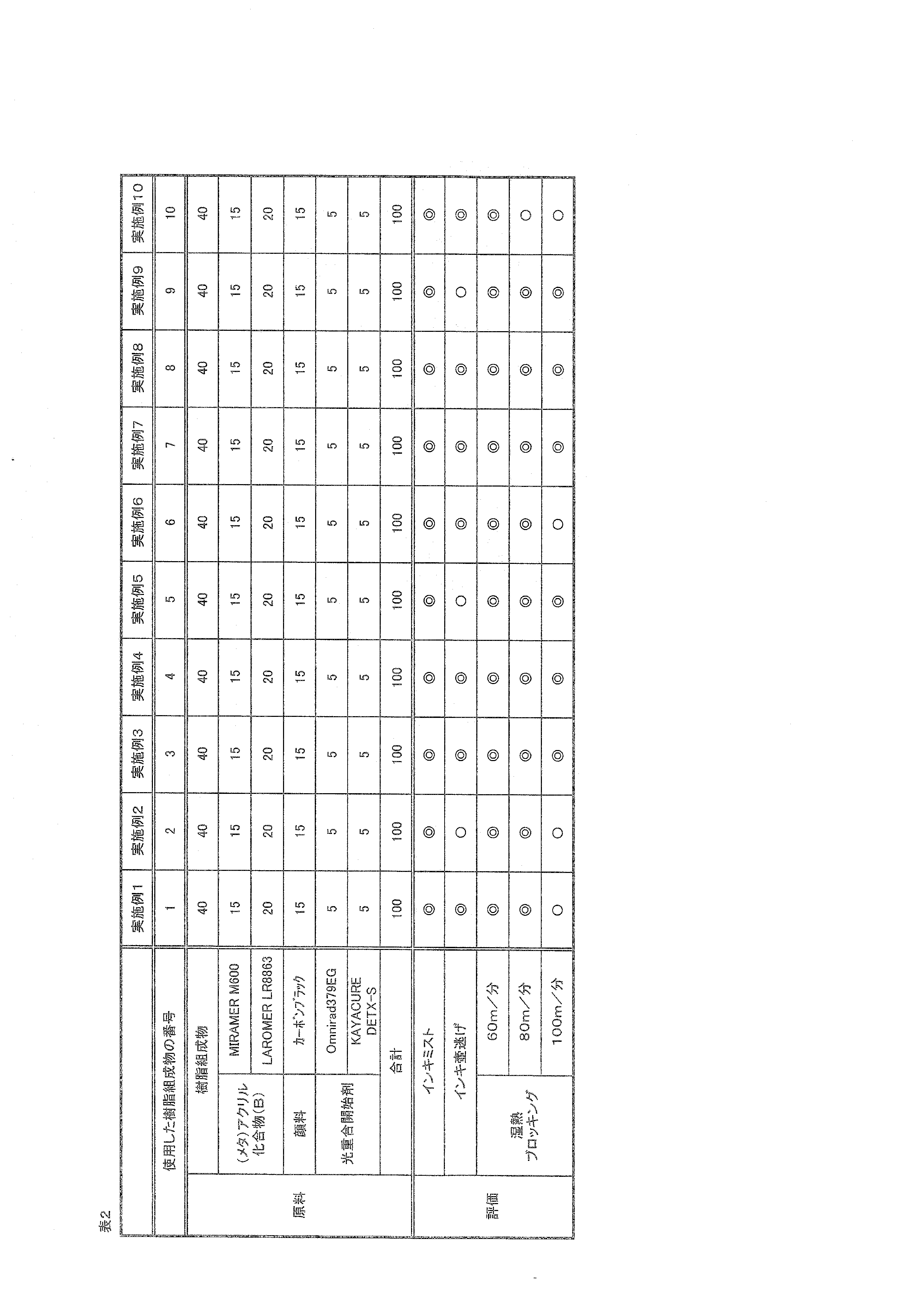


表2中に記載した材料の詳細を以下に記載する。
・顔料
カーボンブラック:三菱化学社製、カーボンブラックMA11
・光重合開始剤
Omnirad379EG:iGM RESINS社製、2-ジメチルアミノ-2-(4-メチルベンジル)-1-(4-モルフォリン-4-イル-フェニル)-ブタン-1-オン
KAYACURE DETX-S:日本化薬社製、2,4-ジエチルチオキサントン
Details of the materials listed in Table 2 are described below.
・Pigment carbon black: Carbon black MA11 manufactured by Mitsubishi Chemical Corporation
・Photopolymerization initiator Omnirad379EG: manufactured by iGM RESINS, 2-dimethylamino-2-(4-methylbenzyl)-1-(4-morpholin-4-yl-phenyl)-butan-1-one KAYACURE DETX-S : Nippon Kayaku Co., Ltd., 2,4-diethylthioxanthone
本発明の実施例1~32は、「インキミスト」および「インキ壺逃げ」、「湿熱ブロッキング」の評価が良好な一方で、比較例7、8ではインキの弾性低下のためインキミストが悪化した。
また、比較例1~6、8ではウレタン(メタ)アクリレート(A)の(メタ)アクリル基濃度が4.0mmol/g未満のため湿熱ブロッキングが悪化した。更に、比較例1~4、7では、インキの流動性不良を起こしインキ壺逃げが発生した。
これらのことから、本発明はインキミストやインキ壺逃げ、硬化性に優れており、印刷時のトラブルを解消できる活性エネルギー線硬化型インキを得ることができることが分かった。
Examples 1 to 32 of the present invention had good evaluations in "ink mist", "ink fountain escape", and "moist heat blocking", while in Comparative Examples 7 and 8, the ink mist deteriorated due to a decrease in the elasticity of the ink. .
Furthermore, in Comparative Examples 1 to 6 and 8, the (meth)acrylic group concentration of the urethane (meth)acrylate (A) was less than 4.0 mmol/g, so the moist heat blocking deteriorated. Furthermore, in Comparative Examples 1 to 4 and 7, the fluidity of the ink was poor and ink escaping occurred.
From these results, it was found that the present invention can provide an active energy ray-curable ink that is excellent in ink mist, ink fountain escape, and curability, and can eliminate problems during printing.
Claims (9)
ウレタン(メタ)アクリレート(A)が、水酸基を1個以上有する(メタ)アクリル化合物(a1)と、(a1)以外のポリオール化合物(a2)と、イソシアネート化合物(a3)との反応物であり、
ウレタン(メタ)アクリレート(A)の(メタ)アクリル基濃度が、4.0~8.0mmol/gの範囲であることを特徴とする活性エネルギー線硬化型インキ。 An active energy ray-curable ink containing urethane (meth)acrylate (A) and a (meth)acrylic compound (B) other than (A),
Urethane (meth)acrylate (A) is a reaction product of a (meth)acrylic compound (a1) having one or more hydroxyl groups, a polyol compound (a2) other than (a1), and an isocyanate compound (a3),
An active energy ray-curable ink characterized in that the (meth)acrylic group concentration of urethane (meth)acrylate (A) is in the range of 4.0 to 8.0 mmol/g.
水酸基を1個以上有する(メタ)アクリル化合物(a1)と、(a1)以外のポリオール化合物(a2)と、イソシアネート化合物(a3)とを、(メタ)アクリル化合物(B)中で反応させてウレタン(メタ)アクリレート(A)を得る工程を含むことを特徴とする、活性エネルギー線硬化型インキの製造方法。 A method for producing an active energy ray-curable ink according to claim 1 , comprising:
A (meth)acrylic compound (a1) having one or more hydroxyl groups, a polyol compound (a2) other than (a1), and an isocyanate compound (a3) are reacted in a (meth)acrylic compound (B) to produce urethane. A method for producing an active energy ray-curable ink, the method comprising the step of obtaining (meth)acrylate (A).
Priority Applications (4)
| Application Number | Priority Date | Filing Date | Title |
|---|---|---|---|
| JP2023052514A JP7428842B1 (en) | 2023-03-29 | 2023-03-29 | Active energy ray curable ink, its manufacturing method, and printed matter |
| JP2023203525A JP2024144069A (en) | 2023-03-29 | 2023-12-01 | Active energy ray curable ink, its manufacturing method, and printed matter |
| EP24778628.8A EP4692251A1 (en) | 2023-03-29 | 2024-01-26 | Active energy ray-curable ink, method for producing same, and printed matter |
| PCT/JP2024/002444 WO2024202482A1 (en) | 2023-03-29 | 2024-01-26 | Active energy ray-curable ink, method for producing same, and printed matter |
Applications Claiming Priority (1)
| Application Number | Priority Date | Filing Date | Title |
|---|---|---|---|
| JP2023052514A JP7428842B1 (en) | 2023-03-29 | 2023-03-29 | Active energy ray curable ink, its manufacturing method, and printed matter |
Related Child Applications (1)
| Application Number | Title | Priority Date | Filing Date |
|---|---|---|---|
| JP2023203525A Division JP2024144069A (en) | 2023-03-29 | 2023-12-01 | Active energy ray curable ink, its manufacturing method, and printed matter |
Publications (2)
| Publication Number | Publication Date |
|---|---|
| JP7428842B1 true JP7428842B1 (en) | 2024-02-06 |
| JP2024141071A JP2024141071A (en) | 2024-10-10 |
Family
ID=89771095
Family Applications (2)
| Application Number | Title | Priority Date | Filing Date |
|---|---|---|---|
| JP2023052514A Active JP7428842B1 (en) | 2023-03-29 | 2023-03-29 | Active energy ray curable ink, its manufacturing method, and printed matter |
| JP2023203525A Pending JP2024144069A (en) | 2023-03-29 | 2023-12-01 | Active energy ray curable ink, its manufacturing method, and printed matter |
Family Applications After (1)
| Application Number | Title | Priority Date | Filing Date |
|---|---|---|---|
| JP2023203525A Pending JP2024144069A (en) | 2023-03-29 | 2023-12-01 | Active energy ray curable ink, its manufacturing method, and printed matter |
Country Status (3)
| Country | Link |
|---|---|
| EP (1) | EP4692251A1 (en) |
| JP (2) | JP7428842B1 (en) |
| WO (1) | WO2024202482A1 (en) |
Citations (4)
| Publication number | Priority date | Publication date | Assignee | Title |
|---|---|---|---|---|
| JP2006249353A (en) | 2005-03-14 | 2006-09-21 | Sanyo Chem Ind Ltd | Active energy beam-curable coating composition |
| JP2017132833A (en) | 2016-01-25 | 2017-08-03 | アイカ工業株式会社 | UV curable resin composition and hard coat film |
| JP2018083864A (en) | 2016-11-21 | 2018-05-31 | Dicグラフィックス株式会社 | Active energy ray-curable offset ink composition |
| JP2021102730A (en) | 2019-12-25 | 2021-07-15 | 荒川化学工業株式会社 | Active energy ray-curable coating agent composition, cured product, laminate, and molded product |
Family Cites Families (6)
| Publication number | Priority date | Publication date | Assignee | Title |
|---|---|---|---|---|
| JP4452910B2 (en) * | 2002-04-30 | 2010-04-21 | Dic株式会社 | UV-curable ink composition for inkjet recording |
| JP2013006924A (en) * | 2011-06-23 | 2013-01-10 | Seiko Epson Corp | Inkjet ink composition |
| EP3211016B1 (en) | 2014-10-24 | 2020-06-17 | DIC Corporation | Active energy ray-curable composition, active energy ray-curable printing ink using same, and print |
| EP3210619A2 (en) * | 2014-10-24 | 2017-08-30 | HPRD-Health Products Research and Development LDA | Topical formulation for treating skin or mucosal infections, preparation method and uses thereof |
| LT3981414T (en) | 2015-02-01 | 2025-09-25 | Quetzal Therapeutics, Llc | LARGE SURFACE AREA LYOPHILISED COMPOSITIONS CONTAINING ARSENIC FOR ORAL ADMINISTRATION TO PATIENTS |
| TWI727392B (en) | 2018-08-13 | 2021-05-11 | 美商基利科學股份有限公司 | Thiadiazole irak4 inhibitors |
-
2023
- 2023-03-29 JP JP2023052514A patent/JP7428842B1/en active Active
- 2023-12-01 JP JP2023203525A patent/JP2024144069A/en active Pending
-
2024
- 2024-01-26 WO PCT/JP2024/002444 patent/WO2024202482A1/en not_active Ceased
- 2024-01-26 EP EP24778628.8A patent/EP4692251A1/en active Pending
Patent Citations (4)
| Publication number | Priority date | Publication date | Assignee | Title |
|---|---|---|---|---|
| JP2006249353A (en) | 2005-03-14 | 2006-09-21 | Sanyo Chem Ind Ltd | Active energy beam-curable coating composition |
| JP2017132833A (en) | 2016-01-25 | 2017-08-03 | アイカ工業株式会社 | UV curable resin composition and hard coat film |
| JP2018083864A (en) | 2016-11-21 | 2018-05-31 | Dicグラフィックス株式会社 | Active energy ray-curable offset ink composition |
| JP2021102730A (en) | 2019-12-25 | 2021-07-15 | 荒川化学工業株式会社 | Active energy ray-curable coating agent composition, cured product, laminate, and molded product |
Also Published As
| Publication number | Publication date |
|---|---|
| JP2024144069A (en) | 2024-10-11 |
| WO2024202482A1 (en) | 2024-10-03 |
| JP2024141071A (en) | 2024-10-10 |
| EP4692251A1 (en) | 2026-02-11 |
Similar Documents
| Publication | Publication Date | Title |
|---|---|---|
| JP2009120834A (en) | Photocurable ink composition for ink jet printing | |
| JP7173781B2 (en) | Actinic energy ray-curable offset ink and printed matter | |
| JP6828273B2 (en) | Method for manufacturing curable composition for stereolithography, photocurable product, and molded product | |
| JP7005834B1 (en) | Active energy ray-curable lithographic printing ink and printed matter | |
| JP2007056232A (en) | Active energy ray curable ink for ink jet | |
| JP4899430B2 (en) | Active energy ray curable inkjet ink | |
| JP7342683B2 (en) | Active energy ray-curable ink composition and its printed matter | |
| JP7255055B2 (en) | Electron beam curable composition and laminate | |
| JP4649952B2 (en) | Ultraviolet curable resin composition and printing ink using the same | |
| JP6893439B2 (en) | Active energy ray-curable offset ink composition and printed matter using it | |
| JP7428842B1 (en) | Active energy ray curable ink, its manufacturing method, and printed matter | |
| JP5733911B2 (en) | Active energy ray-curable inkjet ink composition and inkjet ink resin composition | |
| JP7517512B1 (en) | Active energy ray-curable resin composition, method for producing same, and laminate | |
| JP7544297B1 (en) | Active energy ray curable ink, its manufacturing method, and printed matter | |
| JP7464455B2 (en) | Active energy ray curable ink for lithographic offset printing, its manufacturing method, manufacturing method of cured ink, and printed matter | |
| JP2023041621A (en) | Active energy ray-curable resin composition, ink and printed matter | |
| JP7797793B2 (en) | Active energy ray-curable resin composition, method for producing same, and printed matter | |
| JP2026011364A (en) | Active energy ray-curable ink composition and laminate | |
| JP7739780B2 (en) | Active energy ray-curable composition and laminate | |
| JP6597688B2 (en) | Active energy ray-curable resin composition, ink and printed matter | |
| WO2023281971A1 (en) | Active-energy-ray-curable resin composition, active-energy-ray-curable pigment dispersion, ink composition for offset ink, and ink composition for flexographic ink | |
| JP2019108494A (en) | Active energy ray curable resin composition, ink, and printed matter | |
| JP2023084439A (en) | Pigment dispersion and active energy ray-curable composition | |
| JP2020045394A (en) | Active energy ray-curable resin composition, ink and printed matter | |
| HK1124080A (en) | Actinic radiation curable jet-printing ink |
Legal Events
| Date | Code | Title | Description |
|---|---|---|---|
| A621 | Written request for application examination |
Free format text: JAPANESE INTERMEDIATE CODE: A621 Effective date: 20230414 |
|
| A871 | Explanation of circumstances concerning accelerated examination |
Free format text: JAPANESE INTERMEDIATE CODE: A871 Effective date: 20230414 |
|
| A131 | Notification of reasons for refusal |
Free format text: JAPANESE INTERMEDIATE CODE: A131 Effective date: 20230620 |
|
| A601 | Written request for extension of time |
Free format text: JAPANESE INTERMEDIATE CODE: A601 Effective date: 20230810 |
|
| A521 | Request for written amendment filed |
Free format text: JAPANESE INTERMEDIATE CODE: A523 Effective date: 20231012 |
|
| TRDD | Decision of grant or rejection written | ||
| A01 | Written decision to grant a patent or to grant a registration (utility model) |
Free format text: JAPANESE INTERMEDIATE CODE: A01 Effective date: 20231128 |
|
| A601 | Written request for extension of time |
Free format text: JAPANESE INTERMEDIATE CODE: A601 Effective date: 20231130 |
|
| A61 | First payment of annual fees (during grant procedure) |
Free format text: JAPANESE INTERMEDIATE CODE: A61 Effective date: 20240125 |
|
| R151 | Written notification of patent or utility model registration |
Ref document number: 7428842 Country of ref document: JP Free format text: JAPANESE INTERMEDIATE CODE: R151 |
|
| S111 | Request for change of ownership or part of ownership |
Free format text: JAPANESE INTERMEDIATE CODE: R313114 |
|
| R350 | Written notification of registration of transfer |
Free format text: JAPANESE INTERMEDIATE CODE: R350 |
|
| R350 | Written notification of registration of transfer |
Free format text: JAPANESE INTERMEDIATE CODE: R350 |