JP7403978B2 - W/O composition containing polyion complex and organic UV filter - Google Patents
W/O composition containing polyion complex and organic UV filter Download PDFInfo
- Publication number
- JP7403978B2 JP7403978B2 JP2019119928A JP2019119928A JP7403978B2 JP 7403978 B2 JP7403978 B2 JP 7403978B2 JP 2019119928 A JP2019119928 A JP 2019119928A JP 2019119928 A JP2019119928 A JP 2019119928A JP 7403978 B2 JP7403978 B2 JP 7403978B2
- Authority
- JP
- Japan
- Prior art keywords
- composition
- weight
- acid
- groups
- group
- Prior art date
- Legal status (The legal status is an assumption and is not a legal conclusion. Google has not performed a legal analysis and makes no representation as to the accuracy of the status listed.)
- Active
Links
Images


Landscapes
- Cosmetics (AREA)
Description
本発明は、ポリイオンコンプレックス及び有機UVフィルターを含むW/O型組成物に関する。 The present invention relates to a W/O type composition comprising a polyion complex and an organic UV filter.
一般に、UVフィルターは、UV(紫外)線からの保護を行うのに利用される。UV-A及び/又はUV-Bから皮膚を保護するための多数の抗日光組成物が、これまでに提案されている。 Generally, UV filters are used to provide protection from UV (ultraviolet) radiation. A large number of sun protection compositions have been proposed to protect the skin from UV-A and/or UV-B.
これらの抗日光組成物は、有害なUV照射を選択的に吸収できる、1種又は複数の不溶性及び/又は脂溶性及び/又は水溶性の、有機及び/又は無機のUVフィルターを様々な濃度で含有する、水中油型若しくは油中水型エマルション、ゲル又は非水性製品の形態をとる場合が多い。これらのUVフィルター及びその量は、所望の日焼け防止指数(SPF)に応じて選択される。 These antisun compositions contain in varying concentrations one or more insoluble and/or fat-soluble and/or water-soluble, organic and/or inorganic UV filters capable of selectively absorbing harmful UV radiation. It is often in the form of an oil-in-water or water-in-oil emulsion, a gel, or a non-aqueous product containing. These UV filters and their amount are selected depending on the desired sun protection factor (SPF).
日焼け防止指数(SPF)は、UV遮蔽剤ありで紅斑誘発閾値に達するのに必要なUV照射線量の、UV遮蔽剤なしで紅斑誘発閾値に達するのに必要なUV照射線量に対する比を数学的に表している。 Sun Protection Factor (SPF) is the mathematical ratio of the UV radiation dose required to reach the erythema-inducing threshold with a UV-screening agent to the UV radiation dose required to reach the erythema-inducing threshold without a UV-screening agent. represents.
これまでに、UV保護効果を高めるために中空粒子等のSPF向上剤を含む抗日光組成物に関するいくつかの先行技術文献が公開されている。例えば、WO 2014/203913は、生理学的に許容される媒体中に、(a)少なくとも1種のUVフィルターと、(b)1.5以上の屈折率を有する少なくとも1種の粒子と、(c)少なくとも1種のSPF向上剤とを含む、組成物を開示している。 To date, several prior art documents have been published regarding sun protection compositions containing SPF enhancers such as hollow particles to enhance the UV protection effect. For example, WO 2014/203913 states that in a physiologically acceptable medium: (a) at least one UV filter; (b) at least one particle having a refractive index of 1.5 or more; and (c) at least and one SPF enhancer.
しかしながら、組成物のより高いUV吸光度により表すことができる、より高い日焼け防止指数を有する組成物が必要とされている。 However, there is a need for compositions that have a higher sun protection index, which can be expressed by a higher UV absorbance of the composition.
したがって、本発明の目的は、より高いUV吸光度を有する組成物を提供することである。 Therefore, the aim of the present invention is to provide compositions with higher UV absorbance.
本発明の上記の目的は、
(a)
(i)少なくとも1種のカチオン性ポリマー及び2つ以上のpKa値を有する少なくとも1種の非ポリマー酸若しくはその塩、
(ii)少なくとも1種のアニオン性ポリマー及び2つ以上のpKb値を有する少なくとも1種の非ポリマー塩基若しくはその塩、又は
(iii)少なくとも1種の両性ポリマー並びに2つ以上のpKa値を有する少なくとも1種の非ポリマー酸若しくはその塩及び/若しくは2つ以上のpKb値を有する少なくとも1種の非ポリマー塩基若しくはその塩
を含む少なくとも1種のポリイオンコンプレックスと、
(b)少なくとも1種の有機UVフィルターと、
(c)少なくとも1種のSPF向上剤と、
(d)水と
を含む、W/O型組成物、好ましくは化粧用組成物、より好ましくは皮膚化粧用組成物により達成することができる。
The above object of the present invention is to
(a)
(i) at least one cationic polymer and at least one non-polymeric acid or salt thereof having a pKa value of two or more;
(ii) at least one anionic polymer and at least one non-polymeric base or salt thereof having a pKb value of two or more; or
(iii) at least one amphoteric polymer and at least one non-polymeric acid or salt thereof having a pKa value of two or more and/or at least one non-polymeric base or salt thereof having a pKb value of two or more; at least one polyion complex comprising;
(b) at least one organic UV filter;
(c) at least one SPF enhancer;
(d) water, preferably a cosmetic composition, more preferably a dermocosmetic composition.
カチオン性ポリマーは、第一級、第二級又は第三級アミノ基、第四級アンモニウム基、グアニジン基、ビグアニド基、イミダゾール基、イミノ基、及びピリジル基からなる群から選択される、少なくとも1つの正電荷を有することができる及び/又は正電荷を有する部分を有してもよい。 The cationic polymer has at least one selected from the group consisting of primary, secondary or tertiary amino groups, quaternary ammonium groups, guanidine groups, biguanide groups, imidazole groups, imino groups, and pyridyl groups. may have one positive charge and/or may have a portion with a positive charge.
アニオン性ポリマーは、硫酸基、スルフェート基、スルホン酸基、スルホネート基、リン酸基、ホスフェート基、ホスホン酸基、ホスホネート基、カルボン酸基、及びカルボキシレート基からなる群から選択される、少なくとも1つの負電荷を有することができる及び/又は負電荷を有する部分を有してもよい。 The anionic polymer has at least one selected from the group consisting of sulfate groups, sulfate groups, sulfonic acid groups, sulfonate groups, phosphoric acid groups, phosphate groups, phosphonic acid groups, phosphonate groups, carboxylic acid groups, and carboxylate groups. may have one negative charge and/or may have a portion with a negative charge.
両性ポリマーは、
第一級、第二級又は第三級アミノ基、第四級アンモニウム基、グアニジン基、ビグアニド基、イミダゾール基、イミノ基、及びピリジル基からなる群から選択される、少なくとも1つの正電荷を有することができる及び/又は正電荷を有する部分、
並びに
硫酸基、スルフェート基、スルホン酸基、スルホネート基、リン酸基、ホスフェート基、ホスホン酸基、ホスホネート基、カルボン酸基、及びカルボキシレート基からなる群から選択される、少なくとも1つの負電荷を有することができる及び/又は負電荷を有する部分
を有してもよい。
Ampholytic polymers are
Has at least one positive charge selected from the group consisting of primary, secondary or tertiary amino groups, quaternary ammonium groups, guanidine groups, biguanide groups, imidazole groups, imino groups, and pyridyl groups. a moiety capable of and/or having a positive charge,
and at least one negative charge selected from the group consisting of a sulfate group, a sulfate group, a sulfonic acid group, a sulfonate group, a phosphoric acid group, a phosphate group, a phosphonic acid group, a phosphonate group, a carboxylic acid group, and a carboxylate group. and/or may have a portion with a negative charge.
本発明による組成物中のポリマーの量は、組成物の総質量に対して、0.001質量%から25質量%、好ましくは0.01質量%から20質量%、より好ましくは0.1質量%から15質量%であることができる。 The amount of polymer in the composition according to the invention is from 0.001% to 25% by weight, preferably from 0.01% to 20% by weight, more preferably from 0.1% to 15% by weight, relative to the total weight of the composition. Something can happen.
2つ以上のpKa値を有する非ポリマー酸は、テレフタリリデンジカンファースルホン酸及びその塩(Mexoryl SX)、黄色5号(Yellow 6)(サンセットイエローFCF)、アスコルビン酸、フィチン酸及びその塩、並びにそれらの混合物からなる群から選択することができる。 Non-polymeric acids with pKa values of 2 or more include terephthalylidene dicamphorsulfonic acid and its salts (Mexoryl SX), Yellow 6 (Sunset Yellow FCF), ascorbic acid, phytic acid and its salts. , and mixtures thereof.
2つ以上のpKb値を有する非ポリマー塩基は、非ポリマージアミン、例えばエチレンジアミン、プロピレンジアミン、ペンタンジアミン、ヘキサンジアミン、尿素及びその誘導体並びにグアニジン及びその誘導体、非ポリマーポリアミン、例えばスペルミン及びスペルミジン、塩基性アミノ酸、並びにそれらの混合物からなる群から選択することができる。 Non-polymeric bases with pKb values of 2 or more include non-polymeric diamines such as ethylene diamine, propylene diamine, pentanediamine, hexane diamine, urea and its derivatives and guanidine and its derivatives, non-polymeric polyamines such as spermine and spermidine, basic Can be selected from the group consisting of amino acids, as well as mixtures thereof.
本発明による組成物中の2つ以上のpKa値を有する非ポリマー酸若しくはその塩又は2つ以上のpKb値を有する非ポリマー塩基若しくはその塩の量は、組成物の総質量に対して、0.001質量%から10質量%、好ましくは0.01質量%から5質量%、より好ましくは0.1質量%から1質量%であることができる。 The amount of non-polymeric acids or salts thereof having a pKa value of two or more or non-polymeric bases or salts thereof having a pKb value of two or more in the composition according to the invention is 0.001 based on the total weight of the composition. It can be from 10% by weight, preferably from 0.01% to 5% by weight, more preferably from 0.1% to 1% by weight.
本発明による組成物中の(b)有機UVフィルターの量は、組成物の総質量に対して、10質量%から60質量%、好ましくは20質量%から50質量%、より好ましくは30質量%から40質量%であることができる。 The amount of (b) organic UV filter in the composition according to the invention is from 10% to 60% by weight, preferably from 20% to 50% by weight, more preferably 30% by weight, relative to the total weight of the composition. to 40% by mass.
(c)SPF向上剤は、中空粒子、金属酸化物を含むシリカ粒子、多層球状複合粒子、及びそれらの混合物からなる群から選択することができる。 (c) The SPF enhancer can be selected from the group consisting of hollow particles, silica particles containing metal oxides, multilayered spherical composite particles, and mixtures thereof.
本発明による組成物中の(c)SPF向上剤の量は、組成物の総質量に対して、0.1質量%から15質量%、好ましくは0.5質量%から10質量%、より好ましくは1質量%から5質量%であることができる。 The amount of (c) SPF improver in the composition according to the invention is from 0.1% to 15% by weight, preferably from 0.5% to 10% by weight, more preferably 1% by weight, relative to the total weight of the composition. to 5% by mass.
本発明による組成物中の(d)水の量は、組成物の総質量に対して、1質量%から50質量%、好ましくは10質量%から40質量%、より好ましくは20質量%から30質量%であることができる。 The amount of (d) water in the composition according to the invention is from 1% to 50% by weight, preferably from 10% to 40% by weight, more preferably from 20% to 30% by weight, relative to the total weight of the composition. % by mass.
本発明による組成物は、(e)少なくとも1種の追加の油を更に含んでもよい。 The composition according to the invention may further comprise (e) at least one additional oil.
本発明はまた、皮膚等のケラチン基材のための美容方法であって、
本発明による組成物をケラチン基材に塗布する工程
を含む、方法に関する。
The present invention also provides a cosmetic method for keratin substrates such as skin, comprising:
The present invention relates to a method comprising applying a composition according to the invention to a keratin substrate.
本発明はまた、
(b)少なくとも1種の有機UVフィルターと、
(c)少なくとも1種のSPF向上剤と、
(d)水と
を含む、W/O型組成物、好ましくは化粧用組成物、より好ましくは皮膚化粧用組成物における、組成物のUV吸光度を高めるための、
(a)
(i)少なくとも1種のカチオン性ポリマー及び2つ以上のpKa値を有する少なくとも1種の非ポリマー酸若しくはその塩、
(ii)少なくとも1種のアニオン性ポリマー及び2つ以上のpKb値を有する少なくとも1種の非ポリマー塩基若しくはその塩、又は
(iii)少なくとも1種の両性ポリマー並びに2つ以上のpKa値を有する少なくとも1種の非ポリマー酸若しくはその塩及び/若しくは2つ以上のpKb値を有する少なくとも1種の非ポリマー塩基若しくはその塩
を含む少なくとも1種のポリイオンコンプレックスの使用に関する。
The present invention also provides
(b) at least one organic UV filter;
(c) at least one SPF enhancer;
(d) for increasing the UV absorbance of the composition in a W/O type composition, preferably a cosmetic composition, more preferably a dermocosmetic composition, comprising water;
(a)
(i) at least one cationic polymer and at least one non-polymeric acid or salt thereof having a pKa value of two or more;
(ii) at least one anionic polymer and at least one non-polymeric base or salt thereof having a pKb value of two or more; or
(iii) at least one amphoteric polymer and at least one non-polymeric acid or salt thereof having a pKa value of two or more and/or at least one non-polymeric base or salt thereof having a pKb value of two or more; The use of at least one polyion complex comprising:
鋭意検討の結果、本発明者等は、ポリイオンコンプレックスを使用することにより、高いUV吸光度を有する組成物を提供することが可能であることを発見した。したがって、本発明による組成物は、
(a)
(i)少なくとも1種のカチオン性ポリマー及び2つ以上のpKa値を有する少なくとも1種の非ポリマー酸若しくはその塩、
(ii)少なくとも1種のアニオン性ポリマー及び2つ以上のpKb値を有する少なくとも1種の非ポリマー塩基若しくはその塩、又は
(iii)少なくとも1種の両性ポリマー並びに2つ以上のpKa値を有する少なくとも1種の非ポリマー酸若しくはその塩及び/若しくは2つ以上のpKb値を有する少なくとも1種の非ポリマー塩基若しくはその塩
を含む少なくとも1種のポリイオンコンプレックスと、
(b)少なくとも1種の有機UVフィルターと、
(c)少なくとも1種のSPF向上剤と、
(d)水と
を含む。
As a result of extensive studies, the present inventors discovered that it is possible to provide a composition with high UV absorbance by using a polyion complex. Therefore, the composition according to the invention
(a)
(i) at least one cationic polymer and at least one non-polymeric acid or salt thereof having a pKa value of two or more;
(ii) at least one anionic polymer and at least one non-polymeric base or salt thereof having a pKb value of two or more; or
(iii) at least one amphoteric polymer and at least one non-polymeric acid or salt thereof having a pKa value of two or more and/or at least one non-polymeric base or salt thereof having a pKb value of two or more; at least one polyion complex comprising;
(b) at least one organic UV filter;
(c) at least one SPF enhancer;
(d) Contains water.
本発明による組成物は、より高いUV吸光度を有することができる。したがって、本発明による組成物は、より高いSPF値を有することができる。 Compositions according to the invention may have higher UV absorbance. Therefore, compositions according to the invention can have higher SPF values.
上記の組合せ(i)、(ii)及び(iii)の各々は、ポリイオンコンプレックスを形成することができる。ポリイオンコンプレックスは、粒子の形態であることができる。複数のポリイオンコンプレックス粒子は、(b)有機UVフィルターと(d)水との間の界面に存在することが好ましい場合がある。 Each of the above combinations (i), (ii) and (iii) can form a polyion complex. The polyion complex can be in the form of particles. It may be preferred that the plurality of polyion complex particles be present at the interface between (b) the organic UV filter and (d) water.
本発明による組成物は、長期間にわたり安定でありうる。 Compositions according to the invention may be stable over long periods of time.
本発明による組成物は、ポリイオンコンプレックスにより、(b)有機UVフィルターを含む皮膜を、例えば、組成物を基材、好ましくは皮膚及び毛髪等のケラチン基材、より好ましくは皮膚に塗布し、組成物を乾燥させることにより、調製するのに使用することができる。 The composition according to the invention can be prepared by applying (b) a film containing an organic UV filter to a substrate, preferably a keratin substrate such as skin and hair, more preferably skin, by applying the composition to a substrate, preferably a keratin substrate such as skin and hair, by means of a polyion complex; It can be used to prepare things by drying them.
本発明による組成物により調製される皮膜は、多様な美容機能を有することができる。 The films prepared by the compositions according to the invention can have various cosmetic functions.
例えば、本発明による組成物により調製される皮膜は、紫外線を遮断する等の美容効果を有することができる。 For example, the films prepared by the compositions according to the invention can have cosmetic effects such as blocking ultraviolet light.
更に、本発明による組成物により調製される皮膜は、皮膜が比較的厚い場合であっても、透明又は半透明とすることができ、したがって、知覚することが容易でない場合がある。 Moreover, the films prepared by the compositions according to the invention can be transparent or translucent, even if the films are relatively thick, and therefore may not be easy to perceive.
更に、本発明による組成物により調製される皮膜は、耐水性とすることができ、したがって、ケラチン基材の表面が例えば汗又は雨により濡れている場合であっても、皮膚等のケラチン基材上に残存することができる。したがって、皮膜は、耐水性(ウォータープルーフ)であり、長時間持続しうるUV遮断効果を示すことができる。 Furthermore, the films prepared by the compositions according to the invention can be water-resistant, so that they can be applied to keratin substrates, such as skin, even when the surface of the keratin substrate is wet, for example due to sweat or rain. can remain on top. The coating is therefore waterproof and can exhibit long-lasting UV blocking effects.
以下、本発明による組成物等をより詳細に説明する。 Hereinafter, the composition etc. according to the present invention will be explained in more detail.
[ポリイオンコンプレックス]
本発明による組成物は、(a)少なくとも1種のポリイオンコンプレックスを含む。2つ以上の異なるタイプの(a)ポリイオンコンプレックスを組み合わせて使用してもよい。したがって、単一のタイプの(a)ポリイオンコンプレックス、又は異なるタイプの(a)ポリイオンコンプレックスの組合せを使用することができる。
[Polyion Complex]
The composition according to the invention comprises (a) at least one polyion complex. Two or more different types of (a) polyion complexes may be used in combination. Thus, a single type of (a) polyion complex or a combination of different types of (a) polyion complexes can be used.
本発明による組成物中の(a)ポリイオンコンプレックスの量は、組成物の総質量に対して、0.001質量%以上、好ましくは0.01質量%以上、より好ましくは0.1質量%以上であることができる。 The amount of (a) polyion complex in the composition according to the invention can be 0.001% by weight or more, preferably 0.01% by weight or more, more preferably 0.1% by weight or more, based on the total weight of the composition.
本発明による組成物中の(a)ポリイオンコンプレックスの量は、組成物の総質量に対して、30質量%以下、好ましくは25質量%以下、より好ましくは20質量%以下であることができる。 The amount of (a) polyion complex in the composition according to the invention can be up to 30% by weight, preferably up to 25% by weight, more preferably up to 20% by weight, based on the total weight of the composition.
本発明による組成物中の(a)ポリイオンコンプレックスの量は、組成物の総質量に対して、0.001質量%から30質量%、好ましくは0.01質量%から25質量%、より好ましくは0.1質量%から20質量%であることができる。 The amount of (a) polyion complex in the composition according to the invention is from 0.001% to 30% by weight, preferably from 0.01% to 25% by weight, more preferably from 0.1% by weight, relative to the total weight of the composition. It can be 20% by mass.
(a)ポリイオンコンプレックスは、粒子の形態であることができる。ポリイオンコンプレックス粒子の粒径は、5nmから100μm、好ましくは100nmから50μm、より好ましくは200nmから30μm、更に好ましくは500nmから20μmであることができる。1μm未満の粒径は、動的光散乱法により測定することができ、1μm超の粒径は、光学顕微鏡により測定することができる。この粒径は、数平均直径に基づきうる。 (a) The polyion complex can be in the form of particles. The particle size of the polyion complex particles can be from 5 nm to 100 μm, preferably from 100 nm to 50 μm, more preferably from 200 nm to 30 μm, even more preferably from 500 nm to 20 μm. Particle sizes less than 1 μm can be measured by dynamic light scattering, and particle sizes greater than 1 μm can be measured by optical microscopy. This particle size may be based on number average diameter.
複数のポリイオンコンプレックス粒子は、(b)有機UVフィルターと(d)水との間の界面に存在することができる。したがって、ポリイオンコンプレックス粒子は、エマルションを形成することができる。本発明による組成物において、W/O型を形成するために、(d)水は、分散相を構成することができ、(b)有機UVフィルターは、連続相を構成することができる。 A plurality of polyion complex particles can be present at the interface between (b) the organic UV filter and (d) water. Therefore, polyion complex particles can form emulsions. In the composition according to the invention, to form a W/O type, (d) water can constitute the dispersed phase and (b) the organic UV filter can constitute the continuous phase.
上記は、(a)ポリイオンコンプレックス自体は、両親媒性であり、油又は水に不溶性であることを意味する。 The above means that (a) the polyion complex itself is amphiphilic and insoluble in oil or water.
(a)ポリイオンコンプレックスは、少なくとも1種のポリマー又はポリマーの組合せを、多価酸又は多価塩基とともに含む。 (a) The polyionic complex comprises at least one polymer or combination of polymers together with a polyacid or base.
具体的には、(a)ポリイオンコンプレックスは、
(i)少なくとも1種のカチオン性ポリマー及び2つ以上のpKa値を有する少なくとも1種の非ポリマー酸若しくはその塩、
(ii)少なくとも1種のアニオン性ポリマー及び2つ以上のpKb値を有する少なくとも1種の非ポリマー塩基若しくはその塩、又は
(iii)少なくとも1種の両性ポリマー並びに2つ以上のpKa値を有する少なくとも1種の非ポリマー酸若しくはその塩及び/若しくは2つ以上のpKb値を有する少なくとも1種の非ポリマー塩基若しくはその塩
を含む。
Specifically, (a) the polyion complex is
(i) at least one cationic polymer and at least one non-polymeric acid or salt thereof having a pKa value of two or more;
(ii) at least one anionic polymer and at least one non-polymeric base or salt thereof having a pKb value of two or more; or
(iii) at least one amphoteric polymer and at least one non-polymeric acid or salt thereof having a pKa value of two or more and/or at least one non-polymeric base or salt thereof having a pKb value of two or more; include.
カチオン性、アニオン性及び両性ポリマーのタイプは限定されない。2つ以上の異なるタイプのカチオン性ポリマーを組み合わせて使用してもよい。したがって、単一のタイプのカチオン性ポリマー、又は異なるタイプのカチオン性ポリマーの組合せを使用することができる。2つ以上の異なるタイプのアニオン性ポリマーを組み合わせて使用してもよい。したがって、単一のタイプのアニオン性ポリマー、又は異なるタイプのアニオン性ポリマーの組合せを使用することができる。2つ以上の異なるタイプの両性ポリマーを組み合わせて使用してもよい。したがって、単一のタイプの両性ポリマー、又は異なるタイプの両性ポリマーの組合せを使用することができる。 The types of cationic, anionic and amphoteric polymers are not limited. Combinations of two or more different types of cationic polymers may also be used. Thus, a single type of cationic polymer or a combination of different types of cationic polymers can be used. Combinations of two or more different types of anionic polymers may also be used. Thus, a single type of anionic polymer or a combination of different types of anionic polymers can be used. Combinations of two or more different types of amphoteric polymers may also be used. Thus, a single type of amphoteric polymer or a combination of different types of amphoteric polymers can be used.
本発明による組成物中の上記(i)から(iii)のいずれか1つによるポリマーの総量は、組成物の総質量に対して、0.001質量%以上、好ましくは0.01質量%以上、より好ましくは0.1質量%以上であることができる。 The total amount of polymers according to any one of the above (i) to (iii) in the composition according to the invention is at least 0.001% by weight, preferably at least 0.01% by weight, more preferably at least 0.01% by weight, relative to the total weight of the composition. It can be 0.1% by mass or more.
本発明による組成物中の上記(i)から(iii)のいずれか1つによるポリマーの総量は、組成物の総質量に対して、25質量%以下、好ましくは20質量%以下、より好ましくは15質量%以下であることができる。 The total amount of polymers according to any one of the above (i) to (iii) in the composition according to the invention is not more than 25% by weight, preferably not more than 20% by weight, more preferably not more than 20% by weight, relative to the total weight of the composition. It can be 15% by mass or less.
本発明による組成物中の上記(i)から(iii)のいずれか1つによるポリマーの総量は、組成物の総質量に対して、0.001質量%から25質量%、好ましくは0.01質量%から20質量%、より好ましくは0.1質量%から15質量%であることができる。 The total amount of polymers according to any one of the above (i) to (iii) in the composition according to the invention is from 0.001% to 25% by weight, preferably from 0.01% to 20% by weight, relative to the total weight of the composition. % by weight, more preferably from 0.1% to 15% by weight.
(カチオン性ポリマー)
カチオン性ポリマーは、正電荷密度を有する。カチオン性ポリマーの電荷密度は、0.01meq/gから20meq/g、好ましくは0.05から15meq/g、より好ましくは0.1から10meq/gであることができる。
(cationic polymer)
Cationic polymers have a positive charge density. The charge density of the cationic polymer can be from 0.01 meq/g to 20 meq/g, preferably from 0.05 to 15 meq/g, more preferably from 0.1 to 10 meq/g.
カチオン性ポリマーの分子量は、500以上、好ましくは1000以上、より好ましくは2000以上、更に好ましくは5000以上であることが好ましい場合がある。 It may be preferable that the molecular weight of the cationic polymer is 500 or more, preferably 1000 or more, more preferably 2000 or more, even more preferably 5000 or more.
説明において別段の定義がない限り、「分子量」は、数平均分子量を意味する。 Unless otherwise defined in the description, "molecular weight" means number average molecular weight.
カチオン性ポリマーは、第一級、第二級又は第三級アミノ基、第四級アンモニウム基、グアニジン基、ビグアニド基、イミダゾール基、イミノ基、及びピリジル基からなる群から選択される、少なくとも1つの正電荷を有することができる及び/又は正電荷を有する部分を有してもよい。本明細書における(第一級)「アミノ基」という用語は、-NH2基を意味する。 The cationic polymer has at least one selected from the group consisting of primary, secondary or tertiary amino groups, quaternary ammonium groups, guanidine groups, biguanide groups, imidazole groups, imino groups, and pyridyl groups. may have one positive charge and/or may have a portion with a positive charge. The term (primary) "amino group" as used herein means an -NH2 group.
カチオン性ポリマーは、ホモポリマー又はコポリマーであってよい。「コポリマー」という用語は、2種類のモノマーから得られるコポリマーと、3種類以上のモノマーから得られるコポリマー、例えば3種類のモノマーから得られるターポリマーの両方を意味すると理解される。 Cationic polymers may be homopolymers or copolymers. The term "copolymer" is understood to mean both copolymers obtained from two types of monomers and copolymers obtained from more than two types of monomers, for example terpolymers obtained from three types of monomers.
カチオン性ポリマーは、天然及び合成のカチオン性ポリマーから選択することができる。カチオン性ポリマーの非限定的な例は、以下の通りである。 The cationic polymer can be selected from natural and synthetic cationic polymers. Non-limiting examples of cationic polymers are as follows.
(1)アクリル酸又はメタクリル酸のエステル及びアミドに由来し、以下の式: (1) Derived from esters and amides of acrylic acid or methacrylic acid, with the following formula:
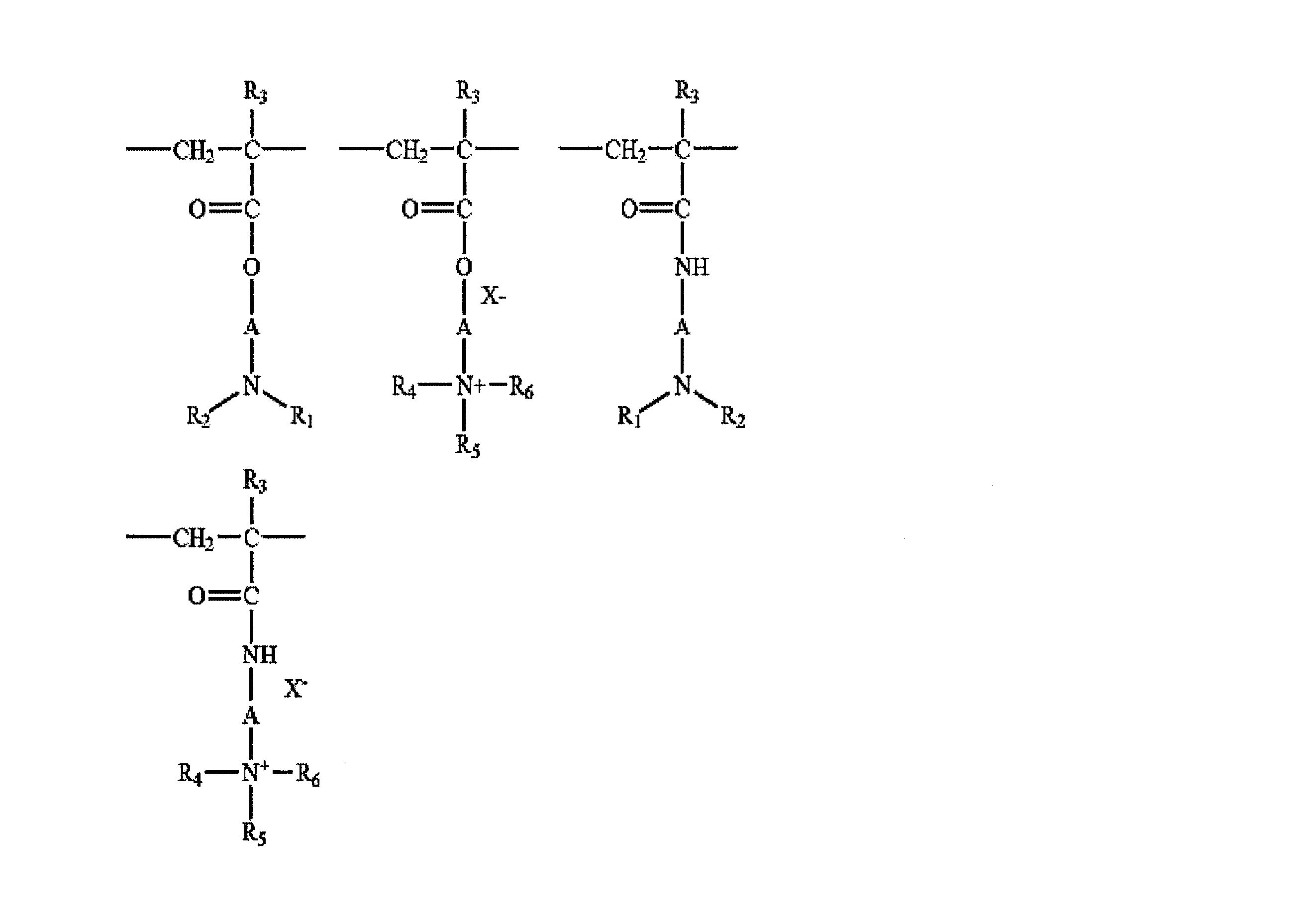
(式中、
R1及びR2は、同一であっても異なっていてもよく、水素及び1から6個の炭素原子を含むアルキル基、例えばメチル及びエチル基から選択され、
R3は、同一であっても異なっていてもよく、水素及びCH3から選択され、
記号Aは、同一であっても異なっていてもよく、1から6個の炭素原子、例えば2から3個の炭素原子を含む直鎖状又は分枝状のアルキル基、及び1から4個の炭素原子を含むヒドロキシアルキル基から選択され、
R4、R5、及びR6は、同一であっても異なっていてもよく、1から18個の炭素原子を含むアルキル基、及びベンジル基から選択され、少なくとも1つの実施形態では1から6個の炭素原子を含むアルキル基であり、
Xは、無機又は有機酸に由来するアニオン、例えばメト硫酸アニオン及びハロゲン化物イオン、例えば塩化物イオン及び臭化物イオンである)
の単位から選択される少なくとも1つの単位を含むホモポリマー及びコポリマー。
(In the formula,
R 1 and R 2 may be the same or different and are selected from hydrogen and alkyl groups containing 1 to 6 carbon atoms, such as methyl and ethyl groups;
R3 may be the same or different and is selected from hydrogen and CH3 ;
The symbol A may be the same or different and represents a straight-chain or branched alkyl group containing 1 to 6 carbon atoms, such as 2 to 3 carbon atoms, and a straight-chain or branched alkyl group containing 1 to 4 carbon atoms. selected from hydroxyalkyl groups containing carbon atoms;
R 4 , R 5 , and R 6 may be the same or different and are selected from alkyl groups containing 1 to 18 carbon atoms, and benzyl groups, and in at least one
X is an anion derived from an inorganic or organic acid, such as a methosulfate anion and a halide ion, such as chloride and bromide)
Homopolymers and copolymers containing at least one unit selected from the following.
ファミリー(1)のコポリマーはまた、コモノマーに由来する少なくとも1つの単位を含んでもよく、これは、アクリルアミド、メタクリルアミド、ジアセトンアクリルアミド、窒素原子が(C1~C4)低級アルキル基で置換されているアクリルアミド及びメタクリルアミド、アクリル酸又はメタクリル酸及びそのエステルに由来する基、ビニルラクタム、例えばビニルピロリドン及びビニルカプロラクタム、並びにビニルエステルから選択することができる。 Copolymers of family (1) may also contain at least one unit derived from a comonomer, such as acrylamide, methacrylamide, diacetone acrylamide, in which the nitrogen atom is substituted with a (C 1 -C 4 ) lower alkyl group. acrylamide and methacrylamide, groups derived from acrylic or methacrylic acid and their esters, vinyl lactams such as vinylpyrrolidone and vinylcaprolactam, and vinyl esters.
ファミリー(1)のコポリマーの例には、以下が含まれるがこれらに限定されない:
アクリルアミドと硫酸ジメチル又はハロゲン化ジメチルで四級化されたメタクリル酸ジメチルアミノエチルとのコポリマー、
例えば欧州特許出願第0080976号に記載されている、アクリルアミドとメタクリロイルオキシエチルトリメチルアンモニウムクロリドとのコポリマー、
アクリルアミドとメタクリロイルオキシエチルトリメチルアンモニウムメトスルフェートとのコポリマー、
例えば仏国特許第2077143号及び第2393573号に記載されている、四級化又は非四級化ビニルピロリドン/アクリル酸又はメタクリル酸ジアルキルアミノアルキルコポリマー、
メタクリル酸ジメチルアミノエチル/ビニルカプロラクタム/ビニルピロリドンターポリマー、
ビニルピロリドン/メタクリルアミドプロピルジメチルアミンコポリマー、四級化ビニルピロリドン/ジメチルアミノプロピルメタクリルアミドコポリマー、並びに
架橋メタクリロイルオキシ(C1~C4)アルキルトリ(C1~C4)アルキルアンモニウム塩ポリマー、例えば塩化メチルで四級化されたメタクリル酸ジメチルアミノエチルの単独重合、又はアクリルアミドと塩化メチルで四級化されたメタクリル酸ジメチルアミノエチルとの共重合を行い、その単独重合又は共重合に続いて、オレフィン性不飽和を含有する化合物、例えばメチレンビスアクリルアミドで架橋することにより得られるポリマー。
Examples of family (1) copolymers include, but are not limited to:
a copolymer of acrylamide and dimethylaminoethyl methacrylate quaternized with dimethyl sulfate or dimethyl halide,
Copolymers of acrylamide and methacryloyloxyethyltrimethylammonium chloride, as described for example in European Patent Application No. 0080976;
copolymer of acrylamide and methacryloyloxyethyltrimethylammonium methosulfate,
quaternized or non-quaternized vinylpyrrolidone/dialkylaminoalkyl acrylic acid or methacrylate copolymers, as described for example in FR 2077143 and FR 2393573;
dimethylaminoethyl methacrylate/vinyl caprolactam/vinyl pyrrolidone terpolymer,
Vinylpyrrolidone/methacrylamidopropyldimethylamine copolymers, quaternized vinylpyrrolidone/dimethylaminopropylmethacrylamide copolymers, and crosslinked methacryloyloxy(C 1 -C 4 )alkyl tri(C 1 -C 4 )alkylammonium salt polymers, e.g. Homopolymerization of dimethylaminoethyl methacrylate quaternized with methyl or copolymerization of acrylamide with dimethylaminoethyl methacrylate quaternized with methyl chloride, followed by homopolymerization or copolymerization of olefins. Polymers obtained by crosslinking with compounds containing sexual unsaturation, such as methylenebisacrylamide.
好ましくは、ファミリー(1)のコポリマーは、ビニルピロリドンに由来する単位を有する。より好ましくは、ファミリー(1)のコポリマーは、ビニルピロリドンに由来する少なくとも1つのペンダント環構造を有する。一方、ファミリー(1)のコポリマーは、ポリマーの骨格中に環構造を含まないことが好ましい。 Preferably, the copolymers of family (1) have units derived from vinylpyrrolidone. More preferably, the copolymers of family (1) have at least one pendant ring structure derived from vinylpyrrolidone. On the other hand, the copolymers of family (1) preferably do not contain a ring structure in the polymer skeleton.
ビニルピロリドン単位を有するファミリー(1)のコポリマーは、以下から選択することができる:
(i)ビニルピロリドン単位とメタクリル酸ジメチルアミノエチル単位とを含むコポリマー、例えば、
- ビニルピロリドン/メタクリル酸ジメチルアミノエチルコポリマー、例えば、I.S.P.社により商品名Copolymer 845で販売されているビニルピロリドン/メタクリル酸ジメチルアミノエチルコポリマー(質量により20/80)、
- 硫酸ジエチルで四級化されたビニルピロリドン/メタクリル酸ジメチルアミノエチルコポリマー、例えば、I.S.P.社により商品名Gafquat 734、755、755S及び755Lで販売されている、硫酸ジエチルで四級化されたビニルピロリドン/メタクリル酸ジメチルアミノエチルコポリマー、
- ビニルピロリドン/メタクリル酸ジメチルアミノエチル/親水性ポリウレタンコポリマー、例えば、U.C.I.B.社により商品名Pecogel GC-310で、又はBlagden Chemicals社により商品名Aquamere C1031及びC1511で販売されている、ビニルピロリドン/メタクリル酸ジメチルアミノエチル/親水性ポリウレタンコポリマー、
- 四級化又は非四級化ビニルピロリドン/メタクリル酸ジメチルアミノエチル/C8~C16オレフィンコポリマー、例えば、I.S.P.社により商品名Ganex ACP1050から1057、1062~1069及び1079~1086で販売されている、ビニルピロリドン/メタクリル酸ジメチルアミノエチル/C8~C16オレフィンコポリマー、
及び
- ビニルピロリドン/メタクリル酸ジメチルアミノエチル/ビニルカプロラクタムコポリマー、例えば、I.S.P社により商品名Gaffix VC713で販売されているビニルピロリドン/メタクリル酸ジメチルアミノエチル/ビニルカプロラクタムコポリマー、
(ii)ビニルピロリドン単位とメタクリルアミドプロピルトリメチルアンモニウム(MAPTAC)単位とを含むコポリマー、例えば、
- ビニルピロリドン/メタクリルアミドプロピルトリメチルアンモニウムコポリマー、例えば、I.S.P.社により商品名Gafquat ACP1011及びGafquat HS100で販売されているビニルピロリドン/MAPTACコポリマー、
及び
- ビニルピロリドン/メタクリルアミドプロピルトリメチルアンモニウム/ビニルカプロラクタムターポリマー、例えば、I.S.P.社により商品名Polymer ACP 1059、1060及び1156で販売されているビニルピロリドン/MAPTAC/ビニルカプロラクタムターポリマー;並びに
(iii)ビニルピロリドン単位とメチルビニルイミダゾリウム単位とを含むコポリマー、例えば、
- ビニルピロリドン/メチルビニルイミダゾリウムクロリドコポリマー、例えば、BASF社により商品名Luviquat FC370、FC550、FC905及びHM552で販売されているビニルピロリドン/メチルビニルイミダゾリウムクロリドコポリマー、
- ビニルピロリドン/メチルビニルイミダゾリウムクロリド/ビニルイミダゾールコポリマー、例えば、BASF社により商品名Luviquat 8155で販売されているビニルピロリドン/メチルビニルイミダゾリウムクロリド/ビニルイミダゾールコポリマー、
及び
- ビニルピロリドン/メチルビニルイミダゾリウムメトスルフェートコポリマー、例えば、BASF社により商品名Luviquat MS370で販売されているビニルピロリドン/メチルビニルイミダゾリウムメトスルフェートコポリマー。
Copolymers of family (1) with vinylpyrrolidone units can be selected from:
(i) a copolymer comprising vinylpyrrolidone units and dimethylaminoethyl methacrylate units, e.g.
- vinylpyrrolidone/dimethylaminoethyl methacrylate copolymer, for example vinylpyrrolidone/dimethylaminoethyl methacrylate copolymer (20/80 by weight) sold under the trade name Copolymer 845 by the company ISP;
- vinylpyrrolidone quaternized with diethyl sulfate/dimethylaminoethyl methacrylate copolymer, for example vinylpyrrolidone quaternized with diethyl sulfate, sold under the trade names Gafquat 734, 755, 755S and 755L by ISP /dimethylaminoethyl methacrylate copolymer,
- Vinylpyrrolidone/dimethylaminoethyl methacrylate/hydrophilic polyurethane copolymer, for example vinylpyrrolidone/methacrylic acid sold under the trade name Pecogel GC-310 by the company UCIB or under the tradename Aquamere C1031 and C1511 by the company Blagden Chemicals. dimethylaminoethyl/hydrophilic polyurethane copolymer,
- Quaternized or non-quaternized vinylpyrrolidone/dimethylaminoethyl methacrylate/C 8 to C 16 olefin copolymers, such as those sold by ISP under the trade names Ganex ACP 1050 to 1057, 1062 to 1069 and 1079 to 1086 , vinylpyrrolidone/dimethylaminoethyl methacrylate/ C8 - C16 olefin copolymer,
as well as
- vinylpyrrolidone/dimethylaminoethyl methacrylate/vinylcaprolactam copolymer, for example vinylpyrrolidone/dimethylaminoethyl methacrylate/vinylcaprolactam copolymer sold under the trade name Gaffix VC713 by ISP,
(ii) copolymers comprising vinylpyrrolidone units and methacrylamide propyltrimethylammonium (MAPTAC) units, e.g.
- vinylpyrrolidone/methacrylamidopropyltrimethylammonium copolymers, for example vinylpyrrolidone/MAPTAC copolymers sold under the trade names Gafquat ACP1011 and Gafquat HS100 by ISP,
as well as
- vinylpyrrolidone/methacrylamidopropyltrimethylammonium/vinylcaprolactam terpolymers, for example vinylpyrrolidone/MAPTAC/vinylcaprolactam terpolymers sold under the trade names Polymer ACP 1059, 1060 and 1156 by ISP; and
(iii) copolymers comprising vinylpyrrolidone units and methylvinylimidazolium units, e.g.
- vinylpyrrolidone/methylvinylimidazolium chloride copolymers, for example vinylpyrrolidone/methylvinylimidazolium chloride copolymers sold by BASF under the trade names Luviquat FC370, FC550, FC905 and HM552,
- vinylpyrrolidone/methylvinylimidazolium chloride/vinylimidazole copolymer, for example vinylpyrrolidone/methylvinylimidazolium chloride/vinylimidazole copolymer sold under the trade name Luviquat 8155 by BASF,
as well as
- Vinylpyrrolidone/methylvinylimidazolium methosulfate copolymer, for example vinylpyrrolidone/methylvinylimidazolium methosulfate copolymer sold under the tradename Luviquat MS370 by BASF.
ファミリー(1)のコポリマーは、ビニルピロリドン単位とメタクリル酸ジメチルアミノエチル単位とを含むコポリマーから選択されることが、より好ましくは、硫酸ジエチルで四級化されたビニルピロリドン/メタクリル酸ジメチルアミノエチルコポリマー、更に好ましくはポリクオタニウム-11から選択されることが好ましい場合がある。 The copolymers of family (1) are selected from copolymers comprising vinylpyrrolidone units and dimethylaminoethyl methacrylate units, more preferably vinylpyrrolidone/dimethylaminoethyl methacrylate copolymers quaternized with diethyl sulfate. , more preferably polyquaternium-11.
(2)カチオン性セルロース誘導体、例えば仏国特許第1492597号等に記載されている、第四級アンモニウム基を含むセルロースエーテル誘導体、例えばUnion Carbide Corporation社により名称「JR」(JR 400、JR 125、JR 30M)又は「LR」(LR 400、LR 30M)で販売されているポリマー。これらのポリマーはまた、CTFA辞典において、トリメチルアンモニウム基で置換されているエポキシドと反応したヒドロキシエチルセルロースの第四級アンモニウムとして定義されている。 (2) Cationic cellulose derivatives, such as cellulose ether derivatives containing a quaternary ammonium group, such as those described in French Patent No. 1492597, etc., such as those manufactured by Union Carbide Corporation under the name "JR" (JR 400, JR 125, JR 30M) or "LR" (LR 400, LR 30M). These polymers are also defined in the CTFA Dictionary as quaternary ammonium hydroxyethylcellulose reacted with an epoxide substituted with trimethylammonium groups.
カチオン性セルロース誘導体は、少なくとも8個の炭素原子を含むアルキル、アリールアルキル若しくはアルキルアリール基、又はそれらの混合物等の少なくとも1つの脂肪鎖を含む少なくとも1つの第四級アンモニウム基で修飾された四級化ヒドロキシエチルセルロースであることが好ましい場合がある。第四級アンモニウム基により保持されているアルキル基は、好ましくは、8から30個の炭素原子、とりわけ10から30個の炭素原子を含有してもよい。アリール基は、好ましくは、フェニル、ベンジル、ナフチル又はアントリル基を示す。 The cationic cellulose derivatives are quaternary modified with at least one quaternary ammonium group containing at least one fatty chain such as an alkyl, arylalkyl or alkylaryl group containing at least 8 carbon atoms, or mixtures thereof. Hydroxyethylcellulose may be preferred. The alkyl group carried by the quaternary ammonium group may preferably contain from 8 to 30 carbon atoms, especially from 10 to 30 carbon atoms. Aryl groups preferably represent phenyl, benzyl, naphthyl or anthryl groups.
より好ましくは、カチオン性セルロース誘導体は、少なくとも1つのC8~C30炭化水素基を含む少なくとも1つの第四級アンモニウム基を含んでもよい。 More preferably, the cationic cellulose derivative may contain at least one quaternary ammonium group comprising at least one C 8 -C 30 hydrocarbon group.
挙げることができるC8~C30脂肪鎖を含有する四級化アルキルヒドロキシエチルセルロースの例には、Amerchol社により販売されている製品Quatrisoft LM 200、Quatrisoft LM-X 529-18-A、Quatrisoft LM-X 529-18B(C12アルキル)及びQuatrisoft LM-X 529-8(C18アルキル)又はSoftcat Polymer SL100、Softcat SX-1300X、Softcat SX-1300H、Softcat SL-5、Softcat SL-30、Softcat SL-60、Softcat SK-MH、Softcat SX-400X、Softcat SX-400H、SoftCat SK-L、Softcat SK-M、及びSoftcat SK-H、並びにCroda社により販売されている製品Crodacel QM、Crodacel, QL(C12アルキル)及びCrodacel QS(C18アルキル)が含まれる。 Examples of quaternized alkylhydroxyethyl cellulose containing C 8 to C 30 fatty chains that may be mentioned include the products Quatrisoft LM 200, Quatrisoft LM-X 529-18-A, Quatrisoft LM- sold by the company Amerchol. X 529-18B (C12 alkyl) and Quatrisoft LM-X 529-8 (C18 alkyl) or Softcat Polymer SL100, Softcat SX-1300X, Softcat SX-1300H, Softcat SL-5, Softcat SL-30, Softcat SL-60, Softcat SK-MH, Softcat SX-400X, Softcat SX-400H, Softcat SK-L, Softcat SK-M, and Softcat SK-H, and products sold by Croda Corporation Crodacel QM, Crodacel, QL (C12 alkyl) and Crodacel QS (C18 alkyl).
カチオン性ポリマーは、ポリクオタニウム-24、ポリクオタニウム-67及びそれらの混合物からなる群から選択されることが好ましい場合がある。ポリクオタニウム-67が最も好ましい。 It may be preferred that the cationic polymer is selected from the group consisting of polyquaternium-24, polyquaternium-67 and mixtures thereof. Polyquaternium-67 is most preferred.
別の観点から、カチオン性セルロース誘導体はまた、4000から10000のアンヒドログルコース単位を含むカチオン性セルロースエーテルの中から選択することができ、前記アンヒドログルコース単位は、少なくとも以下で置換されている:
(i)以下の式の1つの置換基
[R4R5R6R9N+](X2
-)
(式中、
R4及びR5は、互いに独立して、メチル又はエチル基を表し、
R6は、直鎖状若しくは分枝状のC8~C24アルキル基、又は直鎖状若しくは分枝状のアルキル部分がC8~C24であるアラルキル基を表し、
R9は、アンヒドログルコース基への結合を可能にする、-(B)q-CH2-CHOH-CH2-及び-CH2CH2-から選択される二価基を表し、
qは、0又は1を示し、
Bは、二価基-(CH2CH2O)n'-を示し、
n'は、1から100の範囲の整数であり、
X2
-は、アニオンを表す);及び
(ii)以下の式の1つの置換基
[R1R2R3R8N+](X1
-)
(式中、
R1、R2及びR3は、互いに独立して、メチル又はエチル基を表し、
R8は、アンヒドログルコース基への結合を可能にする、-(A)p-CH2-CHOH-CH2-及び-CH2CH2-から選択される二価基を表し、
pは、0又は1を示し、
Aは、二価基-(CH2CH2O)n-を示し、
nは、1から100の範囲の整数であり、
X1
-は、アニオンを表す)。
From another point of view, the cationic cellulose derivative can also be chosen among cationic cellulose ethers containing from 4000 to 10000 anhydroglucose units, said anhydroglucose units being substituted with at least:
(i) one substituent of the formula:
[R 4 R 5 R 6 R 9 N + ](X 2 - )
(In the formula,
R 4 and R 5 independently represent a methyl or ethyl group,
R 6 represents a linear or branched C 8 to C 24 alkyl group, or an aralkyl group in which the linear or branched alkyl moiety is C 8 to C 24 ;
R 9 represents a divalent group selected from -(B) q -CH 2 -CHOH-CH 2 - and -CH 2 CH 2 -, allowing binding to the anhydroglucose group;
q indicates 0 or 1,
B represents a divalent group -(CH 2 CH 2 O) n' -,
n' is an integer ranging from 1 to 100,
X 2 - represents an anion); and
(ii) one substituent of the formula:
[R 1 R 2 R 3 R 8 N + ](X 1 - )
(In the formula,
R 1 , R 2 and R 3 each independently represent a methyl or ethyl group,
R 8 represents a divalent group selected from -(A) p -CH 2 -CHOH-CH 2 - and -CH 2 CH 2 -, allowing binding to an anhydroglucose group;
p indicates 0 or 1,
A represents a divalent group -(CH 2 CH 2 O) n -,
n is an integer ranging from 1 to 100,
X 1 - represents an anion).
好ましくは、式[R4R5R6R9N+](X2 -)の置換基(i)は、アンヒドログルコース単位1モル当たり、平均0.0003から0.08molで存在する。 Preferably, substituent (i) of the formula [R 4 R 5 R 6 R 9 N + ](X 2 − ) is present in an average amount of 0.0003 to 0.08 mol per mole of anhydroglucose units.
本発明による組成物中で使用することができるカチオン性セルロースエーテルは、好ましくは、ヒドロキシエチルセルロース又はヒドロキシプロピルセルロースである。本発明による組成物中で使用することができるカチオン性セルロースエーテルは、4500超の、有利には5000超の、より好ましくは6000超のアンヒドログルコース単位を好ましくは含む。 Cationic cellulose ethers that can be used in the compositions according to the invention are preferably hydroxyethylcellulose or hydroxypropylcellulose. The cationic cellulose ethers that can be used in the compositions according to the invention preferably contain more than 4500, advantageously more than 5000 and more preferably more than 6000 anhydroglucose units.
好ましくは、本発明による組成物中で使用することができるカチオン性セルロースエーテルは、最大9000の、好ましくは最大8000のアンヒドログルコース単位を好ましくは含む。 Preferably, the cationic cellulose ethers that can be used in the compositions according to the invention preferably contain at most 9000, preferably at most 8000 anhydroglucose units.
これらのカチオン性セルロースエーテル及びその調製のための方法は、出願WO 2005/000903に記載されている。 These cationic cellulose ethers and methods for their preparation are described in application WO 2005/000903.
好ましい変形形態によれば、本発明による組成物中で使用することができるカチオン性セルロースエーテルは、少なくとも1つの単位(IV)並びに以下の単位(I)、(II)及び(III)の少なくとも1つ: According to a preferred variant, the cationic cellulose ethers that can be used in the compositions according to the invention contain at least one unit (IV) and at least one of the following units (I), (II) and (III): One:
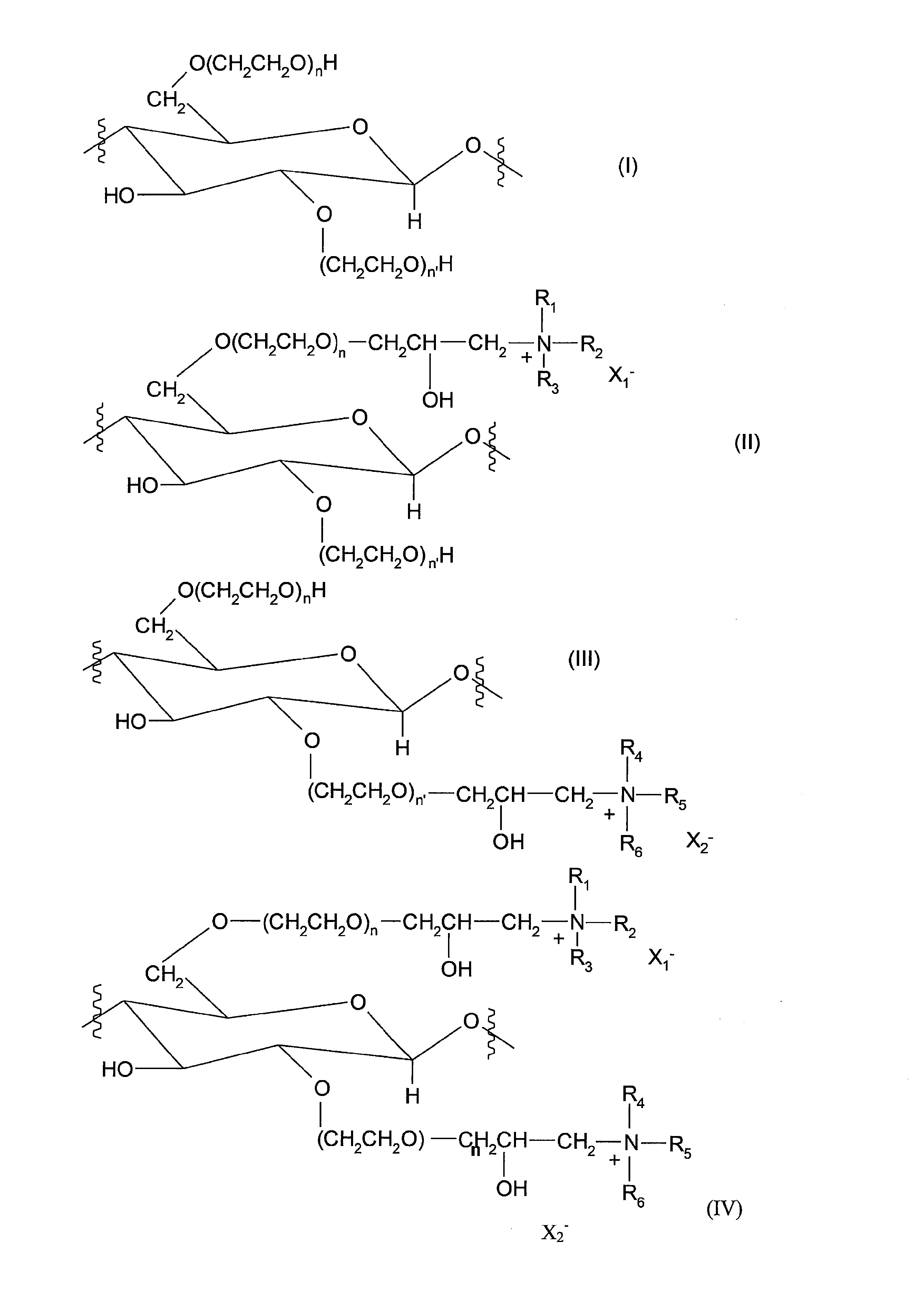
から形成され、ただし、
単位(I)+(II)+(III)+(IV)の総数は、4000から10000の間であり、
比[(III)+(IV)]/[(I)+(II)+(III)+(IV)]は、0.0003から0.8の範囲であり、
比[(II)+(IV)]/[(I)+(II)+(III)+(IV)]は、0.02から0.9の範囲であり、
整数n及びn'は、互いに独立して、0から5の範囲であり、
R1、R2、R3、R4及びR5は、互いに独立して、メチル又はエチル基を表し、
R6は、直鎖状若しくは分枝状のC8~C24、好ましくはC10~C24、より好ましくはC12~C24、なお良好にはC12~C15アルキル基、又は直鎖状若しくは分枝状のアルキル部分がC8~C24であるアラルキル基を表し、
X1
-及びX2
-は、好ましくは、互いに独立して、リン酸イオン、硝酸イオン、硫酸イオン及びハロゲン化物イオン(Cl-、Br-、F-、I-)から選択されるアニオンを表す。
formed from, but
The total number of units (I)+(II)+(III)+(IV) is between 4000 and 10000,
The ratio [(III)+(IV)]/[(I)+(II)+(III)+(IV)] ranges from 0.0003 to 0.8;
The ratio [(II)+(IV)]/[(I)+(II)+(III)+(IV)] ranges from 0.02 to 0.9;
integers n and n', independently of each other, range from 0 to 5;
R 1 , R 2 , R 3 , R 4 and R 5 each independently represent a methyl or ethyl group,
R 6 is a linear or branched C 8 -C 24 , preferably C 10 -C 24 , more preferably C 12 -C 24 , even better C 12 -C 15 alkyl group, or a straight chain represents an aralkyl group in which the shaped or branched alkyl moiety is C 8 to C 24 ;
X 1 - and X 2 - preferably represent, independently of each other, an anion selected from phosphate, nitrate, sulfate and halide ions (Cl - , Br - , F - , I - ) .
特定の変形形態によれば、本発明による組成物中で使用することができるカチオン性セルロースエーテルは、上記の少なくとも1つの単位(IV)及び単位(I)、(II)又は(III)の少なくとも1つから形成され、式中、R6は、直鎖状ドデシル基である。 According to a particular variant, the cationic cellulose ether that can be used in the composition according to the invention comprises at least one unit (IV) as defined above and at least one of the units (I), (II) or (III). in which R 6 is a linear dodecyl group.
本発明の組成物中で使用することができるカチオン性セルロースエーテルの中で、Amerchol社により販売されているSoftcat SL-5、SL-30、SL-60及びSL-100のタイプのポリマー(INCI:ポリクオタニウム-67)を挙げることができる。特に好ましいカチオン性セルロースエーテルは、SL-60及びSL-100のタイプのポリマーである。 Among the cationic cellulose ethers that can be used in the compositions of the invention, polymers of the type Softcat SL-5, SL-30, SL-60 and SL-100 sold by the company Amerchol (INCI: Polyquaternium-67) can be mentioned. Particularly preferred cationic cellulose ethers are polymers of the SL-60 and SL-100 types.
(3)カチオン性セルロース誘導体、例えば第四級アンモニウムの水溶性モノマーをグラフトした、例えば米国特許第4,131,576号に記載されているセルロースコポリマー及びセルロース誘導体、例えばメタクリロイルエチルトリメチルアンモニウム、メタクリルアミドプロピルトリメチルアンモニウム、及びジメチルジアリルアンモニウム塩から選択される塩等をグラフトしたヒドロキシアルキルセルロース、例えばヒドロキシメチル-、ヒドロキシエチル-、及びヒドロキシプロピルセルロース。 (3) Cationic cellulose derivatives, such as cellulose copolymers and cellulose derivatives, such as those described in U.S. Pat. No. 4,131,576, grafted with water-soluble monomers of quaternary ammonium, such as methacryloylethyltrimethylammonium, methacrylamidopropyltrimethylammonium, and hydroxyalkylcelluloses grafted with salts selected from dimethyldiallylammonium salts, such as hydroxymethyl-, hydroxyethyl-, and hydroxypropylcelluloses.
これらのポリマーに相当する市販製品には、例えば、National Starch社により名称「Celquat(登録商標)L 200」及び「Celquat(登録商標)H 100」で販売されている製品が含まれる。 Commercial products corresponding to these polymers include, for example, the products sold under the names "Celquat® L 200" and "Celquat® H 100" by the company National Starch.
(4)米国特許第3,589,578号及び第4,031,307号に記載されている非セルロース系カチオン性多糖、例えばカチオン性トリアルキルアンモニウム基を含むグアーガム、カチオン性ヒアルロン酸、及びデキストランヒドロキシプロピルトリモニウムクロリド。2,3-エポキシプロピルトリメチルアンモニウムの塩、例えば塩化物で修飾されたグアーガム(グアーヒドロキシプロピルトリモニウムクロリド)もまた使用することができる。 (4) Noncellulosic cationic polysaccharides such as guar gum containing cationic trialkylammonium groups, cationic hyaluronic acid, and dextran hydroxypropyltrimonium chloride as described in U.S. Pat. Nos. 3,589,578 and 4,031,307. Salts of 2,3-epoxypropyltrimethylammonium, such as chloride-modified guar gum (guar hydroxypropyltrimonium chloride), can also be used.
そのような製品は、例えば、MEYHALL社により商品名JAGUAR(登録商標)C13 S、JAGUAR(登録商標)C15、JAGUAR(登録商標)C17、及びJAGUAR(登録商標)C162で販売されている。 Such products are sold, for example, by the company MEYHALL under the trade names JAGUAR® C13 S, JAGUAR® C15, JAGUAR® C17, and JAGUAR® C162.
(5)ピペラジニル単位と、酸素、硫黄、窒素、芳香族環、及び複素環式環から選択される少なくとも1つの構成体により任意選択で中断された直鎖又は分枝鎖を含む二価のアルキレン又はヒドロキシアルキレン基とを含むポリマー、更にはこれらのポリマーの酸化並びに/又は四級化生成物。そのようなポリマーは、例えば仏国特許第2162025号及び第2280361号に記載されている。
(5) A divalent alkylene containing a piperazinyl unit and a straight or branched chain optionally interrupted by at least one member selected from oxygen, sulfur, nitrogen, aromatic rings, and heterocyclic rings. or hydroxyalkylene groups, as well as oxidation and/or quaternization products of these polymers. Such polymers are described, for example, in
(6)例えば酸性化合物をポリアミンと重縮合させることにより調製される、水溶性ポリアミノアミド;これらのポリアミノアミドは、エピハロヒドリン;ジエポキシド;二無水物;不飽和二無水物;ビス不飽和誘導体;ビスハロヒドリン;ビスアゼチジニウム;ビスハロアシルジアミン;ビスアルキルハライド;ビスハロヒドリン、ビスアゼチジニウム、ビスハロアシルジアミン、ビスアルキルハライド、エピハロヒドリン、ジエポキシド、及びビス不飽和誘導体から選択される構成体と反応性である二官能性化合物の反応により得られるオリゴマーから選択される構成体で架橋されている場合があり、架橋剤は、ポリアミノアミドのアミン基1つ当たり0.025から0.35molの範囲の量で使用され、これらのポリアミノアミドは、任意選択でアルキル化されているか、又はそれらが少なくとも1つの第三級アミン官能基を含む場合、四級化されていてもよい。そのようなポリマーは、例えば仏国特許第2252840号及び第2368508号に記載されている。
(6) Water-soluble polyaminoamides prepared, for example, by polycondensation of acidic compounds with polyamines; these polyaminoamides include epihalohydrins; diepoxides; dianhydrides; unsaturated dianhydrides; bis-unsaturated derivatives; bis-halohydrins; Reactive with members selected from bisazetidiniums; bishaloacyldiamines; bisalkyl halides; bishalohydrins, bisazetidiniums, bishaloacyldiamines, bisalkyl halides, epihalohydrins, diepoxides, and bis-unsaturated derivatives. They may be crosslinked with constituents selected from oligomers obtained by reaction of difunctional compounds, the crosslinking agent being used in an amount ranging from 0.025 to 0.35 mol per amine group of the polyaminoamide; The polyaminoamides of may optionally be alkylated or, if they contain at least one tertiary amine function, quaternized. Such polymers are described, for example, in
(7)ポリアルキレンポリアミンをポリカルボン酸と縮合させ、続いて二官能性作用物質でアルキル化することにより得られるポリアミノアミド誘導体、例えば、メチル、エチル、及びプロピル基のようにアルキル基が1から4個の炭素原子を含み、エチレン基のようにアルキレン基が1から4個の炭素原子を含む、アジピン酸/ジアルキルアミノヒドロキシアルキルジアルキレントリアミンポリマー。そのようなポリマーは、例えば仏国特許第1583363号に記載されている。少なくとも1つの実施形態では、これらの誘導体は、アジピン酸/ジメチルアミノヒドロキシプロピルジエチレントリアミンポリマーから選択することができる。 (7) Polyaminoamide derivatives obtained by condensation of polyalkylene polyamines with polycarboxylic acids followed by alkylation with difunctional agents, e.g. Adipic acid/dialkylaminohydroxyalkyl dialkylene triamine polymers containing 4 carbon atoms and where the alkylene group, such as the ethylene group, contains 1 to 4 carbon atoms. Such polymers are described, for example, in FR 1583363. In at least one embodiment, these derivatives can be selected from adipic acid/dimethylaminohydroxypropyldiethylenetriamine polymers.
(8)2つの第一級アミン基及び少なくとも1つの第二級アミン基を含むポリアルキレンポリアミンを、ジグリコール酸及び3から8個の炭素原子を含む飽和脂肪族ジカルボン酸から選択されるジカルボン酸と反応させることにより得られるポリマー。ポリアルキレンポリアミンとジカルボン酸とのモル比は、0.8:1から1.4:1の範囲であってもよく、それにより得られるポリアミノアミドをエピクロロヒドリンと、エピクロロヒドリン対ポリアミノアミドの第二級アミン基のモル比0.5:1から1.8:1の範囲で反応させる。そのようなポリマーは、例えば米国特許第3,227,615号及び第2,961,347号に記載されている。 (8) A polyalkylene polyamine containing two primary amine groups and at least one secondary amine group is a dicarboxylic acid selected from diglycolic acid and a saturated aliphatic dicarboxylic acid containing from 3 to 8 carbon atoms. A polymer obtained by reacting with The molar ratio of polyalkylene polyamine to dicarboxylic acid may range from 0.8:1 to 1.4:1, whereby the resulting polyaminoamide is combined with epichlorohydrin and the second dicarboxylic acid of epichlorohydrin to polyaminoamide is used. The reaction is carried out at a molar ratio of primary amine groups ranging from 0.5:1 to 1.8:1. Such polymers are described, for example, in US Pat. Nos. 3,227,615 and 2,961,347.
(9)アルキルジアリルアミンのシクロポリマー及びジアルキルジアリル-アンモニウムのシクロポリマー、例えば鎖の主要構成要素として、式(Ia)及び(Ib): (9) Cyclopolymers of alkyldiallylamines and cyclopolymers of dialkyldiallyl-ammoniums, such as those of formulas (Ia) and (Ib) as main constituents of the chain:
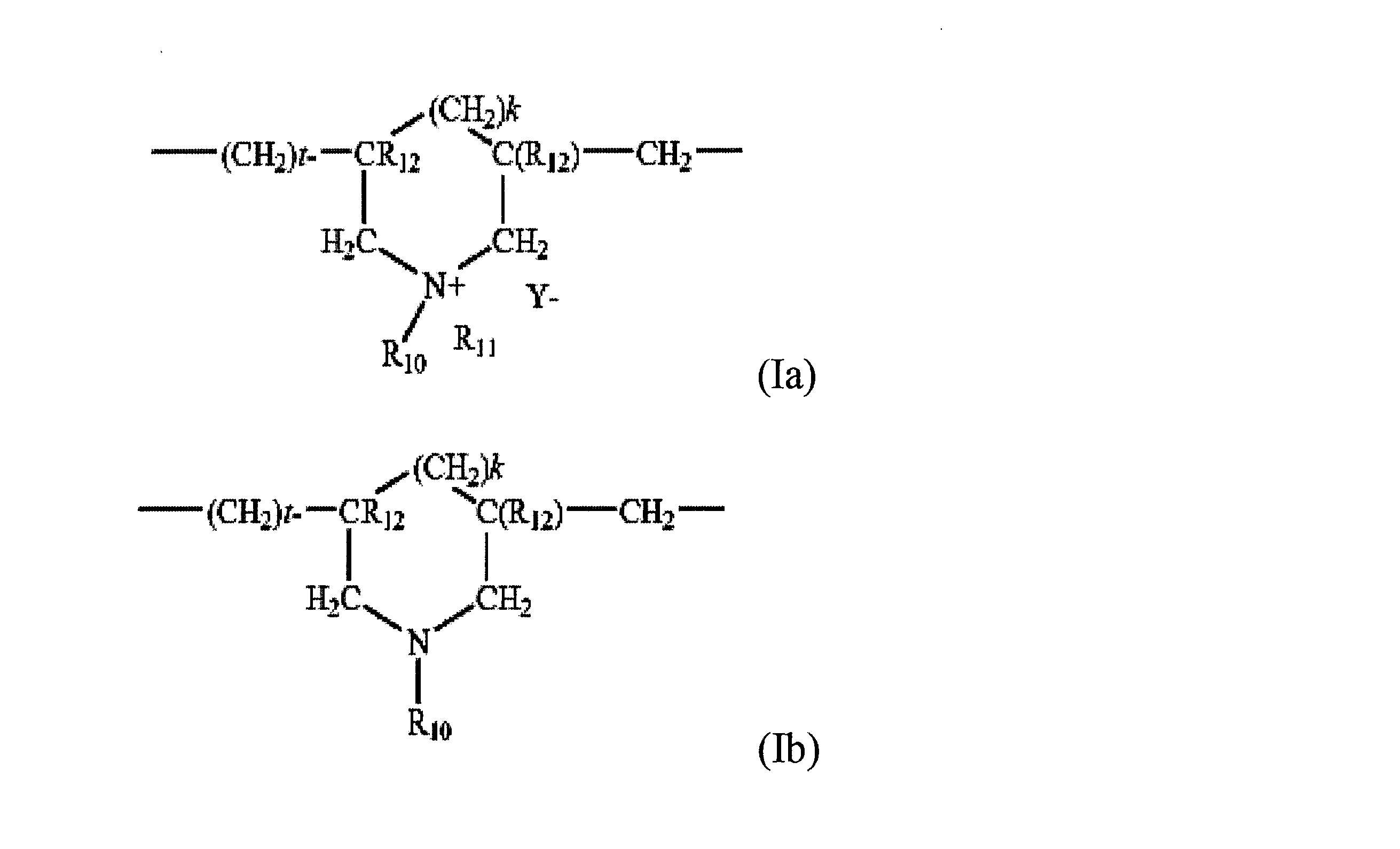
(式中、
k及びtは、同一であっても異なっていてもよく、0又は1に等しく、和k+tは、1に等しく、
R12は、水素及びメチル基から選択され、
R10及びR11は、同一であっても異なっていてもよく、1から6個の炭素原子を含むアルキル基、アルキル基が例えば1から5個の炭素原子を含むヒドロキシアルキル基、及び低級(C1~C4)アミドアルキル基から選択され、又はR10及びR11は、それらが結合している窒素原子と一緒になって複素環式基、例えばピペリジニル及びモルホリニルを形成してもよく、
Y'は、アニオン、例えば臭化物イオン、塩化物イオン、酢酸イオン、ホウ酸イオン、クエン酸イオン、酒石酸イオン、硫酸水素イオン、亜硫酸水素イオン、硫酸イオン、及びリン酸イオンである)
の単位から選択される少なくとも1つの単位を含むホモポリマー及びコポリマー。これらのポリマーは、例えば仏国特許第2080759号及びその追加特許第2190406号に記載されている。
(In the formula,
k and t may be the same or different and equal to 0 or 1, the sum k+t is equal to 1,
R 12 is selected from hydrogen and methyl groups,
R 10 and R 11 may be the same or different and may be an alkyl group containing 1 to 6 carbon atoms, a hydroxyalkyl group in which the alkyl group contains, for example, 1 to 5 carbon atoms, and a lower ( selected from C 1 -C 4 ) amidoalkyl groups, or R 10 and R 11 may together with the nitrogen atom to which they are attached form a heterocyclic group, such as piperidinyl and morpholinyl;
Y' is an anion such as bromide, chloride, acetate, borate, citrate, tartrate, bisulfate, bisulfite, sulfate, and phosphate)
Homopolymers and copolymers containing at least one unit selected from the following. These polymers are described, for example, in FR 2080759 and its supplementary patent FR 2190406.
一実施形態では、R10及びR11は、同一であっても異なっていてもよく、1から4個の炭素原子を含むアルキル基から選択される。 In one embodiment, R 10 and R 11 may be the same or different and are selected from alkyl groups containing 1 to 4 carbon atoms.
そのようなポリマーの例には、(コ)ポリジアリルジアルキルアンモニウムクロリド、例えばCALGON社により名称「MERQUAT(登録商標)100」で販売されているジメチルジアリルアンモニウムクロリドホモポリマー(及び低質量平均分子質量のその同族体)、並びに名称「MERQUAT(登録商標)550」で販売されているジアリルジメチルアンモニウムクロリドとアクリルアミドとのコポリマーが含まれるがこれらに限定されない。 Examples of such polymers include (co)polydiallyldialkylammonium chloride, such as the dimethyldiallyldiallylammonium chloride homopolymer sold under the name "MERQUAT® 100" by the company CALGON (and of low mass average molecular mass). homologs thereof), as well as a copolymer of diallyldimethylammonium chloride and acrylamide sold under the name "MERQUAT® 550".
(10)式(II): (10) Formula (II):
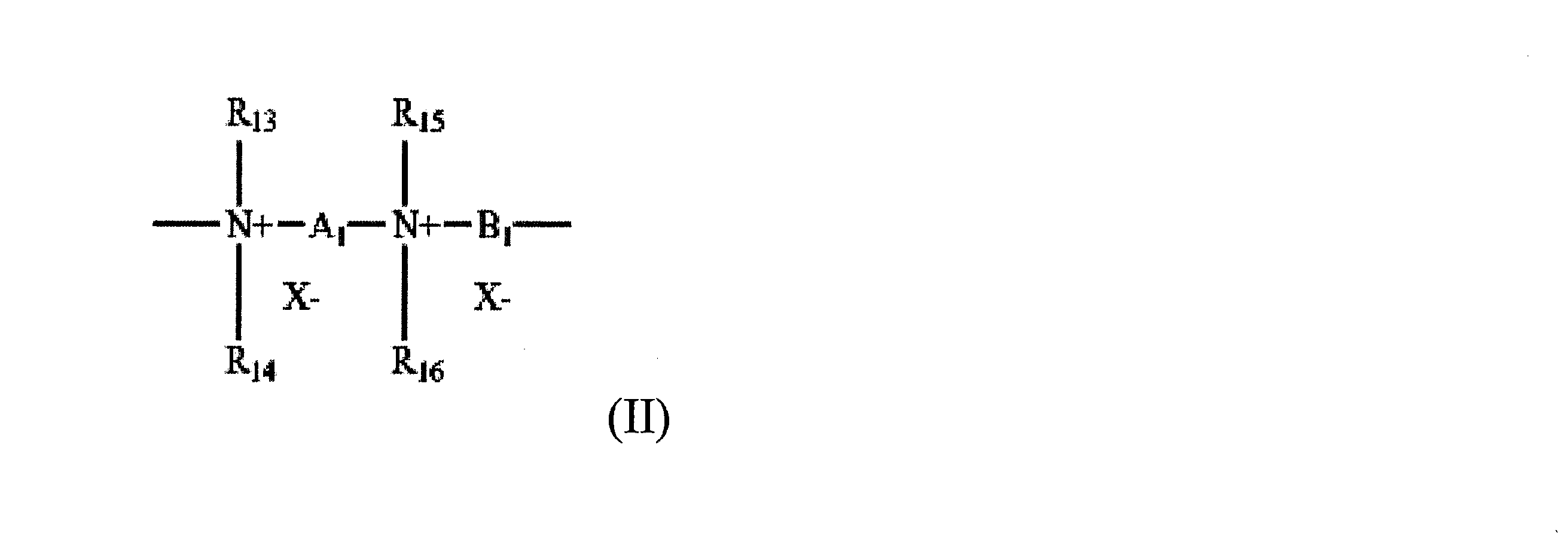
[式中、
R13、R14、R15、及びR16は、同一であっても異なっていてもよく、1から20個の炭素原子を含む脂肪族、脂環式、及びアリール脂肪族基、並びに低級ヒドロキシアルキル脂肪族基から選択され、或いは、R13、R14、R15、及びR16は、それらが結合している窒素原子と一緒になって又は別々に、窒素以外の第2のヘテロ原子を任意選択で含む複素環を形成してもよく、或いは、R13、R14、R15、及びR16は、同一であっても異なっていてもよく、ニトリル基、エステル基、アシル基、アミド基、-CO-O-R17-E基、及び-CO-NH-R17-E基(式中、R17は、アルキレン基であり、Eは、第四級アンモニウム基である)から選択される少なくとも1つの基で置換されている直鎖状又は分枝状のC1~C6アルキル基から選択され、
A1及びB1は、同一であっても異なっていてもよく、2から20個の炭素原子を含むポリメチレン基から選択され、これは、直鎖状又は分枝状、飽和又は不飽和であってよく、芳香族環、酸素、硫黄、スルホキシド基、スルホン基、ジスルフィド基、アミノ基、アルキルアミノ基、ヒドロキシル基、第四級アンモニウム基、ウレイド基、アミド基、及びエステル基から選択される少なくとも1つの構成体を主鎖中に連結又は挿入されて含んでもよく、
X-は、無機又は有機酸に由来するアニオンであり、
A1、R13、及びR15は、それらが結合している2個の窒素原子と一緒になってピペラジン環を形成してもよく、
A1が、直鎖状又は分枝状、飽和又は不飽和のアルキレン又はヒドロキシアルキレン基から選択される場合、B1は、
-(CH2)n--CO-E'-OC-(CH2)n-
から選択することができ、式中、E'は、
a)式-O-Z-O-{式中、Zは、直鎖状又は分枝状の炭化水素系基及び以下の式:
-(CH2-CH2-O)x-CH2-CH2-
-[CH2-CH(CH3)-O]y-CH2-CH(CH3)-
(式中、x及びyは、同一であっても異なっていてもよく、定義された独自の重合度を表す1から4の範囲の整数、及び平均重合度を表す1から4の範囲の数から選択される)
の基から選択される}のグリコール残基、
b)ビス-第二級ジアミン残基、例えばピペラジン誘導体、
c)式-NH-Y-NH-(式中、Yは、直鎖状又は分枝状の炭化水素系基及び二価基-CH2-CH2-S-S-CH2-CH2-から選択される)のビス-第一級ジアミン残基、並びに
d)式-NH-CO-NH-のウレイレン基
から選択される]
の少なくとも1つの繰り返し単位を含む第四級ジアンモニウムポリマー。
[In the formula,
R 13 , R 14 , R 15 , and R 16 may be the same or different and include aliphatic, cycloaliphatic, and arylaliphatic groups containing 1 to 20 carbon atoms, and lower hydroxy selected from alkylaliphatic groups, or R 13 , R 14 , R 15 , and R 16 together or separately with the nitrogen atom to which they are attached carry a second heteroatom other than nitrogen; Optionally, R 13 , R 14 , R 15 , and R 16 may be the same or different and include a nitrile group, an ester group, an acyl group, an amide group, etc. group, -CO-OR 17 -E group, and -CO-NH-R 17 -E group, where R 17 is an alkylene group and E is a quaternary ammonium group. selected from straight-chain or branched C 1 -C 6 alkyl groups substituted with at least one group;
A 1 and B 1 may be the same or different and are selected from polymethylene groups containing from 2 to 20 carbon atoms, which may be linear or branched, saturated or unsaturated. and at least one selected from aromatic rings, oxygen, sulfur, sulfoxide groups, sulfone groups, disulfide groups, amino groups, alkylamino groups, hydroxyl groups, quaternary ammonium groups, ureido groups, amide groups, and ester groups. may include one construct linked or inserted into the main chain;
X - is an anion derived from an inorganic or organic acid,
A 1 , R 13 , and R 15 may form a piperazine ring together with the two nitrogen atoms to which they are bonded,
When A 1 is selected from linear or branched, saturated or unsaturated alkylene or hydroxyalkylene groups, B 1 is
-(CH 2 ) n --CO-E'-OC-(CH 2 ) n -
can be selected from, where E' is
a) Formula -OZO-{where Z is a linear or branched hydrocarbon group and the following formula:
-(CH 2 -CH 2 -O) x -CH 2 -CH 2 -
-[CH 2 -CH(CH 3 )-O] y -CH 2 -CH(CH 3 )-
(where x and y may be the same or different and are integers ranging from 1 to 4 representing a defined unique degree of polymerization, and numbers ranging from 1 to 4 representing the average degree of polymerization (selected from)
a glycol residue selected from the group };
b) bis-secondary diamine residues, such as piperazine derivatives,
c) Formula -NH-Y-NH- (wherein Y is selected from a linear or branched hydrocarbon group and a divalent group -CH 2 -CH 2 -SS-CH 2 -CH 2 - bis-primary diamine residues of
d) selected from ureylene groups of the formula -NH-CO-NH-]
A quaternary diammonium polymer containing at least one repeating unit of.
少なくとも1つの実施形態では、X-は、アニオン、例えば塩化物イオン又は臭化物イオンである。 In at least one embodiment, X - is an anion, such as chloride or bromide.
このタイプのポリマーは、例えば、仏国特許第2320330号、第2270846号、第2316271号、第2336434号、及び第2413907号並びに米国特許第2,273,780号、第2,375,853号、第2,388,614号、第2,454,547号、第3,206,462号、第2,261,002号、第2,271,378号、第3,874,870号、第4,001,432号、第3,929,990号、第3,966,904号、第4,005,193号、第4,025,617号、第4,025,627号、第4,025,653号、第4,026,945号、及び第4,027,020号に記載されている。 Polymers of this type are disclosed, for example, in French patents 2320330, 2270846, 2316271, 2336434 and 2413907 and in US patents 2,273,780, 2,375,853, 2,388,614, 2,454,547, No. 3,206,462, No. 2,261,002, No. 2,271,378, No. 3,874,870, No. 4,001,432, No. 3,929,990, No. 3,966,904, No. 4,005,193, No. 4,025,617, No. 4,025,627, No. 4,0 No. 25,653, No. 4,026,945, and No. Described in No. 4,027,020.
そのようなポリマーの非限定的な例には、式(III): Non-limiting examples of such polymers include formula (III):

(式中、R13、R14、R15、及びR16は、同一であっても異なっていてもよく、1から4個の炭素原子を含むアルキル及びヒドロキシアルキル基から選択され、n及びpは、同一であっても異なっていてもよく、2から20の範囲の整数であり、X-は、無機又は有機酸に由来するアニオンである)
の少なくとも1つの繰り返し単位を含むものが含まれる。
(wherein R 13 , R 14 , R 15 and R 16 may be the same or different and are selected from alkyl and hydroxyalkyl groups containing 1 to 4 carbon atoms, n and p are integers ranging from 2 to 20, which may be the same or different, and X - is an anion derived from an inorganic or organic acid)
Included are those containing at least one repeating unit of.
(11)式(IV): (11) Formula (IV):
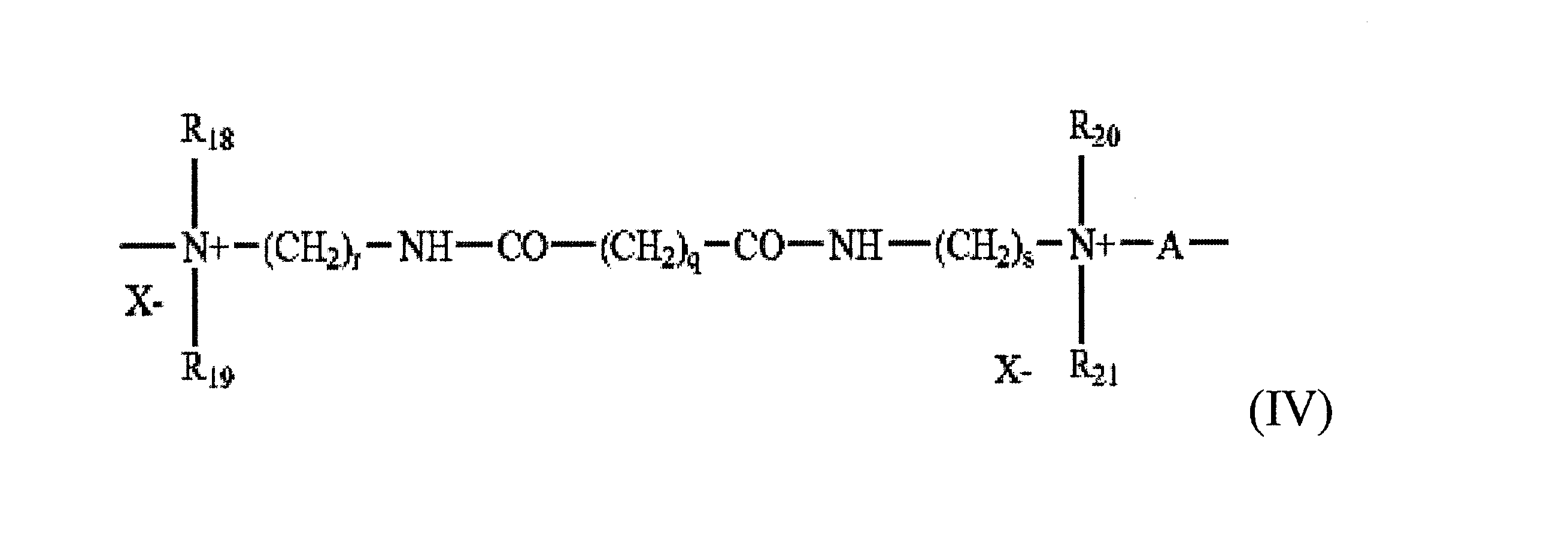
[式中、
R18、R19、R20、及びR21は、同一であっても異なっていてもよく、水素、メチル基、エチル基、プロピル基、β-ヒドロキシエチル基、β-ヒドロキシプロピル基、-CH2CH2(OCH2CH2)pOH基(式中、pは、0から6の範囲の整数から選択される)から選択され、ただし、R18、R19、R20、及びR21は、同時に水素ではなく、
r及びsは、同一であっても異なっていてもよく、1から6の範囲の整数から選択され、
qは、0から34の範囲の整数から選択され、
X-は、アニオン、例えばハロゲン化物イオンであり、
Aは、ジハライド及び-CH2-CH2-O-CH2-CH2-基から選択される]
の単位を含むポリ第四級アンモニウムポリマー。
[In the formula,
R 18 , R 19 , R 20 , and R 21 may be the same or different and each represents hydrogen, methyl group, ethyl group, propyl group, β-hydroxyethyl group, β-hydroxypropyl group, -CH 2 CH 2 (OCH 2 CH 2 ) p OH group, where p is selected from an integer ranging from 0 to 6, with the proviso that R 18 , R 19 , R 20 , and R 21 are , but not hydrogen at the same time.
r and s may be the same or different and are selected from integers ranging from 1 to 6;
q is selected from an integer ranging from 0 to 34,
X - is an anion, e.g. a halide ion;
A is selected from dihalide and -CH2 - CH2 -O- CH2 - CH2- group]
Polyquaternary ammonium polymer containing units of.
そのような化合物は、例えば欧州特許出願第0122324号に記載されている。 Such compounds are described, for example, in European Patent Application No. 0122324.
(12)ビニルピロリドンとビニルイミダゾールとの第四級ポリマー。 (12) Quaternary polymer of vinylpyrrolidone and vinylimidazole.
好適なカチオン性ポリマーの他の例には、カチオン性タンパク質及びカチオン性タンパク質加水分解物、ポリアルキレンイミン、例えばポリエチレンイミン、ビニルピリジン及びビニルピリジニウム単位から選択される単位を含むポリマー、ポリアミンとエピクロロヒドリンとの縮合物、第四級ポリウレイレン、並びにキチン誘導体が含まれるがこれらに限定されない。 Other examples of suitable cationic polymers include cationic proteins and cationic protein hydrolysates, polyalkyleneimines such as polyethyleneimines, polymers containing units selected from vinylpyridine and vinylpyridinium units, polyamines and epichloromethane. These include, but are not limited to, condensates with hydrin, quaternary polyureylenes, and chitin derivatives.
本発明の一実施形態によれば、少なくとも1種のカチオン性ポリマーは、第四級アンモニウム基を含むセルロースエーテル誘導体、例えばUNION CARBIDE CORPORATION社により名称「JR 400」で販売されている製品、カチオン性シクロポリマー、例えばCALGON社により名称MERQUAT(登録商標)100、MERQUAT(登録商標)550、及びMERQUAT(登録商標)Sで販売されているジメチルジアリルアンモニウムクロリドのホモポリマー及びコポリマー、2,3-エポキシプロピルトリメチルアンモニウム塩で修飾されたグアーガム、並びにビニルピロリドンとビニルイミダゾールとの第四級ポリマーから選択される。 According to one embodiment of the invention, the at least one cationic polymer is a cellulose ether derivative containing quaternary ammonium groups, such as the product sold under the name "JR 400" by the company UNION CARBIDE CORPORATION, cationic Cyclopolymers, such as homopolymers and copolymers of dimethyldiallylammonium chloride, 2,3-epoxypropyl, sold by the company CALGON under the names MERQUAT® 100, MERQUAT® 550, and MERQUAT® S selected from guar gum modified with trimethylammonium salts and quaternary polymers of vinylpyrrolidone and vinylimidazole.
(13)ポリアミン
カチオン性ポリマーとして、複数のアミノ基を有する、ホモポリマー又はコポリマーであってよい(コ)ポリアミンを使用することも可能である。アミノ基は、第一級、第二級、第三級又は第四級アミノ基であってよい。アミノ基は、(コ)ポリアミンのポリマー骨格中に、又は存在する場合ペンダント基中に存在してもよい。
(13) Polyamines As cationic polymers it is also possible to use (co)polyamines which have a plurality of amino groups and may be homopolymers or copolymers. The amino group may be a primary, secondary, tertiary or quaternary amino group. Amino groups may be present in the polymer backbone of the (co)polyamine or in pendant groups if present.
(コ)ポリアミンの例として、キトサン、(コ)ポリアリルアミン、(コ)ポリビニルアミン、(コ)ポリアニリン、(コ)ポリビニルイミダゾール、(コ)ポリジメチルアミノエチレンメタクリレート、(コ)ポリビニルピリジン、例えば(コ)ポリ-1-メチル-2-ビニルピリジン、(コ)ポリイミン、例えば(コ)ポリエチレンイミン、(コ)ポリピリジン、例えば(コ)ポリ(第四級ピリジン)、(コ)ポリビグアニド、例えば(コ)ポリアミノプロピルビグアニド、(コ)ポリリジン、(コ)ポリオルニチン、(コ)ポリアルギニン、(コ)ポリヒスチジン、アミノデキストラン、アミノセルロース、アミノ(コ)ポリビニルアセタール、及びそれらの塩を挙げることができる。 Examples of (co)polyamines include chitosan, (co)polyallylamine, (co)polyvinylamine, (co)polyaniline, (co)polyvinylimidazole, (co)polydimethylaminoethylene methacrylate, (co)polyvinylpyridine, such as ( co)poly-1-methyl-2-vinylpyridine, (co)polyimine, e.g. (co)polyethyleneimine, (co)polypyridine, e.g. (co)poly(quaternary pyridine), (co)polybiguanide, e.g. Mention may be made of co)polyaminopropyl biguanide, (co)polylysine, (co)polyornithine, (co)polyarginine, (co)polyhistidine, aminodextran, aminocellulose, amino(co)polyvinyl acetal, and salts thereof. can.
(コ)ポリアミンとして、(コ)ポリリジンを使用することが好ましい。ポリリジンは周知である。ポリリジンは、細菌発酵により生成されうるL-リジンの天然ホモポリマーであってもよい。例えば、ポリリジンは、食品中の天然保存料として典型的に使用されるε-ポリ-L-リジンであってもよい。ポリリジンは、水等の極性溶媒に可溶性である高分子電解質である。ポリリジンは、ポリD-リジン及びポリL-リジン等の様々な形態で市販されている。ポリリジンは、塩及び/又は溶液の形態であってもよい。 It is preferable to use (co)polylysine as the (co)polyamine. Polylysine is well known. Polylysine may be a natural homopolymer of L-lysine that can be produced by bacterial fermentation. For example, polylysine may be ε-poly-L-lysine, which is typically used as a natural preservative in foods. Polylysine is a polyelectrolyte that is soluble in polar solvents such as water. Polylysine is commercially available in various forms such as poly-D-lysine and poly-L-lysine. Polylysine may be in salt and/or solution form.
(14)カチオン性ポリアミノ酸
カチオン性ポリマーとして、複数のアミノ基及びカルボキシル基を有する、カチオン性ホモポリマー又はコポリマーであってよいカチオン性ポリアミノ酸を使用することが可能でありうる。アミノ基は、第一級、第二級、第三級又は第四級アミノ基であってよい。アミノ基は、カチオン性ポリアミノ酸のポリマー骨格中に、又は存在する場合ペンダント基中に存在してもよい。カルボキシル基は、カチオン性ポリアミノ酸の存在する場合ペンダント基中に存在してもよい。
(14) Cationic polyamino acids As cationic polymers it may be possible to use cationic polyamino acids, which may be cationic homopolymers or copolymers, having multiple amino and carboxyl groups. The amino group may be a primary, secondary, tertiary or quaternary amino group. Amino groups may be present in the polymer backbone of the cationic polyamino acid or in pendant groups if present. Carboxyl groups may be present in pendant groups when a cationic polyamino acid is present.
カチオン性ポリアミノ酸の例として、カチオン化コラーゲン、カチオン化ゼラチン、ステアルジモニウムヒドロキシプロピル加水分解コムギタンパク、ココジモニウムヒドロキシプロピル加水分解コムギタンパク、ヒドロキシプロピルトリモニウム加水分解コンキオリンタンパク、ステアルジモニウムヒドロキシプロピル加水分解ダイズタンパク、ヒドロキシプロピルトリモニウム加水分解ダイズタンパク、ココジモニウムヒドロキシプロピル加水分解ダイズタンパク等を挙げることができる。 Examples of cationic polyamino acids include cationized collagen, cationized gelatin, steardimonium hydroxypropyl hydrolyzed wheat protein, cocodimonium hydroxypropyl hydrolyzed wheat protein, hydroxypropyltrimonium hydrolyzed conchiolin protein, and steardimonium hydroxypropyl. Examples include hydrolyzed soy protein, hydroxypropyltrimonium hydrolyzed soy protein, and cocodimonium hydroxypropyl hydrolyzed soy protein.
カチオン性ポリマーは、アルキルジアリルアミンのシクロポリマー及びジアルキルジアリルアンモニウムのシクロポリマー、例えば(コ)ポリジアリルジアルキルアンモニウムクロリド、(コ)ポリアミン、例えば(コ)ポリリジン、カチオン性(コ)ポリアミノ酸、例えばカチオン化コラーゲン、並びにそれらの塩からなる群から選択されることが好ましい場合がある。 Cationic polymers include cyclopolymers of alkyldiallylamines and cyclopolymers of dialkyldiallylammonium, such as (co)polydiallyldialkylammonium chloride, (co)polyamines, such as (co)polylysine, cationic (co)polyamino acids, such as cationized It may be preferred to be selected from the group consisting of collagen, and salts thereof.
カチオン性ポリマーは、ポリクオタニウムポリマー又はポリマー性第四級アンモニウム塩であることが好ましい。 Preferably, the cationic polymer is a polyquaternium polymer or a polymeric quaternary ammonium salt.
ポリマー性第四級アンモニウム塩は、少なくとも1個の四級化された窒素原子を含むカチオン性ポリマーである。ポリマー性第四級アンモニウム塩として、特に、主として泡の質及び使用後の皮膚の感触、特に使用後の皮膚の感触に寄与するポリクオタニウム製品(CTFA名)を挙げることができる。これらのポリマーは、好ましくは以下のポリマーから選択することができる:
ポリクオタニウム-5、例えばNalco社により販売されている製品Merquat 5、
ポリクオタニウム-6、例えばBASF社により販売されている製品Salcare SC 30、及びNalco社により販売されている製品Merquat 100、
ポリクオタニウム-7、例えばNalco社により販売されている製品Merquat S、Merquat 2200、Merquat 7SPR及びMerquat 550、並びにBASF社により販売されている製品Salcare SC 10、
ポリクオタニウム-10、例えばAmerchol社により販売されている製品Polymer JR400、
ポリクオタニウム-11、例えばISP社により販売されている製品Gafquat 755、Gafquat 755N及びGafquat 734、
ポリクオタニウム-15、例えばRohm社により販売されている製品Rohagit KF 720 F、
ポリクオタニウム-16、例えばBASF社により販売されている製品Luviquat FC905、Luviquat FC370、Luviquat HM552及びLuviquat FC550、
ポリクオタニウム-28、例えばISP社により販売されている製品Styleze CC10、
ポリクオタニウム-44、例えばBASF社により販売されている製品Luviquat Care、
ポリクオタニウム-46、例えばBASF社により販売されている製品Luviquat Hold、
ポリクオタニウム-47、例えばNalco社により販売されている製品Merquat 2001、並びに
ポリクオタニウム-67、例えばAmerchol社により販売されている製品Softcat。
Polymeric quaternary ammonium salts are cationic polymers containing at least one quaternized nitrogen atom. As polymeric quaternary ammonium salts, mention may be made in particular of polyquaternium products (CTFA name), which primarily contribute to the quality of the foam and the feel of the skin after use, especially the feel of the skin after use. These polymers can preferably be selected from the following polymers:
Polyquaternium-5, for example the product Merquat 5 sold by the company Nalco,
Polyquaternium-6, for example the product Salcare SC 30 sold by BASF and the product Merquat 100 sold by Nalco,
Polyquaternium-7, such as the products Merquat S, Merquat 2200, Merquat 7SPR and Merquat 550 sold by the company Nalco, and the product Salcare SC 10 sold by the company BASF,
Polyquaternium-10, for example the product Polymer JR400 sold by the company Amerchol,
Polyquaternium-11, such as the products Gafquat 755, Gafquat 755N and Gafquat 734 sold by ISP,
Polyquaternium-15, for example the product Rohagit KF 720 F, sold by the company Rohm,
Polyquaternium-16, such as the products Luviquat FC905, Luviquat FC370, Luviquat HM552 and Luviquat FC550 sold by BASF,
Polyquaternium-28, for example the product Styleze CC10 sold by ISP,
Polyquaternium-44, for example the product Luviquat Care, sold by BASF
Polyquaternium-46, for example the product Luviquat Hold, sold by BASF
Polyquaternium-47, such as the product Merquat 2001, sold by the company Nalco, and polyquaternium-67, such as the product Softcat, sold by the company Amerchol.
本発明による組成物中のカチオン性ポリマーの量は、組成物の総質量に対して、0.001質量%以上、好ましくは0.01質量%以上、より好ましくは0.1質量%以上であることができる。 The amount of cationic polymer in the composition according to the invention can be at least 0.001% by weight, preferably at least 0.01% by weight, more preferably at least 0.1% by weight, relative to the total weight of the composition.
本発明による組成物中のカチオン性ポリマーの量は、組成物の総質量に対して、25質量%以下、好ましくは20質量%以下、より好ましくは15質量%以下であることができる。 The amount of cationic polymer in the composition according to the invention can be up to 25% by weight, preferably up to 20% by weight, more preferably up to 15% by weight, relative to the total weight of the composition.
本発明による組成物中のカチオン性ポリマーの量は、組成物の総質量に対して、0.001質量%から25質量%、好ましくは0.01質量%から20質量%、より好ましくは0.1質量%から15質量%であることができる。 The amount of cationic polymer in the composition according to the invention is from 0.001% to 25% by weight, preferably from 0.01% to 20% by weight, more preferably from 0.1% to 15% by weight, relative to the total weight of the composition. %.
(アニオン性ポリマー)
アニオン性ポリマーは、正電荷密度を有する。アニオン性ポリマーが合成アニオン性ポリマーである場合、アニオン性ポリマーの電荷密度は、0.1meq/gから20meq/g、好ましくは1から15meq/g、より好ましくは4から10meq/gであることができ、アニオン性ポリマーが天然アニオン性ポリマーである場合、アニオン性ポリマーの平均置換度は、0.1から3.0、好ましくは0.2から2.7、より好ましくは0.3から2.5であることができる。
(Anionic polymer)
Anionic polymers have a positive charge density. When the anionic polymer is a synthetic anionic polymer, the charge density of the anionic polymer can be from 0.1meq/g to 20meq/g, preferably from 1 to 15meq/g, more preferably from 4 to 10meq/g. , when the anionic polymer is a natural anionic polymer, the average degree of substitution of the anionic polymer can be from 0.1 to 3.0, preferably from 0.2 to 2.7, more preferably from 0.3 to 2.5.
アニオン性ポリマーの分子量は、1,000以上、好ましくは10,000以上、より好ましくは50,000以上、更に好ましくは100,000以上であることが好ましい場合がある。 It may be preferable that the anionic polymer has a molecular weight of 1,000 or more, preferably 10,000 or more, more preferably 50,000 or more, and still more preferably 100,000 or more.
アニオン性ポリマーは、硫酸基、スルフェート基、スルホン酸基、スルホネート基、リン酸基、ホスフェート基、ホスホン酸基、ホスホネート基、カルボン酸基、及びカルボキシレート基からなる群から選択される、少なくとも1つの負電荷を有することができる及び/又は負電荷を有する部分を有してもよい。 The anionic polymer has at least one selected from the group consisting of sulfate groups, sulfate groups, sulfonic acid groups, sulfonate groups, phosphoric acid groups, phosphate groups, phosphonic acid groups, phosphonate groups, carboxylic acid groups, and carboxylate groups. may have one negative charge and/or may have a portion with a negative charge.
アニオン性ポリマーは、ホモポリマー又はコポリマーであってよい。「コポリマー」という用語は、2種類のモノマーから得られるコポリマーと、3種類以上のモノマーから得られるコポリマー、例えば3種類のモノマーから得られるターポリマーの両方を意味すると理解される。 Anionic polymers may be homopolymers or copolymers. The term "copolymer" is understood to mean both copolymers obtained from two types of monomers and copolymers obtained from more than two types of monomers, for example terpolymers obtained from three types of monomers.
アニオン性ポリマーは、天然及び合成のアニオン性ポリマーから選択することができる。 The anionic polymer can be selected from natural and synthetic anionic polymers.
アニオン性ポリマーは、少なくとも1つの疎水性鎖を含んでもよい。 Anionic polymers may include at least one hydrophobic chain.
少なくとも1つの疎水性鎖を含んでもよいアニオン性ポリマーは、α,β-エチレン性不飽和を含むカルボン酸(モノマーa')及び2-アクリルアミド-2-メチルプロパンスルホン酸(モノマーa")から選択されるモノマー(a)と、(a)以外のエチレン性不飽和を含む非表面活性モノマー(b)、並びに/或いはα,β-モノエチレン性不飽和を含むアクリルモノマー又はモノエチレン性不飽和を含むイソシアネートモノマーを、一価の非イオン性両親媒性成分又は第一級若しくは第二級脂肪アミンと反応させることにより得られるエチレン性不飽和を含むモノマー(c)との共重合により得ることができる。 The anionic polymer, which may contain at least one hydrophobic chain, is selected from carboxylic acids containing α,β-ethylenic unsaturation (monomer a') and 2-acrylamido-2-methylpropanesulfonic acid (monomer a'') (a) and a non-surface-active monomer (b) containing ethylenic unsaturation other than (a) and/or an acrylic monomer containing α,β-monoethylenically unsaturation or monoethylenically unsaturated. can be obtained by copolymerization with a monomer (c) containing ethylenic unsaturation obtained by reacting an isocyanate monomer containing with a monovalent nonionic amphiphilic component or with a primary or secondary fatty amine. can.
したがって、少なくとも1つの疎水性鎖を有するアニオン性ポリマーは、2つの合成経路により、すなわち、
- モノマー(a')及び(c)、若しくは(a')、(b)及び(c)、若しくは(a")及び(c)、若しくは(a")、(b)及び(c)の共重合、
- 又はモノマー(a')、若しくはモノマー(a')及び(b)、若しくは(a")及び(b)から形成されたコポリマーを、一価の非イオン性両親媒性化合物又は第一級若しくは第二級脂肪アミンで修飾(特に、エステル化若しくはアミド化)すること
のいずれかにより得ることができる。
Therefore, anionic polymers with at least one hydrophobic chain can be synthesized by two synthetic routes, namely:
- Monomers (a') and (c), or (a'), (b) and (c), or (a") and (c), or a combination of (a"), (b) and (c) polymerization,
- or monomer (a'), or a copolymer formed from monomers (a') and (b), or (a") and (b), with a monovalent nonionic amphiphilic compound or a primary or It can be obtained either by modification (especially esterification or amidation) with secondary fatty amines.
2-アクリルアミド-2-メチルプロパンスルホン酸コポリマーとして、特に、論文「Micelle formation of random copolymers of sodium 2-(acrylamido)-2-methylpropanesulfonate and nonionic surfactant macromonomer in water as studied by fluorescence and dynamic light scattering - Macromolecules、2000年、第33巻、第10号-3694~3704頁」並びに出願EP-A-0750899及びEP-A-1069172に開示されているものを挙げることができる。 As a 2-acrylamido-2-methylpropanesulfonate copolymer, in particular the paper "Micelle formation of random copolymers of sodium 2-(acrylamido)-2-methylpropanesulfonate and nonionic surfactant macromonomer in water as studied by fluorescence and dynamic light scattering - Macromolecules, 2000, Vol. 33, No. 10, pp. 3694-3704" and applications EP-A-0750899 and EP-A-1069172.
モノマー(a')を構成するα,β-モノエチレン性不飽和を含むカルボン酸は、多数の酸から、特にアクリル酸、メタクリル酸、クロトン酸、イタコン酸及びマレイン酸から選択することができる。これは、好ましくは、アクリル酸又はメタクリル酸である。 The carboxylic acid containing α,β-monoethylenically unsaturated which constitutes the monomer (a') can be selected from a large number of acids, in particular from acrylic acid, methacrylic acid, crotonic acid, itaconic acid and maleic acid. This is preferably acrylic acid or methacrylic acid.
コポリマーは、界面活性剤特性を有さないモノエチレン性不飽和を含むモノマー(b)を含むことができる。好ましいモノマーは、単独重合したときに水不溶性ポリマーを与えるものである。それらは、例えば、アクリル酸アルキル(C1~C4)及びメタクリル酸アルキル(C1~C4)、例えばアクリル酸メチル、アクリル酸エチル、アクリル酸ブチル又は対応するメタクリレートから選択することができる。より特に好ましいモノマーは、アクリル酸メチル及びアクリル酸エチルである。使用することができる他のモノマーは、例えば、スチレン、ビニルトルエン、酢酸ビニル、アクリロニトリル及び塩化ビニリデンである。非反応性モノマーが好ましく、これらのモノマーは、単一のエチレン性基が、重合条件下で反応性を持つ唯一の基であるものである。しかしながら、熱の作用下で反応する基を含むモノマー、例えばアクリル酸ヒドロキシエチルを任意選択で使用することができる。 The copolymer can include a monomer (b) containing monoethylenically unsaturated without surfactant properties. Preferred monomers are those that, when homopolymerized, provide water-insoluble polymers. They can be selected, for example, from alkyl acrylates (C 1 -C 4 ) and alkyl methacrylates (C 1 -C 4 ), such as methyl acrylate, ethyl acrylate, butyl acrylate or the corresponding methacrylates. More particularly preferred monomers are methyl acrylate and ethyl acrylate. Other monomers that can be used are, for example, styrene, vinyltoluene, vinyl acetate, acrylonitrile and vinylidene chloride. Non-reactive monomers are preferred, those monomers in which a single ethylenic group is the only group that is reactive under the polymerization conditions. However, monomers containing groups that react under the action of heat, such as hydroxyethyl acrylate, can optionally be used.
モノマー(c)は、α,β-モノエチレン性不飽和を含むアクリルモノマー、例えば(a)、又はモノエチレン性不飽和を含むイソシアネートモノマーを、一価の非イオン性両親媒性化合物又は第一級若しくは第二級脂肪アミンと反応させることにより得られる。 Monomer (c) can be an acrylic monomer containing α,β-monoethylenically unsaturated, such as (a), or an isocyanate monomer containing monoethylenically unsaturated, a monovalent nonionic amphiphilic compound or a primary or secondary fatty amines.
非イオン性モノマー(c)を生成するのに使用される一価の非イオン性両親媒性化合物又は第一級若しくは第二級脂肪アミンは周知である。一価の非イオン性両親媒性化合物は、一般に、分子の親水性部分を形成するアルキレンオキシドを含むアルコキシル化疎水性化合物である。疎水性化合物は、一般に、脂肪族アルコール又はアルキルフェノールから構成され、その化合物中、少なくとも6個の炭素原子を含む炭素性鎖が、両親媒性化合物の疎水性部分を構成する。 Monovalent nonionic amphiphilic compounds or primary or secondary fatty amines used to produce nonionic monomers (c) are well known. Monovalent nonionic amphiphilic compounds are generally alkoxylated hydrophobic compounds containing an alkylene oxide that forms the hydrophilic portion of the molecule. Hydrophobic compounds are generally composed of aliphatic alcohols or alkylphenols, in which the carbonaceous chain containing at least 6 carbon atoms constitutes the hydrophobic part of the amphiphilic compound.
好ましい一価の非イオン性両親媒性化合物は、以下の式(V):
R-(OCH2CHR')m-(OCH2CH2)n-OH (V)
(式中、Rは、6から30個の炭素原子を含むアルキル又はアルキレン基及び8から30個の炭素原子を含むアルキル基を有するアルキルアリール基から選択され、R'は、1から4個の炭素原子を含むアルキル基から選択され、nは、およそ1から150の範囲の平均数であり、mは、およそ0から50の範囲の平均数であり、ただし、nは、少なくともmと同等である)
を有する化合物である。
Preferred monovalent nonionic amphiphilic compounds have the following formula (V):
R-(OCH 2 CHR') m -(OCH 2 CH 2 ) n -OH (V)
(wherein R is selected from alkyl or alkylene groups containing from 6 to 30 carbon atoms and alkylaryl groups having alkyl groups containing from 8 to 30 carbon atoms, and R' is selected from 1 to 4 carbon atoms. selected from alkyl groups containing carbon atoms, where n is an average number ranging from approximately 1 to 150, and m is an average number ranging from approximately 0 to 50, provided that n is at least equal to m. be)
It is a compound with
好ましくは、式(V)の化合物中、R基は、12から26個の炭素原子を含むアルキル基及びアルキル基がC8~C13であるアルキルフェニル基から選択され、R'基は、メチル基であり、m=0であり、n=1から25である。 Preferably, in the compound of formula (V), the R group is selected from alkyl groups containing 12 to 26 carbon atoms and alkylphenyl groups in which the alkyl group is C 8 to C 13 , and the R' group is selected from methyl group, m=0, and n=1 to 25.
好ましい第一級及び第二級脂肪アミンは、6から30個の炭素原子を含む1つ又は2つのアルキル鎖から構成される。 Preferred primary and secondary fatty amines are composed of one or two alkyl chains containing from 6 to 30 carbon atoms.
非イオン性ウレタンモノマー(c)を形成するのに使用されるモノマーは、非常に多様な化合物から選択することができる。共重合性不飽和、例えばアクリル性、メタクリル性又はアリル性不飽和を含む任意の化合物を使用することができる。モノマー(c)は、特に、モノエチレン性不飽和を含むイソシアネート、例えば特にα,α-ジメチル-m-イソプロペニルベンジルイソシアネートから得ることができる。 The monomers used to form the nonionic urethane monomer (c) can be selected from a wide variety of compounds. Any compound containing copolymerizable unsaturation, such as acrylic, methacrylic or allylic unsaturation, can be used. Monomer (c) can be obtained in particular from isocyanates containing monoethylenically unsaturated, such as especially α,α-dimethyl-m-isopropenylbenzyl isocyanate.
モノマー(c)は、特に、オキシエチレン化(1から50EO)C6~C30脂肪アルコールのアクリレート、メタクリレート又はイタコネート、例えばメタクリル酸ステアレス-20、オキシエチレン化(25EO)ベヘニルメタクリレート、オキシエチレン化(20EO)モノセチルイタコネート、オキシエチレン化(20EO)モノステアリルイタコネート又はポリオキシエチレン化(25EO)C12~C24アルコールで修飾されたアクリレートから、及びオキシエチレン化(1から50EO)C6~C30脂肪アルコールのジメチル-m-イソプロペニルベンジルイソシアネート、例えば特にオキシエチレン化ベヘニルアルコールのジメチル-m-イソプロペニルベンジルイソシアネートから選択することができる。 Monomers (c) are in particular oxyethylated (1 to 50 EO) acrylates, methacrylates or itaconates of C 6 to C 30 fatty alcohols, such as steareth-20 methacrylate, oxyethylated (25 EO) behenyl methacrylate, oxyethylated ( 20EO) monocetyl itaconate, oxyethylated (20EO) monostearyl itaconate or polyoxyethylated (25EO) C 12 to C 24 alcohol-modified acrylates, and oxyethylated (1 to 50EO) C 6 to It can be chosen from dimethyl-m-isopropenylbenzyl isocyanate of C 30 fatty alcohols, such as dimethyl-m-isopropenylbenzyl isocyanate, especially of oxyethylated behenyl alcohols.
本発明の特定の実施形態によれば、アニオン性ポリマーは、(a)α,β-エチレン性不飽和を含むカルボン酸、(b)(a)以外のエチレン性不飽和を含む非表面活性モノマー、及び(c)一価の非イオン性両親媒性化合物とモノエチレン性不飽和を含むイソシアネートとの反応生成物である非イオン性ウレタンモノマーから得られるアクリルターポリマーから選択される。 According to certain embodiments of the invention, the anionic polymer comprises (a) a carboxylic acid containing α,β-ethylenically unsaturated; (b) a non-surface-active monomer containing ethylenic unsaturation other than (a). , and (c) acrylic terpolymers obtained from nonionic urethane monomers which are the reaction products of monovalent nonionic amphiphilic compounds and isocyanates containing monoethylenically unsaturated.
少なくとも1つの疎水性鎖を含むアニオン性ポリマーとして、特に、アクリル酸/アクリル酸エチル/アクリル酸アルキルターポリマー、例えばRohm & Haas社により名称Acusol 823で販売されている30%水性分散体としての製品;アクリレート/メタクリル酸ステアレス-20コポリマー、例えばRohm & Haas社により名称Aculyn 22で販売されている製品;(メタ)アクリル酸/アクリル酸エチル/オキシエチレン化(25EO)ベヘニルメタクリレートターポリマー、例えばRohm & Haas社により名称Aculyn 28で販売されている水性エマルションとしての製品;アクリル酸/オキシエチレン化(20EO)モノセチルイタコネートコポリマー、例えばNational Starch社により名称Structure 3001で販売されている30%水性分散体としての製品;アクリル酸/オキシエチレン化(20EO)モノステアリルイタコネートコポリマー、例えばNational Starch社により名称Structure 2001で販売されている30%水性分散体としての製品;アクリレート/ポリオキシエチレン化(25EO)C12~C24アルコールで修飾されたアクリレートのコポリマー、例えば3V SA社により名称Synthalen W2000で販売されている30~32%コポリマーラテックス;又はメタクリル酸/アクリル酸メチル/エトキシル化ベヘニルアルコールのジメチル-メタ-イソプロペニルベンジルイソシアネートのターポリマー、例えば文献EP-A-0173109に開示された40個のエチレンオキシド基を含む24%水性分散体としての製品を挙げることができる。 As anionic polymers containing at least one hydrophobic chain, in particular acrylic acid/ethyl acrylate/alkyl acrylate terpolymers, such as the product sold under the name Acusol 823 by Rohm & Haas as a 30% aqueous dispersion ;acrylate/methacrylic acid steareth-20 copolymers, e.g. the product sold under the name Aculyn 22 by Rohm &Haas; (meth)acrylic acid/ethyl acrylate/oxyethylenated (25EO) behenyl methacrylate terpolymers, e.g. Rohm & Products as aqueous emulsions sold by Haas under the name Aculyn 28; acrylic acid/oxyethylenized (20EO) monocetyl itaconate copolymers, such as 30% aqueous dispersions sold under the name Structure 3001 by National Starch. Products as acrylic acid/oxyethylenated (20EO) monostearyl itaconate copolymers, e.g. products as 30% aqueous dispersions sold under the name Structure 2001 by National Starch; acrylate/polyoxyethylated (25EO) Copolymers of acrylates modified with C 12 -C 24 alcohols, such as the 30-32% copolymer latex sold under the name Synthalen W2000 by the company 3V SA; or dimethyl-meth-acrylates of methacrylic acid/methyl acrylate/ethoxylated behenyl alcohols. Mention may be made of terpolymers of isopropenyl benzyl isocyanate, such as the product disclosed in document EP-A-0173109 as a 24% aqueous dispersion containing 40 ethylene oxide groups.
アニオン性ポリマーはまた、ポリエステル-5、例えばEASTMAN CHEMICAL社によりEastman AQ(商標)55S Polymerの名称で販売されている製品であってもよく、下記の化学式を有する。 The anionic polymer may also be polyester-5, such as the product sold by EASTMAN CHEMICAL under the name Eastman AQ™ 55S Polymer, having the chemical formula below.
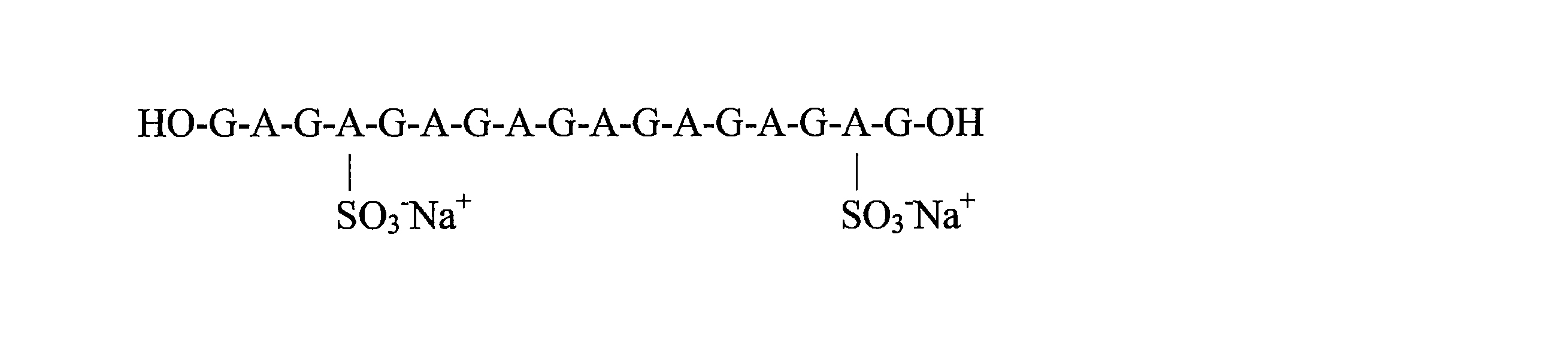
A:ジカルボン酸部分
G:グリコール部分
SO3
-Na+:ナトリウムスルホ基
OH:ヒドロキシル基
A: Dicarboxylic acid moiety
G: Glycol part
SO 3 - Na + :Sodium sulfo group
OH: hydroxyl group
アニオン性ポリマーは、多糖、例えばアルギン酸、ヒアルロン酸、及びセルロースポリマー(例えば、カルボキシメチルセルロース)、アニオン性(コ)ポリアミノ酸、例えば(コ)ポリグルタミン酸、(コ)ポリ(メタ)アクリル酸、(コ)ポリアミド酸、(コ)ポリスチレンスルホネート、(コ)ポリ(ビニルスルフェート)、デキストラン硫酸、コンドロイチン硫酸、(コ)ポリマレイン酸、(コ)ポリフマル酸、マレイン酸(コ)ポリマー、並びにそれらの塩からなる群から選択されることが好ましい場合がある。 Anionic polymers include polysaccharides such as alginic acid, hyaluronic acid, and cellulose polymers (e.g. carboxymethyl cellulose), anionic (co)polyamino acids such as (co)polyglutamic acid, (co)poly(meth)acrylic acid, (co)polyglutamic acid, (co)poly(meth)acrylic acid, ) polyamic acid, (co)polystyrene sulfonate, (co)poly(vinyl sulfate), dextran sulfate, chondroitin sulfate, (co)polymaleic acid, (co)polyfumaric acid, maleic acid (co)polymer, and salts thereof. It may be preferable to select from the group consisting of:
マレイン酸コポリマーは、1つ又は複数のマレイン酸コモノマーと、酢酸ビニル、ビニルアルコール、ビニルピロリドン、2から20個の炭素原子を含むオレフィン、及びスチレンから選択される1つ又は複数のコモノマーとを含んでもよい。 The maleic acid copolymer comprises one or more maleic acid comonomers and one or more comonomers selected from vinyl acetate, vinyl alcohol, vinylpyrrolidone, olefins containing from 2 to 20 carbon atoms, and styrene. But that's fine.
したがって、「マレイン酸コポリマー」は、1つ又は複数のマレイン酸コモノマーと、酢酸ビニル、ビニルアルコール、ビニルピロリドン、2から20個の炭素原子を含むオレフィン、例えばオクタデセン、エチレン、イソブチレン、ジイソブチレン又はイソオクチレン、及びスチレンから選択される1つ又は複数のコモノマーとの共重合により得られる任意のポリマーを意味すると理解され、マレイン酸コモノマーは、任意選択で部分的に又は完全に加水分解されている。好ましくは、親水性ポリマー、すなわち水溶解度が2g/l以上であるポリマーが使用される。 A "maleic acid copolymer" therefore refers to one or more maleic acid comonomers combined with vinyl acetate, vinyl alcohol, vinylpyrrolidone, an olefin containing from 2 to 20 carbon atoms, such as octadecene, ethylene, isobutylene, diisobutylene or isooctylene. , and styrene, the maleic acid comonomer being optionally partially or completely hydrolyzed. Preferably, hydrophilic polymers are used, ie polymers with a water solubility of 2 g/l or more.
本発明の有利な態様では、マレイン酸コポリマーは、マレイン酸単位のモル分率が、0.1から1の間、より好ましくは0.4から0.9の間であることができる。 In an advantageous embodiment of the invention, the maleic acid copolymer may have a molar fraction of maleic acid units between 0.1 and 1, more preferably between 0.4 and 0.9.
マレイン酸コポリマーの質量平均モル質量は、1,000から500,000の間、好ましくは1,000から50,000の間であることができる。 The weight average molar mass of the maleic acid copolymer can be between 1,000 and 500,000, preferably between 1,000 and 50,000.
マレイン酸コポリマーは、スチレン/マレイン酸コポリマー、より好ましくはスチレン/マレイン酸コポリマーナトリウムであることが好ましい。 Preferably, the maleic acid copolymer is a styrene/maleic acid copolymer, more preferably a sodium styrene/maleic acid copolymer.
好ましくは、50/50比のスチレンとマレイン酸とのコポリマーが使用される。 Preferably, a copolymer of styrene and maleic acid in a 50/50 ratio is used.
例えば、Cray Valley社により参照名SMA1000H(登録商標)で販売されている、水中30%のアンモニウム塩の形態のスチレン/マレイン酸(50/50)コポリマー又はCray Valley社により参照名SMA1000HNa(登録商標)で販売されている、水中40%のナトリウム塩の形態のスチレン/マレイン酸(50/50)コポリマーを使用することができる。 For example, a styrene/maleic acid (50/50) copolymer in the form of an ammonium salt at 30% in water sold under the reference SMA1000H® by Cray Valley or SMA1000HNa® by Cray Valley. Styrene/maleic acid (50/50) copolymer in the form of 40% sodium salt in water, sold at
スチレン/マレイン酸コポリマー、例えばスチレン/マレイン酸コポリマーナトリウムの使用は、本発明による組成物により調製される皮膜の湿潤性を改善することができる。 The use of styrene/maleic acid copolymers, such as sodium styrene/maleic acid copolymers, can improve the wettability of the films prepared by the compositions according to the invention.
本発明による組成物中のアニオン性ポリマーの量は、組成物の総質量に対して、0.001質量%以上、好ましくは0.01質量%以上、より好ましくは0.1質量%以上であることができる。 The amount of anionic polymer in the composition according to the invention can be at least 0.001% by weight, preferably at least 0.01% by weight, more preferably at least 0.1% by weight, relative to the total weight of the composition.
本発明による組成物中のアニオン性ポリマーの量は、組成物の総質量に対して、25質量%以下、好ましくは20質量%以下、より好ましくは15質量%以下であることができる。 The amount of anionic polymer in the composition according to the invention can be up to 25% by weight, preferably up to 20% by weight, more preferably up to 15% by weight, relative to the total weight of the composition.
本発明による組成物中のアニオン性ポリマーの量は、組成物の総質量に対して、0.001質量%から25質量%、好ましくは0.01質量%から20質量%、より好ましくは0.1質量%から15質量%であることができる。 The amount of anionic polymer in the composition according to the invention is from 0.001% to 25% by weight, preferably from 0.01% to 20% by weight, more preferably from 0.1% to 15% by weight, relative to the total weight of the composition. %.
(両性ポリマー)
両性ポリマーは、正電荷密度及び負電荷密度の両方を有する。
(Ampholytic polymer)
Amphoteric polymers have both positive and negative charge densities.
両性ポリマーの正電荷密度は、0.01meq/gから20meq/g、好ましくは0.05から15meq/g、より好ましくは0.1から10meq/gであることができる。 The positive charge density of the amphoteric polymer can be from 0.01 meq/g to 20 meq/g, preferably from 0.05 to 15 meq/g, more preferably from 0.1 to 10 meq/g.
両性ポリマーの負電荷密度は、0.01meq/gから20meq/g、好ましくは0.05から15meq/g、より好ましくは0.1から10meq/gであることができる。 The negative charge density of the amphoteric polymer can be from 0.01 meq/g to 20 meq/g, preferably from 0.05 to 15 meq/g, more preferably from 0.1 to 10 meq/g.
両性ポリマーの分子量は、500以上、好ましくは1000以上、より好ましくは2000以上、更に好ましくは5000以上であることが好ましい場合がある。 It may be preferable that the molecular weight of the amphoteric polymer is 500 or more, preferably 1000 or more, more preferably 2000 or more, even more preferably 5000 or more.
説明において別段の定義がない限り、「分子量」は、数平均分子量を意味する。 Unless otherwise defined in the description, "molecular weight" means number average molecular weight.
両性ポリマーは、
第一級、第二級又は第三級アミノ基、第四級アンモニウム基、グアニジン基、ビグアニド基、イミダゾール基、イミノ基、及びピリジル基からなる群から選択される、少なくとも1つの正電荷を有することができる及び/又は正電荷を有する部分、
並びに
硫酸基、スルフェート基、スルホン酸基、スルホネート基、リン酸基、ホスフェート基、ホスホン酸基、ホスホネート基、カルボン酸基、及びカルボキシレート基からなる群から選択される、少なくとも1つの負電荷を有することができる及び/又は負電荷を有する部分
を有してもよい。
Ampholytic polymers are
Has at least one positive charge selected from the group consisting of primary, secondary or tertiary amino groups, quaternary ammonium groups, guanidine groups, biguanide groups, imidazole groups, imino groups, and pyridyl groups. a moiety capable of and/or having a positive charge,
and at least one negative charge selected from the group consisting of a sulfate group, a sulfate group, a sulfonic acid group, a sulfonate group, a phosphoric acid group, a phosphate group, a phosphonic acid group, a phosphonate group, a carboxylic acid group, and a carboxylate group. and/or may have a portion with a negative charge.
両性ポリマーは、ホモポリマー又はコポリマーであってよい。「コポリマー」という用語は、2種類のモノマーから得られるコポリマーと、3種類以上のモノマーから得られるコポリマー、例えば3種類のモノマーから得られるターポリマーの両方を意味すると理解される。 Ampholytic polymers may be homopolymers or copolymers. The term "copolymer" is understood to mean both copolymers obtained from two types of monomers and copolymers obtained from more than two types of monomers, for example terpolymers obtained from three types of monomers.
本発明に従って使用することができる両性ポリマーは、ポリマー鎖中にランダムに分布したK及びM単位を含有するポリマーから選択することができ、ここで、Kは、少なくとも1個の塩基性窒素原子を含有するモノマーに由来する単位を示し、Mは、1つ又は複数のカルボン酸又はスルホン酸基を含有する酸性モノマーに由来する単位を示し、或いは、K及びMは、カルボキシベタイン又はスルホベタインの双性イオン性モノマーに由来する基を示してもよい。K及びMはまた、第一級、第二級、第三級又は第四級アミン基を含有するカチオン性ポリマー鎖を示してもよく、そのアミン基の少なくとも1つは、炭化水素基を介して連結されたカルボン酸又はスルホン酸基を保有し、或いは、K及びMは、α,β-ジカルボン酸エチレン単位を有するポリマーの鎖の一部を形成し、そのカルボン酸基の1つは、1つ又は複数の第一級又は第二級アミン基を含有するポリアミンと反応させられている。 Amphoteric polymers that can be used according to the invention can be selected from polymers containing K and M units randomly distributed in the polymer chain, where K represents at least one basic nitrogen atom. M represents a unit derived from an acidic monomer containing one or more carboxylic acid or sulfonic acid groups, or K and M represent a unit derived from a monomer containing carboxybetaine or sulfobetaine. It may also represent a group derived from a polar ionic monomer. K and M may also represent cationic polymer chains containing primary, secondary, tertiary or quaternary amine groups, at least one of which is linked via a hydrocarbon group. or K and M form part of a chain of a polymer having α,β-dicarboxylic ethylene units, one of the carboxylic acid groups being It has been reacted with a polyamine containing one or more primary or secondary amine groups.
より特に好ましい上記に示した定義に相当する両性ポリマーは、以下のポリマーから選択される。 More particularly preferred amphoteric polymers corresponding to the definition given above are selected from the following polymers:
(1)カルボン酸基を保有するビニル化合物に由来するモノマー、例えばより特定するとアクリル酸、メタクリル酸、マレイン酸、アルファ-クロロアクリル酸と、少なくとも1個の塩基性原子を含有する置換ビニル化合物に由来する塩基性モノマー、例えばより特定するとメタクリル酸及びアクリル酸ジアルキルアミノアルキル、ジアルキルアミノアルキルメタクリルアミド及びアクリルアミドとの共重合により得られるポリマー。そのような化合物は、米国特許第3,836,537号に記載されている。HENKEL社により名称POLYQUART KE 3033で販売されているアクリル酸ナトリウム/アクリルアミドプロピルトリメチルアンモニウムクロリドコポリマーもまた挙げることができる。ビニル化合物はまた、ジアルキルジアリルアンモニウム塩、例えばジメチルジアリルアンモニウムクロリドであってもよい。アクリル酸と後者のモノマーとのコポリマーは、Lubrizol社により名称MERQUAT 280、MERQUAT 295、MERQUAT 2003 PR、MERQUAT 3330 PR、及びMERQUAT PLUS 3330で提供されている。 (1) Monomers derived from vinyl compounds bearing carboxylic acid groups, such as more specifically acrylic acid, methacrylic acid, maleic acid, alpha-chloroacrylic acid, and substituted vinyl compounds containing at least one basic atom. Polymers obtained by copolymerization with basic monomers derived from, for example, more particularly methacrylic acid and dialkylaminoalkyl acrylates, dialkylaminoalkyl methacrylamide and acrylamide. Such compounds are described in US Pat. No. 3,836,537. Mention may also be made of the sodium acrylate/acrylamidopropyltrimethylammonium chloride copolymer sold under the name POLYQUART KE 3033 by the company HENKEL. The vinyl compound may also be a dialkyldiallylammonium salt, such as dimethyldiallylammonium chloride. Copolymers of acrylic acid and the latter monomer are offered by the company Lubrizol under the names MERQUAT 280, MERQUAT 295, MERQUAT 2003 PR, MERQUAT 3330 PR and MERQUAT PLUS 3330.
(2)以下に由来する単位を含有するポリマー:
a)窒素がアルキル基で置換されているアクリルアミド又はメタクリルアミドから選択される少なくとも1種のモノマー、
b)1つ又は複数の反応性カルボン酸基を含有する少なくとも1種の酸性コモノマー、並びに
c)少なくとも1種の塩基性コモノマー、例えばアクリル酸及びメタクリル酸の第一級、第二級、第三級及び第四級アミン置換基を有するエステル、並びにメタクリル酸ジメチルアミノエチルの硫酸ジメチル又は硫酸ジエチルによる四級化生成物。
(2) Polymers containing units derived from:
a) at least one monomer selected from acrylamide or methacrylamide in which nitrogen is substituted with an alkyl group;
b) at least one acidic comonomer containing one or more reactive carboxylic acid groups; and
c) at least one basic comonomer, such as esters of acrylic acid and methacrylic acid with primary, secondary, tertiary and quaternary amine substituents, and dimethyl sulfate or sulfuric acid of dimethylaminoethyl methacrylate; Quaternization product with diethyl.
本発明による最も特に好ましいN-置換アクリルアミド又はメタクリルアミドは、そのアルキル基が2から12個の炭素原子を含有する基、より特定するとN-エチルアクリルアミド、N-tert-ブチルアクリルアミド、N-tert-オクチルアクリルアミド、N-オクチルアクリルアミド、N-デシルアクリルアミド、及びN-ドデシルアクリルアミド、並びに対応するメタクリルアミドである。 Most particularly preferred N-substituted acrylamides or methacrylamides according to the invention are groups whose alkyl radicals contain from 2 to 12 carbon atoms, more particularly N-ethylacrylamide, N-tert-butylacrylamide, N-tert- octylacrylamide, N-octylacrylamide, N-decylacrylamide, and N-dodecylacrylamide, and the corresponding methacrylamide.
酸性コモノマーは、より特定すると、アクリル酸、メタクリル酸、クロトン酸、イタコン酸、マレイン酸及びフマル酸、並びにマレイン酸若しくはフマル酸又はその無水物の1から4個の炭素原子を有するアルキルモノエステルから選択される。 Acidic comonomers are more particularly selected from acrylic acid, methacrylic acid, crotonic acid, itaconic acid, maleic acid and fumaric acid, and alkyl monoesters having 1 to 4 carbon atoms of maleic acid or fumaric acid or their anhydrides. selected.
好ましい塩基性コモノマーは、アミノエチル、ブチルアミノエチル、N,N'-ジメチルアミノエチル、及びN-tert-ブチルアミノエチルのメタクリレートである。 Preferred basic comonomers are aminoethyl, butylaminoethyl, N,N'-dimethylaminoethyl, and N-tert-butylaminoethyl methacrylate.
そのCTFA名(第4版、1991年)がオクチルアクリルアミド/アクリレート/メタクリル酸ブチルアミノエチルコポリマーであるコポリマー、例えばNATIONAL STARCH社により名称AMPHOMER又はLOVOCRYL 47で販売されている製品が特に使用される。 Particularly used are copolymers whose CTFA name (4th edition, 1991) is octylacrylamide/acrylate/butylaminoethyl methacrylate copolymer, such as the product sold under the name AMPHOMER or LOVOCRYL 47 by the company NATIONAL STARCH.
(3)以下の一般式のポリアミノアミドに由来する部分的に又は完全にアルキル化され、架橋されたポリアミノアミド:
-[-CO-R4-CO-Z-]-
[式中、R4は、飽和ジカルボン酸、エチレン性二重結合を有する脂肪族モノ若しくはジカルボン酸、これらの酸の1から6個の炭素原子を有する低級アルカノールのエステル、又は前記酸のいずれか1種とビス-第一級若しくはビス-第二級アミンとの付加により得られる基に由来する二価基を表し、Zは、ビス-第一級、モノ-又はビス-第二級ポリアルキレン-ポリアミン基を示し、好ましくは、以下を表す:
a)60から100mol%の割合で、以下の基
-NH-[(CH2)x-NH-]p-
(式中、x=2であり、p=2又は3であり、或いは、x=3であり、p=2であり、この基は、ジエチレントリアミン、トリエチレンテトラアミン又はジプロピレントリアミンに由来する)、
b)0から40mol%の割合で、上記の基(IV)(式中、x=2であり、p=1であり、これは、エチレンジアミンに由来する)、又はピペラジンに由来する以下の基:
(3) Partially or fully alkylated and crosslinked polyaminoamides derived from polyaminoamides of the general formula:
-[-CO-R 4 -CO-Z-]-
[wherein R 4 is a saturated dicarboxylic acid, an aliphatic mono- or dicarboxylic acid having an ethylenic double bond, an ester of a lower alkanol having 1 to 6 carbon atoms of these acids, or any of the
a) 60 to 100 mol% of the following groups:
-NH-[(CH 2 ) x -NH-] p -
(where x=2 and p=2 or 3, or x=3 and p=2, and the group is derived from diethylenetriamine, triethylenetetraamine or dipropylenetriamine) ,
b) in proportions from 0 to 40 mol% of the group (IV) as defined above (where x=2 and p=1, which originates from ethylenediamine) or the following groups derived from piperazine:

c)0から20mol%の割合で、ヘキサメチレンジアミンに由来する-NH-(CH2)6-NH-基、これらのポリアミノアミンは、エピハロヒドリン、ジエポキシド、二無水物、ビス-不飽和誘導体から選択される二官能性架橋剤を添加することにより、ポリアミノアミドのアミン基1つ当たり0.025から0.35molの架橋剤を用いて架橋され、アクリル酸、クロロ酢酸若しくはアルカンスルトン又はそれらの塩の作用によりアルキル化されている]。 c) -NH-(CH 2 ) 6 -NH- groups derived from hexamethylene diamine in proportions from 0 to 20 mol %, these polyaminoamines being selected from epihalohydrins, diepoxides, dianhydrides, bis-unsaturated derivatives By adding a difunctional crosslinking agent, the polyaminoamide is crosslinked using 0.025 to 0.35 mol of crosslinking agent per amine group, and the alkyl ].
飽和カルボン酸は、好ましくは、6から10個の炭素原子を有する酸、例えばアジピン酸、2,2,4-トリメチルアジピン酸及び2,4,4-トリメチルアジピン酸、テレフタル酸、及びエチレン二重結合を有する酸、例えばアクリル酸、メタクリル酸及びイタコン酸等から選択される。 Saturated carboxylic acids are preferably acids having 6 to 10 carbon atoms, such as adipic acid, 2,2,4-trimethyladipic acid and 2,4,4-trimethyladipic acid, terephthalic acid, and ethylene double Acids having a bond are selected from acids such as acrylic acid, methacrylic acid and itaconic acid.
アルキル化において使用されるアルカンスルトンは、好ましくは、プロパン又はブタンスルトンであり、アルキル化剤の塩は、好ましくは、ナトリウム又はカリウム塩である。 The alkane sultone used in the alkylation is preferably propane or butane sultone, and the salt of the alkylating agent is preferably a sodium or potassium salt.
(4)以下の式の双性イオン性単位を含有するポリマー: (4) Polymers containing zwitterionic units of the following formula:
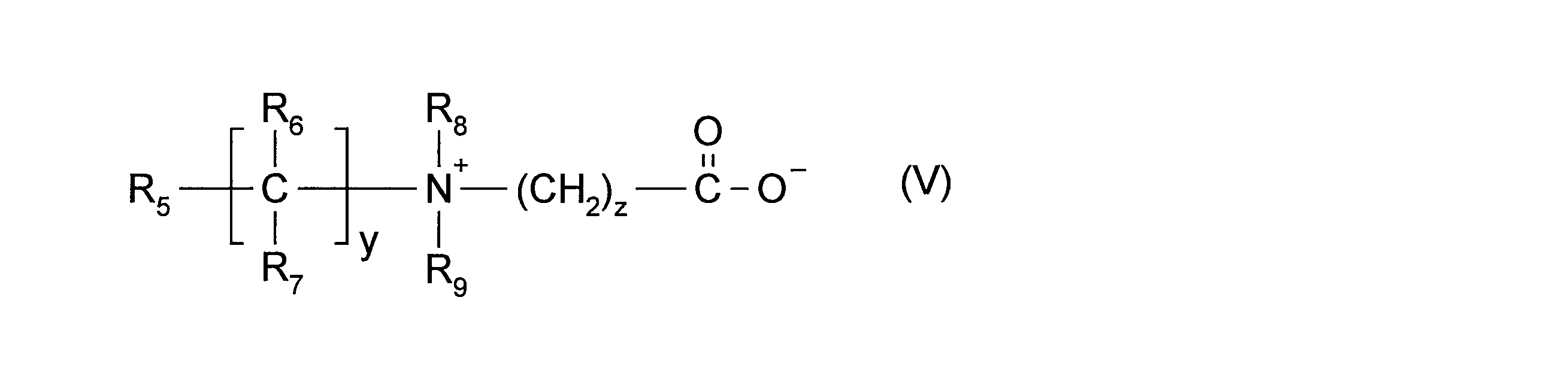
(式中、R5は、重合性不飽和基、例えばアクリレート、メタクリレート、アクリルアミド又はメタクリルアミド基を示し、y及びzは、1から3の整数を表し、R6及びR7は、水素原子、メチル、エチル又はプロピルを表し、R8及びR9は、R8及びR9中の炭素原子の和が10を超えないように、水素原子又はアルキル基を表す)。 (In the formula, R 5 represents a polymerizable unsaturated group, such as an acrylate, methacrylate, acrylamide or methacrylamide group, y and z represent an integer from 1 to 3, R 6 and R 7 represent a hydrogen atom, represents methyl, ethyl or propyl, and R 8 and R 9 represent a hydrogen atom or an alkyl group such that the sum of carbon atoms in R 8 and R 9 does not exceed 10).
そのような単位を含むポリマーはまた、非双性イオン性モノマー、例えばアクリル酸若しくはメタクリル酸ジメチル若しくはジエチルアミノエチル又はアクリル酸若しくはメタクリル酸アルキル、アクリルアミド若しくはメタクリルアミド又は酢酸ビニルに由来する単位を含んでもよい。 Polymers containing such units may also contain units derived from non-zwitterionic monomers, such as dimethyl or diethylaminoethyl acrylic acid or methacrylate or alkyl acrylic acid or methacrylates, acrylamide or methacrylamide or vinyl acetate. .
例として、メタクリル酸ブチル/ジメチルカルボキシメチルアンモニオエチルメタクリレートのコポリマー、例えばSANDOZ社により名称DIAFORMER Z301で販売されている製品を挙げることができる。 As an example, mention may be made of the copolymers of butyl methacrylate/dimethylcarboxymethylammonioethyl methacrylate, such as the product sold under the name DIAFORMER Z301 by the company SANDOZ.
(5)以下の式(VI)、(VII)、及び(VIII)に相当するモノマー単位を含有するキトサンに由来するポリマー: (5) Polymers derived from chitosan containing monomer units corresponding to the following formulas (VI), (VII), and (VIII):

[(VI)単位は、0から30%の割合で存在し、(VII)単位は、5から50%の割合で存在し、(VIII)単位は、30から90%の割合で存在し、この(VIII)単位中、R10は、以下の式: [(VI) units are present in a proportion of 0 to 30%, (VII) units are present in a proportion of 5 to 50%, (VIII) units are present in a proportion of 30 to 90%; In the unit (VIII), R 10 is of the following formula:

(式中、
q=0の場合、R11、R12及びR13は、同一であるか又は異なり、各々、水素原子、メチル、ヒドロキシル、アセトキシ若しくはアミノ残基、モノアルキルアミン残基若しくはジアルキルアミン残基(1個若しくは複数の窒素原子により任意選択で中断され、及び/又は1つ若しくは複数のアミン、ヒドロキシル、カルボキシル、アルキルチオ若しくはスルホン酸基で任意選択で置換されている)、又はそのアルキル基がアミノ残基を保有するアルキルチオ残基を表し、この場合、R11、R12及びR13基の少なくとも1つは、水素原子であり、
或いは、q=1の場合、R11、R12及びR13は、各々、水素原子を表す)
の基、並びにこれらの化合物と塩基又は酸により形成される塩を表すと理解される]。
(In the formula,
When q=0, R 11 , R 12 and R 13 are the same or different and each represents a hydrogen atom, methyl, hydroxyl, acetoxy or amino residue, monoalkylamine residue or dialkylamine residue (1 optionally interrupted by one or more nitrogen atoms and/or optionally substituted with one or more amine, hydroxyl, carboxyl, alkylthio or sulfonic acid groups), or whose alkyl group is an amino residue represents an alkylthio residue having , in which at least one of the R 11 , R 12 and R 13 groups is a hydrogen atom,
Alternatively, when q=1, R 11 , R 12 and R 13 each represent a hydrogen atom)
and the salts formed with these compounds with bases or acids].
(6)キトサンのN-カルボキシアルキル化により得られるポリマー、例えばJAN DEKKER社により名称「EVALSAN」で販売されているN-カルボキシメチルキトサン又はN-カルボキシブチルキトサン。 (6) Polymers obtained by N-carboxyalkylation of chitosan, such as N-carboxymethyl chitosan or N-carboxybutyl chitosan sold under the name "EVALSAN" by JAN DEKKER.
(7)例えば仏国特許第1,400,366号に記載されているもの等の一般式(IX)に相当するポリマー: (7) Polymers corresponding to general formula (IX), such as those described in French Patent No. 1,400,366:
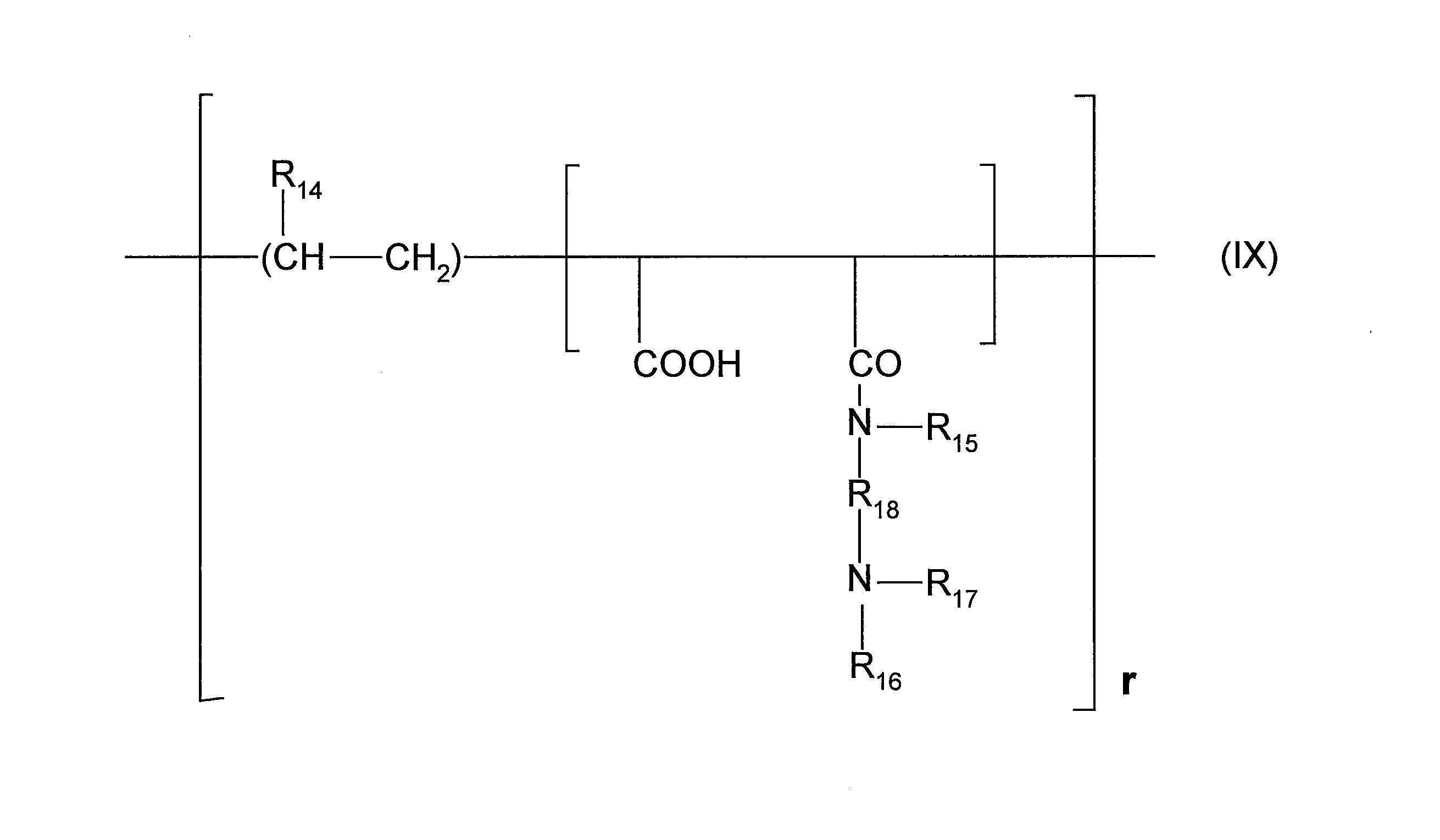
[式中、R14は、水素原子、CH3O、CH3CH2O又はフェニル基を表し、R15は、水素又は低級アルキル基、例えばメチル若しくはエチルを示し、R16は、水素又は低級アルキル基、例えばメチル若しくはエチルを示し、R17は、低級アルキル基、例えばメチル若しくはエチル、又は式:-R18-N(R16)2(R18は、-CH2-CH2-、-CH2-CH2-CH2-又は-CH2-CH(CH3)-基を表し、R16は、上述の意味を有する)に相当する基、
及びこれらの基の最大6個の炭素原子を含有する高級同族体を示す]。
[In the formula, R 14 represents a hydrogen atom, CH 3 O, CH 3 CH 2 O, or a phenyl group, R 15 represents hydrogen or a lower alkyl group, such as methyl or ethyl, and R 16 represents hydrogen or a lower represents an alkyl group, such as methyl or ethyl, R 17 is a lower alkyl group, such as methyl or ethyl, or has the formula: -R 18 -N(R 16 ) 2 (R 18 is -CH 2 -CH 2 -, - CH 2 -CH 2 -CH 2 - or -CH 2 -CH(CH 3 )- group, R 16 has the above-mentioned meaning);
and higher homologues of these groups containing up to 6 carbon atoms].
(8)以下から選択される-D-X-D-X-タイプの両性ポリマー:
a)以下の式の少なくとも1つの単位を含有する化合物に対する、クロロ酢酸又はクロロ酢酸ナトリウムの作用により得られるポリマー:
-D-X-D-X-D- (X)
(式中、Dは、以下の基
(8) -DXDX-type amphoteric polymer selected from:
a) Polymers obtained by the action of chloroacetic acid or sodium chloroacetate on compounds containing at least one unit of the following formula:
-DXDXD- (X)
(In the formula, D is the following group
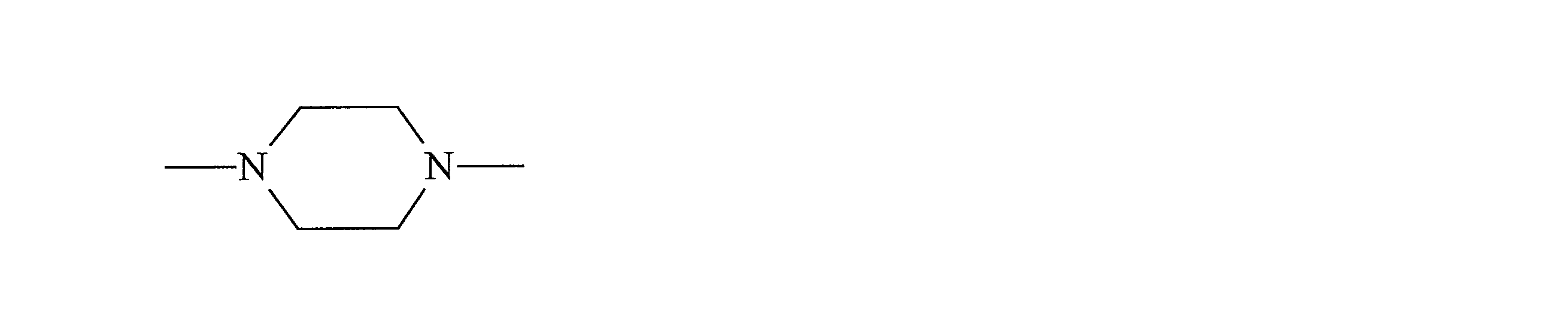
を示し、Xは、記号E又はE'を示し、E又はE'は、同一であるか又は異なり、二価基を示し、これは、最大7個の炭素原子を主鎖中に含有する直鎖又は分枝鎖を有するアルキレン基であり、非置換であるか又はヒドロキシル基で置換されており、加えて、酸素、窒素又は硫黄原子、1から3個の芳香族及び/又は複素環式環を含有してもよく、その酸素、窒素及び硫黄原子は、エーテル、チオエーテル、スルホキシド、スルホン、スルホニウム、アルキルアミン若しくはアルケニルアミン基、又はヒドロキシル、ベンジルアミン、アミンオキシド、第四級アンモニウム、アミド、イミド、アルコール、エステル及び/若しくはウレタン基の形態で存在する)。
b)以下の式のポリマー:
-D-X-D-X- (XI)
(式中、Dは、以下の基
, X stands for the symbol E or E', E or E' being the same or different and indicating a divalent radical, which is a straight radical containing up to 7 carbon atoms in the main chain. an alkylene radical with a chain or a branch, unsubstituted or substituted with hydroxyl groups, in addition to oxygen, nitrogen or sulfur atoms, from 1 to 3 aromatic and/or heterocyclic rings and the oxygen, nitrogen and sulfur atoms may contain ether, thioether, sulfoxide, sulfone, sulfonium, alkylamine or alkenylamine groups, or hydroxyl, benzylamine, amine oxide, quaternary ammonium, amide, imide , alcohol, ester and/or urethane groups).
b) Polymers of the following formula:
-DXDX- (XI)
(In the formula, D is the following group

を示し、Xは、記号E又はE'、少なくとも1回はE'を示し、Eは、上記に示した意味を有し、E'は、二価基であり、これは、最大7個の炭素原子を主鎖中に有する直鎖又は分枝鎖を有するアルキレン基であり、非置換であるか又は1つ若しくは複数のヒドロキシル基で置換されており、1個又は複数の窒素原子を含有し、その窒素原子は、酸素原子により任意選択で中断されたアルキル鎖で置換されており、1つ若しくは複数のカルボキシル官能基又は1つ若しくは複数のヒドロキシル官能基を必ず含有し、クロロ酢酸又はクロロ酢酸ナトリウムとの反応によりベタイン化されている)。 , X represents the symbol E or E', at least once E', E has the meaning given above, and E' is a divalent radical, which can contain up to 7 A linear or branched alkylene group with carbon atoms in the main chain, unsubstituted or substituted with one or more hydroxyl groups, and containing one or more nitrogen atoms. , the nitrogen atom of which is substituted with an alkyl chain optionally interrupted by an oxygen atom, necessarily containing one or more carboxyl functions or one or more hydroxyl functions, chloroacetic acid or chloroacetic acid Betained by reaction with sodium).
(9)N,N-ジメチルアミノプロピルアミン等のN,N-ジアルキルアミノアルキルアミンで半アミド化(semiamidation)することにより又はN,N-ジアルカノールアミンで半エステル化(semiesterification)することにより部分的に修飾された、(C1~C5)アルキルビニルエーテル/無水マレイン酸コポリマー。これらのコポリマーはまた、他のビニルコモノマー、例えばビニルカプロラクタムを含有してもよい。 (9) By semiamidation with N,N-dialkylaminoalkylamines such as N,N-dimethylaminopropylamine or by semiesterification with N,N-dialkanolamines. (C 1 -C 5 )alkyl vinyl ether/maleic anhydride copolymer modified by These copolymers may also contain other vinyl comonomers, such as vinyl caprolactam.
本発明による特に好ましい両性ポリマーは、ファミリー(1)のもの、特にカチオン性モノマーとしてジアルキルジアリルアンモニウムの塩を含有するものである。 Particularly preferred amphoteric polymers according to the invention are those of family (1), especially those containing dialkyl diallylammonium salts as cationic monomers.
両性ポリマーは、ポリクオタニウム-22、ポリクオタニウム-39、ポリクオタニウム-53、ポリクオタニウム-64、ポリクオタニウム-51、ポリクオタニウム-61及びそれらの混合物から選択することができる。ポリクオタニウム-39及びポリクオタニウム-53、例えば、Lubrizol社により販売されている製品Merquat 3330 PR及びMerquat 2003 PRがより好ましい。 The amphoteric polymer can be selected from polyquaternium-22, polyquaternium-39, polyquaternium-53, polyquaternium-64, polyquaternium-51, polyquaternium-61 and mixtures thereof. More preferred are polyquaternium-39 and polyquaternium-53, such as the products Merquat 3330 PR and Merquat 2003 PR sold by the company Lubrizol.
本発明による組成物中の両性ポリマーの量は、組成物の総質量に対して、0.001質量%以上、好ましくは0.01質量%以上、より好ましくは0.1質量%以上であることができる。 The amount of amphoteric polymer in the composition according to the invention can be at least 0.001% by weight, preferably at least 0.01% by weight, more preferably at least 0.1% by weight, relative to the total weight of the composition.
本発明による組成物中の両性ポリマーの量は、組成物の総質量に対して、25質量%以下、好ましくは20質量%以下、より好ましくは15質量%以下であることができる。 The amount of amphoteric polymer in the composition according to the invention can be up to 25% by weight, preferably up to 20% by weight, more preferably up to 15% by weight, based on the total weight of the composition.
本発明による組成物中の両性ポリマーの量は、組成物の総質量に対して、0.001質量%から25質量%、好ましくは0.01質量%から20質量%、より好ましくは0.1質量%から15質量%であることができる。 The amount of amphoteric polymer in the composition according to the invention is from 0.001% to 25% by weight, preferably from 0.01% to 20% by weight, more preferably from 0.1% to 15% by weight, relative to the total weight of the composition. can be.
(2つ以上の酸解離定数を有する非ポリマー酸)
本発明による組成物は、2つ以上のpKa値を有する少なくとも1種の非ポリマー酸又はその塩、すなわち、2つ以上の酸解離定数を有する少なくとも1種の非ポリマー酸又はその塩を含んでもよい。pKa値(酸解離定数)は、当業者に周知であり、一定の温度、例えば25℃で決定すべきである。
(non-polymeric acids with acid dissociation constants of 2 or more)
The composition according to the invention may comprise at least one non-polymeric acid or a salt thereof having a pKa value of two or more, i.e. at least one non-polymeric acid or a salt thereof having an acid dissociation constant of two or more. good. pKa values (acid dissociation constants) are well known to those skilled in the art and should be determined at a constant temperature, for example 25°C.
2つ以上のpKa値を有する非ポリマー酸又はその塩は、(a)ポリイオンコンプレックスに組み入れることができる。2つ以上のpKa値を有する非ポリマー酸は、カチオン性又は両性ポリマーの架橋剤として機能しうる。 Non-polymeric acids or salts thereof having pKa values of two or more can be incorporated into (a) the polyion complex. Non-polymeric acids with pKa values of two or more can function as crosslinkers for cationic or amphoteric polymers.
本明細書における「非ポリマー」という用語は、酸が、2つ以上のモノマーを重合することにより得られないことを意味する。したがって、非ポリマー酸は、ポリカルボン酸等の2つ以上のモノマーを重合することにより得られる酸に相当しない。 The term "non-polymeric" herein means that the acid is not obtained by polymerizing two or more monomers. Therefore, non-polymeric acids do not correspond to acids obtained by polymerizing two or more monomers, such as polycarboxylic acids.
2つ以上のpKa値を有する非ポリマー酸又はその塩の分子量は、1000以下、好ましくは800以下、より好ましくは700以下であることが好ましい。 The molecular weight of the non-polymeric acid or its salt having two or more pKa values is preferably 1000 or less, preferably 800 or less, more preferably 700 or less.
2つ以上のpKa値を有する非ポリマー酸又はその塩のタイプは限定されない。2つ以上の異なるタイプの2つ以上のpKa値を有する非ポリマー酸又はその塩を組み合わせて使用してもよい。したがって、単一のタイプの2つ以上のpKa値を有する非ポリマー酸若しくはその塩、又は異なるタイプの2つ以上のpKa値を有する非ポリマー酸若しくはその塩の組合せを使用することができる。 The type of non-polymeric acid or salt thereof having two or more pKa values is not limited. Two or more different types of non-polymeric acids or salts thereof having two or more pKa values may be used in combination. Thus, a single type of non-polymeric acids or salts thereof having two or more pKa values or a combination of non-polymeric acids or salts thereof having two or more pKa values of different types can be used.
本明細書における「塩」という用語は、2つ以上のpKa値を有する非ポリマー酸に好適な塩基を添加することにより形成される塩を意味し、これは、当業者に公知の方法に従って2つ以上のpKa値を有する非ポリマー酸と塩基とを反応させることにより得ることができる。塩として、金属塩、例えば、Na及びK等のアルカリ金属との塩、並びにMg及びCa等のアルカリ土類金属との塩、並びにアンモニウム塩を挙げることができる。 As used herein, the term "salt" refers to a salt formed by adding a suitable base to a non-polymeric acid having a pKa value of 2 or more, according to methods known to those skilled in the art. It can be obtained by reacting a non-polymeric acid with a base with a pKa value of 3 or more. As salts, mention may be made of metal salts, for example salts with alkali metals such as Na and K, and salts with alkaline earth metals such as Mg and Ca, and ammonium salts.
2つ以上のpKa値を有する非ポリマー酸又はその塩は、有機酸又はその塩、好ましくは親水性若しくは水溶性の有機酸又はその塩であることができる。 The non-polymeric acid or salt thereof having two or more pKa values can be an organic acid or salt thereof, preferably a hydrophilic or water-soluble organic acid or salt thereof.
2つ以上のpKa値を有する非ポリマー酸は、カルボン酸基、硫酸基、スルホン酸基、リン酸基、ホスホン酸基、フェノール性ヒドロキシル基、及びそれらの混合物からなる群から選択される少なくとも2つの酸基を有してもよい。 The non-polymeric acid having a pKa value of two or more comprises at least two selected from the group consisting of carboxylic acid groups, sulfate groups, sulfonic acid groups, phosphoric acid groups, phosphonic acid groups, phenolic hydroxyl groups, and mixtures thereof. It may have two acid groups.
2つ以上のpKa値を有する非ポリマー酸は、非ポリマー多価酸であることができる。 A non-polymeric acid with a pKa value of two or more can be a non-polymeric polyacid.
2つ以上のpKa値を有する非ポリマー酸は、ジカルボン酸、ジスルホン酸、及びジホスホン酸、並びにそれらの混合物からなる群から選択することができる。 Non-polymeric acids with pKa values of two or more can be selected from the group consisting of dicarboxylic acids, disulfonic acids, and diphosphonic acids, and mixtures thereof.
2つ以上のpKa値を有する非ポリマー酸又はその塩は、シュウ酸、マロン酸、コハク酸、グルタル酸、アジピン酸、ピメリン酸、スベリン酸、アゼライン酸、セバシン酸、フマル酸、マレイン酸、リンゴ酸、クエン酸、アコニット酸、オキサロ酢酸、酒石酸、及びその塩;アスパラギン酸、グルタミン酸、及びその塩;テレフタリリデンジカンファースルホン酸又はその塩(Mexoryl SX)、ベンゾフェノン-9;フィチン酸、及びその塩;赤色2号(アマランス)、赤色102号(ニューコクシン)、黄色4号(Yellow 5)(タートラジン)、黄色5号(サンセットイエローFCF)、緑色3号(ファストグリーンFCF)、青色1号(ブリリアントブルーFCF)、青色2号(インジゴカルミン)、赤色201号(リソールルビンB)、赤色202号(リソールルビンBCA)、赤色204号(レーキレッドCBA)、赤色206号(リソールレッドCA)、赤色207号(リソールレッドBA)、赤色208号(リソールレッドSR)、赤色219号(ブリリアントレーキレッドR)、赤色220号(ディープマルーン)、赤色227号(ファストアシッドマゼンタ)、黄色203号(キノリンイエローWS)、緑色201号(アリザリンシアニングリーンF)、緑色204号(ピラニンコンク)、緑色205号(ライトグリーンSF黄)、青色203号(パテントブルーCA)、青色205号(アルファズリンFG)、赤色401号(ビオラミンR)、赤色405号(パーマネントレッドF5R)、赤色502号(ポンソー3R)、赤色503号(ポンソーR)、赤色504号(ポンソーSX)、緑色401号(ナフトールグリーンB)、緑色402号(ギネアグリーンB)、及び黒色401号(ナフトールブルーブラック);葉酸、アスコルビン酸、エリソルビン酸、及びその塩;シスチン及びその塩;EDTA及びその塩;グリチルリチン及びその塩;並びにそれらの混合物からなる群から選択することができる。
Non-polymeric acids or their salts with pKa values of 2 or more include oxalic acid, malonic acid, succinic acid, glutaric acid, adipic acid, pimelic acid, suberic acid, azelaic acid, sebacic acid, fumaric acid, maleic acid, malic acid Acids, citric acid, aconitic acid, oxaloacetic acid, tartaric acid, and their salts; aspartic acid, glutamic acid, and their salts; terephthalylidene dicamphorsulfonic acid or its salts (Mexoryl SX), benzophenone-9; phytic acid, and its salts Salt; Red No. 2 (Amaranth), Red No. 102 (New Coccin), Yellow No. 4 (Yellow 5) (Tartrazine), Yellow No. 5 (Sunset Yellow FCF), Green No. 3 (Fast Green FCF),
2つ以上のpKa値を有する非ポリマー酸又はその塩は、テレフタリリデンジカンファースルホン酸及びその塩(Mexoryl SX)、黄色5号(サンセットイエローFCF)、アスコルビン酸、フィチン酸及びその塩、並びにそれらの混合物からなる群から選択されることが好ましい場合がある。 Non-polymeric acids or salts thereof having pKa values of two or more include terephthalylidene dicamphorsulfonic acid and its salts (Mexoryl SX), Yellow No. 5 (Sunset Yellow FCF), ascorbic acid, phytic acid and its salts, and mixtures thereof.
本発明による組成物中の2つ以上のpKa値を有する非ポリマー酸又はその塩の量は、組成物の総質量に対して、0.001質量%以上、好ましくは0.01質量%以上、より好ましくは0.1質量%以上であることができる。 The amount of non-polymeric acid or its salt having two or more pKa values in the composition according to the invention is at least 0.001% by weight, preferably at least 0.01% by weight, more preferably 0.1% by weight, based on the total weight of the composition. % by mass or more.
本発明による組成物中の2つ以上のpKa値を有する非ポリマー酸又はその塩の量は、組成物の総質量に対して、10質量%以下、好ましくは5質量%以下、より好ましくは1質量%以下であることができる。 The amount of non-polymeric acids or salts thereof having two or more pKa values in the composition according to the invention is not more than 10% by weight, preferably not more than 5% by weight, more preferably not more than 1% by weight, based on the total weight of the composition. % by mass or less.
本発明による組成物中の2つ以上のpKa値を有する非ポリマー酸又はその塩の量は、組成物の総質量に対して、0.001質量%から10質量%、好ましくは0.01質量%から5質量%、より好ましくは0.1質量%から1質量%であることができる。 The amount of non-polymeric acids or salts thereof having two or more pKa values in the composition according to the invention is from 0.001% to 10% by weight, preferably from 0.01% to 5% by weight, relative to the total weight of the composition. %, more preferably from 0.1% to 1% by weight.
(2つ以上の塩基解離定数を有する非ポリマー塩基)
本発明による組成物は、2つ以上のpKb値を有する少なくとも1種の非ポリマー塩基又はその塩、すなわち、2つ以上の塩基解離定数を有する少なくとも1種の非ポリマー塩基又はその塩を含んでもよい。pKb値(塩基解離定数)は、当業者に周知であり、一定の温度、例えば25℃で決定すべきである。
(non-polymeric bases with base dissociation constants of 2 or more)
The composition according to the invention may comprise at least one non-polymeric base or salt thereof having a pKb value of two or more, i.e. at least one non-polymeric base or salt thereof having a base dissociation constant of two or more. good. pKb values (base dissociation constants) are well known to those skilled in the art and should be determined at a constant temperature, for example 25°C.
2つ以上のpKb値を有する非ポリマー塩基又はその塩は、(a)粒子に組み入れることができる。2つ以上のpKb値を有する非ポリマー塩基は、アニオン性又は両性ポリマーの架橋剤として機能しうる。 A non-polymeric base or salt thereof having a pKb value of more than one can be incorporated into (a) the particles. Non-polymeric bases with pKb values of two or more can function as crosslinkers for anionic or amphoteric polymers.
本明細書における「非ポリマー」という用語は、塩基が、2つ以上のモノマーを重合することにより得られないことを意味する。したがって、非ポリマー塩基は、ポリアリルアミン等の2つ以上のモノマーを重合することにより得られる塩基に相当しない。 The term "non-polymeric" herein means that the base is not obtained by polymerizing two or more monomers. Therefore, a non-polymeric base does not correspond to a base obtained by polymerizing two or more monomers, such as polyallylamine.
2つ以上のpKb値を有する非ポリマー塩基又はその塩の分子量は、1000以下、好ましくは800以下、より好ましくは700以下であることが好ましい。 The molecular weight of the non-polymeric base or its salt having two or more pKb values is preferably 1000 or less, preferably 800 or less, more preferably 700 or less.
2つ以上のpKb値を有する非ポリマー塩基又はその塩のタイプは限定されない。2つ以上の異なるタイプの2つ以上のpKb値を有する非ポリマー塩基又はその塩を組み合わせて使用してもよい。したがって、単一のタイプの2つ以上のpKb値を有する非ポリマー塩基若しくはその塩、又は異なるタイプの2つ以上のpKb値を有する非ポリマー塩基若しくはその塩の組合せを使用することができる。 The type of non-polymeric base or salt thereof having two or more pKb values is not limited. Two or more different types of non-polymeric bases or salts thereof having two or more pKb values may be used in combination. Thus, a combination of non-polymeric bases or salts thereof having two or more pKb values of a single type or non-polymeric bases or salts thereof having two or more pKb values of different types can be used.
本明細書における「塩」という用語は、2つ以上のpKb値を有する非ポリマー塩基に好適な酸を添加することにより形成される塩を意味し、これは、当業者に公知の方法に従って2つ以上のpKb値を有する非ポリマー塩基と酸とを反応させることにより得ることができる。塩として、アンモニウム塩、例えば、HCl及びHNO3等の無機酸との塩、並びにカルボン酸及びスルホン酸等の有機酸との塩を挙げることができる。 As used herein, the term "salt" refers to a salt formed by adding a suitable acid to a non-polymeric base having a pKb value of 2 or more, according to methods known to those skilled in the art. It can be obtained by reacting an acid with a non-polymeric base having a pKb value of 1 or more. As salts, mention may be made of ammonium salts, for example salts with inorganic acids such as HCl and HNO3 , and salts with organic acids such as carboxylic acids and sulfonic acids.
2つ以上のpKb値を有する非ポリマー塩基又はその塩は、有機塩基又はその塩、好ましくは親水性若しくは水溶性の有機塩基又はその塩であることができる。 The non-polymeric base or salt thereof having two or more pKb values can be an organic base or salt thereof, preferably a hydrophilic or water-soluble organic base or salt thereof.
2つ以上のpKb値を有する非ポリマー塩基は、アミノ基、グアニジン基、ビグアニド基、イミダゾール基、イミノ基、ピリジル基及びそれらの混合物からなる群から選択される少なくとも2つの塩基性基を有してもよい。 Non-polymeric bases with pKb values of two or more have at least two basic groups selected from the group consisting of amino groups, guanidine groups, biguanide groups, imidazole groups, imino groups, pyridyl groups and mixtures thereof. It's okay.
2つ以上のpKb値を有する非ポリマー塩基は、非ポリマージアミン、例えばエチレンジアミン、プロピレンジアミン、ペンタンジアミン、ヘキサンジアミン、尿素及びその誘導体並びにグアニジン及びその誘導体、非ポリマーポリアミン、例えばスペルミン及びスペルミジン、塩基性アミノ酸、並びにそれらの混合物からなる群から選択することができる。 Non-polymeric bases with pKb values of 2 or more include non-polymeric diamines such as ethylene diamine, propylene diamine, pentanediamine, hexane diamine, urea and its derivatives and guanidine and its derivatives, non-polymeric polyamines such as spermine and spermidine, basic Can be selected from the group consisting of amino acids, as well as mixtures thereof.
2つ以上のpKb値を有する非ポリマー塩基又はその塩は、アルギニン、リジン、ヒスチジン、システイン、シスチン、チロシン、トリプトファン、オルニチン、及びそれらの混合物からなる群から選択することができる。 The non-polymeric base or salt thereof having two or more pKb values can be selected from the group consisting of arginine, lysine, histidine, cysteine, cystine, tyrosine, tryptophan, ornithine, and mixtures thereof.
2つ以上のpKb値を有する非ポリマー塩基又はその塩は、アルギニン、リジン、ヒスチジン、及びそれらの混合物からなる群から選択されることが好ましい場合がある。 It may be preferred that the non-polymeric base or salt thereof having two or more pKb values is selected from the group consisting of arginine, lysine, histidine, and mixtures thereof.
本発明による組成物中の2つ以上のpKb値を有する非ポリマー塩基又はその塩の量は、組成物の総質量に対して、0.001質量%以上、好ましくは0.01質量%以上、より好ましくは0.1質量%以上であることができる。 The amount of non-polymeric base or salt thereof having two or more pKb values in the composition according to the invention is at least 0.001% by weight, preferably at least 0.01% by weight, more preferably at least 0.1% by weight, relative to the total weight of the composition. % by mass or more.
本発明による組成物中の2つ以上のpKb値を有する非ポリマー塩基又はその塩の量は、組成物の総質量に対して、10質量%以下、好ましくは5質量%以下、より好ましくは1質量%以下であることができる。 The amount of non-polymeric base or salt thereof having two or more pKb values in the composition according to the invention is not more than 10% by weight, preferably not more than 5% by weight, more preferably not more than 1% by weight, relative to the total weight of the composition. % by mass or less.
本発明による組成物中の2つ以上のpKb値を有する非ポリマー塩基又はその塩の量は、組成物の総質量に対して、0.001質量%から10質量%、好ましくは0.01質量%から5質量%、より好ましくは0.1質量%から1質量%であることができる。 The amount of non-polymeric base or salt thereof having two or more pKb values in the composition according to the invention is from 0.001% to 10% by weight, preferably from 0.01% to 5% by weight, relative to the total weight of the composition. %, more preferably from 0.1% to 1% by weight.
[有機UVフィルター]
本発明による組成物は、(b)少なくとも1種の有機UVフィルターを含む。2種以上の(b)有機UVフィルターを使用する場合、それらは同じであっても異なっていてもよい。
[Organic UV filter]
The composition according to the invention comprises (b) at least one organic UV filter. When using two or more types of (b) organic UV filters, they may be the same or different.
(b)有機UVフィルターは、疎水性又は水不溶性であってよい。(b)有機UVフィルターは、油性成分として機能しうる。したがって、(b)有機UVフィルターは、本発明によるW/O型組成物の連続又は外相を形成することができる。 (b) Organic UV filters may be hydrophobic or water-insoluble. (b) Organic UV filters can function as oil-based components. Therefore, (b) the organic UV filter can form the continuous or external phase of the W/O composition according to the invention.
(b)有機UVフィルターは、UV-A及び/又はUV-B領域において活性であってよい。(b)有機UVフィルターは、親油性又は油溶性であってよい。 (b) The organic UV filter may be active in the UV-A and/or UV-B region. (b) Organic UV filters may be lipophilic or oil-soluble.
(b)有機UVフィルターは、固体又は液体であってよい。「固体」及び「液体」という用語は、それぞれ、1atm下25℃での固体及び液体を意味する。 (b) Organic UV filters may be solid or liquid. The terms "solid" and "liquid" refer to solid and liquid, respectively, at 1 atm and 25°C.
(b)有機UVフィルターは、アントラニル酸化合物;ジベンゾイルメタン化合物;ケイ皮酸化合物;サリチル酸化合物;カンファー化合物;ベンゾフェノン化合物;β,β-ジフェニルアクリレート化合物;トリアジン化合物;ベンゾトリアゾール化合物;ベンザルマロネート化合物;ベンゾイミダゾール化合物;イミダゾリン化合物;ビス-ベンゾアゾリル化合物;p-アミノ安息香酸(PABA)化合物;メチレンビス(ヒドロキシフェニルベンゾトリアゾール)化合物;ベンゾオキサゾール化合物;遮蔽ポリマー及び遮蔽シリコーン;α-アルキルスチレンに由来するダイマー;4,4-ジアリールブタジエン化合物;グアイアズレン及びその誘導体;ルチン及びその誘導体;並びにそれらの混合物からなる群から選択することができる。 (b) Organic UV filters include anthranilic acid compounds; dibenzoylmethane compounds; cinnamic acid compounds; salicylic acid compounds; camphor compounds; benzophenone compounds; β,β-diphenylacrylate compounds; triazine compounds; benzotriazole compounds; benzalmalonate Compounds; benzimidazole compounds; imidazoline compounds; bis-benzazolyl compounds; p-aminobenzoic acid (PABA) compounds; methylenebis(hydroxyphenylbenzotriazole) compounds; benzoxazole compounds; shielding polymers and shielding silicones; derived from α-alkylstyrenes dimer; 4,4-diarylbutadiene compounds; guaiazulene and its derivatives; rutin and its derivatives; and mixtures thereof.
(b)有機UVフィルターの例として、下記にそのINCI名で示すもの、及びそれらの混合物を挙げることができる。
- アントラニル酸化合物:Haarmann and Reimer社により商標「Neo Heliopan MA」で市販されているアントラニル酸メンチル。
- ジベンゾイルメタン化合物:特にHoffmann-La Roche社により商標「Parsol 1789」で市販されているブチルメトキシジベンゾイルメタン;及びイソプロピルジベンゾイルメタン。
- ケイ皮酸化合物:特にHoffmann-La Roche社により商標「Parsol MCX」で市販されているメトキシケイ皮酸エチルヘキシル;メトキシケイ皮酸イソプロピル;メトキシケイ皮酸イソプロポキシ;Haarmann and Reimer社により商標「Neo Heliopan E 1000」で市販されているメトキシケイ皮酸イソアミル;シノキセート(2-エトキシエチル-4-メトキシシンナメート);メトキシケイ皮酸DEA;メチルケイ皮酸ジイソプロピル;及びジメトキシケイ皮酸エチルヘキサン酸グリセリル。
- サリチル酸化合物:Rona/EM Industries社により商標「Eusolex HMS」で市販されているホモサレート(サリチル酸ホモメンチル);Haarmann and Reimer社により商標「Neo Heliopan OS」で市販されているサリチル酸エチルヘキシル;サリチル酸グリコール;サリチル酸ブチルオクチル;サリチル酸フェニル;Scher社により商標「Dipsal」で市販されているサリチル酸ジプロピレングリコール;及びHaarmann and Reimer社により商標「Neo Heliopan TS」で市販されているサリチル酸TEA。
- カンファー化合物、特にベンジリデンカンファー誘導体:Chimex社により商標「Mexoryl SD」で製造されている3-ベンジリデンカンファー;Merck社により商標「Eusolex 6300」で市販されている4-メチルベンジリデンカンファー;Chimex社により商標「Mexoryl SL」で製造されているベンジリデンカンファースルホン酸;Chimex社により商標「Mexoryl SO」で製造されているカンファーベンザルコニウムメトスルフェート;及びChimex社により商標「Mexoryl SW」で製造されているポリアクリルアミドメチルベンジリデンカンファー。
- ベンゾフェノン化合物:BASF社により商標「Uvinul 400」で市販されているベンゾフェノン-1(2,4-ジヒドロキシベンゾフェノン);BASF社により商標「Uvinul D50」で市販されているベンゾフェノン-2(テトラヒドロキシベンゾフェノン);BASF社により商標「Uvinul M40」で市販されているベンゾフェノン-3(2-ヒドロキシ-4-メトキシベンゾフェノン)又はオキシベンゾン;BASF社により商標「Uvinul MS40」で市販されているベンゾフェノン-4(ヒドロキシメトキシベンゾフェノンスルホン酸);ベンゾフェノン-5(ヒドロキシメトキシベンゾフェノンスルホン酸ナトリウム);Norquay社により商標「Helisorb 11」で市販されているベンゾフェノン-6(ジヒドロキシジメトキシベンゾフェノン);American Cyanamid社により商標「Spectra-Sorb UV-24」で市販されているベンゾフェノン-8;BASF社により商標「Uvinul DS-49」で市販されているベンゾフェノン-9(ジヒドロキシジメトキシベンゾフェノンジスルホン酸二ナトリウム);ベンゾフェノン-12、及びn-ヘキシル2-(4-ジエチルアミノ-2-ヒドロキシベンゾイル)ベンゾエート(BASF社によるUVINUL A+)。
- β,β-ジフェニルアクリレート化合物:特にBASF社により商標「Uvinul N539」で市販されているオクトクリレン;及び特にBASF社により商標「Uvinul N35」で市販されているエトクリレン。
- トリアジン化合物:Sigma 3V社により商標「Uvasorb HEB」で市販されているジエチルヘキシルブタミドトリアゾン;2,4,6-トリス(ジネオペンチル4'-アミノベンザルマロネート)-s-トリアジン、CIBA GEIGY社により商標「TINOSORB S」で市販されているビス-エチルヘキシルオキシフェノールメトキシフェニルトリアジン、及びBASF社により商標「UVINUL T150」で市販されているエチルヘキシルトリアゾン。
- ベンゾトリアゾール化合物、特にフェニルベンゾトリアゾール誘導体:分枝状及び直鎖状の2-(2H-ベンゾトリアゾール-2-イル)-6-ドデシル-4-メチルフェノ;並びにUSP 5240975に記載されているもの。
- ベンザルマロネート化合物:4'-メトキシベンザルマロン酸ジネオペンチル、及びベンザルマロネート官能基を含むポリオルガノシロキサン、例えばHoffmann-LaRoche社により商標「Parsol SLX」で市販されているポリシリコーン-15。
- ベンゾイミダゾール化合物、特にフェニルベンゾイミダゾール誘導体。
- イミダゾリン化合物:ジメトキシベンジリデンジオキソイミダゾリンプロピオン酸エチルヘキシル。
- ビス-ベンゾアゾリル化合物:EP-669,323及び米国特許第2,463,264号に記載されている誘導体。
- パラ-アミノ安息香酸化合物:PABA(p-アミノ安息香酸)、エチルPABA、エチルジヒドロキシプロピルPABA、ジメチルPABAペンチル、特にISP社により商標「Escalol 507」で市販されているジメチルPABAエチルヘキシル、グリセリルPABA、及びBASF社により商標「Uvinul P25」で市販されているPEG-25 PABA。
- メチレンビス-(ヒドロキシフェニルベンゾトリアゾール)化合物、例えばFairmount Chemical社により商標「Mixxim BB/200」で固体形態で市販されている2,2'-メチレンビス[6-(2H-ベンゾトリアゾール-2-イル)-4-メチル-フェノール]、BASF社により商標「Tinosorb M」で、又はFairmount Chemical社により商標「Mixxim BB/100」で水性分散体中の微粉化形態で市販されている2,2'-メチレンビス[6-(2H-ベンゾトリアゾール-2-イル)-4-(1,1,3,3-テトラメチルブチル)フェノール]、並びに米国特許第5,237,071号及び第5,166,355号、GB-2,303,549、DE-19,726,184及びEP-893,119に記載されている誘導体、並びに
下記に示すような、Rhodia Chimie社により商標「Silatrizole」で、又はL'Oreal社により商標「Mexoryl XL」で市販されているドロメトリゾールトリシロキサン。
(b) As examples of organic UV filters, mention may be made of those indicated below by their INCI names, and mixtures thereof.
- Anthranilic acid compound: Menthyl anthranilate, sold under the trademark "Neo Heliopan MA" by Haarmann and Reimer.
- Dibenzoylmethane compounds: in particular butylmethoxydibenzoylmethane, sold under the trademark "Parsol 1789" by the company Hoffmann-La Roche; and isopropyldibenzoylmethane.
- Cinnamic acid compounds: ethylhexyl methoxycinnamate, especially marketed under the trademark "Parsol MCX" by Hoffmann-La Roche; isopropyl methoxycinnamate; isopropoxy methoxycinnamate; marketed under the trademark "Neo" by Haarmann and Reimer; Cinoxate (2-ethoxyethyl-4-methoxycinnamate); DEA methoxycinnamate; diisopropyl methyl cinnamate; and glyceryl ethylhexanoate dimethoxycinnamate, commercially available as ``Heliopan E 1000''.
- Salicylic acid compounds: Homosalate (homomenthyl salicylate), sold under the trademark "Eusolex HMS" by Rona/EM Industries; Ethylhexyl salicylate, sold under the trademark "Neo Heliopan OS" by Haarmann and Reimer; Glycol salicylate; Butyl salicylate octyl; phenyl salicylate; dipropylene glycol salicylate, sold under the trademark "Dipsal" by Scher; and TEA salicylate, sold under the trademark "Neo Heliopan TS" by Haarmann and Reimer.
- Camphor compounds, in particular benzylidenecamphor derivatives: 3-benzylidenecamphor manufactured by Chimex under the trademark "Mexoryl SD"; 4-methylbenzylidenecamphor marketed by Merck under the trademark "Eusolex 6300"; trademark by Chimex benzylidene camphor sulfonic acid manufactured by “Mexoryl SL”; camphorbenzalkonium methosulfate manufactured by Chimex under the trademark “Mexoryl SO”; and polyamide manufactured by Chimex under the trademark “Mexoryl SW”. Acrylamidomethylbenzylidene camphor.
- Benzophenone compounds: Benzophenone-1 (2,4-dihydroxybenzophenone), marketed by BASF under the trademark "Uvinul 400"; Benzophenone-2 (tetrahydroxybenzophenone), marketed by BASF under the trademark "Uvinul D50" benzophenone-3 (2-hydroxy-4-methoxybenzophenone) or oxybenzone, marketed by BASF under the trade mark "Uvinul M40"; benzophenone-4 (hydroxymethoxybenzophenone), marketed by BASF under the trade mark "Uvinul MS40"; benzophenone-5 (sodium hydroxymethoxybenzophenone sulfonate); benzophenone-6 (dihydroxydimethoxybenzophenone) sold under the trademark "Helisorb 11" by Norquay; under the trademark "Spectra-Sorb UV-24" by American Cyanamid. benzophenone-9 (disodium dihydroxydimethoxybenzophenone disulfonate), sold under the trademark "Uvinul DS-49" by BASF; benzophenone-12, and n-hexyl 2-(4 -diethylamino-2-hydroxybenzoyl)benzoate (UVINUL A+ by BASF).
- β,β-diphenylacrylate compounds: octocrylene, especially marketed by BASF under the trademark "Uvinul N539"; and ethocrylene, especially marketed by BASF under the trademark "Uvinul N35".
- Triazine compounds: diethylhexylbutamide triazone, marketed under the trademark "Uvasorb HEB" by the company Sigma 3V; 2,4,6-tris(dineopentyl 4'-aminobenzalmalonate)-s-triazine, CIBA GEIGY Bis-ethylhexyloxyphenolmethoxyphenyltriazine, sold under the trademark "TINOSORB S" by BASF, and ethylhexyltriazine, sold under the trademark "UVINUL T150" by BASF.
- benzotriazole compounds, especially phenylbenzotriazole derivatives: branched and linear 2-(2H-benzotriazol-2-yl)-6-dodecyl-4-methylpheno; and those described in USP 5240975.
- benzalmalonate compounds: 4'-methoxybenzalmalonate dineopentyl and polyorganosiloxanes containing benzalmalonate functional groups, such as polysilicone-15, sold under the trademark "Parsol SLX" by Hoffmann-LaRoche; .
- Benzimidazole compounds, especially phenylbenzimidazole derivatives.
- Imidazoline compound: dimethoxybenzylidene dioxoimidazoline ethylhexyl propionate.
- Bis-benzazolyl compounds: derivatives described in EP-669,323 and US Pat. No. 2,463,264.
- Para-aminobenzoic acid compounds: PABA (p-aminobenzoic acid), ethyl PABA, ethyl dihydroxypropyl PABA, dimethyl PABA pentyl, dimethyl PABA ethylhexyl, especially marketed under the trademark "Escalol 507" by ISP, glyceryl PABA, and PEG-25 PABA sold under the trademark "Uvinul P25" by BASF.
- methylenebis-(hydroxyphenylbenzotriazole) compounds, such as 2,2'-methylenebis[6-(2H-benzotriazol-2-yl), which is sold in solid form by Fairmount Chemical under the trademark "Mixxim BB/200" -4-Methyl-phenol], 2,2'-methylene bis, commercially available in micronized form in an aqueous dispersion under the trademark "Tinosorb M" by BASF or under the trademark "Mixxim BB/100" by Fairmount Chemical. [6-(2H-benzotriazol-2-yl)-4-(1,1,3,3-tetramethylbutyl)phenol], and U.S. Patent Nos. 5,237,071 and 5,166,355, GB-2,303,549, DE-19,726,184 and the derivatives described in EP-893,119, as well as the drometrizole trisiloxanes marketed under the trademark "Silatrizole" by the company Rhodia Chimie or under the trademark "Mexoryl XL" by the company L'Oreal, as shown below.

- ベンゾオキサゾール化合物:Sigma 3V社により商標Uvasorb K2Aで市販されている2,4-ビス[5-1(ジメチルプロピル)ベンゾオキサゾール-2-イル-(4-フェニル)イミノ]-6-(2-エチルヘキシル)イミノ-1,3,5-トリアジン。
- 遮蔽ポリマー及び遮蔽シリコーン:WO 93/04665に記載されているシリコーン。
- α-アルキルスチレンに由来するダイマー:DE-19855649に記載されているダイマー。
- 4,4-ジアリールブタジエン化合物:1,1-ジカルボキシ(2,2'-ジメチルプロピル)-4,4-ジフェニルブタジエン。
- Benzoxazole compound: 2,4-bis[5-1(dimethylpropyl)benzoxazol-2-yl-(4-phenyl)imino]-6-(2- ethylhexyl)imino-1,3,5-triazine.
- Shielding polymers and shielding silicones: silicones as described in WO 93/04665.
- Dimers derived from α-alkylstyrenes: dimers described in DE-19855649.
- 4,4-diarylbutadiene compound: 1,1-dicarboxy(2,2'-dimethylpropyl)-4,4-diphenylbutadiene.
(b)有機UVフィルターは、以下からなる群から選択されることが好ましい:
ブチルメトキシジベンゾイルメタン、メトキシケイ皮酸エチルヘキシル、ホモサレート、サリチル酸エチルヘキシル、オクトクリレン、ベンゾフェノン-3、ベンゾフェノン-4、ベンゾフェノン-5、n-ヘキシル2-(4-ジエチルアミノ-2-ヒドロキシベンゾイル)ベンゾエート、1,1'-(1,4-ピペラジンジイル)ビス[1-[2-[4-(ジエチルアミノ)-2-ヒドロキシベンゾイル]フェニル]-メタノン、4-メチルベンジリデンカンファー、エチルヘキシルトリアゾン、ビス-エチルヘキシルオキシフェノールメトキシフェニルトリアジン、ジエチルヘキシルブタミドトリアゾン、2,4,6-トリス(ジネオペンチル4'-アミノベンザルマロネート)-s-トリアジン、2,4,6-トリス(ジイソブチル4'-アミノベンザルマロネート)-s-トリアジン、2,4-ビス-(n-ブチル4'-アミノベンザルマロネート)-6-[(3-{1,3,3,3-テトラメチル-1-[(トリメチルシリルオキシ]ジシロキサニル}プロピル)アミノ]-s-トリアジン、2,4,6-トリス-(ジフェニル)-トリアジン、2,4,6-トリス-(ターフェニル)-トリアジン、メチレンビス-ベンゾトリアゾリルテトラメチルブチルフェノール、ドロメトリゾールトリシロキサン、ポリシリコーン-15、ジネオペンチル4'-メトキシベンザルマロネート、1,1-ジカルボキシ(2,2'-ジメチルプロピル)-4,4-ジフェニルブタジエン、2,4-ビス[5-1(ジメチルプロピル)ベンゾオキサゾール-2-イル-(4-フェニル)イミノ]-6-(2-エチルヘキシル)イミノ-1,3,5-トリアジン、カンファーベンザルコニウムメトスルフェート及びそれらの混合物。
(b) The organic UV filter is preferably selected from the group consisting of:
Butyl methoxydibenzoylmethane, ethylhexyl methoxycinnamate, homosalate, ethylhexyl salicylate, octocrylene, benzophenone-3, benzophenone-4, benzophenone-5, n-hexyl 2-(4-diethylamino-2-hydroxybenzoyl)benzoate, 1, 1'-(1,4-piperazinediyl)bis[1-[2-[4-(diethylamino)-2-hydroxybenzoyl]phenyl]-methanone, 4-methylbenzylidenecamphor, ethylhexyltriazone, bis-ethylhexyloxyphenol Methoxyphenyltriazine, diethylhexylbutamide triazone, 2,4,6-tris(dineopentyl 4'-aminobenzalmalonate)-s-triazine, 2,4,6-tris(diisobutyl 4'-aminobenzalmalonate) nate)-s-triazine, 2,4-bis-(n-butyl 4'-aminobenzalmalonate)-6-[(3-{1,3,3,3-tetramethyl-1-[(trimethylsilyl oxy]disiloxanyl}propyl)amino]-s-triazine, 2,4,6-tris-(diphenyl)-triazine, 2,4,6-tris-(terphenyl)-triazine, methylenebis-benzotriazolyltetramethyl Butylphenol, Drometrizole trisiloxane, Polysilicone-15, Dineopentyl 4'-methoxybenzalmalonate, 1,1-dicarboxy(2,2'-dimethylpropyl)-4,4-diphenylbutadiene, 2,4- Bis[5-1(dimethylpropyl)benzoxazol-2-yl-(4-phenyl)imino]-6-(2-ethylhexyl)imino-1,3,5-triazine, camphorbenzalkonium methosulfate and the like A mixture of.
本発明による組成物中の(b)有機UVフィルターの量は、組成物の総質量に対して、10質量%以上、好ましくは20質量%以上、より好ましくは30質量%以上であることができる。 The amount of (b) organic UV filter in the composition according to the invention can be at least 10% by weight, preferably at least 20% by weight, more preferably at least 30% by weight, relative to the total weight of the composition. .
本発明による組成物中の(b)有機UVフィルターの量は、組成物の総質量に対して、60質量%以下、好ましくは50質量%以下、より好ましくは40質量%以下であることができる。 The amount of (b) organic UV filter in the composition according to the invention can be up to 60% by weight, preferably up to 50% by weight, more preferably up to 40% by weight, relative to the total weight of the composition. .
本発明による組成物中の(b)有機UVフィルターの量は、組成物の総質量に対して、10質量%から60質量%、好ましくは20質量%から50質量%、より好ましくは30質量%から40質量%であることができる。 The amount of (b) organic UV filter in the composition according to the invention is from 10% to 60% by weight, preferably from 20% to 50% by weight, more preferably 30% by weight, relative to the total weight of the composition. to 40% by mass.
[SPF向上剤]
本発明による組成物は、(c)少なくとも1種のSPF向上剤を含む。2種以上の(c)SPF向上剤を使用する場合、それらは同じであっても異なっていてもよい。
[SPF improver]
The composition according to the invention comprises (c) at least one SPF enhancer. When using two or more types of (c) SPF improvers, they may be the same or different.
「SPF向上剤」という用語は、UV遮蔽剤とともに配合物中で使用したときに、配合物中のUV遮蔽剤の量を増加させることなく配合物のSPF値を増加させる化合物又は組成物を意味する。 The term "SPF enhancer" means a compound or composition that, when used in a formulation with a UV screening agent, increases the SPF value of the formulation without increasing the amount of UV screening agent in the formulation. do.
(c)SPF向上剤は、粒子、より好ましくは球状粒子の形態であることが好ましい。 (c) The SPF improver is preferably in the form of particles, more preferably spherical particles.
(c)SPF向上剤の好ましい例は、中空粒子、特に中空ラテックス粒子である。 (c) Preferred examples of SPF improvers are hollow particles, especially hollow latex particles.
本発明による中空ラテックス粒子は、一般に100から380nm、好ましくは150から375nm、より好ましくは190から350nm、より特定すると251から325nmの範囲の粒径を有してもよく、粒径は、Brookhaven BI-90光子相関分光計により測定された体積平均粒径である。 Hollow latex particles according to the invention may have a particle size generally in the range from 100 to 380 nm, preferably from 150 to 375 nm, more preferably from 190 to 350 nm, more particularly from 251 to 325 nm, the particle size being similar to Brookhaven BI Volume average particle size measured by -90 photon correlation spectrometer.
所与の粒径について、本発明による中空ラテックス粒子は、最大の中空率を一般に有する。中空ラテックス粒子は、好ましくは、0.1%から50%、より好ましくは5%から50%の中空率を含有する。中空率は、同じ組成物中の無ボイド粒子の容積に対して、希釈された分散体から遠心分離機で圧縮した後のラテックス粒子が占める容積を比較することにより決定される。 For a given particle size, hollow latex particles according to the invention generally have a maximum hollowness fraction. The hollow latex particles preferably contain a hollowness of 0.1% to 50%, more preferably 5% to 50%. Hollowness is determined by comparing the volume occupied by latex particles after centrifugation from a diluted dispersion to the volume of void-free particles in the same composition.
本発明による中空ラテックス粒子は、コアのための少なくとも1種のポリマー及びシェルのための少なくとも1種のポリマーを含む粒子から得ることができる。コアポリマー及びシェルポリマーは、単一の重合工程又は一連の重合工程から得ることができる。 Hollow latex particles according to the invention can be obtained from particles comprising at least one polymer for the core and at least one polymer for the shell. The core and shell polymers can be obtained from a single polymerization step or a series of polymerization steps.
典型的には、中空ラテックス粒子は、一般に少なくとも1種の乳化剤で安定させた水性分散体の一部として提供される。 Typically, hollow latex particles are provided as part of an aqueous dispersion, generally stabilized with at least one emulsifier.
本発明による中空ラテックス粒子は、従来のエマルション重合技法により調製することができる。そのような方法は、とりわけ、特許US 4,427,836、US 4,469,825、US 4,594,363、US 4,677,003、US 4,920,160、及びUS 4,970,241に記載されており、又は以下の特許及び特許出願:EP267726、EP331421、US 490,229、及びUS 5,157,084に記載されている従来の重合技法による。 Hollow latex particles according to the invention can be prepared by conventional emulsion polymerization techniques. Such methods are described, inter alia, in the patents US 4,427,836, US 4,469,825, US 4,594,363, US 4,677,003, US 4,920,160 and US 4,970,241, or in the following patents and patent applications: EP267726, EP331421, US 490,229 and US 5,157,084 by conventional polymerization techniques.
ラテックス粒子のシェルに使用されるモノマーは、好ましくは、1種又は複数の不飽和非イオン性エチレン単位から構成される。任意選択で、少なくとも1つのカルボン酸基を含有する1種又は複数のモノエチレン性不飽和モノマーが、シェルにおいて重合されていてもよい。 The monomers used in the shell of the latex particles are preferably composed of one or more unsaturated nonionic ethylene units. Optionally, one or more monoethylenically unsaturated monomers containing at least one carboxylic acid group may be polymerized in the shell.
シェルを構成するモノマーは、中空ラテックス粒子のボイドに耐えるのに十分高いガラス転移温度(Tg)を示すように選択される。好ましくは、ガラス転移温度は、50℃超、より好ましくは60℃超、なお好ましくは70℃超である。この温度Tgは、DSC(示差走査熱量測定)により決定することができる。 The monomers that make up the shell are selected to exhibit a glass transition temperature (Tg) high enough to withstand the voiding of the hollow latex particles. Preferably, the glass transition temperature is above 50°C, more preferably above 60°C, even more preferably above 70°C. This temperature Tg can be determined by DSC (differential scanning calorimetry).
本発明のラテックス粒子のコアポリマーのエマルション重合において使用されるモノマーは、好ましくは、少なくとも1つのカルボン酸基を含有する1種又は複数のモノエチレン性不飽和モノマーから構成される。好ましくは、コアは、コアモノマーの総質量に対して、少なくとも5質量%の少なくとも1つのカルボン酸基を含有するモノエチレン性不飽和モノマーを含む。 The monomers used in the emulsion polymerization of the core polymer of the latex particles of the invention are preferably composed of one or more monoethylenically unsaturated monomers containing at least one carboxylic acid group. Preferably, the core comprises at least 5% by weight of monoethylenically unsaturated monomers containing at least one carboxylic acid group, relative to the total weight of the core monomers.
コアポリマーは、例えば、少なくとも1つの酸基を含有するモノエチレン性不飽和モノマーのエマルション単独重合により、又は少なくとも1つの酸基を含有する2種若しくは3種のモノエチレン性不飽和モノマーの共重合により得ることができる。好ましくは、少なくとも1つの酸基を含有するモノエチレン性不飽和モノマーは、1種又は複数のエチレン性不飽和非イオン性モノマーと共重合される。 The core polymer can be prepared, for example, by emulsion homopolymerization of monoethylenically unsaturated monomers containing at least one acid group or by copolymerization of two or three monoethylenically unsaturated monomers containing at least one acid group. It can be obtained by Preferably, the monoethylenically unsaturated monomer containing at least one acid group is copolymerized with one or more ethylenically unsaturated nonionic monomers.
コアポリマー又はシェルポリマーは、コアモノマーの総質量に対して、0.1質量%から20質量%、好ましくは0.1質量%から3質量%の、ポリエチレン性不飽和モノマー、例えばジ(メタ)アクリル酸エチレングリコール、(メタ)アクリル酸アリル、ジ(メタ)アクリル酸1,3-ブタンジオール、ジ(メタ)アクリル酸ジエチレングリコール、トリ(メタ)アクリル酸トリメチロールプロパン、又はジビニルベンゼンを含有してもよい。或いは、コアポリマー又はシェルポリマーは、コアモノマーの総質量に対して、0.1質量%から60質量%のブタジエンを任意選択で含有してもよい。 The core or shell polymer comprises from 0.1% to 20% by weight, preferably from 0.1% to 3% by weight, relative to the total weight of the core monomers, of polyethylenically unsaturated monomers, such as ethylene glycol di(meth)acrylate. , allyl (meth)acrylate, 1,3-butanediol di(meth)acrylate, diethylene glycol di(meth)acrylate, trimethylolpropane tri(meth)acrylate, or divinylbenzene. Alternatively, the core or shell polymer may optionally contain from 0.1% to 60% by weight of butadiene, based on the total weight of the core monomers.
少なくとも1つのカルボン酸基を含有するモノエチレン性不飽和モノマーには、例えば、アクリル酸、メタクリル酸、アクリロイルオキシプロピオン酸、(メタ)アクリロイルオキシプロピオン酸、イタコン酸、アコニット酸、マレイン酸又は無水マレイン酸、フマル酸、クロトン酸、マレイン酸モノメチル、フマル酸モノメチル、及びイタコン酸モノメチルが含まれる。 Monoethylenically unsaturated monomers containing at least one carboxylic acid group include, for example, acrylic acid, methacrylic acid, acryloyloxypropionic acid, (meth)acryloyloxypropionic acid, itaconic acid, aconitic acid, maleic acid or maleic anhydride. Acids include fumaric acid, crotonic acid, monomethyl maleate, monomethyl fumarate, and monomethyl itaconate.
一実施形態では、モノマーは、アクリル酸及びメタクリル酸から選択される。 In one embodiment, the monomer is selected from acrylic acid and methacrylic acid.
モノエチレン性不飽和非イオン性モノマーには、例えば、スチレン、ビニルトルエン、酢酸ビニル、塩化ビニル、塩化ビニリデン、アクリロニトリル、(メタ)アクリルアミド、(メタ)アクリル酸のC1~C20アルキルエステル、及び(メタ)アクリル酸の(C3~C20)アルケニルエステル、例えば(メタ)アクリル酸メチル、(メタ)アクリル酸エチル、(メタ)アクリル酸ブチル、(メタ)アクリル酸2-エチルヘキシル、(メタ)アクリル酸ベンジル、(メタ)アクリル酸ラウリル、(メタ)アクリル酸オレイル、(メタ)アクリル酸パルミチル、及び(メタ)アクリル酸ステアリルが含まれる。本発明によれば、(メタ)アクリルという用語は、メタクリル又はアクリルの両方を包含する一般表現を示す。(メタ)アクリレートという用語は、メタクリレート又はアクリレートの両方を包含する一般表現を示す。 Monoethylenically unsaturated nonionic monomers include, for example, styrene, vinyltoluene, vinyl acetate, vinyl chloride, vinylidene chloride, acrylonitrile, (meth)acrylamide, C 1 -C 20 alkyl esters of (meth)acrylic acid, and (C 3 -C 20 ) alkenyl esters of (meth)acrylic acid, such as methyl (meth)acrylate, ethyl (meth)acrylate, butyl (meth)acrylate, 2-ethylhexyl (meth)acrylate, (meth)acrylate Includes benzyl acrylate, lauryl (meth)acrylate, oleyl (meth)acrylate, palmityl (meth)acrylate, and stearyl (meth)acrylate. According to the invention, the term (meth)acrylic denotes a general expression encompassing both methacrylic or acrylic. The term (meth)acrylate refers to a general expression encompassing both methacrylates or acrylates.
ラテックス粒子のコアのボイド部分は、好ましくは、1種又は複数の揮発性化合物を含む膨張剤でコアを膨張させることにより生成される。膨張剤は、コアを膨張させるためにシェルに浸透する。その後、膨張剤の揮発性成分を、ラテックス粒子を乾燥させることにより除去することができ、このようにして粒子内にボイドが生成される。膨張剤は、好ましくは水性系である。例えば、アンモニア、水酸化アンモニウム、アルカリ金属水酸化物、例えば水酸化ナトリウム、及び揮発性アミン、例えばトリメチルアミン又はトリエチルアミンを挙げることができる。 The void portion of the core of the latex particle is preferably created by swelling the core with a swelling agent comprising one or more volatile compounds. The swelling agent permeates the shell to swell the core. The volatile components of the swelling agent can then be removed by drying the latex particles, thus creating voids within the particles. The swelling agent is preferably an aqueous system. Mention may be made, for example, of ammonia, ammonium hydroxide, alkali metal hydroxides such as sodium hydroxide, and volatile amines such as trimethylamine or triethylamine.
中空ラテックス粒子は、膨張剤とともに本発明の組成物中に導入されてもよい。その場合、揮発性化合物は、組成物を乾燥させるときに除去される。中空ラテックス粒子はまた、膨張剤の揮発性化合物が除去された後に組成物に添加されてもよい。 Hollow latex particles may be incorporated into the compositions of the invention along with swelling agents. In that case, volatile compounds are removed when drying the composition. Hollow latex particles may also be added to the composition after the volatile compounds of the swelling agent have been removed.
本発明に従って使用することができる中空ラテックス粒子は、特許US 5,663,213及び特許出願EP1092421に記載されているものである。 Hollow latex particles that can be used according to the invention are those described in patent US 5,663,213 and patent application EP 1092421.
本発明の特定の一実施形態によれば、使用される中空ラテックス粒子は、INCI名スチレン/アクリレートコポリマーで、スチレンと(メタ)アクリル酸又はそのC1~C20アルキルエステルの1種とのコポリマーから構成されるもの、例えばRohm & Haas社により商品名Sunspheres(商標)Powderで販売されている製品であり、これは、11%のラウリン酸PEG-8、2.5%の水、及び0.5%のドデシルベンゼンスルホン酸ナトリウムの混合物中に86%のスチレン/アクリレートコポリマーを含有する水性分散体である。 According to one particular embodiment of the invention, the hollow latex particles used are under the INCI name styrene/acrylate copolymer, a copolymer of styrene and (meth)acrylic acid or one of its C 1 -C 20 alkyl esters. such as the product sold under the trade name Sunspheres(TM) Powder by Rohm & Haas, which consists of 11% PEG-8 laurate, 2.5% water, and 0.5% dodecyl. It is an aqueous dispersion containing 86% styrene/acrylate copolymer in a mixture of sodium benzenesulfonate.
UV光を典型的に反射できるSPF向上剤の別の例は、ガラス微小球である。典型的には、本発明の組成物中で使用されるガラス微小球は、本質的に均質であり、本質的に真球度が均一であり、約5μmから70μmの間、例えば約10μmから20μmの平均粒径を有する。本発明において有用なガラス微小球には、ホウケイ酸カルシウムアルミニウムの中空微小球(Presperse Inc.社から商品名LUXSIL(登録商標)で市販されている)、ホウケイ酸ナトリウム微粒子(PQ Corporation社から商品名Q-CEL 570で市販されている)、並びにホウケイ酸カルシウム/ナトリウム中空微小球(3M社から商品名ES 22及び1Kで市販されている)、ホウケイ酸カルシウム/ナトリウム微小球(3M社から商品名Scotchlite(商標)K20製品で市販されている)が含まれる。 Another example of an SPF enhancer that can typically reflect UV light is glass microspheres. Typically, the glass microspheres used in the compositions of the present invention are essentially homogeneous, with essentially uniform sphericity, between about 5 μm and 70 μm, such as between about 10 μm and 20 μm. It has an average particle size of Glass microspheres useful in the present invention include hollow calcium aluminum borosilicate microspheres (commercially available from Presperse Inc. under the trade name LUXSIL®), sodium borosilicate microspheres (available from PQ Corporation under the trade name Q-CEL 570), as well as calcium/sodium borosilicate hollow microspheres (commercially available from 3M under the trade names ES 22 and 1K), calcium/sodium borosilicate microspheres (commercially available from 3M under the trade names ES 22 and 1K), Scotchlite™ K 20 products).
(c)SPF向上剤の別の好ましい例は、微粒子、特に球状微粒子の形態の多孔質シリカである。本発明による多孔質シリカの球状微粒子は、好ましくは、0.5から20μm、より特定すると3から15μmの範囲の平均粒径を有する。 (c) Another preferred example of an SPF improver is porous silica in the form of microparticles, especially spherical microparticles. The spherical microparticles of porous silica according to the invention preferably have an average particle size in the range from 0.5 to 20 μm, more particularly from 3 to 15 μm.
それらは、好ましくは、50から1000m2/g、より特定すると150から800m2/gの範囲の比表面積を有する。 They preferably have a specific surface area ranging from 50 to 1000 m 2 /g, more particularly from 150 to 800 m 2 /g.
それらは、好ましくは、0.5から5ml/g、より特定すると1から2ml/gの範囲の比細孔容積を有する。 They preferably have a specific pore volume in the range from 0.5 to 5 ml/g, more particularly from 1 to 2 ml/g.
多孔質シリカのマイクロビーズの例として、以下の市販製品を使用することが可能である:
三好化成株式会社製のSilica Beads SB 150、
旭硝子株式会社製のSunsphere H-51、
Sunjin社製のSunsil 130、
池田物産株式会社製のSpherica P-1500、及び
富士シリシア化学株式会社製のSylosphere。
As examples of porous silica microbeads, the following commercial products can be used:
Silica Beads SB 150 manufactured by Miyoshi Kasei Co., Ltd.
Sunsphere H-51 manufactured by Asahi Glass Co., Ltd.
Sunsil 130 manufactured by Sunjin,
Spherica P-1500 manufactured by Ikeda Bussan Co., Ltd. and Sylosphere manufactured by Fuji Silicia Chemical Co., Ltd.
(c)SPF向上剤の別の好ましい例は、金属酸化物、例えば二酸化チタン及び酸化亜鉛を含むシリカ粒子(金属酸化物を含むシリカ粒子)である。シリカ粒子は、多孔質であっても非多孔質であってもよい。シリカ粒子は、疎水性となるように表面処理されていてもよい。例えば、シリカ粒子は、アルキルシランで表面処理されていてもよい。金属酸化物は、ナノ粒子の形態であってもよく、10から70nm、好ましくは10から50nm、より好ましくは10から30nmの範囲の平均粒径を有してもよい。金属酸化物を含むシリカ粒子は、0.1から30μm、好ましくは0.5から20μm、より好ましくは1から10μmの範囲の平均粒径を有してもよい。金属酸化物を含むシリカ粒子の例として、Sunsil Tin40、Sunsil Tin40-AS、Sunsil Tin50、Sunsil-Tin50-As、及びSunsil-TZin50-As(Sunjin社製)を挙げることができる。 (c) Another preferred example of an SPF improver is silica particles containing metal oxides, such as titanium dioxide and zinc oxide (silica particles containing metal oxides). Silica particles may be porous or non-porous. The silica particles may be surface-treated to become hydrophobic. For example, silica particles may be surface-treated with an alkylsilane. The metal oxide may be in the form of nanoparticles and may have an average particle size ranging from 10 to 70 nm, preferably from 10 to 50 nm, more preferably from 10 to 30 nm. The silica particles comprising metal oxides may have an average particle size ranging from 0.1 to 30 μm, preferably from 0.5 to 20 μm, more preferably from 1 to 10 μm. Examples of silica particles containing metal oxides include Sunsil Tin40, Sunsil Tin40-AS, Sunsil Tin50, Sunsil-Tin50-As, and Sunsil-TZin50-As (manufactured by Sunjin).
(c)SPF向上剤の別の好ましい例は、多層球状複合粒子である。 (c) Another preferred example of the SPF improver is multilayer spherical composite particles.
多層球状複合粒子は、
i)1.3から1.8の範囲の屈折率を有する少なくとも1種の材料Aを含むコアと、
ii)1.9から3.1の範囲の屈折率を有する少なくとも1種の材料Bを含む、前記コアを覆う少なくとも1つの層と、
iii)任意選択で、1.3から1.8の範囲の屈折率を有する少なくとも1種の材料Cを含む、材料Bを覆う少なくとも1つの第2の層と
を含んでもよい。
Multilayer spherical composite particles are
i) a core comprising at least one material A having a refractive index in the range from 1.3 to 1.8;
ii) at least one layer covering said core comprising at least one material B having a refractive index in the range from 1.9 to 3.1;
iii) optionally at least one second layer covering material B comprising at least one material C having a refractive index in the range of 1.3 to 1.8.
多層球状複合粒子は、
i)1.3から1.8の範囲の屈折率を有する少なくとも1種の材料Aを含むコアと、
ii)1.9から3.1の範囲の屈折率を有する少なくとも1種の材料Bを含む、前記コアを覆う少なくとも1つの層と、
iii)1.3から1.8の範囲の屈折率を有する少なくとも1種の材料Cを含む、材料Bを覆う少なくとも1つの第2の層と
を含むことが好ましい場合がある。
Multilayer spherical composite particles are
i) a core comprising at least one material A having a refractive index in the range from 1.3 to 1.8;
ii) at least one layer covering said core comprising at least one material B having a refractive index in the range from 1.9 to 3.1;
iii) at least one second layer covering material B comprising at least one material C having a refractive index in the range from 1.3 to 1.8.
多層球状複合粒子の様々な層は、ほぼ同心円状であってもよい。 The various layers of the multilayer spherical composite particle may be approximately concentric.
多層球状複合粒子は、好ましくは、0.05から45μmの範囲、より優先的には0.05から10μmの範囲、更に好ましくは0.05から1μmの範囲の平均直径を特徴としてもよい。 The multilayer spherical composite particles may preferably be characterized by an average diameter in the range from 0.05 to 45 μm, more preferentially in the range from 0.05 to 10 μm, even more preferably in the range from 0.05 to 1 μm.
材料A、B及びCは、有機及び/又は無機物質からなってよい。 Materials A, B and C may consist of organic and/or inorganic substances.
1.3~1.8の屈折率を有する有機材料A及びCは、ポリ(メタ)アクリレート、ポリアミド、シリコーン、ポリウレタン、ポリエチレン、ポリプロピレン、ポリスチレン、ポリカプロラクタム、多糖、ポリペプチド、ポリビニル誘導体、ワックス、ポリエステル及びポリエーテル、並びにそれらの混合物により形成される群から選択することができる。 Organic materials A and C with a refractive index of 1.3 to 1.8 are poly(meth)acrylates, polyamides, silicones, polyurethanes, polyethylene, polypropylene, polystyrene, polycaprolactam, polysaccharides, polypeptides, polyvinyl derivatives, waxes, polyesters and polyethers. , as well as mixtures thereof.
1.3~1.8の屈折率を有する無機材料A及びCは、ガラス、シリカ、炭酸カルシウム及び酸化アルミニウム、並びにそれらの混合物により形成される群から選択することができる。 Inorganic materials A and C with a refractive index of 1.3 to 1.8 can be selected from the group formed by glass, silica, calcium carbonate and aluminum oxide, and mixtures thereof.
より特定すると、シリカが材料A及びCに使用される。 More specifically, silica is used for materials A and C.
1.9~3.1の屈折率を有する無機材料Bは、金属酸化物から選択することができる。 The inorganic material B with a refractive index of 1.9 to 3.1 can be selected from metal oxides.
金属酸化物は、好ましくは、チタン、亜鉛、鉄及びジルコニウムの酸化物、又はそれらの混合物から、より特定すると二酸化チタン及び酸化亜鉛、並びにそれらの混合物から選択される。 The metal oxide is preferably selected from oxides of titanium, zinc, iron and zirconium, or mixtures thereof, more particularly titanium dioxide and zinc oxide, and mixtures thereof.
特に好ましくは、二酸化チタン(TiO2)が使用される。特に、二酸化チタン(TiO2)は、ルチル及び/若しくはアナターゼ形態、並びに/又は非晶質形態であってよい。 Particularly preferably titanium dioxide (TiO 2 ) is used. In particular, titanium dioxide (TiO 2 ) may be in rutile and/or anatase form and/or in amorphous form.
これらの金属酸化物は、一般に0.01から0.20μmの間の平均基本粒径を有する粒子の形態であってもよい。有利には、使用される金属酸化物粒子は、0.10μm未満、更になお良好には0.01から0.1μmの間、より特定すると0.015から0.05μmの間の平均粒径を有する。 These metal oxides may be in the form of particles, generally having an average elementary particle size of between 0.01 and 0.20 μm. Advantageously, the metal oxide particles used have an average particle size of less than 0.10 μm, even better between 0.01 and 0.1 μm, more particularly between 0.015 and 0.05 μm.
本発明の特定の一形態によれば、多層球状複合粒子は、
i)シリカからなるコアと、
ii)前記コアを覆う二酸化チタンからなる少なくとも1つの層と、
iii)前記二酸化チタン層を覆うシリカからなる少なくとも1つの第2の層と
を含んでもよい。
According to one particular form of the invention, the multilayer spherical composite particles are
i) a core made of silica;
ii) at least one layer of titanium dioxide covering said core;
iii) at least one second layer of silica covering the titanium dioxide layer.
優先的には、材料Aをベースとするコアは、球状複合粒子の総質量に対して、1質量%から99質量%、より優先的には10質量%から95質量%に相当する。 Preferentially, the core based on material A represents from 1% to 99% by weight, more preferentially from 10% to 95% by weight, relative to the total weight of the spherical composite particles.
優先的には、材料Bをベースとする層は、球状複合粒子の総質量に対して、0.5質量%から50質量%、より優先的には1質量%から40質量%に相当する。 Preferentially, the layer based on material B represents from 0.5% to 50% by weight, more preferentially from 1% to 40% by weight, relative to the total weight of the spherical composite particles.
優先的には、材料Cをベースとする層は、球状複合粒子の総質量に対して、0.5質量%から50質量%、より優先的には1質量%から40質量%に相当する。 Preferentially, the layer based on material C represents from 0.5% to 50% by weight, more preferentially from 1% to 40% by weight, relative to the total weight of the spherical composite particles.
本発明に従って使用することができる多層球状複合粒子の中で、より特定すると、82質量%のシリカコアと、5質量%の二酸化チタンの第1の層と、13質量%のシリカの第2の層からなる0.6μmの平均直径を有する多層球状複合粒子、例えば日揮触媒化成株式会社により供給される商品名STM ACS-0050510で販売されている製品が使用される。 Among the multilayer spherical composite particles that can be used according to the invention, more particularly a silica core of 82% by weight, a first layer of titanium dioxide of 5% by weight and a second layer of 13% by weight of silica. Multilayer spherical composite particles having an average diameter of 0.6 μm are used, such as the product supplied by JGC Catalysts & Chemicals Co., Ltd. and sold under the trade name STM ACS-0050510.
本発明に従って使用することができる多層球状複合粒子は、それ自体公知である。その定義及びそれを調製するための方法は、特許JP 3605118に記載されている。 Multilayer spherical composite particles that can be used according to the invention are known per se. Its definition and the method for its preparation are described in patent JP 3605118.
それらは、以下の工程を含む調製方法に従って得ることができる。第1の工程では、エタノール溶液中のアルコキシシラン(すなわち、モノメチルトリエトキシシラン)の加水分解を、アンモニア水の存在下で、撹拌しながら行い、続いて、球状シリカ粒子を得るために焼成する。金属加水分解物(すなわち、チタン加水分解物)を、金属酸化物アルコキシドのアルコール溶液(すなわち、イソプロパノール中のチタンイソプロポキシドの溶液)を用いて、窒素媒体中で撹拌しながら調製し、次いで、濾過及びすすぎの後に、得られた粉末を300℃で4時間加熱し、室温に冷却させる。得られた加水分解物を、複合粒子の金属酸化物内部コーティングの第1の層を得るために、アルコールの存在下で球状シリカ粒子の表面に接着させる。濾過及びすすぎを行い、得られた粉末を300℃で4時間加熱し、室温に冷却させる。次いで、このようにして被覆した粉末を、アルコキシシラン(すなわち、テトラエトキシシラン)のエタノール溶液と、塩酸の存在下で、撹拌しながら24時間接触させる。シリカの第2の外部層をこのようにして形成し、次いでその後、任意選択で焼成する。 They can be obtained according to a method of preparation comprising the following steps. In the first step, hydrolysis of alkoxysilane (ie monomethyltriethoxysilane) in ethanol solution is carried out in the presence of aqueous ammonia with stirring, followed by calcination to obtain spherical silica particles. A metal hydrolyzate (i.e., titanium hydrolyzate) is prepared using an alcoholic solution of a metal oxide alkoxide (i.e., a solution of titanium isopropoxide in isopropanol) under stirring in a nitrogen medium, and then After filtration and rinsing, the resulting powder is heated at 300° C. for 4 hours and allowed to cool to room temperature. The resulting hydrolyzate is adhered to the surface of spherical silica particles in the presence of alcohol to obtain the first layer of metal oxide inner coating of the composite particles. After filtration and rinsing, the resulting powder is heated at 300° C. for 4 hours and allowed to cool to room temperature. The powder thus coated is then contacted with an ethanolic solution of an alkoxysilane (ie tetraethoxysilane) in the presence of hydrochloric acid with stirring for 24 hours. A second outer layer of silica is thus formed and then optionally subsequently calcined.
(c)SPF向上剤は、(メタ)アクリル酸、(メタ)アクリレート、及び/又はスチレンの(コ)ポリマー;ガラス;シリカ;金属酸化物、例えば二酸化チタン及び酸化亜鉛;並びにそれらの混合物からなる群から選択される少なくとも1種の材料から作製されることが好ましい。(メタ)アクリル酸、(メタ)アクリレート、及び/又はスチレンの(コ)ポリマーとして、ポリ(メタ)アクリレート、例えばPMMA、(メタ)アクリル酸及び(メタ)アクリレートのコポリマー、並びに(メタ)アクリル酸、(メタ)アクリレート、及びスチレンのコポリマーを挙げることができる。しかしながら、(c)SPF向上剤は、無機材料、例えばシリカ及び金属酸化物(例えば、二酸化チタン及び酸化亜鉛)から作製されることが好ましい。 (c) SPF improvers consist of (co)polymers of (meth)acrylic acid, (meth)acrylates and/or styrene; glass; silica; metal oxides such as titanium dioxide and zinc oxide; and mixtures thereof. Preferably, it is made from at least one material selected from the group. As (co)polymers of (meth)acrylic acid, (meth)acrylates and/or styrene, poly(meth)acrylates such as PMMA, copolymers of (meth)acrylic acid and (meth)acrylates, and (meth)acrylic acid , (meth)acrylates, and copolymers of styrene. However, (c) SPF improvers are preferably made from inorganic materials such as silica and metal oxides (eg titanium dioxide and zinc oxide).
(c)SPF向上剤は、中空粒子、金属酸化物を含むシリカ粒子、多層球状複合粒子、及びそれらの混合物からなる群から選択されることがより好ましい。 (c) The SPF improver is more preferably selected from the group consisting of hollow particles, silica particles containing metal oxides, multilayer spherical composite particles, and mixtures thereof.
(c)SPF向上剤は、多層球状複合粒子、特にシリカコア粒子と、前記コア粒子を覆う二酸化チタンを含む少なくとも1つの第1の層と、第1の層を覆うシリカを含む少なくとも1つの第2の層とを含むものから選択されることが更に好ましい。 (c) The SPF enhancer comprises a multilayer spherical composite particle, in particular a silica core particle, at least one first layer comprising titanium dioxide covering said core particle, and at least one second layer comprising silica covering said first layer. It is more preferable that the layer is selected from the group consisting of the following layers.
本発明による組成物中の(c)SPF向上剤の量は、組成物の総質量に対して、0.1質量%以上、好ましくは0.5質量%以上、より好ましくは1質量%以上であることができる。 The amount of (c) SPF improver in the composition according to the invention can be at least 0.1% by weight, preferably at least 0.5% by weight, more preferably at least 1% by weight, relative to the total weight of the composition. .
本発明による組成物中の(c)SPF向上剤の量は、組成物の総質量に対して、15質量%以下、好ましくは10質量%以下、より好ましくは5質量%以下であることができる。 The amount of (c) SPF improver in the composition according to the invention can be up to 15% by weight, preferably up to 10% by weight, more preferably up to 5% by weight, relative to the total weight of the composition. .
本発明による組成物中の(c)SPF向上剤の量は、組成物の総質量に対して、0.1質量%から15質量%、好ましくは0.5質量%から10質量%、より好ましくは1質量%から5質量%であることができる。 The amount of (c) SPF improver in the composition according to the invention is from 0.1% to 15% by weight, preferably from 0.5% to 10% by weight, more preferably 1% by weight, relative to the total weight of the composition. to 5% by mass.
本発明の組成物において、(c)SPF向上剤は、組成物中に存在する(b)有機UVフィルターの量と等量、又はそれを下回る量で用いることができる。 In the compositions of the present invention, (c) the SPF improver can be used in an amount equal to or less than the amount of (b) organic UV filter present in the composition.
典型的には、(c)SPF向上剤と(b)有機UVフィルターとの比は、約1:約1から約1:約20、例えば約1:約1から約1:約10の範囲内である。 Typically, the ratio of (c) SPF enhancer to (b) organic UV filter is within the range of about 1: about 1 to about 1: about 20, such as about 1: about 1 to about 1: about 10. It is.
[水]
本発明による組成物は、(d)水を含む。
[water]
The composition according to the invention comprises (d) water.
(d)水は、本発明によるW/O型組成物の不連続又は分散(内)相を形成することができる。 (d) Water can form the discontinuous or dispersed (internal) phase of the W/O composition according to the invention.
(d)水の量は、組成物の総質量に対して、1質量%以上、好ましくは10質量%以上、より好ましくは20質量%以上であることができる。 (d) The amount of water can be 1% by mass or more, preferably 10% by mass or more, more preferably 20% by mass or more, based on the total mass of the composition.
(d)水の量は、組成物の総質量に対して、50質量%以下、好ましくは40質量%以下、より好ましくは30質量%以下であることができる。 (d) The amount of water can be 50% by weight or less, preferably 40% by weight or less, more preferably 30% by weight or less, based on the total weight of the composition.
(d)水の量は、組成物の総質量に対して、1質量%から50質量%、好ましくは10質量%から40質量%、より好ましくは20質量%から30質量%であることができる。 (d) The amount of water can be from 1% to 50% by weight, preferably from 10% to 40% by weight, more preferably from 20% to 30% by weight, relative to the total weight of the composition. .
[追加の油]
本発明による組成物は、(e)少なくとも1種の追加の油を含んでもよい。2種以上の(e)追加の油を使用する場合、それらは同じであっても異なっていてもよい。(e)追加の油は、(b)有機UVフィルターとは異なる。
[Additional oil]
The composition according to the invention may comprise (e) at least one additional oil. If two or more (e) additional oils are used, they may be the same or different. (e) Additional oil is different from (b) organic UV filter.
本明細書において、「油」は、大気圧(760mmHg)下、室温(25℃)で液体又はペースト(非固体)の形態である脂肪化合物又は脂肪物質を意味する。油として、化粧品において一般に使用されるものを、単独で、又はそれらを組み合わせて使用することができる。これらの油は、揮発性であっても不揮発性であってもよい。 As used herein, "oil" means a fatty compound or substance that is in liquid or paste (non-solid) form at room temperature (25° C.) under atmospheric pressure (760 mmHg). As the oil, those commonly used in cosmetics can be used alone or in combination. These oils may be volatile or non-volatile.
油は、非極性油、例えば炭化水素油、シリコーン油等;極性油、例えば植物若しくは動物油及びエステル油若しくはエーテル油;又はそれらの混合物であることができる。 The oil can be a non-polar oil, such as a hydrocarbon oil, a silicone oil, etc.; a polar oil, such as vegetable or animal oils and ester or ether oils; or mixtures thereof.
油は、植物又は動物起源の油、合成油、シリコーン油、炭化水素油及び脂肪アルコールからなる群から選択することができる。 The oil can be selected from the group consisting of oils of vegetable or animal origin, synthetic oils, silicone oils, hydrocarbon oils and fatty alcohols.
植物油の例として、例えば、アマニ油、カメリア油、マカデミアナッツ油、コーン油、ミンク油、オリーブ油、アボカド油、サザンカ油、ヒマシ油、サフラワー油、ホホバ油、ヒマワリ油、アーモンド油、アブラナ種子油、ゴマ油、ダイズ油、ピーナッツ油、及びそれらの混合物を挙げることができる。 Examples of vegetable oils include, for example, linseed oil, camellia oil, macadamia nut oil, corn oil, mink oil, olive oil, avocado oil, sasanqua oil, castor oil, safflower oil, jojoba oil, sunflower oil, almond oil, rapeseed oil, Mention may be made of sesame oil, soybean oil, peanut oil, and mixtures thereof.
動物油の例として、例えば、スクアレン及びスクアランを挙げることができる。 As examples of animal oils, mention may be made, for example, of squalene and squalane.
合成油の例として、アルカン油、例えばイソドデカン及びイソヘキサデカン、エステル油、エーテル油、及び人工トリグリセリドを挙げることができる。 As examples of synthetic oils, mention may be made of alkane oils such as isododecane and isohexadecane, ester oils, ether oils, and artificial triglycerides.
エステル油は、好ましくは、飽和又は不飽和の、直鎖状又は分枝状のC1~C26脂肪族一酸又は多酸と、飽和又は不飽和の、直鎖状又は分枝状のC1~C26脂肪族モノアルコール又はポリアルコールとの液体エステルであり、エステルの炭素原子の総数は、10以上である。 The ester oil preferably contains a saturated or unsaturated, linear or branched C 1 -C 26 aliphatic mono- or polyacid and a saturated or unsaturated, linear or branched C 1 -C 26 aliphatic mono- or polyacid. It is a liquid ester with a 1 to C 26 aliphatic monoalcohol or polyalcohol, and the total number of carbon atoms in the ester is 10 or more.
好ましくは、モノアルコールのエステルについて、本発明のエステルが由来するアルコール及び酸の中で、少なくとも1つは分枝状である。 Preferably, for esters of monoalcohols, at least one of the alcohols and acids from which the esters of the invention are derived is branched.
一酸とモノアルコールとのモノエステルの中で、パルミチン酸エチル、パルミチン酸エチルヘキシル、パルミチン酸イソプロピル、炭酸ジカプリリル、ミリスチン酸アルキル、例えばミリスチン酸イソプロピル又はミリスチン酸エチル、ステアリン酸イソセチル、イソノナン酸2-エチルヘキシル、イソノナン酸イソノニル、ネオペンタン酸イソデシル及びネオペンタン酸イソステアリルを挙げることができる。 Among the monoesters of monoacids and monoalcohols, ethyl palmitate, ethylhexyl palmitate, isopropyl palmitate, dicaprylyl carbonate, alkyl myristates, such as isopropyl myristate or ethyl myristate, isocetyl stearate, 2-ethylhexyl isononanoate. , isononyl isononanoate, isodecyl neopentanoate and isostearyl neopentanoate.
C4~C22ジカルボン酸又はトリカルボン酸とC1~C22アルコールとのエステル、及びモノカルボン酸、ジカルボン酸又はトリカルボン酸と非糖C4~C26ジヒドロキシ、トリヒドロキシ、テトラヒドロキシ又はペンタヒドロキシアルコールとのエステルもまた使用することができる。 Esters of C 4 -C 22 dicarboxylic acids or tricarboxylic acids with C 1 -C 22 alcohols, and monocarboxylic acids, dicarboxylic acids or tricarboxylic acids with non-sugar C 4 -C 26 dihydroxy, trihydroxy, tetrahydroxy or pentahydroxy alcohols Esters with can also be used.
とりわけ、以下を挙げることができる:セバシン酸ジエチル、ラウロイルサルコシンイソプロピル、セバシン酸ジイソプロピル、セバシン酸ビス(2-エチルヘキシル)、アジピン酸ジイソプロピル、アジピン酸ジ-n-プロピル、アジピン酸ジオクチル、アジピン酸ビス(2-エチルヘキシル)、アジピン酸ジイソステアリル、マレイン酸ビス(2-エチルヘキシル)、クエン酸トリイソプロピル、クエン酸トリイソセチル、クエン酸トリイソステアリル、三乳酸グリセリル、トリオクタン酸グリセリル、クエン酸トリオクチルドデシル、クエン酸トリオレイル、ジヘプタン酸ネオペンチルグリコール、ジイソノナン酸ジエチレングリコール。 Among others, the following may be mentioned: diethyl sebacate, lauroylsarcosine isopropyl, diisopropyl sebacate, bis(2-ethylhexyl) sebacate, diisopropyl adipate, di-n-propyl adipate, dioctyl adipate, bis(2-ethylhexyl) adipate. 2-ethylhexyl), diisostearyl adipate, bis(2-ethylhexyl) maleate, triisopropyl citrate, triisocetyl citrate, triisostearyl citrate, glyceryl trilactate, glyceryl trioctanoate, trioctyldodecyl citrate, citric acid Trioleyl acid, neopentyl glycol diheptanoate, diethylene glycol diisononanoate.
エステル油として、C6~C30、好ましくはC12~C22脂肪酸の糖エステル及びジエステルを使用することができる。「糖」という用語は、アルデヒド又はケトン官能基を有し又は有さず、いくつかのアルコール官能基を含有し、少なくとも4個の炭素原子を含む、酸素保持炭化水素系化合物を意味することが想起される。これらの糖は、単糖、オリゴ糖又は多糖であってよい。 As ester oils it is possible to use sugar esters and diesters of C 6 to C 30 , preferably C 12 to C 22 fatty acids. The term "sugar" may mean an oxygen-bearing hydrocarbon-based compound containing at least 4 carbon atoms, with or without aldehyde or ketone functionality, and containing some alcohol functionality. be recalled. These sugars may be monosaccharides, oligosaccharides or polysaccharides.
挙げることができる好適な糖の例には、スクロース(又はサッカロース)、グルコース、ガラクトース、リボース、フコース、マルトース、フルクトース、マンノース、アラビノース、キシロース及びラクトース、並びにそれらの誘導体、とりわけアルキル誘導体、例えばメチル誘導体、例えばメチルグルコースが含まれる。 Examples of suitable sugars that may be mentioned include sucrose (or saccharose), glucose, galactose, ribose, fucose, maltose, fructose, mannose, arabinose, xylose and lactose, and derivatives thereof, especially alkyl derivatives, such as methyl derivatives. , such as methylglucose.
脂肪酸の糖エステルは、とりわけ、先に記載した糖と、直鎖状又は分枝状の、飽和又は不飽和のC6~C30、好ましくはC12~C22脂肪酸とのエステル又はエステルの混合物を含む群から選択することができる。それらが不飽和である場合、これらの化合物は、1から3個の共役又は非共役の炭素-炭素二重結合を有することができる。 Sugar esters of fatty acids are in particular esters or mixtures of esters of the sugars mentioned above with linear or branched, saturated or unsaturated C 6 -C 30 , preferably C 12 -C 22 fatty acids. Can be selected from the group including. If they are unsaturated, these compounds may have 1 to 3 conjugated or nonconjugated carbon-carbon double bonds.
この変形形態によるエステルはまた、モノエステル、ジエステル、トリエステル、テトラエステル及びポリエステル、並びにそれらの混合物から選択することができる。 Esters according to this variant can also be selected from monoesters, diesters, triesters, tetraesters and polyesters, and mixtures thereof.
これらのエステルは、例えば、オレイン酸エステル、ラウリン酸エステル、パルミチン酸エステル、ミリスチン酸エステル、ベヘン酸エステル、ヤシ脂肪酸エステル、ステアリン酸エステル、リノール酸エステル、リノレン酸エステル、カプリン酸エステル及びアラキドン酸エステル、又はそれらの混合物、例えばとりわけオレオパルミチン酸、オレオステアリン酸及びパルミトステアリン酸の混合エステル、並びにテトラエチルヘキサン酸ペンタエリスリチルであってもよい。 These esters are, for example, oleates, laurates, palmitates, myristates, behenates, coconut fatty acid esters, stearates, linoleates, linolenates, caprates and arachidonic esters. , or mixtures thereof, such as mixed esters of oleopalmitic acid, oleostearic acid and palmitostearic acid, and pentaerythrityl tetraethylhexanoate, among others.
より特定すると、モノエステル及びジエステル、とりわけスクロース、グルコース又はメチルグルコースのモノオレイン酸エステル又はジオレイン酸エステル、ステアリン酸エステル、ベヘン酸エステル、オレオパルミチン酸エステル、リノール酸エステル、リノレン酸エステル及びオレオステアリン酸エステルが使用される。 More particularly, monoesters and diesters, especially mono- or dioleates of sucrose, glucose or methylglucose, stearates, behenates, oleopalmitates, linoleates, linolenates and oleostearates. Esters are used.
挙げることができる例は、Amerchol社により名称Glucate(登録商標)DOで販売されている製品であり、これはジオレイン酸メチルグルコースである。 An example that may be mentioned is the product sold under the name Glucate® DO by the company Amerchol, which is methylglucose dioleate.
好ましいエステル油の例として、例えば、アジピン酸ジイソプロピル、アジピン酸ジオクチル、ヘキサン酸2-エチルヘキシル、ラウリン酸エチル、オクタン酸セチル、オクタン酸オクチルドデシル、ネオペンタン酸イソデシル、プロピオン酸ミリスチル、2-エチルヘキサン酸2-エチルヘキシル、オクタン酸2-エチルヘキシル、カプリル酸/カプリン酸2-エチルヘキシル、パルミチン酸メチル、パルミチン酸エチル、パルミチン酸イソプロピル、炭酸ジカプリリル、ラウロイルサルコシンイソプロピル、イソノナン酸イソノニル、パルミチン酸エチルヘキシル、ラウリン酸イソヘキシル、ラウリン酸ヘキシル、ステアリン酸イソセチル、イソステアリン酸イソプロピル、ミリスチン酸イソプロピル、オレイン酸イソデシル、トリ(2-エチルヘキサン酸)グリセリル、テトラ(2-エチルヘキサン酸)ペンタエリスリチル、コハク酸2-エチルヘキシル、セバシン酸ジエチル、及びそれらの混合物を挙げることができる。 Examples of preferred ester oils include, for example, diisopropyl adipate, dioctyl adipate, 2-ethylhexyl hexanoate, ethyl laurate, cetyl octoate, octyldodecyl octoate, isodecyl neopentanoate, myristyl propionate, 2-ethylhexanoate. -Ethylhexyl, 2-ethylhexyl octoate, 2-ethylhexyl caprylate/caprate, methyl palmitate, ethyl palmitate, isopropyl palmitate, dicaprylyl carbonate, isopropyl lauroylsarcosine, isononyl isononanoate, ethylhexyl palmitate, isohexyl laurate, laurine Hexyl acid, isocetyl stearate, isopropyl isostearate, isopropyl myristate, isodecyl oleate, glyceryl tri(2-ethylhexanoate), pentaerythrityl tetra(2-ethylhexanoate), 2-ethylhexyl succinate, diethyl sebacate , and mixtures thereof.
人工トリグリセリドの例として、例えば、カプリルカプリリルグリセリド、トリミリスチン酸グリセリル、トリパルミチン酸グリセリル、トリリノレン酸グリセリル、トリラウリン酸グリセリル、トリカプリン酸グリセリル、トリカプリル酸グリセリル、トリ(カプリン酸/カプリル酸)グリセリル及びトリ(カプリン酸/カプリル酸/リノレン酸)グリセリルを挙げることができる。 Examples of artificial triglycerides include, for example, caprylic caprylyl glyceride, glyceryl trimyristate, glyceryl tripalmitate, glyceryl trilinolenate, glyceryl trilaurate, glyceryl tricaprate, glyceryl tricaprylate, tri(capric/caprylic)glyceride, and Mention may be made of tri(capric/caprylic/linolenic) glyceryl.
シリコーン油の例として、例えば、直鎖状オルガノポリシロキサン、例えばジメチルポリシロキサン、メチルフェニルポリシロキサン、メチルハイドロジェンポリシロキサン等;環状オルガノポリシロキサン、例えばシクロヘキサシロキサン、オクタメチルシクロテトラシロキサン、デカメチルシクロペンタシロキサン、ドデカメチルシクロヘキサシロキサン等;及びそれらの混合物を挙げることができる。 Examples of silicone oils include, for example, linear organopolysiloxanes such as dimethylpolysiloxane, methylphenylpolysiloxane, methylhydrogenpolysiloxane, etc.; cyclic organopolysiloxanes such as cyclohexasiloxane, octamethylcyclotetrasiloxane, decamethyl Mention may be made of cyclopentasiloxane, dodecamethylcyclohexasiloxane, etc.; and mixtures thereof.
好ましくは、シリコーン油は、液体ポリジアルキルシロキサン、とりわけ液体ポリジメチルシロキサン(PDMS)及び少なくとも1つのアリール基を含む液体ポリオルガノシロキサンから選択される。 Preferably, the silicone oil is selected from liquid polydialkylsiloxanes, especially liquid polydimethylsiloxanes (PDMS) and liquid polyorganosiloxanes containing at least one aryl group.
これらのシリコーン油はまた、有機変性されていてもよい。本発明に従って使用することができる有機変性シリコーンは、上記に定義されたシリコーン油であり、その構造中に、炭化水素系基を介して結合した1つ又は複数の有機官能基を含む。 These silicone oils may also be organically modified. Organomodified silicones that can be used according to the invention are silicone oils as defined above and contain in their structure one or more organic functional groups bonded via hydrocarbon groups.
オルガノポリシロキサンは、Walter Noll著、Chemistry and Technology of Silicones(1968年)、Academic Press社においてより詳細に定義されている。それらは、揮発性であっても不揮発性であってもよい。 Organopolysiloxanes are defined in more detail in Walter Noll, Chemistry and Technology of Silicones (1968), Academic Press. They may be volatile or non-volatile.
それらが揮発性である場合、シリコーンは、より特定すると、沸点が60℃から260℃の間であるものから、更に特定すると、以下から選択される:
(i)3から7個、好ましくは4から5個のケイ素原子を含む環状ポリジアルキルシロキサン。これらは、例えば、特にUnion Carbide社により名称Volatile Silicone(登録商標)7207で又はRhodia社により名称Silbione(登録商標)70045 V2で販売されているオクタメチルシクロテトラシロキサン、Union Carbide社により名称Volatile Silicone(登録商標)7158で、Rhodia社により名称Silbione(登録商標)70045 V5で販売されているデカメチルシクロペンタシロキサン、及びMomentive Performance Materials社により名称Silsoft 1217で販売されているドデカメチルシクロペンタシロキサン、並びにそれらの混合物である。以下の式:
If they are volatile, the silicones are more particularly selected from those having a boiling point between 60°C and 260°C, more particularly:
(i) Cyclic polydialkylsiloxanes containing 3 to 7, preferably 4 to 5 silicon atoms. These are, for example, the octamethylcyclotetrasiloxane sold under the name Volatile Silicone® 7207 by the company Union Carbide or under the name Silbione® 70045 V2 by the company Rhodia, the name Volatile Silicone (by Union Carbide) 7158, sold under the name Silbione® 70045 V5 by Rhodia, and dodecamethylcyclopentasiloxane, sold under the name Silsoft 1217 by Momentive Performance Materials; It is a mixture of The following formula:

のジメチルシロキサン/メチルアルキルシロキサンのようなタイプのシクロコポリマー、例えばUnion Carbide社により販売されているSilicone Volatile(登録商標)FZ 3109もまた挙げることができる。環状ポリジアルキルシロキサンと有機ケイ素化合物との混合物、例えばオクタメチルシクロテトラシロキサンとテトラトリメチルシリルペンタエリスリトールとの混合物(50/50)、及びオクタメチルシクロテトラシロキサンとオキシ-1,1'-ビス(2,2,2',2',3,3'-ヘキサトリメチルシリルオキシ)ネオペンタンとの混合物もまた挙げることができる;及び
(ii)2から9個のケイ素原子を含有し、25℃で5×10⁻⁶m2/s以下の粘度を有する直鎖状揮発性ポリジアルキルシロキサン。例は、特にToray Silicone社により名称SH 200で販売されているデカメチルテトラシロキサンである。この分類に属するシリコーンは、Cosmetics and Toiletries、第91巻、76年1月、27~32頁、Todd & Byers、Volatile Silicone Fluids for Cosmeticsに公表された論文にも記載されている。シリコーンの粘度は、ASTM規格445、付録Cに従って25℃で測定される。
Mention may also be made of cyclocopolymers of the type dimethylsiloxane/methylalkylsiloxane, for example Silicone Volatile® FZ 3109 sold by Union Carbide. Mixtures of cyclic polydialkylsiloxanes and organosilicon compounds, such as mixtures of octamethylcyclotetrasiloxane and tetratrimethylsilylpentaerythritol (50/50) and octamethylcyclotetrasiloxane and oxy-1,1'-bis(2, Mention may also be made of mixtures with 2,2',2',3,3'-hexatrimethylsilyloxy)neopentane; and
(ii) Linear volatile polydialkylsiloxanes containing from 2 to 9 silicon atoms and having a viscosity at 25°C of less than or equal to 5×10 -6 m 2 /s. An example is, inter alia, decamethyltetrasiloxane sold under the name SH 200 by the company Toray Silicone. Silicones belonging to this class are also described in articles published in Cosmetics and Toiletries, Volume 91, January 76, pp. 27-32, Todd & Byers, Volatile Silicone Fluids for Cosmetics. Silicone viscosity is measured at 25°C according to ASTM Standard 445, Appendix C.
不揮発性ポリジアルキルシロキサンもまた使用することができる。これらの不揮発性シリコーンは、より特定するとポリジアルキルシロキサンから選択され、その中で、主としてトリメチルシリル末端基を含有するポリジメチルシロキサンを挙げることができる。 Nonvolatile polydialkylsiloxanes can also be used. These non-volatile silicones are more particularly selected from polydialkylsiloxanes, among which mention may be made primarily of polydimethylsiloxanes containing trimethylsilyl end groups.
これらのポリジアルキルシロキサンの中で、非限定的に、以下の市販製品を挙げることができる:
- Rhodia社により販売されている47及び70047シリーズのSilbione(登録商標)油又はMirasil(登録商標)油、例えば油70047 V 500000、
- Rhodia社により販売されているMirasil(登録商標)シリーズの油、
- Dow Corning社製の200シリーズの油、例えば60000mm2/sの粘度を有するDC200、並びに
- General Electric社製のViscasil(登録商標)油及びGeneral Electric社製のSFシリーズのある種の油(SF 96、SF 18)。
Among these polydialkylsiloxanes, mention may be made, without limitation, of the following commercial products:
- Silbione® oil or Mirasil® oil of the 47 and 70047 series sold by Rhodia, for example oil 70047 V 500000,
- Mirasil® series oils sold by Rhodia,
- 200 series oils from Dow Corning, e.g. DC200 with a viscosity of 60000 mm 2 /s, as well as
- Viscasil® oil from General Electric and certain oils of the SF series from General Electric (SF 96, SF 18).
名称ジメチコノール(CTFA)で知られている、ジメチルシラノール末端基を含有するポリジメチルシロキサン、例えばRhodia社製の48シリーズの油もまた挙げることができる。 Mention may also be made of polydimethylsiloxanes containing dimethylsilanol end groups, known under the name dimethiconol (CTFA), such as the 48 series oils from Rhodia.
アリール基を含有するシリコーンの中で、ポリジアリールシロキサン、とりわけポリジフェニルシロキサン及びポリアルキルアリールシロキサン、例えばフェニルシリコーン油を挙げることができる。 Among the silicones containing aryl groups, mention may be made of polydiarylsiloxanes, especially polydiphenylsiloxanes and polyalkylarylsiloxanes, such as phenylsilicone oils.
フェニルシリコーン油は、以下の式: Phenyl silicone oil has the following formula:
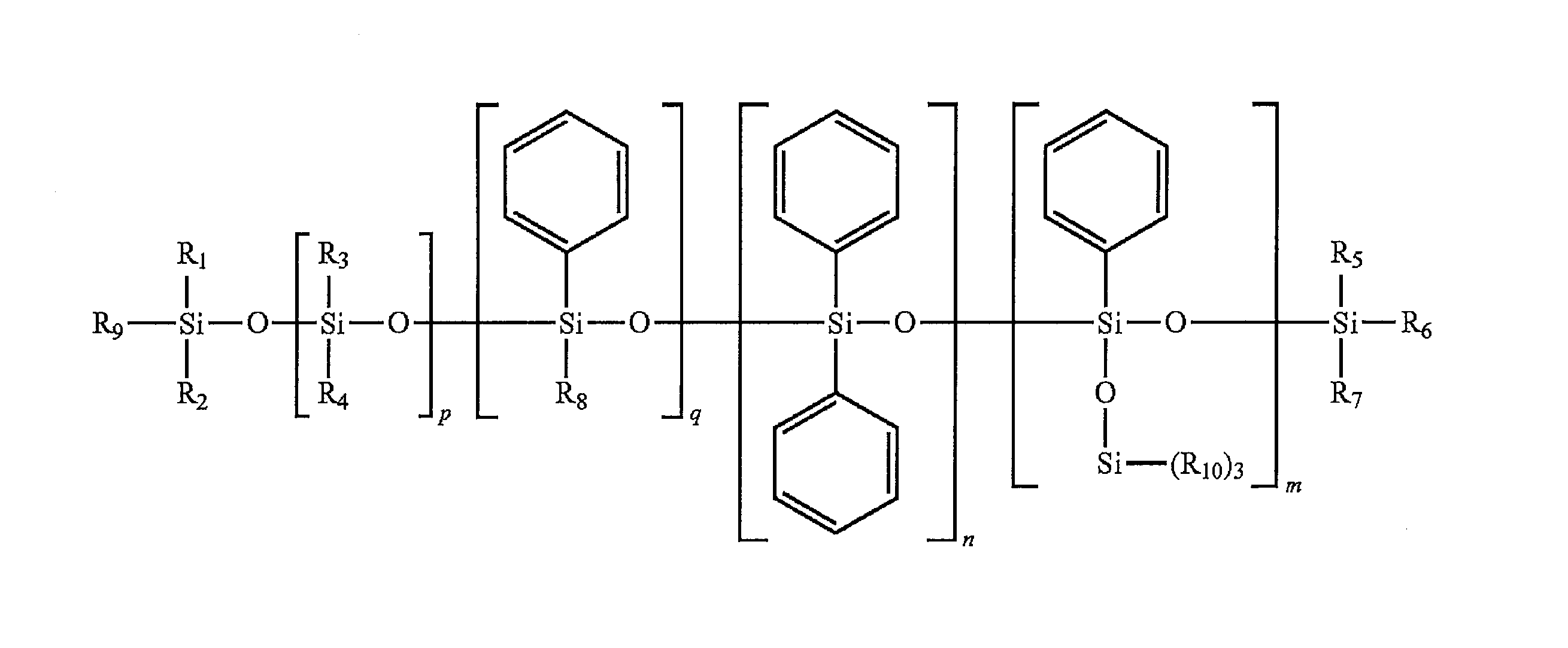
(式中、
R1からR10は、互いに独立して、飽和又は不飽和の、直鎖状、環状又は分枝状のC1~C30炭化水素系基、好ましくはC1~C12炭化水素系基、より好ましくはC1~C6炭化水素系基、特にメチル、エチル、プロピル又はブチル基であり、
m、n、p及びqは、互いに独立して、0以上900以下、好ましくは0以上500以下、より好ましくは0以上100以下の整数であり、
ただし、和n+m+qは、0以外である)
のフェニルシリコーンから選択することができる。
(In the formula,
R 1 to R 10 are each independently a saturated or unsaturated, linear, cyclic or branched C 1 to C 30 hydrocarbon group, preferably a C 1 to C 12 hydrocarbon group; More preferably C 1 -C 6 hydrocarbon groups, especially methyl, ethyl, propyl or butyl groups,
m, n, p and q are each independently an integer of 0 or more and 900 or less, preferably 0 or more and 500 or less, more preferably 0 or more and 100 or less,
However, the sum n+m+q is other than 0)
phenyl silicone.
挙げることができる例には、以下の名称で販売されている製品が含まれる:
- Rhodia社製の70641シリーズのSilbione(登録商標)油、
- Rhodia社製のRhodorsil(登録商標)70633及び763シリーズの油、
- Dow Corning社製の油Dow Corning 556 Cosmetic Grade Fluid、
- Bayer社製のPKシリーズのシリコーン、例えば製品PK20、
- General Electric社製のSFシリーズのある種の油、例えばSF 1023、SF 1154、SF 1250及びSF 1265。
Examples that may be mentioned include products sold under the following names:
- Silbione® oil from the 70641 series manufactured by Rhodia,
- Rhodorsil® 70633 and 763 series oils manufactured by Rhodia;
- Dow Corning 556 Cosmetic Grade Fluid,
- Silicones of the PK series manufactured by Bayer, for example product PK20,
- Certain oils of the SF series manufactured by General Electric, such as SF 1023, SF 1154, SF 1250 and SF 1265.
フェニルシリコーン油として、フェニルトリメチコン(上記の式中、R1からR10は、メチルであり、p、q、及びn=0であり、m=1である)が好ましい。 As the phenyl silicone oil, phenyl trimethicone (in the above formula, R 1 to R 10 are methyl, p, q, and n=0, and m=1) is preferred.
有機変性液体シリコーンは、とりわけ、ポリエチレンオキシ及び/又はポリプロピレンオキシ基を含有してもよい。したがって、信越化学工業株式会社により提案されているシリコーンKF-6017、及びUnion Carbide社製の油Silwet(登録商標)L722及びL77を挙げることができる。 The organically modified liquid silicone may contain, inter alia, polyethyleneoxy and/or polypropyleneoxy groups. Mention may therefore be made of the silicone KF-6017 proposed by Shin-Etsu Chemical Co., Ltd. and the oils Silwet® L722 and L77 from Union Carbide.
炭化水素油は、以下から選択することができる:
- 直鎖状又は分枝状の、任意選択で環状のC6~C16低級アルカン。挙げることができる例には、ヘキサン、ウンデカン、ドデカン、トリデカン、及びイソパラフィン、例えばイソヘキサデカン、イソドデカン及びイソデカンが含まれる;並びに
- 16個超の炭素原子を含有する直鎖状又は分枝状の炭化水素、例えば流動パラフィン、流動ワセリン、ポリデセン及び水添ポリイソブテン、例えばParleam(登録商標)、及びスクアラン。
Hydrocarbon oils can be selected from:
- straight-chain or branched, optionally cyclic C 6 -C 16 lower alkanes. Examples that may be mentioned include hexane, undecane, dodecane, tridecane and isoparaffins such as isohexadecane, isododecane and isodecane; and
- Straight-chain or branched hydrocarbons containing more than 16 carbon atoms, such as liquid paraffin, liquid petrolatum, polydecene and hydrogenated polyisobutenes, such as Parleam®, and squalane.
炭化水素油の好ましい例として、例えば、直鎖状又は分枝状の炭化水素、例えばイソヘキサデカン、イソドデカン、スクアラン、鉱油(例えば、流動パラフィン)、パラフィン、ワセリン又はペトロラタム、ナフタレン等;水添ポリイソブテン、イソエイコサン、及びデセン/ブテンコポリマー;並びにそれらの混合物を挙げることができる。 Preferred examples of hydrocarbon oils include, for example, linear or branched hydrocarbons such as isohexadecane, isododecane, squalane, mineral oils (e.g. liquid paraffin), paraffin, vaseline or petrolatum, naphthalene, etc.; hydrogenated polyisobutene, Mention may be made of isoeicosane, and decene/butene copolymers; and mixtures thereof.
脂肪アルコールにおける「脂肪」という用語は、比較的多数の炭素原子が含まれることを意味する。したがって、4個以上、好ましくは6個以上、より好ましくは12個以上の炭素原子を有するアルコールは、脂肪アルコールの範囲内に包含される。脂肪アルコールは、飽和であっても不飽和であってもよい。脂肪アルコールは、直鎖状であっても分枝状であってもよい。 The term "fat" in fatty alcohols is meant to contain a relatively large number of carbon atoms. Therefore, alcohols having 4 or more carbon atoms, preferably 6 or more carbon atoms, more preferably 12 or more carbon atoms are included within the scope of fatty alcohols. Fatty alcohols can be saturated or unsaturated. Fatty alcohols may be linear or branched.
脂肪アルコールは、構造R-OH(式中、Rは、4から40個の炭素原子、好ましくは6から30個の炭素原子、より好ましくは12から20個の炭素原子を含有する飽和及び不飽和の、直鎖状及び分枝状の基から選択される)を有してもよい。少なくとも1つの実施形態では、Rは、C12~C20アルキル及びC12~C20アルケニル基から選択することができる。Rは、少なくとも1つのヒドロキシル基で置換されていてもいなくてもよい。 Fatty alcohols have the structure R-OH (where R is a saturated and unsaturated alcohol containing from 4 to 40 carbon atoms, preferably from 6 to 30 carbon atoms, more preferably from 12 to 20 carbon atoms). (selected from linear and branched groups). In at least one embodiment, R can be selected from C 12 -C 20 alkyl and C 12 -C 20 alkenyl groups. R may or may not be substituted with at least one hydroxyl group.
脂肪アルコールの例として、ラウリルアルコール、セチルアルコール、ステアリルアルコール、イソステアリルアルコール、ベヘニルアルコール、ウンデシレニルアルコール、ミリスチルアルコール、オクチルドデカノール、ヘキシルデカノール、オレイルアルコール、リノレイルアルコール、パルミトレイルアルコール、アラキドニルアルコール、エルシルアルコール、及びそれらの混合物を挙げることができる。 Examples of fatty alcohols include lauryl alcohol, cetyl alcohol, stearyl alcohol, isostearyl alcohol, behenyl alcohol, undecylenyl alcohol, myristyl alcohol, octyldodecanol, hexyldecanol, oleyl alcohol, linoleyl alcohol, palmitoleyl alcohol, arachidonyl alcohol, Mention may be made of erucil alcohol, and mixtures thereof.
脂肪アルコールは、飽和脂肪アルコールであることが好ましい。 Preferably, the fatty alcohol is a saturated fatty alcohol.
したがって、脂肪アルコールは、直鎖又は分枝状の、飽和又は不飽和のC6~C30アルコール、好ましくは直鎖又は分枝状の、飽和C6~C30アルコール、より好ましくは直鎖又は分枝状の、飽和C12~C20アルコールから選択することができる。 Thus, fatty alcohols are straight-chain or branched, saturated or unsaturated C 6 -C 30 alcohols, preferably straight-chain or branched, saturated C 6 -C 30 alcohols, more preferably straight-chain or It can be selected from branched, saturated C 12 -C 20 alcohols.
本明細書における「飽和脂肪アルコール」という用語は、長い脂肪族飽和炭素鎖を有するアルコールを意味する。飽和脂肪アルコールは、任意の直鎖状又は分枝状の、飽和C6~C30脂肪アルコールから選択されることが好ましい。直鎖状又は分枝状の、飽和C6~C30脂肪アルコールの中で、好ましくは、直鎖状又は分枝状の、飽和C12~C20脂肪アルコールを使用することができる。より好ましくは、任意の直鎖状又は分枝状の、飽和C16~C20脂肪アルコールを使用することができる。更に好ましくは、分枝状C16~C20脂肪アルコールを使用することができる。 The term "saturated fatty alcohol" as used herein refers to alcohols with long aliphatic saturated carbon chains. Preferably, the saturated fatty alcohol is selected from any linear or branched, saturated C 6 to C 30 fatty alcohol. Among the straight-chain or branched, saturated C 6 -C 30 fatty alcohols, preferably the straight-chain or branched saturated C 12 -C 20 fatty alcohols can be used. More preferably, any linear or branched, saturated C 16 -C 20 fatty alcohol can be used. More preferably, branched C 16 -C 20 fatty alcohols can be used.
飽和脂肪アルコールの例として、ラウリルアルコール、セチルアルコール、ステアリルアルコール、イソステアリルアルコール、ベヘニルアルコール、ウンデシレニルアルコール、ミリスチルアルコール、オクチルドデカノール、ヘキシルデカノール、及びそれらの混合物を挙げることができる。一実施形態では、セチルアルコール、ステアリルアルコール、オクチルドデカノール、ヘキシルデカノール、又はそれらの混合物(例えば、セテアリルアルコール)並びにベヘニルアルコールを、飽和脂肪アルコールとして使用することができる。 As examples of saturated fatty alcohols, mention may be made of lauryl alcohol, cetyl alcohol, stearyl alcohol, isostearyl alcohol, behenyl alcohol, undecylenyl alcohol, myristyl alcohol, octyldodecanol, hexyldecanol, and mixtures thereof. In one embodiment, cetyl alcohol, stearyl alcohol, octyldodecanol, hexyldecanol, or mixtures thereof (eg, cetearyl alcohol) as well as behenyl alcohol can be used as the saturated fatty alcohol.
少なくとも1つの実施形態によれば、本発明による組成物中で使用される脂肪アルコールは、好ましくは、オクチルドデカノール、ヘキシルデカノール及びそれらの混合物から選択される。 According to at least one embodiment, the fatty alcohol used in the composition according to the invention is preferably selected from octyldodecanol, hexyldecanol and mixtures thereof.
(e)追加の油は、極性油から、より好ましくはエステル油、人工トリグリセリド及びそれらの混合物から、更に好ましくはエステル油、人工トリグリセリド及びそれらの混合物から選択されることが好ましい。 (e) The additional oil is preferably selected from polar oils, more preferably from ester oils, artificial triglycerides and mixtures thereof, even more preferably from ester oils, artificial triglycerides and mixtures thereof.
本発明による組成物中の(e)追加の油の量は、組成物の総質量に対して、0.01質量%以上、好ましくは0.1質量%以上、より好ましくは1質量%以上であることができる。 The amount of (e) additional oil in the composition according to the invention can be at least 0.01% by weight, preferably at least 0.1% by weight, more preferably at least 1% by weight, relative to the total weight of the composition. .
本発明による組成物中の(e)追加の油の量は、組成物の総質量に対して、40質量%以下、好ましくは35質量%以下、より好ましくは30質量%以下であることができる。 The amount of (e) additional oil in the composition according to the invention can be up to 40% by weight, preferably up to 35% by weight, more preferably up to 30% by weight, relative to the total weight of the composition. .
本発明による組成物中の(e)追加の油の量は、組成物の総質量に対して、0.01質量%から40質量%、好ましくは0.1質量%から35質量%、より好ましくは1質量%から30質量%であることができる。 The amount of (e) additional oil in the composition according to the invention is from 0.01% to 40% by weight, preferably from 0.1% to 35% by weight, more preferably 1% by weight, relative to the total weight of the composition. to 30% by mass.
[美容有効成分]
本発明による組成物は、(b)有機UVフィルターに加えて少なくとも1種の(追加の)美容有効成分を含んでもよい。追加の美容有効成分は、(b)有機UVフィルターでない限り限定されない。2種以上の追加の美容有効成分を組み合わせて使用してもよい。したがって、単一のタイプの追加の美容有効成分、又は異なるタイプの追加の美容有効成分の組合せを使用することができる。
[Beauty active ingredients]
The composition according to the invention may comprise (b) at least one (additional) cosmetically active ingredient in addition to the organic UV filter. Additional cosmetic active ingredients are not limited to (b) organic UV filters; Two or more additional cosmetically active ingredients may be used in combination. Thus, a single type of additional cosmetic active ingredient or a combination of different types of additional cosmetic active ingredients can be used.
使用される追加の美容有効成分の中で、抗酸化剤、クレンジング剤、フリーラジカル捕捉剤、保湿剤、美白剤、脂質調節剤(liporegulator)、抗ニキビ剤、抗フケ剤、抗老化剤、軟化剤、抗しわ剤、角質溶解剤、フレッシュナー、抗細菌剤、抗真菌剤、発汗抑制剤、デオドラント、皮膚コンディショナー、麻酔剤、栄養剤、及び皮脂吸収剤又は水分吸収剤を挙げることができる。 Among the additional cosmetic active ingredients used are antioxidants, cleansing agents, free radical scavengers, humectants, skin whitening agents, liporegulators, anti-acne agents, anti-dandruff agents, anti-aging agents, softening agents. Mention may be made of anti-wrinkle agents, keratolytic agents, fresheners, antibacterial agents, antifungal agents, antiperspirants, deodorants, skin conditioners, anesthetics, nutritional agents, and sebum or moisture absorbers.
本発明による組成物は、追加の美容有効成分を、組成物の総質量に対して、0.01質量%から20質量%、好ましくは0.1質量%から15質量%、より好ましくは0.5質量%から10質量%、更に好ましくは1質量%から5質量%の量で含んでもよい。 The composition according to the invention comprises from 0.01% to 20% by weight, preferably from 0.1% to 15% by weight, more preferably from 0.5% to 10% by weight, relative to the total weight of the composition. %, more preferably 1% to 5% by weight.
[任意選択の添加剤]
本発明による組成物は、前述の成分に加えて、化粧品において典型的に用いられる成分、具体的には、界面活性剤又は乳化剤、親水性又は親油性増粘剤、有機揮発性又は不揮発性溶媒、(e)追加の油以外のシリコーン及びシリコーン誘導体、動物又は植物に由来する天然抽出物、ワックス等を、本発明の効果を損なわない範囲内で含んでもよい。
[Optional additives]
In addition to the aforementioned ingredients, the compositions according to the invention contain ingredients typically used in cosmetics, in particular surfactants or emulsifiers, hydrophilic or lipophilic thickeners, organic volatile or non-volatile solvents. (e) Additional silicone and silicone derivatives other than oil, natural extracts derived from animals or plants, wax, etc. may be included within the range that does not impair the effects of the present invention.
本発明による組成物は、上記の任意選択の添加剤を、組成物の総質量に対して、0.001質量%から30質量%、好ましくは0.01質量%から20質量%、より好ましくは0.1質量%から10質量%の量で含んでもよい。 The composition according to the invention comprises from 0.001% to 30% by weight, preferably from 0.01% to 20% by weight, more preferably from 0.1% by weight, relative to the total weight of the composition. It may be included in an amount of 10% by mass.
[組成物]
本発明による組成物は、脂肪又は油性でありうる少なくとも1種の(b)有機UVフィルターを含むことから、本発明による組成物は、少なくとも1つの脂肪又は油性相を含むことができる。
[Composition]
Since the composition according to the invention comprises at least one (b) organic UV filter which may be fatty or oily, the composition according to the invention may comprise at least one fatty or oily phase.
一方、本発明による組成物は、(d)水を含むことから、本発明による組成物は、少なくとも1つの水性相を含むことができる。 On the other hand, since the composition according to the invention comprises (d) water, the composition according to the invention can comprise at least one aqueous phase.
水性相は、少なくとも1種のC2~C6一価アルコールを含んでもよい。2種以上のC2~C6一価アルコールを組み合わせて使用してもよい。 The aqueous phase may contain at least one C 2 to C 6 monohydric alcohol. Two or more C 2 to C 6 monohydric alcohols may be used in combination.
本発明に好適なC2~C6一価アルコールは、2から5個の炭素原子、好ましくは2から4個の炭素原子を含んでもよく、例えばエタノール、イソプロパノール、プロパノール又はブタノールである。 C 2 -C 6 monohydric alcohols suitable for the invention may contain 2 to 5 carbon atoms, preferably 2 to 4 carbon atoms, for example ethanol, isopropanol, propanol or butanol.
エタノール及びイソプロパノール、好ましくはエタノールが、本発明に非常に特に好適である。 Ethanol and isopropanol, preferably ethanol, are very particularly suitable for the present invention.
本発明による組成物中のC2~C6一価アルコールの量は、組成物の総質量に対して、20質量%以下、好ましくは15質量%以下、より好ましくは10質量%以下であることができる。一方、本発明による組成物中のC2~C6一価アルコールの量は、組成物の総質量に対して、1質量%以上、好ましくは2質量%以上、より好ましくは3質量%以上である。例えば、C2~C6一価アルコールの量は、組成物の総質量に対して、5質量%から20質量%、好ましくは6質量%から15質量%、より好ましくは7質量%から10質量%であることができる。 The amount of C 2 -C 6 monohydric alcohol in the composition according to the invention is not more than 20% by weight, preferably not more than 15% by weight, more preferably not more than 10% by weight, relative to the total weight of the composition. Can be done. On the other hand, the amount of C 2 -C 6 monohydric alcohol in the composition according to the invention is at least 1% by weight, preferably at least 2% by weight, more preferably at least 3% by weight, based on the total weight of the composition. be. For example, the amount of C 2 -C 6 monohydric alcohol may be from 5% to 20% by weight, preferably from 6% to 15% by weight, more preferably from 7% to 10% by weight relative to the total weight of the composition. %.
本発明による組成物は、W/O(油中水)型である。本発明によるW/O型組成物は、連続した、油性又は脂肪(外)相と、分散又は水性(内)相とを含む。 The composition according to the invention is of the W/O (water-in-oil) type. The W/O composition according to the invention comprises a continuous, oily or fatty (outer) phase and a dispersed or aqueous (inner) phase.
本発明による組成物は、W/Oエマルションの形態であることができる。W/Oエマルションの形態の本発明による組成物は、典型的には、少なくとも1種の界面活性剤又は乳化剤を含むことができる。 The composition according to the invention can be in the form of a W/O emulsion. Compositions according to the invention in the form of W/O emulsions may typically contain at least one surfactant or emulsifier.
本発明による組成物は、化粧用組成物であることができる。したがって、本発明による化粧用組成物は、ケラチン物質に塗布するためのものであることができる。本明細書におけるケラチン物質は、ケラチンを主要構成要素として含有する材料を意味し、その例には、皮膚、頭皮、爪、唇、毛髪等が含まれる。したがって、本発明による化粧用組成物は、ケラチン物質、特に皮膚のための美容方法に使用することが好ましい。 The composition according to the invention can be a cosmetic composition. The cosmetic composition according to the invention can therefore be intended for application to keratinous materials. The term keratin material as used herein refers to a material containing keratin as a main constituent, examples of which include skin, scalp, nails, lips, hair, and the like. The cosmetic composition according to the invention is therefore preferably used in cosmetic methods for keratin materials, especially the skin.
したがって、本発明による化粧用組成物は、皮膚化粧用組成物、好ましくはスキンケア組成物又は皮膚メイクアップ組成物、特に紫外線から皮膚を保護するための組成物であることができる。 The cosmetic composition according to the invention can therefore be a dermocosmetic composition, preferably a skin care composition or a skin make-up composition, in particular a composition for protecting the skin from ultraviolet radiation.
本発明による組成物は、当業者に周知の方法のいずれかに従って、上記の必須及び任意選択の成分を混合することにより調製することができる。 Compositions according to the invention can be prepared by mixing the above-mentioned essential and optional ingredients according to any of the methods well known to those skilled in the art.
[皮膜]
本発明による組成物は、皮膜を調製するのに使用することができる。(a)ポリイオンコンプレックスは、凝集し、合体して連続した皮膜となることができる。
[Film]
The composition according to the invention can be used to prepare coatings. (a) Polyion complexes can aggregate and coalesce into a continuous film.
したがって、本発明はまた、好ましくは0.1μm超、より好ましくは1.5μm以上、更に好ましくは2μm以上の厚さの皮膜、好ましくは化粧皮膜を調製するための方法であって、
本発明による組成物を基材、好ましくはケラチン基材、より好ましくは皮膚に塗布する工程と、
組成物を乾燥させる工程と
を含む方法に関しうる。
The invention therefore also provides a method for preparing a coating, preferably a decorative coating, with a thickness of preferably greater than 0.1 μm, more preferably 1.5 μm or more, even more preferably 2 μm or more, comprising:
applying a composition according to the invention to a substrate, preferably a keratin substrate, more preferably skin;
and drying the composition.
本発明による組成物により調製される皮膜の厚さの上限は限定されない。したがって、例えば、本発明による組成物により調製される皮膜の厚さは、1mm以下、好ましくは500μm以下、より好ましくは300μm以下、更に好ましくは100μm以下であることができる。 There is no upper limit to the thickness of the coating prepared by the composition according to the invention. Thus, for example, the thickness of the coating prepared by the composition according to the invention can be 1 mm or less, preferably 500 μm or less, more preferably 300 μm or less, even more preferably 100 μm or less.
皮膜を調製するための方法は、本発明による組成物を基材、好ましくはケラチン基材、より好ましくは皮膚に塗布する工程と、組成物を乾燥させる工程とを含むことから、本発明による方法は、スピンコーティング又はスプレーすることを必要とせず、したがって、比較的厚い皮膜さえ容易に調製することが可能である。したがって、皮膜を調製するための方法は、スピンコーター及びスプレー機等の特殊な装置を一切用いずに比較的厚い皮膜を調製することができる。 The method according to the invention comprises the steps of: applying a composition according to the invention to a substrate, preferably a keratin substrate, more preferably skin; and drying the composition. does not require spin-coating or spraying, so even relatively thick coatings can be easily prepared. Therefore, the method for preparing the coating allows relatively thick coatings to be prepared without using any special equipment such as spin coaters and spray machines.
本発明による組成物により調製される皮膜は、比較的厚い場合であっても、なお薄く、透明とすることができ、したがって、知覚することが容易でない場合がある。したがって、本発明による組成物により調製される皮膜は、好ましくは化粧皮膜として使用することができる。 Even if the films prepared by the compositions according to the invention are relatively thick, they can still be thin and transparent and therefore may not be easy to perceive. The films prepared by the compositions according to the invention can therefore preferably be used as cosmetic films.
基材が皮膚等のケラチン基材でない場合、本発明による組成物は、ケラチン以外の任意の材料から作製された基材に塗布することができる。非ケラチン基材の材料は限定されない。2種以上の材料を組み合わせて使用してもよい。したがって、単一のタイプの材料、又は異なるタイプの材料の組合せを使用することができる。いずれにせよ、基材は、可撓性又は弾性であることが好ましい。 If the substrate is not a keratin substrate, such as skin, the composition according to the invention can be applied to a substrate made of any material other than keratin. The material of the non-keratin base material is not limited. Two or more types of materials may be used in combination. Thus, a single type of material or a combination of different types of materials can be used. In any case, the substrate is preferably flexible or elastic.
基材がケラチン基材でない場合、基材は、水溶性であることが好ましく、その理由は、基材を水で洗浄することにより本発明による組成物により調製される皮膜を残すことが可能であるからである。水溶性材料の例として、ポリ(メタ)アクリル酸、ポリエチレングリコール、ポリアクリルアミド、ポリビニルアルコール(PVA)、デンプン、酢酸セルロース等を挙げることができる。PVAが好ましい。 If the substrate is not a keratin substrate, it is preferably water-soluble, since it is possible to leave behind the film prepared by the composition according to the invention by washing the substrate with water. Because there is. Examples of water-soluble materials include poly(meth)acrylic acid, polyethylene glycol, polyacrylamide, polyvinyl alcohol (PVA), starch, cellulose acetate, and the like. PVA is preferred.
非ケラチン基材がシートの形態である場合、これは、基材シートに付着した皮膜の取り扱いを容易にするために、本発明による組成物により調製される皮膜の厚さを超える厚さを有してもよい。非ケラチン基材シートの厚さは限定されないが、1μmから5mm、好ましくは10μmから1mm、より好ましくは50から500μmであることができる。 If the non-keratinous substrate is in the form of a sheet, it may have a thickness that exceeds the thickness of the coating prepared by the composition according to the invention, in order to facilitate handling of the coating adhered to the substrate sheet. You may. The thickness of the non-keratin substrate sheet is not limited, but can be from 1 μm to 5 mm, preferably from 10 μm to 1 mm, more preferably from 50 to 500 μm.
本発明による組成物により調製される皮膜は、非ケラチン基材から取り外し可能であることがより好ましい。取り外し方式は限定されない。したがって、本発明による組成物により調製される皮膜は、非ケラチン基材から剥がしてもよく、又は基材シートを水等の溶媒中に溶解することにより取り外してもよい。 More preferably, the film prepared by the composition according to the invention is removable from a non-keratinous substrate. The removal method is not limited. The film prepared by the composition according to the invention may therefore be peeled off from a non-keratinous substrate or removed by dissolving the substrate sheet in a solvent such as water.
本発明はまた、
(1)本発明による組成物を基材、好ましくはケラチン基材、より好ましくは皮膚に塗布する工程と、
組成物を乾燥させる工程と
を含む方法により調製される、好ましくは0.1μm超、より好ましくは1.5μm以上、更に好ましくは2μm以上の厚さの皮膜、好ましくは化粧皮膜、
並びに
(2)(i)少なくとも1種のカチオン性ポリマー及び2つ以上のpKa値を有する少なくとも1種の非ポリマー酸若しくはその塩、
(ii)少なくとも1種のアニオン性ポリマー及び2つ以上のpKb値を有する少なくとも1種の非ポリマー塩基若しくはその塩、又は
(iii)少なくとも1種の両性ポリマー並びに2つ以上のpKa値を有する少なくとも1種の非ポリマー酸若しくはその塩及び/若しくは2つ以上のpKb値を有する少なくとも1種の非ポリマー塩基若しくはその塩
及び
少なくとも1種の有機UVフィルター
を含む、好ましくは0.1μm超、より好ましくは1.5μm以上、更に好ましくは2μm以上の厚さの皮膜、好ましくは化粧皮膜に関しうる。
The present invention also provides
(1) applying the composition according to the invention to a substrate, preferably a keratin substrate, more preferably skin;
a coating, preferably a decorative coating, preferably with a thickness of more than 0.1 μm, more preferably 1.5 μm or more, even more preferably 2 μm or more, prepared by a method comprising the step of drying the composition,
and
(2)(i) at least one cationic polymer and at least one non-polymeric acid or salt thereof having a pKa value of two or more;
(ii) at least one anionic polymer and at least one non-polymeric base or salt thereof having a pKb value of two or more; or
(iii) at least one amphoteric polymer and at least one non-polymeric acid or salt thereof having a pKa value of two or more and/or at least one non-polymeric base or salt thereof having a pKb value of two or more; It may relate to a coating, preferably a decorative coating, comprising at least one organic UV filter, preferably having a thickness of more than 0.1 μm, more preferably 1.5 μm or more, even more preferably 2 μm or more.
カチオン性、アニオン性及び両性ポリマー、並びに上記の有機UVフィルター、2つ以上のpKa値を有する非ポリマー酸、及び2つ以上のpKb値を有する非ポリマー塩基に関する上記の説明は、上記の皮膜(1)及び(2)におけるものに適用されうる。 The above discussion regarding cationic, anionic and amphoteric polymers, as well as the organic UV filters described above, non-polymeric acids with pKa values of 2 or more, and non-polymeric bases with pKb values of 2 or more, are applicable to the coatings ( Can be applied to those in 1) and (2).
上記の方法によりこのようにして得られた皮膜は、自立性とすることができる。本明細書における「自立性」という用語は、皮膜をシートの形態とすることができ、基材又は支持体の補助なしに独立したシートとして取り扱うことができることを意味する。したがって、「自立性」という用語は、「自己支持性」と同じ意味を有することができる。 The coating thus obtained by the method described above can be self-supporting. The term "self-supporting" as used herein means that the coating can be in the form of a sheet and can be handled as an independent sheet without the aid of a substrate or support. Accordingly, the term "autonomy" can have the same meaning as "self-supporting."
本発明による組成物により調製される皮膜は、疎水性であることが好ましい。 Preferably, the coating prepared by the composition according to the invention is hydrophobic.
本明細書における「疎水性」という用語は、20から40℃、好ましくは25から40℃、より好ましくは30から40℃でのポリマーの水(好ましくは1リットルの体積)に対する溶解度が、ポリマーの総質量に対して、10質量%未満、好ましくは5質量%未満、より好ましくは1質量%未満、更に好ましくは0.1質量%未満であることを意味する。ポリマーは、水に可溶性でないことが最も好ましい。 The term "hydrophobic" as used herein means that the solubility of the polymer in water (preferably in a volume of 1 liter) at 20 to 40°C, preferably 25 to 40°C, more preferably 30 to 40°C This means less than 10% by weight, preferably less than 5% by weight, more preferably less than 1% by weight, even more preferably less than 0.1% by weight, based on the total weight. Most preferably, the polymer is not soluble in water.
本発明による組成物により調製される皮膜が疎水性である場合、皮膜は、耐水特性を有することができ、したがって、ケラチン基材の表面が例えば汗又は雨により濡れている場合であっても、皮膚等のケラチン基材上に残存することができる。したがって、本発明による組成物により調製される皮膜が何らかの美容効果を提供する場合、その美容効果は長時間持続することができる。 If the film prepared by the composition according to the invention is hydrophobic, the film can have water-resistant properties, thus even if the surface of the keratin substrate is wet, for example due to sweat or rain. It can remain on keratin substrates such as skin. Therefore, if the film prepared by the composition according to the invention provides any cosmetic effect, that cosmetic effect can last for a long time.
一方、本発明による組成物により調製される皮膜は、pH8から12、好ましくは9から11等のアルカリ性条件下で、皮膚等のケラチン基材から容易に除去することができる。したがって、本発明による組成物により調製される皮膜は、水で除去することは困難であるが、そのようなアルカリ性条件をもたらすことができる石けんで容易に除去することができる。 On the other hand, the film prepared by the composition according to the invention can be easily removed from keratin substrates such as skin under alkaline conditions such as pH 8 to 12, preferably 9 to 11. The film prepared by the composition according to the invention is therefore difficult to remove with water, but can be easily removed with soap capable of providing such alkaline conditions.
本発明による組成物により調製される皮膜は、少なくとも1種の生体適合性及び/又は生分解性ポリマーの層を含んでもよい。2種以上の生体適合性及び/又は生分解性ポリマーを組み合わせて使用してもよい。したがって、単一のタイプの生体適合性及び/若しくは生分解性ポリマー、又は異なるタイプの生体適合性及び/若しくは生分解性ポリマーの組合せを使用することができる。 The coating prepared by the composition according to the invention may comprise a layer of at least one biocompatible and/or biodegradable polymer. Combinations of two or more biocompatible and/or biodegradable polymers may be used. Thus, a single type of biocompatible and/or biodegradable polymer or a combination of different types of biocompatible and/or biodegradable polymers can be used.
本明細書における「生体適合性」ポリマーという用語は、ポリマーが、ポリマーと皮膚を含む生体内の細胞との間の過度の相互作用を有さず、ポリマーが、生体により異物として認識されないことを意味する。 The term "biocompatible" polymer as used herein indicates that the polymer does not have excessive interaction between the polymer and cells within the body, including the skin, and that the polymer is not recognized as foreign by the body. means.
本明細書における「生分解性」ポリマーという用語は、ポリマーが、例えば生体自体の代謝又は生体内に存在しうる微生物の代謝により、生体内で分解又は分割されうることを意味する。また、生分解性ポリマーは、加水分解により分解されうる。 The term "biodegradable" polymer as used herein means that the polymer can be degraded or broken down in an organism, for example by the organism's own metabolism or by the metabolism of microorganisms that may be present in the organism. Biodegradable polymers can also be degraded by hydrolysis.
本発明による組成物により調製される皮膜が生体適合性及び/又は生分解性ポリマーを含む場合、これは、皮膚への刺激が少ないか又は刺激がなく、発疹を起こさない。加えて、生体適合性及び/又は生分解性ポリマーの使用により、皮膜は、化粧皮膜として皮膚に良好に接着することができる。 If the film prepared by the composition according to the invention comprises biocompatible and/or biodegradable polymers, it is less or non-irritating to the skin and does not cause rashes. In addition, the use of biocompatible and/or biodegradable polymers allows the film to adhere well to the skin as a cosmetic film.
本発明による組成物により調製される皮膜は、ケラチン物質、好ましくは皮膚、特に顔の美容処置に使用することができる。本発明による組成物により調製される皮膜は、任意の形状又は形態であってよい。例えば、これは、フルフェイスマスクシート、又は頬、鼻、及び目の周り等の顔の一部用のパッチとして使用することができる。 The films prepared by the compositions according to the invention can be used in the cosmetic treatment of keratin materials, preferably the skin, especially the face. The coating prepared by the composition according to the invention may be of any shape or form. For example, it can be used as a full face mask sheet or as a patch for parts of the face such as the cheeks, nose, and around the eyes.
本発明による組成物により調製される皮膜は、少なくとも1種の有機UVフィルターを含むことから、これは、有機UVフィルターに由来するUV遮断効果を提供することができる。通常、有機UVフィルターは、皮脂等により皮膚等のケラチン基材の表面から除去されうる。しかしながら、有機UVフィルターは、皮膜に含まれることから、有機UVフィルターが皮脂等により除去されることは困難であり、それにより、長時間持続するUV遮断効果を生じさせる。 Since the coating prepared by the composition according to the invention comprises at least one organic UV filter, it can provide the UV blocking effect derived from the organic UV filter. Typically, organic UV filters can be removed from the surface of keratin substrates such as skin by sebum and the like. However, since the organic UV filter is contained in a film, it is difficult for the organic UV filter to be removed by sebum or the like, thereby producing a UV blocking effect that lasts for a long time.
[美容方法]
本発明はまた、
皮膚等のケラチン基材のための美容方法であって、本発明による組成物をケラチン基材に塗布する工程を含む、方法
に関する。
[Beauty method]
The present invention also provides
The present invention relates to a cosmetic method for keratin substrates, such as skin, which method comprises applying a composition according to the invention to the keratin substrate.
本発明による美容方法は、組成物を乾燥させて、ケラチン基材上に化粧皮膜を形成する工程を更に含むことが好ましい。 Preferably, the cosmetic method according to the present invention further includes the step of drying the composition to form a cosmetic film on the keratin substrate.
本明細書における美容方法は、皮膚等のケラチン基材の表面をケア及び/又はメイクアップするための非治療的美容法を意味する。 Cosmetic methods herein refer to non-therapeutic cosmetic methods for caring for and/or making up keratin-based surfaces such as skin.
上記の方法において、上記の化粧皮膜は、pH7以下の水に耐性があり、pH7超、好ましくは8以上、より好ましくは9以上の水で除去可能である。 In the above method, the cosmetic film is resistant to water with a pH of 7 or less and is removable with water with a pH of more than 7, preferably 8 or more, more preferably 9 or more.
言い換えると、上記の化粧皮膜は、pH7以下、好ましくは6以上且つ7以下の範囲、より好ましくは5以上且つ7以下の範囲等の中性又は酸性条件下で耐水性でありうるが、上記の化粧皮膜は、pH7超、好ましくは8以上、より好ましくは9以上等のアルカリ性条件下で除去することができる。pHの上限は、好ましくは13、より好ましくは12、更に好ましくは11である。 In other words, the cosmetic film described above may be water resistant under neutral or acidic conditions, such as at a pH of 7 or less, preferably in a range of 6 or more and 7 or less, more preferably in a range of 5 or more and 7 or less; The cosmetic film can be removed under alkaline conditions, such as at a pH above 7, preferably above 8, more preferably above 9. The upper limit of pH is preferably 13, more preferably 12, even more preferably 11.
よって、上記の化粧皮膜は、耐水性とすることができ、したがって、ケラチン基材の表面が例えば汗又は雨により濡れている場合であっても、皮膚等のケラチン基材上に残存することができる。一方、上記の化粧皮膜は、アルカリ性条件下で、皮膚等のケラチン基材から容易に除去することができる。したがって、本発明による組成物により調製される皮膜は、水で除去することは困難であるが、アルカリ性条件をもたらすことができる石けんで容易に除去することができる。 Therefore, the cosmetic film described above can be water-resistant and therefore cannot remain on the keratin substrate, such as the skin, even when the surface of the keratin substrate is wet, for example due to sweat or rain. can. On the other hand, the above cosmetic film can be easily removed from a keratin substrate such as skin under alkaline conditions. The film prepared by the composition according to the invention is therefore difficult to remove with water, but can be easily removed with soap capable of providing alkaline conditions.
上記の化粧皮膜は、有機UVフィルターを含むことから、上記の化粧皮膜は、紫外線から皮膚等のケラチン基材を保護し、それにより、皮膚の黒ずみを抑え、肌の色及び均一性を改善し、並びに/又は皮膚の老化を処置することができる。 Since the above cosmetic film contains an organic UV filter, the above cosmetic film protects the keratin base material such as the skin from ultraviolet rays, thereby suppressing skin darkening and improving skin color and uniformity. , and/or to treat skin aging.
更に、上記の化粧皮膜は、化粧皮膜が他の美容有効成分を一切含まない場合であっても、化粧皮膜中のポリイオンコンプレックスの特性により、悪臭を吸収若しくは吸着する、皮膚等のケラチン基材の外観を変化させる、ケラチン基材の触感を変化させる、及び/又は例えば汚れ若しくは汚染物質からケラチン基材を保護する等の美容効果を有しうる。 Furthermore, even if the cosmetic film does not contain any other cosmetically active ingredients, the cosmetic film absorbs or adsorbs bad odors due to the properties of the polyion complex in the cosmetic film, and is effective against keratin base materials such as skin. It may have a cosmetic effect, such as changing the appearance, changing the feel of the keratin substrate, and/or protecting the keratin substrate from dirt or contaminants, for example.
加えて、上記の化粧皮膜は、化粧皮膜が美容有効成分を一切含まない場合であっても、皮膚上の光反射等を変化させることにより皮膚の外観を即座に変化させる又は修正することができる。したがって、上記の化粧皮膜は、毛穴又はしわ等の皮膚の欠陥を隠すことが可能でありうる。更に、上記の化粧皮膜は、皮膚上の表面粗さ等を変化させることにより皮膚の触感を即座に変化させる又は修正することができる。更に、上記の化粧皮膜は、環境ストレス、例えば汚染物質、夾雑物等から、バリアーとして、皮膚の表面を覆い、皮膚を防御することにより皮膚を即座に保護することができる。 In addition, the cosmetic film described above can instantly change or modify the appearance of the skin by changing light reflection on the skin, etc., even if the cosmetic film does not contain any cosmetically active ingredients. . Thus, the cosmetic film described above may be able to hide skin imperfections such as pores or wrinkles. Furthermore, the cosmetic film described above can instantly change or modify the feel of the skin by changing the surface roughness, etc. on the skin. Furthermore, the cosmetic film described above can immediately protect the skin by covering the surface of the skin as a barrier and protecting the skin from environmental stresses such as pollutants, contaminants, etc.
上記の美容効果は、上記の化粧皮膜の化学組成、厚さ及び/又は表面粗さを変化させることにより調整又は制御することができる。 The above cosmetic effects can be adjusted or controlled by changing the chemical composition, thickness and/or surface roughness of the cosmetic film.
上記の化粧皮膜が、(b)有機UVフィルター以外の少なくとも1種の追加の美容有効成分を含む場合、化粧皮膜は、その追加の美容有効成分により提供される美容効果を有することができる。例えば、化粧皮膜が、抗老化剤、皮脂抑制剤、デオドラント剤、発汗抑制剤、美白剤及びそれらの混合物から選択される少なくとも1種の美容有効成分を含む場合、化粧皮膜は、皮膚の老化を処置し、皮膚上の皮脂を吸収し、皮膚上の匂いを制御し、皮膚上の発汗を制御し、及び/又は皮膚を美白することができる。 If the above cosmetic film comprises (b) at least one additional cosmetically active ingredient other than an organic UV filter, the cosmetic film may have the cosmetic effect provided by the additional cosmetically active ingredient. For example, if the cosmetic film contains at least one cosmetically active ingredient selected from anti-aging agents, sebum suppressants, deodorants, antiperspirants, skin whitening agents and mixtures thereof, the cosmetic film may prevent skin aging. The skin can be treated to absorb sebum on the skin, control odor on the skin, control sweating on the skin, and/or whiten the skin.
本発明による組成物により調製される皮膜に、皮膚に適用された後に、メイクアップ又はスキンケア化粧用組成物を塗布することも可能である。 It is also possible to apply a make-up or skin care cosmetic composition to the film prepared by the composition according to the invention after it has been applied to the skin.
[使用]
本発明はまた、
(b)少なくとも1種の有機UVフィルターと、
(c)少なくとも1種のSPF向上剤と、
(d)水と
を含む、W/O型組成物、好ましくは化粧用組成物、より好ましくは皮膚化粧用組成物における、組成物のUV吸光度を高めるための、
(a)
(i)少なくとも1種のカチオン性ポリマー及び2つ以上のpKa値を有する少なくとも1種の非ポリマー酸若しくはその塩、
(ii)少なくとも1種のアニオン性ポリマー及び2つ以上のpKb値を有する少なくとも1種の非ポリマー塩基若しくはその塩、又は
(iii)少なくとも1種の両性ポリマー並びに少なくとも1種の2つ以上のpKa値を有する少なくとも1種の非ポリマー酸若しくはその塩及び/若しくは2つ以上のpKb値を有する少なくとも1種の非ポリマー塩基若しくはその塩
を含む少なくとも1種のポリイオンコンプレックスの使用に関する。
[use]
The present invention also provides
(b) at least one organic UV filter;
(c) at least one SPF enhancer;
(d) for increasing the UV absorbance of the composition in a W/O type composition, preferably a cosmetic composition, more preferably a dermocosmetic composition, comprising water;
(a)
(i) at least one cationic polymer and at least one non-polymeric acid or salt thereof having a pKa value of two or more;
(ii) at least one anionic polymer and at least one non-polymeric base or salt thereof having a pKb value of two or more; or
(iii) at least one amphoteric polymer and at least one non-polymeric acid or salt thereof having more than one pKa value and/or at least one non-polymer base having more than one pKb value; or a salt thereof.
カチオン性、アニオン性及び両性ポリマー、並びに上記の有機UVフィルター、2つ以上のpKa値を有する非ポリマー酸、及び2つ以上のpKb値を有する非ポリマー塩基に関する上記の説明は、本発明による上記の使用におけるものに適用されうる。 The above description regarding cationic, anionic and amphoteric polymers, as well as organic UV filters as described above, non-polymeric acids with pKa values of two or more, and non-polymeric bases with pKb values of two or more, are in accordance with the present invention. can be applied to the use of
本発明を、実施例によって、より詳細に説明する。しかしながら、それらは、本発明の範囲を限定するものと解釈すべきではない。 The present invention will be explained in more detail by way of examples. However, they should not be construed as limiting the scope of the invention.
(実施例1及び2並びに比較例1及び2)
[調製]
実施例1及び実施例2による組成物(実施例1及び実施例2)並びに比較例1及び比較例2による組成物(比較例1及び比較例2)の各々を、表1に示す成分を混合することにより調製した。成分の量の数値は全て、活性原料としての「質量%」に基づく。
(Examples 1 and 2 and Comparative Examples 1 and 2)
[Preparation]
Each of the compositions according to Example 1 and Example 2 (Example 1 and Example 2) and the composition according to Comparative Example 1 and Comparative Example 2 (Comparative Example 1 and Comparative Example 2) was mixed with the components shown in Table 1. It was prepared by All amounts of ingredients are based on "wt %" as active ingredient.
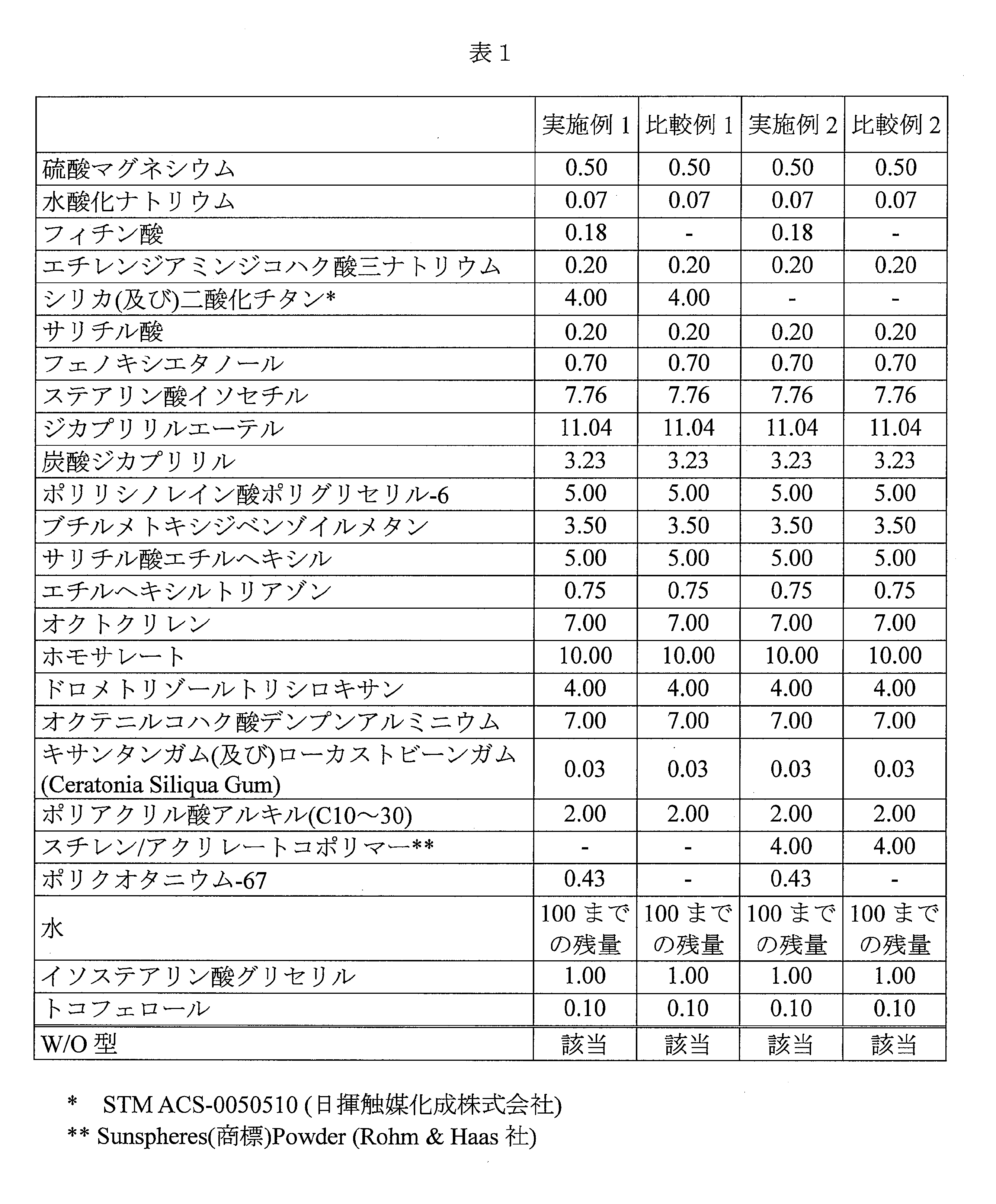
[評価]
(W/O型)
実施例1及び2並びに比較例1及び2による組成物の各々の外見を顕微鏡法で観察し、組成物がW/O型であるか否かを決定した。結果を表1に示す。表1中の「該当」及び「非該当」の意味は、以下の通りである。
該当:W/O型
非該当:O/W型
[evaluation]
(W/O type)
The appearance of each of the compositions according to Examples 1 and 2 and Comparative Examples 1 and 2 was observed by microscopy to determine whether the compositions were of W/O type. The results are shown in Table 1. The meanings of “applicable” and “not applicable” in Table 1 are as follows.
Applicable: W/O type Not applicable: O/W type
(UV吸光度)
実施例1及び2並びに比較例1及び2による組成物の各々を、キャップ付き容器中で、10回振とうして均質にした。均質な組成物の各々を、調整可能なピペットにより、プレート(Helio plate HD 6、PMMA、粗さ:6μm)上に、プレート1cm2当たり20mgの量で移し、次いで、指で均一に広げた。被覆したプレートを、室温で15分間、空気乾燥させた。得られた試料プレートを、Labsphere Ultraviolet Transmittance Analyzer(Solar Light Company社、Philadelphia、Pennsylvania製のモデルUV-2000)中に置いた。紫外線の照射を、試料プレート上の12地点で行った。250から450nmの波長での試料プレートによるUV吸光度を記録した。
(UV absorbance)
Each of the compositions according to Examples 1 and 2 and Comparative Examples 1 and 2 was homogenized by shaking 10 times in a capped container. Each of the homogeneous compositions was transferred onto a plate (Helio plate HD 6, PMMA, roughness: 6 μm) with an adjustable pipette in an amount of 20 mg per cm 2 of the plate and then spread evenly with the fingers. The coated plates were air dried for 15 minutes at room temperature. The resulting sample plate was placed in a Labsphere Ultraviolet Transmittance Analyzer (Model UV-2000, manufactured by Solar Light Company, Philadelphia, Pennsylvania). Ultraviolet irradiation was performed at 12 points on the sample plate. The UV absorbance by the sample plate at wavelengths from 250 to 450 nm was recorded.
結果を図1及び図2に示す。 The results are shown in Figures 1 and 2.
図1から、実施例1による組成物は、特に290nmから380nmで、比較例1による組成物よりも高いUV吸光度を有することが明らかである。より高いUV吸光度は、ポリイオンコンプレックスに起因すると認識されうる。 From FIG. 1 it is clear that the composition according to Example 1 has a higher UV absorbance than the composition according to Comparative Example 1, especially from 290 nm to 380 nm. Higher UV absorbance can be attributed to polyion complexes.
図2から、実施例2による組成物は、特に290nmから380nmで、比較例2による組成物よりも高いUV吸光度を有することが明らかである。より高いUV吸光度は、ポリイオンコンプレックスに起因すると認識されうる。 From FIG. 2 it is clear that the composition according to Example 2 has a higher UV absorbance than the composition according to Comparative Example 2, especially from 290 nm to 380 nm. Higher UV absorbance can be attributed to polyion complexes.
図1及び図2は、ポリイオンコンプレックスがW/O型組成物のUV吸光度を高めることができることを実証する。有機UVフィルター及びSPF向上剤を含む組成物のUV吸光度は、有機UVフィルターを含み、SPF向上剤を含まない組成物のUV吸光度よりも既に高い。ポリイオンコンプレックス、有機UVフィルター及びSPF向上剤を含む本発明による組成物のUV吸光度は、有機UVフィルター及びSPF向上剤を含む組成物のUV吸光度を更に高めることができる。 Figures 1 and 2 demonstrate that polyion complexes can enhance the UV absorbance of W/O type compositions. The UV absorbance of a composition comprising an organic UV filter and an SPF improver is already higher than the UV absorbance of a composition comprising an organic UV filter and no SPF improver. The UV absorbance of a composition according to the invention comprising a polyion complex, an organic UV filter and an SPF improver can further increase the UV absorbance of a composition comprising an organic UV filter and an SPF improver.
(比較例3及び4)
[調製]
比較例3及び比較例4による組成物(比較例3及び比較例4)の各々を、表2に示す成分を混合することにより調製した。成分の量の数値は全て、活性原料としての「質量%」に基づく。
(Comparative Examples 3 and 4)
[Preparation]
Each of the compositions according to Comparative Example 3 and Comparative Example 4 (Comparative Example 3 and Comparative Example 4) was prepared by mixing the components shown in Table 2. All amounts of ingredients are based on "wt %" as active ingredient.

[評価]
(W/O型)
比較例3及び4による組成物の各々の外見を顕微鏡法で観察し、組成物がW/O型であるか否かを決定した。結果を表2に示す。表2中の「該当」及び「非該当」の意味は、以下の通りである。
該当:W/O型
非該当:O/W型
[evaluation]
(W/O type)
The appearance of each of the compositions according to Comparative Examples 3 and 4 was observed by microscopy to determine whether the compositions were W/O type. The results are shown in Table 2. The meanings of “applicable” and “not applicable” in Table 2 are as follows.
Applicable: W/O type Not applicable: O/W type
(UV吸光度)
比較例3及び4による組成物の各々を、キャップ付き容器中で、10回振とうして均質にした。均質な組成物の各々を、調整可能なピペットにより、プレート(Helio plate HD 6、PMMA、粗さ:6μm)上に、プレート1cm2当たり20mgの量で移し、次いで、指で均一に広げた。被覆したプレートを、室温で15分間、空気乾燥させた。得られた試料プレートを、Labsphere Ultraviolet Transmittance Analyzer(Solar Light Company社、Philadelphia、Pennsylvania製のモデルUV-2000)中に置いた。紫外線の照射を、試料プレート上の12地点で行った。250から450nmの波長範囲での試料プレートによるUV吸光度を記録した。
(UV absorbance)
Each of the compositions according to Comparative Examples 3 and 4 was homogenized by shaking 10 times in a capped container. Each of the homogeneous compositions was transferred onto a plate (Helio plate HD 6, PMMA, roughness: 6 μm) with an adjustable pipette in an amount of 20 mg per cm 2 of the plate and then spread evenly with the fingers. The coated plates were air dried for 15 minutes at room temperature. The resulting sample plate was placed in a Labsphere Ultraviolet Transmittance Analyzer (Model UV-2000, manufactured by Solar Light Company, Philadelphia, Pennsylvania). Ultraviolet irradiation was performed at 12 points on the sample plate. The UV absorbance by the sample plate was recorded in the wavelength range from 250 to 450 nm.
結果を図3に示す。 The results are shown in Figure 3.
図3から、比較例3による組成物は、特に290nmから380nmで、比較例4による組成物よりも低いUV吸光度を有することが明らかである。より低いUV吸光度は、ポリイオンコンプレックスに起因すると認識されうる。 From FIG. 3 it is clear that the composition according to Comparative Example 3 has a lower UV absorbance than the composition according to Comparative Example 4, especially from 290 nm to 380 nm. Lower UV absorbance can be attributed to polyion complexes.
図3は、ポリイオンコンプレックスがO/W型組成物のUV吸光度を高めることができないことを実証する。 Figure 3 demonstrates that polyion complexes are unable to enhance the UV absorbance of O/W compositions.
Claims (13)
(b)少なくとも1種の有機UVフィルターと、
(c)少なくとも1種のSPF向上剤と、
(d)水と
を含み、
前記カチオン性ポリマーが少なくとも1つのC 8 ~C 30 炭化水素基を含む少なくとも1つの第四級アンモニウム基を有し、
前記2つ以上のpKa値を有する少なくとも1種の非ポリマー酸若しくはその塩が、テレフタリリデンジカンファースルホン酸及びその塩、サンセットイエローFCF、アスコルビン酸、フィチン酸及びその塩、並びにそれらの混合物からなる群から選択され、
前記SPF向上剤がスチレン/アクリレートコポリマーの中空粒子、シリカコア粒子と二酸化チタンを含む第1の層及びシリカを含む第2の層を備える多層球状複合粒子、及び、これらの混合物から選択され、
前記カチオン性ポリマーの量が、組成物の総質量に対して、0.001質量%から25質量%であり、
前記2つ以上のpKa値を有する少なくとも1種の非ポリマー酸若しくはその塩の量が、組成物の総質量に対して、0.001質量%から10質量%であり、
前記(b)有機UVフィルターの量が、組成物の総質量に対して、10質量%から60質量%であり、
前記(c) SPF向上剤の量が、組成物の総質量に対して、0.1質量%から15質量%である、W/O型組成物。 (a)(i) at least one polyionic complex comprising at least one cationic polymer and at least one non-polymeric acid or salt thereof having a pKa value of two or more;
(b) at least one organic UV filter;
(c) at least one SPF enhancer;
(d) containing water;
the cationic polymer has at least one quaternary ammonium group containing at least one C 8 -C 30 hydrocarbon group;
The at least one non-polymeric acid or salt thereof having two or more pKa values is terephthalylidene dicamphorsulfonic acid and its salt, Sunset Yellow FCF, ascorbic acid, phytic acid and its salt, and mixtures thereof. selected from the group consisting of
the SPF improver is selected from hollow particles of styrene/acrylate copolymer, multilayer spherical composite particles comprising a silica core particle and a first layer comprising titanium dioxide and a second layer comprising silica, and mixtures thereof;
The amount of the cationic polymer is from 0.001% to 25% by weight based on the total weight of the composition,
The amount of the at least one non-polymeric acid or its salt having two or more pKa values is from 0.001% by weight to 10% by weight based on the total weight of the composition,
The amount of the organic UV filter (b) is 10% by mass to 60% by mass based on the total mass of the composition,
A W/O type composition, wherein the amount of the SPF improver (c) is from 0.1% by mass to 15% by mass based on the total mass of the composition .
請求項1から11のいずれか一項に記載の組成物をケラチン基材に塗布する工程
を含む、方法。 A beauty method for keratin substrates, the method comprising:
12. A method comprising applying a composition according to any one of claims 1 to 11 to a keratin substrate.
(c)少なくとも1種のSPF向上剤と、
(d)水と
を含む、W/O型組成物における、組成物のUV吸光度を高めるための、
(a)(i)少なくとも1種のカチオン性ポリマー及び2つ以上のpKa値を有する少なくとも1種の非ポリマー酸若しくはその塩を含む少なくとも1種のポリイオンコンプレックスの使用であって、
前記カチオン性ポリマーが少なくとも1つのC 8 ~C 30 炭化水素基を含む少なくとも1つの第四級アンモニウム基を有し、
前記2つ以上のpKa値を有する少なくとも1種の非ポリマー酸若しくはその塩が、テレフタリリデンジカンファースルホン酸及びその塩、サンセットイエローFCF、アスコルビン酸、フィチン酸及びその塩、並びにそれらの混合物からなる群から選択され、
前記SPF向上剤がスチレン/アクリレートコポリマーの中空粒子、シリカを含むコアと二酸化チタンを含む第1の層及びシリカを含む第2の層を備える多層球状複合粒子、及び、これらの混合物から選択され、
前記カチオン性ポリマーの量が、組成物の総質量に対して、0.001質量%から25質量%であり、
前記2つ以上のpKa値を有する少なくとも1種の非ポリマー酸若しくはその塩の量が、組成物の総質量に対して、0.001質量%から10質量%であり、
前記(b)有機UVフィルターの量が、組成物の総質量に対して、10質量%から60質量%であり、
前記(c) SPF向上剤の量が、組成物の総質量に対して、0.1質量%から15質量%である、使用。 (b) at least one organic UV filter;
(c) at least one SPF enhancer;
(d) for increasing the UV absorbance of the composition in a W/O type composition containing water;
(a)(i) the use of at least one polyionic complex comprising at least one cationic polymer and at least one non-polymeric acid or salt thereof having a pKa value of two or more ;
the cationic polymer has at least one quaternary ammonium group containing at least one C 8 -C 30 hydrocarbon group;
The at least one non-polymeric acid or salt thereof having two or more pKa values is terephthalylidene dicamphorsulfonic acid and its salt, Sunset Yellow FCF, ascorbic acid, phytic acid and its salt, and mixtures thereof. selected from the group consisting of
the SPF improver is selected from hollow particles of styrene/acrylate copolymer, multilayer spherical composite particles comprising a core comprising silica, a first layer comprising titanium dioxide and a second layer comprising silica, and mixtures thereof;
The amount of the cationic polymer is from 0.001% to 25% by weight based on the total weight of the composition,
The amount of the at least one non-polymeric acid or its salt having two or more pKa values is from 0.001% by mass to 10% by mass, based on the total mass of the composition,
The amount of the organic UV filter (b) is from 10% by mass to 60% by mass based on the total mass of the composition,
The use in which the amount of the SPF improver (c) is from 0.1% to 15% by weight, based on the total weight of the composition.
Priority Applications (1)
| Application Number | Priority Date | Filing Date | Title |
|---|---|---|---|
| JP2019119928A JP7403978B2 (en) | 2019-06-27 | 2019-06-27 | W/O composition containing polyion complex and organic UV filter |
Applications Claiming Priority (1)
| Application Number | Priority Date | Filing Date | Title |
|---|---|---|---|
| JP2019119928A JP7403978B2 (en) | 2019-06-27 | 2019-06-27 | W/O composition containing polyion complex and organic UV filter |
Publications (2)
| Publication Number | Publication Date |
|---|---|
| JP2021004220A JP2021004220A (en) | 2021-01-14 |
| JP7403978B2 true JP7403978B2 (en) | 2023-12-25 |
Family
ID=74099215
Family Applications (1)
| Application Number | Title | Priority Date | Filing Date |
|---|---|---|---|
| JP2019119928A Active JP7403978B2 (en) | 2019-06-27 | 2019-06-27 | W/O composition containing polyion complex and organic UV filter |
Country Status (1)
| Country | Link |
|---|---|
| JP (1) | JP7403978B2 (en) |
Families Citing this family (1)
| Publication number | Priority date | Publication date | Assignee | Title |
|---|---|---|---|---|
| JP2023175628A (en) * | 2022-05-30 | 2023-12-12 | 花王株式会社 | Method for producing aqueous composition |
Citations (9)
| Publication number | Priority date | Publication date | Assignee | Title |
|---|---|---|---|---|
| JP2004083516A (en) | 2002-08-28 | 2004-03-18 | Shiseido Co Ltd | Water-in-oil type emulsified composition |
| JP2004238367A (en) | 2003-02-07 | 2004-08-26 | Kao Corp | Water-in-oil emulsion composition |
| US20080193405A1 (en) | 2005-01-28 | 2008-08-14 | Basf Aktiengesellschaft | Use of a Water-In-Water Emulsion Polymers in the Form of a Thickener for Cosmetic Preparations |
| JP2015522066A (en) | 2012-07-13 | 2015-08-03 | ロレアル | Composite pigment and preparation method thereof |
| JP2016521679A (en) | 2013-06-18 | 2016-07-25 | ロレアル | Cosmetic composition |
| JP2017109937A (en) | 2015-12-15 | 2017-06-22 | ロレアル | Combination of polyion complex particles and hydrophilic or water-soluble UV screening agent |
| JP2017538726A (en) | 2014-12-18 | 2017-12-28 | ロレアル | Composition with improved SPF and / or water resistance |
| JP2018024582A (en) | 2016-07-14 | 2018-02-15 | ロレアル | W / O sun care composition containing organic particles |
| JP2019001728A (en) | 2017-06-13 | 2019-01-10 | ロレアル | Combination of poly-ion complex particles and non-polymer acid or base having two or more dissociation constants |
-
2019
- 2019-06-27 JP JP2019119928A patent/JP7403978B2/en active Active
Patent Citations (9)
| Publication number | Priority date | Publication date | Assignee | Title |
|---|---|---|---|---|
| JP2004083516A (en) | 2002-08-28 | 2004-03-18 | Shiseido Co Ltd | Water-in-oil type emulsified composition |
| JP2004238367A (en) | 2003-02-07 | 2004-08-26 | Kao Corp | Water-in-oil emulsion composition |
| US20080193405A1 (en) | 2005-01-28 | 2008-08-14 | Basf Aktiengesellschaft | Use of a Water-In-Water Emulsion Polymers in the Form of a Thickener for Cosmetic Preparations |
| JP2015522066A (en) | 2012-07-13 | 2015-08-03 | ロレアル | Composite pigment and preparation method thereof |
| JP2016521679A (en) | 2013-06-18 | 2016-07-25 | ロレアル | Cosmetic composition |
| JP2017538726A (en) | 2014-12-18 | 2017-12-28 | ロレアル | Composition with improved SPF and / or water resistance |
| JP2017109937A (en) | 2015-12-15 | 2017-06-22 | ロレアル | Combination of polyion complex particles and hydrophilic or water-soluble UV screening agent |
| JP2018024582A (en) | 2016-07-14 | 2018-02-15 | ロレアル | W / O sun care composition containing organic particles |
| JP2019001728A (en) | 2017-06-13 | 2019-01-10 | ロレアル | Combination of poly-ion complex particles and non-polymer acid or base having two or more dissociation constants |
Also Published As
| Publication number | Publication date |
|---|---|
| JP2021004220A (en) | 2021-01-14 |
Similar Documents
| Publication | Publication Date | Title |
|---|---|---|
| JP7346660B2 (en) | Composition containing polyion complex particles and oil | |
| JP7063549B2 (en) | Combination of polyion complex particles with a non-polymeric acid or base having two or more dissociation constants | |
| JP7063593B2 (en) | A composition comprising an oil and a polyion complex comprising a cellulosic cationic polymer having at least one fat chain. | |
| JP2024163165A (en) | Composition containing hyaluronic acid-based polyion complex particles | |
| KR20240013245A (en) | Sunscreen W/O Emulsion | |
| JP7403978B2 (en) | W/O composition containing polyion complex and organic UV filter | |
| CN117597102A (en) | Sunscreen W/O Lotion | |
| CN112566610B (en) | Foaming composition comprising oil | |
| JP7158844B2 (en) | Two-phase sun care composition | |
| KR20240012564A (en) | W/O type composition comprising organic UV filter and spherical hydrophobic silica | |
| JP2026012600A (en) | Stable W/O emulsion composition | |
| WO2025263639A1 (en) | Stable w/o emulsion composition | |
| EP4593789A1 (en) | Composition comprising hyaluronic acid-based polyion complex and superabsorbent polymer | |
| WO2025263638A1 (en) | Improved emulsion composition | |
| JP2026002032A (en) | Improved emulsion compositions | |
| BR112019025398B1 (en) | COMPOSITION, PROCESS FOR PREPARING A FILM, COSMETIC PROCESS FOR A KERATIN SUBSTRATE AND USE OF THE COMPOSITION | |
| JP2026005245A (en) | Emulsion composition containing cationic polymer and inorganic powder | |
| JP2024047990A (en) | Composition containing hyaluronic acid-based polyion complex and highly absorbent polymer | |
| FR3127691A1 (en) | W/O TYPE COMPOSITION COMPRISING ORGANIC UV FILTER AND SPHERICAL HYDROPHOBIC SILICA | |
| JP2020033300A (en) | High inner oil phase emulsion composition-gel |
Legal Events
| Date | Code | Title | Description |
|---|---|---|---|
| A621 | Written request for application examination |
Free format text: JAPANESE INTERMEDIATE CODE: A621 Effective date: 20220627 |
|
| A977 | Report on retrieval |
Free format text: JAPANESE INTERMEDIATE CODE: A971007 Effective date: 20230623 |
|
| A131 | Notification of reasons for refusal |
Free format text: JAPANESE INTERMEDIATE CODE: A131 Effective date: 20230703 |
|
| A521 | Request for written amendment filed |
Free format text: JAPANESE INTERMEDIATE CODE: A523 Effective date: 20230927 |
|
| TRDD | Decision of grant or rejection written | ||
| A01 | Written decision to grant a patent or to grant a registration (utility model) |
Free format text: JAPANESE INTERMEDIATE CODE: A01 Effective date: 20231113 |
|
| A61 | First payment of annual fees (during grant procedure) |
Free format text: JAPANESE INTERMEDIATE CODE: A61 Effective date: 20231213 |
|
| R150 | Certificate of patent or registration of utility model |
Ref document number: 7403978 Country of ref document: JP Free format text: JAPANESE INTERMEDIATE CODE: R150 |