JP7298913B2 - Methods to Aid in Breast Cancer Detection - Google Patents
Methods to Aid in Breast Cancer Detection Download PDFInfo
- Publication number
- JP7298913B2 JP7298913B2 JP2019559206A JP2019559206A JP7298913B2 JP 7298913 B2 JP7298913 B2 JP 7298913B2 JP 2019559206 A JP2019559206 A JP 2019559206A JP 2019559206 A JP2019559206 A JP 2019559206A JP 7298913 B2 JP7298913 B2 JP 7298913B2
- Authority
- JP
- Japan
- Prior art keywords
- seq
- breast cancer
- mirna
- isomir
- mir
- Prior art date
- Legal status (The legal status is an assumption and is not a legal conclusion. Google has not performed a legal analysis and makes no representation as to the accuracy of the status listed.)
- Active
Links
- 206010006187 Breast cancer Diseases 0.000 title claims description 50
- 208000026310 Breast neoplasm Diseases 0.000 title claims description 50
- 238000000034 method Methods 0.000 title claims description 35
- 238000001514 detection method Methods 0.000 title claims description 14
- 239000002679 microRNA Substances 0.000 claims description 77
- 108091070501 miRNA Proteins 0.000 claims description 75
- 108091027558 IsomiR Proteins 0.000 claims description 31
- 210000002966 serum Anatomy 0.000 claims description 24
- 102000001708 Protein Isoforms Human genes 0.000 claims description 23
- 108010029485 Protein Isoforms Proteins 0.000 claims description 23
- 239000002773 nucleotide Substances 0.000 claims description 16
- 125000003729 nucleotide group Chemical group 0.000 claims description 16
- 239000002243 precursor Substances 0.000 claims description 8
- 238000012360 testing method Methods 0.000 claims description 8
- 210000004369 blood Anatomy 0.000 claims description 7
- 239000008280 blood Substances 0.000 claims description 7
- FWMNVWWHGCHHJJ-SKKKGAJSSA-N 4-amino-1-[(2r)-6-amino-2-[[(2r)-2-[[(2r)-2-[[(2r)-2-amino-3-phenylpropanoyl]amino]-3-phenylpropanoyl]amino]-4-methylpentanoyl]amino]hexanoyl]piperidine-4-carboxylic acid Chemical compound C([C@H](C(=O)N[C@H](CC(C)C)C(=O)N[C@H](CCCCN)C(=O)N1CCC(N)(CC1)C(O)=O)NC(=O)[C@H](N)CC=1C=CC=CC=1)C1=CC=CC=C1 FWMNVWWHGCHHJJ-SKKKGAJSSA-N 0.000 claims description 6
- 108091091751 miR-17 stem-loop Proteins 0.000 claims description 6
- 108091044046 miR-17-1 stem-loop Proteins 0.000 claims description 6
- 108091065423 miR-17-3 stem-loop Proteins 0.000 claims description 6
- 238000012217 deletion Methods 0.000 claims description 5
- 230000037430 deletion Effects 0.000 claims description 5
- 108091090860 miR-150 stem-loop Proteins 0.000 claims description 5
- 108091083275 miR-26b stem-loop Proteins 0.000 claims description 5
- 108091032902 miR-93 stem-loop Proteins 0.000 claims description 5
- 108091032973 (ribonucleotides)n+m Proteins 0.000 description 19
- 210000001808 exosome Anatomy 0.000 description 10
- 239000012634 fragment Substances 0.000 description 10
- 230000000052 comparative effect Effects 0.000 description 6
- 108020004566 Transfer RNA Proteins 0.000 description 5
- 108091027963 non-coding RNA Proteins 0.000 description 5
- 102000042567 non-coding RNA Human genes 0.000 description 5
- 238000011002 quantification Methods 0.000 description 5
- 238000003762 quantitative reverse transcription PCR Methods 0.000 description 5
- 206010028980 Neoplasm Diseases 0.000 description 3
- 108091028043 Nucleic acid sequence Proteins 0.000 description 3
- 238000000692 Student's t-test Methods 0.000 description 3
- 201000005389 breast carcinoma in situ Diseases 0.000 description 3
- 238000000605 extraction Methods 0.000 description 3
- 238000012353 t test Methods 0.000 description 3
- HEDRZPFGACZZDS-UHFFFAOYSA-N Chloroform Chemical compound ClC(Cl)Cl HEDRZPFGACZZDS-UHFFFAOYSA-N 0.000 description 2
- LFQSCWFLJHTTHZ-UHFFFAOYSA-N Ethanol Chemical compound CCO LFQSCWFLJHTTHZ-UHFFFAOYSA-N 0.000 description 2
- 108700011259 MicroRNAs Proteins 0.000 description 2
- 238000012300 Sequence Analysis Methods 0.000 description 2
- 108020003224 Small Nucleolar RNA Proteins 0.000 description 2
- 102000042773 Small Nucleolar RNA Human genes 0.000 description 2
- 108091046869 Telomeric non-coding RNA Proteins 0.000 description 2
- 238000004364 calculation method Methods 0.000 description 2
- 201000011510 cancer Diseases 0.000 description 2
- 238000003745 diagnosis Methods 0.000 description 2
- 238000005259 measurement Methods 0.000 description 2
- 108091037340 miR-15a stem-loop Proteins 0.000 description 2
- 108091069947 miR-15a-1 stem-loop Proteins 0.000 description 2
- 108091074118 miR-15a-2 stem-loop Proteins 0.000 description 2
- 108091090987 miR-425 stem-loop Proteins 0.000 description 2
- 108091082652 miR-425-1 stem-loop Proteins 0.000 description 2
- 238000007481 next generation sequencing Methods 0.000 description 2
- 238000002559 palpation Methods 0.000 description 2
- 238000012546 transfer Methods 0.000 description 2
- 239000000439 tumor marker Substances 0.000 description 2
- 108091070482 Caenorhabditis elegans miR-39 stem-loop Proteins 0.000 description 1
- GAGWJHPBXLXJQN-UORFTKCHSA-N Capecitabine Chemical compound C1=C(F)C(NC(=O)OCCCCC)=NC(=O)N1[C@H]1[C@H](O)[C@H](O)[C@@H](C)O1 GAGWJHPBXLXJQN-UORFTKCHSA-N 0.000 description 1
- GAGWJHPBXLXJQN-UHFFFAOYSA-N Capecitabine Natural products C1=C(F)C(NC(=O)OCCCCC)=NC(=O)N1C1C(O)C(O)C(C)O1 GAGWJHPBXLXJQN-UHFFFAOYSA-N 0.000 description 1
- 239000002136 L01XE07 - Lapatinib Substances 0.000 description 1
- ZDZOTLJHXYCWBA-VCVYQWHSSA-N N-debenzoyl-N-(tert-butoxycarbonyl)-10-deacetyltaxol Chemical compound O([C@H]1[C@H]2[C@@](C([C@H](O)C3=C(C)[C@@H](OC(=O)[C@H](O)[C@@H](NC(=O)OC(C)(C)C)C=4C=CC=CC=4)C[C@]1(O)C3(C)C)=O)(C)[C@@H](O)C[C@H]1OC[C@]12OC(=O)C)C(=O)C1=CC=CC=C1 ZDZOTLJHXYCWBA-VCVYQWHSSA-N 0.000 description 1
- 229930012538 Paclitaxel Natural products 0.000 description 1
- 238000002123 RNA extraction Methods 0.000 description 1
- 238000004458 analytical method Methods 0.000 description 1
- 230000015572 biosynthetic process Effects 0.000 description 1
- 210000000601 blood cell Anatomy 0.000 description 1
- 210000001124 body fluid Anatomy 0.000 description 1
- 239000003560 cancer drug Substances 0.000 description 1
- 229960004117 capecitabine Drugs 0.000 description 1
- 239000003183 carcinogenic agent Substances 0.000 description 1
- 239000003153 chemical reaction reagent Substances 0.000 description 1
- 239000002299 complementary DNA Substances 0.000 description 1
- 239000000356 contaminant Substances 0.000 description 1
- 230000009089 cytolysis Effects 0.000 description 1
- 230000003247 decreasing effect Effects 0.000 description 1
- 201000010099 disease Diseases 0.000 description 1
- 208000037265 diseases, disorders, signs and symptoms Diseases 0.000 description 1
- 229960003668 docetaxel Drugs 0.000 description 1
- -1 etc. Proteins 0.000 description 1
- 238000002474 experimental method Methods 0.000 description 1
- 229940022353 herceptin Drugs 0.000 description 1
- 238000002955 isolation Methods 0.000 description 1
- BCFGMOOMADDAQU-UHFFFAOYSA-N lapatinib Chemical compound O1C(CNCCS(=O)(=O)C)=CC=C1C1=CC=C(N=CN=C2NC=3C=C(Cl)C(OCC=4C=C(F)C=CC=4)=CC=3)C2=C1 BCFGMOOMADDAQU-UHFFFAOYSA-N 0.000 description 1
- 229960004891 lapatinib Drugs 0.000 description 1
- 108091043994 let-7g stem-loop Proteins 0.000 description 1
- 238000007477 logistic regression Methods 0.000 description 1
- 238000009607 mammography Methods 0.000 description 1
- 239000000463 material Substances 0.000 description 1
- 108091046791 miR-191 stem-loop Proteins 0.000 description 1
- 108091048131 miR-425-2 stem-loop Proteins 0.000 description 1
- 239000000203 mixture Substances 0.000 description 1
- 239000003960 organic solvent Substances 0.000 description 1
- 229960001592 paclitaxel Drugs 0.000 description 1
- 229960002087 pertuzumab Drugs 0.000 description 1
- 235000004252 protein component Nutrition 0.000 description 1
- 235000018102 proteins Nutrition 0.000 description 1
- 102000004169 proteins and genes Human genes 0.000 description 1
- 108090000623 proteins and genes Proteins 0.000 description 1
- 238000011160 research Methods 0.000 description 1
- 230000035945 sensitivity Effects 0.000 description 1
- 238000000926 separation method Methods 0.000 description 1
- 239000006228 supernatant Substances 0.000 description 1
- RCINICONZNJXQF-MZXODVADSA-N taxol Chemical compound O([C@@H]1[C@@]2(C[C@@H](C(C)=C(C2(C)C)[C@H](C([C@]2(C)[C@@H](O)C[C@H]3OC[C@]3([C@H]21)OC(C)=O)=O)OC(=O)C)OC(=O)[C@H](O)[C@@H](NC(=O)C=1C=CC=CC=1)C=1C=CC=CC=1)O)C(=O)C1=CC=CC=C1 RCINICONZNJXQF-MZXODVADSA-N 0.000 description 1
- 229960000575 trastuzumab Drugs 0.000 description 1
- 229960001612 trastuzumab emtansine Drugs 0.000 description 1
- GBABOYUKABKIAF-GHYRFKGUSA-N vinorelbine Chemical compound C1N(CC=2C3=CC=CC=C3NC=22)CC(CC)=C[C@H]1C[C@]2(C(=O)OC)C1=CC([C@]23[C@H]([C@]([C@H](OC(C)=O)[C@]4(CC)C=CCN([C@H]34)CC2)(O)C(=O)OC)N2C)=C2C=C1OC GBABOYUKABKIAF-GHYRFKGUSA-N 0.000 description 1
- 229960002066 vinorelbine Drugs 0.000 description 1
- XLYOFNOQVPJJNP-UHFFFAOYSA-N water Substances O XLYOFNOQVPJJNP-UHFFFAOYSA-N 0.000 description 1
Classifications
-
- C—CHEMISTRY; METALLURGY
- C12—BIOCHEMISTRY; BEER; SPIRITS; WINE; VINEGAR; MICROBIOLOGY; ENZYMOLOGY; MUTATION OR GENETIC ENGINEERING
- C12Q—MEASURING OR TESTING PROCESSES INVOLVING ENZYMES, NUCLEIC ACIDS OR MICROORGANISMS; COMPOSITIONS OR TEST PAPERS THEREFOR; PROCESSES OF PREPARING SUCH COMPOSITIONS; CONDITION-RESPONSIVE CONTROL IN MICROBIOLOGICAL OR ENZYMOLOGICAL PROCESSES
- C12Q1/00—Measuring or testing processes involving enzymes, nucleic acids or microorganisms; Compositions therefor; Processes of preparing such compositions
- C12Q1/68—Measuring or testing processes involving enzymes, nucleic acids or microorganisms; Compositions therefor; Processes of preparing such compositions involving nucleic acids
- C12Q1/6876—Nucleic acid products used in the analysis of nucleic acids, e.g. primers or probes
- C12Q1/6883—Nucleic acid products used in the analysis of nucleic acids, e.g. primers or probes for diseases caused by alterations of genetic material
- C12Q1/6886—Nucleic acid products used in the analysis of nucleic acids, e.g. primers or probes for diseases caused by alterations of genetic material for cancer
-
- C—CHEMISTRY; METALLURGY
- C12—BIOCHEMISTRY; BEER; SPIRITS; WINE; VINEGAR; MICROBIOLOGY; ENZYMOLOGY; MUTATION OR GENETIC ENGINEERING
- C12Q—MEASURING OR TESTING PROCESSES INVOLVING ENZYMES, NUCLEIC ACIDS OR MICROORGANISMS; COMPOSITIONS OR TEST PAPERS THEREFOR; PROCESSES OF PREPARING SUCH COMPOSITIONS; CONDITION-RESPONSIVE CONTROL IN MICROBIOLOGICAL OR ENZYMOLOGICAL PROCESSES
- C12Q2600/00—Oligonucleotides characterized by their use
- C12Q2600/158—Expression markers
-
- C—CHEMISTRY; METALLURGY
- C12—BIOCHEMISTRY; BEER; SPIRITS; WINE; VINEGAR; MICROBIOLOGY; ENZYMOLOGY; MUTATION OR GENETIC ENGINEERING
- C12Q—MEASURING OR TESTING PROCESSES INVOLVING ENZYMES, NUCLEIC ACIDS OR MICROORGANISMS; COMPOSITIONS OR TEST PAPERS THEREFOR; PROCESSES OF PREPARING SUCH COMPOSITIONS; CONDITION-RESPONSIVE CONTROL IN MICROBIOLOGICAL OR ENZYMOLOGICAL PROCESSES
- C12Q2600/00—Oligonucleotides characterized by their use
- C12Q2600/178—Oligonucleotides characterized by their use miRNA, siRNA or ncRNA
Landscapes
- Chemical & Material Sciences (AREA)
- Life Sciences & Earth Sciences (AREA)
- Health & Medical Sciences (AREA)
- Organic Chemistry (AREA)
- Proteomics, Peptides & Aminoacids (AREA)
- Engineering & Computer Science (AREA)
- Immunology (AREA)
- Pathology (AREA)
- Analytical Chemistry (AREA)
- Zoology (AREA)
- Wood Science & Technology (AREA)
- Genetics & Genomics (AREA)
- Hospice & Palliative Care (AREA)
- Biochemistry (AREA)
- Microbiology (AREA)
- Molecular Biology (AREA)
- Biophysics (AREA)
- Physics & Mathematics (AREA)
- Oncology (AREA)
- Biotechnology (AREA)
- Bioinformatics & Cheminformatics (AREA)
- General Engineering & Computer Science (AREA)
- General Health & Medical Sciences (AREA)
- Measuring Or Testing Involving Enzymes Or Micro-Organisms (AREA)
- Pharmaceuticals Containing Other Organic And Inorganic Compounds (AREA)
- Medicines That Contain Protein Lipid Enzymes And Other Medicines (AREA)
Description
本発明は、乳がんの検出を補助する方法に関する。 FIELD OF THE INVENTION The present invention relates to methods for assisting in the detection of breast cancer.
乳がんの診断方法としては、エコー検査やマンモグラフィー等の画像診断や触診が行われている。しかしながら、これらの方法では、見落としもあると言われており、また、腫瘤の形成に至っていないステージ0の乳がんを発見することは全くできない。 As a method for diagnosing breast cancer, image diagnosis such as echo examination and mammography and palpation are performed. However, these methods are said to be overlooked, and are completely unable to detect stage 0 breast cancer that has not yet reached the formation of a tumor.
一方、血液中のマイクロRNA(以下、「miRNA」)の存在量を指標として乳がんを検出する方法が提案されている(特許文献1~3)。 On the other hand, methods have been proposed for detecting breast cancer using the abundance of microRNA (hereinafter, “miRNA”) in blood as an indicator (Patent Documents 1 to 3).
上記の通り、種々のmiRNAが、乳がん検出のための指標として提案されているが、より正確に乳がんを検出することができれば有利であることは言うまでもない。 As described above, various miRNAs have been proposed as indicators for breast cancer detection, and it goes without saying that it would be advantageous if breast cancer could be detected more accurately.
したがって、本発明の目的は、乳がんを高精度に検出することを補助する、乳がんの検出を補助する方法を提供することである。 SUMMARY OF THE INVENTION Accordingly, it is an object of the present invention to provide a method for assisting in the detection of breast cancer, which assists in detecting breast cancer with high accuracy.
本願発明者らは、鋭意研究の結果、乳がんにおいて存在量が増大又は減少するmiRNA、そのアイソフォーム (isomiR)、転移RNA断片(tRF)および非コードRNA断片 (RRNA, snoRNA, LincRNA)を新たに見出し、これらを指標とすることにより、高精度に乳がんが可能になることを見出し、本発明を完成した。 As a result of intensive research, the present inventors newly identified miRNAs, their isoforms (isomiR), transfer RNA fragments (tRF), and non-coding RNA fragments (RRNA, snoRNA, LincRNA) that are increased or decreased in breast cancer. The inventors found that breast cancer can be detected with high accuracy by using these as indices, and completed the present invention.
すなわち、本発明は、以下のものを提供する。
(1) 生体から分離された被検血液試料中に含まれる、塩基配列が配列番号2、21、22、23、24、26、30、31、32、33、152のいずれかで示されるmiRNAのアイソフォーム (isomiR)若しくはmiRNA前駆体の少なくとも1種の存在量を指標とする乳がんの検出を補助する方法であって、塩基配列が配列番号2、152のいずれかで示される少なくとも1種のisomiRの存在量が健常者よりも多いこと、又は塩基配列が配列番号21~24、26、30~33のいずれかで示される少なくとも1種のisomiR若しくはmiRNA前駆体の存在量が健常者よりも少ないことが、乳がんを発症している可能性が大きいことを示す、方法。
(2) 生体から分離された血清又は血漿中に含まれる、miR-150-5p(配列番号83)及び/又は、miR-26b-5p(配列番号126)の成熟miRNAに対する、そのそれぞれのアイソフォーム(isomiR)の量(ここで、「アイソフォーム(isomiR)の量」は、成熟miRNAの3'若しくは5'側末端が1~5塩基欠損又は1~5塩基長い配列の総量を示す)の割合を測定することを含み、該割合が健常者よりも多いことが乳がんを発症している可能性が大きいことを示す、乳がんの検出を補助する方法。
(3) 生体から分離された血清又は血漿中に含まれる、miR-93-5p(配列番号155)及び/又はmiR-17-5p(配列番号282)の成熟miRNAに対する、そのそれぞれのアイソフォーム(isomiR)の量(ここで、「アイソフォーム(isomiR)の量」は、成熟miRNAの3'若しくは5'側末端が1~5塩基欠損又は1~5塩基長い配列の総量を示す)の割合を測定することを含み、該割合が健常者よりも少ないことが乳がんを発症している可能性が大きいことを示す、乳がんの検出を補助する方法。
That is, the present invention provides the following.
(1) miRNA whose nucleotide sequence is represented by any of SEQ ID NOs: 2, 21, 22, 23, 24, 26, 30, 31, 32, 33, and 152, contained in a test blood sample isolated from a living organism; A method for assisting the detection of breast cancer using the abundance of at least one of the isoforms (isomiR) or miRNA precursors as an index, wherein at least one of which has a base sequence represented by either SEQ ID NO: 2 or 152 The abundance of isomiR is higher than in healthy subjects, or the abundance of at least one isomiR or miRNA precursor whose nucleotide sequence is represented by any of SEQ ID NOS: 21-24, 26, 30-33 is higher than in healthy subjects. A method wherein less indicates a greater likelihood of developing breast cancer.
(2) miR-150-5p (SEQ ID NO: 83) and/or miR-26b-5p (SEQ ID NO: 126) contained in serum or plasma isolated from a living body, and their respective isoforms for mature miRNA (IsomiR) amount (here, "amount of isoform (isomiR)" indicates the total amount of sequences with 1 to 5 nucleotides missing or 1 to 5 nucleotides longer at the 3' or 5' end of mature miRNA) A method for assisting in the detection of breast cancer, comprising measuring the ratio, wherein a higher ratio than healthy subjects indicates a high possibility of developing breast cancer.
(3) the respective isoforms of miR-93-5p (SEQ ID NO: 155) and/or miR-17-5p (SEQ ID NO: 282) against mature miRNA contained in serum or plasma isolated from living organisms ( isomiR) amount (here, "amount of isoform (isomiR)" indicates the total amount of sequences with 1 to 5 nucleotides missing or 1 to 5 nucleotides longer at the 3' or 5' end of mature miRNA). A method for assisting detection of breast cancer, comprising measuring, wherein a lower ratio than healthy subjects indicates a high possibility of developing breast cancer.
本発明の方法によれば、高精度に、かつ、それでいて簡便に乳がんを検出することが可能であるので、乳がんの検出に大いに寄与する。 INDUSTRIAL APPLICABILITY According to the method of the present invention, it is possible to detect breast cancer with high accuracy and in a simple manner, thus greatly contributing to the detection of breast cancer.
上記の通り、本発明の方法では、生体から分離された被検試料中に含まれる特定のmiRNA、isomiR、miRNA前駆体、転移RNA断片又は非コードRNA断片(以下、便宜的に「miRNA等」と呼ぶことがある)の存在量を指標とする。これらのmiRNA等自体は公知であり、その塩基配列は配列表に示すとおりである。本発明の方法に用いるmiRNA等の一覧を下記表1に示す。 As described above, in the method of the present invention, a specific miRNA, isomiR, miRNA precursor, transfer RNA fragment or non-coding RNA fragment (hereinafter referred to as "miRNA etc." for convenience) contained in a test sample isolated from a living body ) is used as an index. These miRNAs and the like themselves are known, and their nucleotide sequences are shown in the sequence listing. A list of miRNAs and the like used in the method of the present invention is shown in Table 1 below.

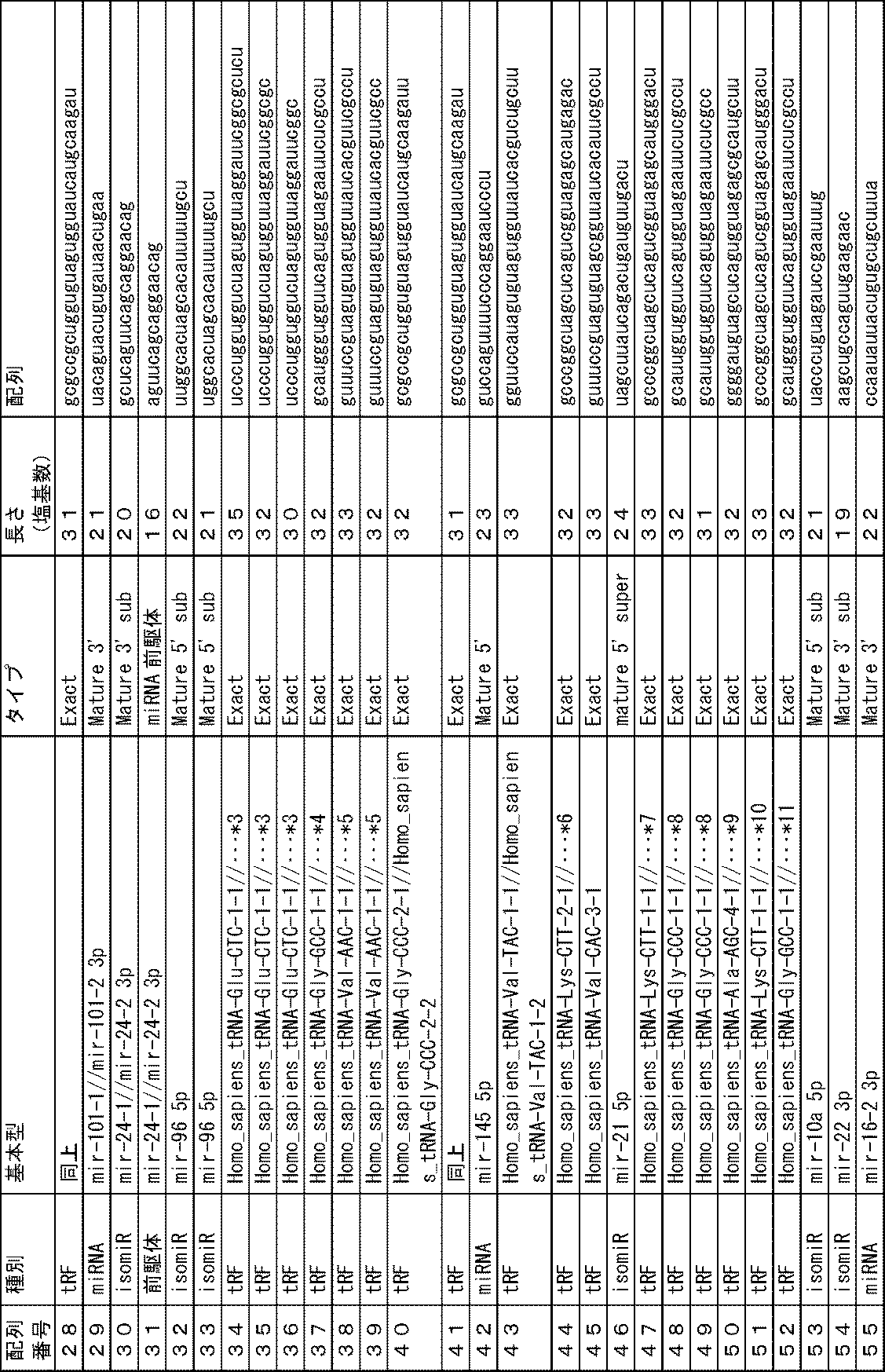


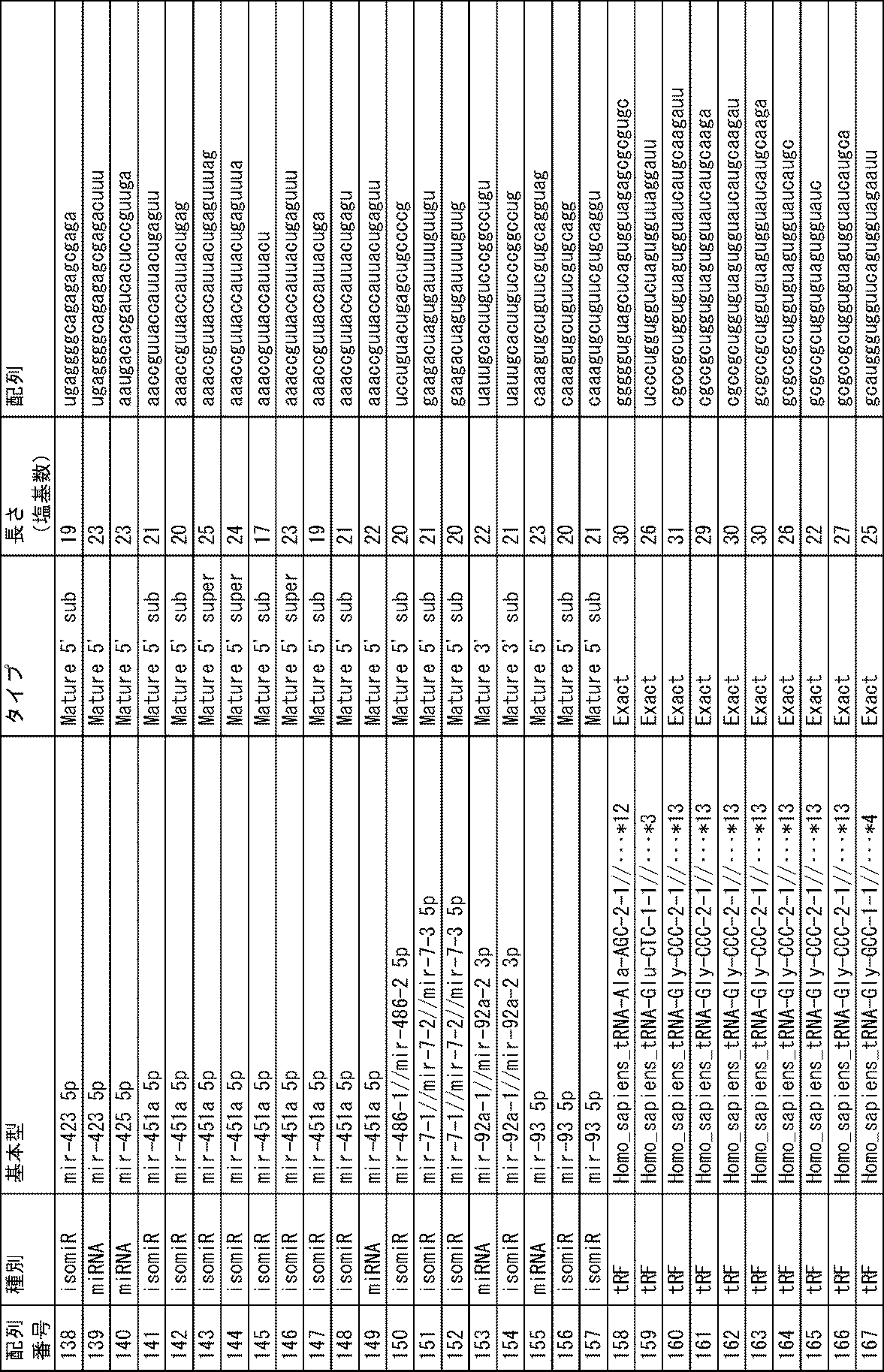


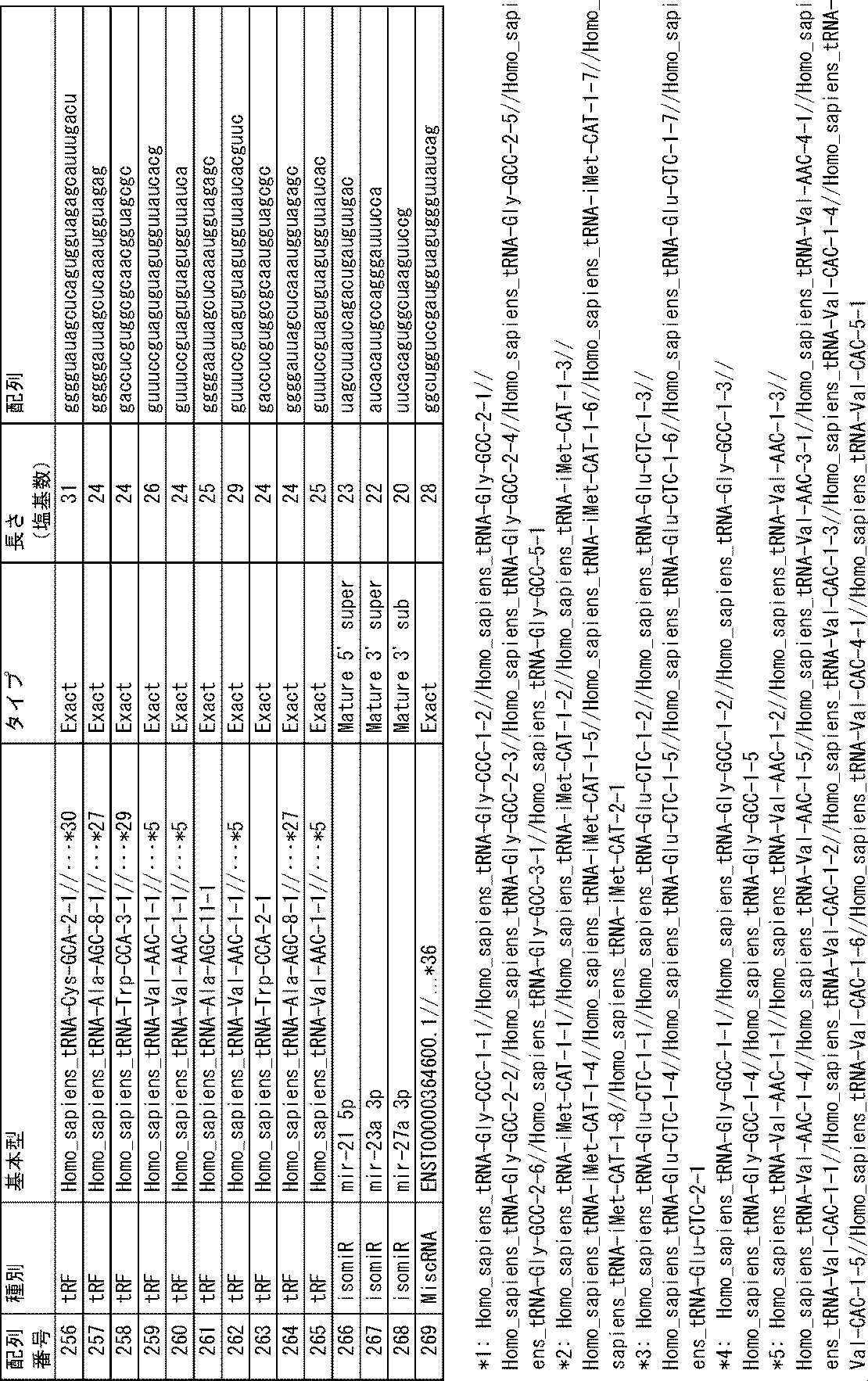


これらのmiRNA等のうち、塩基配列が配列番号1~33、56~173、175~269で示されるmiRNA等(以下、便宜上、例えば「塩基配列が配列番号1で示されるmiRNA等」を単に「配列番号1のmiRNA等」や「配列番号1のもの」と呼ぶことがある)は、血清中に存在するものであり、配列番号34~55、174のものは、血清中のエクソソーム中に存在するものである。 Among these miRNAs, etc., miRNAs whose base sequences are shown by SEQ ID NOS: 1 to 33, 56 to 173, 175 to 269 (hereinafter, for convenience, for example, "miRNAs whose base sequences are shown by SEQ ID NO: 1" are simply referred to as " miRNA of SEQ ID NO: 1" or "of SEQ ID NO: 1") are present in serum, and those of SEQ ID NOS: 34 to 55, 174 are present in exosomes in serum It is something to do.
これらのmiRNA等のうちの多くは、乳がん患者の血清又はエクソソーム中の存在量と、健常者の血清又はエクソソーム中の存在量との比の対数(底が2の対数で「log FC」(FCは、fold change)と呼ばれる)の絶対値が0.585超のものであり(すなわち、比が約1.5倍以上又は約1.5分の1以下)、統計学的に有意(t検定でp<0.05)のものである。Many of these miRNAs are logarithmic ratios of the abundance in the serum or exosomes of breast cancer patients and the abundance in the serum or exosomes of healthy subjects (logarithm with a base of 2, “log FC” (FC is called the fold change )) has an absolute value greater than 0.585 (i.e., a ratio greater than or equal to about 1.5-fold or less than or equal to about 1.5-fold) and is statistically significant (p < 0.05 by t-test )belongs to.
配列番号1~19、27、28、34~51、74、76、77、80~84、96、101~104、115~122、125、128、134~139、151、152、159~165、168、169、175~199のmiRNA等は、乳がん患者中の存在量が健常者中の存在量よりも多いものであり、配列番号20~26、29~33、52~54、56~73、75、78~79、85~95、97~100、105~114、123、124、126、127、129~133、140~150、153~158、166、167、170~173、200~269のmiRNA等は、乳がん患者中の存在量が健常者中の存在量よりも少ないものである。 SEQ. 168, 169, 175-199 miRNAs, etc. are present in breast cancer patients in a higher abundance than in healthy subjects, 75,78-79,85-95,97-100,105-114,123,124,126,127,129-133,140-150,153-158,166,167,170-173,200-269 miRNA and the like exist in breast cancer patients in a lower amount than in healthy subjects.
これらの中でも、塩基配列が配列番号2、21、22、23、24、26、30、31、32、33、34、152、151、15、28、41、1、14、27、40、25、12、160、3~11、13、16、20、27、29、37~39、41、43、45、47~52、56、60、66、82、86、90~92、107、111、112、126、127、130、137、158、161、162、173、175~265のいずれかで示されるmiRNA等は、log FCの絶対値が1.5以上のものであり、特に感度の高い指標となるものであり、好ましい。 Among these, the base sequences are SEQ ID NOS: 2, 21, 22, 23, 24, 26, 30, 31, 32, 33, 34, 152, 151, 15, 28, 41, 1, 14, 27, 40, 25 , 12, 160, 3-11, 13, 16, 20, 27, 29, 37-39, 41, 43, 45, 47-52, 56, 60, 66, 82, 86, 90-92, 107, 111 , 112, 126, 127, 130, 137, 158, 161, 162, 173, 175 to 265, the absolute value of log FC is 1.5 or more, and is a particularly sensitive index and is preferable.
また、これらのうち、配列番号3~9のものを指標とする方法では、下記実施例に具体的に記載するとおり、ステージ0の乳がん(すなわち、腫瘤が未形成のステージで、画像診断や触診では検出できないもの)でも検出可能である。 In addition, among these, in the method using SEQ ID NOS: 3 to 9 as an index, as specifically described in the examples below, stage 0 breast cancer (that is, at a stage where no mass is formed, image diagnosis and palpation It is possible to detect even those that cannot be detected by
がんマーカーの精度を示す指標としてROC曲線下面積(AUC(Area Under Curve))が用いられており、一般的にAUCが0.7以上のものががんマーカーとして有効であると言われている。AUCが0.90以上のものは高精度であり、0.97以上は非常に高精度、0.98以上は極めて高精度、1.00で完璧(偽陽性及び偽陰性が全くない)である。したがって、本発明においても、AUCが0.90のものが好ましく、さらに0.97以上のものが好ましく、さらに0.98以上のものが好ましく、さらに0.99以上のものが好ましく、1.00のものが最も好ましい。塩基配列が配列番号2、21、22、23、24、26、30、31、32、33、152、151、15、28、41、1、14、27、40、25、12、160のものがAUC 0.97以上で好ましく、これらのうち、配列番号2、21、22、23、24、26、30、31、32、33、152、151、15、28、41、1のものがAUC 0.98以上でさらに好ましく、配列番号2、21、22、23、24、26、30、31、32、33、152のものがAUC 1.00で最も好ましい。
The area under the ROC curve (AUC (Area Under Curve)) is used as an indicator of the accuracy of a cancer marker, and it is generally said that an AUC of 0.7 or more is effective as a cancer marker. An AUC of 0.90 or greater is highly accurate, 0.97 or greater is very accurate, 0.98 or greater is extremely accurate, and 1.00 is perfect (no false positives or false negatives). Therefore, also in the present invention, AUC is preferably 0.90, more preferably 0.97 or more, more preferably 0.98 or more, more preferably 0.99 or more, most preferably 1.00. A nucleotide sequence of SEQ ID NO: 2, 21, 22, 23, 24, 26, 30, 31, 32, 33 , 152, 151, 15, 28, 41, 1, 14, 27, 40, 25, 12 , 160 preferably have an AUC of 0.97 or more, and among these, those of SEQ ID NOS: 2, 21, 22, 23, 24, 26, 30, 31, 32, 33, 152 , 151, 15, 28, 41, 1 are AUC 0.98 or more is more preferred, and those of SEQ ID NOs: 2, 21, 22, 23, 24, 26, 30, 31, 32, 33, 152 are most preferred with an AUC of 1.00.
さらに、塩基配列が配列番号2、21、22、23、24、26、31~33又は55のmiRNA等は、がん患者中又は健常者中の存在量が0のものであるので、これらを用いることにより、AUCが1.00の場合と同様に高精度の判定が可能である(ほとんどのものは、AUCが1.00でもある)。 Furthermore, since miRNAs having nucleotide sequences of SEQ ID NOs: 2, 21, 22, 23, 24, 26, 31 to 33, or 55 are present in 0 in cancer patients or healthy subjects, these By using it, it is possible to make a judgment as highly accurate as when the AUC is 1.00 (most of them also have an AUC of 1.00).
被検試料としては、miRNAを含む体液であれば特に限定されないが、通常、血液試料(血漿、血清及び全血を包含する)が好ましく用いられる。血清中に存在する配列番号1~33、56~173、175~265のものは、血清又は血漿を被検試料とすることが簡便で好ましい。エクソソーム中に存在する配列番号34~54のものは、血清又は血漿を被検試料として、この中のエクソソームから全RNAを抽出して各miRNA等の存在量を測定することが好ましい。血清又は血漿中の全RNAの抽出方法は周知であり、下記実施例に具体的に記載されている。血清又は血漿中のエクソソームからの全RNAの抽出方法自体も公知であり、詳細は下記実施例に具体的に記載されている。 The test sample is not particularly limited as long as it is a bodily fluid containing miRNA, but usually a blood sample (including plasma, serum and whole blood) is preferably used. For SEQ ID NOS: 1 to 33, 56 to 173, and 175 to 265 present in serum, it is convenient and preferable to use serum or plasma as a test sample. Those of SEQ ID NOS: 34 to 54 present in exosomes preferably measure the abundance of each miRNA and the like by extracting total RNA from exosomes in serum or plasma as a test sample. Methods for extracting total RNA from serum or plasma are well known and are specifically described in the Examples below. The method itself for extracting total RNA from exosomes in serum or plasma is also known, and details are specifically described in the examples below.
各miRNA等の存在量の測定(定量)は、次世代シーケンサーを用いて行うことが好ましい。次世代シーケンサーのように配列を読む機器であれば、機種は限定されない。下記実施例に具体的に記載されるように、本発明の方法では、定量するmiRNA等には、例えば、通常の成熟型miRNAの5'末端及び/又は3'末端からわずか1塩基以上が欠失又は付加されているだけのisomiRを、基本となるmiRNAと区別して定量する必要があるので、精度の観点から、miRNAの定量に広く用いられている定量的逆転写PCR(qRT-PCR)よりも次世代シーケンサーを用いて行うことが好ましい。具体的には下記実施例において詳細に記載するが、簡単に述べると、この定量方法は、例えば次のようにしておこなうことができる。血清又は血漿中に存在するRNAが一定である場合、それらを用いた次世代シークエンス解析において読まれたリード数のうち、ヒト由来のシーケンスを100万リード数に換算して、100万リード数当たりのそれぞれのisomiRや成熟型miRNAのリード数を測定値とする。疾患によって健常人に比較して血清中または血漿中のRNAが変化する場合は、血清及び血漿中で存在量の変動が少ないmiRNAを用いる場合がある。なお、血清又は血漿中のmiRNA等を定量する場合には、血清及び血漿中で存在量の変動が少ないmiRNAであるlet-7g-5p、miR-425-3p、 miR-425-5p、miR-23a-3p、miR-484-5p、miR-191-5pから成る群より選ばれる少なくとも1種のmiRNAを内部標準として用いることが好ましい。 Measurement (quantification) of the abundance of each miRNA and the like is preferably performed using a next-generation sequencer. The model is not limited as long as it is a device that reads sequences like a next-generation sequencer. As specifically described in the examples below, in the method of the present invention, the miRNA or the like to be quantified has, for example, only one or more nucleotides missing from the 5'-end and/or 3'-end of normal mature miRNA. Since it is necessary to quantify isomiR that is only deleted or added separately from the basic miRNA, from the viewpoint of accuracy, quantitative reverse transcription PCR (qRT-PCR), which is widely used for quantification of miRNA It is also preferable to use a next-generation sequencer. Although specific details will be described in the following examples, in brief, this quantification method can be carried out, for example, as follows. If the RNA present in serum or plasma is constant, among the reads read in the next-generation sequence analysis using them, convert the human-derived sequence to 1 million reads, and per 1 million reads The number of reads for each isomiR and mature miRNA is used as the measurement value. When RNA in serum or plasma changes due to a disease compared to healthy subjects, miRNAs with less variation in abundance in serum and plasma may be used. When quantifying miRNAs in serum or plasma, let-7g-5p, miR-425-3p, miR-425-5p, miR- At least one miRNA selected from the group consisting of 23a-3p, miR-484-5p, and miR-191-5p is preferably used as an internal standard.
判定に用いる、各miRNA等の存在量のカットオフ値としては、各miRNA等について、健常者に対する統計学的有意差(t検定で、p<0.05、好ましくはp<0.01、さらに好ましくはp<0.001)の有無を基準とすることが好ましい。具体的には、好ましくは、例えば、偽陽性率が最良の値(最も低くなる値)なるプロット点におけるlog2リード数(カットオフ値)を各miRNA等について設定することができ、例えば、いくつかの各miRNA等におけるカットオフ値(log2リード数)は表2に示すとおりである。なお、表2に示されるカットオフ値は、単なる例に過ぎず、統計学的有意差が出る限り、他の値をカットオフ値として採用することができる。また、データを採取する患者及び健常者の集団が異なれば、最良のカットオフ値も異なる。もっとも、通常、表2又は表3に示されるカットオフ値の±20%の範囲内、特には±10%の範囲内でカットオフ値を設定することができる。The cut-off value for the abundance of each miRNA used for determination is a statistically significant difference (t-test, p<0.05, preferably p<0.01, more preferably p<0.01, more preferably p< 0.001). Specifically, preferably, for example, the number of log 2 reads (cutoff value) at the plot point where the false positive rate is the best value (lowest value) can be set for each miRNA etc. Table 2 shows the cutoff value (log 2 read number) for each miRNA and the like. The cutoff values shown in Table 2 are merely examples, and other values can be adopted as cutoff values as long as a statistically significant difference is obtained. Also, different patient and healthy populations from which data are collected will have different best cut-off values. Normally, however, the cutoff value can be set within a range of ±20%, particularly within a range of ±10% of the cutoff value shown in Table 2 or Table 3.
また、下記実施例及び比較例から明らかなように、基本型が同一のmiRNA等であっても、miRNAと各種isomiRとでは、患者と健常者の間で存在量が異なる。例えば、下記実施例2及び比較例1では、基本型のmiRNAはmiR-15a 5pであるが、比較例1のmiRNA(配列番号270)では、log FCが0であるのに対し、実施例2(配列番号2)のMature 5' subのisomiRではlog FCが5.67であり、乳がん患者で圧倒的に存在量が多くなっている。したがって、一人の患者の配列番号2と配列番号270を測定し、その比に基づいて乳がんの検出を補助することができる。さらに、実施例85~88(配列番号85~88)も同じくmiR-15a 5p群のisomiRであるが、それぞれlog FCが異なるので、これらの間の比率も指標に加えてより正確な検出の補助を行うことも可能である。なお、このように、あるmiRNA及びそのisomiRの存在量を測定する場合には、微妙な塩基配列の違いを的確に区別する必要があるため、通常miRNAの定量に用いられている定量的逆転写PCR(qRT-PCR)よりも次世代シーケンサーを用いて行うことが好ましい。比較例1のmiRNA(配列番号270)のようにqRT-PCRで検出される配列であるmature型のマイクロRNAでは差が見いだせないが、実施例2(配列番号2)のMature 5' subのisomiRでは有意差のある違いが見いだせる優位性は、次世代シーケンサーを用いて行うことが好ましい。 Moreover, as is clear from the following examples and comparative examples, even if miRNAs and the like have the same basic type, the amounts of miRNAs and various isomiRs differ between patients and healthy subjects. For example, in Example 2 and Comparative Example 1 below, the basic miRNA is miR-15a 5p. IsomiR of Mature 5′ sub (SEQ ID NO: 2) has a log FC of 5.67, and is overwhelmingly abundant in breast cancer patients. Therefore, SEQ ID NO: 2 and SEQ ID NO: 270 can be measured in a single patient and based on the ratio to help detect breast cancer. Furthermore, Examples 85 to 88 (SEQ ID NOS: 85 to 88) are also miR-15a 5p group isomiRs, but each has a different log FC. It is also possible to In this way, when measuring the abundance of a certain miRNA and its isomiR, it is necessary to accurately distinguish subtle differences in base sequences. It is preferable to use a next-generation sequencer rather than PCR (qRT-PCR). Similar to the miRNA (SEQ ID NO: 270) of Comparative Example 1, no difference was found in the mature type microRNA, which is the sequence detected by qRT-PCR, but the isomiR of the mature 5' sub of Example 2 (SEQ ID NO: 2) Therefore, it is preferable to use a next-generation sequencer for superiority in which significant differences can be found.
なお、上記した各miRNA等は、乳がん患者と健常者の間でそれぞれ統計学的有意差を持つので、単独で指標として用いることもできるが、複数のmiRNAを組み合わせて指標としてもよく、その場合にはさらに正確な乳がん検出の補助が可能になる。 Since each of the miRNAs described above has a statistically significant difference between breast cancer patients and healthy subjects, it can be used alone as an index. could aid in more accurate breast cancer detection.
また、下記実施例に具体的に記載されるように、生体から分離された血清又は血漿中に含まれる、miR-150-5p(配列番号83)及び/又は、miR-26b-5p(配列番号126)の成熟miRNAに対する、そのそれぞれのアイソフォーム(isomiR)の量(ここで、「アイソフォーム(isomiR)の量」は、成熟miRNAの3'若しくは5'側末端が1~5塩基欠損又は1~5塩基長い配列の総量を示す)の割合を測定することによっても、乳がんの検出を補助することができる。この場合、前記割合が健常者よりも多いことが乳がんを発症している可能性が大きいことを示す。この方法は、統計学的有意差が非常に大きい(p値が非常に小さい)ので、正確な方法である。 In addition, as specifically described in the examples below, miR-150-5p (SEQ ID NO: 83) and/or miR-26b-5p (SEQ ID NO: 126) amount of each isoform (isomiR) for mature miRNA (here, "amount of isoform (isomiR)" is 1 to 5 base deletion or 1 Measuring the proportion of ~5 bases long sequences) can also aid in breast cancer detection. In this case, the fact that the ratio is higher than that of healthy subjects indicates that the possibility of developing breast cancer is high. This method is an accurate method as the statistical significance is very high (p-value is very small).
同様に、下記実施例に具体的に記載されるように、生体から分離された血清又は血漿中に含まれる、miR-93-5p(配列番号155)及び/又はmiR-17-5p(配列番号282)の成熟miRNAに対する、そのそれぞれのアイソフォーム(isomiR)の量(ここで、「アイソフォーム(isomiR)の量」は、成熟miRNAの3'若しくは5'側末端が1~5塩基欠損又は1~5塩基長い配列の総量を示す)の量の割合を測定することによっても、乳がんの検出を補助することができる。この場合、前記割合が健常者よりも少ないことが乳がんを発症している可能性が大きいことを示す。この方法は、統計学的有意差が非常に大きい(p値が非常に小さい)ので、正確な方法である。 Similarly, miR-93-5p (SEQ ID NO: 155) and/or miR-17-5p (SEQ ID NO: 155) and/or miR-17-5p (SEQ ID NO: 282) amount of each isoform (isomiR) for the mature miRNA (here, the "amount of isoform (isomiR)" is 1 to 5 nucleotide deletions at the 3' or 5' end of the mature miRNA or 1 Determining the percentage of the amount of ~5 bases long sequence) can also aid in the detection of breast cancer. In this case, the fact that the ratio is lower than that of healthy subjects indicates that the possibility of developing breast cancer is high. This method is an accurate method as the statistical significance is very high (p-value is very small).
また、乳がんが疑われるか又は乳がんに罹患するヒトの被検試料中のmiRNA等の存在量を検出する方法も提供される。すなわち、
乳がんが疑われる又は乳がんに罹患するヒトの被検試料中の塩基配列が配列番号2、21、22、23、24、26、30、31、32、33、34、152、151、15、28、41、1、14、27、40、25、12、160、3~11、13、16~20、29、35~39、42~150、153~159、161~265のいずれかで示されるmiRNA、そのアイソフォーム (isomiR)、miRNA前駆体、転移RNA断片(tRF) 又は非コードRNA断片 (RRNA、snoRNA、LincRNA)の少なくとも1種の存在量を検出する方法であって、
ヒトから血液試料を得る工程、及び
次世代シーケンサーまたはqRT-PCRを用いて、前記血液試料内のRNA鎖の存在量を測定する工程を含み、
ここで、塩基配列が配列番号1~19、27、28、34~51、74、76、77、80~84、96、101~104、115~122、125、128、134~139、151、152、159~165、168、169、174、175~199のいずれかで示される少なくとも1種のmiRNA、isomiR、miRNA前駆体、転移RNA断片若しくは非コードRNA断片の存在量が健常者よりも多い、又は塩基配列が配列番号20~26、29~33、52~54、56~73、75、78~79、85~95、97~100、105~114、123、124、126、127、129~133、140~150、153~158、166、167、170~173、200~265のいずれかで示される少なくとも1種の1種のmiRNA、isomiR、miRNA前駆体、転移RNA断片若しくは非コードRNA断片の存在量が健常者よりも少ない、方法、も提供される。Also provided are methods for detecting the abundance of miRNAs and the like in human test samples suspected of having or suffering from breast cancer. i.e.
Nucleotide sequences in human test samples suspected of having or suffering from breast cancer are SEQ ID NOS: 2, 21, 22, 23, 24, 26, 30, 31, 32, 33, 34, 152, 151, 15, 28 , 41, 1, 14, 27, 40, 25, 12, 160, 3 to 11, 13, 16 to 20, 29, 35 to 39, 42 to 150, 153 to 159, 161 to 265 A method for detecting the abundance of at least one miRNA, its isoform (isoform), miRNA precursor, transfer RNA fragment (tRF) or non-coding RNA fragment (RRNA, snoRNA, LincRNA), comprising:
obtaining a blood sample from a human, and using next-generation sequencing or qRT-PCR to measure the abundance of RNA strands in said blood sample;
Here, the base sequences are SEQ ID NOS: 1-19, 27, 28, 34-51, 74, 76, 77, 80-84, 96, 101-104, 115-122, 125, 128, 134-139, 151, 152, 159-165, 168, 169, 174, 175-199, the abundance of at least one miRNA, isomiR, miRNA precursor, transfer RNA fragment, or non-coding RNA fragment is higher than in healthy subjects , or the base sequence is SEQ ID NO: 20-26, 29-33, 52-54, 56-73, 75, 78-79, 85-95, 97-100, 105-114, 123, 124, 126, 127, 129 -133, 140-150, 153-158, 166, 167, 170-173, 200-265 at least one miRNA, isomiR, miRNA precursor, transfer RNA fragment or non-coding RNA Also provided are methods wherein the fragments are present in less abundance than in healthy individuals.
また、上記した本願発明の方法により、乳がんが検出された場合、乳がんが検出された患者に有効量の抗乳がん剤を投与することにより、乳がんを治療することができる。抗乳がん剤としては、ハーセプチン、トラスツズマブ、ペルツズマブ、トラスツズマブエムタンシンパクリタキセル,ドセタキセル、ビノレルビン、ラパチニブ、カペシタビン等を挙げることができる。 In addition, when breast cancer is detected by the method of the present invention described above, breast cancer can be treated by administering an effective amount of an anti-breast cancer drug to a patient in whom breast cancer has been detected. Anti-breast cancer agents include herceptin, trastuzumab, pertuzumab, trastuzumab emtansine paclitaxel, docetaxel, vinorelbine, lapatinib, capecitabine and the like.
以下、本発明を実施例及び比較例に基づき具体的に説明する。もっとも、本発明は下記実施例に限定されるものではない。 Hereinafter, the present invention will be specifically described based on examples and comparative examples. However, the present invention is not limited to the following examples.
実施例1~269、比較例1~12
1. 材料及び方法
(1) 臨床検体
乳がん患者109例、健常者72例の血清を用いた。乳がん患者のステージは、ステージ0が6名、ステージ1以上が134名であった。Examples 1-269, Comparative Examples 1-12
1. Materials and methods
(1) Clinical Specimens Sera from 109 breast cancer patients and 72 healthy subjects were used. Six breast cancer patients had stage 0 and 134 patients had stage 1 or higher.
(2) 血清中のRNAの抽出
血清中 RNA の抽出は、miRNeasy Mini kit (QIAGEN) を用いて行った。
1) 凍結した血清サンプルを融解し、10000 rpm で 5 分間、室温で遠心し、凝集タンパク質や血球成分を沈殿させた。
2) 上清 200 μL を新しい 1.5 mL チューブ に移した。
3) 1000 μL の QIAzol Lysis Reagent を加えて十分に混和し、タンパク質成分を変性した。
4) RNA 抽出のコントロール RNA として 0.05 nM cel-miR-39 を 10 μL 加え、ピペッティングで混和した後、室温で 5 分間静置した。
5) 水層と有機溶媒層の分離促進のため、200μLのクロロホルムを加え、十分に混和し、室温で 3 分間静置した。
6) 12000 xg、15分間、4℃で遠心し、上層の水層650μLを新しい2mLチューブ に移した。
7) RNA を析出させるため、975μLの 100% エタノールを加え、ピペッティングで混和した。
8) 650 μL の 7) を miRNeasy Mini spin column (以下、カラム) に移し、室温で 1 分間静置後、8000 xg、15 秒間、室温で遠心し、RNA をカラムのフィルターに吸着させた。カラムから通過した溶液は廃棄した。
9) 7) の溶液を全てカラムに通すまで 8) を繰り返し、全ての RNA をフィルターに吸着させた。
10) フィルターに付着した夾雑物の除去のため、650 μL の Buffer RWT をカラムに加え、 8000 xg、15 秒間、室温で遠心した。 カラムから通過した溶液は廃棄した。
11) フィルターに吸着した RNA の洗浄のため、500 μL のBuffer RPE をカラムに加え、8000 xg、15 秒間、室温で遠心した。カラムから通過した溶液は廃棄した。
12) フィルターに吸着した RNA の洗浄のため、500 μL のBuffer RPE をカラムに加え、8000 xg、2 分間、室温で遠心した。 カラムから通過した溶液は廃棄した。
13) フィルターに付着している溶液を完全に除去するため、カラムを新しい 2 mL collection チューブ に移し、10000 xg、1 分間、室温で遠心した。
14) カラムを 1.5 mL チューブ に移し、50 μL の RNase-free water を加え、室温で 1 分間静置した。
15) 8000 xg、1 分間、室温で遠心し、フィルターに吸着した RNA を溶出した。溶出した RNAは、そのまま次の実験に用い、残りは -80 ℃ で保存した。(2) Extraction of RNA in serum Serum RNA was extracted using miRNeasy Mini kit (QIAGEN).
1) Frozen serum samples were thawed and centrifuged at 10000 rpm for 5 minutes at room temperature to precipitate aggregated proteins and blood cell components.
2) Transfer 200 μL of the supernatant to a new 1.5 mL tube.
3) Add 1000 µL of QIAzol Lysis Reagent and mix well to denature the protein components.
4) As a control RNA for RNA extraction, 10 μL of 0.05 nM cel-miR-39 was added, mixed by pipetting, and allowed to stand at room temperature for 5 minutes.
5) To facilitate the separation of the aqueous layer and the organic solvent layer, 200 µL of chloroform was added, thoroughly mixed, and allowed to stand at room temperature for 3 minutes.
6) It was centrifuged at 12000 xg for 15 minutes at 4°C, and 650 µL of the upper aqueous layer was transferred to a new 2 mL tube.
7) To precipitate RNA, 975 µL of 100% ethanol was added and mixed by pipetting.
8) 650 μL of 7) was transferred to a miRNeasy Mini spin column (hereinafter referred to as column), allowed to stand at room temperature for 1 minute, and then centrifuged at 8000 xg for 15 seconds at room temperature to adsorb RNA to the column filter. The solution that passed through the column was discarded.
9) 8) was repeated until all of the solution in 7) was passed through the column, and all RNA was adsorbed to the filter.
10) To remove contaminants attached to the filter, add 650 µL of Buffer RWT to the column and centrifuge at 8000 xg for 15 seconds at room temperature. The solution that passed through the column was discarded.
11) To wash the RNA adsorbed on the filter, 500 µL of Buffer RPE was added to the column and centrifuged at 8000 xg for 15 seconds at room temperature. The solution that passed through the column was discarded.
12) To wash the RNA adsorbed on the filter, 500 µL of Buffer RPE was added to the column and centrifuged at 8000 xg for 2 minutes at room temperature. The solution that passed through the column was discarded.
13) To completely remove the solution adhering to the filter, the column was transferred to a new 2 mL collection tube and centrifuged at 10000 xg for 1 minute at room temperature.
14) Transfer the column to a 1.5 mL tube, add 50 μL of RNase-free water, and let stand at room temperature for 1 minute.
15) Centrifuged at 8000 xg for 1 minute at room temperature to elute RNA adsorbed on the filter. The eluted RNA was used for the next experiment as it was, and the rest was stored at -80°C.
(3) エクソソームからのRNAの抽出
血清中のエクソソームは、市販のキットであるサーモフィッシャーサイエンティフィック社の_Total Exosome Isolation (from serum)で精製した。回収したエクソソームからのRNAの抽出は、miRNeasy Mini kit (商品名、QIAGEN社製) を用いて行った。(3) Extraction of RNA from Exosomes Exosomes in serum were purified using a commercially available kit, Thermo Fisher Scientific's _Total Exosome Isolation (from serum). Extraction of RNA from the collected exosomes was performed using miRNeasy Mini kit (trade name, manufactured by QIAGEN).
(4) miRNA等の定量
miRNA等の定量は、次のようにして行った。二群等でmiRNA等の定量を行う場合は、同様の方法で回収した細胞外小胞(エクソソームを含む)を用いて同様の方法でRNAを精製してcDNAライブラリーを作成して次世代シークエンス解析を行った。なお、次世代シークエンス解析は、配列を読む機器であれば機器は限定されない。(4) Quantification of miRNA, etc.
Quantification of miRNA and the like was performed as follows. When quantifying miRNA etc. in two groups, etc., extracellular vesicles (including exosomes) collected by the same method are used to purify RNA by the same method, create a cDNA library, and perform next-generation sequencing. I did the analysis. In the next-generation sequence analysis, the device is not limited as long as it reads the sequence.
(5) カットオフ値及びAUCの算出
定量結果からのカットオフ値及びAUCの算出は、具体的に次のようにして行った。JMP Genomics 8(商品名)を用いてロジスティック回帰分析を実施し、ROC曲線とAUCの算出を行った。また、ROC曲線の左上隅の点(感度1.0, 特異度 1.0)との距離が最小となる点をカットオフ値とした。(5) Calculation of cut-off value and AUC Calculation of cut-off value and AUC from the quantitative results was specifically performed as follows. Logistic regression analysis was performed using JMP Genomics 8 (trade name), and ROC curves and AUC were calculated. In addition, the cut-off value was the point with the smallest distance from the upper left corner of the ROC curve (sensitivity 1.0, specificity 1.0).
2. 結果
結果を表2に示す。2. Results The results are shown in Table 2.


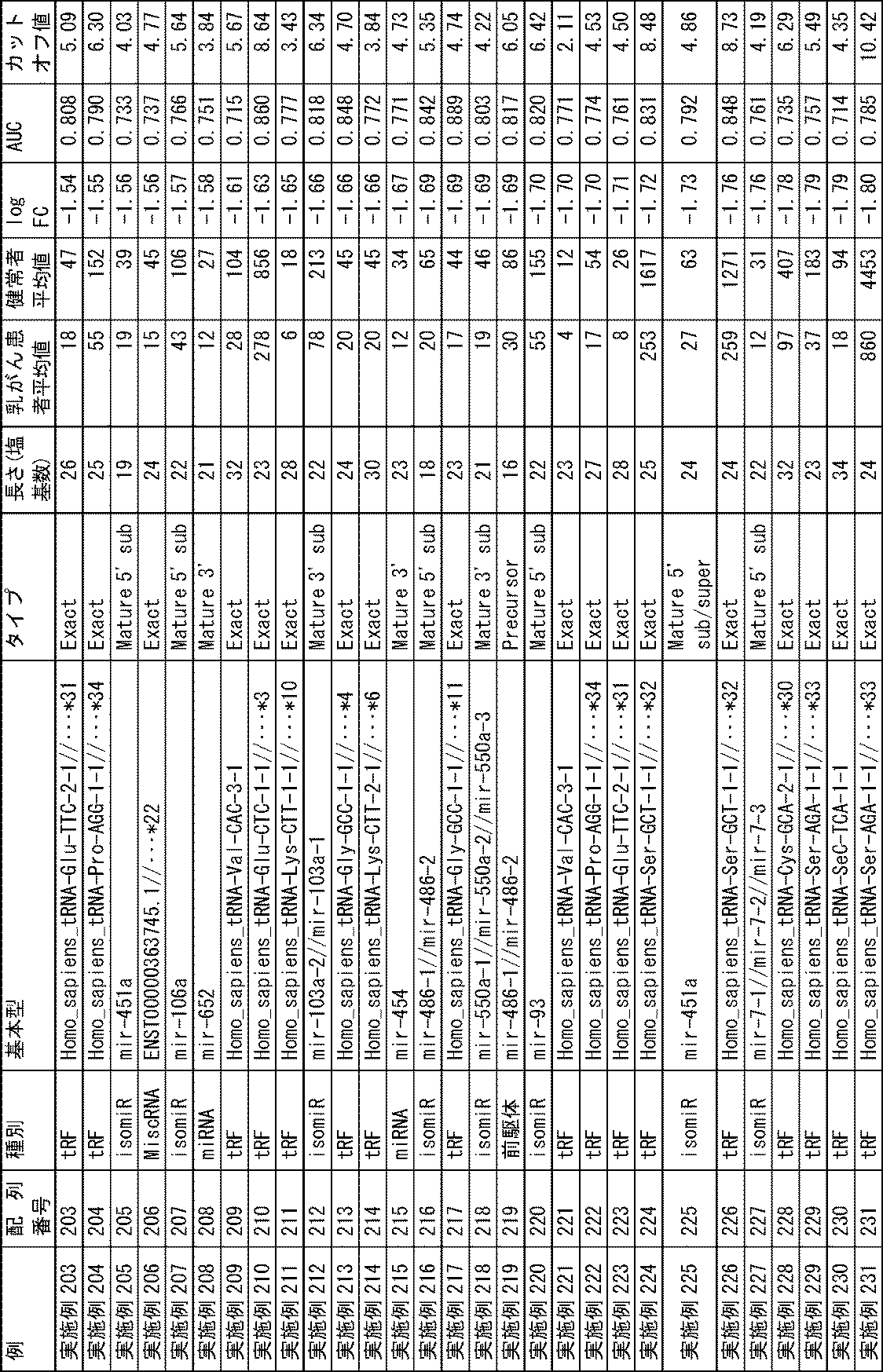


これらの結果からわかるように、配列番号1~19、27、28、34~51、74、76、77、80~84、96、101~104、115~122、125、128、134~139、151、152、159~165、168、169、174、175~199のmiRNA等は、乳がん患者中の存在量が健常者中の存在量よりも有意に多く、配列番号20~26、29~33、52~54、56~73、75、78~79、85~95、97~100、105~114、123、124、126、127、129~133、140~150、153~158、166、167、170~173、200~265のmiRNA等は、乳がん患者中の存在量が健常者中の存在量よりも有意に少なかった。本発明の方法(実施例1~265)によれば、これらに用いるmiRNA等と長さがわずかに異なるだけのmiRNA等(比較例1~13)を指標とする場合と比較して、高精度に乳がんの検出が可能であることが示された。また、実施例1~265のt検定によるp値はほとんどの場合0.05未満であり、乳がんの検出に有効であることが示された。 As can be seen from these results, SEQ. 151, 152, 159-165, 168, 169, 174, 175-199 miRNAs, etc. are significantly higher in breast cancer patients than in healthy subjects, and SEQ ID NOS: 20-26, 29-33 , 52-54, 56-73, 75, 78-79, 85-95, 97-100, 105-114, 123, 124, 126, 127, 129-133, 140-150, 153-158, 166, 167 , 170-173, and 200-265 miRNAs were significantly less abundant in breast cancer patients than in healthy subjects. According to the methods of the present invention (Examples 1 to 265), compared to the case of using miRNAs, etc. that are only slightly different in length from the miRNAs, etc. used for them (Comparative Examples 1 to 13) as indicators, high precision was shown to be capable of detecting breast cancer. In addition, the p-values of Examples 1-265 by t-test were in most cases less than 0.05, indicating that they are effective in detecting breast cancer.
また、配列番号3~9のものを指標とする方法では、ステージ0の乳がんでも検出可能であった。さらに、配列番号2、21、22、23、24、26、30、31、32、33、34、152、151、15、28、41、1、14、27、40、25、12、160のものは、AUCが0.97以上であり、特に好ましいものである。さらに、配列番号2、21、22、23、24、26、31~33又は55のmiRNA等は、がん患者中又は健常者中の存在量が0のものであるので、これらを用いることにより、AUCが1.00の場合と同様に高精度の判定が可能であることが明らかになった。 In addition, the method using SEQ ID NOs: 3 to 9 as an index was able to detect even stage 0 breast cancer. In addition, the Those having an AUC of 0.97 or more are particularly preferable. Furthermore, miRNAs of SEQ ID NOS: 2, 21, 22, 23, 24, 26, 31 to 33, or 55 have an abundance of 0 in cancer patients or healthy subjects. , it became clear that high-accuracy judgment is possible as in the case of AUC of 1.00.
実施例270
実施例1~269と同様にして、血清に含まれる、miR-150-5p(配列番号83)及びmiR-26b-5p(配列番号126)の成熟miRNA(表3中、「mature」)の存在量と、そのそれぞれのアイソフォーム(isomiR)の存在量を測定した。なお、「アイソフォーム(isomiR)の量」は、成熟miRNAの3'若しくは5'側末端が1~5塩基欠損又は1~5塩基長い配列の総量である。各miRNAと、そのアイソフォームの比率を測定した。結果を下記表3に示す。Example 270
Existence of mature miRNAs (“mature” in Table 3) of miR-150-5p (SEQ ID NO: 83) and miR-26b-5p (SEQ ID NO: 126) contained in serum in the same manner as in Examples 1 to 269 Amounts and abundances of their respective isoforms (isomiR) were determined. The “amount of isoform (isomiR)” is the total amount of sequences with 1 to 5 nucleotide deletions or 1 to 5 nucleotide extensions at the 3′ or 5′ end of mature miRNA. The ratio of each miRNA and its isoform was measured. The results are shown in Table 3 below.
実施例271
実施例1~269と同様にして、血清に含まれる、miR-93-5p(配列番号155)及び/又はmiR-17-5p(配列番号282の成熟miRNA(表3中、「mature」)の存在量と、そのそれぞれのアイソフォーム(isomiR)の存在量を測定した。なお、「アイソフォーム(isomiR)の量」は、成熟miRNAの3'若しくは5'側末端が1~5塩基欠損又は1~5塩基長い配列の総量である。各miRNAと、そのアイソフォームの比率を測定した。結果を下記表3に示す。Example 271
In the same manner as in Examples 1 to 269, miR-93-5p (SEQ ID NO: 155) and / or miR-17-5p (mature miRNA of SEQ ID NO: 282 (“mature” in Table 3)) contained in serum Abundance and the abundance of each isoform (isomiR) were measured.The "amount of isoform (isomiR)" is defined as 1 to 5 base deletions or 1 The ratio of each miRNA to its isoform was measured, and the results are shown in Table 3 below.

表3から、miR-150-5p(配列番号83)及びmiR-26b-5p(配列番号126)では、isomiR/成熟miRNAの比率が健常者よりも多いことが乳がんを発症している可能性が大きく、miR-93-5p(配列番号155)及びmiR-17-5p(配列番号282)では、isomiR/成熟miRNAの比率が健常者よりも少ないことが乳がんを発症している可能性が大きいことが示された。 From Table 3, in miR-150-5p (SEQ ID NO: 83) and miR-26b-5p (SEQ ID NO: 126), a higher ratio of isomiR/mature miRNA than in healthy subjects may cause breast cancer. Largely, in miR-93-5p (SEQ ID NO: 155) and miR-17-5p (SEQ ID NO: 282), the ratio of isomiR/mature miRNA is lower than that in healthy subjects, indicating that the possibility of developing breast cancer is high. It has been shown.
Claims (3)
Priority Applications (1)
| Application Number | Priority Date | Filing Date | Title |
|---|---|---|---|
| JP2023094664A JP7624245B2 (en) | 2017-12-13 | 2023-06-08 | Methods to aid in breast cancer detection |
Applications Claiming Priority (3)
| Application Number | Priority Date | Filing Date | Title |
|---|---|---|---|
| JP2017238811 | 2017-12-13 | ||
| JP2017238811 | 2017-12-13 | ||
| PCT/JP2018/045936 WO2019117257A1 (en) | 2017-12-13 | 2018-12-13 | Method for assisting in detection of breast cancer |
Related Child Applications (1)
| Application Number | Title | Priority Date | Filing Date |
|---|---|---|---|
| JP2023094664A Division JP7624245B2 (en) | 2017-12-13 | 2023-06-08 | Methods to aid in breast cancer detection |
Publications (2)
| Publication Number | Publication Date |
|---|---|
| JPWO2019117257A1 JPWO2019117257A1 (en) | 2020-12-24 |
| JP7298913B2 true JP7298913B2 (en) | 2023-06-27 |
Family
ID=66819328
Family Applications (2)
| Application Number | Title | Priority Date | Filing Date |
|---|---|---|---|
| JP2019559206A Active JP7298913B2 (en) | 2017-12-13 | 2018-12-13 | Methods to Aid in Breast Cancer Detection |
| JP2023094664A Active JP7624245B2 (en) | 2017-12-13 | 2023-06-08 | Methods to aid in breast cancer detection |
Family Applications After (1)
| Application Number | Title | Priority Date | Filing Date |
|---|---|---|---|
| JP2023094664A Active JP7624245B2 (en) | 2017-12-13 | 2023-06-08 | Methods to aid in breast cancer detection |
Country Status (4)
| Country | Link |
|---|---|
| US (1) | US20210079478A1 (en) |
| EP (1) | EP3725896A4 (en) |
| JP (2) | JP7298913B2 (en) |
| WO (1) | WO2019117257A1 (en) |
Families Citing this family (3)
| Publication number | Priority date | Publication date | Assignee | Title |
|---|---|---|---|---|
| CN112007043B (en) * | 2020-08-24 | 2021-07-20 | 谢琦 | Medicine or composition for resisting colorectal cancer |
| WO2022219404A1 (en) * | 2021-04-13 | 2022-10-20 | Oslo Universitetssykehus Hf | Gene therapy for inflammatory conditions |
| CN114150054B (en) * | 2021-12-03 | 2022-08-02 | 中国科学院近代物理研究所 | Reagents for detecting or assessing ionizing radiation damage or exposure and tRNA-derived fragments thereof |
Citations (13)
| Publication number | Priority date | Publication date | Assignee | Title |
|---|---|---|---|---|
| JP2009531019A (en) | 2006-01-05 | 2009-09-03 | ジ・オハイオ・ステイト・ユニバーシティ・リサーチ・ファウンデイション | MicroRNA-based methods and compositions for the diagnosis and treatment of solid cancers |
| WO2009119809A1 (en) | 2008-03-27 | 2009-10-01 | 株式会社ミラキュア | Marker for determination of breast cancer, test method, and test kit |
| US20100311815A1 (en) | 2009-02-23 | 2010-12-09 | The Regents Of The University Of Michigan | Mir-101 cancer markers |
| WO2011150453A1 (en) | 2010-06-01 | 2011-12-08 | The University Of Queensland | Diagnostic, prognostic and therapeutic use of a long non-coding rna |
| US20120040353A1 (en) | 2010-03-11 | 2012-02-16 | National University Of Ireland, Gaway | Detection and quantification of microRNAs in the circulation and the use of circulating microRNAs as biomarkers in cancer |
| WO2012121178A1 (en) | 2011-03-04 | 2012-09-13 | 独立行政法人国立がん研究センター | Tumor angiogenesis inhibitor |
| US20130137753A1 (en) | 2010-08-03 | 2013-05-30 | University Of South Alabama | Methods and compositions for the diagnosis and treatment of breast cancer |
| JP2013521502A (en) | 2010-03-01 | 2013-06-10 | カリス ライフ サイエンシズ ルクセンブルク ホールディングス | Biomarkers for theranosis |
| JP2014117282A (en) | 2012-12-18 | 2014-06-30 | Samsung Electronics Co Ltd | Composition and kit for diagnosing breast cancer including polynucleotide within vesicle, and method of diagnosing the breast cancer using the same |
| WO2014129975A1 (en) | 2013-02-20 | 2014-08-28 | Singapore Health Services Pte Ltd | Identification of circulating microrna signatures for breast cancer detection |
| US20150080244A1 (en) | 2011-10-19 | 2015-03-19 | Council Of Scientific And Industrial Research | Biomarkers useful for detection of types, grades and stages of human breast cancer |
| WO2017136760A1 (en) | 2016-02-05 | 2017-08-10 | Thomas Jefferson University | COMPOSITIONS AND METHODS OF USING HisGTG TRANSFER RNAS (tRNAs) |
| US20170268071A1 (en) | 2014-10-28 | 2017-09-21 | Thomas Jefferson University | COMPOSITIONS AND METHODS OF USING TRANSFER RNAS (tRNAs) |
Family Cites Families (9)
| Publication number | Priority date | Publication date | Assignee | Title |
|---|---|---|---|---|
| CN103866018B (en) | 2005-08-01 | 2016-05-25 | 俄亥俄州立大学研究基金会 | Be used for the method and composition based on MicroRNA of diagnosis, prognosis and the treatment of breast cancer |
| US20080076674A1 (en) * | 2006-07-06 | 2008-03-27 | Thomas Litman | Novel oligonucleotide compositions and probe sequences useful for detection and analysis of non coding RNAs associated with cancer |
| US8188255B2 (en) * | 2006-10-20 | 2012-05-29 | Exiqon A/S | Human microRNAs associated with cancer |
| EP2474617A1 (en) * | 2011-01-11 | 2012-07-11 | InteRNA Technologies BV | Mir for treating neo-angiogenesis |
| AU2015252223A1 (en) * | 2014-05-01 | 2016-11-24 | Stichting Vumc | Small ncRNAs as biomarkers |
| EP2942399B1 (en) * | 2014-05-08 | 2017-03-08 | Universite De Liege | Method for the diagnosis of breast cancer |
| SG11201707325RA (en) * | 2015-03-09 | 2017-10-30 | Agency Science Tech & Res | Method of determining the risk of developing breast cancer by detecting the expression levels of micrornas (mirnas) |
| WO2016150475A1 (en) * | 2015-03-22 | 2016-09-29 | Universite De Liege | Circulating micrornas for the diagnosis of breast cancer |
| CN105200043B (en) * | 2015-06-26 | 2018-08-03 | 宋尔卫 | A kind of kit for assessing Prognosis in Breast Cancer risk |
-
2018
- 2018-12-13 JP JP2019559206A patent/JP7298913B2/en active Active
- 2018-12-13 US US16/772,650 patent/US20210079478A1/en not_active Abandoned
- 2018-12-13 WO PCT/JP2018/045936 patent/WO2019117257A1/en not_active Ceased
- 2018-12-13 EP EP18887319.4A patent/EP3725896A4/en not_active Withdrawn
-
2023
- 2023-06-08 JP JP2023094664A patent/JP7624245B2/en active Active
Patent Citations (13)
| Publication number | Priority date | Publication date | Assignee | Title |
|---|---|---|---|---|
| JP2009531019A (en) | 2006-01-05 | 2009-09-03 | ジ・オハイオ・ステイト・ユニバーシティ・リサーチ・ファウンデイション | MicroRNA-based methods and compositions for the diagnosis and treatment of solid cancers |
| WO2009119809A1 (en) | 2008-03-27 | 2009-10-01 | 株式会社ミラキュア | Marker for determination of breast cancer, test method, and test kit |
| US20100311815A1 (en) | 2009-02-23 | 2010-12-09 | The Regents Of The University Of Michigan | Mir-101 cancer markers |
| JP2013521502A (en) | 2010-03-01 | 2013-06-10 | カリス ライフ サイエンシズ ルクセンブルク ホールディングス | Biomarkers for theranosis |
| US20120040353A1 (en) | 2010-03-11 | 2012-02-16 | National University Of Ireland, Gaway | Detection and quantification of microRNAs in the circulation and the use of circulating microRNAs as biomarkers in cancer |
| WO2011150453A1 (en) | 2010-06-01 | 2011-12-08 | The University Of Queensland | Diagnostic, prognostic and therapeutic use of a long non-coding rna |
| US20130137753A1 (en) | 2010-08-03 | 2013-05-30 | University Of South Alabama | Methods and compositions for the diagnosis and treatment of breast cancer |
| WO2012121178A1 (en) | 2011-03-04 | 2012-09-13 | 独立行政法人国立がん研究センター | Tumor angiogenesis inhibitor |
| US20150080244A1 (en) | 2011-10-19 | 2015-03-19 | Council Of Scientific And Industrial Research | Biomarkers useful for detection of types, grades and stages of human breast cancer |
| JP2014117282A (en) | 2012-12-18 | 2014-06-30 | Samsung Electronics Co Ltd | Composition and kit for diagnosing breast cancer including polynucleotide within vesicle, and method of diagnosing the breast cancer using the same |
| WO2014129975A1 (en) | 2013-02-20 | 2014-08-28 | Singapore Health Services Pte Ltd | Identification of circulating microrna signatures for breast cancer detection |
| US20170268071A1 (en) | 2014-10-28 | 2017-09-21 | Thomas Jefferson University | COMPOSITIONS AND METHODS OF USING TRANSFER RNAS (tRNAs) |
| WO2017136760A1 (en) | 2016-02-05 | 2017-08-10 | Thomas Jefferson University | COMPOSITIONS AND METHODS OF USING HisGTG TRANSFER RNAS (tRNAs) |
Non-Patent Citations (13)
| Title |
|---|
| ALSHATWI, Ali A. et al.,Differential expression profile and genetic variants of microRNAs sequences in breast cancer patients,PLoS One,2012年,Vol. 7: e30049,pp. 1-6 |
| DHAHBI, Joseph M. et al.,Deep Sequencing of Serum Small RNAs Identifies Patterns of 5' tRNA Half and YRNA Fragment Expression Associated with Breast Cancer,Biomark. Cancer,2014年,Vol. 6,pp. 37-47 |
| GUO, Li et al.,Genome-wide screen for aberrantly expressed miRNAs reveals miRNA profile signature in breast cancer,Mol. Biol. Rep.,2013年,Vol. 40,pp. 2175-2186 |
| HENEGHAN, Helen M. et al. [online],A systemic miRNA signature predictive of early breast cancer,Cancer Res.,2010年,Vol. 70 (8 suppl),Abstract nr 814,http://cancerres.aacrjournals.org/content/70/8_Supplement/814,[retreived on 2019-03-04], Internet |
| JURKOVICOVA, Dana et al.,Down-regulation of traditional oncomiRs in plasma of breast cancer patients,Oncotarget,2017年08月24日,Vol. 8,pp. 77369-77384 |
| LIU, Man et al.,A three-long noncoding RNA signature as a diagnostic biomarker for differentiating between triple-negative breast cancers,Medicine,2017年,Vol. 96: e6222,pp. 1-8 |
| LUO, Jinhua et al.,A novel panel of microRNAs provides a sensitive and specific tool for the diagnosis of breast cancer,Mol. Med. Rep.,2014年,Vol. 10,pp. 785-791 |
| MAR-AGUILAR, Fermin et al.,Serum circulating microRNA profiling for identification of potential breast cancer biomarkers,Dis. Markers,2013年,Vol. 34,pp. 163-169 |
| MARTYN, L. M. et al.,Circulating microrna biomarkers for luminal a breast cancer,Ir. J. Med. Sci.,2013年,Vol. 182 (suppl 7),p. S331. Abstract Number: 36 |
| MIAO, Yufeng et al.,Clinical Significance of Long Non-coding RNA MALAT1 Expression in Tissue and Serum of Breast Cancer,Ann. Clin. Lab. Sci.,2016年,Vol. 46,pp. 418-424 |
| WATERS Peadar S. et al.,Impact of tumour epithelial subtype on circulating microRNAs in breast cancer patients,PLoS One,2014年,Vol. 9: e90605,pp. 1-9 |
| WU, Qian et al.,Analysis of serum genome-wide microRNAs for breast cancer detection,Clin. Chim. Acta,2012年,Vol. 413,pp. 1058-1065 |
| WU, Qian et al.,Next-generation sequencing of microRNAs for breast cancer detection,J. Biomed. Biotechnol.,2011年,Vol. 2011: Article ID 597145,pp. 1-7 |
Also Published As
| Publication number | Publication date |
|---|---|
| JPWO2019117257A1 (en) | 2020-12-24 |
| EP3725896A4 (en) | 2022-01-12 |
| JP7624245B2 (en) | 2025-01-30 |
| EP3725896A1 (en) | 2020-10-21 |
| JP2023113881A (en) | 2023-08-16 |
| WO2019117257A1 (en) | 2019-06-20 |
| US20210079478A1 (en) | 2021-03-18 |
Similar Documents
| Publication | Publication Date | Title |
|---|---|---|
| JP7624245B2 (en) | Methods to aid in breast cancer detection | |
| JP7390002B2 (en) | Ways to help detect head and neck cancer | |
| JP2023113877A (en) | Method for assisting in detection of pancreatic cancer | |
| CN110484624B (en) | A peripheral blood-based gastric cancer biomarker and its detection method and application | |
| CN104450901A (en) | Nucleic acid marker for rapidly diagnosing kawasaki disease and kit of nucleic acid marker | |
| CN112608995B (en) | Specific marker for pulmonary tuberculosis, application and kit | |
| CN111235274A (en) | Screening method of laryngeal squamous carcinoma serum exosome marker and application of exosome source miR-941 | |
| CN114277143B (en) | Application of exosomes ARPC5, CDA and the like in lung cancer diagnosis | |
| CN108998531A (en) | Lung cancer lowers long-chain non-coding RNA marker and its application | |
| CN108796075A (en) | Detect application and the kit of circRNF13 and LOC284454 reagents | |
| TWI571514B (en) | Method for accessing the risk of having colorectal cancer | |
| CN118726571A (en) | Molecular markers of aortic dissection and their applications | |
| CN118755816A (en) | Molecular markers of aortic dissection and their applications | |
| CN118755817A (en) | Molecular markers for differential diagnosis of aortic dissection and acute myocardial infarction and their application | |
| WO2024183478A1 (en) | Novel microbial biomarker for predicting risk of colorectal cancer or colorectal adenoma | |
| WO2024183479A1 (en) | Novel microbial marker for predicting risk of colorectal cancer or colorectal adenocarcinoma | |
| CN117568481A (en) | A set of plasma exosomal tsRNAs markers related to liver cancer and their applications | |
| CN108424960B (en) | Application of a lncRNA as a diagnostic marker for deep vein thrombosis | |
| WO2019117306A1 (en) | Method for aiding detection of alzheimer's disease | |
| CN112646876A (en) | MiRNA for psoriasis diagnosis and application thereof | |
| WO2022019326A1 (en) | Method for providing assistance in detecting brain tumor | |
| CN108823308A (en) | Detect application and the kit of circMAN1A2 and LOC284454 reagent | |
| CN118726572A (en) | A group of diagnostic markers for aortic dissection and their application | |
| CN118726570A (en) | Molecular markers of aortic dissection and their applications | |
| CN105779579A (en) | Methods and markers for assessing risk of developing colorectal cancer |
Legal Events
| Date | Code | Title | Description |
|---|---|---|---|
| A521 | Request for written amendment filed |
Free format text: JAPANESE INTERMEDIATE CODE: A523 Effective date: 20200619 |
|
| A521 | Request for written amendment filed |
Free format text: JAPANESE INTERMEDIATE CODE: A523 Effective date: 20200702 |
|
| AA64 | Notification of invalidation of claim of internal priority (with term) |
Free format text: JAPANESE INTERMEDIATE CODE: A241764 Effective date: 20200908 |
|
| A521 | Request for written amendment filed |
Free format text: JAPANESE INTERMEDIATE CODE: A523 Effective date: 20200909 |
|
| A621 | Written request for application examination |
Free format text: JAPANESE INTERMEDIATE CODE: A621 Effective date: 20211115 |
|
| A131 | Notification of reasons for refusal |
Free format text: JAPANESE INTERMEDIATE CODE: A131 Effective date: 20221025 |
|
| A601 | Written request for extension of time |
Free format text: JAPANESE INTERMEDIATE CODE: A601 Effective date: 20221219 |
|
| A521 | Request for written amendment filed |
Free format text: JAPANESE INTERMEDIATE CODE: A523 Effective date: 20230220 |
|
| A131 | Notification of reasons for refusal |
Free format text: JAPANESE INTERMEDIATE CODE: A131 Effective date: 20230303 |
|
| A521 | Request for written amendment filed |
Free format text: JAPANESE INTERMEDIATE CODE: A523 Effective date: 20230412 |
|
| TRDD | Decision of grant or rejection written | ||
| A01 | Written decision to grant a patent or to grant a registration (utility model) |
Free format text: JAPANESE INTERMEDIATE CODE: A01 Effective date: 20230509 |
|
| A61 | First payment of annual fees (during grant procedure) |
Free format text: JAPANESE INTERMEDIATE CODE: A61 Effective date: 20230608 |
|
| R150 | Certificate of patent or registration of utility model |
Ref document number: 7298913 Country of ref document: JP Free format text: JAPANESE INTERMEDIATE CODE: R150 |