JP7267284B2 - Methods for Modulating Protein Mannosylation Profiles Using Polyether Ionophores - Google Patents
Methods for Modulating Protein Mannosylation Profiles Using Polyether Ionophores Download PDFInfo
- Publication number
- JP7267284B2 JP7267284B2 JP2020534566A JP2020534566A JP7267284B2 JP 7267284 B2 JP7267284 B2 JP 7267284B2 JP 2020534566 A JP2020534566 A JP 2020534566A JP 2020534566 A JP2020534566 A JP 2020534566A JP 7267284 B2 JP7267284 B2 JP 7267284B2
- Authority
- JP
- Japan
- Prior art keywords
- mannosylation
- culture
- protein
- cell
- cells
- Prior art date
- Legal status (The legal status is an assumption and is not a legal conclusion. Google has not performed a legal analysis and makes no representation as to the accuracy of the status listed.)
- Active
Links
Images






Classifications
-
- C—CHEMISTRY; METALLURGY
- C07—ORGANIC CHEMISTRY
- C07K—PEPTIDES
- C07K16/00—Immunoglobulins [IGs], e.g. monoclonal or polyclonal antibodies
-
- C—CHEMISTRY; METALLURGY
- C12—BIOCHEMISTRY; BEER; SPIRITS; WINE; VINEGAR; MICROBIOLOGY; ENZYMOLOGY; MUTATION OR GENETIC ENGINEERING
- C12P—FERMENTATION OR ENZYME-USING PROCESSES TO SYNTHESISE A DESIRED CHEMICAL COMPOUND OR COMPOSITION OR TO SEPARATE OPTICAL ISOMERS FROM A RACEMIC MIXTURE
- C12P21/00—Preparation of peptides or proteins
-
- C—CHEMISTRY; METALLURGY
- C12—BIOCHEMISTRY; BEER; SPIRITS; WINE; VINEGAR; MICROBIOLOGY; ENZYMOLOGY; MUTATION OR GENETIC ENGINEERING
- C12P—FERMENTATION OR ENZYME-USING PROCESSES TO SYNTHESISE A DESIRED CHEMICAL COMPOUND OR COMPOSITION OR TO SEPARATE OPTICAL ISOMERS FROM A RACEMIC MIXTURE
- C12P21/00—Preparation of peptides or proteins
- C12P21/005—Glycopeptides, glycoproteins
-
- A—HUMAN NECESSITIES
- A61—MEDICAL OR VETERINARY SCIENCE; HYGIENE
- A61K—PREPARATIONS FOR MEDICAL, DENTAL OR TOILETRY PURPOSES
- A61K39/00—Medicinal preparations containing antigens or antibodies
-
- C—CHEMISTRY; METALLURGY
- C07—ORGANIC CHEMISTRY
- C07K—PEPTIDES
- C07K2317/00—Immunoglobulins specific features
- C07K2317/20—Immunoglobulins specific features characterized by taxonomic origin
-
- C—CHEMISTRY; METALLURGY
- C07—ORGANIC CHEMISTRY
- C07K—PEPTIDES
- C07K2317/00—Immunoglobulins specific features
- C07K2317/40—Immunoglobulins specific features characterized by post-translational modification
- C07K2317/41—Glycosylation, sialylation, or fucosylation
-
- C—CHEMISTRY; METALLURGY
- C07—ORGANIC CHEMISTRY
- C07K—PEPTIDES
- C07K2319/00—Fusion polypeptide
Landscapes
- Chemical & Material Sciences (AREA)
- Organic Chemistry (AREA)
- Health & Medical Sciences (AREA)
- Life Sciences & Earth Sciences (AREA)
- Molecular Biology (AREA)
- Genetics & Genomics (AREA)
- General Health & Medical Sciences (AREA)
- Biochemistry (AREA)
- Zoology (AREA)
- Engineering & Computer Science (AREA)
- Wood Science & Technology (AREA)
- Biophysics (AREA)
- Immunology (AREA)
- Proteomics, Peptides & Aminoacids (AREA)
- Medicinal Chemistry (AREA)
- Biotechnology (AREA)
- Chemical Kinetics & Catalysis (AREA)
- General Chemical & Material Sciences (AREA)
- Microbiology (AREA)
- General Engineering & Computer Science (AREA)
- Bioinformatics & Cheminformatics (AREA)
- Preparation Of Compounds By Using Micro-Organisms (AREA)
- Micro-Organisms Or Cultivation Processes Thereof (AREA)
- Medicines That Contain Protein Lipid Enzymes And Other Medicines (AREA)
- Medicines Containing Antibodies Or Antigens For Use As Internal Diagnostic Agents (AREA)
- Peptides Or Proteins (AREA)
Description
本発明は、ポリエーテルイオノフォアを使用する、細胞培養過程中に哺乳類宿主細胞によって発現される組換えタンパク質のマンノシル化プロファイルを調節するための方法及び組成物に関する。 The present invention relates to methods and compositions for modulating the mannosylation profile of recombinant proteins expressed by mammalian host cells during cell culture processes using polyether ionophores.
治療用タンパク質又は抗体などのタンパク質のグリコシル化プロファイルは、例えば、フォールディング、安定性及び抗体依存性細胞傷害作用(ADCC、抗体の治療効果の原因となる機序の1つ)(Eon-Duval et al., 2012)に対する効果に基づく半減期及び親和性の変化によるタンパク質の生物活性に影響を与える重要な特徴である。グリコシル化は、対象となるタンパク質の産生のために使用されるセルライン、並びに細胞培養方法(pH、温度、細胞培養培地組成物、原料のロット間変動、培地ろ過材料、空気、その他)に大きく依存する。 The glycosylation profile of a protein, such as a therapeutic protein or an antibody, can, for example, affect folding, stability and antibody-dependent cellular cytotoxicity (ADCC, one of the mechanisms responsible for the therapeutic effect of antibodies) (Eon-Duval et al. ., 2012) are important features that influence the biological activity of proteins through changes in half-life and affinity. Glycosylation is highly dependent on the cell line used for production of the protein of interest, as well as on the cell culture method (pH, temperature, cell culture medium composition, lot-to-lot variation of raw materials, medium filtration material, air, etc.). Dependent.
ADCC活性は、Fc領域のオリゴ糖と結合されたフコース及び/又はマンノースの量により影響を受け、フコースの減少及び/又はマンノースの増加と共に活性の増強が見られる。事実、例えば、フコシル化IgGと比較して、非フコシル化形態は劇的に増強されたADCCを示し、これは、補体依存性細胞障害作用(CDC)又は抗原結合能の検出可能な変化を伴わないFcγRIIIa結合能の増強によるためである(Yamane-Ohnuki and Satoh, 2009)。同様に、高レベルのマンノース-5グリカンを示す抗体は、より高いADCCも示した(Yu et al., 2012)。したがって、ADCC応答が抗体活性の基本的治療機序である場合、フコシル化減少及び/又はマンノシル化増加を特徴とするグリコシル化プロファイルを有する組換え治療用タンパク質の製造方法の提供は有益である。高度にマンノシル化された抗体の利点としては、低投与量で治療効果を達成することが挙げられる。 ADCC activity is affected by the amount of fucose and/or mannose bound to the oligosaccharides of the Fc region, and enhanced activity is seen with decreased fucose and/or increased mannose. In fact, compared to, for example, fucosylated IgG, the non-fucosylated form exhibits dramatically enhanced ADCC, which may lead to detectable changes in complement dependent cytotoxicity (CDC) or antigen binding capacity. This is due to unaccompanied enhancement of FcγRIIIa binding capacity (Yamane-Ohnuki and Satoh, 2009). Similarly, antibodies showing high levels of mannose-5 glycans also showed higher ADCC (Yu et al., 2012). Therefore, if the ADCC response is the underlying therapeutic mechanism of antibody activity, it would be beneficial to provide methods for producing recombinant therapeutic proteins with glycosylation profiles characterized by decreased fucosylation and/or increased mannosylation. Advantages of highly mannosylated antibodies include achieving therapeutic efficacy at lower doses.
グリコシル化(マンノシル化など)は治療有用性及び安全性に影響し得るので、マンノシル化などのタンパク質グリコシル化の調節は、市販の治療用タンパク質又は抗体にとって特に適切である。更に、バイオシミラー化合物の枠内で、組換えタンパク質のグリコシル化プロファイルは参照製品のグリコシル化プロファイルに相当しなければならないので、前記組換えタンパク質のグリコシル化プロファイルの制御は重要である。いくつかの化合物は、組換えで製造されたタンパク質のマンノシル化に対して影響を有すると報告されている:例えば、国際公開第2014/151878号パンフレット及び国際公開第2014/159259号パンフレットはマンノシル化レベルを増加するショ糖などのオリゴ糖の使用を開示し、国際公開第2015/105609号パンフレットはアルギナーゼ阻害剤の使用に関し、国際公開第2015/066357号パンフレットはモネンシンの使用を示唆している。 Modulation of protein glycosylation, such as mannosylation, is particularly relevant for commercial therapeutic proteins or antibodies, as glycosylation (such as mannosylation) can affect therapeutic utility and safety. Furthermore, control of the glycosylation profile of the recombinant protein is important, as within the framework of biosimilar compounds the glycosylation profile of the recombinant protein must correspond to that of the reference product. Several compounds have been reported to have an effect on the mannosylation of recombinantly produced proteins: for example WO2014/151878 and WO2014/159259 have Discloses the use of oligosaccharides such as sucrose to increase levels, WO2015/105609 relates to the use of arginase inhibitors and WO2015/066357 suggests the use of monensin.
しかしながら、組換えタンパク質のマンノシル化プロファイルなどのグリコシル化プロファイルの制御を可能とするが、培養液中の細胞の性能にも組換えタンパク質収率にも影響しない培養条件及び製造方法に対するニーズが依然としてある。本発明は、許容可能な製造収率/条件を保持しながら、組換えタンパク質マンノシル化などの組換えタンパク質グリコシル化を調節するための方法及び組成物を提供することによってこのニーズに取り組む。 However, there remains a need for culture conditions and production methods that allow control of the glycosylation profile, such as the mannosylation profile, of recombinant proteins, but that do not affect cell performance in culture or recombinant protein yield. . The present invention addresses this need by providing methods and compositions for modulating recombinant protein glycosylation, such as recombinant protein mannosylation, while maintaining acceptable manufacturing yields/conditions.
1つの態様では、本発明は、調節されたマンノシル化プロファイルを有する組換えタンパク質の製造方法であって、方法は、ポリエーテルイオノフォアを含む細胞培養培地中でタンパク質を発現する宿主細胞を培養することを含む、方法を提供する。 In one aspect, the invention provides a method for producing a recombinant protein with a modulated mannosylation profile, the method comprising culturing host cells expressing the protein in a cell culture medium comprising a polyether ionophore. A method is provided, comprising:
あるいは、本明細書において、調節されたマンノシル化プロファイルを有する組換えタンパク質の製造方法であって、方法は、ポリエーテルイオノフォアを含む少なくとも1つのフィードを補った細胞培養培地中でタンパク質を発現する宿主細胞を培養することを含む、方法を開示する。 Alternatively, provided herein is a method for producing a recombinant protein with a modulated mannosylation profile, the method comprising expressing the protein in a cell culture medium supplemented with at least one feed comprising a polyetherionophore host A method is disclosed comprising culturing a cell.
更なる態様では、本発明は、ポリエーテルイオノフォアを含む又はポリエーテルイオノフォアを補った細胞培養培地を含む組成物を提供する。 In a further aspect, the invention provides a composition comprising a cell culture medium comprising a polyetherionophore or supplemented with a polyetherionophore.
別の態様では、本発明は、本発明の方法によって製造される調節されたマンノシル化プロファイルを有する組換えタンパク質及び薬剤的に許容可能な担体を含む医薬組成物を提供する。 In another aspect, the invention provides a pharmaceutical composition comprising a recombinant protein with a modulated mannosylation profile produced by the methods of the invention and a pharmaceutically acceptable carrier.
別の態様では、本発明は、本発明の方法によって製造される調節されたマンノシル化プロファイルを有する組換えタンパク質を含む組成物を提供する。 In another aspect, the invention provides compositions comprising recombinant proteins with modulated mannosylation profiles produced by the methods of the invention.
更なる態様では、本発明は、組換えタンパク質のマンノシル化プロファイルを調節するための細胞培養培地又はフィード培地におけるポリエーテルイオノフォアの使用を提供する。 In a further aspect, the invention provides the use of polyether ionophores in cell culture or feed media for modulating the mannosylation profile of recombinant proteins.
ポリエーテルイオノフォアは、好ましくは、マズラマイシン、ナラシン又はサリノマイシンから成る群から選択される。 The polyether ionophore is preferably selected from the group consisting of mazramycin, narasin or salinomycin.
特記:全図面において、濃度が続くS0=培養開始時のサリノマイシン濃度、濃度が続くN0=培養開始時のナラシン濃度、濃度が続くM0=培養開始時のマズラマイシン濃度、濃度が続くM5=フィードとして5日目に添加されたマズラマイシン濃度、濃度が続くM7=フィードとして7日目に添加されたマズラマイシン濃度。μM=マイクロモル。mioVC/mL=mL当たりの百万個の生細胞。
Special Note: In all figures S0 followed by concentration = Salinomycin concentration at the start of culture, N0 followed by concentration = Narasin concentration at start of culture, M0 followed by concentration = Mazramycin concentration at start of culture, M5 followed by concentration = as feed Concentration of mazuramycin added on
本明細書中で言及される全ての出版物、特許出願、特許、及び他の参考文献は、その全文の参照により援用される。本明細書中に述べられる出版物及び出願は、本出願の出願日より前のそれらの開示のためにのみ提供さ れる。本明細書において、本発明は、先行発明が理由でそのような出版物に先行する権利を与えられないと認めることと解釈するべきでない。加えて、材料、方法、及び実施例は、ほんの一例にすぎず、限定するものではない。 All publications, patent applications, patents, and other references mentioned herein are incorporated by reference in their entirety. The publications and applications mentioned herein are provided solely for their disclosure prior to the filing date of the present application. Nothing herein is to be construed as an admission that such publication is not entitled to antedate by virtue of prior invention. In addition, the materials, methods, and examples are illustrative only and not limiting.
別段に定義されない限り、本明細書で使用される全ての技術用語及び科学用語は、本明細書の主題が属する技術分野の当業者によって共通に理解されるものと同じ意味を有する。本明細書で使用されるとき、本発明の理解を容易にするために次の定義を提供する。 Unless defined otherwise, all technical and scientific terms used herein have the same meaning as commonly understood by one of ordinary skill in the art to which this subject matter belongs. As used herein, the following definitions are provided to facilitate understanding of the invention.
本明細書において「A及び/又はB」などのフレーズで使用される用語「及び/又は」は、「A及びB」、「A又はB」、「A」、並びに「B」を含むものとする。 As used herein in phrases such as "A and/or B," the term "and/or" shall include "A and B," "A or B," "A," and "B."
用語「細胞培養」又は「培養」は、インビトロ、すなわち、生物又は組織の外側での細胞の成長及び増殖を意味する。哺乳類細胞のために適した培養条件は、Cell Culture Technology for Pharmaceutical and Cell-Based Therapies (2005)に教示されているように当技術分野で公知である。哺乳類細胞を、懸濁液中又は固体基質に結合させながら培養してよい。 The terms "cell culture" or "culture" refer to the growth and proliferation of cells in vitro, ie outside of an organism or tissue. Suitable culture conditions for mammalian cells are known in the art as taught in Cell Culture Technology for Pharmaceutical and Cell-Based Therapies (2005). Mammalian cells may be cultured in suspension or attached to a solid substrate.
用語「細胞培養培地」、「培養培地」、「培地」、及びそのいずれかの複数形は、いずれもの型の細胞を培養することができる培地を表す。「基本培地」は、細胞代謝に有用な必須成分全てを含有する細胞培養培地を表す。これは、例えば、アミノ酸、脂質、炭素源、ビタミン類及び無機塩類を含む。DMEM(ダルベッコー修飾イーグル培地)、RPMI(ロズウェルパーク記念研究所培地)又は培地F12(ハムF12培地)は、市販基本培地の例である。あるいは、前記基本培地は、本明細書で「既知組成培地」又は「既知組成培養培地」とも呼ぶ完全に研究室内開発された商標つき培地であってよく、成分の全てを化学式で記載することができ、既知濃度で存在する。培養培地は、タンパク質を含まず及び/又は血清を含まず、培養液中の細胞の要求性に依存して、アミノ酸、塩類、糖類、ビタミン、ホルモン、成長因子など、いずれかの追加の成分を補うことができる。
用語「フィード培地」又は「フィード」(及びその複数形)は、消費される栄養素を補充するための培養中の補給として使用される培地を表す。フィード培地は、市販のフィード培地であってもよく、商標つきフィード培地(あるいは本明細書において既知組成フィード培地)であってもよい。
The terms "cell culture medium", "culture medium", "medium" and any plural thereof refer to a medium in which any type of cell can be cultured. A "basal medium" refers to a cell culture medium containing all essential components useful for cell metabolism. This includes, for example, amino acids, lipids, carbon sources, vitamins and inorganic salts. DMEM (Dulbecco's Modified Eagle's Medium), RPMI (Roswell Park Memorial Institute Medium) or Medium F12 (Ham's F12 Medium) are examples of commercially available basal media. Alternatively, the basal medium may be a completely laboratory-developed proprietary medium, also referred to herein as "chemically defined medium" or "chemically defined culture medium", wherein all of the components are described by chemical formulas. and exist in known concentrations. The culture medium is protein-free and/or serum-free, and may contain any additional components such as amino acids, salts, sugars, vitamins, hormones, growth factors, etc., depending on the requirements of the cells in the medium. can compensate.
The term "feed medium" or "feed" (and its plurals) refers to the medium used as a supplement during cultivation to replenish the nutrients consumed. The feed medium may be a commercially available feed medium or a proprietary feed medium (or chemically defined feed medium as used herein).
用語「バイオリアクター」又は「培養システム」は、細胞を、好ましくはバッチ式又は流加式で培養することができるいずれものシステムを表す。この用語は、これに限定されないが、フラスコ、静置フラスコ、スピナーフラスコ、チューブ、振盪チューブ、振盪ボトル、ウェイブバッグ、ミニバイオリアクター、バイオリアクター、ファイバーバイオリアクター、流動床バイオリアクター、及びマイクロキャリアありなしの撹拌槽バイオリアクターを含む。あるいは、用語「培養システム」は、マイクロタイタープレート、キャピラリー又はマルチウェルプレートも含む。例えば、0.1mL、0.5mL、1mL、5mL、0.01L、0.1L、1L、2L、5L、10L、50L、100L、500L、1000L(若しくは1KL)、2000L(若しくは2KL)、5000L(若しくは5KL)、10000L(若しくは10KL)、15000L(若しくは15KL)又は20000L(20KL)など、0.1ミリリットル(0.1mL、非常に小規模)~20000リットル(20000L若しくは20KL、非常に大規模)のいずれもの大きさのバイオリアクターを使用することができる。 The term "bioreactor" or "culture system" refers to any system in which cells can be cultured, preferably in batch or fed-batch mode. The term includes, but is not limited to flasks, static flasks, spinner flasks, tubes, shake tubes, shake bottles, wave bags, mini bioreactors, bioreactors, fiber bioreactors, fluid bed bioreactors, and microcarriers. Stirred tank bioreactor without. Alternatively, the term "culture system" also includes microtiter plates, capillaries or multiwell plates. For example, 0.1 mL, 0.5 mL, 1 mL, 5 mL, 0.01 L, 0.1 L, 1 L, 2 L, 5 L, 10 L, 50 L, 100 L, 500 L, 1000 L (or 1 KL), 2000 L (or 2 KL), 5000 L ( 0.1 milliliters (0.1 mL, very small) to 20,000 liters (20,000 L or 20 KL, very large) Any size bioreactor can be used.
用語「流加培養」は、消費される栄養素を補充するボーラス又は連続式フィード培地補給がある、細胞増殖方法を表す。この細胞培養技術は、培地配合物、セルライン、及び他の細胞培養条件に依存して、10×106~40×l06細胞/ml超の程度の高細胞密度を得る可能性を有する。二相性培養条件を作製し、様々なフィードストラテジー及び培地配合によって維持することができる。 The term "fed-batch culture" refers to a method of cell growth in which there is a bolus or continuous feed medium supplementation to replenish the nutrients consumed. This cell culture technique has the potential to obtain high cell densities on the order of 10×10 6 to over 40×10 6 cells/ml, depending on media formulation, cell line, and other cell culture conditions. Biphasic culture conditions can be created and maintained by various feeding strategies and media formulations.
あるいは、灌流培養を使用することができる。灌流培養は、同時に消費された培地を取り除きながら細胞培養が新鮮な灌流フィード培地を受ける培養である。灌流は、連続式、段階式、間欠式、又はこれらのいずれか若しくは全ての組合せであり得る。灌流速度は、1日当たり作業容量未満から多くの作業容量までであり得る。好ましくは、細胞は培養液中に保持され、取り除かれる消費培地は細胞を実質的に含まないか、又は培養液より著しく少ない細胞を有する。遠心分離、遠心沈降、又はろ過を含むいくつかの細胞保持技術によって灌流を行うことができる(例えば、Voisard et al., 2003参照)。
本発明の方法及び/又は細胞培養技術を使用する場合、調節されたマンノシル化プロファイルを有するタンパク質は、概して、培養培地中に直接分泌される。前記タンパク質が培地中に分泌された時点で、このような発現システムからの上澄みを、先ず、市販のタンパク質濃縮フィルターを使用して濃縮することができる。
Alternatively, perfusion culture can be used. Perfusion cultures are cultures in which the cell culture receives fresh perfusion feed medium while simultaneously removing spent medium. Perfusion can be continuous, staged, intermittent, or a combination of any or all of these. Perfusion rates can be from less than a working volume to many working volumes per day. Preferably, the cells are retained in the medium and the spent medium removed is substantially free of cells or has significantly fewer cells than the medium. Perfusion can be accomplished by several cell retention techniques including centrifugation, centrifugation, or filtration (see, eg, Voisard et al., 2003).
When using the methods and/or cell culture techniques of the invention, proteins with modulated mannosylation profiles are generally secreted directly into the culture medium. Once the protein has been secreted into the medium, supernatants from such expression systems can first be concentrated using commercially available protein concentration filters.
本明細書で使用されるとき、「細胞密度」は、所与の体積の培養培地中の細胞数を表す。「生細胞密度」は、標準的生死判別アッセイによって決定される所与の体積の培養培地中の細胞数を表す。細胞密度は、コントロール培養条件と比較して、約-10%~+10%の範囲内である場合に維持されていると見做されるだろう。コントロール培養条件と比較して、+10%より多い場合に増加していると見做され、コントロール培養条件と比較して、-10%より少ない場合に減少していると見做されるだろう。 As used herein, "cell density" refers to the number of cells in a given volume of culture medium. "Viable cell density" refers to the number of cells in a given volume of culture medium as determined by a standard viability assay. Cell density will be considered maintained if it is within the range of about -10% to +10% compared to control culture conditions. Anything greater than +10% compared to control culture conditions will be considered as increasing, and less than -10% compared to control culture conditions will be considered as decreasing.
用語「生存率」、又は「細胞生存率」は、生細胞の総数と培養液中の細胞の総数との比を表す。通常、培養開始と比較して60%以上である限り、生存率は許容される(しかしながら、許容できる閾値はケースバイケースで決定することができる)。生存率を使用して収穫タイミングを決定することが多い。例えば、流加培養では、生存率が少なくとも60%に達した時点又は培養14日後に収穫を行うことができる。生存率は、コントロール培養条件と比較して、約-10%~+10%の範囲内である場合に維持されていると見做されるだろう。コントロール培養条件と比較して、+10%より多い場合に増加していると見做され、コントロール培養条件と比較して、-10%より少ない場合に減少していると見做されるだろう。 The term "viability" or "cell viability" refers to the ratio of the total number of viable cells to the total number of cells in culture. Viability is generally acceptable as long as it is 60% or more relative to culture initiation (however, the acceptable threshold can be determined on a case-by-case basis). Viability is often used to determine harvest timing. For example, in fed-batch cultures, harvesting can occur when at least 60% viability is reached or after 14 days of culture. Viability will be considered maintained if it is within a range of about -10% to +10% compared to control culture conditions. Anything greater than +10% compared to control culture conditions will be considered as increasing, and less than -10% compared to control culture conditions will be considered as decreasing.
用語「力価」は、物質、本明細書では、溶液中の対象となるタンパク質の量又は濃度を表す。力価は、溶液を希釈して、対象となる分子の検出可能量をなお含むことができる倍数の指標である。例えば、対象となるタンパク質を含むサンプルを段階的(1:2、1:4、1:8、1:16、その他)に希釈してから、適切な検出方法(比色分析、クロマトグラフィー、その他)を使用して、各希釈物を検出可能レベルの対象となるタンパク質の存在を検定することによって、ルーチン的に力価を算出する。PA-HPLC(実施例で使用されているように)、ForteBio Octet(登録商標)又はBiacore C(登録商標)によるなどの手段によって、力価を測定することもできる。力価は、コントロール培養条件と比較して、約-10%~+10%の範囲内である場合に維持されていると見做されるだろう。コントロール培養条件と比較して、+10%より多い場合に増加していると見做され、コントロール培養条件と比較して、-10%より少ない場合に減少していると見做されるだろう。 The term "potency" refers to a substance, here the amount or concentration of a protein of interest in solution. Titer is a measure of the fold that a solution can be diluted to still contain a detectable amount of the molecule of interest. For example, a sample containing the protein of interest may be serially diluted (1:2, 1:4, 1:8, 1:16, etc.), followed by an appropriate detection method (colorimetric, chromatographic, etc.). ) to routinely calculate titers by assaying each dilution for the presence of detectable levels of the protein of interest. Potency can also be measured by means such as by PA-HPLC (as used in the Examples), ForteBio Octet® or Biacore C®. Titers will be considered maintained if they are within the range of about -10% to +10% compared to control culture conditions. Anything greater than +10% compared to control culture conditions will be considered as increasing, and less than -10% compared to control culture conditions will be considered as decreasing.
用語「調節されたマンノシル化プロファイル」又は「調節されたマンノシル化レベル」は、マズラマイシン、ナラシン又はサリノマイシンなどのポリエーテルイオノフォアを補わない細胞培養培地中の組換えタンパク質を発現する組換え細胞の培養によって産生された同じタンパク質のマンノシル化プロファイル/レベルと比較して、調節された組換えタンパク質(例えば、治療用タンパク質若しくは抗体)のマンノシル化プロファイル/レベルを意味する。調節されたマンノシル化プロファイル/レベルは、例えば、前記タンパク質における高マンノース化学種の増加である。実施形態では、調節されたマンノシル化プロファイル/レベルは、前記タンパク質における高マンノース化学種の増加など、タンパク質のマンノシル化レベルの全体的増加を含んでよい。マンノシル化レベル(総レベル又は各化学種)は、コントロール培養条件と比較して、約-10%~+10%の範囲内である場合に維持されていると見做されるだろう。コントロール培養条件と比較して、+10%より多い場合に増加していると見做され、コントロール培養条件と比較して、-10%より少ない場合に減少していると見做されるだろう。 The terms "modulated mannosylation profile" or "modulated mannosylation level" refer to culture of recombinant cells expressing a recombinant protein in a cell culture medium not supplemented with polyetherionophores such as mazuramycin, narasin or salinomycin. means the mannosylation profile/level of the regulated recombinant protein (eg, therapeutic protein or antibody) compared to the mannosylation profile/level of the same protein produced by . A modulated mannosylation profile/level is, for example, an increase in high mannose species in the protein. In embodiments, a modulated mannosylation profile/level may comprise an overall increase in protein mannosylation levels, such as an increase in high mannose species in said protein. Mannosylation levels (total levels or individual species) will be considered maintained if they are within the range of about -10% to +10% compared to control culture conditions. Anything greater than +10% compared to control culture conditions will be considered as increasing, and less than -10% compared to control culture conditions will be considered as decreasing.
本明細書で使用されるとき、用語「タンパク質」はペプチド及びポリペプチドを含み得、2つ以上のアミノ酸残基を含む化合物を表す。本発明によるタンパク質としては、サイトカイン、成長因子、ホルモン、融合タンパク質(Fc-融合タンパク質など)、抗体又はそのフラグメントが挙げられるが、これらに限定されない。治療用タンパク質は、治療において使用することができる又は使用されるタンパク質を表す。 As used herein, the term "protein" can include peptides and polypeptides and refers to compounds containing two or more amino acid residues. Proteins according to the invention include, but are not limited to, cytokines, growth factors, hormones, fusion proteins (such as Fc-fusion proteins), antibodies or fragments thereof. A therapeutic protein refers to a protein that can be or is used in therapy.
用語「組換えタンパク質」は、組換え技術によって製造されたタンパク質を意味する。組換え技術は、当業者の知識の充分範囲内である(例えば、Sambrook et al., 1989, 及び最新情報参照)。 The term "recombinant protein" means a protein produced by recombinant technology. Recombinant techniques are well within the knowledge of those skilled in the art (see, eg, Sambrook et al., 1989, and updates).
用語「抗体(antibody)」及びその複数形「抗体(antibodies)」としては、とりわけ、ポリクローナル抗体、アフィニティー精製ポリクローナル抗体、モノクローナル抗体、F(ab’)2などの抗原結合性フラグメント、Fabタンパク質分解フラグメント、及び一本鎖可変領域フラグメント(scFvs)が挙げられる。概して、SEEDボディ、キメラ抗体、scFv及びFabフラグメント、並びに合成抗原結合性ペプチド及びポリペプチドなど、人工的に造られたインタクト抗体又はフラグメントも挙げられる。 The term "antibody" and its plural form "antibodies" includes inter alia polyclonal antibodies, affinity-purified polyclonal antibodies, monoclonal antibodies, antigen-binding fragments such as F(ab') 2 , Fab proteolytic fragments , and single chain variable region fragments (scFvs). Also included are generally engineered intact antibodies or fragments, such as SEED bodies, chimeric antibodies, scFv and Fab fragments, and synthetic antigen-binding peptides and polypeptides.
用語「ヒト化」免疫グロブリンは、ヒトフレームワーク領域及び非ヒト(通常、マウス又はラット)免疫グロブリン由来の1つ以上のCDRを含む免疫グロブリンを表す。CDRを提供する非ヒト免疫グロブリンは「ドナー」と呼ばれ、フレームワークを提供するヒト免疫グロブリンは「アクセプター」(ヒトフレームワーク及び定常部上への非ヒトCDRのグラフト化、又はヒト定常部上への全非ヒト可変ドメインの組込みによるヒト化)と呼ばれる。定常部は存在する必要はないが、存在する場合、定常部はヒト免疫グロブリン定常部と実質的に同じ、すなわち、少なくとも約85~90%、好ましくは約95%以上同じでなければならない。したがって、エフェクター機能の調節が必要である場合に重鎖定常部において、例外かもしれないCDR及び少数の残基を除きヒト化免疫グロブリンの全部分は、天然ヒト免疫グロブリン配列の対応する部分と実質的に同じである。抗体のヒト化を通して、生物学的半減期は増長してよく、ヒトへの投与時の免疫有害反応の可能性は低減する。 The term "humanized" immunoglobulin refers to an immunoglobulin comprising human framework regions and one or more CDRs derived from non-human (usually mouse or rat) immunoglobulin. The non-human immunoglobulin that provides the CDRs is called the "donor" and the human immunoglobulin that provides the framework is the "acceptor" (grafting of the non-human CDRs onto the human framework and constant regions, or humanization by incorporating an entire non-human variable domain into the The constant region need not be present, but if present, the constant region should be substantially identical to a human immunoglobulin constant region, ie, at least about 85-90% identical, preferably at least about 95% identical. Thus, with the possible exception of the CDRs and a few residues in the heavy chain constant region where modulation of effector function is required, all portions of a humanized immunoglobulin are substantially similar to corresponding portions of native human immunoglobulin sequences. essentially the same. Through humanization of antibodies, the biological half-life may be increased and the potential for adverse immune reactions upon administration to humans is reduced.
用語「完全ヒト」免疫グロブリンは、ヒトフレームワーク領域及びヒトCDRの両方を含む免疫グロブリンを表す。定常部は存在する必要はないが、存在する場合、定常部はヒト免疫グロブリン定常部と実質的に同じ、すなわち、少なくとも約85~90%、好ましくは約95%以上同じでなければならない。したがって、エフェクター機能又は薬物速度論的特性の調節が必要である場合に重鎖定常部において、例外かもしれない少数の残基を除き完全ヒト免疫グロブリンの全部分は、天然ヒト免疫グロブリン配列の対応する部分と実質的に同じである。場合によっては、結合親和性の改良及び/又は免疫原性の低減及び/又は抗体の生化学的/生物物理学的特性の改良のために、アミノ酸変異をCDR、フレームワーク領域又は定常部内に導入してよい。 The term "fully human" immunoglobulin refers to an immunoglobulin that contains both human framework regions and human CDRs. The constant region need not be present, but if present, the constant region should be substantially identical to a human immunoglobulin constant region, ie, at least about 85-90% identical, preferably at least about 95% identical. Thus, with the possible exception of a few residues in the heavy chain constant region where modulation of effector function or pharmacokinetic properties is required, all portions of fully human immunoglobulins correspond to native human immunoglobulin sequences. is substantially the same as the part that Optionally, amino acid mutations are introduced into the CDRs, framework regions or constant regions to improve binding affinity and/or reduce immunogenicity and/or improve biochemical/biophysical properties of the antibody. You can
用語「組換え抗体」は、組換え技術によって製造された抗体を意味する。抗体の生成において組換えDNA技術が関係するため、天然抗体で見られるアミノ酸配列に限定される必要はなく;抗体を再設計して所望の特性を得ることができる。可能性ある変更は多く、たった1つ又は少数のアミノ酸の変更から、例えば、可変ドメイン又は定常部の完全な再設計までの範囲がある。定常部における変更は、通常、補体結合(例えば、補体依存性細胞障害作用、CDC)、Fc受容体と他のエフェクター機能との相互作用(例えば、抗体依存性細胞傷害作用、ADCC)、薬物速度論的特性(例えば、新生児Fc受容体;FcRn)などの特性を改良、低減又は変更するために行われるだろう。可変ドメインにおける変更は、抗原結合特性の改良のために行われるだろう。抗体に加えて、免疫グロブリンは、例えば、一本鎖又はFv、Fab、及びF(ab’)2、並びに二重特異性抗体、線形抗体、多価若しくは多重特異性ハイブリッド抗体を含む様々な他の形態で存在してよい。 The term "recombinant antibody" means an antibody produced by recombinant technology. Because the production of antibodies involves recombinant DNA technology, there is no need to be limited to the amino acid sequences found in natural antibodies; antibodies can be redesigned to obtain desired properties. The potential changes are many and range from just one or a few amino acid changes to complete redesign of, for example, the variable domains or constant regions. Alterations in the constant region usually affect complement binding (e.g. complement dependent cytotoxicity, CDC), interaction of Fc receptors with other effector functions (e.g. antibody dependent cytotoxicity, ADCC), This may be done to improve, reduce or alter properties such as pharmacokinetic properties (eg neonatal Fc receptors; FcRn). Changes in the variable domain may be made to improve antigen binding properties. In addition to antibodies, immunoglobulins include, for example, single chain or Fv, Fab, and F(ab') 2 , as well as a variety of other antibodies, including bispecific antibodies, linear antibodies, multivalent or multispecific hybrid antibodies. may exist in the form of
用語「抗体部分」は、インタクト若しくは完全長鎖又は抗体のフラグメント、通常、結合若しくは可変領域を表す。前記部分、又はフラグメントは、インタクト鎖/抗体の少なくとも1つの活性を維持すべきであり、すなわち、「機能性部分」又は「機能性フラグメント」である。前記部分、又はフラグメントは、少なくとも1つの活性を維持する場合、好ましくは、標的結合特性を維持する。抗体部分(又は抗体フラグメント)の例としては、「一本鎖Fv」、「一本鎖抗体」、「Fv」又は「scFv」が挙げられるが、これらに限定されない。これらの用語は、重鎖及び軽鎖両方からの可変ドメインを含むが、定常部、一本鎖ポリペプチド鎖内の全てを欠く抗体フラグメントを表す。概して、一本鎖抗体は、抗原結合を可能とする所望の構造を形成することを可能とするVHドメイン及びVLドメイン間のポリペプチドリンカーを更に含む。特定の実施形態では、一本鎖抗体は、二重特異性及び/又はヒト化であってもよい。 The term "antibody portion" refers to an intact or full length chain or a fragment of an antibody, usually the binding or variable region. Said portion, or fragment, should retain at least one activity of the intact chain/antibody, ie, be a "functional portion" or "functional fragment". Said portion, or fragment, preferably retains target binding properties if it retains at least one activity. Examples of antibody portions (or antibody fragments) include, but are not limited to, "single-chain Fv", "single-chain antibody", "Fv" or "scFv". These terms refer to antibody fragments that contain the variable domains from both heavy and light chains, but lack the constant region, all within a single polypeptide chain. Generally, single-chain antibodies further comprise a polypeptide linker between the VH and VL domains that enables them to form the desired structure capable of antigen binding. In certain embodiments, single chain antibodies may be bispecific and/or humanized.
「Fabフラグメント」は、1つの軽鎖並びに1つの重鎖の可変及びCH1ドメインから成る。Fab分子の重鎖は、別の重鎖分子とジスルフィド結合を形成することができない。1つの軽鎖及び1つの重鎖を含み、鎖間ジスルフィド結合を2つの重鎖間で形成することができるようにCH1及びCH2ドメイン間にいっそう多くの定常部を含む「Fab’フラグメント」は、F(ab’)2分子と呼ばれる。「F(ab’)2」は、2つの軽鎖及び鎖間ジスルフィド結合を2つの重鎖間で形成するようにCH1及びCH2ドメイン間に定常部の部分を含む2つの重鎖を含む。いくつかの重要な用語を定義することで、本発明の特定の実施形態に対して注意を集中することが可能である。 A "Fab fragment" consists of one light chain and the variable and CH1 domains of one heavy chain. The heavy chain of a Fab molecule cannot form disulfide bonds with another heavy chain molecule. A "Fab'fragment" comprising one light chain and one heavy chain and containing more constant regions between the CH1 and CH2 domains such that interchain disulfide bonds can form between the two heavy chains, It is called the F(ab') 2 molecule. "F(ab') 2 " comprises two light chains and two heavy chains comprising a portion of the constant region between the CH1 and CH2 domains such that an interchain disulfide bond is formed between the two heavy chains. It is possible to focus attention on specific embodiments of the invention by defining some key terms.
本発明により製造することができる公知の抗体の例としては、アダリムマブ、アレムツズマブ、アテゾリズマブ、アベルマブ、ベリムマブ、ベバシズマブ、カナキヌマブ、セルトリズマブペゴール、セツキシマブ、デノスマブ、エクリズマブ、ゴリムマブ、インフリキシマブ、ナタリズマブ、ニボルマブ、オファツムマブ、オマリズマブ、ペムブロリズマブ、ペルツズマブ、ピディリズマブラニビズマブ、リツキシマブ、シルツキシマブ、トシリズマブ、トラスツズマブ、ウステキヌマブ又はベドリゾマブが挙げられるが、これらに限定されない。 Examples of known antibodies that can be produced according to the present invention include adalimumab, alemtuzumab, atezolizumab, avelumab, belimumab, bevacizumab, canakinumab, certolizumab pegol, cetuximab, denosumab, eculizumab, golimumab, infliximab, natalizumab, nivolumab, include, but are not limited to ofatumumab, omalizumab, pembrolizumab, pertuzumab, pidilizumabranibizumab, rituximab, siltuximab, tocilizumab, trastuzumab, ustekinumab or vedrizomab.
規格(国際単位系(SI))に従って、単位、接頭語及び記号を使用する。 Units, prefixes and symbols are used according to standards (International System of Units (SI)).
大部分の天然タンパク質は、一次ペプチド鎖の長さに沿ってアミノ酸の選択数との特定の結合によりペプチドと結合された炭水化物又は糖類部分を含む。したがって、多くの天然ペプチドは「糖ペプチド」若しくは「糖タンパク質」と呼ぶか、又は「グリコシル化」タンパク質若しくはペプチドと呼ぶ。糖タンパク質上で見られる主要な糖は、フコース、ガラクトース、グルコース、マンノース、N-アセチルガラクトサミン(「GalNAc」)、N-アセチルグルコサミン(「GlcNAc」)、キシロース及びシアル酸である。ペプチド鎖と結合されたオリゴ糖構造は、「グリカン」分子として公知である。グリカンの性質は、三次元構造及びこれらが結合するタンパク質の安定性に影響を与える。天然糖ペプチドにおいて見られるグリカン構造は、2つの主分類:「N結合型グリカン」又は「N結合型オリゴ糖」(真核細胞における主要形態)及び「O結合グリカン」又は「O結合オリゴ糖」に分けられる。真核細胞内で発現されるペプチドは、通常、N-グリカンを含む。N結合型糖タンパク質に対する糖基のプロセシングは、小胞体(ER)の内腔において起こり、ゴルジ体内に続く。これらのN結合型グリコシル化は、アミノ酸配列アスパラギン-X-セリン/スレオニン(Xはプロリン及びアスパラギン酸を除くいずれかのアミノ酸残基である)を含む部位上のペプチド一次構造中アスパラギン残基上で起こる。 Most naturally occurring proteins contain a carbohydrate or sugar moiety attached to the peptide by specific linkages with a selected number of amino acids along the length of the primary peptide chain. Therefore, many naturally occurring peptides are referred to as "glycopeptides" or "glycoproteins" or as "glycosylated" proteins or peptides. The major sugars found on glycoproteins are fucose, galactose, glucose, mannose, N-acetylgalactosamine (“GalNAc”), N-acetylglucosamine (“GlcNAc”), xylose and sialic acid. An oligosaccharide structure attached to a peptide chain is known as a "glycan" molecule. The properties of glycans influence the three-dimensional structure and stability of the proteins to which they are attached. Glycan structures found in natural glycopeptides fall into two main classes: "N-linked glycans" or "N-linked oligosaccharides" (the predominant form in eukaryotic cells) and "O-linked glycans" or "O-linked oligosaccharides". divided into Peptides expressed in eukaryotic cells usually contain N-glycans. Processing of sugar groups on N-linked glycoproteins occurs in the lumen of the endoplasmic reticulum (ER) and continues into the Golgi apparatus. These N-linked glycosylation occur on asparagine residues in the peptide primary structure on sites containing the amino acid sequence asparagine-X-serine/threonine, where X is any amino acid residue except proline and aspartic acid. break out.
CHO細胞によって分泌された抗体又はそのフラグメント上で見ることができる主要グリカンを、表1に示す:
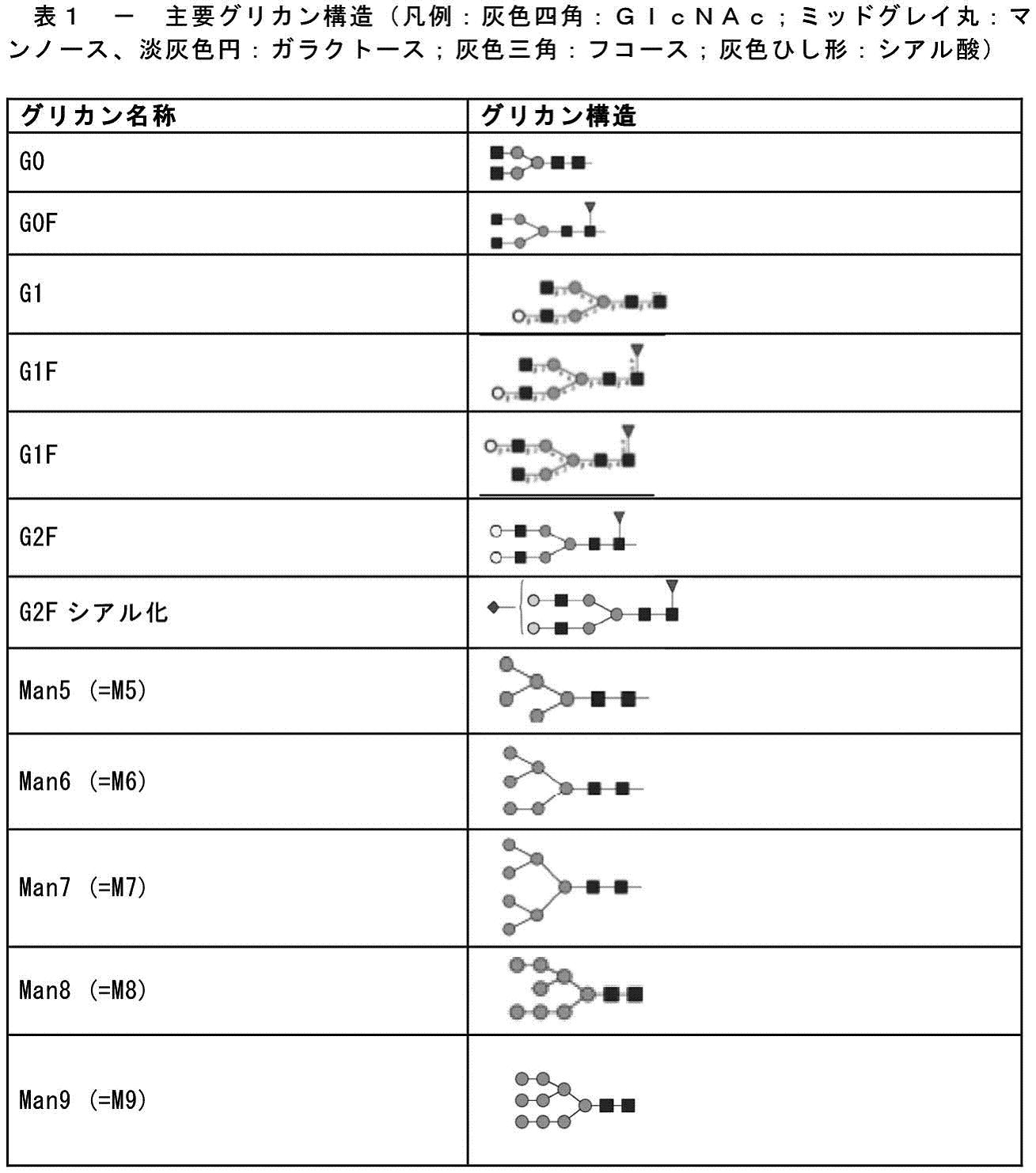
用語「グリコフォーム」は、結合グリカンの数及び/又は種類においてのみ異なる抗体又はそのフラグメントなど、タンパク質のアイソフォームを表す。通常、糖タンパク質を含む組成物は、前記糖タンパク質のいくつかの異なるグリコフォームを含む。 The term "glycoform" refers to isoforms of proteins, such as antibodies or fragments thereof, that differ only in the number and/or type of attached glycans. A composition containing a glycoprotein usually contains several different glycoforms of said glycoprotein.
グリカン一次構造を決定する技術は当技術分野において周知であり、例えば、Roth et al. (2012) 又はSong et al. (2014)に詳述されている。細胞により産生されるタンパク質の分離及びこれらのN-グリカンの構造の決定はルーチンである。N-グリカンは、前記分岐の性質だけでなく、糖を含む分岐数(「アンテナ」とも呼ぶ)に関して異なり、man3GlcNac2コア構造に加えて、例えば、N-アセチルグルコサミン、ガラクトース、N-アセチルガラクトサミン、N-アセチルノイラミン酸、フコース及び/又はシアル酸を挙げることができる。標準的糖鎖生物学命名法の概説については、Varki et al., 1999を参照。 Techniques for determining glycan primary structure are well known in the art and detailed, for example, in Roth et al. (2012) or Song et al. (2014). Isolation of proteins produced by cells and determination of the structure of these N-glycans is routine. N-glycans differ not only in the nature of said branching, but also in terms of the number of branches containing sugars (also called "antennae"), and in addition to the man3GlcNac2 core structure, for example N-acetylglucosamine, galactose, N-acetylgalactosamine, N - acetylneuraminic acid, fucose and/or sialic acid. See Varki et al., 1999 for a review of standard glycobiology nomenclature.
タンパク質のN-グリカン構造は、マンノースの少なくとも3つの残基を含む。これらの構造は、更にマンノシル化され得る。Man5、Man6、Man7、Man8又はMan9などのマンノシル化グリカンは、高マンノースグリカン(又は高マンノース化学種)と呼ばれる(上表1参照)。 The N-glycan structures of proteins contain at least three residues of mannose. These structures can be further mannosylated. Mannosylated glycans such as Man5, Man6, Man7, Man8 or Man9 are referred to as high mannose glycans (or high mannose species) (see Table 1 above).
用語「対象」は、ヒト、イヌ、雌ウシ、ウマ、ヒツジ、ヤギ、ネコ、マウス、ウサギ、又はラットなどの哺乳類(これらの限定されない)を含むものとする。より好ましくは、対象は、ヒトである。 The term "subject" shall include, but is not limited to, mammals such as humans, dogs, cows, horses, sheep, goats, cats, mice, rabbits, or rats. More preferably, the subject is human.
本発明は、治療用タンパク質又は抗体などの組換えタンパク質のマンノシル化プロファイルを調節するための方法及び組成物を提供する。本発明は、抗体又は抗原結合性フラグメントの産生など、タンパク質製造のための細胞培養条件の最適化して、調節されたマンノシル化プロファイル、好ましくは増加されたマンノシル化レベル(高マンノース化学種の増加されたレベルなど)を有する組換えタンパク質の産生をもたらすことに基づく。 The present invention provides methods and compositions for modulating the mannosylation profile of recombinant proteins, such as therapeutic proteins or antibodies. The present invention provides optimization of cell culture conditions for protein production, such as the production of antibodies or antigen-binding fragments, resulting in modulated mannosylation profiles, preferably increased mannosylation levels (increased levels of high mannose species). resulting in the production of a recombinant protein having the same level of
マズラマイシン(Maduramycin)(又はマズラマイシン(maduramicin))は、放線菌アクチノマヅラ・ルブラ(Actinomadura rubra)から初めて単離されたポリエーテルイオノフォアである。これは、Na+よりK+に対して高い親和性を有する一価カチオンを含む複合体を形成する。CAS番号は、79356-08-4である。この化学式は:

サリノマイシンは、別のポリエーテルイオノフォアである。CAS番号は、53003-10-40である。この化学式は:

ナラシンは、ポリエーテルイオノフォアの別の例である。これは、更にメチル基を有するサリノマイシン誘導体である。CAS番号は、55134-13-9である。この化学式は:

ラサロシドは、ストレプトマイセス・ラサリエンシス(Streptomyces lasaliensis)により産生されるポリエーテルイオノフォアである。CAS番号は、25999-31-9である。この化学式は:

マズラマイシン、ナラシン、サリノマイシンなどのポリエーテルイオノフォア(又はポリエーテルイオノフォア化合物)を補った細胞培養条件下、組換えタンパク質のマンノシル化グリコフォーム含有率が増加した(より特に、高マンノース化学種の含有率)ことが観察された。したがって、細胞培養産生実施中に、産生される組換えタンパク質の高マンノース化学種レベルなど、組換えタンパク質のマンノシル化プロファイルを調節することが望ましい場合、細胞培養は、マズラマイシン、ナラシン、サリノマイシンなどのポリエーテルイオノフォアを補うことができるか、又はマズラマイシン、ナラシン、サリノマイシンなどのポリエーテルイオノフォアを含むフィード培地を供給することができる。あるいは、細胞培養培地は、前記ポリエーテルイオノフォアを既に含み得る。ポリエーテルイオノフォアを補った特定の細胞培養条件下、細胞増殖、生存率及び力価は、ポリエーテルイオノフォアを含まない細胞増殖と比較してあまり大きく影響を受けなかったことも観察された;なお、ポリエーテルイオノフォアを含まないこのような細胞増殖は、本発明によるコントロールに相当する。 Under cell culture conditions supplemented with polyetherionophores (or polyetherionophore compounds) such as mazuramycin, narasin, salinomycin, the recombinant protein had an increased content of mannosylated glycoforms (more particularly the content of high mannose species). ) was observed. Therefore, when it is desirable to modulate the mannosylation profile of a recombinant protein, such as high mannose species levels of the recombinant protein produced during cell culture production, the cell culture should be treated with compounds such as mazuramycin, narasin, salinomycin, and the like. Polyether ionophores can be supplemented or feed medium can be supplied containing polyether ionophores such as mazramycin, narasin, salinomycin and the like. Alternatively, the cell culture medium may already contain said polyether ionophore. It was also observed that under certain cell culture conditions supplemented with polyetherionophore, cell growth, viability and titer were not significantly affected compared to cell growth without polyetherionophore; Such cell growth without polyether ionophore corresponds to the control according to the invention.
1つの態様では、本発明は、調節されたマンノシル化プロファイルを有する組換えタンパク質の製造方法であって、方法は、ポリエーテルイオノフォアを含む又は補った細胞培養培地中でタンパク質を発現する組換え細胞を培養することを含む、方法を提供する。 In one aspect, the present invention provides a method for producing a recombinant protein with a modulated mannosylation profile, the method comprising recombinant cells expressing the protein in a cell culture medium containing or supplemented with a polyether ionophore. is provided.
あるいは、本発明は、調節されたマンノシル化プロファイルを有する組換えタンパク質の製造方法であって、方法は、ポリエーテルイオノフォアを含む少なくとも1つのフィードを補った細胞培養培地中でタンパク質を発現する宿主細胞を培養することを含む、方法を記載する。 Alternatively, the invention is a method for producing a recombinant protein with a modulated mannosylation profile, the method comprising host cells expressing the protein in a cell culture medium supplemented with at least one feed comprising a polyether ionophore A method is described comprising culturing the
実施形態では、本明細書において、哺乳類細胞中で産生される組換えタンパク質のグリコシル化プロファイルを調節(例えば、マンノシル化プロファイルを調節)するための細胞培養培地又はフィード培地中のポリエーテルイオノフォアの使用を提供する。 In embodiments, provided herein is the use of polyether ionophores in cell culture media or feed media to modulate the glycosylation profile (e.g. modulate the mannosylation profile) of recombinant proteins produced in mammalian cells. I will provide a.
更なる態様では、本発明は、ポリエーテルイオノフォアを含む細胞培養培地又はフィード培地を含む組成物を提供する。 In a further aspect, the invention provides compositions comprising cell culture media or feed media comprising polyether ionophores.
更なる態様では、本発明は、哺乳類細胞中で産生される組換えタンパク質のマンノシル化プロファイルを調節するための、マズラマイシン、ナラシン又はサリノマイシンなどのポリエーテルイオノフォアの使用を提供する。 In a further aspect, the invention provides the use of polyether ionophores such as mazuramycin, narasin or salinomycin to modulate the mannosylation profile of recombinant proteins produced in mammalian cells.
全体として本発明との関連で、好ましいポリエーテルイオノフォア化合物は、マズラマイシン、ナラシン又はサリノマイシンから成る群から選択される。 In the context of the present invention as a whole, preferred polyetherionophore compounds are selected from the group consisting of mazuramycin, narasin or salinomycin.
好ましくは、全体として本発明との関連で、タンパク質の調節されたマンノシル化プロファイルは、コントロール(すなわち、ポリエーテルイオノフォアを用いない細胞増殖)と比較して、組換えタンパク質における全体的マンノシル化レベルの増加である。より詳細には、マンノシル化レベルの増加は、主に、Man5化学種、並びにそれほどではないが、Man6体及びMan7体の増加のためである。好ましくは、全体的マンノシル化レベル、並びに高マンノース化学種(Man5、Man6、Man7、Man8、Man9など)の各1つの個々のレベルは、コントロールの少なくとも2倍、例えば、コントロールと比較して少なくとも100%増加、又は少なくとも150%増加又は少なくとも200%増加などである。定義セクションに従って、マンノシル化レベルの調節又はマンノシル化レベルの増加は、ポリエーテルイオノフォアを補わない細胞培養培地中の前記組換えタンパク質を発現する組換え細胞の培養により産生される同じタンパク質のマンノシル化レベルと関連して表される。 Preferably, in the context of the present invention as a whole, a regulated mannosylation profile of a protein is defined as the overall mannosylation level in the recombinant protein compared to a control (i.e. cell growth without polyether ionophore). increase. More specifically, the increase in mannosylation levels is primarily due to an increase in Man5 species and, to a lesser extent, Man6 and Man7 forms. Preferably, the overall mannosylation level, as well as the individual levels of each one of the high mannose species (Man5, Man6, Man7, Man8, Man9, etc.) are at least twice that of the control, e.g. % increase, or at least 150% increase or at least 200% increase. According to the Definitions section, modulating mannosylation levels or increasing mannosylation levels is the mannosylation level of the same protein produced by culturing recombinant cells expressing said recombinant protein in a cell culture medium not supplemented with a polyetherionophore. is expressed in relation to
全体として本発明との関連で、産生しようとする組換えタンパク質(又は対象となるタンパク質)は、治療用タンパク質、融合タンパク質(Fc-融合タンパク質など)、ヒト抗体又はその抗原結合性部分、ヒト化抗体又はその抗原結合性部分、キメラ抗体又はその抗原結合性部分など、抗体又はその抗原結合性フラグメントであり得る。好ましくは、抗体又はその抗原結合性フラグメントである。 In the context of the present invention as a whole, recombinant proteins (or proteins of interest) to be produced include therapeutic proteins, fusion proteins (such as Fc-fusion proteins), human antibodies or antigen-binding portions thereof, humanized It can be an antibody or antigen-binding fragment thereof, such as an antibody or antigen-binding portion thereof, a chimeric antibody or antigen-binding portion thereof. Preferably, it is an antibody or an antigen-binding fragment thereof.
本発明の方法を使用して、マンノシル残基の増加された量又はレベルを有する対象となるタンパク質を産生することができる。抗体のマンノシルレベルの調節は、例えば、実際に、特定のCDC及び/又はADCCレベルに達する、又は維持する必要があり得る。 The methods of the invention can be used to produce proteins of interest with increased amounts or levels of mannosyl residues. Regulation of antibody mannosyl levels, for example, may actually be necessary to reach or maintain certain CDC and/or ADCC levels.
全体として本発明との関連で、マズラマイシン、ナラシン又はサリノマイシンなどのポリエーテルイオノフォア化合物を、播種(すなわち、接種)前又は後に細胞培養培地中に添加する。好ましくは、ポリエーテルイオノフォア化合物を、0.5~250nM又は約0.5~250nM、好ましくは1~200nM又は約1~200nM、更に好ましくは2~150nM又は約2~150nMの播種後の濃度、例えば、2、5、10、15、20、30、40、50、60、70、80、90、100、110、120nM又は約2、5、10、15、20、30、40、50、60、70、80、90、100、110、120nMの濃度などに達するために細胞培養培地中に添加する。例えば、ポリエーテルイオノフォア化合物の濃度の調節によって、マンノシル化プロファイルを調節することができる。ポリエーテルイオノフォア化合物を播種前に細胞培養培地中に添加する場合、播種それ自体と関連する希釈因子は考慮されなければならない。補給を行う時点での培養培地体積及び播種後の細胞培養の体積(又は添加される接種材料の体積)を知ることによって、希釈因子の算出は容易になる。前記希釈因子は、通常、10~15%の範囲である。しかしながら、高播種の場合、希釈因子は、30%以下であり得る。例えば、播種後約10nMの当量を目標とし、希釈因子は10%である場合、ポリエーテルイオノフォアは、それぞれ、約11nMの最終濃度(接種前)において添加されなければならないだろう。この最終濃度は、培養培地中の所与の補給/フィードのための最終濃度と理解されなければならない。事実、例として、ポリエーテルイオノフォア化合物を2フィードの培養中に添加する場合、総最終濃度は、第一補給/フィードの残りの最終濃度に添加される第二補給/フィードの最終濃度に相当すると、当業者は理解するだろう。なお、ポリエーテルイオノフォアの濃度は、対象となるセルラインのための各化合物の有害性に応じて、セルライン毎に適合されなければならないだろう。例えば、化合物がおおよそ200nMにおいて毒性(例えば、コントロールと比較して3日目に3分の1に減少したVCD)になり始める場合、約10分の1低い濃度(例えば、20nM)において試験することが得策であろう。
In the context of the present invention as a whole, polyether ionophore compounds such as mazuramycin, narasin or salinomycin are added to the cell culture medium before or after seeding (ie, inoculation). Preferably, the polyether ionophore compound is added at a post-inoculation concentration of 0.5 to 250 nM or about 0.5 to 250 nM, preferably 1 to 200 nM or about 1 to 200 nM, more preferably 2 to 150 nM or about 2 to 150 nM, 2, 5, 10, 15, 20, 30, 40, 50, 60, 70, 80, 90, 100, 110, 120 nM or about 2, 5, 10, 15, 20, 30, 40, 50, 60 , 70, 80, 90, 100, 110, 120 nM, etc., in the cell culture medium. For example, the mannosylation profile can be adjusted by adjusting the concentration of the polyether ionophore compound. If the polyether ionophore compound is added to the cell culture medium prior to seeding, the dilution factor associated with seeding itself must be considered. Knowing the culture medium volume at the time of replenishment and the volume of cell culture after seeding (or the volume of inoculum added) facilitates calculation of the dilution factor. Said dilution factor is usually in the range of 10-15%. However, for high seeding, the dilution factor can be 30% or less. For example, if an equivalence of approximately 10 nM after seeding is targeted and the dilution factor is 10%, the polyether ionophores would each have to be added at a final concentration (before inoculation) of approximately 11 nM. This final concentration has to be understood as the final concentration for the given supplement/feed in the culture medium. In fact, as an example, if a polyetherionophore compound is added during a two-feed culture, the total final concentration corresponds to the final concentration of the second supplement/feed added to the remaining final concentration of the first supplement/feed. , will be understood by those skilled in the art. It should be noted that the concentration of polyether ionophore will have to be adapted from cell line to cell line depending on the toxicity of each compound for the cell line in question. For example, if a compound starts to become toxic at approximately 200 nM (e.g., VCD decreased by 3-fold at
本発明の目的のため、細胞培養培地は、インビトロ細胞培養において哺乳類細胞などの動物細胞の増殖に適する培地である。細胞培養培地配合物は、当技術分野において周知である。細胞培養培地は、培養液中の細胞のニーズに応じて、糖類、ビタミン類、ホルモン、及び成長因子などの追加の成分を補給してよい。好ましくは、細胞培養培地は動物成分を含まず;血清フリー及び/又はタンパク質フリーであり得る。 For purposes of the present invention, a cell culture medium is a medium suitable for growing animal cells, such as mammalian cells, in in vitro cell culture. Cell culture media formulations are well known in the art. Cell culture media may be supplemented with additional components such as sugars, vitamins, hormones, and growth factors, depending on the needs of the cells in culture. Preferably, the cell culture medium is free of animal components; it may be serum-free and/or protein-free.
本発明の特定の実施形態では、細胞培養培地は、例えば、培養の開始時、及び/又は流加式若しくは連続式でポリエーテルイオノフォアを補給する。ポリエーテルイオノフォア補給の添加は、測定された中間マンノシル化プロファイル/レベルに基づいていてよい。培養中の前記添加は、ポリエーテルイオノフォア化合物のみから成るフィード又は他の成分の中でもポリエーテルイオノフォア化合物の補給を含むフィードにより行うことができる。 In certain embodiments of the invention, the cell culture medium is supplemented with polyether ionophore, eg, at the beginning of the culture and/or in a fed-batch or continuous fashion. Addition of polyether ionophore supplementation may be based on the measured intermediate mannosylation profile/level. Said addition during cultivation can be carried out by means of a feed consisting solely of the polyetherionophore compound or a feed comprising a supplementation of the polyetherionophore compound among other ingredients.
本発明の実施形態では、宿主細胞は、好ましくは、これに限定されないが、HeLa、Cos、3T3、ミエローマセルライン(例えば、NS0、SP2/0)、及びチャイニーズハムスター卵巣(CHO)細胞を含む哺乳類宿主細胞(本明細書において哺乳類細胞と呼ぶ)である。好ましい実施形態では、宿主細胞は、CHO-S細胞及びCHO-k1細胞などのチャイニーズハムスター卵巣(CHO)細胞である。 In embodiments of the present invention, host cells are preferably mammalian cells, including, but not limited to, HeLa, Cos, 3T3, myeloma cell lines (e.g., NS0, SP2/0), and Chinese Hamster Ovary (CHO) cells. A host cell (referred to herein as a mammalian cell). In preferred embodiments, the host cells are Chinese Hamster Ovary (CHO) cells, such as CHO-S cells and CHO-k1 cells.
全体として本発明との関連で、組換え細胞、好ましくは、哺乳類細胞は、バイオリアクターなどの培養システム中で増殖する。バイオリアクターは、ポリエーテルイオノフォア化合物を含む又は補った培養培地中の生細胞を接種する。好ましくは、培養培地は、血清フリー及び/又はタンパク質フリーである。一旦、製造用バイオリアクターに接種すれば、組換え細胞は、指数関数的に増殖する。前記ポリエーテルイオノフォアを必要に応じて補ったフィード培地又はポリエーテルイオノフォアから成るフィードのボーラス(若しくは連続式)フィードを用いた流加方法を使用して、増殖期を維持することができる。好ましくは、フィード培地は、血清フリー及び/又はタンパク質フリーである。細胞培養がフィージングを必要とすると予測又は決定される時点で、バイオリアクターに細胞を接種した直後に、これらの補給フィードは通常始まる。例えば、培養開始後3日目、4日目若しくは5日目若しくは約3日目、4日目若しくは5日目に、又は培養開始より1日若しくは2日早く、又は1日若しくは2日遅く、補給フィードを始めることができる。培養は、増殖期及び産生期中、1つ、2つ、3つ、又はそれ以上のボーラス(又は連続式)フィードを受けてよい。これらのフィードのいずれか1つを、必要に応じて、ポリエーテルイオノフォアを補給することができる。ポリエーテルイオノフォアの補給又はフィードを、流加方法及び/又は連続方法で、培養の開始時に行うことができる。あるいは、ポリエーテルイオノフォア化合物の補給を培養開始後にのみ行うことができ;このような場合、ポリエーテルイオノフォアを、培養開始時(例えば、接種時)に培養培地中に添加しないだろう。ポリエーテルイオノフォアをフィードとして添加する場合、別々に(単一成分フィードとして)又は通常の補給フィード(別の種類のフィードの一部として)と一緒に補給することができる。ポリエーテルイオノフォアの前記フィードを、培養開始後3日目、4日目若しくは5日目若しくは約3日目、4日目若しくは5日目に、又は培養開始より1日若しくは2日早く、又は1日若しくは2日遅く(1日目、2日目、6日目若しくは7日目など)始めることができる。培養は、増殖期及び産生期中、2つ、3つ、又はそれ以上のフィードを受けてよい。例えば、限定的例と見るべきではないが、1)ポリエーテルイオノフォアの第一フィードを3日目に添加し、次いで、追加のポリエーテルイオノフォアフィードを5日目、7日目及び10日目に添加することができるか、又は2)ポリエーテルイオノフォアの第一フィードを5日目に添加し、次いで、追加のポリエーテルイオノフォアフィードを7日目及び10日目に添加することができる。培養期間は21~24日など、12~14日より長い場合、フィードの数及びタイミングを適合することができる(例えば、15日目、16日目又は17日目までのフィード)。補給/フィードストラテジーは、標的マンノシル化プロファイル及び培養期間に依存し、本開示に基づいてケースバイケースで適合することができる。
In the context of the present invention as a whole, recombinant cells, preferably mammalian cells, are grown in culture systems such as bioreactors. A bioreactor is inoculated with living cells in a culture medium containing or supplemented with a polyether ionophore compound. Preferably, the culture medium is serum-free and/or protein-free. Once inoculated into a production bioreactor, recombinant cells grow exponentially. A fed-batch method using bolus (or continuous) feeding of the feed medium optionally supplemented with the polyetherionophore or a feed consisting of the polyetherionophore can be used to maintain the growth phase. Preferably, the feed medium is serum-free and/or protein-free. These supplementary feeds usually begin immediately after inoculating the bioreactor with cells when it is predicted or determined that the cell culture requires feeding. For example, 3 days, 4 days or 5 days or about 3 days, 4 days or 5 days after the start of culture, or 1 day or 2 days earlier or 1 day or 2 days later than the start of culture, Replenishment feeds can be started. Cultures may receive one, two, three, or more bolus (or continuous) feeds during the growth and production phases. Any one of these feeds can be supplemented with polyether ionophore as needed. Supplementation or feeding of the polyether ionophore can be done at the start of the cultivation in fed-batch and/or continuous methods. Alternatively, supplementation with the polyetherionophore compound can be performed only after the initiation of the culture; in such cases, the polyetherionophore will not be added to the culture medium at the initiation of the culture (eg, at the time of inoculation). If the polyether ionophore is added as a feed, it can be fed separately (as a single component feed) or together with a regular make-up feed (as part of another type of feed). said feed of polyether ionophore at or about
本発明による方法、組成物及び使用を使用して、多段階培養方法で組換えタンパク質の産生を向上することができる。多段階方法では、2つ以上の異なるフェーズで細胞を培養する。例えば、細胞増殖及び生存率を向上する条件下で1つ以上の増殖期で先ず細胞を培養し、それから、タンパク質産生を向上する条件下で産生期に移行する。多段階培養方法では、1つのステップ(又は1つのフェーズ)から他のステップへいくつかの条件を変更してもよい:培地組成、pHシフト、温度シフト、その他。産生期より高い温度において、増殖期を行うことができる。例えば、約35℃~約38℃の第一温度において増殖期を行うことができ、それから、約29℃~約37℃の第二温度へ産生期のために温度をシフトする。収穫前数日間又は数週間でさえ産生期において細胞培養を維持することができる。 The methods, compositions and uses according to the invention can be used to improve the production of recombinant proteins in multi-step culture methods. In multi-step methods, cells are cultured in two or more different phases. For example, cells are first cultured in one or more growth phases under conditions that enhance cell growth and viability, and then transitioned to a production phase under conditions that enhance protein production. In a multi-step culture method, some conditions may be changed from one step (or one phase) to another: medium composition, pH shift, temperature shift, etc. The growth phase can be carried out at a higher temperature than the production phase. For example, the growth phase can be conducted at a first temperature of about 35° C. to about 38° C., then the temperature is shifted to a second temperature of about 29° C. to about 37° C. for the production phase. Cell cultures can be maintained in the production phase for days or even weeks prior to harvest.
本発明で使用されるセルライン(「組換え細胞」とも呼ばれる)を、商業的又は科学的興味あるタンパク質を発現するように遺伝的に改変する。対象となるポリペプチドを発現する細胞及び/又はセルラインの遺伝的改変のための方法及びベクターは当業者に周知であり;例えば、Ausubel et al. (1988, 及び最新情報)又はSambrook et al. (1989, 及び最新情報)に様々な技術が例証されている。本発明の方法を使用して、対象となる組換えタンパク質を発現する細胞を培養することができる。組換えタンパク質は、通常、これらが回収される培養培地へ分泌される。それから、回収されるタンパク質を、公知の方法及び商業的供給業者から入手可能な製品を使用して精製、又は部分的に精製することができる。それから、精製されたタンパク質を医薬組成物として製剤することができる。医薬組成物に適した製剤としては、Remington's Pharmaceutical Sciences, 1995に記載されているものが挙げられる。 Cell lines (also called "recombinant cells") used in the present invention are genetically modified to express proteins of commercial or scientific interest. Methods and vectors for genetic modification of cells and/or cell lines that express a polypeptide of interest are well known to those skilled in the art; (1989, and updates) illustrate various techniques. The methods of the invention can be used to culture cells that express a recombinant protein of interest. Recombinant proteins are usually secreted into the culture medium from which they are recovered. The recovered protein can then be purified, or partially purified, using known methods and products available from commercial suppliers. The purified protein can then be formulated as a pharmaceutical composition. Suitable formulations for pharmaceutical compositions include those described in Remington's Pharmaceutical Sciences, 1995.
更なる態様では、本発明の方法によって製造される調節されたマンノシル化プロファイルを有する組換えタンパク質を含む組成物を提供する。 In a further aspect, compositions comprising recombinant proteins with modulated mannosylation profiles produced by the methods of the invention are provided.
増加されたマンノシル化レベル又は量を有する調節された、マンノシル化プロファイルを有する組換えタンパク質、例えば、Fc-融合タンパク質、抗体又はその抗原結合性フラグメントを含む本発明の組成物を使用して、組成物中に含まれる治療用タンパク質(抗体又はその抗原結合性フラグメントなど)が適切である対象のいずれかの障害を治療してよい。 Using compositions of the present invention comprising recombinant proteins having a modulated mannosylation profile with increased mannosylation levels or amounts, such as Fc-fusion proteins, antibodies or antigen-binding fragments thereof, Any disorder in a subject for which a therapeutic protein (such as an antibody or antigen-binding fragment thereof) contained in the article is suitable may be treated.
更なる態様では、本発明は、本発明の方法により産生された調節されたマンノシル化プロファイルを有する組換えタンパク質、及び薬剤的に許容可能な担体を含む医薬組成物を提供する。 In a further aspect, the invention provides a pharmaceutical composition comprising a recombinant protein with modulated mannosylation profile produced by the method of the invention and a pharmaceutically acceptable carrier.
特定の実施形態では、調節されたマンノシル化プロファイルを有する組換えタンパク質を含む本発明の医薬組成物を、医薬(治療用)組成物として薬剤的に許容可能な担体と共に製剤してよく、当技術分野において公知の様々な方法によって投与してよい(例えば、Remington's Pharmaceutical Sciences, 1995参照)。このような医薬組成物は、塩、緩衝剤、界面活性剤、可溶化剤、ポリオール、アミノ酸、防腐剤、相溶性担体、必要に応じて他の治療用薬物、及びこれらの組合せのいずれか1つを含んでよい。調節されたマンノシル化プロファイルを有する組換えタンパク質を含む本発明の医薬組成物は、当技術分野において公知の形態で存在し、液体製剤、又は凍結乾燥製剤などの治療用途にふさわしい。当業者は、本明細書に記載されている本発明は、詳細に記載されているもの以外の変更及び修正も許容されると理解するだろう。本発明は、その趣旨又は本質的特徴から逸脱することなく全てのこのような変更及び修正を包含すると理解されるものとする。本発明は、個別に又は集団的に、本明細書に言及されている又は示されているステップ、特徴、組成物及び化合物の全て、並びに前記ステップ又は特徴のいずれか2つ以上の全ての組合せも包含する。 In certain embodiments, the pharmaceutical compositions of the invention comprising recombinant proteins with modulated mannosylation profiles may be formulated with pharmaceutically acceptable carriers as pharmaceutical (therapeutic) compositions. Administration may be by a variety of methods known in the art (see, eg, Remington's Pharmaceutical Sciences, 1995). Such pharmaceutical compositions may contain any one of salts, buffers, surfactants, solubilizers, polyols, amino acids, preservatives, compatible carriers, optionally other therapeutic agents, and combinations thereof. may contain one. Pharmaceutical compositions of the invention comprising recombinant proteins with modulated mannosylation profiles are in forms known in the art and are suitable for therapeutic use such as liquid formulations or lyophilized formulations. Those skilled in the art will appreciate that the invention described herein is susceptible to variations and modifications other than those specifically described. It is to be understood that the invention encompasses all such alterations and modifications without departing from its spirit or essential characteristics. The present invention provides, individually or collectively, all of the steps, features, compositions and compounds referred to or shown herein, and all combinations of any two or more of said steps or features. also includes
前述の記載は、次の実施例を参照してより充分に理解されるだろう。しかしながら、このような実施例は、本発明を実施する方法の例示であり、本発明の範囲を限定することを意図しない。 The foregoing description will be more fully understood with reference to the following examples. Such examples, however, are illustrative of the manner in which the invention may be practiced and are not intended to limit the scope of the invention.
材料及び方法
I.細胞、細胞繁殖及び細胞増殖
「mAb1」は、細胞膜上に見られる受容体に対するヒト化モノクローナル抗体である。その等電点(pl)は、約8.5~9.5である。mAb1は、CHO-S細胞内で産生された。
Materials and methods
I. Cells, Cell Proliferation and Cell Proliferation "mAb1" is a humanized monoclonal antibody directed against receptors found on cell membranes. Its isoelectric point (pl) is about 8.5-9.5. mAb1 was produced in CHO-S cells.
「mAb2」は、可溶性タンパク質を標的とする第二部分と結合された膜タンパク質(Fcドメインを含むIgG部分)に対する1つの部分を含むIgG1融合タンパク質(すなわち、Fc-融合タンパク質)である。その等電点(pl)は、約6.6~8.0である。これは、CHO-S細胞内で発現された。 A “mAb2” is an IgG1 fusion protein (ie, an Fc-fusion protein) that contains one portion for a membrane protein (an IgG portion that includes an Fc domain) coupled with a second portion that targets a soluble protein. Its isoelectric point (pl) is about 6.6-8.0. It was expressed in CHO-S cells.
mAb1及びmAb2を発現する細胞を、0.2×10⁶細胞/ミリリットル(mL)で接種した。 Cells expressing mAb1 and mAb2 were seeded at 0.2×10 6 cells/milliliter (mL).
全てのアッセイを、流加培養で行った。血清フリー既知組成培養培地を使用した。これを、そのまま使用した、又は所望の濃度でポリエーテルイオノフォア化合物(マズラマイシン、ナラシン、サリノマイシン及びラサロシドは全てSigma-Aldrichから購入した)を補給した。既知組成フィード培地、並びに>0~約8g/Lの範囲にグルコースレベルを保持するために前記グルコースを、培養培地に定期的に供給した(3日目、5日目、7日目、10日目にフィードを行い、12日目に追加のグルコースフィードを行った)。
All assays were performed in fed-batch culture. A serum-free chemically defined culture medium was used. This was used as is or supplemented with polyether ionophore compounds (mazuramycin, narasin, salinomycin and lasalocid were all purchased from Sigma-Aldrich) at desired concentrations. Chemically defined feed medium and said glucose was fed to the culture medium periodically (
実施例1のため、30mLの作業容量を有するSpinTubes(登録商標)内で培養を行った。これらを、36.5℃、CO25%、湿度80%でインキュベートを行い、320rpmで振盪した。サリノマイシン、ナラシン及びマズラマイシンを、100、250、500及び1000nMで試験した。
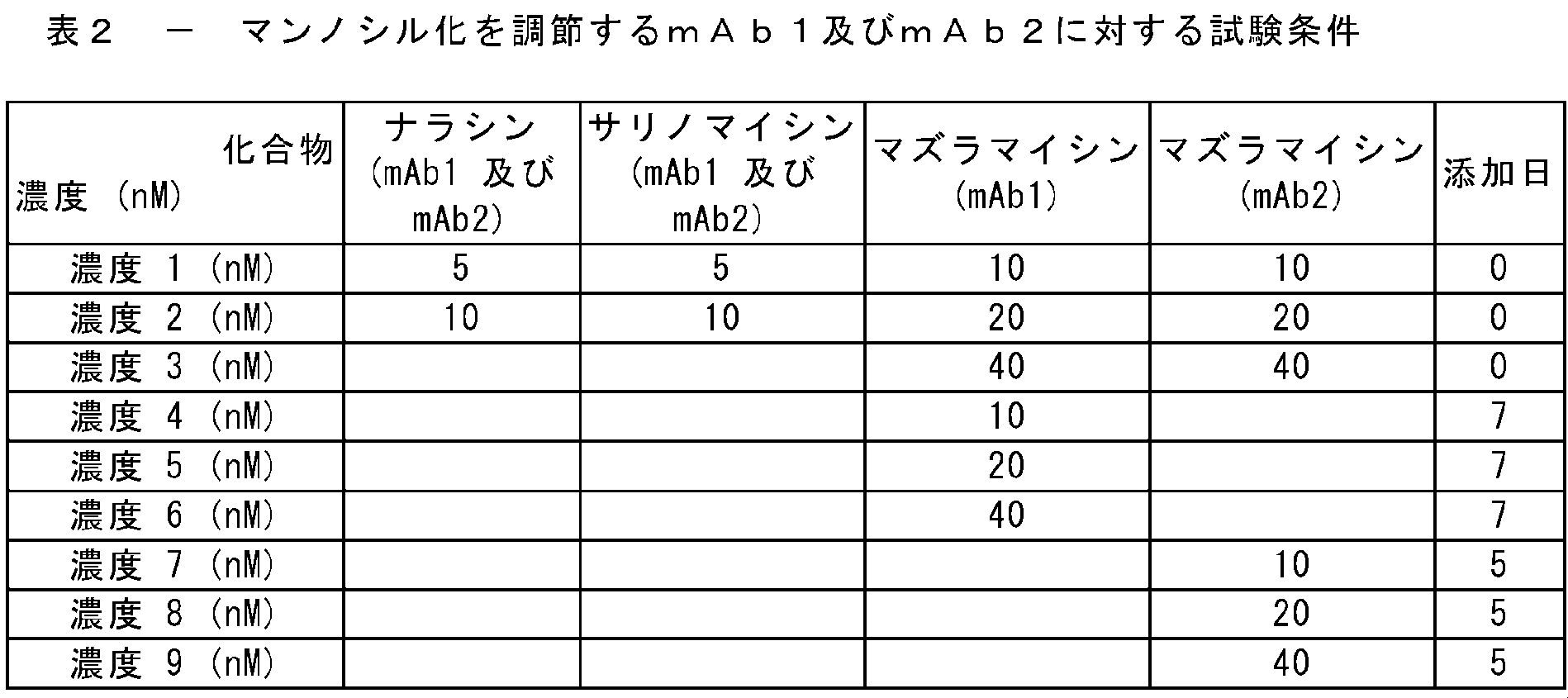
実施例2及び3のため、14mLの作業要領を有するAmbr(登録商標)15内で培養を行った(36.5℃、溶存酸素40%、N2 0.1ml/分、pH範囲:6.75~7.15、800rpm)。mAb1を発現する細胞については、6日目に温度シフトを行った。更なる条件を表2に示す。
流加培養の各々を14日継続した。
For Example 1, cultures were performed in SpinTubes® with a working volume of 30 mL. They were incubated at 36.5° C., 5% CO 2 , 80% humidity and shaken at 320 rpm. Salinomycin, narasin and mazuramycin were tested at 100, 250, 500 and 1000 nM.
For Examples 2 and 3, cultures were carried out in
Each of the fed-batch cultures lasted 14 days.
II.分析方法
ViCell(登録商標)(Beckmann Coulter)を用いて、生細胞密度及び生存率を測定した。PA-HPLCを用いて、抗体力価を測定した。
超高速液体クロマトグラフィー-2-アミノベンズアミド標識技術(2AB-UPLC;mAb1)又は質量分析法(MS;mAB2)のいずれかによって、グリコシル化プロファイルを実証した。グリカンのグループを表1に規定した。
II. Analysis method
ViCell ® (Beckmann Coulter) was used to measure viable cell density and viability. Antibody titers were determined using PA-HPLC.
Glycosylation profiles were verified by either ultra-performance liquid chromatography-2-aminobenzamide labeling techniques (2AB-UPLC; mAb1) or mass spectrometry (MS; mAB2). Groups of glycans are defined in Table 1.
実施例1 - ポリエーテルイオノフォアの有害性
細胞を培養し、結果を材料及び方法セクションに開示されているように解析した。なお、本発明によるコントロール(又はコントロール条件)は、ポリエーテルイオノフォアを用いない細胞増殖に相当する。
Example 1 - Toxicity of Polyether Ionophores
Cells were cultured and results analyzed as disclosed in the Materials and Methods section. The control (or control conditions) according to the present invention corresponds to cell growth without polyether ionophore.
経過時間の関数としての生細胞密度を図1に示す(サリノマイシンについては図1A;ナラシンについては図1B及びマズラマイシンについては図1C)。試験された全濃度において(すなわち、100nMと低濃度)、サリノマイシン及びナラシンの両方は細胞に対して非常に有害性であり、VCDを3分の1に減少させた。マズラマイシンは、250nMにおいて同等な有害性を有した。100nMにおけるマズラマイシンは、VCDに対してあまり重度の効果を示さない。 The viable cell density as a function of elapsed time is shown in Figure 1 (Figure 1A for salinomycin; Figure 1B for narasin and Figure 1C for mazuramycin). At all concentrations tested (ie, concentrations as low as 100 nM), both salinomycin and narasin were highly toxic to cells, reducing VCD by 3-fold. Mazuramycin had comparable toxicity at 250 nM. Mazuramycin at 100 nM has a less severe effect on VCD.
これらの実験は、次の実験のために各化合物濃度の設定を可能とした。 These experiments allowed the setting of each compound concentration for subsequent experiments.
実施例2 - mAb1抗体に対するポリエーテルイオノフォアの影響
細胞を培養し、結果を材料及び方法セクションに開示されているように解析した。
Example 2 - Effect of Polyether Ionophore on mAb1 Antibody Cells were cultured and results analyzed as disclosed in the Materials and Methods section.
生細胞密度、生存率及び力価:
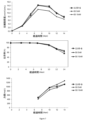
経過時間の関数としての生細胞密度、生存率、並びに流加培養終了時の抗体力価を図2~5に示す(培養開始時に添加された、サリノマイシンについては図2;ナラシンについては図3、マズラマイシンについては図4、7日目に添加されたマズラマイシンについては図5)。
Viable cell density, viability and titer:
Viable cell density, viability, and antibody titers at the end of fed-batch cultures as a function of elapsed time are shown in FIGS. Figure 4 for mazuramycin, Figure 5 for mazuramycin added on day 7).
いずれの場合も生存率は影響を受けない:いずれの濃度及びいずれのポリエーテルイオノフォアを使用しても、コントロールと比較して安定なままであった。 Viability was not affected in either case: it remained stable compared to controls using both concentrations and both polyether ionophores.
培養開始時の添加:試験された濃度、すなわち、5nM及び10nMのいずれか1つにおいて、コントロールと比較して、培養終了時、サリノマイシン及びナラシンの両方は、細胞増殖(それぞれ、-13%及び-15%)又はタンパク質力価(どちらも-15%)に対して僅かに悪影響を与えた。40nMにおけるマズラマイシンについて同様な結果が観察された(約13%VCDが減少、及び約15%力価が減少)。それとは反対に、10nM及び20nMの両方において培養開始時に添加されたマズラマイシンは、コントロールに匹敵するVCD(両方の濃度において-10%以下)及び力価(それぞれ、-6%及び+1%)を示した。 Addition at the start of culture: At either one of the concentrations tested, i.e., 5 nM and 10 nM, both salinomycin and narasin reduced cell proliferation (-13% and -13%, respectively) at the end of the culture compared to the control. 15%) or slightly adversely affected protein titers (both −15%). Similar results were observed for mazuramycin at 40 nM (approximately 13% reduced VCD and approximately 15% reduced potency). In contrast, mazuramycin added at culture initiation at both 10 nM and 20 nM produced comparable VCD (below -10% at both concentrations) and titer (-6% and +1%, respectively) to controls. Indicated.
7日目における添加:10nMの濃度において培養開始後7日目に添加されたマズラマイシンは、コントロールと比較して、VCD及び力価の両方に対して悪影響を示さなかった。40nMにおいて、マズラマイシンは、細胞増殖に対して僅かに悪影響を与えた(-15%)が、しかしながら、力価に対しては影響はなかった。興味深いことに、20nMにおいて、マズラマイシンは、生存率に対して悪影響を与えた。これは、このバイオリアクター中のラクテートの予期しない増加が原因であり得る。それにもかかわらず、マズラマイシンは、より高濃度での他の結果を考慮して、この濃度において有害性であってはならない。 Addition on Day 7: Mazuramycin added at a concentration of 10 nM on day 7 after culture initiation showed no adverse effects on both VCD and titer compared to controls. At 40 nM, mazuramycin had a slightly negative effect on cell proliferation (-15%), but had no effect on titer. Interestingly, at 20 nM mazuramycin had a negative effect on viability. This may be due to an unexpected increase in lactate in this bioreactor. Nevertheless, mazuramycin should not be hazardous at this concentration considering other consequences at higher concentrations.
グリコシル化プロファイル:
グリコシル化プロファイルを図6に示す(図6A=12日目;図6A=14日目)。
培養開始時に添加されたポリエーテルイオノフォアについて、得られたデータは以下のことを明確に示している:
- ポリエーテルイオノフォアナラシン、サリノマイシン及びマズラマイシンは、コントロールと比較して、mAb1のマンノシル化レベルに対して、特にMan5化学種に対して強力な影響を与える。例えば、12日目、Man5化学種レベルは、10mMのサリノマイシンを用いて約1%(コントロール)から約27%以下まで、又は10mMナラシン及び40nMマズラマイシンの両方に関して約32%以下まで増加した。
- ポリエーテルイオノフォアナラシン、サリノマイシン及びマズラマイシンは、コントロールと比較して、mAb1のMan6~Man9化学種レベルに対して影響を与える。例えば、12日目:
o Man6化学種(M6)レベルは、40mMのマズラマイシンを用いて約0.35%(コントロール)から約3.7%以下まで、10mMのサリノマイシンを用いて約3.2%以下まで、又は10mMナラシンを用いて約6.5%以下まで増加した。
o Man7化学種レベルは、40mMのマズラマイシン若しくは10mMのサリノマイシンを用いて約0.35%(コントロール)から約1.5%以下まで、又は10mMナラシンを用いて約4.5%以下まで増加した。
o Man8化学種レベルは、10mMのサリノマイシンを用いて約0.12%(コントロール)から約0.3%以下まで、40mMのマズラマイシン用いて約1.5%以下まで、又は10mMナラシンを用いて約3.5%以下まで増加した。
o Man9化学種レベルは、10mMのサリノマイシンを用いて約0.2%(コントロール)から約0.45%以下まで、又は40mMのマズラマイシン若しくは10mMナラシンを用いて約0.5%以下まで増加した。
- 総マンノシル化レベルに対する影響は、使用されるポリエーテルイオノフォアの関数として大きく変わる。例えば、10nMにおけるサリノマイシン、ナラシン及びマズラマイシンの効果を比較する場合、ナラシンは、最も高いマンノシル化の増加を示した。事実、10nMのナラシンを使用して、総マンノシル化は、培養12日後に約43%及び培養14日後に約38.9%に達した。それどころか、マズラマイシンは、マンノシル化に対して最も低い効果を有し、培養12日後に6.1%及び培養14日後に6.6%の総マンノシル化であった。ポリエーテルイオノフォア間のこの差異は、これらの化合物の異なる有害性によって説明することができる。事実、有害性試験は、100nMにおいて、マズラマイシンは、試験された他のものと比較して、有害性がより低いポリエーテルイオノフォアであった(実施例1参照)。
- コントロールと比較して、mAb1のマンノシル化レベルに対する影響を、使用されるポリエーテルイオノフォアの性質/濃度及び培養における経過時間の関数として調節することができる(例えば、12日又は14日)。
Glycosylation Profile:
Glycosylation profiles are shown in Figure 6 (Figure 6A =
For the polyether ionophore added at the start of the culture, the data obtained clearly show that:
- The polyetherionophores analasin, salinomycin and mazramycin have a strong effect on the mannosylation level of mAb1, especially on the Man5 species, compared to controls. For example, on
- Polyetherionophores anarasin, salinomycin and mazramycin have an effect on mAb1 Man6-Man9 species levels compared to controls. For example, day 12:
o Man6 chemospecies (M6) levels from about 0.35% (control) to about 3.7% or less with 40 mM mazuramycin, to about 3.2% or less with 10 mM salinomycin, or 10 mM It increased to about 6.5% or less with Narasin.
o Man7 chemospecies levels increased from about 0.35% (control) to about 1.5% or less with 40 mM mazramycin or 10 mM salinomycin, or to about 4.5% or less with 10 mM narasin. .
o Man8 chemospecies levels decreased from about 0.12% (control) to about 0.3% or less with 10 mM salinomycin, to about 1.5% or less with 40 mM mazuramycin, or 10 mM narasin. increased to about 3.5% or less.
o Man9 chemospecies levels increased from about 0.2% (control) to about 0.45% or less with 10 mM salinomycin, or to about 0.5% or less with 40 mM mazramycin or 10 mM narasin. .
- The impact on the total mannosylation level varies greatly as a function of the polyether ionophore used. For example, when comparing the effects of salinomycin, narasin and mazuramycin at 10 nM, narasin showed the highest increase in mannosylation. In fact, using 10 nM narasin, total mannosylation reached about 43% after 12 days of culture and about 38.9% after 14 days of culture. On the contrary, mazuramycin had the lowest effect on mannosylation, with a total mannosylation of 6.1% after 12 days of culture and 6.6% after 14 days of culture. This difference between polyether ionophores can be explained by the different toxicities of these compounds. In fact, toxicology studies showed that at 100 nM, mazuramycin was the less toxic polyether ionophore compared to others tested (see Example 1).
- The influence on the mannosylation level of mAb1 can be modulated as a function of the nature/concentration of the polyetherionophore used and the elapsed time in culture compared to controls (
培養中のフィードとして添加されるポリエーテルイオノフォアについて、得られたデータは以下のことを明確に示している:
- 化合物(マズラマイシンなど)の添加は、マンノシル化レベルにも影響を与える。
- 主な影響は、今一度主にMan5化学種に対するものであるが、より強力な効果は、特にマズラマイシンの20mMの濃度においてMan6及びMan7に対して示された。
For polyether ionophores added as feed during cultivation, the data obtained clearly show that:
- Addition of compounds (such as mazuramycin) also affects mannosylation levels.
- The main effect was once again mainly on the Man5 species, but a stronger effect was shown on Man6 and Man7, especially at the 20 mM concentration of mazuramycin.
mAb1に関する結論:
驚くべきことに、本結果は、サリノマイシン、ナラシン及びマズラマイシンは抗体、この場合、mAb1のマンノシル化を調節することができ、特に、アフコシル化(afucoslyated)グリコフォームに大きく影響を与えないで(約1~2%だけの増加;データ示さず)、Man5化学種、及びそれほどではないがM6~M9の量を大きく増加させることができることを明確に示している。示されないが、フコシル化グリコフォームのレベルは減少したが、Manグリコフォームは増加した(3~40%の減少)。それとは反対に、別のポリエーテルイオノフォア、すなわち、ラサロシドは、マンノシル化に対する効果を有しない。本実施例は、使用されるポリエーテルイオノフォア(サリノマイシン、ナラシン及びマズラマイシン)の性質/濃度、培養における経過時間及び分子の添加のタイミング、すなわち、培養の開始時(播種前又は播種直後の細胞培養液中など)又は後の段階におけるフィードとして(例えば、実施例2における7日目)のタイミングをいじることによって本発明の教示に基づいて、マンノシル化を微調整することができることを示している。
Conclusions for mAb1:
Surprisingly, the present results show that salinomycin, narasin and mazuramycin are able to modulate the mannosylation of antibodies, in this case mAb1, in particular without significantly affecting afucoslyated glycoforms (approximately An increase of only 1-2%; data not shown) clearly shows that the amount of the Man5 species and to a lesser extent M6-M9 can be greatly increased. Although not shown, the levels of fucosylated glycoforms decreased, while the Man glycoforms increased (3-40% reduction). In contrast, another polyetherionophore, lasaroside, has no effect on mannosylation. This example demonstrates the nature/concentration of the polyetherionophores (salinomycin, narasin and mazramycin) used, the elapsed time in the culture and the timing of the addition of the molecules, i.e. at the beginning of the culture (before seeding or just after seeding the cell culture It shows that mannosylation can be fine-tuned based on the teachings of the present invention by manipulating the timing of the feed (e.g., in liquid) or as a feed at a later stage (e.g., day 7 in Example 2).
実施例3 - mAb2抗体に対するポリエーテルイオノフォアの影響
細胞を培養し、結果を材料及び方法セクションに開示されているように解析した。
Example 3 - Effect of Polyether Ionophore on mAb2 Antibody Cells were cultured and results analyzed as disclosed in the Materials and Methods section.
生細胞密度、生存率及び力価:
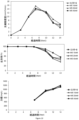
経過時間の関数としての生細胞密度、生存率、並びに流加培養終了時の抗体力価を図7~10に示す(培養開始時に添加された、サリノマイシンについては図7;ナラシンについては図8、マズラマイシンについては図9、5日目に添加されたマズラマイシンについては図10)。
Viable cell density, viability and titer:
Viable cell density, viability, and antibody titers at the end of fed-batch culture as a function of elapsed time are shown in FIGS. Figure 9 for mazuramycin, Figure 10 for mazuramycin added on day 5).
培養開始時の添加:試験された濃度、すなわち、5nM及び10nMのいずれか1つにおいて、サリノマイシンは、培養終了時にコントロールに匹敵する細胞増殖(10nMにおいて10%以下)又はタンパク質力価(+10%以下)を示した。両方の濃度において細胞増殖に対する悪影響を有するが、ナラシンは、5nMにおいてコントロールに匹敵する力価(+10%)及び10nMにおいて僅かにプラスの影響(+15%)を示した。マズラマイシンは、細胞増殖及び力価の両方に対してナラシンと同様なプロファイルを示した(試験された濃度においてコントロールと比較して+10%以下及び+12%以下)。 Addition at initiation of culture: At any one of the concentrations tested, i.e., 5 nM and 10 nM, salinomycin produced comparable cell growth (≤10% at 10 nM) or protein titer (≤10% at 10 nM) to controls at the end of culture. )showed that. Although having a negative effect on cell proliferation at both concentrations, narasin showed comparable potency to control (+10%) at 5 nM and a slightly positive effect (+15%) at 10 nM. Mazuramycin showed a similar profile to narasin for both cell proliferation and titer (+10% or less and +12% or less compared to controls at the concentrations tested).
5日目における添加:その濃度にかかわらず、10nMの濃度において培養開始後5日目に添加されたマズラマイシンは、細胞増殖開始12日目に対して悪影響を有したが、コントロールと比較して力価に対して悪影響を示さなかった。
Addition at Day 5: Regardless of its concentration, mazuramycin added at a concentration of 10 nM at
グリコシル化プロファイル:
グリコシル化プロファイルを図11に示す(図11A=10日目;図11B=12日目)。得られたデータは以下のことを明確に示している:
培養開始時に添加されたポリエーテルイオノフォアについて、得られたデータは以下のことを明確に示している:
- ポリエーテルイオノフォア、ナラシン、サリノマイシン及びマズラマイシンは、コントロールと比較して、mAb2のマンノシル化レベルに対して、特にMan5化学種に対して強力な影響を与える。例えば、10日目、Man5化学種レベルは、10mMのサリノマイシンを用いて約0.7%(コントロール)から約15%以下まで、並びに40mMマズラマイシン及び10mMナラシンの両方に関して約16.5%以下まで増加した。
- ポリエーテルイオノフォア、ナラシン、サリノマイシン及びマズラマイシンは、コントロールと比較して、それほどではないが、mAb2のMan6~Man9化学種レベルに対しても影響を与える。例えば、10日目:
o Man6化学種(M6)レベルは、10mMのサリノマイシンを用いて約0.1%(コントロール)から約2.5%以下まで、並びに40mMのマズラマイシン及び10mMナラシンの両方について約3%以下まで増加した。
o Man7化学種レベルは、10mMのサリノマイシンを用いて約0.05%(コントロール)から約0.65%以下まで、40mMのマズラマイシン用いて約0.8%以下まで、又は10mMナラシンを用いて約1.0%以下まで増加した。
- mAb1に見られるように、総マンノシル化レベルに対する影響は、使用されるポリエーテルイオノフォアの関数として大きく変わる。もう一度、10nMにおけるサリノマイシン、ナラシン及びマズラマイシンの効果を比較する場合、ナラシンは、最も高いマンノシル化の増加を示した。事実、10nMのナラシンを使用して、総マンノシル化は、培養10日後に約12.0%及び培養12日後に約18.0%に達した。それどころか、マズラマイシンは、マンノシル化に対して最も低い効果を有し、培養10日後に2.7%及び培養12日後に3.5%の総マンノシル化であった。
- コントロールと比較して、mAb2のマンノシル化レベルに対する影響を、使用されるポリエーテルイオノフォアの性質/濃度及び培養における経過時間の関数として調節することができる(例えば、10日又は12日)。
Glycosylation Profile:
Glycosylation profiles are shown in FIG. 11 (FIG. 11A=
For the polyether ionophore added at the start of the culture, the data obtained clearly show that:
- The polyether ionophores narasin, salinomycin and mazramycin have a strong effect on the mannosylation level of mAb2 compared to controls, especially the Man5 species. For example, on
- The polyether ionophores, narasin, salinomycin and mazuramycin, also affect the Man6-Man9 species levels of mAb2 to a lesser extent compared to controls. For example, day 10:
o Man6 chemospecies (M6) levels increased from about 0.1% (control) to about 2.5% or less with 10 mM salinomycin and to about 3% or less for both 40 mM mazramycin and 10 mM narasin. bottom.
o Man7 chemospecies levels ranged from about 0.05% (control) to about 0.65% or less with 10 mM salinomycin, to about 0.8% or less with 40 mM mazramycin, or 10 mM narasin increased to about 1.0% or less.
- As seen for mAb1, the effect on the total mannosylation level varies greatly as a function of the polyether ionophore used. Once again, when comparing the effects of salinomycin, narasin and mazuramycin at 10 nM, narasin showed the highest increase in mannosylation. In fact, using 10 nM narasin, total mannosylation reached about 12.0% after 10 days of culture and about 18.0% after 12 days of culture. On the contrary, mazuramycin had the lowest effect on mannosylation, with a total mannosylation of 2.7% after 10 days of culture and 3.5% after 12 days of culture.
- The influence on the mannosylation level of mAb2 can be adjusted as a function of the nature/concentration of the polyetherionophore used and the elapsed time in culture compared to controls (
培養中のフィードとして添加されるポリエーテルイオノフォアについて、得られたデータは以下のことを明確に示している:
- 化合物(マズラマイシンなど)の添加は、マンノシル化レベルにも影響を与える。
- 主な影響は、今一度主にMan5化学種に対して1倍超であるが、無視できない効果が、試験された最も高い濃度においてMan6及びMan7に対しても示された。
For polyether ionophores added as feed during cultivation, the data obtained clearly show that:
- Addition of compounds (such as mazuramycin) also affects mannosylation levels.
- The main effect is again over 1-fold, mainly for the Man5 species, but a non-negligible effect was also shown for Man6 and Man7 at the highest concentrations tested.
mAb2に関する結論:
驚くべきことに、本結果は、サリノマイシン、ナラシン及びマズラマイシンはFc-融合タンパク質、この場合、mAb2のマンノシル化を調節することができ、特に、アフコシル化(afucoslyated)グリコフォームに大きく影響を与えないで(データ示さず)、Man5化学種、及びそれほどではないがM6~M9の量を大きく増加させることができることを明確に示している。示されないが、フコシル化グリコフォームのレベルは減少したが、Manグリコフォームは増加した。本実施例は、マンノシル化が使用されるポリエーテルイオノフォア(サリノマイシン、ナラシン及びマズラマイシン)の性質/濃度、培養における経過時間及び分子の添加のタイミング、すなわち、培養の開始時(播種前又は播種直後の細胞培養液中など)又は後の段階におけるフィードとして(例えば、実施例3における5日目)のタイミングをいじることによって本発明の教示に基づいて微調整することができる。
Conclusions for mAb2:
Surprisingly, the present results show that salinomycin, narasin and mazuramycin are able to modulate the mannosylation of Fc-fusion proteins, in this case mAb2, without significantly affecting afucoslyated glycoforms in particular. (data not shown) clearly demonstrate that the abundance of the Man5 species and, to a lesser extent, M6-M9 can be greatly increased. Although not shown, the levels of fucosylated glycoforms decreased, while the Man glycoforms increased. This example demonstrates the nature/concentration of the polyetherionophores (salinomycin, narasin and mazramycin) at which mannosylation is used, the elapsed time in the culture and the timing of addition of the molecules, i.e. at the beginning of the culture (before seeding or immediately after seeding). ) or as a feed at a later stage (eg,
総体的結論
本実施例は、ポリエーテルイオノフォア、サリノマイシン、ナラシン及びマズラマイシンは、フコシル化化学種を減少させながら、高マンノース化学種を増加することによってマンノシル化を特異的に調節することを実証している。製造のため、特に全体的マンノシル化レベルを増加させるために使用されるどんなセルラインでも、いずれもの抗体及びいずれものタンパク質のマンノシル化プロファイルを調節するために、サリノマイシン、ナラシン及びマズラマイシンのいずれか1つを使用することができることを、当業者は上記実施例の結果から理解するだろう。培養開始時の添加及びフィードとしての添加の両方は、マンノシル化レベルを調節するために優れたストラテジーであることを証明した。驚くべきことに、別のポリエーテルイオノフォア、ラサロシドはマンノシル化に対して影響を与えないことも分かった。
General Conclusions This example demonstrates that the polyether ionophores, salinomycin, narasin and mazuramycin, specifically modulate mannosylation by increasing high-mannose species while decreasing fucosylated species. ing. any one of salinomycin, narasin and mazuramycin to modulate the mannosylation profile of any antibody and any protein in any cell line used for production, particularly to increase global mannosylation levels Those skilled in the art will understand from the results of the above examples that one can use one. Both addition at the start of culture and addition as feed proved to be excellent strategies for modulating mannosylation levels. Surprisingly, it was also found that another polyetherionophore, lasaroside, had no effect on mannosylation.
細胞培養培地に添加しようとするサリノマイシン、ナラシン及びマズラマイシンのいずれか1つの正確な濃度、並びに添加/補給のタイミング(培養開始時又は後の時点におけるフィードとしてのいずれか)は、当業者が分子毎に得たいと望むマンノシル化プロファイルに応じて、ケースバイケースで決定されなければならないだろう。本発明の教示に基づいて、本発明の技術を経ることなく、この決定を行うことができる。当業者は、たとえ特定のグリコシル化プロファイルに達することを目的としない場合でも、抗体などのタンパク質のいずれかの製造方法においてサリノマイシン、ナラシン及びマズラマイシンのいずれか1つを使用することができることも理解するだろう。
参考文献
1) Eon-Duval et al., 2012. Quality Attributes of Recombinant Therapeutic Proteins: An Assessment of Impact on Safety and Efficacy as Part of a Quality by Design Development Approach. Biotechnol. Prog. 28(3): 608-622
2) N. Yamane-Ohnuki et M. Satoh, 2009. Production of therapeutic antibodies with controlled fucosylation; mAbs, 1(3): 230‐236
3) Yu et al., 2012. Characterization and pharmacokinetic properties of antibodies with N-linked Mannose-5 glycans”; mAbs, 4(4):475-487.
4) Ziv Roth et al., 2012. Identification and Quantification of Protein Glycosylation; International Journal of Carbohydrate Chemistry, Article ID 640923.
5) Ting Song et al., 2014. In-Depth Method for the Characterization of Glycosylation in Manufactured Recombinant Monoclonal Antibody Drugs; Anal. Chem., 86(12):5661-5666
6) Varki et al., 1999, Essentials of Glycobiology, Cold Spring Harbor Lab Press.
7) Voisard et al., 2003, Biotechnol. Bioeng. 82:751-765
8) Ausubel et al., 1988 and updates, Current Protocols in Molecular Biology, eds. Wiley & Sons, New York.
9) Sambrook et al., 1989 and updates, Molecular Cloning: A Laboratory Manual, Cold Spring Laboratory Press.
10) Remington's Pharmaceutical Sciences, 1995, 18th ed., Mack Publishing Company, Easton, PA
References
1) Eon-Duval et al., 2012. Quality Attributes of Recombinant Therapeutic Proteins: An Assessment of Impact on Safety and Efficacy as Part of a Quality by Design Development Approach. Biotechnol. Prog. 28(3): 608-622
2) N. Yamane-Ohnuki et M. Satoh, 2009. Production of therapeutic antibodies with controlled fucosylation; mAbs, 1(3): 230-236
3) Yu et al., 2012. Characterization and pharmacokinetic properties of antibodies with N-linked Mannose-5 glycans”; mAbs, 4(4):475-487.
4) Ziv Roth et al., 2012. Identification and Quantification of Protein Glycosylation; International Journal of Carbohydrate Chemistry, Article ID 640923.
5) Ting Song et al., 2014. In-Depth Method for the Characterization of Glycosylation in Manufactured Recombinant Monoclonal Antibody Drugs; Anal. Chem., 86(12):5661-5666
6) Varki et al., 1999, Essentials of Glycobiology, Cold Spring Harbor Lab Press.
7) Voisard et al., 2003, Biotechnol. Bioeng. 82:751-765
8) Ausubel et al., 1988 and updates, Current Protocols in Molecular Biology, eds. Wiley & Sons, New York.
9) Sambrook et al., 1989 and updates, Molecular Cloning: A Laboratory Manual, Cold Spring Laboratory Press.
10) Remington's Pharmaceutical Sciences, 1995, 18th ed., Mack Publishing Company, Easton, Pa.
Claims (5)
前記方法は、ポリエーテルイオノフォアを含む細胞培養培地中で前記タンパク質を発現する宿主細胞を培養することを含み、
前記ポリエーテルイオノフォアは、マズラマイシン、ナラシン、及びサリノマイシンから成る群から選択される、方法。 1. A method for producing a recombinant protein with a modulated mannosylation profile, wherein modulation of mannosylation level is an increase in mannosylation level in said protein,
said method comprising culturing a host cell expressing said protein in a cell culture medium comprising a polyether ionophore;
The method , wherein the polyether ionophore is selected from the group consisting of mazuramycin, narasin, and salinomycin .
Applications Claiming Priority (3)
| Application Number | Priority Date | Filing Date | Title |
|---|---|---|---|
| EP17209007.8 | 2017-12-20 | ||
| EP17209007 | 2017-12-20 | ||
| PCT/EP2018/085909 WO2019121961A2 (en) | 2017-12-20 | 2018-12-19 | Methods for modulating protein mannosylation profiles using a polyether ionophore |
Publications (2)
| Publication Number | Publication Date |
|---|---|
| JP2021506323A JP2021506323A (en) | 2021-02-22 |
| JP7267284B2 true JP7267284B2 (en) | 2023-05-01 |
Family
ID=60915269
Family Applications (1)
| Application Number | Title | Priority Date | Filing Date |
|---|---|---|---|
| JP2020534566A Active JP7267284B2 (en) | 2017-12-20 | 2018-12-19 | Methods for Modulating Protein Mannosylation Profiles Using Polyether Ionophores |
Country Status (8)
| Country | Link |
|---|---|
| US (1) | US11566062B2 (en) |
| EP (1) | EP3728621A2 (en) |
| JP (1) | JP7267284B2 (en) |
| CN (1) | CN111527214B (en) |
| AU (1) | AU2018392658B2 (en) |
| CA (1) | CA3085405A1 (en) |
| IL (1) | IL275464B1 (en) |
| WO (1) | WO2019121961A2 (en) |
Families Citing this family (8)
| Publication number | Priority date | Publication date | Assignee | Title |
|---|---|---|---|---|
| EP3824906A1 (en) | 2016-12-21 | 2021-05-26 | Amgen Inc. | Anti-tnf alpha antibody formulations |
| US12181452B2 (en) | 2017-09-18 | 2024-12-31 | Waters Technologies Corporation | Use of vapor deposition coated flow paths for improved chromatography of metal interacting analytes |
| US11709156B2 (en) | 2017-09-18 | 2023-07-25 | Waters Technologies Corporation | Use of vapor deposition coated flow paths for improved analytical analysis |
| US12180581B2 (en) | 2017-09-18 | 2024-12-31 | Waters Technologies Corporation | Use of vapor deposition coated flow paths for improved chromatography of metal interacting analytes |
| US11709155B2 (en) | 2017-09-18 | 2023-07-25 | Waters Technologies Corporation | Use of vapor deposition coated flow paths for improved chromatography of metal interacting analytes |
| US11918936B2 (en) | 2020-01-17 | 2024-03-05 | Waters Technologies Corporation | Performance and dynamic range for oligonucleotide bioanalysis through reduction of non specific binding |
| EP4628889A3 (en) | 2020-09-24 | 2025-12-10 | Waters Technologies Corporation | Chromatographic hardware improvements for the separation of reactive molecules |
| CN112999235B (en) * | 2021-02-24 | 2022-09-09 | 武汉大学 | Application of glycosyl polyether compound in preparing anti-paramyxovirus or anti-enterovirus medicines |
Citations (1)
| Publication number | Priority date | Publication date | Assignee | Title |
|---|---|---|---|---|
| JP2016534732A (en) | 2013-10-31 | 2016-11-10 | アムジエン・インコーポレーテツド | Use of monensin to regulate glycosylation of recombinant proteins |
Family Cites Families (7)
| Publication number | Priority date | Publication date | Assignee | Title |
|---|---|---|---|---|
| FR2697723B1 (en) * | 1992-11-06 | 1995-03-03 | Ungda | Use of polyether ionophoric antibiotics in industrial extraction or production of sweet products. |
| US5888788A (en) * | 1994-05-18 | 1999-03-30 | Union Nationale Des Groupements De Distillateurs D'alcool (Ungda) | Use of ionophoretic polyether antibiotics for controlling bacterial growth in alcoholic fermentation |
| KR20110139292A (en) * | 2009-04-20 | 2011-12-28 | 화이자 인코포레이티드 | Control of protein glycosylation and compositions and methods associated therewith |
| KR102227919B1 (en) * | 2012-11-30 | 2021-03-15 | 가부시키가이샤 도우사 고가쿠 겐큐쇼 | Sugar chain-attached linker, compound containing sugar chain-attached linker and physiologically active substance or salt thereof, and method for producing same |
| WO2014151878A2 (en) * | 2013-03-14 | 2014-09-25 | Abbvie Inc. | Methods for modulating protein glycosylation profiles of recombinant protein therapeutics using monosaccharides and oligosacharides |
| TWI832345B (en) | 2013-03-14 | 2024-02-11 | 美商安美基公司 | Methods for increasing mannose content of recombinant proteins |
| EP3094735A1 (en) | 2014-01-13 | 2016-11-23 | Amgen Inc. | Regulating ornithine metabolism to manipulate the high mannose glycoform content of recombinant proteins |
-
2018
- 2018-12-19 AU AU2018392658A patent/AU2018392658B2/en active Active
- 2018-12-19 CN CN201880080157.6A patent/CN111527214B/en active Active
- 2018-12-19 WO PCT/EP2018/085909 patent/WO2019121961A2/en not_active Ceased
- 2018-12-19 CA CA3085405A patent/CA3085405A1/en active Pending
- 2018-12-19 US US16/954,544 patent/US11566062B2/en active Active
- 2018-12-19 EP EP18829823.6A patent/EP3728621A2/en active Pending
- 2018-12-19 JP JP2020534566A patent/JP7267284B2/en active Active
-
2020
- 2020-06-17 IL IL275464A patent/IL275464B1/en unknown
Patent Citations (1)
| Publication number | Priority date | Publication date | Assignee | Title |
|---|---|---|---|---|
| JP2016534732A (en) | 2013-10-31 | 2016-11-10 | アムジエン・インコーポレーテツド | Use of monensin to regulate glycosylation of recombinant proteins |
Non-Patent Citations (1)
| Title |
|---|
| Sandhya Pande et al.,Monensin, a small molecule ionophore, can be used to increase high mannose levels on monoclonal antibodies generated by Chinese hamster ovary production cell-lines.,Biotechnol. Bioeng.,2015年05月19日,Vol.112, No.7,p.1383-1394,doi: 10.1002/bit.25551 |
Also Published As
| Publication number | Publication date |
|---|---|
| CA3085405A1 (en) | 2019-06-27 |
| CN111527214A (en) | 2020-08-11 |
| WO2019121961A3 (en) | 2019-08-01 |
| AU2018392658A1 (en) | 2020-06-11 |
| JP2021506323A (en) | 2021-02-22 |
| AU2018392658B2 (en) | 2024-07-25 |
| US20200339665A1 (en) | 2020-10-29 |
| CN111527214B (en) | 2024-08-06 |
| WO2019121961A2 (en) | 2019-06-27 |
| IL275464A (en) | 2020-08-31 |
| IL275464B1 (en) | 2025-12-01 |
| US11566062B2 (en) | 2023-01-31 |
| EP3728621A2 (en) | 2020-10-28 |
Similar Documents
| Publication | Publication Date | Title |
|---|---|---|
| JP7267284B2 (en) | Methods for Modulating Protein Mannosylation Profiles Using Polyether Ionophores | |
| AU2021258023B2 (en) | Methods for modulating protein galactosylation profiles of recombinant proteins using peracetyl galactose | |
| AU2016354052B2 (en) | Methods for modulating production profiles of recombinant proteins | |
| US20180312802A1 (en) | Methods for modulating production profiles of recombinant proteins in perfusion mode | |
| EP3510141B1 (en) | Methods for modulating production profiles of recombinant proteins | |
| CN115916814A (en) | cell culture method | |
| EP3325610B1 (en) | Methods for modulating production profiles of recombinant proteins | |
| US10745663B2 (en) | Methods for modulating production profiles of recombinant proteins | |
| WO2006109781A1 (en) | Process for production of glycoprotein composition | |
| WO2016162514A1 (en) | Methods for modulating protein glycosylation profiles of recombinant proteins | |
| CN115537445A (en) | Modulation of mannan glycoforms with media containing uridine and N-acetylglucosamine |
Legal Events
| Date | Code | Title | Description |
|---|---|---|---|
| A621 | Written request for application examination |
Free format text: JAPANESE INTERMEDIATE CODE: A621 Effective date: 20211215 |
|
| A131 | Notification of reasons for refusal |
Free format text: JAPANESE INTERMEDIATE CODE: A131 Effective date: 20221025 |
|
| A977 | Report on retrieval |
Free format text: JAPANESE INTERMEDIATE CODE: A971007 Effective date: 20221031 |
|
| A521 | Request for written amendment filed |
Free format text: JAPANESE INTERMEDIATE CODE: A523 Effective date: 20230119 |
|
| TRDD | Decision of grant or rejection written | ||
| A01 | Written decision to grant a patent or to grant a registration (utility model) |
Free format text: JAPANESE INTERMEDIATE CODE: A01 Effective date: 20230404 |
|
| A61 | First payment of annual fees (during grant procedure) |
Free format text: JAPANESE INTERMEDIATE CODE: A61 Effective date: 20230419 |
|
| R150 | Certificate of patent or registration of utility model |
Ref document number: 7267284 Country of ref document: JP Free format text: JAPANESE INTERMEDIATE CODE: R150 |