JP7264357B2 - Method and Apparatus for Searching or Comparing Sites Using Routes or Route Distances Between Sites and Locations in a Transportation System - Google Patents
Method and Apparatus for Searching or Comparing Sites Using Routes or Route Distances Between Sites and Locations in a Transportation System Download PDFInfo
- Publication number
- JP7264357B2 JP7264357B2 JP2022013854A JP2022013854A JP7264357B2 JP 7264357 B2 JP7264357 B2 JP 7264357B2 JP 2022013854 A JP2022013854 A JP 2022013854A JP 2022013854 A JP2022013854 A JP 2022013854A JP 7264357 B2 JP7264357 B2 JP 7264357B2
- Authority
- JP
- Japan
- Prior art keywords
- home
- journey
- cluster
- path
- commuter
- Prior art date
- Legal status (The legal status is an assumption and is not a legal conclusion. Google has not performed a legal analysis and makes no representation as to the accuracy of the status listed.)
- Active
Links
Images


Classifications
-
- G—PHYSICS
- G01—MEASURING; TESTING
- G01C—MEASURING DISTANCES, LEVELS OR BEARINGS; SURVEYING; NAVIGATION; GYROSCOPIC INSTRUMENTS; PHOTOGRAMMETRY OR VIDEOGRAMMETRY
- G01C21/00—Navigation; Navigational instruments not provided for in groups G01C1/00 - G01C19/00
- G01C21/26—Navigation; Navigational instruments not provided for in groups G01C1/00 - G01C19/00 specially adapted for navigation in a road network
- G01C21/34—Route searching; Route guidance
- G01C21/3446—Details of route searching algorithms, e.g. Dijkstra, A*, arc-flags or using precalculated routes
-
- G—PHYSICS
- G06—COMPUTING OR CALCULATING; COUNTING
- G06F—ELECTRIC DIGITAL DATA PROCESSING
- G06F16/00—Information retrieval; Database structures therefor; File system structures therefor
- G06F16/20—Information retrieval; Database structures therefor; File system structures therefor of structured data, e.g. relational data
- G06F16/29—Geographical information databases
-
- G—PHYSICS
- G06—COMPUTING OR CALCULATING; COUNTING
- G06Q—INFORMATION AND COMMUNICATION TECHNOLOGY [ICT] SPECIALLY ADAPTED FOR ADMINISTRATIVE, COMMERCIAL, FINANCIAL, MANAGERIAL OR SUPERVISORY PURPOSES; SYSTEMS OR METHODS SPECIALLY ADAPTED FOR ADMINISTRATIVE, COMMERCIAL, FINANCIAL, MANAGERIAL OR SUPERVISORY PURPOSES, NOT OTHERWISE PROVIDED FOR
- G06Q30/00—Commerce
- G06Q30/06—Buying, selling or leasing transactions
- G06Q30/0601—Electronic shopping [e-shopping]
- G06Q30/0623—Electronic shopping [e-shopping] by investigating goods or services
- G06Q30/0625—Electronic shopping [e-shopping] by investigating goods or services by formulating product or service queries, e.g. using keywords or predefined options
- G06Q30/0629—Electronic shopping [e-shopping] by investigating goods or services by formulating product or service queries, e.g. using keywords or predefined options by pre-processing results, e.g. ranking or ordering results
-
- G—PHYSICS
- G01—MEASURING; TESTING
- G01C—MEASURING DISTANCES, LEVELS OR BEARINGS; SURVEYING; NAVIGATION; GYROSCOPIC INSTRUMENTS; PHOTOGRAMMETRY OR VIDEOGRAMMETRY
- G01C21/00—Navigation; Navigational instruments not provided for in groups G01C1/00 - G01C19/00
- G01C21/26—Navigation; Navigational instruments not provided for in groups G01C1/00 - G01C19/00 specially adapted for navigation in a road network
- G01C21/34—Route searching; Route guidance
-
- G—PHYSICS
- G06—COMPUTING OR CALCULATING; COUNTING
- G06F—ELECTRIC DIGITAL DATA PROCESSING
- G06F16/00—Information retrieval; Database structures therefor; File system structures therefor
- G06F16/90—Details of database functions independent of the retrieved data types
- G06F16/907—Retrieval characterised by using metadata, e.g. metadata not derived from the content or metadata generated manually
- G06F16/909—Retrieval characterised by using metadata, e.g. metadata not derived from the content or metadata generated manually using geographical or spatial information, e.g. location
-
- G—PHYSICS
- G06—COMPUTING OR CALCULATING; COUNTING
- G06Q—INFORMATION AND COMMUNICATION TECHNOLOGY [ICT] SPECIALLY ADAPTED FOR ADMINISTRATIVE, COMMERCIAL, FINANCIAL, MANAGERIAL OR SUPERVISORY PURPOSES; SYSTEMS OR METHODS SPECIALLY ADAPTED FOR ADMINISTRATIVE, COMMERCIAL, FINANCIAL, MANAGERIAL OR SUPERVISORY PURPOSES, NOT OTHERWISE PROVIDED FOR
- G06Q10/00—Administration; Management
- G06Q10/04—Forecasting or optimisation specially adapted for administrative or management purposes, e.g. linear programming or "cutting stock problem"
- G06Q10/047—Optimisation of routes or paths, e.g. travelling salesman problem
-
- G—PHYSICS
- G06—COMPUTING OR CALCULATING; COUNTING
- G06Q—INFORMATION AND COMMUNICATION TECHNOLOGY [ICT] SPECIALLY ADAPTED FOR ADMINISTRATIVE, COMMERCIAL, FINANCIAL, MANAGERIAL OR SUPERVISORY PURPOSES; SYSTEMS OR METHODS SPECIALLY ADAPTED FOR ADMINISTRATIVE, COMMERCIAL, FINANCIAL, MANAGERIAL OR SUPERVISORY PURPOSES, NOT OTHERWISE PROVIDED FOR
- G06Q30/00—Commerce
- G06Q30/06—Buying, selling or leasing transactions
- G06Q30/0601—Electronic shopping [e-shopping]
- G06Q30/0631—Recommending goods or services
-
- G—PHYSICS
- G06—COMPUTING OR CALCULATING; COUNTING
- G06Q—INFORMATION AND COMMUNICATION TECHNOLOGY [ICT] SPECIALLY ADAPTED FOR ADMINISTRATIVE, COMMERCIAL, FINANCIAL, MANAGERIAL OR SUPERVISORY PURPOSES; SYSTEMS OR METHODS SPECIALLY ADAPTED FOR ADMINISTRATIVE, COMMERCIAL, FINANCIAL, MANAGERIAL OR SUPERVISORY PURPOSES, NOT OTHERWISE PROVIDED FOR
- G06Q30/00—Commerce
- G06Q30/06—Buying, selling or leasing transactions
- G06Q30/0601—Electronic shopping [e-shopping]
- G06Q30/0639—Locating goods or services, e.g. based on physical position of the goods or services within a shopping facility
-
- G—PHYSICS
- G06—COMPUTING OR CALCULATING; COUNTING
- G06Q—INFORMATION AND COMMUNICATION TECHNOLOGY [ICT] SPECIALLY ADAPTED FOR ADMINISTRATIVE, COMMERCIAL, FINANCIAL, MANAGERIAL OR SUPERVISORY PURPOSES; SYSTEMS OR METHODS SPECIALLY ADAPTED FOR ADMINISTRATIVE, COMMERCIAL, FINANCIAL, MANAGERIAL OR SUPERVISORY PURPOSES, NOT OTHERWISE PROVIDED FOR
- G06Q50/00—Information and communication technology [ICT] specially adapted for implementation of business processes of specific business sectors, e.g. utilities or tourism
- G06Q50/10—Services
- G06Q50/14—Travel agencies
-
- G—PHYSICS
- G06—COMPUTING OR CALCULATING; COUNTING
- G06Q—INFORMATION AND COMMUNICATION TECHNOLOGY [ICT] SPECIALLY ADAPTED FOR ADMINISTRATIVE, COMMERCIAL, FINANCIAL, MANAGERIAL OR SUPERVISORY PURPOSES; SYSTEMS OR METHODS SPECIALLY ADAPTED FOR ADMINISTRATIVE, COMMERCIAL, FINANCIAL, MANAGERIAL OR SUPERVISORY PURPOSES, NOT OTHERWISE PROVIDED FOR
- G06Q50/00—Information and communication technology [ICT] specially adapted for implementation of business processes of specific business sectors, e.g. utilities or tourism
- G06Q50/10—Services
- G06Q50/16—Real estate
-
- G—PHYSICS
- G06—COMPUTING OR CALCULATING; COUNTING
- G06Q—INFORMATION AND COMMUNICATION TECHNOLOGY [ICT] SPECIALLY ADAPTED FOR ADMINISTRATIVE, COMMERCIAL, FINANCIAL, MANAGERIAL OR SUPERVISORY PURPOSES; SYSTEMS OR METHODS SPECIALLY ADAPTED FOR ADMINISTRATIVE, COMMERCIAL, FINANCIAL, MANAGERIAL OR SUPERVISORY PURPOSES, NOT OTHERWISE PROVIDED FOR
- G06Q50/00—Information and communication technology [ICT] specially adapted for implementation of business processes of specific business sectors, e.g. utilities or tourism
- G06Q50/40—Business processes related to the transportation industry
Landscapes
- Business, Economics & Management (AREA)
- Engineering & Computer Science (AREA)
- Theoretical Computer Science (AREA)
- Physics & Mathematics (AREA)
- General Physics & Mathematics (AREA)
- Tourism & Hospitality (AREA)
- Economics (AREA)
- Strategic Management (AREA)
- Marketing (AREA)
- General Business, Economics & Management (AREA)
- Human Resources & Organizations (AREA)
- Remote Sensing (AREA)
- Primary Health Care (AREA)
- General Health & Medical Sciences (AREA)
- Health & Medical Sciences (AREA)
- Finance (AREA)
- Accounting & Taxation (AREA)
- Databases & Information Systems (AREA)
- Radar, Positioning & Navigation (AREA)
- Development Economics (AREA)
- General Engineering & Computer Science (AREA)
- Data Mining & Analysis (AREA)
- Automation & Control Theory (AREA)
- Operations Research (AREA)
- Game Theory and Decision Science (AREA)
- Entrepreneurship & Innovation (AREA)
- Quality & Reliability (AREA)
- Library & Information Science (AREA)
- Management, Administration, Business Operations System, And Electronic Commerce (AREA)
- Navigation (AREA)
- Information Retrieval, Db Structures And Fs Structures Therefor (AREA)
Description
関連出願の相互参照
この出願は、以下の出願に基づき、及び優先日を主張する。
[国] [出願番号] [出願日]
米国 62/632,419 2018.2.20
米国 62/758,710 2018.11.12
米国 62/780,268 2018.12.16
米国 62/800,428 2019.2.2
米国 16274242 2019.2.13
これらは、ここでは参照として組み込まれる。
CROSS-REFERENCE TO RELATED APPLICATIONS This application is based on and claims priority dates from the following applications:
[country] [application number] [application date]
United States 62/632,419 2018.2.20
US 62/758,710 2018.11.12
United States 62/780,268 2018.12.16
United States 62/800,428 2019.2.2
USA 16274242 2019.2.13
These are incorporated herein by reference.
本願発明はサイトの検索又は比較に関する。検索の従来のゴールは、可能な代案の範囲内から、例えば、特定の行程要求を与えられたルート距離の最小化や探すサイトの好ましい特徴など、最適化目的を達成するサイトを見つけることである。例えば、要求された通勤目的地及び不動産資産の特徴が与えられた不動産資産を検索するとき、ゴールは最短の通勤期間を有する特徴に一致する不動産資産を列挙することである。他のゴールは、通勤期間を使用して不動産資産を比較することである。 The present invention relates to searching or comparing sites. The traditional goal of search is to find sites that achieve an optimization objective, such as minimizing route distance given a particular itinerary requirement or favorable characteristics of the site to be searched, among a range of possible alternatives. . For example, when searching for real estate assets given a requested commute destination and real estate asset characteristics, the goal is to list real estate assets that match the characteristics with the shortest commute duration. Another goal is to use commute time to compare real estate assets.
実施形態はサイトの検索又は比較の方法、前記方法を実行及び達成するコンピュータシステム、及びユーザから検索又は比較リクエストを受信してサイトとルート情報を応答をするコンピュータサービスを含む。 Embodiments include methods for searching or comparing sites, computer systems for performing and accomplishing the methods, and computer services for receiving search or comparison requests from users and responding with site and routing information.
本発明の実施形態によれば、ルート又はルート距離を使用して検索又は比較する方法が提供される。本方法は、各サイト及び交通システム内の代表の間のルート又はルート距離を予め計算及びデータベースに蓄積するために広範な広範な前処理を使用する。本方法は、サイトの検索又は比較フレームワークを導入する。ルート明細を含むリクエストが受信されるとき、予め計算されたデータが、各サイトのルート又はルート距離を素早く計算するため前記データベースから取得される。サイトは、ルート又はルート距離を使用して検索又は比較される。 Embodiments of the present invention provide methods for searching or comparing using routes or route distances. The method uses extensive pre-processing to pre-compute and store in a database routes or route distances between representatives within each site and transportation system. The method introduces a site search or comparison framework. When a request containing route specifications is received, pre-calculated data is retrieved from the database to quickly calculate routes or route distances for each site. Sites are searched or compared using routes or route distances.
本発明の実施形態によれば、ルート又はルート距離を使用してサイトの検索又は比較をするためのコンピュータシステムが提供される。前記システムは、ハードウェア及びソフトウェアの組み合わせである。それは、1以上のデータプロバイダから交通システム及びサイトに関するデータを得る。前記システムは、前記サイト及び前記交通システム内の代表の間の行程をモデル化したグラフを構築する。前記システムは、グラフパスを計算し、またグラフパス又はグラフパス距離を蓄積する。これは、リクエストが受信されたとき全てのサイトのためのルート又はルート距離を素早く計算し、及びルート又はルート距離を使用してサイトを検索又は比較することを可能にする。 According to an embodiment of the present invention, a computer system is provided for searching or comparing sites using routes or route distances. The system is a combination of hardware and software. It obtains data about transportation systems and sites from one or more data providers. The system builds graphs that model journeys between the sites and representatives in the transportation system. The system computes graph paths and accumulates graph paths or graph path distances. This allows for quickly calculating routes or route distances for all sites when a request is received and searching or comparing sites using routes or route distances.
本発明の実施形態において、ルート又はルート距離を使用してサイトを検索又は比較するコンピュータサービスが提供される。前記サービスは、前記ユーザが例えばスマートフォンのような装置上のユーザインタフェースを通して、検索を特定し又はリクエストを比較することを許容する。前記リクエストは、ルート明細及びフィルタリング条件を含む。応答では、前記サービスは、前記一致したサイトのためのルート又はルート距離に沿った前記フィルタリング条件に一致するサイトを紹介し、又は前記サービスはルート又はルート距離を使用してサイトを比較する。 In embodiments of the present invention, computer services are provided that search or compare sites using routes or route distances. The service allows the user to specify searches or compare requests through a user interface on a device such as a smart phone. The request includes route details and filtering conditions. In response, the service introduces sites matching the filtering condition along the route or route distance for the matched site, or the service compares sites using the route or route distance.
それは、各サイトにおけるルート距離を素早く計算するために基本的に必要である。我々は、数学的証明をスケッチする。検索又は比較方法Мを考える。我々は、Мをどのような与えられたサイトのオーダリストにも応じさせて敵対するリクエストをデザインすることができる。前記敵対は、自由に使うことができる2つの機構を有する:(1)前記ルート距離に関するサイトのオーダを生成するルート明細を伴うリクエストを提供し、前記オーダは前記敵対によって選択されたものであり、及び(2)前記敵対によって選択されたサイトのサブセットに一致するサイト上のフィルタリング条件を伴うリクエストを提供する。このように、前記Мは、リクエスト時間で、前記敵対により任意に選択されたサイトのオーダリストに応答しなければならない。証明スケッチの詳細は、特許出願の範囲の外である。 It is basically necessary to quickly calculate the route distance at each site. We sketch a mathematical proof. Consider a search or comparison method М. We can design hostile requests to have М respond to any given site's order list. The adversary has two mechanisms at its disposal: (1) providing a request with a route specification that generates an order for the site for the route distance, the order selected by the adversary; and (2) providing a request with a filtering condition on sites that match a subset of sites selected by said adversary. Thus, M must respond to the order list of sites arbitrarily selected by the adversary at request time. The details of the proof sketch are outside the scope of the patent application.
前記方法、前記コンピュータシステム、及び前記コンピュータサービスのそれぞれは従来技術によって単純な一般的でもよく知られたものでもないタスクを一緒に実行する。従来技術は以下出願を含む:US 8,417,409 B2; 継続US 8,738,286 B2; 分割US 8,756,014 B2;; KR 10-1692501 B1; 継続PCT/KR2016/01083; WO 2017/065431 A1; US 2018/0232824 A1;; 及び KR 10-1905593 B1。 Each of the method, the computer system, and the computer service together perform simple, common and unfamiliar tasks according to the prior art. Continuation US 8,738,286 B2; Division US 8,756,014 B2; KR 10-1692501 B1; Continuation PCT/KR2016/01083; KR 10-1905593 B1.
ここで紹介される本発明の実施形態は、説明の目的である;それらは網羅的となることを意図していない。多くの変更及びバリエーションが前記範囲及び実施形態のスピリットから離れることなく技術中に当業者にとって明らかとなる。 The embodiments of the invention presented here are for illustrative purposes; they are not intended to be exhaustive. Many modifications and variations will become apparent to those skilled in the art without departing from the scope and spirit of the embodiments.
本願中において、用語“第一”、“第二”、“前記”、及び似たものはいかなる限定の意味で使用されるものではなく、しかし、前記文脈から明らかでない限り、分別の目的のためである。前記文脈から明らかでない限りにおいて、単数の表現は複数のフォームを含む。前記用語“有する”、“含む”、“含む”、及び似たものは構成や特徴の存在を示し、及び存在から又は加えられたものから他の構成や特徴を除いていない。 In this application, the terms "first," "second," "said," and the like are not used in any limiting sense, but unless otherwise clear from the context, for purposes of discrimination. is. Unless otherwise clear from the context, singular expressions include plural forms. The terms "comprising," "including," "including," and the like denote the presence of features or features and do not exclude other features or features from their presence or being added.
本願開示に含まれる図面は本発明の様々な特徴及び形態の有利な点を例示する。
本図は説明の目的のみである。他の図面は当該技術の当業者によって容易に認識されるものであるため、本発明の原則から離れることがなく本発明を例示することができる。 This diagram is for illustration purposes only. Other drawings are readily recognized by those skilled in the art and may illustrate the invention without departing from its principles.
4.詳細な記述
本発明は、任意の場所までのルートやルート距離を使用した任意の最適化目的を使用している任意のサイトを検索又は比較する一般的なケースに関する。しかしながら、提示を簡単にするため、我々は最初に不動産資産である特定のサイト、職場である特定の場所、及び不動産資産及び職場の間の通勤の行程期間を最小化する最適化目的を通じて本発明を説明する。この説明は限定していない。後述において、我々はどのように前記方法が一般ケースで働くか説明する。
4.1 不動産資産及び通勤パス
4. Detailed Description The present invention concerns the general case of searching or comparing arbitrary sites using arbitrary optimization objectives using routes to arbitrary locations and route distances. However, for simplicity of presentation, we first examine the present invention through an optimization objective of minimizing the commute duration between property assets and workplaces, and the commute duration between real estate assets and workplaces. explain. This description is non-limiting. In the following we explain how the method works in the general case.
4.1 Real Estate Assets and Commuter Paths
家を見つけることは複雑な努力である。人々は、重要な時間の努力及びお金を検索に費やす。しかしながら、テクノロジーは助けとなる。不動産資産のリストを集める幾つかの有用なオンラインのサービスがあり、ウェブブラウザやスマートフォンの便宜で、人々が例えば値段、地理的ロケーション、ベッドルームの数などの特定の特徴を伴う不動産資産を検索することを許可する。この検索は、人がそれから典型的に対面で詳しく調べるショートリストを生成する。 Finding a home is a complicated endeavor. People spend significant time effort and money searching. However, technology can help. There are several useful online services that collect listings of real estate properties, and at the convenience of a web browser or smart phone, people search for real estate properties with specific characteristics, such as price, geographic location, number of bedrooms, etc. Allow This search produces a shortlist that a person then typically peruses face-to-face.
ロケーションは、不動産エージェントの“ロケーション、ロケーション、ロケーション”スローガンにより証拠とされるように、どのような不動産資産においても間違いなく最も重要な特徴である。我々の発明はこの特徴を心配する。 Location is arguably the most important feature of any real estate asset, as evidenced by the "location, location, location" slogan of real estate agents. Our invention is concerned with this feature.
住民は職場、学校、又は他の場所に通勤する必要がある。これらの通勤の行程期間は、その特定の住民のために個人化された前記不動産資産の価値に関係する。加えて、より生産的な活動に割り当てられ得る時間、人々が動き回るなどに費やされる必要のないエネルギーに関して、大都市のエリアの全ての住民にとって前記行程期間を削減することに多くのグローバル的な経済価値がある。我々の発明は、これらの個人及びグローバル価値を渡すことを助ける。 Residents must commute to work, school, or other locations. The travel duration of these commutes is related to the value of said real estate property personalized for that particular resident. In addition, many global economies focus on reducing the journey time for all inhabitants of metropolitan areas, in terms of time that can be allocated to more productive activities, energy that does not need to be spent moving people around, etc. worth it. Our inventions help deliver these individual and global values.
シンプルな説明として、韓国の首都に住んでいる2の家族を考える。一人は市役所の公務員であり、及び他方の人はソウル国立大学のメイン図書館の司書である。彼らは現在350,000,000韓国ウォンの前払金を要する69スクエアメートルのサイズの2ベッドルーム、1バスルームのマンションに住む。前記マンションは緯度及び経度(37.5333, 127.0746)の近くである。彼らの結合された一日の往復の通勤は、1時間41分である(平均、片道約25分)。しかしながら、彼らは前記同じ特徴を有し、しかし(37.5041, 126.8888)の近くに位置するマンションに引っ越しした後に、行程期間をたった1時間16分(25分のセイビング)に減らすことができると判明する。全てのマンションで最も短い行程期間は50分である。しかしながら、そのマンションは他の価格及びサイズを有する(2018.2.19として説明)。 As a simple illustration, consider two families living in the capital of South Korea. One is a city hall civil servant and the other is a librarian at Seoul National University Main Library. They currently live in a two-bedroom, one-bathroom apartment measuring 69 square meters with an advance payment of KRW 350,000,000. The apartment is near latitude and longitude (37.5333, 127.0746). Their combined daily round-trip commute is 1 hour 41 minutes (average approximately 25 minutes each way). However, they have the same characteristics as above, but after moving into an apartment located near (37.5041, 126.8888), they find that the journey time can be reduced to only 1 hour and 16 minutes (25 minutes saving). . The shortest travel time for all apartments is 50 minutes. However, the apartment has other prices and sizes (explained as 2018.2.19).
なぜこれらの改善をすることが難しいのか?単純なアプローチは、前記家族によって要求される前記サイズ及び他の特徴を有するマーケットで有効な全ての不動産資産を考慮し、及び、与えられた職場を考慮し、オンラインにあるルーティングエンジンを検索することにより行程期間を計算する。しかしながら、このアプローチは量ることはない。一つの問題は、現代の大都会エリアでのマーケットで有効な不動産資産の多さである。他の問題は、改良を探したい家族/ユーザの多さである。我々がたとえルーティングエンジンで安価に検索ができると仮定したとしても、前記問題の2つの性質が未だに前記検索を総計で高価にする。 Why are these improvements difficult? A simple approach would be to consider all real estate properties available in the market that have the size and other characteristics required by the family, and given a job, and search through routing engines that are online. Calculate the travel period by However, this approach does not scale. One problem is the abundance of real estate assets available in the modern metropolitan area market. Another problem is the number of families/users who want to look for improvements. Even if we assume that routing engines can make lookups cheap, two aspects of the problem still make the lookups expensive in aggregate.
我々がどのようにこれらの改善をすることができるのか?我々の発明は説明する。それは以下の構成要素を備える:
1.本発明は、通勤パスのモデルを定義する。前記モデルは、例えば学校に行く、それからピアノ教室に行き、それから家に戻るなど、実際に生じる通勤パスの広範囲をカバーするため多目的に利用できる。我々のモデルの実用は、行程期間を最小化する不動産資産を素早く見つけるための我々の能力により高められる。
2.本発明は、行程期間を素早く計算する最適化方法を教示する。本発明は、どんな不動産資産にも依存したどんな通勤パスのパートも特定する。これらパートの行程期間は、予め計算され蓄積される。結果として、行程期間が通勤パスのために発見される必要があるとき、本発明は全てのどんな不動産資産のための行程期間を生産するための時間パートを素早く組み立てることができる。
3.本発明の実施形態は、ライブコンピュータサービスである。前記サービスは、ソウルの大都会エリアの2千5百万人の住民が行程期間を使用して不動産資産を検索し、又は比較することを可能とする。
4.2 方法の概要
How can we make these improvements? Our invention explains. It comprises the following components:
1. The present invention defines a model of commuter paths. The model is versatile to cover a wide range of real-world commuter paths, such as going to school, then piano class, then back home. The utility of our model is enhanced by our ability to quickly find real estate assets that minimize transit time.
2. The present invention teaches an optimization method to quickly calculate travel duration. The present invention identifies parts of any commuter path that depend on any real estate asset. The travel durations of these parts are pre-calculated and stored. As a result, when journey times need to be found for commuter paths, the present invention can quickly construct time parts to produce journey times for any real estate asset.
3. An embodiment of the invention is a live computer service. The service allows 25 million residents in Seoul's metropolitan area to search or compare real estate assets using journey time.
4.2 Outline of the method
我々は、用語行程を、動いている物体又はデータを含む広範な意味で使用する。行程の記述とは、当該技術分野の当業者がそのように名付けるすべてのものである。これは行程の記述の幾つかの例である:(1)“おいお前、1ブロック北へ行き、そしてそれからわずかに左に曲がる必要があるぞ”、及び(2)“5ドル”。我々は行程の記述を意味するとき、用語の行程パスを使うかもしれない。行程の距離は、例えば距離、お金の料金など、当該技術分野の当業者が行程と関連付けることができる数値である。他の例として、我々は、時間を示す行程の距離を意味するとき、用語の行程期間を使用するかもしれない。行程の距離は、それ自体で行程の記述である。行程の記述は、行程の距離のみでなく、行程の距離のみを含み、又は幾つかの他のデータもまた含むかもしれない。 We use the term journey broadly to include moving objects or data. A description of a journey is anything a person skilled in the art would label as such. Here are some examples of itinerary statements: (1) "Hey you need to go one block north and then turn slightly left", and (2) "$5". We may use the term journey path when we mean a description of a journey. The distance of a journey is a numerical value that can be associated with a journey by those skilled in the art, eg, distance, money charge, and the like. As another example, we may use the term journey duration when referring to the distance of a journey that indicates time. The distance of the journey is itself a description of the journey. A journey description may include not only the distance of the journey, but also the distance of the journey, or some other data as well.
我々は、本方法の幾つかの能力を説明し、及び後述で使用される用語を導入する。本方法は、全ての不動産資産における通勤パスの行程期間を算出する。 図1がこれを説明する。大都会エリアは、スクエアで色分けされる。前記色は、公共交通を使用して、各特定のエリアにおける不動産資産からどれぐらいの長さ通勤に要するかを示す:緑は短い通勤、黄色はより長い、及び赤色は最も長いものを示す。通勤パスは、資産で出発して、それから特定の場所geoを訪問し、そして最後に資産に戻る。ある意味、前記geoは固定されている一方、前記資産は自由に変動する。図1において、2つの通勤パスがあり、週2回の“オープンジャウ”通勤パスである資産→geo.0.0→geo.0.1→資産であり、及び週三回の“ラウンドトリップ”通勤パスである資産→geo.1.0→資産である。我々は、与えれたこれら2つの通勤パス及びこれらの頻度、最短の行程期間の小さく重み付けられた合計を伴う前記不動産資産が、驚きとして来ないかもしれない、可能な複雑な公共交通ルートが与えられた不規則なパッチ(深緑)を形成するのを見ることができる。 We describe some capabilities of the method and introduce the terminology used below. The method calculates the travel duration of the commuter path for all real estate assets. Figure 1 illustrates this. The metropolitan areas are color-coded by squares. The colors indicate how long it would take to commute from the property property in each particular area using public transit: green for short commute, yellow for longer, and red for longest. A commuter path starts at an asset, then visits a specific geo location, and finally returns to the asset. In a sense, the geo is fixed while the assets are free to float. In Figure 1, there are two commuter paths, an asset → geo.0.0 → geo.0.1 → asset that is an "openjaw" commuter path twice a week, and a "round trip" commuter path three times a week. Assets → geo.1.0 → assets. We consider these two commuter paths and their frequency, given the possible complexity of public transport routes, that the real estate property with a small weighted sum of the shortest journey durations may not come as a surprise. can be seen forming irregular patches (dark green).
高いレベルで、本方法は2つのパートから構成される。第一のパートは、不動産資産及び交通システムの乗り物駅である代表の間の行程期間を計算する。これらの行程期間は、データベースに蓄積され、その結果、それらはリクエストが受信されるときに容易に取得されることができる。説明のため図2を参照する。第二のパートは、リクエストを処理する。リクエストは通勤パス及び不動産資産の要求される特徴を含む。リクエストが受信されるとき、適切な行程期間が前記データベースから取得され、そして前記要求される特徴を有する全ての不動産資産の前記通勤パスにとっての行程期間を生成するために他のデータと共に使用される。説明のために前記図3を参照する。この概要の詳細と変形は、後述のセクションにおいて述べられる。
4.3 通勤パス
At a high level, the method consists of two parts. The first part computes the journey duration between representatives that are real estate assets and ride stations of the transportation system. These travel periods are stored in a database so that they can be easily retrieved when a request is received. Refer to FIG. 2 for illustration. The second part handles requests. The request includes the commute path and the desired characteristics of the real estate property. When a request is received, the appropriate duration of travel is obtained from the database and used along with other data to generate a duration of travel for the commuter path of all real estate assets having the required characteristics. . Refer to FIG. 3 for explanation. Details and variations of this overview are described in later sections.
4.3 Commuter pass
通勤は我々が家と呼ぶサイトHで出発する。このHは、任意のロケーションである。それは、例えば、アパート、レンタルルーム、庭のある家、牧場、ホテルなどのどんな不動産資産でもある。それはまた人が働く場所のサイト、レストラン、ショップなどである。しかしながら、命名規則として、我々は本開示のほどんどでフレーズ“家”を用いる。この規則は限定していない。一つの形態において、通勤は様々な場所へ移動することであり、またそれから前記サイトHに戻る。 The commute starts at Site H, which we call home. This H is an arbitrary location. It can be, for example, any real estate property such as an apartment, a rental room, a house with a garden, a ranch, a hotel, etc. It is also the site where people work, restaurants, shops, etc. However, as a naming convention, we use the phrase "house" for most of this disclosure. This rule is open-ended. In one form, commuting is traveling to various locations and then returning to Site H.
一つの形態において、通勤は、例えば通勤者が朝にHから出発して、同じ日の夕方にHに戻るという一日内で続く。一つの形態において、通勤は、例えばもし人がナイトシフトで働き、又は25時間のワークシフトを有するなら、一日以上続く。一つの形態において、どのような行程も特定の時間に出発し、又は例えば午前8時12分など特定の時間に到着する。一つの形態において、どのような行程も例えば“午前中”など時間の範囲内で出発、又は到着する。 In one form, commuting lasts for a day, for example, a commuter leaves H in the morning and returns to H in the evening of the same day. In one form, commuting lasts a day or more, for example if a person works the night shift or has a 25 hour work shift. In one form, any trip departs at a particular time or arrives at a particular time, such as 8:12 am. In one form, any trip departs or arrives within a range of hours, such as "in the morning."
最も単純なフォームでは、通勤者はHから我々が職場と呼ぶ場所Wまで移動する。前記Wは任意のロケーションである。それは、学校、祖父母の家、週末のゴルフコース、好みのレストラン、医者のオフィス、ワーシップの場所などを含む。 それはまた人が住む場所となる。しかしながら、命名規則として、我々は本開示のほどんどでフレーズ“職場”を用いる。この規則は限定していない。それから、前記通勤者はWからHに戻る。我々はこれらの2つの行程を、ラウンドトリップ通勤パスと呼ぶ。説明のために図4Aを参照のこと。 In its simplest form, commuters travel from H to a location W, which we call work. Said W is an arbitrary location. That includes schools, grandparents' homes, weekend golf courses, favorite restaurants, doctor's offices, places of worship, and more. It also becomes a place for people to live. However, as a naming convention, we use the phrase "workplace" for most of this disclosure. This rule is open-ended. The commuter then returns from W to H. We call these two journeys the round-trip commuter pass. See FIG. 4A for illustration.
オープンジャウ通勤パスは、より複雑な通勤の例である。説明のために図4Bを参照のこと。ここで、前記通勤者はHから場所W1に移動する。それから、前記通勤者は前記場所W1から他の場所W2に移動する。最終的に、前記通勤者は前記場所W2からサイトHに戻るよう移動する。一例では、人が学校に移動し、そしてそれからピアノクラスに移動するときである。 The openjaw commuter pass is an example of a more complex commute. See FIG. 4B for illustration. The commuter now travels from H to location W1 . The commuter then moves from the location W1 to another location W2 . Eventually, the commuter travels from the location W2 back to site H. One example is when a person moves to school and then to piano class.
一般に、我々の方法は、任意の行程を許可する。図4Cにおいて、我々はW4からW2の喪失している行程、及びW2からW3の繰り返し行程を伴う通勤パスの説明を見る。図4Dにおいて、我々は“オープン”通勤パス:Hから出発した通勤パスで、しかしHに戻らない;及び以前の出発フォームHなしにHに戻る通勤パス、の説明を見る。図4Eにおいて、我々は、“非接続”通勤パスの説明を見る。通勤パスは家から出発するが、しかし他の家で到着する。我々の方法は、以下のように通勤パスを定義する。
定義1 通勤パスは行程W2→W3, W4→W5, . . . , Wk-2→Wk-1, ここでk≧2(偶数である)の集合であり、任意の瞬間に起こるHfirst→W1又はWk→Hlast (従って、通勤パスは常に少なくとも1の家及び少なくとも1の職場を含む)を伴う。
In general, our method allows arbitrary strokes. In FIG. 4C we see an illustration of the commuter path with the missing leg from W4 to W2 and the repeated leg from W2 to W3 . In FIG. 4D we see descriptions of "open" commuter paths: commuter paths that start from H but do not return to H; and commuter paths that return to H without a previous departure form H. In FIG. 4E we see a description of the "unconnected" commuter path. A commuter pass starts at home, but arrives at another home. Our method defines a commuter path as follows.
Definition 1 A commuter path is the set of journeys W 2 →W 3 , W 4 →W 5 , . H first →W 1 or W k →H last (thus, a commuter path always includes at least one home and at least one work).
通勤パスは、交通システム内のルート明細として見られることができる。定義1内の様々なW及びHは、前記通勤者が行くことを要求する場所を特定する。
A commuter path can be viewed as a route specification within a transportation system. The various W's and H's in
一つの形態において、我々は単純に通勤パスをH→W1→W2→ . . . →Wk→H, ここで k≧1と考え、これは行程の間で共有するエンドポイントを有し、出発及び終着で同じ家を有する。我々は、本開示のほとんどにおいてこの単純なフォームを使用し、というのもそれは実際にとてもありふれたものであり、我々の提示を簡単にする。しかしながら、我々の方法が通勤パスの我々の(一般の)定義に適用するということを当該技術分野のどのような当業者においても明らかになるだろう。 In one form, we simply consider the commuter path H → W 1 → W 2 → . , have the same house at departure and arrival. We use this simple form in most of this disclosure because it is very common in practice and simplifies our presentation. However, it will be clear to any person skilled in the art that our method applies to our (general) definition of a commuter path.
我々の方法は、どんな通勤パスにも沿った最短の行程期間を見つける。これはそれ自体、様々な従来技術により対処されている。しかしながら、我々の方法は、劇的に減らした時間量で、全ての家にとっての行程期間を見つける。
4.4 交通システムの前処理
Our method finds the shortest journey duration along any commuter path. This has itself been addressed by various prior art techniques. However, our method finds travel durations for all homes in a dramatically reduced amount of time.
4.4 Pretreatment of transportation system
本方法は、全ての家にとっての行程を予め計算及び蓄積するために、公共交通システムに関してのデータを前処理する。
4.4.1 最短行程の計算
The method pre-processes data about the public transportation system to pre-compute and store trips for every house.
4.4.1 Calculation of shortest path
我々は、全ての家、及び公共交通駅の全てのロケーションの間の最短の行程を効率的に計算する方法を述べる。我々は、本開示のほとんどで前記駅をストップステーションと呼び、それらはバス停、地下鉄駅、又は両方を含む。 We describe how to efficiently compute the shortest journey between all homes and all locations of public transport stations. We refer to the stations as stop stations in most of this disclosure, and they include bus stops, subway stations, or both.
本方法は、公共交通システムをモデルとし、従来技術から得ることができる任意の公共交通システムグラフGTで出発する。前記グラフは、バス停、地下鉄駅、又は両方を示す頂点を含む。例えば乗り物の停止又は方向変換、又は徒歩の停止又は方向変換を示す他の頂点が前記グラフ中に存在する。乗り物の停止に対応する前記グラフ中の頂点は、sによる指標付きの
STOPSTATION_s,
で示される。直接に重み付けられたエッジがあり、それぞれエッジが前記エッジのソース頂点から前記エッジのターゲット頂点までセグメントに沿った行程期間を示している。他のエッジはグラフ中に存在するかもしれない。エッジは、一の乗り物から他の乗り物への乗り換えを示すかもしれない。前記グラフは、様々な公共交通乗り物の出発時間又は到着時間に関してのデータを含む。ダイクストラ最短グラフパスアルゴリズム、又はA*(Aスター)検索アルゴリズムは、最短のグラフパス距離(重みの合計)を伴うグラフパスを計算するために一般的に使用され、どのようなs'及びs''にとっての、またもし行程が特定時間で出発し、特定時間で到着するとしても、
STOPSTATION_s'
から他の
STOPSTATION_s''
への、最短の行程期間を示している。
The method models a public transport system and starts with an arbitrary public transport system graph GT that can be obtained from the prior art. The graph includes vertices that indicate bus stops, subway stations, or both. There are other vertices in the graph that indicate, for example, a vehicle stop or turn, or a foot stop or turn. The vertices in the graph corresponding to vehicle stops are indexed by s
STOPSTATION_s,
is indicated by There are directly weighted edges, each indicating the travel duration along the segment from the edge's source vertex to the edge's target vertex. Other edges may exist in the graph. Edges may indicate transfers from one vehicle to another. Said graphs contain data on departure or arrival times of various public transport vehicles. The Dijkstra Shortest Graph Path Algorithm, or A* (A Star) Search Algorithm, is commonly used to compute the graph path with the shortest graph path distance (sum of weights), for any s′ and s″ , or if the journey departs at a particular time and arrives at a particular time,
STOPSTATION_s'
from other
STOPSTATION_s''
indicates the shortest travel time to
我々の方法は、前記公共交通システムグラフGTを延長する。説明のために図5を参照のこと。 Our method extends the public transport system graph GT. See FIG. 5 for illustration.
第一の延長は、ストップステーションのクラスタを導入する。本方法は、いかなるクラスタリングアルゴリズムを使用しているストップステーションをクラスタ化する;一の形態において、本方法は、2つのストップステーションの地理的距離が最大で5メートルなどの閾値であるとき、又は2つのストップステーションの間の行程期間が最大で閾値であるとき、2のストップステーションを1のクラスタとして置く。我々は、我々が前記クラスタの中心など、クラスタ内での地理的ロケーションを意味するとき、クラスタのロケーションを参照する。それぞれのストップステーションクラスタcにとって、本方法は、2つの頂点
STOPSTATION_CLUSTER_SOURCE_c
及び
STOPSTATION_CLUSTER_TARGET_c,
及び前記クラスタを、FirstWaitGetOnとラベル化された
STOPSTATION_CLUSTER_SOURCE_c→STOPSTATION_s'
であるGTのストップステーションに接続したエッジ、及びS´が前記クラスタC内であるときにはいつでも、そのようなS´にとって、Zeroでラベル化された
STOPSTATION_s'→STOPSTATION_CLUSTER_TARGET_c
を追加する。前記エッジはゼロ重みを有する。結果のグラフは、頂点VC及びエッジECを有するGCによって示される。全てのcにとって頂点
STOPSTATION_CLUSTER_SOURCE_c
のサブセットは、VSによって示される。
The first extension introduces clusters of stop stations. The method clusters the stop stations using any clustering algorithm; When the journey duration between two stop-stations is at most a threshold, put the two stop-stations into one cluster. We refer to the location of a cluster when we mean a geographical location within a cluster, such as the center of said cluster. For each stop station cluster c, the method uses two vertices
STOPSTATION_CLUSTER_SOURCE_c
as well as
STOPSTATION_CLUSTER_TARGET_c,
and the cluster labeled FirstWaitGetOn
STOPSTATION_CLUSTER_SOURCE_c→STOPSTATION_s'
and whenever S' is within said cluster C, for such S' labeled with Zero
STOPSTATION_s'→STOPSTATION_CLUSTER_TARGET_c
Add The edge has zero weight. The resulting graph is denoted by GC with vertices VC and edges EC. vertex for all c
STOPSTATION_CLUSTER_SOURCE_c
A subset of is denoted by VS.
第二の延長は、家のクラスタを導入する。本方法は、どのようなクラスタリングアルゴリズムを使用して家をクラスタ化する;一の形態において、本方法は、ストップステーションをクラスタ化するときと同じアルゴリズムを使用する。同様に、我々はホームクラスタのロケーションを参照する。それぞれのホームクラスタにとって、本方法は頂点
HOME_CLUSTER_SOURCE_s
及び頂点
HOME_CLUSTER_TARGET_s
を追加する。本方法は、それぞれのホームクラスタを、徒歩を使用しているストップステーションクラスタに接続する。特に、本方法は、Walkによってラベル化されたエッジ
HOME_CLUSTER_SOURCE_s→STOPSTATION_CLUSTER_SOURCE_c
もし前記ホームクラスタsのロケーションから前記ストップステーションクラスタcの前記ロケーションまで徒歩があるならば、どのようなs及びcにとっても、徒歩の期間に設定されたエッジ重みを有し、及びWalkによってラベル化された“反対向きのエッジ”
STOPSTATION_CLUSTER_TARGET_c→HOME_CLUSTER_TARGET_t
もし前記ストップステーションクラスタcから前記ホームクラスタtのロケーションまでの反対向きの方向の徒歩があるならば、どのようなc及びtにとっても、徒歩の期間に設定されたエッジ重みを有する。一の形態において、本方法は、例えば4km/時間など特定のスピードで、例えば1時間など最大も閾値で続く最短の徒歩に、徒歩を限定する。結果のグラフはGによって示される。我々は、全てのsにとっての、頂点のセット
HOME_CLUSTER_SOURCE_s,
をVHによって示す;及び全てのs及びcにとってのエッジのセット
HOME_CLUSTER_SOURCE_s→STOPSTATION_CLUSTER_SOURCE_c
をEHによって示す。
The second extension introduces clusters of houses. The method uses any clustering algorithm to cluster the houses; in one form, the method uses the same algorithm when clustering the stop stations. Similarly, we refer to the location of the home cluster. For each home cluster, the method uses vertex
HOME_CLUSTER_SOURCE_s
and vertex
HOME_CLUSTER_TARGET_s
Add The method connects each home cluster to a stop station cluster using foot traffic. In particular, the method uses the edges labeled by Walk
HOME_CLUSTER_SOURCE_s → STOPSTATION_CLUSTER_SOURCE_c
If there is a walk from the location of the home cluster s to the location of the stop station cluster c, for any s and c, have the edge weight set to the duration of the walk and labeled by Walk “opposite edges”
STOPSTATION_CLUSTER_TARGET_c→HOME_CLUSTER_TARGET_t
If there is a walk in the opposite direction from the stop station cluster c to the location of the home cluster t, then for any c and t have the edge weight set to the duration of the walk. In one form, the method limits the walk to the shortest walk lasting at a certain speed, for example 4 km/h, for a maximum threshold, for example 1 hour. The resulting graph is denoted by G. We have the set of vertices for all s
HOME_CLUSTER_SOURCE_s,
be denoted by VH; and the set of edges for all s and c
HOME_CLUSTER_SOURCE_s → STOPSTATION_CLUSTER_SOURCE_c
is denoted by EH.
我々は、各ストップステーションクラスタから各ホームクラスタまでの最短のグラフパス、及び各ホームクラスタから各ストップステーションクラスタまでの反対向きの方向の最短のグラフパスを計算することに興味がある。 We are interested in computing the shortest graph path from each stop station cluster to each home cluster, and the shortest graph path in the opposite direction from each home cluster to each stop station cluster.
我々は、最短グラフパスに関して本質的に同じであるロケーションを“統合すること”によって、クラスタリングが我々の方法を最短のグラフパスの計算の実行を大いに改善することを許容することを述べる。例えば、高い団地では、数百の家があり、そして我々の方法はそれらをたった一つのホームクラスタに統合するだろう。このように、最短グラフパスアルゴリズムは、何百で構成する家よりむしろ、たった一つのホームクラスタのための最短グラフパスを計算する必要がある。 We state that clustering allows our method to greatly improve the performance of computing the shortest graph path by "merging" locations that are essentially the same with respect to the shortest graph path. For example, in a high apartment complex there are hundreds of homes and our method will consolidate them into a single home cluster. Thus, the shortest graph path algorithm needs to compute the shortest graph path for just one home cluster, rather than hundreds of homes.
しかしながら、ダイクストラアルゴリズムの標準アプリケーションは未だ不十分なパフォーマンスを生む。あのアプリケーションは、いかなる
HOME_CLUSTER_SOURCE_s
の頂点なしに、G内でそれぞれの
STOPSTATION_CLUSTER_SOURCE_c
からアルゴリズムを走り、そしてそれから、いかなる
HOME_CLUSTER_TARGET_t
の頂点なしに、G内でそれぞれの
HOME_CLUSTER_SOURCE_s
からアルゴリズムを走る。結合された漸近的時間計算法は

である。
However, standard applications of the Dijkstra algorithm still yield poor performance. What kind of application is that
HOME_CLUSTER_SOURCE_s
without the vertices of each in G
STOPSTATION_CLUSTER_SOURCE_c
run the algorithm from, and then any
HOME_CLUSTER_TARGET_t
without the vertices of each in G
HOME_CLUSTER_SOURCE_s
Run the algorithm from The combined asymptotic time calculus is
is.
我々の方法は、この標準アプリケーションを改善する。我々は、大都会エリアにおいて、同じクラスタリング閾値を与えた際に、ホームクラスタの数が、ストップステーションクラスタの数より非常に多いケース|V H| >> |V S|が良くあるということを観察する。この観察を利用し、我々の方法は、ホームクラスタからの最短グラフパスを計算するために異なるアルゴリズムを使用する:本方法はGのエッジを反対向きとし、そして、反対向きのグラフでは、それぞれの
STOPSTATION_CLUSTER_TARGET_c
にとって、ダイクストラアルゴリズム(どんな
HOME_CLUSTER_TARGET_t
頂点もが取り除かれることができる)を使用して全ての頂点
HOME_CLUSTER_SOURCE_s
までの最短グラフパスを計算する。これは望ましい効果を生む、なぜなら我々が反対向きのグラフで、
STOPSTATION_CLUSTER_TARGET_c
から
HOME_CLUSTER_SOURCE_s
までの全ての最短のグラフパスのエッジを反対向きにするとき、我々は、オリジナルの(反対向きではない)グラフにおいて
HOME_CLUSTER_SOURCE_s
から
STOPSTATION_CLUSTER_TARGET_c
までの最短グラフパスを得られるからである。このように、我々の方法の漸近する置換の複雑さはたった

である。実際には、我々の方法は、ソウル大都会エリアのグラフGのトータルのランニングタイムの大きな削減を提示する。
Our method improves on this standard application. We observe that in metropolitan areas, given the same clustering threshold, there are often cases where the number of home clusters is much larger than the number of stop station clusters |VH| >> |VS|. Taking advantage of this observation, our method uses a different algorithm to compute the shortest graph path from the home cluster: our method reverses the edges of G, and in the reversed graph, each
STOPSTATION_CLUSTER_TARGET_c
For the Dijkstra algorithm (any
HOME_CLUSTER_TARGET_t
Vertices can also be removed) using
HOME_CLUSTER_SOURCE_s
Compute the shortest graph path to . This produces the desired effect, because on the opposite graph we
STOPSTATION_CLUSTER_TARGET_c
from
HOME_CLUSTER_SOURCE_s
When reversing the edges of all the shortest graph paths to, we have in the original (non-reversing) graph
HOME_CLUSTER_SOURCE_s
from
STOPSTATION_CLUSTER_TARGET_c
This is because the shortest graph path to Thus, the asymptotic permutation complexity of our method is only
is. In fact, our method presents a large reduction in the total running time of graph G in the Seoul metropolitan area.
本方法は、ホームクラスタの数より、ストップステーションクラスタの数が多い|V H| < |V S|という反対のケースでは対称のアルゴリズムを使用する。あのケースでは、本方法は、ストップステーションクラスタからホームクラスタまでの最短グラフパスを計算するときに、エッジを反対向きにする。 The method uses a symmetrical algorithm in the opposite case |V H | < |V S | where the number of stop station clusters is greater than the number of home clusters. In that case, the method reverses the edges when computing the shortest graph path from the stop station cluster to the home cluster.
一つの形態において、本方法は出発時間を使う。本方法では、前記
STOPSTATION_CLUSTER_SOURCE_c
からの与えられた出発時間にとって、各
STOPSTATION_CLUSTER_SOURCE_c
から全ての
HOME_CLUSTER_TARGET_t
までの最短グラフパスを計算する。あのケースにおいて、本方法は、公共交通乗り物の駅からの前記出発時間を特定することを許容する適切な従来技術のグラフGTを使用する;このケースは、時々、時間及び地理的ロケーションに対応する頂点、及びその時間での前記地理的ロケーションから出発する行程期間を代表するエッジを使用して代表される。同様に、本方法は、
STOPSTATION_CLUSTER_TARGET_c
での与えられた到着時間に基づいて反対向きのグラフ内で計算する。最短のグラフパス距離は、これらの到着時間を各
HOME_CLUSTER_SOURCE_s
からの出発時間に変換する。似たグラフが、到着時間が与えられた最短グラフパスを計算するために使用される。適切に構築されたグラフは、期限より前の到着の可能性を計算するために使用することができる。
In one form, the method uses departure time. In this method,
STOPSTATION_CLUSTER_SOURCE_c
For a given departure time from each
STOPSTATION_CLUSTER_SOURCE_c
all from
HOME_CLUSTER_TARGET_t
Compute the shortest graph path to . In that case, the method uses a suitable prior art graph GT that allows specifying the departure time from a public transport vehicle station; this case sometimes corresponds to time and geographical location. It is represented using vertices and edges representing the duration of the journey departing from said geographic location at that time. Similarly, the method
STOPSTATION_CLUSTER_TARGET_c
Compute in the opposite graph based on the given arrival times at . The shortest graph path distance is calculated by combining these arrival times with each
HOME_CLUSTER_SOURCE_s
Convert to departure time from A similar graph is used to compute the shortest graph path given the arrival times. A properly constructed graph can be used to calculate the probability of arrival before the deadline.
一つの形態において、我々は、いかなる頂点
STOPSTATION_CLUSTER_SOURCE_c
やいかなる頂点
STOPSTATION_CLUSTER_TARGET_c
なしにGTを延長しない。代わりに、我々は、いかなる頂点
STOPSTATION_s'
を伴う直接のWalkエッジにより、いかなる頂点
HOME_CLUSTER_SOURCE_s
及びいかなる頂点
HOME_CLUSTER_TARGET_t
を接続する。
In one form, we can say that any vertex
STOPSTATION_CLUSTER_SOURCE_c
or any vertex
STOPSTATION_CLUSTER_TARGET_c
Do not extend the GT without Instead, we can use any vertex
STOPSTATION_s'
Any vertex
HOME_CLUSTER_SOURCE_s
and any vertex
HOME_CLUSTER_TARGET_t
to connect.
一つの形態において、我々は、いかなる頂点
HOME_CLUSTER_SOURCE_s
やいかなる頂点
HOME_CLUSTER_TARGET_t
なしにGTを延長しない。代わりに、我々は、それぞれの家を示す頂点
HOME_s
を追加し、我々は、Walkエッジにより直接に、いかなる頂点
STOPSTATION_s'
に接続する。
In one form, we can say that any vertex
HOME_CLUSTER_SOURCE_s
or any vertex
HOME_CLUSTER_TARGET_t
Do not extend the GT without Instead, we show each house a vertex
HOME_s
, so that any vertex
STOPSTATION_s'
connect to.
一つの形態において、我々は家をクラスタ化しない。 In one form, we do not cluster houses.
一つの形態において、我々はストップステーションをクラスタ化しない。 In one form, we do not cluster stop stations.
一つの形態において、我々は到着時間が与えられた最短グラフパスを計算する:各ホームクラスタでの到着時間が与えられたストップステーションクラスタからホームクラスタまで、又は各ストップステーションクラスタでの到着時間が与えらえたホームクラスタからストップステーションクラスタまで。 In one form, we compute the shortest graph path given an arrival time: from a stop station cluster to a home cluster given an arrival time at each home cluster, or from a stop station cluster given an arrival time at each stop station cluster. From home clusters to stop station clusters.
一つの形態において、我々は、例えばA*(Aスター)検索アルゴリズムなど、ダイクストラアルゴリズム以外のいかなる最短グラフパスアルゴリズムを使用する。一つの形態において、我々は、最短グラフパスのための近似アルゴリズムを使用する。我々は、前記パフォーマンスの改善なしにアルゴリズムを使用するかもしれない。 In one form, we use any shortest graph path algorithm other than the Dijkstra algorithm, such as the A* (A star) search algorithm. In one form, we use an approximation algorithm for shortest graph paths. We may use the algorithm without the performance improvements described above.
一つの形態において、幾つかのグラフエッジ重みは、行程期間の代わりに、行程の料金コストを示す。それから我々の方法は、通勤パスの料金コストに基づいて家を検索又は比較する。エッジ重みにはどのような意味も使用することができ、例えば、公共交通乗り物の間の乗り換えの数、待機の期間、待機の料金コスト、又は工程の距離などである。 In one form, some graph edge weights represent the toll cost of the journey instead of the journey duration. Our method then searches or compares homes based on commuter pass toll costs. Any meaning can be used for the edge weights, such as the number of transfers between transit vehicles, the duration of the wait, the toll cost of the wait, or the distance of the journey.
一つの形態において、我々はマルチ次元コストに基づいて、マルチ目的最適化検索を適用する。例えば、我々は最短グラフパスを検索し、それらの距離が行程期間を示し、そのようにして前記グラフパスを示す料金コストが最大でも閾値である、又は料金コストがペナルティとして前記グラフパスの距離に追加されているとき、である。 In one form, we apply a multi-objective optimization search based on multidimensional costs. For example, we search for the shortest graph paths, whose distance indicates the journey duration, and so the toll cost that indicates the graph path is at most a threshold, or the toll cost is added as a penalty to the distance of the graph path. When you are.
一つの形態において、行程パスは、グラフパスによって代表される。我々は、最短グラフパスを使用している最短行程パスの様々な特徴を計算し、例えば前記最短のグラフパスの第一(例えば乗車)又は到着(例えば下車)ストップステーション、前記最短グラフパスの主な乗り換えストップステーション、乗り物の乗り換えの回数、行程(例えばバス1234)の間のほとんどの時間を過ごす乗り物、ストップステーションでのトータルの待ち時間、トータルの徒歩距離、前記特定の最短グラフパスがラッシュアワーの間に典型的に混雑しているか否か、又は前記グラフパスに沿った地理的なロケーションの配列、などである。これらの特徴は、リクエスト処理の間、前記リクエストで特定される条件に一致する特徴の行程パスを選別するために、使用される。 In one form, a journey path is represented by a graph path. We compute various features of the shortest journey path using the shortest graph path, e.g. Stations, number of vehicle changes, vehicles spending most of the time during the journey (e.g. bus 1234), total waiting time at stop stations, total walking distance, said particular shortest graph path typical during rush hour. geographically congested or not, or an arrangement of geographical locations along the graph path. These features are used during request processing to screen the journey paths for features that match the criteria specified in the request.
一つの形態において、我々は幾つかのグラフ頂点の間に、2以上のグラフパスを計算する。例えば、頂点uから頂点vの一つのグラフパスは、最大で1つのバスと共になり、そして前記頂点uから前記頂点vまでの他のグラフパスはいずれの地下鉄とも共にならず、しかし最短のグラフパスよりわずかに10分以上長くなる。 In one form, we compute more than one graph path between some graph vertices. For example, one graph path from vertex u to vertex v will be with at most one bus, and the other graph path from said vertex u to said vertex v will not be with any subway, but slightly less than the shortest graph path. longer than 10 minutes.
一つの形態において、我々は、様々なフィルタリング条件に一致するグラフパスを計算する。例えば、最大で1の乗り換え、又は最大で特定の徒歩期間を有するグラフパスである。 In one form, we compute graph paths that match various filtering conditions. For example, a graph path with at most one transfer, or at most a certain walking duration.
一つの形態において、我々は家と公共交通駅の間の最短の行程を計算するためにルーティングエンジン(例えば従来技術)を使用する。このように、我々は時々、現行のセクション4.4.1に記述された前記グラフを使用する。 In one form, we use a routing engine (eg, prior art) to compute the shortest journey between a house and a transit station. Thus, we sometimes use the graph described in current Section 4.4.1.
セクション4.4.1の記述された本方法は、各家から各ストップステーションまでの最短の行程、及び反対向きの最短行程を計算する。次に、我々は効果的な蓄積のためのデータ構造、及び我々の方法によって使用される最短の行程データの処理を記述する。
4.4.2 最短行程の蓄積
The method described in Section 4.4.1 calculates the shortest distance from each house to each stop station and the shortest distance in the opposite direction. Next, we describe the data structures for efficient storage and processing of shortest-journey data used by our method.
4.4.2 Accumulation of Shortest Travel
一つの形態において、我々の方法は、ベクトル形式で行程期間を蓄積する。本方法は、s1, . . . , snとしてストップステーションクラスタを配列し、例えばランダム規則など幾つかの規則で、h1, . . . , hmとしてホームクラスタを配列する。一つの形態において、これらの配列は固定される。それぞれのsiにとって、本方法は前記ホームクラスタ配列

を用いて、siから前記ホームクラスタまでの最短の行程期間のベクトルを蓄積し、その結果、座標j, vi[j]で前記ベクトルの値はti,jであり、これは前記ストップステーションクラスタsiから前記ホームクラスタhjまでの前記最短の行程期間に等しい。説明のために図6を参照のこと。
In one form, our method accumulates travel periods in vector form. The method arranges the stop station clusters as s 1 , . In one form, these sequences are fixed. For each s i , the method uses the home cluster array
to accumulate the vector of the shortest journey durations from s i to the home cluster, so that at coordinates j, v i [j] the value of the vector is t i,j , which is the stop Equal to said shortest journey duration from station cluster s i to said home cluster h j . See FIG. 6 for illustration.
前記ホームクラスタの配列は、各ホームクラスタまでの最短の行程期間の計算を簡易化する。例えば、もし通勤者がストップステーションクラスタsi1及び加えてストップステーションクラスタsi2から行く必要があるなら、我々は単純にベクトルvi1 及び vi2座標点を加算し、そして結果の合計は両方のストップステーションクラスタから各ホームクラスタh1, . . . , hmまでのトータルの行程期間を含む。 The arrangement of the home clusters simplifies the calculation of the shortest journey time to each home cluster. For example, if a commuter needs to go from stop station cluster s i1 and additionally stop station cluster s i2 , we simply add the vector v i1 and v i2 coordinate points and the resulting sum is Including the total journey time from the station cluster to each home cluster h 1 , . . . , h m .
一つの形態において、本方法は、同じホームクラスタ配列を用いて、家からストップステーションまでの、反対向きの行程の期間を蓄積する。すなわち、本方法は、ベクトル

を蓄積し、その結果、v´i [j] = t´i,jがホームクラスタhjからストップステーションクラスタsiまでの前記最短の行程期間である(前記交通に関して:たとえ行程が反対方向に向かうとしても、前記ベクトルv´iは必つ1のストップステーションクラスタのためである)。
In one form, the method accumulates the duration of reverse journeys from home to stop station using the same home cluster arrangement. That is, the method uses the vector
so that v'i [j] = t'i ,j is the shortest journey duration from home cluster hj to stop station cluster s i (for the traffic: even if the journey is in the opposite direction The vector v' i is for a stop station cluster of exactly 1, even if directed).
一般に、同じストップステーションクラスタsiの2つのベクトルは等しくなく、vi≠v´iであり、なぜなら、家までの最小行程期間は家からとは異なる(行程は一般に対称ではない)。しかしながら、一つの形態において、本方法は2つのベクトルのたった一つを計算及び蓄積し、一方の代わりにそれを使用し、時間と空間をセーブすることができる。一つの形態において、本方法は2つのベクトルの座標点重み付け平均を蓄積し、最悪の場合のエラーを減らす。前記重みは0.5にセットされて、又は特定のホームクラスタからの行程、又は例えばリクエスト頻度に基づいて特定のホームクラスタへの行程を好む。 In general, the two vectors of the same stop station cluster s i are not equal, v i ≠v ′ i , because the minimum journey time to home is different than from home (the journeys are generally not symmetrical). However, in one form, the method can compute and store only one of the two vectors and use it instead of the other, saving time and space. In one form, the method accumulates a coordinate point weighted average of the two vectors to reduce the worst case error. The weight may be set to 0.5, or prefer traveling from or to a particular home cluster based on request frequency, for example.
一つの形態において、本方法はコンピュータメモリの1バイトを使用して、0から254の署名されていない整数として示され、未知の又はあまりに大きな行程期間を示す255を伴い、最も近い分に丸められた行程期間を蓄積する。この蓄積は、ベクトル演算及び飽和算数(例えばAVX-512命令集合、又はGPUイントリンシクス)のサポートで現代のコンピュータハードウェアを使用して効率的なベクトル加算を可能にする一方、最大で1/2分の実用的に許容可能なレベルでのエラーを保ち、及び4時間を超えるまでの一般的な行程期間をカバーする。どんな他の丸めも使用され、例えば秒の期間が120で割り算されて、2分の粒度で期間を示す整数に丸められる。 In one form, the method uses one byte of computer memory, represented as an unsigned integer from 0 to 254, rounded to the nearest minute, with 255 indicating an unknown or too large travel period. Accumulate the duration of the trip. This accumulation enables efficient vector addition using modern computer hardware with support for vector operations and saturating arithmetic (e.g. AVX-512 instruction set, or GPU intrinsics), while at most 1/ It keeps the error at a practically acceptable level of 2 minutes and covers typical trip durations up to over 4 hours. Any other rounding may be used, for example, a duration of seconds is divided by 120 and rounded to an integer indicating duration with a granularity of 2 minutes.
一つの形態において、、本方法は、クラスタにとってではないベクトルを蓄積する。例えば、s1, . . . , snの幾つかがストップステーション(ストップステーションクラスタではない)を示し、又はh1, . . . , hmの幾つかが家(ホームクラスタではない)を示す。 In one form, the method accumulates vectors that are not for clusters. For example , some of s 1 , . .
一つの形態において、本方法は、行程期間を蓄積したベクトルの他のフォームを使用する。例えば、ハッシュマップ、又は(座標の、値の)リストである。これらの疎らなフォームは、多くの未知の又はあまりに大きな行程期間があるときに有利なものとなる。 In one form, the method uses another form of vector that stores the travel duration. For example, a hashmap or a list (of coordinates, of values). These sparse forms are advantageous when there are many unknowns or too large a travel period.
一つの形態において、本方法はホームクラスタ配列h1, . . . , hm,に従うベクトルを使用して、又は例えばハッシュマップ、又は(座標の、値の)リストなどのベクトルの他のフォームを使用して行程パスを蓄積する。これらの行程パスは、リクエストによって特定される条件に一致する特徴の行程パスを選別するリクエスト処理の間、使用される。
4.5 1の通勤パスの行程期間
In one form, the method uses vectors according to the home cluster arrays h 1 , . Accumulate journey paths using These journey paths are used during request processing to filter the journey paths for characteristics that match the criteria specified by the request.
4.5 Travel period of 1 commuter pass
我々は、我々の方法がいかにどのような通勤パスの最短の行程期間を計算するかを記述する。ホームクラスタHから、k ≧ 1の職場を通って、ホームクラスタに戻るという通勤パスH→W1→W2→ . . . →Wk→Hを考える。我々は、全てのHにとって、この通勤パスの最短の行程期間を発見したい。これは高額かもしれない、なぜならホームクラスタの数は非常に大きくなり、例えば数メートルのクラスタリング半径を与えられて500,000である。しかしながら、我々の方法は、劇的に検索を加速する技術を紹介する。本方法は、図7に示すように、どのような通勤パスもホームインディペンデントパート及びホームディペンデントパートに分解する。
4.5.1 中間パート:行程W1→W2→ . . . →Wk
We describe how our method computes the shortest journey duration of any commuter path. Consider a commuting path H → W 1 →W 2 → . We want to find the shortest travel duration of this commuter path for all H. This may be expensive, because the number of home clusters becomes very large, say 500,000 given a clustering radius of several meters. However, our method introduces a technique that dramatically accelerates retrieval. The method decomposes any commuter path into home-independent and home-dependent parts, as shown in FIG.
4.5.1 Intermediate part: process W1 → W2 → . . . → W k
本方法は、ホームクラスタを除いた行程W1→W2→ . . . →Wkにとっての最短行程期間を見つける。各セグメントWi→Wi+1において、本方法は、交通システム(例えば、徒歩を含む、地下鉄及びバス乗車、乗り換え、WiからWi+1までの直接徒歩を含む)を使用してWiからWi+1までの最短の行程期間を計算するルーティングエンジン(例えば従来技術)に問い合わせる。それから、本方法は異なるiを通して最短の行程期間を合計する。結果としての合計は、

によって示される。ここで(k-1)回のみ前記ルーティングエンジンへの問い合わせが必要とされる。この数は家の数に依存しない。
The method finds the shortest journey duration for the journey W 1 →W 2 → . . . → Wk excluding the home cluster. For each segment W i →W i+1 , the method uses a transportation system (e.g., including walking, subway and bus rides, transfers, direct walking from W i to W i+1 ) to W Query a routing engine (eg prior art) that computes the shortest journey duration from i to W i+1 . The method then sums the shortest travel durations through different i. The resulting sum is
indicated by Now only (k-1) queries to the routing engine are required. This number does not depend on the number of houses.
一つの形態において、本方法は前記ルーティングエンジンに問い合わせるとき、出発時間、到着時間、又はリクエストの他の部分を使用する。 In one form, the method uses the departure time, arrival time, or other portion of the request when querying the routing engine.
次に、本方法は、通勤パスのオープンジャウパートにとっての最短行程期間を計算する:ホームクラスタを含む2つのセグメントH→W1及びWk→H がある。この計算は、特に素早くする必要があり、なぜならその結果は全てのホームクラスタにとって必要とされるためである。
4・5・2 出発パート:行程H→W1
Next, the method computes the shortest journey duration for the open jawpert of the commuter path: there are two segments H→W 1 and W k →H containing the home cluster. This computation needs to be particularly fast, because the result is needed for all home clusters.
4.5.2 Departure Part: Process H→W 1
本方法は、HからW1までに至る2つの方法を考える。説明のため図8を参照のこと。第一方法は、直接徒歩である。H及びW1が近所のとき、本当の最短行程はたびたび直接徒歩となる。このように、本方法は徒歩(H →W1)の最短徒歩期間を計算するための徒歩エンジン(例えば従来技術)に問い合わせる。第二方法は交通システムを使用することである。本方法は、セットAによって示され、W1から例えば2000mなどの閾値距離内のストップステーションクラスタを見つける。前記セットAは、全てのストップステーションクラスタ(図8中ではA = {s1, s2, s3})の{s1, . . . , sn}のサブセットである。本方法は、A内の各siにとっての、最短徒歩期間walk(si →W1)を取得するための徒歩エンジンに問い合わせる。H及びW1が近所にないとき、真の最短行程は度々、前記セットAのストップステーションを通過し、そしてそれから対応する徒歩に沿って続く。我々が適用する2方向アプローチにより、その結果の行程期間は度々、最短行程期間である。 This method considers two methods from H to W1 . See FIG. 8 for illustration. The first method is direct walking. When H and W1 are nearby, the true shortest journey is often a direct walk. Thus, the method queries a walking engine (eg prior art) to calculate the shortest walking duration for walking (H → W 1 ). The second way is to use the transportation system. The method finds stop station clusters, denoted by set A, within a threshold distance, eg, 2000 m, from W1 . Said set A is a subset of {s 1 , . The method queries the walk engine to obtain, for each s i in A, the shortest walk duration walk(s i →W 1 ). When H and W1 are not in the vicinity, the true shortest path will often pass through the set A stop stations and then continue along the corresponding walk. Due to the two-way approach we apply, the resulting journey time is often the shortest journey time.
前記2方向アプローチは、各ホームクラスタに適用されることができる。我々は、連続するホームクラスタからストップステーションクラスタsiの最短行程期間を含むベクトルv´iを思い出す。従って、本方法はデータベースからベクトルv´iを取得し、また以下の等式

を使用することにより、ホームクラスタhjからの最短行程期間を計算する。
The two-way approach can be applied to each home cluster. We recall the vector v' i containing the shortest travel durations of successive home clusters to stop station clusters s i . Therefore, the method obtains the vector v´ i from the database and also the following equation
Calculate the shortest journey duration from home cluster h j by using
一つの形態において、本方法は、ホームクラスタHj からW1までの距離が2000m等の閾値以下であるときに限って、又はホームクラスタHjからW1までの行程期間が閾値以下であるときに限って、walk(Hj→W1)を計算する。そのようなホームクラスタのセットはJによって示される。 In one form, the method applies only when the distance from home cluster Hj to W1 is less than or equal to a threshold, such as 2000 m, or when the journey duration from home cluster Hj to W1 is less than or equal to a threshold. Only for , compute walk(H j →W 1 ). A set of such home clusters is denoted by J.
一つの形態において、v´のベクトル代表のため、本方法は、以下としてv´に対するベクトル演算を使用して、全てのホームクラスタからの行程期間を一緒に計算する。

一つの形態において、本方法は数学公式を使用し、

ここにおいて、前記“+”演算はベクトルの各座標で数を値に加算し、及び前記“min” 演算は幾つかのベクトルを通しての各座標での最小値を計算する。
In one form, the method uses a mathematical formula,
Here, the "+" operation adds a number to a value at each coordinate of a vector, and the "min" operation computes the minimum value at each coordinate through several vectors.
行程期間のベクトル(a1, . . . , am)は、

によって示される。
The vector of itineraries (a 1 , . . . , am ) is
indicated by
PathFromHomeDurationsを計算するための擬似コードの一例は、図10において説明される。 An example of pseudo code for calculating PathFromHomeDurations is illustrated in FIG.
一つの形態において、uint8ナンバーフォーマットがaj, v´i [j]又はwを蓄積するために使用される。一つの形態において、数のユニットが分で蓄積される。一つの形態において、v´i [j] + wの合計, ここでjはいくつか,が0から例えば255などの閾値の範囲内において飽和算数を用いて実行される。一つの形態において、被加数v´i [j]が最初により広範な数のフォーマット、例えばfp16フォーマット又はuint16フォーマットに変換されて、そしてそれから加算の間の算術オーバーフローを防止するために、wに加算されるのみである。一つの形態において、算数公式に含まれる幾つかの計算が、ベクトル演算(テンソル演算を含む)、例えばハードウェアにサポートされたAVX-512命令集合、又はGPUイントリンシクスなどのための少なくとも1つの指令を使用して実行される。一つの形態において、算数公式に含まれる幾つかの計算は分割され、前記分割は並行に実行される。 In one form, a uint8 number format is used to store a j , v′ i [j] or w. In one form, the number of units is accumulated in minutes. In one form, the sum of v ' i [j] + w, where j is some, is performed using saturating arithmetic within a range from 0 to a threshold value such as 255. In one form, the summand v' i [j] is first converted to a wider number format, such as fp16 format or uint16 format, and then to prevent arithmetic overflow during addition, to w It is only added. In one aspect, some of the computations involved in the arithmetic formula are vector operations (including tensor operations), such as hardware-supported AVX-512 instruction sets, or at least one computation for GPU intrinsics. Executed using directives. In one form, some computations involved in the arithmetic formula are split and the splits are performed in parallel.
一つの形態において、本方法は例えばKD-treeなどの最近接点データ構造を、リクエスト処理の間にセットAを素早く計算するために、ストップステーションクラスタロケーションに関して使用する。 In one form, the method uses a nearest neighbor data structure, such as a KD-tree, on the stop station cluster locations to quickly compute the set A during request processing.
一つの形態において、本方法は、セットAを、例えば最大で100など、最も近いW1であるストップステーションクラスタの最大での一定の数に限定する。 In one form, the method limits the set A to at most a fixed number of stop station clusters that are closest W1 , eg at most 100.
一つの形態において、本方法は、セットAを、例えば2000mなど、W1までの最大での或る一定の距離の徒歩内のストップステーションクラスタの限定する。 In one form, the method limits the set A to stop station clusters within a certain distance at most to W1 , eg, 2000 m, within walking distance.
一つの形態において、本方法は、各ホームクラスタロケーションから閾値内のポイント及びホームクラスタロケーションの間の徒歩の最短期間を予め計算し、又はストップステーションクラスタロケーションからの閾値距離内のポイント及びステーションクラスタロケーションの間の徒歩の最短期間を予め計算する。それから、リクエスト処理の間、本方法は徒歩エンジンに問い合わせず、しかし代わりに前記予め計算された徒歩期間を使用する。 In one form, the method precomputes a point within a threshold from each home cluster location and the shortest duration of walk between the home cluster location, or a point within a threshold distance from a stop station cluster location and the station cluster location. Pre-calculate the shortest duration of walking between Then, during request processing, the method does not query the walk engine, but instead uses the pre-calculated walk duration.
一つの形態において、徒歩の最短期間は、どのような障害も無視した測地線ラインを使用して推定される。これは、精度を犠牲にしてwalk(si→W1)の計算をスピード化する。 In one form, the shortest duration of walking is estimated using a geodesic line ignoring any obstacles. This speeds up the computation of walk(s i →W 1 ) at the expense of accuracy.
一つの形態において、行程パスは等式1に使用される。例えば、もしユーザリクエストが乗り物乗り換えの回数を制限する条件を特定するなら、我々は前記等式のsi 及び jを選別する:我々は行程パスに蓄積された乗り換えの回数を調査し、そしてその数が前記制限を超える場合に、我々は等式中の前記特定のsi 及び jを無視する。
In one form, the stroke path is used in
一つの形態において、我々がv´iでしたように、ストップステーションsiによる行程期間のグループ化が、データアクセスパフォーマンスを改善する。実際、セットAが前もって知られていないユーザリクエストに依存するものだが、セットA中の各siにとって、予想通りに、行程期間の大半の数はアクセスされる必要がある。 In one form, grouping journey periods by stop station si , as we did with v'i , improves data access performance. In fact, for each s i in set A, predictably, most of the number of itineraries need to be accessed, even though set A is dependent on user requests that are not known in advance.
一つの形態において、iの集合のためのベクトルv´iは、異なる処理ユニットを通して、ランダムに分配される。これは、ベクトル(a1, . . . , am)を計算することの待ち時間を減らす、というのもセットAを含むストップステーションは度々、前記処理ユニットを通して均等に分割されるからである。 In one form, the vectors v′ i for the set of i are randomly distributed through the different processing units. This reduces the latency of computing the vector (a 1 , .
一つの形態において、iの集合のためのベクトルv´iは、処理ユニット内で地理的にグループ化される。これは、ベクトル(a1, . . . , am)を計算することの情報量を減らす、というのもセットAが度々、互いに近くに位置するストップステーションから成るという事実のため、データ転送の必要の減少のためである。
4.5.3 到着パート:行程Wk→H
In one form, the vectors v′ i for the set of i are grouped geographically within the processing unit. This reduces the amount of information in computing the vector (a 1 , . Because of the reduced need.
4.5.3 Arrival Part: Itinerary W k → H
前記計算はアナログで、しかしベクトルv´ではなくvを使用する。説明のために図9を参照のこと。本方法は、Wk (図9中において B = {s4, s5})から閾値距離内のストップステーションクラスタのセットBを計算するそれから、本方法は
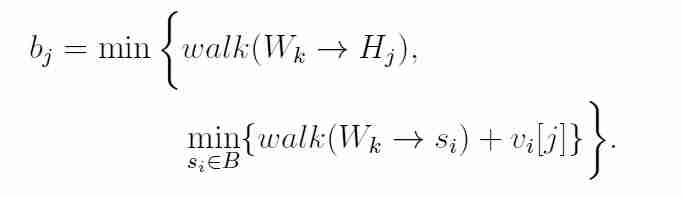
(等式2)
として、ホームクラスタhjまでの最短の行程期間を計算する。
The computation is analog, but uses v rather than vector v'. See FIG. 9 for illustration. The method computes a set B of stop station clusters within a threshold distance from W k (B={s4, s5} in FIG. 9).
(equation 2)
, the shortest travel period to the home cluster h j is calculated.
上記同様に、一つの形態において、前記vのベクトル代表の理由で、本方法は等式2に応じてvに関したベクトル演算を使用して各ホームクラスタまでの行程期間を一緒に計算する。一つの形態において、本方法は数学公式

を使用する。
As above, in one form, because of the vector representation of v, the method jointly computes the journey time to each home cluster using vector operations on v according to
to use.
行程期間の前記ベクトル(b1, . . . , bm)は

によって示される。
Said vector of travel durations (b 1 , . . . , b m ) is
indicated by
本方法は、セクション4.5.2中と似たような形態を使用する。例えば、一つの形態において、本方法は、前記ベクトル(a1, . . . , am)の一部及び前記ベクトル(b1, . . . , bm)の一部を一緒に計算するベクトル演算を使用する。
4.5.4 出発、中間、及び到着パートの結合
The method uses a format similar to that in Section 4.5.2. For example, in one form, the method computes a portion of the vector ( a 1 , . . . , am ) and a portion of the vector (b 1 , . Use arithmetic.
4.5.4 Combining Departure, Intermediate and Arrival Parts
最後に、本方法は各ホームクラスタの通勤パスの最短の行程期間を計算する。本方法は単に2つのベクトルを加算して、座標での値を変更する。我々は、

(等式3)
によって結果のベクトルを示す、ここで第一の“+”はベクトルの座標点加算であり、及び第二の“+”はベクトルの各座標での値への数の加算である。
Finally, the method computes the shortest journey duration of each home cluster's commuter path. The method simply adds the two vectors and changes the values in the coordinates. we,
(equation 3)
where the first "+" is the coordinate point addition of the vector and the second "+" is the addition of the number to the value at each coordinate of the vector.
一つの形態において、本方法は、どんな通勤パスに沿った地理上のロケーションからの特定の出発時間、又はそこへの特定の到着時間が与えられた行程期間を計算する。 In one form, the method calculates a journey duration given a specified departure time from, or a specified arrival time to, a geographic location along any commuter path.
一つの形態において、本方法は、特定の通勤パスとしてPathDurationsを予め計算する。例えば、本方法は、学校である各Wにとっての

及び

を計算し及び蓄積する。リクエスト処理の間、本方法は、等式1、等式2及び等式3でそれらを計算する代わりに、データベースから予め計算されたベクトルを取得する。
In one form, the method precomputes PathDurations for a particular commuter path. For example, for each W that is a school, the method
as well as
is calculated and stored. During request processing, the method retrieves pre-computed vectors from the database instead of computing them in
一つの形態において、PathDurationsの値は変えられる。学校Wがある特定の家のみが子供たちをその学校に送ることができるという風に特定する区域要求を有することを考える。これは、単純に、その学校の区域外のこれらのホームクラスタにおいてベクトルPathFromHomeDurations(→W)の座標値を無限に設定することによって単純に達成でき、また同様にベクトルPathToHomeDurations(W→)の座標値を設定する。Wが限定された配達エリアを伴うレストランであるとき、又は政府事務所が限定された管区を有するとき、同じような変更がなされる。このように、変更された値が蓄積され、リクエスト処理の間、取得される。 In one form, the value of PathDurations is varied. Suppose school W has a neighborhood requirement that specifies such that only certain homes can send children to that school. This can be accomplished simply by setting the coordinate values of the vector PathFromHomeDurations(→W) to infinity in those home clusters outside the school district, and similarly the coordinate values of the vector PathToHomeDurations(W→) set. Similar changes are made when W is a restaurant with a limited delivery area, or a government office has a limited jurisdiction. In this way, modified values are accumulated and retrieved during request processing.
一つの形態において、我々の方法は、ベクトルvi, v´iの座標値に、又はPathDurationsに対して任意の“操作”機能を適用する。例えば、これは災害によって影響を受けた特定の経済区域の大都市エリアのある部分から、又は当該部分までの通勤のための交通料金を削減する政府の政策を実行するのを手助けすることができる。アプリケーションは、リクエストを処理(例えば、グローバル政策)する前、又はリクエストを処理(例えばユーザに個別化された政策)している間、実行される。 In one form, our method applies an arbitrary "manipulation" function to the coordinate values of vectors v i , v′ i or to PathDurations. For example, this can help implement government policies to reduce transportation fees for commuting to and from a portion of a metropolitan area in a particular economic zone affected by a disaster. . The application is executed either before processing the request (eg global policy) or while processing the request (eg user-individualized policy).
一つの形態において、本方法はホームクラスタのサブセットのためのPathDurationsを計算する。例えば、前記サブセットはユーザリクエストによって特定される家の特徴の条件から決定される。一つの形態において、我々はホームクラスタの配列h1, . . . , hmを選別し、その結果これらのサブセットは度々、データ転送を減らす前記配列の短いセグメント中に存在する。
4.6 一つの家の検索
In one form, the method computes PathDurations for a subset of home clusters. For example, the subset may be determined from house feature conditions specified by a user request. In one form, we pick the home cluster sequences h 1 , .
4.6 Search for a single house
我々の方法は、通勤を使用している家をいかに効果的に検索するかを教える。我々は例えば、我々が一つの家の一般的な検索リクエストを紹介する以前に、第一に幾つかの例の検索リクエストを示す。
4.6.1 重み付けされた合計リクエスト
Our method teaches how to effectively search for homes using commuting. For example, we first show some example search requests before we introduce a general search request for one house.
4.6.1 Weighted Total Requests
週に5階geo1に位置する場所に働きに行く一方の親、及び週に3回geo2に位置する場所に働きに行く他方の親のある家族を考える。この家族は、週間で短い行程期間の家を見つけたい。我々は、下記の

のように、2つのベクトルの重み付けられた合計として各ホームクラスタの、前記家族にとっての週間の行程期間を見つける。
4.6.2 最小リクエスト
Consider a family with one parent who goes to work at a location located at geo1 on the fifth floor a week and the other parent who goes to work at a location located at geo2 three times a week. This family wants to find a home with a short journey time of a week. we are below
Find the weekly travel duration for the family for each home cluster as the weighted sum of two vectors, such that
4.6.2 Minimum Request
家から働くシングルマザーで、子供を学校に送っていることを考える。その母は、学校Eからどの学校でも近くなる家を発見したい。我々は、下記の

として、ベクトルの座標点最少として各ホームクラスタにおいてその子供にとっての一日の行程期間を見つけることができる。
4.6.3 一つの家の一般検索
Consider being a single mother working from home sending her kids to school. The mother wants to find a house that is close to any school from school E. we are below
, we can find the daily travel duration for that child in each home cluster as the coordinate point minimum of the vector.
4.6.3 General search for one house
一つの形態において、我々の方法はリクエストを通勤パスの配列path1, . . . , pathqとして定義し、qは何でもよく、及びファンクションドライバ:qの数のベクトルを一つの数にマップするRq → R。本方法は行程期間ベクトル(ゼロから、予め計算されたベクトルを受信することによって、又は両方)

及び、ファンクションドライバの座標点を、各ホームクラスタのため“派生された”行程期間を伴うベクトルを生成するために、ベクトルに適用する。

and apply the function driver's coordinate points to the vector to generate a vector with a "derived" travel period for each home cluster.
一つの形態において、前記ファンクションドライバは、重みW1, . . . , wqにおいて、重み付けられた数の合計

である。重みは正又は負になることができる。もし行程期間が行程のお金の料金として解釈されるのなら、例えば、もし通勤者が特定の通勤(例えば小包の配達)を実行することからの利益を得ることを予測されるなど、それなら負の重みはお金の取得として解釈される。重みは通勤パスの相対的な重要性を示すことができ、例えば、社長の通勤パスは、第一線マネージャの通勤パスよりもより高い重みを有する。
In one form , the function driver calculates, in weights W 1 , .
is. Weights can be positive or negative. If the journey duration is interpreted as the money charge for the journey, for example if the commuter is expected to make a profit from performing a particular commute (e.g. parcel delivery), then the negative Weights are interpreted as money acquisition. The weights can indicate the relative importance of the commuting paths, eg, a president's commuting path has a higher weight than a first line manager's commuting path.
一つの形態において、前記ファンクションドライバは、数の最小

である。
In one aspect, the function drivers include the least number of
is.
一つの形態において、前記ファンクションドライバは、重み付けられた合計及び最小である。

一つの形態において、前記ファンクションドライバは、例えば条件付きの

又はいかなるアルゴリズムである。
4.7 2以上の家の比較
In one form, the function driver may, for example, conditionally
or any algorithm.
4.7 Comparing Two or More Houses
我々の方法は、通勤を使用する複数の家をいかに効果的に比較するかを教える。我々は、我々が一般的な比較リクエストを紹介する前に、幾つかの例に関しての方法を説明する。
4.7.1 現在の家
Our method teaches how to effectively compare multiple homes that use commuting. We describe the method for some examples before we introduce the comparison request in general.
4.7.1 Current house
現在、家に住んでいる家族を考える。前記家族のメンバーは、職場、学校、及び他の場所への特定の通勤パスを有する。前記家族は、他の家に引っ越しすることを考え、現在の家のトータルの行程期間及び他の見込みの家のトータルの行程期間を比較したい。我々の方法は、そのような比較をかなりシンプルにする。 Consider a family currently living in a house. Members of the family have specific commuter paths to work, school, and other locations. The family is considering moving to another house and wants to compare the total duration of the current home with the total duration of another prospective home. Our method simplifies such comparisons considerably.
一つの形態において、本方法は、前記家族の現在の家Sのホームクラスタhjを含む、全てのホームクラスタにとっての行程期間を計算する。

本方法は、それから“差分”ベクトルに応答する:本方法は、各座標

からj番目の座標での値を引く。“差分”ベクトルの座標での負の値は、前記座標に対応する家が、現在の家Sと比較してより短い行程期間を有することを示す。
In one form, the method calculates the journey duration for all home clusters, including the home cluster h j of the family's current home S.
The method then responds to the "difference" vector: the method returns each coordinate
Subtract the value at the j-th coordinate from A negative value at a coordinate of the "difference" vector indicates that the house corresponding to said coordinate has a shorter journey duration compared to the current house S.
一つの形態において、本方法は前記現在の家にとっての幾つかの通勤パス、しかし他の家にとっての他の通勤パスを使用する。このように、本方法は、“万が一我々が職場を変えて、幾つかの他の家に引っ越ししたら。新しい通勤期間を我々の現在の通勤期間をどのように比較するのか”というもしかしてシナリオを家族が評価することを助ける。
4.7.2 2以上の家の一般比較
In one form, the method uses some commuter paths for the current home, but other commuter paths for other homes. In this way, the method can be applied to a possible scenario of "what if we change jobs and move to some other house? How does the new commute time compare to our current commute time?" to help evaluate.
4.7.2 General Comparison of Two or More Houses
母と父が同じ職場に(職業を変えない)通勤を続けなくてはならないが、子供は学校を変えることができる家族を考える。両親及び母方の両親という2つの家族の他の例を考える。彼らは、お互いに30分程度以内に2つの家を探したい、その結果、一つの家は病院の近く、及び他の家は特定の学校や職場の近くである。我々の方法は、より簡単に、そのような家と他の家との比較をする。 Consider a family where the mother and father must continue to commute to the same workplace (without changing occupations), but the child can change schools. Consider another example of two families, parents and maternal parents. They want to find two houses within 30 minutes or so of each other, so that one house is near a hospital and the other is near a particular school or work place. Our method makes it easier to compare such homes to other homes.
一つの形態において、本方法は、通勤パスの範囲でのホームクラスタにとっての行程期間PathDurationsを計算する。

それから、本方法は、セクション4.6.3でのような座標点の操作をしない“一般化された”ファンクションドライバを適用し、しかし代わりに一緒に全てのq'm行程期間で操作して、そして1以上の数のベクトルを生成する。言い換えると、前記一般化されたファンクションは、幾つかのyでの

である。
4.8 検索又は比較
In one form, the method computes the journey duration PathDurations for the home cluster within the commuter path.
Then the method applies a "generalized" function driver that does not manipulate the coordinate points as in Section 4.6.3, but instead operates on all q'm stroke periods together, and Generates a vector of numbers greater than or equal to 1. In other words, the generalized function is
is.
4.8 Search or Compare
一つの形態において、ファンクションドライバは、例えばランダム化されたアルゴリズムなど、どのような入力も受ける(例えば、通勤パス、最短行程パス、最短行程期間、家やユーザリクエストによって特定されるいかなる条件)いかなるアルゴリズムであり、及びそのような出力(例えば、最短行程期間によってソートされ、ユーザ条件を満たす家を含む“トップリスト”、及びユーザの状況をも満たす最短の行程を有する)をも生成する。
4.9 変形
In one form, the function driver receives any input, e.g., a randomized algorithm (e.g., commute path, shortest journey path, shortest journey duration, home or any conditions specified by user request). and also produce such an output (eg, sorted by shortest journey duration, with a "top list" containing homes that satisfy the user's criteria, and the shortest journey that also satisfies the user's circumstances).
4.9 Deformation
多くの調整や変形は前記形態の範囲及び精神から離れない従来技術の当業者において明らかである。我々は、説明のため幾つかの変形を提示する。
4.9.1 行程の延長
Many modifications and variations will be apparent to those skilled in the art without departing from the scope and spirit of the foregoing forms. We present some variations for illustration.
4.9.1 Extension of trip
一つの形態において、本方法は不完全な最短行程を計算し、そしてそれから選択されたホームクラスタにそれらを延長する。これは、追加の処理及び蓄積内で減少のため蓄積、及びベクトルvi及びv´i中での幾つかのホームクラスタによる処理を取引する。 In one form, the method computes the incomplete shortest paths and then extends them to the selected home cluster. This trades accumulation for reduction in additional processing and accumulation, and processing by some home cluster in vectors v i and v′ i .
本方法は、交通システムの幾つかの要素であるホームコネクタを決定する。一つの形態において、前記ホームコネクタは、セクション4.4.1で記述されたクラスタとは異なるかもしれないホームクラスタ又はストップステーションクラスタである。それから、本方法は、セクション4.4のこれらと似た形態を用いて、前記ストップステーションクラスタ及び前記ホームクラスタの間の最短行程を予め計算してデータベースに蓄積する。 The method determines a home connector that is some element of the transportation system. In one form, the Home Connector is a Home Cluster or Stop Station Cluster, which may be different from the clusters described in Section 4.4.1. The method then precomputes and stores in a database the shortest distance between the stop station cluster and the home cluster using forms similar to those of Section 4.4.
リクエストが受信されるとき、本方法はリクエストに含まれる職場W及び選択されたホームクラスタの間の最短行程を計算する、この目的のため、本方法は前記職場の近所のストップステーションクラスタを決定し、セクション4.5と同じように、前記職場W及びホームクラスタの間の最短行程を計算するため、前記近所のストップステーションクラスタ及び前記ホームコネクタの間の予め計算された最短行程を取得する。一つの形態において、この計算はこれらのセクション4.5.2及び4.5.3と似たベクトル演算を使用する。それから、これらの最短行程は、前記職場W及び選択されたホームクラスタの間の最短行程を形成するため、ホームクラスタを超えて延長される。これは単純に、各ホームクラスタにとって、例えば2000m以内など、前記ホームクラスタの近所のホームコネクタを通過する最少延長行程(単なる徒歩ではないかもしれない)を見つけること、そして時には前記職場W及び前記ホームクラスタ(セクション4.5.2及び4.5.3と似た)の間の直接最短行程を見つけることにより達成され得る。一つの形態において、重複エリアで、本方法は前記ホームコネクタ及び前記ベクトルvi及びv´iを使用する。 When a request is received, the method calculates the shortest distance between the workplace W included in the request and the selected home cluster.To this end, the method determines stop station clusters in the neighborhood of said workplace. , as in Section 4.5, to compute the shortest distance between the work W and home clusters, obtain the pre-computed shortest distance between the neighborhood stop station cluster and the home connector. In one form, this computation uses vector operations similar to those in Sections 4.5.2 and 4.5.3. These shortest steps are then extended beyond the home cluster to form the shortest steps between the workplace W and the selected home cluster. This is simply, for each home cluster, finding the shortest distance traveled (maybe not just a walk) through a home connector in the home cluster's neighborhood, say within 2000m, and sometimes the work W and the home It can be achieved by finding the direct shortest path between clusters (similar to Sections 4.5.2 and 4.5.3). In one form, in the overlap area, the method uses the home connector and the vectors v i and v′ i .
延長行程のパフォーマンスは、ホームコネクタの総数に比例し、そしてまた、選択されたホームクラスタの近所のホームコネクタの数に比例する。一つの形態において、前記延長は、前記2つの量が低くなるような、大都会エリアのまばらな場所に使用される。一つの形態において、本方法は、パフォーマンスコストファンクションを、(1)ホームコネクタを決定、(2)ホームクラスタの選択、及び(3)前記選択されたホームクラスタのそれぞれの近所のホームコネクタのサブセットを決定するために使用する。
4.9.2 車による通勤
The performance of the extended journey is proportional to the total number of home connectors and also proportional to the number of home connectors in the neighborhood of the selected home cluster. In one form, the extension is used in sparse locations in metropolitan areas where the two quantities are low. In one form, the method computes a performance cost function of (1) determining home connectors, (2) home cluster selection, and (3) a subset of home connectors in the neighborhood of each of said selected home clusters. used to make decisions.
4.9.2 Commuting by car
一つの形態において、我々は公共交通によるものよりむしろ、車での通勤パスの行程期間を計算する。これは、前述のセクションへの簡単な変更によって達成される。 In one form, we calculate the journey duration of a commuter path by car rather than by public transit. This is accomplished by a simple modification to the section above.
家にとっての交通システムを予め処理するとき、セクション4.4、公共交通システムのグラフとなるGTを取得するのに変えて、我々はカードライブシステムのグラフとなるGTを取得する。このカードライブグラフは、例えば従来技術より得ることができる。あのグラフは、道路上の地理的ロケーションを示す頂点、及び車の運転又は車の向きを変えることを示すエッジ、例えばラッシュアワーの間など一日の様々な時間での運転期間に関するデータを含むエッジなどを有する。 When preprocessing the transport system for home, section 4.4, instead of obtaining the GT graph for the public transport system, we obtain the GT graph for the car drive system. This car drive graph can be obtained, for example, from the prior art. That graph contains vertices that indicate geographic locations on roads and edges that indicate driving or turning the vehicle, edges containing data about the duration of driving at various times of the day, such as during rush hours. and so on.
我々は、GTを延長する。各ホームクラスタsにとって、我々は頂点
HOME_CLUSTER_SOURCE_s
及び
HOME_CLUSTER_TARGET_s
を追加する。我々は、各ホームクラスタを、少なくとも1つのrにおいて頂点
CONNECTOR_r
を追加することによって、例えば100mなどの閾値距離内である幾つかの道路に接続する。一つの形態において、前記頂点は閾値内である道路上でのホームクラスタロケーションの最短距離プロジェクションを示し、前記道路は前記ホームクラスタに割り当てられたカーパーキング内にあるかもしれない。前記頂点は、重み0を伴うZeroにラベル化されたエッジによって、2つのホームクラスタ頂点に接続される。前記頂点はまた、前記道路のセグメントの端点を示す頂点に接続される。ストップステーションクラスタを追加する代わりに、我々はするべきではなく、なぜなら今GTは地下鉄駅もバス停をもモデルにしておらず、我々はs´ 及びt´の集合のため頂点
REPRESENTATIVE_SOURCE_s'
及び
REPRESENTATIVE_TARGET_t'
を追加し、これらの頂点は、最短行程中でのよく生じるロケーションを示し、前記ロケーションは例えば従来技術をしようして得られる。これらの頂点は、クラスタを示す。これらの頂点は、エッジを使用する他の頂点と適切に接続される。
We extend GT. For each home cluster s we have a vertex
HOME_CLUSTER_SOURCE_s
as well as
HOME_CLUSTER_TARGET_s
Add We assign each home cluster to at least one vertex in r
CONNECTOR_r
connects to some roads that are within a threshold distance, say 100m, by adding In one form, the vertex indicates the shortest distance projection of the home cluster location on a road that is within a threshold, and the road may be within the car parking assigned to the home cluster. The vertex is connected to the two home cluster vertices by an edge labeled Zero with weight zero. The vertices are also connected to vertices that mark the endpoints of the road segments. Instead of adding stop station clusters, we shouldn't, because now GT doesn't model subway stations or bus stops, and we have vertices
REPRESENTATIVE_SOURCE_s'
as well as
REPRESENTATIVE_TARGET_t'
, and these vertices indicate frequently occurring locations in the shortest path, said locations being obtained using conventional techniques, for example. These vertices represent clusters. These vertices are properly connected with other vertices using edges.
我々は、前記延長GTを、可能ならセクション4.4.1で述べられたこれらに似た形態を用いて、各
REPRESENTATIVE_SOURCE_s'
から各
HOME_CLUSTER_TARGET_s
及び各
HOME_CLUSTER_SOURCE_s
から各
REPRESENTATIVE_TARGET_t'
までのグラフパスの最短期間を計算するために使用する。これらの行程期間は、セクション4.4.2で述べられたベクトルフォームvi及びv´i内に蓄積される。
We will extend the above extended GT, possibly using forms similar to those described in Section 4.4.1,
REPRESENTATIVE_SOURCE_s'
from each
HOME_CLUSTER_TARGET_s
and each
HOME_CLUSTER_SOURCE_s
from each
REPRESENTATIVE_TARGET_t'
Used to compute the shortest duration of the graph path to . These travel periods are stored in the vector forms v i and v ′ i described in Section 4.4.2.
通勤パスの行程期間を計算するとき、我々はセクション4.5内での徒歩を使用する代わりに、カーライドを使用する。 When calculating the travel duration of a commuter pass, we use car rides instead of walking within section 4.5.
行程の出発パートのため、我々はセクション4.5.2に以下の変更を作る。walk(Hj→ W1)の代わりに、我々は例えば従来技術より得られたホームクラスタHjからW1までのカーライドの期間を使用し、一つの形態において、前記Hj及びW1の間の距離が閾値以上のとき、我々は代わりにこの期間を無限大に設定する。前記セットAは、W1から閾値距離内の頂点
REPRESENTATIVE_TARGET_t'
のセットである。各頂点si∈Aにとって、我々は例えば従来技術を使用して、siから W1までのカードライブ期間を計算する。
For the starting part of the journey, we make the following changes to Section 4.5.2. Instead of walk(H j → W 1 ), we use, for example, the duration of the car ride from the home cluster H j to W 1 obtained from the prior art, and in one form, between said H j and W 1 distance is greater than or equal to the threshold, we set this period to infinity instead. The set A is the vertices within a threshold distance from W1
REPRESENTATIVE_TARGET_t'
is a set of For each vertex s i ∈A, we compute the car drive period from s i to W 1 , eg using conventional techniques.
行程の到着パートにとって、我々は、しかしセクション4.5.3ではない似た変更を行う。walk(Wk→Hj)の代わりに、我々は例えば従来技術より得られたW1からホームクラスタHjまでのカーライドの期間を使用し、一つの形態において、前記Wk及びHjの間の距離が閾値以上のとき、我々は代わりにこの期間を無限大に設定する。前記セットBは、Wkから閾値距離内の頂点
REPRESENTATIVE_SOURCE_s'
のセットである。各頂点si∈Bにとって、我々は例えば従来技術を使用して、W1からsi までのカードライブ期間を計算する。それから我々はこれらの変更を等式2に適用する。
For the arrival part of the journey, we make similar changes but not in section 4.5.3. Instead of walk(W k →H j ), we use, for example, the duration of the car ride from W 1 to home cluster H j obtained from the prior art, and in one form, between said W k and H j distance is greater than or equal to the threshold, we set this period to infinity instead. The set B consists of vertices within a threshold distance from W k
REPRESENTATIVE_SOURCE_s'
is a set of For each vertex s i ∈B, we compute the car drive period from W 1 to s i using, for example, conventional techniques. We then apply these changes to
我々は、セクション4.5で述べた他の形態を使用する。例えば、我々は測地線を用いてカーライドの行程期間を推定する。 We use the other forms mentioned in Section 4.5. For example, we use geodesics to estimate the duration of car rides.
セクション4.6の検索フレームワークは、どんな種類の乗り物が各通勤パスにとって使用されるべきかを制限することを許容するため単純に延長されることができる。結果として、例えば、我々は、週に5階geo1に位置する場所に車で働きに行く一方の親、及び週に3回geo2に位置する場所に公共交通で働きに行く他方の親のある家族にとって、各家における通勤パスの行程期間を決定することができる。 The search framework of Section 4.6 can be simply extended to allow restricting what types of vehicles should be used for each commuter path. As a result, for example, we have a family with one parent who goes to work at geo1 on the fifth floor by car three times a week and the other parent who goes to work at geo2 by public transport three times a week. For , the travel duration of the commuter path at each home can be determined.
セクション4.7の比較フレームワークは単純に延長されることができる。結果として、例えば、我々は人が車によって通勤する新しい家を検索でき、公共交通による現在の行程期間と比較をすることができる。我々の方法の結果は、引っ越しのために、車を購入するインセンティブとして使用されるかもしれない。
4.9.3 他の手段による通勤
The comparison framework in Section 4.7 can simply be extended. As a result, for example, we can search for new homes to which a person commute by car, and compare it to the current journey time by public transport. The results of our method may be used as an incentive to purchase a car for moving.
4.9.3 Commuting by other means
一つの形態において、本方法は、例えば、徒歩のみ、自転車のみ、高速バス及び徒歩のみ、地下鉄及び徒歩のみ、高速バス、地下鉄及び徒歩のみ、共有バン及び徒歩のみ、ボート、飛行機などの他の手段による通勤パスを使用する。我々は単純にセクション4.9.2で述べられたこれらに類似する変形を使用する。一つの形態において、本方法は、他の家及び行程の他の手段、及び現在の家及び現在の行程の手段を比較して利益を説明して、ユーザにこれらを推薦する。 In one form, the method is, for example, by foot only, bicycle only, express bus and foot only, subway and foot only, express bus, subway and foot only, shared van and foot only, boat, airplane, etc. Using a commuter pass. We simply use variants similar to these described in Section 4.9.2. In one form, the method compares other homes and other means of travel and the current home and means of the current journey, explaining the benefits and recommending them to the user.
与えられたグラフでの最短グラフパスは、前記グラフの様々な頂点の地理的なロケーションを知ることなしに計算されることができる。このように、一つの形態において、本方法はその様々な要素が地理的ロケーションを欠いた交通システムを使用する。 The shortest graph path on a given graph can be computed without knowing the geographical locations of the various vertices of the graph. Thus, in one form, the method uses a transportation system whose various elements lack geographic location.
前記交通システムは、物理的に動く物体を必要としない。本方法は単に前記交通システムの要素の間のルート又はルート距離を決定することができる必要がある。このように、データを移動するコンピュータネットワークは、交通システムの一例であり、この交通システムは、ワイヤ/ライン(道路に類似して)、及びハブ/スイッチ(停止/方向変更に類似して)のこれらの交通要素から成る。交通システムの多くの他の例は、従来の当業者に明らかである。
4.9.4 行程パスの条件
The transportation system does not require physically moving objects. The method simply needs to be able to determine routes or route distances between elements of the transportation system. Thus, a computer network that moves data is an example of a transportation system that includes wires/lines (analogous to roads) and hubs/switches (analogous to stops/changes). consists of these transport elements. Many other examples of transportation systems will be apparent to those of ordinary skill in the art.
4.9.4 Condition of trip pass
我々は、行程パスにおける様々なフィルタリング条件を単純に理解することができる。例えば、我々は地下鉄ラインの間に乗り換えがなく、しかしホームクラスタ及びステーションクラスタの間で徒歩を有するグラフGを構築できる。セクション4.9.2で述べたこれらの類似する変形に沿って、本方法は、それから通勤者が家及び職場(前記家及び前記職場は共に1つの地下鉄ラインの地下鉄駅から徒歩距離内であるという必要はない)の間の乗車の間ずっと座るとき、検索又は比較をする。単純に、我々はGを構築し、最大で一つの乗り換えに、又は地下鉄―バス乗り換え、又はバス―地下鉄乗り換え、又はタイムウインドウなしに起こる乗り換え、又は通勤者によって共通に使用される行程パスのタイプにグラフパスを限定するために最短のグラフパスアルゴリズムを変更する。行程パスをフィルタリングするための他の変形は、従来の当業者に明らかであるとして、我々の方法の範囲内になる。
4.9.5 家の条件
We can simply understand the various filtering conditions in the travel path. For example, we can construct a graph G with no transfers between subway lines, but walks between home clusters and station clusters. In line with these analogous variations mentioned in Section 4.9.2, the present method then determines whether the commuter has a home and work place (both of which must be within walking distance of a subway station on one subway line). not), do a search or compare when sitting throughout the ride. Simply, we construct G, the types of journey passes commonly used by at most one transfer, or subway-bus transfer, or bus-subway transfer, or transfers that occur without a time window, or by commuters. Modify the shortest graph path algorithm to limit the graph path to . Other variations for filtering the travel paths are within the scope of our method as would be apparent to one of ordinary skill in the art.
4.9.5 House conditions
一つの形態において、本方法は、家の様々な特徴のフィルタリング条件を受信し、そして前記条件に一致する特徴の家を検索又は比較する。前記特徴は、タイプ(例えば隣接する家、又は構想マンション)、取引タイプ(例えば販売又は賃貸)、価格、不動産エージェントの業務委託料、税、最大銀行ローン額、ベッドルーム又はバスルームの数、家のエリア/サイズ、窓の地理的方向、家の階数、前記建物の階数、典型的な月の管理費などである。単純に、本方法は各家の特徴リストを保持し、条件を与え、前記条件に一致する特徴の家を決定する。これら家と一致する前記行程期間は、ホームクラスタの行程期間から得られる。家をフィルタリングするための他の変形は、従来の当業者に明らかであるとして、我々の方法の範囲内になる。
4.9.6 メタ検索又は比較
In one form, the method receives filtering criteria for various features of homes and searches or compares homes for features that match the criteria. The characteristics include type (e.g. adjoining house or concept apartment), transaction type (e.g. sale or rent), price, real estate agent commission, tax, maximum bank loan amount, number of bedrooms or bathrooms, house area/size, geographic orientation of windows, number of floors of the house, number of floors of said building, typical monthly maintenance costs, etc. Simply, the method maintains a feature list for each house, gives a condition, and determines the house whose features match said condition. The journey durations corresponding to these homes are obtained from the journey durations of the home clusters. Other variations for filtering houses are within the scope of our method as would be apparent to one of ordinary skill in the art.
4.9.6 Metasearch or Compare
一つの形態において、本方法は、従来の検索又は比較リクエスト及び応答のアンサンブルを使用して家を検索又は比較する。これは、メタ方法(それ自体を使用する方法)をみなされる。それは、例えば提案された新しい不動産の発展の価値を評価するために有用である。 In one form, the method searches or compares homes using an ensemble of conventional search or comparison requests and responses. This is considered a meta-method (a method that uses itself). It is useful, for example, for assessing the value of proposed new real estate developments.
我々は、前記メタ方法の形態を記述する。我々は、通勤パスpath1, . . . , pathuの幾つかの数uを受信する。一つの形態において、前記通勤パスは家を検索又は比較するためにコンピュータサービスの有用なログから来て、各通勤パスは前記サービスの異なるユーザによって提供されるかもしれない。各通勤パスpathkのため、我々はセクション4.5に従い全てのホームクラスタPathDurations(pathk)の行程期間を計算する。それから、我々は前記行程期間を処理するアグリゲータを適用する。一つの形態において、各通勤パスpathkのため、我々は重みWkのベクトルを受信する。一つの形態において、各重みは、ユーザがホームクラスタに対応して家をクリックする可能性であり、それは不動産資産の条件、又は前記ユーザのリクエスト内で特定される行程パスの条件によって影響されるかもしれない。それから、我々は下記公式内として、座標点の集合を計算する。

j番目の集合は、ホームクラスタHjの平均重み付け行程期間である。一つの形態において、j番目の集合は、完全な大都会エリアのトータル行程期間に対するホームクラスタの標準化された寄与を示し、ある意味、前記大都会エリア内でのホームクラスタの中心である。なぜなら、我々の方法はPathDurations(pathk)を素早く計算し、我々は素早く前記集合を計算できる。これは、通勤に関して各不動産資産の好ましさの素早い計算を可能にする。
We describe a form of the meta-method. We receive some number u of commuter paths path 1 , . . . , path u . In one form, the commuter paths may come from a computer service's useful log for searching or comparing homes, and each commuter path may be provided by a different user of the service. For each commuter path path k , we compute the journey durations of all home clusters PathDurations(path k ) according to Section 4.5. Then we apply an aggregator that processes the travel period. In one form, for each commuter path path k , we receive a vector of weights W k . In one form, each weight is the likelihood that a user will click on a house corresponding to the home cluster, which is influenced by real estate asset conditions or journey path conditions specified in the user's request. Maybe. We then compute the set of coordinate points as in the formula below.
The jth set is the average weighted travel period for the home cluster H j . In one form, the jth set represents the home cluster's normalized contribution to the total journey duration of the complete metropolitan area, in a sense the center of the home cluster within said metropolitan area. Because our method computes PathDurations(path k ) quickly, we can compute the set quickly. This allows a quick calculation of the desirability of each real estate property with respect to commuting.
メタ方法の多くの他の形態では、従来の当業者において明らかである。一つの形態において、通勤パスは家及び職場の地理的ロケーションから生成される。一つの形態において、前記重みは最も低い行程期間のホームクラスタの幾つかの数のとってはゼロでなく設定され、他はゼロに設定される。一つの形態において、データ科学者は、もしかしてシナリオを評価し、なぜなら我々の方法の有利点であり、これらのシナリオは素早く評価される。一つの形態において、前記アグリゲータは任意のアルゴリズムであり、例えば、相違、分位、累積分配ファンクション、又は閾値を超える可能性を計算するものである。
4.9.7 2以上の家を含む通勤パス
Many other forms of meta-methods will be apparent to those of ordinary skill in the art. In one form, the commute path is generated from the geographic locations of home and work. In one form, the weights are set to non-zero for some numbers of home clusters with the lowest travel duration and to zero for others. In one form, the data scientist evaluates scenarios by chance, because of the advantage of our method, these scenarios are evaluated quickly. In one form, the aggregator is any algorithm, eg, one that calculates divergence, quantile, cumulative distribution function, or probability of exceeding a threshold.
4.9.7 Commuter Paths Containing Two or More Homes
一つの形態において、通勤パスは2以上の家を含む。これは、例えば2以上の家族のための家を一緒に検索又は比較するときに、有効である。 In one form, a commuter pass includes two or more homes. This is useful, for example, when searching or comparing homes for two or more families together.
一つの形態において、H1及びH2は2つのホームクラスタである。我々は、H1から出発し、しかしH1とは異なるだろうH2で終了するいかなるH1→path→H2の通勤パスの行程期間を計算することができる。我々は単純に等式1のH1に対応するj、しかし等式2のH2に対応するjを使用する。
In one form, H1 and H2 are two home clusters. We can compute the journey duration of any H1 →path→ H2 commuter path starting at H1 but ending at H2 , which will be different from H1 . We simply use j corresponding to H 1 in
一つの形態において、我々は両方のベクトル(a1, . . . , am)及び(b1, . . . , bm)を予め計算し、そしてそれから我々は、単純にH1に対応する座標(a1, . . . , am)での値を、Hjに対応する座標(b1, . . . , bm)の値に加算することにより任意の2つのホームクラスタHi及びHjの行程期間、プラス前記パス(Hi及びHjから独立している)の中間パートの行程期間を見つける。我々は、m2ペアから、ホームクラスタのどんなペアの行程期間が直線O(m)空間のみを使用して定数O(1)内に見つけられることを認める。これはなぜなら行程期間の付加構造のため、前記パスがいかなる2つのホームクラスタの間のセパレータとして働くという事実である。 In one form, we precompute both vectors (a 1 , . . . , am ) and (b 1 , . . . , b m ), and then we simply correspond to H 1 any two home clusters H i and Find the duration of Hj , plus the duration of the middle part of the path (which is independent of H i and H j ). We admit that from m 2 pairs, the travel term of any pair of home clusters can be found within constant O(1) using only linear O(m) space. This is due to the fact that the path acts as a separator between any two home clusters because of the additional structure of the travel period.
一つの形態において、ホームクラスタのセットは、H1のために許可されるホームクラスタのセットが、H2のために許可されるホームクラスタのセットとは異なるかもしれない。例えば、ユーザ条件は、H1が市の東にあることを限定し、一方H2が市の西側にあることを限定する。この場合、我々はmとは異なる距離m´のベクトル(b1, . . . , bm´ )を使用する。 In one aspect, the set of home clusters allowed for H1 may be different than the set of home clusters allowed for H2 . For example, the user condition restricts H1 to be east of the city, while restricting H2 to be west of the city. In this case we use a vector (b 1 , .
より一般的には、本方法はホームクラスタH1→path1→H2→path2→ . . . → pathk-1→ Hk,k ≧ 2のいかなる配列のために行程期間を計算する。予め計算することを使用して、これはO(k)時間、及びO(m・k)空間でなされることができる。 More generally, the method computes the travel duration for any sequence of home clusters H 1 →path 1 →H 2 →path 2 → . Using precomputation, this can be done in O(k) time, and O(m·k) space.
一つの形態において、通勤パスはこの例の通勤パスH1→path1→Hx→Hy→path2→H2内として、ホームクラスタHx→Hyの間の直接行程を含む。この例で、我々の方法は計算を3つのパートに分割し(1)H1→path1→Hxの行程期間の計算、(2)Hx→Hyの行程期間の計算、及び(3)Hy→path2→H2の行程期間の計算である。パート(1)及び(3)は、現行のセクション4.9.7中で前述した方法を使用して実行される。パート(2)は単純に職場としてのHx又はHyのどちらかを観念的に扱うことにより実行できる。例えば、Hxに対応する座標でのベクトルv´iを使用して、我々は前記ホームクラスタHxから各ストップステーションクラスタまでの行程期間を所得して。これらは予め計算されたベクトルv´i, 1≦i≦nの縦の一列として取得されることができる。それから我々は、セクション4.5.2に類似して、例えば図8及び等式1をみて、完全行程を形成するHyからHyまでの閾値距離内で各ストップステーションクラスタから延長する。我々の方法のために予め計算されるために、前記(3)は前記閾値距離内のストップステーションクラスタの数に比例した時間内で実行される。一つの形態において、前記ホームクラスタが前もって知られているために、我々は、ホームクラスタの各ペアの間の行程期間を予め計算し、そしてそれから単純に定数O(1)時間で行程期間を取得する。自然に、類似の分割がホームクラスタの間の1以上の直接行程を含むいかなる通勤パスにも適用する。
4.9.8 空間探索
In one form, the commuter path includes the direct journey between the home clusters Hx- > Hy , as in this example commuter path H1-> path1- > Hx- > Hy- > path2- > H2 . In this example, our method divides the computation into three parts: (1) computation of the travel duration of H1 → path1 → Hx , (2) computation of the travel duration of Hx → Hy , and (3 ) is the calculation of the travel period of H y →path 2 →H 2 . Parts (1) and (3) are performed using the methods previously described in current Section 4.9.7. Part (2) can be done simply by conceptually treating either H x or H y as workplaces. For example, using vector v'i at coordinates corresponding to Hx , we obtain the journey duration from the home cluster Hx to each stop station cluster. These can be taken as a vertical column of precomputed vectors v′ i , 1≦i≦n. We then extend from each stop station cluster within a threshold distance from H y to H y forming a full stroke, analogous to section 4.5.2, for example looking at FIG. 8 and
4.9.8 Spatial Search
我々の方法は、パフォーマンスの高い空間探索アルゴリズムを紹介する。通勤者が特定のコストを有する特定の通勤パスH1→path→H2に沿って移動するときのケースを考え、前記コストファンクションは、2つの家H1及びH2に依存する。通勤者は、前記コストを最小化する家H1及びH2を探す。これは、例えば家族が2人の両親の職場ロケーション(H1及びH2)を同時に変えたいとき、一方で2つの体の問題として知られる家族の現行の家のロケーション(パス内)からのトータルの通勤期間を最小化するときに有用である。 Our method introduces a high-performance spatial search algorithm. Consider the case when a commuter travels along a particular commuter path H1 →path→ H2 with a particular cost, said cost function depending on two houses H1 and H2 . Commuters seek homes H1 and H2 that minimize the cost. This means that, for example, when a family wants to change the work locations ( H1 and H2 ) of two parents at the same time, while the total It is useful when minimizing the commuting period of
空間探索の一つの形態では、勾配降下アルゴリズムである。コストファンクションは微分可能関数となることができ、例えば、固定パスが与えられ、前記ファンクションは入力として2つの家H1及びH2を取り、そして通勤パスH1→path→H2の行程期間によって乗算された2つの家H1及びH2の間の距離を、出力として返す(このファンクションは、例えば家及び外挿の地理的ロケーションを介した、家のペアの別々のドメインの外側に適切に延長されることができる)。勾配降下アルゴリズムの与えられたステップで、前記アルゴリズムは、与えられた家のペアのコストファンクションの勾配を計算し、そしてそれから前記アルゴリズムの次のステップのために勾配の方向に沿って家のペアを選ぶ。前記勾配は、例えば、2つの値を必要とする2点公式を使用して、コストファンクションの値を使用して計算される。一つの形態において、前記勾配降下アルゴリズムの出力は、前記勾配が水準に十分に小さいものを有する場合に家のペアである。 One form of spatial search is the gradient descent algorithm. The cost function can be a differentiable function, for example given a fixed path, said function takes as input two houses H1 and H2 , and by the journey duration of the commuter path H1 →path→ H2 Returns as an output the distance between the two houses H1 and H2 multiplied together (this function is suitable for outside separate domains of house pairs, e.g. via the geographic location of the house and the extrapolation can be extended). At a given step of the gradient descent algorithm, the algorithm computes the gradient of the cost function of the given house pair, and then finds the house pair along the direction of the gradient for the next step of the algorithm. select. The gradient is calculated using the value of the cost function, for example using a two-point formula that requires two values. In one form, the output of the gradient descent algorithm is a pair of houses if the gradient has a level small enough.
一つの形態において、我々は直線O(m)空間を消費しているベクトル(a1, . . . , am) 及び(b1, . . . , bm) を予め計算し、各ステップで我々の方法は定数O(1) 時間中の勾配を計算する。このために、前記勾配降下アルゴリズムは、度々素早い進歩を作る。 In one form, we precompute the vectors (a 1 , . . . , am ) and (b 1 , . Our method computes the gradient in constant O(1) time. Because of this, the gradient descent algorithm often makes rapid progress.
一つの形態において、我々は(a1, . . . , am)及び(b1, . . . , bm)を予め計算しない、しかしその代わりに要求に応じて、等式1及び等式2毎に必要とされる値を生産する。そのようなアプローチは、家の数がとても多くて(a1, . . . , am)又は(b1, . . . , bm)の予めの計算が実行不可能であるときに使用される。 In one form, we do not precompute ( a 1 , . . . , am ) and ( b 1 , . Produces the required value every 2. Such an approach is used when the number of houses is so large that prior computation of (a 1 , . . . , am ) or (b 1 , . . . , b m ) is infeasible be.
一つの形態において、空間探索アルゴリズムは、家の上での制約を有する。例えば、もし我々が一つの家へのラウンドトリップを要求するならば、制約はH1=H2である。我々はH1のために許容される、又はH2のために許容される地理的領域を制約する。 In one form, the spatial search algorithm has constraints on the house. For example, if we request a round trip to one house, the constraint is H1 = H2 . We constrain the geographical area allowed for H1 or allowed for H2 .
一つの形態において、空間勾配アルゴリズムは、H1→path又はpath→H1の一つの家のみを含む通勤パスを使用する。他の形態において、空間探索アルゴリズムは、セクション4.9.7のような、2以上の家を含む通勤パスを使用する。 In one form, the spatial gradient algorithm uses a commuter path that contains only one house, H 1 →path or path →H 1 . In another form, the spatial search algorithm uses commute paths that include more than one house, such as Section 4.9.7.
一つの形態において、コストファンクションは、家及び職場に依存する。例えば、そのようなコストファンクションは、個人が消費された時間やお金のブレンドを最小化するために探しているときに使用されることができる。一つの形態において、前記コストファンクションは、H及びWの間の行程期間、プラスHの賃貸の料金コスト、マイナスWによって支払われる給料、可能ならば成分の相対的重要性を示す重み、である。一つの形態において、我々の方法の有利な点のために、勾配加工はそのようなコストファンクションの下で家及び職場を探すための検索するために効果的に使用される。
4.10 一般的なケース
In one form, the cost function is home and work dependent. For example, such a cost function can be used when an individual is looking to minimize the blend of time and money spent. In one form, the cost function is the duration of the trip between H and W, plus the toll cost of the rental of H, minus the salary paid by W, possibly a weight indicating the relative importance of the components. In one form, due to the advantages of our method, gradient processing is effectively used to search for homes and businesses under such cost functions.
4.10 General case
一つの形態において、単語“家”及び“職場”は任意の意味に関する意味を有する。例えば、人が、前記人の現在の家の近くに位置する職場を探しているケースを考える。前記人は、異なる家に引越ししたくない、しかし単に現在の家に近くの職場を見つけたい。この場合、我々の方法が単純に適用される。大都会エリアを通して人々が働くサイト(例えば様々なオフィスや工場など)の範囲が与えられると、本方法は全てのワークサイトクラスタ及び各ストップステーションクラスタの間の行程期間を計算する。このように本方法は、“通勤を使用する職場検索又は比較”方法と見做すことができる。一つの形態において、本方法はユーザの特定の仕事タイプ、又は給料レンジ、及び前記ユーザの現在の家からの行程期間に基づいて職場サイトを検索又は比較する。他の例として、本部を新しいロケーションに引っ越したい会社を考える。我々の方法は、大都会エリアを通しての前記本部の全ての新しいロケーションのトータルでの“会社の行程期間”を計算するために使用される。このように、前記会社は、どのように全ての新しいロケーションが従業員の通勤に影響するを決定する。新しいロケーションは、例えば(1)最悪のケースの通勤期間が限定され、及び(2)平均通勤期間が低く、このために個人や社会的目的がを満たしているものが選択される。 In one form, the words "home" and "work" have any semantic meaning. For example, consider the case where a person is looking for a workplace located near the person's current home. The person does not want to move to a different home, but simply wants to find a job close to their current home. In this case our method is simply applied. Given a range of sites where people work (eg, various offices, factories, etc.) throughout a metropolitan area, the method computes the travel duration between all worksite clusters and each stop station cluster. As such, the method can be viewed as a "workplace search or comparison using commuting" method. In one form, the method searches or compares workplace sites based on the user's particular job type or salary range and the user's current travel time from home. As another example, consider a company that wants to move its headquarters to a new location. Our method is used to calculate the total "company journey time" of all new locations of the headquarters through the metropolitan area. Thus, the company determines how every new location will affect employee commuting. New locations are selected that, for example, (1) have a limited worst-case commute duration, and (2) have a low average commute duration, thus meeting personal and social objectives.
結局、我々の記述は、主に検索又は比較目的として行程期間に関して話した。しかしながら、本方法は他のいかなる目的、例えば行程の料金コスト、メートル距離、行程パスの特定の特徴又は属性、例えば乗り換えの数、又は徒歩距離、又は例えば価格、サイズ、又はタイプなどの家の特徴などを使用することができる。一つの形態において、これは単純にグラフを構築して、適切なエッジ重みを設定することにより達成される。様々な目的は、例えば行程の料金コストによってペナルティされる行程期間を最小化する家を検索するなど、マルチ次元コストに基づくマルチ目的最適化検索に結合される。 After all, our description has primarily spoken of travel durations for search or comparison purposes. However, the method may also be used for any other purpose, such as the toll cost of the journey, the distance in meters, certain characteristics or attributes of the journey path, such as the number of transfers, or walking distance, or characteristics of the house, such as price, size, or type. etc. can be used. In one form, this is accomplished by simply constructing the graph and setting the appropriate edge weights. Various objectives are combined into a multi-objective optimization search based on multidimensional costs, for example searching for a house that minimizes the journey duration penalized by the toll cost of the journey.
一般に、本方法は任意のサイトS1, . . . , Sm(サイトは前述セクションでは家と呼ばれた)及び任意の場所P1, . . . , Pk(場所は前述のセクションでは職場と呼ばれた)を使用し、本方法は幾つかの前記サイトで始まり又は到着し、また前記サイト及び前記場所を含んでいる任意のルート明細(ルート明細は前述のセクションでは通勤パスと呼ばれた)によって特定されるものとして、前記場所の幾つかを訪れるルート又はルート距離(前述のセクションではルートは工程の記述と呼ばれ、またルート距離は工程の距離と呼ばれた)を使用して前記サイトS1, . . . , Smを検索又は比較する。前記検索又は比較はセクション4.9で述べたいかなる変形も使用する。このように、本方法はルート又はルート距離、又はそれらの代表に応答する。本方法の一つの形態で計算される情報は、本方法のいかなる形態への入力として、繰り返し使用される。
4.11 コンピュータシステム
In general, the method applies to any site S 1 , . ), the method uses any route specification (a route specification is referred to as a commuter path in the preceding section) that originates or arrives at some of said sites and includes said sites and said locations. using a route or route distance (in the previous section the route was called the step description and the route distance was called the step distance) visiting some of said locations, as specified by Search or compare the sites S 1 , . . . , S m . Said search or comparison uses any of the variants mentioned in Section 4.9. Thus, the method is responsive to routes or route distances, or representatives thereof. Information computed in one form of the method is used repeatedly as input to any form of the method.
4.11 Computer system
本発明の形態の一つは、通勤を使用して不動産資産を検索又は比較するコンピュータシステムである。我々は、図11において前記コンピュータシステムの形態を説明する。 One form of the invention is a computer system for searching or comparing real estate properties using commuting. We describe the form of the computer system in FIG.
我々は、我々の記述中で用語“モジュール”を使用する。当該技術において前記用語は、幾つかの特定の機能を提供するコンピュータ(サブ)システムを意味する。コンピュータシステムを前記特定のモジュールに分割する我々の選択は、例示であり強制ではない。 当該技術の当業者は、前記システムは本発明の範囲から離れない他のマナーでモジュールに編成されることを理解する。 We use the term "module" in our description. In the art, the term means a computer (sub)system that provides some specific function. Our choice of dividing the computer system into said specific modules is exemplary and not mandatory. Those skilled in the art will appreciate that the system can be organized into modules in other manners without departing from the scope of the invention.
一つの形態において、どのような通勤パスに沿った各工程は、特定の出発時間を有する。 In one form, each step along any commuter path has a specific departure time.
前記システムの1のモジュール(1101)は、データソース(1102)から交通システムに関するデータを読み、グラフGを構築する。前記構築の間、前記モジュールは不動産データソース(1103)から家に関するデータを取得し、そして他のデータソース(1104)から近くのホームクラスタ及びストップステーションクラスタの間の最短徒歩を取得する。グラフGは乗り物に関する時間データを含む。前記モジュールは、いかなる
HOME_CLUSTER_SOURCE_s
の頂点(1105)なしに前記グラフを出力し、及びまたいかなる
HOME_CLUSTER_TARGET_s
の頂点しかし反対向きのエッジを有する(1106)ものなしに前記グラフを出力する。前記モジュールはまた、いかなる与えられた地理的ロケーションからの閾値距離内のストップステーションクラスタを見つけることができる最も近い近所のデータ構造(1107)を構築する。
One module (1101) of the system reads data about the transportation system from a data source (1102) and builds a graph G. During the construction, the module gets data about houses from real estate data sources (1103) and shortest walks between nearby home clusters and stop station clusters from other data sources (1104). Graph G contains time data for the vehicle. Said module may be any
HOME_CLUSTER_SOURCE_s
output the graph without the vertices (1105) of and also any
HOME_CLUSTER_TARGET_s
vertices but without the opposite edge (1106). The module also builds a nearest neighbors data structure (1107) that can find stop station clusters within a threshold distance from any given geographic location.
しばらくの間、前記システムの他のモジュール(1109)は2つのグラフを読み、そして最短グラフパスを計算する。前記モジュールは、一つの形態では5分毎で、一日内での時間の範囲を考える。各出発時間において、前記モジュールは(1105)を使用してストップステーションクラスタからホームクラスタまでの最短行程期間を伴う一つのテーブル(1110)、及び(1106)を使用してホームクラスタからストップステーションクラスタまでの最短行程期間を伴う他のテーブル(1111)を生成する。一つの形態において、最も近い分で往復される、各行程期間がC++プログラミング言語のuint8_t タイプとして蓄積され、未知の又はあまりに大きな行程期間を示すために255の最大値を伴い保存される。一つの形態において、前記テーブルはHDDに行優先順でのHDDディスク上に展開される。一つの形態において、前記システムは、HDDディスク、SDDディスク及びメインメモリを含むキャッシュ階層を使用する。一つの形態において、前記テーブル及びそれらのパートは、例えばデルタ圧縮などのいかなる圧縮アルゴリズムを使用して圧縮される。我々は、ホームクラスタ、及びストップステーションクラスタから成るいかなるペアのため、行程期間が度々期間の間、似ていることを観察する。この類似はまた、前記ペアの近所で度々行う。一つの形態において、我々はホームクラスタの配列h1, . . . , hmを選択し、その結果、前記配列に近接するいかなるhi 及びhi+1が度々ホームクラスタの近所であり、又はストップステーションクラスタの配列s1, . . . , snを選択し、その結果、前記配列に近接するいかなるsi 及びsi+1が度々ホームクラスタの近所である。 In the meantime, another module (1109) of the system reads two graphs and computes the shortest graph path. The module considers a range of times within a day, in one form every 5 minutes. At each departure time, the module uses (1105) one table (1110) with the shortest journey duration from the stop station cluster to the home cluster, and (1106) the home cluster to the stop station cluster Generate another table (1111) with the shortest travel period of . In one form, each travel period traversed to the nearest minute is stored as a uint8_t type in the C++ programming language and stored with a maximum value of 255 to indicate unknown or too large travel periods. In one form, the table is laid out on the HDD disk in row-major order on the HDD. In one form, the system uses a cache hierarchy that includes HDD disks, SDD disks, and main memory. In one form, the tables and their parts are compressed using any compression algorithm, such as delta compression. We observe that for any pair consisting of a home cluster and a stop station cluster, the journey duration is often similar in duration. This analogy is also often made in the neighborhood of the pair. In one form, we select the array h 1 , . Choose an array of stop station clusters s 1 , .
前記モジュール(1101)及び(1109)は連続で操作する。結果として、前記システムは出発時間が与えらえれた行程期間に関しての新鮮なデータを維持する。 Said modules (1101) and (1109) operate in series. As a result, the system maintains fresh data for the duration of the journey given the departure time.
同時に、パス期間モジュール(1112)はPathDurationsを計算する。出発時間を伴う通勤パスを与えると、前記モジュール(1113)は、すでに予め計算されたいかなる関係するPathDurationsを問い合わせる。どのような失われたものもゼロから計算され、前記モジュールは、どのような家をも含まない通勤パスのパートのPathNonHomeDurationを計算するためにナビゲーションデータソース(1114)に問い合わせる。前記モジュールはまた、行程期間PathFromHomeDurations、最も近いストップステーション(1107)を問い合わせることにより、家を含むPathToHomeDurations、徒歩(1108)、及び出発時間でのホーム行程期間ベクトル(1110及び1111)を計算する。 At the same time, the Path Duration module (1112) calculates PathDurations. Given a Commuter Path with Departure Time, said module (1113) queries any related PathDurations already pre-computed. Any lost is calculated from scratch and the module queries the navigation data source (1114) to calculate PathNonHomeDuration for parts of the commuter path that do not contain any homes. The module also computes PathToHomeDurations including home, walk (1108), and home journey duration vectors (1110 and 1111) at departure time by querying journey durations PathFromHomeDurations, nearest stop station (1107).
同時に、前記リクエスト処理モジュール(1115)は不動産資産を検索又は比較する。どのようなリクエスト(1116)もが通勤パス及び出発時間に沿った地理的ロケーション、及びドライバを含む通勤パスを含む。リクエストがユーザから受信されるとき、前記モジュールはパス期間モジュール(1112)からPathDurationsを取得して、前記ドライバに適用して、前記ドライバ(1117)の出力を示す情報を伴う前記ユーザに応答する。 At the same time, the request processing module (1115) searches or compares real estate assets. Any request (1116) includes a commuter path and geographic location along with departure time and commuter path including driver. When a request is received from a user, the module takes PathDurations from the Path Duration module (1112), applies them to the driver, and responds to the user with information indicating the output of the driver (1117).
本発明の側面はハードウェアの形態、ソフトウェアの形態、又は2つの組み合わせの形態のフォームを取るかもしれない。例えばフローチャートのブロックなど、本発明のステップは、機能または最適化に応じて、規則に外れて実行され、部分的に同時に又はキャッシュから保存される。側面は、連続的なシステムのフォーム、又は並行/分配システムのフォームを取り、ここで各構成要件は幾つかの側面を、他の構成要件と共に重複に具現化し、及び構成要件は例えばいかなる種類のネットワークを使用して伝える。本発明は、特定のプログラミング言語を参照して記述されない。本発明の側面のための操作を実行しているコンピュータプログラムは、例えばC++,Java又はJavaScriptなどのいかなるプログラミング言語でも記述される。いかなるプログラムが、例えば中央処理ユニット(CPU)又はグラフィック処理ユニット(GPU)、及びメモリや蓄積装置に関連した任意のハードウェアプラットフォームで実行する。プログラムは、アンドロイド(登録商標)又はiOSオペレーティングシステム, 又は例えばFirefox, Chrome, Internet Explorer, 又はSafariのウェブブラウザを含み、しかしこれに限定するものではないが、1以上のソフトウェアプラットフォームで、本発明の側面を実行する。
4.12 コンピュータサービス
Aspects of the present invention may take the form of hardware, software, or a combination of the two. The steps of the present invention, eg blocks of flowcharts, are executed out of order, partially concurrently or saved from cache, depending on function or optimization. Aspects take the form of a sequential system or of a parallel/distributed system, where each component embodies some aspect in duplicate with other components, and components may e.g. Communicate using the network. The present invention is not described with reference to any particular programming language. Computer programs implementing operations for aspects of the present invention may be written in any programming language such as C++, Java or JavaScript. Any program will run on any hardware platform, such as a central processing unit (CPU) or graphics processing unit (GPU), and associated memory and storage. Programs may be implemented on one or more software platforms, including, but not limited to, the Android® or iOS operating systems, or web browsers such as Firefox, Chrome, Internet Explorer, or Safari, using the methods of the present invention. run the sides.
4.12 Computer Service
本発明の形態の1つは、通勤を使用して不動産資産を検索又は比較するためのコンピュータサービスである。前記サービスは、例えばスマートフォンアプリケーション又はウェブブラウザなどのユーザアクセス装置を介してユーザに有用である。それは、本発明はこれらの装置に限定されないことは当該技術の当業者において明らかであるだろう。それは、我々の図面中のサービスの提示が、本発明の範囲を外れることなく、変更(例えば再配置、リサイズ、色や形の変更、構成要件の追加又は削除)されることは明らかであるだろう。 One form of the invention is a computer service for searching or comparing real estate properties using commuting. Said service is available to the user via a user access device such as a smart phone application or a web browser for example. It will be clear to those skilled in the art that the present invention is not limited to these devices. It is clear that the presentation of services in our drawings may be modified (e.g. rearranged, resized, changed color or shape, added or deleted features) without departing from the scope of the invention. deaf.
一つの形態において、本サービスはスマートフォンアプリケーションを介してアクセスされる。説明のために図12を参照のこと。ユーザはリクエストを入力する。一つの形態において、前記リクエストは以下を含む。
・例えば“3つのベッドルーム、高い建物、高い階”などの不動産資産(1201)の好ましい特徴
・通勤パス(1202,1203,“タウンゼントの学校又はジェリコ高校”1204)、出発時間(1205,1206)、及び各通勤パス(1207,1208)の頻度、及び
・ユーザの現在の家(1209)の地理的ロケーション
In one form, the service is accessed via a smart phone application. See FIG. 12 for illustration. A user enters a request. In one form, the request includes:
- Favorable characteristics of real estate property (1201), e.g. "three bedrooms, tall building, high floor" - Commute path (1202, 1203, "Townsend School or Jericho High School" 1204), departure time (1205, 1206) , and the frequency of each commuter path (1207, 1208), and the geographic location of the user's current home (1209)
応答で、前記サービスは行程期間を示す情報を返す。例えば、前記サービスは前記ユーザリクエスト(1210)に一致する不動産資産の地理的ロケーションを描写する。前記サービスは、これらの不動産資産から行程期間は、現在の家からの行程期間と比較して、いかなるかを描写する。前記サービスは、例えば価格など、各不動産資産に一致するサマリーを描写する。不動産資産は、二次元マップ上に積み重ねられ、その結果より低い行程期間を伴う不動産資産が、より高い行程期間を伴うこれらの不動産資産の上に現れる。マップ上にクラッタがあるとき、前記サービスは代わりにクラッタ又は不動産資産を描写し、そのサイズは、前記クラッタ中の不動産資産に相関する。前記クラッタは、例えば数、又はクラッタ中の不動産資産の典型特徴などのサマリーを表示する。 In response, the service returns information indicating the duration of the journey. For example, the service depicts the geographic location of real estate assets that match the user request (1210). The service depicts what the journey time from these real estate assets is compared to the journey time from the current home. The service depicts a summary, eg price, consistent with each real estate asset. The real estate assets are stacked on a two-dimensional map so that real estate assets with lower journey durations appear above those with higher journey durations. When there is clutter on the map, the service instead depicts clutter or real estate assets whose size correlates to the real estate assets in the clutter. The clutter displays summaries such as, for example, numbers or typical characteristics of the real estate assets in the clutter.
一つの形態において、前記サービスは最短行程期間を伴う不動産資産を描写する。不動産資産のサマリーがまた描写される(1211)。前記不動産資産は行程期間によってソートされる。 In one form, the service depicts a real estate asset with a shortest journey time. A summary of real estate assets is also depicted (1211). The real estate assets are sorted by travel duration.
一つの形態において、前記サービスは領域の最小など、大都会エリアの各領域からの行程期間を示すために色を使用した“ヒートマップ”を描写する。ヒートマップは、どのような家における行程期間及びユーザの現在の家における行程期間の間の差分を描写する。一つの形態において、ヒートマップは不動産資産のユーザの要求される特徴に一致する不動産資産のみを描写する。 In one form, the service renders a "heat map" using color to indicate the travel duration from each region of the metropolitan area, such as the region's minimum. The heatmap depicts the difference between the journey duration at any home and the journey duration at the user's current home. In one form, the heatmap depicts only real estate assets that match the user's desired characteristics of real estate assets.
一つの形態において、前記サービスは行程期間(1212)のヒストグラムを描写する。前記ヒストグラムは、一軸に行程期間、他の軸にこの行程期間を生む不動産資産の一部を有する。一つの形態において、ヒストグラムは、不動産資産のユーザの好ましい特徴に一致する不動産資産のみを描写する。一つの形態において、ユーザは、ヒストグラムを通じてヒストグラムのいかなるセクションにもスクロール(1213)でき、前記サービスはこの特定のセクションの行程期間のための結果を描写する。一つの形態において、本方法は例えば円グラフなどヒストグラムの他のフォームを使用する。 In one form, the service renders a histogram of journey duration (1212). The histogram has the travel period on one axis and the portion of the real estate asset that yields this travel period on the other axis. In one form, the histogram depicts only real estate assets that match the user's preferred characteristics of real estate assets. In one form, the user can scroll 1213 through the histogram to any section of the histogram, and the service will depict the results for the duration of this particular section. In one form, the method uses other forms of histograms, such as pie charts.
一つの形態において、ユーザは例えばユーザスライダ(1214)を使用して、例えばトータルの徒歩期間、乗り換え回数を限定することにより、行程パスを制限する。 In one form, the user limits the journey path, eg, by limiting the total walking duration, number of transfers, eg, using user sliders (1214).
一つの形態において、前記サービスは不動産資産の行程期間のサマリーを描写する。 In one form, the service depicts a life cycle summary of a real estate asset.
一つの形態において、前記サービスは以下の少なくとも一つをユーザに応答する:
(a)マップ上に描写された場所、又はサイトの地理的ロケーション
(b)場所、又はサイトのための出発時間又は到着時間
(c)サイトのサマリ:サマリーはサイトの名前または住所、サイトの価格、又はサイトのサイズの少なくとも1つを含む
(d)近所のサイトのクラスタを形成する際とのサマリ―
(e)近所のサイトのクラスタの描写、近所のサイトのクラスタ中のサイトの数に相関されている描写のサイズ
(f)ルート距離のz-インデックス順序でのサイズの積み重ね、マップ上に描写された、より短いルート距離、より高い前記積み重ね
(g)ルート又はルート距離の情報:情報は以下の少なくとも1つを含む:(i)ルート:距離、期間、料金コスト、又は待ち期間;(ii)乗り物の名前、乗り物の道路、徒歩パス、駅、ターン、又は公共交通乗り物の乗り換え駅;(iii)以下の地理的ロケーション:料金コスト、スピード、待ち期間、乗り物、乗り物道路、徒歩パス、駅、ターン、又は公共交通乗り物の乗り換え駅
(h)サイトを横切るルート距離のヒストグラム:又はマップ上に描写されたサイトを横切るルート距離のヒートマップ
(i)最少ルート距離;サイトを横切る最少ルート距離のヒストグラム;又はマップ上に描写されたサイトを横切る最少ルート距離のヒートマップ
(j)重み付けルート距離:サイトを横切る重み付けルート距離のヒストグラム;又はマップ上に描写されたサイトを横切る重み付けルート距離のヒートマップ
(k)差分ルート距離:サイトを横切る差分ルート距離のヒストグラム;又はマップ上に描写されたサイトを横切る差分ルート距離のヒートマップ
(l)ドライバによって返された出力の描写
(m)工程の料金コストの限定の下、サイトを横切るルート距離を最小化するサイト
(n)ユーザによる特定される条件により強制される上記(a)~(m)のひとつ
(o)これらのサイト、ルートの間から、サイトのトップリスト、及びルート距離によってソートされた条件を満たすルート距離
4.13 特許請求の範囲に関する注意事項
In one form, the service responds to the user with at least one of the following:
(a) location depicted on a map or geographic location of the site; (b) departure or arrival time for the location or site; (c) site summary: the summary includes the site name or address, site price , or at least one of the sizes of the sites (d) Summary with when forming clusters of neighboring sites
(e) Depiction of clusters of neighborhood sites, size of delineation correlated to number of sites in cluster of neighborhood sites. (g) Route or route distance information: information includes at least one of: (i) route: distance, duration, toll cost, or waiting period; (ii) vehicle name, vehicle road, walking path, station, turn, or public transportation vehicle transfer station; (iii) geographic location of: toll cost, speed, waiting period, vehicle, vehicle road, walking path, station; (h) Histogram of route distances across sites: or heatmap of route distances across sites depicted on the map. (i) Minimum route distances; Histogram of minimum route distances across sites. or a heatmap of the minimum route distances traversing the sites depicted on the map (j) Weighted Route Distances: a histogram of the weighted route distances traversing the sites; or a heatmap of the weighted route distances traversing the sites depicted on the map ( k) Differential Route Distances: A histogram of the differential route distances across the sites; or a heatmap of the differential route distances across the sites depicted on the map. (l) A representation of the output returned by the driver. (n) one of (a)-(m) above, constrained by conditions specified by the user; (o) from between these sites, routes, sites 4.13 Claims Remarks
当該技術の当業者は様々な変形を作り、また代用が本発明の範囲から離れることなしに、本質的に同等のものを伴い作られる。その上、特定の状況は、その範囲から離れることなしに、本発明の教示に適用される。従って、本発明が開示された形態を参照して述べられたという事実にも関われず、本発明はこれらの発明に限定されるべきではない。むしろ、本発明は、付属の請求の範囲内に落ちる全ての形態を含む。
4.14 用語解説
Those skilled in the art will make various modifications and substitutions can be made involving essentially equivalents without departing from the scope of the invention. Moreover, certain circumstances apply to the teachings of the present invention without departing from its scope. Therefore, despite the fact that the invention has been described with reference to the disclosed forms, the invention should not be limited to those inventions. Rather, the invention includes all forms that fall within the scope of the appended claims.
4.14 Glossary
我々は、請求の範囲内に記載の選択されたフレーズの用語解説を含み、また明細書に参照を例として示す。これらの参照は網羅的であることを意図せず、他の参照が存在する。前記詮索されたフレーズは、前記フレーズが請求の範囲内に最初に現れる順に従う。 We have included a glossary of selected phrases in the claims and given references in the specification by way of example. These references are not intended to be exhaustive and other references exist. The snooped phrases follow the order in which the phrases first appear in the claim.
前記請求の範囲はまた下記のフレーズを使用し、それらの意味を我々は説明する。
1.フレーズ“少なくとも1つのA”は“#A ≧ 1, ここで#Aの数はA”と等しい。
2.フレーズ“1以上のA”は“#A ≧ 1, ここで#Aの数はA”と等しい。
3.フレーズ“複数のA”は“#A ≧ 2, ここで#Aの数はA”と等しい。
4.フレーズ“少なくとも2のA”は“#A ≧ 2, ここで #Aの数はA”と等しい。
5.フレーズ“A又はBのひとつ”は“#A + #B = 1, ここで#Aの数はA、#Bの数はB”と等しい。
6.フレーズ“A又はBの少なくともひとつ”は“#A + #B ≧ 1, ここで#Aの数はA、#Bの数はB”と等しい、及び
7.フレーズ“B又はCの少なくともひとつ”は“少なくとも1のA、ここで各Aは(B又はC)”と等しい。


1. The phrase "at least one A" equals "#A ≥ 1, where # the number of A 's is A".
2. The phrase "A greater than or equal to 1" equals "# A ≥ 1, where # the number of A 's is A".
3. The phrase "A's" equals "#A ≥ 2, where # the number of A 's is A".
4. The phrase "at least 2 A's" equals "# A ≥ 2, where # the number of A 's is A".
5. The phrase "one of A or B" is equal to "#A + #B = 1, where the number of #A is A and the number of #B is B".
6. 7. The phrase "at least one of A or B" is equal to "#A + #B ≥ 1, where the number of # A 's is A and the number of # B 's is B"; The phrase "at least one of B or C" is equivalent to "at least one A, where each A is (B or C)".
Claims (3)
前記方法は、交通システム内の前記少なくとも1のサイト及び少なくとも1の場所の間の少なくとも2の行程の記述を使用しており、
前記方法は、
(a)前記少なくとも1の場所を含むリクエストを受信し、
(b)前記少なくとも2の行程の記述を計算し、
ここにおいて、前記計算は、
i. 前記少なくとも1の場所に含まれる複数の異なる場所のそれぞれ、及び前記少なくとも1のサイト内に含まれるが前記複数の異なる場所内に含まれないサイトの間で、前記交通システム内の行程の記述、又は、
ii. 前記少なくとも1のサイトに含まれる複数の異なるサイトのそれぞれ、及び前記少なくとも1の場所内に含まれるが前記複数の異なるサイト内に含まれない場所の間で、前記交通システム内の行程の記述を計算し、及び、
(c)前記少なくとも2の行程の記述を使用して得られた派生した行程の記述を伴う前記リクエストに応答する。 A method of searching or comparing at least one site, comprising:
The method uses at least two journey descriptions between the at least one site and at least one location within a transportation system;
The method includes:
(a) receiving a request containing said at least one location;
(b) calculating a description of the at least two steps;
wherein the calculation is
i. between each of a plurality of different locations included in said at least one location, and sites included within said at least one site but not included within said plurality of different locations, a journey within said transportation system; description, or
ii. between each of a plurality of different sites included in said at least one site, and locations included within said at least one location but not included within said plurality of different sites, of a journey within said transportation system; compute a description, and
(c) responding to said request with a derived journey description obtained using said at least two journey descriptions;
(a)前記少なくとも2の行程の記述に含まれる複数の行程の距離の最小値を計算し、
(b)前記少なくとも2の行程の記述に含まれる複数の行程の距離の重みの合計を計算し、ここにおいて前記リクエストにさらに含まれる数字の重みを使用し、又は、
(c)第一のサイトである末端ポイントを有する第一の行程の距離、及び第二のサイトである末端ポイントを有する第二の行程の距離の間の差を計算し、ここにおいて、前記2つの行程の距離は、前記少なくとも2の行程の記述内に含まれ、
ここにおいて、前記2つのサイトは、前記複数の異なるサイト内に含まれ、及び
ここにおいて、前記2つのサイトの1つは、さらに前記リクエスト内に含まれる。 2. The method of claim 1, wherein the derived journey description is calculated using the following steps:
(a) calculating a minimum distance for a plurality of journeys included in said at least two journey descriptions;
(b) calculating a sum of distance weights of a plurality of journeys included in said at least two journey descriptions, wherein using numerical weights further included in said request; or
(c) calculating the difference between the distance of the first stroke with the terminal point being the first site and the distance of the second stroke having the terminal point being the second site, wherein said two two trip distances are included in said at least two trip descriptions;
wherein said two sites are included within said plurality of different sites; and wherein one of said two sites is further included within said request.
(a)不動産資産、
(b)職場、
(c)学校、
(d)ショップ、又は、
(e)レストラン。 2. The method of claim 1, wherein the sites included in the at least one site or locations included in the at least one location are:
(a) real property assets;
(b) the workplace;
(c) schools;
(d) shops; or
(e) restaurants;
Applications Claiming Priority (12)
| Application Number | Priority Date | Filing Date | Title |
|---|---|---|---|
| US201862632419P | 2018-02-20 | 2018-02-20 | |
| US62/632,419 | 2018-02-20 | ||
| US201862758710P | 2018-11-12 | 2018-11-12 | |
| US62/758,710 | 2018-11-12 | ||
| US201862780268P | 2018-12-16 | 2018-12-16 | |
| US62/780,268 | 2018-12-16 | ||
| US201962800428P | 2019-02-02 | 2019-02-02 | |
| US62/800,428 | 2019-02-02 | ||
| US16/274,242 | 2019-02-13 | ||
| US16/274,242 US11361361B2 (en) | 2018-02-20 | 2019-02-13 | Method and an apparatus for searching or comparing sites using routes or route lengths between sites and places within a transportation system |
| JP2020535531A JP6864329B2 (en) | 2018-02-20 | 2019-02-14 | Methods and equipment for searching or comparing sites using routes or route distances between sites and locations within the transportation system. |
| JP2021051052A JP7181562B2 (en) | 2018-02-20 | 2021-03-25 | Method and Apparatus for Searching or Comparing Sites Using Routes or Route Distances Between Sites and Locations in a Transportation System |
Related Parent Applications (1)
| Application Number | Title | Priority Date | Filing Date |
|---|---|---|---|
| JP2021051052A Division JP7181562B2 (en) | 2018-02-20 | 2021-03-25 | Method and Apparatus for Searching or Comparing Sites Using Routes or Route Distances Between Sites and Locations in a Transportation System |
Publications (2)
| Publication Number | Publication Date |
|---|---|
| JP2022064970A JP2022064970A (en) | 2022-04-26 |
| JP7264357B2 true JP7264357B2 (en) | 2023-04-25 |
Family
ID=67616933
Family Applications (3)
| Application Number | Title | Priority Date | Filing Date |
|---|---|---|---|
| JP2020535531A Expired - Fee Related JP6864329B2 (en) | 2018-02-20 | 2019-02-14 | Methods and equipment for searching or comparing sites using routes or route distances between sites and locations within the transportation system. |
| JP2021051052A Active JP7181562B2 (en) | 2018-02-20 | 2021-03-25 | Method and Apparatus for Searching or Comparing Sites Using Routes or Route Distances Between Sites and Locations in a Transportation System |
| JP2022013854A Active JP7264357B2 (en) | 2018-02-20 | 2022-02-01 | Method and Apparatus for Searching or Comparing Sites Using Routes or Route Distances Between Sites and Locations in a Transportation System |
Family Applications Before (2)
| Application Number | Title | Priority Date | Filing Date |
|---|---|---|---|
| JP2020535531A Expired - Fee Related JP6864329B2 (en) | 2018-02-20 | 2019-02-14 | Methods and equipment for searching or comparing sites using routes or route distances between sites and locations within the transportation system. |
| JP2021051052A Active JP7181562B2 (en) | 2018-02-20 | 2021-03-25 | Method and Apparatus for Searching or Comparing Sites Using Routes or Route Distances Between Sites and Locations in a Transportation System |
Country Status (20)
| Country | Link |
|---|---|
| US (2) | US11361361B2 (en) |
| EP (1) | EP3752928A1 (en) |
| JP (3) | JP6864329B2 (en) |
| KR (4) | KR102473877B1 (en) |
| CN (1) | CN112166423A (en) |
| AU (1) | AU2019223804A1 (en) |
| BR (1) | BR112020015643A2 (en) |
| CA (1) | CA3090511A1 (en) |
| CL (2) | CL2020002149A1 (en) |
| EA (2) | EA202192708A2 (en) |
| IL (1) | IL276614A (en) |
| MA (1) | MA51868A (en) |
| MX (1) | MX2020008568A (en) |
| PE (1) | PE20201071A1 (en) |
| PH (1) | PH12020550975A1 (en) |
| PL (1) | PL436059A1 (en) |
| SG (1) | SG11202007380XA (en) |
| UA (1) | UA126874C2 (en) |
| WO (1) | WO2019164727A1 (en) |
| ZA (1) | ZA202004938B (en) |
Families Citing this family (15)
| Publication number | Priority date | Publication date | Assignee | Title |
|---|---|---|---|---|
| US8219316B2 (en) * | 2008-11-14 | 2012-07-10 | Google Inc. | System and method for storing and providing routes |
| US11361361B2 (en) * | 2018-02-20 | 2022-06-14 | Grzegorz Malewicz | Method and an apparatus for searching or comparing sites using routes or route lengths between sites and places within a transportation system |
| US11346681B2 (en) * | 2019-02-13 | 2022-05-31 | Grzegorz Malewicz | Method and an apparatus for searching or comparing sites using routes or route lengths between sites and places within a transportation system |
| CN111310984B (en) * | 2020-01-21 | 2023-09-26 | 成都智库二八六一信息技术有限公司 | A path planning method and system based on two-dimensional map grid division |
| JP7287531B2 (en) * | 2020-08-04 | 2023-06-06 | 王子ホールディングス株式会社 | toilet roll |
| EP3955179A1 (en) * | 2020-08-11 | 2022-02-16 | Robert Bosch GmbH | Apparatus for and method of operating a means of transport |
| US11530928B2 (en) * | 2020-10-29 | 2022-12-20 | Rivian Ip Holdings, Llc | Destination selection incorporating time constraints |
| US11829909B2 (en) | 2020-11-06 | 2023-11-28 | Sap Se | Route finder for integrated planning |
| US11775925B2 (en) | 2020-11-06 | 2023-10-03 | Sap Se | Route planning engine using unique location identifiers |
| US20240046389A1 (en) * | 2020-12-27 | 2024-02-08 | Grzegorz Malewicz | A Method for Presenting Sites Using Their Similarity and Travel Duration |
| JP7026980B1 (en) * | 2021-04-28 | 2022-03-01 | GBtechnology株式会社 | Delivery management support system, delivery management support method and delivery management support program |
| US20250198769A1 (en) * | 2022-04-07 | 2025-06-19 | Grzegorz Malewicz | Methods for Searching or Comparing Points Using Travel of Entities |
| US20250035464A1 (en) * | 2023-07-27 | 2025-01-30 | Woven By Toyota, Inc. | Strategies for managing map curation efficiently |
| CN118657273B (en) * | 2024-08-16 | 2024-11-08 | 北京纷扬科技有限责任公司 | A store route clustering planning method, system, electronic device and storage medium |
| CN120740632B (en) * | 2025-09-04 | 2025-11-21 | 四川港投数智物贸产业发展有限公司 | Path planning method based on graph structure caching |
Citations (1)
| Publication number | Priority date | Publication date | Assignee | Title |
|---|---|---|---|---|
| JP2013165091A (en) | 2012-02-09 | 2013-08-22 | Dainippon Screen Mfg Co Ltd | Drawing device, template creation device, and template creation method |
Family Cites Families (81)
| Publication number | Priority date | Publication date | Assignee | Title |
|---|---|---|---|---|
| JP2874397B2 (en) * | 1991-03-19 | 1999-03-24 | 松下電器産業株式会社 | Route selection device |
| US5948040A (en) * | 1994-06-24 | 1999-09-07 | Delorme Publishing Co. | Travel reservation information and planning system |
| US6321158B1 (en) * | 1994-06-24 | 2001-11-20 | Delorme Publishing Company | Integrated routing/mapping information |
| US5559707A (en) * | 1994-06-24 | 1996-09-24 | Delorme Publishing Company | Computer aided routing system |
| US5802492A (en) * | 1994-06-24 | 1998-09-01 | Delorme Publishing Company, Inc. | Computer aided routing and positioning system |
| US5931888A (en) * | 1994-09-22 | 1999-08-03 | Aisin Aw Co., Ltd. | Navigation system for vehicles with alternative route searching capabilities |
| JP3223782B2 (en) * | 1996-02-08 | 2001-10-29 | 三菱電機株式会社 | Vehicle route calculation device |
| JP3446930B2 (en) * | 1996-09-30 | 2003-09-16 | 松下電器産業株式会社 | Route selection method and route selection device |
| EP1018081A4 (en) * | 1997-09-17 | 2001-02-28 | Magellan Dis Inc | Navigation system with user definable cost values |
| EP1077362B1 (en) * | 1999-08-17 | 2004-05-26 | Toyota Jidosha Kabushiki Kaisha | Route guiding apparatus |
| JP3589124B2 (en) * | 1999-11-18 | 2004-11-17 | トヨタ自動車株式会社 | Navigation device |
| JP3187800B2 (en) * | 1999-12-27 | 2001-07-11 | エヌ・ティ・ティ・コムウェア株式会社 | Property information search method and system device |
| JP3459614B2 (en) * | 2000-05-26 | 2003-10-20 | 株式会社オープンドア | Property search support system |
| JP2002189791A (en) * | 2000-12-21 | 2002-07-05 | Mitsubishi Electric Corp | Real estate distribution system |
| JP4298987B2 (en) * | 2002-11-29 | 2009-07-22 | 株式会社ザナヴィ・インフォマティクス | Route guidance method, information terminal device, and information distribution center |
| US7155339B2 (en) * | 2003-06-13 | 2006-12-26 | Alpine Electronics, Inc. | Display method and apparatus for navigation system for searching POI and arranging listing order of POI |
| US7463972B2 (en) * | 2003-09-26 | 2008-12-09 | Aisin Aw Co., Ltd. | Navigation apparatus and method |
| KR100729822B1 (en) * | 2004-02-11 | 2007-06-21 | 박승도 | The method and system for real estate searching with considering traffic information |
| JP4529604B2 (en) * | 2004-09-15 | 2010-08-25 | パナソニック株式会社 | Route guidance device |
| JP2006221565A (en) * | 2005-02-14 | 2006-08-24 | Jsb:Kk | Object information display system |
| JP3987073B2 (en) | 2005-04-20 | 2007-10-03 | 株式会社ナビタイムジャパン | Navigation system, route search server, route search method and program |
| KR100689371B1 (en) | 2005-05-30 | 2007-03-02 | 삼성전자주식회사 | Appointment place setting method and system using navigation system |
| GB0520576D0 (en) * | 2005-10-10 | 2005-11-16 | Applied Generics Ltd | Using traffic monitoring information to provide better driver route planning |
| US20080215237A1 (en) * | 2006-05-17 | 2008-09-04 | International Business Machines Corporation | Design structure for adaptive route planning for gps-based navigation |
| EP1939590B1 (en) * | 2006-12-29 | 2018-03-07 | Magneti Marelli S.p.A. | A method of calculating an optimal path between a starting point and a destination point, and constrained to pass through an intermediate waypoint, a navigation system and a corresponding computer program product |
| WO2008128133A1 (en) | 2007-04-13 | 2008-10-23 | Pelago, Inc. | Location-based information determination |
| US8175802B2 (en) * | 2007-06-28 | 2012-05-08 | Apple Inc. | Adaptive route guidance based on preferences |
| KR20090000417A (en) * | 2007-06-28 | 2009-01-07 | 엘지전자 주식회사 | Method and system for providing route and means of transportation using information terminal |
| US20090171980A1 (en) * | 2007-12-24 | 2009-07-02 | Meadow William D | Methods and apparatus for real estate image capture |
| RU2008146867A (en) * | 2008-11-27 | 2010-06-10 | Акционерный коммерческий бан "ФОРА-БАНК" (закрытое акционерное общество) (RU) | SYSTEM AND METHOD FOR AUTOMATED SELECTION OF REAL ESTATE OBJECTS USING INDEXED GEOGRAPHIC INFORMATION |
| JP4906834B2 (en) * | 2008-11-28 | 2012-03-28 | 株式会社ナビタイムジャパン | Property search system and property search method |
| JP2012513587A (en) * | 2008-12-22 | 2012-06-14 | テレ アトラス ノース アメリカ インコーポレイテッド | Method, apparatus and map database for low fuel consumption routing |
| US8175793B2 (en) * | 2009-02-17 | 2012-05-08 | Mitac International Corp. | Navigation device |
| JP5353291B2 (en) * | 2009-02-19 | 2013-11-27 | ソニー株式会社 | Guide route delivery apparatus, guide route delivery method, and guide route delivery program |
| US8532925B2 (en) * | 2009-05-08 | 2013-09-10 | Alpine Electronics, Inc. | Spatial indexing method and apparatus for navigation system for indexing and retrieval of XML map data |
| US8417409B2 (en) | 2009-11-11 | 2013-04-09 | Google Inc. | Transit routing system for public transportation trip planning |
| EP2375364A1 (en) | 2010-04-12 | 2011-10-12 | Karlsruher Institut für Technologie | Method and system for time-dependent routing |
| US8364717B2 (en) * | 2011-01-10 | 2013-01-29 | Microsoft Corporation | Hardware accelerated shortest path computation |
| JP5547112B2 (en) | 2011-02-16 | 2014-07-09 | 株式会社日立製作所 | Route search system |
| US8660789B2 (en) * | 2011-05-03 | 2014-02-25 | University Of Southern California | Hierarchical and exact fastest path computation in time-dependent spatial networks |
| EP2541485A1 (en) | 2011-06-30 | 2013-01-02 | France Telecom | Method for constructing geo-fences for a spatial recommendation and discovery system |
| US9677892B2 (en) * | 2011-08-16 | 2017-06-13 | Walk Score Management LLC | System and method for assessing quality of transit networks at specified locations |
| US9140570B1 (en) * | 2011-09-08 | 2015-09-22 | Amazon Technologies, Inc. | Time-inclusive route and trip planning |
| JP5906837B2 (en) * | 2012-03-12 | 2016-04-20 | 富士通株式会社 | Route search method, route search device, and program |
| JP5914249B2 (en) * | 2012-08-10 | 2016-05-11 | クラリオン株式会社 | Route calculation system, navigation device, and route calculation method |
| US9222791B2 (en) | 2012-10-11 | 2015-12-29 | Microsoft Technology Licensing, Llc | Query scenarios for customizable route planning |
| US9002567B2 (en) * | 2013-01-07 | 2015-04-07 | Cloudcar, Inc. | Course-based place searching |
| EP2757504B1 (en) * | 2013-01-17 | 2022-06-01 | Google LLC | Route planning |
| JP5928392B2 (en) * | 2013-03-28 | 2016-06-01 | アイシン・エィ・ダブリュ株式会社 | Route search system, route search method, and route search program |
| US9689680B2 (en) * | 2013-06-04 | 2017-06-27 | Here Global B.V. | Method and apparatus for approaches to provide for combining contexts related to items of interest and navigation |
| US9635517B2 (en) * | 2013-06-28 | 2017-04-25 | Globalfoundries Inc. | Identification of location of a target address using position information transmitted by position identifying transmitter in vicinity of target address |
| US9785652B2 (en) * | 2015-04-30 | 2017-10-10 | Michael Flynn | Method and system for enhancing search results |
| JP6056979B2 (en) * | 2013-08-28 | 2017-01-11 | アイシン・エィ・ダブリュ株式会社 | Driving support system, method and program |
| US9488487B2 (en) * | 2013-11-01 | 2016-11-08 | Yahoo! Inc. | Route detection in a trip-oriented message data communications system |
| US8949028B1 (en) * | 2013-12-02 | 2015-02-03 | Ford Global Technologies, Llc | Multi-modal route planning |
| JP5954907B2 (en) * | 2014-09-17 | 2016-07-20 | 株式会社オプトホールディング | Information processing apparatus, information processing method, and information processing program |
| CN104240163B (en) * | 2014-09-28 | 2017-09-05 | 百度在线网络技术(北京)有限公司 | A kind of cell intelligent recommendation method and device |
| CN105718489B (en) * | 2014-12-05 | 2018-12-25 | 上海房真真信息技术有限公司 | Houseclearing acquisition methods |
| US10309788B2 (en) * | 2015-05-11 | 2019-06-04 | United Parcel Service Of America, Inc. | Determining street segment headings |
| US9494439B1 (en) * | 2015-05-13 | 2016-11-15 | Uber Technologies, Inc. | Autonomous vehicle operated with guide assistance of human driven vehicles |
| JP6503233B2 (en) * | 2015-05-29 | 2019-04-17 | 株式会社ナビタイムジャパン | INFORMATION PROCESSING SYSTEM, INFORMATION PROCESSING PROGRAM, INFORMATION PROCESSING APPARATUS, INFORMATION PROCESSING METHOD, OUTPUT DATA, AND STORAGE MEDIUM |
| US10094675B2 (en) * | 2015-06-07 | 2018-10-09 | Apple Inc. | Map application with transit navigation mode |
| US9891065B2 (en) * | 2015-06-07 | 2018-02-13 | Apple Inc. | Transit incidents |
| US9551586B2 (en) * | 2015-06-12 | 2017-01-24 | Uber Technologies, Inc. | System and method for providing contextual information for a location |
| US10318884B2 (en) * | 2015-08-25 | 2019-06-11 | Fuji Xerox Co., Ltd. | Venue link detection for social media messages |
| US10139828B2 (en) * | 2015-09-24 | 2018-11-27 | Uber Technologies, Inc. | Autonomous vehicle operated with safety augmentation |
| KR101692501B1 (en) | 2015-10-15 | 2017-01-03 | 네이버 주식회사 | Method and apparatus for searching the real estate for sale |
| JP6718715B2 (en) * | 2016-03-28 | 2020-07-08 | アイシン・エィ・ダブリュ株式会社 | Communication terminal, server device, movement guidance system and computer program |
| US10801859B2 (en) * | 2016-03-28 | 2020-10-13 | Aisin Aw Co., Ltd. | Movement guidance device and computer program |
| CN105975627A (en) * | 2016-05-26 | 2016-09-28 | 成都正合地产顾问股份有限公司 | Room choosing method and device |
| US10845199B2 (en) * | 2016-06-10 | 2020-11-24 | Apple Inc. | In-venue transit navigation |
| KR101760065B1 (en) * | 2016-10-17 | 2017-07-21 | 오석진 | Real estate recommendation method based on job address |
| JP6561357B2 (en) * | 2016-12-02 | 2019-08-21 | 本田技研工業株式会社 | Vehicle control system, vehicle control method, and vehicle control program |
| US10203214B2 (en) * | 2017-02-06 | 2019-02-12 | Here Global B.V. | Method and apparatus for filtering device location points in a sampled trajectory while maintaining path reconstructability |
| KR101905593B1 (en) | 2017-02-28 | 2018-10-08 | 주식회사 패튼코 | Method for searching real estate offerings based on multiple destinations |
| US11692837B2 (en) * | 2017-10-18 | 2023-07-04 | Here Global B.V. | Automatic discovery of optimal routes for flying cars and drones |
| KR101974109B1 (en) * | 2017-12-21 | 2019-04-30 | 그제고스 말레비치 | A method and a computer system for providing a route or a route duration for a journey from a source location to a target location |
| US11361361B2 (en) * | 2018-02-20 | 2022-06-14 | Grzegorz Malewicz | Method and an apparatus for searching or comparing sites using routes or route lengths between sites and places within a transportation system |
| US11346681B2 (en) * | 2019-02-13 | 2022-05-31 | Grzegorz Malewicz | Method and an apparatus for searching or comparing sites using routes or route lengths between sites and places within a transportation system |
| US20200300642A1 (en) * | 2019-02-13 | 2020-09-24 | Grzegorz Malewicz | Method and an Apparatus for Searching or Comparing Sites Using Routes or Route Lengths Between Sites and Places Within a Transportation System |
| US20200349660A1 (en) * | 2019-02-13 | 2020-11-05 | Grzegorz Malewicz | Method and an Apparatus for Searching or Comparing Sites Using Routes or Route Lengths Between Sites and Places Within a Transportation System |
-
2019
- 2019-02-13 US US16/274,242 patent/US11361361B2/en active Active
- 2019-02-14 KR KR1020207027378A patent/KR102473877B1/en active Active
- 2019-02-14 JP JP2020535531A patent/JP6864329B2/en not_active Expired - Fee Related
- 2019-02-14 WO PCT/US2019/017909 patent/WO2019164727A1/en not_active Ceased
- 2019-02-14 EA EA202192708A patent/EA202192708A2/en unknown
- 2019-02-14 MA MA051868A patent/MA51868A/en unknown
- 2019-02-14 PE PE2020001207A patent/PE20201071A1/en unknown
- 2019-02-14 SG SG11202007380XA patent/SG11202007380XA/en unknown
- 2019-02-14 AU AU2019223804A patent/AU2019223804A1/en not_active Ceased
- 2019-02-14 EP EP19710182.7A patent/EP3752928A1/en active Pending
- 2019-02-14 KR KR1020237002986A patent/KR102514641B1/en active Active
- 2019-02-14 EA EA202091986A patent/EA039288B1/en unknown
- 2019-02-14 PL PL436059A patent/PL436059A1/en unknown
- 2019-02-14 BR BR112020015643-4A patent/BR112020015643A2/en not_active Application Discontinuation
- 2019-02-14 MX MX2020008568A patent/MX2020008568A/en unknown
- 2019-02-14 KR KR1020197012660A patent/KR102161073B1/en not_active Expired - Fee Related
- 2019-02-14 CN CN201980014131.6A patent/CN112166423A/en active Pending
- 2019-02-14 CA CA3090511A patent/CA3090511A1/en active Pending
- 2019-02-14 UA UAA202005929A patent/UA126874C2/en unknown
- 2019-02-14 KR KR1020227004332A patent/KR102514640B1/en active Active
-
2020
- 2020-06-24 PH PH12020550975A patent/PH12020550975A1/en unknown
- 2020-08-10 IL IL276614A patent/IL276614A/en unknown
- 2020-08-11 ZA ZA2020/04938A patent/ZA202004938B/en unknown
- 2020-08-20 CL CL2020002149A patent/CL2020002149A1/en unknown
-
2021
- 2021-03-19 US US17/206,179 patent/US20210374824A1/en not_active Abandoned
- 2021-03-25 JP JP2021051052A patent/JP7181562B2/en active Active
-
2022
- 2022-02-01 JP JP2022013854A patent/JP7264357B2/en active Active
-
2023
- 2023-04-04 CL CL2023000983A patent/CL2023000983A1/en unknown
Patent Citations (1)
| Publication number | Priority date | Publication date | Assignee | Title |
|---|---|---|---|---|
| JP2013165091A (en) | 2012-02-09 | 2013-08-22 | Dainippon Screen Mfg Co Ltd | Drawing device, template creation device, and template creation method |
Also Published As
Similar Documents
| Publication | Publication Date | Title |
|---|---|---|
| JP7264357B2 (en) | Method and Apparatus for Searching or Comparing Sites Using Routes or Route Distances Between Sites and Locations in a Transportation System | |
| JP7144818B2 (en) | Method and Apparatus for Searching or Comparing Sites Using Routes or Route Distances Between Sites and Locations in a Transportation System | |
| US20200349660A1 (en) | Method and an Apparatus for Searching or Comparing Sites Using Routes or Route Lengths Between Sites and Places Within a Transportation System | |
| US20200300642A1 (en) | Method and an Apparatus for Searching or Comparing Sites Using Routes or Route Lengths Between Sites and Places Within a Transportation System | |
| US20230175848A1 (en) | A Method and an Apparatus for Searching or Comparing Sites Using Travel Between Sites and Places Within a Transportation System | |
| TW202018657A (en) | A method and an apparatus for searching or comparing sites using routes or route lengths between sites and places within a transportation system | |
| JP2024038372A (en) | Methods for indicating sites using similarity and journey duration | |
| CN116997923A (en) | A way to showcase places using location similarity and trip duration | |
| EA042786B1 (en) | METHOD AND TOOL FOR SEARCHING OR COMPARING POINTS USING ROUTES OR ROUTE LENGTHS BETWEEN POINTS AND PLACES IN TRANSPORT SYSTEM | |
| Sudha et al. | Customized Trip Planning Using Modified Clustering Algorithm with Personalized Points of Interests and Association Rule Generation |
Legal Events
| Date | Code | Title | Description |
|---|---|---|---|
| A621 | Written request for application examination |
Free format text: JAPANESE INTERMEDIATE CODE: A621 Effective date: 20220203 |
|
| TRDD | Decision of grant or rejection written | ||
| A01 | Written decision to grant a patent or to grant a registration (utility model) |
Free format text: JAPANESE INTERMEDIATE CODE: A01 Effective date: 20230403 |
|
| A61 | First payment of annual fees (during grant procedure) |
Free format text: JAPANESE INTERMEDIATE CODE: A61 Effective date: 20230403 |
|
| R150 | Certificate of patent or registration of utility model |
Ref document number: 7264357 Country of ref document: JP Free format text: JAPANESE INTERMEDIATE CODE: R150 |