JP7237221B2 - lithium ion secondary battery - Google Patents
lithium ion secondary battery Download PDFInfo
- Publication number
- JP7237221B2 JP7237221B2 JP2022085939A JP2022085939A JP7237221B2 JP 7237221 B2 JP7237221 B2 JP 7237221B2 JP 2022085939 A JP2022085939 A JP 2022085939A JP 2022085939 A JP2022085939 A JP 2022085939A JP 7237221 B2 JP7237221 B2 JP 7237221B2
- Authority
- JP
- Japan
- Prior art keywords
- positive electrode
- secondary battery
- active material
- electrode active
- negative electrode
- Prior art date
- Legal status (The legal status is an assumption and is not a legal conclusion. Google has not performed a legal analysis and makes no representation as to the accuracy of the status listed.)
- Active
Links
Images




Classifications
-
- Y—GENERAL TAGGING OF NEW TECHNOLOGICAL DEVELOPMENTS; GENERAL TAGGING OF CROSS-SECTIONAL TECHNOLOGIES SPANNING OVER SEVERAL SECTIONS OF THE IPC; TECHNICAL SUBJECTS COVERED BY FORMER USPC CROSS-REFERENCE ART COLLECTIONS [XRACs] AND DIGESTS
- Y02—TECHNOLOGIES OR APPLICATIONS FOR MITIGATION OR ADAPTATION AGAINST CLIMATE CHANGE
- Y02E—REDUCTION OF GREENHOUSE GAS [GHG] EMISSIONS, RELATED TO ENERGY GENERATION, TRANSMISSION OR DISTRIBUTION
- Y02E60/00—Enabling technologies; Technologies with a potential or indirect contribution to GHG emissions mitigation
- Y02E60/10—Energy storage using batteries
-
- Y—GENERAL TAGGING OF NEW TECHNOLOGICAL DEVELOPMENTS; GENERAL TAGGING OF CROSS-SECTIONAL TECHNOLOGIES SPANNING OVER SEVERAL SECTIONS OF THE IPC; TECHNICAL SUBJECTS COVERED BY FORMER USPC CROSS-REFERENCE ART COLLECTIONS [XRACs] AND DIGESTS
- Y02—TECHNOLOGIES OR APPLICATIONS FOR MITIGATION OR ADAPTATION AGAINST CLIMATE CHANGE
- Y02P—CLIMATE CHANGE MITIGATION TECHNOLOGIES IN THE PRODUCTION OR PROCESSING OF GOODS
- Y02P70/00—Climate change mitigation technologies in the production process for final industrial or consumer products
- Y02P70/50—Manufacturing or production processes characterised by the final manufactured product
Landscapes
- Battery Electrode And Active Subsutance (AREA)
- Inorganic Compounds Of Heavy Metals (AREA)
- Secondary Cells (AREA)
- Electric Double-Layer Capacitors Or The Like (AREA)
Description
本発明の一様態は、物、方法、又は、製造方法に関する。または、本発明は、プロセス
、マシン、マニュファクチャ、又は、組成物(コンポジション・オブ・マター)に関する
。本発明の一態様は、半導体装置、表示装置、発光装置、蓄電装置、照明装置または電子
機器、またはそれらの製造方法に関する。特に、二次電池に用いることのできる正極活物
質、二次電池、および二次電池を有する電子機器に関する。
One aspect of the present invention relates to an article, method, or manufacturing method. Alternatively, the invention relates to a process, machine, manufacture, or composition of matter. One embodiment of the present invention relates to a semiconductor device, a display device, a light-emitting device, a power storage device, a lighting device, an electronic device, or a manufacturing method thereof. In particular, the present invention relates to a positive electrode active material that can be used for a secondary battery, a secondary battery, and an electronic device having the secondary battery.
なお、本明細書中において、蓄電装置とは、蓄電機能を有する素子及び装置全般を指す
ものである。例えば、リチウムイオン二次電池などの蓄電池(二次電池ともいう)、リチ
ウムイオンキャパシタ、及び電気二重層キャパシタなどを含む。
Note that in this specification, a power storage device generally refers to elements and devices having a power storage function. For example, storage batteries such as lithium ion secondary batteries (also referred to as secondary batteries), lithium ion capacitors, electric double layer capacitors, and the like are included.
また、本明細書中において電子機器とは、蓄電装置を有する装置全般を指し、蓄電装置
を有する電気光学装置、蓄電装置を有する情報端末装置などは全て電子機器である。
In this specification, electronic equipment refers to all devices having a power storage device, and electro-optical devices having a power storage device, information terminal devices having a power storage device, and the like are all electronic devices.
近年、リチウムイオン二次電池、リチウムイオンキャパシタ、空気電池等、種々の蓄電
装置の開発が盛んに行われている。特に高出力、高エネルギー密度であるリチウムイオン
二次電池は、携帯電話、スマートフォン、タブレット、もしくはノート型コンピュータ等
の携帯情報端末、携帯音楽プレーヤ、デジタルカメラ、医療機器、又は、ハイブリッド車
(HEV)、電気自動車(EV)、もしくはプラグインハイブリッド車(PHEV)等の
次世代クリーンエネルギー自動車など、半導体産業の発展と併せて急速にその需要が拡大
し、充電可能なエネルギーの供給源として現代の情報化社会に不可欠なものとなっている
。
In recent years, various power storage devices such as lithium ion secondary batteries, lithium ion capacitors, and air batteries have been actively developed. In particular, lithium-ion secondary batteries, which have high output and high energy density, are used in portable information terminals such as mobile phones, smart phones, tablets, or notebook computers, portable music players, digital cameras, medical equipment, or hybrid vehicles (HEV). , electric vehicles (EV), and next-generation clean energy vehicles such as plug-in hybrid vehicles (PHEV). It has become an indispensable part of the modernized society.
リチウムイオン二次電池に要求されている特性としては、さらなる高エネルギー密度化
、サイクル特性の向上及び様々な動作環境での安全性、長期信頼性の向上などがある。
Characteristics required for lithium-ion secondary batteries include further increase in energy density, improvement in cycle characteristics, safety in various operating environments, and improvement in long-term reliability.
そこでリチウムイオン二次電池のサイクル特性の向上および高容量化を目指した、正極
活物質の改良が検討されている(特許文献1および特許文献2)。また、正極活物質の結
晶構造に関する研究も行われている(非特許文献1乃至非特許文献3)。
Therefore, improvements in positive electrode active materials have been investigated with the aim of improving the cycle characteristics and increasing the capacity of lithium ion secondary batteries (
本発明の一態様は、高容量で充放電サイクル特性に優れた、リチウムイオン二次電池用
正極活物質、およびその作製方法を提供することを目的の一とする。または、生産性のよ
い正極活物質の作製方法を提供することを目的の一とする。または、本発明の一態様は、
リチウムイオン二次電池に用いることで、充放電サイクルにおける容量の低下が抑制され
る正極活物質を提供することを課題の一とする。または、本発明の一態様は、高容量の二
次電池を提供することを課題の一とする。本発明の一態様は、充放電特性の優れた二次電
池を提供することを課題の一とする。または、本発明の一態様は、安全性又は信頼性の高
い二次電池を提供することを課題の一とする。
An object of one embodiment of the present invention is to provide a positive electrode active material for a lithium-ion secondary battery, which has high capacity and excellent charge-discharge cycle characteristics, and a method for manufacturing the same. Another object is to provide a method for manufacturing a positive electrode active material with high productivity. Alternatively, one aspect of the present invention is
An object is to provide a positive electrode active material which is used for a lithium-ion secondary battery so as to suppress a decrease in capacity during charge-discharge cycles. Another object of one embodiment of the present invention is to provide a high-capacity secondary battery. An object of one embodiment of the present invention is to provide a secondary battery with excellent charge-discharge characteristics. Another object of one embodiment of the present invention is to provide a secondary battery with high safety or reliability.
または、本発明の一態様は、新規な物質、活物質粒子、蓄電装置、又はそれらの作製方
法を提供することを課題の一とする。
Another object of one embodiment of the present invention is to provide a novel substance, active material particles, a power storage device, or a manufacturing method thereof.
なお、これらの課題の記載は、他の課題の存在を妨げるものではない。なお、本発明の
一態様は、これらの課題の全てを解決する必要はないものとする。なお、明細書、図面、
請求項の記載から、これら以外の課題を抽出することが可能である。
The description of these problems does not preclude the existence of other problems. Note that one embodiment of the present invention does not necessarily solve all of these problems. In addition, specifications, drawings,
Problems other than these can be extracted from the description of the claims.
本発明の一態様は、正極活物質を有する正極と、金属リチウムを負極に有する二次電池
であり、正極活物質は、リチウム、ニッケル、マンガン、コバルト、酸素、マグネシウム
およびフッ素を有し、マンガンの原子数比は、ニッケルの0.5倍以上2倍以下である領
域を有し、二次電池を、25℃環境下において電池電圧が4.6Vとなるまで定電流充電
し、その後電流値が0.01Cとなるまで定電圧充電した後、正極をCuKα1線による
粉末X線回折で分析したとき、2θが17.5°より大きく20°より小さい範囲におい
て1以上のピークが観測され、2θが36°より大きく38.5°より小さい範囲におい
て1以上のピークが観測され、2θが43.5°より大きく46.5°より小さい範囲に
おいて1以上のピークが観測され、正極の粉末X線回折のパターンをリートベルト法によ
り解析したとき、正極は第1の結晶相と、第2の結晶相と、を有し、第1の結晶相および
第2の結晶相は、空間群R-3mで表され、第1の結晶相において、a軸の格子定数をa
1、c軸の格子定数をc1とし、第2の結晶相において、a軸の格子定数をa2、c軸の
格子定数をc2とし、a1/c1とa2/c2の平均値は0.198より大きく0.20
2より小さい、二次電池である。
One embodiment of the present invention is a secondary battery including a positive electrode including a positive electrode active material and metallic lithium in a negative electrode, wherein the positive electrode active material includes lithium, nickel, manganese, cobalt, oxygen, magnesium, and fluorine, and manganese has an atomic ratio of 0.5 to 2 times that of nickel, and the secondary battery is charged at a constant current in a 25 ° C. environment until the battery voltage reaches 4.6 V, and then the current value After constant voltage charging until 0.01 C, when the positive electrode was analyzed by powder X-ray diffraction using CuKα1 line, one or more peaks were observed in the range of 2θ larger than 17.5 ° and smaller than 20 °. is greater than 36 ° and less than 38.5 °, one or more peaks are observed in the range of 2θ is greater than 43.5 ° and less than 46.5 °, powder X-ray of the positive electrode When the diffraction pattern was analyzed by the Rietveld method, the positive electrode had a first crystal phase and a second crystal phase, and the first crystal phase and the second crystal phase belonged to the space group R-3m. In the first crystal phase, the lattice constant of the a-axis is a
1, the c-axis lattice constant is c1, and in the second crystal phase, the a-axis lattice constant is a2, the c-axis lattice constant is c2, and the average value of a1/c1 and a2/c2 is from 0.198. large 0.20
2, it is a secondary battery.
または、本発明の一態様は、正極活物質を有する正極と、金属リチウムを負極に有する
二次電池であり、正極活物質は、リチウム、ニッケル、マンガン、コバルト、酸素、マグ
ネシウムおよびフッ素を有し、マンガンの原子数比は、ニッケルの0.5倍以上2倍以下
である領域を有し、二次電池を、25℃環境下において電池電圧が2.5Vとなるまで定
電流放電した後、正極をCuKα1線による粉末X線回折で分析したとき、正極は空間群
R-3mで表される第3の結晶相を有し、第3の結晶相において、a軸の格子定数をa3
、c軸の格子定数をc3とし、a1/c1およびa2/c2の平均値は、a3/c3の0
.993倍より大きく1.02倍より小さい、二次電池である。
Alternatively, one embodiment of the present invention is a secondary battery including a positive electrode including a positive electrode active material and metal lithium in a negative electrode, wherein the positive electrode active material includes lithium, nickel, manganese, cobalt, oxygen, magnesium, and fluorine. , The atomic ratio of manganese has a region of 0.5 to 2 times that of nickel, and the secondary battery is discharged at a constant current in an environment of 25 ° C. until the battery voltage reaches 2.5 V, When the positive electrode is analyzed by powder X-ray diffraction using CuKα1 rays, the positive electrode has a third crystal phase represented by the space group R-3m, and in the third crystal phase, the lattice constant of the a-axis is a3
, the c-axis lattice constant is c3, and the average value of a1/c1 and a2/c2 is 0 of a3/c3
. It is a secondary battery that is larger than 993 times and smaller than 1.02 times.
または、本発明の一態様は、上記に記載の正極と、負極と、を有し、該負極は、黒鉛、
易黒鉛化性炭素(ソフトカーボン)、難黒鉛化性炭素(ハードカーボン)、カーボンナノ
チューブ、グラフェン、カーボンブラックのうち少なくとも一を有する二次電池であり、
負極は、炭素、シリコン、スズ、ガリウム、アルミニウム、ゲルマニウム、鉛、アンチモ
ン、ビスマス、銀、亜鉛、カドミウム、インジウムのうち少なくとも一を有する二次電池
である。
Alternatively, one embodiment of the present invention includes the positive electrode described above and a negative electrode, wherein the negative electrode comprises graphite,
A secondary battery containing at least one of graphitizable carbon (soft carbon), non-graphitizable carbon (hard carbon), carbon nanotubes, graphene, and carbon black,
The negative electrode is a secondary battery comprising at least one of carbon, silicon, tin, gallium, aluminum, germanium, lead, antimony, bismuth, silver, zinc, cadmium, and indium.
または、本発明の一態様は、上記に記載の正極と、負極と、を有し、該負極は、炭素、
シリコン、スズ、ガリウム、アルミニウム、ゲルマニウム、鉛、アンチモン、ビスマス、
銀、亜鉛、カドミウム、インジウムのうち少なくとも一を有する二次電池である。
Alternatively, one embodiment of the present invention includes the positive electrode described above and a negative electrode, wherein the negative electrode contains carbon,
silicon, tin, gallium, aluminum, germanium, lead, antimony, bismuth,
A secondary battery containing at least one of silver, zinc, cadmium, and indium.
または、本発明の一態様は、リチウムと、ニッケルと、マンガンと、マグネシウムと、
酸素と、フッ素と、を有する正極活物質の作製方法であって、正極活物質は、第1の混合
物と、第2の混合物と、加熱する加熱工程を経て作製され、第1の混合物は、リチウム源
およびフッ素源としてフッ化リチウムを有し、フッ素源およびマグネシウム源としてフッ
化マグネシウムを有し、フッ化リチウムとフッ化マグネシウムのモル比は、フッ化リチウ
ム:フッ化マグネシウム=x:1(0.1≦x≦0.5)であり、第2の混合物は、ニッ
ケルと、第2の混合物が有するニッケルの0.5倍以上2倍以下のマンガンと、を有し、
加熱工程の温度は、600℃以上950℃以下である正極活物質の作製方法である。
Alternatively, in one embodiment of the present invention, lithium, nickel, manganese, magnesium,
A method for producing a positive electrode active material containing oxygen and fluorine, wherein the positive electrode active material is produced through a heating step of heating a first mixture and a second mixture, and the first mixture is Lithium fluoride is used as the lithium source and the fluorine source, magnesium fluoride is used as the fluorine source and the magnesium source, and the molar ratio of the lithium fluoride and the magnesium fluoride is lithium fluoride:magnesium fluoride=x:1 ( 0.1 ≤ x ≤ 0.5), and the second mixture contains nickel and manganese that is 0.5 to 2 times the amount of nickel contained in the second mixture,
The temperature of the heating step is 600° C. or higher and 950° C. or lower in the manufacturing method of the positive electrode active material.
本発明の一態様により、高容量で充放電サイクル特性に優れた、リチウムイオン二次電
池用正極活物質、およびその作製方法を提供することができる。また、生産性のよい正極
活物質の作製方法を提供することができる。また、リチウムイオン二次電池に用いること
で、充放電サイクルにおける容量の低下が抑制される正極活物質を提供することができる
。また、高容量の二次電池を提供することができる。また、充放電特性の優れた二次電池
を提供することができる。また、安全性又は信頼性の高い二次電池を提供することができ
る。また、新規な物質、活物質粒子、蓄電装置、又はそれらの作製方法を提供することが
できる。
According to one embodiment of the present invention, it is possible to provide a positive electrode active material for a lithium-ion secondary battery that has high capacity and excellent charge-discharge cycle characteristics, and a method for manufacturing the same. In addition, a method for manufacturing a positive electrode active material with high productivity can be provided. Further, by using it in a lithium ion secondary battery, it is possible to provide a positive electrode active material that suppresses a decrease in capacity during charging and discharging cycles. In addition, a high-capacity secondary battery can be provided. In addition, a secondary battery with excellent charge/discharge characteristics can be provided. Moreover, a secondary battery with high safety or reliability can be provided. In addition, novel substances, active material particles, power storage devices, and manufacturing methods thereof can be provided.
以下では、本発明の実施の形態について図面を用いて詳細に説明する。ただし、本発明
は以下の説明に限定されず、その形態および詳細を様々に変更し得ることは、当業者であ
れば容易に理解される。また、本発明は以下に示す実施の形態の記載内容に限定して解釈
されるものではない。
Embodiments of the present invention will be described in detail below with reference to the drawings. However, those skilled in the art will easily understand that the present invention is not limited to the following description, and that the forms and details thereof can be variously changed. Moreover, the present invention should not be construed as being limited to the description of the embodiments shown below.
また、本明細書等において結晶面および方向はミラー指数で示す。結晶面および方向の
表記は、結晶学上、数字に上付きのバーを付すが、本明細書等では出願表記の制約上、数
字の上にバーを付す代わりに、数字の前に-(マイナス符号)を付して表現する場合があ
る。また、結晶内の方向を示す個別方位は[ ]で、等価な方向すべてを示す集合方位は
< >で、結晶面を示す個別面は( )で、等価な対称性を有する集合面は{ }でそれ
ぞれ表現する。また1Åは10‐10mである。
In this specification and the like, crystal planes and directions are indicated by Miller indexes. Crystallographic planes and orientations are indicated by adding a superscript bar to the number from the standpoint of crystallography. symbol) may be attached. In addition, individual orientations that indicate directions within the crystal are indicated by [ ], collective orientations that indicate all equivalent directions are indicated by <>, individual planes that indicate crystal planes are indicated by ( ), and aggregated planes that have equivalent symmetry are indicated by { }. to express each. 1 Å is 10 −10 m.
本明細書等において、偏析とは、複数の元素(たとえばA,B,C)からなる固体にお
いて、ある元素(たとえばB)が空間的に不均一に分布する現象をいう。
In this specification and the like, segregation refers to a phenomenon in which an element (eg, B) is spatially nonuniformly distributed in a solid composed of a plurality of elements (eg, A, B, and C).
本明細書等において、活物質等の粒子の表層部とは、表面から10nm程度までの領域
をいう。ひびやクラックにより生じた面も表面といってよい。また表層部より深い領域を
、内部という。
In this specification and the like, the surface layer portion of a particle such as an active material refers to a region from the surface to about 10 nm. A surface caused by a crack or crack can also be called a surface. A region deeper than the surface layer is called the inside.
本明細書等において、リチウムと遷移金属を含む複合酸化物が有する層状岩塩型の結晶
構造とは、陽イオンと陰イオンが交互に配列する岩塩型のイオン配列を有し、遷移金属と
リチウムが規則配列して二次元平面を形成するため、リチウムの二次元的拡散が可能であ
る結晶構造をいう。なお陽イオンまたは陰イオンの欠損等の欠陥があってもよい。また、
層状岩塩型結晶構造は、厳密に言えば、岩塩型結晶の格子が歪んだ構造となっている場合
がある。
In this specification and the like, the layered rock salt type crystal structure of a composite oxide containing lithium and a transition metal has a rock salt type ion arrangement in which cations and anions are alternately arranged, and the transition metal and lithium are A crystal structure in which lithium can diffuse two-dimensionally because it is regularly arranged to form a two-dimensional plane. In addition, there may be defects such as lack of cations or anions. again,
Strictly speaking, the layered rock salt type crystal structure may be a structure in which the lattice of the rock salt type crystal is distorted.
また本明細書等において、岩塩型の結晶構造とは、陽イオンと陰イオンが交互に配列し
ている構造をいう。なお陽イオンまたは陰イオンの欠損があってもよい。
In this specification and the like, a rock salt crystal structure refers to a structure in which cations and anions are alternately arranged. In addition, there may be a lack of cations or anions.
層状岩塩型結晶、および岩塩型結晶の陰イオンは立方最密充填構造(面心立方格子構造
)をとる。擬スピネル型結晶も、陰イオンは立方最密充填構造をとると推定される。これ
らが接するとき、陰イオンにより構成される立方最密充填構造の向きが揃う結晶面が存在
する。ただし、層状岩塩型結晶および擬スピネル型結晶の空間群はR-3mであり、岩塩
型結晶の空間群Fm-3m(一般的な岩塩型結晶の空間群)およびFd-3m(最も単純
な対称性を有する岩塩型結晶の空間群)とは異なるため、上記の条件を満たす結晶面のミ
ラー指数は層状岩塩型結晶および擬スピネル型結晶と、岩塩型結晶では異なる。本明細書
では、層状岩塩型結晶、擬スピネル型結晶、および岩塩型結晶において、陰イオンにより
構成される立方最密充填構造の向きが揃うとき、結晶の配向が概略一致する、と言う場合
がある。
Layered rock salt crystals and anions of rock salt crystals have a cubic close-packed structure (face-centered cubic lattice structure). It is presumed that anions in pseudospinel-type crystals also have a cubic close-packed structure. When they meet, there are crystal planes that align the cubic close-packed structure composed of anions. However, the space group of layered rocksalt crystals and pseudospinel crystals is R-3m, and the space group of rocksalt crystals is Fm-3m (the space group of general rocksalt crystals) and Fd-3m (the simplest symmetry). Therefore, the Miller indices of the crystal planes satisfying the above conditions are different between the layered rocksalt crystals and the pseudospinel crystals and the rocksalt crystals. In this specification, when the direction of the cubic close-packed structure composed of anions is aligned in the layered rocksalt crystal, the pseudospinel crystal, and the rocksalt crystal, it is sometimes said that the orientation of the crystals is approximately the same. be.
二つの領域の結晶の配向が概略一致することは、TEM(透過電子顕微鏡)像、STE
M(走査透過電子顕微鏡)像、HAADF-STEM(高角散乱環状暗視野走査透過電子
顕微鏡)像、ABF-STEM(環状明視野走査透過電子顕微鏡)像等から判断すること
ができる。X線回折(XRD)、電子線回折、中性子線回折等も判断の材料にすることが
できる。TEM像等では、陽イオンと陰イオンの配列が、明線と暗線の繰り返しとして観
察できる。層状岩塩型結晶と岩塩型結晶において立方最密充填構造の向きが揃うと、結晶
間で、明線と暗線の繰り返しのなす角度が5度以下、より好ましくは2.5度以下である
様子が観察できる。なお、TEM像等では酸素、フッ素をはじめとする軽元素は明確に観
察できない場合があるが、その場合は金属元素の配列で配向の一致を判断することができ
る。
TEM (transmission electron microscope) image, STE
It can be determined from an M (scanning transmission electron microscope) image, a HAADF-STEM (high angle scattering annular dark field scanning transmission electron microscope) image, an ABF-STEM (annular bright field scanning transmission electron microscope) image, or the like. X-ray diffraction (XRD), electron beam diffraction, neutron beam diffraction, etc. can also be used as a basis for determination. In a TEM image or the like, the arrangement of cations and anions can be observed as repetition of bright lines and dark lines. When the direction of the cubic close-packed structure in the layered rock salt crystal and the rock salt crystal is aligned, the angle formed by the repetition of the bright line and the dark line between the crystals is 5 degrees or less, more preferably 2.5 degrees or less. Observable. In some cases, light elements such as oxygen and fluorine cannot be clearly observed in a TEM image or the like, but in such cases, it is possible to determine whether the orientations match with the arrangement of the metal elements.
また本明細書等において、正極活物質の理論容量とは、正極活物質が有する挿入脱離可
能なリチウムが全て脱離した場合の電気量をいう。たとえばLiCoO2の理論容量は2
74mAh/g、LiNiO2の理論容量は274mAh/g、LiMn2O4の理論容
量は148mAh/gである。
In this specification and the like, the theoretical capacity of a positive electrode active material refers to the amount of electricity when all of the lithium that can be inserted and detached included in the positive electrode active material is desorbed. For example, the theoretical capacity of LiCoO2 is 2
74 mAh/g, the theoretical capacity of LiNiO 2 is 274 mAh/g, and the theoretical capacity of LiMn 2 O 4 is 148 mAh/g.
また本明細書等において、挿入脱離可能なリチウムが全て挿入されているときの充電深
度を0、正極活物質が有する挿入脱離可能なリチウムが全て脱離したときの充電深度を1
ということとする。
In this specification and the like, the charge depth is 0 when all the lithium that can be inserted and detached is inserted, and the charge depth is 1 when all the lithium that can be inserted and detached in the positive electrode active material is desorbed.
It is assumed that
また本明細書等において、充電とは、電池内において正極から負極にリチウムイオンを
移動させ、外部回路において負極から正極に電子を移動させることをいう。正極活物質に
ついては、リチウムイオンを離脱させることを充電という。また充電深度が0.8以上の
正極活物質を、高電圧で充電された正極活物質ということとする。そのためたとえばLi
CoO2において219.2mAh/g以上充電されていれば、高電圧で充電された正極
活物質である。またLiCoO2において、25℃環境下で、電池電圧が4.6V(対極
リチウムの場合)となるまで定電流充電し、その後電流値が0.01Cとなるまで定電圧
充電した後の正極活物質も、高電圧で充電された正極活物質ということとする。
In this specification and the like, charging means moving lithium ions from the positive electrode to the negative electrode in the battery and moving electrons from the negative electrode to the positive electrode in an external circuit. As for the positive electrode active material, releasing lithium ions is called charging. A positive electrode active material with a charge depth of 0.8 or more is referred to as a positive electrode active material charged at a high voltage. So for example Li
If it is charged to 219.2 mAh/g or more in CoO 2 , it is a positive electrode active material charged at a high voltage. In LiCoO 2 , under an environment of 25° C., the positive electrode active material after constant-current charging until the battery voltage reaches 4.6 V (in the case of counter electrode lithium) and then constant-voltage charging until the current value reaches 0.01 C is also a positive electrode active material charged at a high voltage.
同様に、放電とは、電池内において負極から正極にリチウムイオンを移動させ、外部回
路において正極から負極に電子を移動させることをいう。正極活物質については、リチウ
ムイオンを挿入することを放電という。また充電深度が0.06以下の正極活物質、また
は高電圧で充電された状態から充電容量の90%以上の容量を放電した正極活物質を、十
分に放電された正極活物質ということとする。たとえばLiCoO2において充電容量が
219.2mAh/gならば高電圧で充電された状態であり、ここから充電容量の90%
である197.3mAh/g以上を放電した後の正極活物質は、十分に放電された正極活
物質である。また、LiCoO2において、25℃環境下で電池電圧が3V以下(対極リ
チウムの場合)となるまで定電流放電した後の正極活物質も、十分に放電された正極活物
質ということとする。
Similarly, discharging refers to the transfer of lithium ions from the negative electrode to the positive electrode within the battery and the transfer of electrons from the positive electrode to the negative electrode in an external circuit. As for the positive electrode active material, the insertion of lithium ions is called discharging. In addition, a positive electrode active material with a charge depth of 0.06 or less, or a positive electrode active material that has been discharged to a capacity of 90% or more of the charged capacity from a state charged at a high voltage is referred to as a fully discharged positive electrode active material. . For example, if LiCoO 2 has a charge capacity of 219.2 mAh/g, it is in a state of being charged at a high voltage.
The positive electrode active material after discharging at 197.3 mAh/g or more is a fully discharged positive electrode active material. In LiCoO 2 , the positive electrode active material after constant current discharge until the battery voltage becomes 3 V or less (in the case of counter electrode lithium) under an environment of 25° C. is also regarded as a sufficiently discharged positive electrode active material.
粒子径は例えば、レーザー散乱法により評価できる。あるいは、SEM(走査電子顕微
鏡)により粒子の表面を観察して評価できる場合がある。あるいは、SEM、TEM等に
より粒子の断面を観察し、評価できる場合がある。
Particle size can be evaluated, for example, by a laser scattering method. Alternatively, the surface of the particles can be observed and evaluated by SEM (scanning electron microscope) in some cases. Alternatively, it may be possible to observe and evaluate the cross section of the particles by SEM, TEM, or the like.
(実施の形態1)
[正極活物質の作製方法]
まず、図1を用いて、本発明の一態様である正極活物質100の作製方法の一例につい
て説明する。
(Embodiment 1)
[Method for preparing positive electrode active material]
First, an example of a method for manufacturing the positive electrode
<S11>
図1のS11に示すように、まず第1の混合物の材料として、フッ素等のハロゲン源お
よびマグネシウム源を用意する。またリチウム源も用意することが好ましい。
<S11>
As shown in S11 of FIG. 1, first, a halogen source such as fluorine and a magnesium source are prepared as materials for the first mixture. A lithium source is also preferably provided.
フッ素源としては、例えばフッ化リチウム、フッ化マグネシウム等を用いることができ
る。なかでも、フッ化リチウムは融点が848℃と比較的低く、後述するアニール工程で
溶融しやすいため好ましい。塩素源としては、例えば塩化リチウム、塩化マグネシウム等
を用いることができる。マグネシウム源としては、例えばフッ化マグネシウム、酸化マグ
ネシウム、水酸化マグネシウム、炭酸マグネシウム等を用いることができる。リチウム源
としては、例えばフッ化リチウム、炭酸リチウムを用いることができる。つまり、フッ化
リチウムはリチウム源としてもフッ素源としても用いることができる。またフッ化マグネ
シウムはフッ素源としてもマグネシウム源としても用いることができる。
As the fluorine source, for example, lithium fluoride, magnesium fluoride, or the like can be used. Among them, lithium fluoride is preferable because it has a relatively low melting point of 848° C. and is easily melted in the annealing step to be described later. Examples of chlorine sources that can be used include lithium chloride and magnesium chloride. Examples of magnesium sources that can be used include magnesium fluoride, magnesium oxide, magnesium hydroxide, and magnesium carbonate. As the lithium source, for example, lithium fluoride and lithium carbonate can be used. That is, lithium fluoride can be used both as a lithium source and as a fluorine source. Moreover, magnesium fluoride can be used as both a fluorine source and a magnesium source.
例えば、フッ素源およびリチウム源としてフッ化リチウムを用意し、フッ素源およびマ
グネシウム源としてフッ化マグネシウムを用意し、フッ化リチウムLiFとフッ化マグネ
シウムMgF2は、LiF:MgF2=65:35(モル比)程度で混合すると融点を下
げる効果が最も高くなる(非特許文献4)。一方、フッ化リチウムが多くなると、リチウ
ムが過剰になりすぎサイクル特性が悪化する懸念がある。そのため、フッ化リチウムLi
Fとフッ化マグネシウムMgF2のモル比は、LiF:MgF2=x:1(0≦x≦1.
9)であることが好ましく、LiF:MgF2=x:1(0.1≦x≦0.5)がより好
ましく、LiF:MgF2=0.33:1程度がさらに好ましい。
For example, lithium fluoride is prepared as a fluorine source and a lithium source , and magnesium fluoride is prepared as a fluorine source and a magnesium source. The effect of lowering the melting point is maximized when mixed at a ratio of about 10% (Non-Patent Document 4). On the other hand, if the amount of lithium fluoride increases, there is a concern that the amount of lithium becomes excessive and the cycle characteristics deteriorate. Therefore, lithium fluoride Li
The molar ratio of F to magnesium fluoride MgF 2 is LiF:MgF 2 =x:1 (0≤x≤1.
9), more preferably LiF: MgF2 =x:1 (0.1≤x≤0.5), still more preferably about LiF: MgF2 =0.33:1.
また、次の混合および粉砕工程を湿式で行う場合は、溶媒を用意する。溶媒としてはア
セトン等のケトン、エタノールおよびイソプロパノール等のアルコール、エーテル、ジオ
キサン、アセトニトリル、N-メチル-2-ピロリドン(NMP)等を用いることができ
る。リチウムと反応が起こりにくい、非プロトン性溶媒を用いることがより好ましい。本
実施の形態では、アセトンを用いることとする。
Also, a solvent is prepared when the subsequent mixing and pulverization steps are performed in a wet manner. Examples of solvents that can be used include ketones such as acetone, alcohols such as ethanol and isopropanol, ethers, dioxane, acetonitrile, N-methyl-2-pyrrolidone (NMP), and the like. It is more preferable to use an aprotic solvent that is less likely to react with lithium. In this embodiment mode, acetone is used.
<S12>
次に、上記の第1の混合物の材料を混合および粉砕する(S12)。混合は乾式または
湿式で行うことができるが、湿式はより小さく粉砕することができるため好ましい。混合
には例えばボールミル、ビーズミル等を用いることができる。ボールミルを用いる場合は
、たとえばメディアとしてジルコニアボールを用いることが好ましい。この混合および粉
砕工程を十分に行い、第1の混合物を微粉化することが好ましい。
<S12>
Next, the materials of the first mixture are mixed and pulverized (S12). Mixing can be dry or wet, but wet is preferred because it allows for smaller comminutes. For example, a ball mill, bead mill, or the like can be used for mixing. When using a ball mill, it is preferable to use, for example, zirconia balls as media. It is preferred that the mixing and grinding steps are sufficiently performed to pulverize the first mixture.
<S13、S14>
上記で混合、粉砕した材料を回収し(S13)、第1の混合物を得る(S14)。
<S13, S14>
The materials mixed and pulverized as described above are recovered (S13) to obtain a first mixture (S14).
第1の混合物は、たとえば平均粒子径(D50)600nm以上20μm以下であるこ
とが好ましい。このように微粉化された第1の混合物ならば、後の工程でリチウム、遷移
金属および酸素を有する複合酸化物と混合したときに、複合酸化物の粒子の表面に第1の
混合物を均一に付着させやすい。複合酸化物の粒子に第1の混合物が均一に付着している
と、加熱後に複合酸化物粒子の表層部にもれなくハロゲンおよびマグネシウムを分布させ
ることができるため好ましい。第1の混合物の平均粒子径は例えば、後述するS25で得
られる複合酸化物の平均粒子径の0.2倍以上5倍以下、あるいは0.2倍より大きく0
.8倍より小さい。
The first mixture preferably has an average particle size (D50) of, for example, 600 nm or more and 20 μm or less. If the first mixture has been pulverized in this way, when it is mixed with a composite oxide containing lithium, transition metals and oxygen in a later step, the first mixture is evenly spread on the surfaces of the particles of the composite oxide. Easy to attach. When the first mixture is uniformly adhered to the composite oxide particles, the halogen and magnesium can be distributed throughout the surface layer of the composite oxide particles after heating, which is preferable. The average particle size of the first mixture is, for example, 0.2 times or more and 5 times or less the average particle size of the composite oxide obtained in S25 described later, or more than 0.2 times and 0.
. 8 times smaller.
<S21>
次に、図1のS21に示すように、リチウム、遷移金属および酸素を有する複合酸化物
の材料として、リチウム源および遷移金属源を用意する。
<S21>
Next, as shown in S21 of FIG. 1, a lithium source and a transition metal source are prepared as materials for a composite oxide containing lithium, transition metal and oxygen.
リチウム源としては、例えば炭酸リチウム、フッ化リチウム等を用いることができる。 As the lithium source, for example, lithium carbonate, lithium fluoride, or the like can be used.
遷移金属としては、コバルト、マンガン、ニッケルの少なくとも一を用いることができ
る。リチウム、遷移金属および酸素を有する酸化物は層状岩塩型の結晶構造を有すること
が好ましいため、層状岩塩型をとりうるコバルト、マンガン、ニッケルの混合比であるこ
とが好ましい。また、層状岩塩型の結晶構造をとりうる範囲で、これらの遷移金属にアル
ミニウムを加えてもよい。
At least one of cobalt, manganese, and nickel can be used as the transition metal. Since the oxide containing lithium, transition metal and oxygen preferably has a layered rock salt type crystal structure, the mixing ratio of cobalt, manganese, and nickel that can form a layered rock salt type is preferred. In addition, aluminum may be added to these transition metals to the extent that a layered rock salt type crystal structure can be obtained.
本発明の一態様の正極活物質を用いることにより、高い電流密度において二次電池を充
電、あるいは放電することができる。遷移金属としてニッケルを用いることにより例えば
、二次電池の容量を高めることができる。また遷移金属としてニッケルを用いることによ
り例えば、充電の電圧を低くすることができる場合がある。充電の電圧を低くすることに
より、二次電池に本発明の一態様の正極活物質を用いた場合に、電解液の分解を抑制でき
る。また、遷移金属としてニッケルを用いることにより例えば、二次電池のコストを低減
できる。
By using the positive electrode active material of one embodiment of the present invention, the secondary battery can be charged or discharged at high current density. By using nickel as a transition metal, for example, the capacity of a secondary battery can be increased. Also, by using nickel as a transition metal, for example, the charging voltage can be lowered in some cases. By reducing the charging voltage, decomposition of the electrolyte solution can be suppressed in the case where the positive electrode active material of one embodiment of the present invention is used in the secondary battery. Also, by using nickel as the transition metal, for example, the cost of the secondary battery can be reduced.
遷移金属としてマンガンを用いることにより例えば、二次電池の安全性を高めることが
できる。また、遷移金属としてマンガンを用いることにより例えば、充放電サイクルに伴
う容量低下を抑制できる。また、遷移金属としてマンガンを用いることにより例えば、二
次電池のコストをさらに低減できる。また、遷移金属としてマンガンを用いることにより
例えば、複合酸化物の、充放電における構造変化を抑制できる場合がある。
By using manganese as a transition metal, for example, the safety of secondary batteries can be enhanced. In addition, by using manganese as a transition metal, for example, it is possible to suppress a decrease in capacity that accompanies charge-discharge cycles. Moreover, by using manganese as the transition metal, for example, the cost of the secondary battery can be further reduced. Further, by using manganese as a transition metal, for example, it may be possible to suppress structural changes in the composite oxide during charging and discharging.
また、遷移金属として、ニッケルおよびマンガンを有することが好ましい。遷移金属と
してニッケルおよびマンガンを有することにより例えば、容量が高く、かつ充放電におけ
る構造変化の小さい、より安定した二次電池を実現することができる。
It is also preferred to have nickel and manganese as transition metals. By using nickel and manganese as transition metals, for example, a more stable secondary battery with high capacity and little structural change during charging and discharging can be realized.
遷移金属源としては、上記遷移金属の酸化物、水酸化物等を用いることができる。コバ
ルト源としては、例えば酸化コバルト、水酸化コバルト等を用いることができる。マンガ
ン源としては、酸化マンガン、水酸化マンガン等を用いることができる。ニッケル源とし
ては、酸化ニッケル、水酸化ニッケル等を用いることができる。アルミニウム源としては
、水酸化アルミニウム、酸化アルミニウム等を用いることができる。
As the transition metal source, oxides, hydroxides, and the like of the above transition metals can be used. As the cobalt source, for example, cobalt oxide, cobalt hydroxide, or the like can be used. Manganese oxide, manganese hydroxide, or the like can be used as the manganese source. As a nickel source, nickel oxide, nickel hydroxide, or the like can be used. As an aluminum source, aluminum hydroxide, aluminum oxide, or the like can be used.
<S22>
次に、上記のリチウム源および遷移金属源を混合する(S22)。混合は乾式または湿
式で行うことができる。混合には例えばボールミル、ビーズミル等を用いることができる
。ボールミルを用いる場合は、たとえばメディアとしてジルコニアボールを用いることが
好ましい。
<S22>
Next, the above lithium source and transition metal source are mixed (S22). Mixing can be dry or wet. For example, a ball mill, bead mill, or the like can be used for mixing. When using a ball mill, it is preferable to use, for example, zirconia balls as media.
<S23>
次に、上記で混合した材料を加熱する。本工程は、後の加熱工程との区別のために、焼
成または第1の加熱という場合がある。加熱は800℃以上1100℃未満で行うことが
好ましく、900℃以上1000℃以下で行うことがより好ましく、950℃程度がさら
に好ましい。温度が低すぎると、出発材料の分解および溶融が不十分となるおそれがある
。一方温度が高すぎると、遷移金属が過剰に還元される、リチウムが蒸散するなどの原因
で欠陥が生じるおそれがある。たとえばコバルトが2価となる欠陥が生じうる。
<S23>
Next, the above mixed materials are heated. This step may be referred to as firing or first heating in order to distinguish it from the subsequent heating step. Heating is preferably carried out at 800°C or higher and lower than 1100°C, more preferably 900°C or higher and 1000°C or lower, and even more preferably about 950°C. Too low a temperature may result in insufficient decomposition and melting of the starting material. On the other hand, if the temperature is too high, defects may occur due to excessive reduction of the transition metal or evaporation of lithium. For example, defects can occur in which cobalt becomes divalent.
加熱時間は、2時間以上20時間以下とすることが好ましい。焼成は、乾燥空気等の水
が少ない雰囲気(たとえば露点-50℃以下、より好ましくは100℃以下)で行うこと
が好ましい。たとえば1000℃で10時間加熱することとし、昇温は200℃/h、乾
燥雰囲気の流量は10L/minとすることが好ましい。その後加熱した材料を室温まで
冷却する。たとえば規定温度から室温までの降温時間を10時間以上50時間以下とする
ことが好ましい。
The heating time is preferably 2 hours or more and 20 hours or less. Firing is preferably carried out in an atmosphere containing little water such as dry air (for example, a dew point of −50° C. or less, more preferably 100° C. or less). For example, heating is performed at 1000° C. for 10 hours, the temperature is preferably raised at 200° C./h, and the flow rate of the drying atmosphere is preferably 10 L/min. The heated material is then cooled to room temperature. For example, it is preferable that the cooling time from the specified temperature to room temperature is 10 hours or more and 50 hours or less.
<S24、S25>
上記で焼成した材料を回収し(S24)、リチウム、遷移金属および酸素を有する複合
酸化物を得る(S25)。具体的には、コバルト酸リチウム、マンガン酸リチウム、ニッ
ケル酸リチウム、コバルトの一部がマンガンで置換されたコバルト酸リチウム、またはニ
ッケル-マンガン-コバルト酸リチウムを得る。
<S24, S25>
The materials fired above are collected (S24) to obtain a composite oxide containing lithium, transition metals and oxygen (S25). Specifically, lithium cobaltate, lithium manganate, lithium nickelate, lithium cobaltate in which cobalt is partially substituted with manganese, or nickel-manganese-lithium cobaltate is obtained.
また、S25としてあらかじめ合成されたリチウム、遷移金属および酸素を有する複合
酸化物を用いてもよい。この場合、S21乃至S24を省略することができる。
Alternatively, a composite oxide containing lithium, a transition metal, and oxygen synthesized in advance may be used as S25. In this case, S21 to S24 can be omitted.
あらかじめ合成されたリチウム、遷移金属および酸素を有する複合酸化物を用いる場合
、不純物の少ないものを用いることが好ましい。ここでは、主成分をリチウム、遷移金属
(コバルト、ニッケル、マンガン)およびアルミニウム、酸素とし、上記主成分の元素を
不純物とする。たとえばグロー放電質量分析法で分析したとき、リチウム、遷移金属およ
び酸素以外の元素の濃度があわせて10,000ppm wt以下であることが好ましく
、5000ppm wt以下がより好ましい。特に、チタンまたはヒ素等の遷移金属の不
純物濃度があわせて3000ppm以下であることが好ましく、1500ppm以下であ
ることがより好ましい。
When using a composite oxide containing lithium, a transition metal, and oxygen synthesized in advance, it is preferable to use one containing few impurities. Here, the main components are lithium, transition metals (cobalt, nickel, manganese), aluminum, and oxygen, and the elements of the main components are impurities. For example, when analyzed by glow discharge mass spectrometry, the total concentration of elements other than lithium, transition metals and oxygen is preferably 10,000 ppm wt or less, more preferably 5000 ppm wt or less. In particular, the total impurity concentration of transition metals such as titanium and arsenic is preferably 3000 ppm or less, more preferably 1500 ppm or less.
S25のリチウム、遷移金属および酸素を有する複合酸化物は欠陥およびひずみの少な
い層状岩塩型の結晶構造を有することが好ましい。そのため、不純物の少ない複合酸化物
であることが好ましい。リチウム、遷移金属および酸素を有する複合酸化物に不純物が多
く含まれると、欠陥またはひずみの多い結晶構造となる可能性が高い。
The composite oxide of S25 containing lithium, transition metals and oxygen preferably has a layered rocksalt crystal structure with few defects and strains. Therefore, it is preferable to use a composite oxide containing few impurities. If a composite oxide containing lithium, a transition metal, and oxygen contains many impurities, it is likely to have a crystal structure with many defects or strains.
<S31>
次に、第1の混合物と、リチウム、遷移金属および酸素を有する複合酸化物と、を混合
する(S31)。リチウム、遷移金属および酸素を有する複合酸化物と、第1の混合物M
ix1が有するマグネシウムとの原子数比は、複合酸化物:MgMix1=1:y(0.
0005≦y≦0.03)であることが好ましく、複合酸化物:MgMix1=1:y(
0.001≦y≦0.01)であることがより好ましく、複合酸化物:MgMix1=1
:0.005程度がさらに好ましい。
<S31>
Next, the first mixture is mixed with a composite oxide containing lithium, transition metals and oxygen (S31). A composite oxide containing lithium, a transition metal and oxygen, and a first mixture M
The atomic ratio of ix1 to magnesium is complex oxide:Mg Mix1 =1:y (0.
0005 ≤ y ≤ 0.03), complex oxide: Mg Mix1 = 1: y (
0.001 ≤ y ≤ 0.01), and the composite oxide: Mg Mix1 = 1
: about 0.005 is more preferable.
S31の混合は、複合酸化物の粒子を破壊しないためにS12の混合よりも穏やかな条
件とすることが好ましい。混合は乾式または湿式で行うことができる。混合には例えばボ
ールミル、ビーズミル等を用いることができる。ボールミルを用いる場合は、たとえばメ
ディアとしてジルコニアボールを用いることが好ましい。
The mixing in S31 is preferably under milder conditions than the mixing in S12 so as not to destroy the particles of the composite oxide. Mixing can be dry or wet. For example, a ball mill, bead mill, or the like can be used for mixing. When using a ball mill, it is preferable to use, for example, zirconia balls as media.
<S32、S33>
上記で混合した材料を回収し(S32)、第2の混合物を得る(S33)。
<S32, S33>
The materials mixed above are recovered (S32) to obtain a second mixture (S33).
なお、本実施の形態ではフッ化リチウムおよびフッ化マグネシウムの混合物を、複合酸
化物に添加する方法について説明しているが、本発明の一態様はこれに限らない。S33
の第2の混合物の代わりに、複合酸化物の出発材料にマグネシウム源およびフッ素源を添
加して焼成したものを用いてもよい。この場合は、S11乃至S14の工程と、S21乃
至S25の工程を分ける必要がないため簡便で生産性が高い。
Note that although a method of adding a mixture of lithium fluoride and magnesium fluoride to a composite oxide is described in this embodiment, one embodiment of the present invention is not limited thereto. S33
Instead of the second mixture of (1), a mixture obtained by adding a magnesium source and a fluorine source to the starting material of the composite oxide and firing it may be used. In this case, the steps S11 to S14 and the steps S21 to S25 do not need to be separated, which is simple and highly productive.
または、あらかじめマグネシウムおよびフッ素が添加されたコバルト酸リチウムを用い
てもよい。マグネシウムおよびフッ素が添加されたコバルト酸リチウムを用いれば、S3
2までの工程を省略することができより簡便である。
Alternatively, lithium cobaltate to which magnesium and fluorine are added in advance may be used. If magnesium and fluorine-doped lithium cobaltate are used, S3
It is more convenient because the steps up to 2 can be omitted.
さらに、あらかじめマグネシウムおよびフッ素が添加されたコバルト酸リチウムに、さ
らにマグネシウム源およびフッ素源を添加してもよい。
Furthermore, a magnesium source and a fluorine source may be further added to lithium cobaltate to which magnesium and fluorine have been added in advance.
<S34>
次に、第2の混合物を加熱する。本工程は、先の加熱工程との区別のために、アニール
または第2の加熱という場合がある。
<S34>
The second mixture is then heated. This step may be referred to as annealing or second heating to distinguish it from the previous heating step.
アニールは、適切な温度および時間で行うことが好ましい。適切な温度および時間は、
S25のリチウム、遷移金属および酸素を有する複合酸化物の粒子の大きさおよび組成等
の条件により変化する。粒子が小さい場合は、大きい場合よりも低い温度または短い時間
がより好ましい場合がある。
Annealing is preferably performed at an appropriate temperature and time. Appropriate temperature and time are
It varies depending on conditions such as the particle size and composition of the composite oxide containing S25 lithium, transition metal and oxygen. Lower temperatures or shorter times may be preferred for smaller particles than for larger particles.
アニール後の降温時間は、たとえば10時間以上50時間以下とすることが好ましい。 It is preferable that the temperature drop time after annealing is, for example, 10 hours or more and 50 hours or less.
第2の混合物をアニールすると、まず第1の混合物のうち融点の低い材料(たとえばフ
ッ化リチウム、融点848℃)が溶融し、複合酸化物粒子の表層部に分布すると考えられ
る。次に、この溶融した材料の存在により他の材料の融点降下が起こり、他の材料が溶融
すると推測される。たとえばフッ化マグネシウム(融点1263℃)が溶融し、複合酸化
物粒子の表層部に分布すると考えられる。
It is thought that when the second mixture is annealed, the material of the first mixture with a low melting point (for example, lithium fluoride, melting point 848° C.) is first melted and distributed on the surface layer of the composite oxide particles. It is then speculated that the presence of this molten material causes the melting point depression of the other material, causing the other material to melt. For example, magnesium fluoride (melting point 1263° C.) is thought to melt and distribute on the surface layer of the composite oxide particles.
そして表層部に分布した第1の混合物が有する元素は、リチウム、遷移金属および酸素
を有する複合酸化物中に固溶すると考えられる。
It is believed that the elements contained in the first mixture distributed in the surface layer are dissolved in the composite oxide containing lithium, transition metals and oxygen.
この第1の混合物が有する元素の拡散は、複合酸化物粒子の内部よりも、表面および粒
界の方が速い。そのためマグネシウムおよびハロゲンは、表面および粒界において、内部
よりも高濃度となる。後述するが表面および粒界のマグネシウム濃度が高いと、結晶構造
の変化をより効果的に抑制することができる。
The diffusion of the elements of this first mixture is faster on the surface and grain boundaries than inside the composite oxide particles. Therefore, magnesium and halogen are more concentrated at the surface and grain boundaries than inside. As will be described later, when the magnesium concentration on the surface and grain boundaries is high, the change in crystal structure can be more effectively suppressed.
<S35>
上記でアニールした材料を回収し、本発明の一態様である正極活物質100を得る。
<S35>
The material annealed as described above is recovered to obtain the positive electrode
正極活物質100は遷移金属として、ニッケルおよびマンガンを有することが好ましい
。遷移金属としてニッケルおよびマンガンを有することにより例えば、容量が高く、かつ
安全性の高い二次電池を実現することができる。正極活物質100は、ニッケルおよびマ
ンガンを有することが好ましく、マンガンのモル数がニッケルのモル数の0.5倍以上3
倍以下である領域を有することが好ましく、1.2倍より大きく2倍より小さい領域を有
することがより好ましい。また正極活物質100はニッケル、マンガンおよびコバルトを
有することが好ましく、マンガンのモル数がニッケルのモル数の0.5倍以上3倍以下で
あり、かつコバルトのモル数がニッケルのモル数の0.5倍以上2倍以下である領域を有
することが好ましい。あるいは、正極活物質100はニッケル、マンガンおよびコバルト
を有することが好ましく、マンガンのモル数がニッケルのモル数の1.2倍より大きく2
倍より小さく、かつコバルトのモル数がニッケルのモル数の0.5倍以上2倍以下である
領域を有することが好ましい。
The positive electrode
It is preferred to have a region that is less than or equal to 1.2 times, and more preferably to have a region that is greater than 1.2 times and less than 2 times. Further, the positive electrode
It is preferable to have a region in which the number of moles of cobalt is less than two times and the number of moles of cobalt is 0.5 to 2 times the number of moles of nickel.
正極活物質100が有する遷移金属の原子数比は例えば、誘導結合プラズマ質量分析法
(Inductively Coupled Plasma Mass Spectro
metry:ICP-MS分析法)、エネルギー分散型X線分光分析(EDX:Ener
gy Dispersion X-ray Spectroscopy)、電子エネルギ
ー損失分光法(EELS:Electron Energy-Loss Spectro
scopy)、X線光電子分光法(XPS:X-ray Photoelectron
Spectroscopy)、等を用いて測定できる場合がある。
The atomic ratio of the transition metal included in the positive electrode
metry: ICP-MS analysis method), energy dispersive X-ray spectroscopy (EDX: Ener
gy Dispersion X-ray Spectroscopy), Electron Energy-Loss Spectroscopy (EELS: Electron Energy-Loss Spectroscopy)
scopy), X-ray photoelectron spectroscopy (XPS: X-ray Photoelectron
Spectroscopy), etc. may be used for measurement.
[正極活物質の構造]
図2は、本発明の一態様の正極活物質が有する結晶構造を示す。図2は、空間群R-3
mを有するニッケル-マンガン-コバルト酸リチウムの結晶構造の一例を示す。
[Structure of positive electrode active material]
FIG. 2 shows a crystal structure of a positive electrode active material of one embodiment of the present invention. Figure 2 shows the space group R-3
An example of the crystal structure of nickel-manganese-lithium cobaltate with m is shown.
≪表層部≫
マグネシウムは正極活物質100の粒子全体に分布していることが好ましいが、これに
加えて粒子表層部のマグネシウム濃度が、粒子全体の平均よりも高いことがより好ましい
。粒子表面はいうなれば全て結晶欠陥である上に、充電時には表面からリチウムが抜けて
いくので内部よりもリチウム濃度が低くなりやすい部分である。そのため、不安定になり
やすく結晶構造の変化が始まりやすい部分である。表層部のマグネシウム濃度が高ければ
、結晶構造の変化をより効果的に抑制することができる。また表層部のマグネシウム濃度
が高いと、電解液が分解して生じたフッ酸に対する耐食性が向上することも期待できる。
≪Surface layer≫
It is preferable that magnesium is distributed throughout the particles of the positive electrode
またフッ素等のハロゲンも、正極活物質100の表層部の濃度が、粒子全体の平均より
も高いことが好ましい。電解液に接する領域である表層部にハロゲンが存在することで、
フッ酸に対する耐食性を効果的に向上させることができる。
Also, it is preferable that the concentration of halogen such as fluorine in the surface layer portion of the positive electrode
Corrosion resistance to hydrofluoric acid can be effectively improved.
このように正極活物質100の表層部は内部よりも、マグネシウムおよびフッ素の濃度
が高い、内部と異なる組成であることが好ましい。またその組成として常温で安定な結晶
構造をとることが好ましい。そのため、表層部は内部と異なる結晶構造を有していてもよ
い。たとえば、正極活物質100の表層部の少なくとも一部が、岩塩型の結晶構造を有し
ていてもよい。なお表層部と内部が異なる結晶構造を有する場合、表層部と内部の結晶の
配向が概略一致していることが好ましい。
Thus, it is preferable that the surface layer portion of the positive electrode
ただし表層部がMgOのみ、またはMgOとCoO(II)が固溶した構造のみでは、
上述したようにリチウムの挿入脱離の経路がなくなってしまう。そのため表層部は少なく
ともコバルトを有し、放電状態においてはリチウムも有し、リチウムの挿入脱離の経路を
有している必要がある。また、マグネシウムよりもコバルトの濃度が高いことが好ましい
。
However, if the surface layer is only MgO or only a structure in which MgO and CoO (II) are dissolved,
As described above, the lithium intercalation and deintercalation paths are lost. Therefore, the surface layer must contain at least cobalt, lithium in the discharged state, and a path for intercalation and deintercalation of lithium. Also, the concentration of cobalt is preferably higher than that of magnesium.
≪粒界≫
さらに、正極活物質100の結晶粒界およびその近傍のマグネシウム濃度も、内部の他
の領域よりも高いことが好ましい。また結晶粒界およびその近傍のハロゲン濃度も高いこ
とが好ましい。
≪Grain boundary≫
Furthermore, it is preferable that the concentration of magnesium in the grain boundaries of the positive electrode
粒子表面と同様、結晶粒界も面欠陥である。そのため不安定になりやすく結晶構造の変
化が始まりやすい。そのため、結晶粒界およびその近傍のマグネシウム濃度が高ければ、
結晶構造の変化をより効果的に抑制することができる。
Similar to grain surfaces, grain boundaries are planar defects. Therefore, it tends to become unstable and the crystal structure tends to start changing. Therefore, if the magnesium concentration at and near the grain boundaries is high,
A change in crystal structure can be suppressed more effectively.
また、結晶粒界およびその近傍のマグネシウムおよびハロゲン濃度が高い場合、正極活
物質100粒子の結晶粒界に沿ってクラックが生じた場合でも、クラックにより生じた表
面の近傍でマグネシウムおよびフハロゲン濃度が高くなる。そのためクラックが生じた後
の正極活物質においてもフッ酸に対する耐食性を高めることができる。
In addition, when the magnesium and halogen concentrations at and near the grain boundaries are high, even when cracks occur along the grain boundaries of the 100 particles of the positive electrode active material, the magnesium and halogen concentrations are high near the surfaces caused by the cracks. Become. Therefore, the corrosion resistance to hydrofluoric acid can be improved even in the positive electrode active material after cracks have occurred.
なお本明細書等において、結晶粒界の近傍とは、粒界から10nm程度までの領域をい
うこととする。
In this specification and the like, the vicinity of the grain boundary means a region from the grain boundary to about 10 nm.
マグネシウム、フッ素、等の原子数比はXPS、EDX、等を用いて測定することが好
ましい。正極活物質100は例えば、XPS分析を行ったとき、正極活物質100が有す
るマグネシウムの原子数比は、遷移金属の0.4倍以上1.5倍以下が好ましく、0.4
5倍以上1.00倍未満がより好ましい。例えば、正極活物質100が遷移金属としてニ
ッケル、マンガンおよびコバルトを有する場合、マグネシウムの原子数比は、ニッケル、
マンガンおよびコバルトの原子数比の和に対して、0.4倍以上1.5倍以下が好ましく
、0.45倍以上1.00倍未満がより好ましい。また、EDX分析を行ったとき、正極
活物質100が有するマグネシウムの原子数比は、遷移金属の0.020倍以上0.50
倍以下であることが好ましく、さらには0.025倍以上0.30倍以下が好ましく、さ
らには0.030倍以上0.20倍以下が好ましい。また、XPS分析を行ったとき、正
極活物質100が有するフッ素の原子数比は、遷移金属の0.05倍以上1.5倍以下が
好ましく、0.3倍以上1.00倍以下がより好ましい。
It is preferable to measure the atomic number ratio of magnesium, fluorine, etc. using XPS, EDX, or the like. For example, when the positive electrode
5 times or more and less than 1.00 times is more preferable. For example, when the positive electrode
It is preferably 0.4 times or more and 1.5 times or less, more preferably 0.45 times or more and less than 1.00 times the sum of the atomic ratios of manganese and cobalt. In addition, when EDX analysis was performed, the atomic ratio of magnesium included in the positive electrode
It is preferably 0.025 times or more and 0.30 times or less, further preferably 0.030 times or more and 0.20 times or less. In addition, when XPS analysis is performed, the atomic ratio of fluorine included in the positive electrode
≪充電方法≫
上記判断をするための高電圧充電は、例えば対極リチウムでコインセル(CR2032
タイプ、直径20mm高さ3.2mm)を作製して行うことができる。
≪Charging method≫
High voltage charging for making the above determination is, for example, a counter electrode lithium coin cell (CR2032
type,
より具体的には、正極には、正極活物質、導電助剤およびバインダを混合したスラリー
を、アルミニウム箔の正極集電体に塗工したものを用いることができる。
More specifically, the positive electrode can be obtained by coating a positive electrode current collector made of aluminum foil with a slurry obtained by mixing a positive electrode active material, a conductive aid, and a binder.
対極にはリチウム金属を用いることができる。なお対極にリチウム金属以外の材料を用
いたときは、二次電池の電位と正極の電位が異なる。本明細書等における電圧および電位
は、特に言及しない場合、正極の電位である。
Lithium metal can be used as the counter electrode. When a material other than lithium metal is used for the counter electrode, the potential of the secondary battery and the potential of the positive electrode are different. Voltage and potential in this specification and the like are the potential of the positive electrode unless otherwise specified.
電解液が有する電解質には、1mol/Lの六フッ化リン酸リチウム(LiPF6)を
用い、電解液には、エチレンカーボネート(EC)とジエチルカーボネート(DEC)が
EC:DEC=3:7(体積比)、ビニレンカーボネート(VC)が2wt%で混合され
たものを用いることができる。
1 mol/L lithium hexafluorophosphate (LiPF 6 ) is used as the electrolyte in the electrolytic solution, and the electrolytic solution contains ethylene carbonate (EC) and diethyl carbonate (DEC) in a ratio of EC:DEC=3:7 ( volume ratio) and 2 wt % vinylene carbonate (VC) can be used.
セパレータには厚さ25μmのポリプロピレンを用いることができる。 Polypropylene having a thickness of 25 μm can be used for the separator.
正極缶及び負極缶には、ステンレス(SUS)で形成されているものを用いることがで
きる。
The cathode can and the anode can can be made of stainless steel (SUS).
上記条件で作製したコインセルを、4.6V、0.5Cで定電流充電し、その後電流値
が0.01Cとなるまで定電圧充電する。なおここでは1Cは137mA/gとする。温
度は25℃とする。このようにして充電した後に、コインセルをアルゴン雰囲気のグロー
ブボックス中で解体して正極を取り出せば、高電圧で充電された正極活物質を得られる。
この後各種分析を行う際も、アルゴン雰囲気でハンドリングすることが好ましい。たとえ
ばXRDは、アルゴン雰囲気の密閉容器内に封入して行うことができる。
The coin cell produced under the above conditions is charged at a constant current of 4.6V and 0.5C, and then charged at a constant voltage until the current reaches 0.01C. Note that 1C is 137 mA/g here. The temperature should be 25°C. After charging in this manner, the coin cell is dismantled in an argon atmosphere glove box and the positive electrode is taken out to obtain a positive electrode active material charged at a high voltage.
When performing various analyzes after this, it is preferable to handle in an argon atmosphere. For example, XRD can be performed in a sealed container with an argon atmosphere.
≪XRD≫
図3は、図2に示す結晶構造において、(0 0 3)面、(1 0 4)面、および
(1 0 1)面を追記した図である。なお、図をみやすくするため、図3においてはリ
チウム原子を表記していない。
«XRD»
FIG. 3 is a diagram in which the (0 0 3) plane, (1 0 4) plane, and (1 0 1) plane are added to the crystal structure shown in FIG. Note that lithium atoms are not shown in FIG. 3 in order to make the drawing easier to see.
本発明の一態様の正極活物質のXRDパターンが空間群R-3mに対応する場合、2θ
が18.5°近傍、例えば17.5°より大きく20°より小さい範囲に一以上のピーク
を有し、かつ、2θが37.0°近傍、例えば36°より大きく38.5°より小さい範
囲に一以上のピークを有し、かつ、2θが45.0°近傍、例えば43.5°より大きく
46.5°より小さい範囲に一以上のピークを有する。
When the XRD pattern of the positive electrode active material of one embodiment of the present invention corresponds to the space group R-3m, 2θ
has one or more peaks in the vicinity of 18.5°, for example, a range of greater than 17.5° and less than 20°, and 2θ is in the vicinity of 37.0°, such as a range of greater than 36° and less than 38.5° and has one or more peaks in the vicinity of 45.0° 2θ, for example, in a range of greater than 43.5° and less than 46.5°.
本発明の一態様の正極活物質のXRDパターンが空間群R-3mに対応する場合、18
.5°近傍のピークは、図3の実線に示す(0 0 3)面に対応し、37.0°近傍の
ピークは、図3の二点鎖線に示す(1 0 1)面に対応し、45.0°近傍のピークは
、図3の一点鎖線に示す(1 0 4)面に対応する。
When the XRD pattern of the positive electrode active material of one embodiment of the present invention corresponds to the space group R-3m, 18
. The peak near 5° corresponds to the (0 0 3) plane indicated by the solid line in FIG. 3, and the peak near 37.0° corresponds to the (1 0 1) plane indicated by the two-dot chain line in FIG. The peak near 45.0° corresponds to the (1 0 4) plane indicated by the dashed dotted line in FIG.
充電において正極活物質からリチウムが脱離することにより、正極活物質の格子定数が
変化する。このとき、格子定数の変化はa、b、およびc軸のそれぞれの方向において、
なるべく均等に変化することが好ましい。ここで均等に変化するとは、充放電の過程にお
いて格子定数が変化する場合に、結晶の歪みの異方性が、より小さいことを指す。結晶の
歪みの異方性が小さいとは例えば、それぞれの軸の格子定数の比の変化が、より小さいこ
とを指す。例えば、本発明の一態様の正極活物質において、a軸とc軸の格子定数の比は
、充放電の過程において、その値の変化がより小さいことが好ましい。
The lattice constant of the positive electrode active material changes due to desorption of lithium from the positive electrode active material during charging. At this time, the change in lattice constant in each direction of the a, b, and c axes is
It is preferable to change as evenly as possible. Here, evenly changing means that the anisotropy of crystal strain is smaller when the lattice constant changes in the process of charging and discharging. A small crystal strain anisotropy means, for example, a small change in the lattice constant ratio of each axis. For example, in the positive electrode active material of one embodiment of the present invention, it is preferable that the ratio between the lattice constants of the a-axis and the c-axis changes less during charging and discharging.
充電状態から放電状態に変化する際の結晶の歪みの異方性が大きい場合には、結晶構造
が崩れやすくなり、充放電サイクルの繰り返しに伴い、顕著な容量低下が生じる場合があ
る。また、歪みの異方性が小さい場合には例えば、本発明の一態様の正極活物質を用いた
正極において、歪みが小さくなる場合がある。
If the anisotropy of the crystal strain when changing from the charged state to the discharged state is large, the crystal structure tends to collapse, and the capacity may significantly decrease with repeated charge-discharge cycles. In the case where the anisotropy of strain is small, for example, strain may be small in the positive electrode using the positive electrode active material of one embodiment of the present invention.
本発明の一態様の正極活物質は、充放電に伴う歪みの異方性が小さいため、充放電の過
程を経た後も、固体電解質と良好な界面を保つことができる。よって、本発明の一態様の
正極活物質は、固体電解質を用いた二次電池に適している。
Since the positive electrode active material of one embodiment of the present invention has low anisotropy of strain due to charging and discharging, it can maintain a favorable interface with the solid electrolyte even after the process of charging and discharging. Therefore, the positive electrode active material of one embodiment of the present invention is suitable for a secondary battery using a solid electrolyte.
図2に示す結晶構造からわかるように、リチウムはc軸にほぼ垂直な面状に分布する。
リチウムの脱離により、結晶構造のc軸方向の伸縮が生じやすいことが示唆される。また
、結晶構造のc軸方向の伸縮を抑制できれば、充放電に伴う容量の低下を抑制できる場合
があり、好ましい。
As can be seen from the crystal structure shown in FIG. 2, lithium is distributed in a plane substantially perpendicular to the c-axis.
It is suggested that detachment of lithium tends to cause expansion and contraction in the c-axis direction of the crystal structure. In addition, if the expansion and contraction of the crystal structure in the c-axis direction can be suppressed, it may be possible to suppress the decrease in capacity due to charging and discharging, which is preferable.
図3より、c軸は(1 0 1)面に対して角度が小さい。このことから、結晶のc軸
方向の伸縮は、(1 0 1)面の間隔の変化への寄与が小さいと考えられる。一方、(
0 0 3)面はc軸と平行であり、結晶のc軸方向の進捗の影響を顕著にうけると考え
られる。また、(1 0 4)面についても、c軸との角度が大きいことから、影響を受
けやすいと考えられる。
From FIG. 3, the c-axis has a small angle with respect to the (1 0 1) plane. From this, it is considered that the expansion and contraction in the c-axis direction of the crystal contributes little to the change in the spacing of the (101) planes. on the other hand,(
The 0 0 3) plane is parallel to the c-axis and is considered to be significantly affected by the progress of the crystal along the c-axis. The (1 0 4) plane is also likely to be affected because of its large angle with the c-axis.
本発明の一態様の正極活物質がリチウム、ニッケル、およびマンガンを有し、該正極活
物質を正極に用い、金属リチウムを負極に用いたリチウムイオン二次電池を、25℃環境
下において、4.6Vとなるまで定電流充電し、その後電流値が0.01Cとなるまで定
電流充電した場合のa軸の格子定数をc軸の格子定数で割った値をa_0/c_0とし、
a_0/c_0は、0.198より大きく0.202より小さいことが好ましい。さらに
、25℃環境下において電池電圧が2.5Vとなるまで定電流放電した場合のa軸の格子
定数をc軸の格子定数で割った値をa_N/c_Nとし、a_0/c_0は、a_N/c
_Nの0.993倍より大きく1.02倍より小さいことが好ましい。
A lithium ion secondary battery in which the positive electrode active material of one embodiment of the present invention contains lithium, nickel, and manganese, the positive electrode active material is used for the positive electrode, and metallic lithium is used for the negative electrode, is heated at 25° C. for 4 hours. The value obtained by dividing the a-axis lattice constant by the c-axis lattice constant when constant current charging is performed until the current value reaches 0.01 C is defined as a_0/c_0,
Preferably, a_0/c_0 is greater than 0.198 and less than 0.202. Furthermore, the value obtained by dividing the lattice constant of the a-axis by the lattice constant of the c-axis when constant current discharge is performed until the battery voltage reaches 2.5 V in an environment of 25 ° C. is defined as a_N/c_N, and a_0/c_0 is a_N/ c
It is preferably greater than 0.993 times and less than 1.02 times _N.
また、正極活物質において、複数の相が存在する場合がある。例えば、本発明の一態様
の正極活物質は、第1相と第2相を有し、それぞれの相において、格子定数が異なる場合
がある。それぞれの相において、空間群は異なってもよいが、同一であることがより好ま
しい。
In addition, the positive electrode active material may have multiple phases. For example, the positive electrode active material of one embodiment of the present invention has a first phase and a second phase, and the phases may have different lattice constants. In each phase, the space group may be different, but more preferably the same.
正極活物質が複数の相を有する場合には、先に述べた18.5°近傍のピーク、45.
0°近傍のピーク、および37.0°近傍のピークのうちいずれか一以上において、リー
トベルト解析を行った場合に、ピークが半値幅が0.5°以下、あるいは0.3°以下の
二以上のピークに分離する場合がある。
When the positive electrode active material has a plurality of phases, the above-mentioned peak near 18.5°, 45.
When Rietveld analysis is performed on one or more of the peaks near 0° and the peaks near 37.0°, the peak has a half-value width of 0.5° or less or 0.3° or less. It may be separated into the above peaks.
二以上のピークに分離する場合、リートベルト解析において正極活物質が二以上の相を
有する場合がある。
When separated into two or more peaks, the positive electrode active material may have two or more phases in the Rietveld analysis.
本発明の一態様の正極活物質のXRDパターンを解析することにより得られる結晶子サ
イズは例えば、10nmより大きく500nmより小さく、あるいは、30nmより大き
く300nmより小さい。
The crystallite size obtained by analyzing the XRD pattern of the positive electrode active material of one embodiment of the present invention is, for example, greater than 10 nm and less than 500 nm, or greater than 30 nm and less than 300 nm.
本実施の形態は、他の実施の形態と適宜組み合わせて実施することが可能である。 This embodiment can be implemented in appropriate combination with other embodiments.
(実施の形態2)
本実施の形態では、先の実施の形態で説明した正極活物質100を有する二次電池に用
いることのできる材料の例について説明する。本実施の形態では、正極、負極および電解
液が、外装体に包まれている二次電池を例にとって説明する。
(Embodiment 2)
In this embodiment, examples of materials that can be used for a secondary battery including the positive electrode
[正極]
正極は、正極活物質層および正極集電体を有する。
[Positive electrode]
The positive electrode has a positive electrode active material layer and a positive electrode current collector.
<正極活物質層>
正極活物質層は、少なくとも正極活物質を有する。また、正極活物質層は、正極活物質
に加えて、活物質表面の被膜、導電助剤またはバインダなどの他の物質を含んでもよい。
<Positive electrode active material layer>
The positive electrode active material layer has at least a positive electrode active material. In addition to the positive electrode active material, the positive electrode active material layer may also contain other substances such as a film on the surface of the active material, a conductive aid, or a binder.
正極活物質としては、先の実施の形態で説明した正極活物質100を用いることができ
る。先の実施の形態で説明した正極活物質100を用いることで、高容量でサイクル特性
に優れた二次電池とすることができる。
As the positive electrode active material, the positive electrode
導電助剤としては、炭素材料、金属材料、又は導電性セラミックス材料等を用いること
ができる。また、導電助剤として繊維状の材料を用いてもよい。活物質層の総量に対する
導電助剤の含有量は、1wt%以上10wt%以下が好ましく、1wt%以上5wt%以
下がより好ましい。
A carbon material, a metal material, a conductive ceramic material, or the like can be used as the conductive aid. A fibrous material may also be used as the conductive aid. The content of the conductive aid with respect to the total amount of the active material layer is preferably 1 wt % or more and 10 wt % or less, more preferably 1 wt % or more and 5 wt % or less.
導電助剤により、活物質層中に電気伝導のネットワークを形成することができる。導電
助剤により、正極活物質どうしの電気伝導の経路を維持することができる。活物質層中に
導電助剤を添加することにより、高い電気伝導性を有する活物質層を実現することができ
る。
The conductive aid can form an electrically conductive network in the active material layer. The conductive aid can maintain the path of electrical conduction between the positive electrode active materials. By adding a conductive aid to the active material layer, an active material layer having high electrical conductivity can be realized.
導電助剤としては、例えば天然黒鉛、メソカーボンマイクロビーズ等の人造黒鉛、炭素
繊維などを用いることができる。炭素繊維としては、例えばメソフェーズピッチ系炭素繊
維、等方性ピッチ系炭素繊維等の炭素繊維を用いることができる。また炭素繊維として、
カーボンナノファイバーやカーボンナノチューブなどを用いることができる。カーボンナ
ノチューブは、例えば気相成長法などで作製することができる。また、導電助剤として、
例えばカーボンブラック(アセチレンブラック(AB)など)、グラファイト(黒鉛)粒
子、グラフェン、フラーレンなどの炭素材料を用いることができる。また、例えば、銅、
ニッケル、アルミニウム、銀、金などの金属粉末や金属繊維、導電性セラミックス材料等
を用いることができる。
Examples of conductive aids that can be used include natural graphite, artificial graphite such as mesocarbon microbeads, and carbon fiber. As carbon fibers, for example, carbon fibers such as mesophase pitch-based carbon fibers and isotropic pitch-based carbon fibers can be used. As carbon fiber,
Carbon nanofibers, carbon nanotubes, and the like can be used. Carbon nanotubes can be produced, for example, by vapor deposition. In addition, as a conductive aid,
For example, carbon materials such as carbon black (acetylene black (AB), etc.), graphite (graphite) particles, graphene, and fullerene can be used. Also, for example, copper,
Powders of metals such as nickel, aluminum, silver, and gold, metal fibers, conductive ceramic materials, and the like can be used.
また、導電助剤としてグラフェン化合物を用いてもよい。 Alternatively, a graphene compound may be used as the conductive aid.
グラフェン化合物は、高い導電性を有するという優れた電気特性と、高い柔軟性および
高い機械的強度を有するという優れた物理特性と、を有する場合がある。また、グラフェ
ン化合物は平面的な形状を有する。グラフェン化合物は、接触抵抗の低い面接触を可能と
する。また、薄くても導電性が非常に高い場合があり、少ない量で効率よく活物質層内で
導電パスを形成することができる。そのため、グラフェン化合物を導電助剤として用いる
ことにより、活物質と導電助剤との接触面積を増大させることができるため好ましい。ス
プレードライ装置を用いることで、活物質の表面全体を覆って導電助剤であるグラフェン
化合物を被膜として形成することが好ましい。また、電気的な抵抗を減少できる場合があ
るため好ましい。ここでグラフェン化合物として例えば、グラフェンまたはマルチグラフ
ェンまたはRGOを用いることが特に好ましい。ここで、RGOは例えば、酸化グラフェ
ン(graphene oxide:GO)を還元して得られる化合物を指す。
Graphene compounds may have excellent electrical properties of having high electrical conductivity and excellent physical properties of having high flexibility and high mechanical strength. Also, the graphene compound has a planar shape. Graphene compounds enable surface contact with low contact resistance. Moreover, even if it is thin, it may have very high conductivity, and a small amount can efficiently form a conductive path in the active material layer. Therefore, it is preferable to use a graphene compound as a conductive aid because the contact area between the active material and the conductive aid can be increased. By using a spray drying apparatus, it is preferable to form a film of a graphene compound, which is a conductive additive, covering the entire surface of the active material. Moreover, it is preferable because the electrical resistance can be reduced in some cases. Here, it is particularly preferable to use, for example, graphene or multi-graphene or RGO as the graphene compound. Here, RGO refers to a compound obtained by reducing graphene oxide (GO), for example.
粒径の小さい活物質、例えば1μm以下の活物質を用いる場合には、活物質の比表面積
が大きく、活物質同士を繋ぐ導電パスがより多く必要となる。そのため導電助剤の量が多
くなりがちであり、相対的に活物質の担持量が減少してしまう傾向がある。活物質の担持
量が減少すると、二次電池の容量が減少してしまう。このような場合には、導電助剤とし
てグラフェン化合物を用いると、グラフェン化合物は少量でも効率よく導電パスを形成す
ることができるため、活物質の担持量を減らさずに済み、特に好ましい。
When using an active material with a small particle size, for example, an active material with a particle size of 1 μm or less, the specific surface area of the active material is large, and more conductive paths connecting the active materials are required. Therefore, the amount of conductive aid tends to increase, and the amount of supported active material tends to decrease relatively. When the supported amount of the active material is reduced, the capacity of the secondary battery is reduced. In such a case, it is particularly preferable to use a graphene compound as a conductive aid, since even a small amount of the graphene compound can efficiently form a conductive path, so that the supported amount of the active material does not decrease.
以下では一例として、活物質層200に、導電助剤としてグラフェン化合物を用いる場
合の断面構成例を説明する。
As an example, a cross-sectional configuration example in the case where a graphene compound is used as a conductive additive for the
図4(A)に、活物質層200の縦断面図を示す。活物質層200は、粒状の正極活物
質100と、導電助剤としてのグラフェン化合物201と、バインダ(図示せず)と、を
含む。ここで、グラフェン化合物201として例えばグラフェンまたはマルチグラフェン
を用いればよい。ここで、グラフェン化合物201はシート状の形状を有することが好ま
しい。また、グラフェン化合物201は、複数のマルチグラフェン、または(および)複
数のグラフェンが部分的に重なりシート状となっていてもよい。
FIG. 4A shows a vertical cross-sectional view of the
活物質層200の縦断面においては、図4(B)に示すように、活物質層200の内部
において概略均一にシート状のグラフェン化合物201が分散する。図4(B)において
はグラフェン化合物201を模式的に太線で表しているが、実際には炭素分子の単層又は
多層の厚みを有する薄膜である。複数のグラフェン化合物201は、複数の粒状の正極活
物質100を一部覆うように、あるいは複数の粒状の正極活物質100の表面上に張り付
くように形成されているため、互いに面接触している。
In the vertical cross section of the
ここで、複数のグラフェン化合物同士が結合することにより、網目状のグラフェン化合
物シート(以下グラフェン化合物ネットまたはグラフェンネットと呼ぶ)を形成すること
ができる。活物質をグラフェンネットが被覆する場合に、グラフェンネットは活物質同士
を結合するバインダとしても機能することができる。よって、バインダの量を少なくする
ことができる、又は使用しないことができるため、電極体積や電極重量に占める活物質の
比率を向上させることができる。すなわち、二次電池の容量を増加させることができる。
Here, a mesh-like graphene compound sheet (hereinafter referred to as graphene compound net or graphene net) can be formed by bonding a plurality of graphene compounds. When the graphene net covers the active material, the graphene net can also function as a binder that binds the active materials together. Therefore, the amount of binder can be reduced or not used, and the ratio of the active material to the electrode volume and electrode weight can be improved. That is, the capacity of the secondary battery can be increased.
ここで、グラフェン化合物201として酸化グラフェンを用い、活物質と混合して活物
質層200となる層を形成後、還元することが好ましい。グラフェン化合物201の形成
に、極性溶媒中での分散性が極めて高い酸化グラフェンを用いることにより、グラフェン
化合物201を活物質層200の内部において概略均一に分散させることができる。均一
に分散した酸化グラフェンを含有する分散媒から溶媒を揮発除去し、酸化グラフェンを還
元するため、活物質層200に残留するグラフェン化合物201は部分的に重なり合い、
互いに面接触する程度に分散していることで三次元的な導電パスを形成することができる
。なお、酸化グラフェンの還元は、例えば熱処理により行ってもよいし、還元剤を用いて
行ってもよい。
Here, it is preferable that graphene oxide be used as the
A three-dimensional conductive path can be formed by dispersing to such an extent that they are in surface contact with each other. Note that graphene oxide may be reduced by heat treatment or by using a reducing agent, for example.
従って、活物質と点接触するアセチレンブラック等の粒状の導電助剤と異なり、グラフ
ェン化合物201は接触抵抗の低い面接触を可能とするものであるから、通常の導電助剤
よりも少量で粒状の正極活物質100とグラフェン化合物201との電気伝導性を向上さ
せることができる。よって、正極活物質100の活物質層200における比率を増加させ
ることができる。これにより、二次電池の放電容量を増加させることができる。
Therefore, unlike a granular conductive additive such as acetylene black that makes point contact with the active material, the
また、予め、スプレードライ装置を用いることで、活物質の表面全体を覆って導電助剤
であるグラフェン化合物を被膜として形成し、さらに活物質同士間をグラフェン化合物で
導電パスを形成することもできる。
In addition, by using a spray drying apparatus in advance, the entire surface of the active material is covered with a graphene compound that is a conductive additive, and a conductive path can be formed with the graphene compound between the active materials. .
バインダとしては、例えば、スチレン-ブタジエンゴム(SBR)、スチレン-イソプ
レン-スチレンゴム、アクリロニトリル-ブタジエンゴム、ブタジエンゴム、エチレン-
プロピレン-ジエン共重合体などのゴム材料を用いることが好ましい。またバインダとし
て、フッ素ゴムを用いることができる。
Examples of binders include styrene-butadiene rubber (SBR), styrene-isoprene-styrene rubber, acrylonitrile-butadiene rubber, butadiene rubber, ethylene-
It is preferred to use a rubber material such as a propylene-diene copolymer. Fluororubber can also be used as the binder.
また、バインダとしては、例えば水溶性の高分子を用いることが好ましい。水溶性の高
分子としては、例えば多糖類などを用いることができる。多糖類としては、カルボキシメ
チルセルロース(CMC)、メチルセルロース、エチルセルロース、ヒドロキシプロピル
セルロース、ジアセチルセルロース、再生セルロースなどのセルロース誘導体や、澱粉な
どを用いることができる。また、これらの水溶性の高分子を、前述のゴム材料と併用して
用いると、さらに好ましい。
Moreover, as a binder, it is preferable to use, for example, a water-soluble polymer. Polysaccharides, for example, can be used as the water-soluble polymer. As polysaccharides, cellulose derivatives such as carboxymethyl cellulose (CMC), methyl cellulose, ethyl cellulose, hydroxypropyl cellulose, diacetyl cellulose, and regenerated cellulose, and starch can be used. Further, it is more preferable to use these water-soluble polymers in combination with the aforementioned rubber material.
または、バインダとしては、ポリスチレン、ポリアクリル酸メチル、ポリメタクリル酸
メチル(PMMA)、ポリアクリル酸ナトリウム、ポリビニルアルコール(PVA)、ポ
リエチレンオキシド(PEO)、ポリプロピレンオキシド、ポリイミド、ポリ塩化ビニル
、ポリテトラフルオロエチレン、ポリエチレン、ポリプロピレン、ポリイソブチレン、ポ
リエチレンテレフタレート、ナイロン、ポリフッ化ビニリデン(PVdF)、ポリアクリ
ロニトリル(PAN)、エチレンプロピレンジエンポリマー、ポリ酢酸ビニル、ニトロセ
ルロース等の材料を用いることが好ましい。
Alternatively, binders include polystyrene, polymethyl acrylate, polymethyl methacrylate (PMMA), sodium polyacrylate, polyvinyl alcohol (PVA), polyethylene oxide (PEO), polypropylene oxide, polyimide, polyvinyl chloride, and polytetrafluoro. Materials such as ethylene, polyethylene, polypropylene, polyisobutylene, polyethylene terephthalate, nylon, polyvinylidene fluoride (PVdF), polyacrylonitrile (PAN), ethylene propylene diene polymer, polyvinyl acetate, nitrocellulose, etc. are preferably used.
バインダは上記のうち複数を組み合わせて使用してもよい。 You may use a binder combining two or more among the above.
例えば粘度調整効果の特に優れた材料と、他の材料とを組み合わせて使用してもよい。
例えばゴム材料等は接着力や弾性力に優れる反面、溶媒に混合した場合に粘度調整が難し
い場合がある。このような場合には例えば、粘度調整効果の特に優れた材料と混合するこ
とが好ましい。粘度調整効果の特に優れた材料としては、例えば水溶性高分子を用いると
よい。また、粘度調整効果に特に優れた水溶性高分子としては、前述の多糖類、例えばカ
ルボキシメチルセルロース(CMC)、メチルセルロース、エチルセルロース、ヒドロキ
シプロピルセルロースおよびジアセチルセルロース、再生セルロースなどのセルロース誘
導体や、澱粉を用いることができる。
For example, a material having a particularly excellent viscosity adjusting effect may be used in combination with another material.
For example, although rubber materials and the like are excellent in adhesive strength and elasticity, it may be difficult to adjust the viscosity when they are mixed with a solvent. In such a case, for example, it is preferable to mix with a material having a particularly excellent viscosity-adjusting effect. For example, a water-soluble polymer may be used as a material having a particularly excellent viscosity-adjusting effect. Further, as the water-soluble polymer particularly excellent in the viscosity adjusting effect, the aforementioned polysaccharides such as carboxymethyl cellulose (CMC), methyl cellulose, ethyl cellulose, hydroxypropyl cellulose and diacetyl cellulose, cellulose derivatives such as regenerated cellulose, and starch are used. be able to.
なお、カルボキシメチルセルロースなどのセルロース誘導体は、例えばカルボキシメチ
ルセルロースのナトリウム塩やアンモニウム塩などの塩とすることにより溶解度が上がり
、粘度調整剤としての効果を発揮しやすくなる。溶解度が高くなることにより電極のスラ
リーを作製する際に活物質や他の構成要素との分散性を高めることもできる。本明細書に
おいては、電極のバインダとして使用するセルロースおよびセルロース誘導体としては、
それらの塩も含むものとする。
The solubility of cellulose derivatives such as carboxymethyl cellulose can be increased by using a salt such as a sodium salt or an ammonium salt of carboxymethyl cellulose, and the effect as a viscosity modifier can be easily exhibited. When the solubility is increased, the dispersibility with the active material and other constituents can be enhanced when the electrode slurry is prepared. In this specification, the cellulose and cellulose derivatives used as binders for electrodes include:
The salts thereof shall also be included.
水溶性高分子は水に溶解することにより粘度を安定化させ、また活物質や、バインダと
して組み合わせる他の材料、例えばスチレンブタジエンゴムなどを、水溶液中に安定して
分散させることができる。また、官能基を有するために活物質表面に安定に吸着しやすい
ことが期待される。また、例えばカルボキシメチルセルロースなどのセルロース誘導体は
、例えば水酸基やカルボキシル基などの官能基を有する材料が多く、官能基を有するため
に高分子同士が相互作用し、活物質表面を広く覆って存在することが期待される。
The water-soluble polymer stabilizes the viscosity by dissolving in water, and can stably disperse the active material and other materials combined as a binder, such as styrene-butadiene rubber, in the aqueous solution. In addition, since it has a functional group, it is expected to be stably adsorbed on the surface of the active material. In addition, many cellulose derivatives such as carboxymethyl cellulose are materials having functional groups such as hydroxyl groups and carboxyl groups, and due to the presence of functional groups, the macromolecules interact with each other, and the surface of the active material is widely covered. There is expected.
活物質表面を覆う、または表面に接するバインダが膜を形成する場合には、不動態膜と
しての役割を果たして電解液の分解を抑える効果も期待される。ここで、不動態膜とは、
電子の伝導性のない膜、または電気伝導性の極めて低い膜であり、例えば活物質の表面に
不動態膜が形成された場合には、電池反応電位において、電解液の分解を抑制することが
できる。また、不動態膜は、電気の伝導性を抑えるとともに、リチウムイオンは伝導でき
るとさらに望ましい。
When the binder that covers or contacts the surface of the active material forms a film, it is expected to function as a passivation film to suppress the decomposition of the electrolytic solution. Here, the passive film is
It is a film that does not conduct electrons or has extremely low electrical conductivity. For example, when a passive film is formed on the surface of the active material, decomposition of the electrolyte can be suppressed at the battery reaction potential. can. It is further desirable that the passivation film suppresses electrical conductivity and allows lithium ions to conduct.
<正極集電体>
正極集電体としては、ステンレス、金、白金、アルミニウム、チタン等の金属、及びこ
れらの合金など、導電性が高い材料をもちいることができる。また正極集電体に用いる材
料は、正極の電位で溶出しないことが好ましい。また、シリコン、チタン、ネオジム、ス
カンジウム、モリブデンなどの耐熱性を向上させる元素が添加されたアルミニウム合金を
用いることができる。また、シリコンと反応してシリサイドを形成する金属元素で形成し
てもよい。シリコンと反応してシリサイドを形成する金属元素としては、ジルコニウム、
チタン、ハフニウム、バナジウム、ニオブ、タンタル、クロム、モリブデン、タングステ
ン、コバルト、ニッケル等がある。集電体は、箔状、板状(シート状)、網状、パンチン
グメタル状、エキスパンドメタル状等の形状を適宜用いることができる。集電体は、厚み
が5μm以上30μm以下のものを用いるとよい。
<Positive collector>
As the positive electrode current collector, highly conductive materials such as metals such as stainless steel, gold, platinum, aluminum and titanium, and alloys thereof can be used. Moreover, it is preferable that the material used for the positive electrode current collector does not elute at the potential of the positive electrode. Alternatively, an aluminum alloy added with an element that improves heat resistance, such as silicon, titanium, neodymium, scandium, or molybdenum, can be used. Alternatively, a metal element that forms silicide by reacting with silicon may be used. Metal elements that react with silicon to form silicide include zirconium,
Titanium, hafnium, vanadium, niobium, tantalum, chromium, molybdenum, tungsten, cobalt, nickel and the like. The shape of the current collector may be foil, plate (sheet), mesh, punching metal, expanded metal, or the like. A current collector having a thickness of 5 μm or more and 30 μm or less is preferably used.
[負極]
負極は、負極活物質層および負極集電体を有する。また、負極活物質層は、導電助剤お
よびバインダを有していてもよい。
[Negative electrode]
The negative electrode has a negative electrode active material layer and a negative electrode current collector. Moreover, the negative electrode active material layer may have a conductive aid and a binder.
<負極活物質>
負極活物質としては、例えば合金系材料や炭素系材料等を用いることができる。
<Negative electrode active material>
As the negative electrode active material, for example, an alloy-based material, a carbon-based material, or the like can be used.
負極活物質として、リチウムとの合金化・脱合金化反応により充放電反応を行うことが
可能な元素を用いることができる。例えば、シリコン、スズ、ガリウム、アルミニウム、
ゲルマニウム、鉛、アンチモン、ビスマス、銀、亜鉛、カドミウム、インジウム等のうち
少なくとも一つを含む材料を用いることができる。このような元素は炭素と比べて容量が
大きく、特にシリコンは理論容量が4200mAh/gと高い。このため、負極活物質に
シリコンを用いることが好ましい。また、これらの元素を有する化合物を用いてもよい。
例えば、SiO、Mg2Si、Mg2Ge、SnO、SnO2、Mg2Sn、SnS2、
V2Sn3、FeSn2、CoSn2、Ni3Sn2、Cu6Sn5、Ag3Sn、Ag
3Sb、Ni2MnSb、CeSb3、LaSn3、La3Co2Sn7、CoSb3、
InSb、SbSn等がある。ここで、リチウムとの合金化・脱合金化反応により充放電
反応を行うことが可能な元素、および該元素を有する化合物等を合金系材料と呼ぶ場合が
ある。
As the negative electrode active material, an element capable of performing charge-discharge reaction by alloying/dealloying reaction with lithium can be used. For example, silicon, tin, gallium, aluminum,
Materials containing at least one of germanium, lead, antimony, bismuth, silver, zinc, cadmium, indium, etc. can be used. Such an element has a larger capacity than carbon, and silicon in particular has a high theoretical capacity of 4200 mAh/g. Therefore, it is preferable to use silicon for the negative electrode active material. Compounds containing these elements may also be used.
For example, SiO, Mg2Si , Mg2Ge , SnO, SnO2 , Mg2Sn , SnS2 ,
V2Sn3 , FeSn2 , CoSn2 , Ni3Sn2 , Cu6Sn5 , Ag3Sn , Ag
3Sb , Ni2MnSb , CeSb3 , LaSn3 , La3Co2Sn7 , CoSb3 ,
There are InSb, SbSn, and the like. Here, elements capable of undergoing charge-discharge reactions by alloying/dealloying reactions with lithium, compounds containing such elements, and the like are sometimes referred to as alloy-based materials.
本明細書等において、SiOは例えば一酸化シリコンを指す。あるいはSiOは、Si
Oxと表すこともできる。ここでxは1近傍の値を有することが好ましい。例えばxは、
0.2以上1.5以下が好ましく、0.3以上1.2以下がより好ましい。
In this specification and the like, SiO refers to silicon monoxide, for example. Alternatively, SiO is Si
It can also be expressed as Ox . Here x preferably has a value close to one. For example, x is
0.2 or more and 1.5 or less are preferable, and 0.3 or more and 1.2 or less are more preferable.
炭素系材料としては、黒鉛、易黒鉛化性炭素(ソフトカーボン)、難黒鉛化性炭素(ハ
ードカーボン)、カーボンナノチューブ、グラフェン、カーボンブラック等を用いればよ
い。
As the carbon-based material, graphite, graphitizable carbon (soft carbon), non-graphitizable carbon (hard carbon), carbon nanotube, graphene, carbon black, or the like may be used.
黒鉛としては、人造黒鉛や、天然黒鉛等が挙げられる。人造黒鉛としては例えば、メソ
カーボンマイクロビーズ(MCMB)、コークス系人造黒鉛、ピッチ系人造黒鉛等が挙げ
られる。ここで人造黒鉛として、球状の形状を有する球状黒鉛を用いることができる。例
えば、MCMBは球状の形状を有する場合があり、好ましい。また、MCMBはその表面
積を小さくすることが比較的容易であり、好ましい場合がある。天然黒鉛としては例えば
、鱗片状黒鉛、球状化天然黒鉛等が挙げられる。
Examples of graphite include artificial graphite and natural graphite. Examples of artificial graphite include mesocarbon microbeads (MCMB), coke-based artificial graphite, and pitch-based artificial graphite. Spherical graphite having a spherical shape can be used here as the artificial graphite. For example, MCMB may have a spherical shape and are preferred. MCMB is also relatively easy to reduce its surface area and may be preferred. Examples of natural graphite include flake graphite and spherical natural graphite.
黒鉛はリチウムイオンが黒鉛に挿入されたとき(リチウム-黒鉛層間化合物の生成時)
にリチウム金属と同程度に低い電位を示す(0.05V以上0.3V以下 vs.Li/
Li+)。これにより、リチウムイオン二次電池は高い作動電圧を示すことができる。さ
らに、黒鉛は、単位体積当たりの容量が比較的高い、体積膨張が比較的小さい、安価であ
る、リチウム金属に比べて安全性が高い等の利点を有するため、好ましい。
When lithium ions are inserted into graphite (at the time of formation of lithium-graphite intercalation compound)
shows a potential as low as lithium metal (0.05 V or more and 0.3 V or less vs. Li/
Li + ). This allows the lithium ion secondary battery to exhibit a high operating voltage. Furthermore, graphite is preferable because it has advantages such as relatively high capacity per unit volume, relatively small volume expansion, low cost, and high safety compared to lithium metal.
また、負極活物質として、二酸化チタン(TiO2)、リチウムチタン酸化物(Li4
Ti5O12)、リチウム-黒鉛層間化合物(LixC6)、五酸化ニオブ(Nb2O5
)、酸化タングステン(WO2)、酸化モリブデン(MoO2)等の酸化物を用いること
ができる。
Further, titanium dioxide (TiO 2 ), lithium titanium oxide (Li 4
Ti 5 O 12 ), lithium-graphite intercalation compound (Li x C 6 ), niobium pentoxide (Nb 2 O 5
), tungsten oxide (WO 2 ), and molybdenum oxide (MoO 2 ).
また、負極活物質として、リチウムと遷移金属の複窒化物である、Li3N型構造をも
つLi3-xMxN(M=Co、Ni、Cu)を用いることができる。例えば、Li2.
6Co0.4N3は大きな充放電容量(900mAh/g、1890mAh/cm3)を
示し好ましい。
Also, Li 3-x M x N (M=Co, Ni, Cu) having a Li 3 N-type structure, which is a composite nitride of lithium and a transition metal, can be used as the negative electrode active material. For example, Li2 .
6Co0.4N3 exhibits a large charge/discharge capacity (900 mAh/g, 1890 mAh / cm3 ) and is preferable.
リチウムと遷移金属の複窒化物を用いると、負極活物質中にリチウムイオンを含むため
、正極活物質としてリチウムイオンを含まないV2O5、Cr3O8等の材料と組み合わ
せることができ好ましい。なお、正極活物質にリチウムイオンを含む材料を用いる場合で
も、あらかじめ正極活物質に含まれるリチウムイオンを脱離させることで、負極活物質と
してリチウムと遷移金属の複窒化物を用いることができる。
When a composite nitride of lithium and a transition metal is used, lithium ions are contained in the negative electrode active material, so that it can be combined with materials such as V 2 O 5 and Cr 3 O 8 that do not contain lithium ions as the positive electrode active material, which is preferable. . Note that even when a material containing lithium ions is used as the positive electrode active material, a composite nitride of lithium and a transition metal can be used as the negative electrode active material by preliminarily desorbing the lithium ions contained in the positive electrode active material.
また、コンバージョン反応が生じる材料を負極活物質として用いることもできる。例え
ば、酸化コバルト(CoO)、酸化ニッケル(NiO)、酸化鉄(FeO)等の、リチウ
ムとの合金を作らない遷移金属酸化物を負極活物質に用いてもよい。コンバージョン反応
が生じる材料としては、さらに、Fe2O3、CuO、Cu2O、RuO2、Cr2O3
等の酸化物、CoS0.89、NiS、CuS等の硫化物、Zn3N2、Cu3N、Ge
3N4等の窒化物、NiP2、FeP2、CoP3等のリン化物、FeF3、BiF3等
のフッ化物でも起こる。
A material that causes a conversion reaction can also be used as the negative electrode active material. For example, transition metal oxides such as cobalt oxide (CoO), nickel oxide (NiO), and iron oxide (FeO) that do not form an alloy with lithium may be used as the negative electrode active material. Further, as materials in which a conversion reaction occurs, Fe 2 O 3 , CuO, Cu 2 O, RuO 2 , Cr 2 O 3
oxides such as CoS 0.89 , NiS, sulfides such as CuS, Zn 3 N 2 , Cu 3 N, Ge
It also occurs in nitrides such as 3N4 , phosphides such as NiP2 , FeP2 and CoP3 , and fluorides such as FeF3 and BiF3 .
負極活物質層が有することのできる導電助剤およびバインダとしては、正極活物質層が
有することのできる導電助剤およびバインダと同様の材料を用いることができる。
As the conductive aid and binder that the negative electrode active material layer can have, the same materials as the conductive aid and binder that the positive electrode active material layer can have can be used.
<負極集電体>
負極集電体には、正極集電体と同様の材料を用いることができる。なお負極集電体は、
リチウム等のキャリアイオンと合金化しない材料を用いることが好ましい。
<Negative electrode current collector>
A material similar to that of the positive electrode current collector can be used for the negative electrode current collector. The negative electrode current collector is
It is preferable to use a material that does not alloy with carrier ions such as lithium.
[電解液]
電解液は、溶媒と電解質を有する。電解液の溶媒としては、非プロトン性有機溶媒が好
ましく、例えば、エチレンカーボネート(EC)、プロピレンカーボネート(PC)、ブ
チレンカーボネート、クロロエチレンカーボネート、ビニレンカーボネート、γ-ブチロ
ラクトン、γ-バレロラクトン、ジメチルカーボネート(DMC)、ジエチルカーボネー
ト(DEC)、エチルメチルカーボネート(EMC)、ギ酸メチル、酢酸メチル、酢酸エ
チル、プロピオン酸メチル、プロピオン酸エチル、プロピオン酸プロピル、酪酸メチル、
1,3-ジオキサン、1,4-ジオキサン、ジメトキシエタン(DME)、ジメチルスル
ホキシド、ジエチルエーテル、メチルジグライム、アセトニトリル、ベンゾニトリル、テ
トラヒドロフラン、スルホラン、スルトン等の1種、又はこれらのうちの2種以上を任意
の組み合わせおよび比率で用いることができる。
[Electrolyte]
The electrolytic solution has a solvent and an electrolyte. As the solvent for the electrolytic solution, aprotic organic solvents are preferred, such as ethylene carbonate (EC), propylene carbonate (PC), butylene carbonate, chloroethylene carbonate, vinylene carbonate, γ-butyrolactone, γ-valerolactone, and dimethyl carbonate. (DMC), diethyl carbonate (DEC), ethyl methyl carbonate (EMC), methyl formate, methyl acetate, ethyl acetate, methyl propionate, ethyl propionate, propyl propionate, methyl butyrate,
1,3-dioxane, 1,4-dioxane, dimethoxyethane (DME), dimethyl sulfoxide, diethyl ether, methyl diglyme, acetonitrile, benzonitrile, tetrahydrofuran, sulfolane, sultone, etc., or two of these The above can be used in any combination and ratio.
また、電解液の溶媒として、難燃性および難揮発性であるイオン液体(常温溶融塩)を
一つ又は複数用いることで、二次電池の内部短絡や、過充電等によって内部温度が上昇し
ても、二次電池の破裂や発火などを防ぐことができる。二次電池を携帯端末や、車両等の
機器に搭載する場合には、二次電池と使用者との距離が密接な状態で、該機器が使用され
る場合がある。二次電池の破裂や発火などが生じた場合には例えば、人体等の使用者に危
険が及ぶ場合がある。電解液の溶媒がイオン液体を有することにより、使用者は、二次電
池が搭載された携帯端末、車両、等をより安全な状態で使用できる。イオン液体は、カチ
オンとアニオンからなり、有機カチオンとアニオンとを含む。電解液に用いる有機カチオ
ンとして、四級アンモニウムカチオン、三級スルホニウムカチオン、および四級ホスホニ
ウムカチオン等の脂肪族オニウムカチオンや、イミダゾリウムカチオンおよびピリジニウ
ムカチオン等の芳香族カチオンが挙げられる。また、電解液に用いるアニオンとして、1
価のアミド系アニオン、1価のメチド系アニオン、フルオロスルホン酸アニオン、パーフ
ルオロアルキルスルホン酸アニオン、テトラフルオロボレートアニオン、パーフルオロア
ルキルボレートアニオン、ヘキサフルオロホスフェートアニオン、またはパーフルオロア
ルキルホスフェートアニオン等が挙げられる。
In addition, by using one or more flame-retardant and non-volatile ionic liquids (room-temperature molten salts) as the solvent for the electrolyte, the internal temperature of the secondary battery rises due to internal short circuits, overcharging, etc. However, it is possible to prevent the secondary battery from exploding or catching fire. When a secondary battery is installed in a device such as a mobile terminal or a vehicle, the device may be used while the secondary battery is close to the user. If the secondary battery ruptures or catches fire, for example, the user, such as the human body, may be in danger. Since the solvent of the electrolytic solution contains the ionic liquid, the user can use the portable terminal, vehicle, etc., in which the secondary battery is mounted, in a safer state. Ionic liquids consist of cations and anions, including organic cations and anions. Organic cations used in the electrolytic solution include aliphatic onium cations such as quaternary ammonium cations, tertiary sulfonium cations and quaternary phosphonium cations, and aromatic cations such as imidazolium cations and pyridinium cations. Further, as an anion used in the electrolytic solution, 1
valent amide anions, monovalent methide anions, fluorosulfonate anions, perfluoroalkylsulfonate anions, tetrafluoroborate anions, perfluoroalkylborate anions, hexafluorophosphate anions, or perfluoroalkylphosphate anions. be done.
また、上記の溶媒に溶解させる電解質としては、例えばLiPF6、LiClO4、L
iAsF6、LiBF4、LiAlCl4、LiSCN、LiBr、LiI、Li2SO
4、Li2B10Cl10、Li2B12Cl12、LiCF3SO3、LiC4F9S
O3、LiC(CF3SO2)3、LiC(C2F5SO2)3、LiN(CF3SO2
)2、LiN(C4F9SO2)(CF3SO2)、LiN(C2F5SO2)2等のリ
チウム塩を一種、又はこれらのうちの二種以上を任意の組み合わせおよび比率で用いるこ
とができる。
Further, examples of the electrolyte dissolved in the above solvent include LiPF 6 , LiClO 4 , L
iAsF6 , LiBF4 , LiAlCl4 , LiSCN, LiBr, LiI, Li2SO
4 , Li2B10Cl10 , Li2B12Cl12 , LiCF3SO3 , LiC4F9S _ _
O3 , LiC ( CF3SO2 ) 3 , LiC( C2F5SO2 ) 3 , LiN ( CF3SO2
) 2 , LiN(C 4 F 9 SO 2 )(CF 3 SO 2 ), LiN(C 2 F 5 SO 2 ) 2 or the like, or two or more thereof in any combination and ratio can be used in
二次電池に用いる電解液の溶媒として、有機溶媒とイオン液体を混合した溶媒を用いて
もよい。
A mixed solvent of an organic solvent and an ionic liquid may be used as a solvent for the electrolytic solution used in the secondary battery.
二次電池に用いる電解液は、粒状のごみや電解液の構成元素以外の元素(以下、単に「
不純物」ともいう。)の含有量が少ない高純度化された電解液を用いることが好ましい。
具体的には、電解液に対する不純物の重量比を1%以下、好ましくは0.1%以下、より
好ましくは0.01%以下とすることが好ましい。
Electrolytes used in secondary batteries contain particulate matter and elements other than constituent elements of the electrolyte (hereinafter simply referred to as "
Also called "impurities". ), it is preferable to use a highly purified electrolytic solution having a low content of .
Specifically, the weight ratio of impurities to the electrolytic solution is preferably 1% or less, preferably 0.1% or less, and more preferably 0.01% or less.
また、電解液にビニレンカーボネート、プロパンスルトン(PS)、tert-ブチル
ベンゼン(TBB)、フルオロエチレンカーボネート(FEC)、LiBOB、またスク
シノニトリル、アジポニトリル等のジニトリル化合物などの添加剤を添加してもよい。添
加する材料の濃度は、例えば溶媒全体に対して0.1wt%以上5wt%以下とすればよ
い。
Additives such as vinylene carbonate, propanesultone (PS), tert-butylbenzene (TBB), fluoroethylene carbonate (FEC), LiBOB, and dinitrile compounds such as succinonitrile and adiponitrile may also be added to the electrolytic solution. good. The concentration of the material to be added may be, for example, 0.1 wt % or more and 5 wt % or less with respect to the entire solvent.
また、ポリマーを電解液で膨潤させたポリマーゲル電解質を用いてもよい。 A polymer gel electrolyte obtained by swelling a polymer with an electrolytic solution may also be used.
ポリマーゲル電解質を用いることで、漏液性等に対する安全性が高まる。また、二次電
池の薄型化および軽量化が可能である。
By using the polymer gel electrolyte, the safety against leakage and the like is enhanced. Also, the thickness and weight of the secondary battery can be reduced.
ゲル化されるポリマーとして、シリコーンゲル、アクリルゲル、アクリロニトリルゲル
、ポリエチレンオキサイド系ゲル、ポリプロピレンオキサイド系ゲル、フッ素系ポリマー
のゲル等を用いることができる。
As the polymer to be gelled, silicone gel, acrylic gel, acrylonitrile gel, polyethylene oxide gel, polypropylene oxide gel, fluorine polymer gel, and the like can be used.
ポリマーとしては、例えばポリエチレンオキシド(PEO)などのポリアルキレンオキ
シド構造を有するポリマーや、PVDF、およびポリアクリロニトリル等、およびそれら
を含む共重合体等を用いることができる。例えばPVDFとヘキサフルオロプロピレン(
HFP)の共重合体であるPVDF-HFPを用いることができる。また、形成されるポ
リマーは、多孔質形状を有してもよい。
As the polymer, for example, a polymer having a polyalkylene oxide structure such as polyethylene oxide (PEO), PVDF, polyacrylonitrile, etc., and a copolymer containing them can be used. For example PVDF and hexafluoropropylene (
HFP) copolymer PVDF-HFP can be used. The polymer formed may also have a porous geometry.
また、電解液の代わりに、硫化物系や酸化物系等の無機物材料を有する固体電解質や、
PEO(ポリエチレンオキシド)系等の高分子材料を有する固体電解質を用いることがで
きる。固体電解質を用いる場合には、セパレータやスペーサの設置が不要となる。また、
電池全体を固体化できるため、漏液のおそれがなくなり安全性が飛躍的に向上する。本発
明の一態様の正極を用いることにより例えば、二次電池の充放電の過程を経た後も、固体
電解質との良好な界面を保つことができる。
Further, instead of the electrolytic solution, a solid electrolyte having an inorganic material such as a sulfide system or an oxide system,
Solid electrolytes having polymeric materials such as PEO (polyethylene oxide) can be used. When a solid electrolyte is used, installation of separators and spacers becomes unnecessary. again,
Since the entire battery can be made solid, the risk of liquid leakage is eliminated, dramatically improving safety. By using the positive electrode of one embodiment of the present invention, for example, a favorable interface with a solid electrolyte can be maintained even after the process of charging and discharging a secondary battery.
[セパレータ]
また二次電池は、セパレータを有することが好ましい。セパレータとしては、例えば、
紙、不織布、ガラス繊維、セラミックス、或いはナイロン(ポリアミド)、ビニロン(ポ
リビニルアルコール系繊維)、ポリエステル、アクリル、ポリオレフィン、ポリウレタン
を用いた合成繊維等で形成されたものを用いることができる。セパレータはエンベロープ
状に加工し、正極または負極のいずれか一方を包むように配置することが好ましい。
[Separator]
Also, the secondary battery preferably has a separator. As a separator, for example,
Materials such as paper, non-woven fabric, glass fiber, ceramics, nylon (polyamide), vinylon (polyvinyl alcohol fiber), polyester, acrylic, polyolefin, and synthetic fibers using polyurethane can be used. It is preferable that the separator is processed into an envelope shape and arranged so as to enclose either the positive electrode or the negative electrode.
セパレータは多層構造であってもよい。たとえばポリプロピレン、ポリエチレン等の有
機材料フィルムに、セラミック系材料、フッ素系材料、ポリアミド系材料、またはこれら
を混合したもの等をコートすることができる。セラミック系材料としては、たとえば酸化
アルミニウム粒子、酸化シリコン粒子等を用いることができる。フッ素系材料としては、
たとえばPVDF、ポリテトラフルオロエチレン等を用いることができる。ポリアミド系
材料としては、たとえばナイロン、アラミド(メタ系アラミド、パラ系アラミド)等を用
いることができる。
The separator may have a multilayer structure. For example, an organic material film such as polypropylene or polyethylene can be coated with a ceramic material, a fluorine material, a polyamide material, or a mixture thereof. As the ceramic material, for example, aluminum oxide particles, silicon oxide particles, or the like can be used. As fluorine-based materials,
For example, PVDF, polytetrafluoroethylene, etc. can be used. Examples of polyamide materials that can be used include nylon and aramid (meta-aramid and para-aramid).
セラミック系材料をコートすると耐酸化性が向上するため、高電圧充放電の際のセパレ
ータの劣化を抑制し、二次電池の信頼性を向上させることができる。またフッ素系材料を
コートするとセパレータと電極が密着しやすくなり、出力特性を向上させることができる
。ポリアミド系材料、特にアラミドをコートすると、耐熱性が向上するため、二次電池の
安全性を向上させることができる。
Coating with a ceramic-based material improves oxidation resistance, so deterioration of the separator during high-voltage charging and discharging can be suppressed, and the reliability of the secondary battery can be improved. In addition, when coated with a fluorine-based material, the separator and the electrode are more likely to adhere to each other, and the output characteristics can be improved. Coating with a polyamide-based material, particularly aramid, improves the heat resistance, so that the safety of the secondary battery can be improved.
たとえばポリプロピレンのフィルムの両面に酸化アルミニウムとアラミドの混合材料を
コートしてもよい。また、ポリプロピレンのフィルムの、正極と接する面に酸化アルミニ
ウムとアラミドの混合材料をコートし、負極と接する面にフッ素系材料をコートしてもよ
い。
For example, both sides of a polypropylene film may be coated with a mixed material of aluminum oxide and aramid. Alternatively, a polypropylene film may be coated with a mixed material of aluminum oxide and aramid on the surface thereof in contact with the positive electrode, and coated with a fluorine-based material on the surface thereof in contact with the negative electrode.
多層構造のセパレータを用いると、セパレータ全体の厚さが薄くても二次電池の安全性
を保つことができるため、二次電池の体積あたりの容量を大きくすることができる。
When a separator having a multilayer structure is used, the safety of the secondary battery can be maintained even if the thickness of the entire separator is thin, so that the capacity per unit volume of the secondary battery can be increased.
[外装体]
二次電池が有する外装体としては、例えばアルミニウムなどの金属材料や樹脂材料を用
いることができる。また、フィルム状の外装体を用いることもできる。フィルムとしては
、例えばポリエチレン、ポリプロピレン、ポリカーボネート、アイオノマー、ポリアミド
等の材料からなる膜上に、アルミニウム、ステンレス、銅、ニッケル等の可撓性に優れた
金属薄膜を設け、さらに該金属薄膜上に外装体の外面としてポリアミド系樹脂、ポリエス
テル系樹脂等の絶縁性合成樹脂膜を設けた三層構造のフィルムを用いることができる。
[Exterior body]
For example, a metal material such as aluminum or a resin material can be used as an exterior body of the secondary battery. Moreover, a film-like exterior body can also be used. As a film, for example, a film made of a material such as polyethylene, polypropylene, polycarbonate, ionomer, polyamide, etc. is provided with a highly flexible metal thin film such as aluminum, stainless steel, copper, nickel, etc., and an exterior is provided on the metal thin film. A film having a three-layer structure provided with an insulating synthetic resin film such as a polyamide-based resin or a polyester-based resin can be used as the outer surface of the body.
[充放電方法]
二次電池の充放電は、たとえば下記のように行うことができる。
[Charging and discharging method]
Charging and discharging of the secondary battery can be performed, for example, as follows.
≪CC充電≫
まず、充電方法の1つとしてCC充電について説明する。CC充電は、充電期間のすべ
てで一定の電流を二次電池に流し、所定の電圧になったときに充電を停止する充電方法で
ある。二次電池を、図5(A)に示すように内部抵抗Rと二次電池容量Cの等価回路と仮
定する。この場合、二次電池電圧VBは、内部抵抗Rにかかる電圧VRと二次電池容量C
にかかる電圧VCの和である。
≪CC charging≫
First, CC charging will be described as one of charging methods. CC charging is a charging method in which a constant current is passed through the secondary battery throughout the charging period and charging is stopped when a predetermined voltage is reached. A secondary battery is assumed to be an equivalent circuit of internal resistance R and secondary battery capacity C as shown in FIG. 5(A). In this case, the secondary battery voltage VB is the voltage V R applied to the internal resistance R and the secondary battery capacity C
is the sum of the voltages VC across
CC充電を行っている間は、図5(A)に示すように、スイッチがオンになり、一定の
電流Iが二次電池に流れる。この間、電流Iが一定であるため、VR=R×Iのオームの
法則により、内部抵抗Rにかかる電圧VRも一定である。一方、二次電池容量Cにかかる
電圧VCは、時間の経過とともに上昇する。そのため、二次電池電圧VBは、時間の経過
とともに上昇する。
During CC charging, as shown in FIG. 5A, the switch is turned on and a constant current I flows through the secondary battery. Since the current I is constant during this period, the voltage V R applied to the internal resistance R is also constant according to Ohm's law of V R =R×I. On the other hand, the voltage V C applied to the secondary battery capacity C rises with time. Therefore, the secondary battery voltage VB increases over time.
そして二次電池電圧VBが所定の電圧、例えば4.3Vになったときに、充電を停止す
る。CC充電を停止すると、図5(B)に示すように、スイッチがオフになり、電流I=
0となる。そのため、内部抵抗Rにかかる電圧VRが0Vとなる。そのため、内部抵抗R
での電圧降下がなくなった分、二次電池電圧VBが下降する。
Then, when the secondary battery voltage VB reaches a predetermined voltage, for example 4.3V, charging is stopped. When CC charging is stopped, the switch is turned off and the current I=
becomes 0. Therefore, the voltage VR applied to the internal resistance R becomes 0V. Therefore, the internal resistance R
The secondary battery voltage VB drops by an amount corresponding to the voltage drop at .
CC充電を行っている間と、CC充電を停止してからの、二次電池電圧VBと充電電流
の例を図5(C)に示す。CC充電を行っている間は上昇していた二次電池電圧VBが、
CC充電を停止してから若干低下する様子が示されている。
FIG. 5C shows an example of the secondary battery voltage VB and charging current during CC charging and after CC charging is stopped. The secondary battery voltage VB , which had increased during CC charging,
It shows a slight decrease after CC charging is stopped.
≪CCCV充電≫
次に、上記と異なる充電方法であるCCCV充電について説明する。CCCV充電は、
まずCC充電にて所定の電圧まで充電を行い、その後CV(定電圧)充電にて流れる電流
が少なくなるまで、具体的には終止電流値になるまで充電を行う充電方法である。
≪CCCV charging≫
Next, CCCV charging, which is a different charging method from the above, will be described. CCCV charging is
In this charging method, the battery is first charged to a predetermined voltage by CC charging, and then charged by CV (constant voltage) charging until the flowing current decreases, specifically, until the terminal current value is reached.
CC充電を行っている間は、図6(A)に示すように、定電流電源のスイッチがオン、
定電圧電源のスイッチがオフになり、一定の電流Iが二次電池に流れる。この間、電流I
が一定であるため、VR=R×Iのオームの法則により、内部抵抗Rにかかる電圧VRも
一定である。一方、二次電池容量Cにかかる電圧VCは、時間の経過とともに上昇する。
そのため、二次電池電圧VBは、時間の経過とともに上昇する。
During CC charging, as shown in FIG.
The switch of the constant voltage power supply is turned off, and a constant current I flows through the secondary battery. During this time, the current I
is constant, the voltage V R across the internal resistance R is also constant according to Ohm's law of V R =R×I. On the other hand, the voltage V C applied to the secondary battery capacity C rises with time.
Therefore, the secondary battery voltage VB increases over time.
そして二次電池電圧VBが所定の電圧、例えば4.3Vになったときに、CC充電から
CV充電に切り替える。CV充電を行っている間は、図6(B)に示すように、定電圧電
源のスイッチがオン、定電流電源のスイッチがオフになり、二次電池電圧VBが一定とな
る。一方、二次電池容量Cにかかる電圧VCは、時間の経過とともに上昇する。VB=V
R+VCであるため、内部抵抗Rにかかる電圧VRは、時間の経過とともに小さくなる。
内部抵抗Rにかかる電圧VRが小さくなるに従い、VR=R×Iのオームの法則により、
二次電池に流れる電流Iも小さくなる。
Then, when the secondary battery voltage VB reaches a predetermined voltage, for example, 4.3 V, the CC charging is switched to the CV charging. During CV charging, as shown in FIG. 6B, the switch of the constant-voltage power supply is turned on, the switch of the constant-current power supply is turned off, and the secondary battery voltage VB becomes constant. On the other hand, the voltage V C applied to the secondary battery capacity C rises with time. V B =V
Since R 1 +V C , the voltage V R across the internal resistance R decreases over time.
As the voltage V R applied to the internal resistance R becomes smaller, according to Ohm's law of V R =R×I,
The current I flowing through the secondary battery also decreases.
そして二次電池に流れる電流Iが所定の電流、例えば0.01C相当の電流となったと
き、充電を停止する。CCCV充電を停止すると、図6(C)に示すように、全てのスイ
ッチがオフになり、電流I=0となる。そのため、内部抵抗Rにかかる電圧VRが0Vと
なる。しかし、CV充電により内部抵抗Rにかかる電圧VRが十分に小さくなっているた
め、内部抵抗Rでの電圧降下がなくなっても、二次電池電圧VBはほとんど降下しない。
Then, when the current I flowing through the secondary battery reaches a predetermined current, for example, a current corresponding to 0.01C, charging is stopped. When CCCV charging is stopped, all switches are turned off and current I=0, as shown in FIG. 6(C). Therefore, the voltage VR applied to the internal resistance R becomes 0V. However, since the voltage VR applied to the internal resistance R is sufficiently reduced by CV charging, the secondary battery voltage VB hardly drops even if the voltage drop across the internal resistance R disappears.
CCCV充電を行っている間と、CCCV充電を停止してからの、二次電池電圧VBと
充電電流の例を図6(D)に示す。CCCV充電を停止しても、二次電池電圧VBがほと
んど降下しない様子が示されている。
FIG. 6D shows an example of the secondary battery voltage VB and charging current during CCCV charging and after CCCV charging is stopped. It shows that the secondary battery voltage VB hardly drops even if the CCCV charging is stopped.
≪CC放電≫
次に、放電方法の1つであるCC放電について説明する。CC放電は、放電期間のすべ
てで一定の電流を二次電池から流し、二次電池電圧VBが所定の電圧、例えば2.5Vに
なったときに放電を停止する放電方法である。
≪CC Discharge≫
Next, CC discharge, which is one of the discharge methods, will be described. CC discharge is a discharge method in which a constant current is supplied from the secondary battery throughout the discharge period, and discharge is stopped when the secondary battery voltage VB reaches a predetermined voltage, for example, 2.5V.
CC放電を行っている間の二次電池電圧VBと放電電流の例を図7に示す。放電が進む
に従い、二次電池電圧VBが降下していく様子が示されている。
FIG. 7 shows an example of the secondary battery voltage VB and the discharge current during CC discharge. It shows how the secondary battery voltage VB drops as the discharge progresses.
次に、放電レート及び充電レートについて説明する。放電レートとは、電池容量に対す
る放電時の電流の相対的な比率であり、単位Cで表される。定格容量X(Ah)の電池に
おいて、1C相当の電流は、X(A)である。2X(A)の電流で放電させた場合は、2
Cで放電させたといい、X/5(A)の電流で放電させた場合は、0.2Cで放電させた
という。また、充電レートも同様であり、2X(A)の電流で充電させた場合は、2Cで
充電させたといい、X/5(A)の電流で充電させた場合は、0.2Cで充電させたとい
う。
Next, the discharge rate and charge rate will be explained. Discharge rate is the relative ratio of current during discharge to battery capacity and is expressed in units of C. In a battery with a rated capacity of X (Ah), the current corresponding to 1C is X (A). When discharged at a current of 2X (A), 2
When discharging at a current of X/5 (A), it is said to discharge at 0.2C. In addition, the charging rate is the same. When charging at a current of 2X (A), it is said to charge at 2C, and when charging at a current of X/5 (A), it is said to charge at 0.2C. It is said that
本実施の形態は、他の実施の形態と適宜組み合わせて実施することが可能である。 This embodiment can be implemented in appropriate combination with other embodiments.
(実施の形態3)
本実施の形態では、本発明の一態様の二次電池が有する電解液として用いることができ
る、イオン液体について説明する。電解液の溶媒として、以下に説明するイオン液体を複
数、混合して用いてもよい。
(Embodiment 3)
In this embodiment, an ionic liquid that can be used as an electrolyte in a secondary battery of one embodiment of the present invention will be described. As a solvent for the electrolytic solution, a plurality of ionic liquids described below may be mixed and used.
イオン液体は一つ又は複数の種類を組み合わせて用いればよい。該イオン液体は、カチ
オンとアニオンからなり、有機カチオンとアニオンとを含む。
One or more types of ionic liquids may be used in combination. The ionic liquid consists of cations and anions, and includes organic cations and anions.
該有機カチオンとして、例えば芳香族カチオンや、四級アンモニウムカチオン、三級ス
ルホニウムカチオン、及び四級ホスホニウムカチオン等の脂肪族オニウムカチオン等を用
いることが好ましい。
As the organic cation, it is preferable to use, for example, an aromatic cation, an aliphatic onium cation such as a quaternary ammonium cation, a tertiary sulfonium cation, and a quaternary phosphonium cation.
芳香族カチオンとしては、例えば5員環のヘテロ芳香環を含むカチオンであることが好
ましい。5員環のヘテロ芳香環を含むカチオンとしてはベンゾイミダゾリウムカチオン、
ベンゾオキサゾリウムカチオン、ベンゾチアゾリウムカチオン等がある。単環式化合物で
ある5員環のヘテロ芳香環を含むカチオンとしてはオキサゾリウムカチオン、チアゾリウ
ムカチオン、イソオキサゾリウムカチオン、イソチアゾリウムカチオン、イミダゾリウム
カチオン、ピラゾリウムカチオン等がある。化合物の安定性、粘度およびイオン伝導度、
並びに合成の簡易さから、単環式化合物である5員環のヘテロ芳香環を含むカチオンであ
ることが好ましく、特にイミダゾリウムカチオンは粘度の低下が期待できるため、より好
ましい。
The aromatic cation is preferably, for example, a cation containing a five-membered heteroaromatic ring. The cation containing a 5-membered heteroaromatic ring is a benzimidazolium cation,
There are benzoxazolium cations, benzothiazolium cations, and the like. Examples of cations containing a five-membered heteroaromatic ring, which are monocyclic compounds, include oxazolium cations, thiazolium cations, isoxazolium cations, isothiazolium cations, imidazolium cations, pyrazolium cations, and the like. . compound stability, viscosity and ionic conductivity,
In addition, from the viewpoint of ease of synthesis, a cation containing a five-membered heteroaromatic ring, which is a monocyclic compound, is preferred, and imidazolium cations are more preferred because they are expected to reduce the viscosity.
また、上記イオン液体におけるアニオンとして、例えば、1価のアミドアニオン、1価
のメチドアニオン、フルオロスルホン酸アニオン(SO3F-)、フルオロアルキルスル
ホン酸アニオン、テトラフルオロボレート(BF4
-)、フルオロアルキルボレート、ヘ
キサフルオロホスフェート(PF6
-)またはフルオロアルキルホスフェート等が挙げら
れる。そして、1価のアミドアニオンとしては、(CnF2n+1SO2)2N-(n=
0以上3以下)、1価の環状のアミドアニオンとしては、(CF2SO2)2N-などが
ある。1価のメチドアニオンとしては、(CnF2n+1SO2)3C-(n=0以上3
以下)、1価の環状のメチドアニオンとしては、(CF2SO2)2C-(CF3SO2
)などがある。フルオロアルキルスルホン酸アニオンとしては、(CmF2m+1SO3
)-(m=0以上4以下)などがある。フルオロアルキルボレートとしては、{BFn(
CmHkF2m+1-k)4-n}-(n=0以上3以下、m=1以上4以下、k=0以
上2m以下)などがある。フルオロアルキルホスフェートとしては、{PFn(CmHk
F2m+1-k)6-n}-(n=0以上5以下、m=1以上4以下、k=0以上2m以
下)などがある。なお、当該アニオンはこれらに限るものではない。
Examples of anions in the ionic liquid include monovalent amide anion, monovalent methide anion, fluorosulfonate anion (SO 3 F − ), fluoroalkylsulfonate anion, tetrafluoroborate (BF 4 − ), fluoroalkyl borate, hexafluorophosphate (PF 6 − ), fluoroalkyl phosphate, and the like. As the monovalent amide anion, (C n F 2n+1 SO 2 ) 2 N − (n=
0 or more and 3 or less), and monovalent cyclic amide anions include (CF 2 SO 2 ) 2 N — and the like. As the monovalent methide anion, (C n F 2n+1 SO 2 ) 3 C − (n=0 or more 3
below), and the monovalent cyclic methide anion is (CF 2 SO 2 ) 2 C − (CF 3 SO 2
)and so on. As the fluoroalkylsulfonate anion, (C m F 2m+1 SO 3
) - (m = 0 or more and 4 or less). As the fluoroalkyl borate, {BF n (
C m H k F 2m+1−k ) 4−n } − (n=0 to 3, m=1 to 4, k=0 to 2m). As fluoroalkyl phosphates, {PF n (C m H k
F 2m+1−k ) 6−n } − (n=0 to 5, m=1 to 4, k=0 to 2m). In addition, the said anion is not restricted to these.
5員環のヘテロ芳香環を含むカチオンを有するイオン液体として、例えば、一般式(G
1)で表すことができる。
As the ionic liquid having a cation containing a five-membered heteroaromatic ring, for example, the general formula (G
1).

一般式(G1)中において、R1は、炭素数が1以上4以下のアルキル基を表し、R2
乃至R4は、それぞれ独立に、水素原子または炭素数が1以上4以下のアルキル基を表し
、R5は、C、O、Si、N、S、Pの原子から選択された2つ以上で構成される主鎖を
表し、A-は、1価のイミド系アニオン、スルホニルイミド(IUPAC命名法に従うと
スルホニルアミドとも呼ぶ)アニオン、1価のアミドアニオン、1価のメチドアニオン、
フルオロスルホン酸アニオン、フルオロアルキルスルホン酸アニオン、テトラフルオロボ
レートアニオン、フルオロアルキルボレートアニオン、ヘキサフルオロホスフェートアニ
オン、またはフルオロアルキルホスフェートアニオンのいずれか一を表す。
In general formula (G1), R 1 represents an alkyl group having 1 to 4 carbon atoms, and R 2
to R 4 each independently represent a hydrogen atom or an alkyl group having 1 to 4 carbon atoms, and R 5 is two or more selected from atoms of C, O, Si, N, S, and P; Represents the main chain composed, A - is a monovalent imide anion, a sulfonylimide (also called sulfonylamide according to IUPAC nomenclature) anion, a monovalent amide anion, a monovalent methide anion,
It represents any one of a fluorosulfonate anion, a fluoroalkylsulfonate anion, a tetrafluoroborate anion, a fluoroalkylborate anion, a hexafluorophosphate anion, or a fluoroalkylphosphate anion.
また、R5の主鎖に置換基が導入されていてもよい。導入される置換基としては、たと
えば、アルキル基、アルコキシ基などが挙げられる。
Also, a substituent may be introduced into the main chain of R5 . Examples of substituents to be introduced include alkyl groups and alkoxy groups.
なお、一般式(G1)で表されるイオン液体の当該アルキル基は、直鎖状または分岐鎖
状のどちらであってもよい。例えば、エチル基、tert‐ブチル基である。また、一般
式(G1)で表されるイオン液体において、R5は酸素-酸素結合(ペルオキシド)を持
たないことが好ましい。酸素‐酸素間の単結合は非常に壊れやすく、反応性が高いために
爆発性を有する可能性がある。このため、蓄電装置には適さない。
Note that the alkyl group in the ionic liquid represented by General Formula (G1) may be linear or branched. For example, ethyl group, tert-butyl group. Further, in the ionic liquid represented by general formula (G1), R 5 preferably does not have an oxygen-oxygen bond (peroxide). Oxygen-oxygen single bonds are very fragile and can be explosive due to their high reactivity. Therefore, it is not suitable for power storage devices.
また、イオン液体は、6員環のヘテロ芳香環を含んでもよい。例えば、下記一般式(G
2)で表されるイオン液体を用いることができる。
The ionic liquid may also contain a 6-membered heteroaromatic ring. For example, the following general formula (G
The ionic liquid represented by 2) can be used.

一般式(G2)中において、R6は、C、O、Si、N、S、Pの原子から選択された
2つ以上で構成される主鎖を表し、R7乃至R11は、それぞれ独立に、水素原子または
炭素数が1以上4以下のアルキル基を表し、A-は、1価のイミド系アニオン、スルホニ
ルイミド(IUPAC命名法に従うとスルホニルアミドとも呼ぶ)アニオン、1価のアミ
ドアニオン、1価のメチドアニオン、フルオロスルホン酸アニオン、フルオロアルキルス
ルホン酸アニオン、テトラフルオロボレートアニオン、フルオロアルキルボレートアニオ
ン、ヘキサフルオロホスフェートアニオン、またはフルオロアルキルホスフェートアニオ
ンのいずれか一を表す。
In general formula (G2), R 6 represents a main chain composed of two or more atoms selected from C, O, Si, N, S, and P, and R 7 to R 11 each independently represents a hydrogen atom or an alkyl group having 1 to 4 carbon atoms; represents any one of monovalent methide anion, fluorosulfonate anion, fluoroalkylsulfonate anion, tetrafluoroborate anion, fluoroalkylborate anion, hexafluorophosphate anion, or fluoroalkylphosphate anion.
また、R6の主鎖に置換基が導入されていてもよい。導入される置換基としては、たと
えば、アルキル基、アルコキシ基などが挙げられる。
Also, a substituent may be introduced into the main chain of R6 . Examples of substituents to be introduced include alkyl groups and alkoxy groups.
また、四級アンモニウムカチオンを有するイオン液体として、例えば、下記一般式(G
3)で表されるイオン液体を用いることができる。
Further, as an ionic liquid having a quaternary ammonium cation, for example, the following general formula (G
An ionic liquid represented by 3) can be used.

一般式(G3)中、R12乃至R17は、それぞれ独立に、炭素数が1以上20以下の
アルキル基、メトキシ基、メトキシメチル基、メトキシエチル基、または水素原子のいず
れかを表す。
In general formula (G3), R 12 to R 17 each independently represent an alkyl group having 1 to 20 carbon atoms, a methoxy group, a methoxymethyl group, a methoxyethyl group, or a hydrogen atom.
また、イオン液体として、例えば、四級アンモニウムカチオンおよび1価のアニオンか
ら構成され、下記一般式(G4)で表されるイオン液体を用いることができる。
As the ionic liquid, for example, an ionic liquid composed of a quaternary ammonium cation and a monovalent anion and represented by the following general formula (G4) can be used.

一般式(G4)中、R18乃至R24は、それぞれ独立に、炭素数が1以上20以下の
アルキル基、メトキシ基、メトキシメチル基、メトキシエチル基、または水素原子のいず
れかを表す。
In general formula (G4), R 18 to R 24 each independently represent an alkyl group having 1 to 20 carbon atoms, a methoxy group, a methoxymethyl group, a methoxyethyl group, or a hydrogen atom.
また、イオン液体として、例えば、四級アンモニウムカチオンおよび1価のアニオンか
ら構成され、下記一般式(G5)で表されるイオン液体を用いることができる。
As the ionic liquid, for example, an ionic liquid composed of a quaternary ammonium cation and a monovalent anion and represented by the following general formula (G5) can be used.

一般式(G5)中、n及びmは1以上3以下である。αは0以上6以下とし、nが1の
場合αは0以上4以下であり、nが2の場合αは0以上5以下であり、nが3の場合αは
0以上6以下である。βは0以上6以下とし、mが1の場合βは0以上4以下であり、m
が2の場合βは0以上5以下であり、mが3の場合βは0以上6以下である。なお、αま
たはβが0であるとは、無置換であることを表す。また、αとβが共に0である場合は除
くものとする。X又はYは、置換基として炭素数が1以上4以下の直鎖状若しくは側鎖状
のアルキル基、炭素数が1以上4以下の直鎖状若しくは側鎖状のアルコキシ基、又は炭素
数が1以上4以下の直鎖状若しくは側鎖状のアルコキシアルキル基を表す。また、A-は
1価のアミドアニオン、1価のメチドアニオン、パーフルオロアルキルスルホン酸アニオ
ン、テトラフルオロボレートアニオン、パーフルオロアルキルボレートアニオン、ヘキサ
フルオロホスフェートアニオン及びパーフルオロアルキルホスフェートアニオンのいずれ
かを表す。
In general formula (G5), n and m are 1 or more and 3 or less. α is 0 or more and 6 or less, when n is 1, α is 0 or more and 4 or less, when n is 2, α is 0 or more and 5 or less, and when n is 3, α is 0 or more and 6 or less. β is 0 or more and 6 or less, and when m is 1, β is 0 or more and 4 or less, and m
is 2, β is 0 or more and 5 or less, and when m is 3, β is 0 or more and 6 or less. Note that α or β being 0 means unsubstituted. Also, the case where both α and β are 0 shall be excluded. X or Y is, as a substituent, a linear or side-chain alkyl group having 1 to 4 carbon atoms, a linear or side-chain alkoxy group having 1 to 4 carbon atoms, or a
四級スピロアンモニウムカチオンにおいて、スピロ環を構成する二つの脂肪族環は5員
環、6員環又は7員環のいずれかである。
In the quaternary spiro ammonium cation, the two aliphatic rings forming the spiro ring are either 5-, 6-, or 7-membered rings.
上記一般式(G1)のカチオンの具体例として、例えば構造式(111)乃至構造式(
174)が挙げられる。
Specific examples of the cation of general formula (G1) include structural formulas (111) to (
174).


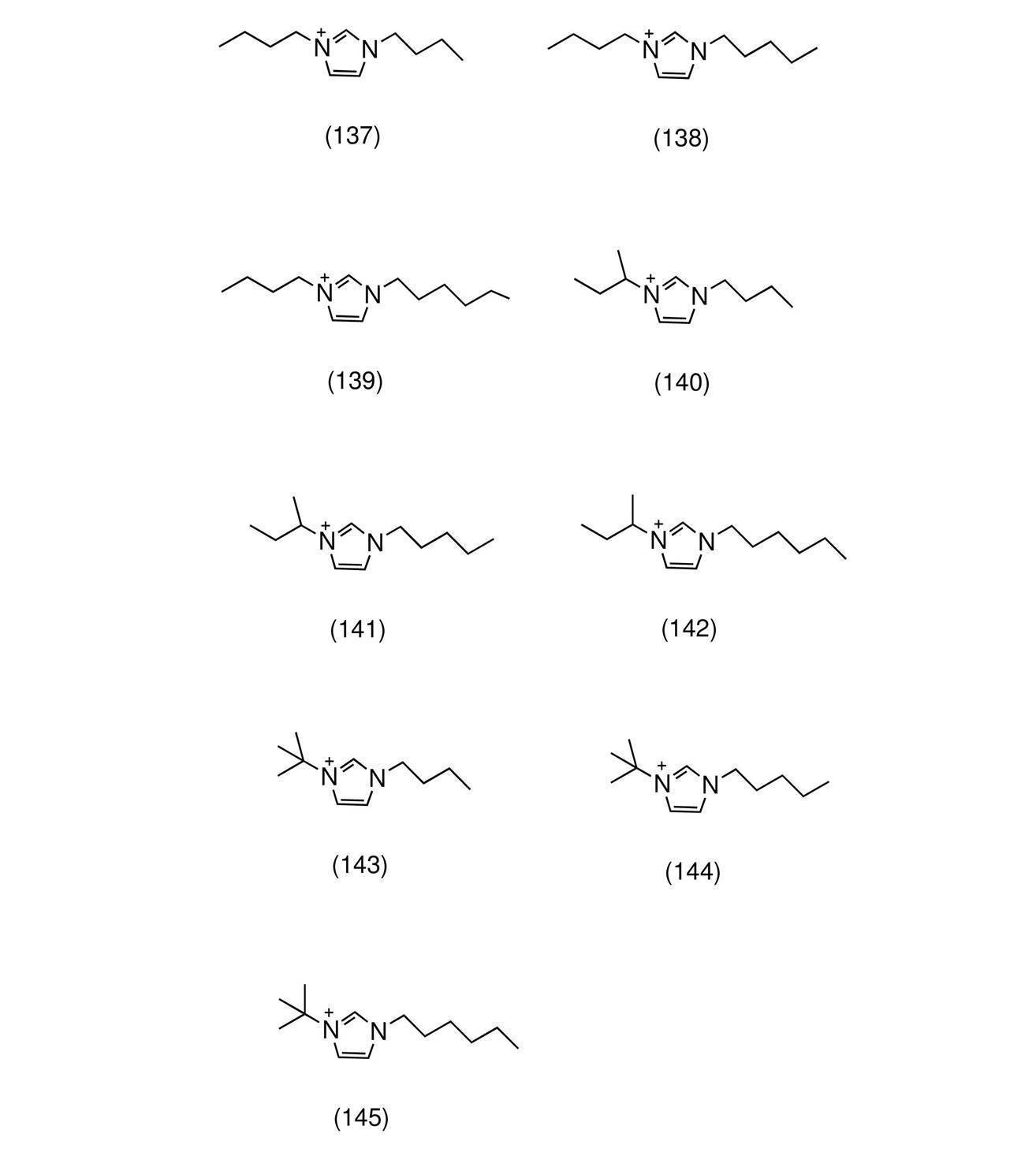
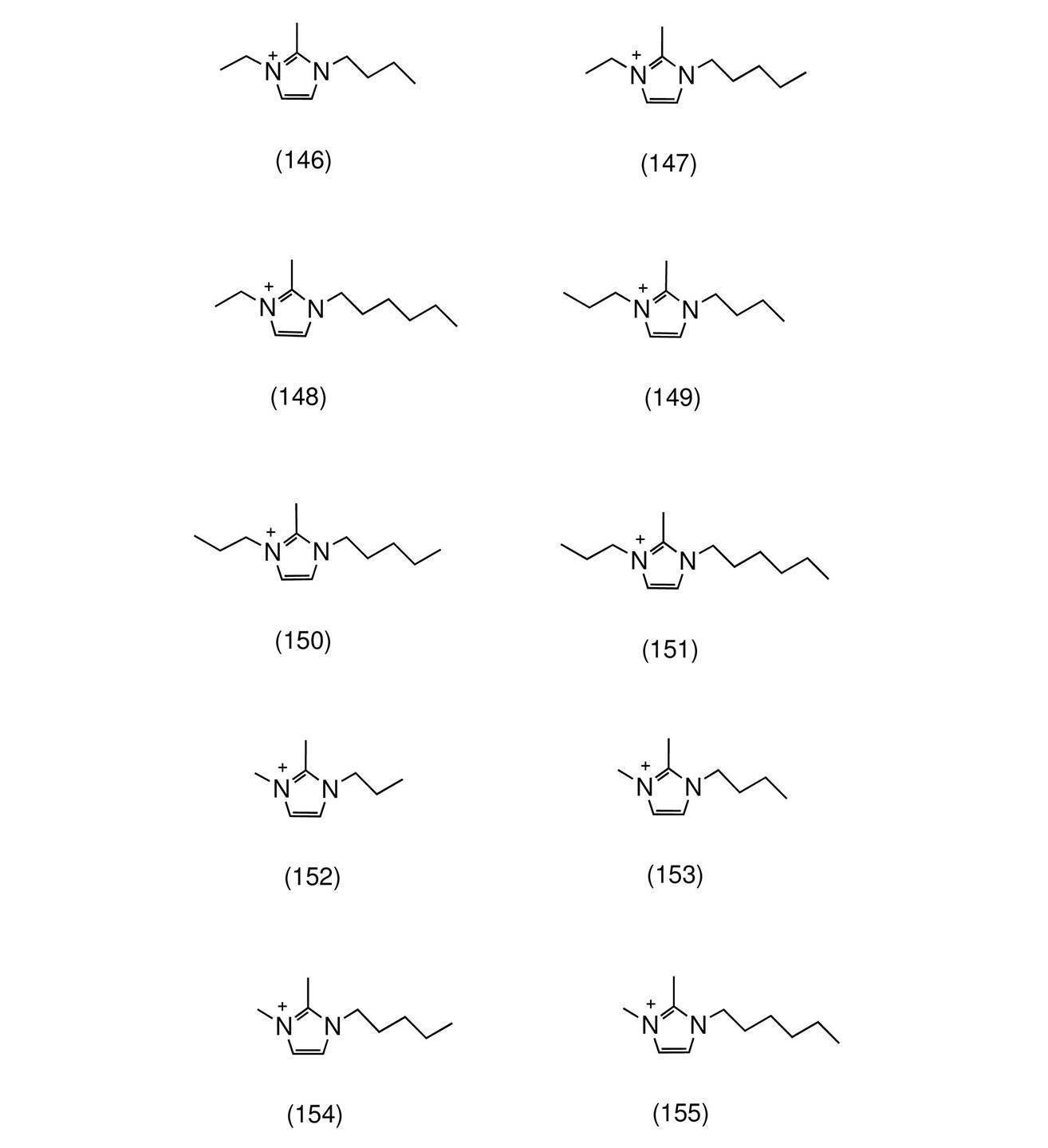


本実施の形態は、他の実施の形態と適宜組み合わせて実施することが可能である。 This embodiment can be implemented in appropriate combination with other embodiments.
(実施の形態4)
本実施の形態では、先の実施の形態で説明した正極活物質100を有する二次電池の形
状の例について説明する。本実施の形態で説明する二次電池に用いる材料は、先の実施の
形態の記載を参酌することができる。
(Embodiment 4)
In this embodiment, an example of the shape of a secondary battery including the positive electrode
[コイン型二次電池]
まずコイン型の二次電池の一例について説明する。図8(A)はコイン型(単層偏平型
)の二次電池の外観図であり、図8(B)は、その断面図である。
[Coin-type secondary battery]
First, an example of a coin-type secondary battery will be described. FIG. 8A is an external view of a coin-type (single-layer flat type) secondary battery, and FIG. 8B is a cross-sectional view thereof.
コイン型の二次電池300は、正極端子を兼ねた正極缶301と負極端子を兼ねた負極
缶302とが、ポリプロピレン等で形成されたガスケット303で絶縁シールされている
。正極304は、正極集電体305と、これと接するように設けられた正極活物質層30
6により形成される。また、負極307は、負極集電体308と、これに接するように設
けられた負極活物質層309により形成される。
In a coin-type
6. Further, the
なお、コイン型の二次電池300に用いる正極304および負極307は、それぞれ活
物質層は片面のみに形成すればよい。
Note that the active material layers of the
正極缶301、負極缶302には、電解液に対して耐食性のあるニッケル、アルミニウ
ム、チタン等の金属、又はこれらの合金やこれらと他の金属との合金(例えばステンレス
鋼等)を用いることができる。また、電解液による腐食を防ぐため、ニッケルやアルミニ
ウム等を被覆することが好ましい。正極缶301は正極304と、負極缶302は負極3
07とそれぞれ電気的に接続する。
For the positive electrode can 301 and the negative electrode can 302, metals such as nickel, aluminum, and titanium that are corrosion resistant to the electrolyte, alloys thereof, and alloys of these and other metals (for example, stainless steel) can be used. can. Also, in order to prevent corrosion due to the electrolyte, it is preferable to coat with nickel, aluminum, or the like. The positive electrode can 301 is the
07 are electrically connected.
これら負極307、正極304およびセパレータ310を電解質に含浸させ、図8(B
)に示すように、正極缶301を下にして正極304、セパレータ310、負極307、
負極缶302をこの順で積層し、正極缶301と負極缶302とをガスケット303を介
して圧着してコイン形の二次電池300を製造する。
These
), with the positive electrode can 301 facing downward, the
The
正極304に、先の実施の形態で説明した正極活物質を用いることで、高容量でサイク
ル特性に優れたコイン型の二次電池300とすることができる。
By using the positive electrode active material described in the above embodiment for the
ここで図8(C)を用いて二次電池の充電時の電流の流れを説明する。リチウムを用い
た二次電池を一つの閉回路とみなした時、リチウムイオンの動きと電流の流れは同じ向き
になる。なお、リチウムを用いた二次電池では、充電と放電でアノード(陽極)とカソー
ド(陰極)が入れ替わり、酸化反応と還元反応とが入れ替わることになるため、反応電位
が高い電極を正極と呼び、反応電位が低い電極を負極と呼ぶ。したがって、本明細書にお
いては、充電中であっても、放電中であっても、逆パルス電流を流す場合であっても、充
電電流を流す場合であっても、正極は「正極」または「+極(プラス極)」と呼び、負極
は「負極」または「-極(マイナス極)」と呼ぶこととする。酸化反応や還元反応に関連
したアノード(陽極)やカソード(陰極)という用語を用いると、充電時と放電時とでは
、逆になってしまい、混乱を招く可能性がある。したがって、アノード(陽極)やカソー
ド(陰極)という用語は、本明細書においては用いないこととする。仮にアノード(陽極
)やカソード(陰極)という用語を用いる場合には、充電時か放電時かを明記し、正極(
プラス極)と負極(マイナス極)のどちらに対応するものかも併記することとする。
Here, the current flow during charging of the secondary battery will be described with reference to FIG. When a secondary battery using lithium is regarded as one closed circuit, the movement of lithium ions and the flow of current are in the same direction. In secondary batteries using lithium, the anode (anode) and the cathode (cathode) are switched between charging and discharging, and the oxidation reaction and the reduction reaction are switched, so the electrode with a high reaction potential is called a positive electrode. An electrode with a low reaction potential is called a negative electrode. Therefore, in this specification, the positive electrode is the “positive electrode” or “positive electrode” or “positive electrode” during charging, discharging, reverse pulse current, or charging current. A negative electrode is called a “negative electrode” or a “negative electrode”. The use of the terms anode and cathode in relation to oxidation and reduction reactions can be confusing as they are reversed during charging and discharging. Accordingly, the terms anode and cathode are not used herein. If the terms anode or cathode are used, specify whether it is charging or discharging, and refer to the positive electrode (
The positive electrode) and the negative electrode (negative electrode) are also indicated.
図8(C)に示す2つの端子には充電器が接続され、二次電池300が充電される。二
次電池300の充電が進めば、電極間の電位差は大きくなる。
A charger is connected to two terminals shown in FIG. 8C to charge the
[円筒型二次電池]
次に円筒型の二次電池の例について図9を参照して説明する。円筒型の二次電池600
は、図9(A)に示すように、上面に正極キャップ(電池蓋)601を有し、側面および
底面に電池缶(外装缶)602を有している。これら正極キャップと電池缶(外装缶)6
02とは、ガスケット(絶縁パッキン)610によって絶縁されている。
[Cylindrical secondary battery]
Next, an example of a cylindrical secondary battery will be described with reference to FIG. Cylindrical
has a positive electrode cap (battery cover) 601 on its top surface and battery cans (armor cans) 602 on its side and bottom surfaces, as shown in FIG. 9A. These positive electrode caps and battery cans (outer cans) 6
02 is insulated by a gasket (insulating packing) 610 .
図9(B)は、円筒型の二次電池の断面を模式的に示した図である。中空円柱状の電池
缶602の内側には、帯状の正極604と負極606とがセパレータ605を間に挟んで
捲回された電池素子が設けられている。図示しないが、電池素子はセンターピンを中心に
捲回されている。電池缶602は、一端が閉じられ、他端が開いている。電池缶602に
は、電解液に対して耐腐食性のあるニッケル、アルミニウム、チタン等の金属、又はこれ
らの合金やこれらと他の金属との合金(例えば、ステンレス鋼等)を用いることができる
。また、電解液による腐食を防ぐため、ニッケルやアルミニウム等を被覆することが好ま
しい。電池缶602の内側において、正極、負極およびセパレータが捲回された電池素子
は、対向する一対の絶縁板608、609により挟まれている。また、電池素子が設けら
れた電池缶602の内部は、非水電解液(図示せず)が注入されている。非水電解液は、
コイン型の二次電池と同様のものを用いることができる。
FIG. 9B is a diagram schematically showing a cross section of a cylindrical secondary battery. A battery element in which a strip-shaped
A battery similar to a coin-type secondary battery can be used.
円筒型の蓄電池に用いる正極および負極は捲回するため、集電体の両面に活物質を形成
することが好ましい。正極604には正極端子(正極集電リード)603が接続され、負
極606には負極端子(負極集電リード)607が接続される。正極端子603および負
極端子607は、ともにアルミニウムなどの金属材料を用いることができる。正極端子6
03は安全弁機構612に、負極端子607は電池缶602の底にそれぞれ抵抗溶接され
る。安全弁機構612は、PTC素子(Positive Temperature C
oefficient)611を介して正極キャップ601と電気的に接続されている。
安全弁機構612は電池の内圧の上昇が所定の閾値を超えた場合に、正極キャップ601
と正極604との電気的な接続を切断するものである。また、PTC素子611は温度が
上昇した場合に抵抗が増大する熱感抵抗素子であり、抵抗の増大により電流量を制限して
異常発熱を防止するものである。PTC素子には、チタン酸バリウム(BaTiO3)系
半導体セラミックス等を用いることができる。
Since the positive electrode and the negative electrode used in a cylindrical storage battery are wound, it is preferable to form the active material on both sides of the current collector. A positive electrode terminal (positive collector lead) 603 is connected to the
03 is resistance welded to the
effective) 611 to the
The
and the
また、図9(C)のように複数の二次電池600を、導電板613および導電板614
の間に挟んでモジュール615を構成してもよい。複数の二次電池600は、並列接続さ
れていてもよいし、直列接続されていてもよいし、並列に接続された後さらに直列に接続
されていてもよい。複数の二次電池600を有するモジュール615を構成することで、
大きな電力を取り出すことができる。
Moreover, as shown in FIG.
The
A large amount of power can be extracted.
図9(D)はモジュール615の上面図である。図を明瞭にするために導電板613を
点線で示した。図9(D)に示すようにモジュール615は、複数の二次電池600を電
気的に接続する導線616を有していてもよい。導線616上に導電板を重畳して設ける
ことができる。また複数の二次電池600の間に温度制御装置617を有していてもよい
。二次電池600が過熱されたときは、温度制御装置617により冷却し、二次電池60
0が冷えすぎているときは温度制御装置617により加熱することができる。そのためモ
ジュール615の性能が外気温に影響されにくくなる。温度制御装置617が有する熱媒
体は絶縁性と不燃性を有することが好ましい。
FIG. 9D is a top view of the
If the 0 is too cold, it can be heated by the temperature controller 617 . Therefore, the performance of the
モジュール615が温度制御装置617を有するため、所望の性能に合わせて二次電池
600の温度を変化させることができる。例えば、二次電池600を加熱することにより
、より高い電流密度での充電、および放電が可能となる。例えば、充電の時間を短くでき
る。また、二次電池600を加熱する場合には、二次電池600の電解液の溶媒はイオン
液体を有することが好ましい。イオン液体は有機溶媒と比べて、加熱時の蒸気圧の上昇が
抑えられるため、加熱を行った場合でも、二次電池600の膨らみを抑制することができ
る。すなわち、安全性を確保したまま、加熱により性能を向上させることができる。
Since the
モジュール615は例えば、二次電池600に加えて、他の蓄電池を有してもよい。例
えばモジュール615は、鉛蓄電池、電気二重層キャパシタ、リチウムイオンキャパシタ
、等の蓄電池を有してもよい。これらの蓄電池を用いて温度制御装置617を起動し、動
作させてもよい。
正極604に、先の実施の形態で説明した正極活物質を用いることで、高容量でサイク
ル特性に優れた円筒型の二次電池600とすることができる。
By using the positive electrode active material described in the above embodiment for the
[二次電池の構造例]
二次電池の別の構造例について、図10乃至図14を用いて説明する。
[Structural example of secondary battery]
Another structural example of the secondary battery is described with reference to FIGS.
図10(A)及び図10(B)は、二次電池の外観図を示す図である。二次電池は、回
路基板900と、二次電池913と、を有する。二次電池913には、ラベル910が貼
られている。さらに、図10(B)に示すように、二次電池は、端子951と、端子95
2と、アンテナ914と、アンテナ915と、を有する。
10A and 10B are external views of secondary batteries. The secondary battery has a
2, an
回路基板900は、端子911と、回路912と、を有する。端子911は、端子95
1、端子952、アンテナ914、アンテナ915、及び回路912に接続される。なお
、端子911を複数設けて、複数の端子911のそれぞれを、制御信号入力端子、電源端
子などとしてもよい。
The
1,
回路912は、回路基板900の裏面に設けられていてもよい。なお、アンテナ914
及びアンテナ915は、コイル状に限定されず、例えば線状、板状であってもよい。また
、平面アンテナ、開口面アンテナ、進行波アンテナ、EHアンテナ、磁界アンテナ、誘電
体アンテナ等のアンテナを用いてもよい。又は、アンテナ914若しくはアンテナ915
は、平板状の導体でもよい。この平板状の導体は、電界結合用の導体の一つとして機能す
ることができる。つまり、コンデンサの有する2つの導体のうちの一つの導体として、ア
ンテナ914若しくはアンテナ915を機能させてもよい。これにより、電磁界、磁界だ
けでなく、電界で電力のやり取りを行うこともできる。
The
And the
may be a flat conductor. This flat conductor can function as one of conductors for electric field coupling. That is, the
アンテナ914の線幅は、アンテナ915の線幅よりも大きいことが好ましい。これに
より、アンテナ914により受電する電力量を大きくできる。
The line width of
二次電池は、アンテナ914及びアンテナ915と、二次電池913との間に層916
を有する。層916は、例えば二次電池913による電磁界を遮蔽する機能を有する。層
916としては、例えば磁性体を用いることができる。
The secondary battery has a
have The
なお、二次電池の構造は、図10に限定されない。 Note that the structure of the secondary battery is not limited to that shown in FIG.
例えば、図11(A-1)及び図11(A-2)に示すように、図10(A)及び図1
0(B)に示す二次電池913のうち、対向する一対の面のそれぞれにアンテナを設けて
もよい。図11(A-1)は、上記一対の面の一方側方向から見た外観図であり、図11
(A-2)は、上記一対の面の他方側方向から見た外観図である。なお、図10(A)及
び図10(B)に示す二次電池と同じ部分については、図10(A)及び図10(B)に
示す二次電池の説明を適宜援用できる。
For example, as shown in FIGS. 11(A-1) and 11(A-2), FIGS.
An antenna may be provided on each of a pair of opposing surfaces of the
(A-2) is an external view seen from the other side of the pair of surfaces. Note that the description of the secondary battery illustrated in FIGS. 10A and 10B can be used as appropriate for the same portions as those of the secondary battery illustrated in FIGS. 10A and 10B.
図11(A-1)に示すように、二次電池913の一対の面の一方に層916を挟んで
アンテナ914が設けられ、図11(A-2)に示すように、二次電池913の一対の面
の他方に層917を挟んでアンテナ915が設けられる。層917は、例えば二次電池9
13による電磁界を遮蔽することができる機能を有する。層917としては、例えば磁性
体を用いることができる。
As shown in FIG. 11A-1, an
It has the function of shielding the electromagnetic field caused by 13. A magnetic material, for example, can be used as the
上記構造にすることにより、アンテナ914及びアンテナ918の両方のサイズを大き
くすることができる。アンテナ918は、例えば、外部機器とのデータ通信を行うことが
できる機能を有する。アンテナ918には、例えばアンテナ914に適用可能な形状のア
ンテナを適用することができる。アンテナ918を介した二次電池と他の機器との通信方
式としては、NFCなど、二次電池と他の機器との間で用いることができる応答方式など
を適用することができる。
With the above structure, the size of both
又は、図11(B-1)に示すように、図10(A)及び図10(B)に示す二次電池
913に表示装置920を設けてもよい。表示装置920は、端子911に電気的に接続
される。なお、表示装置920が設けられる部分にラベル910を設けなくてもよい。な
お、図10(A)及び図10(B)に示す二次電池と同じ部分については、図10(A)
及び図10(B)に示す二次電池の説明を適宜援用できる。
Alternatively, as shown in FIG. 11B-1, a
and the description of the secondary battery illustrated in FIG. 10B can be used as appropriate.
表示装置920には、例えば充電中であるか否かを示す画像、蓄電量を示す画像などを
表示してもよい。表示装置920としては、例えば電子ペーパー、液晶表示装置、エレク
トロルミネセンス(ELともいう)表示装置などを用いることができる。例えば、電子ペ
ーパーを用いることにより表示装置920の消費電力を低減することができる。
The
又は、図11(B-2)に示すように、図10(A)及び図10(B)に示す二次電池
913にセンサ921を設けてもよい。センサ921は、端子922を介して端子911
に電気的に接続される。なお、図10(A)及び図10(B)に示す二次電池と同じ部分
については、図10(A)及び図10(B)に示す二次電池の説明を適宜援用できる。
Alternatively, as shown in FIG. 11B-2, a
is electrically connected to Note that the description of the secondary battery illustrated in FIGS. 10A and 10B can be used as appropriate for the same portions as those of the secondary battery illustrated in FIGS. 10A and 10B.
センサ921としては、例えば、変位、位置、速度、加速度、角速度、回転数、距離、
光、液、磁気、温度、化学物質、音声、時間、硬度、電場、電流、電圧、電力、放射線、
流量、湿度、傾度、振動、におい、又は赤外線を測定することができる機能を有すればよ
い。センサ921を設けることにより、例えば、二次電池が置かれている環境を示すデー
タ(温度など)を検出し、回路912内のメモリに記憶しておくこともできる。
As the
light, fluid, magnetism, temperature, chemicals, sound, time, hardness, electric field, current, voltage, power, radiation,
It is sufficient to have a function capable of measuring flow rate, humidity, gradient, vibration, smell, or infrared rays. By providing the
さらに、二次電池913の構造例について図12及び図13を用いて説明する。
Further, structural examples of the
図12(A)に示す二次電池913は、筐体930の内部に端子951と端子952が
設けられた捲回体950を有する。捲回体950は、筐体930の内部で電解液に含浸さ
れる。端子952は、筐体930に接し、端子951は、絶縁材などを用いることにより
筐体930に接していない。なお、図12(A)では、便宜のため、筐体930を分離し
て図示しているが、実際は、捲回体950が筐体930に覆われ、端子951及び端子9
52が筐体930の外に延在している。筐体930としては、金属材料(例えばアルミニ
ウムなど)又は樹脂材料を用いることができる。
A
52 extends out of
なお、図12(B)に示すように、図12(A)に示す筐体930を複数の材料によっ
て形成してもよい。例えば、図12(B)に示す二次電池913は、筐体930aと筐体
930bが貼り合わされており、筐体930a及び筐体930bで囲まれた領域に捲回体
950が設けられている。
Note that as shown in FIG. 12B, the
筐体930aとしては、有機樹脂など、絶縁材料を用いることができる。特に、アンテ
ナが形成される面に有機樹脂などの材料を用いることにより、二次電池913による電界
の遮蔽を抑制できる。なお、筐体930aによる電界の遮蔽が小さければ、筐体930a
の内部にアンテナ914やアンテナ915などのアンテナを設けてもよい。筐体930b
としては、例えば金属材料を用いることができる。
An insulating material such as an organic resin can be used for the
An antenna such as the
For example, a metal material can be used as the material.
さらに、捲回体950の構造について図13に示す。捲回体950は、負極931と、
正極932と、セパレータ933と、を有する。捲回体950は、セパレータ933を挟
んで負極931と、正極932が重なり合って積層され、該積層シートを捲回させた捲回
体である。なお、負極931と、正極932と、セパレータ933と、の積層を、さらに
複数重ねてもよい。
Furthermore, the structure of the
It has a
負極931は、端子951及び端子952の一方を介して図10に示す端子911に接
続される。正極932は、端子951及び端子952の他方を介して図10に示す端子9
11に接続される。
The
11.
正極932に、先の実施の形態で説明した正極活物質を用いることで、高容量でサイク
ル特性に優れた二次電池913とすることができる。
By using the positive electrode active material described in the above embodiment for the
[ラミネート型二次電池]
次に、ラミネート型の二次電池の例について、図14乃至図20を参照して説明する。
ラミネート型の二次電池は、可撓性を有する構成とすれば、可撓性を有する部位を少なく
とも一部有する電子機器に実装すれば、電子機器の変形に合わせて二次電池も曲げること
もできる。
[Laminate type secondary battery]
Next, examples of laminated secondary batteries are described with reference to FIGS.
If the laminate-type secondary battery has a flexible structure and is mounted in an electronic device having at least a part of the flexible portion, the secondary battery can be bent according to the deformation of the electronic device. can.
図14を用いて、ラミネート型の二次電池980について説明する。ラミネート型の二
次電池980は、図14(A)に示す捲回体993を有する。捲回体993は、負極99
4と、正極995と、セパレータ996と、を有する。捲回体993は、図13で説明し
た捲回体950と同様に、セパレータ996を挟んで負極994と、正極995とが重な
り合って積層され、該積層シートを捲回したものである。
A laminated
4, a
なお、負極994、正極995およびセパレータ996からなる積層の積層数は、必要
な容量と素子体積に応じて適宜設計すればよい。負極994はリード電極997およびリ
ード電極998の一方を介して負極集電体(図示せず)に接続され、正極995はリード
電極997およびリード電極998の他方を介して正極集電体(図示せず)に接続される
。
Note that the number of laminated layers composed of the
図14(B)に示すように、外装体となるフィルム981と、凹部を有するフィルム9
82とを熱圧着などにより貼り合わせて形成される空間に上述した捲回体993を収納す
ることで、図14(C)に示すように二次電池980を作製することができる。捲回体9
93は、リード電極997およびリード電極998を有し、フィルム981と、凹部を有
するフィルム982との内部で電解液に含浸される。
As shown in FIG. 14(B), a
A
93 has a
フィルム981と、凹部を有するフィルム982は、例えばアルミニウムなどの金属材
料や樹脂材料を用いることができる。フィルム981および凹部を有するフィルム982
の材料として樹脂材料を用いれば、外部から力が加わったときにフィルム981と、凹部
を有するフィルム982を変形させることができ、可撓性を有する蓄電池を作製すること
ができる。
For the
If a resin material is used as the material of , the
また、図14(B)および図14(C)では2枚のフィルムを用いる例を示しているが
、1枚のフィルムを折り曲げることによって空間を形成し、その空間に上述した捲回体9
93を収納してもよい。
14(B) and 14(C) show an example using two films, one film is folded to form a space, and the wound body 9 described above is formed in the space.
93 may be stored.
正極995に、先の実施の形態で説明した正極活物質を用いることで、高容量でサイク
ル特性に優れた二次電池980とすることができる。
By using the positive electrode active material described in the above embodiment for the
また図14では外装体となるフィルムにより形成された空間に捲回体を有する二次電池
980の例について説明したが、たとえば図15のように、外装体となるフィルムにより
形成された空間に、短冊状の複数の正極、セパレータおよび負極を有する二次電池として
もよい。
14, an example of the
図15(A)に示すラミネート型の二次電池500は、正極集電体501および正極活
物質層502を有する正極503と、負極集電体504および負極活物質層505を有す
る負極506と、セパレータ507と、電解液508と、外装体509と、を有する。外
装体509内に設けられた正極503と負極506との間にセパレータ507が設置され
ている。また、外装体509内は、電解液508で満たされている。電解液508には、
実施の形態2で示した電解液を用いることができる。
A laminated
The electrolyte solution described in
図15(A)に示すラミネート型の二次電池500において、正極集電体501および
負極集電体504は、外部との電気的接触を得る端子の役割も兼ねている。そのため、正
極集電体501および負極集電体504の一部は、外装体509から外側に露出するよう
に配置してもよい。また、正極集電体501および負極集電体504を、外装体509か
ら外側に露出させず、リード電極を用いてそのリード電極と正極集電体501、或いは負
極集電体504と超音波接合させてリード電極を外側に露出するようにしてもよい。
In the laminated
ラミネート型の二次電池500において、外装体509には、例えばポリエチレン、ポ
リプロピレン、ポリカーボネート、アイオノマー、ポリアミド等の材料からなる膜上に、
アルミニウム、ステンレス、銅、ニッケル等の可撓性に優れた金属薄膜を設け、さらに該
金属薄膜上に外装体の外面としてポリアミド系樹脂、ポリエステル系樹脂等の絶縁性合成
樹脂膜を設けた三層構造のラミネートフィルムを用いることができる。
In the laminate-type
A three-layer structure in which a highly flexible metal thin film made of aluminum, stainless steel, copper, nickel, etc. is provided, and an insulating synthetic resin film such as polyamide resin, polyester resin, etc. is provided on the metal thin film as the outer surface of the exterior body. A structured laminate film can be used.
また、ラミネート型の二次電池500の断面構造の一例を図15(B)に示す。図15
(A)では簡略のため、2つの集電体で構成する例を示しているが、実際は、複数の電極
層で構成する。
An example of a cross-sectional structure of a laminated
In (A), for the sake of simplification, an example in which two current collectors are used is shown, but in reality, it is composed of a plurality of electrode layers.
図16(B)では、一例として、電極層数を16としている。なお、電極層数を16と
しても二次電池500は、可撓性を有する。図15(B)では負極集電体504が8層と
、正極集電体501が8層の合計16層の構造を示している。なお、図15(B)は負極
の取り出し部の断面を示しており、8層の負極集電体504を超音波接合させている。勿
論、電極層数は16に限定されず、多くてもよいし、少なくてもよい。電極層数が多い場
合には、より多くの容量を有する二次電池とすることができる。また、電極層数が少ない
場合には、薄型化でき、可撓性に優れた二次電池とすることができる。
In FIG. 16B, the number of electrode layers is 16 as an example. Note that the
ここで、ラミネート型の二次電池500の外観図の一例を図16及び図17に示す。図
16及び図17は、正極503、負極506、セパレータ507、外装体509、正極リ
ード電極510及び負極リード電極511を有する。
16 and 17 show an example of an external view of a laminated
図18(A)は正極503及び負極506の外観図を示す。正極503は正極集電体5
01を有し、正極活物質層502は正極集電体501の表面に形成されている。また、正
極503は正極集電体501が一部露出する領域(以下、タブ領域という)を有する。負
極506は負極集電体504を有し、負極活物質層505は負極集電体504の表面に形
成されている。また、負極506は負極集電体504が一部露出する領域、すなわちタブ
領域を有する。正極及び負極が有するタブ領域の面積や形状は、図18(A)に示す例に
限られない。
FIG. 18A shows an external view of the
01 , and the positive electrode
[ラミネート型二次電池の作製方法]
ここで、図16に外観図を示すラミネート型二次電池の作製方法の一例について、図1
8(B)、(C)を用いて説明する。
[Method for producing laminated secondary battery]
Here, an example of a method for manufacturing a laminated secondary battery whose appearance is shown in FIG.
8(B) and (C).
まず、負極506、セパレータ507及び正極503を積層する。図18(B)に積層
された負極506、セパレータ507及び正極503を示す。ここでは負極を5組、正極
を4組使用する例を示す。次に、正極503のタブ領域同士の接合と、最表面の正極のタ
ブ領域への正極リード電極510の接合を行う。接合には、例えば超音波溶接等を用いれ
ばよい。同様に、負極506のタブ領域同士の接合と、最表面の負極のタブ領域への負極
リード電極511の接合を行う。
First, the
次に外装体509上に、負極506、セパレータ507及び正極503を配置する。
Next, the
次に、図18(C)に示すように、外装体509を破線で示した部分で折り曲げる。そ
の後、外装体509の外周部を接合する。接合には例えば熱圧着等を用いればよい。この
時、後に電解液508を入れることができるように、外装体509の一部(または一辺)
に接合されない領域(以下、導入口という)を設ける。
Next, as shown in FIG. 18C, the
A region (hereinafter referred to as an introduction port) that is not joined to the
次に、外装体509に設けられた導入口から、電解液508を外装体509の内側へ導
入する。電解液508の導入は、減圧雰囲気下、或いは不活性雰囲気下で行うことが好ま
しい。そして最後に、導入口を接合する。このようにして、ラミネート型の二次電池であ
る二次電池500を作製することができる。
Next, the
正極503に、先の実施の形態で説明した正極活物質を用いることで、高容量でサイク
ル特性に優れた二次電池500とすることができる。
By using the positive electrode active material described in the above embodiment for the
[曲げることのできる二次電池]
次に、曲げることのできる二次電池の例について図19および図20を参照して説明す
る。
[Bendable secondary battery]
Next, an example of a bendable secondary battery will be described with reference to FIGS. 19 and 20. FIG.
図19(A)に、曲げることのできる二次電池500の上面概略図を示す。図19(B
1)、(B2)、(C)にはそれぞれ、図19(A)中の切断線C1-C2、切断線C3
-C4、切断線A1-A2における断面概略図である。電池50は、外装体51と、外装
体51の内部に収容された正極11aおよび負極11bを有する。正極11aと電気的に
接続されたリード12a、および負極11bと電気的に接続されたリード12bは、外装
体51の外側に延在している。また外装体51で囲まれた領域には、正極11aおよび負
極11bに加えて電解液(図示しない)が封入されている。
FIG. 19A shows a schematic top view of a bendable
1), (B2), and (C) are the cutting lines C1-C2 and C3 in FIG. 19A, respectively.
-C4, a schematic cross-sectional view at section line A1-A2. The
電池50が有する正極11aおよび負極11bについて、図20を用いて説明する。図
20(A)は、正極11a、負極11bおよびセパレータ14の積層順を説明する斜視図
である。図20(B)は正極11aおよび負極11bに加えて、リード12aおよびリー
ド12bを示す斜視図である。
The positive electrode 11a and the negative electrode 11b of the
図20(A)に示すように、電池50は、複数の短冊状の正極11a、複数の短冊状の
負極11bおよび複数のセパレータ14を有する。正極11aおよび負極11bはそれぞ
れ突出したタブ部分と、タブ以外の部分を有する。正極11aの一方の面のタブ以外の部
分に正極活物質層が形成され、負極11bの一方の面のタブ以外の部分に負極活物質層が
形成される。
As shown in FIG. 20A, the
正極11aの正極活物質層の形成されていない面同士、および負極11bの負極活物質
の形成されていない面同士が接するように、正極11aおよび負極11bは積層される。
The positive electrode 11a and the negative electrode 11b are laminated such that the surfaces of the positive electrode 11a on which the positive electrode active material layer is not formed and the surfaces of the negative electrode 11b on which the negative electrode active material is not formed are in contact with each other.
また、正極11aの正極活物質が形成された面と、負極11bの負極活物質が形成され
た面の間にはセパレータ14が設けられる。図20では見やすくするためセパレータ14
を点線で示す。
A separator 14 is provided between the surface of the positive electrode 11a on which the positive electrode active material is formed and the surface of the negative electrode 11b on which the negative electrode active material is formed. Separator 14 is shown in FIG. 20 for clarity.
is indicated by a dotted line.
また図20(B)に示すように、複数の正極11aとリード12aは、接合部15aに
おいて電気的に接続される。また複数の負極11bとリード12bは、接合部15bにお
いて電気的に接続される。
Further, as shown in FIG. 20B, the plurality of positive electrodes 11a and leads 12a are electrically connected at joints 15a. Also, the plurality of negative electrodes 11b and the leads 12b are electrically connected at the joints 15b.
次に、外装体51について図19(B1)、(B2)、(C)、(D)を用いて説明す
る。
Next, the exterior body 51 will be described with reference to FIGS. 19B1, 19B2, 19C, and 19D.
外装体51は、フィルム状の形状を有し、正極11aおよび負極11bを挟むように2
つに折り曲げられている。外装体51は、折り曲げ部61と、一対のシール部62と、シ
ール部63と、を有する。一対のシール部62は、正極11aおよび負極11bを挟んで
設けられ、サイドシールとも呼ぶことができる。また、シール部63は、リード12a及
びリード12bと重なる部分を有し、トップシールとも呼ぶことができる。
The exterior body 51 has a film-like shape, and is divided into two layers so as to sandwich the positive electrode 11a and the negative electrode 11b.
folded in half. The exterior body 51 has a bent portion 61 , a pair of seal portions 62 and a seal portion 63 . The pair of seal portions 62 are provided to sandwich the positive electrode 11a and the negative electrode 11b, and can also be called side seals. Moreover, the seal portion 63 has portions overlapping with the leads 12a and 12b, and can also be called a top seal.
外装体51は、正極11aおよび負極11bと重なる部分に、稜線71と谷線72が交
互に並んだ波形状を有することが好ましい。また、外装体51のシール部62及びシール
部63は、平坦であることが好ましい。
The exterior body 51 preferably has a wavy shape in which ridge lines 71 and valley lines 72 are alternately arranged in portions overlapping the positive electrode 11a and the negative electrode 11b. Moreover, the sealing portion 62 and the sealing portion 63 of the exterior body 51 are preferably flat.
図19(B1)は、稜線71と重なる部分で切断した断面であり、図19(B2)は、
谷線72と重なる部分で切断した断面である。図19(B1)、(B2)は共に、電池5
0及び正極11aおよび負極11bの幅方向の断面に対応する。
FIG. 19(B1) is a cross section cut at a portion overlapping with the ridgeline 71, and FIG. 19(B2) is
This is a cross section cut at a portion overlapping the valley line 72 . Both FIGS. 19(B1) and (B2) show the
0 and cross sections of the positive electrode 11a and the negative electrode 11b in the width direction.
ここで、正極11aおよび負極11bの幅方向の端部、すなわち正極11aおよび負極
11bの端部と、シール部62との間の距離を距離Laとする。電池50に曲げるなどの
変形を加えたとき、後述するように正極11aおよび負極11bが長さ方向に互いにずれ
るように変形する。その際、距離Laが短すぎると、外装体51と正極11aおよび負極
11bとが強く擦れ、外装体51が破損してしまう場合がある。特に外装体51の金属フ
ィルムが露出すると、当該金属フィルムが電解液により腐食されてしまう恐れがある。し
たがって、距離Laを出来るだけ長く設定することが好ましい。一方で、距離Laを大き
くしすぎると、電池50の体積が増大してしまう。
Here, the distance between the ends of the positive electrode 11a and the negative electrode 11b in the width direction, ie, the ends of the positive electrode 11a and the negative electrode 11b, and the seal portion 62 is defined as a distance La. When deformation such as bending is applied to the
また、積層された正極11aおよび負極11bの合計の厚さが厚いほど、正極11aお
よび負極11bと、シール部62との間の距離Laを大きくすることが好ましい。
In addition, it is preferable to increase the distance La between the positive electrode 11a and the negative electrode 11b and the seal portion 62 as the total thickness of the stacked positive electrode 11a and negative electrode 11b increases.
より具体的には、積層された正極11aおよび負極11bおよび図示しないがセパレー
タ214の合計の厚さを厚さtとしたとき、の合計の厚さを厚さtとしたとき、距離La
は、厚さtの0.8倍以上3.0倍以下、好ましくは0.9倍以上2.5倍以下、より好
ましくは1.0倍以上2.0倍以下であることが好ましい。距離Laをこの範囲とするこ
とで、コンパクトで、且つ曲げに対する信頼性の高い電池を実現できる。
More specifically, when the total thickness of the laminated positive electrode 11a and negative electrode 11b and the separator 214 (not shown) is the thickness t, and the total thickness of the laminated layers is the thickness t, the distance La
is 0.8 to 3.0 times the thickness t, preferably 0.9 to 2.5 times, more preferably 1.0 to 2.0 times the thickness t. By setting the distance La within this range, a compact battery with high reliability against bending can be realized.
また、一対のシール部62の間の距離を距離Lbとしたとき、距離Lbを正極11aお
よび負極11bの幅(ここでは、負極11bの幅Wb)よりも十分大きくすることが好ま
しい。これにより、電池50に繰り返し曲げるなどの変形を加えたときに、正極11aお
よび負極11bと外装体51とが接触しても、正極11aおよび負極11bの一部が幅方
向にずれることができるため、正極11aおよび負極11bと外装体51とが擦れてしま
うことを効果的に防ぐことができる。
Further, when the distance between the pair of seal portions 62 is Lb, it is preferable to make the distance Lb sufficiently larger than the width of the positive electrode 11a and the negative electrode 11b (here, the width Wb of the negative electrode 11b). As a result, even if the positive electrode 11a and the negative electrode 11b come into contact with the exterior body 51 when the
例えば、一対のシール部62の間の距離Laと、負極11bの幅Wbとの差が、正極1
1aおよび負極11bの厚さtの1.6倍以上6.0倍以下、好ましくは1.8倍以上5
.0倍以下、より好ましくは、2.0倍以上4.0倍以下を満たすことが好ましい。
For example, the difference between the distance La between the pair of seal portions 62 and the width Wb of the negative electrode 11b is the
1.6 to 6.0 times, preferably 1.8 to 5 times the thickness t of 1a and negative electrode 11b
. It is preferable to satisfy 0 times or less, more preferably 2.0 times or more and 4.0 times or less.
言い換えると、距離Lb、幅Wb、及び厚さtが、下記数式1の関係を満たすことが好
ましい。
In other words, it is preferable that the distance Lb, the width Wb, and the thickness t satisfy the relationship of

ここで、aは、0.8以上3.0以下、好ましくは0.9以上2.5以下、より好まし
くは1.0以上2.0以下を満たす。
Here, a satisfies 0.8 or more and 3.0 or less, preferably 0.9 or more and 2.5 or less, more preferably 1.0 or more and 2.0 or less.
また、図19(C)はリード12aを含む断面であり、電池50、正極11aおよび負
極11bの長さ方向の断面に対応する。図19(C)に示すように、折り曲げ部61にお
いて、正極11aおよび負極11bの長さ方向の端部と、外装体51との間に空間73を
有することが好ましい。
FIG. 19C is a cross section including the lead 12a, and corresponds to cross sections in the longitudinal direction of the
図19(D)に、電池50を曲げたときの断面概略図を示している。図19(D)は、
図19(A)中の切断線B1-B2における断面に相当する。
FIG. 19D shows a schematic cross-sectional view when the
This corresponds to the cross section taken along the cutting line B1-B2 in FIG. 19(A).
電池50を曲げると、曲げの外側に位置する外装体51の一部は伸び、内側に位置する
他の一部は縮むように変形する。より具体的には、外装体51の外側に位置する部分は、
波の振幅が小さく、且つ波の周期が大きくなるように変形する。一方、外装体51の内側
に位置する部分は、波の振幅が大きく、且つ波の周期が小さくなるように変形する。この
ように、外装体51が変形することにより、曲げに伴って外装体51にかかる応力が緩和
されるため、外装体51を構成する材料自体が伸縮する必要がない。その結果、外装体5
1は破損することなく、小さな力で電池50を曲げることができる。
When the
The wave is deformed so that the amplitude of the wave is small and the period of the wave is large. On the other hand, the portion positioned inside the exterior body 51 deforms such that the amplitude of the waves is large and the cycle of the waves is small. In this way, the deformation of the exterior body 51 relieves the stress applied to the exterior body 51 due to bending, so that the material itself forming the exterior body 51 does not need to expand and contract. As a result, the
1 can bend the
また、図19(D)に示すように、電池50を曲げると、正極11aおよび負極11b
とがそれぞれ相対的にずれる。このとき、複数の積層された正極11aおよび負極11b
は、シール部63側の一端が固定部材17で固定されているため、折り曲げ部61に近い
ほどずれ量が大きくなるように、それぞれずれる。これにより、正極11aおよび負極1
1bにかかる応力が緩和され、正極11aおよび負極11b自体が伸縮する必要がない。
その結果、正極11aおよび負極11bが破損することなく電池50を曲げることができ
る。
Further, as shown in FIG. 19D, when the
and shift relative to each other. At this time, the plurality of stacked positive electrodes 11a and negative electrodes 11b
Since one end on the sealing portion 63 side is fixed by the fixing
The stress applied to 1b is relaxed, and the positive electrode 11a and the negative electrode 11b themselves do not need to expand and contract.
As a result, the
また、正極11aおよび負極11bと外装体51との間に空間73を有していることに
より、曲げた時内側に位置する正極11aおよび負極11bが、外装体51に接触するこ
となく、相対的にずれることができる。
In addition, since the space 73 is provided between the positive electrode 11a and the negative electrode 11b and the outer package 51, the positive electrode 11a and the negative electrode 11b positioned inside when the outer package 51 is bent does not come into contact with the outer package 51. can deviate.
図19および図20で例示した電池50は、繰り返し曲げ伸ばしを行っても、外装体の
破損、正極11aおよび負極11bの破損などが生じにくく、電池特性も劣化しにくい電
池である。電池50が有する正極11aに、先の実施の形態で説明した正極活物質を用い
ることで、さらにサイクル特性に優れた電池とすることができる。
The
(実施の形態5)
本実施の形態では、本発明の一態様である二次電池を電子機器に実装する例について説
明する。
(Embodiment 5)
In this embodiment, an example of mounting a secondary battery, which is one embodiment of the present invention, in an electronic device will be described.
まず実施の形態3の一部で説明した、曲げることのできる二次電池を電子機器に実装す
る例を図21(A)乃至図21(G)に示す。曲げることのできる二次電池を適用した電
子機器として、例えば、テレビジョン装置(テレビ、又はテレビジョン受信機ともいう)
、コンピュータ用などのモニタ、デジタルカメラ、デジタルビデオカメラ、デジタルフォ
トフレーム、携帯電話機(携帯電話、携帯電話装置ともいう)、携帯型ゲーム機、携帯情
報端末、音響再生装置、パチンコ機などの大型ゲーム機などが挙げられる。
First, FIGS. 21A to 21G show an example of mounting the bendable secondary battery, which is described in part of
, monitors for computers, etc., digital cameras, digital video cameras, digital photo frames, mobile phones (also called mobile phones and mobile phone devices), mobile game machines, mobile information terminals, audio playback devices, large games such as pachinko machines machines, etc.
また、フレキシブルな形状を備える二次電池を、家屋やビルの内壁または外壁や、自動
車の内装または外装の曲面に沿って組み込むことも可能である。
It is also possible to incorporate a secondary battery having a flexible shape along the inner wall or outer wall of a house or building, or along the curved surface of the interior or exterior of an automobile.
図21(A)は、携帯電話機の一例を示している。携帯電話機7400は、筐体740
1に組み込まれた表示部7402の他、操作ボタン7403、外部接続ポート7404、
スピーカ7405、マイク7406などを備えている。なお、携帯電話機7400は、二
次電池7407を有している。上記の二次電池7407に本発明の一態様の二次電池を用
いることで、軽量で長寿命な携帯電話機を提供できる。
FIG. 21A shows an example of a mobile phone. A
1, an
A
図21(B)は、携帯電話機7400を湾曲させた状態を示している。携帯電話機74
00を外部の力により変形させて全体を湾曲させると、その内部に設けられている二次電
池7407も湾曲される。また、その時、曲げられた二次電池7407の状態を図21(
C)に示す。二次電池7407は薄型の蓄電池である。二次電池7407は曲げられた状
態で固定されている。なお、二次電池7407は集電体7409と電気的に接続されたリ
ード電極7408を有している。例えば、集電体7409は銅箔であり、一部ガリウムと
合金化させて、集電体7409と接する活物質層との密着性を向上し、二次電池7407
が曲げられた状態での信頼性が高い構成となっている。
FIG. 21B shows a state in which the
00 is deformed by an external force to bend the whole, the
C). A
It has a highly reliable configuration in a bent state.
図21(D)は、バングル型の表示装置の一例を示している。携帯表示装置7100は
、筐体7101、表示部7102、操作ボタン7103、及び二次電池7104を備える
。また、図21(E)に曲げられた二次電池7104の状態を示す。二次電池7104は
曲げられた状態で使用者の腕への装着時に、筐体が変形して二次電池7104の一部また
は全部の曲率が変化する。なお、曲線の任意の点における曲がり具合を相当する円の半径
の値で表したものを曲率半径であり、曲率半径の逆数を曲率と呼ぶ。具体的には、曲率半
径が40mm以上150mm以下の範囲内で筐体または二次電池7104の主表面の一部
または全部が変化する。二次電池7104の主表面における曲率半径が40mm以上15
0mm以下の範囲であれば、高い信頼性を維持できる。上記の二次電池7104に本発明
の一態様の二次電池を用いることで、軽量で長寿命な携帯表示装置を提供できる。
FIG. 21D illustrates an example of a bangle-type display device. A
High reliability can be maintained within the range of 0 mm or less. By using the secondary battery of one embodiment of the present invention for the
図21(F)は、腕時計型の携帯情報端末の一例を示している。携帯情報端末7200
は、筐体7201、表示部7202、バンド7203、バックル7204、操作ボタン7
205、入出力端子7206などを備える。
FIG. 21F shows an example of a wristwatch-type portable information terminal.
, a
205, an input/
携帯情報端末7200は、移動電話、電子メール、文章閲覧及び作成、音楽再生、イン
ターネット通信、コンピュータゲームなどの種々のアプリケーションを実行することがで
きる。
Personal
表示部7202はその表示面が湾曲して設けられ、湾曲した表示面に沿って表示を行う
ことができる。また、表示部7202はタッチセンサを備え、指やスタイラスなどで画面
に触れることで操作することができる。例えば、表示部7202に表示されたアイコン7
207に触れることで、アプリケーションを起動することができる。
The
An application can be launched by touching 207 .
操作ボタン7205は、時刻設定のほか、電源のオン、オフ動作、無線通信のオン、オ
フ動作、マナーモードの実行及び解除、省電力モードの実行及び解除など、様々な機能を
持たせることができる。例えば、携帯情報端末7200に組み込まれたオペレーティング
システムにより、操作ボタン7205の機能を自由に設定することもできる。
The
また、携帯情報端末7200は、通信規格された近距離無線通信を実行することが可能
である。例えば無線通信可能なヘッドセットと相互通信することによって、ハンズフリー
で通話することもできる。
In addition, the
また、携帯情報端末7200は入出力端子7206を備え、他の情報端末とコネクター
を介して直接データのやりとりを行うことができる。また入出力端子7206を介して充
電を行うこともできる。なお、充電動作は入出力端子7206を介さずに無線給電により
行ってもよい。
In addition, the
携帯情報端末7200の表示部7202には、本発明の一態様の二次電池を有している
。本発明の一態様の二次電池を用いることで、軽量で長寿命な携帯情報端末を提供できる
。例えば、図21(E)に示した二次電池7104を、筐体7201の内部に湾曲した状
態で、またはバンド7203の内部に湾曲可能な状態で組み込むことができる。
The
携帯情報端末7200はセンサを有することが好ましい。センサとして例えば、指紋セ
ンサ、脈拍センサ、体温センサ等の人体センサや、タッチセンサ、加圧センサ、加速度セ
ンサ、等が搭載されることが好ましい。
Personal
図21(G)は、腕章型の表示装置の一例を示している。表示装置7300は、表示部
7304を有し、本発明の一態様の二次電池を有している。また、表示装置7300は、
表示部7304にタッチセンサを備えることもでき、また、携帯情報端末として機能させ
ることもできる。
FIG. 21G illustrates an example of an armband-type display device. The
A touch sensor can be provided in the
表示部7304はその表示面が湾曲しており、湾曲した表示面に沿って表示を行うこと
ができる。また、表示装置7300は、通信規格された近距離無線通信などにより、表示
状況を変更することができる。
The display surface of the
また、表示装置7300は入出力端子を備え、他の情報端末とコネクターを介して直接
データのやりとりを行うことができる。また入出力端子を介して充電を行うこともできる
。なお、充電動作は入出力端子を介さずに無線給電により行ってもよい。
In addition, the
表示装置7300が有する二次電池として本発明の一態様の二次電池を用いることで、
軽量で長寿命な表示装置を提供できる。
By using the secondary battery of one embodiment of the present invention as the secondary battery included in the
A display device that is lightweight and has a long life can be provided.
また、先の実施の形態で示したサイクル特性のよい二次電池を電子機器に実装する例を
図21(H)、図22および図23を用いて説明する。
An example of mounting the secondary battery with good cycle characteristics described in the above embodiment in an electronic device will be described with reference to FIGS.
日用電子機器に二次電池として本発明の一態様の二次電池を用いることで、軽量で長寿
命な製品を提供できる。例えば、日用電子機器として、電動歯ブラシ、電気シェーバー、
電動美容機器などが挙げられ、それらの製品の二次電池としては、使用者の持ちやすさを
考え、形状をスティック状とし、小型、軽量、且つ、大容量の二次電池が望まれている。
By using the secondary battery of one embodiment of the present invention as a secondary battery in a daily electronic device, a product that is lightweight and has a long life can be provided. For example, as electronic devices for daily use, electric toothbrushes, electric shavers,
Electric beauty equipment and the like can be mentioned, and secondary batteries for these products are desired to be stick-shaped, compact, lightweight, and large-capacity secondary batteries in consideration of the user's ease of holding. .
図21(H)はタバコ収容喫煙装置(電子タバコ)とも呼ばれる装置の斜視図である。
図21(H)において電子タバコ7500は、加熱素子を含むアトマイザ7501と、ア
トマイザに電力を供給する二次電池7504と、液体供給ボトルやセンサなどを含むカー
トリッジ7502で構成されている。安全性を高めるため、二次電池7504の過充電や
過放電を防ぐ保護回路を二次電池7504に電気的に接続してもよい。図22(H)に示
した二次電池7504は、充電機器と接続できるように外部端子を有している。二次電池
7504は持った場合に先端部分となるため、トータルの長さが短く、且つ、重量が軽い
ことが望ましい。本発明の一態様の二次電池は高容量、良好なサイクル特性を有するため
、長期間に渡って長時間の使用ができる小型であり、且つ、軽量の電子タバコ7500を
提供できる。
FIG. 21(H) is a perspective view of a device also called a cigarette containing smoking device (electronic cigarette).
In FIG. 21(H), an
次に、図22(A)および図22(B)に、2つ折り可能なタブレット型端末の一例を
示す。図22(A)および図22(B)に示すタブレット型端末9600は、筐体963
0a、筐体9630b、筐体9630aと筐体9630bを接続する可動部9640、表
示部9631aと表示部9631bを有する表示部9631、表示モード切り替えスイッ
チ9626、電源スイッチ9627、省電力モード切り替えスイッチ9625、留め具9
629、操作スイッチ9628、を有する。表示部9631には、可撓性を有するパネル
を用いることで、より広い表示部を有するタブレット端末とすることができる。図22(
A)は、タブレット型端末9600を開いた状態を示し、図22(B)は、タブレット型
端末9600を閉じた状態を示している。
Next, FIGS. 22A and 22B show an example of a tablet terminal that can be folded in half. A
0a,
629, and an
A) shows a state in which the
また、タブレット型端末9600は、筐体9630aおよび筐体9630bの内部に蓄
電体9635を有する。蓄電体9635は、可動部9640を通り、筐体9630aと筐
体9630bに渡って設けられている。
The
表示部9631aは、一部をタッチパネルの領域9632aとすることができ、表示さ
れた操作キー9638にふれることでデータ入力をすることができる。なお、表示部96
31aにおいては、一例として半分の領域が表示のみの機能を有する構成、もう半分の領
域がタッチパネルの機能を有する構成を示しているが該構成に限定されない。表示部96
31aの全ての領域がタッチパネルの機能を有する構成としても良い。例えば、表示部9
631aの全面をキーボードボタン表示させてタッチパネルとし、表示部9631bを表
示画面として用いることができる。
Part of the display portion 9631a can be a touch panel region 9632a, and data can be input by touching a displayed operation key 9638 . Note that the display unit 96
In 31a, as an example, a configuration in which half of the area has only a display function and a configuration in which the other half of the area has a touch panel function is shown, but the configuration is not limited to this. Display unit 96
The entire area of 31a may have a touch panel function. For example, the display unit 9
The entire surface of 631a can be used as a touch panel by displaying keyboard buttons, and the display portion 9631b can be used as a display screen.
また、表示部9631bにおいても表示部9631aと同様に、表示部9631bの一
部をタッチパネルの領域9632bとすることができる。また、タッチパネルのキーボー
ド表示切り替えボタン9639が表示されている位置に指やスタイラスなどでふれること
で表示部9631bにキーボードボタン表示することができる。
Further, in the display portion 9631b, part of the display portion 9631b can be used as a touch panel region 9632b, similarly to the display portion 9631a. Further, a keyboard button can be displayed on the display portion 9631b by touching a position where the keyboard display switching button 9639 of the touch panel is displayed with a finger, a stylus, or the like.
また、タッチパネルの領域9632aとタッチパネルの領域9632bに対して同時に
タッチ入力することもできる。
Further, touch input can be performed simultaneously on the touch panel region 9632a and the touch panel region 9632b.
また、表示モード切り替えスイッチ9626は、縦表示又は横表示などの表示の向きを
切り替え、白黒表示やカラー表示の切り替えなどを選択できる。省電力モード切り替えス
イッチ9625は、タブレット型端末9600に内蔵している光センサで検出される使用
時の外光の光量に応じて表示の輝度を最適なものとすることができる。タブレット型端末
は光センサだけでなく、ジャイロ、加速度センサ等の傾きを検出するセンサなどの他の検
出装置を内蔵させてもよい。
A display
また、図22(A)では表示部9631bと表示部9631aの表示面積が同じ例を示
しているが特に限定されず、一方のサイズともう一方のサイズが異なっていてもよく、表
示の品質も異なっていてもよい。例えば一方が他方よりも高精細な表示を行える表示パネ
ルとしてもよい。
In addition, FIG. 22A shows an example in which the display areas of the display portion 9631b and the display portion 9631a are the same; however, there is no particular limitation. can be different. For example, one of them may be a display panel capable of displaying with higher definition than the other.
図22(B)は、閉じた状態であり、タブレット型端末は、筐体9630、太陽電池9
633、DCDCコンバータ9636を含む充放電制御回路9634有する。また、蓄電
体9635として、本発明の一態様に係る蓄電体を用いる。
FIG. 22B shows a closed state, and the tablet terminal includes a
633 has a charge/
なお、タブレット型端末9600は2つ折り可能なため、未使用時に筐体9630aお
よび筐体9630bを重ね合せるように折りたたむことができる。折りたたむことにより
、表示部9631a、表示部9631bを保護できるため、タブレット型端末9600の
耐久性を高めることができる。また、本発明の一態様の二次電池を用いた蓄電体9635
は高容量、良好なサイクル特性を有するため、長期間に渡って長時間の使用ができるタブ
レット型端末9600を提供できる。
Note that since the
has high capacity and good cycle characteristics, it is possible to provide the
また、この他にも図22(A)および図22(B)に示したタブレット型端末は、様々
な情報(静止画、動画、テキスト画像など)を表示する機能、カレンダー、日付又は時刻
などを表示部に表示する機能、表示部に表示した情報をタッチ入力操作又は編集するタッ
チ入力機能、様々なソフトウェア(プログラム)によって処理を制御する機能、等を有す
ることができる。
In addition, the tablet terminals shown in FIGS. 22(A) and 22(B) have a function of displaying various information (still images, moving images, text images, etc.), a calendar, a date or time, and the like. It can have a function of displaying on the display unit, a touch input function of performing a touch input operation or editing information displayed on the display unit, a function of controlling processing by various software (programs), and the like.
タブレット型端末の表面に装着された太陽電池9633によって、電力をタッチパネル
、表示部、又は映像信号処理部等に供給することができる。なお、太陽電池9633は、
筐体9630の片面又は両面に設けることができ、蓄電体9635の充電を効率的に行う
構成とすることができる。なお蓄電体9635としては、リチウムイオン二次電池を用い
ると、小型化を図れる等の利点がある。
A
It can be provided on one side or both sides of the
また、図22(B)に示す充放電制御回路9634の構成、および動作について図22
(C)にブロック図を示し説明する。図22(C)には、太陽電池9633、蓄電体96
35、DCDCコンバータ9636、コンバータ9637、スイッチSW1乃至SW3、
表示部9631について示しており、蓄電体9635、DCDCコンバータ9636、コ
ンバータ9637、スイッチSW1乃至SW3が、図22(B)に示す充放電制御回路9
634に対応する箇所となる。
Also, the configuration and operation of the charge/
A block diagram is shown in (C) and explained. In FIG. 22C, a
35,
A
634.
まず外光により太陽電池9633により発電がされる場合の動作の例について説明する
。太陽電池で発電した電力は、蓄電体9635を充電するための電圧となるようDCDC
コンバータ9636で昇圧又は降圧がなされる。そして、表示部9631の動作に太陽電
池9633からの電力が用いられる際にはスイッチSW1をオンにし、コンバータ963
7で表示部9631に必要な電圧に昇圧又は降圧をすることとなる。また、表示部963
1での表示を行わない際には、SW1をオフにし、SW2をオンにして蓄電体9635の
充電を行う構成とすればよい。
First, an example of operation in the case where the
7, the voltage required for the
When 1 is not displayed, the
なお太陽電池9633については、発電手段の一例として示したが、特に限定されず、
圧電素子(ピエゾ素子)や熱電変換素子(ペルティエ素子)などの他の発電手段による蓄
電体9635の充電を行う構成であってもよい。例えば、無線(非接触)で電力を送受信
して充電する無接点電力伝送モジュールや、また他の充電手段を組み合わせて行う構成と
してもよい。
Although the
A configuration in which the
図23に、他の電子機器の例を示す。図23において、表示装置8000は、本発明の
一態様に係る二次電池8004を用いた電子機器の一例である。具体的に、表示装置80
00は、TV放送受信用の表示装置に相当し、筐体8001、表示部8002、スピーカ
部8003、二次電池8004等を有する。本発明の一態様に係る二次電池8004は、
筐体8001の内部に設けられている。表示装置8000は、商用電源から電力の供給を
受けることもできるし、二次電池8004に蓄積された電力を用いることもできる。よっ
て、停電などにより商用電源から電力の供給が受けられない時でも、本発明の一態様に係
る二次電池8004を無停電電源として用いることで、表示装置8000の利用が可能と
なる。
FIG. 23 shows an example of another electronic device. In FIG. 23, a
00 corresponds to a display device for receiving TV broadcast, and includes a
It is provided inside the
表示部8002には、液晶表示装置、有機EL素子などの発光素子を各画素に備えた発
光装置、電気泳動表示装置、DMD(Digital Micromirror Dev
ice)、PDP(Plasma Display Panel)、FED(Field
Emission Display)などの、半導体表示装置を用いることができる。
The
ice), PDP (Plasma Display Panel), FED (Field
A semiconductor display device such as an emission display) can be used.
なお、表示装置には、TV放送受信用の他、パーソナルコンピュータ用、広告表示用な
ど、全ての情報表示用表示装置が含まれる。
The display device includes all display devices for information display, such as for TV broadcast reception, personal computer, advertisement display, and the like.
図23において、据え付け型の照明装置8100は、本発明の一態様に係る二次電池8
103を用いた電子機器の一例である。具体的に、照明装置8100は、筐体8101、
光源8102、二次電池8103等を有する。図23では、二次電池8103が、筐体8
101及び光源8102が据え付けられた天井8104の内部に設けられている場合を例
示しているが、二次電池8103は、筐体8101の内部に設けられていても良い。照明
装置8100は、商用電源から電力の供給を受けることもできるし、二次電池8103に
蓄積された電力を用いることもできる。よって、停電などにより商用電源から電力の供給
が受けられない時でも、本発明の一態様に係る二次電池8103を無停電電源として用い
ることで、照明装置8100の利用が可能となる。
In FIG. 23, a
1 is an example of an electronic device using 103. FIG. Specifically, the
It has a
101 and the
なお、図23では天井8104に設けられた据え付け型の照明装置8100を例示して
いるが、本発明の一態様に係る二次電池は、天井8104以外、例えば側壁8105、床
8106、窓8107等に設けられた据え付け型の照明装置に用いることもできるし、卓
上型の照明装置などに用いることもできる。
Note that although FIG. 23 illustrates the
また、光源8102には、電力を利用して人工的に光を得る人工光源を用いることがで
きる。具体的には、白熱電球、蛍光灯などの放電ランプ、LEDや有機EL素子などの発
光素子が、上記人工光源の一例として挙げられる。
For the
図23において、室内機8200及び室外機8204を有するエアコンディショナーは
、本発明の一態様に係る二次電池8203を用いた電子機器の一例である。具体的に、室
内機8200は、筐体8201、送風口8202、二次電池8203等を有する。図23
では、二次電池8203が、室内機8200に設けられている場合を例示しているが、二
次電池8203は室外機8204に設けられていても良い。或いは、室内機8200と室
外機8204の両方に、二次電池8203が設けられていても良い。エアコンディショナ
ーは、商用電源から電力の供給を受けることもできるし、二次電池8203に蓄積された
電力を用いることもできる。特に、室内機8200と室外機8204の両方に二次電池8
203が設けられている場合、停電などにより商用電源から電力の供給が受けられない時
でも、本発明の一態様に係る二次電池8203を無停電電源として用いることで、エアコ
ンディショナーの利用が可能となる。
An air conditioner including an
Although the case where the
203, the air conditioner can be used by using the
なお、図23では、室内機と室外機で構成されるセパレート型のエアコンディショナー
を例示しているが、室内機の機能と室外機の機能とを1つの筐体に有する一体型のエアコ
ンディショナーに、本発明の一態様に係る二次電池を用いることもできる。
Note that FIG. 23 exemplifies a separate type air conditioner composed of an indoor unit and an outdoor unit, but an integrated type air conditioner having the function of the indoor unit and the function of the outdoor unit in one housing is used. , the secondary battery according to one embodiment of the present invention can also be used.
図23において、電気冷凍冷蔵庫8300は、本発明の一態様に係る二次電池8304
を用いた電子機器の一例である。具体的に、電気冷凍冷蔵庫8300は、筐体8301、
冷蔵室用扉8302、冷凍室用扉8303、二次電池8304等を有する。図23では、
二次電池8304が、筐体8301の内部に設けられている。電気冷凍冷蔵庫8300は
、商用電源から電力の供給を受けることもできるし、二次電池8304に蓄積された電力
を用いることもできる。よって、停電などにより商用電源から電力の供給が受けられない
時でも、本発明の一態様に係る二次電池8304を無停電電源として用いることで、電気
冷凍冷蔵庫8300の利用が可能となる。
In FIG. 23, an electric refrigerator-
It is an example of an electronic device using Specifically, the electric refrigerator-
It has a
A
なお、上述した電子機器のうち、電子レンジ等の高周波加熱装置、電気炊飯器などの電
子機器は、短時間で高い電力を必要とする。よって、商用電源では賄いきれない電力を補
助するための補助電源として、本発明の一態様に係る二次電池を用いることで、電子機器
の使用時に商用電源のブレーカーが落ちるのを防ぐことができる。
Among the electronic devices described above, high-frequency heating devices such as microwave ovens and electronic devices such as electric rice cookers require high power in a short period of time. Therefore, by using the secondary battery according to one embodiment of the present invention as an auxiliary power supply for supplementing electric power that cannot be covered by the commercial power supply, it is possible to prevent the breaker of the commercial power supply from tripping when the electronic device is in use. .
また、電子機器が使用されない時間帯、特に、商用電源の供給元が供給可能な総電力量
のうち、実際に使用される電力量の割合(電力使用率と呼ぶ)が低い時間帯において、二
次電池に電力を蓄えておくことで、上記時間帯以外において電力使用率が高まるのを抑え
ることができる。例えば、電気冷凍冷蔵庫8300の場合、気温が低く、冷蔵室用扉83
02、冷凍室用扉8303の開閉が行われない夜間において、二次電池8304に電力を
蓄える。そして、気温が高くなり、冷蔵室用扉8302、冷凍室用扉8303の開閉が行
われる昼間において、二次電池8304を補助電源として用いることで、昼間の電力使用
率を低く抑えることができる。
In addition, during times when electronic equipment is not used, especially during times when the ratio of the amount of power actually used to the total power that can be supplied by commercial power supply sources (called the power usage rate) is low, By storing electric power in the secondary battery, it is possible to suppress an increase in the electric power usage rate during periods other than the above time period. For example, in the case of the electric freezer-
02, power is stored in the
本発明の一態様により、二次電池のサイクル特性が良好となり、信頼性を向上させるこ
とができる。また、本発明の一態様によれば、高容量の二次電池とすることができ、よっ
て、二次電池の特性を向上することができ、よって、二次電池自体を小型軽量化すること
ができる。そのため本発明の一態様である二次電池を、本実施の形態で説明した電子機器
に搭載することで、より長寿命で、より軽量な電子機器とすることができる。本実施の形
態は、他の実施の形態と適宜組み合わせて実施することが可能である。
According to one embodiment of the present invention, the secondary battery can have favorable cycle characteristics and improved reliability. In addition, according to one aspect of the present invention, a high-capacity secondary battery can be obtained, so that the characteristics of the secondary battery can be improved, and thus the size and weight of the secondary battery itself can be reduced. can. Therefore, by including the secondary battery which is one embodiment of the present invention in the electronic device described in this embodiment, the electronic device can have a longer life and a lighter weight. This embodiment can be implemented in appropriate combination with other embodiments.
(実施の形態6)
本実施の形態では、車両に本発明の一態様である二次電池を搭載する例を示す。
(Embodiment 6)
In this embodiment, an example in which a vehicle is equipped with a secondary battery that is one embodiment of the present invention will be described.
二次電池を車両に搭載すると、ハイブリッド車(HEV)、電気自動車(EV)、又は
プラグインハイブリッド車(PHEV)等の次世代クリーンエネルギー自動車を実現でき
る。
By installing a secondary battery in a vehicle, a next-generation clean energy vehicle such as a hybrid vehicle (HEV), an electric vehicle (EV), or a plug-in hybrid vehicle (PHEV) can be realized.
図24において、本発明の一態様である二次電池を用いた車両を例示する。図24(A
)に示す自動車8400は、走行のための動力源として電気モーターを用いる電気自動車
である。または、走行のための動力源として電気モーターとエンジンを適宜選択して用い
ることが可能なハイブリッド自動車である。本発明の一態様を用いることで、航続距離の
長い車両を実現することができる。また、自動車8400は二次電池を有する。二次電池
は、車内の床部分に対して、図7(C)および図7(D)に示した二次電池のモジュール
を並べて使用すればよい。また、図12に示す二次電池を複数組み合わせた電池パックを
車内の床部分に対して設置してもよい。二次電池は電気モーター8406を駆動するだけ
でなく、ヘッドライト8401やルームライト(図示せず)などの発光装置に電力を供給
することができる。
FIG. 24 illustrates a vehicle using a secondary battery that is one embodiment of the present invention. Figure 24 (A
) is an electric vehicle that uses an electric motor as a power source for running. Alternatively, it is a hybrid vehicle in which an electric motor and an engine can be appropriately selected and used as power sources for running. By using one aspect of the present invention, a vehicle with a long cruising range can be realized. Also,
また、二次電池は、自動車8400が有するスピードメーター、タコメーターなどの表
示装置に電力を供給することができる。また、二次電池は、自動車8400が有するナビ
ゲーションシステムなどの半導体装置に電力を供給することができる。
In addition, the secondary battery can supply power to display devices such as a speedometer and a tachometer of the
図24(B)に示す自動車8500は、自動車8500が有する二次電池にプラグイン
方式や非接触給電方式等により外部の充電設備から電力供給を受けて、充電することがで
きる。図24(B)に、地上設置型の充電装置8021から自動車8500に搭載された
二次電池8024に、ケーブル8022を介して充電を行っている状態を示す。充電に際
しては、充電方法やコネクターの規格等はCHAdeMO(登録商標)やコンボ等の所定
の方式で適宜行えばよい。充電装置8021は、商用施設に設けられた充電ステーション
でもよく、また家庭の電源であってもよい。例えば、プラグイン技術によって、外部から
の電力供給により自動車8500に搭載された二次電池8024を充電することができる
。充電は、ACDCコンバータ等の変換装置を介して、交流電力を直流電力に変換して行
うことができる。
A
また、図示しないが、受電装置を車両に搭載し、地上の送電装置から電力を非接触で供
給して充電することもできる。この非接触給電方式の場合には、道路や外壁に送電装置を
組み込むことで、停車中に限らず走行中に充電を行うこともできる。また、この非接触給
電の方式を利用して、車両どうしで電力の送受信を行ってもよい。さらに、車両の外装部
に太陽電池を設け、停車時や走行時に二次電池の充電を行ってもよい。このような非接触
での電力の供給には、電磁誘導方式や磁界共鳴方式を用いることができる。
Also, although not shown, the power receiving device can be mounted on a vehicle, and power can be supplied from a power transmission device on the ground in a non-contact manner for charging. In the case of this non-contact power supply system, it is possible to charge the battery not only while the vehicle is stopped but also while the vehicle is running by installing a power transmission device on the road or on the outer wall. In addition, electric power may be transmitted and received between vehicles using this contactless power supply method. Furthermore, a solar battery may be provided on the exterior of the vehicle to charge the secondary battery while the vehicle is stopped or running. An electromagnetic induction method or a magnetic resonance method can be used for such contactless power supply.
また、図24(C)は、本発明の一態様の二次電池を用いた二輪車の一例である。図2
4(C)に示すスクータ8600は、二次電池8602、サイドミラー8601、方向指
示灯8603を備える。二次電池8602は、方向指示灯8603に電気を供給すること
ができる。
FIG. 24C illustrates an example of a two-wheeled vehicle using the secondary battery of one embodiment of the present invention. Figure 2
A
また、図24(C)に示すスクータ8600は、座席下収納8604に、二次電池86
02を収納することができる。二次電池8602は、座席下収納8604が小型であって
も、座席下収納8604に収納することができる。二次電池8602は、取り外し可能と
なっており、充電時には二次電池8602を屋内に持って運び、充電し、走行する前に収
納すればよい。
Also, the
02 can be accommodated. The
本発明の一態様によれば、二次電池のサイクル特性が良好となり、二次電池の容量を大
きくすることができる。よって、二次電池自体を小型軽量化することができる。二次電池
自体を小型軽量化できれば、車両の軽量化に寄与するため、航続距離を向上させることが
できる。また、車両に搭載した二次電池を車両以外の電力供給源として用いることもでき
る。この場合、例えば電力需要のピーク時に商用電源を用いることを回避することができ
る。電力需要のピーク時に商用電源を用いることを回避できれば、省エネルギー、および
二酸化炭素の排出の削減に寄与することができる。また、サイクル特性が良好であれば二
次電池を長期に渡って使用できるため、コバルトをはじめとする希少金属の使用量を減ら
すことができる。
According to one embodiment of the present invention, the cycle characteristics of the secondary battery are improved, and the capacity of the secondary battery can be increased. Therefore, the size and weight of the secondary battery itself can be reduced. If the size and weight of the secondary battery itself can be reduced, the cruising distance can be improved because it contributes to the weight reduction of the vehicle. A secondary battery mounted on a vehicle can also be used as a power supply source other than the vehicle. In this case, for example, it is possible to avoid using a commercial power source during peak power demand. If it is possible to avoid using a commercial power supply during peak power demand, it can contribute to energy conservation and reduction of carbon dioxide emissions. Moreover, if the cycle characteristics are good, the secondary battery can be used for a long period of time, so the amount of rare metals such as cobalt used can be reduced.
本実施の形態は、他の実施の形態と適宜組み合わせて実施することが可能である。 This embodiment can be implemented in appropriate combination with other embodiments.
本実施例では、本発明の一態様である正極活物質と、比較例の正極活物質を作製し、X
RDを用いて特徴を分析した。また、高電圧充電におけるサイクル特性を評価した。
In this example, a positive electrode active material that is one embodiment of the present invention and a positive electrode active material that is a comparative example were prepared.
Features were analyzed using RD. In addition, the cycle characteristics in high voltage charging were evaluated.
[正極活物質の作製]
≪Sample1≫
Sample1では、実施の形態1の図2に示した作製方法で、遷移金属としてコバル
トを有する正極活物質を作製した。まずLiFとMgF2のモル比が、LiF:MgF2
=1:3となるよう秤量し、溶媒としてアセトンを加えて湿式で混合および粉砕をした。
混合および粉砕はジルコニアボールを用いたボールミルで行い、150rpm、1時間行
った。処理後の材料を回収し、第1の混合物とした。
[Preparation of positive electrode active material]
In
= 1:3, acetone was added as a solvent, and wet-mixed and pulverized.
Mixing and pulverization were performed with a ball mill using zirconia balls at 150 rpm for 1 hour. The post-treatment material was collected and used as a first mixture.
Sample1では、あらかじめ合成された複合酸化物として、豊島製作所製ニッケル
-マンガン-コバルト酸リチウムを用いた。ニッケル-マンガン-コバルト酸リチウムは
、平均粒径(D50)が12μm程度のニッケル-マンガン-コバルト酸リチウムである
。該ニッケル-マンガン-コバルト酸リチウムをSEM-EDXを用いて測定したところ
、ニッケル、マンガンおよびコバルトの原子数比はニッケル:マンガン:コバルト=1:
1.8:1.2であった。なお、原子数比は、測定点合計5点の平均値を算出した。
In
1.8:1.2. In addition, the atomic number ratio calculated the average value of a total of 5 measurement points.
次に、ニッケル-マンガン-コバルト酸リチウムの分子量に対して、第1の混合物が有
するマグネシウムの原子量が0.5原子%となるよう秤量し、乾式で混合した。混合はジ
ルコニアボールを用いたボールミルで行い、150rpm、1時間行った。処理後の材料
を回収し、第2の混合物とした。
Next, the first mixture was weighed so that the atomic weight of magnesium contained in the first mixture was 0.5 atomic % with respect to the molecular weight of nickel-manganese-lithium cobaltate, and dry-mixed. Mixing was performed with a ball mill using zirconia balls at 150 rpm for 1 hour. The post-treatment material was collected and used as a second mixture.
次に、第2の混合物をアルミナ坩堝に入れ、酸素雰囲気のマッフル炉にて700℃、6
0時間アニールした。酸素の流量は10L/minとした。昇温は200℃/hrとし、
降温は10時間以上かけて行った。加熱処理後の材料を、Sample1の正極活物質と
した。
Next, the second mixture was placed in an alumina crucible and placed in a muffle furnace in an oxygen atmosphere at 700° C. for 6 hours.
Annealed for 0 hours. The flow rate of oxygen was 10 L/min. The temperature is raised at 200°C/hr,
The temperature was lowered over 10 hours or more. The material after the heat treatment was used as the positive electrode active material of
≪Sample2≫
Sample2では、ニッケル-マンガン-コバルト酸リチウムを第1の混合物と混合
せず、アニールのみを行った。アニール条件はSample1と同様とした。
In
≪Sample3≫
特に処理を行わないニッケル-マンガン-コバルト酸リチウムを、Sample3(比
較例)とした。
Nickel-manganese-lithium cobaltate without any particular treatment was used as Sample 3 (comparative example).
[二次電池の作製]
次に、上記で作製したSample1乃至Sample3を用いて、CR2032タイ
プ(直径20mm高さ3.2mm)のコイン型の二次電池を作製した。
[Production of secondary battery]
Next, a coin-type secondary battery of CR2032 type (diameter: 20 mm, height: 3.2 mm) was manufactured using
正極には、上記で作製した正極活物質と、アセチレンブラック(AB)と、ポリフッ化
ビニリデン(PVDF)を、活物質:AB:PVDF=95:3:2(重量比)で混合し
たスラリーを集電体に塗工したものを用いた。
For the positive electrode, a slurry obtained by mixing the positive electrode active material prepared above, acetylene black (AB), and polyvinylidene fluoride (PVDF) in an active material:AB:PVDF=95:3:2 (weight ratio) was collected. A material coated on an electric body was used.
対極にはリチウム金属を用いた。 Lithium metal was used as the counter electrode.
電解液が有する電解質には、1mol/Lの六フッ化リン酸リチウム(LiPF6)を
用い、電解液には、エチレンカーボネート(EC)とジエチルカーボネート(DEC)が
EC:DEC=3:7(体積比)、ビニレンカーボネート(VC)が2wt%で混合され
たものを用いた。
1 mol/L lithium hexafluorophosphate (LiPF 6 ) is used as the electrolyte in the electrolytic solution, and the electrolytic solution contains ethylene carbonate (EC) and diethyl carbonate (DEC) in a ratio of EC:DEC=3:7 ( volume ratio) and vinylene carbonate (VC) mixed at 2 wt %.
セパレータには厚さ25μmのポリプロピレンを用いた。 Polypropylene having a thickness of 25 μm was used for the separator.
正極缶及び負極缶には、ステンレス(SUS)で形成されているものを用いた。 The cathode can and the anode can were made of stainless steel (SUS).
Sample1乃至Sample3を用いた二次電池の正極には、210kNで加圧し
たものを用いた。
The positive electrodes of the secondary
[充電前のXRDから格子定数を算出]
Sample1およびSample3を用いた充電前の正極について、CuKα1線に
よる粉末XRD分析を行った。XRDは大気中で測定し、電極は平坦性を保つためにガラ
ス板に張り付けた。XRD装置は粉末サンプル用のセッティングとしたが、サンプルの高
さは装置の要求する測定面に合わせた。
[Calculation of lattice constant from XRD before charging]
Powder XRD analysis using CuKα1 rays was performed on the positive electrodes of
得られたXRDパターンを図25(A)に示す。得られたXRDパターンは、DIFF
RAC.EVA(Bruker社製XRDデータ解析ソフト)を用いて、バックグラウン
ド除去とKα2除去を行った。これにより、導電助剤およびバインダの炭素、および密閉
容器等に由来するシグナルも除去されている。
The obtained XRD pattern is shown in FIG. 25(A). The XRD pattern obtained is DIFF
RAC. Background removal and Kα2 removal were performed using EVA (Bruker XRD data analysis software). As a result, signals derived from the carbon of the conductive aid and binder, and the sealed container are also removed.
[初回充電(1st充電)後のXRD]
Sample1およびSample3を用いた二次電池を、4.6VでCCCV充電し
た。具体的には4.6Vを上限として0.5Cで定電流充電した後、電流値が0.01C
となるまで定電圧充電した。1Cは正極活物質あたりの電流値で137mA/gとした。
そして充電状態の二次電池をアルゴン雰囲気のグローブボックス内で解体して正極を取り
出し、DMC(ジメチルカーボネート)で洗浄して電解液を取り除いた。そしてアルゴン
雰囲気の密閉容器に封入し、XRD解析を行った。
[XRD after initial charge (1st charge)]
Secondary
Constant voltage charging was carried out until 1C is a current value per positive electrode active material of 137 mA/g.
Then, the secondary battery in a charged state was dismantled in an argon atmosphere glove box, the positive electrode was taken out, and the positive electrode was washed with DMC (dimethyl carbonate) to remove the electrolyte. Then, it was sealed in a sealed container in an argon atmosphere and subjected to XRD analysis.
図25(B)に、Sample1およびSample3を用いた二次電池を4.6Vで
充電した後の正極のXRDパターンを示す。また、図25(B)において、2θ=18.
5°近傍を拡大した図を図26(A)に、2θ=37.0°近傍を拡大した図を図26(
B)に、2θ=37.0°近傍を拡大した図を図27(A)に、それぞれ示す。2θ=1
8.5°近傍のピークと、2θ=45.0°近傍のピークは、ともにブロードなピークで
あった。先に述べた通り、18.5°近傍のピークと45.0°近傍のピークは、37.
0°近傍のピークに比べて、c軸の伸縮の影響を受けやすいと考えられる。これらのピー
クが充電によりブロードに変化したことから、c軸の伸縮が示唆される。また例えば図2
7(A)に示すスペクトルは、二つのピークへの分離が示唆される。よって、Sampl
e1およびSample3は、二つの相を有する可能性が示唆される。
FIG. 25B shows XRD patterns of positive electrodes after secondary
An enlarged view near 5° is shown in FIG. 26A, and an enlarged view near 2θ=37.0° is shown in FIG.
B) and an enlarged view near 2θ=37.0° are shown in FIG. 2θ=1
Both the peak near 8.5° and the peak near 2θ=45.0° were broad peaks. As mentioned above, the peak near 18.5° and the peak near 45.0° are 37.
Compared to the peak near 0°, it is considered to be more susceptible to expansion and contraction of the c-axis. These peaks broadened upon charging, suggesting expansion and contraction of the c-axis. Also, for example, FIG.
The spectrum shown in 7(A) suggests separation into two peaks. Therefore, Sampl
It is suggested that e1 and Sample3 may have two phases.
[初回放電(1st放電)後のXRD]
Sample1およびSample3を用いた二次電池を4.6VでCCCV充電した
後、2.5VでCC放電した。具体的には4.6Vを上限として0.5Cで定電流充電し
た後、電流値が0.01Cとなるまで定電圧充電し、その後、2.5Vを下限として0.
5Cで定電流放電した。1Cは正極活物質あたりの電流値で137mA/gとした。そし
て充電状態の二次電池をアルゴン雰囲気のグローブボックス内で解体して正極を取り出し
、DMC(ジメチルカーボネート)で洗浄して電解液を取り除いた。そしてアルゴン雰囲
気の密閉容器に封入し、XRD解析を行った。
[XRD after initial discharge (1st discharge)]
Secondary
Constant current discharge was performed at 5C. 1C is a current value per positive electrode active material of 137 mA/g. Then, the secondary battery in a charged state was dismantled in an argon atmosphere glove box, the positive electrode was taken out, and the positive electrode was washed with DMC (dimethyl carbonate) to remove the electrolyte. Then, it was sealed in a sealed container in an argon atmosphere and subjected to XRD analysis.
図27(B)に、Sample1およびSample3を用いた二次電池を4.6Vで
充電した後の正極のXRDパターンを示す。また、図28には充電および放電のカーブを
示す。
FIG. 27B shows the XRD patterns of the positive electrodes after charging the secondary
[二回目充電(2nd充電)後のXRD]
Sample1およびSample3を用いた二次電池を、初回充放電と同じ条件を用
いて、充放電を一回行った後、二回目の充電を行い、XRD解析を行った。
[XRD after second charge (2nd charge)]
The secondary
測定されたXRDパターンについて、TOPASを用いて格子定数を算出した。このと
き原子位置等の最適化は行わず、格子定数のみをフィッティングした。GOF(good
of fitness)、推定される結晶子サイズ、a軸およびc軸の格子定数、a軸
をc軸で割った値(a/c)、および複数の相を有する場合のそれぞれの割合を表1およ
び表2に示す。表1はSample1の解析結果、表2はSample2の解析結果をそ
れぞれ示す。また、表1および表2に記載されているCRは、一回目放電のa/cを1と
して規格化した。
Lattice constants were calculated using TOPAS for the measured XRD patterns. At this time, optimization of atomic positions and the like was not performed, and only lattice constants were fitted. GOF (good
of fitness), the estimated crystallite size, the lattice constants of the a-axis and c-axis, the value obtained by dividing the a-axis by the c-axis (a/c), and the respective proportions in the case of having multiple phases are shown in Table 1 and Table 2 shows. Table 1 shows the analysis results of


表1より、Sample1の初回充電後の第1の相と第2の相のa/cの平均値は0.
1990、CRの平均値は1.0000、二回目充電後の第1の相と第2の相のa/cの
平均値は0.1989、CRの平均値は0.9999であった。表2より、Sample
3の初回充電後の第1の相と第2の相のa/cの平均値は0.1976、CRの平均値は
0.9921、二回目充電後の第1の相と第2の相のa/cの平均値は0.1976、C
Rの平均値は0.9922であった。Sample1の方が、CRの値が1に近い値を示
し、放電後からの歪みの異方性が抑えられることが示唆された。
From Table 1, the average value of a/c in the first phase and the second phase after the initial charge of
In 1990, the average CR was 1.0000, the average a/c of the first and second phases after the second charge was 0.1989, and the average CR was 0.9999. From Table 2, Sample
The average value of a/c of the first phase and the second phase after the first charge of 3 is 0.1976, the average value of CR is 0.9921, and the first phase and the second phase after the second charge The average value of a/c is 0.1976, C
The average value of R was 0.9922.
[サイクル特性]
次に、Sample1乃至Sample3を用いた二次電池について、サイクル特性を
評価した結果を図29に示す。
[Cycle characteristics]
Next, FIG. 29 shows the result of evaluating the cycle characteristics of the secondary
充放電は25℃で行った。1Cは正極活物質あたりの電流値で137mA/gとした。
充電条件ははCCCV(0.5C、4.6V、終止電流0.01C)、放電条件はCC(
0.5C、2.5V)として50サイクルの充放電を行った際の、放電容量をを示す。図
29(A)にはサイクル数(Cycle number)に伴う放電容量(Discha
rge Capacity)の推移を、図29(B)にはサイクル数(Cycle nu
mber)に伴う放電容量の容量維持率(Capacity Retention Ra
te)を、それぞれ示す。
Charging and discharging were performed at 25°C. 1C is a current value per positive electrode active material of 137 mA/g.
The charging condition is CCCV (0.5C, 4.6V, final current 0.01C), and the discharging condition is CC (
0.5C, 2.5V) and discharge capacity after 50 cycles of charging and discharging. FIG. 29(A) shows the discharge capacity (Discha
Rge Capacity), and FIG. 29B shows the cycle number (Cycle nu
mber) of the discharge capacity (Capacity Retention Ra
te) are shown, respectively.
XRDの解析結果より充電と放電の過程において歪みの異方性が抑えられることが示唆
されたSample3では、サイクルに伴う容量減少が抑えられることがわかった。
In
11a 正極
11b 負極
12a リード
12b リード
14 セパレータ
15a 接合部
15b 接合部
17 固定部材
50 電池
51 外装体
61 折り曲げ部
62 シール部
63 シール部
71 稜線
72 谷線
73 空間
100 正極活物質
200 活物質層
201 グラフェン化合物
214 セパレータ
300 二次電池
301 正極缶
302 負極缶
303 ガスケット
304 正極
305 正極集電体
306 正極活物質層
307 負極
308 負極集電体
309 負極活物質層
310 セパレータ
500 二次電池
501 正極集電体
502 正極活物質層
503 正極
504 負極集電体
505 負極活物質層
506 負極
507 セパレータ
508 電解液
509 外装体
510 正極リード電極
511 負極リード電極
600 二次電池
601 正極キャップ
602 電池缶
603 正極端子
604 正極
605 セパレータ
606 負極
607 負極端子
608 絶縁板
609 絶縁板
611 PTC素子
612 安全弁機構
613 導電板
614 導電板
615 モジュール
616 導線
617 温度制御装置
900 回路基板
910 ラベル
911 端子
912 回路
913 二次電池
914 アンテナ
915 アンテナ
916 層
917 層
918 アンテナ
920 表示装置
921 センサ
922 端子
930 筐体
930a 筐体
930b 筐体
931 負極
932 正極
933 セパレータ
950 捲回体
951 端子
952 端子
980 二次電池
981 フィルム
982 フィルム
993 捲回体
994 負極
995 正極
996 セパレータ
997 リード電極
998 リード電極
7100 携帯表示装置
7101 筐体
7102 表示部
7103 操作ボタン
7104 二次電池
7200 携帯情報端末
7201 筐体
7202 表示部
7203 バンド
7204 バックル
7205 操作ボタン
7206 入出力端子
7207 アイコン
7300 表示装置
7304 表示部
7400 携帯電話機
7401 筐体
7402 表示部
7403 操作ボタン
7404 外部接続ポート
7405 スピーカ
7406 マイク
7407 二次電池
7408 リード電極
7409 集電体
7500 電子タバコ
7501 アトマイザ
7502 カートリッジ
7504 二次電池
8000 表示装置
8001 筐体
8002 表示部
8003 スピーカ部
8004 二次電池
8021 充電装置
8022 ケーブル
8024 二次電池
8100 照明装置
8101 筐体
8102 光源
8103 二次電池
8104 天井
8105 側壁
8106 床
8107 窓
8200 室内機
8201 筐体
8202 送風口
8203 二次電池
8204 室外機
8300 電気冷凍冷蔵庫
8301 筐体
8302 冷蔵室用扉
8303 冷凍室用扉
8304 二次電池
8400 自動車
8401 ヘッドライト
8406 電気モーター
8500 自動車
8600 スクータ
8601 サイドミラー
8602 二次電池
8603 方向指示灯
8604 座席下収納
9600 タブレット型端末
9625 スイッチ
9626 スイッチ
9627 電源スイッチ
9628 操作スイッチ
9629 留め具
9630 筐体
9630a 筐体
9630b 筐体
9631 表示部
9631a 表示部
9631b 表示部
9632a 領域
9632b 領域
9633 太陽電池
9634 充放電制御回路
9635 蓄電体
9636 DCDCコンバータ
9637 コンバータ
9638 操作キー
9639 ボタン
9640 可動部
11a positive electrode 11b negative electrode 12a lead 12b lead 14 separator 15a joint 15b joint 17 fixing member 50 battery 51 exterior body 61 bent portion 62 sealing portion 63 sealing portion 71 ridge line 72 valley line 73 space 100 positive electrode active material 200 active material layer 201 graphene Compound 214 Separator 300 Secondary battery 301 Positive electrode can 302 Negative electrode can 303 Gasket 304 Positive electrode 305 Positive electrode current collector 306 Positive electrode active material layer 307 Negative electrode 308 Negative electrode current collector 309 Negative electrode active material layer 310 Separator 500 Secondary battery 501 Positive electrode current collector 502 Positive electrode active material layer 503 Positive electrode 504 Negative electrode current collector 505 Negative electrode active material layer 506 Negative electrode 507 Separator 508 Electrolytic solution 509 Case 510 Positive electrode lead electrode 511 Negative electrode lead electrode 600 Secondary battery 601 Positive electrode cap 602 Battery can 603 Positive electrode terminal 604 Positive electrode 605 separator 606 negative electrode 607 negative electrode terminal 608 insulating plate 609 insulating plate 611 PTC element 612 safety valve mechanism 613 conductive plate 614 conductive plate 615 module 616 conductive wire 617 temperature control device 900 circuit board 910 label 911 terminal 912 circuit 913 secondary battery 914 antenna 915 antenna 916 layer 917 layer 918 antenna 920 display device 921 sensor 922 terminal 930 housing 930a housing 930b housing 931 negative electrode 932 positive electrode 933 separator 950 wound body 951 terminal 952 terminal 980 secondary battery 981 film 982 film 993 wound body 994 negative electrode 995 positive electrode 996 separator 997 lead electrode 998 lead electrode 7100 portable display device 7101 housing 7102 display unit 7103 operation button 7104 secondary battery 7200 portable information terminal 7201 housing 7202 display unit 7203 band 7204 buckle 7205 operation button 7206 input/output terminal 7207 icon 7300 Display device 7304 Display unit 7400 Mobile phone 7401 Housing 7402 Display unit 7403 Operation button 7404 External connection port 7405 Speaker 7406 Microphone 7407 Secondary battery 7408 Lead electrode 7409 Current collector 7500 Electronic cigarette 7501 Atomizer 7502 Cartridge 7504 Secondary battery 8000 Display Device 8001 Housing 8002 Display 8003 Speaker 8004 Secondary battery 8021 Charging device 8022 Cable 8024 Secondary battery 8100 Lighting device 8101 Housing 8102 Light source 8103 Secondary battery 8104 Ceiling 8105 Side wall 8106 Floor 8107 Window 8200 Indoor unit 8201 Housing 8202 Air outlet 8203 Secondary battery 8204 Outdoor unit 8300 Electric refrigerator-freezer 8301 Housing Body 8302 Refrigerator compartment door 8303 Freezer compartment door 8304 Secondary battery 8400 Automobile 8401 Headlight 8406 Electric motor 8500 Automobile 8600 Scooter 8601 Side mirror 8602 Secondary battery 8603 Direction indicator light 8604 Storage under seat 9600 Tablet terminal 9625 Switch 9626 Switch 9627 Power switch 9628 Operation switch 9629 Fastener 9630 Housing 9630a Housing 9630b Housing 9631 Display unit 9631a Display unit 9631b Display unit 9632a Area 9632b Area 9633 Solar cell 9634 Charge/discharge control circuit 9635 Battery 9636 DCDC converter 9637 Converter 9638 Operation key 9639 button 9640 moving part
Claims (4)
前記正極活物質は、内部および表層部に、マグネシウムおよびハロゲンを有し、
前記表層部の前記マグネシウムの濃度は、前記内部の前記マグネシウムの濃度より高く、
前記表層部の前記ハロゲンの濃度は、前記内部の前記ハロゲンの濃度より高く、
前記正極活物質を正極に用い、リチウム金属を負極に用いる電池において、電池電圧が4.6Vとなるまで定電流充電し、その後定電圧充電した後、前記正極をCuKα1線による粉末X線回折で分析し、前記正極活物質の結晶構造を空間群R-3mで表したときに、a軸の格子定数をc軸の格子定数で割った値a_0/c_0は、0.198より大きく0.202より小さく、
前記電池を電池電圧が2.5Vとなるまで定電流放電した後、前記正極をCuKα1線による粉末X線回折で分析し、前記正極活物質の結晶構造を空間群R-3mで表したときに、a軸の格子定数をc軸の格子定数で割った値をa_N/c_Nとし、前記a_0/c_0の値は、前記a_N/c_Nの0.993倍より大きく1.02倍より小さい、リチウムイオン二次電池。 having a positive electrode active material having a composite oxide containing lithium, nickel, manganese and cobalt;
The positive electrode active material has magnesium and halogen inside and on the surface,
the concentration of magnesium in the surface layer portion is higher than the concentration of magnesium in the inside;
the concentration of the halogen in the surface layer portion is higher than the concentration of the halogen in the interior;
In a battery using the positive electrode active material for the positive electrode and lithium metal for the negative electrode, constant current charging is performed until the battery voltage reaches 4.6 V, and then constant voltage charging. When the crystal structure of the positive electrode active material is represented by the space group R-3m, the value a_0/c_0 obtained by dividing the a-axis lattice constant by the c-axis lattice constant is greater than 0.198 and 0.202. smaller than
After discharging the battery at a constant current until the battery voltage reaches 2.5 V, the positive electrode is analyzed by powder X-ray diffraction using CuKα1 line, and the crystal structure of the positive electrode active material is represented by the space group R-3m. , a value obtained by dividing the a-axis lattice constant by the c-axis lattice constant is a_N/c_N, and the value of a_0/c_0 is more than 0.993 times and less than 1.02 times the a_N/c_N, secondary battery.
前記正極活物質は、前記マンガンの原子数比は、前記ニッケルの0.5倍以上2倍以下である領域を有し、
前記正極活物質は、内部および表層部に、マグネシウムおよびハロゲンを有し、
前記表層部の前記マグネシウムの濃度は、前記内部の前記マグネシウムの濃度より高く、
前記表層部の前記ハロゲンの濃度は、前記内部の前記ハロゲンの濃度より高く、
前記正極活物質を正極に用い、リチウム金属を負極に用いる電池において、電池電圧が4.6Vとなるまで定電流充電し、その後定電圧充電した後、前記正極をCuKα1線による粉末X線回折で分析し、前記正極活物質の結晶構造を空間群R-3mで表したときに、a軸の格子定数をc軸の格子定数で割った値a_0/c_0は、0.198より大きく0.202より小さく、
前記電池を電池電圧が2.5Vとなるまで定電流放電した後、前記正極をCuKα1線による粉末X線回折で分析し、前記正極活物質の結晶構造を空間群R-3mで表したときに、a軸の格子定数をc軸の格子定数で割った値をa_N/c_Nとし、前記a_0/c_0の値は、前記a_N/c_Nの0.993倍より大きく1.02倍より小さい、リチウムイオン二次電池。 having a positive electrode active material having a composite oxide containing lithium, nickel, manganese and cobalt;
The positive electrode active material has a region in which the atomic ratio of manganese is 0.5 to 2 times that of nickel,
The positive electrode active material has magnesium and halogen inside and on the surface,
the concentration of magnesium in the surface layer portion is higher than the concentration of magnesium in the inside;
the concentration of the halogen in the surface layer portion is higher than the concentration of the halogen in the interior;
In a battery using the positive electrode active material for the positive electrode and lithium metal for the negative electrode, constant current charging is performed until the battery voltage reaches 4.6 V, and then constant voltage charging. When the crystal structure of the positive electrode active material is represented by the space group R-3m, the value a_0/c_0 obtained by dividing the a-axis lattice constant by the c-axis lattice constant is greater than 0.198 and 0.202. smaller than
After discharging the battery at a constant current until the battery voltage reaches 2.5 V, the positive electrode is analyzed by powder X-ray diffraction using CuKα1 line, and the crystal structure of the positive electrode active material is represented by the space group R-3m. , a value obtained by dividing the a-axis lattice constant by the c-axis lattice constant is a_N/c_N, and the value of a_0/c_0 is more than 0.993 times and less than 1.02 times the a_N/c_N, secondary battery.
前記ハロゲンは、フッ素である、リチウムイオン二次電池。 In claim 1 or claim 2,
The lithium ion secondary battery, wherein the halogen is fluorine.
前記正極活物質が複数の相を有し、前記複数の相がそれぞれ、前記空間群R-3mで表される結晶構造を有する場合に、
前記a_0/c_0の値は、前記複数の相のそれぞれにおける前記a軸の格子定数を前記c軸の格子定数で割った値の平均値である、リチウムイオン二次電池。 In any one of claims 1 to 3,
When the positive electrode active material has a plurality of phases, and each of the plurality of phases has a crystal structure represented by the space group R-3m,
The value of a_0/c_0 is an average value of values obtained by dividing the a-axis lattice constant by the c-axis lattice constant in each of the plurality of phases.
Priority Applications (3)
| Application Number | Priority Date | Filing Date | Title |
|---|---|---|---|
| JP2022085939A JP7237221B2 (en) | 2017-08-07 | 2022-05-26 | lithium ion secondary battery |
| JP2023029518A JP7518226B2 (en) | 2017-08-07 | 2023-02-28 | Method for producing positive electrode active material and method for producing lithium ion secondary battery |
| JP2024107856A JP2024127979A (en) | 2017-08-07 | 2024-07-04 | Secondary battery |
Applications Claiming Priority (2)
| Application Number | Priority Date | Filing Date | Title |
|---|---|---|---|
| JP2017152090A JP7081908B2 (en) | 2017-08-07 | 2017-08-07 | Lithium ion secondary battery |
| JP2022085939A JP7237221B2 (en) | 2017-08-07 | 2022-05-26 | lithium ion secondary battery |
Related Parent Applications (1)
| Application Number | Title | Priority Date | Filing Date |
|---|---|---|---|
| JP2017152090A Division JP7081908B2 (en) | 2017-08-07 | 2017-08-07 | Lithium ion secondary battery |
Related Child Applications (1)
| Application Number | Title | Priority Date | Filing Date |
|---|---|---|---|
| JP2023029518A Division JP7518226B2 (en) | 2017-08-07 | 2023-02-28 | Method for producing positive electrode active material and method for producing lithium ion secondary battery |
Publications (2)
| Publication Number | Publication Date |
|---|---|
| JP2022105709A JP2022105709A (en) | 2022-07-14 |
| JP7237221B2 true JP7237221B2 (en) | 2023-03-10 |
Family
ID=87654651
Family Applications (3)
| Application Number | Title | Priority Date | Filing Date |
|---|---|---|---|
| JP2022085939A Active JP7237221B2 (en) | 2017-08-07 | 2022-05-26 | lithium ion secondary battery |
| JP2023029518A Active JP7518226B2 (en) | 2017-08-07 | 2023-02-28 | Method for producing positive electrode active material and method for producing lithium ion secondary battery |
| JP2024107856A Pending JP2024127979A (en) | 2017-08-07 | 2024-07-04 | Secondary battery |
Family Applications After (2)
| Application Number | Title | Priority Date | Filing Date |
|---|---|---|---|
| JP2023029518A Active JP7518226B2 (en) | 2017-08-07 | 2023-02-28 | Method for producing positive electrode active material and method for producing lithium ion secondary battery |
| JP2024107856A Pending JP2024127979A (en) | 2017-08-07 | 2024-07-04 | Secondary battery |
Country Status (1)
| Country | Link |
|---|---|
| JP (3) | JP7237221B2 (en) |
Families Citing this family (2)
| Publication number | Priority date | Publication date | Assignee | Title |
|---|---|---|---|---|
| WO2024246719A1 (en) * | 2023-06-02 | 2024-12-05 | 株式会社半導体エネルギー研究所 | Secondary battery, electronic apparatus, and vehicle |
| CN116683134B (en) * | 2023-08-03 | 2023-10-24 | 中自环保科技股份有限公司 | Explosion-proof structure of cylindrical battery |
Citations (5)
| Publication number | Priority date | Publication date | Assignee | Title |
|---|---|---|---|---|
| WO2003069702A1 (en) | 2002-02-15 | 2003-08-21 | Seimi Chemical Co., Ltd. | Particulate positive electrode active material for lithium secondary cell |
| JP2004363097A (en) | 2003-05-15 | 2004-12-24 | Nichia Chem Ind Ltd | Positive active material for non-aqueous electrolyte secondary battery and non-aqueous electrolyte secondary battery |
| WO2005028371A1 (en) | 2003-09-16 | 2005-03-31 | Seimi Chemical Co., Ltd. | Composite oxide containing lithium, nickel, cobalt, manganese, and fluorine, process for producing the same, and lithium secondary cell employing it |
| JP2007095571A (en) | 2005-09-29 | 2007-04-12 | Seimi Chem Co Ltd | Manufacturing method of lithium-contained complex oxide |
| JP2016095980A (en) | 2014-11-13 | 2016-05-26 | 日立金属株式会社 | Positive electrode active material, positive electrode, and lithium ion secondary battery |
Family Cites Families (4)
| Publication number | Priority date | Publication date | Assignee | Title |
|---|---|---|---|---|
| JP3959333B2 (en) * | 2001-11-20 | 2007-08-15 | 日本化学工業株式会社 | Lithium cobalt based composite oxide, method for producing the same, lithium secondary battery positive electrode active material, and lithium secondary battery |
| JP4170145B2 (en) * | 2003-05-19 | 2008-10-22 | 日本化学工業株式会社 | Method for producing positive electrode active material for lithium secondary battery |
| JP5091517B2 (en) * | 2007-03-28 | 2012-12-05 | 国立大学法人九州大学 | Fluoride cathode fabrication method |
| JP5111421B2 (en) * | 2009-03-27 | 2013-01-09 | 株式会社日立製作所 | Positive electrode material for lithium secondary battery, lithium secondary battery, and secondary battery module using the same |
-
2022
- 2022-05-26 JP JP2022085939A patent/JP7237221B2/en active Active
-
2023
- 2023-02-28 JP JP2023029518A patent/JP7518226B2/en active Active
-
2024
- 2024-07-04 JP JP2024107856A patent/JP2024127979A/en active Pending
Patent Citations (5)
| Publication number | Priority date | Publication date | Assignee | Title |
|---|---|---|---|---|
| WO2003069702A1 (en) | 2002-02-15 | 2003-08-21 | Seimi Chemical Co., Ltd. | Particulate positive electrode active material for lithium secondary cell |
| JP2004363097A (en) | 2003-05-15 | 2004-12-24 | Nichia Chem Ind Ltd | Positive active material for non-aqueous electrolyte secondary battery and non-aqueous electrolyte secondary battery |
| WO2005028371A1 (en) | 2003-09-16 | 2005-03-31 | Seimi Chemical Co., Ltd. | Composite oxide containing lithium, nickel, cobalt, manganese, and fluorine, process for producing the same, and lithium secondary cell employing it |
| JP2007095571A (en) | 2005-09-29 | 2007-04-12 | Seimi Chem Co Ltd | Manufacturing method of lithium-contained complex oxide |
| JP2016095980A (en) | 2014-11-13 | 2016-05-26 | 日立金属株式会社 | Positive electrode active material, positive electrode, and lithium ion secondary battery |
Also Published As
| Publication number | Publication date |
|---|---|
| JP2022105709A (en) | 2022-07-14 |
| JP2024127979A (en) | 2024-09-20 |
| JP7518226B2 (en) | 2024-07-17 |
| JP2023076432A (en) | 2023-06-01 |
Similar Documents
| Publication | Publication Date | Title |
|---|---|---|
| JP7655687B2 (en) | Lithium-ion secondary battery | |
| JP7301206B2 (en) | lithium ion secondary battery | |
| JP7344341B2 (en) | Method for manufacturing lithium ion secondary battery | |
| JP7081908B2 (en) | Lithium ion secondary battery | |
| TW202032837A (en) | Positive electrode active material, method for manufacturing the same, and secondary battery | |
| JP2026009408A (en) | positive electrode active material | |
| JP2025184915A (en) | Lithium-ion secondary battery | |
| JP2024127979A (en) | Secondary battery |
Legal Events
| Date | Code | Title | Description |
|---|---|---|---|
| A621 | Written request for application examination |
Free format text: JAPANESE INTERMEDIATE CODE: A621 Effective date: 20220627 |
|
| TRDD | Decision of grant or rejection written | ||
| A01 | Written decision to grant a patent or to grant a registration (utility model) |
Free format text: JAPANESE INTERMEDIATE CODE: A01 Effective date: 20230131 |
|
| A61 | First payment of annual fees (during grant procedure) |
Free format text: JAPANESE INTERMEDIATE CODE: A61 Effective date: 20230228 |
|
| R150 | Certificate of patent or registration of utility model |
Ref document number: 7237221 Country of ref document: JP Free format text: JAPANESE INTERMEDIATE CODE: R150 |