JP7230002B2 - GLP-1/glucagon receptor agonists in the treatment of fatty liver disease and steatohepatitis - Google Patents
GLP-1/glucagon receptor agonists in the treatment of fatty liver disease and steatohepatitis Download PDFInfo
- Publication number
- JP7230002B2 JP7230002B2 JP2020506879A JP2020506879A JP7230002B2 JP 7230002 B2 JP7230002 B2 JP 7230002B2 JP 2020506879 A JP2020506879 A JP 2020506879A JP 2020506879 A JP2020506879 A JP 2020506879A JP 7230002 B2 JP7230002 B2 JP 7230002B2
- Authority
- JP
- Japan
- Prior art keywords
- nash
- pharmaceutical composition
- compound
- seq
- solvate
- Prior art date
- Legal status (The legal status is an assumption and is not a legal conclusion. Google has not performed a legal analysis and makes no representation as to the accuracy of the status listed.)
- Active
Links
Images


Classifications
-
- C—CHEMISTRY; METALLURGY
- C07—ORGANIC CHEMISTRY
- C07K—PEPTIDES
- C07K14/00—Peptides having more than 20 amino acids; Gastrins; Somatostatins; Melanotropins; Derivatives thereof
- C07K14/435—Peptides having more than 20 amino acids; Gastrins; Somatostatins; Melanotropins; Derivatives thereof from animals; from humans
- C07K14/575—Hormones
- C07K14/605—Glucagons
-
- A—HUMAN NECESSITIES
- A61—MEDICAL OR VETERINARY SCIENCE; HYGIENE
- A61K—PREPARATIONS FOR MEDICAL, DENTAL OR TOILETRY PURPOSES
- A61K38/00—Medicinal preparations containing peptides
- A61K38/16—Peptides having more than 20 amino acids; Gastrins; Somatostatins; Melanotropins; Derivatives thereof
- A61K38/17—Peptides having more than 20 amino acids; Gastrins; Somatostatins; Melanotropins; Derivatives thereof from animals; from humans
- A61K38/22—Hormones
- A61K38/26—Glucagons
-
- A—HUMAN NECESSITIES
- A61—MEDICAL OR VETERINARY SCIENCE; HYGIENE
- A61K—PREPARATIONS FOR MEDICAL, DENTAL OR TOILETRY PURPOSES
- A61K38/00—Medicinal preparations containing peptides
- A61K38/16—Peptides having more than 20 amino acids; Gastrins; Somatostatins; Melanotropins; Derivatives thereof
- A61K38/17—Peptides having more than 20 amino acids; Gastrins; Somatostatins; Melanotropins; Derivatives thereof from animals; from humans
- A61K38/22—Hormones
- A61K38/2278—Vasoactive intestinal peptide [VIP]; Related peptides (e.g. Exendin)
-
- A—HUMAN NECESSITIES
- A61—MEDICAL OR VETERINARY SCIENCE; HYGIENE
- A61P—SPECIFIC THERAPEUTIC ACTIVITY OF CHEMICAL COMPOUNDS OR MEDICINAL PREPARATIONS
- A61P1/00—Drugs for disorders of the alimentary tract or the digestive system
- A61P1/16—Drugs for disorders of the alimentary tract or the digestive system for liver or gallbladder disorders, e.g. hepatoprotective agents, cholagogues, litholytics
-
- A—HUMAN NECESSITIES
- A61—MEDICAL OR VETERINARY SCIENCE; HYGIENE
- A61P—SPECIFIC THERAPEUTIC ACTIVITY OF CHEMICAL COMPOUNDS OR MEDICINAL PREPARATIONS
- A61P3/00—Drugs for disorders of the metabolism
- A61P3/08—Drugs for disorders of the metabolism for glucose homeostasis
- A61P3/10—Drugs for disorders of the metabolism for glucose homeostasis for hyperglycaemia, e.g. antidiabetics
-
- C—CHEMISTRY; METALLURGY
- C07—ORGANIC CHEMISTRY
- C07K—PEPTIDES
- C07K14/00—Peptides having more than 20 amino acids; Gastrins; Somatostatins; Melanotropins; Derivatives thereof
- C07K14/435—Peptides having more than 20 amino acids; Gastrins; Somatostatins; Melanotropins; Derivatives thereof from animals; from humans
- C07K14/575—Hormones
- C07K14/57563—Vasoactive intestinal peptide [VIP]; Related peptides
-
- A—HUMAN NECESSITIES
- A61—MEDICAL OR VETERINARY SCIENCE; HYGIENE
- A61K—PREPARATIONS FOR MEDICAL, DENTAL OR TOILETRY PURPOSES
- A61K38/00—Medicinal preparations containing peptides
-
- A—HUMAN NECESSITIES
- A61—MEDICAL OR VETERINARY SCIENCE; HYGIENE
- A61K—PREPARATIONS FOR MEDICAL, DENTAL OR TOILETRY PURPOSES
- A61K45/00—Medicinal preparations containing active ingredients not provided for in groups A61K31/00 - A61K41/00
- A61K45/06—Mixtures of active ingredients without chemical characterisation, e.g. antiphlogistics and cardiaca
Landscapes
- Health & Medical Sciences (AREA)
- Life Sciences & Earth Sciences (AREA)
- Chemical & Material Sciences (AREA)
- General Health & Medical Sciences (AREA)
- Medicinal Chemistry (AREA)
- Organic Chemistry (AREA)
- Gastroenterology & Hepatology (AREA)
- Endocrinology (AREA)
- Engineering & Computer Science (AREA)
- Bioinformatics & Cheminformatics (AREA)
- Zoology (AREA)
- Pharmacology & Pharmacy (AREA)
- Proteomics, Peptides & Aminoacids (AREA)
- Veterinary Medicine (AREA)
- Animal Behavior & Ethology (AREA)
- Public Health (AREA)
- Immunology (AREA)
- Epidemiology (AREA)
- Biochemistry (AREA)
- Diabetes (AREA)
- Genetics & Genomics (AREA)
- Molecular Biology (AREA)
- Toxicology (AREA)
- Biophysics (AREA)
- Chemical Kinetics & Catalysis (AREA)
- General Chemical & Material Sciences (AREA)
- Nuclear Medicine, Radiotherapy & Molecular Imaging (AREA)
- Vascular Medicine (AREA)
- Emergency Medicine (AREA)
- Hematology (AREA)
- Obesity (AREA)
- Medicines That Contain Protein Lipid Enzymes And Other Medicines (AREA)
- Peptides Or Proteins (AREA)
- Medicinal Preparation (AREA)
- Infusion, Injection, And Reservoir Apparatuses (AREA)
- Acyclic And Carbocyclic Compounds In Medicinal Compositions (AREA)
Description
本発明は、代謝性肝疾患、詳細には非アルコール性脂肪性肝疾患(NAFLD)、より詳細には非アルコール性脂肪肝(NAFL)、非アルコール性脂肪性肝炎(NASH)および/またはNAFLD関連肝線維症の予防および/または治療における特異的GLP-1/グルカゴン受容体アゴニストの医学的使用に関する。 The present invention relates to metabolic liver disease, in particular nonalcoholic fatty liver disease (NAFLD), more particularly nonalcoholic fatty liver disease (NAFL), nonalcoholic steatohepatitis (NASH) and/or NAFLD related It relates to the medical use of specific GLP-1/glucagon receptor agonists in the prevention and/or treatment of liver fibrosis.
脂肪性肝疾患は、過剰な肝臓内トリグリセリド沈着によって特徴付けられる慢性疾患である。それは多数の原因による可能性があり、その主な2つの型は、過剰なアルコール摂取がない状態での不適切なアルコール消費または代謝制御異常と関連がある。後者は非アルコール性脂肪性肝疾患(NAFLD)と呼ばれている。それはメタボリックシンドロームおよびその個々の構成要素(肥満症、2型糖尿病、脂質異常症および高血圧)と一般に関係がある。NAFLDの領域は、非アルコール性脂肪肝(NAFL)とも呼ばれる孤立性脂肪肝、肝臓内トリグリセリド蓄積、肝細胞障害および小葉炎症によって特徴付けられる非アルコール性脂肪性肝炎(NASH)、肝線維症までの範囲に及ぶ。特に、NASHがある患者において様々な程度で線維症が存在し得る。NASHおよび線維症の存在は、肝硬変およびおそらく肝細胞癌の発症に関する強力な危険因子である(非特許文献1)。
Fatty liver disease is a chronic disease characterized by excessive intrahepatic triglyceride deposition. It can have many causes, the two main types of which are associated with inappropriate alcohol consumption or metabolic dysregulation in the absence of excessive alcohol consumption. The latter is called non-alcoholic fatty liver disease (NAFLD). It is commonly associated with metabolic syndrome and its individual components (obesity,
NAFLDは一般的な疾患であり、世界的罹患率は最大25%と見積もられている(非特許文献2)。比較的良性の疾患としてのNAFLからNASHへの推移、および特に線維症の進行は包括的死亡のリスクの増大と関係している(例えば、非特許文献3参照)。 NAFLD is a common disease with an estimated global prevalence of up to 25% (2). The transition from NAFL to NASH as a relatively benign disease, and especially the progression of fibrosis, is associated with an increased risk of global mortality (see, eg, Non-Patent Document 3).
リラグルチドはグルカゴン様ペプチド-1(GLP-1)の市販の化学修飾アナログであり、特にこの修飾体では、脂肪酸が位置20におけるリシンに結合しており、長期の作用持続時間をもたらす(非特許文献4;非特許文献5)。 Liraglutide is a commercially available chemically modified analogue of glucagon-like peptide-1 (GLP-1), specifically in this modification a fatty acid is attached to the lysine at position 20, resulting in a long duration of action (Non-Patent Literature). 4; Non-Patent Document 5).
リラグルチドのアミノ酸配列は、配列番号4:H-A-E-G-T-F-T-S-D-V-S-S-Y-L-E-G-Q-A-A-K((S)-4-カルボキシ-4-ヘキサデカノイル-アミノ-ブチリル-)-E-F-I-A-W-L-V-R-G-R-G-OH(配列番号4)として示される。 The amino acid sequence of liraglutide is SEQ ID NO: 4: HAEGTFTSDVSSYLEGQAAK ( (S)-4-Carboxy-4-hexadecanoyl-amino-butyryl-)-EFFIAWLVRRGRGRG-OH (SEQ ID NO: 4) be
リラグルチドはGLP-1受容体(GLP1R)アゴニストとして作用する。このようなGLP1Rアゴニストは、血中グルコースを低減し体重を減らすことが実証されている。さらに、GLP1Rアゴニストリラグルチドを用いて生検で証明されたNASHがある肥満患者の治療によって、プラセボ下での9%と比較して、患者の39%においてNASHが解明された(非特許文献6;非特許文献7)。
Liraglutide acts as a GLP-1 receptor (GLP1R) agonist. Such GLP1R agonists have been demonstrated to reduce blood glucose and reduce body weight. In addition, treatment of obese patients with biopsy-proven NASH with the GLP1R agonist liraglutide elucidated NASH in 39% of patients compared to 9% under placebo (Non-Patent
オキシントモジュリンのペグ化合成アナログ、GLP-1とグルカゴン受容体の二重アゴニストが、シングルアゴニストGLP-1およびグルカゴンと比較してアフィニティーは低いが、げっ歯類のNASHモデルにおいて試験されている(非特許文献8)。G49と呼ばれ29アミノ酸の長さを有する、このアナログは、部分肝切除(PH)後のマイクロアレイおよび肝臓再生において分析された。 A pegylated synthetic analogue of oxyntomodulin, a dual agonist of GLP-1 and glucagon receptors, has been tested in a rodent model of NASH, although with lower affinity compared to the single agonists GLP-1 and glucagon ( Non-Patent Document 8). This analogue, called G49 and having a length of 29 amino acids, was analyzed in microarray and liver regeneration after partial hepatectomy (PH).
参照によって本明細書に組み入れる、特許文献1および特許文献2は、GLP-1とグルカゴン受容体を活性化するエクセンジン-4誘導体を開示する。これらのエクセンジン-4誘導体では、特に置換体中、位置14におけるメチオニンが側鎖中にNH2基を保持するアミノ酸に置換されており、それがさらに無極性残基で置換されている(例えば、場合によりリンカーと組み合わせた脂肪酸)。 WO 2005/010010 and WO 2005/020000, which are incorporated herein by reference, disclose exendin-4 derivatives that activate the GLP-1 and glucagon receptors. In these exendin-4 derivatives, among other substitutions, the methionine at position 14 is replaced with an amino acid carrying an NH2 group in the side chain, which is further replaced with an apolar residue (e.g. fatty acids, optionally in combination with linkers).
NAFLDの領域に属する疾患の如何なる薬理学的治療も、これまで医療機関によって承認されていない。したがって、繊維症もしくは肝硬変の進行に向かう時間行程を停止または逆行することができる、新規の、安全かつ有効な薬物を同定することが大いに必要である。有用な可能性がある医療介入は、疾患の可逆性、各患者および意図される治療利点を確認できる可能性、投薬の結果および安全性プロファイルを示すのに必要とされる介入期間を考慮するべきである。 No pharmacological treatment for diseases belonging to the NAFLD domain has hitherto been approved by medical institutions. Therefore, there is a great need to identify new, safe and effective drugs that can halt or reverse the time course towards progression of fibrosis or cirrhosis. Potentially useful medical interventions should consider the reversibility of the disease, the likelihood of identifying individual patients and their intended therapeutic benefit, and the duration of the intervention needed to demonstrate medication outcomes and safety profiles. is.
本明細書で提供するのは、非アルコール性脂肪性肝疾患(NAFLD)のような代謝性肝疾患、詳細には非アルコール性脂肪肝(NAFL)、非アルコール性脂肪性肝炎(NASH)および/またはNAFLD関連肝線維症の予防および/または治療における特異的二重GLP-1/グルカゴン受容体アゴニストの医学的使用である。 Provided herein are metabolic liver diseases such as nonalcoholic fatty liver disease (NAFLD), specifically nonalcoholic fatty liver disease (NAFL), nonalcoholic steatohepatitis (NASH) and/or or the medical use of specific dual GLP-1/glucagon receptor agonists in the prevention and/or treatment of NAFLD-associated liver fibrosis.
驚くことに、エクセンジン-4に由来する(エクセンジン-4ではない)式Aのペプチド化合物またはその塩もしくは溶媒和物は、GLP-1とグルカゴン受容体の両方を強く活性化し(例えばWO2014/056872A1)、NAFLD、詳細にはNASHのような特異的肝疾患の治療において有効に使用できることが分かった。式Aの全ての化合物は構造上密接に関連しており、39アミノ酸の長さ、アミド化C末端を有し、脂肪親和性修飾がある位置X14におけるリシンを含む33アミノ酸の全体同一性を共有する。 Surprisingly, exendin-4 derived (but not exendin-4) peptide compounds of formula A or salts or solvates thereof strongly activate both GLP-1 and glucagon receptors (eg WO2014/056872A1). , NAFLD, in particular NASH, can be effectively used in the treatment of specific liver diseases. All compounds of Formula A are structurally closely related and share an overall identity of 33 amino acids with a length of 39 amino acids, an amidated C-terminus, and a lipophilic modification, including a lysine at position X14. do.
したがって本発明は、
代謝性肝疾患を予防および/または治療する方法における使用のための、一般式A
His-(D-Ser)-Gln-Gly-Thr-Phe-Thr-Ser-Asp-Leu-Ser-Lys-Gln-X14-X15-X16-X17-X18-Ala-X20-Asp-Phe-Ile-Glu-Trp-Leu-Lys-X28-Gly-Gly-Pro-Ser-Ser-Gly-Ala-Pro-Pro-Pro-Ser-NH2を有する化合物またはその塩もしくは溶媒和物であって、
上式で
X14はLysであり、-NH2側鎖基は(S)-4-カルボキシ-4-ヘキサデカノイルアミノ-ブチリル-(γE-Palm)および(S)-4-カルボキシ-4-オクタデカノイルアミノ-ブチリル-(γE-Stea)から選択される基の1つによって官能化され;
X15はAspまたはGluであり;
X16はSerまたはGluであり;
X17はLys、Arg、またはGlnであり;
X18はAla、ArgまたはLeuであり;
X20はGlnまたはLysであり;
X28はAlaまたはAsnである、化合物またはその塩もしくは溶媒和物を対象とする。
Therefore, the present invention
General formula A for use in a method of preventing and/or treating metabolic liver disease
His-(D-Ser)-Gln-Gly-Thr-Phe-Thr-Ser-Asp-Leu-Ser-Lys-Gln-X14-X15-X16-X17-X18-Ala-X20-Asp-Phe-Ile- A compound having Glu-Trp-Leu-Lys-X28-Gly-Gly-Pro-Ser-Ser-Gly-Ala-Pro-Pro-Pro-Ser- NH2 or a salt or solvate thereof,
where X14 is Lys and the —NH2 side chain groups are (S)-4-carboxy-4-hexadecanoylamino-butyryl-(γE-Palm) and (S)-4-carboxy-4-octa functionalized with one of the groups selected from decanoylamino-butyryl-(γE-Stea);
X15 is Asp or GIu;
X16 is Ser or GIu;
X17 is Lys, Arg, or Gln;
X18 is Ala, Arg or Leu;
X20 is Gln or Lys;
Of interest are compounds, or salts or solvates thereof, wherein X28 is Ala or Asn.
特定の実施形態では、化合物またはその塩もしくは溶媒和物は、
X14はLysであり、-NH2側鎖基は(S)-4-カルボキシ-4-ヘキサデカノイルアミノ-ブチリル-(γE-Palm)および(S)-4-カルボキシ-4-オクタデカノイルアミノ-ブチリル-(γE-Stea)から選択される基の1つによって官能化され;
X15はAspまたはGluであり;
X16はSerまたはGluであり;
X17はLysまたはGlnであり;
X18はAlaまたはLeuであり;
X20はGlnまたはLysであり;
X28はAlaである、式Aの化合物である。
In certain embodiments, the compound or salt or solvate thereof is
X14 is Lys and the —NH2 side chain groups are (S)-4-Carboxy-4-hexadecanoylamino-butyryl-(γE-Palm) and (S)-4-Carboxy-4-octadecanoylamino -butyryl-(γE-Stea) functionalized with one of the groups;
X15 is Asp or GIu;
X16 is Ser or GIu;
X17 is Lys or Gln;
X18 is Ala or Leu;
X20 is Gln or Lys;
A compound of Formula A wherein X28 is Ala.
他の実施形態では、化合物またはその塩もしくは溶媒和物は、
X14はLysであり、-NH2側鎖基は(S)-4-カルボキシ-4-ヘキサデカノイルアミノ-ブチリル-(γE-Palm)によって官能化され;
X15はAspまたはGluであり;
X16はSerであり;
X17はLysまたはArgであり;
X18はAlaまたはArgであり;
X20はGlnであり;
X28はAlaまたはAsnである、式Aの化合物である。
In another embodiment, the compound or salt or solvate thereof is
X14 is Lys and the —NH2 side group is functionalized by (S)-4-Carboxy-4-hexadecanoylamino-butyryl-(γE-Palm);
X15 is Asp or GIu;
X16 is Ser;
X17 is Lys or Arg;
X18 is Ala or Arg;
X20 is Gln;
A compound of Formula A wherein X28 is Ala or Asn.
特定の好ましい実施形態では、化合物は、配列番号1、配列番号2、または配列番号3のいずれか1つまたはその塩もしくは溶媒和物である。 In certain preferred embodiments, the compound is any one of SEQ ID NO: 1, SEQ ID NO: 2, or SEQ ID NO: 3, or a salt or solvate thereof.
幾つかの実施形態では、式Aの化合物は、酸性pH、詳細には3.5と5.5の間、より詳細には約4.5、および/または生理的pH、詳細には約7.4で高い溶解度を有し、前記酸性および/または生理的pHでの前記溶解度は少なくとも0.5mg/mlである。 In some embodiments, the compound of formula A is at an acidic pH, particularly between 3.5 and 5.5, more particularly about 4.5, and/or physiological pH, particularly about 7. .4 and said solubility at acidic and/or physiological pH is at least 0.5 mg/ml.
さらに本発明は、代謝性肝疾患を予防および/または治療する方法における使用のための、活性剤として式Aの化合物またはその塩もしくは溶媒和物を、少なくとも1つの薬学的に許容される担体と一緒に含む医薬組成物に関する。幾つかの実施形態によれば、この医薬組成物を非経口投与する、詳細には注射することができる。 Further, the present invention provides a compound of formula A, or a salt or solvate thereof, as an active agent, together with at least one pharmaceutically acceptable carrier, for use in a method of preventing and/or treating metabolic liver disease. It relates to pharmaceutical compositions containing together. According to some embodiments, the pharmaceutical composition can be administered parenterally, particularly by injection.
幾つかの実施形態によれば、少なくとも1つのさらなる治療活性成分と組み合わせて医薬組成物を投与することができる。医薬組成物、および1つまたはそれ以上のさらなる治療活性成分は別々、同時または逐次に投与することができる。医薬組成物、および1つまたはそれ以上のさらなる治療活性成分は、異なる時間地点、異なる頻度で、異なる経路によって投与することができる。 According to some embodiments, the pharmaceutical composition can be administered in combination with at least one additional therapeutically active ingredient. The pharmaceutical composition and one or more additional therapeutically active ingredients can be administered separately, simultaneously or sequentially. The pharmaceutical composition and one or more additional therapeutically active ingredients can be administered at different times, at different frequencies, and by different routes.
(肝臓内脂肪沈着によって特徴付けられる)代謝性肝疾患の一般的指標内では、非アルコール性脂肪性肝疾患(NAFLD)を予防および/または治療する方法における、式Aの化合物またはその塩もしくは溶媒和物、またはこのような化合物を含む医薬組成物の使用が特に意図される。別の実施形態では、予防および/または治療される病状は、非アルコール性脂肪肝(NAFL)、非アルコール性脂肪性肝炎(NASH)および/またはNAFLD関連肝線維症である。 Within the general indication of metabolic liver disease (characterized by intrahepatic fat deposition), a compound of formula A or a salt or solvent thereof in a method of preventing and/or treating non-alcoholic fatty liver disease (NAFLD) The use of hydrates or pharmaceutical compositions containing such compounds is specifically contemplated. In another embodiment, the condition to be prevented and/or treated is non-alcoholic fatty liver (NAFL), non-alcoholic steatohepatitis (NASH) and/or NAFLD-associated liver fibrosis.
特定の実施形態によれば、式Aの化合物またはその塩もしくは溶媒和物、またはこのような化合物を含む医薬組成物は、非アルコール性脂肪性肝炎(NASH)、詳細には線維症に関連するNASHを予防および/または治療する方法における使用のためのものである。 According to certain embodiments, the compound of formula A or a salt or solvate thereof, or a pharmaceutical composition comprising such a compound, is associated with non-alcoholic steatohepatitis (NASH), particularly fibrosis. For use in a method of preventing and/or treating NASH.
他の実施形態によれば、式Aの化合物またはその塩もしくは溶媒和物、またはこのような化合物を含む医薬組成物は、非アルコール性脂肪性肝炎(NASH)、詳細にはNAFLD関連肝硬変および/またはNAFLD関連肝細胞癌の後遺症の予防および/または治療における使用のためのものである。 According to another embodiment, a compound of formula A or a salt or solvate thereof, or a pharmaceutical composition comprising such a compound, is used to treat non-alcoholic steatohepatitis (NASH), particularly NAFLD-associated cirrhosis and/or or for use in the prevention and/or treatment of sequelae of NAFLD-associated hepatocellular carcinoma.
特定の実施形態によれば、式Aの化合物またはその塩もしくは溶媒和物、またはこのような化合物を含む医薬組成物は、NASHおよび追加の病状または危険因子、詳細には肥満症および/または2型糖尿病を同時に予防および/または同時に治療する方法における使用のためのものである。 According to a particular embodiment, a compound of formula A or a salt or solvate thereof, or a pharmaceutical composition comprising such a compound, is used to treat NASH and additional medical conditions or risk factors, particularly obesity and/or 2. For use in a method of co-prophylaxis and/or co-treatment of type diabetes.
さらに本発明は、それを必要とする患者において代謝性肝疾患を予防または治療する方法であって、治療有効量の、一般式A
His-(D-Ser)-Gln-Gly-Thr-Phe-Thr-Ser-Asp-Leu-Ser-Lys-Gln-X14-X15-X16-X17-X18-Ala-X20-Asp-Phe-Ile-Glu-Trp-Leu-Lys-X28-Gly-Gly-Pro-Ser-Ser-Gly-Ala-Pro-Pro-Pro-Ser-NH2を有する化合物またはその塩もしくは溶媒和物であって、
上式で
X14はLysであり、-NH2側鎖基は(S)-4-カルボキシ-4-ヘキサデカノイルアミノ-ブチリル-(γE-Palm)および(S)-4-カルボキシ-4-オクタデカノイルアミノ-ブチリル-(γE-Stea)から選択される基の1つによって官能化され;
X15はAspまたはGluであり;
X16はSerまたはGluであり;
X17はLys、Arg、またはGlnであり;
X18はAla、ArgまたはLeuであり;
X20はGlnまたはLysであり;
X28はAlaまたはAsnである、化合物またはその塩もしくは溶媒和物を前記患者に投与する工程を含む、方法に関する。
Further, the present invention provides a method of preventing or treating metabolic liver disease in a patient in need thereof, comprising a therapeutically effective amount of
His-(D-Ser)-Gln-Gly-Thr-Phe-Thr-Ser-Asp-Leu-Ser-Lys-Gln-X14-X15-X16-X17-X18-Ala-X20-Asp-Phe-Ile- A compound having Glu-Trp-Leu-Lys-X28-Gly-Gly-Pro-Ser-Ser-Gly-Ala-Pro-Pro-Pro-Ser- NH2 or a salt or solvate thereof,
where X14 is Lys and the —NH2 side chain groups are (S)-4-carboxy-4-hexadecanoylamino-butyryl-(γE-Palm) and (S)-4-carboxy-4-octa functionalized with one of the groups selected from decanoylamino-butyryl-(γE-Stea);
X15 is Asp or GIu;
X16 is Ser or GIu;
X17 is Lys, Arg, or Gln;
X18 is Ala, Arg or Leu;
X20 is Gln or Lys;
X28 is Ala or Asn, comprising administering to said patient a compound or a salt or solvate thereof.
既に言及したように、本発明は、新規の医学的使用、すなわち式Aの二重GLP-1/グルカゴン受容体アゴニスト化合物の、代謝性肝疾患、詳細にはNAFLD、より詳細にはNASHの予防および/または治療の提供に関する。 As already mentioned, the present invention provides a novel medical use, namely the dual GLP-1/Glucagon receptor agonist compounds of formula A, in the prevention of metabolic liver disease, particularly NAFLD, more particularly NASH. and/or for providing therapy.
一般式Aの化合物(His-(D-Ser)-Gln-Gly-Thr-Phe-Thr-Ser-Asp-Leu-Ser-Lys-Gln-X14-X15-X16-X17-X18-Ala-X20-Asp-Phe-Ile-Glu-Trp-Leu-Lys-X28-Gly-Gly-Pro-Ser-Ser-Gly-Ala-Pro-Pro-Pro-Ser-NH2)またはそのそれぞれの塩または溶媒和物は、39アミノ酸の長さ、および位置X14におけるリシン残基(K14)のε-アミノ基に1つの脂肪親和性側鎖修飾を有するペプチドである。 Compounds of general formula A (His-(D-Ser)-Gln-Gly-Thr-Phe-Thr-Ser-Asp-Leu-Ser-Lys-Gln-X14-X15-X16-X17-X18-Ala-X20- Asp-Phe-Ile-Glu-Trp-Leu-Lys-X28-Gly-Gly-Pro-Ser-Ser-Gly-Ala-Pro-Pro-Pro-Ser-NH 2 ) or their respective salts or solvates is a peptide with a length of 39 amino acids and one lipophilic side chain modification on the ε-amino group of the lysine residue (K14) at position X14.
本発明のアミノ酸配列は、天然アミノ酸に関する従来の一文字および三文字コードを使用して記載する。本発明による式Aのペプチド化合物は、ペプチドによって結合したアミノカルボン酸の直鎖骨格、すなわちカルボキサミド結合を含む。他に示さない限り、アミノカルボン酸はα-アミノカルボン酸、例えばL-α-アミノカルボン酸であってよい。 The amino acid sequences of the invention are written using the conventional single-letter and three-letter codes for naturally occurring amino acids. The peptide compounds of formula A according to the invention comprise a linear backbone of aminocarboxylic acids linked by the peptide, ie carboxamide linkages. Unless otherwise indicated, the aminocarboxylic acid may be an α-aminocarboxylic acid, eg L-α-aminocarboxylic acid.
式Aの全ての化合物は、39アミノ酸中33個にわたる配列同一性、すなわち約85%を示し、非修飾N末端およびアミド化C末端を有する。K14のε-NH2基における側鎖修飾は、2つの代替、すなわち(S)-4-カルボキシ-4-ヘキサデカノイルアミノ-ブチリル-(γE-Palm)および(S)-4-カルボキシ-4-オクタデカノイルアミノ-ブチリル-(γE-Stea)から選択される。γE-PalmおよびγE-Steaの式は以下の表1中に表す: All compounds of formula A exhibit sequence identity over 33 out of 39 amino acids, or about 85%, and have unmodified N-termini and amidated C-termini. Side-chain modifications at the ε- NH2 group of K14 have two alternatives: (S)-4-carboxy-4-hexadecanoylamino-butyryl-(γE-Palm) and (S)-4-carboxy-4 - octadecanoylamino-butyryl-(γE-Stea). The formulas for γE-Palm and γE-Stea are presented in Table 1 below:

6箇所の位置(X15、X16、X17、X18、X20およびX28)においてのみアミノ酸は可変であり、それぞれの場合、最大3つの代替から選択される。具体的には、X15はアスパラギン酸(Asp)またはグルタミン酸(Glu)であってよく、X16はセリン(Ser)またはグルタミン酸(Glu)であってよく、X17はリシン(Lys)、アルギニン(Arg)またはグルタミン(Gln)であってよく、X18はアラニン(Ala)、アルギニン(Arg)またはロイシン(Leu)であってよく、X20はグルタミン(Gln)またはリシン(Lys)であってよく、かつX28はアラニン(Ala)またはアスパラギン(Asn)であってよい。 Amino acids are variable only at six positions (X15, X16, X17, X18, X20 and X28) and in each case are selected from up to three alternatives. Specifically, X15 may be aspartic acid (Asp) or glutamic acid (GIu), X16 may be serine (Ser) or glutamic acid (GIu), X17 may be lysine (Lys), arginine (Arg) or may be glutamine (Gln), X18 may be alanine (Ala), arginine (Arg) or leucine (Leu), X20 may be glutamine (Gln) or lysine (Lys), and X28 may be alanine (Ala) or asparagine (Asn).
式Aの化合物またはその塩もしくは溶媒和物の幾つかの実施形態では、X14はLysであり、-NH2側鎖基は(S)-4-カルボキシ-4-ヘキサデカノイルアミノ-ブチリル-(γE-Palm)および(S)-4-カルボキシ-4-オクタデカノイルアミノ-ブチリル-(γE-Stea)から選択される基の1つによって官能化され;
X15はAspまたはGluであり;
X16はSerまたはGluであり;
X17はLysまたはGlnであり;
X18はAlaまたはLeuであり;
X20はGlnまたはLysであり;
X28はAlaである。
In some embodiments of the compound of Formula A or salt or solvate thereof, X14 is Lys and the -NH2 side chain group is (S)-4-carboxy-4-hexadecanoylamino-butyryl-( γE-Palm) and (S)-4-Carboxy-4-octadecanoylamino-butyryl-(γE-Stea);
X15 is Asp or GIu;
X16 is Ser or GIu;
X17 is Lys or Gln;
X18 is Ala or Leu;
X20 is Gln or Lys;
X28 is Ala.
式Aの化合物またはその塩もしくは溶媒和物の他の実施形態では、X14はLysであり、-NH2側鎖基は(S)-4-カルボキシ-4-ヘキサデカノイルアミノ-ブチリル-(γE-Palm)によって官能化され;
X15はAspまたはGluであり;
X16はSerであり;
X17はLysまたはArgであり;
X18はAlaまたはArgであり;
X20はGlnであり;
X28はAlaまたはAsnである。
In other embodiments of compounds of Formula A or salts or solvates thereof, X14 is Lys and the -NH2 side group is (S)-4-carboxy-4-hexadecanoylamino-butyryl-(γE -Palm);
X15 is Asp or GIu;
X16 is Ser;
X17 is Lys or Arg;
X18 is Ala or Arg;
X20 is Gln;
X28 is Ala or Asn.
特定の好ましい実施形態では、式Aの化合物は、配列番号1、2または3のいずれか1つまたはその塩もしくは溶媒和物である。 In certain preferred embodiments, the compound of formula A is any one of SEQ ID NO: 1, 2 or 3 or a salt or solvate thereof.
特定の好ましい実施形態では、式Aの単離エクセンジン-4誘導体またはその塩もしくは溶媒和物は、アミノ酸配列H-dS-Q-G-T-F-T-S-D-L-S-K-Q-K(γE-Palm)-E-S-K-A-A-Q-D-F-I-E-W-L-K-A-G-G-P-S-S-G-A-P-P-P-S-NH2(配列番号1)を有し、前式dS=D-セリン。配列番号1の化合物またはそれらの塩もしくは溶媒和物は、ヒト医療における使用に特に適している。それらは、ヒトGLP-1およびグルカゴン受容体と充分な結合性を示すからである。 In certain preferred embodiments, the isolated exendin-4 derivative of Formula A or a salt or solvate thereof has the amino acid sequence H-dS-QGT-FT-SDL-S-K -QK (γE-Palm)-ESKAAQDFIEWLKAGGPSSSG- APPPS-NH 2 (SEQ ID NO: 1) with the formula dS = D-serine. Compounds of SEQ ID NO: 1 or salts or solvates thereof are particularly suitable for use in human medicine. This is because they show sufficient binding to human GLP-1 and glucagon receptors.
他の好ましい実施形態によれば、式Aの化合物またはその塩もしくは溶媒和物は、アミノ酸配列H-dS-Q-G-T-F-T-S-D-L-S-K-Q-K(γE-Palm)-D-S-R-R-A-Q-D-F-I-E-W-L-K-N-G-G-P-S-S-G-A-P-P-P-S-NH2(配列番号2)を有する。 According to another preferred embodiment, the compound of formula A or a salt or solvate thereof has the amino acid sequence H-dS-QGTF-TSDLS-KQ- K(γE-Palm)-DSRRAQDFIEWLKNGGGPSSSGAP -PPS-NH 2 (SEQ ID NO: 2).
さらに他の好ましい実施形態によれば、式Aの化合物またはその塩もしくは溶媒和物は、アミノ酸配列H-dS-Q-G-T-F-T-S-D-L-S-K-Q-K(γE-Stea)-D-E-Q-L-A-K-D-F-I-E-W-L-K-A-G-G-P-S-S-G-A-P-P-P-S-NH2(配列番号3)を有する。 According to yet another preferred embodiment, the compound of formula A or a salt or solvate thereof has the amino acid sequence H-dS-QGTF-TSDLS-KQ -K (γE-Stea) -D-E-Q-L-A-KD-FIE-W-L-K-A-G-G-P-S-S-G-A- PPPS-NH 2 (SEQ ID NO: 3).
本発明の化合物は、それらが細胞内cAMP形成を刺激することができるという観察結果によって決定された、GLP-1およびグルカゴン受容体アゴニストである。 The compounds of the invention are GLP-1 and glucagon receptor agonists, determined by the observation that they can stimulate intracellular cAMP formation.
幾つかの実施形態によれば、本発明の化合物は、GLP-1受容体におけるGLP-1(7-36)のそれと比較して、少なくとも0.1%、少なくとも0.2%、少なくとも0.3%または少なくとも0.4%の相対活性を示す。さらに本発明の化合物は、グルカゴン受容体における天然グルカゴンのそれと比較して、少なくとも0.1%、少なくとも0.2%、少なくとも0.3%、少なくとも0.4%または少なくとも0.5%の相対活性を示す。 According to some embodiments, the compounds of the present invention are at least 0.1%, at least 0.2%, at least 0.2%, compared to that of GLP-1(7-36) at the GLP-1 receptor. It exhibits a relative activity of 3% or at least 0.4%. Additionally, the compounds of the present invention exhibit at least 0.1%, at least 0.2%, at least 0.3%, at least 0.4% or at least 0.5% relative It shows activity.
詳細には、本明細書中で使用する用語「活性」は、ヒトGLP-1受容体およびヒトグルカゴン受容体を活性化する化合物の能力を指す。詳細には、本明細書中で使用する用語「活性」は、細胞内cAMP形成を刺激する化合物の能力を指す。本明細書中で使用する用語「相対活性」は、別の受容体アゴニストと比較して、または別の受容体と比較して、特定の割合で受容体を活性化する化合物の能力を指すと理解される。(例えばcAMPレベルの測定による)アゴニストによる受容体の活性化は、WO2014/056872A1またはWO2018/100174A1中に記載される。 Specifically, the term "activity" as used herein refers to the ability of a compound to activate human GLP-1 and human glucagon receptors. Specifically, the term "activity" as used herein refers to the ability of a compound to stimulate intracellular cAMP formation. As used herein, the term "relative activity" refers to the ability of a compound to activate a receptor at a specified rate compared to another receptor agonist or compared to another receptor. understood. Activation of receptors by agonists (eg by measuring cAMP levels) is described in WO2014/056872A1 or WO2018/100174A1.
一実施形態によれば、本発明の化合物は、1リットルあたり200ピコモル(pmol/l)以下、50pmol/l以下、または5pmol/l以下のヒトGLP-1受容体(hGLP-1受容体)に関するEC50を有する。 According to one embodiment, the compounds of the invention relate to 200 picomoles per liter (pmol/l) or less, 50 pmol/l or less, or 5 pmol/l or less of the human GLP-1 receptor (hGLP-1 receptor) It has an EC50 .
別の実施形態によれば、本発明の化合物は、200pmol/l以下、50pmol/l以下、または10pmol/l以下のヒトグルカゴン受容体(hグルカゴン受容体)に関するEC50を有する。 According to another embodiment, the compounds of the invention have an EC50 for the human glucagon receptor (h-glucagon receptor) of 200 pmol/l or less, 50 pmol/l or less, or 10 pmol/l or less.
別の実施形態によれば、本発明の化合物は、200pmol/l以下、50pmol/l以下、または5pmol/l以下のhGLP-1受容体に関するEC50、および/または200pmol/l以下、50pmol/l以下、または10pmol/l以下のhグルカゴン受容体に関するEC50を有する。 According to another embodiment, the compounds of the invention have an EC 50 for the hGLP-1 receptor of 200 pmol/l or less, 50 pmol/l or less, or 5 pmol/l or less, and/or 200 pmol/l or less, 50 pmol/l or less, or 10 pmol/l or less EC50 for the h-glucagon receptor.
さらに別の実施形態によれば、両受容体に関する、すなわちhGLP-1受容体とhグルカゴン受容体に関するEC50は、100pmol/l以下、50pmol/l以下、または10pmol/l以下である。hGLP-1受容体とhグルカゴン受容体に関するEC50は、WO2014/056872A1の方法セクション中に記載されたように決定することができる。 According to yet another embodiment, the EC50 for both receptors, ie hGLP-1 receptor and hGlucagon receptor, is 100 pmol/l or less, 50 pmol/l or less, or 10 pmol/l or less. The EC50 for hGLP-1 receptor and hGlucagon receptor can be determined as described in the methods section of WO2014/056872A1.
式Aの化合物は、塩、詳細には薬学的に許容される塩、または溶媒和物、例えば水和物の型であってよい。用語「薬学的に許容される塩」は、哺乳動物、詳細にはヒトにおける使用に安全かつ有効である、式Aの化合物の塩を意味する。薬学的に許容される塩は、酸付加塩および塩基性塩だけには限られないが、これらを含み得る。酸付加塩の例には、塩化物、硫酸塩、硫化水素塩、リン酸(水素塩)、酢酸塩、クエン酸塩、トシル酸塩またはメシル酸塩がある。塩基性塩の例には、無機カチオンとの塩、例えばアルカリまたはアルカリ土類金属塩、ナトリウム、カリウム、マグネシウムまたはカルシウム塩など、および有機カチオンとの塩、アミン塩などがある。薬学的に許容される塩のさらなる例は、Remington:The Science and Practice of Pharmacy、(20th ed.)ed.A.R.Gennaro、2000年、Lippencott Williams and Wilkins中、またはVerlag Helvetica Chimica Acta、チューリッヒ、スイスとWiley-VHC、Weinheim、ドイツによって共同出版された、Handbook of Pharmaceutical Salts、Properites、Selection and Use、ed.P.H.Stahl.C.G.Wermuth、2002年中に記載される。 Compounds of formula A may be in the form of salts, particularly pharmaceutically acceptable salts, or solvates, eg hydrates. The term "pharmaceutically acceptable salt" means a salt of a compound of Formula A that is safe and effective for use in mammals, particularly humans. Pharmaceutically acceptable salts may include, but are not limited to acid addition salts and basic salts. Examples of acid addition salts are chlorides, sulfates, hydrogen sulfides, phosphates (hydrogen salts), acetates, citrates, tosylates or mesylates. Examples of basic salts include salts with inorganic cations, such as alkali or alkaline earth metal salts, sodium, potassium, magnesium or calcium salts, and salts with organic cations, amine salts and the like. Further examples of pharmaceutically acceptable salts are found in Remington: The Science and Practice of Pharmacy, (20th ed.) ed. A. R. Gennaro, 2000, in Lippencott Williams and Wilkins, or in Handbook of Pharmaceutical Salts, Selperites. P. H. Stahl. C. G. Wermuth, 2002.
用語「溶媒和物」は、溶媒分子、例えば有機溶媒分子および/または水と、本発明の化合物またはその塩の複合体を意味する。幾つかの実施形態では、溶媒和物は水和物である。 The term "solvate" means a complex of a compound of the invention or a salt thereof with solvent molecules, eg organic solvent molecules and/or water. In some embodiments the solvate is a hydrate.
詳細には、式Aの化合物またはその塩もしくは溶媒和物は、酸性pHおよび/または生理的pHで高い溶解度を有し得る。酸性pHは典型的には7.0未満、詳細には5.5以下である。より詳細には、本発明の文脈内において、酸性pHは3.5と5.5の間、さらにより詳細には約4.5である。ヒトにおける生理的pHは7.35と7.45の間、詳細には約7.4である。幾つかの実施形態では、式Aの化合物またはその塩もしくは溶媒和物は、生理的pHまたは酸性pHで高い溶解度を示す。 In particular, compounds of formula A or salts or solvates thereof may have high solubility at acidic and/or physiological pH. Acidic pH is typically less than 7.0, particularly 5.5 or less. More particularly, within the context of the present invention, an acidic pH is between 3.5 and 5.5, even more particularly about 4.5. Physiological pH in humans is between 7.35 and 7.45, specifically about 7.4. In some embodiments, compounds of Formula A or salts or solvates thereof exhibit high solubility at physiological or acidic pH.
特定の実施形態では、式Aの化合物またはその塩もしくは溶媒和物は、生理的pHと酸性pHの両方で高い溶解度を示す。例えば式Aの化合物は、pH7.4とpH7.5の両方で高い溶解度を示す。詳細には、本明細書中で使用する「高い溶解度」は、少なくとも0.5mg/ml、少なくとも0.1mg/ml、少なくとも5.0mg/ml以上の、25℃における水溶液中での所与の化合物の溶解度を指す。特定の実施形態では、式Aの化合物またはその塩もしくは溶媒和物の溶解度は、4.5の酸性pHと7.4の生理的pHの両方において、25℃における水溶液中で>1000mg/mlである。 In certain embodiments, compounds of Formula A or salts or solvates thereof exhibit high solubility at both physiological and acidic pH. For example, compounds of Formula A exhibit high solubility at both pH 7.4 and pH 7.5. Specifically, "high solubility" as used herein means at least 0.5 mg/ml, at least 0.1 mg/ml, at least 5.0 mg/ml or more in an aqueous solution at 25°C. It refers to the solubility of a compound. In certain embodiments, the compound of Formula A or a salt or solvate thereof has a solubility of >1000 mg/ml in aqueous solution at 25° C. at both an acidic pH of 4.5 and a physiological pH of 7.4. be.
式Aの化合物またはその塩もしくは溶媒和物は、医薬組成物中に活性成分として存在する可能性もある。 A compound of formula A or a salt or solvate thereof may be present as an active ingredient in a pharmaceutical composition.
用語「医薬組成物」は、混合時に親和性があり投与可能である成分を含有する混合物を示す。医薬組成物は、1つまたはそれ以上の活性成分(複数可)を含み得る。さらに医薬組成物は、担体、バッファー、酸性剤、アルカリ剤、溶剤、アジュバント、浸透圧調節剤、皮膚軟化薬、増量剤、防腐剤、物理的および化学的安定剤、例えば界面活性剤、抗酸化剤、および他の成分を、これらを活性成分または不活性成分と考えようと含み得る。医薬組成物を調製する際の技術に関する指針は、例えばRemington:The Science and Practice of Pharmacy、(20th ed.)ed.A.R.Gennaro、2000年、Lippencott Williams and Wilkins中、およびR.C.Roweら(ed.)、Handbook of Pharmaceutical Excipients、PhP、2013年5月更新版中で見ることができる。 The term "pharmaceutical composition" refers to a mixture containing ingredients that are compatible and administrable when mixed. Pharmaceutical compositions may include one or more active ingredient(s). Further, the pharmaceutical composition may contain carriers, buffers, acid agents, alkali agents, solvents, adjuvants, osmotic agents, emollients, bulking agents, preservatives, physical and chemical stabilizers such as surfactants, antioxidants. agents, and other ingredients may be included, considering these to be active or inactive ingredients. Guidance on techniques in preparing pharmaceutical compositions can be found, for example, in Remington: The Science and Practice of Pharmacy, (20th ed.) ed. A. R. Gennaro, 2000, in Lippencott Williams and Wilkins, and R.E. C. Rowe et al. (ed.), Handbook of Pharmaceutical Excipients, PhP, May 2013 update.
本発明の式Aの化合物またはその塩もしくは溶媒和物は、詳細には、医薬組成物の一部としての薬学的に許容される担体、希釈剤、または賦形剤と共に投与される。「薬学的に許容される担体」は、共に投与される物質の治療的性質を保持しながら、(例えば、生理的に許容されるpHで)生理的に許容される担体である。標準的な許容される医薬担体およびそれらの製剤は当業者には知られており、例えばRemington:The Science and Practice of Pharmacy、(20th ed.)ed.A.R.Gennaro、2000年、Lippencott Williams and Wilkins中、およびR.C.Roweら(ed.)、Handbook of Pharmaceutical Excipients、PhP、2013年5月更新版中に記載される。1つの例示的な薬学的に許容される担体は生理食塩水溶液である。 Compounds of Formula A of the present invention, or salts or solvates thereof, are specifically administered with a pharmaceutically acceptable carrier, diluent, or excipient as part of a pharmaceutical composition. A "pharmaceutically acceptable carrier" is a carrier that is physiologically acceptable (eg, at a physiologically acceptable pH) while retaining the therapeutic properties of the substances with which it is administered. Standard acceptable pharmaceutical carriers and their formulations are known to those skilled in the art, see, eg, Remington: The Science and Practice of Pharmacy, (20th ed.) ed. A. R. Gennaro, 2000, in Lippencott Williams and Wilkins, and R.E. C. Rowe et al. (ed.), Handbook of Pharmaceutical Excipients, PhP, May 2013 update. One exemplary pharmaceutically acceptable carrier is saline solution.
一実施形態では、バッファー(例えば、クエン酸塩/クエン酸、リン酸ナトリウムバッファーなどのリン酸バッファー)、酸性剤(例えば塩酸)、アルカリ剤(例えば水酸化ナトリウム)、防腐剤(例えばフェノール、m-クレゾール)、共溶媒(例えば、ポリエチレングリコール400)、浸透圧調節剤(例えばマンニトール)、安定剤(例えば界面活性剤、抗酸化剤、アミノ酸)の群から担体が選択される。医薬組成物は、2つ以上の前述の物質の組合せも含み得る。 In one embodiment, buffers (e.g. citrate/citric acid, phosphate buffers such as sodium phosphate buffers), acid agents (e.g. hydrochloric acid), alkaline agents (e.g. sodium hydroxide), preservatives (e.g. phenol, m - cresol), co-solvents (eg polyethylene glycol 400), tonicity modifiers (eg mannitol), stabilizers (eg surfactants, antioxidants, amino acids). Pharmaceutical compositions may also include combinations of two or more of the aforementioned substances.
使用する濃度は、生理的に許容される範囲内である。特定の実施形態では、投与する用量は1日あたり20μgと500μgの間であってよい。特定の実施形態では、投与する用量は1日あたり50μgと300μgの間であってよい。 The concentrations used are within the physiologically acceptable range. In certain embodiments, the dose administered may be between 20 μg and 500 μg per day. In certain embodiments, the dose administered may be between 50 μg and 300 μg per day.
許容される医薬担体または希釈剤は、経口、直腸、鼻腔、または(皮下、筋肉内、静脈内、皮内、および経皮を含めた)非経口投与に適した製剤において使用されるものを含む。本発明の化合物は、典型的には非経口投与される。 Acceptable pharmaceutical carriers or diluents include those used in formulations suitable for oral, rectal, nasal, or parenteral (including subcutaneous, intramuscular, intravenous, intradermal, and transdermal) administration. . Compounds of the invention are typically administered parenterally.
医薬組成物中、式Aの化合物はモノマーまたはオリゴマー型であってよい。 In pharmaceutical compositions, compounds of Formula A may be in monomeric or oligomeric form.
化合物の「治療有効量」という用語は、無毒であるが所望の効果を得るのに充分な化合物の量を指す。所望の生物学的効果を得るのに必要な式Aの化合物の量は、幾つかの要因、例えば選択する具体的な化合物、意図される使用、投与の形式および患者の臨床状態に依存する。任意の個々の症例における適切な「有効」量は、通常の実験を使用して当業者により決定することができる。例えば、式Aの化合物の「治療有効量」は、用量あたり約0.01~50mg、詳細には用量あたり0.05~10mgである。特定の実施形態では、式Aの化合物、詳細には配列番号1の治療有効量は、1日あたり50μgと300μgの間、または1日あたり100μgと250μgの間であってよい。 The term "therapeutically effective amount" of a compound refers to a nontoxic but sufficient amount of the compound to produce the desired effect. The amount of compound of Formula A required to obtain the desired biological effect will depend on several factors, including the particular compound selected, the intended use, the mode of administration and the clinical condition of the patient. An appropriate "effective" amount in any individual case can be determined by one of ordinary skill in the art using routine experimentation. For example, a “therapeutically effective amount” of a compound of Formula A is about 0.01-50 mg per dose, particularly 0.05-10 mg per dose. In certain embodiments, the therapeutically effective amount of the compound of formula A, particularly SEQ ID NO: 1, may be between 50 and 300 μg per day, or between 100 and 250 μg per day.
本発明の医薬組成物は、非経口(例えば皮下、筋肉内、皮内または静脈内)、経口、直腸、局所および経口(例えば舌下)投与に適した組成物であるが、最適な投与形式は、それぞれ個々の症例において、治療する状態の性質と重症度、および各症例中で使用する式Aの化合物の性質に依存する。特定の好ましい実施形態では、式Aの化合物を含む医薬組成物を非経口投与する、詳細には注射する。特定の好ましい実施形態では、注射は皮下注射である。 Although the pharmaceutical compositions of the present invention are compositions suitable for parenteral (eg subcutaneous, intramuscular, intradermal or intravenous), oral, rectal, topical and oral (eg sublingual) administration, the preferred mode of administration is is dependent in each individual case on the nature and severity of the condition being treated and on the nature of the compound of formula A used in each case. In certain preferred embodiments, pharmaceutical compositions comprising compounds of Formula A are administered parenterally, particularly by injection. In certain preferred embodiments, the injection is subcutaneous.
適切な医薬組成物は、バイアルまたはアンプル中に、別個単位、例えばカプセル、錠剤および粉末の型であってよく、そのそれぞれは、粉末もしくは顆粒として、水溶液もしくは非水溶液中溶液もしくは懸濁液として、または水中油型エマルジョンもしくは油中水型エマルジョンとして規定量の化合物を含有する。それは一回または多数回用量注射型、例えばペンの型で提供することができる。既に言及したように、活性成分と(1つまたはそれ以上の追加の成分からなり得る)担体を接触させる工程を含む任意の適切な製薬法によって、組成物を調製することができる。 Suitable pharmaceutical compositions may be in the form of discrete units, such as capsules, tablets and powders, in vials or ampoules, each of which as powders or granules, as solutions or suspensions in aqueous or non-aqueous solutions, or contain a defined amount of the compound as an oil-in-water emulsion or a water-in-oil emulsion. It can be provided in single or multi-dose injection form, eg in pen form. As already mentioned, the compositions may be prepared by any suitable method of pharmacy which includes the step of bringing into contact the active ingredient and the carrier (which may consist of one or more additional ingredients).
本発明の化合物(複数可)は、適切な医薬組成物における使用に調製することができる。適切な医薬組成物は、1つまたはそれ以上の投与単位の型であってよい。 The compound(s) of the invention can be prepared for use in suitable pharmaceutical compositions. Suitable pharmaceutical compositions may be in the form of one or more dosage units.
本発明の化合物(複数可)と(1つまたはそれ以上の追加の成分からなり得る)担体を接触させる工程を含む任意の適切な製薬法によって、組成物を調製することができる。 Compositions may be prepared by any suitable method of pharmacy that includes the step of contacting a compound(s) of the invention and the carrier (which may consist of one or more additional ingredients).
投与単位は、例えばカプセル、錠剤、糖衣錠、顆粒、サシェ、滴、溶液、懸濁液、凍結乾燥物および粉末であってよく、そのそれぞれは規定量の本発明の化合物(複数可)を含有する。 Dosage units may be, for example, capsules, tablets, dragees, granules, sachets, drops, solutions, suspensions, lyophilisates and powders, each containing a defined amount of the compound(s) of the invention. .
本発明の化合物(複数可)または本発明の医薬組成物の前述の投与単位のそれぞれ(投与単位)は、容易な運搬および保存用にパッケージで提供することができる。投与単位は、調製する単位のタイプ、それらの型、材料および形状に応じて、標準的な一回または多数回用量パッケージでパッケージ化される。例えば、錠剤および他の固形投与単位は一回単位でパッケージ化することができ、一回パッケージ単位はマルチパック容器中にパッケージ化することができる。液体製剤は一回単位、例えばバイアル、カートリッジ、シリンジ/プレフィルドシリンジ、注入バッグ、折りたたみ式プラスチックバッグ、注入ボトル、ブロー充填密封ボトルもしくは注入管など、または一回もしくは多数回用量注射型、例えばペンデバイス、ポンプもしくはシリンジの型でパッケージ化することができ、一回パッケージ単位はマルチパック容器中にパッケージ化することができる。一回パッケージは、唯一または複数の投与単位を含み得る。 Each of the foregoing dosage units (dosage unit) of the compound(s) of the invention or pharmaceutical composition of the invention (dosage unit) can be provided in packaging for easy transport and storage. Dosage units are packaged in standard single or multi-dose packaging, depending on the type of unit to be prepared, their model, material and shape. For example, tablets and other solid dosage units can be packaged in single-package units, and single-package units can be packaged in multi-pack containers. Liquid formulations may be in single unit form, such as vials, cartridges, syringes/prefilled syringes, infusion bags, collapsible plastic bags, infusion bottles, blow-filled sealed bottles or infusion tubes, or single or multi-dose injection forms, such as pen devices. , pump or syringe form, and single-package units can be packaged in multi-pack containers. A single package may contain single or multiple dosage units.
特定の実施形態では、適用するためのデバイスと一緒に、例えばシリンジ、インジェクションペンまたはオートインジェクターと一緒に、投与単位を提供することができる。このようなデバイスは医薬組成物と別に提供することができ、または医薬組成物を予め充填することができる。 In certain embodiments, the dosage unit can be provided together with a device for application, such as a syringe, injection pen or autoinjector. Such devices can be provided separately from the pharmaceutical composition or can be pre-filled with the pharmaceutical composition.
しばしば簡単に「インジェクションペン」と呼ばれる「ペン型インジェクションデバイス」は、典型的には、筆記用万年筆と似た細長い形状を有するインジェクションデバイスである。このようなペンは管状断面を通常有するが、それらは三角形、長方形または四角形、またはこれらの形状と似た何らかの変形などの異なる断面を容易に有し得る。一般に、ペン型インジェクションデバイスは、3つの主な要素、しばしばハウジングまたはホルダー内に含有されるカートリッジを含むカートリッジ部分、カートリッジ部分の一端と接続したニードルアセンブリー、およびカートリッジ部分の他端と接続した投薬部分を含む。「アンプル」と呼ばれることも多いカートリッジは、薬剤が充填されたタンク、カートリッジタンクの一端に位置する可動式ラバータイプ樽栓またはストッパー、および他端、しばしばネックダウン端(necked-down end)に位置する貫通性ラバーシールを有する上部を典型的に含む。典型的にはクリンプ型輪状金属バンドを使用して、適所にラバーシールを保持する。カートリッジハウジングは典型的にはプラスチックで構成され得るが、カートリッジタンクは従来からガラスでできている。 A "pen-type injection device", often simply called an "injection pen", is an injection device that typically has an elongated shape similar to a writing fountain pen. Although such pens usually have a tubular cross-section, they can easily have different cross-sections such as triangular, rectangular or square, or some similar variation of these shapes. In general, a pen-type injection device has three main elements: a cartridge portion, which often includes a cartridge contained within a housing or holder; a needle assembly connected to one end of the cartridge portion; Including part. Cartridges, often called "ampoules", consist of a tank filled with the drug, a movable rubber-type keg or stopper located at one end of the cartridge tank, and at the other end, often a necked-down end. It typically includes an upper portion having a penetrating rubber seal. A crimp-type ring-shaped metal band is typically used to hold the rubber seal in place. Cartridge housings can typically be constructed of plastic, while cartridge tanks are traditionally made of glass.
(式Aの化合物またはその塩もしくは溶媒和物を含む)投与単位の投与は、例えば1日あたり1回または1日あたり2回行うことができる。1日あたり1回より少ない頻度、例えば1週間あたり1回で投与単位を投与することもできる。任意の他の投与頻度も本発明に包含される。 Administration of a dosage unit (comprising a compound of Formula A or a salt or solvate thereof) can be carried out, for example, once per day or twice per day. The dosage unit can also be administered less frequently than once per day, eg once per week. Any other dosing frequency is also encompassed by the invention.
投与単位の投与によって、投与後0.02時間~72時間以内に本発明の化合物の血漿中ピークレベルをもたらすことができる。1つのパッケージ中に含まれる投与単位はほぼ同一であってよく、またはそれらは異なっていてよく、例えば1つのパッケージは、固体型および液体型で投与単位を含み得る。1つまたはそれ以上の投与単位は初日に投与することができ、1つまたはそれ以上の投与単位は初日の翌日の第2日に投与することができ、一単位の投与と第2単位の投与の間の時間間隔は、2時間、または4時間、6時間または8時間、12時間または24時間、36時間または48時間であってよい。 Dosage unit administration can result in peak plasma levels of the compounds of the invention within 0.02 hours to 72 hours after administration. The dosage units contained in one package may be about the same or they may be different, for example one package may contain dosage units in solid and liquid form. One or more dosage units can be administered on the first day, one or more dosage units can be administered on the second day following the first day, one unit administration and the second unit administration The time interval between may be 2 hours, or 4 hours, 6 hours or 8 hours, 12 hours or 24 hours, 36 hours or 48 hours.
特定の実施形態では、適用するためのデバイスと一緒に、例えばシリンジ、インジェクションペンまたはオートインジェクターと一緒に、医薬組成物を提供することができる。このようなデバイスは医薬組成物と別に提供することができ、または医薬組成物を予め充填することができる。 In certain embodiments, the pharmaceutical composition can be provided together with a device for application, such as a syringe, injection pen or autoinjector. Such devices can be provided separately from the pharmaceutical composition or can be pre-filled with the pharmaceutical composition.
式Aの化合物は、追加の治療活性成分なしでの治療用途に適している。しかしながら幾つかの実施形態では、式Aの化合物もしくはその塩もしくは溶媒和物、または式Aの化合物もしくはその塩もしくは溶媒和物を含む医薬組成物を、少なくとも1つのさらなる治療活性成分と組み合わせて投与することもできる。本発明の文脈では、用語「~と組み合わせて」は、式Aの化合物もしくはその塩もしくは溶媒和物、または式Aの化合物もしくはその塩もしくは溶媒和物、および少なくとも1つのさらなる治療活性成分を含む医薬組成物で同じ患者を治療することを意味する。この用語は、1つの製剤中に異なる治療活性成分が存在しなければならないことは意味しない。そうではなくて、式Aの化合物、または式Aの化合物および1つまたはそれ以上のさらなる治療活性成分を含む医薬組成物は別々、同時または逐次に投与することができる。式Aの化合物、または式Aの化合物および1つまたはそれ以上のさらなる治療活性成分を含む医薬組成物は、異なる時間地点、異なる頻度で、異なる経路によって投与することもできる。 Compounds of Formula A are suitable for therapeutic use without an additional therapeutically active ingredient. However, in some embodiments, a compound of Formula A or a salt or solvate thereof, or a pharmaceutical composition comprising a compound of Formula A or a salt or solvate thereof, is administered in combination with at least one additional therapeutically active ingredient. You can also In the context of the present invention, the term "in combination with" includes a compound of formula A or a salt or solvate thereof, or a compound of formula A or a salt or solvate thereof and at least one further therapeutically active ingredient. It means treating the same patient with the pharmaceutical composition. This term does not imply that different therapeutically active ingredients must be present in one formulation. Instead, a compound of Formula A, or a pharmaceutical composition comprising a compound of Formula A and one or more additional therapeutically active ingredients, can be administered separately, simultaneously or sequentially. A compound of Formula A, or a pharmaceutical composition comprising a compound of Formula A and one or more additional therapeutically active ingredients, may also be administered at different points in time, at different frequencies, and by different routes.
特定の実施形態では、式Aの化合物、または式Aの化合物を含む医薬組成物を、正確に1つのさらなる治療活性成分と組み合わせて投与する。 In certain embodiments, a compound of Formula A, or a pharmaceutical composition comprising a compound of Formula A, is administered in combination with exactly one additional therapeutically active ingredient.
医薬組成物は、2つ以上の式Aの化合物またはその塩もしくは溶媒和物を含むことが考えられる。しかしながら特定の実施形態では、医薬組成物は正確に1つの式Aの化合物またはその塩もしくは溶媒和物を含む。 Pharmaceutical compositions may contain more than one compound of formula A or salts or solvates thereof. However, in certain embodiments, the pharmaceutical composition contains exactly one compound of formula A or a salt or solvate thereof.
特定の実施形態では、少なくとも1つのさらなる活性成分はメトホルミン、詳細には1日あたり1500mg以上の安定用量または最大許容用量のメトホルミンである。メトホルミンは1,1-ジメチルビグアニド(CAS番号657-24-9)の国際一般名(international nonproprietary name)である。本発明中では、用語「メトホルミン」はその任意の薬学的に許容される塩を含む。 In certain embodiments, the at least one further active ingredient is metformin, particularly metformin at a stable or maximum tolerated dose of 1500 mg or more per day. Metformin is the international nonproprietary name for 1,1-dimethylbiguanide (CAS number 657-24-9). Within the present invention, the term "metformin" includes any pharmaceutically acceptable salt thereof.
式Aの化合物、または式Aの化合物および少なくとも1つのさらなる活性成分、例えばメトホルミンを含む医薬組成物の投与は別々、同時または逐次に実施することができる。 The administration of the compound of formula A, or the pharmaceutical composition comprising the compound of formula A and at least one additional active ingredient, such as metformin, can be carried out separately, simultaneously or sequentially.
式Aの化合物および少なくとも1つの1つまたはそれ以上のさらなる治療活性成分を含む医薬組成物は、異なる時間地点、異なる投与頻度で、異なる経路によって投与することができる。 A pharmaceutical composition comprising a compound of Formula A and at least one additional therapeutically active ingredient(s) can be administered at different points in time, at different frequencies of administration, and by different routes.
前述のように、式Aの化合物またはそれらの塩もしくは溶媒和物は、医学的使用、すなわち代謝性肝疾患の予防および/または治療を目的とする。特定の実施形態では、これらの化合物は、代謝性肝疾患を治療する方法における使用のためのものである。 As mentioned above, the compounds of formula A or their salts or solvates are intended for medical use, namely for the prevention and/or treatment of metabolic liver diseases. In certain embodiments, these compounds are for use in methods of treating metabolic liver disease.
一態様では、本発明は、代謝性肝疾患を予防および/または治療する方法における使用のための、本明細書中で定義した一般式Aを有する化合物またはその塩もしくは溶媒和物に関する。 In one aspect, the invention relates to a compound having general formula A or a salt or solvate thereof as defined herein for use in a method of preventing and/or treating metabolic liver disease.
別の態様では、本発明は、代謝性肝疾患を予防および/または治療する方法における使用のための、本明細書中で定義した一般式Aを有する化合物またはその塩もしくは溶媒和物を含む医薬組成物に関する。医薬組成物中では、式Aの化合物は活性剤であり、または幾つかの実施形態では唯一の活性成分である。 In another aspect the present invention provides a medicament comprising a compound having general formula A as defined herein or a salt or solvate thereof for use in a method of preventing and/or treating metabolic liver disease Regarding the composition. In the pharmaceutical composition, the compound of Formula A is the active agent, or in some embodiments the sole active ingredient.
さらに別の態様では、本発明は、それを必要とする患者において代謝性肝疾患を予防または治療する方法であって、治療有効量の、本明細書中で定義した一般式Aを有する化合物またはその塩もしくは溶媒和物を前記患者に投与する工程を含む、方法に関する。 In yet another aspect, the present invention provides a method of preventing or treating metabolic liver disease in a patient in need thereof, comprising a therapeutically effective amount of a compound having general formula A as defined herein or administering a salt or solvate thereof to said patient.
さらに別の態様では、本発明は、それを必要とする患者において代謝性肝疾患を予防または治療する方法であって、治療有効量の、本明細書中で定義した一般式Aを有する化合物またはその塩もしくは溶媒和物を含む医薬組成物を前記患者に投与する工程を含む、方法に関する。 In yet another aspect, the present invention provides a method of preventing or treating metabolic liver disease in a patient in need thereof, comprising a therapeutically effective amount of a compound having general formula A as defined herein or administering to said patient a pharmaceutical composition comprising a salt or solvate thereof.
本明細書中で使用する用語「代謝性肝疾患」は、(アルコール性肝疾患、ALDとも呼ばれる)アルコール起因性肝疾患、および非アルコール性肝疾患を指す。代謝性肝疾患は、詳細には非アルコール性脂肪性肝疾患(NAFLD)、より詳細には非アルコール性脂肪肝(NAFL)、非アルコール性脂肪性肝炎(NASH)および/またはNAFLD関連肝線維症を含めた、肝臓内脂肪沈着、例えば過剰な肝臓内脂肪沈着によって特徴付けられる領域の疾患を含む。 As used herein, the term "metabolic liver disease" refers to alcohol-induced liver disease (also called alcoholic liver disease, ALD) and non-alcoholic liver disease. Metabolic liver disease is particularly non-alcoholic fatty liver disease (NAFLD), more particularly non-alcoholic fatty liver (NAFL), non-alcoholic steatohepatitis (NASH) and/or NAFLD-associated liver fibrosis Diseases in areas characterized by intrahepatic fatty deposits, eg, excessive intrahepatic fatty deposits, including .
本発明の文脈におけるALDの領域は、アルコール性脂肪性肝炎(ASH)を介したアルコール性脂肪肝(脂肪症)から肝線維症の範囲に及ぶ。脂肪症は、アルコール性肝疾患および最も一般的なアルコール起因性肝障害の初期段階である。過剰なアルコール摂取を経時的に止めた場合、それは可逆性である。ASHは、脂肪肝、主に多形核白血球、および肝細胞損傷からなる炎症性浸潤の存在によって定義付けられる。 The spectrum of ALD in the context of the present invention ranges from alcoholic fatty liver (steatosis) via alcoholic steatohepatitis (ASH) to liver fibrosis. Steatosis is the early stage of alcoholic liver disease and the most common alcohol-induced liver injury. If excessive alcohol consumption is stopped over time, it is reversible. ASH is defined by the presence of fatty liver, predominantly polymorphonuclear leukocytes, and an inflammatory infiltrate consisting of hepatocellular damage.
本発明の文脈における非アルコール性肝疾患は、過剰なアルコール摂取がない状態での代謝制御異常と関連がある。本発明の文脈における特定目的の非アルコール性肝疾患は、非アルコール性脂肪性肝疾患(NAFLD)である。 Nonalcoholic liver disease in the context of the present invention is associated with metabolic dysregulation in the absence of excessive alcohol consumption. A non-alcoholic liver disease of particular interest in the context of the present invention is non-alcoholic fatty liver disease (NAFLD).
非アルコール性脂肪性肝疾患(NAFLD)には、二次的肝臓内脂肪蓄積の他の原因(例えば、重度のアルコール消費)がない状態での肝臓脂肪症の存在がある。非アルコール性脂肪性肝疾患(NAFLD)を有する患者には、炎症、肝細胞損傷または繊維症有りまたは無しの肝臓脂肪症がある。 Nonalcoholic fatty liver disease (NAFLD) is the presence of hepatic steatosis in the absence of other causes of secondary intrahepatic fat accumulation (eg, heavy alcohol consumption). Patients with non-alcoholic fatty liver disease (NAFLD) have hepatic steatosis with or without inflammation, hepatocellular damage or fibrosis.
本発明の文脈におけるNAFLDは、非アルコール性脂肪肝(NAFL)、非アルコール性脂肪性肝炎(NASH)、およびNAFLD関連肝線維症にさらに分けられる。したがって、本発明に従いNAFLDを有する患者は、NAFLまたはNASHおよび/またはNAFLD関連肝線維症と診断されるはずである。特に繊維症は、典型的にはNASHを有する個体中に様々な程度で存在し得る。NAFLでは、肝細胞膨張および炎症の進行の形跡無しに肝臓脂肪症が存在するが、一方NASHでは、肝臓脂肪症は、アルコール性脂肪性肝炎と組織学的に区別不能であり得る肝臓炎症を付随する。Ratziuら(Gastroenterology2016年、vol.150、1147~1159頁)およびKleiner and Bedossa(Gastroenterology2015年、vol.149、1305~1308頁)によれば、脂肪症以外にある程度炎症した肝細胞膨張の存在によって、NAFLとNASHは区別される。NASHを記載するために使用されている他の用語には、偽アルコール性肝炎、アルコール様肝炎、脂肪肝肝炎、脂肪壊死症、および糖尿病性肝炎がある。 NAFLD in the context of the present invention is further divided into nonalcoholic fatty liver (NAFL), nonalcoholic steatohepatitis (NASH), and NAFLD-associated liver fibrosis. Therefore, a patient with NAFLD according to the present invention should be diagnosed with NAFL or NASH and/or NAFLD-associated liver fibrosis. Fibrosis, in particular, can be present to varying degrees in individuals who typically have NASH. In NAFL, hepatic steatosis is present without evidence of hepatocellular swelling and progression of inflammation, whereas in NASH, hepatic steatosis is associated with liver inflammation that may be histologically indistinguishable from alcoholic steatohepatitis. do. According to Ratziu et al. (Gastroenterology 2016, vol. 150, pp. 1147-1159) and Kleiner and Bedossa (Gastroenterology 2015, vol. 149, pp. 1305-1308), the presence of inflammatory hepatocyte swelling to some extent besides steatosis A distinction is made between NAFL and NASH. Other terms used to describe NASH include pseudoalcoholic hepatitis, alcoholic hepatitis, fatty liver hepatitis, fatty necrosis, and diabetic hepatitis.
肝線維症は、多くのタイプの慢性肝疾患に特徴的である細胞外マトリックスタンパク質の蓄積と共に、肝臓に対する慢性的損傷から生じる。先進国における肝線維症の主な原因には、慢性HCV(C型ウイルス肝炎)感染、アルコール乱用、および非アルコール性脂肪性肝炎(NASH)がある。細胞外マトリックスタンパク質の蓄積は、繊維性瘢痕の形成によって肝臓構造を変形させ、再生肝細胞の小結節の二次的発達によって肝硬変が明確になる(Bataller and Brenner、J Clin Invest.2005年、vol.115、209~218頁)。 Liver fibrosis results from chronic injury to the liver with accumulation of extracellular matrix proteins that are characteristic of many types of chronic liver disease. The major causes of liver fibrosis in developed countries are chronic HCV (hepatitis C virus) infection, alcohol abuse, and non-alcoholic steatohepatitis (NASH). Accumulation of extracellular matrix proteins distorts liver architecture by the formation of fibrous scars and cirrhosis is defined by the secondary development of nodules of regenerating hepatocytes (Bataller and Brenner, J Clin Invest. 2005, vol. .115, pages 209-218).
非アルコール性脂肪性肝炎は、アルコール性肝炎、NASHはあるが肝臓損傷を引き起こすことが知られている量のアルコールは消費しない患者において見られる所見と同一である、肝生検の所見によって特徴付けられる臨床疾患である。NASHがある患者は、典型的には肥満、中年または高齢であり、無症候性肝肥大があり、糖尿病または高脂血症状態にあり、無関係な医学的問題がある。肝生検材料の分析は診断の土台となるものであり、肝臓の形態学的所見は、軽度の脂肪変性および炎症から、細胞変性、繊維症、およびマロリーヒアリン小体の存在有りまたは無しの肝硬変の範囲に及ぶ。 Non-alcoholic steatohepatitis is characterized by findings on liver biopsy that are identical to those seen in patients with alcoholic hepatitis, NASH, but who do not consume amounts of alcohol known to cause liver damage. is a clinical disease Patients with NASH are typically obese, middle-aged or elderly, have asymptomatic hepatomegaly, are diabetic or hyperlipidemic, and have unrelated medical problems. Analysis of liver biopsies is the cornerstone of diagnosis, and liver morphologic findings range from mild steatosis and inflammation to cytopathy, fibrosis, and cirrhosis with or without the presence of Malloryhearin bodies. range from
NASHは長期間にわたり無症候性であり得るが、肝硬変または肝細胞癌(HCC)に進行する可能性がある。したがって、NAFLD関連肝硬変およびNAFLD関連肝細胞癌を、本明細書中ではNASHの後遺症とも呼ぶ。NASHから肝硬変に進行するリスクは、繊維症が進行した患者において非常に高い。NAFLD関連肝硬変は、この疾患からNAFLD関連HCCへのさらなる発症における重大な危険因子である。しかしながら、肝硬変がないNASH患者においてNAFLD関連HCCが発症する可能性もある。 NASH can be asymptomatic for long periods of time, but can progress to cirrhosis or hepatocellular carcinoma (HCC). Therefore, NAFLD-associated liver cirrhosis and NAFLD-associated hepatocellular carcinoma are also referred to herein as sequelae of NASH. The risk of progression from NASH to cirrhosis is very high in patients with advanced fibrosis. NAFLD-associated cirrhosis is a significant risk factor in the further development of NAFLD-associated HCC from this disease. However, NAFLD-associated HCC can also develop in NASH patients without cirrhosis.
非アルコール性脂肪性肝疾患(NAFLD)は世界規模で見られ、西側先進国では最も一般的な代謝性肝障害であり、NAFLDの主な危険因子は、中枢肥満、2型糖尿病、脂質異常症、およびメタボリックシンドロームが一般的である。米国では、幾つかの試験が10~46パーセントのNAFLDの罹患率を報告し、大部分の生検ベースの試験は3~5パーセントのNASHの罹患率を報告する。世界規模では、6~35パーセントのNAFLDの罹患率が報告されている(メジアン20パーセント)(Williams CDら、Gastroenterology.2011年:140(1):124~31頁;Vernon Gら、Alimwent Pharmacol Ther.2011年:34(3):274~85頁;Lazo Mら、Am J Epidemiol.2013年;178(1):38~45頁)。アジア-太平洋地域におけるNAFLDの罹患率の推定値は、試験集団に応じて5~30パーセントの範囲に及ぶ(Amarapurkar DNら、J Gastroenterol Hepatol.2007年;22:788~93頁)。
Non-alcoholic fatty liver disease (NAFLD) is found worldwide and is the most common metabolic liver disorder in western developed countries, and the main risk factors for NAFLD are central obesity,
大部分の患者は、人生の40代または50代においてNAFLDと診断される。幾つかの試験は性別のNAFLD分布に関して様々であり、幾つかの試験はNAFLDが女性でより一般的であると示唆し、他の試験はNAFLDが男性でより一般的であると示唆する。NASHの罹患率には民族的差異があるようである。米国内多民族の、集団ベースの試料からの2287対象における肝臓内トリグリセリド含有量の試験によって、白人(33パーセント)または黒人(24パーセント)と比較して、ヒスパニックにおける肝臓脂肪症の高い罹患率(45パーセント)が分かった(Browning JDら、Hepatology.2004年;40:1387~95頁)。ヒスパニックにおける高い罹患率は肥満の高罹患率によって説明されたが、黒人の低い罹患率は、体格指数およびインスリン感受性の制御後も続いた。 Most patients are diagnosed with NAFLD in their 40s or 50s of life. Some studies varied regarding the distribution of NAFLD by gender, with some suggesting that NAFLD is more common in women and others that NAFLD is more common in men. There appear to be ethnic differences in the prevalence of NASH. A study of intrahepatic triglyceride content in 2287 subjects from a multi-ethnic, population-based sample within the United States showed a higher prevalence of hepatic steatosis in Hispanics compared to whites (33 percent) or blacks (24 percent) ( 45 percent) were found (Browning JD et al., Hepatology. 2004;40:1387-95). The high prevalence among Hispanics was explained by the high prevalence of obesity, whereas the low prevalence among blacks persisted after controlling for body mass index and insulin sensitivity.
非アルコール性脂肪性肝疾患の病状は完全には解明されていない。最も広く支持されている理論は、肝臓脂肪症、およびおそらく脂肪性肝炎ももたらす、主要メカニズムとしてのインスリン抵抗性を示唆する。 The pathology of non-alcoholic fatty liver disease is not fully understood. The most widely held theory suggests insulin resistance as the primary mechanism leading to hepatic steatosis and possibly also steatohepatitis.
非アルコール性脂肪性肝疾患(NAFLD)がある大部分の患者は無症候性であるが、非アルコール性脂肪性肝炎(NASH)がある数名の患者は、疲労、倦怠感、および漠然とした右上腹部不快感を訴える可能性がある。検査室の試験によって多量の肝臓アミノトランスフェラーゼが明らかになり、または腹部イメージングで肝臓脂肪症が偶然検出されたので、これらの患者はさらに注目される可能性がある。脂肪性肝炎の発症後、単純脂肪症と比較して肝硬変のリスクが増大する。Bertot and Adamsからの近年の出版物(Int J Mol Sci.2016年;17(5):774~85頁)によれば、NAFLDがある患者のNASHへの、NAFLDから繊維症があるNASHへの、NASHからNAFLD関連肝硬変への、および繊維症があるNASHから肝細胞癌への進行率が分析されている。NASHがある患者では肝硬変に進行する明らかなリスクの増大があり、NAFLDがある患者の約25%は3年の期間内にNASHに進行する可能性がある。NASHが確定したのち、追加の危険因子に応じて、最大38%の患者が経時的にNAFLD関連肝硬変を発症する。 Most patients with non-alcoholic fatty liver disease (NAFLD) are asymptomatic, but a few patients with non-alcoholic steatohepatitis (NASH) experience fatigue, malaise, and a vague upper right upper quadrant. Patients may complain of abdominal discomfort. These patients may receive additional attention because laboratory tests revealed high levels of hepatic aminotransferases or the incidental detection of hepatic steatosis on abdominal imaging. After the development of steatohepatitis, the risk of cirrhosis increases compared to simple steatosis. According to a recent publication from Bertot and Adams (Int J Mol Sci. 2016;17(5):774-85), the correlation between NASH in patients with NAFLD and NASH with fibrosis , NASH to NAFLD-associated cirrhosis, and NASH with fibrosis to hepatocellular carcinoma are analyzed. There is a clear increased risk of progression to cirrhosis in patients with NASH, and approximately 25% of patients with NAFLD may progress to NASH within a 3-year period. After NASH is established, up to 38% of patients develop NAFLD-associated cirrhosis over time, depending on additional risk factors.
前述のように、非アルコール性脂肪性肝疾患(NAFLD)を予防および/または治療する方法における、式Aの化合物もしくはその塩もしくは溶媒和物、またはこのような化合物を含む医薬組成物の使用が特に意図される。特定の実施形態では、予防および/または治療する病状は、非アルコール性脂肪肝(NAFL)、非アルコール性脂肪性肝炎(NASH)および/またはNAFLD関連肝線維症である。 As mentioned above, the use of a compound of formula A or a salt or solvate thereof, or a pharmaceutical composition comprising such a compound, in a method of preventing and/or treating non-alcoholic fatty liver disease (NAFLD) is specifically intended. In certain embodiments, the condition to be prevented and/or treated is non-alcoholic fatty liver (NAFL), non-alcoholic steatohepatitis (NASH) and/or NAFLD-associated liver fibrosis.
特定の好ましい実施形態では、式Aの化合物もしくはその塩もしくは溶媒和物、またはこのような化合物を含む医薬組成物は、非アルコール性脂肪性肝炎(NASH)を予防および/または治療する方法における使用のためのものである。NASHは異なる段階の肝線維症と関連し得る、または関連し得ない。 In certain preferred embodiments, a compound of formula A or a salt or solvate thereof, or a pharmaceutical composition comprising such a compound, is used in a method of preventing and/or treating non-alcoholic steatohepatitis (NASH). It is for NASH may or may not be associated with different stages of liver fibrosis.
NASHと炎症を伴う脂肪症の区別を正確に評価するのに好ましい手段は、現在は肝生検材料の組織学的評価である。2005年、the Pathology Committee of the NASH Clinical Research Network(CRN)は、臨床試験において使用するための、いわゆる「NAFLD活性スコア(NAS)」を開発した(Kleinerら、Hepatology2005年、vol.41、1313~1321頁)。他のスコアリングシステムを使用して、NAFLDおよびその構成要素の重症度を診断することもできる。 The preferred tool for accurately assessing the distinction between NASH and steatosis with inflammation is currently histological evaluation of liver biopsies. In 2005, the Pathology Committee of the NASH Clinical Research Network (CRN) developed a so-called "NAFLD activity score (NAS)" for use in clinical trials (Kleiner et al., Hepatology 2005, vol. 1321). Other scoring systems can also be used to diagnose the severity of NAFLD and its components.
NASは、短期ではおそらく可逆性である活性障害の特徴を具体的には含む。NASは(i)脂肪症、(ii)小葉炎症および(iii)肝細胞膨張に関するサブスコアの非加重合計値として定義される。それぞれのサブスコアは、以下の表2中に記載したように半定量的に等級分けされる。 NAS specifically involves features of impaired activity that are probably reversible in the short term. NAS is defined as the unweighted sum of the subscores for (i) steatosis, (ii) lobular inflammation and (iii) hepatocyte swelling. Each subscore is graded semiquantitatively as described in Table 2 below.
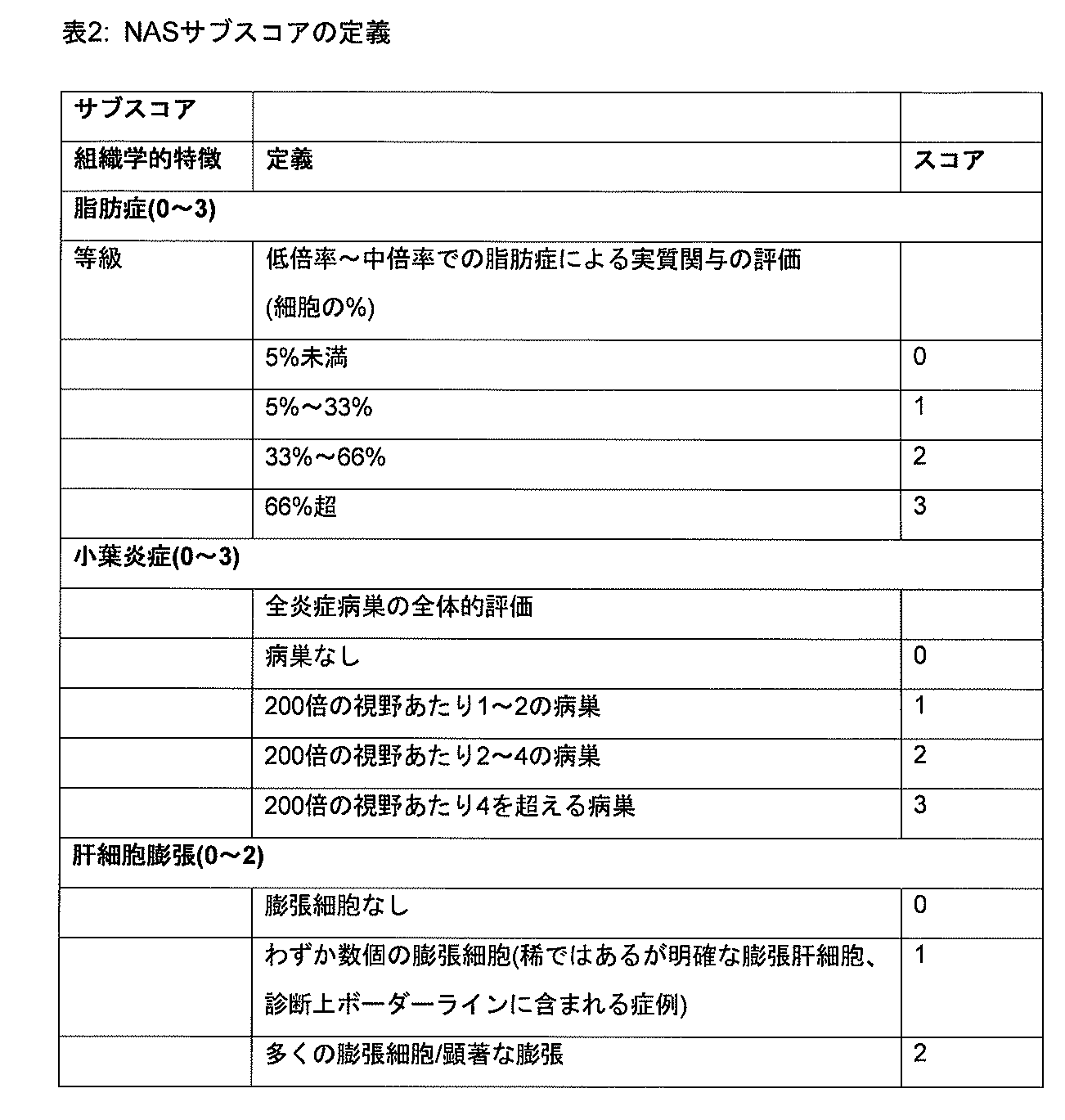
通常、>5%の肝細胞、NASHにおける脂肪症の存在によって、さらに任意の程度の肝細胞膨張および任意の量の小葉炎症性浸潤の存在によってNAFLDが定義される(Bedossaら、Hepatology2015年、vol.56、1751~1759頁)。 NAFLD is usually defined by the presence of steatosis in >5% hepatocytes, NASH, and by the presence of any degree of hepatocyte swelling and any amount of lobular inflammatory infiltrate (Bedossa et al., Hepatology 2015, vol. .56, pages 1751-1759).
本発明に従ったNAFLDとNASHの診断結果は、以下の表3中に記載する: NAFLD and NASH diagnostic results according to the present invention are set forth in Table 3 below:
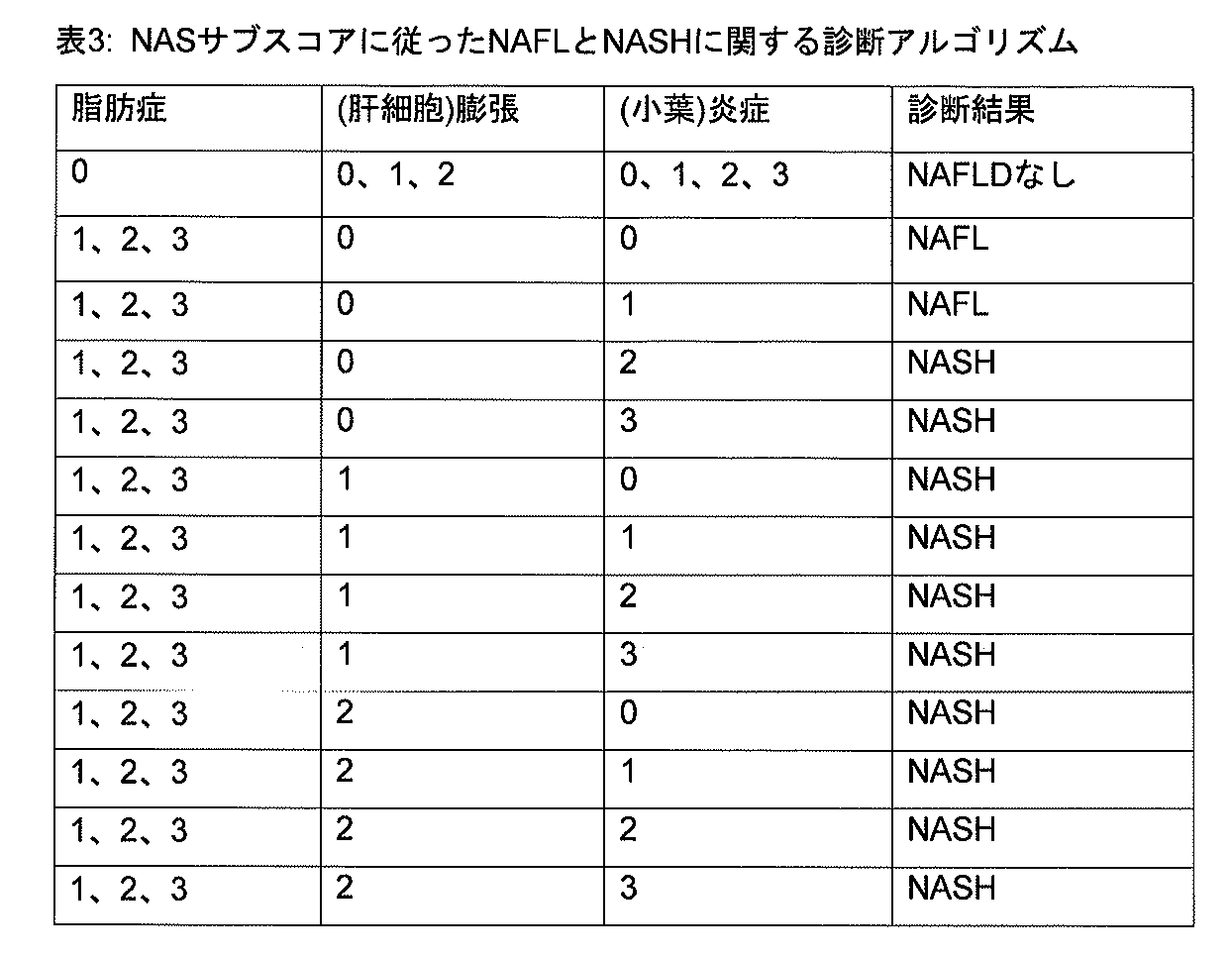
したがって本発明の文脈では、少なくとも脂肪症に関するサブスコア(本明細書中で時折「脂肪症サブスコア」または単に「脂肪症スコア」とも呼ぶ)が1以上である場合、患者はNAFLDに罹患していると診断する。ある程度の炎症(本明細書中で時折「炎症サブスコア」または単に「炎症スコア」とも呼ぶ)有りまたは無しの(本明細書中で時折「膨張サブスコア」または単に「膨張スコア」とも呼ぶ)肝細胞膨張の存在によって、NAFLまたは単純脂肪症とNASHを区別することができる。本文脈では、膨張の消失(サブスコア=0)、および小葉炎症の消失または軽度の小葉炎症のみの残存(サブスコア=0または1)のいずれかとしてNASH解像値を定義している(Kleiner and Bedossa、Gastroenterology2015年、vol.149、1305~1308頁)。この定義を表3中に記載する診断アルゴリズムに使用した。 Thus, in the context of the present invention, a patient is considered to be suffering from NAFLD if at least the subscore for adiposity (also sometimes referred to herein as "adiposity subscore" or simply "adiposity score") is 1 or greater. Diagnose. Hepatocyte swelling (sometimes referred to herein as the "swelling subscore" or simply the "swelling score") with or without some degree of inflammation (also sometimes referred to herein as the "inflammation subscore" or simply the "inflammation score") NASH can be distinguished from NAFL or simple steatosis by the presence of . In the present context, NASH resolution values are defined as disappearance of swelling (subscore = 0) and either disappearance of lobular inflammation or only mild lobular inflammation remaining (subscore = 0 or 1) (Kleiner and Bedossa , Gastroenterology 2015, vol.149, pp.1305-1308). This definition was used in the diagnostic algorithm described in Table 3.
本発明の化合物の有効性を評価するため、NASだけでなく繊維症スコアも決定する。繊維症スコアは、例えば以下の表4中に要約した、Kleinerら(Hepatology2005年、vol.41、1313~1321頁、本明細書中で「クレイナーの繊維症スコア」とも呼ぶ)に従い決定することもできる。 In addition to NAS, the fibrosis score is also determined to assess the efficacy of the compounds of the invention. The fibrosis score may also be determined, for example, according to Kleiner et al. can.
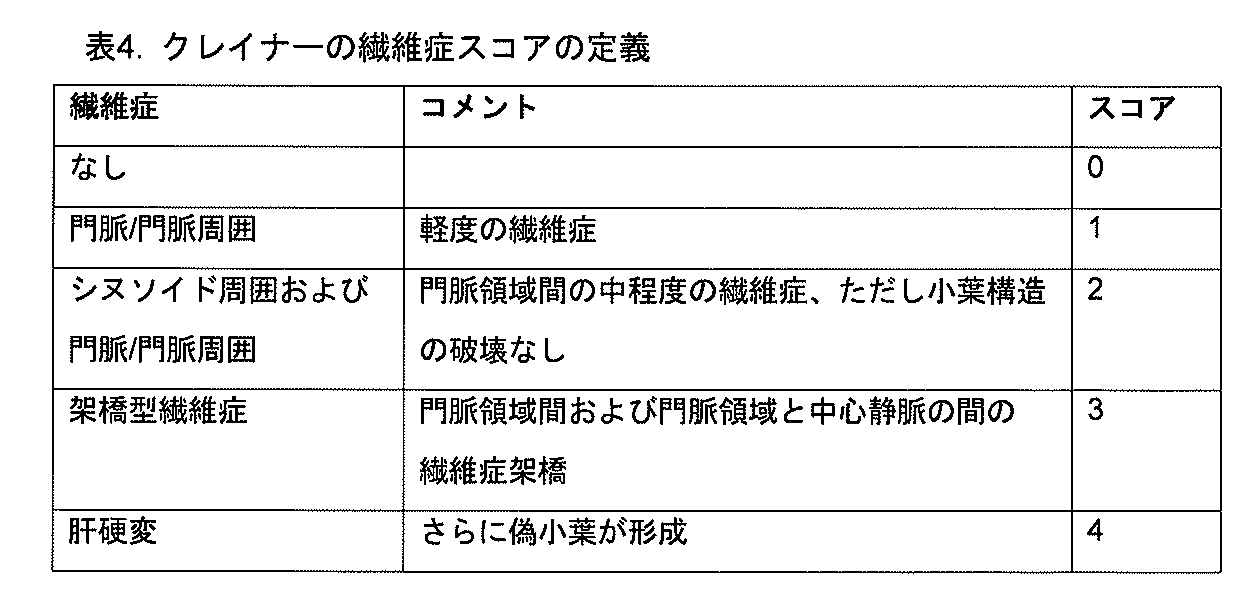
NASがNAFLおよびNASHの程度を決定する一方で(高いスコアは高い疾患活性を意味する)、クレイナーの繊維症スコアは繊維症進行の程度を決定する。繊維症がさらに進行しない場合、NASの低減のみが関連する。したがって、クレイナーの繊維症スコアの悪化(すなわち増大)がない状態で、NASにおける無悪化(すなわち増大)または改善(低いスコア)、詳細には肝細胞膨張の消失(膨張スコア=0)がある場合、治療に対する良い応答がある。 While the NAS determines the extent of NAFL and NASH (high scores implying high disease activity), the Kreiner's fibrosis score determines the extent of fibrosis progression. A reduction in NAS is only relevant if fibrosis does not progress further. Therefore, if there is no worsening (ie increasing) or improvement (lower score) in NAS, specifically loss of hepatocyte swelling (swelling score=0), in the absence of worsening (ie increasing) in Kreiner's fibrosis score. , there is a good response to treatment.
本発明の文脈では、原則として、式Aの化合物またはその塩もしくは溶媒和物を単独で用いて直接、意図される医学的使用を実施することができる。しかしながら、式Aの化合物またはその塩もしくは溶媒和物は通常、前に定義した医薬組成物中に提供される。 In the context of the present invention, in principle, the compounds of formula A or their salts or solvates can be used alone directly to carry out the intended medical uses. However, the compound of formula A or its salt or solvate is generally provided in a pharmaceutical composition as defined above.
幾つかの実施形態では、式Aの化合物を含む医薬組成物はNAFLDを治療する方法における使用のためのものであり、脂肪症サブスコアが>0であるとき、患者はNAFLDに罹患していると考える。 In some embodiments, a pharmaceutical composition comprising a compound of Formula A is for use in a method of treating NAFLD, wherein the patient is diagnosed with NAFLD when the adiposity subscore is >0. think.
幾つかの実施形態では、式Aの化合物を含む医薬組成物はNAFLを治療する方法における使用のためのものであり、脂肪症が存在するが(サブスコア>0)、膨張サブスコアが0であり炎症サブスコアは0または1であるとき、患者はNAFLに罹患していると考える。幾つかの実施形態では、患者は0のクレイナーの繊維症スコアを有し(繊維症がないNAFLD)、一方他の実施形態では、患者は>0および<4のクレイナーの繊維症スコアを有する(繊維症があるNAFLD)。 In some embodiments, the pharmaceutical composition comprising a compound of Formula A is for use in a method of treating NAFL wherein steatosis is present (subscore>0) but swelling subscore is 0 and inflammation A patient is considered to have NAFL when the subscore is 0 or 1. In some embodiments, the patient has a Kleiner's fibrosis score of 0 (NAFLD without fibrosis), while in other embodiments, the patient has a Kleiner's fibrosis score of >0 and <4 ( NAFLD with fibrosis).
式Aの化合物を含む医薬組成物はヒト患者を治療する方法における使用のためのものであることが、詳細には想像される。これらのヒト患者は詳細には成人患者(すなわち年齢18才以上)、より詳細には年齢18才以上と年齢75才以下の間の患者である。さらに患者は、詳細には25以上の、より詳細には25kg/m2以上45kg/m2以下の体格指数(BMI)を有する。特定の実施形態では、患者は年齢18才以上であり25以上のBMIを有する。 It is specifically envisioned that pharmaceutical compositions comprising compounds of Formula A are for use in methods of treating human patients. These human patients are particularly adult patients (ie age 18 years and older), more particularly patients between the ages of 18 years and older and 75 years and younger. Further, the patient has a body mass index (BMI) in particular greater than or equal to 25, more particularly greater than or equal to 25 kg/m 2 and less than or equal to 45 kg/m 2 . In certain embodiments, the patient is 18 years of age or older and has a BMI of 25 or greater.
幾つかの実施形態では、式Aの化合物を含む医薬組成物はNASHを治療する方法における使用のためのものであり、患者は詳細にはヒト患者であり、脂肪症と肝細胞膨張(それぞれサブスコア>0)および任意の程度の炎症(サブスコア0~3)、または代替的に、<4のクレイナーの繊維症スコアで肝細胞膨張がない状態(サブスコア=0)において、脂肪症(サブスコア>0)と炎症の進行(サブスコア>1)が存在する場合、NASHを有すると診断される。幾つかの実施形態では、患者は0のクレイナーの繊維症スコアを有し(繊維症がないNASH)、一方他の実施形態では、患者は>0および<4のクレイナーの繊維症スコアを有する(繊維症があるNASH)。 In some embodiments, a pharmaceutical composition comprising a compound of Formula A is for use in a method of treating NASH, wherein the patient is specifically a human patient, and where steatosis and hepatocellular swelling (each subscore >0) and any degree of inflammation (subscores 0-3), or alternatively, steatosis (subscores >0) in the absence of hepatocellular dilation with a Kleiner's fibrosis score of <4 (subscores = 0). and progression of inflammation (subscore >1) is diagnosed as having NASH. In some embodiments, the patient has a Kleiner's fibrosis score of 0 (NASH without fibrosis), while in other embodiments, the patient has a Kleiner's fibrosis score of >0 and <4 ( NASH with fibrosis).
特定の好ましい実施形態によれば、本発明は、ヒト患者においてNASHを治療する方法における使用のための、式Aの化合物またはその塩もしくは溶媒和物、詳細には配列番号1に関するものであり、治療開始時に(i)脂肪症および肝細胞膨張スコアが>0であり、または肝細胞膨張がない状態において、脂肪症スコアが>0であり炎症スコアが>1であり、かつ(ii)>0および<4のクレイナーの繊維症スコアが測定されるとき、患者はNASHに罹患していると考える。 According to certain preferred embodiments, the present invention relates to a compound of formula A or a salt or solvate thereof, in particular SEQ ID NO: 1, for use in a method of treating NASH in a human patient, (i) steatosis and hepatocyte swelling score >0, or steatosis score >0 and inflammation score >1 in the absence of hepatocyte swelling and (ii) >0 at the start of treatment and a Kleiner's Fibrosis Score of <4, the patient is considered to have NASH.
特定の実施形態に従い、NASが低減しクレイナーの繊維症スコアが増大しない場合、NASHの治療は成功と考える。 According to certain embodiments, treatment of NASH is considered successful if NAS decreases and Kreiner's fibrosis score does not increase.
他の実施形態に従い、NASが増大せずクレイナーの繊維症スコアが低減する場合、NASHの治療は成功と考える。 According to another embodiment, treatment of NASH is considered successful if NAS does not increase and Kreiner's fibrosis score decreases.
肝硬変を予防および/または治療する、詳細には治療する方法における、一般式Aの化合物またはその塩もしくは溶媒和物の使用も、本発明によって包含される。肝硬変は慢性的アルコール乱用によって、または慢性ウイルス性肝炎(例えば、B型肝炎またはC型肝炎)によって引き起こされる可能性がある。さらに、非アルコール性脂肪肝(NAFL)またはNASHは、肝硬変(NAFLD関連肝硬変)に進行する可能性がある。肝硬変の合併症は、水痘中出血、腹水、特発性細菌性腹膜炎、肝性脳障害、肝細胞癌、肝腎症候群、および肝肺症候群を含む可能性がる。これらの合併症は、重度の社会経済的負担と関係する。したがって幾つかの実施形態では、式Aの化合物またはその塩もしくは溶媒和物は肝硬変、詳細にはNAFLD関連肝硬変を治療する方法における使用のためのものであり、患者は詳細にはヒト患者であり、4のクレイナーの繊維症スコアが測定されるとき、肝硬変を有すると診断される。 Also encompassed by the present invention is the use of a compound of general formula A or a salt or solvate thereof in a method of preventing and/or treating, in particular treating, cirrhosis of the liver. Cirrhosis can be caused by chronic alcohol abuse or by chronic viral hepatitis (eg, hepatitis B or hepatitis C). In addition, non-alcoholic fatty liver (NAFL) or NASH can progress to liver cirrhosis (NAFLD-associated cirrhosis). Complications of cirrhosis may include varicella hemorrhage, ascites, idiopathic bacterial peritonitis, hepatic encephalopathy, hepatocellular carcinoma, hepatorenal syndrome, and hepatopulmonary syndrome. These complications are associated with a severe socioeconomic burden. Thus, in some embodiments, a compound of Formula A or a salt or solvate thereof is for use in a method of treating liver cirrhosis, particularly NAFLD-associated liver cirrhosis, wherein the patient is particularly a human patient. , 4 is diagnosed as having cirrhosis when a Kleiner's fibrosis score of 4 is measured.
肝細胞癌とも呼ばれHCCと略される肝細胞癌腫を予防および/または治療する、詳細には治療する方法における、一般式Aの化合物またはその塩もしくは溶媒和物の使用が、本発明によってさらに包含される。HCCは主に肝硬変によって引き起こされるが、B型またはC型肝炎がある患者も、肝硬変なしのHCCを発症するリスクが高い。したがって幾つかの実施形態では、式Aの化合物またはその塩もしくは溶媒和物は、HCC、詳細にはNAFLD関連HCCを治療する方法における使用のためのものである。HCCに関する診断基準およびアルゴリズムは、米国肝臓病学会(American Association for the Study of Liver Diseases)(AASLD)によって公開されている(Bruix Jら、Hepatology.2011年;53(3):1020~22頁)。 Further according to the invention is the use of a compound of general formula A or a salt or solvate thereof in a method of preventing and/or treating, in particular treating, hepatocellular carcinoma, also called hepatocellular carcinoma and abbreviated HCC. subsumed. HCC is primarily caused by cirrhosis, but patients with hepatitis B or C are also at high risk of developing HCC without cirrhosis. Thus, in some embodiments, compounds of Formula A or salts or solvates thereof are for use in methods of treating HCC, particularly NAFLD-associated HCC. Diagnostic criteria and algorithms for HCC are published by the American Association for the Study of Liver Diseases (AASLD) (Bruix J et al., Hepatology. 2011;53(3):1020-22). .
本発明の他のさらなる態様は、NASHおよび少なくとも1つの追加の病状または危険因子の並行群予防または治療、詳細には治療における、式Aの二重GLP-1/グルカゴン受容体アゴニストの使用である。NASHと同時に治療するのに適した病状および危険因子には、肥満症、2型糖尿病、脂質異常症および他の代謝障害があるが、これらだけには限られない。幾つかの実施形態によれば、式Aの化合物またはその塩もしくは溶媒和物は、NASHと2型糖尿病の同時治療における使用のためのものである。他の実施形態によれば、式Aの化合物またはその塩もしくは溶媒和物は、NASHと肥満症の同時治療における使用のためのものである。他のさらなる実施形態によれば、式Aの化合物またはその塩もしくは溶媒和物は、NASHと2型糖尿病と肥満症の同時治療における使用のためのものである。
Another further aspect of the invention is the use of a dual GLP-1/Glucagon receptor agonist of formula A in the parallel group prophylaxis or treatment, particularly treatment, of NASH and at least one additional medical condition or risk factor. . Conditions and risk factors suitable for concurrent treatment with NASH include, but are not limited to, obesity,
患者を肥満であると定義する標準基準は、少なくとも30の体格指数(BMI)であるが、他の適切な基準に従い肥満を決定することもできる。したがって、本出願の幾つかの実施形態では、30以上のBMIが測定されるとき、患者は肥満であると考える。 A standard criterion for defining a patient as obese is a body mass index (BMI) of at least 30, although obesity can be determined according to other suitable criteria. Accordingly, in some embodiments of the present application, a patient is considered obese when a BMI of 30 or greater is measured.
本発明の幾つかの実施形態の文脈では、7mmol/l以上の空腹時血漿グルコース濃度が測定されるとき、患者は2型糖尿病に罹患していると考える。幾つかの実施形態では、経口75gグルコース負荷後2時間でのグルコース負荷試験において11.1mmol/l以上の血漿グルコース濃度が測定されるとき、患者は2型糖尿病に罹患していると考える。幾つかの実施形態では、48mmol/mol以上(6.5%以上)の糖化ヘモグロビンHbA1c値が測定されるとき、患者は2型糖尿病に罹患していると考える。2型糖尿病に罹患した患者に2つ以上の前述の基準が適合する可能性はあるが、一基準の達成が本発明の文脈での診断に充分であると考えられる。対照的に、前に定義した基準に一つも適合しない場合、患者は糖尿病に罹患していないと考える。
In the context of some embodiments of the present invention, a patient is considered to have
したがって、本発明の幾つかの実施形態によれば、式Aの化合物もしくはその塩もしくは溶媒和物、または式Aの化合物もしくはその塩もしくは溶媒和物を含む医薬組成物は、2型糖尿病および肥満症に罹患した患者ではなく、NASHに罹患した患者のNASHを治療する際における使用のためのものである。この患者群は
(i)脂肪症(スコア>0)と肝細胞膨張(スコア>0)および任意の程度の炎症(スコア0~3)、または代替的に、それぞれ<4のクレイナーの繊維症スコアで肝細胞膨張がない状態(スコア=0)において、脂肪症(スコア>0)と炎症の進行(スコア>1)を示す(NASH基準);
(ii)経口75gグルコース負荷後2時間でのグルコース負荷試験において7mmol/l未満の空腹時血漿グルコース濃度と11.1mmol/l未満の血漿グルコース濃度、および48mmol/mol未満(6.5%未満)の糖化ヘモグロビンHbA1c値を有する(2型糖尿病基準);
(iii)30未満のBMIを有する、すなわち肥満の範囲内にない(肥満基準)
と定義付けできる。
Thus, according to some embodiments of the present invention, a compound of formula A or a salt or solvate thereof, or a pharmaceutical composition comprising a compound of formula A or a salt or solvate thereof, is used to treat
(ii) a fasting plasma glucose concentration of less than 7 mmol/l and a plasma glucose concentration of less than 11.1 mmol/l in a
(iii) have a BMI less than 30, i.e. not within the obese range (obesity criteria)
can be defined as
本発明のさらなる実施形態によれば、式Aの化合物もしくはその塩もしくは溶媒和物、または式Aの化合物もしくはその塩もしくは溶媒和物を含む医薬組成物は、肥満症ではなく、NASHに罹患し同時に2型糖尿病に罹患した患者のNASHを治療する際における使用のためのものである。この患者群は
(i)脂肪症(スコア>0)と肝細胞膨張(スコア>0)および任意の程度の炎症(スコア0~3)、または代替的に、それぞれ<4のクレイナーの繊維症スコアで肝細胞膨張がない状態(スコア=0)において、脂肪症(スコア>0)と炎症の進行(スコア>1)を示す(NASH基準);
(ii)経口75gグルコース負荷後2時間でのグルコース負荷試験において7mmol/l以上の空腹時血漿グルコース濃度または/および11.1mmol/l以上の血漿グルコース濃度、または/および48mmol/mol以上(6.5%以上)の糖化ヘモグロビンHbA1c値を有する(2型糖尿病基準);
(iii)30未満のBMIを有する、すなわち肥満の範囲内にない(肥満基準)
と定義付けできる。
According to a further embodiment of the invention, the compound of formula A or a salt or solvate thereof, or the pharmaceutical composition comprising a compound of formula A or a salt or solvate thereof, is associated with NASH and not obesity. For use in treating NASH in patients with
(ii) a fasting plasma glucose concentration of 7 mmol/l or higher or/and a plasma glucose concentration of 11.1 mmol/l or higher in a
(iii) have a BMI less than 30, i.e. not within the obese range (obesity criteria)
can be defined as
本発明のさらなる実施形態によれば、式Aの化合物もしくはその塩もしくは溶媒和物、または式Aの化合物もしくはその塩もしくは溶媒和物を含む医薬組成物は、2型糖尿病ではなく、NASHに罹患し同時に肥満症に罹患した患者のNASHを治療する際における使用のためのものである。この患者群は
(i)脂肪症(スコア>0)と肝細胞膨張(スコア>0)および任意の程度の炎症(スコア0~3)、または代替的に、それぞれ<4のクレイナーの繊維症スコアで肝細胞膨張がない状態(スコア=0)において、脂肪症(スコア>0)と炎症の進行(スコア>1)を示す(NASH基準);
(ii)経口75gグルコース負荷後2時間でのグルコース負荷試験において7mmol/l未満の空腹時血漿グルコース濃度と11.1mmol/l未満の血漿グルコース濃度、および48mmol/mol未満(6.5%未満)の糖化ヘモグロビンHbA1c値を有する(2型糖尿病基準);
(iii)30以上のBMIを有する、すなわち肥満の範囲内である(肥満基準)
と定義付けできる。
According to a further embodiment of the invention, the compound of formula A or a salt or solvate thereof, or the pharmaceutical composition comprising the compound of formula A or a salt or solvate thereof, is associated with NASH but not type 2 diabetes. It is for use in treating NASH in patients who also suffer from obesity. This group of patients had (i) steatosis (score >0) with hepatocyte swelling (score >0) and any degree of inflammation (score 0-3), or alternatively, a Kleiner's fibrosis score of <4, respectively. show progression of steatosis (score>0) and inflammation (score>1) in the absence of hepatocellular swelling (score=0) at NASH criteria;
(ii) a fasting plasma glucose concentration of less than 7 mmol/l and a plasma glucose concentration of less than 11.1 mmol/l in a
(iii) have a BMI of 30 or greater, i.e. within the obese range (obesity criteria)
can be defined as
本発明の他のさらなる実施形態によれば、式Aの化合物もしくはその塩もしくは溶媒和物、または式Aの化合物もしくはその塩もしくは溶媒和物を含む医薬組成物は、NASHに罹患し、同時に2型糖尿病と肥満症の両方に罹患した患者のNASHを治療する際における使用のためのものである。この患者群は
(i)脂肪症(スコア>0)と肝細胞膨張(スコア>0)および任意の程度の炎症(スコア0~3)、または代替的に、それぞれ<4のクレイナーの繊維症スコアで肝細胞膨張がない状態(スコア=0)において、脂肪症と炎症の進行(スコア>1)を示す(NASH基準);
(ii)経口75gグルコース負荷後2時間でのグルコース負荷試験において7mmol/l以上の空腹時血漿グルコース濃度または/および11.1mmol/l以上の血漿グルコース濃度、または/および48mmol/mol以上(6.5%以上)の糖化ヘモグロビンHbA1c値を有する(2型糖尿病基準);
(iii)30以上のBMIを有する、すなわち肥満の範囲内である(肥満基準)
と定義付けできる。
According to another further embodiment of the present invention, the compound of formula A or a salt or solvate thereof, or the pharmaceutical composition comprising the compound of formula A or a salt or solvate thereof, is associated with NASH and is 2 For use in treating NASH in patients with both type diabetes and obesity. This group of patients had (i) steatosis (score >0) with hepatocyte swelling (score >0) and any degree of inflammation (score 0-3), or alternatively, a Kleiner's fibrosis score of <4, respectively. progression of steatosis and inflammation (score >1) in the absence of hepatocellular swelling (score = 0) at NASH criteria;
(ii) a fasting plasma glucose concentration of 7 mmol/l or higher or/and a plasma glucose concentration of 11.1 mmol/l or higher in a
(iii) have a BMI of 30 or greater, i.e. within the obese range (obesity criteria)
can be defined as
さらに、NASHまたはNASHおよび少なくとも1つの追加の病的危険因子が、1つまたはそれ以上のさらなる治療活性成分と組み合わせて式Aの化合物を含む医薬組成物によって治療されることは、本発明に包含される。1つまたはそれ以上のさらなる治療活性成分は、異なる投与頻度で、異なる投与経路によって別々に、同時に、逐次に投与することができる。 Furthermore, it is encompassed by the present invention that NASH or NASH and at least one additional pathological risk factor is treated with a pharmaceutical composition comprising a compound of Formula A in combination with one or more additional therapeutically active ingredients. be done. The one or more additional therapeutically active ingredients can be administered separately, simultaneously or sequentially at different frequencies of administration and by different routes of administration.
方法
Kristiansenら(World Journal of Hepatology2016年、vol.8、673~684頁)中に記載されたように、マウスのNASHモデル(ネズミ食誘導型NASHモデル)において試験化合物を調べた。C57BL/6Jマウスは、AMLN食として以前に記載された(Clapperら、Am J Physiol Gastrointest Liver Physiol 2013年、vol.305、G483~G495頁)高脂肪(40%、これらの18%はトランス脂肪)、炭水化物(40%、これらの20%はフルクトース)およびコレステロール(2%)の食餌(D09100301、Research Diet、米国)に自由にアクセスさせた。対照群には、げっ歯類用通常食を続けた(Altromin1324、Brogaarden、デンマーク)。
Methods Test compounds were investigated in a mouse NASH model (murine diet-induced NASH model) as described in Kristiansen et al. (World Journal of Hepatology 2016, vol. 8, pp. 673-684). C57BL/6J mice were previously described on an AMLN diet (Clapper et al., Am J Physiol Gastrointest Liver Physiol 2013, vol. 305, pp. G483-G495) high fat (40%, 18% of which were trans fat). , were given ad libitum access to a diet of carbohydrates (40%, 20% of which was fructose) and cholesterol (2%) (D09100301, Research Diet, USA). The control group was kept on a normal rodent diet (Altromin 1324, Brogaarden, Denmark).
食餌の26週後、ベースラインでのNASHおよび繊維症の組織学的評価のため肝生検を実施した。この目的のため、約100mgの肝臓組織を左外側小葉から回収し、4%パラホルムアルデヒド中に一晩固定し、パラフィン包埋し切片にした(厚さ3μm)。組織学的評価のため、切片をヘマトキシリン、エオシンまたはシリウスレッドで染色し、次いでVisiomorphソフトウエア(Visiopharm、デンマーク)で分析した。組織学的スコアリングは、この試験のことを知らない病理学者によって実施された。NAFLD活性スコアおよび繊維症スコアは、Kleinerら(Hepatology2005年、vol.14、1313~1321頁)によって略述された臨床基準に従い決定した。 After 26 weeks on the diet, a liver biopsy was performed for histological assessment of NASH and fibrosis at baseline. For this purpose, approximately 100 mg of liver tissue was harvested from the left lateral lobe, fixed overnight in 4% paraformaldehyde, embedded in paraffin and sectioned (3 μm thick). For histological evaluation, sections were stained with hematoxylin, eosin or Sirius red and then analyzed with Visiomorph software (Visiopharm, Denmark). Histological scoring was performed by a pathologist blinded to this study. NAFLD activity score and fibrosis score were determined according to the clinical criteria outlined by Kleiner et al. (Hepatology 2005, vol. 14, pp. 1313-1321).
体重および繊維症の程度に従い、異なる幾つかの治療群に動物をランダムに分けた。治療期間は8週間であり、その間動物にはAMLN食を続けた。1日1回または1日2回皮下注射によって化合物を与えた。AMLN食での賦形剤治療動物と、げっ歯類用通常食での未治療動物を対照として含めた。群の大きさは8~14匹の動物であった。 Animals were randomly divided into several different treatment groups according to body weight and degree of fibrosis. The treatment period was 8 weeks, during which the animals remained on the AMLN diet. Compounds were given by subcutaneous injection once daily or twice daily. Vehicle-treated animals on the AMLN diet and untreated animals on the normal rodent diet were included as controls. Group sizes ranged from 8 to 14 animals.
治療後、末期肝臓試料を回収し生検前試料に関して分析した。 After treatment, end-stage liver samples were collected and analyzed for pre-biopsy samples.
本発明を、以下の実施例によりさらに例証する。 The invention is further illustrated by the following examples.
ネズミ食誘導型NASHモデルにおける二重GLP-1/グルカゴン受容体アゴニストの有効性の調査
二重アゴニストGLP1R/GCGRアゴニストペプチドを、方法セクション中に記載したようにネズミのNASHモデルにおいて調べた。治療期間は8週間であり、その間動物にはNASH誘導型AMLN食を続けた。GLP1R特異的アゴニスト、リラグルチド(配列番号4)を参照化合物として含めた。
Examination of the Efficacy of Dual GLP-1/Glucagon Receptor Agonists in the Murine Diet-Induced NASH Model Dual agonist GLP1R/GCGR agonist peptides were investigated in the murine NASH model as described in the methods section. The treatment period was 8 weeks, during which animals remained on the NASH-induced AMLN diet. The GLP1R-specific agonist liraglutide (SEQ ID NO: 4) was included as a reference compound.
結果:
ネズミ食誘導型NASHモデルにおいて、3つのGLP1R/GCGR二重アゴニストペプチド(配列番号1、配列番号2および配列番号3)を調べた。
result:
Three GLP1R/GCGR dual agonist peptides (SEQ ID NO: 1, SEQ ID NO: 2 and SEQ ID NO: 3) were tested in the murine diet-induced NASH model.
ネズミ食誘導型NASHモデルにおいて、(いずれも皮下注射により)以下の用量で化合物を投与した:リラグルチド(配列番号4)、200μg/kg、毎日、配列番号1、10μg/kg、1日2回または30μg/kg、1日2回と比較して、リラグルチド(配列番号4)、100μg/kg、1日2回と比較して、配列番号2、10μg/kg、1日2回、配列番号3、30μg/kg、毎日。 In the murine diet-induced NASH model, compounds were administered at the following doses (both by subcutaneous injection): liraglutide (SEQ ID NO:4), 200 μg/kg daily, SEQ ID NO:1, 10 μg/kg twice daily or liraglutide (SEQ ID NO: 4) compared to 30 μg/kg twice daily, SEQ ID NO: 2 compared to 100 μg/kg twice daily, SEQ ID NO: 3 compared to 10 μg/kg twice daily, 30 μg/kg daily.
配列番号2の化合物の治療効果を図1中、リラグルチド(配列番号4)と比較した配列番号3の化合物の治療効果を図2中、およびリラグルチド(配列番号4)と比較した配列番号1の化合物の治療効果を図3中に要約する。 The therapeutic effect of the compound of SEQ ID NO:2 in Figure 1, the therapeutic effect of the compound of SEQ ID NO:3 compared to liraglutide (SEQ ID NO:4) in Figure 2, and the compound of SEQ ID NO:1 compared to liraglutide (SEQ ID NO:4). The therapeutic effects of are summarized in FIG.
AMLN食の26週後、異なる治療群に割り当てられた群中の動物の平均体重は36~40グラムであり、一方げっ歯類用通常食を続けたマウスは29~32グラムの体重であった。8週間の治療期間全体で、賦形剤治療マウスは最大2グラム体重が増量した。対照的に、リラグルチドまたはGLP1R/GCGR二重アゴニストを与えた動物は有意な体重減少を示した。 After 26 weeks on the AMLN diet, the average weight of animals in groups assigned to different treatment groups was 36-40 grams, while mice remaining on normal rodent diet weighed 29-32 grams. . Over the entire 8-week treatment period, vehicle-treated mice gained up to 2 grams of body weight. In contrast, animals given liraglutide or GLP1R/GCGR dual agonists showed significant weight loss.
配列番号2に関して、ベースラインに対する体重減少は2.8グラム(7.7%)であり、一方で同じ試験中の賦形剤治療動物は2.1グラム(5.6%)増量した。すなわち、賦形剤に対する体重減少は4.9グラム、またはベースラインで13.5%の体重であった(図1a)。 For SEQ ID NO:2, weight loss relative to baseline was 2.8 grams (7.7%), while vehicle-treated animals in the same study gained 2.1 grams (5.6%). Thus, the weight loss for vehicle was 4.9 grams, or 13.5% body weight at baseline (Fig. 1a).
配列番号3の8週間の投与によって、動物は3.9グラム(10.5%)減少し、一方で賦形剤を注射したマウスは1.1グラム(3.0%)増量した。同じ試験中で、8週間にわたるリラグルチド(配列番号4)の注射は3.2グラムの体重減少と関連があった(ベースラインで8.7%の体重、図2a)。 Eight weeks of administration of SEQ ID NO:3 caused animals to lose 3.9 grams (10.5%), while vehicle-injected mice gained 1.1 grams (3.0%). In the same study, injection of liraglutide (SEQ ID NO: 4) over 8 weeks was associated with a weight loss of 3.2 grams (8.7% body weight at baseline, Figure 2a).
8週間にわたり1日2回、10μg/kgまたは30μg/kgいずれかの配列番号1で治療した動物は、それぞれ3.0グラム(8.5%)または3.9グラム(11.4%)体重減少した。この試験では、賦形剤治療マウスは0.5グラム(1.3%)増量し、一方100μg/kgのリラグルチド(配列番号4)で1日2回治療した動物は2.4グラム体重減少した(6.4%、図3a))。 Animals treated with either 10 μg/kg or 30 μg/kg of SEQ ID NO: 1 twice daily for 8 weeks lost 3.0 grams (8.5%) or 3.9 grams (11.4%) body weight, respectively. Diminished. In this study, vehicle-treated mice gained 0.5 grams (1.3%), while animals treated with 100 μg/kg liraglutide (SEQ ID NO: 4) twice daily lost 2.4 grams. (6.4%, Fig. 3a)).
体重の変化は、試験したリラグルチドの賦形剤と全ての二重GLP1R/GCGRアゴニストとの間において非常に有意に異なった一方で(p<0.001)、同じ実験中で試験した二重アゴニストとリラグルチドの間で有意に異なることはなかった。 Changes in body weight were highly significantly different (p<0.001) between the liraglutide vehicle and all dual GLP1R/GCGR agonists tested, while the dual agonists tested in the same experiment and liraglutide.
配列番号2の化合物を用いた治療(10μg/kg、1日2回)は2.3ポイントのNAFLD活性スコア(NAS)の低減をもたらし、一方で賦形剤治療群に関しては0.2ポイントのわずかな増大があった(図1b、c)。NASの3つ全ての構成要素、すなわち脂肪症、炎症および肝細胞膨張スコアに関してスコアの低減が見られた(図1d)。さらに、賦形剤群と比較して繊維症の改善があった。平均繊維症段階は賦形剤群では変化しなかったが、配列番号2の化合物で治療した群において、それは1.2~0.6に低下した(図1e)。 Treatment with the compound of SEQ ID NO:2 (10 μg/kg twice daily) resulted in a reduction in NAFLD activity score (NAS) of 2.3 points compared to 0.2 points for the vehicle-treated group. There was a slight increase (Fig. 1b,c). A reduction in scores was seen for all three components of NAS: steatosis, inflammation and hepatocyte swelling scores (Fig. 1d). Additionally, there was improvement in fibrosis compared to the vehicle group. While the mean fibrosis stage did not change in the vehicle group, it decreased from 1.2 to 0.6 in the group treated with the compound of SEQ ID NO:2 (Fig. 1e).
8週間にわたり配列番号3の化合物(30μg/kg、毎日)またはリラグルチド(200μg/kg、毎日)を用いた治療も、賦形剤治療動物と比較してNAS対ベースラインの有意な改善をもたらした(図2b、c)。賦形剤群において0.8ポイントNASが増大した一方で、それは配列番号3の化合物で治療した群では1.6ポイント、リラグルチド群では0.3ポイント低下した。特に、配列番号3の治療効果は、賦形剤(p<0.001)とリラグルチド(p<0.05)の両方に対して統計学的に有意であった。平均繊維症スコアは賦形剤治療によって0.1ポイント増大し、配列番号4を用いた治療によって0.2ポイント増大し、一方それは配列番号3の化合物で治療した動物において不変であった(図2d)。平均ベースライン繊維症スコアはそれぞれ、賦形剤群および配列番号3で治療した群に関して1.5、リラグルチド(配列番号4)群に関して1.4であった。 Treatment with the compound of SEQ ID NO:3 (30 μg/kg daily) or liraglutide (200 μg/kg daily) for 8 weeks also resulted in significant improvement in NAS versus baseline compared to vehicle-treated animals. (Fig. 2b,c). While NAS increased by 0.8 points in the vehicle group, it decreased by 1.6 points in the group treated with the compound of SEQ ID NO:3 and decreased by 0.3 points in the liraglutide group. In particular, the therapeutic effect of SEQ ID NO:3 was statistically significant versus both vehicle (p<0.001) and liraglutide (p<0.05). The mean fibrosis score was increased by vehicle treatment by 0.1 points and by treatment with SEQ ID NO:4 by 0.2 points, while it was unchanged in animals treated with the compound of SEQ ID NO:3 (Fig. 2d). The mean baseline fibrosis score was 1.5 for the vehicle and SEQ ID NO:3-treated groups and 1.4 for the liraglutide (SEQ ID NO:4) group, respectively.
1日2回10もしくは30μg/kgでの配列番号1の化合物、または1日2回100μg/kgでのリラグルチドは、賦形剤と比較してNAS対ベースラインの有意な改善をもたらした。平均NASは賦形剤治療動物において0.2ポイント増大した一方で、それは10μg/kgの配列番号1によって2.0ポイント、30μg/kgの配列番号1によって1.9ポイント、リラグルチドによって1.1ポイント低下した(図3b、c)。配列番号1の化合物を用いたNASの改善は、30μg/kg用量のリラグルチドを用いた場合より有意に優れていた(p<0.05)。繊維症の改善の傾向が両用量の配列番号1の化合物に関して示されたが(図3e)、賦形剤またはリラグルチド(配列番号4)治療動物に関しては示されなかった。ベースライン繊維症レベルは群全体中で類似していた(1.3~1.6)。 The compound of SEQ ID NO: 1 at 10 or 30 μg/kg twice daily or liraglutide at 100 μg/kg twice daily produced significant improvements in NAS versus baseline compared to vehicle. While mean NAS was increased by 0.2 points in vehicle-treated animals, it increased by 2.0 points with 10 μg/kg SEQ ID NO:1, 1.9 points with 30 μg/kg SEQ ID NO:1, and 1.1 points with liraglutide. points decreased (Fig. 3b,c). Improvement in NAS with the compound of SEQ ID NO: 1 was significantly greater than with the 30 μg/kg dose of liraglutide (p<0.05). A trend of improvement in fibrosis was shown for both doses of the compound of SEQ ID NO: 1 (Fig. 3e), but not for vehicle or liraglutide (SEQ ID NO: 4) treated animals. Baseline fibrosis levels were similar across groups (1.3-1.6).
したがって、本発明の二重GLP1R/GCGRアゴニストペプチドの代表例が、GLP1Rアゴニストリラグルチドと比較して同程度の体重減少で、NAFLD活性スコアの顕著な改善をもたらしたことが実証された。 Thus, it was demonstrated that a representative example of the dual GLP1R/GCGR agonist peptides of the invention provided a significant improvement in NAFLD activity score with comparable weight loss compared to the GLP1R agonist liraglutide.
配列番号1を含有する製剤を用いた、生検で証明済みの非アルコール性脂肪性肝炎(NASH)の48週間治療
この実施例の主題は、2型糖尿病および生検で証明済みの非アルコール性脂肪性肝炎(NASH)有りおよび無しの患者における、疾患進行に対する1日1回200μgの皮下用量での配列番号1、二重GLP-1/グルカゴンアゴニストの影響を評価するための、二重盲検、無作為化、プラセボ対照の48週試験である。
48-Week Treatment of Biopsy-Proven Non-Alcoholic Steatohepatitis (NASH) with a Formulation Containing SEQ ID NO: 1 The subject of this example is
推定患者登録数は約60~120の無作為化患者である。 The estimated patient enrollment is approximately 60-120 randomized patients.
一次試験の目的は、繊維症悪化がない状態におけるNAFLD活性スコア0の膨張構成要素として定義した、治療後12か月対ベースラインの非アルコール性脂肪性肝炎(NASH)の組織学的消炎に対する、1日1回200μgの皮下(SC)用量での配列番号1対プラセボの影響を比較することである。 The purpose of the primary study was to determine the histological resolution of non-alcoholic steatohepatitis (NASH) 12 months after treatment versus baseline, defined as the swelling component of a NAFLD activity score of 0 in the absence of exacerbation of fibrosis. To compare the effect of SEQ ID NO: 1 versus placebo at a subcutaneous (SC) dose of 200 μg once daily.
二次試験の目的は、特にベースラインから12カ月までの:
●(治療後6カ月対ベースラインと治療後12カ月対ベースラインの)肝臓全体脂肪含有量で計算した核磁気共鳴ベースのプロトン密度脂肪画分(MRI-PDFF)の変化
●12カ月での全体NAFLD活性スコアの変化
●12カ月でのNAFLD活性スコアの個々の構成要素(脂肪症、肝細胞膨張、小葉炎症)の変化
●12カ月でのクレイナーの繊維症段階の変化
●配列番号1の化合物の薬物動態
を評価することである。
The objectives of the secondary study are specifically from baseline to 12 months:
Changes in magnetic resonance-based proton density fat fraction (MRI-PDFF) calculated by total liver fat content (6 months post-treatment vs. baseline and 12 months post-treatment vs. baseline) Total at 12 months Changes in NAFLD activity score Changes in individual components of NAFLD activity score (steatosis, hepatocyte swelling, lobular inflammation) at 12 months Changes in Kreiner's fibrosis stage at 12 months to assess pharmacokinetics.
試験設計は、配列番号1対プラセボに関する、無作為化、プラセボ対照、二重盲検、平行治療群試験の試験設計である。 The study design is that of a randomized, placebo-controlled, double-blind, parallel treatment arm study for SEQ ID NO:1 versus placebo.
配列番号1またはプラセボを、配列番号1または適合プラセボ500μg/mLの濃度で、3mL注射溶液を含有するカートリッジ中に注射溶液として提供する。Tactipen(登録商標)インジェクターを使用して、皮下用量の配列番号1および適合プラセボを送達する。(開始用量後の)3用量工程は、用量滴定中、配列番号1が1日1回(毎日)皮下200μgの最終標的用量、1日あたり60-120-160-200μgに達するように計画する。 SEQ ID NO: 1 or placebo is provided as an injection solution in cartridges containing 3 mL injection solution at a concentration of 500 μg/mL of SEQ ID NO: 1 or matching placebo. A Tactipen® injector is used to deliver subcutaneous doses of SEQ ID NO: 1 and matching placebo. Three dose steps (after the starting dose) are planned during dose titration to reach a final target dose of 200 μg subcutaneously once daily (daily) of SEQ ID NO: 1, 60-120-160-200 μg per day.
クリニック往診日以外、配列番号1とプラセボの両方に関して、用量は午前中同時に、および朝食後約1時間で投与しなければならない。クリニック往診日には、午前中の血液検査/ECG測定後に配列番号1とプラセボを投与し、PKサンプリングタイムで調整しなければならない。 Except for clinic visit days, doses should be administered at the same time in the morning and approximately 1 hour after breakfast for both SEQ ID NO: 1 and placebo. On clinic visit days, SEQ ID NO: 1 and placebo should be administered after morning blood work/ECG measurements and adjusted for PK sampling times.
配列番号1および適合プラセボ治療レジメンは、以下のように、維持量に達する前に3週間の用量増大期間を含むよう計画する:
●活性薬物:1週間毎後に3用量増大工程(重大な耐性問題[例えば、悪心嘔吐]が観察されない場合):
○60μg、すなわち12U/(第1日~第7日)
○120μg、すなわち24U/(第8日~第14日)
○160μg、すなわち32U/(第15日~第21日)
○200μg、すなわち40U(第22日以降、この用量は49週間投与するものとする)
●プラセボ:患者には同じ用量増大レジメンを割り当てる。
SEQ ID NO: 1 and matched placebo treatment regimens are planned to include a 3-week dose escalation period before reaching the maintenance dose, as follows:
- Active drug: 3 dose escalation steps after every week (if no significant tolerance problems [e.g., nausea and vomiting] are observed):
o 60 μg, ie 12 U/(day 1-7)
o 120 μg, or 24 U/(Days 8-14)
o 160 μg, or 32 U/(Days 15-21)
o 200 μg or 40 U (after day 22, this dose shall be administered for 49 weeks)
• Placebo: Patients will be assigned the same dose escalation regimen.
無作為化時、無作為化した全ての患者は1日あたり60μgの用量工程で開始する。重大な耐性問題(例えば、悪心嘔吐)が観察されない場合、1週間の治療後に用量を1日あたり120μgに増大する。重大な耐性問題(例えば、悪心嘔吐)が観察されない場合、さらに1週間後に用量を1日あたり160μgにさらに増大する。重大な耐性問題(例えば、悪心嘔吐)が観察されない場合、さらに1週間後に用量を1日あたり200μgにさらに増大する。 At randomization, all randomized patients will begin a dose step of 60 μg per day. If no significant tolerance problems (eg, nausea and vomiting) are observed, the dose is increased to 120 μg per day after 1 week of treatment. If no significant tolerance problems (eg, nausea and vomiting) are observed, the dose is further increased to 160 μg per day after another week. If no significant tolerance problems (eg, nausea and vomiting) are observed, the dose is further increased to 200 μg per day after another week.
同じ用量増大レジメンスキームを、ただし配列番号1の代わりにプラセボを用いて、プラセボ治療群に割り当てた患者に実施する。次いで毎日の維持量レベルを、残りの治療期間にわたって続ける(最終用量で合計49週間)。 The same dose escalation regimen scheme, but with placebo in place of SEQ ID NO: 1, will be administered to patients assigned to the placebo treatment arm. Daily maintenance dose levels are then continued for the remainder of the treatment period (49 weeks total at the final dose).
一次試験の終点は、12カ月でのクレイナーの繊維症スコアの悪化がない状態で、ベースラインと比較した、肝細胞膨張スコア=0および小葉炎症の不在(スコア=0)または軽度の小葉炎症の存在(スコア=1)として定義されるNASHの解明である。 Primary study endpoints were hepatocyte swelling score = 0 and absence of lobular inflammation (score = 0) or mild lobular inflammation compared to baseline in the absence of worsening of Kreiner's fibrosis score at 12 months. Elucidation of NASH defined as present (score=1).
二次試験の終点は、特に、肝臓全体脂肪負荷で計算したMRI-PDFFの変化、全体NAFLD活性スコアの変化、NAFLD活性スコアの個々の構成要素(脂肪症、肝細胞膨張、小葉炎症)の変化、クレイナーの繊維症段階の変化、ならびに見かけのクリアランス(CL/F)、体積分布(V/F)、およびCtroughレベルを含めた薬物動態パラメーターである。 Secondary study endpoints are, inter alia, changes in MRI-PDFF calculated on whole liver fat load, changes in global NAFLD activity score, changes in individual components of NAFLD activity score (steatosis, hepatocyte swelling, lobular inflammation). , changes in Kleiner's fibrosis stage, and pharmacokinetic parameters including apparent clearance (CL/F), volume distribution (V/F), and C trough levels.
患者はプラセボまたは配列番号1のいずれかに割り当てる。ほぼ同数の患者が2治療群(プラセボ、配列番号1)のそれぞれに存在する。 Patients are assigned to either placebo or SEQ ID NO:1. Approximately equal numbers of patients are present in each of the two treatment arms (placebo, SEQ ID NO: 1).
スクリーニング期間は最大6週間続く。無作為化後12カ月で肝生検により有効性を評価し、そのために患者を、地元のガイダンスに従い生検後最大48時間入院させることが可能であり、治療後フォローアップ期間は28日である。 The screening period lasts up to 6 weeks. Efficacy will be assessed by liver biopsy 12 months after randomization, for which patients can be hospitalized for up to 48 hours post-biopsy according to local guidance, with a post-treatment follow-up period of 28 days. .
試験集団に関する組み入れ基準は以下の通りである:
(無作為化前の最近6カ月以内の)NASHおよび再分析に利用可能なFFPE-肝臓試料の存在を組織学的に確認した、18才以上75才以下の年齢の男性および女性患者。スクリーニング期間中に肝生検を実施することができる。NASHの組織病理学的確認は主要な中心的検査室によって行われる。NAFLD活性スコアは4以上でなければならない。患者はダイエット/エクササイズ状態でなければならず、糖尿病患者の場合、スクリーニング前に少なくとも3カ月間(1日あたり1500mg以上の安定用量または最大許容用量の)メトホルミンで治療する。署名入りのインフォームドコンセントが必要である。
Inclusion criteria for the study population were as follows:
Male and female patients aged ≥18 and ≤75 years with histologically confirmed presence of NASH (within the last 6 months prior to randomization) and FFPE-liver samples available for reanalysis. A liver biopsy can be performed during the screening period. Histopathological confirmation of NASH is performed by major central laboratories. NAFLD activity score must be 4 or greater. Patients must be diet/exercise and, if diabetic, be treated with metformin (at a stable dose of ≥1500 mg per day or maximum tolerated dose) for at least 3 months prior to screening. A signed informed consent is required.
主な除外基準は以下の通りである:
●NAFLDスコアの個々の構成要素(脂肪症、膨張、門脈周囲炎症)のいずれかが<1である
●4のクレイナーの繊維症スコア
●インスリン依存型糖尿病
●スクリーニング往診時でのHbA1c>10.0%
●スクリーニング時(往診1)での中心的検査室によりFPG>270mg/dL
●無作為化前に反復試験によって確認
●BMI<25kg/m2または>45.0kg/m2
●1型糖尿病の診断歴
●メトホルミン以外のグルコース降下剤(複数可)を用いた治療
●現在スクリーニング中またはスクリーニング前3カ月以内
●短期の症状発現(複数可)を除いた、過去のインスリン使用
●(15連続日数以下の)併発疾患の治療、または最近6カ月以内のインスリン使用
●GLP-1アナログの使用の禁忌(複数可)
●制御し難い高血圧(スクリーニング時に安静時収縮期血圧[SBP]>160mmHgおよび/または拡張期血圧[DBP]>95mmHg)
●スクリーニング往診時に450msを超える長期QT症候群および/またはQTcの病歴
●膵炎または膵臓切開による病歴
●外科手術による体重減少の病歴
●甲状腺髄様癌(MTC)の個人的もしくは直系家族性病歴、またはMTCの素因がある遺伝子状態
●GLP-1受容体アゴニストまたはGLP-1アナログのクラスに属する薬物への事前の何らかの曝露
●グルカゴンに対する禁忌または周知の過敏症反応
●肝臓移植、肝細胞癌(HCC)、多発性内分泌腺腫症(MEN)の過去の病歴
●症候群、悪性腫瘍(治療済み皮膚悪性腫瘍を除き最近3年以内)
●肝臓に関する他の病因(すなわち薬物起因性、ウイルス性肝炎、自己免疫性肝炎、原発性胆汁性肝硬変、原発性硬化性胆管炎、ヘモクロマトーシス、α1アンチトリプシン欠乏症、ウイルソン病)
●無作為化前3カ月以内の、治験薬療法または作用物質の何らかの臨床試験への関与
●NAS<4
●小児のB型またはC肝硬変
●肝臓中酵素>正常の10倍上限
●最近5年以内に男性に関して1週間あたり>21単位(210g)、女性に関して>14単位(140g)の平均アルコール消費
●診断用肝生検材料を得た後の5%を超える体重減少
●ヒト免疫不全ウイルス(HIV)に対する抗体に関する周知の陽性
The main exclusion criteria are the following:
• Any individual component of the NAFLD score (steatosis, swelling, periportal inflammation) <1 • Kleiner's fibrosis score of 4 • Insulin dependent diabetes • HbA1c >10 at screening visit. 0%
● FPG > 270 mg/dL by central laboratory at screening (visit 1)
• Confirmed by replicate testing prior to randomization • BMI <25 kg/ m2 or >45.0 kg/ m2
● History of diagnosis of
- Uncontrolled hypertension (resting systolic blood pressure [SBP] >160 mmHg and/or diastolic blood pressure [DBP] >95 mmHg at screening)
- History of prolonged QT syndrome and/or QTc >450 ms at screening visit - History of pancreatitis or pancreatotomy - History of surgical weight loss - Personal or direct family history of medullary thyroid cancer (MTC) or MTC any prior exposure to drugs belonging to the class of GLP-1 receptor agonists or GLP-1 analogs contraindications or known hypersensitivity reactions to glucagon liver transplantation, hepatocellular carcinoma (HCC), Past medical history of multiple endocrine neoplasia (MEN) Syndromes, malignant tumors (within the last 3 years, excluding treated malignant skin tumors)
Other hepatic etiologies (i.e. drug-induced, viral hepatitis, autoimmune hepatitis, primary biliary cirrhosis, primary sclerosing cholangitis, hemochromatosis, alpha-1 antitrypsin deficiency, Wilson's disease)
- Involvement in any clinical trial of an investigational drug therapy or agent within 3 months prior to randomization - NAS < 4
Cirrhosis of type B or C in children Liver enzymes >10 times upper limit of normal Mean alcohol consumption >21 units (210 g) per week for men and >14 units (140 g) for women within the last 5 years Diagnosis Body weight loss >5% after obtaining a biopsy for clinical use Known positivity for antibodies to human immunodeficiency virus (HIV)
前述の情報は、臨床試験における患者の潜在的関与と関連した、全ての考慮事項の含有を意図するものではない。 The foregoing information is not intended to be inclusive of all considerations associated with the potential involvement of patients in clinical trials.
配列番号1を含有する製剤を用いた、生検で証明済みの非アルコール性脂肪性肝炎(NASH)の52週間治療
この実施例の主題は、プラセボと比較した、2型糖尿病および生検で証明済みの非アルコール性脂肪性肝炎(NASH)有りおよび無しの患者における、疾患進行に対する1日1回最大120μgまたは200μgいずれかの皮下用量での配列番号1、二重GLP-1/グルカゴンアゴニストの2用量コホートの影響を評価するための、二重盲検、無作為化、プラセボ対照の52週試験である。
52-Week Treatment of Biopsy-Proven Nonalcoholic Steatohepatitis (NASH) with a Formulation Containing SEQ ID NO: 1 The subject of this example is
推定患者登録数は約90~150の無作為化患者である。 The estimated patient enrollment is approximately 90-150 randomized patients.
一次試験の目的は、組織病理学的に確認されたNASHがある糖尿病および非糖尿病患者における繊維症悪化がない状態での非アルコール性脂肪性肝炎(NASH)の解明に関する、プラセボおよびベースラインと比較した、1日1回最大120μgおよび最大200μgいずれかの皮下用量での配列番号1の2用量コホートの用量応答関係を評価することである。 The purpose of the primary study was to elucidate nonalcoholic steatohepatitis (NASH) in the absence of exacerbation of fibrosis in diabetic and non-diabetic patients with histopathologically confirmed NASH compared to placebo and baseline. To evaluate the dose-response relationship of a two-dose cohort of SEQ ID NO: 1 at subcutaneous doses of either up to 120 μg and up to 200 μg once daily.
二次試験の目的は、特にベースラインから12カ月までの:
●(治療後6カ月対ベースラインと治療後12カ月対ベースラインの)肝臓全体脂肪含有量で計算した核磁気共鳴ベースのプロトン密度脂肪画分(MRI-PDFF)の変化
●12カ月での全体NAFLD活性スコアの変化
●12カ月でのNAFLD活性スコアの個々の構成要素(脂肪症、肝細胞膨張、小葉炎症)の変化
●12カ月でのクレイナーの繊維症段階の変化
●配列番号1の化合物の薬物動態
を評価することである。
The objectives of the secondary study are specifically from baseline to 12 months:
Changes in magnetic resonance-based proton density fat fraction (MRI-PDFF) calculated by total liver fat content (6 months post-treatment vs. baseline and 12 months post-treatment vs. baseline) Total at 12 months Changes in NAFLD activity score Changes in individual components of NAFLD activity score (steatosis, hepatocyte swelling, lobular inflammation) at 12 months Changes in Kreiner's fibrosis stage at 12 months to assess pharmacokinetics.
試験設計は、2用量レベルの配列番号1対プラセボに関する、無作為化、プラセボ対照、二重盲検、平行治療群試験の試験設計である。 The study design is a randomized, placebo-controlled, double-blind, parallel arm study design for SEQ ID NO: 1 versus placebo at two dose levels.
配列番号1またはプラセボを、配列番号1または適合プラセボ500μg/mLの濃度で、3mL注射溶液を含有するカートリッジ中に注射溶液として提供する。Tactipen(登録商標)インジェクターを使用して、皮下用量の配列番号1および適合プラセボを送達する。(開始用量後の)適切な数の用量工程は、用量滴定中、配列番号1が1日1回(毎日)皮下120μgまたは皮下200μgいずれかの最終標的用量に達するように計画する。滴定期は最終用量の許容性を最適化することを意図し、それは初回用量後14週間以内に到達しなければならない。 SEQ ID NO: 1 or placebo is provided as an injection solution in cartridges containing 3 mL injection solution at a concentration of 500 μg/mL of SEQ ID NO: 1 or matching placebo. A Tactipen® injector is used to deliver subcutaneous doses of SEQ ID NO: 1 and matching placebo. An appropriate number of dose steps (after the starting dose) are scheduled during dose titration to reach a final target dose of either 120 μg subcutaneous or 200 μg subcutaneously once daily (daily) of SEQ ID NO:1. The titration period is intended to optimize the tolerability of the final dose, which should be reached within 14 weeks after the first dose.
クリニック往診日以外、配列番号1とプラセボの両方に関して、用量は午前中同時に、および朝食後約1時間で投与しなければならない。クリニック往診日には、午前中の血液検査/ECG測定後に配列番号1とプラセボを投与し、PKサンプリングタイムで調整しなければならない。 Except for clinic visit days, doses should be administered at the same time in the morning and approximately 1 hour after breakfast for both SEQ ID NO: 1 and placebo. On clinic visit days, SEQ ID NO: 1 and placebo should be administered after morning blood work/ECG measurements and adjusted for PK sampling times.
配列番号1および適合プラセボの2用量コホートの治療レジメンは、以下のように、最大14週間後維持量に達する前に用量増大期間を含むよう計画する:
●活性薬物の2コホート:適切な数の週1回の用量増大工程(重大な耐性問題[例えば、悪心嘔吐]が観察されない場合):
○20μg、すなわち4U、第0週、第1日~第7日
○40μg、すなわち8U、最速第1週に到達、第8日~第14日
○60μg、すなわち12U、最速第2週に到達、第15日~第21日
○Etc.
○120μg、すなわち24U、最速第5週に到達、第36日~第42日
○140μg、すなわち28U、最速第6週に到達、第43日~第49日
○Etc.
○200μg、すなわち40U、最速第9週に到達、第64日~第70日
○試験投薬の耐性に応じて、用量漸増は一時停止することができ、用量は低減することができ、用量は再度増大することができる。
●プラセボ:患者には同じ用量増大レジメンを割り当てる。
●第14週、第99日後、さらなる用量調節は行わない。
The 2-dose cohort treatment regimen of SEQ ID NO: 1 and matched placebo is planned to include a dose escalation period before reaching maintenance doses after up to 14 weeks, as follows:
2 cohorts of active drug: appropriate number of weekly dose escalation steps (if no significant tolerance problems [e.g., nausea and vomiting] are observed):
o 20 μg, ie 4 U,
o 120 μg, ie 24 U, fastest reached
o 200 μg or 40 U, fastest reaching week 9, days 64-70 o Depending on tolerance of study medication, dose escalation can be paused, dose can be can be increased.
• Placebo: Patients will be assigned the same dose escalation regimen.
• After Week 14, Day 99, no further dose adjustments will be made.
無作為化時、無作為化した全ての患者は1日あたり20μgの用量工程(または対応するプラセボ)で開始する。重大な耐性問題(例えば、悪心嘔吐)が観察されない場合、1日1回皮下120μgまたは1日1回皮下200μgの標的用量に達するまで、前に示したように週1回20μgの工程で用量を増大する。重大な耐性問題(例えば、悪心嘔吐)が観察されない場合、標的用量レベルに到達し許容されるまで、週1回20μgの皮下用量工程で、用量増大は停止することができ、許容可能なレベルで維持することができ、再度増大することができる。第14週、第99日後、さらなる用量調節は許されない。 At randomization, all randomized patients will begin a dose step (or matching placebo) of 20 μg per day. If no significant tolerance problems (e.g., nausea and vomiting) are observed, the dose is increased in steps of 20 μg once weekly as indicated above until the target dose of 120 μg subcutaneously once daily or 200 μg subcutaneously once daily is reached. increase. If no significant tolerance problems (e.g., nausea and vomiting) are observed, dose escalation can be stopped at weekly 20 μg subcutaneous dose steps until target dose levels are reached and tolerated, and at acceptable levels. It can be maintained and increased again. After Week 14, Day 99, no further dose adjustments are allowed.
同じ用量増大レジメンスキームを、ただし配列番号1の代わりにプラセボを用いて、プラセボ治療群に割り当てた患者に実施する。第14週、第99日後には、維持量レベルに到達しなければならず、それは残りの治療期間にわたって変更しない。 The same dose escalation regimen scheme, but with placebo in place of SEQ ID NO: 1, will be administered to patients assigned to the placebo treatment arm. After Week 14, Day 99, maintenance dose levels must be reached and remain unchanged for the remainder of the treatment period.
一次試験の終点は、第52週での繊維症スコアの悪化がなく肝細胞膨張のない状態(NAS=0の膨張構成要素)として定義される、NASHが解明された患者の割合である。 The primary study endpoint is the proportion of patients with elucidated NASH, defined as no worsening of the fibrosis score and no hepatocellular swelling at week 52 (the swelling component of NAS=0).
二次試験の終点は、特に、
●ベースラインから第26週および第52週までのMRI-PDFF誘導肝臓全体脂肪、肝臓体積、および部分的肝臓脂肪含有量の変化。第52週での繊維症スコアの悪化がなく0または1の小葉炎症スコアで肝細胞膨張のない状態に達した患者の割合
●第52週でNASの肝細胞膨張構成要素の悪化がない状態で少なくとも1段階の繊維症の改善があった患者の割合
●ベースラインから第52週までの全体NASの変化
●ベースラインから第52週までのNASの個々の構成要素(脂肪症、肝細胞膨張、および小葉炎症)ならびに繊維症スコアの変化
●ベースラインからの体重、ウエストおよびヒップ周囲長、ならびにウエストとヒップの比の変化、および
●見かけのクリアランス(CL/F)、体積分布(V/F)、およびCtroughレベルを含めた薬物動態パラメーター。
The end point of the secondary test is, in particular,
• Changes in MRI-PDFF-induced total liver fat, liver volume, and fractional liver fat content from baseline to weeks 26 and 52; Proportion of patients who reached no hepatocyte swelling with a lobular inflammation score of 0 or 1 without exacerbation of the fibrosis score at week 52 In the absence of exacerbation of the hepatocyte swelling component of the NAS at week 52 Proportion of patients with at least one stage of fibrosis improvement Change in global NAS from baseline to week 52 Individual components of NAS from baseline to week 52 (steatosis, hepatocyte swelling, and lobular inflammation) and changes in fibrosis scores • changes from baseline in body weight, waist and hip circumferences, and waist-to-hip ratios, and • apparent clearance (CL/F), volume distribution (V/F) , and pharmacokinetic parameters including C trough levels.
患者は、プラセボまたは2用量コホートの配列番号1の1つのいずれかに割り当てる。ほぼ同数の患者が、これら3治療群(プラセボ、コホート1配列番号1、コホート2配列番号1)のそれぞれあたりに存在する。
Patients are assigned to either placebo or one of SEQ ID NO: 1 in a two-dose cohort. Approximately equal numbers of patients are present in each of these three treatment arms (placebo,
スクリーニング期間は最大8週間続く。無作為化後12カ月で肝生検により有効性を評価し、そのために患者を、地元のガイドラインに従い生検後最大48時間入院させることが可能であり、28日間の治療後フォローアップ期間がある。 The screening period lasts up to 8 weeks. Efficacy is assessed by liver biopsy 12 months after randomization, for which patients can be hospitalized for up to 48 hours post-biopsy according to local guidelines, with a 28-day post-treatment follow-up period. .
試験集団に関する組み入れ基準は以下の通りである:
(無作為化前の最近6カ月以内の)NASHおよび再分析に利用可能なFFPE-肝臓試料の存在を組織学的に確認した、18才以上80才以下の年齢の男性および女性患者。スクリーニング期間中に肝生検を実施することができる。NASHの組織病理学的確認は主要な中心的検査室によって行われる。NAFLD活性スコアは4以上でなければならない。患者はダイエット/エクササイズ状態でなければならず、糖尿病患者の場合、スクリーニング前に少なくとも3カ月間、安定用量のメトホルミンおよび/またはスルホニルウレアで治療する。署名入りのインフォームドコンセントが必要である。
Inclusion criteria for the study population were as follows:
Male and female patients aged ≥18 years and ≤80 years with histologically confirmed presence of NASH (within the last 6 months prior to randomization) and FFPE-liver samples available for reanalysis. A liver biopsy can be performed during the screening period. Histopathological confirmation of NASH is performed by major central laboratories. NAFLD activity score must be 4 or higher. Patients must be diet/exercise and, if diabetic, be treated with a stable dose of metformin and/or sulfonylureas for at least 3 months prior to screening. A signed informed consent is required.
主な除外基準は以下の通りである:
●NAFLDスコアの個々の構成要素(脂肪症、膨張、門脈周囲炎症)のいずれかが<1である
●4のクレイナーの繊維症スコア
●インスリン依存型糖尿病
●スクリーニング往診時でのHbA1c、9.0%以上
●無作為化前に反復試験によって確認した、スクリーニング時(往診1)での中心的検査室によりFPG>270mg/dL
●BMI<25kg/m2または>45.0kg/m2
●1型糖尿病の診断歴
●以下を用いた治療(現在、または無作為化前8週間以内もしくは所与薬物の5半減期、いずれか長い方):
○メトホルミンまたはスルホニルウレア以外のグルコース降下剤(複数可)(例えば、GLP-1アゴニスト、SGLT-2-阻害剤、グリタゾン、またはDPP4-阻害剤)
○オルリスタットを含めた痩身薬
○全身性ステロイド薬
○メトトレキサート
○アミオダロン
○ビタミンE
●併発疾患の症状発現(複数可)の短期治療(15連続日数未満)を除いた、無作為化前の最近6カ月以内のインスリン使用
●GLP-1受容体アゴニストのクラスに属する薬物への事前の何らかの曝露、または
●GLP-1アナログまたはGLP-1アゴニストの使用の禁忌(複数可)
●制御し難い高血圧(スクリーニング時に安静時収縮期血圧[SBP]>160mmHgおよび/または拡張期血圧[DBP]>95mmHg)
●長期QT症候群を含めた心臓刺激伝導系の異常の病歴
●膵炎または膵臓切開による病歴
●外科手術による体重減少の病歴
●甲状腺髄様癌(MTC)の個人的もしくは直系家族性病歴、またはMTCの素因がある遺伝子状態
●GLP-1受容体アゴニストまたはGLP-1アナログのクラスに属する薬物への事前の何らかの曝露
●グルカゴンに対する禁忌または周知の過敏症反応
●肝臓移植、肝細胞癌(HCC)、多発性内分泌腺腫症(MEN)症候群の過去の病歴、悪性腫瘍(治療済み皮膚悪性腫瘍を除き最近3年以内)
●肝臓に関する他の病因(すなわち薬物起因性、ウイルス性肝炎、自己免疫性肝炎、原発性胆汁性肝硬変、原発性硬化性胆管炎、ヘモクロマトーシス、α1アンチトリプシン欠乏症、ウイルソン病)
●無作為化前3カ月以内の、治験薬療法または作用物質の何らかの臨床試験への関与
●NAS<4
●肝臓中酵素>正常の5倍上限
●最近5年以内に男性に関して1週間あたり>21単位(210g)、女性に関して>14単位(140g)の平均アルコール消費
●スクリーニング中に回収した肝生検材料を用いた患者に関するスクリーニング前2カ月以内の(5%以上の自己申告変化として定義される)体重の有意な変化、またはスクリーニング期間前に既存の肝生検試料を回収した場合、無作為化前6カ月以内の(5%以上の体重の自己申告変化として定義される)有意な変化
●ヒト免疫不全ウイルス(HIV)に対する抗体に関する周知の陽性
The main exclusion criteria are the following:
• Any individual component of the NAFLD score (steatosis, swelling, periportal inflammation) <1 • Kleiner's fibrosis score of 4 • Insulin dependent diabetes • HbA1c at screening visit, 9. ≥0% FPG >270 mg/dL by central laboratory at screening (visit 1), confirmed by replicate testing prior to randomization
- BMI <25 kg/ m2 or >45.0 kg/ m2
- History of a diagnosis of
o Glucose-lowering agent(s) other than metformin or sulfonylureas (eg, GLP-1 agonists, SGLT-2-inhibitors, glitazones, or DPP4-inhibitors)
○ Slimming drugs including orlistat ○ Systemic steroids ○ Methotrexate ○ Amiodarone ○ Vitamin E
Insulin use within the last 6 months prior to randomization, excluding short-term treatment (less than 15 consecutive days) of comorbid episode(s) Prior exposure to drugs belonging to the class of GLP-1 receptor agonists or any contraindication(s) for the use of GLP-1 analogues or GLP-1 agonists
- Uncontrolled hypertension (resting systolic blood pressure [SBP] >160 mmHg and/or diastolic blood pressure [DBP] >95 mmHg at screening)
A history of cardiac conduction system abnormalities, including prolonged QT syndrome A history of pancreatitis or pancreatotomy A history of surgical weight loss A personal or direct family history of medullary thyroid cancer (MTC) or a history of MTC Predisposing genetic conditions Any prior exposure to drugs belonging to the class of GLP-1 receptor agonists or GLP-1 analogs Contraindications or known hypersensitivity reactions to glucagon Liver transplantation, hepatocellular carcinoma (HCC), multiple Past history of MEN syndrome, malignant tumor (within the last 3 years, excluding previously treated skin malignant tumors)
Other hepatic etiologies (i.e. drug-induced, viral hepatitis, autoimmune hepatitis, primary biliary cirrhosis, primary sclerosing cholangitis, hemochromatosis, alpha-1 antitrypsin deficiency, Wilson's disease)
- Involvement in any clinical trial of an investigational drug therapy or agent within 3 months prior to randomization - NAS < 4
Liver enzymes >5 times the upper limit of normal Mean alcohol consumption >21 units (210 g) per week for men and >14 units (140 g) for women per week within the last 5 years Liver biopsies collected during screening significant change in body weight (defined as ≥5% self-reported change) within 2 months prior to screening for patients with Significant change (defined as ≥5% self-reported change in body weight) within 6 months Known positivity for antibodies to human immunodeficiency virus (HIV)
前述の情報は、臨床試験における患者の潜在的関与と関連した、全ての考慮事項の含有を意図するものではない。 The foregoing information is not intended to be inclusive of all considerations associated with the potential involvement of patients in clinical trials.
本発明は以下の項目によってさらに特徴付けられる。 The invention is further characterized by the following items.
項目1.代謝性肝疾患を予防および/または治療する方法における使用のための、一般式A
His-(D-Ser)-Gln-Gly-Thr-Phe-Thr-Ser-Asp-Leu-Ser-Lys-Gln-X14-X15-X16-X17-X-18-Ala-X20-Asp-Phe-Ile-Glu-Trp-Leu-Lys-X28-Gly-Gly-Pro-Ser-Ser-Gly-Ala-Pro-Pro-Pro-Ser-NH2を有する化合物またはその塩もしくは溶媒和物であって、
上式で
X14はLysであり、-NH2側鎖基は(S)-4-カルボキシ-4-ヘキサデカノイルアミノ-ブチリル-(γE-Palm)および(S)-4-カルボキシ-4-オクタデカノイルアミノ-ブチリル-(γE-Stea)から選択される基の1つによって官能化され;
X15はAspまたはGluであり;
X16はSerまたはGluであり;
X17はLys、Arg、またはGlnであり;
X18はAla、ArgまたはLeuであり;
X20はGlnまたはLysであり;
X28はAlaまたはAsnである、化合物またはその塩もしくは溶媒和物。
His-(D-Ser)-Gln-Gly-Thr-Phe-Thr-Ser-Asp-Leu-Ser-Lys-Gln-X14-X15-X16-X17-X-18-Ala-X20-Asp-Phe- A compound having Ile-Glu-Trp-Leu-Lys-X28-Gly-Gly-Pro-Ser-Ser-Gly-Ala-Pro-Pro-Pro-Ser- NH2 or a salt or solvate thereof,
where X14 is Lys and the —NH2 side chain groups are (S)-4-carboxy-4-hexadecanoylamino-butyryl-(γE-Palm) and (S)-4-carboxy-4-octa functionalized with one of the groups selected from decanoylamino-butyryl-(γE-Stea);
X15 is Asp or GIu;
X16 is Ser or GIu;
X17 is Lys, Arg, or Gln;
X18 is Ala, Arg or Leu;
X20 is Gln or Lys;
A compound, or a salt or solvate thereof, wherein X28 is Ala or Asn.
項目2.X14はLysであり、-NH2側鎖基は(S)-4-カルボキシ-4-ヘキサデカノイルアミノ-ブチリル-(γE-Palm)および(S)-4-カルボキシ-4-オクタデカノイルアミノ-ブチリル-(γE-Stea)から選択される基の1つによって官能化され;
X15はAspまたはGluであり;
X16はSerまたはGluであり;
X17はLysまたはGlnであり;
X18はAlaまたはLeuであり;
X20はGlnまたはLysであり;
X28はAlaである、項目1に記載の使用のための項目1に記載の化合物またはその塩もしくは溶媒和物。
X15 is Asp or GIu;
X16 is Ser or GIu;
X17 is Lys or Gln;
X18 is Ala or Leu;
X20 is Gln or Lys;
A compound according to
項目3.X14はLysであり、-NH2側鎖基は(S)-4-カルボキシ-4-ヘキサデカノイルアミノ-ブチリル-(γE-Palm)によって官能化され;
X15はAspまたはGluであり;
X16はSerであり;
X17はLysまたはArgであり;
X18はAlaまたはArgであり;
X20はGlnであり;
X28はAlaまたはAsnである、項目1に記載の使用のための項目1に記載の化合物またはその塩もしくは溶媒和物。
X15 is Asp or GIu;
X16 is Ser;
X17 is Lys or Arg;
X18 is Ala or Arg;
X20 is Gln;
A compound according to
項目4.化合物が配列番号1またはその塩もしくは溶媒和物である、項目1に記載の使用のための項目1に記載の化合物またはその塩もしくは溶媒和物。
Item 4. A compound according to
項目5.化合物が配列番号2またはその塩もしくは溶媒和物である、項目1に記載の使用のための項目1に記載の化合物またはその塩もしくは溶媒和物。
項目6.化合物が配列番号3またはその塩もしくは溶媒和物である、項目1に記載の使用のための項目1に記載の化合物またはその塩もしくは溶媒和物。
項目7.前記化合物が酸性pH、詳細には3.5と5.5の間、より詳細には約4.5、および/または生理的pH、詳細には約7.4で高い溶解度を有し、前記酸性および/または生理的pHでの前記溶解度が少なくとも0.5mg/mlである、項目1~6のいずれか1項目に記載の使用のための項目1~6のいずれか1項目に記載の化合物またはその塩もしくは溶媒和物。 Item 7. said compound has high solubility at acidic pH, particularly between 3.5 and 5.5, more particularly about 4.5, and/or physiological pH, particularly about 7.4; A compound according to any one of items 1-6 for use according to any one of items 1-6, wherein said solubility at acidic and/or physiological pH is at least 0.5 mg/ml. or a salt or solvate thereof.
項目8.項目1に記載の使用のための、活性剤として項目1~7のいずれか1項目に記載の化合物またはその塩もしくは溶媒和物、および少なくとも1つの薬学的に許容される担体を含む医薬組成物。
Item 8. A pharmaceutical composition comprising, as an active agent, a compound or a salt or solvate thereof according to any one of
項目9.非経口投与される、詳細には注射される、項目1に記載の使用のための項目8に記載の医薬組成物。
Item 9. A pharmaceutical composition according to item 8 for the use according to
項目10.少なくとも1つのさらなる治療活性成分と組み合わせて投与される、項目1に記載の使用のための項目8または9に記載の医薬組成物。
Item 10. Pharmaceutical composition according to item 8 or 9 for use according to
項目11.非アルコール性脂肪性肝疾患(NAFLD)、詳細には非アルコール性脂肪肝(NAFL)、非アルコール性脂肪性肝炎(NASH)および/またはNAFLD関連肝線維症を予防および/または治療する方法における使用のための、項目1~7のいずれか1項目に記載の化合物またはその塩もしくは溶媒和物、または項目8~10のいずれか1項目に記載の医薬組成物。
Item 11. Use in a method of preventing and/or treating non-alcoholic fatty liver disease (NAFLD), particularly non-alcoholic fatty liver (NAFL), non-alcoholic steatohepatitis (NASH) and/or NAFLD-associated liver fibrosis A compound according to any one of
項目12.非アルコール性脂肪性肝炎(NASH)、詳細には線維症に関連するNASHを予防する方法における使用のための、項目1~7のいずれか1項目に記載の化合物またはその塩もしくは溶媒和物、または項目8~10のいずれか1項目に記載の医薬組成物。
Item 12. A compound according to any one of
項目13.非アルコール性脂肪性肝炎(NASH)、詳細には線維症に関連するNASHを治療する方法における使用のための、項目1~7のいずれか1項目に記載の化合物またはその塩もしくは溶媒和物、または項目8~10のいずれか1項目に記載の医薬組成物。
Item 13. A compound according to any one of
項目14.非アルコール性脂肪性肝炎(NASH)、詳細には線維症に関連するNASHを治療する方法における使用のための、配列番号1の化合物もしくはその塩もしくは溶媒和物、または活性剤として配列番号1の化合物もしくはその塩もしくは溶媒和物、および少なくとも1つの薬学的に許容される担体を含む医薬組成物。 Item 14. A compound of SEQ ID NO: 1 or a salt or solvate thereof, or of SEQ ID NO: 1 as an active agent, for use in a method of treating non-alcoholic steatohepatitis (NASH), particularly NASH associated with fibrosis. A pharmaceutical composition comprising a compound or salt or solvate thereof and at least one pharmaceutically acceptable carrier.
項目15.非アルコール性脂肪性肝炎(NASH)、詳細には線維症に関連するNASHを治療する方法における使用のための、配列番号2の化合物もしくはその塩もしくは溶媒和物、または活性剤として配列番号2の化合物もしくはその塩もしくは溶媒和物、および少なくとも1つの薬学的に許容される担体を含む医薬組成物。 Item 15. A compound of SEQ ID NO: 2 or a salt or solvate thereof, or of SEQ ID NO: 2 as an active agent, for use in a method of treating non-alcoholic steatohepatitis (NASH), particularly NASH associated with fibrosis. A pharmaceutical composition comprising a compound or salt or solvate thereof and at least one pharmaceutically acceptable carrier.
項目16.非アルコール性脂肪性肝炎(NASH)、詳細には線維症に関連するNASHを治療する方法における使用のための、配列番号3の化合物もしくはその塩もしくは溶媒和物、または活性剤として配列番号3の化合物もしくはその塩もしくは溶媒和物、および少なくとも1つの薬学的に許容される担体を含む医薬組成物。 Item 16. A compound of SEQ ID NO:3 or a salt or solvate thereof, or a compound of SEQ ID NO:3 as an active agent, for use in a method of treating non-alcoholic steatohepatitis (NASH), in particular NASH associated with fibrosis. A pharmaceutical composition comprising a compound or salt or solvate thereof and at least one pharmaceutically acceptable carrier.
項目17.非アルコール性脂肪性肝炎(NASH)、詳細にはNAFLD関連肝硬変および/またはNAFLD関連肝細胞癌の後遺症を予防および/または治療する方法における使用のための、項目1~7のいずれか1項目に記載の化合物またはその塩もしくは溶媒和物、または項目8~10のいずれか1項目に記載の医薬組成物。
Item 17. any one of
項目18.非アルコール性脂肪性肝炎(NASH)、詳細にはNAFLD関連肝硬変および/またはNAFLD関連肝細胞癌の後遺症を予防および/または治療する方法における使用のための、配列番号1の化合物もしくはその塩もしくは溶媒和物、または活性剤として配列番号1の化合物もしくはその塩もしくは溶媒和物を、少なくとも1つの薬学的に許容される担体と一緒に含む医薬組成物。 Item 18. A compound of SEQ ID NO: 1 or a salt or solvent thereof for use in a method of preventing and/or treating sequelae of non-alcoholic steatohepatitis (NASH), in particular NAFLD-related cirrhosis and/or NAFLD-related hepatocellular carcinoma A pharmaceutical composition comprising a compound of SEQ ID NO: 1 or a salt or solvate thereof as an active agent, together with at least one pharmaceutically acceptable carrier.
項目19.非アルコール性脂肪性肝炎(NASH)、詳細にはNAFLD関連肝硬変および/またはNAFLD関連肝細胞癌の後遺症を予防および/または治療する方法における使用のための、配列番号2の化合物もしくはその塩もしくは溶媒和物、または活性剤として配列番号2の化合物もしくはその塩もしくは溶媒和物、および少なくとも1つの薬学的に許容される担体を含む医薬組成物。 Item 19. A compound of SEQ ID NO: 2 or a salt or solvent thereof for use in a method of preventing and/or treating sequelae of non-alcoholic steatohepatitis (NASH), in particular NAFLD-related cirrhosis and/or NAFLD-related hepatocellular carcinoma A pharmaceutical composition comprising a compound of SEQ ID NO: 2 or a salt or solvate thereof as an active agent and at least one pharmaceutically acceptable carrier.
項目20.非アルコール性脂肪性肝炎(NASH)、詳細にはNAFLD関連肝硬変および/またはNAFLD関連肝細胞癌の後遺症を予防および/または治療する方法における使用のための、配列番号3の化合物もしくはその塩もしくは溶媒和物、または活性剤として配列番号3の化合物もしくはその塩もしくは溶媒和物、および少なくとも1つの薬学的に許容される担体を含む医薬組成物。 Item 20. A compound of SEQ ID NO: 3 or a salt or solvent thereof for use in a method of preventing and/or treating sequelae of non-alcoholic steatohepatitis (NASH), in particular NAFLD-related liver cirrhosis and/or NAFLD-related hepatocellular carcinoma A pharmaceutical composition comprising a compound of SEQ ID NO: 3 or a salt or solvate thereof as an active agent and at least one pharmaceutically acceptable carrier.
項目21.NASHおよび追加の病状または危険因子を同時に予防および/または同時に治療する方法における使用のるための、項目1~7のいずれか1項目に記載の化合物またはその塩もしくは溶媒和物、または項目8~10のいずれか1項目に記載の医薬組成物。 Item 21. A compound according to any one of items 1-7, or a salt or solvate thereof, or items 8-8, for use in a method of co-prophylaxis and/or co-treatment of NASH and an additional medical condition or risk factor 11. The pharmaceutical composition according to any one of 10.
項目22.NASHと肥満症を同時に治療する方法における使用のための、項目1~7のいずれか1項目に記載の化合物またはその塩もしくは溶媒和物、または項目8~10のいずれか1項目に記載の医薬組成物。
Item 22. A compound according to any one of
項目23.NASHと肥満症を同時に治療する方法における使用のための、配列番号1の化合物もしくはその塩もしくは溶媒和物、または活性剤として配列番号1の化合物もしくはその塩もしくは溶媒和物、および少なくとも1つの薬学的に許容される担体を含む医薬組成物。 Item 23. A compound of SEQ ID NO: 1 or a salt or solvate thereof, or a compound of SEQ ID NO: 1 or a salt or solvate thereof as an active agent, and at least one pharmaceutical agent for use in a method of treating NASH and obesity simultaneously A pharmaceutical composition comprising a legally acceptable carrier.
項目24.NASHと肥満症を同時に治療する方法における使用のための、配列番号2の化合物もしくはその塩もしくは溶媒和物、または活性剤として配列番号2の化合物もしくはその塩もしくは溶媒和物、および少なくとも1つの薬学的に許容される担体を含む医薬組成物。 Item 24. A compound of SEQ ID NO: 2 or a salt or solvate thereof, or a compound of SEQ ID NO: 2 or a salt or solvate thereof as an active agent, and at least one pharmaceutical agent for use in a method of treating NASH and obesity simultaneously A pharmaceutical composition comprising a legally acceptable carrier.
項目25.NASHと肥満症を同時に治療する方法における使用のための、配列番号3の化合物もしくはその塩もしくは溶媒和物、または活性剤として配列番号3の化合物もしくはその塩もしくは溶媒和物、および少なくとも1つの薬学的に許容される担体を含む医薬組成物。 Item 25. A compound of SEQ ID NO:3 or a salt or solvate thereof, or a compound of SEQ ID NO:3 or a salt or solvate thereof as an active agent, and at least one pharmaceutical agent for use in a method of treating NASH and obesity simultaneously A pharmaceutical composition comprising a legally acceptable carrier.
項目26.NASHと2型糖尿病を同時に治療する方法における使用のための、項目1~7のいずれか1項目に記載の化合物またはその塩もしくは溶媒和物、または項目8~10のいずれか1項目に記載の医薬組成物。
Item 26. A compound according to any one of
項目27.NASHと2型糖尿病を同時に治療する方法における使用のための、配列番号1の化合物もしくはその塩もしくは溶媒和物、または活性剤として配列番号1の化合物もしくはその塩もしくは溶媒和物、および少なくとも1つの薬学的に許容される担体を含む医薬組成物。 Item 27. A compound of SEQ ID NO: 1 or a salt or solvate thereof, or a compound of SEQ ID NO: 1 or a salt or solvate thereof as an active agent, and at least one A pharmaceutical composition comprising a pharmaceutically acceptable carrier.
項目28.NASHと2型糖尿病を同時に治療する方法における使用のための、配列番号2の化合物もしくはその塩もしくは溶媒和物、または活性剤として配列番号2の化合物もしくはその塩もしくは溶媒和物、および少なくとも1つの薬学的に許容される担体を含む医薬組成物。
項目29.NASHと2型糖尿病を同時に治療する方法における使用のための、配列番号3の化合物もしくはその塩もしくは溶媒和物、または活性剤として配列番号3の化合物もしくはその塩もしくは溶媒和物、および少なくとも1つの薬学的に許容される担体を含む医薬組成物。 Item 29. A compound of SEQ ID NO:3 or a salt or solvate thereof, or a compound of SEQ ID NO:3 or a salt or solvate thereof as an active agent, and at least one A pharmaceutical composition comprising a pharmaceutically acceptable carrier.
項目30.NASHと2型糖尿病と肥満症を同時に治療する方法における使用のための、項目1~7のいずれか1項目に記載の化合物またはその塩もしくは溶媒和物、または項目8~10のいずれか1項目に記載の医薬組成物。
項目31.NASHと2型糖尿病と肥満症を同時に治療する方法における使用のための、配列番号1の化合物もしくはその塩もしくは溶媒和物、または活性剤として配列番号1の化合物もしくはその塩もしくは溶媒和物、および少なくとも1つの薬学的に許容される担体を含む医薬組成物。
Item 31. a compound of SEQ ID NO: 1 or a salt or solvate thereof, or a compound of SEQ ID NO: 1 or a salt or solvate thereof as an active agent, for use in a method of simultaneously treating NASH and
項目32.NASHと2型糖尿病と肥満症を同時に治療する方法における使用のための、配列番号2の化合物もしくはその塩もしくは溶媒和物、または活性剤として配列番号2の化合物もしくはその塩もしくは溶媒和物、および少なくとも1つの薬学的に許容される担体を含む医薬組成物。
項目33.NASHと2型糖尿病と肥満症を同時に治療する方法における使用のための、配列番号3の化合物もしくはその塩もしくは溶媒和物、または活性剤として配列番号3の化合物もしくはその塩もしくは溶媒和物、および少なくとも1つの薬学的に許容される担体を含む医薬組成物。
Item 33. a compound of SEQ ID NO: 3 or a salt or solvate thereof, or a compound of SEQ ID NO: 3 or a salt or solvate thereof as an active agent for use in a method of simultaneously treating NASH and
項目34.患者、詳細にはヒト患者が、<4のクレイナーの繊維症スコアで、脂肪症および肝細胞膨張および任意の程度の炎症、または代替的に、肝細胞膨張がない状態で脂肪症および炎症の進行(スコア>1)が存在する場合NASHを有すると診断される、NASHを治療する方法における使用のための、項目1~7のいずれか1項目に記載の化合物またはその塩もしくは溶媒和物、または項目8~10のいずれか1項目に記載の医薬組成物。
項目35.患者、詳細にはヒト患者が、<4のクレイナーの繊維症スコアで、脂肪症および肝細胞膨張および任意の程度の炎症、または代替的に、肝細胞膨張がない状態で脂肪症および炎症の進行(スコア>1)が存在する場合NASHを有すると診断される、NASHを治療する方法における使用のための、配列番号1の化合物もしくはその塩もしくは溶媒和物、または活性剤として配列番号1の化合物もしくはその塩もしくは溶媒和物、および少なくとも1つの薬学的に許容される担体を含む医薬組成物。 Item 35. A patient, particularly a human patient, with a Kleiner's fibrosis score of <4, steatosis and hepatocyte swelling and any degree of inflammation, or alternatively, progression of steatosis and inflammation in the absence of hepatocyte swelling A compound of SEQ ID NO: 1 or a salt or solvate thereof, or a compound of SEQ ID NO: 1 as an active agent, for use in a method of treating NASH, diagnosed as having NASH if (score >1) is present or a salt or solvate thereof and a pharmaceutical composition comprising at least one pharmaceutically acceptable carrier.
項目36.患者、詳細にはヒト患者が、<4のクレイナーの繊維症スコアで、脂肪症および肝細胞膨張および任意の程度の炎症、または代替的に、肝細胞膨張がない状態で脂肪症および炎症の進行(スコア>1)が存在する場合NASHを有すると診断される、NASHを治療する方法における使用のための、配列番号2の化合物もしくはその塩もしくは溶媒和物、または活性剤として配列番号2の化合物もしくはその塩もしくは溶媒和物、および少なくとも1つの薬学的に許容される担体を含む医薬組成物。
項目37.患者、詳細にはヒト患者が、<4のクレイナーの繊維症スコアで、脂肪症および肝細胞膨張および任意の程度の炎症、または代替的に、肝細胞膨張がない状態で脂肪症および炎症の進行(スコア>1)が存在する場合NASHを有すると診断される、NASHを治療する方法における使用のための、配列番号3の化合物もしくはその塩もしくは溶媒和物、または活性剤として配列番号3の化合物もしくはその塩もしくは溶媒和物、および少なくとも1つの薬学的に許容される担体を含む医薬組成物。 Item 37. A patient, particularly a human patient, with a Kleiner's fibrosis score of <4, steatosis and hepatocyte swelling and any degree of inflammation, or alternatively, progression of steatosis and inflammation in the absence of hepatocyte swelling A compound of SEQ ID NO:3 or a salt or solvate thereof, or a compound of SEQ ID NO:3 as an active agent, for use in a method of treating NASH, diagnosed as having NASH if (score >1) is present or a salt or solvate thereof and a pharmaceutical composition comprising at least one pharmaceutically acceptable carrier.
項目38.治療開始時に(i)脂肪症および肝細胞膨張スコアが>0であり、または肝細胞膨張がない状態において、脂肪症スコアが>0であり炎症スコアが>1であり、かつ(ii)>0および<4のクレイナーの繊維症スコアが測定されるとき、患者がNASHに罹患していると考える、ヒト患者においてNASHを治療する方法における使用のための、項目1~7のいずれか1項目に記載の化合物またはその塩もしくは溶媒和物、または項目8~10のいずれか1項目に記載の医薬組成物。
項目39.治療開始時に(i)脂肪症および肝細胞膨張スコアがそれぞれ>0であり、または肝細胞膨張がない状態において、脂肪症スコアが>0であり炎症スコアが>1であり、かつ(ii)>0および<4のクレイナーの繊維症スコアが測定されるとき、患者がNASHに罹患していると考える、ヒト患者においてNASHを治療する方法における使用のための、配列番号1の化合物もしくはその塩もしくは溶媒和物、または活性剤として配列番号1の化合物もしくはその塩もしくは溶媒和物、および少なくとも1つの薬学的に許容される担体を含む医薬組成物。 Item 39. (i) steatosis and hepatocyte swelling scores >0, respectively, or steatosis score >0 and inflammation score >1 in the absence of hepatocyte swelling, and (ii)> A compound of SEQ ID NO: 1 or a salt thereof, or for use in a method of treating NASH in a human patient, wherein the patient is considered to have NASH when a Kleiner's fibrosis score of 0 and <4 is measured A solvate, or pharmaceutical composition comprising the compound of SEQ ID NO: 1 or a salt or solvate thereof as an active agent and at least one pharmaceutically acceptable carrier.
項目40.治療開始時に(i)脂肪症および肝細胞膨張スコアがそれぞれ>0であり、または肝細胞膨張がない状態において、脂肪症スコアが>0であり炎症スコアが>1であり、かつ(ii)>0および<4のクレイナーの繊維症スコアが測定されるとき、患者がNASHに罹患していると考える、ヒト患者においてNASHを治療する方法における使用のための、配列番号2の化合物もしくはその塩もしくは溶媒和物、または活性剤として配列番号2の化合物もしくはその塩もしくは溶媒和物、および少なくとも1つの薬学的に許容される担体を含む医薬組成物。
項目41.治療開始時に(i)脂肪症および肝細胞膨張スコアがそれぞれ>0であり、または肝細胞膨張がない状態において、脂肪症スコアが>0であり炎症スコアが>1であり、かつ(ii)>0および<4のクレイナーの繊維症スコアが測定されるとき、患者がNASHに罹患していると考える、ヒト患者においてNASHを治療する方法における使用のための、配列番号3の化合物もしくはその塩もしくは溶媒和物、または活性剤として配列番号3の化合物もしくはその塩もしくは溶媒和物、および少なくとも1つの薬学的に許容される担体を含む医薬組成物。 Item 41. (i) steatosis and hepatocyte swelling scores >0, respectively, or steatosis score >0 and inflammation score >1 in the absence of hepatocyte swelling, and (ii)> A compound of SEQ ID NO: 3 or a salt thereof or for use in a method of treating NASH in a human patient, wherein the patient is considered to have NASH when a Kleiner's fibrosis score of 0 and <4 is measured A solvate, or pharmaceutical composition comprising the compound of SEQ ID NO: 3 or a salt or solvate thereof as an active agent and at least one pharmaceutically acceptable carrier.
項目42.治療開始時に
(i)(a)脂肪症および肝細胞膨張スコアがそれぞれ>0であり炎症スコアが0~3であり、または(b)肝細胞膨張がない状態において脂肪症スコアが>0であり炎症スコアが>1であり、(a)と(b)の両方によりクレイナーの繊維症スコア<4であり;
(ii)経口75gグルコース負荷後2時間でのグルコース負荷試験において7mmol/l未満の空腹時血漿グルコース濃度と11.1mmol/l未満の血漿グルコース濃度であり、48mmol/mol未満(6.5%未満)のHbA1c値であり;
(iii)BMIが30未満であるとき、
患者が2型糖尿病および肥満症に罹患しているのではなくNASHに罹患していると考える、2型糖尿病および肥満症に罹患しているのではなく、NASHに罹患したヒト患者のNASHを治療する方法における使用のための、項目1~7のいずれか1項目に記載の化合物またはその塩もしくは溶媒和物、または項目8~10のいずれか1項目に記載の医薬組成物。
Item 42. At the start of treatment (i) (a) steatosis and hepatocyte swelling scores >0 and inflammation scores between 0 and 3, or (b) steatosis scores >0 in the absence of hepatocyte swelling Inflammation score >1 and Kleiner's fibrosis score <4 by both (a) and (b);
(ii) a fasting plasma glucose concentration of less than 7 mmol/l and a plasma glucose concentration of less than 11.1 mmol/l in a
(iii) when the BMI is less than 30;
Treating NASH in a human patient with NASH but not with
項目43.治療開始時に
(i)(a)脂肪症および肝細胞膨張スコアがそれぞれ>0であり炎症スコアが0~3であり、または(b)肝細胞膨張がない状態において脂肪症スコアが>0であり炎症スコアが>1であり、(a)と(b)の両方によりクレイナーの繊維症スコア<4であり;
(ii)経口75gグルコース負荷後2時間でのグルコース負荷試験において7mmol/l未満の空腹時血漿グルコース濃度と11.1mmol/l未満の血漿グルコース濃度であり、48mmol/mol未満(6.5%未満)のHbA1c値であり;
(iii)BMIが30未満であるとき、
患者が2型糖尿病および肥満症に罹患しているのではなくNASHに罹患していると考える、2型糖尿病および肥満症に罹患しているのではなく、NASHに罹患したヒト患者のNASHを治療する方法における使用のための、配列番号1の化合物もしくはその塩もしくは溶媒和物、または活性剤として配列番号1の化合物もしくはその塩もしくは溶媒和物、および少なくとも1つの薬学的に許容される担体を含む医薬組成物。
Item 43. At the start of treatment (i) (a) steatosis and hepatocyte swelling scores >0 and inflammation scores between 0 and 3, or (b) steatosis scores >0 in the absence of hepatocyte swelling Inflammation score >1 and Kleiner's fibrosis score <4 by both (a) and (b);
(ii) a fasting plasma glucose concentration of less than 7 mmol/l and a plasma glucose concentration of less than 11.1 mmol/l in a
(iii) when the BMI is less than 30;
Treating NASH in a human patient with NASH but not with
項目44.治療開始時に
(i)(a)脂肪症および肝細胞膨張スコアがそれぞれ>0であり炎症スコアが0~3であり、または(b)肝細胞膨張がない状態において脂肪症スコアが>0であり炎症スコアが>1であり、(a)と(b)の両方によりクレイナーの繊維症スコア<4であり;
(ii)経口75gグルコース負荷後2時間でのグルコース負荷試験において7mmol/l未満の空腹時血漿グルコース濃度と11.1mmol/l未満の血漿グルコース濃度であり、48mmol/mol未満(6.5%未満)のHbA1c値であり;
(iii)BMIが30未満であるとき、
患者が2型糖尿病および肥満症に罹患しているのではなくNASHに罹患していると考える、2型糖尿病および肥満症に罹患しているのではなく、NASHに罹患したヒト患者のNASHを治療する方法における使用のための、配列番号2の化合物もしくはその塩もしくは溶媒和物、または活性剤として配列番号2の化合物もしくはその塩もしくは溶媒和物、および少なくとも1つの薬学的に許容される担体を含む医薬組成物。
Item 44. At the start of treatment (i) (a) steatosis and hepatocyte swelling scores >0 and inflammation scores between 0 and 3, or (b) steatosis scores >0 in the absence of hepatocyte swelling Inflammation score >1 and Kleiner's fibrosis score <4 by both (a) and (b);
(ii) a fasting plasma glucose concentration of less than 7 mmol/l and a plasma glucose concentration of less than 11.1 mmol/l in a
(iii) when the BMI is less than 30;
Treating NASH in a human patient with NASH but not with
項目45.治療開始時に
(i)(a)脂肪症および肝細胞膨張スコアがそれぞれ>0であり炎症スコアが0~3であり、または(b)肝細胞膨張がない状態において脂肪症スコアが>0であり炎症スコアが>1であり、(a)と(b)の両方によりクレイナーの繊維症スコア<4であり;
(ii)経口75gグルコース負荷後2時間でのグルコース負荷試験において7mmol/l未満の空腹時血漿グルコース濃度と11.1mmol/l未満の血漿グルコース濃度であり、48mmol/mol未満(6.5%未満)のHbA1c値であり;
(iii)BMIが30未満であるとき、
患者が2型糖尿病および肥満症に罹患しているのではなくNASHに罹患していると考える、2型糖尿病および肥満症に罹患しているのではなく、NASHに罹患したヒト患者のNASHを治療する方法における使用のための、配列番号3の化合物もしくはその塩もしくは溶媒和物、または活性剤として配列番号3の化合物もしくはその塩もしくは溶媒和物、および少なくとも1つの薬学的に許容される担体を含む医薬組成物。
Item 45. At the start of treatment (i) (a) steatosis and hepatocyte swelling scores >0 and inflammation scores between 0 and 3, or (b) steatosis scores >0 in the absence of hepatocyte swelling Inflammation score >1 and Kleiner's fibrosis score <4 by both (a) and (b);
(ii) a fasting plasma glucose concentration of less than 7 mmol/l and a plasma glucose concentration of less than 11.1 mmol/l in a
(iii) when the BMI is less than 30;
Treating NASH in a human patient with NASH but not with
項目46.治療開始時に
(i)(a)脂肪症および肝細胞膨張スコアがそれぞれ>0であり炎症スコアが0~3であり、または(b)肝細胞膨張がない状態において脂肪症スコアが>0であり炎症スコアが>1であり、(a)と(b)の両方によりクレイナーの繊維症スコア<4であり;
(ii)経口75gグルコース負荷後2時間でのグルコース負荷試験において7mmol/l以上の空腹時血漿グルコース濃度または/および11.1mmol/l以上の血漿グルコース濃度であり、または/および48mmol/mol以上(6.5%以上)のHbA1c値であり;
(iii)BMIが30未満であるとき、
患者が肥満症に罹患しているのではなくNASHと2型糖尿病に罹患していると考える、肥満症に罹患しているのではなく、NASHと2型糖尿病に罹患したヒト患者のNASHと2型糖尿病を治療する方法における使用のための、項目1~7のいずれか1項目に記載の化合物またはその塩もしくは溶媒和物、または項目8~10のいずれか1項目に記載の医薬組成物。
Item 46. At the start of treatment (i) (a) steatosis and hepatocyte swelling scores >0 and inflammation scores between 0 and 3, or (b) steatosis scores >0 in the absence of hepatocyte swelling Inflammation score >1 and Kleiner's fibrosis score <4 by both (a) and (b);
(ii) a fasting plasma glucose concentration of 7 mmol/l or higher or/and a plasma glucose concentration of 11.1 mmol/l or higher in a
(iii) when the BMI is less than 30;
NASH and 2 in human patients without obesity and with NASH and
項目47.治療開始時に
(i)(a)脂肪症および肝細胞膨張スコアがそれぞれ>0であり炎症スコアが0~3であり、または(b)肝細胞膨張がない状態において脂肪症スコアが>0であり炎症スコアが>1であり、(a)と(b)の両方によりクレイナーの繊維症スコア<4であり;
(ii)経口75gグルコース負荷後2時間でのグルコース負荷試験において7mmol/l以上の空腹時血漿グルコース濃度または/および11.1mmol/l以上の血漿グルコース濃度であり、または/および48mmol/mol以上(6.5%以上)のHbA1c値であり;
(iii)BMIが30未満であるとき、
患者が肥満症に罹患しているのではなくNASHと2型糖尿病に罹患していると考える、肥満症に罹患しているのではなく、NASHと2型糖尿病に罹患したヒト患者のNASHと2型糖尿病を治療する方法における使用のための、配列番号1の化合物もしくはその塩もしくは溶媒和物、または活性剤として配列番号1の化合物もしくはその塩もしくは溶媒和物、および少なくとも1つの薬学的に許容される担体を含む医薬組成物。
Item 47. At the start of treatment (i) (a) steatosis and hepatocyte swelling scores >0 and inflammation scores between 0 and 3, or (b) steatosis scores >0 in the absence of hepatocyte swelling Inflammation score >1 and Kleiner's fibrosis score <4 by both (a) and (b);
(ii) a fasting plasma glucose concentration of 7 mmol/l or higher or/and a plasma glucose concentration of 11.1 mmol/l or higher in a
(iii) when the BMI is less than 30;
NASH and 2 in human patients without obesity and with NASH and
項目48.治療開始時に
(i)(a)脂肪症および肝細胞膨張スコアがそれぞれ>0であり炎症スコアが0~3であり、または(b)肝細胞膨張がない状態において脂肪症スコアが>0であり炎症スコアが>1であり、(a)と(b)の両方によりクレイナーの繊維症スコア<4であり;
(ii)経口75gグルコース負荷後2時間でのグルコース負荷試験において7mmol/l以上の空腹時血漿グルコース濃度または/および11.1mmol/l以上の血漿グルコース濃度であり、または/および48mmol/mol以上(6.5%以上)のHbA1c値であり;
(iii)BMIが30未満であるとき、
患者が肥満症に罹患しているのではなくNASHと2型糖尿病に罹患していると考える、肥満症に罹患しているのではなく、NASHと2型糖尿病に罹患したヒト患者のNASHと2型糖尿病を治療する方法における使用のための、配列番号2の化合物もしくはその塩もしくは溶媒和物、または活性剤として配列番号2の化合物もしくはその塩もしくは溶媒和物、および少なくとも1つの薬学的に許容される担体を含む医薬組成物。
Item 48. At the start of treatment (i) (a) steatosis and hepatocyte swelling scores >0 and inflammation scores between 0 and 3, or (b) steatosis scores >0 in the absence of hepatocyte swelling Inflammation score >1 and Kleiner's fibrosis score <4 by both (a) and (b);
(ii) a fasting plasma glucose concentration of 7 mmol/l or higher or/and a plasma glucose concentration of 11.1 mmol/l or higher in a
(iii) when the BMI is less than 30;
NASH and 2 in human patients without obesity and with NASH and
項目49.治療開始時に
(i)(a)脂肪症および肝細胞膨張スコアがそれぞれ>0であり炎症スコアが0~3であり、または(b)肝細胞膨張がない状態において脂肪症スコアが>0であり炎症スコアが>1であり、(a)と(b)の両方によりクレイナーの繊維症スコア<4であり;
(ii)経口75gグルコース負荷後2時間でのグルコース負荷試験において7mmol/l以上の空腹時血漿グルコース濃度または/および11.1mmol/l以上の血漿グルコース濃度であり、または/および48mmol/mol以上(6.5%以上)のHbA1c値であり;
(iii)BMIが30未満であるとき、
患者が肥満症に罹患しているのではなくNASHと2型糖尿病に罹患していると考える、肥満症に罹患しているのではなく、NASHと2型糖尿病に罹患したヒト患者のNASHと2型糖尿病を治療する方法における使用のための、配列番号3の化合物もしくはその塩もしくは溶媒和物、または活性剤として配列番号3の化合物もしくはその塩もしくは溶媒和物、および少なくとも1つの薬学的に許容される担体を含む医薬組成物。
Item 49. At the start of treatment (i) (a) steatosis and hepatocyte swelling scores >0 and inflammation scores between 0 and 3, or (b) steatosis scores >0 in the absence of hepatocyte swelling Inflammation score >1 and Kleiner's fibrosis score <4 by both (a) and (b);
(ii) a fasting plasma glucose concentration of 7 mmol/l or higher or/and a plasma glucose concentration of 11.1 mmol/l or higher in a
(iii) when the BMI is less than 30;
NASH and 2 in human patients without obesity and with NASH and
項目50.治療開始時に
(i)(a)脂肪症および肝細胞膨張スコアがそれぞれ>0であり炎症スコアが0~3であり、または(b)肝細胞膨張がない状態において脂肪症スコアが>0であり炎症スコアが>1であり、(a)と(b)の両方によりクレイナーの繊維症スコア<4であり;
(ii)経口75gグルコース負荷後2時間でのグルコース負荷試験において7mmol/l未満の空腹時血漿グルコース濃度と11.1mmol/l未満の血漿グルコース濃度であり、48mmol/mol未満(6.5%未満)のHbA1c値であり;
(iii)BMIが30以上であるとき、
患者が2型糖尿病に罹患しているのではなくNASHと肥満症に罹患していると考える、2型糖尿病に罹患しているのではなく、NASHと肥満症に罹患したヒト患者のNASHと肥満症を治療する方法における使用のための、項目1~7のいずれか1項目に記載の化合物またはその塩もしくは溶媒和物、または項目8~10のいずれか1項目に記載の医薬組成物。
Item 50. At the start of treatment (i) (a) steatosis and hepatocyte swelling scores >0 and inflammation scores between 0 and 3, or (b) steatosis scores >0 in the absence of hepatocyte swelling Inflammation score >1 and Kleiner's fibrosis score <4 by both (a) and (b);
(ii) a fasting plasma glucose concentration of less than 7 mmol/l and a plasma glucose concentration of less than 11.1 mmol/l in a
(iii) when the BMI is 30 or more,
NASH and obesity in human patients with NASH and obesity, but not with
項目51.治療開始時に
(i)(a)脂肪症および肝細胞膨張スコアがそれぞれ>0であり炎症スコアが0~3であり、または(b)肝細胞膨張がない状態において脂肪症スコアが>0であり炎症スコアが>1であり、(a)と(b)の両方によりクレイナーの繊維症スコア<4であり;
(ii)経口75gグルコース負荷後2時間でのグルコース負荷試験において7mmol/l未満の空腹時血漿グルコース濃度と11.1mmol/l未満の血漿グルコース濃度であり、48mmol/mol未満(6.5%未満)のHbA1c値であり;
(iii)BMIが30以上であるとき、
患者が2型糖尿病に罹患しているのではなくNASHと肥満症に罹患していると考える、2型糖尿病に罹患しているのではなく、NASHと肥満症に罹患したヒト患者のNASHと肥満症を治療する方法における使用のための、配列番号1の化合物もしくはその塩もしくは溶媒和物、または活性剤として配列番号1の化合物もしくはその塩もしくは溶媒和物、および少なくとも1つの薬学的に許容される担体を含む医薬組成物。
Item 51. At the start of treatment (i) (a) steatosis and hepatocyte swelling scores >0 and inflammation scores between 0 and 3, or (b) steatosis scores >0 in the absence of hepatocyte swelling Inflammation score >1 and Kleiner's fibrosis score <4 by both (a) and (b);
(ii) a fasting plasma glucose concentration of less than 7 mmol/l and a plasma glucose concentration of less than 11.1 mmol/l in a
(iii) when the BMI is 30 or more,
NASH and obesity in human patients with NASH and obesity, but not with
項目52.治療開始時に
(i)(a)脂肪症および肝細胞膨張スコアがそれぞれ>0であり炎症スコアが0~3であり、または(b)肝細胞膨張がない状態において脂肪症スコアが>0であり炎症スコアが>1であり、(a)と(b)の両方によりクレイナーの繊維症スコア<4であり;
(ii)経口75gグルコース負荷後2時間でのグルコース負荷試験において7mmol/l未満の空腹時血漿グルコース濃度と11.1mmol/l未満の血漿グルコース濃度であり、48mmol/mol未満(6.5%未満)のHbA1c値であり;
(iii)BMIが30以上であるとき、
患者が2型糖尿病に罹患しているのではなくNASHと肥満症に罹患していると考える、2型糖尿病に罹患しているのではなく、NASHと肥満症に罹患したヒト患者のNASHと肥満症を治療する方法における使用のための、配列番号2の化合物もしくはその塩もしくは溶媒和物、または活性剤として配列番号2の化合物もしくはその塩もしくは溶媒和物、および少なくとも1つの薬学的に許容される担体を含む医薬組成物。
Item 52. At the start of treatment (i) (a) steatosis and hepatocyte swelling scores >0 and inflammation scores between 0 and 3, or (b) steatosis scores >0 in the absence of hepatocyte swelling Inflammation score >1 and Kleiner's fibrosis score <4 by both (a) and (b);
(ii) a fasting plasma glucose concentration of less than 7 mmol/l and a plasma glucose concentration of less than 11.1 mmol/l in a
(iii) when the BMI is 30 or more,
NASH and obesity in human patients with NASH and obesity, but not with
項目53.治療開始時に
(i)(a)脂肪症および肝細胞膨張スコアがそれぞれ>0であり炎症スコアが0~3であり、または(b)肝細胞膨張がない状態において脂肪症スコアが>0であり炎症スコアが>1であり、(a)と(b)の両方によりクレイナーの繊維症スコア<4であり;
(ii)経口75gグルコース負荷後2時間でのグルコース負荷試験において7mmol/l未満の空腹時血漿グルコース濃度と11.1mmol/l未満の血漿グルコース濃度であり、48mmol/mol未満(6.5%未満)のHbA1c値であり;
(iii)BMIが30以上であるとき、
患者が2型糖尿病に罹患しているのではなくNASHと肥満症に罹患していると考える、2型糖尿病に罹患しているのではなく、NASHと肥満症に罹患したヒト患者のNASHと肥満症を治療する方法における使用のための、配列番号3の化合物もしくはその塩もしくは溶媒和物、または活性剤として配列番号3の化合物もしくはその塩もしくは溶媒和物、および少なくとも1つの薬学的に許容される担体を含む医薬組成物。
Item 53. At the start of treatment (i) (a) steatosis and hepatocyte swelling scores >0 and inflammation scores between 0 and 3, or (b) steatosis scores >0 in the absence of hepatocyte swelling Inflammation score >1 and Kleiner's fibrosis score <4 by both (a) and (b);
(ii) a fasting plasma glucose concentration of less than 7 mmol/l and a plasma glucose concentration of less than 11.1 mmol/l in a
(iii) when the BMI is 30 or more,
NASH and obesity in human patients with NASH and obesity, but not with
項目54.治療開始時に
(i)(a)脂肪症および肝細胞膨張スコアがそれぞれ>0であり炎症スコアが0~3であり、または(b)肝細胞膨張がない状態において脂肪症スコアが>0であり炎症スコアが>1であり、(a)と(b)の両方によりクレイナーの繊維症スコア<4であり;
(ii)経口75gグルコース負荷後2時間でのグルコース負荷試験において7mmol/l以上の空腹時血漿グルコース濃度または/および11.1mmol/l以上の血漿グルコース濃度であり、または/および48mmol/mol以上(6.5%以上)のHbA1c値であり;
(iii)BMIが30以上であるとき、
患者がNASHと2型糖尿病と肥満症に罹患していると考える、NASHと2型糖尿病と肥満症に罹患したヒト患者のNASHと2型糖尿病と肥満症を治療する方法における使用のための、項目1~7のいずれか1項目に記載の化合物またはその塩もしくは溶媒和物、または項目8~10のいずれか1項目に記載の医薬組成物。
Item 54. At the start of treatment (i) (a) steatosis and hepatocyte swelling scores >0 and inflammation scores between 0 and 3, or (b) steatosis scores >0 in the absence of hepatocyte swelling Inflammation score >1 and Kleiner's fibrosis score <4 by both (a) and (b);
(ii) a fasting plasma glucose concentration of 7 mmol/l or higher or/and a plasma glucose concentration of 11.1 mmol/l or higher in a
(iii) when the BMI is 30 or more,
For use in a method of treating NASH and
項目55.治療開始時に
(i)(a)脂肪症および肝細胞膨張スコアがそれぞれ>0であり炎症スコアが0~3であり、または(b)肝細胞膨張がない状態において脂肪症スコアが>0であり炎症スコアが>1であり、(a)と(b)の両方によりクレイナーの繊維症スコア<4であり;
(ii)経口75gグルコース負荷後2時間でのグルコース負荷試験において7mmol/l以上の空腹時血漿グルコース濃度または/および11.1mmol/l以上の血漿グルコース濃度であり、または/および48mmol/mol以上(6.5%以上)のHbA1c値であり;
(iii)BMIが30以上であるとき、
患者がNASHと2型糖尿病と肥満症に罹患していると考える、NASHと2型糖尿病と肥満症に罹患したヒト患者のNASHと2型糖尿病と肥満症を治療する方法における使用のための、配列番号1の化合物もしくはその塩もしくは溶媒和物、または活性剤として配列番号1の化合物もしくはその塩もしくは溶媒和物、および少なくとも1つの薬学的に許容される担体を含む医薬組成物。
Item 55. At the start of treatment (i) (a) steatosis and hepatocyte swelling scores >0 and inflammation scores between 0 and 3, or (b) steatosis scores >0 in the absence of hepatocyte swelling Inflammation score >1 and Kleiner's fibrosis score <4 by both (a) and (b);
(ii) a fasting plasma glucose concentration of 7 mmol/l or higher or/and a plasma glucose concentration of 11.1 mmol/l or higher in a
(iii) when the BMI is 30 or more,
For use in a method of treating NASH and
項目56.治療開始時に
(i)(a)脂肪症および肝細胞膨張スコアがそれぞれ>0であり炎症スコアが0~3であり、または(b)肝細胞膨張がない状態において脂肪症スコアが>0であり炎症スコアが>1であり、(a)と(b)の両方によりクレイナーの繊維症スコア<4であり;
(ii)経口75gグルコース負荷後2時間でのグルコース負荷試験において7mmol/l以上の空腹時血漿グルコース濃度または/および11.1mmol/l以上の血漿グルコース濃度であり、または/および48mmol/mol以上(6.5%以上)のHbA1c値であり;
(iii)BMIが30以上であるとき、
患者がNASHと2型糖尿病と肥満症に罹患していると考える、NASHと2型糖尿病と肥満症に罹患したヒト患者のNASHと2型糖尿病と肥満症を治療する方法における使用のための、配列番号2の化合物もしくはその塩もしくは溶媒和物、または活性剤として配列番号2の化合物もしくはその塩もしくは溶媒和物、および少なくとも1つの薬学的に許容される担体を含む医薬組成物。
Item 56. At the start of treatment (i) (a) steatosis and hepatocyte swelling scores >0 and inflammation scores between 0 and 3, or (b) steatosis scores >0 in the absence of hepatocyte swelling Inflammation score >1 and Kleiner's fibrosis score <4 by both (a) and (b);
(ii) a fasting plasma glucose concentration of 7 mmol/l or higher or/and a plasma glucose concentration of 11.1 mmol/l or higher in a
(iii) when the BMI is 30 or more,
For use in a method of treating NASH and
項目57.治療開始時に
(i)(a)脂肪症および肝細胞膨張スコアがそれぞれ>0であり炎症スコアが0~3であり、または(b)肝細胞膨張がない状態において脂肪症スコアが>0であり炎症スコアが>1であり、(a)と(b)の両方によりクレイナーの繊維症スコア<4であり;
(ii)経口75gグルコース負荷後2時間でのグルコース負荷試験において7mmol/l以上の空腹時血漿グルコース濃度または/および11.1mmol/l以上の血漿グルコース濃度であり、または/および48mmol/mol以上(6.5%以上)のHbA1c値であり;
(iii)BMIが30以上であるとき、
患者がNASHと2型糖尿病と肥満症に罹患していると考える、NASHと2型糖尿病と肥満症に罹患したヒト患者のNASHと2型糖尿病と肥満症を治療する方法における使用のための、配列番号3の化合物もしくはその塩もしくは溶媒和物、または活性剤として配列番号3の化合物もしくはその塩もしくは溶媒和物、および少なくとも1つの薬学的に許容される担体を含む医薬組成物。
Item 57. At the start of treatment (i) (a) steatosis and hepatocyte swelling scores >0 and inflammation scores between 0 and 3, or (b) steatosis scores >0 in the absence of hepatocyte swelling Inflammation score >1 and Kleiner's fibrosis score <4 by both (a) and (b);
(ii) a fasting plasma glucose concentration of 7 mmol/l or higher or/and a plasma glucose concentration of 11.1 mmol/l or higher in a
(iii) when the BMI is 30 or more,
For use in a method of treating NASH and
項目58.それを必要とする患者において代謝性肝疾患を予防または治療する方法であって、治療有効量の、一般式A
His-(D-Ser)-Gln-Gly-Thr-Phe-Thr-Ser-Asp-Leu-Ser-Lys-Gln-X14-X15-X16-X17-X18-Ala-X20-Asp-Phe-Ile-Glu-Trp-Leu-Lys-X28-Gly-Gly-Pro-Ser-Ser-Gly-Ala-Pro-Pro-Pro-Ser-NH2を有する化合物またはその塩もしくは溶媒和物であって、
上式で
X14はLysであり、-NH2側鎖基は(S)-4-カルボキシ-4-ヘキサデカノイルアミノ-ブチリル-(γE-Palm)および(S)-4-カルボキシ-4-オクタデカノイルアミノ-ブチリル-(γE-Stea)から選択される基の1つによって官能化され;
X15はAspまたはGluであり;
X16はSerまたはGluであり;
X17はLys、Arg、またはGlnであり;
X18はAla、ArgまたはLeuであり;
X20はGlnまたはLysであり;
X28はAlaまたはAsnである、化合物またはその塩もしくは溶媒和物を前記患者に投与する工程を含む、方法。
Item 58. A method of preventing or treating metabolic liver disease in a patient in need thereof, comprising a therapeutically effective amount of
His-(D-Ser)-Gln-Gly-Thr-Phe-Thr-Ser-Asp-Leu-Ser-Lys-Gln-X14-X15-X16-X17-X18-Ala-X20-Asp-Phe-Ile- A compound having Glu-Trp-Leu-Lys-X28-Gly-Gly-Pro-Ser-Ser-Gly-Ala-Pro-Pro-Pro-Ser- NH2 or a salt or solvate thereof,
where X14 is Lys and the —NH2 side chain groups are (S)-4-carboxy-4-hexadecanoylamino-butyryl-(γE-Palm) and (S)-4-carboxy-4-octa functionalized with one of the groups selected from decanoylamino-butyryl-(γE-Stea);
X15 is Asp or GIu;
X16 is Ser or GIu;
X17 is Lys, Arg, or Gln;
X18 is Ala, Arg or Leu;
X20 is Gln or Lys;
A method comprising administering to said patient a compound, or a salt or solvate thereof, wherein X28 is Ala or Asn.
Claims (17)
His-(D-Ser)-Gln-Gly-Thr-Phe-Thr-Ser-Asp-Leu-Ser-Lys-Gln-X14-X15-X16-X17-X18-Ala-X20-Asp-Phe-Ile-Glu-Trp-Leu-Lys-X28-Gly-Gly-Pro-Ser-Ser-Gly-Ala-Pro-Pro-Pro-Ser-NH2を有する化合物またはその塩もしくは溶媒和物であって、
上式で
X14はLysであり、-NH2側鎖基は(S)-4-カルボキシ-4-ヘキサデカノイルアミノ-ブチリル-(γE-Palm)および(S)-4-カルボキシ-4-オクタデカノイルアミノ-ブチリル-(γE-Stea)から選択される基の1つによって官能化され;
X15はAspまたはGluであり;
X16はSerまたはGluであり;
X17はLys、Arg、またはGlnであり;
X18はAla、ArgまたはLeuであり;
X20はGlnまたはLysであり;
X28はAlaまたはAsnである、前記化合物またはその塩もしくは溶媒和物を含む、前記医薬組成物。 A pharmaceutical composition for use in a method of preventing and/or treating non-alcoholic fatty liver disease (NAFLD ) , comprising the general formula A
His-(D-Ser)-Gln-Gly-Thr-Phe-Thr-Ser-Asp-Leu-Ser-Lys-Gln-X14-X15-X16-X17-X18-Ala-X20-Asp-Phe-Ile- A compound having Glu-Trp-Leu-Lys-X28-Gly-Gly-Pro-Ser-Ser-Gly-Ala-Pro-Pro-Pro-Ser- NH2 or a salt or solvate thereof,
where X14 is Lys and the —NH2 side chain groups are (S)-4-carboxy-4-hexadecanoylamino-butyryl-(γE-Palm) and (S)-4-carboxy-4-octa functionalized with one of the groups selected from decanoylamino-butyryl-(γE-Stea);
X15 is Asp or GIu;
X16 is Ser or GIu;
X17 is Lys, Arg, or Gln;
X18 is Ala, Arg or Leu;
X20 is Gln or Lys;
The pharmaceutical composition comprising the compound, or a salt or solvate thereof, wherein X28 is Ala or Asn.
方法における使用のための、
請求項2~4のいずれか1項に記載の医薬組成物。 for use in a method of co-prophylaxis and/or co-treatment of NASH and an additional medical condition or risk factor ;
The pharmaceutical composition according to any one of claims 2-4 .
X15はAspまたはGluであり;
X16はSerまたはGluであり;
X17はLysまたはGlnであり;
X18はAlaまたはLeuであり;
X20はGlnまたはLysであり;
X28がAlaである、請求項1~6のいずれか1項に記載の医薬組成物。 X14 is Lys and the —NH2 side chain groups are (S)-4-Carboxy-4-hexadecanoylamino-butyryl-(γE-Palm) and (S)-4-Carboxy-4-octadecanoylamino -butyryl-(γE-Stea) functionalized with one of the groups;
X15 is Asp or GIu;
X16 is Ser or GIu;
X17 is Lys or Gln;
X18 is Ala or Leu;
X20 is Gln or Lys;
The pharmaceutical composition according to any one of claims 1-6 , wherein X28 is Ala.
X15はAspまたはGluであり;
X16はSerであり;
X17はLysまたはArgであり;
X18はAlaまたはArgであり;
X20はGlnであり;
X28はAlaまたはAsnである、請求項1~6のいずれか1項に記載の医薬組成物。 X14 is Lys and the —NH2 side group is functionalized by (S)-4-Carboxy-4-hexadecanoylamino-butyryl-(γE-Palm);
X15 is Asp or GIu;
X16 is Ser;
X17 is Lys or Arg;
X18 is Ala or Arg;
X20 is Gln;
The pharmaceutical composition according to any one of claims 1-6 , wherein X28 is Ala or Asn.
Applications Claiming Priority (3)
| Application Number | Priority Date | Filing Date | Title |
|---|---|---|---|
| EP17306059.1 | 2017-08-09 | ||
| EP17306059 | 2017-08-09 | ||
| PCT/EP2018/071478 WO2019030268A1 (en) | 2017-08-09 | 2018-08-08 | Glp-1/glucagon receptor agonists in the treatment of fatty liver disease and steatohepatitis |
Publications (2)
| Publication Number | Publication Date |
|---|---|
| JP2020530017A JP2020530017A (en) | 2020-10-15 |
| JP7230002B2 true JP7230002B2 (en) | 2023-02-28 |
Family
ID=59761892
Family Applications (1)
| Application Number | Title | Priority Date | Filing Date |
|---|---|---|---|
| JP2020506879A Active JP7230002B2 (en) | 2017-08-09 | 2018-08-08 | GLP-1/glucagon receptor agonists in the treatment of fatty liver disease and steatohepatitis |
Country Status (15)
| Country | Link |
|---|---|
| US (1) | US11352405B2 (en) |
| EP (1) | EP3664833B1 (en) |
| JP (1) | JP7230002B2 (en) |
| KR (1) | KR102686854B1 (en) |
| CN (1) | CN111032071A (en) |
| AU (1) | AU2018314773A1 (en) |
| BR (1) | BR112020002503A2 (en) |
| CA (1) | CA3072118A1 (en) |
| ES (1) | ES2953631T3 (en) |
| IL (1) | IL272457A (en) |
| MX (1) | MX2020001590A (en) |
| RU (1) | RU2020109881A (en) |
| SG (1) | SG11202000941YA (en) |
| TW (1) | TW201920240A (en) |
| WO (1) | WO2019030268A1 (en) |
Families Citing this family (12)
| Publication number | Priority date | Publication date | Assignee | Title |
|---|---|---|---|---|
| CN112442114A (en) * | 2019-08-29 | 2021-03-05 | 渥太华Hdl药物研发公司 | Polypeptide and application thereof |
| BR112022007047A2 (en) * | 2019-10-22 | 2022-07-05 | Nuritas Ltd | Treatment of non-alcoholic fatty liver disease |
| WO2021204755A1 (en) | 2020-04-06 | 2021-10-14 | Poxel | Pharmaceutical combination for the treatment of liver diseases |
| CN115484972B (en) | 2020-04-24 | 2025-07-01 | 勃林格殷格翰国际有限公司 | Glucagon analogs as long-acting GLP-1/glucagon receptor agonists for the treatment of fatty liver disease and steatohepatitis |
| US11478533B2 (en) | 2020-04-27 | 2022-10-25 | Novo Nordisk A/S | Semaglutide for use in medicine |
| CN112472794A (en) * | 2020-11-17 | 2021-03-12 | 深圳市图微安创科技开发有限公司 | Treatment of ANIT-mediated PBC and associated liver fibrosis with dual-target agonist polypeptides |
| JP2024529452A (en) * | 2021-07-30 | 2024-08-06 | ベーリンガー インゲルハイム インターナショナル ゲゼルシャフト ミット ベシュレンクテル ハフツング | Dosing regimens for long-acting GLP1/glucagon receptor agonists |
| WO2024165571A2 (en) | 2023-02-06 | 2024-08-15 | E-Therapeutics Plc | Inhibitors of expression and/or function |
| WO2025125576A2 (en) | 2023-12-15 | 2025-06-19 | E-Therapeutics Plc | Inhibitors of expression and/or function |
| EP4686757A1 (en) | 2024-07-31 | 2026-02-04 | e-therapeutics PLC | Inhibitors of expression and/or function |
| WO2025133348A1 (en) | 2023-12-22 | 2025-06-26 | E-Therapeutics Plc | Inhibitors of expression and/or function |
| WO2025196502A1 (en) | 2024-03-20 | 2025-09-25 | North Carolina Agricultural & Technical State University | Choline kinase inhibitors as a therapeutic treatment for obesity |
Citations (4)
| Publication number | Priority date | Publication date | Assignee | Title |
|---|---|---|---|---|
| JP2015532297A (en) | 2012-10-09 | 2015-11-09 | サノフイ | Exendin-4 derivatives as dual GLP1 / glucagon agonists |
| JP2016506401A (en) | 2012-12-21 | 2016-03-03 | サノフイ | Exendin-4 derivatives as dual GLP1 / GIP or three-way GLP1 / GIP / glucagon agonists |
| WO2016198624A1 (en) | 2015-06-12 | 2016-12-15 | Sanofi | Exendin-4 derivatives as trigonal glp-1/glucagon/gip receptor agonists |
| US20170114115A1 (en) | 2015-10-26 | 2017-04-27 | Eli Lilly And Company | Glucagon receptor agonists |
Family Cites Families (8)
| Publication number | Priority date | Publication date | Assignee | Title |
|---|---|---|---|---|
| EP2286837A3 (en) * | 2004-11-01 | 2013-09-04 | Amylin Pharmaceuticals, LLC | Treatment of obesity and obesity related diseases |
| KR101968344B1 (en) * | 2012-07-25 | 2019-04-12 | 한미약품 주식회사 | A composition for treating hyperlipidemia comprising oxyntomodulin analog |
| TW201625668A (en) * | 2014-04-07 | 2016-07-16 | 賽諾菲公司 | Exendin-4 derivatives as peptidic dual GLP-1/glucagon receptor agonists |
| MX382408B (en) * | 2014-10-24 | 2025-03-13 | Merck Sharp & Dohme Llc | GLUCAGON AND GLP-1 RECEPTOR COAGONISTS. |
| US10752693B2 (en) * | 2015-04-02 | 2020-08-25 | Remd Biotherapeutics, Inc. | Methods for treating obesity and nonalcoholic fatty liver disease or nonalcoholic steatohepatitis using glucagon receptor antagonistic antibodies |
| WO2016198628A1 (en) * | 2015-06-12 | 2016-12-15 | Sanofi | Non-acylated exendin-4 derivatives as dual glp-1/glucagon receptor agonists |
| CN106046145B (en) * | 2016-04-22 | 2022-11-04 | 深圳市图微安创科技开发有限公司 | GLP-1R/GCGR dual-target agonist polypeptides for treating fatty liver disease, hyperlipidemia and arteriosclerosis |
| AR110299A1 (en) | 2016-12-02 | 2019-03-13 | Sanofi Sa | CONJUGATES UNDERSTANDING A DUAL GLP-1 / GLUCAGON AGONIST, A CONNECTOR AND Hyaluronic Acid |
-
2018
- 2018-08-08 JP JP2020506879A patent/JP7230002B2/en active Active
- 2018-08-08 TW TW107127569A patent/TW201920240A/en unknown
- 2018-08-08 KR KR1020207006505A patent/KR102686854B1/en active Active
- 2018-08-08 AU AU2018314773A patent/AU2018314773A1/en not_active Abandoned
- 2018-08-08 ES ES18749805T patent/ES2953631T3/en active Active
- 2018-08-08 WO PCT/EP2018/071478 patent/WO2019030268A1/en not_active Ceased
- 2018-08-08 US US16/637,517 patent/US11352405B2/en active Active
- 2018-08-08 BR BR112020002503-8A patent/BR112020002503A2/en not_active Application Discontinuation
- 2018-08-08 MX MX2020001590A patent/MX2020001590A/en unknown
- 2018-08-08 EP EP18749805.0A patent/EP3664833B1/en active Active
- 2018-08-08 SG SG11202000941YA patent/SG11202000941YA/en unknown
- 2018-08-08 RU RU2020109881A patent/RU2020109881A/en not_active Application Discontinuation
- 2018-08-08 CA CA3072118A patent/CA3072118A1/en active Pending
- 2018-08-08 CN CN201880051577.1A patent/CN111032071A/en active Pending
-
2020
- 2020-02-04 IL IL272457A patent/IL272457A/en unknown
Patent Citations (4)
| Publication number | Priority date | Publication date | Assignee | Title |
|---|---|---|---|---|
| JP2015532297A (en) | 2012-10-09 | 2015-11-09 | サノフイ | Exendin-4 derivatives as dual GLP1 / glucagon agonists |
| JP2016506401A (en) | 2012-12-21 | 2016-03-03 | サノフイ | Exendin-4 derivatives as dual GLP1 / GIP or three-way GLP1 / GIP / glucagon agonists |
| WO2016198624A1 (en) | 2015-06-12 | 2016-12-15 | Sanofi | Exendin-4 derivatives as trigonal glp-1/glucagon/gip receptor agonists |
| US20170114115A1 (en) | 2015-10-26 | 2017-04-27 | Eli Lilly And Company | Glucagon receptor agonists |
Non-Patent Citations (1)
| Title |
|---|
| HEPATOLOGY,2017年05月01日,Vol. 65, No. 3,pp. 950-968 |
Also Published As
| Publication number | Publication date |
|---|---|
| CA3072118A1 (en) | 2019-02-14 |
| EP3664833B1 (en) | 2023-05-31 |
| SG11202000941YA (en) | 2020-02-27 |
| KR102686854B1 (en) | 2024-07-18 |
| WO2019030268A1 (en) | 2019-02-14 |
| AU2018314773A1 (en) | 2020-03-26 |
| RU2020109881A3 (en) | 2021-12-15 |
| KR20200037358A (en) | 2020-04-08 |
| TW201920240A (en) | 2019-06-01 |
| EP3664833A1 (en) | 2020-06-17 |
| CN111032071A (en) | 2020-04-17 |
| US20200216510A1 (en) | 2020-07-09 |
| IL272457A (en) | 2020-03-31 |
| ES2953631T3 (en) | 2023-11-14 |
| US11352405B2 (en) | 2022-06-07 |
| MX2020001590A (en) | 2020-03-20 |
| JP2020530017A (en) | 2020-10-15 |
| RU2020109881A (en) | 2021-09-10 |
| BR112020002503A2 (en) | 2020-08-18 |
Similar Documents
| Publication | Publication Date | Title |
|---|---|---|
| JP7230002B2 (en) | GLP-1/glucagon receptor agonists in the treatment of fatty liver disease and steatohepatitis | |
| AU2019309796B2 (en) | Methods of using a GIP/GLP1 co-agonist for therapy | |
| RU2623023C2 (en) | Lixisenatide and metformin for type 2 diabetes treatment | |
| KR20240027053A (en) | Uses of Mazdutide | |
| US12378296B2 (en) | Glucagon analogues as long-acting GLP-1/glucagon receptor agonists in the treatment of fatty liver disease and steatohepatitis | |
| US20230012936A1 (en) | Combination therapy using glucagon and glp-1 co-agonists for the treatment of obesity | |
| CN114929258A (en) | Glucagon and GLP-1 co-agonists for the treatment of chronic kidney disease and diabetic nephropathy in type 2 diabetes |
Legal Events
| Date | Code | Title | Description |
|---|---|---|---|
| A529 | Written submission of copy of amendment under article 34 pct |
Free format text: JAPANESE INTERMEDIATE CODE: A529 Effective date: 20200327 |
|
| A621 | Written request for application examination |
Free format text: JAPANESE INTERMEDIATE CODE: A621 Effective date: 20210806 |
|
| A131 | Notification of reasons for refusal |
Free format text: JAPANESE INTERMEDIATE CODE: A131 Effective date: 20220802 |
|
| A521 | Request for written amendment filed |
Free format text: JAPANESE INTERMEDIATE CODE: A523 Effective date: 20221018 |
|
| TRDD | Decision of grant or rejection written | ||
| A01 | Written decision to grant a patent or to grant a registration (utility model) |
Free format text: JAPANESE INTERMEDIATE CODE: A01 Effective date: 20230124 |
|
| A61 | First payment of annual fees (during grant procedure) |
Free format text: JAPANESE INTERMEDIATE CODE: A61 Effective date: 20230215 |
|
| R150 | Certificate of patent or registration of utility model |
Ref document number: 7230002 Country of ref document: JP Free format text: JAPANESE INTERMEDIATE CODE: R150 |