JP7181928B2 - A Gradient Normalization System and Method for Adaptive Loss Balancing in Deep Multitasking Networks - Google Patents
A Gradient Normalization System and Method for Adaptive Loss Balancing in Deep Multitasking Networks Download PDFInfo
- Publication number
- JP7181928B2 JP7181928B2 JP2020520481A JP2020520481A JP7181928B2 JP 7181928 B2 JP7181928 B2 JP 7181928B2 JP 2020520481 A JP2020520481 A JP 2020520481A JP 2020520481 A JP2020520481 A JP 2020520481A JP 7181928 B2 JP7181928 B2 JP 7181928B2
- Authority
- JP
- Japan
- Prior art keywords
- task
- tasks
- loss
- gradient
- training
- Prior art date
- Legal status (The legal status is an assumption and is not a legal conclusion. Google has not performed a legal analysis and makes no representation as to the accuracy of the status listed.)
- Active
Links
Images


Classifications
-
- G—PHYSICS
- G06—COMPUTING OR CALCULATING; COUNTING
- G06N—COMPUTING ARRANGEMENTS BASED ON SPECIFIC COMPUTATIONAL MODELS
- G06N3/00—Computing arrangements based on biological models
- G06N3/02—Neural networks
- G06N3/08—Learning methods
- G06N3/084—Backpropagation, e.g. using gradient descent
-
- G—PHYSICS
- G06—COMPUTING OR CALCULATING; COUNTING
- G06N—COMPUTING ARRANGEMENTS BASED ON SPECIFIC COMPUTATIONAL MODELS
- G06N20/00—Machine learning
-
- G—PHYSICS
- G06—COMPUTING OR CALCULATING; COUNTING
- G06N—COMPUTING ARRANGEMENTS BASED ON SPECIFIC COMPUTATIONAL MODELS
- G06N3/00—Computing arrangements based on biological models
- G06N3/02—Neural networks
- G06N3/04—Architecture, e.g. interconnection topology
- G06N3/044—Recurrent networks, e.g. Hopfield networks
-
- G—PHYSICS
- G06—COMPUTING OR CALCULATING; COUNTING
- G06N—COMPUTING ARRANGEMENTS BASED ON SPECIFIC COMPUTATIONAL MODELS
- G06N3/00—Computing arrangements based on biological models
- G06N3/02—Neural networks
- G06N3/04—Architecture, e.g. interconnection topology
- G06N3/045—Combinations of networks
-
- G—PHYSICS
- G06—COMPUTING OR CALCULATING; COUNTING
- G06N—COMPUTING ARRANGEMENTS BASED ON SPECIFIC COMPUTATIONAL MODELS
- G06N3/00—Computing arrangements based on biological models
- G06N3/02—Neural networks
- G06N3/04—Architecture, e.g. interconnection topology
- G06N3/0464—Convolutional networks [CNN, ConvNet]
-
- G—PHYSICS
- G06—COMPUTING OR CALCULATING; COUNTING
- G06N—COMPUTING ARRANGEMENTS BASED ON SPECIFIC COMPUTATIONAL MODELS
- G06N3/00—Computing arrangements based on biological models
- G06N3/02—Neural networks
- G06N3/04—Architecture, e.g. interconnection topology
- G06N3/047—Probabilistic or stochastic networks
-
- G—PHYSICS
- G06—COMPUTING OR CALCULATING; COUNTING
- G06N—COMPUTING ARRANGEMENTS BASED ON SPECIFIC COMPUTATIONAL MODELS
- G06N3/00—Computing arrangements based on biological models
- G06N3/02—Neural networks
- G06N3/04—Architecture, e.g. interconnection topology
- G06N3/048—Activation functions
-
- G—PHYSICS
- G06—COMPUTING OR CALCULATING; COUNTING
- G06N—COMPUTING ARRANGEMENTS BASED ON SPECIFIC COMPUTATIONAL MODELS
- G06N3/00—Computing arrangements based on biological models
- G06N3/02—Neural networks
- G06N3/08—Learning methods
- G06N3/09—Supervised learning
Landscapes
- Engineering & Computer Science (AREA)
- Theoretical Computer Science (AREA)
- Physics & Mathematics (AREA)
- Software Systems (AREA)
- Computing Systems (AREA)
- Mathematical Physics (AREA)
- Artificial Intelligence (AREA)
- General Physics & Mathematics (AREA)
- General Engineering & Computer Science (AREA)
- Data Mining & Analysis (AREA)
- Evolutionary Computation (AREA)
- Biomedical Technology (AREA)
- General Health & Medical Sciences (AREA)
- Computational Linguistics (AREA)
- Biophysics (AREA)
- Life Sciences & Earth Sciences (AREA)
- Health & Medical Sciences (AREA)
- Molecular Biology (AREA)
- Medical Informatics (AREA)
- Computer Vision & Pattern Recognition (AREA)
- Probability & Statistics with Applications (AREA)
- Image Analysis (AREA)
- User Interface Of Digital Computer (AREA)
- Cable Transmission Systems, Equalization Of Radio And Reduction Of Echo (AREA)
- Filters That Use Time-Delay Elements (AREA)
Description
(関連出願の相互参照)
本願は、それらの各々が「Gradient Normalization Systems and Methods for Adaptive Loss Balancing in Deep Multitask Networks」と題され、それらの各々の内容が参照することによってその全体として本明細書に組み込まれる2017年10月26日に出願された米国特許第出願第62/577,705号、2017年12月16日に出願された米国特許第出願第62/599,693号、2018年2月8日に出願された米国特許第出願第62/628,266号、および2018年7月9日に出願された米国特許第出願第62/695,356号の優先権の利益を主張する。
(Cross reference to related applications)
This application is filed on Oct. 26, 2017, each of which is entitled "Gradient Normalization Systems and Methods for Adaptive Loss Balancing in Deep Multitask Networks," the contents of each of which is hereby incorporated by reference in its entirety. U.S. patent application Ser. No. 62/577,705 filed on Dec. 16, 2017, U.S. patent application Ser. No. 62/628,266 and priority benefit of US Patent Application No. 62/695,356 filed July 9, 2018 are claimed.
(著作権表示)
本特許文書の開示の一部分は、著作権保護を受けるべき材料を含む。本著作権所有者は、本特許文書または本特許開示を誰が複写しても、それが特許商標局の特許ファイルまたは記録に現れる通りである限りでは異議はないが、その他の場合、いかなる著作権もすべて保有する。
(Copyright Notice)
A portion of the disclosure of this patent document contains material which is subject to copyright protection. The copyright owner has no objection to the facsimile reproduction by anyone of this patent document or the patent disclosure as it appears in the Patent and Trademark Office patent file or records, but otherwise all copyright also hold all
(分野)
本開示は、概して、機械学習のためのシステムおよび方法に関し、より具体的には、機械学習モデルを訓練することに関する。
(field)
TECHNICAL FIELD This disclosure relates generally to systems and methods for machine learning, and more specifically to training machine learning models.
深層ニューラルネットワーク(DNN)は、計算機学習方法である。DNNは、人工ニューラルネットワーク(NN)のクラスに属する。NNでは、生物学的神経網の特徴を模倣する計算グラフが、構築される。生物学的神経網は、計算のために顕著であり、そうでなければ他の方法を通して捕捉することが困難であり得る生物学系の能力の多くに関与する特徴を含む。いくつかの実装では、そのようなネットワークは、接続が一方向性である、シーケンシャル層化構造の中に配列される。例えば、特定の層の人工ニューロンの出力は、後続層の人工ニューロンの入力に接続されることができる。DNNは、多数の層(例えば、数十、数百以上の層)を伴うNNであり得る。 A deep neural network (DNN) is a computer learning method. DNNs belong to the class of artificial neural networks (NNs). In NNs, computational graphs are constructed that mimic the characteristics of biological neural networks. Biological neural networks contain features responsible for many of the capabilities of biological systems that are computationally significant and can otherwise be difficult to capture through other methods. In some implementations, such networks are arranged in a sequential layered structure in which the connections are unidirectional. For example, the outputs of artificial neurons of a particular layer can be connected to the inputs of artificial neurons of subsequent layers. A DNN can be a NN with a large number of layers (eg, tens, hundreds, or more layers).
異なるNNは、異なる観点において互いに異なる。例えば、異なるNNのトポロジまたはアーキテクチャ(例えば、層の数および層が相互接続される方法)および重みは、異なり得る。重みは、生物学系における神経接続のシナプス強度にほぼ類似し得る。重みは、1つの層から別の層に伝搬される効果の強度に影響を及ぼす。人工ニューロンの出力は、その入力の加重和の非線形関数であり得る。NNの重みは、これらの総和に現れる重みであり得る。 Different NNs differ from each other in different aspects. For example, different NN topologies or architectures (eg, the number of layers and how they are interconnected) and weights may differ. Weights can be roughly analogous to synaptic strengths of neural connections in biological systems. Weights affect the strength of effects propagated from one layer to another. The output of an artificial neuron can be a non-linear function of the weighted sum of its inputs. The weight of the NN can be the weight appearing in their summation.
一例では、マルチタスクネットワークを訓練するためのシステムは、実行可能命令と、複数のタスクに関連付けられた出力を決定するためのマルチタスクネットワークとを記憶するように構成される、非一過性メモリと、非一過性メモリと通信しているハードウェアプロセッサとを含むことができ、ハードウェアプロセッサは、複数のタスクに関する複数の基準タスク出力に関連付けられた訓練画像を受信することと、複数のタスクの各タスクに関して、(1)訓練画像を入力として用いて、マルチタスクネットワークを使用して決定されたタスクに関するタスク出力と、(2)マルチタスクネットワークの複数のネットワーク重みに対するタスクに関するタスク重みによって調節された訓練画像に関連付けられたタスクに関する対応する基準タスク出力とのシングルタスク損失の勾配ノルムを決定することと、タスクに関するシングルタスク損失に基づくタスクに関する相対的訓練レートを決定することと、(1)各タスクに関する決定された勾配ノルムと、(2)(a)複数のタスクの平均勾配ノルムと、(b)タスクに関する相対的訓練レートと、(c)ハイパーパラメータとに基づいて決定された対応する標的勾配ノルムとの間の差異を含む勾配損失関数を決定することと、複数のタスクの各々に関するタスク重みに対する勾配損失関数の勾配を決定することと、タスク重みに対する勾配損失関数の勾配を使用して、複数のタスクの各タスクに関して更新されたタスク重みを決定することとを行うための実行可能命令によってプログラムされる。 In one example, a system for training a multitasking network is a non-transient memory configured to store executable instructions and a multitasking network for determining outputs associated with multiple tasks. and a hardware processor in communication with the non-transient memory, the hardware processor receiving training images associated with multiple reference task outputs for multiple tasks; For each task in the task, (1) the task output for the task determined using the multitasking network with the training images as input, and (2) the task weight for the task for multiple network weights of the multitasking network. Determining the gradient norm of the single-task loss with the corresponding reference task output for the task associated with the adjusted training images; determining the relative training rate for the task based on the single-task loss for the task; (2) based on (a) the average gradient norm of multiple tasks, (b) the relative training rate for the tasks, and (c) the hyperparameters Determining a gradient loss function comprising the difference between corresponding target gradient norms; determining the gradient of the gradient loss function with respect to the task weight for each of the plurality of tasks; and calculating the gradient of the gradient loss function with respect to the task weight. and determining an updated task weight for each task of a plurality of tasks using executable instructions.
別の例では、マルチタスクネットワークを訓練する方法は、各々が複数のタスクに関する複数の基準タスク出力に関連付けられた複数の訓練画像の訓練画像を受信することと、複数のタスクの各タスクに関して、マルチタスクネットワークの複数のネットワーク重みに対するタスクに関するタスク重みによって調節されたシングルタスク損失の勾配ノルムを決定することであって、シングルタスク損失は、(1)訓練画像を入力として用いて、マルチタスクネットワークを使用して決定されたタスクに関するタスク出力のシングルタスク損失と、(2)訓練画像に関連付けられたタスクに関する対応する基準タスク出力のシングルタスク損失とである、ことと、タスクに関するシングルタスク損失に基づくタスクに関する相対的訓練レートを決定することと、(1)各タスクに関する決定された勾配ノルムと、(2)(a)複数のタスクの平均勾配ノルムと、(b)タスクに関する相対的訓練レートとに基づいて決定された対応する標的勾配ノルムとの間の差異を含む勾配損失関数を決定することと、タスク重みに対する勾配損失関数の勾配を使用して、複数のタスクの各々に関する更新されたタスク重みを決定することとを含むことができる。 In another example, a method of training a multitask network includes receiving training images of a plurality of training images each associated with a plurality of reference task outputs for a plurality of tasks; Determining the gradient norm of the single-task loss adjusted by the task weights for the tasks against the multiple network weights of the multi-task network, where the single-task loss is: (1) using the training images as input, the multi-task network and (2) the single task loss of the corresponding reference task output for the task associated with the training images, and the single task loss for the task (1) the determined gradient norm for each task; (2) (a) the average gradient norm for multiple tasks; and (b) the relative training rate for the task and the updated gradient loss function for each of a plurality of tasks using the gradient of the gradient loss function with respect to the task weights. and determining task weights.
さらに別の例では、頭部搭載型ディスプレイシステムは、実行可能命令と、複数のタスクに関連付けられた出力を決定するためのマルチタスクネットワークであって、(1)訓練画像を入力として用いて、マルチタスクネットワークを使用して決定される複数のタスクのうちのタスクに関するタスク出力と、(2)マルチタスクネットワークの複数のネットワーク重みに対するタスクに関するタスク重みによって調節された訓練画像に関連付けられたタスクに関する対応する基準タスク出力とのシングルタスク損失の勾配ノルムと、タスクに関するシングルタスク損失に基づいて決定されたタスクに関する相対的訓練レートと、(1)タスクに関する決定された勾配ノルムと、(2)(a)複数のタスクの平均勾配ノルムと、(b)タスクに関する相対的訓練レートと、(c)ハイパーパラメータとに基づいて決定された対応する標的勾配ノルムとの間の差異を含む勾配損失関数と、タスクに関するタスク重みに対する勾配損失関数の勾配を使用してタスクに関して更新されたタスク重みとを使用して訓練されるマルチタスクネットワークとを記憶するように構成される非一過性メモリと、ディスプレイと、センサと、非一過性メモリおよびディスプレイと通信しているハードウェアプロセッサであって、センサ入力によって捕捉されたセンサを受信することと、マルチタスクネットワークを使用して、複数のタスクの各々に関するタスク出力を決定することと、決定されたタスク出力に関連する情報を拡張現実デバイスのユーザに示すことをディスプレイに行わせることとを行うための実行可能命令によってプログラムされるハードウェアプロセッサとを備えていることができる。 In yet another example, the head-mounted display system is a multitasking network for determining executable instructions and outputs associated with multiple tasks, comprising: (1) using a training image as input; (2) a task output for a task of a plurality of tasks determined using a multitasking network; The gradient norm of the single-task loss with the corresponding reference task output and the relative training rate for the task determined based on the single-task loss for the task; a gradient loss function containing the difference between a) the average gradient norm of multiple tasks, (b) the relative training rate for the task, and (c) the corresponding target gradient norm determined based on the hyperparameters; a multitask network trained using updated task weights for the task using the gradient of a gradient loss function for the task weights for the task; and a display a hardware processor in communication with a sensor, a non-transient memory and a display for receiving the sensor captured by the sensor input; a hardware processor programmed with executable instructions for determining a task output for the task output and causing a display to show a user of the augmented reality device information related to the determined task output; can be prepared.
本明細書に説明される主題の1つ以上の実装の詳細は、付随の図面および以下の説明に記載される。他の特徴、側面、および利点は、説明、図面、および請求項から明白となるであろう。本概要または以下の発明を実施するための形態のいずれも、本発明の主題の範囲を定義または限定することを主張するものではない。
本発明は、例えば、以下の項目を提供する。
(項目1)
マルチタスクネットワークを訓練するためのシステムであって、前記システムは、
非一過性メモリであって、前記非一過性メモリは、
実行可能命令と、
複数のタスクに関連付けられた出力を決定するためのマルチタスクネットワークと
を記憶するように構成されている、非一過性メモリと、
前記非一過性メモリと通信しているハードウェアプロセッサと
を備え、
前記ハードウェアプロセッサは、前記実行可能命令によってプログラムされており、
前記命令は、
前記複数のタスクに関する複数の基準タスク出力に関連付けられた訓練画像を受信することと、
前記複数のタスクの各タスクに関して、
(1)前記訓練画像を入力として用い、前記マルチタスクネットワークを使用して決定された前記タスクに関するタスク出力と、(2)前記訓練画像に関連付けられた前記タスクに関する対応する基準タスク出力とのシングルタスク損失の勾配ノルムを決定することであって、前記対応する基準タスク出力は、前記マルチタスクネットワークの複数のネットワーク重みに対する前記タスクに関するタスク重みによって調節されている、ことと、
前記タスクに関する前記シングルタスク損失に基づいて、前記タスクに関する相対的訓練レートを決定することと
を行うことと、
勾配損失関数を決定することであって、前記勾配損失関数は、(1)各タスクに関して決定された前記勾配ノルムと、(2)対応する標的勾配ノルムとの間の差異を含み、前記対応する標的勾配ノルムは、(a)前記複数のタスクの平均勾配ノルムと、(b)前記タスクに関する前記相対的訓練レートと、(c)ハイパーパラメータとに基づいて決定される、ことと、
前記複数のタスクの各々に関するタスク重みに対する前記勾配損失関数の勾配を決定することと、
前記タスク重みに対する前記勾配損失関数の前記勾配を使用して、前記複数のタスクの各タスクに関して更新されたタスク重みを決定することと
を行うためのものである、システム。
(項目2)
前記ハードウェアプロセッサは、(1)前記訓練画像を入力として用い、前記マルチタスクネットワークを使用して決定された各タスクに関する前記タスク出力と、(2)前記訓練画像に関連付けられた前記タスクに関する前記対応するタスク出力との前記シングルタスク損失を決定するための前記実行可能命令によってさらにプログラムされている、項目1に記載のシステム。
(項目3)
前記非一過性メモリは、前記複数のタスクに関連付けられた複数の損失関数をさらに記憶するように構成されている、項目2に記載のシステム。
(項目4)
前記シングルタスク損失を決定するために、前記ハードウェアプロセッサは、前記タスクに関連付けられた前記複数の損失関数のうちの損失関数を使用して、(1)前記訓練画像を入力として用い、前記マルチタスクネットワークを使用して決定された各タスクに関する前記タスク出力と、(2)前記訓練画像に関連付けられた前記タスクに関する前記対応するタスク出力との前記シングルタスク損失を決定するための前記実行可能命令によってさらにプログラムされている、項目3に記載のシステム。
(項目5)
前記ハードウェアプロセッサは、
各タスクに関する前記タスク重みによって調節された前記シングルタスク損失を含むマルチタスク損失関数を決定することと、
前記マルチタスクネットワークの全てのネットワーク重みに対する前記マルチタスク損失関数の勾配を決定することと、
前記マルチタスク損失関数の前記勾配に基づいて、前記マルチタスクネットワークの更新されたネットワーク重みを決定することと
を行うための前記実行可能命令によってさらにプログラムされている、項目1に記載のシステム。
(項目6)
前記タスク重みによって調節された前記シングルタスク損失の前記勾配ノルムは、前記タスク重みによって調節された前記シングルタスク損失のL
2
ノルムである、項目1に記載のシステム。
(項目7)
前記勾配損失関数は、L
1
損失関数である、項目1に記載のシステム。
(項目8)
前記ハードウェアプロセッサは、前記複数のタスクの前記勾配ノルムの平均を前記平均勾配ノルムとして決定するための前記実行可能命令によってさらにプログラムされている、項目1に記載のシステム。
(項目9)
前記対応する標的勾配ノルムは、(a)前記複数のタスクの平均勾配ノルムと、(b)前記タスクに関する相対的訓練レートの逆数と、(c)ハイパーパラメータとに基づいて決定される、項目1に記載のシステム。
(項目10)
前記ハードウェアプロセッサは、前記タスクに関する前記相対的訓練レートの逆数の前記ハイパーパラメータの累乗によって乗算された前記複数のタスクの前記平均勾配ノルムを前記対応する標的勾配ノルムとして決定するための前記実行可能命令によってさらにプログラムされている、項目9に記載のシステム。
(項目11)
前記タスクに関する前記シングルタスク損失に基づいて前記タスクに関する前記相対的訓練レートを決定するために、前記ハードウェアプロセッサは、前記タスクに関する前記シングルタスク損失と前記タスクに関する別のシングルタスク損失との損失比率に基づいて、前記タスクに関する前記相対的訓練レートの前記逆数を決定するための前記実行可能命令によってさらにプログラムされている、項目9に記載のシステム。
(項目12)
前記タスクに関する前記相対的レートの前記逆数を決定するために、前記ハードウェアプロセッサは、前記タスクの前記損失比率と前記複数のタスクの損失比率の平均との比率を前記相対的訓練レートの前記逆数として決定するための前記実行可能命令によってさらにプログラムされている、項目11に記載のシステム。
(項目13)
前記勾配損失関数の前記勾配を決定するために、前記ハードウェアプロセッサは、前記タスクに関する前記標的勾配ノルムを一定に保ちながら、前記複数のタスクの各タスクに関する前記タスク重みに対する前記勾配損失関数の前記勾配を決定するための前記実行可能命令によってさらにプログラムされている、項目1に記載のシステム。
(項目14)
前記ハードウェアプロセッサは、前記複数のタスクに関する前記更新された重みを正規化するための前記実行可能命令によってさらにプログラムされている、項目1に記載のシステム。
(項目15)
前記複数のタスクに関する前記更新された重みを正規化するために、前記ハードウェアプロセッサは、前記複数のタスクに関する前記更新された重みを前記複数のタスクの数に対して正規化するための前記実行可能命令によってさらにプログラムされている、項目14に記載のシステム。
(項目16)
前記複数のタスクは、回帰タスク、分類タスク、またはそれらの組み合わせを含む、項目1に記載のシステム。
(項目17)
前記分類タスクは、知覚、顔認識、視覚的検索、ジェスチャ認識、意味的分割、オブジェクト検出、部屋レイアウト推定、直方体検出、照明検出、同時位置特定およびマッピング、再位置特定、発話処理、発話認識、自然言語処理、またはそれらの組み合わせを含む、項目16に記載のシステム。
(項目18)
前記マルチタスクネットワークは、複数の共有層と、複数のタスク特定のフィルタを備えている出力層とを備えている、項目1に記載のシステム。
(項目19)
前記マルチタスクネットワークの出力層は、アフィン変換層を備えている、項目18に記載のシステム。
(項目20)
マルチタスクネットワークを訓練する方法であって、前記方法は、
ハードウェアプロセッサの制御下で、
複数の訓練データのうちの訓練データを受信することであって、前記複数の訓練データの各々は、前記複数のタスクに関する複数の基準タスク出力に関連付けられている、ことと、
前記複数のタスクの各タスクに関して、
前記マルチタスクネットワークの複数のネットワーク重みに対する前記タスクに関するタスク重みによって調節されたシングルタスク損失の勾配ノルムを決定することであって、前記シングルタスク損失は、(1)前記訓練データを入力として用い、マルチタスクネットワークを使用して決定された前記タスクに関するタスク出力のシングルタスク損失と、(2)前記訓練データに関連付けられた前記タスクに関する対応する基準タスク出力のシングルタスク損失とである、ことと、
前記タスクに関する前記シングルタスク損失に基づいて前記タスクに関する相対的訓練レートを決定することと
を行うことと、
(1)各タスクに関する前記決定された勾配ノルムと、(2)対応する標的勾配ノルムとの間の差異を含む勾配損失関数を決定することであって、前記対応する標的勾配ノルムは、(a)前記複数のタスクの平均勾配ノルムと、(b)前記タスクに関する前記相対的訓練レートとに基づいて決定される、ことと、
前記タスク重みに対する勾配損失関数の勾配を使用して、前記複数のタスクの各々に関する更新されたタスク重みを決定することと
を含む、方法。
(項目21)
前記対応する標的勾配ノルムは、(a)前記複数のタスクの平均勾配ノルムと、(b)前記タスクに関する前記相対的訓練レートと、(c)ハイパーパラメータとに基づいて決定される、項目20に記載の方法。
(項目22)
前記複数のタスクの各タスクに関するタスク重みに対する前記勾配損失関数の前記勾配を決定することをさらに含む、項目20に記載の方法。
(項目23)
前記複数の訓練データは、複数の訓練画像を備え、前記複数のタスクは、コンピュータビジョンタスクを備えている、項目20に記載の方法。
(項目24)
頭部搭載型ディスプレイシステムであって、前記システムは、
非一過性メモリであって、前記非一過性メモリは、
実行可能命令と、
複数のタスクに関連付けられた出力を決定するためのマルチタスクネットワークと
を記憶するように構成され、
前記マルチタスクネットワークは、
シングルタスク損失の勾配ノルムであって、前記シングルタスク損失の勾配ノルムは、
(1)前記訓練画像を入力として用いて、マルチタスクネットワークを使用して決定された前記複数のタスクのうちのタスクに関するタスク出力のシングルタスク損失の勾配ノルムと、(2)前記マルチタスクネットワークの複数のネットワーク重みに対する前記タスクに関するタスク重みによって調節された前記訓練画像に関連付けられた前記タスクに関する対応する基準タスク出力のシングルタスク損失の勾配ノルムとである、シングルタスク損失の勾配ノルムと、
前記タスクに関するシングルタスク損失に基づいて決定された前記タスクに関する相対的訓練レートと、
勾配損失関数であって、前記勾配損失関数は、
(1)前記タスクに関する前記決定された勾配ノルムと、(2)対応する標的勾配ノルムとの間の差異を含み、前記対応する標的勾配ノルムは、(a)前記複数のタスクの平均勾配ノルムと、(b)前記タスクに関する前記相対的訓練レートと、(c)ハイパーパラメータとに基づいて決定される、勾配損失関数と、
前記タスクに関する前記タスク重みに対する前記勾配損失関数の勾配を使用した前記タスクに関する更新されたタスク重みと
を使用して訓練される、非一過性メモリと、
ディスプレイと、
センサと、
前記非一過性メモリおよび前記ディスプレイと通信しているハードウェアプロセッサと
を備え、
前記ハードウェアプロセッサは、
前記センサによって捕捉されたセンサデータを受信することと、
前記センサデータを入力として用い、前記マルチタスクネットワークを使用して、前記複数のタスクの各タスクに関するタスク出力を決定することと、
前記決定されたタスク出力に関連する情報を拡張現実デバイスのユーザに示すことを前記ディスプレイに行わせることと
を行うための前記実行可能命令によってプログラムされている、システム。
(項目25)
前記複数のタスクは、複数の知覚タスクを備えている、項目24に記載のシステム。
(項目26)
前記複数の知覚タスクは、記顔認識、視覚的検索、ジェスチャ識別、意味的分割、オブジェクト検出、照明検出、同時位置特定およびマッピング、再位置特定、またはそれらの組み合わせを備えている、項目25に記載のシステム。
(項目27)
前記センサは、慣性測定ユニット、外向きに面したカメラ、深度感知カメラ、マイクロホン、眼結像カメラ、またはそれらの組み合わせを備えている、項目24に記載のシステム。
(項目28)
複数のタスクに関連付けられた出力を決定するためのマルチタスクニューラルネットワークを訓練する方法であって、前記方法は、
ハードウェアプロセッサの制御下で、
前記複数のタスクに関する複数の基準タスク出力に関連付けられた訓練サンプルセットを受信することと、
少なくとも部分的にシングルタスク損失関数の重み付けされた組み合わせに基づいて、マルチタスク損失関数を計算することであって、前記重み付けされたマルチタスク損失関数における重みは、各訓練ステップにおいて変動可能である、ことと、
前記複数のタスクの各タスクが同様のレートで訓練されるように、前記訓練中、前記シングルタスク損失関数の各々に関する前記重みを決定することと、
少なくとも部分的に前記訓練に基づいて、訓練されたマルチタスクニューラルネットワークを出力することと
を含む、方法。
(項目29)
前記タスクは、コンピュータビジョンタスク、発話認識タスク、自然言語処理タスク、または医療診断タスクを備えている、項目28に記載の方法。
(項目30)
前記マルチタスク損失関数は、前記重みと前記シングルタスク損失関数との線形組み合わせである、項目28に記載の方法。
(項目31)
前記シングルタスク損失関数の各々に関する前記重みを決定することは、前記複数のタスクのうちの第1のタスクからの逆伝搬勾配が前記複数のタスクのうちの第2のタスクからの逆伝搬勾配と実質的に異なるとき、前記マルチタスクニューラルネットワークにペナルティを科すことを含む、項目28に記載の方法。
(項目32)
前記シングルタスク損失関数の各々に関する前記重みを決定することは、前記複数のタスクのうちの第1のタスクに関する第1の訓練レートが、前記複数のタスクのうちの第2のタスクに関する第2の訓練レートを超えるとき、前記第2のタスクに関する第2の重みに対して、前記第1のタスクに関する第1の重みを減少させることを含む、項目28に記載の方法。
(項目33)
前記シングルタスク損失関数の各々に関する前記重みを決定することは、
訓練時間における前記重みに対する前記複数のタスクの各タスクに関する重み付けされたシングルタスク損失関数の勾配ノルムを評価することと、
前記訓練時間における全てのタスクに対する平均勾配ノルムを評価することと、
前記複数のタスクの各タスクに関する相対的逆数訓練レートを計算することと、
少なくとも部分的に前記重み付けされたシングルタスク損失関数の各々に関する前記勾配ノルムと、前記相対的逆数訓練レートの関数によって乗算された平均勾配ノルムとの間の差異に基づいて、勾配損失関数を計算することと
を含む、項目28に記載の方法。
(項目34)
前記勾配損失関数は、L1損失関数を備えている、項目34に記載の方法。
(項目35)
前記相対的逆数訓練レートの関数は、べき法則関数を備えている、項目34に記載の方法。
(項目36)
前記べき法則関数は、-1~3の範囲内のべき法則指数を有する、項目34に記載の方法。
(項目37)
前記べき法則関数は、前記訓練中、変動するべき法則指数を有する、項目34に記載の方法。
Details of one or more implementations of the subject matter described in this specification are set forth in the accompanying drawings and the description below. Other features, aspects, and advantages will be apparent from the description, drawings, and claims. Neither this summary nor the following detailed description is intended to define or limit the scope of the inventive subject matter.
The present invention provides, for example, the following items.
(Item 1)
A system for training a multitasking network, said system comprising:
A non-transitory memory, the non-transitory memory comprising:
executable instructions;
A multitasking network for determining outputs associated with multiple tasks and
a non-transient memory configured to store a
a hardware processor in communication with the non-transitory memory;
with
the hardware processor is programmed with the executable instructions;
Said instruction
receiving training images associated with a plurality of reference task outputs for the plurality of tasks;
For each task of the plurality of tasks,
(1) a task output for the task determined using the multitasking network using the training images as input; and (2) a corresponding reference task output for the task associated with the training images. determining a gradient norm of a task loss, wherein the corresponding reference task output is adjusted by task weights for the task against a plurality of network weights of the multitasking network;
determining a relative training rate for the task based on the single-task loss for the task;
and
determining a gradient loss function, said gradient loss function comprising the difference between (1) said gradient norm determined for each task and (2) a corresponding target gradient norm, said corresponding a target gradient norm is determined based on (a) the average gradient norm of the plurality of tasks, (b) the relative training rate for the tasks, and (c) hyperparameters;
determining the gradient of the gradient loss function for task weights for each of the plurality of tasks;
determining an updated task weight for each task of the plurality of tasks using the gradient of the gradient loss function for the task weights;
A system that is intended to do
(Item 2)
The hardware processor outputs (1) the task output for each task determined using the multitasking network using the training images as input; and (2) the task outputs for the tasks associated with the training images. 2. The system of
(Item 3)
3. The system of
(Item 4)
To determine the single-task loss, the hardware processor uses a loss function of the plurality of loss functions associated with the task to: (1) use the training images as input; the executable instructions for determining the single task loss of the task output for each task determined using a task network and (2) the corresponding task output for the task associated with the training images; 4. The system of
(Item 5)
The hardware processor is
determining a multi-task loss function that includes the single-task loss adjusted by the task weight for each task;
determining slopes of the multitasking loss function for all network weights of the multitasking network;
determining updated network weights for the multitasking network based on the gradient of the multitasking loss function;
2. The system of
(Item 6)
2. The system of
(Item 7)
The system of
(Item 8)
2. The system of
(Item 9)
(Item 10)
The hardware processor is executable for determining, as the corresponding target gradient norm, the average gradient norm of the plurality of tasks multiplied by the hyperparameter power of the reciprocal of the relative training rate for the task. 10. The system of
(Item 11)
To determine the relative training rate for the task based on the single-task loss for the task, the hardware processor calculates a loss ratio between the single-task loss for the task and another single-task loss for the task. 10. The system of
(Item 12)
To determine the inverse of the relative rate for the task, the hardware processor converts the ratio of the loss ratio of the task to an average loss ratio of the plurality of tasks to the inverse of the relative training rate. 12. The system of
(Item 13)
To determine the gradient of the gradient loss function, the hardware processor performs the The system of
(Item 14)
The system of
(Item 15)
To normalize the updated weights for the plurality of tasks, the hardware processor performs the execution for normalizing the updated weights for the plurality of tasks with respect to the number of the plurality of tasks. 15. The system of
(Item 16)
The system of
(Item 17)
The classification tasks include perception, face recognition, visual search, gesture recognition, semantic segmentation, object detection, room layout estimation, cuboid detection, lighting detection, co-localization and mapping, re-localization, speech processing, speech recognition, 17. The system of item 16, comprising natural language processing, or a combination thereof.
(Item 18)
2. The system of
(Item 19)
19. The system of item 18, wherein the output layer of the multitasking network comprises an affine transformation layer.
(Item 20)
A method of training a multitasking network, the method comprising:
under the control of a hardware processor,
receiving training data of a plurality of training data, each of the plurality of training data associated with a plurality of reference task outputs for the plurality of tasks;
For each task of the plurality of tasks,
Determining the gradient norm of a single-task loss adjusted by the task weights associated with the task for a plurality of network weights of the multi-task network, the single-task loss comprising: (1) using the training data as input; (2) a single task loss of a corresponding reference task output for the task associated with the training data;
determining a relative training rate for the task based on the single-task loss for the task;
and
(1) determining a gradient loss function comprising the difference between the determined gradient norm for each task and (2) a corresponding target gradient norm, wherein the corresponding target gradient norm is (a ) determined based on the average gradient norm of the plurality of tasks; and (b) the relative training rate for the tasks;
determining an updated task weight for each of the plurality of tasks using the gradient of a gradient loss function for the task weights;
A method, including
(Item 21)
in
(Item 22)
21. The method of
(Item 23)
21. The method of
(Item 24)
A head mounted display system, the system comprising:
A non-transitory memory, the non-transitory memory comprising:
executable instructions;
A multitasking network for determining outputs associated with multiple tasks and
configured to store
The multitasking network comprises:
The gradient norm of the single-task loss, wherein the gradient norm of the single-task loss is
(1) the gradient norm of the single-task loss of the task output for a task of the plurality of tasks determined using a multitasking network with the training images as input; a gradient norm of the single task loss, which is the gradient norm of the single task loss of the corresponding reference task output for the task associated with the training image adjusted by the task weight for the task for a plurality of network weights;
a relative training rate for the task determined based on a single-task loss for the task;
A gradient loss function, said gradient loss function comprising:
including a difference between (1) the determined gradient norm for the task and (2) a corresponding target gradient norm, the corresponding target gradient norm being: (a) an average gradient norm of the plurality of tasks; , a gradient loss function determined based on (b) the relative training rate for the task and (c) hyperparameters;
updated task weights for the task using the gradient of the gradient loss function for the task weights for the task;
a non-transient memory, trained using
a display;
a sensor;
a hardware processor in communication with the non-transitory memory and the display;
with
The hardware processor is
receiving sensor data captured by the sensor;
using the sensor data as input and using the multitasking network to determine a task output for each task of the plurality of tasks;
causing the display to present information related to the determined task output to a user of an augmented reality device;
A system programmed by said executable instructions for performing
(Item 25)
25. The system of item 24, wherein the plurality of tasks comprises a plurality of perceptual tasks.
(Item 26)
in
(Item 27)
25. The system of item 24, wherein the sensor comprises an inertial measurement unit, an outward facing camera, a depth sensing camera, a microphone, an eye imaging camera, or a combination thereof.
(Item 28)
A method of training a multitasking neural network to determine outputs associated with multiple tasks, the method comprising:
under the control of a hardware processor,
receiving training sample sets associated with a plurality of reference task outputs for the plurality of tasks;
calculating a multi-task loss function based at least in part on a weighted combination of single-task loss functions, wherein the weights in the weighted multi-task loss function are variable at each training step; and
determining the weight for each of the single-task loss functions during the training such that each task of the plurality of tasks trains at a similar rate;
outputting a trained multitasking neural network based at least in part on said training;
A method, including
(Item 29)
29. The method of item 28, wherein the task comprises a computer vision task, a speech recognition task, a natural language processing task, or a medical diagnostic task.
(Item 30)
29. Method according to item 28, wherein the multi-tasking loss function is a linear combination of the weights and the single-tasking loss function.
(Item 31)
Determining the weights for each of the single-task loss functions includes back-propagating gradients from a first one of the plurality of tasks and back-propagating gradients from a second one of the plurality of tasks. 29. The method of item 28, comprising penalizing the multitasking neural network when substantially different.
(Item 32)
Determining the weights for each of the single-task loss functions includes determining that a first training rate for a first task of the plurality of tasks is a second training rate for a second task of the plurality of tasks. 29. The method of item 28, comprising decreasing the first weight for the first task relative to the second weight for the second task when a training rate is exceeded.
(Item 33)
Determining the weights for each of the single-tasking loss functions includes:
Evaluating the gradient norm of a weighted single-task loss function for each task of the plurality of tasks against the weights at training time;
Evaluating the average gradient norm for all tasks at the training time;
calculating a relative inverse training rate for each task of the plurality of tasks;
calculating a gradient loss function based at least in part on a difference between the gradient norm for each of the weighted single-tasking loss functions and an average gradient norm multiplied by a function of the relative inverse training rate; things and
29. The method of item 28, comprising
(Item 34)
35. The method of item 34, wherein the gradient loss function comprises an L1 loss function.
(Item 35)
35. The method of item 34, wherein the relative reciprocal training rate function comprises a power law function.
(Item 36)
35. The method of item 34, wherein the power law function has a power law index in the range of -1 to 3.
(Item 37)
35. The method of item 34, wherein the power law function has a power law exponent that varies during the training.
図面全体を通して、参照番号は、参照される要素間の対応を示すために再使用され得る。図面は、本明細書に説明される例示的実施形態を図示するために提供され、本開示の範囲を限定することを意図するものではない。 Throughout the drawings, reference numbers may be reused to indicate correspondence between referenced elements. The drawings are provided to illustrate exemplary embodiments described herein and are not intended to limit the scope of the disclosure.
(概要)
関数、アルゴリズム、システム等のデータ関係およびパターンを表すモデルは、入力を受け取り、ある方法において、入力に対応する出力を生産し得る。例えば、モデルは、畳み込みニューラルネットワーク(CNN)または深層ニューラルネットワーク(DNN)等の機械学習方法として実装され得る。深層学習は、タスク特定の方法とは対照的に、学習データ表現の概念に基づくより広義の機械学習方法の系統の一部であり、拡張現実、複合現実、仮想現実、および機械知能のために有用な視聴覚計算問題を解決することにおける大きな有望性を示す。機械学習では、畳み込みニューラルネットワーク(CNNまたはConvNet)は、あるクラスの深層フィードフォワード人工ニューラルネットワークを含むことができ、CNNは、視覚的画像の分析への適用において成功を収めている。機械学習方法は、眼画像分割または眼追跡を含む様々な問題に対するロバストかつ正確なソリューションを有効にし得るある系統の方法を含む。
(Overview)
Models representing data relationships and patterns, such as functions, algorithms, systems, etc., can receive inputs and produce outputs corresponding to the inputs in some way. For example, the model may be implemented as a machine learning method such as a convolutional neural network (CNN) or deep neural network (DNN). Deep learning is part of a broader family of machine learning methods based on the concept of learning data representation, as opposed to task-specific methods, and is used for augmented reality, mixed reality, virtual reality, and machine intelligence. It shows great promise in solving useful audiovisual computational problems. In machine learning, convolutional neural networks (CNNs or ConvNets) can comprise a class of deep feedforward artificial neural networks, and CNNs have been successfully applied to the analysis of visual images. Machine learning methods include a family of methods that can enable robust and accurate solutions to various problems including eye image segmentation or eye tracking.
マルチタスクネットワークを訓練するためのシステムおよび方法の例が、本明細書において開示される。1つのニューラルネットワークが複数の予測出力を生産する、深層マルチタスクネットワークは、それらのシングルタスク対応物より高速かつより優れた性能をもたらすことができるが、適切に訓練される必要がある。例えば、深層マルチタスクネットワークは、タスクを横断した共通性および差異を利用しながら、複数の学習タスクを同時に解決するように訓練され、または教えられることができる。複数のタスクは、タスク間の共有表現を使用して、並行して学習されることができる。例として、マルチタスクニューラルネットワークは、それぞれのタスク特定の出力層を提供しながら、全てのタスク間で隠れ層を共有し得る(これは、時として、ハードパラメータ共有とも称される)。別のアプローチとして、各タスクは、それ自身のパラメータを伴うそれ自身のニューラルネットワークを有することができる。正則化制約が、タスク特定のネットワークの層を横断して使用され、パラメータが類似するように促すことができる(これは、時として、ソフトパラメータ共有とも称される)。 Examples of systems and methods for training multitasking networks are disclosed herein. Deep multitasking networks, in which one neural network produces multiple predicted outputs, can yield faster and better performance than their single-tasking counterparts, but need to be properly trained. For example, deep multitasking networks can be trained or taught to solve multiple learning tasks simultaneously, exploiting commonalities and differences across tasks. Multiple tasks can be learned in parallel using shared representations between tasks. As an example, a multitasking neural network may share hidden layers among all tasks (sometimes referred to as hard parameter sharing) while providing each task-specific output layer. As another approach, each task can have its own neural network with its own parameters. Regularization constraints can be used across layers of task-specific networks to encourage similarity of parameters (this is sometimes referred to as soft parameter sharing).
勾配の規模を動的に調整することによって、深層マルチタスクモデルにおける訓練の平衡を自動的に保つ勾配正規化(GradNorm)方法の例が、本明細書において開示される。種々のネットワークアーキテクチャに関して、回帰タスクおよび分類タスクの両方のために、合成および実際のデータセットの両方において、GradNormは、シングルタスクネットワーク、静的ベースライン、および他の適応マルチタスク損失平衡技法と比較して、複数のタスクを横断して、正確度を改良し、および/または過剰適合を低減させることができる。GradNormは、いくつかの実装が単一の非対称ハイパーパラメータαのみを利用するにもかかわらず、包括的グリッド検索方法の性能に匹敵すること、またはそれを上回ることができる。したがって、GradNormのいくつかの実施形態では、タスクの数に関係なく、少数の訓練実行が、必要とされ得る。勾配操作は、マルチタスクネットワークの訓練動態に対する優れた制御をもたらし得、マルチタスク学習の広い適用を可能にし得る。 Disclosed herein is an example of a gradient normalization (GradNorm) method that automatically balances training in deep multitasking models by dynamically adjusting the gradient magnitude. For a variety of network architectures, GradNorm compares single-task networks, static baselines, and other adaptive multitask loss-balancing techniques on both synthetic and real datasets for both regression and classification tasks. to improve accuracy and/or reduce overfitting across multiple tasks. GradNorm can match or exceed the performance of global grid search methods, even though some implementations utilize only a single asymmetric hyperparameter α. Therefore, in some embodiments of GradNorm, a small number of training runs may be required regardless of the number of tasks. Gradient manipulation can provide fine control over the training dynamics of multitask networks and enable broad applications of multitask learning.
コンピュータビジョンにおけるシングルタスク学習は、深層学習において成功を収めており、多くのシングルタスクモデルが、現在、多様なタスクに関して、人間と同程度またはそれを超える正確度で性能を発揮している。しかしながら、完全な場面理解のための最終的な視覚システムは、特に、(スマートフォン、ウェアラブルデバイス(例えば、図9を参照して説明されるウェアラブルディスプレイシステム900)、およびロボットまたはドローン等の)内蔵システムの限定された計算環境内において、多くの多様な知覚タスクを同時かつ効率的に実施することが可能であるべきである。そのようなシステムは、マルチタスク学習によって有効にされることができ、1つのモデルが、複数のタスクを横断して重みを共有し、1つの順方向パスにおいて複数の推定を行う。そのようなネットワークは、スケーラブルであるだけではなく、これらのネットワーク内の共有特徴は、よりロバストな正則化を誘発し、その結果、性能を上昇させ得る。本明細書に開示される方法を使用して訓練されたマルチタスクネットワークは、より効率的であり、より高い性能を有することができる。
Single-task learning in computer vision has been successful in deep learning, and many single-task models now perform on a wide variety of tasks with similar or better accuracy than humans. However, the ultimate visual system for full scene understanding is particularly built-in systems (such as smartphones, wearable devices (e.g., the
マルチタスクネットワークは、訓練することが困難であり得る。すなわち、異なるタスクは、ネットワークパラメータが全てのタスクを横断して有用なロバストな共有特徴に収束するように、適切に平衡を保たれる必要がある。いくつかの方法では、マルチタスク学習における方法は、ネットワークの順方向パスを操作すること(例えば、特徴間の明示的統計的関係を構築すること、またはマルチタスクネットワークアーキテクチャを最適化することを通して)によって、この平衡を見出すことができる。しかしながら、タスク平衡異常は、それらが逆伝搬勾配間の平衡異常として示されるので、適切な訓練を妨害し得る。訓練中にあまりに優勢であるタスクは、例えば、比較的に大きい規模を有する勾配を誘発することによって、その優勢を表すことができる。本明細書に開示される訓練方法は、マルチタスク損失関数の調整を通して勾配の規模を直接修正することによって、それらの根本におけるそのような問題を軽減する。 Multitasking networks can be difficult to train. That is, the different tasks need to be properly balanced so that the network parameters converge to useful robust shared features across all tasks. In some methods, methods in multitasking learning involve manipulating the forward pass of the network (e.g., through constructing explicit statistical relationships between features or optimizing the multitasking network architecture). This equilibrium can be found by However, task imbalances can interfere with proper training, as they are manifested as imbalances between backpropagating gradients. A task that is too dominant during training can represent its dominance by, for example, inducing a gradient with a relatively large magnitude. The training method disclosed herein alleviates such problems at their root by directly modifying the magnitude of the gradient through the adjustment of the multitasking loss function.
いくつかの実施形態では、マルチタスク損失関数は、シングルタスク損失の重み付けされた線形結合Li,L=ΣiwiLiであり、その和は、全てのTタスクに及ぶ。適応的方法は、本明細書では、1つ以上の訓練ステップまたは反復においてwiを変動させる(例えば、各訓練ステップt:wi=wi(t))ように開示される。損失関数のこの線形形態は、wiが、各タスクからの逆伝搬勾配の規模に直接かつ線形に結合するので、勾配平衡を実装するために便利であり得る。本明細書に開示される勾配正規化方法は、改良された(例えば、最適)モデル訓練のために各タスクの寄与の平衡を保つ各訓練ステップtにおける各wiのための良好な値(例えば、最良値)を見出すことができる。勾配平衡のための重みwi(t)を改良(例えばを最適化する)するために、本明細書に開示される方法は、任意のタスクからの逆伝搬勾配が、大きすぎるとき、または小さすぎるとき、ネットワークにペナルティを科すことができる。正しい平衡は、複数のタスクが同様のレートで訓練しているとき、確定されることができる。例えば、タスクiが、比較的に迅速に訓練している場合、その重みwi(t)は、他のタスク重み

いくつかの実施形態では、GradNorm方法は、勾配の規模を直接調整するマルチタスク損失平衡のために効率的であり得る。方法は、非常に高価な包括的グリッド検索プロシージャの性能に匹敵するか、または、それを上回り得るが、それは、いくつかの実装では、単一のハイパーパラメータ、または、いくつかの実施形態では、2つ以上のハイパーパラメータのみの調整を含む。GradNormは、直接勾配相互作用を有効にすることができ、それは、マルチタスク学習を制御する強力な方法であり得る。 In some embodiments, the GradNorm method can be efficient for multitasking loss balancing that directly scales the gradient. The method can match or exceed the performance of very expensive comprehensive grid search procedures, which in some implementations is a single hyperparameter, or in some embodiments, Includes tuning of two or more hyperparameters only. GradNorm can enable direct gradient interaction, which can be a powerful way to control multi-task learning.
いくつかの実施形態では、本明細書に開示される勾配正規化方法は、コンピュータビジョン、自然言語処理、発話合成、ドメイン特定の用途、例えば、交通予測、一般的クロスドメインアプリケーション、カリキュラム学習における用途を有することができる。いくつかの実装では、タスクは、総損失減少等の大域的報酬に基づいて、共同で訓練される。GradNormの実施形態は、拡張、複合、または仮想現実(例えば、図9を参照して説明される拡張現実システム参照)のために使用されるマルチタスクニューラルネットワークの訓練に適用されることができる。 In some embodiments, the gradient normalization methods disclosed herein find application in computer vision, natural language processing, speech synthesis, domain-specific applications such as traffic prediction, general cross-domain applications, and curriculum learning. can have In some implementations, tasks are jointly trained based on a global reward, such as total loss reduction. Embodiments of GradNorm can be applied to training multitasking neural networks used for augmented, compounded, or virtual reality (see, eg, the augmented reality system described with reference to FIG. 9).
マルチタスク学習は、複数のロバストな予測を行うことが完全な場面理解のために重要であり得るコンピュータビジョンの分野に非常に好適であり得る。深層ネットワークは、3-タスクネットワークからUberNetにおけるようなはるかに大きいサブセットまでの複数の視覚タスクの種々のサブセットを解決するために使用されている。単一コンピュータビジョン問題は、インスタンス分割のためのMask R-CNNまたはオブジェクト検出のためのYOLO-9000におけるようなマルチタスク問題として組み立てられることができる。クラスタ化方法は、深層モデル以上に成功を収めている一方、深層関係ネットワークおよびクロススティッチネットワーク等の構成概念は、深層ネットワークに、タスク間の有意義な関係を検索し、それらの間で共有すべき特徴を学習する能力を与える。ラベル間のグループ化が、学習のための可能なアーキテクチャを通して検索するために使用されることができる。結合尤度公式が、各タスクにおける固有の不確実性に基づいて、タスク重みを導出するために使用されることができる。 Multi-task learning may be well suited to the field of computer vision, where making multiple robust predictions may be important for complete scene understanding. Deep networks have been used to solve various subsets of multiple visual tasks, from 3-task networks to much larger subsets such as in UberNet. A single computer vision problem can be framed as a multitasking problem such as in Mask R-CNN for instance splitting or YOLO-9000 for object detection. While clustering methods have been more successful than deep models, constructs such as deep relational networks and cross-stitch networks allow deep networks to search for and share meaningful relationships between tasks. Gives the ability to learn features. Groupings between labels can be used to search through possible architectures for learning. A joint likelihood formula can be used to derive task weights based on the inherent uncertainty in each task.
(例示的GradNorm方法)
マルチタスク損失関数L(t)=Σwi(t)Li(t)に関して、関数wi(t)は、以下の目的を伴って学習されることができる:(1)異なるタスクに関する勾配ノルムを共通スケール上に設置すること(共通スケールを通してそれらの相対的規模を推測すべき)、(2)異なるタスクが同様のレートで訓練されるように、勾配ノルムを動的に調節すること。関連量が、下で説明され、最初に、操作勾配に関する。
(Exemplary GradNorm method)
For the multitasking loss function L(t)=Σw i (t)L i (t), the function w i (t) can be learned with the following objectives: (1) Gradient norms for different tasks on a common scale (one should infer their relative magnitudes through the common scale), (2) dynamically adjusting the gradient norm so that different tasks are trained at similar rates. Related quantities are described below, first with respect to the operating gradient.
W:GradNormが適用される完全ネットワーク重みのサブセット


各タスクiに関する種々の訓練レートが、下で説明される。 Various training rates for each task i are described below.


(例えば、


(GradNormを用いで勾配の平衡を保つことの例)
GradNormは、勾配の規模に関する共通スケールを確立することができ、および/または、GradNormは、異なるタスクの訓練レートの平衡を保つことができる。一例では、勾配に関する共通スケールは、平均勾配ノルム、


GradNorm can establish a common scale for gradient magnitude and/or GradNorm can balance training rates for different tasks. In one example, the common scale for gradients is the mean gradient norm,
式1は、各タスクiの勾配ノルムの標的を与え、損失重みwi(t)は、各タスクに関するこの標的に向かって勾配ノルムを移動させるために更新されることができる。いくつかの実施形態では、GradNormは、次いで、全てのタスクにわたって総和される各タスクに関する各時間ステップにおける実際の勾配ノルムと標的勾配ノルムとの間のL1損失関数Lgradとして実装されることができる:


以下の例では、タスクは、部屋画像内の深度、面法線、およびキーポイントを識別することを含むコンピュータビジョンタスクであった。以下の例は、例証にすぎず、限定することを意図するものではない。図1Aに示されるように、タスクを横断した平衡異常勾配ノルムは、マルチタスクネットワーク100a内の準最適訓練をもたらし得る。GradNormは、勾配損失Lgradを計算することができ(例えば、図1A参照)、それは、損失重みwiを調整し、マルチタスクネットワーク100bを訓練するとき、勾配ノルムにおけるそのような平衡異常を修復する。そのような平衡は、等化された勾配ノルムをもたらし得る。いくつかの実施形態では、比較的に大きいまたは小さい勾配の規模が、より良好な(例えば、最適)訓練のために、いくつかのタスクに関して使用されることができる。
In the example below, the task was a computer vision task that involved identifying depth, surface normals, and keypoints in a room image. The following examples are illustrative only and are not intended to be limiting. As shown in FIG. 1A, a cross-task out-of-balance gradient norm can result in suboptimal training within a
GradNorm方法の実施形態は、表1に要約される。各更新ステップ後、重みwi(t)は、勾配正規化を大域的学習レートから結合解除するために、Σiwi(t)=Tであるように、再正規化され得る。
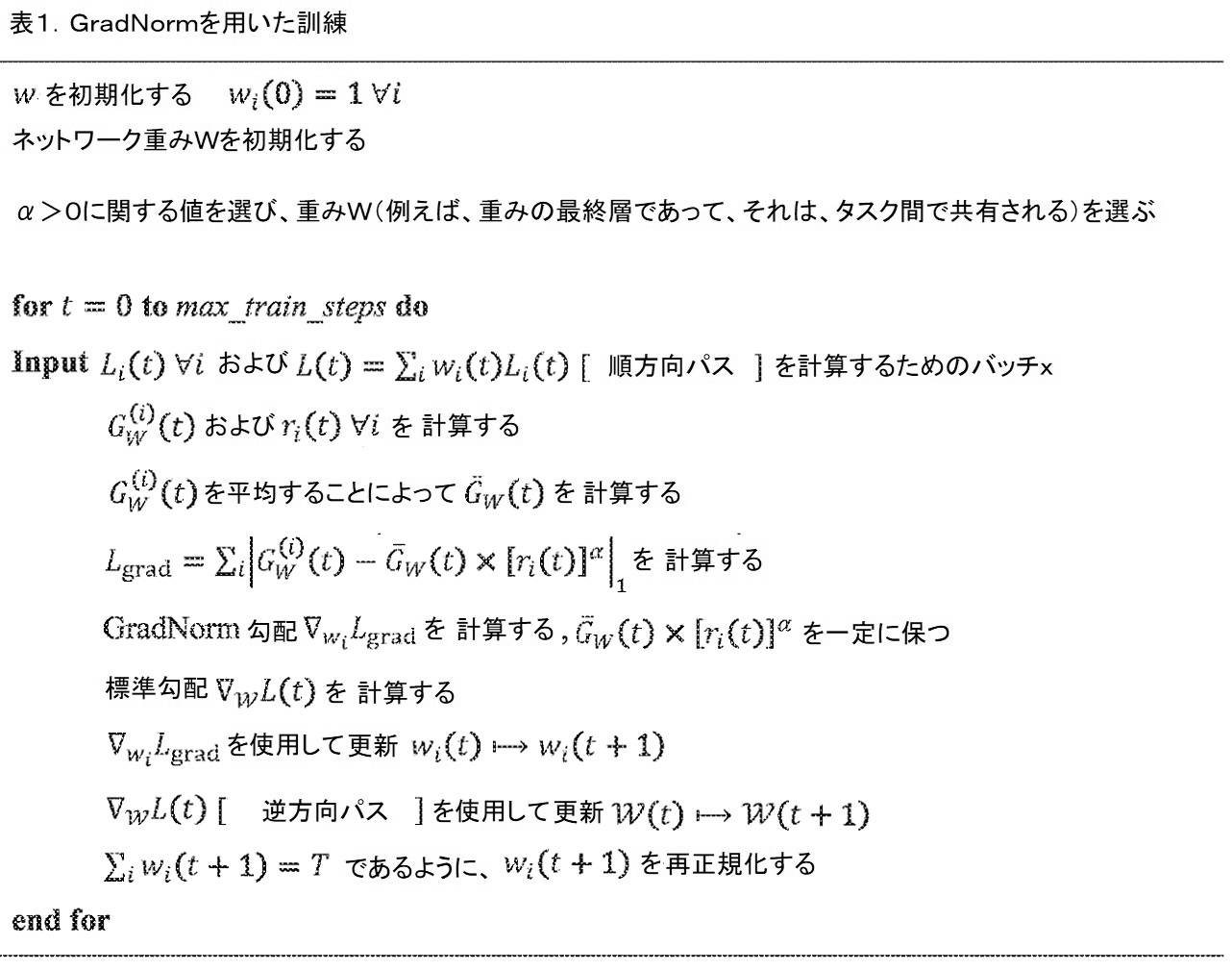
(例示的擬似コード)
表2は、本明細書に説明される勾配正規化技術の実施形態を実施するために使用され得る例示的擬似コードプログラミング言語を示す。

Table 2 shows an exemplary pseudocode programming language that may be used to implement embodiments of the gradient normalization techniques described herein.
GradNormを例証するために、マルチタスクネットワークに関する共通シナリオが構築された:同様の損失関数を有するが、異なる損失スケールを有する訓練タスク。そのような状況では、全ての損失重みwi(t)に関して、wi(t)=1であり、ネットワーク訓練は、より大きい勾配を逆伝搬するより大きい損失スケールを伴うタスクによって支配され得る。GradNormは、この問題を克服することができる。 To illustrate GradNorm, a common scenario for multi-task networks was constructed: training tasks with similar loss functions but different loss scales. In such a situation, w i (t)=1 for all loss weights w i (t), and network training can be dominated by tasks with larger loss scales that backpropagate larger gradients. GradNorm can overcome this problem.
関数への標準二乗損失を使用して訓練されたT回帰タスクを検討する。


このモデルを訓練するために、層あたり100個のニューロンを共通幹として伴う4-層完全結合ReLU-作動ネットワークが、使用された。最終アフィン変換層が、T個の最終予測(T個の異なるタスクに対応する)を生産した。有効な分析を確実にするために、同じランダム値に初期化されたモデルが、使用され、同じ固定ランダムシードから生成されたデータをフィードされた。非対称αは、出力関数fiが全て同一関数形態であるように、0.12と低く設定され、したがって、タスク間の非対称は、最小であることが予期された。 A 4-layer fully-connected ReLU-operating network with 100 neurons per layer as common stem was used to train this model. The final affine transformation layer produced T final predictions (corresponding to T different tasks). To ensure valid analyses, models initialized to the same random values were used and fed data generated from the same fixed random seed. The asymmetry α was set as low as 0.12 so that the output functions f i were all of the same functional form, so the asymmetry between tasks was expected to be minimal.
この例では、タスク正規化試験時間損失が、試験時間性能を判断するために使用され、それは、各タスクに関する試験損失比率の和ΣiLi(t)/Li(0)であった。損失の単純和は、異なる損失スケールが存在するとき、マルチタスクネットワークに関する不適正性能メトリックであり得る:より高い損失スケールタスクは、損失において高度に偏って組み入れられ得る。全てのシナリオにおいてマルチタスク性能の有意義な尺度を与え得る一般的単一スカラーがないということがないこともあるが、この例では、その損失スケールσiを除き、統計的に同じであったタスクが存在した。したがって、全体的ネットワーク性能の明確な尺度が存在し、それは、各タスクの分散σi 2によって正規化された損失の和であったー(スケーリング係数次第で)損失比率の和と同等。 In this example, task normalized test time loss was used to determine test time performance, which was the sum of test loss ratios Σ i L i (t)/L i (0) for each task. A simple sum of losses can be an inadequate performance metric for multitasking networks when there are different loss scales: higher loss scale tasks can be highly skewed in the loss. In this example , the task existed. Thus, there was a clear measure of overall network performance, which was the sum of the losses normalized by the variance σ i 2 of each task—equivalent to the sum of the loss ratios (depending on the scaling factor).
T=2に関して、値(σ0,σ1)=(1.0,100.0)が、選定された。図2A-2Cは、訓練の結果を示す。等しい重みwi=1が、訓練において使用される場合、タスク1は、タスク1のより高い損失スケールに起因して、学習からタスク0を抑制した。しかしながら、勾配正規化は、T1から生じるより大きい勾配に対抗するために、w0(t)を増加させ、改良されたタスク平衡は、より良好な試験時間性能をもたらす。
For T=2, the values (σ 0 , σ 1 )=(1.0, 100.0) were chosen. Figures 2A-2C show the results of training. When equal weights w i =1 were used in training,
勾配正規化の可能な利点は、タスクの数が増加するとき、さらにより明確となる。T=10に関して、σ1が、広い正規分布からサンプリングされ、結果が、図2D-2Fに示される。GradNormは、各タスクを同一に単純に重み付けすることよりも試験時間性能を有意に改良した。T=2の場合と同様、T=10に関して、wi(t)は、より小さいσ1タスクに関してより大きく成長した。 The possible benefits of gradient normalization become even more pronounced when the number of tasks increases. For T=10, σ 1 is sampled from a broad normal distribution and the results are shown in FIGS. 2D-2F. GradNorm significantly improved test time performance over simply weighting each task equally. As with T=2, for T=10, w i (t) grew larger for smaller σ 1 tasks.
T=2およびT=10の両方に関して、GradNormは、より安定し、不確実重み付けより優れている。wi(t)≒1/Li(t)を強いる不確実重み付けは、各タスクに関する損失が低下すると、重みwi(t)を過大かつあまりにも迅速に成長させる傾向にある。そのようなネットワークは、開始時に迅速に訓練されるが、訓練は、すぐに低下する。この問題は、主として、wi(t)が制約を伴わずに変化することを不確実重み付けが可能にし(Σwi(t)を常に確実にするGradNormと比較して)、それが、ネットワークが訓練されるにつれて、大域的学習レートを急速に上昇させるという事実によって生じる。 For both T=2 and T=10, GradNorm is more stable and outperforms uncertainty weighting. Uncertainty weighting that forces w i (t)≈1/L i (t) tends to make the weights w i (t) grow too large and too quickly as the loss for each task drops. Such networks train quickly when started, but the training degrades quickly. The problem is primarily that uncertainty weighting allows w i (t) to vary without constraint (compared to GradNorm, which always ensures Σw i (t)), which means that the network It arises from the fact that it rapidly increases the global learning rate as it is trained.
単一GradNorm実行中の各wi(t)に関するトレースは、安定し、収束することが観察される。下で示されるように、時間平均重みΣt[wi(t)]は、最適静的重みに近く、GradNormが冗漫なグリッド検索プロシージャを大幅に簡略化することができることを示唆する。 The traces for each w i (t) during a single GradNorm run are observed to stabilize and converge. As shown below, the time-averaged weights Σ t [w i (t)] are close to the optimal static weights, suggesting that GradNorm can greatly simplify the tedious grid search procedure.
(より大きいデータセットを用いた例示的訓練)
NYUv2の2つの変形が、主要なデータセットとして使用された。標準NYUv2データセットは、異なる部屋タイプ(洗面所、居間、書斎等)内の種々の屋内場面に関する深度、面法線、および意味的分割ラベル(13個の異なるクラスにクラスタ化される)を伝える。NYUv2は、比較的に小規模(795枚の訓練、654枚の試験画像)であるが、回帰ラベルおよび分類ラベルの両方を含み、それを種々のタスクを横断したGradNormのロバスト性を試験するための良好な選択肢とする。
(exemplary training with a larger dataset)
Two variants of NYUv2 were used as the main dataset. The standard NYUv2 dataset conveys depth, surface normals, and semantic segmentation labels (clustered into 13 different classes) for various indoor scenes in different room types (bathroom, living room, study, etc.). . Although NYUv2 is relatively small (795 training, 654 test images), it contains both regression and classification labels to test the robustness of GradNorm across a variety of tasks. be a good choice.
標準NYUv2深度データセットは、各ビデオからのフリップおよび追加のフレームを用いて拡張され、ピクセル毎の深度、面法線、および部屋キーポイントラベル(分割ラベルは、これらの追加のフレームに関して利用不可能であった)を備えた90,000枚の画像をもたらした。キーポイントラベルは、人間によって注釈が付けられた一方、面法線は、アルゴリズム的に生成された。完全データセットは、次いで、90/10枚の訓練/試験分割のために場面ごとに分割された。これらの2つのデータセットは、本明細書では、それぞれ、NYUv2+segおよびNYUv2+kptsと称される。 The standard NYUv2 depth dataset is augmented with flips and additional frames from each video to provide per-pixel depth, surface normals, and room keypoint labels (split labels not available for these additional frames). was), resulting in 90,000 images. Keypoint labels were annotated by humans, while surface normals were generated algorithmically. The full dataset was then split by scenes for a 90/10 training/test split. These two data sets are referred to herein as NYUv2+seg and NYUv2+kpts, respectively.
全ての入力は、320×320ピクセルにダウンサンプリングされ、出力は、80×80ピクセルにダウンサンプリングされた。これらの分解能は、グラウンドトゥルース出力マップにおける意味的複雑性を損なわせることなく、モデルが比較的に小規模に保たれることを可能にする。VGG式モデルアーキテクチャは、「Room layout estimation methods and techniques」と題された米国特許公開第2018/0268220号(その内容は、参照することによってその全体として本明細書に組み込まれる)から導出された。 All inputs were downsampled to 320x320 pixels and outputs were downsampled to 80x80 pixels. These resolutions allow the model to be kept relatively small without compromising the semantic complexity in the ground truth output map. The VGG formula model architecture was derived from US Patent Publication No. 2018/0268220, entitled "Room layout estimation methods and techniques," the contents of which are incorporated herein by reference in their entirety.
(モデルおよび一般的訓練特性)
(1)対称VGG16エンコーダ/デコーダを伴うSegNetネットワークと、(2)修正されたResNet-50エンコーダおよび浅層ResNetデコーダを伴う完全畳み込みネットワーク(FCN)ネットワークの2つの異なるモデルが、調査された。VGG SegNetは、最大プーリングインデックスを再使用し、アップサンプリングを実施した一方、ResNet FCNは、全てのアップサンプリングフィルタを学習した。ResNetアーキテクチャは、より重く、より複雑なVGG SegNetと対照的に、さらに薄層化された(そのフィルタおよび作動の両方において):ストライド-2層は、繰り上げられ、全ての2048-フィルタ層は、1024-フィルタ層によって置換された。最終的に、VGG SegNetは、薄層ResNetに関する15M個に対して、29M個のパラメータを有した。全てのモデルパラメータは、最終層まで、全てのタスク間で共有された。結果は、基本アーキテクチャの選択に対するGradNormのロバスト性を示した。前述の例モデルは、例証のみのためのものであり、限定することを意図するものではない。GradNormは、例えば、「Deep learning system for cuboid detection」と題された米国特許公開第2018/0137642号(その内容は、参照することによってその全体として本明細書に組み込まれる)に説明されるように、例えば、再帰ニューラルネットワークを含む任意の他のタイプのニューラルネットワークに適用されることができる。
(model and general training properties)
Two different models were investigated: (1) a SegNet network with a symmetric VGG16 encoder/decoder and (2) a fully convolutional network (FCN) network with a modified ResNet-50 encoder and shallow ResNet decoder. VGG SegNet reused the maximum pooling index and performed upsampling, while ResNet FCN learned all upsampling filters. The ResNet architecture has been further thinned (both in its filters and actuation), in contrast to the heavier and more complex VGG SegNet: the stride-2 layers are rolled up and all 2048-filter layers are 1024-Replaced by a filter layer. Finally, the VGG SegNet had 29M parameters compared to 15M for the thin ResNet. All model parameters were shared among all tasks up to the final layer. The results showed the robustness of GradNorm to the choice of basic architecture. The foregoing example models are for illustration only and are not intended to be limiting. GradNorm, for example, as described in U.S. Patent Publication No. 2018/0137642, entitled "Deep learning system for cuboid detection," the contents of which are incorporated herein by reference in their entirety. can be applied to any other type of neural network, including, for example, recurrent neural networks.
標準ピクセル毎損失関数が、各タスクに関して使用された:分割に関するクロスエントロピ、深度に関する二乗損失、および法線に関するコサイン類似。米国特許公開第2018/0268220号におけるように、ガウスヒートマップが、48個の部屋キーポイントタイプの各々のために生成され、これらのヒートマップは、ピクセル毎二乗損失を用いて予測された。全ての回帰タスクは、二次損失であり(面法線予測は、リーディングオーダーの二次のコサイン損失を使用した)、各タスクの相対的逆数訓練レートのための直接プロキシとして各タスクiのためのri(t)の使用を可能にした。 Standard pixel-by-pixel loss functions were used for each task: cross-entropy for segmentation, squared loss for depth, and cosine similarity for normals. As in US2018/0268220, Gaussian heatmaps were generated for each of the 48 room keypoint types and these heatmaps were predicted using per-pixel squared loss. All regression tasks are quadratic loss (surface normal prediction used the leading order quadratic cosine loss) and for each task i as a direct proxy for the relative inverse training rate of each task to allow the use of r i (t) of
全ての実行は、4つのTitan X GTX 12GB GPUを横断して、24のバッチサイズで訓練され、推定時、単一GPU上において30fpsで実行された。全てのNYUv2実行は、2e-5の学習レートから開始した。NYUv2+kpts実行は、最後の80,000ステップ継続し、学習レートは、25,000ステップ毎に0.2低下した。NYUv2+seg実行は、20,000ステップ継続し、学習レートは、6,000ステップ毎に0.2低下した。wi(t)更新は、GradNormおよび不確実重み付けベースラインの両方に関して、0.025の学習レートで実施された。全てのオプティマイザは、Adam(ネットワーク重みを更新するために適応的瞬間推定から導出される確率論的最適化のための方法)であったが、GradNormは、選定されたオプティマイザに対して鈍感であった。GradNormは、TensorFlow v1.2.1を使用して実装された。
(NYUv2に基づく例示的結果)
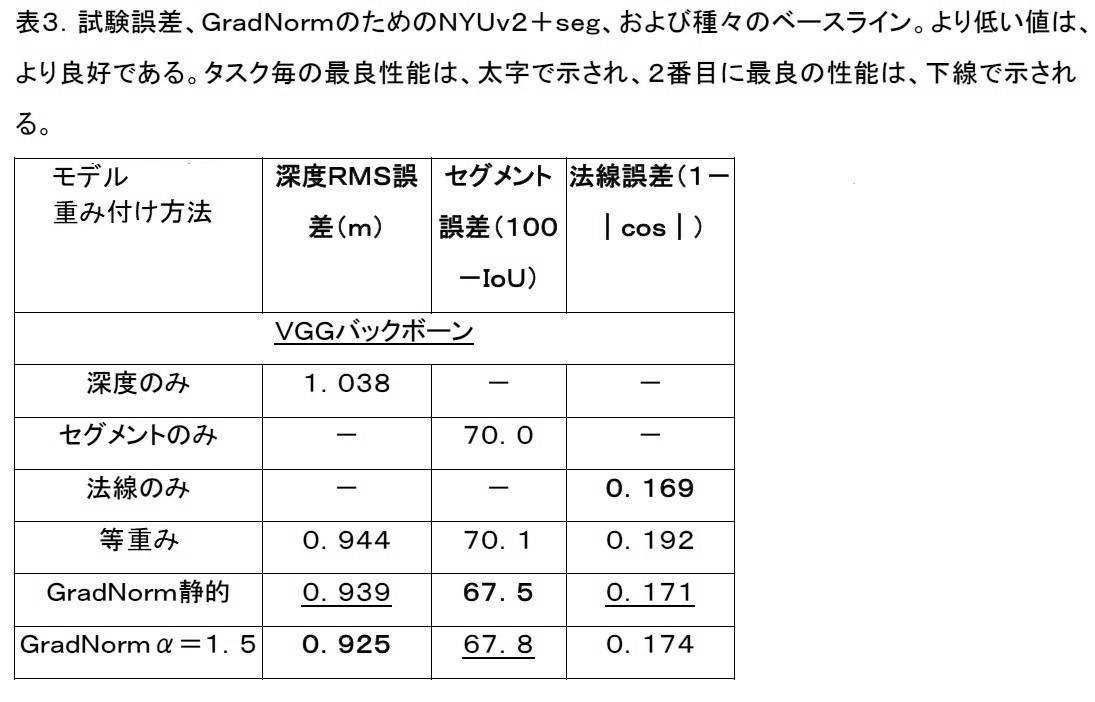
表3は、NYUv2+segデータセットに基づくGradNormの性能の例を示す。GradNorm α=1.5は、等重みベースライン(全てのt,iに関してwi=1)に対して3つのタスク全ての性能を改良し、各タスクに関する単一ネットワークの最良性能を上回ったか、またはそれに匹敵したか(統計的雑音内)のいずれであった。GradNorm静的ネットワークは、GradNorm訓練実行中の各タスクに関する時間平均重みΣt[wi(t)]を計算し、それらの値に固定される重みを用いて、ネットワークを再訓練することによって、GradNormネットワークから導出される静的重みを使用した。GradNormはまた、したがって、静的重みのための良好な値を抽出するためにも使用されることができる。下で示されるように、これらの重みは、包括的グリッド検索から抽出された最適重みに非常に近い。
(Exemplary results based on NYUv2)
Table 3 shows an example of GradNorm's performance based on the NYUv2+seg dataset. GradNorm α=1.5 improved the performance of all three tasks over the equal-weight baseline (w i =1 for all t,i) and exceeded the best performance of a single network for each task; or were comparable (within statistical noise). The GradNorm static network computes the time-averaged weights Σ t [w i (t)] for each task during the GradNorm training run, and retrains the network with the weights fixed at those values: We used static weights derived from the GradNorm network. GradNorm can therefore also be used to extract good values for static weights. As shown below, these weights are very close to the optimal weights extracted from the global grid search.
GradNormが、より大きいデータセットの存在下で性能を発揮し得る様子を示すために、広範な実験が、50倍を上回るデータまで拡張されたNYUv2+kptsデータセットにおいて実施された。結果は、表4に示される。NYUv2+seg実行と同様、GradNormネットワークは、他のマルチタスク方法より優れ、シングルタスクネットワークの性能に匹敵するか(雑音内)、またはそれを上回るかのいずれかであった。
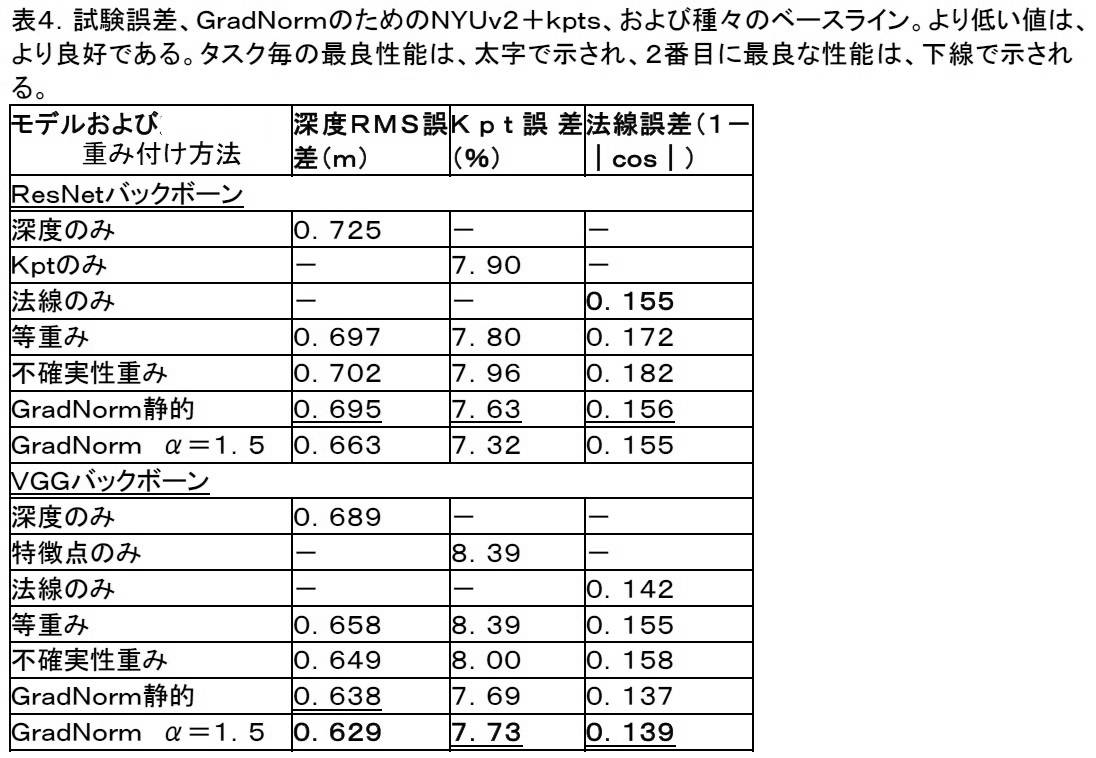
図3A-3Cは、VGG SegNetモデルのためのより大きいNYUv2+kptsデータセットにおけるGradNorm(α=1.5)およびベースラインに関する試験および訓練損失曲線の例示的を示す。GradNormは、はるかに高い訓練損失に対する収束にもかかわらず、試験時間深度誤差を約5%改良した。GradNormは、ネットワークを積極的にレートの平衡を保つことによって(高非対称α=1.5によって実施された)、これを達成し、最終的に、深度重みwdepth(t)を0.10より低く抑制した。同一傾向は、キーポイント回帰に関しても認められ、ネットワーク正則化の明確な兆候であった。対照的に、不確実重み付けは、常時、試験および訓練誤差を同一方向に移動させ、したがって、良好な正則化子ではなかった。薄層ResNetFCNの訓練も、同様の結果を生産した。 3A-3C show exemplary test and training loss curves for GradNorm (α=1.5) and baseline in the larger NYUv2+kpts dataset for the VGG SegNet model. GradNorm improved test time depth error by about 5% despite convergence for much higher training loss. GradNorm achieves this by aggressively rate-balancing the network (implemented by high asymmetry α=1.5) and finally reduces the depth weight w depth (t) from 0.10 to kept low. The same trend was also observed for keypoint regression, a clear sign of network regularization. In contrast, uncertainty weighting always moved the testing and training errors in the same direction and was therefore not a good regularizer. Training a thin layer ResNetFCN also produced similar results.
(勾配正規化は、1回のパスにおいて最適グリッド検索重みを見出す)
VGG SegNetに関して、100個のネットワークが、NYUv2+kptsにおけるランダムタスク重みを用いて最初から訓練された。重みは、均一分布からサンプリングされ、和がT=3であるように再正規化された。計算効率のために、訓練は、通常の80,000回のうちから15,000回の反復を含み、次いで、そのネットワークの性能が、同一15,000ステップにおいて、GradNorm α=1.5 VGG SegNetネットワークと比較された。結果は、図4に示される。図4は、ランダムタスク重み対GradNormのNYUv2+kptsに関するグリッド検索性能を示す。重みwi
staticを伴う静的マルチタスクネットワークに関する3つのタスクを横断した性能の平均変化が、wi
staticとGradNormネットワークから導出される静的重みのセットEt[wi(t)]との間のL2距離に対してプロットされた。ゼロ性能変化における基準線が、参照のために示される。全ての比較は、訓練の15,000ステップにおいて行われた。
(Gradient normalization finds optimal grid search weights in one pass)
For VGG SegNet, 100 networks were trained from scratch with random task weights in NYUv2+kpts. Weights were sampled from a uniform distribution and renormalized so that the sum was T=3. For computational efficiency, training involved 15,000 iterations out of the usual 80,000, then the performance of the network was reduced to GradNorm α=1.5 VGG SegNet at the same 15,000 steps. compared to networks. Results are shown in FIG. FIG. 4 shows the grid search performance for random task weights versus NYUv2+kpts for GradNorm. The average change in performance across three tasks for a static multitasking network with weights w i static is calculated using w i static and the set of static weights E t [w i (t)] derived from the GradNorm network. plotted against the L2 distance between A baseline at zero performance change is shown for reference. All comparisons were made over 15,000 steps of training.
100個のネットワークが訓練された後でさえ、グリッド検索は、依然として、GradNormネットワークに達しなかった。ネットワーク性能と時間平均GradNorm重みEt[wi(t)]までのタスク重み距離との間に、強い負の相関が存在した。約3のL2距離では、グリッド検索ネットワークは、平均して、我々のGradNormネットワークと比較して、ほぼ2倍のタスクあたり誤差を有していた。GradNormは、したがって、1回の単一訓練実行において、最適グリッド検索重みを見出した。 Even after 100 networks were trained, the grid search still did not reach the GradNorm network. There was a strong negative correlation between network performance and task weight distance to time-averaged GradNorm weights E t [w i (t)]. At an L2 distance of about 3, the grid search network had, on average, almost twice the error per task compared to our GradNorm network. GradNorm thus found the optimal grid search weights in one single training run.
(非対称αを調整する効果)
これらの例示的数値実験では、方法における唯一のハイパーパラメータは、ハイパーパラメータαであり、それは、本明細書に説明されるように、非対称パラメータとも称される。NYUv2に関するαの最適値は、約α=1.5であった一方、上記の節における高度に対称の例では、α=0.12が、使用された。この観察は、非対称パラメータとしてのαの特徴付けを強化する。
(Effect of adjusting asymmetric α)
In these exemplary numerical experiments, the only hyperparameter in the method is the hyperparameter α, which is also referred to as the asymmetric parameter as described herein. The optimal value of α for NYUv2 was around α=1.5, while for the highly symmetric example in the section above, α=0.12 was used. This observation strengthens the characterization of α as an asymmetry parameter.
αの調整は、これらの例では、性能利得につながるが、NYUv2に関して、0<α<3のほぼ任意の値が、等重みベースラインよりネットワーク性能を改良することが見出された。図5A-5Bは、NYUv2+kptsの訓練中の重みwi(t)を示すプロットである。αの2つの異なる値に関して、タスク重みwi(t)が訓練中に変化した様子のトレースが、示される。αのより大きい値は、重みをより遠くに離れさせ、タスク間のより少ない対称につながる。図5A-5Bは、αのより高い値が、重みwi(t)をさらに遠くに離れさせる傾向にあることを示し、それは、過剰適合する、またはあまりにも迅速に学習するタスク(この例証では、深度)の影響をより積極的に低減させる。α=1.75(図示せず)では、wdepth(t)は、深度タスクにおけるネットワーク性能への損害のない0.02を下回るまで抑制された。 Adjusting α leads to performance gains in these examples, but for NYUv2 almost any value of 0<α<3 was found to improve network performance over the equal weight baseline. 5A-5B are plots showing weights w i (t) during training of NYUv2+kpts. Traces of how the task weights w i (t) changed during training for two different values of α are shown. Larger values of α move the weights farther apart, leading to less symmetry between tasks. Figures 5A-5B show that higher values of α tend to push the weights w i (t) farther apart, which is associated with tasks that overfit or learn too quickly ( , depth) more aggressively. At α=1.75 (not shown), w depth (t) was suppressed below 0.02 with no damage to network performance in the depth task.
(例示的定質的結果)
試験セット画像におけるVGG SegNet出力の可視化は、NYUv2+segおよびNYUv2+kptsデータセットの両方に関して、グラウンドトゥルースとともに、Chen et al.,GradNorm:Gradient Normalization for Adaptive Loss Balancing in Deep Multitask Networks,Proceedings of the 35th International Conferenceon Machine Learning(2018),793-802(以降、「Chen et al.」)(その内容は、参照することによってその全体として本明細書に組み込まれる)の図6に示される。グラウンドトゥルースラベルは、等重みネットワーク、3つの単一ネットワーク、および最良GradNormネットワークからの出力と並べて示されている。いくつかの改良は、漸増であるが、GradNormは、タスクにおいてより優れた視覚的結果を生産し、それに関して、表3および4において、有意な定量的改良が認められている。
(Exemplary Qualitative Results)
Visualization of the VGG SegNet output in the test set images, along with the ground truth for both the NYUv2+seg and NYUv2+kpts datasets, was described by Chen et al. ,GradNorm:Gradient Normalization for Adaptive Loss Balancing in Deep Multitask Networks,Proceedings of the 35th International Conferenceon Machine Learning(2018),793-802(以降、「Chen et al.」)(その内容は、参照することによってその全体6, which is incorporated herein by reference. Ground truth labels are shown alongside outputs from the equal weight network, the three single networks, and the best GradNorm network. Some of the improvements were incremental, but GradNorm produced better visual results on the task, for which significant quantitative improvements are noted in Tables 3 and 4.
Chen et al.の図6は、推定時における例示的可視化を示す。NYUv2+kpts出力は、左に示される一方、NYUv2+seg出力は、右に示されている。示される可視化は、ランダム試験セット画像から生成された。いくつかの改良は、漸増であるが、赤色フレームが、予測の周囲に示され、それは、GradNormによって視覚的により明確に改良された。NYUv2+kpts出力に関して、GradNormは、法線予測において等重みネットワークに優り、キーポイント予測において単一ネットワークに優る改良を示した。NYUv2+segに関して、深度および分割正確度において、単一ネットワークに優る改良が認められた。これらは、表3および4に報告される数値と一致する。 Chen et al. FIG. 6 of shows an exemplary visualization at the time of estimation. The NYUv2+kpts output is shown on the left, while the NYUv2+seg output is shown on the right. Visualizations shown were generated from random test set images. Some improvements were incremental, but a red frame was shown around the prediction, which was visually more clearly enhanced by GradNorm. For the NYUv2+kpts output, GradNorm showed an improvement over the equal-weight network in normal prediction and over the single network in keypoint prediction. Improvements were observed for NYUv2+seg over the single network in depth and segmentation accuracy. These are consistent with the numbers reported in Tables 3 and 4.
(例示的性能利得対α)
α非対称ハイパーパラメータは、タスク間の対称における種々の異なる初期値のための適応を可能にすることができる。αの低い値は、タスクを横断して同様の規模である勾配ノルムをもたらし、各タスクがほぼ等しい影響を訓練全体を通して訓練動態に及ぼすことを確実にし得る。αの高い値は、損失がよりゆっくりと低下するタスクにより大きい重みをかける代わりに、損失があまりにも迅速に低下するタスクにペナルティを科し得る。
(exemplary performance gain versus α)
The α-asymmetric hyperparameter can allow adaptation for different initial values of symmetry between tasks. A low value of α may result in gradient norms that are of similar magnitude across tasks, ensuring that each task has approximately equal influence on training dynamics throughout training. A high value of α may penalize tasks whose loss falls too quickly, instead of giving more weight to tasks whose loss falls more slowly.
NYUv2実験に関して、α=1.5が、αのための最適値として選定され、αの増加は、タスク重みwi(t)をより遠く離れさせ得る。性能における全体的利得は、GradNormが数値的に安定したαのほぼ全ての正の値に関して達成された。これらの結果は、図6に要約される。大きい正の値(NYUv2の場合、≧3に対応)では、いくつかの重みは、ゼロにあまりにも近づけられ、GradNorm更新は、この例示的データセットにおいて不安定となり得る。図6は、αの種々の設定に関するNYUv2+kptsにおける性能利得を示す。αの種々の値に関して、平均性能利得(全てのタスクを横断した等重みベースラインと比較した試験損失のパーセント変化の平均として定義される)が、NYUv2+kptsにおいてプロットされた。VGG16バックボーン(実線)およびResNet50バックボーン(破線)の両方に関する結果が、示される。試験されたαの全ての値における性能利得が、観察されたが、利得は、α=1.5あたりでピークに達すると考えられる。α>2を越える点は、VGG16バックボーンに関してGradNorm重みとして示されていない。しかしながら、それは、GradNormに基づく限定ではない。 For the NYUv2 experiments, α=1.5 was chosen as the optimal value for α, and increasing α can cause the task weights w i (t) to move further apart. Overall gains in performance were achieved for nearly all positive values of α for which GradNorm was numerically stable. These results are summarized in FIG. At large positive values (corresponding to ≧3 for NYUv2), some weights are pushed too close to zero and the GradNorm update can be unstable in this exemplary dataset. FIG. 6 shows the performance gains in NYUv2+kpts for various settings of α. Mean performance gains (defined as the mean percent change in trial loss compared to the equal-weighted baseline across all tasks) were plotted in NYUv2+kpts for various values of α. Results for both VGG16 backbone (solid line) and ResNet50 backbone (dashed line) are shown. Performance gains were observed at all values of α tested, but the gains are believed to peak around α=1.5. Points beyond α>2 are not shown as GradNorm weights for the VGG16 backbone. However, it is not a limitation based on GradNorm.
図6に示されるように、性能利得は、αのほぼすべての値において達成された。しかしながら、特に、NYUv2+kptsに関して、これらの性能利得は、バックボーンアーキテクチャの両方に関して、α=1.5においてピークに達すると考えられる。さらに、ResNetアーキテクチャは、VGGアーキテクチャよりαに対してよりロバストであると考えられるが、両アーキテクチャは、αの適切な設定を用いて、同様のレベルの利得をもたらした。αの全ての値を横断した一貫して正の性能利得は、任意の種類の勾配平衡(準最適体系においてさえ)が、マルチタスクネットワーク訓練のために有利であり得ることを示唆する。 As shown in FIG. 6, performance gains were achieved for nearly all values of α. However, especially for NYUv2+kpts, these performance gains appear to peak at α=1.5 for both backbone architectures. Furthermore, although the ResNet architecture appears to be more robust to α than the VGG architecture, both architectures yielded similar levels of gain with appropriate settings for α. The consistently positive performance gains across all values of α suggest that any kind of gradient equilibrium (even in suboptimal regimes) can be advantageous for multitasking network training.
(マルチタスク顔ランドマークデータセットにおける例示的性能)
追加の実験が、マルチタスク顔ランドマーク(MTFL)データセット上で実施された。このデータセットは、顔の約13,000枚の画像を含み、10,000枚の画像の訓練セットおよび3,000枚の画像の試験セットに分割される。画像の各々は、4つのクラスラベル(性別、笑顔、眼鏡、および姿勢)とともに、5つの顔ランドマーク(左眼、右眼、鼻、左唇、および右唇)の(x,y)座標で分類される。データセットからの例示的ラベルは、(性別:男性、笑顔:真、眼鏡:偽、姿勢:正面)、(性別:女性、笑顔:真、眼鏡:偽、姿勢:左)、および(性別:男性、笑顔:偽、眼鏡:真、姿勢:左)を含む。
(Exemplary performance on a multitasking facial landmark dataset)
Additional experiments were performed on the Multitasking Facial Landmarks (MTFL) dataset. This dataset contains approximately 13,000 images of faces, divided into a training set of 10,000 images and a test set of 3,000 images. Each of the images is the (x,y) coordinates of five facial landmarks (left eye, right eye, nose, left lip, and right lip) along with four class labels (gender, smile, glasses, and posture). being classified. Exemplary labels from the dataset are (Gender: Male, Smile: True, Glasses: Fake, Posture: Front), (Gender: Female, Smile: True, Glasses: Fake, Posture: Left), and (Gender: Male , smile: false, glasses: true, posture: left).
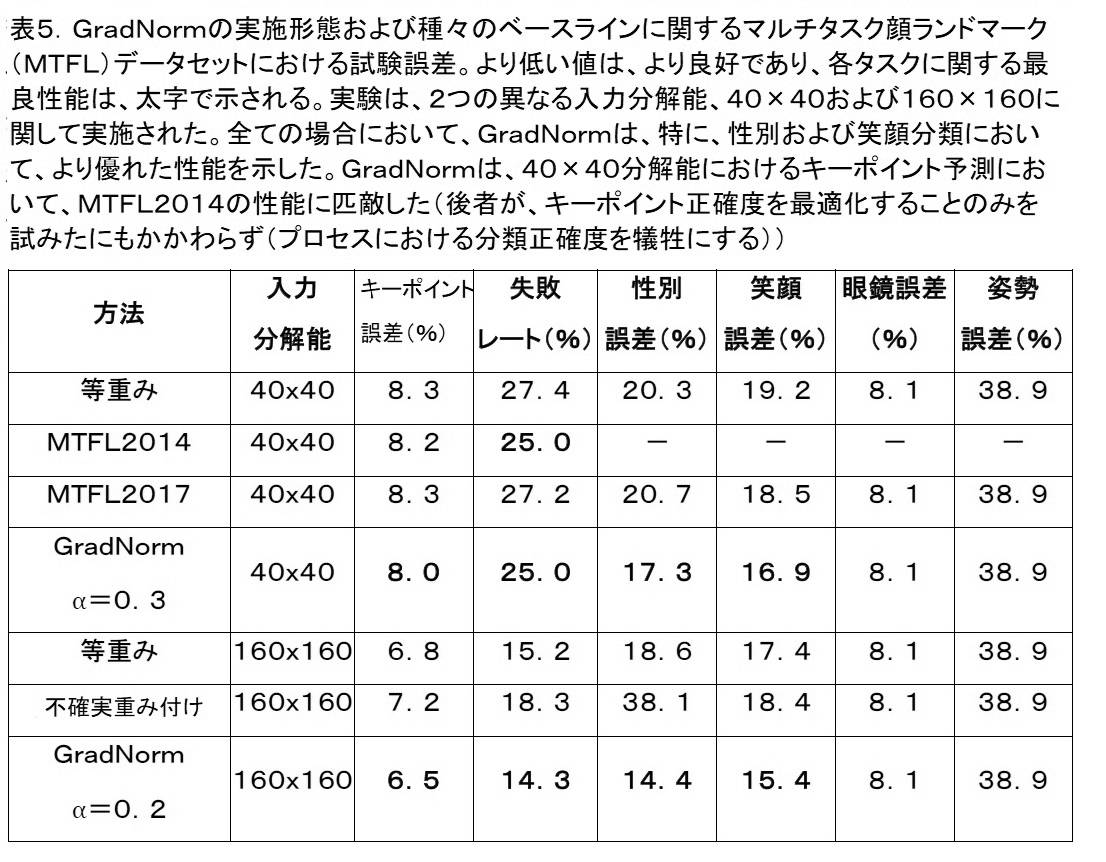
MTFLデータセットは、MTFLデータセットが分類タスクと回帰タスクとの豊富な混合であるので、GradNormを試験するための良好な機会を提供する。実験は、2つの異なる画像入力分解能:40×40および160×160において実施された。40×40実験に関して、MTFL2014において使用されたそれと同一アーキテクチャが、公平な比較を確実にするために使用されたが、160×160実験に関して、MTFL2014におけるアーキテクチャのより深層バージョンが、使用された:より深層のモデル層スタックは、[CONV-5-16][POOL-2][CONV-3-32]2[POOL-2][CONV-3-64]2[POOL-2][[CONV-3-128]2[POOL-2]]2[CONV-3-128]2[FC-100][FC-18]であり、CONV-X-Fは、フィルタサイズXおよびF個の出力フィルタを伴う畳み込みを示し、POOL-2は、ストライド2を伴う2×2プーリング層を示し、FC-Xは、X個の出力を伴う稠密層である。全てのネットワークは、18個の値を出力する:各分類子に関して、顔ランドマークのための10個の座標、および、4対の2個のソフトマックススコア。
The MTFL dataset provides a good opportunity to test GradNorm as it is a rich mixture of classification and regression tasks. Experiments were performed at two different image input resolutions: 40x40 and 160x160. For the 40x40 experiments, the same architecture as that used in MTFL2014 was used to ensure a fair comparison, but for the 160x160 experiments, a deeper version of the architecture in MTFL2014 was used: The deep model layer stack is [CONV-5-16][POOL-2][CONV-3-32] 2 [POOL-2][CONV-3-64] 2 [POOL-2][[CONV-3 -128] 2 [POOL-2]] 2 [CONV-3-128] 2 [FC-100] [FC-18] and CONV-XF with filter size X and F output filters Denote convolution, POOL-2 denotes a 2×2 pooling layer with
MTFLデータセットにおける結果は、表5に示される。キーポイント誤差は、眼球間距離に正規化された5つ全ての顔ランドマークに関するL2距離誤差に対する平均である一方、失敗レートは、キーポイント誤差が10%を上回る画像のパーセントである。両分解能に関して、GradNormは、全てのタスクにおいて、他の方法より優れていた(、眼鏡および姿勢予測を除く、それらの両方は、常に、大多数分類子に迅速に収束し、さらなる訓練を拒否した)。GradNormは、キーポイントにおいても、MTFL2014の性能に匹敵した(後者が、分類子性能を最適化することを試みず、キーポイント正確度にのみ重点を置いたにもかかわらず)。要するに、これらの結果は、GradNormが性別および笑顔における分類正確度を著しく改良した一方、全ての他のタスクにおいて、少なくとも全ての他の方法に匹敵したことを示す。
眼鏡および姿勢分類の両方は、常時、大多数分類子に収束した。訓練中に「スタック」した状態になるそのようなタスクは、いくつかの実施形態では、これらのタスクに関する損失重みを持続的に増加させないことによって、GradNormに関して克服され得る。GradNormは、例えば、病理学的タスクをオンラインで検出し、それらをGradNorm更新式から除去することによって、この問題を緩和し得る。 Both the glasses and posture classification converged to the majority classifier all the time. Such tasks that become "stuck" during training can be overcome with respect to GradNorm in some embodiments by not continually increasing the loss weights for these tasks. GradNorm may alleviate this problem, for example, by detecting pathological tasks online and removing them from the GradNorm update formula.
GradNormは、依然として、このデータセットにおいてより優れた性能を提供した。全ての損失重みは、wi(0)=1に初期化された。不確実重み付けは、分類子損失のそれに対して、キーポイントに関して損失重みを増加させる傾向にあったが、GradNormは、相対的キーポイント損失重みを積極的に減少させた。GradNorm訓練実行に関して、wkpt(t)は、値≦0.01に収束し、不確実重み付けまたは等重み方法と比較して、規模が2桁小さい勾配を用いても、キーポイントタスクが正確度の減衰を伴わずに適切に訓練されたことを示した。 GradNorm still provided better performance on this dataset. All loss weights were initialized to w i (0)=1. Uncertainty weighting tended to increase the loss weight for the keypoints relative to that of the classifier loss, whereas GradNorm aggressively decreased the relative keypoint loss weight. For the GradNorm training run, w kpt (t) converges to a value ≤ 0.01, indicating that the keypoint task has an accuracy showed that it was properly trained without any attenuation of .
GradNormは、MTFLデータセットにおける分類タスクが、比較的に不十分に訓練され、上昇させられる必要があることを正しく識別し得る。対照的に、不確実重み付けは、より多くの相対的焦点をキーポイント回帰に置くことによって、逆の決定を行ない、多くの場合、分類において非常に不良な性能を発揮した(特に、より高い分解能入力のために)。これらの実験は、したがって、訓練中により多くの注意を要求するタスクを識別し、それに恩恵をもたらすGradNormの能力を強調する。 GradNorm may correctly identify that the classification task in the MTFL dataset needs to be relatively poorly trained and elevated. In contrast, uncertainty weighting made the opposite decision by putting more relative focus on the keypoint regression and often performed very poorly in classification (especially at higher resolution for input). These experiments therefore underscore GradNorm's ability to identify and benefit from tasks that require more attention during training.
(GradNormに関する追加の観察)
本明細書に説明されるように、勾配正規化は、良好なモデル正則化子として作用し、ネットワーク内の勾配に直接作用することによって、マルチタスクネットワークにおける優れた性能につながることができる。GradNormは、レート平衡の魅力的に単純ヒューリスティックによって駆動されることができ、同一統合モデル内の可変複雑性の問題に適応することができ、いくつかの実施形態では、タスク非対称を表す単一ハイパーパラメータのみを使用する。GradNormネットワークはまた、最適固定タスク重みを迅速に抽出し、タスクの数に伴って指数関数的により高価になる、包括的グリッド検索方法の必要性を除去するために使用されることができる。
(Additional Observations on GradNorm)
As described herein, gradient normalization acts as a good model regularizer and can lead to superior performance in multitasking networks by acting directly on the gradients in the network. GradNorm can be driven by an attractively simple heuristic of rate balancing, can adapt to problems of variable complexity within the same integration model, and in some embodiments, uses a single hyper Use parameters only. The GradNorm network can also be used to quickly extract the optimal fixed task weights, obviating the need for comprehensive grid search methods that become exponentially more expensive with the number of tasks.
GradNormの実施形態は、異なるタスクの訓練レートの平衡を保つことに基づいて、マルチタスク学習設定における損失重みを調整するための効率的方法を提供することができる。合成および実際のデータセットの両方に関して、GradNormは、種々のシナリオにおけるマルチタスク試験時間性能を改良し、ハイパーパラメータαを通して、異なるタスク間の種々のレベルの非対称に適応することができる。結果は、GradNormが、他のマルチタスク適応的重み方法より優れた性能をもたらし、それほど時間集約的ではないにもかかわらず、包括的グリッド検索の性能に匹敵すること、またはそれを上回り得ることを示す。 Embodiments of GradNorm can provide an efficient method for adjusting loss weights in multi-task learning settings based on balancing training rates of different tasks. For both synthetic and real datasets, GradNorm can improve multitask test time performance in different scenarios and adapt to different levels of asymmetry between different tasks through the hyperparameter α. The results show that GradNorm yields superior performance to other multitasking adaptive weighting methods, and can match or exceed the performance of comprehensive grid search despite being less time intensive. show.
いくつかの実施形態では、GradNormは、マルチタスク学習以外の用途を有し得る。GradNormは、クラス平衡およびシーケンストゥシーケンスモデル、相反する勾配信号を伴う問題がモデル性能を低下させ得る全ての状況に適用されることができる。GradNormの実施形態は、マルチタスク学習のためのロバストな新しい方法を提供するだけではなく、勾配調整が、有利には、大規模有効モデルを複雑なタスク上で訓練するためにも使用され得ることを示し得る。 In some embodiments, GradNorm may have uses other than multi-task learning. GradNorm can be applied to class-balanced and sequence-to-sequence models, all situations where problems with conflicting gradient signals can degrade model performance. GradNorm embodiments not only provide a robust new method for multi-task learning, but gradient tuning can also be advantageously used to train large-scale effective models on complex tasks. can indicate
(マルチタスクネットワークを訓練する例示的プロセス)
図8は、マルチタスクネットワークを訓練する例示的プロセス800のフロー図である。マルチタスクネットワークは、複数のタスクに関連付けられた出力を決定するために使用されることができる。マルチタスクネットワークは、複数の共有層と、複数のタスク特定のフィルタを備えている出力層とを備えていることができる。マルチタスクネットワークの出力層は、アフィン変換層を備えていることができる。非一過性メモリと、ハードウェアプロセッサとを伴うコンピューティングシステム等のコンピューティングシステムは、プロセス800を実装し、マルチタスクネットワークを訓練することができる。コンピューティングシステムの非一過性メモリは、実行可能命令を記憶すること、または記憶するように構成されることができる。ハードウェアプロセッサは、非一過性メモリと通信し、実行可能命令によって、プロセス800を実施し、GradNormの実施形態を使用して、マルチタスクネットワークを訓練するようにプログラムされることができる。
(Exemplary process for training a multitasking network)
FIG. 8 is a flow diagram of an
プロセス800は、ブロック804から開始し、コンピューティングシステムが、複数のタスクに関する複数の基準タスク出力に関連付けられた訓練画像を受信する。複数のタスクは、回帰タスク、分類タスク、またはそれらの組み合わせを備えていることができる。複数のタスクは、例えば、顔認識、視覚的検索、ジェスチャ識別または認識、意味的分割、オブジェクト検出、部屋レイアウト推定、直方体検出、照明検出、同時位置特定およびマッピング、オブジェクトまたはアバタの再位置特定等の知覚タスク、または、発話認識または自然言語処理等の発話処理タスク、または、それらの組み合わせを備えていることができる。
ブロック808では、コンピューティングシステムは、(1)各タスクに関するタスク出力と、(2)タスクに関するタスク重みによって調節された、タスクに関する対応する基準タスク出力とのシングルタスク損失Li(t)の勾配ノルム

コンピューティングシステムは、(1)訓練画像を入力として用いて、マルチタスクネットワークを使用して決定された各タスクに関するタスク出力と、(2)訓練画像に関連付けられたタスクに関する対応するタスク出力とのシングルタスク損失を決定することができる。シングルタスク損失を決定するために、コンピューティングシステムは、タスクに関連付けられた複数の損失関数のうちの損失関数を使用して、(1)訓練画像を入力として用いて、マルチタスクネットワークを使用して決定された各タスクに関するタスク出力と、(2)訓練画像に関連付けられたタスクに関する対応するタスク出力とのシングルタスク損失を決定することができる。コンピューティングシステムは、複数のタスクの勾配ノルムの平均

ブロック812では、コンピューティングシステムは、タスクに関するシングルタスク損失に基づいて、タスクに関する相対的訓練レートを決定することができる。タスクに関するシングルタスク損失に基づくタスクに関する相対的訓練レートを決定するために、コンピューティングシステムは、タスクに関するシングルタスク損失Li(t)とLi(0)等のタスクに関する別のシングルタスク損失との損失比率に基づいて、タスクに関する相対的レートの逆数ri(t)を決定することができる。タスクに関する相対的レートの逆数を決定するために、コンピューティングシステムは、タスクの損失比率と複数のタスクの損失比率の平均との比率を相対的訓練レートの逆数として決定することができる。
At
ブロック816では、コンピューティングシステムは、(1)各タスクに関して決定された勾配ノルム


ブロック820では、コンピューティングシステムは、複数のタスクの各々に関するタスク重みに対する勾配損失関数の勾配∇wiLgradを決定することができる。勾配損失関数の勾配を決定するために、コンピューティングシステムは、タスクに関する標的勾配ノルムを一定に保ちながら、複数のタスクの各々に関するタスク重みに対する勾配損失関数の勾配を決定することができる。
At
ブロック824では、コンピューティングシステムは、タスク重みに対する勾配損失関数の勾配∇wiLgradを使用して複数のタスクの各タスクに関して更新されたタスク重みwi(t+1)を決定することができる。コンピューティングシステムは、複数のタスクに関する更新された重みを正規化することができる。複数のタスクに関する更新された重みを正規化するために、コンピューティングシステムは、複数のタスクに関する更新された重みを複数のタスクの数に対して正規化することができる。
At
コンピューティングシステムは、各タスクに関するタスク重みによって調節されたシングルタスク損失を含むマルチタスク損失関数を決定し、マルチタスクネットワークの全てのネットワーク重みに対するマルチタスク損失関数の勾配を決定し、マルチタスク損失関数の勾配に基づいて、マルチタスクネットワークの更新されたネットワーク重みを決定することができる。 A computing system determines a multitasking loss function including a single task loss adjusted by a task weight for each task, determines a gradient of the multitasking loss function for all network weights of the multitasking network, and calculates a multitasking loss function. Based on the gradient of , we can determine the updated network weights of the multitasking network.
(例示的NN層)
深層ニューラルネットワーク(DNN)等のニューラルネットワーク(NN)の層は、線形または非線形変換をその入力に適用し、その出力を生成することができる。深層ニューラルネットワーク層は、正規化層、畳み込み層、ソフトサイン層、正規化線形層、連結層、プーリング層、再帰層、インセプション様層、または任意のそれらの組み合わせであることができる。正規化層は、例えば、L2正規化を用いて、その入力の明度を正規化し、その出力を生成することができる。正規化層は、例えば、互いに対して一度に複数の画像の明度を正規化し、複数の正規化された画像をその出力として生成することができる。明度を正規化するための非限定的例示的方法は、ローカルコントラスト正規化(LCN)またはローカル応答正規化(LRN)を含む。ローカルコントラスト正規化は、平均値ゼロおよび分散1(または他の値の平均値および分散)を有するようにピクセル毎に画像のローカル領域を正規化することによって、画像のコントラストを非線形に正規化することができる。ローカル応答正規化は、平均値ゼロおよび分散1(または他の値の平均値および分散)を有するように、画像をローカル入力領域にわたって正規化することができる。正規化層は、訓練プロセスを加速し得る。
(Exemplary NN Layer)
A layer of a neural network (NN), such as a deep neural network (DNN), can apply linear or nonlinear transformations to its inputs and produce its outputs. Deep neural network layers can be regularization layers, convolutional layers, softsign layers, normalized linear layers, concatenated layers, pooling layers, recurrent layers, inception-like layers, or any combination thereof. A normalization layer may use, for example, L2 normalization to normalize the brightness of its input and produce its output. The normalization layer may, for example, normalize the brightness of multiple images at once with respect to each other, producing multiple normalized images as its output. Non-limiting example methods for normalizing brightness include local contrast normalization (LCN) or local response normalization (LRN). Local contrast normalization non-linearly normalizes the contrast of an image by normalizing the local region of the image pixel by pixel to have a mean of zero and a variance of one (or some other value of mean and variance). be able to. Local response normalization can normalize an image over a local input region to have a mean of zero and a variance of one (or some other value of mean and variance). A normalization layer can speed up the training process.
畳み込み層は、その入力を畳み込み、その出力を生成するカーネルのセットに適用されることができる。ソフトサイン層は、ソフトサイン関数をその入力に適用することができる。ソフトサイン関数(softsign(x))は、例えば、(x/(1+|x|))であることができる。ソフトサイン層は、要素毎の外れ値の影響を無視し得る。正規化線形層は、正規化線形層ユニット(ReLU)またはパラメータ化された正規化線形層ユニット(PReLU)であることができる。ReLU層は、ReLU関数をその入力に適用し、その出力を生成することができる。ReLU関数ReLU(x)は、例えば、max(0,x)であることができる。PReLU層は、PReLU関数をその入力に適用し、その出力を生成することができる。PReLU関数PReLU(x)は、例えば、x≧0の場合、xでり、x<0の場合、axであることができ、aは、正の数である。連結層は、その入力を連結し、その出力を生成することができる。例えば、連結層は、4つの5×5画像を連結し、1つの20×20画像を生成することができる。プーリング層は、その入力をダウンサンプリングし、その出力を生成するプーリング関数を適用することができる。例えば、プーリング層は、20×20画像を10×10画像にダウンサンプリングすることができる。プーリング関数の非限定的例は、最大プーリング、平均プーリング、または最小プーリングを含む。 A convolutional layer can be applied to a set of kernels that convolves its input and produces its output. A softsign layer can apply a softsign function to its input. The softsign function (softsign(x)) can be, for example, (x/(1+|x|)). A softsign layer may ignore the effect of outliers on an element-by-element basis. The rectified linear layer can be a rectified linear layer unit (ReLU) or a parameterized rectified linear layer unit (PReLU). The ReLU layer can apply ReLU functions to its inputs and produce its outputs. The ReLU function ReLU(x) can be, for example, max(0,x). A PReLU layer can apply a PReLU function to its input and produce its output. The PReLU function PReLU(x) can be, for example, x if x≧0 and ax if x<0, where a is a positive number. A concatenation layer can concatenate its inputs and produce its output. For example, the concatenation layer can concatenate four 5x5 images to produce one 20x20 image. A pooling layer can apply a pooling function that downsamples its input and produces its output. For example, a pooling layer can downsample a 20x20 image to a 10x10 image. Non-limiting examples of pooling functions include maximum pooling, average pooling, or minimum pooling.
時間点tにおいて、再帰層は、隠れ状態s(t)を計算することができ、再帰接続は、時間tにおける隠れ状態s(t)を再帰層に後続時間点t+1における入力として提供することができる。再帰層は、時間tにおける隠れ状態s(t)に基づいて、時間t+1においてその出力を計算することができる。例えば、再帰層は、ソフトサイン関数を時間tにおいて隠れ状態s(t)に適用し、時間t+1におけるその出力を計算することができる。時間t+1における再帰層の隠れ状態は、その入力として、時間tにおける再帰層の隠れ状態s(t)を有する。再帰層は、例えば、ReLU関数をその入力に適用することによって、隠れ状態s(t+1)を計算することができる。インセプション様層は、正規化層、畳み込み層、ソフトサイン層、ReLU層およびPReLU層等の正規化線形層、連結層、プーリング層、または任意のそれらの組み合わせのうちの1つ以上のものを含むことができる。
At time point t, the recurrent layer may compute the hidden state s(t), and the recursive connection may provide the hidden state s(t) at time t to the recurrent layer as input at subsequent time point t+1. can. A recurrent layer can compute its output at time t+1 based on the hidden state s(t) at time t. For example, a recurrence layer can apply a softsign function to a hidden state s(t) at time t and compute its output at
NNにおける層の数は、異なる実装において異なり得る。例えば、DNNにおける層の数は、50、100、200、またはそれを上回り得る。深層ニューラルネットワーク層の入力タイプは、異なる実装において異なり得る。例えば、層は、いくつかの層の出力をその入力として受信することができる。層の入力は、5つの層の出力を含むことができる。別の例として、層の入力は、NNの層のうちの1%を含むことができる。層の出力は、いくつかの層の入力であることができる。例えば、層の出力は、5つの層の入力として使用されることができる。別の例として、層の出力は、NNの層のうちの1%の入力として使用されることができる。 The number of layers in the NN may differ in different implementations. For example, the number of layers in a DNN can be 50, 100, 200, or more. The input type of the deep neural network layer can be different in different implementations. For example, a layer may receive as its input the outputs of several layers. A layer input can include five layer outputs. As another example, the layer input may include 1% of the layers of the NN. The output of a layer can be the input of several layers. For example, the output of a layer can be used as the input of five layers. As another example, the output of a layer can be used as the input for 1% of the layers of the NN.
層の入力サイズまたは出力サイズは、非常に大きくあることができる。層の入力サイズまたは出力サイズは、n×mであることができ、nは、入力または出力の幅を示し、mは、高さを示す。例えば、nまたはmは、11、21、31以上であることができる。層の入力または出力のチャネルサイズは、異なる実装において異なり得る。例えば、層の入力または出力のチャネルサイズは、4、16、32、64、128以上であることができる。層のカーネルサイズは、異なる実装において異なり得る。例えば、カーネルサイズは、n×mであることができ、nは、カーネルの幅を示し、mは、高さを示す。例えば、nまたはmは、5、7、9以上であることができる。層のストライドサイズは、異なる実装において異なり得る。例えば、深層ニューラルネットワーク層のストライドサイズは、3、5、7以上であることができる。 The input size or output size of a layer can be very large. The input or output size of a layer can be n×m, where n indicates the width of the input or output and m indicates the height. For example, n or m can be 11, 21, 31 or more. The channel size of the input or output of a layer may differ in different implementations. For example, the layer input or output channel sizes can be 4, 16, 32, 64, 128 or more. The kernel size of a layer may be different in different implementations. For example, the kernel size can be n×m, where n indicates the width and m indicates the height of the kernel. For example, n or m can be 5, 7, 9 or more. The stride size of the layers may differ in different implementations. For example, the stride size of deep neural network layers can be 3, 5, 7 or more.
いくつかの実施形態では、NNは、NNの出力を一緒に計算する複数のNNを指し得る。複数のNNのうちの異なるNNは、異なるタスクに関して訓練されることができる。プロセッサ(例えば、図9を参照して説明されるローカルデータ処理モジュール924のプロセッサ)は、複数のNNのうちのNNの出力を計算し、NNの出力を決定することができる。例えば、複数のNNのうちのNNの出力は、尤度スコアを含むことができる。プロセッサは、複数のNNのうちの異なるNNの出力の尤度スコアに基づいて、複数のNNを含むNNの出力を決定することができる。
In some embodiments, a NN may refer to multiple NNs that jointly compute the NN's output. Different NNs of the plurality of NNs can be trained on different tasks. A processor (eg, the processor of the local
(例示的ウェアラブルディスプレイシステム)
いくつかの実施形態では、ユーザデバイスは、ウェアラブルディスプレイデバイスであり得るか、または、ウェアラブルディスプレイデバイス内に含まれることができ、それは、有利なこととして、より没入型の仮想現実(VR)、拡張現実(AR)、または複合現実(MR)体験を提供し得、デジタル的に再現された画像またはその一部が、それらが現実のように見える様式、または現実として知覚され得る様式で装着者に提示される。
(Exemplary wearable display system)
In some embodiments, the user device may be or be included within a wearable display device, which advantageously provides more immersive virtual reality (VR), augmented It can provide a real-life (AR) or mixed-reality (MR) experience, in which digitally reproduced images or portions thereof are presented to the wearer in a manner that they appear real or can be perceived as real. Presented.
理論によって限定されるわけではないが、人間の眼は、典型的には、深度知覚を提供するために、有限数の深度平面を解釈し得ると考えられる。その結果、知覚される深度の高度に真実味のあるシミュレーションが、これらの限定された数の深度平面の各々に対応する画像の異なる表現を眼に提供することによって達成され得る。例えば、導波管のスタックを含むディスプレイが、ユーザまたは視認者の眼の正面に位置付けられて装着されるように構成され得る。導波管のスタックは、複数の導波管を使用し、画像投入デバイス(例えば、1つ以上の光ファイバを介して画像情報を送る多重化ディスプレイの別々のディスプレイまたは出力端)から、特定の導波管に関連付けられる深度平面に対応する特定の角度(および発散量)において視認者の眼に光を向けることによって、3次元知覚を眼/脳に提供するために利用され得る。 Without being limited by theory, it is believed that the human eye can typically interpret a finite number of depth planes to provide depth perception. As a result, a highly believable simulation of perceived depth can be achieved by presenting the eye with a different representation of the image corresponding to each of these limited number of depth planes. For example, a display including a stack of waveguides may be configured to be worn positioned in front of the eye of a user or viewer. A stack of waveguides uses multiple waveguides to direct a particular display from an image input device (e.g., separate displays or outputs of a multiplexed display that sends image information over one or more optical fibers). By directing light into the viewer's eye at a specific angle (and divergence) corresponding to the depth plane associated with the waveguide, it can be utilized to provide the eye/brain with three-dimensional perception.
いくつかの実施形態では、導波管の2つのスタック(視認者の各眼のために1つ)が、異なる画像を各眼に提供するために利用され得る。一例として、拡張現実場面は、AR技術の装着者が、人物、木、背景の建物、およびコンクリートプラットフォームを特徴とする現実世界の公園のような設定を見るようなものであり得る。これらのアイテムに加えて、AR技術の装着者は、現実世界プラットフォーム上に立つロボットの像およびマルハナバチの擬人化のように見える飛行する漫画的アバタキャラクタを、そのロボットの像およびマルハナバチが現実世界に存在していないにもかかわらず、自身が「見ている」と知覚し得る。導波管のスタックは、入力画像に対応する明視野を生成するために使用され得、いくつかの実装では、ウェアラブルディスプレイは、ウェアラブル明視野ディスプレイを備えている。明視野画像を提供するためのウェアラブルディスプレイデバイスおよび導波管スタックの例が、米国特許公開第2015/0016777号(参照することによって、これが含むあらゆるものに関してその全体として本明細書に組み込まれる)に説明されている。 In some embodiments, two stacks of waveguides (one for each eye of the viewer) may be utilized to provide different images to each eye. As an example, an augmented reality scene may be such that an AR technology wearer sees a real-world park-like setting featuring people, trees, background buildings, and concrete platforms. In addition to these items, the wearer of the AR technology can display a robot statue standing on a real-world platform and a flying cartoon avatar character that looks like an anthropomorphic bumblebee, with the robot statue and the bumblebee appearing in the real world. It can perceive itself as 'seeing' even though it does not exist. A stack of waveguides can be used to generate a brightfield corresponding to an input image, and in some implementations the wearable display comprises a wearable brightfield display. Examples of wearable display devices and waveguide stacks for providing brightfield images are described in U.S. Patent Publication No. 2015/0016777, which is hereby incorporated by reference in its entirety for all that it contains. explained.
図9は、VR、AR、またはMR体験をディスプレイシステム装着者または視認者904に提示するために使用され得るウェアラブルディスプレイシステム900の例を図示する。ウェアラブルディスプレイシステム900は、本明細書に説明される用途または例のいずれかを実施するようにプログラムされ得る(例えば、CNNの実行、入力作動マップまたはカーネルの値の並び替え、眼画像分割、または眼追跡)。ディスプレイシステム900は、ディスプレイ908と、ディスプレイ908の機能をサポートするための種々の機械的および電子的モジュールおよびシステムとを含む。ディスプレイ908は、ディスプレイシステム装着者または視認者904によって装着可能であり、ディスプレイ908を装着者904の眼の正面に位置付けるように構成されるフレーム912に結合され得る。ディスプレイ908は、明視野ディスプレイであり得る。いくつかの実施形態では、スピーカ916が、フレーム912に結合され、ユーザの外耳道に隣接して位置付けられる。いくつかの実施形態では、示されない別のスピーカが、ユーザの他方の外耳道に隣接して位置付けられ、ステレオ/調節可能音制御を提供する。ディスプレイシステム900は、装着者904の周囲の環境の画像(例えば、静止画像またはビデオ)を取得し得る外向きに面した結像システム944(例えば、1つ以上のカメラ)を含むことができる。装着者904の周囲の環境内の外向きに面した結像システム944によって取得される画像は、図8を参照して説明される方法800によって訓練されたマルチタスクネットワークの実施形態によって分析されることができる。
FIG. 9 illustrates an example
ディスプレイ908は、有線導線または無線接続性等によって、フレーム912に固定して取り付けられる、ユーザによって装着されるヘルメットまたは帽子に固定して取り付けられる構成、ヘッドホンに内蔵される構成、または別様にユーザ904に除去可能に取り付けられる構成(例えば、リュック式構成において、ベルト結合式構成において)等、種々の構成において搭載され得るローカルデータ処理モジュール924に動作可能に結合される920。
The
ローカル処理およびデータモジュール924は、ハードウェアプロセッサおよび不揮発性メモリ(例えば、フラッシュメモリ)等の非一過性デジタルメモリを備え得、それらの両方は、データの処理、キャッシュ、および記憶を補助するために利用され得る。データは、(a)センサ(例えば、フレーム912に動作可能に結合される、または別様にユーザ904に取り付けられ得る)、例えば、画像捕捉デバイス(カメラ等)、マイクロホン、慣性測定ユニット、加速度計、コンパス、GPSユニット、無線デバイス、および/またはジャイロスコープから捕捉されるデータ、および/または、(b)可能性として、処理もしくは読み出し後にディスプレイ908への通過のために、遠隔処理モジュール928および/または遠隔データリポジトリ932を使用して入手および/または処理されるデータを含み得る。ローカル処理およびデータモジュール924は、これらの遠隔モジュール928、932が、互いに動作可能に結合され、ローカル処理およびデータモジュール924へのリソースとして利用可能であるように、有線または無線通信リンク等を介して、通信リンク936および/または940によって、遠隔処理モジュール928および/または遠隔データリポジトリ932に動作可能に結合され得る。画像補足デバイスは、眼画像分割または眼追跡プロシージャにおいて使用される眼画像を捕捉するために使用されることができる。
The local processing and
いくつかの実施形態では、遠隔処理モジュール928は、画像捕捉デバイスによって捕捉されたビデオ情報等のデータおよび/または画像情報を分析および処理するように構成される1つ以上のプロセッサを備え得る。ビデオデータは、ローカル処理およびデータモジュール924および/または遠隔データリポジトリ932内でローカルに記憶され得る。いくつかの実施形態では、遠隔データリポジトリ932は、デジタルデータ記憶設備を備え得、それは、インターネットまたは「クラウド」リソース構成における他のネットワーキング構成を通して利用可能であり得る。いくつかの実施形態では、全てのデータが、記憶され、全ての計算が、ローカル処理およびデータモジュール924において実施され、遠隔モジュールからの完全に自律的な使用を可能にする。
In some embodiments,
いくつかの実装では、ローカル処理およびデータモジュール924および/または遠隔処理モジュール928は、本明細書に開示される入力作動マップまたはカーネルの値の並び替え、眼画像分割、または眼追跡の実施形態を実施するようにプログラムされる。例えば、ローカル処理およびデータモジュール924および/または遠隔処理モジュール928は、図8を参照して説明される方法800を使用して訓練されたマルチタスクネットワークを使用して、タスク予測および決定の実施形態を実施するようにプログラムされることができる。画像捕捉デバイスは、特定の用途(例えば、拡張現実(AR)、人間とコンピュータの相互作用(HCI)、自律車両、ドローン、またはロボット全般)のためのビデオを捕捉することができる。ビデオは、CNNを使用して、処理モジュール924、928の一方または両方によって、分析されることができる。ある場合、入力作動マップまたはカーネルの値の並び替え、眼画像分割、または眼追跡の少なくともいくつかを遠隔処理モジュール(例えば、「クラウド」内の)にオフロードすることは、計算の効率または速度を改良し得る。CNNのパラメータ(例えば、重み、バイアス項、プーリング層のためのサブサンプリング係数、異なる層におけるカーネルの数およびサイズ、特徴マップの数等)は、データモジュール924および/または932内に記憶されることができる。
In some implementations, the local processing and
タスク予測または決定の結果(例えば、図8を参照して説明されるマルチタスクネットワーク800の出力)は、追加の動作または処理のために、処理モジュール924、928の一方または両方によって使用されることができる。例えば、ウェアラブルディスプレイシステム900の処理モジュール924、928は、マルチタスクネットワークの出力に基づいて、追加の用途(拡張現実、人間とコンピュータの相互作用(HCI)、自律車両、ドローン、またはロボット全般における用途等)を実施するようにプログラムされることができる。
The task prediction or decision results (eg, the output of the
(追加のタスク)
GradNormの実施形態は、マルチタスクネットワークが画像または視覚的データ上で訓練されるコンピュータビジョンタスクに限定されない。他の実施形態では、訓練サンプルは、オーディオデータ、加速データ、測位データ、温度データ、無線周波数データ、または光学追跡データ等のセンサによって捕捉された非画像データを含むことができる。センサの例は、オーディオセンサ(例えば、マイクロホン)、慣性測定ユニット(IMUs)、加速度計、コンパス、ジャイロスコープ、温度センサ、移動センサ、深度センサ、全地球測位システム(GPS)ユニット、および無線デバイスを含む。他の実施形態では、医療関連タスクに関する訓練サンプルは、性別、年齢、心拍数、体温、白血球数、疾患状態、疾患進行度、症状、疾患診断等の測定を含むことができる。例えば、発話認識または自然言語処理に関連するタスクに関して、訓練サンプルは、オーディオデータセット(またはビデオに添付されるオーディオデータ)または単語、文、段落、もしくはテキストの電子表現または埋め込み(例えば、n-グラム)を含むことができる。タスクは、例えば、品詞(POS)タグ付け、チャンク化依存性解析、意味的関連性、またはテキスト含意を含むことができる。
(additional task)
Embodiments of GradNorm are not limited to computer vision tasks where a multitasking network is trained on images or visual data. In other embodiments, training samples may include non-image data captured by sensors such as audio data, acceleration data, positioning data, temperature data, radio frequency data, or optical tracking data. Examples of sensors include audio sensors (e.g., microphones), inertial measurement units (IMUs), accelerometers, compasses, gyroscopes, temperature sensors, movement sensors, depth sensors, global positioning system (GPS) units, and wireless devices. include. In other embodiments, training samples for medical-related tasks may include measurements of gender, age, heart rate, temperature, white blood cell count, disease state, disease progression, symptoms, disease diagnosis, and the like. For example, for tasks related to speech recognition or natural language processing, training samples may be audio datasets (or audio data accompanying a video) or electronic representations or embeddings of words, sentences, paragraphs, or text (e.g., n- grams). Tasks can include, for example, part-of-speech (POS) tagging, chunking dependency analysis, semantic relevance, or textual implication.
タスクは、医療上の治療または医療上の意思決定に関連することができる。例えば、タスクは、特定の疾患を有し得る患者に実施されるべき実験室試験または患者に関するリスク査定の決定を含むことができる。そのような例として、訓練データは、特定の疾患または症状(例えば、肺炎)を患う患者の測定(例えば、性別、年齢、心拍数、体温、白血球数等)を含むことができる。GradNormの実施形態は、患者に関する疾患リスク査定または実験室試験を予測するために、マルチタスクネットワークを訓練するために使用されることができる。 A task can be related to medical treatment or medical decision making. For example, a task may include a laboratory test to be performed on a patient who may have a particular disease or a risk assessment determination for the patient. As such an example, training data may include measurements (eg, gender, age, heart rate, temperature, white blood cell count, etc.) of patients suffering from a particular disease or condition (eg, pneumonia). Embodiments of GradNorm can be used to train multi-task networks to predict disease risk assessments or laboratory tests on patients.
したがって、GradNormによって使用される訓練データは、画像、ビデオ、オーディオ、電子記録、データベース等を含むことができ、それらは、それぞれの訓練ラベル、分類、または信号に関連付けられ得る。 Thus, the training data used by GradNorm can include images, video, audio, electronic records, databases, etc., which can be associated with each training label, classification, or signal.
(追加の側面)
第1の側面では、マルチタスクネットワークを訓練するためのシステムが、開示される。システムは、実行可能命令と、複数のタスクに関連付けられた出力を決定するためのマルチタスクネットワークとを記憶するように構成される非一過性メモリと、非一過性メモリと通信しているハードウェアプロセッサとを備え、ハードウェアプロセッサは、複数のタスクに関する複数の基準タスク出力に関連付けられた訓練画像を受信することと、複数のタスクの各タスクに関して、(1)訓練画像を入力として用いて、マルチタスクネットワークを使用して決定されたタスクに関するタスク出力と、(2)マルチタスクネットワークの複数のネットワーク重みに対するタスクに関するタスク重みによって調節された訓練画像に関連付けられたタスクに関する対応する基準タスク出力とのシングルタスク損失の勾配ノルムを決定することと、タスクに関するシングルタスク損失に基づくタスクに関する相対的訓練レートを決定することと、(1)各タスクに関する決定された勾配ノルムと、(2)(a)複数のタスクの平均勾配ノルムと、(b)タスクに関する相対的訓練レートと、(c)ハイパーパラメータとに基づいて決定された対応する標的勾配ノルムとの間の差異を含む勾配損失関数を決定することと、複数のタスクの各々に関するタスク重みに対する勾配損失関数の勾配を決定することと、タスク重みに対する勾配損失関数の勾配を使用して、複数のタスクの各タスクに関して更新されたタスク重みを決定することとを行うための実行可能命令によってプログラムされる。
(additional aspect)
In a first aspect, a system for training a multitasking network is disclosed. A system is in communication with a non-transient memory configured to store executable instructions and a multitasking network for determining outputs associated with multiple tasks; a hardware processor for receiving training images associated with a plurality of reference task outputs for a plurality of tasks; and for each task of the plurality of tasks: (1) using the training image as an input; and (2) a corresponding reference task for the task associated with the training images adjusted by the task weights for the tasks for the multiple network weights of the multitasking network. Determining the gradient norm of the single-task loss with the output; determining the relative training rate for the task based on the single-task loss for the task; (1) the determined gradient norm for each task; A gradient loss function containing the difference between (a) the average gradient norm of multiple tasks, (b) the relative training rate for the task, and (c) the corresponding target gradient norm determined based on the hyperparameters , determining the gradient of the gradient loss function to the task weight for each of the plurality of tasks, and using the gradient of the gradient loss function to the task weight for each of the plurality of tasks, the updated task is programmed by executable instructions for determining the weights;
第2の側面では、ハードウェアプロセッサは、(1)訓練画像を入力として用いて、マルチタスクネットワークを使用して決定された各タスクに関するタスク出力と、(2)訓練画像に関連付けられたタスクに関する対応するタスク出力とのシングルタスク損失を決定するための実行可能命令によってさらにプログラムされている、側面1に記載のシステム。
In a second aspect, the hardware processor produces (1) a task output for each task determined using the multitasking network, using the training images as input; 2. The system of
第3の側面では、非一過性メモリは、複数のタスクに関連付けられた複数の損失関数を記憶するようにさらに構成される、側面2に記載のシステム。
In a third aspect, the system of
第4の側面では、シングルタスク損失を決定するために、ハードウェアプロセッサは、タスクに関連付けられた複数の損失関数のうちの損失関数を使用して、(1)訓練画像を入力として用いて、マルチタスクネットワークを使用して決定された各タスクに関するタスク出力と、(2)訓練画像に関連付けられたタスクに関する対応するタスク出力とのシングルタスク損失を決定するための実行可能命令によってさらにプログラムされている、側面3に記載のシステム。
In a fourth aspect, to determine a single task loss, a hardware processor uses a loss function of a plurality of loss functions associated with a task to: (1) use a training image as input; further programmed by executable instructions for determining a single task loss of the task output for each task determined using the multitask network and (2) the corresponding task output for the task associated with the training images; 4. The system of
第5の側面では、ハードウェアプロセッサは、各タスクに関するタスク重みによって調節されたシングルタスク損失を含むマルチタスク損失関数を決定することと、マルチタスクネットワークの全てのネットワーク重みに対するマルチタスク損失関数の勾配を決定することと、マルチタスク損失関数の勾配に基づいて、マルチタスクネットワークの更新されたネットワーク重みを決定することとを行うための実行可能命令によってさらにプログラムされている、側面1-4のいずれか1項に記載のシステム。
In a fifth aspect, a hardware processor determines a multi-task loss function comprising a single-task loss adjusted by task weights for each task; and determining updated network weights for the multitasking network based on the slope of the multitasking loss function. or the system according to
第6の側面では、タスク重みによって調節されたシングルタスク損失の勾配ノルムは、タスク重みによって調節されたシングルタスク損失のL2ノルムである、側面1-5のいずれか1項に記載のシステム。 In a sixth aspect, the system of any one of aspects 1-5, wherein the gradient norm of the task weight adjusted single task loss is the L2 norm of the task weight adjusted single task loss.
第7の側面では、勾配損失関数は、L1損失関数である、側面1-6のいずれか1項に記載のシステム。 In a seventh aspect, the system of any one of aspects 1-6, wherein the gradient loss function is an L1 loss function.
第8の側面では、ハードウェアプロセッサは、複数のタスクの勾配ノルムの平均を平均勾配ノルムとして決定するための実行可能命令によってさらにプログラムされている、側面1-7のいずれか1項に記載のシステム。 In an eighth aspect, the hardware processor is further programmed with executable instructions for determining an average of the gradient norms of the multiple tasks as the average gradient norm. system.
第9の側面では、対応する標的勾配ノルムは、(a)複数のタスクの平均勾配ノルムと、(b)タスクに関する相対的訓練レートの逆数と、(c)ハイパーパラメータとに基づいて決定される、側面1-8のいずれか1項に記載のシステム。 In a ninth aspect, the corresponding target gradient norm is determined based on (a) the average gradient norm of the multiple tasks, (b) the inverse of the relative training rate for the task, and (c) the hyperparameters , aspects 1-8.
第10の側面では、ハードウェアプロセッサは、タスクに関する相対的訓練レートの逆数のハイパーパラメータの累乗によって乗算された複数のタスクの平均勾配ノルムを対応する標的勾配ノルムとして決定するための実行可能命令によってさらにプログラムされている、側面9に記載のシステム。
In a tenth aspect, the hardware processor by executable instructions for determining as corresponding target gradient norms the average gradient norms of the plurality of tasks multiplied by the hyperparameter powers of the reciprocals of the relative training rates for the tasks. 10. The system of
第11の側面では、タスクに関するシングルタスク損失に基づくタスクに関する相対的訓練レートを決定するために、ハードウェアプロセッサは、タスクに関するシングルタスク損失とタスクに関する別のシングルタスク損失との損失比率に基づいて、タスクに関する相対的訓練レートの逆数を決定するための実行可能命令によってさらにプログラムされている、側面9-10のいずれか1項に記載のシステム。 In an eleventh aspect, to determine a relative training rate for the task based on a single task loss for the task, the hardware processor based on a loss ratio between a single task loss for the task and another single task loss for the task , further programmed with executable instructions for determining the inverse of the relative training rate for the task.
第12の側面では、タスクに関する相対的レートの逆数を決定するために、ハードウェアプロセッサは、タスクの損失比率と複数のタスクの損失比率の平均との比率を相対的訓練レートの逆数として決定するための実行可能命令によってさらにプログラムされている、側面11に記載のシステム。
In a twelfth aspect, to determine the inverse of the relative rate for the task, the hardware processor determines the ratio of the loss ratio of the task and the average of the loss ratios of the plurality of tasks as the inverse of the relative training rate. 12. The system of
第13の側面では、勾配損失関数の勾配を決定するために、ハードウェアプロセッサは、タスクに関する標的勾配ノルムを一定に保ちながら、複数のタスクの各々に関するタスク重みに対する勾配損失関数の勾配を決定するための実行可能命令によってさらにプログラムされている、側面1-12のいずれか1項に記載のシステム。 In a thirteenth aspect, to determine the gradient of the gradient loss function, the hardware processor determines the gradient of the gradient loss function for task weights for each of the plurality of tasks while keeping a target gradient norm for the task constant. 13. The system of any one of aspects 1-12, further programmed with executable instructions for.
第14の側面では、ハードウェアプロセッサは、複数のタスクに関する更新された重みを正規化するように、実行可能命令によってさらにプログラムされている、側面1-13のいずれか1項に記載のシステム。 In a fourteenth aspect, the system of any one of aspects 1-13, wherein the hardware processor is further programmed with executable instructions to normalize the updated weights for the multiple tasks.
第15の側面では、複数のタスクに関する更新された重みを正規化するために、ハードウェアプロセッサは、複数のタスクに関する更新された重みを複数のタスクの数に対して正規化するように、実行可能命令によってさらにプログラムされている、側面14に記載のシステム。
In a fifteenth aspect, to normalize the updated weights for the multiple tasks, the hardware processor performs: 15. The system of
第16の側面では、複数のタスクは、回帰タスク、分類タスク、またはそれらの組み合わせを含む、側面1-15のいずれか1項に記載のシステム。 In a sixteenth aspect, the system of any one of aspects 1-15, wherein the plurality of tasks includes regression tasks, classification tasks, or a combination thereof.
第17の側面では、分類タスクは、知覚、顔認識、視覚的検索、ジェスチャ認識、意味的分割、オブジェクト検出、部屋レイアウト推定、直方体検出、照明検出、同時位置特定およびマッピング、再位置特定、発話処理、発話認識、自然言語処理、またはそれらの組み合わせを含む、側面16に記載のシステム。 In the seventeenth aspect, the classification task comprises perception, face recognition, visual retrieval, gesture recognition, semantic segmentation, object detection, room layout estimation, cuboid detection, lighting detection, colocalization and mapping, relocalization, speech 17. The system of aspect 16, comprising processing, speech recognition, natural language processing, or combinations thereof.
第18の側面では、マルチタスクネットワークは、複数の共有層と、複数のタスク特定のフィルタを備えている出力層とを備えている、側面1-17のいずれか1項に記載のシステム。 In an eighteenth aspect, the system of any one of aspects 1-17, wherein the multitasking network comprises a plurality of shared layers and an output layer comprising a plurality of task-specific filters.
第19の側面では、マルチタスクネットワークの出力層は、アフィン変換層を備えている、側面18に記載のシステム。 In a nineteenth aspect, the system of aspect 18, wherein the output layer of the multitasking network comprises an affine transformation layer.
第20の側面では、マルチタスクネットワークを訓練する方法が、開示される。方法は、ハードウェアプロセッサの制御下で、各々が複数のタスクに関する複数の基準タスク出力に関連付けられた複数の訓練データのうちの訓練データを受信することと、複数のタスクの各タスクに関して、マルチタスクネットワークの複数のネットワーク重みに対するタスクに関するタスク重みによって調節されたシングルタスク損失の勾配ノルムを決定することであって、シングルタスク損失は、(1)訓練データを入力として用い、マルチタスクネットワークとを使用して決定されるタスクに関するタスク出力と、(2)訓練データに関連付けられたタスクに関する対応する基準タスク出力とである、ことと、タスクに関するシングルタスク損失に基づくタスクに関する相対的訓練レートを決定することと、(1)各タスクに関する決定された勾配ノルムと、(2)(a)複数のタスクの平均勾配ノルムと、(b)タスクに関する相対的訓練レートとに基づいて決定された対応する標的勾配ノルムとの間の差異を含む勾配損失関数を決定することと、タスク重みに対する勾配損失関数の勾配を使用して、複数のタスクの各々に関する更新されたタスク重みを決定することとを含む。 In a twentieth aspect, a method of training a multitasking network is disclosed. The method includes, under control of a hardware processor, receiving training data of a plurality of training data each associated with a plurality of reference task outputs for a plurality of tasks; Determining the gradient norm of the single-task loss adjusted by the task-related task weights for the multiple network weights of the task network, where the single-task loss is: and (2) the corresponding reference task output for the task associated with the training data, and determine the relative training rate for the task based on the single task loss for the task. and (2) the corresponding determining a gradient loss function that includes the difference between the target gradient norm and using the gradient of the gradient loss function to the task weights to determine updated task weights for each of the plurality of tasks. .
第21の側面では、複数の訓練データは、複数の訓練画像を備え、複数のタスクは、コンピュータビジョンタスク、発話認識タスク、自然言語処理タスク、医療診断タスク、またはそれらの組み合わせを含む、側面20に記載の方法。
In a twenty-first aspect, the plurality of training data comprises a plurality of training images, and the plurality of tasks comprises a computer vision task, a speech recognition task, a natural language processing task, a medical diagnostic task, or a combination thereof,
第22の側面では、(1)訓練画像を入力として用いて、マルチタスクネットワークを使用して決定された各タスクに関するタスク出力と、(2)訓練画像に関連付けられたタスクに関する対応するタスク出力とのシングルタスク損失を決定することをさらに含む、側面20-21のいずれか1項に記載の方法。 In a twenty-second aspect, (1) a task output for each task determined using a multitasking network with training images as input and (2) a corresponding task output for a task associated with the training images. 22. The method of any one of aspects 20-21, further comprising determining a single-task loss of .
第23の側面では、シングルタスク損失を決定することは、タスクに関連付けられた複数の損失関数のうちの損失関数を使用して、(1)訓練画像を入力として用いて、マルチタスクネットワークを使用して決定された各タスクに関するタスク出力と、(2)訓練画像に関連付けられたタスクに関する対応するタスク出力とのシングルタスク損失を決定することを含む、側面22に記載の方法。 In a twenty-third aspect, determining a single-task loss comprises using a loss function of a plurality of loss functions associated with the task: (1) using a training image as input, using a multi-task network; 23. The method of aspect 22, comprising determining a single-task loss of the task output for each task determined by and (2) the corresponding task output for the task associated with the training images.
第24の側面では、各タスクに関するタスク重みによって調節されたシングルタスク損失を含むマルチタスク損失関数を決定することと、マルチタスクネットワークの全てのネットワーク重みに対するマルチタスク損失関数の勾配を決定することと、マルチタスク損失関数の勾配に基づいて、マルチタスクネットワークの更新されたネットワーク重みを決定することとをさらに含む、側面20-23のいずれか1項に記載の方法。 In a twenty-fourth aspect, determining a multitasking loss function that includes a single task loss adjusted by the task weight for each task, and determining the gradient of the multitasking loss function for all network weights of the multitasking network. , determining updated network weights for the multitasking network based on the slope of the multitasking loss function.
第25の側面では、タスク重みによって調節されたシングルタスク損失の勾配ノルムは、タスク重みによって調節されたシングルタスク損失のL2ノルムである、側面20-24のいずれか1項に記載の方法。 In a twenty-fifth aspect, the method of any one of aspects 20-24, wherein the gradient norm of the task weight adjusted single task loss is the L2 norm of the task weight adjusted single task loss.
第26の側面では、勾配損失関数は、L1損失関数である、側面20-25のいずれか1項に記載の方法。 In a twenty-sixth aspect, the method of any one of aspects 20-25, wherein the gradient loss function is an L1 loss function.
第27の側面では、複数のタスクの勾配ノルムの平均を平均勾配ノルムとして決定することをさらに含む、側面20-26のいずれか1項に記載の方法。 In a twenty-seventh aspect, the method of any one of aspects 20-26, further comprising determining an average of the gradient norms of the plurality of tasks as the average gradient norm.
第28の側面では、(a)複数のタスクの平均勾配ノルムと、(b)タスクに関する相対的訓練レートと、(c)ハイパーパラメータとに基づいて、対応する標的勾配ノルムを決定することをさらに含む、側面20-27のいずれか1項に記載の方法。 The twenty-eighth aspect further comprises determining a corresponding target gradient norm based on (a) the average gradient norm of the multiple tasks, (b) the relative training rate for the tasks, and (c) the hyperparameters. 28. The method of any one of aspects 20-27, comprising:
第29の側面では、(a)複数のタスクの平均勾配ノルムと、(b)タスクに関する相対的訓練レートの逆数と、(c)ハイパーパラメータとに基づいて、対応する標的勾配ノルムを決定することをさらに含む、側面20-27のいずれか1項に記載の方法 In a twenty-ninth aspect, determining a corresponding target gradient norm based on (a) the average gradient norm of the plurality of tasks, (b) the inverse of the relative training rate for the tasks, and (c) the hyperparameters. 28. The method of any one of aspects 20-27, further comprising
第30の側面では、タスクに関する相対的訓練レートの逆数のハイパーパラメータの累乗によって乗算された複数のタスクの平均勾配ノルムを対応する標的勾配ノルムとして決定することをさらに含む、側面29に記載の方法。 In a thirtieth aspect, the method of aspect 29, further comprising determining as the corresponding target gradient norms the average gradient norms of the plurality of tasks multiplied by the hyperparameter powers of the reciprocals of the relative training rates for the tasks. .
第31の側面では、タスクに関するシングルタスク損失に基づくタスクに関する相対的訓練レートを決定することは、タスクに関するシングルタスク損失とタスクに関する別のシングルタスク損失との損失比率に基づいて、タスクに関する相対的訓練レートの逆数を決定することを含む、側面29-30のいずれか1項に記載の方法。 In a thirty-first aspect, determining a relative training rate for the task based on a single task loss for the task comprises a relative training rate for the task based on a loss ratio between a single task loss for the task and another single task loss for the task 31. The method of any one of aspects 29-30, comprising determining the inverse of the training rate.
第32の側面では、タスクに関する相対的レートの逆数を決定することは、タスクの損失比率と複数のタスクの損失比率の平均との比率を相対的訓練レートの逆数として決定することを含む、側面31に記載の方法。 In a thirty-second aspect, determining the inverse of the relative rate for the task includes determining the ratio of the loss ratio of the task and the average of the loss ratios of the plurality of tasks as the inverse of the relative training rate. 31. The method according to 31.
第33の側面では、複数のタスクの各々に関するタスク重みに対する勾配損失関数の勾配を決定することをさらに含む、側面20-32のいずれか1項に記載の方法。 In a thirty-third aspect, the method of any one of aspects 20-32, further comprising determining a slope of a gradient loss function for task weights for each of the plurality of tasks.
第34の側面では、勾配損失関数の勾配を決定することは、タスクに関する標的勾配ノルムを一定に保ちながら、複数のタスクの各々に関するタスク重みに対する勾配損失関数の勾配を決定することを含む、側面33に記載の方法。 In a thirty-fourth aspect, determining the gradient of the gradient loss function includes determining the gradient of the gradient loss function for task weights for each of the plurality of tasks while keeping a target gradient norm for the task constant. 33. The method according to 33.
第35の側面では、複数のタスクに関する更新された重みを正規化することをさらに含む、側面20-34のいずれか1項に記載の方法。 In a thirty-fifth aspect, the method of any one of aspects 20-34, further comprising normalizing the updated weights for the plurality of tasks.
第36の側面では、複数のタスクに関する更新された重みを正規化することは、複数のタスクに関する更新された重みを複数のタスクの数に対して正規化することを含む、側面35に記載の方法。 In a thirty-sixth aspect, normalizing the updated weights for the plurality of tasks comprises normalizing the updated weights for the plurality of tasks to the number of the plurality of tasks. Method.
第37の側面では、複数のタスクは、回帰タスク、分類タスク、またはそれらの組み合わせを含む、側面20-36のいずれか1項に記載の方法。 In a thirty-seventh aspect, the method of any one of aspects 20-36, wherein the plurality of tasks comprises a regression task, a classification task, or a combination thereof.
第38の側面では、分類タスクは、知覚、顔認識、視覚的検索、ジェスチャ認識、意味的分割、オブジェクト検出、部屋レイアウト推定、直方体検出、照明検出、同時位置特定およびマッピング、再位置特定、発話処理、発話認識、自然言語処理、またはそれらの組み合わせを含む、側面37に記載の方法。 In a thirty-eighth aspect, the classification task comprises perception, facial recognition, visual retrieval, gesture recognition, semantic segmentation, object detection, room layout estimation, cuboid detection, lighting detection, colocalization and mapping, relocalization, speech 38. The method of aspect 37, comprising processing, speech recognition, natural language processing, or combinations thereof.
第39の側面では、マルチタスクネットワークは、複数の共有層と、複数のタスク特定のフィルタを備えている出力層とを備えている、側面20-38のいずれか1項に記載の方法。 In a thirty-ninth aspect, the method of any one of aspects 20-38, wherein the multitasking network comprises a plurality of shared layers and an output layer comprising a plurality of task-specific filters.
第40の側面では、マルチタスクネットワークの出力層は、アフィン変換層を備えている、側面39に記載の方法。 In a fortieth aspect, the method of aspect 39, wherein the output layer of the multitasking network comprises an affine transformation layer.
第41の側面では、頭部搭載型ディスプレイシステムが、開示される。システムは、実行可能命令と、側面1-40のいずれか1項に記載のマルチタスクネットワークとを記憶するように構成された非一過性メモリと、ディスプレイと、センサと、非一過性メモリおよびディスプレイと通信しているハードウェアプロセッサであって、センサによって捕捉されたセンサデータを受信することと、センサデータを入力として用い、マルチタスクネットワークと使用して複数のタスクの各々に関するタスク出力を決定することと、決定されたタスク出力に関連する情報を拡張現実デバイスのユーザに示すことをディスプレイに行わせることとを行うための実行可能命令によってプログラムされるハードウェアプロセッサとを備えている。 In a forty-first aspect, a head-mounted display system is disclosed. A system comprising: a non-transitory memory configured to store executable instructions and the multitasking network of any one of aspects 1-40; a display; a sensor; and a hardware processor in communication with the display for receiving sensor data captured by the sensors, using the sensor data as input and generating task outputs for each of a plurality of tasks using the multitasking network and a hardware processor programmed with executable instructions for determining and causing a display to show information related to the determined task output to a user of the augmented reality device.
第42の側面では、頭部搭載型ディスプレイシステムが、開示される。システムは、実行可能命令と、複数のタスクに関連付けられた出力を決定するためのマルチタスクネットワークであって、(1)訓練データを入力として用い、マルチタスクネットワークとを使用して決定された複数のタスクのうちのタスクに関するタスク出力と、(2)マルチタスクネットワークの複数のネットワーク重みに対するタスクに関するタスク重みによって調節された訓練データに関連付けられたタスクに関する対応する基準タスク出力とのシングルタスク損失の勾配ノルムと、タスクに関するシングルタスク損失に基づいて決定されたタスクに関する相対的訓練レートと、(1)タスクに関する決定された勾配ノルムと、(2)(a)複数のタスクの平均勾配ノルムと、(b)タスクに関する相対的訓練レートと、(c)ハイパーパラメータとに基づいて決定された対応する標的勾配ノルムとの間の差異を含む勾配損失関数と、タスクに関するタスク重みに対する勾配損失関数の勾配を使用したタスクに関して更新されたタスク重みとを使用して訓練されるマルチタスクネットワークとを記憶するように構成された非一過性メモリと、ディスプレイと、センサと、非一過性メモリおよびディスプレイと通信しているハードウェアプロセッサであって、センサによって捕捉されたセンサ入力を受信することと、マルチタスクネットワークを使用して、複数のタスクの各々に関するタスク出力を決定することと、決定されたタスク出力に関連する情報を拡張現実デバイスのユーザに示すことをディスプレイに行わせることとを行うための実行可能命令によってプログラムされたハードウェアプロセッサとを備えている。 In a forty-second aspect, a head mounted display system is disclosed. The system includes a multitasking network for determining executable instructions and outputs associated with a plurality of tasks, the plurality of and (2) the corresponding reference task output for the task associated with the training data adjusted by the task weights for the tasks for the multiple network weights of the multitask network. (1) the determined gradient norm for the task; (2) (a) the average gradient norm for multiple tasks; (b) a gradient loss function containing the difference between the relative training rate for the task and (c) the corresponding target gradient norm determined based on the hyperparameters, and the gradient of the gradient loss function for the task weights for the task; a non-transient memory configured to store updated task weights for a task using and a multitasking network trained using a display; a sensor; a non-transient memory and display receiving sensor input captured by the sensor; determining task output for each of a plurality of tasks using a multitasking network; and a hardware processor programmed with executable instructions for causing a display to show information related to the task output to a user of the augmented reality device.
第43の側面では、センサは、慣性測定ユニット、外向きに面したカメラ、深度感知カメラ、マイクロホン、眼結像カメラ、またはそれらの組み合わせを含む、側面42に記載のシステム。 In a forty-third aspect, the system of aspect 42, wherein the sensor comprises an inertial measurement unit, an outward facing camera, a depth sensing camera, a microphone, an eye imaging camera, or a combination thereof.
第44の側面では、複数のタスクは、1つ以上の知覚タスク、1つ以上の回帰タスク、1つ以上の分類タスク、発話認識タスク、自然言語処理タスク、医療診断タスク、またはそれらの組み合わせを含む、側面42-43のいずれか1項に記載のシステム。 In the forty-fourth aspect, the plurality of tasks comprises one or more perceptual tasks, one or more regression tasks, one or more classification tasks, speech recognition tasks, natural language processing tasks, medical diagnostic tasks, or combinations thereof. 44. The system of any one of aspects 42-43, comprising:
第45の側面では、知覚タスクは、顔認識、視覚的検索、ジェスチャ識別、意味的分割、オブジェクト検出、照明検出、同時位置特定およびマッピング、再位置特定、またはそれらの組み合わせを含む、側面44に記載のシステム。 In a forty-fifth aspect, the perceptual task comprises facial recognition, visual retrieval, gesture identification, semantic segmentation, object detection, lighting detection, co-localization and mapping, re-localization, or combinations thereof. System as described.
第46の側面では、分類タスクは、知覚、顔認識、視覚的検索、ジェスチャ認識、意味的分割、オブジェクト検出、部屋レイアウト推定、直方体検出、照明検出、同時位置特定およびマッピング、再位置特定、発話処理、発話認識、自然言語処理、またはそれらの組み合わせを含む、側面44-45のいずれか1項に記載のシステム。 In a forty-sixth aspect, the classification task comprises perception, facial recognition, visual retrieval, gesture recognition, semantic segmentation, object detection, room layout estimation, cuboid detection, lighting detection, colocalization and mapping, relocalization, speech 46. The system of any one of aspects 44-45, comprising processing, speech recognition, natural language processing, or a combination thereof.
第47の側面では、マルチタスクネットワークは、各々が複数のタスクに関する複数の基準タスク出力に関連付けられた複数の訓練データのうちの訓練データを受信することと、複数のタスクの各タスクに関して、マルチタスクネットワークの複数のネットワーク重みに対するタスクに関するタスク重みによって調節されたシングルタスク損失の勾配ノルムを決定することであって、シングルタスク損失は、(1)訓練データを入力として用い、マルチタスクネットワークとを使用して決定されるタスクに関するタスク出力のシングルタスク損失と、(2)訓練データに関連付けられたタスクに関する対応する基準タスク出力のシングルタスク損失とである、ことと、タスクに関するシングルタスク損失に基づくタスクに関する相対的訓練レートを決定することと、(1)各タスクに関する決定された勾配ノルムと、(2)(a)複数のタスクの平均勾配ノルムと、(b)タスクに関する相対的訓練レートとに基づいて決定された対応する標的勾配ノルムとの間の差異を含む勾配損失関数を決定することと、タスク重みに対する勾配損失関数の勾配を使用して、複数のタスクの各々に関する更新されたタスク重みを決定することとによって、訓練される、側面42-46のいずれか1項に記載のシステム。 In a forty-seventh aspect, a multitask network receives training data of a plurality of training data each associated with a plurality of reference task outputs for a plurality of tasks; Determining the gradient norm of the single-task loss adjusted by the task-related task weights for the multiple network weights of the task network, where the single-task loss is: and (2) the single task loss of the corresponding reference task output for the task associated with the training data, and based on the single task loss for the task Determining a relative training rate for the task; (1) the determined gradient norm for each task; (2) (a) the average gradient norm for the multiple tasks; and (b) the relative training rate for the task. and determining an updated task for each of a plurality of tasks using the gradient of the gradient loss function with respect to the task weights. 47. The system of any one of aspects 42-46, trained by determining weights.
第48の側面では、複数の訓練データは、複数の訓練画像を備え、複数のタスクは、コンピュータビジョンタスクを備えている、側面47に記載のシステム。 In a forty-eighth aspect, the system of aspect 47, wherein the plurality of training data comprises a plurality of training images and the plurality of tasks comprises computer vision tasks.
第49の側面では、マルチタスクネットワークは、(1)訓練画像を入力として用いて、マルチタスクネットワークを使用して決定された各タスクに関するタスク出力と、(2)訓練画像に関連付けられたタスクに関する対応するタスク出力とのシングルタスク損失を決定することによって、訓練される、側面47-48のいずれか1項に記載のシステム。 In a forty-ninth aspect, the multitasking network comprises (1) a task output for each task determined using the multitasking network, using the training images as input; 49. The system of any one of aspects 47-48, wherein the system is trained by determining single task losses with corresponding task outputs.
第50の側面では、シングルタスク損失を決定することは、タスクに関連付けられた複数の損失関数のうちの損失関数を使用して、(1)訓練画像を入力として用いて、マルチタスクネットワークを使用して決定された各タスクに関するタスク出力と、(2)訓練画像に関連付けられたタスクに関する対応するタスク出力とのシングルタスク損失を決定することを含む、側面49に記載のシステム。 In a fiftieth aspect, determining a single-task loss comprises: using a loss function of a plurality of loss functions associated with the task: (1) using a training image as input, using a multi-task network; and (2) the corresponding task output for the task associated with the training images.
第51の側面では、マルチタスクネットワークは、各タスクに関するタスク重みによって調節されたシングルタスク損失を含むマルチタスク損失関数を決定することと、マルチタスクネットワークの全てのネットワーク重みに対するマルチタスク損失関数の勾配を決定することと、マルチタスク損失関数の勾配に基づいて、マルチタスクネットワークの更新されたネットワーク重みを決定することとによって、訓練される、側面47-50のいずれか1項に記載のシステム。 In a fifty-first aspect, a multitasking network determines a multitasking loss function comprising a single task loss adjusted by a task weight for each task; and determining updated network weights for the multitasking network based on the slope of the multitasking loss function.
第52の側面では、タスク重みによって調節されたシングルタスク損失の勾配ノルムは、タスク重みによって調節されたシングルタスク損失のL2ノルムである、側面47-51のいずれか1項に記載のシステム。 In a 52nd aspect, the system of any one of aspects 47-51, wherein the gradient norm of the task weight adjusted single task loss is the L2 norm of the task weight adjusted single task loss.
第53の側面では、勾配損失関数は、L1損失関数である、側面47-52のいずれか1項に記載のシステム。 In a fifty-third aspect, the system of any one of aspects 47-52, wherein the gradient loss function is an L1 loss function.
第54の側面では、マルチタスクネットワークは、複数のタスクの勾配ノルムの平均を平均勾配ノルムとして決定することによって、訓練される、側面47-53のいずれか1項に記載のシステム。 In a fifty-fourth aspect, the system of any one of aspects 47-53, wherein the multitasking network is trained by determining an average gradient norm of multiple tasks as the average gradient norm.
第55の側面では、マルチタスクネットワークは、(a)複数のタスクの平均勾配ノルムと、(b)タスクに関する相対的訓練レートと、(c)ハイパーパラメータとに基づいて、対応する標的勾配ノルムを決定することによって、訓練される、側面47-54のいずれか1項に記載のシステム。 In a fifty-fifth aspect, the multitasking network determines corresponding target gradient norms based on (a) average gradient norms of multiple tasks, (b) relative training rates for the tasks, and (c) hyperparameters. 55. The system of any one of aspects 47-54, wherein the system is trained by determining.
第56の側面では、マルチタスクネットワークは、(a)複数のタスクの平均勾配ノルムと、(b)タスクに関する相対的訓練レートの逆数と、(c)ハイパーパラメータとに基づいて、対応する標的勾配ノルムを決定することによって、訓練される、側面47-54のいずれか1項に記載のシステム。 In a fifty-sixth aspect, the multitasking network generates corresponding target gradient 55. The system of any one of aspects 47-54, wherein the system is trained by determining norms.
第57の側面では、マルチタスクネットワークは、タスクに関する相対的訓練レートの逆数のハイパーパラメータの累乗によって乗算された複数のタスクの平均勾配ノルムを対応する標的勾配ノルムとして決定することによって、訓練される、側面56に記載のシステム。 In a fifty-seventh aspect, the multi-task network is trained by determining as the corresponding target gradient norms the average gradient norms of multiple tasks multiplied by the hyperparameter powers of the reciprocals of the relative training rates for the tasks. , aspect 56 .
第58の側面では、タスクに関するシングルタスク損失に基づくタスクに関する相対的訓練レートを決定することは、タスクに関するシングルタスク損失とタスクに関する別のシングルタスク損失との損失比率に基づいて、タスクに関する相対的訓練レートの逆数を決定することを含む、側面56-57のいずれか1項に記載のシステム。 In a fifty-eighth aspect, determining a relative training rate for the task based on a single task loss for the task comprises: 58. The system of any one of aspects 56-57, comprising determining an inverse training rate.
第59の側面では、タスクに関する相対的レートの逆数を決定することは、タスクの損失比率と複数のタスクの損失比率の平均との比率を相対的訓練レートの逆数として決定することを含む、側面58に記載のシステム。 In a fifty-ninth aspect, determining the inverse of the relative rate for the task includes determining the ratio of the loss ratio of the task to the average of the loss ratios of the plurality of tasks as the inverse of the relative training rate. 58. The system according to 58.
第60の側面では、マルチタスクネットワークは、複数のタスクの各々に関するタスク重みに対する勾配損失関数の勾配を決定することによって、訓練される、側面47-59のいずれか1項に記載のシステム。 In a 60th aspect, the system of any one of aspects 47-59, wherein the multitasking network is trained by determining the gradient of a gradient loss function versus task weight for each of the plurality of tasks.
第61の側面では、勾配損失関数の勾配を決定することは、タスクに関する標的勾配ノルムを一定に保ちながら、複数のタスクの各々に関するタスク重みに対する勾配損失関数の勾配を決定することを含む、側面60に記載のシステム。 In a sixty-first aspect, determining the gradient of the gradient loss function includes determining the gradient of the gradient loss function for task weights for each of the plurality of tasks while keeping a target gradient norm for the task constant. 60. The system according to 60.
第62の側面では、マルチタスクネットワークは、複数のタスクに関する更新された重みを正規化することによって、訓練される、側面47-61のいずれか1項に記載のシステム。 In a 62nd aspect, the system of any one of aspects 47-61, wherein the multitasking network is trained by normalizing updated weights for multiple tasks.
第63の側面では、複数のタスクに関する更新された重みを正規化することは、複数のタスクに関する更新された重みを複数のタスクの数に対して正規化することを含む、側面62に記載のシステム。 In a sixty-third aspect, normalizing the updated weights for the plurality of tasks comprises normalizing the updated weights for the plurality of tasks to the number of the plurality of tasks. system.
第64の側面では、マルチタスクネットワークは、複数の共有層と、複数のタスク特定のフィルタを備えている出力層とを備えている、側面47-63のいずれか1項に記載のシステム。 In a 64th aspect, the system of any one of aspects 47-63, wherein the multitasking network comprises a plurality of shared layers and an output layer comprising a plurality of task-specific filters.
第65の側面では、マルチタスクネットワークの出力層は、アフィン変換層を備えている、側面64に記載のシステム。 In a sixty-fifth aspect, the system of aspect 64, wherein the output layer of the multitasking network comprises an affine transformation layer.
第66の側面では、複数のタスクに関連付けられた出力を決定するためのマルチタスクニューラルネットワークを訓練する方法が、開示される。方法は、ハードウェアプロセッサの制御下で、複数のタスクに関する複数の基準タスク出力に関連付けられた訓練サンプルセットを受信することと、少なくとも部分的にシングルタスク損失関数の重み付けされた組み合わせに基づいて、マルチタスク損失関数を計算することであって、重み付けされたマルチタスク損失関数における重みは、各訓練ステップにおいて変動可能である、ことと、複数のタスクの各タスクが同様のレートで訓練されるように、訓練中、シングルタスク損失関数の各々に関する重みを決定することと、少なくとも部分的に訓練に基づいて、訓練されたマルチタスクニューラルネットワークを出力することとを含む。 In a sixty-sixth aspect, a method of training a multi-task neural network to determine outputs associated with multiple tasks is disclosed. The method comprises, under control of a hardware processor, receiving training sample sets associated with multiple reference task outputs for multiple tasks, and based at least in part on weighted combinations of single-task loss functions, Computing a multi-task loss function, wherein the weights in the weighted multi-task loss function are allowed to vary in each training step, and that each task of the multiple tasks is trained at a similar rate. 2., during training, determining weights for each of the single-task loss functions; and outputting a trained multi-task neural network based at least in part on the training.
第67の側面では、タスクは、コンピュータビジョンタスク、発話認識タスク、自然言語処理タスク、または医療診断タスクを備えている、側面66に記載の方法。 In a sixty-seventh aspect, the method of aspect 66, wherein the task comprises a computer vision task, a speech recognition task, a natural language processing task, or a medical diagnostic task.
第68の側面では、マルチタスク損失関数は、重みとシングルタスク損失関数の線形組み合わせである、側面66-67のいずれか1項に記載の方法。 In a 68th aspect, the method of any one of aspects 66-67, wherein the multi-tasking loss function is a linear combination of the weights and the single-tasking loss function.
第69の側面では、シングルタスク損失関数の各々に関する重みを決定することは、複数のタスクのうちの第1のタスクからの逆伝搬勾配が、複数のタスクのうちの第2のタスクからの逆伝搬勾配と実質的に異なるとき、マルチタスクニューラルネットワークにペナルティを科すことを含む、側面66-68のいずれか1項に記載の方法。 In a sixty-ninth aspect, determining weights for each of the single-task loss functions includes determining that a backpropagation gradient from a first task of the plurality of tasks is a backpropagation gradient from a second task of the plurality of tasks. 69. The method of any one of aspects 66-68, comprising penalizing the multi-tasking neural network when substantially different from the propagation gradient.
第70の側面では、シングルタスク損失関数の各々に関する重みを決定することは、複数のタスクのうちの第1のタスクに関する第1の訓練レートが、複数のタスクのうちの第2のタスクに関する第2の訓練レートを超えるとき、第2のタスクに関する第2の重みに対して、第1のタスクに関する第1の重みを減少させることを含む、側面66-69のいずれか1項に記載の方法。 In a seventieth aspect, determining weights for each of the single-task loss functions comprises determining that a first training rate for a first task of the plurality of tasks is a first training rate for a second task of the plurality of tasks. 70. The method of any one of aspects 66-69, comprising decreasing the first weight for the first task relative to the second weight for the second task when a training rate of 2 is exceeded. .
第71の側面では、シングルタスク損失関数の各々に関する重みを決定することは、訓練時間における重みに対する複数のタスクの各タスクに関して重み付けされたシングルタスク損失関数の勾配ノルムを評価することと、訓練時間における全てのタスクに対する平均勾配ノルムを評価することと、複数のタスクの各タスクに関して相対的逆数訓練レートを計算することと、少なくとも部分的に重み付けされたシングルタスク損失関数の各々の勾配ノルムと相対的逆数訓練レートの関数によって乗算された平均勾配ノルムとの間の差異に基づいて、勾配損失関数を計算することとを含む、側面66-70のいずれか1項に記載の方法。 In a seventy-first aspect, determining a weight for each of the single-task loss functions comprises evaluating a gradient norm of the weighted single-task loss function for each task of the plurality of tasks against weights at training time; calculating the relative inverse training rate for each task of the plurality of tasks; and calculating the gradient norm of each of the at least partially weighted single-task loss functions relative to calculating a gradient loss function based on the difference between the mean gradient norm multiplied by a function of the inverse training rate.
第72の側面では、勾配損失関数は、L1損失関数を備えている、側面71に記載の方法。 In a seventy-second aspect, the method of aspect 71, wherein the gradient loss function comprises an L1 loss function.
第73の側面では、相対的逆数訓練レートの関数は、べき法則関数を備えている、側面71-72のいずれか1項に記載の方法。 In a 73rd aspect, the method of any one of aspects 71-72, wherein the relative reciprocal training rate function comprises a power law function.
第74の側面では、べき法則関数は、-1~3の範囲内のべき法則指数を有する、側面73に記載の方法。 In a seventy-fourth aspect, the method of aspect 73, wherein the power law function has a power law exponent in the range of -1 to 3.
第75の側面では、べき法則関数は、訓練中、変動する、べき法則指数を有する、側面73に記載の方法。
(追加の考慮事項)
In a seventy-fifth aspect, the method of aspect 73, wherein the power law function has a power law exponent that varies during training.
(additional considerations)
本明細書に説明され、および/または添付される図に描写されるプロセス、方法、およびアルゴリズムの各々は、具体的かつ特定のコンピュータ命令を実行するように構成される1つ以上の物理的コンピューティングシステム、ハードウェアコンピュータプロセッサ、特定用途向け回路、および/または電子ハードウェアによって実行されるコードモジュールにおいて具現化され、それによって完全または部分的に自動化され得る。例えば、コンピューティングシステムは、具体的コンピュータ命令でプログラムされた汎用コンピュータ(例えば、サーバ)または専用コンピュータ、専用回路等を含むことができる。コードモジュールは、実行可能プログラムにコンパイルおよびリンクされる動的リンクライブラリ内にインストールされ得るか、またはインタープリタ型プログラミング言語において書き込まれ得る。いくつかの実装では、特定の動作および方法が、所与の機能に特有の回路によって実施され得る。 Each of the processes, methods, and algorithms described herein and/or depicted in the accompanying figures is represented by one or more physical computing devices configured to execute specific and specific computer instructions. It may be embodied in code modules executed by a programming system, hardware computer processors, application specific circuits, and/or electronic hardware, thereby being fully or partially automated. For example, a computing system can include a general-purpose computer (eg, a server) or a special purpose computer, dedicated circuitry, etc. programmed with specific computer instructions. The code modules may be installed in dynamically linked libraries that are compiled and linked into an executable program, or written in an interpreted programming language. In some implementations, specific acts and methods may be performed by circuitry specific to a given function.
さらに、本開示の機能性のある実装は、十分にコンピュータ的、計算的、または技術的に複雑であるので、(適切な特殊化された実行可能命令を利用する)特定用途向けハードウェアまたは1つ以上の物理的コンピューティングデバイスは、例えば、関与する計算の量もしくは複雑性に起因して、または結果を実質的にリアルタイムで提供するために、機能性を実施する必要があり得る。例えば、ビデオは、多くのフレームを含み、各フレームは、数百万のピクセルを有し得、具体的にプログラムされたコンピュータハードウェアは、商業的に妥当な時間量において所望の画像処理タスクまたは用途を提供するようにビデオデータを処理する必要がある。別の例として、本明細書に説明されるGradNorm方法の実施形態を使用して、深層マルチタスクネットワークを訓練することは、計算上困難であり、グラフィカル処理ユニット(GPU)、特定用途向け集積回路(ASIC)、または浮動点ゲートアレイ(FPGA)上に実装されることができる。 Moreover, implementation of the functionality of the present disclosure may be sufficiently computationally, computationally, or technically complex to require either special-purpose hardware (utilizing appropriate specialized executable instructions) or single-use hardware. More than one physical computing device may be required to perform functionality, for example, due to the amount or complexity of computations involved, or to provide results substantially in real time. For example, a video may contain many frames, each frame having millions of pixels, and specifically programmed computer hardware can perform desired image processing tasks or processes in a commercially reasonable amount of time. There is a need to process the video data to serve the application. As another example, training a deep multitasking network using embodiments of the GradNorm method described herein is computationally intensive and requires a graphical processing unit (GPU), an application-specific integrated circuit. (ASIC), or on a floating point gate array (FPGA).
コードモジュールまたは任意のタイプのデータは、ハードドライブ、ソリッドステートメモリ、ランダムアクセスメモリ(RAM)、読み取り専用メモリ(ROM)、光学ディスク、揮発性もしくは不揮発性記憶装置、それらの組み合わせ等を含む物理的コンピュータ記憶装置等の任意のタイプの非一過性コンピュータ読み取り可能な媒体上に記憶され得る。方法およびモジュール(またはデータ)は、無線ベースおよび有線/ケーブルベースの媒体を含む種々のコンピュータ読み取り可能な伝送媒体上で生成されたデータ信号として(例えば、搬送波または他のアナログもしくはデジタル伝搬信号の一部として)伝送され得、種々の形態(例えば、単一もしくは多重化アナログ信号の一部として、または複数の別々のデジタルパケットもしくはフレームとして)をとり得る。開示されるプロセスまたはプロセスステップの結果は、任意のタイプの非一過性有形コンピュータ記憶装置内に持続的もしくは別様に記憶され得るか、またはコンピュータ読み取り可能な伝送媒体を介して通信され得る。 Code modules or any type of data may be stored in physical media, including hard drives, solid state memory, random access memory (RAM), read only memory (ROM), optical discs, volatile or nonvolatile storage devices, combinations thereof, and the like. It may be stored on any type of non-transitory computer readable medium, such as computer storage devices. The methods and modules (or data) may be implemented as data signals (e.g., carrier waves or other analog or digital propagated signals) embodied on various computer-readable transmission media including wireless-based and wire/cable-based media. part) and may take various forms (eg, as part of a single or multiplexed analog signal, or as a plurality of separate digital packets or frames). The results of any disclosed process or process step can be persistently or otherwise stored in any type of non-transitory, tangible computer storage device or communicated over a computer-readable transmission medium.
本明細書に説明される、および/または添付される図に描写されるフロー図における任意のプロセス、ブロック、状態、ステップ、もしくは機能性は、プロセスにおいて具体的機能(例えば、論理もしくは算術)またはステップを実装するための1つ以上の実行可能命令を含むコードモジュール、セグメント、またはコードの一部を潜在的に表すものとして理解されたい。種々のプロセス、ブロック、状態、ステップ、または機能性は、組み合わせられること、再配列されること、追加されること、削除されること、修正されること、または別様に本明細書に提供される例証的例から変更されることができる。いくつかの実施形態では、追加のまたは異なるコンピューティングシステムもしくはコードモジュールが、本明細書に説明される機能性のいくつかまたは全てを実施し得る。本明細書に説明される方法およびプロセスは、任意の特定のシーケンスに限定されず、それに関連するブロック、ステップ、または状態は、適切な他のシーケンスで、例えば、連続して、並行して、またはある他の様式で実施されることもできる。タスクまたはイベントが、開示される例示的実施形態に追加され、またはそれから除去され得る。さらに、本明細書に説明される実装における種々のシステムコンポーネントの分離は、例証を目的とし、全ての実装においてそのような分離を要求するものとして理解されるべきではない。説明されるプログラムコンポーネント、方法、およびシステムは、概して、単一のコンピュータ製品において一緒に統合されるか、または複数のコンピュータ製品にパッケージ化され得ることを理解されたい。多くの実装変形例が、可能である。 Any process, block, state, step, or functionality in a flow diagram described herein and/or depicted in an accompanying figure represents a specific function (e.g., logic or arithmetic) or It should be understood as potentially representing a code module, segment, or portion of code that contains one or more executable instructions for implementing a step. Various processes, blocks, states, steps, or functionality may be combined, rearranged, added, deleted, modified, or otherwise provided herein. can be modified from the illustrative examples given. In some embodiments, additional or different computing systems or code modules may implement some or all of the functionality described herein. The methods and processes described herein are not limited to any particular sequence, and the blocks, steps, or states associated therewith may be performed in any other suitable sequence, e.g., serially, in parallel, or can be implemented in some other manner. Tasks or events may be added to or removed from the disclosed exemplary embodiments. Moreover, the separation of various system components in the implementations described herein is for illustrative purposes and should not be understood as requiring such separation in all implementations. It should be understood that the described program components, methods, and systems can generally be integrated together in a single computer product or packaged into multiple computer products. Many implementation variations are possible.
プロセス、方法、およびシステムは、ネットワーク(または分散)コンピューティング環境において実装され得る。ネットワーク環境は、企業全体コンピュータネットワーク、イントラネット、ローカルエリアネットワーク(LAN)、広域ネットワーク(WAN)、パーソナルエリアネットワーク(PAN)、クラウドコンピューティングネットワーク、クラウドソースコンピューティングネットワーク、インターネット、およびワールドワイドウェブを含む。ネットワークは、有線もしくは無線ネットワークまたは任意の他のタイプの通信ネットワークであり得る。 The processes, methods and systems may be implemented in network (or distributed) computing environments. Networking environments include enterprise-wide computer networks, intranets, local area networks (LAN), wide area networks (WAN), personal area networks (PAN), cloud computing networks, crowdsourced computing networks, the Internet, and the World Wide Web. . The network can be a wired or wireless network or any other type of communication network.
本開示のシステムおよび方法の各々は、いくつかの革新的側面を有し、そのうちのいかなるものも、本明細書に開示される望ましい属性に単独で関与しないか、またはそのために要求されない。本明細書に説明される種々の特徴およびプロセスは、互いに独立して使用され得るか、または種々の方法で組み合わせられ得る。全ての可能な組み合わせおよび副次的組み合わせが、本開示の範囲内に該当することが意図される。本開示に説明される実装の種々の修正が、当業者に容易に明白であり得、本明細書に定義される一般原理は、本開示の精神または範囲から逸脱することなく、他の実装に適用され得る。したがって、請求項は、本明細書に示される実装に限定されることを意図されず、本明細書に開示される本開示、原理、および新規の特徴と一貫する最も広い範囲を与えられるべきである。 Each of the systems and methods of the present disclosure has several innovative aspects, none of which are solely responsible or required for the desirable attributes disclosed herein. Various features and processes described herein can be used independently of each other or combined in various ways. All possible combinations and subcombinations are intended to fall within the scope of this disclosure. Various modifications of the implementations described in this disclosure may be readily apparent to those skilled in the art, and the general principles defined herein may be adapted to other implementations without departing from the spirit or scope of this disclosure. can be applied. Accordingly, the claims are not intended to be limited to the implementations shown herein, but are to be accorded the broadest scope consistent with the disclosure, principles and novel features disclosed herein. be.
別個の実装の文脈において本明細書に説明されるある特徴は、単一の実装における組み合わせにおいて実装されることもできる。逆に、単一の実装の文脈において説明される種々の特徴も、複数の実装において別個に、または任意の好適な副次的組み合わせにおいて実装されることができる。さらに、特徴が、ある組み合わせにおいて作用するものとして上で説明され、さらに、そのようなものとして最初に請求され得るが、請求される組み合わせからの1つ以上の特徴は、いくつかの場合、組み合わせから削除されることができ、請求される組み合わせは、副次的組み合わせまたは副次的組み合わせの変形例を対象とし得る。いかなる単一の特徴または特徴の群も、あらゆる実施形態に必要もしくは必須ではない。 Certain features that are described in this specification in the context of separate implementations can also be implemented in combination in a single implementation. Conversely, various features that are described in the context of a single implementation can also be implemented in multiple implementations separately or in any suitable subcombination. Further, although features are described above as acting in some combination and may also be originally claimed as such, one or more features from the claimed combination may in some cases be may be deleted from and claimed combinations may cover subcombinations or variations of subcombinations. No single feature or group of features is required or essential in every embodiment.
とりわけ、「~できる(can)」、「~し得る(could)」、「~し得る(might)」、「~し得る(may)」、「例えば(e.g.,)」等の本明細書で使用される条件文は、別様に具体的に記載されない限り、または使用されるような文脈内で別様に理解されない限り、概して、ある実施形態がある特徴、要素、および/またはステップを含む一方、他の実施形態がそれらを含まないことを伝えることが意図される。したがって、そのような条件文は、概して、特徴、要素、および/またはステップが、1つ以上の実施形態に対していかようにも要求されること、もしくは1つ以上の実施形態が、著者の入力または促しの有無を問わず、これらの特徴、要素、および/またはステップが任意の特定の実施形態において含まれる、もしくは実施されるべきかどうかを決定するための論理を必然的に含むことを示唆することを意図されない。用語「~を備えている(comprising)」、「~を含む(including)」、「~を有する(having)」等は、同義語であり、非限定的方式で包括的に使用され、追加の要素、特徴、行為、動作等を除外しない。用語「または」も、その包括的意味において使用され(およびその排他的意味において使用されず)、したがって、例えば、要素のリストを接続するために使用されると、用語「または」は、リスト内の要素のうちの1つ、いくつか、または全てを意味する。加えて、本願および添付される請求項で使用されるような冠詞「a」、「an」、および「the」は、別様に規定されない限り、「1つ以上の」もしくは「少なくとも1つ」を意味するように解釈されるべきである。 Books such as "can", "could", "might", "may", "eg (e.g.,)" among others Conditional statements used herein generally refer to certain features, elements, and/or While the steps are included, it is intended to convey that other embodiments do not include them. Thus, such conditional statements generally state that features, elements, and/or steps are claimed in any manner in one or more embodiments or that one or more embodiments satisfy the author's necessarily include logic, with or without input or prompting, to determine whether these features, elements, and/or steps should be included or performed in any particular embodiment. not intended to be implied. The terms "comprising," "including," "having," etc. are synonymous and are used generically in a non-limiting manner, and may include additional Do not exclude elements, features, acts, actions, etc. The term "or" is also used in its inclusive sense (and not in its exclusive sense), so when used, for example, to connect a list of elements, the term "or" is used within the list means one, some, or all of the elements of Additionally, as used in this application and the appended claims, the articles "a," "an," and "the" refer to "one or more" or "at least one," unless specified otherwise. should be interpreted to mean
本明細書で使用されるように、項目のリスト「のうちの少なくとも1つ」を指す語句は、単一の要素を含むそれらの項目の任意の組み合わせを指す。ある例として、「A、B、またはCのうちの少なくとも1つ」は、A、B、C、AおよびB、AおよびC、BおよびC、ならびにA、B、およびCを網羅することが意図される。語句「X、Y、およびZのうちの少なくとも1つ」等の接続文は、別様に具体的に記載されない限り、概して、項目、用語等がX、Y、またはZのうちの少なくとも1つであり得ることを伝えるために使用されるような文脈で別様に理解される。したがって、そのような接続文は、概して、ある実施形態が、Xのうちの少なくとも1つ、Yのうちの少なくとも1つ、およびZのうちの少なくとも1つがそれぞれ存在するように要求することを示唆することを意図されない。 As used herein, a phrase referring to “at least one of” a list of items refers to any combination of those items including single elements. As an example, "at least one of A, B, or C" can encompass A, B, C, A and B, A and C, B and C, and A, B, and C. intended. Conjunctive sentences, such as the phrase "at least one of X, Y, and Z," generally refer to at least one of X, Y, or Z, unless specifically stated otherwise. understood differently in contexts such as those used to convey that a Thus, such conjunctions generally imply that certain embodiments require that at least one of X, at least one of Y, and at least one of Z each be present. not intended to
同様に、動作は、特定の順序で図面に描写され得るが、それは、望ましい結果を達成するために、そのような動作が示される特定の順序で、もしくは連続的順序で実施される、または全ての図示される動作が実施される必要はないと認識されるべきである。さらに、図面は、フローチャートの形態で1つ以上の例示的プロセスを図式的に描写し得る。しかしながら、描写されない他の動作も、図式的に図示される例示的方法およびプロセス内に組み込まれることができる。例えば、1つ以上の追加の動作が、図示される動作のいずれかの前に、その後に、それと同時、またはその間に実施されることができる。加えて、動作は、他の実装において再配列されるか、または再順序付けられ得る。ある状況では、マルチタスクおよび並列処理が、有利であり得る。さらに、上で説明される実装における種々のシステムコンポーネントの分離は、全ての実装におけるそのような分離を要求するものとして理解されるべきではなく、説明されるプログラムコンポーネントおよびシステムは、概して、単一のソフトウェア製品において一緒に統合されるか、または複数のソフトウェア製品にパッケージ化され得ることを理解されたい。加えて、他の実装も、以下の請求項の範囲内である。いくつかの場合では、請求項に列挙されるアクションは、異なる順序で実施され、依然として、望ましい結果を達成することができる。 Similarly, although operations may be depicted in the figures in a particular order, it is to be performed in the specific order in which such operations are shown, or in a sequential order, or all to achieve a desired result. It should be appreciated that the illustrated acts of need not be performed. Further, the drawings may graphically depict one or more exemplary processes in the form of flow charts. However, other acts not depicted may be incorporated within the illustrative methods and processes illustrated schematically. For example, one or more additional acts may be implemented before, after, concurrently with, or between any of the illustrated acts. Additionally, the operations may be rearranged or reordered in other implementations. In some situations, multitasking and parallel processing can be advantageous. Furthermore, the separation of various system components in the implementations described above should not be understood as requiring such separation in all implementations, as the described program components and systems are generally can be integrated together in multiple software products or packaged into multiple software products. Additionally, other implementations are within the scope of the following claims. In some cases, the actions recited in the claims can be performed in a different order and still achieve desirable results.
Claims (37)
非一過性メモリであって、前記非一過性メモリは、
実行可能命令と、
複数のタスクに関連付けられた出力を決定するためのマルチタスクネットワークと
を記憶するように構成されている、非一過性メモリと、
前記非一過性メモリと通信しているハードウェアプロセッサと
を備え、
前記ハードウェアプロセッサは、前記実行可能命令によってプログラムされており、
前記命令は、
前記複数のタスクに関する複数の基準タスク出力に関連付けられた訓練画像を受信することと、
前記複数のタスクの各タスクに関して、
(1)前記訓練画像を入力として用い、前記マルチタスクネットワークを使用して決定された前記タスクに関するタスク出力と、(2)前記訓練画像に関連付けられた前記タスクに関する対応する基準タスク出力とのシングルタスク損失の勾配ノルムを決定することであって、前記対応するシングルタスク損失は、前記マルチタスクネットワークの複数のネットワーク重みに対する前記タスクに関するタスク重みによって調節されている、ことと、
前記タスクに関する前記シングルタスク損失に基づいて、前記タスクに関する相対的訓練レートを決定することと
を行うことと、
勾配損失関数を決定することであって、前記勾配損失関数は、(1)各タスクに関して決定された前記勾配ノルムと、(2)対応する標的勾配ノルムとの間の差異を含み、前記対応する標的勾配ノルムは、(a)前記複数のタスクの平均勾配ノルムと、(b)前記タスクに関する前記相対的訓練レートと、(c)ハイパーパラメータとに基づいて決定される、ことと、
前記複数のタスクの各タスクに関するタスク重みに対する前記勾配損失関数の勾配を決定することと、
前記タスク重みに対する前記勾配損失関数の前記勾配を使用して、前記複数のタスクの各々に関して更新されたタスク重みを決定することと
を行うためのものである、システム。 A system for training a multitasking network, said system comprising:
A non-transitory memory, the non-transitory memory comprising:
executable instructions;
a non-transient memory configured to store a multitasking network for determining outputs associated with multiple tasks;
a hardware processor in communication with the non-transitory memory;
the hardware processor is programmed with the executable instructions;
Said instruction
receiving training images associated with a plurality of reference task outputs for the plurality of tasks;
For each task of the plurality of tasks,
(1) a task output for the task determined using the multitasking network using the training images as input; and (2) a corresponding reference task output for the task associated with the training images. determining a gradient norm of a task loss, wherein the corresponding single-task loss is adjusted by task weights for the task to multiple network weights of the multi-task network;
determining a relative training rate for the task based on the single-task loss for the task;
determining a gradient loss function, said gradient loss function comprising the difference between (1) said gradient norm determined for each task and (2) a corresponding target gradient norm, said corresponding a target gradient norm is determined based on (a) the average gradient norm of the plurality of tasks, (b) the relative training rate for the tasks, and (c) hyperparameters;
determining a gradient of the gradient loss function to task weight for each task of the plurality of tasks;
and determining an updated task weight for each of the plurality of tasks using the gradient of the gradient loss function for the task weight.
各タスクに関する前記タスク重みによって調節された前記シングルタスク損失を含むマルチタスク損失関数を決定することと、
前記マルチタスクネットワークの全てのネットワーク重みに対する前記マルチタスク損失関数の勾配を決定することと、
前記マルチタスク損失関数の前記勾配に基づいて、前記マルチタスクネットワークの更新されたネットワーク重みを決定することと
を行うための前記実行可能命令によってさらにプログラムされている、請求項1に記載のシステム。 The hardware processor is
determining a multi-task loss function that includes the single-task loss adjusted by the task weight for each task;
determining slopes of the multitasking loss function for all network weights of the multitasking network;
2. The system of claim 1, further programmed with the executable instructions for: determining updated network weights for the multitasking network based on the slope of the multitasking loss function.
ハードウェアプロセッサの制御下で、
複数の訓練データのうちの訓練データを受信することであって、前記複数の訓練データの各々は、前記複数のタスクに関する複数の基準タスク出力に関連付けられている、ことと、
前記複数のタスクの各タスクに関して、
前記マルチタスクネットワークの複数のネットワーク重みに対する前記タスクに関するタスク重みによって調節されたシングルタスク損失の勾配ノルムを決定することであって、前記シングルタスク損失は、(1)前記訓練データを入力として用い、マルチタスクネットワークを使用して決定された前記タスクに関するタスク出力のシングルタスク損失と、(2)前記訓練データに関連付けられた前記タスクに関する対応する基準タスク出力のシングルタスク損失とである、ことと、
前記タスクに関する前記シングルタスク損失に基づいて前記タスクに関する相対的訓練レートを決定することと
を行うことと、
(1)各タスクに関する前記決定された勾配ノルムと、(2)対応する標的勾配ノルムとの間の差異を含む勾配損失関数を決定することであって、前記対応する標的勾配ノルムは、(a)前記複数のタスクの平均勾配ノルムと、(b)前記タスクに関する前記相対的訓練レートとに基づいて決定される、ことと、
前記タスク重みに対する勾配損失関数の勾配を使用して、前記複数のタスクの各々に関する更新されたタスク重みを決定することと
を含む、方法。 A method of training a multitasking network, the method comprising:
under the control of a hardware processor,
receiving training data of a plurality of training data, each of the plurality of training data associated with a plurality of reference task outputs for the plurality of tasks;
For each task of the plurality of tasks,
Determining the gradient norm of a single-task loss adjusted by the task weights for the tasks for network weights of the multi-task network, the single-task loss comprising: (1) using the training data as input; (2) a single task loss of a corresponding reference task output for the task associated with the training data;
determining a relative training rate for the task based on the single-task loss for the task;
(1) determining a gradient loss function that includes the difference between the determined gradient norm for each task and (2) a corresponding target gradient norm, wherein the corresponding target gradient norm is (a ) determined based on the average gradient norm of the plurality of tasks; and (b) the relative training rate for the tasks;
determining an updated task weight for each of the plurality of tasks using the gradient of a gradient loss function for the task weights.
非一過性メモリであって、前記非一過性メモリは、
実行可能命令と、
複数のタスクに関連付けられた出力を決定するためのマルチタスクネットワークと
を記憶するように構成され、
前記マルチタスクネットワークは、
シングルタスク損失の勾配ノルムであって、前記シングルタスク損失の勾配ノルムは、
(1)訓練画像を入力として用いて、前記マルチタスクネットワークを使用して決定された前記複数のタスクのうちのタスクに関するタスク出力のシングルタスク損失の勾配ノルムと、(2)前記マルチタスクネットワークの複数のネットワーク重みに対する前記タスクに関するタスク重みによって調節された前記訓練画像に関連付けられた前記タスクに関する対応する基準タスク出力のシングルタスク損失の勾配ノルムとである、シングルタスク損失の勾配ノルムと、
前記タスクに関する前記シングルタスク損失に基づいて決定された前記タスクに関する相対的訓練レートと、
勾配損失関数であって、前記勾配損失関数は、
(1)前記タスクに関する前記決定された勾配ノルムと、(2)対応する標的勾配ノルムとの間の差異を含み、前記対応する標的勾配ノルムは、(a)前記複数のタスクの平均勾配ノルムと、(b)前記タスクに関する前記相対的訓練レートと、(c)ハイパーパラメータとに基づいて決定される、勾配損失関数と、
前記タスクに関する前記タスク重みに対する前記勾配損失関数の勾配を使用した前記タスクに関する更新されたタスク重みと
を使用して訓練される、非一過性メモリと、
ディスプレイと、
センサと、
前記非一過性メモリおよび前記ディスプレイと通信しているハードウェアプロセッサと
を備え、
前記ハードウェアプロセッサは、
前記センサによって捕捉されたセンサデータを受信することと、
前記センサデータを入力として用い、前記マルチタスクネットワークを使用して、前記複数のタスクの各タスクに関するタスク出力を決定することと、
前記決定されたタスク出力に関連する情報を拡張現実デバイスのユーザに示すことを前記ディスプレイに行わせることと
を行うための前記実行可能命令によってプログラムされている、システム。 A head mounted display system, the system comprising:
A non-transitory memory, the non-transitory memory comprising:
an executable instruction;
a multitasking network for determining outputs associated with a plurality of tasks; and
The multitasking network comprises:
The gradient norm of the single-tasking loss, wherein the gradient norm of the single-tasking loss is
(1) a gradient norm of a single task loss of a task output for a task of said plurality of tasks determined using said multitasking network using training images as input; and (2) said multitasking network. a gradient norm of the single task loss, which is the gradient norm of the single task loss of the corresponding reference task output for the task associated with the training image adjusted by the task weight for the task for a plurality of network weights of
a relative training rate for the task determined based on the single-task loss for the task;
A gradient loss function, said gradient loss function comprising:
including a difference between (1) the determined gradient norm for the task and (2) a corresponding target gradient norm, the corresponding target gradient norm being: (a) an average gradient norm of the plurality of tasks; , a gradient loss function determined based on (b) the relative training rate for the task and (c) hyperparameters;
updated task weights for the task using the gradient of the gradient loss function for the task weights for the task; and
a display;
a sensor;
a hardware processor in communication with the non-transitory memory and the display;
The hardware processor is
receiving sensor data captured by the sensor;
using the sensor data as input and using the multitasking network to determine a task output for each task of the plurality of tasks;
and causing the display to show information related to the determined task output to a user of an augmented reality device.
ハードウェアプロセッサの制御下で、
前記複数のタスクに関する複数の基準タスク出力に関連付けられた訓練サンプルセットを受信することと、
少なくとも部分的にシングルタスク損失関数の重み付けされた組み合わせに基づいて、マルチタスク損失関数を計算することであって、前記重み付けされたマルチタスク損失関数における重みは、各訓練ステップにおいて変動可能である、ことと、
前記複数のタスクの各タスクが同様のレートで訓練されるように、前記訓練中、前記シングルタスク損失関数の各々に関する前記重みを決定することと、
少なくとも部分的に前記訓練に基づいて、訓練されたマルチタスクニューラルネットワークを出力することと
を含む、方法。 A method of training a multitasking neural network to determine outputs associated with multiple tasks, the method comprising:
under the control of a hardware processor,
receiving training sample sets associated with a plurality of reference task outputs for the plurality of tasks;
calculating a multi-task loss function based at least in part on a weighted combination of single-task loss functions, wherein the weights in the weighted multi-task loss function are variable at each training step; and
determining the weight for each of the single-task loss functions during the training such that each task of the plurality of tasks trains at a similar rate;
outputting a trained multitasking neural network based at least in part on said training.
訓練時間における前記重みに対する前記複数のタスクの各タスクに関する重み付けされたシングルタスク損失関数の勾配ノルムを評価することと、
前記訓練時間における全てのタスクに対する平均勾配ノルムを評価することと、
前記複数のタスクの各タスクに関する相対的逆数訓練レートを計算することと、
少なくとも部分的に前記重み付けされたシングルタスク損失関数の各々に関する前記勾配ノルムと、前記相対的逆数訓練レートの関数によって乗算された平均勾配ノルムとの間の差異に基づいて、勾配損失関数を計算することと
を含む、請求項28に記載の方法。 Determining the weights for each of the single-tasking loss functions includes:
Evaluating the gradient norm of a weighted single-task loss function for each task of the plurality of tasks against the weights at training time;
Evaluating the average gradient norm for all tasks at the training time;
calculating a relative inverse training rate for each task of the plurality of tasks;
calculating a gradient loss function based at least in part on a difference between the gradient norm for each of the weighted single-tasking loss functions and an average gradient norm multiplied by a function of the relative inverse training rate; 29. The method of claim 28, comprising: and
35. The method of claim 34, wherein the power law function has a power law exponent that varies during the training.
Applications Claiming Priority (9)
| Application Number | Priority Date | Filing Date | Title |
|---|---|---|---|
| US201762577705P | 2017-10-26 | 2017-10-26 | |
| US62/577,705 | 2017-10-26 | ||
| US201762599693P | 2017-12-16 | 2017-12-16 | |
| US62/599,693 | 2017-12-16 | ||
| US201862628266P | 2018-02-08 | 2018-02-08 | |
| US62/628,266 | 2018-02-08 | ||
| US201862695356P | 2018-07-09 | 2018-07-09 | |
| US62/695,356 | 2018-07-09 | ||
| PCT/US2018/057382 WO2019084189A1 (en) | 2017-10-26 | 2018-10-24 | Gradient normalization systems and methods for adaptive loss balancing in deep multitask networks |
Publications (2)
| Publication Number | Publication Date |
|---|---|
| JP2021501391A JP2021501391A (en) | 2021-01-14 |
| JP7181928B2 true JP7181928B2 (en) | 2022-12-01 |
Family
ID=66243069
Family Applications (1)
| Application Number | Title | Priority Date | Filing Date |
|---|---|---|---|
| JP2020520481A Active JP7181928B2 (en) | 2017-10-26 | 2018-10-24 | A Gradient Normalization System and Method for Adaptive Loss Balancing in Deep Multitasking Networks |
Country Status (9)
| Country | Link |
|---|---|
| US (1) | US11537895B2 (en) |
| EP (1) | EP3704592A4 (en) |
| JP (1) | JP7181928B2 (en) |
| KR (1) | KR102602117B1 (en) |
| CN (1) | CN111373419B (en) |
| AU (1) | AU2018354257A1 (en) |
| CA (1) | CA3078530A1 (en) |
| IL (1) | IL273991B2 (en) |
| WO (1) | WO2019084189A1 (en) |
Families Citing this family (101)
| Publication number | Priority date | Publication date | Assignee | Title |
|---|---|---|---|---|
| EP3427192A4 (en) | 2016-03-11 | 2019-03-27 | Magic Leap, Inc. | STRUCTURAL LEARNING IN CONVOLUTION NEURAL NETWORKS |
| JP7181928B2 (en) | 2017-10-26 | 2022-12-01 | マジック リープ, インコーポレイテッド | A Gradient Normalization System and Method for Adaptive Loss Balancing in Deep Multitasking Networks |
| CN111328400B (en) * | 2017-11-14 | 2025-08-19 | 奇跃公司 | Meta learning for multitasking learning of neural networks |
| WO2019198814A1 (en) * | 2018-04-12 | 2019-10-17 | 日本電信電話株式会社 | Neural network system, neural network method, and program |
| JP7328993B2 (en) | 2018-05-17 | 2023-08-17 | マジック リープ, インコーポレイテッド | Gradient Adversarial Training of Neural Networks |
| US11810202B1 (en) | 2018-10-17 | 2023-11-07 | State Farm Mutual Automobile Insurance Company | Method and system for identifying conditions of features represented in a virtual model |
| US11556995B1 (en) | 2018-10-17 | 2023-01-17 | State Farm Mutual Automobile Insurance Company | Predictive analytics for assessing property using external data |
| US11481611B2 (en) * | 2018-11-02 | 2022-10-25 | International Business Machines Corporation | RRAM crossbar array structure for multi-task learning |
| US11250838B2 (en) * | 2018-11-16 | 2022-02-15 | Deepmind Technologies Limited | Cross-modal sequence distillation |
| CN109858524B (en) * | 2019-01-04 | 2020-10-16 | 北京达佳互联信息技术有限公司 | Gesture recognition method and device, electronic equipment and storage medium |
| US10873724B1 (en) | 2019-01-08 | 2020-12-22 | State Farm Mutual Automobile Insurance Company | Virtual environment generation for collaborative building assessment |
| US12282840B2 (en) * | 2019-01-11 | 2025-04-22 | Samsung Electronics Co., Ltd. | Method and apparatus with neural network layer contraction |
| US20200250538A1 (en) * | 2019-02-01 | 2020-08-06 | Google Llc | Training image and text embedding models |
| US11610414B1 (en) * | 2019-03-04 | 2023-03-21 | Apple Inc. | Temporal and geometric consistency in physical setting understanding |
| US11049072B1 (en) | 2019-04-26 | 2021-06-29 | State Farm Mutual Automobile Insurance Company | Asynchronous virtual collaboration environments |
| US11032328B1 (en) | 2019-04-29 | 2021-06-08 | State Farm Mutual Automobile Insurance Company | Asymmetric collaborative virtual environments |
| CN113874883A (en) * | 2019-05-21 | 2021-12-31 | 奇跃公司 | Hand pose estimation |
| JP7208528B2 (en) * | 2019-05-23 | 2023-01-19 | 富士通株式会社 | Information processing device, information processing method and information processing program |
| CN110147771B (en) * | 2019-05-23 | 2020-01-14 | 南京农业大学 | Sow lateral-lying posture real-time detection system based on sow key part and environment combined partition |
| CN110361176B (en) * | 2019-06-05 | 2021-11-19 | 华南理工大学 | Intelligent fault diagnosis method based on multitask feature sharing neural network |
| CN110298291B (en) * | 2019-06-25 | 2022-09-23 | 吉林大学 | Mask-RCNN-based cow face and cow face key point detection method |
| JP2021015425A (en) * | 2019-07-11 | 2021-02-12 | 富士通株式会社 | Learning method, learning program, and learning device |
| CN112445823B (en) * | 2019-09-04 | 2024-11-26 | 华为技术有限公司 | Neural network structure search method, image processing method and device |
| CN112560541A (en) * | 2019-09-10 | 2021-03-26 | 富士通株式会社 | Training device and method for target detection model and electronic equipment |
| US11593673B2 (en) * | 2019-10-07 | 2023-02-28 | Servicenow Canada Inc. | Systems and methods for identifying influential training data points |
| US11450150B2 (en) * | 2019-10-28 | 2022-09-20 | Microsoft Technology Licensing, Llc | Signature verification |
| US12190245B2 (en) * | 2019-11-11 | 2025-01-07 | Alibaba Group Holding Limited | Multi-task segmented learning models |
| US10984290B1 (en) * | 2019-11-15 | 2021-04-20 | Zoox, Inc. | Multi-task learning for real-time semantic and/or depth aware instance segmentation and/or three-dimensional object bounding |
| CN111062484B (en) * | 2019-11-19 | 2023-06-09 | 鼎富智能科技有限公司 | Data set selection method and device based on multi-task learning |
| CN112734798B (en) * | 2019-11-27 | 2023-11-07 | 上海联影智能医疗科技有限公司 | Online adaptive systems and methods for neural networks |
| CN110929794B (en) * | 2019-11-28 | 2022-12-13 | 哈尔滨工程大学 | A Side Scan Sonar Image Classification Method Based on Multi-task Learning |
| CN111160268B (en) * | 2019-12-30 | 2024-03-29 | 北京化工大学 | A multi-angle SAR target recognition method based on multi-task learning |
| US11687778B2 (en) | 2020-01-06 | 2023-06-27 | The Research Foundation For The State University Of New York | Fakecatcher: detection of synthetic portrait videos using biological signals |
| CN111241279B (en) * | 2020-01-07 | 2020-10-30 | 华东师范大学 | Natural language relation extraction method based on multi-task learning mechanism |
| CN113111642B (en) * | 2020-01-13 | 2024-07-02 | 京东方科技集团股份有限公司 | Natural language recognition model generation, natural language processing method and device |
| US11948320B2 (en) | 2020-03-05 | 2024-04-02 | Magic Leap, Inc. | Systems and methods for depth estimation by learning triangulation and densification of sparse points for multi-view stereo |
| JP7476600B2 (en) * | 2020-03-24 | 2024-05-01 | 富士フイルムビジネスイノベーション株式会社 | Information processing device and computer program |
| TWI723823B (en) * | 2020-03-30 | 2021-04-01 | 聚晶半導體股份有限公司 | Object detection device and object detection method based on neural network |
| CN113469932A (en) * | 2020-03-31 | 2021-10-01 | 日本电气株式会社 | Information processing method, electronic device, and medium |
| CN111428689B (en) * | 2020-04-20 | 2022-07-01 | 重庆邮电大学 | A face image feature extraction method based on multi-pool information fusion |
| CN113628124B (en) * | 2020-05-08 | 2024-01-16 | 深圳清华大学研究院 | ISP and visual task joint optimization method, system, medium and electronic equipment |
| US11475304B2 (en) | 2020-05-12 | 2022-10-18 | International Business Machines Corporation | Variational gradient flow |
| US11755951B2 (en) * | 2020-05-15 | 2023-09-12 | Vmware, Inc. | Machine learning with an intelligent continuous learning service in a big data environment |
| KR20210150233A (en) * | 2020-06-03 | 2021-12-10 | 삼성전자주식회사 | Method for optimizing image processing-algorithm and Electronic device including the Algorithm |
| US11514326B2 (en) * | 2020-06-18 | 2022-11-29 | International Business Machines Corporation | Drift regularization to counteract variation in drift coefficients for analog accelerators |
| CN111657926B (en) * | 2020-07-08 | 2021-04-23 | 中国科学技术大学 | A method for classifying arrhythmias based on multi-lead information fusion |
| CN111862116A (en) * | 2020-07-15 | 2020-10-30 | 完美世界(北京)软件科技发展有限公司 | Animation portrait generation method and device, storage medium and computer equipment |
| WO2022016522A1 (en) * | 2020-07-24 | 2022-01-27 | 华为技术有限公司 | Recommendation model training method and apparatus, recommendation method and apparatus, and computer-readable medium |
| CN111931929B (en) * | 2020-07-29 | 2023-06-16 | 深圳地平线机器人科技有限公司 | Training method and device for multitasking model and storage medium |
| KR102244380B1 (en) | 2020-07-29 | 2021-04-26 | 고려대학교 산학협력단 | Method for object recognition using queue-based model selection and optical flow in autonomous driving environment, recording medium and device for performing the method |
| WO2022039847A1 (en) * | 2020-08-21 | 2022-02-24 | Inari Agriculture Technology, Inc. | Machine learning-based variant effect assessment and uses thereof |
| CN112131342A (en) * | 2020-09-07 | 2020-12-25 | 北京字节跳动网络技术有限公司 | Model training method, device, equipment and storage medium |
| CN114170642A (en) * | 2020-09-09 | 2022-03-11 | 成都鼎桥通信技术有限公司 | Image detection processing method, device, equipment and storage medium |
| CN112116012B (en) * | 2020-09-23 | 2024-03-19 | 大连海事大学 | A method and system for instant registration and identification of finger veins based on deep learning |
| CN116057537B (en) * | 2020-10-02 | 2025-07-04 | 华为技术有限公司 | Variable Importance Learning for Multi-Task Models |
| US20220121953A1 (en) * | 2020-10-21 | 2022-04-21 | Nec Laboratories America, Inc. | Multi-task learning via gradient split for rich human analysis |
| US11868439B2 (en) | 2020-11-13 | 2024-01-09 | Toyota Research Institute, Inc. | Mixed-batch training of a multi-task network |
| CN112447188B (en) * | 2020-11-18 | 2023-10-20 | 中国人民解放军陆军工程大学 | An acoustic scene classification method based on improved softmax function |
| US20220172065A1 (en) * | 2020-11-30 | 2022-06-02 | Mercari, Inc. | Automatic ontology generation by embedding representations |
| CN112559007B (en) * | 2020-12-14 | 2022-09-23 | 北京百度网讯科技有限公司 | Parameter update method, device and electronic device for multi-task model |
| KR102639179B1 (en) * | 2020-12-31 | 2024-02-20 | 서울과학기술대학교 산학협력단 | How to determine the uncertainty of a deep learning netwrok |
| CN116868203A (en) * | 2021-02-04 | 2023-10-10 | 渊慧科技有限公司 | Neural network using adaptive gradient clipping |
| CN113159275A (en) * | 2021-03-05 | 2021-07-23 | 深圳市商汤科技有限公司 | Network training method, image processing method, device, equipment and storage medium |
| CN112949774A (en) * | 2021-04-13 | 2021-06-11 | Oppo广东移动通信有限公司 | Neural network model training method and device, computer equipment and storage medium |
| EP4095760B1 (en) * | 2021-05-25 | 2024-02-21 | Axis AB | Balancing multi-task learning through conditional or parallel batch mining |
| CN113221837B (en) * | 2021-06-01 | 2024-06-07 | 北京金山云网络技术有限公司 | Object segmentation method, training method and device of object segmentation model |
| US20220405634A1 (en) * | 2021-06-16 | 2022-12-22 | Moxa Inc. | Device of Handling Domain-Agnostic Meta-Learning |
| CN113469243A (en) * | 2021-06-30 | 2021-10-01 | 国网浙江宁波市鄞州区供电有限公司 | Method for predicting cable performance in extreme environment |
| CN115561789A (en) * | 2021-07-01 | 2023-01-03 | 中移物联网有限公司 | Data processing method and device, electronic device, storage medium |
| CN113537115A (en) * | 2021-07-26 | 2021-10-22 | 东软睿驰汽车技术(沈阳)有限公司 | Driver's driving state acquisition method, device and electronic device |
| WO2023085610A1 (en) * | 2021-11-11 | 2023-05-19 | 삼성전자 주식회사 | Method and electronic device for performing multi-task model learning |
| CN114091432A (en) * | 2021-12-02 | 2022-02-25 | 上海创帧软件有限公司 | Method and device for extracting traffic quality inspection violation reasons based on multi-task learning |
| CN114266965B (en) * | 2021-12-10 | 2024-09-27 | 大连理工大学人工智能大连研究院 | A method for identifying diseases and insect pests of Citrus aurantium based on multi-task learning |
| CN114742198A (en) * | 2021-12-31 | 2022-07-12 | 南京理工大学 | Bearing fault diagnosis method and system based on hierarchical network model |
| CN114528818A (en) * | 2021-12-31 | 2022-05-24 | 安徽航天信息有限公司 | Text similarity detection method, computing device and storage medium |
| TWI795173B (en) * | 2022-01-17 | 2023-03-01 | 中華電信股份有限公司 | Multilingual speech recognition system, method and computer readable medium |
| CN114612935B (en) * | 2022-03-14 | 2025-11-04 | 银河水滴科技(江苏)有限公司 | Neural network model training method and terminal device for pedestrian attribute recognition |
| CN114764593A (en) * | 2022-03-23 | 2022-07-19 | 深圳市优必选科技股份有限公司 | Model training method, model training device and electronic equipment |
| CN114913371B (en) * | 2022-05-10 | 2024-10-22 | 平安科技(深圳)有限公司 | Multi-task learning model training method and device, electronic equipment and storage medium |
| CN114821538B (en) * | 2022-05-19 | 2024-11-19 | 北京地平线机器人技术研发有限公司 | A training method and device for a multi-task model |
| CN115019201B (en) * | 2022-05-20 | 2024-03-05 | 西北工业大学 | A weak and small target detection method based on feature-refined deep network |
| CN115049108B (en) * | 2022-05-20 | 2024-11-05 | 支付宝(杭州)信息技术有限公司 | Multi-task model training method, multi-task prediction method, related device and medium |
| CN114898004B (en) * | 2022-06-09 | 2025-11-11 | 北京航空航天大学杭州创新研究院 | Image generation method and system based on multi-discriminant collaboration |
| CN115359334A (en) * | 2022-07-19 | 2022-11-18 | 嬴彻星创智能科技(上海)有限公司 | Multi-task learning deep network training method and target detection method and device |
| US12346813B2 (en) * | 2022-07-28 | 2025-07-01 | Rakuten Group, Inc. | Online knowledge distillation for multi-task learning system, method, device, and program |
| US12536791B2 (en) * | 2022-07-29 | 2026-01-27 | Rakuten Group, Inc. | Online knowledge distillation for multi-task learning system, method, device, and program |
| CN115329863A (en) * | 2022-08-11 | 2022-11-11 | 厦门大学 | Novel linear rectification gradient balance loss function classification method and system |
| CN115630680A (en) * | 2022-09-30 | 2023-01-20 | 华为技术有限公司 | Data processing method and related device |
| CN116229410A (en) * | 2022-12-05 | 2023-06-06 | 重庆邮电大学 | Lightweight neural network road scene detection method integrating multidimensional information pooling |
| CN115797712B (en) * | 2022-12-09 | 2025-07-25 | 华南师范大学 | System, method and storage medium for counting image objects |
| EP4639484A2 (en) * | 2023-01-26 | 2025-10-29 | Google LLC | Improved noise schedules, losses, and architectures for generation of high-resolution imagery with diffusion models |
| CN116028820B (en) * | 2023-03-20 | 2023-07-04 | 支付宝(杭州)信息技术有限公司 | Model training method and device, storage medium and electronic equipment |
| CN116467591A (en) * | 2023-03-31 | 2023-07-21 | 微梦创科网络科技(中国)有限公司 | Multi-target model training method and device, electronic equipment and storage medium |
| WO2025009063A1 (en) * | 2023-07-04 | 2025-01-09 | 日本電信電話株式会社 | Training device, training method, and program |
| CN117036695B (en) * | 2023-07-24 | 2025-11-18 | 郑州大学 | A Deep Neural Network Image Segmentation Method Based on Smoothness Constraints |
| GB2635749A (en) * | 2023-11-24 | 2025-05-28 | Continental Autonomous Mobility Germany GmbH | Computer-implemented method for training a multi-task neural network |
| CN117993462B (en) * | 2024-02-06 | 2025-10-17 | 华南理工大学 | Biological characteristic authentication method, medium and equipment based on self-adaptive loss function |
| CN117974366B (en) * | 2024-04-01 | 2024-06-11 | 深圳市普裕时代新能源科技有限公司 | Energy management system based on industrial and commercial energy storage |
| TWI888138B (en) * | 2024-05-16 | 2025-06-21 | 瑞昱半導體股份有限公司 | Method for optimizing model operation through weight arrangement and computing system thereof |
| CN120973373B (en) * | 2025-07-30 | 2026-01-30 | 北京领雁科技股份有限公司 | Code semantic pre-training methods and systems |
| CN120632647B (en) * | 2025-08-13 | 2026-01-13 | 浪潮通用软件有限公司 | A device early warning method, device and medium based on intelligent diagnostics |
Citations (1)
| Publication number | Priority date | Publication date | Assignee | Title |
|---|---|---|---|---|
| US20170147905A1 (en) | 2015-11-25 | 2017-05-25 | Baidu Usa Llc | Systems and methods for end-to-end object detection |
Family Cites Families (134)
| Publication number | Priority date | Publication date | Assignee | Title |
|---|---|---|---|---|
| JPH04262453A (en) * | 1991-02-15 | 1992-09-17 | Hitachi Ltd | Neurolearning control method and device |
| US5291560A (en) | 1991-07-15 | 1994-03-01 | Iri Scan Incorporated | Biometric personal identification system based on iris analysis |
| US6222525B1 (en) | 1992-03-05 | 2001-04-24 | Brad A. Armstrong | Image controllers with sheet connected sensors |
| US5583795A (en) | 1995-03-17 | 1996-12-10 | The United States Of America As Represented By The Secretary Of The Army | Apparatus for measuring eye gaze and fixation duration, and method therefor |
| US5670988A (en) | 1995-09-05 | 1997-09-23 | Interlink Electronics, Inc. | Trigger operated electronic device |
| CA2478671C (en) | 2002-03-13 | 2011-09-13 | Imax Corporation | Systems and methods for digitally re-mastering or otherwise modifying motion pictures or other image sequences data |
| US8098901B2 (en) | 2005-01-26 | 2012-01-17 | Honeywell International Inc. | Standoff iris recognition system |
| KR20050025927A (en) | 2003-09-08 | 2005-03-14 | 유웅덕 | The pupil detection method and shape descriptor extraction method for a iris recognition, iris feature extraction apparatus and method, and iris recognition system and method using its |
| USD514570S1 (en) | 2004-06-24 | 2006-02-07 | Microsoft Corporation | Region of a fingerprint scanning device with an illuminated ring |
| WO2006017771A1 (en) | 2004-08-06 | 2006-02-16 | University Of Washington | Variable fixation viewing distance scanned light displays |
| US7248720B2 (en) | 2004-10-21 | 2007-07-24 | Retica Systems, Inc. | Method and system for generating a combined retina/iris pattern biometric |
| US20070052672A1 (en) | 2005-09-08 | 2007-03-08 | Swisscom Mobile Ag | Communication device, system and method |
| US20070081123A1 (en) | 2005-10-07 | 2007-04-12 | Lewis Scott W | Digital eyewear |
| US11428937B2 (en) | 2005-10-07 | 2022-08-30 | Percept Technologies | Enhanced optical and perceptual digital eyewear |
| US8696113B2 (en) | 2005-10-07 | 2014-04-15 | Percept Technologies Inc. | Enhanced optical and perceptual digital eyewear |
| US7756313B2 (en) * | 2005-11-14 | 2010-07-13 | Siemens Medical Solutions Usa, Inc. | System and method for computer aided detection via asymmetric cascade of sparse linear classifiers |
| JP4824420B2 (en) | 2006-02-07 | 2011-11-30 | アイテック株式会社 | Gaze vector detection method and apparatus |
| US7970179B2 (en) | 2006-09-25 | 2011-06-28 | Identix Incorporated | Iris data extraction |
| US8363783B2 (en) | 2007-06-04 | 2013-01-29 | Oraya Therapeutics, Inc. | Method and device for ocular alignment and coupling of ocular structures |
| JP5088024B2 (en) | 2007-07-11 | 2012-12-05 | 沖電気工業株式会社 | Free sample distribution system, free sample distribution information server, free sample distribution method and free sample distribution information processing program |
| US20090129591A1 (en) | 2007-11-21 | 2009-05-21 | Hayes Gregory A | Techniques for Securing Document Content in Print and Electronic Form |
| US8098891B2 (en) | 2007-11-29 | 2012-01-17 | Nec Laboratories America, Inc. | Efficient multi-hypothesis multi-human 3D tracking in crowded scenes |
| US8064653B2 (en) | 2007-11-29 | 2011-11-22 | Viewdle, Inc. | Method and system of person identification by facial image |
| US8411910B2 (en) | 2008-04-17 | 2013-04-02 | Biometricore, Inc. | Computationally efficient feature extraction and matching iris recognition |
| EP2257636A4 (en) | 2008-07-03 | 2014-10-15 | Nec Lab America Inc | Epithelial layer detector and related methods |
| US8957835B2 (en) * | 2008-09-30 | 2015-02-17 | Apple Inc. | Head-mounted display apparatus for retaining a portable electronic device with display |
| US8768014B2 (en) | 2009-01-14 | 2014-07-01 | Indiana University Research And Technology Corp. | System and method for identifying a person with reference to a sclera image |
| US8374404B2 (en) | 2009-02-13 | 2013-02-12 | Raytheon Company | Iris recognition using hyper-spectral signatures |
| US20100232654A1 (en) | 2009-03-11 | 2010-09-16 | Harris Corporation | Method for reconstructing iris scans through novel inpainting techniques and mosaicing of partial collections |
| US8340945B2 (en) * | 2009-08-24 | 2012-12-25 | International Business Machines Corporation | Method for joint modeling of mean and dispersion |
| JP5763681B2 (en) | 2010-01-22 | 2015-08-12 | オプティメディカ・コーポレイション | Device for automatic placement of capsulotomy by scanning laser |
| US8345984B2 (en) | 2010-01-28 | 2013-01-01 | Nec Laboratories America, Inc. | 3D convolutional neural networks for automatic human action recognition |
| US20150309316A1 (en) | 2011-04-06 | 2015-10-29 | Microsoft Technology Licensing, Llc | Ar glasses with predictive control of external device based on event input |
| US9304319B2 (en) | 2010-11-18 | 2016-04-05 | Microsoft Technology Licensing, Llc | Automatic focus improvement for augmented reality displays |
| US9691289B2 (en) | 2010-12-22 | 2017-06-27 | Brightstar Learning | Monotonous game-like task to promote effortless automatic recognition of sight words |
| US10156722B2 (en) | 2010-12-24 | 2018-12-18 | Magic Leap, Inc. | Methods and systems for displaying stereoscopy with a freeform optical system with addressable focus for virtual and augmented reality |
| CA2822978C (en) | 2010-12-24 | 2019-02-19 | Hong Hua | An ergonomic head mounted display device and optical system |
| EP2705435B8 (en) | 2011-05-06 | 2017-08-23 | Magic Leap, Inc. | Massive simultaneous remote digital presence world |
| US9104186B2 (en) * | 2012-06-04 | 2015-08-11 | Brain Corporation | Stochastic apparatus and methods for implementing generalized learning rules |
| US10795448B2 (en) | 2011-09-29 | 2020-10-06 | Magic Leap, Inc. | Tactile glove for human-computer interaction |
| US20130159939A1 (en) | 2011-10-12 | 2013-06-20 | Qualcomm Incorporated | Authenticated gesture recognition |
| CN104011788B (en) | 2011-10-28 | 2016-11-16 | 奇跃公司 | Systems and methods for augmented and virtual reality |
| CN104067316B (en) | 2011-11-23 | 2017-10-27 | 奇跃公司 | 3D virtual and augmented reality display system |
| CA3111134A1 (en) | 2012-04-05 | 2013-10-10 | Magic Leap, Inc. | Wide-field of view (fov) imaging devices with active foveation capability |
| US9671566B2 (en) | 2012-06-11 | 2017-06-06 | Magic Leap, Inc. | Planar waveguide apparatus with diffraction element(s) and system employing same |
| EP2859403B1 (en) | 2012-06-11 | 2022-10-19 | Magic Leap, Inc. | Multiple depth plane three-dimensional display using a wave guide reflector array projector |
| US9141916B1 (en) | 2012-06-29 | 2015-09-22 | Google Inc. | Using embedding functions with a deep network |
| KR101506525B1 (en) | 2012-07-31 | 2015-03-27 | 도꾸리쯔교세이호징 가가꾸 기쥬쯔 신꼬 기꼬 | Point of gaze detection device, point of gaze detection method, individual parameter computation device, individual parameter computation method, program, and computer-readable recording medium |
| US8369595B1 (en) | 2012-08-10 | 2013-02-05 | EyeVerify LLC | Texture features for biometric authentication |
| EP2895910A4 (en) | 2012-09-11 | 2016-04-20 | Magic Leap Inc | ERGONOMIC DISPLAY DEVICE MOUNTED ON THE HEAD (HMD) AND OPTICAL SYSTEM |
| JP2014092940A (en) | 2012-11-02 | 2014-05-19 | Sony Corp | Image display device and image display method and computer program |
| US9195890B2 (en) | 2012-12-10 | 2015-11-24 | Sri International | Iris biometric matching system |
| US10151875B2 (en) | 2013-01-15 | 2018-12-11 | Magic Leap, Inc. | Ultra-high resolution scanning fiber display |
| IL313175A (en) | 2013-03-11 | 2024-07-01 | Magic Leap Inc | System and method for augmentation and virtual reality |
| US9147154B2 (en) | 2013-03-13 | 2015-09-29 | Google Inc. | Classifying resources using a deep network |
| NZ751593A (en) | 2013-03-15 | 2020-01-31 | Magic Leap Inc | Display system and method |
| WO2014182769A1 (en) | 2013-05-07 | 2014-11-13 | The Johns Hopkins University | Automated and non-mydriatic fundus-perimetry camera for irreversible eye diseases |
| US9275308B2 (en) | 2013-05-31 | 2016-03-01 | Google Inc. | Object detection using deep neural networks |
| US9874749B2 (en) | 2013-11-27 | 2018-01-23 | Magic Leap, Inc. | Virtual and augmented reality systems and methods |
| US10262462B2 (en) | 2014-04-18 | 2019-04-16 | Magic Leap, Inc. | Systems and methods for augmented and virtual reality |
| US20140380249A1 (en) | 2013-06-25 | 2014-12-25 | Apple Inc. | Visual recognition of gestures |
| CN103431840B (en) | 2013-07-31 | 2016-01-20 | 北京智谷睿拓技术服务有限公司 | Eye optical parameter detecting system and method |
| US10025982B2 (en) | 2013-10-08 | 2018-07-17 | Princeton Identity, Inc. | Collecting and targeting marketing data and information based upon iris identification |
| KR20150041453A (en) | 2013-10-08 | 2015-04-16 | 엘지전자 주식회사 | Wearable glass-type image display device and control method thereof |
| KR102462848B1 (en) | 2013-10-16 | 2022-11-03 | 매직 립, 인코포레이티드 | Virtual or augmented reality headsets having adjustable interpupillary distance |
| US9202144B2 (en) | 2013-10-30 | 2015-12-01 | Nec Laboratories America, Inc. | Regionlets with shift invariant neural patterns for object detection |
| US10095917B2 (en) | 2013-11-04 | 2018-10-09 | Facebook, Inc. | Systems and methods for facial representation |
| JP6236296B2 (en) | 2013-11-14 | 2017-11-22 | 株式会社デンソーアイティーラボラトリ | Learning device, learning program, and learning method |
| US9857591B2 (en) | 2014-05-30 | 2018-01-02 | Magic Leap, Inc. | Methods and system for creating focal planes in virtual and augmented reality |
| CN107329260B (en) | 2013-11-27 | 2021-07-16 | 奇跃公司 | Virtual and Augmented Reality Systems and Methods |
| US10175478B2 (en) | 2014-05-30 | 2019-01-08 | Magic Leap, Inc. | Methods and systems for generating virtual content display with a virtual or augmented reality apparatus |
| US9430829B2 (en) | 2014-01-30 | 2016-08-30 | Case Western Reserve University | Automatic detection of mitosis using handcrafted and convolutional neural network features |
| KR102177133B1 (en) | 2014-01-31 | 2020-11-10 | 매직 립, 인코포레이티드 | Multi-focal display system and method |
| WO2015117039A1 (en) | 2014-01-31 | 2015-08-06 | Magic Leap, Inc. | Multi-focal display system and method |
| US9158971B2 (en) * | 2014-03-03 | 2015-10-13 | Xerox Corporation | Self-learning object detectors for unlabeled videos using multi-task learning |
| US10203762B2 (en) | 2014-03-11 | 2019-02-12 | Magic Leap, Inc. | Methods and systems for creating virtual and augmented reality |
| IL231862A (en) | 2014-04-01 | 2015-04-30 | Superfish Ltd | Neural network image representation |
| WO2015161307A1 (en) | 2014-04-18 | 2015-10-22 | Magic Leap, Inc. | Systems and methods for augmented and virtual reality |
| WO2015164807A1 (en) | 2014-04-25 | 2015-10-29 | Texas State University | Detection of brain injury and subject state with eye movement biometrics |
| US10620700B2 (en) | 2014-05-09 | 2020-04-14 | Google Llc | Systems and methods for biomechanically-based eye signals for interacting with real and virtual objects |
| USD759657S1 (en) | 2014-05-19 | 2016-06-21 | Microsoft Corporation | Connector with illumination region |
| USD752529S1 (en) | 2014-06-09 | 2016-03-29 | Comcast Cable Communications, Llc | Electronic housing with illuminated region |
| US9330329B2 (en) | 2014-07-09 | 2016-05-03 | Ditto Labs, Inc. | Systems, methods, and devices for image matching and object recognition in images using minimal feature points |
| WO2016013269A1 (en) | 2014-07-22 | 2016-01-28 | ソニー株式会社 | Image display device, image display method, and computer program |
| US9536293B2 (en) | 2014-07-30 | 2017-01-03 | Adobe Systems Incorporated | Image assessment using deep convolutional neural networks |
| US20160034811A1 (en) | 2014-07-31 | 2016-02-04 | Apple Inc. | Efficient generation of complementary acoustic models for performing automatic speech recognition system combination |
| KR102216126B1 (en) | 2014-07-31 | 2021-02-16 | 삼성전자주식회사 | Wearable device for operating using vein authentication and operation method of the same |
| US9659384B2 (en) | 2014-10-03 | 2017-05-23 | EyeEm Mobile GmbH. | Systems, methods, and computer program products for searching and sorting images by aesthetic quality |
| CN105917354A (en) * | 2014-10-09 | 2016-08-31 | 微软技术许可有限责任公司 | Spatial pyramid pooling networks for image processing |
| CN105981051B (en) | 2014-10-10 | 2019-02-19 | 北京旷视科技有限公司 | Hierarchical Interconnected Multiscale Convolutional Networks for Image Parsing |
| KR102276339B1 (en) | 2014-12-09 | 2021-07-12 | 삼성전자주식회사 | Apparatus and method for training convolutional neural network for approximation of convolutional neural network |
| EP3238144B1 (en) | 2014-12-24 | 2021-04-14 | DeepMind Technologies Limited | Augmenting neural networks to generate additional outputs |
| WO2016145379A1 (en) | 2015-03-12 | 2016-09-15 | William Marsh Rice University | Automated Compilation of Probabilistic Task Description into Executable Neural Network Specification |
| US9678664B2 (en) | 2015-04-10 | 2017-06-13 | Google Inc. | Neural network for keyboard input decoding |
| US9916679B2 (en) | 2015-05-13 | 2018-03-13 | Google Llc | Deepstereo: learning to predict new views from real world imagery |
| USD758367S1 (en) | 2015-05-14 | 2016-06-07 | Magic Leap, Inc. | Virtual reality headset |
| JP6620439B2 (en) * | 2015-07-01 | 2019-12-18 | 株式会社リコー | Learning method, program, and learning apparatus |
| CN112836664A (en) | 2015-08-21 | 2021-05-25 | 奇跃公司 | Eyelid shape estimation using eye pose measurements |
| US9767565B2 (en) | 2015-08-26 | 2017-09-19 | Digitalglobe, Inc. | Synthesizing training data for broad area geospatial object detection |
| JP6678930B2 (en) | 2015-08-31 | 2020-04-15 | インターナショナル・ビジネス・マシーンズ・コーポレーションInternational Business Machines Corporation | Method, computer system and computer program for learning a classification model |
| US9965717B2 (en) * | 2015-11-13 | 2018-05-08 | Adobe Systems Incorporated | Learning image representation by distilling from multi-task networks |
| US20170161506A1 (en) | 2015-12-07 | 2017-06-08 | Dell Products L.P. | Information Handling System Encrypted Image Display Through Secondary Device |
| US20170236057A1 (en) * | 2016-02-16 | 2017-08-17 | Carnegie Mellon University, A Pennsylvania Non-Profit Corporation | System and Method for Face Detection and Landmark Localization |
| USD805734S1 (en) | 2016-03-04 | 2017-12-26 | Nike, Inc. | Shirt |
| EP3427192A4 (en) | 2016-03-11 | 2019-03-27 | Magic Leap, Inc. | STRUCTURAL LEARNING IN CONVOLUTION NEURAL NETWORKS |
| USD794288S1 (en) | 2016-03-11 | 2017-08-15 | Nike, Inc. | Shoe with illuminable sole light sequence |
| US10685434B2 (en) * | 2016-03-30 | 2020-06-16 | Institute Of Automation, Chinese Academy Of Sciences | Method for assessing aesthetic quality of natural image based on multi-task deep learning |
| US10423830B2 (en) | 2016-04-22 | 2019-09-24 | Intel Corporation | Eye contact correction in real time using neural network based machine learning |
| US10032067B2 (en) * | 2016-05-28 | 2018-07-24 | Samsung Electronics Co., Ltd. | System and method for a unified architecture multi-task deep learning machine for object recognition |
| US10922393B2 (en) | 2016-07-14 | 2021-02-16 | Magic Leap, Inc. | Deep neural network for iris identification |
| US10296792B2 (en) | 2016-07-14 | 2019-05-21 | Magic Leap, Inc. | Iris boundary estimation using cornea curvature |
| EP3273387B1 (en) * | 2016-07-19 | 2024-05-15 | Siemens Healthineers AG | Medical image segmentation with a multi-task neural network system |
| US10402649B2 (en) | 2016-08-22 | 2019-09-03 | Magic Leap, Inc. | Augmented reality display device with deep learning sensors |
| US11200483B2 (en) * | 2016-08-30 | 2021-12-14 | Lunit Inc. | Machine learning method and apparatus based on weakly supervised learning |
| US20180075347A1 (en) * | 2016-09-15 | 2018-03-15 | Microsoft Technology Licensing, Llc | Efficient training of neural networks |
| CN106529402B (en) * | 2016-09-27 | 2019-05-28 | 中国科学院自动化研究所 | The face character analysis method of convolutional neural networks based on multi-task learning |
| RU2016138608A (en) | 2016-09-29 | 2018-03-30 | Мэджик Лип, Инк. | NEURAL NETWORK FOR SEGMENTING THE EYE IMAGE AND ASSESSING THE QUALITY OF THE IMAGE |
| JP6727089B2 (en) * | 2016-09-30 | 2020-07-22 | 株式会社日立製作所 | Marketing support system |
| KR102216019B1 (en) | 2016-10-04 | 2021-02-15 | 매직 립, 인코포레이티드 | Efficient data layouts for convolutional neural networks |
| US11042796B2 (en) * | 2016-11-03 | 2021-06-22 | Salesforce.Com, Inc. | Training a joint many-task neural network model using successive regularization |
| CN115097937B (en) | 2016-11-15 | 2025-04-29 | 奇跃公司 | Deep learning system for cuboid detection |
| US10074038B2 (en) * | 2016-11-23 | 2018-09-11 | General Electric Company | Deep learning medical systems and methods for image reconstruction and quality evaluation |
| CN106845487B (en) * | 2016-12-30 | 2020-04-17 | 佳都新太科技股份有限公司 | End-to-end license plate identification method |
| US10360517B2 (en) * | 2017-02-22 | 2019-07-23 | Sas Institute Inc. | Distributed hyperparameter tuning system for machine learning |
| CN106934392B (en) * | 2017-02-28 | 2020-05-26 | 西交利物浦大学 | Vehicle logo identification and attribute prediction method based on multi-task learning convolutional neural network |
| US10713794B1 (en) * | 2017-03-16 | 2020-07-14 | Facebook, Inc. | Method and system for using machine-learning for object instance segmentation |
| CN110419049B (en) | 2017-03-17 | 2024-01-23 | 奇跃公司 | Room layout estimation methods and techniques |
| US20180349158A1 (en) * | 2017-03-22 | 2018-12-06 | Kevin Swersky | Bayesian optimization techniques and applications |
| CN107133948B (en) * | 2017-05-09 | 2020-05-08 | 电子科技大学 | Image blurring and noise evaluation method based on multitask convolution neural network |
| US11195093B2 (en) * | 2017-05-18 | 2021-12-07 | Samsung Electronics Co., Ltd | Apparatus and method for student-teacher transfer learning network using knowledge bridge |
| US10783394B2 (en) * | 2017-06-20 | 2020-09-22 | Nvidia Corporation | Equivariant landmark transformation for landmark localization |
| US10769491B2 (en) * | 2017-09-01 | 2020-09-08 | Sri International | Machine learning system for generating classification data and part localization data for objects depicted in images |
| US10762425B2 (en) * | 2017-09-26 | 2020-09-01 | Nvidia Corporation | Learning affinity via a spatial propagation neural network |
| JP7181928B2 (en) | 2017-10-26 | 2022-12-01 | マジック リープ, インコーポレイテッド | A Gradient Normalization System and Method for Adaptive Loss Balancing in Deep Multitasking Networks |
-
2018
- 2018-10-24 JP JP2020520481A patent/JP7181928B2/en active Active
- 2018-10-24 IL IL273991A patent/IL273991B2/en unknown
- 2018-10-24 WO PCT/US2018/057382 patent/WO2019084189A1/en not_active Ceased
- 2018-10-24 KR KR1020207013228A patent/KR102602117B1/en active Active
- 2018-10-24 CN CN201880075649.6A patent/CN111373419B/en active Active
- 2018-10-24 EP EP18871513.0A patent/EP3704592A4/en active Pending
- 2018-10-24 CA CA3078530A patent/CA3078530A1/en active Pending
- 2018-10-24 AU AU2018354257A patent/AU2018354257A1/en not_active Abandoned
- 2018-10-24 US US16/169,840 patent/US11537895B2/en active Active
Patent Citations (1)
| Publication number | Priority date | Publication date | Assignee | Title |
|---|---|---|---|---|
| US20170147905A1 (en) | 2015-11-25 | 2017-05-25 | Baidu Usa Llc | Systems and methods for end-to-end object detection |
Non-Patent Citations (1)
| Title |
|---|
| Roberto Cipolla;Yarin Gal;Alex Kendall,Multi-task Learning Using Uncertainty to Weigh Losses for Scene Geometry and Semantics,2018 IEEE/CVF Conference on Computer Vision and Pattern Recognition,IEEE,2017年05月19日,pp.7482-7491,https://openaccess.thecvf.com/content_cvpr_2018/papers/Kendall_Multi-Task_Learning_Using_CVPR_2018_paper.pdf |
Also Published As
| Publication number | Publication date |
|---|---|
| JP2021501391A (en) | 2021-01-14 |
| US20190130275A1 (en) | 2019-05-02 |
| US11537895B2 (en) | 2022-12-27 |
| CA3078530A1 (en) | 2019-05-02 |
| AU2018354257A1 (en) | 2020-05-14 |
| EP3704592A1 (en) | 2020-09-09 |
| KR20200078531A (en) | 2020-07-01 |
| EP3704592A4 (en) | 2022-03-16 |
| KR102602117B1 (en) | 2023-11-13 |
| IL273991A (en) | 2020-05-31 |
| CN111373419A (en) | 2020-07-03 |
| CN111373419B (en) | 2025-08-05 |
| IL273991B2 (en) | 2023-11-01 |
| IL273991B1 (en) | 2023-07-01 |
| WO2019084189A1 (en) | 2019-05-02 |
Similar Documents
| Publication | Publication Date | Title |
|---|---|---|
| JP7181928B2 (en) | A Gradient Normalization System and Method for Adaptive Loss Balancing in Deep Multitasking Networks | |
| US11853894B2 (en) | Meta-learning for multi-task learning for neural networks | |
| US12393847B2 (en) | Gradient adversarial training of neural networks | |
| JP7231676B2 (en) | Eyelid Shape Estimation Using Eye Pose Measurement | |
| CN112002309B (en) | Model training methods and equipment | |
| US9613298B2 (en) | Tracking using sensor data | |
| JP2022171705A (en) | Room layout estimation methods and techniques | |
| US20180144185A1 (en) | Method and apparatus to perform facial expression recognition and training | |
| US20150325046A1 (en) | Evaluation of Three-Dimensional Scenes Using Two-Dimensional Representations | |
| KR20190055202A (en) | Neural network for eye image segmentation and image quality estimation | |
| CN114596584A (en) | Intelligent detection and identification method of marine organisms | |
| CN116884096B (en) | Method, system and equipment for evaluating intelligent development degree of infants | |
| CN116868203A (en) | Neural network using adaptive gradient clipping | |
| Natephakdee et al. | Convolutional neural network and dropout technique for recognition of thai food image | |
| CN120451118A (en) | Image defect recognition method, device, electronic device and storage medium | |
| HK40037466B (en) | Image segmentation network processing method, image segmentation method, apparatus, and computer device | |
| HK40037466A (en) | Image segmentation network processing method, image segmentation method, apparatus, and computer device |
Legal Events
| Date | Code | Title | Description |
|---|---|---|---|
| A621 | Written request for application examination |
Free format text: JAPANESE INTERMEDIATE CODE: A621 Effective date: 20210805 |
|
| A977 | Report on retrieval |
Free format text: JAPANESE INTERMEDIATE CODE: A971007 Effective date: 20220804 |
|
| A131 | Notification of reasons for refusal |
Free format text: JAPANESE INTERMEDIATE CODE: A131 Effective date: 20220812 |
|
| A521 | Request for written amendment filed |
Free format text: JAPANESE INTERMEDIATE CODE: A523 Effective date: 20221108 |
|
| TRDD | Decision of grant or rejection written | ||
| A01 | Written decision to grant a patent or to grant a registration (utility model) |
Free format text: JAPANESE INTERMEDIATE CODE: A01 Effective date: 20221111 |
|
| A61 | First payment of annual fees (during grant procedure) |
Free format text: JAPANESE INTERMEDIATE CODE: A61 Effective date: 20221118 |
|
| R150 | Certificate of patent or registration of utility model |
Ref document number: 7181928 Country of ref document: JP Free format text: JAPANESE INTERMEDIATE CODE: R150 |