JP7174871B2 - Method for producing granules and granules - Google Patents
Method for producing granules and granules Download PDFInfo
- Publication number
- JP7174871B2 JP7174871B2 JP2022013031A JP2022013031A JP7174871B2 JP 7174871 B2 JP7174871 B2 JP 7174871B2 JP 2022013031 A JP2022013031 A JP 2022013031A JP 2022013031 A JP2022013031 A JP 2022013031A JP 7174871 B2 JP7174871 B2 JP 7174871B2
- Authority
- JP
- Japan
- Prior art keywords
- sugar
- granules
- crystalline
- suspension
- sugar alcohol
- Prior art date
- Legal status (The legal status is an assumption and is not a legal conclusion. Google has not performed a legal analysis and makes no representation as to the accuracy of the status listed.)
- Active
Links
Images


Landscapes
- General Preparation And Processing Of Foods (AREA)
- Medicinal Preparation (AREA)
- Jellies, Jams, And Syrups (AREA)
- Medicines Containing Material From Animals Or Micro-Organisms (AREA)
- Fodder In General (AREA)
- Cosmetics (AREA)
- Medicines That Contain Protein Lipid Enzymes And Other Medicines (AREA)
Description
本発明は、顆粒の製造方法及び顆粒に関する。 The present invention relates to a method for producing granules and granules.
酵素、酵母、香料等は、熱、酸といった環境変化の影響を受けやすい低安定性の機能材料である。このような成分を食品、医薬品の用途で使用する場合、温度、湿度等の環境変化を想定して、安定性を維持することが重要である。例えば、特許文献1には、タンパク質、酵素等の生体活性材料と他の成分とを水性溶媒中で混合して粘着質のスラリーを形成し、液体窒素中でこのスラリーを瞬間凍結し、更にこれを真空下で乾燥することにより、生体活性材料の乾燥安定化組成物を得る方法が記載されている。 Enzymes, yeasts, perfumes, and the like are low-stable functional materials that are susceptible to environmental changes such as heat and acid. When such components are used in foods and pharmaceuticals, it is important to maintain stability in anticipation of environmental changes such as temperature and humidity. For example, in Patent Document 1, bioactive materials such as proteins and enzymes and other components are mixed in an aqueous solvent to form a sticky slurry, the slurry is flash frozen in liquid nitrogen, and the A method is described for obtaining a dry stabilized composition of bioactive material by drying under vacuum.
特許文献1に記載されるような乾燥状態の組成物は、粉末状又は顆粒状の形態で用いられることがある。食品、医薬品において粉末状の材料を使用する場合には、ダマの防止、ラインでの詰まり防止の観点から、優れた流動性が求められる。 A dry composition such as that described in Patent Document 1 may be used in powdered or granular form. When powdery materials are used in foods and pharmaceuticals, excellent fluidity is required from the viewpoint of preventing lumps and clogging in lines.
本発明の一側面は、機能材料が保持された流動性に優れる顆粒の製造方法を提供することを目的とする。 An object of one aspect of the present invention is to provide a method for producing granules having excellent fluidity in which a functional material is retained.
本発明者らは、結晶性の糖及び/又は糖アルコールの一部が結晶状態で存在する糖の懸濁液を用いて、これを機能材料と共に低温条件で噴霧乾燥することにより、機能材料を含む顆粒が流動性に優れることを見出し、本発明を完成させた。 The present inventors used a suspension of sugar in which a portion of the crystalline sugar and/or sugar alcohol is present in a crystalline state, and spray-dried this together with the functional material under low temperature conditions to produce a functional material. The inventors have found that the granules containing the granules have excellent fluidity, and completed the present invention.
本発明は、一側面において、結晶性の糖及び結晶性の糖アルコールからなる群より選ばれる少なくとも一種と、機能材料とを含有し、糖及び/又は糖アルコールの一部が結晶状態で含まれる混合懸濁液を得る工程と、混合懸濁液を低温条件で噴霧乾燥する工程と、を備える、顆粒の製造方法を提供する。好ましくは、噴霧乾燥が、入口空気温度0~60℃の条件で行われる。 In one aspect, the present invention contains at least one selected from the group consisting of crystalline sugar and crystalline sugar alcohol, and a functional material, wherein part of the sugar and/or sugar alcohol is contained in a crystalline state. Provided is a method for producing granules, comprising the steps of obtaining a mixed suspension and spray-drying the mixed suspension under low temperature conditions. Preferably, the spray-drying is carried out at an inlet air temperature of 0-60°C.
本発明の他の一側面は、結晶性の糖及び結晶性の糖アルコールからなる群より選ばれる少なくとも一種と、機能材料とを含有し、糖及び/又は糖アルコールは、一部が結晶状態であり、他部が非結晶状態である、顆粒を提供する。 Another aspect of the present invention contains at least one selected from the group consisting of crystalline sugar and crystalline sugar alcohol, and a functional material, wherein the sugar and/or sugar alcohol is partially crystalline. to provide granules which are in a non-crystalline state on the other side.
顆粒においては、好ましくは、結晶状態の糖及び/又は糖アルコール同士が形成する間隙に、非結晶状態の糖及び/又は糖アルコールと、機能材料とが保持されている。 In the granules, the non-crystalline sugar and/or sugar alcohol and the functional material are preferably retained in the gaps formed by the crystalline sugar and/or sugar alcohol.
上記の顆粒又はその製造方法において、糖及び糖アルコールは、好ましくは、単糖、二糖、三糖及びこれらの糖アルコールである。結晶状態の糖及び/又は糖アルコールの平均粒径は、1~80μmであってよい。機能材料は酵素、微生物又は香料であってよい。 In the granules or the method for producing the same, the sugar and sugar alcohol are preferably monosaccharides, disaccharides, trisaccharides and sugar alcohols thereof. The sugar and/or sugar alcohol in the crystalline state may have an average particle size of 1 to 80 μm. Functional materials may be enzymes, microorganisms or fragrances.
本発明の一側面によれば、機能材料が保持された流動性に優れる顆粒の製造方法を提供することができる。 ADVANTAGE OF THE INVENTION According to one aspect of the present invention, it is possible to provide a method for producing granules in which a functional material is retained and which has excellent fluidity.
以下、本発明の実施形態について詳細に説明する。ただし、本発明は以下の実施形態に限定されるものではない。 BEST MODE FOR CARRYING OUT THE INVENTION Hereinafter, embodiments of the present invention will be described in detail. However, the present invention is not limited to the following embodiments.
<顆粒の製造方法>
本発明の一実施形態は、結晶性の糖及び結晶性の糖アルコールからなる群より選ばれる少なくとも一種と、機能材料とを含有し、糖及び/又は糖アルコールの一部が結晶状態で含まれる混合懸濁液を得る工程(混合工程)と、混合懸濁液を低温条件で噴霧乾燥する工程(噴霧乾燥工程)と、を備える、顆粒の製造方法である。
<Method for producing granules>
An embodiment of the present invention contains at least one selected from the group consisting of crystalline sugar and crystalline sugar alcohol, and a functional material, wherein part of the sugar and/or sugar alcohol is contained in a crystalline state. A method for producing granules comprising a step of obtaining a mixed suspension (mixing step) and a step of spray-drying the mixed suspension under low-temperature conditions (spray-drying step).
まず、混合工程について説明する。混合工程では、一実施形態において、結晶性の糖及び結晶性の糖アルコールからなる群より選ばれる少なくとも一種を含む溶液を結晶化させる工程(結晶化工程)と、機能材料を添加する工程(添加工程)を備える。 First, the mixing step will be explained. In one embodiment, the mixing step includes a step of crystallizing a solution containing at least one selected from the group consisting of crystalline sugar and crystalline sugar alcohol (crystallization step), and a step of adding a functional material (adding process).
結晶化工程では、まず、結晶性の糖及び/又は結晶性の糖アルコールを含む溶液(糖液)を用意する。溶液は、結晶性の糖及び結晶性の糖アルコールからなる群より選ばれる少なくとも一種と、溶媒とを含有してよい。溶媒は、例えば、エタノール、メタノール、アセトン、イソプロパノール等の有機溶剤、水等である。 In the crystallization step, first, a solution (sugar solution) containing crystalline sugar and/or crystalline sugar alcohol is prepared. The solution may contain at least one selected from the group consisting of crystalline sugar and crystalline sugar alcohol, and a solvent. Examples of the solvent include organic solvents such as ethanol, methanol, acetone and isopropanol, and water.
結晶性の糖及び結晶性の糖アルコールは、混合工程での操作性を高める観点から、好ましくは、単糖、二糖、三糖、及びこれらの糖アルコールである。 The crystalline sugar and crystalline sugar alcohol are preferably monosaccharides, disaccharides, trisaccharides, and sugar alcohols thereof from the viewpoint of improving the operability in the mixing step.
単糖としては、グルコース、ガラクトース、マンノース、フルクトース、アロース、アルロース等が挙げられる。二糖としては、イソマルツロース、スクロース、ラクツロース、ラクトース、マルトース、トレハロース、セロビオース等が挙げられる。三糖としては、ニゲロトリオース、マルトトリオース、ラフィノース等が挙げられる。なお、イソマルツロースは、「パラチノース」として三井製糖(株)が商標登録している二糖である。 Monosaccharides include glucose, galactose, mannose, fructose, allose, allulose and the like. Disaccharides include isomaltulose, sucrose, lactulose, lactose, maltose, trehalose, cellobiose and the like. Trisaccharides include nigerotriose, maltotriose, raffinose and the like. Isomaltulose is a disaccharide registered as “palatinose” by Mitsui Sugar Co., Ltd. as a trademark.
糖アルコールとしては、ソルビトール、エリスリトール、キシリトール、マルチトール、ラクチトール、マンニトール、α-グルコピラノシル-1,1-マンニトール、α-グルコピラノシル-1,6-ソルビトール等が挙げられる。 Sugar alcohols include sorbitol, erythritol, xylitol, maltitol, lactitol, mannitol, α-glucopyranosyl-1,1-mannitol, α-glucopyranosyl-1,6-sorbitol and the like.
上述した結晶性の糖及び糖アルコールは、一種を単独で又は二種以上を組み合わせて用いられてよい。 The crystalline sugars and sugar alcohols described above may be used singly or in combination of two or more.
糖液中の糖及び/又は糖アルコールの含有量は、後述する結晶化工程において結晶が形成される濃度であれば特に制限されない。糖液中に含まれる結晶性の糖及び/又は糖アルコールの含有量は、結晶化工程において効率的に結晶化を行う観点からは、糖液全量基準で、好ましくは40質量%以上、より好ましくは45質量%以上、更に好ましくは50質量%以上である。結晶性の糖及び/又は糖アルコールの含有量は、混合工程及び噴霧乾燥工程で良好な操作性を保つ観点からは、糖液全量基準で、好ましくは90質量%以下、より好ましくは80質量%以下、更に好ましくは70質量%以下である。糖及び/又は糖アルコールの含有量は、飽和溶解度以上の濃度となる含有量であってもよい。すなわち、糖液は過飽和溶液であってもよい。 The content of sugar and/or sugar alcohol in the sugar solution is not particularly limited as long as it is a concentration at which crystals are formed in the crystallization step described below. The content of the crystalline sugar and/or sugar alcohol contained in the sugar solution is preferably 40% by mass or more, more preferably 40% by mass or more, based on the total amount of the sugar solution, from the viewpoint of efficient crystallization in the crystallization step. is 45% by mass or more, more preferably 50% by mass or more. The content of the crystalline sugar and/or sugar alcohol is preferably 90% by mass or less, more preferably 80% by mass, based on the total amount of the sugar solution, from the viewpoint of maintaining good operability in the mixing step and the spray drying step. 70% by mass or less, more preferably 70% by mass or less. The content of the sugar and/or sugar alcohol may be a content that provides a concentration equal to or higher than the saturation solubility. That is, the sugar solution may be a supersaturated solution.
糖液のブリックス値(Bx)は、結晶化工程で効率的に結晶化を行う観点から、好ましくは50以上、より好ましくは55以上、更に好ましくは65以上であり、混合工程及び噴霧乾燥工程で良好な操作性を保つ観点から、好ましくは85以下、より好ましくは80以下、更に好ましくは75以下である。本明細書におけるブリックス値(Bx)は、糖液の屈折率から算出されるレフブリックス値を意味し、ブリックス計(例えば、デジタル屈折計(RX-5000)、株式会社アタゴ製)により測定することができる。 The Brix value (Bx) of the sugar solution is preferably 50 or more, more preferably 55 or more, and still more preferably 65 or more from the viewpoint of efficiently performing crystallization in the crystallization step. From the viewpoint of maintaining good operability, it is preferably 85 or less, more preferably 80 or less, and even more preferably 75 or less. The Brix value (Bx) in this specification means the Ref Brix value calculated from the refractive index of the sugar solution, and is measured by a Brix meter (for example, digital refractometer (RX-5000) manufactured by Atago Co., Ltd.). can be done.
糖液を調製する場合には、溶媒を加熱してから結晶性の糖及び/又は糖アルコールを添加し、溶解させてもよい。この場合、溶媒の温度は特に制限されないが、例えば70℃以上である。溶媒の温度は、100℃以下であってもよい。 When preparing a sugar solution, the solvent may be heated and then the crystalline sugar and/or sugar alcohol may be added and dissolved. In this case, although the temperature of the solvent is not particularly limited, it is, for example, 70° C. or higher. The temperature of the solvent may be 100° C. or lower.
糖液には、結晶性の糖及び/又は糖アルコール以外の成分を含有してよい。例えば、糖液は非結晶性の糖、非結晶性の糖アルコールを含有してもよい。好ましくは、糖液は結晶性の糖及び/又は糖アルコールのみを含有する。 The sugar solution may contain components other than crystalline sugar and/or sugar alcohol. For example, the sugar solution may contain non-crystalline sugar or non-crystalline sugar alcohol. Preferably, the sugar solution contains only crystalline sugars and/or sugar alcohols.
結晶化工程では、例えば、糖液を冷却すること(冷却晶析法)により結晶性の糖及び/又は糖アルコールの一部を結晶化させてよく、反応晶析法により結晶化させてもよい。これにより、結晶状態の糖及び/又は糖アルコールと、非結晶状態の糖及び/又は糖アルコールとを含有する懸濁液(糖懸濁液)を得ることができる。本発明において、「結晶状態の糖及び/又は糖アルコール」とは、構成原子が三次元的に規則正しい繰り返しからなる固体状の糖及び/又は糖アルコールを意味し、「非結晶状態の糖及び/又は糖アルコール」とは、そのような規則正しい繰り返しを有さない固体状の、又は液体状の糖及び/又は糖アルコールをいう。 In the crystallization step, for example, a part of the crystalline sugar and/or sugar alcohol may be crystallized by cooling the sugar solution (cooling crystallization method), or may be crystallized by reaction crystallization method. . As a result, a suspension (sugar suspension) containing crystalline sugar and/or sugar alcohol and amorphous sugar and/or sugar alcohol can be obtained. In the present invention, the term "crystalline sugar and/or sugar alcohol" means a solid sugar and/or sugar alcohol in which constituent atoms are three-dimensionally regularly repeated, and "amorphous sugar and/or sugar alcohol" or sugar alcohol" refers to solid or liquid sugars and/or sugar alcohols that do not have such regular repeats.
冷却晶析法により結晶化が行われる場合、冷却による糖液の温度(冷却温度)は、結晶性の糖及び/又は糖アルコールの種類により設定してよく、例えば、60℃以下、50℃以下、又は45℃以下である。冷却温度は、5℃以上、10℃以上、15℃以上、又は20℃以上であってもよい。 When crystallization is performed by the cooling crystallization method, the temperature of the sugar solution by cooling (cooling temperature) may be set depending on the type of crystalline sugar and/or sugar alcohol, and is, for example, 60° C. or less, 50° C. or less. , or 45° C. or less. The cooling temperature may be 5°C or higher, 10°C or higher, 15°C or higher, or 20°C or higher.
結晶化工程では、結晶の平均粒径を調整するために結晶の成長を制御する手段が行われてもよい。当該手段はいわゆるビルドアップ法によって行われてよく、例えば、超音波照射を行いながら結晶化を行う方法であってよい。すなわち、結晶化工程は、超音波照射を行う工程(超音波照射工程)を更に備えてもよい。超音波照射は、例えば、上述した糖液の冷却による結晶化の操作において、得られる糖懸濁液に対して超音波照射装置(例えば株式会社エスエムテー製のULTRA SONIC HOMOGENIZER UH-500)等により行うことができる。超音波照射条件(超音波照射の周波数、糖懸濁液の温度、超音波照射時間)は、目的とする結晶の平均粒径に応じて適宜調整してよい。超音波照射工程が行われる場合、超音波照射後の液を糖懸濁液として用いることができる。 In the crystallization step, measures may be taken to control crystal growth in order to adjust the average grain size of the crystals. The means may be performed by a so-called build-up method, for example, a method of performing crystallization while irradiating ultrasonic waves. That is, the crystallization step may further include a step of applying ultrasonic waves (ultrasonic irradiation step). Ultrasonic irradiation is carried out, for example, with an ultrasonic irradiation apparatus (for example, ULTRA SONIC HOMOGENIZER UH-500 manufactured by SMT Co., Ltd.) or the like for the sugar suspension obtained in the above-described crystallization operation by cooling the sugar solution. be able to. The ultrasonic irradiation conditions (frequency of ultrasonic irradiation, temperature of sugar suspension, ultrasonic irradiation time) may be appropriately adjusted according to the average particle size of the desired crystals. When the ultrasonic irradiation step is performed, the liquid after ultrasonic irradiation can be used as a sugar suspension.
結晶化工程による晶出率は、流動性に優れる顆粒を得やすくする観点から、好ましくは10質量%以上、より好ましくは20質量%以上、更に好ましくは30質量%以上である。晶出率は、噴霧乾燥工程において良好な操作性を保つ観点から、好ましくは80質量%以下、より好ましくは60質量%以下、更に好ましくは40質量%以下である。本明細書における晶出率は、糖懸濁液を1.5ml容エッペンドルフチューブに1g入れ、遠心分離機(例えば(株)佐久間製作所製のM150IV)により16000rpmで1分間遠心分離を行い、上清を捨てて残った結晶の残存量を、糖懸濁液の質量で除することにより算出される。 The crystallization rate in the crystallization step is preferably 10% by mass or more, more preferably 20% by mass or more, and even more preferably 30% by mass or more, from the viewpoint of easily obtaining granules with excellent fluidity. The crystallization rate is preferably 80% by mass or less, more preferably 60% by mass or less, and even more preferably 40% by mass or less, from the viewpoint of maintaining good operability in the spray drying step. The crystallization rate in this specification is obtained by placing 1 g of a sugar suspension in a 1.5 ml Eppendorf tube, centrifuging at 16000 rpm for 1 minute with a centrifuge (for example, M150IV manufactured by Sakuma Seisakusho Co., Ltd.), and obtaining the supernatant. is calculated by dividing the residual amount of crystals left after discarding by the mass of the sugar suspension.
晶出率は、例えば、フィルターろ過、遠心分離、重力沈降、加水/加温による溶解、化学反応に伴う結晶成分の消費調整等、結晶を物理的又は化学的に加除する操作を行うことにより調整することができる。あるいは、晶析操作(冷却晶析、蒸発晶析、非溶媒晶析、反応晶析、塩析)、結晶成分の投入及び混合等、結晶を増やす操作によっても調整することができる。 The crystallization rate is adjusted by performing operations that physically or chemically add or remove crystals, such as filter filtration, centrifugation, gravity sedimentation, dissolution by adding water/heating, adjustment of consumption of crystal components accompanying chemical reactions, etc. can do. Alternatively, it can be adjusted by an operation for increasing crystals, such as crystallization operation (cooling crystallization, evaporative crystallization, non-solvent crystallization, reaction crystallization, salting out), addition and mixing of crystal components.
糖懸濁液は結晶核を含有していればよく、結晶核の大きさは、糖懸濁液中で安定に存在できる大きさ以上であれば特に制限されない。結晶核の大きさは、例えば臨界結晶核以上の大きさであってもよい。 The sugar suspension only needs to contain crystal nuclei, and the size of the crystal nuclei is not particularly limited as long as it is at least as large as can stably exist in the sugar suspension. The size of the crystal nucleus may be, for example, the size of the critical crystal nucleus or larger.
結晶化工程により得られる、結晶状態の糖及び/又は糖アルコールの平均粒径は、顆粒の流動性を保つ観点から、好ましくは1μm以上、より好ましくは5μm以上、更に好ましくは10μm以上、特に好ましくは20μm以上であり、顆粒の崩壊を防ぐ観点から、好ましくは80μm以下、より好ましくは70μm以下、更に好ましくは60μm以下である。すなわち、結晶状態の糖及び糖アルコールの平均粒径は、1~80μmであってよく、5~80μmであってもよい。結晶の平均粒径は、溶媒又は溶質の加除、溶媒温度や溶解時間、撹拌時間の変更、撹拌機又は粉砕機による破砕、濾過等による分画、糖の加水分解等による晶析により調整することができる。 The average particle size of the crystalline sugar and/or sugar alcohol obtained by the crystallization step is preferably 1 µm or more, more preferably 5 µm or more, still more preferably 10 µm or more, and particularly preferably, from the viewpoint of maintaining the fluidity of the granules. is 20 µm or more, preferably 80 µm or less, more preferably 70 µm or less, and still more preferably 60 µm or less from the viewpoint of preventing disintegration of granules. That is, the average particle size of the crystalline sugar and sugar alcohol may be 1 to 80 μm, or may be 5 to 80 μm. The average particle size of the crystals should be adjusted by adding or removing the solvent or solute, changing the solvent temperature, dissolution time, or stirring time, crushing with a stirrer or grinder, fractionation by filtration, or crystallization by hydrolysis of sugar. can be done.
本明細書における平均粒径は、デジタルマイクロスコープにより測定できる。測定のために、例えば斉藤光学株式会社製のSKM-S31B-PCを用いることができる。デジタルマイクロスコープで、任意の10個以上の顆粒又は晶析粒に対し、それらを構成する10個以上の結晶性の糖及び/又は糖アルコールの長径を測定し、測定した長径の平均値を算出したものを「平均粒径」という。 The average particle size herein can be measured with a digital microscope. For the measurement, for example, SKM-S31B-PC manufactured by Saito Kogaku Co., Ltd. can be used. Using a digital microscope, measure the major diameters of 10 or more crystalline sugars and/or sugar alcohols that make up any 10 or more granules or crystallized grains, and calculate the average value of the measured major diameters. The result is called "average particle size".
結晶化工程では、結晶の平均粒径を調整するために、晶出した結晶をせん断する工程(せん断工程)を更に備えていてもよい。せん断工程は、糖液に含まれる結晶に物理的衝撃を与えて結晶を破砕することにより平均粒径を調整する、いわゆるブレークダウン法によって行われてよい。この場合、せん断工程は、例えば、上述した糖液の冷却による結晶化の後に、得られた糖懸濁液に対して高圧ホモゲナイザー(例えば株式会社イズミフードマシナリ製のHV-0A1-1.5S)等により行うことができる。せん断条件(糖懸濁液の温度、ホモゲナイザーの負荷圧力、及びホモゲナイズの条件)は、結晶の平均粒径に応じて適宜調整してよい。せん断工程が行われる場合、せん断後の液を糖懸濁液として用いることができる。 The crystallization step may further include a step of shearing the crystallized crystals (shearing step) in order to adjust the average grain size of the crystals. The shearing step may be performed by a so-called breakdown method in which the average particle size is adjusted by crushing the crystals contained in the sugar solution by giving physical impact to the crystals. In this case, in the shearing step, for example, after crystallization by cooling the sugar solution described above, the obtained sugar suspension is treated with a high-pressure homogenizer (for example, HV-0A1-1.5S manufactured by Izumi Food Machinery Co., Ltd.). etc. can be performed. The shearing conditions (the temperature of the sugar suspension, the load pressure of the homogenizer, and the homogenization conditions) may be appropriately adjusted according to the average particle size of the crystals. When a shearing step is performed, the liquid after shearing can be used as a sugar suspension.
添加工程では、一実施形態において、糖懸濁液に、機能材料を添加する。糖懸濁液と機能材料とを撹拌、混合することにより、結晶状態の糖及び/又は糖アルコールと、非結晶状態の糖及び/又は糖アルコールと、機能材料とを含有する混合懸濁液を得ることができる。 In the adding step, in one embodiment, the functional material is added to the sugar suspension. By stirring and mixing the sugar suspension and the functional material, a mixed suspension containing crystalline sugar and/or sugar alcohol, amorphous sugar and/or sugar alcohol, and functional material is produced. Obtainable.
機能材料とは、他の材料と組み合わせて得られる組成物(例えば食品、医薬品等)において、何らかの機能を発揮する材料、あるいは成分であれば限られない。機能材料は、水分、熱、光、酸、酸素、分子運動、紫外線、電気的相互作用、物理刺激といった周囲環境に影響を受ける材料であってもよく、加熱により機能を失う材料であってもよい。機能材料としては、より具体的には、アミノ酸、ペプチド(ホルモンを含む)、タンパク質(酵素及び抗体を含む)、脂肪酸、ビタミン、ミネラル、微生物(例えば、乳酸菌、酪酸菌、納豆菌、ビフィズス菌及び放線菌などの細菌、カビ・酵母)、ペプチド以外のホルモン、香料、ファージ、ペプチド以外の抗生物質等が挙げられる。 A functional material is not limited as long as it is a material or a component that exhibits some function in a composition (for example, food, medicine, etc.) obtained in combination with other materials. A functional material may be a material that is affected by the surrounding environment such as moisture, heat, light, acid, oxygen, molecular motion, ultraviolet light, electrical interaction, or physical stimulation, and may be a material that loses its function due to heating. good. More specifically, functional materials include amino acids, peptides (including hormones), proteins (including enzymes and antibodies), fatty acids, vitamins, minerals, microorganisms (e.g., lactic acid bacteria, butyric acid bacteria, natto bacteria, bifidobacteria and bacteria such as actinomycetes, fungi and yeast), hormones other than peptides, fragrances, phages, antibiotics other than peptides, and the like.
機能材料の添加量は、上述した糖懸濁液100質量部に対して、0.01質量部以上、0.05質量部以上、又は0.1質量部以上であってよく、5質量部以下、3質量部以下、又は1質量部以下であってよい。機能材料の添加量は、機能材料の種類によって適宜調整することができる。 The amount of the functional material added may be 0.01 parts by mass or more, 0.05 parts by mass or more, or 0.1 parts by mass or more, and 5 parts by mass or less with respect to 100 parts by mass of the sugar suspension described above. , 3 parts by mass or less, or 1 part by mass or less. The amount of functional material to be added can be appropriately adjusted depending on the type of functional material.
以上説明した混合工程は、他の実施形態において、結晶性の糖及び/又は糖アルコールと、機能材料とを含有する溶液を用意してから、上述した結晶化工程を実施することにより、混合懸濁液を得る工程であってもよい。また、混合工程は、他の実施形態において、結晶状態の糖及び/又は糖アルコールと、非結晶状態の糖及び/又は糖アルコールと、機能材料とを含有する混合懸濁液を用意する工程であってもよい。 In another embodiment, the mixing step described above is performed by preparing a solution containing crystalline sugar and/or sugar alcohol and a functional material, and then performing the above-described crystallization step. It may be a step of obtaining a turbid liquid. In another embodiment, the mixing step is a step of preparing a mixed suspension containing crystalline sugar and/or sugar alcohol, amorphous sugar and/or sugar alcohol, and a functional material. There may be.
続いて、噴霧乾燥工程を説明する。噴霧乾燥工程は、上述した混合懸濁液を低温条件で噴霧乾燥する工程である。 Next, the spray drying process will be described. The spray-drying step is a step of spray-drying the mixed suspension described above under low-temperature conditions.
噴霧乾燥は、一実施形態において、噴霧乾燥機(スプレードライヤー)を用いて行うことができる。噴霧乾燥機としては、例えば、大川原化工機株式会社製のOC-16を用いることができる。 Spray drying, in one embodiment, can be carried out using a spray dryer. As the spray dryer, for example, OC-16 manufactured by Okawara Kakoki Co., Ltd. can be used.
低温条件とは、従来の噴霧乾燥で行われていた温度(例えば60℃より高温)よりも低温条件(例えば60℃以下)であることを意味する。低温条件は、機能材料が有する機能が失われない程度の温度条件であってもよい。糖液を噴霧液として噴霧乾燥を行う場合には、顆粒を得るために従来の温度条件のように高温で噴霧乾燥を行う必要があるが、本実施形態では、糖液の一部を結晶状態にし、これに機能材料を加えた混合懸濁液を噴霧液として用いるため、従来よりも低温条件で噴霧乾燥を行っても、好適な顆粒を得ることができる。これにより、例えば、機能材料が酵素である場合、高温条件での噴霧乾燥による酵素の失活が抑制される。また、機能材料が香料である場合、高温条件での噴霧乾燥による香料の揮発が抑制される。低温条件で噴霧乾燥が行われていることは、噴霧乾燥機における入口空気温度(入口温度)が上述したような温度条件で行われていることをいう。 A low temperature condition means a lower temperature condition (for example, 60° C. or less) than the temperature (for example, higher than 60° C.) used in conventional spray drying. The low-temperature condition may be a temperature condition in which the function of the functional material is not lost. When spray-drying a sugar liquid as a spray liquid, it is necessary to carry out spray-drying at a high temperature as in the conventional temperature conditions in order to obtain granules. Since a mixed suspension obtained by adding a functional material to this is used as a spray liquid, suitable granules can be obtained even if the spray drying is carried out under lower temperature conditions than conventionally. As a result, for example, when the functional material is an enzyme, deactivation of the enzyme due to spray drying under high temperature conditions is suppressed. In addition, when the functional material is a perfume, volatilization of the perfume due to spray drying under high temperature conditions is suppressed. The fact that the spray drying is carried out under low temperature conditions means that the inlet air temperature (inlet temperature) in the spray dryer is carried out under the above-described temperature conditions.
一実施形態において、噴霧乾燥工程における入口空気温度は、好ましくは、60℃以下、55℃以下、50℃以下、40℃以下、35℃以下、30℃以下、25℃以下、20℃以下、又は15℃以下である。入口空気温度は、例えば、0℃以上、5℃以上、又は10℃以上であってもよい。すなわち、噴霧乾燥工程における入口空気温度は、0~60℃であってよく、0~50℃であってもよい。 In one embodiment, the inlet air temperature in the spray drying process is preferably no greater than 60°C, no greater than 55°C, no greater than 50°C, no greater than 40°C, no greater than 35°C, no greater than 30°C, no greater than 25°C, no greater than 20°C, or 15°C or less. The inlet air temperature may be, for example, 0° C. or higher, 5° C. or higher, or 10° C. or higher. That is, the inlet air temperature in the spray drying process may be from 0 to 60°C, and may be from 0 to 50°C.
噴霧乾燥機における出口空気温度(排風温度)は、例えば、50℃以下、40℃以下、35℃以下、30℃以下、25℃以下、20℃以下、又は15℃以下であってよく、0℃以上、5℃以上、又は10℃以上であってよい。 The outlet air temperature (exhaust air temperature) in the spray dryer may be, for example, 50° C. or less, 40° C. or less, 35° C. or less, 30° C. or less, 25° C. or less, 20° C. or less, or 15° C. or less. °C or higher, 5 °C or higher, or 10 °C or higher.
噴霧乾燥工程における混合懸濁液の液温は、例えば、60℃以下、50℃以下、又は45℃以下であってよく、10℃以上、15℃以上、又は20℃以上であってよい。 The liquid temperature of the mixed suspension in the spray drying step may be, for example, 60° C. or lower, 50° C. or lower, or 45° C. or lower, and may be 10° C. or higher, 15° C. or higher, or 20° C. or higher.
噴霧乾燥において、混合懸濁液の供給量、雰囲気温度、雰囲気湿度等の他の条件は、それぞれ適宜調整されてよい。 In the spray drying, other conditions such as the supply amount of the mixed suspension, ambient temperature, and ambient humidity may be adjusted as appropriate.
例えば、噴霧乾燥におけるアトマイザ回転数は、3000rpm以上、5000rpm以上、又は10000rpm以上であってよく、25000rpm以下、20000rpm以下、又は18000rpm以下であってよい。 For example, the atomizer rotation speed in spray drying may be 3000 rpm or more, 5000 rpm or more, or 10000 rpm or more, and may be 25000 rpm or less, 20000 rpm or less, or 18000 rpm or less.
噴霧乾燥工程では、例えば顆粒の水分量を調整することを目的として、更なる後乾燥工程を備えてもよい。後乾燥工程は、例えば、噴霧乾燥機における缶壁に付着した顆粒に対して所定時間送風を行い、顆粒の水分を更に揮発させることであってよい。あるいは、噴霧乾燥により得られた顆粒を、シリカゲルを入れたデシケーター内に所定時間保管することであってもよい。 The spray-drying step may comprise a further post-drying step, for example for the purpose of adjusting the water content of the granules. The post-drying step may be, for example, blowing air for a predetermined time to the granules adhering to the can wall in the spray dryer to further volatilize the water content of the granules. Alternatively, the granules obtained by spray drying may be stored in a desiccator containing silica gel for a predetermined period of time.
<顆粒>
本発明の一実施形態は、結晶性の糖及び結晶性の糖アルコールからなる群より選ばれる少なくとも一種と、機能材料とを含有し、結晶性の糖及び/又は糖アルコールは、一部が結晶状態であり、他部が非結晶状態である、顆粒である。結晶性の糖、結晶性の糖アルコール、及び機能材料の詳細な態様は、上述したものと同様であるため説明を省略する。なお、本発明における「顆粒」は、粒子の集合体であり、顆粒を構成する粒子(顆粒粒子)が、結晶性の糖及び糖アルコールからなる群より選ばれる少なくとも一種と、機能材料とを含有する。
<Granule>
One embodiment of the present invention contains at least one selected from the group consisting of crystalline sugar and crystalline sugar alcohol, and a functional material, wherein the crystalline sugar and/or sugar alcohol is partially crystalline. It is a granule in which the other part is in an amorphous state. Detailed aspects of the crystalline sugar, the crystalline sugar alcohol, and the functional material are the same as those described above, so descriptions thereof are omitted. The "granules" in the present invention are aggregates of particles, and the particles (granule particles) constituting the granules contain at least one selected from the group consisting of crystalline sugars and sugar alcohols, and a functional material. do.
一実施形態に係る顆粒は、結晶性の糖及び/又は糖アルコールの一部が結晶状態であり、この結晶状態の糖及び/又は糖アルコール同士が凝集した顆粒粒子から構成されている。この場合、結晶性の糖及び/又は糖アルコールの他の一部(他部)は非結晶状態であり、凝集した結晶状態の糖及び/又は糖アルコール同士が形成する間隙に保持されていることが好ましい。機能材料もまた、結晶状態の糖及び/又は糖アルコール同士が形成する間隙に保持されていることが好ましい。 A granule according to one embodiment is composed of granular particles in which a part of crystalline sugar and/or sugar alcohol is in a crystalline state, and the crystalline sugar and/or sugar alcohol are aggregated together. In this case, the other part (other part) of the crystalline sugar and/or sugar alcohol is in a non-crystalline state and is held in the gaps formed by the aggregated crystalline sugar and/or sugar alcohol. is preferred. The functional material is also preferably retained in the gaps formed by the crystalline sugars and/or sugar alcohols.
結晶状態の糖及び/又は糖アルコール同士が凝集していることは、走査型電子顕微鏡(SEM)又はデジタルマイクロスコープにより顆粒粒子の外観、あるいは顆粒粒子の破断面を形態観察することにより確認できる。また、非結晶状態の糖及び/又は糖アルコール、並びに機能材料が上記間隙に保持されていることは、下記の方法により確認することができる。
(1)示差走査熱量計(DSC、例えば日立ハイテクサイエンス株式会社製のリアルビューDSC(TA7000))で昇温中の顆粒を形態観察する。これにより、非結晶状態の糖、糖アルコールが昇温によってガラス転移することが視認できる。
(2)偏光顕微鏡(例えばメイジテクノ株式会社製の偏光顕微鏡(MT9200L))で、結晶状態と非結晶状態の偏光性の違いを視認する。
Aggregation of crystalline sugars and/or sugar alcohols can be confirmed by morphological observation of the appearance of granules or the fracture surface of granules with a scanning electron microscope (SEM) or a digital microscope. In addition, it can be confirmed by the following method that the amorphous sugar and/or sugar alcohol and the functional material are held in the gap.
(1) Observe the morphology of the granules during heating with a differential scanning calorimeter (DSC, for example Realview DSC (TA7000) manufactured by Hitachi High-Tech Science Co., Ltd.). As a result, it can be visually confirmed that amorphous sugars and sugar alcohols undergo a glass transition due to the temperature rise.
(2) Using a polarizing microscope (for example, a polarizing microscope (MT9200L) manufactured by Meiji Techno Co., Ltd.), the difference in polarization between the crystalline state and the amorphous state is visually observed.
顆粒粒子に含まれる結晶状態の糖及び/又は糖アルコールの数(結晶の数)は、例えば10個以上であり、50個以上、又は100個以上であってもよい。結晶の数は、1000個以下であってもよい。結晶の数は、走査型電子顕微鏡により観察して目視により測定できる。 The number of crystalline sugars and/or sugar alcohols contained in the granule particles (the number of crystals) is, for example, 10 or more, and may be 50 or more, or 100 or more. The number of crystals may be 1000 or less. The number of crystals can be determined visually by observing with a scanning electron microscope.
顆粒粒子のメディアン径は、顆粒の流動性を保つ観点から、好ましくは30μm以上、より好ましくは50μm以上、更に好ましくは100μm以上であり、顆粒の崩壊を防ぐ観点から、好ましくは500μm以下、より好ましくは400μm以下、更に好ましくは200μm以下である。顆粒粒子のメディアン径は、レーザー回折式粒度分布測定装置(例えば株式会社島津製作所製のSALD-2000J)により測定できる。 The median diameter of the granule particles is preferably 30 µm or more, more preferably 50 µm or more, and still more preferably 100 µm or more, from the viewpoint of maintaining the fluidity of the granules, and preferably 500 µm or less, more preferably 500 µm or less, from the viewpoint of preventing the granules from collapsing. is 400 μm or less, more preferably 200 μm or less. The median diameter of granule particles can be measured with a laser diffraction particle size distribution analyzer (for example, SALD-2000J manufactured by Shimadzu Corporation).
顆粒粒子の形状は、流動性により優れる観点から、略球状であってよい。顆粒粒子は、流動性により優れる観点から、その表面に凹凸を有していてもよい。 The shape of the granule particles may be substantially spherical from the viewpoint of better fluidity. Granule particles may have unevenness on the surface from the viewpoint of better fluidity.
本実施形態に係る顆粒は、例えば、上述した製造方法により得ることができる。 The granules according to this embodiment can be obtained, for example, by the production method described above.
上述した実施形態に係る顆粒は、流動性に優れている。そのため、この顆粒は操作性に優れている。この理由は定かではないが、本発明者らは、一因として、本実施形態の顆粒粒子が結晶状態の糖及び/又は糖アルコールを含有するために、顆粒粒子表面に凹凸が形成され、顆粒粒子同士の接触面が小さくなることに起因すると考えている。また、結晶状態の糖及び/又は糖アルコールは非結晶状態の糖及び/又は糖アルコールよりも安定で、吸湿性及び粘着性が低いため、顆粒粒子同士の付着が抑制されているためであるとも考えられる。さらに、本実施形態の顆粒は低温条件で噴霧乾燥されることにより得られるため、糖及び/又は糖アルコールが結晶状態のまま維持されやすく、結果として、噴霧乾燥後であっても流動性に優れた顆粒とすることができる。 The granules according to the above-described embodiments have excellent fluidity. Therefore, this granule is excellent in operability. Although the reason for this is not clear, the present inventors believe that one of the reasons for this is that the granule particles of the present embodiment contain crystalline sugar and/or sugar alcohol, so that unevenness is formed on the surface of the granule particles. It is thought that this is due to the fact that the contact surface between particles becomes smaller. In addition, crystalline sugars and/or sugar alcohols are more stable than non-crystalline sugars and/or sugar alcohols, and have lower hygroscopicity and adhesiveness, so that adhesion between granule particles is suppressed. Conceivable. Furthermore, since the granules of the present embodiment are obtained by spray drying under low temperature conditions, the sugar and/or sugar alcohol are easily maintained in a crystalline state, resulting in excellent fluidity even after spray drying. granules.
また、上述した実施形態に係る顆粒は、結晶状態の糖及び/又は糖アルコールを含有するため、物理的又は機械的な刺激によって顆粒粒子が劣化又は破損しにくく、粒子構造の安定性及び保存性にも優れている。 In addition, since the granules according to the above-described embodiments contain sugar and/or sugar alcohol in a crystalline state, the granule particles are less likely to deteriorate or break due to physical or mechanical stimulation, and the stability and storage stability of the particle structure are improved. is also excellent.
また、上述した実施形態に係る顆粒は間隙を有する。すなわち、顆粒を構成する粒子内に間隙が形成されている。当該間隙によって、顆粒内部に溶媒が浸透しやすくなるため、本発明の顆粒は即溶解性、即崩壊性にも優れている。 Also, the granules according to the above-described embodiments have interstices. That is, interstices are formed in the particles that make up the granules. Since the interstices facilitate penetration of the solvent into the granules, the granules of the present invention are excellent in rapid dissolution and rapid disintegration.
また、この顆粒は低温条件で噴霧乾燥することにより得られるため、包含される機能材料の機能が熱により失われにくい。すなわち、この顆粒は、乾燥工程を経てもなお機能材料の機能が良好に保持されている。通常、噴霧乾燥により顆粒を得る場合には、より高温の条件で噴霧乾燥をしなければ好適な顆粒を得ることが困難である。しかし、本実施形態に係る顆粒は、結晶状態の糖及び/又は糖アルコールを含有する混合懸濁液を噴霧乾燥の噴霧液として用いているため、低温条件であっても好適な顆粒を容易に得ることができる。 In addition, since the granules are obtained by spray drying under low temperature conditions, the function of the contained functional material is less likely to be lost by heat. That is, the granules retain the function of the functional material well even after the drying process. Generally, when obtaining granules by spray drying, it is difficult to obtain suitable granules unless the spray drying is carried out under higher temperature conditions. However, since the granules according to the present embodiment use a mixed suspension containing sugar and/or sugar alcohol in a crystalline state as a spray liquid for spray drying, suitable granules can be easily obtained even under low temperature conditions. Obtainable.
また、上述した実施形態に係る顆粒の製造方法は、真空凍結により乾燥を行う工程、又は混合懸濁液を噴霧乾燥前に加温する工程を省略することができるため、従来の方法よりも簡便な方法により機能材料を含む顆粒を製造することが可能である。 In addition, the method for producing granules according to the above-described embodiment can omit the step of drying by vacuum freezing or the step of heating the mixed suspension before spray drying, so it is simpler than the conventional method. It is possible to produce granules containing functional materials by various methods.
上述した実施形態に係る顆粒は、例えば、食品、食品添加物、医薬品、化粧品、医薬部外品又は医薬品、動物飼料、肥料、香料、抗生物質、土壌改良剤等に添加されるための材料として用いることができる。 The granules according to the above-described embodiments are, for example, foods, food additives, pharmaceuticals, cosmetics, quasi-drugs or pharmaceuticals, animal feeds, fertilizers, fragrances, antibiotics, soil conditioners, etc. As a material to be added. can be used.
以下、実施例により本発明をより具体的に説明する。ただし、本発明は下記の実施例に限定されるものではない。 EXAMPLES Hereinafter, the present invention will be described more specifically with reference to Examples. However, the present invention is not limited to the following examples.
<実施例1>
水にイソマルツロース酵素反応液(三井製糖株式会社製)を加え、湯せんで80℃に加温しながら溶解し、溶液全量基準で65質量%のイソマルツロース溶液(糖液)を5kg得た。このイソマルツロース溶液5kgを金属製容器に入れて、糖液を30℃になるまで急冷した後、高圧ホモゲナイザー(株式会社イズミフードマシナリ製、「HV-0A1-1.5S」)で、20MPaの圧力下、60Hzで2時間処理した。処理後の溶液(糖懸濁液Aともいう)についてデジタルマイクロスコープ(斉藤光学株式会社製、「SKM-S31B-PC」、倍率:500倍)で観察したところ、粒径が20~80μmのイソマルツロースの結晶が糖懸濁液A中に含まれていた。糖懸濁液Aのデジタルマイクロスコープによる観察結果を、図1(a)に示す。糖懸濁液Aの晶出率は40%であった。
<Example 1>
An isomaltulose enzymatic reaction solution (manufactured by Mitsui Sugar Co., Ltd.) was added to water and dissolved while heating to 80°C in a hot water bath to obtain 5 kg of a 65% by mass isomaltulose solution (sugar solution) based on the total amount of the solution. . 5 kg of this isomaltulose solution was placed in a metal container, the sugar solution was rapidly cooled to 30 ° C., and then heated to 20 MPa with a high-pressure homogenizer (manufactured by Izumi Food Machinery Co., Ltd., "HV-0A1-1.5S"). Treated at 60 Hz under pressure for 2 hours. When the solution after treatment (also referred to as sugar suspension A) was observed with a digital microscope (manufactured by Saito Kogaku Co., Ltd., "SKM-S31B-PC", magnification: 500 times), isoforms with a particle size of 20 to 80 μm were observed. Crystals of maltulose were contained in Sugar Suspension A. The observation results of sugar suspension A with a digital microscope are shown in FIG. 1(a). The crystallization rate of sugar suspension A was 40%.
糖懸濁液Aに、アルコールデヒドロゲナーゼ(ADH)(オリエンタル酵母株式会社製、「酵母由来アルコールデヒドロゲナーゼ」、酵母由来、分子量:141~151kDa)と、牛血清アルブミン(BSA)(富士フィルム和光純薬株式会社製、「ウシ血清アルブミン」)とを、固形分全量基準で0.1質量%となる量で添加することにより、混合懸濁液(混合懸濁液Aともいう)を得た。このとき、ADHとBSAの質量比を、ADH:BSA=1:2とした。 Alcohol dehydrogenase (ADH) (manufactured by Oriental Yeast Co., Ltd., "yeast-derived alcohol dehydrogenase", derived from yeast, molecular weight: 141 to 151 kDa) and bovine serum albumin (BSA) (Fujifilm Wako Pure Chemical Industries, Ltd.) are added to sugar suspension A. A mixed suspension (also referred to as mixed suspension A) was obtained by adding an amount of 0.1% by mass based on the total solid content. At this time, the mass ratio of ADH and BSA was ADH:BSA=1:2.
<実施例2>
水にイソマルツロース(三井製糖株式会社製)を加え、湯せんで80℃に加温しながら溶解し、溶液全量基準で57.5質量%のイソマルツロース溶液(糖液)を5kg得た。このイソマルツロース溶液5kgを金属製容器に入れて、糖液が30℃になるまで急冷した。35℃以下の温度を維持しながら、高圧ホモゲナイザーを用いて、実施例1と同様の条件で処理した。処理後の溶液(糖懸濁液Bともいう)についてデジタルマイクロスコープ(倍率:500倍)で観察したところ、20~80μmのイソマルツロースの結晶が糖懸濁液B中に含まれていた。糖懸濁液Bのデジタルマイクロスコープによる観察結果を、図1(b)に示す。糖懸濁液Bの晶出率は40%であった。
<Example 2>
Isomaltulose (manufactured by Mitsui Sugar Co., Ltd.) was added to water and dissolved while heating to 80° C. in a hot water bath to obtain 5 kg of a 57.5% by mass isomaltulose solution (sugar liquid) based on the total amount of the solution. 5 kg of this isomaltulose solution was placed in a metal container and rapidly cooled until the sugar solution reached 30°C. It was treated under the same conditions as in Example 1 using a high-pressure homogenizer while maintaining the temperature at 35° C. or lower. When the treated solution (also referred to as sugar suspension B) was observed with a digital microscope (magnification: 500 times), sugar suspension B contained isomaltulose crystals of 20 to 80 μm. The observation result of the sugar suspension B with a digital microscope is shown in FIG. 1(b). The crystallization rate of sugar suspension B was 40%.
糖懸濁液Bに、糖懸濁液Bの固形分量とトレハロースの含有量の合計を基準として5質量%となる量のトレハロース(株式会社林原製、「結晶トレハロース」)を加えて溶解させた。さらに、ADH及びBSAを実施例1と同様の添加量で添加して、混合懸濁液(混合懸濁液Bともいう)を得た。 To the sugar suspension B, trehalose (manufactured by Hayashibara Co., Ltd., "crystalline trehalose") was added in an amount of 5% by mass based on the sum of the solid content of the sugar suspension B and the content of trehalose, and dissolved. . Further, ADH and BSA were added in the same amounts as in Example 1 to obtain a mixed suspension (also referred to as mixed suspension B).
<実施例3>
実施例2において、トレハロースの添加量を10質量%になる量に変更した以外は、実施例2と同様の方法により混合懸濁液(混合懸濁液Cともいう)を得た。
<Example 3>
A mixed suspension (also referred to as mixed suspension C) was obtained in the same manner as in Example 2, except that the amount of trehalose added was changed to 10% by mass.
[噴霧乾燥]
混合懸濁液A、B及びCを、噴霧乾燥機(大川原化工機株式会社製、「OC-16」)を用いて、表1に示す条件によりそれぞれ噴霧乾燥した。60分間の噴霧後、噴霧乾燥機の缶壁の半面に付着した顆粒を採取した。その後、混合懸濁液B及び混合懸濁液Cに関しては、更に30~40分間送風を行い、噴霧乾燥機の缶壁の他の半面に付着した顆粒を採取した。以下、60分間の噴霧直後に採取した顆粒を「一次乾燥顆粒」と呼び、送風後に採取した顆粒を「二次乾燥顆粒」と呼ぶ。
[Spray drying]
The mixed suspensions A, B and C were each spray-dried under the conditions shown in Table 1 using a spray dryer (manufactured by Okawara Kakoki Co., Ltd., "OC-16"). After 60 minutes of spraying, granules adhering to one half of the can wall of the spray dryer were collected. After that, for mixed suspension B and mixed suspension C, air was further blown for 30 to 40 minutes, and granules adhering to the other half of the can wall of the spray dryer were collected. Hereinafter, granules collected immediately after spraying for 60 minutes are referred to as "primary dry granules", and granules collected after air blowing are referred to as "secondary dry granules".

[外観観察]
各混合懸濁液から作製した一次乾燥顆粒について、走査型電子顕微鏡(SEM)による顆粒粒子の外観観察を行った。観察結果を図2に示す。なお、図2(a)は混合懸濁液Aから得られた一次乾燥顆粒、図2(b)は混合懸濁液Bから得られた一次乾燥顆粒、図2(c)は混合懸濁液Cから得られた一次乾燥顆粒のSEM像(倍率:250倍)である。各像に示すように、得られた顆粒は、結晶状態の糖(イソマルツロース)が凝集して形成されていることが分かる。また、顆粒粒子の外観、断面を観察したところ、結晶状態の糖同士が形成する間隙に、非結晶状態の糖及び機能材料による非定型の固相(塊)が観察された。
[Appearance observation]
The appearance of granule particles was observed with a scanning electron microscope (SEM) for the primary dry granules produced from each mixed suspension. The observation results are shown in FIG. Note that FIG. 2(a) is the primary dry granule obtained from the mixed suspension A, FIG. 2(b) is the primary dry granule obtained from the mixed suspension B, and FIG. 2(c) is the mixed suspension. 2 is an SEM image (magnification: 250x) of the primary dry granules obtained from C. FIG. As shown in each image, the obtained granules are found to be formed by agglomeration of crystalline sugar (isomaltulose). Further, when the appearance and cross-section of the granules were observed, an amorphous solid phase (lump) of non-crystalline saccharide and the functional material was observed in the gaps formed between the crystalline saccharides.
[顆粒の水分量]
各顆粒に含まれる自由水を、近赤外線水分計(株式会社ケツト科学研究所製、「NIR moisture meter KJT-230」)を用いて測定した。
また、各顆粒に含まれる全水分量を次の方法で測定した。顆粒約5gを電子天秤(METTLER TOLEDO製、「ME204」)を用いて測定し、更に全体が約25gになるまで蒸留水を加え、その時の重量を測定した。顆粒を完全に溶解した後、レフブリックス計(株式会社アタゴ製、「RX-5000α」)を用いて測定した屈折率から、顆粒溶液中の総固形分を算出した。初めに測定した顆粒重量と、顆粒溶液の総固形分の重量差を、顆粒に含まれる全水分量として算出した。結果を表2に示す。
[Water content of granules]
Free water contained in each granule was measured using a near-infrared moisture meter ("NIR moisture meter KJT-230" manufactured by Ketsuto Kagaku Kenkyusho Co., Ltd.).
Also, the total water content in each granule was measured by the following method. About 5 g of the granules were weighed using an electronic balance (“ME204” manufactured by METTLER TOLEDO), and distilled water was added until the total weight reached about 25 g, and the weight at that time was measured. After completely dissolving the granules, the total solid content in the granule solution was calculated from the refractive index measured using a Ref-Brix meter (manufactured by Atago Co., Ltd., "RX-5000α"). The difference between the initially measured granule weight and the total solid content of the granule solution was calculated as the total water content of the granules. Table 2 shows the results.

[流動性の評価]
各実施例に係る一次乾燥顆粒について、目視及び手確認により顆粒の流動性を評価した。評価基準については下記のとおりとした。その結果、実施例1~3の全ての顆粒において、流動性の評価が〇であった。
〇:さらさらしている
△:さらさらだが押すと固まる
×:べたつく、又は固まりがある
[Evaluation of liquidity]
The fluidity of the granules was evaluated visually and manually for the primary dried granules according to each example. The evaluation criteria were as follows. As a result, all the granules of Examples 1 to 3 were evaluated as good for fluidity.
〇: Smooth △: Smooth but hardens when pressed ×: Sticky or clumpy
さらに、各実施例に係る一次乾燥顆粒については、R.L.Carrにより提案された「流動性指数」及び「噴流性指数」を算出した(Carr,R.L.「Evaluating flow properties of solids.」Chem.Eng.(1965)72(163-168))。各実施例の一次乾燥顆粒について、多機能型粉体物性測定器(株式会社セイシン企業製、「マルチテスターMT-02」)を用いて、顆粒の安息角(°)、スパチュラ角(°)を求めた。実施例3の一次乾燥顆粒については、更に圧縮度(%)及び均一度(-)を求め、Carrの理論に基づき、各測定値に対応する指数を得た。各測定値の指数を合算することにより、流動性指数を得、表3に記載のCarrの評価基準に基づき、流動性を評価した。以上の結果を表4に示す。 Further, for primary dry granules according to each example, R.I. L. The "flowability index" and "flowability index" proposed by Carr were calculated (Carr, RL, "Evaluating flow properties of solids." Chem. Eng. (1965) 72(163-168)). For the primary dry granules of each example, a multifunctional powder physical property measuring instrument (manufactured by Seishin Enterprise Co., Ltd., "Multitester MT-02") was used to measure the repose angle (°) and spatula angle (°) of the granules. asked. For the primary dried granules of Example 3, the degree of compaction (%) and the degree of uniformity (-) were further determined, and an index corresponding to each measured value was obtained based on Carr's theory. The index of each measured value was added to obtain a fluidity index, and the fluidity was evaluated based on Carr's evaluation criteria described in Table 3. Table 4 shows the above results.
また、上記装置を用いて、各実施例に係る一次乾燥顆粒の崩壊角(°)及び差角(°)を求めた。実施例3の一次乾燥顆粒については、更に分散度(%)を求め、Carrの理論に基づき得られた各測定値に対応する指数と、流動性指数に基づく指数を足し合わせることにより、噴流性指数を得た。表3に記載のCarrの評価基準に基づき、実施例3に係る一次乾燥顆粒の噴流性を評価した。以上の結果を表4に示す。 Also, the collapse angle (°) and differential angle (°) of the primary dry granules according to each example were obtained using the above apparatus. For the primary dried granules of Example 3, the degree of dispersion (%) was further determined, and the index corresponding to each measurement value obtained based on Carr's theory and the index based on the fluidity index were added to determine the jetting property. got the index. Based on Carr's evaluation criteria shown in Table 3, the jetting properties of the primary dry granules according to Example 3 were evaluated. Table 4 shows the above results.


[酵素活性の評価(1)]
噴霧乾燥を実施するにあたり、混合懸濁液に含まれるADHが時間の経過によりどの程度失活するかを確認した。混合懸濁液を採取し、ADH濃度が0.25U/mLになるように蒸留水で希釈した。希釈後、25℃の雰囲気下でADHの基質と反応させて、反応後の液について、分光光度計(株式会社島津製作所製、「UVmini-1240」)により340nmにおける吸光度を測定した。0.25U/mLに調整したADH試薬の吸光度を100%として、各経過時間における吸光度の比率を活性保持率とした。各混合懸濁液における活性保持率の変化を表5に示す。
[Evaluation of enzyme activity (1)]
In carrying out the spray drying, it was confirmed to what extent the ADH contained in the mixed suspension was deactivated over time. A mixed suspension was collected and diluted with distilled water so that the ADH concentration was 0.25 U/mL. After dilution, the mixture was reacted with an ADH substrate in an atmosphere of 25° C., and the absorbance at 340 nm of the reacted liquid was measured with a spectrophotometer (manufactured by Shimadzu Corporation, “UVmini-1240”). Taking the absorbance of the ADH reagent adjusted to 0.25 U/mL as 100%, the absorbance ratio at each elapsed time was taken as the activity retention rate. Table 5 shows changes in activity retention in each mixed suspension.

表5から、実施例1~3に係る方法により調製した混合懸濁液を噴霧乾燥に供する間、酵素活性が十分に保持されていることが確認された。 From Table 5, it was confirmed that the enzymatic activity was sufficiently retained while the mixed suspensions prepared by the methods of Examples 1 to 3 were subjected to spray drying.
[酵素活性の評価(2)]
実施例1~3において得られた顆粒を対象として、[酵素活性の評価(1)]と同様の方法によりADHの活性保持率を測定した。結果を表6に示す。
[Evaluation of enzyme activity (2)]
Using the granules obtained in Examples 1 to 3, the retention rate of ADH activity was measured in the same manner as in [Evaluation of Enzyme Activity (1)]. Table 6 shows the results.

[酵素活性の評価(3)]
実施例1に係る一次乾燥顆粒、並びに、実施例2に係る一次乾燥顆粒及び二次乾燥顆粒について、低温保存したときの酵素活性の変化を確認した。各顆粒をチャック付きアルミ袋(株式会社生産日本社製、ラミジップAL-J)に入れ、-20℃の環境下、及び4℃の環境下に所定の日数保存し、上述した方法と同様の方法により、低温保存期間中の各顆粒における活性保持率の変化を測定した。結果を表7に示す。
[Evaluation of enzyme activity (3)]
Regarding the primary dried granules according to Example 1 and the primary and secondary dried granules according to Example 2, changes in enzyme activity when stored at a low temperature were confirmed. Place each granule in an aluminum bag with a zipper (Lamizip AL-J, manufactured by Seisan Nihon Co., Ltd.), store in an environment of -20 ° C. and in an environment of 4 ° C. for a predetermined number of days, and perform the same method as described above. was used to measure the change in activity retention in each granule during the cold storage period. Table 7 shows the results.

<実施例4>
水にトレハロース(株式会社林原製、「結晶トレハロース」)を加え、湯せんで80℃に加温しながら溶解し、ブリックス値(Bx)が62のトレハロース溶液(糖液)を5kg得た。このトレハロース溶液5kgを金属製容器に入れて、糖液が30℃になるまで急冷した。30℃以下の温度を維持しながら、超音波発振器(株式会社エスエムテー製、「ULTRA SONIC HOMOGENIZER UH-500」)を用いて、POWER MONITERレベル5で15分間処理した。処理後の溶液(糖懸濁液Dともいう)についてデジタルマイクロスコープ(倍率:500倍)で観察したところ、20~80μmのトレハロースの結晶が糖懸濁液D中に含まれていた。糖懸濁液Dのデジタルマイクロスコープによる観察結果を、図3に示す。
<Example 4>
Trehalose (manufactured by Hayashibara Co., Ltd., "crystalline trehalose") was added to water and dissolved while heating to 80°C in a hot water bath to obtain 5 kg of a trehalose solution (sugar solution) with a Brix value (Bx) of 62. 5 kg of this trehalose solution was placed in a metal container and rapidly cooled until the sugar solution reached 30°C. While maintaining the temperature at 30° C. or less, it was treated for 15 minutes at POWER MONITOR level 5 using an ultrasonic oscillator ("ULTRA SONIC HOMOGENIZER UH-500" manufactured by SMT Co., Ltd.). When the treated solution (also referred to as sugar suspension D) was observed with a digital microscope (magnification: 500 times), sugar suspension D contained trehalose crystals of 20 to 80 μm. FIG. 3 shows the observation results of sugar suspension D with a digital microscope.
糖懸濁液D4kgに、Bxが50のスクロース水溶液260gを添加した。さらに、ADH及びBSAを実施例1と同様の添加量で添加して、混合懸濁液(混合懸濁液Dともいう)を得た。 260 g of an aqueous sucrose solution with a Bx of 50 was added to 4 kg of sugar suspension D. Further, ADH and BSA were added in the same amounts as in Example 1 to obtain a mixed suspension (also referred to as mixed suspension D).
[噴霧乾燥]
混合懸濁液Dを、噴霧乾燥機を用いて、以下に示す条件により噴霧乾燥した。60分間の噴霧後、噴霧乾燥機の缶壁の半面に付着した顆粒(一次乾燥顆粒)を採取した。その後、更に30~40分間送風を行い、噴霧乾燥機の缶壁の他の半面に付着した顆粒(二次乾燥顆粒)を採取した。
<噴霧乾燥条件>
雰囲気温度:28.4~28.6℃
雰囲気湿度:33~35%
入口空気温度:30.2℃
出口空気温度:26.1~28.6℃
供給量:40~45mL/分
アドマイザ回転数:15118~17081rpm
送風風量:60Hz
排風風量:37Hz
[Spray drying]
The mixed suspension D was spray-dried using a spray dryer under the following conditions. After spraying for 60 minutes, the granules (primary dry granules) adhering to half of the can wall of the spray dryer were collected. After that, air was blown for another 30 to 40 minutes, and granules (secondary dried granules) adhering to the other half of the can wall of the spray dryer were collected.
<Spray drying conditions>
Ambient temperature: 28.4-28.6°C
Atmospheric humidity: 33-35%
Inlet air temperature: 30.2°C
Outlet air temperature: 26.1-28.6°C
Supply volume: 40-45 mL/min Admizer rotation speed: 15118-17081 rpm
Blow air volume: 60Hz
Exhaust air volume: 37Hz
[外観観察]
実施例4に係る一次乾燥顆粒について、走査型電子顕微鏡(SEM)による顆粒粒子の外観観察を行った(倍率:1000倍)。観察結果を図4に示す。図4に示すように、得られた一次乾燥顆粒は、結晶状態の糖(トレハロース)が凝集して形成されていることが分かる。また、顆粒粒子の外観、断面を観察したところ、結晶状態の糖同士が形成する間隙に、非結晶状態の糖及び機能材料による非定型の固相(塊)が観察された。
[Appearance observation]
For the primary dried granules according to Example 4, the appearance of granule particles was observed with a scanning electron microscope (SEM) (magnification: 1000 times). The observation results are shown in FIG. As shown in FIG. 4, the resulting primary dry granules were found to be formed by agglomeration of crystalline sugar (trehalose). Further, when the appearance and cross-section of the granules were observed, an amorphous solid phase (lump) of non-crystalline saccharide and the functional material was observed in the gaps formed between the crystalline saccharides.
[流動性の評価]
実施例4に係る一次乾燥顆粒について、上述の評価基準に基づき、目視及び手確認により顆粒の流動性を評価した。その結果、流動性の評価が〇であった。
[Evaluation of liquidity]
Regarding the primary dried granules according to Example 4, the fluidity of the granules was evaluated by visual and manual checks based on the evaluation criteria described above. As a result, the liquidity evaluation was 0.
さらに、上述した方法と同様の方法により、実施例4に係る一次乾燥顆粒について、流動性の指標となる顆粒の安息角(°)及びスパチュラ角(°)、並びに噴流性の指標となる崩壊角(°)及び差角(°)を求めた。その結果、安息角が32.5°、スパチュラ角が34.1°、崩壊角が20.5°、差角が12.0°であった。 Furthermore, by the same method as described above, the primary dried granules according to Example 4 were obtained by measuring the repose angle (°) and spatula angle (°) of the granules, which are indicators of fluidity, and the collapse angle, which is an indicator of jetting properties. (°) and difference angle (°) were obtained. As a result, the repose angle was 32.5°, the spatula angle was 34.1°, the collapse angle was 20.5°, and the difference angle was 12.0°.
[水分活性の調整]
実施例4に係る顆粒から、水分活性の異なる顆粒を調製した。実施例4に係る二次乾燥顆粒をアルミ箔で包装した顆粒(顆粒X)と、実施例4に係る一次乾燥顆粒を室温(24~27℃)で20分間減圧乾燥してから、シリカゲルで20~30%RHに調湿したデシケーターに入れた顆粒(顆粒Y)とを用意した。顆粒X及び顆粒Yの水分活性を、水分活性測定装置(METER社製、「Dew Point water activity Meter AquaLAb Series4TE」)により測定した。その結果、下記に示す保存試験前の顆粒Xの水分活性(Aw)は0.7561であり、顆粒Yの水分活性(Aw)は0.4141であった。
[Adjustment of water activity]
Granules with different water activities were prepared from the granules according to Example 4. The secondary dried granules according to Example 4 were wrapped in aluminum foil (granules X), and the primary dried granules according to Example 4 were dried under reduced pressure at room temperature (24 to 27 ° C.) for 20 minutes, and then dried with silica gel for 20 minutes. Granules (granules Y) placed in a desiccator conditioned to 30% RH were prepared. The water activity of granules X and granules Y was measured using a water activity measuring device (manufactured by METER, "Dew Point water activity Meter AquaLAB Series 4TE"). As a result, the water activity (Aw) of granules X before the storage test shown below was 0.7561, and the water activity (Aw) of granules Y was 0.4141.
アルミ箔に包装された状態の顆粒X、デシケーターに保管された顆粒Yを、それぞれ二つの系に分けて、一方は室温(24~27℃)で保存し、もう一方は冷蔵室(4~8℃)で保存した。すなわち、顆粒X及び顆粒Yのそれぞれについて、室温で保存した系と、冷蔵保存した系を設けた。 Granules X packed in aluminum foil and Granules Y stored in a desiccator are divided into two systems, one of which is stored at room temperature (24-27°C) and the other is stored in a refrigerator (4-8 °C). That is, for each of granules X and granules Y, a room temperature storage system and a refrigerated storage system were provided.
[酵素活性の評価(4)]
上述した「酵素活性の評価(2)」における方法と同様の方法により、室温又は冷蔵保存後の顆粒X、顆粒Yについて、340nmにおける吸光度を測定した。一方、混合懸濁液Dにおいて、ADH濃度が0.25U/mLになるように蒸留水で希釈した。希釈後、25℃の雰囲気下でADHの基質と反応させて、反応後の液について、分光光度計により340nmにおける吸光度を測定した。混合懸濁液Dから測定される吸光度を100%として、各顆粒から測定される吸光度を活性保持率とした。保存時間に伴う活性保持率の変化を表8に示す。
[Evaluation of enzyme activity (4)]
The absorbance at 340 nm was measured for granules X and granules Y after storage at room temperature or in a refrigerator by the same method as in the above-mentioned "Evaluation of Enzyme Activity (2)". On the other hand, mixed suspension D was diluted with distilled water so that the ADH concentration was 0.25 U/mL. After dilution, the mixture was reacted with an ADH substrate in an atmosphere of 25° C., and the absorbance at 340 nm of the reacted liquid was measured with a spectrophotometer. Taking the absorbance measured from the mixed suspension D as 100%, the absorbance measured from each granule was taken as the activity retention rate. Table 8 shows changes in activity retention with storage time.

<実施例5、比較例1~2>
温水に糖類(トレハロース)を加え、湯せんで90℃に加温しながら溶解し、ブリックス値が62の糖液を得た。この90℃の糖液を金属製容器に入れて、糖液が30℃になるまで急冷し、4kgの糖懸濁液(糖懸濁液Eともいう)を得た。一方、0.248gの乳酸脱水素酵素(LDH)(オリエンタル酵母株式会社製)、0.322gのBSA、130gのリン酸緩衝生理食塩水(pH7.5)、及びトレハロース130gを含有する酵素液を調製した。液温30℃に達した直後の糖懸濁液Eにこの酵素液を加え、混合懸濁液(混合懸濁液Eともいう)を得た。なお、酵素液中のBSA、リン酸緩衝生理食塩水、及びトレハロースは、一般的な保護成分として添加されたものである。
<Example 5, Comparative Examples 1 and 2>
A sugar (trehalose) was added to warm water and dissolved while being heated to 90° C. in a hot water bath to obtain a sugar solution with a Brix value of 62. This 90° C. sugar solution was placed in a metal container and rapidly cooled to 30° C. to obtain 4 kg of sugar suspension (also referred to as sugar suspension E). On the other hand, an enzyme solution containing 0.248 g of lactate dehydrogenase (LDH) (manufactured by Oriental Yeast Co., Ltd.), 0.322 g of BSA, 130 g of phosphate buffered saline (pH 7.5), and 130 g of trehalose was prepared. prepared. This enzyme solution was added to the sugar suspension E immediately after the liquid temperature reached 30° C. to obtain a mixed suspension (also referred to as a mixed suspension E). BSA, phosphate-buffered saline, and trehalose in the enzyme solution were added as general protective ingredients.
混合懸濁液Eを、上述の噴霧乾燥機を用い噴霧乾燥した。実施例5に係る顆粒は、入口空気温度30.0℃、出口空気温度23.5℃の条件で噴霧乾燥することにより得た。一方、比較例1に係る顆粒は、入口空気温度100.0℃、出口空気温度76.7℃の条件で噴霧乾燥し、比較例2に係る顆粒は、入口空気温度165.0℃、出口空気温度121.4℃の条件で噴霧乾燥することにより得た。温度以外の噴霧乾燥の条件は、いずれの実施例及び比較例においても以下の条件に統一した。
送風風量:60.0Hz
排風風量:37.0Hz
塔内静圧:微陽圧
アトマイザ回転数:18000rpm
装置形状:湿式
供給量:42~45mL/分
混合懸濁液の液温:26.9~28.0℃
Mixed suspension E was spray dried using the spray dryer described above. The granules according to Example 5 were obtained by spray drying under conditions of an inlet air temperature of 30.0°C and an outlet air temperature of 23.5°C. On the other hand, the granules according to Comparative Example 1 were spray-dried at an inlet air temperature of 100.0°C and an outlet air temperature of 76.7°C, and the granules according to Comparative Example 2 were spray-dried at an inlet air temperature of 165.0°C and an outlet air temperature of 165.0°C. It was obtained by spray drying at a temperature of 121.4°C. The spray drying conditions other than the temperature were standardized to the following conditions in all Examples and Comparative Examples.
Blow air volume: 60.0Hz
Exhaust air volume: 37.0Hz
Static pressure in tower: slightly positive pressure Atomizer rotation speed: 18000 rpm
Apparatus shape: Wet type Supply volume: 42-45 mL/min Liquid temperature of mixed suspension: 26.9-28.0°C
[外観観察]
実施例5、及び比較例1~2に係る顆粒について、走査型電子顕微鏡(SEM)による粒子の外観観察を行った。観察結果(倍率:500、1000倍)を図5に示す。なお、図5(a)は実施例5に係る顆粒(顆粒粒子)、図5(b)は比較例1に係る顆粒、図5(c)は比較例2に係る顆粒の観察結果である。図5(a)に示すように、実施例5に係る顆粒では、結晶状態の糖が凝集して形成されていることが分かる。
[Appearance observation]
For the granules according to Example 5 and Comparative Examples 1 and 2, the appearance of the particles was observed with a scanning electron microscope (SEM). The observation results (magnification: 500 and 1000 times) are shown in FIG. 5(a) is the observation result of the granules (granule particles) according to Example 5, FIG. 5(b) is the observation result of the granules according to Comparative Example 1, and FIG. As shown in FIG. 5(a), in the granules according to Example 5, crystalline saccharides are aggregated to form the granules.
[流動性の評価]
実施例5及び比較例1~2の顆粒について、上述の評価基準に基づき、目視及び手確認により顆粒の流動性を評価した。その結果、実施例5に係る顆粒では流動性の評価が〇であったが、比較例1及び比較例2に係る顆粒では、いずれも評価が×であった。
[Evaluation of liquidity]
Regarding the granules of Example 5 and Comparative Examples 1 and 2, the flowability of the granules was evaluated visually and manually based on the evaluation criteria described above. As a result, the granules according to Example 5 were evaluated as ◯ for flowability, but the granules according to Comparative Examples 1 and 2 were both evaluated as ×.
さらに、上述した方法と同様の方法により、実施例5及び比較例2に係る顆粒について、流動性の指標となる顆粒の安息角(°)及びスパチュラ角(°)を求めた。結果を表9に示す。 Furthermore, the angle of repose (°) and the spatula angle (°) of the granules, which serve as indicators of flowability, were determined for the granules according to Example 5 and Comparative Example 2 by the same method as described above. Table 9 shows the results.

[酵素活性の評価]
実施例5及び比較例2の顆粒を対象として、顆粒中のLDH活性が時間の経過によりどの程度保持されるかを確認した。室温(25℃)に所定日数保管した顆粒を採取し、LDH濃度が0.25U/mLになるように顆粒を蒸留水で希釈した。希釈後、25℃の雰囲気下でLDHの基質と反応させて、反応後の液について、分光光度計(株式会社島津製作所製、「UVmini-1240」)により340nmにおける吸光度を測定した。0.25U/mLに調整したLDH試薬の吸光度を100%として、各経過日数における吸光度の比率を活性保持率とし、結果を表10に示す。
[Evaluation of enzyme activity]
Using the granules of Example 5 and Comparative Example 2, it was confirmed to what extent the LDH activity in the granules was retained over time. Granules stored at room temperature (25° C.) for a predetermined number of days were collected and diluted with distilled water so that the LDH concentration was 0.25 U/mL. After dilution, the solution was reacted with an LDH substrate in an atmosphere of 25° C., and the absorbance at 340 nm was measured with a spectrophotometer (manufactured by Shimadzu Corporation, “UVmini-1240”). Taking the absorbance of the LDH reagent adjusted to 0.25 U/mL as 100%, the ratio of the absorbance at each elapsed day was defined as the activity retention rate, and the results are shown in Table 10.

<実施例6、比較例3>
上述した実施例5における方法において、LDHをADHに変更した以外は、実施例5と同様の方法により混合懸濁液(混合懸濁液Fともいう)を得た。
<Example 6, Comparative Example 3>
A mixed suspension (also referred to as mixed suspension F) was obtained in the same manner as in Example 5 except that LDH was changed to ADH in the method of Example 5 described above.
混合懸濁液Fを、上述の噴霧乾燥機を用い噴霧乾燥した。実施例6に係る顆粒は、入口空気温度30.0℃、出口空気温度23.5℃の条件で噴霧乾燥することにより得た。一方、比較例3に係る顆粒は、入口空気温度100.0℃、出口空気温度76.7℃の条件で噴霧乾燥した。温度以外の噴霧乾燥の条件は実施例5における条件と同様とした。 Mixed suspension F was spray-dried using the spray dryer described above. The granules according to Example 6 were obtained by spray drying under conditions of an inlet air temperature of 30.0°C and an outlet air temperature of 23.5°C. On the other hand, the granules according to Comparative Example 3 were spray-dried under conditions of an inlet air temperature of 100.0°C and an outlet air temperature of 76.7°C. The spray-drying conditions other than the temperature were the same as those in Example 5.
[外観観察]
実施例6及び比較例3に係る顆粒について、走査型電子顕微鏡(SEM)による外観観察を行った。観察結果(倍率:500倍)を図6に示す。なお、図6(a)は実施例6に係る顆粒、図6(b)は比較例3に係る顆粒の観察結果である。図6(a)に示すように、実施例6に係る顆粒では、結晶状態の糖が凝集して形成されていることが分かる。
[Appearance observation]
The appearance of the granules according to Example 6 and Comparative Example 3 was observed with a scanning electron microscope (SEM). The observation result (magnification: 500 times) is shown in FIG. 6(a) is the observation result of the granules according to Example 6, and FIG. 6(b) is the observation result of the granules according to Comparative Example 3. FIG. As shown in FIG. 6(a), in the granules according to Example 6, it can be seen that sugars in a crystalline state are aggregated and formed.
[流動性の評価]
実施例6及び比較例3の顆粒について、上述の評価基準に基づき、目視及び手確認により顆粒の流動性を評価した。その結果、実施例6に係る顆粒では流動性の評価が〇であったが、比較例3に係る顆粒では評価が×であった。
[Evaluation of liquidity]
Regarding the granules of Example 6 and Comparative Example 3, the flowability of the granules was evaluated by visual and manual checks based on the evaluation criteria described above. As a result, the granules according to Example 6 were evaluated as ◯ for fluidity, but the granules according to Comparative Example 3 were evaluated as ×.
さらに、上述した方法と同様の方法により、実施例6及び比較例3に係る顆粒について、流動性の指標となる顆粒の安息角(°)及びスパチュラ角(°)を求めた。結果を表11に示す。 Furthermore, the angle of repose (°) and the spatula angle (°) of the granules, which serve as indicators of flowability, were determined for the granules according to Example 6 and Comparative Example 3 by the same method as described above. Table 11 shows the results.

<実施例7>
乳酸菌Lb.paracasei JCM8130Tを、理研研究所バイオリソース研究センターから購入し、培養して種菌とした。種菌を500mLのMRS液体培地を用いて、37℃で48時間培養した。得られた培養液について660nmにおける吸光度を測定することにより、乳酸菌の培養液が定常状態にあることを確認した。培養後のMRS培地から上清を取り除き、沈殿分画を乳酸菌の濃厚ペレットとして得た。得られた乳酸菌のペレットに、保護剤として、130gのトレハロース、26.1gのスキムミルク、2.61gのアスコルビン酸、及び130gのリン酸緩衝生理食塩水(pH7.5)を添加して、これを乳酸菌液とした。乳酸菌液は、後述の糖懸濁液と混合するまで25℃の室温下で撹拌しながら保持した。一方、実施例5における方法と同様の方法により、4kgの糖懸濁液Eを調製した。30℃の糖懸濁液Eに乳酸菌液を添加して混合懸濁液(混合懸濁液Gともいう)を得た。
<Example 7>
Lactic acid bacteria Lb. paracasei JCM8130 T was purchased from RIKEN BioResource Research Center and cultured as an inoculum. The inoculum was cultured in 500 mL of MRS liquid medium at 37° C. for 48 hours. By measuring the absorbance at 660 nm of the obtained culture solution, it was confirmed that the culture solution of lactic acid bacteria was in a steady state. The supernatant was removed from the cultured MRS medium, and a precipitate fraction was obtained as a dense pellet of lactic acid bacteria. 130 g of trehalose, 26.1 g of skimmed milk, 2.61 g of ascorbic acid, and 130 g of phosphate buffered saline (pH 7.5) were added as protective agents to the obtained lactic acid bacteria pellets. A lactic acid bacteria solution was prepared. The lactic acid bacteria solution was kept under stirring at room temperature of 25° C. until it was mixed with the sugar suspension described below. On the other hand, 4 kg of sugar suspension E was prepared by the same method as in Example 5. A mixed suspension (also referred to as mixed suspension G) was obtained by adding the lactic acid bacteria solution to sugar suspension E at 30°C.
混合懸濁液Gを、上述の噴霧乾燥機を用い噴霧乾燥して、実施例7に係る顆粒を得た。このとき、噴霧乾燥の条件は全て実施例5と同様の条件とした。 The mixed suspension G was spray-dried using the above-described spray dryer to obtain granules according to Example 7. At this time, the same spray-drying conditions as in Example 5 were used.
[外観観察]
実施例7に係る顆粒について、走査型電子顕微鏡(SEM)による顆粒粒子の外観観察を行った。観察結果(倍率:1000倍)を図7に示す。図7に示すように、実施例7に係る顆粒では、結晶状態の糖が凝集して形成されていることが分かる。
[Appearance observation]
For the granules according to Example 7, the appearance of granule particles was observed with a scanning electron microscope (SEM). The observation result (magnification: 1000 times) is shown in FIG. As shown in FIG. 7, in the granules according to Example 7, it can be seen that sugars in a crystalline state are aggregated and formed.
[流動性の評価]
実施例7の顆粒について、上述の評価基準に基づき、目視及び手確認により顆粒の流動性を評価した。その結果、流動性の評価が〇であった。
[Evaluation of liquidity]
The fluidity of the granules of Example 7 was evaluated by visual and manual checks based on the evaluation criteria described above. As a result, the liquidity evaluation was 0.
さらに、上述した方法と同様の方法により、実施例7に係る顆粒について、流動性の指標となる顆粒の安息角(°)及びスパチュラ角(°)、並びに噴流性の指標となる崩壊角(°)及び差角(°)を求めた。その結果、安息角は32°、スパチュラ角は50.8°、崩壊角は21°、差角は11°であった。 Furthermore, by the same method as the above-mentioned method, the repose angle (°) and spatula angle (°) of the granules, which are indicators of flowability, and the collapse angle (° ) and the difference angle (°) were obtained. As a result, the repose angle was 32°, the spatula angle was 50.8°, the collapse angle was 21°, and the difference angle was 11°.
[乳酸菌生存率の評価]
実施例7の顆粒を対象として、顆粒中の乳酸菌が時間の経過によりどの程度保持されるかを確認した。4℃、25℃、及び37℃の各環境下に所定日数保管した顆粒について、2.5mMのリン酸緩衝生理食塩水(pH7.5)を用いて100倍の系列希釈を5反復実施した。それぞれの希釈液1mLを、滅菌済みシャーレに滴下した後、50℃に保温したBCP加アガール培地を希釈液の入ったシャーレに20mL注ぎ込んだ。37℃の恒温器で72時間培養した後、シャーレに形成された乳酸菌のコロニー数をカウントした。希釈倍率から、顆粒1gに含まれていた乳酸菌体数(CFU/g)を計算により求めた。経過日数に伴う乳酸菌体数の変化(Log(CFU/g))を表12に示す。
[Evaluation of lactic acid bacteria viability]
Using the granules of Example 7 as a target, it was confirmed to what extent the lactic acid bacteria in the granules were retained over time. The granules stored under each environment of 4° C., 25° C., and 37° C. for a predetermined number of days were serially diluted 100-fold five times using 2.5 mM phosphate-buffered saline (pH 7.5). After dropping 1 mL of each diluted solution into a sterilized petri dish, 20 mL of BCP-added agar medium kept at 50° C. was poured into the petri dish containing the diluted solution. After culturing for 72 hours in a thermostat at 37°C, the number of colonies of lactic acid bacteria formed on the petri dish was counted. From the dilution ratio, the number of lactic acid bacteria contained in 1 g of granules (CFU/g) was calculated. Table 12 shows changes in the number of lactic acid bacteria (Log (CFU/g)) with the passage of days.

<実施例8>
アラビアガム330gを温水500gに完全に溶解して、アラビアガム溶液を調製した。アラビアガム溶液を液温60℃に調整して、ここに中鎖脂肪酸油(MCT、日清MCTオイル、日清オイリオ株式会社製)165gを混合してから、実施例4と同様の超音波発振器を用いて、POWER MONITERレベル5で乳化処理した。乳化処理の条件としては、30秒の運転と30秒の休止を3回繰り返した。これにより、MCT乳化液を得た。一方、実施例5における方法と同様の方法により、4kgの糖懸濁液Eを調製した。30℃の糖懸濁液EにMCT乳化液を添加して混合懸濁液(混合懸濁液Hともいう)を得た。
<Example 8>
A gum arabic solution was prepared by completely dissolving 330 g of gum arabic in 500 g of hot water. The gum arabic solution was adjusted to a liquid temperature of 60° C., mixed with 165 g of medium-chain fatty acid oil (MCT, Nisshin MCT Oil, manufactured by Nisshin OilliO Co., Ltd.), and then subjected to the same ultrasonic oscillator as in Example 4. was emulsified with POWER MONITER level 5. As for the emulsifying treatment conditions, 30 seconds of operation and 30 seconds of rest were repeated three times. An MCT emulsion was thus obtained. On the other hand, 4 kg of sugar suspension E was prepared by the same method as in Example 5. A mixed suspension (also referred to as mixed suspension H) was obtained by adding the MCT emulsion to sugar suspension E at 30°C.
混合懸濁液Hを、上述の噴霧乾燥機を用い噴霧乾燥して、実施例8に係る顆粒を得た。このとき、噴霧乾燥の条件は全て実施例5と同様の条件とした。 The mixed suspension H was spray-dried using the above-described spray dryer to obtain granules according to Example 8. At this time, the same spray-drying conditions as in Example 5 were used.
[外観観察]
実施例8に係る顆粒について、走査型電子顕微鏡(SEM)による顆粒粒子の外観観察を行った。観察結果(倍率:1000倍)を図8に示す。図8に示すように、実施例8に係る顆粒では、結晶状態の糖が凝集して形成されていることが分かる。
[Appearance observation]
For the granules according to Example 8, the appearance of granule particles was observed with a scanning electron microscope (SEM). The observation result (magnification: 1000 times) is shown in FIG. As shown in FIG. 8, in the granules according to Example 8, crystalline saccharides are aggregated to be formed.
[流動性の評価]
実施例8の顆粒について、上述の評価基準に基づき、目視及び手確認により顆粒の流動性を評価した。その結果、流動性の評価が〇であった。
[Evaluation of liquidity]
The fluidity of the granules of Example 8 was evaluated visually and manually based on the evaluation criteria described above. As a result, the liquidity evaluation was 0.
さらに、上述した方法と同様の方法により、実施例8に係る顆粒について、流動性の指標となる顆粒の安息角(°)及びスパチュラ角(°)、並びに噴流性の指標となる崩壊角(°)及び差角(°)を求めた。その結果、安息角は38°、スパチュラ角は49.8°、崩壊角は34°、差角は4°であった。 Furthermore, by the same method as the above-mentioned method, the repose angle (°) and spatula angle (°) of the granules, which are indicators of flowability, and the collapse angle (° ) and the difference angle (°) were obtained. As a result, the repose angle was 38°, the spatula angle was 49.8°, the collapse angle was 34°, and the difference angle was 4°.
<実施例9>
香料(バニリン)40gを、乾熱滅菌器で95℃に温め融液とした後、30℃に急冷した。一方、実施例5における方法と同様の方法により、4kgの糖懸濁液Eを調製した。30℃の糖懸濁液Eに、30℃のバニリン融液40gを混合して、混合懸濁液(混合懸濁液Iともいう)を得た(混合懸濁液Iの固形分中のバニリン濃度:1.59質量%)。
<Example 9>
40 g of perfume (vanillin) was warmed to 95°C in a dry heat sterilizer to form a melt, and then rapidly cooled to 30°C. On the other hand, 4 kg of sugar suspension E was prepared by the same method as in Example 5. Sugar suspension E at 30°C was mixed with 40 g of vanillin melt at 30°C to obtain a mixed suspension (also referred to as mixed suspension I) (vanillin in solid content of mixed suspension I Concentration: 1.59% by weight).
混合懸濁液Iを、上述の噴霧乾燥機を用い噴霧乾燥して、実施例9に係る顆粒を得た。このとき、噴霧乾燥の条件は全て実施例5と同様の条件とした。 The mixed suspension I was spray-dried using the spray dryer described above to obtain the granules according to Example 9. At this time, the same spray-drying conditions as in Example 5 were used.
[外観観察]
実施例9に係る顆粒について、走査型電子顕微鏡(SEM)による顆粒粒子の外観観察を行った。観察結果(倍率:1000倍)を図9に示す。図9に示すように、実施例9に係る顆粒では、結晶状態の糖が凝集して形成されていることが分かる。
[Appearance observation]
For the granules according to Example 9, the appearance of granule particles was observed with a scanning electron microscope (SEM). The observation result (magnification: 1000 times) is shown in FIG. As shown in FIG. 9, in the granules according to Example 9, crystalline saccharides are aggregated to form the granules.
[流動性の評価]
実施例9の顆粒について、上述の評価基準に基づき、目視及び手確認により顆粒の流動性を評価した。その結果、流動性の評価が〇であった。
[Evaluation of liquidity]
The flowability of the granules of Example 9 was evaluated by visual and manual checks based on the evaluation criteria described above. As a result, the liquidity evaluation was 0.
さらに、上述した方法と同様の方法により、実施例9に係る顆粒について、流動性の指標となる顆粒の安息角(°)及びスパチュラ角(°)、並びに噴流性の指標となる崩壊角(°)及び差角(°)を求めた。その結果、安息角は34°、スパチュラ角は44.3°、崩壊角は26.5°、差角は7.5°であった。 Furthermore, by the same method as the above-described method, the repose angle (°) and spatula angle (°) of the granules, which are indicators of flowability, and the collapse angle (° ) and the difference angle (°) were obtained. As a result, the repose angle was 34°, the spatula angle was 44.3°, the collapse angle was 26.5°, and the difference angle was 7.5°.
[官能評価]
実施例9に係る顆粒においては、バニリンの芳香が強く保持されていた。顆粒中のバニリン濃度がどの程度であるかを評価するために、下記の方法で三点識別法での官能評価を実施した。
[sensory evaluation]
The granules according to Example 9 strongly retained the vanillin aroma. In order to evaluate the degree of vanillin concentration in the granules, sensory evaluation was carried out by the three-point discrimination method by the following method.
まず、下記の溶液をそれぞれ調製した。
(1)ブランク:温水1Lにトレハロース1240mgを完全溶解した。
(2)顆粒溶液:温水1Lに、実施例9に係る顆粒1260mgを完全溶解した(香気回収率100%であれば、バニリン濃度0.02%となる希釈倍率)。
(3)非顆粒溶液:温水1Lに、バニリン20mg、トレハロース1240mgを完全溶解した(バニリン濃度0.02%となる希釈倍率)。
First, the following solutions were prepared respectively.
(1) Blank: 1240 mg of trehalose was completely dissolved in 1 L of warm water.
(2) Granule solution: 1260 mg of the granules according to Example 9 were completely dissolved in 1 L of warm water (dilution ratio that gives a vanillin concentration of 0.02% if the aroma recovery rate is 100%).
(3) Non-granular solution: 20 mg of vanillin and 1240 mg of trehalose were completely dissolved in 1 L of warm water (dilution ratio to give a vanillin concentration of 0.02%).
(1)~(3)の各溶液10mLを系列希釈した(最大希釈256倍)。新品のファルコンチューブに系列希釈液を10mLずつ入れ、フィルターろ紙(株式会社アドバンテック製)を短冊切りにした厚紙の先端に希釈液を滴下して、パネル2名がその芳香を評価し、三点識別法に基づく判別を行った。すなわち、それぞれブランク2点に対して、顆粒溶液の希釈液、又は非顆粒溶液の希釈液を判別できるかを確認した。結果を表13に示す。表13では、2名のパネル(パネル1、パネル2)が希釈液の芳香を判別できた場合を〇、判別できなかった場合を×として示す。表13に示す結果から、実施例9に係る顆粒では、噴霧乾燥後にもバニリンの芳香が十分に保持されているといえる。 10 mL of each solution of (1) to (3) was serially diluted (maximum dilution 256 times). Put 10 mL each of serial dilutions in a new Falcon tube, filter paper (manufactured by Advantech Co., Ltd.) cut into strips, drop the diluted solution on the tip of the cardboard, and two panels evaluate the aroma, three-point discrimination Judgment was made based on the law. That is, it was confirmed whether the diluent of the granule solution or the diluent of the non-granule solution could be distinguished for each of the two blanks. The results are shown in Table 13. In Table 13, ◯ indicates that two panelists (panel 1 and panel 2) could distinguish the fragrance of the diluted solution, and x indicates that they could not distinguish. From the results shown in Table 13, it can be said that the granules according to Example 9 sufficiently retain the aroma of vanillin even after spray drying.

<参考例1:噴霧乾燥時における温度条件の影響>
噴霧乾燥における温度条件が、顆粒の流動性にどの程度影響するかを検討した。温水に糖類(トレハロース:スクロース95:5)を加え、湯せんで90℃に加温しながら溶解し、ブリックス値が61の糖液を得た。この90℃の糖液を金属製容器に入れて、糖液が30℃になるまで急冷した。30℃前後の温度を維持しながら、実施例4と同様の超音波発振器を用いて、POWER MONITERレベル5で15分間処理することにより、糖懸濁液を得た。
<Reference Example 1: Effect of temperature conditions during spray drying>
We investigated how the temperature conditions in spray drying affect the fluidity of granules. Sugars (trehalose:sucrose 95:5) were added to warm water and dissolved while being heated to 90° C. in a hot water bath to obtain a sugar solution with a Brix value of 61. This 90°C sugar solution was placed in a metal container and rapidly cooled to 30°C. A sugar suspension was obtained by treating for 15 minutes at POWER MONITOR level 5 using the same ultrasonic oscillator as in Example 4 while maintaining the temperature around 30°C.
糖懸濁液を、後述の表14に示す温度条件(入口空気温度、出口空気温度)でそれぞれ噴霧乾燥し、顆粒を得た。温度以外の噴霧乾燥の条件は実施例5における条件と同様とした。 The sugar suspension was spray-dried under the temperature conditions (inlet air temperature, outlet air temperature) shown in Table 14 below to obtain granules. The spray-drying conditions other than the temperature were the same as those in Example 5.
各顆粒について、上述の評価基準に基づき、目視及び手確認により顆粒の流動性を評価した。結果を表14に示す。 For each granule, the fluidity of the granule was evaluated by visual and manual checks based on the evaluation criteria described above. The results are shown in Table 14.
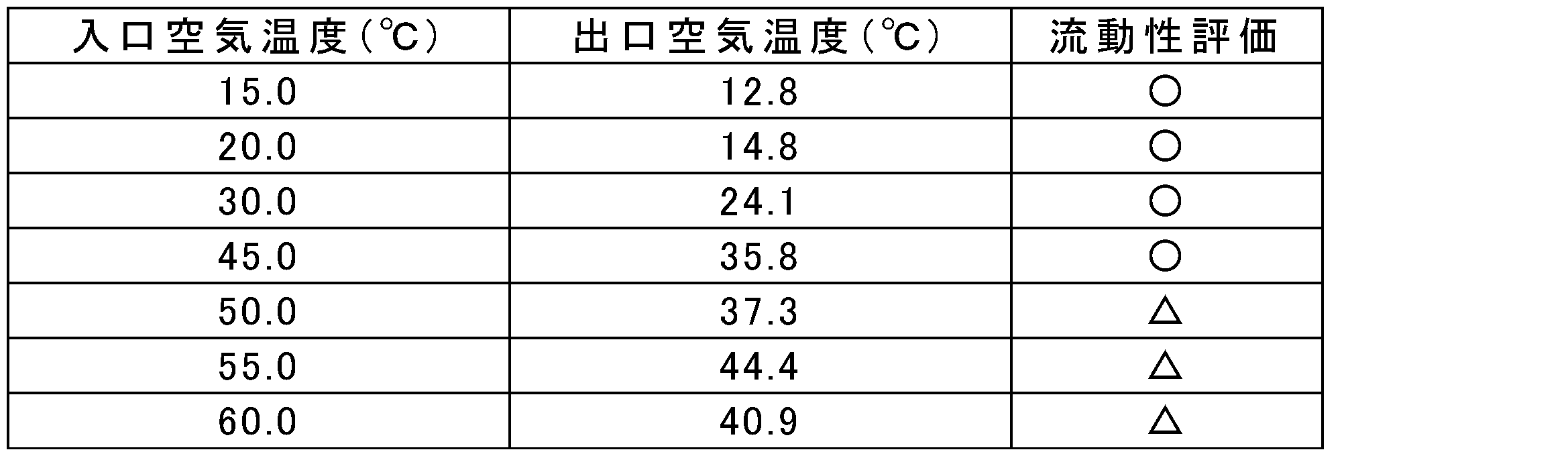
<参考例2:糖懸濁液の濃度の影響>
糖懸濁液の濃度(ブリックス値)が顆粒の流動性にどの程度影響するかを検討した。温水に糖類(トレハロース:スクロース95:5)を加え、湯せんで90℃に加温しながら溶解し、ブリックス値が50.0、55.0、及び61.0の糖液をそれぞれ調製した。各糖液を金属製容器に入れて、糖液が30℃になるまで急冷し、糖懸濁液を得た。
<Reference Example 2: Effect of Concentration of Sugar Suspension>
It was investigated how much the concentration (Brix value) of the sugar suspension affects the fluidity of the granules. Sugars (trehalose:sucrose 95:5) were added to warm water and dissolved while heating to 90°C in a hot water bath to prepare sugar solutions with Brix values of 50.0, 55.0 and 61.0, respectively. Each sugar solution was placed in a metal container and rapidly cooled to 30° C. to obtain a sugar suspension.
それぞれの糖懸濁液を、上述の噴霧乾燥機を用い噴霧乾燥して顆粒を得た。このとき、噴霧乾燥の条件は全て実施例5と同様の条件とした。 Each sugar suspension was spray-dried using the spray dryer described above to obtain granules. At this time, the same spray-drying conditions as in Example 5 were used.
各顆粒について、上述の評価基準に基づき、目視及び手確認により顆粒の流動性を評価した。その結果、ブリックス値が50.0、55.0、及び61.0の糖液を基に得られた顆粒において、全て流動性評価が〇であった。 For each granule, the fluidity of the granule was evaluated by visual and manual checks based on the evaluation criteria described above. As a result, all the granules obtained based on the sugar solutions with Brix values of 50.0, 55.0 and 61.0 were evaluated as ◯ for fluidity.
<参考例3:噴霧乾燥時におけるアトマイザ回転数の影響>
噴霧乾燥におけるアトマイザ回転数が、顆粒の流動性にどの程度影響するかを検討した。温水に糖類(トレハロース:スクロース=95:5)を加え、湯せんで90℃に加温しながら溶解し、ブリックス値が61の糖液を得た。この90℃の糖液を金属製容器に入れて、糖液が30℃になるまで急冷して、糖懸濁液を得た。
<Reference Example 3: Effect of atomizer rotation speed during spray drying>
We investigated how the atomizer rotation speed in spray drying affects the fluidity of granules. A sugar (trehalose:sucrose=95:5) was added to warm water and dissolved while being heated to 90° C. in a hot water bath to obtain a sugar solution with a Brix value of 61. This 90° C. sugar solution was placed in a metal container and rapidly cooled to 30° C. to obtain a sugar suspension.
糖懸濁液を、アトマイザ回転数が5000rpm、10000rpm、及び18000rpmの条件でそれぞれ噴霧乾燥し、顆粒を得た。アトマイザ回転数以外の噴霧乾燥の条件は実施例5における条件と同様とした。 The sugar suspension was spray-dried at atomizer rotation speeds of 5,000 rpm, 10,000 rpm, and 18,000 rpm, respectively, to obtain granules. The spray-drying conditions other than the atomizer rotation speed were the same as those in Example 5.
各顆粒について、上述の評価基準に基づき、目視及び手確認により顆粒の流動性を評価した。その結果、5000rpm、10000rpm、及び18000rpmのアトマイザ回転数で噴霧乾燥された顆粒において、全て流動性評価が〇であった。
For each granule, the fluidity of the granule was evaluated by visual and manual checks based on the evaluation criteria described above. As a result, all the granules spray-dried at atomizer rotation speeds of 5000 rpm, 10000 rpm and 18000 rpm had a flowability evaluation of ◯.
Claims (7)
結晶性の糖及び結晶性の糖アルコール(但し、β-マルトース及び下記式(1)で表される環状四糖を除く。)からなる群より選ばれる少なくとも一種を含む糖懸濁液と、香料とを含有し、前記糖及び/又は前記糖アルコールの一部が結晶状態で含まれる混合懸濁液を得る工程と、
前記混合懸濁液を低温条件で噴霧乾燥する工程と、を備え、
前記結晶状態の糖及び/又は糖アルコールの晶出率が、前記糖懸濁液全量基準で、20質量%以上であり、
前記顆粒は、前記糖及び前記糖アルコールからなる群より選ばれる少なくとも一種と、前記香料とを含有し、前記糖及び/又は前記糖アルコールは、一部が結晶状態であり、他部が非結晶状態であり、前記結晶状態の糖及び/又は糖アルコール同士が形成する間隙に、前記非結晶状態の糖及び/又は糖アルコールと、前記香料とが保持されている、前記製造方法。

A sugar suspension containing at least one selected from the group consisting of crystalline sugar and crystalline sugar alcohol (excluding β-maltose and cyclic tetrasaccharide represented by the following formula (1)); and obtaining a mixed suspension containing a part of the sugar and/or the sugar alcohol in a crystalline state;
A step of spray drying the mixed suspension under low temperature conditions,
The crystallization rate of the sugar and/or sugar alcohol in the crystalline state is 20% by mass or more based on the total amount of the sugar suspension,
The granules contain at least one selected from the group consisting of the sugar and the sugar alcohol, and the fragrance, and the sugar and/or the sugar alcohol are partly crystalline and the other part is amorphous. and wherein the non-crystalline sugar and/or sugar alcohol and the flavoring agent are held in the gaps formed by the crystalline sugar and/or sugar alcohol .
前記糖及び/又は前記糖アルコールは、一部が結晶状態であり、他部が非結晶状態であり、
前記結晶状態の糖及び/又は糖アルコール同士が形成する間隙に、前記非結晶状態の糖及び/又は糖アルコールと、前記香料とが保持されている、顆粒。

part of the sugar and/or the sugar alcohol is in a crystalline state and the other part is in an amorphous state;
A granule, wherein the non-crystalline sugar and/or sugar alcohol and the fragrance are retained in the gaps formed by the crystalline sugar and/or sugar alcohol.
Applications Claiming Priority (3)
| Application Number | Priority Date | Filing Date | Title |
|---|---|---|---|
| JP2019239272 | 2019-12-27 | ||
| JP2019239272 | 2019-12-27 | ||
| JP2020185142A JP2021106571A (en) | 2019-12-27 | 2020-11-05 | Method for producing granule, and granule |
Related Parent Applications (1)
| Application Number | Title | Priority Date | Filing Date |
|---|---|---|---|
| JP2020185142A Division JP2021106571A (en) | 2019-12-27 | 2020-11-05 | Method for producing granule, and granule |
Publications (2)
| Publication Number | Publication Date |
|---|---|
| JP2022044833A JP2022044833A (en) | 2022-03-17 |
| JP7174871B2 true JP7174871B2 (en) | 2022-11-17 |
Family
ID=76967374
Family Applications (4)
| Application Number | Title | Priority Date | Filing Date |
|---|---|---|---|
| JP2020185142A Pending JP2021106571A (en) | 2019-12-27 | 2020-11-05 | Method for producing granule, and granule |
| JP2022013031A Active JP7174871B2 (en) | 2019-12-27 | 2022-01-31 | Method for producing granules and granules |
| JP2024209656A Pending JP2025027113A (en) | 2019-12-27 | 2024-12-02 | Granule manufacturing method and granule |
| JP2025081206A Pending JP2025111836A (en) | 2019-12-27 | 2025-05-14 | Method for producing granule, and granule |
Family Applications Before (1)
| Application Number | Title | Priority Date | Filing Date |
|---|---|---|---|
| JP2020185142A Pending JP2021106571A (en) | 2019-12-27 | 2020-11-05 | Method for producing granule, and granule |
Family Applications After (2)
| Application Number | Title | Priority Date | Filing Date |
|---|---|---|---|
| JP2024209656A Pending JP2025027113A (en) | 2019-12-27 | 2024-12-02 | Granule manufacturing method and granule |
| JP2025081206A Pending JP2025111836A (en) | 2019-12-27 | 2025-05-14 | Method for producing granule, and granule |
Country Status (1)
| Country | Link |
|---|---|
| JP (4) | JP2021106571A (en) |
Families Citing this family (1)
| Publication number | Priority date | Publication date | Assignee | Title |
|---|---|---|---|---|
| JP2025080863A (en) * | 2023-11-15 | 2025-05-27 | Dm三井製糖株式会社 | Granule manufacturing method and granule |
Citations (5)
| Publication number | Priority date | Publication date | Assignee | Title |
|---|---|---|---|---|
| WO2003068007A1 (en) | 2002-02-18 | 2003-08-21 | Ajinomoto Co., Inc. | Dry powder holding flavor and aroma components and process for producing the same |
| JP2004002620A (en) | 2001-11-22 | 2004-01-08 | Hayashibara Biochem Lab Inc | Aroma retention method and its use |
| JP2004180640A (en) | 2002-12-06 | 2004-07-02 | Hayashibara Biochem Lab Inc | β-Maltose hydrated crystal-containing powder, its production method and use |
| JP2013005790A (en) | 2011-05-23 | 2013-01-10 | Mitsui Sugar Co Ltd | Method for producing solid material from saccharide solution, and solid material |
| JP2014515597A (en) | 2011-03-04 | 2014-07-03 | インターナショナル フレーバーズ アンド フラグランシズ インコーポレイテッド | Spray-dried composition capable of retaining volatile compounds and method for producing the composition |
Family Cites Families (11)
| Publication number | Priority date | Publication date | Assignee | Title |
|---|---|---|---|---|
| EP0056174B1 (en) * | 1981-01-08 | 1985-01-02 | General Foods Inc. | Soluble coffee process |
| JP3168550B2 (en) * | 1992-12-02 | 2001-05-21 | 株式会社林原生物化学研究所 | Dehydrating agent, method for dehydrating hydrated material using the same, and dehydrated article obtained by the method |
| JP2577698B2 (en) * | 1993-08-05 | 1997-02-05 | 信道 中野 | Method for producing sorbitol powder having high fluidity |
| JP3561565B2 (en) * | 1995-10-23 | 2004-09-02 | 東和化成工業株式会社 | Method for producing mixed powder composition of sugar and sorbitol with high fluidity |
| JP3955087B2 (en) * | 1995-10-23 | 2007-08-08 | 東和化成工業株式会社 | Highly flowable maltitol powder and method for producing the same |
| JP3561566B2 (en) * | 1995-10-27 | 2004-09-02 | 東和化成工業株式会社 | Method for producing mixed powder composition of sugar and maltitol with high fluidity |
| JP3955088B2 (en) * | 1995-12-06 | 2007-08-08 | 東和化成工業株式会社 | Method for producing mixed powder composition of ascorbic acid and maltitol having high fluidity |
| JPH11114027A (en) * | 1997-10-13 | 1999-04-27 | Sumitomo Pharmaceut Co Ltd | Enhanced spray-dried powder and method for producing the same |
| JP4553604B2 (en) * | 2003-06-30 | 2010-09-29 | 明治製菓株式会社 | Function enhancing composition for general food, health functional food or health supplement and method thereof |
| US8399230B2 (en) * | 2006-10-12 | 2013-03-19 | Kemin Industries, Inc. | Heat-stable enzyme compositions |
| US8939388B1 (en) * | 2010-09-27 | 2015-01-27 | ZoomEssence, Inc. | Methods and apparatus for low heat spray drying |
-
2020
- 2020-11-05 JP JP2020185142A patent/JP2021106571A/en active Pending
-
2022
- 2022-01-31 JP JP2022013031A patent/JP7174871B2/en active Active
-
2024
- 2024-12-02 JP JP2024209656A patent/JP2025027113A/en active Pending
-
2025
- 2025-05-14 JP JP2025081206A patent/JP2025111836A/en active Pending
Patent Citations (5)
| Publication number | Priority date | Publication date | Assignee | Title |
|---|---|---|---|---|
| JP2004002620A (en) | 2001-11-22 | 2004-01-08 | Hayashibara Biochem Lab Inc | Aroma retention method and its use |
| WO2003068007A1 (en) | 2002-02-18 | 2003-08-21 | Ajinomoto Co., Inc. | Dry powder holding flavor and aroma components and process for producing the same |
| JP2004180640A (en) | 2002-12-06 | 2004-07-02 | Hayashibara Biochem Lab Inc | β-Maltose hydrated crystal-containing powder, its production method and use |
| JP2014515597A (en) | 2011-03-04 | 2014-07-03 | インターナショナル フレーバーズ アンド フラグランシズ インコーポレイテッド | Spray-dried composition capable of retaining volatile compounds and method for producing the composition |
| JP2013005790A (en) | 2011-05-23 | 2013-01-10 | Mitsui Sugar Co Ltd | Method for producing solid material from saccharide solution, and solid material |
Also Published As
| Publication number | Publication date |
|---|---|
| JP2022044833A (en) | 2022-03-17 |
| JP2021106571A (en) | 2021-07-29 |
| JP2025111836A (en) | 2025-07-30 |
| JP2025027113A (en) | 2025-02-26 |
Similar Documents
| Publication | Publication Date | Title |
|---|---|---|
| Bürki et al. | New insights into respirable protein powder preparation using a nano spray dryer | |
| TW575433B (en) | Process for the manufacture of amorphous products by means of convection drying | |
| AU710039B2 (en) | Compositions in glassy phase, stabilised by a sugar | |
| Larhrib et al. | The influence of carrier and drug morphology on drug delivery from dry powder formulations | |
| Jayasundera et al. | Surface protein coverage and its implications on spray-drying of model sugar-rich foods: Solubility, powder production and characterisation | |
| EP2882842B1 (en) | Method of making agglomerated microbiological media and compositions thereof | |
| US4710231A (en) | Solid fructose | |
| JP2025111836A (en) | Method for producing granule, and granule | |
| KR20150038111A (en) | Lactate powder and method for the preparation thereof | |
| WO2007118949A1 (en) | Method of preparing a pulverulent composition and product as obtained | |
| EP2716771A1 (en) | Method for producing solid material from saccharide solution, and solid material | |
| CN104854232B (en) | The microbiological culture media of cohesion | |
| US11337910B2 (en) | Particulate composition comprising crystalline alpha, alpha-trehalose dihydrate, its preparation and uses | |
| CN111643487A (en) | Lactose microsphere and preparation method thereof | |
| JP7197743B1 (en) | Method for producing granules and granules | |
| WO2023118187A1 (en) | Free-flowing carbohydrates and process for the preparation thereof | |
| CN110573020A (en) | Beverage powder containing porous particles and partially aggregated protein | |
| FI107732B (en) | Crystallization of lactitol, a crystalline lactitol product and its use | |
| Maroof et al. | The effects of drying methods and leucine addition on properties of propolis powder: Towards the development of a new formulation | |
| EA000177B1 (en) | METHOD FOR DEPOSITING alpha-L-ASPARTYL-L-PHENYLALANINE-METHYL ESTER ON AN EDIBLE SUPPORT | |
| JP4246551B2 (en) | Edible emulsifier granulated powder and method for producing the powder | |
| WO2025105184A1 (en) | Method for producing granules, and granule | |
| JP6530641B2 (en) | Powdered foamable bath agent | |
| JP7052204B2 (en) | How to prevent moisture absorption and consolidation of the composition | |
| JP7805300B2 (en) | Fat-based powder with improved reconstitution properties - Patent Application 20070122997 |
Legal Events
| Date | Code | Title | Description |
|---|---|---|---|
| A621 | Written request for application examination |
Free format text: JAPANESE INTERMEDIATE CODE: A621 Effective date: 20220131 |
|
| A871 | Explanation of circumstances concerning accelerated examination |
Free format text: JAPANESE INTERMEDIATE CODE: A871 Effective date: 20220131 |
|
| A131 | Notification of reasons for refusal |
Free format text: JAPANESE INTERMEDIATE CODE: A131 Effective date: 20220419 |
|
| A521 | Request for written amendment filed |
Free format text: JAPANESE INTERMEDIATE CODE: A523 Effective date: 20220609 |
|
| A02 | Decision of refusal |
Free format text: JAPANESE INTERMEDIATE CODE: A02 Effective date: 20220802 |
|
| A521 | Request for written amendment filed |
Free format text: JAPANESE INTERMEDIATE CODE: A523 Effective date: 20220909 |
|
| C60 | Trial request (containing other claim documents, opposition documents) |
Free format text: JAPANESE INTERMEDIATE CODE: C60 Effective date: 20220909 |
|
| C876 | Explanation why request for accelerated appeal examination is justified |
Free format text: JAPANESE INTERMEDIATE CODE: C876 Effective date: 20220909 |
|
| A911 | Transfer to examiner for re-examination before appeal (zenchi) |
Free format text: JAPANESE INTERMEDIATE CODE: A911 Effective date: 20220921 |
|
| C21 | Notice of transfer of a case for reconsideration by examiners before appeal proceedings |
Free format text: JAPANESE INTERMEDIATE CODE: C21 Effective date: 20220927 |
|
| TRDD | Decision of grant or rejection written | ||
| A01 | Written decision to grant a patent or to grant a registration (utility model) |
Free format text: JAPANESE INTERMEDIATE CODE: A01 Effective date: 20221101 |
|
| A61 | First payment of annual fees (during grant procedure) |
Free format text: JAPANESE INTERMEDIATE CODE: A61 Effective date: 20221107 |
|
| R150 | Certificate of patent or registration of utility model |
Ref document number: 7174871 Country of ref document: JP Free format text: JAPANESE INTERMEDIATE CODE: R150 |
|
| S531 | Written request for registration of change of domicile |
Free format text: JAPANESE INTERMEDIATE CODE: R313531 |
|
| R350 | Written notification of registration of transfer |
Free format text: JAPANESE INTERMEDIATE CODE: R350 |
|
| S111 | Request for change of ownership or part of ownership |
Free format text: JAPANESE INTERMEDIATE CODE: R313111 |
|
| R350 | Written notification of registration of transfer |
Free format text: JAPANESE INTERMEDIATE CODE: R350 |
|
| R250 | Receipt of annual fees |
Free format text: JAPANESE INTERMEDIATE CODE: R250 |