JP7161760B2 - heterocyclic compound - Google Patents
heterocyclic compound Download PDFInfo
- Publication number
- JP7161760B2 JP7161760B2 JP2018566120A JP2018566120A JP7161760B2 JP 7161760 B2 JP7161760 B2 JP 7161760B2 JP 2018566120 A JP2018566120 A JP 2018566120A JP 2018566120 A JP2018566120 A JP 2018566120A JP 7161760 B2 JP7161760 B2 JP 7161760B2
- Authority
- JP
- Japan
- Prior art keywords
- group
- compound
- mixture
- optionally substituted
- amino
- Prior art date
- Legal status (The legal status is an assumption and is not a legal conclusion. Google has not performed a legal analysis and makes no representation as to the accuracy of the status listed.)
- Active
Links
Classifications
-
- C—CHEMISTRY; METALLURGY
- C07—ORGANIC CHEMISTRY
- C07H—SUGARS; DERIVATIVES THEREOF; NUCLEOSIDES; NUCLEOTIDES; NUCLEIC ACIDS
- C07H19/00—Compounds containing a hetero ring sharing one ring hetero atom with a saccharide radical; Nucleosides; Mononucleotides; Anhydro-derivatives thereof
- C07H19/02—Compounds containing a hetero ring sharing one ring hetero atom with a saccharide radical; Nucleosides; Mononucleotides; Anhydro-derivatives thereof sharing nitrogen
- C07H19/04—Heterocyclic radicals containing only nitrogen atoms as ring hetero atom
- C07H19/06—Pyrimidine radicals
-
- A—HUMAN NECESSITIES
- A61—MEDICAL OR VETERINARY SCIENCE; HYGIENE
- A61K—PREPARATIONS FOR MEDICAL, DENTAL OR TOILETRY PURPOSES
- A61K31/00—Medicinal preparations containing organic active ingredients
- A61K31/33—Heterocyclic compounds
- A61K31/395—Heterocyclic compounds having nitrogen as a ring hetero atom, e.g. guanethidine or rifamycins
- A61K31/495—Heterocyclic compounds having nitrogen as a ring hetero atom, e.g. guanethidine or rifamycins having six-membered rings with two or more nitrogen atoms as the only ring heteroatoms, e.g. piperazine or tetrazines
- A61K31/505—Pyrimidines; Hydrogenated pyrimidines, e.g. trimethoprim
- A61K31/513—Pyrimidines; Hydrogenated pyrimidines, e.g. trimethoprim having oxo groups directly attached to the heterocyclic ring, e.g. cytosine
-
- A—HUMAN NECESSITIES
- A61—MEDICAL OR VETERINARY SCIENCE; HYGIENE
- A61K—PREPARATIONS FOR MEDICAL, DENTAL OR TOILETRY PURPOSES
- A61K31/00—Medicinal preparations containing organic active ingredients
- A61K31/33—Heterocyclic compounds
- A61K31/395—Heterocyclic compounds having nitrogen as a ring hetero atom, e.g. guanethidine or rifamycins
- A61K31/495—Heterocyclic compounds having nitrogen as a ring hetero atom, e.g. guanethidine or rifamycins having six-membered rings with two or more nitrogen atoms as the only ring heteroatoms, e.g. piperazine or tetrazines
- A61K31/505—Pyrimidines; Hydrogenated pyrimidines, e.g. trimethoprim
- A61K31/519—Pyrimidines; Hydrogenated pyrimidines, e.g. trimethoprim ortho- or peri-condensed with heterocyclic rings
- A61K31/52—Purines, e.g. adenine
-
- A—HUMAN NECESSITIES
- A61—MEDICAL OR VETERINARY SCIENCE; HYGIENE
- A61K—PREPARATIONS FOR MEDICAL, DENTAL OR TOILETRY PURPOSES
- A61K31/00—Medicinal preparations containing organic active ingredients
- A61K31/33—Heterocyclic compounds
- A61K31/395—Heterocyclic compounds having nitrogen as a ring hetero atom, e.g. guanethidine or rifamycins
- A61K31/495—Heterocyclic compounds having nitrogen as a ring hetero atom, e.g. guanethidine or rifamycins having six-membered rings with two or more nitrogen atoms as the only ring heteroatoms, e.g. piperazine or tetrazines
- A61K31/505—Pyrimidines; Hydrogenated pyrimidines, e.g. trimethoprim
- A61K31/519—Pyrimidines; Hydrogenated pyrimidines, e.g. trimethoprim ortho- or peri-condensed with heterocyclic rings
- A61K31/52—Purines, e.g. adenine
- A61K31/522—Purines, e.g. adenine having oxo groups directly attached to the heterocyclic ring, e.g. hypoxanthine, guanine, acyclovir
-
- A—HUMAN NECESSITIES
- A61—MEDICAL OR VETERINARY SCIENCE; HYGIENE
- A61K—PREPARATIONS FOR MEDICAL, DENTAL OR TOILETRY PURPOSES
- A61K31/00—Medicinal preparations containing organic active ingredients
- A61K31/33—Heterocyclic compounds
- A61K31/395—Heterocyclic compounds having nitrogen as a ring hetero atom, e.g. guanethidine or rifamycins
- A61K31/55—Heterocyclic compounds having nitrogen as a ring hetero atom, e.g. guanethidine or rifamycins having seven-membered rings, e.g. azelastine, pentylenetetrazole
- A61K31/551—Heterocyclic compounds having nitrogen as a ring hetero atom, e.g. guanethidine or rifamycins having seven-membered rings, e.g. azelastine, pentylenetetrazole having two nitrogen atoms, e.g. dilazep
-
- A—HUMAN NECESSITIES
- A61—MEDICAL OR VETERINARY SCIENCE; HYGIENE
- A61K—PREPARATIONS FOR MEDICAL, DENTAL OR TOILETRY PURPOSES
- A61K31/00—Medicinal preparations containing organic active ingredients
- A61K31/33—Heterocyclic compounds
- A61K31/395—Heterocyclic compounds having nitrogen as a ring hetero atom, e.g. guanethidine or rifamycins
- A61K31/55—Heterocyclic compounds having nitrogen as a ring hetero atom, e.g. guanethidine or rifamycins having seven-membered rings, e.g. azelastine, pentylenetetrazole
- A61K31/551—Heterocyclic compounds having nitrogen as a ring hetero atom, e.g. guanethidine or rifamycins having seven-membered rings, e.g. azelastine, pentylenetetrazole having two nitrogen atoms, e.g. dilazep
- A61K31/5513—1,4-Benzodiazepines, e.g. diazepam or clozapine
- A61K31/5517—1,4-Benzodiazepines, e.g. diazepam or clozapine condensed with five-membered rings having nitrogen as a ring hetero atom, e.g. imidazobenzodiazepines, triazolam
-
- A—HUMAN NECESSITIES
- A61—MEDICAL OR VETERINARY SCIENCE; HYGIENE
- A61K—PREPARATIONS FOR MEDICAL, DENTAL OR TOILETRY PURPOSES
- A61K31/00—Medicinal preparations containing organic active ingredients
- A61K31/66—Phosphorus compounds
- A61K31/675—Phosphorus compounds having nitrogen as a ring hetero atom, e.g. pyridoxal phosphate
-
- A—HUMAN NECESSITIES
- A61—MEDICAL OR VETERINARY SCIENCE; HYGIENE
- A61K—PREPARATIONS FOR MEDICAL, DENTAL OR TOILETRY PURPOSES
- A61K47/00—Medicinal preparations characterised by the non-active ingredients used, e.g. carriers or inert additives; Targeting or modifying agents chemically bound to the active ingredient
- A61K47/50—Medicinal preparations characterised by the non-active ingredients used, e.g. carriers or inert additives; Targeting or modifying agents chemically bound to the active ingredient the non-active ingredient being chemically bound to the active ingredient, e.g. polymer-drug conjugates
- A61K47/51—Medicinal preparations characterised by the non-active ingredients used, e.g. carriers or inert additives; Targeting or modifying agents chemically bound to the active ingredient the non-active ingredient being chemically bound to the active ingredient, e.g. polymer-drug conjugates the non-active ingredient being a modifying agent
- A61K47/54—Medicinal preparations characterised by the non-active ingredients used, e.g. carriers or inert additives; Targeting or modifying agents chemically bound to the active ingredient the non-active ingredient being chemically bound to the active ingredient, e.g. polymer-drug conjugates the non-active ingredient being a modifying agent the modifying agent being an organic compound
- A61K47/545—Heterocyclic compounds
-
- A—HUMAN NECESSITIES
- A61—MEDICAL OR VETERINARY SCIENCE; HYGIENE
- A61K—PREPARATIONS FOR MEDICAL, DENTAL OR TOILETRY PURPOSES
- A61K47/00—Medicinal preparations characterised by the non-active ingredients used, e.g. carriers or inert additives; Targeting or modifying agents chemically bound to the active ingredient
- A61K47/50—Medicinal preparations characterised by the non-active ingredients used, e.g. carriers or inert additives; Targeting or modifying agents chemically bound to the active ingredient the non-active ingredient being chemically bound to the active ingredient, e.g. polymer-drug conjugates
- A61K47/51—Medicinal preparations characterised by the non-active ingredients used, e.g. carriers or inert additives; Targeting or modifying agents chemically bound to the active ingredient the non-active ingredient being chemically bound to the active ingredient, e.g. polymer-drug conjugates the non-active ingredient being a modifying agent
- A61K47/54—Medicinal preparations characterised by the non-active ingredients used, e.g. carriers or inert additives; Targeting or modifying agents chemically bound to the active ingredient the non-active ingredient being chemically bound to the active ingredient, e.g. polymer-drug conjugates the non-active ingredient being a modifying agent the modifying agent being an organic compound
- A61K47/55—Medicinal preparations characterised by the non-active ingredients used, e.g. carriers or inert additives; Targeting or modifying agents chemically bound to the active ingredient the non-active ingredient being chemically bound to the active ingredient, e.g. polymer-drug conjugates the non-active ingredient being a modifying agent the modifying agent being an organic compound the modifying agent being also a pharmacologically or therapeutically active agent, i.e. the entire conjugate being a codrug, i.e. a dimer, oligomer or polymer of pharmacologically or therapeutically active compounds
-
- A—HUMAN NECESSITIES
- A61—MEDICAL OR VETERINARY SCIENCE; HYGIENE
- A61P—SPECIFIC THERAPEUTIC ACTIVITY OF CHEMICAL COMPOUNDS OR MEDICINAL PREPARATIONS
- A61P35/00—Antineoplastic agents
-
- A—HUMAN NECESSITIES
- A61—MEDICAL OR VETERINARY SCIENCE; HYGIENE
- A61P—SPECIFIC THERAPEUTIC ACTIVITY OF CHEMICAL COMPOUNDS OR MEDICINAL PREPARATIONS
- A61P43/00—Drugs for specific purposes, not provided for in groups A61P1/00-A61P41/00
-
- C—CHEMISTRY; METALLURGY
- C07—ORGANIC CHEMISTRY
- C07D—HETEROCYCLIC COMPOUNDS
- C07D239/00—Heterocyclic compounds containing 1,3-diazine or hydrogenated 1,3-diazine rings
- C07D239/02—Heterocyclic compounds containing 1,3-diazine or hydrogenated 1,3-diazine rings not condensed with other rings
- C07D239/24—Heterocyclic compounds containing 1,3-diazine or hydrogenated 1,3-diazine rings not condensed with other rings having three or more double bonds between ring members or between ring members and non-ring members
- C07D239/28—Heterocyclic compounds containing 1,3-diazine or hydrogenated 1,3-diazine rings not condensed with other rings having three or more double bonds between ring members or between ring members and non-ring members with hetero atoms or with carbon atoms having three bonds to hetero atoms with at the most one bond to halogen, directly attached to ring carbon atoms
- C07D239/46—Two or more oxygen, sulphur or nitrogen atoms
- C07D239/56—One oxygen atom and one sulfur atom
-
- C—CHEMISTRY; METALLURGY
- C07—ORGANIC CHEMISTRY
- C07D—HETEROCYCLIC COMPOUNDS
- C07D473/00—Heterocyclic compounds containing purine ring systems
-
- C—CHEMISTRY; METALLURGY
- C07—ORGANIC CHEMISTRY
- C07D—HETEROCYCLIC COMPOUNDS
- C07D473/00—Heterocyclic compounds containing purine ring systems
- C07D473/02—Heterocyclic compounds containing purine ring systems with oxygen, sulphur, or nitrogen atoms directly attached in positions 2 and 6
- C07D473/04—Heterocyclic compounds containing purine ring systems with oxygen, sulphur, or nitrogen atoms directly attached in positions 2 and 6 two oxygen atoms
- C07D473/06—Heterocyclic compounds containing purine ring systems with oxygen, sulphur, or nitrogen atoms directly attached in positions 2 and 6 two oxygen atoms with radicals containing only hydrogen and carbon atoms, attached in position 1 or 3
-
- C—CHEMISTRY; METALLURGY
- C07—ORGANIC CHEMISTRY
- C07D—HETEROCYCLIC COMPOUNDS
- C07D473/00—Heterocyclic compounds containing purine ring systems
- C07D473/02—Heterocyclic compounds containing purine ring systems with oxygen, sulphur, or nitrogen atoms directly attached in positions 2 and 6
- C07D473/04—Heterocyclic compounds containing purine ring systems with oxygen, sulphur, or nitrogen atoms directly attached in positions 2 and 6 two oxygen atoms
- C07D473/06—Heterocyclic compounds containing purine ring systems with oxygen, sulphur, or nitrogen atoms directly attached in positions 2 and 6 two oxygen atoms with radicals containing only hydrogen and carbon atoms, attached in position 1 or 3
- C07D473/08—Heterocyclic compounds containing purine ring systems with oxygen, sulphur, or nitrogen atoms directly attached in positions 2 and 6 two oxygen atoms with radicals containing only hydrogen and carbon atoms, attached in position 1 or 3 with methyl radicals in positions 1 and 3, e.g. theophylline
-
- C—CHEMISTRY; METALLURGY
- C07—ORGANIC CHEMISTRY
- C07D—HETEROCYCLIC COMPOUNDS
- C07D473/00—Heterocyclic compounds containing purine ring systems
- C07D473/02—Heterocyclic compounds containing purine ring systems with oxygen, sulphur, or nitrogen atoms directly attached in positions 2 and 6
- C07D473/16—Heterocyclic compounds containing purine ring systems with oxygen, sulphur, or nitrogen atoms directly attached in positions 2 and 6 two nitrogen atoms
-
- C—CHEMISTRY; METALLURGY
- C07—ORGANIC CHEMISTRY
- C07D—HETEROCYCLIC COMPOUNDS
- C07D473/00—Heterocyclic compounds containing purine ring systems
- C07D473/02—Heterocyclic compounds containing purine ring systems with oxygen, sulphur, or nitrogen atoms directly attached in positions 2 and 6
- C07D473/18—Heterocyclic compounds containing purine ring systems with oxygen, sulphur, or nitrogen atoms directly attached in positions 2 and 6 one oxygen and one nitrogen atom, e.g. guanine
-
- C—CHEMISTRY; METALLURGY
- C07—ORGANIC CHEMISTRY
- C07D—HETEROCYCLIC COMPOUNDS
- C07D473/00—Heterocyclic compounds containing purine ring systems
- C07D473/26—Heterocyclic compounds containing purine ring systems with an oxygen, sulphur, or nitrogen atom directly attached in position 2 or 6, but not in both
- C07D473/28—Oxygen atom
- C07D473/30—Oxygen atom attached in position 6, e.g. hypoxanthine
-
- C—CHEMISTRY; METALLURGY
- C07—ORGANIC CHEMISTRY
- C07D—HETEROCYCLIC COMPOUNDS
- C07D473/00—Heterocyclic compounds containing purine ring systems
- C07D473/26—Heterocyclic compounds containing purine ring systems with an oxygen, sulphur, or nitrogen atom directly attached in position 2 or 6, but not in both
- C07D473/32—Nitrogen atom
- C07D473/34—Nitrogen atom attached in position 6, e.g. adenine
-
- C—CHEMISTRY; METALLURGY
- C07—ORGANIC CHEMISTRY
- C07D—HETEROCYCLIC COMPOUNDS
- C07D495/00—Heterocyclic compounds containing in the condensed system at least one hetero ring having sulfur atoms as the only ring hetero atoms
- C07D495/02—Heterocyclic compounds containing in the condensed system at least one hetero ring having sulfur atoms as the only ring hetero atoms in which the condensed system contains two hetero rings
- C07D495/04—Ortho-condensed systems
-
- C—CHEMISTRY; METALLURGY
- C07—ORGANIC CHEMISTRY
- C07D—HETEROCYCLIC COMPOUNDS
- C07D519/00—Heterocyclic compounds containing more than one system of two or more relevant hetero rings condensed among themselves or condensed with a common carbocyclic ring system not provided for in groups C07D453/00 or C07D455/00
-
- C—CHEMISTRY; METALLURGY
- C07—ORGANIC CHEMISTRY
- C07H—SUGARS; DERIVATIVES THEREOF; NUCLEOSIDES; NUCLEOTIDES; NUCLEIC ACIDS
- C07H19/00—Compounds containing a hetero ring sharing one ring hetero atom with a saccharide radical; Nucleosides; Mononucleotides; Anhydro-derivatives thereof
- C07H19/02—Compounds containing a hetero ring sharing one ring hetero atom with a saccharide radical; Nucleosides; Mononucleotides; Anhydro-derivatives thereof sharing nitrogen
- C07H19/04—Heterocyclic radicals containing only nitrogen atoms as ring hetero atom
- C07H19/16—Purine radicals
-
- C—CHEMISTRY; METALLURGY
- C07—ORGANIC CHEMISTRY
- C07H—SUGARS; DERIVATIVES THEREOF; NUCLEOSIDES; NUCLEOTIDES; NUCLEIC ACIDS
- C07H19/00—Compounds containing a hetero ring sharing one ring hetero atom with a saccharide radical; Nucleosides; Mononucleotides; Anhydro-derivatives thereof
- C07H19/02—Compounds containing a hetero ring sharing one ring hetero atom with a saccharide radical; Nucleosides; Mononucleotides; Anhydro-derivatives thereof sharing nitrogen
- C07H19/04—Heterocyclic radicals containing only nitrogen atoms as ring hetero atom
- C07H19/16—Purine radicals
- C07H19/20—Purine radicals with the saccharide radical esterified by phosphoric or polyphosphoric acids
- C07H19/213—Purine radicals with the saccharide radical esterified by phosphoric or polyphosphoric acids containing cyclic phosphate
-
- C—CHEMISTRY; METALLURGY
- C07—ORGANIC CHEMISTRY
- C07D—HETEROCYCLIC COMPOUNDS
- C07D487/00—Heterocyclic compounds containing nitrogen atoms as the only ring hetero atoms in the condensed system, not provided for by groups C07D451/00 - C07D477/00
- C07D487/12—Heterocyclic compounds containing nitrogen atoms as the only ring hetero atoms in the condensed system, not provided for by groups C07D451/00 - C07D477/00 in which the condensed system contains three hetero rings
- C07D487/14—Ortho-condensed systems
-
- C—CHEMISTRY; METALLURGY
- C07—ORGANIC CHEMISTRY
- C07D—HETEROCYCLIC COMPOUNDS
- C07D495/00—Heterocyclic compounds containing in the condensed system at least one hetero ring having sulfur atoms as the only ring hetero atoms
- C07D495/12—Heterocyclic compounds containing in the condensed system at least one hetero ring having sulfur atoms as the only ring hetero atoms in which the condensed system contains three hetero rings
- C07D495/14—Ortho-condensed systems
Landscapes
- Chemical & Material Sciences (AREA)
- Health & Medical Sciences (AREA)
- Organic Chemistry (AREA)
- Life Sciences & Earth Sciences (AREA)
- General Health & Medical Sciences (AREA)
- Veterinary Medicine (AREA)
- Medicinal Chemistry (AREA)
- Pharmacology & Pharmacy (AREA)
- Animal Behavior & Ethology (AREA)
- Public Health (AREA)
- Epidemiology (AREA)
- Engineering & Computer Science (AREA)
- Bioinformatics & Cheminformatics (AREA)
- Biochemistry (AREA)
- Biotechnology (AREA)
- Genetics & Genomics (AREA)
- Molecular Biology (AREA)
- Chemical Kinetics & Catalysis (AREA)
- General Chemical & Material Sciences (AREA)
- Nuclear Medicine, Radiotherapy & Molecular Imaging (AREA)
- Pharmaceuticals Containing Other Organic And Inorganic Compounds (AREA)
- Nitrogen Condensed Heterocyclic Rings (AREA)
- Nitrogen And Oxygen Or Sulfur-Condensed Heterocyclic Ring Systems (AREA)
Description
本発明は、細胞内分子のオートファジーによる分解を誘導する化合物に関する。 The present invention relates to compounds that induce autophagic degradation of intracellular molecules.
オートファジーは、細胞内における細胞内分子の分解機構の一つであって、酵母からヒトにいたるまでの真核生物に見られる機構である。オートファジーが誘導されると、オートファゴソームと呼ばれる膜胞が形成され、続いて、オートファゴソームがリソソームと融合することにより、オートファゴソーム内に取り込まれた細胞内分子が分解される。 Autophagy is one of the intracellular molecular degradation mechanisms found in eukaryotes from yeast to humans. When autophagy is induced, membrane vesicles called autophagosomes are formed, followed by fusion of autophagosomes with lysosomes to degrade intracellular molecules that have been taken up within the autophagosomes.
細胞が飢餓状態に陥ることによってオートファジーが誘導されることが知られているほか、発生、分化等の生理機能や、細胞内に侵入したウイルスの排除等の感染防御機能にもオートファジーが関与することが明らかになってきている。 Autophagy is known to be induced by cell starvation, and autophagy is also involved in physiological functions such as development and differentiation, as well as infection defense functions such as elimination of viruses that have invaded cells. It has become clear that
オートファジーによる細胞内分子の分解制御につながる各種分子(例えば、化合物)に関する研究が行われている。例えば、非特許文献1では、以下の化合物を細胞培養物に添加することにより、当該化合物がシステインを有するタンパク質に結合すること、および当該結合後のタンパク質がオートファゴソーム内に取り込まれることが示唆されている。

また、非特許文献2では、ハロタグ化したEGFPタンパクを発現させた細胞に以下の化合物を添加することにより、上記EGFPタンパクがオートファゴソーム内に取り込まれ、分解されることが示唆されている。
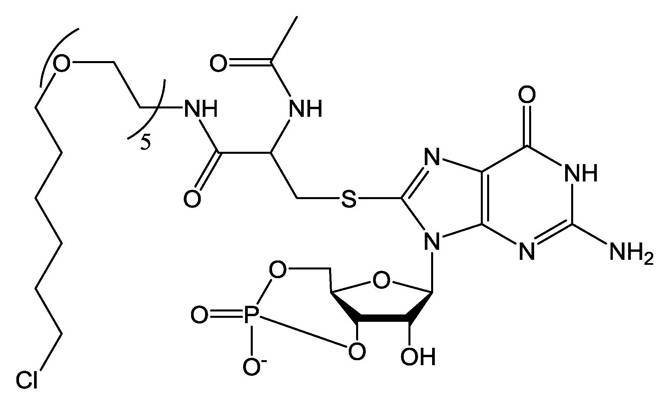
本発明は、以下の化合物およびこれを含む医薬を提供する。 The present invention provides the following compounds and medicaments containing the same.
[1]細胞内分子に結合し、該細胞内分子のオートファジーによる分解を誘導する化合物またはその塩(ただし、
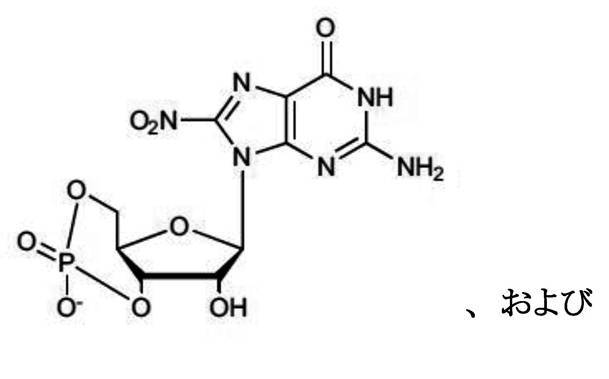
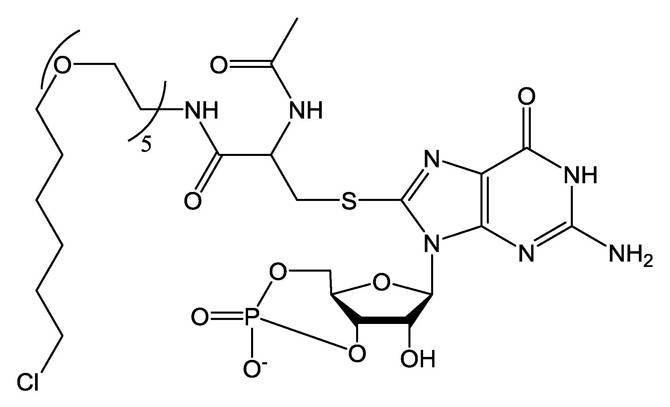
を除く)。[1] A compound or a salt thereof that binds to an intracellular molecule and induces degradation of the intracellular molecule by autophagy (provided that
except for).
[2]下式(I)

[式(I)中、
R1は、細胞内分子に特異的に結合するリガンドを示し、
Laは、結合手または主鎖が1ないし10原子からなる鎖状リンカーを示し、
Lbは、
i)結合手、
ii)主鎖が1ないし13原子からなる鎖状リンカー、または
iii)下式
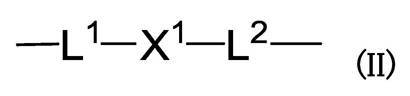
を示し、式(II)中、
L1は、結合手または主鎖が1ないし10原子からなる鎖状リンカーを示し、
X1は、置換されていてもよい二価の環状基を示し、
L2は、結合手または主鎖が1ないし2原子からなる鎖状リンカーを示し、
R2は、下式
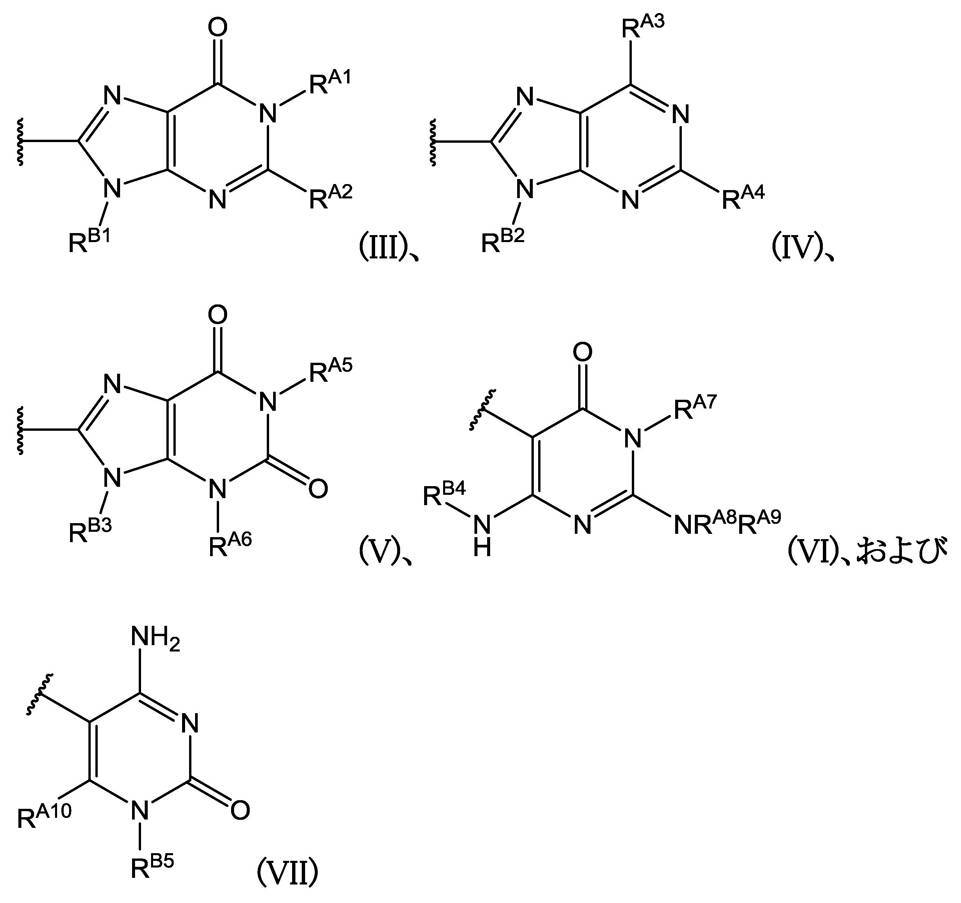
から選ばれる基を示し、各式中、
RA1、RA2、RA3、RA4、RA5、RA6、RA7、RA8、RA9およびRA10は、それぞれ独立して、水素原子または置換基を示し、または
RA1およびRA2は、互いに結合して、置換されていてもよい環を形成してもよく;
RB1、RB2、RB3、RB4およびRB5は、それぞれ独立して、置換されていてもよい炭化水素環基、置換されていてもよい不飽和複素環基、または式(VIII):-X2-R3を示し、
式中、X2は、置換されていてもよいメチレン基を示し、R3は、置換されていてもよい環状基を示す。]
で表される化合物またはその塩(本明細書中、「化合物(I)」と略記する場合がある)。[2] the following formula (I)
[In the formula (I),
R 1 indicates a ligand that specifically binds to an intracellular molecule;
L a represents a bond or a chain linker with a main chain of 1 to 10 atoms,
Lb is
i) a bond,
ii) a linear linker consisting of 1 to 13 atoms in the main chain, or
iii) the following formula
and in formula (II),
L 1 represents a chain linker consisting of a bond or main chain of 1 to 10 atoms,
X 1 represents an optionally substituted divalent cyclic group,
L 2 represents a chain linker whose bond or main chain consists of 1 to 2 atoms,
R2 is the following formula
represents a group selected from, in each formula,
R A1 , R A2 , R A3 , R A4 , R A5 , R A6 , R A7 , R A8 , R A9 and R A10 each independently represent a hydrogen atom or a substituent, or R A1 and R A2 may be joined together to form an optionally substituted ring;
R B1 , R B2 , R B3 , R B4 and R B5 are each independently an optionally substituted hydrocarbon ring group, an optionally substituted unsaturated heterocyclic group, or formula (VIII): -X 2 -R 3 ,
In the formula, X2 represents an optionally substituted methylene group , and R3 represents an optionally substituted cyclic group. ]
A compound represented by or a salt thereof (herein sometimes abbreviated as "compound (I)").
[3]R2が、下式
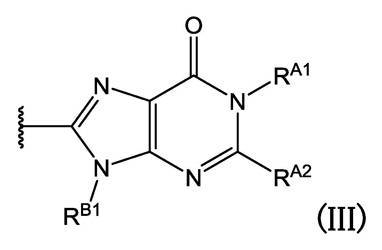
[式(III)中、
RA1およびRA2は、それぞれ独立して、水素原子または置換基を示し、または
RA1およびRA2は、互いに結合して、置換されていてもよい環を形成してもよく;
RB1は、置換されていてもよい炭化水素環基、置換されていてもよい不飽和複素環基、または式(VIII):-X2-R3を示し、式(VIII)中、
X2は、置換されていてもよいメチレン基を示し、R3は、置換されていてもよい環状基を示す。]
である上記[2]に記載の化合物またはその塩。[3] R 2 is the following formula
[in the formula (III),
R A1 and R A2 each independently represent a hydrogen atom or a substituent, or R A1 and R A2 may combine with each other to form an optionally substituted ring;
R B1 represents an optionally substituted hydrocarbon ring group, an optionally substituted unsaturated heterocyclic group, or formula (VIII): —X 2 —R 3 , wherein in formula (VIII),
X2 represents an optionally substituted methylene group , and R3 represents an optionally substituted cyclic group. ]
The compound or a salt thereof according to [2] above.
[4]上記[1]~[3]のいずれかに記載の化合物またはその塩を含有してなる医薬。 [4] A medicament containing the compound or a salt thereof according to any one of [1] to [3] above.
[5]細胞内分子の分解誘導薬である、上記[4]記載の医薬。 [5] The medicament according to [4] above, which is an intracellular molecule degradation inducer.
[6]癌の予防または治療薬である、上記[4]記載の医薬。 [6] The medicament according to [4] above, which is a prophylactic or therapeutic agent for cancer.
本発明化合物は、細胞内分子(本明細書中、「標的分子」と称することがある)に結合し、分解を誘導する活性を有し得るため、当該細胞内分子が関与する疾患(例えば、癌)の予防または治療に有効と成り得る。 Since the compound of the present invention can bind to an intracellular molecule (which may be referred to herein as a "target molecule") and have the activity of inducing degradation, it is useful in diseases involving such intracellular molecules (e.g., cancer) can be effective in prevention or treatment.
(発明の詳細な説明) (Detailed description of the invention)
以下、本発明化合物、これらの製造方法および用途について説明する。 The compounds of the present invention, their production methods and uses are described below.
以下、本明細書中で用いられる各置換基の定義について詳述する。特記しない限り各置換基は以下の定義を有する。
本明細書中、「ハロゲン原子」としては、例えば、フッ素、塩素、臭素、ヨウ素が挙げられる。
本明細書中、「C1-6アルキル基」としては、例えば、メチル、エチル、プロピル、イソプロピル、ブチル、イソブチル、sec-ブチル、tert-ブチル、ペンチル、イソペンチル、ネオペンチル、1-エチルプロピル、ヘキシル、イソヘキシル、1,1-ジメチルブチル、2,2-ジメチルブチル、3,3-ジメチルブチル、2-エチルブチルが挙げられる。
本明細書中、「ハロゲン化されていてもよいC1-6アルキル基」としては、例えば、1ないし7個、好ましくは1ないし5個のハロゲン原子を有していてもよいC1-6アルキル基が挙げられる。具体例としては、メチル、クロロメチル、ジフルオロメチル、トリクロロメチル、トリフルオロメチル、エチル、2-ブロモエチル、2,2,2-トリフルオロエチル、テトラフルオロエチル、ペンタフルオロエチル、プロピル、2,2―ジフルオロプロピル、3,3,3-トリフルオロプロピル、イソプロピル、ブチル、4,4,4-トリフルオロブチル、イソブチル、sec-ブチル、tert-ブチル、ペンチル、イソペンチル、ネオペンチル、5,5,5-トリフルオロペンチル、ヘキシル、6,6,6-トリフルオロヘキシルが挙げられる。
本明細書中、「C2-6アルケニル基」としては、例えば、エテニル、1-プロペニル、2-プロペニル、2-メチル-1-プロペニル、1-ブテニル、2-ブテニル、3-ブテニル、3-メチル-2-ブテニル、1-ペンテニル、2-ペンテニル、3-ペンテニル、4-ペンテニル、4-メチル-3-ペンテニル、1-ヘキセニル、3-ヘキセニル、5-ヘキセニルが挙げられる。
本明細書中、「C2-6アルキニル基」としては、例えば、エチニル、1-プロピニル、2-プロピニル、1-ブチニル、2-ブチニル、3-ブチニル、1-ペンチニル、2-ペンチニル、3-ペンチニル、4-ペンチニル、1-ヘキシニル、2-ヘキシニル、3-ヘキシニル、4-ヘキシニル、5-ヘキシニル、4-メチル-2-ペンチニルが挙げられる。
本明細書中、「C3-10シクロアルキル基」としては、例えば、シクロプロピル、シクロブチル、シクロペンチル、シクロヘキシル、シクロヘプチル、シクロオクチル、ビシクロ[2.2.1]ヘプチル、ビシクロ[2.2.2]オクチル、ビシクロ[3.2.1]オクチル、アダマンチルが挙げられる。
本明細書中、「ハロゲン化されていてもよいC3-10シクロアルキル基」としては、例えば、1ないし7個、好ましくは1ないし5個のハロゲン原子を有していてもよいC3-10シクロアルキル基が挙げられる。具体例としては、シクロプロピル、2,2-ジフルオロシクロプロピル、2,3-ジフルオロシクロプロピル、シクロブチル、ジフルオロシクロブチル、シクロペンチル、シクロヘキシル、シクロヘプチル、シクロオクチルが挙げられる。
本明細書中、「C3-10シクロアルケニル基」としては、例えば、シクロプロペニル、シクロブテニル、シクロペンテニル、シクロヘキセニル、シクロヘプテニル、シクロオクテニルが挙げられる。
本明細書中、「C6-14アリール基」としては、例えば、フェニル、1-ナフチル、2-ナフチル、1-アントリル、2-アントリル、9-アントリルが挙げられる。
本明細書中、「C7-16アラルキル基」としては、例えば、ベンジル、フェネチル、ナフチルメチル、フェニルプロピルが挙げられる。Hereinafter, the definition of each substituent used in the present specification will be described in detail. Each substituent has the following definition unless otherwise specified.
As used herein, the "halogen atom" includes, for example, fluorine, chlorine, bromine, and iodine.
In the present specification, the "C 1-6 alkyl group" includes, for example, methyl, ethyl, propyl, isopropyl, butyl, isobutyl, sec-butyl, tert-butyl, pentyl, isopentyl, neopentyl, 1-ethylpropyl, hexyl , isohexyl, 1,1-dimethylbutyl, 2,2-dimethylbutyl, 3,3-dimethylbutyl, 2-ethylbutyl.
In the present specification, the "optionally halogenated C 1-6 alkyl group" is, for example, C 1-6 optionally having 1 to 7, preferably 1 to 5 halogen atoms An alkyl group is mentioned. Specific examples include methyl, chloromethyl, difluoromethyl, trichloromethyl, trifluoromethyl, ethyl, 2-bromoethyl, 2,2,2-trifluoroethyl, tetrafluoroethyl, pentafluoroethyl, propyl, 2,2- difluoropropyl, 3,3,3-trifluoropropyl, isopropyl, butyl, 4,4,4-trifluorobutyl, isobutyl, sec-butyl, tert-butyl, pentyl, isopentyl, neopentyl, 5,5,5-trifluoropropyl fluoropentyl, hexyl, 6,6,6-trifluorohexyl.
As used herein, the "C 2-6 alkenyl group" includes, for example, ethenyl, 1-propenyl, 2-propenyl, 2-methyl-1-propenyl, 1-butenyl, 2-butenyl, 3-butenyl, 3- methyl-2-butenyl, 1-pentenyl, 2-pentenyl, 3-pentenyl, 4-pentenyl, 4-methyl-3-pentenyl, 1-hexenyl, 3-hexenyl and 5-hexenyl.
As used herein, the "C 2-6 alkynyl group" includes, for example, ethynyl, 1-propynyl, 2-propynyl, 1-butynyl, 2-butynyl, 3-butynyl, 1-pentynyl, 2-pentynyl, 3- Pentynyl, 4-pentynyl, 1-hexynyl, 2-hexynyl, 3-hexynyl, 4-hexynyl, 5-hexynyl, 4-methyl-2-pentynyl.
As used herein, the "C 3-10 cycloalkyl group" includes, for example, cyclopropyl, cyclobutyl, cyclopentyl, cyclohexyl, cycloheptyl, cyclooctyl, bicyclo[2.2.1]heptyl, bicyclo[2.2. 2]octyl, bicyclo[3.2.1]octyl and adamantyl.
In the present specification, the "optionally halogenated C 3-10 cycloalkyl group" includes, for example, C 3- , optionally having 1 to 7, preferably 1 to 5 halogen atoms. 10 cycloalkyl groups are mentioned. Specific examples include cyclopropyl, 2,2-difluorocyclopropyl, 2,3-difluorocyclopropyl, cyclobutyl, difluorocyclobutyl, cyclopentyl, cyclohexyl, cycloheptyl and cyclooctyl.
As used herein, the “C 3-10 cycloalkenyl group” includes, for example, cyclopropenyl, cyclobutenyl, cyclopentenyl, cyclohexenyl, cycloheptenyl and cyclooctenyl.
As used herein, the “C 6-14 aryl group” includes, for example, phenyl, 1-naphthyl, 2-naphthyl, 1-anthryl, 2-anthryl and 9-anthryl.
As used herein, the “C 7-16 aralkyl group” includes, for example, benzyl, phenethyl, naphthylmethyl and phenylpropyl.
本明細書中、「C1-6アルコキシ基」としては、例えば、メトキシ、エトキシ、プロポキシ、イソプロポキシ、ブトキシ、イソブトキシ、sec-ブトキシ、tert-ブトキシ、ペンチルオキシ、ヘキシルオキシが挙げられる。
本明細書中、「ハロゲン化されていてもよいC1-6アルコキシ基」としては、例えば、1ないし7個、好ましくは1ないし5個のハロゲン原子を有していてもよいC1-6アルコキシ基が挙げられる。具体例としては、メトキシ、ジフルオロメトキシ、トリフルオロメトキシ、エトキシ、2,2,2-トリフルオロエトキシ、プロポキシ、イソプロポキシ、ブトキシ、4,4,4-トリフルオロブトキシ、イソブトキシ、sec-ブトキシ、ペンチルオキシ、ヘキシルオキシが挙げられる。
本明細書中、「C3-10シクロアルキルオキシ基」としては、例えば、シクロプロピルオキシ、シクロブチルオキシ、シクロペンチルオキシ、シクロヘキシルオキシ、シクロヘプチルオキシ、シクロオクチルオキシが挙げられる。
本明細書中、「C1-6アルキルチオ基」としては、例えば、メチルチオ、エチルチオ、プロピルチオ、イソプロピルチオ、ブチルチオ、sec-ブチルチオ、tert-ブチルチオ、ペンチルチオ、ヘキシルチオが挙げられる。
本明細書中、「ハロゲン化されていてもよいC1-6アルキルチオ基」としては、例えば、1ないし7個、好ましくは1ないし5個のハロゲン原子を有していてもよいC1-6アルキルチオ基が挙げられる。具体例としては、メチルチオ、ジフルオロメチルチオ、トリフルオロメチルチオ、エチルチオ、プロピルチオ、イソプロピルチオ、ブチルチオ、4,4,4-トリフルオロブチルチオ、ペンチルチオ、ヘキシルチオが挙げられる。
本明細書中、「C1-6アルキル-カルボニル基」としては、例えば、アセチル、プロパノイル、ブタノイル、2-メチルプロパノイル、ペンタノイル、3-メチルブタノイル、2-メチルブタノイル、2,2-ジメチルプロパノイル、ヘキサノイル、ヘプタノイルが挙げられる。
本明細書中、「ハロゲン化されていてもよいC1-6アルキル-カルボニル基」としては、例えば、1ないし7個、好ましくは1ないし5個のハロゲン原子を有していてもよいC1-6アルキル-カルボニル基が挙げられる。具体例としては、アセチル、クロロアセチル、トリフルオロアセチル、トリクロロアセチル、プロパノイル、ブタノイル、ペンタノイル、ヘキサノイルが挙げられる。
本明細書中、「C1-6アルコキシ-カルボニル基」としては、例えば、メトキシカルボニル、エトキシカルボニル、プロポキシカルボニル、イソプロポキシカルボニル、ブトキシカルボニル、イソブトキシカルボニル、sec-ブトキシカルボニル、tert-ブトキシカルボニル、ペンチルオキシカルボニル、ヘキシルオキシカルボニルが挙げられる。
本明細書中、「C6-14アリール-カルボニル基」としては、例えば、ベンゾイル、1-ナフトイル、2-ナフトイルが挙げられる。
本明細書中、「C7-16アラルキル-カルボニル基」としては、例えば、フェニルアセチル、フェニルプロピオニルが挙げられる。
本明細書中、「5ないし14員芳香族複素環カルボニル基」としては、例えば、ニコチノイル、イソニコチノイル、テノイル、フロイルが挙げられる。
本明細書中、「3ないし14員非芳香族複素環カルボニル基」としては、例えば、モルホリニルカルボニル、ピペリジニルカルボニル、ピロリジニルカルボニルが挙げられる。As used herein, the "C 1-6 alkoxy group" includes, for example, methoxy, ethoxy, propoxy, isopropoxy, butoxy, isobutoxy, sec-butoxy, tert-butoxy, pentyloxy and hexyloxy.
In the present specification, the "optionally halogenated C 1-6 alkoxy group" includes, for example, C 1-6 optionally having 1 to 7, preferably 1 to 5 halogen atoms. An alkoxy group is mentioned. Specific examples include methoxy, difluoromethoxy, trifluoromethoxy, ethoxy, 2,2,2-trifluoroethoxy, propoxy, isopropoxy, butoxy, 4,4,4-trifluorobutoxy, isobutoxy, sec-butoxy, pentyl oxy and hexyloxy.
As used herein, the “C 3-10 cycloalkyloxy group” includes, for example, cyclopropyloxy, cyclobutyloxy, cyclopentyloxy, cyclohexyloxy, cycloheptyloxy and cyclooctyloxy.
As used herein, the "C 1-6 alkylthio group" includes, for example, methylthio, ethylthio, propylthio, isopropylthio, butylthio, sec-butylthio, tert-butylthio, pentylthio and hexylthio.
In the present specification, the "optionally halogenated C 1-6 alkylthio group" is, for example, C 1-6 optionally having 1 to 7, preferably 1 to 5 halogen atoms An alkylthio group is mentioned. Specific examples include methylthio, difluoromethylthio, trifluoromethylthio, ethylthio, propylthio, isopropylthio, butylthio, 4,4,4-trifluorobutylthio, pentylthio and hexylthio.
As used herein, the "C 1-6 alkyl-carbonyl group" includes, for example, acetyl, propanoyl, butanoyl, 2-methylpropanoyl, pentanoyl, 3-methylbutanoyl, 2-methylbutanoyl, 2,2- Dimethylpropanoyl, hexanoyl, heptanoyl.
In the present specification, the "optionally halogenated C 1-6 alkyl-carbonyl group" includes, for example, C 1 optionally having 1 to 7, preferably 1 to 5 halogen atoms. -6 alkyl-carbonyl groups. Specific examples include acetyl, chloroacetyl, trifluoroacetyl, trichloroacetyl, propanoyl, butanoyl, pentanoyl and hexanoyl.
In the present specification, the "C 1-6 alkoxy-carbonyl group" includes, for example, methoxycarbonyl, ethoxycarbonyl, propoxycarbonyl, isopropoxycarbonyl, butoxycarbonyl, isobutoxycarbonyl, sec-butoxycarbonyl, tert-butoxycarbonyl, Pentyloxycarbonyl and hexyloxycarbonyl are included.
As used herein, the “C 6-14 aryl-carbonyl group” includes, for example, benzoyl, 1-naphthoyl and 2-naphthoyl.
As used herein, the “C 7-16 aralkyl-carbonyl group” includes, for example, phenylacetyl and phenylpropionyl.
As used herein, the "5- to 14-membered aromatic heterocyclic carbonyl group" includes, for example, nicotinoyl, isonicotinoyl, thenoyl and furoyl.
As used herein, the "3- to 14-membered non-aromatic heterocyclic carbonyl group" includes, for example, morpholinylcarbonyl, piperidinylcarbonyl and pyrrolidinylcarbonyl.
本明細書中、「モノ-またはジ-C1-6アルキル-カルバモイル基」としては、例えば、メチルカルバモイル、エチルカルバモイル、ジメチルカルバモイル、ジエチルカルバモイル、N-エチル-N-メチルカルバモイルが挙げられる。
本明細書中、「モノ-またはジ-C7-16アラルキル-カルバモイル基」としては、例えば、ベンジルカルバモイル、フェネチルカルバモイルが挙げられる。
本明細書中、「C1-6アルキルスルホニル基」としては、例えば、メチルスルホニル、エチルスルホニル、プロピルスルホニル、イソプロピルスルホニル、ブチルスルホニル、sec-ブチルスルホニル、tert-ブチルスルホニルが挙げられる。
本明細書中、「ハロゲン化されていてもよいC1-6アルキルスルホニル基」としては、例えば、1ないし7個、好ましくは1ないし5個のハロゲン原子を有していてもよいC1-6アルキルスルホニル基が挙げられる。具体例としては、メチルスルホニル、ジフルオロメチルスルホニル、トリフルオロメチルスルホニル、エチルスルホニル、プロピルスルホニル、イソプロピルスルホニル、ブチルスルホニル、4,4,4-トリフルオロブチルスルホニル、ペンチルスルホニル、ヘキシルスルホニルが挙げられる。
本明細書中、「C6-14アリールスルホニル基」としては、例えば、フェニルスルホニル、1-ナフチルスルホニル、2-ナフチルスルホニルが挙げられる。As used herein, the "mono- or di-C 1-6 alkyl-carbamoyl group" includes, for example, methylcarbamoyl, ethylcarbamoyl, dimethylcarbamoyl, diethylcarbamoyl and N-ethyl-N-methylcarbamoyl.
As used herein, the "mono- or di-C 7-16 aralkyl-carbamoyl group" includes, for example, benzylcarbamoyl and phenethylcarbamoyl.
As used herein, the "C 1-6 alkylsulfonyl group" includes, for example, methylsulfonyl, ethylsulfonyl, propylsulfonyl, isopropylsulfonyl, butylsulfonyl, sec-butylsulfonyl and tert-butylsulfonyl.
In the present specification, the "optionally halogenated C 1-6 alkylsulfonyl group" includes, for example, C 1- optionally having 1 to 7, preferably 1 to 5 halogen atoms 6 alkylsulfonyl groups. Specific examples include methylsulfonyl, difluoromethylsulfonyl, trifluoromethylsulfonyl, ethylsulfonyl, propylsulfonyl, isopropylsulfonyl, butylsulfonyl, 4,4,4-trifluorobutylsulfonyl, pentylsulfonyl and hexylsulfonyl.
As used herein, the “C 6-14 arylsulfonyl group” includes, for example, phenylsulfonyl, 1-naphthylsulfonyl, and 2-naphthylsulfonyl.
本明細書中、「置換基」としては、例えば、ハロゲン原子、シアノ基、ニトロ基、置換されていてもよい炭化水素基、置換されていてもよい複素環基、アシル基、置換されていてもよいアミノ基、置換されていてもよいカルバモイル基、置換されていてもよいチオカルバモイル基、置換されていてもよいスルファモイル基、置換されていてもよいヒドロキシ基、置換されていてもよいスルファニル(SH)基、置換されていてもよいシリル基が挙げられる。
本明細書中、「炭化水素基」(「置換されていてもよい炭化水素基」における「炭化水素基」を含む)としては、例えば、C1-6アルキル基、C2-6アルケニル基、C2-6アルキニル基、C3-10シクロアルキル基、C3-10シクロアルケニル基、C6-14アリール基、C7-16アラルキル基が挙げられる。As used herein, the "substituent" includes, for example, a halogen atom, a cyano group, a nitro group, an optionally substituted hydrocarbon group, an optionally substituted heterocyclic group, an acyl group, a substituted optionally substituted amino group, optionally substituted carbamoyl group, optionally substituted thiocarbamoyl group, optionally substituted sulfamoyl group, optionally substituted hydroxy group, optionally substituted sulfanyl ( SH) group and an optionally substituted silyl group.
In the present specification, the "hydrocarbon group" (including the "hydrocarbon group" in the "optionally substituted hydrocarbon group") includes, for example, a C 1-6 alkyl group, a C 2-6 alkenyl group, C 2-6 alkynyl group, C 3-10 cycloalkyl group, C 3-10 cycloalkenyl group, C 6-14 aryl group, C 7-16 aralkyl group.
本明細書中、「置換されていてもよい炭化水素基」としては、例えば、下記の置換基群Aから選ばれる置換基を有していてもよい炭化水素基が挙げられる。
[置換基群A]
(1)ハロゲン原子、
(2)ニトロ基、
(3)シアノ基、
(4)オキソ基、
(5)ヒドロキシ基、
(6)ハロゲン化されていてもよいC1-6アルコキシ基、
(7)C6-14アリールオキシ基(例、フェノキシ、ナフトキシ)、
(8)C7-16アラルキルオキシ基(例、ベンジルオキシ)、
(9)5ないし14員芳香族複素環オキシ基(例、ピリジルオキシ)、
(10)3ないし14員非芳香族複素環オキシ基(例、モルホリニルオキシ、ピペリジニルオキシ)、
(11)C1-6アルキル-カルボニルオキシ基(例、アセトキシ、プロパノイルオキシ)、
(12)C6-14アリール-カルボニルオキシ基(例、ベンゾイルオキシ、1-ナフトイルオキシ、2-ナフトイルオキシ)、
(13)C1-6アルコキシ-カルボニルオキシ基(例、メトキシカルボニルオキシ、エトキシカルボニルオキシ、プロポキシカルボニルオキシ、ブトキシカルボニルオキシ)、
(14)モノ-またはジ-C1-6アルキル-カルバモイルオキシ基(例、メチルカルバモイルオキシ、エチルカルバモイルオキシ、ジメチルカルバモイルオキシ、ジエチルカルバモイルオキシ)、
(15)C6-14アリール-カルバモイルオキシ基(例、フェニルカルバモイルオキシ、ナフチルカルバモイルオキシ)、
(16)5ないし14員芳香族複素環カルボニルオキシ基(例、ニコチノイルオキシ)、
(17)3ないし14員非芳香族複素環カルボニルオキシ基(例、モルホリニルカルボニルオキシ、ピペリジニルカルボニルオキシ)、
(18)ハロゲン化されていてもよいC1-6アルキルスルホニルオキシ基(例、メチルスルホニルオキシ、トリフルオロメチルスルホニルオキシ)、
(19)C1-6アルキル基で置換されていてもよいC6-14アリールスルホニルオキシ基(例、フェニルスルホニルオキシ、トルエンスルホニルオキシ)、
(20)ハロゲン化されていてもよいC1-6アルキルチオ基、
(21)5ないし14員芳香族複素環基、
(22)3ないし14員非芳香族複素環基、
(23)ホルミル基、
(24)カルボキシ基、
(25)ハロゲン化されていてもよいC1-6アルキル-カルボニル基、
(26)C6-14アリール-カルボニル基、
(27)5ないし14員芳香族複素環カルボニル基、
(28)3ないし14員非芳香族複素環カルボニル基、
(29)C1-6アルコキシ-カルボニル基、
(30)C6-14アリールオキシ-カルボニル基(例、フェニルオキシカルボニル、1-ナフチルオキシカルボニル、2-ナフチルオキシカルボニル)、
(31)C7-16アラルキルオキシ-カルボニル基(例、ベンジルオキシカルボニル、フェネチルオキシカルボニル)、
(32)カルバモイル基、
(33)チオカルバモイル基、
(34)モノ-またはジ-C1-6アルキル-カルバモイル基、
(35)C6-14アリール-カルバモイル基(例、フェニルカルバモイル)、
(36)5ないし14員芳香族複素環カルバモイル基(例、ピリジルカルバモイル、チエニルカルバモイル)、
(37)3ないし14員非芳香族複素環カルバモイル基(例、モルホリニルカルバモイル、ピペリジニルカルバモイル)、
(38)ハロゲン化されていてもよいC1-6アルキルスルホニル基、
(39)C6-14アリールスルホニル基、
(40)5ないし14員芳香族複素環スルホニル基(例、ピリジルスルホニル、チエニルスルホニル)、
(41)ハロゲン化されていてもよいC1-6アルキルスルフィニル基、
(42)C6-14アリールスルフィニル基(例、フェニルスルフィニル、1-ナフチルスルフィニル、2-ナフチルスルフィニル)、
(43)5ないし14員芳香族複素環スルフィニル基(例、ピリジルスルフィニル、チエニルスルフィニル)、
(44)アミノ基、
(45)モノ-またはジ-C1-6アルキルアミノ基(例、メチルアミノ、エチルアミノ、プロピルアミノ、イソプロピルアミノ、ブチルアミノ、ジメチルアミノ、ジエチルアミノ、ジプロピルアミノ、ジブチルアミノ、N-エチル-N-メチルアミノ)、
(46)モノ-またはジ-C6-14アリールアミノ基(例、フェニルアミノ)、
(47)5ないし14員芳香族複素環アミノ基(例、ピリジルアミノ)、
(48)C7-16アラルキルアミノ基(例、ベンジルアミノ)、
(49)ホルミルアミノ基、
(50)C1-6アルキル-カルボニルアミノ基(例、アセチルアミノ、プロパノイルアミノ、ブタノイルアミノ)、
(51)(C1-6アルキル)(C1-6アルキル-カルボニル)アミノ基(例、N-アセチル-N-メチルアミノ)、
(52)C6-14アリール-カルボニルアミノ基(例、フェニルカルボニルアミノ、ナフチルカルボニルアミノ)、
(53)C1-6アルコキシ-カルボニルアミノ基(例、メトキシカルボニルアミノ、エトキシカルボニルアミノ、プロポキシカルボニルアミノ、ブトキシカルボニルアミノ、tert-ブトキシカルボニルアミノ)、
(54)C7-16アラルキルオキシ-カルボニルアミノ基(例、ベンジルオキシカルボニルアミノ)、
(55)C1-6アルキルスルホニルアミノ基(例、メチルスルホニルアミノ、エチルスルホニルアミノ)、
(56)C1-6アルキル基で置換されていてもよいC6-14アリールスルホニルアミノ基(例、フェニルスルホニルアミノ、トルエンスルホニルアミノ)、
(57)ハロゲン化されていてもよいC1-6アルキル基、
(58)C2-6アルケニル基、
(59)C2-6アルキニル基、
(60)C3-10シクロアルキル基、
(61)C3-10シクロアルケニル基、及び
(62)C6-14アリール基。In the present specification, the “optionally substituted hydrocarbon group” includes, for example, a hydrocarbon group optionally having a substituent selected from the following substituent group A.
[Substituent Group A]
(1) a halogen atom,
(2) a nitro group,
(3) a cyano group,
(4) an oxo group,
(5) a hydroxy group,
(6) an optionally halogenated C 1-6 alkoxy group,
(7) C 6-14 aryloxy group (eg, phenoxy, naphthoxy),
(8) C 7-16 aralkyloxy group (eg, benzyloxy),
(9) a 5- to 14-membered aromatic heterocyclic oxy group (e.g., pyridyloxy),
(10) 3- to 14-membered non-aromatic heterocyclic oxy groups (e.g., morpholinyloxy, piperidinyloxy),
(11) C 1-6 alkyl-carbonyloxy group (eg, acetoxy, propanoyloxy),
(12) C 6-14 aryl-carbonyloxy groups (e.g., benzoyloxy, 1-naphthoyloxy, 2-naphthoyloxy),
(13) C 1-6 alkoxy-carbonyloxy groups (e.g., methoxycarbonyloxy, ethoxycarbonyloxy, propoxycarbonyloxy, butoxycarbonyloxy),
(14) a mono- or di-C 1-6 alkyl-carbamoyloxy group (e.g., methylcarbamoyloxy, ethylcarbamoyloxy, dimethylcarbamoyloxy, diethylcarbamoyloxy),
(15) C 6-14 aryl-carbamoyloxy group (e.g., phenylcarbamoyloxy, naphthylcarbamoyloxy),
(16) a 5- to 14-membered aromatic heterocyclic carbonyloxy group (e.g., nicotinoyloxy),
(17) a 3- to 14-membered non-aromatic heterocyclic carbonyloxy group (e.g., morpholinylcarbonyloxy, piperidinylcarbonyloxy),
(18) an optionally halogenated C 1-6 alkylsulfonyloxy group (e.g., methylsulfonyloxy, trifluoromethylsulfonyloxy),
(19) a C 6-14 arylsulfonyloxy group optionally substituted with a C 1-6 alkyl group (eg, phenylsulfonyloxy, toluenesulfonyloxy),
(20) an optionally halogenated C 1-6 alkylthio group,
(21) a 5- to 14-membered aromatic heterocyclic group,
(22) a 3- to 14-membered non-aromatic heterocyclic group,
(23) a formyl group,
(24) a carboxy group,
(25) an optionally halogenated C 1-6 alkyl-carbonyl group,
(26) a C 6-14 aryl-carbonyl group,
(27) a 5- to 14-membered aromatic heterocyclic carbonyl group,
(28) a 3- to 14-membered non-aromatic heterocyclic carbonyl group,
(29) a C 1-6 alkoxy-carbonyl group,
(30) C 6-14 aryloxy-carbonyl groups (e.g. phenyloxycarbonyl, 1-naphthyloxycarbonyl, 2-naphthyloxycarbonyl),
(31) C 7-16 aralkyloxy-carbonyl groups (e.g. benzyloxycarbonyl, phenethyloxycarbonyl),
(32) a carbamoyl group,
(33) a thiocarbamoyl group,
(34) a mono- or di-C 1-6 alkyl-carbamoyl group,
(35) C 6-14 aryl-carbamoyl group (eg, phenylcarbamoyl),
(36) a 5- to 14-membered aromatic heterocyclic carbamoyl group (e.g., pyridylcarbamoyl, thienylcarbamoyl),
(37) a 3- to 14-membered non-aromatic heterocyclic carbamoyl group (e.g., morpholinylcarbamoyl, piperidinylcarbamoyl),
(38) an optionally halogenated C 1-6 alkylsulfonyl group,
(39) a C 6-14 arylsulfonyl group,
(40) a 5- to 14-membered aromatic heterocyclic sulfonyl group (e.g., pyridylsulfonyl, thienylsulfonyl),
(41) an optionally halogenated C 1-6 alkylsulfinyl group,
(42) C 6-14 arylsulfinyl group (e.g., phenylsulfinyl, 1-naphthylsulfinyl, 2-naphthylsulfinyl),
(43) a 5- to 14-membered aromatic heterocyclic sulfinyl group (e.g., pyridylsulfinyl, thienylsulfinyl),
(44) an amino group,
(45) a mono- or di-C 1-6 alkylamino group (e.g. methylamino, ethylamino, propylamino, isopropylamino, butylamino, dimethylamino, diethylamino, dipropylamino, dibutylamino, N-ethyl-N -methylamino),
(46) a mono- or di-C 6-14 arylamino group (eg, phenylamino),
(47) a 5- to 14-membered aromatic heterocyclic amino group (e.g., pyridylamino),
(48) a C 7-16 aralkylamino group (eg, benzylamino),
(49) a formylamino group,
(50) C 1-6 alkyl-carbonylamino group (e.g., acetylamino, propanoylamino, butanoylamino),
(51) (C 1-6 alkyl)(C 1-6 alkyl-carbonyl)amino group (eg, N-acetyl-N-methylamino),
(52) C 6-14 aryl-carbonylamino group (e.g., phenylcarbonylamino, naphthylcarbonylamino),
(53) C 1-6 alkoxy-carbonylamino group (e.g., methoxycarbonylamino, ethoxycarbonylamino, propoxycarbonylamino, butoxycarbonylamino, tert-butoxycarbonylamino),
(54) C 7-16 aralkyloxy-carbonylamino group (eg, benzyloxycarbonylamino),
(55) C 1-6 alkylsulfonylamino group (e.g., methylsulfonylamino, ethylsulfonylamino),
(56) a C 6-14 arylsulfonylamino group optionally substituted with a C 1-6 alkyl group (eg, phenylsulfonylamino, toluenesulfonylamino),
(57) an optionally halogenated C 1-6 alkyl group,
(58) a C 2-6 alkenyl group,
(59) a C 2-6 alkynyl group,
(60) a C 3-10 cycloalkyl group,
(61) a C 3-10 cycloalkenyl group, and (62) a C 6-14 aryl group.
「置換されていてもよい炭化水素基」における上記置換基の数は、例えば、1ないし5個、好ましくは1ないし3個である。置換基数が2個以上の場合、各置換基は同一であっても異なっていてもよい。
本明細書中、「複素環基」(「置換されていてもよい複素環基」における「複素環基」を含む)としては、例えば、環構成原子として炭素原子以外に窒素原子、硫黄原子および酸素原子から選ばれる1ないし4個のヘテロ原子をそれぞれ含有する、(i)芳香族複素環基、(ii)非芳香族複素環基および(iii)7ないし10員複素架橋環基が挙げられる。The number of substituents in the "optionally substituted hydrocarbon group" is, for example, 1 to 5, preferably 1 to 3. When the number of substituents is 2 or more, each substituent may be the same or different.
In the present specification, the "heterocyclic group" (including the "heterocyclic group" in the "optionally substituted heterocyclic group") includes, for example, nitrogen atoms, sulfur atoms and (i) aromatic heterocyclic groups, (ii) non-aromatic heterocyclic groups and (iii) 7- to 10-membered heterobridged ring groups each containing 1 to 4 heteroatoms selected from oxygen atoms. .
本明細書中、「芳香族複素環基」(「5ないし14員芳香族複素環基」を含む)としては、例えば、環構成原子として炭素原子以外に窒素原子、硫黄原子および酸素原子から選ばれる1ないし4個のヘテロ原子を含有する5ないし14員(好ましくは5ないし10員)の芳香族複素環基が挙げられる。
該「芳香族複素環基」の好適な例としては、チエニル、フリル、ピロリル、イミダゾリル、ピラゾリル、チアゾリル、イソチアゾリル、オキサゾリル、イソオキサゾリル、ピリジル、ピラジニル、ピリミジニル、ピリダジニル、1,2,4-オキサジアゾリル、1,3,4-オキサジアゾリル、1,2,4-チアジアゾリル、1,3,4-チアジアゾリル、トリアゾリル、テトラゾリル、トリアジニルなどの5ないし6員単環式芳香族複素環基;
ベンゾチオフェニル、ベンゾフラニル、ベンゾイミダゾリル、ベンゾオキサゾリル、ベンゾイソオキサゾリル、ベンゾチアゾリル、ベンゾイソチアゾリル、ベンゾトリアゾリル、イミダゾピリジニル、チエノピリジニル、フロピリジニル、ピロロピリジニル、ピラゾロピリジニル、オキサゾロピリジニル、チアゾロピリジニル、イミダゾピラジニル、イミダゾピリミジニル、チエノピリミジニル、フロピリミジニル、ピロロピリミジニル、ピラゾロピリミジニル、オキサゾロピリミジニル、チアゾロピリミジニル、ピラゾロトリアジニル、ナフト[2,3-b]チエニル、フェノキサチイニル、インドリル、イソインドリル、1H-インダゾリル、プリニル、イソキノリル、キノリル、フタラジニル、ナフチリジニル、キノキサリニル、キナゾリニル、シンノリニル、カルバゾリル、β-カルボリニル、フェナントリジニル、アクリジニル、フェナジニル、フェノチアジニル、フェノキサジニルなどの8ないし14員縮合多環式(好ましくは2または3環式)芳香族複素環基が挙げられる。In the present specification, the "aromatic heterocyclic group" (including "5- to 14-membered aromatic heterocyclic group") includes, for example, a ring-constituting atom selected from nitrogen, sulfur and oxygen atoms in addition to carbon atoms. 5- to 14-membered (preferably 5- to 10-membered) aromatic heterocyclic groups containing 1 to 4 heteroatoms.
Preferable examples of the "aromatic heterocyclic group" include thienyl, furyl, pyrrolyl, imidazolyl, pyrazolyl, thiazolyl, isothiazolyl, oxazolyl, isoxazolyl, pyridyl, pyrazinyl, pyrimidinyl, pyridazinyl, 1,2,4-oxadiazolyl, 5- to 6-membered monocyclic aromatic heterocyclic groups such as , 3,4-oxadiazolyl, 1,2,4-thiadiazolyl, 1,3,4-thiadiazolyl, triazolyl, tetrazolyl and triazinyl;
Benzothiophenyl, benzofuranyl, benzimidazolyl, benzoxazolyl, benzisoxazolyl, benzothiazolyl, benzisothiazolyl, benzotriazolyl, imidazopyridinyl, thienopyridinyl, furopyridinyl, pyrrolopyridinyl, pyrazolopyridinyl, oxazolyl pyridinyl, thiazolopyridinyl, imidazopyrazinyl, imidazopyrimidinyl, thienopyrimidinyl, furopyrimidinyl, pyrrolopyrimidinyl, pyrazolopyrimidinyl, oxazolopyrimidinyl, thiazolopyrimidinyl, pyrazolotriazinyl, naphtho[2,3 -b] thienyl, phenoxathiinyl, indolyl, isoindolyl, 1H-indazolyl, purinyl, isoquinolyl, quinolyl, phthalazinyl, naphthyridinyl, quinoxalinyl, quinazolinyl, cinnolinyl, carbazolyl, β-carbolinyl, phenanthridinyl, acridinyl, phenazinyl, pheno 8- to 14-membered condensed polycyclic (preferably bi- or tricyclic) aromatic heterocyclic groups such as thiazinyl and phenoxazinyl.
本明細書中、「非芳香族複素環基」(「3ないし14員非芳香族複素環基」を含む)としては、例えば、環構成原子として炭素原子以外に窒素原子、硫黄原子および酸素原子から選ばれる1ないし4個のヘテロ原子を含有する3ないし14員(好ましくは4ないし10員)の非芳香族複素環基が挙げられる。
該「非芳香族複素環基」の好適な例としては、アジリジニル、オキシラニル、チイラニル、アゼチジニル、オキセタニル、チエタニル、テトラヒドロチエニル、テトラヒドロフラニル、ピロリニル、ピロリジニル、イミダゾリニル、イミダゾリジニル、オキサゾリニル、オキサゾリジニル、ピラゾリニル、ピラゾリジニル、チアゾリニル、チアゾリジニル、テトラヒドロイソチアゾリル、テトラヒドロオキサゾリル、テトラヒドロイソオキサゾリル、ピペリジニル、ピペラジニル、テトラヒドロピリジニル、ジヒドロピリジニル、ジヒドロチオピラニル、テトラヒドロピリミジニル、テトラヒドロピリダジニル、ジヒドロピラニル、テトラヒドロピラニル、テトラヒドロチオピラニル、モルホリニル、チオモルホリニル、アゼパニル、ジアゼパニル、アゼピニル、オキセパニル、アゾカニル、ジアゾカニルなどの3ないし8員単環式非芳香族複素環基;
ジヒドロベンゾフラニル、ジヒドロベンゾイミダゾリル、ジヒドロベンゾオキサゾリル、ジヒドロベンゾチアゾリル、ジヒドロベンゾイソチアゾリル、ジヒドロナフト[2,3-b]チエニル、テトラヒドロイソキノリル、テトラヒドロキノリル、4H-キノリジニル、インドリニル、イソインドリニル、テトラヒドロチエノ[2,3-c]ピリジニル、テトラヒドロベンゾアゼピニル、テトラヒドロキノキサリニル、テトラヒドロフェナントリジニル、ヘキサヒドロフェノチアジニル、ヘキサヒドロフェノキサジニル、テトラヒドロフタラジニル、テトラヒドロナフチリジニル、テトラヒドロキナゾリニル、テトラヒドロシンノリニル、テトラヒドロカルバゾリル、テトラヒドロ-β-カルボリニル、テトラヒドロアクリジニル、テトラヒドロフェナジニル、テトラヒドロチオキサンテニル、オクタヒドロイソキノリルなどの9ないし14員縮合多環式(好ましくは2または3環式)非芳香族複素環基が挙げられる。In the present specification, the "non-aromatic heterocyclic group" (including "3- to 14-membered non-aromatic heterocyclic group") includes, for example, a nitrogen atom, a sulfur atom and an oxygen atom in addition to carbon atoms as ring-constituting atoms. 3- to 14-membered (preferably 4- to 10-membered) non-aromatic heterocyclic groups containing 1 to 4 heteroatoms selected from
Preferable examples of the "non-aromatic heterocyclic group" include aziridinyl, oxiranyl, thiiranyl, azetidinyl, oxetanyl, thietanyl, tetrahydrothienyl, tetrahydrofuranyl, pyrrolinyl, pyrrolidinyl, imidazolinyl, imidazolidinyl, oxazolinyl, oxazolidinyl, pyrazolinyl, pyrazolidinyl, Thiazolinyl, thiazolidinyl, tetrahydroisothiazolyl, tetrahydrooxazolyl, tetrahydroisoxazolyl, piperidinyl, piperazinyl, tetrahydropyridinyl, dihydropyridinyl, dihydrothiopyranyl, tetrahydropyrimidinyl, tetrahydropyridazinyl, dihydropyrani 3- to 8-membered monocyclic non-aromatic heterocyclic groups such as le, tetrahydropyranyl, tetrahydrothiopyranyl, morpholinyl, thiomorpholinyl, azepanyl, diazepanyl, azepinyl, oxepanyl, azocanyl, diazocanyl;
dihydrobenzofuranyl, dihydrobenzimidazolyl, dihydrobenzoxazolyl, dihydrobenzothiazolyl, dihydrobenzisothiazolyl, dihydronaphtho[2,3-b]thienyl, tetrahydroisoquinolyl, tetrahydroquinolyl, 4H-quinolidinyl, indolinyl, isoindolinyl, tetrahydrothieno[2,3-c]pyridinyl, tetrahydrobenzazepinyl, tetrahydroquinoxalinyl, tetrahydrophenanthridinyl, hexahydrophenothiazinyl, hexahydrophenoxazinyl, tetrahydrophthalazinyl, tetrahydro 9 to 14 of naphthyridinyl, tetrahydroquinazolinyl, tetrahydrocinnolinyl, tetrahydrocarbazolyl, tetrahydro-β-carbolinyl, tetrahydroacridinyl, tetrahydrophenazinyl, tetrahydrothioxanthenyl, octahydroisoquinolyl, etc. Member-condensed polycyclic (preferably bi- or tricyclic) non-aromatic heterocyclic groups are included.
本明細書中、「7ないし10員複素架橋環基」の好適な例としては、キヌクリジニル、7-アザビシクロ[2.2.1]ヘプタニルが挙げられる。
本明細書中、「含窒素複素環基」としては、「複素環基」のうち、環構成原子として少なくとも1個以上の窒素原子を含有するものが挙げられる。
本明細書中、「置換されていてもよい複素環基」としては、例えば、前記した置換基群Aから選ばれる置換基を有していてもよい複素環基が挙げられる。
「置換されていてもよい複素環基」における置換基の数は、例えば、1ないし3個である。置換基数が2個以上の場合、各置換基は同一であっても異なっていてもよい。As used herein, preferred examples of the "7- to 10-membered heterocyclic bridged ring group" include quinuclidinyl and 7-azabicyclo[2.2.1]heptanyl.
As used herein, the “nitrogen-containing heterocyclic group” includes “heterocyclic groups” containing at least one or more nitrogen atoms as ring-constituting atoms.
In the present specification, the “optionally substituted heterocyclic group” includes, for example, a heterocyclic group which may have a substituent selected from the substituent group A described above.
The number of substituents in the "optionally substituted heterocyclic group" is, for example, 1 to 3. When the number of substituents is 2 or more, each substituent may be the same or different.
本明細書中、「アシル基」としては、例えば、「ハロゲン原子、ハロゲン化されていてもよいC1-6アルコキシ基、ヒドロキシ基、ニトロ基、シアノ基、アミノ基およびカルバモイル基から選ばれる1ないし3個の置換基をそれぞれ有していてもよい、C1-6アルキル基、C2-6アルケニル基、C3-10シクロアルキル基、C3-10シクロアルケニル基、C6-14アリール基、C7-16アラルキル基、5ないし14員芳香族複素環基および3ないし14員非芳香族複素環基から選ばれる1または2個の置換基」をそれぞれ有していてもよい、ホルミル基、カルボキシ基、カルバモイル基、チオカルバモイル基、スルフィノ基、スルホ基、スルファモイル基、ホスホノ基が挙げられる。
また、「アシル基」としては、炭化水素-スルホニル基、複素環-スルホニル基、炭化水素-スルフィニル基、複素環-スルフィニル基も挙げられる。
ここで、炭化水素-スルホニル基とは、炭化水素基が結合したスルホニル基を、複素環-スルホニル基とは、複素環基が結合したスルホニル基を、炭化水素-スルフィニル基とは、炭化水素基が結合したスルフィニル基を、複素環-スルフィニル基とは、複素環基が結合したスルフィニル基を、それぞれ意味する。
「アシル基」の好適な例としては、ホルミル基、カルボキシ基、C1-6アルキル-カルボニル基、C2-6アルケニル-カルボニル基(例、クロトノイル)、C3-10シクロアルキル-カルボニル基(例、シクロブタンカルボニル、シクロペンタンカルボニル、シクロヘキサンカルボニル、シクロヘプタンカルボニル)、C3-10シクロアルケニル-カルボニル基(例、2-シクロヘキセンカルボニル)、C6-14アリール-カルボニル基、C7-16アラルキル-カルボニル基、5ないし14員芳香族複素環カルボニル基、3ないし14員非芳香族複素環カルボニル基、C1-6アルコキシ-カルボニル基、C6-14アリールオキシ-カルボニル基(例、フェニルオキシカルボニル、ナフチルオキシカルボニル)、C7-16アラルキルオキシ-カルボニル基(例、ベンジルオキシカルボニル、フェネチルオキシカルボニル)、カルバモイル基、モノ-またはジ-C1-6アルキル-カルバモイル基、モノ-またはジ-C2-6アルケニル-カルバモイル基(例、ジアリルカルバモイル)、モノ-またはジ-C3-10シクロアルキル-カルバモイル基(例、シクロプロピルカルバモイル)、モノ-またはジ-C6-14アリール-カルバモイル基(例、フェニルカルバモイル)、モノ-またはジ-C7-16アラルキル-カルバモイル基、5ないし14員芳香族複素環カルバモイル基(例、ピリジルカルバモイル)、チオカルバモイル基、モノ-またはジ-C1-6アルキル-チオカルバモイル基(例、メチルチオカルバモイル、N-エチル-N-メチルチオカルバモイル)、モノ-またはジ-C2-6アルケニル-チオカルバモイル基(例、ジアリルチオカルバモイル)、モノ-またはジ-C3-10シクロアルキル-チオカルバモイル基(例、シクロプロピルチオカルバモイル、シクロヘキシルチオカルバモイル)、モノ-またはジ-C6-14アリール-チオカルバモイル基(例、フェニルチオカルバモイル)、モノ-またはジ-C7-16アラルキル-チオカルバモイル基(例、ベンジルチオカルバモイル、フェネチルチオカルバモイル)、5ないし14員芳香族複素環チオカルバモイル基(例、ピリジルチオカルバモイル)、スルフィノ基、C1-6アルキルスルフィニル基(例、メチルスルフィニル、エチルスルフィニル)、スルホ基、C1-6アルキルスルホニル基、C6-14アリールスルホニル基、ホスホノ基、モノ-またはジ-C1-6アルキルホスホノ基(例、ジメチルホスホノ、ジエチルホスホノ、ジイソプロピルホスホノ、ジブチルホスホノ)が挙げられる。In the present specification, the "acyl group" includes, for example, "halogen atom, optionally halogenated C 1-6 alkoxy group, hydroxy group, nitro group, cyano group, amino group and carbamoyl to C 1-6 alkyl group, C 2-6 alkenyl group, C 3-10 cycloalkyl group, C 3-10 cycloalkenyl group, C 6-14 aryl group, each optionally having 3 substituents; 1 or 2 substituents selected from a C 7-16 aralkyl group, a 5- to 14-membered aromatic heterocyclic group and a 3- to 14-membered non-aromatic heterocyclic group", formyl carboxy group, carbamoyl group, thiocarbamoyl group, sulfino group, sulfo group, sulfamoyl group and phosphono group.
The "acyl group" also includes a hydrocarbon-sulfonyl group, a heterocycle-sulfonyl group, a hydrocarbon-sulfinyl group, and a heterocycle-sulfinyl group.
Here, the hydrocarbon-sulfonyl group is a sulfonyl group to which a hydrocarbon group is bonded, the heterocyclic-sulfonyl group is a sulfonyl group to which a heterocyclic group is bonded, and the hydrocarbon-sulfinyl group is a hydrocarbon group. and a heterocyclic-sulfinyl group respectively mean a sulfinyl group to which a heterocyclic group is attached.
Preferable examples of the "acyl group" include a formyl group, a carboxy group, a C 1-6 alkyl-carbonyl group, a C 2-6 alkenyl-carbonyl group (eg, crotonoyl), a C 3-10 cycloalkyl-carbonyl group ( cyclobutanecarbonyl, cyclopentanecarbonyl, cyclohexanecarbonyl, cycloheptanecarbonyl), C 3-10 cycloalkenyl-carbonyl groups (eg, 2-cyclohexenecarbonyl), C 6-14 aryl-carbonyl groups, C 7-16 aralkyl- carbonyl group, 5- to 14-membered aromatic heterocyclic carbonyl group, 3- to 14-membered non-aromatic heterocyclic carbonyl group, C 1-6 alkoxy-carbonyl group, C 6-14 aryloxy-carbonyl group (e.g., phenyloxycarbonyl , naphthyloxycarbonyl), C 7-16 aralkyloxy-carbonyl group (e.g. benzyloxycarbonyl, phenethyloxycarbonyl), carbamoyl group, mono- or di-C 1-6 alkyl-carbamoyl group, mono- or di-C 2-6 alkenyl-carbamoyl groups (e.g. diallycarbamoyl), mono- or di-C 3-10 cycloalkyl-carbamoyl groups (e.g. cyclopropylcarbamoyl), mono- or di-C 6-14 aryl-carbamoyl groups ( phenylcarbamoyl), mono- or di-C 7-16 aralkyl-carbamoyl group, 5- to 14-membered aromatic heterocyclic carbamoyl group (e.g. pyridylcarbamoyl), thiocarbamoyl group, mono- or di-C 1-6 Alkyl-thiocarbamoyl groups (e.g. methylthiocarbamoyl, N-ethyl-N-methylthiocarbamoyl), mono- or di-C2-6 alkenyl-thiocarbamoyl groups (e.g. diallylthiocarbamoyl ), mono- or di - C3 -10 cycloalkyl-thiocarbamoyl group (e.g. cyclopropylthiocarbamoyl, cyclohexylthiocarbamoyl), mono- or di-C 6-14 aryl-thiocarbamoyl group (e.g. phenylthiocarbamoyl), mono- or di-C 7 -16 aralkyl-thiocarbamoyl group (e.g., benzylthiocarbamoyl, phenethylthiocarbamoyl), 5- to 14-membered aromatic heterocyclic thiocarbamoyl group (e.g., pyridylthiocarbamoyl), sulfino group, C 1-6 alkylsulfinyl group (e.g., , methylsulfinyl, ethylsulfinyl), sulfo group, C 1-6 alkylsulfonyl group, C 6-14 arylsulfonyl group, phosphono group, mono- or di-C 1-6 alkylphosphono group (eg, dimethylphosphono, diethylphosphono, diisopropylphosphono, dibutylphosphono). .
本明細書中、「置換されていてもよいアミノ基」としては、例えば、置換基群Aから選ばれる1ないし3個の置換基をそれぞれ有していてもよい、C1-6アルキル基、C2-6アルケニル基、C3-10シクロアルキル基、C6-14アリール基、C7-16アラルキル基、C1-6アルキル-カルボニル基、C6-14アリール-カルボニル基、C7-16アラルキル-カルボニル基、5ないし14員芳香族複素環カルボニル基、3ないし14員非芳香族複素環カルボニル基、C1-6アルコキシ-カルボニル基、5ないし14員芳香族複素環基、カルバモイル基、モノ-またはジ-C1-6アルキル-カルバモイル基、モノ-またはジ-C7-16アラルキル-カルバモイル基、C1-6アルキルスルホニル基およびC6-14アリールスルホニル基から選ばれる1または2個の置換基」を有していてもよいアミノ基が挙げられる。
置換されていてもよいアミノ基の好適な例としては、アミノ基、モノ-またはジ-(ハロゲン化されていてもよいC1-6アルキル)アミノ基(例、メチルアミノ、トリフルオロメチルアミノ、ジメチルアミノ、エチルアミノ、ジエチルアミノ、プロピルアミノ、ジブチルアミノ)、モノ-またはジ-C2-6アルケニルアミノ基(例、ジアリルアミノ)、モノ-またはジ-C3-10シクロアルキルアミノ基(例、シクロプロピルアミノ、シクロヘキシルアミノ)、モノ-またはジ-C6-14アリールアミノ基(例、フェニルアミノ)、モノ-またはジ-C7-16アラルキルアミノ基(例、ベンジルアミノ、ジベンジルアミノ)、モノ-またはジ-(ハロゲン化されていてもよいC1-6アルキル)-カルボニルアミノ基(例、アセチルアミノ、プロピオニルアミノ)、モノ-またはジ-C6-14アリール-カルボニルアミノ基(例、ベンゾイルアミノ)、モノ-またはジ-C7-16アラルキル-カルボニルアミノ基(例、ベンジルカルボニルアミノ)、モノ-またはジ-5ないし14員芳香族複素環カルボニルアミノ基(例、ニコチノイルアミノ、イソニコチノイルアミノ)、モノ-またはジ-3ないし14員非芳香族複素環カルボニルアミノ基(例、ピペリジニルカルボニルアミノ)、モノ-またはジ-C1-6アルコキシ-カルボニルアミノ基(例、tert-ブトキシカルボニルアミノ)、5ないし14員芳香族複素環アミノ基(例、ピリジルアミノ)、カルバモイルアミノ基、(モノ-またはジ-C1-6アルキル-カルバモイル)アミノ基(例、メチルカルバモイルアミノ)、(モノ-またはジ-C7-16アラルキル-カルバモイル)アミノ基(例、ベンジルカルバモイルアミノ)、C1-6アルキルスルホニルアミノ基(例、メチルスルホニルアミノ、エチルスルホニルアミノ)、C6-14アリールスルホニルアミノ基(例、フェニルスルホニルアミノ)、(C1-6アルキル)(C1-6アルキル-カルボニル)アミノ基(例、N-アセチル-N-メチルアミノ)、(C1-6アルキル)(C6-14アリール-カルボニル)アミノ基(例、N-ベンゾイル-N-メチルアミノ)が挙げられる。In the present specification, the "optionally substituted amino group" includes, for example, a C 1-6 alkyl group each optionally having 1 to 3 substituents selected from Substituent Group A, C 2-6 alkenyl group, C 3-10 cycloalkyl group, C 6-14 aryl group, C 7-16 aralkyl group, C 1-6 alkyl-carbonyl group, C 6-14 aryl-carbonyl group, C 7- 16 aralkyl-carbonyl group, 5- to 14-membered aromatic heterocyclic carbonyl group, 3- to 14-membered non-aromatic heterocyclic carbonyl group, C 1-6 alkoxy-carbonyl group, 5- to 14-membered aromatic heterocyclic group, carbamoyl group , mono- or di-C 1-6 alkyl-carbamoyl group, mono- or di-C 7-16 aralkyl-carbamoyl group, C 1-6 alkylsulfonyl group and C 6-14 arylsulfonyl group. and amino groups optionally having "substituents".
Preferable examples of optionally substituted amino groups include amino groups, mono- or di-(optionally halogenated C 1-6 alkyl) amino groups (e.g., methylamino, trifluoromethylamino, dimethylamino, ethylamino, diethylamino, propylamino, dibutylamino), mono- or di-C 2-6 alkenylamino groups (e.g. diallylamino), mono- or di-C 3-10 cycloalkylamino groups (e.g. cyclopropylamino, cyclohexylamino), mono- or di-C 6-14 arylamino group (eg, phenylamino), mono- or di-C 7-16 aralkylamino group (eg, benzylamino, dibenzylamino), mono- or di-(optionally halogenated C 1-6 alkyl)-carbonylamino group (e.g., acetylamino, propionylamino), mono- or di-C 6-14 aryl-carbonylamino group (e.g., benzoylamino), mono- or di-C 7-16 aralkyl-carbonylamino group (e.g. benzylcarbonylamino), mono- or di-5- to 14-membered aromatic heterocyclic carbonylamino group (e.g. nicotinoylamino, iso nicotinoylamino), mono- or di-3- to 14-membered non-aromatic heterocyclic carbonylamino group (e.g. piperidinylcarbonylamino), mono- or di-C 1-6 alkoxy-carbonylamino group (e.g. tert -butoxycarbonylamino), 5- to 14-membered aromatic heterocyclic amino group (e.g., pyridylamino), carbamoylamino group, (mono- or di-C 1-6 alkyl-carbamoyl) amino group (e.g., methylcarbamoylamino), (mono- or di-C 7-16 aralkyl-carbamoyl) amino group (eg, benzylcarbamoylamino), C 1-6 alkylsulfonylamino group (eg, methylsulfonylamino, ethylsulfonylamino), C 6-14 arylsulfonyl amino group (eg, phenylsulfonylamino), (C 1-6 alkyl) (C 1-6 alkyl-carbonyl) amino group (eg, N-acetyl-N-methylamino), (C 1-6 alkyl) (C 6-14 aryl-carbonyl)amino groups (eg, N-benzoyl-N-methylamino).
本明細書中、「置換されていてもよいカルバモイル基」としては、例えば、「置換基群Aから選ばれる1ないし3個の置換基をそれぞれ有していてもよい、C1-6アルキル基、C2-6アルケニル基、C3-10シクロアルキル基、C6-14アリール基、C7-16アラルキル基、C1-6アルキル-カルボニル基、C6-14アリール-カルボニル基、C7-16アラルキル-カルボニル基、5ないし14員芳香族複素環カルボニル基、3ないし14員非芳香族複素環カルボニル基、C1-6アルコキシ-カルボニル基、5ないし14員芳香族複素環基、カルバモイル基、モノ-またはジ-C1-6アルキル-カルバモイル基およびモノ-またはジ-C7-16アラルキル-カルバモイル基から選ばれる1または2個の置換基」を有していてもよいカルバモイル基が挙げられる。
置換されていてもよいカルバモイル基の好適な例としては、カルバモイル基、モノ-またはジ-C1-6アルキル-カルバモイル基、モノ-またはジ-C2-6アルケニル-カルバモイル基(例、ジアリルカルバモイル)、モノ-またはジ-C3-10シクロアルキル-カルバモイル基(例、シクロプロピルカルバモイル、シクロヘキシルカルバモイル)、モノ-またはジ-C6-14アリール-カルバモイル基(例、フェニルカルバモイル)、モノ-またはジ-C7-16アラルキル-カルバモイル基、モノ-またはジ-C1-6アルキル-カルボニル-カルバモイル基(例、アセチルカルバモイル、プロピオニルカルバモイル)、モノ-またはジ-C6-14アリール-カルボニル-カルバモイル基(例、ベンゾイルカルバモイル)、5ないし14員芳香族複素環カルバモイル基(例、ピリジルカルバモイル)が挙げられる。In the present specification, the "optionally substituted carbamoyl group" includes, for example, "a C 1-6 alkyl group optionally having 1 to 3 substituents selected from Substituent Group A , C 2-6 alkenyl group, C 3-10 cycloalkyl group, C 6-14 aryl group, C 7-16 aralkyl group, C 1-6 alkyl-carbonyl group, C 6-14 aryl-carbonyl group, C 7 -16 aralkyl-carbonyl group, 5- to 14-membered aromatic heterocyclic carbonyl group, 3- to 14-membered non-aromatic heterocyclic carbonyl group, C 1-6 alkoxy-carbonyl group, 5- to 14-membered aromatic heterocyclic group, carbamoyl a carbamoyl group optionally having 1 or 2 substituents selected from a group, a mono- or di-C 1-6 alkyl-carbamoyl group and a mono- or di-C 7-16 aralkyl-carbamoyl group mentioned.
Preferable examples of optionally substituted carbamoyl groups include carbamoyl groups, mono- or di-C 1-6 alkyl-carbamoyl groups, mono- or di-C 2-6 alkenyl-carbamoyl groups (eg, diallylcarbamoyl ), mono- or di-C 3-10 cycloalkyl-carbamoyl groups (e.g. cyclopropylcarbamoyl, cyclohexylcarbamoyl), mono- or di-C 6-14 aryl-carbamoyl groups (e.g. phenylcarbamoyl), mono- or di-C 7-16 aralkyl-carbamoyl group, mono- or di-C 1-6 alkyl-carbonyl-carbamoyl group (e.g. acetylcarbamoyl, propionylcarbamoyl), mono- or di-C 6-14 aryl-carbonyl-carbamoyl groups (eg, benzoylcarbamoyl), 5- to 14-membered aromatic heterocyclic carbamoyl groups (eg, pyridylcarbamoyl).
本明細書中、「置換されていてもよいチオカルバモイル基」としては、例えば、「置換基群Aから選ばれる1ないし3個の置換基をそれぞれ有していてもよい、C1-6アルキル基、C2-6アルケニル基、C3-10シクロアルキル基、C6-14アリール基、C7-16アラルキル基、C1-6アルキル-カルボニル基、C6-14アリール-カルボニル基、C7-16アラルキル-カルボニル基、5ないし14員芳香族複素環カルボニル基、3ないし14員非芳香族複素環カルボニル基、C1-6アルコキシ-カルボニル基、5ないし14員芳香族複素環基、カルバモイル基、モノ-またはジ-C1-6アルキル-カルバモイル基およびモノ-またはジ-C7-16アラルキル-カルバモイル基から選ばれる1または2個の置換基」を有していてもよいチオカルバモイル基が挙げられる。
置換されていてもよいチオカルバモイル基の好適な例としては、チオカルバモイル基、モノ-またはジ-C1-6アルキル-チオカルバモイル基(例、メチルチオカルバモイル、エチルチオカルバモイル、ジメチルチオカルバモイル、ジエチルチオカルバモイル、N-エチル-N-メチルチオカルバモイル)、モノ-またはジ-C2-6アルケニル-チオカルバモイル基(例、ジアリルチオカルバモイル)、モノ-またはジ-C3-10シクロアルキル-チオカルバモイル基(例、シクロプロピルチオカルバモイル、シクロヘキシルチオカルバモイル)、モノ-またはジ-C6-14アリール-チオカルバモイル基(例、フェニルチオカルバモイル)、モノ-またはジ-C7-16アラルキル-チオカルバモイル基(例、ベンジルチオカルバモイル、フェネチルチオカルバモイル)、モノ-またはジ-C1-6アルキル-カルボニル-チオカルバモイル基(例、アセチルチオカルバモイル、プロピオニルチオカルバモイル)、モノ-またはジ-C6-14アリール-カルボニル-チオカルバモイル基(例、ベンゾイルチオカルバモイル)、5ないし14員芳香族複素環チオカルバモイル基(例、ピリジルチオカルバモイル)が挙げられる。In the present specification, the "optionally substituted thiocarbamoyl group" includes, for example, "C 1-6 alkyl optionally having 1 to 3 substituents selected from Substituent Group A group, C 2-6 alkenyl group, C 3-10 cycloalkyl group, C 6-14 aryl group, C 7-16 aralkyl group, C 1-6 alkyl-carbonyl group, C 6-14 aryl-carbonyl group, C 7-16 aralkyl-carbonyl group, 5- to 14-membered aromatic heterocyclic carbonyl group, 3- to 14-membered non-aromatic heterocyclic carbonyl group, C 1-6 alkoxy-carbonyl group, 5- to 14-membered aromatic heterocyclic group, thiocarbamoyl optionally having 1 or 2 substituents selected from a carbamoyl group, a mono- or di-C 1-6 alkyl-carbamoyl group and a mono- or di-C 7-16 aralkyl-carbamoyl group groups.
Preferred examples of optionally substituted thiocarbamoyl groups include thiocarbamoyl groups, mono- or di-C 1-6 alkyl-thiocarbamoyl groups (e.g., methylthiocarbamoyl, ethylthiocarbamoyl, dimethylthiocarbamoyl, diethylthiocarbamoyl, diethylthiocarbamoyl). carbamoyl, N-ethyl-N-methylthiocarbamoyl), mono- or di-C 2-6 alkenyl-thiocarbamoyl groups (e.g. diallylthiocarbamoyl), mono- or di-C 3-10 cycloalkyl-thiocarbamoyl groups ( cyclopropylthiocarbamoyl, cyclohexylthiocarbamoyl), mono- or di-C 6-14 aryl-thiocarbamoyl groups (e.g. phenylthiocarbamoyl), mono- or di-C 7-16 aralkyl-thiocarbamoyl groups (e.g. , benzylthiocarbamoyl, phenethylthiocarbamoyl), mono- or di-C 1-6 alkyl-carbonyl-thiocarbamoyl groups (e.g. acetylthiocarbamoyl, propionylthiocarbamoyl), mono- or di-C 6-14 aryl-carbonyl -thiocarbamoyl group (eg, benzoylthiocarbamoyl), 5- to 14-membered aromatic heterocyclic thiocarbamoyl group (eg, pyridylthiocarbamoyl).
本明細書中、「置換されていてもよいスルファモイル基」としては、例えば、「置換基群Aから選ばれる1ないし3個の置換基をそれぞれ有していてもよい、C1-6アルキル基、C2-6アルケニル基、C3-10シクロアルキル基、C6-14アリール基、C7-16アラルキル基、C1-6アルキル-カルボニル基、C6-14アリール-カルボニル基、C7-16アラルキル-カルボニル基、5ないし14員芳香族複素環カルボニル基、3ないし14員非芳香族複素環カルボニル基、C1-6アルコキシ-カルボニル基、5ないし14員芳香族複素環基、カルバモイル基、モノ-またはジ-C1-6アルキル-カルバモイル基およびモノ-またはジ-C7-16アラルキル-カルバモイル基から選ばれる1または2個の置換基」を有していてもよいスルファモイル基が挙げられる。
置換されていてもよいスルファモイル基の好適な例としては、スルファモイル基、モノ-またはジ-C1-6アルキル-スルファモイル基(例、メチルスルファモイル、エチルスルファモイル、ジメチルスルファモイル、ジエチルスルファモイル、N-エチル-N-メチルスルファモイル)、モノ-またはジ-C2-6アルケニル-スルファモイル基(例、ジアリルスルファモイル)、モノ-またはジ-C3-10シクロアルキル-スルファモイル基(例、シクロプロピルスルファモイル、シクロヘキシルスルファモイル)、モノ-またはジ-C6-14アリール-スルファモイル基(例、フェニルスルファモイル)、モノ-またはジ-C7-16アラルキル-スルファモイル基(例、ベンジルスルファモイル、フェネチルスルファモイル)、モノ-またはジ-C1-6アルキル-カルボニル-スルファモイル基(例、アセチルスルファモイル、プロピオニルスルファモイル)、モノ-またはジ-C6-14アリール-カルボニル-スルファモイル基(例、ベンゾイルスルファモイル)、5ないし14員芳香族複素環スルファモイル基(例、ピリジルスルファモイル)が挙げられる。In the present specification, the "optionally substituted sulfamoyl group" includes, for example, "a C 1-6 alkyl group optionally having 1 to 3 substituents selected from Substituent Group A , C 2-6 alkenyl group, C 3-10 cycloalkyl group, C 6-14 aryl group, C 7-16 aralkyl group, C 1-6 alkyl-carbonyl group, C 6-14 aryl-carbonyl group, C 7 -16 aralkyl-carbonyl group, 5- to 14-membered aromatic heterocyclic carbonyl group, 3- to 14-membered non-aromatic heterocyclic carbonyl group, C 1-6 alkoxy-carbonyl group, 5- to 14-membered aromatic heterocyclic group, carbamoyl a sulfamoyl group optionally having 1 or 2 substituents selected from a group, a mono- or di-C 1-6 alkyl-carbamoyl group and a mono- or di-C 7-16 aralkyl-carbamoyl group mentioned.
Suitable examples of optionally substituted sulfamoyl groups include sulfamoyl groups, mono- or di-C 1-6 alkyl-sulfamoyl groups (eg, methylsulfamoyl, ethylsulfamoyl, dimethylsulfamoyl, diethyl sulfamoyl, N-ethyl-N-methylsulfamoyl), mono- or di-C 2-6 alkenyl-sulfamoyl groups (e.g. diallylsulfamoyl), mono- or di-C 3-10 cycloalkyl- sulfamoyl group (eg cyclopropylsulfamoyl, cyclohexylsulfamoyl), mono- or di-C 6-14 aryl-sulfamoyl group (eg phenylsulfamoyl), mono- or di-C 7-16 aralkyl- sulfamoyl group (e.g. benzylsulfamoyl, phenethylsulfamoyl), mono- or di-C 1-6 alkyl-carbonyl-sulfamoyl group (e.g. acetylsulfamoyl, propionylsulfamoyl), mono- or di- and C 6-14 aryl-carbonyl-sulfamoyl groups (eg, benzoylsulfamoyl) and 5- to 14-membered aromatic heterocyclic sulfamoyl groups (eg, pyridylsulfamoyl).
本明細書中、「置換されていてもよいヒドロキシ基」としては、例えば、「置換基群Aから選ばれる1ないし3個の置換基をそれぞれ有していてもよい、C1-6アルキル基、C2-6アルケニル基、C3-10シクロアルキル基、C6-14アリール基、C7-16アラルキル基、C1-6アルキル-カルボニル基、C6-14アリール-カルボニル基、C7-16アラルキル-カルボニル基、5ないし14員芳香族複素環カルボニル基、3ないし14員非芳香族複素環カルボニル基、C1-6アルコキシ-カルボニル基、5ないし14員芳香族複素環基、カルバモイル基、モノ-またはジ-C1-6アルキル-カルバモイル基、モノ-またはジ-C7-16アラルキル-カルバモイル基、C1-6アルキルスルホニル基およびC6-14アリールスルホニル基から選ばれる置換基」を有していてもよいヒドロキシ基が挙げられる。
置換されていてもよいヒドロキシ基の好適な例としては、ヒドロキシ基、C1-6アルコキシ基、C2-6アルケニルオキシ基(例、アリルオキシ、2-ブテニルオキシ、2-ペンテニルオキシ、3-ヘキセニルオキシ)、C3-10シクロアルキルオキシ基(例、シクロヘキシルオキシ)、C6-14アリールオキシ基(例、フェノキシ、ナフチルオキシ)、C7-16アラルキルオキシ基(例、ベンジルオキシ、フェネチルオキシ)、C1-6アルキル-カルボニルオキシ基(例、アセチルオキシ、プロピオニルオキシ、ブチリルオキシ、イソブチリルオキシ、ピバロイルオキシ)、C6-14アリール-カルボニルオキシ基(例、ベンゾイルオキシ)、C7-16アラルキル-カルボニルオキシ基(例、ベンジルカルボニルオキシ)、5ないし14員芳香族複素環カルボニルオキシ基(例、ニコチノイルオキシ)、3ないし14員非芳香族複素環カルボニルオキシ基(例、ピペリジニルカルボニルオキシ)、C1-6アルコキシ-カルボニルオキシ基(例、tert-ブトキシカルボニルオキシ)、5ないし14員芳香族複素環オキシ基(例、ピリジルオキシ)、カルバモイルオキシ基、C1-6アルキル-カルバモイルオキシ基(例、メチルカルバモイルオキシ)、C7-16アラルキル-カルバモイルオキシ基(例、ベンジルカルバモイルオキシ)、C1-6アルキルスルホニルオキシ基(例、メチルスルホニルオキシ、エチルスルホニルオキシ)、C6-14アリールスルホニルオキシ基(例、フェニルスルホニルオキシ)が挙げられる。In the present specification, the "optionally substituted hydroxy group" includes, for example, "a C 1-6 alkyl group, each optionally having 1 to 3 substituents selected from Substituent Group A , C 2-6 alkenyl group, C 3-10 cycloalkyl group, C 6-14 aryl group, C 7-16 aralkyl group, C 1-6 alkyl-carbonyl group, C 6-14 aryl-carbonyl group, C 7 -16 aralkyl-carbonyl group, 5- to 14-membered aromatic heterocyclic carbonyl group, 3- to 14-membered non-aromatic heterocyclic carbonyl group, C 1-6 alkoxy-carbonyl group, 5- to 14-membered aromatic heterocyclic group, carbamoyl a substituent selected from a group, a mono- or di-C 1-6 alkyl-carbamoyl group, a mono- or di-C 7-16 aralkyl-carbamoyl group, a C 1-6 alkylsulfonyl group and a C 6-14 arylsulfonyl group and a hydroxy group which may have ".
Preferable examples of optionally substituted hydroxy group include hydroxy group, C 1-6 alkoxy group, C 2-6 alkenyloxy group (eg, allyloxy, 2-butenyloxy, 2-pentenyloxy, 3-hexenyloxy ), C 3-10 cycloalkyloxy group (eg, cyclohexyloxy), C 6-14 aryloxy group (eg, phenoxy, naphthyloxy), C 7-16 aralkyloxy group (eg, benzyloxy, phenethyloxy), C 1-6 alkyl-carbonyloxy group (e.g. acetyloxy, propionyloxy, butyryloxy, isobutyryloxy, pivaloyloxy), C 6-14 aryl-carbonyloxy group (e.g. benzoyloxy), C 7-16 aralkyl- carbonyloxy group (e.g., benzylcarbonyloxy), 5- to 14-membered aromatic heterocyclic carbonyloxy group (e.g., nicotinoyloxy), 3- to 14-membered non-aromatic heterocyclic carbonyloxy group (e.g., piperidinylcarbonyloxy ), C 1-6 alkoxy-carbonyloxy group (eg, tert-butoxycarbonyloxy), 5- to 14-membered aromatic heterocyclic oxy group (eg, pyridyloxy), carbamoyloxy group, C 1-6 alkyl-carbamoyloxy groups (eg methylcarbamoyloxy), C 7-16 aralkyl-carbamoyloxy groups (eg benzylcarbamoyloxy), C 1-6 alkylsulfonyloxy groups (eg methylsulfonyloxy, ethylsulfonyloxy), C 6-14 Arylsulfonyloxy groups (eg, phenylsulfonyloxy) are included.
本明細書中、「置換されていてもよいスルファニル基」としては、例えば、「置換基群Aから選ばれる1ないし3個の置換基をそれぞれ有していてもよい、C1-6アルキル基、C2-6アルケニル基、C3-10シクロアルキル基、C6-14アリール基、C7-16アラルキル基、C1-6アルキル-カルボニル基、C6-14アリール-カルボニル基および5ないし14員芳香族複素環基から選ばれる置換基」を有していてもよいスルファニル基、ハロゲン化されたスルファニル基が挙げられる。
置換されていてもよいスルファニル基の好適な例としては、スルファニル(-SH)基、C1-6アルキルチオ基、C2-6アルケニルチオ基(例、アリルチオ、2-ブテニルチオ、2-ペンテニルチオ、3-ヘキセニルチオ)、C3-10シクロアルキルチオ基(例、シクロヘキシルチオ)、C6-14アリールチオ基(例、フェニルチオ、ナフチルチオ)、C7-16アラルキルチオ基(例、ベンジルチオ、フェネチルチオ)、C1-6アルキル-カルボニルチオ基(例、アセチルチオ、プロピオニルチオ、ブチリルチオ、イソブチリルチオ、ピバロイルチオ)、C6-14アリール-カルボニルチオ基(例、ベンゾイルチオ)、5ないし14員芳香族複素環チオ基(例、ピリジルチオ)、ハロゲン化チオ基(例、ペンタフルオロチオ)が挙げられる。In the present specification, the "optionally substituted sulfanyl group" includes, for example, "a C 1-6 alkyl group optionally having 1 to 3 substituents selected from Substituent Group A , a C 2-6 alkenyl group, a C 3-10 cycloalkyl group, a C 6-14 aryl group, a C 7-16 aralkyl group, a C 1-6 alkyl-carbonyl group, a C 6-14 aryl-carbonyl group and 5 to a sulfanyl group optionally having a substituent selected from 14-membered aromatic heterocyclic groups, and a halogenated sulfanyl group.
Preferable examples of optionally substituted sulfanyl groups include sulfanyl (—SH) group, C 1-6 alkylthio group, C 2-6 alkenylthio group (eg, allylthio, 2-butenylthio, 2-pentenylthio, 3-hexenylthio), C 3-10 cycloalkylthio groups (eg, cyclohexylthio), C 6-14 arylthio groups (eg, phenylthio, naphthylthio), C 7-16 aralkylthio groups (eg, benzylthio, phenethylthio), C 1-6 alkyl-carbonylthio group (e.g. acetylthio, propionylthio, butyrylthio, isobutyrylthio, pivaloylthio), C 6-14 aryl-carbonylthio group (e.g. benzoylthio), 5- to 14-membered aromatic heterocyclic thio group (eg, pyridylthio) and halogenated thio groups (eg, pentafluorothio).
本明細書中、「置換されていてもよいシリル基」としては、例えば、「置換基群Aから選ばれる1ないし3個の置換基をそれぞれ有していてもよい、C1-6アルキル基、C2-6アルケニル基、C3-10シクロアルキル基、C6-14アリール基およびC7-16アラルキル基から選ばれる1ないし3個の置換基」を有していてもよいシリル基が挙げられる。
置換されていてもよいシリル基の好適な例としては、トリ-C1-6アルキルシリル基(例、トリメチルシリル、tert-ブチル(ジメチル)シリル)が挙げられる。In the present specification, the "optionally substituted silyl group" includes, for example, "a C 1-6 alkyl group optionally having 1 to 3 substituents selected from Substituent Group A , a C 2-6 alkenyl group, a C 3-10 cycloalkyl group, a C 6-14 aryl group and a C 7-16 aralkyl group. mentioned.
Preferable examples of optionally substituted silyl groups include tri-C 1-6 alkylsilyl groups (eg, trimethylsilyl, tert-butyl(dimethyl)silyl).
本明細書中、「C1-6アルキレン基」としては、例えば、-CH2-、-(CH2)2-、-(CH2)3-、-(CH2)4-、-(CH2)5-、-(CH2)6-、-CH(CH3)-、-C(CH3)2-、-CH(C2H5)-、-CH(C3H7)-、-CH(CH(CH3)2)-、-(CH(CH3))2-、-CH2-CH(CH3)-、-CH(CH3)-CH2-、-CH2-CH2-C(CH3)2-、-C(CH3)2-CH2-CH2-、-CH2-CH2-CH2-C(CH3)2-、-C(CH3)2-CH2-CH2-CH2-が挙げられる。
本明細書中、「C2-6アルケニレン基」としては、例えば、-CH=CH-、-CH2-CH=CH-、-CH=CH-CH2-、-C(CH3)2-CH=CH-、-CH=CH-C(CH3)2-、-CH2-CH=CH-CH2-、-CH2-CH2-CH=CH-、-CH=CH-CH2-CH2-、-CH=CH-CH=CH-、-CH=CH-CH2-CH2-CH2-、-CH2-CH2-CH2-CH=CH-が挙げられる。
本明細書中、「C2-6アルキニレン基」としては、例えば、-C≡C-、-CH2-C≡C-、-C≡C-CH2-、-C(CH3)2-C≡C-、-C≡C-C(CH3)2-、-CH2-C≡C-CH2-、-CH2-CH2-C≡C-、-C≡C-CH2-CH2-、-C≡C-C≡C-、-C≡C-CH2-CH2-CH2-、-CH2-CH2-CH2-C≡C-が挙げられる。In the present specification, the "C 1-6 alkylene group" includes, for example, -CH 2 -, -(CH 2 ) 2 -, -(CH 2 ) 3 -, -(CH 2 ) 4 -, -(CH 2 ) 5- , -(CH 2 ) 6 -, -CH(CH 3 )-, -C(CH 3 ) 2 -, -CH(C 2 H 5 )-, -CH(C 3 H 7 )-, -CH(CH(CH 3 ) 2 )-, -(CH(CH 3 )) 2 -, -CH 2 -CH(CH 3 )-, -CH(CH 3 )-CH 2 -, -CH 2 -CH 2 -C(CH 3 ) 2 -, -C(CH 3 ) 2 -CH 2 -CH 2 -, -CH 2 -CH 2 -CH 2 -C(CH 3 ) 2 -, -C(CH 3 ) 2 -CH 2 -CH 2 -CH 2 - may be mentioned.
In the present specification, the "C 2-6 alkenylene group" includes, for example, -CH=CH-, -CH 2 -CH=CH-, -CH=CH-CH 2 -, -C(CH 3 ) 2 - CH=CH-, -CH=CH-C(CH 3 ) 2 -, -CH 2 -CH=CH-CH 2 -, -CH 2 -CH 2 -CH=CH-, -CH=CH-CH 2 - CH 2 -, -CH=CH-CH=CH-, -CH=CH-CH 2 -CH 2 -CH 2 -, and -CH 2 -CH 2 -CH 2 -CH=CH-.
In the present specification, the "C 2-6 alkynylene group" includes, for example, -C≡C-, -CH 2 -C≡C-, -C≡C-CH 2 -, -C(CH 3 ) 2 - C≡C—, —C≡C—C(CH 3 ) 2 —, —CH 2 —C≡C—CH 2 —, —CH 2 —CH 2 —C≡C—, —C≡C—CH 2 — CH 2 -, -C≡C-C≡C-, -C≡C-CH 2 -CH 2 -CH 2 -, and -CH 2 -CH 2 -CH 2 -C≡C-.
本明細書中、「炭化水素環」としては、例えば、C6-14芳香族炭化水素環、C3-10シクロアルカン、C3-10シクロアルケンが挙げられる。
本明細書中、「C6-14芳香族炭化水素環」としては、例えば、ベンゼン、ナフタレンが挙げられる。
本明細書中、「C3-10シクロアルカン」としては、例えば、シクロプロパン、シクロブタン、シクロペンタン、シクロヘキサン、シクロヘプタン、シクロオクタンが挙げられる。
本明細書中、「C3-10シクロアルケン」としては、例えば、シクロプロペン、シクロブテン、シクロペンテン、シクロヘキセン、シクロヘプテン、シクロオクテンが挙げられる。
本明細書中、「複素環」としては、例えば、環構成原子として炭素原子以外に窒素原子、硫黄原子および酸素原子から選ばれる1ないし4個のヘテロ原子をそれぞれ含有する、芳香族複素環および非芳香族複素環が挙げられる。As used herein, "hydrocarbon ring" includes, for example, C 6-14 aromatic hydrocarbon ring, C 3-10 cycloalkane, and C 3-10 cycloalkene.
As used herein, the “C 6-14 aromatic hydrocarbon ring” includes, for example, benzene and naphthalene.
As used herein, “C 3-10 cycloalkane” includes, for example, cyclopropane, cyclobutane, cyclopentane, cyclohexane, cycloheptane and cyclooctane.
As used herein, “C 3-10 cycloalkene” includes, for example, cyclopropene, cyclobutene, cyclopentene, cyclohexene, cycloheptene and cyclooctene.
As used herein, the term "heterocyclic ring" includes, for example, an aromatic heterocyclic ring containing 1 to 4 heteroatoms selected from nitrogen atoms, sulfur atoms and oxygen atoms in addition to carbon atoms as ring-constituting atoms, and Non-aromatic heterocycles are included.
本明細書中、「芳香族複素環」としては、例えば、環構成原子として炭素原子以外に窒素原子、硫黄原子および酸素原子から選ばれる1ないし4個のヘテロ原子を含有する5ないし14員(好ましくは5ないし10員)の芳香族複素環が挙げられる。該「芳香族複素環」の好適な例としては、チオフェン、フラン、ピロール、イミダゾール、ピラゾール、チアゾール、イソチアゾール、オキサゾール、イソオキサゾール、ピリジン、ピラジン、ピリミジン、ピリダジン、1,2,4-オキサジアゾール、1,3,4-オキサジアゾール、1,2,4-チアジアゾール、1,3,4-チアジアゾール、トリアゾール、テトラゾール、トリアジンなどの5ないし6員単環式芳香族複素環;
ベンゾチオフェン、ベンゾフラン、ベンゾイミダゾール、ベンゾオキサゾール、ベンゾイソオキサゾール、ベンゾチアゾール、ベンゾイソチアゾール、ベンゾトリアゾール、イミダゾピリジン、チエノピリジン、フロピリジン、ピロロピリジン、ピラゾロピリジン、オキサゾロピリジン、チアゾロピリジン、イミダゾピラジン、イミダゾピリミジン、チエノピリミジン、フロピリミジン、ピロロピリミジン、ピラゾロピリミジン、オキサゾロピリミジン、チアゾロピリミジン、ピラゾロピリミジン、ピラゾロトリアジン、ナフト[2,3-b]チオフェン、フェノキサチイン、インド-ル、イソインドール、1H-インダゾール、プリン、イソキノリン、キノリン、フタラジン、ナフチリジン、キノキサリン、キナゾリン、シンノリン、カルバゾール、β-カルボリン、フェナントリジン、アクリジン、フェナジン、フェノチアジン、フェノキサジンなどの8ないし14員縮合多環式(好ましくは2または3環式)芳香族複素環が挙げられる。In the present specification, the "aromatic heterocyclic ring" includes, for example, a 5- to 14-membered ring containing 1 to 4 heteroatoms selected from nitrogen, sulfur and oxygen atoms in addition to carbon atoms ( Preferred are 5- to 10-membered) aromatic heterocycles. Preferable examples of the "aromatic heterocycle" include thiophene, furan, pyrrole, imidazole, pyrazole, thiazole, isothiazole, oxazole, isoxazole, pyridine, pyrazine, pyrimidine, pyridazine, 1,2,4-oxazide 5- to 6-membered monocyclic aromatic heterocycles such as azoles, 1,3,4-oxadiazoles, 1,2,4-thiadiazoles, 1,3,4-thiadiazoles, triazoles, tetrazoles, triazines;
Benzothiophene, benzofuran, benzimidazole, benzoxazole, benzisoxazole, benzothiazole, benzisothiazole, benzotriazole, imidazopyridine, thienopyridine, furopyridine, pyrrolopyridine, pyrazolopyridine, oxazolopyridine, thiazolopyridine, imidazopyrazine, imidazopyrimidines, thienopyrimidines, furopyrimidines, pyrrolopyrimidines, pyrazolopyrimidines, oxazolopyrimidines, thiazolopyrimidines, pyrazolopyrimidines, pyrazolotriazines, naphtho[2,3-b]thiophenes, phenoxathiins, indoles, 8- to 14-membered condensed polycyclic rings such as isoindole, 1H-indazole, purine, isoquinoline, quinoline, phthalazine, naphthyridine, quinoxaline, quinazoline, cinnoline, carbazole, β-carboline, phenanthridine, acridine, phenazine, phenothiazine, phenoxazine, etc. Formula (preferably bi- or tricyclic) aromatic heterocycles may be mentioned.
本明細書中、「非芳香族複素環」としては、例えば、環構成原子として炭素原子以外に窒素原子、硫黄原子および酸素原子から選ばれる1ないし4個のヘテロ原子を含有する3ないし14員(好ましくは4ないし10員)の非芳香族複素環が挙げられる。該「非芳香族複素環」の好適な例としては、アジリジン、オキシラン、チイラン、アゼチジン、オキセタン、チエタン、テトラヒドロチオフェン、テトラヒドロフラン、ピロリン、ピロリジン、イミダゾリン、イミダゾリジン、オキサゾリン、オキサゾリジン、ピラゾリン、ピラゾリジン、チアゾリン、チアゾリジン、テトラヒドロイソチアゾール、テトラヒドロオキサゾール、テトラヒドロイソオキサゾール、ピペリジン、ピペラジン、テトラヒドロピリジン、ジヒドロピリジン、ジヒドロチオピラン、テトラヒドロピリミジン、テトラヒドロピリダジン、ジヒドロピラン、テトラヒドロピラン、テトラヒドロチオピラン、モルホリン、チオモルホリン、アゼパニン、ジアゼパン、アゼピン、アゾカン、ジアゾカン、オキセパンなどの3ないし8員単環式非芳香族複素環;
ジヒドロベンゾフラン、ジヒドロベンゾイミダゾール、ジヒドロベンゾオキサゾール、ジヒドロベンゾチアゾール、ジヒドロベンゾイソチアゾール、ジヒドロナフト[2,3-b]チオフェン、テトラヒドロイソキノリン、テトラヒドロキノリン、4H-キノリジン、インドリン、イソインドリン、テトラヒドロチエノ[2,3-c]ピリジン、テトラヒドロベンゾアゼピン、テトラヒドロキノキサリン、テトラヒドロフェナントリジン、ヘキサヒドロフェノチアジン、ヘキサヒドロフェノキサジン、テトラヒドロフタラジン、テトラヒドロナフチリジン、テトラヒドロキナゾリン、テトラヒドロシンノリン、テトラヒドロカルバゾール、テトラヒドロ-β-カルボリン、テトラヒドロアクリジン、テトラヒドロフェナジン、テトラヒドロチオキサンテン、オクタヒドロイソキノリンなどの9ないし14員縮合多環式(好ましくは2または3環式)非芳香族複素環が挙げられる。
本明細書中、「環状基」としては、例えば、C3-10シクロアルキル基、C3-10シクロアルケニル基、C6-14アリール基が挙げられる。
本明細書中、「C1-12アルコキシ基」としては、例えば、C1-6アルコキシ基が挙げられる。
本明細書中、「不飽和複素環基」としては、例えば、「複素環基」のうち、少なくとも一つの不飽和結合を有するものが挙げられる。In the present specification, the "non-aromatic heterocyclic ring" includes, for example, a 3- to 14-membered ring containing 1 to 4 heteroatoms selected from nitrogen, sulfur and oxygen atoms in addition to carbon atoms as ring-constituting atoms. (preferably 4- to 10-membered) non-aromatic heterocycles. Preferable examples of the "non-aromatic heterocycle" include aziridine, oxirane, thiirane, azetidine, oxetane, thietane, tetrahydrothiophene, tetrahydrofuran, pyrroline, pyrrolidine, imidazoline, imidazolidine, oxazoline, oxazolidine, pyrazoline, pyrazolidine, thiazoline , thiazolidine, tetrahydroisothiazole, tetrahydrooxazole, tetrahydroisoxazole, piperidine, piperazine, tetrahydropyridine, dihydropyridine, dihydrothiopyran, tetrahydropyrimidine, tetrahydropyridazine, dihydropyran, tetrahydropyran, tetrahydrothiopyran, morpholine, thiomorpholine, azepanine, 3- to 8-membered monocyclic non-aromatic heterocycles such as diazepane, azepine, azocane, diazocane, oxepane;
Dihydrobenzofuran, dihydrobenzimidazole, dihydrobenzoxazole, dihydrobenzothiazole, dihydrobenzisothiazole, dihydronaphtho[2,3-b]thiophene, tetrahydroisoquinoline, tetrahydroquinoline, 4H-quinolidine, indoline, isoindoline, tetrahydrothieno[2 ,3-c]pyridine, tetrahydrobenzazepine, tetrahydroquinoxaline, tetrahydrophenanthridine, hexahydrophenothiazine, hexahydrophenoxazine, tetrahydrophthalazine, tetrahydronaphthyridine, tetrahydroquinazoline, tetrahydrocinnoline, tetrahydrocarbazole, tetrahydro-β-carboline , tetrahydroacridine, tetrahydrophenazine, tetrahydrothioxanthene, octahydroisoquinoline, and other 9- to 14-membered condensed polycyclic (preferably bi- or tricyclic) non-aromatic heterocycles.
As used herein, the “cyclic group” includes, for example, a C 3-10 cycloalkyl group, a C 3-10 cycloalkenyl group, and a C 6-14 aryl group.
As used herein, the “C 1-12 alkoxy group” includes, for example, a C 1-6 alkoxy group.
As used herein, the "unsaturated heterocyclic group" includes, for example, "heterocyclic groups" having at least one unsaturated bond.
以下に本明細書で使用する用語の定義について述べる。
本明細書において、「細胞内分子」とは、少なくともその一部が細胞内に存在する生体分子を意味する。「細胞内分子」としては、例えば、細胞内に存在する脂質、糖脂質、タンパク質、糖タンパク質等が挙げられ、典型的には細胞内に存在するタンパク質である。「細胞内分子」は、細胞種について特に、制限はないが、細胞としては哺乳動物(例、マウス、ラット、ハムスター、ウサギ、ネコ、イヌ、ウシ、ヒツジ、サル、ヒト)の細胞が好ましく、ヒト細胞が実用上最も念頭に置かれる。細胞内タンパク質としては、病態に関連した細胞内タンパク質(特に、ヒトの病態に関連した細胞内タンパク質)が実用的な標的として挙げられる。上記病態関連細胞内タンパク質としては、例えば、BRD4、Ras、FKBP12およびMetAP2が挙げられる。Definitions of terms used in this specification are described below.
As used herein, the term "intracellular molecule" means a biomolecule at least a portion of which is present inside cells. "Intracellular molecules" include, for example, lipids, glycolipids, proteins, glycoproteins, etc., which exist within cells, and are typically proteins which exist within cells. The "intracellular molecule" is not particularly limited in cell type, but mammalian cells (e.g., mouse, rat, hamster, rabbit, cat, dog, bovine, sheep, monkey, human) cells are preferable, Human cells are of most practical interest. Intracellular proteins include intracellular proteins associated with disease states, particularly intracellular proteins associated with human disease states, as practical targets. The pathology-related intracellular proteins include, for example, BRD4, Ras, FKBP12 and MetAP2.
本明細書中、「細胞内分子に特異的に結合するリガンド」とは、本発明の化合物、典型的には化合物(I)の一部を構成し、生体の細胞内に存在する任意の分子(例えばタンパク質)への特異的な結合活性(本明細書中、「細胞内分子に対するリガンド活性」と称することがある)を有する構造単位を意味する。前記構造単位を構成する物質は前記細胞内分子に特異的に結合する物質であればよく、その例として、DNA、RNA,ヌクレオシド、ヌクレオチド、タンパク質、ペプチド、アミノ酸、脂質、アルカロイド、テルペンおよびそれらの誘導体、補酵素、低分子化合物(特に、低分子有機化合物)が挙げられる。 As used herein, the term "ligand that specifically binds to an intracellular molecule" refers to any molecule that constitutes a part of the compound of the present invention, typically compound (I), and exists in living cells. It means a structural unit having specific binding activity (eg, protein) (herein sometimes referred to as "ligand activity for intracellular molecules"). The substance constituting the structural unit may be any substance that specifically binds to the intracellular molecule, examples of which include DNA, RNA, nucleosides, nucleotides, proteins, peptides, amino acids, lipids, alkaloids, terpenes and Derivatives, coenzymes, low-molecular-weight compounds (especially low-molecular-weight organic compounds) can be mentioned.
本明細書中、「リンカー」とは、本発明の化合物における「リガンド」の部分とオートファジーを誘導する部分との間に介在して、これらを連結する原子団を意味し、化合物(I)においては、R1とR2の間に介在してこれらを連結する式:-La-O-C-C-O-Lb-の構造の全体又は一部を意味する。
なお、リガンドにリンカーが結合した本発明化合物の一部を構成する構造単位は、細胞内分子に対するリガンド活性を有し得る。As used herein, the term "linker" means an atomic group that intervenes between and connects the "ligand" portion and the autophagy-inducing portion in the compound of the present invention, and compound (I) means the whole or part of the structure of the formula: -La-O-CCO-Lb- interposed between and connecting R 1 and R 2 .
A structural unit constituting a part of the compound of the present invention in which a linker is bound to a ligand may have ligand activity for intracellular molecules.
本発明化合物の好ましい実施形態は、化合物(I)であり、以下ではこれについて説明する。
式(I)におけるR1は、細胞内分子(例えば、細胞内タンパク質)に特異的に結合するリガンドを示す。細胞内分子とは、細胞内に存在する分子を示し、内因性分子、外因性分子および細胞内に人為的に導入した外因性分子(例えば、タンパク発現ベクター)をもとに細胞内で発現する分子(例えば、タンパク)を含む。細胞内分子としては、例えば、HaloTag(登録商標)を融合した細胞内タンパク質、および病態に関連した細胞内タンパク質が挙げられる。
「Halo Tagを融合した細胞内タンパク質」における細胞内タンパク質としては、例えば、EGFPおよびEmGFPを挙げることができる。
病態に関連した細胞内タンパク質としては、例えば、BRD4(多発性骨髄腫、急性骨髄性白血病などに関与)、Ras(大腸癌、膵臓癌などに関与)、FKBP12およびMetAP2に特異的に結合するリガンドを挙げることができる。
R1は、より好ましくは、EmGFPにHalo Tagを融合した細胞内タンパク質に対するリガンド、またはBRD4、Ras、FKBP12若しくはMetAP2に特異的に結合するリガンドである。A preferred embodiment of the compound of the invention is compound (I), which is described below.
R1 in formula (I) represents a ligand that specifically binds to an intracellular molecule (eg, an intracellular protein). Intracellular molecules refer to molecules that exist within cells, and are expressed within cells based on endogenous molecules, exogenous molecules, and exogenous molecules artificially introduced into cells (e.g., protein expression vectors). Includes molecules (eg, proteins). Intracellular molecules include, for example, HaloTag®-fused intracellular proteins, and intracellular proteins associated with disease states.
Examples of intracellular proteins in the "halo tag-fused intracellular protein" include EGFP and EmGFP.
Pathologically-related intracellular proteins include, for example, BRD4 (involved in multiple myeloma, acute myelogenous leukemia, etc.), Ras (involved in colon cancer, pancreatic cancer, etc.), ligands that specifically bind to FKBP12 and MetAP2. can be mentioned.
R1 is more preferably a ligand for an intracellular protein in which Halo Tag is fused to EmGFP, or a ligand that specifically binds to BRD4, Ras, FKBP12 or MetAP2.
BRD4に対するリガンドとしては、例えば
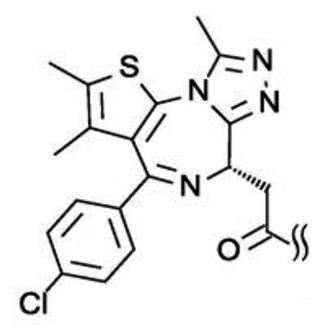
が挙げられ、FKBP12に対するリガンドとしては、例えば
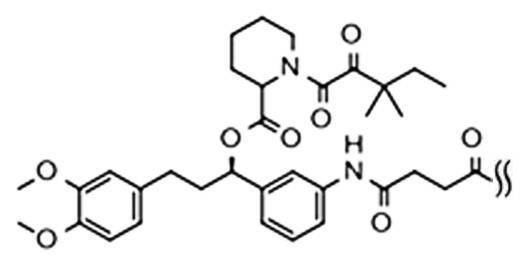
が挙げられ、MetAP2に対するリガンドとしては、例えば
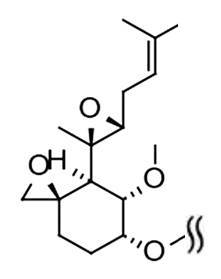
が挙げられる。Examples of ligands for BRD4 include
Examples of ligands for FKBP12 include
Examples of ligands for MetAP2 include
are mentioned.
Rasに対するリガンドとしては、例えば、以下の文献に記載されたリガンドが挙げられる;Nature, 2013, 503, 548-551; 国際公開2013/155223号;Science, 2016, 351, 604-608; 国際公開WO2014152588号;国際公開2015/054572号;国際公開2016/049524号;Nat. Rev. Drug Discov., 2014, 13, 828-851; Chem. Soc. Rev., 2016, advance article (DOI: 10.1039/C5CS00911A)。
Rasに対するリガンドとしては、例えば、
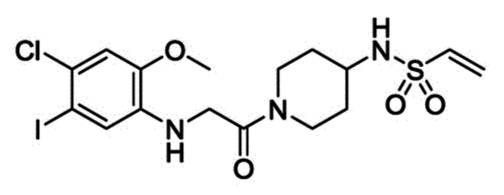


が挙げられる。Ligands for Ras include, for example, ligands described in the following documents; Nature, 2013, 503, 548-551; International Publication No. 2013/155223; WO2015/054572; WO2016/049524; Nat. Rev. Drug Discov., 2014, 13, 828-851; Chem. Soc. Rev., 2016, advance article (DOI: 10.1039/C5CS00911A) .
Examples of ligands for Ras include
are mentioned.
Halo Tag(登録商標)を融合した細胞内タンパク質に対するリガンドとしては、例えば、ハロゲン化C1-12アルコキシ基(特に、末端の炭素がハロゲン化されたC1-6アルコキシ基)が挙げられ、好ましくはハロゲン化された(特に、末端の炭素がハロゲン化された)ヘキシルオキシ基(特に、塩素化ヘキシルオキシ基)である。Ligands for intracellular proteins fused with Halo Tag (registered trademark) include, for example, halogenated C 1-12 alkoxy groups (particularly, C 1-6 alkoxy groups in which the terminal carbon is halogenated), preferably is a halogenated (especially terminal carbon-halogenated) hexyloxy group (especially a chlorinated hexyloxy group).
式(I)における-La-O-CH2-CH2-O-Lb-は、R1で表される細胞内分子に特異的に結合するリガンドと、R2で表されるオートファジーを引き起こす構造とを連結するリンカーを表す。-L a -O-CH 2 -CH 2 -OL b - in formula (I) represents a ligand that specifically binds to an intracellular molecule represented by R 1 and an autophagy represented by R 2 represents a linker that joins the structures that cause
Laは、結合手または主鎖が1ないし10原子からなる鎖状リンカーを示す。
鎖状リンカーを構成する原子としては、炭素原子、酸素原子、窒素原子および硫黄原子からなる群から選択される無置換の原子を挙げることができ、原子間の結合は、単結合、二重結合および三重結合のいずれでもよい。鎖状リンカーは、例えば-CH2-、-CH=、=CH-、-C≡、≡C-、-NH-、-N=、=N-、-O-、-S-、-C(O)-、-C(S)-、-C(NH)-および-CH=N-から選択されるいずれか1種または2種以上で構成することができ、これらは、置換可能な位置においてハロゲン原子で置換されていてもよい。
Laは、好ましくは、C1-6アルキレン基(特に、エチレン基)または-置換されてもよい窒素原子-C1-6アルキレン基(特に、-NH-エチレン基)である。La represents a bond or chain linker with a main chain of 1 to 10 atoms.
Atoms constituting the chain linker include unsubstituted atoms selected from the group consisting of carbon atoms, oxygen atoms, nitrogen atoms and sulfur atoms, and the bonds between atoms are single bonds and double bonds. and triple bonds. Chain linkers are, for example, -CH 2 -, -CH=, =CH-, -C≡, ≡C-, -NH-, -N=, =N-, -O-, -S-, -C( O)-, -C(S)-, -C(NH)- and -CH=N-, which can be composed of one or more selected from, at substitutable positions It may be substituted with a halogen atom.
L a is preferably a C 1-6 alkylene group (especially an ethylene group) or an optionally substituted nitrogen atom-C 1-6 alkylene group (especially an -NH-ethylene group).
Lbは、
i)結合手、
ii)主鎖が1ないし13原子からなる鎖状リンカー、または
iii)下式(II)

を示す。 Lb is
i) a bond,
ii) a linear linker consisting of 1 to 13 atoms in the main chain, or
iii) the following formula (II)
indicate.
ii)の鎖状リンカーは、分岐鎖であっても直鎖であってもよい。鎖状リンカーを構成する原子としては、炭素原子、酸素原子、窒素原子および硫黄原子からなる群から選択される無置換の原子を挙げることができ、原子間の結合は、単結合、二重結合および三重結合のいずれでもよい。鎖状リンカーは、例えば、-CH2-、-CH=、=CH-、-C≡、≡C-、-NH-、-N=、=N-、-O-、-S-、-C(O)-、-C(S)-、-CH2(NH)-、-CO(NH)-および-CH=N-からなる群から選択される1種または2種以上で構成することができ、これらは、置換可能な位置においてハロゲン原子で置換されていてもよい。
ii)の鎖状リンカーは、好ましくは、以下の式
-(Cxアルキレン-O)n1-(CH2)m1-B1- (IX)
で表され、式(IX)中、
xは1~6であり、好ましくは2または3であり、
n1は1~5であり、好ましくは1~3であり、
m1は0~5であり、好ましくは1~3であり、より好ましくは2~3であり、特に好ましくは2であり、
B1は、
(i)結合手、
(ii)-NH-、
(iii)―NH-(CO)-B2-(式中、B2は、結合手、-C1-3アルキレン-NH(特に、-メチレン-NH、-エチレン-NH)、-C1-3アルキレン-S-(特に、メチレン-S-、エチレン-S-)、またはC2-3アルケニレン基(特に、ビニレン基)を示す)、
(iv)C2-3アルキニレン基(特に、アセチレン基)、
(v)-NH-C1-3アルキレン基(特に、-NH-メチレン基)、または
(vi)-N-C1-6アルキル-カルボニル-L-システインアミド(特に、-N2アセチル-L-システインアミド)であり、
好ましくは、
(i)-NH-、
(ii)-CO(NH)-、
(iii)―NH-(CO)-C2-3アルケニレン基(特に、―NH-(CO)-ビニレン基)である)、
(iv)-NH-C1-3アルキレン基(特に、-NH-メチレン基)、または
(v)-N-C1-6アルキル-カルボニル-L-システインアミド(特に、-N2アセチル-L-システインアミド)である。The chain linker of ii) may be branched or linear. Atoms constituting the chain linker include unsubstituted atoms selected from the group consisting of carbon atoms, oxygen atoms, nitrogen atoms and sulfur atoms, and the bonds between atoms are single bonds and double bonds. and triple bonds. Chain linkers are, for example, -CH 2 -, -CH=, =CH-, -C≡, ≡C-, -NH-, -N=, =N-, -O-, -S-, -C (O)-, -C(S)-, -CH 2 (NH)-, -CO(NH)- and -CH=N- may be composed of one or more selected from the group consisting of and these may be substituted with halogen atoms at substitutable positions.
The linear linker of ii) preferably has the following formula —(C x alkylene-O) n1 —(CH 2 ) m1 —B 1 — (IX)
In the formula (IX),
x is 1 to 6, preferably 2 or 3,
n1 is 1 to 5, preferably 1 to 3,
m1 is 0 to 5, preferably 1 to 3, more preferably 2 to 3, particularly preferably 2,
B1 is
(i) a bond;
(ii) -NH-,
(iii) —NH—(CO)—B 2 — (wherein B 2 is a bond, —C 1-3 alkylene-NH (especially —methylene-NH, —ethylene-NH), —C 1- 3 alkylene-S- (especially methylene-S-, ethylene-S-), or C 2-3 alkenylene group (especially vinylene group)),
(iv) a C 2-3 alkynylene group (especially an acetylene group),
(v) a —NH—C 1-3 alkylene group (especially —NH-methylene group), or
(vi) —N—C 1-6 alkyl-carbonyl-L-cysteinamide (especially —N2 acetyl-L-cysteinamide);
Preferably,
(i) -NH-,
(ii) -CO(NH)-,
(iii) a —NH—(CO)—C 2-3 alkenylene group (especially a —NH—(CO)-vinylene group),
(iv) —NH—C 1-3 alkylene group (especially —NH-methylene group), or
(v) —N—C 1-6 alkyl-carbonyl-L-cysteinamide (especially —N2acetyl-L-cysteinamide).
B1の好ましい具体例として、

の置換基を挙げることができる。B1のより好ましい具体例として、
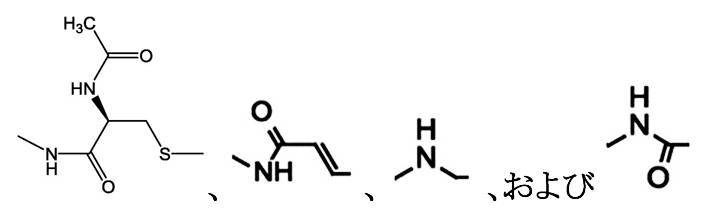
の置換基を挙げることができる。Preferred specific examples of B1 are
Substituents of can be mentioned. As a more preferable specific example of B1,
Substituents of can be mentioned.
式(II)のL1は、結合手または主鎖が1ないし10原子からなる鎖状リンカーを示す。この鎖状リンカーを構成する原子としては、炭素原子、酸素原子、窒素原子および硫黄原子からなる群から選択される無置換の原子を挙げることができ、原子間の結合は、単結合、二重結合および三重結合のいずれでもよい。鎖状リンカーは、例えば、-CH2-、-CH=、=CH-、-C≡、≡C-、-NH-、-N=、=N-、-O-、-S-、-C(O)-、-C(S)-、-C(NH)-および-CH=N-からなる群から選択される1種または2種以上で構成することができ、これらは、置換可能な位置でハロゲン原子で置換されていてもよい。
L1は、好ましくは、下記式
-(Cyアルキレン-O)n2-(CH2)m2- (X)または
-(Cyアルキレン-NH)n2-(CH2)m2- (X’)
(式(X)及び(X’)中、
yは1~3であり、好ましくは2または3であり、
n2は1~6であり、好ましくは1~3であり、
m2は0~3であり、好ましくは0~2である)
で表される。
L1は、より好ましくは、-(エチレン-O)n2'-(CH2)m2'-または-(プロピレン-O)n2'-(CH2)m2’-(各式中、n2’は1~3であり、m2’は0~2である)であり、さらに好ましくは-(エチレン-O)n2’’-(CH2)m2’’(各式中、n2’’は1または2であり、m2’’は1または2である)である。L 1 in formula (II) represents a bond or chain linker whose main chain consists of 1 to 10 atoms. Atoms constituting this chain linker include unsubstituted atoms selected from the group consisting of carbon atoms, oxygen atoms, nitrogen atoms and sulfur atoms. It may be either a bond or a triple bond. Chain linkers are, for example, -CH 2 -, -CH=, =CH-, -C≡, ≡C-, -NH-, -N=, =N-, -O-, -S-, -C (O)-, -C(S)-, -C(NH)- and -CH=N- can be composed of one or more selected from the group consisting of The position may be substituted with a halogen atom.
L 1 preferably has the following formula —(C y alkylene-O) n2 —(CH 2 ) m2 — (X) or -(C y alkylene-NH) n2 -(CH 2 ) m2 - (X')
(in the formulas (X) and (X′),
y is 1 to 3, preferably 2 or 3,
n2 is 1 to 6, preferably 1 to 3,
m2 is 0-3, preferably 0-2)
is represented by
L 1 is more preferably -(ethylene-O) n2' -(CH 2 ) m2' - or -(propylene-O) n2' -(CH 2 ) m2' - (wherein n2' is 1 3 and m2′ is 0 to 2), more preferably —(ethylene-O) n2″ —(CH 2 ) m2″ (wherein n2″ is 1 or 2). and m2'' is 1 or 2).
式(II)のX1は、置換されていてもよい二価の環状基を示す。二価の環状基としては、例えば置換されていてもよい二価のC6-14芳香族炭素環基(特に、置換されてもよい2価の5員または6員の芳香族炭素環基(特に、アミド基で置換されたフェニレン基、無置換フェニレン基))、置換されていてもよい二価の5ないし14員の芳香族複素環基(特に、置換されてもよい2価の5員または6員の芳香族複素環基(特に、ピラゾリル環、トリアゾリル))、または置換されていてもよい二価の3ないし14員非芳香族複素環基(特に、置換されてもよい2価の6員非芳香族複素環基(特に、アミド基で置換されたピペリジニル))が挙げられる。X 1 in formula (II) represents an optionally substituted divalent cyclic group. The divalent cyclic group includes, for example, an optionally substituted divalent C 6-14 aromatic carbocyclic group (in particular, an optionally substituted divalent 5- or 6-membered aromatic carbocyclic group ( In particular, a phenylene group substituted with an amide group, an unsubstituted phenylene group)), an optionally substituted divalent 5- to 14-membered aromatic heterocyclic group (especially an optionally substituted divalent 5-membered or a 6-membered aromatic heterocyclic group (especially a pyrazolyl ring, triazolyl)), or an optionally substituted divalent 3- to 14-membered non-aromatic heterocyclic group (especially an optionally substituted divalent 6-membered non-aromatic heterocyclic groups (especially piperidinyl substituted with an amide group).
式(I)における-La-O-CH2-CH2-O-Lb-を、-La-O-(CH2)n’-O-Lb-(n’は、1または3~6を示す)、または-La-NH-(CH2)n’ ’ -NH-Lb-(n’ ’は、1~6を示す)に置換した化合物も所望の効果を有する。そのような化合物のなかでも、-La-O-プロピレン-O-Lb-、-La-NH-エチレン-NH-または-La-NH-プロピレン-NH-Lb-に置換した化合物が好ましい。—L a —O—CH 2 —CH 2 —OL b — in formula (I) is replaced with —L a —O—(CH 2 ) n′ —OL b — (n′ is 1 or 3 -L a -NH-(CH 2 ) n″ -NH-L b - (where n″ represents 1-6) also have the desired effect. Among such compounds, compounds substituted with -L a -O-propylene-OL b -, -L a -NH-ethylene-NH- or -L a -NH-propylene-NH-L b - is preferred.
X1は、好ましくは、置換されてもよい2価の5員または6員の芳香族炭素環(特に、アミド基で置換されたフェニレン基、無置換フェニレン基)、置換されてもよい2価の5員または6員の芳香族複素環(特に、ピラゾール環、トリアゾール環)、または置換されてもよい2価の6員非芳香族複素環(特に、アミド基で置換されたピペリジン環)であり、より好ましくは置換されてもよい2価の5員または6員の芳香族炭素環(特に、アミド基で置換されたフェニレン基)である。X 1 is preferably an optionally substituted divalent 5- or 6-membered aromatic carbocyclic ring (particularly, an amide group-substituted phenylene group, an unsubstituted phenylene group), an optionally substituted divalent A 5- or 6-membered aromatic heterocyclic ring (especially a pyrazole ring, a triazole ring), or an optionally substituted divalent 6-membered non-aromatic heterocyclic ring (especially a piperidine ring substituted with an amide group) and more preferably an optionally substituted divalent 5- or 6-membered aromatic carbocyclic ring (especially a phenylene group substituted with an amido group).
式(II)のL2は、結合手または主鎖が1ないし2原子からなる鎖状リンカーを示す。鎖状リンカーを構成する原子としては、炭素原子、酸素原子、窒素原子および硫黄原子からなる群から選択される無置換の原子を挙げることができ、原子数が2の場合、原子間の結合は、単結合、二重結合および三重結合のいずれでもよい。L2は、好ましくは、結合手またはカルボニル基(特に、複素環の複素原子(特に、窒素原子)に結合しているカルボニル基)である。L 2 in formula (II) represents a bond or a chain linker whose main chain consists of 1 to 2 atoms. Atoms constituting the chain linker include unsubstituted atoms selected from the group consisting of carbon atoms, oxygen atoms, nitrogen atoms and sulfur atoms. When the number of atoms is 2, the bond between the atoms is , single bond, double bond and triple bond. L 2 is preferably a bond or a carbonyl group (especially a carbonyl group bonded to a heteroatom (particularly a nitrogen atom) of a heterocyclic ring).
-X1-L2-の好ましい具体例として、

挙げることができる。Preferred specific examples of -X 1 -L 2 - are
can be mentioned.
Lbの好ましい態様としては、
i)式
-(Cxアルキレン-O)n1-(CH2)m1-B1 (IX)
で表され、式(IX)中、
xは2または3(好ましくは2)であり、
n1は1~3(好ましくは2又は3)であり、
m1は1~3(好ましくは1)であり、
B1は、
(i)結合手、
(ii)-NH-、
(iii)―NH-(CO)-B2-(式中、B2は、結合手、-C1-3アルキレン-NH(特に、-メチレン-NH、-エチレン-NH)、-C1-3アルキレン-S-(特に、メチレン-S-、エチレン-S-)、またはC2-3アルケニレン基(特に、ビニレン基)を示す)、
(v)C2-3アルキニレン基(特に、アセチレン基)、
(vi)-NH-C1-3アルキレン基(特に、-NH-メチレン基)、または
(vii)-N-C1-6アルキル-カルボニル-L-システインアミド(特に、-N2アセチル-L-システインアミド)であるか;あるいは
ii)式
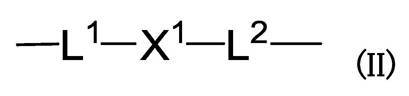
で示され、式(II)中、
L1は、下記式
-(Cyアルキレン-O)n2-(CH2)m2- (X)、または
-(Cyアルキレン-NH)n2-(CH2)m2- (X’)
(式(X)及び(X’)中、
yは2または3(好ましくは2)であり、
n2は1~6(好ましくは1~3)であり、
m2は0~3(好ましくは0~2))であり、
L1は、好ましくは、-(エチレン-O)n2’-(CH2)m2’-または-(プロピレン-O)n2’-(CH2)m2’-(各式中、n2’は1~3であり、m2’は0~2である)であり;
X1は、置換されてもよい2価の5員または6員の芳香族炭素環基(特に、アミド基で置換されたフェニレン基、無置換フェニレン基)、置換されてもよい2価の5員または6員の芳香族複素環基(特に、ピラゾリル環、トリアゾリル環)、または置換されてもよい2価の6員非芳香族複素環基(特に、アミド基で置換されたピペリジニル)であり;
L2は、結合手またはカルボニル基(特に、複素環の複素原子(特に、窒素原子)に結合しているカルボニル基)である場合が挙げられる。A preferred embodiment of Lb is
i) formula -(C x alkylene-O) n1 -(CH 2 ) m1 -B 1 (IX)
In the formula (IX),
x is 2 or 3 (preferably 2),
n1 is 1 to 3 (preferably 2 or 3),
m1 is 1 to 3 (preferably 1),
B1 is
(i) a bond;
(ii) -NH-,
(iii) —NH—(CO)—B 2 — (wherein B 2 is a bond, —C 1-3 alkylene-NH (especially —methylene-NH, —ethylene-NH), —C 1- 3 alkylene-S- (especially methylene-S-, ethylene-S-), or C 2-3 alkenylene group (especially vinylene group)),
(v) a C 2-3 alkynylene group (especially an acetylene group),
(vi) —NH—C 1-3 alkylene group (especially —NH-methylene group), or
(vii) —N—C 1-6 alkyl-carbonyl-L-cysteinamide (especially —N2acetyl-L-cysteinamide); or ii) formula
In the formula (II),
L 1 has the following formula —(C y alkylene-O) n2 —(CH 2 ) m2 — (X), or —(C y alkylene-NH) n2 —(CH 2 ) m2 — (X')
(in the formulas (X) and (X′),
y is 2 or 3 (preferably 2),
n2 is 1 to 6 (preferably 1 to 3),
m2 is 0 to 3 (preferably 0 to 2)),
L 1 is preferably -(ethylene-O) n2' -(CH 2 ) m2' - or -(propylene-O) n2' -(CH 2 ) m2' - (in each formula, n2' is 1 to 3 and m2' is 0 to 2);
X 1 is an optionally substituted divalent 5- or 6-membered aromatic carbocyclic group (especially a phenylene group substituted with an amido group, an unsubstituted phenylene group), an optionally substituted divalent 5 a 6-membered or 6-membered aromatic heterocyclic group (especially pyrazolyl ring, triazolyl ring), or an optionally substituted divalent 6-membered non-aromatic heterocyclic group (especially piperidinyl substituted with an amide group); ;
L 2 may be a bond or a carbonyl group (especially a carbonyl group bonded to a heteroatom (especially a nitrogen atom) of a heterocyclic ring).
Lbのより好ましい態様としては、
Lbが、
i)式
-(エチレン-O)n1-(CH2)m1-B1 (IX’)
で表され、式(IX’)中、
n1は1または2であり、
m1は1であり、
B1は、
(i)―NH-、
(ii)―NH-(CO)-、
(iii)―NH-(CO)-エチレン、
(iv)―NH-C1-3アルキレン基(特に、アミノメチレン基)、または
(v)―N2アセチル-L-システインアミドで表される鎖状リンカーであるか、あるいは
ii)式
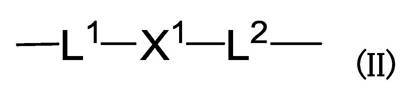
で示され、式(II)中、
L1は、-(エチレン-O)n2-(CH2)m2-(各式中、n2は1~3であり、m2は0または1である)であり;
X1は、アミド基で置換されたフェニレン基であり;
L2は、結合手である場合が挙げられる。A more preferred embodiment of Lb is
Lb is
i) formula -(ethylene-O) n1 -(CH 2 ) m1 -B 1 (IX')
In the formula (IX'),
n1 is 1 or 2;
m1 is 1,
B1 is
(i) -NH-,
(ii) —NH—(CO)—,
(iii) —NH—(CO)—ethylene,
(iv) —NH—C 1-3 alkylene group (especially aminomethylene group), or
(v) a linear linker represented by -N2 acetyl-L-cysteinamide, or ii) formula
In the formula (II),
L 1 is -(ethylene-O) n2 -(CH 2 ) m2 -, where n2 is 1 to 3 and m2 is 0 or 1;
X 1 is a phenylene group substituted with an amide group;
L 2 may be a bond.
R2は、下式

から選ばれる基を示し、各式中、
RA1、RA2、RA3、RA4、RA5、RA6、RA7、RA8、RA9およびRA10は、それぞれ独立して、水素原子または置換基を示し、あるいは
RA1およびRA2は、互いに結合して、置換されてもよい環を形成してもよく;
RB1、RB2、RB3、RB4およびRB5は、それぞれ独立して、置換されていてもよい炭化水素環基、置換されていてもよい不飽和複素環基、または式(VIII):-X2-R3を示し、式(VIII)中、X2は、置換されていてもよいメチレン基を示し、R3は、置換されていてもよい環状基を示す。
R2は、好ましくは式(III)、(IV)または(V)で表される基であり、より好ましくは式(III)で表される基である。 R2 is the following formula
represents a group selected from, in each formula,
R A1 , R A2 , R A3 , R A4 , R A5 , R A6 , R A7 , R A8 , R A9 and R A10 each independently represent a hydrogen atom or a substituent, or R A1 and R A2 may be joined together to form an optionally substituted ring;
R B1 , R B2 , R B3 , R B4 and R B5 are each independently an optionally substituted hydrocarbon ring group, an optionally substituted unsaturated heterocyclic group, or formula (VIII): —X 2 —R 3 , where X 2 represents an optionally substituted methylene group and R 3 represents an optionally substituted cyclic group.
R 2 is preferably a group represented by formula (III), (IV) or (V), more preferably a group represented by formula (III).
RA1、RA2、RA3、RA4、RA5、RA6、RA7、RA8、RA9およびRA10は、好ましくは、それぞれ独立して、水素原子、置換されてもよいアミノ基(特に、無置換のアミノ基、C1-6アルキルカルボニル基(特に、メチルカルボニル基)で置換されたアミノ基)、またはC1-6アルキル基(特に、メチル基)であり、より好ましくは、水素原子、無置換のアミノ基)、またはC1-3アルキル基(特に、メチル基)である。
RA1およびRA2が互いに結合して環を形成する場合、形成される環は、好ましくはプリンの6員環に縮合する、置換されてもよい5員または6員の芳香族複素環(特に、縮合イミダゾール環)である。R A1 , R A2 , R A3 , R A4 , R A5 , R A6 , R A7 , R A8 , R A9 and R A10 are preferably each independently a hydrogen atom, an optionally substituted amino group ( In particular, an unsubstituted amino group, an amino group substituted with a C 1-6 alkylcarbonyl group (especially a methylcarbonyl group)), or a C 1-6 alkyl group (especially a methyl group), more preferably a hydrogen atom, an unsubstituted amino group), or a C 1-3 alkyl group (especially a methyl group).
When R A1 and R A2 are bound to each other to form a ring, the formed ring is preferably an optionally substituted 5- or 6-membered aromatic heterocyclic ring (particularly , a fused imidazole ring).
RB1、RB2、RB3、RB4およびRB5は、それぞれ独立して、置換されていてもよい炭化水素環基、置換されていてもよい不飽和複素環基、または式(VIII):-X2-R3を示し、式(VIII)中、X2は、置換されていてもよいメチレン基を示し、R3は、置換されていてもよい環状基を示す。
RB1、RB2、RB3、RB4およびRB5は、好ましくは、それぞれ独立して、
(i)置換されてもよいC3-10シクロアルキル基(特に、シクロペンチル基、シクロヘキシル基)、
(ii)置換されてもよいC6-14アリール基(特に、フェニル基)、
(iii)置換されてもよい5または6員非芳香族複素環基(特に、リボース)、
(iv)C6-14アリール基で置換されたメチレン基(特に、ベンジル基)、
(v)ハロゲン化C6-14アリール基で置換されたメチレン基(特に、パラ位、メタ位若しくはオルト位でフッ素又は塩素で置換されたベンジル基)、
(vi)1ないし3個のシアノ基で置換されたC6-14アリール基で置換されたメチレン基(特に、1個のシアノ基で置換されたベンジル基)、
(vii)1ないし3個のC1-6アルキル基で置換されたC6-14アリール基で置換されたメチレン基(特に、1個のC1-6アルキル基(特に、メチル基)で置換されたベンジル基)、
(viii)1ないし3個のC1-6アルコキシ基で置換されたC6-14アリール基で置換されたメチレン基(特に、1個のメトキシ基で置換されたベンジル基)、
(ix)1ないし3個のC1-6アルキルスルホニル基で置換されたC6-14アリール基で置換されたメチレン基(特に、メチルスルホニル基で置換されたベンジル基)、
(x)1ないし3個のC1-6アルキル基で置換されてもよい5または6員芳香族複素環基で置換されたメチレン基(特に、ピリジル基、チアゾール基、またはC1-6アルキル基から選択される1ないし3個の置換基(特に、メチル基)で置換されたピラゾール基で置換されたメチレン)、または
(xi)5ないし14員非芳香族複素環基で置換されたメチレン基(特に、5または6員非芳香族複素環基で置換されたメチレン基(特に、テトラヒドロピラニル基で置換されたメチレン)である。R B1 , R B2 , R B3 , R B4 and R B5 are each independently an optionally substituted hydrocarbon ring group, an optionally substituted unsaturated heterocyclic group, or formula (VIII): —X 2 —R 3 , where X 2 represents an optionally substituted methylene group and R 3 represents an optionally substituted cyclic group.
R B1 , R B2 , R B3 , R B4 and R B5 are preferably each independently
(i) optionally substituted C 3-10 cycloalkyl group (especially cyclopentyl group, cyclohexyl group),
(ii) an optionally substituted C 6-14 aryl group (especially a phenyl group),
(iii) an optionally substituted 5- or 6-membered non-aromatic heterocyclic group (especially ribose),
(iv) a methylene group (particularly a benzyl group) substituted with a C 6-14 aryl group,
(v) a methylene group substituted with a halogenated C 6-14 aryl group (especially a benzyl group substituted with fluorine or chlorine at the para-, meta- or ortho-position),
(vi) a methylene group substituted with a C 6-14 aryl group substituted with 1 to 3 cyano groups (especially a benzyl group substituted with 1 cyano group),
(vii) a methylene group substituted by a C 6-14 aryl group substituted by 1 to 3 C 1-6 alkyl groups (especially substituted by 1 C 1-6 alkyl group (especially methyl group) benzyl group),
(viii) a methylene group substituted with a C 6-14 aryl group substituted with 1 to 3 C 1-6 alkoxy groups (especially a benzyl group substituted with 1 methoxy group),
(ix) a methylene group substituted with a C 6-14 aryl group substituted with 1 to 3 C 1-6 alkylsulfonyl groups (especially a benzyl group substituted with a methylsulfonyl group),
(x) a methylene group substituted with a 5- or 6-membered aromatic heterocyclic group optionally substituted with 1 to 3 C 1-6 alkyl groups (particularly, a pyridyl group, a thiazole group, or a C 1-6 alkyl (xi) methylene substituted with a 5- to 14-membered non-aromatic heterocyclic group; groups (especially methylene groups substituted with 5- or 6-membered non-aromatic heterocyclic groups, especially methylene groups substituted with tetrahydropyranyl groups).
RB1、RB2、RB3、RB4およびRB5は、より好ましくは、
(i)置換されてもよい5または6員非芳香族複素環基(特に、リボース)、
(ii)ハロゲン化C6-14アリール基で置換されたメチレン基(特に、フッ素又は塩素で置換されたベンジル基)、または
C1-6アルキル基で置換されたC6-14アリール基で置換されたメチレン基(特に、C1-6アルキル基(特に、メチル基)で置換されたベンジル基)である。R B1 , R B2 , R B3 , R B4 and R B5 are more preferably
(i) an optionally substituted 5- or 6-membered non-aromatic heterocyclic group (especially ribose),
(ii) a methylene group substituted with a halogenated C 6-14 aryl group (especially a benzyl group substituted with fluorine or chlorine) or a C 6-14 aryl group substituted with a C 1-6 alkyl group; a methylene group substituted with a C 1-6 alkyl group (especially a benzyl group substituted with a methyl group).
RB1、RB2、RB3、RB4およびRB5は、置換されていてもよい飽和複素環基(特に、シクロヘキシル、(4aR,6R,7R,7aS)-2,7-ジヒドロキシ-2-オキシドテトラヒドロ-4H-フロ[3,2-d][1,3,2]ジオキサホスフィニン)であってもよく、そのような化合物またはその塩も細胞内分子に結合し、該細胞内分子のオートファジーによる分解を誘導する化合物またはその塩に包含される。R B1 , R B2 , R B3 , R B4 and R B5 are optionally substituted saturated heterocyclic groups (especially cyclohexyl, (4aR,6R,7R,7aS)-2,7-dihydroxy-2-oxide tetrahydro-4H-furo[3,2-d][1,3,2]dioxaphosphinine), such compounds or salts thereof also bind to intracellular molecules, and are included in compounds or salts thereof that induce autophagic degradation of
R2の好ましい具体例として、


の置換基を挙げることができ、より好ましい具体例として、

を挙げることができる。Preferred specific examples of R 2 are
Substituents of can be mentioned, and more preferred specific examples are
can be mentioned.
R2が式(III)の基の場合、RA1およびRA2は、好ましくは、それぞれ独立して、水素原子、置換されてもよいアミノ基(特に、無置換のアミノ基、C1-6アルキルカルボニル基(特に、メチルカルボニル基)で置換されたアミノ基)、またはC1-6アルキル基(特に、メチル基)であり、より好ましくは、RA1は、水素原子、またはC1-6アルキル基(特に、メチル基)であり、RA2は、水素原子、または置換されてもよいアミノ基(特に、無置換のアミノ基、C1-6アルキルカルボニル基(特に、メチルカルボニル基)で置換されたアミノ基)、またはC1-6アルキル基(特に、メチル基)である。
また、RA1およびRA2が互いに結合して環を形成する場合、形成される環は、好ましくは、置換されてもよい5員または6員の縮合芳香族複素環(特に、縮合イミダゾール環)である。
また、RB1は、好ましくは、
(i)置換されてもよいC3-10シクロアルキル基(特に、シクロペンチル基、シクロヘキシル基)、
(ii)置換されてもよいC6-14アリール基(特に、フェニル基)、
(iii)置換されてもよい5または6員非芳香族複素環基(特に、リボース)、
(iv)C6-14アリール基で置換されたメチレン基(特に、ベンジル基)、
(v)ハロゲン化C6-14アリール基で置換されたメチレン基(特に、パラ位、メタ位若しくはオルト位でフッ素又は塩素で置換されたベンジル基)、
(vi)1ないし3個のシアノ基で置換されたC6-14アリール基で置換されたメチレン基(特に、1個のシアノ基で置換されたベンジル)、
(vii)1ないし3個のC1-6アルキル基で置換されたC6-14アリール基で置換されたメチレン基(特に、1個のC1-6アルキル基(特に、メチル基)で置換されたベンジル)、
(viii)1ないし3個のC1-6アルコキシ基で置換されたC6-14アリール基で置換されたメチレン基(特に、1個のメトキシ基で置換されたベンジル)、
(ix)1ないし3個のC1-6アルキルスルホニル基で置換されたC6-14アリール基で置換されたメチレン基(特に、メチルスルホニル基で置換されたベンジル)、
(x)1ないし3個のC1-6アルキル基で置換されてもよい5または6員芳香族複素環基で置換されたメチレン基(特に、ピリジル基、チアゾール基、またはC1-6アルキル基から選択される1ないし3個の置換基(特に、メチル基)で置換されたピラゾール基で置換されたメチレン基)、または
(xi)5ないし14員非芳香族複素環基で置換されたメチレン基(特に、5または6員非芳香族複素環基(特に、テトラヒドロピラニル基)で置換されたメチレン基)である。When R 2 is a group of formula (III), R A1 and R A2 are preferably each independently a hydrogen atom, an optionally substituted amino group (especially an unsubstituted amino group, C 1-6 an amino group substituted with an alkylcarbonyl group (especially a methylcarbonyl group)), or a C 1-6 alkyl group (especially a methyl group), more preferably R A1 is a hydrogen atom, or C 1-6 an alkyl group (especially a methyl group), and R A2 is a hydrogen atom or an optionally substituted amino group (especially an unsubstituted amino group, a C 1-6 alkylcarbonyl group (especially a methylcarbonyl group) a substituted amino group), or a C 1-6 alkyl group (especially a methyl group).
Further, when R A1 and R A2 are bonded to each other to form a ring, the formed ring is preferably an optionally substituted 5- or 6-membered condensed aromatic heterocyclic ring (especially condensed imidazole ring) is.
Further, R B1 is preferably
(i) optionally substituted C 3-10 cycloalkyl group (especially cyclopentyl group, cyclohexyl group),
(ii) an optionally substituted C 6-14 aryl group (especially a phenyl group),
(iii) an optionally substituted 5- or 6-membered non-aromatic heterocyclic group (especially ribose),
(iv) a methylene group (particularly a benzyl group) substituted with a C 6-14 aryl group,
(v) a methylene group substituted with a halogenated C 6-14 aryl group (especially a benzyl group substituted with fluorine or chlorine at the para-, meta- or ortho-position),
(vi) a methylene group substituted with a C 6-14 aryl group substituted with 1 to 3 cyano groups (especially benzyl substituted with 1 cyano group),
(vii) a methylene group substituted by a C 6-14 aryl group substituted by 1 to 3 C 1-6 alkyl groups (especially substituted by 1 C 1-6 alkyl group (especially methyl group) benzyl),
(viii) a methylene group substituted with a C 6-14 aryl group substituted with 1 to 3 C 1-6 alkoxy groups (particularly benzyl substituted with 1 methoxy group),
(ix) a methylene group substituted with a C 6-14 aryl group substituted with 1 to 3 C 1-6 alkylsulfonyl groups (particularly benzyl substituted with a methylsulfonyl group),
(x) a methylene group substituted with a 5- or 6-membered aromatic heterocyclic group optionally substituted with 1 to 3 C 1-6 alkyl groups (particularly, a pyridyl group, a thiazole group, or a C 1-6 alkyl a methylene group substituted with a pyrazole group substituted with 1 to 3 substituents (especially a methyl group) selected from groups), or
(xi) a methylene group substituted with a 5- to 14-membered non-aromatic heterocyclic group (especially a methylene group substituted with a 5- or 6-membered non-aromatic heterocyclic group (particularly a tetrahydropyranyl group));
R2が式(IV)の基の場合、RA3およびRA4は、好ましくは、それぞれ独立して、水素原子、または置換されてもよいアミノ基(特に、無置換のアミノ基)である。
また、RB2は、好ましくは、ハロゲン化C6-14アリール基で置換されたメチレン基(特に、フッ素又は塩素で置換されたベンジル基)である。When R 2 is a group of formula (IV), R A3 and R A4 are preferably each independently a hydrogen atom or an optionally substituted amino group (especially an unsubstituted amino group).
Also, R B2 is preferably a methylene group substituted with a halogenated C 6-14 aryl group (in particular, a benzyl group substituted with fluorine or chlorine).
R2が式(V)の基の場合、RA5およびRA6は、好ましくは、それぞれ独立して、水素原子、またはC1-6アルキル基(特に、メチル基)である。
また、RB3は、好ましくは、ハロゲン化C6-14アリール基で置換されたメチレン基(特に、フッ素又は塩素で置換されたベンジル基)である。When R 2 is a group of formula (V), R A5 and R A6 are preferably each independently a hydrogen atom or a C 1-6 alkyl group (especially a methyl group).
Also, R B3 is preferably a methylene group substituted with a halogenated C 6-14 aryl group (in particular, a benzyl group substituted with fluorine or chlorine).
R2が式(VI)の基の場合、RA7、RA8、およびRA9は、好ましくは水素原子である。
また、RB4は、好ましくは、ハロゲン化C6-14アリール基で置換されたメチレン基(特に、フッ素又は塩素で置換されたベンジル基)である。When R 2 is a group of formula (VI), R A7 , R A8 and R A9 are preferably hydrogen atoms.
Also, R B4 is preferably a methylene group substituted with a halogenated C 6-14 aryl group (in particular, a benzyl group substituted with fluorine or chlorine).
R2が式(VII)の基の場合、RA10は、好ましくは水素原子である。
また、RB5は、好ましくは、ハロゲン化C6-14アリール基で置換されたメチレン基(特に、フッ素又は塩素で置換されたベンジル基)である。When R 2 is a group of formula (VII), R A10 is preferably a hydrogen atom.
Also, R B5 is preferably a methylene group substituted with a halogenated C 6-14 aryl group (especially a benzyl group substituted with fluorine or chlorine).
R2の好ましい態様としては、
R2が、式(III)、(IV)、および(V)から選ばれる基であり、
R2が式(III)の基の場合、
RA1は、水素原子であり、
RA2は、置換されてもよいアミノ基(特に、無置換のアミノ基)であり、
RB1は、
(i)置換されてもよい5または6員非芳香族複素環基(特に、リボース)、
(ii)ハロゲン化C6-14アリール基で置換されたメチレン基(特に、フッ素又は塩素で置換されたベンジル基)、または
(iii)C1-6アルキル基で置換されたC6-14アリール基で置換されたメチレン基(特に、C1-6アルキル基(特に、メチル基)で置換されたベンジル基)であり、
R2が式(IV)の基の場合、
RA3は、置換されてもよいアミノ基(特に、無置換のアミノ基)であり、
RA4は、水素原子であり、
RB2は、ハロゲン化C6-14アリール基で置換されたメチレン基(特に、フッ素又は塩素で置換されたベンジル基)であり、
R2が式(V)の基の場合、
RA5およびRA6は、それぞれ独立して、
(i)水素原子、または
(ii)C1-6アルキル基(特に、メチル基)であり、
RB3は、ハロゲン化C6-14アリール基で置換されたメチレン基(特に、フッ素又は塩素で置換されたベンジル基)である場合が挙げられる。A preferred embodiment of R 2 is
R 2 is a group selected from formulas (III), (IV), and (V);
When R 2 is a group of formula (III),
R A1 is a hydrogen atom,
R A2 is an optionally substituted amino group (especially an unsubstituted amino group),
R B1 is
(i) an optionally substituted 5- or 6-membered non-aromatic heterocyclic group (especially ribose),
(ii) a methylene group substituted with a halogenated C 6-14 aryl group (especially a benzyl group substituted with fluorine or chlorine), or
(iii) a methylene group substituted with a C 6-14 aryl group substituted with a C 1-6 alkyl group (especially a benzyl group substituted with a C 1-6 alkyl group (especially a methyl group));
When R 2 is a group of formula (IV),
R A3 is an optionally substituted amino group (especially an unsubstituted amino group),
R A4 is a hydrogen atom,
R B2 is a methylene group substituted with a halogenated C 6-14 aryl group (especially a benzyl group substituted with fluorine or chlorine),
When R 2 is a group of formula (V),
R A5 and R A6 are each independently
(i) a hydrogen atom, or
(ii) a C 1-6 alkyl group (especially a methyl group),
R B3 may be a methylene group substituted with a halogenated C 6-14 aryl group (especially a benzyl group substituted with fluorine or chlorine).
化合物(I)の好適な具体例としては、以下が挙げられる:
化合物(A)
R1が、Halo Tagを融合した細胞内タンパク質、BRD4、Ras、FKBP12又はMetAP2に特異的に結合するリガンドであり;
Laが、C1-6アルキレン基(特に、エチレン基)または-NH-C1-6アルキレン基(特に、-NH-エチレン基)であり;
Lbが、
i)式
-(Cxアルキレン-O)n1-(CH2)m1-B1 (IX)
で表され、式(IX)中、
xは2または3(好ましくは2)であり、
n1は1~3(好ましくは2又は3)であり、
m1は1~3(好ましくは1)であり、
B1は、
(i)結合手、
(ii)-NH-、
(iii)―NH-(CO)-B2-(式中、B2は、結合手、-C1-3アルキレン-NH-(特に、-メチレン-NH-、-エチレン-NH-)、-C1-3アルキレン-S-(特に、-メチレン-S-、-エチレン-S-)、またはC2-3アルケニレン基(特に、ビニレン基)を示す)、
(v)-C2-3アルキニレン基(特に、アセチレン基)、
(vi)-NH-C1-3アルキレン基(特に、-NH-メチレン基)、または
(vii)-N-C1-6アルキル-カルボニル-L-システインアミド(特に、-N2アセチル-L-システインアミド)であるか;あるいは
ii)式
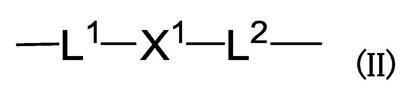
で示され、式(II)中、
L1は、下記式
-(Cyアルキレン-O)n2-(CH2)m2- (X)、または
-(Cyアルキレン-NH)n2-(CH2)m2- (X’)
(式(X)及び(X’)中、
yは2または3(好ましくは2)であり、
n2は1~6(好ましくは1~3)であり、
m2は0~3(好ましくは0~2))であり、
L1は、好ましくは、(エチレン-O)n2’-(CH2)m2’-または(プロピレン-O)n2’-(CH2)m2’-(各式中、n2’は1~3であり、m2’は0~2である)であり;
X1は、置換されてもよい2価の5員または6員の芳香族炭素環基(特に、アミド基で置換されたフェニレン基、無置換フェニレン基)、置換されてもよい2価の5員または6員の芳香族複素環基(特に、ピラゾリル環、トリアゾリル)、または置換されてもよい2価の6員非芳香族複素環基(特に、アミド基で置換されたピペリジニル)であり;
L2は、結合手またはカルボニル基(特に、複素環の複素原子(特に、窒素原子)に結合しているカルボニル基)である、リンカーであり;
R2は、式(III)、(IV)、(V)、(VI)、および(VII)から選ばれる基を示し、
各式中、RA1、RA2、RA3、RA4、RA5、RA6、RA7、RA8、RA9およびRA10は、それぞれ独立して、水素原子、置換されてもよいアミノ基(特に、無置換のアミノ基、C1-6アルキルカルボニル基(特に、メチルカルボニル基)で置換されたアミノ基)、またはC1-6アルキル基(特に、メチル基)であるか、あるいはRA1およびRA2が互いに結合して、プリンの6員環に縮合する、置換されてもよい5員または6員の芳香族複素環(特に、縮合イミダゾール環)を形成し、
RB1、RB2、RB3、RB4およびRB5は、それぞれ独立して
(i)置換されてもよいC3-10シクロアルキル基(特に、シクロペンチル基、シクロヘキシル基)、
(ii)置換されてもよいC6-14アリール基(特に、フェニル基)、
(iii)置換されてもよい5または6員非芳香族複素環基(特に、リボース)、
(iv)C6-14アリール基で置換されたメチレン基(特に、ベンジル基)、
(v)ハロゲン化C6-14アリール基で置換されたメチレン基(特に、パラ位、メタ位若しくはオルト位でフッ素又は塩素で置換されたベンジル基)、
(vi)1ないし3個のシアノ基で置換されたC6-14アリール基で置換されたメチレン基(特に、1個のシアノ基で置換されたベンジル基)、
(vii)1ないし3個のC1-6アルキル基で置換されたC6-14アリール基で置換されたメチレン基(特に、1個のC1-6アルキル基(特に、メチル基)で置換されたベンジル基)、
(viii)1ないし3個のC1-6アルコキシ基で置換されたC6-14アリール基で置換されたメチレン基(特に、1個のメトキシ基で置換されたベンジル基)、
(ix)1ないし3個のC1-6アルキルスルホニル基で置換されたC6-14アリール基で置換されたメチレン基(特に、メチルスルホニル基で置換されたベンジル基)、
(x)1ないし3個のC1-6アルキル基で置換されてもよい5ないし14員芳香族複素環基で置換されたメチレン基、好ましくは1ないし3個のC1-6アルキル基で置換されてもよい5または6員芳香族複素環基で置換されたメチレン基(特に、ピリジル基、チアゾール基、またはC1-6アルキル基(特に、メチル基)で置換されたピラゾール基で置換されたメチレン基)、または
5ないし14員非芳香族複素環基で置換されたメチレン基、好ましくは5または6員非芳香族複素環基で置換されたメチレン基(特に、テトラヒドロピラニル基で置換されたメチレン基)である、
化合物(I)。Suitable specific examples of compound (I) include the following:
Compound (A)
R 1 is a ligand that specifically binds to the Halo Tag fused intracellular protein, BRD4, Ras, FKBP12 or MetAP2;
L a is a C 1-6 alkylene group (especially an ethylene group) or a -NH-C 1-6 alkylene group (especially a -NH-ethylene group);
Lb is
i) formula -(C x alkylene-O) n1 -(CH 2 ) m1 -B 1 (IX)
In the formula (IX),
x is 2 or 3 (preferably 2),
n1 is 1 to 3 (preferably 2 or 3),
m1 is 1 to 3 (preferably 1),
B1 is
(i) a bond;
(ii) -NH-,
(iii) -NH-(CO)-B 2 - (wherein B 2 is a bond, -C 1-3 alkylene-NH- (especially -methylene-NH-, -ethylene-NH-), - C 1-3 alkylene-S- (especially -methylene-S-, -ethylene-S-) or C 2-3 alkenylene group (especially vinylene group)),
(v) a —C 2-3 alkynylene group (especially an acetylene group),
(vi) —NH—C 1-3 alkylene group (especially —NH-methylene group), or
(vii) —N—C 1-6 alkyl-carbonyl-L-cysteinamide (especially —N2acetyl-L-cysteinamide); or ii) formula
In the formula (II),
L 1 has the following formula —(C y alkylene-O) n2 —(CH 2 ) m2 — (X), or —(C y alkylene-NH) n2 —(CH 2 ) m2 — (X')
(in the formulas (X) and (X′),
y is 2 or 3 (preferably 2),
n2 is 1 to 6 (preferably 1 to 3),
m2 is 0 to 3 (preferably 0 to 2)),
L 1 is preferably (ethylene-O) n2' -(CH 2 ) m2' - or (propylene-O) n2' -(CH 2 ) m2' - (in each formula, n2' is 1 to 3 and m2′ is 0 to 2);
X 1 is an optionally substituted divalent 5- or 6-membered aromatic carbocyclic group (especially a phenylene group substituted with an amido group, an unsubstituted phenylene group), an optionally substituted divalent 5 a membered or 6-membered aromatic heterocyclic group (especially pyrazolyl ring, triazolyl), or an optionally substituted bivalent 6-membered non-aromatic heterocyclic group (especially piperidinyl substituted with an amide group);
L 2 is a linker that is a bond or a carbonyl group (especially a carbonyl group attached to a heteroatom (especially a nitrogen atom) of a heterocyclic ring);
R2 represents a group selected from formulas (III), (IV), (V), (VI), and (VII);
In each formula, R A1 , R A2 , R A3 , R A4 , R A5 , R A6 , R A7 , R A8 , R A9 and R A10 are each independently a hydrogen atom, an optionally substituted amino group (In particular, an unsubstituted amino group, an amino group substituted with a C 1-6 alkylcarbonyl group (especially a methylcarbonyl group)), or a C 1-6 alkyl group (especially a methyl group), or R A1 and R A2 are joined together to form an optionally substituted 5- or 6-membered aromatic heterocyclic ring (especially a condensed imidazole ring) fused to the purine 6-membered ring;
R B1 , R B2 , R B3 , R B4 and R B5 are each independently
(i) optionally substituted C 3-10 cycloalkyl group (especially cyclopentyl group, cyclohexyl group),
(ii) an optionally substituted C 6-14 aryl group (especially a phenyl group),
(iii) an optionally substituted 5- or 6-membered non-aromatic heterocyclic group (especially ribose),
(iv) a methylene group (particularly a benzyl group) substituted with a C 6-14 aryl group,
(v) a methylene group substituted with a halogenated C 6-14 aryl group (especially a benzyl group substituted with fluorine or chlorine at the para-, meta- or ortho-position),
(vi) a methylene group substituted with a C 6-14 aryl group substituted with 1 to 3 cyano groups (especially a benzyl group substituted with 1 cyano group),
(vii) a methylene group substituted by a C 6-14 aryl group substituted by 1 to 3 C 1-6 alkyl groups (especially substituted by 1 C 1-6 alkyl group (especially methyl group) benzyl group),
(viii) a methylene group substituted with a C 6-14 aryl group substituted with 1 to 3 C 1-6 alkoxy groups (especially a benzyl group substituted with 1 methoxy group),
(ix) a methylene group substituted with a C 6-14 aryl group substituted with 1 to 3 C 1-6 alkylsulfonyl groups (especially a benzyl group substituted with a methylsulfonyl group),
(x) a methylene group substituted with a 5- to 14-membered aromatic heterocyclic group optionally substituted by 1 to 3 C 1-6 alkyl groups, preferably 1 to 3 C 1-6 alkyl groups; optionally substituted methylene group substituted with a 5- or 6-membered aromatic heterocyclic group (especially pyridyl group, thiazole group, or pyrazole group substituted with C 1-6 alkyl group (especially methyl group) or a methylene group substituted with a 5- to 14-membered non-aromatic heterocyclic group, preferably a methylene group substituted with a 5- or 6-membered non-aromatic heterocyclic group (especially a tetrahydropyranyl group a substituted methylene group),
Compound (I).
化合物(B)
R1が、Halo Tagを融合した細胞内タンパク質、BRD4、Ras、FKBP12又はMetAP2に特異的に結合するリガンドであり;
Laが、エチレン基または-NH-エチレン基であり;
Lbが、
i)式
-(エチレン-O)n1-(CH2)m1-B1 (IX)
で表され、式(IX)中、
n1は1または2であり、
m1は1であり、
B1は、
(i)―NH-、
(ii)―NH-(CO)-、
(iii)―NH-(CO)-エチレン、
(iv)―NH-C1-3アルキレン基(特に、アミノメチレン基)、または
(v)―N2アセチル-L-システインアミドで表される鎖状リンカーであるか、あるいは
ii)式

で示され、式(II)中、
L1は、-(エチレン-O)n2-(CH2)m2-(各式中、n2は1~3であり、m2は0または1である)であり;
X1は、アミド基で置換されたフェニレン基であり;
L2は、結合手であり;
R2は、式(III)、(IV)、および(V)から選ばれる基を示し、
R2が式(III)の基の場合、
RA1は、水素原子であり、
RA2は、置換されてもよいアミノ基(特に、無置換のアミノ基)であり、
RB1は、
(i)置換されてもよい5または6員非芳香族複素環基(特に、リボース)、
(ii)ハロゲン化C6-14アリール基で置換されたメチレン基(特に、フッ素又は塩素で置換されたベンジル基)、または
(iii)C1-6アルキル基で置換されたC6-14アリール基で置換されたメチレン基(特に、C1-6アルキル基(特に、メチル基)で置換されたベンジル基)であり、
R2が式(IV)の基の場合、
RA3は、置換されてもよいアミノ基(特に、無置換のアミノ基)であり、
RA4は、水素原子であり、
RB2は、ハロゲン化C6-14アリール基で置換されたメチレン基(特に、フッ素又は塩素で置換されたベンジル基)であり、
R2が式(V)の基の場合、
RA5およびRA6は、それぞれ独立して、
(i)水素原子、または
(ii)C1-6アルキル基(特に、メチル基)であり、
RB3は、ハロゲン化C6-14アリール基で置換されたメチレン基(特に、フッ素又は塩素で置換されたベンジル基)である、
化合物(I)。Compound (B)
R 1 is a ligand that specifically binds to the Halo Tag fused intracellular protein, BRD4, Ras, FKBP12 or MetAP2;
L a is an ethylene group or -NH-ethylene group;
Lb is
i) formula -(ethylene-O) n1 -(CH 2 ) m1 -B 1 (IX)
In the formula (IX),
n1 is 1 or 2;
m1 is 1,
B1 is
(i) -NH-,
(ii) —NH—(CO)—,
(iii) —NH—(CO)—ethylene,
(iv) —NH—C 1-3 alkylene group (especially aminomethylene group), or
(v) a linear linker represented by -N2 acetyl-L-cysteinamide, or ii) formula
In the formula (II),
L 1 is -(ethylene-O) n2 -(CH 2 ) m2 -, where n2 is 1 to 3 and m2 is 0 or 1;
X 1 is a phenylene group substituted with an amide group;
L 2 is a bond;
R 2 represents a group selected from formulas (III), (IV), and (V),
When R 2 is a group of formula (III),
R A1 is a hydrogen atom,
R A2 is an optionally substituted amino group (especially an unsubstituted amino group),
R B1 is
(i) an optionally substituted 5- or 6-membered non-aromatic heterocyclic group (especially ribose),
(ii) a methylene group substituted with a halogenated C 6-14 aryl group (especially a benzyl group substituted with fluorine or chlorine), or
(iii) a methylene group substituted with a C 6-14 aryl group substituted with a C 1-6 alkyl group (especially a benzyl group substituted with a C 1-6 alkyl group (especially a methyl group));
When R 2 is a group of formula (IV),
R A3 is an optionally substituted amino group (especially an unsubstituted amino group),
R A4 is a hydrogen atom,
R B2 is a methylene group substituted with a halogenated C 6-14 aryl group (especially a benzyl group substituted with fluorine or chlorine),
When R 2 is a group of formula (V),
R A5 and R A6 are each independently
(i) a hydrogen atom, or
(ii) a C 1-6 alkyl group (especially a methyl group),
R B3 is a methylene group substituted with a halogenated C 6-14 aryl group (especially a benzyl group substituted with fluorine or chlorine);
Compound (I).
化合物(I)における塩としては、薬理学的に許容される塩が好ましく、例えば、無機塩基との塩、有機塩基との塩、無機酸との塩、有機酸との塩、塩基性または酸性アミノ酸との塩が挙げられる。
無機塩基との塩の好適な例としては、ナトリウム塩、カリウム塩等のアルカリ金属塩;カルシウム塩、マグネシウム塩等のアルカリ土類金属塩;アルミニウム塩、アンモニウム塩が挙げられる。
有機塩基との塩の好適な例としては、トリメチルアミン、トリエチルアミン、ピリジン、ピコリン、エタノールアミン、ジエタノールアミン、トリエタノールアミン、トロメタミン[トリス(ヒドロキシメチル)メチルアミン]、tert-ブチルアミン、シクロヘキシルアミン、ベンジルアミン、ジシクロヘキシルアミン、N,N-ジベンジルエチレンジアミンとの塩が挙げられる。
無機酸との塩の好適な例としては、塩酸、臭化水素酸、硝酸、硫酸、リン酸との塩が挙げられる。
有機酸との塩の好適な例としては、ギ酸、酢酸、トリフルオロ酢酸、フタル酸、フマル酸、シュウ酸、酒石酸、マレイン酸、クエン酸、コハク酸、リンゴ酸、メタンスルホン酸、ベンゼンスルホン酸、p-トルエンスルホン酸との塩が挙げられる。
塩基性アミノ酸との塩の好適な例としては、アルギニン、リジン、オルニチンとの塩が挙げられる。
酸性アミノ酸との塩の好適な例としては、アスパラギン酸、グルタミン酸との塩が挙げられる。The salt in compound (I) is preferably a pharmacologically acceptable salt, for example, a salt with an inorganic base, a salt with an organic base, a salt with an inorganic acid, a salt with an organic acid, basic or acidic Examples include salts with amino acids.
Preferable examples of salts with inorganic bases include alkali metal salts such as sodium salts and potassium salts; alkaline earth metal salts such as calcium salts and magnesium salts; aluminum salts and ammonium salts.
Suitable examples of salts with organic bases include trimethylamine, triethylamine, pyridine, picoline, ethanolamine, diethanolamine, triethanolamine, tromethamine [tris(hydroxymethyl)methylamine], tert-butylamine, cyclohexylamine, benzylamine, Examples include salts with dicyclohexylamine and N,N-dibenzylethylenediamine.
Preferable examples of salts with inorganic acids include salts with hydrochloric acid, hydrobromic acid, nitric acid, sulfuric acid and phosphoric acid.
Suitable examples of salts with organic acids include formic acid, acetic acid, trifluoroacetic acid, phthalic acid, fumaric acid, oxalic acid, tartaric acid, maleic acid, citric acid, succinic acid, malic acid, methanesulfonic acid, and benzenesulfonic acid. , p-toluenesulfonic acid.
Preferable examples of salts with basic amino acids include salts with arginine, lysine and ornithine.
Preferred examples of salts with acidic amino acids include salts with aspartic acid and glutamic acid.
本発明化合物の製造法について以下に説明する。 The method for producing the compound of the present invention is described below.
以下の製造方法における各工程で用いられた原料や試薬、ならびに得られた化合物は、それぞれ塩を形成していてもよい。このような塩としては、例えば、前述の本発明化合物の塩と同様のもの等が挙げられる。 The raw materials and reagents used in each step of the production method below and the resulting compound may each form a salt. Such salts include, for example, those similar to the aforementioned salts of the compound of the present invention.
各工程で得られた化合物が遊離化合物である場合には、自体公知の方法により、目的とする塩に変換することができる。逆に各工程で得られた化合物が塩である場合には、自体公知の方法により、遊離体または目的とする他の種類の塩に変換することができる。 When the compound obtained in each step is a free compound, it can be converted into the target salt by a method known per se. Conversely, when the compound obtained in each step is a salt, it can be converted into the free form or other desired salt by a method known per se.
各工程で得られた化合物は反応液のままか、または粗生成物として得た後に、次反応に用いることもできる、あるいは、各工程で得られた化合物を、常法に従って、反応混合物から濃縮、晶出、再結晶、蒸留、溶媒抽出、分溜、クロマトグラフィーなどの分離手段により単離および/または精製することができる。 The compound obtained in each step can be used in the next reaction after being obtained as a reaction solution or as a crude product, or the compound obtained in each step can be concentrated from the reaction mixture in accordance with a conventional method. , crystallization, recrystallization, distillation, solvent extraction, fractionation, chromatography, and the like.
各工程の原料や試薬の化合物が市販されている場合には、市販品をそのまま用いることができる。 When raw materials and reagent compounds for each step are commercially available, the commercially available products can be used as they are.
各工程の反応において、反応時間は、用いる試薬や溶媒により異なり得るが、特に記載の無い場合、通常1分~48時間、好ましくは10分~8時間である。 In the reaction of each step, the reaction time may vary depending on the reagents and solvents used, but unless otherwise specified, it is generally 1 minute to 48 hours, preferably 10 minutes to 8 hours.
各工程の反応において、反応温度は、用いる試薬や溶媒により異なり得るが、特に記載が無い場合、通常-78℃~300℃、好ましくは-78℃~150℃である。 In the reaction of each step, the reaction temperature may vary depending on the reagents and solvents used, but unless otherwise specified, it is generally -78°C to 300°C, preferably -78°C to 150°C.
各工程の反応において、圧力は、用いる試薬や溶媒により異なり得るが、特に記載が無い場合、通常1気圧~20気圧、好ましくは1気圧~3気圧である。 In the reaction in each step, the pressure may vary depending on the reagents and solvents used, but unless otherwise specified, it is usually 1 to 20 atmospheres, preferably 1 to 3 atmospheres.
各工程の反応において、例えば、Biotage社製InitiatorなどのMicrowave合成装置を用いることがある。反応温度は、用いる試薬や溶媒により異なり得るが、特に記載がない場合、通常室温~300℃、好ましくは50℃~250℃である。反応時間は、用いる試薬や溶媒により異なり得るが、特に記載の無い場合、通常1分~48時間、好ましくは1分~8時間である。 In the reaction of each step, for example, a Microwave synthesizer such as Initiator manufactured by Biotage may be used. The reaction temperature may vary depending on the reagents and solvents used, but is generally room temperature to 300°C, preferably 50°C to 250°C, unless otherwise specified. The reaction time may vary depending on the reagents and solvents used, and is generally 1 minute to 48 hours, preferably 1 minute to 8 hours, unless otherwise specified.
各工程の反応において、試薬は、特に記載が無い場合、基質に対して0.5当量~20当量、好ましくは0.8当量~5当量が用いられる。試薬を触媒として使用する場合、試薬は基質に対して0.001当量~1当量、好ましくは0.01当量~0.2当量が用いられる。試薬が反応溶媒を兼ねる場合、試薬は溶媒量が用いられる。 In the reaction of each step, the reagent is used in an amount of 0.5 to 20 equivalents, preferably 0.8 to 5 equivalents, relative to the substrate unless otherwise specified. When a reagent is used as a catalyst, the reagent is used in an amount of 0.001 to 1 equivalent, preferably 0.01 to 0.2 equivalent, relative to the substrate. When the reagent also serves as a reaction solvent, the solvent amount is used for the reagent.
各工程の反応において、特に記載が無い場合、これらの反応は、無溶媒、あるいは適当な溶媒に溶解または懸濁して行われる。溶媒の具体例としては、実施例に記載されている溶媒、あるいは以下が挙げられる。
アルコール類:メタノール、エタノール、tert-ブチルアルコール、2-メトキシエタノールなど;
エーテル類:ジエチルエーテル、ジフェニルエーテル、テトラヒドロフラン、1,2-ジメトキシエタンなど;
芳香族炭化水素類:クロロベンゼン、トルエン、キシレンなど;
飽和炭化水素類:シクロヘキサン、ヘキサンなど ;
アミド類:N,N-ジメチルホルムアミド、N-メチルピロリドンなど;
ハロゲン化炭化水素類:ジクロロメタン、四塩化炭素など;
ニトリル類:アセトニトリルなど;
スルホキシド類:ジメチルスルホキシドなど;
芳香族有機塩基類:ピリジンなど;
酸無水物類:無水酢酸など;
有機酸類:ギ酸、酢酸、トリフルオロ酢酸など;
無機酸類:塩酸、硫酸など;
エステル類:酢酸エチルなど;
ケトン類:アセトン、メチルエチルケトンなど;
水。
上記溶媒は、二種以上を適宜の割合で混合して用いてもよい。In the reactions of each step, unless otherwise specified, these reactions are carried out without solvent or by dissolving or suspending in an appropriate solvent. Specific examples of the solvent include the solvents described in Examples and the following.
alcohols: methanol, ethanol, tert-butyl alcohol, 2-methoxyethanol and the like;
Ethers: diethyl ether, diphenyl ether, tetrahydrofuran, 1,2-dimethoxyethane, etc.;
Aromatic hydrocarbons: chlorobenzene, toluene, xylene, etc.;
Saturated hydrocarbons: cyclohexane, hexane, etc.;
Amides: N,N-dimethylformamide, N-methylpyrrolidone, etc.;
Halogenated hydrocarbons: dichloromethane, carbon tetrachloride, etc.;
Nitriles: acetonitrile and the like;
Sulfoxides: dimethylsulfoxide and the like;
aromatic organic bases: pyridine and the like;
Acid anhydrides: acetic anhydride and the like;
Organic acids: formic acid, acetic acid, trifluoroacetic acid, etc.;
Inorganic acids: hydrochloric acid, sulfuric acid, etc.;
Esters: ethyl acetate and the like;
Ketones: acetone, methyl ethyl ketone, etc.;
water.
Two or more of the above solvents may be mixed in an appropriate ratio and used.
各工程の反応において塩基を用いる場合、例えば、以下に示す塩基、あるいは実施例に記載されている塩基が用いられる。
無機塩基類:水酸化ナトリウム、水酸化マグネシウムなど;
塩基性塩類:炭酸ナトリウム、炭酸カルシウム、炭酸水素ナトリウムなど;
有機塩基類:トリエチルアミン、ジエチルアミン、ピリジン、4-ジメチルアミノピリジン、N,N-ジメチルアニリン、1,4-ジアザビシクロ[2.2.2]オクタン、1,8-ジアザビシクロ[5.4.0]-7-ウンデセン、イミダゾール、ピペリジンなど;
金属アルコキシド類:ナトリウムエトキシド、カリウムtert-ブトキシドなど;
アルカリ金属水素化物類:水素化ナトリウムなど;
金属アミド類:ナトリウムアミド、リチウムジイソプロピルアミド、リチウムヘキサメチルジシラジドなど;
有機リチウム類:n-ブチルリチウムなど。When a base is used in the reaction of each step, for example, the bases shown below or the bases described in Examples are used.
Inorganic bases: sodium hydroxide, magnesium hydroxide, etc.;
Basic salts: sodium carbonate, calcium carbonate, sodium bicarbonate, etc.;
Organic bases: triethylamine, diethylamine, pyridine, 4-dimethylaminopyridine, N,N-dimethylaniline, 1,4-diazabicyclo[2.2.2]octane, 1,8-diazabicyclo[5.4.0]- 7-undecene, imidazole, piperidine and the like;
metal alkoxides: sodium ethoxide, potassium tert-butoxide and the like;
Alkali metal hydrides: sodium hydride and the like;
Metal amides: sodium amide, lithium diisopropylamide, lithium hexamethyldisilazide, etc.;
Organic lithiums: n-butyllithium and the like.
各工程の反応において酸または酸性触媒を用いる場合、例えば、以下に示す酸や酸性触媒、あるいは実施例に記載されている酸や酸性触媒が用いられる。
無機酸類:塩酸、硫酸、硝酸、臭化水素酸、リン酸など;
有機酸類:酢酸、トリフルオロ酢酸、クエン酸、p-トルエンスルホン酸、10-カンファースルホン酸など;
ルイス酸:三フッ化ホウ素ジエチルエーテル錯体、ヨウ化亜鉛、無水塩化アルミニウム、無水塩化亜鉛、無水塩化鉄など。When an acid or an acidic catalyst is used in the reaction of each step, for example, the acids or acidic catalysts shown below or the acids or acidic catalysts described in Examples are used.
Inorganic acids: hydrochloric acid, sulfuric acid, nitric acid, hydrobromic acid, phosphoric acid, etc.;
Organic acids: acetic acid, trifluoroacetic acid, citric acid, p-toluenesulfonic acid, 10-camphorsulfonic acid, etc.;
Lewis acid: boron trifluoride diethyl ether complex, zinc iodide, anhydrous aluminum chloride, anhydrous zinc chloride, anhydrous iron chloride, etc.
各工程の反応は、特に記載の無い限り、自体公知の方法、例えば、第5版実験化学講座、13巻~19巻(日本化学会編);新実験化学講座、14巻~15巻(日本化学会編);精密有機化学 改定第2版(L. F. Tietze,Th. Eicher、南江堂);改訂 有機人名反応 そのしくみとポイント(東郷秀雄著、講談社);ORGANIC SYNTHESES Collective Volume I~VII(John Wiley & SonsInc);Modern Organic Synthesis in the Laboratory A Collection of Standard Experimental Procedures(Jie Jack Li著、OXFORD UNIVERSITY出版);Comprehensive Heterocyclic Chemistry III、Vol.1~Vol.14(エルゼビア・ジャパン株式会社);人名反応に学ぶ有機合成戦略(富岡清監訳、化学同人発行);コンプリヘンシブ・オーガニック・トランスフォーメーションズ(VCH Publishers Inc.)1989年刊などに記載された方法、あるいは実施例に記載された方法に準じて行われる。 Unless otherwise specified, the reaction in each step is a method known per se, for example, 5th edition Jikken Kagaku Koza, vols. 13-19 (edited by The Chemical Society of Japan); Chemistry Society ed.); Fine Organic Chemistry 2nd Edition (L. F. Tietze, Th. Eicher, Nankodo); John Wiley & SonsInc);Modern Organic Synthesis in the Laboratory A Collection of Standard Experimental Procedures(Jie Jack Li著、OXFORD UNIVERSITY出版);Comprehensive Heterocyclic Chemistry III、Vol. 1 to Vol. 14 (Elsevier Japan Co., Ltd.); Organic Synthesis Strategy Learned from Personal Reaction (translated by Kiyoshi Tomioka, published by Kagaku Doujin); Comprehensive Organic Transformations (VCH Publishers Inc.) 1989, etc. Alternatively, it is carried out according to the method described in the Examples.
各工程において、官能基の保護または脱保護反応は、自体公知の方法、例えば、Wiley-Interscience社2007年刊「Protective Groups in Organic Synthesis, 4thEd.」(Theodora W. Greene, Peter G. M. Wuts著);Thieme社2004年刊「Protecting Groups 3rdEd.」(P.J.Kocienski著)などに記載された方法、あるいは実施例に記載された方法に準じて行われる。
アルコールなどの水酸基やフェノール性水酸基の保護基としては、例えば、メトキシメチルエーテル、ベンジルエーテル、t-ブチルジメチルシリルエーテル、テトラヒドロピラニルエーテルなどのエーテル型保護基;酢酸エステルなどのカルボン酸エステル型保護基;メタンスルホン酸エステルなどのスルホン酸エステル型保護基;t-ブチルカルボネートなどの炭酸エステル型保護基などが挙げられる。
アルデヒドのカルボニル基の保護基としては、例えば、ジメチルアセタールなどのアセタール型保護基;環状1,3-ジオキサンなどの環状アセタール型保護基などが挙げられる。
ケトンのカルボニル基の保護基としては、例えば、ジメチルケタールなどのケタール型保護基;環状1,3-ジオキサンなどの環状ケタール型保護基;O-メチルオキシムなどのオキシム型保護基;N,N-ジメチルヒドラゾンなどのヒドラゾン型保護基などが挙げられる。
カルボキシル基の保護基としては、例えば、メチルエステルなどのエステル型保護基;N,N-ジメチルアミドなどのアミド型保護基などが挙げられる。
チオールの保護基としては、例えば、ベンジルチオエーテルなどのエーテル型保護基;チオ酢酸エステル、チオカルボネート、チオカルバメートなどのエステル型保護基などが挙げられる。
アミノ基や、イミダゾール、ピロール、インドールなどの芳香族ヘテロ環の保護基としては、例えば、ベンジルカルバメートなどのカルバメート型保護基;アセトアミドなどのアミド型保護基;N-トリフェニルメチルアミンなどのアルキルアミン型保護基、メタンスルホンアミドなどのスルホンアミド型保護基などが挙げられる。
保護基の除去は、自体公知の方法、例えば、酸、塩基、紫外光、ヒドラジン、フェニルヒドラジン、N-メチルジチオカルバミン酸ナトリウム、テトラブチルアンモニウムフルオリド、酢酸パラジウム、トリアルキルシリルハライド(例えば、トリメチルシリルヨージド、トリメチルシリルブロミド)を使用する方法や還元法などを用いて行うことができる。In each step, the protection or deprotection reaction of the functional group is performed by a method known per se, for example, Wiley-Interscience, 2007, "Protective Groups in Organic Synthesis, 4th Ed." (Theodora W. Greene, Peter G. M. Wuts ); Thieme, 2004, "Protecting Groups 3rd Ed."
Protective groups for hydroxyl groups such as alcohols and phenolic hydroxyl groups include, for example, ether-type protective groups such as methoxymethyl ether, benzyl ether, t-butyldimethylsilyl ether, and tetrahydropyranyl ether; carboxylic acid ester-type protective groups such as acetate esters. a sulfonate-type protective group such as methanesulfonate; and a carbonate-type protective group such as t-butyl carbonate.
Examples of protective groups for carbonyl groups of aldehydes include acetal-type protective groups such as dimethylacetal; and cyclic acetal-type protective groups such as cyclic 1,3-dioxane.
Examples of protective groups for carbonyl groups of ketones include, for example, ketal-type protective groups such as dimethyl ketal; cyclic ketal-type protective groups such as cyclic 1,3-dioxane; oxime-type protective groups such as O-methyloxime; hydrazone-type protecting groups such as dimethylhydrazone;
Examples of protective groups for carboxyl groups include ester-type protective groups such as methyl ester; and amide-type protective groups such as N,N-dimethylamide.
Thiol-protecting groups include, for example, ether-type protecting groups such as benzylthioether; and ester-type protecting groups such as thioacetate, thiocarbonate, and thiocarbamate.
Examples of protective groups for amino groups and aromatic heterocycles such as imidazole, pyrrole, and indole include carbamate-type protective groups such as benzyl carbamate; amide-type protective groups such as acetamide; alkylamines such as N-triphenylmethylamine; type protecting group, sulfonamide type protecting group such as methanesulfonamide, and the like.
Removal of the protecting group can be carried out by a method known per se, for example, acid, base, ultraviolet light, hydrazine, phenylhydrazine, sodium N-methyldithiocarbamate, tetrabutylammonium fluoride, palladium acetate, trialkylsilyl halides (e.g., trimethylsilyl iodine). It can be carried out using a method using bromide, trimethylsilyl bromide), a reduction method, or the like.
各工程において、還元反応を行う場合、使用される還元剤としては、水素化アルミニウムリチウム、水素化トリアセトキシホウ素ナトリウム、水素化シアノホウ素ナトリウム、水素化ジイソブチルアルミニウム(DIBAL-H)、水素化ホウ素ナトリウム、水素化トリアセトキシホウ素テトラメチルアンモニウムなどの金属水素化物類;ボランテトラヒドロフラン錯体などのボラン類;ラネーニッケル;ラネーコバルト;水素;ギ酸などが挙げられる。炭素-炭素二重結合あるいは三重結合を還元する場合は、パラジウム-カーボンやLindlar触媒などの触媒を用いる方法がある。 In each step, when performing a reduction reaction, the reducing agent used includes lithium aluminum hydride, sodium triacetoxyborohydride, sodium cyanoborohydride, diisobutylaluminum hydride (DIBAL-H), and sodium borohydride. , metal hydrides such as tetramethylammonium triacetoxyborohydride; boranes such as borane tetrahydrofuran complex; Raney nickel; Raney cobalt; hydrogen; When reducing a carbon-carbon double bond or triple bond, there is a method using a catalyst such as palladium-carbon or Lindlar's catalyst.
各工程において、酸化反応を行う場合、使用される酸化剤としては、m-クロロ過安息香酸(MCPBA)、過酸化水素、t-ブチルヒドロペルオキシドなどの過酸類;過塩素酸テトラブチルアンモニウムなどの過塩素酸塩類;塩素酸ナトリウムなどの塩素酸塩類;亜塩素酸ナトリウムなどの亜塩素酸塩類;過ヨウ素酸ナトリウムなどの過ヨウ素酸類;ヨードシルベンゼンなどの高原子価ヨウ素試薬;二酸化マンガン、過マンガン酸カリウムなどのマンガンを有する試薬;四酢酸鉛などの鉛類;クロロクロム酸ピリジニウム(PCC)、二クロム酸ピリジニウム(PDC)、ジョーンズ試薬などのクロムを有する試薬;N-ブロモスクシンイミド(NBS)などのハロゲン化合物類;酸素;オゾン;三酸化硫黄・ピリジン錯体;四酸化オスミウム;二酸化ゼレン;2,3-ジクロロ-5,6-ジシアノ-1,4-ベンゾキノン(DDQ)などが挙げられる。 In each step, when the oxidation reaction is performed, the oxidizing agent used includes peracids such as m-chloroperbenzoic acid (MCPBA), hydrogen peroxide, and t-butyl hydroperoxide; perchlorates; chlorates such as sodium chlorate; chlorites such as sodium chlorite; periodic acids such as sodium periodate; high-valent iodine reagents such as iodosylbenzene; reagents containing manganese such as potassium manganate; lead compounds such as lead tetraacetate; reagents containing chromium such as pyridinium chlorochromate (PCC), pyridinium dichromate (PDC), Jones reagent; N-bromosuccinimide (NBS) sulfur trioxide/pyridine complex; osmium tetroxide; zelene dioxide; 2,3-dichloro-5,6-dicyano-1,4-benzoquinone (DDQ) and the like.
各工程において、芳香族求核置換反応を行う場合、試薬としては、求核剤(例、アンモニア、アミン類、チオール類、イミダゾール、アルコール、水など)と塩基(例、無機塩基類、有機塩基類など)が用いられる。水との反応の場合、トリフルオロ酢酸、酢酸、ギ酸、塩酸などの酸性溶媒中で反応を行ってもよい。 In each step, when performing an aromatic nucleophilic substitution reaction, reagents include nucleophiles (e.g., ammonia, amines, thiols, imidazole, alcohol, water, etc.) and bases (e.g., inorganic bases, organic bases, etc.). etc.) are used. In the case of the reaction with water, the reaction may be carried out in an acidic solvent such as trifluoroacetic acid, acetic acid, formic acid and hydrochloric acid.
各工程において、アルコール類、アルキルハライド類、スルホン酸エステル類のアジド化反応を行う場合、使用されるアジド化剤としては、ジフェニルホスホリルアジド(DPPA)、トリメチルシリルアジド、アジ化ナトリウムなどが挙げられる。例えば、アルコール類をアジド化する場合、ジフェニルホスホリルアジドと1,8-ジアザビシクロ[5,4,0]ウンデカ-7-エン(DBU)を用いる方法やトリメチルシリルアジドとルイス酸を用いる方法などがある。 In each step, when alcohols, alkyl halides, and sulfonate esters are subjected to an azidation reaction, diphenylphosphoryl azide (DPPA), trimethylsilyl azide, sodium azide, and the like are used as the azidation agent. For example, when alcohols are azidated, there are a method using diphenylphosphorylazide and 1,8-diazabicyclo[5,4,0]undec-7-ene (DBU), a method using trimethylsilylazide and a Lewis acid, and the like.
各工程において、還元的アミノ化反応を行う場合、使用される還元剤としては、水素化トリアセトキシホウ素ナトリウム、水素化シアノホウ素ナトリウム、水素、ギ酸などが挙げられる。基質がアミン化合物の場合は、使用されるカルボニル化合物としては、パラホルムアルデヒドの他、アセトアルデヒドなどのアルデヒド類、シクロヘキサノンなどのケトン類が挙げられる。基質がカルボニル化合物の場合は、使用されるアミン類としては、アンモニア、メチルアミンなどの1級アミン;ジメチルアミンなどの2級アミンなどが挙げられる。 In each step, when performing a reductive amination reaction, the reducing agent used includes sodium triacetoxyborohydride, sodium cyanoborohydride, hydrogen, formic acid and the like. When the substrate is an amine compound, carbonyl compounds used include paraformaldehyde, aldehydes such as acetaldehyde, and ketones such as cyclohexanone. When the substrate is a carbonyl compound, amines to be used include primary amines such as ammonia and methylamine; secondary amines such as dimethylamine.
各工程において、光延反応を行う場合、試薬としては、アゾジカルボン酸エステル類(例、アゾジカルボン酸ジエチル(DEAD)、アゾジカルボン酸ジイソプロピル(DIAD)など)およびトリフェニルホスフィンが用いられる。 In each step, when performing the Mitsunobu reaction, azodicarboxylic acid esters (eg, diethyl azodicarboxylate (DEAD), diisopropyl azodicarboxylate (DIAD), etc.) and triphenylphosphine are used as reagents.
各工程において、エステル化反応、アミド化反応、あるいはウレア化反応を行う場合、使用される試薬としては、酸クロリド、酸ブロミドなどのハロゲン化アシル体;酸無水物、活性エステル体、硫酸エステル体など活性化されたカルボン酸類が挙げられる。カルボン酸の活性化剤としては、1-エチル-3-(3-ジメチルアミノプロピル)カルボジイミド塩酸塩(WSCD)などのカルボジイミド系縮合剤;4-(4,6-ジメトキシ-1,3,5-トリアジン-2-イル)-4-メチルモルホリニウムクロライド-n-ハイドレート(DMT-MM)などのトリアジン系縮合剤;1,1-カルボニルジイミダゾール(CDI)などの炭酸エステル系縮合剤;ジフェニルリン酸アジド(DPPA);ベンゾトリアゾール-1-イルオキシ-トリスジメチルアミノホスホニウム塩(BOP試薬);ヨウ化2-クロロ-1-メチル-ピリジニウム(向山試薬);塩化チオニル;クロロギ酸エチルなどのハロギ酸低級アルキル;O-(7-アザベンゾトリアゾール-1-イル)-N,N,N’,N’-テトラメチルウロニウム ヘキサフルオロリン酸塩(HATU);硫酸;あるいはこれらの組み合わせなどが挙げられる。カルボジイミド系縮合剤を用いる場合、1-ヒドロキシベンゾトリアゾール(HOBt)、N-ヒドロキシコハク酸イミド(HOSu)、ジメチルアミノピリジン(DMAP)などの添加剤をさらに反応に加えてもよい。 In each step, when performing an esterification reaction, amidation reaction, or urea reaction, the reagents used include acyl halides such as acid chlorides and acid bromides; acid anhydrides, active esters, and sulfate esters; and activated carboxylic acids. Carboxylic acid activators include carbodiimide condensing agents such as 1-ethyl-3-(3-dimethylaminopropyl)carbodiimide hydrochloride (WSCD); 4-(4,6-dimethoxy-1,3,5- triazine-based condensing agents such as triazin-2-yl)-4-methylmorpholinium chloride-n-hydrate (DMT-MM); carbonate ester-based condensing agents such as 1,1-carbonyldiimidazole (CDI); diphenyl benzotriazol-1-yloxy-trisdimethylaminophosphonium salt (BOP reagent); 2-chloro-1-methyl-pyridinium iodide (Mukaiyama reagent); thionyl chloride; haloformic acids such as ethyl chloroformate lower alkyl; O-(7-azabenzotriazol-1-yl)-N,N,N',N'-tetramethyluronium hexafluorophosphate (HATU); sulfuric acid; or combinations thereof; . When a carbodiimide-based condensing agent is used, additives such as 1-hydroxybenzotriazole (HOBt), N-hydroxysuccinimide (HOSu), dimethylaminopyridine (DMAP) may be added to the reaction.
各工程において、カップリング反応を行う場合、使用される金属触媒としては、酢酸パラジウム(II)、テトラキス(トリフェニルホスフィン)パラジウム(0)、ジクロロビス(トリフェニルホスフィン)パラジウム(II)、ジクロロビス(トリエチルホスフィン)パラジウム(II)、トリス(ジベンジリデンアセトン)ジパラジウム(0)、塩化1,1’-ビス(ジフェニルホスフィノ)フェロセンパラジウム(II)、酢酸パラジウム(II)などのパラジウム化合物;テトラキス(トリフェニルホスフィン)ニッケル(0)などのニッケル化合物;塩化トリス(トリフェニルホスフィン)ロジウム(III)などのロジウム化合物;コバルト化合物;酸化銅、ヨウ化銅(I)などの銅化合物;白金化合物などが挙げられる。反応にトリフェニルホスフィンや1,1’-ビス(ジフェニルホスフィノ)フェロセン、トリフェニルホスフィン-3,3’,3’’-トリスルホン酸三ナトリウム塩などのリガンドを加えてもよい。さらに反応に塩基を加えてもよく、このような塩基としては、無機塩基類、塩基性塩類などが挙げられる。 In each step, when performing a coupling reaction, the metal catalysts used include palladium (II) acetate, tetrakis(triphenylphosphine)palladium (0), dichlorobis(triphenylphosphine)palladium (II), dichlorobis(triethyl palladium compounds such as phosphine)palladium(II), tris(dibenzylideneacetone)dipalladium(0), 1,1′-bis(diphenylphosphino)ferrocenepalladium(II) chloride, palladium(II) acetate; phenylphosphine) nickel compounds such as nickel (0); rhodium compounds such as tris(triphenylphosphine)chloride rhodium (III); cobalt compounds; copper compounds such as copper oxide and copper iodide (I); be done. A ligand such as triphenylphosphine, 1,1'-bis(diphenylphosphino)ferrocene, triphenylphosphine-3,3',3''-trisulfonic acid trisodium salt may be added to the reaction. Furthermore, a base may be added to the reaction, and examples of such bases include inorganic bases, basic salts, and the like.
各工程において、Wohl-Ziegler反応を行う場合、使用されるハロゲン化剤としては、N-ヨードコハク酸イミド、N-ブロモコハク酸イミド(NBS)、N-クロロコハク酸イミド(NCS)、臭素、塩化スルフリルなどが挙げられる。さらに、熱、光、過酸化ベンゾイル、アゾビスイソブチロニトリルなどのラジカル開始剤を反応に加えることで、反応を加速させることができる。 In each step, when the Wohl-Ziegler reaction is performed, the halogenating agent used includes N-iodosuccinimide, N-bromosuccinimide (NBS), N-chlorosuccinimide (NCS), bromine, sulfuryl chloride, and the like. is mentioned. Furthermore, the reaction can be accelerated by adding heat, light, radical initiators such as benzoyl peroxide, azobisisobutyronitrile, etc. to the reaction.
各工程において、スルホンエステル化反応を行う場合、使用されるスルホン化剤としては、メタンスルホニルクロリド、p-トルエンスルホニルクロリド、メタンスルホン酸無水物、p-トルエンスルホン酸無水物などが挙げられる。 In each step, when performing a sulfone esterification reaction, sulfonating agents used include methanesulfonyl chloride, p-toluenesulfonyl chloride, methanesulfonic anhydride, and p-toluenesulfonic anhydride.
各工程において、加水分解反応を行う場合、試薬としては、酸または塩基が用いられる。また、t-ブチルエステルの酸加水分解反応を行う場合、副生するt-ブチルカチオンを還元的にトラップするためにギ酸やトリエチルシランなどを加えることがある。 In each step, an acid or a base is used as a reagent when performing a hydrolysis reaction. Further, when carrying out an acid hydrolysis reaction of t-butyl ester, formic acid, triethylsilane, or the like may be added in order to reductively trap the t-butyl cation produced as a by-product.
各工程において、臭素化反応を行う場合、使用される臭素化剤としては、N-ブロモコハク酸イミド(NBS)、臭素などが挙げられる。 When the bromination reaction is carried out in each step, the brominating agent used includes N-bromosuccinimide (NBS), bromine and the like.
各工程において、N-アルキル化反応を行う場合、試薬としては、求電子剤(例、ハロゲン化アルキル、メシル酸アルキルエステルやトシル酸アルキルエステルなどのスルホン酸エステル類など)と塩基(例、塩基性塩類、有機塩基類など)が用いられる。 In each step, when the N-alkylation reaction is carried out, reagents include electrophiles (e.g., alkyl halides, sulfonic acid esters such as alkyl mesylate and alkyl tosylate) and bases (e.g., base organic salts, organic bases, etc.) are used.
各工程において、ジアゾ化を経由する水酸化反応を行う場合、水の存在下で、試薬としては、亜硝酸化合物(例、亜硝酸ナトリウムなどの無機亜硝酸塩類、亜硝酸ブチルなどの有機亜硝酸類など)が用いられる。さらに酸化銅などの銅塩を加えてもよい。 In each step, when a hydroxylation reaction via diazotization is performed, nitrous compounds (e.g., inorganic nitrites such as sodium nitrite, organic nitrites such as butyl nitrite) are used as reagents in the presence of water. etc.) are used. Additionally, a copper salt such as copper oxide may be added.
各工程において、脱アミノ化反応を行う場合、試薬としては、亜硝酸化合物(例、亜硝酸ナトリウムなどの無機亜硝酸塩類、亜硝酸ブチルなどの有機亜硝酸類など)が用いられる。本反応は還元剤の存在下で反応を行ってもよい。還元剤としては、亜リン酸、水素化ホウ素ナトリウム、トリエチルシランなどが用いられる。 In each step, when the deamination reaction is performed, a nitrite compound (eg, inorganic nitrites such as sodium nitrite, organic nitrites such as butyl nitrite, etc.) is used as a reagent. This reaction may be carried out in the presence of a reducing agent. Phosphorous acid, sodium borohydride, triethylsilane and the like are used as the reducing agent.
各工程において、環化反応を行う場合、トリフルオロ酢酸、酢酸、塩酸、硫酸などの酸性試薬が用いられる。必要に応じてオルトギ酸トリエチル、オルトギ酸トリメチルなどのオルトエステルなどが用いられる。 In each step, an acidic reagent such as trifluoroacetic acid, acetic acid, hydrochloric acid, sulfuric acid is used when the cyclization reaction is performed. Ortho esters such as triethyl orthoformate and trimethyl orthoformate are used as necessary.
各工程において、カーバメート化反応を行う場合、アルコール類を活性炭酸エステル類に変換した後、アミン類と反応させることにより合成できる。アルコールを活性炭酸エステルに変換するには、試薬として、クロロギ酸p-ニトロフェニルやホスゲンなどと、塩基(例、塩基性塩類、有機塩基類など)が用いられる。活性炭酸エステルが精製した後、塩基(例、塩基性塩類、有機塩基類など)存在下でアミンと反応させることにより、カーバメート体を得ることができる。 In each step, when performing a carbamate reaction, it can be synthesized by converting alcohols into activated carbonates and then reacting them with amines. To convert an alcohol into an activated carbonate, reagents such as p-nitrophenyl chloroformate and phosgene and a base (eg, basic salts, organic bases, etc.) are used. After purifying the activated carbonate, a carbamate can be obtained by reacting it with an amine in the presence of a base (eg, basic salts, organic bases, etc.).
各工程において、一酸化炭素挿入反応によりアミド化、エステル化を行う場合、一酸化炭素雰囲気下において、アルコール類やアミン類を、金属触媒、塩基類存在下で行われる。使用される金属触媒としては、酢酸パラジウム(II)、テトラキス(トリフェニルホスフィン)パラジウム(0)、ジクロロビス(トリフェニルホスフィン)パラジウム(II)、ジクロロビス(トリエチルホスフィン)パラジウム(II)、トリス(ジベンジリデンアセトン)ジパラジウム(0)、塩化1,1’-ビス(ジフェニルホスフィノ)フェロセンパラジウム(II)、酢酸パラジウム(II)などのパラジウム化合物;テトラキス(トリフェニルホスフィン)ニッケル(0)などのニッケル化合物などが挙げられる。一酸化炭素の圧力は、用いる試薬や溶媒により異なり得るが、通常1気圧~100気圧、好ましくは1気圧~20気圧である。用いられる塩基としては、無機塩基類、塩基性塩類などが挙げられる。さらに反応にトリフェニルホスフィンや1,1’-ビス(ジフェニルホスフィノ)フェロセンなどのリガンドを加えてもよい。 In each step, amidation and esterification by carbon monoxide insertion reaction are carried out in the presence of alcohols and amines in the presence of metal catalysts and bases in a carbon monoxide atmosphere. Metal catalysts used include palladium(II) acetate, tetrakis(triphenylphosphine)palladium(0), dichlorobis(triphenylphosphine)palladium(II), dichlorobis(triethylphosphine)palladium(II), tris(dibenzylidene). acetone)dipalladium(0), 1,1′-bis(diphenylphosphino)ferrocenepalladium(II) chloride, palladium compounds such as palladium(II) acetate; nickel compounds such as tetrakis(triphenylphosphine)nickel(0); etc. Although the pressure of carbon monoxide may vary depending on the reagents and solvents used, it is usually 1 to 100 atmospheres, preferably 1 to 20 atmospheres. Examples of bases used include inorganic bases and basic salts. Additionally, ligands such as triphenylphosphine and 1,1'-bis(diphenylphosphino)ferrocene may be added to the reaction.
各工程において、クリック反応を行う場合、試薬として銅塩を用いてもよい。使用される銅塩としては、酢酸銅(II)、ヨウ化銅(I)、硫酸銅(II)などが挙げられる。さらに、反応を加速させるため、アスコルビン酸、アスコルビン酸ナトリウムなどのリガンドを加えてもよい。 In each step, when performing a click reaction, a copper salt may be used as a reagent. Copper salts used include copper (II) acetate, copper (I) iodide, copper (II) sulfate, and the like. Additionally, ligands such as ascorbic acid, sodium ascorbate, etc. may be added to accelerate the reaction.
化合物(I)に含まれる化合物(A-8)、化合物(A―10)、化合物(A―13)、化合物(A―16)および化合物(A―20)は、化合物(A-1)または化合物(A-3)より以下の方法で製造することができる。

[式中、
R1aは、
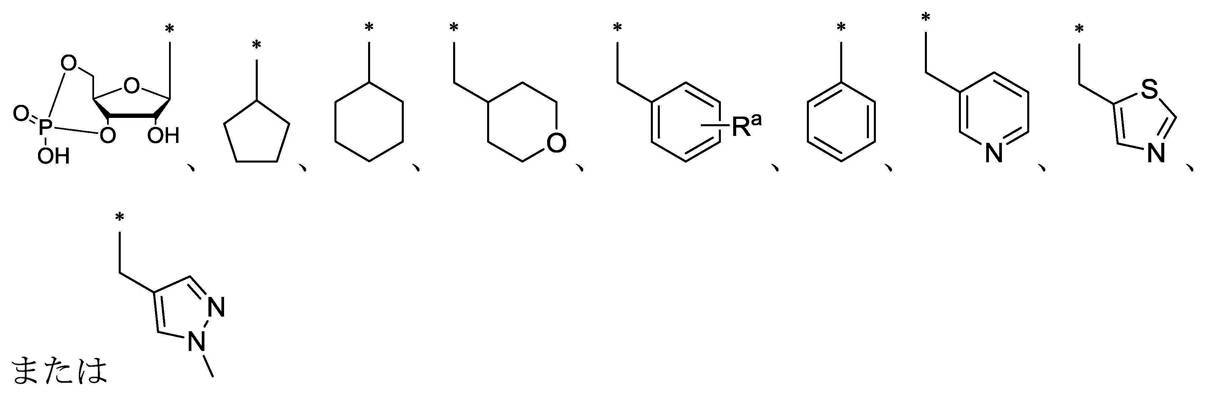
を示し、
Raは、水素原子、シアノ基、フッ素原子、塩素原子、メチル基、メトキシ基または-SO2Meを示し、
R2aは、水素原子またはアミノ基を示し、
R3aは、
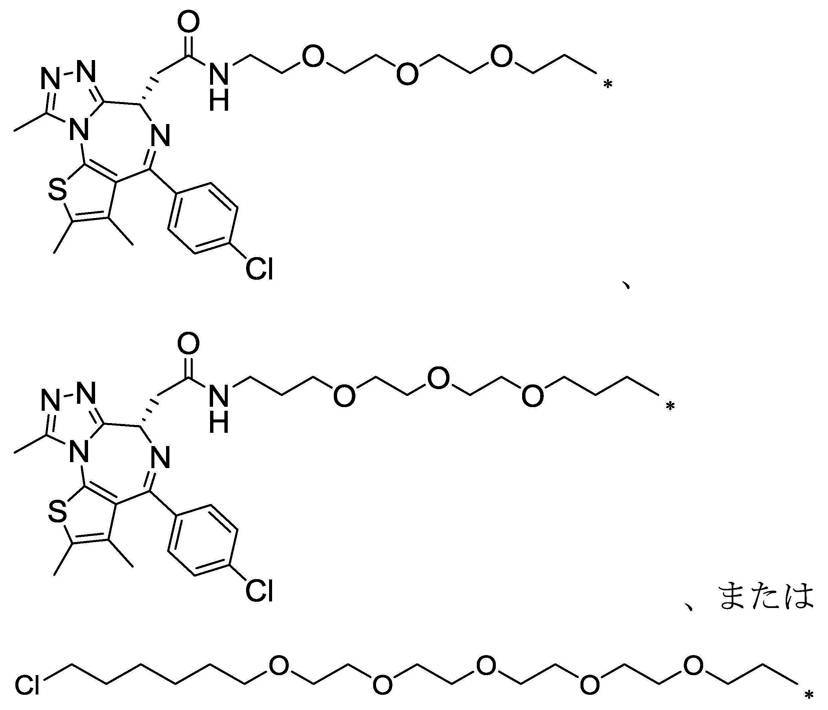
を示し
R4aおよびR5aは、それぞれ独立して、置換基を有してもよいアルキル基を示し、
Xは、脱離基を示し、
nは、1または2の整数を示し、
Lは、-S-または-NH-を示す。]
Xで示される脱離基としては、ハライド類またはスルホナート類が挙げられる。Compound (A-8), compound (A-10), compound (A-13), compound (A-16) and compound (A-20) contained in compound (I) are compound (A-1) or It can be produced from compound (A-3) by the following method.
[In the formula,
R 1a is
shows
R a represents a hydrogen atom, a cyano group, a fluorine atom, a chlorine atom, a methyl group, a methoxy group or —SO 2 Me;
R 2a represents a hydrogen atom or an amino group,
R3a is
R 4a and R 5a each independently represent an optionally substituted alkyl group,
X represents a leaving group,
n represents an integer of 1 or 2,
L represents -S- or -NH-. ]
Leaving groups represented by X include halides or sulfonates.
上記方法に記載されたアミン体(Va)は、例えば、下記に示す反応(例、アミド化反応、脱保護反応)により合成することができる。

化合物(A-8)は、化合物(A-7)とアミン体(Va)とのアミド化反応により製造することができる。 Compound (A-8) can be produced by an amidation reaction between compound (A-7) and amine body (Va).
化合物(A-7)は、化合物(A-6)とカルボン酸(IIIa)との芳香族求核置換反応により製造することができる。 Compound (A-7) can be produced by an aromatic nucleophilic substitution reaction between compound (A-6) and carboxylic acid (IIIa).
化合物(A-6)は、化合物(A-5)の臭素化反応により製造することができる。 Compound (A-6) can be produced by subjecting compound (A-5) to a bromination reaction.
化合物(A-5)は、化合物(A-4)の水による芳香族求核置換反応により製造することができる。 Compound (A-5) can be produced by an aromatic nucleophilic substitution reaction of compound (A-4) with water.
化合物(A-4)は、化合物(A-2)の環化反応、または化合物(A-3)と化合物(IIa)とのN-アルキル化反応により製造することができる。 Compound (A-4) can be produced by cyclization reaction of compound (A-2) or N-alkylation reaction of compound (A-3) and compound (IIa).
化合物(A-2)は、化合物(A-1)と化合物(Ia)との芳香族求核置換反応により製造することができる。 Compound (A-2) can be produced by an aromatic nucleophilic substitution reaction between compound (A-1) and compound (Ia).
化合物(A-10)は、化合物(A-9)とアミン体(Va)とのアミド化反応により製造することができる。 Compound (A-10) can be produced by an amidation reaction between compound (A-9) and amine body (Va).
化合物(A-9)は化合物(A-6)と化合物(IVa)との芳香族求核置換反応により製造することができる。 Compound (A-9) can be produced by an aromatic nucleophilic substitution reaction between compound (A-6) and compound (IVa).
化合物(A-13)は、化合物(A-12)とアミン体(Va)とのアミド化反応により製造することができる。 Compound (A-13) can be produced by an amidation reaction between compound (A-12) and amine form (Va).
化合物(A-12)は、化合物(A-11)と化合物(IVa)との芳香族求核置換反応により製造することができる。 Compound (A-12) can be produced by an aromatic nucleophilic substitution reaction between compound (A-11) and compound (IVa).
化合物(A-11)は化合物(A-6)と化合物(VIa)とのN-アルキル化反応により製造することができる。 Compound (A-11) can be produced by N-alkylation reaction of compound (A-6) and compound (VIa).
化合物(A-16)は、化合物(A-15)とアミン体(Va)とのアミド化反応により製造することができる。 Compound (A-16) can be produced by an amidation reaction between compound (A-15) and amine form (Va).
化合物(A-15)は、化合物(A-14)と化合物(IVa)との芳香族求核置換反応により製造することができる。 Compound (A-15) can be produced by an aromatic nucleophilic substitution reaction between compound (A-14) and compound (IVa).
化合物(A-14)は、化合物(A-6(R2a=NH2))と化合物(VIIa)とのアミド化反応により製造することができる。Compound (A-14) can be produced by amidating compound (A-6 (R 2a =NH 2 )) and compound (VIIa).
化合物(A-20)は、化合物(A-19)とアミン体(Va)とのアミド化反応により製造することができる。 Compound (A-20) can be produced by an amidation reaction between compound (A-19) and amine form (Va).
化合物(A-19)は、化合物(A-18)と化合物(IVa)との芳香族求核置換反応により製造することができる。 Compound (A-19) can be produced by an aromatic nucleophilic substitution reaction between compound (A-18) and compound (IVa).
化合物(A-18)は、化合物(A-17)の臭素化反応により製造することができる。 Compound (A-18) can be produced by subjecting compound (A-17) to a bromination reaction.
化合物(A-17)は、化合物(A-4)のアンモニアによる芳香族求核置換反応により製造することができる。 Compound (A-17) can be produced by a nucleophilic aromatic substitution reaction of compound (A-4) with ammonia.
化合物(I)に含まれる化合物(B-5)、化合物(B-7)、化合物(B-9)は、化合物(B-1)、化合物(A-9)、または、化合物(A-12)より以下の方法で製造することができる。
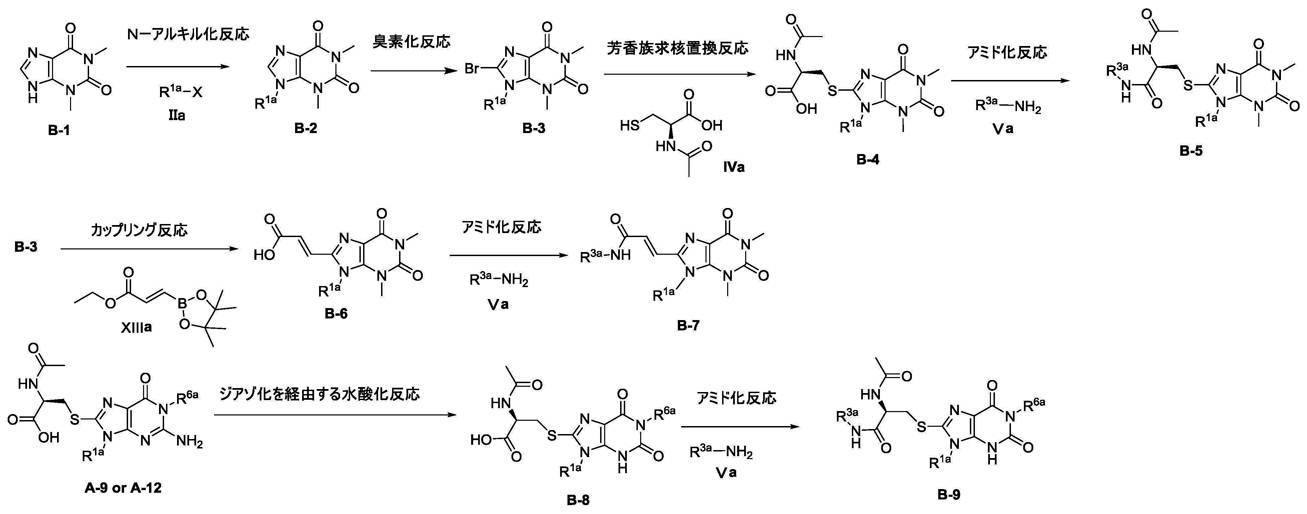
[式中、R6aは、水素原子またはR4aを示し、その他の記号は、前記と同意義を示す。]Compound (B-5), compound (B-7), and compound (B-9) contained in compound (I) are compound (B-1), compound (A-9), or compound (A-12 ) can be produced by the following method.
[In the formula, R 6a represents a hydrogen atom or R 4a , and other symbols have the same meanings as defined above. ]
化合物(B-5)は、化合物(B-4)とアミン体(Va)とのアミド化反応により製造することができる。 Compound (B-5) can be produced by an amidation reaction between compound (B-4) and amine body (Va).
化合物(B-4)は、化合物(B-3)と化合物(IVa)との芳香族求核置換反応により製造することができる。 Compound (B-4) can be produced by an aromatic nucleophilic substitution reaction between compound (B-3) and compound (IVa).
化合物(B-3)は、化合物(B-2)の臭素化反応により製造することができる。 Compound (B-3) can be produced by subjecting compound (B-2) to a bromination reaction.
化合物(B-2)は、化合物(B-1)と化合物(IIa)とのN-アルキル化反応により製造することができる。 Compound (B-2) can be produced by N-alkylation reaction of compound (B-1) and compound (IIa).
化合物(B-7)は、化合物(B-6)とアミン体(Va)とのアミド化反応により製造することができる。 Compound (B-7) can be produced by an amidation reaction between compound (B-6) and amine body (Va).
化合物(B-6)は、化合物(B-3)とボロン酸エステル(XIIIa)のカップリング反応により製造することができる。 Compound (B-6) can be produced by a coupling reaction of compound (B-3) and boronate ester (XIIIa).
化合物(B-9)は、化合物(B-8)とアミン体(Va)とのアミド化反応により製造することができる。 Compound (B-9) can be produced by an amidation reaction between compound (B-8) and amine body (Va).
化合物(B-8)は、化合物(A-9)、または、化合物(A-12)のジアゾ化を経由する水酸化反応により製造することができる。 Compound (B-8) can be produced by a hydroxylation reaction via diazotization of compound (A-9) or compound (A-12).
化合物(I)に含まれる化合物(C-6)は、化合物(C-1)より以下の方法で製造することができる。

[式中、各記号は前記と同意義を示す。]Compound (C-6) contained in compound (I) can be produced from compound (C-1) by the following method.
[In the formula, each symbol has the same meaning as described above. ]
化合物(C-6)は、化合物(C-5)とアミン体(Va)とのアミド化反応により製造することができる。 Compound (C-6) can be produced by an amidation reaction between compound (C-5) and amine form (Va).
化合物(C-5)は、化合物(C-4)、または、化合物(C-3)と化合物(IVa)との芳香族求核置換反応により製造することができる。 Compound (C-5) can be produced by an aromatic nucleophilic substitution reaction between compound (C-4) or compound (C-3) and compound (IVa).
化合物(C-4)は、化合物(C-3)の脱アミノ化反応により製造することができる。 Compound (C-4) can be produced by deamination of compound (C-3).
化合物(C-3)は、化合物(C-2)と化合物(IIa)とのN-アルキル化反応により製造することができる。 Compound (C-3) can be produced by N-alkylation reaction of compound (C-2) and compound (IIa).
化合物(C-2)は、化合物(C-1)の臭素化反応により製造することができる。 Compound (C-2) can be produced by subjecting compound (C-1) to a bromination reaction.
化合物(I)に含まれる化合物(D-5)は、化合物(D-1)より以下の方法で製造することができる。

[式中、各記号は前記と同意義を示す。]Compound (D-5) contained in compound (I) can be produced from compound (D-1) by the following method.
[In the formula, each symbol has the same meaning as described above. ]
化合物(D-5)は、化合物(D-4)とアミン体(Va)とのアミド化反応により製造することができる。 Compound (D-5) can be produced by an amidation reaction between compound (D-4) and amine body (Va).
化合物(D-4)は、化合物(D-3)と化合物(IVa)との芳香族求核置換反応により製造することができる。 Compound (D-4) can be produced by an aromatic nucleophilic substitution reaction between compound (D-3) and compound (IVa).
化合物(D-3)は、化合物(D-2)の臭素化反応により製造することができる。 Compound (D-3) can be produced by subjecting compound (D-2) to a bromination reaction.
化合物(D-2)は、化合物(D-1)と化合物(Ia)との芳香族求核置換反応により製造することができる。 Compound (D-2) can be produced by an aromatic nucleophilic substitution reaction between compound (D-1) and compound (Ia).
化合物(I)に含まれる化合物(E-5)は、化合物(E-1)より以下の方法で製造することができる。

[式中、各記号は前記と同意義を示す。]Compound (E-5) contained in compound (I) can be produced from compound (E-1) by the following method.
[In the formula, each symbol has the same meaning as described above. ]
化合物(E-5)は、化合物(E-4)とアミン体(Va)とのアミド化反応により製造することができる。 Compound (E-5) can be produced by an amidation reaction between compound (E-4) and amine body (Va).
化合物(E-4)は、化合物(E-3)と化合物(IVa)との芳香族求核置換反応により製造することができる。 Compound (E-4) can be produced by an aromatic nucleophilic substitution reaction between compound (E-3) and compound (IVa).
化合物(E-3)は、化合物(E-2)の臭素化反応により製造することができる。 Compound (E-3) can be produced by subjecting compound (E-2) to a bromination reaction.
化合物(E-2)は、化合物(E-1)と化合物(IIa)とのN-アルキル化反応により製造することができる。 Compound (E-2) can be produced by N-alkylation reaction of compound (E-1) and compound (IIa).
化合物(I)に含まれる化合物(F-4)は、化合物(A-6(R2a=NH2))より以下の方法で製造することができる。

[式中、各記号は前記と同意義を示す。]Compound (F-4) contained in compound (I) can be produced from compound (A-6 (R 2a =NH 2 )) by the following method.
[In the formula, each symbol has the same meaning as described above. ]
化合物(F-4)は、化合物(F-3)とアミン体(Va)とのアミド化反応により製造することができる。 Compound (F-4) can be produced by an amidation reaction between compound (F-3) and amine body (Va).
化合物(F-3)は、化合物(F-2)と化合物(IVa)との芳香族求核置換反応により製造することができる。 Compound (F-3) can be produced by an aromatic nucleophilic substitution reaction between compound (F-2) and compound (IVa).
化合物(F-2)は、化合物(F-1)の環化反応により製造することができる。 Compound (F-2) can be produced by subjecting compound (F-1) to a cyclization reaction.
化合物(F-1)は、化合物(A-6(R2a=NH2))と化合物(VIIIa)とのN-アルキル化反応により製造することができる。Compound (F-1) can be produced by N-alkylation reaction of compound (A-6 (R 2a =NH 2 )) and compound (VIIIa).
化合物(I)に含まれる化合物(G-2)は、化合物(A-6(R2a=NH2))より以下の方法で製造することができる。
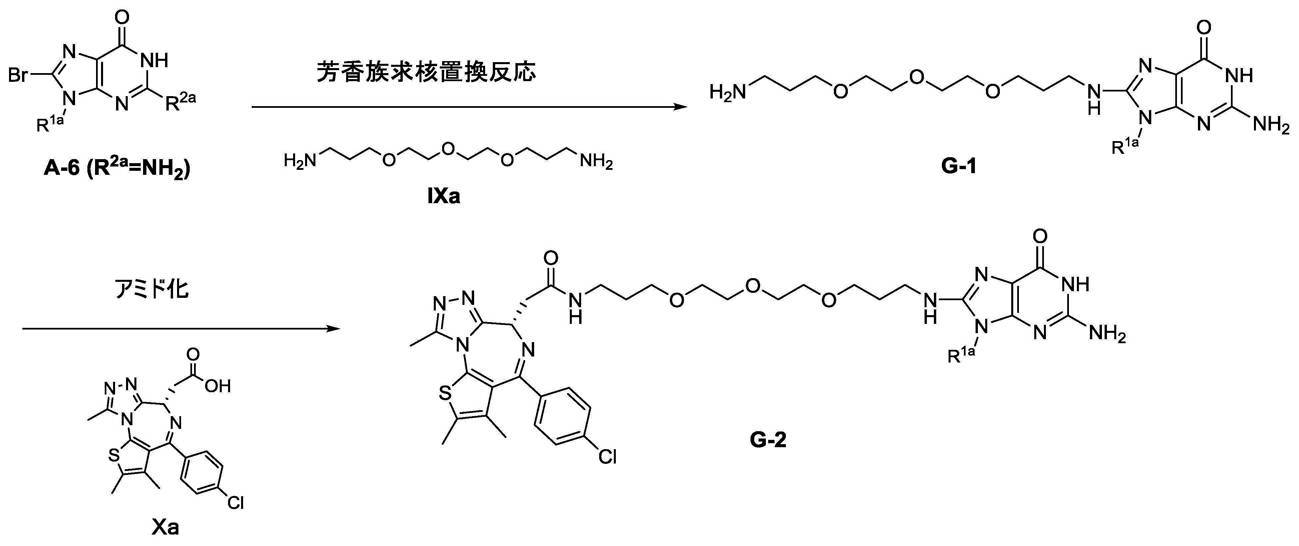
[式中、各記号は前記と同意義を示す。]Compound (G-2) contained in compound (I) can be produced from compound (A-6 (R 2a =NH 2 )) by the following method.
[In the formula, each symbol has the same meaning as described above. ]
化合物(G-2)は、化合物(G-1)とカルボン酸(Xa)とのアミド化反応により製造することができる。 Compound (G-2) can be produced by an amidation reaction between compound (G-1) and carboxylic acid (Xa).
化合物(G-1)は、化合物(A-6(R2a=NH2))と化合物(IXa)との芳香族求核置換反応により製造することができる。Compound (G-1) can be produced by an aromatic nucleophilic substitution reaction between compound (A-6 (R 2a =NH 2 )) and compound (IXa).
化合物(I)に含まれる化合物(H-2)および化合物(H-3)は、化合物(A-9(R2a=NH2))より以下の方法で製造することができる。

[式中、各記号は前記と同意義を示す。]Compound (H-2) and compound (H-3) contained in compound (I) can be produced from compound (A-9 (R 2a =NH 2 )) by the following method.
[In the formula, each symbol has the same meaning as described above. ]
化合物(H-2)は、化合物(H-1)と公知カルボン酸(XIa、ACS Chemical Biology,10(11),2441-2447,2015)とのアミド化反応により製造することができる。 Compound (H-2) can be produced by an amidation reaction between compound (H-1) and a known carboxylic acid (XIa, ACS Chemical Biology, 10(11), 2441-2447, 2015).
化合物(H-3)は、化合物(H-1)とFumagillolとのカーバメート化反応により製造することができる。 Compound (H-3) can be produced by a carbamate reaction between compound (H-1) and Fumagillol.
化合物(H-1)は、化合物(A-9(R2a=NH2))とアミン体(IXa)とのアミド化反応により製造することができる。Compound (H-1) can be produced by an amidation reaction between compound (A-9 (R 2a =NH 2 )) and amine form (IXa).
化合物(I)に含まれる化合物(I-2)、(I-4)、および(I-6)は、化合物(A-6(R2a=NH2))より以下の方法で製造することができる。
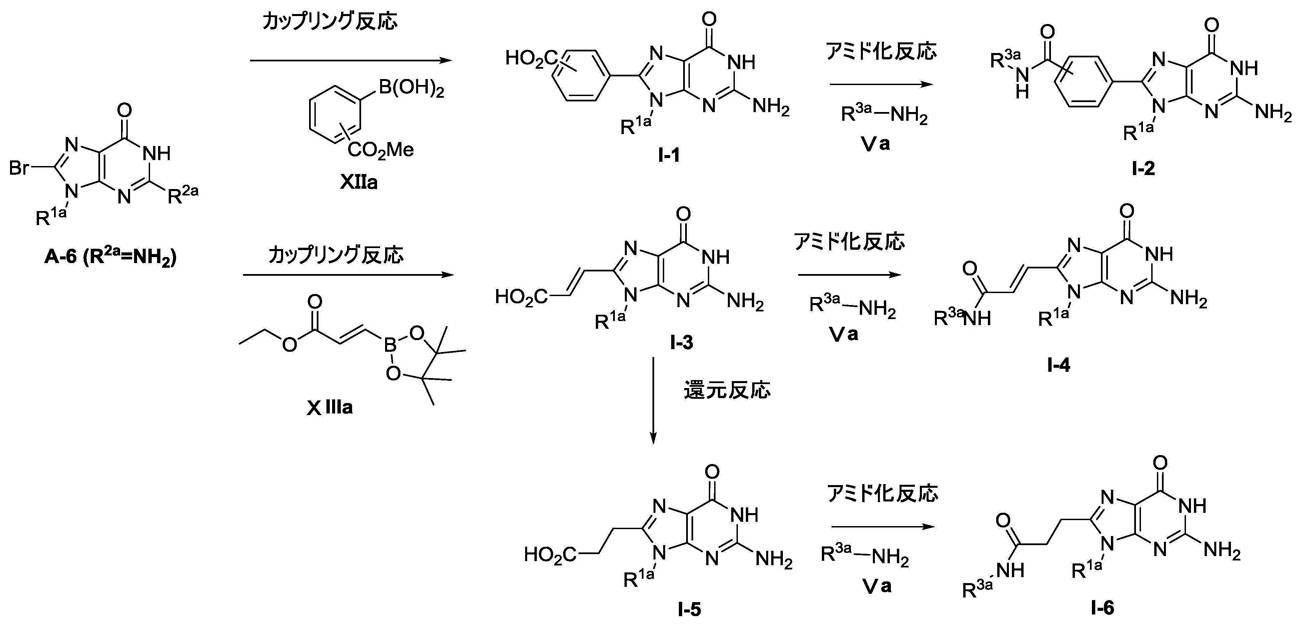
[式中、各記号は前記と同意義を示す。]Compounds (I-2), (I-4), and (I-6) contained in compound (I) can be produced from compound (A-6 (R 2a =NH 2 )) by the following method. can.
[In the formula, each symbol has the same meaning as described above. ]
化合物(I-2)は、化合物(I-1)とアミン体(Va)とのアミド化反応により製造することができる。 Compound (I-2) can be produced by an amidation reaction between compound (I-1) and amine form (Va).
化合物(I-1)は、化合物(A-6(R2a=NH2))とボロン酸(XIIa)とのカップリング反応により製造することができる。Compound (I-1) can be produced by a coupling reaction between compound (A-6 (R 2a =NH 2 )) and boronic acid (XIIa).
化合物(I-4)は、化合物(I-3)とアミン体(Va)とのアミド化反応により製造することができる。 Compound (I-4) can be produced by an amidation reaction between compound (I-3) and amine form (Va).
化合物(I-3)は、化合物(A-6(R2a=NH2))とボロン酸エステル(XIIIa)とのカップリング反応により製造することができる。Compound (I-3) can be produced by a coupling reaction between compound (A-6 (R 2a =NH 2 )) and boronate ester (XIIIa).
化合物(I-6)は、化合物(I-5)とアミン体(Va)とのアミド化反応により製造することができる。 Compound (I-6) can be produced by an amidation reaction between compound (I-5) and amine form (Va).
化合物(I-5)は、化合物(I-3)の還元反応により製造することができる。 Compound (I-5) can be produced by subjecting compound (I-3) to a reduction reaction.
化合物(I)に含まれる化合物(L-1)~(L-10)は、化合物(A-6(R2a=NH2))より以下の方法で製造することができる。

[式中、各記号は前記と同意義を示す。]Compounds (L-1) to (L-10) included in compound (I) can be produced from compound (A-6 (R 2a =NH 2 )) by the following method.
[In the formula, each symbol has the same meaning as described above. ]
化合物(L-1)~(L-3)は、化合物(A-6(R2a=NH2))とボロン酸エステル誘導体(K-2)~(K-4)の鈴木カップリング反応によって製造できる。Compounds (L-1) to (L-3) are produced by Suzuki coupling reaction of compound (A-6 (R 2a =NH 2 )) and boronate ester derivatives (K-2) to (K-4). can.
ボロン酸エステル(K-2)~(K-4)は、公知化合物(K-1)の光延反応によって製造できる。 Boronic acid esters (K-2) to (K-4) can be produced by the Mitsunobu reaction of known compound (K-1).
化合物(L-4)は、化合物(A-6(R2a=NH2))とアルキン体(K-5)の薗頭カップリング反応によって製造できる。Compound (L-4) can be produced by Sonogashira coupling reaction of compound (A-6 (R 2a =NH 2 )) and alkyne form (K-5).
アルキン体(K-5)は、公知化合物(K-1)とp-トルエンスルホン酸プロパルギルの求核置換反応によって製造できる。 The alkyne derivative (K-5) can be produced by a nucleophilic substitution reaction between the known compound (K-1) and propargyl p-toluenesulfonate.
化合物(L-5)は、化合物(L-4)の水素添加反応によって製造できる。 Compound (L-5) can be produced by hydrogenating compound (L-4).
化合物(L-6)は、公知化合物(K-6)とアルキン誘導体(J-2)のクリック反応によって製造できる。 Compound (L-6) can be produced by a click reaction between known compound (K-6) and alkyne derivative (J-2).
アルキン体(J-2)は、化合物(A-6(R2a=NH2))とトリメチルシリルアセチレンの薗頭カップリング反応、続く脱シリル化反応(脱保護反応)によって製造できる。The alkyne form (J-2) can be produced by the Sonogashira coupling reaction of the compound (A-6 (R 2a =NH 2 )) and trimethylsilylacetylene, followed by desilylation reaction (deprotection reaction).
化合物(L-7)および(L-8)は、アミン体(K-7)と、カルボン酸誘導体(J-3)および(J-5)のアミド化反応によって製造できる。 Compounds (L-7) and (L-8) can be produced by amidation reaction of amine body (K-7) and carboxylic acid derivatives (J-3) and (J-5).
化合物(J-3)は、化合物(A-6(R2a=NH2))の一酸化炭素挿入反応、続く加水分解反応によって製造できる。Compound (J-3) can be produced by carbon monoxide insertion reaction of compound (A-6 (R 2a =NH 2 )) followed by hydrolysis reaction.
化合物(J-5)は、化合物(J-3)とピペコリン酸メチル塩酸塩のアミド化反応、続く加水分解反応によって製造できる。 Compound (J-5) can be produced by amidation reaction of compound (J-3) and methyl pipecolic acid hydrochloride followed by hydrolysis reaction.
化合物(L-9)は、アミン体(K-7)とアルデヒド体(J-4)の還元的アミノ化反応によって製造できる。 Compound (L-9) can be produced by a reductive amination reaction of amine form (K-7) and aldehyde form (J-4).
化合物(J-4)は、化合物(A-6(R2a=NH2))と4,4,5,5-テトラメチル-2-ビニル-1,3,2-ジオキサボロランの鈴木カップリング反応、続く酸化的開裂反応によって製造できる。Compound (J-4) is a Suzuki coupling reaction of compound (A-6 (R 2a =NH 2 )) and 4,4,5,5-tetramethyl-2-vinyl-1,3,2-dioxaborolane, It can be prepared by a subsequent oxidative cleavage reaction.
化合物(L-10)は、化合物(J-3)とアミン体(Va)とのアミド化反応により製造することができる。 Compound (L-10) can be produced by an amidation reaction between compound (J-3) and amine form (Va).
化合物(I)が、光学異性体、立体異性体、位置異性体、回転異性体等の異性体を有する場合には、いずれか一方の異性体も混合物も化合物(I)に包含される。例えば、化合物(I)に光学異性体が存在する場合には、ラセミ体から分割された光学異性体も化合物(I)に包含される。これらの異性体は、自体公知の合成手法、分離手法(例、濃縮、溶媒抽出、カラムクロマトグラフィー、再結晶)によりそれぞれを単品として得ることができる。 When compound (I) has isomers such as optical isomers, stereoisomers, positional isomers and rotational isomers, compound (I) includes both isomers and mixtures thereof. For example, when compound (I) has optical isomers, the optical isomers resolved from the racemate are also included in compound (I). These isomers can be obtained as single products by per se known synthesis techniques and separation techniques (eg, concentration, solvent extraction, column chromatography, recrystallization).
化合物(I)は、結晶であってもよく、結晶形が単一であっても結晶形混合物であっても化合物(I)に包含される。結晶は、自体公知の結晶化法を適用して、結晶化することによって製造することができる。
また、化合物(I)は、薬学的に許容され得る共結晶または共結晶塩であってもよい。ここで、共結晶または共結晶塩とは、各々が異なる物理的性質(例、構造、融点、融解熱、吸湿性、安定性)を持つ、室温で二種またはそれ以上の独特な固体から構成される結晶性物質を意味する。共結晶または共結晶塩は、自体公知の共結晶化法に従い製造することができる。
化合物(I)は、水和物であっても、非水和物であっても、溶媒和物であっても、無溶媒和物であってもよく、いずれも化合物(I)に包含される。
同位元素(例、2H、3H、11C、14C、18F、35S、125I)等で標識された化合物も、化合物(I)に包含される。同位元素で標識または置換された化合物(I)は、例えば、陽電子断層法(Positron Emission Tomography:PET)において使用するトレーサー(PETトレーサー)として用いることができ、医療診断などの分野において有用である。Compound (I) may be crystalline, and compound (I) encompasses both a single crystal form and a mixture of crystal forms. Crystals can be produced by applying a crystallization method known per se to crystallize.
Compound (I) may also be a pharmaceutically acceptable co-crystal or co-crystal salt. Here, co-crystals or co-crystal salts are composed of two or more unique solids at room temperature, each with different physical properties (e.g., structure, melting point, heat of fusion, hygroscopicity, stability). means a crystalline substance that is A co-crystal or a co-crystal salt can be produced according to a co-crystallization method known per se.
Compound (I) may be a hydrate, a non-hydrate, a solvate, or a non-solvate, all of which are included in compound (I). be.
Compounds labeled with isotopes (eg, 2 H, 3 H, 11 C, 14 C, 18 F, 35 S, 125 I) and the like are also included in compound (I). Isotope-labeled or substituted compound (I) can be used, for example, as a tracer (PET tracer) used in positron emission tomography (PET), and is useful in fields such as medical diagnosis.
R1がHaloTag(登録商標)を融合した細胞内タンパク質に対するリガンドである化合物(I)は、例えば、オートファジーによる細胞内タンパク質の分解メカニズムを分析する際のツールとして用いることができる。Compound (I), in which R1 is a ligand for an intracellular protein fused with HaloTag (registered trademark), can be used, for example, as a tool for analyzing the degradation mechanism of intracellular proteins by autophagy.
R1が病態に関連した細胞内タンパク質に対するリガンドである化合物(I)は、当該病態のメカニズムを解析する際のツールとして用いることができ、また当該病態に対する予防および/または治療薬として使用することができる。Compound (I), wherein R1 is a ligand for an intracellular protein associated with a pathological condition, can be used as a tool for analyzing the mechanism of the pathological condition, and can be used as a preventive and/or therapeutic agent for the pathological condition. can be done.
R1が病態に関連した細胞内タンパク質に対するリガンドである化合物(I)(本明細書中、化合物(II)と称することがある)はプロドラッグであってもよい。
化合物(II)のプロドラッグとは、生体内における生理条件下で酵素や胃酸等による反応により化合物(II)に変換する化合物、すなわち酵素的に酸化、還元、加水分解等を起こして化合物(II)に変化する化合物、胃酸等により加水分解等を起こして化合物(II)に変化する化合物をいう。Compound (I) (sometimes referred to herein as compound (II)) wherein R1 is a ligand for an intracellular protein associated with a disease state may be a prodrug.
A prodrug of compound (II) is a compound that is converted to compound (II) by reactions with enzymes, gastric acid, etc. under physiological conditions in vivo, i.e., compound (II) by enzymatic oxidation, reduction, hydrolysis, etc. ), or a compound that undergoes hydrolysis or the like due to gastric acid or the like and changes to compound (II).
化合物(II)のプロドラッグとしては、例えば、
(1)化合物(II)のアミノがアシル化、アルキル化、リン酸化された化合物(例えば、化合物(II)のアミノが、エイコサノイル化、アラニル化、ペンチルアミノカルボニル化、(5-メチル-2-オキソ-1,3-ジオキソレン-4-イル)メトキシカルボニル化、テトラヒドロフラニル化、ピロリジルメチル化、ピバロイルオキシメチル化、tert-ブチル化、エトキシカルボニル化、tert-ブトキシカルボニル化、アセチル化、シクロプロピルカルボニル化された化合物等);
(2)化合物(II)のヒドロキシが、アシル化、アルキル化、リン酸化、ホウ酸化された化合物(例えば、化合物(II)のヒドロキシが、アセチル化、パルミトイル化、プロパノイル化、ピバロイル化、スクシニル化、フマリル化、アラニル化、ジメチルアミノメチルカルボニル化された化合物等);
(3)化合物(II)のカルボキシが、エステル化、アミド化された化合物(例えば、化合物(II)のカルボキシが、エチルエステル化、フェニルエステル化、カルボキシメチルエステル化、ジメチルアミノメチルエステル化、ピバロイルオキシメチルエステル化、エトキシカルボニルオキシエチルエステル化、フタリジルエステル化、(5-メチル-2-オキソ-1,3-ジオキソレン-4-イル)メチルエステル化、シクロヘキシルオキシカルボニルエチルエステル化、メチルアミド化された化合物等);
が挙げられる。これらの化合物は、自体公知の方法によって化合物(II)から製造することができる。Examples of prodrugs of compound (II) include
(1) A compound in which the amino of compound (II) is acylated, alkylated, or phosphorylated (for example, the amino of compound (II) is eicosanoylated, alanylated, pentylaminocarbonylated, (5-methyl-2- oxo-1,3-dioxolen-4-yl)methoxycarbonylation, tetrahydrofuranylation, pyrrolidylmethylation, pivaloyloxymethylation, tert-butylation, ethoxycarbonylation, tert-butoxycarbonylation, acetylation, cyclopropyl carbonylated compounds, etc.);
(2) hydroxy of compound (II) is acylated, alkylated, phosphorylated, or borated (e.g., hydroxy of compound (II) is acetylated, palmitoylated, propanoylated, pivaloylated, succinylated , fumarylated, alanylated, dimethylaminomethylcarbonylated compounds, etc.);
(3) compounds in which the carboxy of compound (II) is esterified or amidated (for example, the carboxy of compound (II) is ethyl-esterified, phenyl-esterified, carboxymethyl-esterified, dimethylaminomethyl-esterified, py Valoyloxymethyl esterification, ethoxycarbonyloxyethyl esterification, phthalidyl esterification, (5-methyl-2-oxo-1,3-dioxolen-4-yl) methyl esterification, cyclohexyloxycarbonylethyl esterification, methylamide chemical compounds, etc.);
are mentioned. These compounds can be produced from compound (II) by a method known per se.
また、化合物(II)のプロドラッグは、広川書店1990年刊「医薬品の開発」第7巻分子設計163頁から198頁に記載されているような生理的条件で化合物(II)に変化するものであってもよい。 In addition, the prodrug of compound (II) changes to compound (II) under physiological conditions as described in Hirokawa Shoten, 1990, "Drug Development", Vol. 7, Molecular Design, pp. 163-198. There may be.
化合物(II)またはそのプロドラッグ(本明細書中、これらをまとめて「本発明化合物」と略記することがある)は、標的とする細胞内分子(好ましくは細胞内タンパク質、特に、病態と関連する細胞内タンパク質)の分解を誘導する活性を有し、標的とする細胞内分子が関与する疾患の予防または治療剤として有用である。本発明の化合物は、その作用機序に照らして、標的となる細胞内分子が関与するあらゆる疾患の予防または治療に有効で有り得る。中でも、癌、炎症性疾患、自己免疫性疾患、および骨・関節変性疾患の治療又は予防に有効であることが期待される。 Compound (II) or a prodrug thereof (in this specification, they may be collectively abbreviated as "the compound of the present invention") is a target intracellular molecule (preferably an intracellular protein, especially It has the activity of inducing the degradation of intracellular proteins (intracellular proteins that interact with the target), and is useful as a preventive or therapeutic agent for diseases associated with targeted intracellular molecules. In light of their mechanism of action, the compounds of the invention may be effective in preventing or treating any disease involving targeted intracellular molecules. Among others, it is expected to be effective in treating or preventing cancer, inflammatory diseases, autoimmune diseases, and bone/joint degenerative diseases.
癌の治療又は予防剤としては、例えば、大腸癌(例、結腸癌、直腸癌、肛門癌、家族性大腸癌、遺伝性非ポリポーシス大腸癌、消化管間質腫瘍)、肺癌(例、非小細胞肺癌、小細胞肺癌、悪性中皮腫)、中皮腫、膵臓癌(例、膵管癌、膵内分泌腫瘍)、咽頭癌、喉頭癌、食道癌、胃癌(例、乳頭腺癌、粘液性腺癌、腺扁平上皮癌)、十二指腸癌、小腸癌、乳癌(例、浸潤性乳管癌、非浸潤性乳管癌、炎症性乳癌)、卵巣癌(例、上皮性卵巣癌、性腺外胚細胞腫瘍、卵巣性胚細胞腫瘍、卵巣低悪性度腫瘍)、精巣腫瘍、前立腺癌(例、ホルモン依存性前立腺癌、ホルモン非依存性前立腺癌、去勢療法抵抗性前立腺癌)、肝臓癌(例、肝細胞癌、原発性肝癌、肝外胆管癌)、甲状腺癌(例、甲状腺髄様癌)、腎臓癌(例、腎細胞癌(例、淡明細胞型腎細胞癌)、腎盂と尿管の移行上皮癌)、子宮癌(例、子宮頚部癌、子宮体部癌、子宮肉腫)、妊娠性絨毛癌、脳腫瘍(例、髄芽細胞腫、神経膠腫、松果体星細胞腫瘍、毛様細胞性星細胞腫、びまん性星細胞腫、退形成性星細胞腫、下垂体腺腫)、網膜芽細胞腫、皮膚癌(例、基底細胞腫、悪性黒色腫)、肉腫(例、横紋筋肉腫、平滑筋肉腫、軟部肉腫、紡錘細胞肉腫)、悪性骨腫瘍、膀胱癌、血液癌(例、多発性骨髄腫、白血病、悪性リンパ腫、ホジキン病、慢性骨髄増殖性疾患)、原発不明癌等の予防剤または治療剤、癌の増殖阻害剤、癌の転移抑制剤、アポトーシス促進剤、前癌病変(例、骨髄異型性症候群)の治療剤等が挙げられる。 Examples of therapeutic or preventive agents for cancer include colon cancer (eg, colon cancer, rectal cancer, anal cancer, familial colon cancer, hereditary non-polyposis colon cancer, gastrointestinal stromal tumor), lung cancer (eg, non-small cell lung cancer, small cell lung cancer, malignant mesothelioma), mesothelioma, pancreatic cancer (e.g., pancreatic duct cancer, pancreatic endocrine tumor), pharyngeal cancer, laryngeal cancer, esophageal cancer, gastric cancer (e.g., papillary adenocarcinoma, mucinous adenocarcinoma) , adenosquamous cell carcinoma), duodenal cancer, small bowel cancer, breast cancer (eg, invasive ductal carcinoma, ductal carcinoma in situ, inflammatory breast cancer), ovarian cancer (eg, epithelial ovarian cancer, extragonadal germ cell tumor) , ovarian germ cell tumor, ovarian low malignant potential tumor), testicular tumor, prostate cancer (e.g., hormone-dependent prostate cancer, hormone-independent prostate cancer, castration-resistant prostate cancer), liver cancer (e.g., hepatocyte cancer, primary liver cancer, extrahepatic cholangiocarcinoma), thyroid cancer (eg, medullary thyroid carcinoma), renal cancer (eg, renal cell carcinoma (eg, clear cell renal cell carcinoma), transitional epithelium of renal pelvis and ureter) cancer), uterine cancer (e.g., cervical cancer, uterine body cancer, uterine sarcoma), gestational choriocarcinoma, brain tumors (e.g., medulloblastoma, glioma, pineal astrocytic tumor, pilocytic astrocytoma, diffuse astrocytoma, anaplastic astrocytoma, pituitary adenoma), retinoblastoma, skin cancer (eg, basalcytoma, malignant melanoma), sarcoma (eg, rhabdomyosarcoma, Leiomyosarcoma, soft tissue sarcoma, spindle cell sarcoma), malignant bone tumor, bladder cancer, blood cancer (e.g., multiple myeloma, leukemia, malignant lymphoma, Hodgkin's disease, chronic myeloproliferative disease), cancer of unknown primary origin, etc. agents or therapeutic agents, cancer growth inhibitors, cancer metastasis inhibitors, apoptosis promoters, therapeutic agents for precancerous lesions (eg, myelodysplastic syndrome), and the like.
なかでも、本発明化合物は、特に、多発性骨髄腫、急性骨髄性白血病、大腸癌、膵臓癌に有効である。
なお、本発明化合物は、哺乳動物(例、マウス、ラット、ハムスター、ウサギ、ネコ、イヌ、ウシ、ヒツジ、サル、ヒト)に対して、上記疾患を治療または予防するために用いることができる。Among others, the compounds of the present invention are particularly effective against multiple myeloma, acute myelogenous leukemia, colon cancer and pancreatic cancer.
The compounds of the present invention can be used to treat or prevent the above diseases in mammals (eg mice, rats, hamsters, rabbits, cats, dogs, cows, sheep, monkeys and humans).
本発明化合物は、そのままあるいは薬理学的に許容される担体を配合し、医薬として、哺乳動物(好ましくは、ヒト)に経口的または非経口的に投与することができる。
以下、本発明化合物を含有してなる医薬(「本発明の医薬」と略記する場合がある)について詳述する。本発明の医薬の剤形としては、例えば、錠剤(糖衣錠、フィルムコーティング錠、舌下錠、バッカル錠、口腔内速崩錠を含む)、丸剤、顆粒剤、散剤、カプセル剤(ソフトカプセル剤、マイクロカプセル剤を含む)、シロップ剤、乳剤、懸濁剤、フィルム剤(例、口腔内崩壊フィルム、口腔粘膜貼付フィルム)等の経口剤が挙げられる。また、本発明の医薬の剤形としては、例えば、注射剤、点滴剤、経皮剤(例、イオントフォレシス経皮剤)、坐剤、軟膏剤、経鼻剤、経肺剤、点眼剤等の非経口剤も挙げられる。また、本発明の医薬は、速放性製剤、徐放性製剤(徐放性マイクロカプセルを含む)などの放出制御製剤であってもよい。The compound of the present invention can be administered to mammals (preferably humans) orally or parenterally as a pharmaceutical as it is or after mixing with a pharmacologically acceptable carrier.
A drug containing the compound of the present invention (sometimes abbreviated as "the drug of the present invention") will be described in detail below. Dosage forms of the medicament of the present invention include, for example, tablets (including sugar-coated tablets, film-coated tablets, sublingual tablets, buccal tablets, and intraorally rapidly disintegrating tablets), pills, granules, powders, capsules (soft capsules, microcapsules), syrups, emulsions, suspensions, films (eg, orally disintegrating films, oral mucosal patch films) and the like. In addition, dosage forms of the medicament of the present invention include, for example, injections, drops, transdermal agents (e.g., iontophoresis transdermal agents), suppositories, ointments, nasal agents, pulmonary agents, and eye drops. Parenteral agents such as are also included. In addition, the medicament of the present invention may be a controlled-release formulation such as an immediate-release formulation or a sustained-release formulation (including sustained-release microcapsules).
本発明の医薬は、製剤技術分野で一般的に用いられている公知の製造方法(例、日本薬局方に記載の方法)により製造することができる。また、本発明の医薬には、必要に応じて、製剤分野において通常用いられる賦形剤、結合剤、崩壊剤、滑沢剤、甘味剤、界面活性剤、懸濁化剤、乳化剤、着色剤、保存剤、芳香剤、矯味剤、安定剤、粘稠剤等の添加剤を適宜、適量含有させることができる。
前記した薬理学的に許容される担体としては、これらの添加剤が挙げられる。The medicament of the present invention can be produced by a known production method generally used in the pharmaceutical technical field (eg, the method described in the Japanese Pharmacopoeia). In addition, the medicament of the present invention may optionally contain excipients, binders, disintegrants, lubricants, sweeteners, surfactants, suspending agents, emulsifiers, and coloring agents that are commonly used in the pharmaceutical field. , preservatives, flavoring agents, flavoring agents, stabilizers, thickening agents, and other additives can be added in appropriate amounts.
The aforementioned pharmacologically acceptable carriers include these additives.
例えば、錠剤は、賦形剤、結合剤、崩壊剤、滑沢剤等を用いて製造することができ、丸剤及び顆粒剤は、賦形剤、結合剤、崩壊剤を用いて製造することができる。また、散剤及びカプセル剤は賦形剤等を、シロップ剤は甘味剤等を、乳剤または懸濁剤は懸濁化剤、界面活性剤、乳化剤等を用いて製造することができる。 For example, tablets can be manufactured using excipients, binders, disintegrants, lubricants, etc., and pills and granules can be manufactured using excipients, binders, and disintegrants. can be done. In addition, powders and capsules can be produced using excipients and the like, syrups can be produced using sweeteners and the like, and emulsions or suspensions can be produced using suspending agents, surfactants, emulsifiers and the like.
賦形剤の例としては、乳糖、白糖、ブドウ糖、でんぷん、蔗糖、微結晶セルロース、カンゾウ末、マンニトール、炭酸水素ナトリウム、リン酸カルシウム、硫酸カルシウムが挙げられる。
結合剤の例としては、5ないし10重量%デンプンのり液、10ないし20重量%アラビアゴム液またはゼラチン液、1ないし5重量%トラガント液、カルボキシメチルセルロース液、アルギン酸ナトリウム液、グリセリンが挙げられる。
崩壊剤の例としては、でんぷん、炭酸カルシウムが挙げられる。
滑沢剤の例としては、ステアリン酸マグネシウム、ステアリン酸、ステアリン酸カルシウム、精製タルクが挙げられる。
甘味剤の例としては、ブドウ糖、果糖、転化糖、ソルビトール、キシリトール、グリセリン、単シロップが挙げられる。
界面活性剤の例としては、ラウリル硫酸ナトリウム、ポリソルベート80、ソルビタンモノ脂肪酸エステル、ステアリン酸ポリオキシル40が挙げられる。
懸濁化剤の例としては、アラビアゴム、アルギン酸ナトリウム、カルボキシメチルセルロースナトリウム、メチルセルロース、ベントナイトが挙げられる。
乳化剤の例としては、アラビアゴム、トラガント、ゼラチン、ポリソルベート80が挙げられる。Examples of excipients include lactose, white sugar, glucose, starch, sucrose, microcrystalline cellulose, licorice powder, mannitol, sodium bicarbonate, calcium phosphate, calcium sulfate.
Examples of binders include 5 to 10% by weight starch paste solution, 10 to 20% by weight gum arabic or gelatin solution, 1 to 5% by weight tragacanth solution, carboxymethylcellulose solution, sodium alginate solution and glycerin.
Examples of disintegrants include starch and calcium carbonate.
Examples of lubricants include magnesium stearate, stearic acid, calcium stearate, refined talc.
Examples of sweetening agents include glucose, fructose, invert sugar, sorbitol, xylitol, glycerin, simple syrup.
Examples of surfactants include sodium lauryl sulfate, polysorbate 80, sorbitan monofatty acid ester, polyoxyl 40 stearate.
Examples of suspending agents include gum arabic, sodium alginate, sodium carboxymethylcellulose, methylcellulose, bentonite.
Examples of emulsifying agents include gum arabic, tragacanth, gelatin and polysorbate 80.
例えば、本発明の医薬が錠剤である場合、該錠剤は、自体公知の方法に従い、本発明化合物に、例えば、賦形剤(例、乳糖、白糖、デンプン)、崩壊剤(例、デンプン、炭酸カルシウム)、結合剤(例、デンプン、アラビアゴム、カルボキシメチルセルロース、ポリビニルピロリドン、ヒドロキシプロピルセルロース)または滑沢剤(例、タルク、ステアリン酸マグネシウム、ポリエチレングリコール6000)を添加して圧縮成形し、次いで必要により、味のマスキング、腸溶性あるいは持続性の目的のため自体公知の方法でコーティングすることにより製造することができる。コーティングに用いられるコーティング剤としては、例えば、ヒドロキシプロピルメチルセルロース、エチルセルロース、ヒドロキシメチルセルロース、ヒドロキシプロピルセルロース、ポリオキシエチレングリコール、ツイーン80、プルロニックF68、セルロースアセテートフタレート、ヒドロキシプロピルメチルセルロースフタレート、ヒドロキシメチルセルロースアセテートサクシネート、オイドラギット(ローム社製、ドイツ、メタアクリル酸・アクリル酸共重合体)および色素(例、ベンガラ、二酸化チタン)が用いられる。 For example, when the medicament of the present invention is a tablet, the tablet is prepared by adding, for example, excipients (e.g., lactose, sucrose, starch), disintegrants (e.g., starch, carbonic acid) to the compound of the present invention according to a method known per se. calcium), binders (e.g. starch, gum arabic, carboxymethylcellulose, polyvinylpyrrolidone, hydroxypropylcellulose) or lubricants (e.g. talc, magnesium stearate, polyethylene glycol 6000) are added and compression molded, then required. can be produced by coating in a manner known per se for the purpose of taste masking, enteric or long-lasting properties. Coating agents used for coating include, for example, hydroxypropylmethylcellulose, ethylcellulose, hydroxymethylcellulose, hydroxypropylcellulose, polyoxyethylene glycol, Tween 80, Pluronic F68, cellulose acetate phthalate, hydroxypropylmethylcellulose phthalate, hydroxymethylcellulose acetate succinate, Eudragit (manufactured by Rohm Co., Germany, methacrylic acid/acrylic acid copolymer) and pigments (eg, red iron oxide, titanium dioxide) are used.
前記注射剤としては、静脈注射剤のほか、皮下注射剤、皮内注射剤、筋肉注射剤、腹腔内注射剤、点滴注射剤等が含まれる。 The injections include intravenous injections, subcutaneous injections, intradermal injections, intramuscular injections, intraperitoneal injections, drip injections, and the like.
かかる注射剤は、自体公知の方法、すなわち、本発明化合物を無菌の水性液もしくは油性液に溶解、懸濁または乳化することによって調製される。水性液としては、生理食塩水、ブドウ糖やその他の補助薬を含む等張液(例、D-ソルビトール、D-マンニトール、塩化ナトリウム)等が挙げられる。該水性液は適当な溶解補助剤、例えば、アルコール(例、エタノール)、ポリアルコール(例、プロピレングリコール、ポリエチレングリコール)、非イオン性界面活性剤(例、ポリソルベート80、HCO-50)を含んでいてもよい。油性液としては、ゴマ油、大豆油等が挙げられる。該油性液は適当な溶解補助剤を含んでいてもよい。該溶解補助剤としては、安息香酸ベンジル、ベンジルアルコール等が挙げられる。また、該注射剤には緩衝剤(例、リン酸緩衝液、酢酸ナトリウム緩衝液)、無痛化剤(例、塩化ベンザルコニウム、塩酸プロカイン)、安定剤(例、ヒト血清アルブミン、ポリエチレングリコール)、保存剤(例、ベンジルアルコール、フェノール)等を配合してもよい。調製された注射液は、通常、アンプルに充填される。 Such injections are prepared by a method known per se, ie, by dissolving, suspending or emulsifying the compound of the present invention in a sterile aqueous or oily liquid. Aqueous liquids include physiological saline, isotonic liquids containing glucose and other adjuvants (eg, D-sorbitol, D-mannitol, sodium chloride), and the like. The aqueous liquid contains a suitable solubilizing agent such as alcohol (eg, ethanol), polyalcohol (eg, propylene glycol, polyethylene glycol), nonionic surfactant (eg, polysorbate 80, HCO-50). You can Oily liquids include sesame oil, soybean oil, and the like. The oily liquid may contain a suitable solubilizing agent. Examples of the solubilizing agent include benzyl benzoate and benzyl alcohol. In addition, the injection contains a buffer (eg, phosphate buffer, sodium acetate buffer), an analgesic (eg, benzalkonium chloride, procaine hydrochloride), a stabilizer (eg, human serum albumin, polyethylene glycol). , preservatives (eg, benzyl alcohol, phenol) and the like may be added. The prepared injection solution is usually filled into an ampoule.
本発明の医薬中の本発明化合物の含有量は、製剤の形態に応じて相違するが、通常、製剤全体に対して約0.01ないし約100重量%、好ましくは約2ないし約85重量%、さらに好ましくは約5ないし約70重量%である。 The content of the compound of the present invention in the medicament of the present invention varies depending on the form of the preparation, but is generally about 0.01 to about 100% by weight, preferably about 2 to about 85% by weight, based on the entire preparation. and more preferably from about 5 to about 70% by weight.
本発明の医薬中の添加剤の含有量は、製剤の形態に応じて相違するが、通常、製剤全体に対して約1ないし約99.9重量%、好ましくは約10ないし約90重量%である。 The content of the additive in the medicament of the present invention varies depending on the form of the formulation, but is usually about 1 to about 99.9% by weight, preferably about 10 to about 90% by weight, based on the total formulation. be.
本発明化合物は、安定かつ低毒性で安全に使用することができる。本発明化合物の1日の投与量は患者の状態や体重、化合物の種類、投与経路等によって異なるが、例えば、癌の治療目的で患者に経口投与する場合には、成人(体重約60kg)1日当りの投与量は、本発明化合物として約1ないし約1000mg、好ましくは約3ないし約300mg、さらに好ましくは約10ないし約200mgであり、これらを1回または2ないし3回に分けて投与することができる。 The compounds of the present invention are stable and have low toxicity and can be used safely. The daily dose of the compound of the present invention varies depending on the condition and body weight of the patient, the type of compound, administration route, etc. The daily dose is about 1 to about 1000 mg, preferably about 3 to about 300 mg, and more preferably about 10 to about 200 mg of the compound of the present invention, which can be administered once or in 2 to 3 divided doses. can be done.
本発明化合物を非経口的に投与する場合は、通常、液剤(例、注射剤)の形で投与する。本発明化合物の1回投与量は、投与対象、対象臓器、症状、投与方法等によっても異なるが、例えば、通常体重1kgあたり約0.01ないし約100mg、好ましくは約0.01ないし約50mg、より好ましくは約0.01ないし約20mgの本発明化合物を静脈注射により投与することが好ましい。 When the compound of the present invention is administered parenterally, it is usually administered in the form of a liquid (eg, injection). Although the dose of the compound of the present invention varies depending on the administration subject, target organ, symptoms, administration method, etc., it is usually about 0.01 to about 100 mg, preferably about 0.01 to about 50 mg, per kg of body weight. More preferably, about 0.01 to about 20 mg of the compound of the present invention is administered intravenously.
本発明化合物は、他の薬物と併用して用いることができる。具体的には、本発明化合物を各種癌の治療又は予防剤として用いる場合には、ホルモン療法剤、化学療法剤、免疫療法剤または細胞増殖因子ならびにその受容体の作用を阻害する薬剤等の薬物と併用することができる。以下、本発明化合物と併用し得る薬物を併用薬物と略記する。 The compounds of the present invention can be used in combination with other drugs. Specifically, when the compound of the present invention is used as a therapeutic or preventive agent for various cancers, drugs such as hormone therapeutic agents, chemotherapeutic agents, immunotherapeutic agents, or agents that inhibit the action of cell growth factors and their receptors can be used in combination with Hereinafter, drugs that can be used in combination with the compounds of the present invention are abbreviated as concomitant drugs.
「ホルモン療法剤」としては、例えば、ホスフェストロール、ジエチルスチルベストロール、クロロトリアニセン、酢酸メドロキシプロゲステロン、酢酸メゲストロール、酢酸クロルマジノン、酢酸シプロテロン、ダナゾール、アリルエストレノール、ゲストリノン、メパルトリシン、ラロキシフェン、オルメロキシフェン、レボルメロキシフェン、抗エストロゲン(例、クエン酸タモキシフェン、クエン酸トレミフェン)、ピル製剤、メピチオスタン、テストロラクトン、アミノグルテチイミド、LH-RHアゴニスト(例、酢酸ゴセレリン、ブセレリン、酢酸リュープロレリン)、ドロロキシフェン、エピチオスタノール、スルホン酸エチニルエストラジオール、アロマターゼ阻害薬(例、塩酸ファドロゾール、アナストロゾール、レトロゾール、エキセメスタン、ボロゾール、フォルメスタン)、抗アンドロゲン(例、フルタミド、ビカルタミド、ニルタミド、エンザルタミド)、5α-レダクターゼ阻害薬(例、フィナステリド、エプリステリド、デュタステリド)、副腎皮質ホルモン系薬剤(例、デキサメタゾン、プレドニゾロン、ベタメタゾン、トリアムシノロン)、アンドロゲン合成阻害薬(例、アビラテロン)、レチノイドおよびレチノイドの代謝を遅らせる薬剤(例、リアロゾール)、甲状腺ホルモン、およびそれらのDDS(Drug Delivery System)製剤が用いられる。 Examples of "hormone therapy agents" include fosfestrol, diethylstilbestrol, chlorotrianisene, medroxyprogesterone acetate, megestrol acetate, chlormadinone acetate, cyproterone acetate, danazol, allylestrenol, gestrinone, mepartricin, raloxifene, olmeloxifene, levormeloxifene, antiestrogens (e.g., tamoxifen citrate, toremifene citrate), pill preparations, mepitiostane, testrolactone, aminoglutethimide, LH-RH agonists (e.g., goserelin acetate, buserelin) , leuprorelin acetate), droloxifene, epithiostanol, ethinylestradiol sulfonate, aromatase inhibitors (eg, fadrozole hydrochloride, anastrozole, letrozole, exemestane, vorozole, formestane), antiandrogens (eg, flutamide) , bicalutamide, nilutamide, enzalutamide), 5α-reductase inhibitors (e.g., finasteride, epristeride, dutasteride), corticosteroids (e.g., dexamethasone, prednisolone, betamethasone, triamcinolone), androgen synthesis inhibitors (e.g., abiraterone), Retinoids and agents that slow down retinoid metabolism (eg, Liarozole), thyroid hormones, and their DDS (Drug Delivery System) formulations are used.
「化学療法剤」としては、例えば、アルキル化剤、代謝拮抗剤、抗癌性抗生物質、植物由来抗癌剤が用いられる。 Examples of "chemotherapeutic agents" include alkylating agents, antimetabolites, anticancer antibiotics, and plant-derived anticancer agents.
「アルキル化剤」としては、例えば、ナイトロジェンマスタード、塩酸ナイトロジェンマスタード-N-オキシド、クロラムブチル、シクロフォスファミド、イホスファミド、チオテパ、カルボコン、トシル酸インプロスルファン、ブスルファン、塩酸ニムスチン、ミトブロニトール、メルファラン、ダカルバジン、ラニムスチン、リン酸エストラムスチンナトリウム、トリエチレンメラミン、カルムスチン、ロムスチン、ストレプトゾシン、ピポブロマン、エトグルシド、カルボプラチン、シスプラチン、ミボプラチン、ネダプラチン、オキサリプラチン、アルトレタミン、アンバムスチン、塩酸ジブロスピジウム、フォテムスチン、プレドニムスチン、プミテパ、リボムスチン、テモゾロミド、トレオスルファン、トロフォスファミド、ジノスタチンスチマラマー、アドゼレシン、システムスチン、ビゼレシンおよびそれらのDDS製剤が用いられる。 Examples of "alkylating agents" include nitrogen mustard, nitrogen mustard hydrochloride-N-oxide, chlorambucil, cyclophosphamide, ifosfamide, thiotepa, carbocone, improsulfan tosylate, busulfan, nimustine hydrochloride, mitobronitol, mel faran, dacarbazine, ranimustine, estramustine sodium phosphate, triethylenemelamine, carmustine, lomustine, streptozocin, pipobroman, etogluside, carboplatin, cisplatin, miboplatin, nedaplatin, oxaliplatin, altretamine, ambamustine, dibrospidium hydrochloride, fotemustine, Prednimustine, pumitepa, ribomustine, temozolomide, treosulfan, trophosfamide, dinostatin stimaramer, adzelesin, systistin, vizelesin and their DDS formulations are used.
「代謝拮抗剤」としては、例えば、メルカプトプリン、6-メルカプトプリンリボシド、チオイノシン、メトトレキサート、ペメトレキセド、エノシタビン、シタラビン、シタラビンオクフォスファート、塩酸アンシタビン、5-FU系薬剤(例、フルオロウラシル、テガフール、UFT、ドキシフルリジン、カルモフール、ガロシタビン、エミテフール、カペシタビン)、アミノプテリン、ネルザラビン、ロイコボリンカルシウム、タブロイド、ブトシン、フォリネイトカルシウム、レボフォリネイトカルシウム、クラドリビン、エミテフール、フルダラビン、ゲムシタビン、ヒドロキシカルバミド、ペントスタチン、ピリトレキシム、イドキシウリジン、ミトグアゾン、チアゾフリン、アンバムスチン、ベンダムスチンおよびそれらのDDS製剤が用いられる。 Examples of "antimetabolites" include mercaptopurine, 6-mercaptopurine riboside, thioinosine, methotrexate, pemetrexed, enocitabine, cytarabine, cytarabine ocphosphate, ancitabine hydrochloride, 5-FU drugs (e.g., fluorouracil, tegafur, UFT, doxifluridine, carmofur, galocitabine, emitefur, capecitabine), aminopterin, nelzarabine, leucovorin calcium, tabloid, butocin, folinate calcium, levofolinate calcium, cladribine, emitefur, fludarabine, gemcitabine, hydroxycarbamide, pentostatin, pyritrexime, Idoxyuridine, mitoguazone, tiazofurine, ambamustine, bendamustine and their DDS formulations are used.
「抗癌性抗生物質」としては、例えば、アクチノマイシンD、アクチノマイシンC、マイトマイシンC、クロモマイシンA3、塩酸ブレオマイシン、硫酸ブレオマイシン、硫酸ペプロマイシン、塩酸ダウノルビシン、塩酸ドキソルビシン、塩酸アクラルビシン、塩酸ピラルビシン、塩酸エピルビシン、ネオカルチノスタチン、ミスラマイシン、ザルコマイシン、カルチノフィリン、ミトタン、塩酸ゾルビシン、塩酸ミトキサントロン、塩酸イダルビシンおよびそれらのDDS製剤(例、ドキソルビシン内包PEGリポソーム)が用いられる。 Examples of "anticancer antibiotics" include actinomycin D, actinomycin C, mitomycin C, chromomycin A3, bleomycin hydrochloride, bleomycin sulfate, pepromycin sulfate, daunorubicin hydrochloride, doxorubicin hydrochloride, aclarubicin hydrochloride, pirarubicin hydrochloride, and epirubicin hydrochloride. , neocarzinostatin, mithramycin, sarcomycin, cartinophilin, mitotane, zorubicin hydrochloride, mitoxantrone hydrochloride, idarubicin hydrochloride and their DDS formulations (eg, doxorubicin-encapsulating PEG liposomes) are used.
「植物由来抗癌剤」としては、例えば、エトポシド、リン酸エトポシド、硫酸ビンブラスチン、硫酸ビンクリスチン、硫酸ビンデシン、テニポシド、パクリタキセル、ドセタキセル、カバジタキセル、ビノレルビンおよびそれらのDDS製剤が用いられる。 Examples of "plant-derived anticancer agents" include etoposide, etoposide phosphate, vinblastine sulfate, vincristine sulfate, vindesine sulfate, teniposide, paclitaxel, docetaxel, cabazitaxel, vinorelbine, and DDS preparations thereof.
「免疫療法剤」としては、例えば、ピシバニール、クレスチン、シゾフィラン、レンチナン、ウベニメクス、インターフェロン、インターロイキン、マクロファージコロニー刺激因子、顆粒球コロニー刺激因子、エリスロポイエチン、リンホトキシン、BCGワクチン、コリネバクテリウムパルブム、レバミゾール、ポリサッカライドK、プロコダゾール、抗CTLA4抗体(例、イピリムマブ、トレメリムマブ)、抗PD-1抗体(例、ニボルマブ、ペムブロリズマブ)、抗PD-L1抗体が用いられる。 "Immunotherapeutic agents" include, for example, picibanil, krestin, schizophyllan, lentinan, ubenimex, interferon, interleukin, macrophage colony-stimulating factor, granulocyte colony-stimulating factor, erythropoietin, lymphotoxin, BCG vaccine, Corynebacterium parvum , levamisole, polysaccharide K, procodazole, anti-CTLA4 antibody (eg, ipilimumab, tremelimumab), anti-PD-1 antibody (eg, nivolumab, pembrolizumab), anti-PD-L1 antibody.
「細胞増殖因子ならびにその受容体の作用を阻害する薬剤」における「細胞増殖因子」としては、細胞の増殖を促進する物質であればどのようなものでもよく、通常、分子量が20,000以下のペプチドで、受容体との結合により低濃度で作用が発揮される因子が挙げられ、具体的には、(1)EGF(epidermal growth factor)またはそれと実質的に同一の活性を有する物質〔例、TGFα〕、(2)インシュリンまたはそれと実質的に同一の活性を有する物質〔例、インシュリン、IGF(insulin-like growth factor)-1、IGF-2〕、(3)FGF(fibroblast growth factor)またはそれと実質的に同一の活性を有する物質〔例、酸性FGF、塩基性FGF、KGF(keratinocyte growth factor)、FGF-10〕、(4)その他の細胞増殖因子〔例、CSF(colony stimulating factor)、EPO(erythropoietin)、IL-2(interleukin-2)、NGF(nerve growth factor)、PDGF(platelet-derived growth factor)、TGFβ(transforming growth factor β)、HGF(hepatocyte growth factor)、VEGF(vascularendothelial growth factor)、ヘレグリン、アンジオポエチン〕が用いられる。 The "cell growth factor" in the "drug that inhibits the action of a cell growth factor and its receptor" may be any substance that promotes cell growth, and usually has a molecular weight of 20,000 or less. Factors that are peptides and exert their actions at low concentrations by binding to receptors are exemplified, specifically, (1) EGF (epidermal growth factor) or substances having substantially the same activity [e.g. TGFα], (2) insulin or a substance having substantially the same activity as insulin [e.g., insulin, IGF (insulin-like growth factor)-1, IGF-2], (3) FGF (fibroblast growth factor) or Substances having substantially the same activity [e.g., acidic FGF, basic FGF, KGF (keratinocyte growth factor), FGF-10], (4) other cell growth factors [e.g., CSF (colony stimulating factor), EPO (erythropoietin)、IL-2(interleukin-2)、NGF(nerve growth factor)、PDGF(platelet-derived growth factor)、TGFβ(transforming growth factor β)、HGF(hepatocyte growth factor)、VEGF(vascularendothelial growth factor) , heregulin, angiopoietin] are used.
「細胞増殖因子の受容体」としては、上記の細胞増殖因子と結合能を有する受容体であればいかなるものであってもよく、具体的には、EGF受容体、ヘレグリン受容体(例、HER3)、インシュリン受容体、IGF受容体-1、IGF受容体-2、FGF受容体-1またはFGF受容体-2、VEGF受容体、アンジオポエチン受容体(例、Tie2)、PDGF受容体等が用いられる。 The "cell growth factor receptor" may be any receptor as long as it has the ability to bind to the above cell growth factors. Specifically, EGF receptor, heregulin receptor (e.g., HER3 ), insulin receptor, IGF receptor-1, IGF receptor-2, FGF receptor-1 or FGF receptor-2, VEGF receptor, angiopoietin receptor (e.g., Tie2), PDGF receptor, etc. are used. .
「細胞増殖因子ならびにその受容体の作用を阻害する薬剤」としては、EGF阻害剤、TGFα阻害剤、ハーレギュリン阻害剤、インシュリン阻害剤、IGF阻害剤、FGF阻害剤、KGF阻害剤、CSF阻害剤、EPO阻害剤、IL-2阻害剤、NGF阻害剤、PDGF阻害剤、TGFβ阻害剤、HGF阻害剤、VEGF阻害剤、アンジオポエチン阻害剤、EGF受容体阻害剤、HER2阻害剤、HER4阻害剤、インシュリン受容体阻害剤、IGF-1受容体阻害剤、IGF-2受容体阻害剤、FGF受容体-1阻害剤、FGF受容体-2阻害剤、FGF受容体-3阻害剤、FGF受容体-4阻害剤、VEGF受容体阻害剤、Tie-2阻害剤、PDGF受容体阻害剤、ABL阻害剤、Raf阻害剤、FLT3阻害剤、c-Kit阻害剤、Src阻害剤、PKC阻害剤、Smo阻害薬、ALK阻害薬、ROR1阻害薬、Trk阻害剤、Ret阻害剤、mTOR阻害剤、Aurora阻害剤、PLK阻害剤、MEK(MEK1/2)阻害剤、MET阻害剤、CDK阻害剤、Akt阻害剤、ERK阻害剤、PI3K阻害剤等が用いられる。より具体的には、抗VEGF抗体(例、Bevacizumab、Ramucurumab)、抗HER2抗体(例、Trastuzumab、Pertuzumab)、抗EGFR抗体(例、Cetuximab、Panitumumab、Matuzumab、Nimotuzumab)、抗HGF抗体、Imatinib、Erlotinib、Gefitinib、Sorafenib、Sunitinib、ダサチニブ、Lapatinib、Vatalanib、、Ibrutinib、Bosutinib、Cabozantinib、Crizotinib、Alectinib、Vismodegib、Cediranib、Tivantinib、Quizartinib、Dovitinib、、Axitinib、Motesanib、Nilotinib、6-[4-(4-エチルピペラジン-1-イルメチル)フェニル]-N-[1(R)-フェニルエチル]-7H-ピロロ[2,3-d]ピリミジン-4-アミン(AEE-788)、Vandetanib、Temsirolimus、Everolimus、Enzastaurin、Tozasertib、リン酸 2-[N-[3-[4-[5-[N-(3-フルオロフェニル)カルバモイルメチル]-1H-ピラゾール-3-イルアミノ]キナゾリン-7-イルオキシ]プロピル]-N-エチルアミノ]エチル エステル(AZD-1152)、4-[9-クロロ-7-(2,6-ジフルオロフェニル)-5H-ピリミド[5,4-d][2]ベンズアゼピン-2-イルアミノ]安息香酸、N-[2-メトキシ-5-[(E)-2-(2,4,6-トリメトキシフェニル)ビニルスルホニルメチル]フェニル]グリシン ナトリウム塩(ON-1910Na)、Volasertib、Selumetinib、Trametinib、N-[2(R),3-ジヒドロキシプロポキシ]-3,4-ジフルオロ-2-(2-フルオロ-4-ヨードフェニルアミノ)ベンズアミド(PD-0325901)、Bosutinib、Regorafenib、Afatinib、Idelalisib、Ceritinib、Dabrafenib等が用いられる。 Examples of "drugs that inhibit the action of cell growth factors and their receptors" include EGF inhibitors, TGFα inhibitors, harregulin inhibitors, insulin inhibitors, IGF inhibitors, FGF inhibitors, KGF inhibitors, CSF inhibitors, EPO inhibitor, IL-2 inhibitor, NGF inhibitor, PDGF inhibitor, TGFβ inhibitor, HGF inhibitor, VEGF inhibitor, angiopoietin inhibitor, EGF receptor inhibitor, HER2 inhibitor, HER4 inhibitor, insulin receptor body inhibitor, IGF-1 receptor inhibitor, IGF-2 receptor inhibitor, FGF receptor-1 inhibitor, FGF receptor-2 inhibitor, FGF receptor-3 inhibitor, FGF receptor-4 inhibitor agents, VEGF receptor inhibitors, Tie-2 inhibitors, PDGF receptor inhibitors, ABL inhibitors, Raf inhibitors, FLT3 inhibitors, c-Kit inhibitors, Src inhibitors, PKC inhibitors, Smo inhibitors, ALK inhibitor, ROR1 inhibitor, Trk inhibitor, Ret inhibitor, mTOR inhibitor, Aurora inhibitor, PLK inhibitor, MEK (MEK1/2) inhibitor, MET inhibitor, CDK inhibitor, Akt inhibitor, ERK Inhibitors, PI3K inhibitors and the like are used. More specifically, anti-VEGF antibodies (e.g., Bevacizumab, Ramucurumab), anti-HER2 antibodies (e.g., Trastuzumab, Pertuzumab), anti-EGFR antibodies (e.g., Cetuximab, Panitumumab, Matuzumab, Nimotuzumab), anti-HG antibody, ImatinlotiF antibody, 、Gefitinib、Sorafenib、Sunitinib、ダサチニブ、Lapatinib、Vatalanib、、Ibrutinib、Bosutinib、Cabozantinib、Crizotinib、Alectinib、Vismodegib、Cediranib、Tivantinib、Quizartinib、Dovitinib、、Axitinib、Motesanib、Nilotinib、6-[4-(4-エチルpiperazin-1-ylmethyl)phenyl]-N-[1(R)-phenylethyl]-7H-pyrrolo[2,3-d]pyrimidin-4-amine (AEE-788), Vandetanib, Temsirolimus, Everolimus, Enzastaurin, Tozasertib, 2-[N-[3-[4-[5-[N-(3-fluorophenyl)carbamoylmethyl]-1H-pyrazol-3-ylamino]quinazolin-7-yloxy]propyl]-N- phosphate Ethylamino]ethyl ester (AZD-1152), 4-[9-chloro-7-(2,6-difluorophenyl)-5H-pyrimido[5,4-d][2]benzazepin-2-ylamino]benzoic acid , N-[2-methoxy-5-[(E)-2-(2,4,6-trimethoxyphenyl)vinylsulfonylmethyl]phenyl]glycine sodium salt (ON-1910Na), Volasertib, Selumetinib, Trametinib, N -[2(R),3-dihydroxypropoxy]-3,4-difluoro-2-(2-fluoro-4-iodophenylamino)benzamide (PD-0325901), Bosutinib, Regorafenib, Afatinib, Idelalisib, Ceritinib, Dabrafenib etc. are used.
上記の薬物の他に、L-アスパラギナーゼ、L-アルギナーゼ、アルギニンデイミナーゼ、アセグラトン、塩酸プロカルバジン、プロトポルフィリン・コバルト錯塩、水銀ヘマトポルフィリン・ナトリウム、トポイソメラーゼI阻害薬(例、イリノテカン、トポテカン、indotecan、Indimitecan)、トポイソメラーゼII阻害薬(例、ソブゾキサン)、分化誘導剤(例、レチノイド、ビタミンD類)、血管新生阻害薬(例、フマギリン、さめ抽出物、COX-2阻害薬)、α-ブロッカー(例、塩酸タムスロシン)、ビスホスホン酸(例、パミドロネート、ゾレドロネート)、サリドマイド、レナリドマイド、ポマリドマイド、5アザシチジン、デシタビン、プロテアソーム阻害薬(例、ボルテゾミブ、カルフィゾミブ、イクサゾミブ)、NEDD8阻害薬(例、Pevonedistat)、UAE阻害薬、PARP阻害薬(例、Olaparib、Niraparib、Veliparib)、抗CD20抗体(例、Rituximab、Obinutuzumab)、抗CCR4抗体(例、Mogamulizumab)等の抗腫瘍性抗体、抗体薬物複合体(例、トラスツマブ エムタンシン、ブレンキシマブ ベドチン)等も併用薬物として用いることができる。 In addition to the above drugs, L-asparaginase, L-arginase, arginine deiminase, acegratone, procarbazine hydrochloride, protoporphyrin-cobalt complex, mercury hematoporphyrin sodium, topoisomerase I inhibitors (e.g., irinotecan, topotecan, indotecan, indimitecan) ), topoisomerase II inhibitors (e.g., sobuzoxan), differentiation inducers (e.g., retinoids, vitamin Ds), angiogenesis inhibitors (e.g., fumagillin, shark extract, COX-2 inhibitors), α-blockers (e.g. , tamsulosin hydrochloride), bisphosphonic acids (e.g., pamidronate, zoledronate), thalidomide, lenalidomide, pomalidomide, 5-azacitidine, decitabine, proteasome inhibitors (e.g., bortezomib, carfizomib, ixazomib), NEDD8 inhibitors (e.g., Pevonedistat), UAE inhibitors drugs, PARP inhibitors (e.g., Olaparib, Niraparib, Veliparib), anti-CD20 antibodies (e.g., Rituximab, Obinutuzumab), anti-tumor antibodies such as anti-CCR4 antibodies (e.g., Mogamulizumab), antibody-drug conjugates (e.g., trastuzumab emtansine) , brenximab vedotin), etc. can also be used as a concomitant drug.
本発明化合物と併用薬物とを組み合わせることにより、(1)本発明化合物または併用薬物を単独で投与する場合に比べて、その投与量を軽減することができる、(2)患者の症状(軽症、重症等)に応じて、本発明化合物と併用する薬物を選択することができる、(3)治療期間を長く設定することができる、(4)治療効果の持続を図ることができる、(5)本発明化合物と併用薬物とを併用することにより、相乗効果が得られる、等の優れた効果を得ることができる。 By combining the compound of the present invention and the concomitant drug, (1) the dosage can be reduced compared to the case where the compound of the present invention or the concomitant drug is administered alone, (2) the patient's symptoms (mild, (3) the treatment period can be set long, (4) the therapeutic effect can be sustained, (5) By using the compound of the present invention in combination with a concomitant drug, excellent effects such as a synergistic effect can be obtained.
以下、本発明化合物と併用薬物を併用する場合を「本発明の併用剤」と称する。
本発明の併用剤の使用に際しては、本発明化合物と併用薬物の投与時期は限定されず、本発明化合物と併用薬物とを、投与対象に対し、同時に投与してもよいし、時間差をおいて投与してもよい。時間差をおいて投与する場合、時間差は投与する有効成分、剤形、投与方法により異なるが、例えば、併用薬物を先に投与する場合、併用薬物を投与した後1分ないし3日以内、好ましくは10分ないし1日以内、より好ましくは15分ないし1時間以内に本発明化合物を投与すればよい。本発明化合物を先に投与する場合、本発明化合物を投与した後、1分ないし1日以内、好ましくは10分ないし6時間以内、より好ましくは15分から1時間以内に併用薬物を投与すればよい。併用薬物の投与量は、臨床上用いられている投与量に準ずればよく、投与対象、投与ルート、疾患、組み合わせ等により適宜選択することができる。Hereinafter, the case where the compound of the present invention is used in combination with a concomitant drug is referred to as the "concomitant drug of the present invention".
When using the concomitant drug of the present invention, the timing of administering the compound of the present invention and the concomitant drug is not limited. may be administered. In the case of staggered administration, the staggered time varies depending on the active ingredient to be administered, the dosage form, and the administration method. The compound of the present invention may be administered within 10 minutes to 1 day, more preferably within 15 minutes to 1 hour. When the compound of the present invention is administered first, the concomitant drug may be administered within 1 minute to 1 day, preferably within 10 minutes to 6 hours, more preferably within 15 minutes to 1 hour after administration of the compound of the present invention. . The dose of the concomitant drug may conform to the dose used clinically, and can be appropriately selected depending on the subject of administration, administration route, disease, combination, and the like.
本発明化合物と併用薬物を併用する場合の投与形態としては、例えば、(1)本発明化合物と併用薬物とを同時に製剤化して得られる単一の製剤の投与、(2)本発明化合物と併用薬物とを別々に製剤化して得られる2種の製剤の同一投与経路での同時投与、(3)本発明化合物と併用薬物とを別々に製剤化して得られる2種の製剤の同一投与経路での時間差をおいての投与、(4)本発明化合物と併用薬物とを別々に製剤化して得られる2種の製剤の異なる投与経路での同時投与、(5)本発明化合物と併用薬物とを別々に製剤化して得られる2種の製剤の異なる投与経路での時間差をおいての投与(例えば、本発明化合物→併用薬物の順序での投与、あるいは逆の順序での投与)が挙げられる。
併用薬物の投与量は、臨床上用いられている用量を基準として適宜選択することができる。また、本発明化合物と併用薬物との配合比は、投与対象、投与ルート、対象疾患、症状、組み合わせ等により適宜選択することができる。例えば、投与対象がヒトである場合、本発明化合物1重量部に対し、併用薬物を0.01ないし100重量部用いればよい。Examples of administration forms when the compound of the present invention and a concomitant drug are used in combination include (1) administration of a single preparation obtained by simultaneously formulating the compound of the present invention and the concomitant drug, and (2) combined use with the compound of the present invention. (3) Simultaneous administration of two formulations obtained by separately formulating the compound of the present invention and a concomitant drug by the same administration route. (4) Simultaneous administration of two formulations obtained by separately formulating the compound of the present invention and the concomitant drug through different administration routes; (5) Administration of the compound of the present invention and the concomitant drug Examples include administration of two formulations obtained by separately formulating with a time lag through different administration routes (for example, administration in the order of the compound of the present invention → the concomitant drug, or administration in the reverse order).
The dose of the concomitant drug can be appropriately selected based on the clinically used dose. In addition, the compounding ratio of the compound of the present invention and the concomitant drug can be appropriately selected depending on the subject of administration, administration route, target disease, symptom, combination, and the like. For example, when the subject of administration is a human, 0.01 to 100 parts by weight of the concomitant drug may be used per 1 part by weight of the compound of the present invention.
さらに、本発明化合物または本発明の併用剤は、非薬剤療法と併用することができる。具体的には、本発明化合物または本発明の併用剤は、例えば、(1)手術、(2)アンジオテンシンII等を用いる昇圧化学療法、(3)遺伝子療法、(4)温熱療法、(5)凍結療法、(6)レーザー焼灼法、(7)放射線療法の非薬剤療法と組み合わせることもできる。 Furthermore, the compounds of the present invention or the combination agents of the present invention can be used in combination with non-pharmaceutical therapies. Specifically, the compound of the present invention or the combination drug of the present invention can be used, for example, in (1) surgery, (2) pressor chemotherapy using angiotensin II or the like, (3) gene therapy, (4) hyperthermia therapy, (5) It can also be combined with non-drug therapies such as cryotherapy, (6) laser ablation, and (7) radiotherapy.
例えば、本発明化合物または本発明の併用剤を前記手術等の前または後に、あるいはこれら2、3種を組み合わせた治療前または後に使用することによって、耐性発現の阻止、無病期(Disease-Free Survival)の延長、癌転移あるいは再発の抑制、延命等の効果が得られる。 For example, by using the compound of the present invention or the concomitant drug of the present invention before or after the aforementioned surgery or the like, or before or after a combination of these two or three types of therapy, prevention of development of resistance, disease-free survival (Disease-Free Survival) can be achieved. ), suppress cancer metastasis or recurrence, and prolong life.
また、本発明化合物または本発明の併用剤による治療と、支持療法〔(i)各種感染病の併発に対する抗生物質(例えば、パンスポリン等のβ-ラクタム系、クラリスロマイシン等のマクロライド系)の投与、(ii)栄養障害改善のための高カロリー輸液、アミノ酸製剤、総合ビタミン剤の投与、(iii)疼痛緩和のためのモルヒネ投与、(iv)悪心、嘔吐、食欲不振、下痢、白血球減少、血小板減少、ヘモグロビン濃度低下、脱毛、肝障害、腎障害、DIC、発熱等のような副作用を改善する薬剤の投与および(v)癌の多剤耐性を抑制するための薬剤の投与等〕を組み合わせることもできる。 In addition, treatment with the compound of the present invention or the combination drug of the present invention and supportive therapy [(i) antibiotics (e.g., β-lactams such as pansporin, macrolides such as clarithromycin, etc.) for the concurrence of various infectious diseases] administration, (ii) administration of high-calorie infusion, amino acid preparations, and multivitamin preparations for improving malnutrition, (iii) administration of morphine for pain relief, (iv) nausea, vomiting, anorexia, diarrhea, leukopenia, administration of a drug to improve side effects such as thrombocytopenia, decreased hemoglobin concentration, hair loss, liver damage, renal damage, DIC, fever, etc., and (v) administration of a drug to suppress multidrug resistance of cancer, etc.]. can also
本発明は、更に以下の実施例、試験例および製剤例によって詳しく説明されるが、これらは本発明を限定するものではなく、また本発明の範囲を逸脱しない範囲で変化させてもよい。
以下の実施例中の「室温」は、通常約10℃ないし約35℃を示す。混合溶媒において示した比は、特に断らない限り容量比を示す。%は、特に断らない限り重量%を示す。
実施例のカラムクロマトグラフィーにおける溶出は、特に言及しない限り、TLC(薄層クロマトグラフィー)による観察下に行った。TLC観察においては、TLCプレートとしてメルク(Merck)社製の60 F254を用い、展開溶媒として、カラムクロマトグラフィーで溶出溶媒として用いた溶媒を用いた。また、検出にはUV検出器を採用、または以下の(b)リンモリブデン酸の7%エタノール溶液(95%エタノール500mL、リンモリブデン酸35gより調整)または、p-アニスアルデヒド溶液(エタノール340mL、p-アニスアルデヒド9.3mL、酢酸3.8mL、濃硫酸12.5mLより調製)に浸し、ホットプレート上で加熱発色させることにより行った。シリカゲルカラムクロマトグラフィーにおいて、NHと記載した場合はアミノプロピルシラン結合シリカゲルを用いた。分取HPLC(高速液体クロマトグラフィー)において、C18と記載した場合はオクタデシル結合シリカゲルを用いた。溶出溶媒において示した比は、特に断らない限り容量比を示す。
実施例中の「酸化オスミウム(固定化触媒I)」とは、特に断らない限り和光純薬から市販されている耐溶剤性の高いポリマーに固定化させた酸化オスミウム(VIII)(約7%含量)を示す。
1H NMRの解析にはACD/SpecManager(商品名)ソフトウエアなどを用いた。水酸基やアミノ基などのプロトンピークが非常に緩やかなピークについては記載していないことがある。
MSは、LC/MSにより測定した。イオン化法としては、ESI法、または、APCI法を用いた。データは実測値(found)を示す。通常、分子イオンピークが観測されるがフラグメントイオンとして観測されることがある。塩の場合は、通常、フリー体の分子イオンピークもしくはフラグメントイオンピークが観測される。または、高分解能質量スペクトル(HRMS)を用いた。測定にはBruker micro Tof focus(ESI-TOF)を用いた。サンプル調製には、アセトニトリル、メタノールを用いた。高速原子衝撃法質量スペクトル(FAB MS)の測定には、日本電子株式会社製JEOL LMS-700を用い、マトリックスとして3-ニトロベンジルアルコールを添加して行った。The present invention will be further described in detail by the following examples, test examples and formulation examples, but these do not limit the present invention and may be changed without departing from the scope of the present invention.
"Room temperature" in the following examples generally indicates about 10°C to about 35°C. The ratios shown for mixed solvents are volume ratios unless otherwise specified. % indicates % by weight unless otherwise specified.
Elution in column chromatography in Examples was performed under observation by TLC (thin layer chromatography) unless otherwise specified. In the TLC observation, 60 F 254 manufactured by Merck was used as the TLC plate, and the solvent used as the elution solvent in the column chromatography was used as the developing solvent. In addition, a UV detector is used for detection, or the following (b) 7% ethanol solution of phosphomolybdic acid (500 mL of 95% ethanol, prepared from 35 g of phosphomolybdic acid) or p-anisaldehyde solution (340 mL of ethanol, p (prepared from 9.3 mL of anisaldehyde, 3.8 mL of acetic acid, and 12.5 mL of concentrated sulfuric acid) and heated on a hot plate for color development. In silica gel column chromatography, aminopropylsilane-bonded silica gel was used when NH was indicated. In preparative HPLC (high performance liquid chromatography), octadecyl-bonded silica gel was used when C18 was indicated. The ratios shown for the elution solvents are volume ratios unless otherwise specified.
Unless otherwise specified, "osmium oxide (immobilized catalyst I)" in the examples means osmium (VIII) oxide (content of about 7%) immobilized on a highly solvent-resistant polymer commercially available from Wako Pure Chemical Industries. ).
ACD/SpecManager (trade name) software or the like was used for 1 H NMR analysis. Peaks with very slow proton peaks, such as hydroxyl groups and amino groups, are sometimes not described.
MS was measured by LC/MS. ESI method or APCI method was used as the ionization method. The data represent actual measurements (found). Molecular ion peaks are usually observed, but they may be observed as fragment ions. In the case of salts, a molecular ion peak or fragment ion peak of the free form is usually observed. Alternatively, high resolution mass spectroscopy (HRMS) was used. A Bruker micro Tof focus (ESI-TOF) was used for the measurement. Acetonitrile and methanol were used for sample preparation. Fast atom bombardment mass spectrum (FAB MS) was measured using JEOL LMS-700 manufactured by JEOL Ltd., and 3-nitrobenzyl alcohol was added as a matrix.
以下の実施例においては下記の略号を使用する。
MS:マススペクトル
M:モル濃度
N:規定度
CDCl3:重クロロホルム
CD3OD:重メタノール
DMSO-d6:重ジメチルスルホキシド
1H NMR:プロトン核磁気共鳴
LC/MS:液体クロマトグラフ質量分析計
ESI:electrospray ionization、エレクトロスプレーイオン化
APCI:atomospheric pressure chemical ionization、大気圧化学イオン化
HRMS:高分解能質量スペクトル
HATU:2-(7-アザベンゾトリアゾール-1-イル)-1,1,3,3-テトラメチルウロニウムヘキサフルオロホスフェート
DPPA:ジフェニルホスホリルアジド
TFA:トリフルオロ酢酸
WSC:N-(3-(ジメチルアミノ)プロピル)-N’-エチルカルボジイミド
IPE:ジイソプロピルエーテル
DIPEA:N,N-ジイソプロピルエチルアミン
DMA:N,N-ジメチルアセトアミド
DMF:N,N-ジメチルホルムアミド
HOBt:1H-ベンゾトリアゾール-1-オール
HOBt・H2O:1H-ベンゾトリアゾール-1-オール一水和物
THF:テトラヒドロフラン
MeOH:メタノール
WSC・HCl:N-(3-(ジメチルアミノ)プロピル)-N’-エチルカルボジイミド一塩酸塩
Boc2O:ジ-tert-ブチルジカルボナート
DMSO:ジメチルスルホキシド
AcOH:酢酸
TEA:トリエチルアミン
DEAD:ジエチルジアゾジカルボキシラート
PPh3:トリフェニルホスフィン
NBS:N-ブロモスクシンイミド
PyBOP:ヘキサフルオロリン酸(ベンゾトリアゾール-1-イルオキシ)トリピロリジノホスホニウムThe following abbreviations are used in the examples below.
MS: mass spectrum M: molarity N: normality CDCl 3 : deuterated chloroform CD 3 OD: deuterated methanol DMSO-d 6 : deuterated dimethylsulfoxide
1 H NMR: proton nuclear magnetic resonance LC/MS: liquid chromatograph mass spectrometer ESI: electrospray ionization, electrospray ionization APCI: atmospheric pressure chemical ionization, atmospheric pressure chemical ionization HRMS: high resolution mass spectrum HATU: 2-(7- Azabenzotriazol-1-yl)-1,1,3,3-tetramethyluronium hexafluorophosphate DPPA: diphenylphosphorylazide TFA: trifluoroacetic acid WSC: N-(3-(dimethylamino)propyl)-N' - Ethylcarbodiimide IPE: diisopropyl ether DIPEA: N,N-diisopropylethylamine DMA: N,N-dimethylacetamide DMF: N,N-dimethylformamide HOBt: 1H-benzotriazol-1-ol HOBt.H 2 O: 1H-benzo Triazol-1-ol monohydrate THF: tetrahydrofuran MeOH: methanol WSC.HCl: N-(3-(dimethylamino)propyl)-N'-ethylcarbodiimide monohydrochloride Boc 2 O: di-tert-butyl dicarbohydrate nate DMSO: dimethylsulfoxide AcOH: acetic acid TEA: triethylamine DEAD: diethyldiazodicarboxylate PPh 3 : triphenylphosphine NBS: N-bromosuccinimide PyBOP: hexafluorophosphate (benzotriazol-1-yloxy) tripyrrolidinophosphonium
実施例1
N2-アセチル-S-(2-アミノ-9-(4-クロロベンジル)-6-オキソ-6,9-ジヒドロ-1H-プリン-8-イル)-N-(21-クロロ-3,6,9,12,15-ペンタオキサヘンイコサ-1-イル)-L-システインアミドExample 1
N 2 -Acetyl-S-(2-amino-9-(4-chlorobenzyl)-6-oxo-6,9-dihydro-1H-purin-8-yl)-N-(21-chloro-3,6 ,9,12,15-pentoxahenicosa-1-yl)-L-cysteinamide
A) 6-クロロ-9-(4-クロロベンジル)-9H-プリン-2-アミン
6-クロロ-9H-プリン-2-アミン(1.00g)、1-(ブロモメチル)-4-クロロベンゼン(1.70g)、炭酸カリウム(2.45g)とDMF(25mL)の混合物を室温で12時間撹拌した。反応混合物を水で希釈し、酢酸エチルで抽出した。有機層を分離し、飽和食塩水洗浄後、無水硫酸ナトリウムで乾燥し、減圧下濃縮した。残渣をシリカゲルカラムクロマトグラフィー(ジクロロメタン/酢酸エチル)で精製し、標題化合物(1.30 g)を得た。
1H NMR (400 MHz, DMSO-d6) δ 5.29 (2H, s), 6.94 (2H, s), 7.24-7.31 (2H, m), 7.37-7.45 (2H, m), 8.22 (1H, s).A) 6-chloro-9-(4-chlorobenzyl)-9H-purin-2-amine
A mixture of 6-chloro-9H-purin-2-amine (1.00 g), 1-(bromomethyl)-4-chlorobenzene (1.70 g), potassium carbonate (2.45 g) and DMF (25 mL) was stirred at room temperature for 12 hours. . The reaction mixture was diluted with water and extracted with ethyl acetate. The organic layer was separated, washed with saturated brine, dried over anhydrous sodium sulfate, and concentrated under reduced pressure. The residue was purified by silica gel column chromatography (dichloromethane/ethyl acetate) to give the title compound (1.30 g).
1 H NMR (400 MHz, DMSO-d 6 ) δ 5.29 (2H, s), 6.94 (2H, s), 7.24-7.31 (2H, m), 7.37-7.45 (2H, m), 8.22 (1H, s ).
B) 2-アミノ-9-(4-クロロベンジル)-1,9-ジヒドロ-6H-プリン-6-オン
6-クロロ-9-(4-クロロベンジル)-9H-プリン-2-アミン(1.30g)、ギ酸(20mL)と水(5mL)の混合物を75℃で2時間撹拌した。反応混合物を減圧下濃縮し、飽和炭酸ナトリウム水溶液 (20 mL)で希釈した。生じた固体をろ取し、水で洗浄後、減圧下乾燥し、標題化合物(1.10g)を得た。
1H NMR (400 MHz, DMSO-d6) δ 5.26 (2H, s), 6.88 (2H, brs), 7.29-7.34 (2H, m), 7.40-7.46 (2H, m), 8.50 (1H, s), 11.17 (1H, brs).B) 2-Amino-9-(4-chlorobenzyl)-1,9-dihydro-6H-purin-6-one
A mixture of 6-chloro-9-(4-chlorobenzyl)-9H-purin-2-amine (1.30 g), formic acid (20 mL) and water (5 mL) was stirred at 75° C. for 2 hours. The reaction mixture was concentrated under reduced pressure and diluted with saturated aqueous sodium carbonate solution (20 mL). The resulting solid was collected by filtration, washed with water and dried under reduced pressure to give the title compound (1.10 g).
1 H NMR (400 MHz, DMSO-d 6 ) δ 5.26 (2H, s), 6.88 (2H, brs), 7.29-7.34 (2H, m), 7.40-7.46 (2H, m), 8.50 (1H, s ), 11.17 (1H, brs).
C) 2-アミノ-8-ブロモ-9-(4-クロロベンジル)-1,9-ジヒドロ-6H-プリン-6-オン
2-アミノ-9-(4-クロロベンジル)-1,9-ジヒドロ-6H-プリン-6-オン(1.10g)、NBS(1.07g)とAcOH(25mL)の混合物を、室温で12時間撹拌した。反応混合物を酢酸エチル(10mL)で希釈した。生じた沈殿物をろ取し、10%水酸化ナトリウム水溶液(3mL)、メタノールで懸濁した。固体をろ取し乾燥して標題化合物(0.56g)を得た。
MS: [M+H]+ 353.9.C) 2-Amino-8-bromo-9-(4-chlorobenzyl)-1,9-dihydro-6H-purin-6-one
A mixture of 2-amino-9-(4-chlorobenzyl)-1,9-dihydro-6H-purin-6-one (1.10 g), NBS (1.07 g) and AcOH (25 mL) was stirred at room temperature for 12 hours. did. The reaction mixture was diluted with ethyl acetate (10 mL). The resulting precipitate was collected by filtration and suspended in 10% aqueous sodium hydroxide solution (3 mL) and methanol. The solid was collected by filtration and dried to give the title compound (0.56g).
MS: [M+H] + 353.9.
D) N2-アセチル-S-(2-アミノ-9-(4-クロロベンジル)-6-オキソ-6,9-ジヒドロ-1H-プリン-8-イル)-N-(21-クロロ-3,6,9,12,15-ペンタオキサヘンイコサ-1-イル)-L-システインアミド
2-アミノ-8-ブロモ-9-(4-クロロベンジル)-1,9-ジヒドロ-6H-プリン-6-オン(35mg)とN-アセチル-L-システイン (49 mg)とDMA (1 mL) の混合物に炭酸カリウム(83mg)を室温で加えた。混合物を窒素雰囲気下、70 ℃で3時間撹拌した。反応混合物をメタノールで希釈し、残渣をHPLC(YMC TriartC18、移動相:水/アセトニトリル(10mM 重炭酸アンモニウム系))及びHPLC(YMCTriartC18、移動相:水/アセトニトリル(0.1%TFA含有系))で精製し、得られた画分を濃縮した。得られた生成物、21-クロロ-3,6,9,12,15-ペンタオキサヘンイコサン-1-アミン(53mg)、DIPEA(105uL)、DMA(1mL)の混合物にHATU(76mg)を室温で加えた。混合物を室温で2時間撹拌した。反応混合物をHPLC(YMC TriartC18、移動相:水/アセトニトリル(10 mM重炭酸アンモニウム系))及びHPLC(YMCTriartC18、移動相:水/アセトニトリル(0.1%TFA含有系))で精製し、標題化合物 (2.3 mg)を得た。
上記21-クロロ-3,6,9,12,15-ペンタオキサヘンイコサン-1-アミンは自体公知の方法 (例えば、Biotechniques, 2009, 47, 769-774に記載された方法)で合成することができる。
1H NMR (400 MHz, CD3OD) δ 1.34-1.49 (4H, m), 1.59 (2H, dt, J = 14.2, 6.8 Hz), 1.71-1.83 (2H, m), 1.99 (3H, s), 3.35-3.42 (4H, m), 3.44-3.82 (27H, m), 4.70 (1H, dd, J = 8.4, 4.5 Hz), 5.21 (2H, s), 7.24-7.31 (2H, m), 7.33-7.39 (2H, m).D) N2 -acetyl-S-(2-amino-9-(4-chlorobenzyl)-6-oxo-6,9-dihydro-1H-purin-8-yl)-N-(21-chloro-3 ,6,9,12,15-pentoxahenicosa-1-yl)-L-cysteinamide
2-Amino-8-bromo-9-(4-chlorobenzyl)-1,9-dihydro-6H-purin-6-one (35 mg), N-acetyl-L-cysteine (49 mg) and DMA (1 mL) ) was added potassium carbonate (83 mg) at room temperature. The mixture was stirred at 70° C. for 3 hours under a nitrogen atmosphere. The reaction mixture was diluted with methanol, and the residue was purified by HPLC (YMC TriartC18, mobile phase: water/acetonitrile (10 mM ammonium bicarbonate system)) and HPLC (YMCTriartC18, mobile phase: water/acetonitrile (system containing 0.1% TFA)). and the resulting fractions were concentrated. HATU (76 mg) was added to a mixture of the obtained product, 21-chloro-3,6,9,12,15-pentoxahenicosan-1-amine (53 mg), DIPEA (105 uL) and DMA (1 mL). Added at room temperature. The mixture was stirred at room temperature for 2 hours. The reaction mixture was purified by HPLC (YMC TriartC18, mobile phase: water/acetonitrile (10 mM ammonium bicarbonate system)) and HPLC (YMCTriartC18, mobile phase: water/acetonitrile (system containing 0.1% TFA)) to give the title compound (2.3 mg) was obtained.
The above 21-chloro-3,6,9,12,15-pentoxahenicosan-1-amine is synthesized by a method known per se (for example, the method described in Biotechniques, 2009, 47, 769-774). be able to.
1 H NMR (400 MHz, CD 3 OD) δ 1.34-1.49 (4H, m), 1.59 (2H, dt, J = 14.2, 6.8 Hz), 1.71-1.83 (2H, m), 1.99 (3H, s) , 3.35-3.42 (4H, m), 3.44-3.82 (27H, m), 4.70 (1H, dd, J = 8.4, 4.5 Hz), 5.21 (2H, s), 7.24-7.31 (2H, m), 7.33 -7.39 (2H, m).
実施例2
3-((2-アミノ-9-(4-フルオロベンジル)-6-オキソ-6,9-ジヒドロ-1H-プリン-8-イル)スルファニル)-N-(21-クロロ-3,6,9,12,15-ペンタオキサヘンイコサ-1-イル)プロパンアミドExample 2
3-((2-amino-9-(4-fluorobenzyl)-6-oxo-6,9-dihydro-1H-purin-8-yl)sulfanyl)-N-(21-chloro-3,6,9 ,12,15-pentoxahenicosa-1-yl)propanamide
A) 6-クロロ-9-(4-フルオロベンジル)-9H-プリン-2-アミン
6-クロロ-9H-プリン-2-アミン(20.4g)とDMSO(100mL) の混合物に炭酸カリウム(20.0g) を室温下加えた。混合物を窒素雰囲気下室温で14時間撹拌後、混合物に水 (300 mL) を氷冷下加え、生じた結晶をろ取し、THFと酢酸エチルの混合液に溶解した。不溶物をろ去し、ろ液を飽和食塩水で洗浄後、無水硫酸ナトリウムで乾燥し、減圧下濃縮した。得られた結晶をアセトニトリル/水 (10/1,300mL)から再結晶し、標題化合物(17.0g) を得た。
MS: [M+H]+ 278.1.A) 6-chloro-9-(4-fluorobenzyl)-9H-purin-2-amine
Potassium carbonate (20.0 g) was added to a mixture of 6-chloro-9H-purin-2-amine (20.4 g) and DMSO (100 mL) at room temperature. After the mixture was stirred at room temperature for 14 hours under a nitrogen atmosphere, water (300 mL) was added to the mixture under ice-cooling, and the resulting crystals were collected by filtration and dissolved in a mixture of THF and ethyl acetate. Insoluble materials were removed by filtration, and the filtrate was washed with saturated brine, dried over anhydrous sodium sulfate, and concentrated under reduced pressure. The obtained crystals were recrystallized from acetonitrile/water (10/1,300 mL) to give the title compound (17.0 g).
MS: [M+H] + 278.1.
B) 2-アミノ-9-(4-フルオロベンジル)-1,9-ジヒドロ-6H-プリン-6-オン
6-クロロ-9-(4-フルオロベンジル)-9H-プリン-2-アミン(16.8 g)のトリフルオロ酢酸溶液(60mL)に、氷冷下、水(20mL)を加え、混合物を窒素雰囲気下50℃まで昇温した。混合物を窒素雰囲気下50℃で14時間撹拌後、混合物を減圧下濃縮した。残渣に水 (170mL)を加え、8N水酸化ナトリウム溶液で、水性混合物のpHを7に調節した。生じた結晶をろ取して水で洗浄し、標題化合物(15.6g)を得た。
MS: [M+H]+ 260.1.B) 2-amino-9-(4-fluorobenzyl)-1,9-dihydro-6H-purin-6-one
Water (20 mL) was added to a solution of 6-chloro-9-(4-fluorobenzyl)-9H-purin-2-amine (16.8 g) in trifluoroacetic acid (60 mL) under ice cooling, and the mixture was stirred under a nitrogen atmosphere. The temperature was raised to 50°C. After the mixture was stirred at 50° C. for 14 hours under a nitrogen atmosphere, the mixture was concentrated under reduced pressure. Water (170 mL) was added to the residue and the pH of the aqueous mixture was adjusted to 7 with 8N sodium hydroxide solution. The resulting crystals were collected by filtration and washed with water to give the title compound (15.6 g).
MS: [M+H] + 260.1.
C) 2-アミノ-8-ブロモ-9-(4-フルオロベンジル)-1,9-ジヒドロ-6H-プリン-6-オン
2-アミノ-9-(4-フルオロベンジル)-1,9-ジヒドロ-6H-プリン-6-オン(15.4g)、アセトニトリル(160mL)および水(160mL)の混合物にNBS(12.8g)を氷冷下加え、混合物を窒素雰囲気下、室温まで昇温した。混合物を窒素雰囲気下、室温で18時間撹拌後、混合物をろ過して結晶をろ取した。得られた結晶をTHFとMeOHの混合液に加え、不溶物をろ去し、ろ液を濃縮した。得られた結晶をMeOHでリパルプ洗浄後ろ取し、標題化合物 (15.1g)を得た。
1H NMR (300 MHz, DMSO-d6) δ 5.15 (2H, s), 6.62 (2H, brs), 7.10-7.33 (4H, m), 10.74 (1H, s).C) 2-amino-8-bromo-9-(4-fluorobenzyl)-1,9-dihydro-6H-purin-6-one
A mixture of 2-amino-9-(4-fluorobenzyl)-1,9-dihydro-6H-purin-6-one (15.4 g), acetonitrile (160 mL) and water (160 mL) was added with NBS (12.8 g) on ice. After cooling, the mixture was allowed to warm to room temperature under a nitrogen atmosphere. After stirring the mixture at room temperature for 18 hours under a nitrogen atmosphere, the mixture was filtered to collect crystals. The resulting crystals were added to a mixture of THF and MeOH, insoluble matter was filtered off, and the filtrate was concentrated. The obtained crystals were repulp washed with MeOH and collected to give the title compound (15.1 g).
1 H NMR (300 MHz, DMSO-d 6 ) δ 5.15 (2H, s), 6.62 (2H, brs), 7.10-7.33 (4H, m), 10.74 (1H, s).
D) 3-((2-アミノ-9-(4-フルオロベンジル)-6-オキソ-6,9-ジヒドロ-1H-プリン-8-イル)スルファニル)-N-(21-クロロ-3,6,9,12,15-ペンタオキサヘンイコサ-1-イル)プロパンアミド
2-アミノ-8-ブロモ-9-(4-フルオロベンジル)-1,9-ジヒドロ-6H-プリン-6-オン(300mg) 、炭酸カリウム(809mg)およびDMSO(3mL)の混合物に3-メルカプトプロピオン酸(0.232mL) を室温で加え、混合物を窒素雰囲気下60℃で8時間撹拌した。混合物に水(9mL)を加え、不溶物をろ去した。6N塩酸でろ液のpHを4に調整した。生じた結晶をろ取し、MeOHでリパルプ洗浄して、粗生成物(230mg)を得た。
上記粗生成物(36.3mg)、21-クロロ-3,6,9,12,15-ペンタオキサヘンイコサン-1-アミン(53mg)、DIPEA(105uL)、DMA(1mL)の混合物にHATU(76mg)を室温で加えた。混合物を室温で2時間撹拌した。反応混合物をHPLC(YMC TriartC18、移動相:水/アセトニトリル(10mM重炭酸アンモニウム系))及びHPLC(YMCTriartC18、移動相:水/アセトニトリル(0.1%TFA含有系))で精製し、標題化合物(17.6mg)を得た。
1H NMR (300 MHz, CD3OD) δ 1.30-1.49 (4H, m), 1.51-1.66 (2H, m), 1.69-1.84 (2H, m), 2.65 (2H, t, J = 6.7 Hz), 3.34-3.41 (4H, m), 3.44-3.65 (22H, m), 5.21 (2H, s), 7.07 (2H, t, J = 8.6 Hz), 7.35 (2H, dd, J = 7.9, 5.4 Hz).D) 3-((2-amino-9-(4-fluorobenzyl)-6-oxo-6,9-dihydro-1H-purin-8-yl)sulfanyl)-N-(21-chloro-3,6 ,9,12,15-pentoxahenicosa-1-yl)propanamide
3-mercapto in a mixture of 2-amino-8-bromo-9-(4-fluorobenzyl)-1,9-dihydro-6H-purin-6-one (300 mg), potassium carbonate (809 mg) and DMSO (3 mL) Propionic acid (0.232 mL) was added at room temperature and the mixture was stirred at 60° C. for 8 hours under a nitrogen atmosphere. Water (9 mL) was added to the mixture and the insoluble matter was filtered off. The pH of the filtrate was adjusted to 4 with 6N hydrochloric acid. The resulting crystals were collected by filtration and repulp washed with MeOH to give a crude product (230 mg).
HATU ( 76 mg) was added at room temperature. The mixture was stirred at room temperature for 2 hours. The reaction mixture was purified by HPLC (YMC TriartC18, mobile phase: water/acetonitrile (10 mM ammonium bicarbonate system)) and HPLC (YMCTriartC18, mobile phase: water/acetonitrile (system containing 0.1% TFA)) to obtain the title compound (17.6 mg). ).
1 H NMR (300 MHz, CD3OD) δ 1.30-1.49 (4H, m), 1.51-1.66 (2H, m), 1.69-1.84 (2H, m), 2.65 (2H, t, J = 6.7 Hz), 3.34 -3.41 (4H, m), 3.44-3.65 (22H, m), 5.21 (2H, s), 7.07 (2H, t, J = 8.6 Hz), 7.35 (2H, dd, J = 7.9, 5.4 Hz).
実施例3
4-(2-アミノ-9-(4-フルオロベンジル)-6-オキソ-6,9-ジヒドロ-1H-プリン-8-イル)-N-(21-クロロ-3,6,9,12,15-ペンタオキサヘンイコサ-1-イル)ベンズアミドExample 3
4-(2-amino-9-(4-fluorobenzyl)-6-oxo-6,9-dihydro-1H-purin-8-yl)-N-(21-chloro-3,6,9,12, 15-Pentaoxahenicosa-1-yl)benzamide
A) 4-(2-アミノ-9-(4-フルオロベンジル)-6-オキソ-6,9-ジヒドロ-1H-プリン-8-イル)安息香酸
2-アミノ-8-ブロモ-9-(4-フルオロベンジル)-1,9-ジヒドロ-6H-プリン-6-オン(300mg)、炭酸カリウム(184mg)、トリフェニルホスフィン-3,3',3''-トリスルホン酸三ナトリウム塩 水和物(52mg)、酢酸パラジウム (II) (10 mg)、アセトニトリル(2mL)と水(1mL)の混合物を100℃で終夜撹拌した。反応混合物を室温に戻し、2M水酸化ナトリウム水溶液を加えて溶液を塩基性に調節した。酢酸エチルで洗浄後、得られた水層を1M 塩酸でpH4-5に調節した。生じた固体をろ取し、減圧下乾燥し、標題化合物(332mg)を得た。
MS: [M+H]+ 380.1. A) 4-(2-amino-9-(4-fluorobenzyl)-6-oxo-6,9-dihydro-1H-purin-8-yl)benzoic acid
2-amino-8-bromo-9-(4-fluorobenzyl)-1,9-dihydro-6H-purin-6-one (300mg), potassium carbonate (184mg), triphenylphosphine-3,3',3 A mixture of ''-trisulfonic acid trisodium salt hydrate (52 mg), palladium (II) acetate (10 mg), acetonitrile (2 mL) and water (1 mL) was stirred at 100°C overnight. The reaction mixture was allowed to cool to room temperature and 2M aqueous sodium hydroxide solution was added to adjust the solution to basic. After washing with ethyl acetate, the resulting aqueous layer was adjusted to pH 4-5 with 1M hydrochloric acid. The resulting solid was collected by filtration and dried under reduced pressure to give the title compound (332 mg).
MS: [M+H] + 380.1.
B) 4-(2-アミノ-9-(4-フルオロベンジル)-6-オキソ-6,9-ジヒドロ-1H-プリン-8-イル)-N-(21-クロロ-3,6,9,12,15-ペンタオキサヘンイコサ-1-イル)ベンズアミド
4-(2-アミノ-9-(4-フルオロベンジル)-6-オキソ-6,9-ジヒドロ-1H-プリン-8-イル)安息香酸 (39 mg)、21-クロロ-3,6,9,12,15-ペンタオキサヘンイコサン-1-アミン(53mg)、DIPEA(105uL)、DMA(1mL)の混合物にHATU(76mg)を室温で加えた。混合物を室温で2時間撹拌した。反応混合物をHPLC(YMC TriartC18、移動相:水/アセトニトリル(10mM重炭酸アンモニウム系))及びHPLC(YMC TriartC18、移動相:水/アセトニトリル(0.1%TFA含有系))で精製し、標題化合物(11.1mg)を得た
1H NMR (300 MHz, CD3OD) δ 1.39 (4H, brs), 1.49-1.62 (2H, m), 1.67-1.82 (2H, m), 2.82 (1H, s), 3.06 (1H, s), 3.43 (2H, t, J = 6.3 Hz), 3.51-3.67 (21H, m), 5.40 (2H, s), 6.96-7.04 (2H, m), 7.04-7.13 (2H, m), 7.68 (2H, d, J = 8.6 Hz), 7.92 (2H, d, J = 8.3 Hz).B) 4-(2-amino-9-(4-fluorobenzyl)-6-oxo-6,9-dihydro-1H-purin-8-yl)-N-(21-chloro-3,6,9, 12,15-Pentaoxahenicosa-1-yl)benzamide
4-(2-amino-9-(4-fluorobenzyl)-6-oxo-6,9-dihydro-1H-purin-8-yl)benzoic acid (39 mg), 21-chloro-3,6,9 HATU (76 mg) was added to a mixture of ,12,15-pentaoxahenicosan-1-amine (53 mg), DIPEA (105 uL) and DMA (1 mL) at room temperature. The mixture was stirred at room temperature for 2 hours. The reaction mixture was purified by HPLC (YMC TriartC18, mobile phase: water/acetonitrile (10 mM ammonium bicarbonate system)) and HPLC (YMC TriartC18, mobile phase: water/acetonitrile (system containing 0.1% TFA)) to obtain the title compound (11.1). mg)
1 H NMR (300 MHz, CD 3 OD) δ 1.39 (4H, brs), 1.49-1.62 (2H, m), 1.67-1.82 (2H, m), 2.82 (1H, s), 3.06 (1H, s) , 3.43 (2H, t, J = 6.3 Hz), 3.51-3.67 (21H, m), 5.40 (2H, s), 6.96-7.04 (2H, m), 7.04-7.13 (2H, m), 7.68 (2H , d, J = 8.6 Hz), 7.92 (2H, d, J = 8.3 Hz).
実施例5
(2E)-3-(2-アミノ-9-(4-フルオロベンジル)-6-オキソ-6,9-ジヒドロ-1H-プリン-8-イル)-N-(21-クロロ-3,6,9,12,15-ペンタオキサヘンイコサ-1-イル)アクリルアミド Example 5
(2E)-3-(2-amino-9-(4-fluorobenzyl)-6-oxo-6,9-dihydro-1H-purin-8-yl)-N-(21-chloro-3,6, 9,12,15-pentoxahenicosa-1-yl)acrylamide
A) (2E)-3-(2-アミノ-9-(4-フルオロベンジル)-6-オキソ-6,9-ジヒドロ-1H-プリン-8-イル)アクリル酸
2-アミノ-8-ブロモ-9-(4-フルオロベンジル)-1,9-ジヒドロ-6H-プリン-6-オン(300mg)、炭酸カリウム(184mg)、エチル(2E)-3-(4,4,5,5-テトラメチル-1,3,2-ジオキサボロラン-2-イル)アクリラート(241mg)、トリフェニルホスフィン-3,3',3''-トリスルホン酸三ナトリウム塩水和物(52.0mg)、酢酸パラジウム(II)(10 mg)とアセトニトリル(2 mL)、水(1mL)の混合物を、100℃で終夜撹拌した。混合物を室温に戻し、2M水酸化ナトリウム水溶液を加えて溶液を塩基性に調節し、酢酸エチルで洗浄した。水層を1M塩酸でpH4-5に調節し、生じた沈殿物をろ別した。得られたろ液を酢酸エチル-イソプロパノールで抽出した。有機層を分離し、飽和食塩水で洗浄後、無水硫酸マグネシウムで乾燥し、減圧下濃縮した。得られた残査を少量の酢酸エチル-THFで洗浄し、ろ取して標題化合物(117mg)を得た。
MS: [M+H]+ 330.1.A) (2E)-3-(2-amino-9-(4-fluorobenzyl)-6-oxo-6,9-dihydro-1H-purin-8-yl)acrylic acid
2-amino-8-bromo-9-(4-fluorobenzyl)-1,9-dihydro-6H-purin-6-one (300 mg), potassium carbonate (184 mg), ethyl (2E)-3-(4, 4,5,5-tetramethyl-1,3,2-dioxaborolan-2-yl)acrylate (241mg), triphenylphosphine-3,3',3''-trisulfonic acid trisodium salt hydrate (52.0mg) ), palladium(II) acetate (10 mg), acetonitrile (2 mL) and water (1 mL) was stirred at 100° C. overnight. The mixture was allowed to warm to room temperature, 2M aqueous sodium hydroxide solution was added to adjust the solution to basic and washed with ethyl acetate. The aqueous layer was adjusted to pH 4-5 with 1M hydrochloric acid, and the resulting precipitate was filtered off. The resulting filtrate was extracted with ethyl acetate-isopropanol. The organic layer was separated, washed with saturated brine, dried over anhydrous magnesium sulfate, and concentrated under reduced pressure. The obtained residue was washed with a small amount of ethyl acetate-THF and filtered to obtain the title compound (117 mg).
MS: [M+H] + 330.1.
B) (2E)-3-(2-アミノ-9-(4-フルオロベンジル)-6-オキソ-6,9-ジヒドロ-1H-プリン-8-イル)-N-(21-クロロ-3,6,9,12,15-ペンタオキサヘンイコサ-1-イル)アクリルアミド
(2E)-3-(2-アミノ-9-(4-フルオロベンジル)-6-オキソ-6,9-ジヒドロ-1H-プリン-8-イル)アクリル酸(33mg)、21-クロロ-3,6,9,12,15-ペンタオキサヘンイコサン-1-アミン(53mg)、DIPEA(105uL)、DMA(1mL)の混合物にHATU(76mg)を室温で加えた。混合物を室温で2時間撹拌した。反応混合物をHPLC(YMC TriartC18、 移動相:水/アセトニトリル(10mM重炭酸アンモニウム系))及びHPLC(YMC TriartC18、 移動相:水/アセトニトリル(0.1%TFA含有系))で精製し、標題化合物(8.2mg)を得た。
1H NMR (300 MHz, CD3OD) δ 1.28-1.49 (4H, m), 1.49-1.61 (2H, m), 1.74 (2H, quin, J = 6.9 Hz), 3.40-3.71 (24H, m), 5.38 (2H, s), 6.98 (1H, d, J = 15.2 Hz), 7.02-7.11 (2H, m), 7.29 (2H, dd, J = 8.1, 5.5 Hz), 7.44 (1H, d, J = 15.1 Hz).B) (2E)-3-(2-amino-9-(4-fluorobenzyl)-6-oxo-6,9-dihydro-1H-purin-8-yl)-N-(21-chloro-3, 6,9,12,15-pentoxahenicosa-1-yl)acrylamide
(2E)-3-(2-amino-9-(4-fluorobenzyl)-6-oxo-6,9-dihydro-1H-purin-8-yl)acrylic acid (33 mg), 21-chloro-3, HATU (76 mg) was added to a mixture of 6,9,12,15-pentaoxahenicosan-1-amine (53 mg), DIPEA (105 uL) and DMA (1 mL) at room temperature. The mixture was stirred at room temperature for 2 hours. The reaction mixture was purified by HPLC (YMC TriartC18, mobile phase: water/acetonitrile (10 mM ammonium bicarbonate system)) and HPLC (YMC TriartC18, mobile phase: water/acetonitrile (system containing 0.1% TFA)) to give the title compound (8.2 mg) was obtained.
1 H NMR (300 MHz, CD 3 OD) δ 1.28-1.49 (4H, m), 1.49-1.61 (2H, m), 1.74 (2H, quin, J = 6.9 Hz), 3.40-3.71 (24H, m) , 5.38 (2H, s), 6.98 (1H, d, J = 15.2 Hz), 7.02-7.11 (2H, m), 7.29 (2H, dd, J = 8.1, 5.5 Hz), 7.44 (1H, d, J = 15.1 Hz).
実施例6
3-(2-アミノ-9-(4-フルオロベンジル)-6-オキソ-6,9-ジヒドロ-1H-プリン-8-イル)-N-(21-クロロ-3,6,9,12,15-ペンタオキサヘンイコサ-1-イル)プロパンアミドExample 6
3-(2-amino-9-(4-fluorobenzyl)-6-oxo-6,9-dihydro-1H-purin-8-yl)-N-(21-chloro-3,6,9,12, 15-Pentaoxahenicosa-1-yl)propanamide
A) 3-(2-アミノ-9-(4-フルオロベンジル)-6-オキソ-6,9-ジヒドロ-1H-プリン-8-イル)プロパン酸
(2E)-3-(2-アミノ-9-(4-フルオロベンジル)-6-オキソ-6,9-ジヒドロ-1H-プリン-8-イル)アクリル酸(114mg)、10%パラジウム炭素(18mg)とDMF(2mL)の混合物を常圧の水素雰囲気下、50℃で4時間撹拌した。触媒をろ去し、ろ液を酢酸エチル-IPEで希釈した。混合物を室温で終夜撹拌した。生じた固体をろ取し、酢酸エチル-IPEで洗浄し、減圧下乾燥して標題化合物(41mg)を得た。
MS: [M+H]+ 332.2.A) 3-(2-amino-9-(4-fluorobenzyl)-6-oxo-6,9-dihydro-1H-purin-8-yl)propanoic acid
(2E)-3-(2-amino-9-(4-fluorobenzyl)-6-oxo-6,9-dihydro-1H-purin-8-yl)acrylic acid (114 mg), 10% palladium on carbon (18 mg) ) and DMF (2 mL) was stirred at 50° C. for 4 hours under a normal hydrogen atmosphere. The catalyst was filtered off and the filtrate was diluted with ethyl acetate-IPE. The mixture was stirred overnight at room temperature. The resulting solid was collected by filtration, washed with ethyl acetate-IPE and dried under reduced pressure to give the title compound (41 mg).
MS: [M+H] + 332.2.
B) 3-(2-アミノ-9-(4-フルオロベンジル)-6-オキソ-6,9-ジヒドロ-1H-プリン-8-イル)-N-(21-クロロ-3,6,9,12,15-ペンタオキサヘンイコサ-1-イル)プロパンアミド
3-(2-アミノ-9-(4-フルオロベンジル)-6-オキソ-6,9-ジヒドロ-1H-プリン-8-イル)プロパン酸(33mg)、21-クロロ-3,6,9,12,15-ペンタオキサヘンイコサン-1-アミン(53mg)、DIPEA(105uL)、DMA(1mL)の混合物にHATU(76mg)を室温で加えた。混合物を室温で2時間撹拌した。反応混合物をHPLC(YMC TriartC18、移動相:水/アセトニトリル(10mM重炭酸アンモニウム系))及びHPLC(YMC TriartC18、移動相:水/アセトニトリル(0.1%TFA含有系))で精製し、標題化合物(18.6mg)を得た。
1H NMR (300 MHz, CD3OD) δ 1.31-1.48 (4H, m), 1.56 (2H, quin, J = 6.7 Hz), 1.74 (2H, quin, J = 6.9 Hz), 2.69 (2H, t, J = 7.1 Hz), 3.00 (1H, brs), 3.14 (2H, t, J = 7.0 Hz), 3.41-3.64 (24H, m), 5.42 (2H, s), 7.10 (2H, t, J = 8.6 Hz), 7.38 (2H, dd, J = 8.2, 5.5 Hz).B) 3-(2-amino-9-(4-fluorobenzyl)-6-oxo-6,9-dihydro-1H-purin-8-yl)-N-(21-chloro-3,6,9, 12,15-Pentaoxahenicosa-1-yl)propanamide
3-(2-amino-9-(4-fluorobenzyl)-6-oxo-6,9-dihydro-1H-purin-8-yl)propanoic acid (33mg), 21-chloro-3,6,9, HATU (76 mg) was added to a mixture of 12,15-pentaoxahenicosan-1-amine (53 mg), DIPEA (105 uL) and DMA (1 mL) at room temperature. The mixture was stirred at room temperature for 2 hours. The reaction mixture was purified by HPLC (YMC TriartC18, mobile phase: water/acetonitrile (10 mM ammonium bicarbonate system)) and HPLC (YMC TriartC18, mobile phase: water/acetonitrile (system containing 0.1% TFA)) to give the title compound (18.6 mg) was obtained.
1 H NMR (300 MHz, CD 3 OD) δ 1.31-1.48 (4H, m), 1.56 (2H, quin, J = 6.7 Hz), 1.74 (2H, quin, J = 6.9 Hz), 2.69 (2H, t , J = 7.1 Hz), 3.00 (1H, brs), 3.14 (2H, t, J = 7.0 Hz), 3.41-3.64 (24H, m), 5.42 (2H, s), 7.10 (2H, t, J = 8.6 Hz), 7.38 (2H, dd, J = 8.2, 5.5 Hz).
実施例8
N3-(2-アミノ-9-(4-フルオロベンジル)-6-オキソ-6,9-ジヒドロ-1H-プリン-8-イル)-N-(21-クロロ-3,6,9,12,15-ペンタオキサヘンイコサ-1-イル)-β-アラニンアミドExample 8
N 3 -(2-amino-9-(4-fluorobenzyl)-6-oxo-6,9-dihydro-1H-purin-8-yl)-N-(21-chloro-3,6,9,12 ,15-pentoxahenicosa-1-yl)-β-alaninamide
A) N-(2-アミノ-9-(4-フルオロベンジル)-6-オキソ-6,9-ジヒドロ-1H-プリン-8-イル)-β-アラニン
2-アミノ-8-ブロモ-9-(4-フルオロベンジル)-1,9-ジヒドロ-6H-プリン-6-オン(300mg)、β-アラニン(158mg)、炭酸カリウム(540mg)、DMSO(3mL)および水(3mL)の混合物を窒素雰囲気下140℃で14時間撹拌後、混合物にβ-アラニン(790mg)および炭酸カリウム(1.47g)を加え、混合物を窒素雰囲気下140℃で8時間撹拌した。混合物にβ-アラニン(790mg)、炭酸カリウム(1.47g)およびDMSO(3mL)を加え、混合物を窒素雰囲気下160 ℃で14時間撹拌後、混合物にDMSO(2mL)および水(1mL)を加え、混合物を窒素雰囲気下160 ℃で7日間撹拌した。反応混合物をろ過して不溶物をろ去し、ろ液を濃縮した。残渣をMeOHで希釈後、不溶物をろ去し、ろ液を濃縮した。残渣をHPLC(L-Column 2 ODS, 移動相:水/アセトニトリル(0.1%TFA含有系))で精製し、得られた結晶を酢酸エチルで洗浄後ろ取し、標題化合物(67.0mg)を得た。
MS: [M+H]+ 347.1.A) N-(2-amino-9-(4-fluorobenzyl)-6-oxo-6,9-dihydro-1H-purin-8-yl)-β-alanine
2-amino-8-bromo-9-(4-fluorobenzyl)-1,9-dihydro-6H-purin-6-one (300mg), β-alanine (158mg), potassium carbonate (540mg), DMSO (3mL ) and water (3 mL) was stirred at 140° C. for 14 hours under nitrogen atmosphere, β-alanine (790 mg) and potassium carbonate (1.47 g) were added to the mixture, and the mixture was stirred at 140° C. for 8 hours under nitrogen atmosphere. . β-Alanine (790 mg), potassium carbonate (1.47 g) and DMSO (3 mL) were added to the mixture, the mixture was stirred at 160° C. for 14 hours under a nitrogen atmosphere, DMSO (2 mL) and water (1 mL) were added to the mixture, The mixture was stirred at 160° C. for 7 days under a nitrogen atmosphere. The reaction mixture was filtered to remove insoluble materials, and the filtrate was concentrated. After diluting the residue with MeOH, the insoluble matter was removed by filtration, and the filtrate was concentrated. The residue was purified by HPLC (L-Column 2 ODS, mobile phase: water/acetonitrile (system containing 0.1% TFA)), and the obtained crystals were washed with ethyl acetate and collected to obtain the title compound (67.0 mg). .
MS: [M+H] + 347.1.
B) tert-ブチル (21-クロロ-3,6,9,12,15-ペンタオキサヘンイコサ-1-イル)カルバマート
21-クロロ-3,6,9,12,15-ペンタオキサヘンイコサン-1-アミン(5.90g)のTHF溶液(60mL)に、Boc2O(4.00mL)を氷冷下滴下し、混合物を窒素雰囲気下室温まで昇温した。混合物を窒素雰囲気下室温で2時間撹拌後、DIPEA(3.47mL)を混合物に滴下し、混合物を窒素雰囲気下室温で2時間撹拌した。混合物を減圧下濃縮し、残渣をトルエンで希釈し、不溶物をろ去した。ろ液を減圧下濃縮し、残渣をシリカゲルカラムクロマトグラフィー(酢酸エチル/ヘキサン)で精製し、標題化合物(2.10g)を得た。
MS: [M+Na]+ 478.2.B) tert-butyl (21-chloro-3,6,9,12,15-pentoxahenicosa-1-yl)carbamate
Boc 2 O (4.00 mL) was added dropwise to a THF solution (60 mL) of 21-chloro-3,6,9,12,15-pentoxahenicosan-1-amine (5.90 g) under ice cooling, and the mixture was was heated to room temperature under a nitrogen atmosphere. After the mixture was stirred at room temperature for 2 hours under nitrogen atmosphere, DIPEA (3.47 mL) was added dropwise to the mixture and the mixture was stirred at room temperature for 2 hours under nitrogen atmosphere. The mixture was concentrated under reduced pressure, the residue was diluted with toluene, and the insoluble matter was filtered off. The filtrate was concentrated under reduced pressure, and the residue was purified by silica gel column chromatography (ethyl acetate/hexane) to give the title compound (2.10 g).
MS: [M+Na] + 478.2.
C) 21-クロロ-3,6,9,12,15-ペンタオキサヘンイコサン-1-アミン塩酸塩
2M塩酸メタノール(20mL)を氷冷下tert-ブチル(21-クロロ-3,6,9,12,15-ペンタオキサヘンイコサ-1-イル)カルバマート(2.10g)に加え、混合物を窒素雰囲気下室温まで昇温した。混合物を窒素雰囲気下室温で18時間撹拌後、減圧下濃縮して標題化合物(1.78g)を得た。
1H NMR (300 MHz, CDCl3) δ 1.22-1.69 (6H, m), 1.78 (2H, quin, J = 6.9 Hz), 2.36 (2H, brs), 3.14 (2H, brs), 3.44-3.85 (18H, m), 3.94 (2H, brs), 8.09 (3H, brs).C) 21-chloro-3,6,9,12,15-pentoxahenicosan-1-amine hydrochloride
2M methanolic hydrochloric acid (20mL) was added to tert-butyl (21-chloro-3,6,9,12,15-pentoxahenicosa-1-yl)carbamate (2.10g) under ice-cooling, and the mixture was stirred under a nitrogen atmosphere. The temperature was raised to room temperature. The mixture was stirred at room temperature under a nitrogen atmosphere for 18 hours and then concentrated under reduced pressure to give the title compound (1.78 g).
1 H NMR (300 MHz, CDCl 3 ) δ 1.22-1.69 (6H, m), 1.78 (2H, quin, J = 6.9 Hz), 2.36 (2H, brs), 3.14 (2H, brs), 3.44-3.85 ( 18H, m), 3.94 (2H, brs), 8.09 (3H, brs).
D) N3-(2-アミノ-9-(4-フルオロベンジル)-6-オキソ-6,9-ジヒドロ-1H-プリン-8-イル)-N-(21-クロロ-3,6,9,12,15-ペンタオキサヘンイコサ-1-イル)-β-アラニンアミド
N-(2-アミノ-9-(4-フルオロベンジル)-6-オキソ-6,9-ジヒドロ-1H-プリン-8-イル)-β-アラニン(20mg)、21-クロロ-3,6,9,12,15-ペンタオキサヘンイコサン-1-アミン塩酸塩(27.2mg)、HOBt・H2O(11.5mg)およびDMF(0.5mL)の混合物にWSC・HCl(14.4mg)およびDIPEA(0.030mL)を室温で加え、混合物を窒素雰囲気下室温で18時間撹拌した。混合物をシリカゲルカラムクロマトグラフィー(MeOH/酢酸エチル)で精製後、HPLC(L-Column 2 ODS, 移動相:水/アセトニトリル(0.1% TFA含有系))で精製し、標題化合物(23.8mg)を得た。
1H NMR (300 MHz, DMSO-d6) δ 1.17-1.58 (6H, m), 1.59-1.80 (2H, m), 2.41 (2H, brs), 3.45 (26H, d, J = 6.0 Hz), 5.12 (2H, s), 6.90 (2H, brs), 7.11-7.24 (2H, m), 7.24-7.37 (2H, m), 8.00 (1H, brs), 8.68 (1H, brs), 11.19 (1H, brs).D) N3-( 2 -amino-9-(4-fluorobenzyl)-6-oxo-6,9-dihydro-1H-purin-8-yl)-N-(21-chloro-3,6,9 ,12,15-pentoxahenicosa-1-yl)-β-alaninamide
N-(2-amino-9-(4-fluorobenzyl)-6-oxo-6,9-dihydro-1H-purin-8-yl)-β-alanine (20mg), 21-chloro-3,6, WSC.HCl (14.4 mg) and DIPEA ( 0.030 mL) was added at room temperature and the mixture was stirred at room temperature for 18 hours under a nitrogen atmosphere. The mixture was purified by silica gel column chromatography (MeOH/ethyl acetate) and then purified by HPLC (L-Column 2 ODS, mobile phase: water/acetonitrile (containing 0.1% TFA)) to give the title compound (23.8mg). rice field.
1 H NMR (300 MHz, DMSO-d 6 ) δ 1.17-1.58 (6H, m), 1.59-1.80 (2H, m), 2.41 (2H, brs), 3.45 (26H, d, J = 6.0 Hz), 5.12 (2H, s), 6.90 (2H, brs), 7.11-7.24 (2H, m), 7.24-7.37 (2H, m), 8.00 (1H, brs), 8.68 (1H, brs), 11.19 (1H, brs).
実施例10
2-アミノ-8-(3-((21-クロロ-3,6,9,12,15-ペンタオキサヘンイコサ-1-イル)オキシ)フェニル)-9-(4-フルオロベンジル)-1,9-ジヒドロ-6H-プリン-6-オンExample 10
2-Amino-8-(3-((21-chloro-3,6,9,12,15-pentoxahenicosa-1-yl)oxy)phenyl)-9-(4-fluorobenzyl)-1 ,9-dihydro-6H-purin-6-one
A) 2-(3-((21-クロロ-3,6,9,12,15-ペンタオキサヘンイコサ-1-イル)オキシ)フェニル)-4,4,5,5-テトラメチル-1,3,2-ジオキサボロラン
21-クロロ-3,6,9,12,15-ペンタオキサヘンイコサン-1-オール(100mg)、3-(4,4,5,5-テトラメチル-1,3,2-ジオキサボロラン-2-イル)フェノール(61.7mg)と無水THF(3mL)の混合物にPPh3(103mg)と40%DEADトルエン溶液(0.191mL)を室温で加えた。室温で終夜撹拌後、反応液を濃縮した。得られた残渣をシリカゲルカラムクロマトグラフィー(酢酸エチル/ヘキサン)で精製し、標題化合物(87.5 mg)を得た。
MS: [M+H]+ 559.3.A) 2-(3-((21-chloro-3,6,9,12,15-pentoxahenicosa-1-yl)oxy)phenyl)-4,4,5,5-tetramethyl-1 ,3,2-Dioxaborolane
21-chloro-3,6,9,12,15-pentoxahenicosan-1-ol (100mg), 3-(4,4,5,5-tetramethyl-1,3,2-dioxaborolane-2 PPh 3 (103 mg) and 40% DEAD toluene solution (0.191 mL) were added to a mixture of -yl)phenol (61.7 mg) and anhydrous THF (3 mL) at room temperature. After stirring overnight at room temperature, the reaction was concentrated. The resulting residue was purified by silica gel column chromatography (ethyl acetate/hexane) to give the title compound (87.5 mg).
MS: [M+H] + 559.3.
B) 2-アミノ-8-(3-((21-クロロ-3,6,9,12,15-ペンタオキサヘンイコサ-1-イル)オキシ)フェニル)-9-(4-フルオロベンジル)-1,9-ジヒドロ-6H-プリン-6-オン
2-(3-((21-クロロ-3,6,9,12,15-ペンタオキサヘンイコサ-1-イル)オキシ)フェニル)-4,4,5,5-テトラメチル-1,3,2-ジオキサボロラン(85mg)、アセトニトリル(0.6mL)、および水(0.300mL)の混合物に、2-アミノ-8-ブロモ-9-(4-フルオロベンジル)-1,9-ジヒドロ-6H-プリン-6-オン(36.7mg)、酢酸パラジウム(II)(2.44mg)、炭酸カリウム(22.52mg)、およびトリフェニルホスフィン-3,3',3''-トリスルホン酸三ナトリウム塩水和物(6.37mg)を室温で加えた。混合物を窒素雰囲気下、100 ℃で終夜撹拌した。混合物に室温で水を加え、酢酸エチルで抽出した。有機層を分離し、飽和食塩水で洗浄後、無水硫酸ナトリウムで乾燥し、減圧下濃縮した。残渣をシリカゲルカラムクロマトグラフィー(酢酸エチル/メタノール)で精製し、残渣をHPLC(L-Column 2 ODS, 移動相:水/アセトニトリル(0.1% TFA含有系))で精製した。得られた画分を、MP-Carbonateレジンに通し、減圧下濃縮し、標題化合物(2.8mg)を得た。
1H NMR (300 MHz, CD3OD) δ1.28-1.49 (4H, m), 1.55 (2H, quin, J = 6.7 Hz), 1.74 (2H, quin, J = 6.9 Hz), 3.44 (2H, t, J = 6.4 Hz), 3.49-3.72 (18H, m), 3.80 (2H, t, J = 4.4 Hz), 4.04 (2H, t, J = 4.5 Hz), 5.33 (2H, s), 6.96-7.16 (7H, m), 7.28-7.39 (1H, m).B) 2-Amino-8-(3-((21-chloro-3,6,9,12,15-pentoxahenicosa-1-yl)oxy)phenyl)-9-(4-fluorobenzyl) -1,9-dihydro-6H-purin-6-one
2-(3-((21-chloro-3,6,9,12,15-pentoxahenicosa-1-yl)oxy)phenyl)-4,4,5,5-tetramethyl-1,3 2-Amino-8-bromo-9-(4-fluorobenzyl)-1,9-dihydro-6H-purine -6-one (36.7 mg), palladium(II) acetate (2.44 mg), potassium carbonate (22.52 mg), and triphenylphosphine-3,3',3''-trisulfonic acid trisodium salt hydrate (6.37 mg) was added at room temperature. The mixture was stirred overnight at 100° C. under a nitrogen atmosphere. Water was added to the mixture at room temperature, and the mixture was extracted with ethyl acetate. The organic layer was separated, washed with saturated brine, dried over anhydrous sodium sulfate, and concentrated under reduced pressure. The residue was purified by silica gel column chromatography (ethyl acetate/methanol), and the residue was purified by HPLC (L-Column 2 ODS, mobile phase: water/acetonitrile (containing 0.1% TFA)). The resulting fractions were passed through MP-Carbonate resin and concentrated under reduced pressure to give the title compound (2.8 mg).
1 H NMR (300 MHz, CD 3 OD) δ1.28-1.49 (4H, m), 1.55 (2H, quin, J = 6.7 Hz), 1.74 (2H, quin, J = 6.9 Hz), 3.44 (2H, t, J = 6.4 Hz), 3.49-3.72 (18H, m), 3.80 (2H, t, J = 4.4 Hz), 4.04 (2H, t, J = 4.5 Hz), 5.33 (2H, s), 6.96- 7.16 (7H, m), 7.28-7.39 (1H, m).
実施例12
N2-アセチル-S-(2-アミノ-9-シクロペンチル-6-オキソ-6,9-ジヒドロ-1H-プリン-8-イル)-N-(21-クロロ-3,6,9,12,15-ペンタオキサヘンイコサ-1-イル)-L-システインアミドExample 12
N 2 -acetyl-S-(2-amino-9-cyclopentyl-6-oxo-6,9-dihydro-1H-purin-8-yl)-N-(21-chloro-3,6,9,12, 15-Pentaoxahenicosa-1-yl)-L-cysteinamide
A) 6-クロロ-N4-シクロペンチルピリミジン-2,4,5-トリアミン
シクロペンタンアミン(1.14g)のブタン-1-オール(20.0mL)溶液に、4,6-ジクロロピリミジン-2,5-ジアミン(2.00g)とDIPEA(4.87mL)を加え、窒素雰囲気下18時間加熱還流した。反応液を減圧下濃縮後、残渣に飽和炭酸水素ナトリウム水溶液および水を加え、混合物を酢酸エチルで抽出した。有機層を水と飽和食塩水で洗浄後、無水硫酸ナトリウムで乾燥し、減圧下濃縮した。残渣をシリカゲルカラムクロマトグラフィー(酢酸エチル/ヘキサン)で精製し、標題化合物(2.30g)を得た。
MS: [M+H]+ 228.1.A) 6-Chloro-N 4 -cyclopentylpyrimidine-2,4,5-triamine To a solution of cyclopentanamine (1.14 g) in butan-1-ol (20.0 mL) was added 4,6-dichloropyrimidine-2,5- Diamine (2.00 g) and DIPEA (4.87 mL) were added, and the mixture was heated under reflux for 18 hours under a nitrogen atmosphere. After the reaction mixture was concentrated under reduced pressure, saturated aqueous sodium hydrogencarbonate solution and water were added to the residue, and the mixture was extracted with ethyl acetate. The organic layer was washed with water and saturated brine, dried over anhydrous sodium sulfate, and concentrated under reduced pressure. The residue was purified by silica gel column chromatography (ethyl acetate/hexane) to give the title compound (2.30 g).
MS: [M+H] + 228.1.
B) 6-クロロ-9-シクロペンチル-9H-プリン-2-アミン
6-クロロ-N4-シクロペンチルピリミジン-2,4,5-トリアミン(1.00g)のオルトぎ酸トリエチル懸濁液(10.0mL)に濃塩酸(0.2mL)を室温下加えた。反応液を室温下2時間撹拌後、オルトぎ酸トリエチル(5.0mL)および濃塩酸(0.1mL)を順次加え、反応混合物を室温下2時間撹拌した。反応液を減圧下濃縮後、残渣にTHF(10.0mL)および0.5N塩酸(10.0mL)を加え、室温下4時間撹拌した。混合物を飽和炭酸水素ナトリウム水溶液で中和し、酢酸エチルで抽出した。有機層を水と飽和食塩水で洗浄後、無水硫酸ナトリウムで乾燥し、減圧下濃縮した。得られた残渣を酢酸エチル/IPEから結晶化し、標題化合物(610mg)を得た。
MS: [M+H]+ 238.1.B) 6-chloro-9-cyclopentyl-9H-purin-2-amine
Concentrated hydrochloric acid (0.2 mL) was added to a suspension of 6-chloro-N 4 -cyclopentylpyrimidine-2,4,5-triamine (1.00 g) in triethyl orthoformate (10.0 mL) at room temperature. After the reaction mixture was stirred at room temperature for 2 hours, triethyl orthoformate (5.0 mL) and concentrated hydrochloric acid (0.1 mL) were added in that order, and the reaction mixture was stirred at room temperature for 2 hours. After the reaction solution was concentrated under reduced pressure, THF (10.0 mL) and 0.5N hydrochloric acid (10.0 mL) were added to the residue, and the mixture was stirred at room temperature for 4 hours. The mixture was neutralized with saturated aqueous sodium bicarbonate and extracted with ethyl acetate. The organic layer was washed with water and saturated brine, dried over anhydrous sodium sulfate, and concentrated under reduced pressure. The resulting residue was crystallized from ethyl acetate/IPE to give the title compound (610mg).
MS: [M+H] + 238.1.
C) 2-アミノ-9-シクロペンチル-1,9-ジヒドロ-6H-プリン-6-オン
6-クロロ-9-シクロペンチル-9H-プリン-2-アミン(610mg)のTFA(6.0mL)溶液に水(2mL)を氷冷下加え、混合物を窒素雰囲気下50℃に昇温した。反応混合物を窒素雰囲気下14時間50℃で撹拌後、減圧下濃縮した。残渣に水(6mL)加え、8N水酸化ナトリウム溶液で、混合物のpHを7に調整した。生じた結晶をろ取し、酢酸エチルで洗浄して標題化合物(530mg)得た。
MS: [M+H]+ 220.2.C) 2-amino-9-cyclopentyl-1,9-dihydro-6H-purin-6-one
Water (2 mL) was added to a TFA (6.0 mL) solution of 6-chloro-9-cyclopentyl-9H-purin-2-amine (610 mg) under ice cooling, and the mixture was heated to 50°C under a nitrogen atmosphere. The reaction mixture was stirred at 50° C. for 14 hours under nitrogen atmosphere and then concentrated under reduced pressure. Water (6 mL) was added to the residue and the pH of the mixture was adjusted to 7 with 8N sodium hydroxide solution. The resulting crystals were collected by filtration and washed with ethyl acetate to give the title compound (530 mg).
MS: [M+H] + 220.2.
D) 2-アミノ-8-ブロモ-9-シクロペンチル-1,9-ジヒドロ-6H-プリン-6-オン
2-アミノ-9-シクロペンチル-1,9-ジヒドロ-6H-プリン-6-オン(480mg)、アセトニトリル(20mL)および水(5mL)の混合物にNBS(585mg)を氷冷下加え、室温まで昇温した。混合物を室温下1時間撹拌後、混合物にアセトン(5mL)を氷冷下加えた。混合物を1時間氷冷下撹拌後、結晶をろ取し、THFとMeOHの混合液に溶解した。不溶物をろ去し、ろ液を減圧下濃縮した。得られた結晶をMeOHで洗浄後ろ取し、標題化合物(410mg)を得た。
1H NMR (300 MHz, DMSO-d6) δ 1.51-2.33 (8H, m), 4.73 (1H, quin, J = 8.6 Hz), 6.46 (2H, brs), 10.66 (1H, s).D) 2-Amino-8-bromo-9-cyclopentyl-1,9-dihydro-6H-purin-6-one
NBS (585 mg) was added to a mixture of 2-amino-9-cyclopentyl-1,9-dihydro-6H-purin-6-one (480 mg), acetonitrile (20 mL) and water (5 mL) under ice cooling, and the mixture was warmed to room temperature. I warmed up. After the mixture was stirred at room temperature for 1 hour, acetone (5 mL) was added to the mixture under ice cooling. After the mixture was stirred for 1 hour under ice-cooling, the crystals were collected by filtration and dissolved in a mixture of THF and MeOH. Insoluble materials were removed by filtration, and the filtrate was concentrated under reduced pressure. The obtained crystals were washed with MeOH and collected to give the title compound (410 mg).
1 H NMR (300 MHz, DMSO-d 6 ) δ 1.51-2.33 (8H, m), 4.73 (1H, quin, J = 8.6 Hz), 6.46 (2H, brs), 10.66 (1H, s).
E) N-アセチル-S-(2-アミノ-9-シクロペンチル-6-オキソ-6,9-ジヒドロ-1H-プリン-8-イル)-L-システイン
2-アミノ-8-ブロモ-9-シクロペンチル-1,9-ジヒドロ-6H-プリン-6-オン(50.0mg)、N-アセチル-L-システイン(82.0mg)およびDMSO(1mL)の混合物に炭酸カリウム(153mg)を室温下加え、混合物を窒素雰囲気下80℃で2時間撹拌した。混合物にMeOHを加え、不溶物をろ去し、ろ液を減圧下濃縮した。残渣をHPLC(L-Column 2 ODS, 移動相:水/アセトニトリル(0.1% TFA含有系))で精製した。得られた結晶を酢酸エチルで洗浄後ろ取して、標題化合物(40.0mg)を得た。
MS: [M+H]+ 381.2.E) N-acetyl-S-(2-amino-9-cyclopentyl-6-oxo-6,9-dihydro-1H-purin-8-yl)-L-cysteine
Carbonic acid was added to a mixture of 2-amino-8-bromo-9-cyclopentyl-1,9-dihydro-6H-purin-6-one (50.0 mg), N-acetyl-L-cysteine (82.0 mg) and DMSO (1 mL). Potassium (153 mg) was added at room temperature and the mixture was stirred at 80° C. for 2 hours under a nitrogen atmosphere. MeOH was added to the mixture, the insoluble matter was filtered off, and the filtrate was concentrated under reduced pressure. The residue was purified by HPLC (L-Column 2 ODS, mobile phase: water/acetonitrile (system containing 0.1% TFA)). The obtained crystals were washed with ethyl acetate and collected to give the title compound (40.0 mg).
MS: [M+H] + 381.2.
F) N2-アセチル-S-(2-アミノ-9-シクロペンチル-6-オキソ-6,9-ジヒドロ-1H-プリン-8-イル)-N-(21-クロロ-3,6,9,12,15-ペンタオキサヘンイコサ-1-イル)-L-システインアミド
N-アセチル-S-(2-アミノ-9-シクロペンチル-6-オキソ-6,9-ジヒドロ-1H-プリン-8-イル)-L-システイン(30.0mg)、21-クロロ-3,6,9,12,15-ペンタオキサヘンイコサン-1-アミン(56.1mg)およびDMA(0.1mL)の混合物に、DIPEA(20.4mg)のDMA溶液(0.1mL)およびHATU(60.0mg)を室温で加え、混合物を窒素雰囲気下室温で6時間撹拌した。混合物に水を加えた後、減圧下濃縮した。残渣をHPLC(L-Column 2 ODS, 移動相:水/アセトニトリル(0.1%TFA含有系))で精製し、標題化合物(32.0mg)を得た。
1H NMR (300 MHz, DMSO-d6) δ 1.11-2.30 (19H, m), 3.01-3.78 (26H, m), 4.40-4.75 (2H, m), 6.39 (2H, brs), 8.02-8.18 (1H, m), 8.45 (1H, d, J = 7.7 Hz), 10.58 (1H, s).F) N2 -acetyl-S-(2-amino-9-cyclopentyl-6-oxo-6,9-dihydro-1H-purin-8-yl)-N-(21-chloro-3,6,9, 12,15-pentoxahenicosa-1-yl)-L-cysteinamide
N-acetyl-S-(2-amino-9-cyclopentyl-6-oxo-6,9-dihydro-1H-purin-8-yl)-L-cysteine (30.0mg), 21-chloro-3,6, A mixture of 9,12,15-pentoxahenicosan-1-amine (56.1 mg) and DMA (0.1 mL) was added with DIPEA (20.4 mg) in DMA (0.1 mL) and HATU (60.0 mg) at room temperature. and the mixture was stirred at room temperature for 6 hours under a nitrogen atmosphere. After adding water to the mixture, it was concentrated under reduced pressure. The residue was purified by HPLC (L-Column 2 ODS, mobile phase: water/acetonitrile (system containing 0.1% TFA)) to give the title compound (32.0 mg).
1 H NMR (300 MHz, DMSO-d6) δ 1.11-2.30 (19H, m), 3.01-3.78 (26H, m), 4.40-4.75 (2H, m), 6.39 (2H, brs), 8.02-8.18 (1H, m), 8.45 (1H, d, J = 7.7 Hz), 10.58 (1H, s).
実施例13
N2-アセチル-N-(21-クロロ-3,6,9,12,15-ペンタオキサヘンイコサ-1-イル)-S-(9-(4-フルオロベンジル)-1,3-ジメチル-2,6-ジオキソ-2,3,6,9-テトラヒドロ-1H-プリン-8-イル)-L-システインアミドExample 13
N 2 -acetyl-N-(21-chloro-3,6,9,12,15-pentoxahenicosa-1-yl)-S-(9-(4-fluorobenzyl)-1,3-dimethyl -2,6-dioxo-2,3,6,9-tetrahydro-1H-purin-8-yl)-L-cysteinamide
A) 9-(4-フルオロベンジル)-1,3-ジメチル-3,9-ジヒドロ-1H-プリン-2,6-ジオン
1,3-ジメチル-3,9-ジヒドロ-1H-プリン-2,6-ジオン(3g)と炭酸カリウム(3.45g)と無水DMF(30mL)の混合物に1-(ブロモメチル)-4-フルオロベンゼン(3.78g)を室温で加えた。混合物を室温で終夜撹拌した。水を加え、生じた沈殿物をろ取し、水で洗浄して標題化合物(4.73g)を得た。
MS: [M+H]+ 289.2.A) 9-(4-fluorobenzyl)-1,3-dimethyl-3,9-dihydro-1H-purine-2,6-dione
1-(bromomethyl)-4-fluorobenzene was added to a mixture of 1,3-dimethyl-3,9-dihydro-1H-purine-2,6-dione (3 g), potassium carbonate (3.45 g) and anhydrous DMF (30 mL). (3.78 g) was added at room temperature. The mixture was stirred overnight at room temperature. Water was added and the resulting precipitate was collected by filtration and washed with water to give the title compound (4.73 g).
MS: [M+H] + 289.2.
B) 8-ブロモ-9-(4-フルオロベンジル)-1,3-ジメチル-3,9-ジヒドロ-1H-プリン-2,6-ジオン
9-(4-フルオロベンジル)-1,3-ジメチル-3,9-ジヒドロ-1H-プリン-2,6-ジオン(289mg)と無水DMF(5 mL)の混合物にNBS(214mg)を室温で加えた。混合物を、50℃で2時間撹拌後、水を加え、1時間室温で撹拌した。沈殿物をろ取し、水で洗浄して標題化合物(166mg)を得た。
MS: [M+H]+ 367.1.B) 8-bromo-9-(4-fluorobenzyl)-1,3-dimethyl-3,9-dihydro-1H-purine-2,6-dione
NBS (214 mg) was added to a mixture of 9-(4-fluorobenzyl)-1,3-dimethyl-3,9-dihydro-1H-purine-2,6-dione (289 mg) and anhydrous DMF (5 mL) at room temperature. added. After stirring the mixture at 50° C. for 2 hours, water was added and the mixture was stirred at room temperature for 1 hour. The precipitate was collected by filtration and washed with water to give the title compound (166mg).
MS: [M+H] + 367.1.
C) N-アセチル-S-(9-(4-フルオロベンジル)-1,3-ジメチル-2,6-ジオキソ-2,3,6,9-テトラヒドロ-1H-プリン-8-イル)-L-システイン
8-ブロモ-9-(4-フルオロベンジル)-1,3-ジメチル-3,9-ジヒドロ-1H-プリン-2,6-ジオン(167mg)と炭酸カリウム(377mg)とDMSO(1.5mL)の混合物にN-アセチル-L-システイン(186mg)を室温で加えた。混合物を80℃で終夜撹拌した。室温に冷却後、水を加え、1M塩酸で酸性にし、室温で1時間撹拌した。沈殿物をろ取し、水で洗浄し、標題化合物(104mg)を得た。
MS: [M+H]+ 450.2.C) N-acetyl-S-(9-(4-fluorobenzyl)-1,3-dimethyl-2,6-dioxo-2,3,6,9-tetrahydro-1H-purin-8-yl)-L -cysteine
8-bromo-9-(4-fluorobenzyl)-1,3-dimethyl-3,9-dihydro-1H-purine-2,6-dione (167 mg), potassium carbonate (377 mg) and DMSO (1.5 mL) N-acetyl-L-cysteine (186 mg) was added to the mixture at room temperature. The mixture was stirred at 80°C overnight. After cooling to room temperature, water was added, acidified with 1M hydrochloric acid, and stirred at room temperature for 1 hour. The precipitate was collected by filtration and washed with water to give the title compound (104mg).
MS: [M+H] + 450.2.
D) N2-アセチル-N-(21-クロロ-3,6,9,12,15-ペンタオキサヘンイコサ-1-イル)-S-(9-(4-フルオロベンジル)-1,3-ジメチル-2,6-ジオキソ-2,3,6,9-テトラヒドロ-1H-プリン-8-イル)-L-システインアミド
N-アセチル-S-(9-(4-フルオロベンジル)-1,3-ジメチル-2,6-ジオキソ-2,3,6,9-テトラヒドロ-1H-プリン-8-イル)-L-システイン(104mg)、HATU(106mg)、21-クロロ-3,6,9,12,15-ペンタオキサヘンイコサン-1-アミン(99mg)と無水DMF(1mL)の混合物にDIPEA(0.061mL)を室温で加えた。混合物を室温で終夜撹拌した。混合物に水を加え、酢酸エチルで抽出した。有機層を分離し、飽和食塩水で洗浄後、無水硫酸マグネシウムで乾燥し、減圧下濃縮した。残渣をHPLC(YMC-Actus Triart Prep C8-S, 移動相:水/アセトニトリル(0.1%TFA含有系))で精製し、標題化合物(35.8mg)を得た。
1H NMR (300 MHz, CDCl3) δ 1.21-1.86 (8H, m), 1.98 (3H, s), 3.32-3.74 (33H, m), 4.80 (1H, q, J = 6.2 Hz), 5.34-5.60 (2H, m), 6.94-7.09 (2H, m), 7.30-7.53 (3H, m).D) N2 -acetyl-N-(21-chloro-3,6,9,12,15-pentoxahenicosa-1-yl)-S-(9-(4-fluorobenzyl)-1,3 -dimethyl-2,6-dioxo-2,3,6,9-tetrahydro-1H-purin-8-yl)-L-cysteinamide
N-Acetyl-S-(9-(4-fluorobenzyl)-1,3-dimethyl-2,6-dioxo-2,3,6,9-tetrahydro-1H-purin-8-yl)-L-cysteine (104 mg), HATU (106 mg), 21-chloro-3,6,9,12,15-pentoxahenicosan-1-amine (99 mg) and DIPEA (0.061 mL) in a mixture of anhydrous DMF (1 mL). Added at room temperature. The mixture was stirred overnight at room temperature. Water was added to the mixture and extracted with ethyl acetate. The organic layer was separated, washed with saturated brine, dried over anhydrous magnesium sulfate, and concentrated under reduced pressure. The residue was purified by HPLC (YMC-Actus Triart Prep C8-S, mobile phase: water/acetonitrile (system containing 0.1% TFA)) to give the title compound (35.8 mg).
1 H NMR (300 MHz, CDCl 3 ) δ 1.21-1.86 (8H, m), 1.98 (3H, s), 3.32-3.74 (33H, m), 4.80 (1H, q, J = 6.2 Hz), 5.34- 5.60 (2H, m), 6.94-7.09 (2H, m), 7.30-7.53 (3H, m).
実施例15
2-アミノ-8-(1-(21-クロロ-3,6,9,12,15-ペンタオキサヘンイコサ-1-イル)-1H-1,2,3-トリアゾール-4-イル)-9-(4-フルオロベンジル)-1,9-ジヒドロ-6H-プリン-6-オンExample 15
2-amino-8-(1-(21-chloro-3,6,9,12,15-pentoxahenicosa-1-yl)-1H-1,2,3-triazol-4-yl)- 9-(4-fluorobenzyl)-1,9-dihydro-6H-purin-6-one
A) 2-アミノ-9-(4-フルオロベンジル)-8-((トリメチルシリル)エチニル)-1,9-ジヒドロ-6H-プリン-6-オン
2-アミノ-8-ブロモ-9-(4-フルオロベンジル)-1,9-ジヒドロ-6H-プリン-6-オン (60 mg)と無水DMF(2mL)の混合物にエチニル(トリメチル)シラン(52.3mg)とジクロロ(ビストリフェニルホスフィン)パラジウム(II)(6.23mg)、TEA(71.8mg)、ヨウ化銅(I)(3.38mg)を室温で加えた。混合物を窒素雰囲気下、70℃で終夜撹拌した。混合物に室温で水を加え、酢酸エチルで抽出した。有機層を分離し、水と飽和食塩水で洗浄後、無水硫酸ナトリウムで乾燥し、減圧下濃縮した。残渣をシリカゲルカラムクロマトグラフィー(酢酸エチル/メタノール)で精製し、標題化合物(18mg)を得た。
MS: [M+H]+ 356.1.A) 2-amino-9-(4-fluorobenzyl)-8-((trimethylsilyl)ethynyl)-1,9-dihydro-6H-purin-6-one
Ethynyl(trimethyl)silane (52.3 mg), dichloro(bistriphenylphosphine)palladium (II) (6.23 mg), TEA (71.8 mg) and copper (I) iodide (3.38 mg) were added at room temperature. The mixture was stirred overnight at 70° C. under a nitrogen atmosphere. Water was added to the mixture at room temperature, and the mixture was extracted with ethyl acetate. The organic layer was separated, washed with water and saturated brine, dried over anhydrous sodium sulfate, and concentrated under reduced pressure. The residue was purified by silica gel column chromatography (ethyl acetate/methanol) to give the title compound (18 mg).
MS: [M+H] + 356.1.
B) 2-アミノ-8-エチニル-9-(4-フルオロベンジル)-1,9-ジヒドロ-6H-プリン-6-オン
2-アミノ-9-(4-フルオロベンジル)-8-((トリメチルシリル)エチニル)-1,9-ジヒドロ-6H-プリン-6-オン(16.4mg)とMeOH(2mL)の混合物を温水浴で懸濁させ、炭酸カリウム(33mg)を同じ温度で加えた。同じ温度で10分間撹拌後、反応液をろ過した。得られた残渣を減圧下濃縮し、標題化合物の粗精製物(51mg)を得た。
MS: [M+H]+ 284.1.B) 2-amino-8-ethynyl-9-(4-fluorobenzyl)-1,9-dihydro-6H-purin-6-one
A mixture of 2-amino-9-(4-fluorobenzyl)-8-((trimethylsilyl)ethynyl)-1,9-dihydro-6H-purin-6-one (16.4 mg) and MeOH (2 mL) was added in a warm water bath. Suspended and potassium carbonate (33 mg) was added at the same temperature. After stirring at the same temperature for 10 minutes, the reaction solution was filtered. The resulting residue was concentrated under reduced pressure to give the title compound (51 mg) crudely purified.
MS: [M+H] + 284.1.
C) 21-クロロ-3,6,9,12,15-ペンタオキサヘンイコサン-1-オール
3,6,9,12-テトラオキサテトラデカン-1,14-ジオール(2g)と無水THF(40mL)の混合物にカリウム tert-ブトキシド(1.036g)を室温で加えた。反応混合物を60℃で30分間撹拌した後、1-クロロ-6-ヨードヘキサン(2.069g)を加えた。60℃で2時間撹拌後、反応液をセライトろ過した。残渣をシリカゲルカラムクロマトグラフィー(酢酸エチル/メタノール)で精製し、標題化合物(910 mg)を得た。
MS: [M+H]+ 357.2.C) 21-chloro-3,6,9,12,15-pentoxahenicosan-1-ol
Potassium tert-butoxide (1.036 g) was added to a mixture of 3,6,9,12-tetraoxatetradecane-1,14-diol (2 g) and anhydrous THF (40 mL) at room temperature. After stirring the reaction mixture at 60° C. for 30 minutes, 1-chloro-6-iodohexane (2.069 g) was added. After stirring at 60°C for 2 hours, the reaction solution was filtered through celite. The residue was purified by silica gel column chromatography (ethyl acetate/methanol) to give the title compound (910 mg).
MS: [M+H] + 357.2.
D) 1-アジド-21-クロロ-3,6,9,12,15-ペンタオキサヘンイコサン
21-クロロ-3,6,9,12,15-ペンタオキサヘンイコサン-1-オール(100mg)、PPh3(110mg)、40%DEADトルエン溶液(0.191mL)と無水THF(3mL)の混合物にDPPA(0.072mL)を0℃で加えた。室温で終夜撹拌後、反応液を濃縮した。得られた残渣をシリカゲルカラムクロマトグラフィー(酢酸エチル/ヘキサン)で精製し、標題化合物(40mg)を得た。
1H NMR (300 MHz, CD3OD) δ1.31-1.52 (4H, m), 1.59 (2H, quin, J = 6.7 Hz), 1.78 (2H, dq, J = 13.3, 6.6 Hz), 3.24 (1H, t, J = 6.9 Hz), 3.37 (2H, t, J = 4.8 Hz), 3.48 (2H, t, J = 6.5 Hz), 3.51-3.70 (19H, m).D) 1-azido-21-chloro-3,6,9,12,15-pentoxahenicosane
A mixture of 21-chloro-3,6,9,12,15-pentoxahenicosan-1-ol (100 mg), PPh 3 (110 mg), 40% DEAD in toluene (0.191 mL) and anhydrous THF (3 mL) DPPA (0.072 mL) was added to the solution at 0°C. After stirring overnight at room temperature, the reaction was concentrated. The resulting residue was purified by silica gel column chromatography (ethyl acetate/hexane) to give the title compound (40 mg).
1 H NMR (300 MHz, CD 3 OD) δ1.31-1.52 (4H, m), 1.59 (2H, quin, J = 6.7 Hz), 1.78 (2H, dq, J = 13.3, 6.6 Hz), 3.24 ( 1H, t, J = 6.9 Hz), 3.37 (2H, t, J = 4.8 Hz), 3.48 (2H, t, J = 6.5 Hz), 3.51-3.70 (19H, m).
E) 2-アミノ-8-(1-(21-クロロ-3,6,9,12,15-ペンタオキサヘンイコサ-1-イル)-1H-1,2,3-トリアゾール-4-イル)-9-(4-フルオロベンジル)-1,9-ジヒドロ-6H-プリン-6-オン
1-アジド-21-クロロ-3,6,9,12,15-ペンタオキサヘンイコサン(40mg)とtert-ブタノール(0.5mL)、水(0.500mL)の混合物に2-アミノ-8-エチニル-9-(4-フルオロベンジル)-1,9-ジヒドロ-6H-プリン-6-オン(14.16mg)と硫酸銅(II)(3.99mg)、L-アスコルビン酸(44.0mg)を室温で加えた。室温で終夜撹拌後、反応液をセライトろ過した。残渣をシリカゲルカラムクロマトグラフィー(酢酸エチル/メタノール)で精製後、得られた画分をHPLC(L-Column 2 ODS, 移動相:水/アセトニトリル(10mM重炭酸アンモニウム系))で精製した。得られた画分を、減圧下濃縮し、標題化合物(2.0mg)を得た。
1H NMR (300 MHz, CD3OD) δ1.25-1.47 (4H, m), 1.54 (2H, quin, J = 6.7 Hz), 1.73 (2H, quin, J = 7.2 Hz), 3.42 (2H, t, J = 6.5 Hz), 3.47-3.66 (18H, m), 3.91 (2H, t, J = 4.8 Hz), 4.64 (2H, t, J = 4.7 Hz), 5.81 (2H, s), 6.96 (2H, t, J = 8.8 Hz), 7.26-7.37 (2H, m), 8.44 (1H, s).E) 2-Amino-8-(1-(21-chloro-3,6,9,12,15-pentoxahenicosa-1-yl)-1H-1,2,3-triazol-4-yl )-9-(4-fluorobenzyl)-1,9-dihydro-6H-purin-6-one
2-Amino-8-ethynyl in a mixture of 1-azido-21-chloro-3,6,9,12,15-pentoxahenicosane (40mg), tert-butanol (0.5mL) and water (0.500mL) -9-(4-Fluorobenzyl)-1,9-dihydro-6H-purin-6-one (14.16mg), copper (II) sulfate (3.99mg) and L-ascorbic acid (44.0mg) were added at room temperature. rice field. After stirring overnight at room temperature, the reaction solution was filtered through celite. The residue was purified by silica gel column chromatography (ethyl acetate/methanol), and the resulting fraction was purified by HPLC (L-Column 2 ODS, mobile phase: water/acetonitrile (10 mM ammonium bicarbonate system)). The resulting fractions were concentrated under reduced pressure to give the title compound (2.0 mg).
1 H NMR (300 MHz, CD 3 OD) δ1.25-1.47 (4H, m), 1.54 (2H, quin, J = 6.7 Hz), 1.73 (2H, quin, J = 7.2 Hz), 3.42 (2H, t, J = 6.5 Hz), 3.47-3.66 (18H, m), 3.91 (2H, t, J = 4.8 Hz), 4.64 (2H, t, J = 4.7 Hz), 5.81 (2H, s), 6.96 ( 2H, t, J = 8.8 Hz), 7.26-7.37 (2H, m), 8.44 (1H, s).
実施例16
2-アミノ-8-(25-クロロ-4,7,10,13,16,19-ヘキサオキサペンタコサ-1-イン-1-イル)-9-(4-フルオロベンジル)-1,9-ジヒドロ-6H-プリン-6-オンExample 16
2-amino-8-(25-chloro-4,7,10,13,16,19-hexaoxapentacosa-1-yn-1-yl)-9-(4-fluorobenzyl)-1,9- Dihydro-6H-purin-6-one
A) 25-クロロ-4,7,10,13,16,19-ヘキサオキサペンタコサ-1-イン
プロパ-2-イン-1-イル 4-メチルベンゼンスルホナート(153mg)、21-クロロ-3,6,9,12,15-ペンタオキサヘンイコサン-1-オール(200mg)と無水THF(5mL)の混合物に60%水素化ナトリウム(56.0mg)を0℃で加えた。混合物を室温で終夜撹拌した。混合物に室温で水を加え、酢酸エチルで抽出した。有機層を分離し、飽和食塩水で洗浄後、無水硫酸ナトリウムで乾燥し、減圧下濃縮した。残渣をシリカゲルカラムクロマトグラフィー(酢酸エチル/ヘキサン)で精製し、標題化合物(168mg)を得た。
MS: [M+H]+ 395.2.A) 25-chloro-4,7,10,13,16,19-hexaoxapentacosa-1-yne prop-2-yn-1-yl 4-methylbenzenesulfonate (153 mg), 21-chloro-3 To a mixture of ,6,9,12,15-pentaoxahenicosan-1-ol (200 mg) and anhydrous THF (5 mL) was added 60% sodium hydride (56.0 mg) at 0°C. The mixture was stirred overnight at room temperature. Water was added to the mixture at room temperature, and the mixture was extracted with ethyl acetate. The organic layer was separated, washed with saturated brine, dried over anhydrous sodium sulfate, and concentrated under reduced pressure. The residue was purified by silica gel column chromatography (ethyl acetate/hexane) to give the title compound (168 mg).
MS: [M+H] + 395.2.
B) 2-アミノ-8-(25-クロロ-4,7,10,13,16,19-ヘキサオキサペンタコサ-1-イン-1-イル)-9-(4-フルオロベンジル)-1,9-ジヒドロ-6H-プリン-6-オン
2-アミノ-8-ブロモ-9-(4-フルオロベンジル)-1,9-ジヒドロ-6H-プリン-6-オン(94mg)と無水DMF(4mL)の混合物に、25-クロロ-4,7,10,13,16,19-ヘキサオキサペンタコサ-1-イン(165 mg)、ジクロロ(ビストリフェニルホスフィン)パラジウム(II)(9.77mg)、TEA(113mg)、およびヨウ化銅(I)(5.30mg)を室温で加えた。混合物を窒素雰囲気下、70℃で終夜撹拌した。混合物に室温で水を加え、酢酸エチルで抽出した。有機層を分離し、水と飽和食塩水で洗浄後、無水硫酸ナトリウムで乾燥し、減圧下濃縮した。残渣をシリカゲルカラムクロマトグラフィー(酢酸エチル/メタノール)で精製後、得られた画分をHPLC(L-Column 2 ODS, 移動相:水/アセトニトリル(10mM重炭酸アンモニウム系))で精製した。得られた画分を、減圧下濃縮し、標題化合物(26.3mg)を得た。
1H NMR (300 MHz, CD3OD) δ1.25-1.50 (4H, m), 1.56 (2H, quin, J = 6.6 Hz), 1.74 (2H, quin, J = 6.9 Hz), 3.45 (2H, t, J = 6.5 Hz), 3.50-3.70 (22H, m), 4.49 (2H, s), 5.29 (2H, s), 7.07 (2H, t, J = 8.6 Hz), 7.39 (2H, dd, J = 8.0, 5.5 Hz).B) 2-amino-8-(25-chloro-4,7,10,13,16,19-hexaoxapentacosa-1-yn-1-yl)-9-(4-fluorobenzyl)-1, 9-dihydro-6H-purin-6-one
To a mixture of 2-amino-8-bromo-9-(4-fluorobenzyl)-1,9-dihydro-6H-purin-6-one (94 mg) and anhydrous DMF (4 mL) was added 25-chloro-4,7 ,10,13,16,19-hexaoxapentacosa-1-yne (165 mg), dichloro(bistriphenylphosphine)palladium(II) (9.77 mg), TEA (113 mg), and copper(I) iodide ( 5.30 mg) was added at room temperature. The mixture was stirred overnight at 70° C. under a nitrogen atmosphere. Water was added to the mixture at room temperature, and the mixture was extracted with ethyl acetate. The organic layer was separated, washed with water and saturated brine, dried over anhydrous sodium sulfate, and concentrated under reduced pressure. The residue was purified by silica gel column chromatography (ethyl acetate/methanol), and the resulting fraction was purified by HPLC (L-Column 2 ODS, mobile phase: water/acetonitrile (10 mM ammonium bicarbonate system)). The obtained fractions were concentrated under reduced pressure to give the title compound (26.3 mg).
1 H NMR (300 MHz, CD 3 OD) δ1.25-1.50 (4H, m), 1.56 (2H, quin, J = 6.6 Hz), 1.74 (2H, quin, J = 6.9 Hz), 3.45 (2H, t, J = 6.5 Hz), 3.50-3.70 (22H, m), 4.49 (2H, s), 5.29 (2H, s), 7.07 (2H, t, J = 8.6 Hz), 7.39 (2H, dd, J = 8.0, 5.5Hz).
実施例17
N2-アセチル-S-(6-アミノ-9-(4-フルオロベンジル)-9H-プリン-8-イル)-N-(21-クロロ-3,6,9,12,15-ペンタオキサヘンイコサ-1-イル)-L-システインアミドトリフルオロ酢酸塩Example 17
N 2 -Acetyl-S-(6-amino-9-(4-fluorobenzyl)-9H-purin-8-yl)-N-(21-chloro-3,6,9,12,15-pentoxahene Eicosa-1-yl)-L-cysteinamide trifluoroacetate
A) 8-ブロモ-9-(4-フルオロベンジル)-9H-プリン-6-アミン
8-ブロモ-9H-プリン-6-アミン(1.5g)と無水DMF(50mL)の混合物に60%水素化ナトリウム(0.308g)を70℃で加えた。反応混合物を70℃で30分間撹拌した後、1-(ブロモメチル)-4-フルオロベンゼン(1.457g)を加えた。混合物を、同じ温度で終夜撹拌した。室温に冷却後、水を加え、室温で1時間撹拌した。生じた沈殿をろ取し、水で洗浄し、標題化合物(659mg)を得た。
1H NMR (300 MHz, DMSO-d6) δ 5.34 (2H, s), 7.12-7.25 (2H, m), 7.26-7.36 (2H, m), 7.45 (2H, brs), 8.17 (1H, s).A) 8-bromo-9-(4-fluorobenzyl)-9H-purin-6-amine
To a mixture of 8-bromo-9H-purin-6-amine (1.5g) and anhydrous DMF (50mL) was added 60% sodium hydride (0.308g) at 70°C. After stirring the reaction mixture at 70° C. for 30 minutes, 1-(bromomethyl)-4-fluorobenzene (1.457 g) was added. The mixture was stirred overnight at the same temperature. After cooling to room temperature, water was added and the mixture was stirred at room temperature for 1 hour. The resulting precipitate was collected by filtration and washed with water to give the title compound (659 mg).
1 H NMR (300 MHz, DMSO-d 6 ) δ 5.34 (2H, s), 7.12-7.25 (2H, m), 7.26-7.36 (2H, m), 7.45 (2H, brs), 8.17 (1H, s ).
B) N-アセチル-S-(6-アミノ-9-(4-フルオロベンジル)-9H-プリン-8-イル)-L-システイン
8-ブロモ-9-(4-フルオロベンジル)-9H-プリン-6-アミン(300mg)と炭酸カリウム(772mg)とDMSO(3mL)の混合物に、N-アセチル-L-システイン(380mg)を室温で加えた。混合物を80℃で終夜撹拌した。反応混合物に水を加え、2M塩酸で酸性にした。生じた沈殿物をろ取し、水で洗浄し、標題化合物(296mg)を得た。
MS: [M+H]+ 405.1.B) N-acetyl-S-(6-amino-9-(4-fluorobenzyl)-9H-purin-8-yl)-L-cysteine
N-acetyl-L-cysteine (380 mg) was added to a mixture of 8-bromo-9-(4-fluorobenzyl)-9H-purin-6-amine (300 mg), potassium carbonate (772 mg) and DMSO (3 mL) at room temperature. added with The mixture was stirred at 80°C overnight. Water was added to the reaction mixture and acidified with 2M hydrochloric acid. The resulting precipitate was collected by filtration and washed with water to give the title compound (296 mg).
MS: [M+H] + 405.1.
C) N2-アセチル-S-(6-アミノ-9-(4-フルオロベンジル)-9H-プリン-8-イル)-N-(21-クロロ-3,6,9,12,15-ペンタオキサヘンイコサ-1-イル)-L-システインアミドトリフルオロ酢酸塩
N-アセチル-S-(6-アミノ-9-(4-フルオロベンジル)-9H-プリン-8-イル)-L-システイン(291mg)、HATU(328mg)、21-クロロ-3,6,9,12,15-ペンタオキサヘンイコサン-1-アミン(307mg)および無水DMF(1mL)の混合物に、DIPEA(0.189mL)を室温で加えた。混合物を室温で終夜撹拌した。混合物に水を加え、酢酸エチルで抽出した。有機層を分離し、飽和食塩水で洗浄後、無水硫酸マグネシウムで乾燥し、減圧下濃縮した。残渣をHPLC(YMC-Actus Triart Prep C8-S, 移動相:水/アセトニトリル(0.1%TFA含有系))で精製し、標題化合物(6.0mg)を得た。
1H NMR (300 MHz, CD3OD) δ 1.09-1.64 (8H, m), 1.67-1.80 (2H, m), 1.95 (3H, s), 3.33-3.73 (24H, m), 3.93 (1H, dd, J = 13.9, 4.9 Hz), 5.24-5.51 (2H, m), 7.01-7.15 (2H, m), 7.29-7.42 (2H, m), 8.13 (1H, brs), 8.34 (1H, s).C) N2 -acetyl-S-(6-amino-9-(4-fluorobenzyl)-9H-purin-8-yl)-N-(21-chloro-3,6,9,12,15-penta oxahenicosa-1-yl)-L-cysteinamide trifluoroacetate
N-acetyl-S-(6-amino-9-(4-fluorobenzyl)-9H-purin-8-yl)-L-cysteine (291 mg), HATU (328 mg), 21-chloro-3,6,9 DIPEA (0.189 mL) was added to a mixture of ,12,15-pentaoxahenicosan-1-amine (307 mg) and anhydrous DMF (1 mL) at room temperature. The mixture was stirred overnight at room temperature. Water was added to the mixture and extracted with ethyl acetate. The organic layer was separated, washed with saturated brine, dried over anhydrous magnesium sulfate, and concentrated under reduced pressure. The residue was purified by HPLC (YMC-Actus Triart Prep C8-S, mobile phase: water/acetonitrile (system containing 0.1% TFA)) to give the title compound (6.0 mg).
1 H NMR (300 MHz, CD 3 OD) δ 1.09-1.64 (8H, m), 1.67-1.80 (2H, m), 1.95 (3H, s), 3.33-3.73 (24H, m), 3.93 (1H, dd, J = 13.9, 4.9 Hz), 5.24-5.51 (2H, m), 7.01-7.15 (2H, m), 7.29-7.42 (2H, m), 8.13 (1H, brs), 8.34 (1H, s) .
実施例18
N2-アセチル-N-(21-クロロ-3,6,9,12,15-ペンタオキサヘンイコサ-1-イル)-S-(9-(4-フルオロベンジル)-9H-プリン-8-イル)-L-システインアミドExample 18
N 2 -Acetyl-N-(21-chloro-3,6,9,12,15-pentoxahenicosa-1-yl)-S-(9-(4-fluorobenzyl)-9H-purine-8 -yl)-L-cysteinamide
A) 8-ブロモ-9-(4-フルオロベンジル)-9H-プリン
8-ブロモ-9-(4-フルオロベンジル)-9H-プリン-6-アミン(239mg)と亜硝酸アミル(521mg)と無水THF(3 mL)の混合物を、120℃で30分間マイクロウェーブ照射した。反応混合物を減圧下濃縮し、トルエンを加えた。不溶物をろ過で取り除き、減圧下濃縮した。残渣をシリカゲルカラムクロマトグラフィー(NH、酢酸エチル/ヘキサン)で精製し、標題化合物(69.5mg)を得た。
MS: [M+H]+ 307.1.A) 8-bromo-9-(4-fluorobenzyl)-9H-purine
A mixture of 8-bromo-9-(4-fluorobenzyl)-9H-purin-6-amine (239 mg), amyl nitrite (521 mg) and anhydrous THF (3 mL) was microwaved at 120 °C for 30 min. . The reaction mixture was concentrated under reduced pressure and toluene was added. Insoluble matter was removed by filtration and concentrated under reduced pressure. The residue was purified by silica gel column chromatography (NH, ethyl acetate/hexane) to give the title compound (69.5 mg).
MS: [M+H] + 307.1.
B) N-アセチル-S-(9-(4-フルオロベンジル)-9H-プリン-8-イル)-L-システイン
8-ブロモ-9-(4-フルオロベンジル)-9H-プリン(59.8mg)、炭酸カリウム(161 mg)およびDMSO(1mL)の混合物に、N-アセチル-L-システイン(79mg)を室温で加えた。混合物を80℃で終夜撹拌した。室温に冷却後、水を加え、2M塩酸で酸性にし、室温で1時間撹拌した。沈殿物をろ取し、水で洗浄し、標題化合物(28.5mg)を得た。
MS: [M+H]+ 390.1.B) N-acetyl-S-(9-(4-fluorobenzyl)-9H-purin-8-yl)-L-cysteine
N-acetyl-L-cysteine (79 mg) was added to a mixture of 8-bromo-9-(4-fluorobenzyl)-9H-purine (59.8 mg), potassium carbonate (161 mg) and DMSO (1 mL) at room temperature. rice field. The mixture was stirred at 80°C overnight. After cooling to room temperature, water was added, acidified with 2M hydrochloric acid, and stirred at room temperature for 1 hour. The precipitate was collected by filtration and washed with water to give the title compound (28.5mg).
MS: [M+H] + 390.1.
C) N2-アセチル-N-(21-クロロ-3,6,9,12,15-ペンタオキサヘンイコサ-1-イル)-S-(9-(4-フルオロベンジル)-9H-プリン-8-イル)-L-システインアミド
N-アセチル-S-(9-(4-フルオロベンジル)-9H-プリン-8-イル)-L-システイン(28.5mg)、HATU(33.4mg)、21-クロロ-3,6,9,12,15-ペンタオキサヘンイコサン-1-アミン(31.3mg)および無水DMF(1mL)の混合物に、DIPEA(0.019mL)を室温で加えた。混合物を室温で終夜撹拌した。混合物に水を加え、酢酸エチルで抽出した。有機層を分離し、飽和食塩水で洗浄後、無水硫酸マグネシウムで乾燥し、減圧下濃縮した。残渣をHPLC(YMC-Actus Triart Prep C8-S, 移動相:水/アセトニトリル(0.1%TFA含有系))で精製し、標題化合物(10.0mg)を得た。
1H NMR (300 MHz, CD3OD) δ 1.19-1.63 (8H, m), 1.68-1.82 (2H, m), 1.95 (3H, s), 3.34-3.41 (2H, m), 3.45 (2H, t, J = 6.4 Hz), 3.50-3.69 (20H, m), 3.97 (1H, dd, J = 13.9, 4.9 Hz), 5.48 (2H, s), 7.01-7.16 (2H, m), 7.35-7.47 (2H, m), 9.06 (1H, s), 9.13 (1H, s).C) N2 -acetyl-N-(21-chloro-3,6,9,12,15-pentoxahenicosa-1-yl)-S-(9-(4-fluorobenzyl)-9H-purine -8-yl)-L-cysteinamide
N-acetyl-S-(9-(4-fluorobenzyl)-9H-purin-8-yl)-L-cysteine (28.5 mg), HATU (33.4 mg), 21-chloro-3,6,9,12 DIPEA (0.019 mL) was added to a mixture of ,15-pentoxahenicosan-1-amine (31.3 mg) and anhydrous DMF (1 mL) at room temperature. The mixture was stirred overnight at room temperature. Water was added to the mixture and extracted with ethyl acetate. The organic layer was separated, washed with saturated brine, dried over anhydrous magnesium sulfate, and concentrated under reduced pressure. The residue was purified by HPLC (YMC-Actus Triart Prep C8-S, mobile phase: water/acetonitrile (system containing 0.1% TFA)) to give the title compound (10.0 mg).
1 H NMR (300 MHz, CD 3 OD) δ 1.19-1.63 (8H, m), 1.68-1.82 (2H, m), 1.95 (3H, s), 3.34-3.41 (2H, m), 3.45 (2H, t, J = 6.4 Hz), 3.50-3.69 (20H, m), 3.97 (1H, dd, J = 13.9, 4.9 Hz), 5.48 (2H, s), 7.01-7.16 (2H, m), 7.35-7.47 (2H, m), 9.06 (1H, s), 9.13 (1H, s).
実施例19
N2-アセチル-S-(2-アミノ-4-((4-フルオロベンジル)アミノ)-6-オキソ-1,6-ジヒドロピリミジン-5-イル)-N-(21-クロロ-3,6,9,12,15-ペンタオキサヘンイコサ-1-イル)-L-システインアミドトリフルオロ酢酸塩Example 19
N 2 -Acetyl-S-(2-amino-4-((4-fluorobenzyl)amino)-6-oxo-1,6-dihydropyrimidin-5-yl)-N-(21-chloro-3,6 ,9,12,15-pentoxahenicosa-1-yl)-L-cysteinamide trifluoroacetate
A) 2-アミノ-6-((4-フルオロベンジル)アミノ)ピリミジン-4(3H)-オン
2-アミノ-6-クロロピリミジン-4(3H)-オン(3g)、水(50mL)およびエタノール(10mL)の混合物に、1-(4-フルオロフェニル)メタンアミン(5.16g)を室温で加えた。混合物を、90℃で5時間撹拌した。室温に冷却後、反応混合物を2M塩酸で酸性にした。酢酸エチルを加え、室温で1時間撹拌した。不溶物をろ過し、ろ液の有機層を飽和食塩水で洗浄した。有機層を無水硫酸マグネシウムで乾燥し、ろ過、減圧下濃縮した。残渣に酢酸エチルを加えて溶解させ、室温で1時間撹拌した。析出した固体を集め、少量の酢酸エチルで洗浄し、標題化合物(502mg)を得た。
MS: [M+H]+ 235.2.A) 2-amino-6-((4-fluorobenzyl)amino)pyrimidin-4(3H)-one
1-(4-fluorophenyl)methanamine (5.16 g) was added to a mixture of 2-amino-6-chloropyrimidin-4(3H)-one (3 g), water (50 mL) and ethanol (10 mL) at room temperature. . The mixture was stirred at 90° C. for 5 hours. After cooling to room temperature, the reaction mixture was acidified with 2M hydrochloric acid. Ethyl acetate was added and stirred at room temperature for 1 hour. Insoluble matter was filtered, and the organic layer of the filtrate was washed with saturated saline. The organic layer was dried over anhydrous magnesium sulfate, filtered and concentrated under reduced pressure. Ethyl acetate was added to the residue to dissolve it, and the mixture was stirred at room temperature for 1 hour. The precipitated solid was collected and washed with a small amount of ethyl acetate to obtain the title compound (502 mg).
MS: [M+H] + 235.2.
B) 2-アミノ-5-ブロモ-6-((4-フルオロベンジル)アミノ)ピリミジン-4(3H)-オン
2-アミノ-6-((4-フルオロベンジル)アミノ)ピリミジン-4(3H)-オン(452mg)および無水DMF(10 mL)の混合物に、NBS(412mg)を室温で加えた。混合物を、50℃で2時間撹拌した。室温に冷却後、水を加え、1時間室温で撹拌した。沈殿物をろ取し、水で洗浄し、標題化合物(385mg)を得た。
MS: [M+H]+ 313.1.B) 2-Amino-5-bromo-6-((4-fluorobenzyl)amino)pyrimidin-4(3H)-one
To a mixture of 2-amino-6-((4-fluorobenzyl)amino)pyrimidin-4(3H)-one (452 mg) and anhydrous DMF (10 mL) was added NBS (412 mg) at room temperature. The mixture was stirred at 50° C. for 2 hours. After cooling to room temperature, water was added and the mixture was stirred at room temperature for 1 hour. The precipitate was collected by filtration and washed with water to give the title compound (385mg).
MS: [M+H] + 313.1.
C) N-アセチル-S-(2-アミノ-4-((4-フルオロベンジル)アミノ)-6-オキソ-1,6-ジヒドロピリミジン-5-イル)-L-システイン
2-アミノ-5-ブロモ-6-((4-フルオロベンジル)アミノ)ピリミジン-4(3H)-オン(385mg)、炭酸カリウム(1020mg)およびDMSO(5mL)の混合物に、N-アセチル-L-システイン(502mg)を室温で加えた。混合物を、80℃で終夜撹拌した。反応混合物に水を加え、不溶物をセライトろ過した。ろ液を2M塩酸で酸性とし、1時間室温で撹拌し、沈殿物をろ過して除いた。ろ液を飽和炭酸水素ナトリウム水溶液で塩基性とし、酢酸エチルで洗浄した後、2M塩酸で酸性として酢酸エチルで抽出した。有機層を無水硫酸マグネシウムで乾燥し、ろ過、減圧下濃縮し、標題化合物(201mg)を得た。
MS: [M+H]+ 396.2.C) N-acetyl-S-(2-amino-4-((4-fluorobenzyl)amino)-6-oxo-1,6-dihydropyrimidin-5-yl)-L-cysteine
To a mixture of 2-amino-5-bromo-6-((4-fluorobenzyl)amino)pyrimidin-4(3H)-one (385 mg), potassium carbonate (1020 mg) and DMSO (5 mL) was added N-acetyl-L. - Cysteine (502 mg) was added at room temperature. The mixture was stirred overnight at 80°C. Water was added to the reaction mixture, and insoluble matter was filtered through celite. The filtrate was acidified with 2M hydrochloric acid, stirred for 1 hour at room temperature, and the precipitate was filtered off. The filtrate was basified with a saturated aqueous sodium hydrogencarbonate solution, washed with ethyl acetate, acidified with 2M hydrochloric acid, and extracted with ethyl acetate. The organic layer was dried over anhydrous magnesium sulfate, filtered and concentrated under reduced pressure to obtain the title compound (201 mg).
MS: [M+H] + 396.2.
D) N2-アセチル-S-(2-アミノ-4-((4-フルオロベンジル)アミノ)-6-オキソ-1,6-ジヒドロピリミジン-5-イル)-N-(21-クロロ-3,6,9,12,15-ペンタオキサヘンイコサ-1-イル)-L-システインアミドトリフルオロ酢酸塩
N-アセチル-S-(2-アミノ-4-((4-フルオロベンジル)アミノ)-6-オキソ-1,6-ジヒドロピリミジン-5-イル)-L-システイン(201mg)、HATU(232mg)、21-クロロ-3,6,9,12,15-ペンタオキサヘンイコサン-1-アミン(217mg)および無水DMF(2mL)の混合物に、DIPEA(0.133mL)を室温で加えた。混合物を室温で終夜撹拌した。混合物に水を加え、酢酸エチルで抽出した。有機層を分離し、飽和食塩水で洗浄後、無水硫酸マグネシウムで乾燥し、減圧下濃縮した。残渣をHPLC(YMC-Actus Triart Prep C8-S, 移動相:水/アセトニトリル(0.1%TFA含有系))で精製し、標題化合物(29.9mg)を得た。
1H NMR (300 MHz, CD3OD) δ 1.17-1.64 (8H, m), 1.68-1.83 (2H, m), 2.01 (3H, s), 2.68 (1H, dd, J = 13.6, 6.0 Hz), 2.99 (1H, dd, J = 13.6, 6.4 Hz), 3.32-3.39 (2H, m), 3.40-3.70 (20H, m), 4.42 (1H, t, J = 6.2 Hz), 4.63 (2H, s), 6.92-7.16 (2H, m), 7.22-7.54 (2H, m).D) N2 -acetyl-S-(2-amino-4-((4-fluorobenzyl)amino)-6-oxo-1,6-dihydropyrimidin-5-yl)-N-(21-chloro-3 ,6,9,12,15-pentoxahenicosa-1-yl)-L-cysteinamide trifluoroacetate
N-acetyl-S-(2-amino-4-((4-fluorobenzyl)amino)-6-oxo-1,6-dihydropyrimidin-5-yl)-L-cysteine (201mg), HATU (232mg) , 21-chloro-3,6,9,12,15-pentoxahenicosan-1-amine (217 mg) and anhydrous DMF (2 mL) was added DIPEA (0.133 mL) at room temperature. The mixture was stirred overnight at room temperature. Water was added to the mixture and extracted with ethyl acetate. The organic layer was separated, washed with saturated brine, dried over anhydrous magnesium sulfate, and concentrated under reduced pressure. The residue was purified by HPLC (YMC-Actus Triart Prep C8-S, mobile phase: water/acetonitrile (system containing 0.1% TFA)) to give the title compound (29.9 mg).
1 H NMR (300 MHz, CD 3 OD) δ 1.17-1.64 (8H, m), 1.68-1.83 (2H, m), 2.01 (3H, s), 2.68 (1H, dd, J = 13.6, 6.0 Hz) , 2.99 (1H, dd, J = 13.6, 6.4 Hz), 3.32-3.39 (2H, m), 3.40-3.70 (20H, m), 4.42 (1H, t, J = 6.2 Hz), 4.63 (2H, s ), 6.92-7.16 (2H, m), 7.22-7.54 (2H, m).
実施例20
N2-アセチル-S-(2-アミノ-9-ベンジル-6-オキソ-6,9-ジヒドロ-1H-プリン-8-イル)-N-(21-クロロ-3,6,9,12,15-ペンタオキサヘンイコサ-1-イル)-L-システインアミドトリフルオロ酢酸塩Example 20
N 2 -acetyl-S-(2-amino-9-benzyl-6-oxo-6,9-dihydro-1H-purin-8-yl)-N-(21-chloro-3,6,9,12, 15-pentoxahenicosa-1-yl)-L-cysteinamide trifluoroacetate
A) 9-ベンジル-6-クロロ-9H-プリン-2-アミン
6-クロロ-9H-プリン-2-アミン(1.50g)、(ブロモメチル)ベンゼン(2.27g)、炭酸カリウム(3.67g)およびDMF(25mL)の混合物を25℃で12時間撹拌した。反応混合物をろ過し、ろ液に飽和食塩水を加えた。酢酸エチルで抽出し、得られた有機層を硫酸ナトリウムで乾燥、ろ過、減圧下濃縮した。残渣をシリカゲルカラムクロマトグラフィー(酢酸エチル/ジクロロメタン)で精製し、標題化合物(1.0g)を得た。
1H NMR (400 MHz, DMSO-d6) δ 5.29 (2H, s), 6.94 (2H, s), 7.21-7.39 (5H, m), 8.23 (1H, s).A) 9-benzyl-6-chloro-9H-purin-2-amine
A mixture of 6-chloro-9H-purin-2-amine (1.50 g), (bromomethyl)benzene (2.27 g), potassium carbonate (3.67 g) and DMF (25 mL) was stirred at 25° C. for 12 hours. The reaction mixture was filtered, and saturated saline was added to the filtrate. After extraction with ethyl acetate, the resulting organic layer was dried over sodium sulfate, filtered and concentrated under reduced pressure. The residue was purified by silica gel column chromatography (ethyl acetate/dichloromethane) to give the title compound (1.0 g).
1 H NMR (400 MHz, DMSO-d 6 ) δ 5.29 (2H, s), 6.94 (2H, s), 7.21-7.39 (5H, m), 8.23 (1H, s).
B) 2-アミノ-9-ベンジル-1,9-ジヒドロ-6H-プリン-6-オン
9-ベンジル-6-クロロ-9H-プリン-2-アミン(800mg)、ギ酸(16mL)および水(4mL)の混合物を75℃で2時間撹拌した。反応混合物を減圧下濃縮し、残渣を飽和炭酸ナトリウム水溶液(20mL)で希釈した。沈殿物を集め、水(10mL)で洗浄、減圧乾燥し、標題化合物(700mg)を得た。
1H NMR (400 MHz, DMSO-d6) δ 5.18 (2H, s), 6.58 (2H, brs), 7.17-7.40 (5H, m), 7.75 (1H, s), 10.85 (1H, brs).B) 2-amino-9-benzyl-1,9-dihydro-6H-purin-6-one
A mixture of 9-benzyl-6-chloro-9H-purin-2-amine (800 mg), formic acid (16 mL) and water (4 mL) was stirred at 75° C. for 2 hours. The reaction mixture was concentrated under reduced pressure and the residue was diluted with saturated aqueous sodium carbonate solution (20 mL). The precipitate was collected, washed with water (10 mL) and dried under reduced pressure to give the title compound (700 mg).
1 H NMR (400 MHz, DMSO-d 6 ) δ 5.18 (2H, s), 6.58 (2H, brs), 7.17-7.40 (5H, m), 7.75 (1H, s), 10.85 (1H, brs).
C) 2-アミノ-9-ベンジル-8-ブロモ-1,9-ジヒドロ-6H-プリン-6-オン
2-アミノ-9-ベンジル-1,9-ジヒドロ-6H-プリン-6-オン(600mg)、酢酸(10mL)およびNBS(576mg)の混合物を25℃で12時間撹拌した。反応混合物を酢酸エチルで希釈した。沈殿物を集め、10%水酸化ナトリウム水溶液(5mL)およびメタノール(5mL)の混合物に懸濁させた。得られた沈殿物をろ過、減圧下乾燥し、標題化合物(411mg)を得た。
MS: [M+H]+ 320.0.C) 2-Amino-9-benzyl-8-bromo-1,9-dihydro-6H-purin-6-one
A mixture of 2-amino-9-benzyl-1,9-dihydro-6H-purin-6-one (600 mg), acetic acid (10 mL) and NBS (576 mg) was stirred at 25° C. for 12 hours. The reaction mixture was diluted with ethyl acetate. The precipitate was collected and suspended in a mixture of 10% aqueous sodium hydroxide (5 mL) and methanol (5 mL). The obtained precipitate was filtered and dried under reduced pressure to obtain the title compound (411 mg).
MS: [M+H] + 320.0.
D) N-アセチル-S-(2-アミノ-9-ベンジル-6-オキソ-6,9-ジヒドロ-1H-プリン-8-イル)-L-システイン
2-アミノ-9-ベンジル-8-ブロモ-1,9-ジヒドロ-6H-プリン-6-オン(205mg)、炭酸カリウム(265mg)およびDMSO(3mL)の混合物に、N-アセチル-L-システイン(261mg)を室温で加えた。混合物を80℃で2時間撹拌した。炭酸カリウム(531mg)およびN-アセチル-L-システイン(261mg)を加えた。混合物を80℃で終夜撹拌した。室温に冷却後、水を加え、1M塩酸で酸性にし、室温で1時間撹拌した。沈殿物をろ取し、水で洗浄し、標題化合物(233mg)を得た。
MS: [M+H]+ 403.2.D) N-acetyl-S-(2-amino-9-benzyl-6-oxo-6,9-dihydro-1H-purin-8-yl)-L-cysteine
N-acetyl-L-cysteine was added to a mixture of 2-amino-9-benzyl-8-bromo-1,9-dihydro-6H-purin-6-one (205 mg), potassium carbonate (265 mg) and DMSO (3 mL). (261 mg) was added at room temperature. The mixture was stirred at 80° C. for 2 hours. Potassium carbonate (531 mg) and N-acetyl-L-cysteine (261 mg) were added. The mixture was stirred at 80°C overnight. After cooling to room temperature, water was added, acidified with 1M hydrochloric acid, and stirred at room temperature for 1 hour. The precipitate was collected by filtration and washed with water to give the title compound (233mg).
MS: [M+H] + 403.2.
E) N2-アセチル-S-(2-アミノ-9-ベンジル-6-オキソ-6,9-ジヒドロ-1H-プリン-8-イル)-N-(21-クロロ-3,6,9,12,15-ペンタオキサヘンイコサ-1-イル)-L-システインアミドトリフルオロ酢酸塩
N-アセチル-S-(2-アミノ-9-ベンジル-6-オキソ-6,9-ジヒドロ-1H-プリン-8-イル)-L-システイン(40mg)、WSC・HCl(24.77mg)、HOBt・H2O(19.79mg)、21-クロロ-3,6,9,12,15-ペンタオキサヘンイコサン-1-アミン塩酸塩のDMF溶液(0.5M,0.24mL)および無水DMF(0.26mL)の混合物に、DIPEA(0.052mL)を室温で加えた。混合物を室温で終夜撹拌した。混合物に水を加え、酢酸エチルで抽出した。有機層を分離し、飽和重曹水と飽和食塩水で洗浄後、無水硫酸マグネシウムで乾燥し、減圧下濃縮した。残渣をHPLC(YMC-Actus Triart Prep C8-S, 移動相:水/アセトニトリル(0.1%TFA含有系))で精製し、標題化合物(24.3mg)を得た。
1H NMR (300 MHz, CD3OD) δ 1.15-1.65 (8H, m), 1.68-1.83 (2H, m), 1.97 (3H, s), 3.35 (2H, t, J = 4.7 Hz), 3.40-3.73 (22H, m), 4.67 (1H, dd, J = 8.3, 4.5 Hz), 5.22 (2H, s), 7.12-7.43 (5H, m).E) N2 -acetyl-S-(2-amino-9-benzyl-6-oxo-6,9-dihydro-1H-purin-8-yl)-N-(21-chloro-3,6,9, 12,15-pentoxahenicosa-1-yl)-L-cysteinamide trifluoroacetate
N-acetyl-S-(2-amino-9-benzyl-6-oxo-6,9-dihydro-1H-purin-8-yl)-L-cysteine (40mg), WSC HCl (24.77mg), HOBt H 2 O (19.79 mg), 21-chloro-3,6,9,12,15-pentoxahenicosan-1-amine hydrochloride in DMF (0.5 M, 0.24 mL) and anhydrous DMF (0.26 mL) ), DIPEA (0.052 mL) was added at room temperature. The mixture was stirred overnight at room temperature. Water was added to the mixture and extracted with ethyl acetate. The organic layer was separated, washed with saturated aqueous sodium hydrogen carbonate and saturated brine, dried over anhydrous magnesium sulfate, and concentrated under reduced pressure. The residue was purified by HPLC (YMC-Actus Triart Prep C8-S, mobile phase: water/acetonitrile (system containing 0.1% TFA)) to give the title compound (24.3 mg).
1 H NMR (300 MHz, CD 3 OD) δ 1.15-1.65 (8H, m), 1.68-1.83 (2H, m), 1.97 (3H, s), 3.35 (2H, t, J = 4.7 Hz), 3.40 -3.73 (22H, m), 4.67 (1H, dd, J = 8.3, 4.5 Hz), 5.22 (2H, s), 7.12-7.43 (5H, m).
実施例21
N2-アセチル-S-(4-アミノ-1-(4-フルオロベンジル)-2-オキソ-1,2-ジヒドロピリミジン-5-イル)-N-(21-クロロ-3,6,9,12,15-ペンタオキサヘンイコサ-1-イル)-L-システインアミドトリフルオロ酢酸塩Example 21
N 2 -Acetyl-S-(4-amino-1-(4-fluorobenzyl)-2-oxo-1,2-dihydropyrimidin-5-yl)-N-(21-chloro-3,6,9, 12,15-pentoxahenicosa-1-yl)-L-cysteinamide trifluoroacetate
A) 4-アミノ-1-(4-フルオロベンジル)ピリミジン-2(1H)-オン
シトシン(2g)および無水DMF(50mL)の混合物に、60%水素化ナトリウム(0.864g)を0℃で加えた。反応混合物を50℃で30分間撹拌した後、1-(ブロモメチル)-4-フルオロベンゼン(3.74g)を室温で加えた。混合物を、室温で終夜撹拌した。水を0℃で加え、室温で1時間撹拌し、得られた沈殿物をろ取し、標題化合物(3.67g)を得た。
MS: [M+H]+ 220.2.A) 4-Amino-1-(4-fluorobenzyl)pyrimidin-2(1H)-one To a mixture of cytosine (2g) and anhydrous DMF (50mL) was added 60% sodium hydride (0.864g) at 0°C. rice field. After stirring the reaction mixture at 50° C. for 30 minutes, 1-(bromomethyl)-4-fluorobenzene (3.74 g) was added at room temperature. The mixture was stirred overnight at room temperature. Water was added at 0° C., stirred at room temperature for 1 hour, and the resulting precipitate was collected by filtration to give the title compound (3.67 g).
MS: [M+H] + 220.2.
B) 4-アミノ-5-ブロモ-1-(4-フルオロベンジル)ピリミジン-2(1H)-オン
4-アミノ-1-(4-フルオロベンジル)ピリミジン-2(1H)-オン(1.5g)および無水DMF(20mL)の混合物に、NBS(1.340g)を室温で加えた。混合物を、50℃で30分間撹拌した。室温に冷却後、水を加え、室温で30分撹拌した。沈殿物をろ過で除去し、ろ液を4日間室温で放置した。得られた沈殿物を集め、水で洗浄し、標題化合物(377mg)を得た。
MS: [M+H]+ 298.1.B) 4-Amino-5-bromo-1-(4-fluorobenzyl)pyrimidin-2(1H)-one
To a mixture of 4-amino-1-(4-fluorobenzyl)pyrimidin-2(1H)-one (1.5 g) and anhydrous DMF (20 mL) was added NBS (1.340 g) at room temperature. The mixture was stirred at 50° C. for 30 minutes. After cooling to room temperature, water was added and stirred at room temperature for 30 minutes. The precipitate was filtered off and the filtrate was left at room temperature for 4 days. The resulting precipitate was collected and washed with water to give the title compound (377mg).
MS: [M+H] + 298.1.
C) N-アセチル-S-(4-アミノ-1-(4-フルオロベンジル)-2-オキソ-1,2-ジヒドロピリミジン-5-イル)-L-システイン
4-アミノ-5-ブロモ-1-(4-フルオロベンジル)ピリミジン-2(1H)-オン(377mg)、炭酸カリウム(1049mg)およびDMSO(3mL)の混合物に、N-アセチル-L-システイン(516mg)を室温で加えた。混合物を80℃で終夜撹拌した。室温に冷却後、水を加え、不溶物をセライトろ過で取り除いた。ろ液を酢酸エチルで洗浄後、1M塩酸で酸性にした。水層を減圧下濃縮し、残渣に少量の水を加えた。得られた沈殿物を集め、少量の水で洗浄し、標題化合物(114mg)を得た。
MS: [M+H]+ 381.1.C) N-acetyl-S-(4-amino-1-(4-fluorobenzyl)-2-oxo-1,2-dihydropyrimidin-5-yl)-L-cysteine
N-Acetyl-L-cysteine ( 516 mg) was added at room temperature. The mixture was stirred at 80°C overnight. After cooling to room temperature, water was added and insoluble matter was removed by celite filtration. The filtrate was washed with ethyl acetate and acidified with 1M hydrochloric acid. The aqueous layer was concentrated under reduced pressure, and a small amount of water was added to the residue. The resulting precipitate was collected and washed with a small amount of water to give the title compound (114mg).
MS: [M+H] + 381.1.
D) N2-アセチル-S-(4-アミノ-1-(4-フルオロベンジル)-2-オキソ-1,2-ジヒドロピリミジン-5-イル)-N-(21-クロロ-3,6,9,12,15-ペンタオキサヘンイコサ-1-イル)-L-システインアミドトリフルオロ酢酸塩
N-アセチル-S-(4-アミノ-1-(4-フルオロベンジル)-2-オキソ-1,2-ジヒドロピリミジン-5-イル)-L-システイン(114mg)、WSC・HCl(74.7mg)、HOBt・H2O(59.7mg)、21-クロロ-3,6,9,12,15-ペンタオキサヘンイコサン-1-アミン塩酸塩(141mg)および無水DMF(2mL)の混合物に、DIPEA(0.157mL)を室温で加えた。混合物を室温で終夜撹拌した。
混合物に飽和食塩水を加え、酢酸エチルで抽出した。有機層を分離し、水と飽和炭酸水素ナトリウム水溶液で洗浄後、無水硫酸マグネシウムで乾燥し、減圧下濃縮した。残渣をHPLC(YMC-Actus Triart Prep C8-S, 移動相:水/アセトニトリル(0.1% TFA含有系))で精製し、標題化合物 (18.2 mg)を得た。
1H NMR (300 MHz, CD3OD) δ 1.22-1.67 (8H, m), 1.69-1.84 (2H, m), 1.99 (3H, s), 3.34-3.40 (2H, m), 3.42-3.74 (22H, m), 4.69 (1H, t, J = 7.0 Hz), 5.24 (2H, s), 6.20 (1H, s), 6.99-7.19 (2H, m), 7.25-7.52 (2H, m).D) N2 -acetyl-S-(4-amino-1-(4-fluorobenzyl)-2-oxo-1,2-dihydropyrimidin-5-yl)-N-(21-chloro-3,6, 9,12,15-pentoxahenicosa-1-yl)-L-cysteinamide trifluoroacetate
N-acetyl-S-(4-amino-1-(4-fluorobenzyl)-2-oxo-1,2-dihydropyrimidin-5-yl)-L-cysteine (114mg), WSC HCl (74.7mg) , HOBt.H 2 O (59.7 mg), 21-chloro-3,6,9,12,15-pentoxahenicosan-1-amine hydrochloride (141 mg) and anhydrous DMF (2 mL), DIPEA (0.157 mL) was added at room temperature. The mixture was stirred overnight at room temperature.
Saturated saline was added to the mixture, and the mixture was extracted with ethyl acetate. The organic layer was separated, washed with water and saturated aqueous sodium hydrogen carbonate solution, dried over anhydrous magnesium sulfate, and concentrated under reduced pressure. The residue was purified by HPLC (YMC-Actus Triart Prep C8-S, mobile phase: water/acetonitrile (system containing 0.1% TFA)) to give the title compound (18.2 mg).
1 H NMR (300 MHz, CD 3 OD) δ 1.22-1.67 (8H, m), 1.69-1.84 (2H, m), 1.99 (3H, s), 3.34-3.40 (2H, m), 3.42-3.74 ( 22H, m), 4.69 (1H, t, J = 7.0 Hz), 5.24 (2H, s), 6.20 (1H, s), 6.99-7.19 (2H, m), 7.25-7.52 (2H, m).
実施例26
N2-アセチル-N-(21-クロロ-3,6,9,12,15-ペンタオキサヘンイコサ-1-イル)-S-(9-(4-フルオロベンジル)-6-オキソ-6,9-ジヒドロ-1H-プリン-8-イル)-L-システインアミドExample 26
N 2 -Acetyl-N-(21-chloro-3,6,9,12,15-pentoxahenicosa-1-yl)-S-(9-(4-fluorobenzyl)-6-oxo-6 ,9-dihydro-1H-purin-8-yl)-L-cysteinamide
A) 6-クロロ-9-(4-フルオロベンジル)-9H-プリン
6-クロロ-9H-プリン (2.0 g)、1-(ブロモメチル)-4-フルオロベンゼン(2.94g)およびアセトニトリル(10mL)の混合物に、炭酸カリウム(2.68g)を室温で加えた。混合物を室温で終夜撹拌した。混合物に室温で水を加え、酢酸エチルで抽出した。有機層を分離し、水と飽和食塩水で洗浄後、無水硫酸マグネシウムで乾燥し、減圧下濃縮した。残渣をシリカゲルカラムクロマトグラフィー(酢酸エチル/ヘキサン)で精製し、標題化合物(1.53g)を得た。
MS: [M+H]+ 262.9.A) 6-chloro-9-(4-fluorobenzyl)-9H-purine
Potassium carbonate (2.68 g) was added to a mixture of 6-chloro-9H-purine (2.0 g), 1-(bromomethyl)-4-fluorobenzene (2.94 g) and acetonitrile (10 mL) at room temperature. The mixture was stirred overnight at room temperature. Water was added to the mixture at room temperature, and the mixture was extracted with ethyl acetate. The organic layer was separated, washed with water and saturated brine, dried over anhydrous magnesium sulfate, and concentrated under reduced pressure. The residue was purified by silica gel column chromatography (ethyl acetate/hexane) to give the title compound (1.53 g).
MS: [M+H] + 262.9.
B) 9-(4-フルオロベンジル)-1,9-ジヒドロ-6H-プリン-6-オン
6-クロロ-9-(4-フルオロベンジル)-9H-プリン(1.00g)およびTFA(10mL)の混合物に、水(2mL)を室温で加えた。混合物を50℃で3時間撹拌した。混合物を室温に戻した後、減圧下濃縮した。残査に水を加え、生じた固体をろ取し、水で洗浄した後、減圧下乾燥して標題化合物(0.91g)を得た。
MS: [M+H]+ 245.0.B) 9-(4-fluorobenzyl)-1,9-dihydro-6H-purin-6-one
Water (2 mL) was added to a mixture of 6-chloro-9-(4-fluorobenzyl)-9H-purine (1.00 g) and TFA (10 mL) at room temperature. The mixture was stirred at 50° C. for 3 hours. After the mixture was returned to room temperature, it was concentrated under reduced pressure. Water was added to the residue, and the resulting solid was collected by filtration, washed with water, and dried under reduced pressure to give the title compound (0.91 g).
MS: [M+H] + 245.0.
C) 8-ブロモ-9-(4-フルオロベンジル)-1,9-ジヒドロ-6H-プリン-6-オン
9-(4-フルオロベンジル)-1,9-ジヒドロ-6H-プリン-6-オン(300mg)およびDMF(3mL)の混合物に、NBS(240mg)を室温で加えた。混合物を90℃で終夜撹拌した。反応混合物を室温に戻した後、水を加えた。生じた固体をろ取し、水で洗浄した後、減圧下乾燥して標題化合物(345mg)を得た。
1H NMR (300 MHz, DMSO-d6) δ 5.35 (2H, s), 7.13-7.24 (2H, m), 7.25-7.35 (2H, m), 8.11 (1H, d, J = 3.9 Hz), 12.53 (1H, brs).C) 8-bromo-9-(4-fluorobenzyl)-1,9-dihydro-6H-purin-6-one
To a mixture of 9-(4-fluorobenzyl)-1,9-dihydro-6H-purin-6-one (300 mg) and DMF (3 mL) was added NBS (240 mg) at room temperature. The mixture was stirred overnight at 90°C. After returning the reaction mixture to room temperature, water was added. The resulting solid was collected by filtration, washed with water, and dried under reduced pressure to give the title compound (345 mg).
1 H NMR (300 MHz, DMSO-d 6 ) δ 5.35 (2H, s), 7.13-7.24 (2H, m), 7.25-7.35 (2H, m), 8.11 (1H, d, J = 3.9 Hz), 12.53 (1H, brs).
D) N-アセチル-S-(9-(4-フルオロベンジル)-6-オキソ-6,9-ジヒドロ-1H-プリン-8-イル)-L-システイン
8-ブロモ-9-(4-フルオロベンジル)-1,9-ジヒドロ-6H-プリン-6-オン(70mg)、N-アセチル-L-システイン(106mg)およびDMSO(1mL)の混合物に、炭酸カリウム(198mg)を室温で加えた。混合物を60℃で4時間撹拌した。反応混合物を室温に戻した後、水を加え、さらに1N塩酸を加え、pH3-4に調節した。生じた固体をろ取し、水で洗浄した後、減圧下乾燥し、標題化合物(15mg)を得た。
MS: [M+H]+ 406.1.D) N-acetyl-S-(9-(4-fluorobenzyl)-6-oxo-6,9-dihydro-1H-purin-8-yl)-L-cysteine
Carbonic acid was added to a mixture of 8-bromo-9-(4-fluorobenzyl)-1,9-dihydro-6H-purin-6-one (70 mg), N-acetyl-L-cysteine (106 mg) and DMSO (1 mL). Potassium (198mg) was added at room temperature. The mixture was stirred at 60° C. for 4 hours. After cooling the reaction mixture to room temperature, water was added, and 1N hydrochloric acid was added to adjust the pH to 3-4. The resulting solid was collected by filtration, washed with water, and dried under reduced pressure to give the title compound (15 mg).
MS: [M+H] + 406.1.
E) N2-アセチル-N-(21-クロロ-3,6,9,12,15-ペンタオキサヘンイコサ-1-イル)-S-(9-(4-フルオロベンジル)-6-オキソ-6,9-ジヒドロ-1H-プリン-8-イル)-L-システインアミド
N-アセチル-S-(9-(4-フルオロベンジル)-6-オキソ-6,9-ジヒドロ-1H-プリン-8-イル)-L-システイン(14mg)、WSC・HCl (8.6 mg)、HOBt・H2O(6.9mg)およびDMF(1mL)の混合物に、DIPEA(18uL)を室温で加えた。混合物を室温で終夜撹拌した。混合物に飽和炭酸水素ナトリウム水溶液を加え、酢酸エチルで抽出した。有機層を分離し、水と飽和食塩水で洗浄後、無水硫酸マグネシウムで乾燥し、減圧下濃縮した。残渣をHPLC(YMC-Actus Triart Prep C8-S, 移動相:水/アセトニトリル(0.1%TFA含有系))で精製し、標題化合物(4mg)を得た。
1H NMR (300 MHz, DMSO-d6) δ 1.32-1.49 (4H, m), 1.51-1.62 (2H, m), 1.65-1.82 (2H, m), 1.92-1.99 (3H, m), 3.60 (26H, brs), 4.57-4.80 (1H, m), 5.27-5.43 (2H, m), 6.88-7.13 (2H, m), 7.25-7.42 (2H, m), 7.98-8.10 (1H, m), 8.25-8.43 (1H, m).E) N2 -acetyl-N-(21-chloro-3,6,9,12,15-pentoxahenicosa-1-yl)-S-(9-(4-fluorobenzyl)-6-oxo -6,9-dihydro-1H-purin-8-yl)-L-cysteinamide
N-acetyl-S-(9-(4-fluorobenzyl)-6-oxo-6,9-dihydro-1H-purin-8-yl)-L-cysteine (14 mg), WSC.HCl (8.6 mg), DIPEA (18 uL) was added to a mixture of HOBt.H 2 O (6.9 mg) and DMF (1 mL) at room temperature. The mixture was stirred overnight at room temperature. A saturated aqueous sodium hydrogencarbonate solution was added to the mixture, and the mixture was extracted with ethyl acetate. The organic layer was separated, washed with water and saturated brine, dried over anhydrous magnesium sulfate, and concentrated under reduced pressure. The residue was purified by HPLC (YMC-Actus Triart Prep C8-S, mobile phase: water/acetonitrile (system containing 0.1% TFA)) to give the title compound (4 mg).
1 H NMR (300 MHz, DMSO-d6) δ 1.32-1.49 (4H, m), 1.51-1.62 (2H, m), 1.65-1.82 (2H, m), 1.92-1.99 (3H, m), 3.60 (26H, brs), 4.57-4.80 (1H, m), 5.27-5.43 (2H, m), 6.88-7.13 (2H, m), 7.25-7.42 (2H, m), 7.98-8.10 (1H, m) , 8.25-8.43 (1H, m).
実施例27
S-(2-アセトアミド-9-(4-フルオロベンジル)-6-オキソ-6,9-ジヒドロ-1H-プリン-8-イル)-N2-アセチル-N-(21-クロロ-3,6,9,12,15-ペンタオキサヘンイコサ-1-イル)-L-システインアミドExample 27
S-(2-acetamido-9-(4-fluorobenzyl)-6-oxo-6,9-dihydro-1H-purin-8-yl)-N 2 -acetyl-N-(21-chloro-3,6 ,9,12,15-pentoxahenicosa-1-yl)-L-cysteinamide
A) N-(8-ブロモ-9-(4-フルオロベンジル)-6-オキソ-6,9-ジヒドロ-1H-プリン-2-イル)アセトアミド
2-アミノ-8-ブロモ-9-(4-フルオロベンジル)-1,9-ジヒドロ-6H-プリン-6-オン(300mg)、DMA(1mL)およびピリジン(3mL)の混合物に、アセチルクロリド(95uL)を室温で加えた。混合物を80℃で5時間撹拌した。アセチルクロリド(1.89mL)を加え、80℃で10分間撹拌した。混合物に水を加え、生じた固体をろ取し、水で洗浄した後、減圧下乾燥して標題化合物(335mg)を得た。
1H NMR (300 MHz, DMSO-d6) δ 2.18 (3H, s), 5.27 (2H, s), 7.13-7.39 (4H, m), 11.78 (1H, s), 12.12 (1H, s).A) N-(8-bromo-9-(4-fluorobenzyl)-6-oxo-6,9-dihydro-1H-purin-2-yl)acetamide
Acetyl chloride ( 95 uL) was added at room temperature. The mixture was stirred at 80° C. for 5 hours. Acetyl chloride (1.89 mL) was added and stirred at 80° C. for 10 minutes. Water was added to the mixture, and the resulting solid was collected by filtration, washed with water, and dried under reduced pressure to give the title compound (335 mg).
1 H NMR (300 MHz, DMSO-d 6 ) δ 2.18 (3H, s), 5.27 (2H, s), 7.13-7.39 (4H, m), 11.78 (1H, s), 12.12 (1H, s).
B) S-(2-アセトアミド-9-(4-フルオロベンジル)-6-オキソ-6,9-ジヒドロ-1H-プリン-8-イル)-N-アセチル-L-システイン
N-(8-ブロモ-9-(4-フルオロベンジル)-6-オキソ-6,9-ジヒドロ-1H-プリン-2-イル)アセトアミド(70mg)、N-アセチル-L-システイン(90mg)およびDMSO(1mL)の混合物に、炭酸カリウム(168mg)を室温で加えた。混合物を60℃で4時間撹拌した。不溶物をろ去した後、ろ液に水を加え、さらに1N塩酸を加えてpH3-4に調節した。生じた固体をろ取し、水で洗浄した後、減圧下乾燥して標題化合物(45mg)を得た。
MS: [M+H]+ 463.1.B) S-(2-acetamido-9-(4-fluorobenzyl)-6-oxo-6,9-dihydro-1H-purin-8-yl)-N-acetyl-L-cysteine
N-(8-bromo-9-(4-fluorobenzyl)-6-oxo-6,9-dihydro-1H-purin-2-yl)acetamide (70 mg), N-acetyl-L-cysteine (90 mg) and Potassium carbonate (168 mg) was added to a mixture of DMSO (1 mL) at room temperature. The mixture was stirred at 60° C. for 4 hours. After filtering off the insoluble matter, water was added to the filtrate, and 1N hydrochloric acid was further added to adjust the pH to 3-4. The resulting solid was collected by filtration, washed with water, and dried under reduced pressure to give the title compound (45 mg).
MS: [M+H] + 463.1.
C) S-(2-アセトアミド-9-(4-フルオロベンジル)-6-オキソ-6,9-ジヒドロ-1H-プリン-8-イル)-N2-アセチル-N-(21-クロロ-3,6,9,12,15-ペンタオキサヘンイコサ-1-イル)-L-システインアミド
S-(2-アセトアミド-9-(4-フルオロベンジル)-6-オキソ-6,9-ジヒドロ-1H-プリン-8-イル)-N-アセチル-L-システイン(45mg)、21-クロロ-3,6,9,12,15-ペンタオキサヘンイコサン-1-アミン塩酸塩(42.0mg)、WSC・HCl(24.3mg)、HOBt・H2O(19.4mg)およびDMF(1mL)の混合物に、DIPEA(51uL)を室温で加えた。混合物を室温で終夜撹拌した。混合物に飽和炭酸水素ナトリウム水溶液を加え、酢酸エチルで抽出した。有機層を分離し、水と飽和食塩水で洗浄後、無水硫酸マグネシウムで乾燥し、減圧下濃縮した。残渣をHPLC(YMC-Actus Triart Prep C8-S, 移動相:水/アセトニトリル(0.1% TFA含有系))で精製し、標題化合物(2.0mg)を得た。
1H NMR (300 MHz, CD3OD) δ 1.36-1.50 (4H, m), 1.58 (2H, quin, J = 6.8 Hz), 1.76 (2H, quin, J = 6.7 Hz), 1.98 (3H, s), 2.24 (3H, s), 3.37-3.76 (26H, m), 4.75 (1H, dd, J = 8.5, 4.5 Hz), 5.27 (2H, s), 7.08 (2H, t, J = 8.4 Hz), 7.35 (2H, dd, J = 8.0, 5.6 Hz).C) S-(2-acetamido-9-(4-fluorobenzyl)-6-oxo-6,9-dihydro-1H-purin-8-yl)-N2 - acetyl-N-(21-chloro-3 ,6,9,12,15-pentoxahenicosa-1-yl)-L-cysteinamide
S-(2-acetamido-9-(4-fluorobenzyl)-6-oxo-6,9-dihydro-1H-purin-8-yl)-N-acetyl-L-cysteine (45mg), 21-chloro- A mixture of 3,6,9,12,15-pentoxahenicosan-1-amine hydrochloride (42.0 mg), WSC.HCl (24.3 mg), HOBt.H 2 O (19.4 mg) and DMF (1 mL) To the was added DIPEA (51 uL) at room temperature. The mixture was stirred overnight at room temperature. A saturated aqueous sodium hydrogencarbonate solution was added to the mixture, and the mixture was extracted with ethyl acetate. The organic layer was separated, washed with water and saturated brine, dried over anhydrous magnesium sulfate, and concentrated under reduced pressure. The residue was purified by HPLC (YMC-Actus Triart Prep C8-S, mobile phase: water/acetonitrile (system containing 0.1% TFA)) to give the title compound (2.0 mg).
1 H NMR (300 MHz, CD 3 OD) δ 1.36-1.50 (4H, m), 1.58 (2H, quin, J = 6.8 Hz), 1.76 (2H, quin, J = 6.7 Hz), 1.98 (3H, s ), 2.24 (3H, s), 3.37-3.76 (26H, m), 4.75 (1H, dd, J = 8.5, 4.5 Hz), 5.27 (2H, s), 7.08 (2H, t, J = 8.4 Hz) , 7.35 (2H, dd, J = 8.0, 5.6 Hz).
実施例30
N2-アセチル-S-(2-アミノ-9-(4-フルオロベンジル)-1-メチル-6-オキソ-6,9-ジヒドロ-1H-プリン-8-イル)-N-(21-クロロ-3,6,9,12,15-ペンタオキサヘンイコサ-1-イル)-L-システインアミドExample 30
N 2 -Acetyl-S-(2-amino-9-(4-fluorobenzyl)-1-methyl-6-oxo-6,9-dihydro-1H-purin-8-yl)-N-(21-chloro -3,6,9,12,15-pentoxahenicosa-1-yl)-L-cysteinamide
A) 2-アミノ-8-ブロモ-9-(4-フルオロベンジル)-1-メチル-1,9-ジヒドロ-6H-プリン-6-オン
2-アミノ-8-ブロモ-9-(4-フルオロベンジル)-1,9-ジヒドロ-6H-プリン-6-オン(301mg)、ヨードメタン(190mg)および無水DMF(3mL)の混合物に、60%水素化ナトリウム(42.7mg)を氷冷下で加えた。混合物を、室温で終夜撹拌した。室温で水を加え、生じた沈殿をろ取し、標題化合物(291mg)を得た。
MS: [M+H]+ 352.0.A) 2-amino-8-bromo-9-(4-fluorobenzyl)-1-methyl-1,9-dihydro-6H-purin-6-one
To a mixture of 2-amino-8-bromo-9-(4-fluorobenzyl)-1,9-dihydro-6H-purin-6-one (301 mg), iodomethane (190 mg) and anhydrous DMF (3 mL), 60% Sodium hydride (42.7 mg) was added under ice cooling. The mixture was stirred overnight at room temperature. Water was added at room temperature, and the resulting precipitate was collected by filtration to obtain the title compound (291 mg).
MS: [M+H] + 352.0.
B) N-アセチル-S-(2-アミノ-9-(4-フルオロベンジル)-1-メチル-6-オキソ-6,9-ジヒドロ-1H-プリン-8-イル)-L-システイン
2-アミノ-8-ブロモ-9-(4-フルオロベンジル)-1-メチル-1,9-ジヒドロ-6H-プリン-6-オン(291mg)、炭酸カリウム(685mg)およびDMSO(5mL)の混合物に、N-アセチル-L-システイン(405mg)を室温で加えた。混合物を80℃で終夜撹拌した。室温に冷却後、水を加え、酢酸エチルで洗浄した。水層を2N塩酸で酸性にし、室温で1時間撹拌した。沈殿物をろ取、水で洗浄し、標題化合物(233mg)を得た。
MS: [M+H]+ 435.2.B) N-acetyl-S-(2-amino-9-(4-fluorobenzyl)-1-methyl-6-oxo-6,9-dihydro-1H-purin-8-yl)-L-cysteine
A mixture of 2-amino-8-bromo-9-(4-fluorobenzyl)-1-methyl-1,9-dihydro-6H-purin-6-one (291mg), potassium carbonate (685mg) and DMSO (5mL) To was added N-acetyl-L-cysteine (405 mg) at room temperature. The mixture was stirred at 80°C overnight. After cooling to room temperature, water was added and washed with ethyl acetate. The aqueous layer was acidified with 2N hydrochloric acid and stirred at room temperature for 1 hour. The precipitate was collected by filtration and washed with water to give the title compound (233 mg).
MS: [M+H] + 435.2.
C) N-アセチル-S-(2-アミノ-9-(4-フルオロベンジル)-1-メチル-6-オキソ-6,9-ジヒドロ-1H-プリン-8-イル)-L-システイン(50.0mg)、21-クロロ-3,6,9,12,15-ペンタオキサヘンイコサン-1-アミン塩酸塩(54.2mg)、HOBt・H2O(22.9mg)およびDMF(1mL)の混合物に、WSC・HCl(28.7mg)およびDIPEA(0.060mL)を室温で加え、混合物を窒素雰囲気下室温で18時間撹拌した。混合物をシリカゲルカラムクロマトグラフィー(MeOH/酢酸エチル)で精製後、HPLC(L-Column 2 ODS, 移動相:水/アセトニトリル(0.1%TFA含有系))で精製し、標題化合物(34.0mg)を得た。
1H NMR (300 MHz, DMSO-d6) δ 1.16-1.58 (6H, m), 1.60-1.78 (2H, m), 1.84 (3H, s), 3.06-3.74 (29H, m), 4.39-4.58 (1H, m), 5.09 (2H, s), 7.01-7.31 (6H, m), 8.01-8.17 (1H, m), 8.43 (1H, d, J = 8.2 Hz).C) N-acetyl-S-(2-amino-9-(4-fluorobenzyl)-1-methyl-6-oxo-6,9-dihydro-1H-purin-8-yl)-L-cysteine (50.0 mg), 21-chloro-3,6,9,12,15-pentoxahenicosan-1-amine hydrochloride (54.2 mg), HOBt H 2 O (22.9 mg) and DMF (1 mL). , WSC.HCl (28.7 mg) and DIPEA (0.060 mL) were added at room temperature and the mixture was stirred at room temperature for 18 hours under a nitrogen atmosphere. The mixture was purified by silica gel column chromatography (MeOH/ethyl acetate) and then purified by HPLC (L-Column 2 ODS, mobile phase: water/acetonitrile (system containing 0.1% TFA)) to give the title compound (34.0mg). rice field.
1 H NMR (300 MHz, DMSO-d6) δ 1.16-1.58 (6H, m), 1.60-1.78 (2H, m), 1.84 (3H, s), 3.06-3.74 (29H, m), 4.39-4.58 (1H, m), 5.09 (2H, s), 7.01-7.31 (6H, m), 8.01-8.17 (1H, m), 8.43 (1H, d, J = 8.2 Hz).
実施例31
2-アミノ-8-(25-クロロ-4,7,10,13,16,19-ヘキサオキサペンタコサ-1-イル)-9-(4-フルオロベンジル)-1,9-ジヒドロ-6H-プリン-6-オンExample 31
2-Amino-8-(25-chloro-4,7,10,13,16,19-hexaoxapentacosa-1-yl)-9-(4-fluorobenzyl)-1,9-dihydro-6H- purine-6-one
2-アミノ-8-(25-クロロ-4,7,10,13,16,19-ヘキサオキサペンタコサ-1-イン-1-イル)-9-(4-フルオロベンジル)-1,9-ジヒドロ-6H-プリン-6-オン(20mg)、10%パラジウム炭素(8mg)およびMeOH(2mL)の混合物を常圧の水素雰囲気下、室温で4時間撹拌した。触媒をろ去し、ろ液を減圧下濃縮して、残渣をHPLC(L-Column 2 ODS, 移動相:水/アセトニトリル(0.1%TFA含有系))で精製した。得られた画分を、MP-Carbonateレジンに通し、減圧下濃縮し、標題化合物(12mg)を得た。
1H NMR (300 MHz, CD3OD) δ1.26-1.50 (4H, m), 1.56 (2H, quin, J = 6.8 Hz), 1.74 (2H, quin, J = 6.9 Hz), 1.90 (2H, quin, J = 6.6 Hz), 2.74 (2H, t, J = 7.4 Hz), 3.40-3.67 (26H, m), 5.26 (2H, s), 7.00-7.14 (2H, m), 7.26 (2H, dd, J = 8.0, 5.6 Hz).2-amino-8-(25-chloro-4,7,10,13,16,19-hexaoxapentacosa-1-yn-1-yl)-9-(4-fluorobenzyl)-1,9- A mixture of dihydro-6H-purin-6-one (20 mg), 10% palladium on carbon (8 mg) and MeOH (2 mL) was stirred under normal pressure hydrogen atmosphere at room temperature for 4 hours. The catalyst was filtered off, the filtrate was concentrated under reduced pressure, and the residue was purified by HPLC (L-Column 2 ODS, mobile phase: water/acetonitrile (containing 0.1% TFA)). The resulting fractions were passed through MP-Carbonate resin and concentrated under reduced pressure to give the title compound (12 mg).
1 H NMR (300 MHz, CD 3 OD) δ1.26-1.50 (4H, m), 1.56 (2H, quin, J = 6.8 Hz), 1.74 (2H, quin, J = 6.9 Hz), 1.90 (2H, quin, J = 6.6 Hz), 2.74 (2H, t, J = 7.4 Hz), 3.40-3.67 (26H, m), 5.26 (2H, s), 7.00-7.14 (2H, m), 7.26 (2H, dd , J = 8.0, 5.6 Hz).
実施例32
2-アミノ-8-(23-クロロ-5,8,11,14,17-ペンタオキサ-2-アザトリコサ-1-イル)-9-(4-フルオロベンジル)-1,9-ジヒドロ-6H-プリン-6-オンExample 32
2-amino-8-(23-chloro-5,8,11,14,17-pentoxa-2-azatricosa-1-yl)-9-(4-fluorobenzyl)-1,9-dihydro-6H-purine -6-on
A) 2-アミノ-9-(4-フルオロベンジル)-8-ビニル-1,9-ジヒドロ-6H-プリン-6-オン
2-アミノ-8-ブロモ-9-(4-フルオロベンジル)-1,9-ジヒドロ-6H-プリン-6-オン(300mg)、4,4,5,5-テトラメチル-2-ビニル-1,3,2-ジオキサボロラン(205mg)、炭酸カリウム(184mg)、酢酸パラジウム(II)(9.96mg)、トリフェニルホスフィン-3,3',3''-トリスルホン酸三ナトリウム塩水和物(52.0mg)、アセトニトリル(2mL)および水(1mL)の混合物を、100℃で終夜撹拌した。反応混合物を室温に戻した。固体をろ取し、水及び酢酸エチルで洗浄し、標題化合物 (199 mg)を得た。
MS: [M+H]+ 286.1.A) 2-amino-9-(4-fluorobenzyl)-8-vinyl-1,9-dihydro-6H-purin-6-one
2-amino-8-bromo-9-(4-fluorobenzyl)-1,9-dihydro-6H-purin-6-one (300mg), 4,4,5,5-tetramethyl-2-vinyl-1 ,3,2-Dioxaborolane (205mg), potassium carbonate (184mg), palladium(II) acetate (9.96mg), triphenylphosphine-3,3',3''-trisulfonic acid trisodium salt hydrate (52.0mg) ), acetonitrile (2 mL) and water (1 mL) was stirred at 100° C. overnight. The reaction mixture was allowed to reach room temperature. The solid was collected by filtration and washed with water and ethyl acetate to give the title compound (199 mg).
MS: [M+H] + 286.1.
B) 2-アミノ-9-(4-フルオロベンジル)-6-オキソ-6,9-ジヒドロ-1H-プリン-8-カルバルデヒド
2-アミノ-9-(4-フルオロベンジル)-8-ビニル-1,9-ジヒドロ-6H-プリン-6-オン(199mg)、酸化オスミウム(固定化触媒I)(38.0mg)、アセトニトリル(15mL)および水(15mL)の混合物に、過ヨウ素酸ナトリウム(597mg)を0℃で加えた。混合物を室温で3日間撹拌した。固体をろ取し、酢酸エチルおよび水で洗浄した。さらに固体を熱DMSOに溶解し、ろ過した。ろ液を水で希釈し、生じた固体をろ取、減圧下乾燥し、標題化合物(106mg)を得た。
1H NMR (300 MHz, DMSO-d6) d 5.47 (2H, s), 6.96 (2H, brs), 7.08-7.18 (2H, m), 7.21-7.35 (2H, m), 9.62 (1H, s), 10.99 (1H, brs).B) 2-amino-9-(4-fluorobenzyl)-6-oxo-6,9-dihydro-1H-purine-8-carbaldehyde
2-amino-9-(4-fluorobenzyl)-8-vinyl-1,9-dihydro-6H-purin-6-one (199 mg), osmium oxide (immobilized catalyst I) (38.0 mg), acetonitrile (15 mL ) and water (15 mL) at 0° C. was added sodium periodate (597 mg). The mixture was stirred at room temperature for 3 days. The solid was collected by filtration and washed with ethyl acetate and water. Further solids were dissolved in hot DMSO and filtered. The filtrate was diluted with water, and the resulting solid was collected by filtration and dried under reduced pressure to obtain the title compound (106 mg).
1H NMR (300 MHz, DMSO - d6) d 5.47 (2H, s), 6.96 (2H, brs), 7.08-7.18 (2H, m), 7.21-7.35 (2H, m), 9.62 (1H, s ), 10.99 (1H, brs).
C) 2-アミノ-8-(23-クロロ-5,8,11,14,17-ペンタオキサ-2-アザトリコサ-1-イル)-9-(4-フルオロベンジル)-1,9-ジヒドロ-6H-プリン-6-オン
2-アミノ-9-(4-フルオロベンジル)-6-オキソ-6,9-ジヒドロ-1H-プリン-8-カルバルデヒド(92mg)、21-クロロ-3,6,9,12,15-ペンタオキサヘンイコサン-1-アミン塩酸塩(84mg)および無水THF(4mL)の混合物に、TEA(43.2mg)を室温で加えた。反応混合物を室温で2時間撹拌した後、トリアセトキシ水素化ホウ素ナトリウム(181mg)を加えた。混合物を室温で3日間撹拌した。混合物に室温で飽和炭酸水素ナトリウム水溶液を加え、酢酸エチルで抽出した。有機層を分離し、飽和食塩水で洗浄後、無水硫酸ナトリウムで乾燥し、減圧下濃縮した。残渣をシリカゲルカラムクロマトグラフィー(酢酸エチル/メタノール)で精製後、HPLC(L-Column 2 ODS, 移動相:水/アセトニトリル(0.1%TFA含有系))で精製した。得られた画分に飽和炭酸水素ナトリウム水溶液を加え、酢酸エチルで抽出した。有機層を分離して、無水硫酸ナトリウムで乾燥後、減圧下濃縮し、標題化合物(54mg)を得た。
1H NMR (300 MHz, CD3OD) δ1.31-1.51 (4H, m), 1.56 (2H, quin, J = 6.7 Hz), 1.75 (2H, quin, J = 6.7 Hz), 2.73 (2H, t, J = 5.0 Hz), 3.40-3.66 (22H, m), 3.79 (2H, s), 5.36 (2H, s), 6.99-7.12 (2H, m), 7.22-7.33 (2H, m).C) 2-amino-8-(23-chloro-5,8,11,14,17-pentoxa-2-azatricosa-1-yl)-9-(4-fluorobenzyl)-1,9-dihydro-6H -purine-6-one
2-amino-9-(4-fluorobenzyl)-6-oxo-6,9-dihydro-1H-purine-8-carbaldehyde (92 mg), 21-chloro-3,6,9,12,15-penta TEA (43.2 mg) was added to a mixture of oxahenicosan-1-amine hydrochloride (84 mg) and anhydrous THF (4 mL) at room temperature. After the reaction mixture was stirred at room temperature for 2 hours, sodium triacetoxyborohydride (181 mg) was added. The mixture was stirred at room temperature for 3 days. A saturated aqueous sodium hydrogencarbonate solution was added to the mixture at room temperature, and the mixture was extracted with ethyl acetate. The organic layer was separated, washed with saturated brine, dried over anhydrous sodium sulfate, and concentrated under reduced pressure. The residue was purified by silica gel column chromatography (ethyl acetate/methanol), and then purified by HPLC (L-Column 2 ODS, mobile phase: water/acetonitrile (containing 0.1% TFA)). A saturated aqueous sodium hydrogencarbonate solution was added to the obtained fraction, and the mixture was extracted with ethyl acetate. The organic layer was separated, dried over anhydrous sodium sulfate, and concentrated under reduced pressure to give the title compound (54 mg).
1 H NMR (300 MHz, CD 3 OD) δ1.31-1.51 (4H, m), 1.56 (2H, quin, J = 6.7 Hz), 1.75 (2H, quin, J = 6.7 Hz), 2.73 (2H, t, J = 5.0 Hz), 3.40-3.66 (22H, m), 3.79 (2H, s), 5.36 (2H, s), 6.99-7.12 (2H, m), 7.22-7.33 (2H, m).
実施例33
2-アミノ-N-(21-クロロ-3,6,9,12,15-ペンタオキサヘンイコサ-1-イル)-9-(4-フルオロベンジル)-6-オキソ-6,9-ジヒドロ-1H-プリン-8-カルボキサミドExample 33
2-Amino-N-(21-chloro-3,6,9,12,15-pentoxahenicosa-1-yl)-9-(4-fluorobenzyl)-6-oxo-6,9-dihydro -1H-purine-8-carboxamide
A) メチル 2-アミノ-9-(4-フルオロベンジル)-6-オキソ-6,9-ジヒドロ-1H-プリン-8-カルボキシラート
2-アミノ-8-ブロモ-9-(4-フルオロベンジル)-1,9-ジヒドロ-6H-プリン-6-オン(400mg)、DMF(12mL)およびMeOH(3mL)の混合物に、[1,1'-ビス(ジフェニルホスフィノ)フェロセン]パラジウム(II)ジクロリドジクロロメタン付加物(43.3mg)とTEA(239mg)を室温で加えた。混合物を0.5 MPaの一酸化炭素雰囲気下、100℃で8時間撹拌した。混合物に室温で水と酢酸エチルを加え、析出した固体をろ取し、標題化合物(208mg)を得た。
MS: [M+H]+ 318.1.A) Methyl 2-amino-9-(4-fluorobenzyl)-6-oxo-6,9-dihydro-1H-purine-8-carboxylate
To a mixture of 2-amino-8-bromo-9-(4-fluorobenzyl)-1,9-dihydro-6H-purin-6-one (400 mg), DMF (12 mL) and MeOH (3 mL) was added [1, 1′-Bis(diphenylphosphino)ferrocene]palladium(II) dichloride dichloromethane adduct (43.3 mg) and TEA (239 mg) were added at room temperature. The mixture was stirred at 100° C. for 8 hours under a carbon monoxide atmosphere of 0.5 MPa. Water and ethyl acetate were added to the mixture at room temperature, and the precipitated solid was collected by filtration to obtain the title compound (208 mg).
MS: [M+H] + 318.1.
B) 2-アミノ-9-(4-フルオロベンジル)-6-オキソ-6,9-ジヒドロ-1H-プリン-8-カルボン酸
メチル 2-アミノ-9-(4-フルオロベンジル)-6-オキソ-6,9-ジヒドロ-1H-プリン-8-カルボキシラート(205mg)とMeOH(2.0mL)の混合物に、2N水酸化ナトリウム水溶液(0.969 mL)を室温で加えた。混合物を室温で10分間撹拌した。混合物に室温で1N塩酸を加え、わずかに酸性にし、水で希釈した。析出した固体をろ取し、標題化合物(171mg)を得た。
MS: [M+H]+ 304.1.B) methyl 2-amino-9-(4-fluorobenzyl)-6-oxo-6,9-dihydro-1H-purine-8-carboxylate 2-amino-9-(4-fluorobenzyl)-6-oxo To a mixture of -6,9-dihydro-1H-purine-8-carboxylate (205 mg) and MeOH (2.0 mL) was added 2N aqueous sodium hydroxide solution (0.969 mL) at room temperature. The mixture was stirred at room temperature for 10 minutes. The mixture was acidified slightly with 1N hydrochloric acid at room temperature and diluted with water. The precipitated solid was collected by filtration to obtain the title compound (171 mg).
MS: [M+H] + 304.1.
C) 2-アミノ-9-(4-フルオロベンジル)-6-オキソ-6,9-ジヒドロ-1H-プリン-8-カルボン酸(14mg)と無水DMF(0.5mL)の混合物に、21-クロロ-3,6,9,12,15-ペンタオキサヘンイコサン-1-アミン塩酸塩(21.74mg)、WSC・HCl(9.74 mg)、HOBt・H2O(7.78mg)およびDIPEA(11.93mg)を室温で加えた。混合物を室温で2日間撹拌した。混合物に室温で飽和炭酸水素ナトリウム水溶液を加え、酢酸エチルで抽出した。有機層を分離し、水と飽和食塩水で洗浄後、無水硫酸ナトリウムで乾燥し、減圧下濃縮した。残渣をHPLC(L-Column 2 ODS, 移動相:水/アセトニトリル(0.1%TFA含有系))で精製した。得られた画分を、MP-Carbonateレジンに通し、減圧下濃縮し、得られた残渣をHPLC(L-Column 2 ODS, 移動相:水/アセトニトリル(10mM重炭酸アンモニウム系))で精製した。得られた画分を減圧下濃縮し、標題化合物(12.5mg)を得た。
1H NMR (300 MHz, CD3OD) δ1.23-1.49 (4H, m), 1.55 (2H, quin, J = 6.8 Hz), 1.73 (2H, quin, J = 6.9 Hz), 3.43 (2H, t, J = 6.5 Hz), 3.48-3.68 (22H, m), 5.66 (2H, s), 7.00 (2H, t, J = 8.7 Hz), 7.39 (2H, dd, J = 8.2, 5.6 Hz).C) To a mixture of 2-amino-9-(4-fluorobenzyl)-6-oxo-6,9-dihydro-1H-purine-8-carboxylic acid (14 mg) and anhydrous DMF (0.5 mL) was added 21-chloro -3,6,9,12,15-pentoxahenicosan-1-amine hydrochloride (21.74 mg), WSC.HCl (9.74 mg), HOBt.H 2 O (7.78 mg) and DIPEA (11.93 mg) was added at room temperature. The mixture was stirred at room temperature for 2 days. A saturated aqueous sodium hydrogencarbonate solution was added to the mixture at room temperature, and the mixture was extracted with ethyl acetate. The organic layer was separated, washed with water and saturated brine, dried over anhydrous sodium sulfate, and concentrated under reduced pressure. The residue was purified by HPLC (L-Column 2 ODS, mobile phase: water/acetonitrile (system containing 0.1% TFA)). The obtained fraction was passed through MP-Carbonate resin and concentrated under reduced pressure, and the obtained residue was purified by HPLC (L-Column 2 ODS, mobile phase: water/acetonitrile (10 mM ammonium bicarbonate system)). The resulting fractions were concentrated under reduced pressure to give the title compound (12.5 mg).
1 H NMR (300 MHz, CD 3 OD) δ1.23-1.49 (4H, m), 1.55 (2H, quin, J = 6.8 Hz), 1.73 (2H, quin, J = 6.9 Hz), 3.43 (2H, t, J = 6.5 Hz), 3.48-3.68 (22H, m), 5.66 (2H, s), 7.00 (2H, t, J = 8.7 Hz), 7.39 (2H, dd, J = 8.2, 5.6 Hz).
実施例34
N2-アセチル-N-(21-クロロ-3,6,9,12,15-ペンタオキサヘンイコサ-1-イル)-S-(9-(4-フルオロベンジル)-2,6-ジオキソ-2,3,6,9-テトラヒドロ-1H-プリン-8-イル)-L-システインアミドExample 34
N 2 -Acetyl-N-(21-chloro-3,6,9,12,15-pentoxahenicosa-1-yl)-S-(9-(4-fluorobenzyl)-2,6-dioxo -2,3,6,9-tetrahydro-1H-purin-8-yl)-L-cysteinamide
A) N-アセチル-S-(9-(4-フルオロベンジル)-2,6-ジオキソ-2,3,6,9-テトラヒドロ-1H-プリン-8-イル)-L-システイン
N-アセチル-S-(2-アミノ-9-(4-フルオロベンジル)-6-オキソ-6,9-ジヒドロ-1H-プリン-8-イル)-L-システイン(217mg)と酢酸(4mL)の混合物に、亜硝酸ナトリウム(71.2mg)の水溶液(0.2 mL)を室温で加えた。混合物を、室温で30分間撹拌した。亜硝酸ナトリウム(55mg)の水溶液(0.2 mL)を室温で加えた。混合物を、室温で30分間撹拌した。反応混合物を減圧下濃縮後、水(約2mL)を加え、0℃で1時間撹拌した。得られた固体を集め、冷水で洗浄し、標題化合物(54.7mg)を得た。
MS: [M+H]+ 422.1.A) N-acetyl-S-(9-(4-fluorobenzyl)-2,6-dioxo-2,3,6,9-tetrahydro-1H-purin-8-yl)-L-cysteine
N-acetyl-S-(2-amino-9-(4-fluorobenzyl)-6-oxo-6,9-dihydro-1H-purin-8-yl)-L-cysteine (217mg) and acetic acid (4mL) An aqueous solution (0.2 mL) of sodium nitrite (71.2 mg) was added to the mixture at room temperature. The mixture was stirred at room temperature for 30 minutes. An aqueous solution (0.2 mL) of sodium nitrite (55 mg) was added at room temperature. The mixture was stirred at room temperature for 30 minutes. After the reaction mixture was concentrated under reduced pressure, water (about 2 mL) was added and the mixture was stirred at 0°C for 1 hour. The resulting solid was collected and washed with cold water to give the title compound (54.7mg).
MS: [M+H] + 422.1.
B) N2-アセチル-N-(21-クロロ-3,6,9,12,15-ペンタオキサヘンイコサ-1-イル)-S-(9-(4-フルオロベンジル)-2,6-ジオキソ-2,3,6,9-テトラヒドロ-1H-プリン-8-イル)-L-システインアミド
N-アセチル-S-(9-(4-フルオロベンジル)-2,6-ジオキソ-2,3,6,9-テトラヒドロ-1H-プリン-8-イル)-L-システイン(54.7mg)、WSC・HCl(32.3mg)、HOBt・H2O(25.8mg)、21-クロロ-3,6,9,12,15-ペンタオキサヘンイコサン-1-アミン塩酸塩(61.1mg)および無水DMF(2mL)の混合物に、DIPEA(0.068mL)を室温で加えた。混合物を室温で3時間撹拌した。混合物に水を加え、酢酸エチルで抽出した。有機層を分離し、飽和食塩水で洗浄後、無水硫酸マグネシウムで乾燥し、減圧下濃縮した。残渣をHPLC(YMC-Actus Triart Prep C8-S, 移動相:水/アセトニトリル(0.1%TFA含有系))で精製し、標題化合物(6.0mg)を得た。
1H NMR (300 MHz, CD3OD) δ 1.15-1.83 (10H, m), 1.89-2.11 (3H, m), 3.12-3.40 (12H, m), 3.42-3.60 (14H, m), 4.46-4.76 (1H, m), 5.26 (2H, s), 6.92-7.38 (4H, m).B) N2 -acetyl-N-(21-chloro-3,6,9,12,15-pentoxahenicosa-1-yl)-S-(9-(4-fluorobenzyl)-2,6 -dioxo-2,3,6,9-tetrahydro-1H-purin-8-yl)-L-cysteinamide
N-Acetyl-S-(9-(4-fluorobenzyl)-2,6-dioxo-2,3,6,9-tetrahydro-1H-purin-8-yl)-L-cysteine (54.7mg), WSC・HCl (32.3 mg), HOBt H 2 O (25.8 mg), 21-chloro-3,6,9,12,15-pentoxahenicosan-1-amine hydrochloride (61.1 mg) and anhydrous DMF ( 2 mL), DIPEA (0.068 mL) was added at room temperature. The mixture was stirred at room temperature for 3 hours. Water was added to the mixture and extracted with ethyl acetate. The organic layer was separated, washed with saturated brine, dried over anhydrous magnesium sulfate, and concentrated under reduced pressure. The residue was purified by HPLC (YMC-Actus Triart Prep C8-S, mobile phase: water/acetonitrile (system containing 0.1% TFA)) to give the title compound (6.0 mg).
1 H NMR (300 MHz, CD 3 OD) δ 1.15-1.83 (10H, m), 1.89-2.11 (3H, m), 3.12-3.40 (12H, m), 3.42-3.60 (14H, m), 4.46- 4.76 (1H, m), 5.26 (2H, s), 6.92-7.38 (4H, m).
実施例35
N2-アセチル-N-(21-クロロ-3,6,9,12,15-ペンタオキサヘンイコサ-1-イル)-S-(9-(4-フルオロベンジル)-1-メチル-2,6-ジオキソ-2,3,6,9-テトラヒドロ-1H-プリン-8-イル)-L-システインアミドExample 35
N 2 -acetyl-N-(21-chloro-3,6,9,12,15-pentoxahenicosa-1-yl)-S-(9-(4-fluorobenzyl)-1-methyl-2 ,6-dioxo-2,3,6,9-tetrahydro-1H-purin-8-yl)-L-cysteinamide
A) N-アセチル-S-(9-(4-フルオロベンジル)-1-メチル-2,6-ジオキソ-2,3,6,9-テトラヒドロ-1H-プリン-8-イル)-L-システイン
N-アセチル-S-(2-アミノ-9-(4-フルオロベンジル)-1-メチル-6-オキソ-6,9-ジヒドロ-1H-プリン-8-イル)-L-システイン(233mg)および酢酸(5mL)の混合物に、亜硝酸ナトリウム(148mg)の水溶液(0.2mL)を室温で加えた。混合物を、室温で30分間撹拌した。亜硝酸ナトリウム(148mg)の水溶液(0.2mL)を室温で加えた。混合物を、室温で30分間撹拌した。反応混合物を減圧下濃縮後、水(約2mL)を加え、0℃で1時間撹拌した。得られた固体を集め、冷水で洗浄し、標題化合物(67.4mg)を得た。
MS: [M+H]+ 436.2.A) N-acetyl-S-(9-(4-fluorobenzyl)-1-methyl-2,6-dioxo-2,3,6,9-tetrahydro-1H-purin-8-yl)-L-cysteine
N-acetyl-S-(2-amino-9-(4-fluorobenzyl)-1-methyl-6-oxo-6,9-dihydro-1H-purin-8-yl)-L-cysteine (233 mg) and An aqueous solution (0.2 mL) of sodium nitrite (148 mg) was added to a mixture of acetic acid (5 mL) at room temperature. The mixture was stirred at room temperature for 30 minutes. An aqueous solution (0.2 mL) of sodium nitrite (148 mg) was added at room temperature. The mixture was stirred at room temperature for 30 minutes. After the reaction mixture was concentrated under reduced pressure, water (about 2 mL) was added and the mixture was stirred at 0°C for 1 hour. The resulting solid was collected and washed with cold water to give the title compound (67.4mg).
MS: [M+H] + 436.2.
B) N2-アセチル-N-(21-クロロ-3,6,9,12,15-ペンタオキサヘンイコサ-1-イル)-S-(9-(4-フルオロベンジル)-1-メチル-2,6-ジオキソ-2,3,6,9-テトラヒドロ-1H-プリン-8-イル)-L-システインアミド
N-アセチル-S-(9-(4-フルオロベンジル)-1-メチル-2,6-ジオキソ-2,3,6,9-テトラヒドロ-1H-プリン-8-イル)-L-システイン(67.4mg)、HOBt・H2O(30.8mg)、WSC・HCl(38.6mg)、21-クロロ-3,6,9,12,15-ペンタオキサヘンイコサン-1-アミン塩酸塩(72.9mg)および無水DMF(2mL)の混合物に、DIPEA(0.081 mL)を室温で加えた。混合物を室温で3時間撹拌した。混合物に水を加え、酢酸エチルで抽出した。有機層を分離し、飽和炭酸水素水溶液と飽和食塩水で洗浄後、無水硫酸マグネシウムで乾燥し、減圧下濃縮した。残渣をHPLC(YMC-Actus Triart Prep C8-S, 移動相:水/アセトニトリル(0.1%TFA含有系))で精製し、標題化合物(19.9mg)を得た。
1H NMR (300 MHz, CD3OD) δ 1.20-1.65 (8H, m), 1.68-1.85 (2H, m), 1.98 (3H, s), 2.94 (3H, s), 3.27-3.40 (6H, m), 3.41-3.68 (20H, m), 4.68 (1H, dd, J = 8.3, 4.5 Hz), 5.18 (2H, s), 7.08 (2H, t, J = 8.9 Hz), 7.36 (2H, dd, J = 8.3, 5.7 Hz).B) N 2 -acetyl-N-(21-chloro-3,6,9,12,15-pentoxahenicosa-1-yl)-S-(9-(4-fluorobenzyl)-1-methyl -2,6-dioxo-2,3,6,9-tetrahydro-1H-purin-8-yl)-L-cysteinamide
N-Acetyl-S-(9-(4-fluorobenzyl)-1-methyl-2,6-dioxo-2,3,6,9-tetrahydro-1H-purin-8-yl)-L-cysteine (67.4 mg), HOBt·H 2 O (30.8 mg), WSC·HCl (38.6 mg), 21-chloro-3,6,9,12,15-pentoxahenicosan-1-amine hydrochloride (72.9 mg) and anhydrous DMF (2 mL) was added DIPEA (0.081 mL) at room temperature. The mixture was stirred at room temperature for 3 hours. Water was added to the mixture and extracted with ethyl acetate. The organic layer was separated, washed with saturated aqueous hydrogen carbonate solution and saturated brine, dried over anhydrous magnesium sulfate, and concentrated under reduced pressure. The residue was purified by HPLC (YMC-Actus Triart Prep C8-S, mobile phase: water/acetonitrile (system containing 0.1% TFA)) to give the title compound (19.9 mg).
1 H NMR (300 MHz, CD 3 OD) δ 1.20-1.65 (8H, m), 1.68-1.85 (2H, m), 1.98 (3H, s), 2.94 (3H, s), 3.27-3.40 (6H, m), 3.41-3.68 (20H, m), 4.68 (1H, dd, J = 8.3, 4.5 Hz), 5.18 (2H, s), 7.08 (2H, t, J = 8.9 Hz), 7.36 (2H, dd , J = 8.3, 5.7 Hz).
実施例44
N2-アセチル-N-(21-クロロ-3,6,9,12,15-ペンタオキサヘンイコサ-1-イル)-S-(3-(4-フルオロベンジル)-9-オキソ-5,9-ジヒドロ-3H-イミダゾ[1,2-a]プリン-2-イル)-L-システインアミドExample 44
N 2 -Acetyl-N-(21-chloro-3,6,9,12,15-pentoxahenicosa-1-yl)-S-(3-(4-fluorobenzyl)-9-oxo-5 ,9-dihydro-3H-imidazo[1,2-a]purin-2-yl)-L-cysteinamide
A) 2-アミノ-8-ブロモ-1-(2,2-ジメトキシエチル)-9-(4-フルオロベンジル)-1,9-ジヒドロ-6H-プリン-6-オン
2-アミノ-8-ブロモ-9-(4-フルオロベンジル)-1,9-ジヒドロ-6H-プリン-6-オン(500mg)、2-ブロモ-1,1-ジメトキシエタン(375mg)およびDMF(5mL)の混合物に、60%水素化ナトリウム(71.0mg)を氷冷下加え、混合物を室温まで昇温した。混合物を窒素雰囲気下室温で18時間撹拌後、混合物を60℃に昇温した。混合物を60℃で窒素雰囲気下6時間撹拌後、混合物に2-ブロモ-1,1-ジメトキシエタン(375mg)を加え、混合物を80℃に昇温した。混合物を窒素雰囲気下80℃で8日間撹拌後、混合物に水、THFおよび酢酸エチルを加えた。混合物をろ過して不溶物をろ去し、有機層を分離した。有機層を飽和食塩水で洗浄後、無水硫酸ナトリウムで乾燥し、減圧下濃縮した。生じた結晶を酢酸エチルで洗浄後、ろ取し、標題化合物(290mg)を得た。
1H NMR (300 MHz, DMSO-d6) δ 3.31 (6H, s), 4.09 (2H, d, J = 5.1 Hz), 4.62 (1H, t, J = 5.1 Hz), 5.15 (2H, s), 7.09 (2H, s), 7.13-7.32 (4H, m).A) 2-amino-8-bromo-1-(2,2-dimethoxyethyl)-9-(4-fluorobenzyl)-1,9-dihydro-6H-purin-6-one
2-amino-8-bromo-9-(4-fluorobenzyl)-1,9-dihydro-6H-purin-6-one (500 mg), 2-bromo-1,1-dimethoxyethane (375 mg) and DMF ( 5 mL), 60% sodium hydride (71.0 mg) was added under ice-cooling, and the mixture was warmed to room temperature. After the mixture was stirred at room temperature for 18 hours under a nitrogen atmosphere, the mixture was heated to 60°C. After the mixture was stirred at 60°C under a nitrogen atmosphere for 6 hours, 2-bromo-1,1-dimethoxyethane (375 mg) was added to the mixture and the mixture was heated to 80°C. After stirring the mixture at 80° C. for 8 days under a nitrogen atmosphere, water, THF and ethyl acetate were added to the mixture. The mixture was filtered to remove insoluble matter, and the organic layer was separated. The organic layer was washed with saturated brine, dried over anhydrous sodium sulfate, and concentrated under reduced pressure. The resulting crystals were washed with ethyl acetate and filtered to obtain the title compound (290 mg).
1 H NMR (300 MHz, DMSO-d 6 ) δ 3.31 (6H, s), 4.09 (2H, d, J = 5.1 Hz), 4.62 (1H, t, J = 5.1 Hz), 5.15 (2H, s) , 7.09 (2H, s), 7.13-7.32 (4H, m).
B) 2-ブロモ-3-(4-フルオロベンジル)-3,5-ジヒドロ-9H-イミダゾ[1,2-a]プリン-9-オン
2-アミノ-8-ブロモ-1-(2,2-ジメトキシエチル)-9-(4-フルオロベンジル)-1,9-ジヒドロ-6H-プリン-6-オン(250mg)、水(1mL)およびAcOH(4mL)の混合物を、窒素雰囲気下80℃で3時間撹拌後、減圧下濃縮した。生じた結晶をMeOHで洗浄し、標題化合物(200mg)を得た。
1H NMR (300 MHz, DMSO-d6) δ 5.29 (2H, s), 7.10-7.37 (4H, m), 7.48 (1H, d, J = 2.4 Hz), 7.66 (1H, d, J = 2.4 Hz), 12.65 (1H, brs).B) 2-bromo-3-(4-fluorobenzyl)-3,5-dihydro-9H-imidazo[1,2-a]purin-9-one
2-Amino-8-bromo-1-(2,2-dimethoxyethyl)-9-(4-fluorobenzyl)-1,9-dihydro-6H-purin-6-one (250 mg), water (1 mL) and A mixture of AcOH (4 mL) was stirred at 80° C. for 3 hours under a nitrogen atmosphere and then concentrated under reduced pressure. The resulting crystals were washed with MeOH to give the title compound (200mg).
1 H NMR (300 MHz, DMSO-d 6 ) δ 5.29 (2H, s), 7.10-7.37 (4H, m), 7.48 (1H, d, J = 2.4 Hz), 7.66 (1H, d, J = 2.4 Hz), 12.65 (1H, brs).
C) N-アセチル-S-(3-(4-フルオロベンジル)-9-オキソ-5,9-ジヒドロ-3H-イミダゾ[1,2-a]プリン-2-イル)-L-システイン
2-ブロモ-3-(4-フルオロベンジル)-3,5-ジヒドロ-9H-イミダゾ[1,2-a]プリン-9-オン(80.0mg)、N-アセチル-L-システイン(108mg)およびDMSO(1.6mL)の混合物に、室温で炭酸カリウム(201mg)を加え、混合物を窒素雰囲気下80℃で2時間撹拌した。混合物に水(8mL)を加え、6N塩酸で水性混合物のpHを4に調節した。結晶をろ取して、水で洗浄し、標題化合物(90.0mg)を得た。
MS: [M+H]+ 445.1.C) N-acetyl-S-(3-(4-fluorobenzyl)-9-oxo-5,9-dihydro-3H-imidazo[1,2-a]purin-2-yl)-L-cysteine
2-bromo-3-(4-fluorobenzyl)-3,5-dihydro-9H-imidazo[1,2-a]purin-9-one (80.0 mg), N-acetyl-L-cysteine (108 mg) and Potassium carbonate (201 mg) was added to a mixture of DMSO (1.6 mL) at room temperature and the mixture was stirred at 80° C. for 2 hours under nitrogen atmosphere. Water (8 mL) was added to the mixture and the pH of the aqueous mixture was adjusted to 4 with 6N hydrochloric acid. Crystals were collected by filtration and washed with water to give the title compound (90.0 mg).
MS: [M+H] + 445.1.
D) N2-アセチル-N-(21-クロロ-3,6,9,12,15-ペンタオキサヘンイコサ-1-イル)-S-(3-(4-フルオロベンジル)-9-オキソ-5,9-ジヒドロ-3H-イミダゾ[1,2-a]プリン-2-イル)-L-システインアミド
N-アセチル-S-(3-(4-フルオロベンジル)-9-オキソ-5,9-ジヒドロ-3H-イミダゾ[1,2-a]プリン-2-イル)-L-システイン(50.0mg)、21-クロロ-3,6,9,12,15-ペンタオキサヘンイコサン-1-アミン塩酸塩(53.0mg)、HOBt・H2O(22.4mg)およびDMF(1mL)の混合物に、WSC・HCl(28.0mg)およびDIPEA(0.059mL)を室温で加え、混合物を窒素雰囲気下室温で14時間撹拌した。混合物をシリカゲルカラムクロマトグラフィー(酢酸エチル/ヘキサン)で精製後、HPLC(L-Column 2 ODS, 移動相:水/アセトニトリル(0.1% TFA含有系))で精製し、標題化合物(31.2mg)を得た。
1H NMR (300 MHz, DMSO-d6) δ 1.20-1.55 (6H, m), 1.69 (2H, quin, J = 6.8 Hz), 1.85 (3H, s), 3.10-3.70 (26H, m), 4.47-4.64 (1H, m), 5.21 (2H, s), 7.08-7.34 (4H, m), 7.45 (1H, brs), 7.65 (1H, s), 8.12 (1H, t, J = 5.4 Hz), 8.43 (1H, d, J = 7.9 Hz), 12.56 (1H, brs).D) N2 -acetyl-N-(21-chloro-3,6,9,12,15-pentoxahenicosa-1-yl)-S-(3-(4-fluorobenzyl)-9-oxo -5,9-dihydro-3H-imidazo[1,2-a]purin-2-yl)-L-cysteinamide
N-Acetyl-S-(3-(4-fluorobenzyl)-9-oxo-5,9-dihydro-3H-imidazo[1,2-a]purin-2-yl)-L-cysteine (50.0mg) , 21-chloro-3,6,9,12,15-pentoxahenicosan-1-amine hydrochloride (53.0 mg), HOBt·H 2 O (22.4 mg) and DMF (1 mL), WSC - HCl (28.0 mg) and DIPEA (0.059 mL) were added at room temperature and the mixture was stirred at room temperature for 14 hours under a nitrogen atmosphere. The mixture was purified by silica gel column chromatography (ethyl acetate/hexane) and then purified by HPLC (L-Column 2 ODS, mobile phase: water/acetonitrile (containing 0.1% TFA)) to give the title compound (31.2mg). rice field.
1 H NMR (300 MHz, DMSO-d6) δ 1.20-1.55 (6H, m), 1.69 (2H, quin, J = 6.8 Hz), 1.85 (3H, s), 3.10-3.70 (26H, m), 4.47-4.64 (1H, m), 5.21 (2H, s), 7.08-7.34 (4H, m), 7.45 (1H, brs), 7.65 (1H, s), 8.12 (1H, t, J = 5.4 Hz) , 8.43 (1H, d, J = 7.9 Hz), 12.56 (1H, brs).
実施例45
N2-アセチル-N-(21-クロロ-3,6,9,12,15-ペンタオキサヘンイコサ-1-イル)-S-(2,6-ジアミノ-9-(4-フルオロベンジル)-9H-プリン-8-イル)-L-システインアミドExample 45
N 2 -Acetyl-N-(21-chloro-3,6,9,12,15-pentoxahenicosa-1-yl)-S-(2,6-diamino-9-(4-fluorobenzyl) -9H-purin-8-yl)-L-cysteinamide
A) 9-(4-フルオロベンジル)-9H-プリン-2,6-ジアミン
2Mアンモ二アのメタノール溶液(9mL)、25%アンモ二ア水(3mL)および6-クロロ-9-(4-フルオロベンジル)-9H-プリン-2-アミン(600mg)の混合物を120℃で105分間マイクロウェーブ照射し、混合物を減圧下濃縮した。生じた結晶を、酢酸エチルで洗浄後ろ取し、MeOH/水から再結晶して、標題化合物(490mg)を得た。
MS: [M+H]+ 259.1.A) 9-(4-fluorobenzyl)-9H-purine-2,6-diamine
A mixture of 2M ammonia methanol solution (9 mL), 25% ammonia water (3 mL) and 6-chloro-9-(4-fluorobenzyl)-9H-purin-2-amine (600 mg) was heated at 120°C. After microwave irradiation for 105 minutes, the mixture was concentrated under reduced pressure. The resulting crystals were washed with ethyl acetate, collected, and recrystallized from MeOH/water to give the title compound (490 mg).
MS: [M+H] + 259.1.
B) 8-ブロモ-9-(4-フルオロベンジル)-9H-プリン-2,6-ジアミン
9-(4-フルオロベンジル)-9H-プリン-2,6-ジアミン(450mg)、アセトニトリル(20mL)および水(5mL)の混合物に、NBS(341mg)を氷冷下加え、混合物を窒素雰囲気下室温まで昇温した。混合物を室温で1時間撹拌後、混合物に亜硫酸ナトリウム(65.9mg)を加え、混合物を1時間撹拌した。生じた結晶をろ取し、酢酸エチル、DMSOおよびMeOHの混合液に溶かした。混合物をシリカゲルカラムクロマトグラフィー(NH、MeOH/酢酸エチル)で精製し、標題化合物を含む画分を減圧下濃縮し、標題化合物のDMSO溶液を得た。得られた標題化合物のDMSO溶液に水を加えて、生じた結晶をろ取し、標題化合物(240mg)を得た。
1H NMR (300 MHz, DMSO-d6) δ 5.16 (2H, s), 5.97 (2H, s), 6.88 (2H, brs), 7.10-7.32 (4H, m).B) 8-bromo-9-(4-fluorobenzyl)-9H-purine-2,6-diamine
NBS (341 mg) was added to a mixture of 9-(4-fluorobenzyl)-9H-purine-2,6-diamine (450 mg), acetonitrile (20 mL) and water (5 mL) under ice cooling, and the mixture was stirred under a nitrogen atmosphere. The temperature was raised to room temperature. After the mixture was stirred at room temperature for 1 hour, sodium sulfite (65.9 mg) was added to the mixture and the mixture was stirred for 1 hour. The resulting crystals were collected by filtration and dissolved in a mixture of ethyl acetate, DMSO and MeOH. The mixture was purified by silica gel column chromatography (NH, MeOH/ethyl acetate), and fractions containing the title compound were concentrated under reduced pressure to give a DMSO solution of the title compound. Water was added to the obtained DMSO solution of the title compound, and the resulting crystals were collected by filtration to obtain the title compound (240 mg).
1 H NMR (300 MHz, DMSO-d 6 ) δ 5.16 (2H, s), 5.97 (2H, s), 6.88 (2H, brs), 7.10-7.32 (4H, m).
C) N-アセチル-S-(2,6-ジアミノ-9-(4-フルオロベンジル)-9H-プリン-8-イル)-L-システイン
8-ブロモ-9-(4-フルオロベンジル)-9H-プリン-2,6-ジアミン(80mg)、N-アセチル-L-システイン(116mg)およびDMSO(1.6mL)の混合物に、炭酸カリウム(216mg)を室温で加え、混合物を窒素雰囲気下80℃で2時間撹拌した。混合物に水(8mL)を加え、6N塩酸で水性混合物のpHを4に調整した。結晶をろ取して、水で洗浄し、標題化合物(100mg)を得た。
MS: [M+H]+ 420.1.C) N-acetyl-S-(2,6-diamino-9-(4-fluorobenzyl)-9H-purin-8-yl)-L-cysteine
Potassium carbonate (216 mg ) was added at room temperature and the mixture was stirred at 80° C. for 2 hours under a nitrogen atmosphere. Water (8 mL) was added to the mixture and the pH of the aqueous mixture was adjusted to 4 with 6N hydrochloric acid. Crystals were collected by filtration and washed with water to give the title compound (100 mg).
MS: [M+H] + 420.1.
D) N2-アセチル-N-(21-クロロ-3,6,9,12,15-ペンタオキサヘンイコサ-1-イル)-S-(2,6-ジアミノ-9-(4-フルオロベンジル)-9H-プリン-8-イル)-L-システインアミド
N-アセチル-S-(2,6-ジアミノ-9-(4-フルオロベンジル)-9H-プリン-8-イル)-L-システイン(50mg)、21-クロロ-3,6,9,12,15-ペンタオキサヘンイコサン-1-アミン塩酸塩(56.1mg)、HOBt・H2O(23.7mg)およびDMF(1mL)の混合物に、WSC・HCl(29.7mg)およびDIPEA(0.062mL)を室温で加え、混合物を窒素雰囲気下室温で14時間撹拌した。混合物をシリカゲルカラムクロマトグラフィー(酢酸エチル/ヘキサン)で精製後、HPLC(L-Column 2 ODS, 移動相:水/アセトニトリル(0.1% TFA含有系))で精製した。得られた画分を、MP-Carbonateレジンに通し、減圧下濃縮し、標題化合物(31.1mg)を得た。
1H NMR (300 MHz, DMSO-d6) δ 1.18-1.58 (6H, m), 1.61-1.77 (2H, m), 1.82 (3H, s), 3.08-3.68 (26H, m), 4.43-4.62 (1H, m), 5.10 (2H, s), 5.86 (2H, s), 6.69 (2H, brs), 7.07-7.29 (4H, m), 8.10 (1H, brs), 8.29 (1H, d, J = 8.0 Hz).D) N 2 -acetyl-N-(21-chloro-3,6,9,12,15-pentoxahenicosa-1-yl)-S-(2,6-diamino-9-(4-fluoro Benzyl)-9H-purin-8-yl)-L-cysteinamide
N-acetyl-S-(2,6-diamino-9-(4-fluorobenzyl)-9H-purin-8-yl)-L-cysteine (50mg), 21-chloro-3,6,9,12, WSC.HCl (29.7 mg) and DIPEA (0.062 mL) were added to a mixture of 15-pentoxahenicosan-1-amine hydrochloride (56.1 mg), HOBt.H 2 O (23.7 mg) and DMF (1 mL). It was added at room temperature and the mixture was stirred at room temperature for 14 hours under a nitrogen atmosphere. The mixture was purified by silica gel column chromatography (ethyl acetate/hexane), and then purified by HPLC (L-Column 2 ODS, mobile phase: water/acetonitrile (containing 0.1% TFA)). The resulting fractions were passed through MP-Carbonate resin and concentrated under reduced pressure to give the title compound (31.1 mg).
1 H NMR (300 MHz, DMSO-d6) δ 1.18-1.58 (6H, m), 1.61-1.77 (2H, m), 1.82 (3H, s), 3.08-3.68 (26H, m), 4.43-4.62 (1H, m), 5.10 (2H, s), 5.86 (2H, s), 6.69 (2H, brs), 7.07-7.29 (4H, m), 8.10 (1H, brs), 8.29 (1H, d, J = 8.0 Hz).
実施例46
1-((2-アミノ-9-(4-フルオロベンジル)-6-オキソ-6,9-ジヒドロ-1H-プリン-8-イル)カルボニル)-N-(21-クロロ-3,6,9,12,15-ペンタオキサヘンイコサ-1-イル)ピペリジン-2-カルボキサミドExample 46
1-((2-amino-9-(4-fluorobenzyl)-6-oxo-6,9-dihydro-1H-purin-8-yl)carbonyl)-N-(21-chloro-3,6,9 ,12,15-pentoxahenicosa-1-yl)piperidine-2-carboxamide
A) メチル 1-((2-アミノ-9-(4-フルオロベンジル)-6-オキソ-6,9-ジヒドロ-1H-プリン-8-イル)カルボニル)ピペリジン-2-カルボキシラート
2-アミノ-9-(4-フルオロベンジル)-6-オキソ-6,9-ジヒドロ-1H-プリン-8-カルボン酸(100mg)と無水DMF(4mL)の混合物に、メチル ピペリジン-2-カルボキシラート一塩酸塩(65.2mg)、WSC・HCl(69.5mg)、HOBt・H2O(55.5mg)およびDIPEA(85mg)を室温で加えた。混合物を室温で2日間撹拌した。混合物に室温で飽和炭酸水素ナトリウム水溶液を加え、酢酸エチルで抽出した。有機層を分離し、水と飽和食塩水で洗浄後、無水硫酸ナトリウムで乾燥し、減圧下濃縮し、標題化合物の粗精製物(108mg)を得た。
MS: [M+H]+ 429.1.A) Methyl 1-((2-amino-9-(4-fluorobenzyl)-6-oxo-6,9-dihydro-1H-purin-8-yl)carbonyl)piperidine-2-carboxylate
Methyl piperidine-2-carboxy Lat monohydrochloride (65.2 mg), WSC.HCl (69.5 mg), HOBt.H 2 O (55.5 mg) and DIPEA (85 mg) were added at room temperature. The mixture was stirred at room temperature for 2 days. A saturated aqueous sodium hydrogencarbonate solution was added to the mixture at room temperature, and the mixture was extracted with ethyl acetate. The organic layer was separated, washed with water and saturated brine, dried over anhydrous sodium sulfate and concentrated under reduced pressure to give the title compound crudely purified (108 mg).
MS: [M+H] + 429.1.
B) 1-((2-アミノ-9-(4-フルオロベンジル)-6-オキソ-6,9-ジヒドロ-1H-プリン-8-イル)カルボニル)ピペリジン-2-カルボン酸
メチル1-((2-アミノ-9-(4-フルオロベンジル)-6-オキソ-6,9-ジヒドロ-1H-プリン-8-イル)カルボニル)ピペリジン-2-カルボキシラート(108 mg)、THF(1.600mL)およびMeOH(0.8mL)の混合物に、2N水酸化ナトリウム水溶液(0.378 mL)を室温で加えた。混合物を室温で4時間撹拌した。混合物に室温で1N塩酸を加え、わずかに酸性にし、水で希釈後した。析出した固体をろ取し、標題化合物(56.2mg)を得た。
MS: [M+H]+ 415.2.B) Methyl 1-((2-amino-9-(4-fluorobenzyl)-6-oxo-6,9-dihydro-1H-purin-8-yl)carbonyl)piperidine-2-carboxylate 1-(( 2-amino-9-(4-fluorobenzyl)-6-oxo-6,9-dihydro-1H-purin-8-yl)carbonyl)piperidine-2-carboxylate (108 mg), THF (1.600 mL) and To a mixture of MeOH (0.8 mL) was added 2N aqueous sodium hydroxide solution (0.378 mL) at room temperature. The mixture was stirred at room temperature for 4 hours. The mixture was acidified slightly with 1N hydrochloric acid at room temperature and diluted with water. The precipitated solid was collected by filtration to obtain the title compound (56.2 mg).
MS: [M+H] + 415.2.
C) 1-((2-アミノ-9-(4-フルオロベンジル)-6-オキソ-6,9-ジヒドロ-1H-プリン-8-イル)カルボニル)-N-(21-クロロ-3,6,9,12,15-ペンタオキサヘンイコサ-1-イル)ピペリジン-2-カルボキサミド
1-((2-アミノ-9-(4-フルオロベンジル)-6-オキソ-6,9-ジヒドロ-1H-プリン-8-イル)カルボニル)ピペリジン-2-カルボン酸(56.2mg)と無水DMF(1.4mL)の混合物に、21-クロロ-3,6,9,12,15-ペンタオキサヘンイコサン-1-アミン塩酸塩(58.5mg)、WSC・HCl(28.6mg)、HOBt・H2O(22.85mg)およびDIPEA(35.1mg)を室温で加えた。混合物を室温で2日間撹拌した。混合物に室温で飽和炭酸水素ナトリウム水溶液を加え、酢酸エチルで抽出した。有機層を分離し、水と飽和食塩水で洗浄後、無水硫酸ナトリウムで乾燥し、減圧下濃縮した。残渣をシリカゲルカラムクロマトグラフィー(酢酸エチル/メタノール)で精製し、残渣をHPLC(L-Column 2 ODS, 移動相:水/アセトニトリル(0.1%TFA含有系))で精製した。得られた画分を、MP-Carbonateレジンに通し、減圧下濃縮し、標題化合物 (76 mg)を得た。
1H NMR (300 MHz, CD3OD) δ0.83-1.16 (1H, m), 1.29-1.82 (12H, m), 2.20-3.00 (1H, m), 3.35-3.49 (4H, m), 3.50-3.69 (20H, m), 3.73-4.07 (1H, m), 4.38-4.84 (1H, m), 4.94-5.23 (1H, m), 5.25-5.57 (2H, m), 7.06 (2H, t, J = 8.3 Hz), 7.32 (2H, brs).C) 1-((2-amino-9-(4-fluorobenzyl)-6-oxo-6,9-dihydro-1H-purin-8-yl)carbonyl)-N-(21-chloro-3,6 ,9,12,15-pentoxahenicosa-1-yl)piperidine-2-carboxamide
1-((2-amino-9-(4-fluorobenzyl)-6-oxo-6,9-dihydro-1H-purin-8-yl)carbonyl)piperidine-2-carboxylic acid (56.2mg) and anhydrous DMF (1.4 mL) of 21-chloro-3,6,9,12,15-pentoxahenicosan-1-amine hydrochloride (58.5 mg), WSC.HCl (28.6 mg), HOBt.H 2 O (22.85 mg) and DIPEA (35.1 mg) were added at room temperature. The mixture was stirred at room temperature for 2 days. A saturated aqueous sodium hydrogencarbonate solution was added to the mixture at room temperature, and the mixture was extracted with ethyl acetate. The organic layer was separated, washed with water and saturated brine, dried over anhydrous sodium sulfate, and concentrated under reduced pressure. The residue was purified by silica gel column chromatography (ethyl acetate/methanol), and the residue was purified by HPLC (L-Column 2 ODS, mobile phase: water/acetonitrile (containing 0.1% TFA)). The resulting fractions were passed through MP-Carbonate resin and concentrated under reduced pressure to give the title compound (76 mg).
1 H NMR (300 MHz, CD 3 OD) δ 0.83-1.16 (1H, m), 1.29-1.82 (12H, m), 2.20-3.00 (1H, m), 3.35-3.49 (4H, m), 3.50 -3.69 (20H, m), 3.73-4.07 (1H, m), 4.38-4.84 (1H, m), 4.94-5.23 (1H, m), 5.25-5.57 (2H, m), 7.06 (2H, t, J = 8.3 Hz), 7.32 (2H, brs).
実施例47
2-アミノ-N-(14-((6S)-4-(4-クロロフェニル)-2,3,9-トリメチル-6H-チエノ[3,2-f][1,2,4]トリアゾロ[4,3-a][1,4]ジアゼピン-6-イル)-13-オキソ-3,6,9-トリオキサ-12-アザテトラデカ-1-イル)-9-(4-フルオロベンジル)-6-オキソ-6,9-ジヒドロ-1H-プリン-8-カルボキサミドExample 47
2-Amino-N-(14-((6S)-4-(4-chlorophenyl)-2,3,9-trimethyl-6H-thieno[3,2-f][1,2,4]triazolo[4 ,3-a][1,4]diazepin-6-yl)-13-oxo-3,6,9-trioxa-12-azatetradeca-1-yl)-9-(4-fluorobenzyl)-6-oxo -6,9-dihydro-1H-purine-8-carboxamide
A) N-(2-(2-(2-(2-アミノエトキシ)エトキシ)エトキシ)エチル)-2-((6S)-4-(4-クロロフェニル)-2,3,9-トリメチル-6H-チエノ[3,2-f][1,2,4]トリアゾロ[4,3-a][1,4]ジアゼピン-6-イル)アセトアミド
((6S)-4-(4-クロロフェニル)-2,3,9-トリメチル-6H-チエノ[3,2-f][1,2,4]トリアゾロ[4,3-a][1,4]ジアゼピン-6-イル)酢酸(500mg)、2,2'-(オキシビス(エタン-2,1-ジイルオキシ))ジエタンアミン(528mg)、HATU(711mg)およびDMF(3ml)の混合物に、DIPEA(436uL)を室温で加えた。混合物を室温で終夜撹拌した。混合物に室温で水を加え、酢酸エチルで抽出した。有機層を分離し、飽和炭酸水素ナトリウム水溶液と飽和食塩水で洗浄後、無水硫酸マグネシウムで乾燥し、減圧下濃縮した。残渣をシリカゲルカラムクロマトグラフィー(NH、酢酸エチル/ヘキサン)で精製し、標題化合物(68mg)を得た。
上記((6S)-4-(4-クロロフェニル)-2,3,9-トリメチル-6H-チエノ[3,2-f][1,2,4]トリアゾロ[4,3-a][1,4]ジアゼピン-6-イル)酢酸は、自体公知の方法(例えば、Nature, 2010, 468, 1067-1073に記載された方法)に従って合成し、キラルHPLCにより精製した化合物を用いた。
MS: [M+H]+ 575.1.A) N-(2-(2-(2-(2-aminoethoxy)ethoxy)ethoxy)ethyl)-2-((6S)-4-(4-chlorophenyl)-2,3,9-trimethyl-6H -thieno[3,2-f][1,2,4]triazolo[4,3-a][1,4]diazepin-6-yl)acetamide
((6S)-4-(4-chlorophenyl)-2,3,9-trimethyl-6H-thieno[3,2-f][1,2,4]triazolo[4,3-a][1,4 ]Diazepin-6-yl)acetic acid (500 mg), 2,2'-(oxybis(ethane-2,1-diyloxy))diethanamine (528 mg), HATU (711 mg) and DMF (3 ml) was added with DIPEA (436 uL). ) was added at room temperature. The mixture was stirred overnight at room temperature. Water was added to the mixture at room temperature, and the mixture was extracted with ethyl acetate. The organic layer was separated, washed with saturated aqueous sodium hydrogencarbonate solution and saturated brine, dried over anhydrous magnesium sulfate, and concentrated under reduced pressure. The residue was purified by silica gel column chromatography (NH, ethyl acetate/hexane) to give the title compound (68 mg).
The above ((6S)-4-(4-chlorophenyl)-2,3,9-trimethyl-6H-thieno[3,2-f][1,2,4]triazolo[4,3-a][1, 4] Diazepin-6-yl)acetic acid was synthesized according to a method known per se (for example, the method described in Nature, 2010, 468, 1067-1073) and used as a compound purified by chiral HPLC.
MS: [M+H] + 575.1.
B) 2-アミノ-N-(14-((6S)-4-(4-クロロフェニル)-2,3,9-トリメチル-6H-チエノ[3,2-f][1,2,4]トリアゾロ[4,3-a][1,4]ジアゼピン-6-イル)-13-オキソ-3,6,9-トリオキサ-12-アザテトラデカ-1-イル)-9-(4-フルオロベンジル)-6-オキソ-6,9-ジヒドロ-1H-プリン-8-カルボキサミド
2-アミノ-9-(4-フルオロベンジル)-6-オキソ-6,9-ジヒドロ-1H-プリン-8-カルボン酸(17.93mg)および無水DMF(1mL)の混合物に、N-(2-(2-(2-(2-アミノエトキシ)エトキシ)エトキシ)エチル)-2-((6S)-4-(4-クロロフェニル)-2,3,9-トリメチル-6H-チエノ[3,2-f][1,2,4]トリアゾロ[4,3-a][1,4]ジアゼピン-6-イル)アセトアミド(34mg)、WSC・HCl(12.47mg)、HOBt・H2O(9.96mg)およびDIPEA(15.28mg)を室温で加えた。混合物を室温で終夜撹拌した。混合物に室温で飽和炭酸水素ナトリウム水溶液を加え、酢酸エチルで抽出した。有機層を分離し、水と飽和食塩水で洗浄後、無水硫酸ナトリウムで乾燥し、減圧下濃縮した。残渣をHPLC(L-Column 2 ODS, 移動相:水/アセトニトリル(0.1%TFA含有系))で精製した。得られた画分を、MP-Carbonateレジンに通し、減圧下濃縮し、標題化合物(16.3mg)を得た。
1H NMR (300 MHz, CD3OD) δ1.66 (3H, s), 2.40 (3H, s), 2.67 (3H, s), 3.34-3.52 (6H, m), 3.53-3.68 (12H, m), 4.66 (1H, dd, J = 8.7, 5.5 Hz), 5.63 (2H, s), 6.97 (2H, t, J = 8.7 Hz), 7.31-7.49 (6H, m).B) 2-Amino-N-(14-((6S)-4-(4-chlorophenyl)-2,3,9-trimethyl-6H-thieno[3,2-f][1,2,4]triazolo [4,3-a][1,4]diazepin-6-yl)-13-oxo-3,6,9-trioxa-12-azatetradeca-1-yl)-9-(4-fluorobenzyl)-6 -oxo-6,9-dihydro-1H-purine-8-carboxamide
N-(2- (2-(2-(2-aminoethoxy)ethoxy)ethoxy)ethyl)-2-((6S)-4-(4-chlorophenyl)-2,3,9-trimethyl-6H-thieno[3,2- f][1,2,4]triazolo[4,3-a][1,4]diazepin-6-yl)acetamide (34mg), WSC.HCl (12.47mg), HOBt.H2O (9.96mg) and DIPEA (15.28 mg) were added at room temperature. The mixture was stirred overnight at room temperature. A saturated aqueous sodium hydrogencarbonate solution was added to the mixture at room temperature, and the mixture was extracted with ethyl acetate. The organic layer was separated, washed with water and saturated brine, dried over anhydrous sodium sulfate, and concentrated under reduced pressure. The residue was purified by HPLC (L-Column 2 ODS, mobile phase: water/acetonitrile (system containing 0.1% TFA)). The resulting fractions were passed through MP-Carbonate resin and concentrated under reduced pressure to give the title compound (16.3 mg).
1 H NMR (300 MHz, CD 3 OD) δ 1.66 (3H, s), 2.40 (3H, s), 2.67 (3H, s), 3.34-3.52 (6H, m), 3.53-3.68 (12H, m ), 4.66 (1H, dd, J = 8.7, 5.5 Hz), 5.63 (2H, s), 6.97 (2H, t, J = 8.7 Hz), 7.31-7.49 (6H, m).
実施例48
3-(2-アミノ-9-(4-フルオロベンジル)-6-オキソ-6,9-ジヒドロ-1H-プリン-8-イル)-N-(14-((6S)-4-(4-クロロフェニル)-2,3,9-トリメチル-6H-チエノ[3,2-f][1,2,4]トリアゾロ[4,3-a][1,4]ジアゼピン-6-イル)-13-オキソ-3,6,9-トリオキサ-12-アザテトラデカ-1-イル)ベンズアミドExample 48
3-(2-amino-9-(4-fluorobenzyl)-6-oxo-6,9-dihydro-1H-purin-8-yl)-N-(14-((6S)-4-(4- chlorophenyl)-2,3,9-trimethyl-6H-thieno[3,2-f][1,2,4]triazolo[4,3-a][1,4]diazepin-6-yl)-13- Oxo-3,6,9-trioxa-12-azatetradeca-1-yl)benzamide
A) 3-(2-アミノ-9-(4-フルオロベンジル)-6-オキソ-6,9-ジヒドロ-1H-プリン-8-イル)安息香酸
2-アミノ-8-ブロモ-9-(4-フルオロベンジル)-1,9-ジヒドロ-6H-プリン-6-オン(300mg)、(3-(メトキシカルボニル)フェニル)ボロン酸(192mg)、酢酸パラジウム(II)(9.96mg)、トリフェニルホスフィン-3,3',3''-トリスルホン酸三ナトリウム塩 水和物(52.0mg)、炭酸カリウム(184mg)、アセトニトリル(2mL)および水(1mL)の混合物を、100℃で終夜撹拌した。反応混合物を室温に戻し、2M水酸化ナトリウム水溶液を加えて溶液を塩基性に調節した。酢酸エチルで洗浄後、得られた水層を1M塩酸でpH4-5に調節した。生じた固体をろ取し、減圧下乾燥し、標題化合物(324mg)を得た。
MS: [M+H]+ 380.1.A) 3-(2-amino-9-(4-fluorobenzyl)-6-oxo-6,9-dihydro-1H-purin-8-yl)benzoic acid
2-amino-8-bromo-9-(4-fluorobenzyl)-1,9-dihydro-6H-purin-6-one (300mg), (3-(methoxycarbonyl)phenyl)boronic acid (192mg), acetic acid Palladium(II) (9.96 mg), triphenylphosphine-3,3',3''-trisulfonic acid trisodium salt hydrate (52.0 mg), potassium carbonate (184 mg), acetonitrile (2 mL) and water (1 mL) ) was stirred at 100° C. overnight. The reaction mixture was allowed to cool to room temperature and 2M aqueous sodium hydroxide solution was added to adjust the solution to basic. After washing with ethyl acetate, the resulting aqueous layer was adjusted to pH 4-5 with 1M hydrochloric acid. The resulting solid was collected by filtration and dried under reduced pressure to give the title compound (324 mg).
MS: [M+H] + 380.1.
B) 3-(2-アミノ-9-(4-フルオロベンジル)-6-オキソ-6,9-ジヒドロ-1H-プリン-8-イル)-N-(14-((6S)-4-(4-クロロフェニル)-2,3,9-トリメチル-6H-チエノ[3,2-f][1,2,4]トリアゾロ[4,3-a][1,4]ジアゼピン-6-イル)-13-オキソ-3,6,9-トリオキサ-12-アザテトラデカ-1-イル)ベンズアミド
3-(2-アミノ-9-(4-フルオロベンジル)-6-オキソ-6,9-ジヒドロ-1H-プリン-8-イル)安息香酸(22.43mg)および無水DMF(1.0mL)の混合物に、N-(2-(2-(2-(2-アミノエトキシ)エトキシ)エトキシ)エチル)-2-((6S)-4-(4-クロロフェニル)-2,3,9-トリメチル-6H-チエノ[3,2-f][1,2,4]トリアゾロ[4,3-a][1,4]ジアゼピン-6-イル)アセトアミド(34mg)、WSC・HCl(12.47mg)、HOBt・H2O(9.96mg)、およびDIPEA(15.28mg)を室温で加えた。混合物を室温で終夜撹拌した。混合物に室温で飽和炭酸水素ナトリウム水溶液を加え、酢酸エチルで抽出した。有機層を分離し、水と飽和食塩水で洗浄後、無水硫酸ナトリウムで乾燥し、減圧下濃縮した。残渣をHPLC(L-Column 2 ODS, 移動相:水/アセトニトリル(0.1%TFA含有系))で精製した。得られた画分を、MP-Carbonateレジンに通し、減圧下濃縮し、標題化合物(36mg)を得た。
1H NMR (300 MHz, CD3OD) δ1.66 (3H, s), 2.41 (3H, s), 2.67 (3H, s), 3.33-3.48 (4H, m), 3.49-3.72 (14H, m), 4.62 (1H, dd, J = 8.5, 5.5 Hz), 5.33 (2H, s), 6.90-7.09 (4H, m), 7.32-7.55 (5H, m), 7.65 (1H, d, J = 7.6 Hz), 7.89 (1H, d, J = 7.7 Hz), 7.99 (1H, s).B) 3-(2-amino-9-(4-fluorobenzyl)-6-oxo-6,9-dihydro-1H-purin-8-yl)-N-(14-((6S)-4-( 4-chlorophenyl)-2,3,9-trimethyl-6H-thieno[3,2-f][1,2,4]triazolo[4,3-a][1,4]diazepin-6-yl)- 13-oxo-3,6,9-trioxa-12-azatetradeca-1-yl)benzamide
To a mixture of 3-(2-amino-9-(4-fluorobenzyl)-6-oxo-6,9-dihydro-1H-purin-8-yl)benzoic acid (22.43 mg) and anhydrous DMF (1.0 mL) , N-(2-(2-(2-(2-aminoethoxy)ethoxy)ethoxy)ethyl)-2-((6S)-4-(4-chlorophenyl)-2,3,9-trimethyl-6H- Thieno[3,2-f][1,2,4]triazolo[4,3-a][1,4]diazepin-6-yl)acetamide (34mg), WSC・HCl (12.47mg), HOBt・H 2 O (9.96 mg), and DIPEA (15.28 mg) were added at room temperature. The mixture was stirred overnight at room temperature. A saturated aqueous sodium hydrogencarbonate solution was added to the mixture at room temperature, and the mixture was extracted with ethyl acetate. The organic layer was separated, washed with water and saturated brine, dried over anhydrous sodium sulfate, and concentrated under reduced pressure. The residue was purified by HPLC (L-Column 2 ODS, mobile phase: water/acetonitrile (system containing 0.1% TFA)). The resulting fractions were passed through MP-Carbonate resin and concentrated under reduced pressure to give the title compound (36 mg).
1 H NMR (300 MHz, CD 3 OD) δ 1.66 (3H, s), 2.41 (3H, s), 2.67 (3H, s), 3.33-3.48 (4H, m), 3.49-3.72 (14H, m ), 4.62 (1H, dd, J = 8.5, 5.5 Hz), 5.33 (2H, s), 6.90-7.09 (4H, m), 7.32-7.55 (5H, m), 7.65 (1H, d, J = 7.6 Hz), 7.89 (1H, d, J = 7.7 Hz), 7.99 (1H, s).
実施例49
N2-アセチル-S-(2-アミノ-9-(4-メチルベンジル)-6-オキソ-6,9-ジヒドロ-1H-プリン-8-イル)-N-(14-((6S)-4-(4-クロロフェニル)-2,3,9-トリメチル-6H-チエノ[3,2-f][1,2,4]トリアゾロ[4,3-a][1,4]ジアゼピン-6-イル)-13-オキソ-3,6,9-トリオキサ-12-アザテトラデカ-1-イル)-L-システインアミドExample 49
N 2 -Acetyl-S-(2-amino-9-(4-methylbenzyl)-6-oxo-6,9-dihydro-1H-purin-8-yl)-N-(14-((6S)- 4-(4-chlorophenyl)-2,3,9-trimethyl-6H-thieno[3,2-f][1,2,4]triazolo[4,3-a][1,4]diazepine-6- yl)-13-oxo-3,6,9-trioxa-12-azatetradeca-1-yl)-L-cysteinamide
A) tert-ブチル(14-((6S)-4-(4-クロロフェニル)-2,3,9-トリメチル-6H-チエノ[3,2-f][1,2,4]トリアゾロ[4,3-a][1,4]ジアゼピン-6-イル)-13-オキソ-3,6,9-トリオキサ-12-アザテトラデカ-1-イル)カルバマート
((6S)-4-(4-クロロフェニル)-2,3,9-トリメチル-6H-チエノ[3,2-f][1,2,4]トリアゾロ[4,3-a][1,4]ジアゼピン-6-イル)酢酸(500mg)、tert-ブチル (2-(2-(2-(2-アミノエトキシ)エトキシ)エトキシ)エチル)カルバマート(401mg)、HATU(711mg)およびDMF(3mL)の混合物に、DIPEA(322mg)を室温で加えた。混合物を室温で終夜撹拌した。混合物に室温で水を加え、酢酸エチルで抽出した。有機層を分離し、水と飽和食塩水で洗浄後、無水硫酸マグネシウムで乾燥し、減圧下濃縮した。残渣をシリカゲルカラムクロマトグラフィー(NH、メタノール/酢酸エチル)で精製し、標題化合物(720mg)を得た。
MS: [M+H]+ 675.1.A) tert-butyl (14-((6S)-4-(4-chlorophenyl)-2,3,9-trimethyl-6H-thieno[3,2-f][1,2,4]triazolo[4, 3-a][1,4]diazepin-6-yl)-13-oxo-3,6,9-trioxa-12-azatetradeca-1-yl)carbamate
((6S)-4-(4-chlorophenyl)-2,3,9-trimethyl-6H-thieno[3,2-f][1,2,4]triazolo[4,3-a][1,4 ]diazepin-6-yl)acetic acid (500mg), tert-butyl (2-(2-(2-(2-aminoethoxy)ethoxy)ethoxy)ethyl)carbamate (401mg), HATU (711mg) and DMF (3mL) DIPEA (322 mg) was added to the mixture at room temperature. The mixture was stirred overnight at room temperature. Water was added to the mixture at room temperature, and the mixture was extracted with ethyl acetate. The organic layer was separated, washed with water and saturated brine, dried over anhydrous magnesium sulfate, and concentrated under reduced pressure. The residue was purified by silica gel column chromatography (NH, methanol/ethyl acetate) to give the title compound (720 mg).
MS: [M+H] + 675.1.
B) N-(2-(2-(2-(2-アミノエトキシ)エトキシ)エトキシ)エチル)-2-((6S)-4-(4-クロロフェニル)-2,3,9-トリメチル-6H-チエノ[3,2-f][1,2,4]トリアゾロ[4,3-a][1,4]ジアゼピン-6-イル)アセトアミド塩酸塩
tert-ブチル(14-((6S)-4-(4-クロロフェニル)-2,3,9-トリメチル-6H-チエノ[3,2-f][1,2,4]トリアゾロ[4,3-a][1,4]ジアゼピン-6-イル)-13-オキソ-3,6,9-トリオキサ-12-アザテトラデカ-1-イル)カルバマート(480mg)と2M塩酸-メタノール(2.0mL)の混合物を室温で1時間撹拌した。混合物を減圧下濃縮し、標題化合物(435mg)を得た。
MS: [M+H]+ 575.1.B) N-(2-(2-(2-(2-aminoethoxy)ethoxy)ethoxy)ethyl)-2-((6S)-4-(4-chlorophenyl)-2,3,9-trimethyl-6H -thieno[3,2-f][1,2,4]triazolo[4,3-a][1,4]diazepin-6-yl)acetamide hydrochloride
tert-butyl(14-((6S)-4-(4-chlorophenyl)-2,3,9-trimethyl-6H-thieno[3,2-f][1,2,4]triazolo[4,3- A mixture of a][1,4]diazepin-6-yl)-13-oxo-3,6,9-trioxa-12-azatetradeca-1-yl)carbamate (480 mg) and 2M hydrochloric acid-methanol (2.0 mL) was Stir at room temperature for 1 hour. The mixture was concentrated under reduced pressure to obtain the title compound (435 mg).
MS: [M+H] + 575.1.
C) N2-アセチル-S-(2-アミノ-9-(4-メチルベンジル)-6-オキソ-6,9-ジヒドロ-1H-プリン-8-イル)-N-(14-((6S)-4-(4-クロロフェニル)-2,3,9-トリメチル-6H-チエノ[3,2-f][1,2,4]トリアゾロ[4,3-a][1,4]ジアゼピン-6-イル)-13-オキソ-3,6,9-トリオキサ-12-アザテトラデカ-1-イル)-L-システインアミド
N-アセチル-S-(2-アミノ-9-(4-メチルベンジル)-6-オキソ-6,9-ジヒドロ-1H-プリン-8-イル)-L-システイン(30mg),N-(2-(2-(2-(2-アミノエトキシ)エトキシ)エトキシ)エチル)-2-((6S)-4-(4-クロロフェニル)-2,3,9-トリメチル-6H-チエノ[3,2-f][1,2,4]トリアゾロ[4,3-a][1,4]ジアゼピン-6-イル)アセトアミド塩酸塩(49mg),WSC・HCl(18mg),HOBt(13mg)およびDMF(1mL)の混合物に、TEA(0.015mL)を室温で加えた。混合物を室温で終夜撹拌した。混合物に室温で水を加え、酢酸エチルで抽出した。有機層を分離し、水と飽和食塩水で洗浄後、無水硫酸ナトリウムで乾燥し、減圧下濃縮した。残渣をHPLC(L-Column 2 ODS, 移動相:水/アセトニトリル(0.1%TFA含有系))で精製した。得られた画分に飽和炭酸水素ナトリウム水溶液を加え、酢酸エチルで抽出した。有機層を分離して、無水硫酸マグネシウムで乾燥後、減圧下濃縮し、標題化合物(12mg)を得た。
1H NMR (300 MHz, DMSO-d6) δ 1.62 (3H, s), 1.84 (3H, s), 2.25 (3H, s), 2.41 (3H, s), 2.57-2.62 (3H, m), 3.13-3.30 (6H, m), 3.36-3.55 (14H, m), 4.43-4.55 (2H, m), 5.04 (2H, s), 6.52 (2H, brs), 7.00-7.07 (2H, m), 7.08-7.16 (2H, m), 7.38-7.45 (2H, m), 7.45-7.52 (2H, m), 8.09 (1H, t, J = 5.7 Hz), 8.29 (1H, t, J = 6.0 Hz), 8.42 (1H, d, J = 7.6 Hz), 10.64 (1H, s).C) N2 -acetyl-S-(2-amino-9-(4-methylbenzyl)-6-oxo-6,9-dihydro-1H-purin-8-yl)-N-(14-((6S )-4-(4-chlorophenyl)-2,3,9-trimethyl-6H-thieno[3,2-f][1,2,4]triazolo[4,3-a][1,4]diazepine- 6-yl)-13-oxo-3,6,9-trioxa-12-azatetradeca-1-yl)-L-cysteinamide
N-acetyl-S-(2-amino-9-(4-methylbenzyl)-6-oxo-6,9-dihydro-1H-purin-8-yl)-L-cysteine (30mg),N-(2 -(2-(2-(2-aminoethoxy)ethoxy)ethoxy)ethyl)-2-((6S)-4-(4-chlorophenyl)-2,3,9-trimethyl-6H-thieno[3,2 -f][1,2,4]triazolo[4,3-a][1,4]diazepin-6-yl)acetamide hydrochloride (49 mg), WSC HCl (18 mg), HOBt (13 mg) and DMF ( 1 mL), TEA (0.015 mL) was added at room temperature. The mixture was stirred overnight at room temperature. Water was added to the mixture at room temperature, and the mixture was extracted with ethyl acetate. The organic layer was separated, washed with water and saturated brine, dried over anhydrous sodium sulfate, and concentrated under reduced pressure. The residue was purified by HPLC (L-Column 2 ODS, mobile phase: water/acetonitrile (system containing 0.1% TFA)). A saturated aqueous sodium hydrogencarbonate solution was added to the obtained fraction, and the mixture was extracted with ethyl acetate. The organic layer was separated, dried over anhydrous magnesium sulfate, and concentrated under reduced pressure to give the title compound (12 mg).
1H NMR (300 MHz, DMSO - d6 ) δ 1.62 (3H, s), 1.84 (3H, s), 2.25 (3H, s), 2.41 (3H, s), 2.57-2.62 (3H, m), 3.13-3.30 (6H, m), 3.36-3.55 (14H, m), 4.43-4.55 (2H, m), 5.04 (2H, s), 6.52 (2H, brs), 7.00-7.07 (2H, m), 7.08-7.16 (2H, m), 7.38-7.45 (2H, m), 7.45-7.52 (2H, m), 8.09 (1H, t, J = 5.7 Hz), 8.29 (1H, t, J = 6.0 Hz) , 8.42 (1H, d, J = 7.6 Hz), 10.64 (1H, s).
実施例50
N2-アセチル-S-(2-アミノ-9-(4-クロロベンジル)-6-オキソ-6,9-ジヒドロ-1H-プリン-8-イル)-N-(14-((6S)-4-(4-クロロフェニル)-2,3,9-トリメチル-6H-チエノ[3,2-f][1,2,4]トリアゾロ[4,3-a][1,4]ジアゼピン-6-イル)-13-オキソ-3,6,9-トリオキサ-12-アザテトラデカ-1-イル)-L-システインアミドExample 50
N 2 -Acetyl-S-(2-amino-9-(4-chlorobenzyl)-6-oxo-6,9-dihydro-1H-purin-8-yl)-N-(14-((6S)- 4-(4-chlorophenyl)-2,3,9-trimethyl-6H-thieno[3,2-f][1,2,4]triazolo[4,3-a][1,4]diazepine-6- yl)-13-oxo-3,6,9-trioxa-12-azatetradeca-1-yl)-L-cysteinamide
N-アセチル-S-(2-アミノ-9-(4-クロロベンジル)-6-オキソ-6,9-ジヒドロ-1H-プリン-8-イル)-L-システイン(30mg)、N-(2-(2-(2-(2-アミノエトキシ)エトキシ)エトキシ)エチル)-2-((6S)-4-(4-クロロフェニル)-2,3,9-トリメチル-6H-チエノ[3,2-f][1,2,4]トリアゾロ[4,3-a][1,4]ジアゼピン-6-イル)アセトアミド塩酸塩(46 mg)、WSC・HCl(17mg)、HOBt(12mg)およびDMF(1mL)の混合物に、TEA(0.014mL)を室温で加えた。混合物を室温で終夜撹拌した。混合物に室温で水を加え、酢酸エチルで抽出した。有機層を分離し、水と飽和食塩水で洗浄後、無水硫酸ナトリウムで乾燥し、減圧下濃縮した。残渣をHPLC(L-Column 2 ODS, 移動相:水/アセトニトリル(0.1%TFA含有系))で精製した。得られた画分に飽和炭酸水素ナトリウム水溶液を加え、酢酸エチルで抽出した。有機層を分離して、無水硫酸ナトリウムで乾燥後、減圧下濃縮し、標題化合物(11mg)を得た。
1H NMR (300 MHz, DMSO-d6) δ 1.62 (3H, s), 1.84 (3H, s), 2.41 (3H, s), 2.59 (3H, s), 3.13-3.30 (6H, m), 3.35-3.55 (14H, m), 4.42-4.55 (2H, m), 5.09 (2H, s), 6.55 (2H, brs), 7.16 (2H, d, J = 8.1 Hz), 7.35-7.53 (6H, m), 8.08 (1H, t, J = 6.0 Hz), 8.28 (1H, t, J = 5.5 Hz), 8.40 (1H, d, J = 8.6 Hz), 10.68 (1H, brs).N-acetyl-S-(2-amino-9-(4-chlorobenzyl)-6-oxo-6,9-dihydro-1H-purin-8-yl)-L-cysteine (30 mg), N-(2 -(2-(2-(2-aminoethoxy)ethoxy)ethoxy)ethyl)-2-((6S)-4-(4-chlorophenyl)-2,3,9-trimethyl-6H-thieno[3,2 -f][1,2,4]triazolo[4,3-a][1,4]diazepin-6-yl)acetamide hydrochloride (46 mg), WSC HCl (17 mg), HOBt (12 mg) and DMF TEA (0.014 mL) was added to the mixture (1 mL) at room temperature. The mixture was stirred overnight at room temperature. Water was added to the mixture at room temperature, and the mixture was extracted with ethyl acetate. The organic layer was separated, washed with water and saturated brine, dried over anhydrous sodium sulfate, and concentrated under reduced pressure. The residue was purified by HPLC (L-Column 2 ODS, mobile phase: water/acetonitrile (system containing 0.1% TFA)). A saturated aqueous sodium hydrogencarbonate solution was added to the obtained fraction, and the mixture was extracted with ethyl acetate. The organic layer was separated, dried over anhydrous sodium sulfate, and concentrated under reduced pressure to give the title compound (11 mg).
1H NMR (300 MHz, DMSO - d6 ) δ 1.62 (3H, s), 1.84 (3H, s), 2.41 (3H, s), 2.59 (3H, s), 3.13-3.30 (6H, m), 3.35-3.55 (14H, m), 4.42-4.55 (2H, m), 5.09 (2H, s), 6.55 (2H, brs), 7.16 (2H, d, J = 8.1Hz), 7.35-7.53 (6H, m), 8.08 (1H, t, J = 6.0 Hz), 8.28 (1H, t, J = 5.5 Hz), 8.40 (1H, d, J = 8.6 Hz), 10.68 (1H, brs).
実施例51
N2-アセチル-S-(2-アミノ-9-(4-フルオロベンジル)-6-オキソ-6,9-ジヒドロ-1H-プリン-8-イル)-N-(14-((6S)-4-(4-クロロフェニル)-2,3,9-トリメチル-6H-チエノ[3,2-f][1,2,4]トリアゾロ[4,3-a][1,4]ジアゼピン-6-イル)-13-オキソ-3,6,9-トリオキサ-12-アザテトラデカ-1-イル)-L-システインアミドExample 51
N 2 -Acetyl-S-(2-amino-9-(4-fluorobenzyl)-6-oxo-6,9-dihydro-1H-purin-8-yl)-N-(14-((6S)- 4-(4-chlorophenyl)-2,3,9-trimethyl-6H-thieno[3,2-f][1,2,4]triazolo[4,3-a][1,4]diazepine-6- yl)-13-oxo-3,6,9-trioxa-12-azatetradeca-1-yl)-L-cysteinamide
N-アセチル-S-(2-アミノ-9-(4-フルオロベンジル)-6-オキソ-6,9-ジヒドロ-1H-プリン-8-イル)-L-システイン(20.6mg)、N-(2-(2-(2-(2-アミノエトキシ)エトキシ)エトキシ)エチル)-2-((6S)-4-(4-クロロフェニル)-2,3,9-トリメチル-6H-チエノ[3,2-f][1,2,4]トリアゾロ[4,3-a][1,4]ジアゼピン-6-イル)アセトアミド塩酸塩(30 mg)、WSC・HCl(12mg)、HOBt・H2O(9.8mg)およびDMF(1mL)の混合物に、DIPEA(26uL)を室温で加えた。混合物を室温で終夜撹拌した。混合物に飽和炭酸水素ナトリウム水溶液を加え、酢酸エチルで抽出した。有機層を分離し、水と飽和食塩水で洗浄後、無水硫酸マグネシウムで乾燥し、減圧下濃縮した。残渣をシリカゲルカラムクロマトグラフィー(NH、メタノール/酢酸エチル)で精製し、標題化合物(14mg)を得た。
1H NMR (300 MHz, CD3OD) δ 1.59 (3H, s), 1.91 (3H, s), 2.33 (3H, s), 2.58 (3H, s), 3.24-3.60 (21H, m), 4.44-4.65 (2H, m), 4.98-5.09 (2H, m), 6.88-7.00 (2H, m), 7.20 (2H, dd, J = 8.0, 5.6 Hz), 7.25-7.41 (4H, m).N-acetyl-S-(2-amino-9-(4-fluorobenzyl)-6-oxo-6,9-dihydro-1H-purin-8-yl)-L-cysteine (20.6 mg), N-( 2-(2-(2-(2-aminoethoxy)ethoxy)ethoxy)ethyl)-2-((6S)-4-(4-chlorophenyl)-2,3,9-trimethyl-6H-thieno[3, 2-f][1,2,4]triazolo[4,3-a][1,4]diazepin-6-yl)acetamide hydrochloride (30 mg), WSC.HCl (12 mg), HOBt.H2O (9.8 mg) and DMF (1 mL) was added DIPEA (26 uL) at room temperature. The mixture was stirred overnight at room temperature. A saturated aqueous sodium hydrogencarbonate solution was added to the mixture, and the mixture was extracted with ethyl acetate. The organic layer was separated, washed with water and saturated brine, dried over anhydrous magnesium sulfate, and concentrated under reduced pressure. The residue was purified by silica gel column chromatography (NH, methanol/ethyl acetate) to give the title compound (14 mg).
1 H NMR (300 MHz, CD 3 OD) δ 1.59 (3H, s), 1.91 (3H, s), 2.33 (3H, s), 2.58 (3H, s), 3.24-3.60 (21H, m), 4.44 -4.65 (2H, m), 4.98-5.09 (2H, m), 6.88-7.00 (2H, m), 7.20 (2H, dd, J = 8.0, 5.6 Hz), 7.25-7.41 (4H, m).
実施例52
(2E)-3-(2-アミノ-9-(4-フルオロベンジル)-6-オキソ-6,9-ジヒドロ-1H-プリン-8-イル)-N-(14-((6S)-4-(4-クロロフェニル)-2,3,9-トリメチル-6H-チエノ[3,2-f][1,2,4]トリアゾロ[4,3-a][1,4]ジアゼピン-6-イル)-13-オキソ-3,6,9-トリオキサ-12-アザテトラデカ-1-イル)アクリルアミドExample 52
(2E)-3-(2-amino-9-(4-fluorobenzyl)-6-oxo-6,9-dihydro-1H-purin-8-yl)-N-(14-((6S)-4 -(4-chlorophenyl)-2,3,9-trimethyl-6H-thieno[3,2-f][1,2,4]triazolo[4,3-a][1,4]diazepin-6-yl )-13-oxo-3,6,9-trioxa-12-azatetradeca-1-yl)acrylamide
(2E)-3-(2-アミノ-9-(4-フルオロベンジル)-6-オキソ-6,9-ジヒドロ-1H-プリン-8-イル)アクリル酸(16.2mg)、N-(2-(2-(2-(2-アミノエトキシ)エトキシ)エトキシ)エチル)-2-((6S)-4-(4-クロロフェニル)-2,3,9-トリメチル-6H-チエノ[3,2-f][1,2,4]トリアゾロ[4,3-a][1,4]ジアゼピン-6-イル)アセトアミド塩酸塩(30mg)、WSC・HCl(12.2mg)、HOBt・H2O(9.8mg)およびDMF(1mL)の混合物に、DIPEA(19mg)を室温で加えた。混合物を室温で5時間撹拌した。混合物に飽和炭酸水素ナトリウム水溶液を加え、酢酸エチルで抽出した。有機層を分離し、水と飽和食塩水で洗浄後、無水硫酸ナトリウムで乾燥し、減圧下濃縮した。残渣をシリカゲルカラムクロマトグラフィー(メタノール/酢酸エチル)で精製し、標題化合物(20mg)を得た。
1H NMR (300 MHz, CD3OD) δ 1.69 (3H, s), 2.44 (3H, s), 2.70 (3H, s), 3.65 (19H, s), 4.59-4.72 (1H, m), 5.36 (2H, s), 6.92-7.01 (1H, m), 7.05 (2H, t, J = 8.3 Hz), 7.20-7.33 (1H, m), 7.35-7.57 (5H, m).(2E)-3-(2-amino-9-(4-fluorobenzyl)-6-oxo-6,9-dihydro-1H-purin-8-yl)acrylic acid (16.2 mg), N-(2- (2-(2-(2-aminoethoxy)ethoxy)ethoxy)ethyl)-2-((6S)-4-(4-chlorophenyl)-2,3,9-trimethyl-6H-thieno[3,2- f][1,2,4]triazolo[4,3-a][1,4]diazepin-6-yl)acetamide hydrochloride (30 mg), WSC.HCl (12.2 mg), HOBt.H 2 O (9.8) mg) and DMF (1 mL) was added DIPEA (19 mg) at room temperature. The mixture was stirred at room temperature for 5 hours. A saturated aqueous sodium hydrogencarbonate solution was added to the mixture, and the mixture was extracted with ethyl acetate. The organic layer was separated, washed with water and saturated brine, dried over anhydrous sodium sulfate, and concentrated under reduced pressure. The residue was purified by silica gel column chromatography (methanol/ethyl acetate) to give the title compound (20 mg).
1 H NMR (300 MHz, CD 3 OD) δ 1.69 (3H, s), 2.44 (3H, s), 2.70 (3H, s), 3.65 (19H, s), 4.59-4.72 (1H, m), 5.36 (2H, s), 6.92-7.01 (1H, m), 7.05 (2H, t, J = 8.3 Hz), 7.20-7.33 (1H, m), 7.35-7.57 (5H, m).
実施例53
N2-アセチル-N-(14-((6S)-4-(4-クロロフェニル)-2,3,9-トリメチル-6H-チエノ[3,2-f][1,2,4]トリアゾロ[4,3-a][1,4]ジアゼピン-6-イル)-13-オキソ-3,6,9-トリオキサ-12-アザテトラデカ-1-イル)-S-(9-(4-フルオロベンジル)-1,3-ジメチル-2,6-ジオキソ-2,3,6,9-テトラヒドロ-1H-プリン-8-イル)-L-システインアミドExample 53
N 2 -acetyl-N-(14-((6S)-4-(4-chlorophenyl)-2,3,9-trimethyl-6H-thieno[3,2-f][1,2,4]triazolo[ 4,3-a][1,4]diazepin-6-yl)-13-oxo-3,6,9-trioxa-12-azatetradeca-1-yl)-S-(9-(4-fluorobenzyl) -1,3-dimethyl-2,6-dioxo-2,3,6,9-tetrahydro-1H-purin-8-yl)-L-cysteinamide
N-アセチル-S-(9-(4-フルオロベンジル)-1,3-ジメチル-2,6-ジオキソ-2,3,6,9-テトラヒドロ-1H-プリン-8-イル)-L-システイン(25.5mg)、WSC・HCl(12.41mg)、HOBt・H2O(9.92mg)、N-(2-(2-(2-(2-アミノエトキシ)エトキシ)エトキシ)エチル)-2-((6S)-4-(4-クロロフェニル)-2,3,9-トリメチル-6H-チエノ[3,2-f][1,2,4]トリアゾロ[4,3-a][1,4]ジアゼピン-6-イル)アセトアミド塩酸塩(33mg)と無水DMF(2mL)の混合物に、DIPEA(0.028mL)を室温で加えた。混合物を室温で3時間撹拌した。混合物に水を加え、酢酸エチルで抽出した。有機層を分離し、飽和食塩水で洗浄後、無水硫酸マグネシウムで乾燥し、減圧下濃縮した。残渣をHPLC(YMC-Actus Triart Prep C8-S, 移動相:水/アセトニトリル(0.1% TFA含有系))で精製し、標題化合物(7.1mg)を得た。
1H NMR (300 MHz, CD3OD) δ 1.70 (3H, s), 1.95 (3H, s), 2.45 (3H, s), 2.74 (3H, s), 3.26-3.39 (6H, m), 3.40-3.67 (19H, m), 3.73 (1H, dd, J = 13.8, 5.5 Hz), 4.58-4.79 (2H, m), 5.42 (2H, s), 7.04 (2H, t, J = 8.7 Hz), 7.25-7.56 (6H, m).N-Acetyl-S-(9-(4-fluorobenzyl)-1,3-dimethyl-2,6-dioxo-2,3,6,9-tetrahydro-1H-purin-8-yl)-L-cysteine (25.5 mg), WSC.HCl (12.41 mg), HOBt.H 2 O (9.92 mg), N-(2-(2-(2-(2-aminoethoxy)ethoxy)ethoxy)ethyl)-2-( (6S)-4-(4-chlorophenyl)-2,3,9-trimethyl-6H-thieno[3,2-f][1,2,4]triazolo[4,3-a][1,4] To a mixture of diazepin-6-yl)acetamide hydrochloride (33 mg) and anhydrous DMF (2 mL) was added DIPEA (0.028 mL) at room temperature. The mixture was stirred at room temperature for 3 hours. Water was added to the mixture and extracted with ethyl acetate. The organic layer was separated, washed with saturated brine, dried over anhydrous magnesium sulfate, and concentrated under reduced pressure. The residue was purified by HPLC (YMC-Actus Triart Prep C8-S, mobile phase: water/acetonitrile (system containing 0.1% TFA)) to give the title compound (7.1 mg).
1H NMR (300 MHz, CD3OD ) δ 1.70 (3H, s), 1.95 (3H, s), 2.45 (3H, s), 2.74 (3H, s), 3.26-3.39 (6H, m), 3.40 -3.67 (19H, m), 3.73 (1H, dd, J = 13.8, 5.5 Hz), 4.58-4.79 (2H, m), 5.42 (2H, s), 7.04 (2H, t, J = 8.7 Hz), 7.25-7.56 (6H, m).
実施例54
(2E)-N-(14-((6S)-4-(4-クロロフェニル)-2,3,9-トリメチル-6H-チエノ[3,2-f][1,2,4]トリアゾロ[4,3-a][1,4]ジアゼピン-6-イル)-13-オキソ-3,6,9-トリオキサ-12-アザテトラデカ-1-イル)-3-(9-(4-フルオロベンジル)-1,3-ジメチル-2,6-ジオキソ-2,3,6,9-テトラヒドロ-1H-プリン-8-イル)アクリルアミドExample 54
(2E)-N-(14-((6S)-4-(4-chlorophenyl)-2,3,9-trimethyl-6H-thieno[3,2-f][1,2,4]triazolo[4 ,3-a][1,4]diazepin-6-yl)-13-oxo-3,6,9-trioxa-12-azatetradeca-1-yl)-3-(9-(4-fluorobenzyl)- 1,3-dimethyl-2,6-dioxo-2,3,6,9-tetrahydro-1H-purin-8-yl)acrylamide
A) (2E)-3-(9-(4-フルオロベンジル)-1,3-ジメチル-2,6-ジオキソ-2,3,6,9-テトラヒドロ-1H-プリン-8-イル)アクリル酸
8-ブロモ-9-(4-フルオロベンジル)-1,3-ジメチル-3,9-ジヒドロ-1H-プリン-2,6-ジオン(200mg)、エチル(2E)-3-(4,4,5,5-テトラメチル-1,3,2-ジオキサボロラン-2-イル)アクリラート(185mg)、酢酸パラジウム(II)(12.2mg)、トリフェニルホスフィン-3,3',3''-トリスルホン酸三ナトリウム塩 水和物(63.9mg)およびアセトニトリル(3mL)の混合物に炭酸カリウム(151mg)の水溶液(1.5mL)を室温で加え、混合物を窒素雰囲気下100 ℃で14時間加熱した。混合物に水および酢酸エチルを加え、水層を分離した。6N 塩酸で水層をpH3に調整し、酢酸エチルとTHFの混合液で抽出した。有機層を飽和食塩水で洗浄後、無水硫酸ナトリウムで乾燥し、減圧下濃縮した。生じた結晶を酢酸エチルで洗浄後、ろ取し、標題化合物(160mg)を得た。
MS: [M+H]+ 359.1.A) (2E)-3-(9-(4-fluorobenzyl)-1,3-dimethyl-2,6-dioxo-2,3,6,9-tetrahydro-1H-purin-8-yl)acrylic acid
8-bromo-9-(4-fluorobenzyl)-1,3-dimethyl-3,9-dihydro-1H-purine-2,6-dione (200 mg), ethyl (2E)-3-(4,4, 5,5-tetramethyl-1,3,2-dioxaborolan-2-yl)acrylate (185mg), palladium(II) acetate (12.2mg), triphenylphosphine-3,3',3''-trisulfonic acid An aqueous solution (1.5 mL) of potassium carbonate (151 mg) was added to a mixture of trisodium salt hydrate (63.9 mg) and acetonitrile (3 mL) at room temperature and the mixture was heated at 100° C. for 14 hours under a nitrogen atmosphere. Water and ethyl acetate were added to the mixture and the aqueous layer was separated. The aqueous layer was adjusted to pH 3 with 6N hydrochloric acid and extracted with a mixture of ethyl acetate and THF. The organic layer was washed with saturated brine, dried over anhydrous sodium sulfate, and concentrated under reduced pressure. The resulting crystals were washed with ethyl acetate and filtered to give the title compound (160 mg).
MS: [M+H] + 359.1.
B) (2E)-3-(9-(4-フルオロベンジル)-1,3-ジメチル-2,6-ジオキソ-2,3,6,9-テトラヒドロ-1H-プリン-8-イル)アクリル酸(30.0mg)、N-(2-(2-(2-(2-アミノエトキシ)エトキシ)エトキシ)エチル)-2-((6S)-4-(4-クロロフェニル)-2,3,9-トリメチル-6H-チエノ[3,2-f][1,2,4]トリアゾロ[4,3-a][1,4]ジアゼピン-6-イル)アセトアミド塩酸塩(61.4mg)、HOBt・H2O(16.7mg)およびDMF(1mL)の混合物に、WSC・HCl(20.9mg)およびDIPEA(0.044mL)を室温で加え、混合物を窒素雰囲気下室温で8時間撹拌した。混合物を減圧下濃縮後、残渣に飽和炭酸水素ナトリウム水溶液および水を加え、混合物を酢酸エチルで抽出した。有機層を分離し、飽和食塩水で洗浄後、無水硫酸ナトリウムで乾燥し、減圧下濃縮した。得られた残渣をHPLC(L-Column 2 ODS, 移動相:水/アセトニトリル(0.1%TFA含有系))で精製し、得られた画分をMP-Carbonateレジンに通し、減圧下濃縮し、標題化合物(61.2mg)を得た。
1H NMR (300 MHz, DMSO-d6) δ 1.62 (3H, s), 2.40 (3H, s), 2.59 (3H, s), 3.12-3.72 (24H, m), 4.51 (1H, t, J = 6.9 Hz), 5.75 (2H, s), 7.09-7.31 (5H, m), 7.35-7.55 (5H, m), 8.28 (1H, t, J = 5.1 Hz), 8.55 (1H, t, J = 5.2 Hz).B) (2E)-3-(9-(4-fluorobenzyl)-1,3-dimethyl-2,6-dioxo-2,3,6,9-tetrahydro-1H-purin-8-yl)acrylic acid (30.0 mg), N-(2-(2-(2-(2-aminoethoxy)ethoxy)ethoxy)ethyl)-2-((6S)-4-(4-chlorophenyl)-2,3,9- Trimethyl-6H-thieno[3,2-f][1,2,4]triazolo[4,3-a][1,4]diazepin-6-yl)acetamide hydrochloride (61.4mg), HOBt H 2 To a mixture of O (16.7 mg) and DMF (1 mL) was added WSC.HCl (20.9 mg) and DIPEA (0.044 mL) at room temperature and the mixture was stirred at room temperature for 8 hours under nitrogen atmosphere. After the mixture was concentrated under reduced pressure, saturated aqueous sodium hydrogencarbonate solution and water were added to the residue, and the mixture was extracted with ethyl acetate. The organic layer was separated, washed with saturated brine, dried over anhydrous sodium sulfate, and concentrated under reduced pressure. The resulting residue was purified by HPLC (L-Column 2 ODS, mobile phase: water/acetonitrile (system containing 0.1% TFA)), and the resulting fraction was passed through MP-Carbonate resin and concentrated under reduced pressure. A compound (61.2 mg) was obtained.
1 H NMR (300 MHz, DMSO-d 6 ) δ 1.62 (3H, s), 2.40 (3H, s), 2.59 (3H, s), 3.12-3.72 (24H, m), 4.51 (1H, t, J = 6.9 Hz), 5.75 (2H, s), 7.09-7.31 (5H, m), 7.35-7.55 (5H, m), 8.28 (1H, t, J = 5.1 Hz), 8.55 (1H, t, J = 5.2Hz).
実施例55
(2E)-N-(21-クロロ-3,6,9,12,15-ペンタオキサヘンイコサ-1-イル)-3-(9-(4-フルオロベンジル)-1,3-ジメチル-2,6-ジオキソ-2,3,6,9-テトラヒドロ-1H-プリン-8-イル)アクリルアミド
(2E)-3-(9-(4-フルオロベンジル)-1,3-ジメチル-2,6-ジオキソ-2,3,6,9-テトラヒドロ-1H-プリン-8-イル)アクリル酸(40.0mg)、21-クロロ-3,6,9,12,15-ペンタオキサヘンイコサン-1-アミン塩酸塩(52.6mg)、HOBt・H2O(22.2mg)およびDMF(1mL)の混合物に、WSC・HCl(27.8mg)およびDIPEA(0.058mL)を室温で加え、混合物を窒素雰囲気下室温で8時間撹拌した。混合物を減圧下濃縮後、残渣に飽和炭酸水素ナトリウム水溶液および水を加え、混合物を酢酸エチルで抽出した。有機層を分離し、飽和食塩水で洗浄後、無水硫酸ナトリウムで乾燥し、減圧下濃縮した。残渣をHPLC(L-Column 2 ODS, 移動相:水/アセトニトリル(0.1% TFA含有系))で精製後、MeOH/IPEから結晶化し、標題化合物(52.0mg)を得た。
1H NMR (300 MHz, DMSO-d6) δ 1.17-1.56 (6H, m), 1.69 (2H, quin, J = 7.0 Hz), 3.12-3.67 (30H, m), 5.76 (2H, s), 7.10-7.31 (5H, m), 7.43 (1H, d, J = 15.1 Hz), 8.55 (1H, t, J = 5.6 Hz).Example 55
(2E)-N-(21-chloro-3,6,9,12,15-pentoxahenicosa-1-yl)-3-(9-(4-fluorobenzyl)-1,3-dimethyl- 2,6-dioxo-2,3,6,9-tetrahydro-1H-purin-8-yl)acrylamide
(2E)-3-(9-(4-fluorobenzyl)-1,3-dimethyl-2,6-dioxo-2,3,6,9-tetrahydro-1H-purin-8-yl)acrylic acid (40.0) mg), 21-chloro-3,6,9,12,15-pentoxahenicosan-1-amine hydrochloride (52.6 mg), HOBt H 2 O (22.2 mg) and DMF (1 mL). , WSC.HCl (27.8 mg) and DIPEA (0.058 mL) were added at room temperature and the mixture was stirred at room temperature for 8 hours under a nitrogen atmosphere. After the mixture was concentrated under reduced pressure, saturated aqueous sodium hydrogencarbonate solution and water were added to the residue, and the mixture was extracted with ethyl acetate. The organic layer was separated, washed with saturated brine, dried over anhydrous sodium sulfate, and concentrated under reduced pressure. The residue was purified by HPLC (L-Column 2 ODS, mobile phase: water/acetonitrile (system containing 0.1% TFA)) and crystallized from MeOH/IPE to give the title compound (52.0 mg).
1 H NMR (300 MHz, DMSO-d 6 ) δ 1.17-1.56 (6H, m), 1.69 (2H, quin, J = 7.0 Hz), 3.12-3.67 (30H, m), 5.76 (2H, s), 7.10-7.31 (5H, m), 7.43 (1H, d, J = 15.1 Hz), 8.55 (1H, t, J = 5.6 Hz).
実施例56
N2-アセチル-S-(2-アミノ-9-(4-フルオロベンジル)-6-オキソ-6,9-ジヒドロ-1H-プリン-8-イル)-N-(21-クロロ-3,6,9,12,15-ペンタオキサヘンイコサ-1-イル)-L-システインアミドExample 56
N 2 -Acetyl-S-(2-amino-9-(4-fluorobenzyl)-6-oxo-6,9-dihydro-1H-purin-8-yl)-N-(21-chloro-3,6 ,9,12,15-pentoxahenicosa-1-yl)-L-cysteinamide
N-アセチル-S-(2-アミノ-9-(4-フルオロベンジル)-6-オキソ-6,9-ジヒドロ-1H-プリン-8-イル)-L-システイン(5.0mg)と21-クロロ-3,6,9,12,15-ペンタオキサヘンイコサン-1-アミン (6.8 mg)を脱水DMF(500uL)に溶解し、室温でWSC・HCl(1.8mg)、TEA(1.4uL)およびHOBt(2.1mg)を添加した。室温で24時間攪拌した後、反応混合物を減圧下濃縮した。残渣をHPLC(5C18-AR-II, 移動相:水/アセトニトリル(0.1%TFA含有系))で精製し、標題化合物(1.5mg)を得た。
1H NMR (600 MHz, DMSO-d6) δ 1.33-1.71 (8H, m), 1.83 (3H, s), 3.45-3.50 (22H, m), 3.60 (2H, t, J = 6.7 Hz), 4.47 (1H, ddd, J = 13.2, 8.0, 5.0 Hz), 5.06 (2H, brs), 6.52 (2H, brs), 7.12-7.21 (4H, m), 8.06 (1H, t, J = 5.4 Hz), 8.39 (1H, d, J = 8.4 Hz), 10.63 (1H, brs).N-acetyl-S-(2-amino-9-(4-fluorobenzyl)-6-oxo-6,9-dihydro-1H-purin-8-yl)-L-cysteine (5.0 mg) and 21-chloro -3,6,9,12,15-Pentaoxahenicosan-1-amine (6.8 mg) was dissolved in dehydrated DMF (500 uL), WSC HCl (1.8 mg), TEA (1.4 uL) and HOBt (2.1 mg) was added. After stirring at room temperature for 24 hours, the reaction mixture was concentrated under reduced pressure. The residue was purified by HPLC (5C18-AR-II, mobile phase: water/acetonitrile (system containing 0.1% TFA)) to give the title compound (1.5 mg).
1 H NMR (600 MHz, DMSO-d 6 ) δ 1.33-1.71 (8H, m), 1.83 (3H, s), 3.45-3.50 (22H, m), 3.60 (2H, t, J = 6.7 Hz), 4.47 (1H, ddd, J = 13.2, 8.0, 5.0 Hz), 5.06 (2H, brs), 6.52 (2H, brs), 7.12-7.21 (4H, m), 8.06 (1H, t, J = 5.4 Hz) , 8.39 (1H, d, J = 8.4 Hz), 10.63 (1H, brs).
実施例57
N2-アセチル-S-(2-アミノ-9-(4-フルオロベンジル)-6-オキソ-6,9-ジヒドロ-1H-プリン-8-イル)-N-(1-((6S)-4-(4-クロロフェニル)-2,3,9-トリメチル-6H-チエノ[3,2-f][1,2,4]トリアゾロ[4,3-a][1,4]ジアゼピン-6-イル)-2-オキソ-7,10,13-トリオキサ-3-アザヘキサデカン-16-イル)-L-システインアミドExample 57
N 2 -Acetyl-S-(2-amino-9-(4-fluorobenzyl)-6-oxo-6,9-dihydro-1H-purin-8-yl)-N-(1-((6S)- 4-(4-chlorophenyl)-2,3,9-trimethyl-6H-thieno[3,2-f][1,2,4]triazolo[4,3-a][1,4]diazepine-6- yl)-2-oxo-7,10,13-trioxa-3-azahexadecane-16-yl)-L-cysteinamide
A) N-(3-(2-(2-(3-アミノプロポキシ)エトキシ)エトキシ)プロピル)-2-((6S)-4-(4-クロロフェニル)-2,3,9-トリメチル-6H-チエノ[3,2-f][1,2,4]トリアゾロ[4,3-a][1,4]ジアゼピン-6-イル)アセトアミド
((6S)-4-(4-クロロフェニル)-2,3,9-トリメチル-6H-チエノ[3,2-f][1,2,4]トリアゾロ[4,3-a][1,4]ジアゼピン-6-イル)酢酸(7.5mg)に、室温アルゴン雰囲気下にてDMF(0.2mL)、4,7,10-トリオキサ-1,13-トリデカンジアミン(7.9uL)、PyBOP(20mg)およびTEA(5.2uL)を加え、40 ℃に昇温した。18時間攪拌後、反応混合物をHPLC(5C18-AR-II, 移動相:水/アセトニトリル(0.1%TFA含有系))で精製し、標題化合物(9.0mg)を得た。
上記((6S)-4-(4-クロロフェニル)-2,3,9-トリメチル-6H-チエノ[3,2-f][1,2,4]トリアゾロ[4,3-a][1,4]ジアゼピン-6-イル)酢酸は、自体公知の方法(例えば、Nature, 2010, 468, 1067-1073に記載された方法)に従って合成した化合物を用いた。実施例58および61においても同様にして合成したものを用いた。
HRMS: Calcd for C29H40ClN6O4S [M+H]+: 603.2520, found 603.2511A) N-(3-(2-(2-(3-aminopropoxy)ethoxy)ethoxy)propyl)-2-((6S)-4-(4-chlorophenyl)-2,3,9-trimethyl-6H -thieno[3,2-f][1,2,4]triazolo[4,3-a][1,4]diazepin-6-yl)acetamide
((6S)-4-(4-chlorophenyl)-2,3,9-trimethyl-6H-thieno[3,2-f][1,2,4]triazolo[4,3-a][1,4 ]Diazepin-6-yl)acetic acid (7.5 mg), DMF (0.2 mL), 4,7,10-trioxa-1,13-tridecanediamine (7.9 uL), PyBOP (20 mg) at room temperature under an argon atmosphere. and TEA (5.2 uL) were added, and the temperature was raised to 40°C. After stirring for 18 hours, the reaction mixture was purified by HPLC (5C18-AR-II, mobile phase: water/acetonitrile (system containing 0.1% TFA)) to give the title compound (9.0 mg).
The above ((6S)-4-(4-chlorophenyl)-2,3,9-trimethyl-6H-thieno[3,2-f][1,2,4]triazolo[4,3-a][1, 4] Diazepin-6-yl)acetic acid was a compound synthesized according to a method known per se (for example, the method described in Nature, 2010, 468, 1067-1073). Also in Examples 58 and 61, the compound synthesized in the same manner was used.
HRMS: Calcd for C29H40ClN6O4S [M+H] + : 603.2520 , found 603.2511
B) N2-アセチル-S-(2-アミノ-9-(4-フルオロベンジル)-6-オキソ-6,9-ジヒドロ-1H-プリン-8-イル)-N-(1-((6S)-4-(4-クロロフェニル)-2,3,9-トリメチル-6H-チエノ[3,2-f][1,2,4]トリアゾロ[4,3-a][1,4]ジアゼピン-6-イル)-2-オキソ-7,10,13-トリオキサ-3-アザヘキサデカン-16-イル)-L-システインアミド
N-(3-(2-(2-(3-アミノプロポキシ)エトキシ)エトキシ)プロピル)-2-((6S)-4-(4-クロロフェニル)-2,3,9-トリメチル-6H-チエノ[3,2-f][1,2,4]トリアゾロ[4,3-a][1,4]ジアゼピン-6-イル)アセトアミド(13mg)とN-アセチル-S-(2-アミノ-9-(4-フルオロベンジル)-6-オキソ-6,9-ジヒドロ-1H-プリン-8-イル)-L-システイン(8.0mg)の混合物に室温にてDMF(50uL)、PyBOP(14mg)、TEA(3.8uL)を加え、27時間攪拌した。反応混合物をHPLC(5C18-AR-II, 移動相:水/アセトニトリル(0.1%TFA含有系))で精製し、標題化合物(1.0mg)を得た。
1H NMR (600 MHz, DMSO-d6) δ 1.59 (2H, quin, J = 6.9 Hz), 1.61 (3H, s), 1.65 (2H, quin, J = 6.4 Hz), 1.83 (3H, s), 2.39 (3H, s), 2.58 (3H, s), 3.06-3.28 (12H, m), 3.33-3.35 (6H, m), 4.43 (1H, ddd, J = 13.3, 7.8, 5.2 Hz), 4.49 (1H, dd, J = 8.3, 6.4 Hz), 5.06 (2H, s), 6.52 (2H, s), 7.14 (2H, dd, J = 8.7, 8.7 Hz), 7.19 (2H, dd, J = 14.4, 8.7 Hz), 7.40 (2H, d, J = 9.1 Hz), 7.47 (2H, d, J = 9.1 Hz), 8.01 (1H, t, J = 5.5 Hz), 8.18 (1H, t, J = 5.7 Hz), 8.40 (1H, d, J = 8.2 Hz), 10.63 (1H, s).B) N2 -acetyl-S-(2-amino-9-(4-fluorobenzyl)-6-oxo-6,9-dihydro-1H-purin-8-yl)-N-(1-((6S )-4-(4-chlorophenyl)-2,3,9-trimethyl-6H-thieno[3,2-f][1,2,4]triazolo[4,3-a][1,4]diazepine- 6-yl)-2-oxo-7,10,13-trioxa-3-azahexadecane-16-yl)-L-cysteinamide
N-(3-(2-(2-(3-aminopropoxy)ethoxy)ethoxy)propyl)-2-((6S)-4-(4-chlorophenyl)-2,3,9-trimethyl-6H-thieno [3,2-f][1,2,4]triazolo[4,3-a][1,4]diazepin-6-yl)acetamide (13 mg) and N-acetyl-S-(2-amino-9 -(4-fluorobenzyl)-6-oxo-6,9-dihydro-1H-purin-8-yl)-L-cysteine (8.0 mg) at room temperature to a mixture of DMF (50 uL), PyBOP (14 mg), TEA (3.8 uL) was added and stirred for 27 hours. The reaction mixture was purified by HPLC (5C18-AR-II, mobile phase: water/acetonitrile (system containing 0.1% TFA)) to give the title compound (1.0 mg).
1 H NMR ( 600 MHz, DMSO-d6) δ 1.59 (2H, quin, J = 6.9 Hz), 1.61 (3H, s), 1.65 (2H, quin, J = 6.4 Hz), 1.83 (3H, s) , 2.39 (3H, s), 2.58 (3H, s), 3.06-3.28 (12H, m), 3.33-3.35 (6H, m), 4.43 (1H, ddd, J = 13.3, 7.8, 5.2 Hz), 4.49 (1H, dd, J = 8.3, 6.4 Hz), 5.06 (2H, s), 6.52 (2H, s), 7.14 (2H, dd, J = 8.7, 8.7 Hz), 7.19 (2H, dd, J = 14.4 , 8.7 Hz), 7.40 (2H, d, J = 9.1 Hz), 7.47 (2H, d, J = 9.1 Hz), 8.01 (1H, t, J = 5.5 Hz), 8.18 (1H, t, J = 5.7 Hz), 8.40 (1H, d, J = 8.2 Hz), 10.63 (1H, s).
実施例58
N-(3-(2-(2-(3-((2-アミノ-9-(4-フルオロベンジル)-6-オキソ-6,9-ジヒドロ-1H-プリン-8-イル)アミノ)プロポキシ)エトキシ)エトキシ)プロピル)-2-((6S)-4-(4-クロロフェニル)-2,3,9-トリメチル-6H-チエノ[3,2-f][1,2,4]トリアゾロ[4,3-a][1,4]ジアゼピン-6-イル)アセトアミドExample 58
N-(3-(2-(2-(3-((2-amino-9-(4-fluorobenzyl)-6-oxo-6,9-dihydro-1H-purin-8-yl)amino)propoxy )ethoxy)ethoxy)propyl)-2-((6S)-4-(4-chlorophenyl)-2,3,9-trimethyl-6H-thieno[3,2-f][1,2,4]triazolo[ 4,3-a][1,4]diazepin-6-yl)acetamide
A) 2-アミノ-8-((3-(2-(2-(3-アミノプロポキシ)エトキシ)エトキシ)プロピル)アミノ)-9-(4-フルオロベンジル)-1,9-ジヒドロ-6H-プリン-6-オン
アルゴン雰囲気下にて2-アミノ-8-ブロモ-9-(4-フルオロベンジル)-1,9-ジヒドロ-6H-プリン-6-オン(10mg)、DMSO(0.18mL)、4,7,10-トリオキサ-1,13-トリデカンジアミン(33uL)およびTEA(21uL)をスクリュー付き試験管に入れ、封じた。試験管を110℃に昇温し19時間撹拌した後、室温に冷却した。反応混合物をHPLC(5C18-AR-II, 移動相:水/アセトニトリル(0.1%TFA含有系))で精製し、標題化合物(3.7mg)を得た。
HRMS: Calcd for C22H33FN7O4: 478.2578 [M+H]+, found 478.2562A) 2-amino-8-((3-(2-(2-(3-aminopropoxy)ethoxy)ethoxy)propyl)amino)-9-(4-fluorobenzyl)-1,9-dihydro-6H- Purin-6-one 2-Amino-8-bromo-9-(4-fluorobenzyl)-1,9-dihydro-6H-purin-6-one (10 mg), DMSO (0.18 mL), under argon 4,7,10-trioxa-1,13-tridecanediamine (33 uL) and TEA (21 uL) were placed in a screw-on test tube and sealed. The test tube was heated to 110° C., stirred for 19 hours, and then cooled to room temperature. The reaction mixture was purified by HPLC (5C18-AR-II, mobile phase: water/acetonitrile (system containing 0.1% TFA)) to give the title compound (3.7 mg).
HRMS: Calcd for C22H33FN7O4 : 478.2578 [M+H] + , found 478.2562
B) N-(3-(2-(2-(3-((2-アミノ-9-(4-フルオロベンジル)-6-オキソ-6,9-ジヒドロ-1H-プリン-8-イル)アミノ)プロポキシ)エトキシ)エトキシ)プロピル)-2-(4-(4-クロロフェニル)-2,3,9-トリメチル-6H-チエノ[3,2-f][1,2,4]トリアゾロ[4,3-a][1,4]ジアゼピン-6-イル)アセトアミド
2-アミノ-8-((3-(2-(2-(3-アミノプロポキシ)エトキシ)エトキシ)プロピル)アミノ)-9-(4-フルオロベンジル)-1,9-ジヒドロ-6H-プリン-6-オン(2.4mg)と(4-(4-クロロフェニル)-2,3,9-トリメチル-6H-チエノ[3,2-f][1,2,4]トリアゾロ[4,3-a][1,4]ジアゼピン-6-イル)酢酸(3.6mg)の混合物に、室温アルゴン雰囲気下でDMF(0.1mL)、PyBOP(5.3mg)およびTEA(1.4uL)を加え、31時間撹拌した。反応混合物をHPLC(5C18-AR-II, 移動相:水/アセトニトリル(0.1%TFA含有系))で精製し、標題化合物(0.26mg)を得た。
1H NMR (600 MHz, DMSO-d6) δ 1.60 (3H, s), 1.65 (2H, quin, J = 6.9 Hz), 1.74 (1H, dd, J = 4.6, 4.6 Hz), 1.89 (1H, s), 2.39 (3H, s), 2.58 (3H, s), 3.10-3.22 (10H, m), 3.36-3.51 (6H, m), 4.46-4.50 (2H, m), 5.11 (2H, d, J = 8.7 Hz), 7.18 (2H, dd, J = 8.8, 8.7 Hz), 7.30 (2H, dd, J = 8.7, 5.0 Hz), 7.39-7.42 (4H, m), 7.46-7.50 (4H, m), 8.18 (2H, t, J = 5.8 Hz).B) N-(3-(2-(2-(3-((2-amino-9-(4-fluorobenzyl)-6-oxo-6,9-dihydro-1H-purin-8-yl)amino) )propoxy)ethoxy)ethoxy)propyl)-2-(4-(4-chlorophenyl)-2,3,9-trimethyl-6H-thieno[3,2-f][1,2,4]triazolo[4, 3-a][1,4]diazepin-6-yl)acetamide
2-Amino-8-((3-(2-(2-(3-aminopropoxy)ethoxy)ethoxy)propyl)amino)-9-(4-fluorobenzyl)-1,9-dihydro-6H-purine- 6-one (2.4 mg) and (4-(4-chlorophenyl)-2,3,9-trimethyl-6H-thieno[3,2-f][1,2,4]triazolo[4,3-a] DMF (0.1 mL), PyBOP (5.3 mg) and TEA (1.4 uL) were added to a mixture of [1,4]diazepin-6-yl)acetic acid (3.6 mg) at room temperature under an argon atmosphere and stirred for 31 hours. The reaction mixture was purified by HPLC (5C18-AR-II, mobile phase: water/acetonitrile (system containing 0.1% TFA)) to give the title compound (0.26 mg).
1 H NMR (600 MHz, DMSO-d 6 ) δ 1.60 (3H, s), 1.65 (2H, quin, J = 6.9 Hz), 1.74 (1H, dd, J = 4.6, 4.6 Hz), 1.89 (1H, s), 2.39 (3H, s), 2.58 (3H, s), 3.10-3.22 (10H, m), 3.36-3.51 (6H, m), 4.46-4.50 (2H, m), 5.11 (2H, d, J = 8.7 Hz), 7.18 (2H, dd, J = 8.8, 8.7 Hz), 7.30 (2H, dd, J = 8.7, 5.0 Hz), 7.39-7.42 (4H, m), 7.46-7.50 (4H, m ), 8.18 (2H, t, J = 5.8 Hz).
実施例59
(1R)-1-(3-((18-((N-アセチル-S-(2-アミノ-9-(4-フルオロベンジル)-6-オキソ-6,9-ジヒドロ-1H-プリン-8-イル)-L-システイニル)アミノ)-4-オキソ-9,12,15-トリオキサ-5-アザオクタデカン-1-オイル)アミノ)フェニル)-3-(3,4-ジメトキシフェニル)プロピル 1-(3,3-ジメチル-2-オキソペンタノイル)ピペリジン-2-カルボキシラートExample 59
(1R)-1-(3-((18-((N-acetyl-S-(2-amino-9-(4-fluorobenzyl)-6-oxo-6,9-dihydro-1H-purine-8) -yl)-L-cysteinyl)amino)-4-oxo-9,12,15-trioxa-5-azaoctadecane-1-yl)amino)phenyl)-3-(3,4-dimethoxyphenyl)propyl 1- (3,3-Dimethyl-2-oxopentanoyl)piperidine-2-carboxylate
A) N2-アセチル-S-(2-アミノ-9-(4-フルオロベンジル)-6-オキソ-6,9-ジヒドロ-1H-プリン-8-イル)-N-(3-(2-(2-(3-アミノプロポキシ)エトキシ)エトキシ)プロピル)-L-システインアミド
室温アルゴン雰囲気下にてN-アセチル-S-(2-アミノ-9-(4-フルオロベンジル)-6-オキソ-6,9-ジヒドロ-1H-プリン-8-イル)-L-システイン(35mg)、DMF(1.0mL)、4,7,10-トリオキサ-1,13-トリデカンジアミン(0.037mL)、PyBOP(66mg)およびTEA(0.023mL)の混合物を22時間攪拌した。反応混合物をHPLC(5C18-AR-II, 移動相:水/アセトニトリル(0.1%TFA含有系))で精製し、標題化合物(24mg)を得た。
HRMS: Calcd for C27H40FN8O6S [M+H]+: 623.2776, found 623.2753A) N 2 -acetyl-S-(2-amino-9-(4-fluorobenzyl)-6-oxo-6,9-dihydro-1H-purin-8-yl)-N-(3-(2- (2-(3-Aminopropoxy)ethoxy)ethoxy)propyl)-L-cysteinamide N-acetyl-S-(2-amino-9-(4-fluorobenzyl)-6-oxo- 6,9-dihydro-1H-purin-8-yl)-L-cysteine (35 mg), DMF (1.0 mL), 4,7,10-trioxa-1,13-tridecanediamine (0.037 mL), PyBOP ( 66 mg) and TEA (0.023 mL) was stirred for 22 hours. The reaction mixture was purified by HPLC (5C18-AR-II, mobile phase: water/acetonitrile (system containing 0.1% TFA)) to give the title compound (24 mg).
HRMS: Calcd for C27H40FN8O6S [M+H] + : 623.2776 , found 623.2753
B) (1R)-1-(3-((18-((N-アセチル-S-(2-アミノ-9-(4-フルオロベンジル)-6-オキソ-6,9-ジヒドロ-1H-プリン-8-イル)-L-システイニル)アミノ)-4-オキソ-9,12,15-トリオキサ-5-アザオクタデカン-1-オイル)アミノ)フェニル)-3-(3,4-ジメトキシフェニル)プロピル 1-(3,3-ジメチル-2-オキソペンタノイル)ピペリジン-2-カルボキシラート
N2-アセチル-S-(2-アミノ-9-(4-フルオロベンジル)-6-オキソ-6,9-ジヒドロ-1H-プリン-8-イル)-N-(3-(2-(2-(3-アミノプロポキシ)エトキシ)エトキシ)プロピル)-L-システインアミド(2.5mg)と、4-((3-((1R)-3-(3,4-ジメトキシフェニル)-1-(((1-(3,3-ジメチル-2-オキソペンタノイル)ピペリジン-2-イル)カルボニル)オキシ)プロピル)フェニル)アミノ)-4-オキソブタン酸(2.5mg)の混合物に、DMF(0.2mL)、PyBOP(2.2mg)およびTEA(0.010mL)を加えた。室温で24時間攪拌した後、反応混合物をシリカゲルカラムクロマトグラフィー(MeOH/クロロホルム)で精製し、標題化合物(0.16mg)を得た。
上記4-((3-((1R)-3-(3,4-ジメトキシフェニル)-1-(((1-(3,3-ジメチル-2-オキソペンタノイル)ピペリジン-2-イル)カルボニル)オキシ)プロピル)フェニル)アミノ)-4-オキソブタン酸は、自体公知の方法(例えば、ACS Chemical Biology, 2015, 10, 2441-2447に記載された方法)に従って合成した化合物を用いた。
1H NMR (600 MHz, DMSO-d6) δ 0.78 (3H, s), 1.13 (3H, s), 1.15 (3H, s), 1.57-1.70 (14H, m), 1.89 (3H, s),2.49-2.55 (6H, m), 3.04-3.08 (4H, m), 3.37-3.47 (16H, m), 3.69 (3H, s), 3.71 (3H, s), 4.43 (1H, dd, J = 14.2, 8.7 Hz), 5.06 (1H, s), 5.12 (1H, dd, J = 6.4, 6.4 Hz), 5.61 (1H, dd, J = 9.1, 5.0 Hz), 6.66 (1H, d, J = 8.3 Hz), 6.75 (1H, d, J = 1.8 Hz), 6.83 (1H, d, J = 8.2 Hz), 6.99 (1H, d, J = 9.2 Hz), 7.14 (2H, dd, J = 8.7, 8.7 Hz), 7.19 (2H, dd, J = 8.7, 8.7 Hz), 7.27 (2H, dd, J = 8.3, 8.3 Hz), 7.43 (1H, d, J = 7.3 Hz), 7.68 (1H, s), 7.84 (1H, d, J = 5.5 Hz), 8.03 (1H, dd, J = 5.5, 5.5 Hz), 8.42 (1H, d, J = 8.3 Hz), 9.89 (1H, s), 10.87 (1H, brs).B) (1R)-1-(3-((18-((N-acetyl-S-(2-amino-9-(4-fluorobenzyl)-6-oxo-6,9-dihydro-1H-purine) -8-yl)-L-cysteinyl)amino)-4-oxo-9,12,15-trioxa-5-azaoctadecane-1-oyl)amino)phenyl)-3-(3,4-dimethoxyphenyl)propyl 1-(3,3-dimethyl-2-oxopentanoyl)piperidine-2-carboxylate
N 2 -Acetyl-S-(2-amino-9-(4-fluorobenzyl)-6-oxo-6,9-dihydro-1H-purin-8-yl)-N-(3-(2-(2 -(3-aminopropoxy)ethoxy)ethoxy)propyl)-L-cysteinamide (2.5 mg) and 4-((3-((1R)-3-(3,4-dimethoxyphenyl)-1-(( To a mixture of (1-(3,3-dimethyl-2-oxopentanoyl)piperidin-2-yl)carbonyl)oxy)propyl)phenyl)amino)-4-oxobutanoic acid (2.5mg), DMF (0.2mL) , PyBOP (2.2 mg) and TEA (0.010 mL) were added. After stirring at room temperature for 24 hours, the reaction mixture was purified by silica gel column chromatography (MeOH/chloroform) to give the title compound (0.16 mg).
4-((3-((1R)-3-(3,4-dimethoxyphenyl)-1-(((1-(3,3-dimethyl-2-oxopentanoyl)piperidin-2-yl)carbonyl) )oxy)propyl)phenyl)amino)-4-oxobutanoic acid was a compound synthesized according to a method known per se (for example, the method described in ACS Chemical Biology, 2015, 10, 2441-2447).
1H NMR ( 600 MHz, DMSO - d6) δ 0.78 (3H, s), 1.13 (3H, s), 1.15 (3H, s), 1.57-1.70 (14H, m), 1.89 (3H, s), 2.49-2.55 (6H, m), 3.04-3.08 (4H, m), 3.37-3.47 (16H, m), 3.69 (3H, s), 3.71 (3H, s), 4.43 (1H, dd, J = 14.2 , 8.7 Hz), 5.06 (1H, s), 5.12 (1H, dd, J = 6.4, 6.4 Hz), 5.61 (1H, dd, J = 9.1, 5.0 Hz), 6.66 (1H, d, J = 8.3 Hz ), 6.75 (1H, d, J = 1.8 Hz), 6.83 (1H, d, J = 8.2 Hz), 6.99 (1H, d, J = 9.2 Hz), 7.14 (2H, dd, J = 8.7, 8.7 Hz ), 7.19 (2H, dd, J = 8.7, 8.7 Hz), 7.27 (2H, dd, J = 8.3, 8.3 Hz), 7.43 (1H, d, J = 7.3 Hz), 7.68 (1H, s), 7.84 (1H, d, J = 5.5 Hz), 8.03 (1H, dd, J = 5.5, 5.5 Hz), 8.42 (1H, d, J = 8.3 Hz), 9.89 (1H, s), 10.87 (1H, brs) .
実施例60
(3R,5S,6R)-5-メトキシ-4-((2R,3R)-2-メチル-3-(3-メチルブタ-2-エン-1-イル)オキシラン-2-イル)-1-オキサスピロ[2.5]オクタ-6-イル (3-(2-(2-(3-((N-アセチル-S-(2-アミノ-9-(4-フルオロベンジル)-6-オキソ-6,9-ジヒドロ-1H-プリン-8-イル)-L-システイニル)アミノ)プロポキシ)エトキシ)エトキシ)プロピル)カルバマートExample 60
(3R,5S,6R)-5-Methoxy-4-((2R,3R)-2-methyl-3-(3-methylbut-2-en-1-yl)oxiran-2-yl)-1-oxaspiro [2.5]oct-6-yl (3-(2-(2-(3-((N-acetyl-S-(2-amino-9-(4-fluorobenzyl)-6-oxo-6,9- Dihydro-1H-purin-8-yl)-L-cysteinyl)amino)propoxy)ethoxy)ethoxy)propyl)carbamate
フマギロール(5.0mg)のアセトニトリル溶液(37.5uL)に、アルゴン雰囲気下0℃にてTEA(7.3uL)およびクロロぎ酸p-ニトロフェニル(7.2mg)を加え、終夜撹拌した。反応混合物を減圧下濃縮し、シリカゲルカラムクロマトグラフィー(酢酸エチル/ヘキサン)で精製した。この中間体とN2-アセチル-S-(2-アミノ-9-(4-フルオロベンジル)-6-オキソ-6,9-ジヒドロ-1H-プリン-8-イル)-N-(3-(2-(2-(3-アミノプロポキシ)エトキシ)エトキシ)プロピル)-L-システインアミド(6.6mg)を、アルゴン雰囲気下MeOH (25 uL)に溶解し、0℃にて炭酸水素ナトリウム(7.2mg)を添加後、室温に昇温して終夜撹拌した。反応混合物をHPLC(5C18-AR-II, 移動相:水/アセトニトリル(0.1%TFA含有系))で精製し、標題化合物(0.34mg)を得た。
1H NMR (600 MHz, DMSO-d6) δ 1.07 (3H, s), 1.59 (3H, s), 1.57-1.63 (3H, m), 1.81 (1H, d, J = 11.0 Hz), 1.83 (3H, s), 1.76-1.89 (6H, m), 2.13-2.19 (2H, m), 2.55 (1H, d, J = 4.6 Hz), 2.60 (1H, dd, J = 3.7, 1.9 Hz), 2.82 (1H, d, J = 4.6 Hz), 3.01 (2H, dt, J = 7.4, 6.4 Hz), 3.06 (2H, dt, J = 9.7, 6.8), 3.26 (3H, s), 3.26 (3H, s), 3.30-3.49 (14H, m), 4.43 (1H, ddd, J = 13.7, 7.8, 5.5 Hz), 5.06 (2H, s), 5.17 (1H, t, J = 7.4 Hz), 5.27 (1h, brs), 6.54 (2H, brs), 7.04 (1H, t, J = 6.0 Hz), 7.12- 7.25 (4H, m), 8.02 (1H, t, J = 5.5 Hz), 8.41 (1H, d, J = 7.8 Hz).TEA (7.3 uL) and p-nitrophenyl chloroformate (7.2 mg) were added to an acetonitrile solution (37.5 uL) of fumagillol (5.0 mg) at 0°C under an argon atmosphere and stirred overnight. The reaction mixture was concentrated under reduced pressure and purified by silica gel column chromatography (ethyl acetate/hexane). This intermediate and N 2 -acetyl-S-(2-amino-9-(4-fluorobenzyl)-6-oxo-6,9-dihydro-1H-purin-8-yl)-N-(3-( 2-(2-(3-Aminopropoxy)ethoxy)ethoxy)propyl)-L-cysteinamide (6.6 mg) was dissolved in MeOH (25 uL) under an argon atmosphere and dissolved in sodium bicarbonate (7.2 mg) at 0°C. ) was added, the mixture was warmed to room temperature and stirred overnight. The reaction mixture was purified by HPLC (5C18-AR-II, mobile phase: water/acetonitrile (system containing 0.1% TFA)) to give the title compound (0.34 mg).
1 H NMR (600 MHz, DMSO-d 6 ) δ 1.07 (3H, s), 1.59 (3H, s), 1.57-1.63 (3H, m), 1.81 (1H, d, J = 11.0 Hz), 1.83 ( 3H, s), 1.76-1.89 (6H, m), 2.13-2.19 (2H, m), 2.55 (1H, d, J = 4.6 Hz), 2.60 (1H, dd, J = 3.7, 1.9 Hz), 2.82 (1H, d, J = 4.6 Hz), 3.01 (2H, dt, J = 7.4, 6.4 Hz), 3.06 (2H, dt, J = 9.7, 6.8), 3.26 (3H, s), 3.26 (3H, s ), 3.30-3.49 (14H, m), 4.43 (1H, ddd, J = 13.7, 7.8, 5.5 Hz), 5.06 (2H, s), 5.17 (1H, t, J = 7.4 Hz), 5.27 (1h, brs), 6.54 (2H, brs), 7.04 (1H, t, J = 6.0 Hz), 7.12- 7.25 (4H, m), 8.02 (1H, t, J = 5.5 Hz), 8.41 (1H, d, J = 7.8Hz).
実施例61
N2-アセチル-S-(2-アミノ-9-((4aR,6R,7R,7aS)-2,7-ジヒドロキシ-2-オキシドテトラヒドロ-4H-フロ[3,2-d][1,3,2]ジオキサホスフィニン-6-イル)-6-オキソ-6,9-ジヒドロ-1H-プリン-8-イル)-N-(1-((6S)-4-(4-クロロフェニル)-2,3,9-トリメチル-6H-チエノ[3,2-f][1,2,4]トリアゾロ[4,3-a][1,4]ジアゼピン-6-イル)-2-オキソ-7,10,13-トリオキサ-3-アザヘキサデカン-16-イル)-L-システインアミドExample 61
N 2 -acetyl-S-(2-amino-9-((4aR,6R,7R,7aS)-2,7-dihydroxy-2-oxidetetrahydro-4H-furo[3,2-d][1,3 ,2]dioxaphosphinin-6-yl)-6-oxo-6,9-dihydro-1H-purin-8-yl)-N-(1-((6S)-4-(4-chlorophenyl) -2,3,9-trimethyl-6H-thieno[3,2-f][1,2,4]triazolo[4,3-a][1,4]diazepin-6-yl)-2-oxo- 7,10,13-trioxa-3-azahexadecane-16-yl)-L-cysteinamide
A) N-アセチル-S-(2-アミノ-9-(2,7-ジヒドロキシ-2-オキシドテトラヒドロ-4H-フロ[3,2-d][1,3,2]ジオキサホスフィニン-6-イル)-6-オキソ-6,9-ジヒドロ-1H-プリン-8-イル)-L-システイン
アルゴン雰囲気下、8-ブロモグアノシン-3',5'-りん酸(8.5mg)、炭酸カリウム(31.5mg)およびN-アセチル-L-システイン(12.4mg)をDMF(0.5mL)に溶解した。反応溶液を90℃にて5時間攪拌した。室温に冷却後、反応混合物をHPLC(5C18-AR-II, 移動相:水/アセトニトリル(0.1%TFA含有系))で精製し、標題化合物(9.4mg)を得た。
HRMS: Calcd for C15H18N6O10PS [M-H]- : 505.0548, found 505.0546A) N-acetyl-S-(2-amino-9-(2,7-dihydroxy-2-oxidetetrahydro-4H-furo[3,2-d][1,3,2]dioxaphosphinin- 6-yl)-6-oxo-6,9-dihydro-1H-purin-8-yl)-L-cysteine 8-bromoguanosine-3',5'-phosphate (8.5 mg), carbonic acid under argon atmosphere Potassium (31.5 mg) and N-acetyl-L-cysteine (12.4 mg) were dissolved in DMF (0.5 mL). The reaction solution was stirred at 90°C for 5 hours. After cooling to room temperature, the reaction mixture was purified by HPLC (5C18-AR-II, mobile phase: water/acetonitrile (system containing 0.1% TFA)) to give the title compound (9.4 mg).
HRMS: Calcd for C15H18N6O10PS [MH] - : 505.0548 , found 505.0546
B) N2-アセチル-S-(2-アミノ-9-(2,7-ジヒドロキシ-2-オキシドテトラヒドロ-4H-フロ[3,2-d][1,3,2]ジオキサホスフィニン-6-イル)-6-オキソ-6,9-ジヒドロ-1H-プリン-8-イル)-N-(1-((6S)-4-(4-クロロフェニル)-2,3,9-トリメチル-6H-チエノ[3,2-f][1,2,4]トリアゾロ[4,3-a][1,4]ジアゼピン-6-イル)-2-オキソ-7,10,13-トリオキサ-3-アザヘキサデカン-16-イル)-L-システインアミド
N-(3-(2-(2-(3-アミノプロポキシ)エトキシ)エトキシ)プロピル)-2-((6S)-4-(4-クロロフェニル)-2,3,9-トリメチル-6H-チエノ[3,2-f][1,2,4]トリアゾロ[4,3-a][1,4]ジアゼピン-6-イル)アセトアミド(9.0mg)と、N-アセチル-S-(2-アミノ-9-(2,7-ジヒドロキシ-2-オキシドテトラヒドロ-4H-フロ[3,2-d][1,3,2]ジオキサホスフィニン-6-イル)-6-オキソ-6,9-ジヒドロ-1H-プリン-8-イル)-L-システイン(8.4 mg)の混合物に、室温にてDMF (0.25mL)、HATU(9.4mg)、TEA(23.1uL)を加え、38時間攪拌した。反応混合物をHPLC(5C18-AR-II, 移動相:水/アセトニトリル(0.1%TFA含有系))で精製し、標題化合物(3.2mg)を得た。
1H NMR (600 MHz, DMSO-d6) δ 1.61 (3H, s), 1.65 (2H, quin, J = 6.4), 1.85 (3H, s), 2.40 (3H, s), 2.59 (3H, s), 3.08-3.28 (6H, m), 3.35-3.54 (14H, m), 4.05 (1H, ddd, J = 15.1, 10.1, 4.1 Hz), 4.16 (1H, dd, J = 10.1, 10.1 Hz), 4.72 (1H, d, J = 5.5 Hz), 4.45-4.51 (4H, m), 4.94 (1H, dd, J = 9.7, 5.4 Hz), 5.70 (1H, s), 6.45 (2H, brs), 7.41 (2H, t, J = 8.2 Hz), 7.48 (2H, d, J = 8.7 Hz), 8.01 (1H, t, J = 5.5 Hz), 8.19 (1H, t, J = 5.5 Hz), 8.35 (1H, d, J = 8.3 Hz), 10.81 (1H, s).B) N 2 -acetyl-S-(2-amino-9-(2,7-dihydroxy-2-oxidetetrahydro-4H-furo[3,2-d][1,3,2]dioxaphosphinine -6-yl)-6-oxo-6,9-dihydro-1H-purin-8-yl)-N-(1-((6S)-4-(4-chlorophenyl)-2,3,9-trimethyl -6H-thieno[3,2-f][1,2,4]triazolo[4,3-a][1,4]diazepin-6-yl)-2-oxo-7,10,13-trioxa- 3-Azahexadecane-16-yl)-L-cysteinamide
N-(3-(2-(2-(3-aminopropoxy)ethoxy)ethoxy)propyl)-2-((6S)-4-(4-chlorophenyl)-2,3,9-trimethyl-6H-thieno [3,2-f][1,2,4]triazolo[4,3-a][1,4]diazepin-6-yl)acetamide (9.0 mg) and N-acetyl-S-(2-amino -9-(2,7-dihydroxy-2-oxidetetrahydro-4H-furo[3,2-d][1,3,2]dioxaphosphinin-6-yl)-6-oxo-6,9 -Dihydro-1H-purin-8-yl)-L-cysteine (8.4 mg) mixture was added with DMF (0.25 mL), HATU (9.4 mg) and TEA (23.1 uL) at room temperature and stirred for 38 hours. . The reaction mixture was purified by HPLC (5C18-AR-II, mobile phase: water/acetonitrile (system containing 0.1% TFA)) to give the title compound (3.2 mg).
1H NMR ( 600 MHz, DMSO - d6) δ 1.61 (3H, s), 1.65 (2H, quin, J = 6.4), 1.85 (3H, s), 2.40 (3H, s), 2.59 (3H, s ), 3.08-3.28 (6H, m), 3.35-3.54 (14H, m), 4.05 (1H, ddd, J = 15.1, 10.1, 4.1 Hz), 4.16 (1H, dd, J = 10.1, 10.1 Hz), 4.72 (1H, d, J = 5.5 Hz), 4.45-4.51 (4H, m), 4.94 (1H, dd, J = 9.7, 5.4 Hz), 5.70 (1H, s), 6.45 (2H, brs), 7.41 (2H, t, J = 8.2 Hz), 7.48 (2H, d, J = 8.7 Hz), 8.01 (1H, t, J = 5.5 Hz), 8.19 (1H, t, J = 5.5 Hz), 8.35 (1H , d, J = 8.3 Hz), 10.81 (1H, s).
実施例化合物を以下の表に示す。表中のMSは実測値を示す。上記の実施例に示した方法またはそれらに準じた方法に従って、以下の表中の実施例4、7、9、11、14、22~25、28、29、36~43の化合物を製造した。
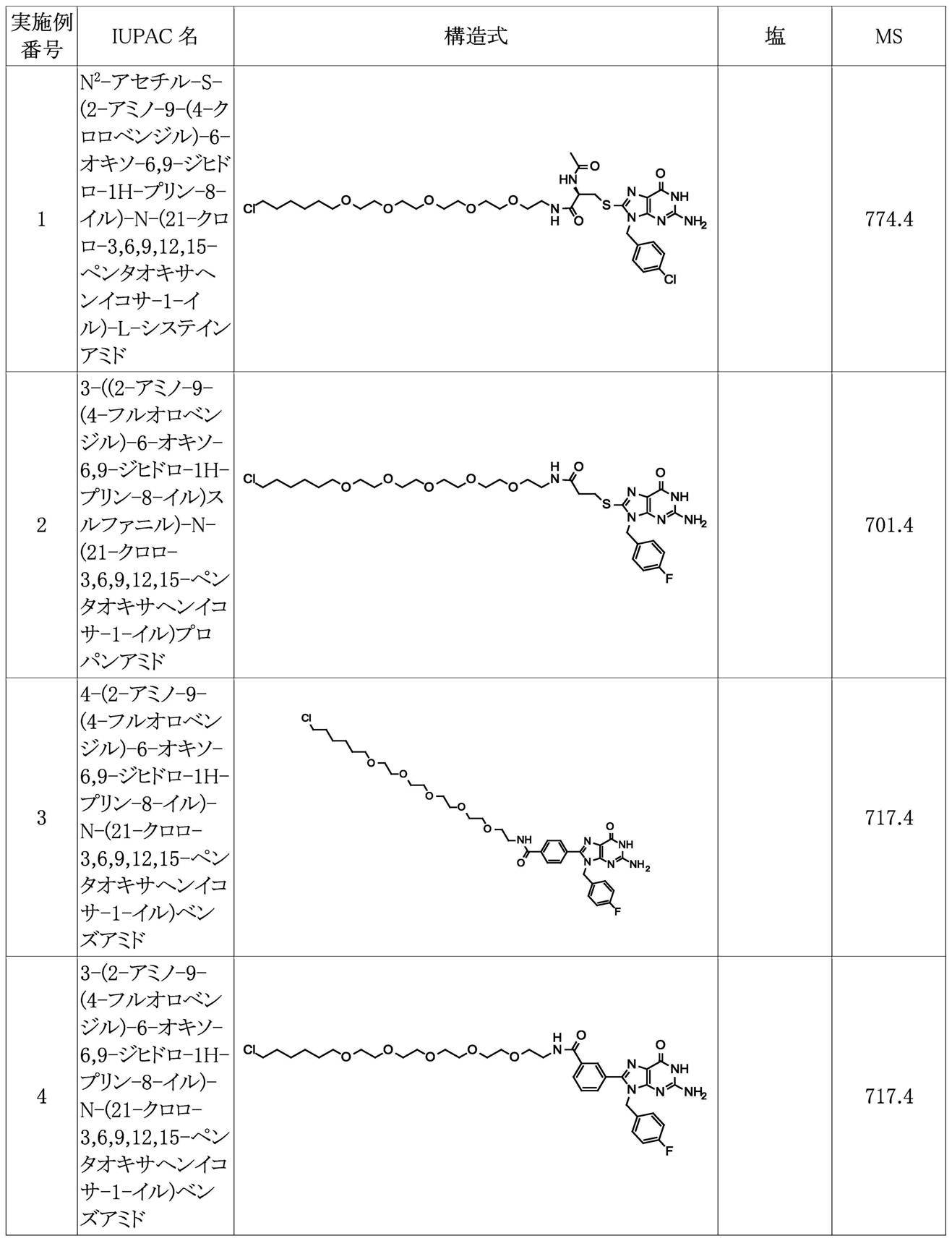

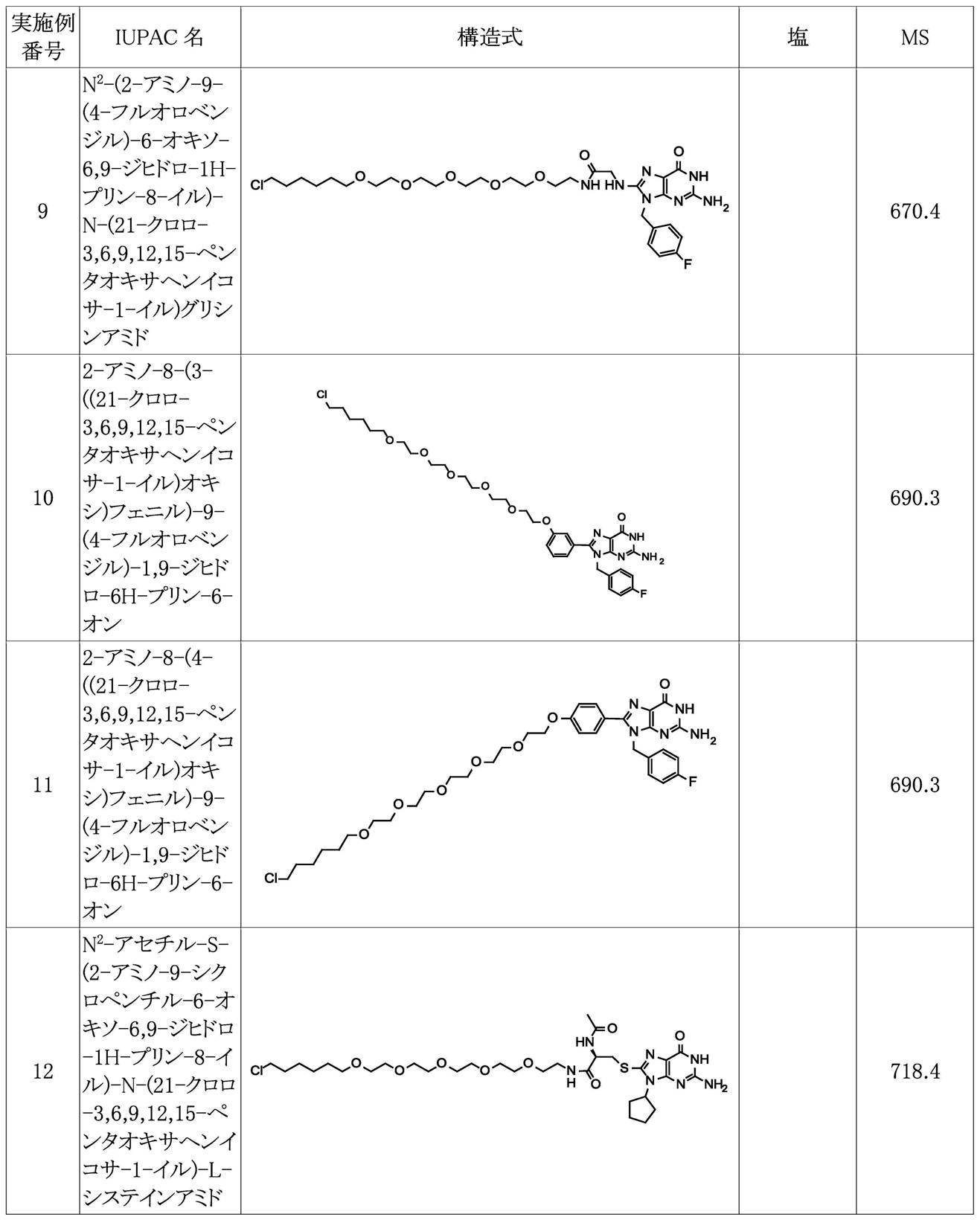


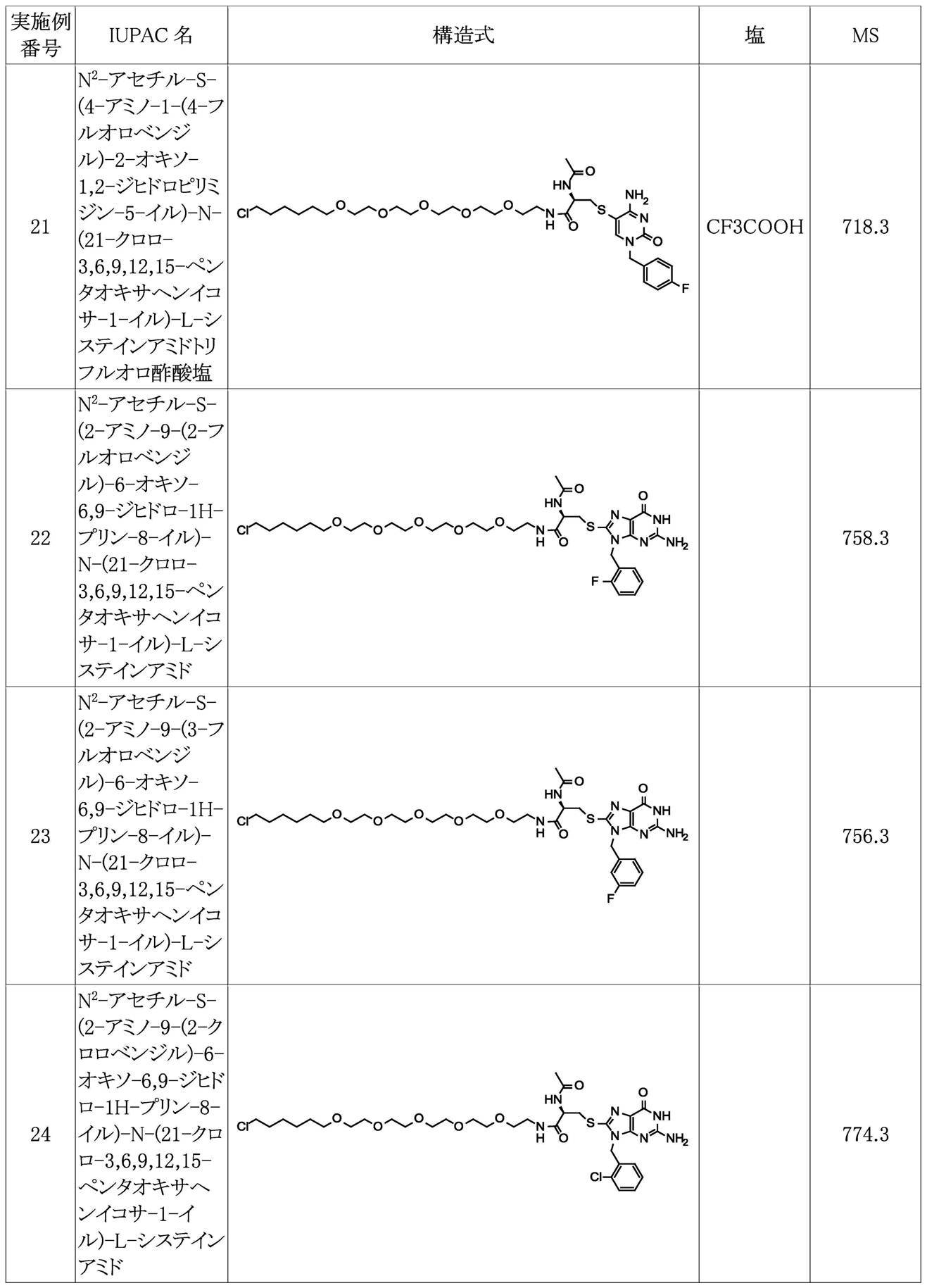
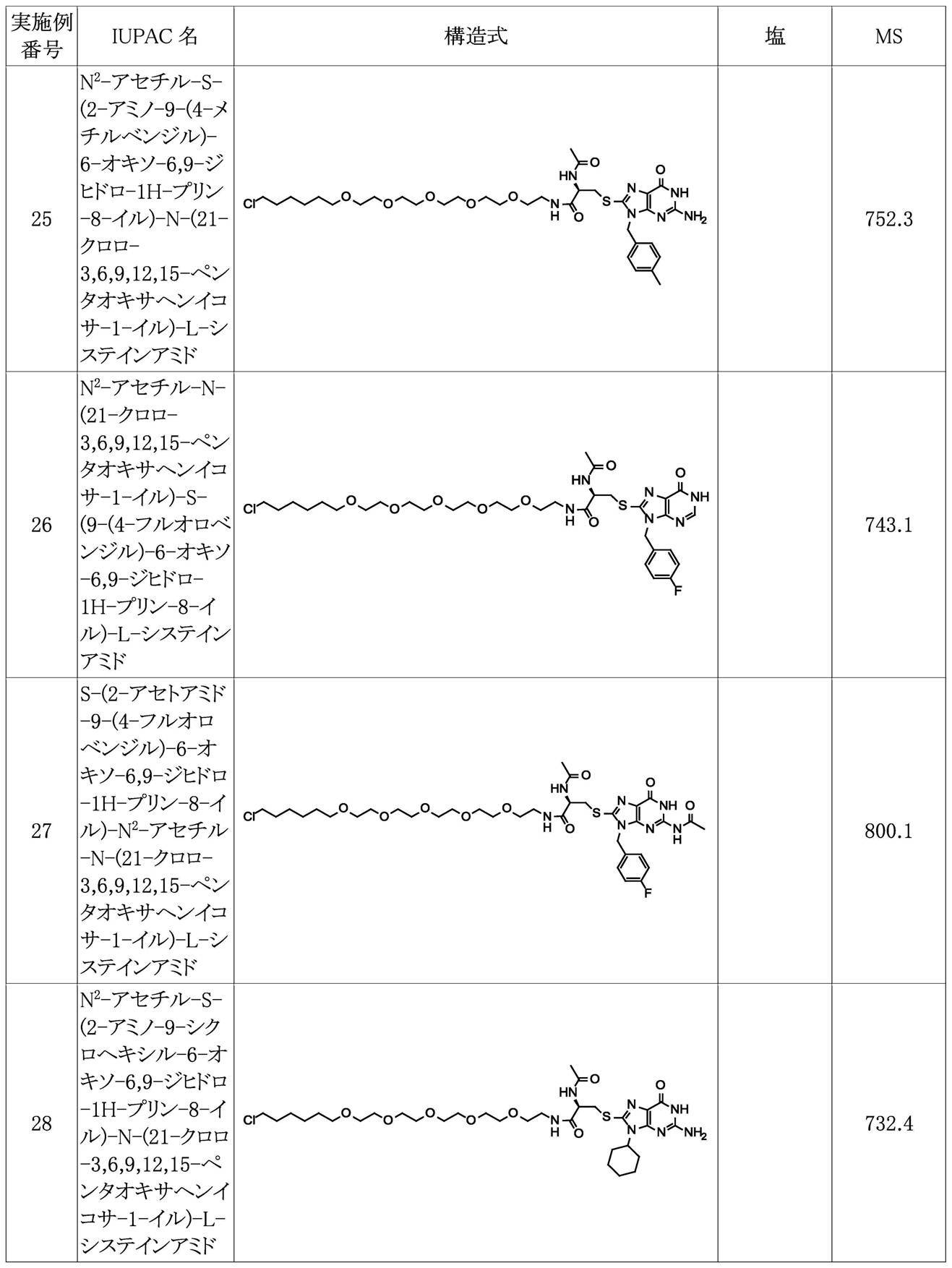

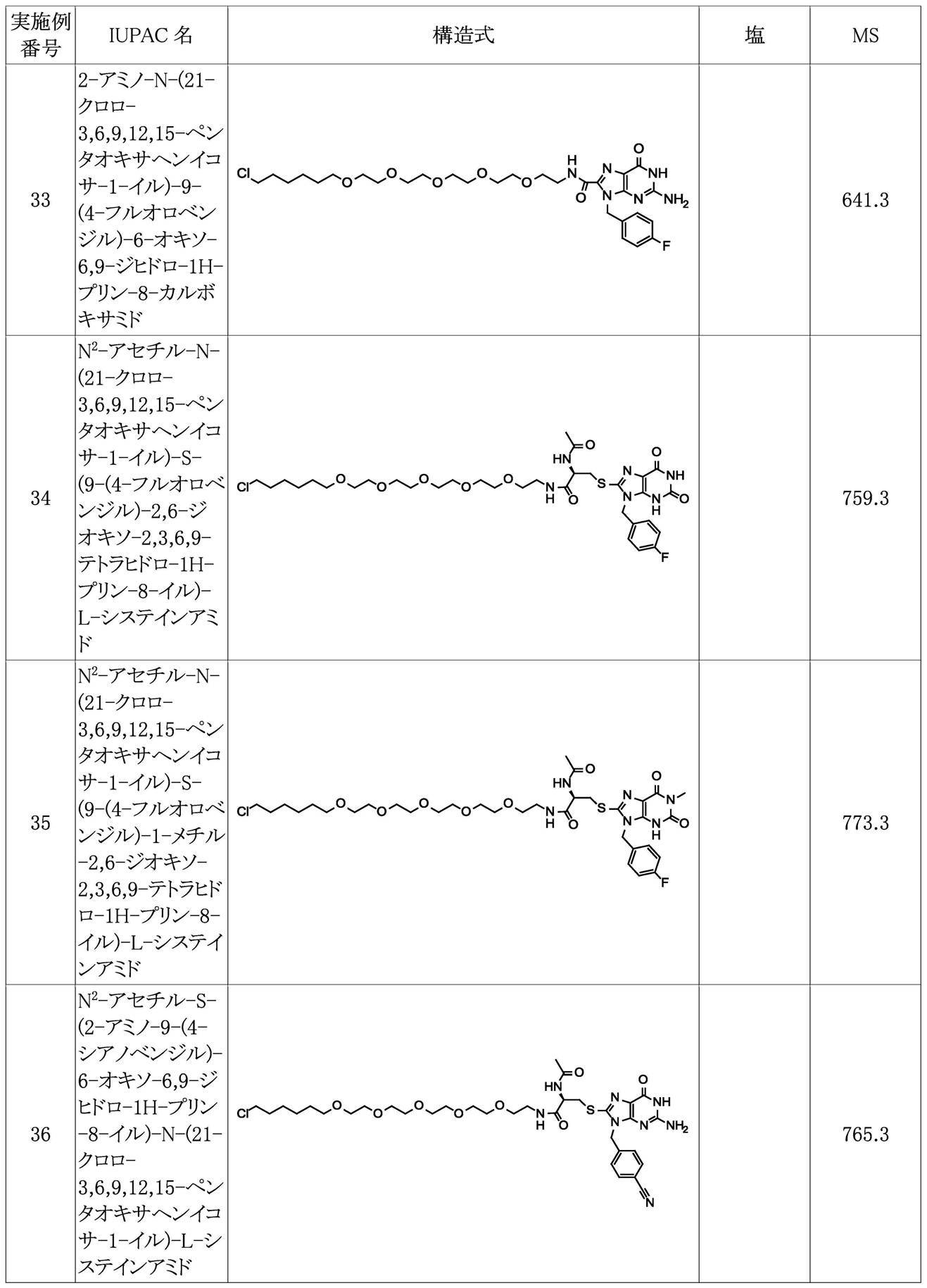


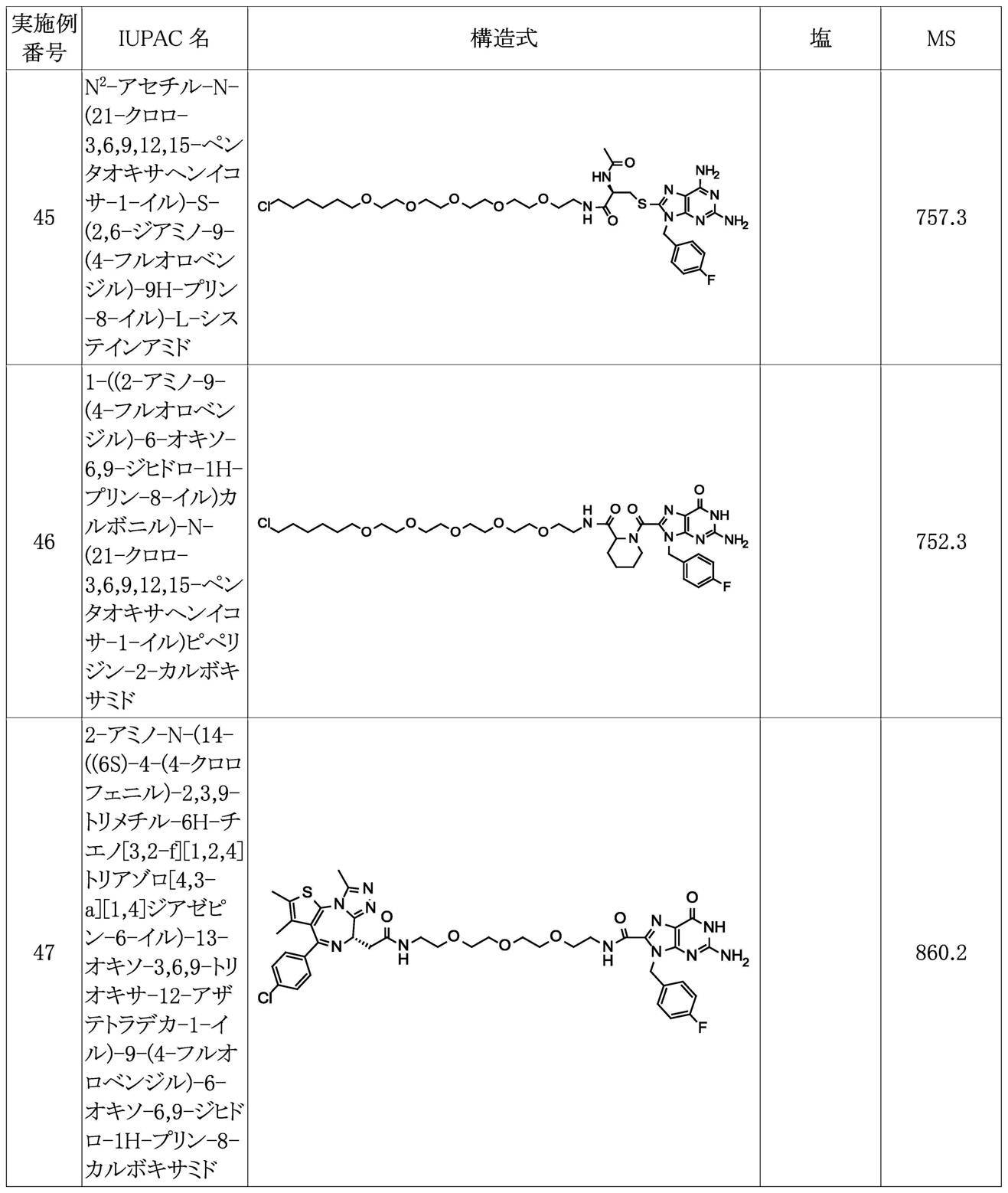
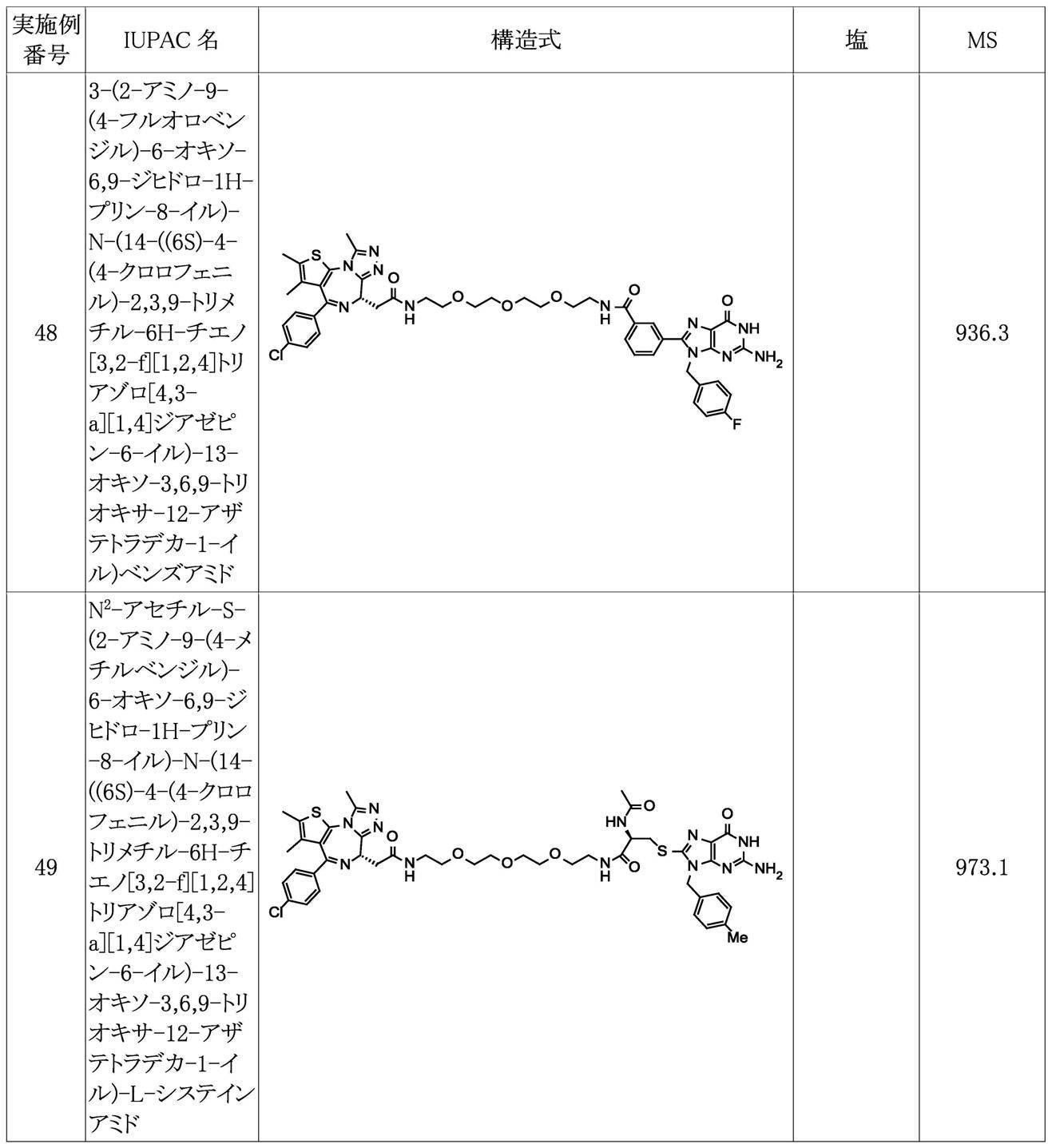
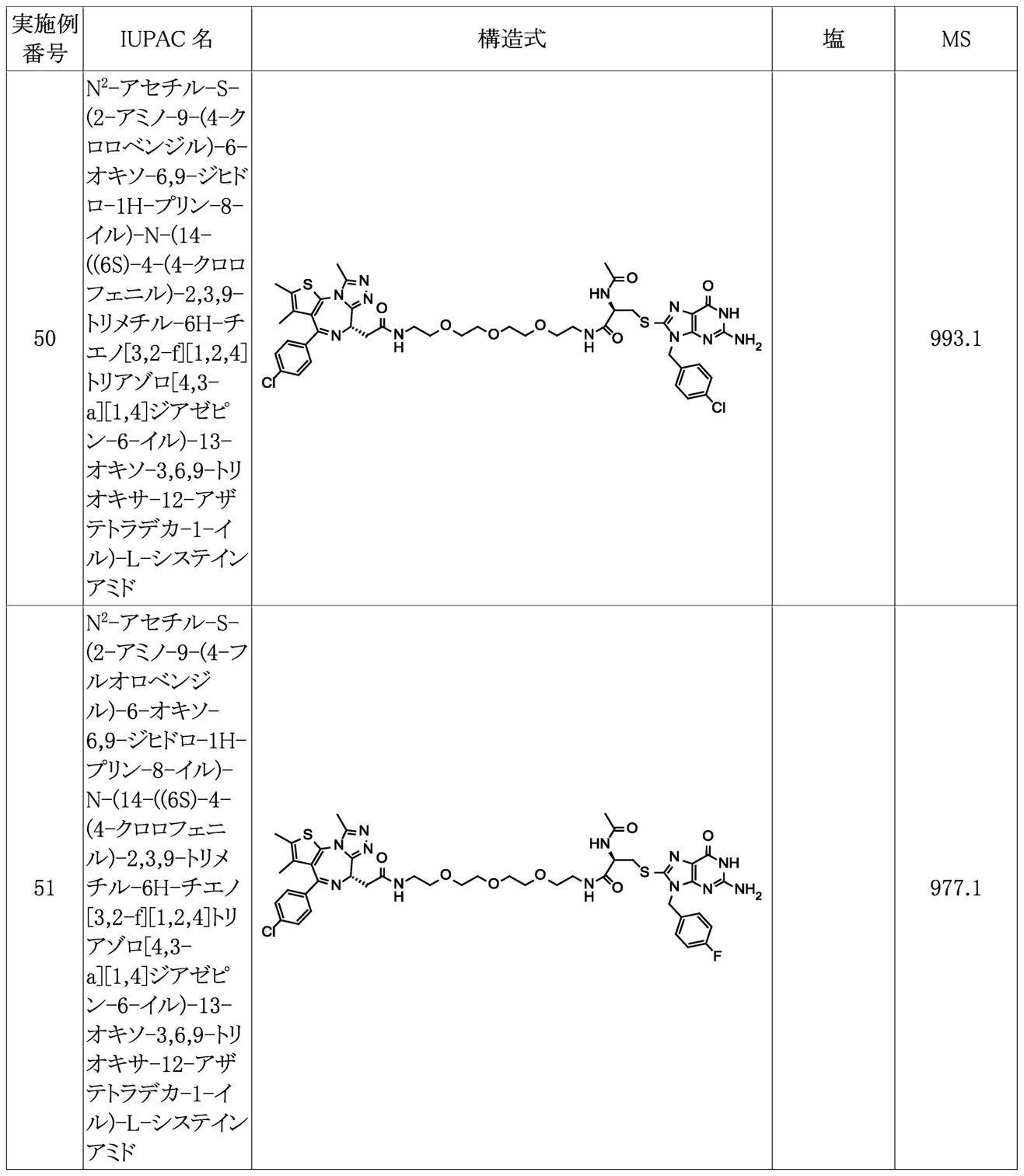

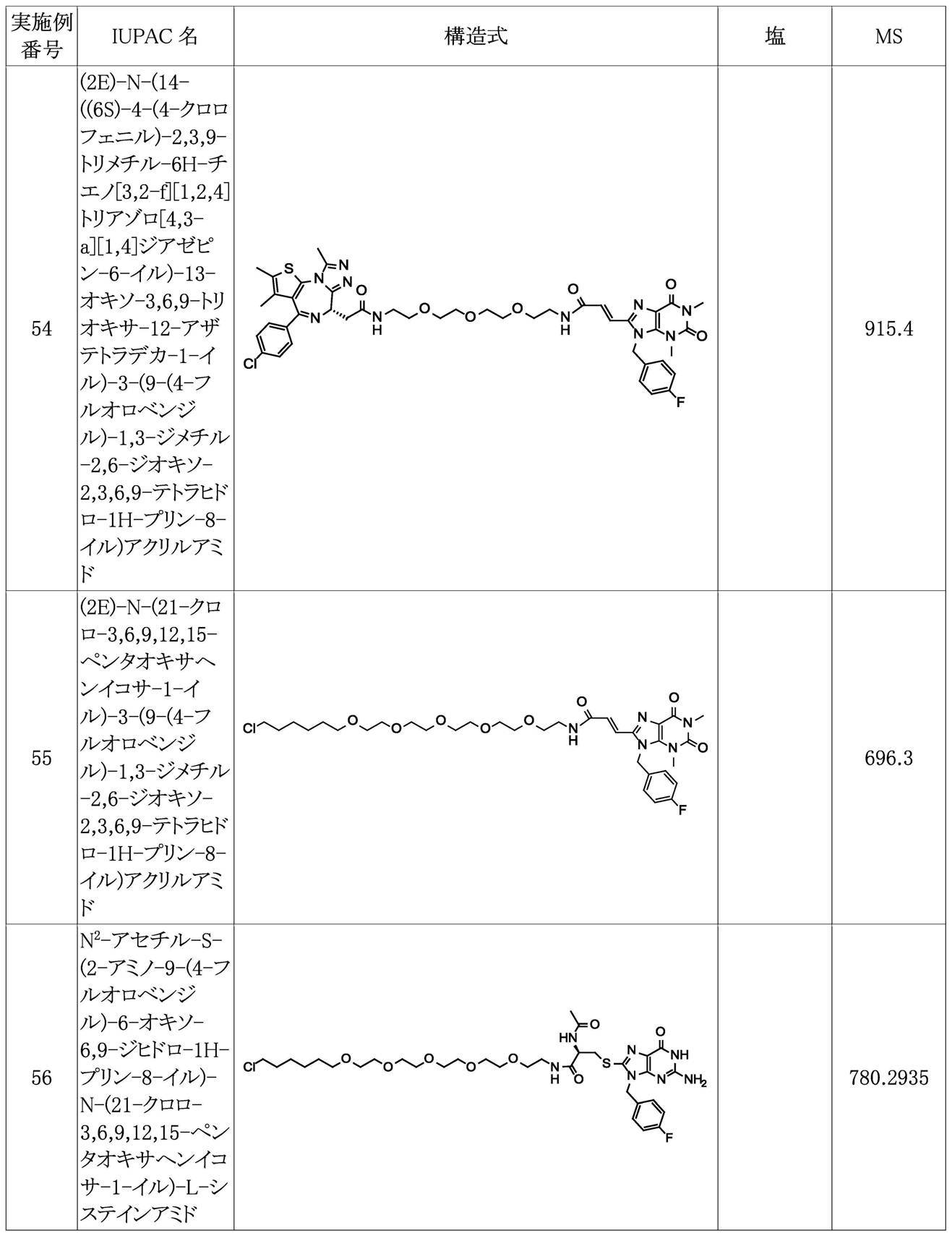

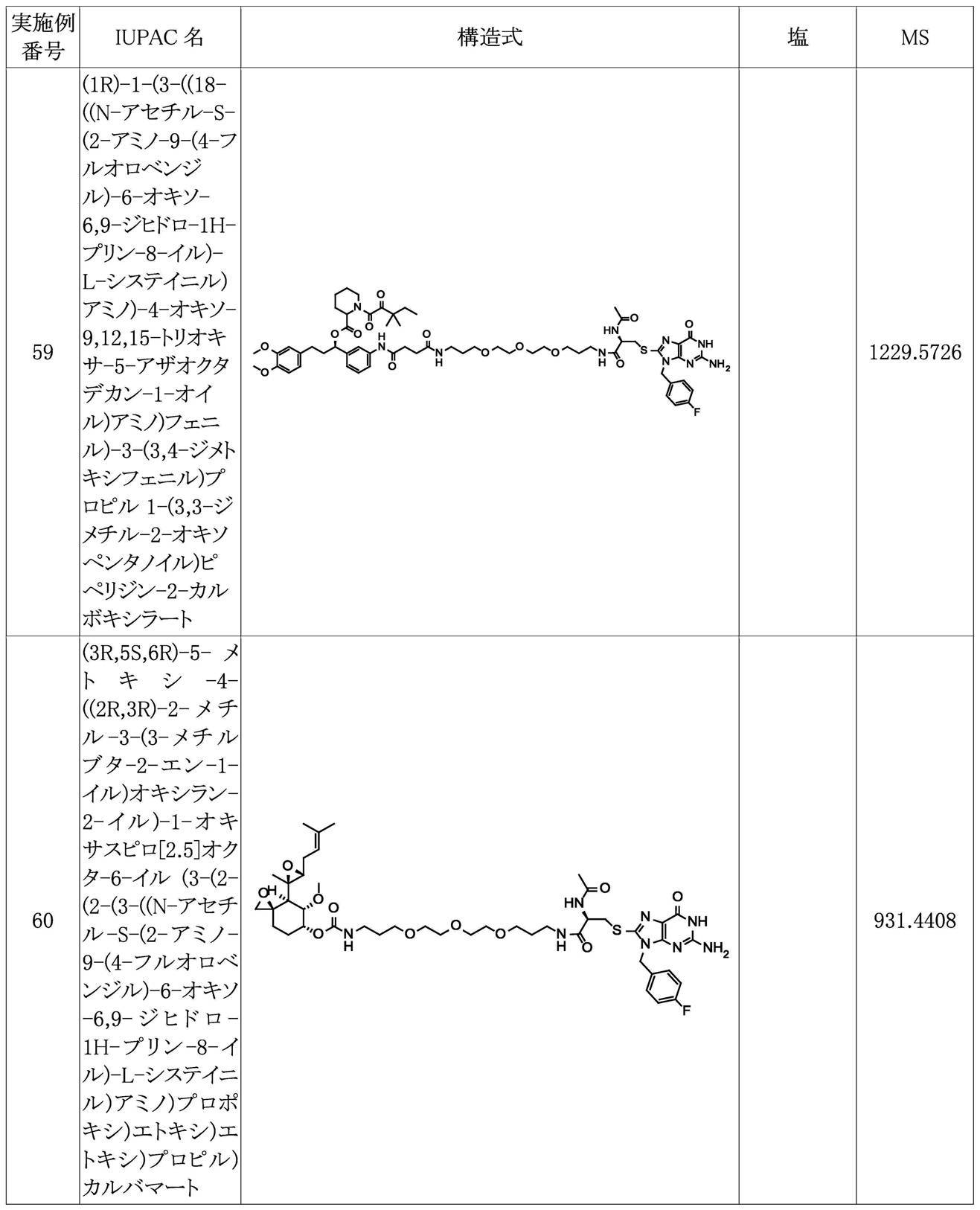

Example compounds are shown in the table below. MS in the table indicates the measured value. The compounds of Examples 4, 7, 9, 11, 14, 22-25, 28, 29, 36-43 in the table below were prepared according to the methods shown in the above Examples or methods analogous thereto.
本発明化合物のIn vitroにおける標的分子の分解誘導活性は以下の試験にて評価した。 The in vitro target molecule degradation-inducing activity of the compounds of the present invention was evaluated by the following tests.
(試験例1:EmGFP-HaloTag安定発現細胞を使った評価方法(試験方法A))
EmGFP-HaloTag安定発現HeLa細胞をDulbecco's Modified Eagle Medium(DMEM)に播種し24時間培養した。その後、表2に示す終濃度で試験化合物(具体的には、実施例化合物1~7、9~11、13~15、17~20、24~27、29、32~33、36~42、44~46および56)を添加し、37oC/5%CO2条件で24時間インキュベートした。細胞をPBSで3回洗浄し、タンパク質分解酵素阻害剤を含む細胞溶解溶液で処理して細胞抽出液を得た。細胞抽出液をSDS-PAGEに供し,泳動後のウェスタンブロットによってGFPとActinを検出した。薬剤非処理の細胞におけるコントロール群のGFP/Actin値に対して,薬剤処理細胞のGFP/Actin値の比を活性値とした。値が1以下となる場合はEmGFP-HaloTagの分解が促進したことを表す。(Test Example 1: Evaluation method using EmGFP-HaloTag stably expressing cells (test method A))
HeLa cells stably expressing EmGFP-HaloTag were seeded in Dulbecco's Modified Eagle Medium (DMEM) and cultured for 24 hours. Then, test compounds at the final concentrations shown in Table 2 (specifically, Example compounds 1 to 7, 9 to 11, 13 to 15, 17 to 20, 24 to 27, 29, 32 to 33, 36 to 42, 44-46 and 56) were added and incubated at 37 ° C./5% CO 2 conditions for 24 hours. Cells were washed with PBS three times and treated with cell lysis solution containing protease inhibitors to obtain cell extracts. Cell extracts were subjected to SDS-PAGE, and GFP and Actin were detected by Western blotting after electrophoresis. The activity value was defined as the ratio of the GFP/Actin value in drug-treated cells to the GFP/Actin value in the control group in drug-untreated cells. A value of 1 or less indicates accelerated degradation of EmGFP-HaloTag.
(試験例2:EmGFP-HaloTag一過性過剰発現細胞を使った評価(試験方法B))
HeLa細胞をDulbecco's Modified Eagle Medium(DMEM)に播種し24時間培養した。EmGFP-HaloTagをコードするプラスミドpCMV-EmGFP-HaloTagをトランスフェクションし、EmGFP-HaloTagの過剰発現細胞を得た。翌日、表2に示す終濃度で試験化合物(具体的には、実施例化合物8、12、16、21~23、28および30~31)を添加し,37oC/5%CO2条件で24時間インキュベートした。細胞をPBSで3回洗浄し、タンパク質分解酵素阻害剤を含む細胞溶解溶液で処理して細胞抽出液を得た。細胞抽出液をSDS-PAGEに供し,泳動後のウェスタンブロットによってGFPとActinを検出した。薬剤非処理の細胞におけるコントロール群のGFP/Actin値に対して、薬剤処理細胞のGFP/Actin値の比を活性値とした。値が1以下となる場合はEmGFP-HaloTagの分解が促進したことを表す。(Test Example 2: Evaluation using EmGFP-HaloTag transiently overexpressing cells (test method B))
HeLa cells were seeded in Dulbecco's Modified Eagle Medium (DMEM) and cultured for 24 hours. Plasmid pCMV-EmGFP-HaloTag encoding EmGFP-HaloTag was transfected to obtain EmGFP-HaloTag overexpressing cells. On the next day, the test compounds (specifically, Example compounds 8, 12, 16, 21-23, 28 and 30-31) were added at the final concentrations shown in Table 2, and the test compounds were added at 37 ° C./5% CO 2 conditions. Incubated for 24 hours. Cells were washed with PBS three times and treated with cell lysis solution containing protease inhibitors to obtain cell extracts. Cell extracts were subjected to SDS-PAGE, and GFP and Actin were detected by Western blotting after electrophoresis. The activity value was defined as the ratio of the GFP/Actin value in drug-treated cells to the GFP/Actin value in the control group in drug-untreated cells. A value of 1 or less indicates accelerated degradation of EmGFP-HaloTag.
(試験例3:HeLa細胞を使った評価(試験方法C))
HeLa細胞をDulbecco's Modified Eagle Medium(DMEM)に播種し24時間培養した。表2に示す終濃度で試験化合物(具体的には、実施例化合物47~52、59および60)を添加し、37oC/5%CO2条件で24時間インキュベートした。細胞をPBSで3回洗浄し、タンパク質分解酵素阻害剤を含む細胞溶解溶液で処理して細胞抽出液を得た。細胞抽出液をSDS-PAGEに供し、泳動後のウェスタンブロットによってBrd4・FKBP12・MetAP2とActinを検出した。薬剤非処理の細胞におけるコントロール群のBrd4・FKBP12・MetAP2/Actin値に対して,薬剤処理細胞のBrd4・FKBP12・MetAP2/Actin値の比を活性値とした。値が1以下となる場合はBrd4・FKBP12・MetAP2の分解が促進したことを表す。(Test Example 3: Evaluation using HeLa cells (test method C))
HeLa cells were seeded in Dulbecco's Modified Eagle Medium (DMEM) and cultured for 24 hours. Test compounds (specifically, Example compounds 47 to 52, 59 and 60) were added at final concentrations shown in Table 2 and incubated for 24 hours at 37 ° C./5% CO 2 conditions. Cells were washed with PBS three times and treated with cell lysis solution containing protease inhibitors to obtain cell extracts. The cell extract was subjected to SDS-PAGE, and Brd4/FKBP12/MetAP2 and Actin were detected by Western blotting after electrophoresis. The ratio of the Brd4/FKBP12/MetAP2/Actin values in the drug-treated cells to the Brd4/FKBP12/MetAP2/Actin values in the control group in the drug-untreated cells was defined as the activity value. A value of 1 or less indicates that the decomposition of Brd4/FKBP12/MetAP2 was promoted.
(試験例4:A549細胞を使った評価(試験方法D))
A549細胞をDulbecco's Modified Eagle Medium(DMEM)に播種し24時間培養した。表2に示す終濃度で試験化合物(具体的には、実施例化合物57、58)を添加し,37oC / 5%CO2条件で24時間インキュベートした。細胞をPBSで3回洗浄し,タンパク質分解酵素阻害剤を含む細胞溶解溶液で処理して細胞抽出液を得た。細胞抽出液をSDS-PAGEに供し,泳動後のウェスタンブロットによってBrd4とActinを検出した。薬剤非処理の細胞におけるコントロール群のBrd4/Actin値に対して,薬剤処理細胞のBrd4/Actin値の比を活性値とした。値が1以下となる場合はBrd4の分解が促進したことを表す。(Test Example 4: Evaluation using A549 cells (test method D))
A549 cells were seeded in Dulbecco's Modified Eagle Medium (DMEM) and cultured for 24 hours. Test compounds (specifically, Example compounds 57 and 58) were added at the final concentrations shown in Table 2, and incubated for 24 hours under 37 ° C./5% CO 2 conditions. The cells were washed with PBS three times and treated with a cell lysing solution containing a protease inhibitor to obtain a cell extract. Cell extracts were subjected to SDS-PAGE, and Brd4 and Actin were detected by Western blotting after electrophoresis. The activity value was defined as the ratio of the Brd4/Actin value in drug-treated cells to the Brd4/Actin value in the control group in drug-untreated cells. A value of 1 or less indicates that the decomposition of Brd4 was promoted.
試験例1~4で得られた実施例化合物の標的タンパク分解誘導活性を表2に記す。 Table 2 shows the target protein degradation-inducing activity of the Example compounds obtained in Test Examples 1-4.

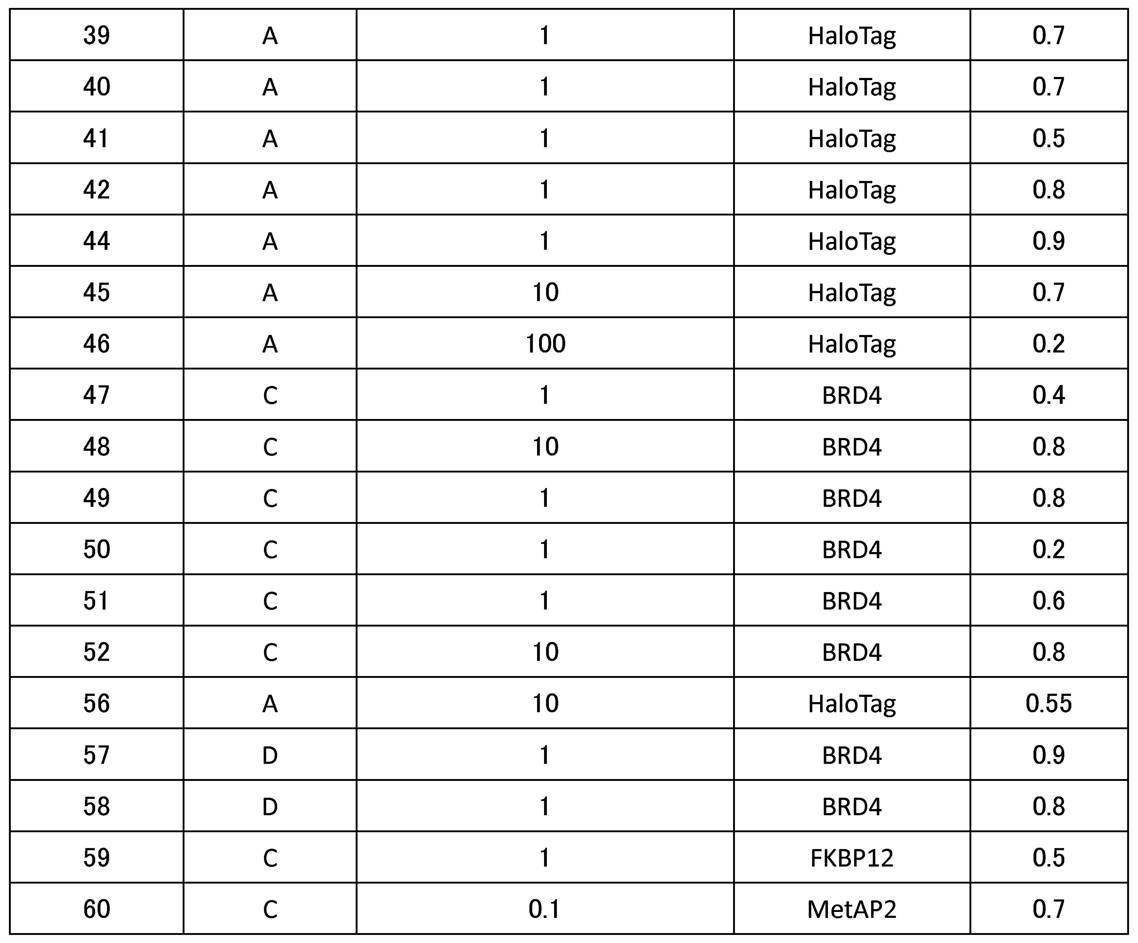
試験例1~4の結果から、化合物(I)が標的分子の分解を誘導する活性を有することが示された。
The results of Test Examples 1 to 4 showed that compound (I) has an activity of inducing degradation of target molecules.
(試験例5:Atg5KO MEFを使った評価)
Atg5-/-マウス胎児線維芽(MEF)細胞とAtg5+/+MEF細胞を、Dulbecco's Modified Eagle Medium(DMEM)に播種し24時間培養した。EmGFP-HaloTagをコードするプラスミドpCMV-EmGFP-HaloTag(配列番号1)をトランスフェクションし,EmGFP-HaloTagの過剰発現細胞を得た。翌日、終濃度10μMで実施例化合物56を添加し、37oC/5%CO2条件で24時間インキュベートした。細胞をPBSで3回洗浄し、タンパク質分解酵素阻害剤を含む細胞溶解溶液で処理して細胞抽出液を得た。細胞抽出液をSDS-PAGEに供し、泳動後のウェスタンブロットによってGFPとActinを検出した。薬剤非処理の細胞におけるコントロール群のGFP/Actin値に対して、薬剤処理細胞のGFP/Actin値の比を活性値とした。値が1以下となる場合はEmGFP-HaloTagの分解が促進したことを表す。

Atg5 -/- mouse embryonic fibroblast (MEF) cells and Atg5 +/+ MEF cells were plated in Dulbecco's Modified Eagle Medium (DMEM) and cultured for 24 hours. Plasmid pCMV-EmGFP-HaloTag (SEQ ID NO: 1) encoding EmGFP-HaloTag was transfected to obtain EmGFP-HaloTag overexpressing cells. The next day, Example Compound 56 was added at a final concentration of 10 μM and incubated for 24 hours under 37 ° C./5% CO 2 conditions. Cells were washed with PBS three times and treated with cell lysis solution containing protease inhibitors to obtain cell extracts. Cell extracts were subjected to SDS-PAGE, and GFP and Actin were detected by Western blotting after electrophoresis. The activity value was defined as the ratio of the GFP/Actin value in drug-treated cells to the GFP/Actin value in the control group in drug-untreated cells. A value of 1 or less indicates accelerated degradation of EmGFP-HaloTag.
試験例5の結果から、化合物(I)により誘導される標的分子の分解はオートファジーを介するものであることが示された。 The results of Test Example 5 indicated that the target molecule degradation induced by compound (I) was mediated by autophagy.
製剤例1
本発明化合物を有効成分として含有する医薬は、例えば、次のような処方によって製造することができる。
1.カプセル剤
(1)実施例1で得られた化合物 40mg
(2)ラクトース 70mg
(3)微結晶セルロース 9mg
(4)ステアリン酸マグネシウム 1mg
1カプセル 120mg
(1)、(2)、(3)および(4)の1/2を混和した後、顆粒化する。これに残りの(4)を加えて全体をゼラチンカプセルに封入する。Formulation example 1
A medicament containing the compound of the present invention as an active ingredient can be produced, for example, by the following formulation.
1. Capsules (1) 40 mg of the compound obtained in Example 1
(2) Lactose 70 mg
(3) microcrystalline cellulose 9 mg
(4) magnesium stearate 1 mg
1 capsule 120mg
1/2 of (1), (2), (3) and (4) are blended and then granulated. The rest of (4) is added to this and the whole is encapsulated in a gelatin capsule.
2.錠剤
(1)実施例1で得られた化合物 40mg
(2)ラクトース 58mg
(3)コーンスターチ 18mg
(4)微結晶セルロース 3.5mg
(5)ステアリン酸マグネシウム 0.5mg
1錠 120mg
(1)、(2)、(3)、(4)の2/3および(5)の1/2を混和した後、顆粒化する。残りの(4)および(5)をこの顆粒に加えて錠剤に加圧成型する。2. Tablet (1) 40 mg of the compound obtained in Example 1
(2) Lactose 58mg
(3) Cornstarch 18mg
(4) Microcrystalline cellulose 3.5 mg
(5) magnesium stearate 0.5 mg
1 tablet 120mg
(1), (2), (3), 2/3 of (4) and 1/2 of (5) are blended and then granulated. The remaining (4) and (5) are added to the granules and pressed into tablets.
製剤例2
日局注射用蒸留水50mLに実施例1で得られた化合物50mgを溶解した後、日局注射用蒸留水を加えて100mLとする。この溶液を滅菌条件下でろ過し、次にこの溶液1mLずつを取り、滅菌条件下、注射用バイアルに充填し、凍結乾燥して密閉する。Formulation example 2
After dissolving 50 mg of the compound obtained in Example 1 in 50 mL of distilled water for injection by the Japanese Pharmacopoeia, add distilled water for injection by the Japanese Pharmacopoeia to make 100 mL. This solution is filtered under sterile conditions, then 1 mL of this solution is taken, filled into injection vials under sterile conditions, lyophilized and sealed.
本発明化合物は、標的とする細胞内分子を特異的に食細胞に取り込ませ、食細胞によって分解することができる。従って、標的分子が関与する疾患のメカニズムを解析する際のツールとして用いることができ、また当該疾患の予防又は治療に有効な薬物を提供する事が期待される。 The compounds of the present invention can cause targeted intracellular molecules to be specifically taken up by phagocytic cells and degraded by phagocytic cells. Therefore, it can be used as a tool for analyzing the mechanism of a disease in which the target molecule is involved, and it is expected to provide a drug that is effective in preventing or treating the disease.
Claims (14)
R1-La-O-(CH2)n’-O-Lb-R2 (I-1)
R1-La-NH-(CH2)n’’-NH-Lb-R2 (I-2)
[式(I-1)中、n’は、1~6を示し、
式(I-2)中、n’ ’は、1~6を示し
式(I-1)および式(I-2)中、
R1は、細胞内分子に特異的に結合するリガンドを示し、
Laは、結合手または主鎖が1ないし10原子からなる鎖状リンカーを示し、
Lbは、
i)結合手、
ii)主鎖が1ないし13原子からなる鎖状リンカー、または
iii)下式
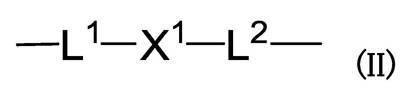
を示し、式(II)中、
L1は、結合手または主鎖が1ないし10原子からなる鎖状リンカーを示し、
X1は、置換されていてもよい二価の環状基を示し、
L2は、結合手または主鎖が1ないし2原子からなる鎖状リンカーを示し、
R2は、下式

から選ばれる基を示し、各式中、
RA1、RA2、RA3、RA4、RA5、RA6、RA7、RA8、RA9およびRA10は、それぞれ独立して、水素原子または置換基を示し、または
RA1およびRA2は、互いに結合して、置換されていてもよい環を形成してもよく;
RB1、RB2、RB3、RB4およびRB5は、それぞれ独立して、置換されていてもよい炭化水素環基、置換されていてもよい不飽和複素環基、または式(VIII):-X2-R3を示し、
式中、X2は、置換されていてもよいメチレン基を示し、R3は、置換されていてもよい環状基を示す。]
で表される化合物またはその塩を含む、細胞内分子の分解誘導薬。 Formula (I-1) or (I-2):
R 1 —L a —O—(CH 2 ) n′ —OL b —R 2 (I-1)
R 1 —L a —NH—(CH 2 ) n″ —NH—L b —R 2 (I-2)
[In the formula (I-1), n ' represents 1 to 6,
In formula (I-2), n'' represents 1 to 6, and in formulas (I-1) and (I-2),
R 1 indicates a ligand that specifically binds to an intracellular molecule;
L a represents a bond or a chain linker with a main chain of 1 to 10 atoms,
Lb is
i) a bond,
ii) a linear linker consisting of 1 to 13 atoms in the main chain, or
iii) the following formula
In formula (II),
L 1 represents a chain linker consisting of a bond or main chain of 1 to 10 atoms,
X 1 represents an optionally substituted divalent cyclic group,
L 2 represents a chain linker whose bond or main chain consists of 1 to 2 atoms,
R2 is the following formula
represents a group selected from, in each formula,
R A1 , R A2 , R A3 , R A4 , R A5 , R A6 , R A7 , R A8 , R A9 and R A10 each independently represent a hydrogen atom or a substituent, or R A1 and R A2 may be joined together to form an optionally substituted ring;
R B1 , R B2 , R B3 , R B4 and R B5 are each independently an optionally substituted hydrocarbon ring group, an optionally substituted unsaturated heterocyclic group, or formula (VIII): -X 2 -R 3 ,
In the formula, X2 represents an optionally substituted methylene group , and R3 represents an optionally substituted cyclic group. ]
An intracellular molecule degradation inducer comprising a compound represented by or a salt thereof.
-(Cxアルキレン-O)n1-(CH2)m1-B1- (IX)
で表され、式(IX)中、
xは1~6であり、
n1は1~5であり、
m1は0~5であり、
B1は、
(i)結合手、
(ii)-NH-、
(iii)―NH-(CO)-B2-(式中、B2は、結合手、-C1-3アルキレン-NH、-C1-3アルキレン-S-、またはC2-3アルケニレン基を示す)、
(iv)C2-3アルキニレン基、
(v)-NH-C1-3アルキレン基、または
(vi)-N-C1-6アルキル-カルボニル-L-システインアミドである、請求項1~3の何れか1項に記載の細胞内分子の分解誘導薬。 L b is represented by the following formula —(C x alkylene-O) n1 —(CH 2 ) m1 —B 1 — (IX)
In the formula (IX),
x is 1 to 6,
n1 is 1 to 5,
m1 is 0 to 5,
B1 is
(i) a bond;
(ii) -NH-,
(iii) —NH—(CO)—B 2 — (wherein B 2 is a bond, —C 1-3 alkylene-NH, —C 1-3 alkylene-S—, or C 2-3 alkenylene group ),
(iv) a C 2-3 alkynylene group,
(v) a —NH—C 1-3 alkylene group, or
(vi) The intracellular molecule degradation inducer according to any one of claims 1 to 3, which is -NC 1-6 alkyl-carbonyl-L-cysteinamide.
-(Cyアルキレン-O)n2-(CH2)m2- (X)または
-(Cyアルキレン-NH)n2-(CH2)m2- (X’)
(式(X)及び(X’)中、
yは1~3であり、
n2は1~6であり、
m2は0~3である)
で表される、請求項5に記載の細胞内分子の分解誘導薬。 L 1 has the following formula —(C y alkylene-O) n2 —(CH 2 ) m2 — (X) or -(C y alkylene-NH) n2 -(CH 2 ) m2 - (X')
(in the formulas (X) and (X′),
y is 1 to 3;
n2 is 1 to 6;
m2 is 0-3)
The intracellular molecule degradation inducer according to claim 5, which is represented by:
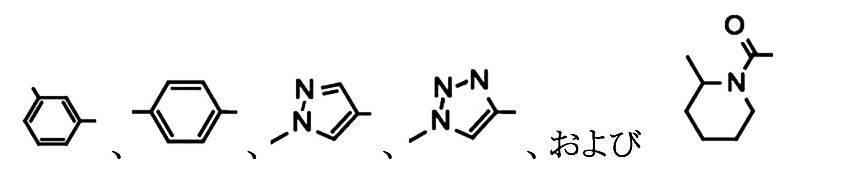
からなる群から選択される、請求項5または6に記載の細胞内分子の分解誘導薬。 -X 1 -L 2 - is
7. The intracellular molecule degradation inducer according to claim 5 or 6, which is selected from the group consisting of:

[式(III)中、
RA1およびRA2は、それぞれ独立して、水素原子または置換基を示し、または
RA1およびRA2は、互いに結合して、置換されていてもよい環を形成してもよく;
RB1は、置換されていてもよい炭化水素環基、置換されていてもよい不飽和複素環基、または式(VIII):-X2-R3を示し、式(VIII)中、
X2は、置換されていてもよいメチレン基を示し、R3は、置換されていてもよい環状基を示す。]
である、請求項1~9の何れか1項に記載の細胞内分子の分解誘導薬。 R 2 is
[in the formula (III),
R A1 and R A2 each independently represent a hydrogen atom or a substituent, or R A1 and R A2 may combine with each other to form an optionally substituted ring;
R B1 represents an optionally substituted hydrocarbon ring group, an optionally substituted unsaturated heterocyclic group, or formula (VIII): —X 2 —R 3 , wherein in formula (VIII),
X2 represents an optionally substituted methylene group , and R3 represents an optionally substituted cyclic group. ]
The intracellular molecule degradation inducer according to any one of claims 1 to 9, wherein

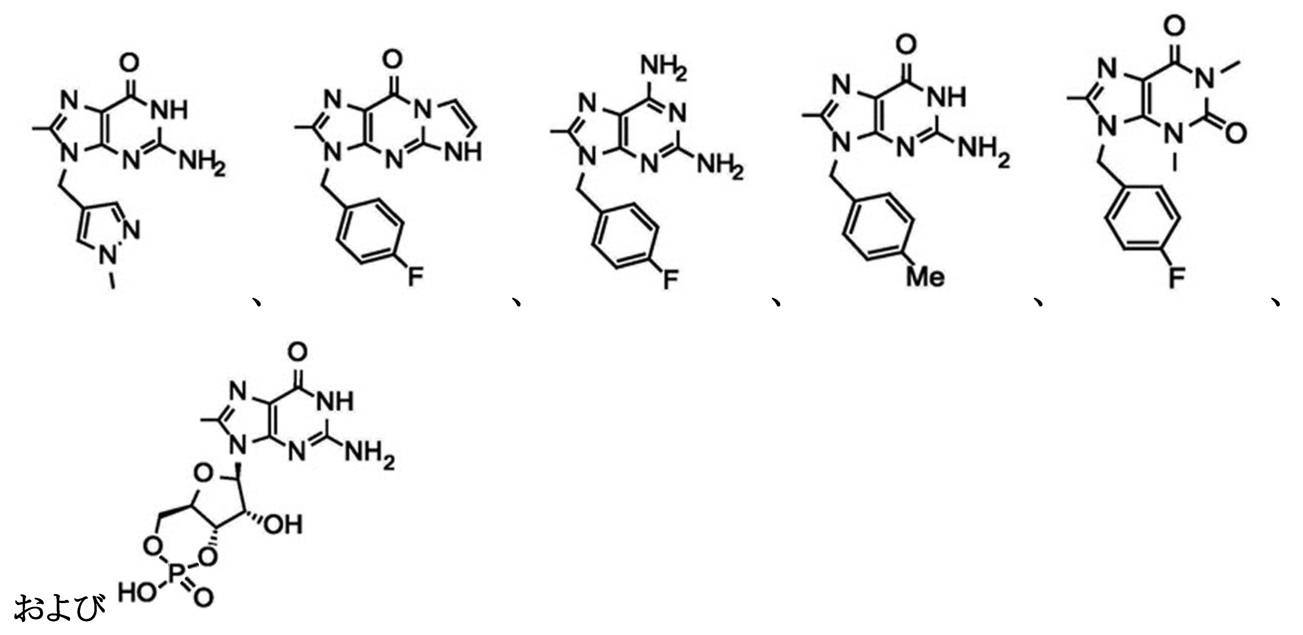
の置換基から選択される、請求項1~10の何れか1項に記載の細胞内分子の分解誘導薬。 R2 is
The intracellular molecule degradation inducer according to any one of claims 1 to 10, wherein the intracellular molecule degradation inducer is selected from the substituents of
Priority Applications (1)
| Application Number | Priority Date | Filing Date | Title |
|---|---|---|---|
| JP2022161959A JP2022176364A (en) | 2017-02-03 | 2022-10-06 | heterocyclic compound |
Applications Claiming Priority (3)
| Application Number | Priority Date | Filing Date | Title |
|---|---|---|---|
| JP2017019127 | 2017-02-03 | ||
| JP2017019127 | 2017-02-03 | ||
| PCT/JP2018/003576 WO2018143403A1 (en) | 2017-02-03 | 2018-02-02 | Heterocyclic compound |
Related Child Applications (1)
| Application Number | Title | Priority Date | Filing Date |
|---|---|---|---|
| JP2022161959A Division JP2022176364A (en) | 2017-02-03 | 2022-10-06 | heterocyclic compound |
Publications (2)
| Publication Number | Publication Date |
|---|---|
| JPWO2018143403A1 JPWO2018143403A1 (en) | 2019-12-12 |
| JP7161760B2 true JP7161760B2 (en) | 2022-10-27 |
Family
ID=63039851
Family Applications (2)
| Application Number | Title | Priority Date | Filing Date |
|---|---|---|---|
| JP2018566120A Active JP7161760B2 (en) | 2017-02-03 | 2018-02-02 | heterocyclic compound |
| JP2022161959A Pending JP2022176364A (en) | 2017-02-03 | 2022-10-06 | heterocyclic compound |
Family Applications After (1)
| Application Number | Title | Priority Date | Filing Date |
|---|---|---|---|
| JP2022161959A Pending JP2022176364A (en) | 2017-02-03 | 2022-10-06 | heterocyclic compound |
Country Status (4)
| Country | Link |
|---|---|
| US (1) | US11986480B2 (en) |
| EP (1) | EP3578549A4 (en) |
| JP (2) | JP7161760B2 (en) |
| WO (1) | WO2018143403A1 (en) |
Cited By (2)
| Publication number | Priority date | Publication date | Assignee | Title |
|---|---|---|---|---|
| JP2022176364A (en) * | 2017-02-03 | 2022-11-25 | 国立大学法人東北大学 | heterocyclic compound |
| WO2024204648A1 (en) | 2023-03-28 | 2024-10-03 | 国立大学法人東北大学 | Screening method for compound inducing autophagy |
Families Citing this family (5)
| Publication number | Priority date | Publication date | Assignee | Title |
|---|---|---|---|---|
| EP3679935A4 (en) * | 2017-07-10 | 2021-04-21 | Tohoku University | Degradation agent using autophagic mechanism of damaged mitochondria |
| WO2019183600A1 (en) | 2018-03-23 | 2019-09-26 | The Regents Of The University Of California | Methods and compounds for targeted autophagy |
| CN113480539B (en) * | 2021-07-20 | 2023-03-31 | 新乡学院 | A kind of synthetic method of nitric acid catalyzed hypoxanthine derivative |
| WO2023034411A1 (en) | 2021-09-01 | 2023-03-09 | Oerth Bio Llc | Compositions and methods for targeted degradation of proteins in a plant cell |
| JP2025535717A (en) * | 2022-10-05 | 2025-10-28 | ザ メディカル カレッジ オブ ウィスコンシン インク | Mitochondrial-targeted N-acetylcysteine and analogs |
Citations (10)
| Publication number | Priority date | Publication date | Assignee | Title |
|---|---|---|---|---|
| US20040096825A1 (en) | 1999-04-30 | 2004-05-20 | Aclara Biosciences, Inc. | Methods and compositions for enhancing detection in determinations employing cleavable electrophoretic tag reagents |
| WO2006030803A1 (en) | 2004-09-17 | 2006-03-23 | Kissei Pharmaceutical Co., Ltd. | Purinenucleoside derivative modified in 8-position and medicinal use thereof |
| WO2006137190A1 (en) | 2005-06-21 | 2006-12-28 | Kyoto University | Photofunctional nucleic acid, method of producing the same and method of determining methylation |
| US20070161007A1 (en) | 2006-01-11 | 2007-07-12 | Wisconsin Alumni Research Foundation | Synthetic cofactor analogs of S-adenosylmethionine as ligatable probes of biological methylation and methods for their use |
| WO2008122038A1 (en) | 2007-04-02 | 2008-10-09 | President And Fellows Of Harvard College | Regulating autophagy |
| WO2010090541A1 (en) | 2009-02-06 | 2010-08-12 | Instytut Biologii Medycznej Polskiej Akademii Nauk | Borane derivates of adenosine |
| WO2012087336A1 (en) | 2010-12-23 | 2012-06-28 | Genentech, Inc. | Autophagy inducer and inhibitor combination therapy for the treatment of neoplasms |
| WO2012088254A1 (en) | 2010-12-22 | 2012-06-28 | Genentech, Inc. | Autophagy inducer and inhibitor combination therapy for the treatment of neoplasms |
| CN103951724A (en) | 2014-04-30 | 2014-07-30 | 南京普东兴生物科技有限公司 | Specially modified nucleotide as well as application thereof in high-throughput sequencing |
| WO2016119856A1 (en) | 2015-01-29 | 2016-08-04 | Universite De Strasbourg | Autophagy-inducing molecules for increasing insulin release |
Family Cites Families (11)
| Publication number | Priority date | Publication date | Assignee | Title |
|---|---|---|---|---|
| BRPI0717435A2 (en) * | 2006-10-20 | 2014-03-18 | Organon Nv | COMPOUND OR A SALT THEREOF, PHARMACEUTICAL COMPOSITION, AND METHODS OF TREATMENT OF A T-CELL, CANCER AND DIABETIC MEDIATION DISEASE. |
| PT2510946E (en) | 2007-02-07 | 2015-11-23 | Univ California | Conjugates of synthetic tlr agonists and uses therefor |
| WO2013078244A1 (en) * | 2011-11-21 | 2013-05-30 | Promega Corporation | Carboxy x rhodamine analogs |
| EP2836482B1 (en) | 2012-04-10 | 2019-12-25 | The Regents of The University of California | Compositions and methods for treating cancer |
| AU2014239542A1 (en) | 2013-03-15 | 2015-10-01 | Araxes Pharma Llc | Covalent inhibitors of KRas G12C |
| KR20160076519A (en) | 2013-10-10 | 2016-06-30 | 아락세스 파마 엘엘씨 | Inhibitors of kras g12c |
| WO2016049524A1 (en) | 2014-09-25 | 2016-03-31 | Araxes Pharma Llc | Inhibitors of kras g12c mutant proteins |
| CA3069586A1 (en) * | 2016-07-11 | 2018-01-18 | Mireca Medicines Gmbh | New equatorially modified polymer linked multimers of guanosine-3', 5'-cyclic monophosphates |
| US20210317156A1 (en) * | 2016-08-31 | 2021-10-14 | Mireca Medicines Gmbh | New polymer linked multimers of guanosine-3', 5'-cyclic monophosphates |
| US11986480B2 (en) * | 2017-02-03 | 2024-05-21 | Tohoku University | Heterocyclic compound |
| EP3679935A4 (en) * | 2017-07-10 | 2021-04-21 | Tohoku University | Degradation agent using autophagic mechanism of damaged mitochondria |
-
2018
- 2018-02-02 US US16/482,994 patent/US11986480B2/en active Active
- 2018-02-02 WO PCT/JP2018/003576 patent/WO2018143403A1/en not_active Ceased
- 2018-02-02 JP JP2018566120A patent/JP7161760B2/en active Active
- 2018-02-02 EP EP18747735.1A patent/EP3578549A4/en active Pending
-
2022
- 2022-10-06 JP JP2022161959A patent/JP2022176364A/en active Pending
Patent Citations (10)
| Publication number | Priority date | Publication date | Assignee | Title |
|---|---|---|---|---|
| US20040096825A1 (en) | 1999-04-30 | 2004-05-20 | Aclara Biosciences, Inc. | Methods and compositions for enhancing detection in determinations employing cleavable electrophoretic tag reagents |
| WO2006030803A1 (en) | 2004-09-17 | 2006-03-23 | Kissei Pharmaceutical Co., Ltd. | Purinenucleoside derivative modified in 8-position and medicinal use thereof |
| WO2006137190A1 (en) | 2005-06-21 | 2006-12-28 | Kyoto University | Photofunctional nucleic acid, method of producing the same and method of determining methylation |
| US20070161007A1 (en) | 2006-01-11 | 2007-07-12 | Wisconsin Alumni Research Foundation | Synthetic cofactor analogs of S-adenosylmethionine as ligatable probes of biological methylation and methods for their use |
| WO2008122038A1 (en) | 2007-04-02 | 2008-10-09 | President And Fellows Of Harvard College | Regulating autophagy |
| WO2010090541A1 (en) | 2009-02-06 | 2010-08-12 | Instytut Biologii Medycznej Polskiej Akademii Nauk | Borane derivates of adenosine |
| WO2012088254A1 (en) | 2010-12-22 | 2012-06-28 | Genentech, Inc. | Autophagy inducer and inhibitor combination therapy for the treatment of neoplasms |
| WO2012087336A1 (en) | 2010-12-23 | 2012-06-28 | Genentech, Inc. | Autophagy inducer and inhibitor combination therapy for the treatment of neoplasms |
| CN103951724A (en) | 2014-04-30 | 2014-07-30 | 南京普东兴生物科技有限公司 | Specially modified nucleotide as well as application thereof in high-throughput sequencing |
| WO2016119856A1 (en) | 2015-01-29 | 2016-08-04 | Universite De Strasbourg | Autophagy-inducing molecules for increasing insulin release |
Non-Patent Citations (19)
| Title |
|---|
| Angewandte Chemie, International Edition,,2014年,53,6720-6723 |
| Angewandte Chemie, International Edition,2014年,53,4717-4720 |
| Bioconjugate Chem.,2015年,26,1519-1532 |
| Biokhimiya,1981年,46,314-326,Biochemistry(Moscow) pp.258-267 |
| Biokhimiya,1984年,49,1395-1406,Biochemistry(Moscow) pp.1187-1197 |
| Chemistry & Biology,2013年,20,549-557 |
| FEBS Letters ,2003年,539,100-104 |
| J. Am. Chem. Soc.,1996年,118,5532-5543 |
| J. Am. Chem. Soc.,2003年,125,3486-3492 |
| J. Biol. Chem.,2006年,281,21500-21511 |
| J. Med. Chem.,2003年,46,4322-4332 |
| J. Med. Chem.,2016年,59,3719-3731 |
| J. Mol. Biol.,1998年,279,841-853 |
| Journal of the American Chemical Society,2008年,130,13186-13187 |
| Methods in Enzymology,1978年,57,113-122 |
| Mol. Cell. Proteom.,2009年,8,2843-2856 |
| Mol. Pharmacol.,2006年,70,878-886 |
| Org. Lett.,2003年,5,4357-4360 |
| Proc. FEBS Meeting,1979年,101-113 |
Cited By (2)
| Publication number | Priority date | Publication date | Assignee | Title |
|---|---|---|---|---|
| JP2022176364A (en) * | 2017-02-03 | 2022-11-25 | 国立大学法人東北大学 | heterocyclic compound |
| WO2024204648A1 (en) | 2023-03-28 | 2024-10-03 | 国立大学法人東北大学 | Screening method for compound inducing autophagy |
Also Published As
| Publication number | Publication date |
|---|---|
| JPWO2018143403A1 (en) | 2019-12-12 |
| US11986480B2 (en) | 2024-05-21 |
| EP3578549A4 (en) | 2021-01-13 |
| WO2018143403A1 (en) | 2018-08-09 |
| JP2022176364A (en) | 2022-11-25 |
| EP3578549A1 (en) | 2019-12-11 |
| US20200163970A1 (en) | 2020-05-28 |
Similar Documents
| Publication | Publication Date | Title |
|---|---|---|
| JP7161760B2 (en) | heterocyclic compound | |
| JP7118002B2 (en) | heterocyclic compound | |
| JP6529085B2 (en) | Heterocyclic compounds | |
| RU2666349C2 (en) | Novel fused pyrimidine compound or salt thereof | |
| WO2020156285A1 (en) | Benzopyridone heterocyclic compound and use thereof | |
| JP6521387B2 (en) | Fused heterocyclic compound | |
| JP7130098B2 (en) | condensed heterocyclic compound | |
| TW202136220A (en) | 3-alkyl-4-amido-bicyclic 〔4,5,0〕 hydroxamic acids as hdac inhibitors | |
| US20230117295A1 (en) | Nitrogen containing heterocycles as cdk12 inhibitors | |
| JP2018058787A (en) | Heterocyclic compounds | |
| KR20190134676A (en) | IP6K Inhibitor | |
| JPWO2015137385A1 (en) | Pyridazine compounds | |
| WO2023036156A1 (en) | Dna-pk selective inhibitor, and preparation method therefor and use thereof | |
| CN107207444A (en) | Bicyclic compound | |
| JP2026010092A (en) | heterocyclic compounds | |
| CN107848971B (en) | Heterocyclic compounds | |
| JP2017222626A (en) | Heterocyclic compound | |
| US10800754B2 (en) | Heterocyclic amide compound | |
| WO2018052065A1 (en) | Heterocyclic amide compound | |
| TW201629071A (en) | Fused heterocyclic compound | |
| WO2024199444A1 (en) | Heteroaromatic ring compound, preparation method therefor, and use thereof | |
| HK40005386B (en) | Condensed heterocyclic compound |
Legal Events
| Date | Code | Title | Description |
|---|---|---|---|
| A521 | Request for written amendment filed |
Free format text: JAPANESE INTERMEDIATE CODE: A821 Effective date: 20190723 |
|
| A621 | Written request for application examination |
Free format text: JAPANESE INTERMEDIATE CODE: A621 Effective date: 20201127 |
|
| A131 | Notification of reasons for refusal |
Free format text: JAPANESE INTERMEDIATE CODE: A131 Effective date: 20211208 |
|
| A521 | Request for written amendment filed |
Free format text: JAPANESE INTERMEDIATE CODE: A523 Effective date: 20220207 |
|
| A521 | Request for written amendment filed |
Free format text: JAPANESE INTERMEDIATE CODE: A821 Effective date: 20220209 |
|
| A131 | Notification of reasons for refusal |
Free format text: JAPANESE INTERMEDIATE CODE: A131 Effective date: 20220308 |
|
| A601 | Written request for extension of time |
Free format text: JAPANESE INTERMEDIATE CODE: A601 Effective date: 20220427 |
|
| A521 | Request for written amendment filed |
Free format text: JAPANESE INTERMEDIATE CODE: A523 Effective date: 20220608 |
|
| A521 | Request for written amendment filed |
Free format text: JAPANESE INTERMEDIATE CODE: A821 Effective date: 20220609 |
|
| TRDD | Decision of grant or rejection written | ||
| A01 | Written decision to grant a patent or to grant a registration (utility model) |
Free format text: JAPANESE INTERMEDIATE CODE: A01 Effective date: 20220909 |
|
| A61 | First payment of annual fees (during grant procedure) |
Free format text: JAPANESE INTERMEDIATE CODE: A61 Effective date: 20221007 |
|
| R150 | Certificate of patent or registration of utility model |
Ref document number: 7161760 Country of ref document: JP Free format text: JAPANESE INTERMEDIATE CODE: R150 |
|
| R250 | Receipt of annual fees |
Free format text: JAPANESE INTERMEDIATE CODE: R250 |