JP7142286B2 - Sugar chain-polypeptide complex containing selenium-containing amino acid, and pharmaceutical use thereof - Google Patents
Sugar chain-polypeptide complex containing selenium-containing amino acid, and pharmaceutical use thereof Download PDFInfo
- Publication number
- JP7142286B2 JP7142286B2 JP2018132887A JP2018132887A JP7142286B2 JP 7142286 B2 JP7142286 B2 JP 7142286B2 JP 2018132887 A JP2018132887 A JP 2018132887A JP 2018132887 A JP2018132887 A JP 2018132887A JP 7142286 B2 JP7142286 B2 JP 7142286B2
- Authority
- JP
- Japan
- Prior art keywords
- sugar chain
- amino acid
- residue
- polypeptide complex
- acid residue
- Prior art date
- Legal status (The legal status is an assumption and is not a legal conclusion. Google has not performed a legal analysis and makes no representation as to the accuracy of the status listed.)
- Active
Links
Images


Landscapes
- Medicinal Preparation (AREA)
- Medicines That Contain Protein Lipid Enzymes And Other Medicines (AREA)
- Peptides Or Proteins (AREA)
Description
本発明は、角結膜疾患の治療のために使用し得る、糖鎖-ポリペプチド複合体に関する。 TECHNICAL FIELD The present invention relates to sugar chain-polypeptide complexes that can be used for the treatment of keratoconjunctival diseases.
ドライアイは、涙液および角結膜上皮の慢性疾患で、眼不快感や視機能異常を伴うものであり、日本国内における潜在患者数は800万人とも2200万人とも言われている。発症要因にはVDT作業、乾燥環境、コンタクトレンズ装着などがあり、パソコン、スマートフォン、タブレットの普及拡大状況から、今後の患者数増大が懸念されている。 Dry eye is a chronic disease of lacrimal fluid and keratoconjunctival epithelium, accompanied by ocular discomfort and visual dysfunction, and the number of potential patients in Japan is said to be between 8 million and 22 million. Causes of the disease include VDT work, dry environment, wearing contact lenses, etc. With the spread of personal computers, smartphones, and tablets, there is concern that the number of patients will increase in the future.
喫煙は多くの疾患における増悪、発症要因であり、ドライアイにも喫煙は関与している。2014年の日本たばこ産業(JT)による調査では、日本国内の喫煙者数は約2000万人と報告されており、その人数の多さから角結膜疾患への影響は大きいと考えられる。樋口らは、ラットを用いた研究により、積極的に喫煙することなく、室内でタバコ煙(TS)に曝露されることによってドライアイが発症することを明らかにした(非特許文献1)。代表的なドライアイ治療薬として、ヒアルロン酸、ジクアス、ムコスタ点眼液などが上げられるが、これらはいずれも涙の状態の改善(対症療法)を目的とした点眼剤であり、より有効な治療薬が求められている。 Smoking is an aggravating and onset factor in many diseases, and smoking is also involved in dry eye. According to a survey by Japan Tobacco Inc. (JT) in 2014, the number of smokers in Japan is reported to be about 20 million, and it is believed that smoking has a great impact on keratoconjunctival diseases due to the large number of smokers. Higuchi et al., in a study using rats, revealed that exposure to tobacco smoke (TS) indoors without active smoking causes dry eye (Non-Patent Document 1). Hyaluronic acid, diquas, and mucosta ophthalmic solution are typical dry eye treatments, but all of these are eye drops aimed at improving the state of tears (symptomatic treatment), and are more effective therapeutic agents. is required.
これに対し、セレノプロテインP(SeP)やセレン結合ラクトフェリン(セレンラクトフェリン)等のセレン含有タンパク質を点眼することによって、上記の既存の点眼剤とは異なる作用機序で角結膜疾患を治療または抑制することが提案されている(特許文献1、非特許文献2-4)。
In contrast, selenium-containing proteins such as selenoprotein P (SeP) and selenium-binding lactoferrin (selenium lactoferrin) are applied to the eye to treat or suppress keratoconjunctival diseases with a mechanism of action different from that of the above-mentioned existing eye drops. has been proposed (
上記のとおり、セレノプロテインP(SeP)やセレン結合ラクトフェリン(セレンラクトフェリン)等のセレン含有タンパク質の点眼は角結膜疾患の治療に有効であるが、これらはいずれも遺伝子工学的手法による製造が難しいタンパク質であり、製造コストが極めて大きい。また、セレン含有アミノ酸やセレン含有ペプチドを点眼しても、点眼後速やかに薬剤が眼球表面から流れ落ちるために、これらのセレン含有化合物の効果が十分に発揮されにくいという問題点もあった。 As described above, selenium-containing proteins such as selenoprotein P (SeP) and selenium-binding lactoferrin (selene-lactoferrin) are effective in treating keratoconjunctival diseases, but these proteins are difficult to produce by genetic engineering techniques. and the manufacturing cost is extremely high. In addition, even if selenium-containing amino acids or selenium-containing peptides are instilled into the eyes, there is also the problem that the effects of these selenium-containing compounds are not sufficiently exhibited because the drugs quickly run off the eyeball surface after instillation.
本発明者らは、上記の課題に対して鋭意検討を行った結果、所定の構造を有し、ヒドロゲルを形成する作用を有する糖鎖付加ポリペプチドとセレン含有アミノ酸とを融合させた新規の糖鎖-ポリペプチド複合体によって、上記の課題を解決し得ることを見出した。本発明の新規な糖鎖-ポリペプチド複合体は、セレン含有アミノ酸の作用によって角結膜疾患の治療効果を有し、また、ヒドロゲルを形成するポリペプチドの効果によって有効成分を眼球表面に長く留めることができる。さらに、本発明の糖鎖-ポリペプチド複合体は化学合成により製造することができるため、薬剤へのウイルスや細菌等の微生物の混入リスクがなく、大量合成にも適している。 As a result of intensive studies on the above problems, the present inventors have found a novel sugar obtained by fusing a glycosylated polypeptide having a predetermined structure and a hydrogel-forming action with a selenium-containing amino acid. We have found that chain-polypeptide conjugates can solve the above problems. The novel sugar chain-polypeptide complex of the present invention has a therapeutic effect on keratoconjunctival diseases due to the action of selenium-containing amino acids, and retains the active ingredient on the surface of the eyeball for a long time due to the effect of the hydrogel-forming polypeptide. can be done. Furthermore, since the sugar chain-polypeptide complex of the present invention can be produced by chemical synthesis, there is no risk of contamination of the drug with microorganisms such as viruses and bacteria, and it is suitable for large-scale synthesis.
すなわち本発明は、糖鎖-ポリペプチド複合体であって、前記ポリペプチドは、
(A)極性アミノ酸残基と非極性アミノ酸残基が交互に配置されたアミノ酸配列を含むペプチド部分;
(B)糖鎖が結合される、1または複数のアミノ酸残基;および
(C)1または複数の、セレンを含有するアミノ酸残基;
を含み、
ここで、前記(B)のアミノ酸残基に糖鎖が結合していることを特徴とする、
糖鎖-ポリペプチド複合体に関する。
That is, the present invention relates to a sugar chain-polypeptide complex, wherein the polypeptide comprises
(A) a peptide portion comprising an amino acid sequence of alternating polar and non-polar amino acid residues;
(B) one or more amino acid residues to which carbohydrate chains are attached; and (C) one or more selenium-containing amino acid residues;
including
Here, characterized in that a sugar chain is bound to the amino acid residue of (B),
It relates to a sugar chain-polypeptide complex.
本発明の一実施形態においては、前記糖鎖-ポリペプチド複合体が、pHが中性付近の水溶液中において自己集合することにより、βシート構造を含むヒドロゲルを形成しうるものであることを特徴とする。 One embodiment of the present invention is characterized in that the sugar chain-polypeptide complex is capable of forming a hydrogel containing a β-sheet structure by self-assembly in an aqueous solution with a pH near neutrality. and
本発明の一実施形態においては、前記ペプチド部分(A)が、8~34個のアミノ酸残基からなるアミノ酸配列を含むペプチド部分であることを特徴とする。 One embodiment of the present invention is characterized in that the peptide portion (A) is a peptide portion containing an amino acid sequence consisting of 8 to 34 amino acid residues.
本発明の一実施形態においては、前記セレンを含有するアミノ酸残基が、セレノメチオニン残基、セレノシステイン残基、Se-メチルセレノシステイン残基、または、セレノホモシステイン残基であることを特徴とする。 In one embodiment of the present invention, the selenium-containing amino acid residue is a selenomethionine residue, a selenocysteine residue, a Se-methylselenocysteine residue, or a selenohomocysteine residue. do.
本発明の一実施形態においては、前記セレンを含有するアミノ酸残基は、前記ポリペプチドのN末端またはC末端に配置されることを特徴とする。 In one embodiment of the present invention, the selenium-containing amino acid residue is located at the N-terminus or C-terminus of the polypeptide.
本発明の一実施形態においては、前記(B)の糖鎖が結合されるアミノ酸残基が、システイン残基またはアスパラギン残基であることを特徴とする。 In one embodiment of the present invention, the amino acid residue (B) to which the sugar chain is bound is a cysteine residue or an asparagine residue.
本発明の一実施形態においては、前記各極性アミノ酸残基が、アスパラギン酸残基、グルタミン酸残基、アルギニン残基、リジン残基、ヒスチジン残基、チロシン残基、セリン残基、トレオニン残基、アスパラギン残基、グルタミン残基、および、システイン残基からなる群から選択されるアミノ酸残基であることを特徴とする。 In one embodiment of the present invention, each polar amino acid residue is an aspartic acid residue, a glutamic acid residue, an arginine residue, a lysine residue, a histidine residue, a tyrosine residue, a serine residue, a threonine residue, It is characterized by being an amino acid residue selected from the group consisting of an asparagine residue, a glutamine residue, and a cysteine residue.
本発明の一実施形態においては、前記各非極性アミノ酸残基が、アラニン残基、バリン残基、ロイシン残基、イソロイシン残基、メチオニン残基、フェニルアラニン残基、トリプトファン残基、プロリン残基、および、グリシン残基からなる群から選択されるアミノ酸残基であることを特徴とする。 In one embodiment of the present invention, each non-polar amino acid residue is an alanine residue, a valine residue, a leucine residue, an isoleucine residue, a methionine residue, a phenylalanine residue, a tryptophan residue, a proline residue, and an amino acid residue selected from the group consisting of glycine residues.
本発明の一実施形態においては、前記各極性アミノ酸残基が、アスパラギン酸残基、グルタミン酸残基、アルギニン残基、および、トレオニン残基からなる群から選択されるアミノ酸残基であり、
前記各非極性アミノ酸が、アラニン残基であることを特徴とする。
In one embodiment of the present invention, each polar amino acid residue is an amino acid residue selected from the group consisting of aspartic acid residues, glutamic acid residues, arginine residues, and threonine residues,
Each non-polar amino acid is characterized by being an alanine residue.
本発明の一実施形態においては、前記(A)のペプチド部分のアミノ酸配列が、「RADA」の繰り返し配列、または、「RATARAEA」の繰り返し配列であることを特徴とする。 In one embodiment of the present invention, the amino acid sequence of the peptide portion (A) is a repeating sequence of "RADA" or a repeating sequence of "RATARAEA".
本発明の一実施形態においては、前記(A)のペプチド部分のアミノ酸配列が、RADARADARADARADA(配列番号1)、RADARADARADARADARADA(配列番号2)、および、RATARAEARATARAEA(配列番号3)からなる群から選択されるアミノ酸配列であることを特徴とする。 In one embodiment of the present invention, the amino acid sequence of the peptide portion of (A) is selected from the group consisting of RADARADARADARADA (SEQ ID NO: 1), RADARADARADARADARADA (SEQ ID NO: 2), and RATARAEARATARAEA (SEQ ID NO: 3). It is characterized by being an amino acid sequence.
本発明の一実施形態においては、前記ポリペプチドに結合している1または複数の糖鎖に存在する糖残基の数の合計が5以上であることを特徴とする。 One embodiment of the present invention is characterized in that the total number of sugar residues present in one or more sugar chains bound to the polypeptide is 5 or more.
本発明の一実施形態においては、前記ポリペプチドに結合している糖鎖の数が、1、2、または、3本であることを特徴とする。 One embodiment of the present invention is characterized in that the number of sugar chains bound to the polypeptide is 1, 2 or 3.
本発明の一実施形態においては、前記糖鎖が結合するアミノ酸残基(B)は、前記ペプチド部分(A)のN末端側またはC末端側に、直接的または間接的に結合していることを特徴とする。 In one embodiment of the present invention, the amino acid residue (B) to which the sugar chain binds is directly or indirectly bound to the N-terminal side or the C-terminal side of the peptide portion (A). characterized by
本発明の一実施形態においては、前記ポリペプチドに結合している糖鎖の数が1本の場合には、糖鎖が結合するアミノ酸残基(B)は、前記ペプチド部分(A)のN末端に位置するアミノ酸残基、または、C末端に位置するアミノ酸残基と結合しており;
前記ポリペプチドに結合している糖鎖の数が2本の場合には、糖鎖が結合するアミノ酸残基(B)が、次の(1)~(3)のいずれかの位置に存在する、
(1)前記ペプチド部分(A)のN末端に位置するアミノ酸残基に2残基の(B)が結合する
(2)前記ペプチド部分(A)のN末端に位置するアミノ酸残基に1残基の(B)が結合し、前記ペプチド部分(A)のC末端に位置するアミノ酸残基に1残基の(B)が結合する
(3)前記ペプチド部分(A)のC末端に位置するアミノ酸残基に2残基の(B)が結合する;または、
前記ポリペプチドに結合している糖鎖の数が3本の場合には、糖鎖が結合しているアミノ酸残基(B)が、次の(1)~(4)のいずれかの位置に存在する、
(1)前記ペプチド部分(A)のN末端に位置するアミノ酸残基に3残基の(B)が結合する
(2)前記ペプチド部分(A)のN末端に位置するアミノ酸残基に2残基の(B)が結合し、前記ペプチド部分(A)のC末端に位置するアミノ酸残基に1残基の(B)が結合する
(3)前記ペプチド部分(A)のN末端に位置するアミノ酸残基に1残基の(B)が結合し、前記ペプチド部分(A)のC末端に位置するアミノ酸残基に2残基の(B)が結合する
(4)前記ペプチド部分(A)のC末端に位置するアミノ酸残基に3残基の(B)が結合する;
ことを特徴とする。
In one embodiment of the present invention, when the number of sugar chains attached to the polypeptide is one, the amino acid residue (B) to which the sugar chain is attached is N of the peptide portion (A). bound to the amino acid residue located at the terminal or the amino acid residue located at the C-terminus;
When the number of sugar chains bound to the polypeptide is two, the amino acid residue (B) to which the sugar chain binds is present at any of the following positions (1) to (3): ,
(1) 2 residues of (B) bind to the N-terminal amino acid residue of the peptide portion (A); (2) 1 residue to the N-terminal amino acid residue of the peptide portion (A); (B) of the group is attached, and one residue (B) is attached to the amino acid residue located at the C-terminus of the peptide portion (A); (3) located at the C-terminus of the peptide portion (A); two residues of (B) are attached to the amino acid residue; or
When the number of sugar chains bound to the polypeptide is three, the amino acid residue (B) to which the sugar chain is bound is located at any of the following positions (1) to (4): exist,
(1) 3 residues of (B) bind to the N-terminal amino acid residue of the peptide portion (A); (2) 2 residues to the N-terminal amino acid residue of the peptide portion (A); group (B) is attached, and one residue (B) is attached to the amino acid residue located at the C-terminus of said peptide portion (A); (3) located at the N-terminus of said peptide portion (A); (4) said peptide portion (A), wherein one residue (B) is bound to an amino acid residue and two residues (B) are bound to an amino acid residue located at the C-terminus of said peptide portion (A); 3 residues (B) bind to the amino acid residue located at the C-terminus of
It is characterized by
本発明の一実施形態においては、前記糖鎖が、分岐を有する糖鎖であることを特徴とする。 One embodiment of the present invention is characterized in that the sugar chain is a branched sugar chain.
本発明の一実施形態においては、前記糖鎖が、ジシアロ糖鎖、アシアロ糖鎖、ジグルクナック糖鎖、ジマンノース糖鎖、グルクナック糖鎖、マルトトリオース糖鎖、マルトース糖鎖、マルトテトラオース糖鎖、マルトヘプタオース糖鎖、β-シクロデキストリン、および、γ-シクロデキストリンからなる群から選択される糖鎖であることを特徴とする。 In one embodiment of the present invention, the sugar chain is a disialo sugar chain, an asialo sugar chain, a diglucnac sugar chain, a dimannose sugar chain, a glucnac sugar chain, a maltotriose sugar chain, a maltose sugar chain, a maltotetraose sugar chain, It is characterized by being a sugar chain selected from the group consisting of maltoheptaose sugar chain, β-cyclodextrin, and γ-cyclodextrin.
本発明の一実施形態は、上記の糖鎖-ポリペプチド複合体を含む、医薬組成物に関する。 One embodiment of the present invention relates to a pharmaceutical composition comprising the carbohydrate-polypeptide complex described above.
本発明の一実施形態においては、前記医薬組成物が点眼剤または軟膏剤であることを特徴とする。 One embodiment of the present invention is characterized in that the pharmaceutical composition is an eye drop or an ointment.
本発明の一実施形態においては、前記医薬組成物が、角結膜疾患の治療用または予防用である、または、角結膜疾患の治療または予防のために使用される、ことを特徴とする。 One embodiment of the present invention is characterized in that the pharmaceutical composition is for treatment or prevention of keratoconjunctival disease, or is used for treatment or prevention of keratoconjunctival disease.
本発明の一実施形態においては、前記角結膜疾患が、ドライアイ、乾性角結膜炎、点状表層角膜症、角膜びらん、または、角膜潰瘍であることを特徴とする。 In one embodiment of the present invention, the keratoconjunctival disease is dry eye, keratoconjunctivitis sicca, superficial punctate keratopathy, corneal erosion, or corneal ulcer.
本発明の他の実施態様は、角結膜疾患の治療剤または予防剤の製造のための、上記の糖鎖-ポリペプチド複合体の使用、に関する。 Another embodiment of the present invention relates to the use of the above sugar chain-polypeptide complex for the production of therapeutic or preventive agents for keratoconjunctival diseases.
本発明の他の実施態様は、角結膜疾患の治療方法または予防方法であって、
それを必要とする対象の疾患部位に、治療上有効量の糖鎖-ポリペプチド複合体を含む組成物を適用するステップを含み、
ここで、前記糖鎖-ポリペプチド複合体は、
(A)極性アミノ酸残基と非極性アミノ酸残基が交互に配置された、8~34個のアミノ酸残基からなるアミノ酸配列を含むペプチド部分;
(B)糖鎖が結合される、1または複数のアミノ酸残基;および
(C)1または複数のセレン含有アミノ酸残基;
を含むポリペプチドを含み、
前記(B)のアミノ酸残基に糖鎖が結合している、
ことを特徴とする方法に関する。
Another embodiment of the present invention is a method for treating or preventing keratoconjunctival disease, comprising:
applying a therapeutically effective amount of a composition comprising a carbohydrate-polypeptide complex to a diseased site of a subject in need thereof;
Here, the sugar chain-polypeptide complex is
(A) a peptide portion comprising an amino acid sequence consisting of 8 to 34 amino acid residues, alternating polar and non-polar amino acid residues;
(B) one or more amino acid residues to which carbohydrate chains are attached; and (C) one or more selenium-containing amino acid residues;
comprising a polypeptide comprising
A sugar chain is bound to the amino acid residue of (B),
A method characterized by:
上記の一又は複数の特徴を任意に組み合わせた発明も、本発明の範囲に含まれる。 Any combination of one or more of the features described above is also included in the scope of the present invention.
本発明に係る糖鎖-ポリペプチド複合体は、生物由来であってもよく、化学合成によって製造されたものでもよいが、安全性や品質の安定性、糖鎖の均一性の面から、化学合成によって製造されたものであることが好ましい。 The sugar chain-polypeptide complex according to the present invention may be of biological origin or may be produced by chemical synthesis. It is preferably synthetically produced.
本発明に係る糖鎖-ポリペプチド複合体は、例えば、水溶液中において、ペプチド分子間の静電的相互作用、水素結合、および、疎水性相互作用などの相互作用を介して自己集合しうる。本明細書において、糖鎖-ポリペプチド複合体が水溶液中で「自己集合する」とは、水溶液中においてポリペプチド同士が、何らかの相互作用(例えば、静電的相互作用、水素結合、ファンデルワールス力、疎水性相互作用等)を介して、自発的に集合することを意味し、限定的な意味で解釈されてはならない。 A sugar chain-polypeptide complex according to the present invention can self-assemble in an aqueous solution, for example, through interactions such as electrostatic interactions, hydrogen bonding, and hydrophobic interactions between peptide molecules. As used herein, the term “sugar chain-polypeptide complex self-assembles” in an aqueous solution means that some interaction (for example, electrostatic interaction, hydrogen bonding, van der Waals spontaneous assembly via forces, hydrophobic interactions, etc.) and should not be interpreted in a limiting sense.
本発明に係る糖鎖-ポリペプチド複合体は、水溶液中において自己集合し、βシート構造を形成しうる。さらに、そのβシート構造が何重にも重なることにより、ヒドロゲルを形成し得る。水溶液中において糖鎖-ポリペプチド複合体がβシート構造を形成していることの確認方法は特に限定されないが、例えば、糖鎖-ポリペプチド複合体を含む水溶液の円偏光二色性(CD)を測定することにより、確認することができる。一般的に、βシート構造を有する分子の特徴として、197nm付近の波長に正の吸収がみられ、216nm付近の波長に負の吸収がみられることから、円偏光二色性の測定により、これらの波長付近のピークを確認することによって、βシート構造の形成を確認することができる。 The sugar chain-polypeptide complex according to the present invention can self-assemble in an aqueous solution to form a β-sheet structure. In addition, multiple layers of its β-sheet structure can form hydrogels. The method for confirming that the sugar chain-polypeptide complex forms a β-sheet structure in an aqueous solution is not particularly limited. can be confirmed by measuring In general, as a feature of a molecule having a β-sheet structure, positive absorption is observed at a wavelength around 197 nm and negative absorption is observed at a wavelength around 216 nm. Formation of a β-sheet structure can be confirmed by confirming a peak near the wavelength of .
本発明に係る糖鎖-ポリペプチド複合体は、極性アミノ酸残基と非極性アミノ酸残基が交互に配置されたアミノ酸配列を含むことにより、水溶液中においてβシート構造を形成した際に、βシート構造の一方の面には極性アミノ酸残基のみが配置され得、他方の面に非極性アミノ酸残基のみが配置されうる。したがって、かかるβシート構造は、疎水面(非極性アミノ酸残基のみが配置された面)を隠すように集合して二層構造を形成しうる。そして、分子の自己集合が進むにつれてこのβシートの層構造が伸長してゆき、三次元の立体構造(例えば、ヒドロゲル)を形成しうる。このような性質を有するポリペプチドはSAP(Self-Assembling Peptide)と呼ばれることがある。なお、本発明に係る糖鎖-ポリペプチド複合体は、上記の構造を有することにより、両親媒性であってよい。 The sugar chain-polypeptide complex according to the present invention contains an amino acid sequence in which polar amino acid residues and non-polar amino acid residues are alternately arranged. Only polar amino acid residues can be placed on one side of the structure and only non-polar amino acid residues can be placed on the other side. Therefore, such β-sheet structures can assemble to form a bilayer structure so as to hide the hydrophobic face (the face on which only non-polar amino acid residues are arranged). Then, as the self-assembly of the molecules progresses, the layered structure of this β-sheet is elongated, and a three-dimensional structure (for example, hydrogel) can be formed. Polypeptides having such properties are sometimes called SAPs (Self-Assembling Peptides). The sugar chain-polypeptide complex according to the present invention may be amphiphilic by having the above structure.
本発明において、「pHが中性付近」であるとは、pHが7.0付近であることを意味し、より具体的にはpHが5.0~9.0の範囲、好ましくは、pHが6.0~8.0の範囲内であることを意味する。 In the present invention, "nearly neutral pH" means that the pH is around 7.0, more specifically, the pH is in the range of 5.0 to 9.0, preferably pH is within the range of 6.0 to 8.0.
本発明の一実施形態においては、糖鎖-ポリペプチド複合体が、pHが中性付近の水溶液中において自己集合してβシート構造を含むヒドロゲルを形成しうるものであることを特徴とするが、当該特徴を有している限り、pHが中性付近以外の水溶液中においても自己集合してβシート構造を含むヒドロゲルを形成しうるものを除外するものではない。 One embodiment of the present invention is characterized in that the sugar chain-polypeptide complex is capable of self-assembling in an aqueous solution near neutral pH to form a hydrogel containing a β-sheet structure. However, as long as it has these characteristics, it does not exclude those that can self-assemble and form a hydrogel containing a β-sheet structure even in an aqueous solution with a pH other than near neutrality.
本発明に係る糖鎖-ポリペプチド複合体は、極性アミノ酸残基と非極性アミノ酸残基が交互に配置されたアミノ酸配列を含むペプチド部分を含むが、当該ペプチド部分のアミノ酸配列の長さは限定されず、好ましくは8~34個のアミノ酸残基からなるアミノ酸配列であってよく、より好ましくは12~25個のアミノ酸残基からなるアミノ酸配列であってよく、さらに好ましくは16~21個のアミノ酸残基からなるアミノ酸配列であってよい。 The sugar chain-polypeptide complex according to the present invention comprises a peptide portion containing an amino acid sequence in which polar amino acid residues and non-polar amino acid residues are alternately arranged, but the length of the amino acid sequence of the peptide portion is limited. not, preferably an amino acid sequence consisting of 8 to 34 amino acid residues, more preferably an amino acid sequence consisting of 12 to 25 amino acid residues, still more preferably 16 to 21 It may be an amino acid sequence consisting of amino acid residues.
本発明に係る糖鎖-ポリペプチド複合体は、極性アミノ酸残基と非極性アミノ酸残基が交互に配置されたアミノ酸配列を含むペプチド部分を含むが、本発明において、「アミノ酸」とは、その最も広い意味で用いられ、タンパク質構成アミノ酸のみならずアミノ酸変異体および誘導体といったようなタンパク質非構成アミノ酸を含む。当業者であれば、この広い定義を考慮して、本発明におけるアミノ酸として、例えば、タンパク質構成L-アミノ酸;D-アミノ酸;アミノ酸変異体および誘導体などの化学修飾されたアミノ酸;ノルロイシン、β-アラニン、オルニチンなどのタンパク質非構成アミノ酸;およびアミノ酸の特徴である当業界で公知の特性を有する化学的に合成された化合物などが挙げられることを理解するであろう。タンパク質非構成アミノ酸の例として、α-メチルアミノ酸(α-メチルアラニンなど)、D-アミノ酸、ヒスチジン様アミノ酸(2-アミノ-ヒスチジン、β-ヒドロキシ-ヒスチジン、ホモヒスチジン、α-フルオロメチル-ヒスチジンおよびα-メチル-ヒスチジンなど)、側鎖に余分のメチレンを有するアミノ酸(「ホモ」アミノ酸)および側鎖中のカルボン酸官能基アミノ酸がスルホン酸基で置換されるアミノ酸(システイン酸など)が挙げられる。本発明の好ましい態様において、本発明において用いられるアミノ酸は、タンパク質構成アミノ酸であってよい。 The sugar chain-polypeptide complex according to the present invention comprises a peptide portion comprising an amino acid sequence in which polar amino acid residues and non-polar amino acid residues are alternately arranged. It is used in the broadest sense and includes non-proteinogenic amino acids such as amino acid variants and derivatives as well as proteinogenic amino acids. In view of this broad definition, those skilled in the art will recognize that amino acids in the present invention include, for example, proteinogenic L-amino acids; D-amino acids; chemically modified amino acids such as amino acid mutants and derivatives; , non-proteinogenic amino acids such as ornithine; and chemically synthesized compounds having properties known in the art that are characteristic of amino acids. Examples of non-proteinogenic amino acids include α-methylamino acids (such as α-methylalanine), D-amino acids, histidine-like amino acids (2-amino-histidine, β-hydroxy-histidine, homohistidine, α-fluoromethyl-histidine and α-methyl-histidine, etc.), amino acids with an extra methylene in the side chain (“homo” amino acids), and amino acids in which the carboxylic acid functional amino acid in the side chain is replaced with a sulfonic acid group (such as cysteic acid). . In preferred embodiments of the present invention, the amino acids used in the present invention may be proteinogenic amino acids.
本発明において、極性アミノ酸残基は、側鎖が極性を有しうるアミノ酸残基であれば特に限定されないが、例えば、酸性アミノ酸残基と塩基性アミノ酸残基が含まれる。本明細書において、酸性アミノ酸残基は、例えば、アスパラギン酸(Asp:D)残基、および、グルタミン酸(Glu:E)などを含み、塩基性アミノ酸とは、例えば、アルギニン(Arg:R)、リジン(Lys:K)、ヒスチジン(His:H)などを含む。 In the present invention, the polar amino acid residue is not particularly limited as long as it can have a polar side chain, and includes, for example, acidic amino acid residues and basic amino acid residues. As used herein, acidic amino acid residues include, for example, aspartic acid (Asp:D) residues, glutamic acid (Glu:E), etc., and basic amino acids include, for example, arginine (Arg:R), Including lysine (Lys:K), histidine (His:H) and the like.
なお、本明細書中において、例えば「アスパラギン酸(Asp:D)」などの表記は、アスパラギン酸の略号として、三文字表記で「Asp」、一文字表記で「D」を用いることがあることを意味する。 In the present specification, for example, notation such as "aspartic acid (Asp: D)" means that the three-letter notation "Asp" and the one-letter notation "D" may be used as abbreviations for aspartic acid. means.
また、本明細書において、中性アミノ酸残基のうち、水酸基、酸アミド基、チオール基等を含むアミノ酸残基は、極性を有するものとして、極性アミノ酸残基に含まれるものとする。例えば、本明細書において、チロシン(Tyr:Y)、セリン(Ser:S)、トレオニン(Thr:T)、アスパラギン(Asn:N)、グルタミン(Gln:Q)、システイン(Cys:C)は極性アミノ酸残基に含まれる。 In the present specification, among neutral amino acid residues, amino acid residues containing a hydroxyl group, an acid amide group, a thiol group, etc. are considered to have polarity and are included in polar amino acid residues. For example, as used herein, tyrosine (Tyr:Y), serine (Ser:S), threonine (Thr:T), asparagine (Asn:N), glutamine (Gln:Q), cysteine (Cys:C) Contained in amino acid residues.
本明細書において、非極性アミノ酸残基は、側鎖が極性を有しないアミノ酸であれば特に限定されないが、例えば、アラニン(Ala:A)、バリン(Val:V)、ロイシン(Leu:L)、イソロイシン(Ile:I)、メチオニン(Met:M)、フェニルアラニン(Phe:F)、トリプトファン(Trp:W)、グリシン(Gly:G)、プロリン(Pro:P)などを含む。 As used herein, the non-polar amino acid residue is not particularly limited as long as it is an amino acid whose side chain does not have polarity. , isoleucine (Ile:I), methionine (Met:M), phenylalanine (Phe:F), tryptophan (Trp:W), glycine (Gly:G), proline (Pro:P), and the like.
本発明において用いられるセレン含有アミノ酸残基は、セレンを含有するアミノ酸残基である限り限定されないが、例えば、セレノメチオニン(SeMet)残基、セレノシステイン(Sec)残基、Se-メチルセレノシステイン(SeMC)残基、セレノホモシステイン(HomoSec)残基であってよい。なお、これらのセレン含有アミノ酸は、本分野の当業者に公知の生化学的方法および/または工業的方法によって生産することができる。また、これらのセレン含有アミノ酸がセレノシスタチオニンやセレノシスチンの構造で糖鎖-ポリペプチド複合体に含まれる態様も、本発明の範囲に含まれる。 The selenium-containing amino acid residue used in the present invention is not limited as long as it is an amino acid residue containing selenium. SeMC) residues, selenohomocysteine (HomoSec) residues. These selenium-containing amino acids can be produced by biochemical and/or industrial methods known to those skilled in the art. Further, embodiments in which these selenium-containing amino acids are contained in the sugar chain-polypeptide complex in the form of selenocystathionine or selenocystine structures are also included in the scope of the present invention.
本発明に係る糖鎖-ポリペプチド複合体において、「極性アミノ酸残基と非極性アミノ酸残基が交互に配置されたアミノ酸配列」は、好ましくは、当該アミノ酸配列は「RADA」の繰り返し配列(繰り返しが2~8回、好ましくは繰り返しが3~6回)、または、「RATARAEA」の繰り返し配列(繰り返しが1~4回、好ましくは繰り返しが2~3回)であってよく、より好ましくは、当該アミノ酸配列は、RADARADARADARADA(配列番号1)、RADARADARADARADARADA(配列番号2)、および、RATARAEARATARAEA(配列番号3)からなる群から選択されるアミノ酸配列であってよい。 In the sugar chain-polypeptide complex according to the present invention, the "amino acid sequence in which polar amino acid residues and non-polar amino acid residues are alternately arranged" is preferably a repeating sequence of "RADA" (repeat is 2 to 8 times, preferably 3 to 6 times), or a repeating sequence of "RATARAEA" (1 to 4 times, preferably 2 to 3 times), more preferably, The amino acid sequence may be an amino acid sequence selected from the group consisting of RADARADARADARADA (SEQ ID NO: 1), RADARADARADARADARADA (SEQ ID NO: 2), and RATARAEARATARAEA (SEQ ID NO: 3).
本発明において、「糖鎖」とは、単位糖(単糖および/またはその誘導体)が1つ以上連なってできた化合物をいう。単位糖が2つ以上連なる場合、各々の単位糖同士の間は、グリコシド結合による脱水縮合によって結合する。このような糖鎖としては、例えば、生体中に含有される単糖類および多糖類(グルコース、ガラクトース、マンノース、フコース、キシロース、N-アセチルグルコサミン、N-アセチルガラクトサミン、シアル酸並びにそれらの複合体および誘導体)の他、分解された多糖、糖タンパク質、プロテオグリカン、グリコサミノグリカン、糖脂質などの複合生体分子から分解または誘導された糖鎖など広範囲なものが挙げられるが、それらに限定されない。糖鎖は直鎖型であっても分岐鎖型であってもよい。 In the present invention, the term "sugar chain" refers to a compound formed by linking one or more unit sugars (monosaccharides and/or derivatives thereof). When two or more unit sugars are connected, the unit sugars are linked by dehydration condensation due to glycosidic bonds. Examples of such sugar chains include monosaccharides and polysaccharides contained in living organisms (glucose, galactose, mannose, fucose, xylose, N-acetylglucosamine, N-acetylgalactosamine, sialic acid, complexes thereof and derivatives), and a wide range of sugar chains degraded or derived from complex biomolecules such as degraded polysaccharides, glycoproteins, proteoglycans, glycosaminoglycans, and glycolipids, but are not limited thereto. Sugar chains may be linear or branched.
また、本発明において、「糖鎖」には糖鎖の誘導体も含まれ、糖鎖の誘導体としては、例えば、糖鎖を構成する糖が、カルボキシ基を有する糖(例えば、C-1位が酸化されてカルボン酸となったアルドン酸(例えば、D-グルコースが酸化されたD-グルコン酸)、末端のC原子がカルボン酸となったウロン酸(D-グルコースが酸化されたD-グルクロン酸))、アミノ基またはアミノ基の誘導体を有する糖(例えば、D-グルコサミン、D-ガラクトサミンなど)、アミノ基およびカルボキシ基を両方とも有する糖(例えば、N-グリコイルノイラミン酸、N-アセチルムラミン酸など)、デオキシ化された糖(例えば、2-デオキシ-D-リボース)、硫酸基を含む硫酸化糖、リン酸基を含むリン酸化糖などである糖鎖が挙げられるがこれらに限定されない。 In the present invention, the term "sugar chain" also includes derivatives of sugar chains. Examples of sugar chain derivatives include sugars that constitute the sugar chain and have a carboxyl group (for example, C-1 is Aldonic acid that has been oxidized to a carboxylic acid (for example, D-gluconic acid that has been oxidized from D-glucose), Uronic acid that has a carboxylic acid at the terminal C atom (D-glucuronic acid that has been oxidized to D-glucose )), sugars with amino groups or derivatives of amino groups (e.g., D-glucosamine, D-galactosamine, etc.), sugars with both amino and carboxy groups (e.g., N-glycoylneuraminic acid, N-acetyl muramic acid, etc.), deoxylated sugars (e.g., 2-deoxy-D-ribose), sulfated sugars containing a sulfate group, phosphorylated sugars containing a phosphate group, and the like. Not limited.
本発明に係る糖鎖-ポリペプチド複合体において、ポリペプチドに結合される糖鎖は特に限定されないが、生体適合性の観点から、生体内で複合糖質(糖ペプチド(または糖タンパク質)、プロテオグリカン、糖脂質等)として存在する糖鎖であることが好ましい。かかる糖鎖としては、生体内で糖ペプチド(または糖タンパク質)としてペプチド(またはタンパク質)に結合している糖鎖であるN-結合型糖鎖、O-結合型糖鎖等が挙げられる。 In the sugar chain-polypeptide complex according to the present invention, the sugar chain bound to the polypeptide is not particularly limited. , glycolipids, etc.). Examples of such sugar chains include N-linked sugar chains and O-linked sugar chains, which are sugar chains bound to peptides (or proteins) as glycopeptides (or glycoproteins) in vivo.
本発明に係る糖鎖-ポリペプチド複合体において、ポリペプチドに結合される糖鎖は、例えば、ジシアロ(Disialo)糖鎖、アシアロ(Asialo)糖鎖、ジグルクナック(DiGlcNAc)糖鎖、ジマンノース(DiMan)糖鎖、グルクナック(GlcNAc)糖鎖、マルトトリオース(Maltotriose)糖鎖、マルトース(Maltose)糖鎖、マルトテトラオース(Maltotetraose)糖鎖、マルトヘプタオース(Maltoheptaose)糖鎖、β-シクロデキストリン(β-cyclodextrin)糖鎖、γ-シクロデキストリン(γ-cyclodextrin)糖鎖を用いることができる。 In the sugar chain-polypeptide complex according to the present invention, the sugar chain bound to the polypeptide is, for example, a disialo sugar chain, an asialo sugar chain, a diglucnac (DiGlcNAc) sugar chain, a dimannose (DiMan) sugar chain, glucnac (GlcNAc) sugar chain, maltotriose sugar chain, maltose sugar chain, maltotetraose sugar chain, maltoheptaose sugar chain, β-cyclodextrin (β -cyclodextrin) sugar chains and γ-cyclodextrin (γ-cyclodextrin) sugar chains can be used.
より具体的には、本発明に用いられる糖鎖は、以下の式(1)で示すジシアロ糖鎖であってよく、以下の式(2)で示すアシアロ糖鎖であってよく、以下の式(3)で示すジグルクナック糖鎖であってよく、以下の式(4)で示すジマンノース糖鎖であってよく、以下の式(5)で示すグルクナック糖鎖であってよく、以下の式(6)で示すマルトトリオース糖鎖であってよく、以下の式(7)で示すマルトース糖鎖であってよく、以下の式(8)で示すマルトテトラオース糖鎖であってよく、以下の式(9)で示すマルトヘプタオース糖鎖であってよく、以下の式(10)で示すβ-シクロデキストリン糖鎖であってよく、以下の式(11)で示すγ-シクロデキストリン糖鎖であってよい。
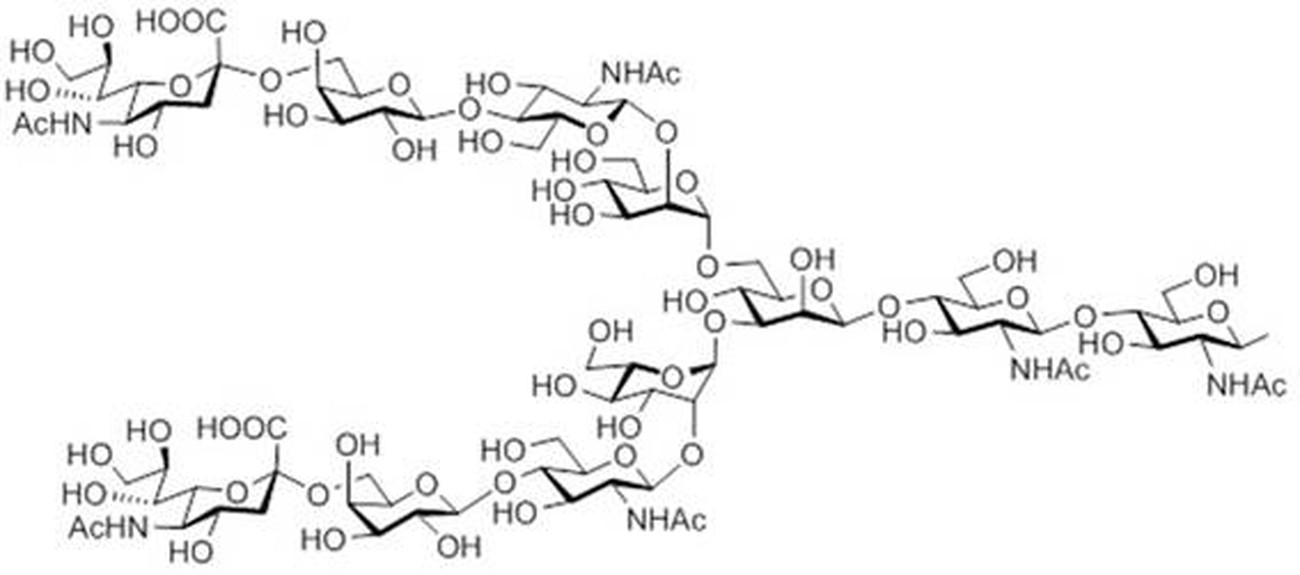
式(1)ジシアロ糖鎖

式(2)アシアロ糖鎖
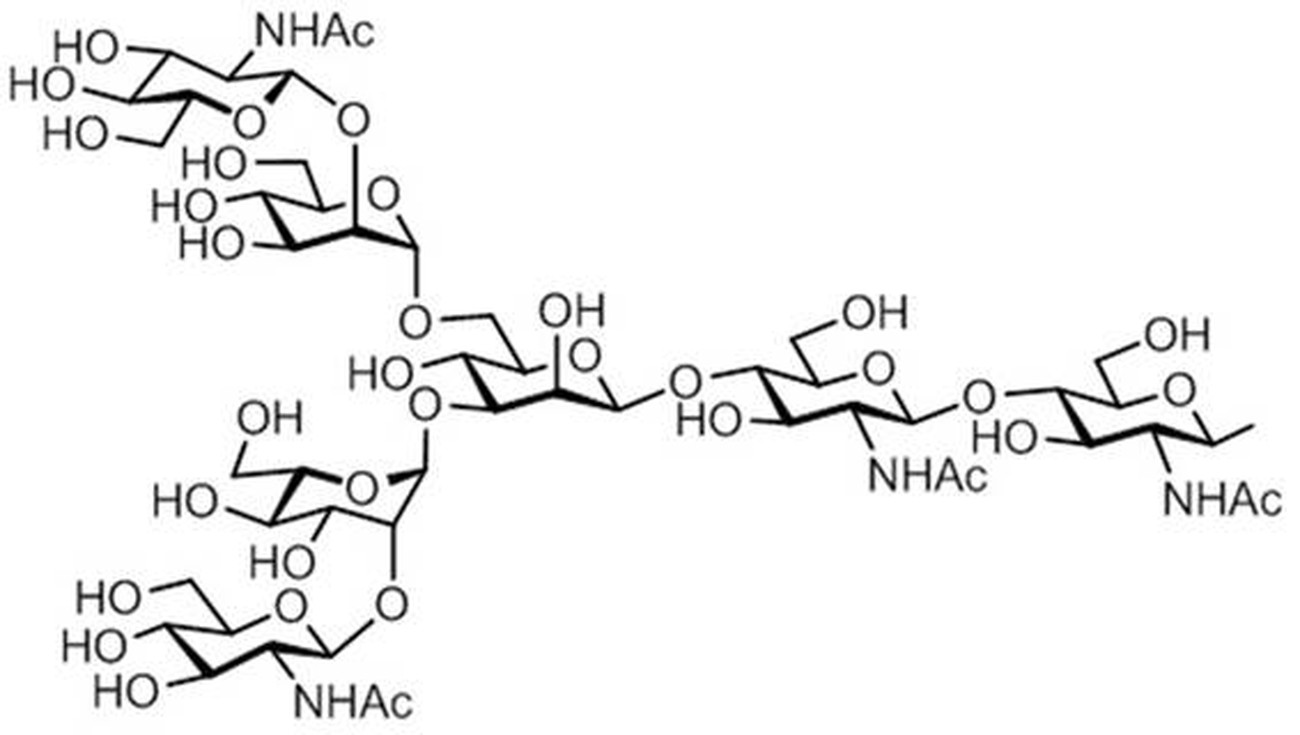
式(3)ジグルクナック糖鎖

式(4)ジマンノース糖鎖

式(5)グルクナック糖鎖

式(6)マルトトリオース糖鎖

式(7)マルトース糖鎖
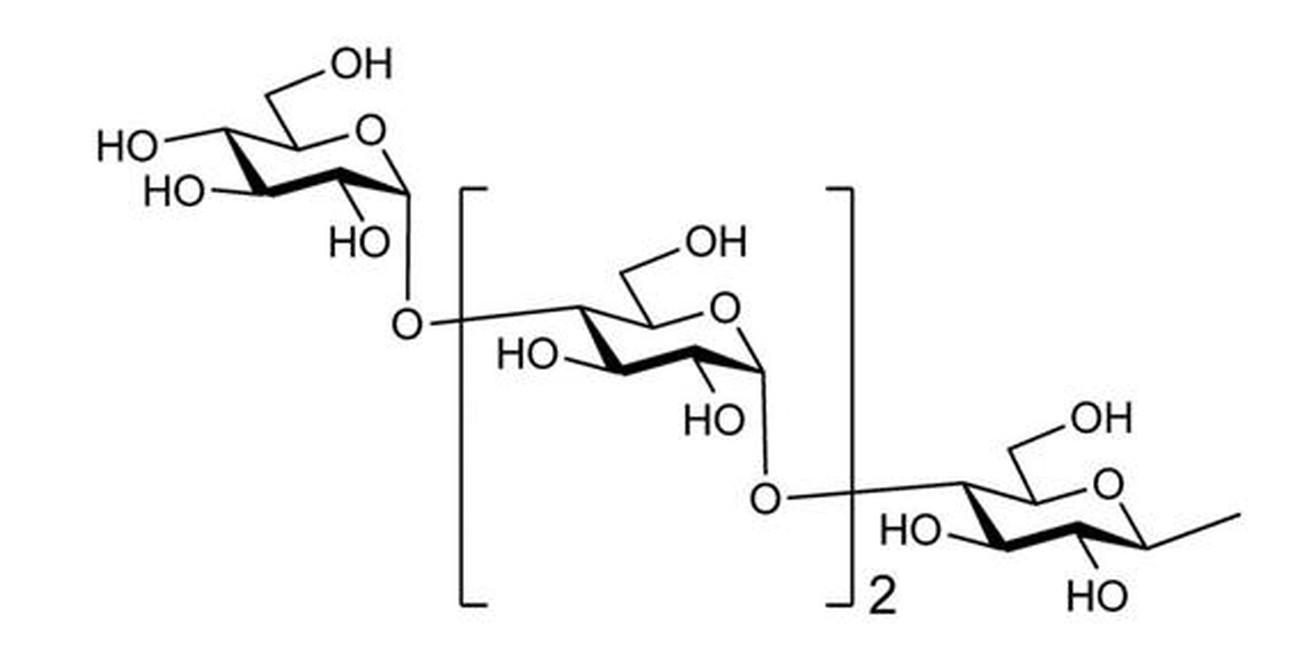
式(8)マルトテトラオース糖鎖

式(9)マルトヘプタオース糖鎖

式(10)β-シクロデキストリン糖鎖

式(11)γ-シクロデキストリン糖鎖
More specifically, the sugar chain used in the present invention may be a disialo sugar chain represented by the following formula (1), or an asialo sugar chain represented by the following formula (2). It may be a diglucnac sugar chain represented by (3), a dimannose sugar chain represented by the following formula (4), or a glucnac sugar chain represented by the following formula (5). ), may be a maltotriose sugar chain represented by the following formula (7), may be a maltotetraose sugar chain represented by the following formula (8), and may be a maltotetraose sugar chain represented by the following formula It may be a maltoheptaose sugar chain represented by (9), a β-cyclodextrin sugar chain represented by the following formula (10), or a γ-cyclodextrin sugar chain represented by the following formula (11). you can
Formula (1) Disialo-glycan
Formula (2) asialo-glycan
Formula (3) Digluconac sugar chain
Formula (4) dimannose sugar chain
Formula (5) glucnac sugar chain
Formula (6) maltotriose sugar chain
Formula (7) maltose sugar chain
Formula (8) maltotetraose sugar chain
Formula (9) maltoheptaose sugar chain
Formula (10) β-cyclodextrin sugar chain
Formula (11) γ-cyclodextrin sugar chain
本発明において、上記のジシアロ糖鎖、アシアロ糖鎖、ジグルクナック糖鎖、ジマンノース糖鎖、またはマルトヘプタオース糖鎖の非還元末端から1または複数の糖を失った糖鎖も用いることができる。 In the present invention, a sugar chain in which one or more sugars have been removed from the non-reducing end of the disialo-, asialo-, diglucnac-, dimannose-, or maltoheptaose sugar chains described above can also be used.
本発明において、糖鎖が結合されるアミノ酸残基は特に限定されないが、例えば糖鎖をシステイン(Cys:C)またはアスパラギン(Asn:N)に結合させることができ、好ましくはシステイン(Cys:C)に結合させることができる。 In the present invention, the amino acid residue to which the sugar chain is bound is not particularly limited. For example, the sugar chain can be bound to cysteine (Cys:C) or asparagine (Asn:N), ).
本発明において、アミノ酸に糖鎖を結合させる方法は特に限定されず、例えば、アミノ酸残基に糖鎖を直接結合してもよく、アミノ酸残基にリンカーを介して糖鎖を結合させてもよい。 In the present invention, the method for binding a sugar chain to an amino acid is not particularly limited. For example, a sugar chain may be directly bound to an amino acid residue, or a sugar chain may be bound to an amino acid residue via a linker. .
また、本発明において、糖鎖が結合したアミノ酸残基は、「極性アミノ酸残基と非極性アミノ酸残基が交互に配置されたアミノ酸配列」に対して直接結合していてもよく、例えば、リンカー等を介して間接的に結合していてもよい。 In the present invention, the amino acid residue to which the sugar chain is bound may be directly bound to "an amino acid sequence in which polar amino acid residues and non-polar amino acid residues are alternately arranged". You may couple|bond indirectly via etc.
本発明において、(A)極性アミノ酸残基と非極性アミノ酸残基が交互に配置されたアミノ酸配列を含むペプチド部分と、(B)糖鎖が結合される、1または複数のアミノ酸残基と、(C)1または複数の、セレンを含有するアミノ酸残基とは、任意の順番で結合されてよい。好ましくは、セレンを含有するアミノ酸残基は、上記(A)~(C)を含むポリペプチドのN末端またはC末端に配置されてよい。上記(A)~(C)は、それぞれ直接結合していてもよく、例えばリンカーを介して間接的に結合していてもよい。 In the present invention, (A) a peptide portion comprising an amino acid sequence in which polar amino acid residues and non-polar amino acid residues are alternately arranged, (B) one or more amino acid residues to which sugar chains are bound, (C) one or more selenium-containing amino acid residues may be combined in any order. Preferably, the selenium-containing amino acid residue may be placed at the N-terminus or C-terminus of the polypeptide comprising (A)-(C) above. The above (A) to (C) may be directly bonded to each other, or may be indirectly bonded via a linker, for example.
上記のようなリンカーとしては、例えば、アミノ酸とペプチド結合できるように、両末端にアミノ基およびカルボキシ基を有するアルキル鎖やPEG鎖等を挙げることができる。このようなリンカーとしては、例えば、-NH-(CH2)n-CO-(式中、nは整数であり、目的とするリンカー機能を阻害しない限り限定されるものではないが、好ましくは1~15の整数を示す。)や-NH-(CH2CH2O)m-CH2CH2-CO-(式中、mは整数であり、目的とするリンカー機能を阻害しない限り限定されるものではないが、好ましくは1~7の整数を示す。)等を挙げることができる。より具体的には、-NH-(CH2)11-CO-(C12linker)や-NH-(CH2CH2O)3-CH2CH2-CO-(PEGlinker)等を挙げることができる。 Examples of such linkers include alkyl chains and PEG chains having amino groups and carboxy groups at both ends so as to form peptide bonds with amino acids. Examples of such linkers include -NH-(CH 2 ) n -CO- (wherein n is an integer and is not limited as long as it does not inhibit the desired linker function, but preferably 1 -NH-(CH 2 CH 2 O) m -CH 2 CH 2 -CO- (wherein m is an integer and is limited as long as it does not inhibit the intended linker function but preferably an integer of 1 to 7.) and the like. More specific examples include -NH-(CH 2 ) 11 -CO-(C12linker) and -NH-(CH 2 CH 2 O) 3 -CH 2 CH 2 -CO-(PEGlinker).
本発明の糖鎖-ポリペプチド複合体は、当業者に公知のポリペプチド合成方法に、糖鎖付加工程を組み込むことで製造することができる。糖鎖付加に際しては、トランスグルタミナーゼに代表される、酵素を利用する方法も用いることができるが、この場合、付加する糖鎖が大量に必要になる、最終工程後の精製が煩雑になる、糖鎖の付加位置および付加可能な糖鎖が制限される、等の問題があるため、アッセイ用等の少量の合成には用いることが可能でも、大規模な製造には実用的な方法とは言えないことがある。 The sugar chain-polypeptide conjugate of the present invention can be produced by incorporating a glycosylation step into a polypeptide synthesis method known to those skilled in the art. A method using an enzyme, typified by transglutaminase, can also be used for the addition of sugar chains. Since there are problems such as limitations on the chain attachment position and the sugar chain that can be added, it can be used for small-scale synthesis for assays, etc., but it is not a practical method for large-scale production. sometimes not.
本発明の糖鎖-ポリペプチド複合体の簡便な製造方法の具体例として、以下、糖鎖が結合したAsn(糖鎖付加Asn)を使用し、固相合成、液相合成等の公知のペプチド合成方法を適用することにより糖鎖-ポリペプチド複合体を製造する方法(A法)、および、任意のアミノ酸残基をCysとしたポリペプチドを公知のペプチド合成方法に従って製造し、その後、Cysに化学合成により糖鎖を付加し、糖鎖-ポリペプチド複合体を製造する方法(B法)を例示する。これらの製造方法を参考に、当業者であれば様々な方法で糖鎖-ポリペプチド複合体を製造することが可能である。 As a specific example of the simple method for producing the sugar chain-polypeptide complex of the present invention, Asn to which a sugar chain is bound (glycosylated Asn) is used, and known peptide synthesis methods such as solid-phase synthesis and liquid-phase synthesis are described below. A method for producing a sugar chain-polypeptide complex by applying a synthesis method (Method A), and a polypeptide in which an arbitrary amino acid residue is Cys is produced according to a known peptide synthesis method, and then Cys is produced. A method (Method B) in which a sugar chain is added by chemical synthesis to produce a sugar chain-polypeptide complex is exemplified. With reference to these production methods, those skilled in the art can produce sugar chain-polypeptide complexes by various methods.
また、これらのA法およびB法は、2つ以上を組み合わせて行うことも可能である。アッセイなどに用いる少量の合成であれば、さらに、上記の方法に、転移酵素による糖鎖伸長反応を組み合わせることも可能である。なお、A法は、国際公開第2004/005330号パンフレット(US2005222382(A1))に、B法は、国際公開第2005/010053号パンフレット(US2007060543(A1))に、それぞれ記載されており、その開示は全体として本明細書に参照により組み込まれる。また、A法およびB法において用いられる糖鎖構造が均一な糖鎖の製造に関しては、国際公開第03/008431号パンフレット(US2004181054(A1))、国際公開第2004/058984号パンフレット(US2006228784(A1))、国際公開第2004/058824号パンフレット(US2006009421(A1))、国際公開第2004/070046号パンフレット(US2006205039(A1))、国際公開第2007/011055号パンフレット等に記載されており、その開示は全体として本明細書に参照により組み込まれる。 Moreover, these A method and B method can also be performed in combination of two or more. In the case of synthesizing a small amount to be used for an assay or the like, it is also possible to combine the above method with a sugar chain elongation reaction using a transferase. In addition, A method is described in International Publication No. 2004/005330 pamphlet (US2005222382 (A1)), and B method is described in International Publication No. 2005/010053 pamphlet (US2007060543 (A1)). is incorporated herein by reference in its entirety. In addition, regarding the production of sugar chains with a uniform sugar chain structure used in methods A and B, WO 03/008431 pamphlet (US2004181054 (A1)), WO 2004/058984 pamphlet (US2006228784 (A1) )), International Publication No. 2004/058824 pamphlet (US2006009421 (A1)), International Publication No. 2004/070046 pamphlet (US2006205039 (A1)), International Publication No. 2007/011055 pamphlet, etc., and the disclosure thereof is incorporated herein by reference in its entirety.
より具体的には、本発明の糖鎖-ポリペプチド複合体は、WO2014/162906に記載の方法に基づいて製造することができる。 More specifically, the sugar chain-polypeptide complex of the present invention can be produced based on the method described in WO2014/162906.
糖鎖-ポリペプチド複合体を製造する方法(A法)
糖鎖-ポリペプチド複合体は、例えば、以下に概略を示すように、糖鎖が結合したAsnを用いた固相合成によって製造することができる。
(1)脂溶性保護基でアミノ基窒素が保護されたアミノ酸のカルボキシ基を樹脂(レジン)へ結合させる。この場合、アミノ酸のアミノ基窒素を脂溶性保護基で保護しているので、アミノ酸同士の自己縮合は防止され、レジンとアミノ酸とが反応して結合が起こる。
(2)得られた反応物の脂溶性保護基を脱離して遊離アミノ基を形成させる。
(3)この遊離アミノ基と、脂溶性保護基でアミノ基窒素が保護された任意のアミノ酸のカルボキシ基とを、アミド化反応させる。
(4)上記脂溶性保護基を脱離して遊離アミノ基を形成させる。
(5)上記(3)および(4)の工程を1回以上繰り返すことにより、任意の数の任意のアミノ酸が連結した、末端にレジンを結合し、他端に遊離アミノ基を有するペプチドが得られる。
(6)上記(5)で合成したペプチドの遊離アミノ基をアセチル基で保護する場合、無水酢酸、酢酸等を用いてアセチル化することも好ましい。
(7)最後に、酸でレジンを切断することにより、所望のアミノ酸配列を有するペプチドを得ることができる。
Method for producing sugar chain-polypeptide complex (Method A)
A sugar chain-polypeptide complex can be produced, for example, by solid-phase synthesis using Asn to which a sugar chain is attached, as outlined below.
(1) A carboxyl group of an amino acid whose amino group nitrogen is protected with a fat-soluble protecting group is bound to a resin. In this case, since the amino group nitrogen of the amino acid is protected with a fat-soluble protective group, self-condensation between amino acids is prevented, and the resin reacts with the amino acid to form a bond.
(2) elimination of the fat-soluble protective group of the resulting reactant to form a free amino group;
(3) This free amino group and the carboxyl group of any amino acid whose amino group nitrogen is protected with a fat-soluble protective group are subjected to an amidation reaction.
(4) removing the lipid-soluble protective group to form a free amino group;
(5) By repeating steps (3) and (4) above one or more times, a peptide having an arbitrary number of arbitrary amino acids linked, a resin-bound terminal and a free amino group at the other terminal can be obtained. be done.
(6) When the free amino group of the peptide synthesized in (5) above is protected with an acetyl group, acetylation using acetic anhydride, acetic acid, or the like is also preferred.
(7) Finally, a peptide having the desired amino acid sequence can be obtained by cleaving the resin with acid.
ここで、(1)において、脂溶性保護基でアミノ基窒素が保護されたアミノ酸の代わりに、脂溶性保護基でアミノ基窒素が保護された糖鎖付加Asnを用い、当該アスパラギン部分のカルボキシ基とレジンの水酸基とを反応させれば、C末端に糖鎖付加Asnを有するペプチドを得ることができる。 Here, in (1), instead of the amino acid whose amino group nitrogen is protected with a fat-soluble protecting group, a glycosylated Asn whose amino group nitrogen is protected with a fat-soluble protecting group is used, and the carboxy group of the asparagine moiety is is reacted with the hydroxyl group of the resin, a peptide having glycosylated Asn at the C-terminus can be obtained.
また、(2)の後、または、(3)と(4)を1回以上の任意の回数繰り返した後、(3)において、脂溶性保護基でアミノ基窒素が保護されたアミノ酸の代わりに、脂溶性保護基でアミノ基窒素が保護された糖鎖付加Asnを用いれば、ポリペプチドの任意の箇所に糖鎖を結合させることができる。 Also, after (2), or after repeating (3) and (4) one or more times, in (3) instead of an amino acid whose amino group nitrogen is protected with a fat-soluble protecting group Using glycosylated Asn in which the amino group nitrogen is protected with a fat-soluble protecting group, a sugar chain can be attached to any site of the polypeptide.
このように、(1)および(3)のいずれかの工程で、2回以上、脂溶性保護基でアミノ基窒素が保護されたアミノ酸の代わりに、脂溶性保護基でアミノ基窒素が保護された糖鎖付加Asnを用いることで、ポリペプチドの任意の2ヶ所以上に糖鎖を結合させることができる。 Thus, in either step (1) or (3), the amino group nitrogen is protected with a fat-soluble protecting group twice or more in place of the amino acid whose amino group nitrogen is protected with a fat-soluble protecting group. By using glycosylated Asn, sugar chains can be bound to any two or more sites of the polypeptide.
糖鎖付加Asnを結合させた後、脂溶性保護基を脱離して遊離アミノ基を形成させ、その直後に工程(7)を行えば、N末端に糖鎖付加Asnを有するポリペプチドを得ることができる。 After binding the glycosylated Asn, the fat-soluble protecting group is removed to form a free amino group, and step (7) is performed immediately thereafter to obtain a polypeptide having a glycosylated Asn at the N-terminus. can be done.
C末端をアミド基として供給する樹脂(レジン)としては、通常、固相合成で使用する樹脂(レジン)であればよく、例えば、アミノ基で官能化されたRink-Amide-レジン(メルク社製)、Rink-Amide-PEGAレジン(メルク社製)や、NH-SAL-レジン(渡辺化学社製)を用いることが好ましい。また、アミノ基で官能化されたAmino-PEGA-レジン(メルク社製)等にFmoc-NH-SAL-レジン-リンカー(渡辺化学社製)等を結合させてもよい。このレジンとペプチドを酸で切断することにより、ペプチドのC末端アミノ酸をアミド化することができる。 As the resin for supplying the C-terminus as an amide group, any resin generally used in solid-phase synthesis may be used. ), Rink-Amide-PEGA resin (manufactured by Merck), and NH-SAL-resin (manufactured by Watanabe Chemical Co.) are preferably used. Alternatively, Fmoc-NH-SAL-resin-linker (manufactured by Watanabe Chemical Co., Ltd.) or the like may be bound to Amino-PEGA-resin (manufactured by Merck) or the like functionalized with an amino group. By cleaving this resin and peptide with acid, the C-terminal amino acid of the peptide can be amidated.
また、C末端をカルボン酸にする場合の樹脂(レジン)としては、例えば、塩素で官能化された2-クロロトリチルクロリド樹脂(メルク社製)や、アミノ基で官能化されたAmino-PEGAレジン(メルク社製)、水酸基を有するNovaSyn TGTアルコール樹脂(メルク社製)、Wangレジン(メルク社製)、HMPA-PEGAレジン(メルク社製)等を用いることができる。また、Amino-PEGAレジンとアミノ酸との間にリンカーを存在させてもよく、このようなリンカーとして、例えば、4-ヒドロキシメチルフェノキシ酢酸(HMPA)、4-(4-ヒドロキシメチル-3-メトキシフェノキシ) -ブチル酢酸(HMPB)等を挙げることができる。C末端のアミノ酸が樹脂にあらかじめ結合したH-Cys(Trt)-Trityl NovaPEG樹脂(メルク社製)等も用いることができる。
樹脂と脂溶性保護基でアミノ基窒素が保護されたアミノ酸との結合は、例えば、水酸基を有する樹脂や塩素で官能化された樹脂を使用するには、アミノ酸のカルボキシ基を樹脂へエステル結合させる。また、アミノ基で官能化された樹脂を使用する場合には、アミノ酸のカルボキシ基を樹脂にアミド結合により結合させる。
なお、2-クロロトリチルクロリド樹脂は、固相合成においてペプチド鎖を伸長する際、末端にあるCysのラセミ化を防止することができる点において、好ましい。
Examples of resins in which the C-terminus is a carboxylic acid include chlorine-functionalized 2-chlorotrityl chloride resin (manufactured by Merck & Co.) and amino-functionalized Amino-PEGA resin. (manufactured by Merck), NovaSyn TGT alcohol resin having a hydroxyl group (manufactured by Merck), Wang resin (manufactured by Merck), HMPA-PEGA resin (manufactured by Merck), and the like can be used. A linker may also be present between the Amino-PEGA resin and the amino acid; examples of such linkers include 4-hydroxymethylphenoxyacetic acid (HMPA), 4-(4-hydroxymethyl-3-methoxyphenoxy )-butyl acetate (HMPB) and the like. H-Cys(Trt)-Trityl NovaPEG resin (manufactured by Merck), in which the C-terminal amino acid is preliminarily bound to the resin, can also be used.
Bonding between the resin and amino acids whose amino group nitrogen is protected with a fat-soluble protecting group, for example, in order to use a resin having a hydroxyl group or a resin functionalized with chlorine, the carboxyl group of the amino acid is ester-bonded to the resin. . Alternatively, if a resin functionalized with an amino group is used, the carboxy group of the amino acid is attached to the resin via an amide bond.
Incidentally, 2-chlorotrityl chloride resin is preferable in that it can prevent racemization of Cys at the terminal when elongating a peptide chain in solid-phase synthesis.
糖鎖-ポリペプチド複合体を製造する方法-2(A法)
糖鎖-ポリペプチド複合体は、例えば、以下に概略を示すように、糖鎖が結合したAsnを用いた液相合成によって製造することができる。
(1)脂溶性保護基でアミノ基窒素が保護されたアミノ酸のカルボキシ基をアミノ基が遊離でカルボキシ基が保護またはアミド化されたアミノ酸へ結合させる。
(2)得られた反応物の脂溶性保護基を脱離して遊離アミノ基を形成させる。
(3)この遊離アミノ基と、脂溶性保護基でアミノ基窒素が保護された任意のアミノ酸のカルボキシ基とを、溶液中でアミド化反応させる。この場合、N末端側のアミノ酸のアミノ基窒素を脂溶性保護基で保護しており、C末端側のカルボキシ基は保護またはアミド化されているので、アミノ酸同士の自己縮合は防止され、遊離のアミノ基とカルボキシ基とが反応して結合が起こる。
(4)上記脂溶性保護基を脱離して遊離アミノ基を形成させる。
(5)上記(3)および(4)の工程を1回以上繰り返すことにより、任意の数の任意のアミノ酸が連結した、C末端のカルボキシ基が保護またはアミド化され、N末端に遊離アミノ基を有するペプチドが得られる。
(6)上記(5)で合成したペプチドの遊離アミノ基をアセチル基で保護する場合、無水酢酸、酢酸等を用いてアセチル化することも好ましい。
(7)最後に、酸で側鎖の脂溶性保護基を切断することにより、所望のアミノ酸配列を有するペプチドを得ることができる。
Method for producing sugar chain-polypeptide complex-2 (Method A)
Sugar chain-polypeptide conjugates can be produced, for example, by liquid phase synthesis using sugar chain-bound Asn, as outlined below.
(1) The carboxy group of an amino acid whose amino group nitrogen is protected with a fat-soluble protecting group is bound to an amino acid whose amino group is free and whose carboxy group is protected or amidated.
(2) elimination of the fat-soluble protective group of the resulting reactant to form a free amino group;
(3) This free amino group and the carboxy group of any amino acid whose amino group nitrogen is protected with a fat-soluble protective group are amidated in a solution. In this case, the amino group nitrogen of the amino acid on the N-terminal side is protected with a fat-soluble protecting group, and the carboxy group on the C-terminal side is protected or amidated, so self-condensation between amino acids is prevented and free Bonding occurs when the amino group and the carboxy group react.
(4) removing the lipid-soluble protective group to form a free amino group;
(5) By repeating the above steps (3) and (4) one or more times, the C-terminal carboxy group to which any number of any amino acids are linked is protected or amidated, and the N-terminal free amino group is obtained.
(6) When the free amino group of the peptide synthesized in (5) above is protected with an acetyl group, acetylation using acetic anhydride, acetic acid, or the like is also preferred.
(7) Finally, a peptide having a desired amino acid sequence can be obtained by cleaving the fat-soluble protective group on the side chain with an acid.
糖鎖-ポリペプチド複合体を製造する方法-3(A法)
糖鎖-ポリペプチド複合体は、例えば、以下に概略を示すように、糖鎖が結合したAsnを用いたフラグメント合成法によって製造することができる。
(1)上記の糖鎖-ポリペプチド複合体を製造する方法(A法)の(1)-(6)によって、アセチル基または脂溶性保護基でアミノ基窒素が保護されたポリペプチドまたは糖鎖-ポリペプチド複合体を樹脂上に合成する。
(2)側鎖保護基が脱保護されない条件で、レジンからポリペプチドまたは糖鎖-ポリペプチド複合体を切断し、C末端に遊離のカルボキシを有し、N末端がアセチル基または脂溶性保護基でアミノ基窒素が保護されたポリペプチドまたは糖鎖-ポリペプチド複合体を得る。
(3)得られたアセチル基または脂溶性保護基でアミノ基窒素が保護されたポリペプチドまたは糖鎖-ポリペプチド複合体を、固相合成法または液相合成法により、樹脂またはポリペプチドと連結させる。
(4)上記脂溶性保護基を脱離して遊離アミノ基を形成させる。
(5)上記(3)および(4)の工程を1回以上繰り返すことにより、任意の数の任意のアミノ酸が連結したペプチドが得られる。
(6)最後に、酸でレジンを切断することにより、所望のアミノ酸配列を有するペプチドを得ることができる。
Method for producing sugar chain-polypeptide complex-3 (Method A)
A sugar chain-polypeptide conjugate can be produced, for example, by a fragment synthesis method using Asn to which a sugar chain is attached, as outlined below.
(1) A polypeptide or sugar chain in which the amino group nitrogen is protected with an acetyl group or a fat-soluble protecting group by (1) to (6) of the above method for producing a sugar chain-polypeptide complex (Method A) - Synthesize the polypeptide conjugate on the resin.
(2) The polypeptide or sugar chain-polypeptide complex is cleaved from the resin under conditions in which the side chain protecting group is not deprotected, and has a free carboxy at the C-terminus and an acetyl group or a fat-soluble protecting group at the N-terminus. to obtain a polypeptide or sugar chain-polypeptide complex in which the amino group nitrogen is protected.
(3) The obtained polypeptide or sugar chain-polypeptide complex whose amino group nitrogen is protected with an acetyl group or a lipid-soluble protecting group is linked to a resin or polypeptide by a solid-phase synthesis method or a liquid-phase synthesis method. Let
(4) removing the lipid-soluble protective group to form a free amino group;
(5) By repeating steps (3) and (4) above one or more times, a peptide in which any number of arbitrary amino acids are linked can be obtained.
(6) Finally, a peptide having the desired amino acid sequence can be obtained by cleaving the resin with acid.
脂溶性保護基としては、例えば9-フルオレニルメトキシカルボニル(Fmoc)基、t-ブチルオキシカルボニル(Boc)基、ベンジル基、アリル基、アリルオキシカルボニル基、アセチル基等の、カーボネート系またはアミド系の保護基等を挙げることができる。アミノ酸に脂溶性保護基を導入するには、例えばFmoc基を導入する場合には9-フルオレニルメチル-N-スクシニミジルカーボネートと炭酸水素ナトリウムを加えて反応を行うことにより導入できる。反応は0~50℃、好ましくは室温で、約1~5時間程度行うのが良い。 Fat-soluble protecting groups include, for example, 9-fluorenylmethoxycarbonyl (Fmoc) group, t-butyloxycarbonyl (Boc) group, benzyl group, allyl group, allyloxycarbonyl group, acetyl group, carbonate-based or amide system protecting groups and the like. A fat-soluble protecting group can be introduced into an amino acid by adding 9-fluorenylmethyl-N-succinimidyl carbonate and sodium hydrogencarbonate to react, for example, when introducing an Fmoc group. The reaction is preferably carried out at 0 to 50° C., preferably room temperature, for about 1 to 5 hours.
脂溶性保護基で保護したアミノ酸としては、市販のものも使用することができる。例えば、Fmoc-Ser-OH、Fmoc-Asn-OH、Fmoc-Val-OH、Fmoc-Leu-OH、Fmoc-Ile-OH、Fmoc-AIa-OH、Fmoc-Tyr-OH、Fmoc-Gly-OH、Fmoc-Lys-OH、Fmoc-Arg-OH、Fmoc-His-OH、Fmoc-Asp-OH、Fmoc-Glu-OH、Fmoc-Gln-OH、Fmoc-Thr-OH、Fmoc-Cys-OH、Fmoc-Met-OH、Fmoc-Phe-OH、Fmoc-Trp-OH、Fmoc-Pro-OH、Fmoc-SeMet-OH、Fmoc-3-(Methylseleno)-Ala-OHを挙げることができる。 A commercially available amino acid protected with a fat-soluble protecting group can also be used. For example, Fmoc-Ser-OH, Fmoc-Asn-OH, Fmoc-Val-OH, Fmoc-Leu-OH, Fmoc-Ile-OH, Fmoc-AIa-OH, Fmoc-Tyr-OH, Fmoc-Gly-OH, Fmoc-Lys-OH, Fmoc-Arg-OH, Fmoc-His-OH, Fmoc-Asp-OH, Fmoc-Glu-OH, Fmoc-Gln-OH, Fmoc-Thr-OH, Fmoc-Cys-OH, Fmoc- Mention may be made of Met-OH, Fmoc-Phe-OH, Fmoc-Trp-OH, Fmoc-Pro-OH, Fmoc-SeMet-OH, Fmoc-3-(Methylseleno)-Ala-OH.
また、脂溶性保護基で保護したアミノ酸であって、側鎖に保護基を導入したものとして、例えば、Fmoc-Arg(Pbf)-OH、Fmoc-Asn(Trt)-OH、Fmoc-Asp(OtBu)-OH、Fmoc-Cys(Acm)-OH、Fmoc-Cys(StBu)-OH、Fmoc-Cys(tBu)-OH、Fmoc-Cys(Trt)-OH、Fmoc-Glu(OtBu)-OH、Fmoc-Gln(Trt)-OH、Fmoc-His(Trt)-OH、Fmoc-Lys(Boc)-OH、Fmoc-Ser(tBu)-OH、Fmoc-Thr(tBu)-OH、Fmoc-Trp(Boc)-OH、Fmoc-Tyr(tBu)-OH、Fmoc-Sec(Trt)-OH、Fmoc-Sec(pMeOBzl)-OH、Fmoc-Sec(pMeBzl)-OH、Fmoc-HomoSec(pMeBzl)-OH、Fmoc-HomoSec(Mob)-OHを挙げることができる。 In addition, amino acids protected with a lipid-soluble protecting group and having a protecting group introduced into the side chain include, for example, Fmoc-Arg(Pbf)-OH, Fmoc-Asn(Trt)-OH, Fmoc-Asp(OtBu )-OH, Fmoc-Cys(Acm)-OH, Fmoc-Cys(StBu)-OH, Fmoc-Cys(tBu)-OH, Fmoc-Cys(Trt)-OH, Fmoc-Glu(OtBu)-OH, Fmoc -Gln(Trt)-OH, Fmoc-His(Trt)-OH, Fmoc-Lys(Boc)-OH, Fmoc-Ser(tBu)-OH, Fmoc-Thr(tBu)-OH, Fmoc-Trp(Boc) -OH, Fmoc-Tyr(tBu)-OH, Fmoc-Sec(Trt)-OH, Fmoc-Sec(pMeOBzl)-OH, Fmoc-Sec(pMeBzl)-OH, Fmoc-HomoSec(pMeBzl)-OH, Fmoc- HomoSec(Mob)-OH may be mentioned.
また、糖鎖-ポリペプチド結合体のアミノ酸配列中に、リンカーを付加させたい場合には、固相合成の過程において、上記の脂溶性保護基で保護したアミノ酸の代わりに、脂溶性保護基で保護したリンカーを使用することで、好ましい位置に、リンカーを挿入することができる。 In addition, if you want to add a linker to the amino acid sequence of the sugar chain-polypeptide conjugate, in the process of solid phase synthesis, instead of the amino acid protected with the above-mentioned fat-soluble protecting group, a fat-soluble protecting group can be used. Linkers can be inserted at preferred locations by using protected linkers.
2-クロロトリチルクロリド樹脂を用いる場合、ジイソプロピルエチルアミン(DIPEA)、トリエチルアミン、ピリジン、2,4,6-コリジン等の塩基を用いることでエステル化を行うことができる。また、水酸基を有する樹脂を用いる場合、エステル化触媒として、例えば1-メシチレンスルホニル-3-ニトロ-1,2,4-トリアゾール(MSNT)、ジシクロヘキシルカルボジイミド(DCC)、ジイソプロピルカルボジイミド(DIC)等の公知の脱水縮合剤を用いることができる。アミノ酸と脱水縮合剤との使用割合は、前者1等量に対して、後者が、通常1~10等量、好ましくは2~5等量である。 When 2-chlorotrityl chloride resin is used, esterification can be performed using a base such as diisopropylethylamine (DIPEA), triethylamine, pyridine, 2,4,6-collidine, or the like. Further, when a resin having a hydroxyl group is used, known esterification catalysts such as 1-mesitylenesulfonyl-3-nitro-1,2,4-triazole (MSNT), dicyclohexylcarbodiimide (DCC), diisopropylcarbodiimide (DIC), etc. can be used. The proportion of the amino acid and the dehydration-condensing agent to be used is usually 1 to 10 equivalents, preferably 2 to 5 equivalents, of the latter to 1 equivalent of the former.
エステル化反応は、例えば、固相カラムにレジンを入れ、このレジンを溶剤で洗浄し、その後アミノ酸の溶液を加えることにより行うのが好ましい。洗浄用溶剤としては、例えばジメチルホルムアミド(DMF)、2-プロパノール、ジクロロメタン等を挙げることができる。アミノ酸を溶解する溶媒としては、例えばジメチルスルホキシド(DMSO)、DMF、ジクロロメタン等を挙げることができる。エステル化反応は0~50℃、好ましくは室温で、約10分~30時間程度、好ましくは15分~24時間程度行うのが良い。 The esterification reaction is preferably carried out, for example, by placing the resin in a solid-phase column, washing the resin with a solvent, and then adding the amino acid solution. Examples of washing solvents include dimethylformamide (DMF), 2-propanol, and dichloromethane. Solvents for dissolving amino acids include, for example, dimethylsulfoxide (DMSO), DMF, and dichloromethane. The esterification reaction is preferably carried out at 0 to 50° C., preferably room temperature, for about 10 minutes to 30 hours, preferably about 15 minutes to 24 hours.
この時固相上の未反応の基を、無水酢酸等を用いてアセチル化してキャッピングすることも好ましい。 At this time, it is also preferable to acetylate and cap unreacted groups on the solid phase using acetic anhydride or the like.
脂溶性保護基の脱離は、例えば塩基で処理することにより行うことができる。塩基としては、例えばピペリジン、モルホリン等を挙げることができる。その際、溶媒の存在下で行うのが好ましい。溶媒としては、例えばDMSO、DMF、メタノール等を挙げることができる。 Detachment of the fat-soluble protective group can be performed, for example, by treatment with a base. Examples of bases include piperidine and morpholine. At that time, it is preferable to carry out in the presence of a solvent. Examples of solvents include DMSO, DMF, and methanol.
遊離アミノ基と、脂溶性保護基でアミノ基窒素が保護された任意のアミノ酸のカルボキシ基とのアミド化反応は、活性化剤および溶媒の存在下行うのが好ましい。 The amidation reaction between a free amino group and the carboxy group of any amino acid whose amino group nitrogen is protected with a fat-soluble protecting group is preferably carried out in the presence of an activating agent and a solvent.
活性化剤としては、例えば、ジシクロヘキシルカルボジイミド(DCC)、1-エチル-3-(3-ジメチルアミノプロピル)カルボジイミド・塩酸塩(WSC/HCl)、ジフェニルホスホリルアジド(DPPA)、カルボニルジイミダゾール(CDI)、ジエチルシアノホスホネート(DEPC)、ベンゾトリアゾール-1-イルオキシ-トリスピロリジノホスホニウム(DIPCI)、ベンゾトリアゾール-1-イルオキシ-トリスピロリジノホスホニウムヘキサフルオロホスフェート(PyBOP)、1-ヒドロキシベンゾトリアゾール(HOBt)、ヒドロキシスクシンイミド(HOSu)、ジメチルアミノピリジン(DMAP)、1-ヒドロキシ-7-アザベンゾトリアゾール(HOAt)、ヒドロキシフタルイミド(HOPht)、ペンタフルオロフェノール(Pfp-OH)、2-(1H-ベンゾトリアゾール-1-イル)-1,1,3,3-テトラメチルウロニウムヘキサフルオロホスフェート(HBTU)、1-[ビス(ジメチルアミノ)メチレン]-5-クロロ-1H-ベンゾトリアゾリウム 3-オキシド ヘキサフルオロホスフェート(HCTU)、O-(7-アザベンゾトリアゾール-1-イル)-1,1,3,3-テトラメチルウロニウムヘキサフルオロホスホネート(HATU)、O-ベンゾトリアゾール-1-イル-1,1,3,3-テトラメチルウロニウムテトラフルオロボレート(TBTU)、3,4-ジヒドロ-3-ヒドロジ-4-オキサ-1,2,3-ベンゾトリアジン(Dhbt)、4-(4,6-ジメトキシ-1,3,5-トリアジン-2-イル)-4-メチルモルフォリニウム クロライド n-ハイドレート(DMT-MM)等を挙げることができる。 Examples of activating agents include dicyclohexylcarbodiimide (DCC), 1-ethyl-3-(3-dimethylaminopropyl)carbodiimide hydrochloride (WSC/HCl), diphenylphosphorylazide (DPPA), carbonyldiimidazole (CDI). , diethyl cyanophosphonate (DEPC), benzotriazol-1-yloxy-trispyrrolidinophosphonium (DIPCI), benzotriazol-1-yloxy-trispyrrolidinophosphonium hexafluorophosphate (PyBOP), 1-hydroxybenzotriazole (HOBt), Hydroxysuccinimide (HOSu), dimethylaminopyridine (DMAP), 1-hydroxy-7-azabenzotriazole (HOAt), hydroxyphthalimide (HOPht), pentafluorophenol (Pfp-OH), 2-(1H-benzotriazole-1 -yl)-1,1,3,3-tetramethyluronium hexafluorophosphate (HBTU), 1-[bis(dimethylamino)methylene]-5-chloro-1H-benzotriazolium 3-oxide hexafluorophosphate (HCTU), O-(7-azabenzotriazol-1-yl)-1,1,3,3-tetramethyluronium hexafluorophosphonate (HATU), O-benzotriazol-1-yl-1,1, 3,3-tetramethyluronium tetrafluoroborate (TBTU), 3,4-dihydro-3-hydrodi-4-oxa-1,2,3-benzotriazine (Dhbt), 4-(4,6-dimethoxy- 1,3,5-triazin-2-yl)-4-methylmorpholinium chloride n-hydrate (DMT-MM) and the like.
活性化剤の使用量は、脂溶性の保護基でアミノ基窒素が保護された任意のアミノ酸に対して、1~20当量、好ましくは1~10当量、さらに好ましくは、1~5当量とするのが好ましい。 The amount of the activator used is 1 to 20 equivalents, preferably 1 to 10 equivalents, more preferably 1 to 5 equivalents, relative to any amino acid whose amino group nitrogen is protected with a fat-soluble protecting group. is preferred.
溶媒としては、例えばDMSO、DMF、ジクロロメタン等を挙げることができる。反応は0~50℃、好ましくは室温で、約10分~30時間程度、好ましくは15分~24時間程度行うのが良い。脂溶性保護基の脱離は、上記と同様に行うことができる。 Examples of solvents include DMSO, DMF, and dichloromethane. The reaction is carried out at 0 to 50° C., preferably room temperature, for about 10 minutes to 30 hours, preferably 15 minutes to 24 hours. Removal of the fat-soluble protective group can be performed in the same manner as described above.
アミノ基で官能化されたRink-Amide-レジン(メルク社製)、Rink-Amide-PEGAレジン(メルク社製)、NH-SAL-レジン(渡辺化学社製)や、NH-SAL-レジン-リンカーが結合したAmino-PEGA-レジン(メルク社製)等にC末端のアミノ酸を導入する場合、上記のアミド化反応を用いて導入することができる。 Rink-Amide-resin (manufactured by Merck), Rink-Amide-PEGA resin (manufactured by Merck), NH-SAL-resin (manufactured by Watanabe Kagaku) and NH-SAL-resin-linker functionalized with amino groups When introducing a C-terminal amino acid into Amino-PEGA-resin (manufactured by Merck & Co.) or the like to which is bound, the amidation reaction described above can be used.
樹脂(レジン)からペプチド鎖を切断するには酸で処理するのが好ましい。酸としては、例えばトリフルオロ酢酸(TFA)、弗化水素(HF)等を挙げることができる。 Acid treatment is preferred for cleaving the peptide chain from the resin. Examples of acids include trifluoroacetic acid (TFA) and hydrogen fluoride (HF).
このようにして、所望の位置に糖鎖付加Asnを有する糖鎖-ポリペプチド複合体を得ることができる。 In this way, a sugar chain-polypeptide complex having glycosylated Asn at the desired position can be obtained.
なお、本発明の一実施態様において、固相合成に用いる糖鎖付加Asnにおける糖鎖上の非還元末端にシアル酸を含む場合には、酸処理によりシアル酸が切断されるのを防ぐために、当該シアル酸のカルボキシ基を、保護基により保護していることが好ましい。保護基としては、例えば、ベンジル基、アリル基、ジフェニルメチル基、フェナシル基等を挙げることができる。保護基の導入および保護基の脱離の方法は、公知の方法により行うことができる。 In one embodiment of the present invention, when the non-reducing end of the sugar chain of the glycosylated Asn used for solid-phase synthesis contains sialic acid, in order to prevent cleavage of sialic acid by acid treatment, The carboxy group of the sialic acid is preferably protected with a protecting group. Examples of protecting groups include benzyl group, allyl group, diphenylmethyl group, phenacyl group and the like. A known method can be used for introducing a protecting group and removing the protecting group.
糖鎖-ポリペプチド複合体を製造する方法(B法)
糖鎖-ポリペプチド複合体は、まずポリペプチドを合成し、後で合成したポリペプチドへ糖鎖を付加する方法によっても製造することができる。具体的には、糖鎖を付加したい位置にCysを含むポリペプチドを、固相合成法、液相合成法、細胞により合成する方法、天然に存在するものを分離抽出する方法等により製造する。ポリペプチドを固相合成法または液相合成法により合成する場合、アミノ酸は一残基ずつ連結させても良く、ポリペプチドを連結させてもよい。ここで、ジスルフィド結合を形成する予定の位置にあるCys等、糖鎖を付加しないCysに対しては、例えばアセトアミドメチル(Acm)基で保護しておく。また、糖鎖を付加せず、かつ、ジスルフィド結合の形成にも使用しないCysを糖鎖-ポリペプチド複合体に導入する場合には、糖鎖付加工程およびジスルフィド結合形成工程の間、Cysを保護基により保護しておき、その後脱保護するようにしてCysを導入することができる。このような保護基としては、例えば、tert-ブチル(tBu)や4-メトキシベンジルを挙げることができる。
Method for producing sugar chain-polypeptide complex (Method B)
A sugar chain-polypeptide complex can also be produced by first synthesizing a polypeptide and then adding a sugar chain to the synthesized polypeptide. Specifically, a polypeptide containing Cys at a position to which a sugar chain is to be added is produced by a solid-phase synthesis method, a liquid-phase synthesis method, a method of synthesizing using cells, a method of separating and extracting a naturally occurring substance, or the like. When a polypeptide is synthesized by a solid-phase synthesis method or a liquid-phase synthesis method, amino acids may be linked one residue at a time, or polypeptides may be linked. Here, Cys at a position where a disulfide bond is expected to be formed, such as Cys to which no sugar chain is added, is protected with, for example, an acetamidomethyl (Acm) group. In the case of introducing Cys, which is not glycosylated and is not used for disulfide bond formation, into the sugar chain-polypeptide complex, Cys can be protected during the glycosylation step and the disulfide bond formation step. Cys can be introduced by protecting with a group and then deprotecting. Examples of such protecting groups include tert-butyl (tBu) and 4-methoxybenzyl.
また、1つのポリペプチド中のCysに、異なる糖鎖を付加する場合には、最初に糖鎖を導入するCysを無保護とし、次に異なる糖鎖を導入するCysを、StBu等により保護しておくことで、異なる糖鎖を導入することができる。具体的には、固相合成等によりポリペプチドを合成する際、第一の糖鎖を導入したいCysを無保護とし、かつ、第二の糖鎖を導入したいCysをFmoc-Cys(StBu)-OH等を用いて、保護基を有するCysとする。その後、StBu等の保護基を保持したまま、無保護のCysへ糖鎖を導入する。次に、StBu基等を脱保護することで、無保護となったCysへ異なる糖鎖を導入することができる。なお、第一の糖鎖を導入したいCysおよび第二の糖鎖を導入したいCysは、1つ又は複数個とすることができる。 In addition, when different sugar chains are added to Cys in one polypeptide, the Cys to which the sugar chain is first introduced is unprotected, and then the Cys to which the different sugar chain is introduced is protected with StBu or the like. different sugar chains can be introduced. Specifically, when synthesizing a polypeptide by solid-phase synthesis or the like, the Cys to which the first sugar chain is to be introduced is unprotected, and the Cys to which the second sugar chain is to be introduced is Fmoc-Cys(StBu)- OH or the like is used to form Cys having a protecting group. After that, a sugar chain is introduced into unprotected Cys while retaining a protective group such as StBu. Next, by deprotecting the StBu group or the like, a different sugar chain can be introduced into the unprotected Cys. The number of Cys into which the first sugar chain is to be introduced and the number of Cys into which the second sugar chain is to be introduced can be one or more.
なお、StBu基の脱保護は、トリス(2-カルボキシエチル)ホスフィン塩酸塩(TCEP)、ジチオトレイトール(DTT)、トリブチルホスフィン等の還元剤を用いて反応させることにより脱保護することができる。上記反応は、通常0~80℃、好ましくは、5~60℃、更に好ましくは10~35℃で行うのが良い。反応時間は、好ましくは、通常30分~5時間程度である。反応終了後は、適宜、公知の方法(例えば、高速液体カラムクロマトグラフィー(HPLC))で精製するのが良い。 The StBu group can be deprotected by reaction with a reducing agent such as tris(2-carboxyethyl)phosphine hydrochloride (TCEP), dithiothreitol (DTT), tributylphosphine, or the like. The above reaction is usually carried out at 0 to 80°C, preferably 5 to 60°C, more preferably 10 to 35°C. The preferred reaction time is usually about 30 minutes to 5 hours. After completion of the reaction, it is preferable to purify by a known method (for example, high performance liquid column chromatography (HPLC)).
異なる糖鎖を導入する際には、Cysの脱保護工程における還元条件やHPLC等の精製工程における酸性条件に対して、より安定な糖鎖から導入することが好ましい。特に、シアル酸含有糖鎖を導入する際には、シアル酸を有さない糖鎖又はシアル酸残基数が少ない糖鎖から、先に導入することが好ましい。 When introducing different sugar chains, it is preferable to introduce the sugar chains that are more stable under the reducing conditions in the Cys deprotection step and the acidic conditions in the purification step such as HPLC. In particular, when introducing sialic acid-containing sugar chains, it is preferable to first introduce sugar chains that do not have sialic acid or sugar chains that have a smaller number of sialic acid residues.
また、糖鎖-ポリペプチド複合体のアミノ酸配列中に、リンカーを付加させたい場合には、例えば固相合成の過程において、脂溶性保護基で保護したアミノ酸の代わりに、脂溶性保護基で保護したリンカーを使用することで、合成したポリペプチドの好ましい位置に、リンカーを挿入することができる。 In addition, when it is desired to add a linker to the amino acid sequence of the sugar chain-polypeptide complex, for example, in the process of solid-phase synthesis, instead of the amino acid protected with a fat-soluble protecting group, it is protected with a fat-soluble protecting group. A linker can be inserted at a desired position in the synthesized polypeptide by using a linker that has been prepared.
次に、ハロアセチル化糖鎖誘導体を上記で得た無保護のCysを含むペプチドと反応させることにより、糖鎖を無保護のCysのチオール基と反応させ、ペプチドに結合させる。上記反応は、リン酸緩衝液、トリス‐塩酸緩衝液、クエン酸緩衝液、またはこれらの混合溶液中において、通常0~80℃、好ましくは、10~60℃、更に好ましくは15~35℃で行うのが良い。反応時間は、通常10分~24時間、好ましくは、通常30分~5時間程度である。反応終了後は、適宜、公知の方法(例えば、HPLC)で精製するのが良い。 Next, by reacting the haloacetylated sugar chain derivative with the peptide containing unprotected Cys obtained above, the sugar chain is reacted with the thiol group of unprotected Cys and bound to the peptide. The above reaction is carried out in a phosphate buffer, Tris-HCl buffer, citrate buffer, or a mixed solution thereof at a temperature of usually 0 to 80°C, preferably 10 to 60°C, more preferably 15 to 35°C. better to do The reaction time is generally 10 minutes to 24 hours, preferably about 30 minutes to 5 hours. After completion of the reaction, it is preferable to purify by a known method (eg, HPLC) as appropriate.
ハロアセチル化糖鎖誘導体は、例えば、アスパラギン結合型糖鎖の1位の炭素に結合している水酸基を、-NH-(CH2)a-(CO)-CH2X(Xはハロゲン原子、aは整数であり、目的とするリンカー機能を阻害しない限り限定されるものではないが、好ましくは0~4の整数を示す。)で置換した化合物である。 A haloacetylated sugar chain derivative, for example, replaces the hydroxyl group bonded to the 1-position carbon of the asparagine-linked sugar chain with —NH—(CH 2 ) a —(CO)—CH 2 X (X is a halogen atom, a is an integer, and is not limited as long as it does not inhibit the desired linker function, but is preferably an integer of 0 to 4.).
具体的には、ハロアセチル化複合型糖鎖誘導体とCys含有ポリペプチドとをリン酸緩衝液中、室温で反応させる。反応終了後、HPLCで精製することにより糖鎖が結合したCysを有する糖鎖-ポリペプチド複合体を得ることができる。 Specifically, a haloacetylated complex-type sugar chain derivative and a Cys-containing polypeptide are reacted in a phosphate buffer at room temperature. After completion of the reaction, a sugar chain-polypeptide complex having a sugar chain-bound Cys can be obtained by purification by HPLC.
また、DMSO、DMF、メタノール、アセトニトリルといった有機溶媒と、上記の緩衝液との混合溶液中で反応を行うこともできる。このとき、有機溶媒の比率は、0~99%(v/v)の範囲で、上記緩衝液に添加することができる。緩衝液への溶解性が低い無保護のCysを含むペプチドは、このような有機溶媒を添加することにより反応溶液への溶解性を向上させることができ、好ましい。 The reaction can also be carried out in a mixed solution of an organic solvent such as DMSO, DMF, methanol, or acetonitrile and the above buffer solution. At this time, the ratio of the organic solvent can be added to the buffer in the range of 0 to 99% (v/v). Peptides containing unprotected Cys, which have low solubility in buffer solutions, are preferred because the solubility in the reaction solution can be improved by adding such an organic solvent.
または、DMSO、DMF、メタノール、アセトニトリルといった有機溶媒や、それらの混合溶液中で反応を行うこともできる。その際、塩基の存在下で行うのが好ましい。塩基としては、例えばDIPEA、トリエチルアミン、ピリジン、2,4,6-コリジン等を挙げることができる。また、グアニジン塩酸塩や尿素を緩衝溶液に加えた混合溶液中においても反応を行うことができる。なお、グアニジン塩酸塩や尿素は、最終濃度が1M~8Mとなるように上記緩衝液に加えることができる。グアニジン塩酸塩や尿素の添加によっても、緩衝液への溶解性の低いペプチドの溶解性を向上させることができ、好ましい。 Alternatively, the reaction can be carried out in an organic solvent such as DMSO, DMF, methanol, acetonitrile, or a mixed solution thereof. At that time, it is preferable to carry out in the presence of a base. Examples of bases include DIPEA, triethylamine, pyridine, 2,4,6-collidine and the like. The reaction can also be carried out in a mixed solution in which guanidine hydrochloride or urea is added to a buffer solution. Guanidine hydrochloride and urea can be added to the above buffer so that the final concentration is 1M to 8M. Addition of guanidine hydrochloride or urea can also improve the solubility of peptides with low solubility in buffer solutions, which is preferable.
さらに、無保護のCysを含むポリペプチドが、ジスルフィド結合を介した2量体を形成することを防止するために、トリス(2-カルボキシエチル)ホスフィン塩酸塩(TCEP)やジチオトレイトール(DTT)を緩衝液に添加して反応させることもできる。TCEPやDTTは、最終濃度が10μM~10mMとなるように緩衝液に加えることができる。 Furthermore, tris(2-carboxyethyl)phosphine hydrochloride (TCEP) and dithiothreitol (DTT) are added to prevent the polypeptide containing unprotected Cys from forming dimers through disulfide bonds. can also be added to the buffer for reaction. TCEP or DTT can be added to the buffer to a final concentration of 10 μM-10 mM.
また、糖鎖を目的のCysへ結合させた後、Acm等で保護されたCysの保護基を脱保護する。保護基がAcm基である場合は、水、メタノール、酢酸、またはこれらの混合溶液中において、ヨウ素、酢酸水銀(II)、硝酸銀(I)、または、酢酸銀(I)等を用いて反応させることにより脱保護することができる。 In addition, after binding the sugar chain to the target Cys, the protecting group of Cys protected by Acm or the like is deprotected. When the protecting group is an Acm group, it is reacted with iodine, mercury (II) acetate, silver nitrate (I), silver acetate (I), etc. in water, methanol, acetic acid, or a mixed solution thereof. can be deprotected by
上記反応は、通常0~80℃、好ましくは、5~60℃、更に好ましくは10~35℃で行うのが良い。反応時間は、好ましくは、通常5分~24時間程度である。反応終了後は、DTTや塩酸等により処理した後、適宜、公知の方法(例えば、HPLC)で精製するのが良い。 The above reaction is usually carried out at 0 to 80°C, preferably 5 to 60°C, more preferably 10 to 35°C. The preferred reaction time is usually about 5 minutes to 24 hours. After completion of the reaction, the product may be treated with DTT, hydrochloric acid, or the like, and then purified by a known method (eg, HPLC) as appropriate.
このようにして、所望の位置に糖鎖が結合したCysを有する糖鎖-ポリペプチド複合体を得ることができる。また、このように精製された糖鎖-ポリペプチド複合体は、後述するように、脱保護されたCys同士でのジスルフィド結合を形成させることができる。 In this way, a sugar chain-polypeptide complex having Cys with a sugar chain bound to a desired position can be obtained. In addition, the sugar chain-polypeptide complex purified in this way can form a disulfide bond between deprotected Cys, as described later.
また、ジシアロ糖鎖やモノシアロ糖鎖等のシアル酸含有糖鎖をペプチド配列中に複数本有する糖鎖-ポリペプチド複合体を製造する際には、導入する糖鎖上のシアル酸のカルボキシ基が、ベンジル(Bn)基、アリル基、ジフェニルメチル基、フェナシル基等により保護されたシアル酸含有糖鎖を用いることができる。 In addition, when producing a sugar chain-polypeptide complex having multiple sialic acid-containing sugar chains such as disialoglycans and monosialoglycans in the peptide sequence, the carboxy group of the sialic acid on the sugar chain to be introduced is , a benzyl (Bn) group, an allyl group, a diphenylmethyl group, a phenacyl group, or the like.
シアル酸のカルボキシ基が保護された糖鎖を導入した際には、後述する糖鎖-ポリペプチド複合体におけるジスルフィド結合の形成工程の後、シアル酸保護基の脱保護の工程をすることができる。 When a sugar chain in which the carboxyl group of sialic acid is protected is introduced, a step of deprotecting the sialic acid protecting group can be carried out after the step of forming a disulfide bond in the sugar chain-polypeptide complex, which will be described later. .
このように、シアル酸のカルボキシ基をベンジル基等で保護することにより、製造工程におけるHPLC等による分離・精製工程が容易となる。また、シアル酸のカルボキシ基の保護は、酸に不安定なシアル酸の脱離を防ぐことも可能である。 By protecting the carboxyl group of sialic acid with a benzyl group or the like in this way, separation and purification steps by HPLC or the like in the production process are facilitated. In addition, protection of the carboxyl group of sialic acid can also prevent elimination of acid-labile sialic acid.
糖鎖上のシアル酸のカルボキシ基の保護反応は、当業者に周知の方法により行うことができる。また、ジスルフィド結合を形成させた糖鎖-ポリペプチド複合体において、シアル酸のカルボキシ基の保護基は、塩基性条件下で加水分解することによって脱保護できる。上記反応は、通常0~50℃、好ましくは、0~40℃、更に好ましくは0~30℃で行うのが良い。反応時間は、好ましくは、通常5分~5時間程度である。反応終了後は、リン酸や酢酸などの弱酸によって中和した後、適宜、公知の方法(例えば、HPLC)で精製するのが良い。 The protection reaction of the carboxy group of sialic acid on the sugar chain can be carried out by a method well known to those skilled in the art. In addition, in the disulfide-bonded sugar chain-polypeptide complex, the protective group for the carboxyl group of sialic acid can be deprotected by hydrolysis under basic conditions. The above reaction is usually carried out at 0 to 50°C, preferably 0 to 40°C, more preferably 0 to 30°C. The preferred reaction time is usually about 5 minutes to 5 hours. After completion of the reaction, it is preferable to purify by a known method (for example, HPLC) after neutralization with a weak acid such as phosphoric acid or acetic acid.
また、上記A法およびB法により作製された糖鎖-ポリペプチド複合体は、空気および/または酸素、ヨウ素、DMSO、酸化および還元されたグルタチオンの混合物、フェリシアン酸カリウム、エルマン試薬(5,5’-ジチオビス(2-ニトロ安息香酸))、トリフルオロ酢酸タリウム(III)、ならびに、アルキルトリクロロシランスルホキシドなどを用いた当業者に周知の方法で、Cys同士のジスルフィド結合を形成することができる。 In addition, the sugar chain-polypeptide complex prepared by the above methods A and B contains air and/or oxygen, iodine, DMSO, a mixture of oxidized and reduced glutathione, potassium ferricyanate, Ellman's reagent (5, 5′-dithiobis(2-nitrobenzoic acid)), thallium (III) trifluoroacetate, alkyltrichlorosilane sulfoxide, etc., can be used to form a disulfide bond between Cys by methods well known to those skilled in the art. .
なお、Cys-Cys間でのジスルフィド結合を形成させる際に、ジスルフィド結合することが望ましくない糖鎖-ポリペプチド複合体中のCysに対しては、保護基により保護しておく。このような保護基としては、Acm、tBu、4-メトキシベンジル、4-メチルベンジル等、酸化条件で安定な保護基を用いることができる。 When forming a Cys-Cys disulfide bond, Cys in the sugar chain-polypeptide complex, which is not desired to form a disulfide bond, should be protected with a protective group. As such a protecting group, a protecting group stable under oxidation conditions such as Acm, tBu, 4-methoxybenzyl, 4-methylbenzyl and the like can be used.
また、B法において、ジスルフィド結合の形成は、糖鎖の導入の前に行うことも可能である。ただし、ジスルフィド結合させたいCysに保護基が導入されている場合には、脱保護の工程がジスルフィド結合形成の工程よりも先となる。 In Method B, formation of disulfide bonds can also be carried out prior to introduction of sugar chains. However, when a protective group is introduced to Cys to be disulfide-bonded, the deprotection step precedes the disulfide-bond formation step.
また、B法においてハロアセチル化複合型糖鎖誘導体と反応させるアミノ酸は、チオール基を含有するアミノ酸であれば特に限定されず、例えば、D体のシステイン(D-Cys)、ホモシステイン、ノルシステイン、ペニシラミンなどもCysと同様に用いることが可能である。 In method B, the amino acid to be reacted with the haloacetylated complex-type sugar chain derivative is not particularly limited as long as it contains a thiol group. Penicillamine and the like can also be used in the same manner as Cys.
本発明に係る糖鎖-ポリペプチド複合体に結合する糖鎖の種類は特に限定されないが、糖鎖-ポリペプチド複合体に結合している糖鎖に存在する糖残基の数の合計が5以上であることが好ましい。例えば、5糖以上の糖鎖を1本以上付加してもよく、5糖以下の糖鎖を複数本付加することにより、1つの糖鎖-ポリペプチド複合体に付加された糖鎖に存在する糖残基の数が5以上になるようにしてもよい。糖鎖を複数本付加する場合には、1つのペプチドに結合される糖鎖の種類は同一であってもよく、異なる種類の糖鎖を組み合わせて結合してもよいが、同一であることが好ましい。 The type of sugar chain that binds to the sugar chain-polypeptide complex according to the present invention is not particularly limited. It is preferable that it is above. For example, one or more sugar chains of 5 or more sugars may be added, and by adding a plurality of sugar chains of 5 or less sugars, the sugar chain present in one sugar chain-polypeptide complex is added. The number of sugar residues may be 5 or more. When multiple sugar chains are added, the type of sugar chains bound to one peptide may be the same, or a combination of different types of sugar chains may be bound. preferable.
例えば、糖鎖-ポリペプチド複合体に結合している糖鎖に存在する糖残基の数の合計が5の場合、2つの糖残基を有するマルトース糖鎖と、3つの糖残基を有するマルトトリオース糖鎖がそれぞれ1本ずつ結合していてもよい。また、糖鎖-ポリペプチド複合体に結合している糖鎖に存在する糖残基の数の合計が6の場合、マルトース糖鎖が3本結合されていてもよく、マルトトリオース糖鎖が2本結合されていてもよい。また、糖鎖-ポリペプチド複合体に結合している糖鎖に存在する糖残基の数の合計が7の場合、マルトース糖鎖が2本およびマルトトリオース糖鎖が1本結合していてもよく、7つの糖残基を有するジグルクナック糖鎖が1本結合していてもよい。同様に、糖鎖-ポリペプチド複合体に結合している糖鎖に存在する糖残基の数の合計が8以上の場合においても、様々な組み合わせの糖鎖が結合していてもよい。 For example, when the total number of sugar residues present in the sugar chain bound to the sugar chain-polypeptide complex is 5, the maltose sugar chain has 2 sugar residues and the maltose sugar chain has 3 sugar residues. One maltotriose sugar chain may be bound to each. Further, when the total number of sugar residues present in the sugar chain bound to the sugar chain-polypeptide complex is 6, three maltose sugar chains may be bound, and the maltotriose sugar chain may be You may couple|bond two. When the total number of sugar residues present in the sugar chains bound to the sugar chain-polypeptide complex is 7, two maltose sugar chains and one maltotriose sugar chain are bound. Alternatively, one digluconac sugar chain having seven sugar residues may be bound. Similarly, even when the total number of sugar residues present in the sugar chains bound to the sugar chain-polypeptide complex is 8 or more, various combinations of sugar chains may be bound.
本発明に係る糖鎖-ポリペプチド複合体に結合する糖鎖の数は、糖鎖-ポリペプチド複合体が、pHが中性付近の水溶液中において自己集合することにより、βシート構造を形成しうるという特徴を失わない限り限定されない。例えば、1、2、3、4、5、または、6本であってよく、好ましくは、1、2、または、3本であってよい。 Regarding the number of sugar chains bound to the sugar chain-polypeptide complex according to the present invention, the sugar chain-polypeptide complex forms a β-sheet structure by self-assembly in an aqueous solution with a pH near neutral. It is not limited as long as it does not lose the characteristic of being able to. For example, there may be 1, 2, 3, 4, 5 or 6, preferably 1, 2 or 3.
本発明に係る糖鎖-ポリペプチド複合体において、糖鎖が結合するアミノ酸残基の位置は、糖鎖-ポリペプチド複合体が、pHが中性付近の水溶液中において自己集合することにより、βシート構造を形成しうるという特徴を失わない限り限定されない。例えば、糖鎖が結合するアミノ酸残基の位置はポリペプチドのN末端側および/またはC末端側であってよく、N末端側およびC末端側以外の位置であってもよい。 In the sugar chain-polypeptide complex according to the present invention, the position of the amino acid residue to which the sugar chain binds is β It is not limited as long as it does not lose the feature of being able to form a sheet structure. For example, the position of the amino acid residue to which the sugar chain binds may be on the N-terminal side and/or the C-terminal side of the polypeptide, or may be on a position other than the N-terminal side and the C-terminal side.
例えば、本発明の糖鎖-ポリペプチド複合体に結合している糖鎖の数が1本の場合には、糖鎖が結合するアミノ酸残基(B)は、極性アミノ酸残基と非極性アミノ酸残基が交互に配置されたアミノ酸配列を含むペプチド部分(A)のN末端に位置するアミノ酸残基、または、C末端に位置するアミノ酸残基と結合していてよい。 For example, when the number of sugar chains bound to the sugar chain-polypeptide complex of the present invention is one, the amino acid residue (B) to which the sugar chain binds consists of a polar amino acid residue and a non-polar amino acid residue. It may be bound to the amino acid residue located at the N-terminus or the amino acid residue located at the C-terminus of the peptide portion (A) comprising an amino acid sequence in which the residues are alternately arranged.
また、例えば、本発明の糖鎖-ポリペプチド複合に結合している糖鎖の数が2本の場合には、糖鎖が結合するアミノ酸残基(B)が、次の(1)~(3)のいずれかの位置に存在してよい。
(1)前記ペプチド部分(A)のN末端に位置するアミノ酸残基に2残基の(B)が結合する
(2)前記ペプチド部分(A)のN末端に位置するアミノ酸残基に1残基の(B)が結合し、前記ペプチド部分(A)のC末端に位置するアミノ酸残基に1残基の(B)が結合する
(3)前記ペプチド部分(A)のC末端に位置するアミノ酸残基に2残基の(B)が結合する
Further, for example, when the number of sugar chains bound to the sugar chain-polypeptide conjugate of the present invention is two, the amino acid residue (B) to which the sugar chain binds is the following (1) to ( 3) may be present at any position.
(1) 2 residues of (B) bind to the N-terminal amino acid residue of the peptide portion (A); (2) 1 residue to the N-terminal amino acid residue of the peptide portion (A); (B) of the group is attached, and one residue (B) is attached to the amino acid residue located at the C-terminus of the peptide portion (A); (3) located at the C-terminus of the peptide portion (A); 2 residues of (B) bind to the amino acid residue
また、例えば、本発明の糖鎖-ポリペプチド複合に結合している糖鎖の数が3本の場合には、糖鎖が結合しているアミノ酸残基(B)が、次の(1)~(4)のいずれかの位置に存在してよい。
(1)前記ペプチド部分(A)のN末端に位置するアミノ酸残基に3残基の(B)が結合する
(2)前記ペプチド部分(A)のN末端に位置するアミノ酸残基に2残基の(B)が結合し、前記ペプチド部分(A)のC末端に位置するアミノ酸残基に1残基の(B)が結合する
(3)前記ペプチド部分(A)のN末端に位置するアミノ酸残基に1残基の(B)が結合し、前記ペプチド部分(A)のC末端に位置するアミノ酸残基に2残基の(B)が結合する
(4)前記ペプチド部分(A)のC末端に位置するアミノ酸残基に3残基の(B)が結合する
Further, for example, when the number of sugar chains bound to the sugar chain-polypeptide conjugate of the present invention is three, the amino acid residue (B) to which the sugar chain is bound is the following (1) to (4).
(1) 3 residues of (B) bind to the N-terminal amino acid residue of the peptide portion (A); (2) 2 residues to the N-terminal amino acid residue of the peptide portion (A); group (B) is attached, and one residue (B) is attached to the amino acid residue located at the C-terminus of said peptide portion (A); (3) located at the N-terminus of said peptide portion (A); (4) said peptide portion (A), wherein one residue (B) is bound to an amino acid residue and two residues (B) are bound to an amino acid residue located at the C-terminus of said peptide portion (A); 3 residues (B) bind to the amino acid residue located at the C-terminus of
本発明に係る糖鎖-ポリペプチド複合体に付加される糖鎖は、分岐を有する糖鎖であってよい。ここで、本発明において、ポリペプチドに結合された糖鎖が「分岐を有する糖鎖」であるとは、例えば、ジシアロ糖鎖、アシアロ糖鎖、ジグルクナック糖鎖のように、1つの糖鎖の中で分岐を有している場合に限定されず、例えば、1つのポリペプチドに複数本の直鎖状の糖鎖が付加されることにより、ペプチド全体として糖鎖が分岐を有している状態にある場合も含まれる。例えば、1つのペプチドにマルトース糖鎖やマルトトリオース糖鎖等の直鎖状の糖鎖が2本以上結合している場合も、本発明において「分岐を有する糖鎖」に含まれることとする。 The sugar chain added to the sugar chain-polypeptide complex according to the present invention may be a branched sugar chain. Here, in the present invention, a sugar chain bound to a polypeptide is a "branched sugar chain", for example, a single sugar chain such as a disialo sugar chain, an asialo sugar chain, or a diglucnac sugar chain. For example, a state in which a plurality of linear sugar chains are added to one polypeptide, resulting in a branched sugar chain in the entire peptide. It is included even if it is in For example, even when two or more linear sugar chains such as maltose sugar chains and maltotriose sugar chains are bound to one peptide, it is included in the "branched sugar chain" in the present invention. .
本発明に係る糖鎖-ポリペプチド複合体に含まれるセレン含有アミノ酸の数は、糖鎖-ポリペプチド複合体が、pHが中性付近の水溶液中において自己集合することにより、βシート構造を形成しうるという特徴を失わない限り限定されない。例えば、1、2、3、4、5、または、6残基であってよく、好ましくは、1、2、または、3残基であってよい。 The number of selenium-containing amino acids contained in the sugar chain-polypeptide complex according to the present invention is such that the sugar chain-polypeptide complex forms a β-sheet structure by self-assembly in an aqueous solution with a pH near neutrality. It is not limited as long as it does not lose the feature that it can be done. For example, it may be 1, 2, 3, 4, 5 or 6 residues, preferably 1, 2 or 3 residues.
本発明に係る糖鎖-ポリペプチド複合体において、セレン含有アミノ酸の位置は、糖鎖-ポリペプチド複合体が、pHが中性付近の水溶液中において自己集合することにより、βシート構造を形成しうるという特徴を失わない限り限定されない。例えば、セレン含有アミノ酸残基の位置はポリペプチドのN末端側および/またはC末端側であってよく、N末端側およびC末端側以外の位置であってもよい。 In the sugar chain-polypeptide complex according to the present invention, the position of the selenium-containing amino acid is such that the sugar chain-polypeptide complex self-assembles in an aqueous solution near neutral pH to form a β-sheet structure. It is not limited as long as it does not lose the characteristic of being able to. For example, the position of the selenium-containing amino acid residue may be on the N-terminal side and/or the C-terminal side of the polypeptide, or may be on a position other than the N-terminal side and the C-terminal side.
例えば、本発明の糖鎖-ポリペプチド複合体に含まれるセレン含有アミノ酸が1残基の場合には、セレン含有アミノ酸残基は、ポリペプチドのN末端またはC末端の位置であってよい。 For example, when the sugar chain-polypeptide complex of the present invention contains one selenium-containing amino acid residue, the selenium-containing amino acid residue may be at the N-terminal or C-terminal position of the polypeptide.
また、ポリペプチドに含まれるセレン含有アミノ酸の数が2残基の場合には、当該2残基のアミノ酸は、次の(1)~(3)からなる群から選択される位置であってもよい。
(1)ポリペプチドのN末端に位置するアミノ酸残基から数えて1番目および2番目
(2)ポリペプチドのC末端に位置するアミノ酸残基から数えて1番目および2番目
(3)ポリペプチドのN末端、および、前記ポリペプチドのC末端
Further, when the number of selenium-containing amino acids contained in the polypeptide is two residues, the two amino acid residues may be at positions selected from the group consisting of the following (1) to (3). good.
(1) 1st and 2nd counted from the amino acid residue located at the N-terminus of the polypeptide (2) 1st and 2nd counted from the amino acid residue located at the C-terminus of the polypeptide (3) of the polypeptide the N-terminus and the C-terminus of said polypeptide
本発明において、ヒドロゲルとは、分散媒が実質的に水であるゲルを意味する。本発明に係るペプチドを水に分散させると、ヒドロゲルを形成するが、ペプチドと水との混合割合は特に限定されず、ヒドロゲルの用途に応じて当業者が適宜混合割合を調節することができる。 In the present invention, hydrogel means a gel whose dispersion medium is substantially water. When the peptide of the present invention is dispersed in water, a hydrogel is formed, but the mixing ratio of the peptide and water is not particularly limited, and those skilled in the art can appropriately adjust the mixing ratio depending on the use of the hydrogel.
本発明において、ヒドロゲルの強度や性質についての評価方法は特に限定されないが、例えば、スチール球載荷試験や動粘液度測定によって評価することができる。スチール球載荷試験では、例えば、ダーラム管内で形成させたヒドロゲルの表面に所定の重量のスチール球を載荷し、スチール球がヒドロゲルの表面に留まるか、沈むかを観察することによって、ヒドロゲルの強度を評価することができる。また、スチール球載荷試験では、ヒドロゲル中の透明度や、不溶物・沈殿の有無を目視で確認することができる。ヒドロゲルの動粘液度測定では、対象となるヒドロゲルについて、検流計を用いて動粘度を測定することにより、時間の経過にともなうヒドロゲルの強度の変化を測定することができる。 In the present invention, the evaluation method for the strength and properties of the hydrogel is not particularly limited, but evaluation can be performed, for example, by a steel ball loading test or dynamic viscosity measurement. In the steel ball loading test, for example, a steel ball of a predetermined weight is loaded on the surface of a hydrogel formed in a Durham tube, and whether the steel ball stays on the surface of the hydrogel or sinks is observed to determine the strength of the hydrogel. can be evaluated. In addition, in the steel ball loading test, the transparency in the hydrogel and the presence or absence of insolubles and precipitates can be visually confirmed. In the hydrogel kinematic viscosity measurement, the change in strength of the hydrogel over time can be measured by measuring the kinematic viscosity of the target hydrogel using a galvanometer.
本発明の糖鎖-ポリペプチド複合体は、医薬組成物として調製されてよい。本発明に係る医薬組成物は、必要に応じて他の薬効成分、栄養剤、担体等の他の任意成分を加えることができる。任意成分として、例えば結晶性セルロース、ゼラチン、乳糖、澱粉、ステアリン酸マグネシウム、タルク、植物性及び動物性脂肪、油脂、ガム、ポリアルキレングリコール等の、薬学的に許容される担体、結合剤、安定化剤、溶剤、分散媒、増量剤、賦形剤、希釈剤、pH緩衝剤、崩壊剤、可溶化剤、溶解補助剤、等張剤などの各種調剤用配合成分を添加することができる。 The carbohydrate-polypeptide conjugate of the present invention may be prepared as a pharmaceutical composition. If necessary, the pharmaceutical composition according to the present invention can contain other optional ingredients such as other medicinal ingredients, nutritional supplements, and carriers. Optional ingredients include pharmaceutically acceptable carriers, binders, stabilizers, such as crystalline cellulose, gelatin, lactose, starch, magnesium stearate, talc, vegetable and animal fats, oils, gums, polyalkylene glycols, etc. Various compounding ingredients for preparation such as agents, solvents, dispersion media, bulking agents, excipients, diluents, pH buffers, disintegrants, solubilizers, solubilizers, and isotonic agents can be added.
本発明の糖鎖-ポリペプチド複合体を含む医薬組成物は、様々な医薬用途に用い得るが、特に、角結膜疾患の治療用または予防用に好適に用いることができる。治療または予防の対象となる角結膜疾患の種類は限定されないが、例えばドライアイ、乾性角結膜炎、点状表層角膜症、角膜びらん、または、角膜潰瘍であってよい。本発明の糖鎖-ポリペプチド複合体を含む医薬組成物を角結膜疾患の治療用または予防用に用いるための剤型としては、点眼剤または軟膏剤が好ましい。 A pharmaceutical composition containing the sugar chain-polypeptide complex of the present invention can be used for various medical purposes, and is particularly suitable for treatment or prevention of keratoconjunctival diseases. The type of keratoconjunctival disease to be treated or prevented is not limited, but may be, for example, dry eye, keratoconjunctivitis sicca, superficial punctate keratopathy, corneal erosion, or corneal ulcer. Eye drops or ointments are preferable as the dosage form for using the pharmaceutical composition containing the sugar chain-polypeptide complex of the present invention for the treatment or prevention of keratoconjunctival diseases.
本発明の医薬組成物の対象への投与頻度や投与期間は、対象の症状や状態等を考慮して、当業者(例えば、医師)が適宜決定することができる。 The administration frequency and administration period of the pharmaceutical composition of the present invention to a subject can be appropriately determined by a person skilled in the art (eg, a doctor) in consideration of the symptoms, condition, etc. of the subject.
本発明の医薬組成物に含まれる糖鎖-ポリペプチドの濃度は、治療する疾患や薬剤の剤型によって当業者が適宜調整することができるが、例えば、0.01重量%~20重量%、0.05重量%~15重量%、0.1重量%~10重量%、0.2重量%~7.5重量%、0.3重量%~5.0重量%、0.4重量%~3.0重量%、0.5重量%~2.0重量%、0.5重量~1.5重量%の範囲の濃度としてよい。 The concentration of the sugar chain-polypeptide contained in the pharmaceutical composition of the present invention can be appropriately adjusted by those skilled in the art depending on the disease to be treated and the dosage form of the drug. 0.05% to 15% by weight, 0.1% to 10% by weight, 0.2% to 7.5% by weight, 0.3% to 5.0% by weight, 0.4% by weight to Concentrations may range from 3.0 wt%, 0.5 wt% to 2.0 wt%, 0.5 wt% to 1.5 wt%.
なお、本明細書において用いられる用語は、特定の実施形態を説明するために用いられるのであり、発明を限定する意図ではない。 It should be noted that the terms used in this specification are used to describe specific embodiments and are not intended to limit the invention.
また、本明細書において用いられる「含む」との用語は、文脈上明らかに異なる理解をすべき場合を除き、記述された事項(部材、ステップ、要素、数字など)が存在することを意図するものであり、それ以外の事項(部材、ステップ、要素、数字など)が存在することを排除しない。 In addition, the term "comprising" used in this specification means that the stated items (members, steps, elements, numbers, etc.) are present, unless the context clearly requires a different understanding. It does not exclude the existence of other matters (members, steps, elements, numbers, etc.).
異なる定義が無い限り、ここに用いられるすべての用語(技術用語及び科学用語を含む。)は、本発明が属する技術の当業者によって広く理解されるのと同じ意味を有する。ここに用いられる用語は、異なる定義が明示されていない限り、本明細書及び関連技術分野における意味と整合的な意味を有するものとして解釈されるべきであり、理想化され、又は、過度に形式的な意味において解釈されるべきではない。 Unless defined otherwise, all terms (including technical and scientific terms) used herein have the same meaning as commonly understood by one of ordinary skill in the art to which this invention belongs. Terms used herein are to be construed as having a meaning consistent with that in this specification and related art, unless a different definition is expressly provided, and are idealized or overly formal. should not be interpreted in any meaningful sense.
第一の、第二のなどの用語が種々の要素を表現するために用いられる場合があるが、これらの要素はそれらの用語によって限定されるべきではないことが理解される。これらの用語は一つの要素を他の要素と区別するためのみに用いられているのであり、例えば、第一の要素を第二の要素と記し、同様に、第二の要素は第一の要素と記すことは、本発明の範囲を逸脱することなく可能である。 It is understood that, although the terms first, second, etc. may be used to describe various elements, these elements should not be limited by those terms. These terms are only used to distinguish one element from another, e.g., a first element referred to as a second element; similarly, a second element referred to as a second element. without departing from the scope of the invention.
以下、実施例により本発明をより具体的に説明するが、しかしながら、本発明はいろいろな形態により具現化することができ、ここに記載される実施例に限定されるものとして解釈されてはならない。 The present invention will be more specifically described below with reference to examples, however, the present invention can be embodied in various forms and should not be construed as limited to the examples set forth herein. .
本発明の糖鎖-ポリペプチド複合体の角結膜疾患に対する治療効果を確認するため、以下の実験を行った。 In order to confirm the therapeutic effect of the sugar chain-polypeptide complex of the present invention on corneal and conjunctival diseases, the following experiments were conducted.
本実施例において比較対象として使用した糖鎖-ポリペプチド複合体(化合物1)の構造を以下に示す(配列番号4)。

本実施例において用いたセレノメチオニン含有糖鎖-ポリペプチド複合体(化合物2)の構造を以下に示す(配列番号5)。化合物1のポリペプチド部分のN末端側のCysを介してセレン含有アミノ酸であるセレノメチオニン(SeMet)が結合されている。

なお、上記のいずれの化合物も、WO2014/162906に記載の方法に基づいて製造された。 All of the above compounds were produced according to the method described in WO2014/162906.
化合物2のESI-MS:(m/z)calcd for C126H212N36O63SSe:[M+2H]2+ 1676.2、[M+3H]3+ 1117.8、[M+4H]4+ 838.6 found 1676.2、1117.8、838.6。 ESI-MS of compound 2: (m/z) calcd for C 126 H 212 N 36 O 63 SSe: [M+2H] 2+ 1676.2, [M+3H] 3+ 1117.8, [M+4H] 4+ 838.6 found 1676. 2, 1117.8, 838.6.
実施例1:角膜障害モデルラットを用いた本発明の角膜障害抑制の検討1Example 1:
以下の材料および条件に基づき、角膜障害モデルラットを用いた本発明の角膜障害抑制の検討を実施した。 Based on the following materials and conditions, a study on suppression of corneal injury of the present invention was conducted using corneal injury model rats.
<角膜障害モデル(ドライアイモデル)の作成>
7週齢雄性SDラット(クレア社、購入時6週齢)に喫煙処理を施し、ドライアイモデルを作製した。すなわち、チャンバーに入れたラットを、タバコ主流煙(TS)に1日あたり3時間曝露させ、これを5日間連続して行うことにより角膜障害を惹起した。
<Creation of corneal disorder model (dry eye model)>
7-week-old male SD rats (Clea, 6-week-old at the time of purchase) were subjected to smoking treatment to prepare a dry eye model. That is, rats placed in a chamber were exposed to mainstream tobacco smoke (TS) for 3 hours per day for 5 consecutive days to induce corneal injury.
<点眼実験>
以下の群構成(1)~(5)に対して点眼実験を行った。なお、化合物はPBS溶液として点眼投与し、vehicle投与群においては蒸留水(DW)を使用した。また、正常ラットには点眼を行わなかった。
(群構成)
(1)正常ラット(TS非曝露)、4匹
(2)TS曝露ラット+DW点眼、4匹
(3)TS曝露ラット+0.5%化合物2(PBS溶液)点眼、4匹
(4)TS曝露ラット+1%化合物2(PBS溶液)点眼、4匹
(5)TS曝露ラット+2%化合物2(PBS溶液)点眼、4匹
投与は、DWまたは化合物2のPBS溶液を、片眼に1回5μLずつ両眼に点眼した。また点眼投与は、TS曝露前に1回、TS曝露後に3回の合計1日4回、5日間連日行った。
<Eye drops experiment>
An eye drop experiment was conducted for the following group configurations (1) to (5). The compound was administered as a PBS solution by instillation, and distilled water (DW) was used in the vehicle-administered group. In addition, normal rats were not instilled.
(Group composition)
(1) normal rats (not exposed to TS), 4 (2) TS-exposed rats + DW eye drops, 4 (3) TS-exposed rats + 0.5% compound 2 (PBS solution) eye drops, 4 (4) TS-exposed rats + 1% compound 2 (PBS solution) eye drops, 4 (5) TS-exposed rats + 2% compound 2 (PBS solution) eye drops, 4 animals administered 5 μL of DW or
<角膜障害のスコア化>
5日間の点眼終了後、角膜上皮の障害部を蛍光色素フルオレセインにて染色した。
角膜上皮の障害の程度は、角膜全体を上中下及び左中右の合わせて9つの部分に分割して、各部分ごとに下記の基準で障害をスコア化し、その合計値を求めた。
(角膜上皮のフルオレセイン染色スコア判断基準)
0:染色されない(点状蛍光なし)
1:わずかに点状蛍光がみられる
2:比較的多く点状蛍光がみられる
3:密に点状蛍光がみられる
<Scoring of corneal disorders>
After 5 days of instillation, the damaged part of the corneal epithelium was stained with a fluorescent dye, fluorescein.
The degree of damage to the corneal epithelium was determined by dividing the entire cornea into 9 parts (upper, middle, lower, left, middle, right), scoring the damage for each part according to the following criteria, and calculating the total value.
(Criteria for judgment of fluorescein staining score of corneal epithelium)
0: not stained (no punctate fluorescence)
1: Slight punctate fluorescence observed 2: Relatively large punctate fluorescence observed 3: Dense punctate fluorescence observed
実験結果を図1に示す。図中、縦軸は蛍光スコア値の平均値を示す。カラムは左側から前記群構成の(1)~(5)を示す。図中のアスタリスク2個を付したシンボル(**)はダネットの検定法において有意水準1%以下であることを表す。図1に示すとおり、本発明のセレノメチオニン含有糖鎖-ポリペプチド複合体(化合物2)を点眼した群(第3-5群)においては、vehicle点眼群(第2群)と比較して、有意に角膜障害が抑制されていた。なお、いずれの実験群においても有意な角膜障害抑制効果が見られたが、特に1%濃度のペプチド溶液を用いた実験群(第4群)において最も良好な効果が見られた。
The experimental results are shown in FIG. In the figure, the vertical axis indicates the average fluorescence score value. Columns indicate (1) to (5) of the group configuration from the left. A symbol with two asterisks (**) in the figure indicates a significance level of 1% or less in Dunnett's test method. As shown in FIG. 1, in the group in which the selenomethionine-containing sugar chain-polypeptide complex (compound 2) of the present invention was instilled (
実施例2:角膜障害モデルラットを用いた本発明のペプチドの角膜障害抑制の検討2Example 2:
実施例1と同様の方法を用いて、以下の材料および条件に基づき、角膜障害モデルラットを用いた本発明の角膜障害抑制の検討を実施した。 Using the same method as in Example 1, the suppression of corneal injury of the present invention was investigated using corneal injury model rats based on the following materials and conditions.
<実験動物>
7週齢雄性SDラット(クレア社、購入時6週齢)
<角膜障害モデル(ドライアイモデル)の作成>
実験動物に対して、タバコ主流煙(TS)全身曝露、3時間/日、5日間
<点眼実験>
以下の群構成(1)~(4)に対して点眼実験を行った。なお、化合物はPBS溶液として点眼投与し、vehicle投与群においてはPBSを使用した。また、正常ラットには点眼を行わなかった。
(群構成)
(1)正常ラット(非曝露)、8匹
(2)TS曝露ラット+PBS点眼、8匹
(3)TS曝露ラット+1%化合物2(PBS溶液)点眼、8匹
(4)TS曝露ラット+1%化合物1(PBS溶液)点眼、8匹
<点眼方法>
5μL/片眼/回(両眼に点眼)、曝露前1回、曝露後3回(計4回/日)、5日間
<Experimental animals>
7-week-old male SD rat (Clea, 6-week-old at the time of purchase)
<Creation of corneal disorder model (dry eye model)>
For experimental animals, cigarette mainstream smoke (TS) whole body exposure, 3 hours / day, 5 days <eye drop experiment>
An eye drop experiment was conducted for the following group configurations (1) to (4). The compound was administered as a PBS solution by eye drops, and PBS was used in the vehicle-administered group. In addition, normal rats were not instilled.
(Group composition)
(1) normal rats (unexposed), 8 (2) TS-exposed rats + PBS eye drops, 8 (3) TS-exposed rats + 1% compound 2 (PBS solution) eye drops, 8 (4) TS-exposed rats + 1% compound 1 (PBS solution) eye drop, 8 animals <eye drop method>
5 μL/eye/dose (both eye drops), 1 time before exposure, 3 times after exposure (4 times/day in total), 5 days
各実験群における処置後の角膜障害の程度を、フルオレセイン(Fluorescein)染色スコアによって評価した。実験結果を図2に示す。図中、縦軸は蛍光スコア値の平均値を示す。カラムは左側から前記群構成の(1)~(4)を示す。図中のシャープ3個を付したシンボル(###)は、第1群に対してダネットの検定法において有意水準0.1%以下であることを表す。図中のアスタリスク3個を付したシンボル(***)は、第2群に対してダネットの検定法において有意水準0.1%以下であることを表す。 The degree of post-treatment corneal damage in each experimental group was evaluated by Fluorescein staining score. Experimental results are shown in FIG. In the figure, the vertical axis indicates the average fluorescence score value. The columns indicate (1) to (4) of the group configuration from the left. A symbol (###) with three sharp points in the figure indicates that the significance level for the first group is 0.1% or less in Dunnett's test method. Symbols with three asterisks (***) in the figure represent significance levels of 0.1% or less in Dunnett's test method for the second group.
図2に示すとおり、本発明のセレノメチオニン含有糖鎖-ポリペプチド複合体(化合物2)を点眼した群(第3群)においては、比較対照であるセレノメチオニン非含有糖鎖-ポリペプチド複合体(化合物1)を点眼した群(第4群)と比較して、さらに角膜障害が抑制されていた。 As shown in FIG. 2, in the group to which the selenomethionine-containing sugar chain-polypeptide complex (compound 2) of the present invention was instilled (group 3), the selenomethionine - free sugar chain-polypeptide complex as a control The corneal damage was further suppressed as compared with the group in which (compound 1) was instilled (group 4).
以上の結果から、本発明の糖鎖-ポリペプチド複合体は、ポリペプチド部分にセレン含有アミノ酸を含むことによって、向上された角膜障害抑制効果を奏することが明らかとなった。すなわち、本発明によって、軽度~重度のドライアイ、角結膜炎、角膜びらん、角膜潰瘍などの角膜障害を治療し得る。 From the above results, it was clarified that the sugar chain-polypeptide complex of the present invention exerts an improved corneal disorder inhibitory effect by including a selenium-containing amino acid in the polypeptide portion. That is, the present invention can treat corneal disorders such as mild to severe dry eye, keratoconjunctivitis, corneal erosion, and corneal ulcer.
(実施例3)スチール球載荷試験によるヒドロゲル特性の評価
WO2014/162906に記載の方法に基づき、0.5重量%および1重量%の濃度で化合物1および化合物2をPBSに溶解し、スチール球載荷試験を実施した。ダーラム管内のスチール球の位置は3段階で評価し、スチール球がヒドロゲル表面付近に留まった状態を○、載荷後に沈降し内部で留まった状態を△、またダーラム管の下部まで沈降した状態を×とした。また、ヒドロゲルが均一ではなく白濁や不溶物(沈殿物)が観察された場合に※を付記した。スチール球が表面付近に留まり(○)、白濁や不溶物が見られない(※がない)ヒドロゲルは、透明性があり、かつ均一なゲルと考えられた。得られた評価結果を表1に示す。

表1に示すとおり、化合物1および化合物2は、PBS中において、均一なヒドロゲルを形成した。以上の結果から、実施例1および2で用いた糖鎖-ポリペプチド複合体のPBS溶液は、ヒドロゲルであることが明らかとなった。
As shown in Table 1,
Claims (20)
前記ポリペプチドは、
(A)極性アミノ酸残基と非極性アミノ酸残基が交互に配置されたアミノ酸配列を含むペプチド部分、ここで、前記ペプチド部分は、pHが6.0~8.0の範囲内の水溶液中において自己集合することにより、βシート構造を含むヒドロゲルを形成しうる8~34個のアミノ酸残基を含むペプチド部分である;
(B)糖鎖が結合される、1または複数のアミノ酸残基;および
(C)1または複数の、セレンを含有するアミノ酸残基;
を含み、
ここで、前記(B)のアミノ酸残基に糖鎖が結合している、
糖鎖-ポリペプチド複合体。 A sugar chain-polypeptide complex,
The polypeptide is
(A) a peptide portion comprising an amino acid sequence of alternating polar and non-polar amino acid residues , wherein said peptide portion is dissolved in an aqueous solution having a pH in the range of 6.0 to 8.0; Peptide moieties containing 8-34 amino acid residues that can self-assemble to form hydrogels containing β-sheet structures ;
(B) one or more amino acid residues to which carbohydrate chains are attached; and (C) one or more selenium-containing amino acid residues;
including
Here, a sugar chain is bound to the amino acid residue of (B),
Carbohydrate-polypeptide complex.
前記セレンを含有するアミノ酸残基が、セレノメチオニン残基、セレノシステイン残基、Se-メチルセレノシステイン残基、または、セレノホモシステイン残基であることを特徴とする、
糖鎖-ポリペプチド複合体。 The sugar chain-polypeptide complex according to claim 1,
The selenium-containing amino acid residue is a selenomethionine residue, a selenocysteine residue, a Se-methylselenocysteine residue, or a selenohomocysteine residue,
Carbohydrate-polypeptide complex.
前記セレンを含有するアミノ酸残基は、前記ポリペプチドのN末端またはC末端に配置されることを特徴とする、
糖鎖-ポリペプチド複合体。 The sugar chain-polypeptide complex according to claim 1,
wherein the selenium-containing amino acid residue is located at the N-terminus or C-terminus of the polypeptide;
Carbohydrate-polypeptide complex.
前記(B)の糖鎖が結合されるアミノ酸残基が、システイン残基またはアスパラギン残基であることを特徴とする、
糖鎖-ポリペプチド複合体。 The sugar chain-polypeptide complex according to claim 1,
wherein the amino acid residue to which the sugar chain of (B) is bound is a cysteine residue or an asparagine residue,
Carbohydrate-polypeptide complex.
前記各極性アミノ酸残基が、アスパラギン酸残基、グルタミン酸残基、アルギニン残基、リジン残基、ヒスチジン残基、チロシン残基、セリン残基、トレオニン残基、アスパラギン残基、グルタミン残基、および、システイン残基からなる群から選択されるアミノ酸残基であることを特徴とする、
糖鎖-ポリペプチド複合体。 The sugar chain-polypeptide complex according to claim 1,
Each polar amino acid residue is an aspartic acid residue, a glutamic acid residue, an arginine residue, a lysine residue, a histidine residue, a tyrosine residue, a serine residue, a threonine residue, an asparagine residue, a glutamine residue, and , an amino acid residue selected from the group consisting of cysteine residues,
Carbohydrate-polypeptide complex.
前記各非極性アミノ酸残基が、アラニン残基、バリン残基、ロイシン残基、イソロイシン残基、メチオニン残基、フェニルアラニン残基、トリプトファン残基、プロリン残基、および、グリシン残基からなる群から選択されるアミノ酸残基であることを特徴とする、
糖鎖-ポリペプチド複合体。 The sugar chain-polypeptide complex according to claim 1,
each nonpolar amino acid residue is from the group consisting of an alanine residue, a valine residue, a leucine residue, an isoleucine residue, a methionine residue, a phenylalanine residue, a tryptophan residue, a proline residue, and a glycine residue; characterized by being selected amino acid residues,
Carbohydrate-polypeptide complex.
前記各極性アミノ酸残基が、アスパラギン酸残基、グルタミン酸残基、アルギニン残基、および、トレオニン残基からなる群から選択されるアミノ酸残基であり、
前記各非極性アミノ酸が、アラニン残基であることを特徴とする、
糖鎖-ポリペプチド複合体。 The sugar chain-polypeptide complex according to claim 6 ,
each polar amino acid residue is an amino acid residue selected from the group consisting of an aspartic acid residue, a glutamic acid residue, an arginine residue, and a threonine residue;
Each non-polar amino acid is an alanine residue,
Carbohydrate-polypeptide complex.
前記(A)のペプチド部分のアミノ酸配列が、「RADA」の繰り返し配列、または、「RATARAEA」の繰り返し配列であることを特徴とする、
糖鎖-ポリペプチド複合体。 The sugar chain-polypeptide complex according to claim 1,
The amino acid sequence of the peptide portion of (A) is a repeating sequence of "RADA" or a repeating sequence of "RATARAEA",
Carbohydrate-polypeptide complex.
前記(A)のペプチド部分のアミノ酸配列が、RADARADARADARADA(配列番号1)、RADARADARADARADARADA(配列番号2)、および、RATARAEARATARAEA(配列番号3)からなる群から選択されるアミノ酸配列であることを特徴とする、
糖鎖-ポリペプチド複合体。 The sugar chain-polypeptide complex according to claim 8 ,
The amino acid sequence of the peptide portion of (A) is an amino acid sequence selected from the group consisting of RADARADARADARADA (SEQ ID NO: 1), RADARADARADARADARADA (SEQ ID NO: 2), and RATARAEARATARAEA (SEQ ID NO: 3). ,
Carbohydrate-polypeptide complex.
前記ポリペプチドに結合している1または複数の糖鎖に存在する糖残基の数の合計が5以上であることを特徴とする、
糖鎖-ポリペプチド複合体。 The sugar chain-polypeptide complex according to claim 1,
characterized in that the total number of sugar residues present in one or more sugar chains bound to the polypeptide is 5 or more,
Carbohydrate-polypeptide complex.
前記ポリペプチドに結合している糖鎖の数が、1、2、または、3本であることを特徴とする、
糖鎖-ポリペプチド複合体。 The sugar chain-polypeptide complex according to claim 10 ,
The number of sugar chains bound to the polypeptide is 1, 2, or 3,
Carbohydrate-polypeptide complex.
前記糖鎖が結合するアミノ酸残基(B)は、前記ペプチド部分(A)のN末端またはC末端に、直接的または間接的に結合していることを特徴とする、
糖鎖-ポリペプチド複合体。 The sugar chain-polypeptide complex according to claim 11 ,
The amino acid residue (B) to which the sugar chain binds is directly or indirectly bound to the N -terminus or C -terminus of the peptide portion (A),
Carbohydrate-polypeptide complex.
前記ポリペプチドに結合している糖鎖の数が1本の場合には、糖鎖が結合するアミノ酸残基(B)は、前記ペプチド部分(A)のN末端に位置するアミノ酸残基、または、C末端に位置するアミノ酸残基と結合しており;
前記ポリペプチドに結合している糖鎖の数が2本の場合には、糖鎖が結合するアミノ酸残基(B)が、次の(1)~(3)のいずれかの位置に存在する、
(1)前記ペプチド部分(A)のN末端に位置するアミノ酸残基に2残基の(B)が結合する
(2)前記ペプチド部分(A)のN末端に位置するアミノ酸残基に1残基の(B)が結合し、前記ペプチド部分(A)のC末端に位置するアミノ酸残基に1残基の(B)が結合する
(3)前記ペプチド部分(A)のC末端に位置するアミノ酸残基に2残基の(B)が結合する;または、
前記ポリペプチドに結合している糖鎖の数が3本の場合には、糖鎖が結合しているアミノ酸残基(B)が、次の(1)~(4)のいずれかの位置に存在する、
(1)前記ペプチド部分(A)のN末端に位置するアミノ酸残基に3残基の(B)が結合する
(2)前記ペプチド部分(A)のN末端に位置するアミノ酸残基に2残基の(B)が結合し、前記ペプチド部分(A)のC末端に位置するアミノ酸残基に1残基の(B)が結合する
(3)前記ペプチド部分(A)のN末端に位置するアミノ酸残基に1残基の(B)が結合し、前記ペプチド部分(A)のC末端に位置するアミノ酸残基に2残基の(B)が結合する
(4)前記ペプチド部分(A)のC末端に位置するアミノ酸残基に3残基の(B)が結合する;
ことを特徴とする、
糖鎖-ポリペプチド複合体。 The sugar chain-polypeptide complex according to claim 12 ,
When the number of sugar chains attached to the polypeptide is one, the amino acid residue (B) to which the sugar chain is attached is the amino acid residue located at the N-terminus of the peptide portion (A), or , bound to the amino acid residue located at the C-terminus;
When the number of sugar chains bound to the polypeptide is two, the amino acid residue (B) to which the sugar chain binds is present at any of the following positions (1) to (3): ,
(1) 2 residues of (B) bind to the N-terminal amino acid residue of the peptide portion (A); (2) 1 residue to the N-terminal amino acid residue of the peptide portion (A); (B) of the group is attached, and one residue (B) is attached to the amino acid residue located at the C-terminus of the peptide portion (A); (3) located at the C-terminus of the peptide portion (A); two residues of (B) are attached to the amino acid residue; or
When the number of sugar chains bound to the polypeptide is three, the amino acid residue (B) to which the sugar chain is bound is located at any of the following positions (1) to (4): exist,
(1) 3 residues of (B) bind to the N-terminal amino acid residue of the peptide portion (A); (2) 2 residues to the N-terminal amino acid residue of the peptide portion (A); group (B) is attached, and one residue (B) is attached to the amino acid residue located at the C-terminus of said peptide portion (A); (3) located at the N-terminus of said peptide portion (A); (4) said peptide portion (A), wherein one residue (B) is bound to an amino acid residue and two residues (B) are bound to an amino acid residue located at the C-terminus of said peptide portion (A); 3 residues (B) bind to the amino acid residue located at the C-terminus of
characterized by
Carbohydrate-polypeptide complex.
前記糖鎖が、分岐を有する糖鎖であることを特徴とする、
糖鎖-ポリペプチド複合体。 The sugar chain-polypeptide complex according to claim 1,
characterized in that the sugar chain is a branched sugar chain,
Carbohydrate-polypeptide complex.
前記糖鎖が、ジシアロ糖鎖、アシアロ糖鎖、ジグルクナック糖鎖、ジマンノース糖鎖、グルクナック糖鎖、マルトトリオース糖鎖、マルトース糖鎖、マルトテトラオース糖鎖、マルトヘプタオース糖鎖、β-シクロデキストリン、および、γ-シクロデキストリンからなる群から選択される糖鎖であることを特徴とする、
糖鎖-ポリペプチド複合体。 The sugar chain-polypeptide complex according to claim 10 ,
The sugar chain is a disialo sugar chain, asialo sugar chain, diglucnac sugar chain, dimannose sugar chain, glucnac sugar chain, maltotriose sugar chain, maltose sugar chain, maltotetraose sugar chain, maltoheptaose sugar chain, β-cyclo characterized by being a sugar chain selected from the group consisting of dextrin and γ-cyclodextrin,
Carbohydrate-polypeptide complex.
医薬組成物。 comprising the sugar chain-polypeptide complex according to any one of claims 1 to 15 ,
pharmaceutical composition.
点眼剤または軟膏剤であることを特徴とする、
医薬組成物。 17. A pharmaceutical composition according to claim 16 ,
characterized by being eye drops or ointments,
pharmaceutical composition.
角結膜疾患の治療用または予防用である、または、角結膜疾患の治療または予防のために使用される、
医薬組成物。 18. A pharmaceutical composition according to claim 16 or 17 ,
is for the treatment or prevention of keratoconjunctival disease, or is used for the treatment or prevention of keratoconjunctival disease;
pharmaceutical composition.
前記角結膜疾患が、ドライアイ、乾性角結膜炎、点状表層角膜症、角膜びらん、または、角膜潰瘍であることを特徴とする、
医薬組成物。 19. A pharmaceutical composition according to claim 18 ,
The keratoconjunctival disease is dry eye, keratoconjunctivitis sicca, superficial punctate keratopathy, corneal erosion, or corneal ulcer,
pharmaceutical composition.
Use of the sugar chain-polypeptide complex according to claim 1 for producing a therapeutic or preventive agent for keratoconjunctival diseases.
Priority Applications (1)
| Application Number | Priority Date | Filing Date | Title |
|---|---|---|---|
| JP2018132887A JP7142286B2 (en) | 2018-07-13 | 2018-07-13 | Sugar chain-polypeptide complex containing selenium-containing amino acid, and pharmaceutical use thereof |
Applications Claiming Priority (1)
| Application Number | Priority Date | Filing Date | Title |
|---|---|---|---|
| JP2018132887A JP7142286B2 (en) | 2018-07-13 | 2018-07-13 | Sugar chain-polypeptide complex containing selenium-containing amino acid, and pharmaceutical use thereof |
Publications (2)
| Publication Number | Publication Date |
|---|---|
| JP2020011906A JP2020011906A (en) | 2020-01-23 |
| JP7142286B2 true JP7142286B2 (en) | 2022-09-27 |
Family
ID=69168679
Family Applications (1)
| Application Number | Title | Priority Date | Filing Date |
|---|---|---|---|
| JP2018132887A Active JP7142286B2 (en) | 2018-07-13 | 2018-07-13 | Sugar chain-polypeptide complex containing selenium-containing amino acid, and pharmaceutical use thereof |
Country Status (1)
| Country | Link |
|---|---|
| JP (1) | JP7142286B2 (en) |
Families Citing this family (1)
| Publication number | Priority date | Publication date | Assignee | Title |
|---|---|---|---|---|
| CN115477685A (en) * | 2022-08-31 | 2022-12-16 | 浙江工业大学 | Application of selenium-containing polypeptide compounds in the preparation of antibacterial drugs |
Citations (4)
| Publication number | Priority date | Publication date | Assignee | Title |
|---|---|---|---|---|
| WO2006137426A1 (en) | 2005-06-22 | 2006-12-28 | Kowa Company, Ltd. | Prophylactic or therapeutic agent for corneal/conjunctival disease |
| WO2014162906A1 (en) | 2013-03-30 | 2014-10-09 | 株式会社糖鎖工学研究所 | (sugar chain)-polypeptide complex |
| JP2014221830A (en) | 2005-04-25 | 2014-11-27 | マサチューセッツ インスティテュート オブ テクノロジー | Compositions and methods for promoting hemostasis and other physiological activities |
| WO2017182885A2 (en) | 2016-04-19 | 2017-10-26 | M.G. Therapeutics Ltd. | Compositions for the treatment of hyperkeratosis disorders |
-
2018
- 2018-07-13 JP JP2018132887A patent/JP7142286B2/en active Active
Patent Citations (4)
| Publication number | Priority date | Publication date | Assignee | Title |
|---|---|---|---|---|
| JP2014221830A (en) | 2005-04-25 | 2014-11-27 | マサチューセッツ インスティテュート オブ テクノロジー | Compositions and methods for promoting hemostasis and other physiological activities |
| WO2006137426A1 (en) | 2005-06-22 | 2006-12-28 | Kowa Company, Ltd. | Prophylactic or therapeutic agent for corneal/conjunctival disease |
| WO2014162906A1 (en) | 2013-03-30 | 2014-10-09 | 株式会社糖鎖工学研究所 | (sugar chain)-polypeptide complex |
| WO2017182885A2 (en) | 2016-04-19 | 2017-10-26 | M.G. Therapeutics Ltd. | Compositions for the treatment of hyperkeratosis disorders |
Non-Patent Citations (2)
| Title |
|---|
| Biochemistry, 2003, 42(32), pp.9703-9711 |
| Database UniProtKB/Swiss-Prot [online], Accession No. P49908.3, 22-Jun-2018 updated,[retrieved on 2022-03-09]HILL, K. E. et al.,Definition: RecName: Full=Selenoprotein P; Short=SeP; Flags: Precursor,https://www.ncbi.nlm.nih.gov/protein/172046864?sat=46&satkey=160158407 |
Also Published As
| Publication number | Publication date |
|---|---|
| JP2020011906A (en) | 2020-01-23 |
Similar Documents
| Publication | Publication Date | Title |
|---|---|---|
| RU2543157C2 (en) | Glycated peptide glp-1 | |
| JP6460978B2 (en) | Sugar chain-polypeptide complex | |
| WO2011052523A1 (en) | Glycosylated form of antigenic glp-1 analogue | |
| CN104936613B (en) | Sugar chain addition connexon, the compound or its salt containing sugar chain addition connexon and physiological activator and its manufacturing method | |
| US20230287051A1 (en) | Inhibitors of complement factor c3 and their medical uses | |
| JP7142286B2 (en) | Sugar chain-polypeptide complex containing selenium-containing amino acid, and pharmaceutical use thereof | |
| ES2687801T3 (en) | Polypeptide presenting chains of sialylated sugars attached thereto | |
| JPWO2011007747A1 (en) | Glycosylated AILIM extracellular domain and method for producing the same | |
| CN102124024A (en) | Glycoprotein production method and screening method | |
| RU2636456C2 (en) | Glycosylated polypeptide and its pharmaceutical composition | |
| US20170119844A1 (en) | Hemostatic pharmaceutical composition |
Legal Events
| Date | Code | Title | Description |
|---|---|---|---|
| A621 | Written request for application examination |
Free format text: JAPANESE INTERMEDIATE CODE: A621 Effective date: 20210423 |
|
| A977 | Report on retrieval |
Free format text: JAPANESE INTERMEDIATE CODE: A971007 Effective date: 20220311 |
|
| A131 | Notification of reasons for refusal |
Free format text: JAPANESE INTERMEDIATE CODE: A131 Effective date: 20220317 |
|
| A521 | Request for written amendment filed |
Free format text: JAPANESE INTERMEDIATE CODE: A523 Effective date: 20220510 |
|
| TRDD | Decision of grant or rejection written | ||
| A01 | Written decision to grant a patent or to grant a registration (utility model) |
Free format text: JAPANESE INTERMEDIATE CODE: A01 Effective date: 20220825 |
|
| A61 | First payment of annual fees (during grant procedure) |
Free format text: JAPANESE INTERMEDIATE CODE: A61 Effective date: 20220901 |
|
| R150 | Certificate of patent or registration of utility model |
Ref document number: 7142286 Country of ref document: JP Free format text: JAPANESE INTERMEDIATE CODE: R150 |