JP7072465B2 - Epoxy compounds, epoxy resins, epoxy resin compositions, cured resins, prepregs, fiber-reinforced composite materials, and methods for producing these. - Google Patents
Epoxy compounds, epoxy resins, epoxy resin compositions, cured resins, prepregs, fiber-reinforced composite materials, and methods for producing these. Download PDFInfo
- Publication number
- JP7072465B2 JP7072465B2 JP2018148952A JP2018148952A JP7072465B2 JP 7072465 B2 JP7072465 B2 JP 7072465B2 JP 2018148952 A JP2018148952 A JP 2018148952A JP 2018148952 A JP2018148952 A JP 2018148952A JP 7072465 B2 JP7072465 B2 JP 7072465B2
- Authority
- JP
- Japan
- Prior art keywords
- epoxy resin
- amino
- methylphenoxy
- epoxy
- aminophenoxy
- Prior art date
- Legal status (The legal status is an assumption and is not a legal conclusion. Google has not performed a legal analysis and makes no representation as to the accuracy of the status listed.)
- Active
Links
- 239000003822 epoxy resin Substances 0.000 title claims description 157
- 229920000647 polyepoxide Polymers 0.000 title claims description 157
- 239000000203 mixture Substances 0.000 title claims description 103
- 239000004593 Epoxy Substances 0.000 title claims description 99
- 239000000463 material Substances 0.000 title claims description 90
- 229920005989 resin Polymers 0.000 title claims description 83
- 239000011347 resin Substances 0.000 title claims description 82
- 150000001875 compounds Chemical class 0.000 title claims description 76
- 239000003733 fiber-reinforced composite Substances 0.000 title claims description 30
- -1 prepregs Substances 0.000 title description 73
- 238000000034 method Methods 0.000 title description 62
- LNEPOXFFQSENCJ-UHFFFAOYSA-N haloperidol Chemical compound C1CC(O)(C=2C=CC(Cl)=CC=2)CCN1CCCC(=O)C1=CC=C(F)C=C1 LNEPOXFFQSENCJ-UHFFFAOYSA-N 0.000 title description 6
- 239000012783 reinforcing fiber Substances 0.000 claims description 50
- 239000000126 substance Substances 0.000 claims description 33
- 125000003118 aryl group Chemical group 0.000 claims description 24
- 125000001931 aliphatic group Chemical group 0.000 claims description 23
- 239000011342 resin composition Substances 0.000 claims description 23
- 239000000835 fiber Substances 0.000 claims description 21
- 238000004519 manufacturing process Methods 0.000 claims description 19
- 125000004432 carbon atom Chemical group C* 0.000 claims description 16
- VNWKTOKETHGBQD-UHFFFAOYSA-N methane Chemical compound C VNWKTOKETHGBQD-UHFFFAOYSA-N 0.000 claims description 12
- 229920000049 Carbon (fiber) Polymers 0.000 claims description 11
- 239000004917 carbon fiber Substances 0.000 claims description 11
- 238000004128 high performance liquid chromatography Methods 0.000 claims description 9
- 125000003545 alkoxy group Chemical group 0.000 claims description 7
- 125000005843 halogen group Chemical group 0.000 claims description 6
- 125000004435 hydrogen atom Chemical group [H]* 0.000 claims description 6
- 238000005259 measurement Methods 0.000 claims description 6
- 239000004848 polyfunctional curative Substances 0.000 claims description 3
- 238000001723 curing Methods 0.000 description 50
- 229920005992 thermoplastic resin Polymers 0.000 description 37
- 238000000465 moulding Methods 0.000 description 34
- XLYOFNOQVPJJNP-UHFFFAOYSA-N water Substances O XLYOFNOQVPJJNP-UHFFFAOYSA-N 0.000 description 32
- 229920002430 Fibre-reinforced plastic Polymers 0.000 description 27
- 239000011151 fibre-reinforced plastic Substances 0.000 description 27
- 239000002245 particle Substances 0.000 description 27
- 239000003795 chemical substances by application Substances 0.000 description 26
- YXFVVABEGXRONW-UHFFFAOYSA-N Toluene Chemical compound CC1=CC=CC=C1 YXFVVABEGXRONW-UHFFFAOYSA-N 0.000 description 24
- 150000001338 aliphatic hydrocarbons Chemical class 0.000 description 23
- 238000010521 absorption reaction Methods 0.000 description 21
- 239000000047 product Substances 0.000 description 21
- 238000006243 chemical reaction Methods 0.000 description 16
- HEMHJVSKTPXQMS-UHFFFAOYSA-M Sodium hydroxide Chemical compound [OH-].[Na+] HEMHJVSKTPXQMS-UHFFFAOYSA-M 0.000 description 15
- 150000004984 aromatic diamines Chemical class 0.000 description 15
- 239000010408 film Substances 0.000 description 15
- 238000005470 impregnation Methods 0.000 description 14
- 229910052757 nitrogen Inorganic materials 0.000 description 14
- VLKZOEOYAKHREP-UHFFFAOYSA-N n-Hexane Chemical compound CCCCCC VLKZOEOYAKHREP-UHFFFAOYSA-N 0.000 description 12
- OFBQJSOFQDEBGM-UHFFFAOYSA-N n-pentane Natural products CCCCC OFBQJSOFQDEBGM-UHFFFAOYSA-N 0.000 description 12
- 239000012044 organic layer Substances 0.000 description 12
- 239000010410 layer Substances 0.000 description 11
- 238000002156 mixing Methods 0.000 description 11
- SHFJWMWCIHQNCP-UHFFFAOYSA-M hydron;tetrabutylazanium;sulfate Chemical compound OS([O-])(=O)=O.CCCC[N+](CCCC)(CCCC)CCCC SHFJWMWCIHQNCP-UHFFFAOYSA-M 0.000 description 10
- 239000002904 solvent Substances 0.000 description 10
- BRLQWZUYTZBJKN-UHFFFAOYSA-N Epichlorohydrin Chemical compound ClCC1CO1 BRLQWZUYTZBJKN-UHFFFAOYSA-N 0.000 description 8
- IMNFDUFMRHMDMM-UHFFFAOYSA-N N-Heptane Chemical compound CCCCCCC IMNFDUFMRHMDMM-UHFFFAOYSA-N 0.000 description 8
- 239000004952 Polyamide Substances 0.000 description 8
- ATUOYWHBWRKTHZ-UHFFFAOYSA-N Propane Chemical compound CCC ATUOYWHBWRKTHZ-UHFFFAOYSA-N 0.000 description 8
- 230000015572 biosynthetic process Effects 0.000 description 8
- DIOQZVSQGTUSAI-UHFFFAOYSA-N decane Chemical compound CCCCCCCCCC DIOQZVSQGTUSAI-UHFFFAOYSA-N 0.000 description 8
- 229920002647 polyamide Polymers 0.000 description 8
- 239000012153 distilled water Substances 0.000 description 7
- 238000003786 synthesis reaction Methods 0.000 description 7
- 238000012360 testing method Methods 0.000 description 7
- WEVYAHXRMPXWCK-UHFFFAOYSA-N Acetonitrile Chemical compound CC#N WEVYAHXRMPXWCK-UHFFFAOYSA-N 0.000 description 6
- LFQSCWFLJHTTHZ-UHFFFAOYSA-N Ethanol Chemical compound CCO LFQSCWFLJHTTHZ-UHFFFAOYSA-N 0.000 description 6
- 230000007423 decrease Effects 0.000 description 6
- 238000010438 heat treatment Methods 0.000 description 6
- 239000011159 matrix material Substances 0.000 description 6
- 229920000768 polyamine Polymers 0.000 description 6
- 239000004642 Polyimide Substances 0.000 description 5
- 150000001412 amines Chemical group 0.000 description 5
- 239000007864 aqueous solution Substances 0.000 description 5
- 239000012298 atmosphere Substances 0.000 description 5
- 230000000052 comparative effect Effects 0.000 description 5
- 239000002131 composite material Substances 0.000 description 5
- 238000013007 heat curing Methods 0.000 description 5
- 239000012943 hotmelt Substances 0.000 description 5
- 239000006082 mold release agent Substances 0.000 description 5
- BKIMMITUMNQMOS-UHFFFAOYSA-N nonane Chemical compound CCCCCCCCC BKIMMITUMNQMOS-UHFFFAOYSA-N 0.000 description 5
- 229920001721 polyimide Polymers 0.000 description 5
- 238000003860 storage Methods 0.000 description 5
- LJGHYPLBDBRCRZ-UHFFFAOYSA-N 3-(3-aminophenyl)sulfonylaniline Chemical compound NC1=CC=CC(S(=O)(=O)C=2C=C(N)C=CC=2)=C1 LJGHYPLBDBRCRZ-UHFFFAOYSA-N 0.000 description 4
- LRHPLDYGYMQRHN-UHFFFAOYSA-N N-Butanol Chemical compound CCCCO LRHPLDYGYMQRHN-UHFFFAOYSA-N 0.000 description 4
- 239000004677 Nylon Substances 0.000 description 4
- 239000004695 Polyether sulfone Substances 0.000 description 4
- PMZURENOXWZQFD-UHFFFAOYSA-L Sodium Sulfate Chemical compound [Na+].[Na+].[O-]S([O-])(=O)=O PMZURENOXWZQFD-UHFFFAOYSA-L 0.000 description 4
- 238000007259 addition reaction Methods 0.000 description 4
- 239000001273 butane Substances 0.000 description 4
- 239000013058 crude material Substances 0.000 description 4
- 239000012043 crude product Substances 0.000 description 4
- RTZKZFJDLAIYFH-UHFFFAOYSA-N ether Chemical group CCOCC RTZKZFJDLAIYFH-UHFFFAOYSA-N 0.000 description 4
- 239000000706 filtrate Substances 0.000 description 4
- 239000003063 flame retardant Substances 0.000 description 4
- 239000007788 liquid Substances 0.000 description 4
- IJDNQMDRQITEOD-UHFFFAOYSA-N n-butane Chemical compound CCCC IJDNQMDRQITEOD-UHFFFAOYSA-N 0.000 description 4
- 229920001778 nylon Polymers 0.000 description 4
- TVMXDCGIABBOFY-UHFFFAOYSA-N octane Chemical compound CCCCCCCC TVMXDCGIABBOFY-UHFFFAOYSA-N 0.000 description 4
- 229910052698 phosphorus Inorganic materials 0.000 description 4
- 229920006393 polyether sulfone Polymers 0.000 description 4
- 239000001294 propane Substances 0.000 description 4
- 125000001436 propyl group Chemical group [H]C([*])([H])C([H])([H])C([H])([H])[H] 0.000 description 4
- 238000010898 silica gel chromatography Methods 0.000 description 4
- 229910052938 sodium sulfate Inorganic materials 0.000 description 4
- 235000011152 sodium sulphate Nutrition 0.000 description 4
- 239000000243 solution Substances 0.000 description 4
- 125000001424 substituent group Chemical group 0.000 description 4
- 230000002194 synthesizing effect Effects 0.000 description 4
- RNFJDJUURJAICM-UHFFFAOYSA-N 2,2,4,4,6,6-hexaphenoxy-1,3,5-triaza-2$l^{5},4$l^{5},6$l^{5}-triphosphacyclohexa-1,3,5-triene Chemical compound N=1P(OC=2C=CC=CC=2)(OC=2C=CC=CC=2)=NP(OC=2C=CC=CC=2)(OC=2C=CC=CC=2)=NP=1(OC=1C=CC=CC=1)OC1=CC=CC=C1 RNFJDJUURJAICM-UHFFFAOYSA-N 0.000 description 3
- ZWEHNKRNPOVVGH-UHFFFAOYSA-N 2-Butanone Chemical compound CCC(C)=O ZWEHNKRNPOVVGH-UHFFFAOYSA-N 0.000 description 3
- QTBSBXVTEAMEQO-UHFFFAOYSA-N Acetic acid Chemical compound CC(O)=O QTBSBXVTEAMEQO-UHFFFAOYSA-N 0.000 description 3
- OKTJSMMVPCPJKN-UHFFFAOYSA-N Carbon Chemical compound [C] OKTJSMMVPCPJKN-UHFFFAOYSA-N 0.000 description 3
- ZMXDDKWLCZADIW-UHFFFAOYSA-N N,N-Dimethylformamide Chemical compound CN(C)C=O ZMXDDKWLCZADIW-UHFFFAOYSA-N 0.000 description 3
- OAICVXFJPJFONN-UHFFFAOYSA-N Phosphorus Chemical compound [P] OAICVXFJPJFONN-UHFFFAOYSA-N 0.000 description 3
- 239000004962 Polyamide-imide Substances 0.000 description 3
- KWYUFKZDYYNOTN-UHFFFAOYSA-M Potassium hydroxide Chemical compound [OH-].[K+] KWYUFKZDYYNOTN-UHFFFAOYSA-M 0.000 description 3
- XUIMIQQOPSSXEZ-UHFFFAOYSA-N Silicon Chemical compound [Si] XUIMIQQOPSSXEZ-UHFFFAOYSA-N 0.000 description 3
- 229910052799 carbon Inorganic materials 0.000 description 3
- 238000004821 distillation Methods 0.000 description 3
- 230000000694 effects Effects 0.000 description 3
- 229910052751 metal Inorganic materials 0.000 description 3
- 239000002184 metal Substances 0.000 description 3
- AFEQENGXSMURHA-UHFFFAOYSA-N oxiran-2-ylmethanamine Chemical compound NCC1CO1 AFEQENGXSMURHA-UHFFFAOYSA-N 0.000 description 3
- 239000011574 phosphorus Substances 0.000 description 3
- 229920002492 poly(sulfone) Polymers 0.000 description 3
- 229920002239 polyacrylonitrile Polymers 0.000 description 3
- 229920002312 polyamide-imide Polymers 0.000 description 3
- 238000006068 polycondensation reaction Methods 0.000 description 3
- 229920000728 polyester Polymers 0.000 description 3
- 239000002994 raw material Substances 0.000 description 3
- 230000009257 reactivity Effects 0.000 description 3
- 238000007363 ring formation reaction Methods 0.000 description 3
- 238000007142 ring opening reaction Methods 0.000 description 3
- 229910052604 silicate mineral Inorganic materials 0.000 description 3
- 239000010703 silicon Substances 0.000 description 3
- 229910052710 silicon Inorganic materials 0.000 description 3
- 239000007787 solid Substances 0.000 description 3
- 238000001721 transfer moulding Methods 0.000 description 3
- PSDFQEVOCCOOET-UHFFFAOYSA-N 2-[2-(2-aminophenoxy)ethoxy]aniline Chemical compound NC1=CC=CC=C1OCCOC1=CC=CC=C1N PSDFQEVOCCOOET-UHFFFAOYSA-N 0.000 description 2
- AFILHNCSQZGANF-UHFFFAOYSA-N 2-[3-(2-aminophenoxy)propoxy]aniline Chemical compound NC1=CC=CC=C1OCCCOC1=CC=CC=C1N AFILHNCSQZGANF-UHFFFAOYSA-N 0.000 description 2
- WKBOTKDWSSQWDR-UHFFFAOYSA-N Bromine atom Chemical compound [Br] WKBOTKDWSSQWDR-UHFFFAOYSA-N 0.000 description 2
- 239000007848 Bronsted acid Substances 0.000 description 2
- VTYYLEPIZMXCLO-UHFFFAOYSA-L Calcium carbonate Chemical compound [Ca+2].[O-]C([O-])=O VTYYLEPIZMXCLO-UHFFFAOYSA-L 0.000 description 2
- ZAMOUSCENKQFHK-UHFFFAOYSA-N Chlorine atom Chemical compound [Cl] ZAMOUSCENKQFHK-UHFFFAOYSA-N 0.000 description 2
- XDTMQSROBMDMFD-UHFFFAOYSA-N Cyclohexane Chemical compound C1CCCCC1 XDTMQSROBMDMFD-UHFFFAOYSA-N 0.000 description 2
- MQJKPEGWNLWLTK-UHFFFAOYSA-N Dapsone Chemical compound C1=CC(N)=CC=C1S(=O)(=O)C1=CC=C(N)C=C1 MQJKPEGWNLWLTK-UHFFFAOYSA-N 0.000 description 2
- OTMSDBZUPAUEDD-UHFFFAOYSA-N Ethane Chemical compound CC OTMSDBZUPAUEDD-UHFFFAOYSA-N 0.000 description 2
- JHWNWJKBPDFINM-UHFFFAOYSA-N Laurolactam Chemical compound O=C1CCCCCCCCCCCN1 JHWNWJKBPDFINM-UHFFFAOYSA-N 0.000 description 2
- 239000002841 Lewis acid Substances 0.000 description 2
- CSNNHWWHGAXBCP-UHFFFAOYSA-L Magnesium sulfate Chemical compound [Mg+2].[O-][S+2]([O-])([O-])[O-] CSNNHWWHGAXBCP-UHFFFAOYSA-L 0.000 description 2
- CTQNGGLPUBDAKN-UHFFFAOYSA-N O-Xylene Chemical compound CC1=CC=CC=C1C CTQNGGLPUBDAKN-UHFFFAOYSA-N 0.000 description 2
- FAPWRFPIFSIZLT-UHFFFAOYSA-M Sodium chloride Chemical compound [Na+].[Cl-] FAPWRFPIFSIZLT-UHFFFAOYSA-M 0.000 description 2
- XLOMVQKBTHCTTD-UHFFFAOYSA-N Zinc monoxide Chemical compound [Zn]=O XLOMVQKBTHCTTD-UHFFFAOYSA-N 0.000 description 2
- 150000008065 acid anhydrides Chemical class 0.000 description 2
- 239000003377 acid catalyst Substances 0.000 description 2
- 239000005456 alcohol based solvent Substances 0.000 description 2
- 125000002723 alicyclic group Chemical group 0.000 description 2
- 125000000217 alkyl group Chemical group 0.000 description 2
- 125000003277 amino group Chemical group 0.000 description 2
- 150000005415 aminobenzoic acids Chemical class 0.000 description 2
- 229920006231 aramid fiber Polymers 0.000 description 2
- 239000012300 argon atmosphere Substances 0.000 description 2
- 150000004945 aromatic hydrocarbons Chemical class 0.000 description 2
- 125000003710 aryl alkyl group Chemical group 0.000 description 2
- HTZCNXWZYVXIMZ-UHFFFAOYSA-M benzyl(triethyl)azanium;chloride Chemical compound [Cl-].CC[N+](CC)(CC)CC1=CC=CC=C1 HTZCNXWZYVXIMZ-UHFFFAOYSA-M 0.000 description 2
- 230000002457 bidirectional effect Effects 0.000 description 2
- IISBACLAFKSPIT-UHFFFAOYSA-N bisphenol A Chemical compound C=1C=C(O)C=CC=1C(C)(C)C1=CC=C(O)C=C1 IISBACLAFKSPIT-UHFFFAOYSA-N 0.000 description 2
- PXKLMJQFEQBVLD-UHFFFAOYSA-N bisphenol F Chemical compound C1=CC(O)=CC=C1CC1=CC=C(O)C=C1 PXKLMJQFEQBVLD-UHFFFAOYSA-N 0.000 description 2
- GDTBXPJZTBHREO-UHFFFAOYSA-N bromine Substances BrBr GDTBXPJZTBHREO-UHFFFAOYSA-N 0.000 description 2
- 229910052794 bromium Inorganic materials 0.000 description 2
- 239000006227 byproduct Substances 0.000 description 2
- OSGAYBCDTDRGGQ-UHFFFAOYSA-L calcium sulfate Chemical compound [Ca+2].[O-]S([O-])(=O)=O OSGAYBCDTDRGGQ-UHFFFAOYSA-L 0.000 description 2
- 238000005266 casting Methods 0.000 description 2
- 239000000460 chlorine Substances 0.000 description 2
- 229910052801 chlorine Inorganic materials 0.000 description 2
- 230000007547 defect Effects 0.000 description 2
- QGBSISYHAICWAH-UHFFFAOYSA-N dicyandiamide Chemical compound NC(N)=NC#N QGBSISYHAICWAH-UHFFFAOYSA-N 0.000 description 2
- GYZLOYUZLJXAJU-UHFFFAOYSA-N diglycidyl ether Chemical group C1OC1COCC1CO1 GYZLOYUZLJXAJU-UHFFFAOYSA-N 0.000 description 2
- 238000004090 dissolution Methods 0.000 description 2
- GKIPXFAANLTWBM-UHFFFAOYSA-N epibromohydrin Chemical compound BrCC1CO1 GKIPXFAANLTWBM-UHFFFAOYSA-N 0.000 description 2
- JBKVHLHDHHXQEQ-UHFFFAOYSA-N epsilon-caprolactam Chemical compound O=C1CCCCCN1 JBKVHLHDHHXQEQ-UHFFFAOYSA-N 0.000 description 2
- 125000001495 ethyl group Chemical group [H]C([H])([H])C([H])([H])* 0.000 description 2
- 238000011156 evaluation Methods 0.000 description 2
- 239000004744 fabric Substances 0.000 description 2
- 238000005227 gel permeation chromatography Methods 0.000 description 2
- 239000003365 glass fiber Substances 0.000 description 2
- 125000002887 hydroxy group Chemical group [H]O* 0.000 description 2
- 238000002347 injection Methods 0.000 description 2
- 239000007924 injection Substances 0.000 description 2
- 239000011256 inorganic filler Substances 0.000 description 2
- 229910003475 inorganic filler Inorganic materials 0.000 description 2
- 125000001449 isopropyl group Chemical group [H]C([H])([H])C([H])(*)C([H])([H])[H] 0.000 description 2
- 238000010030 laminating Methods 0.000 description 2
- 150000007517 lewis acids Chemical class 0.000 description 2
- 239000004850 liquid epoxy resins (LERs) Substances 0.000 description 2
- 125000002496 methyl group Chemical group [H]C([H])([H])* 0.000 description 2
- 239000012299 nitrogen atmosphere Substances 0.000 description 2
- 229920003986 novolac Polymers 0.000 description 2
- 238000005191 phase separation Methods 0.000 description 2
- 239000003444 phase transfer catalyst Substances 0.000 description 2
- 125000001997 phenyl group Chemical group [H]C1=C([H])C([H])=C(*)C([H])=C1[H] 0.000 description 2
- 150000003014 phosphoric acid esters Chemical class 0.000 description 2
- 229920000642 polymer Polymers 0.000 description 2
- 238000011417 postcuring Methods 0.000 description 2
- YPFDHNVEDLHUCE-UHFFFAOYSA-N propane-1,3-diol Chemical compound OCCCO YPFDHNVEDLHUCE-UHFFFAOYSA-N 0.000 description 2
- 239000012779 reinforcing material Substances 0.000 description 2
- CXMXRPHRNRROMY-UHFFFAOYSA-N sebacic acid Chemical compound OC(=O)CCCCCCCCC(O)=O CXMXRPHRNRROMY-UHFFFAOYSA-N 0.000 description 2
- 239000011780 sodium chloride Substances 0.000 description 2
- HPALAKNZSZLMCH-UHFFFAOYSA-M sodium;chloride;hydrate Chemical class O.[Na+].[Cl-] HPALAKNZSZLMCH-UHFFFAOYSA-M 0.000 description 2
- 239000002966 varnish Substances 0.000 description 2
- 239000001993 wax Substances 0.000 description 2
- 239000002759 woven fabric Substances 0.000 description 2
- 239000008096 xylene Substances 0.000 description 2
- MUTGBJKUEZFXGO-OLQVQODUSA-N (3as,7ar)-3a,4,5,6,7,7a-hexahydro-2-benzofuran-1,3-dione Chemical compound C1CCC[C@@H]2C(=O)OC(=O)[C@@H]21 MUTGBJKUEZFXGO-OLQVQODUSA-N 0.000 description 1
- KMOUUZVZFBCRAM-UHFFFAOYSA-N 1,2,3,6-tetrahydrophthalic anhydride Chemical compound C1C=CCC2C(=O)OC(=O)C21 KMOUUZVZFBCRAM-UHFFFAOYSA-N 0.000 description 1
- POFFJVRXOKDESI-UHFFFAOYSA-N 1,3,5,7-tetraoxa-4-silaspiro[3.3]heptane-2,6-dione Chemical compound O1C(=O)O[Si]21OC(=O)O2 POFFJVRXOKDESI-UHFFFAOYSA-N 0.000 description 1
- UGRMITBWUVWUEB-UHFFFAOYSA-N 1-$l^{1}-oxidanyl-3-methylbenzene Chemical group CC1=CC=CC([O])=C1 UGRMITBWUVWUEB-UHFFFAOYSA-N 0.000 description 1
- HYYJOCXNESGFSB-UHFFFAOYSA-N 1-(oxiran-2-yl)-n-(oxiran-2-ylmethyl)methanamine Chemical group C1OC1CNCC1CO1 HYYJOCXNESGFSB-UHFFFAOYSA-N 0.000 description 1
- XEZNGIUYQVAUSS-UHFFFAOYSA-N 18-crown-6 Chemical compound C1COCCOCCOCCOCCOCCO1 XEZNGIUYQVAUSS-UHFFFAOYSA-N 0.000 description 1
- OIFAHDAXIUURLN-UHFFFAOYSA-N 2-(fluoromethyl)oxirane Chemical compound FCC1CO1 OIFAHDAXIUURLN-UHFFFAOYSA-N 0.000 description 1
- FNMMILNRRXXSAH-UHFFFAOYSA-N 2-[(2-amino-3-methylphenoxy)methoxy]-6-methylaniline Chemical compound NC1=C(OCOC2=C(C(=CC=C2)C)N)C=CC=C1C FNMMILNRRXXSAH-UHFFFAOYSA-N 0.000 description 1
- PROFSXKDYZMTOX-UHFFFAOYSA-N 2-[(2-aminophenoxy)methoxy]aniline Chemical compound NC1=CC=CC=C1OCOC1=CC=CC=C1N PROFSXKDYZMTOX-UHFFFAOYSA-N 0.000 description 1
- SBUUZGWIPXBZAR-UHFFFAOYSA-N 2-[(3-amino-2-methylphenoxy)methoxy]-6-methylaniline Chemical compound NC1=C(OCOC2=C(C(=CC=C2)N)C)C=CC=C1C SBUUZGWIPXBZAR-UHFFFAOYSA-N 0.000 description 1
- AZNYVDKSPYIKIS-UHFFFAOYSA-N 2-[(3-aminophenoxy)methoxy]aniline Chemical compound NC1=C(OCOC2=CC(=CC=C2)N)C=CC=C1 AZNYVDKSPYIKIS-UHFFFAOYSA-N 0.000 description 1
- HUXPQXWNXXJNML-UHFFFAOYSA-N 2-[(4-aminophenoxy)methoxy]-6-methylaniline Chemical compound NC1=C(OCOC2=CC=C(C=C2)N)C=CC=C1C HUXPQXWNXXJNML-UHFFFAOYSA-N 0.000 description 1
- WNNAMMDQMNUULW-UHFFFAOYSA-N 2-[(4-aminophenoxy)methoxy]aniline Chemical compound NC1=C(OCOC2=CC=C(C=C2)N)C=CC=C1 WNNAMMDQMNUULW-UHFFFAOYSA-N 0.000 description 1
- DPRDDYUMQMSADV-UHFFFAOYSA-N 2-[10-(2-amino-3-methylphenoxy)decoxy]-6-methylaniline Chemical compound NC1=C(OCCCCCCCCCCOC2=C(C(=CC=C2)C)N)C=CC=C1C DPRDDYUMQMSADV-UHFFFAOYSA-N 0.000 description 1
- NQZKCRJCIVGXEC-UHFFFAOYSA-N 2-[10-(2-aminophenoxy)decoxy]aniline Chemical compound NC1=CC=CC=C1OCCCCCCCCCCOC1=CC=CC=C1N NQZKCRJCIVGXEC-UHFFFAOYSA-N 0.000 description 1
- YEFRCJHZBCZATH-UHFFFAOYSA-N 2-[10-(3-amino-2-methylphenoxy)decoxy]-6-methylaniline Chemical compound NC1=C(OCCCCCCCCCCOC2=C(C(=CC=C2)N)C)C=CC=C1C YEFRCJHZBCZATH-UHFFFAOYSA-N 0.000 description 1
- FZJCXSXWRXLQJG-UHFFFAOYSA-N 2-[10-(3-aminophenoxy)decoxy]aniline Chemical compound NC1=C(OCCCCCCCCCCOC2=CC(=CC=C2)N)C=CC=C1 FZJCXSXWRXLQJG-UHFFFAOYSA-N 0.000 description 1
- DDEQHIKUTLTSIE-UHFFFAOYSA-N 2-[10-(4-aminophenoxy)decoxy]-6-methylaniline Chemical compound NC1=C(OCCCCCCCCCCOC2=CC=C(C=C2)N)C=CC=C1C DDEQHIKUTLTSIE-UHFFFAOYSA-N 0.000 description 1
- VTAJNBOUXPHGLV-UHFFFAOYSA-N 2-[10-(4-aminophenoxy)decoxy]aniline Chemical compound NC1=C(OCCCCCCCCCCOC2=CC=C(C=C2)N)C=CC=C1 VTAJNBOUXPHGLV-UHFFFAOYSA-N 0.000 description 1
- CVJCFIKXVHTYJT-UHFFFAOYSA-N 2-[2-(2-amino-3-methylphenoxy)ethoxy]-6-methylaniline Chemical compound NC1=C(OCCOC2=C(C(=CC=C2)C)N)C=CC=C1C CVJCFIKXVHTYJT-UHFFFAOYSA-N 0.000 description 1
- OECUPHNZKAIPOO-UHFFFAOYSA-N 2-[2-(3-amino-2-methylphenoxy)ethoxy]-6-methylaniline Chemical compound NC1=C(OCCOC2=C(C(=CC=C2)N)C)C=CC=C1C OECUPHNZKAIPOO-UHFFFAOYSA-N 0.000 description 1
- QIJMESCCJSUNTI-UHFFFAOYSA-N 2-[2-(3-amino-4-methylphenoxy)ethoxy]-6-methylaniline Chemical compound NC1=C(OCCOC2=CC(=C(C=C2)C)N)C=CC=C1C QIJMESCCJSUNTI-UHFFFAOYSA-N 0.000 description 1
- ZXWMAAOCYYJMIP-UHFFFAOYSA-N 2-[2-(3-aminophenoxy)ethoxy]-6-methylaniline Chemical compound NC1=C(OCCOC2=CC(=CC=C2)N)C=CC=C1C ZXWMAAOCYYJMIP-UHFFFAOYSA-N 0.000 description 1
- NZXFRPPAPIWKPH-UHFFFAOYSA-N 2-[2-(3-aminophenoxy)ethoxy]aniline Chemical compound NC1=C(OCCOC2=CC(=CC=C2)N)C=CC=C1 NZXFRPPAPIWKPH-UHFFFAOYSA-N 0.000 description 1
- HUQHTEBEONCGQP-UHFFFAOYSA-N 2-[2-(4-amino-3-methylphenoxy)ethoxy]-6-methylaniline Chemical compound NC1=C(OCCOC2=CC(=C(C=C2)N)C)C=CC=C1C HUQHTEBEONCGQP-UHFFFAOYSA-N 0.000 description 1
- SLXCDRNPCMBMRW-UHFFFAOYSA-N 2-[2-(4-aminophenoxy)ethoxy]-6-methylaniline Chemical compound NC1=C(OCCOC2=CC=C(C=C2)N)C=CC=C1C SLXCDRNPCMBMRW-UHFFFAOYSA-N 0.000 description 1
- BMQMICKFPRWBBL-UHFFFAOYSA-N 2-[2-(4-aminophenoxy)ethoxy]aniline Chemical compound NC1=C(OCCOC2=CC=C(C=C2)N)C=CC=C1 BMQMICKFPRWBBL-UHFFFAOYSA-N 0.000 description 1
- DIXSMQISMYZPQN-UHFFFAOYSA-N 2-[3-(2-amino-3-methylphenoxy)propoxy]-6-methylaniline Chemical compound NC1=C(OCCCOC2=C(C(=CC=C2)C)N)C=CC=C1C DIXSMQISMYZPQN-UHFFFAOYSA-N 0.000 description 1
- WOSWCPMGZOWNNJ-UHFFFAOYSA-N 2-[3-(3-amino-2-methylphenoxy)propoxy]-6-methylaniline Chemical compound NC1=C(OCCCOC2=C(C(=CC=C2)N)C)C=CC=C1C WOSWCPMGZOWNNJ-UHFFFAOYSA-N 0.000 description 1
- QZDOBNZQBHRDQD-UHFFFAOYSA-N 2-[3-(3-aminophenoxy)propoxy]aniline Chemical compound NC1=C(OCCCOC2=CC(=CC=C2)N)C=CC=C1 QZDOBNZQBHRDQD-UHFFFAOYSA-N 0.000 description 1
- GMRNQWUHYUXOCY-UHFFFAOYSA-N 2-[3-(4-aminophenoxy)propoxy]-6-methylaniline Chemical compound NC1=C(OCCCOC2=CC=C(C=C2)N)C=CC=C1C GMRNQWUHYUXOCY-UHFFFAOYSA-N 0.000 description 1
- RXOZKFVCSCQGOB-UHFFFAOYSA-N 2-[3-(4-aminophenoxy)propoxy]aniline Chemical compound NC1=C(OCCCOC2=CC=C(C=C2)N)C=CC=C1 RXOZKFVCSCQGOB-UHFFFAOYSA-N 0.000 description 1
- ITMGSVYCQPFQAV-UHFFFAOYSA-N 2-[4-(2-amino-3-methylphenoxy)butoxy]-6-methylaniline Chemical compound NC1=C(OCCCCOC2=C(C(=CC=C2)C)N)C=CC=C1C ITMGSVYCQPFQAV-UHFFFAOYSA-N 0.000 description 1
- NGCNIIUCXUAPFU-UHFFFAOYSA-N 2-[4-(2-aminophenoxy)butoxy]aniline Chemical compound NC1=CC=CC=C1OCCCCOC1=CC=CC=C1N NGCNIIUCXUAPFU-UHFFFAOYSA-N 0.000 description 1
- IVEHVOCKHILKTK-UHFFFAOYSA-N 2-[4-(3-amino-2-methylphenoxy)butoxy]-6-methylaniline Chemical compound NC1=C(OCCCCOC2=C(C(=CC=C2)N)C)C=CC=C1C IVEHVOCKHILKTK-UHFFFAOYSA-N 0.000 description 1
- NOZYYNZNKXIFLK-UHFFFAOYSA-N 2-[4-(3-aminophenoxy)butoxy]aniline Chemical compound NC1=C(OCCCCOC2=CC(=CC=C2)N)C=CC=C1 NOZYYNZNKXIFLK-UHFFFAOYSA-N 0.000 description 1
- GLEHNTLYARFMDJ-UHFFFAOYSA-N 2-[4-(4-aminophenoxy)butoxy]-6-methylaniline Chemical compound NC1=C(OCCCCOC2=CC=C(C=C2)N)C=CC=C1C GLEHNTLYARFMDJ-UHFFFAOYSA-N 0.000 description 1
- WPLSBUXDAVMPOF-UHFFFAOYSA-N 2-[4-(4-aminophenoxy)butoxy]aniline Chemical compound NC1=C(OCCCCOC2=CC=C(C=C2)N)C=CC=C1 WPLSBUXDAVMPOF-UHFFFAOYSA-N 0.000 description 1
- JBYZTOMPDNAYND-UHFFFAOYSA-N 2-[5-(2-amino-3-methylphenoxy)pentoxy]-6-methylaniline Chemical compound NC1=C(OCCCCCOC2=C(C(=CC=C2)C)N)C=CC=C1C JBYZTOMPDNAYND-UHFFFAOYSA-N 0.000 description 1
- HSXOPVQWOCZEEG-UHFFFAOYSA-N 2-[5-(2-aminophenoxy)pentoxy]aniline Chemical compound NC1=CC=CC=C1OCCCCCOC1=CC=CC=C1N HSXOPVQWOCZEEG-UHFFFAOYSA-N 0.000 description 1
- WSMAHNIDEGZYGL-UHFFFAOYSA-N 2-[5-(3-amino-2-methylphenoxy)pentoxy]-6-methylaniline Chemical compound NC1=C(OCCCCCOC2=C(C(=CC=C2)N)C)C=CC=C1C WSMAHNIDEGZYGL-UHFFFAOYSA-N 0.000 description 1
- IXQBNMOZWLLBAT-UHFFFAOYSA-N 2-[5-(3-aminophenoxy)pentoxy]aniline Chemical compound NC1=C(OCCCCCOC2=CC(=CC=C2)N)C=CC=C1 IXQBNMOZWLLBAT-UHFFFAOYSA-N 0.000 description 1
- IBEYACGUPATFLP-UHFFFAOYSA-N 2-[5-(4-aminophenoxy)pentoxy]-6-methylaniline Chemical compound NC1=C(OCCCCCOC2=CC=C(C=C2)N)C=CC=C1C IBEYACGUPATFLP-UHFFFAOYSA-N 0.000 description 1
- URHVIMSYKZNXAV-UHFFFAOYSA-N 2-[5-(4-aminophenoxy)pentoxy]aniline Chemical compound NC1=C(OCCCCCOC2=CC=C(C=C2)N)C=CC=C1 URHVIMSYKZNXAV-UHFFFAOYSA-N 0.000 description 1
- IPQIUPKWYMVRQQ-UHFFFAOYSA-N 2-[6-(2-amino-3-methylphenoxy)hexoxy]-6-methylaniline Chemical compound NC1=C(OCCCCCCOC2=C(C(=CC=C2)C)N)C=CC=C1C IPQIUPKWYMVRQQ-UHFFFAOYSA-N 0.000 description 1
- GLRGDHCUDCBYQB-UHFFFAOYSA-N 2-[6-(2-aminophenoxy)hexoxy]aniline Chemical compound NC1=CC=CC=C1OCCCCCCOC1=CC=CC=C1N GLRGDHCUDCBYQB-UHFFFAOYSA-N 0.000 description 1
- JQCUUHADDBUZEQ-UHFFFAOYSA-N 2-[6-(3-amino-2-methylphenoxy)hexoxy]-6-methylaniline Chemical compound NC1=C(OCCCCCCOC2=C(C(=CC=C2)N)C)C=CC=C1C JQCUUHADDBUZEQ-UHFFFAOYSA-N 0.000 description 1
- FNIOYTUJDHYLFW-UHFFFAOYSA-N 2-[6-(3-aminophenoxy)hexoxy]aniline Chemical compound NC1=C(OCCCCCCOC2=CC(=CC=C2)N)C=CC=C1 FNIOYTUJDHYLFW-UHFFFAOYSA-N 0.000 description 1
- DOEJGCPDXQKAII-UHFFFAOYSA-N 2-[6-(4-aminophenoxy)hexoxy]-6-methylaniline Chemical compound NC1=C(OCCCCCCOC2=CC=C(C=C2)N)C=CC=C1C DOEJGCPDXQKAII-UHFFFAOYSA-N 0.000 description 1
- ISJUJKIOHOMENS-UHFFFAOYSA-N 2-[6-(4-aminophenoxy)hexoxy]aniline Chemical compound NC1=C(OCCCCCCOC2=CC=C(C=C2)N)C=CC=C1 ISJUJKIOHOMENS-UHFFFAOYSA-N 0.000 description 1
- ZSYILUOWCMHOGB-UHFFFAOYSA-N 2-[7-(2-amino-3-methylphenoxy)heptoxy]-6-methylaniline Chemical compound NC1=C(OCCCCCCCOC2=C(C(=CC=C2)C)N)C=CC=C1C ZSYILUOWCMHOGB-UHFFFAOYSA-N 0.000 description 1
- XJIPGXNYDKSMAN-UHFFFAOYSA-N 2-[7-(2-aminophenoxy)heptoxy]aniline Chemical compound NC1=C(OCCCCCCCOC2=C(C=CC=C2)N)C=CC=C1 XJIPGXNYDKSMAN-UHFFFAOYSA-N 0.000 description 1
- NIXLYCPCHRGAPJ-UHFFFAOYSA-N 2-[7-(3-amino-2-methylphenoxy)heptoxy]-6-methylaniline Chemical compound NC1=C(OCCCCCCCOC2=C(C(=CC=C2)N)C)C=CC=C1C NIXLYCPCHRGAPJ-UHFFFAOYSA-N 0.000 description 1
- ZOXXMSDVVOPRHS-UHFFFAOYSA-N 2-[7-(3-aminophenoxy)heptoxy]aniline Chemical compound NC1=C(OCCCCCCCOC2=CC(=CC=C2)N)C=CC=C1 ZOXXMSDVVOPRHS-UHFFFAOYSA-N 0.000 description 1
- JTTHKACZVQZHNI-UHFFFAOYSA-N 2-[7-(4-aminophenoxy)heptoxy]-6-methylaniline Chemical compound NC1=C(OCCCCCCCOC2=CC=C(C=C2)N)C=CC=C1C JTTHKACZVQZHNI-UHFFFAOYSA-N 0.000 description 1
- MZOCNMMJPQLHAT-UHFFFAOYSA-N 2-[7-(4-aminophenoxy)heptoxy]aniline Chemical compound NC1=C(OCCCCCCCOC2=CC=C(C=C2)N)C=CC=C1 MZOCNMMJPQLHAT-UHFFFAOYSA-N 0.000 description 1
- FEJBSYGNSQWGQA-UHFFFAOYSA-N 2-[8-(2-amino-3-methylphenoxy)octoxy]-6-methylaniline Chemical compound NC1=C(OCCCCCCCCOC2=C(C(=CC=C2)C)N)C=CC=C1C FEJBSYGNSQWGQA-UHFFFAOYSA-N 0.000 description 1
- IXQLMNUZZZGZPA-UHFFFAOYSA-N 2-[8-(2-aminophenoxy)octoxy]aniline Chemical compound Nc1ccccc1OCCCCCCCCOc1ccccc1N IXQLMNUZZZGZPA-UHFFFAOYSA-N 0.000 description 1
- GBDKOZATOBXWBJ-UHFFFAOYSA-N 2-[8-(3-amino-2-methylphenoxy)octoxy]-6-methylaniline Chemical compound NC1=C(OCCCCCCCCOC2=C(C(=CC=C2)N)C)C=CC=C1C GBDKOZATOBXWBJ-UHFFFAOYSA-N 0.000 description 1
- MYEMRFIMJBGRNO-UHFFFAOYSA-N 2-[8-(3-aminophenoxy)octoxy]aniline Chemical compound NC1=C(OCCCCCCCCOC2=CC(=CC=C2)N)C=CC=C1 MYEMRFIMJBGRNO-UHFFFAOYSA-N 0.000 description 1
- OUDMRARMYMACMC-UHFFFAOYSA-N 2-[8-(4-aminophenoxy)octoxy]-6-methylaniline Chemical compound NC1=C(OCCCCCCCCOC2=CC=C(C=C2)N)C=CC=C1C OUDMRARMYMACMC-UHFFFAOYSA-N 0.000 description 1
- FXAMDHGZUBDCSN-UHFFFAOYSA-N 2-[8-(4-aminophenoxy)octoxy]aniline Chemical compound NC1=C(OCCCCCCCCOC2=CC=C(C=C2)N)C=CC=C1 FXAMDHGZUBDCSN-UHFFFAOYSA-N 0.000 description 1
- UCDGCFWVJRZOOY-UHFFFAOYSA-N 2-[9-(2-amino-3-methylphenoxy)nonoxy]-6-methylaniline Chemical compound NC1=C(OCCCCCCCCCOC2=C(C(=CC=C2)C)N)C=CC=C1C UCDGCFWVJRZOOY-UHFFFAOYSA-N 0.000 description 1
- XRTKTOUIFYGSNW-UHFFFAOYSA-N 2-[9-(2-aminophenoxy)nonoxy]aniline Chemical compound NC1=C(OCCCCCCCCCOC2=C(C=CC=C2)N)C=CC=C1 XRTKTOUIFYGSNW-UHFFFAOYSA-N 0.000 description 1
- JWIAIDMTFAVVMM-UHFFFAOYSA-N 2-[9-(3-amino-2-methylphenoxy)nonoxy]-6-methylaniline Chemical compound NC1=C(OCCCCCCCCCOC2=C(C(=CC=C2)N)C)C=CC=C1C JWIAIDMTFAVVMM-UHFFFAOYSA-N 0.000 description 1
- LFZDZDHSKHTGML-UHFFFAOYSA-N 2-[9-(3-aminophenoxy)nonoxy]aniline Chemical compound NC1=C(OCCCCCCCCCOC2=CC(=CC=C2)N)C=CC=C1 LFZDZDHSKHTGML-UHFFFAOYSA-N 0.000 description 1
- PQKZNIMANXVGPK-UHFFFAOYSA-N 2-[9-(4-aminophenoxy)nonoxy]-6-methylaniline Chemical compound NC1=C(OCCCCCCCCCOC2=CC=C(C=C2)N)C=CC=C1C PQKZNIMANXVGPK-UHFFFAOYSA-N 0.000 description 1
- IDKAQMRZPZRXAF-UHFFFAOYSA-N 2-[9-(4-aminophenoxy)nonoxy]aniline Chemical compound NC1=C(OCCCCCCCCCOC2=CC=C(C=C2)N)C=CC=C1 IDKAQMRZPZRXAF-UHFFFAOYSA-N 0.000 description 1
- YOLMCUXPXYUSOV-UHFFFAOYSA-N 2-[[4-[(2-amino-3-methylphenoxy)methyl]cyclohexyl]methoxy]-6-methylaniline Chemical compound NC1=C(OCC2CCC(CC2)COC2=C(C(=CC=C2)C)N)C=CC=C1C YOLMCUXPXYUSOV-UHFFFAOYSA-N 0.000 description 1
- WDFHDZAUBZSVJM-UHFFFAOYSA-N 2-[[4-[(2-aminophenoxy)methyl]cyclohexyl]methoxy]aniline Chemical compound NC1=C(OCC2CCC(CC2)COC2=C(C=CC=C2)N)C=CC=C1 WDFHDZAUBZSVJM-UHFFFAOYSA-N 0.000 description 1
- HUUTVGWIHUDECU-UHFFFAOYSA-N 2-[[4-[(3-amino-2-methylphenoxy)methyl]cyclohexyl]methoxy]-6-methylaniline Chemical compound NC1=C(OCC2CCC(CC2)COC2=C(C(=CC=C2)N)C)C=CC=C1C HUUTVGWIHUDECU-UHFFFAOYSA-N 0.000 description 1
- ULJIQHDLYHJTKW-UHFFFAOYSA-N 2-[[4-[(3-aminophenoxy)methyl]cyclohexyl]methoxy]aniline Chemical compound NC1=C(OCC2CCC(CC2)COC2=CC(=CC=C2)N)C=CC=C1 ULJIQHDLYHJTKW-UHFFFAOYSA-N 0.000 description 1
- XCVCYJOYSMCBTG-UHFFFAOYSA-N 2-[[4-[(4-amino-3-methylphenoxy)methyl]cyclohexyl]methoxy]-6-methylaniline Chemical compound CC1=C(C(=CC=C1)OCC2CCC(CC2)COC3=CC(=C(C=C3)N)C)N XCVCYJOYSMCBTG-UHFFFAOYSA-N 0.000 description 1
- XDJZYTPMOGOHSH-UHFFFAOYSA-N 2-[[4-[(4-aminophenoxy)methyl]cyclohexyl]methoxy]-6-methylaniline Chemical compound NC1=C(OCC2CCC(CC2)COC2=CC=C(C=C2)N)C=CC=C1C XDJZYTPMOGOHSH-UHFFFAOYSA-N 0.000 description 1
- MSFCWDGYJCWKDB-UHFFFAOYSA-N 2-[[4-[(4-aminophenoxy)methyl]cyclohexyl]methoxy]aniline Chemical compound NC1=C(OCC2CCC(CC2)COC2=CC=C(C=C2)N)C=CC=C1 MSFCWDGYJCWKDB-UHFFFAOYSA-N 0.000 description 1
- JJVKJJNCIILLRP-UHFFFAOYSA-N 2-ethyl-6-methylaniline Chemical compound CCC1=CC=CC(C)=C1N JJVKJJNCIILLRP-UHFFFAOYSA-N 0.000 description 1
- QTWJRLJHJPIABL-UHFFFAOYSA-N 2-methylphenol;3-methylphenol;4-methylphenol Chemical compound CC1=CC=C(O)C=C1.CC1=CC=CC(O)=C1.CC1=CC=CC=C1O QTWJRLJHJPIABL-UHFFFAOYSA-N 0.000 description 1
- RNLHGQLZWXBQNY-UHFFFAOYSA-N 3-(aminomethyl)-3,5,5-trimethylcyclohexan-1-amine Chemical compound CC1(C)CC(N)CC(C)(CN)C1 RNLHGQLZWXBQNY-UHFFFAOYSA-N 0.000 description 1
- VAGOJLCWTUPBKD-UHFFFAOYSA-N 3-(oxiran-2-ylmethoxy)-n,n-bis(oxiran-2-ylmethyl)aniline Chemical compound C1OC1COC(C=1)=CC=CC=1N(CC1OC1)CC1CO1 VAGOJLCWTUPBKD-UHFFFAOYSA-N 0.000 description 1
- PTHGUTUXJKPRSO-UHFFFAOYSA-N 3-[10-(2-aminophenoxy)decoxy]-2-methylaniline Chemical compound NC1=C(OCCCCCCCCCCOC2=C(C(=CC=C2)N)C)C=CC=C1 PTHGUTUXJKPRSO-UHFFFAOYSA-N 0.000 description 1
- ZWGCARBTZACSFA-UHFFFAOYSA-N 3-[3-(2-aminophenoxy)propoxy]-2-methylaniline Chemical compound NC1=C(OCCCOC2=C(C(=CC=C2)N)C)C=CC=C1 ZWGCARBTZACSFA-UHFFFAOYSA-N 0.000 description 1
- WSYIGUWQCAPCPR-UHFFFAOYSA-N 3-[4-(2-aminophenoxy)butoxy]-2-methylaniline Chemical compound NC1=C(OCCCCOC2=C(C(=CC=C2)N)C)C=CC=C1 WSYIGUWQCAPCPR-UHFFFAOYSA-N 0.000 description 1
- UEOKLRFNBSFHEH-UHFFFAOYSA-N 3-[5-(2-aminophenoxy)pentoxy]-2-methylaniline Chemical compound NC1=C(OCCCCCOC2=C(C(=CC=C2)N)C)C=CC=C1 UEOKLRFNBSFHEH-UHFFFAOYSA-N 0.000 description 1
- DVTRNSBCEAVRLV-UHFFFAOYSA-N 3-[6-(2-aminophenoxy)hexoxy]-2-methylaniline Chemical compound NC1=C(OCCCCCCOC2=C(C(=CC=C2)N)C)C=CC=C1 DVTRNSBCEAVRLV-UHFFFAOYSA-N 0.000 description 1
- MXLIDGJGQANTQU-UHFFFAOYSA-N 3-[7-(2-aminophenoxy)heptoxy]-2-methylaniline Chemical compound NC1=C(OCCCCCCCOC2=C(C(=CC=C2)N)C)C=CC=C1 MXLIDGJGQANTQU-UHFFFAOYSA-N 0.000 description 1
- YKFMJCCQZOYKLP-UHFFFAOYSA-N 3-[8-(2-aminophenoxy)octoxy]-2-methylaniline Chemical compound NC1=C(OCCCCCCCCOC2=C(C(=CC=C2)N)C)C=CC=C1 YKFMJCCQZOYKLP-UHFFFAOYSA-N 0.000 description 1
- HTCKXDSWWYVFBW-UHFFFAOYSA-N 3-[9-(2-aminophenoxy)nonoxy]-2-methylaniline Chemical compound NC1=C(OCCCCCCCCCOC2=C(C(=CC=C2)N)C)C=CC=C1 HTCKXDSWWYVFBW-UHFFFAOYSA-N 0.000 description 1
- YBRVSVVVWCFQMG-UHFFFAOYSA-N 4,4'-diaminodiphenylmethane Chemical compound C1=CC(N)=CC=C1CC1=CC=C(N)C=C1 YBRVSVVVWCFQMG-UHFFFAOYSA-N 0.000 description 1
- VPWNQTHUCYMVMZ-UHFFFAOYSA-N 4,4'-sulfonyldiphenol Chemical compound C1=CC(O)=CC=C1S(=O)(=O)C1=CC=C(O)C=C1 VPWNQTHUCYMVMZ-UHFFFAOYSA-N 0.000 description 1
- AHIPJALLQVEEQF-UHFFFAOYSA-N 4-(oxiran-2-ylmethoxy)-n,n-bis(oxiran-2-ylmethyl)aniline Chemical compound C1OC1COC(C=C1)=CC=C1N(CC1OC1)CC1CO1 AHIPJALLQVEEQF-UHFFFAOYSA-N 0.000 description 1
- BYWPYRFIXQECSF-UHFFFAOYSA-N 4-[(2-aminophenoxy)methoxy]-2-methylaniline Chemical compound NC1=C(OCOC2=CC(=C(C=C2)N)C)C=CC=C1 BYWPYRFIXQECSF-UHFFFAOYSA-N 0.000 description 1
- NWIVYGKSHSJHEF-UHFFFAOYSA-N 4-[(4-amino-3,5-diethylphenyl)methyl]-2,6-diethylaniline Chemical compound CCC1=C(N)C(CC)=CC(CC=2C=C(CC)C(N)=C(CC)C=2)=C1 NWIVYGKSHSJHEF-UHFFFAOYSA-N 0.000 description 1
- FLNVGZMDLLIECD-UHFFFAOYSA-N 4-[(4-amino-3-methyl-5-propan-2-ylphenyl)methyl]-2-methyl-6-propan-2-ylaniline Chemical compound CC1=C(N)C(C(C)C)=CC(CC=2C=C(C(N)=C(C)C=2)C(C)C)=C1 FLNVGZMDLLIECD-UHFFFAOYSA-N 0.000 description 1
- DZIHTWJGPDVSGE-UHFFFAOYSA-N 4-[(4-aminocyclohexyl)methyl]cyclohexan-1-amine Chemical compound C1CC(N)CCC1CC1CCC(N)CC1 DZIHTWJGPDVSGE-UHFFFAOYSA-N 0.000 description 1
- XJXFPEQDXLMVHZ-UHFFFAOYSA-N 4-[10-(2-aminophenoxy)decoxy]-2-methylaniline Chemical compound NC1=C(OCCCCCCCCCCOC2=CC(=C(C=C2)N)C)C=CC=C1 XJXFPEQDXLMVHZ-UHFFFAOYSA-N 0.000 description 1
- HHDFKOSSEXYTJN-UHFFFAOYSA-N 4-[2-(4-aminophenoxy)ethoxy]aniline Chemical compound C1=CC(N)=CC=C1OCCOC1=CC=C(N)C=C1 HHDFKOSSEXYTJN-UHFFFAOYSA-N 0.000 description 1
- KWFFEQXPFFDJER-UHFFFAOYSA-N 4-[3-(4-aminophenoxy)propoxy]aniline Chemical compound C1=CC(N)=CC=C1OCCCOC1=CC=C(N)C=C1 KWFFEQXPFFDJER-UHFFFAOYSA-N 0.000 description 1
- YOIBSVHCCTYRPE-UHFFFAOYSA-N 4-[[4-[(2-aminophenoxy)methyl]cyclohexyl]methoxy]-2-methylaniline Chemical compound NC1=C(OCC2CCC(CC2)COC2=CC(=C(C=C2)N)C)C=CC=C1 YOIBSVHCCTYRPE-UHFFFAOYSA-N 0.000 description 1
- FAUAZXVRLVIARB-UHFFFAOYSA-N 4-[[4-[bis(oxiran-2-ylmethyl)amino]phenyl]methyl]-n,n-bis(oxiran-2-ylmethyl)aniline Chemical compound C1OC1CN(C=1C=CC(CC=2C=CC(=CC=2)N(CC2OC2)CC2OC2)=CC=1)CC1CO1 FAUAZXVRLVIARB-UHFFFAOYSA-N 0.000 description 1
- JYLOJNIZTAUNGA-UHFFFAOYSA-N 4-amino-3-methyl-2,5,6-tris(oxiran-2-ylmethyl)phenol Chemical compound C1OC1CC=1C(O)=C(CC2OC2)C(C)=C(N)C=1CC1CO1 JYLOJNIZTAUNGA-UHFFFAOYSA-N 0.000 description 1
- RYIKUBMFLBILOA-UHFFFAOYSA-N 5-[(2-aminophenoxy)methoxy]-2-methylaniline Chemical compound NC1=C(OCOC2=CC(=C(C=C2)C)N)C=CC=C1 RYIKUBMFLBILOA-UHFFFAOYSA-N 0.000 description 1
- ZEJUUOQPPWIVQT-UHFFFAOYSA-N 5-[10-(2-aminophenoxy)decoxy]-2-methylaniline Chemical compound NC1=C(OCCCCCCCCCCOC2=CC(=C(C=C2)C)N)C=CC=C1 ZEJUUOQPPWIVQT-UHFFFAOYSA-N 0.000 description 1
- VLXGSKVYZYZZAF-UHFFFAOYSA-N 5-[2-(2-aminophenoxy)ethoxy]-2-methylaniline Chemical compound NC1=C(OCCOC2=CC(=C(C=C2)C)N)C=CC=C1 VLXGSKVYZYZZAF-UHFFFAOYSA-N 0.000 description 1
- HPFVWHVRTKHSQC-UHFFFAOYSA-N 5-[3-(2-aminophenoxy)propoxy]-2-methylaniline Chemical compound NC1=C(OCCCOC2=CC(=C(C=C2)C)N)C=CC=C1 HPFVWHVRTKHSQC-UHFFFAOYSA-N 0.000 description 1
- NGGGZZFFXZBLOU-UHFFFAOYSA-N 5-[4-(2-aminophenoxy)butoxy]-2-methylaniline Chemical compound NC1=C(OCCCCOC2=CC(=C(C=C2)C)N)C=CC=C1 NGGGZZFFXZBLOU-UHFFFAOYSA-N 0.000 description 1
- VLRVKNRQHQRZKH-UHFFFAOYSA-N 5-[5-(2-aminophenoxy)pentoxy]-2-methylaniline Chemical compound NC1=C(OCCCCCOC2=CC(=C(C=C2)C)N)C=CC=C1 VLRVKNRQHQRZKH-UHFFFAOYSA-N 0.000 description 1
- JHRSKIRYTUCYIO-UHFFFAOYSA-N 5-[6-(2-aminophenoxy)hexoxy]-2-methylaniline Chemical compound NC1=C(OCCCCCCOC2=CC(=C(C=C2)C)N)C=CC=C1 JHRSKIRYTUCYIO-UHFFFAOYSA-N 0.000 description 1
- JEAQDTYPJOKNSW-UHFFFAOYSA-N 5-[7-(2-aminophenoxy)heptoxy]-2-methylaniline Chemical compound NC1=C(OCCCCCCCOC2=CC(=C(C=C2)C)N)C=CC=C1 JEAQDTYPJOKNSW-UHFFFAOYSA-N 0.000 description 1
- SPZJCUMSOWXRLR-UHFFFAOYSA-N 5-[8-(2-aminophenoxy)octoxy]-2-methylaniline Chemical compound NC1=C(OCCCCCCCCOC2=CC(=C(C=C2)C)N)C=CC=C1 SPZJCUMSOWXRLR-UHFFFAOYSA-N 0.000 description 1
- HBCTYSCWBJMDGW-UHFFFAOYSA-N 5-[9-(2-aminophenoxy)nonoxy]-2-methylaniline Chemical compound NC1=C(OCCCCCCCCCOC2=CC(=C(C=C2)C)N)C=CC=C1 HBCTYSCWBJMDGW-UHFFFAOYSA-N 0.000 description 1
- LWFOKIRVFWNRDW-UHFFFAOYSA-N 5-[[4-[(2-aminophenoxy)methyl]cyclohexyl]methoxy]-2-methylaniline Chemical compound NC1=C(OCC2CCC(CC2)COC2=CC(=C(C=C2)C)N)C=CC=C1 LWFOKIRVFWNRDW-UHFFFAOYSA-N 0.000 description 1
- FKBMTBAXDISZGN-UHFFFAOYSA-N 5-methyl-3a,4,5,6,7,7a-hexahydro-2-benzofuran-1,3-dione Chemical compound C1C(C)CCC2C(=O)OC(=O)C12 FKBMTBAXDISZGN-UHFFFAOYSA-N 0.000 description 1
- QGZKDVFQNNGYKY-UHFFFAOYSA-O Ammonium Chemical compound [NH4+] QGZKDVFQNNGYKY-UHFFFAOYSA-O 0.000 description 1
- 229920003319 Araldite® Polymers 0.000 description 1
- ZOXJGFHDIHLPTG-UHFFFAOYSA-N Boron Chemical compound [B] ZOXJGFHDIHLPTG-UHFFFAOYSA-N 0.000 description 1
- KZMGYPLQYOPHEL-UHFFFAOYSA-N Boron trifluoride etherate Chemical compound FB(F)F.CCOCC KZMGYPLQYOPHEL-UHFFFAOYSA-N 0.000 description 1
- YCKRFDGAMUMZLT-UHFFFAOYSA-N Fluorine atom Chemical compound [F] YCKRFDGAMUMZLT-UHFFFAOYSA-N 0.000 description 1
- NTIZESTWPVYFNL-UHFFFAOYSA-N Methyl isobutyl ketone Chemical compound CC(C)CC(C)=O NTIZESTWPVYFNL-UHFFFAOYSA-N 0.000 description 1
- UIHCLUNTQKBZGK-UHFFFAOYSA-N Methyl isobutyl ketone Natural products CCC(C)C(C)=O UIHCLUNTQKBZGK-UHFFFAOYSA-N 0.000 description 1
- OKIZCWYLBDKLSU-UHFFFAOYSA-M N,N,N-Trimethylmethanaminium chloride Chemical compound [Cl-].C[N+](C)(C)C OKIZCWYLBDKLSU-UHFFFAOYSA-M 0.000 description 1
- 229920000571 Nylon 11 Polymers 0.000 description 1
- 229920000299 Nylon 12 Polymers 0.000 description 1
- 229920002292 Nylon 6 Polymers 0.000 description 1
- GWFGDXZQZYMSMJ-UHFFFAOYSA-N Octadecansaeure-heptadecylester Natural products CCCCCCCCCCCCCCCCCOC(=O)CCCCCCCCCCCCCCCCC GWFGDXZQZYMSMJ-UHFFFAOYSA-N 0.000 description 1
- ISWSIDIOOBJBQZ-UHFFFAOYSA-N Phenol Chemical compound OC1=CC=CC=C1 ISWSIDIOOBJBQZ-UHFFFAOYSA-N 0.000 description 1
- 239000004696 Poly ether ether ketone Substances 0.000 description 1
- 229920001609 Poly(3,4-ethylenedioxythiophene) Polymers 0.000 description 1
- 229930182556 Polyacetal Natural products 0.000 description 1
- 239000004693 Polybenzimidazole Substances 0.000 description 1
- 239000004697 Polyetherimide Substances 0.000 description 1
- 239000004698 Polyethylene Substances 0.000 description 1
- 239000004721 Polyphenylene oxide Substances 0.000 description 1
- 239000004734 Polyphenylene sulfide Substances 0.000 description 1
- 229920000388 Polyphosphate Polymers 0.000 description 1
- 229910052581 Si3N4 Inorganic materials 0.000 description 1
- 229910000831 Steel Inorganic materials 0.000 description 1
- FDLQZKYLHJJBHD-UHFFFAOYSA-N [3-(aminomethyl)phenyl]methanamine Chemical compound NCC1=CC=CC(CN)=C1 FDLQZKYLHJJBHD-UHFFFAOYSA-N 0.000 description 1
- 239000000654 additive Substances 0.000 description 1
- HSFWRNGVRCDJHI-UHFFFAOYSA-N alpha-acetylene Natural products C#C HSFWRNGVRCDJHI-UHFFFAOYSA-N 0.000 description 1
- 229910052782 aluminium Inorganic materials 0.000 description 1
- XAGFODPZIPBFFR-UHFFFAOYSA-N aluminium Chemical compound [Al] XAGFODPZIPBFFR-UHFFFAOYSA-N 0.000 description 1
- PNEYBMLMFCGWSK-UHFFFAOYSA-N aluminium oxide Inorganic materials [O-2].[O-2].[O-2].[Al+3].[Al+3] PNEYBMLMFCGWSK-UHFFFAOYSA-N 0.000 description 1
- OJMOMXZKOWKUTA-UHFFFAOYSA-N aluminum;borate Chemical compound [Al+3].[O-]B([O-])[O-] OJMOMXZKOWKUTA-UHFFFAOYSA-N 0.000 description 1
- 239000012164 animal wax Substances 0.000 description 1
- 125000004429 atom Chemical group 0.000 description 1
- 238000005452 bending Methods 0.000 description 1
- 229910052796 boron Inorganic materials 0.000 description 1
- 229910000019 calcium carbonate Inorganic materials 0.000 description 1
- 150000001721 carbon Chemical group 0.000 description 1
- 239000004918 carbon fiber reinforced polymer Substances 0.000 description 1
- 125000002843 carboxylic acid group Chemical group 0.000 description 1
- 239000000919 ceramic Substances 0.000 description 1
- 239000000805 composite resin Substances 0.000 description 1
- 229920001940 conductive polymer Polymers 0.000 description 1
- 238000007796 conventional method Methods 0.000 description 1
- 229920001577 copolymer Polymers 0.000 description 1
- 239000011162 core material Substances 0.000 description 1
- 229930003836 cresol Natural products 0.000 description 1
- 150000003983 crown ethers Chemical class 0.000 description 1
- 239000013078 crystal Substances 0.000 description 1
- 238000002425 crystallisation Methods 0.000 description 1
- 230000008025 crystallization Effects 0.000 description 1
- 238000005520 cutting process Methods 0.000 description 1
- YQLZOAVZWJBZSY-UHFFFAOYSA-N decane-1,10-diamine Chemical compound NCCCCCCCCCCN YQLZOAVZWJBZSY-UHFFFAOYSA-N 0.000 description 1
- 238000001514 detection method Methods 0.000 description 1
- 235000014113 dietary fatty acids Nutrition 0.000 description 1
- 238000009792 diffusion process Methods 0.000 description 1
- ZZTCPWRAHWXWCH-UHFFFAOYSA-N diphenylmethanediamine Chemical class C=1C=CC=CC=1C(N)(N)C1=CC=CC=C1 ZZTCPWRAHWXWCH-UHFFFAOYSA-N 0.000 description 1
- NJLLQSBAHIKGKF-UHFFFAOYSA-N dipotassium dioxido(oxo)titanium Chemical compound [K+].[K+].[O-][Ti]([O-])=O NJLLQSBAHIKGKF-UHFFFAOYSA-N 0.000 description 1
- 238000009826 distribution Methods 0.000 description 1
- 239000003814 drug Substances 0.000 description 1
- 125000003700 epoxy group Chemical group 0.000 description 1
- 238000001125 extrusion Methods 0.000 description 1
- 239000000194 fatty acid Substances 0.000 description 1
- 229930195729 fatty acid Natural products 0.000 description 1
- 238000009730 filament winding Methods 0.000 description 1
- 239000011737 fluorine Substances 0.000 description 1
- 229910052731 fluorine Inorganic materials 0.000 description 1
- 125000000524 functional group Chemical group 0.000 description 1
- 239000007789 gas Substances 0.000 description 1
- 239000000499 gel Substances 0.000 description 1
- 125000003055 glycidyl group Chemical group C(C1CO1)* 0.000 description 1
- 239000010439 graphite Substances 0.000 description 1
- 229910002804 graphite Inorganic materials 0.000 description 1
- 239000010440 gypsum Substances 0.000 description 1
- 229910052602 gypsum Inorganic materials 0.000 description 1
- 229910052736 halogen Inorganic materials 0.000 description 1
- 150000002367 halogens Chemical class 0.000 description 1
- 238000009787 hand lay-up Methods 0.000 description 1
- 239000001257 hydrogen Substances 0.000 description 1
- 229910052739 hydrogen Inorganic materials 0.000 description 1
- 125000001841 imino group Chemical group [H]N=* 0.000 description 1
- 239000011261 inert gas Substances 0.000 description 1
- 229910010272 inorganic material Inorganic materials 0.000 description 1
- 239000011147 inorganic material Substances 0.000 description 1
- 238000009434 installation Methods 0.000 description 1
- 239000011229 interlayer Substances 0.000 description 1
- 239000005453 ketone based solvent Substances 0.000 description 1
- GJKFIJKSBFYMQK-UHFFFAOYSA-N lanthanum(3+);trinitrate;hexahydrate Chemical compound O.O.O.O.O.O.[La+3].[O-][N+]([O-])=O.[O-][N+]([O-])=O.[O-][N+]([O-])=O GJKFIJKSBFYMQK-UHFFFAOYSA-N 0.000 description 1
- 239000000395 magnesium oxide Substances 0.000 description 1
- CPLXHLVBOLITMK-UHFFFAOYSA-N magnesium oxide Inorganic materials [Mg]=O CPLXHLVBOLITMK-UHFFFAOYSA-N 0.000 description 1
- 229910052943 magnesium sulfate Inorganic materials 0.000 description 1
- 235000019341 magnesium sulphate Nutrition 0.000 description 1
- AXZKOIWUVFPNLO-UHFFFAOYSA-N magnesium;oxygen(2-) Chemical compound [O-2].[Mg+2] AXZKOIWUVFPNLO-UHFFFAOYSA-N 0.000 description 1
- 238000002844 melting Methods 0.000 description 1
- 230000008018 melting Effects 0.000 description 1
- 239000002923 metal particle Substances 0.000 description 1
- 229940043265 methyl isobutyl ketone Drugs 0.000 description 1
- 239000002557 mineral fiber Substances 0.000 description 1
- SLCVBVWXLSEKPL-UHFFFAOYSA-N neopentyl glycol Chemical compound OCC(C)(C)CO SLCVBVWXLSEKPL-UHFFFAOYSA-N 0.000 description 1
- 239000002736 nonionic surfactant Substances 0.000 description 1
- 239000004745 nonwoven fabric Substances 0.000 description 1
- NKBWPOSQERPBFI-UHFFFAOYSA-N octadecyl octadecanoate Chemical compound CCCCCCCCCCCCCCCCCCOC(=O)CCCCCCCCCCCCCCCCC NKBWPOSQERPBFI-UHFFFAOYSA-N 0.000 description 1
- 239000003921 oil Substances 0.000 description 1
- 239000011368 organic material Substances 0.000 description 1
- 150000002903 organophosphorus compounds Chemical class 0.000 description 1
- 239000003973 paint Substances 0.000 description 1
- IGALFTFNPPBUDN-UHFFFAOYSA-N phenyl-[2,3,4,5-tetrakis(oxiran-2-ylmethyl)phenyl]methanediamine Chemical compound C=1C(CC2OC2)=C(CC2OC2)C(CC2OC2)=C(CC2OC2)C=1C(N)(N)C1=CC=CC=C1 IGALFTFNPPBUDN-UHFFFAOYSA-N 0.000 description 1
- 150000004714 phosphonium salts Chemical class 0.000 description 1
- 125000004437 phosphorous atom Chemical group 0.000 description 1
- 230000000704 physical effect Effects 0.000 description 1
- 229920003023 plastic Polymers 0.000 description 1
- 239000004033 plastic Substances 0.000 description 1
- 239000000088 plastic resin Substances 0.000 description 1
- 239000002798 polar solvent Substances 0.000 description 1
- 229920001643 poly(ether ketone) Polymers 0.000 description 1
- 229920003207 poly(ethylene-2,6-naphthalate) Polymers 0.000 description 1
- 229920001197 polyacetylene Polymers 0.000 description 1
- 229920000767 polyaniline Polymers 0.000 description 1
- 229920002480 polybenzimidazole Polymers 0.000 description 1
- 239000004417 polycarbonate Substances 0.000 description 1
- 229920000515 polycarbonate Polymers 0.000 description 1
- 229920002530 polyetherether ketone Polymers 0.000 description 1
- 229920001601 polyetherimide Polymers 0.000 description 1
- 229920000573 polyethylene Polymers 0.000 description 1
- 239000011112 polyethylene naphthalate Substances 0.000 description 1
- 229920006324 polyoxymethylene Polymers 0.000 description 1
- 229920006380 polyphenylene oxide Polymers 0.000 description 1
- 229920000069 polyphenylene sulfide Polymers 0.000 description 1
- 239000001205 polyphosphate Substances 0.000 description 1
- 235000011176 polyphosphates Nutrition 0.000 description 1
- 229920000128 polypyrrole Polymers 0.000 description 1
- 229920000123 polythiophene Polymers 0.000 description 1
- 150000003141 primary amines Chemical class 0.000 description 1
- 238000012545 processing Methods 0.000 description 1
- 150000003242 quaternary ammonium salts Chemical class 0.000 description 1
- 230000035484 reaction time Effects 0.000 description 1
- 230000003014 reinforcing effect Effects 0.000 description 1
- 238000011160 research Methods 0.000 description 1
- 239000011435 rock Substances 0.000 description 1
- 238000007493 shaping process Methods 0.000 description 1
- HBMJWWWQQXIZIP-UHFFFAOYSA-N silicon carbide Chemical compound [Si+]#[C-] HBMJWWWQQXIZIP-UHFFFAOYSA-N 0.000 description 1
- 229910010271 silicon carbide Inorganic materials 0.000 description 1
- HQVNEWCFYHHQES-UHFFFAOYSA-N silicon nitride Chemical compound N12[Si]34N5[Si]62N3[Si]51N64 HQVNEWCFYHHQES-UHFFFAOYSA-N 0.000 description 1
- 229920002050 silicone resin Polymers 0.000 description 1
- 239000000344 soap Substances 0.000 description 1
- 125000006850 spacer group Chemical group 0.000 description 1
- 239000010959 steel Substances 0.000 description 1
- 238000003756 stirring Methods 0.000 description 1
- 239000000758 substrate Substances 0.000 description 1
- 150000003457 sulfones Chemical class 0.000 description 1
- 238000010998 test method Methods 0.000 description 1
- HWCKGOZZJDHMNC-UHFFFAOYSA-M tetraethylammonium bromide Chemical compound [Br-].CC[N+](CC)(CC)CC HWCKGOZZJDHMNC-UHFFFAOYSA-M 0.000 description 1
- 229920001187 thermosetting polymer Polymers 0.000 description 1
- 239000010409 thin film Substances 0.000 description 1
- XJDNKRIXUMDJCW-UHFFFAOYSA-J titanium tetrachloride Chemical compound Cl[Ti](Cl)(Cl)Cl XJDNKRIXUMDJCW-UHFFFAOYSA-J 0.000 description 1
- 150000004998 toluenediamines Chemical class 0.000 description 1
- ABJGUZZWSKMTEI-UHFFFAOYSA-M tributyl(dodecyl)phosphanium;bromide Chemical compound [Br-].CCCCCCCCCCCC[P+](CCCC)(CCCC)CCCC ABJGUZZWSKMTEI-UHFFFAOYSA-M 0.000 description 1
- RYVBINGWVJJDPU-UHFFFAOYSA-M tributyl(hexadecyl)phosphanium;bromide Chemical compound [Br-].CCCCCCCCCCCCCCCC[P+](CCCC)(CCCC)CCCC RYVBINGWVJJDPU-UHFFFAOYSA-M 0.000 description 1
- NFMWFGXCDDYTEG-UHFFFAOYSA-N trimagnesium;diborate Chemical compound [Mg+2].[Mg+2].[Mg+2].[O-]B([O-])[O-].[O-]B([O-])[O-] NFMWFGXCDDYTEG-UHFFFAOYSA-N 0.000 description 1
- 239000012178 vegetable wax Substances 0.000 description 1
- 229940088594 vitamin Drugs 0.000 description 1
- 229930003231 vitamin Natural products 0.000 description 1
- 239000002023 wood Substances 0.000 description 1
- 239000011787 zinc oxide Substances 0.000 description 1
Classifications
-
- C—CHEMISTRY; METALLURGY
- C08—ORGANIC MACROMOLECULAR COMPOUNDS; THEIR PREPARATION OR CHEMICAL WORKING-UP; COMPOSITIONS BASED THEREON
- C08G—MACROMOLECULAR COMPOUNDS OBTAINED OTHERWISE THAN BY REACTIONS ONLY INVOLVING UNSATURATED CARBON-TO-CARBON BONDS
- C08G59/00—Polycondensates containing more than one epoxy group per molecule; Macromolecules obtained by polymerising compounds containing more than one epoxy group per molecule using curing agents or catalysts which react with the epoxy groups
- C08G59/18—Macromolecules obtained by polymerising compounds containing more than one epoxy group per molecule using curing agents or catalysts which react with the epoxy groups ; e.g. general methods of curing
- C08G59/20—Macromolecules obtained by polymerising compounds containing more than one epoxy group per molecule using curing agents or catalysts which react with the epoxy groups ; e.g. general methods of curing characterised by the epoxy compounds used
- C08G59/32—Epoxy compounds containing three or more epoxy groups
- C08G59/3227—Compounds containing acyclic nitrogen atoms
-
- C—CHEMISTRY; METALLURGY
- C07—ORGANIC CHEMISTRY
- C07D—HETEROCYCLIC COMPOUNDS
- C07D303/00—Compounds containing three-membered rings having one oxygen atom as the only ring hetero atom
- C07D303/02—Compounds containing oxirane rings
- C07D303/36—Compounds containing oxirane rings with hydrocarbon radicals, substituted by nitrogen atoms
-
- C—CHEMISTRY; METALLURGY
- C08—ORGANIC MACROMOLECULAR COMPOUNDS; THEIR PREPARATION OR CHEMICAL WORKING-UP; COMPOSITIONS BASED THEREON
- C08G—MACROMOLECULAR COMPOUNDS OBTAINED OTHERWISE THAN BY REACTIONS ONLY INVOLVING UNSATURATED CARBON-TO-CARBON BONDS
- C08G59/00—Polycondensates containing more than one epoxy group per molecule; Macromolecules obtained by polymerising compounds containing more than one epoxy group per molecule using curing agents or catalysts which react with the epoxy groups
- C08G59/18—Macromolecules obtained by polymerising compounds containing more than one epoxy group per molecule using curing agents or catalysts which react with the epoxy groups ; e.g. general methods of curing
- C08G59/40—Macromolecules obtained by polymerising compounds containing more than one epoxy group per molecule using curing agents or catalysts which react with the epoxy groups ; e.g. general methods of curing characterised by the curing agents used
- C08G59/50—Amines
- C08G59/504—Amines containing an atom other than nitrogen belonging to the amine group, carbon and hydrogen
-
- C—CHEMISTRY; METALLURGY
- C08—ORGANIC MACROMOLECULAR COMPOUNDS; THEIR PREPARATION OR CHEMICAL WORKING-UP; COMPOSITIONS BASED THEREON
- C08J—WORKING-UP; GENERAL PROCESSES OF COMPOUNDING; AFTER-TREATMENT NOT COVERED BY SUBCLASSES C08B, C08C, C08F, C08G or C08H
- C08J5/00—Manufacture of articles or shaped materials containing macromolecular substances
- C08J5/04—Reinforcing macromolecular compounds with loose or coherent fibrous material
- C08J5/0405—Reinforcing macromolecular compounds with loose or coherent fibrous material with inorganic fibres
- C08J5/042—Reinforcing macromolecular compounds with loose or coherent fibrous material with inorganic fibres with carbon fibres
-
- C—CHEMISTRY; METALLURGY
- C08—ORGANIC MACROMOLECULAR COMPOUNDS; THEIR PREPARATION OR CHEMICAL WORKING-UP; COMPOSITIONS BASED THEREON
- C08J—WORKING-UP; GENERAL PROCESSES OF COMPOUNDING; AFTER-TREATMENT NOT COVERED BY SUBCLASSES C08B, C08C, C08F, C08G or C08H
- C08J5/00—Manufacture of articles or shaped materials containing macromolecular substances
- C08J5/24—Impregnating materials with prepolymers which can be polymerised in situ, e.g. manufacture of prepregs
- C08J5/241—Impregnating materials with prepolymers which can be polymerised in situ, e.g. manufacture of prepregs using inorganic fibres
- C08J5/243—Impregnating materials with prepolymers which can be polymerised in situ, e.g. manufacture of prepregs using inorganic fibres using carbon fibres
-
- C—CHEMISTRY; METALLURGY
- C08—ORGANIC MACROMOLECULAR COMPOUNDS; THEIR PREPARATION OR CHEMICAL WORKING-UP; COMPOSITIONS BASED THEREON
- C08J—WORKING-UP; GENERAL PROCESSES OF COMPOUNDING; AFTER-TREATMENT NOT COVERED BY SUBCLASSES C08B, C08C, C08F, C08G or C08H
- C08J2363/00—Characterised by the use of epoxy resins; Derivatives of epoxy resins
Landscapes
- Chemical & Material Sciences (AREA)
- Organic Chemistry (AREA)
- Health & Medical Sciences (AREA)
- Chemical Kinetics & Catalysis (AREA)
- Medicinal Chemistry (AREA)
- Polymers & Plastics (AREA)
- Engineering & Computer Science (AREA)
- Materials Engineering (AREA)
- Inorganic Chemistry (AREA)
- Manufacturing & Machinery (AREA)
- Reinforced Plastic Materials (AREA)
- Epoxy Resins (AREA)
Description
本発明は、エポキシ化合物、エポキシ樹脂、エポキシ樹脂組成物、プリプレグ、繊維強化複合材料、及びこれらの製造方法に関する。更に詳述すれば、新規構造を有するエポキシ化合物;このエポキシ化合物を含有するエポキシ樹脂;このエポキシ化合物を含んで成るエポキシ樹脂組成物;このエポキシ樹脂組成物が硬化されて成る樹脂硬化物;このエポキシ樹脂組成物を含むプリプレグ;この樹脂硬化物を含む繊維強化複合材料に関する。 The present invention relates to epoxy compounds, epoxy resins, epoxy resin compositions, prepregs, fiber-reinforced composite materials, and methods for producing these. More specifically, an epoxy compound having a novel structure; an epoxy resin containing this epoxy compound; an epoxy resin composition containing this epoxy compound; a cured resin product obtained by curing this epoxy resin composition; this epoxy. Epoxy containing a resin composition; relating to a fiber reinforced composite material containing this cured resin.
エポキシ化合物は、医薬品、樹脂、塗料等の原料として広く用いられている。特に複数のエポキシ基を有するエポキシ化合物は、適切な硬化剤と反応させて硬化させることにより、耐熱性や耐薬品性、機械特性等に優れた樹脂硬化物が得られる。そのため、特に、繊維強化複合材料(FRP)のマトリクス樹脂としても広く利用されている。
繊維強化複合材料は、軽量かつ高強度、高剛性であるため、釣り竿やゴルフシャフト等のスポーツ・レジャー用途、自動車や航空機等の産業用途等の幅広い分野で用いられている。エポキシ樹脂をマトリクス樹脂とする複合材料の成形方法としては、予め樹脂を強化材繊維に含浸させてシート状に形成したプリプレグ(中間基材)を成型する方法がある。その他の成型法としては、型内に配置した強化繊維基材に液状の樹脂組成物を含浸、硬化して繊維強化複合材料を得るレジン・トランスファー・モールディング(RTM)法等がある。
FRPの製造には、強化繊維等の長繊維からなる繊維補強材層に樹脂を含浸した中間材料(プリプレグ)を使用する方法が好適に用いられる。プリプレグを所望の形状に切断した後に賦形し、加熱加圧硬化させることによりFRPからなる成形品を得ることができる。
Epoxy compounds are widely used as raw materials for pharmaceuticals, resins, paints and the like. In particular, an epoxy compound having a plurality of epoxy groups is cured by reacting with an appropriate curing agent to obtain a cured resin product having excellent heat resistance, chemical resistance, mechanical properties and the like. Therefore, in particular, it is widely used as a matrix resin for fiber reinforced composite materials (FRP).
Since the fiber-reinforced composite material is lightweight, has high strength, and has high rigidity, it is used in a wide range of fields such as sports / leisure applications such as fishing rods and golf shafts, and industrial applications such as automobiles and aircraft. As a method for molding a composite material using an epoxy resin as a matrix resin, there is a method of molding a prepreg (intermediate base material) formed into a sheet by impregnating a reinforcing material fiber with a resin in advance. Other molding methods include a resin transfer molding (RTM) method in which a reinforcing fiber base material placed in a mold is impregnated with a liquid resin composition and cured to obtain a fiber-reinforced composite material.
For the production of FRP, a method of using an intermediate material (prepreg) in which a fiber reinforcing material layer made of long fibers such as reinforcing fibers is impregnated with a resin is preferably used. A molded product made of FRP can be obtained by cutting the prepreg into a desired shape, shaping the prepreg, and curing the prepreg under heating and pressure.
航空機分野では、耐熱、耐衝撃特性等の高い力学特性が要求される。一般にエポキシ樹脂を用いるプリプレグは、高い力学特性を有する成形体を得ることができる。しかし、エポキシ樹脂を用いるプリプレグは成形時間が長い。また、エポキシ樹脂を用いるプリプレグを硬化して得られる成形体は、耐吸水性が不十分であり、吸水時に耐熱性や耐衝撃特性等の力学特性が低下する場合があった。 In the aircraft field, high mechanical properties such as heat resistance and impact resistance are required. Generally, a prepreg using an epoxy resin can obtain a molded product having high mechanical properties. However, the prepreg using the epoxy resin has a long molding time. Further, the molded body obtained by curing the prepreg using the epoxy resin has insufficient water absorption resistance, and the mechanical properties such as heat resistance and impact resistance may be deteriorated at the time of water absorption.
短時間成形が可能なプレス成形では、通常、100~150℃、1~15MPaの高温高圧条件が用いられる(特許文献1)。この高温高圧条件は、プリプレグを構成する樹脂の硬化時間を短縮できる。また、金型内においてプリプレグを構成する樹脂を適度に流動させることにより、プリプレグ内に含まれるガスを排出することができる。しかし、高温高圧条件でプレス成形する場合、プリプレグを構成する樹脂の温度が上昇して樹脂粘度が著しく低下する。その結果、金型の構造によっては、シアエッジ部からの樹脂の流出が激しく生じる(以下、成形工程における加熱及び加圧により、プリプレグ内から樹脂が流出する現象を「樹脂フロー」ともいう)。そのため、得られるFRPは、樹脂組成物の未含浸部分(樹脂枯れ)や繊維蛇行のような外観不良、及びこれらに起因する性能不良が生じる。 In press molding capable of short-time molding, high-temperature and high-pressure conditions of 100 to 150 ° C. and 1 to 15 MPa are usually used (Patent Document 1). This high temperature and high pressure condition can shorten the curing time of the resin constituting the prepreg. Further, by appropriately flowing the resin constituting the prepreg in the mold, the gas contained in the prepreg can be discharged. However, when press molding is performed under high temperature and high pressure conditions, the temperature of the resin constituting the prepreg rises and the resin viscosity significantly decreases. As a result, depending on the structure of the mold, the resin flows out violently from the shear edge portion (hereinafter, the phenomenon that the resin flows out from the prepreg due to heating and pressurization in the molding process is also referred to as "resin flow"). Therefore, the obtained FRP has an unimpregnated portion (resin withered) of the resin composition, an appearance defect such as fiber meandering, and a performance defect caused by these.
特許文献2には、樹脂フローを抑制する方法として、高粘度のエポキシ樹脂を用いたり、エポキシ樹脂に熱可塑性樹脂を添加したりする方法が記載されている。しかし、高粘度のエポキシ樹脂を用いる場合、常温(25℃)における樹脂粘度も高くなる。そのため、積層作業が困難になる等、プリプレグの取扱性が著しく低い。 Patent Document 2 describes a method of using a high-viscosity epoxy resin or adding a thermoplastic resin to the epoxy resin as a method of suppressing the resin flow. However, when a high-viscosity epoxy resin is used, the resin viscosity at room temperature (25 ° C.) also increases. Therefore, the handleability of the prepreg is extremely low, for example, the laminating work becomes difficult.
特許文献3~5には、常温時におけるプリプレグの取扱性を改善し、Tg及び硬化速度を低下させることなく、樹脂フローを抑制したハイサイクルプレス成形用のプリプレグが記載されている。特許文献3~5に記載のプリプレグに用いられる樹脂は、液状エポキシ樹脂に熱可塑樹脂を溶解させ、樹脂粘度を上昇させたものである。しかし、プリプレグ製造時における樹脂粘度も高くなるため、強化繊維基材層内への樹脂の含浸性が低下し、成形後のFRPにボイドを生じる場合がある。 Patent Documents 3 to 5 describe prepregs for high-cycle press molding that improve the handleability of the prepreg at room temperature and suppress the resin flow without lowering the Tg and the curing rate. The resin used for the prepreg described in Patent Documents 3 to 5 is obtained by dissolving a thermoplastic resin in a liquid epoxy resin to increase the resin viscosity. However, since the resin viscosity at the time of producing the prepreg is also high, the impregnation property of the resin into the reinforcing fiber base material layer is lowered, and voids may be generated in the FRP after molding.
航空機分野では、高い耐熱性、耐衝撃特性等の力学特性が必要であり、耐衝撃性、層間靭性を改良することを目的として種々の方法が提案されている。特に層間にマトリクス樹脂とは異なる材料を配置し、破壊エネルギーを吸収させる手法が多く提案されている(特許文献6)。しかし、樹脂の硬化時間は一般に120分以上かかり、短時間成形を行うことが困難である。 In the field of aircraft, mechanical properties such as high heat resistance and impact resistance are required, and various methods have been proposed for the purpose of improving impact resistance and interlayer toughness. In particular, many methods have been proposed in which a material different from the matrix resin is arranged between layers to absorb fracture energy (Patent Document 6). However, the curing time of the resin generally takes 120 minutes or more, and it is difficult to perform short-time molding.
また、特許文献1~6においては、得られるFRPの耐吸水性については何も言及されていない。 Further, in Patent Documents 1 to 6, nothing is mentioned about the water absorption resistance of the obtained FRP.
本発明の目的は、上記従来技術の問題点を解決し、耐吸水性及び弾性率が高い樹脂硬化物を製造することができ、且つ強化繊維基材への含浸性が高く、取扱性に優れるエポキシ化合物を提供することにある。また、本発明の更なる目的は、このエポキシ化合物を利用するエポキシ樹脂組成物、プリプレグ、及び繊維強化複合材料(以下、「FRP」と略記する場合があり、特に強化繊維基材が炭素繊維である場合は「CFRP」と略記する場合がある)を提供することにある。 An object of the present invention is to solve the above-mentioned problems of the prior art, to produce a cured resin product having high water absorption resistance and elastic modulus, to have high impregnation property into a reinforcing fiber base material, and to have excellent handleability. The purpose is to provide an epoxy compound. Further, a further object of the present invention is an epoxy resin composition utilizing this epoxy compound, a prepreg, and a fiber-reinforced composite material (hereinafter, may be abbreviated as "FRP", and in particular, the reinforcing fiber base material is carbon fiber. In some cases, it may be abbreviated as "CFRP").
本発明者らは、上記課題を解決すべく検討した結果、所定の構造を有するエポキシ化合物を用いることにより、上記課題を解決できることを見出し、本発明を完成するに至った。 As a result of studies for solving the above-mentioned problems, the present inventors have found that the above-mentioned problems can be solved by using an epoxy compound having a predetermined structure, and have completed the present invention.
上記課題を達成する本発明は、以下に記載のものである。 The present invention that achieves the above problems is described below.
〔1〕 下記化学式(1)で表されるエポキシ化合物。 [1] An epoxy compound represented by the following chemical formula (1).
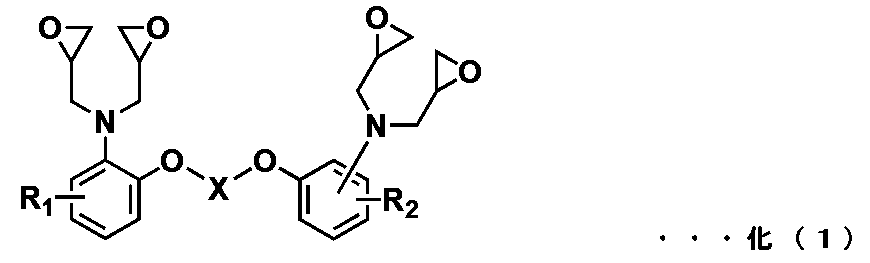
(但し、化(1)中、Xは炭素数1~10の脂肪族炭化水素基であり、R1およびR2はそれぞれ独立に水素原子、脂肪族炭化水素基、芳香族基、アルコキシ基、ハロゲン原子からなる群から選ばれる1つを表す。) (However, in (1), X is an aliphatic hydrocarbon group having 1 to 10 carbon atoms, and R 1 and R 2 are independently hydrogen atoms, aliphatic hydrocarbon groups, aromatic groups, and alkoxy groups, respectively. Represents one selected from the group consisting of halogen atoms.)
〔2〕 下記化学式(2)で表されるエポキシ化合物。 [2] An epoxy compound represented by the following chemical formula (2).

(但し、化(2)中、Xは炭素数1~10の脂肪族炭化水素基であり、R1およびR2はそれぞれ独立に水素原子、脂肪族炭化水素基、芳香族基、アルコキシ基、ハロゲン原子からなる群から選ばれる1つを表す。) (However, in (2), X is an aliphatic hydrocarbon group having 1 to 10 carbon atoms, and R 1 and R 2 are independently hydrogen atoms, aliphatic hydrocarbon groups, aromatic groups, and alkoxy groups, respectively. Represents one selected from the group consisting of halogen atoms.)
〔3〕 Xが直鎖脂肪族炭化水素基である〔1〕又は〔2〕に記載のエポキシ化合物。 [3] The epoxy compound according to [1] or [2], wherein X is a linear aliphatic hydrocarbon group.
上記〔1〕~〔3〕に記載の発明は、所定の構造を有するエポキシ化合物である。各化学式中のXは直鎖脂肪族炭化水素基であることが好ましい。 The inventions described in the above [1] to [3] are epoxy compounds having a predetermined structure. It is preferable that X in each chemical formula is a linear aliphatic hydrocarbon group.
〔4〕 〔1〕~〔3〕の何れかに記載のエポキシ化合物を、HPLC測定における面積比率で50%以上の割合で含有するエポキシ樹脂。 [4] An epoxy resin containing the epoxy compound according to any one of [1] to [3] in an area ratio of 50% or more in HPLC measurement.
上記〔4〕に記載の発明は、所定の構造を有するエポキシ化合物を所定の含有量で含有しているエポキシ樹脂である。このエポキシ樹脂は、〔1〕~〔3〕に記載のエポキシ化合物を所定割合で含有していれば良く、〔1〕~〔3〕に記載のエポキシ化合物は必ずしも単離されることを要しない。 The invention described in [4] above is an epoxy resin containing an epoxy compound having a predetermined structure in a predetermined content. The epoxy resin may contain the epoxy compounds described in [1] to [3] in a predetermined ratio, and the epoxy compounds described in [1] to [3] do not necessarily have to be isolated.
〔5〕 少なくとも〔1〕~〔3〕の何れかに記載のエポキシ化合物と、
硬化剤と、
を含むことを特徴とするエポキシ樹脂組成物。
[5] At least the epoxy compound according to any one of [1] to [3] and
Hardener and
An epoxy resin composition comprising.
上記〔5〕に記載の発明は、少なくとも〔1〕~〔3〕に記載のエポキシ化合物と、このエポキシ化合物と反応する硬化剤とを含む未反応ないし半硬化状態の硬化性組成物である。 The invention described in [5] above is an unreacted or semi-cured curable composition containing at least the epoxy compound according to [1] to [3] and a curing agent that reacts with the epoxy compound.
〔6〕 〔5〕のエポキシ樹脂組成物が硬化されて成ることを特徴とする樹脂硬化物。 [6] A cured resin composition obtained by curing the epoxy resin composition of [5].
上記〔6〕に記載の発明は、〔5〕のエポキシ樹脂組成物の硬化反応後に得られる樹脂硬化物である。 The invention described in [6] above is a cured resin product obtained after the curing reaction of the epoxy resin composition of [5].
〔7〕 強化繊維基材と、
前記強化繊維基材内に含浸された〔5〕に記載のエポキシ樹脂組成物と、
から成ることを特徴とするプリプレグ。
[7] Reinforcing fiber base material and
The epoxy resin composition according to [5] impregnated in the reinforcing fiber base material and
A prepreg characterized by consisting of.
〔8〕 前記強化繊維基材が炭素繊維から成る強化繊維基材である〔7〕に記載のプリプレグ。 [8] The prepreg according to [7], wherein the reinforcing fiber base material is a reinforcing fiber base material made of carbon fiber.
〔9〕 エポキシ樹脂組成物を強化繊維基材内に含浸させることを特徴とする〔7〕に記載のプリプレグの製造方法。 [9] The method for producing a prepreg according to [7], wherein the epoxy resin composition is impregnated into the reinforcing fiber base material.
上記〔7〕~〔9〕に記載の発明は、強化繊維基材と、この強化繊維基材内に含浸されているエポキシ樹脂組成物とから成るプリプレグ及びその製造方法である。 The inventions described in the above [7] to [9] are a prepreg comprising a reinforcing fiber base material and an epoxy resin composition impregnated in the reinforcing fiber base material, and a method for producing the same.
〔10〕 〔6〕に記載の樹脂硬化物と、
強化繊維基材と、
を含んで成る繊維強化複合材料。
[10] The cured resin according to [6] and
Reinforced fiber base material and
Containing fiber reinforced composite material.
〔11〕 〔5〕に記載のエポキシ樹脂組成物を強化繊維基材内に含浸して硬化させることを特徴とする〔10〕に記載の繊維強化複合材料の製造方法。 [11] The method for producing a fiber-reinforced composite material according to [10], wherein the epoxy resin composition according to [5] is impregnated into a reinforcing fiber base material and cured.
〔12〕 〔7〕又は〔8〕に記載のプリプレグを硬化させることを特徴とする〔10〕に記載の繊維強化複合材料の製造方法。 [12] The method for producing a fiber-reinforced composite material according to [10], which comprises curing the prepreg according to [7] or [8].
上記〔10〕~〔12〕に記載の発明は、上記本発明の樹脂硬化物と、強化繊維基材と、から成る繊維強化複合材料及びその製造方法である。強化繊維基材とエポキシ樹脂組成物とを予め複合化してから成形しても良い(プリプレグ)。また、強化繊維基材と硬化樹脂とは、プリプレグを経由することなく、成形と複合化とが同時に行われても良い。
The inventions described in the above [10] to [12] are a fiber-reinforced composite material composed of the cured resin product of the present invention, a reinforcing fiber base material, and a method for producing the same. The reinforcing fiber base material and the epoxy resin composition may be compounded in advance and then molded (prepreg). Further, the reinforcing fiber base material and the cured resin may be molded and composited at the same time without going through a prepreg.
本発明のエポキシ化合物を含むエポキシ樹脂組成物は、弾性率及び耐吸水性が高い樹脂硬化物を製造することができる。また、本発明のエポキシ樹脂組成物は低粘度であるため、強化繊維基材に対する含浸性や取扱性が高い。
The epoxy resin composition containing the epoxy compound of the present invention can produce a cured resin product having a high elastic modulus and water absorption resistance. Further, since the epoxy resin composition of the present invention has a low viscosity, it has high impregnation property and handleability with respect to the reinforcing fiber base material.
以下、本発明のエポキシ化合物、エポキシ樹脂、エポキシ樹脂組成物、プリプレグ、繊維強化複合材料、及びこれらの製造方法について説明する。
なお、本明細書においてエポキシ化合物とは、各化学式で表される化合物自体を意味する。また、エポキシ樹脂とは、該エポキシ化合物を含有する混合物を意味する。即ち、エポキシ樹脂は、エポキシ化合物の合成時に生成する各種副生成物や未反応物を含んでいても良い。エポキシ樹脂組成物とは、少なくともエポキシ化合物と、その硬化剤と、を含む未硬化乃至半硬化状態の組成物を意味する。樹脂硬化物(以下、「硬化樹脂」ともいう)とは、エポキシ樹脂組成物が硬化反応して得られる硬化体を意味する。
Hereinafter, the epoxy compound, the epoxy resin, the epoxy resin composition, the prepreg, the fiber-reinforced composite material of the present invention, and the method for producing these will be described.
In the present specification, the epoxy compound means the compound itself represented by each chemical formula. Further, the epoxy resin means a mixture containing the epoxy compound. That is, the epoxy resin may contain various by-products and unreacted products produced during the synthesis of the epoxy compound. The epoxy resin composition means an uncured or semi-cured composition containing at least an epoxy compound and a curing agent thereof. The cured resin product (hereinafter, also referred to as “cured resin”) means a cured product obtained by a curing reaction of an epoxy resin composition.
1. エポキシ化合物
本発明のエポキシ化合物は、下記化学式(1)で表されるエポキシ化合物である。
このエポキシ化合物は、ジグリシジルアミン及びエーテル結合を有する2つの芳香環が脂肪族炭化水素を介して結合して成り、少なくとも1つの芳香環においてエーテル結合とグリシジルアミンとがオルト位で存在していることを特徴とする。この構造により生じる硬化樹脂の特殊な立体構造に起因して、硬化樹脂の弾性率及び耐吸水性が高くなると本発明者らは推定している。
1. 1. Epoxy compound The epoxy compound of the present invention is an epoxy compound represented by the following chemical formula (1).
This epoxy compound is composed of two aromatic rings having a diglycidylamine and an ether bond bonded via an aliphatic hydrocarbon, and the ether bond and the glycidylamine are present at the ortho position in at least one aromatic ring. It is characterized by that. The present inventors presume that the elastic modulus and water absorption resistance of the cured resin are increased due to the special three-dimensional structure of the cured resin generated by this structure.

(但し、化(1)中、Xは炭素数1~10の脂肪族炭化水素基であり、R1およびR2はそれぞれ独立に水素原子、脂肪族炭化水素基、芳香族基、アルコキシ基、ハロゲン原子からなる群から選ばれる1つを表す。) (However, in (1), X is an aliphatic hydrocarbon group having 1 to 10 carbon atoms, and R 1 and R 2 are independently hydrogen atoms, aliphatic hydrocarbon groups, aromatic groups, and alkoxy groups, respectively. Represents one selected from the group consisting of halogen atoms.)
上記化学式(1)で表される化合物の中でも下記化学式(2)で表されるエポキシ化合物が特に好ましい。 Among the compounds represented by the above chemical formula (1), the epoxy compound represented by the following chemical formula (2) is particularly preferable.

上記化学式(1)又は(2)におけるXは、脂肪族炭化水素基であれば、直鎖脂肪族炭化水素基、分岐鎖脂肪族炭化水素基、脂環型炭化水素基など特に制限はないが、直鎖脂肪族炭化水素基であることが好ましい。また、飽和脂肪族炭化水素基であっても、不飽和脂肪族炭化水素基であっても良いが、飽和脂肪族炭化水素基であることがより好ましい。
上記化学式(1)又は(2)におけるXの炭素数は、1~8であることが好ましく、1~6であることがより好ましく、2~4であることが更に好ましい。
上記化学式(1)又は(2)におけるR1及びR2は、それぞれ独立に水素原子、炭素数1~4の脂肪族炭化水素基、芳香族基、炭素数1~4のアルコキシ基、又はハロゲン原子であることが好ましく、水素原子、又は炭素数1~4の脂肪族炭化水素基であることがより好ましい。
本発明のエポキシ化合物は、50℃における粘度が50Pa・s未満であることが好ましく、10Pa・s未満であることがより好ましく、5.0Pa・s未満であることが更に好ましく、2.0Pa・s未満であることが特に好ましい。
As long as X in the above chemical formula (1) or (2) is an aliphatic hydrocarbon group, there is no particular limitation such as a linear aliphatic hydrocarbon group, a branched chain aliphatic hydrocarbon group, an alicyclic hydrocarbon group and the like. , Is preferably a linear aliphatic hydrocarbon group. Further, it may be a saturated aliphatic hydrocarbon group or an unsaturated aliphatic hydrocarbon group, but a saturated aliphatic hydrocarbon group is more preferable.
The carbon number of X in the chemical formula (1) or (2) is preferably 1 to 8, more preferably 1 to 6, and even more preferably 2 to 4.
R 1 and R 2 in the above chemical formula (1) or (2) are independently hydrogen atoms, aliphatic hydrocarbon groups having 1 to 4 carbon atoms, aromatic groups, alkoxy groups having 1 to 4 carbon atoms, or halogens, respectively. It is preferably an atom, more preferably a hydrogen atom or an aliphatic hydrocarbon group having 1 to 4 carbon atoms.
The epoxy compound of the present invention preferably has a viscosity at 50 ° C. of less than 50 Pa · s, more preferably less than 10 Pa · s, further preferably less than 5.0 Pa · s, and 2.0 Pa · s. It is particularly preferable that it is less than s.
このようなエポキシ化合物としては、以下の化学式(3)~(4)の化合物が例示される。 Examples of such epoxy compounds include the compounds having the following chemical formulas (3) to (4).


このようなエポキシ化合物は、どのような方法で合成しても良いが、例えば、原料である芳香族ジアミン化合物とエピクロロヒドリンなどのエピハロヒドリンとを酸触媒の存在下で反応させてテトラハロヒドリン体を得た後、アルカリ性化合物を用いて環化反応することにより得られる。より具体的には、後述の実施例の方法で合成することができる。 Such an epoxy compound may be synthesized by any method. For example, an aromatic diamine compound as a raw material and epichlorohydrin such as epichlorohydrin are reacted in the presence of an acid catalyst to cause tetrahalohydrin. After obtaining a phosphorus compound, it is obtained by a cyclization reaction using an alkaline compound. More specifically, it can be synthesized by the method of the examples described later.
原料である芳香族ジアミンとしては、それぞれアミン及びエーテル結合を有する2つの芳香環が、脂肪族炭化水素を介して結合して成り、少なくとも1つの芳香環においてエーテル結合とアミンとがオルト位で存在している芳香族ジアミンであれば良い。 As the raw material aromatic diamine, two aromatic rings each having an amine and an ether bond are bonded via an aliphatic hydrocarbon, and the ether bond and the amine are present in the ortho position in at least one aromatic ring. Any aromatic diamine that is used will do.
このような芳香族ジアミンとしては、例えば、脂肪族炭化水素が炭素数1の脂肪族炭化水素である場合は、1,1-ビス(2-アミノフェノキシ)メタン、1-(2-アミノフェノキシ)-1-(2-アミノ-3-メチルフェノキシ)メタン、1-(2-アミノフェノキシ)-1-(3-アミノフェノキシ)メタン、1-(2-アミノフェノキシ)-1-(3-アミノ-2-メチルフェノキシ)メタン、1-(2-アミノフェノキシ)-1-(3-アミノ-4-メチルフェノキシ)メタン、1-(2-アミノフェノキシ)-1-(4-アミノフェノキシ)メタン、1-(2-アミノフェノキシ)-1-(4-アミノ-3-メチルフェノキシ)メタン、1,1-ビス(2-アミノ-3-メチルフェノキシ)メタン、1-(2-アミノ-3-メチルフェノキシ)-1-(3-アミノフェノキシ)メタン、1-(2-アミノ-3-メチルフェノキシ)-1-(3-アミノ-2-メチルフェノキシ)メタン、1-(2-アミノ-3-メチルフェノキシ)-1-(3-アミノ-4-メチルフェノキシ)メタン、1-(2-アミノ-3-メチルフェノキシ)-1-(4-アミノフェノキシ)メタン、1-(2-アミノ-3-メチルフェノキシ)-1-(4-アミノ-3-メチルフェノキシ)メタンなどが挙げられる。 Examples of such aromatic diamines include 1,1-bis (2-aminophenoxy) methane and 1- (2-aminophenoxy) when the aliphatic hydrocarbon is an aliphatic hydrocarbon having 1 carbon atom. -1- (2-Amino-3-methylphenoxy) Methane, 1- (2-Aminophenoxy) -1- (3-Aminophenoxy) Methane, 1- (2-Aminophenoxy) -1- (3-Amino-) 2-Methylphenoxy) Methane, 1- (2-Aminophenoxy) -1- (3-Amino-4-methylphenoxy) Methane, 1- (2-Aminophenoxy) -1- (4-Aminophenoxy) Methane, 1 -(2-Aminophenoxy) -1- (4-amino-3-methylphenoxy) methane, 1,1-bis (2-amino-3-methylphenoxy) methane, 1- (2-amino-3-methylphenoxy) ) -1- (3-Aminophenoxy) Methane, 1- (2-Amino-3-methylphenoxy) -1- (3-Amino-2-methylphenoxy) Methane, 1- (2-Amino-3-methylphenoxy) ) -1- (3-Amino-4-methylphenoxy) methane, 1- (2-amino-3-methylphenoxy) -1- (4-aminophenoxy) methane, 1- (2-amino-3-methylphenoxy) ) -1- (4-Amino-3-methylphenoxy) methane and the like.
また、脂肪族炭化水素が炭素数2の脂肪族炭化水素である芳香族ジアミンとしては、例えば、1,2-ビス(2-アミノフェノキシ)エタン、1-(2-アミノフェノキシ)-2-(2-アミノ-3-メチルフェノキシ)エタン、1-(2-アミノフェノキシ)-2-(3-アミノフェノキシ)エタン、1-(2-アミノフェノキシ)-2-(3-アミノ-2-メチルフェノキシ)エタン、1-(2-アミノフェノキシ)-2-(3-アミノ-4-メチルフェノキシ)エタン、1-(2-アミノフェノキシ)-2-(4-アミノフェノキシ)エタン、1-(2-アミノフェノキシ)-2-(4-アミノ-3-メチルフェノキシ)エタン、1,2-ビス(2-アミノ-3-メチルフェノキシ)エタン、1-(2-アミノ-3-メチルフェノキシ)-2-(3-アミノフェノキシ)エタン、1-(2-アミノ-3-メチルフェノキシ)-2-(3-アミノ-2-メチルフェノキシ)エタン、1-(2-アミノ-3-メチルフェノキシ)-2-(3-アミノ-4-メチルフェノキシ)エタン、1-(2-アミノ-3-メチルフェノキシ)-2-(4-アミノフェノキシ)エタン、1-(2-アミノ-3-メチルフェノキシ)-2-(4-アミノ-3-メチルフェノキシ)エタンなどが挙げられる。 Examples of aromatic diamines in which the aliphatic hydrocarbon is an aliphatic hydrocarbon having 2 carbon atoms include 1,2-bis (2-aminophenoxy) ethane and 1- (2-aminophenoxy) -2- (. 2-Amino-3-methylphenoxy) ethane, 1- (2-aminophenoxy) -2- (3-aminophenoxy) ethane, 1- (2-aminophenoxy) -2- (3-amino-2-methylphenoxy) ) Ethane, 1- (2-aminophenoxy) -2- (3-amino-4-methylphenoxy) ethane, 1- (2-aminophenoxy) -2- (4-aminophenoxy) ethane, 1- (2-) Aminophenoxy) -2- (4-amino-3-methylphenoxy) ethane, 1,2-bis (2-amino-3-methylphenoxy) ethane, 1- (2-amino-3-methylphenoxy) -2- (3-Aminophenoxy) ethane, 1- (2-amino-3-methylphenoxy) -2- (3-amino-2-methylphenoxy) ethane, 1- (2-amino-3-methylphenoxy) -2- (3-Amino-4-methylphenoxy) ethane, 1- (2-amino-3-methylphenoxy) -2- (4-aminophenoxy) ethane, 1- (2-amino-3-methylphenoxy) -2- (4-Amino-3-methylphenoxy) Ethane and the like can be mentioned.
脂肪族炭化水素が炭素数3の脂肪族炭化水素である芳香族ジアミンとしては、例えば、1,3-ビス(2-アミノフェノキシ)プロパン、1-(2-アミノフェノキシ)-3-(2-アミノ-3-メチルフェノキシ)プロパン、1-(2-アミノフェノキシ)-3-(3-アミノフェノキシ)プロパン、1-(2-アミノフェノキシ)-3-(3-アミノ-2-メチルフェノキシ)プロパン、1-(2-アミノフェノキシ)-3-(3-アミノ-4-メチルフェノキシ)プロパン、1-(2-アミノフェノキシ)-3-(4-アミノフェノキシ)プロパン、1-(2-アミノフェノキシ)-3-(4-アミノ-3-メチルフェノキシ)プロパン、1,3-ビス(2-アミノ-3-メチルフェノキシ)プロパン、1-(2-アミノ-3-メチルフェノキシ)-3-(3-アミノフェノキシ)プロパン、1-(2-アミノ-3-メチルフェノキシ)-3-(3-アミノ-2-メチルフェノキシ)プロパン、1-(2-アミノ-3-メチルフェノキシ)-3-(3-アミノ-4-メチルフェノキシ)プロパン、1-(2-アミノ-3-メチルフェノキシ)-3-(4-アミノフェノキシ)プロパン、1-(2-アミノ-3-メチルフェノキシ)-3-(4-アミノ-3-メチルフェノキシ)プロパンなどが挙げられる。 Examples of the aromatic diamine in which the aliphatic hydrocarbon is an aliphatic hydrocarbon having 3 carbon atoms include 1,3-bis (2-aminophenoxy) propane and 1- (2-aminophenoxy) -3- (2-). Amino-3-methylphenoxy) propane, 1- (2-aminophenoxy) -3- (3-aminophenoxy) propane, 1- (2-aminophenoxy) -3- (3-amino-2-methylphenoxy) propane , 1- (2-aminophenoxy) -3- (3-amino-4-methylphenoxy) propane, 1- (2-aminophenoxy) -3- (4-aminophenoxy) propane, 1- (2-aminophenoxy) ) -3- (4-Amino-3-methylphenoxy) propane, 1,3-bis (2-amino-3-methylphenoxy) propane, 1- (2-amino-3-methylphenoxy) -3- (3) -Aminophenoxy) propane, 1- (2-amino-3-methylphenoxy) -3- (3-amino-2-methylphenoxy) propane, 1- (2-amino-3-methylphenoxy) -3- (3) -Amino-4-methylphenoxy) propane, 1- (2-amino-3-methylphenoxy) -3- (4-aminophenoxy) propane, 1- (2-amino-3-methylphenoxy) -3- (4) -Amino-3-methylphenoxy) Propane and the like can be mentioned.
脂肪族炭化水素が炭素数4の脂肪族炭化水素である芳香族ジアミンとしては、例えば、1,4-ビス(2-アミノフェノキシ)ブタン、1-(2-アミノフェノキシ)-4-(2-アミノ-3-メチルフェノキシ)ブタン、1-(2-アミノフェノキシ)-4-(3-アミノフェノキシ)ブタン、1-(2-アミノフェノキシ)-4-(3-アミノ-2-メチルフェノキシ)ブタン、1-(2-アミノフェノキシ)-4-(3-アミノ-4-メチルフェノキシ)ブタン、1-(2-アミノフェノキシ)-4-(4-アミノフェノキシ)ブタン、1-(2-アミノフェノキシ)-4-(4-アミノ-3-メチルフェノキシ)ブタン、1,4-ビス(2-アミノ-3-メチルフェノキシ)ブタン、1-(2-アミノ-3-メチルフェノキシ)-4-(3-アミノフェノキシ)ブタン、1-(2-アミノ-3-メチルフェノキシ)-4-(3-アミノ-2-メチルフェノキシ)ブタン、1-(2-アミノ-3-メチルフェノキシ)-4-(3-アミノ-4-メチルフェノキシ)ブタン、1-(2-アミノ-3-メチルフェノキシ)-4-(4-アミノフェノキシ)ブタン、1-(2-アミノ-3-メチルフェノキシ)-4-(4-アミノ-3-メチルフェノキシ)ブタンなどが挙げられる。 Examples of the aromatic diamine in which the aliphatic hydrocarbon is an aliphatic hydrocarbon having 4 carbon atoms include 1,4-bis (2-aminophenoxy) butane and 1- (2-aminophenoxy) -4- (2-). Amino-3-methylphenoxy) butane, 1- (2-aminophenoxy) -4- (3-aminophenoxy) butane, 1- (2-aminophenoxy) -4- (3-amino-2-methylphenoxy) butane , 1- (2-aminophenoxy) -4- (3-amino-4-methylphenoxy) butane, 1- (2-aminophenoxy) -4- (4-aminophenoxy) butane, 1- (2-aminophenoxy) ) -4- (4-Amino-3-methylphenoxy) butane, 1,4-bis (2-amino-3-methylphenoxy) butane, 1- (2-amino-3-methylphenoxy) -4- (3) -Aminophenoxy) butane, 1- (2-amino-3-methylphenoxy) -4- (3-amino-2-methylphenoxy) butane, 1- (2-amino-3-methylphenoxy) -4- (3) -Amino-4-methylphenoxy) butane, 1- (2-amino-3-methylphenoxy) -4- (4-aminophenoxy) butane, 1- (2-amino-3-methylphenoxy) -4- (4) -Amino-3-methylphenoxy) Butane and the like can be mentioned.
脂肪族炭化水素が炭素数5の脂肪族炭化水素である芳香族ジアミンとしては、例えば、1,5-ビス(2-アミノフェノキシ)ペンタン、1-(2-アミノフェノキシ)-5-(2-アミノ-3-メチルフェノキシ)ペンタン、1-(2-アミノフェノキシ)-5-(3-アミノフェノキシ)ペンタン、1-(2-アミノフェノキシ)-5-(3-アミノ-2-メチルフェノキシ)ペンタン、1-(2-アミノフェノキシ)-5-(3-アミノ-4-メチルフェノキシ)ペンタン、1-(2-アミノフェノキシ)-5-(4-アミノフェノキシ)ペンタン、1-(2-アミノフェノキシ)-5-(4-アミノ-3-メチルフェノキシ)ペンタン、1,5-ビス(2-アミノ-3-メチルフェノキシ)ペンタン、1-(2-アミノ-3-メチルフェノキシ)-5-(3-アミノフェノキシ)ペンタン、1-(2-アミノ-3-メチルフェノキシ)-5-(3-アミノ-2-メチルフェノキシ)ペンタン、1-(2-アミノ-3-メチルフェノキシ)-5-(3-アミノ-4-メチルフェノキシ)ペンタン、1-(2-アミノ-3-メチルフェノキシ)-5-(4-アミノフェノキシ)ペンタン、1-(2-アミノ-3-メチルフェノキシ)-5-(4-アミノ-3-メチルフェノキシ)ペンタンなどが挙げられる。 Examples of the aromatic diamine in which the aliphatic hydrocarbon is an aliphatic hydrocarbon having 5 carbon atoms include 1,5-bis (2-aminophenoxy) pentane and 1- (2-aminophenoxy) -5- (2-). Amino-3-methylphenoxy) pentane, 1- (2-aminophenoxy) -5- (3-aminophenoxy) pentane, 1- (2-aminophenoxy) -5- (3-amino-2-methylphenoxy) pentane , 1- (2-aminophenoxy) -5- (3-amino-4-methylphenoxy) pentane, 1- (2-aminophenoxy) -5- (4-aminophenoxy) pentane, 1- (2-aminophenoxy) )-5- (4-Amino-3-methylphenoxy) pentane, 1,5-bis (2-amino-3-methylphenoxy) pentane, 1- (2-amino-3-methylphenoxy) -5- (3) -Aminophenoxy) pentane, 1- (2-amino-3-methylphenoxy) -5- (3-amino-2-methylphenoxy) pentane, 1- (2-amino-3-methylphenoxy) -5- (3) -Amino-4-methylphenoxy) pentane, 1- (2-amino-3-methylphenoxy) -5- (4-aminophenoxy) pentane, 1- (2-amino-3-methylphenoxy) -5- (4) -Amino-3-methylphenoxy) Pentane and the like can be mentioned.
脂肪族炭化水素が炭素数6の脂肪族炭化水素である芳香族ジアミンとしては、例えば、1,6-ビス(2-アミノフェノキシ)ヘキサン、1-(2-アミノフェノキシ)-6-(2-アミノ-3-メチルフェノキシ)ヘキサン、1-(2-アミノフェノキシ)-6-(3-アミノフェノキシ)ヘキサン、1-(2-アミノフェノキシ)-6-(3-アミノ-2-メチルフェノキシ)ヘキサン、1-(2-アミノフェノキシ)-6-(3-アミノ-4-メチルフェノキシ)ヘキサン、1-(2-アミノフェノキシ)-6-(4-アミノフェノキシ)ヘキサン、1-(2-アミノフェノキシ)-6-(4-アミノ-3-メチルフェノキシ)ヘキサン、1,6-ビス(2-アミノ-3-メチルフェノキシ)ヘキサン、1-(2-アミノ-3-メチルフェノキシ)-6-(3-アミノフェノキシ)ヘキサン、1-(2-アミノ-3-メチルフェノキシ)-6-(3-アミノ-2-メチルフェノキシ)ヘキサン、1-(2-アミノ-3-メチルフェノキシ)-6-(3-アミノ-4-メチルフェノキシ)ヘキサン、1-(2-アミノ-3-メチルフェノキシ)-6-(4-アミノフェノキシ)ヘキサン、1-(2-アミノ-3-メチルフェノキシ)-6-(4-アミノ-3-メチルフェノキシ)ヘキサンなどが挙げられる。 Examples of the aromatic diamine in which the aliphatic hydrocarbon is an aliphatic hydrocarbon having 6 carbon atoms include 1,6-bis (2-aminophenoxy) hexane and 1- (2-aminophenoxy) -6- (2-). Amino-3-methylphenoxy) hexane, 1- (2-aminophenoxy) -6- (3-aminophenoxy) hexane, 1- (2-aminophenoxy) -6- (3-amino-2-methylphenoxy) hexane , 1- (2-aminophenoxy) -6- (3-amino-4-methylphenoxy) hexane, 1- (2-aminophenoxy) -6- (4-aminophenoxy) hexane, 1- (2-aminophenoxy) ) -6- (4-Amino-3-methylphenoxy) hexane, 1,6-bis (2-amino-3-methylphenoxy) hexane, 1- (2-amino-3-methylphenoxy) -6- (3) -Aminophenoxy) Hexane, 1- (2-Amino-3-methylphenoxy) -6- (3-Amino-2-methylphenoxy) Hexane, 1- (2-Amino-3-methylphenoxy) -6- (3) -Amino-4-methylphenoxy) hexane, 1- (2-amino-3-methylphenoxy) -6- (4-aminophenoxy) hexane, 1- (2-amino-3-methylphenoxy) -6- (4) -Amino-3-methylphenoxy) Hexane and the like can be mentioned.
脂肪族炭化水素が炭素数7の脂肪族炭化水素である芳香族ジアミンとしては、例えば、1,7-ビス(2-アミノフェノキシ)ヘプタン、1-(2-アミノフェノキシ)-7-(2-アミノ-3-メチルフェノキシ)ヘプタン、1-(2-アミノフェノキシ)-7-(3-アミノフェノキシ)ヘプタン、1-(2-アミノフェノキシ)-7-(3-アミノ-2-メチルフェノキシ)ヘプタン、1-(2-アミノフェノキシ)-7-(3-アミノ-4-メチルフェノキシ)ヘプタン、1-(2-アミノフェノキシ)-7-(4-アミノフェノキシ)ヘプタン、1-(2-アミノフェノキシ)-7-(4-アミノ-3-メチルフェノキシ)ヘプタン、1,7-ビス(2-アミノ-3-メチルフェノキシ)ヘプタン、1-(2-アミノ-3-メチルフェノキシ)-7-(3-アミノフェノキシ)ヘプタン、1-(2-アミノ-3-メチルフェノキシ)-7-(3-アミノ-2-メチルフェノキシ)ヘプタン、1-(2-アミノ-3-メチルフェノキシ)-7-(3-アミノ-4-メチルフェノキシ)ヘプタン、1-(2-アミノ-3-メチルフェノキシ)-7-(4-アミノフェノキシ)ヘプタン、1-(2-アミノ-3-メチルフェノキシ)-7-(4-アミノ-3-メチルフェノキシ)ヘプタンなどが挙げられる。 Examples of the aromatic diamine in which the aliphatic hydrocarbon is an aliphatic hydrocarbon having 7 carbon atoms include 1,7-bis (2-aminophenoxy) heptane and 1- (2-aminophenoxy) -7- (2-). Amino-3-methylphenoxy) heptane, 1- (2-aminophenoxy) -7- (3-aminophenoxy) heptane, 1- (2-aminophenoxy) -7- (3-amino-2-methylphenoxy) heptane , 1- (2-aminophenoxy) -7- (3-amino-4-methylphenoxy) heptane, 1- (2-aminophenoxy) -7- (4-aminophenoxy) heptane, 1- (2-aminophenoxy) ) -7- (4-Amino-3-methylphenoxy) heptane, 1,7-bis (2-amino-3-methylphenoxy) heptane, 1- (2-amino-3-methylphenoxy) -7- (3) -Aminophenoxy) heptane, 1- (2-amino-3-methylphenoxy) -7- (3-amino-2-methylphenoxy) heptane, 1- (2-amino-3-methylphenoxy) -7- (3) -Amino-4-methylphenoxy) heptane, 1- (2-amino-3-methylphenoxy) -7- (4-aminophenoxy) heptane, 1- (2-amino-3-methylphenoxy) -7- (4) -Amino-3-methylphenoxy) Heptane and the like can be mentioned.
脂肪族炭化水素が炭素数8の脂肪族炭化水素である芳香族ジアミンとしては、例えば、1,8-ビス(2-アミノフェノキシ)オクタン、1-(2-アミノフェノキシ)-8-(2-アミノ-3-メチルフェノキシ)オクタン、1-(2-アミノフェノキシ)-8-(3-アミノフェノキシ)オクタン、1-(2-アミノフェノキシ)-8-(3-アミノ-2-メチルフェノキシ)オクタン、1-(2-アミノフェノキシ)-8-(3-アミノ-4-メチルフェノキシ)オクタン、1-(2-アミノフェノキシ)-8-(4-アミノフェノキシ)オクタン、1-(2-アミノフェノキシ)-8-(4-アミノ-3-メチルフェノキシ)オクタン、1,8-ビス(2-アミノ-3-メチルフェノキシ)オクタン、1-(2-アミノ-3-メチルフェノキシ)-8-(3-アミノフェノキシ)オクタン、1-(2-アミノ-3-メチルフェノキシ)-8-(3-アミノ-2-メチルフェノキシ)オクタン、1-(2-アミノ-3-メチルフェノキシ)-8-(3-アミノ-4-メチルフェノキシ)オクタン、1-(2-アミノ-3-メチルフェノキシ)-8-(4-アミノフェノキシ)オクタン、1-(2-アミノ-3-メチルフェノキシ)-8-(4-アミノ-3-メチルフェノキシ)オクタンなどが挙げられる。 Examples of the aromatic diamine in which the aliphatic hydrocarbon is an aliphatic hydrocarbon having 8 carbon atoms include 1,8-bis (2-aminophenoxy) octane and 1- (2-aminophenoxy) -8- (2-). Amino-3-methylphenoxy) octane, 1- (2-aminophenoxy) -8- (3-aminophenoxy) octane, 1- (2-aminophenoxy) -8- (3-amino-2-methylphenoxy) octane , 1- (2-aminophenoxy) -8- (3-amino-4-methylphenoxy) octane, 1- (2-aminophenoxy) -8- (4-aminophenoxy) octane, 1- (2-aminophenoxy) ) -8- (4-Amino-3-methylphenoxy) octane, 1,8-bis (2-amino-3-methylphenoxy) octane, 1- (2-amino-3-methylphenoxy) -8- (3) -Aminophenoxy) octane, 1- (2-amino-3-methylphenoxy) -8- (3-amino-2-methylphenoxy) octane, 1- (2-amino-3-methylphenoxy) -8- (3) -Amino-4-methylphenoxy) octane, 1- (2-amino-3-methylphenoxy) -8- (4-aminophenoxy) octane, 1- (2-amino-3-methylphenoxy) -8- (4) -Amino-3-methylphenoxy) Octane and the like can be mentioned.
脂肪族炭化水素が炭素数9の脂肪族炭化水素である芳香族ジアミンとしては、例えば、1,9-ビス(2-アミノフェノキシ)ノナン、1-(2-アミノフェノキシ)-9-(2-アミノ-3-メチルフェノキシ)ノナン、1-(2-アミノフェノキシ)-9-(3-アミノフェノキシ)ノナン、1-(2-アミノフェノキシ)-9-(3-アミノ-2-メチルフェノキシ)ノナン、1-(2-アミノフェノキシ)-9-(3-アミノ-4-メチルフェノキシ)ノナン、1-(2-アミノフェノキシ)-9-(4-アミノフェノキシ)ノナン、1-(2-アミノフェノキシ)-9-(4-アミノ-3-メチルフェノキシ)ノナン、1,9-ビス(2-アミノ-3-メチルフェノキシ)ノナン、1-(2-アミノ-3-メチルフェノキシ)-9-(3-アミノフェノキシ)ノナン、1-(2-アミノ-3-メチルフェノキシ)-9-(3-アミノ-2-メチルフェノキシ)ノナン、1-(2-アミノ-3-メチルフェノキシ)-9-(3-アミノ-4-メチルフェノキシ)ノナン、1-(2-アミノ-3-メチルフェノキシ)-9-(4-アミノフェノキシ)ノナン、1-(2-アミノ-3-メチルフェノキシ)-9-(4-アミノ-3-メチルフェノキシ)ノナンなどが挙げられる。 Examples of the aromatic diamine in which the aliphatic hydrocarbon is an aliphatic hydrocarbon having 9 carbon atoms include 1,9-bis (2-aminophenoxy) nonane and 1- (2-aminophenoxy) -9- (2-). Amino-3-methylphenoxy) nonan, 1- (2-aminophenoxy) -9- (3-aminophenoxy) nonan, 1- (2-aminophenoxy) -9- (3-amino-2-methylphenoxy) nonan , 1- (2-aminophenoxy) -9- (3-amino-4-methylphenoxy) nonane, 1- (2-aminophenoxy) -9- (4-aminophenoxy) nonan, 1- (2-aminophenoxy) ) -9- (4-Amino-3-methylphenoxy) nonane, 1,9-bis (2-amino-3-methylphenoxy) nonan, 1- (2-amino-3-methylphenoxy) -9- (3) -Aminophenoxy) Nonan, 1- (2-Amino-3-methylphenoxy) -9- (3-Amino-2-methylphenoxy) Nonan, 1- (2-Amino-3-methylphenoxy) -9- (3) -Amino-4-methylphenoxy) nonane, 1- (2-amino-3-methylphenoxy) -9- (4-aminophenoxy) nonan, 1- (2-amino-3-methylphenoxy) -9- (4) -Amino-3-methylphenoxy) Nonan and the like can be mentioned.
脂肪族炭化水素が炭素数10の脂肪族炭化水素である芳香族ジアミンとしては、1,10-ビス(2-アミノフェノキシ)デカン、1-(2-アミノフェノキシ)-10-(2-アミノ-3-メチルフェノキシ)デカン、1-(2-アミノフェノキシ)-10-(3-アミノフェノキシ)デカン、1-(2-アミノフェノキシ)-10-(3-アミノ-2-メチルフェノキシ)デカン、1-(2-アミノフェノキシ)-10-(3-アミノ-4-メチルフェノキシ)デカン、1-(2-アミノフェノキシ)-10-(4-アミノフェノキシ)デカン、1-(2-アミノフェノキシ)-10-(4-アミノ-3-メチルフェノキシ)デカン、1,10-ビス(2-アミノ-3-メチルフェノキシ)デカン、1-(2-アミノ-3-メチルフェノキシ)-10-(3-アミノフェノキシ)デカン、1-(2-アミノ-3-メチルフェノキシ)-10-(3-アミノ-2-メチルフェノキシ)デカン、1-(2-アミノ-3-メチルフェノキシ)-10-(3-アミノ-4-メチルフェノキシ)デカン、1-(2-アミノ-3-メチルフェノキシ)-10-(4-アミノフェノキシ)デカン、1-(2-アミノ-3-メチルフェノキシ)-10-(4-アミノ-3-メチルフェノキシ)デカンなどが挙げられる。 Aromatic diamines in which the aliphatic hydrocarbon is an aliphatic hydrocarbon having 10 carbon atoms include 1,10-bis (2-aminophenoxy) decane and 1- (2-aminophenoxy) -10- (2-amino-). 3-Methylphenoxy) decane, 1- (2-aminophenoxy) -10- (3-aminophenoxy) decane, 1- (2-aminophenoxy) -10- (3-amino-2-methylphenoxy) decane, 1 -(2-Aminophenoxy) -10- (3-Amino-4-methylphenoxy) Decane, 1- (2-Aminophenoxy) -10- (4-Aminophenoxy) Decane, 1- (2-Aminophenoxy)- 10- (4-Amino-3-methylphenoxy) decane, 1,10-bis (2-amino-3-methylphenoxy) decane, 1- (2-amino-3-methylphenoxy) -10- (3-amino) Phenoxy) decane, 1- (2-amino-3-methylphenoxy) -10- (3-amino-2-methylphenoxy) decane, 1- (2-amino-3-methylphenoxy) -10- (3-amino) -4-Methylphenoxy) decane, 1- (2-amino-3-methylphenoxy) -10- (4-aminophenoxy) decane, 1- (2-amino-3-methylphenoxy) -10- (4-amino) -3-Methylphenoxy) Decane and the like.
脂肪族炭化水素が環状脂肪族炭化水素である芳香族ジアミンとしては、1,4-ビス(2-アミノフェノキシメチル)シクロヘキサン、1-(2-アミノフェノキシメチル)-4-(2-アミノ-3-メチルフェノキシメチル)シクロヘキサン、1-(2-アミノフェノキシメチル)-4-(3-アミノフェノキシメチル)シクロヘキサン、1-(2-アミノフェノキシメチル)-4-(3-アミノ-2-メチルフェノキシメチル)シクロヘキサン、1-(2-アミノフェノキシメチル)-4-(3-アミノ-4-メチルフェノキシメチル)シクロヘキサン、1-(2-アミノフェノキシメチル)-4-(4-アミノフェノキシメチル)シクロヘキサン、1-(2-アミノフェノキシメチル)-4-(4-アミノ-3-メチルフェノキシメチル)シクロヘキサン、1,4-ビス(2-アミノ-3-メチルフェノキシメチル)シクロヘキサン、1-(2-アミノ-3-メチルフェノキシメチル)-4-(3-アミノフェノキシメチル)シクロヘキサン、1-(2-アミノ-3-メチルフェノキシメチル)-4-(3-アミノ-2-メチルフェノキシメチル)シクロヘキサン、1-(2-アミノ-3-メチルフェノキシメチル)-4-(3-アミノ-4-メチルフェノキシメチル)シクロヘキサン、1-(2-アミノ-3-メチルフェノキシメチル)-4-(4-アミノフェノキシメチル)シクロヘキサン、1-(2-アミノ-3-メチルフェノキシメチル)-4-(4-アミノ-3-メチルフェノキシメチル)シクロヘキサンなどが例示される。 The aromatic diamines in which the aliphatic hydrocarbon is a cyclic aliphatic hydrocarbon include 1,4-bis (2-aminophenoxymethyl) cyclohexane and 1- (2-aminophenoxymethyl) -4- (2-amino-3). -Methylphenoxymethyl) cyclohexane, 1- (2-aminophenoxymethyl) -4- (3-aminophenoxymethyl) cyclohexane, 1- (2-aminophenoxymethyl) -4- (3-amino-2-methylphenoxymethyl) ) Cyclohexane, 1- (2-aminophenoxymethyl) -4- (3-amino-4-methylphenoxymethyl) cyclohexane, 1- (2-aminophenoxymethyl) -4- (4-aminophenoxymethyl) cyclohexane, 1 -(2-Aminophenoxymethyl) -4- (4-Amino-3-methylphenoxymethyl) cyclohexane, 1,4-bis (2-amino-3-methylphenoxymethyl) cyclohexane, 1- (2-amino-3) -Methylphenoxymethyl) -4- (3-aminophenoxymethyl) cyclohexane, 1- (2-amino-3-methylphenoxymethyl) -4- (3-amino-2-methylphenoxymethyl) cyclohexane, 1- (2) -Amino-3-methylphenoxymethyl) -4- (3-amino-4-methylphenoxymethyl) cyclohexane, 1- (2-amino-3-methylphenoxymethyl) -4- (4-aminophenoxymethyl) cyclohexane, Examples thereof include 1- (2-amino-3-methylphenoxymethyl) -4- (4-amino-3-methylphenoxymethyl) cyclohexane.
エピハロヒドリンとしては、例えば、エピクロロヒドリン、エピブロモヒドリン、エピフルオロヒドリンなどが挙げられる。これらの中でも、反応性や取扱性の観点から、エピクロロヒドリンおよびエピブロモヒドリンが特に好ましい。 Examples of epihalohydrin include epichlorohydrin, epibromohydrin, epifluorohydrin and the like. Among these, epichlorohydrin and epibromohydrin are particularly preferable from the viewpoint of reactivity and handleability.
芳香族ジアミンとエピハロヒドリンとの重量比は1:1~1:20が好ましく、1:3~1:10がより好ましい。反応時に用いる溶媒としては、エタノールやn-ブタノールなどのアルコール系溶媒、メチルイソブチルケトンやメチルエチルケトンなどのケトン系溶媒、アセトニトリルやN,N-ジメチルホルムアミドなどの非プロトン性極性溶媒、トルエンやキシレンなどの芳香族炭化水素系溶媒が例示される。特にエタノールやn-ブタノールなどのアルコール系溶媒、トルエンやキシレンなどの芳香族炭化水素系溶媒が好ましい。溶媒の使用量は芳香族ジアミンに対して1~10重量倍であることが好ましい。酸触媒としてはブレンステッド酸とルイス酸のいずれも好適に用いることができ、特にブレンステッド酸としてはエタノールや水、酢酸が、ルイス酸としては四塩化チタンや硝酸ランタン六水和物、三フッ化ホウ素ジエチルエーテル錯体が好ましい。 The weight ratio of the aromatic diamine to epihalohydrin is preferably 1: 1 to 1:20, more preferably 1: 3 to 1:10. Examples of the solvent used in the reaction include alcohol solvents such as ethanol and n-butanol, ketone solvents such as methylisobutylketone and methylethylketone, aprotonic polar solvents such as acetonitrile and N, N-dimethylformamide, and toluene and xylene. Aromatic hydrocarbon solvents are exemplified. In particular, alcohol solvents such as ethanol and n-butanol, and aromatic hydrocarbon solvents such as toluene and xylene are preferable. The amount of the solvent used is preferably 1 to 10 times by weight with respect to the aromatic diamine. Both Bronsted acid and Lewis acid can be preferably used as the acid catalyst. In particular, ethanol, water and acetic acid are used as Bronsted acids, and titanium tetrachloride and lanthanum nitrate hexahydrate are used as Lewis acids. Boron trifluoride diethyl ether complex is preferred.
反応時間は、0.1~180時間であることが好ましく、0.5~24時間がより好ましい。反応温度は、20~100℃であることが好ましく、40~80℃がより好ましい。 The reaction time is preferably 0.1 to 180 hours, more preferably 0.5 to 24 hours. The reaction temperature is preferably 20 to 100 ° C, more preferably 40 to 80 ° C.
環化反応時に用いるアルカリ性化合物としては水酸化ナトリウムや水酸化カリウムが例示される。アルカリ性化合物は固体として添加しても水溶液として添加しても良い。
環化反応時には相間移動触媒を用いても良い。相間移動触媒としては塩化テトラメチルアンモニウム、臭化テトラエチルアンモニウム、塩化ベンジルトリエチルアンモニウム、硫酸水素テトラブチルアンモニウムなどの第四級アンモニウム塩、臭化トリブチルヘキサデシルホスホニウム、臭化トリブチルドデシルホスホニウムなどのホスホニウム化合物、18-クラウン-6-エーテルなどのクラウンエーテル類が例示される。
Examples of the alkaline compound used in the cyclization reaction include sodium hydroxide and potassium hydroxide. The alkaline compound may be added as a solid or as an aqueous solution.
A phase transfer catalyst may be used during the cyclization reaction. Phase transfer catalysts include quaternary ammonium salts such as tetramethylammonium chloride, tetraethylammonium bromide, benzyltriethylammonium chloride, tetrabutylammonium hydrogensulfate, tributylhexadecylphosphonium bromide, and phosphonium compounds such as tributyldodecylphosphonium bromide. Crown ethers such as 18-crown-6-ether are exemplified.
2. エポキシ樹脂
上記化学式(1)で表されるエポキシ化合物は合成後必ずしも単離される必要はなく、上記化学式(1)の合成時に生成する副生物や未反応物を含んだエポキシ樹脂として用いても良い。本発明のエポキシ樹脂は、上記化学式(1)で表されるエポキシ化合物をHPLC測定における面積比率で50%以上の割合で含有するエポキシ樹脂である。本発明のエポキシ樹脂は、上記化学式(1)で表されるエポキシ化合物を、HPLC測定における面積比率で60%以上の割合で含有することが好ましく、70%以上含有することが更に好ましい。50%以上の割合で含有することにより、耐吸水性及び弾性率を高くすることができる。
本発明のエポキシ樹脂は、50℃における粘度が50Pa・s未満であることが好ましく、10Pa・s未満であることがより好ましく、5.0Pa・s未満であることが更に好ましく、2.0Pa・s未満であることが特に好ましい。
2. 2. Epoxy resin The epoxy compound represented by the above chemical formula (1) does not necessarily have to be isolated after synthesis, and may be used as an epoxy resin containing by-products and unreacted substances produced during the synthesis of the above chemical formula (1). .. The epoxy resin of the present invention is an epoxy resin containing the epoxy compound represented by the above chemical formula (1) in an area ratio of 50% or more in the HPLC measurement. The epoxy resin of the present invention preferably contains the epoxy compound represented by the above chemical formula (1) in an area ratio of 60% or more in the HPLC measurement, and more preferably 70% or more. By containing it in a proportion of 50% or more, water absorption resistance and elastic modulus can be increased.
The epoxy resin of the present invention preferably has a viscosity at 50 ° C. of less than 50 Pa · s, more preferably less than 10 Pa · s, further preferably less than 5.0 Pa · s, and 2.0 Pa · s. It is particularly preferable that it is less than s.
3. エポキシ樹脂組成物
本発明のエポキシ樹脂組成物は、少なくとも本発明のエポキシ化合物と、硬化剤とを含んで成る未硬化乃至半硬化状態の組成物である。本発明のエポキシ樹脂組成物は、これらの他に、他の熱硬化性樹脂、熱可塑性樹脂、その他の添加剤を含んでいても良い。また、本発明のエポキシ樹脂組成物は、硬化される際にエポキシ化合物と硬化剤とがともにあれば良い。用いる成形方法に応じて、あらかじめエポキシ化合物と硬化剤を含む組成物を調整しても良いし、エポキシ化合物を含む組成物と硬化剤を含む組成物とを別に調整し、例えば成形型内などで混合しても良い。
3. 3. Epoxy Resin Composition The epoxy resin composition of the present invention is an uncured to semi-cured composition containing at least the epoxy compound of the present invention and a curing agent. In addition to these, the epoxy resin composition of the present invention may contain other thermosetting resins, thermoplastic resins, and other additives. Further, the epoxy resin composition of the present invention may have both an epoxy compound and a curing agent when cured. Depending on the molding method used, the composition containing the epoxy compound and the curing agent may be prepared in advance, or the composition containing the epoxy compound and the composition containing the curing agent may be separately adjusted, for example, in a molding mold. It may be mixed.
本発明のエポキシ樹脂組成物の粘度は、成形方法に応じて適宜調整すれば良いが、例えば、プリプレグとして用いる場合、50℃における粘度が500Pa・s未満であることが好ましく、0.001~100Pa・sであることがより好ましい。500Pa・sを超える場合、取扱性が低下する場合がある。また、このエポキシ樹脂組成物を用いてプリプレグを作製する場合、プリプレグに未含浸部分が生じ易くなる。その結果、得られる繊維強化複合材料においてボイド等が形成され易くなる。 The viscosity of the epoxy resin composition of the present invention may be appropriately adjusted according to the molding method. For example, when used as a prepreg, the viscosity at 50 ° C. is preferably less than 500 Pa · s, and 0.001 to 100 Pa. -S is more preferable. If it exceeds 500 Pa · s, the handleability may deteriorate. Further, when a prepreg is produced using this epoxy resin composition, an unimpregnated portion is likely to occur in the prepreg. As a result, voids and the like are likely to be formed in the obtained fiber-reinforced composite material.
本発明のエポキシ樹脂組成物における、上記化学式(1)で表されるエポキシ化合物の含有割合は、10~90質量%であることが好ましく、15~80質量%であることがより好ましく、20~70質量%であることが更に好ましい。10質量%未満の場合、エポキシ樹脂組成物の取扱性が悪化したり、得られる硬化樹脂の弾性率や耐吸水性が低下したりする場合がある。90質量%よりも多い場合、硬化剤とのモルバランスが不適当となり、硬化物の力学物性など各種特性が低下する場合がある。 The content of the epoxy compound represented by the above chemical formula (1) in the epoxy resin composition of the present invention is preferably 10 to 90% by mass, more preferably 15 to 80% by mass, and 20 to 20 to 80% by mass. It is more preferably 70% by mass. If it is less than 10% by mass, the handleability of the epoxy resin composition may be deteriorated, and the elastic modulus and water absorption resistance of the obtained cured resin may be deteriorated. If it is more than 90% by mass, the molar balance with the curing agent becomes inappropriate, and various properties such as mechanical properties of the cured product may be deteriorated.
本発明のエポキシ樹脂組成物に用いられる硬化剤は、エポキシ樹脂を硬化させる公知の硬化剤である。硬化剤としては、エポキシ樹脂を硬化させる物であれば良く、使用目的等に応じて適宜選択される。
具体的には、ジシアンジアミドなどの潜在性硬化剤、脂肪族ポリアミン類、芳香族ポリアミン類、アミノ安息香酸エステル類、酸無水物類が挙げられる。
ジシアンジアミドなどの潜在性硬化剤は、プリプレグの保存安定性に優れるため好ましい。
The curing agent used in the epoxy resin composition of the present invention is a known curing agent that cures an epoxy resin. The curing agent may be any as long as it cures the epoxy resin, and is appropriately selected according to the purpose of use and the like.
Specific examples thereof include latent curing agents such as dicyandiamide, aliphatic polyamines, aromatic polyamines, aminobenzoic acid esters, and acid anhydrides.
Latent curing agents such as dicyandiamide are preferred because of their excellent storage stability of the prepreg.
脂肪族ポリアミン類は反応性が高く、低温での硬化反応が可能となるため好ましい。脂肪族ポリアミン類としては4,4’-ジアミノジシクロヘキシルメタン、イソホロンジアミン、m-キシリレンジアミン等が例示される。 Aliphatic polyamines are preferable because they have high reactivity and can be cured at a low temperature. Examples of the aliphatic polyamines include 4,4'-diaminodicyclohexylmethane, isophoronediamine, m-xylylenediamine and the like.
芳香族ポリアミンは耐熱性や各種力学特性に優れるため好ましい。芳香族ポリアミン類としてはジアミノジフェニルスルホン類、ジアミノジフェニルメタン類、トルエンジアミン誘導体が例示される。中でも、4,4’-ジアミノジフェニルスルホン、3,3’-ジアミノジフェニルスルホン、4,4’-ジアミノジフェニルメタン等の芳香族ジアミン化合物及びこれらの非反応性置換基を有する誘導体は、耐熱性が高い硬化物を得ることができるため、より好ましい。特に、3,3’-ジアミノジフェニルスルホンは、得られる樹脂硬化物の耐熱性や弾性率が高いため更に好ましい。非反応性置換基としては、メチル、エチル、イソプロピルなどのアルキル基、フェニルなどの芳香族基、アルコキシル基、アラルキル基、塩素や臭素などのようなハロゲン基が例示される。また、未硬化のエポキシ樹脂組成物の保存安定性を向上させるとともに樹脂硬化物の吸水特性を優れたものとするため、4,4’-メチレンビス(2,6-ジエチルアニリン)、4,4’-メチレンビス(2-エチル-6-メチルアニリン)、4,4’-メチレンビス(2-イソプロピル-6-メチルアニリン)などのヒンダードアミン系化合物も好適に用いられる。 Aromatic polyamines are preferable because they have excellent heat resistance and various mechanical properties. Examples of aromatic polyamines include diaminodiphenyl sulfones, diaminodiphenylmethanes, and toluenediamine derivatives. Among them, aromatic diamine compounds such as 4,4'-diaminodiphenyl sulfone, 3,3'-diaminodiphenyl sulfone, and 4,4'-diaminodiphenylmethane and derivatives having these non-reactive substituents have high heat resistance. It is more preferable because a cured product can be obtained. In particular, 3,3'-diaminodiphenyl sulfone is more preferable because the obtained cured resin has high heat resistance and elastic modulus. Examples of the non-reactive substituent include an alkyl group such as methyl, ethyl and isopropyl, an aromatic group such as phenyl, an alkoxyl group, an aralkyl group, and a halogen group such as chlorine and bromine. Further, in order to improve the storage stability of the uncured epoxy resin composition and to improve the water absorption characteristics of the cured resin composition, 4,4'-methylenebis (2,6-diethylaniline), 4,4'. Hindered amine compounds such as -methylenebis (2-ethyl-6-methylaniline) and 4,4'-methylenebis (2-isopropyl-6-methylaniline) are also preferably used.
アミノ安息香酸エステル類としては、トリメチレングリコールジ-p-アミノベンゾエートやネオペンチルグリコールジ-p-アミノベンゾエートが好ましく用いられる。これら硬化剤を用いて硬化させた複合材料は、ジアミノジフェニルスルホンの各種異性体を用いて硬化させた複合材料と比較して、耐熱性は低いが、引張伸度が高い。 As the aminobenzoic acid esters, trimethylene glycol di-p-aminobenzoate and neopentyl glycol di-p-aminobenzoate are preferably used. The composite material cured with these curing agents has lower heat resistance but higher tensile elongation as compared with the composite material cured with various isomers of diaminodiphenyl sulfone.
酸無水物類としては、1,2,3,6-テトラヒドロ無水フタル酸、ヘキサヒドロ無水フタル酸、4-メチルヘキサヒドロ無水フタル酸などが挙げられる。これら硬化剤を用いた場合、未硬化樹脂組成物のポットライフが長く、電気的特性、化学的特性、機械的特性などに比較的バランスがとれた硬化物が得られる。複合材料の用途に応じて硬化剤は適宜選択される。 Examples of the acid anhydrides include 1,2,3,6-tetrahydrophthalic anhydride, hexahydrophthalic anhydride, 4-methylhexahydrophthalic anhydride and the like. When these curing agents are used, the uncured resin composition has a long pot life, and a cured product having a relatively well-balanced electrical property, chemical property, mechanical property and the like can be obtained. The curing agent is appropriately selected depending on the use of the composite material.
エポキシ樹脂組成物に含まれる硬化剤の量は、エポキシ樹脂組成物中に配合されている全てのエポキシ樹脂を硬化させるのに適した量であり、用いるエポキシ樹脂や硬化剤の種類に応じて適宜調節される。例えば、芳香族ジアミン化合物を硬化剤として用いる場合、全エポキシ樹脂量100質量部に対して25~65質量部であることが好ましく、35~55質量部であることがより好ましい。25質量部未満或いは65質量部を超える場合、エポキシ樹脂組成物の硬化が不十分となり、硬化樹脂の物性を低下させ易い。 The amount of the curing agent contained in the epoxy resin composition is an amount suitable for curing all the epoxy resins contained in the epoxy resin composition, and is appropriately depending on the type of the epoxy resin and the curing agent used. Be adjusted. For example, when an aromatic diamine compound is used as a curing agent, it is preferably 25 to 65 parts by mass, more preferably 35 to 55 parts by mass with respect to 100 parts by mass of the total epoxy resin. If it is less than 25 parts by mass or more than 65 parts by mass, the epoxy resin composition is not sufficiently cured, and the physical properties of the cured resin are likely to be deteriorated.
本発明のエポキシ樹脂組成物は、上記のエポキシ化合物とその硬化剤とを必須とするが、その他の成分を含んでいても良い。 The epoxy resin composition of the present invention requires the above-mentioned epoxy compound and a curing agent thereof, but may contain other components.
本発明のエポキシ樹脂組成物は、上記のエポキシ化合物を必須とするが、その他本発明のエポキシ化合物以外のエポキシ樹脂を含んでいても良い。その他のエポキシ樹脂としては、従来公知のエポキシ樹脂を用いることができる。具体的には、芳香族基を含有するエポキシ樹脂が好ましく、グリシジルアミン構造、グリシジルエーテル構造のいずれかを含有するエポキシ樹脂が好ましい。また、脂環族エポキシ樹脂も好適に用いることができる。化学式(1)で表されるエポキシ化合物と他のエポキシ樹脂を併用する場合、エポキシ樹脂組成物に含まれる全エポキシ樹脂に占める化学式(1)で表されるエポキシ化合物の含有割合は、20質量%以上であることが好ましく、50質量%以上であることがより好ましく、60~100質量%であることが更に好ましい。 The epoxy resin composition of the present invention requires the above-mentioned epoxy compound, but may contain other epoxy resins other than the epoxy compound of the present invention. As the other epoxy resin, a conventionally known epoxy resin can be used. Specifically, an epoxy resin containing an aromatic group is preferable, and an epoxy resin containing either a glycidylamine structure or a glycidyl ether structure is preferable. Further, an alicyclic epoxy resin can also be preferably used. When the epoxy compound represented by the chemical formula (1) is used in combination with another epoxy resin, the content ratio of the epoxy compound represented by the chemical formula (1) in the total epoxy resin contained in the epoxy resin composition is 20% by mass. The above is preferable, 50% by mass or more is more preferable, and 60 to 100% by mass is further preferable.
グリシジルアミン構造を含有するエポキシ樹脂としては、テトラグリシジルジアミノジフェニルメタン、N,N,O-トリグリシジル-p-アミノフェノール、N,N,O-トリグリシジル-m-アミノフェノール、N,N,O-トリグリシジル-3-メチル-4-アミノフェノール、トリグリシジルアミノクレゾールの各種異性体などが例示される。 Epoxy resins containing a glycidylamine structure include tetraglycidyldiaminodiphenylmethane, N, N, O-triglycidyl-p-aminophenol, N, N, O-triglycidyl-m-aminophenol, N, N, O-. Examples thereof include triglycidyl-3-methyl-4-aminophenol and various isomers of triglycidylaminocresol.
グリシジルエーテル構造を含有するエポキシ樹脂としては、ビスフェノールA型エポキシ樹脂、ビスフェノールF型エポキシ樹脂、ビスフェノールS型エポキシ樹脂、フェノールノボラック型エポキシ樹脂、クレゾールノボラック型エポキシ樹脂が例示される。 Examples of the epoxy resin containing the glycidyl ether structure include bisphenol A type epoxy resin, bisphenol F type epoxy resin, bisphenol S type epoxy resin, phenol novolac type epoxy resin, and cresol novolac type epoxy resin.
また、これらのエポキシ樹脂は、必要に応じて、芳香族環構造などに、非反応性置換基を有していても良い。非反応性置換基としては、メチル、エチル、イソプロピルなどのアルキル基やフェニルなどの芳香族基やアルコキシル基、アラルキル基、塩素や臭素などの如くハロゲン基などが例示される。 Further, these epoxy resins may have a non-reactive substituent in the aromatic ring structure or the like, if necessary. Examples of the non-reactive substituent include an alkyl group such as methyl, ethyl and isopropyl, an aromatic group such as phenyl, an alkoxyl group, an aralkyl group, and a halogen group such as chlorine and bromine.
本発明のエポキシ樹脂組成物は熱可塑性樹脂を含んでいても良い。熱可塑性樹脂としては、エポキシ樹脂可溶性熱可塑性樹脂とエポキシ樹脂不溶性熱可塑性樹脂とが挙げられる。 The epoxy resin composition of the present invention may contain a thermoplastic resin. Examples of the thermoplastic resin include an epoxy resin-soluble thermoplastic resin and an epoxy resin-insoluble thermoplastic resin.
エポキシ樹脂可溶性熱可塑性樹脂は、エポキシ樹脂組成物の粘度を調整するとともに、得られるFRPの耐衝撃性を向上させる。
エポキシ樹脂可溶性熱可塑性樹脂とは、FRPを成形する温度又はそれ以下の温度において、エポキシ樹脂に一部又は全部が溶解し得る熱可塑性樹脂である。ここで、エポキシ樹脂に一部が溶解するとは、エポキシ樹脂100質量部に対して、平均粒子径が20~50μmの熱可塑性樹脂10質量部を混合して190℃で1時間撹拌した際に粒子が消失するか、粒子の大きさが10%以上変化することを意味する。
一方、エポキシ樹脂不溶性熱可塑性樹脂とは、FRPを成形する温度又はそれ以下の温度において、エポキシ樹脂に実質的に溶解しない熱可塑性樹脂をいう。即ち、エポキシ樹脂100質量部に対して、平均粒子径が20~50μmの熱可塑性樹脂10質量部を混合して190℃で1時間撹拌した際に、粒子の大きさが10%以上変化しない熱可塑性樹脂をいう。なお、一般的に、FRPを成形する温度は100~190℃である。また、粒子径は、顕微鏡によって目視で測定され、平均粒子径とは、無作為に選択した100個の粒子の粒子径の平均値を意味する。
The epoxy resin-soluble thermoplastic resin adjusts the viscosity of the epoxy resin composition and improves the impact resistance of the obtained FRP.
The epoxy resin-soluble thermoplastic resin is a thermoplastic resin that can be partially or wholly dissolved in the epoxy resin at a temperature at which FRP is formed or lower. Here, the fact that a part of the particles are dissolved in the epoxy resin means that the particles are mixed with 100 parts by mass of the epoxy resin and 10 parts by mass of the thermoplastic resin having an average particle diameter of 20 to 50 μm and stirred at 190 ° C. for 1 hour. Means that disappears or the size of the particles changes by 10% or more.
On the other hand, the epoxy resin-insoluble thermoplastic resin refers to a thermoplastic resin that is substantially insoluble in the epoxy resin at a temperature at which FRP is formed or lower. That is, when 10 parts by mass of a thermoplastic resin having an average particle diameter of 20 to 50 μm is mixed with 100 parts by mass of an epoxy resin and stirred at 190 ° C. for 1 hour, the size of the particles does not change by 10% or more. Refers to a plastic resin. Generally, the temperature for molding FRP is 100 to 190 ° C. The particle size is visually measured by a microscope, and the average particle size means the average value of the particle sizes of 100 randomly selected particles.
エポキシ樹脂可溶性熱可塑性樹脂が完全に溶解していない場合は、エポキシ樹脂の硬化過程で加熱されることによりエポキシ樹脂に溶解し、エポキシ樹脂組成物の粘度を増加させることができる。これにより、硬化過程における粘度低下に起因するエポキシ樹脂組成物のフロー(プリプレグ内から樹脂組成物が流出する現象)を防止することができる。 When the epoxy resin-soluble thermoplastic resin is not completely dissolved, it can be dissolved in the epoxy resin by being heated in the curing process of the epoxy resin, and the viscosity of the epoxy resin composition can be increased. This makes it possible to prevent the flow of the epoxy resin composition (a phenomenon in which the resin composition flows out from the prepreg) due to the decrease in viscosity in the curing process.
エポキシ樹脂可溶性熱可塑性樹脂は、190℃でエポキシ樹脂に80質量%以上溶解する樹脂が好ましい。 The epoxy resin-soluble thermoplastic resin is preferably a resin that dissolves in the epoxy resin at 190 ° C. in an amount of 80% by mass or more.
エポキシ樹脂可溶性熱可塑性樹脂の具体的例としては、ポリエーテルスルホン、ポリスルホン、ポリエーテルイミド、ポリカーボネート等が挙げられる。これらは、単独で用いても、2種以上を併用しても良い。エポキシ樹脂組成物に含まれるエポキシ樹脂可溶性熱可塑性樹脂は、ゲル浸透クロマトグラフィーにより測定される重量平均分子量(Mw)が8000~100000の範囲のポリエーテルスルホン、ポリスルホンが特に好ましい。重量平均分子量(Mw)が8000よりも小さいと、得られるFRPの耐衝撃性が不十分となる場合があり、また100000よりも大きいと粘度が著しく高くなり取扱性が著しく悪化する場合がある。エポキシ樹脂可溶性熱可塑性樹脂の分子量分布は均一であることが好ましい。特に、重量平均分子量(Mw)と数平均分子量(Mn)の比である多分散度(Mw/Mn)が1~10の範囲であることが好ましく、1.1~5の範囲であることがより好ましい。 Specific examples of the epoxy resin-soluble thermoplastic resin include polyethersulfone, polysulfone, polyetherimide, polycarbonate and the like. These may be used alone or in combination of two or more. The epoxy resin-soluble thermoplastic resin contained in the epoxy resin composition is particularly preferably polyethersulfone or polysulfone having a weight average molecular weight (Mw) in the range of 8000 to 100,000 as measured by gel permeation chromatography. If the weight average molecular weight (Mw) is smaller than 8000, the impact resistance of the obtained FRP may be insufficient, and if it is larger than 100,000, the viscosity may be significantly increased and the handleability may be significantly deteriorated. The molecular weight distribution of the epoxy resin-soluble thermoplastic resin is preferably uniform. In particular, the polydispersity (Mw / Mn), which is the ratio of the weight average molecular weight (Mw) to the number average molecular weight (Mn), is preferably in the range of 1 to 10, and preferably in the range of 1.1 to 5. More preferred.
エポキシ樹脂可溶性熱可塑性樹脂は、エポキシ樹脂と反応性を有する反応基又は水素結合を形成する官能基を有していることが好ましい。このようなエポキシ樹脂可溶性熱可塑性樹脂は、エポキシ樹脂の硬化過程中における溶解安定性を向上させることができる。また、硬化後に得られるFRPに靭性、耐薬品性、耐熱性及び耐湿熱性を付与することができる。 The epoxy resin-soluble thermoplastic resin preferably has a reactive group that is reactive with the epoxy resin or a functional group that forms a hydrogen bond. Such an epoxy resin-soluble thermoplastic resin can improve the dissolution stability of the epoxy resin during the curing process. Further, toughness, chemical resistance, heat resistance and moisture heat resistance can be imparted to the FRP obtained after curing.
エポキシ樹脂との反応性を有する反応基としては、水酸基、カルボン酸基、イミノ基、アミノ基などが好ましい。水酸基末端のポリエーテルスルホンを用いると、得られるFRPの耐衝撃性、破壊靭性及び耐溶剤性が特に優れるためより好ましい。 As the reactive group having reactivity with the epoxy resin, a hydroxyl group, a carboxylic acid group, an imino group, an amino group and the like are preferable. It is more preferable to use a hydroxyl group-terminated polyether sulfone because the obtained FRP has particularly excellent impact resistance, fracture toughness and solvent resistance.
エポキシ樹脂組成物に含まれるエポキシ樹脂可溶性熱可塑性樹脂の含有量は、粘度に応じて適宜調整される。プリプレグの加工性の観点から、エポキシ樹脂組成物に含有されるエポキシ樹脂100質量部に対して、5~90質量部が好ましく、5~40質量部がより好ましく、15~35質量部がさらに好ましい。5質量部未満の場合は、得られるFRPの耐衝撃性が不十分となる場合がある。エポキシ樹脂可溶性熱可塑性樹脂の含有量が高くなると、粘度が著しく高くなり、プリプレグの取扱性が著しく悪化する場合がある。 The content of the epoxy resin-soluble thermoplastic resin contained in the epoxy resin composition is appropriately adjusted according to the viscosity. From the viewpoint of processability of the prepreg, 5 to 90 parts by mass is preferable, 5 to 40 parts by mass is more preferable, and 15 to 35 parts by mass is further preferable with respect to 100 parts by mass of the epoxy resin contained in the epoxy resin composition. .. If it is less than 5 parts by mass, the impact resistance of the obtained FRP may be insufficient. When the content of the epoxy resin-soluble thermoplastic resin is high, the viscosity is remarkably high, and the handleability of the prepreg may be remarkably deteriorated.
エポキシ樹脂可溶性熱可塑性樹脂には、アミン末端基を有する反応性芳香族オリゴマー(以下、単に「芳香族オリゴマー」ともいう)を含むことが好ましい。 The epoxy resin-soluble thermoplastic resin preferably contains a reactive aromatic oligomer having an amine-terminated group (hereinafter, also simply referred to as “aromatic oligomer”).
エポキシ樹脂組成物は、加熱硬化時にエポキシ樹脂と硬化剤との硬化反応により高分子量化する。高分子量化により二相域が拡大することによって、エポキシ樹脂組成物に溶解していた芳香族オリゴマーは、反応誘起型の相分離を引き起こす。この相分離により、硬化後のエポキシ樹脂と、芳香族オリゴマーと、が共連続となる樹脂の二相構造をマトリクス樹脂内に形成する。また、芳香族オリゴマーはアミン末端基を有していることから、エポキシ樹脂との反応も生じる。この共連続の二相構造における各相は互いに強固に結合しているため、耐溶剤性も向上している。 The epoxy resin composition has a high molecular weight due to a curing reaction between the epoxy resin and the curing agent during heat curing. By expanding the two-phase region due to the increase in molecular weight, the aromatic oligomer dissolved in the epoxy resin composition causes a reaction-induced phase separation. By this phase separation, a two-phase structure of a resin in which the cured epoxy resin and the aromatic oligomer are co-continuous is formed in the matrix resin. Further, since the aromatic oligomer has an amine terminal group, a reaction with an epoxy resin also occurs. Since each phase in this co-continuous two-phase structure is firmly bonded to each other, the solvent resistance is also improved.
この共連続の構造は、硬化樹脂に対する外部からの衝撃を吸収してクラック伝播を抑制する。その結果、アミン末端基を有する反応性芳香族オリゴマーを含むエポキシ樹脂組成物を用いて作製される硬化樹脂は、高い耐衝撃性及び破壊靭性を有する。 This co-continuous structure absorbs an external impact on the cured resin and suppresses crack propagation. As a result, the cured resin produced by using the epoxy resin composition containing the reactive aromatic oligomer having an amine terminal group has high impact resistance and breaking toughness.
この芳香族オリゴマーとしては、公知のアミン末端基を有するポリスルホン、アミン末端基を有するポリエーテルスルホンを用いることができる。アミン末端基は第一級アミン(-NH2)末端基であることが好ましい。 As the aromatic oligomer, a known polysulfone having an amine-terminated group and a polyethersulfone having an amine-terminated group can be used. The amine terminal group is preferably a primary amine (-NH 2 ) terminal group.
エポキシ樹脂組成物に配合される芳香族オリゴマーは、ゲル浸透クロマトグラフィーにより測定される重量平均分子量が8000~40000であることが好ましい。重量平均分子量が8000未満である場合、マトリクス樹脂の靱性向上効果が低い。また、重量平均分子量が40000を超える場合、樹脂組成物の粘度が高くなり過ぎて、強化繊維層内に樹脂組成物が含浸しにくくなる等の加工上の問題点が発生しやすくなる。 The aromatic oligomer blended in the epoxy resin composition preferably has a weight average molecular weight of 8,000 to 40,000 as measured by gel permeation chromatography. When the weight average molecular weight is less than 8000, the toughness improving effect of the matrix resin is low. Further, when the weight average molecular weight exceeds 40,000, the viscosity of the resin composition becomes too high, and processing problems such as difficulty in impregnating the resin composition into the reinforcing fiber layer are likely to occur.
エポキシ樹脂可溶性熱可塑性樹脂の形態は、特に限定されないが、粒子状であることが好ましい。粒子状のエポキシ樹脂可溶性熱可塑性樹脂は、樹脂組成物中に均一に配合することができる。また、得られるプリプレグの成形性が高い。 The form of the epoxy resin-soluble thermoplastic resin is not particularly limited, but is preferably in the form of particles. The particulate epoxy resin-soluble thermoplastic resin can be uniformly blended in the resin composition. Moreover, the formability of the obtained prepreg is high.
エポキシ樹脂可溶性熱可塑性樹脂の平均粒子径は、1~50μmであることが好ましく、3~30μmであることが特に好ましい。1μm未満である場合、エポキシ樹脂組成物の粘度が著しく増粘する。そのため、エポキシ樹脂組成物に十分な量のエポキシ樹脂可溶性熱可塑性樹脂を添加することが困難となる場合がある。50μmを超える場合、エポキシ樹脂組成物をシート状に加工する際、均質な厚みのシートが得られ難くなる場合がある。また、エポキシ樹脂への溶解速度が遅くなり、得られるFRPが不均一となるため、好ましくない。 The average particle size of the epoxy resin-soluble thermoplastic resin is preferably 1 to 50 μm, and particularly preferably 3 to 30 μm. If it is less than 1 μm, the viscosity of the epoxy resin composition is significantly increased. Therefore, it may be difficult to add a sufficient amount of the epoxy resin-soluble thermoplastic resin to the epoxy resin composition. If it exceeds 50 μm, it may be difficult to obtain a sheet having a uniform thickness when the epoxy resin composition is processed into a sheet. In addition, the dissolution rate in the epoxy resin becomes slow, and the obtained FRP becomes non-uniform, which is not preferable.
エポキシ樹脂組成物には、エポキシ樹脂可溶性熱可塑性樹脂の他に、エポキシ樹脂不溶性熱可塑性樹脂を含有しても良い。エポキシ樹脂不溶性熱可塑性樹脂やエポキシ樹脂可溶性熱可塑性樹脂の一部(硬化後のマトリクス樹脂において溶解せずに残存したエポキシ樹脂可溶性熱可塑性樹脂)は、その粒子が硬化樹脂中に分散する状態となる。この粒子は、硬化樹脂が受ける衝撃の伝播を抑制する。その結果、得られる硬化樹脂の耐衝撃性が向上する。 The epoxy resin composition may contain an epoxy resin-insoluble thermoplastic resin in addition to the epoxy resin-soluble thermoplastic resin. A part of the epoxy resin-insoluble thermoplastic resin and the epoxy resin-soluble thermoplastic resin (the epoxy resin-soluble thermoplastic resin remaining without being dissolved in the matrix resin after curing) is in a state where the particles are dispersed in the cured resin. .. These particles suppress the propagation of the impact received by the cured resin. As a result, the impact resistance of the obtained cured resin is improved.
エポキシ樹脂不溶性熱可塑性樹脂としては、ポリアミド、ポリアセタール、ポリフェニレンオキシド、ポリフェニレンスルフィド、ポリエステル、ポリアミドイミド、ポリイミド、ポリエーテルケトン、ポリエーテルエーテルケトン、ポリエチレンナフタレート、ポリエーテルニトリル、ポリベンズイミダゾールが例示される。これらの中でも、ポリアミド、ポリアミドイミド、ポリイミドは、靭性及び耐熱性が高いため好ましい。ポリアミドやポリイミドは、硬化樹脂に対する靭性向上効果が特に優れている。これらは、単独で用いても良いし、2種以上を併用しても良い。また、これらの共重合体を用いることもできる。 Examples of the epoxy resin-insoluble thermoplastic resin include polyamide, polyacetal, polyphenylene oxide, polyphenylene sulfide, polyester, polyamideimide, polyimide, polyetherketone, polyetheretherketone, polyethylene naphthalate, polyethernitrile, and polybenzimidazole. .. Among these, polyamide, polyamideimide, and polyimide are preferable because they have high toughness and heat resistance. Polyamide and polyimide are particularly excellent in the effect of improving toughness on the cured resin. These may be used alone or in combination of two or more. Moreover, these copolymers can also be used.
特に、非晶性ポリイミドや、ナイロン6(登録商標)(カプロラクタムの開環重縮合反応により得られるポリアミド)、ナイロン11(ウンデカンラクタムの開環重縮合反応により得られるポリアミド)、ナイロン12(ラウリルラクタムの開環重縮合反応により得られるポリアミド)、ナイロン1010(セバシン酸と1,10-デカンジアミンとの共重反応により得られるポリアミド)、非晶性のナイロン(透明ナイロンとも呼ばれ、ポリマーの結晶化が起こらないか、ポリマーの結晶化速度が極めて遅いナイロン)のようなポリアミドを使用することにより、得られる硬化樹脂の耐熱性を特に向上させることができる。 In particular, amorphous polyimide, Nylon 6 (registered trademark) (polyamide obtained by the ring-opening polycondensation reaction of caprolactam), Nylon 11 (polyamide obtained by the ring-opening polycondensation reaction of undecanlactam), Nylon 12 (lauryllactam). (Polyamide obtained by ring-opening polycondensation reaction), nylon 1010 (polyamide obtained by co-weight reaction of sebacic acid and 1,10-decanediamine), amorphous nylon (also called transparent nylon, polymer crystal). The heat resistance of the obtained cured resin can be particularly improved by using a polyamide such as nylon) which does not undergo formation or has an extremely slow polymer crystallization rate.
エポキシ樹脂組成物中のエポキシ樹脂不溶性熱可塑性樹脂の含有量は、エポキシ樹脂組成物の粘度に応じて適宜調整される。エポキシ樹脂組成物に含有されるエポキシ樹脂100質量部に対して、5~50質量部であることが好ましく、10~45質量部であることがより好ましく、20~40質量部であることがさらに好ましい。5質量部未満の場合、得られる硬化樹脂の耐衝撃性が不十分になる場合がある。50質量部を超える場合、エポキシ樹脂組成物の粘度が高くなり、取扱性が低下する。 The content of the epoxy resin-insoluble thermoplastic resin in the epoxy resin composition is appropriately adjusted according to the viscosity of the epoxy resin composition. It is preferably 5 to 50 parts by mass, more preferably 10 to 45 parts by mass, and further preferably 20 to 40 parts by mass with respect to 100 parts by mass of the epoxy resin contained in the epoxy resin composition. preferable. If it is less than 5 parts by mass, the impact resistance of the obtained cured resin may be insufficient. If it exceeds 50 parts by mass, the viscosity of the epoxy resin composition becomes high and the handleability is lowered.
エポキシ樹脂不溶性熱可塑性樹脂の好ましい平均粒子径や形態は、エポキシ樹脂可溶性熱可塑性樹脂と同様である。 The preferable average particle size and morphology of the epoxy resin-insoluble thermoplastic resin are the same as those of the epoxy resin-soluble thermoplastic resin.
本発明のエポキシ樹脂組成物には、導電性粒子や難燃剤、無機系充填剤、内部離型剤が配合されても良い。 The epoxy resin composition of the present invention may contain conductive particles, a flame retardant, an inorganic filler, and an internal mold release agent.
導電性粒子としては、ポリアセチレン粒子、ポリアニリン粒子、ポリピロール粒子、ポリチオフェン粒子、ポリイソチアナフテン粒子及びポリエチレンジオキシチオフェン粒子等の導電性ポリマー粒子;カーボン粒子;炭素繊維粒子;金属粒子;無機材料又は有機材料から成るコア材を導電性物質で被覆した粒子が例示される。 The conductive particles include conductive polymer particles such as polyacetylene particles, polyaniline particles, polypyrrole particles, polythiophene particles, polyisotianaften particles and polyethylenedioxythiophene particles; carbon particles; carbon fiber particles; metal particles; inorganic materials or organic materials. Examples thereof include particles in which a core material made of a material is coated with a conductive substance.
難燃剤としては、リン系難燃剤が例示される。リン系難燃剤としては、分子中にリン原子を含むものであれば特に限定されず、例えば、リン酸エステル、縮合リン酸エステル、ホスファゼン化合物、ポリリン酸塩などの有機リン化合物や赤リンが挙げられる。 Examples of the flame retardant include phosphorus-based flame retardants. The phosphorus-based flame retardant is not particularly limited as long as it contains a phosphorus atom in the molecule, and examples thereof include organic phosphorus compounds such as phosphoric acid esters, condensed phosphoric acid esters, phosphazenic compounds, and polyphosphates, and red phosphorus. Be done.
無機系充填材としては、例えば、ホウ酸アルミニウム、炭酸カルシウム、炭酸ケイ素、窒化ケイ素、チタン酸カリウム、塩基性硫酸マグネシウム、酸化亜鉛、グラファイト、硫酸カルシウム、ホウ酸マグネシウム、酸化マグネシウム、ケイ酸塩鉱物が挙げられる。特に、ケイ酸塩鉱物を用いることが好ましい。ケイ酸塩鉱物としては、具体的には、THIXOTROPIC AGENT DT 5039(ハンツマン・ジャパン株式会社 製)が挙げられる。 Examples of the inorganic filler include aluminum borate, calcium carbonate, silicon carbonate, silicon nitride, potassium titanate, basic magnesium sulfate, zinc oxide, graphite, calcium sulfate, magnesium borate, magnesium oxide, and silicate minerals. Can be mentioned. In particular, it is preferable to use silicate minerals. Specific examples of the silicate mineral include THIXOTOPIC AGENT DT 5039 (manufactured by Huntsman Japan Co., Ltd.).
内部離型剤としては、例えば、金属石鹸類、ポリエチレンワックスやカルバナワックス等の植物ワックス、脂肪酸エステル系離型剤、シリコンオイル、動物ワックス、フッ素系非イオン界面活性剤を挙げることができる。これら内部離型剤の配合量は、前記エポキシ樹脂100質量部に対して、0.1~5質量部であることが好ましく、0.2~2質量部であることがさらに好ましい。この範囲内においては、金型からの離型効果が好適に発揮される。 Examples of the internal mold release agent include metal soaps, vegetable waxes such as polyethylene wax and carbana wax, fatty acid ester mold release agents, silicon oil, animal wax, and fluorine-based nonionic surfactants. The blending amount of these internal mold release agents is preferably 0.1 to 5 parts by mass, and more preferably 0.2 to 2 parts by mass with respect to 100 parts by mass of the epoxy resin. Within this range, the mold release effect from the mold is preferably exhibited.
内部離型剤としては、具体的には、“MOLD WIZ(登録商標)” INT1846(AXEL PLASTICS RESEARCH LABORATORIES INC.製)、Licowax S、Licowax P、Licowax OP、Licowax PE190、Licowax PED(クラリアントジャパン社製)、ステアリルステアレート(SL-900A;理研ビタミン(株)製)が挙げられる。 Specific examples of the internal mold release agent include "MOLD WIZ (registered trademark)" INT1846 (manufactured by AXEL PLASTICS RESEARCH LABORATORIES INC.), Licowax S, Licowax P, Licowax OP, Licowax PE190, and Licowax PE190. ), Stearyl stearate (SL-900A; manufactured by Riken Vitamin Co., Ltd.).
本発明のエポキシ樹脂組成物は、エポキシ樹脂と、硬化剤と、必要に応じてその他の成分と、を混合することにより製造できる。これらの混合の順序は問わない。 The epoxy resin composition of the present invention can be produced by mixing an epoxy resin, a curing agent, and if necessary, other components. The order of mixing these is not limited.
エポキシ樹脂組成物の製造方法は、特に限定されるものではなく、従来公知のいずれの方法を用いても良い。混合温度としては、40~120℃の範囲が例示できる。120℃を超える場合、部分的に硬化反応が進行して強化繊維基材層内への含浸性が低下したり、得られるエポキシ樹脂組成物及びそれを用いて製造されるプリプレグの保存安定性が低下したりする場合がある。40℃未満である場合、エポキシ樹脂組成物の粘度が高く、実質的に混合が困難となる場合がある。好ましくは50~100℃であり、さらに好ましくは50~90℃の範囲である。 The method for producing the epoxy resin composition is not particularly limited, and any conventionally known method may be used. The mixing temperature can be exemplified in the range of 40 to 120 ° C. When the temperature exceeds 120 ° C., the curing reaction partially proceeds and the impregnation property into the reinforcing fiber base material layer is lowered, or the storage stability of the obtained epoxy resin composition and the prepreg produced using the same is improved. It may decrease. If the temperature is lower than 40 ° C., the viscosity of the epoxy resin composition may be high, which may make mixing substantially difficult. The temperature is preferably 50 to 100 ° C, more preferably 50 to 90 ° C.
混合機械装置としては、従来公知のものを用いることができる。具体的な例としては、ロールミル、プラネタリーミキサー、ニーダー、エクストルーダー、バンバリーミキサー、攪拌翼を備えた混合容器、横型混合槽などが挙げられる。各成分の混合は、大気中又は不活性ガス雰囲気下で行うことができる。大気中で混合が行われる場合は、温度、湿度が管理された雰囲気が好ましい。特に限定されるものではないが、例えば、30℃以下の一定温度に管理された温度や、相対湿度50%RH以下の低湿度雰囲気で混合することが好ましい。
As the mixing machine device, a conventionally known one can be used. Specific examples include a roll mill, a planetary mixer, a kneader, an extruder, a Banbury mixer, a mixing vessel equipped with a stirring blade, a horizontal mixing tank, and the like. The mixing of each component can be carried out in the atmosphere or in an atmosphere of an inert gas. When mixing is performed in the atmosphere, an atmosphere in which the temperature and humidity are controlled is preferable. Although not particularly limited, for example, it is preferable to mix in a temperature controlled to a constant temperature of 30 ° C. or lower or a low humidity atmosphere having a relative humidity of 50% RH or less.
4. 硬化樹脂
本発明の硬化樹脂は、前述のエポキシ樹脂組成物を硬化して得られる硬化体である。
4. Cured Resin The cured resin of the present invention is a cured product obtained by curing the above-mentioned epoxy resin composition.
硬化反応は、エポキシ樹脂組成物に含まれるエポキシ樹脂や硬化剤などに応じて適宜決定されるが、通常20~250℃で0.5時間以上加熱することにより行われる。 The curing reaction is appropriately determined depending on the epoxy resin and the curing agent contained in the epoxy resin composition, but is usually carried out by heating at 20 to 250 ° C. for 0.5 hours or more.
本発明の硬化樹脂は、吸水率が低いことを特徴とする。ここで吸水率とは、121℃、100%RHの条件下で24時間保管した後の質量増加率をいう。吸水率は5.0質量%未満であることが好ましく、4.0質量%未満であることがより好ましく、3.5質量%未満であることが更に好ましい。吸水率の下限値は特に限定されないが、通常0.5質量%以上である。吸水率が5.0質量%以上の場合、特に薄板状に成形した硬化樹脂の強度が低下し易くなる場合がある。 The cured resin of the present invention is characterized by having a low water absorption rate. Here, the water absorption rate means the mass increase rate after storage for 24 hours under the conditions of 121 ° C. and 100% RH. The water absorption rate is preferably less than 5.0% by mass, more preferably less than 4.0% by mass, and even more preferably less than 3.5% by mass. The lower limit of the water absorption rate is not particularly limited, but is usually 0.5% by mass or more. When the water absorption rate is 5.0% by mass or more, the strength of the cured resin molded into a thin plate may be particularly liable to decrease.
本発明の硬化樹脂は、JIS K7171法で測定する曲げ弾性率が3.0GPa以上であることが好ましく、3.5~30GPaであることがより好ましく、4.0~20GPaであることが更に好ましい。3.0GPa未満である場合、得られる硬化樹脂や繊維強化複合材料の特性が低下し易い。
The cured resin of the present invention preferably has a flexural modulus of 3.0 GPa or more, more preferably 3.5 to 30 GPa, and even more preferably 4.0 to 20 GPa, as measured by the JIS K7171 method. .. When it is less than 3.0 GPa, the characteristics of the obtained cured resin and fiber-reinforced composite material tend to deteriorate.
5. プリプレグ
本発明のプリプレグは、強化繊維基材と、前記強化繊維基材内に含浸された上述の本発明のエポキシ樹脂組成物と、から成る。
5. Prepreg The prepreg of the present invention comprises a reinforcing fiber base material and the above-mentioned epoxy resin composition of the present invention impregnated in the reinforcing fiber base material.
本発明のプリプレグは、強化繊維基材の一部又は全体に本エポキシ樹脂組成物が含浸されたプリプレグである。プリプレグ全体における本エポキシ樹脂組成物の含有率は、プリプレグの全質量を基準として、15~60質量%であることが好ましい。樹脂含有率が15質量%未満である場合、得られる繊維強化複合材料に空隙などが発生し、機械物性を低下させる場合がある。樹脂含有率が60質量%を超える場合、強化繊維による補強効果が不十分となり、実質的に質量対比機械物性が低いものになる場合がある。樹脂含有率は、20~55質量%であることが好ましく、25~50質量%であることがより好ましい。 The prepreg of the present invention is a prepreg in which the epoxy resin composition is impregnated in a part or the whole of a reinforcing fiber base material. The content of the epoxy resin composition in the entire prepreg is preferably 15 to 60% by mass based on the total mass of the prepreg. When the resin content is less than 15% by mass, voids or the like may be generated in the obtained fiber-reinforced composite material, which may deteriorate the mechanical properties. If the resin content exceeds 60% by mass, the reinforcing effect of the reinforcing fibers may be insufficient, and the mechanical properties relative to the mass may be substantially low. The resin content is preferably 20 to 55% by mass, more preferably 25 to 50% by mass.
本発明で用いる強化繊維基材としては、特に制限はなく、例えば、炭素繊維、ガラス繊維、アラミド繊維、炭化ケイ素繊維、ポリエステル繊維、セラミック繊維、アルミナ繊維、ボロン繊維、金属繊維、鉱物繊維、岩石繊維及びスラッグ繊維などが挙げられる。 The reinforcing fiber base material used in the present invention is not particularly limited, and is, for example, carbon fiber, glass fiber, aramid fiber, silicon carbide fiber, polyester fiber, ceramic fiber, alumina fiber, boron fiber, metal fiber, mineral fiber, rock. Examples include fibers and slug fibers.
これらの強化繊維の中でも、炭素繊維、ガラス繊維、アラミド繊維が好ましい。比強度、比弾性率が良好で、軽量かつ高強度の繊維強化複合材料が得られる点で、炭素繊維がより好ましい。引張強度に優れる点でポリアクリロニトリル(PAN)系炭素繊維が特に好ましい。 Among these reinforcing fibers, carbon fiber, glass fiber, and aramid fiber are preferable. Carbon fiber is more preferable in that a fiber-reinforced composite material having good specific strength and specific elastic modulus, light weight and high strength can be obtained. Polyacrylonitrile (PAN) -based carbon fiber is particularly preferable because it has excellent tensile strength.
強化繊維にPAN系炭素繊維を用いる場合、その引張弾性率は、100~600GPaであることが好ましく、200~500GPaであることがより好ましく、230~450GPaであることが特に好ましい。また、引張強度は、2000~10000MPaであることが好ましく、3000~8000MPaであることがより好ましい。炭素繊維の直径は、4~20μmが好ましく、5~10μmがより好ましい。このような炭素繊維を用いることにより、得られる繊維強化複合材料の機械的性質を向上できる。 When a PAN-based carbon fiber is used as the reinforcing fiber, its tensile elastic modulus is preferably 100 to 600 GPa, more preferably 200 to 500 GPa, and particularly preferably 230 to 450 GPa. The tensile strength is preferably 2000 to 10000 MPa, more preferably 3000 to 8000 MPa. The diameter of the carbon fiber is preferably 4 to 20 μm, more preferably 5 to 10 μm. By using such carbon fibers, the mechanical properties of the obtained fiber-reinforced composite material can be improved.
強化繊維はシート状に形成して用いることが好ましい。強化繊維シートとしては、例えば、多数本の強化繊維を一方向に引き揃えたシートや、平織や綾織などの二方向織物、多軸織物、不織布、マット、ニット、組紐、強化繊維を抄紙した紙を挙げることができる。これらの中でも、強化繊維を連続繊維としてシート状に形成した一方向引揃えシートや二方向織物、多軸織物基材を用いると、より機械物性に優れた繊維強化複合材料が得られるため好ましい。シート状の強化繊維基材の厚さは、0.01~3mmが好ましく、0.1~1.5mmがより好ましい。 The reinforcing fibers are preferably formed in the form of a sheet and used. Reinforcing fiber sheets include, for example, sheets in which a large number of reinforcing fibers are arranged in one direction, bidirectional fabrics such as plain weave and twill weave, multiaxial fabrics, non-woven fabrics, mats, knits, braids, and paper made from reinforcing fibers. Can be mentioned. Among these, it is preferable to use a unidirectionally aligned sheet, a bidirectional woven fabric, or a multi-axis woven fabric base material in which the reinforcing fibers are formed into a sheet shape as continuous fibers because a fiber-reinforced composite material having more excellent mechanical properties can be obtained. The thickness of the sheet-shaped reinforcing fiber base material is preferably 0.01 to 3 mm, more preferably 0.1 to 1.5 mm.
本発明のプリプレグの製造方法は、特に制限がなく、従来公知のいかなる方法も採用できる。具体的には、ホットメルト法や溶剤法が好適に採用できる。 The method for producing the prepreg of the present invention is not particularly limited, and any conventionally known method can be adopted. Specifically, the hot melt method and the solvent method can be preferably adopted.
ホットメルト法は、離型紙の上に、樹脂組成物を薄いフィルム状に塗布して樹脂組成物フィルムを形成し、強化繊維基材に該樹脂組成物フィルムを積層して加圧下で加熱することにより樹脂組成物を強化繊維基材層内に含浸させる方法である。 In the hot melt method, a resin composition is applied in the form of a thin film on a release paper to form a resin composition film, and the resin composition film is laminated on a reinforcing fiber base material and heated under pressure. This is a method of impregnating the resin composition into the reinforcing fiber base material layer.
樹脂組成物を樹脂組成物フィルムにする方法としては、特に限定されるものではなく、従来公知のいずれの方法を用いることもできる。具体的には、ダイ押し出し、アプリケーター、リバースロールコーター、コンマコーターなどを用いて、離型紙やフィルムなどの支持体上に樹脂組成物を流延、キャストをすることにより樹脂組成物フィルムを得ることができる。フィルムを製造する際の樹脂温度は、樹脂組成物の組成や粘度に応じて適宜決定する。具体的には、前述のエポキシ樹脂組成物の製造方法における混合温度と同じ温度条件が好適に用いられる。樹脂組成物の強化繊維基材層内への含浸は1回で行っても良いし、複数回に分けて行っても良い。 The method for forming the resin composition into a resin composition film is not particularly limited, and any conventionally known method can be used. Specifically, a resin composition film is obtained by casting and casting the resin composition on a support such as a release paper or a film using a die extrusion, an applicator, a reverse roll coater, a comma coater, or the like. Can be done. The resin temperature at the time of producing the film is appropriately determined according to the composition and viscosity of the resin composition. Specifically, the same temperature conditions as the mixing temperature in the above-mentioned method for producing an epoxy resin composition are preferably used. The impregnation of the resin composition into the reinforcing fiber base material layer may be performed once or may be performed in a plurality of times.
溶剤法は、エポキシ樹脂組成物を適当な溶媒を用いてワニス状にし、このワニスを強化繊維基材層内に含浸させる方法である。 The solvent method is a method in which an epoxy resin composition is formed into a varnish using an appropriate solvent, and the varnish is impregnated into the reinforcing fiber base material layer.
本発明のプリプレグは、これらの従来法の中でも、溶剤を用いないホットメルト法により好適に製造することができる。 Among these conventional methods, the prepreg of the present invention can be suitably produced by a hot melt method that does not use a solvent.
エポキシ樹脂組成物フィルムをホットメルト法で強化繊維基材層内に含浸させる場合の含浸温度は、50~120℃の範囲が好ましい。含浸温度が50℃未満の場合、エポキシ樹脂の粘度が高く、強化繊維基材層内へ十分に含浸しない場合がある。含浸温度が120℃を超える場合、エポキシ樹脂組成物の硬化反応が進行し、得られるプリプレグの保存安定性が低下したり、ドレープ性が低下したりする場合がある。含浸温度は、60~110℃がより好ましく、70~100℃が特に好ましい。 When the epoxy resin composition film is impregnated into the reinforcing fiber base material layer by a hot melt method, the impregnation temperature is preferably in the range of 50 to 120 ° C. When the impregnation temperature is less than 50 ° C., the viscosity of the epoxy resin is high, and the reinforcing fiber base material layer may not be sufficiently impregnated. When the impregnation temperature exceeds 120 ° C., the curing reaction of the epoxy resin composition proceeds, and the storage stability of the obtained prepreg may decrease or the drape property may decrease. The impregnation temperature is more preferably 60 to 110 ° C, particularly preferably 70 to 100 ° C.
エポキシ樹脂組成物フィルムをホットメルト法で強化繊維基材層内に含浸させる際の含浸圧力は、その樹脂組成物の粘度・樹脂フローなどを勘案し、適宜決定する。
具体的な含浸圧力は、0.01~250N/cmであり、0.1~200N/cmであることが好ましい。
The impregnation pressure when the epoxy resin composition film is impregnated into the reinforcing fiber base material layer by the hot melt method is appropriately determined in consideration of the viscosity and resin flow of the resin composition.
The specific impregnation pressure is 0.01 to 250 N / cm, preferably 0.1 to 200 N / cm.
6. 繊維強化複合材料(FRP)
本発明の繊維強化複合材料は、本発明の硬化樹脂と、強化繊維基材と、を含んで成る。繊維強化複合材料は、強化繊維基材と、本発明のエポキシ樹脂組成物と、を複合化した状態で硬化させることにより作製される。繊維強化複合材料の作製方法としては、特に制限はなく、強化繊維基材とエポキシ樹脂組成物とが予め複合化されたプリプレグを用いて作製しても良い。また、レジントランスファー成形法(RTM法)、ハンドレイアップ法、フィラメントワインディング法、プルトルージョン法に例示されるように成形と同時に強化繊維基材とエポキシ樹脂組成物とを複合化しても良い。
6. Fiber Reinforced Composite Material (FRP)
The fiber-reinforced composite material of the present invention comprises the cured resin of the present invention and a reinforced fiber base material. The fiber-reinforced composite material is produced by curing the reinforced fiber base material and the epoxy resin composition of the present invention in a composite state. The method for producing the fiber-reinforced composite material is not particularly limited, and may be produced using a prepreg in which the reinforcing fiber base material and the epoxy resin composition are previously composited. Further, as exemplified by the resin transfer molding method (RTM method), the hand lay-up method, the filament winding method, and the plutrusion method, the reinforcing fiber base material and the epoxy resin composition may be composited at the same time as molding.
本発明のプリプレグを用いて、FRPを製造する方法としては、オートクレーブ成形やプレス成形等の公知の成形法が挙げられる。 Examples of the method for producing FRP using the prepreg of the present invention include known molding methods such as autoclave molding and press molding.
(6-1) オートクレーブ成形法
本発明のFRPの製造方法としては、オートクレーブ成形法が好ましく用いられる。オートクレーブ成形法は、金型の下型にプリプレグ及びフィルムバッグを順次敷設し、該プリプレグを下型とフィルムバッグとの間に密封し、下型とフィルムバッグとにより形成される空間を真空にするとともに、オートクレーブ成形装置を用いて加熱加圧する成形方法である。成形時の条件は、昇温速度を1~50℃/分とし、0.2~0.7MPa、130~180℃で10~300分間、加熱及び加圧することが好ましい。
(6-1) Autoclave molding method As the method for producing the FRP of the present invention, the autoclave molding method is preferably used. In the autoclave molding method, a prepreg and a film bag are sequentially laid on the lower mold of the mold, the prepreg is sealed between the lower mold and the film bag, and the space formed by the lower mold and the film bag is evacuated. In addition, it is a molding method that heats and pressurizes using an autoclave molding device. The conditions at the time of molding are preferably 1 to 50 ° C./min and heating and pressurization at 0.2 to 0.7 MPa and 130 to 180 ° C. for 10 to 300 minutes.
(6-2) プレス成形法
本発明のFRPの製造方法としては、プレス成形法が好ましく用いられる。プレス成形法によるFRPの製造は、本発明のプリプレグ又は本発明のプリプレグを積層して形成したプリフォームを、金型を用いて加熱加圧することにより行う。金型は、予め硬化温度に加熱しておくことが好ましい。
(6-2) Press molding method As the method for producing the FRP of the present invention, the press molding method is preferably used. The production of FRP by the press molding method is carried out by heating and pressurizing the prepreg of the present invention or the preform formed by laminating the prepreg of the present invention using a mold. The mold is preferably heated to a curing temperature in advance.
プレス成形時の金型の温度は、150~210℃が好ましい。成形温度が150℃以上であれば、十分に硬化反応を起こすことができ、高い生産性でFRPを得ることができる。また、成形温度が210℃以下であれば、樹脂粘度が低くなり過ぎることがなく、金型内における樹脂の過剰な流動を抑えることができる。その結果、金型からの樹脂の流出や繊維の蛇行を抑制できるため、高品質のFRPが得られる。 The temperature of the die during press molding is preferably 150 to 210 ° C. When the molding temperature is 150 ° C. or higher, a sufficient curing reaction can be caused and FRP can be obtained with high productivity. Further, when the molding temperature is 210 ° C. or lower, the resin viscosity does not become too low, and excessive flow of the resin in the mold can be suppressed. As a result, high-quality FRP can be obtained because the outflow of resin from the mold and the meandering of fibers can be suppressed.
成形時の圧力は、0.05~2MPaであり、0.2~2MPaが好ましい。圧力が0.05MPa以上であれば、樹脂の適度な流動が得られ、外観不良やボイドの発生を防ぐことができる。また、プリプレグが十分に金型に密着するため、良好な外観のFRPを製造することができる。圧力が2MPa以下であれば、樹脂を必要以上に流動させることがないため、得られるFRPの外観不良が生じ難い。また、金型に必要以上の負荷をかけることがないため、金型の変形等が生じ難い。
成形時間は1~8時間が好ましい。
The pressure at the time of molding is 0.05 to 2 MPa, preferably 0.2 to 2 MPa. When the pressure is 0.05 MPa or more, an appropriate flow of the resin can be obtained, and poor appearance and generation of voids can be prevented. Further, since the prepreg is sufficiently adhered to the mold, it is possible to manufacture an FRP having a good appearance. When the pressure is 2 MPa or less, the resin does not flow more than necessary, so that the appearance of the obtained FRP is unlikely to deteriorate. Further, since the mold is not loaded more than necessary, the mold is unlikely to be deformed.
The molding time is preferably 1 to 8 hours.
(6-3) レジントランスファー成形法(RTM)
複雑形状の繊維強化複合材料を効率よく得られるという観点から、RTM法を用いることも好ましい。ここで、RTM法とは型内に配置した強化繊維基材に液状のエポキシ樹脂組成物を含浸、硬化して繊維強化複合材料を得る方法を意味する。
(6-3) Resin transfer molding method (RTM)
It is also preferable to use the RTM method from the viewpoint of efficiently obtaining a fiber-reinforced composite material having a complicated shape. Here, the RTM method means a method of impregnating a reinforced fiber base material arranged in a mold with a liquid epoxy resin composition and curing the reinforced fiber base material to obtain a fiber reinforced composite material.
本発明において、RTM法に用いる型は、剛性材料からなるクローズドモールドを用いてもよく、剛性材料のオープンモールドと可撓性のフィルム(バッグ)を用いることも可能である。後者の場合、強化繊維基材は、剛性材料のオープンモールドと可撓性フィルムの間に設置することができる。剛性材料としては、スチールやアルミニウムなどの金属、繊維強化プラスチック(FRP)、木材、石膏など既存の各種のものが用いられる。可撓性のフィルムの材料には、ポリアミド、ポリイミド、ポリエステル、フッ素樹脂、シリコーン樹脂などが用いられる。 In the present invention, the mold used in the RTM method may be a closed mold made of a rigid material, or an open mold made of a rigid material and a flexible film (bag) can also be used. In the latter case, the reinforcing fiber substrate can be placed between the open mold of the rigid material and the flexible film. As the rigid material, various existing materials such as metal such as steel and aluminum, fiber reinforced plastic (FRP), wood, and gypsum are used. Polyamide, polyimide, polyester, fluororesin, silicone resin and the like are used as the material of the flexible film.
RTM法において、剛性材料のクローズドモールドを用いる場合は、加圧して型締めし、エポキシ樹脂組成物を加圧して注入することが通常行われる。このとき、注入口とは別に吸引口を設け、真空ポンプに接続して吸引することも可能である。吸引を行い、特別な加圧手段を用いることなく大気圧のみでエポキシ樹脂組成物を注入することも可能である。この方法は、複数の吸引口を設けることにより大型の部材を製造することができるため、好適に用いることができる。 In the RTM method, when a closed mold made of a rigid material is used, it is usually performed by pressurizing and molding, and then pressurizing and injecting the epoxy resin composition. At this time, it is also possible to provide a suction port separately from the injection port and connect it to a vacuum pump for suction. It is also possible to perform suction and inject the epoxy resin composition only at atmospheric pressure without using special pressurizing means. This method can be suitably used because a large-sized member can be manufactured by providing a plurality of suction ports.
RTM法において、剛性材料のオープンモールドと可撓性フィルムを用いる場合は、吸引を行い、特別な加圧手段を用いることなく大気圧のみでエポキシ樹脂を注入しても良い。大気圧のみでの注入で良好な含浸を実現するためには、樹脂拡散媒体を用いることが有効である。さらに、強化繊維基材の設置に先立って、剛性材料の表面にゲルコートを塗布することが好ましく行われる。 In the RTM method, when an open mold of a rigid material and a flexible film are used, suction may be performed and the epoxy resin may be injected only at atmospheric pressure without using a special pressurizing means. It is effective to use a resin diffusion medium in order to realize good impregnation by injection only at atmospheric pressure. Further, it is preferable to apply a gel coat to the surface of the rigid material prior to the installation of the reinforcing fiber base material.
RTM法において、強化繊維基材にエポキシ樹脂組成物を含浸した後、加熱硬化が行われる。加熱硬化時の型温は、通常、エポキシ樹脂組成物の注入時における型温より高い温度が選ばれる。加熱硬化時の型温は80~200℃であることが好ましい。加熱硬化の時間は1分~20時間が好ましい。加熱硬化が完了した後、脱型して繊維強化複合材料を取り出す。その後、得られた繊維強化複合材料をより高い温度で加熱して後硬化を行っても良い。後硬化の温度は150~200℃が好ましく、時間は1分~4時間が好ましい。 In the RTM method, the reinforcing fiber base material is impregnated with the epoxy resin composition and then heat-cured. As the mold temperature at the time of heat curing, a temperature higher than the mold temperature at the time of injecting the epoxy resin composition is usually selected. The mold temperature at the time of heat curing is preferably 80 to 200 ° C. The heat curing time is preferably 1 minute to 20 hours. After the heat curing is completed, the mold is removed and the fiber-reinforced composite material is taken out. Then, the obtained fiber-reinforced composite material may be heated at a higher temperature for post-curing. The post-curing temperature is preferably 150 to 200 ° C., and the time is preferably 1 minute to 4 hours.
エポキシ樹脂組成物をRTM法で強化繊維基材に含浸させる際の含浸圧力は、その樹脂組成物の粘度・樹脂フローなどを勘案し、適宜決定する。 The impregnation pressure when the epoxy resin composition is impregnated into the reinforcing fiber base material by the RTM method is appropriately determined in consideration of the viscosity of the resin composition, the resin flow, and the like.
具体的な含浸圧力は、0.001~10MPaであり、0.01~1MPaであることが好ましい。RTM法を用いて繊維強化複合材料を得る場合、エポキシ樹脂組成物の粘度は、100℃における粘度が5000mPa・s未満であることが好ましく、1~1000mPa・sであることがより好ましい。
The specific impregnation pressure is 0.001 to 10 MPa, preferably 0.01 to 1 MPa. When the fiber-reinforced composite material is obtained by the RTM method, the viscosity of the epoxy resin composition is preferably less than 5000 mPa · s at 100 ° C., and more preferably 1 to 1000 mPa · s.
以下、実施例によって本発明をより具体的に説明するが、本発明は実施例に限定されるものではない。本実施例、比較例において使用する成分や試験方法を以下に記載する。 Hereinafter, the present invention will be described in more detail by way of examples, but the present invention is not limited to the examples. The components and test methods used in this example and comparative example are described below.
[評価方法]
(1) 粘度
ティー・エイ・インスツルメント社製レオメーターARES-RDAを用いてエポキシ樹脂の粘度測定を行った。直径25mmのパラレルプレートを用い、パラレルプレート間のエポキシ樹脂の厚さを0.5mmとし、角速度10ラジアン/秒の条件で昇温速度2℃/分で180℃までの粘度測定を行い、温度-粘度曲線から50℃における粘度を測定した。なお、常温で固体のエポキシ樹脂については、一度融点以上の温度へ暴露して融解し、過冷却状態で測定を開始した。
[Evaluation methods]
(1) Viscosity The viscosity of the epoxy resin was measured using a leometer ARES-RDA manufactured by TA Instruments. Using a parallel plate with a diameter of 25 mm, the thickness of the epoxy resin between the parallel plates was set to 0.5 mm, and the viscosity was measured up to 180 ° C at a heating rate of 2 ° C / min under the condition of an angular velocity of 10 radians / sec, and the temperature-. The viscosity at 50 ° C. was measured from the viscosity curve. The epoxy resin solid at room temperature was once exposed to a temperature above the melting point to melt it, and the measurement was started in a supercooled state.
(2)曲げ弾性率
JIS K7171法に準じて、試験を実施した。その際の樹脂試験片の寸法は80mm×10mm×4mmとした。支点間距離Lは16×h(厚み)とし、試験速度2mm/minで曲げ試験を行い、曲げ弾性率を測定した。
(2) Flexural modulus A test was carried out according to the JIS K7171 method. The dimensions of the resin test piece at that time were 80 mm × 10 mm × 4 mm. The distance L between the fulcrums was 16 × h (thickness), a bending test was performed at a test speed of 2 mm / min, and the flexural modulus was measured.
(3) 吸水率
プレッシャークッカー(エスペック社製、HASTEST PC-422R8)を用い、121℃、24時間の条件にて準備した樹脂試験片の吸水処理を行った。以下の式(1)に従い、吸水率を算出した。
吸水率=(W2-W1)/W1×100 式(1)
W1:吸水処理前の試験片重量
W2:吸水処理後の試験片重量
(3) Water absorption rate Using a pressure cooker (HASTEST PC-422R8 manufactured by Espec Co., Ltd.), the resin test piece prepared at 121 ° C. for 24 hours was subjected to water absorption treatment. The water absorption rate was calculated according to the following formula (1).
Water absorption rate = (W 2 -W 1 ) / W 1 × 100 formula (1)
W 1 : Weight of test piece before water absorption treatment W 2 : Weight of test piece after water absorption treatment
(4) エポキシ化合物の純度
以下の条件で高速液体クロマトグラフィー(HPLC)測定を行い、ピーク面積分率からエポキシ化合物の純度を測定した。
・カラム:Inertsil ODS-3V(4.6Φ×250mm)
・温度:40℃
・移動相:アセトニトリル/10mMギ酸アンモニウム
・流量:1mL/min
・検出波長:254nm
(4) Purity of Epoxy Compound High performance liquid chromatography (HPLC) measurement was performed under the following conditions, and the purity of the epoxy compound was measured from the peak area fraction.
-Column: Inertsil ODS-3V (4.6Φ x 250mm)
・ Temperature: 40 ℃
-Mobile phase: acetonitrile / 10 mM ammonium formate-Flow rate: 1 mL / min
-Detection wavelength: 254 nm
〔成分〕
(エポキシ化合物)
(合成例1)
以下の化学式(3)のエポキシ化合物を合成した。
〔component〕
(Epoxy compound)
(Synthesis Example 1)
The epoxy compound of the following chemical formula (3) was synthesized.

このエポキシ化合物の合成方法は以下の通りである。
温度計、滴下漏斗、冷却管および攪拌機を取り付けた四つ口フラスコに、窒素雰囲気下で1,2-ビス(2-アミノフェノキシ)エタン100g(0.41mol)、トルエン250.0g、蒸留水25.0gを仕込んだ。これにエピクロロヒドリン454.5g(4.91mol)を加え、80℃で12時間撹拌して付加反応を完結させ、N,N,N’,N’-テトラキス(2-ヒドロキシ-3-クロロプロピル)-1,2-ビス(2-アミノフェノキシ)エタンを得た。続いて、フラスコ内温度を30℃に下げてから硫酸水素テトラブチルアンモニウム4.2g(12.3mmol)を加え、これに48%NaOH水溶液204.7g(2.46mol)を40分かけて滴下し、3時間撹拌した。得られた反応液へ蒸留水450mLを加え、有機層を分取した。得られた有機層を飽和食塩水で1回、蒸留水で1回洗浄を行い、有機層を硫酸ナトリウムで脱水した後に濾過し、濾液を濃縮することで粗体が187.7g得られた。得られた粗体をシリカゲルクロマトグラフィーへ供し、薄い黄色の粘性液体を79.8g得た。
主生成物である上記化学式(3)のエポキシ化合物の純度は、97.8%(HPLC面積%)であった。また、50℃における粘度は1.1Pa・sであった。
The method for synthesizing this epoxy compound is as follows.
In a four-necked flask equipped with a thermometer, a dropping funnel, a condenser and a stirrer, 100 g (0.41 mol) of 1,2-bis (2-aminophenoxy) ethane, 250.0 g of toluene, and 25 distilled water under a nitrogen atmosphere. I charged 0.0g. To this, 454.5 g (4.91 mol) of epichlorohydrin was added, and the mixture was stirred at 80 ° C. for 12 hours to complete the addition reaction, and N, N, N', N'-tetrakis (2-hydroxy-3-chloro). Propyl) -1,2-bis (2-aminophenoxy) ethane was obtained. Subsequently, after lowering the temperature inside the flask to 30 ° C., 4.2 g (12.3 mmol) of tetrabutylammonium hydrogen sulfate was added, and 204.7 g (2.46 mol) of a 48% NaOH aqueous solution was added dropwise over 40 minutes. The mixture was stirred for 3 hours. 450 mL of distilled water was added to the obtained reaction solution, and the organic layer was separated. The obtained organic layer was washed once with saturated brine and once with distilled water, the organic layer was dehydrated with sodium sulfate, filtered, and the filtrate was concentrated to obtain 187.7 g of a crude product. The obtained crude material was subjected to silica gel chromatography to obtain 79.8 g of a pale yellow viscous liquid.
The purity of the epoxy compound of the above chemical formula (3), which is the main product, was 97.8% (HPLC area%). The viscosity at 50 ° C. was 1.1 Pa · s.
(合成例2)
以下の化学式(4)のエポキシ化合物を合成した。
(Synthesis Example 2)
The epoxy compound of the following chemical formula (4) was synthesized.

このエポキシ化合物の合成方法は以下の通りである。
温度計、滴下漏斗、冷却管および攪拌機を取り付けた四つ口フラスコに、アルゴン雰囲気下で1,3-ビス(2-アミノフェノキシ)プロパン106.6g(0.41mol)、トルエン266.5g、蒸留水26.65gを仕込んだ。これにエピクロロヒドリン458.1g(4.95mol)を加え、80℃で24時間撹拌して付加反応を完結させ、N,N,N’,N’-テトラキス(2-ヒドロキシ-3-クロロプロピル)-1,3-ビス(2-アミノフェノキシ)プロパンを得た。続いて、フラスコ内温度を40℃に下げてから硫酸水素テトラブチルアンモニウム4.2g(12.3mmol)を加え、これに48%NaOH水溶液206.3g(2.48mol)を20分かけて滴下し、内温を50℃へ昇温した後に4時間撹拌した。得られた反応液へ蒸留水400mLおよびトルエン400mLを加え、有機層を分取した。得られた有機層を5%食塩水で2回洗浄を行い、有機層を硫酸ナトリウムで脱水した後に濾過し、濾液を濃縮することで粗体が221.5g得られた。得られた粗体をシリカゲルクロマトグラフィーへ供し、薄い褐色の粘性液体を97.9g得た。
主生成物である上記化学式(4)のエポキシ化合物の純度は、98.9%(HPLC面積%)であった。また、50℃における粘度は0.6Pa・sであった。
The method for synthesizing this epoxy compound is as follows.
In a four-necked flask equipped with a thermometer, a dropping funnel, a condenser and a stirrer, 106.6 g (0.41 mol) of 1,3-bis (2-aminophenoxy) propane, 266.5 g of toluene, and distillation under an argon atmosphere. 26.65 g of water was charged. To this, 458.1 g (4.95 mol) of epichlorohydrin was added, and the mixture was stirred at 80 ° C. for 24 hours to complete the addition reaction, and N, N, N', N'-tetrakis (2-hydroxy-3-chloro). Propyl) -1,3-bis (2-aminophenoxy) propane was obtained. Subsequently, after lowering the temperature inside the flask to 40 ° C., 4.2 g (12.3 mmol) of tetrabutylammonium hydrogen sulfate was added, and 206.3 g (2.48 mol) of a 48% NaOH aqueous solution was added dropwise over 20 minutes. After raising the internal temperature to 50 ° C., the mixture was stirred for 4 hours. 400 mL of distilled water and 400 mL of toluene were added to the obtained reaction solution, and the organic layer was separated. The obtained organic layer was washed twice with 5% saline, the organic layer was dehydrated with sodium sulfate, filtered, and the filtrate was concentrated to obtain 221.5 g of a crude product. The obtained crude material was subjected to silica gel chromatography to obtain 97.9 g of a light brown viscous liquid.
The purity of the epoxy compound of the above chemical formula (4), which is the main product, was 98.9% (HPLC area%). The viscosity at 50 ° C. was 0.6 Pa · s.
(比較合成例1)
以下の化学式(5)のエポキシ化合物を合成した。
(Comparative synthesis example 1)
The epoxy compound of the following chemical formula (5) was synthesized.

このエポキシ化合物の合成方法は以下の通りである。
温度計、滴下漏斗、冷却管および攪拌機を取り付けた四つ口フラスコに、窒素雰囲気下で1,2-ビス(4-アミノフェノキシ)エタン100.0g(0.41mol)、トルエン250.0g、蒸留水25.0gを仕込んだ。これにエピクロロヒドリン454.5g(4.91mol)を加え、80℃で8時間撹拌して付加反応を完結させ、N,N,N’,N’-テトラキス(2-ヒドロキシ-3-クロロプロピル)-1,2-ビス(4-アミノフェノキシ)エタンを得た。続いて、フラスコ内温度を30℃に下げてから硫酸水素テトラブチルアンモニウム4.2g(12.3mmol)を加え、これに48%NaOH水溶液204.7g(2.46mol)を60分かけて滴下し、2時間撹拌した。得られた反応液へ蒸留水450mLを加え、有機層を分取した。得られた有機層を飽和食塩水で2回洗浄を行い、有機層を硫酸ナトリウムで脱水した後に濾過し、濾液を濃縮することで粗体が179.0g得られた。得られた粗体をシリカゲルクロマトグラフィーへ供し、黄色の固体を136.2g得た。
主生成物である上記化学式(5)のエポキシ化合物の純度は、97.3%(HPLC面積%)であった。また、50℃における粘度は2.1Pa・sであった。
The method for synthesizing this epoxy compound is as follows.
In a four-necked flask equipped with a thermometer, a dropping funnel, a condenser and a stirrer, 100.0 g (0.41 mol) of 1,2-bis (4-aminophenoxy) ethane, 250.0 g of toluene, and distillation under a nitrogen atmosphere. 25.0 g of water was charged. To this, 454.5 g (4.91 mol) of epichlorohydrin was added, and the mixture was stirred at 80 ° C. for 8 hours to complete the addition reaction, and N, N, N', N'-tetrakis (2-hydroxy-3-chloro). Propyl) -1,2-bis (4-aminophenoxy) ethane was obtained. Subsequently, after lowering the temperature inside the flask to 30 ° C., 4.2 g (12.3 mmol) of tetrabutylammonium hydrogen sulfate was added, and 204.7 g (2.46 mol) of a 48% NaOH aqueous solution was added dropwise over 60 minutes. The mixture was stirred for 2 hours. 450 mL of distilled water was added to the obtained reaction solution, and the organic layer was separated. The obtained organic layer was washed twice with saturated brine, the organic layer was dehydrated with sodium sulfate, filtered, and the filtrate was concentrated to obtain 179.0 g of a crude product. The obtained crude material was subjected to silica gel chromatography to obtain 136.2 g of a yellow solid.
The purity of the epoxy compound of the above chemical formula (5), which is the main product, was 97.3% (HPLC area%). The viscosity at 50 ° C. was 2.1 Pa · s.
(比較合成例2)
以下の化学式(6)のエポキシ化合物を合成した。
(Comparative synthesis example 2)
The epoxy compound of the following chemical formula (6) was synthesized.

このエポキシ化合物の合成方法は以下の通りである。
温度計、滴下漏斗、冷却管および攪拌機を取り付けた四つ口フラスコに、アルゴン雰囲気下で1,3-ビス(4-アミノフェノキシ)プロパン200.0g(0.77mol)、トルエン502.0g、蒸留水50.2gを仕込んだ。これにエピクロロヒドリン860.0g(9.30mol)を加え、80℃で15時間撹拌して付加反応を完結させ、N,N,N’,N’-テトラキス(2-ヒドロキシ-3-クロロプロピル)-1,3-ビス(4-アミノフェノキシ)プロパンを得た。続いて、フラスコ内温度を30℃に下げてから硫酸水素テトラブチルアンモニウム7.82g(23.0mmol)を加え、これに48%NaOH水溶液388.0g(4.66mol)を20分かけて滴下し、4時間撹拌した。得られた反応液へ蒸留水600mLおよびトルエン1100mLを加え、有機層を分取した。得られた有機層を蒸留水、次いで0.5%食塩水で2回洗浄を行い、有機層を硫酸ナトリウムで脱水した後に濾過し、濾液を濃縮することで粗体が408.0g得られた。得られた粗体をシリカゲルクロマトグラフィーへ供し、薄い褐色の粘性液体を189.0g得た。
主生成物である上記化学式(6)のエポキシ化合物の純度は、95.6%(HPLC面積%)であった。また、50℃における粘度は0.9Pa・sであった。
The method for synthesizing this epoxy compound is as follows.
In a four-necked flask equipped with a thermometer, a dropping funnel, a condenser and a stirrer, 1,3-bis (4-aminophenoxy) propane 200.0 g (0.77 mol), toluene 502.0 g, and distillation under an argon atmosphere. 50.2 g of water was charged. To this, 860.0 g (9.30 mol) of epichlorohydrin was added, and the mixture was stirred at 80 ° C. for 15 hours to complete the addition reaction, and N, N, N', N'-tetrakis (2-hydroxy-3-chloro). Propyl) -1,3-bis (4-aminophenoxy) propane was obtained. Subsequently, after lowering the temperature inside the flask to 30 ° C., 7.82 g (23.0 mmol) of tetrabutylammonium hydrogen sulfate was added, and 388.0 g (4.66 mol) of a 48% NaOH aqueous solution was added dropwise over 20 minutes. The mixture was stirred for 4 hours. 600 mL of distilled water and 1100 mL of toluene were added to the obtained reaction solution, and the organic layer was separated. The obtained organic layer was washed twice with distilled water and then with 0.5% saline, the organic layer was dehydrated with sodium sulfate, filtered, and the filtrate was concentrated to obtain 408.0 g of a crude product. .. The obtained crude material was subjected to silica gel chromatography to obtain 189.0 g of a light brown viscous liquid.
The purity of the epoxy compound of the above chemical formula (6), which is the main product, was 95.6% (HPLC area%). The viscosity at 50 ° C. was 0.9 Pa · s.
・テトラグリシジル-4,4’-ジアミノジフェニルメタン(ハンツマン社製 Araldite MY721、50℃における粘度 3.3Pa・s、以下「TGDDM」と略記する) -Tetraglycidyl-4,4'-diaminodiphenylmethane (Araldite MY721 manufactured by Huntsman, viscosity at 50 ° C. 3.3 Pa · s, hereinafter abbreviated as "TGDDM")
(硬化剤)
・3,3’-ジアミノジフェニルスルホン(小西化学工業株式会社製、以下「3,3’-DDS」と略記する)
(Hardener)
・ 3,3'-Diaminodiphenyl sulfone (manufactured by Konishi Chemical Industry Co., Ltd., hereinafter abbreviated as "3,3'-DDS")
〔実施例1~2、比較例1~3〕
表1に記載する割合でエポキシ樹脂に硬化剤を添加し、撹拌機を用いて40℃で30分間混合し、エポキシ樹脂組成物を調製した。なお、表1に記載の組成においては、エポキシ樹脂のグリシジル基と硬化剤のアミノ基は当量となる。このエポキシ樹脂組成物を真空中で脱泡した後、4mm厚のシリコン樹脂製スペーサーにより厚み4mmになるように設定したシリコン樹脂製モールド中に注入した。180℃の温度で2時間硬化させ、厚さ4mmの樹脂硬化物を得た。各エポキシ樹脂および樹脂硬化物は上記の評価方法に従って評価し、結果を表1に示した。
[Examples 1 and 2, Comparative Examples 1 and 3]
A curing agent was added to the epoxy resin at the ratios shown in Table 1 and mixed at 40 ° C. for 30 minutes using a stirrer to prepare an epoxy resin composition. In the composition shown in Table 1, the glycidyl group of the epoxy resin and the amino group of the curing agent are equivalent. This epoxy resin composition was defoamed in vacuum and then poured into a silicon resin mold set to have a thickness of 4 mm by a silicon resin spacer having a thickness of 4 mm. It was cured at a temperature of 180 ° C. for 2 hours to obtain a cured resin product having a thickness of 4 mm. Each epoxy resin and cured resin was evaluated according to the above evaluation method, and the results are shown in Table 1.

実施例1~2のエポキシ化合物は、低粘度であるため取扱性に優れており、また高弾性率かつ低吸水率の樹脂硬化物を得ることができた。一方、本発明で規定する構造を有さないエポキシ化合物を用いた比較例1~3は、各種物性が低くなった。
Since the epoxy compounds of Examples 1 and 2 have low viscosities, they are excellent in handleability, and a cured resin product having a high elastic modulus and a low water absorption rate can be obtained. On the other hand, in Comparative Examples 1 to 3 using the epoxy compound having no structure specified in the present invention, various physical characteristics were lowered.
Claims (11)

硬化剤と、
を含むことを特徴とするエポキシ樹脂組成物。 At least the epoxy compound according to claim 1 or 2 .
Hardener and
An epoxy resin composition comprising.
前記強化繊維基材内に含浸された請求項4に記載のエポキシ樹脂組成物と、
から成ることを特徴とするプリプレグ。 Reinforced fiber base material and
The epoxy resin composition according to claim 4 , which is impregnated in the reinforcing fiber base material, and the epoxy resin composition.
A prepreg characterized by consisting of.
強化繊維基材と、
を含んで成る繊維強化複合材料。 The cured resin according to claim 5 and
Reinforced fiber base material and
Containing fiber reinforced composite material.
Priority Applications (5)
| Application Number | Priority Date | Filing Date | Title |
|---|---|---|---|
| JP2018148952A JP7072465B2 (en) | 2018-08-08 | 2018-08-08 | Epoxy compounds, epoxy resins, epoxy resin compositions, cured resins, prepregs, fiber-reinforced composite materials, and methods for producing these. |
| EP19847606.1A EP3835336B1 (en) | 2018-08-08 | 2019-08-07 | Epoxy compound, epoxy resin, epoxy resin composition, cured resin product, prepreg, fiber-reinforced composite material, and production method for these |
| ES19847606T ES2916674T3 (en) | 2018-08-08 | 2019-08-07 | Epoxy compound, epoxy resin, epoxy resin composition, cured resin product, prepreg, fiber-reinforced composite material, and method of producing these |
| US17/266,209 US11319404B2 (en) | 2018-08-08 | 2019-08-07 | Epoxy compound, epoxy resin, epoxy resin composition, cured resin product, prepreg, fiber-reinforced composite material, and production methods for these |
| PCT/JP2019/031071 WO2020032090A1 (en) | 2018-08-08 | 2019-08-07 | Epoxy compound, epoxy resin, epoxy resin composition, cured resin product, prepreg, fiber-reinforced composite material, and production method for these |
Applications Claiming Priority (1)
| Application Number | Priority Date | Filing Date | Title |
|---|---|---|---|
| JP2018148952A JP7072465B2 (en) | 2018-08-08 | 2018-08-08 | Epoxy compounds, epoxy resins, epoxy resin compositions, cured resins, prepregs, fiber-reinforced composite materials, and methods for producing these. |
Publications (2)
| Publication Number | Publication Date |
|---|---|
| JP2020023627A JP2020023627A (en) | 2020-02-13 |
| JP7072465B2 true JP7072465B2 (en) | 2022-05-20 |
Family
ID=69415504
Family Applications (1)
| Application Number | Title | Priority Date | Filing Date |
|---|---|---|---|
| JP2018148952A Active JP7072465B2 (en) | 2018-08-08 | 2018-08-08 | Epoxy compounds, epoxy resins, epoxy resin compositions, cured resins, prepregs, fiber-reinforced composite materials, and methods for producing these. |
Country Status (5)
| Country | Link |
|---|---|
| US (1) | US11319404B2 (en) |
| EP (1) | EP3835336B1 (en) |
| JP (1) | JP7072465B2 (en) |
| ES (1) | ES2916674T3 (en) |
| WO (1) | WO2020032090A1 (en) |
Families Citing this family (2)
| Publication number | Priority date | Publication date | Assignee | Title |
|---|---|---|---|---|
| CN114752185B (en) * | 2022-05-18 | 2023-04-18 | 核工业西南物理研究院 | Large-size irregular insulating filling material for tokamak and filling process |
| CN118711467B (en) * | 2024-08-28 | 2024-12-24 | 武汉华星光电半导体显示技术有限公司 | Display module and display device |
Citations (2)
| Publication number | Priority date | Publication date | Assignee | Title |
|---|---|---|---|---|
| WO2011118106A1 (en) | 2010-03-23 | 2011-09-29 | 東レ株式会社 | Epoxy resin composition for use in a carbon-fiber-reinforced composite material, prepreg, and carbon-fiber-reinforced composite material |
| CN105294609A (en) | 2015-11-18 | 2016-02-03 | 华进半导体封装先导技术研发中心有限公司 | Polyfunctional group low-dielectric epoxy resin monomer and its synthesis method and use |
Family Cites Families (11)
| Publication number | Priority date | Publication date | Assignee | Title |
|---|---|---|---|---|
| US4255310A (en) * | 1978-08-23 | 1981-03-10 | Basf Aktiengesellschaft | Aqueous paints which contain polyglycidylamines as additives |
| US4518786A (en) * | 1983-08-01 | 1985-05-21 | American Cyanamid Company | N,N,N',N'-tetraglycidyl-1,3-propylene bis(p-aminobenzoate |
| JPH02169618A (en) * | 1988-12-22 | 1990-06-29 | Sumitomo Chem Co Ltd | Epoxy resin composition and fiber-reinforced composite material based on same |
| EP1566394B2 (en) | 2002-11-28 | 2015-08-26 | Mitsubishi Rayon Co., Ltd. | PROCESSES FOR PRODUCIng FIBER-REINFORCED COMPOSITE MATERIAL |
| JP4553595B2 (en) | 2004-01-29 | 2010-09-29 | 株式会社有沢製作所 | Prepreg resin composition and prepreg using the same |
| JP5589265B2 (en) | 2008-06-06 | 2014-09-17 | 三菱レイヨン株式会社 | Pre-preg for press molding and method for producing molded product |
| JP2009292976A (en) | 2008-06-06 | 2009-12-17 | Mitsubishi Rayon Co Ltd | Prepreg for press molding, and manufacturing method of molded article |
| JP5327964B2 (en) | 2009-04-16 | 2013-10-30 | 三菱レイヨン株式会社 | Pre-preg for press molding and method for producing molded product using the same |
| JP5760463B2 (en) | 2010-02-19 | 2015-08-12 | 三菱レイヨン株式会社 | Thermosetting resin composition and fiber reinforced prepreg |
| WO2013021851A1 (en) * | 2011-08-11 | 2013-02-14 | 東レ・ファインケミカル株式会社 | High-purity epoxy compound and method for producing same |
| CN115057991A (en) * | 2016-07-25 | 2022-09-16 | 波音公司 | epoxy resin |
-
2018
- 2018-08-08 JP JP2018148952A patent/JP7072465B2/en active Active
-
2019
- 2019-08-07 US US17/266,209 patent/US11319404B2/en active Active
- 2019-08-07 WO PCT/JP2019/031071 patent/WO2020032090A1/en not_active Ceased
- 2019-08-07 ES ES19847606T patent/ES2916674T3/en active Active
- 2019-08-07 EP EP19847606.1A patent/EP3835336B1/en active Active
Patent Citations (2)
| Publication number | Priority date | Publication date | Assignee | Title |
|---|---|---|---|---|
| WO2011118106A1 (en) | 2010-03-23 | 2011-09-29 | 東レ株式会社 | Epoxy resin composition for use in a carbon-fiber-reinforced composite material, prepreg, and carbon-fiber-reinforced composite material |
| CN105294609A (en) | 2015-11-18 | 2016-02-03 | 华进半导体封装先导技术研发中心有限公司 | Polyfunctional group low-dielectric epoxy resin monomer and its synthesis method and use |
Non-Patent Citations (1)
| Title |
|---|
| SIDDIQI, H. M. et al.,Thermally stable epoxy polymers from new tetraglycidyl amine-based resin,Journal of Thermal Analysis and Calorimetry,2018年01月10日,Vol. 132,p. 205-214 |
Also Published As
| Publication number | Publication date |
|---|---|
| US11319404B2 (en) | 2022-05-03 |
| EP3835336B1 (en) | 2022-05-04 |
| EP3835336A1 (en) | 2021-06-16 |
| WO2020032090A1 (en) | 2020-02-13 |
| EP3835336A4 (en) | 2021-10-06 |
| ES2916674T3 (en) | 2022-07-05 |
| US20210292471A1 (en) | 2021-09-23 |
| JP2020023627A (en) | 2020-02-13 |
Similar Documents
| Publication | Publication Date | Title |
|---|---|---|
| KR20120116424A (en) | Composite compositions | |
| JP7448409B2 (en) | prepreg | |
| WO2019176935A1 (en) | Prepreg and carbon fiber-reinforced composite material | |
| JP7431841B2 (en) | Epoxy resin composition, cured resin material, fiber reinforced composite material, and manufacturing method thereof | |
| JP7190258B2 (en) | Epoxy resin composition, prepreg, and fiber reinforced composite | |
| JP7072465B2 (en) | Epoxy compounds, epoxy resins, epoxy resin compositions, cured resins, prepregs, fiber-reinforced composite materials, and methods for producing these. | |
| US10040914B2 (en) | Composites and epoxy resins based on aryl substituted compounds | |
| TW201945462A (en) | Epoxy resin composition, prepreg, fiber-reinforced composite material, and production methods therefor | |
| JP7072466B2 (en) | Epoxy compounds, epoxy resins, epoxy resin compositions, cured resins, prepregs, fiber-reinforced composite materials, and methods for producing these. | |
| JP7315304B2 (en) | Epoxy resin composition, prepreg, and fiber reinforced composite | |
| JP2020023630A (en) | Epoxy compound, epoxy resin, epoxy resin composition, resin cured product, prepreg, fiber-reinforced composite material, and method for producing the same | |
| TW201520265A (en) | Curable epoxy compositions | |
| JP7693337B2 (en) | Epoxy resin composition, cured resin, and fiber-reinforced composite material | |
| WO2023145341A1 (en) | Curing agent composition for thermosetting resin, epoxy resin composition, and fiber-reinforced composite material | |
| JP7481160B2 (en) | Prepreg | |
| WO2023017729A1 (en) | Fiber-reinforced composite material and production method therefor | |
| WO2022186101A1 (en) | Curing agent composition for thermosetting resin, epoxy resin composition, and fiber-reinforced composite material | |
| JP2021195473A (en) | Prepreg | |
| JP2020023629A (en) | Epoxy compound, epoxy resin, epoxy resin composition, resin cured product, prepreg, fiber-reinforced composite material, and method for producing the same | |
| JP7783035B2 (en) | Epoxy resin composition, prepreg, fiber-reinforced composite material, and manufacturing method | |
| JP7693334B2 (en) | Curing agent composition for thermosetting resin, epoxy resin composition, and fiber-reinforced composite material | |
| JP2020169268A (en) | Epoxy compound, epoxy resin, epoxy resin composition, resin cured product, prepreg, fiber-reinforced composite material, and method for producing the same | |
| JP2023149496A (en) | Epoxy resin composition, prepreg, fiber-reinforced composite material and method for producing the same | |
| WO2019177131A1 (en) | Epoxy resin composition, prepreg, fiber-reinforced composite material, and production methods therefor | |
| CN118742586A (en) | Curing agent composition for thermosetting resin, epoxy resin composition and fiber-reinforced composite material |
Legal Events
| Date | Code | Title | Description |
|---|---|---|---|
| A621 | Written request for application examination |
Free format text: JAPANESE INTERMEDIATE CODE: A621 Effective date: 20210329 |
|
| A131 | Notification of reasons for refusal |
Free format text: JAPANESE INTERMEDIATE CODE: A131 Effective date: 20211019 |
|
| A521 | Request for written amendment filed |
Free format text: JAPANESE INTERMEDIATE CODE: A523 Effective date: 20211217 |
|
| TRDD | Decision of grant or rejection written | ||
| A01 | Written decision to grant a patent or to grant a registration (utility model) |
Free format text: JAPANESE INTERMEDIATE CODE: A01 Effective date: 20220412 |
|
| A61 | First payment of annual fees (during grant procedure) |
Free format text: JAPANESE INTERMEDIATE CODE: A61 Effective date: 20220510 |
|
| R150 | Certificate of patent or registration of utility model |
Ref document number: 7072465 Country of ref document: JP Free format text: JAPANESE INTERMEDIATE CODE: R150 |