JP7059206B2 - A system that manages the reorientation protocol - Google Patents
A system that manages the reorientation protocol Download PDFInfo
- Publication number
- JP7059206B2 JP7059206B2 JP2018565819A JP2018565819A JP7059206B2 JP 7059206 B2 JP7059206 B2 JP 7059206B2 JP 2018565819 A JP2018565819 A JP 2018565819A JP 2018565819 A JP2018565819 A JP 2018565819A JP 7059206 B2 JP7059206 B2 JP 7059206B2
- Authority
- JP
- Japan
- Prior art keywords
- person
- sensor
- pressure
- orientation
- protocol
- Prior art date
- Legal status (The legal status is an assumption and is not a legal conclusion. Google has not performed a legal analysis and makes no representation as to the accuracy of the status listed.)
- Active
Links
Images


Classifications
-
- A—HUMAN NECESSITIES
- A61—MEDICAL OR VETERINARY SCIENCE; HYGIENE
- A61B—DIAGNOSIS; SURGERY; IDENTIFICATION
- A61B5/00—Measuring for diagnostic purposes; Identification of persons
- A61B5/103—Measuring devices for testing the shape, pattern, colour, size or movement of the body or parts thereof, for diagnostic purposes
- A61B5/11—Measuring movement of the entire body or parts thereof, e.g. head or hand tremor or mobility of a limb
- A61B5/1116—Determining posture transitions
-
- A—HUMAN NECESSITIES
- A61—MEDICAL OR VETERINARY SCIENCE; HYGIENE
- A61B—DIAGNOSIS; SURGERY; IDENTIFICATION
- A61B5/00—Measuring for diagnostic purposes; Identification of persons
- A61B5/103—Measuring devices for testing the shape, pattern, colour, size or movement of the body or parts thereof, for diagnostic purposes
- A61B5/11—Measuring movement of the entire body or parts thereof, e.g. head or hand tremor or mobility of a limb
- A61B5/1113—Local tracking of patients, e.g. in a hospital or private home
- A61B5/1115—Monitoring leaving of a patient support, e.g. a bed or a wheelchair
-
- A—HUMAN NECESSITIES
- A61—MEDICAL OR VETERINARY SCIENCE; HYGIENE
- A61B—DIAGNOSIS; SURGERY; IDENTIFICATION
- A61B5/00—Measuring for diagnostic purposes; Identification of persons
- A61B5/103—Measuring devices for testing the shape, pattern, colour, size or movement of the body or parts thereof, for diagnostic purposes
- A61B5/11—Measuring movement of the entire body or parts thereof, e.g. head or hand tremor or mobility of a limb
- A61B5/1118—Determining activity level
-
- A—HUMAN NECESSITIES
- A61—MEDICAL OR VETERINARY SCIENCE; HYGIENE
- A61B—DIAGNOSIS; SURGERY; IDENTIFICATION
- A61B5/00—Measuring for diagnostic purposes; Identification of persons
- A61B5/103—Measuring devices for testing the shape, pattern, colour, size or movement of the body or parts thereof, for diagnostic purposes
- A61B5/11—Measuring movement of the entire body or parts thereof, e.g. head or hand tremor or mobility of a limb
- A61B5/1121—Determining geometric values, e.g. centre of rotation or angular range of movement
-
- G—PHYSICS
- G06—COMPUTING OR CALCULATING; COUNTING
- G06Q—INFORMATION AND COMMUNICATION TECHNOLOGY [ICT] SPECIALLY ADAPTED FOR ADMINISTRATIVE, COMMERCIAL, FINANCIAL, MANAGERIAL OR SUPERVISORY PURPOSES; SYSTEMS OR METHODS SPECIALLY ADAPTED FOR ADMINISTRATIVE, COMMERCIAL, FINANCIAL, MANAGERIAL OR SUPERVISORY PURPOSES, NOT OTHERWISE PROVIDED FOR
- G06Q10/00—Administration; Management
- G06Q10/10—Office automation; Time management
-
- G—PHYSICS
- G16—INFORMATION AND COMMUNICATION TECHNOLOGY [ICT] SPECIALLY ADAPTED FOR SPECIFIC APPLICATION FIELDS
- G16H—HEALTHCARE INFORMATICS, i.e. INFORMATION AND COMMUNICATION TECHNOLOGY [ICT] SPECIALLY ADAPTED FOR THE HANDLING OR PROCESSING OF MEDICAL OR HEALTHCARE DATA
- G16H20/00—ICT specially adapted for therapies or health-improving plans, e.g. for handling prescriptions, for steering therapy or for monitoring patient compliance
- G16H20/30—ICT specially adapted for therapies or health-improving plans, e.g. for handling prescriptions, for steering therapy or for monitoring patient compliance relating to physical therapies or activities, e.g. physiotherapy, acupressure or exercising
-
- G—PHYSICS
- G16—INFORMATION AND COMMUNICATION TECHNOLOGY [ICT] SPECIALLY ADAPTED FOR SPECIFIC APPLICATION FIELDS
- G16H—HEALTHCARE INFORMATICS, i.e. INFORMATION AND COMMUNICATION TECHNOLOGY [ICT] SPECIALLY ADAPTED FOR THE HANDLING OR PROCESSING OF MEDICAL OR HEALTHCARE DATA
- G16H40/00—ICT specially adapted for the management or administration of healthcare resources or facilities; ICT specially adapted for the management or operation of medical equipment or devices
- G16H40/40—ICT specially adapted for the management or administration of healthcare resources or facilities; ICT specially adapted for the management or operation of medical equipment or devices for the management of medical equipment or devices, e.g. scheduling maintenance or upgrades
-
- G—PHYSICS
- G16—INFORMATION AND COMMUNICATION TECHNOLOGY [ICT] SPECIALLY ADAPTED FOR SPECIFIC APPLICATION FIELDS
- G16H—HEALTHCARE INFORMATICS, i.e. INFORMATION AND COMMUNICATION TECHNOLOGY [ICT] SPECIALLY ADAPTED FOR THE HANDLING OR PROCESSING OF MEDICAL OR HEALTHCARE DATA
- G16H40/00—ICT specially adapted for the management or administration of healthcare resources or facilities; ICT specially adapted for the management or operation of medical equipment or devices
- G16H40/60—ICT specially adapted for the management or administration of healthcare resources or facilities; ICT specially adapted for the management or operation of medical equipment or devices for the operation of medical equipment or devices
- G16H40/63—ICT specially adapted for the management or administration of healthcare resources or facilities; ICT specially adapted for the management or operation of medical equipment or devices for the operation of medical equipment or devices for local operation
-
- G—PHYSICS
- G16—INFORMATION AND COMMUNICATION TECHNOLOGY [ICT] SPECIALLY ADAPTED FOR SPECIFIC APPLICATION FIELDS
- G16H—HEALTHCARE INFORMATICS, i.e. INFORMATION AND COMMUNICATION TECHNOLOGY [ICT] SPECIALLY ADAPTED FOR THE HANDLING OR PROCESSING OF MEDICAL OR HEALTHCARE DATA
- G16H40/00—ICT specially adapted for the management or administration of healthcare resources or facilities; ICT specially adapted for the management or operation of medical equipment or devices
- G16H40/60—ICT specially adapted for the management or administration of healthcare resources or facilities; ICT specially adapted for the management or operation of medical equipment or devices for the operation of medical equipment or devices
- G16H40/67—ICT specially adapted for the management or administration of healthcare resources or facilities; ICT specially adapted for the management or operation of medical equipment or devices for the operation of medical equipment or devices for remote operation
-
- A—HUMAN NECESSITIES
- A61—MEDICAL OR VETERINARY SCIENCE; HYGIENE
- A61B—DIAGNOSIS; SURGERY; IDENTIFICATION
- A61B2560/00—Constructional details of operational features of apparatus; Accessories for medical measuring apparatus
- A61B2560/02—Operational features
- A61B2560/0223—Operational features of calibration, e.g. protocols for calibrating sensors
-
- A—HUMAN NECESSITIES
- A61—MEDICAL OR VETERINARY SCIENCE; HYGIENE
- A61B—DIAGNOSIS; SURGERY; IDENTIFICATION
- A61B2562/00—Details of sensors; Constructional details of sensor housings or probes; Accessories for sensors
- A61B2562/02—Details of sensors specially adapted for in-vivo measurements
- A61B2562/0219—Inertial sensors, e.g. accelerometers, gyroscopes, tilt switches
-
- A—HUMAN NECESSITIES
- A61—MEDICAL OR VETERINARY SCIENCE; HYGIENE
- A61B—DIAGNOSIS; SURGERY; IDENTIFICATION
- A61B5/00—Measuring for diagnostic purposes; Identification of persons
- A61B5/44—Detecting, measuring or recording for evaluating the integumentary system, e.g. skin, hair or nails
- A61B5/441—Skin evaluation, e.g. for skin disorder diagnosis
- A61B5/445—Evaluating skin irritation or skin trauma, e.g. rash, eczema, wound, bed sore
-
- A—HUMAN NECESSITIES
- A61—MEDICAL OR VETERINARY SCIENCE; HYGIENE
- A61B—DIAGNOSIS; SURGERY; IDENTIFICATION
- A61B5/00—Measuring for diagnostic purposes; Identification of persons
- A61B5/44—Detecting, measuring or recording for evaluating the integumentary system, e.g. skin, hair or nails
- A61B5/441—Skin evaluation, e.g. for skin disorder diagnosis
- A61B5/447—Skin evaluation, e.g. for skin disorder diagnosis specially adapted for aiding the prevention of ulcer or pressure sore development, i.e. before the ulcer or sore has developed
-
- A—HUMAN NECESSITIES
- A61—MEDICAL OR VETERINARY SCIENCE; HYGIENE
- A61B—DIAGNOSIS; SURGERY; IDENTIFICATION
- A61B5/00—Measuring for diagnostic purposes; Identification of persons
- A61B5/68—Arrangements of detecting, measuring or recording means, e.g. sensors, in relation to patient
- A61B5/6801—Arrangements of detecting, measuring or recording means, e.g. sensors, in relation to patient specially adapted to be attached to or worn on the body surface
- A61B5/6843—Monitoring or controlling sensor contact pressure
-
- A—HUMAN NECESSITIES
- A61—MEDICAL OR VETERINARY SCIENCE; HYGIENE
- A61B—DIAGNOSIS; SURGERY; IDENTIFICATION
- A61B5/00—Measuring for diagnostic purposes; Identification of persons
- A61B5/68—Arrangements of detecting, measuring or recording means, e.g. sensors, in relation to patient
- A61B5/6887—Arrangements of detecting, measuring or recording means, e.g. sensors, in relation to patient mounted on external non-worn devices, e.g. non-medical devices
- A61B5/6892—Mats
-
- A—HUMAN NECESSITIES
- A61—MEDICAL OR VETERINARY SCIENCE; HYGIENE
- A61G—TRANSPORT, PERSONAL CONVEYANCES, OR ACCOMMODATION SPECIALLY ADAPTED FOR PATIENTS OR DISABLED PERSONS; OPERATING TABLES OR CHAIRS; CHAIRS FOR DENTISTRY; FUNERAL DEVICES
- A61G2203/00—General characteristics of devices
- A61G2203/30—General characteristics of devices characterised by sensor means
- A61G2203/36—General characteristics of devices characterised by sensor means for motion
-
- A—HUMAN NECESSITIES
- A61—MEDICAL OR VETERINARY SCIENCE; HYGIENE
- A61G—TRANSPORT, PERSONAL CONVEYANCES, OR ACCOMMODATION SPECIALLY ADAPTED FOR PATIENTS OR DISABLED PERSONS; OPERATING TABLES OR CHAIRS; CHAIRS FOR DENTISTRY; FUNERAL DEVICES
- A61G7/00—Beds specially adapted for nursing; Devices for lifting patients or disabled persons
- A61G7/05—Parts, details or accessories of beds
- A61G7/057—Arrangements for preventing bed-sores or for supporting patients with burns, e.g. mattresses specially adapted therefor
- A61G7/05769—Arrangements for preventing bed-sores or for supporting patients with burns, e.g. mattresses specially adapted therefor with inflatable chambers
- A61G7/05776—Arrangements for preventing bed-sores or for supporting patients with burns, e.g. mattresses specially adapted therefor with inflatable chambers with at least two groups of alternately inflated chambers
Landscapes
- Health & Medical Sciences (AREA)
- Engineering & Computer Science (AREA)
- Biomedical Technology (AREA)
- Life Sciences & Earth Sciences (AREA)
- Business, Economics & Management (AREA)
- General Health & Medical Sciences (AREA)
- Medical Informatics (AREA)
- Public Health (AREA)
- General Business, Economics & Management (AREA)
- Physics & Mathematics (AREA)
- Primary Health Care (AREA)
- Epidemiology (AREA)
- Biophysics (AREA)
- Molecular Biology (AREA)
- Oral & Maxillofacial Surgery (AREA)
- Dentistry (AREA)
- Pathology (AREA)
- Heart & Thoracic Surgery (AREA)
- Physiology (AREA)
- Surgery (AREA)
- Animal Behavior & Ethology (AREA)
- Veterinary Medicine (AREA)
- Human Resources & Organizations (AREA)
- Entrepreneurship & Innovation (AREA)
- Strategic Management (AREA)
- Marketing (AREA)
- Physical Education & Sports Medicine (AREA)
- Data Mining & Analysis (AREA)
- Economics (AREA)
- Operations Research (AREA)
- Quality & Reliability (AREA)
- Tourism & Hospitality (AREA)
- General Physics & Mathematics (AREA)
- Theoretical Computer Science (AREA)
- Geometry (AREA)
- Measurement Of The Respiration, Hearing Ability, Form, And Blood Characteristics Of Living Organisms (AREA)
- Measuring And Recording Apparatus For Diagnosis (AREA)
- Invalid Beds And Related Equipment (AREA)
Description
本発明の側面は一般に、装着可能センサデバイスを使用して人をモニタリングし、当該装着可能センサデバイスの一以上のセンサにより検出された情報に基づいて向き変更スケジュール又は向き変更プロトコルを実施かつ管理するためのシステム、デバイス及び方法に関する。 Aspects of the invention generally monitor a person using a wearable sensor device and implement and manage a reorientation schedule or reorientation protocol based on information detected by one or more sensors of the wearable sensor device. Regarding systems, devices and methods for.
関連出願
本願は、同時係属中の2011年3月23日出願の米国特許出願第13/070,189号及び2016年5月13日出願の米国特許出願第15/036,782号の一部継続出願であり、さらに、35USC371に基づく2014年11月17日出願の第PCT/US2014/66016号に関連しかつその利益を主張し、それを介して2013年11月15日出願の米国特許出願第61/905,106号及びさらには2014年9月8日出願の米国特許出願第62/047,642号の利益を主張する。本願はさらに、同時係属中の2016年4月7日出願の米国特許出願第15/028,018号の一部継続出願であり、これは第PCT/US2014/59756号の371であり、これは2013年10月8日出願の米国仮出願第61/888,078号の利益を主張する。本願はさらに、同時係属中の2011年3月23日出願の米国特許出願第13/070,189号からの一部継続ステータスに関連しかつその利益を主張し、それを介して以下の出願:「患者向き変更を最適化するシステム」との名称の2011年2月2日出願の米国仮特許出願第61/438,732号;「褥瘡及び他の創傷の予防及び処置のために身体表面マーカの検知を可能にする方法及びデバイス」との名称の2010年4月22日出願の仮特許出願第61/326,664号;「方法及びデバイス表面圧力モニタリング」との名称の2010年11月9日出願の仮特許出願第61/411,647号;「患者の体位、配向及び表面圧力のモニタリングデバイス」との名称の2010年10月15日出願の仮特許出願第61/393,364号;及び「標的とされる療法の送達を許容するべく身体表面マーカを自動的に識別及び追跡する検知システム」との名称の2010年8月12日出願の仮特許出願第61/373,260号の利益を主張する。本願はさらに、2014年3月4日出願の米国特許出願第14/244,720号の一部継続出願であり、これは2011年10月3日出願の第PCT/US2012/000488号の371であり、これは、2011年10月3日出願の米国仮出願第61/542,786号の利益を主張する。さらに本願は、2014年11月17日出願の米国特許出願第14/543,887号の一部継続出願であり、これは、2013年11月15日出願の米国仮出願第61/905,106号及びさらには2014年9月8日出願の米国仮出願第62/047,642号の利益を主張する。上記のすべては本明細書にすべての目的のために参照として組み入れられる。
Related Applications This application is a partial continuation of US Patent Application No. 13 / 070,189 filed on March 23, 2011 and US Patent Application No. 15 / 036,782 filed on May 13, 2016, which are pending at the same time. It is an application and further asserts its interests in connection with and benefits of PCT / US2014 / 66016 filed November 17, 2014 under 35USC371, through which US Patent Application No. 15 filed November 15, 2013. Claims the interests of US Patent Application No. 61 / 905,106 and even US Patent Application No. 62 / 047,642 filed September 8, 2014. This application is also a partial continuation of US Patent Application No. 15 / 028,018, which is pending April 7, 2016, which is PCT / US2014 / 59756, 371. Claims the benefit of US Provisional Application No. 61 / 888,078 filed October 8, 2013. The present application further asserts and benefits from the partial continuation status from US Patent Application No. 13 / 070,189, filed March 23, 2011, which is pending at the same time, through which the following application: US Provisional Patent Application No. 61 / 438,732, filed February 2, 2011, entitled "System for Optimizing Patient Reorientation";"Body Surface Markers for Prevention and Treatment of Decubitus and Other Wounds" Provisional Patent Application No. 61 / 326,664 filed on April 22, 2010, entitled "Methods and Devices that Enable Detection of Devices"; November 9, 2010, entitled "Methods and Devices Surface Pressure Monitoring" Provisional Patent Application No. 61 / 411,647 filed in Japan; Provisional Patent Application No. 61 / 393,364 filed on October 15, 2010, entitled "Monitoring Device for Patient Position, Orientation and Surface Pressure"; And provisional patent application No. 61 / 373,260, filed August 12, 2010, entitled "Detection System that Automatically Identifyes and Tracks Body Surface Markers to Allow Delivery of Targeted Therapy". Claim profit. This application is also a partial continuation of US Patent Application No. 14 / 244,720 filed March 4, 2014, which is No. 371 of PCT / US2012 / 00488 filed October 3, 2011. Yes, this claims the benefit of US Provisional Application No. 61 / 542,786 filed October 3, 2011. In addition, the application is a partial continuation of US Patent Application No. 14 / 543, 887 filed November 17, 2014, which is US Provisional Application No. 61 / 905, 106 filed November 15, 2013. Claims the benefit of No. and even US Provisional Application No. 62 / 047,642 filed September 8, 2014. All of the above are incorporated herein by reference for all purposes.
褥瘡の管理は保健医療制度に対してかなりの負担をもたらす。毎年米国は、褥瘡及び関連合併症の処置に何十億ドルも費やしている。褥瘡は極めて一般的であり、人の罹患率及び死亡率の著しい原因を代表する。米国単独での褥瘡の有病率は、70歳以上の人々に関与する症例の3分の2を占める150万人から300万人と推定されている。 Pressure ulcer management places a significant burden on the health system. Each year, the United States spends billions of dollars on treating pressure ulcers and related complications. Pressure ulcers are extremely common and represent significant causes of human morbidity and mortality. The prevalence of pressure ulcers in the United States alone is estimated to be between 1.5 and 3 million, accounting for two-thirds of cases involving people over the age of 70.
圧迫性潰瘍、床ずれ、又は褥瘡性潰瘍としても知られる褥瘡は、局所的領域の組織障害を代表する。褥瘡は、骨突出と外表面との間の軟組織が長時間にわたって圧迫される場合に生じることが多い。褥瘡はまた、ベッド、ギプス包帯、装具等とのこすれのような摩擦によっても生じる。褥瘡は一般に、ベッド、椅子、又は車椅子に拘束されている動けない人に生じる。局所的な組織潰瘍は、皮膚への圧力が毛細血管充填圧力(約32mmHg)を超えることにより皮膚及び下層の皮下組織における微小循環を妨げる場合に生じる。易感染性血流により、標的組織への酸素及び栄養素の送達が不全となる。血流が即座に回復しない場合、皮膚及び皮下組織が死んで褥瘡が発生する。 Pressure sores, also known as pressure sores, bedsores, or decubitus ulcers, represent local tissue damage. Pressure ulcers often occur when the soft tissue between the bone protrusion and the outer surface is compressed over time. Pressure ulcers are also caused by rubbing-like friction with beds, cast bandages, orthotics, etc. Pressure ulcers generally occur in immobile persons who are restrained in a bed, chair, or wheelchair. Local tissue ulcers occur when the pressure on the skin exceeds the capillary filling pressure (about 32 mmHg), which interferes with microcirculation in the skin and underlying subcutaneous tissue. Compromised blood flow results in poor delivery of oxygen and nutrients to target tissues. If blood flow is not restored immediately, the skin and subcutaneous tissue die and pressure ulcers develop.
褥瘡は最初、赤又はピンクの皮膚変色領域として現れるが、未処置のままでは当該領域はすぐに開放創に発達し得る。開放創は、人を生命の危険がある感染にさらすことにより、重篤な健康上の合併症につながり得る。褥瘡の処置及び予防の主要な目標は、患部組織及びその周辺の圧力を解放することにある。圧力解放は、動けない人の体位を頻繁に変えることにより及び表面圧力を最小限にする支持表面を使用することにより達成することができる。成功した処置プログラムのいずれについても圧力の管理は最も重要な側面であるが、人が適切な栄養を受け、毎日の運動に従事し、並びに良好なスキンケア及び個人衛生プロトコルに従うことを保証することも大切である。 Pressure ulcers initially appear as red or pink skin discoloration areas, which can quickly develop into open wounds if left untreated. Open wounds can lead to serious health complications by exposing a person to life-threatening infections. The main goal of pressure ulcer treatment and prevention is to relieve pressure in and around the affected tissue. Pressure release can be achieved by frequently changing the position of the immobile person and by using a support surface that minimizes surface pressure. Pressure management is the most important aspect of any successful treatment program, but it can also ensure that a person is properly nourished, engaged in daily exercise, and adheres to good skin care and personal hygiene protocols. It's important.
介護者は一般に、人の褥瘡発生リスクを評価するべくブレーデンスコアを使用する。ブレーデンスケールは6つの基準からなる。当該基準は一緒に考慮されて、人の潰瘍尤度を推定するのに使用することができる。また、固有の人のための褥瘡予防手順レベルを決定するのに使用することもできる。ブレーデンスケールの当該6つの要素とは、知覚の認知、湿潤、活動性、可動性、栄養状態、及び摩擦/ずれの力である。各要素は、1から3のスケールにランクづけされる摩擦/ずれを例外として、1から4のスケールにランクづけされる。最大スコアは23であり、高いスコアほど褥瘡進展リスクが低くなる。一般に、ブレーデンスコアが18未満の人は、褥瘡発生リスクが高いとみなされる。 Caregivers generally use the Braden score to assess a person's risk of developing a pressure ulcer. The Braden scale consists of six criteria. The criteria are considered together and can be used to estimate a person's ulcer likelihood. It can also be used to determine the level of pressure ulcer prevention procedures for an endemic person. The six elements of the Braden scale are perceptual cognition, moistness, activity, mobility, nutritional status, and friction / displacement forces. Each element is ranked on a scale of 1 to 4 with the exception of friction / deviation, which is ranked on a scale of 1 to 3. The maximum score is 23, and the higher the score, the lower the risk of developing pressure ulcers. People with a Braden score of less than 18 are generally considered to be at increased risk of developing pressure ulcers.
褥瘡を処置及び予防する様々なデバイス及び方法が開発されている。褥瘡を予防する上で肝要なのは、人の向きを定期的に、例えば1又は2時間ごとに、変えることである。車椅子、椅子等の表面に拘束される人は、このようにして動く必要がある。表面圧力を間欠的に解放することは、褥瘡発生予防上極めて有効であることがわかっている。しかしながら、向きの変更/体位再変更をするプロトコルの遵守を制限する様々な因子が存在する。 Various devices and methods have been developed to treat and prevent pressure ulcers. The key to preventing pressure ulcers is to change the orientation of the person on a regular basis, eg, every one or two hours. People who are restrained by the surface of wheelchairs, chairs, etc. need to move in this way. Intermittent release of surface pressure has been shown to be extremely effective in preventing pressure ulcer development. However, there are various factors that limit compliance with the reorienting / repositioning protocol.
人の向きの変更/体位再変更をするプロトコルの遵守を向上させるのに役立つアラームシステムが開発されている。一般に、当該アラームは、システムが、予め定義された時間インターバルにわたって不適切な量の人の動きを検出するときがきっかけとなる。動きは、振動センサ、圧力センサ、及びビデオカメラを含む様々なモダリティを使用して検出される。これらのシステムは人の動きを検出することができるが、認識された動きが、身体の固有領域からの適切な減圧であるか否かを、信頼性をもって決定することはできない。 Alarm systems have been developed to help improve compliance with protocols for reorienting / repositioning people. Generally, the alarm is triggered when the system detects an inappropriate amount of human movement over a predefined time interval. Motion is detected using various modality including vibration sensors, pressure sensors, and video cameras. Although these systems can detect human movements, they cannot reliably determine whether the perceived movements are adequate decompression from the body's intrinsic area.
また、現行のアラームシステムは、身体の固有領域における積算圧力・時間指標(又は圧力投与)を計算することができない。支持表面にわたる表面圧力分布を測定するべく構成されているアラームシステムもあるが、これは、測定された圧力を人の身体の個別領域に直接相関させることができない。例えば、人の下に置かれた感圧マットは表面全体の圧力を測定することができるが、身体の個別領域における表面圧力を自動的かつ直接的に測定することができず、身体の固有領域における積算圧力投与を経時的に追跡することもできない。さらに、感圧マットは、人の支持表面との接触から生じる圧力と、人以外の支持表面との接触から生じる圧力(すなわち本、食品トレー等)とを容易かつロバストに区別することができない。 Also, current alarm systems are unable to calculate integrated pressure / time indicators (or pressure administration) in the body's intrinsic area. Some alarm systems are configured to measure the surface pressure distribution over the support surface, but this cannot directly correlate the measured pressure to individual areas of the human body. For example, a pressure-sensitive mat placed under a person can measure the pressure of the entire surface, but cannot automatically and directly measure the surface pressure in an individual area of the body, and is a unique area of the body. It is also not possible to track the cumulative pressure administration in. Furthermore, pressure sensitive mats cannot easily and robustly distinguish between pressure resulting from contact with a human support surface and pressure resulting from contact with a non-human support surface (ie, books, food trays, etc.).
向きを変更する治療レジメンに加え、褥瘡の予防及び管理は一般に、当業界で周知の減圧支持表面を使用することも含む。当該支持表面は、全体的な表面圧力を最小限にしようとする。交替圧力マットレスのように、時間の関数として表面圧力を調節するべく構成された支持表面もある。全体的な表面圧力を最小限にすることは望ましいが、身体の異なる領域が異なる表面圧力しきい値を有することの認識が重要である。 In addition to reorienting treatment regimens, pressure ulcer prophylaxis and management generally also involves the use of pressure ulcer support surfaces well known in the art. The supporting surface seeks to minimize the overall surface pressure. Some support surfaces, such as alternating pressure mattresses, are configured to regulate surface pressure as a function of time. Although it is desirable to minimize overall surface pressure, it is important to recognize that different areas of the body have different surface pressure thresholds.
例えば、腰及び仙骨のような骨突出の下層領域は表面圧力しきい値が相対的に低く、それゆえ通常当該位置において褥瘡が生じる。支持表面は現在のところ、人の身体の固有領域同士を検出又は区別することができない。この検出能力がなければ、支持表面は、人の身体の固有領域における表面圧力を選択的に調節することができない。また、現行の支持表面は、易感染性組織灌流の領域を自動的に識別することができないので、自動的に虚血領域から圧力を取り除いて再分配することができない。 For example, the lower regions of the bone overhang, such as the lumbar and sacrum, have relatively low surface pressure thresholds, and therefore pressure ulcers usually occur at that location. Supporting surfaces are currently unable to detect or distinguish between the intrinsic regions of the human body. Without this detection capability, the supporting surface cannot selectively regulate the surface pressure in the intrinsic region of the human body. Also, current support surfaces cannot automatically identify areas of immunocompromised tissue perfusion and therefore cannot automatically remove pressure from the ischemic area and redistribute it.
易感染性組織灌流の領域における表面圧力を最適化することによる圧力誘因虚血及び褥瘡の予防、検出、及び/又は処置に役立つシステム、方法、及びデバイスを求める長年の明確かつ一層切迫した要求が存在する。本発明様々な側面が、これらの目的を果たし、かつ、先行技術の既製概念及び構成から実質的に逸脱する。 There has been a long-standing, clear and urgent need for systems, methods, and devices to help prevent, detect, and / or treat pressure-induced ischemia and pressure ulcers by optimizing surface pressure in the area of immunocompromised tissue perfusion. exist. Various aspects of the invention serve these objectives and substantially deviate from the ready-made concepts and configurations of the prior art.
本発明は、とりわけ褥瘡のような創傷及び当該創傷を引き起こす可能性が高い状況の検出、処置、及び予防を含む、人の管理のためのシステム、方法、及びデバイスを与えることによって先行技術の制限を克服する。さらに、本発明は、重要な状況への注意喚起を介護者に与えるべく、かつ改善された信頼性のある人介護方法を可能とするべく、人をモニタリングする一以上のセンサからホストシステムへの通信も与える。代替的に、ホストシステムは自動介護事象を開始することができる。本発明のいくつかの側面は、易感染性組織灌流又は組織負傷の部位を突き止めて当該位置における表面圧力を実質的に最適化する検知システムに関する。 The present invention limits the prior art by providing systems, methods, and devices for human management, including detection, treatment, and prevention of wounds such as pressure ulcers and situations that are likely to cause such wounds. Overcome. In addition, the present invention from one or more sensors monitoring a person to a host system to alert the caregiver to important situations and to enable an improved and reliable way of caring for the person. It also gives communication. Alternatively, the host system can initiate an automated care event. Some aspects of the invention relate to a detection system that locates a site of immunocompromised tissue perfusion or tissue injury and substantially optimizes surface pressure at that location.
本発明の他側面は、人の体位、配向、及び/又は動きに関する情報を与えて当該情報に基づき表面圧力の最適化を可能とする検知システムに関する。ここで、体位とは、例えばひざを曲げること、腕を頭上に後方まっすぐにすることのような、身体が配向とは独立してとる形状をいう。配向とは、例えば、仰臥、伏臥、左回転、右回転、傾いたトレンドレンブルグ、傾いた逆トレンドレンブルグ等のような、身体が向いている方向及び角度をいう。動きとは、曲げること、並進すること、又は向きを変えることそれぞれにより達成される、体位、位置、又は配向のいずれかが変わることをいう。当該センサは、身体上に直接、又は支持表面の上若しくは中に、又は人が装着する衣服の上若しくは中に、配置することができる。また、遠隔位置から人をモニタリングできるセンサであり得る。現在のところ好ましい実施形態において、多軸加速度計を含むセンサが、人の体位、配向、及び動きを代表するデータを与える。以下に記載するように、これはその後、当該センサから遠隔し得るホストシステムによって処理される。 Another aspect of the present invention relates to a detection system that gives information about a person's body position, orientation, and / or movement and enables optimization of surface pressure based on the information. Here, the body position refers to a shape that the body takes independently of the orientation, such as bending the knees and straightening the arms backwards above the head. Orientation refers to the direction and angle at which the body is facing, such as supine, prone, left-handed, right-handed, tilted trend lemburg, tilted reverse trend lemburg, and the like. Motion means any change in body position, position, or orientation achieved by bending, translating, or turning, respectively. The sensor may be placed directly on the body, on or in the support surface, or on or in the clothing worn by a person. It can also be a sensor that can monitor a person from a remote location. In a currently preferred embodiment, a sensor, including a multi-axis accelerometer, provides data representative of a person's body position, orientation, and movement. As described below, this is then processed by a host system that may be remote from the sensor.
本発明の他側面は、易感染性組織灌流部位若しくは組織負傷部位及びその周辺、又は組織負傷発生リスクにあるとみなされる部位若しくは圧力が望ましくない部位において、選択的に表面圧力を調節する技術を与える。すなわち、褥瘡等の創傷の処置を援助するだけではなく、褥瘡の形成につながる可能性が高い状況の少なくともいくつかを実質的になくす。 Another aspect of the present invention is a technique for selectively adjusting the surface pressure at a site of immunocompromised tissue perfusion or a site of tissue injury and its surroundings, or a site considered to be at risk of developing tissue injury or a site where pressure is not desirable. give. That is, it not only assists in the treatment of wounds such as pressure ulcers, but also substantially eliminates at least some of the situations that are likely to lead to the formation of pressure ulcers.
本発明のさらなる他側面は、身体表面マーカの使用を含む。当該身体表面マーカは、これに対応する位置において表面圧力を最適化するシステム及び技術とともに使用される。例えば、身体表面マーカは、障害のある組織領域、又は床ずれ発生リスクが高いと考えられる領域(すなわち腰、かかと、仙骨等)にわたって配置することができる。これらの位置においてその後、支持システムが、圧力解放操作に焦点を試みることができる。身体表面マーカは以下を含み得るがこれらに限られない。すなわち、ステッカー、創傷包帯、靴下、下着、及び、感受性インク等の媒体、膜、又は接着剤である。実装形態に応じて、身体表面マーカは、ホストシステムが何らかの方法で人と区別できる少なくとも一つの感受性特性を有するものからなり得る。本明細書において使用される「感受性」とは、「検知され得ること」を意味する。本発明の少なくともいくつかの実施形態において、経時的及び位置的な圧力分布はその後、組織灌流の最適化を目的として、身体表面マーカに対して選択的に最適化される。 Further aspects of the invention include the use of body surface markers. The body surface marker is used with systems and techniques for optimizing surface pressure at the corresponding location. For example, body surface markers can be placed over areas of impaired tissue or areas that are considered to be at high risk of pressure sores (ie, hips, heels, sacrum, etc.). At these positions, the support system can then attempt to focus on the pressure release operation. Body surface markers may include, but are not limited to: That is, a medium such as a sticker, a wound bandage, socks, underwear, and a sensitive ink, a film, or an adhesive. Depending on the embodiment, the body surface marker can consist of at least one sensitive property that the host system can somehow distinguish from humans. As used herein, "susceptibility" means "can be detected." In at least some embodiments of the invention, the pressure distribution over time and in position is then selectively optimized for body surface markers for the purpose of optimizing tissue perfusion.
本発明のなおもさらなる側面は、負傷組織、易感染性組織灌流領域、易感染性組織灌流リスクがあると識別された領域、又は身体表面マーカに対応する領域との物理的接触を最小限とするか又はなくすべく構成される。本発明の一実施形態の一目的は、組織負傷部位、易感染性組織灌流を有すると識別された部位、又は身体表面マーカに対応する部位における表面圧力を制御することにある。本発明のこれらの側面は、重要な領域への血液循環の増加及び空気流の増加をもたらす。したがって、既存の褥瘡の治癒が促進され、及び他の褥瘡の形成が予防される。 Yet a further aspect of the invention is to minimize physical contact with injured tissue, immunocompromised tissue perfusion areas, areas identified as at risk of immunocompromised tissue perfusion, or areas corresponding to body surface markers. Configured to do or eliminate. One object of an embodiment of the present invention is to control surface pressure at a tissue injured site, a site identified as having immunocompromised tissue perfusion, or a site corresponding to a body surface marker. These aspects of the invention result in increased blood circulation and increased airflow to critical areas. Therefore, the healing of existing pressure ulcers is promoted and the formation of other pressure ulcers is prevented.
一実施形態により与えられる、人のための向き変更プロトコルを自動制御する方法は、当該人のために、ベッド又は他の支持表面により当該人が支持される当該人の支持状態中に向き変更プロトコルを実施することであって、当該向き変更プロトコルは、スケジュールされた当該人の経時的な向き変更又は配向変化に関連づけられた向き変更プロトコルパラメータを定義することと、少なくとも一つのセンサを使用して、人に関する位置データ、加速度データ又は配向データを生成することと、プロセッサを使用して向き変更プロトコル管理アルゴリズムを実行することとを含み、当該向き変更プロトコル管理アルゴリズムを実行することは、少なくとも当該生成されたセンサデータに基づいて、当該人が当該ベッド又は他の支持表面から出そうなこと又は実際に出ることを示す離床状態、当該人が立っていることを示す起立状態、又は当該人が歩いていることを示す歩行状態を決定することと、当該人の離床状態、起立状態又は歩行状態の決定に応答して自動的に、(a)当該向き変更プロトコルの少なくとも一つの向き変更プロトコルパラメータを調節し、当該少なくとも一つの調節された向き変更プロトコルパラメータを含む向き変更プロトコルを実施すること、又は(b)当該人のための向き変更プロトコルの実施を少なくとも一時的に保留することとを含む。 A method of automatically controlling a turn protocol for a person, provided by one embodiment, is a turn protocol for the person during the support state of the person in which the person is supported by a bed or other support surface. The orientation protocol uses at least one sensor to define the orientation protocol parameters associated with the scheduled orientation change or orientation change of the person over time. Performing the reorientation protocol management algorithm, including generating position data, acceleration data or orientation data about a person, and using a processor to execute the reorientation protocol management algorithm, is at least such generation. Based on the sensor data obtained, the person is likely to get out of the bed or other support surface, or is actually out of bed, the person is standing up, or the person is walking. Determining the walking state indicating that the person is walking and automatically responding to the determination of the person's getting out of bed, standing state or walking state, (a) at least one turning protocol parameter of the turning protocol. It includes coordinating and implementing a reorientation protocol that includes the at least one adjusted reorientation protocol parameter, or (b) at least temporarily suspending the implementation of the reorientation protocol for the person.
一実施形態において、方法はさらに、人が支持状態に戻ったことの決定に応答して自動的に、当該人のための向き変更プロトコルの実施を再開することを含む。 In one embodiment, the method further comprises automatically resuming implementation of the reorientation protocol for the person in response to the determination that the person has returned to support.
一実施形態において、方法はさらに、向き変更プロトコルの実施が保留されている期間に対する減圧尺度を決定することと、人が支持状態に戻ったことの決定に応答して自動的に、当該向き変更プロトコルの実施を再開することと、当該向き変更プロトコルの実施が保留されている期間に対して決定された減圧尺度を考慮することとを含む。 In one embodiment, the method further determines a decompression scale for the period during which implementation of the reorientation protocol is pending and automatically in response to the determination that the person has returned to support. It involves resuming implementation of the protocol and considering the decompression scale determined for the period during which implementation of the redirection protocol is pending.
一実施形態において、向き変更プロトコルパラメータは、人の身体の減圧のための減圧速度又は減圧時間を含み、当該人の離床状態、起立状態又は歩行状態の決定に応答して当該向き変更プロトコルの少なくとも一つの向き変更プロトコルパラメータを調節することは、当該減圧速度又は減圧時間を調節することと、当該調節された減圧速度又は減圧時間を、少なくとも当該人が起立状態又は歩行状態のままである期間中に適用することとを含む。 In one embodiment, the reorientation protocol parameters include a decompression rate or decompression time for decompression of the person's body and at least the reorientation protocol in response to the person's determination of getting out of bed, standing or walking. Adjusting one reorientation protocol parameter is to adjust the decompression rate or decompression time and to adjust the decompression rate or decompression time at least during the period in which the person remains standing or walking. Including applying to.
一実施形態において、少なくとも一つのセンサは、人に直接又は間接に固定された装着可能センサデバイスに設けられる。 In one embodiment, the at least one sensor is provided on a wearable sensor device that is directly or indirectly fixed to a person.
他実施形態により与えられる、人のための向き変更プロトコルを自動制御する方法は、当該人のための向き変更プロトコルを、当該人がベッド又は他の支持表面によって支持されている間に実施することであって、当該向き変更プロトコルは、経時的な当該人のスケジュールされた向き変更又は配向変化に関連づけられた向き変更プロトコルパラメータを定義することと、少なくとも一つのセンサを使用して当該人に関する位置データ、加速度データ又は配向データの少なくとも一つを示すセンサデータを生成することと、プロセッサを使用して向き変更プロトコル管理アルゴリズムを実行することとを含み、当該向き変更プロトコル管理アルゴリズムを実行することは、少なくとも当該生成されたセンサデータに基づいて、当該人が歩いていると決定することと、そのような決定に応答して少なくとも一時的に、当該人のための向き変更プロトコルの実施を保留することとを含む。 The method of automatically controlling the reorientation protocol for a person, provided by another embodiment, is to implement the reorientation protocol for the person while the person is supported by a bed or other supporting surface. That is, the orientation protocol defines the orientation protocol parameters associated with the person's scheduled orientation or orientation change over time, and the position with respect to the person using at least one sensor. Performing a reorientation protocol management algorithm, including generating sensor data indicating at least one of the data, acceleration data, or orientation data, and using a processor to execute the reorientation protocol management algorithm. , At least based on the generated sensor data, to determine that the person is walking and, at least temporarily, withhold the implementation of the reorientation protocol for the person in response to such a decision. Including that.
一実施形態において、方法はさらに、人のための向き変更プロトコルの実施を、当該人がベッド又は他の支持表面に戻ったとの決定に応答して自動的に再開することを含む。 In one embodiment, the method further comprises automatically resuming the implementation of the reorientation protocol for a person in response to a determination that the person has returned to the bed or other supporting surface.
他実施形態により与えられる、人のための向き変更プロトコルを管理する方法は、人のための向き変更プロトコルを実施することであって、当該向き変更プロトコルは、(a)当該人の定義された配向又は配向変化に対応する少なくとも一つの向き変更角度パラメータと、(b)定義された配向又は配向変化に対応する少なくとも一つの時間又は頻度パラメータとを含む向き変更パラメータを定義することと、当該人に直接又は間接に固定されたセンサデバイスを使用して当該人の胴体の胴体傾斜角度を決定することと、プロセッサにより、当該向き変更プロトコルの少なくとも一つの向き変更パラメータを、当該決定された胴体傾斜角度の関数として自動的に調節することと、当該調節された少なくとも一つの向き変更パラメータを有する当該向き変更プロトコルを引き続いて実施することとを含む。 A method of managing a turn-around protocol for a person, provided by another embodiment, is to implement a turn-around protocol for a person, which is defined as (a) the person. To define a reorientation parameter that includes at least one reorientation angle parameter corresponding to the orientation or reorientation change and (b) at least one time or frequency parameter corresponding to the defined orientation or reorientation change, and the person concerned. The body tilt angle of the person's body is determined using a sensor device fixed directly or indirectly to the processor, and at least one orientation parameter of the orientation protocol is determined by the processor. Includes automatic adjustment as a function of angle and subsequent implementation of the orientation protocol with at least one adjusted orientation parameter.
一実施形態において、方法はさらに、プロセッサにより、決定された胴体傾斜角度がしきい角度を超過すると決定することと、プロセッサにより、当該胴体傾斜角度の決定された角度が当該しきい角度を超過するとの決定に応答して通知を生成することとを含む。 In one embodiment, the method further determines by the processor that the determined fuselage tilt angle exceeds the threshold angle and that the processor determines that the determined angle of the fuselage tilt angle exceeds the threshold angle. Includes generating notifications in response to a decision.
一実施形態において、生成するステップのタイミングは、決定された胴体傾斜角度がしきい角度を超過する角度に基づいて変わる。 In one embodiment, the timing of the steps to be generated varies based on the angle at which the determined fuselage tilt angle exceeds the threshold angle.
一実施形態において、向き変更プロトコルの少なくとも一つの向き変更角度パラメータは、人の少なくとも一つの配向又は配向変化を定義する少なくとも一つのしきい角度を含む。 In one embodiment, the at least one reorientation angle parameter of the reorientation protocol comprises at least one threshold angle that defines at least one orientation or orientation change of a person.
一実施形態において、向き変更プロトコルの少なくとも一つの向き変更角度パラメータは、人の短手方向の向き変更を定義する短手方向向き変更角度しきい値を含む。 In one embodiment, at least one orientation change angle parameter of the orientation change protocol comprises a minor orientation change angle threshold that defines a person's minor orientation orientation.
一実施形態において、向き変更プロトコルの少なくとも一つの向き変更パラメータを、決定された胴体傾斜角度の関数として自動的に調節することは、短手方向向き変更角度しきい値を、決定された胴体傾斜角度の関数として自動的に増加又は減少させることを含む。 In one embodiment, automatically adjusting at least one reorientation parameter of the reorientation protocol as a function of the determined fuselage tilt angle sets the lateral orientation change angle threshold to the determined fuselage tilt. Includes automatic increase or decrease as a function of angle.
一実施形態において、向き変更プロトコルの少なくとも一つの時間又は頻度パラメータは、人の特定配向に対する最大持続時間を定義する。 In one embodiment, at least one time or frequency parameter of the reorientation protocol defines the maximum duration for a particular orientation of a person.
一実施形態において、人の特定配向に対する最大持続時間は、特定配向における複数期間の各持続期間を含む最大積算持続時間を含む。 In one embodiment, the maximum duration for a particular orientation of a person includes a maximum cumulative duration that includes each duration of a plurality of periods in the particular orientation.
一実施形態において、向き変更プロトコルの少なくとも一つの向き変更パラメータを、決定された胴体傾斜角度の関数として自動的に調節することは、人の特定配向に対する最大持続時間を、決定された胴体傾斜角度の関数として自動的に増加又は減少させることを含む。 In one embodiment, automatically adjusting at least one orientation parameter of the orientation protocol as a function of the determined fuselage tilt angle results in a maximum duration for a particular orientation of the person, the determined fuselage tilt angle. Includes automatic increase or decrease as a function of.
一実施形態において、向き変更プロトコルの少なくとも一つの時間又は頻度パラメータは、(a)解放配向のままである最小解放持続時間、又は(b)配向変化のための最小頻度、の少なくとも一つを定義する。 In one embodiment, at least one time or frequency parameter of the reorientation protocol defines at least one of (a) a minimum release duration that remains open orientation, or (b) a minimum frequency for orientation changes. do.
一実施形態において、向き変更プロトコルの少なくとも一つの向き変更パラメータを、決定された胴体傾斜角度の関数として自動的に調節することは、最小解放持続時間を、決定された胴体傾斜角度の関数として自動的に増加又は減少させることを含む。 In one embodiment, automatically adjusting at least one reorientation parameter of the reorientation protocol as a function of the determined fuselage tilt angle automatically sets the minimum release duration as a function of the determined fuselage tilt angle. Includes increasing or decreasing.
一実施形態において、センサデバイスは、胴体傾斜角度を示すセンサ信号を生成するように構成された少なくとも一つの加速度計を含む。 In one embodiment, the sensor device comprises at least one accelerometer configured to generate a sensor signal indicating a fuselage tilt angle.
他実施形態により与えられる、人のための向き変更プロトコルを管理するシステムは、当該人に固定されるように又は当該人が装着する物品に固定されるように構成された装着可能センサデバイスと、当該少なくとも一つのセンサに通信可能に結合されたプロセッサとを含み、当該装着可能センサデバイスは、当該人の胴体の胴体傾斜角度を示すセンサデータを生成するように構成された少なくとも一つのセンサを含み、当該プロセッサは、当該人のための向き変更プロトコルを実施することであって、当該向き変更プロトコルは、(a)当該人の定義された配向又は配向変化に対応する少なくとも一つの向き変更角度パラメータ、及び(b)定義された配向又は配向変化に対応する少なくとも一つの時間又は頻度パラメータを含む向き変更パラメータを定義することと、当該少なくとも一つのセンサから、胴体傾斜角度を示すセンサデータを受信することと、当該向き変更プロトコルの少なくとも一つの向き変更パラメータを、決定された胴体傾斜角度の関数として自動的に調節することと、それに引き続いて当該少なくとも一つの調節された向き変更パラメータにより当該向き変更プロトコルを実施することとを行うように構成される。 The system for managing the orientation protocol for a person, provided by another embodiment, is a wearable sensor device configured to be fixed to the person or to an article worn by the person. The wearable sensor device comprises at least one sensor configured to generate sensor data indicating the fuselage tilt angle of the person's fuselage, including a processor communicably coupled to the at least one sensor. , The processor is to implement a reorientation protocol for the person, the reorientation protocol is (a) at least one reorientation angle parameter corresponding to the person's defined orientation or orientation change. , And (b) defining orientation parameters including at least one time or frequency parameter corresponding to the defined orientation or orientation change, and receiving sensor data indicating the fuselage tilt angle from the at least one sensor. And that at least one orientation parameter of the orientation change protocol is automatically adjusted as a function of the determined fuselage tilt angle, followed by the orientation change by the at least one adjusted orientation parameter. It is configured to do and do to implement the protocol.
一実施形態において、プロセッサはさらに、センサデータにより示された胴体傾斜角度がしきい角度を超過することを決定することと、当該胴体傾斜角度が当該しきい角度を超過するとの決定に応答して、人間知覚可能通知を出力デバイスに出力させることとを行うように構成される。 In one embodiment, the processor further responds to the determination that the fuselage tilt angle indicated by the sensor data exceeds the threshold angle and that the fuselage tilt angle exceeds the threshold angle. It is configured to output a human perceptible notification to the output device.
一実施形態において、プロセッサは、装着可能センサデバイスとは別個のモニタリングデバイスに設けられる。 In one embodiment, the processor is provided in a monitoring device separate from the wearable sensor device.
他実施形態において、プロセッサは、装着可能センサデバイスに設けられる。 In other embodiments, the processor is provided on the wearable sensor device.
他実施形態により与えられる、人に直接又は間接に固定されるように構成されかつ当該人の少なくとも配向をモニタリングするように構成された装着可能センサを較正する方法は、プロセッサにおいて、人の回転軸に対する当該センサの角度を調節するべく補正因子を受信することと、当該プロセッサにより、当該装着可能センサの加速度計が生成して回転行列におけるセンサ加速度を表す加速度データを受信することと、当該プロセッサにより、当該補正因子を当該回転行列におけるセンサ加速度を表す加速度データに適用して、当該人の回転軸に対する当該人の体位を表す補正された加速度データを生成することと、当該プロセッサにより、少なくとも当該補正された加速度データに基づいて当該人の配向を決定することとを含む。 A method of calibrating a wearable sensor configured to be fixed directly or indirectly to a person and to monitor at least the orientation of the person, provided by another embodiment, is a method of calibrating a person's axis of rotation in a processor. Receiving a correction factor to adjust the angle of the sensor with respect to the accelerometer generated by the accelerometer of the wearable sensor and receiving acceleration data representing the sensor acceleration in the rotation matrix by the processor. , The correction factor is applied to the acceleration data representing the sensor acceleration in the rotation matrix to generate the corrected acceleration data representing the person's position with respect to the rotation axis of the person, and at least the correction by the processor. Includes determining the orientation of the person based on the resulting acceleration data.
一実施形態において、回転軸は長手方向軸であり、当該回転軸に対するセンサの角度はピッチを表す。 In one embodiment, the axis of rotation is the longitudinal axis and the angle of the sensor with respect to the axis of rotation represents the pitch.
一実施形態において、回転軸は短手方向軸であり、当該短手方向軸に対するセンサの角度はロールを表す。 In one embodiment, the axis of rotation is the axis in the lateral direction and the angle of the sensor with respect to the axis in the lateral direction represents the roll.
一実施形態において、加速度データは3つの軸に沿った加速度を表す。 In one embodiment, the acceleration data represents acceleration along three axes.
一実施形態において、補正因子は、当該人の人固有データに基づいて選択又は決定される。 In one embodiment, the correction factor is selected or determined based on the person's unique data.
一実施形態において、人固有データは、人の回転長手方向軸に対する胸角度を含む。 In one embodiment, the person-specific data includes a chest angle with respect to the person's longitudinal axis of rotation.
一実施形態において、人固有データは、人の回転短手方向軸に対する胸角度を含む。 In one embodiment, the person-specific data includes a chest angle with respect to the person's axis of rotation.
一実施形態において、方法は、人の一定範囲の測定値に基づいて補正因子を決定することを含む。 In one embodiment, the method comprises determining a correction factor based on a range of measurements of a person.
他実施形態により与えられる、人が装着可能な、当該人の動き及び体位をモニタリングするセンサを較正する方法は、プロセッサにおいて、人の長手方向軸及び回転軸に対するセンサのピッチ角及びロール角を調節するべく少なくとも一つの補正因子を受信することと、当該プロセッサが、当該センサにより測定された多軸加速度を表すデータを受信することと、当該プロセッサにより、当該少なくとも一つの補正因子を、ピッチ角を補正するべく第1軸に沿って適用される回転行列において、及びロール角を補正するべく第2軸に沿って適用される回転行列において、当該センサ加速度を表すデータに適用することと、当該プロセッサにより、当該人の回転軸に対する人の体位を表す補正された加速度データを決定することと、当該プロセッサにより、当該補正された加速度データを使用して当該人の配向を決定することとを含む。 The method of calibrating a sensor that monitors a person's movement and position, which is provided by another embodiment, is a method of adjusting the pitch angle and roll angle of the sensor with respect to the longitudinal axis and the rotation axis of the person in the processor. To receive at least one correction factor as much as possible, the processor receives data representing the multi-axis acceleration measured by the sensor, and the processor causes the at least one correction factor to have a pitch angle. In the rotation matrix applied along the first axis to correct, and in the rotation matrix applied along the second axis to correct the roll angle, the application to the data representing the sensor acceleration and the processor. Includes determining corrected acceleration data representing a person's position with respect to the person's axis of rotation, and determining the orientation of the person using the corrected acceleration data by the processor.
他実施形態により与えられる、人が装着可能な、当該人の動き及び体位をモニタリングするセンサを較正する方法は、プロセッサが、予め決定された補正因子を人の回転軸に対する当該センサの角度のオフセットとして受信することと、当該プロセッサが、当該センサにより測定された加速度を表すデータを受信することと、当該プロセッサにより、当該補正因子を、回転行列においてセンサ加速度を表すデータを適用することと、当該プロセッサにより、当該人の回転軸に対する人の体位を表す補正された加速度データを決定することと、当該プロセッサにより、当該補正された加速度データを使用して当該人の配向を決定することとを含む。 The method of calibrating a human-worn sensor that monitors a person's movements and position, provided by another embodiment, is such that the processor offsets a predetermined correction factor by the angle of the sensor with respect to the person's axis of rotation. The processor receives the data representing the acceleration measured by the sensor, and the processor applies the correction factor and the data representing the sensor acceleration in the rotation matrix. The processor includes determining corrected acceleration data representing the person's position with respect to the person's axis of rotation, and the processor using the corrected acceleration data to determine the orientation of the person. ..
まず図1を参照すると、本発明の一側面に係るシステムの一実施形態がフロー図形式で示される。モニタリングを必要とし及び少なくともいくつかの例では既存の創傷を有するか又は褥瘡発生リスクを有する人100が一以上のセンサ110に関連づけられる。センサは、人の配向、体位、及び動き、及び/又は創傷及び/又は易感染性組織灌流領域及び/又はリスク領域に関するデータを収集する。センサはホストシステム120と通信する。ホストシステム120は典型的には、人の体位又は配向又は動き、人の創傷又は易感染性組織灌流領域又はリスク領域を決定するべく入ってくるセンサ情報を処理する少なくとも一のプログラムが動くコンピュータである。当該プログラムはまた、センサデータを分析してリスクを識別するべく履歴等のデータも使用する。少なくともいくつかの実施形態において、当該データは、センサデータ及び分析データ双方を含み、将来の使用のために記憶される。
First, referring to FIG. 1, an embodiment of the system according to one aspect of the present invention is shown in a flow diagram format. A
本実施形態によれば、ホストシステムからの出力は、130に示されるように自動介護システムに向けて与えることができる。または、140に示されるように介護者の注意を求めるメッセージを表示することができる。後者の例では、介護者は、150に示されるように、本システムからの提案を訓練及び判断とともに使用して人の介護管理に関する決定を下す。 According to this embodiment, the output from the host system can be directed towards the automatic care system as shown in 130. Alternatively, a message calling for the caregiver's attention can be displayed as shown in 140. In the latter example, the caregiver uses the suggestions from the system with training and judgment to make decisions regarding care management of a person, as shown in 150.
次に図2Aを参照すると、図1のシステムのハードウェア要素の一実施形態を良好に理解することができる。詳しくは、バリエーションが以下に詳細に記載されるセンサ110が人の配向の及び生理学的なデータを収集する。いくつかの例において、これは、人の配向、体位、及び動きに加え、心拍数、呼吸数等のデータを含むことができる。ホストシステム120は典型的に、少なくとも一つのデータ記憶デバイスとともに処理ユニット125を含む。処理ユニットは、一以上のソフトウェアプログラムを実行して、センサ情報を分析して人の状態を決定し、人の現在の状態及び関連記憶データに基づいて介護推奨を決定し、及び、いくつかの例では自動介護システム130の動作を指示する。データ記憶部135は典型的に、ハードディスク、RAM、EEPROM、ソリッドステートディスク等のメモリデバイスを含み、現行及び履歴センサデータ、人の健康状態、もしあれば創傷位置、もしあればリスクがある位置、並びに人の介護のための推奨及び設定を記憶する。いくつかのシステムでは、データ記憶部は、一以上の病院データベースと統合するか又はこれにリンクすることができる。その結果、データ記憶部135におけるデータは、病院の記録が更新されるときにいつでも更新される。ホストシステム120は、有線又は無線リンクいずれかによりディスプレイ140及び/又は一以上の自動介護システム130と通信する。
Next, with reference to FIG. 2A, one embodiment of the hardware element of the system of FIG. 1 can be well understood. Specifically, the
次に図2B及び2Cを参照すると、図1及び図2Aのシステムのソフトウェア要素の、例示実施形態に係る動作を良好に理解することができる。最初に図2Bを参照すると、センサからのデータ200はまず、ステップ205に示されるように、フィルタリング及び分析されて、当該センサが使用されるか及び適切に機能するかの双方が決定される。当該決定はステップ210でなされ、センサが適切に機能しない場合、ステップ215において当該欠陥に関する通知が送られる。しかしながら、センサが適切に機能する場合はプロセスはステップ220に進み、生のセンサデータがフィルタリング及び分析されて人の配向が決定される。そして、ステップ225において、配向に基づく圧力マップが生成される。引き続いてステップ230において、組織領域がどれくらいの間所定圧力を受けていたかを評価する圧力・時間決定が行われる。ホスト120から時間入力が得られ又は別個の時間基準が使用されて、圧力・時間測定が行われる。そして、ステップ235において圧力・時間測定が、予め設定された制限と、履歴データとともに、当該領域がどれくらいの間減圧されたか、当該領域の最新の減圧がいつ生じたか、人の健康状況、創傷の位置、リスク領域等の因子と、ステップ240に示される体位変更履歴データとともに、対比されて、提案される体位再変更に関する決定がなされる。
Next, with reference to FIGS. 2B and 2C, the operation of the software elements of the system of FIGS. 1 and 2A according to the exemplary embodiment can be well understood. First referring to FIG. 2B, the
そして、ステップ245において、データが人をすぐに体位再変更すべきことを提案しているか否かに関して決定がなされる。「いいえ」であれば、プロセスは、いくつかの実施形態では、配向、体位、及び動きのデータ及び提案された体位再変更スケジュールの表示とともに、ステップ250で終了する。「はい」であり、かつ、自動介護機能が存在すれば、ステップ245における決定が、ステップ255において自動介護を与える指示をもたらす。代替的に、すなわち自動介護が成功しない場合には、ステップ260において、体位再変更の必要性を提案するメッセージが提案された新たな体位とともに介護者に送られる。介護者は、265において示される提案を受け入れるか、又はステップ270において判断及び訓練に基づく代替介護を与える。
Then, in
本発明の一側面はセンサ自体にある。本発明のシステムのために容認できるセンサは、幅広く多様であって、人の身体と連続し及び人の身体から遠隔された双方のセンサを含むことができる。可能なセンサはとりわけ、加速度計、RFID検知、抵抗、容量、誘導、及び磁気センサ、反射センサ、赤外センサ、ビデオモニタリング、圧力及び応力センサ、経皮的酸素圧力センサ、経皮的CO2センサ、ハイドレーションセンサ、pHセンサ、超音波センサ、遠隔光学分光センサ、及びレーザドップラー流量センサを含む。 One aspect of the present invention lies in the sensor itself. Acceptable sensors for the systems of the invention are broad and diverse and can include both sensors that are continuous with and remote from the human body. Possible sensors are, among other things, accelerometers, RFID detection, resistance, capacitance, induction, and magnetic sensors, reflection sensors, infrared sensors, video monitoring, pressure and stress sensors, percutaneous oxygen pressure sensors, percutaneous CO 2 sensors. Includes hydration sensors, pH sensors, ultrasonic sensors, remote optical spectroscopic sensors, and laser Doppler flow sensors.
次に図2Cを参照すると、センサからのデータ271は最初に、ステップ272に示されるように、フィルタリング及び分析されて、当該センサが使用されるか及び適切に機能するかの双方が決定される。当該決定はステップ273でなされ、センサが適切に機能しない場合、ステップ274において当該欠陥に関する通知が送られる。しかしながら、センサが適切に機能する場合はプロセスはステップ275に進み、生のセンサデータがフィルタリング及び分析されて人の配向が決定される。次に、ステップ276~278において、当該人が、支持表面(例えばベッド)から出たか、又は(例えばベッド)から切迫して出ようとする体位にあるか、若しくは起立しているか、若しくは歩いているかを決定するチェックが行われる。かかるチェックは、例えば、本明細書において参照として組み入れられる、同時係属中の2014年11月17日出願の米国特許出願第14/543,887号に記載されるように、任意の適切なセンサ及びセンサデータ分析を使用して行うことができる。かかる決定を行うべく使用される検知モダリティは、例えば、加速度計、磁力計、高度計、及び一般の位置検知技術(すなわち三角測量及びセンサ位置特定)の一以上を含み、それぞれが単独又は複数で使用することができる。
Then referring to FIG. 2C, the data 271 from the sensor is first filtered and analyzed as shown in
人がベッドから出ようとしているか、又はベッドから出て起立若しくは歩いているかいずれかの場合、システムはステップ279において、前から存在する向き変更プロトコルを保留し、又は必要に応じて調節することができる。ステップ276~278のいずれかにおけるポジティブ検出は、支持表面(例えばベッド)により人が支持されていないこと、又はすぐには支持されないであろうことを示す。システムは、実施形態に応じて、前から存在する向き変更プロトコルを保留し、又はステップ279において任意の適切な態様で調節することができる。例えば、システムは、人の検出された離床、起立又は歩行状態の、少なくとも以下の結果に基づいて、向き変更プロトコルを調節することができる。第一に、人は向き変更を必要とせず、第二に、人が支持表面上に存在するときに最近加圧された組織が、減圧され始める。さらに、起立又は歩行状態にある間の、そのような減圧速度は典型的に、人が支持表面上に残っていてここに記載されるように向き変更がされている場合の減圧速度を超過する。この速い減圧速度が生じるのは、1)身体組織が支持表面からいずれの圧力も受けていないことと、2)歩行により心拍出量が増加しがちなので組織灌流が、座位の人よりも改善されることと、3)歩行している人は一般に褥瘡のリスクが低いので厳密な向き変更プロトコルの必要性が少ないこととによる。
If the person is either trying to get out of bed, or standing up or walking out of bed, the system may withhold or adjust the pre-existing reorientation protocol in
いくつかの実装形態において、システムは、歩行(又は起立)を検出すると、向き変更クロックを即座にリセットして当該人の履歴データを、すべての身体組織の当座の減圧を反映させるべく修正することができる。他の実装形態において、システムは、歩行(又は起立)を検出すると、人が起立又は歩行している間に適用される減圧速度又は時間を調節することができる。身体組織は、起立又は歩行状態にある間、(支持表面に支持されることとは対照的に)加速された速度で減圧するのが典型的だからである。すなわち、減圧は、起立又は歩行状態において、かなり少ない時間で済む。例えば、組織が支持表面にあるときに1×の速度で減圧する場合、同組織は、歩行のとき2×の速度で減圧し得る。減圧速度又は時間の調節は、人固有データに基づいて変えることができ、又は、固定値、若しくは任意の他の適切な配列とすることができ、向き変更プロトコルは、現行の向き変更、及び減圧速度の必要性(又はその欠如)を反映するべく調節される。かかる調節に関する人固有データは、例えば、人が離床する頻度、人が起立している時間、人が歩き回る距離及び速さ、転倒、又は離床のときにこれらが欠如すること、を含み得る。数ステップのために一週間に一度離床する人には、毎日100フィート(30.5メートル)歩き回る人とは異なる減圧速度又は時間及び向き変更プロトコルを割り当てることができる。 In some implementations, when the system detects walking (or standing), it immediately resets the redirection clock and modifies the person's historical data to reflect the current decompression of all body tissues. Can be done. In other embodiments, the system can detect walking (or standing) and adjust the decompression rate or time applied while the person is standing or walking. This is because body tissue is typically decompressed at an accelerated rate (as opposed to being supported by a supporting surface) while standing or walking. That is, the depressurization requires considerably less time in the standing or walking state. For example, if the tissue is decompressed at a rate of 1x when it is on the supporting surface, the tissue may be decompressed at a rate of 2x when walking. The decompression rate or time adjustment can be varied based on person-specific data, or can be a fixed value, or any other suitable sequence, and the reorientation protocol is the current reorientation, and decompression. Adjusted to reflect the need for speed (or lack thereof). Person-specific data on such adjustments may include, for example, how often a person leaves the bed, how long the person stands up, the distance and speed at which the person walks, and the lack of these when falling or getting out of bed. Those who leave the bed once a week for a few steps can be assigned a different decompression rate or time and turn protocol than those who roam 100 feet (30.5 meters) daily.
いくつかの実施形態において、歩行(又は起立)が検出されると、システムは一時的に、人の向き変更スケジュールを無効、保留、又は中断することができる。人が支持表面において支持されていないとき、人の向き変更又は体位再変更の必要はないので、向き変更プロトコル(及びすべての関連する注意喚起/通知)を一時的に保留にすることができる。人が支持表面に戻ったと決定されるとすぐに、向き変更プロトコル(及びすべての関連する注意喚起/通知)を再開することができる。いくつかの実施形態において、システムは、向き変更プロトコルが再開したときに、(例えば調節された減圧速度又は時間を使用することにより)向き変更プロトコルが保留にされている間に生じた減圧量を考慮することができる。 In some embodiments, when walking (or standing) is detected, the system can temporarily invalidate, suspend, or interrupt the person's turn schedule. When the person is not supported on the support surface, there is no need to reorient or reposition the person, so the reorientation protocol (and all relevant alerts / notifications) can be temporarily put on hold. As soon as it is determined that the person has returned to the support surface, the reorientation protocol (and all relevant alerts / notifications) can be resumed. In some embodiments, the system determines the amount of decompression that occurs while the reorientation protocol is on hold (eg, by using a regulated decompression rate or time) when the reorientation protocol resumes. Can be considered.
人が離床も、起立も、歩行もしようとしているわけではない場合、プロセスは、減圧速度又は既存の向き変更プロトコルを調節することなく、直接ステップ280に進行する。調節がステップ279において行われる場合、プロセスは、当該調節がさらなるステップとして実施されるステップ280へと進行する。
If the person is not trying to get out of bed, stand up, or walk, the process proceeds directly to step 280 without adjusting the decompression rate or existing reorientation protocol. If the adjustment is performed in
そして、ステップ280において、配向に基づく圧力マップが生成される。引き続いてステップ281において、組織領域がどれくらいの間所与圧力を受けていたかを評価する圧力・時間決定が行われる。ホスト120から時間入力が得られ又は別個の時間基準が使用されて、圧力・時間測定が行われる。そして、ステップ282において圧力・時間測定が、予め設定された制限と、履歴データとともに、当該領域がどれくらいの間減圧されたか、当該領域の最新の減圧がいつ生じたか、人の健康状況、創傷の位置、リスク領域等の要因と、ステップ240に示される体位変更履歴データとともに、対比されて、提案される体位再変更に関する決定がなされる。
Then, in
そして、ステップ284において、データが人をすぐに体位再変更すべきことを提案しているか否かに関して決定がなされる。すぐに体位再変更すべきでない場合、プロセスは、いくつかの実施形態において、配向、体位及び動きのデータ、並びに提案された体位再変更スケジュールの表示を伴うステップ285において終了する。すぐに体位再変更すべき場合、かつ、自動介護機能が286において存在するとチェックされて287において必要であるとチェックされると、ステップ284における決定は、ステップ288において自動介護を与えるべきとの指示をもたらす。代替的に、又は自動介護が成功しない若しくは必要でない場合、ステップ289において介護者に、体位再変更、及び提案された新たな体位の必要性を提案するメッセージが送られる。介護者にとって自動介護がオプションとして利用可能な場合、介護者は、290において示された提案を受け入れるか又は、判断及び訓練に基づいてステップ291において代替介護を与える。
Then, in
本発明の一側面はセンサ自体にある。本発明のシステムのために容認できるセンサは、幅広く多様であって、人の身体と連続し及び人の身体から遠隔する双方のセンサを含むことができる。可能なセンサはとりわけ、加速度計、RFID検知、抵抗、容量、誘導、及び磁気センサ、反射センサ、赤外センサ、ビデオモニタリング、圧力及び応力センサ、経皮的酸素圧力センサ、経皮的CO2センサ、ハイドレーションセンサ、pHセンサ、超音波センサ、リモート光学分光センサ、及びレーザドップラー流量センサを含む。 One aspect of the present invention lies in the sensor itself. Acceptable sensors for the systems of the invention are broad and diverse and can include both sensors that are continuous with and remote from the human body. Possible sensors are, among other things, accelerometers, RFID detection, resistance, capacitance, induction, and magnetic sensors, reflection sensors, infrared sensors, video monitoring, pressure and stress sensors, percutaneous oxygen pressure sensors, percutaneous CO 2 sensors. Includes hydration sensors, pH sensors, ultrasonic sensors, remote optical spectroscopic sensors, and laser Doppler flow sensors.
図3に示されるように、一つの目下のところ好ましい形態のセンサは、関連づけられているプロセッサ310及び関連電子機器を伴う多軸加速度計305を含む。関連電子機器は図3に示され、一般に300により表される。一つの容認できる加速度計は、STマイクロエレクトロニクス社から入手可能なタイプLIS344ALHの3軸加速度計であるが、すべての実施形態において3軸上の検知が必要とされるわけではない。加速度計に加え、センサ300はまた、容量センサ315、温度センサ320、湿潤センサ325、及び電気信号センサ330も含むことができる。マイクロプロセッサ310は、ビルトインのA/Dコンバータ及び記憶されたセンサ識別子を含むことができる。マイクロプロセッサ310は、ベースステーション/ホスト335と通信する。ベースステーション/ホスト335は、RF送受信器340及びアンテナ345を介して有線又は無線信号を信頼性をもって受信するのに十分近くに配置される無線通信用送受信器を含むことができる。代替的に、送受信器/ベースステーション335は遠隔ホストと通信する。いずれの場合も、ホストは究極的に、観察ターミナル350にリンクする。観察ターミナル350は、例えば、人センサ若しくは支持システムに統合するか、人の部屋に、ナースステーションに、又は他の位置に置くことができる。わかることだが、図示していないにもかかわらず、センサ300には電池等の電源が与えられる。当業者は、ホストの機能が、本発明に係る一システムのいくつかの異なる位置に存在できることがわかる。例えば、ホストの機能は主にセンサ自体に存在し得る。または、当該機能は、ベースステーション内に共存してもよく、又は双方から外部に置かれてもよく、複数のデバイス間に分割されてもよい。
As shown in FIG. 3, one currently preferred form of sensor includes a
センサの一実施形態において、デバイスは当該ユニットが使用状態となるまで電池寿命が失われないように保管される。代替的に、センサは、充電可能電池、又は例えばキャパシタのような他のエネルギー貯蔵デバイスを有するように構成される。充電可能センサは、電力コンバータのような他の何らかのエネルギー源へのケーブルと接続することにより充電することができる。または、誘導充電器を使用して無線で充電することもできる。充電可能でないシステムが低コストであって病院等の短期介護環境における一回の使い捨て可能な使用に適している一方、充電可能センサは、初期コストは大きいが、養護ホームのような長期介護施設において経済的である。センサは、例えば、当該ユニット上の接着性裏貼りを除去することにより若しくは従来型スイッチにより、又は人の部屋内の周囲光にさらすことによりアクティブにすることができる。または、人にさらすときにアクティブにすることもできる。代替的に、センサは受動型RFIDによりアクティブにすることができる。受動型RFIDは、当該ユニット自体にビルトインするか又は当該ユニットの接着性裏貼りに埋め込むことができる。センサはまた、RF又は誘導ループにより作動させることもできる。典型的には、センサの加速度計を保護するべく予防措置がとられる。予防措置は、例えば、損傷を与える加速力を加速度計に作用させないようにするようにとることができる。一実施形態において、転倒又は衝撃の加速力を低減するべくセンサユニットのケーシングを圧縮性にすることができる。代替的に又は付加的に、加速度計は損傷を又は再較正の必要性をもたらすほど大きな加速度を受ける時を示し、センサユニットはその後、損傷を受ける又は較正の必要性がある旨の信号を送ることができる。他実施形態において、センサは、主要加速度計が容認できる範囲よりも大きな加速度を検知し得る付加加速度計を含むこともできる。付加加速度計は、敏感な加速度計に損傷を与えるか又は再較正の必要性をもたらし得る加速度を測定するべく使用される。2つの軸を超える加速度計では、配向を決定するべく3つの軸すべてを使用することができる。これにより、加速度計が損傷を受け又は再較正の必要性がある旨のインジケータとして対比かつ使用され得る一を超える配向計算が与えられる。 In one embodiment of the sensor, the device is stored so that battery life is not lost until the unit is in use. Alternatively, the sensor is configured to have a rechargeable battery, or other energy storage device such as a capacitor. The rechargeable sensor can be charged by connecting it to a cable to some other energy source, such as a power converter. Alternatively, it can be charged wirelessly using an inductive charger. While non-rechargeable systems are low cost and suitable for one-time disposable use in short-term care environments such as hospitals, rechargeable sensors have high initial costs but in long-term care facilities such as nursing homes. It is economical. The sensor can be activated, for example, by removing the adhesive backing on the unit, by a conventional switch, or by exposing it to ambient light in a person's room. Alternatively, it can be activated when exposed to a person. Alternatively, the sensor can be activated by passive RFID. Passive RFID can be built into the unit itself or embedded in the adhesive backing of the unit. The sensor can also be activated by an RF or induction loop. Typically, precautions are taken to protect the accelerometer of the sensor. Precautionary measures can be taken, for example, to prevent damaging acceleration forces from acting on the accelerometer. In one embodiment, the casing of the sensor unit can be made compressible in order to reduce the acceleration force of tipping or impact. Alternatively or additionally, the accelerometer indicates when it is subject to an acceleration large enough to cause damage or recalibration, and the sensor unit then signals that it has been damaged or needs to be calibrated. be able to. In other embodiments, the sensor may also include an additional accelerometer capable of detecting an accelerometer larger than the main accelerometer can tolerate. Accelerometers are used to measure accelerations that can damage sensitive accelerometers or create the need for recalibration. For accelerometers with more than two axes, all three axes can be used to determine orientation. This provides more than one orientation calculation that can be contrasted and used as an indicator that the accelerometer is damaged or needs to be recalibrated.
センサは、例えば図1に示される他のシステム要素とともに、人の経時的な配向及び表面圧力分布の実時間モニタリングを与えることができる。これにより、治療処置を必要とする人を容易に識別することができる。一実施形態は、小さく、薄く、安価で無線かつ使い捨て可能なセンサを利用する。当該センサは人の経時的な3次元配向を安全にモニタリングする。本発明の一実施形態において、センサは、人の身体に付着することができる接着性裏貼りを有する。一実施形態において、一以上のセンサを人の身体上の既知の解剖学的位置に配置することができるが、当該センサの解剖学的位置は、本発明の当該側面に係るいくつかの代替実施形態において、既知である必要がない。これは、以下でさらに詳細に説明する。センサは、身体上の、組織障害のリスクを増加させない位置に配置することができる。この実施形態の一具体例において、人の胸骨又は上前腸骨棘(ASIS)に小さなセンサが付着される。センサは、例えばシャツ若しくは下着、ブレスレット、ベルト、又は首輪のような人が装着する物品に、当該センサが当該人に対して著しく動くことがない限りにおいて埋め込むこともできる。 The sensor can provide real-time monitoring of a person's temporal orientation and surface pressure distribution, for example, along with other system elements shown in FIG. This makes it possible to easily identify the person in need of therapeutic treatment. One embodiment utilizes a small, thin, inexpensive, wireless and disposable sensor. The sensor safely monitors a person's three-dimensional orientation over time. In one embodiment of the invention, the sensor has an adhesive backing that can adhere to the human body. In one embodiment, one or more sensors can be placed at known anatomical locations on the human body, the anatomical location of the sensors being an alternative embodiment of the aspect of the invention. In morphology, it does not need to be known. This will be described in more detail below. The sensor can be placed in a position on the body that does not increase the risk of tissue damage. In one embodiment of this embodiment, a small sensor is attached to the human sternum or anterior superior iliac spine (ASIS). The sensor can also be embedded in a person-worn article, such as a shirt or underwear, a bracelet, a belt, or a collar, as long as the sensor does not move significantly with respect to the person.
本実施形態で使用されるセンサは、人の一以上の状況を測定することができる一以上の加速度計、ジャイロスコープ、磁力計等のデバイスを包含し得る。加速度計は、信頼性かつ正確性をもって人の傾動、人の配向、人の動き、及び振動、並びに転倒に伴って生じる衝撃を測定することができる。加速度計は、無線送信デバイスに接続することができる。これにより、センサが付着されている人から延びる配線がなくなる。無線通信は、無線周波数送信を介して達成することができる。身体センサからの無線通信をモニタリングすることは、人の配向及び配向に基づく経時的圧力分布を含む人の状況の実時間追跡を可能とする。代替的に、無線通信は赤外線等の光リンクを使用して実装することができる。 The sensor used in this embodiment may include one or more accelerometers, gyroscopes, magnetometers and other devices capable of measuring one or more situations of a person. Accelerometers can reliably and accurately measure human tilt, human orientation, human movement, and vibration, as well as the impact that accompanies a fall. The accelerometer can be connected to a wireless transmission device. This eliminates the wiring extending from the person to whom the sensor is attached. Wireless communication can be achieved via radio frequency transmission. Monitoring wireless communication from body sensors allows real-time tracking of a person's situation, including the person's orientation and pressure distribution over time based on the orientation. Alternatively, wireless communication can be implemented using optical links such as infrared.
本実施形態は、支持表面に対する人の静止角度及び加速度を正確にモニタリングするべく使用することができる。本発明は、支持表面に対する人の配向を連続的に測定することにより、人がどの程度の体位再変更を必要としているか及び/又は次にスケジュールされている向き変更をどの程度までスキップ若しくは遅延できるかを決定することができる。支持表面に対する固有角度において人の体位が長引いていることのような予め定義された状況に応答して警告を与えることができる。すべての人が適切に体位再変更を受けていることを保証するべく、センサデータは、被モニタリング者のネットワークを管理する中央位置に送信される。当該ネットワークは、介護者に警告を与えるべく及び介護者間で人体位再変更スケジュールを調整するべく使用することができる。 The present embodiment can be used to accurately monitor a person's resting angle and acceleration with respect to the support surface. The present invention can skip or delay how much repositioning a person needs and / or the next scheduled reorientation by continuously measuring the orientation of the person with respect to the support surface. Can be determined. Warnings can be given in response to predefined situations such as prolonged human body position at an intrinsic angle to the support surface. Sensor data is sent to a central location that manages the monitored person's network to ensure that everyone is properly repositioned. The network can be used to alert caregivers and to coordinate repositioning schedules among caregivers.
本実施形態に記載されるセンサ及びモニタリングシステムは、人が支持表面に対して固有の配向にある時間の積算量を追跡することができる。システムはまた、重力ベクトル(加速度計により決定される)の方向、支持表面の配向、及び当該重力ベクトルの推定される大きさ(慎重、体重、ボディマス指数(BMI)、マス(mass)分布等の人の身体的特性により定義される)に基づいて、身体の異なる領域に加わる表面圧力を推定することができる。コンピュータは、人の経時的な配向/表面圧力データを人ごとに分析して、当該データに基づき最適な体位再変更操作を推奨することができる。さらに、人ごとの積算表面圧力分布は、人が異なる支持表面(すなわちベッド、椅子、車椅子、ソファ等)へ又は当該支持表面から動くときにシームレスに追跡かつ記録することができる。各人の褥瘡履歴、ブレーデンスコア等の人の状況に関する情報は、モニタリングシステムに入力することができる。コンピュータは、人固有データに基づいて最適な体位再変更スケジュールを推奨することができる。 The sensors and monitoring systems described in this embodiment can track the cumulative amount of time that a person is in a unique orientation with respect to the support surface. The system also includes the direction of the gravity vector (determined by the accelerometer), the orientation of the supporting surface, and the estimated magnitude of the gravity vector (careful, weight, body mass index (BMI), mass distribution, etc. Based on (defined by a person's physical characteristics), the surface pressure exerted on different areas of the body can be estimated. The computer can analyze the orientation / surface pressure data of a person over time for each person and recommend the optimum repositioning operation based on the data. In addition, the integrated surface pressure distribution for each person can be seamlessly tracked and recorded as the person moves to or from a different support surface (ie, bed, chair, wheelchair, sofa, etc.). Information about a person's condition, such as each person's pressure ulcer history and Braden score, can be entered into the monitoring system. The computer can recommend an optimal repositioning schedule based on person-specific data.
一実施形態において、検知システムは、人の配向及び表面圧力分布を正確に決定するべく人に対して適切に固定される。一実施形態において、本発明のシステムは、センサシステムが人に適切に付着されているか否かの自動決定手段を含む。センサが付着されていない場合、適切に付着されていない場合、人において適切な配向となっていない場合、人に適切に配置されていない場合、又は適切に動作していない場合を検出して介護者に通知することができるシステムが望ましい。当該状況は、検出されなければ、人が、褥瘡が発生するか又は他の何らかの不利な医学的状況を受けるほど長く一配向に置かれる結果をもたらす。本実施形態によれば、本発明は、センサの適切な位置、配向、及び動作を確証するいくつかの方法のいずれかを使用することができる。一組の実施形態は、配向センサが人に適切に固定されているか否かを示す生物測定パラメータを検出する手段及び方法を含む。このアプローチでは、配向センサは、検出された生物測定パラメータが既知の生理学的挙動に基づく所定値内に収まる場合にのみ、人に適切に付着されているとみなされる。検出された生物測定パラメータが、予め定義された制限から外れていれば、人配向センサは、人に不適切に固定されているか又は人に付着されていないとみなされ、介護者は注意喚起を受けることができる。検出された生物測定パラメータは、皮膚キャパシタンス、呼吸数、心拍数、及び温度を含むことができるがこれらに限られない。測定されたパラメータが範囲外となる何らかのエラー状況の場合、システムは、当該システム又は詳しくはセンサ若しくはベースステーションが適切に動作していない旨を介護者に通知する。 In one embodiment, the detection system is adequately secured to the person to accurately determine the orientation and surface pressure distribution of the person. In one embodiment, the system of the present invention includes automatic determination means of whether or not the sensor system is properly attached to a person. Care by detecting if the sensor is not attached, is not properly attached, is not in the proper orientation for the person, is not properly placed for the person, or is not working properly. A system that can notify people is desirable. If undetected, the situation results in the person being placed in an orientation long enough to develop a pressure ulcer or receive some other adverse medical condition. According to the present embodiment, the invention can use any of several methods to ensure proper position, orientation, and operation of the sensor. A set of embodiments includes means and methods for detecting biometric parameters that indicate whether the orientation sensor is properly immobilized on a person. In this approach, the orientation sensor is considered to be properly attached to a person only if the detected biometric parameters are within predetermined values based on known physiological behavior. If the detected biometric parameters deviate from the predefined limits, the human orientation sensor is considered improperly anchored or not attached to the person and the caregiver is alerted. Can receive. Detected biometric parameters can include, but are not limited to, skin capacitance, respiratory rate, heart rate, and temperature. In the event of any error situation where the measured parameters are out of range, the system will notify the caregiver that the system, or more specifically the sensor or base station, is not working properly.
センサが適切に機能しているか否かを決定する他の方法は、センサから収集された生データの範囲チェックを行うことである。3軸の加速度を測定しているセンサの場合、所定最大又は最小合理的加速度を超える加速度の大きさ又は加速度の成分が、加速度計又はインタフェイス電子機器が適切に動作していないことを示す。他のタイプのセンサの場合、生抵抗、生キャパシタンス、生インダクタンス等が合理的最大値及び/又は最小値に対してチェックされた範囲となり得る。センサはまた、回路電圧レベル及び電流レベル、電池電圧及び電池電流消費、電池充電状態、並びにベースステーションへの報告異常値をモニタリングすることもできる。センサは、複数の時間基準、例えば一を超えるクロック、オシレータ、及び/又はタイマー、を有して対比することができる。時間基準が、経過時間に対して異なる値を与える場合、センサは、ベースステーションへ異常値を報告することができる。代替的に、一の時間基準を有するセンサが、経過時間をベースステーションに位置する時間基準と対比することができる。 Another way to determine if a sensor is functioning properly is to perform a range check of the raw data collected from the sensor. In the case of a sensor measuring accelerometers of three axes, the magnitude of acceleration or the component of acceleration exceeding a predetermined maximum or minimum rational acceleration indicates that the accelerometer or interface electronic device is not operating properly. For other types of sensors, raw resistance, raw capacitance, raw inductance, etc. may be in the checked range for a reasonable maximum and / or minimum. The sensor can also monitor circuit voltage and current levels, battery voltage and current consumption, battery charge status, and outliers reported to the base station. Sensors can have and contrast with multiple time criteria, such as more than one clock, oscillator, and / or timer. If the time reference gives different values for elapsed time, the sensor can report outliers to the base station. Alternatively, a sensor with one time reference can compare elapsed time to a time reference located at the base station.
センサが適切に動作していないかを検出する付加的な方法は、計算された配向、若しくは所定時点での位置、又は経時的な配向若しくは位置の範囲を、合理的に予想されるものと対比することである。例えば、計算された配向が、人がとり得ない配向である場合、センサは適切に動作していない可能性が高い。仰臥位から腹臥位へ突然変わると計算される麻痺者は、センサに関する問題を示し得る。所定の最大角度偏差、例えば任意平面における180度、は故障したセンサを示し得る。角度偏差及び配向の範囲は、センサが範囲外にあるとわかった場合にエラーが示されるようにして識別することができる。同様に、所定の最大角加速度を超えるとされるセンサも故障したセンサを示し得る。予想外の配向範囲又は予想外の計算配向もまた、センサが誤った身体位置に付着されていることを示し得る。例えば、足のような身体の一肢が複数の配向をとり、骨盤又は胸郭に対する配向と異なる配向の範囲をとり得る。 An additional way to detect if a sensor is not working properly is to contrast the calculated orientation, or position at a given point in time, or the range of orientation or position over time, to what is reasonably expected. It is to be. For example, if the calculated orientation is an orientation that humans cannot take, it is likely that the sensor is not working properly. A paralyzed person who is calculated to suddenly change from the supine position to the prone position may indicate a problem with the sensor. A given maximum angular deviation, eg 180 degrees in any plane, may indicate a failed sensor. The range of angular deviations and orientations can be identified by indicating an error if the sensor is found to be out of range. Similarly, a sensor allegedly exceeding a predetermined maximum angular acceleration may indicate a failed sensor. Unexpected alignment ranges or unexpected calculated orientations can also indicate that the sensor is attached to the wrong body position. For example, one limb of the body, such as the foot, may have multiple orientations and a range of orientations different from those with respect to the pelvis or thorax.
センサとベースステーションとの間で及びベースステーションとナースステーションとの間で適切に動作しているRF通信リンクは、所定インターバルにて当該別個のシステム要素間で予想されるメッセージを通信することにより、規則的なインターバルにて確証することができる。適切な時刻に適切なメッセージを受信できないことが、通信リンクの故障を示す。 A properly operating RF communication link between the sensor and the base station and between the base station and the nurse station communicates expected messages between the separate system elements at predetermined intervals. It can be confirmed at regular intervals. Failure to receive the right message at the right time indicates a communication link failure.
センサの適切な付着、位置、及び/又は機能を確証するべく、センサにより収集された生物測定データを使用することができる。例えば、センサの主目的が配向データの収集である場合、センサはまた、当該センサが適切に付着され、配向され、位置決めされ、及び/又は適切に機能しているかことを確証するべく、脈拍数、呼吸数、皮膚キャパシタンス、光学特性等の人の身体的特性を測定することもできる。 Biomeasurement data collected by the sensor can be used to confirm proper attachment, location, and / or function of the sensor. For example, if the main purpose of the sensor is to collect orientation data, the sensor also has a pulse rate to ensure that the sensor is properly attached, oriented, positioned, and / or functioning properly. It is also possible to measure a person's physical characteristics such as respiratory rate, skin capacitance, and optical characteristics.
本発明に記載の検知システムは、人の呼吸数を測定するべく使用することができる。呼吸中に胸が上下するときに、人の胸郭又はその近くに配置されたセンサ300は、周期的パターンの加速度/減速度を受ける。本明細書に記載の適切なソフトウェアを含む本発明のコンピュータシステムは、この加速度/減速度の周期的パターンを、当該加速度/減速度の比率、振幅、及び波形を含むがこれらに限られない人間の呼吸に関連づけられている生理学的パラメータに整合する場合、呼吸数として解釈することができる。一実施形態においてシステムは、センサが人の身体に適切に付着されていることを保証するべく呼吸数を使用するように構成することができる。システムが呼吸数を検出しない場合、当該システムは、人が無呼吸にあるか又はセンサが人から落下しているか若しくはセンサが人に適切に付着していないと解釈することができる。システムが異常な呼吸パターン(異常呼吸数及び/又は呼吸中の異常な大きさの胸の上昇/下降を含み得る)を検出すると、当該システムは、人が呼吸困難にあると解釈することができる。システムは、換気亢進、断続的呼吸、ため息、空気とらえ込み等のような異常呼吸パターンを識別することができる。異常呼吸パターンが検出される場合、介護者は、アラーム機構を介して注意喚起を受けることができる。 The detection system described in the present invention can be used to measure a person's respiratory rate. As the chest moves up and down during breathing, the sensor 300 located at or near the person's thorax undergoes a periodic pattern of acceleration / deceleration. The computer systems of the invention, including the appropriate software described herein, include, but are not limited to, this acceleration / deceleration periodic pattern of the acceleration / deceleration ratio, amplitude, and waveform. If it matches the physiological parameters associated with breathing, it can be interpreted as respiratory rate. In one embodiment, the system can be configured to use respiratory rate to ensure that the sensor is properly attached to the human body. If the system does not detect the respiratory rate, the system can interpret that the person is apneic, the sensor is falling from the person, or the sensor is not properly attached to the person. If the system detects an abnormal breathing pattern, which may include an abnormal respiratory rate and / or an abnormally large chest rise / fall during breathing, the system can be interpreted as having difficulty breathing in a person. .. The system can identify abnormal breathing patterns such as hyperventilation, intermittent breathing, sighing, air capture, etc. If an abnormal breathing pattern is detected, the caregiver can be alerted via an alarm mechanism.
同様に、本発明に記載の検知システムは、人の心拍数を測定するべく使用することができる。胸郭において心臓が鼓動すると、人の胸郭又はその近くに配置された敏感な加速度計は、周期的パターンの加速度/減速度を受ける。生理学的な制限内の胸壁の周期的な上下(例えば、生理学的心拍数と整合する振幅、周波数、及び波形を含む)は、加速度計305により測定して図1のシステムにより、人の心拍数であると解釈することができる。システムは、センサが人の身体に適切に付着されていることを保証するべく心拍数を使用するように構成することができる。システム心拍数を検出しない場合、当該システムは、人が心停止にあるか又は又はセンサが人から落下しているか若しくはセンサが人に適切に付着していないと解釈することができる。システムが異常な心拍パターン又は不整脈(異常心拍数及び/又は心臓鼓動中の異常な大きさの胸の上昇/下降を含み得る)を検出すると、当該システムは、人が心不全にあると解釈することができる。システムは、頻脈、徐脈、細動等のような異常心拍パターン又は不整脈を識別することができる。異常心拍パターン又は不整脈が検出される場合、介護者は、アラーム機構を介して注意喚起を受けることができる。センサはまた、心臓の電気的活動を検出することができる埋め込み電気活動センサを含むこともできる。センサはまた、モニタリングシステムの感受性/特定性を増大するべく心電図(EKG)と相関させることもできる。
Similarly, the detection system described in the present invention can be used to measure a person's heart rate. When the heart beats in the thorax, a sensitive accelerometer located at or near the person's thorax undergoes a periodic pattern of acceleration / deceleration. Periodic ups and downs of the chest wall within physiological limits (including, for example, amplitudes, frequencies, and waveforms consistent with the physiological heart rate) are measured by
本明細書に記載の人の配向及び表面圧力をモニタリングするシステムは、人支持表面の圧力制御システムに直接、自動フィードバックさせるように構成することができる。多くの支持表面は、個別位置の表面圧力を調整することができる。人の経時的な体位、配向、位置、動き、及び表面圧力分布に関する情報を圧力制御システムに与えることにより、支持表面の表面圧力を最適化することができる。表面圧力はまた、高リスク領域にある圧力を解放するべく人を自動的に転がすか又は体位再変更するように調整することができる。 The system for monitoring human orientation and surface pressure as described herein can be configured to provide automatic feedback directly to a pressure control system on a human support surface. Many support surfaces can adjust the surface pressure at individual locations. The surface pressure of the supporting surface can be optimized by providing the pressure control system with information about a person's position, orientation, position, movement, and surface pressure distribution over time. Surface pressure can also be adjusted to automatically roll or reposition a person to relieve pressure in high risk areas.
本実装形態によれば、本発明に記載の検知システムは、直接の介護者サポートを必要としない、家庭介護、ナーシング介護、又は外来介護のモニタリングを目的として構成することができる。センサは、人が装着することができて(人の皮膚に付着されるか又は衣類に埋め込まれるかのいずれか)、人の配向/表面圧力分布を絶えず又は周期的のいずれかでモニタリングすることができる。システムが圧力誘因負傷の可能性を検出すると、可聴及び/又は可視アラームを発することができる。アラームは、人に体位/配向を変更する必要性を通知することができる。また、そうする際にアラームは自動的に停止することができる。アラームは、人の体位再変更自体が十分な場合にのみ停止するようプログラムすることができる。本明細書に記載の一実施形態においてアラームシステムは、増大する音響又は視覚刺激レベルを有するようプログラムすることができる。例えば、体位再変更が示されていることをシステムが検出すると、低強度の音がシステムによりもたらされる。人が自ら体位再変更をしない場合、当該人が自ら十分に体位再変更を完了するまで当該音の強度を増大させることができる。人が自分自身で体位再変更できない場合、介護者は注意喚起を受けることができる。本明細書に記載の検知システムは、遠隔医療人モニタリングソリューションとして使用することができる。 According to the present embodiment, the detection system according to the present invention can be configured for the purpose of monitoring home care, nursing care, or outpatient care that does not require direct caregiver support. The sensor can be worn by a person (either attached to the person's skin or embedded in clothing) and monitors the person's orientation / surface pressure distribution either constantly or periodically. Can be done. When the system detects the possibility of pressure-induced injury, it can issue an audible and / or visible alarm. The alarm can notify the person of the need to change position / orientation. Also, the alarm can be stopped automatically in doing so. The alarm can be programmed to stop only if the person's repositioning itself is sufficient. In one embodiment described herein, the alarm system can be programmed to have an increased acoustic or visual stimulus level. For example, if the system detects that a repositioning has been indicated, the system will produce a low intensity sound. If the person does not reposition himself, the intensity of the sound can be increased until the person has fully repositioned himself. Caregivers can be alerted if a person cannot reposition himself. The detection system described herein can be used as a telemedicine monitoring solution.
本明細書に記載の人の配向及び表面圧力モニタリングシステムは、SIDS(乳児突然死症候群)の防止に役立てるべく使用することができる。乳児の体位/配向センサは、乳児が支持表面上で顔を上にして横たわっているか又は顔を下にして横たわっているかを検出することができる。偶発的窒息を防止するべく、乳児を顔を上にして眠るよう推奨が設定される。センサユニットは、乳児又は他の任意の人が伏臥で横たわっている時を介護者に通知するべく使用することができる。センサは、乳児が支持表面に対して予め定義された配向にある時を介護者に通知又は注意喚起することができる。また、例えば電話、無線呼出し機、又はコンピュータシステムを介してデータを介護者に遠隔送信することもできる。本発明の人モニタリングシステムはまた、胸壁の動きの分析により、心拍数、呼吸数、及び呼吸パターンを測定することができる。呼吸数及び/又は呼吸パターンに関する情報を表示し、及び/又は、潜在的に有害な配向の検出の特定性を増大するべく乳児若しくは人の体位/配向と相関づけることができる。人配向センサは、人の皮膚に直接付着するか又はおむつ若しくはパジャマのような衣類に埋め込むことができる。埋め込まれた温度センサはまた、ユーザの皮膚表面温度を決定するべく使用することもできる。検知システムはまた、ユーザの身体位置をモニタリングして、当該ユーザが落下したか、歩行しているか、転がっているか、這っているか等を示すことができる。 The person orientation and surface pressure monitoring systems described herein can be used to help prevent SIDS (Sudden Infant Death Syndrome). The infant's position / orientation sensor can detect whether the infant is lying face up or face down on the support surface. Recommendations are made to sleep with the baby face up to prevent accidental choking. The sensor unit can be used to notify the caregiver when the baby or any other person is lying prone. The sensor can notify or alert the caregiver when the baby is in a predefined orientation with respect to the support surface. Data can also be remotely transmitted to the caregiver, for example via a telephone, pager, or computer system. The human monitoring system of the present invention can also measure heart rate, respiratory rate, and respiratory patterns by analyzing chest wall movements. Information about respiratory rate and / or respiratory patterns can be displayed and / or correlated with the position / orientation of the infant or person to increase the specificity of detection of potentially harmful orientations. The human orientation sensor can be attached directly to human skin or embedded in clothing such as diapers or pajamas. The embedded temperature sensor can also be used to determine the user's skin surface temperature. The detection system can also monitor the user's body position to indicate whether the user has fallen, walked, rolled, crawled, and the like.
センサ300は、人の体位/配向の変化に起因する加速度を検出するのみならず、心拍、呼吸、他の動き等に起因する加速度も検出する。人の体位/配向検出を改善するべく、人の体位/配向の変化によりもたらされるセンサ信号を、呼吸、心拍等を含む他の力によりもたらされる加速度信号から分離することが望ましい。人の体位/配向を決定するには、重力に起因する加速度のみが必要とされる。それにもかかわらず、いくつかの実施形態においては、心拍数、呼吸等の生命徴候をセンサ300によりモニタリングすることが有用であり得る。これは以下で詳細に記載する。人の体位/配向を決定するには、他の発生源に起因する信号をフィルタ除去することが望ましい。これは、低域通過フィルタの使用により達成することができる。典型的に人の向き変更は、センサ300が検知する他の動きと比べてゆっくりだからである。フィルタのためのカットオフ周波数の一例は0.1Hz(正常な呼吸数の下限が約0.2Hzだからである)が、他の周波数を使用することもできる。重力加速力を隔離する他の方法は、いくつかの読みにわたる加速度信号の平均、メジアン、モード、又はこれらのいくつかの組み合わせをとることを含む。当該方法により、高周波数及びランダムであって一定ではない又は周期的な加速力をほぼ除去することができる。1gを超える加速度を与える信号の成分もまたノイズとして除去される。静止しているユーザに対して重力加速度が1gを超える可能性は高くないからである。低周波数の加速度を隔離する付加的な方法は、加速度計の揺動アーム上の慣性質量が、その固有の応答性を高周波数の動きに対しては低減させることを含む。重力に起因する加速力を隔離するべく、加速度計からの生信号400が一以上のフィルタ405を通過する配列が図4に示される。ひとたび適切な信号が隔離されると、410においてのように人の体位/配向が成功裏に決定される。
The sensor 300 not only detects the acceleration caused by the change in the body position / orientation of the person, but also detects the acceleration caused by the heartbeat, respiration, other movements, and the like. In order to improve the detection of human body position / orientation, it is desirable to separate the sensor signal caused by the change in human body position / orientation from the acceleration signal generated by other forces including respiration, heartbeat and the like. Only acceleration due to gravity is required to determine a person's position / orientation. Nevertheless, in some embodiments, it may be useful to monitor vital signs such as heart rate, respiration, etc. with the sensor 300. This is described in detail below. To determine a person's position / orientation, it is desirable to filter out signals from other sources. This can be achieved by using a low pass filter. This is because the direction change of a person is typically slower than other movements detected by the sensor 300. An example of a cutoff frequency for a filter is 0.1 Hz (because the lower limit of normal respiratory rate is about 0.2 Hz), but other frequencies can be used. Other methods of isolating gravitational acceleration forces include taking the average, median, mode, or some combination of these acceleration signals over several readings. The method can substantially eliminate high frequency and random, non-constant or periodic acceleration forces. The component of the signal giving an acceleration exceeding 1 g is also removed as noise. This is because it is unlikely that the gravitational acceleration will exceed 1 g for a stationary user. An additional method of isolating low frequency acceleration involves the inertial mass on the accelerometer's swing arm reducing its inherent responsiveness to high frequency movement. An array of
配向を決定するべくセンサ300を使用する方法を、図5A及び5Bから良好に理解することができる。加速度計が受ける加速力によってユーザの配向が測定されるように、センサがユーザに付着される。多軸加速度計の別個の複数軸はしばしば互いに直交し、これらは図5Bに示される。図5Aに示されるのは、3軸加速度計であって、一軸(この場合x)がユーザの頭部尾部軸沿いに整合され、もう一軸(y)が左右軸沿いに整合され、もう一軸(z)が前後軸沿いに整合される。ユーザの側方から側方への回転は、z及びy配向加速度計によりピックアップされる。ユーザのトレンデレンブルグ及び逆トレンドレンブルグの傾動(頭部からつま先への傾動)は、x及びz配向加速度計によりピックアップされる。したがって、複数の加速度計が検知する2を超える直交軸が冗長となる。しかしながら、当該冗長性は、配向計算を確認すること、及び異なる配向角度のための異なる加速度計を使用してこれらの最も正確な角度領域内で当該加速度計が動作できるようにすることを含むいくつかの目的のために使用することができる。 The method of using the sensor 300 to determine the orientation can be well understood from FIGS. 5A and 5B. The sensor is attached to the user so that the orientation of the user is measured by the acceleration force received by the accelerometer. The separate multi-axis of the multi-axis accelerometer is often orthogonal to each other and these are shown in FIG. 5B. FIG. 5A shows a three-axis accelerometer, one axis (x in this case) aligned along the user's head and tail axis, the other axis (y) aligned along the left and right axes, and the other axis (x). z) is aligned along the anterior-posterior axis. The user's lateral to lateral rotation is picked up by the z and y orientation accelerometers. The user's Trendelenburg and reverse trend Lenburg tilts (head-to-toe tilts) are picked up by the x and z orientation accelerometers. Therefore, the orthogonal axes exceeding 2 detected by the plurality of accelerometers become redundant. However, the redundancy includes confirming the orientation calculation and allowing the accelerometer to operate within these most accurate angular regions using different accelerometers for different orientation angles. Can be used for that purpose.
ユーザが右側へ30度傾動される一例を考えてみる。x軸加速度計沿いの重力加速度成分は変化しない。しかしながら、y軸及びz軸上では変化する。人がフラットに横たわっていると、z軸加速度計は、重力方向と平行な下向き/後ろ向き方向の重力に起因する最大加速度を受ける。y軸加速度計は、重力に対して垂直な最小の重力加速度を受ける。ユーザが右側に傾動すると、z軸加速度計が受ける重力成分が減少し、かつ、y軸加速度計が受ける重力成分が増大する。ユーザが右側へ30度の傾動に到達すると、z軸加速度計は、重力加速度のほぼコサイン(30)gを受ける。この配向において、y軸加速度計は、重力加速度のサイン(30)g=0.5gを受ける。x軸/頭部尾部軸まわりの傾動を含む他の配向に対し、z及びy加速度計は、30が傾動角度に置換される同様の関係に従う。同様に、ユーザがトレンデレンブルグ体位又は逆トレンデレンブルグ体位に傾動されると、z軸加速度計は、重力加速度のほぼコサイン(角度)gを受け、x軸加速度計は重力加速度のサイン(30度)gを受ける。加速度計が受ける重力加速度を知ることにより、傾動角度がわかる。これは、一軸まわりのみの単純な傾動の場合、重力に起因して測定された加速度の重力加速度の大きさに対する比のアークサイン又はアークコサインをとることにより達成することができる。 Consider an example in which the user is tilted 30 degrees to the right. The gravitational acceleration component along the x-axis accelerometer does not change. However, it changes on the y-axis and the z-axis. When a person is lying flat, the z-axis accelerometer receives the maximum acceleration due to downward / backward gravity parallel to the direction of gravity. The y-axis accelerometer receives the minimum gravitational acceleration perpendicular to gravity. When the user tilts to the right, the gravity component received by the z-axis accelerometer decreases and the gravity component received by the y-axis accelerometer increases. When the user reaches a tilt of 30 degrees to the right, the z-axis accelerometer receives approximately cosine (30) g of gravitational acceleration. In this orientation, the y-axis accelerometer receives the gravitational acceleration sign (30) g = 0.5 g. For other orientations, including tilting around the x-axis / head-tail axis, the z and y accelerometers follow a similar relationship in which 30 is replaced by the tilt angle. Similarly, when the user is tilted to the Trendelenburg or Reverse Trendelenburg position, the z-axis accelerometer receives approximately the cosine (angle) g of the gravitational acceleration and the x-axis accelerometer is the gravitational acceleration sign (30). Degree) receive g. By knowing the gravitational acceleration received by the accelerometer, the tilt angle can be known. This can be achieved by taking an arcsine or arccosine of the ratio of the acceleration measured due to gravity to the magnitude of the gravitational acceleration in the case of a simple tilt only around one axis.
図6は、ユーザの90度の向き変更を示す3軸加速度計からのサンプルデータを示す。z軸加速度計は最初センサがフラットなとき加速度1gを示し、その後センサが90度になると加速度ほぼ0gを示す。なお、図6において、加速度はgに関する単位ではなく加速度計からの出力である。逆のことがy軸加速度計に対して当てはまる。一軸を超える軸まわりの傾動の場合、複数の加速度計が受ける重力加速度成分は、非傾動状態と比べて低減する。例えば、ユーザが5度だけ逆トレンデレンブルグ体位になる(頭部が足に対して上に傾けられる)と、ここでユーザは、側方から側方へ(すなわちx軸まわりに)傾動され、z軸加速度計は、完全なgではなくコサイン(5度)×gを受ける。ユーザがx軸まわりに傾動されると、z軸加速度測定は引き続きコサイン(5度)の比で減少する。同様に、側方から側方への(x軸まわりの)回転中のy軸に対し、測定されるy軸重力加速度はコサイン(5度)の比で減少する。z軸の任意の傾斜角度に対しては、当該5度を当該傾斜角度に置換して同様の計算が使用される。x軸まわりの回転に対しても同様に、z及びy軸により測定された重力加速度はコサイン(回転角度)の比で減少する。 FIG. 6 shows sample data from a 3-axis accelerometer showing a user's 90 degree orientation change. The z-axis accelerometer initially shows an acceleration of 1 g when the sensor is flat, and then shows an acceleration of almost 0 g when the sensor reaches 90 degrees. In FIG. 6, the acceleration is not a unit related to g but an output from an accelerometer. The opposite is true for y-axis accelerometers. In the case of tilting around an axis exceeding one axis, the gravitational acceleration component received by the plurality of accelerometers is reduced as compared with the non-tilted state. For example, if the user is in the reverse Trendelenburg position by 5 degrees (the head is tilted upwards with respect to the feet), then the user is tilted laterally (ie, around the x-axis). The z-axis accelerometer receives cosine (5 degrees) x g instead of perfect g. As the user is tilted around the x-axis, the z-axis acceleration measurement continues to decrease at a cosine (5 degree) ratio. Similarly, with respect to the y-axis in rotation (around the x-axis) from side to side, the measured y-axis gravitational acceleration decreases at a ratio of cosine (5 degrees). For any tilt angle on the z-axis, the same calculation is used by substituting the tilt angle for the 5 degrees. Similarly, for rotation around the x-axis, the gravitational acceleration measured by the z and y-axis decreases with the ratio of cosine (rotation angle).
一般的な使用において、一軸を超える軸まわりの傾動が存在する場合、ユーザはトレンデレンブルグ体位又は逆トレンデレンブルグ体位に傾動され、かつ、x軸まわりに回転される。この場合、上述の技術の使用によりy軸まわりの傾動角度を決定するべく、x軸加速度を使用することができる。この傾動角度はその後、x軸まわりの回転の計算に使用される。当該計算は、上述のように、傾動角度を決定する計算に進む前に、受けた加速度の重力加速度の大きさとの比をコサイン(y軸まわりの傾動角度)で割ることにより行われる。例えば、
arcsin{[(y軸加速度計にて測定された重力加速度)/g]/[cos(y軸まわりの傾動角度)]}=「x軸まわりの傾動角度」
となる。
In general use, if there is an axial tilt beyond one axis, the user is tilted to the Trendelenburg or Reverse Trendelenburg position and rotated about the x-axis. In this case, x-axis acceleration can be used to determine the tilt angle around the y-axis by using the techniques described above. This tilt angle is then used to calculate the rotation around the x-axis. As described above, the calculation is performed by dividing the ratio of the received acceleration to the magnitude of the gravitational acceleration by the cosine (tilt angle around the y-axis) before proceeding to the calculation for determining the tilt angle. for example,
arcsin {[(gravitational acceleration measured by y-axis accelerometer) / g] / [cos (tilt angle around y-axis)]} = "tilt angle around x-axis"
Will be.
y軸まわりの傾動角度は、他の手段によっても測定することができる。y軸まわりの傾動はしばしば、支持表面の傾動に関連する。支持表面のこの傾動は、支持表面に対する固定体位に別個の配向センサを配置又は付着させて当該支持表面又はその一部の配向を決定することにより決定することができる。これはまた、支持表面の配向に関する情報をシステムに入力することによっても達成することができる。このデータ収集は、手動により又は(支持表面が配向センサを有しかつ使用可能なフォーマットのデータを出力することができる能力を有する場合)支持表面と直接通信することにより行うことができる The tilt angle around the y-axis can also be measured by other means. Tilt around the y-axis is often associated with tilting of the support surface. This tilt of the support surface can be determined by placing or attaching a separate orientation sensor to a fixed position with respect to the support surface to determine the orientation of the support surface or a portion thereof. This can also be achieved by inputting information about the orientation of the support surface into the system. This data acquisition can be done manually or by communicating directly with the support surface (if the support surface has an orientation sensor and is capable of outputting data in a usable format).
いくつかの実施形態において、所望の精度を達成するには加速度計を較正することが望ましい。較正は、加速度を実数の物理単位で記載することを可能にする定数を決定する。「較正」中、デバイスの生出力は、例えばm/s/s、ft/s/s、g’s等のような物理単位を決定するのに使用され得る適切な定数を決定することにより較正され得る。較正プロセスは、加速度計の、その配向の代表サンプル全体にわたる読みを決定することを含み得る。より正確な加速度データを得るのに使用される較正定数を決定することができる。較正定数を決定する一つの方法は、センサを、加速度が測定される各軸沿いに1g及び-1gの加速度を受けるように配向させることである。当該センサはその後、1g又は-1gの加速度を受けるときの加速度計からの出力が、1g又は-1gの加速度それぞれに関連づけられるように較正される。このプロセスは、センサをエンドユーザに配布する前に行うことができる。または、エンドユーザが、提供され得る説明書又は較正ツールを使用して行うことができる。較正定数は例えば、乗数及びオフセットを、Mが乗数及びOがオフセットとしたときに較正方程式が加速度=(加速度計の読み)×M+Oとなるようにして与えることができる。加速度計のその範囲全体にわたる読みの線形度に応じて、較正方程式は線形方程式以外の形態をとり得る。 In some embodiments, it is desirable to calibrate the accelerometer to achieve the desired accuracy. Calibration determines constants that allow acceleration to be described in real physical units. During "calibration", the raw output of the device is calibrated by determining appropriate constants that can be used to determine physical units such as m / s / s, ft / s / s, g's, etc. Can be done. The calibration process may include determining the reading of the accelerometer over a representative sample of its orientation. The calibration constants used to obtain more accurate acceleration data can be determined. One way to determine the calibration constant is to orient the sensor to receive accelerations of 1g and -1g along each axis where the acceleration is measured. The sensor is then calibrated so that the output from the accelerometer when receiving an acceleration of 1 g or -1 g is associated with an acceleration of 1 g or -1 g, respectively. This process can be done before distributing the sensor to the end user. Alternatively, it can be done by the end user using the instructions or calibration tools that may be provided. The calibration constants can be given, for example, so that the calibration equation is acceleration = (accelerometer reading) x M + O when M is the multiplier and O is the offset. Depending on the linearity of the reading over its range of the accelerometer, the calibration equations can take forms other than linear equations.
加速度計を較正することに加え、少なくともいくつかの実施形態において、センサが配置される人の回転軸に対する加速度計の角度を較正することも役立つ。本発明のセンサの典型的な配置は、胸骨においてである。しかしながら、大抵の人々にとって、胸骨は、基本的には頭骨の中心から足まで垂直に降りるように延びる身体の回転軸に対し、完全に平行というわけではない。むしろ、大抵の人々にとって、胸骨から頸部に向かって下向き傾斜が存在し、この下向き胸角度又はピッチは、恐らくは、回転軸に平行かつ胸骨に接する線に対して測定される50度以上もの大きさで有意に変わり得る。ただし、30度が典型的である。 In addition to calibrating the accelerometer, in at least some embodiments it is also useful to calibrate the angle of the accelerometer with respect to the axis of rotation of the person on which the sensor is located. A typical arrangement of the sensors of the present invention is in the sternum. However, for most people, the sternum is not perfectly parallel to the axis of rotation of the body, which basically extends vertically down from the center of the skull to the feet. Rather, for most people, there is a downward tilt from the sternum to the neck, and this downward chest angle or pitch is probably greater than 50 degrees measured with respect to a line parallel to the axis of rotation and in contact with the sternum. It can change significantly. However, 30 degrees is typical.
したがって、ユーザの回転を検出するセンサの精度を改善するべく、加速度計が検出した重力ベクトルをY軸まわりに適切なオフセットだけ回転させるように回転行列を適用することによって、人の下向き胸角度の逆に等しい補正因子又はオフセットを適用することができる。数学的に表現すると、この補正は以下のようになる。
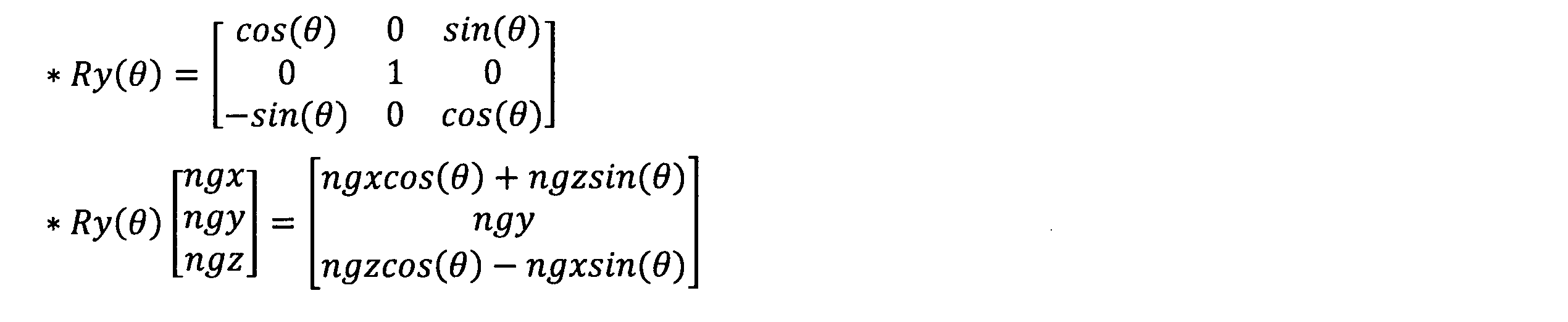
角度θの補正(すなわち下向き傾斜θに対するオフセット)を目的としてプロセッサにおいて行われるプロセスは、コサインθ及びサインθが計算され、生加速度値が加速度計から収集され、加速度値がngx、ngy及びngzを与えるべく正規化され、上述の回転行列が適用される。ここで補正された値が手元にあれば、ユーザの配向、又は配向の変化を決定する残りのプロセスは通常の態様で続く。当業者にとってわかることだが、正規化は回転の前に又は後に行うことができる。いくつかの実施形態において、すべての人に対して固定されたオフセットを適用することが適切である。そのような包括的なオフセットを利用する実施形態においては、オフセット値を控えめに、すなわち小さく、選択することが有利となり得る。胸には浅い角度、又は正の角度さえも有するものがあるからである。さらに一般的に適用可能な実施形態において、固有の人又は他のユーザの実際の胸角度に基づいて補正オフセットを決定することが望ましくなり得る。これは、既知の配向、例えば仰臥位、又は壁に対してのような垂直起立のいずれか、に人を配置することによって行うことができる。センサからの加速度計測定値がその後取得され、その測定値から、既知の配向に対するその固有人の胸角度を計算することができる。 The process performed in the processor for the purpose of correcting the angle θ (ie, offset with respect to the downward tilt θ) is that the cosine θ and the sine θ are calculated, the raw acceleration values are collected from the accelerometer, and the acceleration values are ngx, ngy and ngz. Normalized to give, the rotation matrix described above applies. With the corrected values at hand, the rest of the process of determining the user's orientation, or change in orientation, continues in the usual manner. As will be appreciated by those skilled in the art, normalization can be done before or after rotation. In some embodiments, it is appropriate to apply a fixed offset to everyone. In embodiments that utilize such a comprehensive offset, it may be advantageous to select the offset value conservatively, i.e., small. This is because some breasts have a shallow angle, or even a positive angle. In a more generally applicable embodiment, it may be desirable to determine the correction offset based on the actual chest angle of a unique person or other user. This can be done by placing the person in either a known orientation, eg, a supine position, or a vertical standing, such as with respect to a wall. Accelerometer measurements from the sensor are then obtained, from which the native's chest angle to a known orientation can be calculated.
上述のプロセスの一実施形態は、図4Bからわかる。プロセスは420において、補正を適用すべきとの決定から開始する。人固有補正角度が、上述のとおり利用可能であれば、プロセスはステップ425へと進行し、その記憶位置から、典型的には度又はラジアンで表現されてθにより示される補正値が取得される。包括的な補正値が使用される場合、プロセスはステップ420からステップ430へと進行し、包括的な補正値が、その記憶位置から取得される。いずれの場合も、435において補正値θのサイン及びコサインが計算される。未補正の又は生の加速度値もまた、440に示されるように、加速度計(及び必要に応じて信号互換性のための関連処理)又は記憶位置のいずれかから取得される。図4Bに示される例示的実施形態において、加速度値はその後、ステップ445において正規化され、ステップ450において回転行列が適用される。上述のように、回転行列の適用前又は適用後のいずれかに正規化を行うことができる。いずれのアプローチにおいても、455に示されるように、回転行列ステップの正規化された出力が、配向を決定するべくプロセスの残りに与えられる。
One embodiment of the process described above can be seen in FIG. 4B. The process begins at 420 with the determination that the amendment should be applied. If the person-specific correction angle is available as described above, the process proceeds to step 425, from which the storage position obtains a correction value, typically expressed in degrees or radians, indicated by θ. .. If a comprehensive correction value is used, the process proceeds from
いくつかの例において、本発明のセンサは、胸骨に又はその近くに配置されることはなく、その代わりに、人の正中線の短手方向において鎖骨近くに配置される。かかる例において、上述したピッチ補正に加え、ロール補正が望ましい。ロール補正の計算は、上述されたものと類似する。ただし、回転行列はX軸まわりに適用される。さらに、センサが、当該センサ上の標識に従って人に配置されるわけではない場合、ヨー補正も望ましい。一実施形態において、ヨー補正は、加速度計と磁力計との組み合わせによって達成することができる。磁力計は、磁気北位に較正され、又は基準磁石を既知かつ再現可能な位置(例えば人の頭又は足)に、若しくは人の長手方向身体軸に整合するように配置する。 In some examples, the sensors of the invention are not located on or near the sternum, but instead are located near the clavicle in the lateral direction of the human midline. In such an example, roll correction is desirable in addition to the pitch correction described above. The calculation of roll correction is similar to that described above. However, the rotation matrix is applied around the X-axis. Further, yaw correction is also desirable if the sensor is not placed on a person according to a sign on the sensor. In one embodiment, yaw correction can be achieved by a combination of an accelerometer and a magnetometer. The magnetometer is calibrated to the magnetic north position, or the reference magnet is placed in a known and reproducible position (eg, a person's head or foot) or aligned with a person's longitudinal body axis.
身体の回転軸の一以上に対してセンサを正確に整合することはまた、既存の創傷に過度の圧力を及ぼす配向のような固有体位に人が配置されるべきではない例、又は人が特定体位に維持されるべき例のいずれか関連する。後者の例では、例えば、肺炎進展を被る又はそのリスクにある人は、ベッド頭部(「HOB」)上昇プロトコルを受けることができる。胃から肺への逆流リスクにある人が、院内肺炎(「HAP」)を回避又は解決するべくベッド頭部上昇要求を受ける一つの例示的な群である。機械的人工呼吸又は経管栄養補給を受ける人は他の群であるが、これらの群の間に重複が存在し得る。人工呼吸器を着けている人は、人工呼吸器関連肺炎(「VAP」)のリスクにあり得る。HAP及びVAP双方に対処するべく使用される人頭部上昇プロトコルは典型的に、ベッドの頭部を30度以上上昇させることを提案する。ただし、いくつかの例においては45度以上が推奨される。これによりひいては、人の頭部を対応する角度まで上昇させることが予想される。多くのベッドがアラームを含む一方、当該ベッドの支持表面上の人胴体の体位は、例えば、人が当該ベッドの支持表面の上昇位置から滑り落ちる場合、変わり得る。歴史的に、人の上昇角度は、ベッド頭部の上昇角度から推測されてきたが、正確な評価は、人から直接得られる上昇角度の方であり、ベッドの方ではない。すなわち、HOBプロトコルに対する正確な用語は、関心測定が人の頭部及び胴体の上昇角度であることを良好に反映するには、人頭部(「HOP」)となるかもしれない。以下、HOPは、HOBプロトコルを反映するべく使用されるが、ベッド頭部の角度から人上昇角度を推測することよりもむしろ人上昇角度に基づく。 Precise alignment of the sensor to one or more of the body's axes of rotation is also an example, or person-specific, where a person should not be placed in an intrinsic position, such as an orientation that exerts excessive pressure on an existing wound. Relevant to any of the examples that should be maintained in position. In the latter example, for example, a person who suffers from or is at risk of developing pneumonia can undergo a bed head (“HOB”) elevation protocol. An exemplary group of individuals at risk of gastric-to-lung reflux receiving a bed head elevation request to avoid or resolve nosocomial pneumonia (“HAP”). People receiving mechanical ventilation or tube feeding are in other groups, but there may be overlap between these groups. People wearing mechanical ventilation may be at risk for mechanical ventilation-related pneumonia (“VAP”). Human head elevation protocols used to address both HAP and VAP typically suggest raising the head of the bed by 30 degrees or more. However, in some cases 45 degrees or higher is recommended. This, in turn, is expected to raise the human head to the corresponding angle. While many beds include alarms, the position of the human torso on the support surface of the bed can change, for example, if a person slides off an elevated position on the support surface of the bed. Historically, the angle of rise of a person has been inferred from the angle of rise of the head of the bed, but the correct assessment is the angle of rise directly obtained from the person, not the bed. That is, the exact term for the HOB protocol may be the human head (“HOP”) to better reflect that the measurement of interest is the elevation angle of the human head and torso. Hereinafter, HOP is used to reflect the HOB protocol, but is based on the person climbing angle rather than estimating the person climbing angle from the angle of the bed head.
本発明の一側面において、本明細書に記載のシステムの実施形態は、HOPプロトコルの遵守を確認するべく体位最適化を与えるのに役立ち得る。本発明の実施形態は、人の実際の体位を検出することにより、当該人の胴体が上昇プロトコルに従って上昇されることを確認することができる。図2A及び2Bに関して上述したように、加速度計は、人の体位及び配向を自動的に決定する。これには、胴体の上昇が含まれる。図2Bに示されたように行われるチェックの代わりに又はそのチェックに加え、胴体の上昇角度に対してもチェックが行われる。人のHOP角度が、定義されたしきい値、例えば、介護者により適切とみなされる30度未満又は何らかの他の値、から外れると、体位最適化システムは、一以上の注意喚起を介護者に与える。注意喚起は、体位しきい値が違反されるとすぐに、又は次善の体位で所定時間量が経過した後に、発行されるように構成することができる。それに加え、注意喚起通知のタイミングは、体位の違反程度に基づいてよい。例えば、人が体位変更パラメータを1度だけ超過すると、注意喚起通知はすぐに発行されず又は全く発行されず、又は補正体位に戻る機会を当該人に与えるべく延長された時間の後に発行され得る。人に注意喚起の発行なしに変更を行う機会を許容することは、アラームの疲労を回避するのに役立ち得る。しかしながら、人が予想される上昇パラメータから、例えば20度だけ変わると、体位違反の深刻度により、注意喚起が即時に、又は軽度の違反よりも短い時間の後に、発行され得るようになる。自動的に又は介護者により行われる固有人の状況の評価は、遵守の必要性のレベルを評価するべく使用することができ、又は遵守の必要性は、予め決定された特性に基づき得る。 In one aspect of the invention, embodiments of the system described herein can help provide postural optimization to confirm compliance with the HOP protocol. Embodiments of the present invention can confirm that a person's torso is ascended according to the ascending protocol by detecting the person's actual body position. As mentioned above with respect to FIGS. 2A and 2B, the accelerometer automatically determines a person's body position and orientation. This includes ascending the torso. Instead of or in addition to the checks performed as shown in FIG. 2B, the ascending angle of the fuselage is also checked. When a person's HOP angle deviates from a defined threshold, eg, less than 30 degrees or some other value deemed appropriate by the caregiver, the postural optimization system alerts the caregiver to one or more. give. The alert can be configured to be issued as soon as the position threshold is violated, or after a predetermined amount of time has elapsed in the next best position. In addition, the timing of alert notifications may be based on the degree of posture violation. For example, if a person exceeds the position change parameter only once, the alert notice may not be issued immediately or at all, or may be issued after an extended time to give the person the opportunity to return to the corrected position. .. Allowing a person the opportunity to make changes without issuing a warning can help avoid alarm fatigue. However, if a person changes from the expected ascent parameter, for example by 20 degrees, the severity of the postural violation allows the alert to be issued immediately or after a shorter period of time than a minor violation. Assessment of the individual's situation, either automatically or by the caregiver, can be used to assess the level of need for compliance, or the need for compliance may be based on predetermined characteristics.
重要なことであるが、体位変更の目標がHAP/VAP予防とHAPU(院内褥瘡)予防との間で矛盾することがある。HAP/VAPガイドラインとは対照的に、褥瘡ガイドラインは、仙骨領域に過剰な圧力がかからないように、ベッド頭部角度を30°未満に維持することを提案している。HAP/VAP及びHAPUの双方のリスクにある人にとって、矛盾する目的のバランスをとることにより、最適な体位を、HOPプロトコルにとって容認できる上昇範囲の下限とし得る。例えば、褥瘡向き変更プロトコルとHOPプロトコルとの間の妥協点を、30度ぴったりとし得る。 Importantly, the goal of repositioning can be inconsistent between HAP / VAP prophylaxis and HAPU (nosocomial pressure ulcer) prophylaxis. In contrast to the HAP / VAP guidelines, the pressure ulcer guidelines suggest keeping the bed head angle below 30 ° so that excessive pressure is not applied to the sacral region. For those at risk of both HAP / VAP and HAPU, the optimal position may be the lower limit of the acceptable ascent range for the HOP protocol by balancing conflicting objectives. For example, the compromise between the pressure ulcer redirection protocol and the HOP protocol can be exactly 30 degrees.
HOP(すなわち「人頭部」)角度が定義されたしきい値から外れる場合に注意喚起を与えることに加え、体位最適化システムは、体位再変更スケジュールをHOP角度の関数としてインテリジェントに最適化することもできる。例えば、HOP角度が増加するとシステムは、向き変更インターバルを自動的に増加又は減少させることができる。向き変更インターバルをHOP角度の関数として改変することに加え、システムは、向き変更パラメータのいずれか又はすべてを、HOP角度又はHOP角度変化の関数として自動的に調節することができる。例えば、システムは、向き変更として認定するのに必要な短手方向向き変更角度しきい値を増加若しくは減少させることができ、並びに/又は、組織減圧時間パラメータを増加若しくは減少させることができ、さらに他のパラメータを調節して直立角度に基づいて短手方向回転を最適化するのに役立てることができる。例えば、システムは、人の特定配向のための最大持続時間(例えば、特定配向における一つの先行期間中の最大値、若しくは特定配向における複数期間の各持続時間を含む最大積算持続時間)を、決定された胴体傾斜角度の関数として増加又は減少させることができ、又は、解放配向のままである最小減圧/解放持続時間、若しくは配向変化に対する最小頻度を、決定された胴体傾斜角度の関数として増加若しくは減少させることができる。 In addition to alerting when the HOP (ie, "human head") angle deviates from a defined threshold, the postural optimization system intelligently optimizes the postural repositioning schedule as a function of the HOP angle. You can also do it. For example, as the HOP angle increases, the system can automatically increase or decrease the reorientation interval. In addition to modifying the orientation change interval as a function of the HOP angle, the system can automatically adjust any or all of the orientation change parameters as a function of the HOP angle or the HOP angle change. For example, the system can increase or decrease the minor orientation change angle threshold required to certify as orientation, and / or increase or decrease the tissue decompression time parameter, and further. Other parameters can be adjusted to help optimize lateral rotation based on the upright angle. For example, the system determines the maximum duration for a particular orientation of a person (eg, the maximum value during one preceding period in a particular orientation, or the maximum cumulative duration that includes each duration of multiple periods in a particular orientation). Can be increased or decreased as a function of the body tilt angle, or the minimum decompression / release duration that remains in the open orientation, or the minimum frequency for orientation changes, can be increased or decreased as a function of the determined body tilt angle. Can be reduced.
加速度計の所望配向範囲全体にわたる較正により、正確な配向測定が可能となり得る。各タイプの加速度計又は各個別の加速度計を、所望の精度レベルに応じて試験かつ較正することができる。加速度計データ対実際の測定角度に基づいて計算された角度のプロットを、当該計算の精度を改善するべくその後使用され得る回帰をもたらすようにして使用することができる。ひとたび回帰が行われると、配向の計算は当該回帰からのデータを使用して行うことができる。生理学的心拍数は、大まかにいえば、約30から350bpmの範囲を有する。このため、心臓の鼓動からの加速度信号を隔離すると、この範囲内又は同様の周波数範囲内の信号を選択して見ることができる。この範囲より高い及び低い周波数を有する信号を減衰させるべく帯域通過フィルタを使用することができる。心臓の鼓動に起因する加速力は、静止しているユーザが受ける他の加速力と比べて大きくなり得るので、合理的な精度をもって心拍数を検出するのに当該データを著しくフィルタリングする必要性は存在しない。心拍数は、正常な振幅よりも高いか、又は所定周波数よりも高い信号を減衰させるべく低域通過フィルタが使用可能な、周期的信号を探すことにより検出することができる。例えば、約6Hz(すなわち350bpm)よりも高い周波数を減衰させることができる。当該減衰を変更するか又は帯域通過周波数を変更(シフト、狭小化、拡大化等)することにより、フィルタリング量を増大又は低減することもできる。例えば、静止している人に対し、最も一般的な周波数範囲は35~120bpmである。この範囲をカバーする帯域通過フィルタは、ほとんどの場合に対して有用である。あまり一般的ではない心拍数に適合させるには、異なる利得をもって付加されるか又は別個に分析される別個の幅広い又はシフトされたフィルタを有することにより、他の周波数をキャプチャすることができる。同様に周波数範囲を増大させるには、減衰を却下することもできる。タイトな帯域通過フィルタ(例えば、狭小な周波数範囲をカバーするか又は大きな減衰を有する等)はクリーンな信号を与えることができる。例えばバターワースフィルタを使用することができるが、他の多くのタイプのフィルタも使用することができる。 Calibration over the desired orientation range of the accelerometer may allow accurate alignment measurements. Each type of accelerometer or each individual accelerometer can be tested and calibrated according to the desired accuracy level. Angle plots calculated based on accelerometer data vs. actual measurement angles can be used to result in regressions that can be subsequently used to improve the accuracy of the calculation. Once the regression is done, the orientation calculation can be done using the data from the regression. Physiological heart rate roughly ranges from about 30 to 350 bpm. Therefore, if the acceleration signal from the heartbeat is isolated, the signal within this range or a similar frequency range can be selected and viewed. Bandband filters can be used to attenuate signals with frequencies above and below this range. The accelerating force resulting from the heartbeat can be greater than the other accelerating forces that a stationary user receives, so there is no need to significantly filter that data to detect heart rate with reasonable accuracy. not exist. Heart rate can be detected by looking for periodic signals for which a low pass filter can be used to attenuate signals above normal amplitude or above a predetermined frequency. For example, frequencies above about 6 Hz (ie 350 bpm) can be attenuated. The amount of filtering can also be increased or decreased by changing the attenuation or changing the bandpass frequency (shift, narrowing, expanding, etc.). For example, for a stationary person, the most common frequency range is 35-120 bpm. Bandpass filters that cover this range are useful in most cases. To adapt to less common heart rates, other frequencies can be captured by having a separate wide or shifted filter that is added or analyzed separately with different gains. Similarly, to increase the frequency range, attenuation can be rejected. A tight bandpass filter (eg, covering a narrow frequency range or having a large attenuation) can give a clean signal. For example, a Butterworth filter can be used, but many other types of filters can also be used.
フィルタリングの質は、信号が小さいか又はノイズが大きい場合に重要となる。このことが生じるいくつかの例は、センサが心臓の近くでないところに(例えば骨盤領域に)配置されている場合、ユーザがセンサと心臓又は動脈との間に介在する多くの物質(例えば皮膚、脂肪、衣服のような無機材料等)を有している場合、又は脈拍が弱い(例えば障害性心臓収縮又は低血圧/脈圧)場合を含む。当該場合には、フィルタリングが重要となって、フィルタを改善する上述の方法が心拍数を隔離するべく必要とされる。脈拍数及び心拍数の検出を改善するべく最適なセンサの配置は、心臓(又は主要動脈)に密に近接していることである。胸、特に胸骨の近く、にセンサを配置することは、心拍数検出にとって最適である。大動脈等の大きな動脈に近い位置にセンサを配置することは、心臓から離れた位置では心拍数検出にとって良好なセンサ配置である。 The quality of filtering is important when the signal is small or noisy. Some examples of this happening are when the sensor is located not near the heart (eg in the pelvic region), many substances (eg skin, etc.) that the user mediates between the sensor and the heart or arteries. This includes cases of having fat, inorganic materials such as clothing, etc., or weak pulse (eg, impaired cardiac contraction or hypotension / pulse pressure). In that case, filtering becomes important and the above-mentioned methods of improving the filtering are needed to isolate the heart rate. The optimal sensor placement to improve pulse rate and heart rate detection is close proximity to the heart (or major arteries). Placing the sensor on the chest, especially near the sternum, is optimal for heart rate detection. Placing the sensor near a large artery such as the aorta is a good sensor placement for heart rate detection at a location away from the heart.
図5Aに示されるようにセンサが3軸配向で配置される場合、心拍数(及び呼吸数)は主にz軸加速度計により検知される。心拍数又は呼吸数検出を意図するセンサを位置決めするとき、信号の質は、ほぼ前後軸(又は上述で示されるz軸)に少なくとも一つの加速器が配置されている場合に改善される。 When the sensors are arranged in a triaxial orientation as shown in FIG. 5A, the heart rate (and respiratory rate) is mainly detected by a z-axis accelerometer. When positioning a sensor intended for heart rate or respiratory rate detection, signal quality is improved if at least one accelerator is located approximately on the anterior-posterior axis (or the z-axis shown above).
所定の場合には、以下の場合を追跡し続けることが有用となり得る。
・心拍数(HR)が所定しきい値よりも高い場合、
・HRが所定しきい値よりも低い場合、
・HRが急変する場合、
・HRが不規則である場合、
・加速度の大きさが急変するか又は所定しきい値よりも高い速度にある場合、
・加速度の大きさが急変するか又は所定しきい値よりも高い速度にある場合、
・加速度センサにより検出される心拍数が電気信号センサにより検出される心拍数と異なる場合。
In certain cases, it may be useful to keep track of the following cases:
・ If the heart rate (HR) is higher than the specified threshold
・ If HR is lower than the specified threshold
・ If the HR changes suddenly
・ If the HR is irregular
・ When the magnitude of acceleration changes suddenly or the speed is higher than the predetermined threshold value.
・ When the magnitude of acceleration changes suddenly or the speed is higher than the predetermined threshold value.
-When the heart rate detected by the accelerometer is different from the heart rate detected by the electric signal sensor.
これは、心臓からの電気信号が存在するが機械的な心臓の鼓動が存在しないか又は不規則である心室細動の場合に重要となり得る。当該場合に加速度計データは、EKGデータのための信号検出器がセンサ300の外部又は内部のいずれかに存在するとき、EKGデータと対比することができる。 This can be important in the case of ventricular fibrillation where there is an electrical signal from the heart but no mechanical heartbeat or irregularity. In that case, the accelerometer data can be compared to the EKG data when the signal detector for the EKG data is either outside or inside the sensor 300.
心臓の機械的活動及び/又は電気的活動を検出することは、上述のように、例えば頻脈、徐脈、不整脈、心臓発作、無脈性電気活動(PEA)、心不全等のような異常な生理学的状況の表示を与えることができる。 Detecting mechanical and / or electrical activity of the heart is abnormal, such as tachycardia, bradycardia, arrhythmia, heart attack, pulseless electrical activity (PEA), heart failure, etc., as described above. An indication of the physiological situation can be given.
人の呼吸数を検知することはまた、本発明のいくつかの実施形態においても望ましい。生理学的な呼吸数は、大まかにいえば、約3から100bpmの範囲を有する。呼吸からもたらされる加速度信号を隔離する場合、少なくともいくつかの実施形態に対しては、この範囲内又は同様の周波数範囲内の信号を選択して見ることが望ましい。心拍数に関しては、この範囲より高い及び低い周波数を有する信号を減衰させるべく帯域通過フィルタを使用することができる。呼吸からもたらされる加速力は、特に静止中の呼吸に関しては、心拍数に対して小さいことが多い。したがって、フィルタリングが望ましいこととなり得る。基本的な帯域通過フィルタを超えてフィルタリングを改善する方法は、実施形態にとって適切であれば実装することができる。これは、例えば、帯域を5から30呼吸/分まで狭小化することを含む。この範囲をカバーする帯域通過フィルタは、大抵の状況に対して有用であり得る。他の問題は、生理学的な呼吸及び心拍数に対する範囲が重なる点にある。心拍数が通常呼吸数よりも高いという事実を利用することができる。狭小化された帯域通過フィルタは、所望の差異化を達成することができる。フィルタリングはまた、まず心拍数を検出してその後フィルタを、心拍数よりも低い高域カットオフを有するように調節して適応させることもできる。心拍数に関しては、タイトな帯域通過フィルタがクリーンな信号もたらすことができる。再びであるが、様々な容認できる帯域通過フィルタのうち、バターワースフィルタを使用することができる。 Detecting a person's respiratory rate is also desirable in some embodiments of the invention. Physiological respiratory rates roughly range from about 3 to 100 bpm. When isolating the accelerometer resulting from respiration, it is desirable to select and view signals within this range or similar frequency range for at least some embodiments. For heart rate, bandpass filters can be used to attenuate signals with frequencies above and below this range. The acceleration that results from breathing is often small relative to the heart rate, especially when it comes to resting breathing. Therefore, filtering may be desirable. Methods of improving filtering beyond the basic passband filter can be implemented if appropriate for the embodiment. This includes, for example, narrowing the band from 5 to 30 breaths / minute. Bandpass filters that cover this range can be useful in most situations. Another problem is the overlapping range for physiological respiration and heart rate. You can take advantage of the fact that your heart rate is higher than your normal respiratory rate. The narrowed bandpass filter can achieve the desired differentiation. Filtering can also first detect the heart rate and then adjust and adapt the filter to have a lower high frequency cutoff than the heart rate. For heart rate, a tight bandpass filter can provide a clean signal. Again, of the various acceptable bandpass filters, the Butterworth filter can be used.
所定の場合には、人の呼吸数を追跡し続けることが有用となり得る。例えば、
・呼吸数(BR)が所定しきい値よりも高い場合、
・BRが所定しきい値よりも低い場合、
・これが急変する場合、
・これが薬物の投与と関連づけられている場合、
・これが不規則である場合、
・加速度の大きさが所定しきい値よりも高いか又は低い場合、
・加速度の大きさが急変するか又は所定しきい値よりも高い速度にある場合、
・心拍数が呼吸数よりも低い場合、
・例えばチェーンストークス呼吸のような所定の呼吸パターンの場合である。
In certain cases, it may be useful to keep track of a person's respiratory rate. for example,
・ When the respiratory rate (BR) is higher than the predetermined threshold value,
・ If BR is lower than the specified threshold
・ If this changes suddenly,
If this is associated with drug administration
・ If this is irregular,
・ If the magnitude of acceleration is higher or lower than the specified threshold
・ When the magnitude of acceleration changes suddenly or the speed is higher than the predetermined threshold value.
・ If your heart rate is lower than your respiratory rate
-For a given breathing pattern, such as Cheyne-Stokes breathing.
上述のように呼吸数及び呼吸パターンを検出することは、例えば頻呼吸、低換気、チェーンストークス(脳卒中、脳損傷、脳症、心不全)等のような異常な生理学的状況の表示を与えることができる。 Detecting respiratory rate and pattern as described above can provide indications of abnormal physiological conditions such as tachypnea, hypoventilation, Cheyne-Stokes (stroke, brain injury, encephalopathy, heart failure) and the like. ..
人は自分自身で動き得るので、その活動レベル又はこれの欠如を決定することが有用となり得る。この信号を他の生理学的信号から隔離することが重要である。一般に、ユーザの正常な自発的動きに起因する加速度成分が存在する。当該動きの大きさは、呼吸、心拍、及び脈拍に起因する加速度よりも大きいものとなり得る。ユーザの動きに基づく加速度を隔離する一つの方法は、呼吸及び心拍/脈拍に起因すると予想される大きさを超える大きさの加速度を隔離することである。この大きさのしきい値は、心拍、脈拍、及び呼吸に起因する生理学的に正常な加速度に基づいて予めプログラムすることができる。当該しきい値はまた、人が静止していると決定される時と同時に又は他の時のいずれかにおいて、ユーザにて測定された加速度から直接測定することもできる。動きに基づく加速度信号を隔離する他の方法は、フィルタリングされた心拍数及び呼吸の信号を初期信号から差し引くことである。 Since a person can move on his own, it can be useful to determine his level of activity or lack of it. It is important to isolate this signal from other physiological signals. In general, there is an acceleration component due to the normal spontaneous movement of the user. The magnitude of the movement can be greater than the acceleration caused by breathing, heartbeat, and pulse. One way to isolate accelerations based on user movement is to isolate accelerations that exceed the magnitude expected to be due to respiration and heartbeat / pulse. Thresholds of this magnitude can be preprogrammed based on physiologically normal accelerations resulting from heart rate, pulse, and respiration. The threshold can also be measured directly from the acceleration measured by the user, either at the same time as the person is determined to be stationary or at other times. Another way to isolate motion-based acceleration signals is to subtract filtered heart rate and respiration signals from the initial signal.
ユーザは、例えば機械類に起因する環境ノイズを受け得る。褥瘡のリスクがある多くの人は、「交替圧力」マットレス上に置かれる。当該マットレスは、その圧力を独立的に調節する一連の個別空気列を有するので、人の下を移動する減圧波をもたらす。当該波は、非常に遅く移動し得るが、説明を必要とする人のわずかな動きをもたらし得る。当該ノイズ及び任意の他の環境ノイズをフィルタ除去するアルゴリズムは当業者にとって簡単であって、本明細書に教示が与えられる。環境ノイズはまた、電気的干渉等にも起因し得る。望ましくない環境ノイズ源は、近くの電気的又は機械的機器、建物のHVAC等の基幹施設システム、及び/又は他の人間活動を含む。 The user may be exposed to environmental noise caused by, for example, machinery. Many people at risk of pressure ulcers are placed on "alternate pressure" mattresses. The mattress has a series of separate air trains that independently regulate its pressure, thus providing a decompression wave that travels under a person. The wave can move very slowly, but can result in a slight movement of the person in need of explanation. Algorithms for filtering out such noise and any other environmental noise are simple to those of skill in the art and are provided herein. Environmental noise can also be caused by electrical interference and the like. Unwanted sources of environmental noise include nearby electrical or mechanical equipment, mission-critical facility systems such as building HVAC, and / or other human activity.
動きに基づく加速度検知は、人の活動レベルをモニタリングして活動を促進するか又は活動を思いとどまらせるべく使用することができる。これはまた、例えばブレーデンスケールの要素(すなわち可動性、活動性、ずれの力等)のいくつかを決定するためのチャート作成を目的として、活動性を自動的に決定するべく使用することもできる。 Motion-based accelerometers can be used to monitor a person's activity level to promote or discourage activity. It can also be used to automatically determine activity, for example for the purpose of charting to determine some of the elements of the Braden scale (ie, mobility, activity, displacement force, etc.). ..
加速度計からの信号について、他の信号分析を行うこともできる。心拍/脈拍に起因する加速度の波形全体は、呼吸に含まれる加速度に対する波形と同様に知られている。信号分析は、加速度信号の波形を、例えばその発生源又は異なる生理学的状況との関連性のような多くの情報を当該信号から得るように分析するべく使用することができる。例えば、呼吸に対する波形は心拍又は脈拍に対する波形とは異なる。すなわち、波形及び/又は周波数は、心拍数(HR)及び呼吸数(BR)を隔離/識別するのに役立つように使用することができる。人が向きを変える波形も識別することができる。加えて、心拍/脈拍の加速度波形内には、当該波形に影響を与える異なる生理学的状況が存在する。例えば、正常な心拍と心室細動とでは波形が異なる。このようにして波形の変化又は異常な波形を検出することができる。これは呼吸に対しても同様に当てはまる。アルゴリズムはまた、ユーザの正常状態から学習して、正常なHR及びBRの範囲並びに特定のユーザに対する正常波形を良好に識別するのに役立てることができる。このことは、これらのいずれかが大きく変化する場合に有用である。このアルゴリズムはまた、一のユーザ又は複数のユーザからの多くのデータセットから学習してその精度及び精密性を改善することもできる。 Other signal analysis can be performed on the signal from the accelerometer. The entire waveform of acceleration due to the heartbeat / pulse is known as well as the waveform for the acceleration contained in respiration. Signal analysis can be used to analyze the waveform of an acceleration signal to obtain a lot of information from the signal, such as its origin or its relevance to different physiological situations. For example, the waveform for breathing is different from the waveform for heartbeat or pulse. That is, the waveform and / or frequency can be used to help isolate / identify heart rate (HR) and respiratory rate (BR). Waveforms that people turn around can also be identified. In addition, there are different physiological conditions within the heart rate / pulse acceleration waveform that affect the waveform. For example, normal heartbeat and ventricular fibrillation have different waveforms. In this way, changes in the waveform or abnormal waveforms can be detected. This is also true for breathing. The algorithm can also be learned from the normal state of the user to help identify the normal HR and BR range as well as the normal waveform for a particular user. This is useful when any of these changes significantly. The algorithm can also learn from many datasets from one user or multiple users to improve their accuracy and precision.
図7は、上述のプロセスを説明し、配向、心拍数、呼吸数、及び動きのデータを初期加速度計信号から隔離するべく使用されるフィルタ、並びに当該フィルタが学習することができる経路を示す。詳しくは、一実施形態において、重力加速力を隔離するフィルタ705、心拍/脈拍加速力を隔離するフィルタ710、呼吸加速力を隔離するフィルタ715、及び動きに起因する加速力を隔離するフィルタ720を含む4つの並列フィルタ705から720の一セットが加速度計からの信号700を受信する。動き及び配向に加え、例えば落下のような他の特徴的な加速事象を検出するべく加速度測定を使用することもできる。ブロック725において心拍数出力が、呼吸数フィルタに対して高域カットオフを与えるべく使用され、ブロック725からフィルタ715に送られる。同様にして、フィルタ720に送られるブロック730に示されるように、動きを隔離するべく心拍数及び呼吸数を差し引くことができる。
FIG. 7 illustrates the process described above and shows a filter used to isolate orientation, heart rate, respiratory rate, and motion data from the initial accelerometer signal, as well as the pathways the filter can learn. Specifically, in one embodiment, a
次に図8を参照すると、図7のフィルタの一つを詳細に理解できる。加速度計信号800が低域通過フィルタ805に与えられ、最小生理学的呼吸数を下回るカットオフにより、810に示される配向が隔離される。心拍数を隔離するには、信号800が、820に示される心拍数の生理学的範囲を有するか又は心拍数出力をもたらすサブセットをカットオフとして有する帯域通過フィルタ815に送られる。加えて、心拍数データはブロック825を介して帯域通過フィルタ830に送られる。帯域通過フィルタ830はまた、信号800を受信して、835に示される呼吸数を隔離する。これは、呼吸数に対する高域カットオフとして心拍数を使用することを含む。また、振幅しきい値ブロック840が信号800を受信して、ブロック845に示される活動性及び可動性レベルを隔離する。
Next, with reference to FIG. 8, one of the filters of FIG. 7 can be understood in detail. An
人の生命徴候が体位変更により影響を受け得る場合が存在する。本明細書に記載の体位/配向センサは、実時間で人の生命徴候に相関させることができる。体位/配向センサからのデータは、標準のモダリティ(EKG、血圧カフ、動脈拍動触診脈拍の用手的計数、呼吸の用手的計数等)を介して得られる生命徴候測定値と相関させることができる。体位/配向センサからのデータはまた、人の体位/配向及び生命徴候双方を決定することができる一つのセンサを使用して生命徴候と相関させることができる。一実装形態において、人に配置された加速度計が人の体位/配向並びに心拍数及び呼吸数を決定することができる。検知システムが、体位/配向の変化に関連づけられている心拍数の劇的な変化を検出すると、介護者は、人が起立性低血圧かもしれない旨の通知を受けることができる。起立性低血圧の人は一般に、心拍数の急速な加速度(通常20bpmを超える増加)に関連づけられる起立時の血圧低下を経験する。実際、多くの状況(すなわち、起立性低血圧、自律神経機能障害、体位性頻脈症候群等)の診断を、人が傾動するプラットホーム上に置かれて生命徴候がモニタリングされる傾動テーブルテストの使用により支援することができる。 There are cases where a person's life signs can be affected by repositioning. The position / orientation sensors described herein can correlate with human life signs in real time. Data from the position / orientation sensor should be correlated with life sign measurements obtained via standard modalities (EKG, blood pressure cuff, arterial pulsation, palpation, pulse manual counting, respiratory manual counting, etc.). Can be done. Data from the position / orientation sensor can also be correlated with the life sign using a single sensor that can determine both the position / orientation of the person and the life sign. In one implementation, an accelerometer placed on a person can determine a person's position / orientation as well as heart rate and respiratory rate. When the detection system detects a dramatic change in heart rate associated with a change in position / orientation, the caregiver can be notified that the person may have orthostatic hypotension. People with orthostatic hypotension generally experience an orthostatic hypotension associated with a rapid acceleration of heart rate (usually an increase of more than 20 bpm). In fact, the use of tilt table tests, where the diagnosis of many situations (ie orthostatic hypotension, autonomic dysfunction, postural orthostatic tachycardia syndrome, etc.) is placed on a platform on which a person tilts and life signs are monitored. Can be assisted by.
人の生命徴候が体位によって影響を受ける他の例も存在する。例えば、鬱血性心不全(CHF)の人がフラットに横たわっている場合、呼吸数の増大が現れる呼吸困難が発症し得る。同様に、病的肥満又は閉塞性睡眠時無呼吸の人は、フラットに横たわっている(胸及び首まわりの脂肪に起因する過剰な重量が呼吸の仕事量を増大させる)場合、呼吸困難が発症し得る。当該人の呼吸パターンは姿勢変更に基づいて変化し得る。一実装形態において、人に配置された加速度計が、人の体位/配向及び呼吸数の双方を測定することができる。検知システムが、体位/配向の変化に関連づけられている呼吸数の変化を検出すると、介護者は通知を受けてさらなる精密検査を開始することができる。 There are other cases where the signs of human life are affected by posture. For example, if a person with congestive heart failure (CHF) is lying flat, dyspnea may develop with increased respiratory rate. Similarly, people with morbid obesity or obstructive sleep apnea develop dyspnea when lying flat (excessive weight due to fat around the chest and neck increases the work of breathing). Can be. The person's breathing pattern can change based on postural changes. In one implementation, an accelerometer placed on a person can measure both the person's position / orientation and respiratory rate. When the detection system detects changes in respiratory rate associated with changes in body position / orientation, the caregiver can be notified and initiate further work-up.
体位により影響を受ける状況がモニタリングシステムに入力される。例えば、特定の人が、重篤な起座呼吸をもたらす鬱血性心不全(CHF)である場合、当該状況がシステムに入力され、向きを変える推奨によって、人の頭/胸を一日中30度上げたままとすることができる(CHFの人は、仰臥で横たわっているときに生じる過剰な流体負荷に対処することができないので、フラットに横たわっている場合は呼吸が短くなる)。その結果、人の頭/胸が一日中上げられ(これにより仙骨に与えられる圧力が増大し)、システムはその後、向きを変える頻度を増大させる等の推奨を行い仙骨潰瘍の予防に役立てることができる。人の任意の状況(すなわち麻痺、切断、負傷、糖尿病、食欲不振、肥満等)をシステムにおいて定義することができる。 The situation affected by the body position is input to the monitoring system. For example, if a particular person has congestive heart failure (CHF) that results in severe orthopnea, the situation is entered into the system and the person's head / chest is raised 30 degrees throughout the day with a turn-around recommendation. It can be left untouched (people with CHF cannot cope with the excessive fluid load that occurs when lying on their backs, so breathing is shorter when lying flat). As a result, the person's head / chest is raised all day long (which increases the pressure exerted on the sacrum), and the system can then make recommendations such as increasing the frequency of turning to help prevent sacral ulcers. .. Any situation of a person (ie, paralysis, amputation, injury, diabetes, loss of appetite, obesity, etc.) can be defined in the system.
人の呼吸パターン及び心拍数の検知を、センサが人に適切に付着されているか否かを決定するべくどのようにして使用できるかがこれまで本明細書に記載されてきた。 It has been described herein how the detection of a person's breathing pattern and heart rate can be used to determine if the sensor is properly attached to the person.
同様に、センサが人に適切に付着されているか否かを決定するべく、身体の電気的活動、インピーダンス、又は抵抗の測定が可能な電極又は容量センサも使用することができる。センサが人に適切に固定されているか否かを決定するべく温度計も使用することができる。皮膚表面温度の読みが予想皮膚温度に十分近い場合、センサは人に付着されているとみなすことができる。同様に、皮膚表面温度の突然の変化が検出されると、センサが人との連続性を失ったと推測することができる。 Similarly, an electrode or capacitive sensor capable of measuring the body's electrical activity, impedance, or resistance can be used to determine if the sensor is properly attached to a person. A thermometer can also be used to determine if the sensor is properly secured to a person. If the skin surface temperature reading is sufficiently close to the expected skin temperature, the sensor can be considered attached to a person. Similarly, when a sudden change in skin surface temperature is detected, it can be inferred that the sensor has lost continuity with the human.
センサユニットが人に適切に付着されているか否かを決定するべく使用することができる他の技術は、検知ユニット回路内の導体に付着されるタブである。ユニットが人に付着された後、当該ユニットが引き続き取り除かれると、タブが分離して、例えば抵抗を変化させることによって回路を測定可能な態様で変更する。これにより、検知ユニットは人から取り除かれたことを知り、この情報をホスト等のリーダーに送ることができる。いくつかの配列において、タブはまた、付着性化合物又は熱活性接着物質の違いにより人に強い強度で付着することができる。 Another technique that can be used to determine if a sensor unit is properly attached to a person is a tab attached to a conductor in the detection unit circuit. After the unit is attached to a person, if the unit is subsequently removed, the tabs will separate and modify the circuit in a measurable manner, for example by varying the resistance. This allows the detection unit to know that it has been removed from a person and send this information to a reader such as a host. In some sequences, the tabs can also adhere to humans with strong strength due to differences in adhesive compounds or thermoactive adhesives.
センサユニットは、人のいずれかの場所に配置されると自動的に動作するように配向することができる。当該介護において、配向とは、重力に対して又は人に対して加速度計の方向を決定することを意味する。「配向」の間、加速度計の方向は、3軸の加速度を測定することにより、デバイスが当該3軸それぞれの回転軸で回転する際、重力に対して決定することができる。いくつかの配置は、胸骨の切り欠き又は胸骨若しくは上前腸骨棘(ASIS)の剣状突起とすることができる。センサユニットはまた、人の任意の場所に配置され得るか又は人に対して配向され得る。このアプローチを使用する一実施形態において、人は、所定位置のセンサユニットを有して仰臥で横たわる。リーダユニットのボタン、センサ自体、遠隔コントローラ、又はコンピュータインタフェイスが、ひとたび人が仰臥になると押されるか又は指令を送り、リーダユニットはその後、センサユニットからの読みを仰臥位に関連づける。すなわち、センサユニットは、人に対する任意角度で配置することができ、それに従ってシステムを配向することができる。人が仰臥にある旨のシステムへの信号は、音声アクティベーション等を含む任意数の形態をとり得る。 The sensor unit can be oriented to operate automatically when placed anywhere in the person. In the care, orientation means determining the direction of the accelerometer with respect to gravity or with respect to a person. During "orientation", the direction of the accelerometer can be determined with respect to gravity as the device rotates on each of the three axes of rotation by measuring the acceleration of the three axes. Some arrangements can be sternum notches or xiphoid processes of the sternum or anterior superior iliac spine (ASIS). The sensor unit can also be placed anywhere in the person or oriented towards the person. In one embodiment using this approach, a person lies on his back with a sensor unit in place. A button on the reader unit, the sensor itself, a remote controller, or a computer interface is pressed or sends a command once a person is in the supine position, and the reader unit then associates the reading from the sensor unit with the supine position. That is, the sensor unit can be placed at any angle with respect to the person and the system can be oriented accordingly. The signal to the system that the person is on his back can take any number of forms, including voice activation and the like.
異なる体型の人への使用に対して異なるセンサを予め較正することができる。例えば、固有の識別子を有するセンサを特定のBMIを有する人に配置することができる。このようにして、システムは、当該センサから固有の識別子を検出し、特定のBMIの人に対してモニタリングシステムを自動的に較正する。 Different sensors can be pre-calibrated for use with people of different body shapes. For example, a sensor with a unique identifier can be placed on a person with a particular BMI. In this way, the system detects a unique identifier from the sensor and automatically calibrates the monitoring system for a person with a particular BMI.
同様に、支持表面に配置されるセンサは、異なる特性の支持表面での使用に対して予め較正することができる。例えば、固有の識別子を有するセンサを、特定の表面圧力プロファイル(すなわち乾燥圧力、空気圧力、空気流動化等)を有する支持表面上に配置することができる。このようにして、システムは、当該センサからの固有の識別子を検出し、特定の表面圧力プロファイルの支持表面に対してモニタリングシステムを自動的に較正する。 Similarly, sensors placed on the support surface can be pre-calibrated for use on support surfaces with different properties. For example, a sensor with a unique identifier can be placed on a supporting surface with a particular surface pressure profile (ie, drying pressure, air pressure, air fluidization, etc.). In this way, the system detects a unique identifier from the sensor and automatically calibrates the monitoring system for the supporting surface of a particular surface pressure profile.
少なくともいくつかの実施形態において、検知システムは、介護者による任意の付加的な操作を必要としないように構成される。上述のように、センサは、その接着性裏貼りが除去されると自動的にアクティブになることができる。接着性裏貼りの除去により、センサ回路のアクティベーションが可能となり、これゆえに当該ユニットに搭載されている電池の放電が可能となる。電力を節約するべく、センサは加速度データをローカルに記憶しておき、この情報を一の又は複数の受信ステーションへ予め定義されたインターバルで送信することができる。使い捨て可能なセンサユニットは、例えば数日又は数週のような長期間にわたり加速度データを送信することができるように構成することができる。 In at least some embodiments, the detection system is configured so that it does not require any additional operation by the caregiver. As mentioned above, the sensor can be automatically activated when its adhesive backing is removed. The removal of the adhesive backing allows activation of the sensor circuit, which in turn allows the battery mounted on the unit to be discharged. To save power, the sensor can store acceleration data locally and send this information to one or more receiving stations at predefined intervals. The disposable sensor unit can be configured to be capable of transmitting acceleration data over a long period of time, for example days or weeks.
センサユニットは、パッケージにあるときは電力を消費しない(又は少なくとも極小電力にある)ように構成することができる。いくつかの実施形態において、センサユニットは、人に配置される直前にアクティブになる。代替的に、送受信器から受信される信号がセンサユニットをアクティブにするべく機能することができる。アクティベーション信号の一つのタイプは、当該ユニットに送信されるRF信号であり得る。センサユニットが受動RFユニットでなければ、当該ユニットは一時的に、アクティベーションされる前の受動タグとして動作し、受信信号により電力を受けることができる。他の代替例として、受動的に信号を受信する能力を有する受動タグ又はRF受信器/送受信器が、センサの一部として最初に含まれ、センサに蓄積されたエネルギーを使用することなくセンサが信号を受信することができるように使用され得る。この信号はセンサをアクティブにするべく使用される。検知ユニットのサイズを低減して当該受動受信器/送受信器アンテナを大きくする方法として、受動タグはその後、アクティベーション直後に除去することができる。 The sensor unit can be configured to consume no power (or at least at minimal power) when in the package. In some embodiments, the sensor unit is activated shortly before being placed on a person. Alternatively, the signal received from the transmitter / receiver can function to activate the sensor unit. One type of activation signal can be an RF signal transmitted to the unit. If the sensor unit is not a passive RF unit, it can temporarily act as a passive tag before activation and be powered by the received signal. As another alternative, a passive tag or RF receiver / transmitter / receiver capable of passively receiving a signal is initially included as part of the sensor so that the sensor does not use the energy stored in the sensor. It can be used to be able to receive signals. This signal is used to activate the sensor. As a method of reducing the size of the detection unit and increasing the size of the passive receiver / transmitter / receiver antenna, the passive tag can then be removed immediately after activation.
一実施形態における呼吸数、心拍数、及び/又は温度のような生理学的変数を検知するユニットに対し、リーダは、生理学的値が測定されると予想される前に、アクティベーション後の所定期間(数秒、数分、又は数時間)を得ることができる。これにより、システムが生理学的データを受信すると予想する前にセンサを人に付着する時間が得られる。他の変形例は、ユニット上のスイッチによりアクティブにされるセンサを有する。 For units that detect physiological variables such as respiratory rate, heart rate, and / or temperature in one embodiment, the reader is required to perform a predetermined period after activation before the physiological value is expected to be measured. (Several seconds, minutes, or hours) can be obtained. This gives time to attach the sensor to a person before the system expects to receive physiological data. Another variant has a sensor activated by a switch on the unit.
センサ300の人への適切な配置は少なくともいくつかの実施形態において重要である。少なくともいくつかの実施形態において、センサは、当該センサが人に対して動く可能性がないように人に配置される。一実施形態において、センサは、標準EKGリード線のために使用されるものと類似し得る接着性パッチを使用して皮膚に直接接着されるが、他の例では、センサは、当該センサの交換を可能とする一方で人の皮膚を保護するように接着性裏貼りから除去され得る。 Proper placement of the sensor 300 on a person is important in at least some embodiments. In at least some embodiments, the sensor is placed on the person so that the sensor cannot move with respect to the person. In one embodiment, the sensor is attached directly to the skin using an adhesive patch that may be similar to that used for standard EKG leads, but in another example, the sensor is a replacement for the sensor. Can be removed from the adhesive backing to protect the human skin while allowing for.
センサは、後胸郭、骨盤、上大腿部、又は肩に配置されるのが理想的である。理想的な使用では、センサとユーザの骨盤との間に相対的な動きはほとんど存在しない。これにより、ユーザの骨盤の配向をほぼ決定することができる。一実施形態において、センサは、当該センサの配向が人の骨盤及び/又は胸郭の配向に近似する身体上位置に配置する必要がある。 Ideally, the sensor should be placed on the posterior thorax, pelvis, upper thigh, or shoulder. In ideal use, there is little relative movement between the sensor and the user's pelvis. This makes it possible to almost determine the orientation of the user's pelvis. In one embodiment, the sensor needs to be placed at a position on the body where the orientation of the sensor is close to the orientation of the human pelvis and / or thorax.
人の骨盤及び/又は胸郭の配向を知ることにより、他の身体構造物にわたる表面圧力分布を推定することができる。例えば、人が完全に仰臥位にあると決定される場合、表面圧力が人の仙骨及び坐骨に加わっていることがわかる。しかしながら、人の配向、及び異なる身体構造物間に存在する既知の解剖学的関係に基づいて、後頭部、ひじ、及びかかとのような構造物も圧力を受けていることが推測できる。その後、人が左側臥位に向き変更すると、表面圧力が、人の左腰、並びに左肩、左ひじ、左後頭部、及び左外側くるぶしのような他の身体構造物に移行したと決定することができる。 By knowing the orientation of the human pelvis and / or thorax, the surface pressure distribution over other body structures can be estimated. For example, if a person is determined to be completely supine, it can be seen that surface pressure is applied to the person's sacrum and ischium. However, based on the orientation of the person and the known anatomical relationships that exist between the different body structures, it can be inferred that structures such as the occipital region, elbows, and heels are also under pressure. It can then be determined that when the person turns to the left lateral decubitus position, surface pressure is transferred to the person's left hip and other body structures such as the left shoulder, left elbow, left occipital region, and left lateral ankle. can.
人の骨盤が左側臥位にあると決定される場合、表面圧力が人の右腰、右後頭部、右ひじ、右肩、右外側くるぶしに加わっている可能性は極めて低い(不可能でなければ)。圧力がこれらの位置に加わらないようにする異なる身体部分間に存在する解剖学的関係がある。このように、骨盤又は胸郭のような一以上の身体構造物の既知の配向に基づいて、人の全体的な表面圧力分布マップを推定することができる。 If it is determined that the person's pelvis is in the left lateral decubitus position, it is highly unlikely (if not impossible) that surface pressure is exerted on the person's right hip, right occipital region, right elbow, right shoulder, and right lateral ankle. ). There are anatomical relationships that exist between different body parts that prevent pressure from being applied to these positions. Thus, a person's overall surface pressure distribution map can be estimated based on the known orientation of one or more body structures such as the pelvis or thorax.
少なくともいくつかの実施形態において、センサは四肢又は頭に配置しないのが好ましい。四肢の配向は骨盤/胸郭の配向に常に近似するわけではないからである。主な関心が骨盤領域以外の位置における褥瘡の予防及び管理に向けられている場合、配置する位置は異なり得る。例えば、人が右かかとに褥瘡を有する場合、センサは、影響を受ける領域の配向及び表面圧力分布を良好に近似かつモニタリングするべく右足、足首、若しくは下肢に又はこれらの近くに配置することができる。一実施形態において、センサは、転がりやすい位置に配置すべきではない。 In at least some embodiments, the sensor is preferably not placed on the limbs or head. This is because the orientation of the limbs does not always approximate the orientation of the pelvis / thorax. If the primary concern is for the prevention and management of pressure ulcers outside the pelvic area, the location may be different. For example, if a person has a pressure ulcer on the right heel, the sensor can be placed on or near the right foot, ankle, or lower limb to better approximate and monitor the orientation and surface pressure distribution of the affected area. .. In one embodiment, the sensor should not be placed in a rollable position.
ユーザの配向を正確に決定するには、少なくともいくつかの実施形態において、人に対するセンサの配向を知ることが重要である。著しい訓練を必要とせずに人に対するセンサの適切な配向を促すべく、指標マークをセンサ300上に与えることができる。当該指標マークは、センサがどの方向に配向されるべきか(例えばセンサ頂部が人の頭を向く)又は人のどこにセンサが配置されるべきかを含むがこれらに限られない情報を与えることができる。指標マークの例は、図9に説明される異なるセンサ900A~900Eに示される。これらは、2つの900C-Dを含む。センサが配置されるべき位置、及びセンサ上の人間画像の配向をユーザに整合させるべき位置(すなわち画像及びユーザで同じ方向に頭を向いていること)を示す十字線が人間の表示上にある。図9の3つの他の例は、矢印、「頭」のラベル付き矢印、及び人間画像表示を含む所望のセンサ配向を単純に示すためのものである。一実施形態において、人に対するセンサの配向が決定されて、人の相対的表面圧力分布が正確に決定される。身体上の識別可能なランドマークに対して及び当該ランドマークに相対的に配向してセンサを配置するのに十分かつ単純な指示又は標識が存在する限り、当該ランドマークが胸骨、へそ、上前腸骨棘(ASIS)、脊椎、脚等のいずれであっても、標識は頭を参照する必要がない。標識は、センサ上のマーク、センサ自体の形状、センサの異なる部分に使用される異なる材料若しくは色、又はセンサの非対称性を含み得るがこれらに限られない。センサ又は接着性裏貼りの形状はまた、固有配向にある身体の固有領域に適切にフィット又は一致するようにできる。センサは、人が装着する物品に組み入れて当該物品が装着されるとセンサが適切な位置及び配向となるようにすることができる。
In order to accurately determine the orientation of the user, it is important to know the orientation of the sensor with respect to the person, at least in some embodiments. An index mark can be given on the sensor 300 to encourage proper orientation of the sensor to a person without the need for significant training. The indicator mark may provide information including, but not limited to, in which direction the sensor should be oriented (eg, the top of the sensor faces the person's head) or where in the person the sensor should be placed. can. Examples of index marks are shown on the
一実施形態において、例えば身体中の生体電気信号を検知することにより、センサ300の配向を自動的に決定することができる。良好に理解されているのは、電気的インパルスが明確なパターンで心臓から伝播するということである。身体は検出可能な既知のかつ明確な極性を有する。次に図10を参照すると、センサ1000に当該センサの外表面まわりに周方向に位置決めされた複数の生体電気センサ1005を設けることにより、当該複数の生体電気センサを、電気伝播の平均方向を検出するべく使用することができる。または、当該センサ自体又は当該遠隔ホストは、当該中心に対するセンサ1000の配向を識別するべく当該データを処理することができる。当該配列において、センサ1000は、胸郭/骨盤上の実質的に任意の位置に(及び任意の配向で)人に配置することができる。センサは人に対するその配向を自動的に決定することができる。
In one embodiment, the orientation of the sensor 300 can be automatically determined, for example, by detecting a bioelectric signal in the body. It is well understood that electrical impulses propagate from the heart in a well-defined pattern. The body has a detectable, known and well-defined polarity. Next, referring to FIG. 10, by providing the
さらに図10を参照すると、センサは電極間の電気信号をピックアップする。当該電極は、黒丸で示される共通電極1010を基準として白丸で示され、当該センサ位置における身体電気信号のベクトルへの依存性により、人に対するその配向を決定することができる。異なる電極からの信号の大きさ(平均の又は統合された大きさであり得る)が、当該ベクトルの方向の表示を与える。例えば、電極の一つからの信号の大きさが残りよりも大きい場合、ベクトルは、その電極と共通電極とが交差する線の方向に最も近いと決定することができる。ベクトルはまた、検出信号の最大の大きさを有する2つの電極間の方向にあると決定することもできる。電極で検出される信号は正又は負であり得るので、複数の電極は、360度範囲内のベクトル方向を決定するべく、約180度の、例えばほぼ半円の、スパンのみを必要とする。これにより、デバイスごとに必要とされる電極数並びに検知入力数及び/又はA/Dコンバータ入力数が低減される。
Further referring to FIG. 10, the sensor picks up an electrical signal between the electrodes. The electrode is indicated by a white circle with reference to the
電極数を低減する代替的な方法は、図11に示されるような、既知角度(90度が一つの例示的実装形態である)で離間する2つの電極検知ベクトルを使用することである。それぞれで検出される生体電気信号の大きさに基づいて、ベクトル方向を決定することができる。これは、センサ1015が電極1020及び共通電極1025を含む図10において説明される。
An alternative way to reduce the number of electrodes is to use two electrode detection vectors separated at a known angle (90 degrees is one exemplary implementation), as shown in FIG. The vector direction can be determined based on the magnitude of the bioelectric signal detected in each. This is illustrated in FIG. 10, where the
代替的に、センサのビルトイン加速度計を使用して、呼吸及び心臓活動に起因する身体の正常な生理学的動きを検出することができる。心臓及び肺は胸郭の動きをもたらし、当該動きは、特徴的な軌跡を有する。心臓及び呼吸器活動の胸郭の動きの軌跡を分析することにより、人に対する検知ユニットの配向を知ることができる。 Alternatively, a sensor built-in accelerometer can be used to detect normal physiological movements of the body due to respiratory and cardiac activity. The heart and lungs result in thoracic movement, which movement has a characteristic trajectory. By analyzing the trajectory of thoracic movements of heart and respiratory activity, the orientation of the detection unit with respect to humans can be known.
自己又は自動較正のためのさらに異なる代替例として、システムは、人体の正常な動きから既知の及び予想されるもの範囲を外れる任意の加速度を識別することができる。加速度計が人に正しく配置されていないと、人が転がる場合、正常な身体の動きに合わない態様で動くように現れる。これが当てはまる場合、介護者は、センサが人に適切に配置されていることを確認するよう注意喚起を受けることができる。代替的にシステムは、可能な人の動きの範囲を知り当該情報をセンサからのデータに相関させることにより、ある程度まで自身を自動的に再較正することができる。介護者はまた、自分がどの方向に人の向きを変えたかに関する入力をシステムに与えることができる。その後、学習アルゴリズムが、配向センサを較正するべく使用される。 As a further different alternative for self or automatic calibration, the system can identify any acceleration that is outside the known and expected range of normal movement of the human body. If the accelerometer is not properly placed on the person, when the person rolls, it will appear to move in a manner that does not match normal body movements. If this is the case, the caregiver can be alerted to ensure that the sensor is properly placed on the person. Alternatively, the system can automatically recalibrate itself to some extent by knowing the range of possible human movements and correlating that information with the data from the sensors. The caregiver can also give the system input as to which direction he or she turned the person. A learning algorithm is then used to calibrate the orientation sensor.
システムは、人の向き変更を調整して向き変更プロトコルの遵守を文書化するべく使用されるので、少なくともいくつかの実施形態において、センサが人に対して適切に付着されていることを確認できることが重要である。センサは、適切に配置されている場合に固有の生理学的パラメータを検出することができる。生理学的パラメータの信号が突然なくなることは、センサがもはや人に適切に配置されていないこと又は人が深刻な事象を有していることを示す。例えば、一実施形態において、センサは皮膚のキャパシタンスを検出することができる。検出されるキャパシタンスが突然変化する場合、センサが人との連続性を失っていると決定することができる。センサが人から除去されていると決定される場合、センサをロックアウトし及び無機能にすることができる。これにより、センサの偶発的な又は不正な操作の任意のリスクが回避される。 The system is used to coordinate a person's turn and document compliance with the turn protocol, so that at least in some embodiments, the sensor can be ensured to be properly attached to the person. is important. Sensors can detect unique physiological parameters when properly placed. The sudden disappearance of the signal of the physiological parameter indicates that the sensor is no longer properly placed in the person or that the person has a serious event. For example, in one embodiment, the sensor can detect the capacitance of the skin. If the detected capacitance changes suddenly, it can be determined that the sensor is discontinuous with the person. If it is determined that the sensor has been removed from a person, the sensor can be locked out and disabled. This avoids any risk of accidental or tampering with the sensor.
加えて、各センサには、固有の識別子を割り当てることができる。一実施形態において、各センサは、例えばスキャン等の電子データ入力によって特定の人にリンクすることができる。エラーのある読みを回避することとは別にして、これは、図1に示される一つのモニタリングシステムが複数のセンサをモニタリングすることを可能とする。 In addition, each sensor can be assigned a unique identifier. In one embodiment, each sensor can be linked to a particular person by electronic data input, such as scanning. Apart from avoiding erroneous readings, this allows one monitoring system shown in FIG. 1 to monitor multiple sensors.
多くの場合、センサデータを所定の人に関連づけることが重要である。これは、一を超える人が存在する介護設定に当てはまる。また、人からのデータを記憶かつ識別するか又は人に関連づける必要がある一人者の設定にも当てはまる。異なる介護設定の必要性は、どのようにしてシステムからのデータを人/ユーザに結合したいかという点で変わる。一つの可能な使用シナリオにおいて、介護施設は、当該人データを、例えば診療録番号(MRN)のような十分に固有な人識別子と結合したいと考える。他の識別子は、名前、誕生日、部屋番号/ベッド番号等を含むことができる。 In many cases, it is important to associate sensor data with a given person. This applies to long-term care settings where there are more than one person. It also applies to the setting of a single person who needs to memorize and identify data from a person or associate it with a person. The need for different care settings varies in how we want to combine data from the system to people / users. In one possible use scenario, the care facility wants to combine the person's data with a sufficiently unique person identifier, such as a medical record number (MRN). Other identifiers can include name, birthday, room number / bed number, and the like.
介護施設がデータを診療録番号(MRN)に関連づけたいと思う場合は、当該関連づけを行うことができる方法がいくつか存在する。一方法では、ユーザがMRNを本発明のシステムに入力する。その後システムは、データをMRNとともに送信するか又は必要に応じてデータと関連づけられたMRNを求めるポーリングを受けることができる。 If the care facility wants to associate the data with a medical record number (MRN), there are several ways in which such association can be made. In one method, the user inputs the MRN into the system of the invention. The system can then send the data with the MRN or, if necessary, be polled for the MRN associated with the data.
システムはまた、所与のセンサ又はセンサ群からのデータに固有識別子を割り当てることもできる。この固有識別子は、介護施設が使用する人の固有識別子とは異なり得る。固有識別子はまた、受信したデータがどのセンサから来たかを区別するべくシステムが使用する、センサ自体に関連づけられた十分に固有な識別子であり得る。その後介護施設は、システムからの固有識別子を、例えば別個のコンピュータシステムにおいて、別個に人の識別子と関連づけることができる。 The system can also assign a unique identifier to data from a given sensor or set of sensors. This unique identifier can be different from the unique identifier of the person used by the care facility. The unique identifier can also be a sufficiently unique identifier associated with the sensor itself that the system uses to distinguish from which sensor the received data came from. The care facility can then associate the unique identifier from the system with the person's identifier separately, for example in a separate computer system.
MRNをセンサと容易に関連づける一方法は、ユーザ/介護者が、人におけるスキャン可能な識別ユニット(例えばバーコード付きブレスレット又はRFID)からの又は他の発生源(例えばチャート、ステッカー、ベッド等)からのMRNをスキャンすることであり得る。センサはまた、その識別子を求めるスキャン又はポーリングを受けることもできる。人識別子及びセンサ識別子は、エラー尤度を低減するべくベッド脇において人と自動的に結合することができる。一実施形態において、スキャンシステムは本発明の一部を形成し、RFリーダ、バーコードリーダ、又は視覚テキスト認識システムからなり得るがこれらに限られない。センサ自体は、人識別子用スキャナを含み、その後当該情報をホストシステムに送信する。 One way to easily associate an MRN with a sensor is for the user / caregiver to use a scannable identification unit in a person (eg, a bracelet with a barcode or RFID) or from another source (eg, a chart, sticker, bed, etc.). It could be to scan the MRN of. The sensor can also be scanned or polled for its identifier. Person identifiers and sensor identifiers can be automatically combined with a person by the side of the bed to reduce error likelihood. In one embodiment, the scanning system forms part of the invention and may consist of, but is not limited to, an RF reader, a barcode reader, or a visual text recognition system. The sensor itself includes a scanner for human identifiers, which then sends the information to the host system.
結合プロセスの間、システムは、どの一のセンサ又は複数のセンサが人識別子に結合されているのかを知る必要がある。センサの通信範囲は、所望の一の又は複数のセンサ以外の複数のセンサが範囲内にあることを意味する。正しいセンサを関連づける一方法は、使用されている固有のセンサを読み取る近距離RFリーダを有することである。ユーザ/介護者は、正しいセンサにおいてスキャンするべくハンドヘルド近距離リーダを使用することができる。近距離リーダはまた、当該部屋の中のベースステーションリーダ上に存在し得る。ユーザ/介護者は、センサ及び人識別子の結合を行う場合、所望の一の又は複数のセンサを当該近距離リーダに密に近接して保持することができる。近距離リーダはまた、センサデータを受信するリーダと同じリーダであり得るが、近距離リードモードに置かれる。近距離リードモードは、リーダの送信パワーを低減すること又は受信信号パワーの受信通信用しきい値を上げることによって達成できる。ユーザ/介護者は、当該リーダの近距離リードモードをボタン等の手段によりアクティブにすることができる。当該結合はまた、センサがアクティブである場合に生じる。 During the binding process, the system needs to know which one sensor or multiple sensors are bound to the human identifier. The communication range of a sensor means that a plurality of sensors other than the desired one or a plurality of sensors are within the range. One way to associate the correct sensor is to have a short range RF reader that reads the unique sensor used. The user / caregiver can use a handheld short range reader to scan with the correct sensor. The short range reader may also be on the base station reader in the room. The user / caregiver may hold the desired one or more sensors in close proximity to the short range reader when coupling the sensor and the person identifier. The short range reader can also be the same reader as the reader that receives the sensor data, but is placed in the short range read mode. The short-range read mode can be achieved by reducing the transmit power of the reader or increasing the receive communication threshold of the received signal power. The user / caregiver can activate the short-distance read mode of the reader by means such as a button. The coupling also occurs when the sensor is active.
一使用例において、介護者はまず、バーコードスキャナを含むハンドヘルドスキャナで人のブレスレットをスキャンする。人の固有識別子は、システムに読み込まれる。その後システムは、センサがスキャンされるように促す。介護者は、ハンドヘルドスキャナにより一以上のセンサをスキャンする。当該ハンドヘルドスキャナもまた近距離RFリーダを含む。その後システムは、人の識別子とセンサの識別子を結合する。 In one use case, the caregiver first scans a person's bracelet with a handheld scanner that includes a barcode scanner. The unique identifier of a person is read into the system. The system then prompts the sensor to be scanned. The caregiver scans one or more sensors with a handheld scanner. The handheld scanner also includes a short range RF reader. The system then combines the human identifier with the sensor identifier.
例えば氏名、誕生日、部屋、ベッド等のようなMRN以外の識別子のために、上述と同じ方法を使用することができる。 The same methods as described above can be used for identifiers other than MRN, such as names, birthdays, rooms, beds, etc.
部屋又はベッドの場合、ベースステーションは、信号強度から又はその読みの範囲から、どのベッド又は部屋に当該センサが存在しているのかを決定することができる。例えば、ベースステーションは、部屋の中又は固有のベッドからのセンサからのみデータを受信するのに十分な読みの範囲を有する。ベースステーションリーダの指向性もまた、センサの位置を決定するべく使用することができる。この指向性は、指向性が大きなアンテナにより達成することができる。ベースステーションごとに一以上の人が存在する設定において、一以上のアンテナを使用することができる。一つのアンテナが、通信ごとにその方向を変えることができる。ユーザ/介護者は、インジケータがアンテナの方向を示すことができるベースユニットにおいて、アンテナが向いている方向又はその最大利得の方向を変えることができる。その後システムは、ベッド又は部屋の番号をセンサ又はセンサ群からのデータと関連づけることができる。固有の部屋又はベッドに対する一の又は複数のセンサのこの結合は、どの人がどのセンサによりモニタリングされているかを所与の介護施設が決定するのに十分である。 In the case of a room or bed, the base station can determine in which bed or room the sensor is present, either from the signal strength or from its reading range. For example, a base station has sufficient reading range to receive data only from sensors in the room or from a unique bed. The directivity of the base station reader can also be used to determine the position of the sensor. This directivity can be achieved by an antenna with a large directivity. One or more antennas can be used in a setting where there are more than one person per base station. One antenna can change its direction for each communication. The user / caregiver can change the direction in which the antenna is facing or its maximum gain in a base unit where the indicator can indicate the direction of the antenna. The system can then associate the bed or room number with the sensor or data from the sensor group. This coupling of one or more sensors to a unique room or bed is sufficient for a given care facility to determine which person is being monitored by which sensor.
本発明のモニタリングシステムは、人に対する相対的な表面圧力分布データを追跡、記録、及び表示し、人の体位再変更をいつするべきと示されているかを介護者に注意喚起することができる。配向センサは(可視指標及び自動配向機構を使用して)人に対して既知の配向に配置されているので、システムには、いつ当該身体の固有領域に圧力が加えられているのかを知る能力がある。システムはまた、圧力が当該身体の固有領域に加えられてきた時間の積算量を決定することができる。これにより、当該身体の固有領域に対する圧力投与が計算される。システムは、人の身体の固有領域における圧力投与をモニタリングし、この情報を人の体位再変更の必要性を決定するべく使用することができる。システムは、この情報を使用して、必要な頻度ではあるが必要を超えない頻度で人が向きを変えることを保証するのに役立てることができる。加えてシステムは、人の身体の固有領域における圧力投与を分析することによって、及び低い圧力投与を有する身体の領域に対して人が優先的に体位再変更できる体位再変更操作を提案することによって、人の体位再変更をする最適な方向を提案することができる。 The monitoring system of the present invention can track, record, and display relative surface pressure distribution data to a person to alert the caregiver when it is indicated that the person should be repositioned. Orientation sensors are placed in orientations known to humans (using visibility indicators and automatic alignment mechanisms), so the system has the ability to know when pressure is being applied to the body's intrinsic area. There is. The system can also determine the cumulative amount of time that pressure has been applied to the body's intrinsic area. This calculates the pressure dose to the specific area of the body. The system can monitor pressure administration in the intrinsic area of the human body and use this information to determine the need for repositioning of the person. The system can use this information to help ensure that people turn around as often as they need, but not more often than they need. In addition, the system analyzes pressure doses in specific areas of the human body and proposes repositioning operations that allow a person to preferentially reposition to areas of the body with low pressure doses. , It is possible to propose the optimum direction for repositioning a person.
なおもさらに、システムは、人が自身で向きを変えることをいつ開始するか又は向きを変えることが介護者により開始されるか否かを自動的に検出することができる。この側面の一実施形態において、介護者のバッジ上のRFIDタグが、人上の配向センサにより又は人の近くに存在するベースステーションにより、認識されるように構成される。2つ(IDバッジ及び人センサ)が互いに密に近接して引き続きシステムが人の向きの変更を検出すると、その変更が介護者が居合わせているときに行われたことがわかる。これを行う他の方法は、押されると介護者に向きの変更が行われたことを示すセンサ又はユーザインタフェイスにボタンを設けることを含む。さらに他の方法は、本明細書の教示を得た当業者には明らかであろう。この情報は、人が十分に可動性を有し、それゆえ引き続いてのモニタリング及び介護者の支援がもはや不要であるときを示すのに役立つ因子なので、有用となり得る。しかしながら、人が自身では十分に動いていないと決定されると、これは、当該人が引き続いてのモニタリング及び介護者の支援を必要としていることを示す。 Still further, the system can automatically detect when a person initiates turning on his own or whether turning is initiated by the caregiver. In one embodiment of this aspect, the RFID tag on the caregiver's badge is configured to be recognized by an orientation sensor on the person or by a base station located near the person. If the two (ID badge and person sensor) are in close proximity to each other and the system continues to detect a change in the orientation of the person, it is known that the change was made while the caregiver was present. Other methods of doing this include providing a button on the sensor or user interface to indicate to the caregiver that the orientation has been changed when pressed. Yet other methods will be apparent to those skilled in the art who have obtained the teachings herein. This information can be useful as it is a useful factor to indicate when a person is sufficiently mobile and therefore no longer needs subsequent monitoring and caregiver assistance. However, if it is determined that the person is not moving sufficiently on his or her own, this indicates that the person needs continued monitoring and caregiver assistance.
本発明の他側面において、システムは、ユーザがその身体の固有領域にどれほど長く圧力を加えてきたかを追跡し続けるのみならず、身体の固有領域がどれくらいの時間減圧しなければならなかったかをも追跡し続けることができる。これは重要である。組織への十分な血流(血流制限しきい値より高い圧力が存在しない場合)が、当該組織に酸素及び生命維持に必要な栄養素を再補給するべく、十分長い期間必要とされるからである。これは再灌流インターバルという。所望の再灌流インターバルは、ユーザにより若しくは介護者により設定すること又はプロトコルから得ることができる。再灌流インターバルはまた、人に応じて変わる。適切な再灌流インターバルを決定するべく、例えば、人の同時罹患率、ブレーデンスコア、栄養状態、過去の床ずれの履歴、又は灌流センサからのフィードバックを使用することができる。 In another aspect of the invention, the system not only keeps track of how long the user has been applying pressure to the intrinsic area of the body, but also how long the intrinsic area of the body has to be decompressed. You can keep track of it. This is important. Sufficient blood flow to the tissue (when no pressure above the blood flow restriction threshold is present) is required for a long enough period to replenish the tissue with oxygen and life-supporting nutrients. be. This is called the reperfusion interval. The desired reperfusion interval can be set by the user or by the caregiver or obtained from the protocol. The reperfusion interval also varies from person to person. For example, human co-morbidity, Braden score, nutritional status, history of past bedsores, or feedback from perfusion sensors can be used to determine the appropriate reperfusion interval.
支持表面に対する人の配向を知ることは、褥瘡管理のために重要となり得る。重力に対する支持表面の配向及び重力に対する人の配向双方に関する情報が与えられると、システムは、支持表面の相対法線力(圧力)及び支持表面の接線力(ずれ力)を決定することができる。 Knowing a person's orientation to a support surface can be important for pressure ulcer management. Given information about both the orientation of the support surface with respect to gravity and the orientation of the person with respect to gravity, the system can determine the relative normal force (pressure) of the support surface and the tangential force (slip force) of the support surface.
図12に示されるように、支持表面の配向を直接測定するべく支持表面上に配向/傾斜センサ1200を配置することができる。これらは、例えばマットレス、ベッドフレーム等の上に配置することができる。これらのセンサは、人に配置されるセンサ1205と同じであっても異なっていてもよい。これらのセンサは、同じ又は異なる有線又は無線の送受信器と通信することができる。支持表面と人とで異なるセンサを使用することにより、又は異なる固有識別子を有するセンサを使用することにより、システムは、支持表面センサから送信される情報と人センサから送信される情報とを容易に区別することができる。一以上の支持表面センサを配置するか又はこれらを支持表面内に含めることができる。一つのセンサによって、ユニットとしての支持表面の傾動(例えば右、左、トレンデレンブルグ体位等)を測定することができる。一を超えるセンサによって、例えばベッドの頭部を傾動することによる支持表面の異なる部分の配向を決定することができる。
As shown in FIG. 12, the orientation /
支持表面は、配向及び体位変更を決定するべく使用される埋め込みセンサを有することができる。当該センサからのデータは、支持表面の配向に関する情報を我々のシステムに与えるべく使用することができる。当該実施形態において、ホストはこのデータを収集するべく、支持表面の要素、例えば埋め込まれた一の若しくは複数のプロセッサ又は一の若しくは複数のセンサ、と通信する。 The support surface can have an embedded sensor used to determine orientation and repositioning. The data from the sensor can be used to provide information about the orientation of the support surface to our system. In that embodiment, the host communicates with elements of the support surface, such as one or more embedded processors or one or more sensors, to collect this data.
支持表面はいくつかの共通の配向及び構成を有する。これらは、フラット、ヘッドアップ、トレンデレンブルグ体位、逆トレンデレンブルグ体位、右回転、左回転、これらの組み合わせ等を含む。これらの共通かつ可能な支持表面位置のための配向データは、当該配向データを直接測定する必要がないように、システム内にプログラムすることができる。ユーザは、支持システムがどの配向にあるか(いくつかの実施形態において固有の角度を含む)を選択することができ、システムは、支持表面に対する人の配向を決定するべく当該データを使用することができる。 The support surface has some common orientations and configurations. These include flat, head-up, Trendelenburg position, reverse Trendelenburg position, clockwise rotation, counterclockwise rotation, combinations thereof and the like. Orientation data for these common and possible support surface positions can be programmed in the system so that the orientation data does not need to be measured directly. The user can choose which orientation the support system is in (including unique angles in some embodiments) and the system will use the data to determine the orientation of the person with respect to the support surface. Can be done.
支持表面の配向に関する情報がシステムに与えられない場合、支持システムは、例えば重力に対して水平のようなデフォルト配向にあると解釈することができる。 If no information about the orientation of the support surface is given to the system, the support system can be interpreted as having a default orientation, such as horizontal to gravity.
支持表面に対する人の配向及び重力に対する支持表面の配向を知ることにより、システムは、人の身体上のどこに表面圧力が加えられているかについての推定を生成することができる。配向に基づく表面圧力分布マップを生成することができる。このデータはまた、人の単位体重当たりの圧力の大きさを推定するべく使用することもできる。人の体重及びマス(mass)分布に関する情報は、人の身体の異なる領域が受ける絶対圧力を推定するべく使用することができる。 By knowing the orientation of the person with respect to the support surface and the orientation of the support surface with respect to gravity, the system can generate an estimate of where surface pressure is being applied on the human body. A surface pressure distribution map based on orientation can be generated. This data can also be used to estimate the magnitude of pressure per unit body weight of a person. Information about a person's body weight and mass distribution can be used to estimate the absolute pressure exerted by different regions of the person's body.
支持表面に及び重力に対する人の異なる回転角度において、人はその身体の異なる部分に圧力を受ける。これは、身体領域を次々と周期的に減圧することを可能とする向き変更プロトコルの基礎となる。システムは、支持表面に及び重力に対する人の配向から、身体のどの領域が圧力を受けているかを決定することができる。これにより、人の、配向に基づく圧力分布モデルを生成することができる。配向に基づく圧力マップの代表が図13に示される。システムはまた、人がどれほど長く任意の所与体位にあるか、すなわちどれほど長く当該身体の所定領域が著しい圧力を受けているか、を追跡し続けることもできる。人が体位再変更されると、システムは人の回転角度をモニタリングして、人の配向が十分に変更されたか否かを決定することができる。その結果、人の身体の固有領域における減圧のしきい値レベルが与えられる。例えば、人の回転が不十分な場合、当該身体の所定領域は減圧を受けることができない。システムは、配向に基づく圧力分布モデルを使用して異なる身体領域における圧力をモニタリングかつ追跡することができる。システムは、所定の身体領域がいつ減圧を必要とするかを決定し、これにより人の配向変化が必要であることを示すことができる。当該態様において、システムは人の向き変更スケジュールを最適化し、必要な頻度ではあるが必要を超えない頻度で人が向きを変えられていることを保証することができる。システムはまた、人が、組織灌流に十分な時間を与えるのに十分な頻度でかつ十分な減圧インターバルで、向きを変えられていることを保証することもできる。 At different angles of rotation of the person to the supporting surface and to gravity, the person is pressured by different parts of the body. This is the basis of a reorientation protocol that allows for successive periodic decompression of body areas. The system can determine which areas of the body are under pressure from the orientation of the person to the supporting surface and to gravity. This makes it possible to generate a human orientation-based pressure distribution model. A representative of the orientation-based pressure map is shown in FIG. The system can also keep track of how long a person has been in any given position, i.e. how long a given area of the body is under significant pressure. When a person is repositioned, the system can monitor the angle of rotation of the person to determine if the person's orientation has changed sufficiently. As a result, a threshold level of decompression in the intrinsic region of the human body is given. For example, if a person's rotation is inadequate, a given area of the body cannot be decompressed. The system can monitor and track pressure in different body regions using an orientation-based pressure distribution model. The system can determine when a given body area requires decompression, thereby indicating that a person's orientation changes are required. In this aspect, the system can optimize the turn schedule of the person and ensure that the person is turned as often as necessary but not more often than necessary. The system can also ensure that a person is turned at sufficient frequency and at sufficient decompression intervals to give sufficient time for tissue perfusion.
配向に基づく表面圧力分布モデルは、表面圧力分布を支持表面に対する人の配向の関数として決定する。人が仰臥にある場合、表面圧力は当該人の背中全体に分散する。人がその側方に回転すると、表面圧力は、人の回転角度の関数として対応する側面に沿って分散する。 The orientation-based surface pressure distribution model determines the surface pressure distribution as a function of human orientation with respect to the supporting surface. When the person is on his back, the surface pressure is distributed over the person's back. As the person rotates laterally, the surface pressure disperses along the corresponding sides as a function of the person's rotation angle.
配向に基づく相対表面圧力分布モデルを、実際の又は絶対的な圧力推定を考慮することなく生成することができる。しかしながら、本発明はまた、配向に基づく絶対表面圧力分布モデルを推定するべく、人の体重、マス分布、BMI等の特性を組み入れることもできる。所定の人及び/又は介護者は、異なる角度での回転と、例えば圧力マットのような圧力測定デバイスを使用した圧力分布の表示とを含み得る較正手順を遂行することにより、配向に基づく圧力分布の較正を選択することができる。 Orientation-based relative surface pressure distribution models can be generated without considering actual or absolute pressure estimates. However, the present invention can also incorporate characteristics such as human body weight, mass distribution, BMI, etc. to estimate an absolute surface pressure distribution model based on orientation. A given person and / or caregiver performs an orientation-based pressure distribution by performing a calibration procedure that may include rotation at different angles and display of the pressure distribution using a pressure measuring device such as a pressure mat. You can choose to calibrate.
支持表面に対する人の配向及び重力に対する支持表面の配向を知ることにより、システムは、法線力圧力に加えて人に作用するずれ力を推定することができる。ずれ力は、支持表面が傾いて、人の皮膚に対する接線方向に作用する力が存在する場合に人に作用する。当該ずれ力は組織障害に寄与し、ずれ力を最小限にすることが褥瘡管理及び皮膚の健康にとって重要である。 By knowing the orientation of the person with respect to the support surface and the orientation of the support surface with respect to gravity, the system can estimate the displacement force acting on the person in addition to the normal pressure. The displacement force acts on a person when the supporting surface is tilted and there is a force acting tangentially to the human skin. The displacement force contributes to tissue damage, and minimizing the displacement force is important for pressure ulcer management and skin health.
人へのずれ力を推定する一つの方法は、重力に対する人の配向を決定すること、及び重力に対する支持表面の配向を決定することを含む。処理デバイス及び対応するアルゴリズムはその後、支持表面に対する人の配向を決定する。人が静止している場合、人に作用する重力は、支持表面の法線力の、重力ベクトルの反対方向にある成分により計数され、また、ずれ力の、重力ベクトルの反対方向にある成分により計数される。重力、法線力、及びずれ力の方向は、重力方向に平行及び直交の成分とともに図14に説明される。ここで、以下の関係がわかる。
重力-法線力の垂直成分=ずれ力の垂直成分
ずれ力=ずれ力の垂直成分/sin(支持表面の傾斜角度)
One method of estimating the displacement force to a person involves determining the orientation of the person with respect to gravity and the orientation of the supporting surface with respect to gravity. The processing device and the corresponding algorithm then determine the orientation of the person with respect to the supporting surface. When a person is stationary, the gravity acting on the person is counted by the component of the normal force of the support surface in the opposite direction of the gravity vector, and by the component of the displacement force in the opposite direction of the gravity vector. It is counted. The directions of gravity, normal force, and displacement force are illustrated in FIG. 14 with components parallel and orthogonal to the direction of gravity. Here, we can see the following relationship.
Gravity-Vertical component of normal force = Vertical component of displacement force Displacement force = Normal component of displacement force / sin (tilt angle of support surface)
したがって、支持表面の角度は、我々が人に作用するずれ力の相対的な大きさを決定することができる尺度を与える。人の体重のような人固有データを知ることにより、ずれ力の絶対的な大きさを推測することができる。 Therefore, the angle of the supporting surface provides a measure by which we can determine the relative magnitude of the displacement force acting on a person. By knowing human-specific data such as human weight, the absolute magnitude of the displacement force can be inferred.
ずれ力の推定は、配向に基づく圧力マップ及び支持表面配向データと組み合わせて、ずれ力が作用している箇所を推定することができる。圧力を受けている組織領域は、大きなずれ力を受け得る領域でもある。組織の所与領域に対する圧力及びずれ力の大きさは相関させることができる。この情報は、配向に基づくずれ力マップを生成するべく使用することができる。システムはこのデータを、ずれ力の損傷を最小限にするべく体位再変更の推奨を調節するように使用することができる。例えば、所与領域がずれ力を受ける時間量又は受けたずれ力の大きさは、システムが最小化又は制限しようとする指標となり得る。 The estimation of the displacement force can be combined with the pressure map based on the orientation and the support surface orientation data to estimate the location where the displacement force is applied. The tissue area under pressure is also the area that can receive a large displacement force. The magnitude of pressure and displacement force over a given area of tissue can be correlated. This information can be used to generate an orientation-based displacement force map. The system can use this data to adjust the repositioning recommendations to minimize displacement damage. For example, the amount of time a given region receives a displacement force or the magnitude of the displacement force received can be an indicator that the system seeks to minimize or limit.
人にのみ配置された一つのセンサ又は複数のセンサを、支持表面に及び重力に対する人の配向を決定するべく使用することができる。例えば、図5Aに定義されるxz平面における任意の持続的傾斜は、ベッドの傾斜として解釈することができる。人に配置された一つのセンサの、経時的な重力に対する配向の分析により、構造物が柔軟な設定可能性を有するように支持構造物の配向を決定することができる。 One sensor or multiple sensors placed only on the person can be used to determine the orientation of the person to the support surface and to gravity. For example, any persistent tilt in the xz plane as defined in FIG. 5A can be interpreted as the tilt of the bed. Analysis of the orientation of a single sensor placed in a person with respect to gravity over time can determine the orientation of the supporting structure so that the structure has flexible settables.
本発明はまた、典型的には人のブレーデンスコアを計算するべく使用される様々なパラメータの自動化を許容する。現在のところ、これらのパラメータのいくつかは主観的にとられている。しかしながら、本発明により、これらのパラメータが一層客観的に決定され、人のチャート、モニタリングシステム、支持表面、又は任意の関連データ記憶ユニットへの自動データ入力が許容される。先行技術により主観的に評価されているが、本明細書に記載のモニタリングシステムを使用して客観的に評価することができるパラメータは、人の可動性レベル、活動性レベル、湿潤レベル、並びに、人が受ける任意の摩擦力及びずれ力を含む。可動性及び活動性レベルを上述のセンサユニットにより測定することができる。湿潤センサを加えることにより、ユニットは、皮膚湿潤レベルの客観的な評価を与えることができる。上述の支持表面に対する人の加速度は、人が受ける任意の摩擦力及びずれ力の大きさを決定するべく分析することもできる。人が滑ることなく動く能力を、加速度計が受ける加速度により決定することができる。積算移動距離を決定するための統合加速度並びに付加的なジャイロスコープ及び/又は磁力計を、人が受ける摩擦力/ずれ力の決定に役立てることができる。ブレーデンスコアを構成する2つの残りの変数(すなわち栄養状態及び知覚認知)は、本明細書に記載のモニタリングシステムによっては測定できないが、これらの変数は頻繁に変わる可能性はかなり少なく、ほぼ定数とみなすことができる。したがって、人の栄養状態及び知覚認知に関する情報がひとたびシステムに与えられれば、当該システムはその後、自動的かつ客観的に人のブレーデンスコアを実時間で決定することができる。 The invention also allows automation of various parameters typically used to calculate a person's Braden score. At present, some of these parameters are taken subjectively. However, the present invention allows for more objective determination of these parameters and automatic data entry into a human chart, monitoring system, support surface, or any relevant data storage unit. Parameters that have been subjectively evaluated by the prior art but can be objectively evaluated using the monitoring system described herein include human mobility level, activity level, wetness level, and. Includes any frictional and displacement forces that a person receives. Mobility and activity levels can be measured by the sensor units described above. By adding a wetness sensor, the unit can give an objective assessment of skin wetness levels. A person's acceleration with respect to the support surface described above can also be analyzed to determine the magnitude of any frictional and displacement forces a person receives. The ability of a person to move without slipping can be determined by the acceleration received by the accelerometer. An integrated acceleration for determining the integrated travel distance and an additional gyroscope and / or magnetometer can be used to determine the frictional / displacement force that a person receives. The two remaining variables that make up the Braden score (ie, nutritional status and perceptual cognition) cannot be measured by the monitoring systems described herein, but these variables are fairly unlikely to change frequently and are nearly constant. Can be regarded. Thus, once information about a person's nutritional status and perceptual cognition is given to the system, the system can then automatically and objectively determine a person's Braden score in real time.
人の体位再変更及び表面圧力分布データの改善されたモニタリングにより、向き変更プロトコルの有効性を良好に評価することができる。多くの現行プロトコルが2時間ごとの向き変更を提案するが、これはすべての人に対して最善のプロトコルとはいえない。例えば、既存の創傷、不十分な栄養状態、不十分な治癒等を有する所定の人は、これより頻繁に向きを変える必要がある。良好な健康状態にあり創傷が少ない所定の人は、向き変更をあまり必要としないので、良好な休息、及び低減された介護者関与が可能となる。改善されたモニタリングは、向き変更プロトコルの有効性を評価したいと思う施設にとって極めて貴重となり得る。本発明はまた、向き変更プロトコルのバリエーションを自動的に提案するべく能動的なデータ収集を可能とする特徴を含むことができる。一実施形態において、システムは、例えばブレーデンスコア、又は所与の人のブレーデンスコアに影響を与える要素のような、人についてのデータを使用することができる。他の有用なデータは、創傷の存在、褥瘡、褥瘡履歴等を含む。治癒又は悪化のような褥瘡の発生及び進行についてのデータも入力することができる。本実施形態によれば、本発明は、現行レジメンを人がどの程度行っているか又は向き変更レジメンを過去にどの程度行ったかに基づいて、提案される向き変更レジメンを調節することができる。本発明は、向き変更レジメンの微調節に対処することもできる。また、どのレジメンが良好かを決定するべく当該進行についてのデータを使用することもできる。レジメンの変更は、向き変更の頻度、所与体位で経過した時間、減圧状態で経過した所定の組織領域、配向角度、創傷の又は以前創傷だった領域における圧力量及び経過時間等を含むがこれらに限られない。いくつかの実施形態において、当該進行を評価するべく、灌流センサ、創傷の領域及び深さ尺度、創傷の段階等を含む付加的なセンサ及びデータを使用することができる。データを一を超える人、例えば施設若しくは病棟内の人又はすべての人、から収集して介護プロトコルの成績を評価し及び介護プロトコルの潜在的な改善を決定するのに役立てることができる。 Repositioning of humans and improved monitoring of surface pressure distribution data can be a good assessment of the effectiveness of the reorientation protocol. Many current protocols suggest turning around every two hours, but this is not the best protocol for everyone. For example, a given person with an existing wound, poor nutrition, poor healing, etc. needs to turn more often. A given person in good health and with few wounds does not require much reorientation, allowing for good rest and reduced caregiver involvement. Improved monitoring can be invaluable to facilities that want to assess the effectiveness of redirection protocols. The invention can also include features that allow active data acquisition to automatically propose variations of reorientation protocols. In one embodiment, the system can use data about a person, such as, for example, a Braden score, or an element that influences a given person's Braden score. Other useful data include the presence of wounds, pressure ulcers, pressure ulcer history, etc. Data on the development and progression of pressure ulcers, such as healing or exacerbation, can also be entered. According to the present embodiment, the present invention can adjust the proposed regimen based on how much the person has performed the current regimen or how much the regimen has been performed in the past. The present invention can also address fine-tuning of reorientation regimens. Data on the progression can also be used to determine which regimen is good. Regimen changes include the frequency of reorientation, the time elapsed in a given position, the predetermined tissue area elapsed in a decompressed state, the orientation angle, the amount of pressure and the elapsed time in the wound or previously wound area, etc. Not limited to. In some embodiments, additional sensors and data can be used to assess the progression, including perfusion sensors, wound area and depth measures, wound stages, and the like. Data can be collected from more than one person, eg, a person in a facility or ward, or all, to help assess the performance of the long-term care protocol and determine potential improvements in the long-term care protocol.
前から存在する褥瘡等の創傷は圧力及びずれ力により容易に損傷を受ける。当該潰瘍又は創傷のための処置の一部は、障害のある組織及びその周囲の組織が受ける最大圧力を低減すること又は当該組織に圧力が加わる時間量を低減することであり得る。同様に、当該処置は、当該組織が受けるずれ力の量を制限することも含み得る。 Pre-existing wounds such as pressure ulcers are easily damaged by pressure and displacement. Part of the procedure for the ulcer or wound may be to reduce the maximum pressure exerted on the injured tissue and its surrounding tissue, or to reduce the amount of time pressure is applied to the tissue. Similarly, the procedure may include limiting the amount of displacement force the tissue receives.
本発明の他側面において、身体の既存の褥瘡、創傷等の圧力感受性領域の位置を識別してモニタリングシステムに入力することができる。圧力感受性領域に圧力が加わり得るしきい時間量は、所望の減圧インターバルと同様に調節することができる。いくつかの例において、障害のある組織領域には圧力が存在しないことが望ましい。褥瘡、切り傷、皮膚弁等のような創傷にとって適切な圧力は、健康な組織にとってのそれよりも一層低いからである。当該シナリオでは、障害のある組織領域に圧力が加わっていることが決定されると、システムは、当該創傷領域を減圧して体位を調節するべく、人及び/又は一の若しくは複数の介護者に通知するアラームを発することができる。創傷に加えて、システムは、表面圧力モニタリングを必要とする他の任意領域の入力を許容するべく構成することができる。当該領域は、肩、腰、足等を含むことができる。ユーザ/介護者は、当該位置を多くの方法で入力することができる。いくつかの例は、創傷部位のプルダウンメニュー、テキスト入力、2D又は3Dの人のグラフィカル表現を有するグラフィカルインタフェイス等を含む。これらは以下で詳細に記載される。加えて、異なるセンサを固有身体領域での使用のために予めプログラムすることができる。プログラム済みセンサは、これらが配置されることとなっている及び/又は固有の圧力しきい値、減圧インターバルしきい値等の介護データを含むこととなっている位置についての情報を含むことができる。 In another aspect of the invention, the location of existing pressure ulcers, wounds and other pressure sensitive areas of the body can be identified and input to the monitoring system. The amount of time that pressure can be applied to the pressure sensitive area can be adjusted as well as the desired decompression interval. In some examples, it is desirable that no pressure be present in the impaired tissue area. Appropriate pressure for wounds such as pressure ulcers, cuts, flaps, etc. is much lower than that for healthy tissue. In this scenario, when it is determined that pressure is being applied to the impaired tissue area, the system will send the person and / or one or more caregivers to decompress the wound area and adjust their position. You can issue an alarm to notify you. In addition to the wound, the system can be configured to allow input in any other area that requires surface pressure monitoring. The area can include shoulders, hips, legs and the like. The user / caregiver can enter the location in many ways. Some examples include pull-down menus for wound sites, text input, graphical interfaces with 2D or 3D human graphical representations, and the like. These are described in detail below. In addition, different sensors can be pre-programmed for use in the intrinsic body area. The programmed sensor can include information about where they are to be placed and / or where they are supposed to contain care data such as unique pressure thresholds, decompression interval thresholds, etc. ..
ユーザ又は介護者は、創傷の位置を手動で入力することができる。一つの入力方法は、人(又は、恐らくは当該人にぴたりとマッチするリストから選択された一般化された人)の2D(例えば前、後、左側、右側のような一以上の表示からの)又は3Dモデルを示し、褥瘡等の創傷が存在する位置をユーザに当該モデル上で選択してもらうことである。このモデルは、位置選択に対処するマウス又はタッチ画面相互作用により、コンピュータディスプレイ上に表すことができる。2Dモデル上の選択は、人の3Dモデルにマッピングすることができる。 The user or caregiver can manually enter the location of the wound. One input method is 2D of a person (or perhaps a generalized person selected from a list that matches the person exactly) (eg, from one or more displays such as front, back, left, right). Alternatively, a 3D model is shown, and the user is asked to select the position where a wound such as a pressure ulcer is present on the model. This model can be represented on a computer display by mouse or touch screen interactions that address position selection. Selections on a 2D model can be mapped to a person's 3D model.
他の方法は、褥瘡にとって一般的又は可能な位置、例えば坐骨結節、転子、仙骨、くるぶし、かかと、膝蓋骨、前脛骨、鼻、あご、額、後頭部、胸、背中、及びひじの位置、から選択することを含む。創傷位置が当該リスト外にあって当該位置に十分近いエントリーがない場合、ユーザは、例えば膝蓋骨から3時方向に2cmというように当該エントリーに関連する位置を入力し得る。 Other methods are from common or possible locations for pressure ulcers, such as ischial tuberosity, trochanter, sacrum, ankle, heel, patella, anterior tibia, nose, chin, forehead, occipital, chest, back, and elbow positions. Including selection. If the wound location is outside the list and there is no entry sufficiently close to the location, the user may enter a location associated with the entry, for example 2 cm from the patella at 3 o'clock.
ユーザは、より適切かつ有効なものに応じて一以上の入力方法を選択することができる。ユーザはまた、段階、サイズ、形状、深さ、年齢、スキンケア詳細等を含む褥瘡についての詳細を入力することもできる。本実施形態によれば、システムはまた、ユーザが後に調節することができるチャートに基づいて、創傷及び潰瘍の位置についてのデータを自己に投入することもできる。他実施形態において、創傷及び潰瘍の位置を指定するべく感受性マーカを人に配置することができる。 The user can select one or more input methods depending on what is more appropriate and effective. The user can also enter details about the pressure ulcer, including stage, size, shape, depth, age, skin care details and more. According to this embodiment, the system can also populate itself with data on the location of wounds and ulcers based on charts that can be adjusted later by the user. In other embodiments, susceptibility markers can be placed on a person to locate wounds and ulcers.
創傷及び潰瘍の位置を使用することで、処置をパーソナライズすることができる。自動化された処置/予防ベッドにおいて、例えば、創傷位置の圧力を低減し、異なる圧力の様々なモードを使用することができる。体位再変更レジメンの推奨としては、当該推奨は、人が創傷又は潰瘍の位置で過ごす時間量を低減することができる。既存の創傷又は潰瘍の仮定が不可避であれば、本発明の複数実施形態は、異なる褥瘡が悪化する相対的な重篤度又はリスクを考慮に入れることができる。当該重篤度又はリスクは、例えば、どの潰瘍/創傷を優先的に回避するかを決定するべくユーザが入力することができる。 The location of wounds and ulcers can be used to personalize the procedure. In an automated treatment / prevention bed, for example, the pressure at the wound location can be reduced and different modes of pressure can be used. As a recommendation for a repositioning regimen, the recommendation can reduce the amount of time a person spends at the location of a wound or ulcer. If the assumption of an existing wound or ulcer is unavoidable, the plurality of embodiments of the present invention can take into account the relative severity or risk of exacerbation of different pressure ulcers. The severity or risk can be entered by the user, for example, to determine which ulcer / wound is preferentially avoided.
製造が高価とならないことで使い捨て可能としやすいセンサを作る本実施形態には、いくつかの特徴が存在し得る。そのような一つの特徴は、当該センサの義務を果たすのに必要な電子機器及び回路を構成に含ませ得ることである。一つの簡略化された実施形態において、主要要素は、加速度計、A/Dコンバータ、マイクロプロセッサ、RF送受信器、アンテナのみを含むことができる。基本的な生理学的信号モニタリングを含む所望の特徴の多くが、これらの要素によってカバーされる。いくつかの実施形態において、3軸加速度計は2軸加速度計により置換することができる。マイクロプロセッサは、大抵の計算がホストシステム上で行われるべく構成されるすべての実施形態において高性能である必要はない。また、一以上の要素を一つのチップ上に含ませることもできる。例えば、マイクロプロセッサ、A/Dコンバータ、及びRF送受信器を有するチップであり、又はこれらのすべてプラス加速度計を有するチップである。当該実施形態は、センサのコスト及び/又はサイズを著しく低減することができる。再び本実施形態によれば、電池、又はキャパシタのようなエネルギー貯蔵ユニットは、充電可能ではなく使い捨て可能とすることができる。これにより、エネルギー貯蔵ユニットのサイズ及びコストを低減することができる。センサの電池はまた、大幅に放電されるまでずっと動作するように構成することができる。これにより、同じエネルギー容量貯蔵に対して大量の使用可能エネルギーが得られるが、充電可能ユニットにはなじみにくくなる。同様に、充電可能でないユニットによれば、リード線又は誘導ループ若しくはアンテナを含む充電に必要な電子機器及び回路をセンサから除外することができる。 There may be several features in this embodiment that make a sensor that is easy to dispose of because it is not expensive to manufacture. One such feature is that the configuration may include the electronics and circuits necessary to fulfill the obligations of the sensor. In one simplified embodiment, key elements can include only an accelerometer, an A / D converter, a microprocessor, an RF transmitter / receiver, and an antenna. Many of the desired features, including basic physiological signal monitoring, are covered by these elements. In some embodiments, the 3-axis accelerometer can be replaced by a 2-axis accelerometer. The microprocessor does not have to be high performance in all embodiments configured so that most computations are performed on the host system. It is also possible to include one or more elements on one chip. For example, a chip with a microprocessor, an A / D converter, and an RF transmitter / receiver, or a chip with all of these positive accelerometers. The embodiment can significantly reduce the cost and / or size of the sensor. Again, according to this embodiment, the energy storage unit, such as a battery or capacitor, can be disposable rather than rechargeable. This can reduce the size and cost of the energy storage unit. The sensor battery can also be configured to operate forever until it is significantly discharged. This provides a large amount of usable energy for the same energy capacity storage, but is less familiar to rechargeable units. Similarly, non-rechargeable units can exclude from the sensor the electronic devices and circuits required for charging, including leads or inductive loops or antennas.
システムは、振動療法又はパーカッション療法を受けている人をモニタリングするべく使用することができる。肺疾患の人はしばしば、その気道から粘液及び分泌物を取り除くのに役立つ定期的な振動/パーカッション療法を必要とする。本明細書に記載のセンサは胸壁の振動を検出することができる。モニタリングシステムは、振動/パーカッション療法の程度、セッション時間の長さ、及びセッション頻度を定量化するべく使用することができる。モニタリングシステムは、人に対する振動/パーカッション療法の調整に役立つように使用することができる。人が適切な振動/パーカッション療法を受けていない場合、介護者はアラーム機構を介して注意喚起をすることができる。本発明のモニタリングシステムはまた、振動/パーカッション療法の自動化手段に使用されるデバイスにフィードバックを与えることもできる。本発明によれば、自動化された発生源(例えばベッド)から発生する振動/パーカッション療法の力を、人に配置されたセンサからのデータに基づいて調整することができる。 The system can be used to monitor a person receiving vibration therapy or percussion therapy. People with lung disease often require regular vibration / percussion therapy to help remove mucus and secretions from their airways. The sensors described herein can detect vibrations in the chest wall. The monitoring system can be used to quantify the degree of vibration / percussion therapy, the length of session time, and the frequency of sessions. Monitoring systems can be used to help coordinate vibration / percussion therapy for humans. If the person is not receiving proper vibration / percussion therapy, the caregiver can alert through an alarm mechanism. The monitoring system of the present invention can also provide feedback to devices used in automated means of vibration / percussion therapy. According to the present invention, the force of vibration / percussion therapy generated from an automated source (eg, bed) can be adjusted based on data from sensors placed on the person.
本発明に記載の検知システムは、動機付け肺活量計を処方されている人をモニタリングするべく使用することができる。多くの入院者は、肺拡張不全の予防及び肺機能の改善に役立てるべく動機付け肺活量計の使用を促される。上述のように、本明細書に記載のセンサは、胸壁の加速度を検出することができる。モニタリングシステムは、動機付け肺活量計療法の程度、セッション時間の長さ、及びセッション頻度を定量化するべく使用することができる。人の動機付け肺活量計の使用に関する統計を人及び介護者双方に与えることができる。人が適切な動機付け肺活量計療法を受けていない場合、介護者はアラーム機構を介して注意喚起をすることができる。本明細書に記載の検知システムは、処方された動機付け肺活量計レジメンの遵守及び妥当性を評価するべく使用することができる。 The detection system described in the present invention can be used to monitor a person who is prescribed a motivated spirometer. Many inpatients are encouraged to use a motivational spirometer to help prevent pulmonary diastolic insufficiency and improve lung function. As mentioned above, the sensors described herein can detect acceleration in the chest wall. Monitoring systems can be used to quantify the extent of motivated spirometer therapy, the length of session time, and the frequency of sessions. Statistics on the use of human motivational spirometers can be given to both humans and caregivers. If a person does not receive appropriate motivated spirometer therapy, the caregiver can alert through an alarm mechanism. The detection system described herein can be used to assess compliance and validity of a prescribed motivational spirometer regimen.
一実施形態において、モニタリングシステムは、人に付着されたセンサを含む。センサのデータは、一以上の信号受信ステーションに無線送信される。受信ステーションは、付着された既知の位置に配置することができる。その結果、三角測量、受信信号強度表示(RSSI)、送受信EM信号の時間遅延等の業界周知の実時間位置追跡手段により、被モニタリング者のおよその位置を決定することができる。 In one embodiment, the monitoring system comprises a sensor attached to a person. The sensor data is wirelessly transmitted to one or more signal receiving stations. The receiving station can be located in a known location where it is attached. As a result, the approximate position of the monitored person can be determined by industry-renowned real-time position tracking means such as triangulation, received signal strength display (RSSI), and time delay of transmitted / received EM signals.
一実施形態において、本発明は、ベッド又は椅子から出ようとして落下した人を識別するべく使用することができる。当該実施形態のセンサは、モニタリングされている人の突然の加速度及び/又は減速度を検出することができる。本発明のモニタリングシステムが潜在的な人の落下を検出すると、介護者はすぐにアラーム機構を介して注意喚起を受けることができる。 In one embodiment, the invention can be used to identify a person who has fallen out of a bed or chair. The sensor of this embodiment can detect sudden acceleration and / or deceleration of the person being monitored. When the monitoring system of the present invention detects a potential person's fall, the caregiver can immediately be alerted via an alarm mechanism.
検知システムは、人がいつ及びどれくらいの頻度でベッドから出るかを検出するべく使用することができる。入院者に頻繁にベッドから出るように促すのが慣例である。人をベッドから出して散歩させることは、褥瘡及び深部静脈血栓症(凝血)のような病院関連合併症の予防に役立ち得る。本明細書に記載のセンサは、どれくらい長く人がベッドを出ているか、どれくらい遠くまで人が出かけたか、及びどれくらいの速さで人が歩いたかを決定することができる。人がベッドから出ていないか又は十分に歩いていない場合、介護者はアラーム機構を介して注意喚起を受けることができる。検知システムは、ユーザの歩行のレベル及び妥当性を客観的に評価することができる。 Detection systems can be used to detect when and how often a person gets out of bed. It is customary to encourage inpatients to get out of bed frequently. Taking a person out of bed for a walk can help prevent hospital-related complications such as pressure ulcers and deep vein thrombosis (coagulation). The sensors described herein can determine how long a person has been out of bed, how far a person has gone out, and how fast a person has walked. If the person is not out of bed or walking sufficiently, the caregiver can be alerted via an alarm mechanism. The detection system can objectively evaluate the level and validity of the user's walking.
上述の一以上の加速度計及びRFユニットに加え、他の生理学的特徴を検出する付加的な検知要素をセンサ300に付着するか又はこれに組み入れることができる。このような一つのセンサは歩数計である。これは、人が歩いたステップ数又は人が従事する動きの量を追跡するべく使用することができる。歩数計からのデータは、加速度計からのデータとともに送信することができる。上述のように、電気リード線を心臓等の筋肉活動をモニタリングするべく組み入れることができる。同様に、心音、呼吸音等の振動を検出するべく容量センサ又は圧電センサを組み入れることもできる。同様に、酸素負荷データを与えるべくパルス酸素濃度計を組み入れることもできる。温度センサは温度モニタリングを与えることができる。 In addition to one or more accelerometers and RF units described above, additional detection elements that detect other physiological features can be attached to or incorporated into the sensor 300. One such sensor is a pedometer. It can be used to track the number of steps a person has walked or the amount of movement a person engages in. The data from the pedometer can be transmitted along with the data from the accelerometer. As mentioned above, electrical leads can be incorporated to monitor muscle activity such as the heart. Similarly, a capacitance sensor or a piezoelectric sensor can be incorporated to detect vibrations such as heart sounds and breath sounds. Similarly, a pulsed oxygen meter can be incorporated to provide oxygen load data. The temperature sensor can provide temperature monitoring.
センサ300は、少なくともいくつかの実施形態において、電池又は同様のデバイスから電力を受けるので、いくつかの実施形態において電力を節約することが望ましい。本発明の一側面は、規則的なインターバルにて又は予め定義されたきっかけに応じてのいずれかの電力管理を含む。当該電力管理はバーストデータ送信を含む。送受信器、マイクロプロセッサ、センサ等を含むセンサの複数部分の電源を、必要でない場合に落とすことができる。一実施形態において、センサを所定期間使用して、その後電源を落とし、そしてなおも心拍数及び呼吸を成功裏にモニタリングすることができる。いくつかの実施形態における容量センサ及び温度センサは、電源停止同士の間の一つの読みのみを必要とし得る。 Since the sensor 300 receives power from a battery or similar device in at least some embodiments, it is desirable to save power in some embodiments. One aspect of the invention includes power management either at regular intervals or in response to predefined triggers. The power management includes burst data transmission. Multiple parts of the sensor, including the transmitter / receiver, microprocessor, sensor, etc., can be powered off when not needed. In one embodiment, the sensor can be used for a predetermined period of time, then turned off, and still successfully monitor heart rate and respiration. Capacitive and temperature sensors in some embodiments may require only one reading between power outages.
低電力状態は様々な方法で示すことができる。当該状態指示は、フラッシング、ディスプレイ上の輝度変更、応答指令信号を受けたときの異なる応答、及び電池情報の送信又は「私は生きています」情報を含む。 The low power state can be indicated in various ways. The status indication includes flushing, brightness changes on the display, different responses when receiving a response command signal, and transmission of battery information or "I am alive" information.
上述のように、いくつかの実施形態において、人に付着された裏貼りからセンサを除去できることが望ましい場合があり得る。当該状況において、人に対する配向が維持されていることを保証することと、新たなセンサが固定され、任意のロック機構とともに裏貼り及びセンサ間の非対称関係が使用できることを保証することとの双方が望ましい。他実施形態において、センサ及び裏貼り間の関係は固定でなくてもよく、新たな相対的位置をシステムに通知するべく自動的に検知される電極、反射パッチ等のようなインジケータを使用することができる。 As mentioned above, in some embodiments it may be desirable to be able to remove the sensor from the backing attached to a person. Both to ensure that the orientation to the person is maintained in that situation and to ensure that the new sensor is fixed and that the backing and asymmetric relations between the sensors can be used with any locking mechanism. desirable. In other embodiments, the relationship between the sensor and the backing does not have to be fixed and indicators such as electrodes, reflective patches, etc. that are automatically detected to notify the system of the new relative position should be used. Can be done.
上記説明は加速度計に基づくセンサを詳細に記載したが、他のセンサも上述のように受容される。したがって、次に図15A及び15B並びに図16A及び16Bを参照すると、本発明に係る抵抗センサを良好に理解することができる。 The above description describes the accelerometer-based sensor in detail, but other sensors are also accepted as described above. Therefore, with reference to FIGS. 15A and 15B and FIGS. 16A and 16B, the resistance sensor according to the present invention can be well understood.
本発明の一側面に係る一実施形態において、複数の空気列を含む支持表面に、表面マーカの存在を検出することができるセンサのアレイが埋め込まれるが、少なくともいくつかの実施形態では一つのセンサが機能する。表面マーカは、腰、かかと、仙骨のような最も床ずれが進展しやすい身体領域上に配置することができる。表面マーカはまた、褥瘡進展に耐性がある身体領域上に配置することもできる。表面マーカはまた、靴下又は下着のような衣類に組み入れることもできる。ブレスレット又はベルトのような他の装着可能物品も表面マーカを組み入れることができる。表面マーカはまた、創傷包帯に組み入れることもできる。これはその後負傷組織まわりに配置される。ユーザ身体の固有領域はまた、感受性インクペンを使用して区画分けすることができる。支持表面は、表面マーカの下の表面圧力を最適化するべくプログラムすることができる。支持表面はまた、表面マーカに対応する領域における圧力調節操作を行うべくプログラムすることもできる。圧力調節操作は、表面マーカに対応する領域への血流を促すことができて、空間及び時間双方にわたり変化し得る。治療手段はまた、身体表面マーカに対応する領域を標的とすることができる。治療は、光療法(赤外線、近赤外線、又は低レベルレーザ光を含む)、超音波療法、電磁気療法等の療法を含み得る。身体表面マーカに対応する領域を標的とするエネルギー(熱)は、局所的な血管膨張を引き起こすことで当該固有領域への血流を促し得る。治療手段は、支持表面に由来してもよいし、支持表面の外部に置いてもよい。 In one embodiment of the invention, an array of sensors capable of detecting the presence of surface markers is embedded in a support surface containing multiple air trains, but in at least some embodiments one sensor. Works. Surface markers can be placed on the most prone to pressure sores, such as the hips, heels, and sacrum. Surface markers can also be placed on body areas that are resistant to pressure ulcer development. Surface markers can also be incorporated into clothing such as socks or underwear. Other wearable items such as bracelets or belts can also incorporate surface markers. Surface markers can also be incorporated into wound dressings. It is then placed around the injured tissue. The unique area of the user's body can also be partitioned using a sensitive ink pen. The support surface can be programmed to optimize the surface pressure under the surface marker. The support surface can also be programmed to perform a pressure regulation operation in the area corresponding to the surface marker. The pressure regulation operation can facilitate blood flow to the area corresponding to the surface marker and can vary both spatially and temporally. Therapeutic means can also target the area corresponding to the body surface marker. Treatment may include therapy such as phototherapy (including infrared, near-infrared, or low-level laser light), ultrasonic therapy, electromagnetic therapy, and the like. Energy (heat) targeting the region corresponding to the body surface marker can promote blood flow to the intrinsic region by causing local vascular swelling. The therapeutic means may be derived from the support surface or may be placed outside the support surface.
本発明の他実施形態において、複数の空気列を含む支持表面には、一以上のセンサが埋め込まれる。その結果、身体上の個別位置においてユーザの灌流状態を決定することができる。センサアレイが生成する組織灌流マップをその後使用して、易感染性組織灌流領域を識別することができる。支持表面は、易感染性組織灌流を有すると識別された領域における圧力分布を最適化するべく及び表面圧力を低減し又はなくすべく、組織灌流マップを使用することができる。実装形態に応じ、易感染性組織灌流に相関する領域において一以上の空気列内の圧力が自動的に低減し得る。これにより、当該位置における表面の界面圧力が低減する。 In another embodiment of the present invention, one or more sensors are embedded in a support surface including a plurality of air trains. As a result, the perfusion state of the user can be determined at an individual position on the body. The tissue perfusion map generated by the sensor array can then be used to identify immunocompromised tissue perfusion areas. Supporting surfaces can use tissue perfusion maps to optimize pressure distribution in areas identified as having immunocompromised tissue perfusion and to reduce or eliminate surface pressure. Depending on the implementation, the pressure in one or more air trains may be automatically reduced in the region that correlates with immunocompromised tissue perfusion. This reduces the interfacial pressure on the surface at that position.
本発明の他実施形態において、組織灌流が支持表面により自動的に最適化されない場合、介護者は注意喚起を受けることができる。介護者はその後、組織障害を予防するべく人の表面圧力分布を手動で最適化することができる。当該方法により、介護者は人の灌流状態をモニタリングすることができる。システムは、潜在的に障害性の又は易感染性の組織灌流を示す任意領域について介護者に自動的に注意喚起するべくプログラムすることができる。 In other embodiments of the invention, the caregiver can be alerted if tissue perfusion is not automatically optimized by the supporting surface. The caregiver can then manually optimize the person's surface pressure distribution to prevent tissue damage. The method allows the caregiver to monitor the perfusion status of a person. The system can be programmed to automatically alert the caregiver to any area that exhibits potentially impaired or immunocompromised tissue perfusion.
支持表面は、一以上のセンサを利用して、ユーザの物理的存在を決定し及び/又はユーザ身体の固有領域(創傷包帯等の表面マーカにより区画され得る)を識別することができる。本実施形態によれば、センサはまた、ユーザの灌流状態、配向等の生物測定データを決定するべく使用することができる。センサは、支持システムに埋め込むこと又は支持システムの外部に置くことができる。特定の実装形態によれば、本発明の当該側面に使用することができるセンサのタイプは、抵抗センサ、容量センサ、誘導センサ、及び磁気センサを含むがこれらに限られない。反射、RFID、赤外線、圧力、及び応力センサもまたいくつかの実装形態において使用することができる。同様に、経皮的CO2センサ、ハイドレーションセンサ、pHセンサ、超音波センサ、及び遠隔光学分光センサもまた所定の実装形態において使用することができる。これらのそれぞれを以下に簡単に説明する。 The supporting surface can utilize one or more sensors to determine the physical presence of the user and / or identify the intrinsic region of the user's body (which can be partitioned by surface markers such as wound bandages). According to this embodiment, the sensor can also be used to determine biometric data such as the user's perfusion status, orientation, etc. The sensor can be embedded in the support system or placed outside the support system. According to certain embodiments, the types of sensors that can be used in this aspect of the invention include, but are not limited to, resistance sensors, capacitive sensors, inductive sensors, and magnetic sensors. Reflection, RFID, infrared, pressure, and stress sensors can also be used in some implementations. Similarly, percutaneous CO 2 sensors, hydration sensors, pH sensors, ultrasonic sensors, and remote optical spectroscopic sensors can also be used in predetermined embodiments. Each of these will be briefly described below.
図15A及び15Bに示されるように、抵抗センサは、ユーザの存在又はユーザ身体上の個別領域を検知するべく使用することができる。本発明のこの側面において、2つの電極間の抵抗が連続的にモニタリングされる。ユーザ又はユーザ身体上の個別領域全体を、既知の抵抗を有する材料で覆うことができる。この材料が、支持システムに埋め込まれた抵抗センサに接触すると、測定可能な抵抗の変化が生じる。この測定可能な抵抗の変化を、ユーザの存在を識別するべく使用することができる。コンピュータを使用して、ユーザの身体位置マップを生成するべく複数の抵抗センサからのデータを合成することができる。このマップは、ユーザ全体(又はユーザの個別部分)の位置を支持システムとの関係で示すべく使用することができる。 As shown in FIGS. 15A and 15B, the resistance sensor can be used to detect the presence of the user or individual areas on the user's body. In this aspect of the invention, the resistance between the two electrodes is continuously monitored. The entire individual area on the user or the user's body can be covered with a material having known resistance. When this material comes into contact with a resistance sensor embedded in the support system, a measurable change in resistance occurs. This measurable change in resistance can be used to identify the presence of the user. A computer can be used to synthesize data from multiple resistance sensors to generate a user's body position map. This map can be used to show the location of the entire user (or individual parts of the user) in relation to the support system.
ユーザを覆うべく使用される材料の抵抗は、ユーザ又はユーザが装着する材料が存在しない場合に支持システムのセンサが検知する固有抵抗とは十分に異なる必要がある。支持システムの固有抵抗は、空気、寝具類、プラスチック等に起因する。ユーザを覆うべく使用される材料の抵抗は、検知される固有抵抗よりも低いか又は高い抵抗であり得る。 The resistance of the material used to cover the user needs to be sufficiently different from the intrinsic resistance detected by the sensor of the support system in the absence of the user or the material worn by the user. The inherent resistance of the support system is due to air, bedding, plastic, etc. The resistance of the material used to cover the user can be lower or higher than the detected intrinsic resistance.
この方法の一実装形態において、検知システムは、その表面上に一以上の抵抗センサが配置されるように構成することができる。ユーザが低抵抗繊維又は高抵抗繊維が埋め込まれた衣類を装着するか、又は、低抵抗特性若しくは高抵抗特性の身体表面マーカがユーザ身体の固有領域上に配置される。低抵抗材料又は高抵抗材料が検知システムの抵抗センサに接触すると、得られる抵抗の増加又は低下は、測定可能であり、ユーザの存在又はユーザ身体の個別領域を識別するべく使用することができる。 In one implementation of this method, the detection system can be configured such that one or more resistance sensors are placed on its surface. The user wears clothing with low or high resistance fibers embedded in it, or a body surface marker with low or high resistance properties is placed on the unique area of the user's body. When the low or high resistance material comes into contact with the resistance sensor of the detection system, the resulting increase or decrease in resistance is measurable and can be used to identify the presence of the user or individual areas of the user's body.
いくつかの実施形態において、異なる抵抗を有する複数の異なる材料をユーザ上に配置することができる。当該方法では、異なる抵抗の材料は、ユーザ身体の固有領域を区画するべく使用することができる。例えば、ユーザがいくつかの異なる創傷を有していた場合、各創傷は、異なる抵抗を有する創傷包帯に覆われる。創傷包帯が検知システムに接触する場合、得られる抵抗の変化を、本発明の支持システムに対する各創傷の位置を決定するべく使用することができる。異なる創傷部位間の又は身体の異なる領域間の区別を可能とすることにより、本発明の実施形態は異なる部位に異なる態様で適応することができる。例えば、各部位において許容される異なる最大圧力が又は各部位において圧力を変える異なる方法が存在し得る。他の使用方法は、ユーザ身体の異なる部分上に配置された異なる抵抗の材料を有することである。これにより、本発明の検知システムの実施形態は、異なる身体部分同士を特定かつ区別することができる。これは、例えば、支持システムに対するユーザのマッピングを改善するべく使用することができる。なお、異なる興味領域同士を区別して、ひとたび当該領域が区別されると異なるアクションをとることができる能力は、区別可能なマーカに対処する他の検知モダリティに対しても同様に適用することができる。ここでは、異なる抵抗が使用されるが、異なるキャパシタンス、RFID等の区別可能なマーカを使用することもできる。 In some embodiments, a plurality of different materials with different resistances can be placed on the user. In this method, different resistance materials can be used to partition the intrinsic area of the user's body. For example, if the user had several different wounds, each wound would be covered with a wound bandage with different resistance. If the wound dressing contacts the detection system, the resulting change in resistance can be used to determine the position of each wound with respect to the support system of the invention. By allowing the distinction between different wound sites or between different regions of the body, embodiments of the invention can be adapted to different sites in different ways. For example, there may be different maximum pressures allowed at each site or different ways of varying the pressure at each site. Another use is to have different resistance materials placed on different parts of the user's body. Thereby, the embodiment of the detection system of the present invention can identify and distinguish between different body parts. It can be used, for example, to improve the user's mapping to support systems. Note that the ability to distinguish between different areas of interest and take different actions once the areas are distinguished can be similarly applied to other detection modality dealing with distinguishable markers. .. Although different resistances are used here, different capacitances, distinguishable markers such as RFID and the like can also be used.
なお、ユーザは必ずしも、本発明のすべての実施形態において抵抗性材料に覆われる必要はない。ユーザが存在しない場合にシステムが検知する固有抵抗が、ユーザの皮膚又は衣類が検知システムに接触したときに検知された抵抗とは十分に異なっていた場合、ユーザを覆うものは特に必要ない。当該方法において、皮膚又は衣類は、検知システムの抵抗性接触センサと相互作用を行い、測定可能な抵抗の変化をもたらす。その後、検知システムに接触した皮膚又は衣類のすべての位置を識別するべくユーザ位置マップを生成することができる。 It should be noted that the user does not necessarily have to be covered with a resistant material in all embodiments of the present invention. If the intrinsic resistance detected by the system in the absence of the user is sufficiently different from the resistance detected when the user's skin or clothing comes into contact with the detection system, nothing in particular is needed to cover the user. In that method, the skin or garment interacts with the resistant contact sensor of the detection system, resulting in a measurable change in resistance. A user location map can then be generated to identify all locations of skin or clothing in contact with the detection system.
システムは、抵抗センサと被検知対象との間に潜在的に介在するベッドシーツ、衣類等の材料を収容するように構成することができる。 The system can be configured to accommodate materials such as bed sheets, clothing, etc. that potentially intervene between the resistance sensor and the object to be detected.
図15Aには、抵抗センサの一実施形態が示される。抵抗センサ1500が支持表面1505に埋め込まれて、2つのリード線1510間の抵抗が測定される。当該リード線間の抵抗は、人1515又は異なる抵抗を有するマーカ材料が当該リード線間に置かれると変化する。抵抗の変化は抵抗センサにより検出され、この情報が他のセンサデータと統合されるべくコンピュータに送られる。
FIG. 15A shows an embodiment of the resistance sensor. A
図16A及び16Bに示される他実施形態において、抵抗検知は、いくつかの接触感受性ディスプレイに見出されるのと同様の抵抗性接触技術を組み入れるパッド1600の形態で実装することができる。当該実施形態において、人に対して配置されるもの、装着されるもの、又は適用されるものは必要ない。一実施形態において、当該パッドは支持表面1605を覆うか又は支持表面内若しくはこれの下に配置され得る(人の存在に起因する圧力が支持表面を通して有効に伝達されることを前提とする)。また、当該パッドは、例えば小さな点又は列のアレイにより垂直方向に分離される2つの抵抗層1615を含む。パッド上に横たわる人1620からの圧力は2つの層の接触をもたらし、これにより圧力が適用される位置を決定することができる。代替的な配置において、複数の抵抗パッドを使用することができる。各パッドは、人により適用される圧力が良好に定量化されかつ分離されることを許容する。接触領域をもたらす身体部分は、圧力分布を認識するべく構成されるソフトウェアを介して識別することができる。これにより、人の配向を、様々な身体部分により適用される圧力の大きさとともに決定することができる。 In other embodiments shown in FIGS. 16A and 16B, resistance detection can be implemented in the form of a pad 1600 incorporating resistance contact techniques similar to those found in some contact sensitive displays. In this embodiment, there is no need for anything that is placed, worn, or applied to a person. In one embodiment, the pad may cover or be placed in or under the support surface 1605 (assuming pressure due to the presence of a person is effectively transmitted through the support surface). The pad also includes two resistance layers 1615 that are vertically separated, for example by an array of small dots or rows. The pressure from the person 1620 lying on the pad results in the contact of the two layers, which can determine where the pressure is applied. Multiple resistance pads can be used in the alternative arrangement. Each pad allows the pressure applied by a person to be well quantified and separated. The body parts that provide the contact area can be identified via software configured to recognize the pressure distribution. This allows the orientation of a person to be determined along with the magnitude of pressure applied by various body parts.
ユーザ又はユーザ身体上の個別領域の存在を検知するべく使用され得る一代替方法は、容量接触センサを使用することである。ここでは、電極が身体のキャパシタンスを検知することができる。当該方法において、一以上の容量接触センサを使用して、支持システムに対するユーザの位置を決定することができる。一実施形態において、ユーザはまた、既知のキャパシタンスを有する材料を装着することもできる。これはその後、容量接触センサにより検出することができる。ユーザ身体上の固有領域(例えば創傷領域)もまた、異なるキャパシタンスを有する材料を使用して区画することができる。異なるキャパシタンスを有する材料をユーザ身体上に戦略的に配置することにより、ユーザの身体位置マップを生成することができる。複数の異なる材料を使用する場合(それぞれが異なるキャパシタンスを有する)、ユーザ身体上の個別領域同士を区別するべく複数の容量接触センサを組み合わせて使用することができる。当該態様で使用される場合、ユーザ身体上の固有領域を「タグづけ」することができる。各タグづけ位置において表面圧力を独立して調整することができる。これは、各創傷は異なる最大圧力しきい値を有する場合において複数の創傷を有するユーザを管理するのに重要である。 An alternative method that can be used to detect the presence of an individual area on the user or the user's body is to use a capacitive contact sensor. Here, the electrodes can detect the capacitance of the body. In this method, one or more capacitive contact sensors can be used to determine the user's position with respect to the support system. In one embodiment, the user can also wear a material with a known capacitance. This can then be detected by the capacitive contact sensor. Unique areas on the user's body (eg, wound areas) can also be partitioned using materials with different capacitances. By strategically placing materials with different capacitances on the user's body, a user's body position map can be generated. When using a plurality of different materials (each having a different capacitance), a plurality of capacitive contact sensors can be used in combination to distinguish between individual regions on the user's body. When used in this embodiment, it is possible to "tag" a unique area on the user's body. The surface pressure can be adjusted independently at each tagging position. This is important for managing users with multiple wounds where each wound has a different maximum pressure threshold.
上述の抵抗センサと同様にして容量センサを使用することができる。抵抗センサと同様に、容量センサも、人に対して配置され、装着され、又は適用される必要はない。上述のように、容量センサはパッドに組み入れることができる。同様に、複数の身体領域を識別することができる。これらの局所的な接触圧力は、当該センサへの人の近接により生じるキャパシタンスを測定することによって定量化することができる。本実装形態によれば、一の又は複数のセンサが望ましい。 A capacitance sensor can be used in the same manner as the resistance sensor described above. Like the resistance sensor, the capacitance sensor does not need to be placed, worn or applied to a person. As mentioned above, the capacitance sensor can be incorporated into the pad. Similarly, multiple body areas can be identified. These local contact pressures can be quantified by measuring the capacitance caused by a person's proximity to the sensor. According to this embodiment, one or more sensors are desirable.
誘導センサもまた、ユーザの存在又はユーザ身体上の個別領域を検出するべく使用することができる。当該センサは、磁界を生成する誘導ループを使用する。当該ループのインダクタンスは、ユーザ上に配置され得る近くの金属材料の存在又は不存在によって変化する。例えば、ユーザは、金属材料が埋め込まれた衣類を装着することができる。または、接着性の表面マーカに金属材料を埋め込むことができるか又は創傷包帯に金属材料を埋め込むことができる。異なる誘導特性を有する材料をユーザ身体の戦略的位置に配置することができる。当該方法により、誘導センサは、ユーザ身体上の異なる位置同士を区別することにより、ユーザの身体位置マップを生成することができる。 Guidance sensors can also be used to detect the presence of the user or individual areas on the user's body. The sensor uses an induction loop that produces a magnetic field. The inductance of the loop depends on the presence or absence of nearby metallic materials that may be placed on the user. For example, the user can wear clothing in which a metal material is embedded. Alternatively, the metal material can be implanted in the adhesive surface marker or the wound dressing can be embedded in the metal material. Materials with different inductive properties can be placed in strategic positions on the user's body. By this method, the guidance sensor can generate a user's body position map by distinguishing between different positions on the user's body.
上述の抵抗センサ及び容量センサと同様にして誘導センサを使用することができる。 The guidance sensor can be used in the same manner as the resistance sensor and the capacitance sensor described above.
磁気センサもまた、非接触検知に対処し、磁気抵抗効果、ホール効果、磁力、又は磁界の大きさ及び/又は方向を測定する業界周知の他の任意手段を利用することができる。磁気材料が支持システムに近接して存在することを検出するべく、検知システムは、一以上の磁気センサを使用することができる。ユーザ身体の固有領域又はユーザの全身を、創傷包帯、表面マーカ、又は磁気材料が埋め込まれた衣類により区画することができる。ユーザ身体の固有領域又はユーザの全身はまた、磁気インクペン等の磁気的検知可能なマーカを使用して区画することもできる。検知システムはその後、磁気材料がもたらす磁界強度及び/又は磁界方向を検出して、ユーザの物理的存在を検出し及び/又はユーザ身体上の固有領域を突き止め及び/又は支持システムに対するユーザの任意の動きを検出することができる。磁気センサは、当該検知システムに近接して配置された任意の磁気材料からもたらされる磁界強度及び/又は磁界方向を測定することができる。磁界方向対磁界強度を測定することにはいくつかの利点が存在する。これらは、磁石の温度係数に対して非感受性であること、衝撃及び振動に対してあまり感受性がないこと、センサ及び磁石間のギャップの大きなバリエーションに耐え得ること、及び磁気物体の角運動又は線形運動を検出し得ることを含む。支持システムは、ユーザ身体上に配置された磁気材料に区画される圧力を解放する又は圧力をなくす操作が行われるようにプログラムすることができる。支持システムはまた、ユーザ身体上に配置された磁気材料が区画する領域で又はこれの周辺で加圧/減圧シーケンスを行うべくプログラムすることができる。当該方法は、ユーザ身体の固有領域への血流を促すべく使用することができる。 Magnetic sensors can also address non-contact detection and utilize any other industry-renowned means of measuring the magnitude and / or direction of the magnetoresistive effect, Hall effect, magnetic force, or magnetic field. The detection system can use one or more magnetic sensors to detect the presence of magnetic material in close proximity to the support system. A unique area of the user's body or the entire body of the user can be partitioned by a wound bandage, a surface marker, or a garment with embedded magnetic material. The unique region of the user's body or the entire body of the user can also be partitioned using a magnetically detectable marker such as a magnetic ink pen. The detection system then detects the magnetic field strength and / or magnetic field direction provided by the magnetic material to detect the physical presence of the user and / or locate the intrinsic region on the user's body and / or any of the user with respect to the support system. Movement can be detected. The magnetic sensor can measure the magnetic field strength and / or the magnetic field direction resulting from any magnetic material placed in close proximity to the detection system. There are several advantages to measuring magnetic field direction vs. magnetic field strength. They are insensitive to the temperature coefficient of the magnet, less sensitive to shock and vibration, can withstand large variations in the gap between the sensor and the magnet, and angular motion or linearity of the magnetic object. Includes being able to detect motion. The support system can be programmed so that an operation is performed to release or eliminate the pressure partitioned by the magnetic material placed on the user's body. The support system can also be programmed to perform a pressurization / depressurization sequence in or around the area partitioned by the magnetic material placed on the user's body. The method can be used to promote blood flow to the intrinsic area of the user's body.
抵抗、容量、及び誘導センサの当該説明から理解できるように、磁気センサは、例えば2層を有して支持表面を覆うマットに配置することができる。当該マットにおいて、特別な衣類若しくは創傷包帯又は他のマーカを必要とせず抵抗的に、容量的に、誘導的に、又は磁気的に測定可能な態様で、人からの適用圧力が当該層を一緒に動かす。 As can be seen from the description of the resistance, capacitance, and inductive sensors, the magnetic sensor can be placed on a mat that has, for example, two layers and covers the support surface. In the mat, applied pressure from a person together the layer in a resistance, volumetric, inductive or magnetically measurable manner without the need for special clothing or wound dressings or other markers. Move to.
位置マーカの一バリエーションは、マーカが反射又は再帰反射材料を含み得て光センサが当該マーカから反射する光を検出できることである。センサは、例えばLEDのような光源に隣接して配置することができる。光源からの光がマーカから反射するようにマーカが位置決めされると、光センサにより検知され得る。 One variation of the position marker is that the marker can include reflective or retroreflective material so that the light sensor can detect the light reflected from the marker. The sensor can be placed adjacent to a light source such as an LED. When the marker is positioned so that the light from the light source is reflected from the marker, it can be detected by the optical sensor.
位置センサの他のバリエーションは、RFID及び無線周波数三角測量を使用することである。センサが、当該センサが当該IDを検出し得る小さな及び/又は指向性の体積を有することにより、RFIDを使用して体位を検知することができる。既知体位にある一以上のRFIDセンサを有することにより、検知システムは、ひとたびセンサの範囲内にあればRFIDタグについての情報を得ることができる。RFIDタグは身体表面マーカに埋め込むことができる。身体表面マーカ及び創傷包帯に埋め込まれたRFIDタグを検出するセンサシステム上のセンサアレイは、可能な一実装形態である。代替的に、タグ及びリーダ間の無線周波数通信は、当該タグの位置を三角測量するべく使用することができる。 Another variation of position sensors is to use RFID and radio frequency triangulation. The sensor has a small and / or directional volume in which the sensor can detect the ID, so that RFID can be used to detect the body position. Having one or more RFID sensors in known positions allows the detection system to obtain information about RFID tags once within the range of the sensors. RFID tags can be embedded in body surface markers. A sensor array on a sensor system that detects body surface markers and RFID tags embedded in wound dressings is a possible implementation. Alternatively, radio frequency communication between the tag and the reader can be used to triangulate the position of the tag.
いくつかの実施形態においてユーザの放射熱を検出するべく、赤外線(IR)センサを使用することができる。このアプローチの一実装形態において、検知システムは、その表面にわたり配置される一以上の赤外線センサを有する。代替的に、IRセンサは、ユーザとセンサとの間のすべての材料が、正確な読みが得られる程度に十分に赤外放射を透過させる支持システムの表面下に配置することができる。代替的に、IRセンサは、ユーザとの十分な照準線が存在する支持表面の外部に配置することができる。当該方法により、ユーザの放射熱を遠隔検出することができる。したがって、皮膚に直接接触することなく大きな面積にわたる皮膚表面温度を測定するべく、赤外線センサを使用することができる。IR放射を送る支持システム内のすべての位置を識別することにより、支持システムに対するユーザの身体位置を決定することができる。 In some embodiments, an infrared (IR) sensor can be used to detect the user's radiant heat. In one implementation of this approach, the detection system has one or more infrared sensors located over its surface. Alternatively, the IR sensor can be placed under the surface of a support system that allows all material between the user and the sensor to transmit infrared radiation sufficiently to obtain accurate readings. Alternatively, the IR sensor can be placed outside the support surface where there is sufficient line of sight with the user. By this method, the radiant heat of the user can be detected remotely. Therefore, an infrared sensor can be used to measure the skin surface temperature over a large area without direct contact with the skin. By identifying all positions within the support system that sends IR radiation, the user's body position with respect to the support system can be determined.
赤外線センサの使用は、皮膚灌流を間接的に測定するための確立されかつ信頼性のある方法である。ユーザ身体の赤外線検知により、ユーザ身体上の個別位置における温度に関する有用な情報が得られる。異常な熱特性を有するユーザ身体上の位置を識別するべく、サーモグラフィーとして知られる温度マッピングを使用することができる。組織が虚血する場合、皮膚表面温度に測定可能な降下が存在する。したがって、皮膚温度は灌流のためのマーカであり、皮膚温度の異常な変化は、組織内の灌流異常を示し得る。皮膚の絶対温度及び経時的温度変化(ΔΤ)の双方を、灌流異常のためのマーカとして使用することができる。ユーザ身体上の個別領域におけるΔΤを決定するには、ユーザの熱マップをユーザの身体位置マップに相関させる必要がある。ユーザの身体位置マップを他の生物測定データと相関させることは、上述の態様で行うことができる。皮膚温度変化が灌流異常と相関することが知られているので、異常温度が表れる領域において界面圧力を自動的に解放することができる。当該方法は、ユーザの灌流状態を最適化するべく使用することができる。赤外線センサは、例えば半導体光ダイオード、ボロメータ検出器等の業界周知の温度センサのような個別センサの2次元アレイを含む。代替的に、CCD等の2次元画像センサを有する熱画像カメラを使用することもできる。 The use of infrared sensors is an established and reliable method for indirectly measuring skin perfusion. Infrared detection of the user's body provides useful information about the temperature at individual locations on the user's body. Temperature mapping, known as thermography, can be used to identify locations on the user's body with anomalous thermal properties. If the tissue is ischemic, there is a measurable drop in skin surface temperature. Therefore, skin temperature is a marker for perfusion, and abnormal changes in skin temperature may indicate abnormal perfusion within the tissue. Both absolute skin temperature and temperature change over time (ΔΤ) can be used as markers for perfusion abnormalities. To determine ΔΤ in individual areas on the user's body, the user's thermal map needs to be correlated with the user's body position map. Correlating the user's body position map with other biometric data can be done in the manner described above. Since it is known that changes in skin temperature correlate with abnormal perfusion, the interfacial pressure can be automatically released in the region where abnormal temperature appears. The method can be used to optimize the perfusion status of the user. Infrared sensors include a two-dimensional array of individual sensors such as industry-renowned temperature sensors such as semiconductor light diodes, bolometer detectors and the like. Alternatively, a thermal image camera having a two-dimensional image sensor such as a CCD can be used.
ユーザの物理的存在検出と潜在的に易感染性の組織灌流の領域指示との双方を行うべく、圧力センサを使用することができる。表面の界面圧力が増加すると、易感染性組織灌流の確率も増加する。32mmHgを上回る持続的な表面圧力が、障害性血流と相関し、したがって組織壊死のリスクを大幅に増加させることすることが示されている。 Pressure sensors can be used to both detect the physical presence of the user and indicate the area of potentially immunocompromised tissue perfusion. As the surface pressure increases, so does the probability of immunocompromised tissue perfusion. It has been shown that sustained surface pressures above 32 mmHg correlate with impaired blood flow and thus significantly increase the risk of tissue necrosis.
支持システム全体にわたる圧力分布を最適化するべく、圧力センサを他のセンサとともに使用することができる。 Pressure sensors can be used with other sensors to optimize pressure distribution throughout the support system.
臨界界面圧力しきい値は、ユーザ身体上の異なる位置間で変わる。例えば、創傷組織に対応する領域は、どんな表面圧力にも耐えることができない。骨突出を覆う組織は、相対的に低い表面圧力しきい値を有し得る。厚い脂肪層又は筋肉層を覆う組織は、相対的に高い表面圧力に耐え得る。異なる表面圧力しきい値をユーザ身体上の固有位置に割り当てるには、検知システムは、ユーザの体位及び表面圧力データを相関可能とする必要がある。本明細書には、どのようにしてユーザの身体位置マップを他の生物測定データと相関させるかについてのさらなる記載が含まれる。 The critical interface pressure threshold varies between different positions on the user's body. For example, the area corresponding to the wound tissue cannot withstand any surface pressure. The tissue covering the bone protrusion may have a relatively low surface pressure threshold. Tissue covering a thick fat or muscular layer can withstand relatively high surface pressures. In order to assign different surface pressure thresholds to unique positions on the user's body, the detection system needs to be able to correlate the user's position and surface pressure data. The specification includes further description of how to correlate a user's body position map with other biometric data.
一実施形態において、ユーザの圧力分布マップを、支持表面に対する当該ユーザの体位/配向を決定するべく分析することもできる。当該態様において、人の身体の別個領域における圧力を決定することができる。 In one embodiment, the user's pressure distribution map can also be analyzed to determine the user's position / orientation with respect to the support surface. In that embodiment, the pressure in a separate area of the human body can be determined.
いくつかの実施形態において、応力センサを使用して、ユーザ身体がもたらす圧力に起因する支持表面に適用される応力を測定することができる。応力センサのいくつかの例は、ひずみゲージ若しくはピエゾ抵抗素子、又は伸長すると抵抗が変化する抵抗性織物/糸である。応力センサは、検知システムの表面上に又は検知システムの壁内に配置することができる。応力センサはまた、支持表面を覆うシート又はマットに配置することもできる。応力センサは、ユーザの体重に起因する過剰な適用圧力の関数として伸長又は圧縮する。応力センサはまた、皮膚の伸長又は圧縮を測定するべくユーザ身体上に直接配置することもできる。圧力を推定することに加え、応力センサは、ずれ応力についてのデータを収集するべく使用することもできる。応力センサからのデータは、人の身体位置を決定すること及び増加した圧力又はずれ力に起因する潜在的に易感染性の灌流領域の識別に役立てること双方を行うべく使用することができる。 In some embodiments, stress sensors can be used to measure the stress applied to the supporting surface due to the pressure exerted by the user's body. Some examples of stress sensors are strain gauges or piezo resistance elements, or resistant fabrics / threads whose resistance changes when stretched. The stress sensor can be placed on the surface of the detection system or inside the wall of the detection system. The stress sensor can also be placed on a sheet or mat covering the support surface. The stress sensor stretches or compresses as a function of excess applied pressure due to the user's weight. The stress sensor can also be placed directly on the user's body to measure skin stretch or compression. In addition to estimating pressure, stress sensors can also be used to collect data on displacement stress. Data from stress sensors can be used to both determine a person's body position and help identify potentially immunocompromised perfusion areas due to increased pressure or displacement.
いくつかの実施形態において、ユーザの物理的存在を検出すること及び潜在的に易感染性の組織灌流領域を示すことの双方を目的として経皮的酸素圧力(TcPO2)センサを使用することができる。TcPO2は、ユーザの灌流状態を評価する非侵襲性の方法である。TcPO2は虚血の程度に関連し、酸素圧力の低下は易感染性組織灌流の領域を示す。TcPO2は、ユーザの灌流状態の感受性がありかつ信頼性がある決定因子とみなされている。 In some embodiments, a percutaneous oxygen pressure (TcPO 2 ) sensor may be used for both purposes of detecting the physical presence of the user and indicating a potentially immunocompromised tissue perfusion area. can. TcPO 2 is a non-invasive method for assessing a user's perfusion status. TcPO 2 is associated with the degree of ischemia, and a decrease in oxygen pressure indicates an area of immunocompromised tissue perfusion. TcPO 2 is considered a sensitive and reliable determinant of the user's perfusion status.
TcPO2センサは、人に又は支持表面上に配置することができる。経皮的酸素圧力はまた、遠隔測定することもできる。これは本明細書において以下に記載する。 The TcPO 2 sensor can be placed on a person or on a supporting surface. Percutaneous oxygen pressure can also be measured remotely. This is described herein below.
同様に、ユーザの物理的存在を検出すること及び潜在的に易感染性の組織灌流領域を示すことの双方を目的として、一実施形態において経皮的二酸化炭素圧力(TcPCO2)センサを使用することができる。TcPCO2のモニタリングは、二酸化炭素分圧を連続的に測定する非侵襲の方法を与える。TcPCO2は、易感染性組織灌流領域を示す二酸化炭素圧力増加を伴う虚血の程度に関連する。TcPCO2センサを、人上又は支持表面上に配置することができる。 Similarly, a percutaneous carbon dioxide pressure (TcPCO 2 ) sensor is used in one embodiment for both purposes of detecting the physical presence of the user and indicating a potentially immunocompromised tissue perfusion region. be able to. Monitoring of TcPCO 2 provides a non-invasive method of continuously measuring the partial pressure of carbon dioxide. TcPCO 2 is associated with the degree of ischemia with increased carbon dioxide pressure indicating immunocompromised tissue perfusion areas. The TcPCO 2 sensor can be placed on a person or on a support surface.
一実施形態において、ユーザの物理的存在を検出すること及び潜在的に易感染性の組織灌流領域を示すことの双方を目的として、ハイドレーションセンサを使用することができる。組織のハイドレーションの評価は、脱水性又は水腫性の組織を検出するべく使用できる。ハイドレーション状態はまた、遠隔測定することもできる。これは本明細書において以下に記載する。 In one embodiment, a hydration sensor can be used for both purposes of detecting the physical presence of the user and indicating a potentially immunocompromised tissue perfusion area. Tissue hydration assessment can be used to detect dehydrated or edematous tissue. Hydration conditions can also be measured remotely. This is described herein below.
いくつかの実施形態において、近赤外光センサを遠隔的に使用して、ユーザ身体上の個別位置におけるpHを検出することができる。この技術は、皮下組織のpHのわずかな変化を正確に検出するべく使用することができる。この技術は、プロトン化分子と非プロトン化分子との吸光度の違いを検出することにより機能する。組織が虚血すると、酸含有量が増加し、非プロトン化分子に対するプロトン化分子の比が増加する。したがって、プロトン化分子の増加が障害性灌流と相関し、支持システムは、障害性灌流を有するものと識別された領域における圧力を自動的に取り除くことができる。 In some embodiments, a near-infrared light sensor can be used remotely to detect pH at individual locations on the user's body. This technique can be used to accurately detect slight changes in the pH of the subcutaneous tissue. This technique works by detecting the difference in absorbance between protonated and aprotonated molecules. When tissue ischemia, the acid content increases and the ratio of protonated molecules to aprotonated molecules increases. Thus, the increase in protonated molecules correlates with impaired perfusion and the support system can automatically relieve pressure in the region identified as having impaired perfusion.
いくつかの実施形態において、ユーザから生理学的データを収集するべく、超音波を検知モダリティとして使用することができる。このデータは、人の身体上の個別位置における灌流状態を評価するべく、単独で使用するか又は他の検知モダリティと組み合わせて使用することができる。ドップラー超音波もまた、血流を評価するべく使用することができる。異常灌流領域が検出されると、支持システムは、当該位置における表面の界面圧力を自動的に最適化することができる。介護者は注意喚起を受けることができる。支持システムが行う圧力最適化操作を、臨界的な領域への血流を促進するべく使用することができる。 In some embodiments, ultrasound can be used as a detection modality to collect physiological data from the user. This data can be used alone or in combination with other detection modality to assess perfusion status at individual locations on the human body. Doppler ultrasound can also be used to assess blood flow. When an abnormal perfusion area is detected, the support system can automatically optimize the interfacial pressure on the surface at that location. Caregivers can be alerted. The pressure optimization operation performed by the support system can be used to promote blood flow to critical areas.
いくつかの実施形態において、近赤外光分光法を使用して組織酸素分圧、二酸化炭素分圧、pH、及びハイドレーション状態を遠隔的に分析することができる。皮膚は、近赤外光の相対的に弱い吸収体であるから、外皮及び真皮を分析するべく近赤外線分光法を使用することができる。近赤外線分光法を使用して、組織血行力学上の空間的及び時間的変化を試験することができる。また、近赤外線分光法は、灌流異常の発症前検出を与えることができる。灌流異常が検出されると、本発明の支持システムは、易感染性組織灌流の領域から圧力を取り除くように自動的に再分散させることができる。 In some embodiments, near-infrared spectroscopy can be used to remotely analyze tissue oxygen partial pressure, carbon dioxide partial pressure, pH, and hydration conditions. Since the skin is a relatively weak absorber of near-infrared light, near-infrared spectroscopy can be used to analyze the integument and dermis. Near-infrared spectroscopy can be used to test spatial and temporal changes in tissue hemodynamics. Near-infrared spectroscopy can also provide presymptomatic detection of perfusion abnormalities. Upon detection of perfusion abnormalities, the support system of the present invention can be automatically redispersed to relieve pressure from areas of immunocompromised tissue perfusion.
ヘモグロビンは、当該ヘム群が酸素化しているか脱酸素化しているかに応じて、近赤外線スペクトルの明確な吸収帯域を有する。組織が近赤外光にさらされている場合、組織内の発色団(例えば酸素化又は脱酸素化ヘモグロビン)が別個の波長の光を吸収する。したがって、究極的に組織から反射される光は、発色団が吸収しなかった光の波長を包含する。酸素化ヘモグロビンが900から950nmの範囲の近赤外光を強力に吸収する一方、脱酸素化ヘモグロビンは650から750nmの範囲の近赤外光を強力に吸収する。 Hemoglobin has a well-defined absorption band in the near-infrared spectrum, depending on whether the heme group is oxygenated or deoxygenated. When the tissue is exposed to near-infrared light, chromophores within the tissue (eg, oxygenated or deoxygenated hemoglobin) absorb light of different wavelengths. Therefore, the light ultimately reflected from the tissue includes wavelengths of light that the chromophore did not absorb. Oxygenated hemoglobin strongly absorbs near-infrared light in the range of 900 to 950 nm, while deoxygenated hemoglobin strongly absorbs near-infrared light in the range of 650 to 750 nm.
水は組織内の主要な要素であり、900nmを上回る波長の近赤外光を最も強力に吸収する。水の吸収特性はヘモグロビンとは全く異なるので、水をヘモグロビンから独立して分析することができる。したがって、いくつかの実施形態において、近赤外線分光法は、組織ハイドレーション及び水含有量に関する情報に加え、組織血行力学に関する情報も与えることができる。当該方法はまた、無症状の水腫又は膨潤の検出も可能とする。 Water is a major component of tissue and most strongly absorbs near-infrared light with wavelengths above 900 nm. Since the absorption properties of water are completely different from those of hemoglobin, water can be analyzed independently of hemoglobin. Thus, in some embodiments, near-infrared spectroscopy can provide information on tissue hemodynamics in addition to information on tissue hydration and water content. The method also allows the detection of asymptomatic edema or swelling.
図17A及び17Bに示されるように、近赤外線分光法を使用して人の灌流マップを作ることができる。一以上の近赤外光源1700が使用されて、例えばTcO2、pH、及び温度のような複数の生理学的プロセスが分析される。光源に十分近接するがこれとは別個に配置される一以上の近赤外線感受性カメラ1705を使用して、当該光源からの流出を受け取ることなく人からの反射光を受け取ることができる。支持システムはその後、組織灌流マップに基づいて表面圧力を最適化する。支持システムは、灌流マップからのデータを使用して表面圧力分布を自動的に最適化し、看護職員又は介護者に潜在的異常について注意喚起する。易感染性組織灌流又は組織負傷の兆候を有するものと識別される領域において、表面の界面圧力を実質的になくすことができる。本発明は、褥瘡性潰瘍を有する人を助けることに加え、火傷、慢性的創傷、植皮、皮膚弁等の損傷を有する人の処置にも有用となり得る。
As shown in FIGS. 17A and 17B, near infrared spectroscopy can be used to create a human perfusion map. One or more near-
いくつかの実施形態において、皮膚毛細血管における灌流を測定するべくレーザドップラー血流計を使用することもできる。当該技術は、低パワーレーザからの光で興味組織を照射することにより機能する。レーザ光ビームは興味組織内で散乱され、いくらかの光がセンサまで散乱される。ほとんどの光は、静止した(動かない)組織により散乱されるが、所定パーセントの光は動く赤血球により散乱される。動く赤血球により散乱される光は、静止組織により散乱される光とは全く異なり(すなわち固有発振周波数を有し)、後方散乱光の発振周波数は、動く赤血球の相対的な数及び速度と相関する。したがって、この技術を使用して、動く赤血球の相対量を測定しその平均速度を測定することができる。この技術は完全に非侵襲性であり、数ミリメートルの深さまでの皮下組織からの応答を受けるべく使用することができる。異常灌流領域が検出されると、支持システムは、当該位置における表面の界面圧力を自動的に最適化することができる。介護者は注意喚起を受けることができる。支持システムが行う圧力解放操作を、血流を促進するべく使用することができる。 In some embodiments, a laser Doppler blood flow meter can also be used to measure perfusion in skin capillaries. The technique works by irradiating the tissue of interest with light from a low power laser. The laser beam is scattered within the tissue of interest and some light is scattered to the sensor. Most light is scattered by stationary (non-moving) tissue, while a given percentage of light is scattered by moving red blood cells. The light scattered by moving erythrocytes is quite different from the light scattered by quiescent tissue (ie, has an intrinsic oscillation frequency), and the oscillation frequency of backscattered light correlates with the relative number and velocity of moving erythrocytes. .. Therefore, this technique can be used to measure the relative amount of moving red blood cells and measure their average velocity. This technique is completely non-invasive and can be used to receive a response from the subcutaneous tissue to a depth of a few millimeters. When an abnormal perfusion area is detected, the support system can automatically optimize the interfacial pressure on the surface at that location. Caregivers can be alerted. The pressure release operation performed by the support system can be used to promote blood flow.
いくつかの実施形態において、検出システムの特定性を高めることにより虚血検出性能を改善するべく、複数の検知モダリティからの灌流データを組み合わせることが望ましい。灌流マップが複数源からのデータの合成から生成されていれば、偽陽性率を低減することができる。例えば、経皮的酸素分圧が体位Xにおいて低いがpHは正常、温度は正常、かつレーザドップラー血流は体位Xにおいて正常と決定される場合、体位Xにおける偽陽性経皮的酸素測定とみなされ、支持システムはアクションをとらない。しかしながら、複数の検知モダリティが、灌流が体位Xにおいて易感染性であることを示す場合、支持システムはすぐに、体位Xにおける圧力解放操作を行い介護者に注意喚起することができる。圧力解放操作を開始するのに必要な検知モダリティの最小の数及び/又はタイプは、ユーザ又は介護者が予め定義することができる。異なる検知モダリティからのデータを使用して、重みづけ平均を構築することができる。この場合、各検知モダリティの重みは、その組織虚血検出における重要性、信頼性、及び有効性により決定される。 In some embodiments, it is desirable to combine perfusion data from multiple detection modalities in order to improve ischemia detection performance by increasing the specificity of the detection system. False positive rates can be reduced if the perfusion map is generated from the synthesis of data from multiple sources. For example, if the percutaneous oxygen partial pressure is low in position X but the pH is normal, the temperature is normal, and the laser Doppler blood flow is determined to be normal in position X, it is considered a false positive percutaneous oxygen measurement in position X. And the support system takes no action. However, if multiple detection modalities indicate that perfusion is immunocompromised in position X, the support system can immediately perform a pressure release operation in position X to alert the caregiver. The minimum number and / or type of detection modality required to initiate the pressure release operation can be predefined by the user or caregiver. Data from different detection modality can be used to construct weighted averages. In this case, the weight of each detection modality is determined by its importance, reliability, and effectiveness in detecting tissue ischemia.
いくつかの実施形態において、人上の易感染性灌流領域に良好に対処するべく、灌流データを体位データと相関させることが望ましい。灌流センサを使用して、身体の所定領域が虚血障害のリスクにあるか否か又は虚血障害の初期/後期段階にあるか否かを決定することができる。支持システムは、表面の界面圧力を動的に調節して標的組織への適切な血流を促進するように構成することができる。支持システムが易感染性灌流領域に対処する場合、当該虚血領域をユーザ上の実際の身体位置と相関させることが役に立つ。これを行い得る方法は、灌流センサが支持システムに埋め込まれているか又は人の身体に接着されているかに応じて変わる。 In some embodiments, it is desirable to correlate the perfusion data with the postural data in order to better address the immunocompromised perfusion area on humans. Perfusion sensors can be used to determine if a given area of the body is at risk for ischemic injury or if it is in the early / late stages of ischemic injury. The support system can be configured to dynamically regulate the interfacial pressure on the surface to promote proper blood flow to the target tissue. When the support system deals with immunocompromised perfusion areas, it is useful to correlate the ischemic area with the actual body position on the user. The way this can be done depends on whether the perfusion sensor is embedded in the support system or adhered to the human body.
一実施形態において、支持システムは、その表面にわたり一以上のセンサを有することができる。これらのセンサは、潜在的虚血領域を識別するべく使用することができる。身体のどの部分を潜在的虚血領域と相関させるかを決定するべく、システムには当該身体の既知部分に対する基準座標系が必要となる。ここで、基準マーカを身体の既知の基準位置、例えばひじ、ひざ、足首、手首、脊椎、腰等、に配置することができる。こららの基準マーカは、一定数の潜在的モダリティ(例えば容量、誘導、抵抗、磁気、RFID等)を使用してシステムが検知することができる。これらの基準マーカは、既知の身体ランドマークを区画するべく使用することもできる。各基準マーカはまた、固有の感受性質(例えば異なるキャパシタンス、抵抗、インダクタンス等)を有することができる。その結果、支持システムは、異なる基準マーカを区別して異なる身体ランドマークを識別することができる。当該方法において、システムは、例えば、ひじ対手首に対する基準マーカを検知しているかを知ることができる。マーカが固有のもの又は異なるものでない場合、支持システムは、当該支持システムに対するユーザの位置及び配向を推定するべく、基準マーカの相対的位置を、ユーザの既知形状及びユーザ身体の可能な配向についての情報とともに使用することができる。代替的に、支持システムは、その中に埋め込まれたセンサからのデータを、当該アレイ内のどのセンサがユーザの存在を検知しているのかを決定するべく入手して、当該データを、ユーザの形状/サイズ/可能な動きについてのデータとともに、支持表面に対するユーザの配向及び位置を推定するべく使用することができる。例えば、圧力センサを包含する支持表面から生成される圧力マップを使用して、ユーザの位置及び配向を推定することができる。圧力センサに対してここに記載したのと同じ原理をすべての検知モダリティに適用することができる。 In one embodiment, the support system can have one or more sensors over its surface. These sensors can be used to identify potential ischemic areas. To determine which part of the body correlates with the potential ischemic region, the system requires a reference coordinate system for known parts of the body. Here, reference markers can be placed at known reference positions on the body, such as elbows, knees, ankles, wrists, spine, hips, and the like. These reference markers can be detected by the system using a certain number of potential modality (eg, capacitance, induction, resistance, magnetism, RFID, etc.). These reference markers can also be used to partition known body landmarks. Each reference marker can also have a unique sensitivity (eg, different capacitance, resistance, inductance, etc.). As a result, the support system can distinguish between different reference markers and identify different body landmarks. In this method, the system can know, for example, whether it has detected a reference marker for the elbow vs. wrist. If the markers are not unique or different, the support system will use the relative position of the reference marker to estimate the user's position and orientation with respect to the support system, with respect to the user's known shape and possible orientation of the user's body. Can be used with information. Alternatively, the support system obtains data from the sensors embedded therein to determine which sensor in the array is detecting the presence of the user and obtains the data from the user. It can be used to estimate the user's orientation and position with respect to the support surface, along with data on shape / size / possible movement. For example, a pressure map generated from a support surface that includes a pressure sensor can be used to estimate the user's position and orientation. The same principles described here for pressure sensors can be applied to all detection modality.
次に図19を参照すると、一実施形態において、支持表面に対するユーザの体位、位置、及び配向が推定される。動き及び重さの範囲を有する身体モデルが作られる。これは一般的であり得るか又はユーザ固有のデータを含み得る。当該身体モデルをセンサデータと組み合わせて使用して、位置マップが生成される。 Next, with reference to FIG. 19, in one embodiment, the user's position, position, and orientation with respect to the support surface are estimated. A body model with a range of movement and weight is created. This can be general or can contain user-specific data. The body model is used in combination with sensor data to generate a position map.
いくつかの実施形態において、灌流センサのようなセンサが人の身体上に直接配置される。当該センサは、例えば、ユーザ身体上の任意領域が虚血であるか否かを決定することができる。灌流センサは、一定数の異なる検知モダリティ(例えば経皮的酸素圧力、皮膚温度等)を用いることができる。この生物測定情報は、既知の基準マーカを介して得られた体位情報とともに、検知システムに中継することができる。ユーザ上に配置された基準マーカはまた、ユーザの灌流状態に関する情報に加え、固有識別子(例えば異なるキャパシタンス、抵抗、RFID等)を有することもできる。すなわち、灌流センサを既知の基準マーカと並列させて、灌流データ及び体位データをリンクさせることができる。灌流センサ及び基準/位置マーカを、互いに密に近接して又は互いに既知の関係で配置して、灌流データ及び体位データの密接なリンクを作ることができる。支持システムとの関係における各灌流センサの固有位置についての知識を使用して、ユーザの組織灌流マップを生成することができる。検知システムは、灌流センサ及び位置マーカ双方の検知を担うことにより、当該センサ及びマーカを小さくかつ低複雑性にすることができる。 In some embodiments, sensors such as perfusion sensors are placed directly on the human body. The sensor can determine, for example, whether or not any area on the user's body is ischemic. The perfusion sensor can use a fixed number of different detection modalities (eg, percutaneous oxygen pressure, skin temperature, etc.). This biometric information can be relayed to the detection system along with the position information obtained via known reference markers. A reference marker placed on the user can also have a unique identifier (eg, different capacitance, resistance, RFID, etc.) in addition to information about the user's perfusion status. That is, the perfusion sensor can be placed in parallel with a known reference marker to link the perfusion data and the position data. Perfusion sensors and reference / position markers can be placed in close proximity to each other or in a known relationship with each other to create a close link between perfusion and postural data. Knowledge of the unique location of each perfusion sensor in relation to the support system can be used to generate a user's tissue perfusion map. The detection system is responsible for detecting both the perfusion sensor and the position marker, so that the sensor and the marker can be made small and low in complexity.
本発明のいくつかの実施形態において、ユーザから支持システムへのセンサデータの送信は重要である。灌流センサは、虚血のマーカとなる異なる生理学的因子の程度を検出することができる。当該センサがユーザ上に配置される場合、当該センサは支持システムへ当該情報を中継することができる。これを達成する一方法は、ユーザ身体上のセンサを支持システムにリンクする配線を有することである。センサはまた、情報を無線送信するように構成することができる。これを達成する他方法は、灌流センサにインジケータの感受性変化を誘起させることである。インジケータはユーザ上に配置され、センサ自体に当該インジケータを組み入れることができる。その後インジケータ内の変化を支持システムが検知することができる。例えば、灌流センサは、インジケータのキャパシタンス又は抵抗に変化を誘起し得る。キャパシタンス又は抵抗のこの変化をシステムが検知することができる。したがって、システムは、ユーザの灌流状態に関する情報を間接的に受信することができる。 In some embodiments of the invention, the transmission of sensor data from the user to the support system is important. Perfusion sensors can detect the extent of different physiological factors that are markers of ischemia. When the sensor is placed on the user, the sensor can relay the information to the support system. One way to achieve this is to have wiring that links the sensors on the user's body to the support system. Sensors can also be configured to transmit information wirelessly. Another way to achieve this is to induce the perfusion sensor to change the sensitivity of the indicator. The indicator is placed on the user and the indicator can be incorporated into the sensor itself. The support system can then detect changes in the indicator. For example, a perfusion sensor can induce changes in the capacitance or resistance of the indicator. The system can detect this change in capacitance or resistance. Therefore, the system can indirectly receive information about the user's perfusion status.
センサは、身体表面全体にわたり配置することができるか又は、例えば寛骨、尾骨、かかと、足首、及びひじのような、虚血となる高リスクがある領域に戦略的に配置することができる。高リスク領域にのみセンサを戦略的に配置することは、ユーザが灌流検知の準備をする時間を低減し得る。センサはまた、高リスク領域と既知の身体的関係にあるが直接的に高リスク領域ではない位置に戦略的に配置することもできる。また、少ないセンサを使用することが、効力を大幅に低減することなく全体的なセンサ帯域幅を低減し得る。 Sensors can be placed across the surface of the body or strategically in areas at high risk of ischemia, such as the hip bones, coccyx, heels, ankles, and elbows. Strategically placing the sensor only in high-risk areas can reduce the time the user prepares for perfusion detection. Sensors can also be strategically placed in locations that have a known physical relationship with the high-risk area but are not directly in the high-risk area. Also, the use of fewer sensors can reduce the overall sensor bandwidth without significantly reducing efficacy.
センサの配置を支援するべく、埋め込みセンサのアレイを有する接着シートをユーザ上に配置することができる。シートには透明なランドマークが印刷されているので、センサアレイの適切な配置が支援される。例えば、一実施形態において、シートには、例えばL4隆椎、ASIS、転子等のような解剖学的ランドマークと相関するように構成されるランドマークが印刷される。当該シートは、異なる形状及びサイズのユーザを収容するべく異なるサイズにすることができる。当該シートはまた、異なるサイズ及び形状のユーザを収容するべく伸長するように構成することができる。当該シートはまた、半透明、透明、通気性、再使用可能、及び/又は、センサの適切な配置後所定位置に当該センサを残しておくよう除去可能であり得る。センサの「シート」を使用する方法は、センサを配置する速度、容易性、及び信頼性を大幅に向上させ得る。シートは、任意の身体部分に適合するべく上述の特徴を有して作ることができる。また、シートは、広い範囲の潜在的なセンサアレイを収容するように構成することもできる。センサはまた、体にぴったり合う靴下、下着、手袋、パッチ、及びスリーブに埋め込むこともできる。 An adhesive sheet with an array of embedded sensors can be placed on the user to assist in sensor placement. Transparent landmarks are printed on the sheet to assist in proper placement of the sensor array. For example, in one embodiment, the sheet is printed with landmarks configured to correlate with anatomical landmarks such as, for example, L4 vertebra prominens, ASIS, trochanter, and the like. The sheet can be of different sizes to accommodate users of different shapes and sizes. The sheet can also be configured to stretch to accommodate users of different sizes and shapes. The sheet may also be translucent, transparent, breathable, reusable, and / or removable to leave the sensor in place after proper placement of the sensor. The method of using the "sheet" of the sensor can significantly improve the speed, ease and reliability of placing the sensor. The sheet can be made with the above features to fit any body part. The seat can also be configured to accommodate a wide range of potential sensor arrays. Sensors can also be embedded in socks, underwear, gloves, patches, and sleeves that fit snugly on the body.
図18において、解剖学的ランドマークを有するセンサ1805付きシート1800が示される。当該方法により、センサを迅速かつ容易に寛骨及び尾骨に配置することができる。なお、本発明に使用されるセンサは、多くの位置及び配向に見出すことができる。可能なセンサ位置は、支持表面への埋め込み、支持表面を覆うシートへの埋め込み、支持表面の下又は周辺への配置を含むがこれらに限られない。
In FIG. 18, a
本発明の多くの実施形態において、身体表面マーカに対応する領域において圧力を最適化することが望ましい。本発明は、創傷包帯等の身体表面マーカに対応する領域における界面圧力をなくす新規な方法を利用する。これを達成する一方法は、創傷包帯等の身体表面マーカに、システムが検知し得る材料を埋め込むことである。検知システムはその後、すべての創傷包帯及び身体表面マーカの位置を追跡し、これにより表面圧力を最適化することができる。したがって、創傷等の高リスク領域の下において界面圧力を低減し又はなくすことができる。創傷包帯及び身体表面マーカを感受性にするには多くの方法が存在する。これらのいくつかが本明細書に記載される。 In many embodiments of the invention, it is desirable to optimize pressure in the area corresponding to the body surface marker. The present invention utilizes a novel method of eliminating interfacial pressure in a region corresponding to a body surface marker such as a wound dressing. One way to achieve this is to implant a system-detectable material in a body surface marker such as a wound dressing. The detection system can then track the location of all wound dressings and body surface markers, thereby optimizing surface pressure. Therefore, interfacial pressure can be reduced or eliminated under high risk areas such as wounds. There are many ways to sensitize wound dressings and body surface markers. Some of these are described herein.
本発明の一側面において、有線又は無線接続のいずれかを介して遠隔ホストにより検知され得る創傷包帯が使用される。当該感受性のある創傷包帯はまた、図20に示されるように、身体表面マーカ2000及び2005を含むことができる。当該創傷包帯及び表面マーカは接着材料からなり得る。その結果、人の皮膚に適用され得る。検知システムはその後、創傷包帯又は表面マーカの存在を自動的に識別することができる。そして、当該固有位置において圧力最適化操作を行うことができる。支持システムに対して人が動くと、検知システムは、当該検知システムの表面の近くに存在する任意の創傷包帯又は表面マーカを連続的に追跡することができる。
In one aspect of the invention, a wound dressing that can be detected by a remote host via either a wired or wireless connection is used. The sensitive wound dressing can also include
本発明のいくつかの実施形態において、人が装着する衣類の中に表面マーカを組み入れることが望ましい。本発明に使用される表面マーカは、例えば靴下、下着、手袋、パッチ、ブレスレット、又はスリーブのような体にぴったり合う衣類に埋め込むことができる。 In some embodiments of the invention, it is desirable to incorporate surface markers into human-worn clothing. The surface markers used in the present invention can be embedded in body-fitting clothing such as socks, underwear, gloves, patches, bracelets, or sleeves.
図21には、一以上の感受性材料が埋め込まれた靴下2100が示される。感受性材料は、例えばかかと、外果、及び/又は内果のような靴下の固有位置に埋め込むことができる。ユーザは、靴下を装着し、当該靴下が検知システムの表面近くに配置される場合、当該固有位置において圧力最適化操作を行うことができる。支持システムに対して人が動くと、検知システムは、当該支持システムの表面近くにある任意の靴下を連続的に追跡することができる。なお、靴下又はスリーブは、例えば腕又は脚のような任意の身体の表面に合うように作ることができる。また、例えば組織の移植又は皮膚弁のような固有の「リスクがある」領域にわたってフィットするように、専用のスリーブを構成することもできる。
FIG. 21 shows a
また、図21において、一以上の感受性材料が埋め込まれた下着2105が示される。感受性材料は、例えば腰及び仙骨のような固有の位置に埋め込むことができる。ユーザは、下着を装着し、当該下着が支持システムの表面近くに配置される場合、当該固有位置において圧力最適化操作を行うことができる。支持システムに対して人が動くと、検知システムは、当該支持システムの表面に近いままである限り、当該下着を連続的に追跡することができる。下着は、当該下着のいずれの動きも人の動きを直接反映するよう、人に対して固定された位置のままとする必要がある。
Also shown in FIG. 21 is
図22に示されるように、本発明の一側面において、感受性の身体表面マーカを作るべく磁石2200を実装することができる。感受性の創傷包帯及び身体表面マーカ2205を作る一方法は、可撓性の、柔らかい、かつ磁気的に許容可能な材料をこれらのアイテムに埋め込むことである。磁気的に許容可能な創傷包帯はその後、支持表面の空気列2210のそれぞれの中に包含される小さな磁石又は電磁石と相互作用をする。磁気的に許容可能な創傷包帯が支持表面の近くに置かれる場合、支持表面の中に包含される磁石は創傷包帯に向かって引き寄せられる。各空気列は、磁力の大きさを測定することができる力センサを含む。支持表面はその後、大きな力を受ける空気列における空気圧力を低下させることにより応答する。受ける力が増加すると、対応する列内の空気圧力はそれに比例する量だけ低下する。したがって、界面圧力が、磁気的に許容可能な包帯を有する領域下で解放され又はなくなる。他実施形態において、支持表面は、当該支持表面の上層の下において所定距離離間して配置される磁気センサアレイを包含する。この磁気センサアレイを使用して、当該センサアレイに近い範囲内に配置される磁気身体表面マーカの座標を決定することができる。当該位置データは支持表面と通信することができる。支持表面はその後、表面圧力を最適化するか又はこの情報に基づいて標的とされる療法を送達する。
As shown in FIG. 22, in one aspect of the invention,
図22は、当該磁石を使用して創傷下の表面圧力をなくす方法を示す。磁気的に許容可能な材料を包含する包帯が使用されて任意の創傷又は組織が覆われる。検知システムは小さな磁石を包含し、当該磁気的に許容可能な創傷包帯は、当該2つが近くに配置されると、当該小さな磁石を引き寄せる。得られる磁気力がシステムにより検知され、対応する空気列内の空気圧力が低下する。 FIG. 22 shows a method of using the magnet to eliminate surface pressure under the wound. Bandages containing magnetically acceptable materials are used to cover any wound or tissue. The detection system embraces a small magnet and the magnetically acceptable wound dressing attracts the small magnet when the two are placed close together. The resulting magnetic force is detected by the system and the air pressure in the corresponding air train is reduced.
磁石を利用する他方法は、磁気センサを支持表面に埋め込むことである。表面マーカは磁気材料から作ることができる。当該磁気材料は、検知システムに埋め込まれた一以上の磁気センサにより容易に認識される。磁気センサは、比較的安価、高感受性、かつ非接触検知可能である。非接触検知は、ユーザが、不快となり得るセンサを「感じる」必要がないので有利である。磁気材料を埋め込んだ創傷包帯、身体表面マーカ、さらには衣類(すなわち靴下、下着、手袋等)をも使用して、被験者身体の固有領域を区画することができる。または、磁気インクペンを使用して、被験者身体の固有領域をマーキングすることができる。検知システムはその後、磁気材料によりもたらされる磁界強度及び/又は磁界方向を検出して、1)我々の被検者の物理的存在を検出し、2)我々の被験者上の固有位置を突き止め、3)我々の被験者身体の支持システムに対する任意の動きを検出し、4)磁気表面マーカ下の界面圧力を最適化することができる。磁気センサを使用して、支持システムの近くに配置された任意の磁気表面マーカからもたらされる磁界強度及び/又は磁界方向を測定することができる。磁界方向対磁界強度を測定することにはいくつかの利点が存在する。これらは磁石の温度係数に対して非感受性であること、衝撃及び振動に対してあまり感受性がないこと、センサ及び磁石間距離の大きなバリエーションに耐え得ること、及び磁気物体の角運動又は線形運動を検出し得ることを含む。 Another method using magnets is to embed a magnetic sensor in the support surface. Surface markers can be made from magnetic materials. The magnetic material is easily recognized by one or more magnetic sensors embedded in the detection system. The magnetic sensor is relatively inexpensive, highly sensitive, and can detect non-contact. Non-contact detection is advantageous because the user does not have to "feel" a sensor that can be offensive. Wound bandages with embedded magnetic material, body surface markers, and even clothing (ie, socks, underwear, gloves, etc.) can be used to partition the subject's body's unique area. Alternatively, a magnetic ink pen can be used to mark the unique area of the subject's body. The detection system then detects the magnetic field strength and / or magnetic field direction provided by the magnetic material to 1) detect the physical presence of our subject, 2) locate its unique position on our subject, 3 ) Any movement of our subject's body with respect to the support system can be detected and 4) the interfacial pressure under the magnetic surface marker can be optimized. Magnetic sensors can be used to measure the magnetic field strength and / or magnetic field direction resulting from any magnetic surface marker located near the support system. There are several advantages to measuring magnetic field direction vs. magnetic field strength. They are insensitive to the temperature coefficient of magnets, are not very sensitive to shocks and vibrations, can withstand large variations in the distance between sensors and magnets, and are capable of angular or linear motion of magnetic objects. Including what can be detected.
本発明の検知システムはまた、導電可能な織物を利用することもできる。身体表面マーカはその後、検知システムと接触すると抵抗に測定可能な変化が生じるように、人に配置することができる。この方法を使用すると、検知システムは人上の身体表面マーカを追跡し、それに応じて表面圧力を調整することができる。 The detection system of the present invention can also utilize conductive woven fabrics. The body surface marker can then be placed on the person so that contact with the detection system produces a measurable change in resistance. Using this method, the detection system can track the body surface markers on the human and adjust the surface pressure accordingly.
同様に、織物又は材料に伝導性を加えるべく、通常の織物に伝導性糸を散在させることができる。これにより、通常の織物、紙、又はプラスチックの材料が、伝導性となる(又は低抵抗性となる)一方で、他の特性をほとんどの部分に対して維持することができる。 Similarly, conductive threads can be interspersed in a normal woven fabric to add conductivity to the woven fabric or material. This allows ordinary woven, paper, or plastic materials to be conductive (or low resistance) while retaining other properties for most parts.
他の処置又は人管理のレジメンとの望ましくない干渉を回避するべく、検知デバイス内の導体を通過し得る電流の量を制限するヒューズをセンサシートに配置することができる。ヒューズは、例えば、ベッド又は人と接触する導体に対して直列に配置することができる。例えば、細動除去器が人に使用される場合、導体に沿った電流の流れを低減するべくヒューズを使用することができる。 A fuse can be placed on the sensor sheet to limit the amount of current that can pass through the conductor in the sensing device to avoid unwanted interference with other treatment or human management regimens. The fuse can be placed in series, for example, with respect to the conductor that comes into contact with the bed or person. For example, if a fibrillation remover is used by a person, a fuse can be used to reduce the flow of current along the conductor.
当該ヒューズは、導体と分離することができるが導体のセグメントの形態をとることもできる。いずれの実装形態においても、所定の最大電流のみが、回路が遮断されるまで流れることが許容される。少なくともいくつかの実施形態において、人又は周辺の他の機器のいずれにも危険性が存在しないレベルまで電流を制限するべく、高い値の抵抗を使用することができる。 The fuse can be separated from the conductor but can also take the form of a segment of the conductor. In either embodiment, only a predetermined maximum current is allowed to flow until the circuit is cut off. In at least some embodiments, high values of resistance can be used to limit the current to levels where there is no danger to either humans or other peripheral equipment.
検知システムにアラーム機能を組み入れることができる。身体の特定領域(身体表面マーカが定義)が次善の灌流を長時間受けていた旨を検知システムが決定すると、介護者は、可聴又は可視アラームを介して注意喚起を受けることができる。アラームは、ナースステーションに無線送信することができる。 An alarm function can be incorporated into the detection system. When the detection system determines that a particular area of the body (as defined by the body surface marker) has been subject to suboptimal perfusion for extended periods of time, the caregiver can be alerted via an audible or visible alarm. The alarm can be wirelessly transmitted to the nurse station.
本発明の検知システムは、易感染性組織灌流領域を識別するべく、本明細書に記載のセンサの一つ、いくつか、又はすべてを利用することができる。支持システムはその後、灌流下にある領域に血流を回復させるべく表面圧力を最適化することができる。 The detection system of the present invention may utilize one, some, or all of the sensors described herein to identify immunocompromised tissue perfusion regions. The support system can then optimize the surface pressure to restore blood flow to the area under perfusion.
上述の概念、センサ、及びデバイスのいずれも、椅子、車椅子、手術台等の支持表面上での使用に適用することができる。 Any of the above concepts, sensors, and devices can be applied for use on supporting surfaces such as chairs, wheelchairs, operating tables and the like.
一実施形態において、手術室の台の表面に圧力センサが埋め込まれる。圧力センサを使用して、手術を受ける人の圧力マップを生成することができる。任意の領域が高い圧力を長時間量の間受けると、アラームが鳴る。その後、当該圧力を解放するべく人の体位を調節することができる。 In one embodiment, a pressure sensor is embedded in the surface of the operating room table. Pressure sensors can be used to generate a pressure map of the person undergoing surgery. If any area is exposed to high pressure for a long period of time, an alarm will sound. The position of the person can then be adjusted to relieve the pressure.
複数の圧力センサの一つのシートが、手術に先立って手術台表面上に固定的に配置されるシステムを構成することができる。代替的に、感圧織物からなるシートを使用することもできる。当該シートは使い捨て可能である。 One sheet of multiple pressure sensors can constitute a system that is fixedly placed on the surface of the operating table prior to surgery. Alternatively, a sheet made of pressure sensitive fabric can be used. The sheet is disposable.
検知システムが易感染性組織灌流領域又は組織負傷を検出する場合、当該固有位置において界面圧力をなくすことができる。異なる言い方をすれば、本発明のいくつかの実施形態において、人の身体上の固有位置における圧力を取り除くことができる。固有位置周辺の圧力を漸次的に解放するように支持システムを構成することができる。このように漸次的に圧力を取り除くことにより、界面圧力の突然かつ劇的な変化が回避される。劇的な圧力変化は、とりわけ、不十分な循環又は支持システムが「欠落している」という感覚をもたらし得る。圧力勾配の大きさが調節可能であり、最小界面圧力が設定可能である。圧力を取り除く速度も調節可能である。所与位置から単位距離当たりの圧力を取り除く速度は、ユーザ又は介護者が定義することができる。経時的な圧力を取り除く速度は、ユーザ又は介護者が定義することができる。これらの調節は、快適性を最大限にするように又は標的領域若しくはこれの周辺における減圧を最適化するように行うことができる。 If the detection system detects immunocompromised tissue perfusion areas or tissue injuries, the interfacial pressure can be eliminated at the intrinsic location. In other words, in some embodiments of the invention, pressure at an intrinsic position on the human body can be relieved. The support system can be configured to gradually release the pressure around the intrinsic position. By gradually removing the pressure in this way, sudden and dramatic changes in the interfacial pressure are avoided. Dramatic pressure changes can, among other things, result in a feeling of "missing" inadequate circulation or support systems. The magnitude of the pressure gradient is adjustable and the minimum interfacial pressure can be set. The speed at which the pressure is removed is also adjustable. The rate at which pressure per unit distance is removed from a given position can be defined by the user or caregiver. The rate at which pressure is removed over time can be defined by the user or caregiver. These adjustments can be made to maximize comfort or to optimize decompression in or around the target area.
図23において、圧力解放を必要とする所定領域がマーキングされている(長円で示されている)。一つのマーカ2300の場合、界面圧力が漸次的に低減され、当該圧力がマーカ直下で最低となる。圧力解放が必要な領域を複数のマーカ2305~2310が取り囲む場合、当該圧力は漸次的に低下し、当該圧力は、計算された最適位置においてマーカが包囲する領域内で最低となる。
In FIG. 23, a predetermined area requiring pressure release is marked (indicated by an oval). In the case of one
所定実施形態において、固有位置において界面圧力が順次増加又は低下できるように支持システムを構成することができる。このような順次加圧及び減圧は、選択された組織への血流を促進するべく使用することができる。当該方法の一実施形態において、ユーザの灌流状態を個別の位置で決定することができるように、複数の空気列を包含する支持表面にセンサアレイが埋め込まれる。標的組織への血流を最適化するべく、個別の空気列がその空気圧力を調整することができる。当該動的な空気圧力変化は、圧力パルス又は圧力波が標的組織に向かって又は標的組織から離れて径方向に動くような、血流を促すことが知られている所定パターンに従うように構成することができる。他の圧力変化モードもまた可能である。 In certain embodiments, the support system can be configured such that the interfacial pressure can be sequentially increased or decreased at the intrinsic position. Such sequential pressurization and depressurization can be used to promote blood flow to selected tissues. In one embodiment of the method, the sensor array is embedded in a support surface that includes a plurality of air trains so that the perfusion state of the user can be determined at individual locations. Individual air trains can regulate their air pressure to optimize blood flow to the target tissue. The dynamic air pressure change is configured to follow a predetermined pattern known to promote blood flow such that a pressure pulse or pressure wave moves radially toward or away from the target tissue. be able to. Other pressure change modes are also possible.
図24において、異なる圧力変化パターンが示される。点線は、太線矢印で示されるようにシフトする複数の局所圧力最大値を示す。ここに示されるのは、拡がる圧力リング2400、回転する径方向圧力ライン2405、及び一方向に動く圧力ライン2410である。さらに示されるのは、圧力変化のいずれかの所与パターンを使用して低下され又はなくされる高リスク領域における圧力である。
In FIG. 24, different pressure change patterns are shown. Dotted lines indicate multiple local pressure maximums that shift as indicated by thick arrows. Shown here are an expanding
交替圧力支持システムの最大圧力を変えることに加え、他の特徴も調節することができる。これらは、支持システムに沿った任意位置に対し、最小圧力、圧力変化周波数(周波数0Hzすなわち圧力変化なしを含む)、高圧力持続時間(又はデューティーサイクル)、振幅変化、最大及び最小振幅、並びに圧力変化が生じる速度を含む。身体表面マーカを検知する位置により、これらの圧力最適化バリエーションが、身体上の固有領域を標的とすることができる。これの一例は、安定した頭の支持を可能とするべく頭を区画して、この位置の表面圧力が相対的に又は絶対的に一定のままとすることである。
In addition to changing the maximum pressure of the alternating pressure support system, other features can also be adjusted. These include minimum pressure, pressure change frequency (
いくつかの実施形態において、本明細書に記載の支持表面及びデバイスは、どの圧力最適化技術が各個別の人に対して最善に機能するかを決定する学習アルゴリズムを用いることができる。当該アルゴリズムは、異なる圧力最適化操作が行われる前、間、及び後に取得されたセンサからの灌流データを考慮に入れることができる。異なる圧力最適化操作の有効性が記録かつ評価されて、どの操作又は操作の組み合わせが個別の人に対して最善に機能するかが決定される。これはどのユーザに対しても有効となり得るが、支持表面上で多くの時間を過ごすユーザにとって、圧力最適化プロトコルがロバストであって固有の生理学的パラメータに基づいてカスタマイズされることが最大の利益となる。灌流は、学習アルゴリズムにより最適化され得る一手段であるが、他の手段もまた学習アルゴリズムを使用して最適化することができる。 In some embodiments, the supporting surfaces and devices described herein can use learning algorithms to determine which pressure optimization technique works best for each individual person. The algorithm can take into account perfusion data from sensors acquired before, during, and after different pressure optimization operations. The effectiveness of different pressure optimization operations is recorded and evaluated to determine which operation or combination of operations works best for an individual person. This can be effective for any user, but for users who spend a lot of time on the supporting surface, the greatest benefit is that the pressure optimization protocol is robust and customized based on specific physiological parameters. It becomes. Perfusion is one means that can be optimized by a learning algorithm, but other means can also be optimized using a learning algorithm.
身体上の所定位置、例えば寛骨、尾骨、かかと、足首、及びひじ、においては特に潰瘍が進展しやすい。図18に示されるような接着シートの使用により適用される身体表面マーカを使用して、潰瘍が進展する高リスクにある領域を区画することができる。下の画像は、複数の身体表面マーカを迅速並びに人に対して及び互いに正しい配向双方に適用するべく使用される接着シートの詳細な図を示す。 Ulcers are particularly prone to develop at predetermined locations on the body, such as the hip bones, coccyx, heels, ankles, and elbows. Body surface markers applied by the use of adhesive sheets as shown in FIG. 18 can be used to partition areas at high risk of ulcer development. The image below shows a detailed view of an adhesive sheet used to apply multiple body surface markers quickly and both to a person and to the correct orientation with each other.
これらの位置において、圧力はしばしば骨突出にわたって集中する。これらの部位にクッション材料及び支持材料を使用することで、広い領域にわたって圧力を分散することができる。これにより、骨突出にわたる圧力を解放することができる。当該デバイスの使用は、潰瘍化の予防に役立ち、創傷及び潰瘍の治癒を支援することができる。 At these positions, pressure is often concentrated over the bone protrusion. By using cushioning and supporting materials in these areas, pressure can be distributed over a wide area. This allows the pressure over the bone protrusion to be released. The use of the device can help prevent ulceration and assist in healing wounds and ulcers.
当該デバイスに関する一つの共通の問題は、高リスク位置における圧力が解放される一方で、圧力が他の部位に伝達されて当該他の部位における潰瘍化リスクが増加することである。1)減圧勾配を利用すること及び2)支持クッションが動的な圧力最適化操作を行うことという2つの改善点が本明細書に記載される。 One common problem with the device is that while pressure is released at high risk locations, pressure is transmitted to other sites, increasing the risk of ulceration at those other sites. Two improvements are described herein: 1) utilizing a decompression gradient and 2) the support cushion performing a dynamic pressure optimization operation.
現在のところ入手可能であってかかとにフィットするクッション及び支持デバイスがしばしば、かかと上の圧力を解放するべく使用される。かかと又はひじの場合(これらの低質量が与えられる)圧力が容易に分散できる一方、上述の改善点は、クッション材料及び支持材料の、腰及び尾骨のような重負荷領域における使用を許容することができる。 Currently available heel-fitting cushions and support devices are often used to relieve pressure on the heel. In the case of heels or elbows (given these low masses) pressure can be easily dispersed, while the improvements mentioned above allow cushioning and support materials to be used in heavy load areas such as the hips and coccyx. Can be done.
図27は、支持表面2700のための一実施形態における圧力調節を示す。圧力が高リスク領域2705において低減され、クッションの隣接列2710のエッジ間には劇的な圧力差は存在しない。得られる圧力降下は漸次的である。この漸次的な圧力再分配方法を使用して、高リスク領域における灌流を最適化する一方で人の快適性を改善することができる。
FIG. 27 shows pressure regulation in one embodiment for the
圧力勾配は、それぞれの固有のユーザ、身体部分、又は創傷部位に対して調節かつカスタマイズすることができる。独立して制御される圧力の個別領域がクッションに存在する。クッション内の個別領域における圧力は、これらの領域に対して所定物質を加え/減じることにより独立的に調整することができる。この物質は、発泡体のような柔らかい中実材料、水のような流体、又は空気のような気体であり得る。 The pressure gradient can be adjusted and customized for each unique user, body part, or wound site. There are separate areas of pressure in the cushion that are independently controlled. The pressure in the individual areas within the cushion can be adjusted independently by adding / subtracting certain substances to these areas. This material can be a soft solid material such as foam, a fluid such as water, or a gas such as air.
圧力勾配に加え、クッション/支持デバイスはまた、圧力のシフト/又は動的な変化をもたらすこともできる。一例において、これは、クッションの個別チャンバ内の圧力をポンプ等の空気加圧デバイスにより制御することによって達成することができる。その後圧力が自動的に経時的な調整及び調節を受ける。圧力変化は、例えば、径方向にリスク又は障害の側から離れて又はこれに向かって動く圧力パルスを有することにより、血流を促すべく選択されたパターンに従い得る。同様に、圧力パルス又は圧力波は、リスク領域から扇形に広がり及び/又はその周辺を移動することができる。他の圧力変化モードもまた可能である。 In addition to the pressure gradient, the cushion / support device can also result in pressure shifts / or dynamic changes. In one example, this can be achieved by controlling the pressure in the individual chambers of the cushion with an air pressurizing device such as a pump. The pressure is then automatically adjusted and adjusted over time. The pressure change can follow a pattern selected to facilitate blood flow, for example by having a pressure pulse moving away from or towards the side of the risk or disorder in the radial direction. Similarly, pressure pulses or pressure waves can fan out and / or travel around the risk area. Other pressure change modes are also possible.
図25において、クッションにおける圧力変化の異なるパターンが示される。点線は、太線矢印で示されるようにシフトする複数の局所圧力最大値を示す。ここに示されるのは、拡がる圧力リング2500及び回転する径方向圧力ライン2505である。さらに示されるのは、圧力変化のいずれかの所与パターンを使用して低減され又はなくされる高リスク領域における圧力である。
FIG. 25 shows different patterns of pressure changes in the cushion. Dotted lines indicate multiple local pressure maximums that shift as indicated by thick arrows. Shown here are an expanding
これら同じ技術をかかと及びひじ等の身体領域にも同様に適用することができる。 These same techniques can be applied to body areas such as heels and elbows as well.
上述の支持クッションは、本明細書に記載の検知機構のいずれか又はすべてを収容するように構成することができる。灌流センサを支持クッションに組み入れることにより、標的組織の血行力学をモニタリングすることができ、血流を促すべく圧力を最適化することができる。本明細書に記載の概念、センサ、及びデバイスのいずれも、支持クッションとともに使用することができる。 The support cushion described above can be configured to accommodate any or all of the detection mechanisms described herein. By incorporating the perfusion sensor into the support cushion, the hemodynamics of the target tissue can be monitored and the pressure can be optimized to promote blood flow. Any of the concepts, sensors, and devices described herein can be used with a support cushion.
本明細書に記載の概念及びセンサを使用して、ユーザの灌流状態を(支持システムと接触している組織のみならず)身体上の任意位置においてモニタリングするスリーブ、パッチ、又は包帯を構成することができる。異常灌流が検出される場合、アラームを使用して介護者に注意喚起することができる。当該デバイスは、組織の植皮又は皮膚弁の灌流をモニタリングするのに有用となり得る。 Using the concepts and sensors described herein, construct sleeves, patches, or bandages that monitor a user's perfusion status at any location on the body (not just the tissue in contact with the support system). Can be done. If abnormal perfusion is detected, an alarm can be used to alert the caregiver. The device can be useful for monitoring tissue grafting or perfusion of skin flaps.
異なる配向に空気列を配置することは、必要な空気列を少なくして表面圧力の2次元制御に対処する支持表面の一つのバリエーションである。 Arranging the air trains in different orientations is a variation of the supporting surface that addresses the two-dimensional control of surface pressure by reducing the required air trains.
図26に示されるのは、互いに直交配列される2層の水平空気列2600~2605を有する支持表面である。 Shown in FIG. 26 is a support surface with two layers of horizontal air trains 2600-2605 arranged orthogonally to each other.
上層列のみが収縮する場合、下層行は、その圧力が上層よりも高くなると膨張する。その結果、収縮する上層列により覆われた領域は、下層行により支持される。上層列及び下層行は、互いに直交に配列される。下層行のみが収縮する場合、上層列は膨張し、下層行に覆われた領域が上層列により支持される。上層列及び下層行双方が収縮すると、上層及び下層双方に完全には支持されていない領域のみが、収縮した列及び行が交差する領域に対応する。したがって、行及び列双方の圧力を調節することにより、表面圧力を固有位置において制御することができる。 If only the upper row contracts, the lower row expands when the pressure is higher than the upper layer. As a result, the area covered by the shrinking upper row is supported by the lower row. The upper columns and lower rows are arranged orthogonally to each other. If only the lower row contracts, the upper row expands and the area covered by the lower row is supported by the upper row. When both the upper column and the lower row are contracted, only the region that is not fully supported by both the upper and lower layers corresponds to the region where the contracted columns and rows intersect. Therefore, the surface pressure can be controlled at the intrinsic position by adjusting the pressure in both the row and the column.
本発明のデバイス及び方法は、他の様々な用途を有する。例えば、ずれ力を最小限とし又は温度を調整若しくは湿度を調節するべく、支持システムを構成することができる。創傷の処置の他の用途も存在する。例えば、規則的なインターバルでの局所的胸部パーカッション療法(CPT)を必要とする嚢胞性繊維症のような疾患を有する人が、検知システムを利用することができる。詳細には、可変圧力パターンを作る本発明の実施形態を使用して、嚢胞性繊維症を有する人の粘液排出を最適化する自動化パーカッションプロトコルを作ることができる。パーカッション療法が有益となり得る他の用途においても同じ原理を使用することができる。本発明の他の潜在的な用途が本明細書に簡潔に記載される。 The devices and methods of the present invention have various other uses. For example, the support system can be configured to minimize displacement or adjust temperature or humidity. There are other uses for wound treatment. For example, a detection system is available to a person with a disease such as cystic fibrosis that requires topical chest percussion therapy (CPT) at regular intervals. In particular, embodiments of the invention that create a variable pressure pattern can be used to create an automated percussion protocol that optimizes mucous drainage in persons with cystic fibrosis. The same principles can be used in other applications where percussion therapy may be beneficial. Other potential uses of the invention are briefly described herein.
ずれ力を直接検出しかつこれをなくす能力が、創傷及び褥瘡の処置及び予防を改善する。ずれ力を検出する一方法は、皮膚と支持表面との界面に、例えばひずみゲージ又はピエゾ抵抗素子センサのようなずれセンサを配置することである。一実装形態において、支持表面に又はその表面直下に、ずれセンサを埋め込むことができる。ずれセンサはまた、支持表面の上部に配置されるシートに配置することもできる。ずれセンサはまた、皮膚に直接付着することもできる。これらのずれセンサを使用して、皮膚表面に対して接線方向の伸長又は圧縮をもたらす力を検知することができる。 The ability to directly detect and eliminate displacement forces improves the treatment and prevention of wounds and pressure ulcers. One method of detecting the displacement force is to place a displacement sensor such as a strain gauge or a piezo resistance element sensor at the interface between the skin and the support surface. In one mounting embodiment, the displacement sensor can be embedded on the support surface or just below the surface. The displacement sensor can also be placed on a sheet that sits on top of the support surface. The displacement sensor can also be attached directly to the skin. These displacement sensors can be used to detect forces that result in tangential elongation or compression against the skin surface.
他のアプローチは、伸長に基づいて抵抗が変化する伝導性織物又は糸を使用することである。抵抗の変化を測定することを使用して、ずれ力と相関し得る表面の伸長を定量化することができる。人の配向及び/又は人が横たわるか若しくは座っている支持表面の位置を知ることにより、ずれ力を推定することができる。 Another approach is to use conductive fabrics or threads whose resistance changes based on elongation. Measuring changes in resistance can be used to quantify surface elongation that can correlate with displacement forces. The displacement force can be estimated by knowing the orientation of the person and / or the position of the support surface on which the person is lying or sitting.
ずれ力がひとたび検出されると、本実施形態によれば、一定数のアクションがとられる。一以上のずれセンサが、支持表面沿いの又はユーザの皮膚上の異なる位置におけるずれ力のマップを形成し得る。大きなずれ力を受ける領域がハイライトされて、ユーザの体位再変更によりずれ力を低減するべくユーザ又は介護者は注意喚起を受けることができる。支持表面沿いの又はユーザの皮膚上のずれ力のマップは、ずれ力をモニタリングすることにより生成することができる。 Once the displacement force is detected, a certain number of actions are taken according to the present embodiment. One or more displacement sensors may form a map of displacement forces along the support surface or at different locations on the user's skin. Areas that receive a large displacement force are highlighted, and the user or caregiver can be alerted to reduce the displacement force by repositioning the user. A map of the displacement force along the support surface or on the user's skin can be generated by monitoring the displacement force.
ずれ力の検出に加え、支持表面の実施形態を使用して過剰なずれ力を自動的になくすことができる。所定しきい値を上回るずれ力がひとたび検出されると、支持表面は、当該力が生成されている位置を決定する。灌流センサデータを人の体位と相関させる上述の方法と同様の方法を、センサデータの局在化のために使用することができる。ここで、灌流センサの代わりにずれセンサが使用される。支持表面はその後、ずれ力の位置及びその周辺における界面圧力を調節してずれ力を解放することができる。 In addition to detecting the displacement force, an embodiment of the support surface can be used to automatically eliminate the excess displacement force. Once a displacement force above a predetermined threshold is detected, the support surface determines where the force is being generated. Similar methods as described above for correlating perfusion sensor data with human body position can be used for localization of sensor data. Here, a displacement sensor is used instead of the perfusion sensor. The support surface can then release the displacement force by adjusting the position of the displacement force and the interfacial pressure around it.
ずれ力を自動的になくす一方法は、増加したずれ力の領域を取り囲む領域における圧力を増加させた後、増加したずれ力の領域における圧力を、皮膚/組織と支持表面とが互いに動き/スライドできる程度に十分な圧力が解放されるまで低減することを含む。 One way to automatically eliminate the displacement force is to increase the pressure in the area surrounding the area of increased displacement force, and then move / slide the pressure in the area of increased displacement force with each other between the skin / tissue and the supporting surface. Includes reducing until sufficient pressure is released.
過剰な摩擦力を防止するべく、圧力の低減を速くして圧力を完全になくすようにすることができる。当該方法は、皮膚と支持表面との接触なしの相対的な動きを可能とする。ずれ力の低減を目的とする圧力変化は、支持システムが最適な静止圧力条件を迅速に再取得できるように、一時的であり得る。 In order to prevent excessive frictional force, the pressure can be reduced quickly so that the pressure is completely eliminated. The method allows relative movement without contact between the skin and the supporting surface. Pressure changes aimed at reducing displacement can be temporary so that the support system can quickly reacquire optimal quiescent pressure conditions.
本発明の一実施形態によりもたらされる、ずれ力の低減を目的とする圧力変化は、動く圧力波、圧力低減リング、又は増加/低減圧力の交替領域を用いることができる。ずれ力を低減する最適な方法は、各固有皮膚領域のサイズ、形状、及び脆性に依存し得る。 A moving pressure wave, a pressure reduction ring, or an alternating region of increase / decrease pressure can be used for the pressure change for the purpose of reducing the displacement force brought about by one embodiment of the present invention. The best way to reduce the displacement force may depend on the size, shape, and brittleness of each intrinsic skin area.
支持システムは、任意のアクションがとられる前に所定時間量の間十分大きなずれ力が存在する必要のある特徴を組み入れることができる。当該方法は、ずれ力の過渡的かつ自己限定的な増加をきっかけとするアクションをなくすのに役立ち得る。 The support system can incorporate features that require a sufficiently large displacement force to be present for a predetermined amount of time before any action is taken. The method can help eliminate actions triggered by transient and self-limited increases in displacement.
ユーザは、恐らくは知覚障害に起因して、ずれ力を感じることができないかもしれない。このため、それに応じて体位を調節することができないかもしれない。本発明においては、ずれ力をモニタリングして自動的になくすことができる。ユーザ及び/又は介護者は、ずれ力が支持表面によっては自動的になくすことができない場合、注意喚起を受けることができる。 The user may not be able to feel the displacement, probably due to sensory impairment. Therefore, it may not be possible to adjust the body position accordingly. In the present invention, the displacement force can be monitored and automatically eliminated. Users and / or caregivers may be alerted if the displacement force cannot be automatically eliminated by the supporting surface.
ずれ力センサが皮膚上に直接配置されていないが、例えば、代わりに支持表面に配置されている場合、検出されるずれ力のいくつかは皮膚に伝達されない。これらの検出されるずれ力は、センサが埋め込まれている材料の圧力又は自然な伸長に起因し得る。皮膚が受けるずれ力が興味測定値であるから、測定されたどの力が最も皮膚に伝達される可能性が高いかを決定することが有用である。これを行う一方法は、ずれ力検知マップを圧力検知マップと相関させることである。当該圧力が十分であって所与の検知ずれ力の原因となる見込みがある場合、当該ずれ力の読みは無視し又は差し引くことができる。残りのずれ力が、皮膚に伝達される可能性が高いと仮定することができる。この方法は、ずれ力センサからのデータを無視し、差し引き、又は重みづけする調節可能レベルを許容することにより、様々な程度にカスタマイズすることができる。 If the displacement force sensor is not placed directly on the skin, but instead is placed on the support surface, some of the detected displacement force is not transmitted to the skin. These detected displacement forces can be due to pressure or natural elongation of the material in which the sensor is embedded. Since the displacement force that the skin receives is an interesting measure, it is useful to determine which measured force is most likely to be transmitted to the skin. One way to do this is to correlate the displacement detection map with the pressure detection map. If the pressure is sufficient and is likely to cause a given sensing displacement force, the reading of the displacement force can be ignored or subtracted. It can be assumed that the remaining displacement force is likely to be transmitted to the skin. This method can be customized to varying degrees by ignoring the data from the displacement sensor and allowing adjustable levels to be subtracted or weighted.
創傷の予防及び処置において、湿潤及び温度の制御も重要となり得る。湿潤に対しては、浸軟を回避するべく非傷害皮膚領域を乾燥させておくことが重要である。創傷に対しては、当該領域を湿潤させて乾かないようにしておくことが重要である。皮膚を取り囲む空気の湿度及び流体の存在を検知システムにより検出することができる。湿度センサ及び流体センサを皮膚上又は支持表面に配置することができる。創傷領域を区画して、次善の湿潤レベルを有する領域を、湿りすぎ又は乾きすぎのいずれであっても、検出することができる。過剰湿潤領域に対しては、支持表面は湿潤を低減するべく動作することができる。例えば、支持表面の浸透性を変えることができる。支持表面は、開放され、かつ、流体が排出され、毛管作用で逃がされ、又は吸い出されるようにする水チャネルを有することができる。支持表面はまた、湿潤を蒸発させるべく気体が吹き入れられ及び吹き出されるようにもできる。支持表面は、所定領域における圧力を低減して、皮膚と支持表面との間を気体が流れるようにすることができる。湿潤が不十分な領域においては、湿潤低減方法を停止するか又は湿潤低減領域に湿潤気体を送達することができる。 Wetness and temperature control can also be important in wound prevention and treatment. For moistening, it is important to keep the non-injured skin area dry to avoid soaking. For wounds, it is important to keep the area moist and dry. The humidity of the air surrounding the skin and the presence of fluid can be detected by the detection system. Humidity and fluid sensors can be placed on the skin or on the supporting surface. The wound area can be partitioned and areas with suboptimal moist levels can be detected, either over-wet or over-dry. For over-wet areas, the support surface can act to reduce wetting. For example, the permeability of the support surface can be changed. The support surface can have water channels that are open and allow fluid to be drained, escaped or sucked out by capillary action. The support surface can also be blown in and out of gas to evaporate the wetting. The support surface can reduce the pressure in the predetermined area to allow gas to flow between the skin and the support surface. In areas of inadequate wetting, the wetting reduction method may be stopped or the wet gas may be delivered to the area of reduced wetting.
温度の制御は、創傷の予防及び処置にとって重要である。温度の規制は特に、体温調節障害のユーザにとって問題となる。脊髄負傷(SCI)を有する個人は、反射性の発汗又は血流制御の喪失により一定体温を維持することが困難であり得る。温度検知に対しては、サーミスタ、放射熱検出、及びIRセンサを含むいくつかの方法が存在する。ひとたび次善温度の領域が検出されると、支持表面は温度を補正するべく動作することができる。温度制御にはいくつかの方法を使用することができる。これらは、加熱又は冷却された液体又は気体を支持表面の表面近くにポンピングすること、皮膚と支持表面との間に気体をポンピングして蒸発による熱損失を促すこと、熱電加熱及び冷却素子を使用すること、電気加熱素子を使用すること、及びユーザ又は介護者に次善の温度を注意喚起して迅速にアクションがとられるようにすることを含むがこれらに限られない。 Temperature control is important for wound prevention and treatment. Temperature regulation is especially problematic for users with thermoregulatory disorders. Individuals with spinal cord injuries (SCI) may have difficulty maintaining constant body temperature due to reflex sweating or loss of blood flow control. There are several methods for temperature detection, including thermistors, radiant heat detection, and IR sensors. Once the suboptimal temperature region is detected, the support surface can operate to compensate for the temperature. Several methods can be used for temperature control. They use a heated or cooled liquid or gas pumping near the surface of the supporting surface, pumping a gas between the skin and the supporting surface to promote heat loss due to evaporation, thermoelectric heating and cooling elements. This includes, but is not limited to, using an electric heating element and alerting the user or caregiver to the next best temperature so that action can be taken promptly.
支持表面は、ユーザ身体上の個別位置における表面温度を最適化することができる。身体の固有領域、例えば背中、に送達される熱が、リラックス及び治癒効果を有し得ることが知られている。本発明の検知システムは、ユーザ身体上の特定位置を識別することができるので、ユーザの固有位置に熱を送達することができる。同様に、身体の任意部分に冷却を送達することもできる。検知システムは、これらの固有身体位置を、ユーザの身体位置マップを生成すること又はユーザ身体上のマーカを用いることのいずれかにより決定することができる。身体表面マーカが使用される場合、複数の固有身体表面マーカを、各身体表面マーカにおける温度が異なり得るように身体の特定領域に適用することができる。加熱及び冷却サイクル及びプロトコルも用いることができる。 The support surface can optimize the surface temperature at individual locations on the user's body. It is known that heat delivered to an intrinsic area of the body, such as the back, can have relaxing and healing effects. Since the detection system of the present invention can identify a specific position on the user's body, heat can be delivered to the user's unique position. Similarly, cooling can be delivered to any part of the body. The detection system can determine these unique body positions either by generating a body position map of the user or by using markers on the user's body. When body surface markers are used, a plurality of unique body surface markers can be applied to specific areas of the body such that the temperatures in each body surface marker can vary. Heating and cooling cycles and protocols can also be used.
いくつかの実施形態において、ユーザの体位を知ること、及び支持システムにわたる固有位置の圧力を十分に変えることができることにより、ユーザを自動的に転がすことができる。例えば、ユーザが仰向けに横たわっている場合、身体の一側面上の圧力を増加させる一方で、他側面上の圧力を同時に低下させて、有効に転がりをもたらすか又は促すことができる。これは、褥瘡が進展しがちであって頻繁に転がる必要がある人にとって極めて有利となり得る。これはまた、例えば、睡眠無呼吸又はいびきの問題を有するユーザであって横向きになって寝ている間はあまり睡眠障害を受けないユーザにとっても有用となり得る。当該状況において、支持表面は、ユーザが好ましくない体位にある時を検出することができる。また、それに応じてユーザを転がすことができる。システムは、十分な転がりが達成された時を検出することができる。この時点で、表面圧力はその通常状態に復帰する。 In some embodiments, knowing the position of the user and being able to adequately change the pressure at the intrinsic position across the support system allows the user to roll automatically. For example, when the user is lying on his back, the pressure on one side of the body can be increased while the pressure on the other side can be simultaneously reduced to effectively bring about or encourage rolling. This can be extremely beneficial for people who tend to develop pressure ulcers and need to roll frequently. It may also be useful, for example, for users with sleep apnea or snoring problems who are less likely to suffer from sleep disorders while lying down and sleeping. In that situation, the support surface can detect when the user is in an unfavorable position. Also, the user can be rolled accordingly. The system can detect when sufficient rolling has been achieved. At this point, the surface pressure returns to its normal state.
鬱血性心不全(CHF)を有する人に対し、支持システムを調節して、心臓への緊張を低下させるべく人を傾動させる(頭が上で足が下)ことができる。これは、血液酸素負荷の微小な変化を検出するパルス酸素濃度計等のセンサとともに使用することができる。 For people with congestive heart failure (CHF), the support system can be adjusted to tilt the person (head up and feet down) to reduce tension in the heart. It can be used with sensors such as pulsed oxygen densitometers to detect small changes in blood oxygen load.
身体表面マーカの使用により、システムは肺野に対応する身体表面領域を識別して当該位置に直接パーカッション又は振動療法を送達することができる。パーカッション及び振動療法はまた、呼吸器粘液及びデブリの喀痰を最大化するべく、肺野に対して固有のパターンで送達することもできる。このように送達される肺疾患療法は、肺をきれいにしておく支援となり得る。 The use of body surface markers allows the system to identify the body surface area corresponding to the lung field and deliver percussion or vibration therapy directly to that location. Percussion and vibration therapy can also be delivered in a unique pattern to the lung field to maximize respiratory mucus and debris sputum. Lung disease therapies delivered in this way can help keep the lungs clean.
本明細書に記載の発明及びデバイスはまた、一般的な消費者集団による使用を目的として構成することができる。一般消費者のための一実装形態は、ユーザ身体の身体位置マップを生成した後に、エルゴノミクスの改善を目的として表面圧力を最適化するデバイスである。これにより、支持システムは、各固有ユーザに対して及びユーザの現行体位及び固有の問題に応じて、エルゴノミクスを自動的かつ動的にカスタマイズすることができる。当該技術は、例えば、固有のランバーサポートを必要とする背中の問題を有する者にとって有利である。検知システムは、ユーザのランバー領域を識別し、当該ランバー領域を支持するべく表面圧力を最適化することができる。さらに、当該実施形態における支持システムは、ユーザが中立的な、人間工学的に効率的な、かつ健康的な体位で休むことができるように、その表面にわたる圧力を調節することができる。 The inventions and devices described herein can also be configured for use by the general consumer population. One implementation for the general consumer is a device that optimizes surface pressure for the purpose of improving ergonomics after generating a body position map of the user's body. This allows the support system to automatically and dynamically customize ergonomics for each unique user and according to the user's current position and specific problems. The technique is advantageous, for example, to those with back problems who require specific lumbar support. The detection system can identify the user's lumbar region and optimize the surface pressure to support the lumbar region. Further, the support system in the embodiment can regulate the pressure over its surface so that the user can rest in a neutral, ergonomically efficient and healthy position.
本発明の他側面において、睡眠サイクルを検出するべく構成されるセンサ300の一実施形態を図1のシステムとともに使用して、検知システムがアラームクロックとして機能できるようにし得る。睡眠サイクルの固有の段階(すなわちレム睡眠直後)において目覚めることは有利である。検知システムは、ユーザが睡眠サイクルのどの段階にあるかを、上述に教示の態様で、脳電図を直接測定することにより又は他の生物測定データ(例えば動き、レム睡眠中は人々が麻痺するので)を間接的にモニタリングすることにより決定することができる。ユーザはその後、当該人に適切な任意の知覚刺激(視覚、聴覚、嗅覚、触覚)を介して最適な時刻に目を覚ます。支持システムはまた、人が所望の時刻に支持システムから出ることを促すべく表面圧力を調整することができる。人は、目を覚ましたいと思う時刻範囲を指定することができる。システムはその後、この範囲内で人が目覚める最適時刻を識別することができる。 In another aspect of the invention, one embodiment of the sensor 300 configured to detect a sleep cycle may be used with the system of FIG. 1 to allow the detection system to function as an alarm clock. It is advantageous to wake up at a unique stage of the sleep cycle (ie, immediately after REM sleep). The detection system tells at what stage of the sleep cycle the user is in, in the manner taught above, by directly measuring the electrocardiogram or other biometric data (eg, movement, people are paralyzed during REM sleep). So) can be determined by indirectly monitoring. The user then wakes up at the optimal time via any sensory stimulus (sight, hearing, smell, touch) appropriate to the person. The support system can also adjust the surface pressure to encourage a person to leave the support system at the desired time. One can specify a time range in which one wants to wake up. The system can then identify the optimal time for a person to wake up within this range.
本発明の他側面において、手術台が、その表面にわたり圧力検知マットを有し得る。当該マットは、手術台に埋め込むことができるか、又は支持システムの表面にわたり固定的にくるむ(ベッドシーツのように)ことができる。その後、人の圧力マップを生成することができる。高圧力領域が一時間又は他の予め定義された時間量を超える間確認されると、介護者は注意喚起を受ける。人は手術台上にいるときは麻痺させられているのが典型的なので、動くべきではなく、体位マップ及び圧力マップを相関させる必要がない。圧力センサに関連づけられたLCD表示を使用して、高圧力領域が手術台に対してどこに位置するかを示すことができる。 In another aspect of the invention, the operating table may have a pressure sensing mat over its surface. The mat can be implanted in the operating table or fixedly wrapped (like bed sheets) over the surface of the support system. You can then generate a pressure map of the person. The caregiver is alerted if the high pressure area is identified for an hour or other pre-defined amount of time. A person is typically paralyzed when on the operating table, so he should not move and does not need to correlate position and pressure maps. An LCD display associated with the pressure sensor can be used to indicate where the high pressure area is located relative to the operating table.
圧力検知パッドを使用して、身体部分同士間又は身体部分と他の物体との間の圧力をモニタリングすることができる。例えば、両ひざ間、ひじ/手首と身体側面との間である。これらの領域も、人が横になって横たわっている場合又は両腕が密接につながれている場合、高い圧力を受け得る。圧力マットは、所定位置に留まるのに役立つような及びこれらの領域にパッドを当てるのにも役立つような形状及び形態とすることができる。介護者は、高い圧力が持続期間測定される場合に注意喚起を受けることができる。 Pressure sensing pads can be used to monitor pressure between body parts or between body parts and other objects. For example, between the knees, between the elbows / wrists and the sides of the body. These areas can also be subject to high pressure when a person is lying down or when his arms are tightly connected. The pressure mat can be shaped and shaped to help it stay in place and to pad these areas. Caregivers can be alerted when high pressure is measured for duration.
検知システムは、支持システムに対する人の正確な体位を決定することができるので、支持システムを使用して、挿管を促す配向への自動的な人の体位変更により、迅速な気道管理を支援することができる。例えば、声門暴露を増大させるべく首を強制的に突き出させることができる。ベッドの頭部を上昇させて、呼吸の仕事量を低下させることができる(肥満者は時々、フラットに横たわっている間呼吸困難となり得る)。ベッドの頭部を上昇させることはまた、睡眠無呼吸又は鬱血性心不全の人に対しても有用である。この場合、生命徴候モニタを使用して、適切な傾きレベルを決定することができる(呼吸数が増加又は酸素飽和量が低下すると、傾きレベルは増加する)。 Since the detection system can determine the exact position of the person with respect to the support system, the support system should be used to support rapid airway management by automatically repositioning the person to an orientation that encourages intubation. Can be done. For example, the neck can be forced to stick out to increase glottic exposure. The head of the bed can be raised to reduce the work of breathing (obese people can sometimes have difficulty breathing while lying flat). Raising the head of the bed is also useful for people with sleep apnea or congestive heart failure. In this case, a life sign monitor can be used to determine the appropriate tilt level (as the respiratory rate increases or the oxygen saturation decreases, the tilt level increases).
本発明の他側面において、支持表面における容認できる「へこみ」の最大サイズを予め定義することができる。これにより、ユーザが支持システムに作られた穴に落下するのを防止することができる。最大限界を有することは、大きな創傷を有する人を処置するときに重要となり得る。圧力が低減される複数の小さな領域は、創傷領域下に移動して、圧力を大きな空間にわたり所定期間最小化することができる。 In another aspect of the invention, the maximum size of an acceptable "dent" on the supporting surface can be predefined. This can prevent the user from falling into a hole made in the support system. Having a maximum limit can be important when treating a person with a large wound. Multiple small areas where pressure is reduced can be moved under the wound area to minimize pressure over a large space for a given period of time.
上述において主に、病院又は養護ホーム用の支持表面について記載するが、本発明の技術は幅広い潜在的用途を有することも理解される。例えば、当該技術は、家庭又は車において利用することができる。例えば、運転中、後ろのポケットに入れた財布が厄介となり得る。財布は、感受性材料が埋め込まれるか又はこれを包含することができる。その後、ユーザの財布が車又は車椅子等の支持表面のシート近くに配置されるときはいつでも、当該財布に対応する位置に小さなへこみが自動的に作られる。これにより、人は、後ろのポケットから財布を取り除く必要なく車のシートに快適に座ることができる。この方法は財布に拘束される必要はなく、代わりに、身体に密着して不快性をもたらすか又は褥瘡発生リスクを増加させる任意の物体に対して適切である。 Although primarily described above for supporting surfaces for hospitals or nursing homes, it is also understood that the techniques of the invention have a wide range of potential uses. For example, the technique can be used at home or in a car. For example, a wallet in the back pocket can be a nuisance while driving. The purse can be embedded with or contain a sensitive material. Then, whenever the user's wallet is placed near a seat on the supporting surface of a car, wheelchair, etc., a small dent is automatically made in the position corresponding to the wallet. This allows a person to sit comfortably in a car seat without having to remove the wallet from the back pocket. This method does not need to be tied to a wallet and is instead suitable for any object that is in close contact with the body and causes discomfort or increases the risk of developing pressure ulcers.
本明細書は、支持システムの基礎として「空気列」の使用に焦点を当てている。すべての実施形態において空気列が必要とされるわけではないことに注意すべきである。個別位置において表面圧力を調整可能な任意の支持システムを使用することができる。他の方法は、液圧システム、沸き立つ砂の列、及び機械ピストンを含むがこれらに限られない。 The present specification focuses on the use of "air trains" as the basis for support systems. It should be noted that not all embodiments require an air train. Any support system with adjustable surface pressure at individual locations can be used. Other methods include, but are not limited to, hydraulic systems, rows of boiling sand, and mechanical pistons.
本発明の好ましい実施形態、その多数の側面、及び様々な代替例について十分に記載したが、当業者は、本明細書の教示を前提として、本発明から逸脱しない多数の代替例及び均等例が存在することを認識する。したがって、本発明は上述の記載によってではなく添付の特許請求の範囲によって制限されることが意図される。
Although preferred embodiments of the invention, many aspects thereof, and various alternatives have been fully described, those skilled in the art will appreciate a number of alternatives and equivalents that do not deviate from the present invention, subject to the teachings herein. Recognize that it exists. Accordingly, the invention is intended to be limited by the appended claims, not by the description described above.
Claims (3)
前記人がベッド又は他の支持表面により支持されている前記人の支持状態中に前記人のための前記向き変更プロトコルを実施するステップであって、前記向き変更プロトコルは、経時的な前記人のスケジュールされた向き変更又は配向変化に関連づけられた向き変更プロトコルパラメータを定義するステップ(130、230-255、281-290)と、
少なくとも一つのセンサ(305)を使用して、前記人に関する位置データ、加速度データ、又は配向データの少なくとも一つを示すセンサデータ(110)を生成するステップ(271、275)と、
プロセッサ(125)を使用して向き変更プロトコル管理アルゴリズムを実行するステップ(120)と
を含み、
前記向き変更プロトコル管理アルゴリズムを実行するステップは、
少なくとも前記生成されたセンサデータ(110)に基づいて、前記人が前記ベッド若しくは他の支持表面から出そうなこと若しくは実際に出ることを示す離床状態、前記人が立っていることを示す起立状態(277)、又は前記人が歩いていることを示す歩行状態(278)を決定するステップと、
前記人の前記離床状態、前記起立状態又は前記歩行状態の決定に応答して自動的に、前記向き変更プロトコルの少なくとも一つの向き変更プロトコルパラメータであって経時的な前記人のスケジュールされた向き変更又は配向変化に関連づけられている向き変更プロトコルパラメータを調節し、少なくとも一つの調節された前記向き変更プロトコルパラメータを含む向き変更プロトコルを少なくとも所定期間であって前記人が前記離床状態、前記起立状態又は前記歩行状態のままである所定期間中に実施するステップ(279)と
を含む方法。 A way to automatically control the reorientation protocol for people,
A step of performing the reorientation protocol for the person while the person is in support of the person being supported by a bed or other support surface, wherein the reorientation protocol is for the person over time. Steps (130, 230-255, 281-290) to define the reorientation protocol parameters associated with the scheduled reorientation or orientation change, and
A step (271, 275) of using at least one sensor (305) to generate sensor data (110) indicating at least one of position data, acceleration data, or orientation data about the person.
Including step (120) of performing a reorientation protocol management algorithm using the processor (125).
The steps to execute the reorientation protocol management algorithm are:
An out-of-bed state indicating that the person is likely to or will actually come out of the bed or other support surface, or an upright state indicating that the person is standing, at least based on the generated sensor data (110). (277), or the step of determining the walking state (278) indicating that the person is walking, and
The person's scheduled orientation over time, which is at least one orientation protocol parameter of the orientation protocol, automatically in response to the determination of the person's getting out of bed, the standing state, or the walking state. The orientation change protocol parameter associated with the change or orientation change is adjusted and the orientation change protocol including at least one adjusted orientation change protocol parameter is applied for at least a predetermined period of time when the person is in the bed leaving state, the standing state. Or with the step (279) to be carried out during the predetermined period in which the walking state remains.
How to include.
前記人がベッド又は他の支持表面により支持されている前記人の支持状態中に前記人のための前記向き変更プロトコルを実施するステップであって、前記向き変更プロトコルは、経時的な前記人のスケジュールされた向き変更又は配向変化に関連づけられた向き変更プロトコルパラメータを定義するステップ(130、230-255、281-290)と、A step of performing the reorientation protocol for the person while the person is in support of the person being supported by a bed or other support surface, wherein the reorientation protocol is for the person over time. Steps (130, 230-255, 281-290) to define the reorientation protocol parameters associated with the scheduled reorientation or orientation change, and
少なくとも一つのセンサ(305)を使用して、前記人に関する位置データ、加速度データ、又は配向データの少なくとも一つを示すセンサデータ(110)を生成するステップ(271、275)と、A step (271, 275) of using at least one sensor (305) to generate sensor data (110) indicating at least one of position data, acceleration data, or orientation data about the person.
プロセッサ(125)を使用して向き変更プロトコル管理アルゴリズムを実行するステップ(120)とWith step (120) to execute the orientation change protocol management algorithm using the processor (125)
を含み、Including
前記向き変更プロトコル管理アルゴリズムを実行するステップは、The steps to execute the reorientation protocol management algorithm are:
少なくとも前記生成されたセンサデータ(110)に基づいて、前記人が前記ベッド若しくは他の支持表面から出そうなこと若しくは実際に出ることを示す離床状態、前記人が立っていることを示す起立状態(277)、又は前記人が歩いていることを示す歩行状態(278)を決定するステップと、An out-of-bed state indicating that the person is likely to or will actually come out of the bed or other support surface, or an upright state indicating that the person is standing, at least based on the generated sensor data (110). (277), or the step of determining the walking state (278) indicating that the person is walking, and
前記人の前記離床状態、前記起立状態又は前記歩行状態の決定に応答して自動的に、Automatically in response to the determination of the person's getting out of bed, standing up or walking.
前記人のための前記向き変更プロトコルの実施を少なくとも一時的に保留するステップ(279)、Step (279), which at least temporarily suspends the implementation of the reorientation protocol for said person.
前記向き変更プロトコルの実施が保留されている期間のための減圧尺度を決定するステップ(279)、Step (279) to determine a decompression scale for the period during which implementation of the reorientation protocol is pending.
前記人が前記支持状態に戻ったと決定するステップ(279)、及び、The step (279) of determining that the person has returned to the support state, and.
前記人が前記支持状態に戻ったことの決定に応答して自動的に、前記向き変更プロトコルの実施を再開し、前記向き変更プロトコルの実施が保留されている期間に対して決定された減圧尺度を考慮するステップ(279)とA decompression scale determined for the period during which the person automatically resumes implementation of the reorientation protocol and is pending implementation of the reorientation protocol in response to the determination that the person has returned to the support state. Steps to consider (279) and
を含む方法。How to include.
前記人の前記離床状態、前記起立状態又は前記歩行状態の決定に応答して前記向き変更プロトコルの少なくとも一つの前記向き変更プロトコルパラメータを調節するステップは、
前記減圧速度又は前記減圧時間を調節するステップ(279)と、
調節された減圧速度又は減圧時間を、少なくとも前記人が前記起立状態又は前記歩行状態のままである期間の間に適用するステップ(279)と
を含む請求項1または2の方法。 The reorientation protocol parameters include a decompression rate or decompression time for decompression of the human body (279).
The step of adjusting at least one of the orientation change protocol parameters of the orientation change protocol in response to the determination of the person's getting out of bed state, said standing state or said walking state is a step.
The step (279) of adjusting the decompression rate or the decompression time, and
The method of claim 1 or 2 , comprising the step (279) of applying the adjusted decompression rate or decompression time at least during the period in which the person remains in the standing or walking state.
Applications Claiming Priority (7)
| Application Number | Priority Date | Filing Date | Title |
|---|---|---|---|
| US15/183,739 US10588565B2 (en) | 2010-04-22 | 2016-06-15 | Calibrated systems, devices and methods for preventing, detecting, and treating pressure-induced ischemia, pressure ulcers, and other conditions |
| US15/183,739 | 2016-06-15 | ||
| US15/187,516 | 2016-06-20 | ||
| US15/186,542 US11051751B2 (en) | 2010-04-22 | 2016-06-20 | Calibrated systems, devices and methods for preventing, detecting, and treating pressure-induced ischemia, pressure ulcers, and other conditions |
| US15/186,542 | 2016-06-20 | ||
| US15/187,516 US20160302715A1 (en) | 2010-04-22 | 2016-06-20 | Calibrated Systems, Devices and Methods for Preventing, Detecting, and Treating Pressure-Induced Ischemia, Pressure Ulcers, Pneumonia and Other Conditions |
| PCT/US2017/037589 WO2017218725A1 (en) | 2016-06-15 | 2017-06-15 | Systems, devices, and methods for monitoring a person using a wearable sensor and managing a turn schedule for the person |
Publications (3)
| Publication Number | Publication Date |
|---|---|
| JP2019527082A JP2019527082A (en) | 2019-09-26 |
| JP2019527082A5 JP2019527082A5 (en) | 2020-07-27 |
| JP7059206B2 true JP7059206B2 (en) | 2022-04-25 |
Family
ID=59297354
Family Applications (1)
| Application Number | Title | Priority Date | Filing Date |
|---|---|---|---|
| JP2018565819A Active JP7059206B2 (en) | 2016-06-15 | 2017-06-15 | A system that manages the reorientation protocol |
Country Status (4)
| Country | Link |
|---|---|
| EP (1) | EP3471611A1 (en) |
| JP (1) | JP7059206B2 (en) |
| CA (1) | CA3027950A1 (en) |
| WO (1) | WO2017218725A1 (en) |
Families Citing this family (11)
| Publication number | Priority date | Publication date | Assignee | Title |
|---|---|---|---|---|
| US12114995B2 (en) | 2014-11-10 | 2024-10-15 | Walgreen Health Solutions, Llc | Wireless pressure-sensitive dressing assemblies and wireless monitoring systems equipped therewith |
| US10448844B2 (en) | 2015-08-31 | 2019-10-22 | Masimo Corporation | Systems and methods for patient fall detection |
| ES2702427B2 (en) * | 2018-03-19 | 2019-10-22 | Lluis Creus S L | BED WITH ANGLE POSITION CONTROL AND ANGLE POSITION CHANGE PROCEDURE |
| EP3653110B1 (en) * | 2018-11-16 | 2025-09-03 | Hill-Rom Services, Inc. | System for determining a pressure injury score and altering a treatment plan based on the pressure injury score |
| EP3656302B1 (en) * | 2018-11-26 | 2020-09-16 | Lindera GmbH | System and method for human gait analysis |
| GB2588238B (en) * | 2019-10-18 | 2023-11-22 | Mclaren Applied Ltd | Sensor determination |
| US12133724B2 (en) | 2020-01-21 | 2024-11-05 | Hill-Rom Services, Inc. | Machine vision to predict clinical patient parameters |
| JP7457625B2 (en) * | 2020-10-07 | 2024-03-28 | パラマウントベッド株式会社 | bed system |
| EP4011277A1 (en) * | 2020-12-11 | 2022-06-15 | Koninklijke Philips N.V. | System and method for determining a sleep posture of a subject |
| CN113974602A (en) * | 2021-11-25 | 2022-01-28 | 北京大学口腔医学院 | Knee joint health management fitness trousers |
| US20230381040A1 (en) * | 2022-05-27 | 2023-11-30 | Ebio Technology Inc | Method for redistribution of body pressure distribution by a support device and the system thereof |
Citations (2)
| Publication number | Priority date | Publication date | Assignee | Title |
|---|---|---|---|---|
| JP2013526900A (en) | 2010-04-22 | 2013-06-27 | ケンタウリ メディカル インコーポレイテッド | System, device and method for preventing, detecting and treating conditions such as pressure-induced ischemia and pressure ulcers |
| JP2013544616A (en) | 2010-12-07 | 2013-12-19 | アーリーセンス リミテッド | Monitor, predict, and treat clinical symptoms |
Family Cites Families (4)
| Publication number | Priority date | Publication date | Assignee | Title |
|---|---|---|---|---|
| US20130090571A1 (en) * | 2011-10-06 | 2013-04-11 | The Board Of Regents Of The University Of Texas System | Methods and systems for monitoring and preventing pressure ulcers |
| US20150136146A1 (en) * | 2012-05-22 | 2015-05-21 | Hill-Rom Services, Inc. | Adverse event mitigation systems, methods and devices |
| US9833194B2 (en) * | 2013-03-15 | 2017-12-05 | Stryker Corporation | Patient support apparatus with remote communications |
| CA2930722C (en) * | 2013-11-15 | 2025-05-13 | Leaf Healthcare, Inc. | Prevention and treatment of bed exits, falls, and other conditions |
-
2017
- 2017-06-15 JP JP2018565819A patent/JP7059206B2/en active Active
- 2017-06-15 WO PCT/US2017/037589 patent/WO2017218725A1/en not_active Ceased
- 2017-06-15 CA CA3027950A patent/CA3027950A1/en active Pending
- 2017-06-15 EP EP17737094.7A patent/EP3471611A1/en active Pending
Patent Citations (2)
| Publication number | Priority date | Publication date | Assignee | Title |
|---|---|---|---|---|
| JP2013526900A (en) | 2010-04-22 | 2013-06-27 | ケンタウリ メディカル インコーポレイテッド | System, device and method for preventing, detecting and treating conditions such as pressure-induced ischemia and pressure ulcers |
| JP2013544616A (en) | 2010-12-07 | 2013-12-19 | アーリーセンス リミテッド | Monitor, predict, and treat clinical symptoms |
Also Published As
| Publication number | Publication date |
|---|---|
| EP3471611A1 (en) | 2019-04-24 |
| JP2019527082A (en) | 2019-09-26 |
| CA3027950A1 (en) | 2017-12-21 |
| WO2017218725A1 (en) | 2017-12-21 |
Similar Documents
| Publication | Publication Date | Title |
|---|---|---|
| JP6915020B2 (en) | Automatic orientation change management system | |
| US12329536B2 (en) | Systems and methods for monitoring pressurization related information for managing a person's position | |
| US20200214622A1 (en) | Systems And Methods For Managing Pressure Experienced By A Person Supported On A Support Surface | |
| US10631732B2 (en) | Systems and methods for displaying sensor-based user orientation information | |
| US11278237B2 (en) | Devices, systems, and methods for preventing, detecting, and treating pressure-induced ischemia, pressure ulcers, and other conditions | |
| EP2595707B1 (en) | Systems for preventing, detecting, and treating pressure-induced ischemia, pressure ulcers, and other conditions | |
| US11369309B2 (en) | Systems and methods for managing a position management protocol based on detected inclination angle of a person | |
| JP7059206B2 (en) | A system that manages the reorientation protocol | |
| US11980449B2 (en) | Systems and methods for monitoring orientation and biometric data using acceleration data | |
| WO2017223184A1 (en) | Systems and methods for displaying sensor-based user orientation information | |
| US20220192588A1 (en) | Display Of Monitored Patient Position Information |
Legal Events
| Date | Code | Title | Description |
|---|---|---|---|
| A521 | Request for written amendment filed |
Free format text: JAPANESE INTERMEDIATE CODE: A523 Effective date: 20190215 |
|
| RD03 | Notification of appointment of power of attorney |
Free format text: JAPANESE INTERMEDIATE CODE: A7423 Effective date: 20190701 |
|
| RD04 | Notification of resignation of power of attorney |
Free format text: JAPANESE INTERMEDIATE CODE: A7424 Effective date: 20190708 |
|
| A521 | Request for written amendment filed |
Free format text: JAPANESE INTERMEDIATE CODE: A523 Effective date: 20200612 |
|
| A621 | Written request for application examination |
Free format text: JAPANESE INTERMEDIATE CODE: A621 Effective date: 20200612 |
|
| A977 | Report on retrieval |
Free format text: JAPANESE INTERMEDIATE CODE: A971007 Effective date: 20210520 |
|
| A131 | Notification of reasons for refusal |
Free format text: JAPANESE INTERMEDIATE CODE: A131 Effective date: 20210705 |
|
| A601 | Written request for extension of time |
Free format text: JAPANESE INTERMEDIATE CODE: A601 Effective date: 20211005 |
|
| A521 | Request for written amendment filed |
Free format text: JAPANESE INTERMEDIATE CODE: A523 Effective date: 20211008 |
|
| TRDD | Decision of grant or rejection written | ||
| A01 | Written decision to grant a patent or to grant a registration (utility model) |
Free format text: JAPANESE INTERMEDIATE CODE: A01 Effective date: 20220314 |
|
| A61 | First payment of annual fees (during grant procedure) |
Free format text: JAPANESE INTERMEDIATE CODE: A61 Effective date: 20220413 |
|
| R150 | Certificate of patent or registration of utility model |
Ref document number: 7059206 Country of ref document: JP Free format text: JAPANESE INTERMEDIATE CODE: R150 |
|
| R250 | Receipt of annual fees |
Free format text: JAPANESE INTERMEDIATE CODE: R250 |