JP7049988B2 - Anti-CD154 antibody and method of using it - Google Patents
Anti-CD154 antibody and method of using it Download PDFInfo
- Publication number
- JP7049988B2 JP7049988B2 JP2018505712A JP2018505712A JP7049988B2 JP 7049988 B2 JP7049988 B2 JP 7049988B2 JP 2018505712 A JP2018505712 A JP 2018505712A JP 2018505712 A JP2018505712 A JP 2018505712A JP 7049988 B2 JP7049988 B2 JP 7049988B2
- Authority
- JP
- Japan
- Prior art keywords
- antibody
- seq
- antibodies
- nos
- antigen
- Prior art date
- Legal status (The legal status is an assumption and is not a legal conclusion. Google has not performed a legal analysis and makes no representation as to the accuracy of the status listed.)
- Expired - Fee Related
Links
Images


Classifications
-
- C—CHEMISTRY; METALLURGY
- C07—ORGANIC CHEMISTRY
- C07K—PEPTIDES
- C07K16/00—Immunoglobulins [IGs], e.g. monoclonal or polyclonal antibodies
- C07K16/18—Immunoglobulins [IGs], e.g. monoclonal or polyclonal antibodies against material from animals or humans
- C07K16/28—Immunoglobulins [IGs], e.g. monoclonal or polyclonal antibodies against material from animals or humans against receptors, cell surface antigens or cell surface determinants
- C07K16/2875—Immunoglobulins [IGs], e.g. monoclonal or polyclonal antibodies against material from animals or humans against receptors, cell surface antigens or cell surface determinants against the NGF/TNF superfamily, e.g. CD70, CD95L, CD153, CD154
-
- A—HUMAN NECESSITIES
- A61—MEDICAL OR VETERINARY SCIENCE; HYGIENE
- A61K—PREPARATIONS FOR MEDICAL, DENTAL OR TOILETRY PURPOSES
- A61K45/00—Medicinal preparations containing active ingredients not provided for in groups A61K31/00 - A61K41/00
- A61K45/06—Mixtures of active ingredients without chemical characterisation, e.g. antiphlogistics and cardiaca
-
- A—HUMAN NECESSITIES
- A61—MEDICAL OR VETERINARY SCIENCE; HYGIENE
- A61K—PREPARATIONS FOR MEDICAL, DENTAL OR TOILETRY PURPOSES
- A61K47/00—Medicinal preparations characterised by the non-active ingredients used, e.g. carriers or inert additives; Targeting or modifying agents chemically bound to the active ingredient
- A61K47/50—Medicinal preparations characterised by the non-active ingredients used, e.g. carriers or inert additives; Targeting or modifying agents chemically bound to the active ingredient the non-active ingredient being chemically bound to the active ingredient, e.g. polymer-drug conjugates
- A61K47/51—Medicinal preparations characterised by the non-active ingredients used, e.g. carriers or inert additives; Targeting or modifying agents chemically bound to the active ingredient the non-active ingredient being chemically bound to the active ingredient, e.g. polymer-drug conjugates the non-active ingredient being a modifying agent
- A61K47/68—Medicinal preparations characterised by the non-active ingredients used, e.g. carriers or inert additives; Targeting or modifying agents chemically bound to the active ingredient the non-active ingredient being chemically bound to the active ingredient, e.g. polymer-drug conjugates the non-active ingredient being a modifying agent the modifying agent being an antibody, an immunoglobulin or a fragment thereof, e.g. an Fc-fragment
-
- A—HUMAN NECESSITIES
- A61—MEDICAL OR VETERINARY SCIENCE; HYGIENE
- A61P—SPECIFIC THERAPEUTIC ACTIVITY OF CHEMICAL COMPOUNDS OR MEDICINAL PREPARATIONS
- A61P1/00—Drugs for disorders of the alimentary tract or the digestive system
- A61P1/04—Drugs for disorders of the alimentary tract or the digestive system for ulcers, gastritis or reflux esophagitis, e.g. antacids, inhibitors of acid secretion, mucosal protectants
-
- A—HUMAN NECESSITIES
- A61—MEDICAL OR VETERINARY SCIENCE; HYGIENE
- A61P—SPECIFIC THERAPEUTIC ACTIVITY OF CHEMICAL COMPOUNDS OR MEDICINAL PREPARATIONS
- A61P17/00—Drugs for dermatological disorders
- A61P17/02—Drugs for dermatological disorders for treating wounds, ulcers, burns, scars, keloids, or the like
-
- A—HUMAN NECESSITIES
- A61—MEDICAL OR VETERINARY SCIENCE; HYGIENE
- A61P—SPECIFIC THERAPEUTIC ACTIVITY OF CHEMICAL COMPOUNDS OR MEDICINAL PREPARATIONS
- A61P19/00—Drugs for skeletal disorders
- A61P19/02—Drugs for skeletal disorders for joint disorders, e.g. arthritis, arthrosis
-
- A—HUMAN NECESSITIES
- A61—MEDICAL OR VETERINARY SCIENCE; HYGIENE
- A61P—SPECIFIC THERAPEUTIC ACTIVITY OF CHEMICAL COMPOUNDS OR MEDICINAL PREPARATIONS
- A61P29/00—Non-central analgesic, antipyretic or antiinflammatory agents, e.g. antirheumatic agents; Non-steroidal antiinflammatory drugs [NSAID]
-
- A—HUMAN NECESSITIES
- A61—MEDICAL OR VETERINARY SCIENCE; HYGIENE
- A61P—SPECIFIC THERAPEUTIC ACTIVITY OF CHEMICAL COMPOUNDS OR MEDICINAL PREPARATIONS
- A61P37/00—Drugs for immunological or allergic disorders
- A61P37/02—Immunomodulators
- A61P37/06—Immunosuppressants, e.g. drugs for graft rejection
-
- C—CHEMISTRY; METALLURGY
- C07—ORGANIC CHEMISTRY
- C07K—PEPTIDES
- C07K16/00—Immunoglobulins [IGs], e.g. monoclonal or polyclonal antibodies
- C07K16/42—Immunoglobulins [IGs], e.g. monoclonal or polyclonal antibodies against immunoglobulins
- C07K16/4208—Immunoglobulins [IGs], e.g. monoclonal or polyclonal antibodies against immunoglobulins against an idiotypic determinant on Ig
-
- G—PHYSICS
- G01—MEASURING; TESTING
- G01N—INVESTIGATING OR ANALYSING MATERIALS BY DETERMINING THEIR CHEMICAL OR PHYSICAL PROPERTIES
- G01N33/00—Investigating or analysing materials by specific methods not covered by groups G01N1/00 - G01N31/00
- G01N33/48—Biological material, e.g. blood, urine; Haemocytometers
- G01N33/50—Chemical analysis of biological material, e.g. blood, urine; Testing involving biospecific ligand binding methods; Immunological testing
- G01N33/68—Chemical analysis of biological material, e.g. blood, urine; Testing involving biospecific ligand binding methods; Immunological testing involving proteins, peptides or amino acids
- G01N33/6854—Immunoglobulins
- G01N33/686—Anti-idiotype
-
- A—HUMAN NECESSITIES
- A61—MEDICAL OR VETERINARY SCIENCE; HYGIENE
- A61K—PREPARATIONS FOR MEDICAL, DENTAL OR TOILETRY PURPOSES
- A61K39/00—Medicinal preparations containing antigens or antibodies
- A61K2039/505—Medicinal preparations containing antigens or antibodies comprising antibodies
-
- C—CHEMISTRY; METALLURGY
- C07—ORGANIC CHEMISTRY
- C07K—PEPTIDES
- C07K2317/00—Immunoglobulins specific features
- C07K2317/20—Immunoglobulins specific features characterized by taxonomic origin
- C07K2317/21—Immunoglobulins specific features characterized by taxonomic origin from primates, e.g. man
-
- C—CHEMISTRY; METALLURGY
- C07—ORGANIC CHEMISTRY
- C07K—PEPTIDES
- C07K2317/00—Immunoglobulins specific features
- C07K2317/20—Immunoglobulins specific features characterized by taxonomic origin
- C07K2317/24—Immunoglobulins specific features characterized by taxonomic origin containing regions, domains or residues from different species, e.g. chimeric, humanized or veneered
-
- C—CHEMISTRY; METALLURGY
- C07—ORGANIC CHEMISTRY
- C07K—PEPTIDES
- C07K2317/00—Immunoglobulins specific features
- C07K2317/50—Immunoglobulins specific features characterized by immunoglobulin fragments
- C07K2317/52—Constant or Fc region; Isotype
-
- C—CHEMISTRY; METALLURGY
- C07—ORGANIC CHEMISTRY
- C07K—PEPTIDES
- C07K2317/00—Immunoglobulins specific features
- C07K2317/50—Immunoglobulins specific features characterized by immunoglobulin fragments
- C07K2317/55—Fab or Fab'
-
- C—CHEMISTRY; METALLURGY
- C07—ORGANIC CHEMISTRY
- C07K—PEPTIDES
- C07K2317/00—Immunoglobulins specific features
- C07K2317/50—Immunoglobulins specific features characterized by immunoglobulin fragments
- C07K2317/56—Immunoglobulins specific features characterized by immunoglobulin fragments variable (Fv) region, i.e. VH and/or VL
-
- C—CHEMISTRY; METALLURGY
- C07—ORGANIC CHEMISTRY
- C07K—PEPTIDES
- C07K2317/00—Immunoglobulins specific features
- C07K2317/50—Immunoglobulins specific features characterized by immunoglobulin fragments
- C07K2317/56—Immunoglobulins specific features characterized by immunoglobulin fragments variable (Fv) region, i.e. VH and/or VL
- C07K2317/565—Complementarity determining region [CDR]
-
- C—CHEMISTRY; METALLURGY
- C07—ORGANIC CHEMISTRY
- C07K—PEPTIDES
- C07K2317/00—Immunoglobulins specific features
- C07K2317/70—Immunoglobulins specific features characterized by effect upon binding to a cell or to an antigen
- C07K2317/71—Decreased effector function due to an Fc-modification
-
- C—CHEMISTRY; METALLURGY
- C07—ORGANIC CHEMISTRY
- C07K—PEPTIDES
- C07K2317/00—Immunoglobulins specific features
- C07K2317/70—Immunoglobulins specific features characterized by effect upon binding to a cell or to an antigen
- C07K2317/76—Antagonist effect on antigen, e.g. neutralization or inhibition of binding
-
- C—CHEMISTRY; METALLURGY
- C07—ORGANIC CHEMISTRY
- C07K—PEPTIDES
- C07K2317/00—Immunoglobulins specific features
- C07K2317/90—Immunoglobulins specific features characterized by (pharmaco)kinetic aspects or by stability of the immunoglobulin
- C07K2317/92—Affinity (KD), association rate (Ka), dissociation rate (Kd) or EC50 value
-
- C—CHEMISTRY; METALLURGY
- C07—ORGANIC CHEMISTRY
- C07K—PEPTIDES
- C07K2317/00—Immunoglobulins specific features
- C07K2317/90—Immunoglobulins specific features characterized by (pharmaco)kinetic aspects or by stability of the immunoglobulin
- C07K2317/94—Stability, e.g. half-life, pH, temperature or enzyme-resistance
Landscapes
- Health & Medical Sciences (AREA)
- Chemical & Material Sciences (AREA)
- Life Sciences & Earth Sciences (AREA)
- Immunology (AREA)
- Organic Chemistry (AREA)
- Medicinal Chemistry (AREA)
- General Health & Medical Sciences (AREA)
- Engineering & Computer Science (AREA)
- Pharmacology & Pharmacy (AREA)
- Animal Behavior & Ethology (AREA)
- Public Health (AREA)
- Veterinary Medicine (AREA)
- Bioinformatics & Cheminformatics (AREA)
- Chemical Kinetics & Catalysis (AREA)
- General Chemical & Material Sciences (AREA)
- Nuclear Medicine, Radiotherapy & Molecular Imaging (AREA)
- Molecular Biology (AREA)
- Proteomics, Peptides & Aminoacids (AREA)
- Biochemistry (AREA)
- Biophysics (AREA)
- Genetics & Genomics (AREA)
- Rheumatology (AREA)
- Epidemiology (AREA)
- Transplantation (AREA)
- Pain & Pain Management (AREA)
- Biomedical Technology (AREA)
- Hematology (AREA)
- Urology & Nephrology (AREA)
- Physical Education & Sports Medicine (AREA)
- Orthopedic Medicine & Surgery (AREA)
- Dermatology (AREA)
- Microbiology (AREA)
- Analytical Chemistry (AREA)
- Physics & Mathematics (AREA)
- General Physics & Mathematics (AREA)
- Pathology (AREA)
- Food Science & Technology (AREA)
- Cell Biology (AREA)
- Biotechnology (AREA)
- Peptides Or Proteins (AREA)
Description
(関連出願の相互参照)
本出願は、米国特許仮出願第62/367,660号(2016年7月28日出願)及び米国特許仮出願第62/201,150号(2015年8月5日出願)の利益を主張し、前述の各特許出願の全内容を参照により本明細書に組み込む。
(Mutual reference of related applications)
This application claims the benefits of US Patent Provisional Application Nos. 62 / 367,660 (filed July 28, 2016) and US Patent Provisional Application No. 62 / 201,150 (filed August 5, 2015). , The entire contents of each of the aforementioned patent applications are incorporated herein by reference.
(発明の分野)
本発明は、CD154に特異的に結合する抗体、かかる抗体又は断片をコードしているポリヌクレオチド、並びに前述のものを作製及び使用する方法に関する。
(Field of invention)
The present invention relates to antibodies that specifically bind to CD154, polynucleotides encoding such antibodies or fragments, and methods of making and using those described above.
CD40リガンド(CD40L)、gp39、TNF関連活性化タンパク質(TRAP)、5c8抗原、又はT-BAMとしても既知であるCD154は、腫瘍壊死因子(TNF)スーパーファミリーの三量体膜貫通タンパク質である。CD154は、CD4+T細胞表面で、活性化に応じ時間に制限のある様式で発現される。CD154は、CD8+T細胞、好塩基球、肥満細胞、好酸球、ナチュラルキラー細胞、B細胞、マクロファージ、樹状細胞、及び血小板のセブセットでも活性化により発現される。CD154は、血中に可溶型としても存在する。 CD40 ligand (CD40L), gp39, TNF-associated activated protein (TRAP), 5c8 antigen, or CD154, also known as T-BAM, is a trimer transmembrane protein of the tumor necrosis factor (TNF) superfamily. CD154 is expressed on the surface of CD4 + T cells in a time-limited manner depending on activation. CD154 is also expressed by activation in CD8 + T cells, basophils, mast cells, eosinophils, natural killer cells, B cells, macrophages, dendritic cells, and platelet sebset. CD154 is also present in the blood as a soluble form.
CD154は、抗原提示細胞(APC)上のCD40に結合し、標的とする細胞の種類に応じ様々な応答を引き起こす。CD40~CD154相互作用は、共刺激の増大、T細胞プライミング、サイトカイン産生、抗体のクラススイッチ及び親和性成熟、並びに抗体及び自己抗体の産生などといった、T細胞とB細胞との正常な相互作用に必須である。 CD154 binds to CD40 on antigen presenting cells (APCs) and elicits various responses depending on the type of cell targeted. CD40-CD154 interactions are responsible for normal T cell-B cell interactions such as increased co-stimulation, T cell priming, cytokine production, antibody class switching and affinity maturation, and antibody and autoantibody production. Mandatory.
CD154阻害によるCD40/CD154経路の遮断は、全身性エリテマトーデス(SLE)、関節リウマチ(RA)、多発性硬化症(MS)、炎症性腸疾患(IBD)、I型糖尿病(T1D)、及び同種移植片拒絶などといった自己免疫疾患においてその有効性が示されている。ヒトでは、CD40又はCD154のいずれかにおける変異により、IgG又はIgAのアイソタイプの欠損を特徴とする高IgM症候群が生じる(Aruffo et al.,Cell 72:291,1993)。 Blockage of the CD40 / CD154 pathway by CD154 inhibition is systemic lupus erythematosus (SLE), rheumatoid arthritis (RA), multiple sclerosis (MS), inflammatory bowel disease (IBD), type I diabetes (T1D), and allogeneic transplantation. Its effectiveness has been shown in autoimmune diseases such as one-sided rejection. In humans, mutations in either CD40 or CD154 result in hyper IgM syndrome characterized by a deficiency of the IgG or IgA isotype (Aruffo et al., Cell 72: 291, 1993).
抗CD154抗体は、例えば、国際公開第1993/08207号、同第1994/10308号、同第1996/40918号、同第1993/009812号、同第1999/051258号、同第1995/006480号、同第1995/006481号、同第1995/006666号、同第2001/002057号、同第1997/017446号、同第1999/012566号、同第2001/068860号、同第2005/003175号、同第2006/033702号、同第2006/030220号、同第2008/118356号、同第2012/052205号、同第2012/138768号、同第2012/138768号、同第2013/055745号、及び同第2013/056068号に記載されている。 The anti-CD154 antibody is, for example, International Publication No. 1993/08207, 1994/10308, 1996/40918, 1993/09812, 1999/051258, 1995/006480, 1995/006481, 1995/006666, 2001/002057, 1997/017446, 1999/012566, 2001/068860, 2005/003175, the same. No. 2006/033702, No. 2006/030220, No. 2008/118356, No. 2012/052205, No. 2012/138768, No. 2012/138768, No. 2013/055745, and No. No. 2013/056068.
抗CD154抗体は、ヒトにおける自己免疫疾患の治療において有効であることが示されている。しかしながら、治療時に観察される、血小板の活性化による血栓塞栓症により、臨床開発の継続が阻まれていた。血小板上のFcγRIIaの関与が、抗CD154抗体5c8による血小板活性化の原因となることが示されている(Xie et al.,J Immunol 192:4083~4092,2014)。 Anti-CD154 antibody has been shown to be effective in the treatment of autoimmune diseases in humans. However, thromboembolism due to platelet activation, observed during treatment, prevented continued clinical development. Involvement of FcγRIIa on platelets has been shown to be responsible for platelet activation by anti-CD154 antibody 5c8 (Xie et al., J Immunol 192: 4083-4092, 2014).
したがって、安全性及び有効性プロファイルの向上した、更なる抗CD154抗体が必要とされている。 Therefore, there is a need for additional anti-CD154 antibodies with improved safety and efficacy profiles.
本発明は、配列番号1のヒトCD154に特異的に結合するアンタゴニスト抗体又はその抗原結合部分であって、配列番号17の重鎖相補性決定領域(HCDR)1(SYGIS)と、配列番号23のHCDR2(WISPIFGNTNYAQKFQG)と、配列番号30のHCDR3(SRYYGDLDY)とを含み、場合により、
HCDR1残基S1が、A、C、D、E、G、I、K、L、M、N、Q、R、T、又はVに変異しており、
HCDR1残基I4が、M、L、又はVに変異しており、
HCDR1残基S5が、Aに変異しており、
HCDR2残基S3が、A、T、又はVに変異しており、
HCDR2残基P4が、V、T、L Q、又はEに変異しており、
HCDR2残基N8が、A、C、D、E、F、G、H、I、K、L、M、Q、R、S、T、V、W、又はYに変異しており、
HCDR2残基T9が、A、C、D、E、F、G、H、I、K、L、M、Q、R、S、T、V、W、又はYに変異しており、
HCDR2残基N10が、A、C、D、E、F、G、H、I、K、L、M、Q、R、S、T、V、W、又はYに変異しており、
HCDR3残基S1が、A又はMに変異しており、
HCDR3残基R2が、A、S、Q、又はKに変異しており、かつ
HCDR3残基L7が、Mに変異している、
アンタゴニスト抗体又はその抗原結合部分を提供する。
The present invention is an antagonist antibody or antigen-binding portion thereof that specifically binds to human CD154 of SEQ ID NO: 1 and comprises the heavy chain complementarity determining regions (HCDR) 1 (SYGIS) of SEQ ID NO: 17 and SEQ ID NO: 23. HCDR2 (WISPIFGNTNYAQKFQG) and HCDR3 (SRYYGDLDY) of SEQ ID NO: 30 are included, and in some cases,
HCDR1 residue S1 is mutated to A, C, D, E, G, I, K, L, M, N, Q, R, T, or V.
HCDR1 residue I4 is mutated to M, L, or V.
HCDR1 residue S5 is mutated to A and
HCDR2 residue S3 is mutated to A, T, or V.
HCDR2 residue P4 is mutated to V, T, LQ, or E.
HCDR2 residue N8 is mutated to A, C, D, E, F, G, H, I, K, L, M, Q, R, S, T, V, W, or Y.
HCDR2 residue T9 is mutated to A, C, D, E, F, G, H, I, K, L, M, Q, R, S, T, V, W, or Y.
HCDR2 residue N10 is mutated to A, C, D, E, F, G, H, I, K, L, M, Q, R, S, T, V, W, or Y.
HCDR3 residue S1 is mutated to A or M and
HCDR3 residue R2 is mutated to A, S, Q, or K, and HCDR3 residue L7 is mutated to M.
An antagonist antibody or an antigen-binding portion thereof is provided.
本発明は、配列番号1のCD154に特異的に結合する単離されたアンタゴニスト抗体も提供し、かかる抗体は、本明細書に記載のとおりの特定のVH及びVLアミノ酸配列を含む。 The invention also provides an isolated antagonist antibody that specifically binds to CD154 of SEQ ID NO: 1, such antibody comprising the specific VH and VL amino acid sequences as described herein.
本発明は、配列番号1のCD154に特異的に結合する単離されたアンタゴニスト抗体も提供し、かかる抗体は、本明細書に記載のとおりの特定のHCDR1、HCDR2、HCDR3、LCDR1、LCDR2、及びLCDR3アミノ酸配列を含む。 The invention also provides an isolated antagonist antibody that specifically binds to CD154 of SEQ ID NO: 1, wherein such antibody is the specific HCDR1, HCDR2, HCDR3, LCDR1, LCDR2, and as described herein. Includes LCDR3 amino acid sequence.
本発明は、
それぞれ配列番号17、23、30、37、44、及び52のHCDR1、HCDR2、HCDR3、LCDR1、LCDR2、及びLCDR3;
配列番号59のVH及び配列番号66のVL;又は
配列番号80の重鎖及び配列番号81の軽鎖
を含み、かつ配列番号1のCD154に特異的に結合する、単離されたアンタゴニスト抗体も提供する。
The present invention
HCDR1, HCDR2, HCDR3, LCDR1, LCDR2, and LCDR3 of SEQ ID NOs: 17, 23, 30, 37, 44, and 52, respectively;
Also provided is an isolated antagonist antibody comprising VH of SEQ ID NO: 59 and VL of SEQ ID NO: 66; or heavy chain of SEQ ID NO: 80 and light chain of SEQ ID NO: 81 and specifically binding to CD154 of SEQ ID NO: 1. do.
本発明は、配列番号1のCD154に特異的に結合する単離されたアンタゴニスト抗体又はその抗原結合部分も提供し、ここで、CD154はホモ三量体であり、抗体は、ホモ三量体中の第1のCD154モノマーについてはCD154のアミノ酸残基182~207内で結合し、ホモ三量体中の第2のCD154モノマーについてはCD154のアミノ酸残基176~253内で結合し、ここで、残基付番は配列番号1に準拠する。 The invention also provides an isolated antagonist antibody or antigen-binding portion thereof that specifically binds to CD154 of SEQ ID NO: 1, where CD154 is a homotrimer and the antibody is in a homotrimer. The first CD154 monomer is bound within amino acid residues 182 to 207 of CD154, and the second CD154 monomer in the homotrimer is bound within amino acid residues 176 to 253 of CD154. The residue numbering conforms to SEQ ID NO: 1.
本発明は、治療薬又は造影剤に結合させた本発明の抗体又は抗体の抗原結合部分を含む、免疫複合体も提供する。 The invention also provides an immune complex comprising an antibody of the invention or an antigen-binding portion of an antibody bound to a therapeutic agent or contrast agent.
本発明は、本発明の抗体と、医薬的に許容され得る担体と、を含む、医薬組成物も提供する。 The invention also provides a pharmaceutical composition comprising the antibody of the invention and a pharmaceutically acceptable carrier.
本発明は、本発明の抗体VH、本発明の抗体VL、又は本発明の抗体VH及びVLをコードしているポリヌクレオチドも提供する。 The invention also provides a polynucleotide encoding an antibody VH of the invention, an antibody VL of the invention, or antibodies VH and VL of the invention.
本発明は、本発明のポリヌクレオチドを含むベクターも提供する。 The present invention also provides a vector containing the polynucleotide of the present invention.
本発明は、本発明のベクターを含む宿主細胞も提供する。 The present invention also provides a host cell containing the vector of the present invention.
本発明は、抗体が発現される条件下で本発明の宿主細胞を培養することと、宿主細胞より産生された抗体を回収することと、を含む、抗体の産生方法も提供する。 The present invention also provides a method for producing an antibody, which comprises culturing the host cell of the present invention under conditions in which the antibody is expressed, and recovering the antibody produced from the host cell.
本発明は、治療有効量の本発明の単離された抗体又は本発明の医薬組成物を、疾患を治療するのに十分な時間にわたって、疾患の治療を必要としている患者に投与することを含む、自己免疫疾患又は免疫介在性炎症性疾患の治療方法も提供する。 The invention comprises administering a therapeutically effective amount of an isolated antibody of the invention or a pharmaceutical composition of the invention to a patient in need of treatment of the disease for a time sufficient to treat the disease. Also provided are methods of treating autoimmune or immune-mediated inflammatory diseases.
本発明は、本発明の抗体に結合する抗イディオタイプ抗体も提供する。 The present invention also provides an anti-idiotype antibody that binds to the antibody of the present invention.
本発明は、本発明の抗体を含むキットも提供する。 The present invention also provides a kit containing the antibody of the present invention.
本明細書に引用される特許及び特許出願を含む(ただしそれらに限定されない)全ての刊行物は、参照によりそれらの全体が記載されているのと同様に、本明細書に援用される。 All publications, including but not limited to patents and patent applications cited herein, are incorporated herein by reference in their entirety.
本明細書で使用される用語は、特定の実施形態を記載する目的でのみ使用され、限定を意図するものではないと理解すべきである。特に断らない限り、本明細書において使用される全ての技術用語及び科学用語は、本発明が属する技術分野における当業者によって一般的に理解されているものと同じ意味を有する。 It should be understood that the terms used herein are used solely for the purpose of describing particular embodiments and are not intended to be limiting. Unless otherwise specified, all technical and scientific terms used herein have the same meaning as commonly understood by one of ordinary skill in the art to which the present invention belongs.
本明細書及び特許請求の範囲において使用するところの単数形「a」、「and」、及び「the」は、文脈よりそうでない旨が明確に示されない限り、複数の対象物を含む。 As used herein and in the claims, the singular forms "a", "and", and "the" include a plurality of objects unless the context clearly indicates otherwise.
本明細書に記載されているものと同様又は同等の任意の方法及び材料を、本発明の試験を実施するために使用できるが、例示となる材料及び方法を本明細書に記載する。本発明を説明及び特許請求する上で以下の用語が用いられる。 Any method and material similar to or equivalent to that described herein can be used to carry out the tests of the invention, but exemplary materials and methods are described herein. The following terms are used to describe and claim the invention.
「特異的結合」又は「特異的に結合する」又は「結合する」とは、抗体が抗原又はかかる抗原内部のエピトープに、他の抗原に対するより高い親和性で結合することを指す。典型的には、抗体は、約1×10⁻⁸M以下、例えば約1×10⁻⁹M以下、約1×10⁻¹⁰M以下、約1×10-11M以下、約1×10-11M以下、又は約1×10-12M以下の解離定数(KD)で抗原又はかかる抗原内部のエピトープに結合し、非特異的抗原(例えばBSAカゼイン)への結合に関しては、典型的には、そのKDより少なくとも100倍小さいKDで結合する。解離定数は標準的手法を用いて測定することができる。しかし、抗原又は抗原内部のエピトープと特異的に結合する抗体は、他の関連抗原、例えばヒト又はサル、例えばカニクイザル(Macaca fascicularis)又はチンパンジー(Pan troglodytes)、又はコモンマーモセット(Callithrix jacchus)などの他の種由来の同様の抗原(ホモログ)に対して交差反応性を有する可能性がある。単一特異性の抗体は、1つの抗原又は1つのエピトープに特異的に結合するのに対し、二重特異性抗体は、2つの異なるエピトープに特異的に結合する。 "Specific binding" or "specific binding" or "binding" refers to the binding of an antibody to an antigen or an epitope within such an antigen with a higher affinity for other antigens. Typically, the antibody is about 1 x 10⁻⁸ M or less, such as about 1 x 10⁻⁹ M or less, about 1 x 10⁻¹⁰ M or less, about 1 x 10-11 M or less , about 1 x 10-. It binds to an antigen or an epitope inside such an antigen with a dissociation constant (KD) of 11 M or less, or about 1 × 10 -12 M or less, and typically for binding to a non-specific antigen (eg, BSA casein). Bonds at a KD that is at least 100 times smaller than that KD . The dissociation constant can be measured using standard techniques. However, antibodies that specifically bind to the antigen or epitope within the antigen may be other related antigens, such as humans or monkeys, such as Macaca fascicularis or Pan troglodytes, or common marmosets (Callithrix jacchus). May have cross-reactivity to similar antigens (homologs) from the species. Unispecific antibodies specifically bind to one antigen or one epitope, whereas bispecific antibodies specifically bind to two different epitopes.
「中和」又は「中和する」又は「中和抗体」又は「抗体アンタゴニスト」又は「アンタゴニスト」又は「拮抗性の」とは、ヒトCD154の生物活性を部分的又は完全に阻害する抗体又は抗体の抗原結合部分を指す。中和抗体は、本明細書に記載のとおりのCD154の生物活性用のアッセイを用いて特定することができる。ヒトCD154に特異的に結合するアンタゴニスト抗体は、ヒトCD154の生物活性を約20%、30%、40%、50%、60%、70%、75%、80%、85%、90%、95%、96%、97%、98%、99%、又は100%阻害し得る。 "Neutralizing" or "neutralizing" or "neutralizing antibody" or "antibody antagonist" or "antagonist" or "antagonistic" means an antibody or antibody that partially or completely inhibits the biological activity of human CD154. Refers to the antigen-binding portion of. Neutralizing antibodies can be identified using the assay for bioactivity of CD154 as described herein. Antagonist antibodies that specifically bind to human CD154 have approximately 20%, 30%, 40%, 50%, 60%, 70%, 75%, 80%, 85%, 90%, 95 bioactivity of human CD154. %, 96%, 97%, 98%, 99%, or 100% can be inhibited.
「CD154」は、ヒトCD154(hCD154)(例えば、ヒトCD40L)タンパク質を指す。ヒトCD154の完全長のタンパク質のアミノ酸配列を配列番号1に示す。ヒトCD154は、細胞膜上ではII型膜タンパク質として、血漿中では可溶型としての存在が確認されている。膜結合型のCD154(membrane bound form)は、残基23~46の間に位置する膜貫通ドメインと、の残基47~261に及ぶ細胞外ドメインと、を備える、配列番号1の残基1~261からなる。可溶型のヒトCD154(shCD154)は、膜結合型がタンパク質分解によるプロセシングを受けることにより形成されるものであり、配列番号1の残基113~261を含む(shCD154アミノ酸配列を配列番号4に示す)。膜結合型及び可溶型CD154はいずれも生理活性を有する三量体を形成する。「CD154」は、単量体、二量体、三量体、膜結合型、及び可溶型、並びにヒトCD154の天然に生じる変異体を含む、CD154の様々な形態を包含する。ヒトCD154の可溶型タイマー(shCD154タイマー(timer))は、それぞれが配列番号4のアミノ酸配列を有する3つのポリペプチド鎖から構成される。 "CD154" refers to a human CD154 (hCD154) (eg, human CD40L) protein. The amino acid sequence of the full-length protein of human CD154 is shown in SEQ ID NO: 1. Human CD154 has been confirmed to exist as a type II membrane protein on the cell membrane and as a soluble type in plasma. The membrane bound form (CD154) comprises a transmembrane domain located between residues 23-46 and an extracellular domain spanning residues 47-261 of SEQ ID NO: 1. It consists of ~ 261. The soluble human CD154 (shCD154) is formed by the membrane-bound type undergoing processing by proteolysis and contains residues 113-261 of SEQ ID NO: 1 (shCD154 amino acid sequence in SEQ ID NO: 4). show). Both the membrane-bound and soluble CD154 form bioactive trimers. "CD154" includes various forms of CD154, including monomers, dimers, trimers, membrane-bound, and soluble forms, as well as naturally occurring variants of human CD154. The soluble timer for human CD154 (shCD154 timer (timer)) is composed of three polypeptide chains, each having the amino acid sequence of SEQ ID NO: 4.
本明細書で使用される「抗体」は、広義が意図され、マウス、ヒト、ヒト化、及びキメラモノクローナル抗体を含むモノクローナル抗体、抗体断片、二重特異性抗体又は多重特異性抗体、二量体の、四量体の若しくは多量体の抗体、一本鎖抗体、抗体ドメイン、及び必要とされる特異性の抗原結合部位を含む免疫グロブリン分子の任意の他の修飾された構造も含む、免疫グロブリン分子を含む。「完全な抗体分子」は、複数のジスルフィド結合により分子間が連結されている2本の重鎖(HC)及び2本の軽鎖(LC)、並びにそれらの多量体(例えば、IgM)から構成される。各重鎖は、重鎖可変領域(VH)及び重鎖定常領域(ドメインCH1、CH2、及びCH3からなる)から構成される。各軽鎖は、軽鎖可変領域(VL)及び軽鎖定常領域(CL)から構成される。VH領域及びVL領域は、フレームワーク領域(FR)が散在しており相補性決定領域(CDR)と呼称される超可変領域位にさらに分類され得る。各VH及びVLは、アミノ末端からカルボキシ末端に向かって次の順:FR1、CDR1、FR2、CDR2、FR3、CDR3、そしてFR4、と並ぶ3つのCDRと4つのFR断片とからなる。 As used herein, "antibody" is intended broadly and is a monoclonal antibody, antibody fragment, bispecific or multispecific antibody, dimer, including mouse, human, humanized, and chimeric monoclonal antibodies. Immunoglobulin, including any other modified structure of the immunoglobulin molecule, including tetrameric or multimeric antibodies, single-stranded antibodies, antibody domains, and antigen-binding sites of the required specificity. Contains molecules. A "complete antibody molecule" is composed of two heavy chains (HC) and two light chains (LC) whose molecules are linked by multiple disulfide bonds, and their multimer (eg, IgM). Will be done. Each heavy chain is composed of a heavy chain variable region (VH) and a heavy chain constant region (consisting of domains CH1, CH2, and CH3). Each light chain is composed of a light chain variable region (VL) and a light chain constant region (CL). The VH and VL regions are interspersed with framework regions (FRs) and can be further classified into hypervariable regions called complementarity determining regions (CDRs). Each VH and VL consists of 3 CDRs and 4 FR fragments, in the following order from the amino terminus to the carboxy terminus: FR1, CDR1, FR2, CDR2, FR3, CDR3, and FR4.
「相補性決定領域(CDR)」は、抗体における「抗原結合部位」である。CDRは、様々な用語を用いて定義され得る:(i)VH内に3つ(HCDR1、HCDR2、HCDR3)及びVL内に3つ(LCDR1、LCDR2、LCDR3)存在する配列多様性に基づく相補性決定領域(CDR)(Wu and Kabat,J Exp Med132:211~50,1970;Kabat et al.,Sequences of Proteins of Immunological Interest,5th Ed.Public Health Service,National Institutes of Health,Bethesda,Md.,1991)。(ii)VH内に3つ(H1、H2、H3)及びVL内に3つ(L1、L2、L3)存在する「超可変領域」、「HVR」又は「HV」は、Chothia and Lesk(Chothia and Lesk,Mol.Biol.196:901~17,1987)により定義される構造において超可変性である抗体可変ドメインの領域を指す。International ImMunoGeneTics(IMGT)データベース(http://www_imgt_org)は、抗原結合部位についての標準化付番及び定義を提供する。CDR、HV、及びIMGTの表記間の対応関係については、Lefranc et al.,Dev Comparat Immunol 27:55~77,2003に記載されている。用語「CDR」、「HCDR1」、「HCDR2」、「HCDR3」、「LCDR1」、「LCDR2」、及び「LCDR3」は、本明細書において別途記載のない限り、上掲のKabat、Chothia、又はIMGTにより記載される方法のいずれかにより定義されるCDRを含む。 The "complementarity determining regions (CDRs)" are the "antigen binding sites" in an antibody. CDRs can be defined using various terms: (i) Complementarity based on sequence diversity with three in VH (HCDR1, HCDR2, HCDR3) and three in VL (LCDR1, LCDR2, LCDR3). Determination Regions (CDRs) (Wu and Kabat, J Exp Med 132: 211-50, 1970; Kabat et al., Sections of Protects of Immunological Interest, 5th Ed. Public Health. ). (Ii) The "hypervariable region", "HVR" or "HV" having three in VH (H1, H2, H3) and three in VL (L1, L2, L3) is Chothia and Lesson (Chothia). And Lesk, Mol. Biol. 196: 901-17, 1987) refers to the region of the antibody variable domain that is hypervariable in the structure. The International ImMunoGeneTics (IMGT) database (http://www_imgt_org) provides standardized numbering and definitions for antigen binding sites. For the correspondence between the notations of CDR, HV, and IMGT, see Lefranc et al. , Dev Compart Immunol 27: 55-77, 2003. Unless otherwise stated herein, the terms "CDR", "HCDR1", "HCDR2", "HCDR3", "LCDR1", "LCDR2", and "LCDR3" are referred to herein as Kabat, Chothia, or IMGT. Includes a CDR as defined by any of the methods described in.
免疫グロブリンは、重鎖定常ドメインのアミノ酸配列に応じて、5つの主要なクラス、すなわちIgA、IgD、IgE、IgG、及びIgMに割り当てられ得る。IgA及びIgGは、アイソタイプIgA1、IgA2、IgG1、IgG2、IgG3、及びIgG4にさらに下位分類される。任意の脊椎動物種の抗体軽鎖は、その定常領域ドメインのアミノ酸配列をもとに、2種類の明確に異なる種類、すなわちκ(カッパ)及びλ(ラムダ)のいずれかに分類され得る。 Immunoglobulins can be assigned to five major classes, namely IgA, IgD, IgE, IgG, and IgM, depending on the amino acid sequence of the heavy chain constant domain. IgA and IgG are further subdivided into isotypes IgA 1 , IgA 2 , IgG 1 , IgG 2 , IgG 3 , and IgG 4 . The antibody light chain of any vertebrate species can be classified into two distinctly different species, either κ (kappa) or λ (lambda), based on the amino acid sequence of its constant region domain.
「抗体断片」又は「抗体の抗原結合部分」は、重鎖相補性決定領域(HCDR)1、2、及び3、軽鎖相補性決定領域(LCDR)1、2、及び3、重鎖可変領域(VH)、又は軽鎖可変領域(VL)などといった、重鎖及び/又は軽鎖抗原結合部位を保持する免疫グロブリン分子の部分を指す。抗体断片としては、よく知られているFab、F(ab’)2、Fd、及びFv断片、並びに1つのVHドメインを構成するドメイン抗体(dAb)が挙げられる。VHドメイン及びVLドメインは、合成リンカーを介して1つに連結されることにより様々な種類の一本鎖抗体の設計を形成可能であり、ここでVH/VLドメインは、分子内で対形成するか、又はVHドメイン及びVLドメインが別々の一本鎖抗体構築物によって発現される場合には分子間で対形成して、一本鎖Fv(scFv)などの一価の抗原結合部位又は二重特異性抗体を形成する。例えば、国際公開第1998/44001号、同第1988/01649号、同第1994/13804号、同第1992/01047号に記載される。 An "antibody fragment" or "antigen binding portion of an antibody" is a heavy chain complementarity determining region (HCDR) 1, 2, and 3, a light chain complementarity determining region (LCDR) 1, 2, and 3, and a heavy chain variable region. (VH), or light chain variable region (VL), etc., refers to the portion of an immunoglobulin molecule that retains heavy and / or light chain antigen binding sites. Examples of antibody fragments include well-known Fab, F (ab') 2, Fd, and Fv fragments, as well as domain antibodies (dAbs) that make up one VH domain. The VH and VL domains can be linked together via a synthetic linker to form various types of single-chain antibody designs, where the VH / VL domains are paired within the molecule. Alternatively, if the VH and VL domains are expressed by separate single-chain antibody constructs, they are paired between molecules and monovalent antigen binding sites such as single-chain Fv (scFv) or bispecific. Form sex antibodies. For example, it is described in International Publication No. 1998/44001, No. 1988/01649, No. 1994/13804, and No. 1992/01047.
「モノクローナル抗体」は、抗体重鎖からのC末端リシンの除去などの潜在的なよく知られた代替物を除き、それぞれの重鎖及びそれぞれの軽鎖において単一のアミノ酸組成を有する抗体集団を指す。モノクローナル抗体は、2つの異なる抗原エピトープに結合する二重特異性のモノクローナル抗体以外は典型的には1つの抗原エピトープに結合する。モノクローナル抗体は、抗体集団内に不均一なグリコシル化を有し得る。モノクローナル抗体は、単一特異性若しくは多重特異性、又は一価、二価、若しくは多価であり得る。二価抗体は、モノクローナル抗体という用語に含まれる。 A "monoclonal antibody" is a population of antibodies having a single amino acid composition in each heavy chain and each light chain, except for potential well-known alternatives such as removal of C-terminal lysine from the antibody heavy chain. Point to. Monoclonal antibodies typically bind to one antigenic epitope except for bispecific monoclonal antibodies that bind to two different antigenic epitopes. Monoclonal antibodies can have heterogeneous glycosylation within the antibody population. Monoclonal antibodies can be monospecific or multispecific, or monovalent, bivalent, or multivalent. Bivalent antibodies are included in the term monoclonal antibody.
「単離された抗体」は、異なる抗原特異性を有する他の抗体を実質的に含まない抗体又は抗体断片を指す(例えば、CD154に特異的に結合する単離された抗体は、CD154以外の抗原に特異的に結合する抗体を実質的に含まない)。「単離された抗体」は、純度80%、81%、82%、83%、84%、85%、86%、87%、88%、89%、90%、91%、92%、93%、94%、95%、96%、97%、98%、99%、又は100%などといった高純度に単離された抗体を包含する。 "Isolated antibody" refers to an antibody or antibody fragment that is substantially free of other antibodies with different antigen specificities (eg, isolated antibodies that specifically bind to CD154 are other than CD154. Substantially free of antibodies that specifically bind to the antigen). "Isolated antibody" has a purity of 80%, 81%, 82%, 83%, 84%, 85%, 86%, 87%, 88%, 89%, 90%, 91%, 92%, 93. Includes antibodies isolated in high purity such as%, 94%, 95%, 96%, 97%, 98%, 99%, or 100%.
「Chothia残基」は、Al-Lazikani(Al-Lazikani et al.,J Mol Biol 273:927~48,1997)に準拠して付番された抗体VL残基及びVH残基である。 "Chothia residues" are antibody VL residues and VH residues numbered according to Al-Lazikani (Al-Lazikani et al., J Mol Biol 273: 927-48, 1997).
「ヒト化抗体」とは、抗原結合部位がヒト以外の種に由来しかつ可変領域フレームワークがヒト免疫グロブリン配列に由来する、抗体を指す。ヒト化抗体はフレームワーク領域内に置換を含む可能性があることから、かかるフレームワークは、発現したヒト免疫グロブリン又は生殖細胞系列遺伝子配列の完全な複製物でなくてもよい。 "Humanized antibody" refers to an antibody in which the antigen binding site is derived from a non-human species and the variable region framework is derived from a human immunoglobulin sequence. Since humanized antibodies may contain substitutions within the framework region, such framework may not be a complete replica of the expressed human immunoglobulin or germline gene sequence.
「ヒト抗体」とは、フレームワーク及び抗原結合部位の両方がヒト起源の配列に由来する重鎖可変領域及び軽鎖可変領域を有する抗体を指す。抗体が定常領域又は定常領域の一部を含む場合、定常領域もヒト起源の配列に由来する。 "Human antibody" refers to an antibody in which both the framework and the antigen binding site have heavy and light chain variable regions derived from sequences of human origin. If the antibody contains a constant region or part of a constant region, the constant region is also derived from a sequence of human origin.
ヒト抗体は、抗体の可変領域がヒト生殖系列免疫グロブリン又は再編成された免疫グロブリン遺伝子を使用する系から得られた場合のヒト起源の配列に「由来する」重鎖可変領域又は軽鎖可変領域を含む。そのような系の代表的なものには、ファージ上に提示されたヒト免疫グロブリン遺伝子ライブラリ、及び本明細書に記載されるヒト免疫グロブリン遺伝子座を保有するマウス又はラットなどといったヒト以外の遺伝子導入動物を含む。「ヒト抗体」は、例えば天然に存在する体細胞突然変異、又はフレームワーク若しくは抗原結合部位、若しくはそれらの両方への意図的な置換の導入により、ヒト生殖系列又は再編成された免疫グロブリン配列と比較したときにアミノ酸の相違を含み得る。典型的には、ヒト抗体は、アミノ酸配列において、ヒト生殖系列又は再編成された免疫グロブリン遺伝子によってコードされるアミノ酸配列と少なくとも約80%、81%、82%、83%、84%、85%、86%、87%、88%、89%、90%、91%、92%、93%、94%、95%、96%、97%、98%、99%、又は100%同一である。いくつかの場合では、「ヒト抗体」は、例えばKnappik et al.,J Mol Biol 296:57~86,2000に記載されるヒトフレームワーク配列分析から得られたコンセンサスフレームワーク配列、又は例えばShi et al.,J Mol Biol 397:385~96,2010及び国際公開第2009/085462号)に記載される、ファージ上に提示されたヒト免疫グロブリン遺伝子ライブラリに組み込まれた合成HCDR3を含み得る。 A human antibody is a heavy or light chain variable region "derived" from a sequence of human origin when the variable region of the antibody is obtained from a system using a human germline immunoglobulin or a rearranged immunoglobulin gene. including. Representatives of such systems include the human immunoglobulin gene library presented on phage and the introduction of non-human genes such as mice or rats carrying the human immunoglobulin loci described herein. Including animals. A "human antibody" is a human germline or rearranged immunoglobulin sequence, eg, by introduction of a naturally occurring somatic mutation, or intentional substitution into a framework or antigen binding site, or both. May include differences in amino acids when compared. Typically, human antibodies have at least about 80%, 81%, 82%, 83%, 84%, 85% of the amino acid sequence with the amino acid sequence encoded by the human germline or rearranged immunoglobulin gene. , 86%, 87%, 88%, 89%, 90%, 91%, 92%, 93%, 94%, 95%, 96%, 97%, 98%, 99%, or 100% identical. In some cases, "human antibodies" may be described, for example, by Knappik et al. , J Mol Biol 296: 57-86, 2000, consensus framework sequences obtained from human framework sequence analysis, or, for example, Shi et al. , J Mol Biol 397: 385-96, 2010 and WO 2009/08562), which may include synthetic HCDR3 integrated into a human immunoglobulin gene library presented on phage.
単離されたヒト化抗体は合成品である。ヒト抗体は、ヒト免疫グロブリン配列に由来するが、ファージディスプレイ組み込み合成CDR及び/若しくは合成フレームワークなどの系を用いて作製され得るものであり、又はインビトロ変異導入により抗体特性を向上させることで、インビボでのヒト抗体生殖系列レパートリーでは発現されない抗体を得ることもできる。 The isolated humanized antibody is a synthetic product. Human antibodies are derived from human immunoglobulin sequences, but can be made using systems such as phage display integrated synthetic CDRs and / or synthetic frameworks, or by improving antibody properties by in vitro mutagenesis. It is also possible to obtain antibodies that are not expressed in the human antibody repertoire repertoire in vivo.
抗原結合部位がヒト以外の種に由来する抗体は、ヒト抗体の定義には含まれない。 Antibodies whose antigen binding site is derived from a species other than human are not included in the definition of human antibody.
「組換え抗体」としては、組換え法によって調製、発現、作製、又は単離される抗体及びその他のタンパク質を含む。 "Recombinant antibodies" include antibodies and other proteins prepared, expressed, prepared or isolated by recombinant methods.
本明細書で使用するとき、「エピトープ」は、抗体が特異的に結合する抗原の部分を指す。エピトープは通常、アミノ酸又は多糖類側鎖のような部位の化学的に活性な(極性、非極性又は疎水性など)表面基からなり、特定の三次元構造特性及び特定の電荷特性を有し得る。エピトープは、立体配座の空間単位を形成する連続した及び/又は連続していないアミノ酸からなり得る。非連続的なエピトープでは、抗原の直鎖配列の異なる部分のアミノ酸が、タンパク質分子の折り畳みにより三次元空間で近接する。 As used herein, "epitope" refers to the portion of the antigen to which an antibody specifically binds. Epitopes usually consist of chemically active (polar, non-polar or hydrophobic, etc.) surface groups at sites such as amino acid or polysaccharide side chains and may have specific three-dimensional structural and specific charge properties. .. Epitopes can consist of consecutive and / or discontinuous amino acids that form the spatial units of the conformation. In discontinuous epitopes, amino acids in different parts of the linear sequence of the antigen are in close proximity in three-dimensional space due to the folding of the protein molecule.
「パラトープ」は、抗原に特異的に結合する抗体の部分を指す。パラトープは元々一つながりのものであってもよく、又は一つながりの連続するアミノ酸ではなく抗体の隣接していないアミノ酸同士の空間的な関係によって形成される非連続なものであってもよい。「軽鎖パラトープ」及び「重鎖パラトープ」又は「軽鎖パラトープのアミノ酸残基」及び「重鎖パラトープのアミノ酸残基」はそれぞれ、抗原と接触する抗体の軽鎖残基及び重鎖残基を指し、あるいは概して「抗体パラトープ残基」は、抗原と接触するこれらの抗体アミノ酸を指す。 "Paratope" refers to the portion of an antibody that specifically binds to an antigen. The paratope may be originally a single chain, or it may be a discontinuous one formed by the spatial relationship between non-adjacent amino acids of an antibody rather than a continuous chain of amino acids. "Light chain paratope" and "heavy chain paratope" or "amino acid residue of light chain paratope" and "amino acid residue of heavy chain paratope" are the light chain residue and heavy chain residue of the antibody that comes into contact with the antigen, respectively. Reference, or generally "antibody paratope residues," refers to these antibody amino acids that come into contact with the antigen.
「二重特異性」とは、2種の異なる抗原と特異的に結合する抗体、又は同じ抗原内の2箇所の異なるエピトープと結合する抗体を指す。二重特異性抗体は、その他の関連する抗原に対し交差反応性を有し得る、あるいは2つ以上の異なる抗原間で共有されるエピトープに結合し得る。 "Bispecificity" refers to an antibody that specifically binds to two different antigens, or an antibody that binds to two different epitopes within the same antigen. Bispecific antibodies can be cross-reactive with other related antigens or can bind to epitopes shared between two or more different antigens.
「多重特異性」とは、少なくとも2種の異なる抗原と特異的に結合する抗体、又は同じ抗原内の少なくとも2箇所の異なるエピトープと結合する抗体を指す。多重特異性抗体は、例えば、2種、3種、4種、若しくは5種の異なる抗原、又は同じ抗原内の異なるエピトープに結合し得る。 "Multispecificity" refers to an antibody that specifically binds to at least two different antigens, or an antibody that binds to at least two different epitopes within the same antigen. The multispecific antibody can bind to, for example, two, three, four, or five different antigens, or different epitopes within the same antigen.
「~と併用して」は、薬剤又は治療薬を、ヒトなどの対象に混合物の状態で一緒に、単独の薬剤として同時に、又は単独の薬剤として任意の順番で順次に投与できることを意味する。 "In combination with" means that the drug or therapeutic agent can be administered to a subject such as a human in the form of a mixture together, simultaneously as a single drug, or sequentially as a single drug in any order.
「CD154生物活性」は、CD154がその受容体CD40に結合した結果として生じる、任意の活性を指す。CD154生物活性には、例えば、CD154介在性のCD40+B細胞若しくは樹状細胞(DC)の活性化、又はCD40シグナル伝達経路の下流の活性化があり得る。CD154生物活性は、ICAM-1の上方制御又はB細胞によるサイトカイン産生の増大、DC細胞によるCD80及び/若しくはCD86の表面発現の増大又はサイトカイン分泌を評価することによるCD154介在性のDC活性化、あるいはNF-κB-誘導性プロモーターの制御下で分泌型胎盤性アルカリホスファターゼ(SEAP)を発現している細胞によるSEAPの分泌を測定するなどの、レポーター遺伝子アッセイにより評価されるCD40シグナル伝達経路の活性化、を評価することによるCD154介在性のB細胞の増殖又はB細胞の活性化を測定するなどといった、周知の方法及び本明細書に記載の方法を用い測定可能である。 "CD154 biological activity" refers to any activity that results from the binding of CD154 to its receptor CD40. CD154 biological activity can include, for example, CD154-mediated activation of CD40 + B cells or dendritic cells (DC), or downstream activation of the CD40 signaling pathway. CD154 biological activity is CD154-mediated DC activation by upregulation of ICAM-1 or increased cytokine production by B cells, increased surface expression of CD80 and / or CD86 by DC cells, or by assessing cytokine secretion. Activation of CD40 signaling pathways assessed by reporter gene assays, such as measuring SEAP secretion by cells expressing secretory placentaal alkali phosphatase (SEAP) under the control of NF-κB-inducible promoters. , Such as measuring CD154-mediated B cell proliferation or B cell activation by assessing, can be measured using well-known methods and methods described herein.
「ベクター」は、生物システム内で複製可能な、又はこうした系間を移動することができるポリヌクレオチドを意味する。ベクターポリヌクレオチドは、典型的には、生物システム内でこれらのポリヌクレオチドの複製又は維持を促進するように機能する複製起点、ポリアデニル化シグナル又は選択マーカーなどの要素を含んでいる。そのような生物システムの例としては、細胞、ウイルス、動物、植物、及びベクターの複製を可能にする生物学的要素を利用して再構成された生物システムを挙げることができる。ベクターを構成するポリヌクレオチドは、DNA若しくはRNA分子又はこれらのハイブリッド分子であってもよい。 "Vector" means a polynucleotide that is replicable within a biological system or is capable of moving between these systems. Vector polynucleotides typically include elements such as origins of replication, polyadenylation signals or selection markers that function to promote the replication or maintenance of these polynucleotides within the biological system. Examples of such biological systems include biological systems reconstructed using biological elements that allow the replication of cells, viruses, animals, plants, and vectors. The polynucleotide constituting the vector may be a DNA or RNA molecule or a hybrid molecule thereof.
「発現ベクター」は、発現ベクター中に存在するポリヌクレオチド配列によってコードされるポリペプチドの翻訳を指示するために、生物システム又は再構成された生物システムにおいて利用可能なベクターを意味する。 "Expression vector" means a vector that can be used in a biological system or a reconstituted biological system to direct the translation of a polypeptide encoded by the polynucleotide sequence present in the expression vector.
「ポリヌクレオチド」は、糖-リン酸骨格鎖又は他の同等の共有結合化学を介して共有結合されたヌクレオチド鎖を含む分子を意味する。二本鎖及び一本鎖のDNA及びRNAが、ポリヌクレオチドの典型例である。 "Polynucleotide" means a molecule containing a nucleotide chain covalently linked via a sugar-phosphate skeleton chain or other equivalent covalent chemistry. Double-stranded and single-stranded DNA and RNA are typical examples of polynucleotides.
「ポリペプチド」又は「タンパク質」は、ペプチド結合により連結されてポリペプチドを形成する少なくとも2つのアミノ酸残基を含む分子を意味する。50個未満のアミノ酸からなる小分子ポリペプチドを「ペプチド」と呼称する場合もある。 "Polypeptide" or "protein" means a molecule containing at least two amino acid residues linked by peptide bonds to form a polypeptide. Small molecule polypeptides consisting of less than 50 amino acids may be referred to as "peptides".
本明細書では、表1に示すような従来の1文字及び3文字のアミノ酸コードを使用する。 As used herein, conventional one-letter and three-letter amino acid codes as shown in Table 1 are used.

組成物
本発明は、高親和性でCD154に特異的に結合して、CD154の生物活性を効果的に中和する、アンタゴニスト抗体を提供する。本発明は、CD154に特異的に結合する抗体が血小板上のFcγRIIaに対し結合すると血小板の活性化及び凝集、並びにそれに続く血栓塞栓症が生じるという現在の理解とは異なり、血小板活性化は、かかる抗体の結合するCD154エピトープにも依存することが本明細書において発見されたことに少なくとも一部基づく。本明細書では、FcγRIIaに働きかけることが可能なCD154上の特定のエピトープに結合する本発明の抗体は、血小板の活性化を介在させないように機能し得ることが発見されている。さらに、本発明の抗体は、所望により、望ましくない免疫賦活機能がさらに発動するのを防止するよう設計されたFcである。そのため、本発明の抗体は、臨床環境下において、CD154に特異的に結合する既存の抗体と比較してより望ましい安全性プロファイルを有し得る。
Composition The present invention provides an antagonist antibody that has a high affinity and specifically binds to CD154 and effectively neutralizes the biological activity of CD154. Unlike the current understanding that binding to FcγRIIa on platelets by an antibody that specifically binds to CD154 results in platelet activation and aggregation, followed by thromboembolism, platelet activation is such. It is at least in part based on the findings herein that it also depends on the CD154 epitope to which the antibody binds. It has been discovered herein that antibodies of the invention that bind to specific epitopes on CD154 capable of acting on FcγRIIa may function without intervening platelet activation. In addition, the antibodies of the invention are Fc designed to prevent further activation of unwanted immunostimulatory functions, if desired. Therefore, the antibody of the present invention may have a more desirable safety profile in a clinical environment as compared to existing antibodies that specifically bind to CD154.
CD154は、マウス、非ヒト霊長類(NHP)、及びヒトにおける自己免疫疾患、移植片拒絶、及びその他の免疫関連性疾患において標的とされる。複数の第II相試験において、CD154に特異的に結合する抗体は、インビボにおけるCD154活性を有効にブロックし、疾患を寛解することが示されている。CD154アンタゴニストは、免疫応答に対するその影響が他の全ての治療薬と異なる。CD154アンタゴニストだけが、マウス及びサルの両方で実証されたとおり、機能的な免疫寛容を誘導し得る治療薬である。マウスでは、実質的に全ての自己免疫疾患モデルがCD154アンタゴニストにより有効に寛解され得、長期寛解が観察された(Noelle et al.,Ann N Y Acad Sci 815:384~391,1997;Mackey et al.,J Leukoc Biol 63:418~428,1998;Noelle,Agents Actions Suppl 49:17~22,1998;Quezada et al.,Annu Rev Immunol 22:307~328,2004)。 CD154 is targeted in mice, non-human primates (NHP), and in autoimmune diseases, graft rejection, and other immune-related diseases in humans. In multiple Phase II trials, antibodies that specifically bind to CD154 have been shown to effectively block CD154 activity in vivo and ameliorate the disease. The CD154 antagonist differs from all other therapeutic agents in its effect on the immune response. Only CD154 antagonists are therapeutic agents capable of inducing functional immune tolerance, as demonstrated in both mice and monkeys. In mice, virtually all autoimmune disease models could be effectively remitted by CD154 antagonists and long-term remissions were observed (Noelle et al., Ann NY Acad Sci 815: 384-391, 1997; Mackey et al. ., J Leukoc Biol 63: 418-428, 1998; Noelle, Agents Actions Supplement 49: 17-22, 1998; Quezada et al., Annu Rev Immunol 22: 307-328, 2004).
本発明は、配列番号1のCD154に特異的に結合する単離されたアンタゴニスト抗体又はその抗原結合部分を提供する。 The present invention provides an isolated antagonist antibody or antigen-binding portion thereof that specifically binds to CD154 of SEQ ID NO: 1.
本発明は、CD154に特異的に結合する単離されたアンタゴニスト抗体又はその抗原結合部分も提供し、かかるCD154はホモ三量体であり、抗体は、ホモ三量体中の第1のCD154モノマーについてはCD154のアミノ酸残基182~207内で結合し、ホモ三量体中の第2のCD154モノマーについてはCD154のアミノ酸残基176~253内で結合し、ここで、残基付番は配列番号1に準拠する。
The present invention also provides an isolated antagonist antibody or antigen-binding portion thereof that specifically binds to CD154, wherein the CD154 is a homotrimer and the antibody is the first CD154 monomer in the homotrimer. Is bound within amino acid residues 182 to 207 of CD154, and the second CD154 monomer in the homotrimer is bound within amino acid residues 176 to 253 of CD154, where the residue numbering is sequence. Comply with
このような例となる抗体が抗体C4LB89である。抗体C4LB235及びC4LB236の可変領域は、C4LB89の可変領域と比較すると、LCDR2においてアミノ酸残基が1個異なることから、並びに、C4LB231及びC4LB232はC4LB89と同一のVH/VL配列を有することから、これらの抗体がC4LB89と同一のCD154エピトープにも結合することが予想される。残基182~207及び176~253内でCD154に結合する抗体は、FcγRIIaを含むFcγRと協働する能力を有する場合でさえ、血小板を活性化することが能力を有しない。したがって、これらの抗体は、CD154に特異的に結合するその他のアンタゴニスト抗体と比較した場合に改良された安全性プロファイルを有し得る。 An example such antibody is antibody C4LB89. The variable regions of antibodies C4LB235 and C4LB236 differ by one amino acid residue in LCDR2 when compared to the variable regions of C4LB89, and C4LB231 and C4LB232 have the same VH / VL sequence as C4LB89. It is expected that the antibody will also bind to the same CD154 epitope as C4LB89. Antibodies that bind to CD154 within residues 182-207 and 176-253 are not capable of activating platelets, even if they are capable of cooperating with FcγRs, including FcγRIIa. Therefore, these antibodies may have an improved safety profile when compared to other antagonist antibodies that specifically bind to CD154.
本発明は、配列番号1のヒトCD154に特異的に結合するアンタゴニスト抗体又はその抗原結合部分であって、配列番号17の重鎖相補性決定領域(HCDR)1(SYGIS)と、配列番号23のHCDR2(WISPIFGNTNYAQKFQG)と、配列番号30のHCDR3(SRYYGDLDY)とを含み、場合により、
HCDR1残基S1が、A、C、D、E、G、I、K、L、M、N、Q、R、T、又はVに変異しており、
HCDR1残基I4が、M、L、又はVに変異しており、
HCDR1残基S5が、Aに変異しており、
HCDR2残基S3が、A、T、又はVに変異しており、
HCDR2残基P4が、V、T、L Q、又はEに変異しており、
HCDR2残基N8が、A、C、D、E、F、G、H、I、K、L、M、Q、R、S、T、V、W、又はYに変異しており、
HCDR2残基T9が、A、C、D、E、F、G、H、I、K、L、M、Q、R、S、T、V、W、又はYに変異しており、
HCDR2残基N10が、A、C、D、E、F、G、H、I、K、L、M、Q、R、S、T、V、W、又はYに変異しており、
HCDR3残基S1が、A又はMに変異しており、
HCDR3残基R2が、A、S、Q、又はKに変異しており、かつ
HCDR3残基L7が、Mに変異している、アンタゴニスト抗体又はその抗原結合部分を提供する。
The present invention is an antagonist antibody that specifically binds to human CD154 of SEQ ID NO: 1 or an antigen-binding portion thereof, which is the heavy chain complementarity determining region (HCDR) 1 (SYGIS) of SEQ ID NO: 17 and SEQ ID NO: 23. HCDR2 (WISPIFGNTNYAQKFQG) and HCDR3 (SRYYGDLDY) of SEQ ID NO: 30 are included, and in some cases,
HCDR1 residue S1 is mutated to A, C, D, E, G, I, K, L, M, N, Q, R, T, or V.
HCDR1 residue I4 is mutated to M, L, or V.
HCDR1 residue S5 is mutated to A and
HCDR2 residue S3 is mutated to A, T, or V.
HCDR2 residue P4 is mutated to V, T, LQ, or E.
HCDR2 residue N8 is mutated to A, C, D, E, F, G, H, I, K, L, M, Q, R, S, T, V, W, or Y.
HCDR2 residue T9 is mutated to A, C, D, E, F, G, H, I, K, L, M, Q, R, S, T, V, W, or Y.
HCDR2 residue N10 is mutated to A, C, D, E, F, G, H, I, K, L, M, Q, R, S, T, V, W, or Y.
HCDR3 residue S1 is mutated to A or M and
An antagonist antibody or antigen-binding portion thereof is provided in which HCDR3 residue R2 is mutated to A, S, Q, or K and HCDR3 residue L7 is mutated to M.
いくつかの実施形態では、本発明の抗体は、配列番号37の軽鎖相補性決定領域(LCDR)1(RASQSISSYLN)と、配列番号44のLCDR2(YANSLQS)と、配列番号52のLCDR3(QQSDSIPWT)とを含み、場合により、
LCDR1残基Q4が、A、C、D、E、F、G、H、I、K、L、M、N、R、S、T、V、W、又はYに変異しており、
LCDR1残基S5が、A、C、D、E、F、G、H、I、K、L、M、N、Q、R、T、V、W、又はYに変異しており、
LCDR1残基S7が、A、C、D、E、F、G、H、I、K、L、M、N、Q、R、T、V、W、又はYに変異しており、
LCDR1残基S8が、A、C、D、E、F、G、H、I、K、L、M、N、Q、R、T、V、W、又はYに変異しており、
LCDR2残基A2が、Sに変異しており、
LCDR2残基N3が、A、C、D、E、F、G、H、I、K、L、M、Q、R、S、T、V、W、又はYに変異しており、
LCDR2残基S4が、A、C、D、E、F、G、H、I、K、L、M、N、Q、R、T、V、W、又はYに変異しており、
LCDR2残基L5が、A、C、D、E、F、G、H、I、K、M、N、Q、R、S、T、V、W、又はYに変異しており、
LCDR2残基Q6が、E、D、又はNに変異しており、
LCDR2残基S7が、A、C、D、E、F、G、H、I、K、L、M、N、Q、R、T、V、W、又はYに変異しており、
LCDR3残基S3が、Aに変異しており、
LCDR3残基D4が、Nに変異しており、
LCDR3残基S5が、A、C、D、E、F、G、H、I、K、L、M、N、Q、R、T、V、W、又はYに変異しており、かつ
LCDR3残基I6が、A、C、D、E、G、K、L、M、N、Q、R、S、T、又はVに変異している。
In some embodiments, the antibodies of the invention are the light chain complementarity determining regions (LCDRs) 1 (RASQSISSYLN) of SEQ ID NO: 37, LCDR2 (YANSLQS) of SEQ ID NO: 44, and LCDR3 (QQSDSIPWT) of SEQ ID NO: 52. And in some cases, including
LCDR1 residue Q4 is mutated to A, C, D, E, F, G, H, I, K, L, M, N, R, S, T, V, W, or Y.
LCDR1 residue S5 is mutated to A, C, D, E, F, G, H, I, K, L, M, N, Q, R, T, V, W, or Y.
LCDR1 residue S7 is mutated to A, C, D, E, F, G, H, I, K, L, M, N, Q, R, T, V, W, or Y.
LCDR1 residue S8 is mutated to A, C, D, E, F, G, H, I, K, L, M, N, Q, R, T, V, W, or Y.
LCDR2 residue A2 is mutated to S and
LCDR2 residue N3 is mutated to A, C, D, E, F, G, H, I, K, L, M, Q, R, S, T, V, W, or Y.
LCDR2 residue S4 is mutated to A, C, D, E, F, G, H, I, K, L, M, N, Q, R, T, V, W, or Y.
LCDR2 residue L5 is mutated to A, C, D, E, F, G, H, I, K, M, N, Q, R, S, T, V, W, or Y.
LCDR2 residue Q6 is mutated to E, D, or N.
LCDR2 residue S7 is mutated to A, C, D, E, F, G, H, I, K, L, M, N, Q, R, T, V, W, or Y.
LCDR3 residue S3 is mutated to A,
LCDR3 residue D4 is mutated to N and
LCDR3 residue S5 is mutated to A, C, D, E, F, G, H, I, K, L, M, N, Q, R, T, V, W, or Y, and LCDR3 Residue I6 is mutated to A, C, D, E, G, K, L, M, N, Q, R, S, T, or V.
抗体C4LB89とCD154との複合体の結晶構造により、抗体はVH残基のみでCD154に結合することが明らかとなった。更なる分析により、上掲のとおり、抗体のCDRにおける特定の置換(表19及び表20に掲示)が、全ての複合体構造に、ひいては抗体の特性に影響を与えることが予想外にも示された。 The crystal structure of the complex of antibody C4LB89 and CD154 revealed that the antibody binds to CD154 with only VH residues. Further analysis unexpectedly shows that, as mentioned above, specific substitutions in the CDRs of the antibody (listed in Tables 19 and 20) affect all complex structures and thus the properties of the antibody. Was done.
いくつかの実施形態では、本発明の抗体は、
それぞれ、配列番号36、43、及び51、
それぞれ、配列番号37、44、及び52、
それぞれ、配列番号38、45、及び53、
それぞれ、配列番号39、46、及び54、
それぞれ、配列番号40、47、及び55、
それぞれ、配列番号41、47、及び56、
それぞれ、配列番号42、48、及び57、
それぞれ、配列番号37、49、及び52、又は
それぞれ、配列番号37、50、及び52、の、軽鎖相補性決定領域(LCDR)1、LCDR2、及びLCDR3を含む。
In some embodiments, the antibodies of the invention are
SEQ ID NOs: 36, 43, and 51, respectively,
SEQ ID NOs: 37, 44, and 52, respectively,
SEQ ID NOs: 38, 45, and 53, respectively,
SEQ ID NOs: 39, 46, and 54, respectively,
SEQ ID NOs: 40, 47, and 55, respectively,
SEQ ID NOs: 41, 47, and 56, respectively,
SEQ ID NOs: 42, 48, and 57, respectively,
Contain light chain complementarity determining regions (LCDRs) 1, LCDR2, and LCDR3 of SEQ ID NOs: 37, 49, and 52, respectively, or SEQ ID NOs: 37, 50, and 52, respectively.
いくつかの実施形態では、本発明の抗体は、それぞれ配列番号37、44、及び52のLCDR1、LCDR2、及びLCDR3を含む。 In some embodiments, the antibodies of the invention comprise LCDR1, LCDR2, and LCDR3 of SEQ ID NOs: 37, 44, and 52, respectively.
いくつかの実施形態では、本発明の抗体は、それぞれ配列番号17、23、30、37、44、及び52のHCDR1、HCDR2、HCDR3、LCDR1、LCDR2、及びLCDR3を含む。 In some embodiments, the antibodies of the invention include HCDR1, HCDR2, HCDR3, LCDR1, LCDR2, and LCDR3 of SEQ ID NOs: 17, 23, 30, 37, 44, and 52, respectively.
いくつかの実施形態では、本発明の抗体は、それぞれ配列番号17、23、30、37、49、及び52のHCDR1、HCDR2、HCDR3、LCDR1、LCDR2、及びLCDR3を含む。 In some embodiments, the antibodies of the invention comprise HCDR1, HCDR2, HCDR3, LCDR1, LCDR2, and LCDR3 of SEQ ID NOs: 17, 23, 30, 37, 49, and 52, respectively.
いくつかの実施形態では、本発明の抗体は、それぞれ配列番号17、23、30、37、50、及び52のHCDR1、HCDR2、HCDR3、LCDR1、LCDR2、及びLCDR3を含む。 In some embodiments, the antibodies of the invention comprise HCDR1, HCDR2, HCDR3, LCDR1, LCDR2, and LCDR3 of SEQ ID NOs: 17, 23, 30, 37, 50, and 52, respectively.
いくつかの実施形態では、本発明の抗体と、可溶性ヒトCD154(shCD154)との免疫複合体は、血小板を活性化せず、ここで、血小板活性化は、血小板上のP-セレクチン表面発現により測定される。 In some embodiments, the immune complex of the antibody of the invention with the soluble human CD154 (shCD154) does not activate platelets, where platelet activation is by surface expression of P-selectin on platelets. Be measured.
血小板の活性化は、滑らかで非接着性の血小板を、生物学的に活性な物質を放出及び発現して血漿タンパク質のフィブリノーゲンに対する結合能を獲得する、粘着性で突起を形成した粒子へと変換する、よく知られているプロセスである。活性化は、重症動脈狭窄部位で見られるような、高流体せん断ストレスによる物理的刺激の結果としても生じる(Quinn et al.,2005,Platelet Function:assessment,diagnosis,and treatment,Humana Press,pp.3~20)。血小板の活性化は、細胞内シグナル伝達経路の活性化をもたらし、その結果、血小板表面のP-セレクチンの発現が上方制御され、フィブリノーゲンのインテグリン受容体αIIbβ3に対する結合親和性が増大する。したがって、血小板の活性化は、P-セレクチンの表面発現の増大、又はプローブリガンド、例えば、PAC-1の、血小板上αIIbβ3インテグリンに対する結合を、例えばフローサイトメトリーを用い測定することにより測定され得る。本発明の抗体は、shCD154と複合体を形成しているかかる抗体が、P-セレクチンの表面発現を増大させない場合、又は、shCD154により誘導されるプローブリガンド(例えば、PAC-1)のαIIbβ3インテグリンに対する結合を増加させる場合と比較して、P-セレクチンの表面発現と比較して統計的に有意な様式でプローブリガンド(例えば、PAC-1)のαIIbβ3インテグリンに対する結合を上昇させない場合に、ヒト血小板を活性化させない。 Platelet activation transforms smooth, non-adhesive platelets into sticky, protruding particles that release and express biologically active substances to acquire the ability of plasma proteins to bind to fibrinogen. It is a well-known process. Activation also occurs as a result of physical stimulation by high fluid shear stress, as seen at sites of severe arterial stenosis (Quinn et al., 2005, Platelet Function: assert, diagnosis, and treatment, Humana Press, pp. 3-20). Platelet activation results in activation of intracellular signaling pathways, resulting in upregulation of P-selectin expression on the platelet surface and increased binding affinity of fibrinogen for the integrin receptor αIIbβ3. Therefore, platelet activation can be measured by increasing surface expression of P-selectin, or by measuring the binding of a probe ligand, eg, PAC-1, to αIIbβ3 integrin on platelets, eg, using flow cytometry. The antibodies of the invention are complexed with shCD154 when such antibodies do not increase the surface expression of P-selectin, or against the probe ligand (eg, PAC-1) induced by shCD154 against the αIIbβ3 integrin. Human platelets are used when the binding of the probe ligand (eg, PAC-1) to the αIIbβ3 integrin is not increased in a statistically significant manner compared to the surface expression of P-selectin as compared to the case of increasing binding. Do not activate.
いくつかの実施形態では、本発明の抗体は、次の特性のうちの少なくとも1つを有する。
0.03%のポリソルベートP20及び100μg/mLのウシ血清アルブミンを含有しているダルベッコリン酸緩衝生理食塩水にて、25℃下でProteOn XPR36システムを用いKDを測定したときに、約5×10⁻⁹M以下の解離定数(KD)でCD154に結合する。
CD154介在性のヒトB細胞の増殖を、約2.7×10⁻⁹M以下のIC50値で阻害する。又は
分泌型胎盤性アルカリホスファターゼ(SEAP)及びヒトCD40を安定的に発現するHEK293細胞において、NF-κB-誘導性インターフェロン-β(IFN-β)ミニマルプロモーター下、約2.1×10⁻⁸M以下のIC50値で、SEAPのCD154介在性の発現を阻害する。
In some embodiments, the antibodies of the invention have at least one of the following properties:
Approximately 5 × when KD was measured using the ProteOn XPR36 system at 25 ° C. in Dulbeccoline acid buffered saline containing 0.03% polysorbate P20 and 100 μg / mL bovine serum albumin. It binds to CD154 with a dissociation constant (KD) of 10-9 M or less.
CD154-mediated human B cell proliferation is inhibited with an IC50 value of approximately 2.7 × 10⁻⁹ M or less. Alternatively, in HEK293 cells that stably express secretory placental alkaline phosphatase (SEAP) and human CD40, about 2.1 × 10⁻⁸ M under the NF-κB-inducible interferon-β (IFN-β) minimal promoter. The following IC 50 values inhibit the expression of CD154-mediated expression of SEAP.
いくつかの実施形態では、本発明の抗体は、約5×10⁻⁹M以下、約1×10⁻⁹M以下、約5×10⁻¹⁰M以下、約1×10⁻¹⁰M以下、約5×10-11M以下、又は約1×10-11M以下の解離定数(KD)でCD154に結合する。 In some embodiments, the antibodies of the invention are about 5 × 10 -9 M or less, about 1 × 10 -9 M or less, about 5 × 10 -10 M or less, about 1 × 10 -10 M or less, about 1 × 10 -10 M or less. It binds to CD154 with a dissociation constant (KD) of 5 × 10-11 M or less, or about 1 × 10-11 M or less.
いくつかの実施形態では、CD154に特異的に結合する抗体は、カニクイザル(Macaca fascicularis)CD154又はマーモセット(Callithrix jacchus)CD154と交差反応する。 In some embodiments, the antibody that specifically binds to CD154 cross-reacts with cynomolgus monkey (Macaca fascicularis) CD154 or marmosets (Callithrix jacchus) CD154.
ヒト、カニクイザル又はマーモセットCD154に対する抗体の親和性は、任意の好適な方法を用い実験により測定することができる。こうした方法では、ProteOn XPR36、Biacore 3000又はKinExA装置、ELISA、若しくは当業者には周知である競合的結合アッセイを使用することができる。特定の抗体のCD154に対する親和性についての測定値は、異なる条件(例えば、容量オスモル濃度、pH)下で測定した場合に異なり得る。したがって、親和性及び他の結合パラメータ(例えば、KD、Kon、Koff)の測定は、典型的には、標準的な条件及び本明細書に記載される緩衝液などの標準化緩衝液を用いて行われる。例えばBiacore 3000又はProteOnを用いた親和性測定での内部エラー(標準偏差(SD)として測定されるもの)は典型的に、典型的な検出範囲内で測定した場合、5~33%の範囲内であり得ることが当業者には分かるであろう。したがって、用語「約」は、アッセイにおける典型的な標準偏差を表す。例えば、KDが1×10⁻⁹Mの場合の典型的なSDは、±0.33×10⁻⁹M以下である。 The affinity of the antibody for human, cynomolgus monkey or marmoset CD154 can be measured experimentally using any suitable method. In such methods, ProteOn XPR36, Biacore 3000 or KinExA apparatus, ELISA, or competitive binding assays well known to those of skill in the art can be used. Measures for the affinity of a particular antibody for CD154 can vary when measured under different conditions (eg, volume osmolality, pH). Therefore, measurements of affinity and other binding parameters (eg, KD, Kon, Koff ) typically include standardized conditions and standardized buffers such as the buffers described herein. It is done using. Internal errors (measured as standard deviation (SD)) in affinity measurements using, for example, Biacore 3000 or ProteOn are typically within the range of 5 to 33% when measured within the typical detection range. Those skilled in the art will know that it is possible. Therefore, the term "about" refers to a typical standard deviation in an assay. For example, when KD is 1 × 10 -9 M , a typical SD is ± 0.33 × 10 -9 M or less.
いくつかの実施形態では、本発明の抗体は、CD154介在性のヒトB細胞の増殖を、約2.7×10⁻⁹M以下のIC50値に阻害する。 In some embodiments, the antibodies of the invention inhibit the proliferation of CD154-mediated human B cells to IC50 values of about 2.7 × 10⁻⁹ M or less.
B細胞の増殖アッセイでは、1×10⁵個のヒト扁桃体B細胞を、100ng/mLの組換ヒトIL-21と、ロイシンジッパー融合タンパク質として発現させた0.5μg/mLの三量体型組換可溶性ヒトCD154と、最終容量200μL/ウェルで0.000064~25μg/mLの範囲の抗CD154抗体と、を用い培養することができる。2日間のインキュベート後、メチル(-3H)-チミジン(0.5μCi/ウェル)を培養物に添加し、終夜インキュベートした後、抗体のヒトB細胞の増殖に対する影響を測定することができる。 In the B cell proliferation assay, 1 × 10 5 human tonsillar B cells were expressed as 100 ng / mL recombinant human IL-21 and a leucine zipper fusion protein in a 0.5 μg / mL trimeric recombinant. Soluble human CD154 and anti-CD154 antibody in the range of 0.000064-25 μg / mL in a final volume of 200 μL / well can be used for culturing. After 2 days of incubation, methyl (-3H) -thymidine (0.5 μCi / well) can be added to the culture and after overnight incubation, the effect of the antibody on human B cell proliferation can be measured.
いくつかの実施形態では、本発明の抗体は、分泌型胎盤性アルカリホスファターゼ(SEAP)及びヒトCD40を安定的に発現するHEK293細胞において、NF-κB-誘導性インターフェロン-β(IFN-β)ミニマルプロモーター下、約2.1×10⁻⁸M以下のIC50値で、SEAPのCD154介在性の発現を阻害する。 In some embodiments, the antibodies of the invention are NF-κB-induced interferon-β (IFN-β) minimal in HEK293 cells that stably express secretory placental alkaline phosphatase (SEAP) and human CD40. Under the promoter, an IC 50 value of about 2.1 × 10⁻⁸ M or less inhibits the expression of CD154-mediated expression of SEAP.
いくつかの実施形態では、本発明の抗体は、分泌型胎盤性アルカリホスファターゼ(SEAP)及びヒトCD40を安定的に発現するHEK293細胞において、NF-κB-誘導性IFN-βミニマルプロモーター下、約2.1×10⁻⁸M~5.4×10⁻¹⁰M以下のIC50値で、SEAPのCD154介在性の発現を阻害する。 In some embodiments, the antibodies of the invention are about 2 under the NF-κB-inducible IFN-β minimal promoter in HEK293 cells that stably express secretory placental alkaline phosphatase (SEAP) and human CD40. An IC 50 value of 1 × 10 -8 M to 5.4 × 10 -10 M or less inhibits the expression of CD154-mediated expression of SEAP.
使用可能な細胞は、例えば、HEK-Blue(商標)CD40L細胞(InvivoGen,San Diego,CA)である。ヒトCD154は、三量体型可溶性CD154-ロイシンジッパー融合タンパク質として提供され得る。よく知られている方法を用い、分泌型アルカリホスファターゼ由来のシグナルを検出することができ、並びに阻害についてIC50を計算することもできる。 Usable cells are, for example, HEK-Blue ™ CD40L cells (InvivoGen, San Diego, CA). Human CD154 can be provided as a trimeric soluble CD154-leucine zipper fusion protein. Using well-known methods, signals from secretory alkaline phosphatase can be detected, as well as IC50s for inhibition.
いくつかの実施形態では、本発明の抗体は、CD154ホモ三量体において、第1のCD154モノマーと第2のCD154モノマーとに同時に結合する。 In some embodiments, the antibodies of the invention bind simultaneously to the first CD154 monomer and the second CD154 monomer in the CD154 homotrimer.
いくつかの実施形態では、本発明の抗体は、配列番号1のCD154のアミノ酸残基182~207内の、第1のCD154モノマー中の少なくとも1、2、3、4、5、6、7、又は8個のCD154残基に結合する。 In some embodiments, the antibodies of the invention are at least 1, 2, 3, 4, 5, 6, 7, in the first CD154 monomer in amino acid residues 182-207 of CD154 of SEQ ID NO: 1. Or it binds to 8 CD154 residues.
いくつかの実施形態では、本発明の抗体は、配列番号1のCD154のアミノ酸残基176~253内の、第2のCD154モノマー中の少なくとも1、2、3、4、5、6、7、又は8個のCD154残基に結合する。 In some embodiments, the antibody of the invention comprises at least 1,2,3,4,5,6,7, in the second CD154 monomer within amino acid residues 176-253 of CD154 of SEQ ID NO: 1. Or it binds to 8 CD154 residues.
いくつかの実施形態では、本発明の抗体は、第1のCD154モノマー内の残基E182、S185、Q186、A187、P188、S214、A215、及びR207に結合し、ここで残基付番は配列番号1に準拠する。
In some embodiments, the antibodies of the invention bind to residues E182, S185, Q186, A187, P188, S214, A215, and R207 within the first CD154 monomer, where the residue numbering is sequenced. Conform to
いくつかの実施形態では、本発明の抗体は、第2のCD154モノマー中の残基T176、F177、C178、Q220、S248、H249、G250、及びF253に結合し、ここで残基付番は配列番号1に準拠する。
In some embodiments, the antibodies of the invention bind to residues T176, F177, C178, Q220, S248, H249, G250, and F253 in the second CD154 monomer, where the residue numbering is sequenced. Conform to
「内の」は、抗体が、一つづきのアミノ酸182~207、176~354、又は182~207、及び176~354内の残基のみに結合することを意味する。 "Inside" means that the antibody binds only to residues within one amino acid 182-207, 176-354, or 182-207, and 176-354.
このような例となる抗体が抗体C4LB89である。抗体C4LB235及びC4LB236の可変領域は、C4LB89の可変領域と比較すると、LCDR2においてアミノ酸残基が1個異なることから、並びに、C4LB231及びC4LB232はC4LB89と同一のVH/VL配列を有することから、これらの抗体がC4LB89と同一のCD154エピトープにも結合することが予想される。 An example such antibody is antibody C4LB89. The variable regions of antibodies C4LB235 and C4LB236 differ by one amino acid residue in LCDR2 when compared to the variable regions of C4LB89, and C4LB231 and C4LB232 have the same VH / VL sequence as C4LB89. It is expected that the antibody will also bind to the same CD154 epitope as C4LB89.
いくつかの実施形態では、本発明の抗体は、抗体のVH中の残基であるパラトープ残基によりヒトCD154に結合する。 In some embodiments, the antibodies of the invention bind to human CD154 by paratope residues, which are residues in the VH of the antibody.
「パラトープ残基」は、抗体VH又はVLにおいてCD154の残基から4Å以内に存在する残基である。パラトープ残基は、抗体とCD154との複合体の結晶構造から特定できる。 A "paratope residue" is a residue present within 4 Å of a residue of CD154 in an antibody VH or VL. The paratope residue can be identified from the crystal structure of the complex of the antibody and CD154.
抗原との接触により、VLは関係なくVH抗原結合部位残基のみでCD154と結合する代表的な抗体は、抗体C4LB89のVH及びVLを含む抗体である。C4LB235及びC4LB236の可変領域は、C4LB89と比較すると、LCDR2においてアミノ酸残基が1個異なることから、並びに、C4LB231及びC4LB232はC4LB89と同一のVH/VL配列を有することから、これらの抗体がVH残基のみでCD154に結合することも予想される。配列番号1の残基182~207若しくは176~354内で、又はCD154ホモ三量体中の第1のCD154モノマー内の残基E182、S185、Q186、A187、P188、S214、A215及びR207、並びに第2のCD154モノマー内の残基T176、F177、C178、Q220、S248、H249、G250及びF253内でCD154に結合する抗体は、FcγRIIaを含むFcγRと協働する能力を有していたとしても血小板を活性化する能力を有しない。したがって、これらの抗体は、CD154に特異的に結合するその他の抗体と比較して、より向上された安全性を有し得る。 A typical antibody that binds to CD154 by contact with the antigen with only the VH antigen binding site residue regardless of VL is an antibody containing VH and VL of antibody C4LB89. Since the variable regions of C4LB235 and C4LB236 differ by one amino acid residue in LCDR2 compared to C4LB89, and because C4LB231 and C4LB232 have the same VH / VL sequence as C4LB89, these antibodies remain VH. It is also expected that the group alone will bind to CD154. Residues E182, S185, Q186, A187, P188, S214, A215 and R207 in residues 182-207 or 176-354 of SEQ ID NO: 1 or in the first CD154 monomer in the CD154 homotrimer, as well. Antibodies that bind to CD154 in residues T176, F177, C178, Q220, S248, H249, G250 and F253 in the second CD154 monomer are platelets even if they have the ability to collaborate with FcγRs, including FcγRIIa. Does not have the ability to activate. Therefore, these antibodies may have higher safety as compared to other antibodies that specifically bind to CD154.
いくつかの実施形態では、本発明の抗体は、配列番号59の重鎖可変領域(VH)を含み、場合により、VHは、1、2、3、4、5、6、7、8、9、10、11、12、13、14、又は15個のアミノ酸置換を含む。 In some embodiments, the antibodies of the invention comprise the heavy chain variable region (VH) of SEQ ID NO: 59, where VH is optionally 1, 2, 3, 4, 5, 6, 7, 8, 9. Includes 10, 11, 12, 13, 14, or 15 amino acid substitutions.
いくつかの実施形態では、本発明の抗体は、配列番号59の重鎖可変領域(VH)を含む。 In some embodiments, the antibodies of the invention comprise the heavy chain variable region (VH) of SEQ ID NO: 59.
それぞれ配列番号17、23、及び30のHCDR1、HCDR2、及びHCDR3を含む抗体、又は配列番号59のVHのHCDR若しくは配列番号59のVHを有する抗体は、抗体VHのみでCD154と結合する。したがって、それぞれ配列番号59のVH、又は配列番号17、23、及び30のHCDR1、HCDR2、及びHCDR3を含むVHを任意の軽鎖可変領域(VL)配列と組み合わせることができ、得られる抗体のCD154に対する結合を本明細書に記載のアッセイを用い試験して、CD154に特異的に結合する抗体を作製することができる。 Antibodies containing HCDR1, HCDR2, and HCDR3 of SEQ ID NOs: 17, 23, and 30, respectively, or antibodies having HCDR of VH of SEQ ID NO: 59 or VH of SEQ ID NO: 59 bind to CD154 with antibody VH alone. Thus, the VH of SEQ ID NO: 59, or the VH containing HCDR1, HCDR2, and HCDR3 of SEQ ID NOs: 17, 23, and 30, respectively, can be combined with any light chain variable region (VL) sequence and the resulting antibody CD154. Binding to CD154 can be tested using the assays described herein to generate antibodies that specifically bind to CD154.
例えば、それぞれ配列番号17、23、及び30のHCDR1、HCDR2、及びHCDR3を含むVH、又は配列番号59のVHを使用して、CD154に結合可能な2ドメイン特異的抗原結合断片を形成可能であるVLドメインをスクリーニングすることができる。スクリーニングは、例えば、国際公開第1992/01047号に開示される階層的2重コンビナトリアルアプローチを用いたファージディスプレイスクリーニング法によって実現することが可能である。このアプローチでは、H鎖(例えば配列番号59のVH)又はL鎖のいずれかのクローンを含む個別のコロニーを用いて、他方の鎖(L又はH)をコードするクローンの完全なライブラリに感染させ、得られた2鎖特異的抗原結合ドメインを、本明細書に記載のものなどのファージディスプレイ法に基づきCD154に対する結合性及び拮抗活性についてスクリーニングする。 For example, a VH containing HCDR1, HCDR2, and HCDR3 of SEQ ID NO: 17, 23, and 30, respectively, or a VH of SEQ ID NO: 59 can be used to form a two domain-specific antigen binding fragment capable of binding to CD154. The VL domain can be screened. The screening can be realized, for example, by a phage display screening method using a hierarchical double combinatorial approach disclosed in International Publication No. 1992/01047. In this approach, individual colonies containing clones of either the H chain (eg, VH of SEQ ID NO: 59) or the L chain are used to infect the complete library of clones encoding the other chain (L or H). , The resulting double-strand-specific antigen-binding domain is screened for binding and antagonistic activity to CD154 based on phage display methods such as those described herein.
あるいは、配列番号59のVH、又はそれぞれ配列番号17、23、及び30のHCDR1、HCDR2、及びHCDR3を含むVHを、既存のCD154抗体又は本明細書に記載のCD154抗体のVLドメインと組み合わせてもよく、得られる抗体は、CD154に対する結合性及び拮抗活性について試験される。 Alternatively, the VH of SEQ ID NO: 59, or the VH comprising HCDR1, HCDR2, and HCDR3 of SEQ ID NOs: 17, 23, and 30, respectively, may be combined with an existing CD154 antibody or the VL domain of the CD154 antibody described herein. Well, the resulting antibody is tested for binding and antagonistic activity to CD154.
いくつかの実施形態では、本発明の抗体は、配列番号65、66、67、68、69、70、71、72、又は73の軽鎖可変領域(VL)を含み、場合により、VLは、1、2、3、4、5、6、7、8、9、10、11、12、13、14、又は15個のアミノ酸置換を含む。 In some embodiments, the antibodies of the invention comprise a light chain variable region (VL) of SEQ ID NO: 65, 66, 67, 68, 69, 70, 71, 72, or 73, optionally VL. Includes 1, 2, 3, 4, 5, 6, 7, 8, 9, 10, 11, 12, 13, 14, or 15 amino acid substitutions.
いくつかの実施形態では、本発明の抗体は、配列番号59のVHと、配列番号65、66、67、68、69、70、71、72、又は73のVLとを含む。 In some embodiments, the antibody of the invention comprises a VH of SEQ ID NO: 59 and a VL of SEQ ID NO: 65, 66, 67, 68, 69, 70, 71, 72, or 73.
いくつかの実施形態では、本発明の抗体は、配列番号66、72、又は73の軽鎖可変領域(VL)を含み、場合により、VLは、1、2、3、4、5、6、7、8、9、10、11、12、13、14、又は15個のアミノ酸置換を含む。 In some embodiments, the antibodies of the invention comprise the light chain variable region (VL) of SEQ ID NO: 66, 72, or 73, optionally VL being 1, 2, 3, 4, 5, 6, ,. Includes 7, 8, 9, 10, 11, 12, 13, 14, or 15 amino acid substitutions.
いくつかの実施形態では、本発明の抗体は、配列番号59のVHと、配列番号66のVLとを含む。 In some embodiments, the antibody of the invention comprises a VH of SEQ ID NO: 59 and a VL of SEQ ID NO: 66.
いくつかの実施形態では、本発明の抗体は、配列番号59のVHと、配列番号72のVLとを含む。 In some embodiments, the antibody of the invention comprises VH of SEQ ID NO: 59 and VL of SEQ ID NO: 72.
いくつかの実施形態では、本発明の抗体は、配列番号59のVHと、配列番号73のVLとを含む。 In some embodiments, the antibody of the invention comprises VH of SEQ ID NO: 59 and VL of SEQ ID NO: 73.
いくつかの実施形態では、本発明の抗体はFc領域に少なくとも1つの置換を含み、かかる抗体はヒト血小板を活性化しない。 In some embodiments, the antibodies of the invention contain at least one substitution in the Fc region, such antibodies do not activate human platelets.
いくつかの実施形態では、本発明の抗体は、FcγRI、FcγRIIa、FcγRIIb、FcγRIIIa、又はFcγRIIIbに対する結合が低減されている。 In some embodiments, the antibodies of the invention have reduced binding to FcγRI, FcγRIIa, FcγRIIb, FcγRIIIa, or FcγRIIIb.
「結合が低減されている」は、Fc領域に少なくとも1つの置換を有する本発明の抗体のFcγR受容体に対する結合が、置換を有していない親抗体の、同じFcγR受容体に対する結合と比較して、低減されていることを指す。「結合が低減されている」とは、結合が少なくとも約1/100、少なくとも約1/500、少なくとも約1/1000、少なくとも約1/5000、少なくとも約1/10,000、又は少なくとも約1/20,000に低減されていることであり得る。実際には、特定のFcγRに対する「結合の低減」を示す抗体は、特定のFcγRにより介在される統計的に有意なエフェクター機能を有する抗体を指す。 "Reduced binding" means that the binding of an antibody of the invention having at least one substitution in the Fc region to the FcγR receptor is compared to the binding of a parent antibody without substitution to the same FcγR receptor. It means that it is reduced. "Reduced binding" means that the binding is at least about 1/100, at least about 1/500, at least about 1/1000, at least about 1/5000, at least about 1 / 10,000, or at least about 1 /. It could be reduced to 20,000. In fact, an antibody that exhibits "reduced binding" to a particular FcγR refers to an antibody that has a statistically significant effector function mediated by the particular FcγR.
いくつかの実施形態では、本発明の抗体は、Fc領域に少なくとも1つの置換を含む。 In some embodiments, the antibodies of the invention contain at least one substitution in the Fc region.
いくつかの実施形態では、Fc領域における少なくとも1つの置換は、置換L234A、L235A、G237A、P238S、M252Y、S254T、T256E、H268A、A330S、又はP331Sであり、残基付番はEUインデックスに準拠する。 In some embodiments, the at least one substitution in the Fc region is a substitution L234A, L235A, G237A, P238S, M252Y, S254T, T256E, H268A, A330S, or P331S and the residue numbering is based on the EU index. ..
いくつかの実施形態では、本発明の抗体は、Fc領域に置換L234A、L235A、G237A、P238S、H268A、A330S、又はP331Sを含み、残基付番はEUインデックスに準拠する。 In some embodiments, the antibodies of the invention comprise substituted L234A, L235A, G237A, P238S, H268A, A330S, or P331S in the Fc region and the residue numbering is based on the EU index.
いくつかの実施形態では、Fc領域における少なくとも1つの置換は、置換V234A、G237A、P238S、M252Y、S254T、T256E、H268A、V309L、A330S、又はP331Sであり、残基付番はEUインデックスに準拠する。 In some embodiments, the at least one substitution in the Fc region is a substitution V234A, G237A, P238S, M252Y, S254T, T256E, H268A, V309L, A330S, or P331S and the residue numbering is based on the EU index. ..
いくつかの実施形態では、本発明の抗体は、Fc領域に置換V234A、G237A、P238S、H268A、V309L、A330S、又はP331Sを含み、残基付番はEUインデックスに準拠する。 In some embodiments, the antibodies of the invention contain substituted V234A, G237A, P238S, H268A, V309L, A330S, or P331S in the Fc region and the residue numbering is based on the EU index.
本発明は、配列番号80の重鎖と配列番号81の軽鎖とを含み配列番号1のCD154に特異的に結合する、アンタゴニスト抗体、又はその抗原結合部分も提供する。 The present invention also provides an antagonist antibody, or antigen-binding portion thereof, comprising a heavy chain of SEQ ID NO: 80 and a light chain of SEQ ID NO: 81 and specifically binding to CD154 of SEQ ID NO: 1.
本発明は、配列番号82の重鎖と配列番号81の軽鎖とを含み配列番号1のCD154に特異的に結合するアンタゴニスト抗体、又はその抗原結合部分も提供する。 The present invention also provides an antagonist antibody containing the heavy chain of SEQ ID NO: 82 and the light chain of SEQ ID NO: 81 and specifically binding to CD154 of SEQ ID NO: 1, or an antigen-binding portion thereof.
本発明は、配列番号83の重鎖と配列番号81の軽鎖とを含み配列番号1のCD154に特異的に結合するアンタゴニスト抗体、又はその抗原結合部分も提供する。 The present invention also provides an antagonist antibody containing the heavy chain of SEQ ID NO: 83 and the light chain of SEQ ID NO: 81 and specifically binding to CD154 of SEQ ID NO: 1, or an antigen-binding portion thereof.
配列番号80(IgG1σ:C4LB231 HCのC4LB89のVH)
QVQLVQSGAEVKKPGSSVKVSCKASGGTFSSYGISWVRQAPGQGLEWMGWISPIFGNTNYAQKFQGRVTITADESTSTAYMELSSLRSEDTAVYYCARSRYYGDLDYWGQGTLVTVSSASTKGPSVFPLAPSSKSTSGGTAALGCLVKDYFPEPVTVSWNSGALTSGVHTFPAVLQSSGLYSLSSVVTVPSSSLGTQTYICNVNHKPSNTKVDKKVEPKSCDKTHTCPPCPAPEAAGASSVFLFPPKPKDTLMISRTPEVTCVVVDVSAEDPEVKFNWYVDGVEVHNAKTKPREEQYNSTYRVVSVLTVLHQDWLNGKEYKCKVSNKALPSSIEKTISKAKGQPREPQVYTLPPSREEMTKNQVSLTCLVKGFYPSDIAVEWESNGQPENNYKTTPPVLDSDGSFFLYSKLTVDKSRWQQGNVFSCSVMHEALHNHYTQKSLSLSPGK
SEQ ID NO: 80 (IgG1σ: VH of C4LB89 of C4LB231 HC)
QVQLVQSGAEVKKPGSSVKVSCKASGGTFSSYGISWVRQAPGQGLEWMGWISPIFGNTNYAQKFQGRVTITADESTSTAYMELSSLRSEDTAVYYCARSRYYGDLDYWGQGTLVTVSSASTKGPSVFPLAPSSKSTSGGTAALGCLVKDYFPEPVTVSWNSGALTSGVHTFPAVLQSSGLYSLSSVVTVPSSSLGTQTYICNVNHKPSNTKVDKKVEPKSCDKTHTCPPCPAPEAAGASSVFLFPPKPKDTLMISRTPEVTCVVVDVSAEDPEVKFNWYVDGVEVHNAKTKPREEQYNSTYRVVSVLTVLHQDWLNGKEYKCKVSNKALPSSIEKTISKAKGQPREPQVYTLPPSREEMTKNQVSLTCLVKGFYPSDIAVEWESNGQPENNYKTTPPVLDSDGSFFLYSKLTVDKSRWQQGNVFSCSVMHEALHNHYTQKSLSLSPGK
配列番号81(C4LB89及びC4LB231の軽鎖)
DIQMTQSPSSLSASVGDRVTITCRASQSISSYLNWYQQKPGKAPKLLIYYANSLQSGVPSRFSGSGSGTDFTLTISSLQPEDFATYYCQQSDSIPWTFGQGTKVEIKRTVAAPSVFIFPPSDEQLKSGTASVVCLLNNFYPREAKVQWKVDNALQSGNSQESVTEQDSKDSTYSLSSTLTLSKADYEKHKVYACEVTHQGLSSPVTKSFNRGEC
SEQ ID NO: 81 (light chain of C4LB89 and C4LB231)
DIQMTQSPSSLSASVGDRVTITCRASQSISSYLNWYQQKPGKAPKLLIYYANSLQSGVPSRFSGSGSGTDFTLTISSLQPEDFATYYCQQSDSIPWTFGQGTKVEIKRTVAAPSVFIFPPSDEQLKSGTASVVCLLNNFYPREAKVQWKVDNALQSGNSQESVTEQDSKDSTYSLSSTLTLSKADYEKHKVYACEVTHQGLSSPVTKSFNRGEC
配列番号82(IgG1σYTEのC4LB89のVH)
QVQLVQSGAEVKKPGSSVKVSCKASGGTFSSYGISWVRQAPGQGLEWMGWISPIFGNTNYAQKFQGRVTITADESTSTAYMELSSLRSEDTAVYYCARSRYYGDLDYWGQGTLVTVSSASTKGPSVFPLAPSSKSTSGGTAALGCLVKDYFPEPVTVSWNSGALTSGVHTFPAVLQSSGLYSLSSVVTVPSSSLGTQTYICNVNHKPSNTKVDKKVEPKSCDKTHTCPPCPAPEAAGASSVFLFPPKPKDTLYITREPEVTCVVVDVSAEDPEVKFNWYVDGVEVHNAKTKPREEQYNSTYRVVSVLTVLHQDWLNGKEYKCKVSNKALPSSIEKTISKAKGQPREPQVYTLPPSREEMTKNQVSLTCLVKGFYPSDIAVEWESNGQPENNYKTTPPVLDSDGSFFLYSKLTVDKSRWQQGNVFSCSVMHEALHNHYTQKSLSLSPGK
SEQ ID NO: 82 (VH of C4LB89 of IgG1σYTE)
QVQLVQSGAEVKKPGSSVKVSCKASGGTFSSYGISWVRQAPGQGLEWMGWISPIFGNTNYAQKFQGRVTITADESTSTAYMELSSLRSEDTAVYYCARSRYYGDLDYWGQGTLVTVSSASTKGPSVFPLAPSSKSTSGGTAALGCLVKDYFPEPVTVSWNSGALTSGVHTFPAVLQSSGLYSLSSVVTVPSSSLGTQTYICNVNHKPSNTKVDKKVEPKSCDKTHTCPPCPAPEAAGASSVFLFPPKPKDTLYITREPEVTCVVVDVSAEDPEVKFNWYVDGVEVHNAKTKPREEQYNSTYRVVSVLTVLHQDWLNGKEYKCKVSNKALPSSIEKTISKAKGQPREPQVYTLPPSREEMTKNQVSLTCLVKGFYPSDIAVEWESNGQPENNYKTTPPVLDSDGSFFLYSKLTVDKSRWQQGNVFSCSVMHEALHNHYTQKSLSLSPGK
配列番号83(IgG2σのC4LB89のVH)
QVQLVQSGAEVKKPGSSVKVSCKASGGTFSSYGISWVRQAPGQGLEWMGWISPIFGNTNYAQKFQGRVTITADESTSTAYMELSSLRSEDTAVYYCARSRYYGDLDYWGQGTLVTVSSASTKGPSVFPLAPCSRSTSESTAALGCLVKDYFPEPVTVSWNSGALTSGVHTFPAVLQSSGLYSLSSVVTVPSSNFGTQTYTCNVDHKPSNTKVDKTVERKCCVECPPCPAPPAAASSVFLFPPKPKDTLMISRTPEVTCVVVDVSAEDPEVQFNWYVDGVEVHNAKTKPREEQFNSTFRVVSVLTVLHQDWLNGKEYKCKVSNKGLPSSIEKTISKTKGQPREPQVYTLPPSREEMTKNQVSLTCLVKGFYPSDIAVEWESNGQPENNYKTTPPMLDSDGSFFLYSKLTVDKSRWQQGNVFSCSVMHEALHNHYTQKSLSLSPGK
SEQ ID NO: 83 (VH of C4LB89 of IgG2σ)
QVQLVQSGAEVKKPGSSVKVSCKASGGTFSSYGISWVRQAPGQGLEWMGWISPIFGNTNYAQKFQGRVTITADESTSTAYMELSSLRSEDTAVYYCARSRYYGDLDYWGQGTLVTVSSASTKGPSVFPLAPCSRSTSESTAALGCLVKDYFPEPVTVSWNSGALTSGVHTFPAVLQSSGLYSLSSVVTVPSSNFGTQTYTCNVDHKPSNTKVDKTVERKCCVECPPCPAPPAAASSVFLFPPKPKDTLMISRTPEVTCVVVDVSAEDPEVQFNWYVDGVEVHNAKTKPREEQFNSTFRVVSVLTVLHQDWLNGKEYKCKVSNKGLPSSIEKTISKTKGQPREPQVYTLPPSREEMTKNQVSLTCLVKGFYPSDIAVEWESNGQPENNYKTTPPMLDSDGSFFLYSKLTVDKSRWQQGNVFSCSVMHEALHNHYTQKSLSLSPGK
本発明の抗体の免疫エフェクターの特性は、当業者には既知の技術により、Fc修飾によって強化又はサイレンシングすることが可能である。例えば、C1q結合、補体依存性細胞傷害(CDC)、抗体依存性細胞介在性細胞傷害(ADCC)、貧食、細胞表面受容体(例えば、B細胞受容体(BCR))の下方制御などのFcエフェクター機能は、これらの活性に関与するFcの残基を修飾することによって提供及び/又は調節され得る。例えば、Fc置換V234A/G237A/P238S、V234A/G237A/H268Q、H268A/V309L/A330S/P331、又はV234A/G237A/P238S/H268A/V309L/A330S/P331S(国際公開第11/066501号)又はL234A/L235A/G237A/P238S/H268A/A330S/P331Sを本発明の抗体に導入することもできる。 The properties of immune effectors of the antibodies of the invention can be enhanced or silencing by Fc modification by techniques known to those of skill in the art. For example, C1q binding, complement-dependent cytotoxicity (CDC), antibody-dependent cell-mediated cytotoxicity (ADCC), phagocytosis, down-regulation of cell surface receptors (eg, B cell receptors (BCR)), etc. Fc effector function can be provided and / or regulated by modifying the residues of Fc involved in these activities. For example, Fc substitution V234A / G237A / P238S, V234A / G237A / H268Q, H268A / V309L / A330S / P331, or V234A / G237A / P238S / H268A / V309L / A330S / P331S (International Publication No. 11 / 066501). L235A / G237A / P238S / H268A / A330S / P331S can also be introduced into the antibody of the present invention.
本発明の抗体の、FcγRI、FcγRIIa、FcγRIIb、FcγRIIIa、及びFcγRIIIbに対する結合は、Fcγ受容体の可溶性組換体又は細胞に伴う形態を用い評価され得る。例えば、本発明の抗体の様々なFcγRに対する相対的親和性及び結合活性を評価する際、直接的又は間接的測定(例えば、競合的結合測定)を行うことができる。代表的なアッセイでは、プレート上に捕捉した可溶性FcγRに結合する被検抗体は、1μg/mLのビオチニル化ヒトIgG1と、抗原と予め複合体を形成させた被検抗体の段階希釈物との競合的な結合を用い評価される。 Binding of the antibodies of the invention to FcγRI, FcγRIIa, FcγRIIb, FcγRIIIa, and FcγRIIIb can be assessed using soluble recombinants of Fcγ receptors or cell-associated morphology. For example, direct or indirect measurements (eg, competitive binding measurements) can be made when assessing the relative affinity and binding activity of the antibodies of the invention for various FcγRs. In a typical assay, the test antibody bound to the soluble FcγR captured on the plate competes with 1 μg / mL biotinylated human IgG1 and a serial dilution of the test antibody pre-complexed with the antigen. It is evaluated using the binding.
いくつかの実施形態では、本発明の抗体は、抗体依存性細胞傷害(ADCC)、抗体依存性細胞貪食(「ADCP」)及び/又は補体依存性細胞傷害(CDC)が低減されている。 In some embodiments, the antibodies of the invention have reduced antibody-dependent cellular cytotoxicity (ADCC), antibody-dependent cellular cytotoxicity (“ADCP”) and / or complement-dependent cellular cytotoxicity (CDC).
「抗体依存性細胞傷害」、「抗体依存性細胞介在性細胞傷害」、又は「ADCC」は、エフェクター細胞で発現されるFcγ受容体(FcγR)を介し、抗体被覆標的細胞の、ナチュラルキラー細胞、単球、マクロファージ、及び好中球などの溶解活性を有するエフェクター細胞との相互作用に基づき、細胞死を誘導する機構である。例えば、NK細胞はFcγRIIIaを発現し、一方単球はFcγRI、FcγRII、及びFcγRIIIaを発現する。本発明の抗体のADCC活性を評価する際、抗体を免疫エフェクター細胞と組み合わせて標的細胞に添加することもでき、免疫エフェクター細胞が抗原抗体複合体により活性化されることで、標的細胞の細胞溶解が生じ得る。細胞溶解は、通常、溶解した細胞からの標識(例えば、放射性基質、蛍光染料、又は天然の細胞内タンパク質)の放出によって検出される。そのようなアッセイ用のエフェクター細胞の例としては、末梢血単核球(PBMC)及びNK細胞が挙げられる。代表的な標的細胞としては、D1.1 Jurkat細胞(ATCC(登録商標)CRL-10915(商標))又はCD154発現T細胞が挙げられる。 "Antibody-dependent cellular cytotoxicity", "antibody-dependent cellular cytotoxicity", or "ADCC" is a natural killer cell of an antibody-coated target cell via the Fcγ receptor (FcγR) expressed in effector cells. It is a mechanism that induces cellular cytotoxicity based on interaction with effector cells having lytic activity such as monospheres, macrophages, and neutrophils. For example, NK cells express FcγRIIIa, while monocytes express FcγRI, FcγRII, and FcγRIIIa. When evaluating the ADCC activity of the antibody of the present invention, the antibody can be added to the target cell in combination with the immune effector cell, and the immune effector cell is activated by the antigen-antibody complex to lyse the target cell. Can occur. Cytolysis is usually detected by the release of labels (eg, radioactive substrates, optical brighteners, or natural intracellular proteins) from the lysed cells. Examples of effector cells for such assays include peripheral blood mononuclear cells (PBMC) and NK cells. Representative target cells include D1.1 Jurkat cells (ATCC® CRL-10915 ™) or CD154-expressing T cells.
「抗体依存性細胞貪食作用」(「ADCP」)とは、例えばマクロファージ又は樹状細胞などの貪食細胞による取り込みを通じ、抗体により被覆された標的細胞を排除する機構を指す。ADCPは、単球由来マクロファージをエフェクター細胞として用い、GFP又はその他の標識された分子を発現するよう設計されたCD154を発現するD1.1 Jurkat細胞を標的細胞として用いることで評価できる。エフェクター細胞:標的細胞比は例えば4:1とすることができる。エフェクター細胞を、標的細胞と共に、抗CD154抗体を添加し又は添加せずに4時間インキュベートすることができる。インキュベーション後、細胞は、Accutaseを用い剥離できる。マクロファージは、蛍光標識に結合した抗CD11b抗体及び抗CD14抗体により識別され得るが、貪食作用の割合(%)は、標準的な方法を用いて、CD11+及びCD14+マクロファージにおけるGFP蛍光の割合(%)に基づいて決定され得る。 "Antibody-dependent cellular cytotoxicity"("ADCP") refers to a mechanism that eliminates target cells coated with an antibody through uptake by phagocytic cells such as macrophages or dendritic cells. ADCP can be assessed by using monocyte-derived macrophages as effector cells and using D1.1 Jurkat cells expressing CD154 designed to express GFP or other labeled molecules as target cells. The effector cell: target cell ratio can be, for example, 4: 1. Effector cells can be incubated with target cells for 4 hours with or without anti-CD154 antibody. After incubation, cells can be exfoliated using Accutase. Macrophages can be identified by anti-CD11b and anti-CD14 antibodies bound to fluorescent labels, but the rate of phagocytosis (%) is the rate of GFP fluorescence in CD11 + and CD14 + macrophages using standard methods. %) Can be determined.
「補体依存性細胞傷害」又は「CDC」は、標的結合抗体のFcエフェクタードメインが補体成分C1qに結合してこれを活性化し、かかる補体成分C1qが次に補体カスケードを活性化して標的細胞の細胞死を導く、細胞死を誘導する機構を指す。補体の活性化はまた、標的細胞表面に対する補体成分の沈着を生じさせて、白血球への補体受容体(例えば、CR3)の結合によって、ADCCを容易にする。CD154発現細胞によるCDCは、例えば、適切な培地にJurkat細胞を播種し、抗CD154抗体を混合物に添加した後、プールしたヒト血清を添加することにより測定することができる。インキュベート時間後、溶解した細胞の割合(%)は、標準法を用いFACSアッセイにおいてヨウ化プロピジウム染色細胞の割合(%)として検出することができる。 In "complement-dependent cytotoxicity" or "CDC", the Fc effector domain of the target-binding antibody binds to and activates complement component C1q, which in turn activates the complement cascade. It refers to the mechanism that induces cell death, which leads to cell death of target cells. Activation of complement also results in the deposition of complement components on the surface of target cells, facilitating ADCC by binding of complement receptors (eg, CR3) to leukocytes. CDC with CD154-expressing cells can be measured, for example, by seeding Jurkat cells in a suitable medium, adding anti-CD154 antibody to the mixture, and then adding pooled human serum. After the incubation time, the percentage of lysed cells can be detected as the percentage of propidium iodide-stained cells in the FACS assay using standard methods.
「ADCCの低減」、「CDCの低減」、及び「ADCPの低減」は、抗体により誘導されるADCC、CDC、及び/又はADCPを指し、本明細書に記載のアッセイ及び米国特許第8,871,204号に記載のアッセイなどのADCC、CDC、及び/又はADCPを測定する標準アッセイ法において統計的に有意である。 "Reduction of ADCC", "Reduction of CDC", and "Reduction of ADCP" refer to antibody-induced ADCC, CDC, and / or ADCP, the assay described herein and US Pat. No. 8,871. , 204. Statistically significant in standard assays for measuring ADCC, CDC, and / or ADCP, such as the assay described.
所望の親和性及び中和プロファイルを有する本発明の抗体は、ヒトCD154又はマーモセットCD154でのパニングによる、及び場合により更なる抗体親和性成熟による変異体又は断片のライブラリから選択され得る。代表的なパニングキャンペーンにおいて、ファージライブラリはマーモセットCD154によりパニングされ得る。あるいは、本発明の抗体は、ヒトCD154若しくはマーモセットCD154、又はこれらの両方によりマウスを免疫し、ヒトCD154に対する結合についてハイブリドーマをスクリーニングし、続いて本明細書に記載の方法を用い抗体の拮抗特性を評価することにより作製することもできる。 Antibodies of the invention with the desired affinity and neutralization profile can be selected from a library of variants or fragments by panning on human CD154 or marmoset CD154, and optionally by further antibody affinity maturation. In a typical panning campaign, the phage library can be panned with marmosets CD154. Alternatively, the antibodies of the invention immunize mice with human CD154 and / or marmoset CD154, screen hybridomas for binding to human CD154, and subsequently determine the antagonistic properties of the antibody using the methods described herein. It can also be produced by evaluation.
いくつかの実施形態では、本発明の抗体は、配列番号59のVHと、配列番号66のVLとを含む抗体によるCD154に対する結合に競合する。 In some embodiments, the antibodies of the invention compete for binding to CD154 by an antibody comprising VH of SEQ ID NO: 59 and VL of SEQ ID NO: 66.
特定のVH及びVL配列を含む本発明の抗体とのCD154への特異的結合についての競合は、周知の方法を用いてインビトロでアッセイすることができる。例えば、非標識抗体の存在下での、MSD Sulfoタグ(商標)NHS-エステル標識抗体の、CD154への結合は、ELISA法によって評価することができ、又はBiacore分析法若しくはフローサイトメトリーを用いて本発明の抗体との競合を示すことも可能である。かかる抗体は、かかる抗体が、参照抗体のCD154に対する結合を80%以上、例えば、85%以上、90%以上、又は95%以上阻害するとき、CD154に対する結合について参照抗体(例えば、配列番号59のVHと配列番号66のVLとを含む抗体)と競合する。 Competition for specific binding to CD154 with antibodies of the invention containing specific VH and VL sequences can be assayed in vitro using well known methods. For example, binding of MSD Sulfo-tagged ™ NHS-ester-labeled antibody to CD154 in the presence of unlabeled antibody can be assessed by ELISA or using Biacore analysis or flow cytometry. It is also possible to show competition with the antibodies of the invention. Such antibodies are such that when such antibody inhibits 80% or more, eg, 85% or more, 90% or more, or 95% or more, the binding of the reference antibody to CD154, the reference antibody (eg, SEQ ID NO: 59) for binding to CD154. Antibodies containing VH and VL of SEQ ID NO: 66).
いくつかの実施形態では、配列番号59のVHを国際公開第1993/08207号、国際公開第1994/10308号、国際公開第1996/40918号、国際公開第1993/009812号、国際公開第1999/051258号、国際公開第1995/006480号、国際公開第1995/006481号、国際公開第1995/006666号、国際公開第2001/002057号、国際公開第1997/017446号、国際公開第1999/012566号、国際公開第2001/068860号、国際公開第2005/003175号、国際公開第2006/033702号、国際公開第2006/030220号、国際公開第2008/118356号、国際公開第2012/052205号、国際公開第2012/138768号、国際公開第2012/138768号、国際公開第2013/055745号、国際公開第2013/056068号のいずれかに記載のVLと組み合わせて、拮抗性の抗CD154抗体を作製することもできる。得られる抗体の結合活性及び拮抗活性は、本明細書に記載のアッセイ及びプロトコルを用い試験することができる。 In some embodiments, the VH of SEQ ID NO: 59 is published in International Publication No. 1993/08207, International Publication No. 1994/10308, International Publication No. 1996/40918, International Publication No. 1993/09812, International Publication No. 1999/. 051258, International Publication No. 1995/006480, International Publication No. 1995/006481, International Publication No. 1995/006666, International Publication No. 2001/002057, International Publication No. 1997/017446, International Publication No. 1999/012566 , International Publication No. 2001/068860, International Publication No. 2005/003175, International Publication No. 2006/033702, International Publication No. 2006/030220, International Publication No. 2008/118356, International Publication No. 2012/052205, International Combine with the VL described in any of Publications 2012/138768, International Publications 2012/138768, International Publications 2013/055745, and International Publications 2013/056068 to generate antagonistic anti-CD154 antibodies. You can also do it. The binding and antagonistic activity of the resulting antibody can be tested using the assays and protocols described herein.
本発明は、
それぞれ、配列番号16、22、及び29、
それぞれ、配列番号17、23、及び30、
それぞれ、配列番号16、24、及び31、
それぞれ、配列番号18、25、及び32、
それぞれ、配列番号19、26、及び33、
それぞれ、配列番号20、27、及び34、又は
それぞれ、配列番号21、28、及び35
の、HCDR1、HCDR2、及びHCDR3を含む、配列番号1のCD154に特異的に結合するアンタゴニスト抗体も提供する。
The present invention
SEQ ID NOs: 16, 22, and 29, respectively,
SEQ ID NOs: 17, 23, and 30, respectively,
SEQ ID NOs: 16, 24, and 31, respectively,
SEQ ID NOs: 18, 25, and 32, respectively,
SEQ ID NOs: 19, 26, and 33, respectively,
SEQ ID NOs: 20, 27, and 34, respectively, or SEQ ID NOs: 21, 28, and 35, respectively.
Also provided are antagonist antibodies that specifically bind to CD154 of SEQ ID NO: 1, including HCDR1, HCDR2, and HCDR3.
本発明は、
それぞれ、配列番号16、22、及び29、
それぞれ、配列番号17、23、及び30、
それぞれ、配列番号16、24、及び31、
それぞれ、配列番号18、25、及び32、
それぞれ、配列番号19、26、及び33、
それぞれ、配列番号20、27、及び34、又は
それぞれ、配列番号21、28、及び35、
それぞれ、配列番号36、43、及び51、
それぞれ、配列番号37、44、及び52、
それぞれ、配列番号38、45、及び53、
それぞれ、配列番号39、46、及び54、
それぞれ、配列番号40、47、及び55、
それぞれ、配列番号41、47、及び56、
それぞれ、配列番号42、48、及び57、
それぞれ、配列番号37、49、及び52、又は
それぞれ、配列番号37、50、及び52、の、軽鎖相補性決定領域(LCDR)1、LCDR2、及びLCDR3を含む。
The present invention
SEQ ID NOs: 16, 22, and 29, respectively,
SEQ ID NOs: 17, 23, and 30, respectively,
SEQ ID NOs: 16, 24, and 31, respectively,
SEQ ID NOs: 18, 25, and 32, respectively,
SEQ ID NOs: 19, 26, and 33, respectively,
SEQ ID NOs: 20, 27, and 34, respectively, or SEQ ID NOs: 21, 28, and 35, respectively.
SEQ ID NOs: 36, 43, and 51, respectively,
SEQ ID NOs: 37, 44, and 52, respectively,
SEQ ID NOs: 38, 45, and 53, respectively,
SEQ ID NOs: 39, 46, and 54, respectively,
SEQ ID NOs: 40, 47, and 55, respectively,
SEQ ID NOs: 41, 47, and 56, respectively,
SEQ ID NOs: 42, 48, and 57, respectively,
Contain light chain complementarity determining regions (LCDRs) 1, LCDR2, and LCDR3 of SEQ ID NOs: 37, 49, and 52, respectively, or SEQ ID NOs: 37, 50, and 52, respectively.
いくつかの実施形態では、本発明の抗体は、それぞれ配列番号16、22、及び29のHCDR1、HCDR2、及びHCDR3と、それぞれ配列番号36、43、及び51のLCDR1、LCDR2、及びLCDR3とを含み、あるいは配列番号58のVHと、配列番号65のVLとを含む。 In some embodiments, the antibodies of the invention comprise HCDR1, HCDR2, and HCDR3 of SEQ ID NOs: 16, 22, and 29, respectively, and LCDR1, LCDR2, and LCDR3 of SEQ ID NOs: 36, 43, and 51, respectively. , Or the VH of SEQ ID NO: 58 and the VL of SEQ ID NO: 65.
いくつかの実施形態では、本発明の抗体は、それぞれ配列番号17、23、及び30のHCDR1、HCDR2、及びHCDR3と、それぞれ配列番号37、44、及び52のLCDR1、LCDR2、及びLCDR3とを含み、あるいは配列番号59のVHと、配列番号66のVLとを含む。 In some embodiments, the antibodies of the invention comprise HCDR1, HCDR2, and HCDR3 of SEQ ID NOs: 17, 23, and 30, respectively, and LCDR1, LCDR2, and LCDR3 of SEQ ID NOs: 37, 44, and 52, respectively. , Or the VH of SEQ ID NO: 59 and the VL of SEQ ID NO: 66.
いくつかの実施形態では、本発明の抗体は、それぞれ配列番号16、24、及び31のHCDR1、HCDR2、及びHCDR3と、それぞれ配列番号38、45、及び53のLCDR1、LCDR2、及びLCDR3とを含み、あるいは配列番号60のVHと、配列番号67のVLとを含む。 In some embodiments, the antibodies of the invention comprise HCDR1, HCDR2, and HCDR3 of SEQ ID NOs: 16, 24, and 31, respectively, and LCDR1, LCDR2, and LCDR3 of SEQ ID NOs: 38, 45, and 53, respectively. , Or the VH of SEQ ID NO: 60 and the VL of SEQ ID NO: 67.
いくつかの実施形態では、本発明の抗体は、それぞれ配列番号18、25、及び32のHCDR1、HCDR2、及びHCDR3と、それぞれ配列番号39、46、及び54のLCDR1、LCDR2、及びLCDR3とを含み、あるいは配列番号61のVHと、配列番号68のVLとを含む。 In some embodiments, the antibodies of the invention comprise HCDR1, HCDR2, and HCDR3 of SEQ ID NOs: 18, 25, and 32, respectively, and LCDR1, LCDR2, and LCDR3 of SEQ ID NOs: 39, 46, and 54, respectively. , Or the VH of SEQ ID NO: 61 and the VL of SEQ ID NO: 68.
いくつかの実施形態では、本発明の抗体は、それぞれ配列番号19、26、及び33のHCDR1、HCDR2、及びHCDR3と、それぞれ配列番号40、47、及び55のLCDR1、LCDR2、及びLCDR3とを含み、あるいは配列番号62のVHと、配列番号69のVLとを含む。 In some embodiments, the antibodies of the invention comprise HCDR1, HCDR2, and HCDR3 of SEQ ID NOs: 19, 26, and 33, respectively, and LCDR1, LCDR2, and LCDR3 of SEQ ID NOs: 40, 47, and 55, respectively. , Or the VH of SEQ ID NO: 62 and the VL of SEQ ID NO: 69.
いくつかの実施形態では、本発明の抗体は、それぞれ配列番号20、27、及び34のHCDR1、HCDR2、及びHCDR3と、それぞれ配列番号41、47、及び56のLCDR1、LCDR2、及びLCDR3とを含み、あるいは配列番号63のVHと、配列番号70のVLとを含む。 In some embodiments, the antibodies of the invention comprise HCDR1, HCDR2, and HCDR3 of SEQ ID NOs: 20, 27, and 34, respectively, and LCDR1, LCDR2, and LCDR3 of SEQ ID NOs: 41, 47, and 56, respectively. , Or the VH of SEQ ID NO: 63 and the VL of SEQ ID NO: 70.
いくつかの実施形態では、本発明の抗体は、それぞれ配列番号21、28、及び35のHCDR1、HCDR2、及びHCDR3と、それぞれ配列番号42、48、及び57のLCDR1、LCDR2、及びLCDR3とを含み、あるいは配列番号64のVHと、配列番号71のVLとを含む。 In some embodiments, the antibodies of the invention comprise HCDR1, HCDR2, and HCDR3 of SEQ ID NOs: 21, 28, and 35, respectively, and LCDR1, LCDR2, and LCDR3 of SEQ ID NOs: 42, 48, and 57, respectively. , Or the VH of SEQ ID NO: 64 and the VL of SEQ ID NO: 71.
いくつかの実施形態では、本発明の抗体は、それぞれ配列番号17、23、及び30のHCDR1、HCDR2、及びHCDR3と、それぞれ配列番号37、49、及び52のLCDR1、LCDR2、及びLCDR3とを含み、あるいは配列番号59のVHと、配列番号72のVLとを含む。 In some embodiments, the antibodies of the invention comprise HCDR1, HCDR2, and HCDR3 of SEQ ID NOs: 17, 23, and 30, respectively, and LCDR1, LCDR2, and LCDR3 of SEQ ID NOs: 37, 49, and 52, respectively. , Or the VH of SEQ ID NO: 59 and the VL of SEQ ID NO: 72.
いくつかの実施形態では、本発明の抗体は、それぞれ配列番号17、23、及び30のHCDR1、HCDR2、及びHCDR3と、それぞれ配列番号37、50、及び52のLCDR1、LCDR2、及びLCDR3とを含み、あるいは配列番号59のVHと、配列番号73のVLとを含む。 In some embodiments, the antibodies of the invention comprise HCDR1, HCDR2, and HCDR3 of SEQ ID NOs: 17, 23, and 30, respectively, and LCDR1, LCDR2, and LCDR3 of SEQ ID NOs: 37, 50, and 52, respectively. , Or the VH of SEQ ID NO: 59 and the VL of SEQ ID NO: 73.
いくつかの実施形態では、本発明の抗体は、VH及びVLを含み、VHは、配列番号58、59、60、61、62、63、又は64を含む。 In some embodiments, the antibodies of the invention comprise VH and VL, wherein VH comprises SEQ ID NOs: 58, 59, 60, 61, 62, 63, or 64.
いくつかの実施形態では、本発明の抗体は、VH及びVLを含み、VLは、配列番号65、66、67、68、69、70、71、72、又は73のアミノ酸配列を含む。 In some embodiments, the antibodies of the invention comprise VH and VL, wherein the VL comprises the amino acid sequence of SEQ ID NO: 65, 66, 67, 68, 69, 70, 71, 72, or 73.
いくつかの実施形態では、本発明の抗体は、配列番号58、59、60、61、62、63、又は64のVHと、配列番号65、66、67、68、69、70、71、72、又は73のVLとを含む。 In some embodiments, the antibodies of the invention are VHs of SEQ ID NOs: 58, 59, 60, 61, 62, 63, or 64 and SEQ ID NOs: 65, 66, 67, 68, 69, 70, 71, 72. , Or with 73 VL.
いくつかの実施形態では、本発明の抗体は、配列番号65、66、67、68、69、70、71、72、又は73のVHのHCDR1、HCDR2、及びHCDR3アミノ酸配列と、配列番号65、66、67、68、69、70、71、72、又は73のVLのLCDR1、LCDR2、及びLCDR3アミノ酸配列と、を含み、ここでCDRは、Kabat、Chothia及び/又はIMGTにより定義されるものである。 In some embodiments, the antibodies of the invention are the HCDR1, HCDR2, and HCDR3 amino acid sequences of VH of SEQ ID NO: 65, 66, 67, 68, 69, 70, 71, 72, or 73, and SEQ ID NO: 65. Contains the LCDR1, LCDR2, and LCDR3 amino acid sequences of VL of 66, 67, 68, 69, 70, 71, 72, or 73, where CDR is defined by Kabat, Chothia and / or IMGT. be.
表8、表9、及び表14に示すVH又はVLアミノ酸配列を含む本発明の抗体の変異体は、本発明の範囲内のものである。例えば、変異体は、抗体特性に悪影響を及ぼさないVH及び/又はVL中に1、2、3、4、5、6、7、8、9、10、11、12、13、14、又は15個のアミノ酸置換を含み得る。いくつかの実施形態では、配列相同性は、本発明のVH又はVLアミノ酸配列に対して約90%、91%、92%、93%、94%、95%、96%、97%、98%、又は99%であり得る。 Variants of the antibodies of the invention comprising the VH or VL amino acid sequences shown in Tables 8, 9 and 14 are within the scope of the invention. For example, the variants are 1, 2, 3, 4, 5, 6, 7, 8, 9, 10, 11, 12, 13, 14, or 15 in VH and / or VL that do not adversely affect antibody properties. May include individual amino acid substitutions. In some embodiments, sequence homology is about 90%, 91%, 92%, 93%, 94%, 95%, 96%, 97%, 98% with respect to the VH or VL amino acid sequence of the invention. , Or 99%.
2つの配列間の同一性パーセントは、ギャップ数及び各ギャップの長さを考慮して、配列により共有される同一の位置の数の関数である(すなわち、相同性の割合(%)=同一位置数/位置の総数×100)。同一性パーセントは、2つの配列の最適なアライメントを導くのに必要である。 Percent identity between two sequences is a function of the number of identical positions shared by the sequences, taking into account the number of gaps and the length of each gap (ie, percentage of homology (%) = same position. Number / total number of positions x 100). Percent identity is needed to derive the optimal alignment of the two sequences.
2つのアミノ酸配列間の相同性(%)は、例えば、E.Meyers and W.(Miller,Comput.Appl.Biosci 4,11~17(1988)のアルゴリズムを使用して求めることもできる。同アルゴリズムは、ALIGNプログラム(バージョン2.0)に組み込まれており、PAM120重み付け残基テーブル、ギャップ長ペナルティ12、及びギャップペナルティ4を用いる。さらに、2つのアミノ酸配列間の配列相同性は、GCGソフトウェアパッケージ(http://_www_gcg_comで入手可能)のGAPプログラムに組み込まれているNeedleman及びWunschのアルゴリズム(J.Mol.Biol.48:444~453(1970))を、Blossum 62マトリックス又はPAM250マトリックスのいずれかで、ギャップ重み(gap weight)16、14、12、10、8、6、又は4、長さ重み(length weight)1、2、3、4、5、又は6で用い、求めることができる。 The homology (%) between the two amino acid sequences is, for example, E.I. Meyers and W. It can also be determined using the algorithm of Miller, Comput.Appl.Biosci 4,11-17 (1988), which is incorporated into the ALIGN program (version 2.0) and is a PAM120 weighted residue table. , Gap length penalty 12, and gap penalty 4. In addition, sequence homology between the two amino acid sequences is included in the GAP program of the GCG software package (http://_www_gcg_com), Needleman and Wunch. Algorithm (J. Mol. Biol. 48: 444-453 (1970)) in either the Blossum 62 matrix or the PAM250 matrix with a gap weight of 16, 14, 12, 10, 8, 6, or. 4. It can be used and obtained with a length weight of 1, 2, 3, 4, 5, or 6.
いくつかの実施形態では、本発明の抗体は、配列番号58、59、60、61、62、63、又は64のVHと少なくとも90%、90%、92%、93%、94%、95%、96%、97%、98%、99%、又は100%相同であるVHを含み、ここで、抗体は、次の特性のうちの1つ以上を示す;
抗体と、shCD154との免疫複合体が血小板を活性化せず、ここで、血小板活性化は、血小板上のP-セレクチン表面発現により測定される;
実施例1の親和性測定に記載の実験デザインを用い、ProteOn XPR36システムを用いKDを測定したときに、約5×10⁻⁹M以下の解離定数(KD)でCD154に結合する;
CD154介在性のヒトB細胞の増殖を、約2.7×10⁻⁹M以下のIC50値で阻害する。又は
分泌型胎盤性アルカリホスファターゼ(SEAP)及びヒトCD40を安定的に発現するHEK293細胞において、NF-κB-誘導性インターフェロン-β(IFN-β)ミニマルプロモーター下、約2.1×10⁻⁸M以下のIC50値で、SEAPのCD154介在性の発現を阻害する。
In some embodiments, the antibodies of the invention are at least 90%, 90%, 92%, 93%, 94%, 95% with VH of SEQ ID NO: 58, 59, 60, 61, 62, 63, or 64. , 96%, 97%, 98%, 99%, or 100% homologous VH, where the antibody exhibits one or more of the following properties;
The immune complex of the antibody with shCD154 does not activate platelets, where platelet activation is measured by P-selectin surface expression on the platelets;
When KD was measured using the ProteOn XPR36 system using the experimental design described in the affinity measurement of Example 1, it binds to CD154 with a dissociation constant (KD) of about 5 × 10 -9 M or less;
CD154-mediated human B cell proliferation is inhibited with an IC50 value of approximately 2.7 × 10⁻⁹ M or less. Alternatively, in HEK293 cells that stably express secretory placental alkaline phosphatase (SEAP) and human CD40, about 2.1 × 10⁻⁸ M under the NF-κB-inducible interferon-β (IFN-β) minimal promoter. The following IC 50 values inhibit the expression of CD154-mediated expression of SEAP.
いくつかの実施形態では、本発明の抗体は、配列番号65、66、67、68、69、70、71、72、又は73のVLと少なくとも90%、90%、92%、93%、94%、95%、96%、97%、98%、99%、又は100%が相同であるVLを含み、ここで、抗体は、次の特性のうちの1つ以上を示す。
抗体と、shCD154との免疫複合体が血小板を活性化せず、ここで、血小板活性化は、血小板上のP-セレクチン表面発現により測定される;
実施例1の親和性測定に記載の実験デザインを用い、ProteOn XPR36システムを用いKDを測定したときに、約5×10⁻⁹M以下の解離定数(KD)でCD154に結合する;
CD154介在性のヒトB細胞の増殖を、約2.7×10⁻⁹M以下のIC50値で阻害する。又は
分泌型胎盤性アルカリホスファターゼ(SEAP)及びヒトCD40を安定的に発現するHEK293細胞において、NF-κB-誘導性インターフェロン-β(IFN-β)ミニマルプロモーター下、約2.1×10⁻⁸M以下のIC50値で、SEAPのCD154介在性の発現を阻害する。
In some embodiments, the antibodies of the invention are at least 90%, 90%, 92%, 93%, 94 with the VL of SEQ ID NO: 65, 66, 67, 68, 69, 70, 71, 72, or 73. %, 95%, 96%, 97%, 98%, 99%, or 100% comprises a VL that is homologous, wherein the antibody exhibits one or more of the following properties:
The immune complex of the antibody with shCD154 does not activate platelets, where platelet activation is measured by P-selectin surface expression on the platelets;
When KD was measured using the ProteOn XPR36 system using the experimental design described in the affinity measurement of Example 1, it binds to CD154 with a dissociation constant (KD) of about 5 × 10 -9 M or less;
CD154-mediated human B cell proliferation is inhibited with an IC50 value of approximately 2.7 × 10⁻⁹ M or less. Alternatively, in HEK293 cells that stably express secretory placental alkaline phosphatase (SEAP) and human CD40, about 2.1 × 10⁻⁸ M under the NF-κB-inducible interferon-β (IFN-β) minimal promoter. The following IC 50 values inhibit the expression of CD154-mediated expression of SEAP.
いくつかの実施形態では、本発明の抗体は、配列番号58、59、60、61、62、63、又は64のVHと少なくとも90%、90%、92%、93%、94%、95%、96%、97%、98%、99%、又は100%相同であるVHと、少なくとも配列番号65、66、67、68、69、70、71、72、又は73のVLと少なくとも90%、90%、92%、93%、94%、95%、96%、97%、98%、99%、又は100%相同であるVLと、を含み、ここで、抗体は、次の特性のうち1つ以上を示す:
抗体と、shCD154との免疫複合体が血小板を活性化せず、ここで、血小板活性化は、血小板上のP-セレクチン表面発現により測定される;
実施例1の親和性測定に記載の試験デザインを用い、ProteOn XPR36システムを用いKDを測定したときに、約5×10⁻⁹M以下の解離定数(KD)でCD154に結合する;
CD154介在性のヒトB細胞の増殖を、約2.7×10⁻⁹M以下のIC50値で阻害する。又は
分泌型胎盤性アルカリホスファターゼ(SEAP)及びヒトCD40を安定的に発現するHEK293細胞において、NF-κB-誘導性インターフェロン-β(IFN-β)ミニマルプロモーター下、約2.1×10⁻⁸M以下のIC50値で、SEAPのCD154介在性の発現を阻害する。
In some embodiments, the antibodies of the invention are at least 90%, 90%, 92%, 93%, 94%, 95% with VH of SEQ ID NO: 58, 59, 60, 61, 62, 63, or 64. 96%, 97%, 98%, 99%, or 100% homologous VH and at least 90% with VL of SEQ ID NO: 65, 66, 67, 68, 69, 70, 71, 72, or 73. Includes VL, which is 90%, 92%, 93%, 94%, 95%, 96%, 97%, 98%, 99%, or 100% homologous, wherein the antibody is one of the following properties: Show one or more:
The immune complex of the antibody with shCD154 does not activate platelets, where platelet activation is measured by P-selectin surface expression on the platelets;
When KD was measured using the ProteOn XPR36 system using the test design described in the affinity measurement of Example 1, it binds to CD154 with a dissociation constant (KD) of about 5 × 10 -9 M or less;
CD154-mediated human B cell proliferation is inhibited with an IC50 value of approximately 2.7 × 10⁻⁹ M or less. Alternatively, in HEK293 cells that stably express secretory placental alkaline phosphatase (SEAP) and human CD40, about 2.1 × 10⁻⁸ M under the NF-κB-inducible interferon-β (IFN-β) minimal promoter. The following IC 50 values inhibit the expression of CD154-mediated expression of SEAP.
いくつかの実施形態では、本発明の抗体は、配列番号58のVHと少なくとも90%、91%、92%、93%、94%、95%、96%、97%、98%、99%、又は100%相同であるVHを含む。 In some embodiments, the antibodies of the invention are at least 90%, 91%, 92%, 93%, 94%, 95%, 96%, 97%, 98%, 99%, with VH of SEQ ID NO: 58. Or it contains VH which is 100% homologous.
いくつかの実施形態では、本発明の抗体は、配列番号59のVHと少なくとも90%、91%、92%、93%、94%、95%、96%、97%、98%、99%、又は100%相同であるVHを含む。 In some embodiments, the antibodies of the invention are at least 90%, 91%, 92%, 93%, 94%, 95%, 96%, 97%, 98%, 99%, with VH of SEQ ID NO: 59. Or it contains VH which is 100% homologous.
いくつかの実施形態では、本発明の抗体は、配列番号60のVHと少なくとも90%、91%、92%、93%、94%、95%、96%、97%、98%、99%、又は100%相同であるVHを含む。 In some embodiments, the antibodies of the invention are at least 90%, 91%, 92%, 93%, 94%, 95%, 96%, 97%, 98%, 99%, with VH of SEQ ID NO: 60. Or it contains VH which is 100% homologous.
いくつかの実施形態では、本発明の抗体は、配列番号61のVHと少なくとも90%、91%、92%、93%、94%、95%、96%、97%、98%、99%、又は100%相同であるVHを含む。 In some embodiments, the antibodies of the invention are at least 90%, 91%, 92%, 93%, 94%, 95%, 96%, 97%, 98%, 99%, with VH of SEQ ID NO: 61. Or it contains VH which is 100% homologous.
いくつかの実施形態では、本発明の抗体は、配列番号62のVHと少なくとも90%、91%、92%、93%、94%、95%、96%、97%、98%、99%、又は100%相同であるVHを含む。 In some embodiments, the antibodies of the invention are at least 90%, 91%, 92%, 93%, 94%, 95%, 96%, 97%, 98%, 99%, with VH of SEQ ID NO: 62. Or it contains VH which is 100% homologous.
いくつかの実施形態では、本発明の抗体は、配列番号63のVHと少なくとも90%、91%、92%、93%、94%、95%、96%、97%、98%、99%、又は100%相同であるVHを含む。 In some embodiments, the antibodies of the invention are at least 90%, 91%, 92%, 93%, 94%, 95%, 96%, 97%, 98%, 99%, with VH of SEQ ID NO: 63. Or it contains VH which is 100% homologous.
いくつかの実施形態では、本発明の抗体は、配列番号64のVHと少なくとも90%、91%、92%、93%、94%、95%、96%、97%、98%、99%、又は100%相同であるVHを含む。 In some embodiments, the antibodies of the invention are at least 90%, 91%, 92%, 93%, 94%, 95%, 96%, 97%, 98%, 99%, with VH of SEQ ID NO: 64. Or it contains VH which is 100% homologous.
いくつかの実施形態では、本発明の抗体は、配列番号65のVLと少なくとも90%、91%、92%、93%、94%、95%、96%、97%、98%、99%、又は100%相同であるVLを含む。 In some embodiments, the antibodies of the invention are at least 90%, 91%, 92%, 93%, 94%, 95%, 96%, 97%, 98%, 99%, with VL of SEQ ID NO: 65. Or it contains VL which is 100% homologous.
いくつかの実施形態では、本発明の抗体は、配列番号66のVLと少なくとも90%、91%、92%、93%、94%、95%、96%、97%、98%、99%、又は100%相同であるVLを含む。 In some embodiments, the antibodies of the invention are at least 90%, 91%, 92%, 93%, 94%, 95%, 96%, 97%, 98%, 99%, with VL of SEQ ID NO: 66. Or it contains VL which is 100% homologous.
いくつかの実施形態では、本発明の抗体は、配列番号67のVLと少なくとも90%、91%、92%、93%、94%、95%、96%、97%、98%、99%、又は100%相同であるVLを含む。 In some embodiments, the antibodies of the invention are at least 90%, 91%, 92%, 93%, 94%, 95%, 96%, 97%, 98%, 99%, with VL of SEQ ID NO: 67. Or it contains VL which is 100% homologous.
いくつかの実施形態では、本発明の抗体は、配列番号68のVLと少なくとも90%、91%、92%、93%、94%、95%、96%、97%、98%、99%、又は100%相同であるVLを含む。 In some embodiments, the antibodies of the invention are at least 90%, 91%, 92%, 93%, 94%, 95%, 96%, 97%, 98%, 99%, with VL of SEQ ID NO: 68. Or it contains VL which is 100% homologous.
いくつかの実施形態では、本発明の抗体は、配列番号69のVLと少なくとも90%、91%、92%、93%、94%、95%、96%、97%、98%、99%、又は100%相同であるVLを含む。 In some embodiments, the antibodies of the invention are at least 90%, 91%, 92%, 93%, 94%, 95%, 96%, 97%, 98%, 99%, with VL of SEQ ID NO: 69. Or it contains VL which is 100% homologous.
いくつかの実施形態では、本発明の抗体は、配列番号70のVLと少なくとも90%、91%、92%、93%、94%、95%、96%、97%、98%、99%、又は100%相同であるVLを含む。 In some embodiments, the antibodies of the invention are at least 90%, 91%, 92%, 93%, 94%, 95%, 96%, 97%, 98%, 99%, with VL of SEQ ID NO: 70. Or it contains VL which is 100% homologous.
いくつかの実施形態では、本発明の抗体は、配列番号71のVLと少なくとも90%、91%、92%、93%、94%、95%、96%、97%、98%、99%、又は100%相同であるVLを含む。 In some embodiments, the antibodies of the invention are at least 90%, 91%, 92%, 93%, 94%, 95%, 96%, 97%, 98%, 99%, with VL of SEQ ID NO: 71. Or it contains VL which is 100% homologous.
いくつかの実施形態では、本発明の抗体は、配列番号72のVLと少なくとも90%、91%、92%、93%、94%、95%、96%、97%、98%、99%、又は100%相同であるVLを含む。 In some embodiments, the antibodies of the invention are at least 90%, 91%, 92%, 93%, 94%, 95%, 96%, 97%, 98%, 99%, with VL of SEQ ID NO: 72. Or it contains VL which is 100% homologous.
いくつかの実施形態では、本発明の抗体は、配列番号73のVLと少なくとも90%、91%、92%、93%、94%、95%、96%、97%、98%、99%、又は100%相同であるVLを含む。 In some embodiments, the antibodies of the invention are at least 90%, 91%, 92%, 93%, 94%, 95%, 96%, 97%, 98%, 99%, with VL of SEQ ID NO: 73. Or it contains VL which is 100% homologous.
いくつかの実施形態では、抗体(the antibody the invention)本発明は、配列番号58のVHと配列番号65のVLとを含み、ここで、場合により、VH、VL、又はVH及びVLの両方は、1、2、3、4、5、6、7、8、9、10、11、12、13、14、又は15個のアミノ酸置換を含む。 In some embodiments, the antibody the invention comprises VH of SEQ ID NO: 58 and VL of SEQ ID NO: 65, where optionally both VH, VL, or VH and VL. Includes 1, 2, 3, 4, 5, 6, 7, 8, 9, 10, 11, 12, 13, 14, or 15 amino acid substitutions.
いくつかの実施形態では、本発明の抗体は、配列番号59のVHと配列番号66のVLとを含み、ここで、場合により、VH、VL、又はVH及びVLの両方は、1、2、3、4、5、6、7、8、9、10、11、12、13、14、又は15個のアミノ酸置換を含む。 In some embodiments, the antibodies of the invention comprise VH of SEQ ID NO: 59 and VL of SEQ ID NO: 66, where, optionally, both VH, VL, or VH and VL, 1, 2, ,. Includes 3, 4, 5, 6, 7, 8, 9, 10, 11, 12, 13, 14, or 15 amino acid substitutions.
いくつかの実施形態では、本発明の抗体は、配列番号60のVHと配列番号67のVLとを含み、ここで、場合により、VH、VL、又はVH及びVLの両方は、1、2、3、4、5、6、7、8、9、10、11、12、13、14、又は15個のアミノ酸置換を含む。 In some embodiments, the antibodies of the invention comprise VH of SEQ ID NO: 60 and VL of SEQ ID NO: 67, where, optionally, VH, VL, or both VH and VL, 1, 2, ,. Includes 3, 4, 5, 6, 7, 8, 9, 10, 11, 12, 13, 14, or 15 amino acid substitutions.
いくつかの実施形態では、本発明の抗体は、配列番号61のVHと配列番号68のVLとを含み、ここで、場合により、VH、VL、又はVH及びVLの両方は、1、2、3、4、5、6、7、8、9、10、11、12、13、14、又は15個のアミノ酸置換を含む。 In some embodiments, the antibodies of the invention comprise VH of SEQ ID NO: 61 and VL of SEQ ID NO: 68, where, optionally, VH, VL, or both VH and VL, 1, 2, ,. Includes 3, 4, 5, 6, 7, 8, 9, 10, 11, 12, 13, 14, or 15 amino acid substitutions.
いくつかの実施形態では、本発明の抗体は、配列番号62のVHと配列番号69のVLとを含み、ここで、場合により、VH、VL、又はVH及びVLの両方は、1、2、3、4、5、6、7、8、9、10、11、12、13、14、又は15個のアミノ酸置換を含む。 In some embodiments, the antibodies of the invention comprise VH of SEQ ID NO: 62 and VL of SEQ ID NO: 69, where, optionally, both VH, VL, or VH and VL, 1, 2, ,. Includes 3, 4, 5, 6, 7, 8, 9, 10, 11, 12, 13, 14, or 15 amino acid substitutions.
いくつかの実施形態では、本発明の抗体は、配列番号63のVHと配列番号70のVLとを含み、ここで、場合により、VH、VL、又はVH及びVLの両方は、1、2、3、4、5、6、7、8、9、10、11、12、13、14、又は15個のアミノ酸置換を含む。 In some embodiments, the antibodies of the invention comprise VH of SEQ ID NO: 63 and VL of SEQ ID NO: 70, where, optionally, both VH, VL, or VH and VL, 1, 2, ,. Includes 3, 4, 5, 6, 7, 8, 9, 10, 11, 12, 13, 14, or 15 amino acid substitutions.
いくつかの実施形態では、本発明の抗体は、配列番号64のVHと配列番号71のVLとを含み、ここで、場合により、VH、VL、又はVH及びVLの両方は、1、2、3、4、5、6、7、8、9、10、11、12、13、14、又は15個のアミノ酸置換を含む。 In some embodiments, the antibodies of the invention comprise VH of SEQ ID NO: 64 and VL of SEQ ID NO: 71, where, optionally, both VH, VL, or VH and VL, 1, 2, ,. Includes 3, 4, 5, 6, 7, 8, 9, 10, 11, 12, 13, 14, or 15 amino acid substitutions.
いくつかの実施形態では、本発明の抗体は、配列番号59のVHと配列番号72のVLとを含み、ここで、場合により、VH、VL、又はVH及びVLの両方は、1、2、3、4、5、6、7、8、9、10、11、12、13、14、又は15個のアミノ酸置換を含む。 In some embodiments, the antibodies of the invention comprise VH of SEQ ID NO: 59 and VL of SEQ ID NO: 72, where, optionally, both VH, VL, or VH and VL, 1, 2, ,. Includes 3, 4, 5, 6, 7, 8, 9, 10, 11, 12, 13, 14, or 15 amino acid substitutions.
いくつかの実施形態では、本発明の抗体は、配列番号59のVHと配列番号73のVLとを含み、ここで、場合により、VH、VL、又はVH及びVLの両方は、1、2、3、4、5、6、7、8、9、10、11、12、13、14、又は15個のアミノ酸置換を含む。 In some embodiments, the antibodies of the invention comprise VH of SEQ ID NO: 59 and VL of SEQ ID NO: 73, where, optionally, both VH, VL, or VH and VL, 1, 2, ,. Includes 3, 4, 5, 6, 7, 8, 9, 10, 11, 12, 13, 14, or 15 amino acid substitutions.
いくつかの実施形態では、本発明の抗体は、表8、表9、及び表14に示すHCDR1、HCDR2、HCDR3、LCDR1、LCDR2、及びLCDR3アミノ酸配列、又はそれらの保存的改変を含み、ここで抗体は、CD154に特異的に結合するアンタゴニスト抗体に望ましい官能特性を保持する。 In some embodiments, the antibodies of the invention comprise the HCDR1, HCDR2, HCDR3, LCDR1, LCDR2, and LCDR3 amino acid sequences shown in Tables 8, 9, and 14, or conservative modifications thereof. The antibody retains the desired sensory properties for the antagonist antibody that specifically binds to CD154.
いくつかの実施形態では、本発明の抗体は、それぞれ配列番号16、22、及び29のHCDR1、HCDR2、及びHCDR3、並びにそれらの保存的改変を含む。 In some embodiments, the antibodies of the invention comprise HCDR1, HCDR2, and HCDR3 of SEQ ID NOs: 16, 22, and 29, respectively, and conservative modifications thereof.
いくつかの実施形態では、本発明の抗体は、それぞれ配列番号17、23、及び30のHCDR1、HCDR2、及びHCDR3、並びにそれらの保存的改変を含む。 In some embodiments, the antibodies of the invention comprise HCDR1, HCDR2, and HCDR3 of SEQ ID NOs: 17, 23, and 30, respectively, and conservative modifications thereof.
いくつかの実施形態では、本発明の抗体は、それぞれ配列番号16、24、及び31のHCDR1、HCDR2、及びHCDR3、並びにそれらの保存的改変を含む。 In some embodiments, the antibodies of the invention comprise HCDR1, HCDR2, and HCDR3 of SEQ ID NOs: 16, 24, and 31, respectively, and conservative modifications thereof.
いくつかの実施形態では、本発明の抗体は、それぞれ配列番号18、25、及び32のHCDR1、HCDR2、及びHCDR3、並びにそれらの保存的改変を含む。 In some embodiments, the antibodies of the invention comprise HCDR1, HCDR2, and HCDR3 of SEQ ID NOs: 18, 25, and 32, respectively, and conservative modifications thereof.
いくつかの実施形態では、本発明の抗体は、それぞれ配列番号19、26、及び33のHCDR1、HCDR2、及びHCDR3、並びにそれらの保存的改変を含む。 In some embodiments, the antibodies of the invention comprise HCDR1, HCDR2, and HCDR3 of SEQ ID NOs: 19, 26, and 33, respectively, and conservative modifications thereof.
いくつかの実施形態では、本発明の抗体は、それぞれ配列番号20、27、及び34のHCDR1、HCDR2、及びHCDR3、並びにそれらの保存的改変を含む。 In some embodiments, the antibodies of the invention comprise HCDR1, HCDR2, and HCDR3 of SEQ ID NOs: 20, 27, and 34, respectively, and conservative modifications thereof.
いくつかの実施形態では、本発明の抗体は、それぞれ配列番号(EQ ID)21、28、及び35のHCDR1、HCDR2、及びHCDR3、並びにそれらの保存的改変を含む。 In some embodiments, the antibodies of the invention comprise HCDR1, HCDR2, and HCDR3 of SEQ ID NOs: 21, 28, and 35, respectively, and conservative modifications thereof.
いくつかの実施形態では、本発明の抗体は、それぞれ配列番号36、43、及び51のLCDR1、LCDR2、及びLCDR3、並びにそれらの保存的改変を含む。 In some embodiments, the antibodies of the invention comprise LCDR1, LCDR2, and LCDR3 of SEQ ID NOs: 36, 43, and 51, respectively, and conservative modifications thereof.
いくつかの実施形態では、本発明の抗体は、それぞれ配列番号37、44、及び52のLCDR1、LCDR2、及びLCDR3、並びにそれらの保存的改変を含む。 In some embodiments, the antibodies of the invention comprise LCDR1, LCDR2, and LCDR3 of SEQ ID NOs: 37, 44, and 52, respectively, and conservative modifications thereof.
いくつかの実施形態では、本発明の抗体は、それぞれ配列番号38、45、及び53のLCDR1、LCDR2、及びLCDR3、並びにそれらの保存的改変を含む。 In some embodiments, the antibodies of the invention comprise LCDR1, LCDR2, and LCDR3 of SEQ ID NOs: 38, 45, and 53, respectively, and conservative modifications thereof.
いくつかの実施形態では、本発明の抗体は、それぞれ配列番号39、46、及び54のLCDR1、LCDR2、及びLCDR3、並びにそれらの保存的改変を含む。 In some embodiments, the antibodies of the invention comprise LCDR1, LCDR2, and LCDR3 of SEQ ID NOs: 39, 46, and 54, respectively, and conservative modifications thereof.
いくつかの実施形態では、抗体(the antibody the invention)本発明は、それぞれ配列番号40、47、及び55のLCDR1、LCDR2、及びLCDR3、並びにそれらの保存的改変を含む。 In some embodiments, the antibody the invention comprises LCDR1, LCDR2, and LCDR3 of SEQ ID NOs: 40, 47, and 55, respectively, and conservative modifications thereof.
いくつかの実施形態では、本発明の抗体は、それぞれ配列番号41、47、及び56のLCDR1、LCDR2、及びLCDR3、並びにそれらの保存的改変を含む。 In some embodiments, the antibodies of the invention comprise LCDR1, LCDR2, and LCDR3 of SEQ ID NOs: 41, 47, and 56, respectively, and conservative modifications thereof.
いくつかの実施形態では、本発明の抗体は、それぞれ配列番号42、48、及び57のLCDR1、LCDR2、及びLCDR3、並びにそれらの保存的改変を含む。 In some embodiments, the antibodies of the invention comprise LCDR1, LCDR2, and LCDR3 of SEQ ID NOs: 42, 48, and 57, respectively, and conservative modifications thereof.
いくつかの実施形態では、本発明の抗体は、それぞれ配列番号37、49、及び52のLCDR1、LCDR2、及びLCDR3、並びにそれらの保存的改変を含む。 In some embodiments, the antibodies of the invention comprise LCDR1, LCDR2, and LCDR3 of SEQ ID NOs: 37, 49, and 52, respectively, and conservative modifications thereof.
いくつかの実施形態では、本発明の抗体は、それぞれ配列番号37、50、及び52のLCDR1、LCDR2、及びLCDR3、並びにそれらの保存的改変を含む。 In some embodiments, the antibodies of the invention comprise LCDR1, LCDR2, and LCDR3 of SEQ ID NOs: 37, 50, and 52, respectively, and conservative modifications thereof.
特定のHCDR1、HCDR2、HCDR3、LCDR1、LCDR2、及びLCDR3の配列と、これらの保存的改変とを含む本発明の抗体は、
次の特性のうちの1つ以上を示す:
抗体と、shCD154との免疫複合体が血小板を活性化せず、ここで、血小板活性化は、血小板上のP-セレクチン表面発現により測定される;
実施例1の親和性測定に記載の試験デザインを用い、ProteOn XPR36システムを用いKDを測定したときに、約5×10⁻⁹M以下の解離定数(KD)でCD154に結合する;
CD154介在性のヒトB細胞の増殖を約2.7×10⁻⁹M以下のIC50値で阻害する;又は
分泌型胎盤性アルカリホスファターゼ(SEAP)及びヒトCD40を安定的に発現するHEK293細胞において、NF-κB-誘導性インターフェロン-β(IFN-β)ミニマルプロモーター下、約2.1×10⁻⁸M以下のIC50値で、SEAPのCD154介在性の発現を阻害する。
Antibodies of the invention comprising specific sequences of HCDR1, HCDR2, HCDR3, LCDR1, LCDR2, and LCDR3 and conservative modifications thereof.
Shows one or more of the following characteristics:
The immune complex of the antibody with shCD154 does not activate platelets, where platelet activation is measured by P-selectin surface expression on the platelets;
When KD was measured using the ProteOn XPR36 system using the test design described in the affinity measurement of Example 1, it binds to CD154 with a dissociation constant (KD) of about 5 × 10 -9 M or less;
CD154-mediated human B cell proliferation is inhibited by an IC50 value of about 2.7 × 10⁻⁹ M or less; or in HEK293 cells that stably express secretory placental alkaline phosphatase (SEAP) and human CD40. Under the NF-κB-inducible interferon-β (IFN-β) minimal promoter, an IC50 value of about 2.1 × 10⁻⁸ M or less inhibits CD154-mediated expression of SEAP.
「保存的改変」は、アミノ酸配列を含む抗体の結合特性に有意に影響しない又はかかる結合特性を変更しないアミノ酸改変を指す。保存的改変は、アミノ酸置換、付加、及び欠失を含む。保存的置換は、アミノ酸が、類似の側鎖を有するアミノ酸残基に置き換えられる置換である。類似の側鎖を有するアミノ酸残基のファミリーは、明確に定義されており、酸性側鎖(例えば、アスパラギン酸、グルタミン酸)、塩基性側鎖(例えば、リシン、アルギニン、ヒスチジン)、非極性側鎖(例えば、アラニン、バリン、ロイシン、イソロイシン、プロリン、フェニルアラニン、メチオニン)、非荷電極性側鎖(例えば、グリシン、アスパラギン、グルタミン、システイン、セリン、スレオニン、チロシン、トリプトファン)、芳香族側鎖(例えば、フェニルアラニン、トリプトファン、ヒスチジン、チロシン)、脂肪族側鎖(例えば、グリシン、アラニン、バリン、ロイシン、イソロイシン、セリン、スレオニン)、アミド(例えば、アスパラギン、グルタミン)、β分岐側鎖(例えば、スレオニン、バリン、イソロイシン)、及び含硫黄側鎖(システイン、メチオニン)を有する、アミノ酸を含む。さらに、アラニン・スキャニング変異導入法についてこれまでに述べられているように(MacLennan et al.,Acta Physiol.Scand.Suppl.643:55~67,1998;Sasaki et al.,Adv.Biophys.35:1~24,1998)、ポリペプチド内の任意の天然残基をアラニンで置換することもできる。本発明の抗体へのアミノ酸置換は、例えば、PCRによる変異導入(米国特許第4,683,195号)によるものなどの、よく知られている方法によって行われ得る。あるいは、変異体のライブラリは、例えば、ランダムコドン(NNK)又は非ランダムコドン、例えば11個のアミノ酸(Ala、Cys、Asp、Glu、Gly、Lys、Asn、Arg、Ser、Tyr、Trp)をコードするDVKコドンを用いる既知の手法を用い作製することができる。結果として生じる抗体変異体は、それらの特性に関して、本明細書に記載のアッセイを用いて試験することができる。 "Conservative modification" refers to an amino acid modification that does not significantly affect or alter the binding properties of an antibody comprising an amino acid sequence. Conservative modifications include amino acid substitutions, additions, and deletions. Conservative substitutions are substitutions in which an amino acid is replaced with an amino acid residue having a similar side chain. A family of amino acid residues with similar side chains is well defined, acidic side chains (eg, aspartic acid, glutamic acid), basic side chains (eg, lysine, arginine, histidine), non-polar side chains. (Eg alanine, valine, leucine, isoleucine, proline, phenylalanine, methionine), uncharged polar side chains (eg glycine, asparagine, glutamine, cysteine, serine, threonine, tyrosine, tryptophan), aromatic side chains (eg Phenylalanine, tryptophan, histidine, tyrosine), aliphatic side chains (eg glycine, alanin, valine, leucine, isoleucine, serine, threonine), amides (eg asparagine, glutamine), β-branched side chains (eg threonine, valine) , Isoleucine), and contains amino acids having sulfur-containing side chains (cysteine, methionine). Furthermore, as previously described for the alanine scanning mutagenesis method (MacLennan et al., Acta Physiol. Scand. Suppl. 643: 55-67, 1998; Sasaki et al., Adv. Biophys. 35 :. 1-24, 1998), any naturally occurring residue in the polypeptide can also be replaced with alanine. Amino acid substitutions with the antibodies of the invention can be performed by well-known methods, such as by PCR mutagenesis (US Pat. No. 4,683,195). Alternatively, the mutant library encodes, for example, random codons (NNKs) or non-random codons, such as 11 amino acids (Ala, Cys, Asp, Glu, Gly, Lys, Asn, Arg, Ser, Tyr, Trp). It can be made using a known method using DVK codons. The resulting antibody variants can be tested for their properties using the assays described herein.
実施例で説明する実施形態は、1つが重鎖に由来し、1つが軽鎖に由来する1対の可変領域を有しているが、当業者であれば代替的な実施形態は、1つの重鎖又は軽鎖の可変領域を有してもよいということを認識するであろう。1つの可変領域を用いることで、例えばCD154に特異的に結合可能な2ドメイン特異的抗原結合フラグメントを形成できる可変ドメインについてスクリーニングを行うことができる。スクリーニングは、例えば、本明細書に記載されるとおり国際公開第1992/01047号に開示される階層的2重コンビナトリアルアプローチを用いたファージディスプレイスクリーニング法によって実現することが可能である。 The embodiments described in the examples have a pair of variable regions, one derived from a heavy chain and one derived from a light chain, whereas one of ordinary skill in the art would have one alternative embodiment. You will recognize that you may have variable regions of heavy or light chains. By using one variable region, for example, a variable domain capable of forming a two-domain-specific antigen-binding fragment that can specifically bind to CD154 can be screened. Screening can be achieved, for example, by a phage display screening method using a hierarchical double combinatorial approach disclosed in WO 1992/01047 as described herein.
本発明の抗体は、様々な技術を用い作製可能である。例えばKohler and Milstein,Nature 256:495,1975のハイブリドーマ法を用いモノクローナル抗体を作製することができる。ハイブリドーマ法において、ハムスター、ラット、又はサルなどのマウス又は他の宿主動物を、可溶型のCD154などのヒト、マーモセット、又はカニクイザルCD154若しくはCD154断片で免疫し、続いて標準的な方法を用いて免疫した動物由来の脾臓細胞を骨髄腫細胞と融合させてハイブリドーマ細胞を形成する(Goding,Monoclonal Antibodies:Principles and Practice,pp.59~103(Academic Press,1986))。1個の不死化したハイブリドーマ細胞から発生したコロニーを、結合特異性、交差反応性又はその欠如、及び抗原の親和性などの所望の特性を有する抗体の生成についてスクリーニングする。 The antibody of the present invention can be produced by using various techniques. For example, a monoclonal antibody can be prepared using the hybridoma method of Kohler and Milstein, Nature 256: 495, 1975. In a hybridoma method, mice or other host animals such as hamsters, rats, or monkeys are immunized with human, marmoset, or spleen CD154 or CD154 fragments such as soluble CD154, followed by standard methods. Immunized animal-derived spleen cells are fused with myeloma cells to form hybridoma cells (Goding, Monoclonal Antibodies: Principles and Practice, pp. 59-103 (Academic Press, 1986)). Colonies generated from a single immortalized hybridoma cell are screened for the production of antibodies with the desired properties such as binding specificity, cross-reactivity or lack thereof, and antigen affinity.
様々な宿主動物を使用して、本発明の抗体を生成することができる。例えば、Balb/cマウスを使用して、抗体を作製することができる。Balb/cマウス及び他のヒト以外の動物において作製された抗体を、様々な技術を用いてヒト化して、よりヒトに近い配列を作製することもできる。ヒト受容体フレームワークの選択を含む例示的なヒト化技術は既知であり、CDR移植(米国特許第5,225,539号)、SDR移植(米国特許第6,818,749号)、リサーフェーシング(Resurfacing)(Padlan,Mol Immunol 28:489~499,1991)、特異性決定残基リサーフェーシング(米国特許公開第20100261620号)、ヒト適応(又はヒトフレームワーク適応)(米国特許公開第2009/0118127号)、超ヒト化(米国特許第7,709,226号)、及びガイド選択((Osbourn et al(2005)Methods 36:61~68,2005、米国特許第5,565,332号)を含む。これらの方法では、親抗体のCDRが、フレームワークCDRの長さ、相同性、若しくはカノニカル構造の情報、又はこれらの組み合わせに基づいた、親フレームワークに対する総合的な相同性をもとに選択され得る、ヒトフレームワーク上に移植される。 Various host animals can be used to produce the antibodies of the invention. For example, Balb / c mice can be used to generate antibodies. Antibodies produced in Balb / c mice and other non-human animals can also be humanized using a variety of techniques to produce sequences closer to humans. Exemplary humanization techniques, including selection of human receptor frameworks, are known: CDR transplantation (US Pat. No. 5,225,539), SDR transplantation (US Pat. No. 6,818,749), resurfacing. (Resurfacing) (Padlan, Mol Immunol 28: 489-499, 1991), Specificity-Determining Residue Resurfacing (US Patent Publication No. 2014162620), Human Adaptation (or Human Framework Adaptation) (US Patent Publication No. 2009/0118127) No.), superhumanization (US Pat. No. 7,709,226), and guide selection ((Osborun et al (2005) Methods 36: 61-68, 2005, US Pat. No. 5,565,332). In these methods, the CDR of the parent antibody is selected based on information on the length, homology, or canonical structure of the framework CDR, or overall homology to the parent framework based on a combination thereof. Can be transplanted onto a human framework.
ヒト化抗体は、国際公開第90/007861号及び国際公開第92/22653号に記載される開示物などの技術により、結合親和性を保存するよう改変した、フレームワーク支持残基を組み込むことによって(復帰変異)、所望の抗原に対するそれらの選択性若しくは親和性を向上させるようにさらに最適化させることもでき、又は任意のCDRに変異を導入して例えば抗体の親和性を向上させることにより、さらに最適化させることもできる。 Humanized antibodies incorporate framework support residues modified to preserve binding affinity by techniques such as the disclosures described in WO 90/007861 and WO 92/22653. (Return mutations), can be further optimized to improve their selectivity or affinity for the desired antigen, or by introducing mutations into any CDR to improve, for example, antibody affinity. It can also be further optimized.
それらのゲノムにヒト免疫グロブリン(Ig)遺伝子座を保有するトランスジェニックマウスを使用して、標的タンパク質に対するヒト抗体を作製することができ、例えば、国際公開第90/04036号、米国第6,150,584号、国際公開第99/45962号、国際公開第02/066630号、国際公開第02/43478号、Lonberg et al(1994)Nature 368:856~9;Green et al(1994)Nature Genet.7:13~21;Green & Jakobovits(1998)Exp.Med.188:483~95;Lonberg and Huszar(1995)Int.Rev.Immunol.13:65~93;Bruggemann et al(1991)Eur.J.Immunol.21:1323~1326;Fishwild et al(1996)Nat.Biotechnol.14:845~851;Mendez et al(1997)Nat.Genet.15:146~156;Green(1999)J.Immunol.Methods 231:11~23;Yang et al(1999)Cancer Res.59:1236~1243;Bruggemann and Taussig(1997)Curr.Opin.Biotechnol.8:455~458;国際公開第02/043478号)に記載されている。そのようなマウスにおける内因性免疫グロブリン遺伝子座は、破壊又は欠失されてよく、相同又は非相同組換え、導入染色体(transchromosome)、又はミニ遺伝子を使用して、少なくとも1つの完全な又は部分的なヒト免疫グロブリン遺伝子座をマウスゲノム内に挿入することができる。Regeneron(http://_www_regeneron_com)、Harbour Antibodies(http://_www_harbourantibodies_com)、Open Monoclonal Technology,Inc.(OMT)(http://_www_omtinc_net)、KyMab(http://_www_kymab_com)、Trianni(http://_www.trianni_com)、及びAblexis(http://_www_ablexis_com)などの企業は、上記の技術を用い、選択抗原を標的としたヒト抗体を提供するべく取り組んでいる。 Genetic mice carrying the human immunoglobulin (Ig) locus in their genomes can be used to generate human antibodies against the target protein, eg, WO 90/04036, USA 6,150. , 584, International Publication No. 99/45962, International Publication No. 02/06630, International Publication No. 02/43478, Lomberge et al (1994) Nature 368: 856-9; Green et al (1994) Nature Genet. 7: 13-21; Green & Jakobovits (1998) Exp. Med. 188: 483-95; Lomberg and Hussar (1995) Int. Rev. Immunol. 13: 65-93; Burgemann et al (1991) Eur. J. Immunol. 21: 1323-1326; Fishwild et al (1996) Nat. Biotechnol. 14: 845-851; Mendes et al (1997) Nat. Genet. 15: 146-156; Green (1999) J. Mol. Immunol. Methods 231: 11-23; Yang et al (1999) Cancer Res. 59: 1236-1243; Burgegemann and Taussig (1997) Curr. Opin. Biotechnol. 8: 455-458; International Publication No. 02/043478). The endogenous immunoglobulin locus in such mice may be disrupted or deleted and at least one complete or partial using a homologous or non-homologous recombination, transchromosome, or minigene. Human immunoglobulin loci can be inserted into the mouse genome. Regeneron (http://www_regeneron_com), Harbor Antibodies (http://_www_harborantibodies_com), Open Monoclonal Technologies, Inc. (OMT) (http://_www_omtinc_net), KyMab (http://_www_kymab_com), Trianni (http://_www.trianni_com), and Ablexis (https / We are working to provide human antibodies targeting selected antigens.
ヒト抗体はファージディスプレイライブラリから選択することができ、ここでかかるファージは、ヒト免疫グロブリン、あるいは例えばFab、単鎖抗体(scFv)、又は非対化若しくは対化抗体可変領域などのそれらの部分を発現するよう改変されている(Knappik et al.,J.Mol Biol 296:57~86,2000;Krebs et al.,J Immunol Meth 254:67~84,2001;Vaughan et al.,Nature Biotechnology 14:309~314,1996;Sheets et al.,PITAS(USA)95:6157~6162,1998;Hoogenboom and Winter,J Mol Biol 227:381,1991;Marks et al.,J Mol Biol 222:581,1991)。本発明の抗体は、例えば、Shi et al.,J Mol Biol 397:385~96,2010及び国際公開第09/085462号)に記載されるバクテリオファージpIX被覆タンパク質との融合タンパク質として抗体の重鎖及び軽鎖可変領域を発現するファージディスプレイライブラリから単離され得る。ライブラリをヒト、マーモセット、及び/又はカニクイザルCD154の結合についてスクリーニングして、得られた陽性クローンの特性評価をさらに行い、Fabをクローンの溶解物から単離し、完全長のIgGとして発現させることができる。ヒト抗体を単離するためのかかるファージディスプレイ法は、例えば、米国特許第5,223,409号、同第5,403,484号、及びLadner et al.の同第5,571,698号、Doweret al.の米国特許第5,427,908号、及び同第5,580,717号、McCaffertyet al.の米国特許第5,969,108号及び同第6,172,197号、並びにGriffithset al.の米国特許第5,885,793号、同第6,521,404号、同第6,544,731号、同第6,555,313号、同第6,582,915号及び同第6,593,081号に記載されている。 Human antibodies can be selected from the phage display library, wherein such phage are human immunoglobulins, or portions thereof, such as Fabs, single chain antibodies (scFv), or unpaired or paired antibody variable regions. Modified to be expressed (Knappik et al., J. Mol Biol 296: 57-86, 2000; Krebs et al., J Immunol Meth 254: 67-84, 2001; Vaughan et al., Nature Biotechnol. 309-314, 1996; Sheets et al., PITAS (USA) 95: 6157-6162, 1998; Hogenboom and Winter, J Mol Biol 227: 381, 1991; Marks et al., J Mol Biol 222: 581, 1991) .. The antibody of the present invention is described, for example, in Shi et al. , J Mol Biol 397: 385-96, 2010 and International Publication No. 09/085622) from a phage display library expressing the heavy and light chain variable regions of an antibody as a fusion protein with a bacteriophage pIX-coated protein. Can be isolated. The library can be screened for binding of human, marmoset, and / or cynomolgus monkey CD154 to further characterize the resulting positive clone, and Fab can be isolated from the lysate of the clone and expressed as full-length IgG. .. Such phage display methods for isolating human antibodies are described, for example, in US Pat. Nos. 5,223,409, 5,403,484, and Ladner et al. No. 5,571,698, Doweret al. U.S. Pat. Nos. 5,427,908, and 5,580,717, McCaffertyet al. US Pat. Nos. 5,969,108 and 6,172,197, as well as Griffithset al. US Pat. Nos. 5,885,793, 6,521,404, 6,544,731, 6,555,313, 6,582,915 and 6, , 593,081.
免疫原性抗原の調製及びモノクローナル抗体の産生は、組換えタンパク質産生等の任意の好適な技術を用いて実施することができる。免疫原性抗原は、精製タンパク質の形態、又は全細胞又は細胞若しくは組織抽出物を含むタンパク質混合物の形態で動物に投与されるか、あるいは抗原は、動物の身体内で、該抗原又はその一部をコードする核酸から新規に形成されてよい。 Preparation of immunogenic antigens and production of monoclonal antibodies can be performed using any suitable technique such as recombinant protein production. The immunogenic antigen is administered to the animal in the form of a purified protein, or in the form of a protein mixture containing whole cells or cell or tissue extracts, or the antigen is the antigen or a portion thereof in the animal body. It may be newly formed from the nucleic acid encoding.
本発明の抗体は、ヒト抗体又はヒト化抗体であってもよい。 The antibody of the present invention may be a human antibody or a humanized antibody.
いくつかの実施形態では、本発明の抗体は、ヒト生殖細胞系列遺伝子VH1_1-69、VH4_4-39、VH1_1-02、又はVH4_4-59に由来するVHフレームワークを含む。 In some embodiments, the antibodies of the invention comprise a VH framework derived from the human germline genes VH1-1-69, VH4_4-39, VH1_1-02, or VH4_4-59.
いくつかの実施形態では、本発明の抗体は、ヒト生殖細胞系列遺伝子VKIV_B3、VKI_O12、又はVL3_3Rに由来するVLフレームワークを含む。 In some embodiments, the antibodies of the invention comprise a VL framework derived from the human germline genes VKIV_B3, VKI_O12, or VL3_3R.
本発明の抗体は、IgA型、IgD型、IgE型、IgG型又はIgM型であってもよい。本発明の抗体は、IgG1型、IgG2型、IgG3型、IgG4型であってもよい。 The antibody of the present invention may be IgA type, IgD type, IgE type, IgG type or IgM type. The antibody of the present invention may be IgG1, IgG2, IgG3, or IgG4.
本発明の抗体をさらに改変して、親抗体と比較して特性が類似している又は変更されている改変抗体を作製することもできる。本発明の抗体では、VH、VL、VH及びVL、定常領域、VHフレームワーク、VLフレームワーク、又は6つのうち任意の若しくは全てのCDRを改変することもできる。 The antibody of the present invention can be further modified to produce a modified antibody having similar or modified properties as compared to the parent antibody. The antibodies of the invention can also modify VH, VL, VH and VL, constant regions, VH frameworks, VL frameworks, or any or all of the six CDRs.
本発明の抗体は、CDRグラフトにより改変することもできる。本発明の抗体の1つ以上のCDR配列を異なるフレームワーク配列にグラフトしてもよい。CDRグラフトは、本明細書に記載の方法を用い行なうこともできる。いくつかの実施形態では、本発明の抗体は、配列番号16、17、18、19、20、又は21のHDCR1、配列番号22、23、24、25、26、27、又は28のHCDR2、配列番号29、30、31、32、33、34、又は35のHCDR3、を含むVHと、配列番号36、37、38、39、40、41、又は42のLCDR1、配列番号43、44、45、6、47、48、49、又は50のLCDR2及び/あるいは配列番号51、52、53、54、55、56、又は57のLCDR3を含むVLと、を含み、ここで、VHフレームワークはVH1_1-69、VH4_4-39、VH1_1-02、又はVH4_4-59に由来せず、VLフレームワークはVKIV_B3、VKI_O12、又はVL3_3Rに由来しない。使用するフレームワーク配列は、生殖系列の抗体遺伝子配列を含む公的なDNAデータベース又は公開されているレファレンスから得ることもできる。例えば、ヒト重鎖及び軽鎖可変領域遺伝子に関し、生殖系列DNA及びコードされるタンパク質配列は、IMGT(登録商標)、international ImMunoGeneTics informationシステム(登録商標)http://_www-imgt_orgに見ることができる。本発明の抗体において既存のフレームワーク配列と置き換えて使用することのできるフレームワーク配列は、C4LB5、C4LB89、C4LB94、C4LB150、C4LB189、C4LB191、C4LB199、C4LB231、C4LB232、C4LB35、及びC4LB256に対し最も高い相同性(%)を示すものである。 The antibody of the present invention can also be modified by CDR grafting. One or more CDR sequences of the antibodies of the invention may be grafted onto different framework sequences. CDR grafting can also be performed using the methods described herein. In some embodiments, the antibodies of the invention are HDCR1, SEQ ID NO: 22, 23, 24, 25, 26, 27, or 28 HCDR2, SEQ ID NO: 16, 17, 18, 19, 20, or 21. VHs containing HCDR3, numbered 29, 30, 31, 32, 33, 34, or 35, and LCDR1, SEQ ID NOs: 43, 44, 45, SEQ ID NO: 36, 37, 38, 39, 40, 41, or 42. Includes VL containing LCDR2 of 6, 47, 48, 49, or 50 and / or LCDR3 of SEQ ID NO: 51, 52, 53, 54, 55, 56, or 57, where the VH framework is VH1-1-1. It is not derived from 69, VH4_4-39, VH1_1-02, or VH4_4-59, and the VL framework is not derived from VKIV_B3, VKI_O12, or VL3_3R. The framework sequences used can also be obtained from public DNA databases containing germline antibody gene sequences or published references. For example, for human heavy and light chain variable region genes, germline DNA and encoded protein sequences can be found in IMGT®, international ImmunoGeneTics information system® http: // _www-imgt_org. .. Framework sequences that can be used in place of existing framework sequences in the antibodies of the invention are highest relative to C4LB5, C4LB89, C4LB94, C4LB150, C4LB189, C4LB191, C4LB199, C4LB231, C4LB232, C4LB35, and C4LB256. It indicates the sex (%).
親抗体及び改変抗体のフレームワーク配列は、例えば、米国特許第6,180,370号に記載のとおり、得られた抗体の抗原への結合を回復及び/又は向上させる復帰変異によりさらに改変され得る。親抗体及び改変抗体のフレームワーク配列は、フレームワーク領域内の1つ以上の残基又はさらには1つ以上のCDR領域に変異を導入することによりさらに改変してT細胞エピトープを除去することで、抗体のもつ潜在的な免疫原性を除去することもできる。このアプローチは「脱免疫」とも呼ばれ、米国特許公開第20030153043号に詳述されている。 The framework sequences of the parent and modified antibodies can be further modified by reversion mutations that restore and / or improve the binding of the resulting antibody to the antigen, eg, as described in US Pat. No. 6,180,370. .. The framework sequences of the parent and modified antibodies are further modified to remove T cell epitopes by introducing mutations into one or more residues or even one or more CDR regions within the framework region. , The potential immunogenicity of the antibody can also be eliminated. This approach, also referred to as "deimmunization," is detailed in US Patent Publication No. 20130153043.
本発明の抗体のCDR残基を変異させて、対象とする抗体の結合特性のうち1つ以上を向上させることもできる。部位特異的変異導入又はPCR介在性変異導入を実施して、変異(複数可)を導入することもでき、抗体の結合、又は他の対象とする機能特性に対する影響は、本明細書に記載のとおり、かつ実施例において提供されるとおり、インビトロ又はインビボで評価することができる。導入可能な代表的な置換は、上掲のとおり保存的な改変である。さらに、典型的には、CDR領域内の1、2、3、4、又は5個以上の残基が変更される。 It is also possible to mutate the CDR residues of the antibody of the present invention to improve one or more of the binding properties of the antibody of interest. Mutations (s) can also be introduced by performing site-specific mutagenesis or PCR-mediated mutagenesis, and the effects on antibody binding or other targeted functional properties are described herein. As provided in the Examples, and as provided in the Examples, it can be evaluated in vitro or in vivo. A typical substitution that can be introduced is a conservative modification as described above. In addition, typically 1, 2, 3, 4, or 5 or more residues within the CDR regions are altered.
本発明の抗体にFc置換を行い抗体の半減期を調節することもできる。例えば、置換M252Y、S254T、及びT256Eのうち1つ以上を導入して、得られる抗体の半減期を延長することもできる(Dall’Acqua et al.,J Biol Chem 281:23514~240,2006)。 The half-life of the antibody can also be adjusted by Fc substitution with the antibody of the present invention. For example, one or more of the substitutions M252Y, S254T, and T256E can be introduced to prolong the half-life of the resulting antibody (Dall'Acqua et al., J Biol Chem 281: 23514-240, 2006). ..
さらに、本発明の抗体を、グリコシル化、異性化、脱グリコシル化等の反応によって、あるいはポリエチレングリコール部分の付加(PEG化)及び脂質化等の自然界では生じない共有結合修飾等の反応によって翻訳後修飾してもよい。こうした修飾はインビボあるいはインビトロで行われ得る。例えば、本発明の抗体にポリエチレングリコールを融合させる(PEG化)することによって薬物動態のプロファイルを向上させることができる。融合は当業者に既知の方法によって行われ得る。治療用抗体をPEGと融合させると、機能は干渉されずに薬物動態が強化されることが示されている(Knigh et al.,Platelets 15:409~18,2004;Leong et al.,Cytokine 16:106~19,2001;Yang et al.,Protein Eng.16:761~70,2003)。 Further, after translation of the antibody of the present invention by a reaction such as glycosylation, isomerization, deglycosylation, or by a reaction such as covalent modification that does not occur in nature such as addition (PEGylation) and lipidation of a polyethylene glycol moiety. It may be modified. Such modifications can be made in vivo or in vitro. For example, the pharmacokinetic profile can be improved by fusing (PEGylating) polyethylene glycol with the antibody of the present invention. Fusion can be performed by methods known to those of skill in the art. Fusing therapeutic antibodies with PEG has been shown to enhance pharmacokinetics without functional interference (Knight et al., Proteins 15: 409-18, 2004; Leong et al., Cytokine 16). : 106-19, 2001; Yang et al., Protein Eng. 16: 761-70, 2003).
安定性、選択性、交差反応性、親和性、免疫原性、又は他の望ましい生物学的若しくは生物物理学的特性を改善するように修飾される、本発明の抗体又はその断片は発明の範囲内である。抗体の安定性は、分子内力及び分子間力の中でも特に(1)固有の安定性に影響を及ぼす個々のドメインのコアパッキング、(2)HCとLCとのペアリングに影響するタンパク質/タンパク質の界面相互作用、(3)極性及び荷電残基の埋め込み、(4)極性及び荷電残基の水素(H)結合ネットワーク、並びに(5)表面電荷及び極性残基の分布、などの多くの因子によって影響される(Worn et al.,J Mol Biol 305:989~1010,2001)。ある場合においては、構造を不安定化させる可能性のある残基は、抗体の結晶構造に基づいて、あるいは場合によっては分子モデリングによって特定することが可能であり、また、抗体の安定性に対するこれらの残基の作用は、特定された残基に変異を含む変異体を作製及び評価することにより試験することができる。示差走査熱量測定法(DSC)で測定する場合、抗体の安定性を高める方法の1つは、変性の中点温度(Tm)を高くすることである。一般に、タンパク質のTmは、その安定性と相関し、溶液中でのアンフォールディングし易さ及び変性し易さ、並びにそのタンパク質のアンフォールディングし易さに応じた分解プロセスとは逆相関する(Remmele et al.,Biopharm.,13:36~46,2000)。多数の研究では、DSCで熱安定性として測定された配合物の物理的安定性のランク付けと他の方法で測定された物理的安定性との間に相関があることが発見されている(Gupta et al.,AAPS PharmSci 5E8,2003;Zhang et al.,J Pharm Sci 93:3076~89,2004;Maa et al.,Int J Pharm 140:155~68,1996;Bedu-Addo et al.,Pharm Res 21:1353~61,2004;Remmele et al.,Pharm Res 15:200~8,1997)。配合研究では、FabのTmが、対応するmAbの長期物理的安定性と密接な関係があることを示唆している。 Antibodies or fragments thereof of the invention that are modified to improve stability, selectivity, cross-reactivity, affinity, immunogenicity, or other desirable biological or biophysical properties are the scope of the invention. Within. The stability of the antibody is, among other intramolecular and intramolecular forces, (1) core packing of individual domains that affect the inherent stability, and (2) proteins / proteins that affect the pairing of HC and LC. By many factors such as interfacial interactions, (3) implantation of polar and charged residues, (4) hydrogen (H) binding network of polar and charged residues, and (5) distribution of surface charges and polar residues. Affected (Worn et al., J Mol Biol 305: 989-1010, 2001). In some cases, residues that can destabilize the structure can be identified based on the crystal structure of the antibody or, in some cases, by molecular modeling, and these with respect to the stability of the antibody. The action of the residues can be tested by creating and evaluating variants containing the mutations in the identified residues. When measured by differential scanning calorimetry (DSC), one way to increase antibody stability is to increase the midpoint temperature ( Tm ) of denaturation. In general, the Tm of a protein correlates with its stability and is inversely correlated with the ease of unfolding and denaturing in solution and the degradation process depending on the ease of unfolding the protein ( Remmele et al., Biopharma., 13: 36-46, 2000). Numerous studies have found a correlation between the physical stability rankings of formulations measured as thermal stability by DSC and the physical stability measured by other methods (). Gupta et al., AAPS PharmSci 5E8, 2003; Zhang et al., J Palm Sci 93: 3076-89, 2004; Maa et al., Int J Pharm 140: 155-68, 1996; Bedu-Ad. Pharm Res 21: 1353 to 61, 2004; Remmele et al., Pharm Res 15: 200 to 8, 1997). Formulation studies suggest that the Tm of Fab is closely related to the long-term physical stability of the corresponding mAb.
いくつかの実施形態では、本発明の抗体は、二重特異性抗体である。 In some embodiments, the antibodies of the invention are bispecific antibodies.
いくつかの実施形態では、本発明の抗体は、多重特異性抗体である。 In some embodiments, the antibodies of the invention are multispecific antibodies.
CD154に特異的に結合する本発明の単一特異性抗体は、二重特異性抗体として設計することもでき、このような抗体も本発明の範囲内に包含される。本発明の抗体のVL領域及び/又はVH領域は、公開された方法を用いて、TandAb(登録商標)などの構造として一本鎖二重特異性抗体(国際公開第1999/57150号、米国特許公開第2011/0206672号)、又は米国特許第5,869,620号、国際公開第1995/15388号、同第1997/14719号、又は同第2011/036460号に開示されるものなどの構造として二重特異的scFvとして設計することもできる。 Unispecific antibodies of the invention that specifically bind to CD154 can also be designed as bispecific antibodies, and such antibodies are also included within the scope of the invention. The VL and / or VH regions of the antibodies of the invention are single-chain bispecific antibodies (International Publication No. 1999/57150, U.S. Pat. No., Inc.) as structures such as TandAb® using published methods. Publication No. 2011/0206672), or as a structure disclosed in US Pat. No. 5,869,620, International Publication No. 1995/15388, 1997/14719, or 2011/306460. It can also be designed as a bispecific scFv.
本発明の抗体のVL領域及び/又はVH領域を、二重特異性の完全長の抗体として設計することも可能であり、かかる抗体の結合手はそれぞれ別個の抗原又はエピトープに結合する。このような二重特異性抗体は、米国特許第7,695,936号、国際公開第2004/111233号、米国特許出願公開第2010/0015133号、同第2007/0287170号、国際公開第2008/119353号、米国特許出願公開第2009/0182127号、同第2010/0286374号、同第2011/0123532号、国際公開第2011/131746号、国際公開第2011/143545号、又は米国特許出願公開第2012/0149876号に記載のものなどの技法を用い、2つの抗体重鎖間のCH3相互作用を調節して二重特異性抗体を生成することにより作製することもできる。 It is also possible to design the VL and / or VH regions of the antibodies of the invention as bispecific, full-length antibodies, each of which binds to a separate antigen or epitope. Such bispecific antibodies are described in US Pat. Nos. 7,695,936, International Publication No. 2004/11233, US Patent Application Publication Nos. 2010/0015133, 2007/0287170, International Publication No. 2008 /. 119353, U.S. Patent Application Publication No. 2009/018212, 2010/0286374, 2011/0123532, International Publication No. 2011/131746, International Publication No. 2011/143545, or U.S. Patent Application Publication No. 2012 It can also be made by modifying the CH3 interaction between the two antibody heavy chains to produce a bispecific antibody, using techniques such as those described in / 0149876.
例えば、二重特異性抗体は、国際公開第2011/131746号に記載の方法に従って、無細胞環境下、インビトロにおいて、2つの単一特異性ホモ二量体抗体のCH3領域中にそれぞれに異なる(asymmetrical)変異を導入し、ジスルフィド結合を異性化させる還元条件下において、2つの親単一特異性ホモ二量体抗体から二重特異性ヘテロ二量体抗体を形成することにより生成されてもよい。この方法では、2つの単一特異性の二価抗体が、CH3ドメインにヘテロ二量体の安定性を増進させる特定の置換を有するよう設計する。これらの抗体を、ヒンジ領域におけるシステインがジスルフィド結合異性化を受けるのに十分な還元条件下において共にインキュベートすることで、Fabアーム交換により二重特異性抗体が作製される。インキュベート条件は、最適には、非還元条件に戻されてもよい。使用され得る例示的な還元剤は、2-メルカプトエチルアミン(2-MEA)、ジチオスレイトール(DTT)、ジチオエリスリトール(DTE)、グルタチオン、トリス(2-カルボキシエチル)ホスフィン(TCEP)、L-システイン、及びβ-メルカプトエタノールであり、好ましくは、2-メルカプトエチルアミン、ジチオスレイトール、及びトリス(2-カルボキシエチル)ホスフィンからなる群から選択される還元剤である。例えば、少なくとも20℃の温度において、少なくとも25mMの2-MEAの存在下又は少なくとも0.5mMのジチオスレイトールの存在下で、pH5~8、例えば、pH7.0又はpH7.4において、少なくとも90分のインキュベートを用いることができる。 For example, bispecific antibodies will each differ into the CH3 region of two monospecific homodimer antibodies in vitro in a cell-free environment, according to the method described in WO 2011/131746. It may be produced by forming a bispecific heterodimer antibody from two parent monospecific homodimer antibodies under reducing conditions that introduce asymmetrical) mutations and isomerize disulfide bonds. .. In this method, the two unispecific divalent antibodies are designed to have specific substitutions in the CH3 domain that enhance the stability of the heterodimer. By incubating these antibodies together under reducing conditions sufficient to allow cysteines in the hinge region to undergo disulfide bond isomerization, Fab arm exchange produces bispecific antibodies. Incubation conditions may be optimally reverted to non-reducing conditions. Exemplary reducing agents that can be used are 2-mercaptoethylamine (2-MEA), dithiothreitol (DTT), dithiothreitol (DTE), glutathione, tris (2-carboxyethyl) phosphine (TCEP), L-cysteine. , And β-mercaptoethanol, preferably a reducing agent selected from the group consisting of 2-mercaptoethylamine, dithiothreitol, and tris (2-carboxyethyl) phosphine. For example, at a temperature of at least 20 ° C., in the presence of at least 25 mM 2-MEA or at least 0.5 mM dithiothreitol, at pH 5-8, eg, pH 7.0 or pH 7.4, at least 90 minutes. Incubation can be used.
二重特異性抗体の第1の重鎖及び第2の重鎖に使用され得るCH3の変異の例は、K409R及び/又はF405Lである。 Examples of CH3 mutations that can be used in the first and second heavy chains of bispecific antibodies are K409R and / or F405L.
本発明の抗体のVL及び/又はVH領域が組み込まれ得る更なる二重特異性の構造は、例えば、二重可変ドメイン免疫グロブリン(DVD)(国際公開第2009/134776号)であり、あるいは様々な二量体形成ドメインを含みロイシンジッパー又はコラーゲン二量体形成ドメインなどの異なる特異性を有する2つの抗体アームにコネクトする構造(国際公開第2012/022811号、米国特許第5,932,448号、米国特許第6,833,441号)である。DVDは、VH1-リンカー-VH2-CH構造を有する重鎖と、VL1-リンカー-VL2-CL構造を有する軽鎖とを含む完全長の抗体であり、リンカーは任意のものである。 Further bispecific structures in which the VL and / or VH regions of the antibodies of the invention may be incorporated are, for example, bivariable domain immunoglobulins (DVDs) (International Publication No. 2009/134776), or various. Structures that connect to two antibody arms with different specificities, such as leucine zippers or collagen dimer formation domains, containing a dimer-forming domain (International Publication No. 2012/022811, US Pat. No. 5,923,448). , US Pat. No. 6,833,441). DVD is a full-length antibody comprising a heavy chain having a VH1-linker-VH2-CH structure and a light chain having a VL1-linker-VL2-CL structure, the linker being arbitrary.
本発明は、特定のVH配列及びVL配列を有する配列番号1のCD154に特異的に結合するアンタゴニスト抗体も提供し、ここで、抗体VHは第1のポリヌクレオチドによりコードされ、抗体VLは第2の合成ポリヌクレオチドによりコードされる。ポリヌクレオチドは相補的デオキシ核酸(complementary deoxynucleic acid)(cDNA)であってよく、好適な宿主における発現のためコドン最適化することができる。コドン最適化はよく知られている技術である。 The invention also provides an antagonist antibody that specifically binds to CD154 of SEQ ID NO: 1 having a particular VH sequence and VL sequence, where the antibody VH is encoded by a first polynucleotide and the antibody VL is a second. Encoded by the synthetic polynucleotide of. The polynucleotide may be complementary deoxynucleic acid (cDNA) and can be codon-optimized for expression in a suitable host. Codon optimization is a well-known technique.
いくつかの実施形態では、本発明の抗体VH又はVLをコードしているポリヌクレオチドは、配列番号76、77、78、又は79の配列を含む。 In some embodiments, the polynucleotide encoding the antibody VH or VL of the invention comprises the sequence of SEQ ID NO: 76, 77, 78, or 79.
配列番号76(C4LB231のVHをコードしている)
GACATCCAGATGACCCAGAGCCCCAGCAGCCTGAGCGCCAGCGTGGGCGACAGAGTGACCATCACCTGTCGGGCCAGCCAGAGCATCAGCAGCTACCTGAACTGGTATCAGCAGAAGCCCGGCAAGGCCCCCAAGCTGCTGATCTACTACGCCAACAGCCTGCAGAGCGGCGTGCCCAGCAGATTCAGCGGCAGCGGCTCCGGCACCGACTTCACCCTGACCATCAGCAGCCTGCAGCCCGAGGACTTCGCCACCTACTACTGCCAGCAGAGCGACAGCATCCCCTGGACCTTCGGCCAGGGCACCAAGGTGGAAATCAAG
SEQ ID NO: 76 (encoding VH of C4LB231)
GACATCCAGATGACCCAGAGCCCCAGCAGCCTGAGCGCCAGCGTGGGCGACAGAGTGACCATCACCTGTCGGGCCAGCCAGAGCATCAGCAGCTACCTGAACTGGTATCAGCAGAAGCCCGGCAAGGCCCCCAAGCTGCTGATCTACTACGCCAACAGCCTGCAGAGCGGCGTGCCCAGCAGATTCAGCGGCAGCGGCTCCGGCACCGACTTCACCCTGACCATCAGCAGCCTGCAGCCCGAGGACTTCGCCACCTACTACTGCCAGCAGAGCGACAGCATCCCCTGGACCTTCGGCCAGGGCACCAAGGTGGAAATCAAG
配列番号77(C4LB231のVLをコードしている)
CAGGTCCAGCTGGTGCAGTCTGGCGCCGAAGTGAAGAAACCCGGCAGCAGCGTGAAGGTGTCCTGCAAGGCCAGCGGCGGCACCTTCAGCAGCTACGGCATCAGCTGGGTCCGACAGGCCCCAGGACAGGGCCTGGAATGGATGGGCTGGATCAGCCCCATCTTCGGCAACACCAACTACGCCCAGAAATTCCAGGGCAGAGTGACCATCACCGCCGACGAGAGCACCAGCACCGCCTACATGGAACTGAGCAGCCTGCGGAGCGAGGACACCGCCGTGTACTACTGCGCCAGAAGCCGGTACTACGGCGACCTGGACTACTGGGGCCAGGGCACCCTGGTCACCGTGTCCTCT
SEQ ID NO: 77 (encoding VL of C4LB231)
CAGGTCCAGCTGGTGCAGTCTGGCGCCGAAGTGAAGAAACCCGGCAGCAGCGTGAAGGTGTCCTGCAAGGCCAGCGGCGGCACCTTCAGCAGCTACGGCATCAGCTGGGTCCGACAGGCCCCAGGACAGGGCCTGGAATGGATGGGCTGGATCAGCCCCATCTTCGGCAACACCAACTACGCCCAGAAATTCCAGGGCAGAGTGACCATCACCGCCGACGAGAGCACCAGCACCGCCTACATGGAACTGAGCAGCCTGCGGAGCGAGGACACCGCCGTGTACTACTGCGCCAGAAGCCGGTACTACGGCGACCTGGACTACTGGGGCCAGGGCACCCTGGTCACCGTGTCCTCT
配列番号78(C4LB191のVHをコードしている)
CAGGTGCAGCTGGTGCAGAGCGGCGCTCAGGTGCAGCTGGTGCAGTCTGGCGCCGAAGTGAAGAAACCTGGCGCCAGCATGAAGGTGTCCTGCAAGGCCAGCGGCTACACCTTCACCGACTACTACATCCACTGGGTGCGCCAGGCCCCAGGCCAGGGACTGGAATGGGTGGGACGGTTCAACCCCAACAGCGGCGACACCAACGGCGCCCAGAAATTCCAGGGCAGAGTGACCATGACCCGGGACACCAGCATCAGCACCGCCTACATGGAACTGACCCGGCTGCGGAGCGACGACACCGCCGTGTACCACTGTGCCAGAGAGGGCGAGCTGGCCGGCATCTTCTTCGACTACTGGGGCCAGGGCACCCTGGTGACAGTGTCCAGC
SEQ ID NO: 78 (encoding VH of C4LB191)
CAGGTGCAGCTGGTGCAGAGCGGCGCTCAGGTGCAGCTGGTGCAGTCTGGCGCCGAAGTGAAGAAACCTGGCGCCAGCATGAAGGTGTCCTGCAAGGCCAGCGGCTACACCTTCACCGACTACTACATCCACTGGGTGCGCCAGGCCCCAGGCCAGGGACTGGAATGGGTGGGACGGTTCAACCCCAACAGCGGCGACACCAACGGCGCCCAGAAATTCCAGGGCAGAGTGACCATGACCCGGGACACCAGCATCAGCACCGCCTACATGGAACTGACCCGGCTGCGGAGCGACGACACCGCCGTGTACCACTGTGCCAGAGAGGGCGAGCTGGCCGGCATCTTCTTCGACTACTGGGGCCAGGGCACCCTGGTGACAGTGTCCAGC
配列番号79(C4LB191のVLをコードしている)
AGCTACGAGCTGACCCAGCCCCCCAGCGTGTCCGTGTCTCCTGGCCAGACCGCCAGCATCACCTGTAGCGGCGACAAGCTGGGCGACAAATACGTGTCCTGGAACCACCAGAAGCCCGGCCAGAGCCCCGTGCTGGTGATCTACCAGGACCGGAAGAGGCCCAGCGGCATCCCCGAGAGATTCAGCGGCAGCAACAGCGGCAACACCGCCACCCTGACCATCAGCGGCACCCAGGCCATGGACGAGGCCGACTACTACTGCCAGGCCTGGGACAGCAGCACCGTGGTGTTCGGCGGAGGCACCAAGCTGACCGTGCTG
SEQ ID NO: 79 (encoding VL of C4LB191)
AGCTACGAGCTGACCCAGCCCCCCAGCGTGTCCGTGTCTCCTGGCCAGACCGCCAGCATCACCTGTAGCGGCGACAAGCTGGGCGACAAATACGTGTCCTGGAACCACCAGAAGCCCGGCCAGAGCCCCGTGCTGGTGATCTACCAGGACCGGAAGAGGCCCAGCGGCATCCCCGAGAGATTCAGCGGCAGCAACAGCGGCAACACCGCCACCCTGACCATCAGCGGCACCCAGGCCATGGACGAGGCCGACTACTACTGCCAGGCCTGGGACAGCAGCACCGTGGTGTTCGGCGGAGGCACCAAGCTGACCGTGCTG
本発明は、本発明の抗体重鎖可変領域、抗体軽鎖可変領域、抗体重鎖、及び/又は抗体軽鎖のいずれかをコードしているポリヌクレオチド単離物も提供する。特定の代表的なポリヌクレオチドを本明細書に開示するが、遺伝コードの縮重又は所与の発現系におけるコドンの好ましさを考慮すると、本発明の抗体をコードする他のポリヌクレオチドも本発明の範囲内に含まれる。代表的なポリヌクレオチドは、例えば、配列番号76、77、78、及び79に示す配列を有するポリヌクレオチドである。本発明の抗体のVH若しくはVL又はそれらの断片をコードするポリヌクレオチド配列は、意図される宿主細胞におけるヌクレオチド配列の発現を可能にする、プロモーター又はエンハンサーなどの1つ又は2つ以上の制御因子に操作可能に連結され得る。ポリヌクレオチドはcDNAであってよい。 The present invention also provides polynucleotide isolates encoding any of the antibody heavy chain variable regions, antibody light chain variable regions, antibody heavy chains, and / or antibody light chains of the invention. Although certain representative polynucleotides are disclosed herein, other polynucleotides encoding the antibodies of the invention are also present, given the degeneracy of the genetic code or the preference of codons in a given expression system. Included within the scope of the invention. Representative polynucleotides are, for example, polynucleotides having the sequences set forth in SEQ ID NOs: 76, 77, 78, and 79. The polynucleotide sequences encoding VHs or VLs of the antibodies of the invention or fragments thereof may be one or more regulators, such as promoters or enhancers, that allow expression of the nucleotide sequences in the intended host cells. Can be operably linked. The polynucleotide may be cDNA.
本発明は、本発明のポリヌクレオチドを含むベクターも提供する。そのようなベクターは、プラスミドベクター、ウイルスベクター、バキュロウイルス発現ベクター、トランスポゾンベースのベクター、又は任意の手段によって所与の生物又は遺伝子的バックグラウンドに本発明の合成ポリヌクレオチドを導入するのに適した任意の他のベクターであってよい。例えば、任意に定常領域に連結される本発明の抗体の軽鎖及び/又は重鎖可変領域をコードするポリヌクレオチドは、発現ベクターに挿入される。軽鎖及び/又は重鎖は、同じ又は異なる発現ベクターにクローン化され得る。免疫グロブリン鎖をコードするDNAセグメントは、免疫グロブリンポリペプチドの発現を確実にする発現ベクター(複数可)内の制御配列に操作可能に連結されてよい。そのような制御配列は、シグナル配列、プロモーター(例えば、天然に会合する又は異種プロモーター)、エンハンサー因子、及び転写終結配列を含み、抗体を発現するように選択された宿主細胞と適合性があるように選択される。ベクターを適切な宿主内に組み込んだなら、組み込んだポリヌクレオチドがコードしているタンパク質を高レベルで発現させるのに適した条件下で宿主を維持する。 The present invention also provides a vector containing the polynucleotide of the present invention. Such vectors are suitable for introducing the synthetic polynucleotides of the invention into a given organism or genetic background by plasmid vector, viral vector, baculovirus expression vector, transposon-based vector, or by any means. It may be any other vector. For example, a polynucleotide encoding a light chain and / or heavy chain variable region of an antibody of the invention optionally linked to a constant region is inserted into an expression vector. Light chains and / or heavy chains can be cloned into the same or different expression vectors. The DNA segment encoding the immunoglobulin chain may be operably linked to a control sequence within an expression vector (s) that ensure expression of the immunoglobulin polypeptide. Such control sequences include signal sequences, promoters (eg, naturally associated or heterologous promoters), enhancer factors, and transcription termination sequences and appear to be compatible with host cells selected to express the antibody. Is selected for. Once the vector has been incorporated into a suitable host, the host is maintained under conditions suitable for expressing high levels of the protein encoded by the incorporated polynucleotide.
好適な発現ベクターは、典型的には、エピソームとして、又は宿主染色体DNAの不可欠な部分として、宿主生物において複製可能である。通常、発現ベクターは、所望のDNA配列で形質転換されたこれらの細胞の検出を可能にするため、アンピシリン耐性、ヒグロマイシン耐性、テトラサイクリン耐性、カナマイシン耐性、又はネオマイシン耐性などの選択マーカーを含む。 Suitable expression vectors are typically replicable in the host organism, either as episomes or as an integral part of the host chromosomal DNA. Expression vectors usually include selectable markers such as ampicillin resistance, hyglomycin resistance, tetracycline resistance, kanamycin resistance, or neomycin resistance to allow detection of these cells transformed with the desired DNA sequence.
好適なプロモーター及びエンハンサー因子は、当該技術分野において既知である。真核細胞における発現について、例示的なプロモーターとしては、軽鎖及び/又は重鎖免疫グロブリン遺伝子プロモーター及びエンハンサー因子、サイトメガロウイルス最初期プロモーター(cytomegalovirus immediate early promoter)、単純ヘルペスウイルスチミジンキナーゼプロモーター、SV40初期及び後期プロモーター、レトロウイルス由来の長鎖末端反復配列に存在するプロモーター、マウスメタロチオネイン-Iプロモーター、並びに様々な当該技術分野に既知の組織特異的プロモーターが挙げられる。適切なベクター及びプロモーターの選択は、当業者の技量の範囲内である。 Suitable promoter and enhancer factors are known in the art. For expression in eukaryotic cells, exemplary promoters include light chain and / or heavy chain immunoglobulin gene promoters and enhancer factors, cytomegalovirus immediate early promoter, simple herpesvirus thymidin kinase promoter, SV40. Included are early and late promoters, promoters present in long-chain terminal repeat sequences derived from retroviruses, mouse metallothionein-I promoters, and various tissue-specific promoters known in the art. Selection of suitable vectors and promoters is within the skill of one of ordinary skill in the art.
数多くの好適なベクター及びプロモーターが当業者に既知であり、多くは、対象とする組換え構築物を作製するために市販されている。例えば以下のベクターを提供する。細菌系:pBs、phagescript、PsiX174、pBluescript SK、pBs KS、pNH8a、pNH16a、pNH18a、pNH46a(Stratagene,La Jolla,Calif.,USA);pTrc99A、pKK223-3、pKK233-3、pDR540、及びpRIT5(Pharmacia,Uppsala,Sweden)。真核細胞系:pWLneo、pSV2cat、pOG44、PXR1、pSG(Stratagene)pSVK3、pBPV、pMSG、及びpSVL(Pharmacia)。 A number of suitable vectors and promoters are known to those of skill in the art, many of which are commercially available for making recombinant constructs of interest. For example, the following vector is provided. Bacterial system: pBs, phagescrit, PsiX174, pBluescript SK, pBs KS, pNH8a, pNH16a, pNH18a, pNH46a (Stratagene, La Jolla, California, USA); pTrc99A-3pK2 , Uppsala, Sweden). Eukaryotic cell lines: pWLneo, pSV2cat, pOG44, PXR1, pSG (Stratagene) pSVK3, pBPV, pMSG, and pSVL (Pharmacia).
本発明は、本発明の1つ以上のベクターを含む宿主細胞も提供する。「宿主細胞」は、ベクターが導入された細胞を指す。当然のことながら、用語「宿主細胞」は、対象とする特定の細胞だけでなく、そのような細胞の子孫並びに対象とする特定の細胞から作製された安定な細胞株をも指すものと理解される。変異又は環境による影響のいずれかにより、後の世代において特定の修飾が生じる可能性があるため、そのような後代は親細胞と同一ではない可能性があるが、本明細書で使用される用語「宿主細胞」の範囲内には依然として含まれる。そのような宿主細胞は、真核細胞、原核細胞、植物細胞、又は古細菌(archeal)細胞であってよい。 The invention also provides host cells containing one or more vectors of the invention. "Host cell" refers to a cell into which a vector has been introduced. Unsurprisingly, the term "host cell" is understood to refer not only to a particular cell of interest, but also to the progeny of such cells as well as to stable cell lines made from the particular cell of interest. To. Such progeny may not be identical to the parent cell, as certain modifications may occur in later generations, either due to mutations or environmental effects, but the term used herein. It is still included within the scope of "host cells". Such host cells may be eukaryotic cells, prokaryotic cells, plant cells, or archeal cells.
原核宿主細胞の例は、大腸菌、バチルス・ズブチルス(Bacillus subtilis)などの桿菌、及びサルモネラ(Salmonella)、セラチア(Serratia)、並びに様々なシュードモナス(Pseudomonas)種などの他の腸内細菌科のものである。酵母などの他の微生物も発現に有用である。好適な酵母宿主細胞の例は、サッカロミセス(Saccharomyces)(例えば、S.セレビジアエ(S. cerevisiae))及びピキア(Pichia)である。例示的な真核細胞は、哺乳動物、昆虫、鳥類、又は他の動物由来のものであってもよい。哺乳類真核細胞としては、不死化細胞株(例えばハイブリドーマ)又は骨髄腫細胞株(例えばSP2/0(American Type Culture Collection(ATCC)、Manassas、VA、CRL-1581)、NS0(European Collection of Cell Cultures(ECACC)、Salisbury,Wiltshire,UK、ECACC No.85110503)、FO(ATCC CRL-1646)及びAg653(ATCC CRL-1580)マウス細胞株)が挙げられる。例示的なヒト骨髄腫細胞株は、U266(ATTC CRL-TIB-196)である。他の有用な細胞系としては、CHO-K1SV(Lonza Biologics(Walkersville,MD))、CHO-K1(ATCC CRL-61)、又はDG44などの、チャイニーズハムスターの卵巣(CHO)細胞に由来するものが挙げられる。 Examples of prokaryotic host cells are bacilli such as Escherichia coli, Bacillus subtilis, and other Enterobacteriaceae such as Salmonella, Serratia, and various Pseudomonas species. be. Other microorganisms such as yeast are also useful for expression. Examples of suitable yeast host cells are Saccharomyces (eg, S. cerevisiae) and Pichia. Exemplary eukaryotic cells may be of mammalian, insect, avian, or other animal origin. Mammalian eukaryotic cells include immortalized cell lines (eg, hybridoma) or myeloma cell lines (eg, SP2 / 0 (American Type Culture Collection (ATCC), Manassas, VA, CRL-1511), NS0 (European Collection of Cell Culture)). (ECACC), Salisbury, Wilthire, UK, ECACC No. 85110503), FO (ATCC CRL-1646) and Ag653 (ATCC CRL-1580) mouse cell lines). An exemplary human myeloma cell line is U266 (ATTC CRL-TIB-196). Other useful cell lines include those derived from Chinese hamster ovary (CHO) cells such as CHO-K1SV (Lonza Biologics (Walkersville, MD)), CHO-K1 (ATCC CRL-61), or DG44. Can be mentioned.
本発明は、抗体が発現される条件下で本発明の宿主細胞を培養することと、かかる宿主細胞より産生された抗体を回収することと、を含む、本発明の抗体の産生方法も提供する。抗体を製造して精製する方法は当該技術分野において周知である。合成されたら(化学的又は組換えのいずれか)、全抗体、それらの二量体、個々の軽鎖及び/若しくは重鎖、又はVH及び/若しくはVLなどの他の抗体断片を、硫酸アンモニウム沈殿、親和性カラム、カラムクロマトグラフィー、高速液体クロマトグラフィー(HPLC)精製、ゲル電気泳動など(一般に、Scopes,Protein Purification(Springer-Verlag,N.Y.,(1982)を参照)などの標準的な手順により精製することができる。対象とする抗体は、実質的に純粋なものであってよく、例えば、細胞残屑、対象抗体以外の巨大分子などの混入物を含まず、例えば、純度が少なくとも約80%~85%、純度が少なくとも約85%~90%、純度が少なくとも約90%~95%、又は純度が少なくとも約98%~99%以上であり得る。 The present invention also provides a method for producing an antibody of the present invention, which comprises culturing the host cell of the present invention under conditions in which the antibody is expressed, and recovering the antibody produced from the host cell. .. Methods of producing and purifying antibodies are well known in the art. Once synthesized (either chemically or recombinantly), whole antibodies, their dimer, individual light and / or heavy chains, or other antibody fragments such as VH and / or VL are precipitated with ammonium sulfate. Standard procedures such as affinity column, column chromatography, high performance liquid chromatography (HPLC) purification, gel electrophoresis, etc. (generally see Speces, Protein Purification (Springer-Vlag, NY, (1982))). The antibody of interest may be substantially pure and, for example, free of contaminants such as cell debris, macromolecules other than the antibody of interest, eg, at least about purity. It can be 80% to 85%, with a purity of at least about 85% to 90%, with a purity of at least about 90% to 95%, or with a purity of at least about 98% to 99% or higher.
本発明は、
抗体のVHをコードしている第1のポリヌクレオチドと、抗体のVLをコードしている第2のポリヌクレオチドと、を発現ベクターに組み込むことと、
宿主細胞を発現ベクターで形質転換させることと、
VL及びVHが発現し、抗体を形成する条件下で、培養培地中で宿主細胞を培養することと、
宿主細胞又は培養培地からかかる抗体を回収することと、を含む、配列番号1のCD154に特異的に結合する拮抗性抗体を産生する方法も提供する。
The present invention
Incorporating the first polynucleotide encoding the VH of the antibody and the second polynucleotide encoding the VL of the antibody into the expression vector.
Transforming the host cell with an expression vector and
Culturing host cells in culture medium under conditions where VL and VH are expressed and antibody is formed.
Also provided are methods of recovering such antibodies from host cells or culture media and producing antagonistic antibodies that specifically bind to CD154 of SEQ ID NO: 1.
本発明の特定のVH配列又はVL配列をコードしているポリヌクレオチドを、標準的な分子生物学的手法を用いベクターに組み込むこともできる。宿主細胞の形質転換、培養、抗体発現、及び精製は、周知の方法を用いて行われる。 Polynucleotides encoding the particular VH or VL sequences of the invention can also be incorporated into the vector using standard molecular biology techniques. Transformation, culturing, antibody expression, and purification of host cells are performed using well-known methods.
治療方法
本発明のCD154に特異的に結合するアンタゴニスト抗体、例えば、抗体C4LB5、C4LB89、C4LB94、C4LB150、C4LB189、C4LB191、C4LB199、C4LB231、C4LB232、C4LB35、及びC4LB236を、任意の状態又は疾患の治療及び/又は予防に使用することもでき、ここで、CD154の作用を拮抗することは、治療上有効であり得るものであり、かつ疾患の症状を低減し得るものである。これらの例としては、アレルギー、自己免疫、癌、移植、GVHD、炎症及びその他の状態、特に、耐性の誘導及び/又は液性免疫の抑制が治療として望ましい治療が挙げられる。本発明の抗体により治療され得る疾患は、関節炎、全身性エリテマトーデス(SLE)、炎症性腸疾患、移植、腎移植、皮膚移植、骨髄移植、移植片対宿主病(GVHD)、免疫性血小板減少症(ITP)、多発性硬化症、甲状腺炎、I型糖尿病、又はアテローム性動脈硬化症などの免疫介在性炎症性疾患又は自己免疫疾患である。
Treatment method An antagonist antibody that specifically binds to CD154 of the present invention, for example, the antibodies C4LB5, C4LB89, C4LB94, C4LB150, C4LB189, C4LB191, C4LB199, C4LB231, C4LB232, C4LB35, and C4LB236, and any condition. / Or can also be used for prophylaxis, where antagonizing the action of CD154 can be therapeutically effective and can reduce the symptoms of the disease. Examples of these include allergies, autoimmunity, cancer, transplantation, GVHD, inflammation and other conditions, particularly those in which resistance induction and / or suppression of humoral immunity is desirable as a treatment. Diseases that can be treated with the antibodies of the invention include arthritis, systemic erythematosus (SLE), inflammatory bowel disease, transplantation, renal transplantation, skin transplantation, bone marrow transplantation, transplant piece vs. host disease (GVHD), immune thrombocytopenia. (ITP), polysclerosis, thyroiditis, type I diabetes, or immune-mediated inflammatory or autoimmune diseases such as atherosclerosis.
CD154-CD40相互作用の単なるブロッキングを超えて、抗CD154療法は免疫寛容の誘導を導く(Gordon et al.,Diabetes 47:1199~1206,1988);Markees et al.,Transplantation 64:329~335,1997;Jarvinen et al.,Transplantation 76:1375~1379,2003;Quezada et al.,Blood 102:1920~1926,2003;Frleta et al.,J Immunother 26:72~84,2003;Elster et al.,Transplantation 72:1473~1478,2001;Benda et al.,Cell Transplantation 11:715~720,2002;Wekerle and Sykes,Annual review of medicine 2001.52:353~37019;Camirand et al.,Transplantation 73:453~461,2002)。 Beyond the mere blocking of CD154-CD40 interactions, anti-CD154 therapy leads to the induction of immune tolerance (Gordon et al., Diabetes 47: 1199-1206, 1988); Markees et al. , Transplantation 64: 329-335, 1997; Jarvinen et al. , Transplantation 76: 1375 to 1379, 2003; Quezada et al. , Blood 102: 1920-1926, 2003; Frleta et al. , J Immunother 26: 72-84, 2003; Elster et al. , Transplantation 72: 1473 to 1478, 2001; Benda et al. , Cell Transplantation 11: 715-720, 2002; Weekerle and Systems, Annual review of medicine 2001.52: 353-370 19 ; Camiland et al. , Transplantation 73: 453-461, 2002).
本発明は、治療有効量の本発明の抗体を、免疫介在性炎症性疾患又は自己免疫疾患を治療するのに十分な時間にわたって、免疫介在性炎症性疾患又は自己免疫疾患の治療を必要としている対象に投与することを含む、免疫介在性炎症性疾患又は自己免疫疾患の治療方法も提供する。 The present invention requires the treatment of an immune-mediated inflammatory or autoimmune disease with a therapeutically effective amount of the antibody of the invention for a time sufficient to treat the immune-mediated inflammatory or autoimmune disease. Also provided are methods of treating immune-mediated inflammatory or autoimmune diseases, including administration to a subject.
本発明は、治療有効量の本発明の抗体を、関節炎を治療するのに十分な時間にわたって、関節炎の治療を必要としている対象に投与することを含む、関節炎の治療方法も提供する。 The invention also provides a method of treating arthritis, comprising administering a therapeutically effective amount of an antibody of the invention to a subject in need of treatment for arthritis for a time sufficient to treat arthritis.
いくつかの実施形態では、関節炎は、若年性関節炎、関節リウマチ、乾癬性関節炎、ライター症候群、強直性脊椎炎、又は痛風性関節炎である。 In some embodiments, the arthritis is juvenile arthritis, rheumatoid arthritis, psoriatic arthritis, Reiter's syndrome, ankylosing spondylitis, or gouty arthritis.
本発明は、治療有効量の本発明の抗体を、狼瘡を治療するのに十分な時間にわたって、狼瘡の治療を必要としている対象に投与することを含む、狼瘡の治療方法も提供する。 The present invention also provides a method of treating a sickness, comprising administering a therapeutically effective amount of an antibody of the invention to a subject in need of the treatment of the sickness for a time sufficient to treat the sickness.
いくつかの実施形態では、狼瘡は、全身性エリテマトーデス(SLE)又は皮膚エリテマトーデス(CLE)である。 In some embodiments, the lupus is systemic lupus erythematosus (SLE) or cutaneous lupus erythematosus (CLE).
いくつかの実施形態では、対象はループス腎炎を有する。 In some embodiments, the subject has lupus nephritis.
本発明は、治療有効量の本発明の抗体を、炎症性腸疾患を治療するのに十分な時間にわたって、炎症性腸疾患の治療を必要としている対象に投与することを含む、炎症性腸疾患の治療方法も提供する。 The present invention comprises administering a therapeutically effective amount of an antibody of the invention to a subject in need of treatment for inflammatory bowel disease for a time sufficient to treat the inflammatory bowel disease. It also provides a treatment method for.
いくつかの実施形態では、炎症性腸疾患は、クローン病である。 In some embodiments, the inflammatory bowel disease is Crohn's disease.
いくつかの実施形態では、炎症性腸疾患は、潰瘍性大腸炎である。 In some embodiments, the inflammatory bowel disease is ulcerative colitis.
「治療」は、治癒を目的とした処置(therapeutic treatment)を指す。治療を必要としている個体としては、障害又は障害の兆候を有するとして診断された対象が挙げられる。治療され得る対象としては、障害を有する傾向があるもの又は障害に対し感受性を有するもののうち、かかる障害が予防され得るものも挙げることができる。有益な又は所望の臨床結果としては、検出可能であろうと又は検出不可能であろうと、症状の緩和、疾患の程度の軽減、安定した(すなわち、悪化しない)疾患状態、疾患の進行の遅延又は鈍化、疾患状態の改善又は緩和、及び寛解(部分的であろうと又は全体的であろうと)が挙げられる。有益な臨床結果としては、治療を受けた対象における、例えば、B細胞又は樹状細胞の増殖の低減、炎症性サイトカイン、接着分子、プロテアーゼ、免疫グロブリン(例えば、CD40を担持する細胞はB細胞である場合)、これらの組み合わせの減少、抗炎症性タンパク質の産生増大、自己反応性細胞数の低減、免疫寛容の増強、自己反応性細胞の生存阻害、及び/又はCD40を発現している細胞がCD154による刺激を受けることで介在される1種以上の症状の低減が挙げられる。 "Treatment" refers to therapeutic treatment. Individuals in need of treatment include subjects diagnosed with disability or signs of disability. Targets that can be treated include those that tend to have a disability or are susceptible to the disability and that can prevent such disability. Beneficial or desired clinical outcomes, whether detectable or undetectable, are alleviation of symptoms, alleviation of the degree of disease, stable (ie, non-deteriorating) disease state, delayed progression of disease or These include slowing, amelioration or alleviation of the disease state, and remission (partial or total). Beneficial clinical consequences include reduced proliferation of B cells or dendritic cells in treated subjects, such as inflammatory cytokines, adherent molecules, proteases, immunoglobulins (eg, cells carrying CD40 are B cells). (In some cases), reduced combinations of these, increased production of anti-inflammatory proteins, reduced autoreactive cell numbers, enhanced immune tolerance, inhibition of autoreactive cell survival, and / or cells expressing CD40. Reduction of one or more intervening symptoms by being stimulated by CD154 can be mentioned.
臨床応答は、磁気共鳴画像(MRI)スキャン、X線透視撮影、コンピューター断層撮影(CT)スキャン、フローサイトメトリー、又は蛍光標示式細胞分取器(FACS)分析、組織診断、肉眼所見、及びELISA、RIA、及びクロマトグラフィーなどにより検出可能な変化を含むがこれらに限定されない血液化学法などといった、スクリーニング技法を用い評価され得る。 Clinical responses include magnetic resonance imaging (MRI) scans, X-ray fluoroscopy, computer tomography (CT) scans, flow cytometry, or fluorometric cell sorter (FACS) analysis, histological diagnosis, gross findings, and ELISA. , RIA, and blood chemistry methods including, but not limited to, changes detectable by chromatography and the like can be evaluated using screening techniques.
本発明の方法に使用され得る抗体の例は、表2、表3、表4、表5、表6、表7、表8、表9、表13、及び表14に示すとおりのVH、VL、HCDR及び/又はLCDR領域と、抗体C4LB5、C4LB89、C4LB94、C4LB150、C4LB189、C4LB191、C4LB199、C4LB231、C4LB232、C4LB35、及びC4LB236と、を含む。 Examples of antibodies that can be used in the method of the invention are VH, VL as shown in Table 2, Table 3, Table 4, Table 5, Table 6, Table 7, Table 8, Table 9, Table 13, and Table 14. , HCDR and / or LCDR region and antibodies C4LB5, C4LB89, C4LB94, C4LB150, C4LB189, C4LB191, C4LB199, C4LB231, C4LB232, C4LB35, and C4LB236.
本発明の方法を用いて任意の動物分類に属する対象を治療することができる。治療され得る対象の例としては、ヒト、齧歯類、イヌ、ネコ、及び家畜などの哺乳動物が挙げられる。 The methods of the invention can be used to treat subjects belonging to any animal classification. Examples of subjects that can be treated include mammals such as humans, rodents, dogs, cats, and livestock.
本発明の抗体はまた、かかる治療のための薬剤の調製においても有用であり得るものであり、薬剤は、本明細書に定められる投薬量で投与するために調製される。 The antibodies of the invention may also be useful in the preparation of agents for such treatments, wherein the agents are prepared for administration at the dosages specified herein.
本発明の抗体は、第2の治療薬と併用して投与され得る。 The antibody of the present invention can be administered in combination with a second therapeutic agent.
第2の治療薬は、有用であることが既知であるあらゆる薬剤又は薬剤の組み合わせ、あるいはこれまで自己免疫疾患及び炎症性疾患の治療に使用されてきた又は現在使用されているものなどの、自己免疫疾患及び炎症性疾患のためのあらゆる既知の治療薬であり得る。このような治療法及び治療薬としては、外科術又は外科手技(例えば、脾摘出、リンパ節郭清、甲状腺摘除術、プラズマフェレーシス、白血球アフェレーシス(leukophoresis)、細胞、組織又は臓器移植、消化器外科手術(intestinal procedures)、及び臓器かん流など)、放射線療法、例えば、ステロイド療法及び非ステロイド療法、ホルモン療法、サイトカイン療法、皮膚病薬による治療(例えば、アレルギー、接触性皮膚炎、及び乾癬などの皮膚の状態の治療に使用される外用薬)、免疫抑制療法、並びにその他の抗炎症性モノクローナル抗体療法などの治療法が挙げられる。 The second therapeutic agent is self, such as any agent or combination of agents known to be useful, or one that has been or is currently used in the treatment of autoimmune and inflammatory diseases. It can be any known therapeutic agent for immune and inflammatory diseases. Such treatments and agents include surgery or surgical procedures (eg, splenectomy, lymph node dissection, thyroidectomy, plasmaferresis, leukophoresis, cell, tissue or organ transplantation, digestive organs). Surgery (intestinal procedures, and organ perfusion, etc.), radiation therapy, such as steroid and non-steroid therapy, hormone therapy, cytokine therapy, treatment with dermatological agents (eg, allergies, contact dermatitis, and psoriasis, etc.) Treatments such as (external medications used to treat skin conditions), immunosuppressive therapies, and other anti-inflammatory monoclonal antibody therapies.
第2の治療薬は、コルチコステロイド、抗マラリア薬、免疫抑制剤、細胞毒性剤、又はB細胞調製剤であり得る。 The second therapeutic agent can be a corticosteroid, an antimalaria drug, an immunosuppressant, a cytotoxic agent, or a B cell preparation.
いくつかの実施形態では、第2の治療薬は、プレドニゾン、プレドニゾロン、メチルプレドニゾロン、デフラザコート、ヒドロキシクロロキン、アザチオプリン、メトトレキサート、シクロホスファミド、ミコフェノール酸モフェチル(MMF)、ミコフェノール酸ナトリウム、シクロスポリン、レフルノミド、タクロリムス、RITUXAN(登録商標)(リツキシマブ)、又はBENLYSTA(登録商標)(ベリムマブ)である。 In some embodiments, the second therapeutic agent is prednisone, prednisolone, methylprednisolone, defrazacoat, hydroxychlorokin, azathiopurine, methotrexate, cyclophosphamide, mycophenolate mofetil (MMF), sodium mycophenolate, cyclosporin, Reflunomid, tachlorimus, RITUXAN® (rituximab), or BENLYSTA® (belimumab).
いくつかの実施形態では、本発明の抗体を第2の治療薬と組み合わせて投与する。代表的な第2の治療薬は、コルチコステロイド、非ステロイド性抗炎症薬(NSAID)、サリチレート、ヒドロキシクロロキン、スルファサラジン、細胞毒性剤、免疫抑制剤、免疫調節機能のある抗体、メトトレキサート、シクロホスファミド、ミゾリビン、クロラムブシル、シクロスポリン、タクロリムス(FK506;ProGrafrM)、ミコフェノール酸モフェチル、及びアザチオプリン(6-メルカプトプリン)、シロリムス(ラパマイシン)、デオキシスパガリン、レフルノミド、及びそのマロノニトリロアミド(malononitriloamide)類似体、抗CTLA4抗体及びIg融合体、抗Bリンパ球刺激因子抗体(例えば、LYMPHOSTAT-BTM)及びCTLA4-Ig融合(BLyS-lg)、抗CD80抗体、抗T細胞抗体、例えば、抗CD3(OKT3)、抗CD4、コルチコステロイド、例えば、クロベタゾール、ハロベタゾール、ヒドロコルチゾン、トリアムシノロン、ベタメタゾン、フルオシノール(fluocinole)、フルオシノニド、プレドニゾン、プレドニゾロン、メチルプレドニゾロン、非ステロイド性抗炎症薬(NSAID)、例えば、スルファサラジン、メサラミン含有薬剤(5-ASA剤として知られる)、セレコキシブ、ジクロフェナク、エトドラク、フェノプロフェン(fenprofen)、フルルビプロフェン、イブプロフェン、ケトプロフェン、メクロフェナマート(meclofamate)、メロキシカム、ナブメトン、ナプロキセン、オキサプロジン、ピロキシカム、ロフェコキシブ、サリチラート、スリンダク、及びトルメチン、ホスホジエステラーゼ-4阻害剤、抗TNFα抗体REMICADE(登録商標)(インフリキシマブ)、SIMPONI(登録商標)(ゴリムマブ)、及びHUMIRA(登録商標)(アダリムマブ)、サリドマイド、又はレナリドミドである。 In some embodiments, the antibodies of the invention are administered in combination with a second therapeutic agent. Typical second therapeutic agents are corticosteroids, non-steroidal anti-inflammatory drugs (NSAIDs), salicylates, hydroxychloroquins, sulfasalazine, cytotoxic agents, immunosuppressants, immunomodulatory antibodies, methotrexate, cyclophos. Famide, misolivin, chlorambusyl, cyclosporin, tacrolimus (FK506; ProGrafrM), mofetil mycophenolate, and azathiopurine (6-mercaptopurine), sirolimus (rapamycin), deoxyspagarin, leflunomide, and similar malononitriloamides. Body, anti-CTLA4 antibody and Ig fusion, anti-B lymphocyte stimulator antibody (eg, LYMPHOSTAT-BTM) and CTLA4-Ig fusion (BLyS-lg), anti-CD80 antibody, anti-T cell antibody, eg, anti-CD3 (OKT3) ), Anti-CD4, corticosteroids such as clobetazol, halobetazole, hydrocortisone, triamsinolone, betamethasone, fluocinole, fluocinole, fluocinole, prednison, prednisolone, methylprednisolone, nonsteroidal anti-inflammatory drug (NSAID), eg, sulfasalazine, mesa. Containing drugs (known as 5-ASA agents), selecoxib, diclofenac, etdrac, fenprofen, flurubiprofen, ibprofen, ketoprofen, meclofamate, meclofamate, meloxicum, nabmeton, naproxene, oxaprodin, Sirolimus, lofecoxib, salicylate, slindac, and tolmethin, phosphodiesterase-4 inhibitors, anti-TNFα antibodies REMICADE® (infliximab), SIMPONI® (golimumab), and HUMIRA® (adalimumab), salidamide, Or it is renalidemid.
本発明の抗体を、第2の治療剤と組み合わせて、同時、順次、又は別々に投与することもできる。 The antibody of the present invention can also be administered simultaneously, sequentially or separately in combination with a second therapeutic agent.
治療効果又はRA(Treatment effectiveness or RA)は、米国リウマチ学会による診断基準、欧州リウマチ学会による診断基準、又は任意の他の診断基準により定義される臨床応答に基づき測定されるとおりの有効性を用い、評価することができる。例えば、Felson et al.(1995)Arthritis Rheum.38:727~35 and van Gestel et al.(1996)Arthritis Rheum.39:34~40を参照されたい。 Therapeutic efficacy or RA (Treatment efficacy or RA) uses the efficacy as measured based on the diagnostic criteria of the American College of Rheumatology, the diagnostic criteria of the European Alliance of Associations for Rheumatology, or the clinical response as defined by any other diagnostic criteria. , Can be evaluated. For example, Felson et al. (1995) Arthritis Rheum. 38: 727-35 and van Gestel et al. (1996) Arthritis Rheum. See 39: 34-40.
投与/医薬組成物
本発明は、本発明のCD154に特異的に結合するアンタゴニスト抗体及び医薬的に許容される担体の医薬組成物を提供する。治療用途では、抗体本発明(the antibodies the invention)は、医薬的に許容され得る担体中の活性成分として有効量の抗体を含有する医薬組成物として調製することができる。用語「担体」は、活性化合物と共に投与される希釈剤、補助剤、賦形剤、又はビヒクルを指す。そのようなビヒクルは、落花生油、大豆油、鉱物油、ゴマ油などの、石油、動物、植物、又は合成物起源のものを含む、水及び油などの液体であってよい。例えば、0.4%生理食塩水及び0.3%グリシンを用いることができる。これらの溶液は滅菌され、一般には粒子状物質を含まない。これらは、通常の周知の滅菌法(例えば、濾過)によって滅菌することができる。この組成物には、生理学的条件に近づけるために必要とされる医薬的に許容される補助物質、例えばpH調整剤及び緩衝剤、安定化剤、増粘剤、潤滑剤及び着色剤などを含有させることができる。そのような医薬製剤中の本発明の分子又は抗体の濃度は幅広く異なってもよく、即ち約0.5重量%未満から、通常は少なくとも約1重量%まで、最大で5重量%、10重量%、15重量%、20重量%、25重量%、30重量%、35重量%、40重量%、45重量%、又は50重量%までであってよく、また、選択される具体的な投与方法に従って、必要とされる用量、流体体積、粘度などに主に基づいて選択される。好適なビヒクル及び製剤(他のヒトタンパク質、例えばヒト血清アルブミンを含む)は、例えば、Remington:The Science and Practice of Pharmacy,21st Edition,Troy,D.B.ed.,Lipincott Williams and Wilkins,Philadelphia,PA 2006,Part 5,Pharmaceutical Manufacturing pp691~1092に記載され、特にpp.958~989を参照されたい。
Administration / Pharmaceutical Composition The present invention provides a pharmaceutical composition of an antagonist antibody that specifically binds to CD154 of the present invention and a pharmaceutically acceptable carrier. For therapeutic use, the antibodies the invention can be prepared as a pharmaceutical composition containing an effective amount of antibody as an active ingredient in a pharmaceutically acceptable carrier. The term "carrier" refers to a diluent, adjunct, excipient, or vehicle administered with an active compound. Such vehicles may be liquids such as water and oil, including those of petroleum, animal, plant or synthetic origin, such as peanut oil, soybean oil, mineral oil, sesame oil. For example, 0.4% saline and 0.3% glycine can be used. These solutions are sterilized and generally free of particulate matter. These can be sterilized by conventional well-known sterilization methods (eg, filtration). The composition contains pharmaceutically acceptable auxiliary substances required to approach physiological conditions, such as pH regulators and buffers, stabilizers, thickeners, lubricants and colorants. Can be made to. The concentrations of the molecules or antibodies of the invention in such pharmaceutical formulations may vary widely, i.e. from less than about 0.5% by weight, usually at least about 1% by weight, up to 5% by weight, 10% by weight. , 15% by weight, 20% by weight, 25% by weight, 30% by weight, 35% by weight, 40% by weight, 45% by weight, or up to 50% by weight, and according to the specific administration method selected. , Selected based primarily on the required dose, fluid volume, viscosity, etc. Suitable vehicles and formulations (including other human proteins such as human serum albumin) are described, for example, in Remington: The Science and Practice of Pharmacy, 21st Edition , Troy, D. et al. B. ed. , Lipincott Williams and Wilkins, Philadelphia, PA 2006, Part 5, Pharmaceutical Manufacturing pp691-1092, especially pp. See 958-989.
本発明の方法における本発明の抗体の投与方法は、当該技術分野においてよく知られているように、非経口投与、例えば、皮内、筋肉内、腹腔内、静脈内若しくは皮下、経粘膜(経口、鼻腔内、膣内、直腸)、又は当業者に理解される他の手段などの任意の好適な経路であり得る。 The method for administering the antibody of the present invention in the method of the present invention is, as is well known in the art, parenteral administration, for example, intradermal, intramuscular, intraperitoneal, intravenous or subcutaneous, transmucosal (oral). , Intranasal, intravaginal, rectal), or any suitable route such as other means understood by those of skill in the art.
本発明の抗体を、例えば、静脈内(IV)注入又はボーラス注射により非経口的に、筋肉内又は皮下又は腹腔内になど任意の適当な経路によって対象に投与することができる。静脈内注入は、例えば、15、30、60、90、120、180、又は240分にわたって、あるいは1、2、3、4、5、6、7、8、9、10、11、又は12時間与えられてもよい。 The antibodies of the invention can be administered to a subject parenterally, for example by intravenous (IV) injection or bolus injection, by any suitable route, such as intramuscularly, subcutaneously or intraperitoneally. Intravenous infusions are, for example, over 15, 30, 60, 90, 120, 180, or 240 minutes, or 1, 2, 3, 4, 5, 6, 7, 8, 9, 10, 11, or 12 hours. May be given.
免疫介在性炎症性疾患又は関節リウマチなどの自己免疫疾患を有する患者に与える用量は、治療される疾患を緩和するか又は少なくとも部分的に停止するのに十分(「治療的に有効な量」)であり、時として、0.005mg/kg~約100mg/kg、例えば、約0.05mg/kg~約20mg/kg又は約0.1mg~約20mg/kg、又は約1mg~約20mg/kg、又は約4mg/kg、約8mg/kg、約16mg/kg、又は約24mg/kg、あるいは、例えば1、2、3、4、5、6、7、8、9又は10mg/kgであってもよいが、さらにより高い量、例えば、約15、16、17、18、19、20、21、22、23、24、25、30、40、50、60、70、80、90、又は100mg/kgであってもよい。 The dose given to a patient with an immune-mediated inflammatory disease or an autoimmune disease such as rheumatoid arthritis is sufficient to alleviate or at least partially stop the disease being treated ("therapeutically effective amount"). And sometimes 0.005 mg / kg to about 100 mg / kg, for example, about 0.05 mg / kg to about 20 mg / kg or about 0.1 mg to about 20 mg / kg, or about 1 mg to about 20 mg / kg. Or even about 4 mg / kg, about 8 mg / kg, about 16 mg / kg, or about 24 mg / kg, or, for example, 1, 2, 3, 4, 5, 6, 7, 8, 9 or 10 mg / kg. Good, but even higher amounts, eg, about 15, 16, 17, 18, 19, 20, 21, 22, 23, 24, 25, 30, 40, 50, 60, 70, 80, 90, or 100 mg / It may be kg.
例えば、50、100、200、500、若しくは1000mgの固定単位用量を与えても、又は患者の表面積に基づいて例えば、500、400、300、250、200、若しくは100mg/m2の用量で与えてもよい。通常、1~8用量(例えば、1、2、3、4、5、6、7、又は8)が関節リウマチなどの免疫介在性炎症性疾患を治療するために投与されるが、9、10、11、12、13、14、15、16、17、18、19、20、又はそれよりも多い用量を与えてもよい。 For example, a fixed unit dose of 50, 100, 200, 500, or 1000 mg may be given, or based on the surface area of the patient, for example, at a dose of 500, 400, 300, 250, 200, or 100 mg / m 2 . May be good. Usually, 1 to 8 doses (eg, 1, 2, 3, 4, 5, 6, 7, or 8) are given to treat immune-mediated inflammatory diseases such as rheumatoid arthritis, but 9, 10 , 11, 12, 13, 14, 15, 16, 17, 18, 19, 20, or higher doses may be given.
本発明の抗体の投与は、1日、2日、3日、4日、5日、6日、1週間、2週間、3週間、1ヶ月、5週間、6週間、7週間、2ヶ月、3ヶ月、4ヶ月、5ヶ月、6ヶ月後に、又はそれ以上後に繰り返すことができる。治療過程を繰り返すことも可能であり、長期にわたる投与も同様に可能である。繰り返し投与は、同一用量であるか、又は異なる用量であってよい。例えば、本発明の抗体は、0.1mg/kg、1mg/kg、5mg/kg、8mg/kg、又は16mg/kgで1週間間隔で8週間にわたり投与され、8mg/kg又は少なくとも16mg/kgで2週間毎にさらに16週間の投与が続き、その後、4週間毎に8mg/kg又は16mg/kgの静脈内注入による投与を続けて行うことができる。 The administration of the antibody of the present invention is 1 day, 2 days, 3 days, 4 days, 5 days, 6 days, 1 week, 2 weeks, 3 weeks, 1 month, 5 weeks, 6 weeks, 7 weeks, 2 months, It can be repeated after 3 months, 4 months, 5 months, 6 months, or more. The treatment process can be repeated and long-term administration is possible as well. Repeated doses may be the same dose or different doses. For example, the antibodies of the invention are administered at 0.1 mg / kg, 1 mg / kg, 5 mg / kg, 8 mg / kg, or 16 mg / kg at weekly intervals for 8 weeks at 8 mg / kg or at least 16 mg / kg. Administration can be continued every 2 weeks for an additional 16 weeks followed by intravenous infusion of 8 mg / kg or 16 mg / kg every 4 weeks.
本発明の抗体は、例えば、6ケ月以上の期間にわたり週1回など、維持療法により提供されてもよい。 The antibodies of the invention may be provided by maintenance therapy, for example once a week for a period of 6 months or longer.
例えば、本発明の抗体は、単回投与、若しくは、24、12、8、6、4、若しくは2時間毎の分割投与を用いて、又はこれらの併用を用いて、約0.1~100mg/kgの量の1日用量として、例えば、1日当たり0.5、0.9、1.0、1.1、1.5、2、3、4、5、6、7、8、9、10、11、12、13、14、15、16、17、18、19、20、21、22、23、24、25、26、27、28、29、30、40、45、50、60、70、80、90、又は100mg/kgで、治療開始後、1、2、3、4、5、6、7、8、9、10、11、12、13、14、15、16、17、18、19、20、21、22、23、24、25、26、27、28、29、30、31、32、33、34、35、36、37、38、39、又は40日目のうちの少なくとも1日に、あるいは、1、2、3、4、5、6、7、8、9、10、11、12、13、14、15、16、17、18、19、又は20週目のうちの少なくとも1週に、あるいはこれらの組み合わせで提供されてもよい。
For example, the antibodies of the invention may be administered in a single dose, or in divided doses every 24, 12, 8, 6, 4, or 2 hours, or in combination thereof, at about 0.1-100 mg / mg. As a daily dose of kg, for example, 0.5, 0.9, 1.0, 1.1, 1.5, 2, 3, 4, 5, 6, 7, 8, 9, 10 per day. , 11, 12, 13, 14, 15, 16, 17, 18, 19, 20, 21, 22, 23, 24, 25, 26, 27, 28, 29, 30, 40, 45, 50, 60, 70. , 80, 90, or 100 mg / kg after the start of
本発明の抗体は、関節炎若しくは関節リウマチなどの自己免疫疾患の免疫介在性炎症性疾患の発症リスクの低減、及び/あるいは自己免疫疾患のうち免疫介在性炎症性疾患の発症の遅延を目的として予防的に投与されてもよい。 The antibody of the present invention is prevented for the purpose of reducing the risk of developing an immune-mediated inflammatory disease of an autoimmune disease such as arthritis or rheumatoid arthritis, and / or delaying the onset of an immune-mediated inflammatory disease among autoimmune diseases. May be administered.
したがって、筋肉内注射用の本発明の医薬組成物は、1mLの滅菌緩衝水と、約1ng~約100mg/kg、例えば約50ng~約30mg/kg、又はより好ましくは約5mg~約25mg/kgの本発明の抗体と、を含むように調製することができる。 Therefore, the pharmaceutical composition of the present invention for intramuscular injection comprises 1 mL of sterile buffered water and from about 1 ng to about 100 mg / kg, such as from about 50 ng to about 30 mg / kg, or more preferably from about 5 mg to about 25 mg / kg. Can be prepared to contain the antibody of the present invention.
例えば、本発明の抗体を含む静脈内注入用の医薬組成物は、80kgの患者に投与する際には、約200mLの減菌リンガー液と、約8mg~約2400mg、約400mg~約1600mg、又は約400mg~約800mgの本発明の抗体とを含むように調製することができる。非経口的に投与可能な組成物を調製する方法は周知のものであり、例えば、「Remington’s Pharmaceutical Science」(15th ed.,Mack Publishing Company,Easton,PA)に、より詳細に記載されている。 For example, a pharmaceutical composition for intravenous infusion containing the antibody of the present invention may be administered to an 80 kg patient with about 200 mL of sterilized Ringer's solution and about 8 mg to about 2400 mg, about 400 mg to about 1600 mg, or It can be prepared to contain from about 400 mg to about 800 mg of the antibody of the invention. Methods for preparing compositions that can be administered parenterally are well known and are described in more detail, for example, in "Remington's Pharmaceutical Science" (15th ed., Mack Publishing Company, Easton, PA). There is.
免疫介在性炎症性疾患又は自己免疫疾患の治療に有効な本発明の抗体の「治療有効量」は、標準的な研究手法によって決定することができる。例えば、インビトロアッセイを採用して至適用量範囲を特定する手立てとすることもできる。所望により、関節炎又は関節リウマチなどの免疫介在性炎症性疾患又は自己免疫疾患の治療において有効であろう本発明の抗体の投与量は、当該技術分野でよく知られる関連する動物モデルに抗体を投与することによって決定することができる。具体的な有効量の選択は、当業者であれば幾つかの因子を考慮し(例えば臨床試験によって)決定することができる。このような因子には、治療又は予防しようとする疾患、疾患症状、患者の体重、患者の免疫状態、及び当業者には公知のその他の因子が含まれる。製剤に用いられる正確な用量は、投与経路、及び疾患の重篤度によって決まり、医師の判断及び各患者の状況に基づいて決定されなければならない。有効量は、インビトロ又は動物モデル試験系から導出される用量反応曲線から推定することができる。本発明の抗体の有効性及び有効量について、本明細書に記載したモデルのいずれかを用いて試験することができる。 A "therapeutically effective amount" of an antibody of the invention effective in treating an immune-mediated inflammatory or autoimmune disease can be determined by standard research techniques. For example, an in vitro assay can be used as a means of identifying the optimal dose range. If desired, a dose of the antibody of the invention that would be effective in the treatment of immune-mediated inflammatory or autoimmune diseases such as arthritis or rheumatoid arthritis would administer the antibody to a relevant animal model well known in the art. Can be determined by doing. The choice of a specific effective amount can be determined by one of ordinary skill in the art considering several factors (eg, by clinical trials). Such factors include diseases to be treated or prevented, disease symptoms, patient weight, patient immune status, and other factors known to those of skill in the art. The exact dose used for the formulation is determined by the route of administration and the severity of the disease and must be determined based on the judgment of the physician and the circumstances of each patient. Effective amounts can be estimated from dose-response curves derived from in vitro or animal model test systems. The efficacy and effective amounts of the antibodies of the invention can be tested using any of the models described herein.
本発明の抗体を、保管のために凍結乾燥し、使用前に好適な担体に溶解させてもよい。この技法は、通常のタンパク調製物に関して有効であることが示されており、周知の凍結乾燥法及び再構成法を用いることができる。 The antibodies of the invention may be lyophilized for storage and dissolved in a suitable carrier prior to use. This technique has been shown to be effective for conventional protein preparations and well-known lyophilization and reconstruction methods can be used.
抗イディオタイプ抗体
本発明は、本発明の抗体に結合する抗イディオタイプ抗体を提供する。
Anti-idiotype antibody The present invention provides an anti-idiotype antibody that binds to the antibody of the present invention.
本発明は、配列番号58のVHと、配列番号65のVLとを含む抗体に特異的に結合する抗イディオタイプ抗体も提供する。 The present invention also provides an anti-idiotype antibody that specifically binds to an antibody comprising VH of SEQ ID NO: 58 and VL of SEQ ID NO: 65.
本発明は、配列番号59のVHと、配列番号66のVLとを含む抗体に特異的に結合する抗イディオタイプ抗体も提供する。 The present invention also provides an anti-idiotype antibody that specifically binds to an antibody comprising VH of SEQ ID NO: 59 and VL of SEQ ID NO: 66.
本発明は、配列番号60のVHと、配列番号67のVLとを含む抗体に特異的に結合する抗イディオタイプ抗体も提供する。 The present invention also provides an anti-idiotype antibody that specifically binds to an antibody comprising VH of SEQ ID NO: 60 and VL of SEQ ID NO: 67.
本発明は、配列番号61のVHと、配列番号68のVLとを含む抗体に特異的に結合する抗イディオタイプ抗体も提供する。 The present invention also provides an anti-idiotype antibody that specifically binds to an antibody comprising VH of SEQ ID NO: 61 and VL of SEQ ID NO: 68.
本発明は、配列番号62のVHと、配列番号69のVLとを含む抗体に特異的に結合する抗イディオタイプ抗体も提供する。 The present invention also provides an anti-idiotype antibody that specifically binds to an antibody comprising VH of SEQ ID NO: 62 and VL of SEQ ID NO: 69.
本発明は、配列番号63のVHと、配列番号70のVLとを含む抗体に特異的に結合する抗イディオタイプ抗体も提供する。 The present invention also provides an anti-idiotype antibody that specifically binds to an antibody comprising VH of SEQ ID NO: 63 and VL of SEQ ID NO: 70.
本発明は、配列番号64のVHと、配列番号71のVLとを含む抗体に特異的に結合する抗イディオタイプ抗体も提供する。 The present invention also provides an anti-idiotype antibody that specifically binds to an antibody comprising VH of SEQ ID NO: 64 and VL of SEQ ID NO: 71.
本発明は、配列番号59のVHと、配列番号72のVLとを含む抗体に特異的に結合する抗イディオタイプ抗体も提供する。 The present invention also provides an anti-idiotype antibody that specifically binds to an antibody comprising VH of SEQ ID NO: 59 and VL of SEQ ID NO: 72.
本発明は、配列番号59のVHと、配列番号73のVLとを含む抗体に特異的に結合する抗イディオタイプ抗体も提供する。 The present invention also provides an anti-idiotype antibody that specifically binds to an antibody comprising VH of SEQ ID NO: 59 and VL of SEQ ID NO: 73.
抗イディオタイプ(Id)抗体は、抗体の抗原決定基(例えば、パラトープ又はCDR)を認識する抗体である。Id抗体は、抗原をブロッキングするものであっても、しないものであってもよい。抗原をブロッキングするIdを使用して、サンプル中の未結合の抗体(例えば、本明細書に記載の本発明のCD154抗体)を検出することもできる。ブロッキングしないIdを使用して、サンプル中の全ての抗体(未結合のもの、抗原に一部結合しているもの、又は抗原に完全に結合しているもの)を検出することもできる。Id抗体は、抗Idが調製されるよう、かかる抗体で動物を免疫することにより調製することができる。 An anti-idiotype (Id) antibody is an antibody that recognizes the antigenic determinant of the antibody (eg, paratope or CDR). The Id antibody may or may not block the antigen. Id that blocks the antigen can also be used to detect unbound antibodies in the sample (eg, the CD154 antibody of the invention described herein). Non-blocking Id can also be used to detect all antibodies in a sample (unbound, partially bound to antigen, or fully bound to antigen). Id antibodies can be prepared by immunizing an animal with such antibodies so that anti-Id is prepared.
抗Id抗体を、さらに別の動物で免疫応答を誘導する免疫原として使用して、いわゆる抗-抗Id抗体を産生させてもよい。抗-抗Idは、抗Idを誘導する元のmAbとエピトープが同一であってもよい。したがって、mAbのイディオタイプ決定基に対する抗体を使用することによって、同じ特異性の抗体を発現する他のクローンを同定することが可能である。抗Id抗体は様々であってよく(これにより抗Id抗体変異体が産生される)、及び/又はHLA-DR抗体に特異的に結合する抗体を本明細書の他の箇所に記載のものなどの任意の好適な手法により誘導体化してもよい。 The anti-Id antibody may be used as an immunogen to induce an immune response in yet another animal to produce a so-called anti-anti-Id antibody. The anti-anti-Id may have the same epitope as the original mAb that induces the anti-Id. Therefore, by using an antibody against the idiotyping group of mAb, it is possible to identify other clones expressing the antibody of the same specificity. Anti-Id antibodies may vary (which produces anti-Id antibody variants), and / or antibodies that specifically bind to HLA-DR antibodies, such as those described elsewhere herein. It may be derivatized by any suitable method of.
免疫複合体(Immunoconjugates)
「免疫複合体」は、1つ以上の異種分子(複数可)と融合させた本発明の抗体を指す。
Immunoconjugates
"Immune complex" refers to an antibody of the invention fused to one or more heterologous molecules (s).
いくつかの実施形態では、本発明の抗体を、1つ以上の細胞毒性剤と融合させる。このような細胞毒性剤の例としては、化学療法剤又は薬剤、増殖阻害剤、毒素(例えば、タンパク質毒素、細菌、真菌、植物、若しくは動物由来の酵素活性を有する毒素、又はそれらの断片)、及び放射性同位体が挙げられる。 In some embodiments, the antibodies of the invention are fused with one or more cytotoxic agents. Examples of such cytotoxic agents include chemotherapeutic agents or agents, growth inhibitors, toxins (eg, protein toxins, bacterial, fungal, plant, or animal-derived enzymatically active toxins, or fragments thereof). And radioactive isotopes.
いくつかの実施形態では、免疫複合体は、抗体-薬剤複合体(ADC)であり、ここで、本発明の抗体は、マイタンシノイド(例えば、米国特許第5,208,020号、同第5,416,06号を参照されたい);モノメチルオーリスタチン薬剤部分DE及びDF(MMAE及びMMAF)などのオーリスタチン(例えば、米国特許第5,635,483号、及び同第5,780,588号、及び同第7,498,298号)、ドラスタチン、カリチアマイシン、又はこれらの誘導体(例えば、米国特許第5,712,374号、同第5,714,586号、同第5,739,116号、同第5,767,285号、同第5,770,701号、同第5,770,710号、同第5,773,001号、及び同第5,877,296号;Hinman et al.,(1993)Cancer Res 53:3336~3342;and Lode et al.,(1998)Cancer Res 58:2925~2928を参照されたい);ダウノマイシン又はドキソルビシンなどのアントラサイクリン(例えば、Kratz et al.,(2006)Current Med.Chem 13:477~523;Jeffrey et al.,(2006)Bioorganic & Med Chem Letters 16:358~362;Torgov et al.,(2005)Bioconj Chem 16:717~721;Nagy et al.,(2000)Proc Natl Acad Sci USA 97:829~834;Dubowchik et al,Bioorg.& Med.Chem.Letters 12:1529~1532(2002);King et al.,(2002)J Med Chem 45:4336~4343;並びに米国特許第6,630,579号を参照されたい)、メトトレキサート、ビンデシン、タキサン、例えば、ドセタキセル、パクリタキセル、ラロタキセル、テセタキセル、及びオルタタキセルなどの1つ以上の薬剤と融合される。 In some embodiments, the immune complex is an antibody-drug conjugate (ADC), wherein the antibody of the invention is a mittansinoid (eg, US Pat. No. 5,208,020, No. 5). (See 5,416,06); auristatins such as monomethyl auristatin drug moieties DE and DF (MMAE and MMAF) (eg, US Pat. Nos. 5,635,483, and 5,780,588). No. 7,498,298), Drastatin, Calithiamycin, or derivatives thereof (eg, US Pat. Nos. 5,712,374, 5,714,586, 5,739). , 116, 5,767,285, 5,770,701, 5,770,710, 5,773,001, and 5,877,296; Hinman et al., (1993) Cancer Res 53: 3336-3342; and Rodde et al., (1998) Cancer Res 58: 2925-2928); Anthracyclines such as daunomycin or doxorubicin (eg, Kratz et). al., (2006) Current Med. Chem 13: 477-523; Jeffrey et al., (2006) Bioorganic & Med Chem Letters 16: 358-362; Torgov et al., (2005) BioconJ Nagy et al., (2000) Proc Natl Acad Sci USA 97: 829-834; Dubowchik et al, Bioorg. & Med. Chem. Letters 12: 1529-1532 (2002); King et al., (2002). Med Chem 45: 4336-4343; and see US Pat. No. 6,630,579), with one or more agents such as methotrexate, bindesin, taxan, eg, docetaxel, paclitaxel, larotaxel, tesetaxel, and altertaxel. Fused.
いくつかの実施形態では、免疫複合体は、ジフテリアA鎖、ジフテリア毒素の未結合活性断片、エキソトキシンA鎖(シュードモナス・エルジノーサ(Pseudomonas aeruginosa))、リシンA鎖、アブリンA鎖、モデシンA鎖、α-サルシン、シナアブラギリ(Aleurites fordii)タンパク質、ジアンチンタンパク質、ヨウシュヤマゴボウ(Phytolaca americana)タンパク質(PAPI、PAPII、及びPAP-S)、ニガウリ(momordica charantia)阻害剤、クルシン、クロチン、サボン草(sapaonaria officinalis)阻害剤、ゲロニン、マイトジェリン(mitogellin)、レストリクトシン、フェノマイシン、エノマイシン、並びにトリコテセン(tricothecenes)などといった酵素活性を有する毒素又はそれらの断片と融合している本発明の抗体を含む。 In some embodiments, the immune complex is a diphtheria A chain, an unbound active fragment of a diphtheria toxin, an exotoxin A chain (Pseudomonas aeruginosa), a lysine A chain, an abrin A chain, a modesin A chain, α-sarcin, Aleurites fordii protein, diphtheria protein, Phytolaca americana protein (PAPI, PAPII, and PAP-S), momordica charantia inhibitor, curcin, crotin, savon grass ( Includes antibodies of the invention fused to toxins or fragments thereof with enzymatic activity such as sapaonaria officinalis) inhibitors, geronin, mitogellin, restrictocin, phenomycin, enomycin, and tricothecenes. ..
いくつかの実施形態では、本発明の抗体を放射性原子と複合させて、放射性複合体を形成させる。放射性複合体の産生には様々な放射性同位体を使用することができる。例としては、At211、1131、I125、Y90、Re186、Re188、Sm153、Bi212、P32、Pb212、及びLuの放射性同位体が挙げられる。検出に放射性複合体を使用する場合、シンチグラフ検査のため、例えば、tc99m若しくは1123の放射性原子、又は例えば、ヨウ素-123アゲイン(iodine-123 again)、ヨウ素-131、インジウム-I1、フッ素-19、炭素-13、窒素-15、酸素-17、ガドリニウム、マンガン、又は鉄などといった、核磁気共鳴(NMR)イメージング(磁気共鳴画像としても既知、mri)用のスピン標識を含み得る。 In some embodiments, the antibodies of the invention are complexed with radioactive atoms to form a radioactive complex. Various radioisotopes can be used to produce the radioactive complex. Examples include radioactive isotopes of At211, 1131, I125, Y90, Re186, Re188, Sm153, Bi212, P32, Pb212, and Lu. When using a radioactive complex for detection, for scintillation inspection, for example, radioactive atoms of tk99m or 1123, or, for example, iodine-123 again, iodine-131, indium-I1, fluorine-19. , Carbon-13, Nitro-15, Oxygen-17, Gadrinium, Manganese, Iron, etc., may include spin labels for nuclear magnetic resonance (NMR) imaging (also known as magnetic resonance imaging, mi).
本発明の抗体と、細胞毒性剤との複合体は、例えば、N-スクシンイミジル-3-(2-ピリジルジチオ)プロピオナート(SPDP)、スクシンイミジル-4-(N-マレイミドメチル)シクロヘキサン-1-カルボキシレート(SMCC)、イミノチオラン(IT)、イミドエステルの二官能性誘導体(ジメチルアジピミダートHQなど)、活性エステル(例えば、ジスクシンイミジル基質)、アルデヒド(グルタルアルデヒドなど)、ビス-アジド化合物(例えば、ビス(p-アジドベンゾイル)ヘキサンジアミン)、ビス-ジアゾニウム誘導体(例えば、ビス-(p-ジアゾニウムベンゾイル)エチレンジアミン)、ジイソシアネート(例えば、トルエン-2,6-ジイソシアネート)、及びビス活性(bis-active)フッ素化合物(例えば、1,5-ジフルオロ-2,4-ジニトロベンゼン)などの様々な二官能性タンパク質カップリング剤を用い作製することができる。例えば、リシン免疫毒素は、Vitetta et al.,(1987)Science 238:1098に記載のとおりに調製できる。炭素14で標識した1-イソチオシアナトベンジル-3-メチルジエチレントリアミン五酢酸(MX-DTPA)は放射性核種を抗体に融合させるにあたり代表的なキレート剤である。例えば、国際公開第94/11026号を参照されたい。リンカーは、細胞中で細胞毒性剤を放出するのを促進する「分解可能なリンカー(cleavable linker)」とすることができる。例えば、酸不安定性リンカー、ペプチダーゼ感受性リンカー、光不安定性リンカー、ジメチルリンカー、又はジスルフィド含有リンカー(Chari et al.,(1992)Cancer Res 52:127~131;米国特許第5,208,020号)を使用することができる。 The complex of the antibody of the present invention and the cytotoxic agent is, for example, N-succinimidyl-3- (2-pyridyldithio) propionate (SPDP), succinimidyl-4- (N-maleimidemethyl) cyclohexane-1-carboxylate. (SMCC), iminothiorane (IT), bifunctional derivatives of imide esters (such as dimethyl adipimidate HQ), active esters (eg, discusin imidazole substrates), aldehydes (such as glutaaldehyde), bis-azido compounds (such as bis-azido compounds). For example, bis (p-azidobenzoyl) hexanediamine), bis-diazonium derivatives (eg, bis- (p-diazoniumbenzoyl) ethylenediamine), diisocyanates (eg, toluene-2,6-diisocyanate), and bis-active (bis-). It can be prepared using various bifunctional protein coupling agents such as active) fluorine compounds (eg, 1,5-difluoro-2,4-dinitrobenzene). For example, the ricin immunotoxin is described in Vitetta et al. , (1987) Science 238: 1098. Carbon-14-labeled 1-isothiocyanatobenzyl-3-methyldiethylenetriaminepentaacetic acid (MX-DTPA) is a typical chelating agent for fusing radionuclides to antibodies. See, for example, International Publication No. 94/11026. The linker can be a "cleavable linker" that facilitates the release of cytotoxic agents in the cell. For example, acid instability linkers, peptidase sensitive linkers, photoinstability linkers, dimethyl linkers, or disulfide-containing linkers (Chari et al., (1992) Cancer Res 52: 127-131; US Pat. No. 5,208,020). Can be used.
免疫複合体又はADCは、市販(例えば、Pierce Biotechnology,Inc.,(Rockford,IL.,U.S.A))のBMPS、EMCS、GMBS、HBVS、LC-SMCC、MBS、MPBH、SBAP、SIA、SIAB、SMCC、SMPB、SMPH、スルホ-EMCS、スルホ-GMBS、スルホ-KMUS、スルホ-MBS、スルホ-SIAB、スルホ-SMCC、及びスルホ-SMPB、並びにSVSB(スクシンイミジル-(4-ビニルスルホン)ベンゾアート)などの架橋剤により調製することができる。 The immune complex or ADC is commercially available (eg, Pierce Biotechnology, Inc., (Rockford, IL., USA)) BMPS, EMCS, GMBS, HBVS, LC-SMCC, MBS, MPBH, SBAP, SIA. , SIAB, SMCC, SMPB, SMPH, sulfo-EMCS, sulfo-GMBS, sulfo-KMUS, sulfo-MBS, sulfo-SIAB, sulfo-SMCC, and sulfo-SMBP, and SVSB (succinimidyl- (4-vinylsulfone) benzo. It can be prepared with a cross-linking agent such as art).
本発明は、治療薬又は造影剤に結合させた、配列番号1のCD154に特異的に結合する抗体を含む、免疫複合体も提供する。 The invention also provides an immune complex comprising an antibody specifically bound to CD154 of SEQ ID NO: 1 bound to a therapeutic or contrast agent.
本発明の更なる実施形態
以下に、本明細書の他の箇所の開示に従う、本発明の更なる実施形態を列挙する。本明細書に開示される本発明に関連するものとして上述された本発明の実施形態の特徴は、これらの番号付けされた更なる実施形態のうちの1つ1つにもまた関係する。
1)配列番号1のヒトCD154に特異的に結合するアンタゴニスト抗体又はその抗原結合部分であって、配列番号17の重鎖相補性決定領域(HCDR)1(SYGIS)と、配列番号23のHCDR2(WISPIFGNTNYAQKFQG)と、配列番号30のHCDR3(SRYYGDLDY)とを含み、場合により、
a)HCDR1残基S1が、A、C、D、E、G、I、K、L、M、N、Q、R、T、又はVに変異しており、
b)HCDR1残基I4が、M、L、又はVに変異しており、
c)HCDR1残基S5が、Aに変異しており、
d)HCDR2残基S3が、A、T、又はVに変異しており、
e)HCDR2残基P4が、V、T、L Q、又はEに変異しており、
f)HCDR2残基N8が、A、C、D、E、F、G、H、I、K、L、M、Q、R、S、T、V、W、又はYに変異しており、
g)HCDR2残基T9が、A、C、D、E、F、G、H、I、K、L、M、Q、R、S、T、V、W、又はYに変異しており、
h)HCDR2残基N10が、A、C、D、E、F、G、H、I、K、L、M、Q、R、S、T、V、W、又はYに変異しており、
i)HCDR3残基S1が、A、又はMに変異しており、
j)HCDR3残基R2が、A、S、Q、又はKに変異しており、
k)HCDR3残基L7が、Mに変異している、アンタゴニスト抗体又はその抗原結合部分。
2)配列番号37の軽鎖相補性決定領域(LCDR)1(RASQSISSYLN)と、配列番号44のLCDR2(YANSLQS)と、配列番号52のLCDR3(QQSDSIPWT)と、を含む請求項1に記載の抗体であって、所望により、
a)LCDR1残基Q4が、A、C、D、E、F、G、H、I、K、L、M、N、R、S、T、V、W、又はYに変異しており、
b)LCDR1残基S5が、A、C、D、E、F、G、H、I、K、L、M、N、Q、R、T、V、W、又はYに変異しており、
c)LCDR1残基S7が、A、C、D、E、F、G、H、I、K、L、M、N、Q、R、T、V、W、又はYに変異しており、
d)LCDR1残基S8が、A、C、D、E、F、G、H、I、K、L、M、N、Q、R、T、V、W、又はYに変異しており、
e)LCDR2残基A2が、Sに変異しており、
f)LCDR2残基N3が、A、C、D、E、F、G、H、I、K、L、M、Q、R、S、T、V、W、又はYに変異しており、
g)LCDR2残基S4が、A、C、D、E、F、G、H、I、K、L、M、N、Q、R、T、V、W、又はYに変異しており、
h)LCDR2残基L5が、A、C、D、E、F、G、H、I、K、M、N、Q、R、S、T、V、W、又はYに変異しており、
i)LCDR2残基Q6が、E、D、又はNに変異しており、
j)LCDR2残基S7が、A、C、D、E、F、G、H、I、K、L、M、N、Q、R、T、V、W、又はYに変異しており、
k)LCDR3残基S3が、Aに変異しており、
l)LCDR3残基D4が、Nに変異しており、
m)LCDR3残基S5が、A、C、D、E、F、G、H、I、K、L、M、N、Q、R、T、V、W、又はYに変異しており、
n)LCDR3残基I6が、A、C、D、E、G、K、L、M、N、Q、R、S、T、Vに変異している、抗体。
3)配列番号17のHCDR1(SYGIS)と、配列番号23のHCDR2(WISPIFGNTNYAQKFQG)と、配列番号30のHCDR3(SRYYGDLDY)と、配列番号37のLCDR1(RASQSISSYLN)と、配列番号44のLCDR2(YANSLQS)と、配列番号52のLCDR3(QQSDSIPWT)とを含む、実施形態1又は2に記載の抗体。
4)
a)配列番号59のVH及び配列番号66のVL、又は
b)配列番号80の重鎖及び配列番号81の軽鎖を含む、実施形態1~3のいずれか1つに記載の抗体。
5)配列番号4の可溶性ヒトCD154(shCD154)に特異的に結合する単離されたアンタゴニスト抗体。
6)Fc領域に少なくとも1つの置換を含む、実施形態1~5のいずれか1つに記載の抗体。
7)抗体がヒト血小板を活性化させない、実施形態1~6のいずれか1つに記載の抗体。
8)実施例1の親和性測定に記載の試験デザインを用い、ProteOn XPR36システムを用いKDを測定したときに、約5×10⁻⁹M以下、約1×10⁻⁹M以下、約5×10⁻¹⁰M以下、約1×10⁻¹⁰M以下、約5×10-11M以下、又は約1×10-11M以下の解離定数KDでshCD154に結合する、実施形態1~7のいずれか1つに記載の抗体。
9)かかる抗体が、約7.0×10⁻¹¹M~約6×10⁻¹⁰MのIC50値でshCD154介在性のヒトB細胞の増殖を阻害する、実施形態1~8のいずれか1つに記載の抗体。
10)かかる抗体が、分泌型胎盤性アルカリホスファターゼ(SEAP)及びヒトCD40を安定的に発現するHEK293細胞において、NF-κB-誘導性インターフェロン-β(IFN-β)ミニマルプロモーター下、約2.1×10⁻⁸M以下のIC50値で、SEAPのshCD154介在性の発現を阻害する、実施形態1~9のいずれか1つに記載の抗体。
11)かかる抗体が、shCD154に対する結合に関し、重鎖可変領域(VH)と軽鎖可変領域(VL)とを含む抗体と競合し、ここで、かかるVHが配列番号59の配列を含み、かかるVLが配列番号66の配列を含む、実施形態1~10のいずれか1つに記載の抗体。
12)かかる抗体が、重鎖相補性決定領域1(HCDR1)、2(HCDR2)、及び/又は3(HCDR3)における保存的アミノ酸置換を場合により1つ、2つ、又は3つ有する、配列番号58、59、60、61、62、63、又は64のVHのHCDR1、HCDR2、及びHCDR3のアミノ酸配列を含み、ここで、HCDRが、Kabat、Chothia、又はIMGTにより定義されるものである、実施形態1~11のいずれか1つに記載の抗体。
13)かかる抗体が、軽鎖相補性決定領域1(LCDR1)、2(LCDR2)、及び/又は3(LCDR3)における保存的アミノ酸置換を場合により1つ、2つ、又は3つ有する、配列番号65、66、67、68、69、70、71、72、又は73のVHのLCDR1、LCDR2、及びLCDR3のアミノ酸配列を含み、ここで、LCDRが、Kabat、Chothia、又はIMGTにより定義されるものである、実施形態1~12のいずれか1つに記載の抗体。
14)
a)それぞれ配列番号16、22、及び29のHCDR1、HCDR2、及びHCDR3アミノ酸配列と、それらの保存的改変、
b)それぞれ配列番号17、23、及び30のHCDR1、HCDR2、及びHCDR3アミノ酸配列と、それらの保存的改変、
c)それぞれ配列番号16、24、及び31のHCDR1、HCDR2、及びHCDR3アミノ酸配列と、それらの保存的改変、
d)それぞれ配列番号18、25、及び32のHCDR1、HCDR2、及びHCDR3アミノ酸配列と、それらの保存的改変、
e)それぞれ配列番号19、26、及び33のHCDR1、HCDR2、及びHCDR3アミノ酸配列と、それらの保存的改変、
f)それぞれ配列番号20、27、及び34のHCDR1、HCDR2、及びHCDR3アミノ酸配列と、それらの保存的改変、又は
g)それぞれ配列番号21、28、及び35のHCDR1、HCDR2、及びHCDR3アミノ酸配列と、それらの保存的改変
を含む、実施形態1~13のいずれか1つに記載の抗体。
15)
a)それぞれ配列番号36、43、及び51のLCDR1、LCDR2、及びLCDR3アミノ酸配列と、それらの保存的改変、
b)それぞれ配列番号37、44、及び52のLCDR1、LCDR2、及びLCDR3アミノ酸配列と、それらの保存的改変、
c)それぞれ配列番号38、45、及び53のLCDR1、LCDR2、及びLCDR3アミノ酸配列と、それらの保存的改変、
d)それぞれ配列番号39、46、及び54のLCDR1、LCDR2、及びLCDR3アミノ酸配列と、それらの保存的改変、
e)それぞれ配列番号40、47、及び55のLCDR1、LCDR2、及びLCDR3アミノ酸配列と、それらの保存的改変、
f)それぞれ配列番号41、47、及び56のLCDR1、LCDR2、及びLCDR3アミノ酸配列と、それらの保存的改変、
g)それぞれ配列番号42、48、及び57のLCDR1、LCDR2、及びLCDR3アミノ酸配列と、それらの保存的改変、
h)それぞれ配列番号37、49、及び52のLCDR1、LCDR2、及びLCDR3アミノ酸配列と、それらの保存的改変、又は
i)それぞれ配列番号37、50、及び52のLCDR1、LCDR2、及びLCDR3アミノ酸配列と、それらの保存的改変
を含む、実施形態1~10のいずれか1つに記載の抗体。
16)
a)それぞれ、配列番号16、22、及び29、
b)それぞれ、配列番号17、23、及び30、
c)それぞれ、配列番号16、24、及び31、
d)それぞれ、配列番号18、25、及び32、
e)それぞれ、配列番号19、26、及び33、
f)それぞれ、配列番号20、27、及び34、又は
それぞれ、配列番号21、28、及び35
の、HCDR1、HCDR2、及びHCDR3を含む、実施形態1~15のいずれか1つに記載の抗体。
17)
a)それぞれ、配列番号36、43、及び51、
b)それぞれ、配列番号37、44、及び52、
c)それぞれ、配列番号38、45、及び53、
d)それぞれ、配列番号39、46、及び54、
e)それぞれ、配列番号40、47、及び55、
f)それぞれ、配列番号41、47、及び56、
g)それぞれ、配列番号42、48、及び57、
h)それぞれ、配列番号37、49、及び52、又は
i)それぞれ、配列番号37、50、及び52
の、LCDR1、LCDR2、及びLCDR3を含む、実施形態1~16のいずれか1つに記載の抗体。
18)それぞれ配列番号16、22、及び29のHCDR1、HCDR2、及びHCDR3と、それぞれ配列番号36、43、及び51のLCDR1、LCDR2、及びLCDR3とを含む実施形態1~17のいずれか1つに記載の抗体。
19)それぞれ配列番号17、23、及び30のHCDR1、HCDR2、及びHCDR3と、それぞれ配列番号37、44、及び52のLCDR1、LCDR2、及びLCDR3とを含む実施形態1~17のいずれか1つに記載の抗体。
20)それぞれ配列番号16、24、及び31のHCDR1、HCDR2、及びHCDR3と、それぞれ配列番号38、45、及び53のLCDR1、LCDR2、及びLCDR3とを含む実施形態1~17のいずれか1つに記載の抗体。
21)それぞれ配列番号18、25、及び32のHCDR1、HCDR2、及びHCDR3と、それぞれ配列番号39、46、及び54のLCDR1、LCDR2、及びLCDR3とを含む実施形態1~17のいずれか1つに記載の抗体。
22)それぞれ配列番号19、26、及び33のHCDR1、HCDR2、及びHCDR3と、それぞれ配列番号40、47、及び55のLCDR1、LCDR2、及びLCDR3とを含む実施形態1~17のいずれか1つに記載の抗体。
23)それぞれ配列番号20、27、及び34のHCDR1、HCDR2、及びHCDR3と、それぞれ配列番号41、47、及び56のLCDR1、LCDR2、及びLCDR3とを含む実施形態1~17のいずれか1つに記載の抗体。
24)それぞれ配列番号21、28、及び35のHCDR1、HCDR2、及びHCDR3と、それぞれ配列番号42、48、及び57のLCDR1、LCDR2、及びLCDR3とを含む実施形態1~17のいずれか1つに記載の抗体。
25)それぞれ配列番号17、23、及び30のHCDR1、HCDR2、及びHCDR3と、それぞれ配列番号37、49、及び52のLCDR1、LCDR2、及びLCDR3とを含む実施形態1~17のいずれか1つに記載の抗体。
26)それぞれ配列番号17、23、及び30のHCDR1、HCDR2、及びHCDR3と、それぞれ配列番号37、50、及び52のLCDR1、LCDR2、及びLCDR3とを含む実施形態1~17のいずれか1つに記載の抗体。
27)配列番号58、59、60、61、62、63、又は64のVHと少なくとも90%、91%、92%、93%、94%、95%、96%、97%、98%、99%、又は100%相同であるVHを含む、実施形態1~26のいずれか1つに記載の抗体。
28)配列番号65、66、67、68、69、70、71、72、又は73のVLと少なくとも90%、91%、92%、93%、94%、95%、96%、97%、98%、99%、又は100%相同であるVLを含む、実施形態1~27のいずれか1つに記載の抗体。
29)配列番号58のVHと配列番号65のVLとを含み、ここで、場合により、VH、VL、又はVH及びVLの両方が、1、2、3、4、5、6、7、8、9、10、11、12、13、14、又は15個のアミノ酸置換を含む、実施形態1~28のいずれか1つに記載の抗体。
30)配列番号59のVHと配列番号66のVLとを含み、ここで、場合により、VH、VL、又はVH及びVLの両方が、1、2、3、4、5、6、7、8、9、10、11、12、13、14、又は15個のアミノ酸置換を含む、実施形態1~28のいずれか1つに記載の抗体。
31)配列番号60のVHと配列番号67のVLとを含み、ここで、場合により、VH、VL、又はVH及びVLの両方が、1、2、3、4、5、6、7、8、9、10、11、12、13、14、又は15個のアミノ酸置換を含む、実施形態1~28のいずれか1つに記載の抗体。
32)配列番号61のVHと配列番号68のVLとを含み、ここで、場合により、VH、VL、又はVH及びVLの両方が、1、2、3、4、5、6、7、8、9、10、11、12、13、14、又は15個のアミノ酸置換を含む、実施形態1~28のいずれか1つに記載の抗体。
33)配列番号62のVHと配列番号69のVLとを含み、ここで、場合により、VH、VL、又はVH及びVLの両方が、1、2、3、4、5、6、7、8、9、10、11、12、13、14、又は15個のアミノ酸置換を含む、実施形態1~28のいずれか1つに記載の抗体。
34)配列番号63のVHと配列番号70のVLとを含み、ここで、場合により、VH、VL、又はVH及びVLの両方が、1、2、3、4、5、6、7、8、9、10、11、12、13、14、又は15個のアミノ酸置換を含む、実施形態1~28のいずれか1つに記載の抗体。
35)配列番号64のVHと配列番号71のVLとを含み、ここで、場合により、VH、VL、又はVH及びVLの両方が、1、2、3、4、5、6、7、8、9、10、11、12、13、14、又は15個のアミノ酸置換を含む、実施形態1~28のいずれか1つに記載の抗体。
36)配列番号59のVHと配列番号72のVLとを含み、ここで、場合により、VH、VL、又はVH及びVLの両方が、1、2、3、4、5、6、7、8、9、10、11、12、13、14、又は15個のアミノ酸置換を含む、実施形態1~28のいずれか1つに記載の抗体。
37)配列番号59のVHと配列番号73のVLとを含み、ここで、場合により、VH、VL、又はVH及びVLの両方が、1、2、3、4、5、6、7、8、9、10、11、12、13、14、又は15個のアミノ酸置換を含む、実施形態1~28のいずれか1つに記載の抗体。
38)Fc領域に少なくとも1つの置換を含む、実施形態1~37のいずれか1つに記載の抗体。
39)Fc領域における少なくとも1つの置換が、置換L234A、L235A、G237A、P238S、H268A、A330S、及びP331Sであり、ここで、残基付番はEUインデックスに準拠する、実施形態1~38のいずれか1つに記載の抗体。
40)Fc領域における少なくとも1つの置換が、置換V234A、G237A、P238S、H268A、V309L、A330S、及びP331Sであり、ここで、残基付番はEUインデックスに準拠する、実施形態1~38のいずれか1つに記載の抗体。
41)かかる抗体が、IgG1、IgG2、IgG3、又はIgG4のアイソタイプである、実施形態1~40のいずれか1つに記載の抗体。
42)抗体パラトープ残基の全てがVHに存在する、実施形態1~41のいずれか1つに記載の抗体。
43)かかる抗体が、可溶性ヒトCD154三量体内の、第1のCD154モノマー及び第2のCD154モノマーに同時に結合する、実施形態1~42のいずれか1つに記載の抗体。
44)かかる抗体が、配列番号1のCD154のアミノ酸残基182~207内の、第1のCD154モノマー中の少なくとも1、2、3、4、5、6、7、又は8個のCD154残基に結合し、ここで、残基付番は配列番号1に準拠する、実施形態43に記載の抗体。
45)かかる抗体が、配列番号1のCD154のアミノ酸残基176~253内の、第2のCD154モノマー中の少なくとも1、2、3、4、5、6、7、又は8個のCD154残基に結合し、ここで、残基付番は配列番号1に準拠する、実施形態43又は44に記載の抗体。
46)かかる抗体が、第1のCD154モノマー中の残基E182、S185、Q186、A187、P188、S214、A215、及びR207に結合し、ここで、残基付番は配列番号1に準拠する、実施形態43~45のいずれか1つに記載の抗体。
47)かかる抗体が、第2のCD154モノマー中の残基T176、F177、C178、Q220、S248、H249、G250、及びF353に結合し、ここで、残基付番は配列番号1に準拠する、実施形態43~46のいずれか1つに記載の抗体。
48)異なる結合特異性を有する第2の抗原結合分子に結合している実施形態1~47のいずれか1つに記載の抗体又はその抗原結合部分を含む二重特異性分子。
49)
a)shCD154との免疫複合体においてヒト血小板を活性化しない、
b)解離定数KD約5×10⁻⁹M以下でshCD154に結合する、
c)shCD154介在性のヒトB細胞の増殖を阻害する、又は
d)NF-κB-SEAPレポーター遺伝子アッセイにおいてCD154生物活性を阻害する、実施形態1~47のいずれか一項に記載の抗体又は請求項48に記載の二重特異性分子。
50)治療薬又は造影剤に結合させた実施形態1~47のいずれか1つに記載の抗体又はその抗原結合部分を含む免疫複合体。
51)実施形態1~47のいずれか1つに記載の抗体と、医薬的に許容される担体とを含む、医薬組成物。
52)実施形態1~47のいずれか1つに記載の抗体VH、抗体VL、又は抗体VHと抗体VLとをコードしているポリヌクレオチド。
53)実施形態52に記載のポリヌクレオチドを含む、ベクター。
54)実施形態53に記載のベクターを含む宿主細胞。
55)抗体が発現される条件下で実施形態54に記載の宿主細胞を培養することと、宿主細胞より産生された抗体を回収することと、を含む、抗体の産生方法。
56)自己免疫疾患又は免疫介在性炎症性疾患の治療に使用するための、実施形態1~47のいずれかに記載の抗体、又は実施形態51に記載の医薬組成物。
57)関節炎、全身性エリテマトーデス(SLE)、炎症性腸疾患、移植、腎移植、皮膚移植、骨髄移植、移植片対宿主病(GVHD)、免疫性血小板減少症(ITP)、多発性硬化症、甲状腺炎、1型糖尿病、又はアテローム性動脈硬化症に使用するための、実施形態1~47のいずれか1つに記載の抗体。
58)関節リウマチの治療に使用するための実施形態1~47のいずれか1つに記載の抗体。
59)狼瘡の治療に使用するための実施形態1~47のいずれか1つに記載の抗体。
60)移植の処置(treatment of transplantation)に使用するための実施形態1~47のいずれか1つに記載の抗体。
61)炎症性腸疾患の治療に使用するための実施形態1~47のいずれか1つに記載の抗体。
62)実施形態56~61のいずれの記載に従って第2の治療薬と組み合わせて使用するための実施形態1~47のいずれかに記載の抗体。
63)第2の治療薬が、非ステロイド性抗炎症薬(NSAID)、サリチラート、ヒドロキシクロロキン、スルファサラジン、コルチコステロイド、細胞毒性剤、免疫抑制剤、及び/又は抗体である、実施形態62に記載の抗体。
Further Embodiments of the Invention Hereinafter, further embodiments of the present invention are listed in accordance with the disclosure elsewhere herein. The features of the embodiments described above as relating to the invention disclosed herein are also relevant to each and every one of these numbered further embodiments.
1) An antagonist antibody that specifically binds to human CD154 of SEQ ID NO: 1 or an antigen-binding portion thereof, wherein the heavy chain complementarity determining regions (HCDR) 1 (SYGIS) of SEQ ID NO: 17 and HCDR2 of SEQ ID NO: 23 ( WISPIFGNTNYAQKFQG) and HCDR3 (SRYYGDLDY) of SEQ ID NO: 30 are included, and in some cases,
a) HCDR1 residue S1 is mutated to A, C, D, E, G, I, K, L, M, N, Q, R, T, or V.
b) HCDR1 residue I4 is mutated to M, L, or V.
c) HCDR1 residue S5 is mutated to A.
d) HCDR2 residue S3 is mutated to A, T, or V.
e) HCDR2 residue P4 is mutated to V, T, LQ, or E.
f) HCDR2 residue N8 is mutated to A, C, D, E, F, G, H, I, K, L, M, Q, R, S, T, V, W, or Y.
g) HCDR2 residue T9 is mutated to A, C, D, E, F, G, H, I, K, L, M, Q, R, S, T, V, W, or Y.
h) HCDR2 residue N10 is mutated to A, C, D, E, F, G, H, I, K, L, M, Q, R, S, T, V, W, or Y.
i) HCDR3 residue S1 is mutated to A or M.
j) HCDR3 residue R2 is mutated to A, S, Q, or K.
k) An antagonist antibody or antigen-binding portion thereof in which HCDR3 residue L7 is mutated to M.
2) The antibody of
a) LCDR1 residue Q4 is mutated to A, C, D, E, F, G, H, I, K, L, M, N, R, S, T, V, W, or Y.
b) LCDR1 residue S5 is mutated to A, C, D, E, F, G, H, I, K, L, M, N, Q, R, T, V, W, or Y.
c) LCDR1 residue S7 is mutated to A, C, D, E, F, G, H, I, K, L, M, N, Q, R, T, V, W, or Y.
d) LCDR1 residue S8 is mutated to A, C, D, E, F, G, H, I, K, L, M, N, Q, R, T, V, W, or Y.
e) LCDR2 residue A2 is mutated to S.
f) LCDR2 residue N3 is mutated to A, C, D, E, F, G, H, I, K, L, M, Q, R, S, T, V, W, or Y.
g) LCDR2 residue S4 is mutated to A, C, D, E, F, G, H, I, K, L, M, N, Q, R, T, V, W, or Y.
h) LCDR2 residue L5 is mutated to A, C, D, E, F, G, H, I, K, M, N, Q, R, S, T, V, W, or Y.
i) LCDR2 residue Q6 is mutated to E, D, or N.
j) LCDR2 residue S7 is mutated to A, C, D, E, F, G, H, I, K, L, M, N, Q, R, T, V, W, or Y.
k) LCDR3 residue S3 is mutated to A.
l) LCDR3 residue D4 is mutated to N and
m) LCDR3 residue S5 is mutated to A, C, D, E, F, G, H, I, K, L, M, N, Q, R, T, V, W, or Y.
n) An antibody in which LCDR3 residue I6 is mutated to A, C, D, E, G, K, L, M, N, Q, R, S, T, V.
3) HCDR1 (SYGIS) of SEQ ID NO: 17, HCDR2 (WISPIFGNTNYAQKFQG) of SEQ ID NO: 30, HCDR3 (SRYYGDLDY) of SEQ ID NO: 30, LCDR1 (RASQSISSYLN) of SEQ ID NO: 37, and LCDR2 (YANSSYS) of SEQ ID NO: 44. And the antibody of
4)
The antibody according to any one of
5) An isolated antagonist antibody that specifically binds to the soluble human CD154 (shCD154) of SEQ ID NO: 4.
6) The antibody according to any one of
7) The antibody according to any one of
8) When KD was measured using the ProteOn XPR36 system using the test design described in the affinity measurement of Example 1, about 5 × 10 -9 M or less, about 1 × 10 -9 M or less, about 5 Embodiments 1-7 that bind to shCD154 with a dissociation constant KD of × 10 -10 M or less, about 1 × 10 -10 M or less, about 5 × 10 -11 M or less, or about 1 × 10 -11 M or less. The antibody according to any one of the above.
9) Any one of embodiments 1-8, wherein the antibody inhibits shCD154 -mediated human B cell proliferation with an IC50 value of about 7.0 × 10⁻¹¹ M to about 6 × 10⁻¹⁰ M. The antibody described in one.
10) Approximately 2.1 under the NF-κB-inducible interferon-β (IFN-β) minimal promoter in HEK293 cells in which such antibody stably expresses secretory placental alkaline phosphatase (SEAP) and human CD40. The antibody according to any one of
11) Such antibody competes with an antibody comprising a heavy chain variable region (VH) and a light chain variable region (VL) for binding to shCD154, where such VH comprises the sequence of SEQ ID NO: 59 and such VL. The antibody according to any one of
12) SEQ ID NO: Such antibody optionally has one, two, or three conservative amino acid substitutions in heavy chain complementarity determining regions 1 (HCDR1), 2 (HCDR2), and / or 3 (HCDR3). 58, 59, 60, 61, 62, 63, or 64 VHs comprising the amino acid sequences of HCDR1, HCDR2, and HCDR3, wherein the HCDRs are defined by Kabat, Chothia, or IMGT, implementation. The antibody according to any one of
13) SEQ ID NO: Such antibody optionally has one, two, or three conservative amino acid substitutions in the light chain complementarity determining regions 1 (LCDR1), 2 (LCDR2), and / or 3 (LCDR3). 65, 66, 67, 68, 69, 70, 71, 72, or 73 VH amino acid sequences of LCDR1, LCDR2, and LCDR3, wherein the LCDR is defined by Kabat, Chothia, or IMGT. The antibody according to any one of
14)
a) HCDR1, HCDR2, and HCDR3 amino acid sequences of SEQ ID NOs: 16, 22, and 29, respectively, and their conservative modifications.
b) HCDR1, HCDR2, and HCDR3 amino acid sequences of SEQ ID NOs: 17, 23, and 30, respectively, and their conservative modifications.
c) HCDR1, HCDR2, and HCDR3 amino acid sequences of SEQ ID NOs: 16, 24, and 31, respectively, and their conservative modifications.
d) HCDR1, HCDR2, and HCDR3 amino acid sequences of SEQ ID NOs: 18, 25, and 32, respectively, and their conservative modifications.
e) HCDR1, HCDR2, and HCDR3 amino acid sequences of SEQ ID NOs: 19, 26, and 33, respectively, and their conservative modifications.
f) HCDR1, HCDR2, and HCDR3 amino acid sequences of SEQ ID NOs: 20, 27, and 34, respectively, and their conservative modifications, or g) HCDR1, HCDR2, and HCDR3 amino acid sequences of SEQ ID NOs: 21, 28, and 35, respectively. , The antibody according to any one of
15)
a) LCDR1, LCDR2, and LCDR3 amino acid sequences of SEQ ID NOs: 36, 43, and 51, respectively, and their conservative modifications.
b) LCDR1, LCDR2, and LCDR3 amino acid sequences of SEQ ID NOs: 37, 44, and 52, respectively, and their conservative modifications.
c) LCDR1, LCDR2, and LCDR3 amino acid sequences of SEQ ID NOs: 38, 45, and 53, respectively, and their conservative modifications.
d) LCDR1, LCDR2, and LCDR3 amino acid sequences of SEQ ID NOs: 39, 46, and 54, respectively, and their conservative modifications.
e) LCDR1, LCDR2, and LCDR3 amino acid sequences of SEQ ID NOs: 40, 47, and 55, respectively, and their conservative modifications.
f) LCDR1, LCDR2, and LCDR3 amino acid sequences of SEQ ID NOs: 41, 47, and 56, respectively, and their conservative modifications.
g) LCDR1, LCDR2, and LCDR3 amino acid sequences of SEQ ID NOs: 42, 48, and 57, respectively, and their conservative modifications.
h) the LCDR1, LCDR2, and LCDR3 amino acid sequences of SEQ ID NOs: 37, 49, and 52, respectively, and their conservative modifications, or i) the LCDR1, LCDR2, and LCDR3 amino acid sequences of SEQ ID NOs: 37, 50, and 52, respectively. , The antibody according to any one of embodiments 1-10, comprising conservative modifications thereof.
16)
a) SEQ ID NOs: 16, 22, and 29, respectively.
b) SEQ ID NOs: 17, 23, and 30, respectively,
c) SEQ ID NOs: 16, 24, and 31, respectively,
d) SEQ ID NOs: 18, 25, and 32, respectively.
e) SEQ ID NOs: 19, 26, and 33, respectively.
f) SEQ ID NOs: 20, 27, and 34, respectively, or SEQ ID NOs: 21, 28, and 35, respectively.
The antibody according to any one of
17)
a) SEQ ID NOs: 36, 43, and 51, respectively.
b) SEQ ID NOs: 37, 44, and 52, respectively.
c) SEQ ID NOs: 38, 45, and 53, respectively.
d) SEQ ID NOs: 39, 46, and 54, respectively.
e) SEQ ID NOs: 40, 47, and 55, respectively.
f) SEQ ID NOs: 41, 47, and 56, respectively.
g) SEQ ID NOs: 42, 48, and 57, respectively.
h) SEQ ID NOs: 37, 49, and 52, respectively, or i) SEQ ID NOs: 37, 50, and 52, respectively.
The antibody according to any one of
18) In any one of embodiments 1-17 comprising HCDR1, HCDR2, and HCDR3 of SEQ ID NOs: 16, 22, and 29, respectively, and LCDR1, LCDR2, and LCDR3 of SEQ ID NOs: 36, 43, and 51, respectively. The antibody described.
19) In any one of embodiments 1-17 comprising HCDR1, HCDR2, and HCDR3 of SEQ ID NOs: 17, 23, and 30, respectively, and LCDR1, LCDR2, and LCDR3 of SEQ ID NOs: 37, 44, and 52, respectively. The antibody described.
20) In any one of embodiments 1-17 comprising HCDR1, HCDR2, and HCDR3 of SEQ ID NOs: 16, 24, and 31, respectively, and LCDR1, LCDR2, and LCDR3 of SEQ ID NOs: 38, 45, and 53, respectively. The antibody described.
21) In any one of embodiments 1-17 comprising HCDR1, HCDR2, and HCDR3 of SEQ ID NOs: 18, 25, and 32, respectively, and LCDR1, LCDR2, and LCDR3 of SEQ ID NOs: 39, 46, and 54, respectively. The antibody described.
22) In any one of embodiments 1-17 comprising HCDR1, HCDR2, and HCDR3 of SEQ ID NOs: 19, 26, and 33, respectively, and LCDR1, LCDR2, and LCDR3 of SEQ ID NOs: 40, 47, and 55, respectively. The antibody described.
23) In any one of embodiments 1-17 comprising HCDR1, HCDR2, and HCDR3 of SEQ ID NOs: 20, 27, and 34, respectively, and LCDR1, LCDR2, and LCDR3 of SEQ ID NOs: 41, 47, and 56, respectively. The antibody described.
24) In any one of embodiments 1-17 comprising HCDR1, HCDR2, and HCDR3 of SEQ ID NOs: 21, 28, and 35, respectively, and LCDR1, LCDR2, and LCDR3 of SEQ ID NOs: 42, 48, and 57, respectively. The antibody described.
25) In any one of embodiments 1-17 comprising HCDR1, HCDR2, and HCDR3 of SEQ ID NOs: 17, 23, and 30, respectively, and LCDR1, LCDR2, and LCDR3 of SEQ ID NOs: 37, 49, and 52, respectively. The antibody described.
26) In any one of embodiments 1-17 comprising HCDR1, HCDR2, and HCDR3 of SEQ ID NOs: 17, 23, and 30, respectively, and LCDR1, LCDR2, and LCDR3 of SEQ ID NOs: 37, 50, and 52, respectively. The antibody described.
27) VH of SEQ ID NO: 58, 59, 60, 61, 62, 63, or 64 and at least 90%, 91%, 92%, 93%, 94%, 95%, 96%, 97%, 98%, 99. The antibody according to any one of
28) VL of SEQ ID NO: 65, 66, 67, 68, 69, 70, 71, 72, or 73 and at least 90%, 91%, 92%, 93%, 94%, 95%, 96%, 97%, The antibody according to any one of embodiments 1-27, comprising a VL that is 98%, 99%, or 100% homologous.
29) Containing VH of SEQ ID NO: 58 and VL of SEQ ID NO: 65, where, optionally, both VH, VL, or VH and VL are 1, 2, 3, 4, 5, 6, 7, 8 , 9, 10, 11, 12, 13, 14, or the antibody according to any one of embodiments 1-28, comprising 15 amino acid substitutions.
30) Containing VH of SEQ ID NO: 59 and VL of SEQ ID NO: 66, where, optionally, both VH, VL, or VH and VL are 1, 2, 3, 4, 5, 6, 7, 8 , 9, 10, 11, 12, 13, 14, or the antibody according to any one of embodiments 1-28, comprising 15 amino acid substitutions.
31) Containing VH of SEQ ID NO: 60 and VL of SEQ ID NO: 67, where, optionally, both VH, VL, or VH and VL are 1, 2, 3, 4, 5, 6, 7, 8 , 9, 10, 11, 12, 13, 14, or the antibody according to any one of embodiments 1-28, comprising 15 amino acid substitutions.
32) Containing VH of SEQ ID NO: 61 and VL of SEQ ID NO: 68, where, optionally, both VH, VL, or VH and VL are 1, 2, 3, 4, 5, 6, 7, 8 , 9, 10, 11, 12, 13, 14, or the antibody according to any one of embodiments 1-28, comprising 15 amino acid substitutions.
33) Containing VH of SEQ ID NO: 62 and VL of SEQ ID NO: 69, where, optionally, both VH, VL, or VH and VL are 1, 2, 3, 4, 5, 6, 7, 8 , 9, 10, 11, 12, 13, 14, or the antibody according to any one of embodiments 1-28, comprising 15 amino acid substitutions.
34) Containing VH of SEQ ID NO: 63 and VL of SEQ ID NO: 70, where, optionally, both VH, VL, or VH and VL are 1, 2, 3, 4, 5, 6, 7, 8 , 9, 10, 11, 12, 13, 14, or the antibody according to any one of embodiments 1-28, comprising 15 amino acid substitutions.
35) Containing VH of SEQ ID NO: 64 and VL of SEQ ID NO: 71, where, optionally, both VH, VL, or VH and VL are 1, 2, 3, 4, 5, 6, 7, 8 , 9, 10, 11, 12, 13, 14, or the antibody according to any one of embodiments 1-28, comprising 15 amino acid substitutions.
36) Containing VH of SEQ ID NO: 59 and VL of SEQ ID NO: 72, where, optionally, both VH, VL, or VH and VL are 1, 2, 3, 4, 5, 6, 7, 8 , 9, 10, 11, 12, 13, 14, or the antibody according to any one of embodiments 1-28, comprising 15 amino acid substitutions.
37) Containing VH of SEQ ID NO: 59 and VL of SEQ ID NO: 73, where, optionally, both VH, VL, or VH and VL are 1, 2, 3, 4, 5, 6, 7, 8 , 9, 10, 11, 12, 13, 14, or the antibody according to any one of embodiments 1-28, comprising 15 amino acid substitutions.
38) The antibody according to any one of embodiments 1-37, wherein the Fc region comprises at least one substitution.
39) At least one substitution in the Fc region is substitutions L234A, L235A, G237A, P238S, H268A, A330S, and P331S, where the residue numbering conforms to the EU index, any of embodiments 1-38. The antibody described in one.
40) The at least one substitution in the Fc region is the substitutions V234A, G237A, P238S, H268A, V309L, A330S, and P331S, where the residue numbering conforms to the EU index, any of embodiments 1-38. The antibody described in one.
41) The antibody according to any one of embodiments 1-40, wherein the antibody is an isotype of IgG1, IgG2, IgG3, or IgG4.
42) The antibody according to any one of
43) The antibody according to any one of embodiments 1-42, wherein the antibody simultaneously binds to a first CD154 monomer and a second CD154 monomer in a soluble human CD154 trimer.
44) Such antibody is at least 1, 2, 3, 4, 5, 6, 7, or 8 CD154 residues in the first CD154 monomer in amino acid residues 182-207 of CD154 of SEQ ID NO: 1. The antibody of embodiment 43, wherein the residue numbering conforms to SEQ ID NO: 1.
45) Such antibody is at least 1, 2, 3, 4, 5, 6, 7, or 8 CD154 residues in the second CD154 monomer within amino acid residues 176-253 of CD154 of SEQ ID NO: 1. The antibody of embodiment 43 or 44, wherein the residue numbering conforms to SEQ ID NO: 1.
46) Such antibody binds to residues E182, S185, Q186, A187, P188, S214, A215, and R207 in the first CD154 monomer, where the residue numbering conforms to SEQ ID NO: 1. The antibody according to any one of embodiments 43 to 45.
47) Such antibody binds to residues T176, F177, C178, Q220, S248, H249, G250, and F353 in the second CD154 monomer, where the residue numbering conforms to SEQ ID NO: 1. The antibody according to any one of embodiments 43 to 46.
48) A bispecific molecule comprising the antibody or antigen-binding portion thereof according to any one of
49)
a) Does not activate human platelets in the immune complex with shCD154,
b) Binds to shCD154 with a dissociation constant KD of about 5 × 10 -9 M or less.
c) The antibody or claim according to any one of embodiments 1-47, wherein it inhibits the proliferation of shCD154-mediated human B cells, or d) inhibits CD154 biological activity in an NF-κB-SEAP reporter gene assay. Item 48. Bispecific molecule.
50) An immune complex comprising the antibody according to any one of
51) A pharmaceutical composition comprising the antibody according to any one of
52) The polynucleotide encoding the antibody VH, antibody VL, or antibody VH and antibody VL according to any one of
53) A vector comprising the polynucleotide according to
54) A host cell comprising the vector according to embodiment 53.
55) A method for producing an antibody, comprising culturing the host cell according to Embodiment 54 under conditions in which the antibody is expressed, and recovering the antibody produced from the host cell.
56) The antibody according to any of embodiments 1-47, or the pharmaceutical composition according to embodiment 51, for use in the treatment of autoimmune or immune-mediated inflammatory diseases.
57) Arthritis, systemic lupus erythematosus (SLE), inflammatory bowel disease, transplantation, renal transplantation, skin transplantation, bone marrow transplantation, graft-versus-host disease (GVHD), immune thrombocytopenia (ITP), multiple sclerosis, The antibody according to any one of embodiments 1-47 for use in thyroiditis,
58) The antibody according to any one of embodiments 1-47 for use in the treatment of rheumatoid arthritis.
59) The antibody according to any one of embodiments 1-47 for use in the treatment of lupus.
60) The antibody according to any one of embodiments 1-47 for use in a treatment of transplantation.
61) The antibody according to any one of embodiments 1-47 for use in the treatment of inflammatory bowel disease.
62) The antibody according to any one of
63) The second therapeutic agent is a non-steroidal anti-inflammatory drug (NSAID), salicylate, hydroxychlorokin, sulfasalazine, corticosteroid, cytotoxic agent, immunosuppressant, and / or antibody, according to embodiment 62. Antibodies.
本発明は、配列番号1のヒトCD154に特異的に結合する単離された抗体又はその抗原結合部分であって、配列番号17の重鎖相補性決定領域(HCDR)1(SYGIS)と、配列番号23のHCDR2(WISPIFGNTNYAQKFQG)と、配列番号30のHCDR3(SRYYGDLDY)と、配列番号37の軽鎖相補性決定領域(LCDR)1(RASQSISSYLN)と、配列番号44のLCDR2(YANSLQS)と、配列番号52のLCDR3(QQSDSIPWT)と、を含む単離された抗体又はその抗原結合部分も提供する。 The present invention is an isolated antibody or antigen-binding portion thereof that specifically binds to human CD154 of SEQ ID NO: 1 and has a sequence of heavy chain complementarity determining regions (HCDR) 1 (SYGIS) of SEQ ID NO: 17. HCDR2 (WISPIFGNTNYAQKFQG) of SEQ ID NO: 23, HCDR3 (SRYYGDLDY) of SEQ ID NO: 30, light chain complementarity determining regions (LCDR) 1 (RASQSISSYLN) of SEQ ID NO: 37, LCDR2 (YANSLQS) of SEQ ID NO: 44, and SEQ ID NO: Also provided are isolated antibodies comprising 52 LCDR3s (QQSDSIPWTs) or antigen binding moieties thereof.
本発明は、配列番号17のHCDR1(SYGIS)と、配列番号23のHCDR2(WISPIFGNTNYAQKFQG)と、配列番号30のHCDR3(SRYYGDLDY)と、配列番号37のLCDR1(RASQSISSYLN)と、配列番号44のLCDR2(YANSLQS)と、配列番号52のLCDR3(QQSDSIPWT)と、を含む、配列番号4の可溶性のヒトCD154(shCD154)に特異的に結合する単離されたアンタゴニスト抗体も提供する。 In the present invention, HCDR1 (SYGIS) of SEQ ID NO: 17, HCDR2 (WISPIFGNTNYAQKFQG) of SEQ ID NO: 23, HCDR3 (SRYYGDLDY) of SEQ ID NO: 30, LCDR1 (RASQSISSYLN) of SEQ ID NO: 37, and LCDR2 of SEQ ID NO: 44 ( Also provided are isolated antagonist antibodies that specifically bind to the soluble human CD154 (shCD154) of SEQ ID NO: 4, including YANSLQS) and LCDR3 (QQSDSIPWT) of SEQ ID NO: 52.
いくつかの実施形態では、抗体は、配列番号59のVHと配列番号66のVLとを含む。 In some embodiments, the antibody comprises VH of SEQ ID NO: 59 and VL of SEQ ID NO: 66.
いくつかの実施形態では、かかる抗体は、実施例1の親和性測定に記載の試験デザインを用い、ProteOn XPR36システムを用いKDを測定したときに、約5×10⁻⁹M以下、約1×10⁻⁹M以下、約5×10⁻¹⁰M以下、約1×10⁻¹⁰M以下、約5×10-11M以下、又は約1×10-11M以下の解離定数KDでshCD154に結合する。 In some embodiments, such antibodies are about 5 × 10 -9 M or less, about 1 when KD is measured using the ProteOn XPR36 system using the test design described in the affinity measurement of Example 1. ShCD154 with a dissociation constant KD of × 10 -9 M or less, about 5 × 10 -10 M or less, about 1 × 10 -10 M or less, about 5 × 10 -11 M or less, or about 1 × 10 -11 M or less. Combine to.
いくつかの実施形態では、かかる抗体は、約7.0×10⁻¹¹M~約6×10⁻¹⁰MのIC50値でshCD154介在性のヒトB細胞の増殖を阻害する。 In some embodiments, such antibodies inhibit the proliferation of shCD154 -mediated human B cells with IC50 values of about 7.0 × 10⁻¹¹ M to about 6 × 10⁻¹⁰ M.
いくつかの実施形態では、抗体は、分泌型胎盤性アルカリホスファターゼ(SEAP)及びヒトCD40を安定的に発現するHEK293細胞において、NF-κB-誘導性インターフェロン-β(IFN-β)ミニマルプロモーター下、約2.1×10⁻⁸M以下のIC50値で、SEAPのshCD154介在性の発現を阻害する。 In some embodiments, the antibody is administered under the NF-κB-induced interferon-β (IFN-β) minimal promoter in HEK293 cells that stably express secretory placental alkaline phosphatase (SEAP) and human CD40. With an IC 50 value of about 2.1 × 10⁻⁸ M or less, the shCD154-mediated expression of SEAP is inhibited.
いくつかの実施形態では、抗体はIgG1アイソタイプであり、場合により、野生型IgG1と比較して重鎖置換L234A、L235A、G237A、P238S、H268A、A330S、及びP331Sを含む。 In some embodiments, the antibody is an IgG1 isotype and optionally comprises heavy chain substitutions L234A, L235A, G237A, P238S, H268A, A330S, and P331S as compared to wild-type IgG1.
いくつかの実施形態では、抗体は配列番号59のVHと、配列番号66のVLとを含み、かつIgG1アイソタイプであり、所望により、野生型IgG1と比較して重鎖置換L234A、L235A、G237A、P238S、H268A、A330S、及びP331Sを含む。 In some embodiments, the antibody comprises VH of SEQ ID NO: 59 and VL of SEQ ID NO: 66 and is an IgG1 isotype, optionally compared to wild-type IgG1, with heavy chain substitutions L234A, L235A, G237A, Includes P238S, H268A, A330S, and P331S.
いくつかの実施形態では、抗体は配列番号59のVHと、配列番号66のVLとを含み、かつIgG1/κアイソタイプであり、野生型IgG1と比較して重鎖置換L234A、L235A、G237A、P238S、H268A、A330S、及びP331Sを含む。 In some embodiments, the antibody comprises VH of SEQ ID NO: 59 and VL of SEQ ID NO: 66 and is an IgG1 / κ isotype, with heavy chain substitutions L234A, L235A, G237A, P238S compared to wild-type IgG1. , H268A, A330S, and P331S.
いくつかの実施形態では、抗体はIgG2アイソタイプであり、所望により、野生型IgG2と比較して重鎖置換V234A、G237A、P238S、H268A、V309L、A330S、及びP331Sを含む。 In some embodiments, the antibody is an IgG2 isotype and optionally comprises heavy chain substitutions V234A, G237A, P238S, H268A, V309L, A330S, and P331S as compared to wild-type IgG2.
いくつかの実施形態では、抗体は配列番号59のVHと、配列番号66のVLとを含み、かつIgG2/κアイソタイプであり、野生型IgG2と比較して重鎖置換V234A、G237A、P238S、H268A、V309L、A330S、及びP331Sを含む。 In some embodiments, the antibody comprises VH of SEQ ID NO: 59 and VL of SEQ ID NO: 66 and is an IgG2 / κ isotype, with heavy chain substitutions V234A, G237A, P238S, H268A compared to wild-type IgG2. , V309L, A330S, and P331S.
いくつかの実施形態では、抗体は、配列番号80の重鎖(HC)と、配列番号81の軽鎖(LC)とを含む。 In some embodiments, the antibody comprises a heavy chain (HC) of SEQ ID NO: 80 and a light chain (LC) of SEQ ID NO: 81.
いくつかの実施形態では、抗体は、配列番号80の重鎖(HC)と、配列番号81の軽鎖(LC)とを含む。 In some embodiments, the antibody comprises a heavy chain (HC) of SEQ ID NO: 80 and a light chain (LC) of SEQ ID NO: 81.
いくつかの実施形態では、抗体は、二重特異性の抗体である。 In some embodiments, the antibody is a bispecific antibody.
抗体は、治療、例えば、自己免疫疾患の治療に使用するのに好適である。 Antibodies are suitable for use in the treatment, eg, the treatment of autoimmune diseases.
抗体は、治療、例えば、免疫介在性炎症性疾患の治療に使用するのに好適である。 Antibodies are suitable for use in the treatment, eg, the treatment of immune-mediated inflammatory diseases.
抗体は、治療、例えば、関節炎の治療に使用するのに好適である。 Antibodies are suitable for use in the treatment, eg, the treatment of arthritis.
抗体は、治療、例えば、全身性紅斑性狼瘡の治療に使用するのに好適である。 Antibodies are suitable for use in the treatment, eg, the treatment of systemic lupus erythematosus.
抗体は、治療、例えば、炎症性腸疾患の治療に使用するのに好適である。 Antibodies are suitable for use in the treatment, eg, the treatment of inflammatory bowel disease.
抗体は、処置、例えば、移植の処置に使用するのに好適である。 Antibodies are suitable for use in treatments, such as transplant treatments.
抗体は、治療、例えば、腎移植の処置に使用するのに好適である。 Antibodies are suitable for use in treatments, such as the treatment of kidney transplants.
抗体は、治療、例えば、皮膚移植の処置に使用するのに好適である。 Antibodies are suitable for use in treatments, such as the treatment of skin grafts.
抗体は、治療、例えば、骨髄移植の処置に使用するのに好適である。 Antibodies are suitable for use in treatments, such as the treatment of bone marrow transplants.
抗体は、治療、例えば、移植片対宿主病の治療に使用するのに好適である。 Antibodies are suitable for use in the treatment, eg, in the treatment of graft-versus-host disease.
抗体は、治療、例えば、免疫性血小板減少の治療に使用するのに好適である。 Antibodies are suitable for use in therapies, such as the treatment of immune thrombocytopenia.
抗体は、治療、例えば、多発性硬化症の治療に使用するのに好適である。 Antibodies are suitable for use in the treatment, eg, in the treatment of multiple sclerosis.
抗体は、治療、例えば、甲状腺炎の治療に使用するのに好適である。 Antibodies are suitable for use in the treatment, eg, the treatment of thyroiditis.
抗体は、治療、例えば、1型糖尿病の治療に使用するのに好適である。
Antibodies are suitable for use in the treatment, eg, the treatment of
抗体は、治療、例えば、アテローム性動脈硬化症の治療に使用するのに好適である。 Antibodies are suitable for use in the treatment, eg, atherosclerosis.
抗体は、治療、例えば、関節リウマチの治療に使用するのに好適である。 Antibodies are suitable for use in the treatment, eg, in the treatment of rheumatoid arthritis.
抗体は、治療、例えば、クローン病の治療に使用するのに好適である。 Antibodies are suitable for use in the treatment, eg, the treatment of Crohn's disease.
抗体は、治療、例えば、潰瘍性大腸炎の治療に使用するのに好適である。 Antibodies are suitable for use in the treatment, eg, the treatment of ulcerative colitis.
抗体は、治療、例えば、炎症性腸疾患の治療に第2の治療薬と組み合わせて使用するのに好適である。 Antibodies are suitable for use in combination with a second therapeutic agent for treatment, eg, treatment of inflammatory bowel disease.
次に、本発明を以下の特定の非限定的な実施例を参照して説明する。 The present invention will then be described with reference to the following specific non-limiting examples.
実施例1.材料及び方法
使用するタンパク質の生成
内因性CD154シグナルは三量体であることから、組換CD154を様々な方法で発現させて機能性の組換三量体を得た。可溶性ヒトCD154(shCD154;配列番号4)、コモンマーモセット(Callithrix jacchus)(本明細書においてマーモセットとして呼称)の可溶性CD154(smCD154;配列番号5)又はカニクイザル(Macaca fascicularis)(本明細書においてカニクイザルとして呼称)の可溶性CD154(scCD154;配列番号6)をクローニングし、His6(配列番号10)融合体(shCD154-his,配列番号7;smCD154-his,配列番号8;scCD154-his,配列番号9)として、又はロイシンジッパー(ILZ)(配列番号11)との融合体(shCD154-ILZ,配列番号12;smCD154-ILZ,配列番号13;scCD154-ILZ,配列番号14)として発現させた。標準法を用いクローニング、発現、及びタンパク質精製を行った。His融合体及びILZ融合体のいずれもほとんどが三量体であった。EZ-Link(商標)スルホ-NHS-LC-ビオチンと、標識キット(Thermo,カタログ番号21327)を用いsmCD154及びsmCD154-ILZをビオチニル化した。ビオチニル化の成功をHABA-アビジンアッセイ(Thermo,カタログ番号46610)及びOctetにより分析した。ヒトCD40(配列番号15)を発現している細胞をいくつかのアッセイに使用した。ヒトCD154を内因的に発現しているD1.1 Jurkat細胞(ATCC(登録商標)CRL-10915(商標)をいくつかのアッセイに使用した。
Example 1. Materials and Methods Production of Proteins Used Since the endogenous CD154 signal is a trimer, recombinant CD154 was expressed in various ways to give a functional recombinant trimer. Soluble human CD154 (shCD154; SEQ ID NO: 4), soluble CD154 (smCD154; SEQ ID NO: 5) of common marmoset (Callithrix jacchus) (referred to herein as marmoset) or cynomolgus monkey (Macaca fascicularis) (referred to herein as kanikuisaru). ) Soluble CD154 (scCD154; SEQ ID NO: 6) was cloned as a His6 (SEQ ID NO: 10) fusion (shCD154-his, SEQ ID NO: 7; smCD154-his, SEQ ID NO: 8; scCD154-his, SEQ ID NO: 9). Alternatively, it was expressed as a fusion with Leucine zipper (ILZ) (SEQ ID NO: 11) (shCD154-ILZ, SEQ ID NO: 12; smCD154-ILZ, SEQ ID NO: 13; scCD154-ILZ, SEQ ID NO: 14). Cloning, expression, and protein purification were performed using standard methods. Most of both the His fusion and the ILZ fusion were trimers. SmCD154 and smCD154-ILZ were biotinylated using EZ-Link ™ sulfo-NHS-LC-biotin and a labeling kit (Thermo, Catalog No. 21327). Successful biotinylation was analyzed by HABA-avidin assay (Thermo, Catalog No. 46610) and Octet. Cells expressing human CD40 (SEQ ID NO: 15) were used in several assays. D1.1 Jurkat cells (ATCC® CRL-10915 ™) endogenously expressing human CD154 were used in several assays.
ヒトCD154;配列番号1
MIETYNQTSPRSAATGLPISMKIFMYLLTVFLITQMIGSALFAVYLHRRLDKIEDERNLHEDFVFMKTIQRCNTGERSLSLLNCEEIKSQFEGFVKDIMLNKEETKKENSFEMQKGDQNPQIAAHVISEASSKTTSVLQWAEKGYYTMSNNLVTLENGKQLTVKRQGLYYIYAQVTFCSNREASSQAPFIASLCLKSPGRFERILLRAANTHSSAKPCGQQSIHLGGVFELQPGASVFVNVTDPSQVSHGTGFTSFGLLKL
Human CD154; SEQ ID NO: 1
MIETYNQTSPRSAATGLPISMKIFMYLLTVFLITQMIGSALFAVYLHRRLDKIEDERNLHEDFVFMKTIQRCNTGERSLSLLNCEEIKSQFEGFVKDIMLNKEETKKENSFEMQKGDQNPQIAAHVISEASSKTTSVLQWAEKGYYTMSNNLVTLENGKQLTVKRQGLYYIYAQVTFCSNREASSQAPFIASLCLKSPGRFERILLRAANTHSSAKPCGQQSIHLGGVFELQPGASVFVNVTDPSQVSHGTGFTSFGLLKL
マーモセットCD154;配列番号2
MIETYNQPVPRSAATGPPVSMKIFMYLLTVFLITQMIGSALFAVYLHRRLDKIEDERNLHEDFVFMKTIQRCNTGERSLSLLNCEEIKSQFEGFVKDIMLNKEEKKKENSFEMQKGDQNPQIAAHVISEASSKTTSVLQWAEKGYYTMSNNLVTLENGKQLTVKRQGLYYIYAQVTFCSNREASSQAPFIASLCLKPPNRFERILLRAANTHSSAKPCGQQSIHLGGIFELQPGASVFVNVTDPSQVSHGTGFTSFGLLKL
Marmoset CD154; SEQ ID NO: 2
MIETYNQPVPRSAATGPPVSMKIFMYLLTVFLITQMIGSALFAVYLHRRLDKIEDERNLHEDFVFMKTIQRCNTGERSLSLLNCEEIKSQFEGFVKDIMLNKEEKKKENSFEMQKGDQNPQIAAHVISEASSKTTSVLQWAEKGYYTMSNNLVTLENGKQLTVKRQGLYYIYAQVTFCSNREASSQAPFIASLCLKPPNRFERILLRAANTHSSAKPCGQQSIHLGGIFELQPGASVFVNVTDPSQVSHGTGFTSFGLLKL
カニクイザルCD154;配列番号3
MIETYNQPSPRSAATGLPVRMKIFMYLLTIFLITQMIGSALFAVYLHRRLDKIEDERNLHEDFVFMKTIQRCNTGERSLSLLNCEEIKSQFEGFVKDIMLNKEEKKKENSFEMQKGDQNPQIAAHVISEASSKTTSVLQWAEKGYYTMSNNLVTLENGKQLTVKRQGLYYIYAQVTFCSNREASSQAPFIASLCLKSPGRFERILLRAANTHSSAKPCGQQSIHLGGVFELQPGASVFVNVTDPSQVSHGTGFTSFGLLKL
Cynomolgus monkey CD154; SEQ ID NO: 3
MIETYNQPSPRSAATGLPVRMKIFMYLLTIFLITQMIGSALFAVYLHRRLDKIEDERNLHEDFVFMKTIQRCNTGERSLSLLNCEEIKSQFEGFVKDIMLNKEEKKKENSFEMQKGDQNPQIAAHVISEASSKTTSVLQWAEKGYYTMSNNLVTLENGKQLTVKRQGLYYIYAQVTFCSNREASSQAPFIASLCLKSPGRFERILLRAANTHSSAKPCGQQSIHLGGVFELQPGASVFVNVTDPSQVSHGTGFTSFGLLKL
shCD154;配列番号4
MQKGDQNPQIAAHVISEASSKTTSVLQWAEKGYYTMSNNLVTLENGKQLTVKRQGLYYIYAQVTFCSNREASSQAPFIASLCLKSPGRFERILLRAANTHSSAKPCGQQSIHLGGVFELQPGASVFVNVTDPSQVSHGTGFTSFGLLKL
shCD154; SEQ ID NO: 4
MQKGDQNPQIAAHVISEASSKTTSSVLQWAEKGYYTMSNNLVTLENGKQLTVKRQGLYYIYAQVTFCSNREASSQAPFIASLKCLKSPGRFERILLRAANTHSSAKPCGGQSIHLVGVFVG
smCD154;配列番号5
MQKGDQNPQIAAHVISEASSKTTSVLQWAEKGYYTMSNNLVTLENGKQLTVKRQGLYYIYAQVTFCSNREASSQAPFIASLCLKPPNRFERILLRAANTHSSAKPCGQQSIHLGGIFELQPGASVFVNVTDPSQVSHGTGFTSFGLLKL
smCD154; SEQ ID NO: 5
MQKGDQNPQIAAAHVISEASSKTTSVLQWAEKGYYTMSNNLVTLENGKQLTVKRQGLYYIYAQVTFCSNREASSQAPFIASLCLKPPNRFERILLRAANTHSSAKPCGGQSIHLVGVFFG
scCD154;配列番号6
MQKGDQNPQIAAHVISEASSKTTSVLQWAEKGYYTMSNNLVTLENGKQLTVKRQGLYYIYAQVTFCSNREASSQAPFIASLCLKSPGRFERILLRAANTHSSAKPCGQQSIHLGGVFELQPGASVFVNVTDPSQVSHGTGFTSFGLLKL
scCD154; SEQ ID NO: 6
MQKGDQNPQIAAHVISEASSKTTSSVLQWAEKGYYTMSNNLVTLENGKQLTVKRQGLYYIYAQVTFCSNREASSQAPFIASLKCLKSPGRFERILLRAANTHSSAKPCGGQSIHLVGVFVG
shCD154-his;配列番号7
GSHHHHHHGGGSMQKGDQNPQIAAHVISEASSKTTSVLQWAEKGYYTMSNNLVTLENGKQLTVKRQGLYYIYAQVTFCSNREASSQAPFIASLCLKSPGRFERILLRAANTHSSAKPCGQQSIHLGGVFELQPGASVFVNVTDPSQVSHGTGFTSFGLLKL
shCD154-his; SEQ ID NO: 7
GSHHHHHHGGGSMQKGDQNPQIAAHVISEASSKTTSVLQWAEKGYYTMSNNLVTLENGKQLTVKRQGLYYIYAQVTFCSNREASSQAPFIASLCLKSPGRFERILLRAANTHSAFGSVG
smCD154-his;配列番号8
GSHHHHHHGGGSMQKGDQNPQIAAHVISEASSKTTSVLQWAEKGYYTMSNNLVTLENGKQLTVKRQGLYYIYAQVTFCSNREASSQAPFIASLCLKPPNRFERILLRAANTHSSAKPCGQQSIHLGGIFELQPGASVFVNVTDPSQVSHGTGFTSFGLLKL
smCD154-his; SEQ ID NO: 8
GSHHHHHHGGGSMQKGDQNPQIAAHVISEASSKTTSVLQWAEKGYYTMSNNLVTLENGKQLTVKRQGLYYIYAQVTFCSNREASSQAPFIASLCLKPPNRFERILLRAANTHGSVFFGSFGWh
scCD154-his;配列番号9
GSHHHHHHGGGSMQKGDQNPQIAAHVISEASSKTTSVLQWAEKGYYTMSNNLVTLENGKQLTVKRQGLYYIYAQVTFCSNREASSQAPFIASLCLKSPGRFERILLRAANTHSSAKPCGQQSIHLGGVFELQPGASVFVNVTDPSQVSHGTGFTSFGLLKL
scCD154-his; SEQ ID NO: 9
GSHHHHHHGGGSMQKGDQNPQIAAHVISEASSKTTSVLQWAEKGYYTMSNNLVTLENGKQLTVKRQGLYYIYAQVTFCSNREASSQAPFIASLCLKSPGRFERILLRAANTHSAFGSVG
His6;配列番号10
HHHHHH
His6; SEQ ID NO: 10
HHHHHH
ILZ;配列番号11
RMKQIEDKIEEILSKIYHIENEIARIKKLIGER
ILZ; SEQ ID NO: 11
RMKQIEDKIEEILSKIYHIENEIARIKKLIGHTER
shCD154-ILZ;配列番号12
GSHHHHHHGGGSRMKQIEDKIEEILSKIYHIENEIARIKKLIGERGGGSMQKGDQNPQIAAHVISEASSKTTSVLQWAEKGYYTMSNNLVTLENGKQLTVKRQGLYYIYAQVTFCSNREASSQAPFIASLCLKSPGRFERILLRAANTHSSAKPCGQQSIHLGGVFELQPGASVFVNVTDPSQVSHGTGFTSFGLLKL
shCD154-ILZ; SEQ ID NO: 12
GSHHHHHHGGGSRMKQIEDKIEEILSKIYHIENEIARIKKLIGERGGGSMQKGDQNPQIAAHVISEASSKTTSVLQWAEKGYYTMSNNLVTLENGKQLTVKRQGLYYIYAQVTFCSNREASSQAPFIASLCLKSPGRFERILLRAANTHSSAKPCGQQSIHLGGVFELQPGASVFVNVTDPSQVSHGTGFTSFGLLKL
smCD154-ILZ;配列番号13
GSHHHHHHGGGSRMKQIEDKIEEILSKIYHIENEIARIKKLIGERGGGSMQKGDQNPQIAAHVISEASSKTTSVLQWAEKGYYTMSNNLVTLENGKQLTVKRQGLYYIYAQVTFCSNREASSQAPFIASLCLKPPNRFERILLRAANTHSSAKPCGQQSIHLGGIFELQPGASVFVNVTDPSQVSHGTGFTSFGLLKL
smCD154-ILZ; SEQ ID NO: 13
GSHHHHHHGGGSRMKQIEDKIEEILSKIYHIENEIARIKKLIGERGGGSMQKGDQNPQIAAHVISEASSKTTSVLQWAEKGYYTMSNNLVTLENGKQLTVKRQGLYYIYAQVTFCSNREASSQAPFIASLCLKPPNRFERILLRAANTHSSAKPCGQQSIHLGGIFELQPGASVFVNVTDPSQVSHGTGFTSFGLLKL
scCD154-ILZ;配列番号14
GSHHHHHHGGGSRMKQIEDKIEEILSKIYHIENEIARIKKLIGERGGGSMQKGDQNPQIAAHVISEASSKTTSVLQWAEKGYYTMSNNLVTLENGKQLTVKRQGLYYIYAQVTFCSNREASSQAPFIASLCLKSPGRFERILLRAANTHSSAKPCGQQSIHLGGVFELQPGASVFVNVTDPSQVSHGTGFTSFGLLKL
scCD154-ILZ; SEQ ID NO: 14
GSHHHHHHGGGSRMKQIEDKIEEILSKIYHIENEIARIKKLIGERGGGSMQKGDQNPQIAAHVISEASSKTTSVLQWAEKGYYTMSNNLVTLENGKQLTVKRQGLYYIYAQVTFCSNREASSQAPFIASLCLKSPGRFERILLRAANTHSSAKPCGQQSIHLGGVFELQPGASVFVNVTDPSQVSHGTGFTSFGLLKL
ヒトCD40;配列番号15
MVRLPLQCVLWGCLLTAVHPEPPTACREKQYLINSQCCSLCQPGQKLVSDCTEFTETECLPCGESEFLDTWNRETHCHQHKYCDPNLGLRVQQKGTSETDTICTCEEGWHCTSEACESCVLHRSCSPGFGVKQIATGVSDTICEPCPVGFFSNVSSAFEKCHPWTSCETKDLVVQQAGTNKTDVVCGPQDRLRALVVIPIIFGILFAILLVLVFIKKVAKKPTNKAPHPKQEPQEINFPDDLPGSNTAAPVQETLHGCQPVTQEDGKESRISVQERQ
Human CD40; SEQ ID NO: 15
MVRLPLQCVLWGCLLTAVHPEPPTACREKQYLINSQCCSLCQPGQKLVSDCTEFTETECLPCGESEFLDTWNRETHCHQHKYCDPNLGLRVQQKGTSETDTICTCEEGWHCTSEACESCVLHRSCSPGFGVKQIATGVSDTICEPCPVGFFSNVSSAFEKCHPWTSCETKDLVVQQAGTNKTDVVCGPQDRLRALVVIPIIFGILFAILLVLVFIKKVAKKPTNKAPHPKQEPQEINFPDDLPGSNTAAPVQETLHGCQPVTQEDGKESRISVQERQ
親和性の測定
ProteOn XPR36システム(BioRad)使用して表面プラズモン共鳴(SPR)を用い、親和性測定を実施した。アミンカップリング化学反応についての製造元の使用説明書を用い、抗ヒトIgG Fc(Jacksonカタログ番号109~005~098)を、GLCチップ(BioRad,カタログ番号176~5011)の加工アルギン酸ポリマー層にカップリングさせて、バイオセンサー表面を調製した。約4700 RU(レスポンスユニット)の被検抗体を固定した。速度論的実験を、ランニングバッファー(DPBS+0.03%ポリソルベートP20+100μg/mL BSA)で25℃にて実施した。速度論的実験を実施するにあたり、0.391nM~100nM(4倍段階希釈)の範囲の濃度の分析種(shCD154-his及びsmCD154-his)の注入後100 RUの抗体を捕捉した。50μL/分で3分間会合段階をモニターした後、15分間緩衝液を流した(解離段階)。100μL/分で100mM H3PO4(Sigma、カタログ番号7961)を18秒間ずつ2回流してチップ表面を再生した。
Affinity Measurements Affinity measurements were performed using surface plasmon resonance (SPR) using the ProteOn XPR36 system (BioRad). Amine Coupling Coupling of anti-human IgG Fc (Jackson Catalog Nos. 109-005-098) to a processed alginate polymer layer of a GLC chip (BioRad, Catalog Nos. 176-5011) using the manufacturer's instructions for chemical reactions. The biosensor surface was prepared. Approximately 4700 RU (response unit) of test antibody was immobilized. Kinetic experiments were performed at 25 ° C. with running buffer (DPBS + 0.03% polysorbate P20 + 100 μg / mL BSA). In carrying out kinetic experiments, 100 RU of antibodies were captured after injection of the analytes (shCD154-his and smCD154-his) at concentrations ranging from 0.391 nM to 100 nM (4-fold serial dilution). After monitoring the association stage at 50 μL / min for 3 minutes, buffer was run for 15 minutes (dissociation stage). The chip surface was regenerated by running 100 mM H3 PO 4 ( Sigma, Catalog No. 7961) twice at 100 μL / min for 18 seconds each.
回収したデータはProteOn Managerソフトウェアを用い加工した。まず、インタースポットを用いバックグラウンドについてデータを補正した。次に、分析物の注入のため緩衝液注入を用い、データのダブルリファレンスサブトラクション(double reference subtraction)を行った。ラングミュア型の1:1結合モデルを用い、データの速度論的分析を実施した。 The recovered data was processed using ProteOn Manager software. First, the data was corrected for the background using the interspot. Next, double reference subtraction of the data was performed using buffer injection for the injection of the analyte. A kinetic analysis of the data was performed using a Langmuir-type 1: 1 coupling model.
CD154により誘導されるRamos細胞活性化
細胞活性化のマーカーとしてCD54を用い、抗CD154抗体がRamos細胞の活性化を阻害する能力を評価した。供給元のプロトコルに準拠して維持したRamos細胞(バーキットリンパ腫細胞,ATCC(登録商標)CRL-1596(商標))を、100μL/ウェルの完全増殖培地を入れた96ウェルV底プレートに2.0×105個/ウェルで播種した。0.2、2、又は20μg/mLの被検抗体を、40ng/mL smCD154-hisと室温で1時間プレインキュベートした後、細胞に加えた。プレートをカバーし終夜インキュベートした(37℃,5% CO2)。翌日、アッセイプレートをスピンダウンし、使用済みの処理培地を除去した。得られた細胞ペレットを冷PBS/2% FBSで洗浄した後、かかる細胞を、PE標識した抗CD54(ICAM-1)抗体又は適切な対照アイソタイプにより4℃で1時間染色した。細胞を冷PBS/2% FBSで洗浄し、100μL/ウェルにて冷PBS/2% FBSに再懸濁し、フローサイトメーターで蛍光シグナル(黄色チャネル)を測定した。次の基準、「5C8抗体と比較したときの%力価が5C8の力価の5%を超過している」を満たしたとき、抗体はアンタゴニストであるものと判定された。ここで、%力価とは、試験した中で最も高濃度の5C8と比較して正規化した阻害率(%)を指す。
Ramos cell activation induced by CD154 CD54 was used as a marker for cell activation, and the ability of anti-CD154 antibody to inhibit Ramos cell activation was evaluated. 2. Ramos cells maintained according to the source protocol (Burkitt lymphoma cells, ATCC® CRL-1596 ™) in 96-well V-bottom plates containing 100 μL / well full growth medium. The seeds were sown at 0 × 10 5 seeds / well. 0.2, 2, or 20 μg / mL test antibody was preincubated with 40 ng / mL smCD154-his at room temperature for 1 hour and then added to the cells. Plates were covered and incubated overnight (37 ° C., 5% CO 2 ). The next day, the assay plate was spun down to remove used treatment medium. The resulting cell pellet was washed with cold PBS / 2% FBS and then stained with PE-labeled anti-CD54 (ICAM-1) antibody or suitable control isotype at 4 ° C. for 1 hour. Cells were washed with cold PBS / 2% FBS, resuspended in cold PBS / 2% FBS at 100 μL / well, and the fluorescence signal (yellow channel) was measured with a flow cytometer. When the following criteria, "% titer compared to 5C8 antibody exceeds 5% of 5C8 titer", was met, the antibody was determined to be an antagonist. Here, the% titer refers to a normalized inhibition rate (%) as compared to the highest concentration of 5C8 tested.
NF-κB-SEAPレポーター遺伝子アッセイ
抗CD154抗体が、CD154により誘導されるCD40下流のシグナル伝達経路を阻害する能力を、ヒトCD40を発現するよう改変したHEK-Blue(商標)CD40L細胞(Invivogen)を用い評価して、NF-κB-誘導性プロモーター(IFN-κミニマルプロモーター)の制御下、分泌型胎盤性アルカリホスファターゼ(SEAP)レポーター遺伝子を導入した。細胞を、ヒト若しくはカニクイザルCD154のいずれか、又はJurkat細胞により刺激した。HEK-Blue(商標)CD40L細胞を供給元のプロトコルに準拠して維持し、全ての活性アッセイを、10%ウシ胎仔血清(熱失活)と1倍濃度のGlutamaxとを添加したDMEMで行った。細胞を、1ウェル当たり2.5又は5×10⁴個の細胞密度、100μL用量で96ウェル組織培養プレートに播種し、終夜インキュベートした(37℃,5% CO2)。翌日、shCD154-His若しくはshCD154-ILZ、又はD1.1Jurkat細胞の4倍濃度の溶液を、抗CD154抗体の4倍濃度の溶液(適した濃度にて)と1:1の割合でプレインキュベートして、2倍濃度のCD154:抗体のプレ複合体混合物溶液を得た。CD154:抗体混合物は室温で1時間インキュベートし、一方D1.1Jurkat:mAb混合物は37℃かつ5% CO2で1時間インキュベートした。プレ複合体インキュベート時間の終了時に、HEK-Blue(商標)CD40L細胞を入れた96ウェルアッセイプレートに2倍濃度のプレ複合体溶液100μL/ウェルを添加した。最終アッセイ用量は、最終濃度80ng/mLのshCD154-His、若しくは40ng/mLのshCD154-ILZのCD154、若しくは2.5~6.0×104個のD1.1Jurkat細胞で200μL/ウェルとした。16~24時間の処理時間後(37℃,5% CO2)、40μL/ウェルの上清を160μL/ウェルのQUANTI-Blue(商標)(Invivogen)と37℃で30~60インキュベートし、吸光度(650nm)を測定することにより、上清のホスファターゼ活性を分析した(SEAP)。
NF-κB-SEAP Reporter Gene Assay HEK-Blue ™ CD40L cells (Invivogen) modified to express human CD40 with the ability of anti-CD154 antibodies to block the signaling pathway downstream of CD40 induced by CD154. For evaluation, a secretory placenta alkaline phosphatase (SEAP) reporter gene was introduced under the control of the NF-κB-inducible promoter (IFN-κminimal promoter). Cells were stimulated with either human or cynomolgus monkey CD154, or Jurkat cells. HEK-Blue ™ CD40L cells were maintained according to the source protocol and all activity assays were performed in DMEM supplemented with 10% fetal bovine serum (heat inactivation) and 1x concentration of Glutamax. .. Cells were seeded on 96-well tissue culture plates at a cell density of 2.5 or 5 × 10 4 cells per well, 100 μL dose and incubated overnight (37 ° C., 5% CO 2 ). The next day, a 4-fold solution of shCD1544-His or shCD154-ILZ, or D1.1Jurkat cells was pre-incubated with a 4-fold solution of anti-CD154 antibody (at a suitable concentration) in a 1: 1 ratio. A double-concentration CD154: antibody precomplex mixture solution was obtained. The CD154: antibody mixture was incubated at room temperature for 1 hour, while the D1.1Jurkat: mAb mixture was incubated at 37 ° C. and 5% CO 2 for 1 hour. At the end of the pre-complex incubation time, 100 μL / well of 2-concentration pre-complex solution was added to a 96-well assay plate containing HEK-Blue ™ CD40 L cells. The final assay dose was 200 μL / well with shCD1544-His at a final concentration of 80 ng / mL, or CD154 of shCD154-ILZ at 40 ng / mL, or 2.5-6.0 × 10 4 D1.1 Jurkat cells. After a treatment time of 16-24 hours (37 ° C, 5% CO 2 ), 40 μL / well supernatant was incubated with 160 μL / well of QUANTI-Blue ™ (Invivogen) at 37 ° C for 30-60 and absorbance ( The phosphatase activity of the supernatant was analyzed by measuring (650 nm) (SEAP).
Jurkat細胞介在性の樹状細胞活性化アッセイ
抗CD154抗体によるJurkat細胞介在性のDC活性化阻害能を、DCによる各種サイトカインの産生低下を測定することにより評価した。ヒト単球(Biologic Specialties)を50ng/mLのIL-4及びGM-CSFと共に6日間培養した。細胞には3日目に新しい培地(IL-4及びGM-CSF添加)を補充した。6日目の細胞アッセイには未成熟なDCs(iDCs)(CD1a+CD14low CD83-)を使用した。2.5×10⁵個のD1.1 Jurkat細胞(1000radで放射線照射)を0.000064~25μg/mL μg/mLの抗CD154抗体と共に15~20分間インキュベートした後、96ウェル丸底プレートで、200μL/ウェルの最終用量にて2.5×104個のiDCと共培養した。48時間のインキュベート後、サイトカイン分析のため上清を回収した。
Jurkat cell-mediated dendritic cell activation assay The Jurkat cell-mediated DC activation inhibitory ability of the anti-CD154 antibody was evaluated by measuring the decrease in production of various cytokines by DC. Human monocytes (Biological Specialties) were cultured with 50 ng / mL IL-4 and GM-CSF for 6 days. The cells were supplemented with fresh medium (IL-4 and GM-CSF added) on day 3. Immature DCs (iDCs) (CD1a + CD14 low CD83- ) were used for the cell assay on day 6. After incubating 2.5 × 10 5 D1.1 Jurkat cells (irradiated at 1000 rad) with 0.000064-25 μg / mL μg / mL anti-CD154 antibody for 15-20 minutes, on a 96-well round bottom plate. A final dose of 200 μL / well was co-cultured with 2.5 × 10⁴ iDCs. After 48 hours of incubation, the supernatant was collected for cytokine analysis.
Jurkat細胞介在性のB細胞活性化アッセイ
抗CD154抗体によるJurkat細胞介在性B細胞活性化阻害能を、B細胞の増殖に対する抗体の作用を評価することにより評価した。1×10⁵個のD1.1 Jurkat細胞(5000radで放射線照射)を、IL-21(100ng/mL)及び0.0077ng/mL-15μg/mLの抗CD154抗体の存在下、96ウェル丸底プレートで200μL/ウェルの最終用量にて、1×105個のヒト扁桃体B細胞と共培養した。2日間のインキュベート後、メチル(-3H)-チミジン(0.5μCi/ウェル)を培養物に添加し、終夜インキュベートした後、ヒトB細胞の増殖を測定した。
Jurkat cell-mediated B cell activation assay The ability of anti-CD154 antibody to inhibit Jurkat cell-mediated B cell activation was evaluated by assessing the effect of the antibody on B cell proliferation. 1 × 10 5 D1.1 Jurkat cells (irradiated at 5000 rad) 96-well round bottom plate in the presence of IL-21 (100 ng / mL) and 0.0077 ng / mL-15 μg / mL anti-CD154 antibody. At a final dose of 200 μL / well, co-cultured with 1 × 10 5 human tonsillar B cells. After 2 days of incubation, methyl (-3H) -thymidine (0.5 μCi / well) was added to the culture, and after overnight incubation, human B cell proliferation was measured.
CD154介在性のB細胞活性化アッセイ
抗CD154抗体による組換CD154介在性B細胞活性化阻害能を、ヒト又はカニクイザルのB細胞において評価した。1×10⁵個のヒト扁桃体B細胞又はカニクイザル脾臓細胞を、96ウェル丸底プレートで200μL/ウェルの最終用量にて100ng/mLのrhIL-21、0.5μg/mLのshCD154-ILZ、及び0.0077ng/mL~15μg/mLの抗CD154抗体を用い培養した。2日間のインキュベート後、メチル(-3H)-チミジン(0.5μCi/ウェル)を培養物に添加し、終夜インキュベートした後、ヒトB細胞の増殖を測定した。
CD154-mediated B cell activation assay The ability of recombinant CD154-mediated B cell activation inhibition by anti-CD154 antibody was evaluated in human or cynomolgus monkey B cells. 1 × 10 5 human tonsillar B cells or crab monkey spleen cells in a 96-well round bottom plate at a final dose of 200 μL / well, 100 ng / mL rhIL-21, 0.5 μg / mL shCD154-ILZ, and 0 Cultured with 0077ng / mL to 15 μg / mL anti-CD154 antibody. After 2 days of incubation, methyl (-3H) -thymidine (0.5 μCi / well) was added to the culture, and after overnight incubation, human B cell proliferation was measured.
実施例2.ファージディスプレイライブラリからの抗CD154抗体の単離
CD154結合性のFabを、Shi et al.,J Mol Biol 397:385~96,2010、国際公開第2009/085462号、米国特許出願公開第2010/0021477号)に記載のものなどの新規のpIXファージディスプレイからスクリーニングした。簡潔に言えば、ライブラリは、ヒトスキャフォールドを多様化することによって作製されたものであり、生殖細胞系列VH遺伝子であるIGHV1-69*01、IGHV3-23*01及びIGHV5-51*01をH3ループを介してヒトIGHJ-4ミニ遺伝子で組み替え、そしてヒト生殖細胞系列VLκ遺伝子であるO12(IGKV1-39*01)、L6(IGKV3-11*01)、A27(IGKV3-20*01)及びB3(IGKV4-1*01)をIGKJ-1ミニ遺伝子で組み替えることで、完全なVH及びVLドメインを構築した。多様化に際し、重鎖及び軽鎖可変領域内の、タンパク質抗原及びペプチド抗原と高頻度に接していると確認された位置に相当するH1、H2、L1、L2及びL3ループ周辺の位置を選択した。選択した位置での配列多様性は、それぞれのIGHV又はIGLV遺伝子のIGHV又はIGLV生殖系列遺伝子ファミリーのそれぞれの位置で見られる残基に制限した。長さがアミノ酸7~14個分の単鎖~中鎖型の合成ループを用いることで、H3ループにおいて多様性が発生した。H3でのアミノ酸分布は、ヒト抗体において観察されるアミノ酸の変動を模倣するよう設計された。ライブラリ設計の詳細は、Shi et al.,J Mol Biol 397:385~96,2010に記載されている。ライブラリを生成するために利用した足場は、これらの由来するヒトVH及びVL生殖系列遺伝子に準じて命名した。smCD154又は完全長のカニクイザルCD154を発現している細胞に対するパニング実験にあたって、3つの重鎖ライブラリを、4個の生殖系列軽鎖又は生殖系列軽鎖ライブラリと組み合わせることで12とおりの固有の組み合わせのVH:VLを作製した。
Example 2. Isolation of Anti-CD154 Antibodies from Phage Display Libraries CD154 binding Fabs were described in Shi et al. , J Mol Biol 397: 385-96, 2010, International Publication No. 2009/0854662, US Patent Application Publication No. 2010/0021477) and other novel pIX phage displays. Briefly, the library was created by diversifying human scaffolds and contains the germline VH genes IGHV1-69 * 01, IGHV3-23 * 01 and IGHV5-51 * 01 in H3. Recombined with the human IGHJ-4 minigene via a loop, and the human germline VLκ genes O12 (IGKV1-39 * 01), L6 (IGKV3-11 * 01), A27 (IGKV3-20 * 01) and B3. Complete VH and VL domains were constructed by recombination of (IGKV4-1 * 01) with the IGKJ-1 minigene. Upon diversification, locations around the H1, H2, L1, L2 and L3 loops within the heavy and light chain variable regions were selected, corresponding to the locations confirmed to be in frequent contact with protein and peptide antigens. .. Sequence diversity at selected positions was limited to residues found at each position in the IGHV or IGLV germline gene family of the respective IGHV or IGLV gene. Diversity was generated in the H3 loop by using a single- to medium-chain synthetic loop with a length of 7 to 14 amino acids. The amino acid distribution at H3 was designed to mimic the amino acid variability observed in human antibodies. For details on library design, see Shi et al. , J Mol Biol 397: 385-96, 2010. The scaffolds used to generate the libraries were named according to the human VH and VL germline genes from which they were derived. In panning experiments on cells expressing smCD154 or full-length cynomolgus monkey CD154, 12 unique combinations of VH were combined with 3 germline light chains or germline light chain libraries. : VL was prepared.
このライブラリを、CHO-s細胞、又はビオチニル化及び非ビオチニル化smCD154(配列番号5)のいずれかにおいて安定的に発現させた完全長のカニクイザルCD154(配列番号3)に対しパニングした。数回のパニング後、smCD154を抗原として用いるポリクローナルファージELISAを行い、各パニング実験について特異的な集積(enrichment)を検出した。各Fabクローンから発現したFabタンパク質をプレート上に直接コートした非ビオチニル化smCD154に対する結合分子として使用するモノクローナルFab ELISAにより、上記のパニング実験から回収されsmCD154に対する結合分子が集積していることが確認されたファージをさらにスクリーニングした。陰性対照Fabと比較して結合シグナルが4倍高いFabクローンを選択し、完全IgGフォーマット内でスクリーニングしたの。スクリーニングしたFabをIgG2σ/κ骨格にクローン化し、さらにこれを用いD1.1 Jurkat細胞に対する結合について特性評価した。IgG2σは、機能を欠失させたFc(silent Fc)であり、野生型IgG2と比較して置換V234A、G237A、P238S、H268A、V309L、A330S、及びP331Sを有する。IgG2σは、米国特許第8,961,967号に記載されている。 This library was panned to CHO-s cells or full-length cynomolgus monkey CD154 (SEQ ID NO: 3) stably expressed in either biotinylated and non-biotinylated smCD154 (SEQ ID NO: 5). After several pannings, polyclonal phage ELISA using smCD154 as an antigen was performed to detect specific enrichment for each panning experiment. Monoclonal Fab ELISA using the Fab protein expressed from each Fab clone as a binding molecule to the non-biotinylated smCD154 directly coated on the plate confirmed that the binding molecule to smCD154 recovered from the above Panning experiment was accumulated. The phage were further screened. Fab clones with a 4-fold higher binding signal compared to the negative control Fab were selected and screened within the complete IgG format. The screened Fab was cloned into an IgG2σ / κ backbone, which was then used to characterize binding to D1.1 Jurkat cells. IgG2σ is a function-deficient Fc (silent Fc) with substitutions V234A, G237A, P238S, H268A, V309L, A330S, and P331S compared to wild-type IgG2. IgG2σ is described in US Pat. No. 8,961,967.
実施例3.ラットにおける抗CD154抗体の作製
ヒト免疫グロブリンの遺伝子座を発現しているトランスジェニックラット、OmniRat(登録商標);OMT,Incを使用して、抗CD154抗体を作製した。OmniRat(登録商標)の内在性イムノグロブリン遺伝子座は、ラットCH遺伝子座に連結させたヒトIgκ及びIgλ遺伝子座と、ヒト由来のVセグメント、Dセグメント、及びJセグメントを有するヒト/ラットキメラIgH遺伝子座とにより置き換えられている。かかるIgH遺伝子座は、22個のヒトVHセグメントと、全てのヒトDセグメント及びJHセグメントとを天然の構成でラットCH遺伝子座に連結して含有する。OmniRat(登録商標)の作製及び特性評価は、Osborn,et al.J Immunol 190:1481~1490,2013、及び国際公開第2014/093908号に記載されている。
Example 3. Preparation of anti-CD154 antibody in rat OmniRat®; OMT, Inc, a transgenic rat expressing the locus of human immunoglobulin, was used to prepare an anti-CD154 antibody. The endogenous immunoglobulin locus of OmniRat® is the human / rat chimeric IgH locus having human Igκ and Igλ loci linked to the rat CH locus and human-derived V, D, and J segments. Has been replaced by. Such IgH loci contain 22 human VH segments and all human D and JH segments linked to the rat CH locus in their natural composition. OmniRat® was made and characterized by Osborne, et al. J Immunol 190: 1481-1490, 2013, and International Publication No. 2014/093908.
複数箇所における反復免疫(repetitive immunization at multiple sites)(RIMMS)プロトコルにより、OmniRat(登録商標)をsmCD154で免疫した。45日間の免疫レジメン後、4匹のラット全てからリンパ節を摘出し、ハイブリドーマの作製に使用した。smCD154への結合を示したmAbを特定する結合ELISAにより、96ウェルプレートでハイブリドーマの上清をスクリーニングし、陰性対照の平均値よりも3倍超も高いアッセイシグナルを示すハイブリドーマ上清をスクリーニングした。 OmniRat® was immunized with smCD154 by the repetitive immunization at multiple sites (RIMMS) protocol. After a 45-day immune regimen, lymph nodes were removed from all 4 rats and used to make hybridomas. Hybridoma supernatants were screened on 96-well plates by binding ELISA to identify mAbs that showed binding to smCD154, and hybridoma supernatants that showed assay signals that were more than 3-fold higher than the mean negative control.
スクリーニングした抗体を完全長のIgG2σ/λとしてクローン化した。CD154誘導性のRamos細胞活性化においてアンタゴニスト活性を示す抗体を更なる特性評価のためスクリーニングした。 The screened antibody was cloned as full length IgG2σ / λ. Antibodies showing antagonist activity in CD154-induced Ramos cell activation were screened for further characterization.
実施例4.抗体の特性評価
ファージディスプレイ又はヒトイムノグロブリン遺伝子座を発現する遺伝子導入マウスにより得られ、実施例2及び3に記載のとおりのアンタゴニスト活性を示したいくつかの抗CD154抗体を配列決定し、さらにヒト及びカニクイザル樹状細胞に対する結合、ヒト及びカニクイザル樹状細胞及びB細胞に対する機能阻害能、並びに抗体エフェクター機能について特性評価した。標準的な方法を用い、抗体のVH領域及びVL領域を配列決定した。
Example 4. Evaluation of antibody characteristics Several anti-CD154 antibodies obtained by gene-introduced mice expressing phage display or human immunoglobulin loci and exhibiting antagonistic activity as described in Examples 2 and 3 were sequenced and further sequenced into humans. And binding to cynomolgus monkey dendritic cells, function inhibitory ability to human and cynomolgus dendritic cells and B cells, and antibody effector function were evaluated. The VH and VL regions of the antibody were sequenced using standard methods.
表2は、選択抗体のHCDR1アミノ酸配列を示す。 Table 2 shows the HCDR1 amino acid sequence of the selected antibody.
表3は、選択抗体のHCDR2アミノ酸配列を示す。 Table 3 shows the HCDR2 amino acid sequence of the selected antibody.
表4は、選択抗体のHCDR3アミノ酸配列を示す。 Table 4 shows the HCDR3 amino acid sequence of the selected antibody.
表5は、選択抗体のLCDR1アミノ酸配列を示す。 Table 5 shows the LCDR1 amino acid sequence of the selected antibody.
表6は、選択抗体のLCDR2アミノ酸配列を示す。 Table 6 shows the LCDR2 amino acid sequence of the selected antibody.
表7は、選択抗体のLCDR3アミノ酸配列を示す。 Table 7 shows the LCDR3 amino acid sequence of the selected antibody.
表8は、選択抗体のVHアミノ酸配列を示す。 Table 8 shows the VH amino acid sequence of the selected antibody.
表9は、選択抗体のVLアミノ酸配列を示す。 Table 9 shows the VL amino acid sequence of the selected antibody.


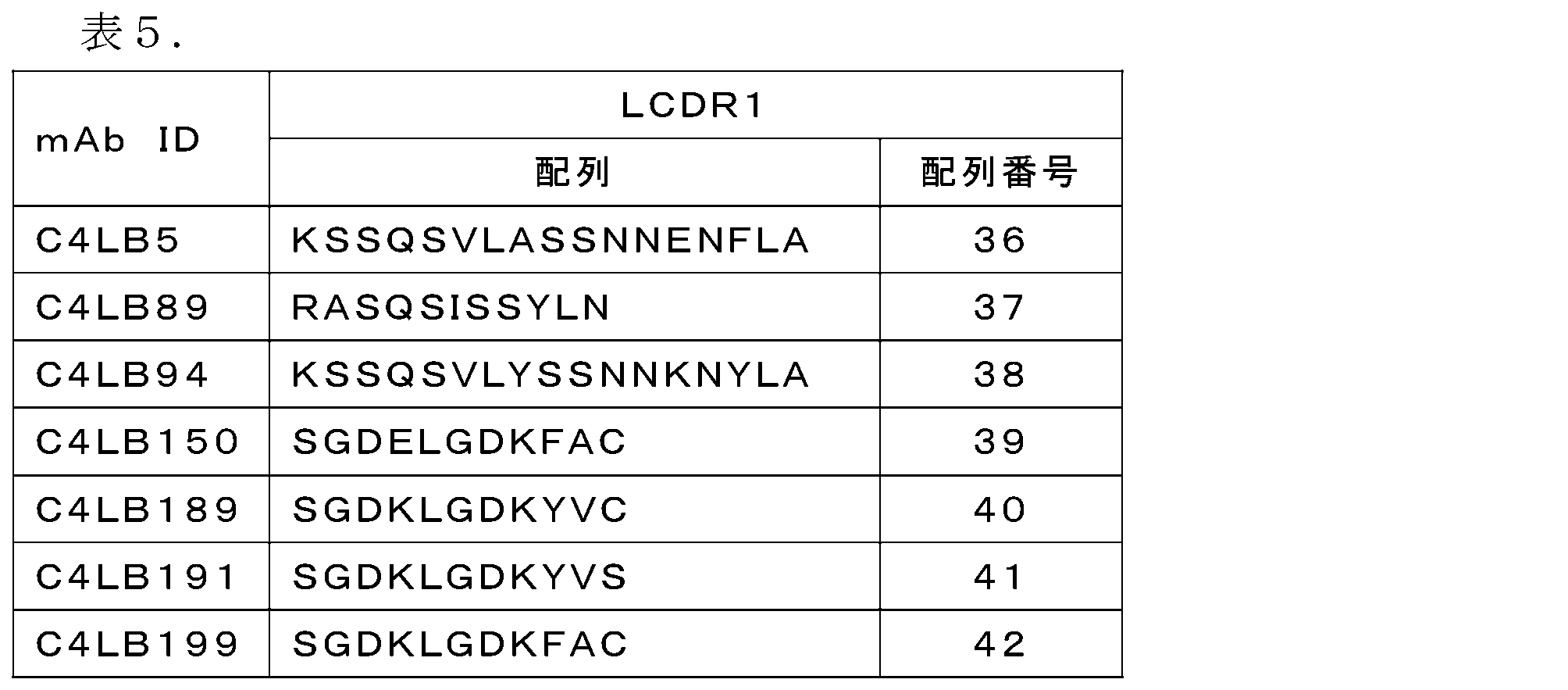

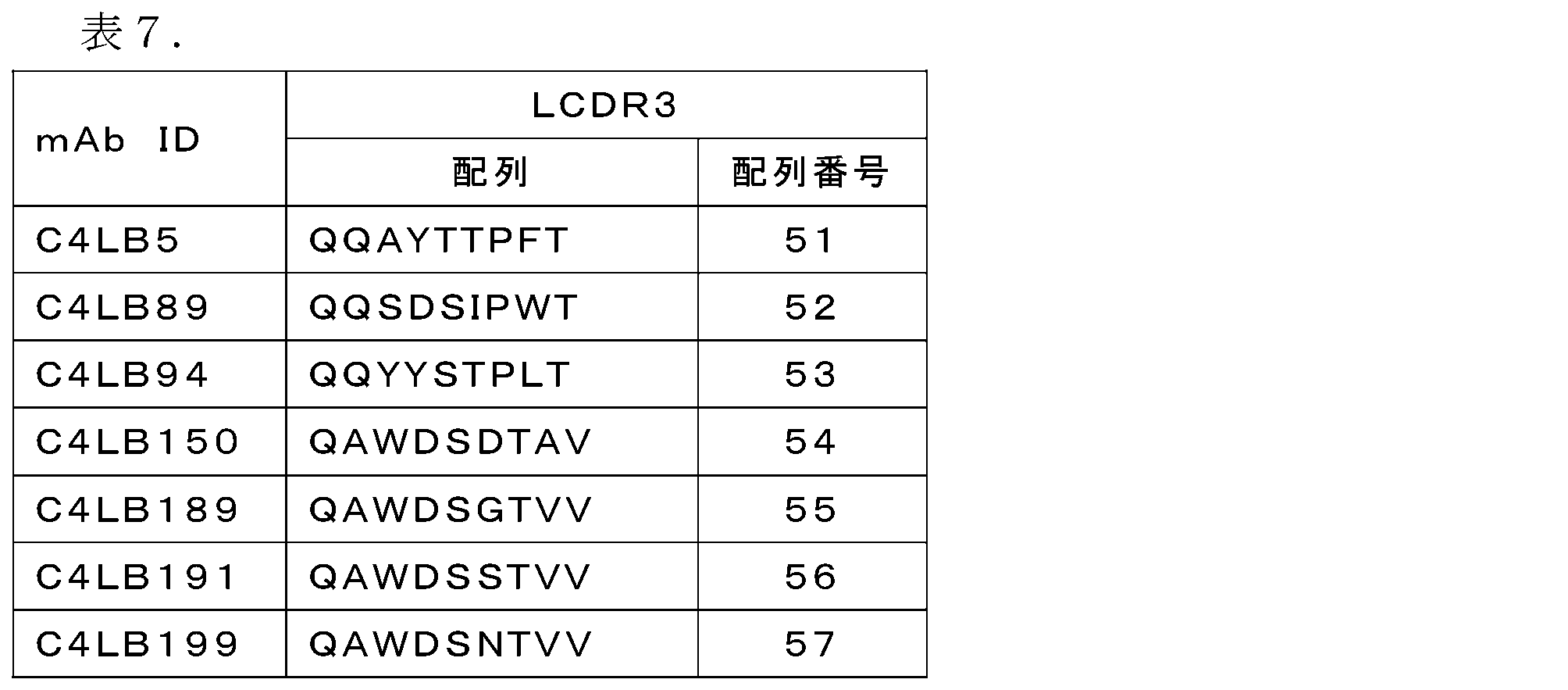


NF-κB SEAPレポーター遺伝子アッセイを用い測定されたとおり、抗体は、Jurkat細胞(表10中、D1.1 Jurkat細胞)により提供される内因性CD154及び組換えにより発現されたヒトCD154三量体(shCD154-ILZ又はshCD154-hisとして発現)のいずれについても機能を阻害した。抗体は、0.08~21.15nMの範囲のIC50値でシグナル伝達を阻害された。アッセイにおいてスクリーニングされた抗体のIC50を表10に示す。表中、各抗体についてのIC50値の範囲は、別個の実験より得られたIC50値のうち最低値と最高値を表す一方、単一の値は、その抗体に対し行われた実験が1回であったこと、あるいは得られた有効なIC50値が1つのみであったことを意味する。 As measured using the NF-κB SEAP reporter gene assay, the antibodies were endogenous CD154 provided by Jurkat cells (D1.1 Jurkat cells in Table 10) and human CD154 trimer expressed by recombination (D1.1 Jurkat cells). (Expressed as shCD154-ILZ or shCD154-his) inhibited function. The antibody inhibited signal transduction with an IC50 value in the range 0.08-21.15 nM. The IC50s of the antibodies screened in the assay are shown in Table 10. In the table, the range of IC50 values for each antibody represents the lowest and highest IC50 values obtained from separate experiments, while single values are for the experiments performed on that antibody. It means that it was once, or that only one valid IC50 value was obtained.

DC活性化についてのマーカーとしてIL-12p40分泌を用い、抗体の、樹状細胞活性化阻害能を評価した。抗体は、0.02~0.49nMの範囲のIC50値でJurkat細胞により提供される内因性CD154により誘導されるDC活性化を阻害した。表11は、アッセイにおける、スクリーニングされた抗体のIC50値を示す。表中、IC50範囲は、2~4名の提供者に対し、1~6回繰り返した別個の実験から得られたIC50値のうち最低値と最高値を表す。 Using IL-12p40 secretion as a marker for DC activation, the antibody's ability to inhibit dendritic cell activation was evaluated. The antibody inhibited DC activation induced by endogenous CD154 provided by Jurkat cells with an IC50 value in the range of 0.02 to 0.49 nM. Table 11 shows the IC50 values of the screened antibodies in the assay. In the table, the IC50 range represents the lowest and highest IC50 values obtained from separate experiments repeated 1-6 times for 2-4 donors.
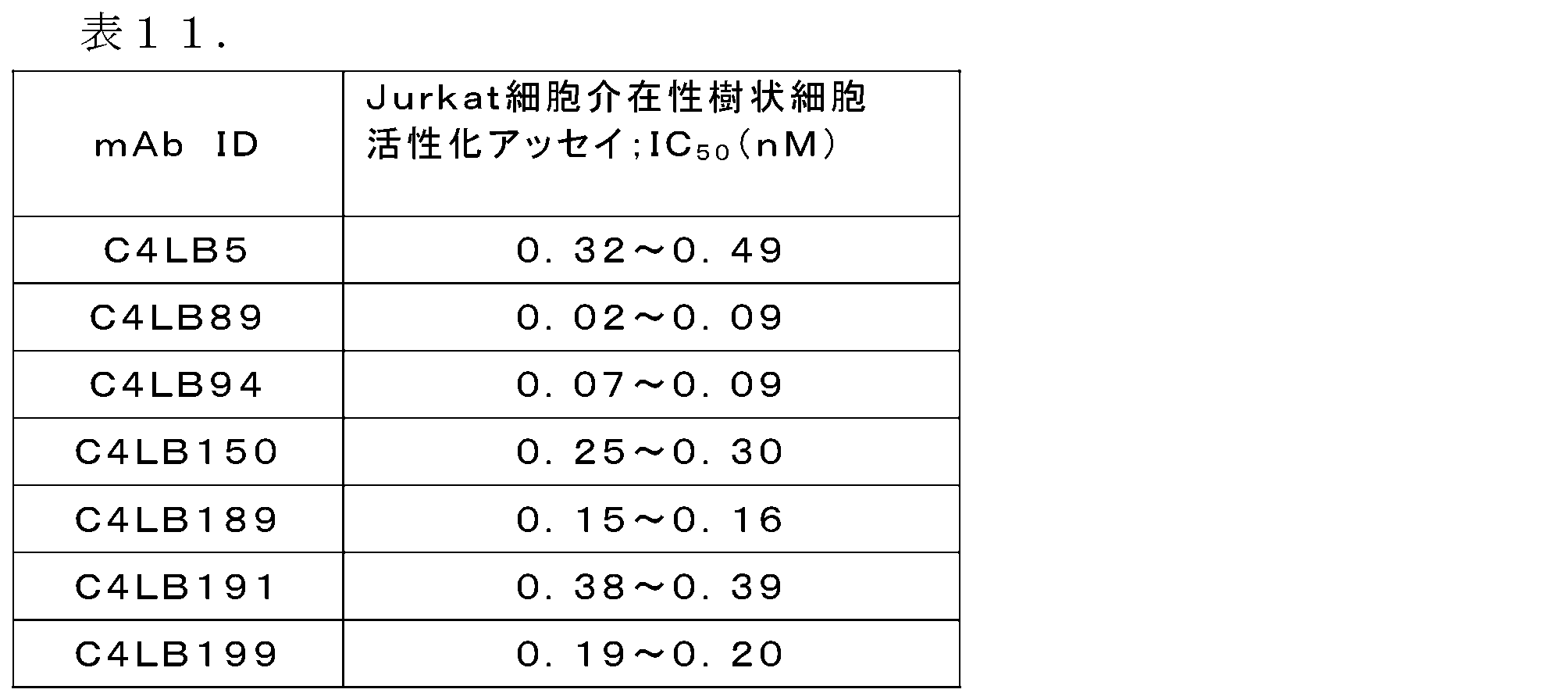
B細胞の増殖をリードアウトとして用い、かかる抗体のヒト又はカニクイザルB細胞活性化に対する阻害能を測定した。内因性CD154(D1.1 Jurkat細胞)及び組換ヒトCD154三量体(shCD154-ILZ)の両方を阻害した抗体では、0.01~5.35nMの範囲のIC50値で増殖が誘導された。表12は、ヒト又はカニクイザルB細胞活性化アッセイにおいて得られた様々な抗体についてのIC50値を示す。表中、IC50範囲は、2~4名の提供者に対し、1~6回繰り返した別個の実験から得られたIC50値のうち最低値と最高値を表す。表中、単一のIC50値は、得られた有効なIC50値が1つであったことを意味する。 B cell proliferation was used as a lead-out to measure the ability of such antibodies to inhibit human or cynomolgus monkey B cell activation. Antibodies that inhibited both endogenous CD154 (D1.1 Jurkat cells) and recombinant human CD154 trimer (shCD1544-ILZ) induced proliferation at IC50 values in the range 0.01-5.35 nM. .. Table 12 shows IC50 values for various antibodies obtained in human or cynomolgus monkey B cell activation assays. In the table, the IC50 range represents the lowest and highest IC50 values obtained from separate experiments repeated 1-6 times for 2-4 donors. In the table, a single IC50 value means that there was only one valid IC50 value obtained.

実施例5.翻訳後改変リスクを最小限に抑えるための抗体エンジニアリング
抗体C4LB89のVLは、LCDR2に推定脱アミノ化部位を含んでいた(軽鎖C4LL49中N52~S53,配列番号66)。VL中各位置(N52S及びS53T)に対する置換は別個に行った。変異した軽鎖を親重鎖C4LH165(配列番号59)と同時発現させて、抗体C4LB235及びC4LB236をIgG2σ/κとして作製した。C4LB235及びC4LB236のLCDR2及びVLのアミノ酸配列をそれぞれ表13及び表14に示す。C4LB235は、配列番号17、23、及び30のHCDR、配列番号37、49、及び52のLCDR、配列番号59のVH、並びに配列番号72のVLを含む。C4LB236は、配列番号17、23、及び30のHCDR、配列番号37、50、及び52のLCDR、配列番号59のVH、並びに配列番号73のVLを含む。
Example 5. Antibody engineering to minimize the risk of post- translational modification The VL of antibody C4LB89 contained a putative deamination site in LCDR2 (N52-S53 in light chain C4LL49, SEQ ID NO: 66). Substitutions for each position (N52S and S53T) in VL were performed separately. The mutated light chain was co-expressed with the parent heavy chain C4LH165 (SEQ ID NO: 59) to generate antibodies C4LB235 and C4LB236 as IgG2σ / κ. The amino acid sequences of LCDR2 and VL of C4LB235 and C4LB236 are shown in Tables 13 and 14, respectively. C4LB235 includes HCDRs of SEQ ID NOs: 17, 23, and 30, LCDRs of SEQ ID NOs: 37, 49, and 52, VHs of SEQ ID NO: 59, and VL of SEQ ID NO: 72. C4LB236 includes HCDRs of SEQ ID NOs: 17, 23, and 30, LCDRs of SEQ ID NOs: 37, 50, and 52, VHs of SEQ ID NO: 59, and VL of SEQ ID NO: 73.


両方の抗体を、カニクイザルB細胞の増殖に対する阻害能について試験した。C4LB235はC4LB89と同様の力価を示したのに対し、C4LB236は、C4LB89と比較して力価の低減を示した。 Both antibodies were tested for their ability to inhibit cynomolgus monkey B cell proliferation. C4LB235 showed the same titer as C4LB89, while C4LB236 showed a reduction in titer compared to C4LB89.
実施例6.エフェクター機能を欠失させた抗CD154抗体は血小板活性化を誘導しない
抗CD154抗体は、臨床における自己免疫疾患患者においてポジティブな結果伴い開発されてきたものの、血栓塞栓症(TE)が随伴することより、かかる抗体の更なる臨床開発は中断された。ヒト化5c8抗体(IgG1/κ)は、臨床的に誘導されたTEにおける抗CD154抗体である(Yazdany et al.,Lupus 13:377~380,2004)。ヒト化5c8により介在される血栓塞栓症(TE)は、Fcを血小板FcγRIIa受容体に結合させることにより血小板を架橋するハイオーダーでの抗CD154/CD154免疫複合体(IC)の形成による血小板活性化及び凝集の結果として生じることが仮定される。インビトロでは、FcγRIIa受容体結合能を欠いている機能欠失Fc(IgG1中D265A置換)を有するよう設計した5c8抗体は血小板を活性化させなかった(Xie et al.,J Immunol 192:4083~4092,2014)。
Example 6. Anti-CD154 antibody lacking effector function does not induce platelet activation Although anti-CD154 antibody has been developed with positive results in patients with clinical autoimmune disease, it is associated with thromboembolism (TE). Further clinical development of such antibodies has been suspended. The humanized 5c8 antibody (IgG1 / κ) is a clinically induced anti-CD154 antibody in TE (Yazday et al., Lupus 13: 377-380, 2004). Thromboembolism (TE) mediated by humanization 5c8 is platelet activation by the formation of a high-order anti-CD154 / CD154 immune complex (IC) that crosslinks platelets by binding Fc to the platelet FcγRIIa receptor. And it is assumed that it occurs as a result of agglomeration. In vitro, 5c8 antibodies designed to have a function-deficient Fc (D265A substitution in IgG1) lacking FcγRIIa receptor binding capacity did not activate platelets (Xie et al., J Immunol 192: 4083-4092). , 2014).
少なくともFcγRIIaに対する結合能が破壊されており、エフェクター機能が低下している抗CD154抗体は、したがって、TEのリスクを低減させた治療法としてより好適であり得る。 An anti-CD154 antibody with at least a disrupted binding ability to FcγRIIa and reduced effector function may therefore be more suitable as a therapeutic method that reduces the risk of TE.
最終的に、様々なFc置換によりエフェクター機能を欠失させた抗CD154抗体を作製し、血小板活性化に対するその効果を試験した。 Finally, anti-CD154 antibodies lacking effector function by various Fc substitutions were generated and tested for their effect on platelet activation.
ヒト化5c8抗体VH及びVL(Karpusas et al.,Structure 9:321~329,2001)を、IgG1σ/κ、IgG1σYTE/κ、IgG2σ/κ、又はIgG2σYTE/κとしてクローン化し、血小板活性化におけるFcの効果を評価した;得られた抗体は5c8IgG1σ、5c8IgG1σYTE、5c8IgG2σ、及び5c8IgG2σYTE)と命名した。IgG1σは、野生型IgG1と比較して置換L234A、L235A、G237A、P238S、H268A、A330S、及びP331Sを含む。IgG1σYTEは、L234A、L235A、G237A、P238S、M252Y、S254T、T256E H268A、A330S、及びP331Sという置換を含む。IgG2σは、V234A、G237A、P238S、H268A、V309L、A330S、及びP331Sという置換を含む。IgG2σYTEは、V234A、G237A、P238S、M252Y、S254T、T256E、H268A、V309L、A330S、及びP331Sという置換を含む。残基付番はEUインデックスに準拠する。IgG2σ骨格を有する抗体は、米国特許第8,961,967号に記載のとおりエフェクター機能及びFcγRに対する結合能を欠失している。YTE置換(M252Y、S254、T256E)はDall’Acqua et al.,J Biol Chem 281:23514~24,2006に記載されている。 Humanized 5c8 antibodies VH and VL (Karpus et al., Structure 9: 321-329, 2001) were cloned as IgG1σ / κ, IgG1σYTE / κ, IgG2σ / κ, or IgG2σYTE / κ and the Fc in platelet activation. The effect was evaluated; the resulting antibody was named 5c8IgG1σ, 5c8IgG1σYTE, 5c8IgG2σ, and 5c8IgG2σYTE). IgG1σ comprises substitutions L234A, L235A, G237A, P238S, H268A, A330S, and P331S as compared to wild-type IgG1. IgG1σYTE comprises the substitutions L234A, L235A, G237A, P238S, M252Y, S254T, T256E H268A, A330S, and P331S. IgG2σ comprises the substitutions V234A, G237A, P238S, H268A, V309L, A330S, and P331S. IgG2σYTE comprises the substitutions V234A, G237A, P238S, M252Y, S254T, T256E, H268A, V309L, A330S, and P331S. Residue numbering is based on the EU index. Antibodies with an IgG2σ skeleton lack effector function and ability to bind to FcγR as described in US Pat. No. 8,961,967. YTE substitutions (M252Y, S254, T256E) are described in Dollar'Acqua et al. , J Biol Chem 281: 23514-24, 2006.
それぞれ配列番号74及び75におけるヒト化5c8のVHドメイン及びVLドメインを示す。 The VH and VL domains of humanized 5c8 in SEQ ID NOs: 74 and 75 are shown, respectively.
配列番号74
qvqlvqsgaevvkpgasvklsckasgyiftsyymywvkqapgqglewigeinpsngdtnfnekfkskatltvdksastaymelsslrsedtavyyctrsdgrndmdswgqgtlvtvss
SEQ ID NO: 74
qvqlvqsgaevvkpgasvklskkasgyiftsyymywvkqappgqglewigeinpsngdtnfnekfkskattltsvdksastaymelsslsedtavyyctrdsdsd
配列番号75
divltqspatlsvspgeratiscrasqrvssstysymhwyqqkpgqppkllikyasnlesgvparfsgsgsgtdftltissvepedfatyycqhsweipptfgggtkleik
SEQ ID NO: 75
divrtqspartlsvspgeratiscrasqrvssstysymhwyqqkppgqppkllikyasnlesgvparfsgsgsgtdftltissvepttyycqhsweeppptffggt
血小板活性化における効果について、5c8IgG1σ、5c8IgG1σYTE、5c8IgG2σ、及び5c8IgG2σYTEを試験した。 5c8IgG1σ, 5c8IgG1σYTE, 5c8IgG2σ, and 5c8IgG2σYTE were tested for their effect on platelet activation.
shCD154単独に対する応答性の低さについて予めスクリーニングした健常なヒト提供者由来の血液を使用した。血小板の活性化は、有効性が確認されている血小板活性化マーカーPAC-1(活性化GPIIb/IIIa)及びCD62p(P-セレクチン)を用い、フローサイトメトリーにより評価した。簡潔に言うと、1mM CaCl2を含有させた改変タイロード-HEPES緩衝液に全血(WB)を添加した。抗PAC1及び抗CD62p抗体にFcγRIIaブロッキング抗体(クローンIV.3,StemCell Technologies#60012)を合わせて、又は合わせずに、かかる混合物に添加し、25分間インキュベートした。CD154:抗CD154のモル比を3:1で予め形成させた、可溶性CD154(PeproTech,カタログ番号310~02;配列番号4又はTonbo Biosciences、カタログ番号21~7088)/抗体の免疫複合体をかかる混合物に加え、さらに20分間インキュベートした。血小板を1%ホルマリンで固定した後、FACS解析を行った。各条件についての血小板活性化を、PAC-1及びCD62pを発現しているとしてゲーティングされた血小板の割合(%)(CD61陽性イベント)として評価した。5000 CD61を発現しているイベント(血小板)を捕捉し、各処理条件について解析した。実験結果を図1に示す。CD154/5c8IgG1(野生型IgG1)ICは血小板を活性化させたのに対し、5c8-IgG1σ、5c8IgG1σYTE、5c8IgG2σ、及び5c8IgG2σ-YTEを有するCD154 ICは血小板を活性化させなかった。ADPによる血小板活性化は、免疫複合体により阻害されなかった(データ非掲載)。単独で血小板を活性化させた抗体はなかった(データ非掲載)。 Blood from healthy human donors pre-screened for poor responsiveness to shCD154 alone was used. Platelet activation was evaluated by flow cytometry using platelet activation markers PAC-1 (activated GPIIb / IIIa) and CD62p (P-selectin), which have been confirmed to be effective. Briefly, whole blood (WB) was added to modified Tyrode-HEPES buffer containing 1 mM CaCl 2 . FcγRIIA blocking antibody (clone IV.3, StemCell Technologies # 60012) was added to the mixture with or without anti-PAC1 and anti-CD62p antibodies and incubated for 25 minutes. CD154: Soluble CD154 (PeproTech, Catalog Nos. 310-02; SEQ ID NO: 4 or Tonbo Biosciences, Catalog Nos. 21-7588) / antibody immune complex preformed at a molar ratio of anti-CD154 of 3: 1 to such a mixture. In addition, it was incubated for an additional 20 minutes. After fixing the platelets with 1% formalin, FACS analysis was performed. Platelet activation for each condition was evaluated as the percentage of platelets gated as expressing PAC-1 and CD62p (CD61 positive event). Events (platelets) expressing 5000 CD61 were captured and analyzed for each treatment condition. The experimental results are shown in FIG. The CD154 / 5c8IgG1 (wild-type IgG1) IC activated platelets, whereas the CD154 IC with 5c8-IgG1σ, 5c8IgG1σYTE, 5c8IgG2σ, and 5c8IgG2σ-YTE did not activate platelets. Platelet activation by ADP was not inhibited by immune complexes (data not shown). No antibody activated platelets alone (data not shown).
抗CD154抗体のC4LB5、C4LB89、C4LB94、C4LB150、C4LB189、C4LB191、C4LB199(全てのIgG2σはエフェクターを欠失しているmAbである)を血小板活性化アッセイでも試験して、かかる抗体ではFcγRIIaに対する結合能が破壊されていること、並びに血小板を活性化しなかったことを確認した。図2は、C4LB5、C4LB89、C4LB150、C4LB189、C4LB191、又はC4LB199と複合体を形成しているCD154の免疫複合体は血小板を活性化できないことを実証する実験結果を示す。CD154/C4LB94 ICは血小板に対しPAC-1を誘導した。結果は、概して、IgG1σ、IgG1σYTE、IgG2σ、又はIgG2σYTEアイソタイプを有する抗CD154抗体が、血小板を活性化し得ないこと、ひいては野生型IgG1をもつ抗体よりも安全性プロファイルが改善されていることを実証する。 Anti-CD154 antibodies C4LB5, C4LB89, C4LB94, C4LB150, C4LB189, C4LB191, C4LB199 (all IgG2σ are effector-deficient mAbs) were also tested in a platelet activation assay and their ability to bind to FcγRIIA in such antibodies. It was confirmed that the antibody was destroyed and that the platelets were not activated. FIG. 2 shows experimental results demonstrating that the immune complex of CD154 forming a complex with C4LB5, C4LB89, C4LB150, C4LB189, C4LB191, or C4LB199 cannot activate platelets. CD154 / C4LB94 IC induced PAC-1 on platelets. The results generally demonstrate that anti-CD154 antibodies with the IgG1σ, IgG1σYTE, IgG2σ, or IgG2σYTE isotypes are unable to activate platelets and thus have an improved safety profile over antibodies with wild-type IgG1. ..
実施例7:アイソタイプのスイッチングが抗体特性に及ぼす効果
抗体C4LB89の可変領域を、IgG1σ/及びIgG1σYTEアイソタイプとしてクローン化して、機能性及び開発有効性(developability)における潜在的な差異を評価した。新しい抗体をC4LB231(IgG1σ)及びC4LB232(IgG1σYTE)と命名した。
Example 7: Effect of Isotype Switching on Antibody Properties The variable region of antibody C4LB89 was cloned as IgG1σ / and IgG1σYTE isotypes to assess potential differences in functionality and development efficacy. The new antibodies were named C4LB231 (IgG1σ) and C4LB232 (IgG1σYTE).
得られるIgG1σ及びIgG1σYTE抗体をそれらの機能性について親抗体と比較した。C4LB231及びC4LB232の機能は親C4LB89と同等であった。表15は、表中に示すとおりの機能性アッセイにおける各抗体のIC50値又はIC50値範囲を示す。表中、IC50範囲は、2~4名の提供者に対し、1~6回繰り返した実験から得られたIC50値のうち最低値と最高値を表す。表中、単一のIC50値は、得られた有効なIC50値が1つであったことを意味する。 The obtained IgG1σ and IgG1σYTE antibodies were compared to the parent antibody for their functionality. The functions of C4LB231 and C4LB232 were equivalent to those of the parent C4LB89. Table 15 shows the IC50 value or IC50 range of each antibody in the functional assay as shown in the table. In the table, the IC50 range represents the lowest and highest IC50 values obtained from experiments repeated 1 to 6 times for 2 to 4 donors. In the table, a single IC50 value means that there was only one valid IC50 value obtained.

C4LB231及びC4LB232についても血小板に対するそれらの効果を試験した。shCD154:C4LB231又はshCD154:C4LB232 ICのいずれも、ベースラインを超えて血小板を活性化しない。CD154/5c8IgG1 ICは血小板を活性化し、この活性化はIV.3の存在下では阻害されたことから、血小板活性化はICのFcγRIIaに対する結合により介在されることが実証された。図3は実験結果を示す。 C4LB231 and C4LB232 were also tested for their effect on platelets. Neither shCD154: C4LB231 nor shCD154: C4LB232 IC activates platelets above baseline. CD154 / 5c8IgG1 IC activates platelets, which activation is IV. Inhibition in the presence of 3 demonstrated that platelet activation was mediated by the binding of IC to FcγRIIa. FIG. 3 shows the experimental results.
実施例8.抗CD154抗体は高親和性でヒトCD154に結合する
ProteOnを用い、実施例1に記載のとおり親和性測定を行った。会合速度(on-rate)、解離速度(off-rate)及び親和性を表16に示す。この表中に報告したパラメーターは、2相結合モデルを適用したC4LB94及びC4LB150を除き全てのサンプルについてラングミュア型の1:1結合モデルにより得られた。
Example 8. As the anti-CD154 antibody, ProteOn, which has high affinity and binds to human CD154, was used, and the affinity was measured as described in Example 1. The associative rate (on-rate), dissociation rate (off-rate) and affinity are shown in Table 16. The parameters reported in this table were obtained by the Langmuir-type 1: 1 binding model for all samples except C4LB94 and C4LB150 to which the two-phase binding model was applied.

実施例9.マーモセットCD154とC4LB89との複合体の結晶構造
X線結晶構造解析を用い、抗体C4LB89のエピトープを同定した。Hisタグを付与したC4LB89のFab断片と、Hisタグを付与した可溶型のマーモセットCD40L(smCD154-his)とをHEK293 GnTI細胞で発現させて、親和性及びサイズ排除クロマトグラフィーを用い精製した。smCD154:C4LB89複合体を4℃で終夜インキュベートし、濃縮し、サイズ排除クロマトグラフィーを用いて複合体を形成していない分析種から分離した。16% PEG 3350、0.2M クエン酸アンモニウム、0.1M MES(pH6.5)を含む溶液から蒸気拡散法によりこの複合体を結晶化した。この結晶は162.1Åの単位格子乗数で立方晶系空間群P213に属する。複合体の構造は、検索モデルとしてC4LB89 Fab及びCD40L(PDB entry 1ALY)の結晶構造を用いる分子置換モデルにより決定した。
Example 9. Crystal Structure of Complex of Marmoset CD154 and C4LB89 X-ray crystal structure analysis was used to identify the epitope of antibody C4LB89. A Fab fragment of C4LB89 with a His tag and a soluble marmoset CD40L (smCD154-his) with a His tag were expressed in HEK293 GnTI cells and purified using affinity and size exclusion chromatography. The smCD154: C4LB89 complex was incubated overnight at 4 ° C., concentrated and separated from uncomplexed analytes using size exclusion chromatography. The complex was crystallized by steam diffusion from a solution containing 16% PEG 3350, 0.2M ammonium citrate, 0.1M MES (pH 6.5). This crystal belongs to the cubic space group P2 13 with a unit cell multiplier of 162.1 Å. The structure of the complex was determined by a molecular replacement model using the crystal structures of C4LB89 Fab and CD40L (PDB entry 1ALY) as search models.
smCD154:C4LB89複合体は、結晶学的な3回軸に位置する、対称性の三量体である。C4LB89は、細胞表面からの末端の2つのサブユニットとの接触面でmCD154に結合する。エピトープは、2つのCD154サブユニットのそれぞれから8残基ずつ、16残基を含む。エピトープの残基は、第1のCD154サブユニットにおいてE182、S185、Q186、A187、P188、S214、A215、及びR207と、第2のCD154サブユニットにおいてT176、F177、C178、Q220、S248、H249、G250、及びF253と、を含む。エピトープの残基付番は配列番号1の完全長のヒトCD154に準拠する。パラトープは、CD154残基から4Å以内の抗体残基として定義した。C4LB89の抗原結合部位は、C4LB89の重鎖のうち9残基:HCDR1からS31、及びY32と、HCDR2からS52、I54、F55、及びN57と、HCDR3からR100、Y101、及びY102と、を含む。パラトープの残基付番は、配列番号59のC4LB89 VHに準拠する。軽鎖はmCD154との接触には関与しない。接触数から、HCDR2におけるF55は重要な抗原認識要素である。F55は、CD154残基T176、F177、C178、Q220、S248、H249、G250、及びF253を接触させる。HCDR3残基Y101及びY102も結合に関与する。図4はHCDR2及びHCDR3の接触残基と、LCのCD154に対する結合能の欠失とを示す。図5は、エピトープ及びパラトープの残基についてカトゥーンを示す。 The smCD154: C4LB89 complex is a symmetric trimer located on the crystallographic triaxial axis. C4LB89 binds to mCD154 at the contact surface with the two subunits at the ends from the cell surface. The epitope contains 16 residues, 8 residues from each of the 2 CD154 subunits. The residues of the epitope are E182, S185, Q186, A187, P188, S214, A215, and R207 in the first CD154 subunit and T176, F177, C178, Q220, S248, H249 in the second CD154 subunit. Includes G250 and F253. The residue numbering of the epitope is based on the full-length human CD154 of SEQ ID NO: 1. The paratope was defined as an antibody residue within 4 Å of the CD154 residue. The antigen binding site of C4LB89 comprises 9 residues of the heavy chain of C4LB89: HCDR1 to S31 and Y32, HCDR2 to S52, I54, F55 and N57, and HCDR3 to R100, Y101 and Y102. The residue numbering of the paratope conforms to C4LB89 VH of SEQ ID NO: 59. The light chain is not involved in contact with mCD154. From the number of contacts, F55 in HCDR2 is an important antigen recognition factor. F55 contacts CD154 residues T176, F177, C178, Q220, S248, H249, G250, and F253. HCDR3 residues Y101 and Y102 are also involved in binding. FIG. 4 shows the contact residues of HCDR2 and HCDR3 and the deletion of the binding ability of LC to CD154. FIG. 5 shows cartoons for epitopes and paratope residues.
ヒト及びマーモセットの可溶性CD154タンパク質間の違いは、アミノ酸にしてわずか8残基であった。全てのmCD154 C4LB89エピトープ残基はヒトにおいて保存されている。したがって、エピトープはマーモセット及びヒトのCD154間で保存されていることが期待される。ヒト及びマーモセットの完全長のCD154タンパク質のアラインメントを図6に示す。 The difference between the soluble CD154 proteins in humans and marmosets was only 8 residues in amino acids. All mCD154 C4LB89 epitope residues are conserved in humans. Therefore, the epitope is expected to be conserved between marmosets and human CD154. The alignment of the full-length CD154 protein for humans and marmosets is shown in FIG.
実施例10.抗CD154抗体による血小板活性化はエピトープに依存する
C4LB89可変領域(配列番号59のVH及び配列番号66のVL)をIgG1/κとしてクローン化し、C4LB237抗体を得た。実施例1に記載のとおりにProteOnを用いて測定したとき、C4LB237はヒトCD154(表17)結合能を保持していることが確認された。C4LB237のヒトCD154に対する親和性は23.6±5.4pMであった。IgG2σ由来のC4LB89から誘導されるVH/VLのアイソタイプのIgG1へのスイッチは、得られた抗体の結合親和性を変えるようである。
Example 10. Platelet activation by anti-CD154 antibody cloned the epitope-dependent C4LB89 variable region (VH of SEQ ID NO: 59 and VL of SEQ ID NO: 66) as IgG1 / κ to obtain C4LB237 antibody. When measured using ProteOn as described in Example 1, it was confirmed that C4LB237 retains the human CD154 (Table 17) binding ability. The affinity of C4LB237 for human CD154 was 23.6 ± 5.4 pM. Switching the VH / VL isotype to IgG1 derived from IgG2σ-derived C4LB89 appears to alter the binding affinity of the resulting antibody.
期待されたとおり、C4LB237はヒトFcγRIIa及びFcγRIIIaに対し、それぞれKD0.994μM及び0.146μMで結合した。C4LB237は、NF-κB SEAPレポーター遺伝子アッセイにおいて、shCD154-hisを使用してシグナル伝達を誘導した場合に、C4LB231と同等の力価を示し、かつC4LB89を上回る力価を示した(表18)。 As expected, C4LB237 bound to human FcγRIIa and FcγRIIIa at KD 0.994 μM and 0.146 μM, respectively. C4LB237 showed a titer equivalent to that of C4LB231 and a titer higher than that of C4LB89 when signaling was induced using shCD154-his in the NF-κB SEAP reporter gene assay (Table 18).
C4LB237を血小板活性化に対する効果について試験した。図7に示すとおり、shCD154:C4LB237 ICはベースラインを超えて血小板を活性化しなかった。この結果から、Fcに加えて抗体のエピトープが抗体の血小板活性化能の有無に関係することが示唆された。 C4LB237 was tested for its effect on platelet activation. As shown in FIG. 7, shCD154: C4LB237 IC did not activate platelets above baseline. From this result, it was suggested that the epitope of the antibody in addition to Fc is related to the presence or absence of the platelet activation ability of the antibody.
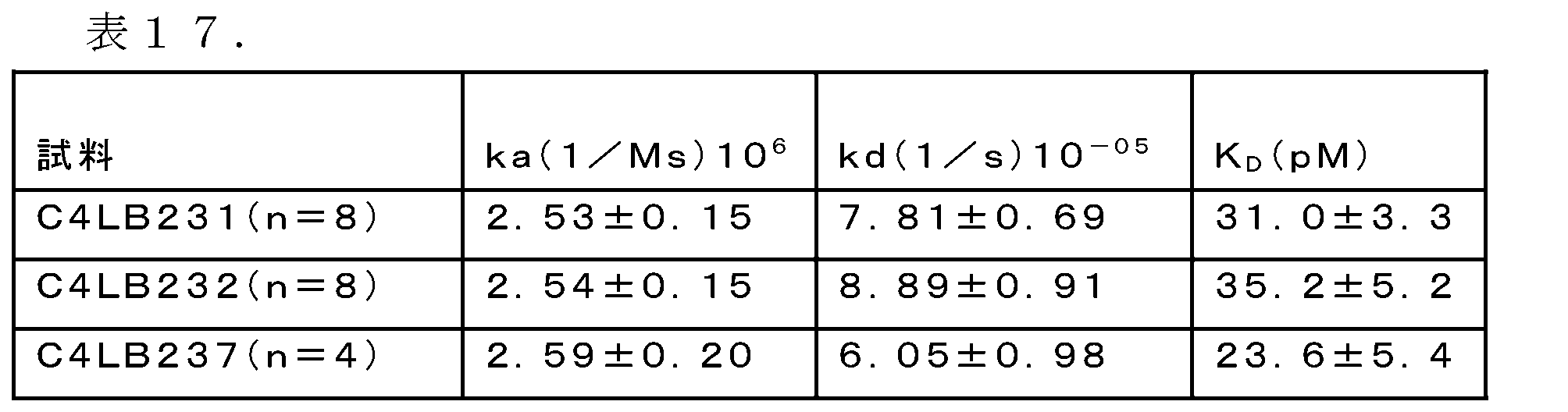
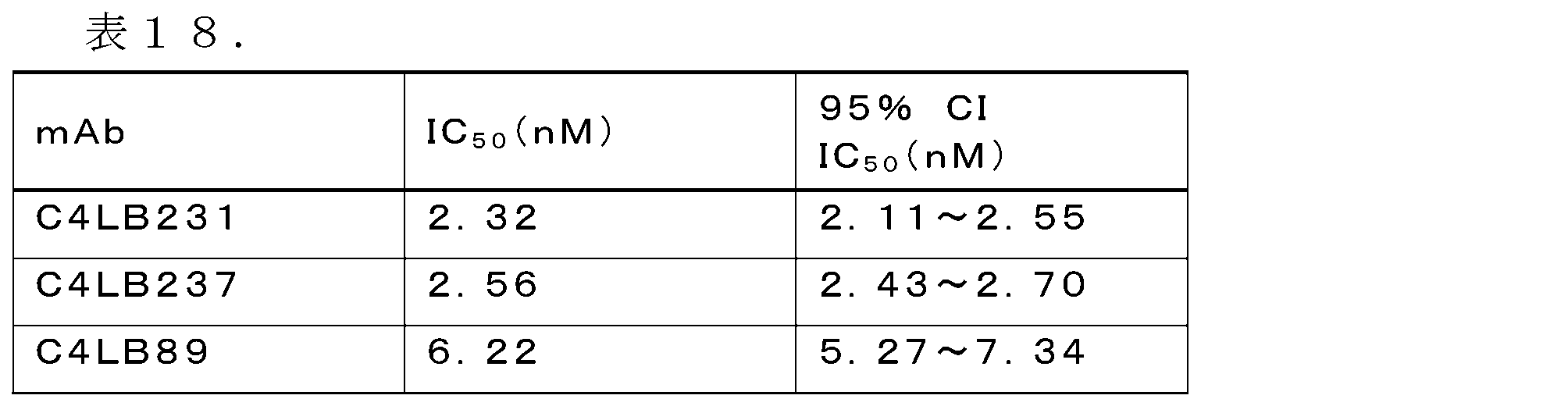
実施例11.C4LB89における中立変異の設計
CD154と複合体を形成しているC4LB89の結晶構造解析により、C4LB89のCDRにおける、複合体の全体構造に影響を及ぼさずに変異を導入可能であり、ひいてはC4LB89抗体の特性に影響しないことが予想される部分が明らかとなった。軽鎖CDRにおけるこれらの中立変異を表19に掲載し、重鎖CDRについては表20に掲載する。変異を導入可能な残基付番を、各CDR及びVL又はVHの両方に対し示す。例えば、配列番号37のLCDR1上の残基Q4(RASQSISSYLN)は、抗体の特性を実質的に変化させずにA、C、D、E、F、G、H、I、K、L、M、N、R、S、T、V、W、又はYへと変異誘導可能である。配列番号66のVLにおける対応する残基はQ27である。
Example 11. Design of Neutral Mutations in C4LB89 By crystal structure analysis of C4LB89 forming a complex with CD154, it is possible to introduce mutations in the CDR of C4LB89 without affecting the overall structure of the complex, and thus the characteristics of the C4LB89 antibody. It became clear that the part that is not expected to affect. These neutral mutations in light chain CDRs are listed in Table 19, and heavy chain CDRs are listed in Table 20. The residue numbering into which the mutation can be introduced is shown for each CDR and both VL or VH. For example, residue Q4 (RASQSISSYLN) on LCDR1 of SEQ ID NO: 37 does not substantially alter the properties of the antibody, A, C, D, E, F, G, H, I, K, L, M, Mutations can be induced to N, R, S, T, V, W, or Y. The corresponding residue in VL of SEQ ID NO: 66 is Q27.
表19又は表20に示す変異は、標準法を用い、単一のものとして、あるいは組み合わせてC4LB89に対しなすことができる。得られるVH/VL対を、本明細書に記載の方法を用いて発現させ、変異を導入した抗体を単離し、特性評価する。 The mutations shown in Table 19 or Table 20 can be made to C4LB89 as a single unit or in combination using standard methods. The resulting VH / VL pair is expressed using the method described herein, the mutant-introduced antibody is isolated and characterized.


実施例12.血小板活性化及びよりハイオーダーの免疫複合体形成の評価
Fab領域と、C4LB231及び5C8IgG1のshCD154との結晶構造データの評価、SC-HPLC及びDLSによる上記の実験、並びに血小板活性化データのレビューに関する評価をもとに、抗CD154抗体とshCD154三量体との結合におけるわずかな差が、ハイオーダーの免疫複合体形成を促進し得るとの仮説を立てた。1)C4LB231 Fabは、sCD154三量体の2つのサブユニット間に結合する一方で、5C8 Fabは、sCD154の1つのサブユニットに結合する。2)C4LB231 Fabは、5c8 Fabと比較して、立体構造がより安定であり、かつ3)抗CD154抗体とのsCD154結合角度がより安定なようである。
Example 12. Evaluation of Platelet Activation and Higher Order Immunocomplex Formation Evaluation of Crystal Structure Data with Fab Region and shCD154 of C4LB231 and 5C8IgG1, Evaluation of Above Experiments by SC-HPLC and DLS, and Review of Platelet Activation Data Based on this, it was hypothesized that a slight difference in binding between the anti-CD154 antibody and the shCD154 trimer could promote high-order immunoconjugate formation. 1) The C4LB231 Fab binds between two subunits of the sCD154 trimer, while the 5C8 Fab binds to one subunit of sCD154. 2) C4LB231 Fab seems to have a more stable three-dimensional structure and 3) more stable sCD154 binding angle with anti-CD154 antibody compared to 5c8 Fab.
抗体のエピトープの介在する血小板活性化の役割、及びハイオーダーでのshCD154との免疫複合体形成をさらに評価する目的で、様々な抗CD154抗体のVH及びVLをクローン化し、Fcの機能を欠失させたIgG2σ及びIgG1σアイソタイプとして、又はIgG1として発現させた。作製された抗体を表21に示す。実施例6に記載のとおりに血小板活性化アッセイを行った。サイズ排除高性能液体クロマトグラフィー(SE-HPLC)及び動的光散乱(DLS)による、よりハイオーダーでの免疫複合体形成についての評価にあたり、モル濃度比1:1(あるいは10:10とも表記可能)及び10:1で抗体をshCD154と複合体化させて、免疫複合体形成における濃度依存性の差異が存在するかを評価した。 VH and VL of various anti-CD154 antibodies were cloned and Fc function deleted for the purpose of further evaluating the role of platelet activation mediated by antibody epitopes and immune complex formation with shCD154 at high order. It was expressed as an IgG2σ and IgG1σ isotype or as IgG1. The antibodies produced are shown in Table 21. A platelet activation assay was performed as described in Example 6. Size exclusion For evaluation of higher order immune complex formation by high performance liquid chromatography (SE-HPLC) and dynamic light scattering (DLS), the molar concentration ratio can be expressed as 1: 1 (or 10:10). ) And 10: 1 the antibody was complexed with shCD154 to assess the presence of concentration-dependent differences in immune complex formation.

配列番号84 C4LB119のVH
QVQLVQSGAEVKKPGSSVKVSCKASGGTFSSYYISWVRQAPGQGLEWMGAIDPYFGYANYAQKFQGRVTITADESTSTAYMELSSLRSEDTAVYYCARTGLNYGGFDYWGQGTLVTVSS
VH of SEQ ID NO: 84 C4LB119
QVQLVQSGAEVKKPGSSVKVSCKASGGGTFSSYYISWVRQAPGQGLEWMGAIDPYFGYANYAQKFQGRVTIDATDESTSTAYMELLSSLDTAVYYCARTGLNYGGFDYWGQGT
配列番号85 C4LB119のVL
EIVLTQSPATLSLSPGERATLSCRASQSVSSYLAWYQQKPGQAPRLLIYDASNRATGIPARFSGSGSGTDFTLTISSLEPEDFAVYYCQQRSNWPLTFGQGTKVEIK
VL of SEQ ID NO: 85 C4LB119
EIVLTQSPARSLSPGERATTLSCRASQSVSSYLAWYQQKPGQAPRLLLIYDASNRATGIPARFSGSGSGTDFTLTISSLEPEDFAVYYCQQRSNWPLTFGQGTKVEIK
配列番号86 C4LB83のVH
QVQLVQSGAEVKKPGSSVKVSCKASGGTFSSYAISWVRQAPGQGLEWMGWIIPIFGNTNYAQKFQGRVTITADESTSTAYMELSSLRSEDTAVYYCAREKDFRGYTKLDYWGQGTLVTVSS
VH of SEQ ID NO: 86 C4LB83
QVQLVQSGAEVKKPGSSVKVSCKASGGTGTFSSYAISWVRQAPGQGLEWMGWIIPIFGNTNYAQKFQGRVTIDATDESTSTAYMELLSSLDTAVYYCAREKDFRGYTKLDYWGQGT
配列番号87 C4LB83のVL
DIQMTQSPSSLSASVGDRVTITCRASQSINNWLNWYQQKPGKAPKLLIYAASSLQSGVPSRFSGSGSGTDFTLTISSLQPEDFATYYCQQSFSFPYTFGQGTKVEIK
VL of SEQ ID NO: 87 C4LB83
DIQMTQSLSLSVSVGDRVTITCRASSQSINNNWLNWYQQKPGKAPKLLIYAASSSLQSGVPSRFSGSGSGSGTDFTLSSLQPEDFATYYCQQSFSFPYTFGQGTKVEIK
実施例1に記載のプロトコルを用いて、C4LB83及びC4LB119の結合特性と機能性を評価し、表22に示す。 The binding properties and functionality of C4LB83 and C4LB119 were evaluated using the protocol described in Example 1 and are shown in Table 22.

方法
SE-HPLC
表21に示す抗体と、Alexafluo-448標識shCD154との免疫複合体を、110μLの1xPBSで、抗体:shCD154のモル比を1:1及び10:1で調製し、37℃で30分間インキュベートした。各測定にあたり、5μgのAF488標識shCD154と、15μg(1:1比)又は150μg(10:1比)の抗CD154mAbとを含有する100μLの各サンプルをカラムに注入した(Agilent,1100/1200システム)。標準の保持時間をもとに分子量を計算した(Bio-Rad)。タンパク質の分子量と保持時間との関係は次式を満たす。
log(M)=b-cT,
式中、Mは分子量であり、Tは保持時間であり、かつb及びcは定数である。log(M)及びTの線形曲線(linear curve)は、R2=0.9928とした最小二乗法により標準SE-HPLCクロマトグラムから得た。
Method SE-HPLC
Immune complexes of the antibodies shown in Table 21 with Alexafluo-448-labeled shCD154 were prepared in 110 μL 1xPBS at 1: 1 and 10: 1 molar ratios of antibody: shCD154 and incubated at 37 ° C. for 30 minutes. For each measurement, 100 μL of each sample containing 5 μg of AF488-labeled shCD154 and 15 μg (1: 1 ratio) or 150 μg (10: 1 ratio) of anti-CD154 mAb was injected into the column (Agilent, 1100/1200 system). .. The molecular weight was calculated based on the standard retention time (Bio-Rad). The relationship between the molecular weight of a protein and the retention time satisfies the following equation.
log (M) = bcT,
In the formula, M is the molecular weight, T is the retention time, and b and c are constants. The linear curves of log (M) and T were obtained from the standard SE-HPLC chromatogram by the method of least squares with R2 = 0.9928.
DLS
DLS測定は、光散乱の原理と、分子運動又はブラウン運動とに基づくものである。ブラウン運動、典型的には、溶液中の分子挙動は、相の内外の両方で光散乱を招き、建設的干渉及び破壊的干渉を生じる。その結果が、時間に伴う散乱光の強度の変動である。DLS又はQELS(順弾性光散乱)解析中、散乱光強度におけるこの時間依存性の変動は高速光子カウンターにより捕捉される。この変動は、分散速度に正比例する。ストークス・アインシュタインの式を用いた相関データの分析により、流体力学的半径を得た。サンプルの分析により単量体及び二量体を識別可能なSEC-MALS又はSECとは異なり、DLSは約4のサイズファクター(size factor)により分類される分析種の分析のみが可能であり、したがって、単量体及び四量体が分析されはじめる。しかしながら、単量体と二量体とは識別されず、混合物の重量平均が報告されることになる。
DLS
The DLS measurement is based on the principle of light scattering and molecular motion or Brownian motion. Brownian motion, typically molecular behavior in solution, causes light scattering both inside and outside the phase, resulting in constructive and destructive interference. The result is a change in the intensity of scattered light over time. During DLS or QELS (forward elastic light scattering) analysis, this time-dependent variation in scattered light intensity is captured by a fast photon counter. This variation is directly proportional to the dispersion rate. The hydrodynamic radius was obtained by analysis of the correlation data using Stokes-Einstein's equation. Unlike SEC-MALS or SEC, where monomers and dimers can be identified by sample analysis, DLS can only be analyzed for analytical species classified by a size factor of about 4. , Monomers and tetramers begin to be analyzed. However, the monomer and dimer are not distinguished and the weight average of the mixture will be reported.
ストークス・アインシュタインの式:Rh=kT/6πηD;式中、
D=拡散係数、
k=ボルツマン定数
T=温度
η=粘度
Stokes-Einstein's equation: R h = kT / 6πηD;
D = diffusion coefficient,
k = Boltzmann constant T = temperature η = viscosity
10μMの抗体単独、又は表21に示す抗体とshCD154との免疫複合体、及び、抗体:shCD154(10μM抗体と1μM又は10μM shCD154のいずれか)のモル濃度10:1又は10:10でPBSで調製した。全てのサンプルは、バイアルインサート(ポリマーフィートを施した250μLの不活性化ガラス,Agilentカタログ番号5181~8872)を入れたガラスバイアルで調製し、PBS、mAb、shCD154の順でサンプルを加えた。サンプルを穏やかにボルテックスにかけて混合した後、rocking(Nutating Mixer(VWR)約30rev/minで室温で23時間インキュベートした。必要な場合、標準法を用い最初に抗体を濃縮した。 Prepared with PBS at a molar concentration of 10 μM antibody alone, or an immune complex of the antibody shown in Table 21 with shCD154, and antibody: shCD154 (either 10 μM antibody and 1 μM or 10 μM shCD154). bottom. All samples were prepared in glass vials containing vial inserts (250 μL Inactivated Glass with Polymer Feet, Agilent Catalog Nos. 5181-8872), and the samples were added in the order PBS, mAb, shCD154. The samples were gently vortexed and mixed, then incubated at room temperature for 23 hours at locking (Nutating Mixer (VWR) at about 30 rev / min. If necessary, antibodies were first concentrated using standard methods.
23℃にてDynaPro Plate Reader DLS機器(Wyatt Technologies Corporation)を使用し、全てのサンプルにおいて粒子径及び分析種分布(species distribution)を求めた。まずはBSAを用いDLSの一貫性を確認した(データ非掲載)。3重測定のため、3つのウェルのそれぞれに30μLのサンプルを入れ測定を行った。DynaProプレートリーダーでDLS測定値を取得した。各サンプルに対し25秒間のデータ取得を行った。レーザーの出力は装置により自動的に調節した。データ解析に使用するパラメーターには、PBSの粘度は、23℃下では1.019cPであるというものと、PBSの屈折率は589nm、かつ23℃下では1.333であるというものを含めた。プログラムには球状タンパク質モデルを使用した。シグナルを各ピークに割り当てた。ここで、ピーク1は0.1~10nm、ピーク2は10~100nm、ピーク3は100~1000nm、及びピーク4は1000~5000nmであった。サンプル中に沈殿物(形成される場合)が視認される場合、それについて記録した。Dynamicsソフトウェア(Wyatt Technology Inc.)を用いデータ解析を行った。質量%の分析種半径(Rh)に対するプロットを作製した。ピーク半径、多分散性、質量%、及び%強度を計算し、記録した。
Particle size and analytical species distribution were determined for all samples using a DynaPro Plate Reader DLS instrument (Wyatt Technologies Corporation) at 23 ° C. First, the consistency of DLS was confirmed using BSA (data not shown). For triple measurement, a 30 μL sample was placed in each of the three wells for measurement. DLS measurements were obtained with a DynaPro plate reader. Data acquisition was performed for 25 seconds for each sample. The laser output was automatically adjusted by the device. The parameters used for the data analysis included that the viscosity of PBS was 1.019 cP at 23 ° C and that the refractive index of PBS was 589 nm and 1.333 at 23 ° C. A globular protein model was used for the program. A signal was assigned to each peak. Here,
結果
血小板活性化
shCD154と、Fcを欠失させたIgG2σ若しくはIgG1σとして、又は野生型IgG1として発現させた抗体との免疫複合体による血小板活性化能を評価した。様々なIgG足場に対しクローン化した5c8抗体を対照として使用した。図3は、抗FcγRIIa抗体が5c8IgG1介在性の血小板活性化を阻害したことから、5c8IgG1:shCD154免疫複合体がFcγRIIaに依存した方法で血小板を活性化したことを示す。エフェクターを欠失させたFc、IgG1σ、又はIgG2σでクローン化した5c8 VH/VL領域は、それらの血小板活性化能を失っていた(図1)。これらの結果は、これまでに記載した内容と一致している。しかしながら、予想外にも、実施例10で実施した実験により、野生型IgG1抗体との免疫複合体(C4LBB237:shCD154)は血小板(図7)を活性化しないことが示され、可能性のある、エピトープに依存性の血小板活性化に研究をさらに進めた。
Results Platelet activation The ability of platelet activation by an immune complex of shCD154 and an antibody expressed as Fc-deficient IgG2σ or IgG1σ or as wild-type IgG1 was evaluated. 5c8 antibodies cloned against various IgG scaffolds were used as controls. FIG. 3 shows that the 5c8IgG1: shCD154 immune complex activated platelets in an FcγRIIa-dependent manner, as the anti-FcγRIIa antibody inhibited 5c8IgG1-mediated platelet activation. The effector-deficient Fc, IgG1σ, or IgG2σ cloned 5c8 VH / VL regions lost their platelet-activating ability (FIG. 1). These results are consistent with what has been described so far. However, unexpectedly, the experiments performed in Example 10 showed that the immune complex with the wild-type IgG1 antibody (C4LBB237: shCD154) did not activate platelets (FIG. 7), which may be possible. Further studies were conducted on epitope-dependent platelet activation.
エピトープ及び/又はFcが血小板活性化並びにハイオーダーでの免疫複合体の形成に対し及ぼす効果を評価することを目的として、4個の別個の抗体のVH/VL領域をIgG2σ、IgG1σ、又は野生型IgG1としてクローン化した。これまでに文献において開示されていることとは反対に、いくつかの場合では、血小板の活性化はFcγRIIa介在性の架橋とは独立して抗体のエピトープにより介在されることが判明した。 For the purpose of assessing the effects of epitopes and / or Fc on platelet activation and high-order immune complex formation, the VH / VL regions of four distinct antibodies were defined as IgG2σ, IgG1σ, or wild-type. It was cloned as IgG1. Contrary to what has been disclosed in the literature so far, in some cases platelet activation has been found to be mediated by antibody epitopes independently of FcγRIIa-mediated cross-linking.
図8A、図8B、及び図8Cに分析の要約を示す。抗FcγRIIa抗体により予めブロッキングすると血小板活性化の阻害が生じないことから、Fc機能を欠失させた抗体C4LB119(図8A)及びC4LB94(図8B)の免疫複合体は、FcγRIIaに依存した方法で血小板を活性化した。同様にしてFc機能を欠失させた抗体C4LB83のICは、血小板をわずかに活性化した(図8C)。野生型IgG1でクローン化したものと同じVH/VLドメインを有する抗体のICは、各場合でFcγRIIa介在性の方法で血小板を活性化した(図8A中C4LB278、図8B中C4LB289、及び図8C中C4LB288)。したがって、機能を欠失させたFcを有しているのにもかかわらず血小板の活性化を介在したいくつかの抗体が特定された。1つのVH/VLドメイン対は、機能を欠失させたIgG1(C4LB231)又は野生型IgG1(C4LB237)のいずれでも血小板の活性化を介在しなかったことが特定された。これらのデータは、抗体のエピトープが、血小板凝集の介在において役割を果たすことを示す。 8A, 8B, and 8C show a summary of the analysis. Since pre-blocking with the anti-FcγRIIa antibody does not inhibit platelet activation, the immune complexes of the antibodies C4LB119 (FIG. 8A) and C4LB94 (FIG. 8B) lacking Fc function are platelets in a manner dependent on FcγRIIa. Was activated. Similarly, the IC of antibody C4LB83 lacking Fc function slightly activated platelets (FIG. 8C). ICs of antibodies having the same VH / VL domain as cloned with wild-type IgG1 activated platelets in each case by an FcγRIIa-mediated method (C4LB278 in FIG. 8A, C4LB289 in FIG. 8B, and FIG. 8C. C4LB288). Therefore, several antibodies were identified that mediated platelet activation despite having Fc with deleted function. It was identified that one VH / VL domain pair did not mediate platelet activation with either IgG1 (C4LB231) or wild-type IgG1 (C4LB237) lacking function. These data indicate that antibody epitopes play a role in the intervention of platelet aggregation.
よりハイオーダーの免疫複合体形成
SE-HPLC及びDLSを使用して、ハイオーダーの免疫複合体の形成の存在、並びにこれらの、表21に示す抗CD154抗体とshCD154との免疫複合体の適切な大きさと、をさらに評価した。shCD154は溶液中で三量体であることから、溶液中の抗体:shCD154三量体に見込まれる化学量論は3:1である。カラムから溶出不能であり、低収率(%)が確認されている非常に大きい免疫複合体とを例外として、SE-HPLCに関しては、免疫複合体が重くなるほど、ひいては大きくなるほど保持時間が短くなる一方で、免疫複合体が軽くなるほど、ひいては小さくなるほど保持時間が長くなる。DLSの場合、半径(Rh)値が大きくなるほど免疫複合体が大きくなる。プレートDLS法では、IgG単量体、二量体、三量体、及び四量体を識別できない。したがって、得られるRh値は単量体-三量体の重量平均となり、Rh値が6.5に近くなるほど、mAb溶液がハイオーダーの分析種を、典型的には二量体を含有していることを表し得る。mAbのshCD154に対する結合が化学量論的なものである場合、2種類の分析種は、3:1複合体(約500kDa)と、未結合の抗体(約150kDa)とで表されることになり、この場合、約8.8nm及び5~6.5nmのRh値がそれぞれ3:1複合体及び未結合のmAbに相当する。いずれの技法でも、免疫複合体の分子量を正確に分類できないものの、相対的な大きさでの分類も可能である。表23は、保持時間及び流体力学的半径とおよその分子量との関係を示す。
Higher Order Immune Complex Formations Using SE-HPLC and DLS, the presence of high order immune complex formations, as well as the appropriate immune complexes of these anti-CD154 antibodies and shCD154 shown in Table 21. The size was further evaluated. Since shCD154 is a trimer in solution, the stoichiometry expected for antibody in solution: shCD154 trimer is 3: 1. With the exception of very large immune complexes that cannot be eluted from the column and have been confirmed to have low yields (%), for SE-HPLC, the heavier the immune complex and the larger the retention time, the shorter the retention time. On the other hand, the lighter the immune complex and the smaller the immune complex, the longer the retention time. In the case of DLS, the larger the radius (Rh) value, the larger the immune complex. The plate DLS method cannot distinguish between IgG monomers, dimers, trimers, and tetramers. Therefore, the resulting Rh value is the weight average of the monomer-trimer, and the closer the Rh value is to 6.5, the more the mAb solution contains the high order analytical species, typically the dimer. Can indicate that you are. If the binding of mAb to shCD154 is stoichiometric, the two analytical species will be represented by a 3: 1 complex (about 500 kDa) and an unbound antibody (about 150 kDa). In this case, the Rh values at about 8.8 nm and 5 to 6.5 nm correspond to the 3: 1 complex and unbound mAbs, respectively. Although neither technique can accurately classify the molecular weight of immune complexes, it does allow for relative size classification. Table 23 shows the relationship between retention time and hydrodynamic radius and approximate molecular weight.

DLS
CD154を含まないmAb、及び抗体:shCD154免疫複合体の大きさを、抗体(10:1モル比)過剰、及び等濃度(1:1モル比)で抗体:shCD154複合体が形成される条件下で評価した。抗体が過剰な条件下では、抗体は、典型的には、CD154部位飽和させて免疫複合体を形成し、未結合の過剰な抗体が存在する。等濃度下では、未結合の抗体又は未結合のshCD154は存在しない。shCD154の非存在下、及びモル濃度比10:1及び10:10でのshCD154の存在下で、各mAbについて得られたRh値を表24に示す。
DLS
The conditions under which the antibody: shCD154 immune complex is formed at an excess of antibody (10: 1 molar ratio) and an equal concentration (1: 1 molar ratio) with mAb free of CD154 and antibody: shCD154 immune complex. Evaluated in. Under conditions of antibody excess, the antibody is typically saturated at the CD154 site to form an immune complex, with unbound excess antibody present. Under equal concentration, there are no unbound antibody or unbound shCD154. Table 24 shows the Rh values obtained for each mAb in the absence of shCD154 and in the presence of shCD154 at molar ratios of 10: 1 and 10:10.
公称分子量150kDaの典型的なmAbでは、5.0~6.5nmのRh値が得られる。多くの場合、サイズ排除クロマトグラフィー中に見られるIgG二量体は、プレートDLS法では分離できない。得られるRh値は単量体-三量体の重量平均となり、Rh値が6.5に近くなるほど、mAb溶液がハイオーダーで抗体分子種を、典型的には二量体を含有していることを表し得る。 A typical mAb with a nominal molecular weight of 150 kDa gives a Rh value of 5.0-6.5 nm. In many cases, the IgG dimer found during size exclusion chromatography cannot be separated by the plate DLS method. The obtained Rh value is the weight average of the monomer-trimer, and the closer the Rh value is to 6.5, the higher the order of the mAb solution is, and the more the antibody molecular species is contained, typically the dimer. Can represent that.
CD154の存在しないmAbに関しては、Rh値がそれぞれ6.9nm及び7.1nmであったC4LB287及びC4LB234を除く全てのmAbで、5.5~6.3nmの見込みRh値が観察されたことから、これらの抗体が元々の凝集傾向を有していることが示された。 For mAbs in the absence of CD154, expected Rh values of 5.5 to 6.3 nm were observed for all mAbs except C4LB287 and C4LB234 , which had Rh values of 6.9 nm and 7.1 nm, respectively. , It was shown that these antibodies originally had an aggregation tendency.
10:1比で形成された抗体:shCD154複合体のRh値は概して約8.8nm未満であり、ハイオーダーの免疫複合体が形成されたことを示す5c8IgG2σ(C4LB71)及びC4LB234(Rh値はそれぞれ8.9及び9.3nm)を除き、化学量論比3:1の複合体ではハイオーダーの免疫複合体の形成はなかったことが示唆される。 The Rh value of the antibody: shCD154 complex formed in a 10: 1 ratio was generally less than about 8.8 nm, indicating that a high-order immune complex was formed in 5c8IgG2σ (C4LB71) and C4LB234 (Rh values). Except for 8.9 and 9.3 nm, respectively), it is suggested that no high-order immune complex was formed in the complex with a stoichiometric ratio of 3: 1.
shCD154濃度を10μMに上昇させると、1μM CD154(10:1の抗体:CD154比)との複合体と比較して抗体:shCD154免疫複合体のRhは高くなった。抗体:shCD154複合体の一部では、高分子量を有する第2の分析種が全質量の7~25%の範囲で存在することが実証された。C4LB71、5C8IgG1、C4LB89、C4LB119、C4LB94、C4LB234、及びC4LB289のIC Rh値は、それぞれ、22.1、615、56.3、45.0、18.3、18.7、及び19.6nmであった。さらに、C4LB89、C4LB119、C4LB83、C4LB228も900~4000nmの分析種を形成し、C4LB89及びC4LB119は、非常に大型の免疫複合体を示す沈殿物を形成した。Rh12nm付近の分析種は、典型的には約1,000kDaの質量に相当するため、これらのmAbは、これらの条件下ではCD154と非常に大型の免疫複合体を形成する。 Increasing the shCD154 concentration to 10 μM increased the Rh of the antibody: shCD154 immune complex compared to the complex with 1 μM CD154 (10: 1 antibody: CD154 ratio). For some of the antibody: shCD154 complexes, it was demonstrated that a second analytical species with a high molecular weight was present in the range of 7-25% of total mass. The IC Rh values for C4LB71, 5C8IgG1, C4LB89, C4LB119, C4LB94, C4LB234, and C4LB289 were 22.1, 615, 56.3, 45.0, 18.3, 18.7, and 19.6 nm, respectively. rice field. In addition, C4LB89, C4LB119, C4LB83, and C4LB228 also formed 900-4000 nm analytes, and C4LB89 and C4LB119 formed precipitates showing very large immune complexes. Analytes near Rh12 nm typically correspond to a mass of about 1,000 kDa, so these mAbs form a very large immune complex with CD154 under these conditions.
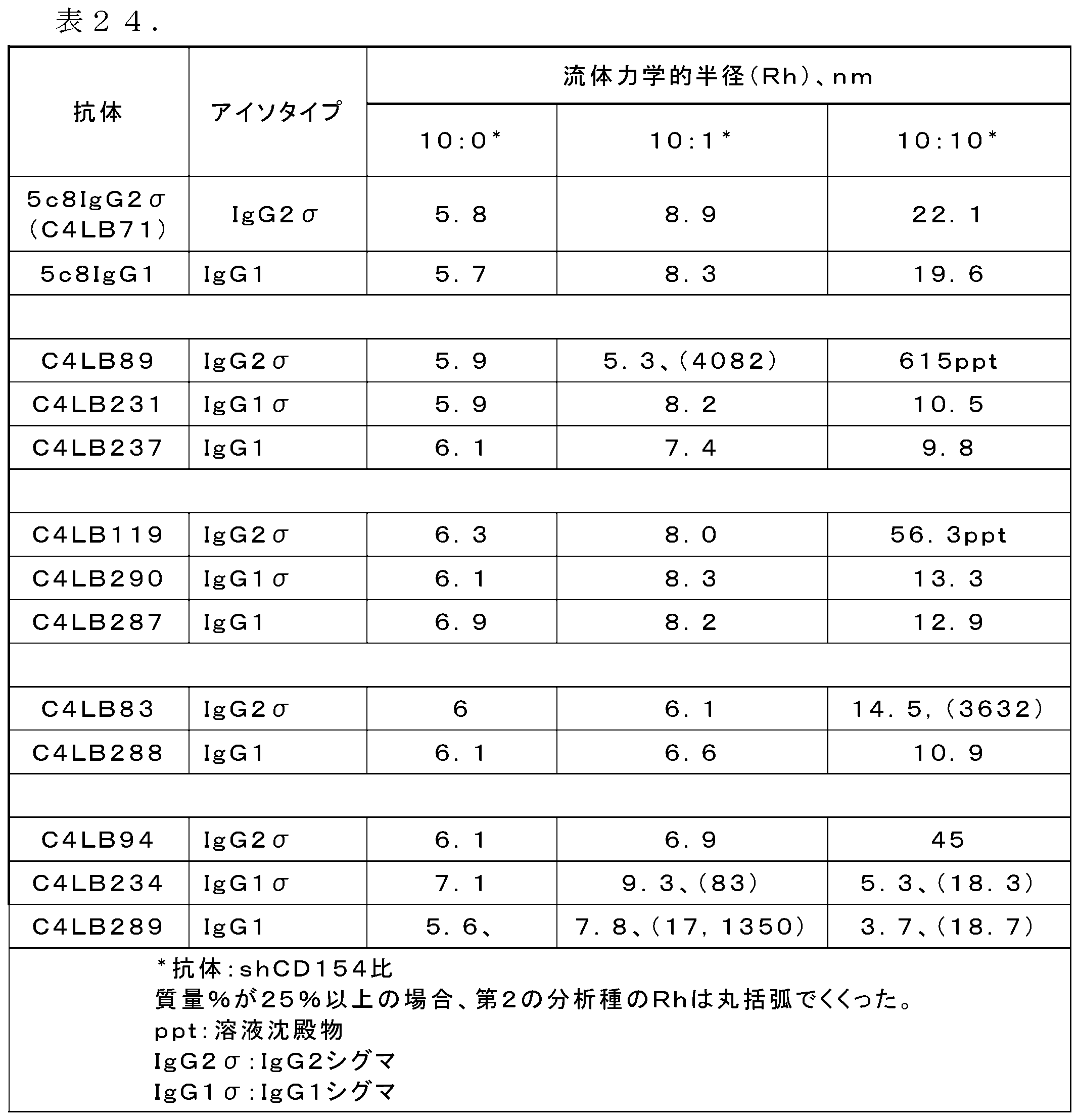
SE-HPLC
表25は、SE-HPLC分析により得られた、抗CD154抗体単独、及びshCD154との免疫複合体の保持時間、回収率、及び推定分子量(MW)を示す。典型的な抗体は、約150kDのMWを有し、shCD154三量体は約50kDaのMWを有する。したがって、化学量論比が3:1であるmAb:shCD154三量体複合体の有する推定分子量は約500kDaである。
SE-HPLC
Table 25 shows the retention time, recovery, and estimated molecular weight (MW) of the immune complex with anti-CD154 antibody alone and shCD154 obtained by SE-HPLC analysis. A typical antibody has a MW of about 150 kDa and the shCD154 trimer has a MW of about 50 kDa. Therefore, the estimated molecular weight of the mAb: shCD154 trimer complex with a stoichiometric ratio of 3: 1 is about 500 kDa.

全ての抗体はshCD154と免疫複合体を形成した。C4LB231、C4LB237、C4LB290、C4LB287(全てのIgG1σ)は、sCD154と免疫複合体を形成し、7.0分の時点で溶出したものの、C4LB290及びC4LB287の収率(%)は、1:1条件下では10:1条件下と比較して低かったのに対し、C4LB231及びC4LB237では収率が高かった(80%超)。C4LB289(IgG1)、C4LB234(IgG1σ)、5c8IgG1σ(C4LB71)、及びC4LBB94(IgG2σ)は、6.2~6.5分とより早い時点で溶出したことから、前述のmAbよりも大型の複合体が形成されていたことが示唆される。5c8IgG1は、3:1のmAb:shCD154三量体免疫複合体に見込まれる保持時間でブロードのピークを有していたものの、ブロードのピーク及び低収率(1:1条件下で56%)により、カラムと相互作用し得る、又はカラムに入らないよりハイオーダーの免疫複合体が形成されていた可能性があることが示唆された。C4LB89及びC4LB119(いずれもIgG2σ)はshCD154と複合体を形成し、ブロードのピークでもって溶出し、収率は非常に低かった(1:1条件下で6~17%)。これはカラムに入らない大型の複合体が形成されたためである可能性がある。概して、IgG2σアイソタイプの抗体は、IgG1σ又はIgG1の抗体と比較して、より大型の免疫複合体を形成した。 All antibodies formed an immune complex with shCD154. C4LB231, C4LB237, C4LB290, and C4LB287 (all IgG1σ) formed an immune complex with sCD154 and eluted at 7.0 minutes, but the yields (%) of C4LB290 and C4LB287 were 1: 1 conditions. In C4LB231 and C4LB237, the yield was high (more than 80%), whereas it was lower than that under the 10: 1 condition. C4LB289 (IgG1), C4LB234 (IgG1σ), 5c8IgG1σ (C4LB71), and C4LBB94 (IgG2σ) were eluted at an earlier time of 6.2 to 6.5 minutes, so that the complex larger than the above-mentioned mAb was formed. It is suggested that it was formed. 5c8IgG1 had a broad peak at the retention time expected in the 3: 1 mAb: shCD154 trimer immune complex, but due to the broad peak and low yield (56% under 1: 1 conditions). It was suggested that higher-order immune complexes may have been formed that could interact with the column or did not enter the column. C4LB89 and C4LB119 (both IgG2σ) complexed with shCD154 and eluted at the broad peak, with very low yields (6-17% under 1: 1 conditions). This may be due to the formation of a large complex that does not fit in the column. In general, antibodies of the IgG2σ isotype formed larger immune complexes compared to antibodies of IgG1σ or IgG1.
表26は、抗体の特性評価の要約を示す。最終的に、血小板活性化データ、SE-HPLC及びDLSデータ共に、血小板活性化は活性型Fcによってのみ起因するものではないことを示唆する。かかるデータは、IgG1σ及びIgG2σなどの機能を欠失したFcを有する抗体が、mAbとshCD154三量体が3:1の、予想される複合体よりも大型の免疫複合体を形成可能であること、並びにFcの機能を欠失している抗体のうちいくつかが血小板活性化能を有していることを示唆する。このデータにより、VH/VLドメイン(例えば、抗体が結合するエピトープ)と、ハイオーダーの免疫複合体形成の両方が血小板活性化に関与するという結論が裏付けられた。 Table 26 provides a summary of antibody characterization. Finally, both platelet activation data, SE-HPLC and DLS data suggest that platelet activation is not solely due to active Fc. Such data indicate that antibodies with Fc lacking functions such as IgG1σ and IgG2σ can form immune complexes larger than the expected complex with a 3: 1 mAb and shCD154 trimer. , And some of the antibodies lacking Fc function suggest that they have the ability to activate platelets. This data supports the conclusion that both the VH / VL domain (eg, the epitope to which the antibody binds) and high-order immune complex formation are involved in platelet activation.

[1][1]
配列番号1のヒトCD154に特異的に結合する単離されたアンタゴニスト抗体又はその抗原結合部分であって、配列番号17の重鎖相補性決定領域(HCDR)1(SYGIS)と、配列番号23のHCDR2(WISPIFGNTNYAQKFQG)と、配列番号30のHCDR3(SRYYGDLDY)とを含み、場合により、 An isolated antagonist antibody or antigen-binding portion thereof that specifically binds to human CD154 of SEQ ID NO: 1 and has the heavy chain complementarity determining regions (HCDR) 1 (SYGIS) of SEQ ID NO: 17 and SEQ ID NO: 23. HCDR2 (WISPIFGNTNYAQKFQG) and HCDR3 (SRYYGDLDY) of SEQ ID NO: 30 are included, and in some cases,
a)前記HCDR1残基S1が、A、C、D、E、G、I、K、L、M、N、Q、R、T、又はVに変異しており、 a) The HCDR1 residue S1 is mutated to A, C, D, E, G, I, K, L, M, N, Q, R, T, or V.
b)前記HCDR1残基I4が、M、L、又はVに変異しており、 b) The HCDR1 residue I4 is mutated to M, L, or V.
c)前記HCDR1残基S5が、Aに変異しており、 c) The HCDR1 residue S5 is mutated to A.
d)前記HCDR2残基S3が、A、T、又はVに変異しており、 d) The HCDR2 residue S3 is mutated to A, T, or V.
e)前記HCDR2残基P4が、V、T、L Q、又はEに変異しており、 e) The HCDR2 residue P4 is mutated to V, T, LQ, or E.
f)前記HCDR2残基N8が、A、C、D、E、F、G、H、I、K、L、M、Q、R、S、T、V、W、又はYに変異しており、 f) The HCDR2 residue N8 is mutated to A, C, D, E, F, G, H, I, K, L, M, Q, R, S, T, V, W, or Y. ,
g)前記HCDR2残基T9が、A、C、D、E、F、G、H、I、K、L、M、Q、R、S、T、V、W、又はYに変異しており、 g) The HCDR2 residue T9 is mutated to A, C, D, E, F, G, H, I, K, L, M, Q, R, S, T, V, W, or Y. ,
h)前記HCDR2残基N10が、A、C、D、E、F、G、H、I、K、L、M、Q、R、S、T、V、W、又はYに変異しており、 h) The HCDR2 residue N10 is mutated to A, C, D, E, F, G, H, I, K, L, M, Q, R, S, T, V, W, or Y. ,
i)前記HCDR3残基S1が、A、又はMに変異しており、 i) The HCDR3 residue S1 is mutated to A or M.
j)前記HCDR3残基R2が、A、S、Q、又はKに変異しており、および、 j) The HCDR3 residue R2 is mutated to A, S, Q, or K, and
k)前記HCDR3残基L7が、Mに変異している、単離されたアンタゴニスト抗体又 k) An isolated antagonist antibody or an isolated antagonist antibody in which the HCDR3 residue L7 is mutated to M.
はその抗原結合部分。Is the antigen binding part.
[2][2]
配列番号37の軽鎖相補性決定領域(LCDR)1(RASQSISSYLN)と、配列番号44のLCDR2(YANSLQS)と、配列番号52のLCDR3(QQSDSIPWT)と、を含み、場合により、 Containing light chain complementarity determining regions (LCDRs) 1 (RASQSISSSYLN) of SEQ ID NO: 37, LCDR2 (YANSLQS) of SEQ ID NO: 44, and LCDR3 (QQSDSIPWT) of SEQ ID NO: 52, optionally.
a)前記LCDR1残基Q4が、A、C、D、E、F、G、H、I、K、L、M、N、R、S、T、V、W、又はYに変異しており、 a) The LCDR1 residue Q4 is mutated to A, C, D, E, F, G, H, I, K, L, M, N, R, S, T, V, W, or Y. ,
b)前記LCDR1残基S5が、A、C、D、E、F、G、H、I、K、L、M、N、Q、R、T、V、W、又はYに変異しており、 b) The LCDR1 residue S5 is mutated to A, C, D, E, F, G, H, I, K, L, M, N, Q, R, T, V, W, or Y. ,
c)前記LCDR1残基S7が、A、C、D、E、F、G、H、I、K、L、M、N、Q、R、T、V、W、又はYに変異しており、 c) The LCDR1 residue S7 is mutated to A, C, D, E, F, G, H, I, K, L, M, N, Q, R, T, V, W, or Y. ,
d)前記LCDR1残基S8が、A、C、D、E、F、G、H、I、K、L、M、N、Q、R、T、V、W、又はYに変異しており、 d) The LCDR1 residue S8 is mutated to A, C, D, E, F, G, H, I, K, L, M, N, Q, R, T, V, W, or Y. ,
e)前記LCDR2残基A2が、Sに変異しており、 e) The LCDR2 residue A2 is mutated to S.
f)前記LCDR2残基N3が、A、C、D、E、F、G、H、I、K、L、M、Q、R、S、T、V、W、又はYに変異しており、 f) The LCDR2 residue N3 is mutated to A, C, D, E, F, G, H, I, K, L, M, Q, R, S, T, V, W, or Y. ,
g)前記LCDR2残基S4が、A、C、D、E、F、G、H、I、K、L、M、N、Q、R、T、V、W、又はYに変異しており、 g) The LCDR2 residue S4 is mutated to A, C, D, E, F, G, H, I, K, L, M, N, Q, R, T, V, W, or Y. ,
h)前記LCDR2残基L5が、A、C、D、E、F、G、H、I、K、M、N、Q、R、S、T、V、W、又はYに変異しており、 h) The LCDR2 residue L5 is mutated to A, C, D, E, F, G, H, I, K, M, N, Q, R, S, T, V, W, or Y. ,
i)前記LCDR2残基Q6が、E、D、又はNに変異しており、 i) The LCDR2 residue Q6 is mutated to E, D, or N.
j)前記LCDR2残基S7が、A、C、D、E、F、G、H、I、K、L、M、N、Q、R、T、V、W、又はYに変異しており、 j) The LCDR2 residue S7 is mutated to A, C, D, E, F, G, H, I, K, L, M, N, Q, R, T, V, W, or Y. ,
k)前記LCDR3残基S3が、Aに変異しており、 k) The LCDR3 residue S3 is mutated to A.
l)前記LCDR3残基D4が、Nに変異しており、 l) The LCDR3 residue D4 is mutated to N.
m)前記LCDR3残基S5が、A、C、D、E、F、G、H、I、K、L、M、N、Q、R、T、V、W、又はYに変異しており、および、 m) The LCDR3 residue S5 is mutated to A, C, D, E, F, G, H, I, K, L, M, N, Q, R, T, V, W, or Y. ,and,
n)前記LCDR3残基I6が、A、C、D、E、G、K、L、M、N、Q、R、S、T、Vに変異している、上記[1]に記載の抗体。 n) The antibody according to the above [1], wherein the LCDR3 residue I6 is mutated to A, C, D, E, G, K, L, M, N, Q, R, S, T, V. ..
[3][3]
a)それぞれ、配列番号36、43、及び51、 a) SEQ ID NOs: 36, 43, and 51, respectively.
b)それぞれ、配列番号37、44、及び52、 b) SEQ ID NOs: 37, 44, and 52, respectively.
c)それぞれ、配列番号38、45、及び53、 c) SEQ ID NOs: 38, 45, and 53, respectively.
d)それぞれ、配列番号39、46、及び54、 d) SEQ ID NOs: 39, 46, and 54, respectively.
e)それぞれ、配列番号40、47、及び55、 e) SEQ ID NOs: 40, 47, and 55, respectively.
f)それぞれ、配列番号41、47、及び56、 f) SEQ ID NOs: 41, 47, and 56, respectively.
g)それぞれ、配列番号42、48、及び57、 g) SEQ ID NOs: 42, 48, and 57, respectively.
h)それぞれ、配列番号37、49、及び52、又は h) SEQ ID NOs: 37, 49, and 52, respectively, or
i)それぞれ、配列番号37、50、及び52 i) SEQ ID NOs: 37, 50, and 52, respectively.
の、軽鎖相補性決定領域(LCDR1)、LCDR2、及びLCDR3を含む、上記[1]に記載の抗体。The antibody according to the above [1], which comprises the light chain complementarity determining regions (LCDR1), LCDR2, and LCDR3.
[4][4]
前記配列番号17のHCDR1(SYGIS)と、前記配列番号23のHCDR2(WISPIFGNTNYAQKFQG)と、前記配列番号30のHCDR3(SRYYGDLDY)と、前記配列番号37のLCDR1(RASQSISSYLN)と、前記配列番号44のLCDR2(YANSLQS)と、前記配列番号52のLCDR3(QQSDSIPWT)とを含む、上記[2]に記載の抗体。 HCDR1 (SYGIS) of SEQ ID NO: 17, HCDR2 (WISPIFGNTNYAQKFQG) of SEQ ID NO: 23, HCDR3 (SRYYGDLDY) of SEQ ID NO: 30, LCDR1 (RASQSISSYLN) of SEQ ID NO: 37, and LCDR2 of SEQ ID NO: 44. (YANSLQS) and the antibody according to the above [2], which comprises LCDR3 (QQSDSIPWT) of SEQ ID NO: 52.
[5][5]
前記抗体が、以下の特性: The antibody has the following characteristics:
a)前記抗体と、可溶性ヒトCD154(shCD154)との免疫複合体が、血小板を活性化せず、ここで、血小板活性化は、血小板上のP-セレクチン表面発現により測定される; a) The immune complex of the antibody with soluble human CD154 (shCD154) does not activate platelets, where platelet activation is measured by P-selectin surface expression on platelets;
b)0.03%のポリソルベートP20及び100μg/mLのウシ血清アルブミンを含有しているダルベッコリン酸緩衝生理食塩水にて、25℃下でProteOn XPR36システムを用いK b) Dulbeccoline-buffered saline containing 0.03% polysorbate P20 and 100 μg / mL bovine serum albumin at 25 ° C. using the ProteOn XPR36 system.
DD
を測定したときに、約5×10When measured, about 5 × 10
-9-9
M以下の解離定数(KDissociation constant of M or less (K
DD
)でCD154に結合する;) To bind to CD154;
c)CD154介在性のヒトB細胞の増殖を約2.7×10 c) CD154-mediated proliferation of human B cells approximately 2.7 × 10
-9-9
M以下のICIC of M or less
5050
値で阻害する;又はInhibits by value; or
d)分泌型胎盤性アルカリホスファターゼ(SEAP)及びヒトCD40を安定的に発現するHEK293細胞において、NF-κB-誘導性インターフェロン-β(IFN-β)ミニマルプロモーター下、約2.1×10 d) Approximately 2.1 × 10 under the NF-κB-inducible interferon-β (IFN-β) minimal promoter in HEK293 cells that stably express secretory placental alkaline phosphatase (SEAP) and human CD40.
-8-8
M以下のICIC of M or less
5050
値で、SEAPのCD154介在性の発現を阻害する;By value, it inhibits CD154-mediated expression of SEAP;
のうちの少なくとも1つを有する、上記[2]に記載の抗体。The antibody according to the above [2], which has at least one of.
[6][6]
CD154がホモ三量体であり、前記抗体が、前記ホモ三量体中の第1のCD154モノマーにCD154のアミノ酸残基182~207内で結合し、前記ホモ三量体中の第2のCD154モノマーにCD154のアミノ酸残基176~253内で結合し、ここで、残基付番は配列番号1に準拠する、上記[2]に記載の抗体。 CD154 is a homotrimer, and the antibody binds to the first CD154 monomer in the homotrimer within amino acid residues 182-207 of CD154 and the second CD154 in the homotrimer. The antibody according to [2] above, which binds to a monomer within amino acid residues 176 to 253 of CD154, where the residue numbering conforms to SEQ ID NO: 1.
[7][7]
前記抗体が、前記第1のCD154モノマー中の残基E182、S185、Q186、A187、P188、S214、A215、及びR207に結合し、ここで残基付番は配列番号1に準拠する、上記[6]に記載の抗体。 The antibody binds to residues E182, S185, Q186, A187, P188, S214, A215, and R207 in the first CD154 monomer, where the residue numbering conforms to SEQ ID NO: 1 above [ 6].
[8][8]
前記抗体が、前記第2のCD154モノマー中の残基T176、F177、C178、Q220、S248、H249、G250、及びF353に結合し、ここで残基付番は配列番号1に準拠する、上記[6]に記載の抗体。 The antibody binds to residues T176, F177, C178, Q220, S248, H249, G250, and F353 in the second CD154 monomer, where the residue numbering conforms to SEQ ID NO: 1 [ 6].
[9][9]
配列番号59の重鎖可変領域(VH)を含み、場合により、前記VHは、1、2、3、4、5、6、7、8、9、10、11、12、13、14、又は15個のアミノ酸置換を含む、上記[2]に記載の抗体。 The heavy chain variable region (VH) of SEQ ID NO: 59 is included, optionally said VH is 1, 2, 3, 4, 5, 6, 7, 8, 9, 10, 11, 12, 13, 14, or. The antibody according to [2] above, which comprises 15 amino acid substitutions.
[10][10]
配列番号65、66、67、68、69、70、71、72、又は73の軽鎖可変領域(VL)を含み、場合により、前記VLは、1、2、3、4、5、6、7、8、9、10、11、12、13、14、又は15個のアミノ酸置換を含む、上記[9]に記載の抗体。 Containing the light chain variable region (VL) of SEQ ID NO: 65, 66, 67, 68, 69, 70, 71, 72, or 73, optionally said VL is 1, 2, 3, 4, 5, 6, The antibody according to [9] above, which comprises 7, 8, 9, 10, 11, 12, 13, 14, or 15 amino acid substitutions.
[11][11]
配列番号66、72、又は73の前記VLを含む、上記[10]に記載の抗体。 The antibody according to [10] above, which comprises the VL of SEQ ID NO: 66, 72, or 73.
[12][12]
配列番号59の前記VH、及び配列番号66の前記VLを含む、上記[11]に記載の抗体。 The antibody according to [11] above, which comprises the VH of SEQ ID NO: 59 and the VL of SEQ ID NO: 66.
[13][13]
配列番号59の前記VH、及び配列番号72の前記VLを含む、上記[11]に記載の抗体。 The antibody according to [11] above, which comprises the VH of SEQ ID NO: 59 and the VL of SEQ ID NO: 72.
[14][14]
配列番号59の前記VH、及び配列番号73の前記VLを含む、上記[11]に記載の抗体。 The antibody according to [11] above, which comprises the VH of SEQ ID NO: 59 and the VL of SEQ ID NO: 73.
[15][15]
前記抗体が、IgG1型、IgG2型、IgG3型、又はIgG4型アイソタイプである、上記[2]に記載の抗体。 The antibody according to the above [2], wherein the antibody is an IgG1, IgG2, IgG3, or IgG4 isotype.
[16][16]
Fc領域に少なくとも1つの置換を含む、上記[15]に記載の抗体。 The antibody according to [15] above, which comprises at least one substitution in the Fc region.
[17][17]
前記Fc領域における少なくとも1つの置換が、置換L234A、L235A、G237A、P238S、M252Y、S254T、T256E、H268A、A330S、又はP331Sであり、残基付番がEUインデックスに準拠する、上記[16]に記載の抗体。 At least one substitution in the Fc region is substitution L234A, L235A, G237A, P238S, M252Y, S254T, T256E, H268A, A330S, or P331S, and the residue numbering conforms to the EU index, according to [16] above. The antibody described.
[18][18]
前記Fc領域に置換L234A、L235A、G237A、P238S、H268A、A330S、又はP331Sを含み、残基付番がEUインデックスに準拠する、上記[17]に記載の抗体。 The antibody according to [17] above, wherein the Fc region contains substituted L234A, L235A, G237A, P238S, H268A, A330S, or P331S, and the residue numbering conforms to the EU index.
[19][19]
前記Fc領域における少なくとも1つの置換が、置換V234A、G237A、P238S、M252Y、S254T、T256E、H268A、V309L、A330S、又はP331Sであり、残基付番がEUインデックスに準拠する、上記[16]に記載の抗体。 The above [16], wherein at least one substitution in the Fc region is substitution V234A, G237A, P238S, M252Y, S254T, T256E, H268A, V309L, A330S, or P331S, and the residue numbering conforms to the EU index. The antibody described.
[20][20]
前記Fc領域に置換V234A、G237A、P238S、H268A、V309L、A330S、及びP331Sを含み、残基付番がEUインデックスに準拠する、上記[19]に記載の抗体。 The antibody according to [19] above, wherein the Fc region comprises substitutions V234A, G237A, P238S, H268A, V309L, A330S, and P331S, and the residue numbering conforms to the EU index.
[21][21]
a)それぞれ、配列番号80及び81、 a) SEQ ID NOs: 80 and 81, respectively.
b)それぞれ、配列番号82及び81、又は b) SEQ ID NOs: 82 and 81, respectively, or
c)それぞれ、配列番号83及び81 c) SEQ ID NOs: 83 and 81, respectively.
の、重鎖(HC)及び軽鎖(LC)を含む、上記[16]に記載の抗体。The antibody according to the above [16], which comprises a heavy chain (HC) and a light chain (LC).
[22][22]
前記抗体が多重特異性である、上記[2]に記載の抗体。 The antibody according to [2] above, wherein the antibody is multispecific.
[23][23]
配列番号1のCD154に特異的に結合する単離されたアンタゴニスト抗体又はその抗原結合部分であって、An isolated antagonist antibody or antigen-binding portion thereof that specifically binds to CD154 of SEQ ID NO: 1.
a)それぞれ配列番号17、23、30、37、44、及び52の前記HCDR1、前記HCDR2、前記HCDR3、前記LCDR1、前記LCDR2、及び前記LCDR3、 a) The HCDR1, the HCDR2, the HCDR3, the LCDR1, the LCDR2, and the LCDR3 of SEQ ID NOs: 17, 23, 30, 37, 44, and 52, respectively.
b)配列番号59の前記VH及び配列番号66の前記VL、又は b) The VH of SEQ ID NO: 59 and the VL of SEQ ID NO: 66, or
c)配列番号80の前記重鎖及び配列番号81の前記軽鎖 c) The heavy chain of SEQ ID NO: 80 and the light chain of SEQ ID NO: 81.
を含む、単離されたアンタゴニスト抗体又はその抗原結合部分。An isolated antagonist antibody or antigen-binding portion thereof, including.
[24][24]
配列番号1のCD154に特異的に結合する単離されたアンタゴニスト抗体又はその抗原結合部分であって、CD154がホモ三量体であり、前記抗体が、前記ホモ三量体中の第1のCD154モノマーにCD154のアミノ酸残基182~207内で結合し、前記ホモ三量体中の第2のCD154モノマーにCD154のアミノ酸残基176~253内で結合し、ここで、残基付番は配列番号1に準拠する、単離されたアンタゴニスト抗体又はその抗原結合部分。 An isolated antagonist antibody or antigen-binding portion thereof that specifically binds to CD154 of SEQ ID NO: 1, wherein CD154 is a homotrimer and the antibody is the first CD154 in the homotrimer. It binds to the monomer within amino acid residues 182-207 of CD154 and to the second CD154 monomer in the homotrimer within amino acid residues 176-253 of CD154, where the residue numbering is sequence. An isolated antagonist antibody or antigen-binding portion thereof according to No. 1.
[25][25]
治療薬又は造影剤に結合させた上記[2]に記載の抗体を含む免疫複合体。 An immune complex containing the antibody according to the above [2] bound to a therapeutic agent or a contrast medium.
[26][26]
上記[2]に記載の抗体と、医薬的に許容される担体と、を含む、医薬組成物。 A pharmaceutical composition comprising the antibody according to the above [2] and a pharmaceutically acceptable carrier.
[27][27]
前記配列番号59の抗体VHをコードしているポリヌクレオチド。 The polynucleotide encoding the antibody VH of SEQ ID NO: 59.
[28][28]
前記配列番号65、66、67、68、69、70、71、72、又は73の抗体VLをコードしているポリヌクレオチド。 The polynucleotide encoding the antibody VL of SEQ ID NO: 65, 66, 67, 68, 69, 70, 71, 72, or 73.
[29][29]
配列番号76、77、78、又は79のポリヌクレオチド配列を含む、ポリヌクレオチド。 A polynucleotide comprising the polynucleotide sequence of SEQ ID NO: 76, 77, 78, or 79.
[30][30]
前記配列番号59の抗体VHと、前記配列番号66の抗体VLとをコードしているポリヌクレオチド。 A polynucleotide encoding the antibody VH of SEQ ID NO: 59 and the antibody VL of SEQ ID NO: 66.
[31][31]
上記[27]、[28]、[29]、又は[30]に記載のポリヌクレオチドを含む、ベクター。 A vector comprising the polynucleotide according to the above [27], [28], [29], or [30].
[32][32]
上記[31]に記載のベクターを含む、宿主細胞。 A host cell comprising the vector according to [31] above.
[33][33]
配列番号1のCD154に特異的に結合する単離されたアンタゴニスト抗体又はその抗原結合部分の製造方法であって、 A method for producing an isolated antagonist antibody or an antigen-binding portion thereof that specifically binds to CD154 of SEQ ID NO: 1.
前記抗体が発現される条件下で上記[32]に記載の宿主細胞を培養することと、前記宿主細胞より産生された前記抗体を回収することと、を含む、方法。 A method comprising culturing the host cell according to [32] above under conditions in which the antibody is expressed, and recovering the antibody produced from the host cell.
[34][34]
自己免疫疾患又は免疫介在性炎症性疾患の治療方法であって、 A method of treating autoimmune or immune-mediated inflammatory disease
治療有効量の上記[2]に記載の単離された抗体又は上記[26]に記載の医薬組成物を、前記自己免疫疾患又は前記免疫介在性炎症性疾患を治療するのに十分な時間にわたって、前記自己免疫疾患又は前記免疫介在性炎症性疾患の治療を必要としている患者に投与することを含む、方法。 A therapeutically effective amount of the isolated antibody according to the above [2] or the pharmaceutical composition according to the above [26] is used for a sufficient time to treat the autoimmune disease or the immune-mediated inflammatory disease. , The method comprising administering to a patient in need of treatment for the autoimmune disease or the immune-mediated inflammatory disease.
[35][35]
前記免疫介在性炎症性疾患又は前記自己免疫疾患が、関節炎、全身性エリテマトーデス(SLE)、炎症性腸疾患、移植、腎移植、皮膚移植、骨髄移植、移植片対宿主病(GVHD)、免疫性血小板減少症(ITP)、多発性硬化症、甲状腺炎、1型糖尿病、又はアテローム性動脈硬化症である、上記[34]に記載の方法。 The immune-mediated inflammatory disease or the autoimmune disease is arthritis, systemic erythematosus (SLE), inflammatory bowel disease, transplantation, renal transplantation, skin transplantation, bone marrow transplantation, transplant piece-to-host disease (GVHD), immune. The method according to [34] above, which is thrombocytopenia (ITP), multiple sclerosis, thyroiditis,
[36][36]
関節炎が、関節リウマチ、若年性関節炎、乾癬性関節炎、ライター症候群、強直性脊椎炎、又は痛風性関節炎である、上記[35]に記載の方法。 The method according to [35] above, wherein the arthritis is rheumatoid arthritis, juvenile arthritis, psoriatic arthritis, Reiter's syndrome, ankylosing spondylitis, or gouty arthritis.
[37][37]
前記自己免疫疾患又は前記免疫介在性炎症性疾患が、狼瘡である、上記[34]に記載の方法。 The method according to [34] above, wherein the autoimmune disease or the immune-mediated inflammatory disease is lupus erythematosus.
[38][38]
前記自己免疫疾患又は前記免疫介在性炎症性疾患が、移植である、上記[34]に記載の方法。 The method according to [34] above, wherein the autoimmune disease or the immune-mediated inflammatory disease is a transplant.
[39][39]
前記自己免疫疾患又は前記免疫介在性炎症性疾患が、炎症性腸疾患(IBD)である、上記[34]に記載の方法。 The method according to [34] above, wherein the autoimmune disease or the immune-mediated inflammatory disease is inflammatory bowel disease (IBD).
[40][40]
IBDがクローン病又は潰瘍性大腸炎である、上記[39]に記載の方法。 The method according to [39] above, wherein the IBD is Crohn's disease or ulcerative colitis.
[41][41]
第2の治療剤をさらに投与する、上記[34]に記載の方法。 The method according to [34] above, wherein the second therapeutic agent is further administered.
[42][42]
前記第2の治療薬が、非ステロイド性抗炎症薬(NSAID)、サリチラート、ヒドロキシクロロキン、スルファサラジン、コルチコステロイド、細胞毒性剤、免疫抑制剤、及び/又は抗体である、上記[41]に記載の抗体。 The second therapeutic agent is a non-steroidal anti-inflammatory drug (NSAID), salicylate, hydroxychloroquin, sulfasalazine, corticosteroid, cytotoxic agent, immunosuppressant, and / or antibody, according to [41] above. Antibodies.
[43][43]
治療に使用するための、上記[2]に記載の抗体又は上記[25]に記載の医薬組成物。 The antibody according to the above [2] or the pharmaceutical composition according to the above [25] for use in treatment.
[44][44]
配列番号1のCD154に特異的に結合する単離されたアンタゴニスト抗体であって、 An isolated antagonist antibody that specifically binds to CD154 of SEQ ID NO: 1.
a)それぞれ、配列番号16、22、及び29、 a) SEQ ID NOs: 16, 22, and 29, respectively.
b)それぞれ、配列番号17、23、及び30、 b) SEQ ID NOs: 17, 23, and 30, respectively,
c)それぞれ、配列番号16、24、及び31、 c) SEQ ID NOs: 16, 24, and 31, respectively,
d)それぞれ、配列番号18、25、及び32、 d) SEQ ID NOs: 18, 25, and 32, respectively.
e)それぞれ、配列番号19、26、及び33、 e) SEQ ID NOs: 19, 26, and 33, respectively.
f)それぞれ、配列番号20、27、及び34、又は f) SEQ ID NOs: 20, 27, and 34, respectively, or
g)それぞれ、配列番号21、28、及び35 g) SEQ ID NOs: 21, 28, and 35, respectively.
の、HCDR1、HCDR2、及びHCDR3を含み、場合により、前記HCDR1、前記HCDR2及び/又は前記HCDR3における保存的アミノ酸置換を1つ、2つ、又は3つ有し、Containing HCDR1, HCDR2, and HCDR3, and optionally having one, two, or three conservative amino acid substitutions in said HCDR1, said HCDR2 and / or said HCDR3.
ここで、前記HCDR1、前記HCDR2、及び前記HCDR3が、Kabat、Chothia、又はIMGTにより定義されるものである、単離されたアンタゴニスト抗体。 Here, the isolated antagonist antibody, wherein the HCDR1, the HCDR2, and the HCDR3 are those defined by Kabat, Chothia, or IMGT.
[45][45]
a)それぞれ、配列番号36、43、及び51、 a) SEQ ID NOs: 36, 43, and 51, respectively.
b)それぞれ、配列番号37、44、及び52、 b) SEQ ID NOs: 37, 44, and 52, respectively.
c)それぞれ、配列番号38、45、及び53、 c) SEQ ID NOs: 38, 45, and 53, respectively.
d)それぞれ、配列番号39、46、及び54、 d) SEQ ID NOs: 39, 46, and 54, respectively.
e)それぞれ、配列番号40、47、及び55、 e) SEQ ID NOs: 40, 47, and 55, respectively.
f)それぞれ、配列番号41、47、及び56、 f) SEQ ID NOs: 41, 47, and 56, respectively.
g)それぞれ、配列番号42、48、及び57、 g) SEQ ID NOs: 42, 48, and 57, respectively.
h)それぞれ、配列番号37、49、及び52、又は h) SEQ ID NOs: 37, 49, and 52, respectively, or
i)それぞれ、配列番号37、50、及び52 i) SEQ ID NOs: 37, 50, and 52, respectively.
の、LCDR1、LCDR2、及びLCDR3を含み、場合により、前記LCDR1、前記LCDR2及び/又は前記LCDR3における保存的アミノ酸置換を1つ、2つ、又は3つ有し、, And optionally having one, two, or three conservative amino acid substitutions in said LCDR1, said LCDR2 and / or said LCDR3.
ここで、前記LCDR1、前記LCDR2、及び前記LCDR3が、Kabat、Chothia、又はIMGTにより定義されるものである、上記[44]に記載の抗体。 Here, the antibody according to [44] above, wherein the LCDR1, the LCDR2, and the LCDR3 are defined by Kabat, Chothia, or IMGT.
[46][46]
a)それぞれ配列番号16、22、及び29の前記HCDR1、前記HCDR2、及び前記HCDR3と、それぞれ配列番号36、43、及び51の前記LCDR1、前記LCDR2、及び前記LCDR3とを含む、又は a) Containing or containing said HCDR1, said HCDR2, and said HCDR3 of SEQ ID NOs: 16, 22, and 29, respectively, and said LCDR1, said LCDR2, and said LCDR3 of SEQ ID NOs: 36, 43, and 51, respectively.
b)配列番号58の前記VHと配列番号65の前記VLとを含む、上記[45]に記載の抗体。 b) The antibody according to [45] above, comprising said VH of SEQ ID NO: 58 and said VL of SEQ ID NO: 65.
[47][47]
a)それぞれ配列番号17、23、及び30の前記HCDR1、前記HCDR2、及び前記HCDR3と、それぞれ配列番号37、44、及び52の前記LCDR1、前記LCDR2、及び前記LCDR3と、を含む、又は a) Containing or containing said HCDR1, said HCDR2, and said HCDR3 of SEQ ID NOs: 17, 23, and 30, respectively, and said LCDR1, said LCDR2, and said LCDR3 of SEQ ID NOs: 37, 44, and 52, respectively.
b)配列番号59の前記VHと配列番号66の前記VLとを含む、上記[45]に記載の抗体。 b) The antibody according to [45] above, comprising said VH of SEQ ID NO: 59 and said VL of SEQ ID NO: 66.
[48][48]
a)それぞれ配列番号16、24、及び31の前記HCDR1、前記HCDR2、及び前記HCDR3と、それぞれ配列番号38、45、及び53の前記LCDR1、前記LCDR2、及び前記LCDR3と、を含む、又は a) Containing or containing said HCDR1, said HCDR2, and said HCDR3 of SEQ ID NOs: 16, 24, and 31, respectively, and said LCDR1, said LCDR2, and said LCDR3 of SEQ ID NOs: 38, 45, and 53, respectively.
b)配列番号60の前記VHと配列番号67の前記VLとを含む、上記[45]に記載の抗体。 b) The antibody according to [45] above, comprising said VH of SEQ ID NO: 60 and said VL of SEQ ID NO: 67.
[49][49]
a)それぞれ配列番号18、25、及び32の前記HCDR1、前記HCDR2、及び前記HCDR3と、それぞれ配列番号39、46、及び54の前記LCDR1、前記LCDR2、及び前記LCDR3と、を含む、又は a) Containing or containing said HCDR1, said HCDR2, and said HCDR3 of SEQ ID NOs: 18, 25, and 32, respectively, and said LCDR1, said LCDR2, and said LCDR3 of SEQ ID NOs: 39, 46, and 54, respectively.
b)配列番号61の前記VHと配列番号68の前記VLとを含む、上記[45]に記載の抗体。 b) The antibody according to [45] above, comprising said VH of SEQ ID NO: 61 and said VL of SEQ ID NO: 68.
[50][50]
a)それぞれ配列番号19、26、及び33の前記HCDR1、前記HCDR2、及び前記HCDR3と、それぞれ配列番号40、47、及び55の前記LCDR1、前記LCDR2、及び前記LCDR3と、を含む、又は a) Containing or containing said HCDR1, said HCDR2, and said HCDR3 of SEQ ID NOs: 19, 26, and 33, respectively, and said LCDR1, said LCDR2, and said LCDR3 of SEQ ID NOs: 40, 47, and 55, respectively.
b)配列番号62の前記VHと配列番号69の前記VLとを含む、上記[45]に記載の抗体。 b) The antibody according to [45] above, comprising said VH of SEQ ID NO: 62 and said VL of SEQ ID NO: 69.
[51][51]
a)それぞれ配列番号20、27、及び34の前記HCDR1、前記HCDR2、及び前記HCDR3と、それぞれ配列番号41、47、及び56の前記LCDR1、前記LCDR2、及び前記LCDR3と、を含む、又は a) Containing or containing said HCDR1, said HCDR2, and said HCDR3 of SEQ ID NOs: 20, 27, and 34, respectively, and said LCDR1, said LCDR2, and said LCDR3 of SEQ ID NOs: 41, 47, and 56, respectively.
b)配列番号63の前記VHと配列番号70の前記VLとを含む、上記[45]に記載の抗体。 b) The antibody according to [45] above, comprising said VH of SEQ ID NO: 63 and said VL of SEQ ID NO: 70.
[52][52]
a)それぞれ配列番号21、28、及び35の前記HCDR1、前記HCDR2、及び前記HCDR3と、それぞれ配列番号42、48、及び57の前記LCDR1、前記LCDR2、及び前記LCDR3と、を含む、又は a) Containing or containing said HCDR1, said HCDR2, and said HCDR3 of SEQ ID NOs: 21, 28, and 35, respectively, and said LCDR1, said LCDR2, and said LCDR3 of SEQ ID NOs: 42, 48, and 57, respectively.
b)配列番号64の前記VHと配列番号71の前記VLとを含む、上記[45]に記載の抗体。 b) The antibody according to [45] above, comprising said VH of SEQ ID NO: 64 and said VL of SEQ ID NO: 71.
[53][53]
a)それぞれ配列番号17、23、及び30の前記HCDR1、前記HCDR2、及び前記HCDR3と、それぞれ配列番号37、49、及び52の前記LCDR1、前記LCDR2、及び前記LCDR3と、を含む、又は a) Containing or containing said HCDR1, said HCDR2, and said HCDR3 of SEQ ID NOs: 17, 23, and 30, respectively, and said LCDR1, said LCDR2, and said LCDR3 of SEQ ID NOs: 37, 49, and 52, respectively.
b)配列番号59の前記VHと配列番号72の前記VLとを含む、上記[45]に記載の抗体。 b) The antibody according to [45] above, comprising said VH of SEQ ID NO: 59 and said VL of SEQ ID NO: 72.
[54][54]
a)それぞれ配列番号17、23、及び30の前記HCDR1、前記HCDR2、及び前記HCDR3と、それぞれ配列番号37、50、及び52の前記LCDR1、前記LCDR2、及び前記LCDR3と、を含む、又は a) Containing or containing said HCDR1, said HCDR2, and said HCDR3 of SEQ ID NOs: 17, 23, and 30, respectively, and said LCDR1, said LCDR2, and said LCDR3 of SEQ ID NOs: 37, 50, and 52, respectively.
b)配列番号59の前記VHと配列番号73の前記VLとを含む、上記[45]に記載の抗体。 b) The antibody according to [45] above, comprising said VH of SEQ ID NO: 59 and said VL of SEQ ID NO: 73.
[55][55]
前記抗体が、IgG1型、IgG2型、IgG3型、又はIgG4型アイソタイプである、上記[45]に記載の抗体。 The antibody according to the above [45], wherein the antibody is an IgG1, IgG2, IgG3, or IgG4 isotype.
[56][56]
Fc領域に少なくとも1つの置換を含む、上記[55]に記載の抗体。 The antibody according to [55] above, which comprises at least one substitution in the Fc region.
[57][57]
前記Fc領域における少なくとも1つの置換が、置換L234A、L235A、G237A、P238S、M252Y、S254T、T256E、H268A、A330S、又はP331Sであり、残基付番がEUインデックスに準拠する、上記[56]に記載の抗体。 At least one substitution in the Fc region is substitution L234A, L235A, G237A, P238S, M252Y, S254T, T256E, H268A, A330S, or P331S, and the residue numbering conforms to the EU index, according to [56] above. The antibody described.
[58][58]
前記Fc領域に置換L234A、L235A、G237A、P238S、H268A、A330S、及びP331Sを含み、残基付番がEUインデックスに準拠する、上記[57]に記載の抗体。 The antibody according to [57] above, wherein the Fc region comprises substitutions L234A, L235A, G237A, P238S, H268A, A330S, and P331S, and the residue numbering conforms to the EU index.
[59][59]
前記Fc領域における少なくとも1つの置換が、置換V234A、G237A、P238S、M252Y、S254T、T256E、H268A、V309L、A330S、又はP331Sであり、残基付番がEUインデックスに準拠する、上記[56]に記載の抗体。 The above [56], wherein at least one substitution in the Fc region is substitution V234A, G237A, P238S, M252Y, S254T, T256E, H268A, V309L, A330S, or P331S and the residue numbering conforms to the EU index. The antibody described.
[60][60]
前記Fc領域に置換V234A、G237A、P238S、H268A、V309L、A330S、及びP331Sを含み、残基付番がEUインデックスに準拠する、上記[59]に記載の抗体。 The antibody according to [59] above, wherein the Fc region comprises substitutions V234A, G237A, P238S, H268A, V309L, A330S, and P331S, and the residue numbering conforms to the EU index.
[61][61]
前記抗体が多重特異性である、上記[45]に記載の抗体。 The antibody according to [45] above, wherein the antibody is multispecific.
[62][62]
前記抗体が、以下の特性: The antibody has the following characteristics:
a)前記抗体と、可溶性ヒトCD154(shCD154)との免疫複合体は、血小板を活性化せず、ここで、血小板活性化は、血小板上のP-セレクチン表面発現により測定される; a) The immune complex of the antibody with soluble human CD154 (shCD154) does not activate platelets, where platelet activation is measured by P-selectin surface expression on platelets;
b)0.03%のポリソルベートP20及び100μg/mLのウシ血清アルブミンを含有しているダルベッコリン酸緩衝生理食塩水にて、25℃下でProteOn XPR36システムを用いK b) Dulbeccoline-buffered saline containing 0.03% polysorbate P20 and 100 μg / mL bovine serum albumin at 25 ° C. using the ProteOn XPR36 system.
DD
を測定したときに、約5×10When measured, about 5 × 10
-9-9
M以下の解離定数(KDissociation constant of M or less (K
DD
)でCD154に結合する;) To bind to CD154;
c)CD154介在性のヒトB細胞の増殖を約2.7×10 c) CD154-mediated proliferation of human B cells approximately 2.7 × 10
-9-9
M以下のICIC of M or less
5050
値で阻害する;又はInhibits by value; or
d)分泌型胎盤性アルカリホスファターゼ(SEAP)及びヒトCD40を安定的に発現するHEK293細胞において、NF-κB-誘導性インターフェロン-β(IFN-β)ミニマルプロモーター下、約2.1×10 d) Approximately 2.1 × 10 under the NF-κB-inducible interferon-β (IFN-β) minimal promoter in HEK293 cells that stably express secretory placental alkaline phosphatase (SEAP) and human CD40.
-8-8
M以下のICIC of M or less
5050
値で、SEAPのCD154介在性の発現を阻害する;By value, it inhibits CD154-mediated expression of SEAP;
のうちの少なくとも1つを有する、上記[45]に記載の抗体。The antibody according to [45] above, which has at least one of.
[63][63]
治療薬又は造影剤に結合させた上記[45]に記載の抗体を含む免疫複合体。 An immune complex comprising the antibody according to [45] above, which is bound to a therapeutic agent or a contrast medium.
[64][64]
上記[45]に記載の抗体と、医薬的に許容される担体と、を含む、医薬組成物。 A pharmaceutical composition comprising the antibody according to the above [45] and a pharmaceutically acceptable carrier.
[65][65]
上記[45]に記載の抗体VH、抗体VL、又は抗体VHと抗体VLとをコードしているポリヌクレオチド。 The antibody VH, antibody VL, or polynucleotide encoding antibody VH and antibody VL according to the above [45].
[66][66]
上記[65]に記載のポリヌクレオチドを含む、ベクター。 A vector comprising the polynucleotide according to [65] above.
[67][67]
上記[66]に記載のベクターを含む、宿主細胞。 A host cell comprising the vector according to [66] above.
[68][68]
配列番号1のCD154に特異的に結合する単離されたアンタゴニスト抗体又はその抗原結合部分の製造方法であって、 A method for producing an isolated antagonist antibody or an antigen-binding portion thereof that specifically binds to CD154 of SEQ ID NO: 1.
前記抗体が発現される条件下で上記[67]に記載の宿主細胞を培養することと、前記宿主細胞より産生された前記抗体を回収することと、を含む、方法。 A method comprising culturing the host cell according to [67] above under conditions in which the antibody is expressed, and recovering the antibody produced from the host cell.
[69][69]
自己免疫疾患又は免疫介在性炎症性疾患の治療方法であって、 A method of treating autoimmune or immune-mediated inflammatory disease
治療有効量の上記[45]に記載の単離された抗体又は上記[64]に記載の医薬組成物を、前記自己免疫疾患又は前記免疫介在性炎症性疾患を治療するのに十分な時間にわたって、前記自己免疫疾患又は前記免疫介在性炎症性疾患の治療を必要としている患者に投与することを含む、方法。 A therapeutically effective amount of the isolated antibody according to [45] above or the pharmaceutical composition according to [64] above for a sufficient time to treat the autoimmune disease or the immune-mediated inflammatory disease. , The method comprising administering to a patient in need of treatment for the autoimmune disease or the immune-mediated inflammatory disease.
[70][70]
前記免疫介在性炎症性疾患又は前記自己免疫疾患が、関節炎、全身性エリテマトーデス(SLE)、炎症性腸疾患、移植、腎移植、皮膚移植、骨髄移植、移植片対宿主病(GVHD)、免疫性血小板減少症(ITP)、多発性硬化症、甲状腺炎、1型糖尿病、又はアテローム性動脈硬化症である、上記[69]に記載の方法。 The immune-mediated inflammatory disease or the autoimmune disease is arthritis, systemic erythematosus (SLE), inflammatory bowel disease, transplantation, renal transplantation, skin transplantation, bone marrow transplantation, transplant piece-to-host disease (GVHD), immune. The method according to [69] above, which is thrombocytopenia (ITP), multiple sclerosis, thyroiditis,
[71][71]
関節炎が、関節リウマチである、上記[70]に記載の方法。 The method according to [70] above, wherein the arthritis is rheumatoid arthritis.
[72][72]
前記自己免疫疾患又は前記免疫介在性炎症性疾患が、狼瘡である、上記[69]に記載の方法。 The method according to [69] above, wherein the autoimmune disease or the immune-mediated inflammatory disease is lupus erythematosus.
[73][73]
前記自己免疫疾患又は前記免疫介在性炎症性疾患が、移植である、上記[69]に記載の方法。 The method according to [69] above, wherein the autoimmune disease or the immune-mediated inflammatory disease is a transplant.
[74][74]
前記自己免疫疾患又は前記免疫介在性炎症性疾患が、炎症性腸疾患である、上記[69]に記載の方法。 The method according to [69] above, wherein the autoimmune disease or the immune-mediated inflammatory disease is an inflammatory bowel disease.
[75][75]
IBDがクローン病又は潰瘍性大腸炎である、上記[74]に記載の方法。 The method according to [74] above, wherein the IBD is Crohn's disease or ulcerative colitis.
[76][76]
第2の治療剤をさらに投与する、上記[69]に記載の方法。 The method according to [69] above, wherein the second therapeutic agent is further administered.
[77][77]
前記第2の治療薬が、非ステロイド性抗炎症薬(NSAID)、サリチラート、ヒドロキシクロロキン、スルファサラジン、コルチコステロイド、細胞毒性剤、免疫抑制剤、及び/又は抗体である、上記[76]に記載の抗体。 [76] above, wherein the second therapeutic agent is a non-steroidal anti-inflammatory drug (NSAID), salicylate, hydroxychloroquin, sulfasalazine, corticosteroid, cytotoxic agent, immunosuppressant, and / or antibody. Antibodies.
[78][78]
治療に使用するための、上記[45]に記載の抗体又は上記[64]に記載の医薬組成物。 The antibody according to [45] above or the pharmaceutical composition according to [64] above for use in treatment.
[79][79]
上記[2]に記載の抗体に結合する抗イディオタイプ抗体。 An anti-idiotype antibody that binds to the antibody according to the above [2].
[80][80]
上記[2]に記載の抗体を含むキット。 A kit containing the antibody according to the above [2].
[81][81]
前記抗体を検出するための試薬及び使用説明書を更に含む、上記[80]に記載のキット。 The kit according to [80] above, further comprising a reagent for detecting the antibody and instructions for use.
Claims (19)
配列番号17の重鎖相補性決定領域(HCDR)1(SYGIS)と、
配列番号23のHCDR2(WISPIFGNTNYAQKFQG)と、
配列番号30のHCDR3(SRYYGDLDY)と、
配列番号37の軽鎖相補性決定領域(LCDR)1(RASQSISSYLN)と、
配列番号44のLCDR2(YANSLQS)と、
配列番号52のLCDR3(QQSDSIPWT)と
を含む、単離されたアンタゴニスト抗体又はその抗原結合部分。 An isolated antagonist antibody or antigen-binding portion thereof that specifically binds to human CD154 of SEQ ID NO: 1.
The heavy chain complementarity determining regions (HCDR) 1 (SYGIS) of SEQ ID NO: 17 and
HCDR2 (WISPIFGNTNYAQKFQG) of SEQ ID NO: 23,
HCDR3 (SRYYGDLDY) of SEQ ID NO: 30 and
The light chain complementarity determining regions (LCDRs) 1 (RASQSISSYLN) of SEQ ID NO: 37,
LCDR2 (YANSLQS) of SEQ ID NO: 4 and
An isolated antagonist antibody or antigen-binding portion thereof, comprising LCDR3 (QQSDSIPWT) of SEQ ID NO: 52.
a)前記抗体と、可溶性ヒトCD154(shCD154)との免疫複合体が、血小板を活性化せず、ここで、血小板活性化は、血小板上のP-セレクチン表面発現により測定される;
b)0.03%のポリソルベートP20及び100μg/mLのウシ血清アルブミンを含有しているダルベッコリン酸緩衝生理食塩水にて、25℃下でProteOn XPR36システムを用いKDを測定したときに、5×10⁻⁹M以下の解離定数(KD)でCD154に結合する;
c)CD154介在性のヒトB細胞の増殖を2.7×10⁻⁹M以下のIC50値で阻害する;又は
d)分泌型胎盤性アルカリホスファターゼ(SEAP)及びヒトCD40を安定的に発現するHEK293細胞において、NF-κB-誘導性インターフェロン-β(IFN-β)ミニマルプロモーター下、2.1×10⁻⁸M以下のIC50値で、SEAPのCD154介在性の発現を阻害する;
のうちの少なくとも1つを有する、請求項1に記載の抗体又はその抗原結合部分。 The antibody has the following characteristics:
a) The immune complex of the antibody with soluble human CD154 (shCD154) does not activate platelets, where platelet activation is measured by P-selectin surface expression on platelets;
b) When KD was measured using the ProteOn XPR36 system at 25 ° C. in Dulbeccoline acid buffered saline containing 0.03% polysorbate P20 and 100 μg / mL bovine serum albumin, 5 It binds to CD154 with a dissociation constant (KD) of × 10 -9 M or less;
c) Inhibits CD154-mediated human B cell proliferation with an IC50 value of 2.7 × 10 -9 M or less; or d) Stable expression of secretory placental alkaline phosphatase (SEAP) and human CD40. In HEK293 cells, under the NF-κB-inducible interferon-β (IFN-β) minimal promoter, IC50 values of 2.1 × 10 -8 M or less inhibit CD154-mediated expression of SEAP;
The antibody according to claim 1 or an antigen-binding portion thereof, which comprises at least one of the above.
a)前記抗体が、前記第1のCD154モノマー中の残基E182、S185、Q186、A187、P188、S214、A215、及びR207に結合し、ここで残基付番は配列番号1に準拠する、及び
b)前記抗体が、前記第2のCD154モノマー中の残基T176、F177、C178、Q220、S248、H249、G250、及びF353に結合し、ここで残基付番は配列番号1に準拠する、請求項1に記載の抗体又はその抗原結合部分。 CD154 is a homotrimer, and the antibody binds to the first CD154 monomer in the homotrimer within amino acid residues 182 to 207 of CD154, and the second CD154 in the homotrimer. It binds to the monomer within amino acid residues 176-253 of CD154, where the residue numbering conforms to SEQ ID NO: 1.
a) The antibody binds to residues E182, S185, Q186, A187, P188, S214, A215, and R207 in the first CD154 monomer, where the residue numbering conforms to SEQ ID NO: 1. And b) The antibody binds to residues T176, F177, C178, Q220, S248, H249, G250, and F353 in the second CD154 monomer, where the residue numbering conforms to SEQ ID NO: 1. , The antibody according to claim 1 or an antigen-binding portion thereof.
配列番号66のアミノ酸配列と少なくとも90%同一である軽鎖可変領域(VL)を含むか、又は、
配列番号59のVH及び配列番号66のVL
を含む、請求項1に記載の抗体又はその抗原結合部分。 A heavy chain variable region (VH ) that is at least 90% identical to the amino acid sequence of SEQ ID NO: 59 and a light chain variable region (VL ) that is at least 90% identical to the amino acid sequence of SEQ ID NO: 66. Or,
VH of SEQ ID NO: 59 and VL of SEQ ID NO: 66
The antibody according to claim 1 or an antigen-binding portion thereof.
a)前記Fc領域における少なくとも1つの置換が、置換L234A、L235A、G237A、P238S、M252Y、S254T、T256E、H268A、A330S、又はP331Sであり、残基付番がEUインデックスに準拠し、前記抗体は、前記Fc領域に置換L234A、L235A、G237A、P238S、H268A、A330S、又はP331Sを含み、残基付番がEUインデックスに準拠する;
b)前記Fc領域における少なくとも1つの置換が、置換V234A、G237A、P238S、M252Y、S254T、T256E、H268A、V309L、A330S、又はP331Sであり、残基付番がEUインデックスに準拠し、前記抗体は、前記Fc領域に置換V234A、G237A、P238S、H268A、V309L、A330S、及びP331Sを含み、残基付番がEUインデックスに準拠する;又は
c)前記抗体が、それぞれ、配列番号80及び81の、重鎖(HC)及び軽鎖(LC)を含む、請求項1~4のいずれか一項に記載の抗体又はその抗原結合部分。 The antibody is either an IgG1, IgG2, IgG3, or IgG4 isotype, or a variant thereof that contains at least one substitution in the Fc region.
a) The at least one substitution in the Fc region is a substitution L234A, L235A, G237A, P238S, M252Y, S254T, T256E, H268A, A330S, or P331S, the residue numbering conforms to the EU index, and the antibody , The Fc region comprises substitutions L234A, L235A, G237A, P238S, H268A, A330S, or P331S, and the residue numbering conforms to the EU index;
b) At least one substitution in the Fc region is substitution V234A, G237A, P238S, M252Y, S254T, T256E, H268A, V309L, A330S, or P331S, the residue numbering conforms to the EU index, and the antibody , The Fc region comprises substitutions V234A, G237A, P238S, H268A, V309L, A330S, and P331S, and the residue numbering conforms to the EU index; or c) the antibodies are , respectively , SEQ ID NO: 80 and 81. The antibody or antigen-binding portion thereof according to any one of claims 1 to 4 , which comprises a heavy chain (HC) and a light chain (LC).
a)それぞれ配列番号17、23、30、37、44、及び52のHCDR1、HCDR2、HCDR3、LCDR1、LCDR2、及びLCDR3、
b)配列番号59のVH及び配列番号66のVL、又は
c)配列番号80の重鎖及び配列番号81の軽鎖
を含む、単離されたアンタゴニスト抗体又はその抗原結合部分。 An isolated antagonist antibody or antigen-binding portion thereof that specifically binds to CD154 of SEQ ID NO: 1.
a) HCDR1, HCDR2, HCDR3, LCDR1, LCDR2, and LCDR3 of SEQ ID NOs: 17, 23, 30, 37, 44, and 52, respectively.
b) An isolated antagonist antibody or antigen-binding portion thereof comprising VH of SEQ ID NO: 59 and VL of SEQ ID NO: 66, or c) heavy chain of SEQ ID NO: 80 and light chain of SEQ ID NO: 81.
(i)配列番号59の抗体重鎖可変領域(VH)と、配列番号66の抗体軽鎖可変領域(VL)とをコードしている;又は
(ii)配列番号76のポリヌクレオチド配列を含む、
ポリヌクレオチド。 It ’s a polynucleotide,
(I) Encode the antibody heavy chain variable region (VH) of SEQ ID NO: 59 and the antibody light chain variable region (VL) of SEQ ID NO: 6; or (ii) the polynucleotide sequence of SEQ ID NO: 76. include,
Polynucleotide.
前記抗体が発現される条件下で請求項12に記載の宿主細胞を培養することと、前記宿主細胞より産生された前記抗体を回収することと、を含む、方法。 A method for producing an isolated antagonist antibody or an antigen-binding portion thereof that specifically binds to CD154 of SEQ ID NO: 1.
A method comprising culturing the host cell according to claim 12 under conditions in which the antibody is expressed, and recovering the antibody produced from the host cell.
b)前記自己免疫疾患又は前記免疫介在性炎症性疾患が、狼瘡である;
c)前記自己免疫疾患又は前記免疫介在性炎症性疾患が、移植である;又は
d)前記自己免疫疾患又は前記免疫介在性炎症性疾患が、炎症性腸疾患(IBD)である、請求項14に記載の組成物又は医薬組成物。 a) The immune-mediated inflammatory disease or the autoimmune disease is arthritis, systemic erythematosus (SLE), inflammatory bowel disease, transplantation, renal transplantation, skin transplantation, bone marrow transplantation, transplant piece-to-host disease (GVHD), Immune thrombocytopenia (ITP), multiple sclerosis, thyroiditis, type 1 diabetes, or atherosclerosis;
b) The autoimmune disease or the immune-mediated inflammatory disease is lupus erythematosus;
c) The autoimmune disease or the immune-mediated inflammatory disease is a transplant; or d) The autoimmune disease or the immune-mediated inflammatory disease is an inflammatory bowel disease (IBD), claim 14 . The composition or pharmaceutical composition according to.
Priority Applications (1)
| Application Number | Priority Date | Filing Date | Title |
|---|---|---|---|
| JP2021211010A JP2022058414A (en) | 2015-08-05 | 2021-12-24 | Anti-CD154 antibody and method of using it |
Applications Claiming Priority (5)
| Application Number | Priority Date | Filing Date | Title |
|---|---|---|---|
| US201562201150P | 2015-08-05 | 2015-08-05 | |
| US62/201,150 | 2015-08-05 | ||
| US201662367660P | 2016-07-28 | 2016-07-28 | |
| US62/367,660 | 2016-07-28 | ||
| PCT/US2016/045574 WO2017024146A1 (en) | 2015-08-05 | 2016-08-04 | Anti-cd154 antibodies and methods of using them |
Related Child Applications (1)
| Application Number | Title | Priority Date | Filing Date |
|---|---|---|---|
| JP2021211010A Division JP2022058414A (en) | 2015-08-05 | 2021-12-24 | Anti-CD154 antibody and method of using it |
Publications (3)
| Publication Number | Publication Date |
|---|---|
| JP2018522562A JP2018522562A (en) | 2018-08-16 |
| JP2018522562A5 JP2018522562A5 (en) | 2021-05-06 |
| JP7049988B2 true JP7049988B2 (en) | 2022-04-07 |
Family
ID=57944010
Family Applications (2)
| Application Number | Title | Priority Date | Filing Date |
|---|---|---|---|
| JP2018505712A Expired - Fee Related JP7049988B2 (en) | 2015-08-05 | 2016-08-04 | Anti-CD154 antibody and method of using it |
| JP2021211010A Pending JP2022058414A (en) | 2015-08-05 | 2021-12-24 | Anti-CD154 antibody and method of using it |
Family Applications After (1)
| Application Number | Title | Priority Date | Filing Date |
|---|---|---|---|
| JP2021211010A Pending JP2022058414A (en) | 2015-08-05 | 2021-12-24 | Anti-CD154 antibody and method of using it |
Country Status (26)
| Country | Link |
|---|---|
| US (2) | US10669343B2 (en) |
| EP (1) | EP3331563B1 (en) |
| JP (2) | JP7049988B2 (en) |
| KR (1) | KR20180030917A (en) |
| CN (2) | CN114605549A (en) |
| AU (1) | AU2016301361B2 (en) |
| BR (1) | BR112018002319A2 (en) |
| CA (1) | CA2994825A1 (en) |
| CL (1) | CL2018000298A1 (en) |
| CO (1) | CO2018001256A2 (en) |
| EA (1) | EA201890434A1 (en) |
| EC (1) | ECSP18008922A (en) |
| ES (1) | ES2944982T3 (en) |
| GT (1) | GT201800034A (en) |
| HK (1) | HK1256804A1 (en) |
| IL (2) | IL293065A (en) |
| MA (1) | MA45573A (en) |
| MX (1) | MX2018001522A (en) |
| MY (1) | MY188405A (en) |
| NI (1) | NI201800017A (en) |
| PE (1) | PE20180802A1 (en) |
| PH (1) | PH12018500203B1 (en) |
| SG (1) | SG10201913275QA (en) |
| SV (1) | SV2018005624A (en) |
| UA (1) | UA123398C2 (en) |
| WO (1) | WO2017024146A1 (en) |
Families Citing this family (11)
| Publication number | Priority date | Publication date | Assignee | Title |
|---|---|---|---|---|
| IL293066A (en) | 2015-08-05 | 2022-07-01 | Eisai R&D Man Co Ltd | Chiral reagents for preparation of homogeneous oligomers |
| MX2018001522A (en) * | 2015-08-05 | 2018-03-15 | Janssen Biotech Inc | Anti-cd154 antibodies and methods of using them. |
| EP3380517B1 (en) | 2015-11-27 | 2021-08-04 | Ablynx NV | Polypeptides inhibiting cd40l |
| EP3856246A4 (en) * | 2018-09-24 | 2022-07-20 | Janssen Biotech, Inc. | Method of providing safe administration of an anti-cd154 antibody |
| US20220380478A1 (en) * | 2019-07-01 | 2022-12-01 | Tonix Pharma Holdings Limited | Anti-cd154 antibodies and uses thereof |
| US20220259278A1 (en) * | 2019-07-08 | 2022-08-18 | Progen Co., Ltd. | Novel fusion protein and use of same |
| WO2021154530A1 (en) * | 2020-01-27 | 2021-08-05 | Vanderbilt University | Human anti-dengue antibodies and methods of use therefor |
| JP7508689B2 (en) * | 2020-07-28 | 2024-07-01 | エルジー・ケム・リミテッド | Anti-LILRB1 antibodies and uses thereof |
| KR20230019798A (en) * | 2021-07-30 | 2023-02-09 | 서울대학교산학협력단 | Anti-cd154 antibody and its uses thereof |
| CN115586338A (en) * | 2022-09-20 | 2023-01-10 | 杭州赛基生物科技有限公司 | Kit for detecting soluble cytokine receptor and preparation method thereof |
| WO2024222895A1 (en) * | 2023-04-28 | 2024-10-31 | 信达生物制药(苏州)有限公司 | Anti-cd40l antibody and use thereof in treatment of human autoimmune diseases |
Citations (1)
| Publication number | Priority date | Publication date | Assignee | Title |
|---|---|---|---|---|
| WO2001024823A1 (en) | 1999-10-04 | 2001-04-12 | Chiron Corporation | Cd40 antagonist for treating psoriasis |
Family Cites Families (97)
| Publication number | Priority date | Publication date | Assignee | Title |
|---|---|---|---|---|
| US226A (en) | 1837-06-03 | Samuel goss | ||
| US7709A (en) | 1850-10-08 | Chas S Gaylord | Improved spring-grapple | |
| US541606A (en) | 1895-06-25 | Sealed package | ||
| US4683195A (en) | 1986-01-30 | 1987-07-28 | Cetus Corporation | Process for amplifying, detecting, and/or-cloning nucleic acid sequences |
| US5225539A (en) | 1986-03-27 | 1993-07-06 | Medical Research Council | Recombinant altered antibodies and methods of making altered antibodies |
| US5869620A (en) | 1986-09-02 | 1999-02-09 | Enzon, Inc. | Multivalent antigen-binding proteins |
| WO1988001649A1 (en) | 1986-09-02 | 1988-03-10 | Genex Corporation | Single polypeptide chain binding molecules |
| US5770701A (en) | 1987-10-30 | 1998-06-23 | American Cyanamid Company | Process for preparing targeted forms of methyltrithio antitumor agents |
| US5606040A (en) | 1987-10-30 | 1997-02-25 | American Cyanamid Company | Antitumor and antibacterial substituted disulfide derivatives prepared from compounds possessing a methyl-trithio group |
| US5223409A (en) | 1988-09-02 | 1993-06-29 | Protein Engineering Corp. | Directed evolution of novel binding proteins |
| GB8823869D0 (en) | 1988-10-12 | 1988-11-16 | Medical Res Council | Production of antibodies |
| US5530101A (en) | 1988-12-28 | 1996-06-25 | Protein Design Labs, Inc. | Humanized immunoglobulins |
| IL162181A (en) | 1988-12-28 | 2006-04-10 | Pdl Biopharma Inc | A method of producing humanized immunoglubulin, and polynucleotides encoding the same |
| US5208020A (en) | 1989-10-25 | 1993-05-04 | Immunogen Inc. | Cytotoxic agents comprising maytansinoids and their therapeutic use |
| US6150584A (en) | 1990-01-12 | 2000-11-21 | Abgenix, Inc. | Human antibodies derived from immunized xenomice |
| US5427908A (en) | 1990-05-01 | 1995-06-27 | Affymax Technologies N.V. | Recombinant library screening methods |
| US6172197B1 (en) | 1991-07-10 | 2001-01-09 | Medical Research Council | Methods for producing members of specific binding pairs |
| GB9015198D0 (en) | 1990-07-10 | 1990-08-29 | Brien Caroline J O | Binding substance |
| US6255458B1 (en) | 1990-08-29 | 2001-07-03 | Genpharm International | High affinity human antibodies and human antibodies against digoxin |
| JP4124480B2 (en) | 1991-06-14 | 2008-07-23 | ジェネンテック・インコーポレーテッド | Immunoglobulin variants |
| ES2136092T3 (en) | 1991-09-23 | 1999-11-16 | Medical Res Council | PROCEDURES FOR THE PRODUCTION OF HUMANIZED ANTIBODIES. |
| AU661360B2 (en) | 1991-10-25 | 1995-07-20 | Immunex Corporation | Novel cytokine |
| US5474771A (en) | 1991-11-15 | 1995-12-12 | The Trustees Of Columbia University In The City Of New York | Murine monoclonal antibody (5c8) recognizes a human glycoprotein on the surface of T-lymphocytes, compositions containing same |
| US5932448A (en) | 1991-11-29 | 1999-08-03 | Protein Design Labs., Inc. | Bispecific antibody heterodimers |
| DE69233782D1 (en) | 1991-12-02 | 2010-05-20 | Medical Res Council | Preparation of Autoantibodies on Phage Surfaces Starting from Antibody Segment Libraries |
| NZ257942A (en) | 1992-10-23 | 1996-04-26 | Immunex Corp | Preparing a mammalian protein by expression of a fusion protein containing a leucine zipper domain |
| ATE139900T1 (en) | 1992-11-13 | 1996-07-15 | Idec Pharma Corp | THERAPEUTIC USE OF CHIMERIC AND LABELED ANTIBODIES AGAINST HUMAN B LYMPHOCYTE RESTRICTED DIFFERENTIATION ANTIGEN FOR THE TREATMENT OF B CELL LYMPHOMA |
| US5635483A (en) | 1992-12-03 | 1997-06-03 | Arizona Board Of Regents Acting On Behalf Of Arizona State University | Tumor inhibiting tetrapeptide bearing modified phenethyl amides |
| DK0672142T3 (en) | 1992-12-04 | 2001-06-18 | Medical Res Council | Multivalent and multi-specific binding proteins as well as their preparation and use |
| US5780588A (en) | 1993-01-26 | 1998-07-14 | Arizona Board Of Regents | Elucidation and synthesis of selected pentapeptides |
| IL110852A (en) | 1993-09-02 | 1999-05-09 | Dartmouth College | Methods of prolonged suppression of humoral activity |
| ES2143553T3 (en) | 1993-09-02 | 2000-05-16 | Dartmouth College | ANTI-GP39 ANTIBODIES AND THEIR UTILIZATIONS. |
| CA2177367A1 (en) | 1993-12-03 | 1995-06-08 | Andrew David Griffiths | Recombinant binding proteins and peptides |
| US5773001A (en) | 1994-06-03 | 1998-06-30 | American Cyanamid Company | Conjugates of methyltrithio antitumor agents and intermediates for their synthesis |
| US5731168A (en) | 1995-03-01 | 1998-03-24 | Genentech, Inc. | Method for making heteromultimeric polypeptides |
| AUPO591797A0 (en) | 1997-03-27 | 1997-04-24 | Commonwealth Scientific And Industrial Research Organisation | High avidity polyvalent and polyspecific reagents |
| US5712374A (en) | 1995-06-07 | 1998-01-27 | American Cyanamid Company | Method for the preparation of substantiallly monomeric calicheamicin derivative/carrier conjugates |
| NZ311335A (en) | 1995-06-07 | 1998-05-27 | Immunex Corp | Cd40l muteins and their use as ligands |
| US5714586A (en) | 1995-06-07 | 1998-02-03 | American Cyanamid Company | Methods for the preparation of monomeric calicheamicin derivative/carrier conjugates |
| BR9606706A (en) | 1995-10-16 | 1999-04-06 | Unilever Nv | Bispecific or bivalent antibody fragment analog use process to produce the same |
| US6001358A (en) | 1995-11-07 | 1999-12-14 | Idec Pharmaceuticals Corporation | Humanized antibodies to human gp39, compositions containing thereof |
| US6440418B1 (en) | 1995-11-07 | 2002-08-27 | Idec Pharmaceuticals Corporation | Methods of treating autoimmune diseases with gp39-specific antibodies |
| NL1003537C2 (en) | 1996-07-08 | 1998-01-12 | Holland Railconsult B V | Method for manufacturing curved glazing. |
| KR100575069B1 (en) | 1997-05-17 | 2006-05-02 | 바이오겐 아이덱 엠에이 인코포레이티드 | Use of CD40: CD154 binding inhibitors to prevent adverse adaptive immune responses, especially graft rejection |
| ATE319745T1 (en) | 1997-05-21 | 2006-03-15 | Biovation Ltd | METHOD FOR PRODUCING NON-IMMUNOGENIC PROTEINS |
| KR20010072564A (en) | 1998-04-03 | 2001-07-31 | 존 에프. 카바나프 | USE OF ANTI-gp39 ANTIBODIES FOR TREATMENT AND/OR REVERSAL OF LUPUS AND ASSOCIATED KIDNEY DISEASE |
| DE19819846B4 (en) | 1998-05-05 | 2016-11-24 | Deutsches Krebsforschungszentrum Stiftung des öffentlichen Rechts | Multivalent antibody constructs |
| US6818749B1 (en) | 1998-10-31 | 2004-11-16 | The United States Of America As Represented By The Department Of Health And Human Services | Variants of humanized anti carcinoma monoclonal antibody cc49 |
| GB9915653D0 (en) | 1999-07-06 | 1999-09-01 | Bruce Terry | Hose clamp |
| DK1242438T3 (en) | 1999-12-29 | 2007-02-12 | Immunogen Inc | Cytotoxic agents comprising modified doxorubicins and daunorubicins and their therapeutic use |
| US20030103978A1 (en) * | 2000-02-23 | 2003-06-05 | Amgen Inc. | Selective binding agents of osteoprotegerin binding protein |
| GB0006398D0 (en) | 2000-03-16 | 2000-05-03 | Novartis Ag | Organic compounds |
| US6596541B2 (en) | 2000-10-31 | 2003-07-22 | Regeneron Pharmaceuticals, Inc. | Methods of modifying eukaryotic cells |
| EP1916303B1 (en) | 2000-11-30 | 2013-02-27 | Medarex, Inc. | Nucleic acids encoding rearranged human immunoglobulin sequences from transgenic transchromosomal mice |
| EP1539233B1 (en) | 2001-07-12 | 2011-04-27 | FOOTE, Jefferson | Super humanized antibodies |
| US6833441B2 (en) | 2001-08-01 | 2004-12-21 | Abmaxis, Inc. | Compositions and methods for generating chimeric heteromultimers |
| US7495090B2 (en) | 2002-05-23 | 2009-02-24 | The Regents Of The University Of California | Nucleic acids encoding chimeric CD154 polypeptides |
| WO2004111233A1 (en) | 2003-06-11 | 2004-12-23 | Chugai Seiyaku Kabushiki Kaisha | Process for producing antibody |
| KR20120090094A (en) | 2003-06-13 | 2012-08-16 | 바이오겐 아이덱 엠에이 인코포레이티드 | Aglycosyl anti-cd154(cd-40 ligand) antibodies and uses thereof |
| PT2489364E (en) | 2003-11-06 | 2015-04-16 | Seattle Genetics Inc | Monomethylvaline compounds conjugated to antibodies |
| US8647625B2 (en) | 2004-07-26 | 2014-02-11 | Biogen Idec Ma Inc. | Anti-CD154 antibodies |
| US7563443B2 (en) | 2004-09-17 | 2009-07-21 | Domantis Limited | Monovalent anti-CD40L antibody polypeptides and compositions thereof |
| EP2361933A3 (en) | 2005-01-26 | 2012-05-02 | Amgen Fremont Inc. | Antibodies against interleukin-1 beta |
| WO2006106905A1 (en) | 2005-03-31 | 2006-10-12 | Chugai Seiyaku Kabushiki Kaisha | Process for production of polypeptide by regulation of assembly |
| US8114964B2 (en) | 2005-05-19 | 2012-02-14 | Centocor, Inc. | Anti-MCP-1 antibodies, compositions, methods and uses |
| WO2006125201A2 (en) * | 2005-05-19 | 2006-11-23 | Centocor, Inc. | Anti-biotin-pegylated-mcp-1 mutein antibodies, compositions, methods and uses |
| PT1999154E (en) | 2006-03-24 | 2013-01-24 | Merck Patent Gmbh | Engineered heterodimeric protein domains |
| US20090182127A1 (en) | 2006-06-22 | 2009-07-16 | Novo Nordisk A/S | Production of Bispecific Antibodies |
| CL2007002567A1 (en) | 2006-09-08 | 2008-02-01 | Amgen Inc | ISOLATED PROTEINS FROM LINK TO ACTIVINE TO HUMAN. |
| WO2008064152A2 (en) | 2006-11-20 | 2008-05-29 | Nanostellar, Inc. | Method for producing heterogeneous catalysts containing metal nanoparticles |
| JP5721951B2 (en) | 2007-03-22 | 2015-05-20 | バイオジェン アイデック マサチューセッツ インコーポレイテッド | Binding proteins that specifically bind to CD154, including antibodies, antibody derivatives, and antibody fragments, and uses thereof |
| MX2009010282A (en) | 2007-03-29 | 2009-10-12 | Genmab As | Bispecific antibodies and methods for production thereof. |
| US8748356B2 (en) | 2007-10-19 | 2014-06-10 | Janssen Biotech, Inc. | Methods for use in human-adapting monoclonal antibodies |
| CA2710373A1 (en) | 2007-12-19 | 2009-07-09 | Ping Tsui | Design and generation of human de novo pix phage display libraries via fusion to pix or pvii, vectors, antibodies and methods |
| SI2235064T1 (en) | 2008-01-07 | 2016-04-29 | Amgen Inc. | Method for making antibody fc-heterodimeric molecules using electrostatic steering effects |
| CN102076355B (en) | 2008-04-29 | 2014-05-07 | Abbvie公司 | Dual varistructure domain immunoglobulins and uses thereof |
| WO2010045340A1 (en) | 2008-10-14 | 2010-04-22 | Centocor Ortho Biotech Inc. | Methods of humanizing and affinity-maturing antibodies |
| WO2010129304A2 (en) | 2009-04-27 | 2010-11-11 | Oncomed Pharmaceuticals, Inc. | Method for making heteromultimeric molecules |
| GB201005063D0 (en) | 2010-03-25 | 2010-05-12 | Ucb Pharma Sa | Biological products |
| KR101791430B1 (en) | 2009-11-30 | 2017-10-30 | 얀센 바이오테크 인코포레이티드 | ANTIBODY Fc MUTANTS WITH ABLATED EFFECTOR FUNCTIONS |
| US20110206672A1 (en) | 2010-02-25 | 2011-08-25 | Melvyn Little | Antigen-Binding Molecule And Uses Thereof |
| ES2989108T3 (en) | 2010-04-20 | 2024-11-25 | Genmab As | Proteins containing heterodimeric antibody FC and methods for producing the same |
| US9527926B2 (en) | 2010-05-14 | 2016-12-27 | Rinat Neuroscience Corp. | Heterodimeric proteins and methods for producing and purifying them |
| US8795950B2 (en) | 2010-06-30 | 2014-08-05 | Jonghan Choi | Method of improving print performance in flexographic printing plates |
| EP2420253A1 (en) | 2010-08-20 | 2012-02-22 | Leadartis, S.L. | Engineering multifunctional and multivalent molecules with collagen XV trimerization domain |
| EP2444101A1 (en) | 2010-10-21 | 2012-04-25 | Universitätsklinikum Freiburg | Selective targeting of the CD40L/Mac-1 interaction by small peptide inhibitors and its use for the treatment of inflammation and atherogenesis |
| US20140121123A1 (en) * | 2010-10-29 | 2014-05-01 | Kevin Caili Wang | Methods for diversifying antibodies, antibodies derived therefrom and uses thereof |
| AU2011325833C1 (en) | 2010-11-05 | 2017-07-13 | Zymeworks Bc Inc. | Stable heterodimeric antibody design with mutations in the Fc domain |
| RS55906B1 (en) | 2010-12-23 | 2017-09-29 | Janssen Biotech Inc | FC ANTIBODY MUTANTS RESISTANT TO ACTIVE PROSTHESIS |
| JP2014509588A (en) | 2011-03-01 | 2014-04-21 | アムジエン・インコーポレーテツド | Bispecific binding agent |
| WO2012138768A2 (en) | 2011-04-04 | 2012-10-11 | Trustees Of Dartmouth College | Anti-cd154 antibodies having impaired fcr binding and/or complement binding properties and the use thereof in immune therapies |
| AU2012323316B2 (en) | 2011-10-11 | 2017-08-10 | Viela Bio, Inc. | CD40L-specific Tn3-derived scaffolds and methods of use thereof |
| SMT202000091T1 (en) | 2011-10-13 | 2020-05-08 | Bristol Myers Squibb Co | Antibody polypeptides that antagonize cd40l |
| JP2015519375A (en) | 2012-05-31 | 2015-07-09 | ソレント・セラピューティクス・インコーポレイテッドSorrento Therapeutics, Inc. | Antigen binding protein that binds to PD-L1 |
| FI3653049T3 (en) | 2012-12-14 | 2023-11-02 | Omniab Inc | Polynucleotides encoding rodent antibodies with human idiotypes and animals comprising same |
| MX2018001522A (en) * | 2015-08-05 | 2018-03-15 | Janssen Biotech Inc | Anti-cd154 antibodies and methods of using them. |
| US10651781B2 (en) | 2017-08-24 | 2020-05-12 | Corning Incorporated | Glass roof shingle |
-
2016
- 2016-08-04 MX MX2018001522A patent/MX2018001522A/en unknown
- 2016-08-04 US US15/228,582 patent/US10669343B2/en not_active Expired - Fee Related
- 2016-08-04 KR KR1020187005880A patent/KR20180030917A/en not_active Ceased
- 2016-08-04 HK HK18115888.3A patent/HK1256804A1/en unknown
- 2016-08-04 ES ES16833880T patent/ES2944982T3/en active Active
- 2016-08-04 SG SG10201913275QA patent/SG10201913275QA/en unknown
- 2016-08-04 PE PE2018000170A patent/PE20180802A1/en unknown
- 2016-08-04 IL IL293065A patent/IL293065A/en unknown
- 2016-08-04 WO PCT/US2016/045574 patent/WO2017024146A1/en not_active Ceased
- 2016-08-04 EA EA201890434A patent/EA201890434A1/en unknown
- 2016-08-04 BR BR112018002319-1A patent/BR112018002319A2/en not_active IP Right Cessation
- 2016-08-04 MY MYPI2018700407A patent/MY188405A/en unknown
- 2016-08-04 MA MA045573A patent/MA45573A/en unknown
- 2016-08-04 CA CA2994825A patent/CA2994825A1/en active Pending
- 2016-08-04 UA UAA201802170A patent/UA123398C2/en unknown
- 2016-08-04 AU AU2016301361A patent/AU2016301361B2/en not_active Ceased
- 2016-08-04 EP EP16833880.4A patent/EP3331563B1/en active Active
- 2016-08-04 PH PH1/2018/500203A patent/PH12018500203B1/en unknown
- 2016-08-04 JP JP2018505712A patent/JP7049988B2/en not_active Expired - Fee Related
- 2016-08-04 CN CN202210426273.7A patent/CN114605549A/en active Pending
- 2016-08-04 CN CN201680046010.6A patent/CN107921128B/en not_active Expired - Fee Related
-
2018
- 2018-01-18 IL IL256997A patent/IL256997B/en unknown
- 2018-02-01 CL CL2018000298A patent/CL2018000298A1/en unknown
- 2018-02-02 NI NI201800017A patent/NI201800017A/en unknown
- 2018-02-02 GT GT201800034A patent/GT201800034A/en unknown
- 2018-02-05 SV SV2018005624A patent/SV2018005624A/en unknown
- 2018-02-07 CO CONC2018/0001256A patent/CO2018001256A2/en unknown
- 2018-02-07 EC ECIEPI20188922A patent/ECSP18008922A/en unknown
-
2020
- 2020-04-21 US US16/853,786 patent/US11421037B2/en active Active
-
2021
- 2021-12-24 JP JP2021211010A patent/JP2022058414A/en active Pending
Patent Citations (1)
| Publication number | Priority date | Publication date | Assignee | Title |
|---|---|---|---|---|
| WO2001024823A1 (en) | 1999-10-04 | 2001-04-12 | Chiron Corporation | Cd40 antagonist for treating psoriasis |
Non-Patent Citations (3)
| Title |
|---|
| Blood,2003年,vol.103, no.4, p.1229-1236 |
| J. Immunol.,2014年,vol.192, no.9, p.4083-4092 |
| J. Pharm. Exp. Ther.,1998年,vol.286, no.2, p.925-930 |
Also Published As
Similar Documents
| Publication | Publication Date | Title |
|---|---|---|
| JP7049988B2 (en) | Anti-CD154 antibody and method of using it | |
| JP7235733B2 (en) | Antibodies that specifically bind to PD-1 and methods of use | |
| US20190048089A1 (en) | Antagonistic Antibodies Specifically Binding Human CD40 and Methods of Use | |
| JP7506817B2 (en) | Proteins containing kallikrein-related peptidase 2 antigen-binding domains and uses thereof | |
| JP6983371B2 (en) | Anti-PD-L1 antibody, its antigen-binding fragment and its medical use | |
| JP2022191360A (en) | Anti-CD40 Antibodies and Methods of Use | |
| CA2932288C (en) | Anti-cd3 antibodies and methods of use | |
| JP2021524249A (en) | Anti-CD3 antibody and its use | |
| US11802154B2 (en) | Humanized anti-CD200 antibodies and uses thereof | |
| US20180355043A1 (en) | Antibodies Specifically Binding HLA-DR and Their Uses | |
| CN109476742A (en) | TL1A antibody and its use | |
| CN116490210A (en) | CD70 antibody and its application | |
| US20240327522A1 (en) | Anti-alpha v beta 8 integrin antibodies and methods of use | |
| WO2025150482A1 (en) | Antigen-binding molecules that bind pdgf-b and pdgf-d, and methods of use | |
| EA040943B1 (en) | ANTIBODIES TO CD154 AND METHODS FOR THEIR APPLICATION | |
| NZ739597B2 (en) | Anti-cd154 antibodies and methods of using them | |
| JP2025537255A (en) | Anti-alpha5 integrin antibodies and uses thereof | |
| WO2020089769A1 (en) | Antibodies specifically binding hla-dr/colii_259 complex and their uses |
Legal Events
| Date | Code | Title | Description |
|---|---|---|---|
| A521 | Request for written amendment filed |
Free format text: JAPANESE INTERMEDIATE CODE: A523 Effective date: 20190802 |
|
| A621 | Written request for application examination |
Free format text: JAPANESE INTERMEDIATE CODE: A621 Effective date: 20190802 |
|
| A131 | Notification of reasons for refusal |
Free format text: JAPANESE INTERMEDIATE CODE: A131 Effective date: 20200923 |
|
| A601 | Written request for extension of time |
Free format text: JAPANESE INTERMEDIATE CODE: A601 Effective date: 20201222 |
|
| A601 | Written request for extension of time |
Free format text: JAPANESE INTERMEDIATE CODE: A601 Effective date: 20210222 |
|
| A524 | Written submission of copy of amendment under article 19 pct |
Free format text: JAPANESE INTERMEDIATE CODE: A524 Effective date: 20210319 |
|
| A02 | Decision of refusal |
Free format text: JAPANESE INTERMEDIATE CODE: A02 Effective date: 20210824 |
|
| A521 | Request for written amendment filed |
Free format text: JAPANESE INTERMEDIATE CODE: A523 Effective date: 20211224 |
|
| C60 | Trial request (containing other claim documents, opposition documents) |
Free format text: JAPANESE INTERMEDIATE CODE: C60 Effective date: 20211224 |
|
| C11 | Written invitation by the commissioner to file amendments |
Free format text: JAPANESE INTERMEDIATE CODE: C11 Effective date: 20220111 |
|
| A911 | Transfer to examiner for re-examination before appeal (zenchi) |
Free format text: JAPANESE INTERMEDIATE CODE: A911 Effective date: 20220210 |
|
| C21 | Notice of transfer of a case for reconsideration by examiners before appeal proceedings |
Free format text: JAPANESE INTERMEDIATE CODE: C21 Effective date: 20220215 |
|
| TRDD | Decision of grant or rejection written | ||
| A01 | Written decision to grant a patent or to grant a registration (utility model) |
Free format text: JAPANESE INTERMEDIATE CODE: A01 Effective date: 20220308 |
|
| A61 | First payment of annual fees (during grant procedure) |
Free format text: JAPANESE INTERMEDIATE CODE: A61 Effective date: 20220328 |
|
| R150 | Certificate of patent or registration of utility model |
Ref document number: 7049988 Country of ref document: JP Free format text: JAPANESE INTERMEDIATE CODE: R150 |
|
| LAPS | Cancellation because of no payment of annual fees |