JP7033363B1 - Information processing system, server, information processing method and program - Google Patents
Information processing system, server, information processing method and program Download PDFInfo
- Publication number
- JP7033363B1 JP7033363B1 JP2021189775A JP2021189775A JP7033363B1 JP 7033363 B1 JP7033363 B1 JP 7033363B1 JP 2021189775 A JP2021189775 A JP 2021189775A JP 2021189775 A JP2021189775 A JP 2021189775A JP 7033363 B1 JP7033363 B1 JP 7033363B1
- Authority
- JP
- Japan
- Prior art keywords
- information
- notification
- blood glucose
- user
- period
- Prior art date
- Legal status (The legal status is an assumption and is not a legal conclusion. Google has not performed a legal analysis and makes no representation as to the accuracy of the status listed.)
- Active
Links
Images


Landscapes
- Medical Treatment And Welfare Office Work (AREA)
- Measuring And Recording Apparatus For Diagnosis (AREA)
Abstract
【課題】測定データに基づき、少なくとも行動情報を含む前記生体データを生成し、前記行動情報を血糖値スパイク条件情報と比較し、当該比較の結果に応じて条件に該当する血糖値スパイクにつながる行動を減らさせる通知を生成する情報処理システム等を提供する。
【解決手段】本実施形態に係る情報処理システムは、ネットワークを介してユーザが装着する測定装置から測定データを所定の周期で受信し、前記測定データから生体データ及び所定の通知の生成を行う情報処理システムであって、前記測定データに基づき、少なくとも行動情報を含む前記生体データを生成する生体データ生成部と、前記行動情報を血糖値スパイク条件情報と比較し、当該比較の結果に応じて条件に該当する血糖値スパイクにつながる行動を減らさせる通知を生成する通知生成部と、を備える。
【選択図】図1
PROBLEM TO BE SOLVED: To generate said biological data including at least behavioral information based on measurement data, compare the behavioral information with blood glucose level spike condition information, and perform behavior leading to blood glucose level spike corresponding to the condition according to the result of the comparison. Provide an information processing system or the like that generates notifications that reduce the number of data.
An information processing system according to the present embodiment receives measurement data from a measurement device worn by a user via a network at a predetermined cycle, and generates biometric data and a predetermined notification from the measurement data. In the processing system, the biometric data generation unit that generates the biometric data including at least the behavioral information based on the measurement data and the behavioral information are compared with the blood glucose level spike condition information, and the conditions are determined according to the result of the comparison. It is provided with a notification generation unit that generates a notification that reduces the behavior leading to the blood glucose level spike corresponding to the above.
[Selection diagram] Fig. 1
Description
本開示は、測定装置から取得した血糖値情報に基づき、測定対象ユーザの血糖値スパイクにつながる行動を減らさせる通知を生成する情報処理システム、サーバ、情報処理方法及びプログラムに関する。 The present disclosure relates to an information processing system, a server, an information processing method and a program that generate a notification that reduces an action leading to a blood glucose spike of a measurement target user based on the blood glucose level information acquired from the measuring device.
従来、血糖値の測定は、ユーザから血液を採取する侵襲測定方法によって行われていたが、血液採取を伴うために日常的に血糖値を測定して健康状態を把握するにはユーザの負担が大きかった。 Conventionally, blood glucose level is measured by an invasive measurement method that collects blood from the user, but since blood sampling is involved, it is a burden on the user to measure blood glucose level on a daily basis and grasp the health condition. It was big.
そこで、血糖値の測定を非侵襲で測定する方法が検討されている。例えば、特許文献1及び特許文献2においては、ユーザから測定した脈波情報に基づき血糖値を算出する方法が開示されている。
Therefore, a method for measuring the blood glucose level in a non-invasive manner is being studied. For example,
しかしながら、単に血糖値が測定されるだけではユーザが得られる利益は十分ではなく、特に日常的に装着する測定装置(例えば、いわゆるウェアラブル装置)で取得した膨大な経時的な血糖値情報の有効な利用方法については、さらなる検討が求められている。 However, simply measuring the blood glucose level is not sufficient for the benefit to be obtained by the user, and in particular, the enormous amount of time-dependent blood glucose level information acquired by a measuring device (for example, a so-called wearable device) that is worn on a daily basis is effective. Further studies are required on how to use it.
そこで、本開示では、測定装置から取得した測定データに基づき、少なくとも行動情報を含む前記生体データを生成し、前記行動情報を血糖値スパイク条件情報と比較し、当該比較の結果に応じて条件に該当する血糖値スパイクにつながる行動を減らさせる通知を生成する情報処理システム、サーバ、情報処理方法及びプログラムについて説明する。 Therefore, in the present disclosure, based on the measurement data acquired from the measuring device, the biological data including at least the behavioral information is generated, the behavioral information is compared with the blood glucose level spike condition information, and the conditions are set according to the result of the comparison. Describe information processing systems, servers, information processing methods and programs that generate notifications that reduce the behavior that leads to the relevant blood glucose spike.
本開示の一態様における情報処理システムは、ネットワークを介してユーザが装着する測定装置から測定データを所定の周期で受信し、前記測定データから生体データ及び所定の通知の生成を行う情報処理システムであって、前記測定データに基づき、少なくとも行動情報を含む前記生体データを生成する生体データ生成部と、前記行動情報を血糖値スパイク条件情報と比較し、当該比較の結果に応じて条件に該当する血糖値スパイクにつながる行動を減らさせる通知を生成する通知生成部と、を備える。 The information processing system according to one aspect of the present disclosure is an information processing system that receives measurement data from a measuring device worn by a user via a network at a predetermined cycle and generates biometric data and a predetermined notification from the measured data. Therefore, based on the measurement data, the biometric data generation unit that generates the biometric data including at least the behavioral information and the behavioral information are compared with the blood glucose level spike condition information, and the conditions are met according to the result of the comparison. It includes a notification generator that generates notifications that reduce behaviors that lead to blood glucose spikes.
本開示によれば、血糖値スパイクにつながる行動を減らさせる通知を生成することが可能になる。これにより、ユーザは、自分の行動について適切に把握することが可能となり、ユーザの利便性が向上する。 According to the present disclosure, it is possible to generate notifications that reduce behaviors that lead to blood glucose spikes. As a result, the user can appropriately grasp his / her behavior, and the convenience of the user is improved.
本発明の実施形態の内容を列記して説明する。本発明の実施の形態によるシステムは、以下のような構成を備える。 The contents of the embodiments of the present invention will be described in a list. The system according to the embodiment of the present invention has the following configurations.
[項目1]
ネットワークを介してユーザが装着する測定装置から測定データを所定の周期で受信し、前記測定データから生体データ及び所定の通知の生成を行う情報処理システムであって、
前記測定データに基づき、少なくとも行動情報を含む前記生体データを生成する生体データ生成部と、
前記行動情報を血糖値スパイク条件情報と比較し、当該比較の結果に応じて条件に該当する血糖値スパイクにつながる行動を減らさせる通知を生成する通知生成部と、を備える、
ことを特徴とする情報処理システム。
[項目2]
前記ユーザのユーザ端末装置へ、前記血糖値スパイクにつながる行動を減らさせる通知を送信するデータ出力部をさらに備える、
ことを特徴とする項目1に記載の情報処理システム。
[項目3]
前記ユーザに関連付けられた者のユーザ端末装置へ、前記血糖値スパイクにつながる行動を減らさせる通知を送信するデータ出力部をさらに備える、
ことを特徴とする項目1または2のいずれかに記載の情報処理システム。
[項目4]
ネットワークを介してユーザが装着する測定装置から測定データを所定の周期で受信し、前記測定データから生体データ及び所定の通知の生成を行うサーバであって、
前記測定データに基づき、少なくとも行動情報を含む前記生体データを生成する生体データ生成部と、
前記行動情報を血糖値スパイク条件情報と比較し、当該比較の結果に応じて条件に該当する血糖値スパイクにつながる行動を減らさせる通知を生成する通知生成部と、を備える、
ことを特徴とするサーバ。
[項目5]
ネットワークを介してユーザが装着する測定装置から測定データを所定の周期で受信し、前記測定データから生体データ及び所定の通知の生成を行う情報処理方法であって、
生体データ生成部により、前記測定データに基づき、少なくとも行動情報を含む前記生体データを生成するステップと、
通知生成部により、前記行動情報を血糖値スパイク条件情報と比較し、当該比較の結果に応じて条件に該当する血糖値スパイクにつながる行動を減らさせる通知を生成するステップと、を含む、
ことを特徴とする情報処理方法。
[項目6]
ネットワークを介してユーザが装着する測定装置から測定データを所定の周期で受信し、前記測定データから生体データ及び所定の通知の生成を行う情報処理方法をコンピュータで実行するためのプログラムであって、
前記情報処理方法は、
生体データ生成部により、前記測定データに基づき、少なくとも行動情報を含む前記生体データを生成するステップと、
通知生成部により、前記行動情報を血糖値スパイク条件情報と比較し、当該比較の結果に応じて条件に該当する血糖値スパイクにつながる行動を減らさせる通知を生成するステップと、を含む、
ことを特徴とするプログラム。
[Item 1]
An information processing system that receives measurement data from a measuring device worn by a user via a network at a predetermined cycle and generates biometric data and a predetermined notification from the measured data.
A biometric data generation unit that generates the biometric data including at least behavioral information based on the measurement data.
It is provided with a notification generation unit that compares the behavior information with the blood glucose spike condition information and generates a notification that reduces the behavior leading to the blood glucose spike corresponding to the condition according to the result of the comparison.
An information processing system characterized by this.
[Item 2]
Further comprising a data output unit for transmitting a notification to the user terminal device of the user to reduce the behavior leading to the blood glucose spike.
The information processing system according to
[Item 3]
Further comprising a data output unit for transmitting a notification to reduce the behavior leading to the blood glucose spike to the user terminal device of the person associated with the user.
The information processing system according to any one of
[Item 4]
A server that receives measurement data from a measuring device worn by a user via a network at a predetermined cycle and generates biometric data and a predetermined notification from the measured data.
A biometric data generation unit that generates the biometric data including at least behavioral information based on the measurement data.
It is provided with a notification generation unit that compares the behavior information with the blood glucose spike condition information and generates a notification that reduces the behavior leading to the blood glucose spike corresponding to the condition according to the result of the comparison.
A server that features that.
[Item 5]
It is an information processing method that receives measurement data from a measuring device worn by a user via a network at a predetermined cycle and generates biometric data and a predetermined notification from the measured data.
A step of generating the biometric data including at least behavioral information based on the measurement data by the biometric data generation unit.
The notification generation unit includes a step of comparing the behavior information with the blood glucose spike condition information and generating a notification that reduces the behavior leading to the blood glucose spike corresponding to the condition according to the result of the comparison.
An information processing method characterized by that.
[Item 6]
It is a program for executing an information processing method on a computer that receives measurement data from a measuring device worn by a user via a network at a predetermined cycle and generates biometric data and a predetermined notification from the measured data.
The information processing method is
A step of generating the biometric data including at least behavioral information based on the measurement data by the biometric data generation unit.
The notification generation unit includes a step of comparing the behavior information with the blood glucose spike condition information and generating a notification that reduces the behavior leading to the blood glucose spike corresponding to the condition according to the result of the comparison.
A program characterized by that.
以下、本開示の実施形態について図面を参照して説明する。なお、以下に説明する実施形態は、特許請求の範囲に記載された本開示の内容を不当に限定するものではない。また、実施形態に示される構成要素のすべてが、本開示の必須の構成要素であるとは限らない。また、各実施形態で示される特徴は、互いに矛盾しない限り他の実施形態にも適用可能である。 Hereinafter, embodiments of the present disclosure will be described with reference to the drawings. The embodiments described below do not unreasonably limit the contents of the present disclosure described in the claims. Also, not all of the components shown in the embodiments are essential components of the present disclosure. In addition, the features shown in each embodiment can be applied to other embodiments as long as they do not contradict each other.
<構成>
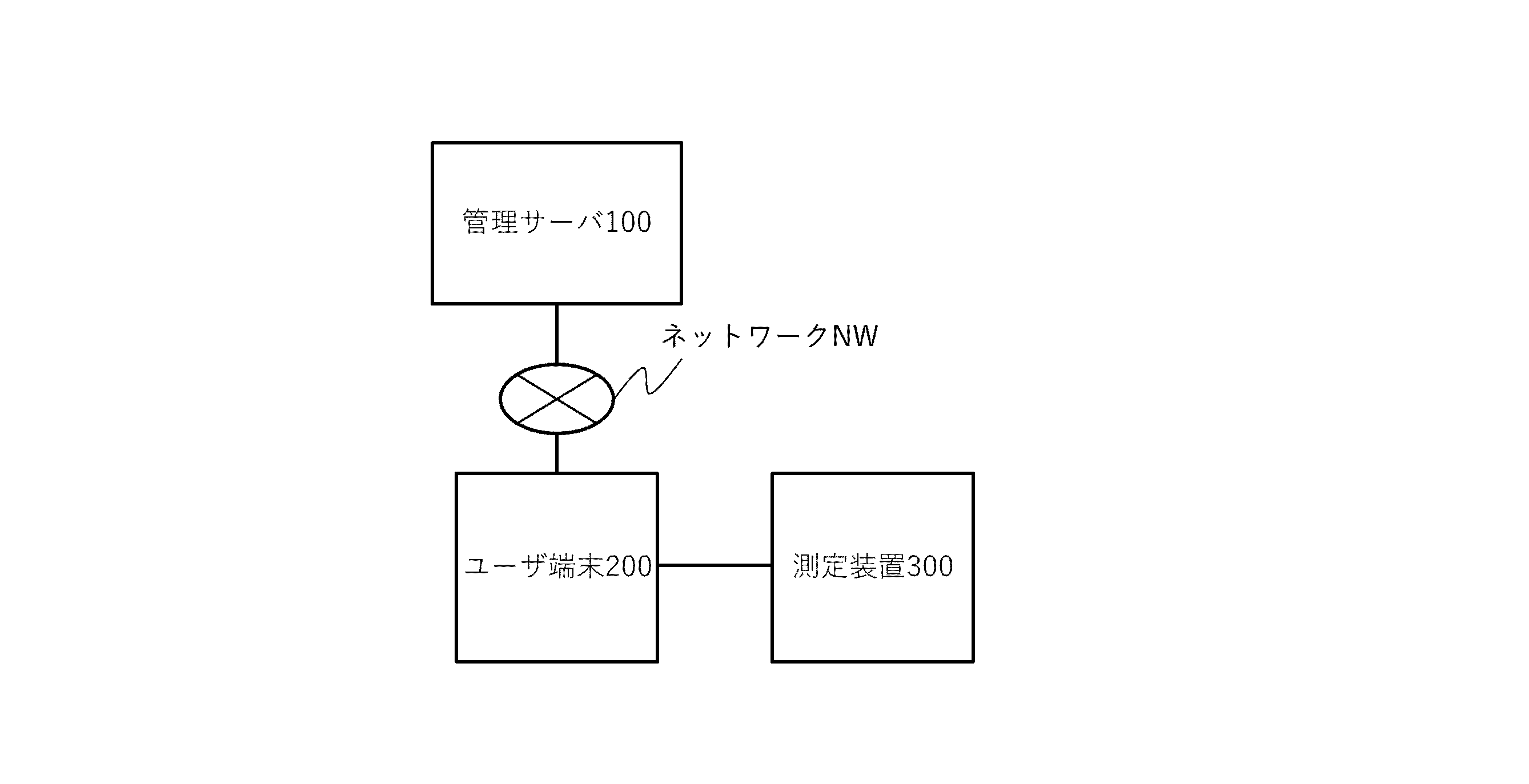
図1は、本開示の実施の形態に係る情報処理システム1を示すブロック構成図である。この情報処理システム1は、例えば、ネットワークNWを介して測定装置300からユーザの測定データを管理サーバ100にて所定の周期的なタイミングで受信し、当該測定データに対して所定の演算を行うことで生体データを生成し、当該生体データに基づき所定の通知を生成するシステムである。
<Structure>
FIG. 1 is a block configuration diagram showing an
情報処理システム1は、管理サーバ100と、ユーザ端末装置200と、測定装置300と、ネットワークNWと、を有している。管理サーバ100と、ユーザ端末装置200とは、ネットワークNWを介して接続される。ネットワークNWは、インターネット、イントラネット、ブロックチェーンネットワーク、無線LAN(Local Area Network)やWAN(Wide Area Network)、BLE(Bluetooth Low Energy)等により構成される。
The
管理サーバ100は、例えば、ネットワークを介して測定装置300からユーザの測定データを、ユーザ端末装置200を経由して所定の周期的なタイミングで受信して測定データから生体データへ演算を行う装置であり、例えば各種Webサービスを提供するサーバ装置により構成されている。 The management server 100 is, for example, a device that receives user's measurement data from the measurement device 300 via a network via a user terminal device 200 at a predetermined periodic timing and calculates the measurement data into biometric data. Yes, for example, it is configured by a server device that provides various Web services.
ユーザ端末装置200は、所定のユーザが所持する、例えばパーソナルコンピュータやタブレット端末、スマートフォン、スマートウォッチ、携帯電話、PHS、PDA等の情報処理装置であり、例えば、管理サーバ100で演算を行った生体データを波形グラフ等により表示させたり、生体データに基づき生成された所定の通知(詳細は後述)を表示させたりなどをするために利用される。ユーザ端末装置200には、予めユーザの識別番号、生年月日、性別、身長、体重、歩幅等のユーザ情報が登録されており、生年月日から算出した年齢等も含めたユーザ情報を測定データに関連付けてネットワークNWを介して管理サーバ100へ送信する。 The user terminal device 200 is an information processing device possessed by a predetermined user, for example, a personal computer, a tablet terminal, a smartphone, a smart watch, a mobile phone, a PHS, a PDA, etc. It is used to display data by a waveform graph or the like, or to display a predetermined notification (details will be described later) generated based on biometric data. User information such as a user's identification number, date of birth, gender, height, weight, stride, etc. is registered in the user terminal device 200 in advance, and user information including age calculated from the date of birth is measured data. It is transmitted to the management server 100 via the network NW in association with.
また、ユーザ端末装置200は、ユーザが測定装置300によりデータを取得する状態を、タッチパネル等を用いて入力するようにしてもよい。ユーザ端末装置200は、「データを取得する状態」を、例えば、走っている場合には「ランニング中」、食事中である場合には「食事中」など、タグ情報として入力することができる。この場合、ユーザ端末装置200は、測定装置300から所定の周期的なタイミングで受信した測定データを、タグ情報と関連付けてネットワークNWを介して管理サーバ100へ送信する。 Further, the user terminal device 200 may use a touch panel or the like to input a state in which the user acquires data by the measuring device 300. The user terminal device 200 can input the "state for acquiring data" as tag information such as "running" when running and "mealing" when eating. In this case, the user terminal device 200 transmits the measurement data received from the measuring device 300 at a predetermined periodic timing to the management server 100 via the network NW in association with the tag information.
測定装置300は、ユーザの生体データを測定する装置であり、ユーザが自己の手首や腕等の身体に装着して利用される、いわゆるウェアラブル装置である。この測定装置300は、既知の手法により、例えばユーザの心電、脈波、皮膚温度(体温)、加速度、角速度のデータを所定の周期的なタイミングで測定するための装置である。当該所定の周期は、予め設定されているものであってもよいし、ユーザが任意に設定可能であってもよい。より具体的には、例えば秒単位の時間的周期が設定されていてもよいし、周波数により同様に設定されていてもよい。 The measuring device 300 is a device that measures the biometric data of the user, and is a so-called wearable device that the user wears on the body such as his / her wrist or arm. The measuring device 300 is a device for measuring data of a user's electrocardiogram, pulse wave, skin temperature (body temperature), acceleration, and angular velocity at a predetermined periodic timing by a known method. The predetermined cycle may be preset or may be arbitrarily set by the user. More specifically, for example, a time cycle in seconds may be set, or the same may be set depending on the frequency.
測定装置300の具体的な構成の例としては、2つの電極を皮膚に接触させ、検出電位の差の時間変化より心電を心電波形のデータとして取得する装置で構成しても良く、心電波形は、ガルバニック皮膚反応により取得されたデータでも良い。また、緑、赤、赤外の発光を行うLEDから各光を皮膚に照射し、フォトダイオードで受光した光の強度の時間変化により、ユーザの心臓の心拍により生ずる血管の容積変化により脈波を脈波形のデータとして取得する装置で構成しても良く、この方式で検出を行うことができる脈波形は光電式容積脈波形である。また、ユーザの皮膚に接触させる温度センサによりユーザの皮膚温度をデータとして取得する装置で構成しても良い。また、直交するXYZ軸それぞれの変異状態を検出する3軸加速度センサにより構成しても良く、ユーザの動作を加速度データとして取得し、例えば測定装置300がユーザの手首や腕等に装着されている場合、測定装置300は、手首や腕等の振りと、全身の動きが合成された加速度として加速度データの取得をする。さらに、直行するXYZ軸それぞれにおける回転角速度を検出するジャイロセンサ(角速度センサ)により構成しても良く、ユーザの動作を角速度データとして取得し、例えば測定装置300がユーザの手首や腕等に装着されている場合、測定装置300は、手首や腕等の回転と、全身の動きが合成された角速度として角速度データの取得をする。 As an example of the specific configuration of the measuring device 300, a device may be configured in which two electrodes are brought into contact with the skin and the electrocardiogram is acquired as electrocardiographic waveform data from the time change of the difference in the detected potential. The radio wave type may be data acquired by a galvanic skin reaction. In addition, each light is radiated to the skin from LEDs that emit green, red, and infrared light, and the time change in the intensity of the light received by the photodiode causes a pulse wave due to the change in the volume of the blood vessel caused by the heartbeat of the user's heart. It may be configured by a device that acquires pulse waveform data, and the pulse waveform that can be detected by this method is a photoelectric volume pulse waveform. Further, the device may be configured to acquire the user's skin temperature as data by a temperature sensor in contact with the user's skin. Further, it may be configured by a 3-axis acceleration sensor that detects the variation state of each of the orthogonal XYZ axes, and the user's motion is acquired as acceleration data, and for example, the measuring device 300 is attached to the user's wrist, arm, or the like. In this case, the measuring device 300 acquires acceleration data as an acceleration in which the swing of the wrist, arm, or the like and the movement of the whole body are combined. Further, it may be configured by a gyro sensor (angular velocity sensor) that detects the rotational angular velocity in each of the orthogonal XYZ axes, and the user's motion is acquired as angular velocity data, for example, the measuring device 300 is attached to the user's wrist, arm, or the like. If so, the measuring device 300 acquires the angular velocity data as the angular velocity in which the rotation of the wrist, the arm, or the like and the movement of the whole body are combined.
ユーザ端末装置200と測定装置300との間は、Bluetooth(登録商標)、近距離無線通信(Near Field radio Communication=NFC)、Afero(登録商標)、Zigbee(登録商標)、Z-Wave(登録商標)、又は無線LAN等を用いて接続されている。なお、このような無線接続の代わりに有線で接続を行っても良い。また、ユーザ端末装置200と測定装置300とは一体の機器であっても良く、例えば測定装置300にSIMを搭載するなどして通信機能を持たせたり、BLE(Bluetooth Low Energy)などにより管理サーバ100と直接通信可能に構成しても良い。 Between the user terminal device 200 and the measuring device 300, Bluetooth (registered trademark), Near Field radio Communication (NFC), Afero (registered trademark), Zigbee (registered trademark), Z-Wave (registered trademark). ) Or is connected using a wireless LAN or the like. In addition, instead of such a wireless connection, a wired connection may be made. Further, the user terminal device 200 and the measuring device 300 may be integrated devices, for example, the measuring device 300 may be equipped with a SIM to have a communication function, or a management server may be provided with BLE (Bluetooth Low Energy) or the like. It may be configured to be able to communicate directly with 100.
ユーザ端末装置200は、1または複数台あり、測定装置300を利用するユーザ数分ネットワークNWに接続されている。測定装置300は、1または複数台あり、1人のユーザが利用する台数分のユーザ端末装置200に接続されている。1人のユーザが複数の測定装置300を利用している場合は、1つのユーザ端末装置200に複数の測定装置300が接続されている。 There are one or a plurality of user terminal devices 200, and they are connected to the network NW for the number of users who use the measuring device 300. There are one or a plurality of measuring devices 300, and they are connected to the number of user terminal devices 200 used by one user. When one user uses a plurality of measuring devices 300, the plurality of measuring devices 300 are connected to one user terminal device 200.
<管理サーバ100>
図2は、管理サーバ100のハードウェア構成を示す図である。図3は、記憶部120および制御部130の機能を例示したブロック図である。なお、図示された構成は一例であり、これ以外の構成を有していてもよい。
<Management server 100>
FIG. 2 is a diagram showing a hardware configuration of the management server 100. FIG. 3 is a block diagram illustrating the functions of the storage unit 120 and the control unit 130. The configuration shown in the figure is an example, and may have other configurations.
管理サーバ100は、通信部110と、記憶部120と、制御部130と、入出力部140とを備える。これらの機能部は、管理サーバ100用の所定のプログラムを実行することにより実現される。 The management server 100 includes a communication unit 110, a storage unit 120, a control unit 130, and an input / output unit 140. These functional units are realized by executing a predetermined program for the management server 100.
通信部110は、ユーザ端末装置200と通信を行うための通信インタフェースであり、例えばTCP/IP(Transmission Control Protocol/Internet Protocol)等の通信規約により通信が行われる。 The communication unit 110 is a communication interface for communicating with the user terminal device 200, and communication is performed according to a communication protocol such as TCP / IP (Transmission Control Protocol / Internet Protocol).
記憶部120は、各種制御処理や制御部130内の各機能を実行するためのプログラム、入力データ等を記憶するものであり、RAM(Random Access Memory)、ROM(Read Only Memory)等から構成される。また、図3に示されるように、記憶部120は、測定装置300による測定データをユーザ情報と関連付けて記憶する測定データDB121と、測定データから演算されて生成される生体データをユーザ情報と関連付けて記憶する生体データDB122と、ユーザ端末装置200へ送信される各種通知を記憶する通知情報DB123と、ユーザ識別番号を含むユーザ情報を記憶するユーザ情報DB124と、を記憶する。また、ユーザ情報は、データ管理部131により生成されたアカウント情報を含み、ユーザ情報DB124は、アカウント情報が他のユーザ情報と関連付けられて記憶するようにしてもよい。さらに、記憶部120は、ユーザ端末装置200と通信を行ったデータを一時的に記憶する。なお、DBのデータ構造は、これに限られるものではなく、上述のDBの一部をユーザ端末装置200または測定装置300に記憶するようにしてもよい。
The storage unit 120 stores programs for executing various control processes and functions in the control unit 130, input data, and the like, and is composed of a RAM (Random Access Memory), a ROM (Read Only Memory), and the like. To. Further, as shown in FIG. 3, the storage unit 120 associates the
制御部130は、管理サーバ100の全体の動作を制御するものであり、CPU(Central Processing Unit)等から構成される。また、図3に示されるように、制御部130は、データ管理部131、生体データ生成部132、通知生成部133、データ出力部134といった機能部を含む。 The control unit 130 controls the overall operation of the management server 100, and is composed of a CPU (Central Processing Unit) and the like. Further, as shown in FIG. 3, the control unit 130 includes functional units such as a data management unit 131, a biometric data generation unit 132, a notification generation unit 133, and a data output unit 134.
データ管理部131は、測定装置300を利用するユーザごとに、アカウント情報を生成する。このアカウント情報生成は、測定装置300を利用するユーザがユーザ端末装置200でアカウント情報を登録すると行われる。そのため、データ管理部131は、ユーザのユーザ端末装置200や他の端末装置に対してアカウントごとに記憶部120内の各種DBへのアクセスの可否の制御を行う。データ管理部131は、測定データや生体データ等の各種データを対応するDBにユーザ情報に関連付けて記憶する。また、このとき、データ管理部131は、測定データに所定のタグ情報の関連付けを行って記憶させることが可能である。 The data management unit 131 generates account information for each user who uses the measuring device 300. This account information generation is performed when the user who uses the measuring device 300 registers the account information on the user terminal device 200. Therefore, the data management unit 131 controls whether or not the user terminal device 200 and other terminal devices of the user can access various DBs in the storage unit 120 for each account. The data management unit 131 stores various data such as measurement data and biometric data in a corresponding DB in association with user information. Further, at this time, the data management unit 131 can associate the measurement data with predetermined tag information and store it.
図4は、図3の測定データに関連付けされるタグ情報の例を示す模式図である。図4に示すデータD1は、測定装置300の測定データである。タグT1は、データD1に関連付けされたタグ情報であり、例えば、測定装置300がデータD1を測定した時刻情報、またはデータD1が測定装置300からユーザ端末装置200へ送信された時刻情報が時系列データとして記憶される。もしくは、測定した時刻情報と送信された時刻情報との両方について関連付けを行っても良い。例えば、図4に示すタグT1の1行目では、「20180620120746144」が格納されているが、2018年06月20日12時07分46秒144ミリ秒を示している。このような時刻情報は通信ログより取得可能である。これにより、測定データがどの時間帯のものか把握することが可能である。 FIG. 4 is a schematic diagram showing an example of tag information associated with the measurement data of FIG. The data D1 shown in FIG. 4 is the measurement data of the measuring device 300. The tag T1 is tag information associated with the data D1, and for example, the time information in which the measuring device 300 measures the data D1 or the time information in which the data D1 is transmitted from the measuring device 300 to the user terminal device 200 is time-series. It is stored as data. Alternatively, both the measured time information and the transmitted time information may be associated. For example, in the first line of the tag T1 shown in FIG. 4, "20180620120746144" is stored, but it indicates 12:07:46:144 ms on June 20, 2018. Such time information can be obtained from the communication log. This makes it possible to grasp which time zone the measurement data belongs to.
なお、このようなタグ情報による測定データ及び生体データの関連付けは、時刻情報に限られず、ユーザの体調状態や行動状態を示す身体情報や行動情報を自由記載で記入させてタグ情報として記憶しても良く、所定の選択肢から選択させ(例えば、「現在の体調は如何ですか?」という質問に対して、「1:良い、2:普通、3:悪い」のいずれかを選択させる、等)、その選択した回答を記憶するようにしても良い。または、ユーザが所定行動(例えば、坐位、立位、歩行、走行、睡眠、食事、運転、安静時など)をとった場合に、ユーザにより計測データや生体データのタグ情報として記録する(例えば、選択肢形式であったり、自由記載であったりする)ようにしてもよい。さらには、上述のユーザによる記録に代えて、または、併用して、例えば計測データや生体データ(例えば歩行速度情報や歩幅情報、装着部位の動作情報、姿勢情報、重心の位置情報、心拍情報など)に基づき、所定行動(例えば、坐位、立位、臥位、歩行、走行、睡眠、起床、就寝、食事、運転、安静時など)を既知の方法により推定するようにして生体データ等にタグ情報(行動情報)として関連付けてもよい。この時、例えば、教師用計測データに基づき学習された学習モデルにより推定してもよいし、さらに、上述のユーザによる記録の結果により追加学習を行うことで、学習モデルをパーソナライズしてもよい。これにより、制御部150にて生体データを生成する際に、当該タグ情報と生体データとを対応付けすることで、より精度の高い生体データを生成可能となると共に、それ自体も行動情報として用いることが可能となる。 It should be noted that the association between the measurement data and the biological data by such tag information is not limited to the time information, but the physical information and the behavior information indicating the physical condition state and the behavior state of the user can be freely entered and stored as the tag information. It is also good to let them choose from the prescribed options (for example, in response to the question "How are you feeling now?", Choose one of "1: good, 2: normal, 3: bad", etc.). , You may try to remember the selected answer. Alternatively, when the user takes a predetermined action (for example, sitting, standing, walking, running, sleeping, eating, driving, resting, etc.), the user records it as tag information of measurement data or biometric data (for example,). It may be a choice format or a free description). Furthermore, instead of or in combination with the above-mentioned user recording, for example, measurement data and biometric data (for example, walking speed information, stride information, motion information of the wearing site, posture information, position information of the center of gravity, heartbeat information, etc. ), And tags biometric data etc. by estimating predetermined behavior (for example, sitting, standing, lying down, walking, running, sleeping, waking up, sleeping, eating, driving, resting, etc.) by a known method. It may be associated as information (behavioral information). At this time, for example, the learning model may be estimated by a learning model learned based on the measurement data for teachers, or the learning model may be personalized by performing additional learning based on the result of the above-mentioned recording by the user. As a result, when the control unit 150 generates biometric data, by associating the tag information with the biometric data, it is possible to generate more accurate biometric data, and the control unit 150 itself is used as behavioral information. It becomes possible.
また、例えばデータ管理部131は、データD1をタグT1の時刻順に並べ替え(ソート)を行ったり、所定の身体情報や行動情報だけを抜き出したりなど、タグ情報に基づくデータ管理が可能である。 Further, for example, the data management unit 131 can manage data based on the tag information, such as sorting the data D1 in the time order of the tag T1 or extracting only predetermined physical information and behavior information.
生体データ生成部132は、測定データDB121に記憶された測定データに対して所定の演算を行い、生体データを生成する。この生体データは、測定データから算出可能なものであればどのような情報であってもよく、例えばユーザの血糖値情報、血圧情報、心拍情報、血中酸素量情報、最大酸素摂取量情報、心電情報、呼吸数、体温情報、歩数情報、歩幅情報、重心の位置情報、姿勢情報、ストレス情報、運動量情報、運動負荷情報、移動距離情報、移動速度情報、活動量情報、手または脚等の装着部位の動作情報などのデータであり、既知の手法により測定データから算出されるものである。演算により生成された生体データは、生体データDB122に記憶される。
The biometric data generation unit 132 performs a predetermined operation on the measurement data stored in the
また、既知の学習器などにより、例えば測定データと、当該測定データに基づき生成された生体データ(例えば心拍情報や血圧情報など)と正の生体データ(例えば、既知の医療機器等に基づく心拍情報や血圧情報など)との対応関係(例えば、誤差の程度や範囲を示す情報などが含まれていてもよい)により対応付けた教師データを基に学習モデルを予め作成し、生体データ生成部132は、当該学習モデルを用いた判定を上述の所定の演算(解析)として生体データを生成してもよい。 In addition, for example, measurement data by a known learning device, biometric data generated based on the measurement data (for example, heartbeat information, blood pressure information, etc.) and positive biometric data (for example, heartbeat information based on known medical equipment, etc.) A learning model is created in advance based on the teacher data associated with the correspondence (for example, information indicating the degree and range of the error may be included) with the blood pressure information, etc., and the biological data generation unit 132. May generate biometric data using the determination using the learning model as the above-mentioned predetermined calculation (analysis).
ここで、血圧情報の生成について詳述する。生体データ生成部132は、脈波伝搬時間演算部1321を含んで構成される。生体データ生成部132は、光電式容積脈波形データ(例えば、図5の脈波形データ等)から2階微分データの演算を行う。脈波伝搬時間演算部1321は、後述する心電情報中の波形プロファイルからR波とT波を検出し、又、光電式容積脈波形データ中の波形プロファイルからP波とD波を検出し、それらの情報に基づいて、心室収縮期脈波伝搬時間PTT_SYS及び心室拡張期脈波伝搬時間PTT_DIAの演算を行う。また、生体データ生成部132は、演算される後述する2階微分データの基づく加速度脈波特性情報と、心室収縮期脈波伝搬時間PTT_SYS及び心室拡張期脈波伝搬時間PTT_DIAから、血圧情報の演算を行う。脈波伝搬時間演算部1321は、R波とT波を検出に当たって、光電式容積脈波形データの1階微分データや、2階微分データを用いてもよい。 Here, the generation of blood pressure information will be described in detail. The biological data generation unit 132 includes a pulse wave propagation time calculation unit 1321. The biological data generation unit 132 calculates second-order differential data from photoelectric volumetric pulse waveform data (for example, pulse waveform data in FIG. 5). The pulse wave propagation time calculation unit 1321 detects R wave and T wave from the waveform profile in the electrocardiographic information described later, and also detects P wave and D wave from the waveform profile in the photoelectric type volumetric pulse waveform data. Based on the information, the ventricular systolic pulse wave propagation time PTT_SYS and the ventricular diastolic pulse wave propagation time PTT_DIA are calculated. Further, the biological data generation unit 132 obtains blood pressure information from the acceleration pulse wave characteristic information based on the second-order differential data to be calculated later, the ventricular systolic pulse wave propagation time PTT_SYS, and the ventricular diastolic pulse wave propagation time PTT_DIA. Perform the calculation. The pulse wave propagation time calculation unit 1321 may use the first-order differential data or the second-order differential data of the photoelectric positive volume pulse waveform data in detecting the R wave and the T wave.
また、生体データ生成部132は、例えば、被測定者が装着している測定装置300に備えられた2つの電極を皮膚に接触させ、検出電位の差の時間変化より測定される心電波形データ(例えば、図5の心電波形データ等)におけるQRS波の間隔などから、心拍情報を生体情報(生体生成情報)として得ることができる。 Further, the biometric data generation unit 132 brings, for example, two electrodes provided in the measuring device 300 worn by the person to be measured in contact with the skin, and the electrocardiographic waveform data measured from the time change of the difference in the detected potential. Heartbeat information can be obtained as biometric information (biologically generated information) from the intervals of QRS waves in (for example, the electrocardiographic waveform data of FIG. 5).
図5は、測定装置300が測定した非測定者の心電波形及び光電式容積脈波形と、管理サーバ100が演算を行った速度脈波形及び加速度脈波形を示している。図5の上から順に、心電波形、光電式容積脈波形、速度脈波形及び加速度脈波形となる。縦軸は、各波形の強度を示しており、心電波形及び光電式容積脈波形は電位を示すmVで表される。横軸は時間経過を示し、左から右へ時間経過を示している。 FIG. 5 shows the electrocardiographic waveform and the photoelectric volume pulse waveform of the non-measurer measured by the measuring device 300, and the velocity pulse waveform and the acceleration pulse waveform calculated by the management server 100. From the top of FIG. 5, the electrocardiographic waveform, the photoelectric volumetric pulse waveform, the velocity pulse waveform, and the acceleration pulse waveform are arranged in this order. The vertical axis shows the intensity of each waveform, and the electrocardiographic waveform and the photoelectric volume pulse waveform are represented by MV indicating the potential. The horizontal axis shows the passage of time, and shows the passage of time from left to right.
心電波形は、人の心臓の拍動を引き起こす電気的信号の周期的変化を示す波形である。心電波形は、その形状の変曲点にそれぞれP波,Q波,R波,S波,T波の名称が割り当てられ、心拍の1サイクルを示している。P波は心房収縮を表し、Q波R波S波は心室収縮の状態を表し、T波は心室拡張の開始を表す。 An electrocardiographic waveform is a waveform showing a periodic change in an electrical signal that causes a person's heart to beat. In the electrocardiographic waveform, the names of P wave, Q wave, R wave, S wave, and T wave are assigned to the inflection points of the shape, respectively, and indicate one cycle of heartbeat. The P wave represents the atrial contraction, the Q wave, the R wave, and the S wave represent the state of ventricular contraction, and the T wave represents the start of ventricular dilation.
光電式容積脈波形は、人の心臓の拍動に伴う末梢血管系内の血圧・体積の変化を示す波形である。光電式容積脈波形は、その形状の変曲点にそれぞれA波、P波、V波、D波の名称が割り当てられ、心拍の1サイクルを示している。A波を動脈脈波が生じた時点の基準点として、P波が左心室駆出によって生じるPercussion波(衝撃波)、V波が大動脈弁の閉鎖時に生じるValley波(重複隆起による波)、D波が反射振動波であるDicrotic波(重複波)を示している。 The photoelectric volume pulse waveform is a waveform showing changes in blood pressure and volume in the peripheral vascular system accompanying the beating of the human heart. In the photoelectric volume pulse waveform, the names of A wave, P wave, V wave, and D wave are assigned to the inflection points of the shape, respectively, and indicate one cycle of the heartbeat. With the A wave as the reference point at the time when the arterial pulse wave is generated, the P wave is the Percussion wave (shock wave) generated by the ejection of the left ventricle, the V wave is the Valley wave (wave due to the overlapping uplift) generated when the aortic valve is closed, and the D wave. Indicates a Dictric wave (overlapping wave) which is a reflected vibration wave.
速度脈波形は、光電式容積脈波形を時間で1階微分をしたものである。加速度脈波形は、速度脈波形を時間で1階微分したもの、すなわち光電式容積脈波形を2階微分したものである。加速度脈波形は、図5で示すように、その波形の各ピークにa波(収縮初期陽性波)、b波(収縮初期陰性波)、c波(収縮中期再上昇波)、d波(収縮後期再下降波)、e波(拡張初期陽性波)、f波(拡張初期陰性波)の名称が割り当てられている。b波の強度とa波の強度の比、及びf波の強度とe波の強度の比はそれぞれ血管の伸縮性すなわち弾性を示すパラメータである。主な血管の成分は、血管内皮(Endothelium)、弾性線維(Elastin)、タンパク質(Collagen)、平滑筋(Smooth Muscle)である。これら成分それぞれ異なった性質があり、最大血圧、最小血圧時の血管の弾性はそれぞれCollagen、Elastinが強い影響力を担っている。そのため、血圧値によって異なる弾性をb波の強度とa波の強度の比である(b/a),f波の強度とe波の強度の比である(f/e)のパラメータで示すことができ、年齢・性別・環境変数(気温など)の影響によってもこれらの値は変動する。そのため、(b/a),(f/e)の値は、加速度脈波形の特性情報として算出することができる。 The velocity pulse waveform is a first-order derivative of the photoelectric volume pulse waveform with respect to time. The acceleration pulse waveform is a first-order derivative of the velocity pulse waveform, that is, a second-order derivative of the photoelectric volume pulse waveform. As shown in FIG. 5, the acceleration pulse waveform has a wave (initial contraction positive wave), b wave (initial contraction negative wave), c wave (mid-contraction re-rise wave), and d wave (contraction) at each peak of the waveform. The names of the late re-descending wave), the e wave (extended early positive wave), and the f wave (extended early negative wave) are assigned. The ratio of the intensity of the b wave to the intensity of the a wave and the ratio of the intensity of the f wave to the intensity of the e wave are parameters indicating the elasticity, that is, the elasticity of the blood vessel, respectively. The main vascular components are vascular endothelium, elastin, collagen, and smooth muscle. Each of these components has different properties, and collagen and elastin have a strong influence on the elasticity of blood vessels at the maximum blood pressure and the minimum blood pressure, respectively. Therefore, the elasticity that differs depending on the blood pressure value is indicated by the parameters of the ratio of the intensity of the b wave to the intensity of the a wave (b / a) and the ratio of the intensity of the f wave to the intensity of the e wave (f / e). These values also fluctuate due to the influence of age, gender, and environmental variables (temperature, etc.). Therefore, the values of (b / a) and (f / e) can be calculated as the characteristic information of the acceleration pulse waveform.
図5で示すようにR波の生じた時間TrとP波の生じた時間Tpの差分の時間が心室収縮期脈波伝搬時間PTT_SYSとなる。T波の生じた時間TtとD波の生じた時間Tdの差分の時間が心室拡張期脈波伝搬時間PTT_DIAとなる。すなわち、心電波形のR波の時間Tr及びT波の時間Ttと、光電式容積脈波形のT波の時間TpとD波の時間Tdから、(1)式及び(2)式で示すように、心室収縮期脈波伝搬時間PTT_SYS及び心室拡張期脈波伝搬時間PTT_DIAを算出することができる。 As shown in FIG. 5, the time difference between the time Tr at which the R wave is generated and the time Tp at which the P wave is generated is the ventricular systolic pulse wave propagation time PTT_SYS. The time of the difference between the time Tt in which the T wave is generated and the time Td in which the D wave is generated is the ventricular diastolic pulse wave propagation time PTT_DIA. That is, as shown by Eqs. (1) and (2), from the time Tr of the R wave and the time Tt of the T wave of the electrocardiographic waveform, and the time Tp of the T wave and the time Td of the D wave of the photoelectric volume pulse waveform. In addition, the ventricular systolic pulse wave propagation time PTT_SYS and the ventricular diastolic pulse wave propagation time PTT_DIA can be calculated.
PTT_SYS=Tp-Tr ・・・(1) PTT_SYS = Tp-Tr ... (1)
PTT_DIA=Td-Tt ・・・(2) PTT_DIA = Td-Tt ... (2)
心電波形を測定する第1電極及び第2電極と、光電式容積脈波形の測定する光学センサモジュールを、手首を介して対向させ、配置距離を離すことにより、心電波形の検出部位と光電式容積脈波形の測定部位を離すことになる。そのため、それぞれの特徴波形が生じるタイムラグを生じさせることにより、心室収縮期脈波伝搬時間PTT_SYS及び心室拡張期脈波伝搬時間PTT_DIAの絶対的な算出時間を長くとることができる。そのため、心室収縮期脈波伝搬時間PTT_SYS及び心室拡張期脈波伝搬時間PTT_DIAの変化情報を得る場合に、変化情報の精度を高めることができる。 The first and second electrodes for measuring the electrocardiographic waveform and the optical sensor module for measuring the photoelectric volumetric pulse waveform are opposed to each other via the wrist, and the arrangement distance is separated from the detection site of the electrocardiographic waveform. The measurement site of the formula volume pulse waveform will be separated. Therefore, by causing a time lag in which each characteristic waveform is generated, the absolute calculation time of the ventricular systolic pulse wave propagation time PTT_SYS and the ventricular diastolic pulse wave propagation time PTT_DIA can be lengthened. Therefore, when the change information of the ventricular systolic pulse wave propagation time PTT_SYS and the ventricular diastolic pulse wave propagation time PTT_DIA is obtained, the accuracy of the change information can be improved.
ここで、血圧の算出式について説明する。 Here, the formula for calculating blood pressure will be described.
以下に示す(3)式の脈波伝搬速度の式(Moens―Korteweg の式)より、脈波伝播速度と動脈壁の縦弾性係数との関係が示されている。 From the following equation (3) pulse wave velocity equation (Moens-Korteweg equation), the relationship between the pulse wave velocity and the Young's modulus of the arterial wall is shown.
L/T_PTT=√(E・h/(2・r・ρ)) ・・・(3) L / T_PTT = √ (E ・ h / (2 ・ r ・ ρ)) ・ ・ ・ (3)
(3)式の各パラメータは、L:測定間距離、T_PTT:脈波伝搬時間、r:血管内径、E:血管の縦弾性係数、h:血管の厚さ、ρ:血液密度である。 Each parameter of the formula (3) is L: distance between measurements, T_PTT: pulse wave propagation time, r: blood vessel inner diameter, E: blood vessel Young's modulus, h: blood vessel thickness, ρ: blood density.
縦弾性係数と血圧値は相関関係にあることが知られており、 It is known that Young's modulus and blood pressure value are correlated.
E=E0・exp(α・P) ・・・(4) E = E 0・ exp (α ・ P) ・ ・ ・ (4)
で示すことができる。ここで、P:血圧値、α:定数、E0:初期値である。 Can be indicated by. Here, P: blood pressure value, α: constant, E 0 : initial value.
(3)式と(4)式より From equations (3) and (4)
P=(-2・ln(T_PTT)+ln(2・r・ρ・L2/(E0・h)))/α ・・・(5) P = (-2 ・ ln (T_PTT) + ln (2 ・ r ・ ρ ・ L 2 / (E 0・ h))) / α ・ ・ ・ (5)
を導き出すことができる。lnは自然対数を示している。このとき、”r・ρ”は測定部位の血液量に比例するため、光電式容積脈波形で示される高値(Vp、Vd)で示すことができる。又、”E0・h”は血管の弾性に比例する値であるため、弾性を示すパラメータである(b/a)と(f/e)を用いて置き換えることができる。 Can be derived. ln indicates the natural logarithm. At this time, since "r · ρ" is proportional to the blood volume at the measurement site, it can be indicated by a high value (Vp, Vd) indicated by the photoelectric volume pulse waveform. Further, since "E 0 · h" is a value proportional to the elasticity of the blood vessel, it can be replaced by using the parameters (b / a) and (f / e) indicating the elasticity.
よって、最高血圧BP_SYS(Blood Pressure_Systolic)及び最低血圧BP_DIA(Blood Pressure_Diastolic)は、以下で示す(6)式及び(7)式で示すことができる。 Therefore, the systolic blood pressure BP_SYS (Blood Pressure_Systic) and the diastolic blood pressure BP_DIA (Blood Pressure_Diastolic) can be represented by the following equations (6) and (7).
BP_SYS=A1・ln(PTT_SYS)+A2・ln(Vp)+A3・ln(b/a)+A4 ・・・(6) BP_SYS = A1 · ln (PTT_SYS) + A2 · ln (Vp) + A3 · ln (b / a) + A4 ... (6)
BP_DIA=A5・ln(PTT_DIA)+A6・ln(Vd)+A7・ln(f/e)+A8 ・・・(7) BP_DIA = A5 · ln (PTT_DIA) + A6 · ln (Vd) + A7 · ln (f / e) + A8 ... (7)
A1からA8は条件により定まる定数である。(6)式で算出することができる最高血圧BP_SYSは、心室収縮期脈波伝搬時間PTT_SYSの自然対数に定数A1を掛けたものと、P波の強度Vpの自然対数に定数A2を掛けたものと、(b/a)の自然対数に定数A3を掛けたものと、定数A4の和で求めることができる。(7)式で算出することができる最低血圧BP_SYSは、心室収縮期脈波伝搬時間PTT_DIAの自然対数に定数A5を掛けたものと、D波の強度Vdの自然対数に定数A6を掛けたものと、(f/e)の自然対数に定数A7を掛けたものと、定数A8の和で求めることができる。装置の特性や、測定対象者等により各定数を求めることにより、最高血圧BP_SYSと最低血圧BP_DIAを求めることが可能である。しかし、最高血圧BP_SYSと最低血圧BP_DIAの変化状態を確認する場合には、すべての定数を確定する必要はなく、暫定の数値で代用しながら、最高血圧BP_SYSに関する情報と最低血圧BP_DIAに関する情報としての値を得ることが可能である。P波の強度Vpの自然対数及びD波の強度Vdの自然対数は、血液密度の影響を考慮した項である。また、(b/a)の自然対数及び(f/e)の自然対数は、動脈壁の縦弾性係数の影響を考慮した項である。そのため、測定条件によっては、いずれかの項を選択し他の項を定数化することで最高血圧BP_SYSに関する情報と最低血圧BP_DIAに関する情報の演算を行ってもよい。 A1 to A8 are constants determined by conditions. The systolic blood pressure BP_SYS that can be calculated by Eq. (6) is the natural logarithm of the ventricular systolic pulse wave propagation time PTT_SYS multiplied by the constant A1 and the natural logarithm of the intensity Vp of the P wave multiplied by the constant A2. It can be obtained by multiplying the natural logarithm of (b / a) by the constant A3 and the sum of the constants A4. The diastolic blood pressure BP_SYS that can be calculated by Eq. (7) is the natural logarithm of the ventricular systolic pulse wave propagation time PTT_DIA multiplied by the constant A5 and the natural logarithm of the intensity Vd of the D wave multiplied by the constant A6. It can be obtained by multiplying the natural logarithm of (f / e) by the constant A7 and the sum of the constant A8. It is possible to obtain the systolic blood pressure BP_SYS and the diastolic blood pressure BP_DIA by obtaining each constant depending on the characteristics of the device and the person to be measured. However, when confirming the changes in the systolic blood pressure BP_SYS and the diastolic blood pressure BP_DIA, it is not necessary to determine all the constants, and while substituting the provisional numerical values, the information on the systolic blood pressure BP_SYS and the information on the diastolic blood pressure BP_DIA are used. It is possible to get a value. The natural logarithm of the intensity Vp of the P wave and the natural logarithm of the intensity Vd of the D wave are terms in consideration of the influence of blood density. Further, the natural logarithm of (b / a) and the natural logarithm of (f / e) are terms in consideration of the influence of the Young's modulus of the arterial wall. Therefore, depending on the measurement conditions, information on the systolic blood pressure BP_SYS and information on the diastolic blood pressure BP_DIA may be calculated by selecting one of the terms and making the other term constant.
また、生体データ生成部132は、例えば被測定者が装着している測定装置300の温度センサ(サーミスタ等)により測定される被測定者の皮膚温度情報から温度情報を生体情報(生体生成情報)として得ることができる。 Further, the biological data generation unit 132 obtains temperature information from the skin temperature information of the person to be measured measured by, for example, a temperature sensor (thermistor or the like) of the measuring device 300 worn by the person to be measured. Can be obtained as.
また、生体データ生成部132は、例えば被測定者が手首に装着している測定装置300により測定される加速度データの波形データから既知の算出方法等を単体で用いる、または、組み合わせて用いる(例えば平均化したり、重みづけしたりなど)ことにより歩行速度情報を生体情報(生体生成情報)として得ることができ、例えば加速度データを所定時間ごとに積分することで歩行速度情報生体情報(生体生成情報)として得ることができる。 Further, the biological data generation unit 132 uses, for example, a calculation method known from the waveform data of the acceleration data measured by the measuring device 300 worn on the wrist of the person to be measured alone or in combination (for example). Walking speed information can be obtained as biometric information (biologically generated information) by averaging, weighting, etc., for example, walking speed information biometric information (biologically generated information) by integrating acceleration data at predetermined time intervals. ) Can be obtained.
また、生体データ生成部132は、例えば被測定者が手首に装着している測定装置300により測定される加速度データの波形データから既知の算出方法等を単体で用いる、または、組み合わせて用いる(例えば平均化したり、重みづけしたりなど)ことにより歩幅情報を生体情報(生体生成情報)として得ることができ、例えば、歩く時には振り子のように手を振るため、上述の加速度センサの情報(例えば、進行方向の加速度成分が一番小さいタイミングまたは逆方向に切り替わるタイミングや、進行方向に対して垂直な方向の加速度成分が一番小さいタイミングまたは上下が切り替わるタイミングなど)を基に1歩の間隔が判別できるため、さらに時間情報を用いれば歩幅情報を生体情報(生体生成情報)として得ることができる。他には、例えば、地面を蹴り出した際には、蹴り出た方向の加速度成分が合成されるので、当該方向の加速度成分の発生タイミングで1歩の間隔を判別することでも可能である。 Further, the biological data generation unit 132 uses, for example, a calculation method known from the waveform data of acceleration data measured by the measuring device 300 worn on the wrist of the person to be measured alone or in combination (for example). Stride information can be obtained as biometric information (biologically generated information) by averaging, weighting, etc., and for example, since the hand is waved like a pendulum when walking, the above-mentioned accelerometer information (for example,). The interval of one step is determined based on the timing when the acceleration component in the traveling direction is the smallest or the timing when the acceleration component is switched in the opposite direction, the timing when the acceleration component in the direction perpendicular to the traveling direction is the smallest, or the timing when the acceleration component is switched up and down, etc.) Therefore, if time information is further used, stride information can be obtained as biometric information (biologically generated information). Alternatively, for example, when the ground is kicked out, the acceleration component in the kicking direction is synthesized, so that it is also possible to determine the interval of one step at the timing of occurrence of the acceleration component in the direction.
また、生体データ生成部132は、例えば被測定者が装着している測定装置300により測定される加速度データおよび角速度データから、測定装置300を装着している部位(例えば、手首や足首など)がどれくらいの速度でどのような角度で動いているのかという動作情報を生体情報(生体生成情報)として得ることができる。 Further, in the biological data generation unit 132, for example, from the acceleration data and the angular velocity data measured by the measuring device 300 worn by the person to be measured, a portion (for example, a wrist or ankle) on which the measuring device 300 is worn is determined. It is possible to obtain motion information as biometric information (biologically generated information), such as how fast and at what angle it is moving.
また、生体データ生成部132は、例えば日常的に装着している測定装置300により測定される加速度データを周波数解析し、例えば周波数の高低が活動頻度の高低に対応付けられ、所定頻度以上の活動が1日の何割を占めているか、などの所定条件により算出することで活動量情報を生体情報(生体生成情報)として得ることができる。 Further, the biological data generation unit 132 frequency-analyzes acceleration data measured by, for example, a measuring device 300 that is worn on a daily basis, and for example, high and low frequencies are associated with high and low activity frequencies, and activities of a predetermined frequency or higher are performed. The activity amount information can be obtained as biometric information (biologically generated information) by calculating according to a predetermined condition such as what percentage of the day is occupied.
また、生体データ生成部132は、例えば日常的に装着している測定装置300により測定される加速度データから既知の算出方法等により歩行を含む運動をしている際の加速度データを特定できるので、例えば周波数解析などを用いて所定の条件により算出することで運動量情報を生体情報(生体生成情報)として得ることができる。また、角速度情報などの付加情報をさらに用いると、より正確な運動量情報を得ることが可能である。 Further, since the biological data generation unit 132 can specify the acceleration data during exercise including walking by a known calculation method or the like from the acceleration data measured by the measuring device 300 which is worn on a daily basis, for example. For example, momentum information can be obtained as biometric information (biologically generated information) by calculating under predetermined conditions using frequency analysis or the like. Further, by further using additional information such as angular velocity information, it is possible to obtain more accurate momentum information.
また、生体データ生成部132は、例えば日常的に装着している測定装置300により測定される加速度データから導出した上記活動量情報や上記運動量情報に対して、例えば運動負荷と共に大きくなる心拍情報により重みづけをすることで運動負荷量情報を生体情報(生体生成情報)として得ることができる。また、例えば加速度データのベクトル情報を加味すれば、歩行環境(坂や階段など)や姿勢(立位、座位など)などの状態情報も特定できるので、当該状態情報をさらに用いてもよい。また、角速度情報などの付加情報をさらに用いると、より正確な運動負荷量情報を得ることが可能である。 Further, the biological data generation unit 132 uses, for example, heartbeat information that increases with an exercise load with respect to the activity amount information and the exercise amount information derived from the acceleration data measured by the measuring device 300 that is worn on a daily basis. By weighting, exercise load information can be obtained as biometric information (biologically generated information). Further, for example, if the vector information of the acceleration data is added, the state information such as the walking environment (slope, stairs, etc.) and the posture (standing position, sitting position, etc.) can be specified, so that the state information may be further used. Further, by further using additional information such as angular velocity information, it is possible to obtain more accurate exercise load amount information.
また、生体データ生成部132は、例えば心拍数情報を用いて、VO2max=15×(220-年齢)÷心拍数(特に安静時心拍数)という公知の数式などにより最大酸素摂取量情報を生体情報(生体生成情報)として得ることができる。 Further, the biological data generation unit 132 uses, for example, heart rate information to obtain maximum oxygen uptake information by a known mathematical formula such as VO 2 max = 15 × (220-age) ÷ heart rate (particularly resting heart rate). It can be obtained as biometric information (biologically generated information).
また、既知の学習器などにより、例えば生体測定情報と、当該生体測定情報に基づき生成された生体生成情報(例えば心拍情報や血圧情報など)と正の生体情報(例えば、既知の医療機器に基づく心拍情報や血圧情報など)との対応関係(例えば、誤差の程度や範囲を示す情報などが含まれていてもよい)により対応付けた教師データを基に機械学習モデルを予め作成し、生体データ生成部132は、当該機械学習モデルを用いた判定を上述の所定の演算(解析)として生体情報を生成してもよい。 Further, it is based on, for example, biometric information, biogenerated information (for example, heartbeat information, blood pressure information, etc.) generated based on the biometric information and positive biometric information (for example, based on known medical equipment) by a known learning device or the like. A machine learning model is created in advance based on the teacher data associated with the correspondence with the heartbeat information, blood pressure information, etc. (for example, information indicating the degree and range of the error may be included), and the biometric data. The generation unit 132 may generate biometric information using the determination using the machine learning model as the above-mentioned predetermined calculation (analysis).
ここで、食後に血糖値が急上昇、急低下を起こす状態である血糖値スパイクは、普段は正常な血糖値であるものの、頻発すると動脈硬化のリスクが高まるといわれている。しかしながら、ユーザが無意識に血糖値スパイクにつながる行動をとってしまっている可能性があり、これらの行動が早期にユーザに知らされることが望ましい。 Here, it is said that the blood glucose spike, which is a state in which the blood glucose level rises and falls sharply after a meal, is usually a normal blood glucose level, but if it occurs frequently, the risk of arteriosclerosis increases. However, it is possible that the user has unknowingly taken actions that lead to a blood glucose spike, and it is desirable that these actions be notified to the user at an early stage.
そこで、本実施の形態において、通知生成部133は、ユーザが日常的に装着している測定装置300により所定の周期的なタイミングで受信した測定データに基づき生成された行動情報を血糖値スパイク条件情報と比較し、当該比較の結果に応じて条件に該当する血糖値スパイクにつながる行動を減らさせる通知(行動自体を抑制する旨を通知する注意通知やどのような行動をとるべきかを通知するアドバイス通知など)を生成する。ここでいう通知の生成は、何れの通知を出力データとするかを決定することを含み、例えば後述する条件に従ってどのような内容の通知を出力データとするかを通知情報DB123の各種通知の中から決定することを含む。以下、詳述する。 Therefore, in the present embodiment, the notification generation unit 133 uses the behavior information generated based on the measurement data received at a predetermined periodic timing by the measurement device 300 worn by the user on a daily basis as the blood glucose level spike condition. Compare with the information, and depending on the result of the comparison, notify that the behavior that leads to the blood glucose spike corresponding to the condition is reduced (notice that the behavior itself is suppressed and what kind of action should be taken) Generate advice notifications, etc.). The generation of the notification referred to here includes determining which notification is to be output data, and among various notifications of the notification information DB 123, for example, what kind of notification is to be output data according to the conditions described later. Including deciding from. The details will be described below.
血糖値スパイク条件情報は、例えば、食後に椅子から立ち上がらずに所定時間座っているかどうか(食後の行動条件)、所定時間以下(例えば6時間以下)の睡眠が所定の頻度(例えば週に3回など)であるかどうか(睡眠条件)、最大血圧及び最小血圧の少なくともいずれかが所定値以上の高血圧であるか(血圧条件)、朝食をとっているかどうか(朝食条件)、早食いせずにゆっくり食べているか(食事期間条件)、低GI食品を食べているか(GI条件)、といった条件を示す情報であり、各条件に対して基準値が、対応する行動情報や生体データとの比較対象として設定される。行動情報は、上述のとおり、例えば計測データや生体データ(例えば歩行速度情報や歩幅情報、装着部位の動作情報、姿勢情報、重心の位置情報、心拍情報などであって、特に手または脚等の装着部位の動作情報から得られるデータ)に基づき、所定行動(例えば、坐位、立位、臥位、歩行、走行、睡眠、起床、就寝、食事、運転、安静時など)を既知の方法により推定すればよく、より具体的には、教師用計測データや生体データに基づき学習された学習モデルにより推定してもよい。 The blood pressure spike condition information includes, for example, whether or not the patient sits for a predetermined time without getting up from the chair after eating (behavioral condition after eating), and sleeps for a predetermined time or less (for example, 6 hours or less) at a predetermined frequency (for example, three times a week). Whether or not (sleep condition), whether at least one of the maximum blood pressure and the minimum blood pressure is higher than the predetermined value (blood pressure condition), whether or not breakfast is taken (breakfast condition), without eating early Information indicating conditions such as whether you are eating slowly (meal period conditions) or eating low GI foods (GI conditions), and the standard value for each condition is a comparison target with the corresponding behavioral information and biometric data. Is set as. As described above, the behavior information is, for example, measurement data or biometric data (for example, walking speed information, stride information, motion information of the wearing site, posture information, position information of the center of gravity, heartbeat information, etc. Predetermined behavior (eg, sitting, standing, lying down, walking, running, sleeping, waking up, sleeping, eating, driving, resting, etc.) is estimated by known methods based on the motion information of the wearing site). This may be done, and more specifically, it may be estimated by a learning model learned based on the measurement data for teachers and the biological data.
例えば、食事後の行動条件においては、通知生成部133は、「食事」を示す行動情報が判定された期間情報に基づき、ユーザが食事していた期間を示す食事期間情報を生成し、その後の期間において何らかの運動状態を示す行動情報(例えば、立位、歩行、走行、活動情報、)が所定期間以内に開始されるかを判定してもよい。そして、判定結果にもとづき、運動を促す通知情報を血糖値スパイクにつながる行動を減らさせる通知として生成してもよい。 For example, in the post-meal behavior condition, the notification generation unit 133 generates meal period information indicating the period during which the user was eating, based on the period information in which the behavior information indicating "meal" was determined, and thereafter. It may be determined whether behavioral information (for example, standing, walking, running, activity information, etc.) indicating some exercise state is started within a predetermined period during the period. Then, based on the determination result, notification information that encourages exercise may be generated as a notification that reduces the behavior that leads to the blood glucose level spike.
例えば、睡眠条件においては、通知生成部133は、「睡眠」を示す行動情報が判定された期間情報に基づき、ユーザが睡眠していた期間を示す睡眠期間情報を生成し、睡眠期間情報が所定の条件(6時間以下の睡眠が週3回あるか)に合致するか判定してもよい。そして、判定結果にもとづき、条件を満たす程度に睡眠を促す通知情報を血糖値スパイクにつながる行動を減らさせる通知として生成してもよい。 For example, in the sleep condition, the notification generation unit 133 generates sleep period information indicating the period during which the user has been sleeping based on the period information in which the behavior information indicating "sleep" is determined, and the sleep period information is predetermined. It may be determined whether or not the condition (whether or not there is sleep of 6 hours or less three times a week) is satisfied. Then, based on the determination result, the notification information that promotes sleep to the extent that the condition is satisfied may be generated as a notification that reduces the behavior leading to the blood glucose level spike.
例えば、朝食条件においては、通知生成部133は、「食事」を示す行動情報が判定された期間情報に基づき、ユーザが食事していた期間を示す食事期間情報を生成し、当該食事期間情報が朝方を示す所定の時間帯に確認されるかを判定してもよい。そして、判定結果にもとづき、朝食をとるように促す通知情報を血糖値スパイクにつながる行動を減らさせる通知として生成してもよい。 For example, in the breakfast condition, the notification generation unit 133 generates meal period information indicating the period during which the user was eating based on the period information in which the action information indicating "meal" was determined, and the meal period information is generated. It may be determined whether it is confirmed at a predetermined time zone indicating the morning. Then, based on the determination result, notification information prompting to have breakfast may be generated as a notification for reducing the behavior leading to the blood glucose level spike.
例えば、食事期間条件においては、通知生成部133は、「食事」を示す行動情報が判定された期間情報に基づき、ユーザが食事していた期間を示す食事期間情報を生成してもよい。そして、例えば一以上の食事期間情報をアプリケーション上でユーザに示す構成とすることで自分の食事時間に関する傾向を客観的に把握することが可能となり、さらに通知生成部133により各食事期間情報と基準食事期間とを比較して、食事期間傾向情報(例えば、第1の基準食事期間より食事期間が短い場合には「早食い」、第1の基準食事期間より食事期間が長い場合には「ちょうどよい」、第1の基準食事期間よりも長い第2の基準食事期間より食事期間が長い場合には「遅食い」など)を生成してもよく、すなわち食事期間傾向情報を生成することで食事期間条件に合致しているかどうかを判定している。そして、判定結果にもとづき、食事期間傾向情報に対応する食事期間の変更に関する通知情報(例えば「早く食べないように気を付けましょう」といったアラート情報や「よく噛むように心がけましょう」といったアドバイス情報など)を血糖値スパイクにつながる行動を減らさせる通知として生成してもよい。 For example, in the meal period condition, the notification generation unit 133 may generate meal period information indicating the period during which the user was eating, based on the period information in which the action information indicating "meal" was determined. Then, for example, by configuring the application to show one or more meal period information to the user, it is possible to objectively grasp the tendency regarding one's own meal time, and further, each meal period information and standard are obtained by the notification generation unit 133. Compared with the meal period, the meal period trend information (for example, "early meal" when the meal period is shorter than the first standard meal period, and "just" when the meal period is longer than the first standard meal period. "Good", longer than the first standard meal period, "late meal" if the meal period is longer than the second standard meal period, etc.), that is, the meal by generating the meal period trend information. It is judged whether or not the period condition is met. Then, based on the judgment result, notification information regarding the change of the meal period corresponding to the meal period trend information (for example, alert information such as "Be careful not to eat early" or advice such as "Let's chew well" Information, etc.) may be generated as notifications that reduce behaviors that lead to blood glucose spikes.
例えば、GI条件においては、血糖値の上昇傾向に対して、GI(glycemic index)値が高いほど上昇量が大きい傾向が知られていることを踏まえ、事前にGI値と血糖値上昇率(上昇量)との対応関係を記憶しておくことで、通知生成部133は、「食事」を示す行動情報に紐づく血糖値情報において、どれくらいのGI値が摂取されている可能性があるかを推定することでGI値条件に合致しているかどうかを判定してもよい。 For example, under the GI condition, it is known that the higher the GI (glycemic index) value is, the larger the increase amount is with respect to the upward tendency of the blood glucose level. By memorizing the correspondence with the amount), the notification generation unit 133 can determine how much GI value may be ingested in the blood glucose level information associated with the behavioral information indicating "meal". By estimating, it may be determined whether or not the GI value condition is satisfied.
通知生成部133は、血糖値情報から所定のスパイク条件にしたがって血糖値スパイク情報を生成する。スパイク条件は、例えば、血糖値スパイクが、普段は正常な血糖値であるが、食事後に血糖値が大きく上昇し、上昇から下降に折り返すピーク値が食事後の所定時間後(例えば約1~2時間後)に現れ、さらに所定時間経過後(例えば、さらに約1~2時間後)に大きく下降することに着目し、例えば、スパイク条件は、血糖値情報が所定の基準値(例えば、140~160mg/dlの範囲のいずれかの数値など)を超えることであって、血糖値スパイク情報は、当該条件に合致したことが検出された回数の情報を含んでいてもよく、さらに基準値を超えた際の時間情報も含んでいてもよい。この条件に加えて、ノイズを排除するために、血糖値情報が所定の基準値を超えて所定期間経過後に再度基準値を下回ることであってもよい。また、糖尿病患者などの血糖値が高い人の場合には基準値のみでは誤判定する恐れがあるため、所定期間(例えば、1日や数日、1週間など)の平均値や、血糖値情報及び行動情報に基づき算出される睡眠期間の平均値や食事前の所定期間の平均値などの平均値情報に対する相対的な差分値の大きさが所定の基準値(50mg/dlなど)を超えることを条件としてもよいし、または、所定期間の血糖値情報の最小値から最大値までの傾き(各値の時間情報も考慮)が所定の基準値を超えることを条件としてもよい。そして、血糖値スパイク情報が示す血糖値スパイクの回数を、上述の通知と併せて通知してもよい。 The notification generation unit 133 generates blood glucose spike information from the blood glucose information according to a predetermined spike condition. The spike condition is, for example, that the blood glucose spike is usually a normal blood glucose level, but the blood glucose level rises significantly after a meal, and the peak value that returns from rising to falling is a predetermined time after a meal (for example, about 1 to 2). Focusing on the fact that it appears after an hour () and then drops significantly after a predetermined time (for example, about 1 to 2 hours later), for example, in the spike condition, the blood glucose level information has a predetermined reference value (for example, 140 to 140). The blood glucose spike information may include information on the number of times it is detected that the condition is met, and further exceeds the reference value. It may also include time information at the time. In addition to this condition, in order to eliminate noise, the blood glucose level information may exceed a predetermined reference value and fall below the reference value again after a lapse of a predetermined period. In addition, in the case of a person with a high blood glucose level such as a diabetic patient, there is a risk of erroneous judgment based only on the reference value, so the average value for a predetermined period (for example, one day, several days, one week, etc.) and blood glucose level information. And the magnitude of the relative difference value to the average value information such as the average value of the sleeping period calculated based on the behavior information and the average value of the predetermined period before meals exceeds the predetermined reference value (50 mg / dl, etc.). Or may be a condition that the gradient from the minimum value to the maximum value of the blood glucose level information for a predetermined period (considering the time information of each value) exceeds a predetermined reference value. Then, the number of blood glucose spikes indicated by the blood glucose spike information may be notified together with the above notification.
このように、血糖値スパイクにつながる行動を減らさせる通知を通知することが可能となる。 In this way, it is possible to notify notifications that reduce behaviors that lead to blood glucose spikes.
なお、通知生成部133は、ユーザに代えて、または、加えて、ユーザに関連付けられた者にも通知を送信するようにしてもよい。ユーザに関連付けられた者は、例えばユーザ情報に関連付けられてユーザ情報DB124等にアカウント情報などの識別情報が記憶されており、他のユーザであれば特に限定はされないが、例えば親、子、親戚などの親族であったり、パートナー、介護者、補助者、医師などであってもよい。 Note that the notification generation unit 133 may send a notification on behalf of or in addition to the user to a person associated with the user. The person associated with the user is, for example, associated with the user information and stores identification information such as account information in the user information DB 124 or the like, and is not particularly limited as long as it is another user, but for example, a parent, a child, or a relative. It may be a relative such as, a partner, a caregiver, an assistant, a doctor, or the like.
データ出力部134は、測定データや生体データ、所定の通知情報をユーザ端末装置200へ出力する。ユーザ端末装置200においては、出力データを例えば専用のアプリケーションを介して画面に表示するなどしてユーザが容易に確認可能としてもよい。 The data output unit 134 outputs measurement data, biometric data, and predetermined notification information to the user terminal device 200. In the user terminal device 200, the output data may be displayed on the screen via, for example, a dedicated application so that the user can easily confirm the data.
入出力部140は、キーボード・マウス類等の情報入力機器、及びディスプレイ等の出力機器である。 The input / output unit 140 is an information input device such as a keyboard and a mouse, and an output device such as a display.
<処理の流れ>
図6を参照しながら、情報処理システム1が実行する情報処理方法の処理の流れについて説明する。図6は、図1の情報処理システム1の処理の例を示すフローチャートである。
<Processing flow>
The processing flow of the information processing method executed by the
ステップS101の処理として、データ管理部131では、測定装置300を利用するユーザごとにアカウント情報が生成され、ユーザ端末装置200等から所定のユーザ情報を取得する。登録されたユーザ情報は、データ管理部131により、ユーザ情報DB124に記憶される。ステップS101の処理は、ユーザが測定装置300を利用するための前処理として行われてもよいし、ユーザが測定装置300を初めて利用する際に行われてもよい。 As a process of step S101, the data management unit 131 generates account information for each user who uses the measuring device 300, and acquires predetermined user information from the user terminal device 200 or the like. The registered user information is stored in the user information DB 124 by the data management unit 131. The process of step S101 may be performed as a pre-process for the user to use the measuring device 300, or may be performed when the user uses the measuring device 300 for the first time.
ステップS102の処理として、ユーザが測定装置300を利用すると、測定データが所定の周期で測定装置300からユーザ端末装置200を介して管理サーバ100へ送信され、通信部110を介して受信される。データ管理部131により、記憶部120の測定データDB121内においてユーザ情報に関連付けられて測定データが記憶される。
When the user uses the measuring device 300 as the process of step S102, the measurement data is transmitted from the measuring device 300 to the management server 100 via the user terminal device 200 at a predetermined cycle, and is received via the communication unit 110. The data management unit 131 stores the measurement data associated with the user information in the
ステップS103の処理として、生体データ生成部132により測定データが読み取られ、所定の演算等により生体データの生成が行われる。生成された生体データは、データ管理部131により、生体データDB122に記憶される。 As the process of step S103, the measurement data is read by the biometric data generation unit 132, and the biometric data is generated by a predetermined operation or the like. The generated biometric data is stored in the biometric data DB 122 by the data management unit 131.
ステップS104の処理として、通知生成部133により生体データが読み取られ、所定の演算等により所定の通知(特に血糖値スパイクにつながる行動を減らさせる通知)の生成が行われる。 As the process of step S104, the biometric data is read by the notification generation unit 133, and a predetermined notification (particularly a notification that reduces the behavior leading to the blood glucose level spike) is generated by a predetermined calculation or the like.
ステップS105の処理として、データ出力部134により生体データおよび/または所定の通知が読み取られ、ユーザ端末装置200へ出力される。 As the process of step S105, the biometric data and / or a predetermined notification is read by the data output unit 134 and output to the user terminal device 200.
<効果>
以上のように、本実施形態に係る情報処理システムは、血糖値スパイクにつながる行動を減らさせる通知を生成する。これにより、ユーザは、自分の行動について適切に把握することが可能となり、ユーザの利便性が向上する。
<Effect>
As described above, the information processing system according to the present embodiment generates notifications that reduce behaviors that lead to blood glucose spikes. As a result, the user can appropriately grasp his / her behavior, and the convenience of the user is improved.
以上、開示に係る実施形態について説明したが、これらはその他の様々な形態で実施することが可能であり、種々の省略、置換および変更を行なって実施することが出来る。これらの実施形態および変形例ならびに省略、置換および変更を行なったものは、特許請求の範囲の技術的範囲とその均等の範囲に含まれる。 Although the embodiments related to the disclosure have been described above, these can be implemented in various other embodiments, and can be implemented by making various omissions, substitutions, and changes. These embodiments and variations as well as those with omissions, substitutions and modifications are included in the technical scope of the claims and the equivalent scope thereof.
1 情報処理システム
100 管理サーバ
200 ユーザ端末装置
300 測定装置
NW ネットワーク
1 Information processing system 100 Management server 200 User terminal device 300 Measuring device NW network
Claims (12)
少なくとも前記測定装置の装着部位である手首または腕の少なくともいずれかの動作情報、または、姿勢情報の少なくともいずれかに基づき推定される行動情報を血糖値スパイク条件情報と比較し、当該比較の結果に応じて条件に該当する血糖値スパイクにつながる行動を減らさせる通知を生成する通知生成部を備え、
前記血糖値スパイク条件情報は、食事後の行動条件を含み、
前記通知生成部は、食事を示す行動情報が判定された期間情報に基づき、前記ユーザが食事していた期間を示す食事期間情報を生成し、その後の所定期間以内に何らかの運動状態を示す行動情報が生成されるかを判定し、当該判定の結果に基づき、運動を促す通知を生成する、
ことを特徴とする情報処理システム。 An information processing system that receives measurement data from a measuring device worn by a user on a wrist or arm via a network at a predetermined cycle, and generates biometric data and a predetermined notification from the measured data.
The behavior information estimated based on at least one of the motion information of at least one of the wrist or the arm, which is the mounting site of the measuring device, or at least one of the posture information is compared with the blood glucose spike condition information, and the result of the comparison is obtained. It is equipped with a notification generator that generates notifications that reduce behaviors that lead to blood glucose spikes that meet the conditions accordingly.
The blood glucose spike condition information includes post-meal behavioral conditions.
The notification generation unit generates meal period information indicating the period during which the user was eating based on the period information in which the behavior information indicating the meal was determined, and the behavior information indicating some exercise state within the subsequent predetermined period. Is generated, and based on the result of the judgment, a notification prompting exercise is generated.
An information processing system characterized by this.
少なくとも前記測定装置の装着部位である手首または腕の少なくともいずれかの動作情報、または、姿勢情報の少なくともいずれかに基づき推定される行動情報を血糖値スパイク条件情報と比較し、当該比較の結果に応じて条件に該当する血糖値スパイクにつながる行動を減らさせる通知を生成する通知生成部を備え、
前記血糖値スパイク条件情報は、睡眠条件を含み、
前記通知生成部は、睡眠を示す行動情報が判定された期間情報に基づき、前記ユーザが睡眠していた期間を示す睡眠期間情報を生成し、当該睡眠期間情報が所定の条件に合致するか判定し、当該判定の結果に基づき、睡眠を促す通知を生成する、
ことを特徴とする情報処理システム。 An information processing system that receives measurement data from a measuring device worn by a user on a wrist or arm via a network at a predetermined cycle, and generates biometric data and a predetermined notification from the measured data.
The behavior information estimated based on at least one of the motion information of at least one of the wrist or the arm, which is the mounting site of the measuring device, or at least one of the posture information is compared with the blood glucose spike condition information, and the result of the comparison is obtained. It is equipped with a notification generator that generates notifications that reduce behaviors that lead to blood glucose spikes that meet the conditions accordingly.
The blood glucose spike condition information includes sleep conditions.
The notification generation unit generates sleep period information indicating the period during which the user was sleeping based on the period information in which the behavior information indicating sleep is determined, and determines whether the sleep period information matches a predetermined condition. And, based on the result of the judgment, generate a notification to encourage sleep,
An information processing system characterized by this.
少なくとも前記測定装置の装着部位である手首または腕の少なくともいずれかの動作情報、または、姿勢情報の少なくともいずれかに基づき推定される行動情報を血糖値スパイク条件情報と比較し、当該比較の結果に応じて条件に該当する血糖値スパイクにつながる行動を減らさせる通知を生成する通知生成部を備え、
前記血糖値スパイク条件情報は、朝食条件を含み、
前記通知生成部は、食事を示す行動情報が判定された期間情報に基づき、前記ユーザが食事していた期間を示す食事期間情報を生成し、当該食事期間情報が朝方を示す所定の時間帯に確認されるかを判定し、当該判定の結果に基づき、朝食をとるように促す通知を生成する、
ことを特徴とする情報処理システム。 An information processing system that receives measurement data from a measuring device worn by a user on a wrist or arm via a network at a predetermined cycle, and generates biometric data and a predetermined notification from the measured data.
The behavior information estimated based on at least one of the motion information of at least one of the wrist or the arm, which is the mounting site of the measuring device, or at least one of the posture information is compared with the blood glucose spike condition information, and the result of the comparison is obtained. It is equipped with a notification generator that generates notifications that reduce behaviors that lead to blood glucose spikes that meet the conditions accordingly.
The blood glucose spike condition information includes breakfast conditions.
The notification generation unit generates meal period information indicating the period during which the user was eating based on the period information in which the behavior information indicating the meal was determined, and the meal period information is set to a predetermined time zone indicating the morning. Determine if it is confirmed and generate a notification prompting you to have breakfast based on the result of the determination.
An information processing system characterized by this.
少なくとも前記測定装置の装着部位である手首または腕の少なくともいずれかの動作情報、または、姿勢情報の少なくともいずれかに基づき推定される行動情報を血糖値スパイク条件情報と比較し、当該比較の結果に応じて条件に該当する血糖値スパイクにつながる行動を減らさせる通知を生成する通知生成部を備え、
前記血糖値スパイク条件情報は、食事後の行動条件を含み、
前記通知生成部は、食事を示す行動情報が判定された期間情報に基づき、前記ユーザが食事していた期間を示す食事期間情報を生成し、その後の所定期間以内に何らかの運動状態を示す行動情報が生成されるかを判定し、当該判定の結果に基づき、運動を促す通知を生成する、
ことを特徴とするサーバ。 A server that receives measurement data from a measuring device worn by a user on a wrist or arm via a network at a predetermined cycle, and generates biometric data and a predetermined notification from the measured data.
The behavior information estimated based on at least one of the motion information of at least one of the wrist or the arm, which is the mounting site of the measuring device, or at least one of the posture information is compared with the blood glucose spike condition information, and the result of the comparison is obtained. It is equipped with a notification generator that generates notifications that reduce behaviors that lead to blood glucose spikes that meet the conditions accordingly.
The blood glucose spike condition information includes post-meal behavioral conditions.
The notification generation unit generates meal period information indicating the period during which the user was eating based on the period information in which the behavior information indicating the meal was determined, and the behavior information indicating some exercise state within the subsequent predetermined period. Is generated, and based on the result of the judgment, a notification prompting exercise is generated.
A server that features that.
少なくとも前記測定装置の装着部位である手首または腕の少なくともいずれかの動作情報、または、姿勢情報の少なくともいずれかに基づき推定される行動情報を血糖値スパイク条件情報と比較し、当該比較の結果に応じて条件に該当する血糖値スパイクにつながる行動を減らさせる通知を生成する通知生成部を備え、
前記血糖値スパイク条件情報は、睡眠条件を含み、
前記通知生成部は、睡眠を示す行動情報が判定された期間情報に基づき、前記ユーザが睡眠していた期間を示す睡眠期間情報を生成し、当該睡眠期間情報が所定の条件に合致するか判定し、当該判定の結果に基づき、睡眠を促す通知を生成する、
ことを特徴とするサーバ。 A server that receives measurement data from a measuring device worn by a user on a wrist or arm via a network at a predetermined cycle, and generates biometric data and a predetermined notification from the measured data.
The behavior information estimated based on at least one of the motion information of at least one of the wrist or the arm, which is the mounting site of the measuring device, or at least one of the posture information is compared with the blood glucose spike condition information, and the result of the comparison is obtained. It is equipped with a notification generator that generates notifications that reduce behaviors that lead to blood glucose spikes that meet the conditions accordingly.
The blood glucose spike condition information includes sleep conditions.
The notification generation unit generates sleep period information indicating the period during which the user was sleeping based on the period information in which the behavior information indicating sleep is determined, and determines whether the sleep period information matches a predetermined condition. And, based on the result of the judgment, generate a notification to encourage sleep,
A server that features that.
少なくとも前記測定装置の装着部位である手首または腕の少なくともいずれかの動作情報、または、姿勢情報の少なくともいずれかに基づき推定される行動情報を血糖値スパイク条件情報と比較し、当該比較の結果に応じて条件に該当する血糖値スパイクにつながる行動を減らさせる通知を生成する通知生成部を備え、
前記血糖値スパイク条件情報は、朝食条件を含み、
前記通知生成部は、食事を示す行動情報が判定された期間情報に基づき、前記ユーザが食事していた期間を示す食事期間情報を生成し、当該食事期間情報が朝方を示す所定の時間帯に確認されるかを判定し、当該判定の結果に基づき、朝食をとるように促す通知を生成する、
ことを特徴とするサーバ。 A server that receives measurement data from a measuring device worn by a user on a wrist or arm via a network at a predetermined cycle, and generates biometric data and a predetermined notification from the measured data.
The behavior information estimated based on at least one of the motion information of at least one of the wrist or the arm, which is the mounting site of the measuring device, or at least one of the posture information is compared with the blood glucose spike condition information, and the result of the comparison is obtained. It is equipped with a notification generator that generates notifications that reduce behaviors that lead to blood glucose spikes that meet the conditions accordingly.
The blood glucose spike condition information includes breakfast conditions.
The notification generation unit generates meal period information indicating the period during which the user was eating based on the period information in which the behavior information indicating the meal was determined, and the meal period information is set to a predetermined time zone indicating the morning. Determine if it is confirmed and generate a notification prompting you to have breakfast based on the result of the determination.
A server that features that.
通知生成部により、少なくとも前記測定装置の装着部位である手首または腕の少なくともいずれかの動作情報、または、姿勢情報の少なくともいずれかに基づき推定される行動情報を血糖値スパイク条件情報と比較し、当該比較の結果に応じて条件に該当する血糖値スパイクにつながる行動を減らさせる通知を生成するステップと、を含み、
前記血糖値スパイク条件情報は、食事後の行動条件を含み、
前記通知生成部は、食事を示す行動情報が判定された期間情報に基づき、前記ユーザが食事していた期間を示す食事期間情報を生成し、その後の所定期間以内に何らかの運動状態を示す行動情報が生成されるかを判定し、当該判定の結果に基づき、運動を促す通知を生成する、
ことを特徴とする情報処理方法。 An information processing method in which measurement data is received from a measuring device worn by a user on a wrist or arm via a network at a predetermined cycle, and biometric data and a predetermined notification are generated from the measured data.
The notification generator compares at least the motion information of at least one of the wrists or arms, which is the mounting site of the measuring device, or the behavioral information estimated based on at least one of the posture information with the blood glucose spike condition information. Including , with the step of generating a notification that reduces the behavior leading to the blood glucose spike corresponding to the condition, depending on the result of the comparison.
The blood glucose spike condition information includes post-meal behavioral conditions.
The notification generation unit generates meal period information indicating the period during which the user was eating based on the period information in which the behavior information indicating the meal was determined, and the behavior information indicating some exercise state within the subsequent predetermined period. Is generated, and based on the result of the judgment, a notification prompting exercise is generated.
An information processing method characterized by that.
通知生成部により、少なくとも前記測定装置の装着部位である手首または腕の少なくともいずれかの動作情報、または、姿勢情報の少なくともいずれかに基づき推定される行動情報を血糖値スパイク条件情報と比較し、当該比較の結果に応じて条件に該当する血糖値スパイクにつながる行動を減らさせる通知を生成するステップと、を含み、
前記血糖値スパイク条件情報は、睡眠条件を含み、
前記通知生成部は、睡眠を示す行動情報が判定された期間情報に基づき、前記ユーザが睡眠していた期間を示す睡眠期間情報を生成し、当該睡眠期間情報が所定の条件に合致するか判定し、当該判定の結果に基づき、睡眠を促す通知を生成する、
ことを特徴とする情報処理方法。 An information processing method in which measurement data is received from a measuring device worn by a user on a wrist or arm via a network at a predetermined cycle, and biometric data and a predetermined notification are generated from the measured data.
The notification generator compares at least the motion information of at least one of the wrists or arms, which is the mounting site of the measuring device, or the behavioral information estimated based on at least one of the posture information with the blood glucose spike condition information. Including , with the step of generating a notification that reduces the behavior leading to the blood glucose spike corresponding to the condition, depending on the result of the comparison.
The blood glucose spike condition information includes sleep conditions.
The notification generation unit generates sleep period information indicating the period during which the user was sleeping based on the period information in which the behavior information indicating sleep is determined, and determines whether the sleep period information matches a predetermined condition. And, based on the result of the judgment, generate a notification to encourage sleep,
An information processing method characterized by that.
通知生成部により、少なくとも前記測定装置の装着部位である手首または腕の少なくともいずれかの動作情報、または、姿勢情報の少なくともいずれかに基づき推定される行動情報を血糖値スパイク条件情報と比較し、当該比較の結果に応じて条件に該当する血糖値スパイクにつながる行動を減らさせる通知を生成するステップと、を含み、
前記血糖値スパイク条件情報は、朝食条件を含み、
前記通知生成部は、食事を示す行動情報が判定された期間情報に基づき、前記ユーザが食事していた期間を示す食事期間情報を生成し、当該食事期間情報が朝方を示す所定の時間帯に確認されるかを判定し、当該判定の結果に基づき、朝食をとるように促す通知を生成する、
ことを特徴とする情報処理方法。 An information processing method in which measurement data is received from a measuring device worn by a user on a wrist or arm via a network at a predetermined cycle, and biometric data and a predetermined notification are generated from the measured data.
The notification generator compares at least the motion information of at least one of the wrists or arms, which is the mounting site of the measuring device, or the behavioral information estimated based on at least one of the posture information with the blood glucose spike condition information. Including , with the step of generating a notification that reduces the behavior leading to the blood glucose spike corresponding to the condition, depending on the result of the comparison.
The blood glucose spike condition information includes breakfast conditions.
The notification generation unit generates meal period information indicating the period during which the user was eating based on the period information in which the behavior information indicating the meal was determined, and the meal period information is set to a predetermined time zone indicating the morning. Determine if it is confirmed and generate a notification prompting you to have breakfast based on the result of the determination.
An information processing method characterized by that.
前記情報処理方法は、
通知生成部により、少なくとも前記測定装置の装着部位である手首または腕の少なくともいずれかの動作情報、または、姿勢情報の少なくともいずれかに基づき推定される行動情報を血糖値スパイク条件情報と比較し、当該比較の結果に応じて条件に該当する血糖値スパイクにつながる行動を減らさせる通知を生成するステップと、を含み、
前記血糖値スパイク条件情報は、食事後の行動条件を含み、
前記通知生成部は、食事を示す行動情報が判定された期間情報に基づき、前記ユーザが食事していた期間を示す食事期間情報を生成し、その後の所定期間以内に何らかの運動状態を示す行動情報が生成されるかを判定し、当該判定の結果に基づき、運動を促す通知を生成する、
ことを特徴とするプログラム。 A program for executing an information processing method on a computer that receives measurement data from a measuring device worn by a user on a wrist or arm via a network at a predetermined cycle and generates biometric data and a predetermined notification from the measured data. And
The information processing method is
The notification generator compares at least the motion information of at least one of the wrists or arms, which is the mounting site of the measuring device, or the behavioral information estimated based on at least one of the posture information with the blood glucose spike condition information. Including , with the step of generating a notification that reduces the behavior leading to the blood glucose spike corresponding to the condition, depending on the result of the comparison.
The blood glucose spike condition information includes post-meal behavioral conditions.
The notification generation unit generates meal period information indicating the period during which the user was eating based on the period information in which the behavior information indicating the meal was determined, and the behavior information indicating some exercise state within the subsequent predetermined period. Is generated, and based on the result of the judgment, a notification prompting exercise is generated.
A program characterized by that.
前記情報処理方法は、
通知生成部により、少なくとも前記測定装置の装着部位である手首または腕の少なくともいずれかの動作情報、または、姿勢情報の少なくともいずれかに基づき推定される行動情報を血糖値スパイク条件情報と比較し、当該比較の結果に応じて条件に該当する血糖値スパイクにつながる行動を減らさせる通知を生成するステップと、を含み、
前記血糖値スパイク条件情報は、睡眠条件を含み、
前記通知生成部は、睡眠を示す行動情報が判定された期間情報に基づき、前記ユーザが睡眠していた期間を示す睡眠期間情報を生成し、当該睡眠期間情報が所定の条件に合致するか判定し、当該判定の結果に基づき、睡眠を促す通知を生成する、
ことを特徴とするプログラム。 A program for executing an information processing method on a computer that receives measurement data from a measuring device worn by a user on a wrist or arm via a network at a predetermined cycle and generates biometric data and a predetermined notification from the measured data. And
The information processing method is
The notification generator compares at least the motion information of at least one of the wrists or arms, which is the mounting site of the measuring device, or the behavioral information estimated based on at least one of the posture information with the blood glucose spike condition information. Including , with the step of generating a notification that reduces the behavior leading to the blood glucose spike corresponding to the condition, depending on the result of the comparison.
The blood glucose spike condition information includes sleep conditions.
The notification generation unit generates sleep period information indicating the period during which the user was sleeping based on the period information in which the behavior information indicating sleep is determined, and determines whether the sleep period information matches a predetermined condition. And, based on the result of the judgment, generate a notification to encourage sleep,
A program characterized by that.
前記情報処理方法は、
通知生成部により、少なくとも前記測定装置の装着部位である手首または腕の少なくともいずれかの動作情報、または、姿勢情報の少なくともいずれかに基づき推定される行動情報を血糖値スパイク条件情報と比較し、当該比較の結果に応じて条件に該当する血糖値スパイクにつながる行動を減らさせる通知を生成するステップと、を含み、
前記血糖値スパイク条件情報は、朝食条件を含み、
前記通知生成部は、食事を示す行動情報が判定された期間情報に基づき、前記ユーザが食事していた期間を示す食事期間情報を生成し、当該食事期間情報が朝方を示す所定の時間帯に確認されるかを判定し、当該判定の結果に基づき、朝食をとるように促す通知を生成する、
ことを特徴とするプログラム。 A program for executing an information processing method on a computer that receives measurement data from a measuring device worn by a user on a wrist or arm via a network at a predetermined cycle and generates biometric data and a predetermined notification from the measured data. And
The information processing method is
The notification generator compares at least the motion information of at least one of the wrists or arms, which is the mounting site of the measuring device, or the behavioral information estimated based on at least one of the posture information with the blood glucose spike condition information. Including , with the step of generating a notification that reduces the behavior leading to the blood glucose spike corresponding to the condition, depending on the result of the comparison.
The blood glucose spike condition information includes breakfast conditions.
The notification generation unit generates meal period information indicating the period during which the user was eating based on the period information in which the behavior information indicating the meal was determined, and the meal period information is set to a predetermined time zone indicating the morning. Determine if it is confirmed and generate a notification prompting you to have breakfast based on the result of the determination.
A program characterized by that.
Priority Applications (2)
| Application Number | Priority Date | Filing Date | Title |
|---|---|---|---|
| JP2021189775A JP7033363B1 (en) | 2021-11-24 | 2021-11-24 | Information processing system, server, information processing method and program |
| JP2022023899A JP2023077368A (en) | 2021-11-24 | 2022-02-18 | Information processing system, server, information processing method and program |
Applications Claiming Priority (1)
| Application Number | Priority Date | Filing Date | Title |
|---|---|---|---|
| JP2021189775A JP7033363B1 (en) | 2021-11-24 | 2021-11-24 | Information processing system, server, information processing method and program |
Related Child Applications (1)
| Application Number | Title | Priority Date | Filing Date |
|---|---|---|---|
| JP2022023899A Division JP2023077368A (en) | 2021-11-24 | 2022-02-18 | Information processing system, server, information processing method and program |
Publications (2)
| Publication Number | Publication Date |
|---|---|
| JP7033363B1 true JP7033363B1 (en) | 2022-03-10 |
| JP2023076830A JP2023076830A (en) | 2023-06-05 |
Family
ID=81213061
Family Applications (2)
| Application Number | Title | Priority Date | Filing Date |
|---|---|---|---|
| JP2021189775A Active JP7033363B1 (en) | 2021-11-24 | 2021-11-24 | Information processing system, server, information processing method and program |
| JP2022023899A Pending JP2023077368A (en) | 2021-11-24 | 2022-02-18 | Information processing system, server, information processing method and program |
Family Applications After (1)
| Application Number | Title | Priority Date | Filing Date |
|---|---|---|---|
| JP2022023899A Pending JP2023077368A (en) | 2021-11-24 | 2022-02-18 | Information processing system, server, information processing method and program |
Country Status (1)
| Country | Link |
|---|---|
| JP (2) | JP7033363B1 (en) |
Citations (3)
| Publication number | Priority date | Publication date | Assignee | Title |
|---|---|---|---|---|
| JP2003173375A (en) | 2001-09-28 | 2003-06-20 | Toshiba Corp | Life management terminal device, life management method and life management system |
| US20090177068A1 (en) | 2002-10-09 | 2009-07-09 | Stivoric John M | Method and apparatus for providing derived glucose information utilizing physiological and/or contextual parameters |
| JP2020517019A (en) | 2017-04-13 | 2020-06-11 | インテュイティ メディカル インコーポレイテッド | System and method for managing chronic illness using analyte and patient data |
-
2021
- 2021-11-24 JP JP2021189775A patent/JP7033363B1/en active Active
-
2022
- 2022-02-18 JP JP2022023899A patent/JP2023077368A/en active Pending
Patent Citations (3)
| Publication number | Priority date | Publication date | Assignee | Title |
|---|---|---|---|---|
| JP2003173375A (en) | 2001-09-28 | 2003-06-20 | Toshiba Corp | Life management terminal device, life management method and life management system |
| US20090177068A1 (en) | 2002-10-09 | 2009-07-09 | Stivoric John M | Method and apparatus for providing derived glucose information utilizing physiological and/or contextual parameters |
| JP2020517019A (en) | 2017-04-13 | 2020-06-11 | インテュイティ メディカル インコーポレイテッド | System and method for managing chronic illness using analyte and patient data |
Non-Patent Citations (1)
| Title |
|---|
| 協会だより2021春,公益財団法人 福井県予防医学協会 [オンライン],2021年04月20日,[検索日:2021年12月21日],インターネット:<URL: http://www.fukui-yobou.or.jp/2021spring.pdf> |
Also Published As
| Publication number | Publication date |
|---|---|
| JP2023077368A (en) | 2023-06-05 |
| JP2023076830A (en) | 2023-06-05 |
Similar Documents
| Publication | Publication Date | Title |
|---|---|---|
| JP6815055B1 (en) | Servers, user support systems, user support methods and programs | |
| JP6864894B1 (en) | Information processing systems, servers, information processing methods and programs | |
| JP6887194B1 (en) | Information processing systems, servers, information processing methods and programs | |
| JP6919959B1 (en) | Information processing system, server, information processing method and program | |
| JP7033362B1 (en) | Information processing system, server, information processing method and program | |
| JP7033363B1 (en) | Information processing system, server, information processing method and program | |
| JP6934219B1 (en) | Information processing systems, servers, information processing methods and programs | |
| JP6869584B1 (en) | Information processing systems, servers, information processing methods and programs | |
| JP6970481B1 (en) | Information processing system, server, information processing method and program | |
| JP2024018876A (en) | Information processing system, server, information processing method, program, and learning model | |
| JP7097111B2 (en) | Information processing system, server, information processing method and program | |
| JP7240052B1 (en) | Information processing system, server, information processing method, program and learning model | |
| JP7065550B1 (en) | Information processing system, server, information processing method and program | |
| JP6978144B1 (en) | Information processing system, server, information processing method and program | |
| JP6978143B1 (en) | Information processing system, server, information processing method and program | |
| JP7042541B1 (en) | Information processing system, server, information processing method and program | |
| JP6989992B1 (en) | Information processing system, server, information processing method and program | |
| JP2022008292A (en) | Information processing system, server, information processing method and program | |
| JP2023125114A (en) | Information processing system, server, information processing method and program |
Legal Events
| Date | Code | Title | Description |
|---|---|---|---|
| A621 | Written request for application examination |
Free format text: JAPANESE INTERMEDIATE CODE: A621 Effective date: 20211207 |
|
| A871 | Explanation of circumstances concerning accelerated examination |
Free format text: JAPANESE INTERMEDIATE CODE: A871 Effective date: 20211207 |
|
| A131 | Notification of reasons for refusal |
Free format text: JAPANESE INTERMEDIATE CODE: A131 Effective date: 20211227 |
|
| A521 | Request for written amendment filed |
Free format text: JAPANESE INTERMEDIATE CODE: A523 Effective date: 20220204 |
|
| TRDD | Decision of grant or rejection written | ||
| A01 | Written decision to grant a patent or to grant a registration (utility model) |
Free format text: JAPANESE INTERMEDIATE CODE: A01 Effective date: 20220210 |
|
| A61 | First payment of annual fees (during grant procedure) |
Free format text: JAPANESE INTERMEDIATE CODE: A61 Effective date: 20220218 |
|
| R150 | Certificate of patent or registration of utility model |
Ref document number: 7033363 Country of ref document: JP Free format text: JAPANESE INTERMEDIATE CODE: R150 |
|
| R250 | Receipt of annual fees |
Free format text: JAPANESE INTERMEDIATE CODE: R250 |