JP7023259B2 - Systems and methods for detecting malicious files - Google Patents
Systems and methods for detecting malicious files Download PDFInfo
- Publication number
- JP7023259B2 JP7023259B2 JP2019138879A JP2019138879A JP7023259B2 JP 7023259 B2 JP7023259 B2 JP 7023259B2 JP 2019138879 A JP2019138879 A JP 2019138879A JP 2019138879 A JP2019138879 A JP 2019138879A JP 7023259 B2 JP7023259 B2 JP 7023259B2
- Authority
- JP
- Japan
- Prior art keywords
- file
- degree
- malicious
- files
- parameters
- Prior art date
- Legal status (The legal status is an assumption and is not a legal conclusion. Google has not performed a legal analysis and makes no representation as to the accuracy of the status listed.)
- Active
Links
Images


Classifications
-
- G—PHYSICS
- G06—COMPUTING OR CALCULATING; COUNTING
- G06F—ELECTRIC DIGITAL DATA PROCESSING
- G06F11/00—Error detection; Error correction; Monitoring
-
- G—PHYSICS
- G06—COMPUTING OR CALCULATING; COUNTING
- G06F—ELECTRIC DIGITAL DATA PROCESSING
- G06F21/00—Security arrangements for protecting computers, components thereof, programs or data against unauthorised activity
- G06F21/50—Monitoring users, programs or devices to maintain the integrity of platforms, e.g. of processors, firmware or operating systems
- G06F21/55—Detecting local intrusion or implementing counter-measures
- G06F21/554—Detecting local intrusion or implementing counter-measures involving event detection and direct action
-
- G—PHYSICS
- G06—COMPUTING OR CALCULATING; COUNTING
- G06F—ELECTRIC DIGITAL DATA PROCESSING
- G06F21/00—Security arrangements for protecting computers, components thereof, programs or data against unauthorised activity
- G06F21/50—Monitoring users, programs or devices to maintain the integrity of platforms, e.g. of processors, firmware or operating systems
- G06F21/55—Detecting local intrusion or implementing counter-measures
- G06F21/56—Computer malware detection or handling, e.g. anti-virus arrangements
- G06F21/566—Dynamic detection, i.e. detection performed at run-time, e.g. emulation, suspicious activities
-
- G—PHYSICS
- G06—COMPUTING OR CALCULATING; COUNTING
- G06F—ELECTRIC DIGITAL DATA PROCESSING
- G06F21/00—Security arrangements for protecting computers, components thereof, programs or data against unauthorised activity
- G06F21/50—Monitoring users, programs or devices to maintain the integrity of platforms, e.g. of processors, firmware or operating systems
- G06F21/52—Monitoring users, programs or devices to maintain the integrity of platforms, e.g. of processors, firmware or operating systems during program execution, e.g. stack integrity ; Preventing unwanted data erasure; Buffer overflow
-
- G—PHYSICS
- G06—COMPUTING OR CALCULATING; COUNTING
- G06F—ELECTRIC DIGITAL DATA PROCESSING
- G06F21/00—Security arrangements for protecting computers, components thereof, programs or data against unauthorised activity
- G06F21/50—Monitoring users, programs or devices to maintain the integrity of platforms, e.g. of processors, firmware or operating systems
- G06F21/55—Detecting local intrusion or implementing counter-measures
- G06F21/56—Computer malware detection or handling, e.g. anti-virus arrangements
-
- G—PHYSICS
- G06—COMPUTING OR CALCULATING; COUNTING
- G06N—COMPUTING ARRANGEMENTS BASED ON SPECIFIC COMPUTATIONAL MODELS
- G06N20/00—Machine learning
-
- G—PHYSICS
- G06—COMPUTING OR CALCULATING; COUNTING
- G06N—COMPUTING ARRANGEMENTS BASED ON SPECIFIC COMPUTATIONAL MODELS
- G06N5/00—Computing arrangements using knowledge-based models
- G06N5/02—Knowledge representation; Symbolic representation
- G06N5/022—Knowledge engineering; Knowledge acquisition
- G06N5/025—Extracting rules from data
-
- G—PHYSICS
- G06—COMPUTING OR CALCULATING; COUNTING
- G06N—COMPUTING ARRANGEMENTS BASED ON SPECIFIC COMPUTATIONAL MODELS
- G06N5/00—Computing arrangements using knowledge-based models
- G06N5/04—Inference or reasoning models
-
- G—PHYSICS
- G06—COMPUTING OR CALCULATING; COUNTING
- G06F—ELECTRIC DIGITAL DATA PROCESSING
- G06F2221/00—Indexing scheme relating to security arrangements for protecting computers, components thereof, programs or data against unauthorised activity
- G06F2221/03—Indexing scheme relating to G06F21/50, monitoring users, programs or devices to maintain the integrity of platforms
- G06F2221/033—Test or assess software
-
- G—PHYSICS
- G06—COMPUTING OR CALCULATING; COUNTING
- G06F—ELECTRIC DIGITAL DATA PROCESSING
- G06F2221/00—Indexing scheme relating to security arrangements for protecting computers, components thereof, programs or data against unauthorised activity
- G06F2221/03—Indexing scheme relating to G06F21/50, monitoring users, programs or devices to maintain the integrity of platforms
- G06F2221/034—Test or assess a computer or a system
-
- G—PHYSICS
- G06—COMPUTING OR CALCULATING; COUNTING
- G06F—ELECTRIC DIGITAL DATA PROCESSING
- G06F2221/00—Indexing scheme relating to security arrangements for protecting computers, components thereof, programs or data against unauthorised activity
- G06F2221/21—Indexing scheme relating to G06F21/00 and subgroups addressing additional information or applications relating to security arrangements for protecting computers, components thereof, programs or data against unauthorised activity
- G06F2221/2101—Auditing as a secondary aspect
-
- G—PHYSICS
- G06—COMPUTING OR CALCULATING; COUNTING
- G06N—COMPUTING ARRANGEMENTS BASED ON SPECIFIC COMPUTATIONAL MODELS
- G06N3/00—Computing arrangements based on biological models
- G06N3/02—Neural networks
- G06N3/08—Learning methods
Landscapes
- Engineering & Computer Science (AREA)
- Theoretical Computer Science (AREA)
- Software Systems (AREA)
- Computer Security & Cryptography (AREA)
- General Engineering & Computer Science (AREA)
- Physics & Mathematics (AREA)
- General Physics & Mathematics (AREA)
- Computer Hardware Design (AREA)
- Mathematical Physics (AREA)
- Evolutionary Computation (AREA)
- Computing Systems (AREA)
- Data Mining & Analysis (AREA)
- Artificial Intelligence (AREA)
- Health & Medical Sciences (AREA)
- General Health & Medical Sciences (AREA)
- Virology (AREA)
- Computer Vision & Pattern Recognition (AREA)
- Medical Informatics (AREA)
- Computational Linguistics (AREA)
- Quality & Reliability (AREA)
- Debugging And Monitoring (AREA)
- Computer And Data Communications (AREA)
- Information Retrieval, Db Structures And Fs Structures Therefor (AREA)
- Management, Administration, Business Operations System, And Electronic Commerce (AREA)
Description
本開示は、ウイルス対策技術に関し、特に悪意あるファイルを検出するためのシステムおよび方法に関する。 The present disclosure relates to antivirus technology, in particular to systems and methods for detecting malicious files.
過去10年間におけるコンピュータ技術の急成長、および様々なコンピュータデバイス(パーソナルコンピュータ、ノート型コンピュータ、タブレット、スマートフォンなど)の広範囲にわたる使用は、多様な領域のアクティビティでのコンピュータデバイスの使用や多数のタスク(インターネットサーフィンから銀行口座振替および電子文書トラフィックまで)に対して強力な刺激剤となっている。コンピュータデバイスの数やコンピュータデバイス上を走るソフトウェアの量が増加するのと並行して、悪意あるプログラムの数もまた急速に増加している。 The rapid growth of computer technology over the last decade and the widespread use of various computer devices (personal computers, laptops, tablets, smartphones, etc.) have led to the use of computer devices and numerous tasks in activities in diverse areas (personal computers, laptops, tablets, smartphones, etc.). It is a powerful stimulus for (from internet surfing to bank transfer and electronic document traffic). In parallel with the increase in the number of computer devices and the amount of software running on computer devices, the number of malicious programs is also increasing rapidly.
現在、膨大な種類の悪意あるプログラムが存在する。その中には、個人データや機密データ(ログイン情報、パスワード、銀行取引の詳細、電子文書など)をユーザのデバイスから盗み取る、悪意あるプログラムもある。その他、分散型サービス妨害(Distributed Denial of Service:DDoS)など攻撃するために、または、他のコンピュータもしくはコンピュータネットワークに対して総当たりの方法によってパスワードを選別するために、ユーザのデバイスから、いわゆるボットネットを形成する、悪意あるプログラムもある。さらにその他、煩わしい広告を介するユーザへの有料コンテンツ、有料定期購読、電話番号へのSMSの送付などを提供する、悪意あるプログラムもある。 Currently, there are a huge variety of malicious programs. Some malicious programs steal personal and sensitive data (login information, passwords, banking details, electronic documents, etc.) from users' devices. Other so-called bots from the user's device to attack such as Distributed Denial of Service (DDoS) or to screen passwords by a brute force method against other computers or computer networks. There are also malicious programs that form the net. In addition, there are malicious programs that provide paid content, paid subscriptions, sending SMS to phone numbers, etc. to users through annoying advertisements.
ウイルス感染対策として知られる特殊プログラムは、悪意あるプログラムの撲滅に使用され、これには、悪意あるプログラムの検出、感染の予防、および悪意あるプログラムに感染したコンピュータデバイスの作業能力の回復が含まれる。アンチウイルスプログラムは、あらゆる種類の悪意あるプログラムを検出するために、様々な技術を使用する。すなわち、
・静的分析。分析対象プログラムを構成するファイルに含まれるデータに基づく、悪意性についてのプログラムの分析。分析対象プログラムの作業を開始またはエミュレートすることは除く。静的分析中に、下記の分析を用いることができる。
・シグネチャ分析。悪意あるプログラムのシグネチャのデータベースから既知のコード(シグネチャ)と分析対象プログラムのコードの特定セグメントとの対応関係について検索する。
・ホワイトリストおよびブラックリスト。悪意あるプログラムのチェックサムのデータベース(ブラックリスト)、または安全なプログラムのチェックサムのデータベース(ホワイトリスト)において、分析対象プログラム(またはその一部)から計算したチェックサムについて検索する。
・動的分析。分析対象プログラムの作業を実行またはエミュレートする過程で得られたデータに基づく、悪意性についてのプログラムの分析。動的分析中に、下記の分析を用いることができる。
・ヒューリスティック分析。分析対象プログラムの作業のエミュレーション、(API関数の呼び出し、送信されたパラメータ、分析対象プログラムのコードセグメントなどに関するデータを含む)エミュレーションログの作成、および作成されたログのデータと悪意あるプログラムの挙動シグネチャのデータベースからのデータとの間の対応関係についての検索。
・プロアクティブ保護。開始された分析対象プログラムのAPI関数の呼び出しのインターセプト、(API関数の呼び出し、送信されたパラメータ、分析対象プログラムのコードセグメントなどに関するデータを含む)分析対象プログラムの挙動ログの作成、および作成されたログのデータと悪意あるプログラムの呼び出しのデータベースからのデータとの間の対応関係についての検索。
Special programs known as virus infection control are used to eradicate malicious programs, including detecting malicious programs, preventing infections, and restoring the work capacity of computer devices infected with malicious programs. .. Antivirus programs use a variety of techniques to detect malicious programs of all kinds. That is,
-Static analysis. Analysis of the program for malicious intent based on the data contained in the files that make up the program to be analyzed. Excludes starting or emulating the work of the program being analyzed. The following analysis can be used during static analysis.
-Signature analysis. Search the database of malicious program signatures for the correspondence between known code (signatures) and specific segments of the code of the program being analyzed.
-Whitelist and blacklist. Search the database of malicious program checksums (blacklist) or the database of safe program checksums (whitelist) for checksums calculated from the program under analysis (or part of it).
-Dynamic analysis. Analysis of a program for malicious intent based on the data obtained in the process of performing or emulating the work of the program being analyzed. The following analysis can be used during the dynamic analysis.
-Heuristic analysis. Embodying the work of the program to be analyzed, creating an emulation log (including data about API function calls, transmitted parameters, code segments of the program to be analyzed, etc.), and the data in the created log and the behavior signature of the malicious program. Search for correspondences with data from the database of.
-Proactive protection. Intercepting API function calls of the initiated program to be analyzed, creating behavior logs of the program to be analyzed (including data on API function calls, transmitted parameters, code segments of the program to be analyzed, etc.), and being created. Search for correspondence between log data and data from the database of malicious program calls.
静的分析および動的分析は、それぞれ、プラス面およびマイナス面を有する。静的分析においては、分析が行われるコンピュータデバイスのリソースに対する要求がより少なく、分析対象プログラムの実行またはエミュレーションを必要としないため、統計分析速度は速いが、有効性は低い。すなわち、静的分析では、悪意あるプログラムの検出率がより低く、フォルスアラーム(すなわち、アンチウイルスプログラムによって分析されたファイルが、安全なものであるにもかかわらず、悪意あるものとして判定されてしまう)の可能性はより高い。動的分析は、分析対象プログラムの作業の実行またはエミュレーション中に得られたデータを使用するため、分析速度は遅く、分析が行われるコンピュータデバイスのリソースに対する要求がより大きいが、有効性は高い。最近のアンチウイルスプログラムは、静的分析および動的分析の両方の要素を含む包括的な分析を用いる。 Static analysis and dynamic analysis have positive and negative aspects, respectively. In static analysis, the statistical analysis speed is high but the effectiveness is low because the demand on the resource of the computer device on which the analysis is performed is less and the execution or emulation of the program to be analyzed is not required. That is, in static analysis, the detection rate of malicious programs is lower, and false alarms (that is, files analyzed by antivirus programs are judged to be malicious even though they are safe. ) Is more likely. Dynamic analysis uses data obtained during the execution or emulation of the work of the program under analysis, so it is slower to analyze and more demanding on the resources of the computer device on which the analysis is performed, but is more effective. Modern antivirus programs use comprehensive analysis that includes both static and dynamic elements.
情報セキュリティにおける最近の基準では、悪意あるプログラム(特に新しいプログラム)に対する動作反応が要求されているため、悪意あるプログラムの自動検出手段が主に注目されている。この自動検出手段を有効に動作させるために、人工知能の要素や、悪意あるプログラムを検出するためのモデル(すなわち、悪意あるファイルを表す1組の入力データに基づいてファイルの悪意性について判定をするためのルール)による様々な機械学習法が使用されることが多く、これによって、既知の悪意あるプログラムまたは既知の悪意ある挙動を有する悪意あるプログラムだけでなく、未知のまたはほとんど研究されていない悪意ある挙動を有する、新しい悪意あるプログラムを有効に検出することが可能になるとともに、新しい悪意あるプログラムを検出するための動作上の適合(学習)が可能になる。 Recent standards in information security require behavioral reactions to malicious programs (especially new programs), so automatic detection means for malicious programs are mainly attracting attention. In order for this automatic detection means to operate effectively, the maliciousness of a file is determined based on an element of artificial intelligence and a model for detecting a malicious program (that is, a set of input data representing a malicious file). Various machine learning methods (rules for) are often used, which result in unknown or little researched, as well as known malicious programs or malicious programs with known malicious behavior. It becomes possible to effectively detect a new malicious program having malicious behavior, and at the same time, it becomes possible to perform operational adaptation (learning) for detecting a new malicious program.
既知の技術は、既知の悪意あるファイルの特徴に類似する特定の属性(すなわち、グラフィックインターフェースの存在、データの暗号化、コンピュータネットワークを介したデータ送信などの、特定グループのファイルからファイルの特定の特徴を表すデータ)を有する悪意あるファイルを検出するのに対処するが、これらの技術は、(類似の挙動であっても)既知の悪意あるファイルの特徴とは異なる特徴を有する悪意あるファイルを検出することはできない。さらに、上述した技術は、モデルを試験および再訓練する、ならびに(上記試験の結果に依存して)特徴を形成および改良するなど、モデルを用いて機械学習する態様を開示していない。 Known techniques are specific attributes of files from a specific group of files, such as the presence of graphic interfaces, data encryption, data transmission over a computer network, etc., that are similar to the characteristics of known malicious files. Although it deals with detecting malicious files that have (characteristic data), these techniques have characteristics that are different from the characteristics of known malicious files (even with similar behavior). It cannot be detected. Moreover, the techniques described above do not disclose aspects of machine learning with the model, such as testing and retraining the model, and forming and improving features (depending on the results of the test).
本開示によれば、悪意あるファイルを検出するという課題を解決することができる。 According to the present disclosure, the problem of detecting malicious files can be solved.
本開示は、ファイルをアンチウイルススキャニングするように設計されている。 This disclosure is designed to antivirus scan files.
本開示の多くの例示的な技術結果のうちの1つは、悪意性に対するファイルスキャニングの質を高めることを含む。 One of the many exemplary technical results of the present disclosure involves enhancing the quality of file scanning against malicious intent.
さらに、本開示の別の例示的な技術結果は、悪意性に対するファイルスキャニングを実施するのに使用されるコンピュータリソースを減らすことを含む。 In addition, another exemplary technical result of the present disclosure includes reducing the computer resources used to perform file scanning against malicious intent.
上記の結果は、悪意あるファイルを検出するための方法、システム、およびコンピュータプログラム製品を使用することで達成される。 The above results are achieved by using methods, systems, and computer program products for detecting malicious files.
例示的な方法は、コンピュータシステム内でのファイルの実行中、上記ファイルを監視する工程と、上記ファイルの実行中、挙動データに基づいて、特徴ベクトルを形成する工程であって、上記特徴ベクトルの特徴は上記挙動データを特徴づけ、上記特徴ベクトルは1組の数の形をとる上記挙動データの畳み込みを表す、工程と、パラメータを計算するために訓練されたモデルを使用して、上記特徴ベクトルに基づいてパラメータを計算する工程であって、上記パラメータは、i)上記ファイルに悪意がある確率を示す悪意性の程度と、ii)上記ファイルに悪意があると明確に証明される確率を示す安全性の限界程度とを含み、連続して計算された程度の集合は、所定の時間法則によって表される、工程と、上記悪意性の程度および上記安全性の限界程度が所定の基準に達する場合、上記ファイルに悪意があると判定する工程であって、上記基準は、上記悪意性の程度と上記安全性の限界程度との間に確立する相関性に従って上記ファイルを分類するためのルールである、工程と、を含む。 An exemplary method is a step of monitoring the file while the file is being executed in the computer system and a step of forming a feature vector based on the behavior data during the execution of the file. The feature characterizes the behavior data, and the feature vector represents a convolution of the behavior data in the form of a set of numbers, using a process and a trained model to calculate the parameters. In the process of calculating the parameters based on, the above parameters indicate i) the degree of maliciousness indicating the probability that the file is malicious, and ii) the probability that the file is clearly proved to be malicious. A set of continuously calculated degrees, including a safety limit, is represented by a predetermined time law, where the process and the maliciousness and safety limits reach a given criterion. In this case, it is a step of determining that the file is malicious, and the criterion is a rule for classifying the file according to the correlation established between the degree of maliciousness and the limit of safety. There is a process and includes.
別の態様において、パラメータを計算するための上記モデルは、少なくとも1つの安全なファイルと1つの悪意あるファイルに対して行われる機械学習法によって訓練される。 In another embodiment, the model for calculating parameters is trained by machine learning methods performed on at least one secure file and one malicious file.
別の態様において、上記機械学習法は、決定木に基づいた勾配ブースティング、決定木、k近傍法、およびサポートベクトル法のうちの1つである。 In another embodiment, the machine learning method is one of a decision tree based gradient boosting, a decision tree, a k-nearest neighbor method, and a support vector method.
別の態様において、上記挙動データは、少なくとも、ファイルによって実行されるコマンド、上記コマンドに送信される属性、および戻り値か、実行対象の上記ファイルによって変更されるランダムアクセスメモリ(Random Access Memory:RAM)領域に関するデータか、または上記ファイルの静的パラメータである。 In another embodiment, the behavior data is at least a command executed by a file, attributes sent to the command, and a return value, or Random Access Memory (RAM) modified by the file being executed. ) Data about the area or static parameters in the above file.
別の態様において、上記方法は、上記悪意性の程度に基づいて上記安全性の限界程度を計算する工程をさらに含み、上記安全性の限界程度は、上記ファイルの起動時に、ファイルの静的パラメータの分析に基づいて計算する。 In another embodiment, the method further comprises calculating the safety limit based on the degree of malicious intent, where the safety limit is a static parameter of the file when the file is started. Calculate based on the analysis of.
別の態様において、パラメータを計算するために訓練された上記モデルは、上記挙動データに依存する、上記ファイルの上記悪意性の程度および上記ファイルの上記安全性の限界程度を計算するための1組のルールである。 In another embodiment, the model trained to calculate the parameters is a set for calculating the degree of maliciousness of the file and the degree of safety limit of the file, depending on the behavior data. It is a rule of.
別の態様において、上記時間法則は、本質的に単調である。 In another embodiment, the time law is inherently monotonous.
別の態様において、上記悪意性の程度と上記安全性の限界程度の間の相関性は、少なくとも、上記悪意性の程度と悪意性の境界条件の間の隔たりの所定閾値からの差か、上記悪意性の程度と上記境界条件の間の所与の時間間隔に結びつけられる上記領域の所定閾値からの差か、または、時間関数として上記悪意性の程度および上記悪意性の境界条件における変化を表す曲線の相互増加率の所定値からの差である。 In another embodiment, the correlation between the degree of malicious intent and the degree of safety limit is at least the difference from a predetermined threshold of the gap between the degree of malicious intent and the boundary condition of malicious intent, or said. Represents the difference from a given threshold in the region associated with a given time interval between the degree of malicious intent and the boundary conditions, or a change in the degree of malicious intent and the boundary conditions of malicious intent as a time function. It is the difference from the predetermined value of the mutual increase rate of the curve.
別の態様において、パラメータを計算するための上記モデルを、計算した上記悪意性の程度および上記安全性の限界程度の分析に基づいて、さらに再訓練し、上記再訓練の結果、上記悪意性の程度および上記安全性の限界程度を表す上記時間法則における変化は、上記法則に基づいて得られた上記値の間の相関性が最大に向かう傾向があることを意味する。 In another embodiment, the model for calculating the parameters is further retrained based on the calculated degree of maliciousness and the degree of safety limit, and as a result of the retraining, the said maliciousness. Changes in the time law, which represent the degree and the limit degree of safety, mean that the correlation between the values obtained based on the law tends to be maximal.
別の態様において、パラメータを計算するための上記モデルを再訓練し、その結果、上記モデルを使用すると、後に形成される上記基準によって、少なくとも、上記悪意性の程度および上記安全性の限界程度を判定する精度が、パラメータの計算用には訓練されていないモデルを使用する場合より高い、または、計算資源の利用率が、パラメータの計算用には訓練されていないモデルを使用する場合より低くなる、ことが確実となる。 In another embodiment, the model for calculating parameters is retrained, and as a result, using the model, at least the degree of maliciousness and the degree of safety limit are determined by the criteria formed later. The accuracy of the determination is higher than when using an untrained model for the calculation of parameters, or the utilization of computational resources is lower than when using an untrained model for the calculation of parameters. , Is certain.
別の態様において、悪意あるファイルを検出するためのシステムを提供する。上記システムは、ハードウェアプロセッサを備え、上記ハードウェアプロセッサは、コンピュータシステム内でのファイルの実行中、上記ファイルを監視し、上記ファイルの上記実行中、挙動データに基づいて、特徴ベクトルを形成し、パラメータを計算するために訓練されたモデルを使用して、上記特徴ベクトルに基づいてパラメータを計算し、上記悪意性の程度および上記安全性の限界程度が所定の基準に達する場合、上記ファイルに悪意があると判定する。上記特徴ベクトルの特徴は上記挙動データを特徴づけ、上記特徴ベクトルは1組の数の形をとる上記挙動データの畳み込みを表す。上記パラメータは、i)上記ファイルに悪意がある確率を示す悪意性の程度と、ii)上記ファイルに悪意があると明確に証明される確率を示す安全性の限界程度とを含み、連続して計算された程度の集合は、所定の時間法則によって表される。上記基準は、上記悪意性の程度と上記安全性の限界程度との間に確立する相関性に従って上記ファイルを分類するためのルールである。 In another aspect, it provides a system for detecting malicious files. The system comprises a hardware processor, which monitors the file during the execution of the file in the computer system and forms a feature vector based on the behavior data during the execution of the file. Using a trained model to calculate the parameters, calculate the parameters based on the feature vector, and if the degree of maliciousness and the degree of safety limit meet the given criteria, in the file Determined to be malicious. The features of the feature vector characterize the behavior data, and the feature vector represents the convolution of the behavior data in the form of a set of numbers. The above parameters include i) the degree of malicious intent indicating the probability that the file is malicious, and ii) the degree of safety limit indicating the probability that the file is clearly proved to be malicious. The set of calculated degrees is represented by a given time law. The criteria are rules for classifying files according to the correlation established between the degree of malicious intent and the degree of safety limit.
さらに別の態様において、本開示における上記方法および上記システムを実行するための命令を含む、非一時的なコンピュータ可読媒体を提供してもよい。 In yet another embodiment, a non-transitory computer-readable medium may be provided that includes the methods of the present disclosure and instructions for performing the system.
例示的な態様の上記簡略な概要は、本開示の基本的な理解を促進する。この概要は、全ての企図された態様の広範な概観ではなく、全ての態様の重要な要素または必須の要素を特定することを意図するものでもなく、本開示の任意または全ての態様の範囲を説明するものでもない。上述した目的を達成するために、本開示の1つ以上の態様は、特許請求の範囲において記載し、かつ、特に指摘する特徴を含む。 The above brief overview of exemplary embodiments facilitates a basic understanding of the present disclosure. This overview is not intended to identify the key or essential elements of any aspect, nor is it intended to identify the key or essential elements of all aspects, and is the scope of any or all aspects of the present disclosure. It's not something to explain. In order to achieve the above-mentioned object, one or more aspects of the present disclosure include features described in the claims and specifically pointed out.
添付の図面は、本明細書に組み込まれ、本明細書の一部を構成し、本開示の1つ以上の例示的な態様を示し、詳細な説明とともに、上記態様の原理および実施形態を説明する役割を果たす。 The accompanying drawings are incorporated herein, constitute a portion of the specification, show one or more exemplary embodiments of the present disclosure, and illustrate the principles and embodiments of the embodiments with detailed description. Play a role.
ファイルのアンチウイルススキャニングのためのシステム、方法、およびコンピュータプログラム製品に関連して、例示的な態様を本開示において説明する。当業者であれば、以下の説明は例示的なものにすぎず、本発明を限定することを意図するものではないことを理解するであろう。他の態様は、本開示の恩恵を受ける当業者には容易に示唆されるであろう。添付の図面に例示されている例示的な態様の実装を詳細に説明する。同じ参照符号は、可能な限り図面全体および以下の記載にわたって、同じものを表すために使用される。 Illustrative embodiments are described herein in the context of systems, methods, and computer program products for antivirus scanning of files. Those skilled in the art will appreciate that the following description is merely exemplary and is not intended to limit the invention. Other aspects will be readily suggested to those skilled in the art who will benefit from the present disclosure. The implementation of the exemplary embodiments exemplified in the accompanying drawings will be described in detail. The same reference numerals are used to represent the same throughout the drawing and throughout the description below, wherever possible.
以下の定義および概念は、本開示の様々な態様の説明全体にわたって用いられる。 The following definitions and concepts are used throughout the description of the various aspects of the present disclosure.
悪意あるファイル。すなわち、その実行が、コンピュータ情報の不正な破壊、ブロッキング、変更、複製、またはコンピュータ情報を保護する方法の無効化に帰着することができることが知られているファイル。 Malicious file. That is, a file whose execution is known to result in unauthorized destruction, blocking, modification, duplication of computer information, or invalidation of methods of protecting computer information.
実行対象ファイルの悪意ある挙動。すなわち、実行対象ファイルの実行中に行われることがあるアクション群であって、コンピュータ情報の不正な破壊、ブロッキング、変更、複製、またはコンピュータ情報を保護する方法の無効化に帰着することができることが知られているアクション群。 Malicious behavior of the file to be executed. That is, a group of actions that may be performed during the execution of the file to be executed, which can result in unauthorized destruction, blocking, modification, duplication of computer information, or invalidation of methods for protecting computer information. Known actions.
実行対象ファイルの悪意あるアクティビティ。すなわち、実行対象ファイルの悪意ある挙動に従って、上記ファイルによって行われるアクション群。 Malicious activity in the file to be executed. That is, a group of actions performed by the above file according to the malicious behavior of the execution target file.
平均的なユーザのコンピュータデバイス。すなわち、事前に選択されるユーザ群のコンピュータデバイスの平均特性を有する仮説上(理論上)のコンピュータデバイスであって、平均的なユーザのコンピュータデバイス上におけるアプリケーションと同じアプリケーションが実行されるコンピュータデバイス。 The average user's computer device. That is, a hypothetical (theoretical) computer device having the average characteristics of a preselected set of users' computer devices, on which the same application as the application on the average user's computer device is executed.
コンピュータデバイスによって実行可能なコマンド。すなわち、1組の機械命令またはスクリプトの命令であって、コマンドパラメータまたは上記コマンドを表すパラメータとして知られる、上記命令のパラメータに基づいて、コンピュータデバイスによって実行可能な命令。 A command that can be executed by a computer device. That is, a set of machine or script instructions that can be executed by a computer device based on the parameters of the instructions, known as command parameters or parameters representing the commands.
語彙分析(トークン化)。すなわち、出力識別列(以下、トークンと称する)を形成するために、入力文字列を、認識されたグループ(以下、語彙素と称する)にする分析的な構文解析のプロセス。 Vocabulary analysis (tokenization). That is, the process of analytical parsing that makes an input string into a recognized group (hereinafter referred to as a lexical element) in order to form an output identification string (hereinafter referred to as a token).
トークン。すなわち、語彙分析のプロセスにおいて語彙素から形成された識別列。 token. That is, a discriminant sequence formed from lexemes in the process of lexical analysis.
図1は、悪意あるファイルを検出するためのモデルによる機械学習のシステムの構成図である。 FIG. 1 is a configuration diagram of a machine learning system based on a model for detecting a malicious file.
機械学習のためのシステムの構成図は、訓練選択肢準備モジュール111、挙動ログ形成モジュール112、挙動パターン形成モジュール121、畳み込み関数形成モジュール122、検出モデル作成モジュール131、検出モデル機械学習モジュール132、悪意性程度計算モジュール142、および資源管理モジュール143からなる。
The configuration diagram of the system for machine learning includes training option preparation module 111, behavior log formation module 112, behavior
システムの一態様において、検出用モデルによって機械学習する上記システムは、クライアントサーバアーキテクチャを有する。上記システムにおいては、訓練選択肢準備モジュール111、挙動ログ形成モジュール112、挙動パターン形成モジュール121、畳み込み関数形成モジュール122、検出モデル作成モジュール131、および検出モデル機械学習モジュール132は、サーバ側で作動し、挙動パターン形成モジュール121、悪意性程度計算モジュール142、および資源管理モジュール143は、クライアント側で作動する。
In one aspect of the system, the system that is machine-learned by a detection model has a client-server architecture. In the above system, the training option preparation module 111, the behavior log formation module 112, the behavior
たとえば、クライアントは、パーソナルコンピュータ、ノートブック型コンピュータ、スマートフォンなどのユーザのコンピュータデバイスであってもよく、サーバは、ファイルの予備収集およびアンチウイルス分析、アンチウイルスレコードの作成などを実行するサーバの分散型システムのような、アンチウイルス会社のコンピュータデバイスであってもよい。その場合、悪意あるファイルを検出するためのモデルによる機械学習のシステムを使用して、クライアント側で悪意あるファイルを検出してもよく、それによって、クライアントのウイルスからの保護の有効性が向上する。 For example, the client may be a user's computer device such as a personal computer, notebook computer, smartphone, etc., and the server may be a distributed server that performs pre-collection of files, anti-virus analysis, anti-virus record creation, and so on. It may be an anti-virus company computer device, such as a type system. In that case, a model-based machine learning system for detecting malicious files may be used to detect malicious files on the client side, thereby improving the effectiveness of the client's protection from viruses. ..
さらに別の例において、クライアントおよびサーバの両方が、アンチウイルス会社のコンピュータデバイスのみであってもよい。その場合、悪意あるファイルを検出するためのモデルによる機械学習のシステムを使用して、ファイルの自動アンチウイルス分析およびアンチウイルスレコードの作成を行い、それによって、アンチウイルス会社の作業の有効性が向上する。 In yet another example, both the client and the server may be only the computer device of the antivirus company. In that case, a machine learning system with a model for detecting malicious files is used to perform automatic antivirus analysis of files and creation of antivirus records, thereby improving the effectiveness of the work of antivirus companies. do.
訓練選択肢準備モジュール111は、以下のように設計される。
・ファイルの訓練の選択肢を形成する所定のルールに従って、ファイルのデータベースから少なくとも1つのファイルを選択し、その後、検出モデル機械学習モジュール132は、選択したファイルの分析に基づいて、検出モデルの訓練を実施する。
・挙動ログ形成モジュール112に選択したファイルを送信する。
The training option preparation module 111 is designed as follows.
• At least one file is selected from the database of files according to certain rules forming the file training options, after which the detection model
-Send the selected file to the behavior log formation module 112.
システムの一態様において、少なくとも1つの安全なファイル、および1つの悪意あるファイルをファイルのデータベースに保存する。 In one aspect of the system, at least one secure file and one malicious file are stored in a database of files.
たとえば、ファイルのデータベースにおいて、安全なファイルは、Windowsオペレーティングシステムのファイルであってもよく、悪意あるファイルは、バックドアのファイル、すなわち、データへの不正なアクセス、ならびにオペレーティングシステムおよび全体としてのコンピュータの遠隔操作を実行するアプリケーションであってもよい。さらに、機械学習法を使用して、上述したファイル上で訓練された、悪意あるファイルを検出するためのモデルは、上述したバックドアの機能性に類似する機能性を有する悪意あるファイルを、高い精度で検出することができる(上述した検出用モデルの訓練に使用されるファイルが多ければ多いほど、精度は高くなる)。 For example, in a database of files, a secure file may be a Windows operating system file, and a malicious file may be a backdoor file, ie, unauthorized access to data, as well as the operating system and the computer as a whole. It may be an application that performs remote control of. In addition, the model for detecting malicious files trained on the above-mentioned files using machine learning methods is high for malicious files with functionality similar to the above-mentioned backdoor functionality. It can be detected with accuracy (the more files used to train the detection model described above, the higher the accuracy).
システムのさらに別の一態様において、ファイルのデータベースに、さらに、少なくとも、下記のファイルを追加して保存する。
・疑わしいファイル(リスクウェア)。すなわち、悪意性はないが、悪意あるアクションを実行することができるファイル。
・未知のファイル。すなわち、悪意性の判定がなされておらず、不明なままであるファイル(すなわち、安全ではない、悪意性がある、疑わしいなどのファイル)。
In yet another aspect of the system, at least the following files are added and stored in the database of files.
-Suspicious files (riskware). That is, a file that is not malicious but can perform malicious actions.
-Unknown file. That is, files that have not been determined to be malicious and remain unknown (ie, unsafe, malicious, suspicious, etc.).
たとえば、ファイルのデータベースにおいて、疑わしいファイルが、(RAdminなどの)遠隔管理、アーカイビング、(WinZipなどの)データの暗号化などのためのアプリケーションのファイルであってもよい。 For example, in a file database, the suspicious file may be an application file for remote management (such as Radmin), archiving, data encryption (such as WinZip), and so on.
システムのさらに別の態様においては、ファイルのデータベースには、少なくとも、下記のファイルが保存されている。
・アンチウイルスウェブクローラによって収集されたファイル。
・ユーザによって送信されたファイル。
In yet another aspect of the system, the file database contains at least the following files:
-Files collected by anti-virus web crawlers.
-Files sent by the user.
さらに、上記ファイルは、その後、上記ファイルの悪意性についての判定を行うために、ファイルの自動分析方法を用いることを含む、アンチウイルスの専門家によって分析される。 In addition, the file is then analyzed by an antivirus expert, including using an automated method of analyzing the file to determine the maliciousness of the file.
たとえば、ファイルのデータベースには、ファイルの悪意性を検査するために、ユーザがユーザ自身のコンピュータデバイスからアンチウイルス会社へ送信したファイルが保存されていることもある。その場合、送信されたファイルは、安全であっても、悪意があってもよく、上記安全なファイルおよび上記悪意あるファイルの数の間の分布は、上記ユーザのコンピュータデバイスに在る全ての安全なファイルおよび悪意あるファイルの数の分布に近い(すなわち、上記悪意あるファイルの数に対する上記安全なファイルの数の比は、上記ユーザのコンピュータデバイスに在る全ての悪意あるファイルの数に対する全ての安全なファイルの数の比と指定された閾値未満の量だけ異なる)。

ユーザが送信したファイル(すなわち、主観的に疑わしいとするファイル)とは異なり、疑わしいファイルおよび悪意あるファイルを検索するように設計されているアンチウイルスウェブクローラによって収集されたファイルには、大抵の場合、悪意があることが判明する。 Unlike files submitted by users (ie, files that are subjectively suspicious), files collected by antivirus web crawlers designed to search for suspicious and malicious files are often , Turns out to be malicious.
システムのさらに別の態様において、以下の条件の少なくとも1つが、ファイルのデータベースからファイルを選択するための基準として用いられる。
・ファイルのデータベースから選択された安全なファイルと悪意あるファイルの分布は、平均的なユーザのコンピュータデバイス上に在る安全なファイルと悪意あるファイルの分布に対応する。
・ファイルのデータベースから選択された安全なファイルと悪意あるファイルの分布は、アンチウイルスウェブクローラを用いて収集した安全なファイルと悪意あるファイルの分布に対応する。
・ファイルのデータベースから選択されたファイルのパラメータは、平均的ユーザのコンピュータデバイス上に在るファイルのパラメータに対応する。
・選択されたファイルの数は、所定の値と一致するが、ファイル自体はランダムに選択される。
In yet another aspect of the system, at least one of the following conditions is used as a criterion for selecting a file from the file database.
The distribution of secure and malicious files selected from the database of files corresponds to the distribution of secure and malicious files on the average user's computer device.
The distribution of safe and malicious files selected from the database of files corresponds to the distribution of safe and malicious files collected using the antivirus web crawler.
• The file parameters selected from the file database correspond to the file parameters that are on the average user's computer device.
-The number of selected files matches the predetermined value, but the files themselves are randomly selected.
たとえば、ファイルのデータベースは、100,000個のファイルを含み、そのうちの40%が安全なファイルであり、60%が悪意あるファイルであるとする。ファイルのデータベースから、15,000個のファイル(ファイルのデータベースに保存されているファイルの総数の15%)を選択すると、その結果、選択された安全なファイルと悪意あるファイルの分布は、平均的なユーザのコンピュータデバイス上に在る安全なファイルと悪意あるファイルの間の分布に対応し、95対5となる。したがって、14,250個の安全なファイル(安全なファイルの総数の35.63%)および750個の悪意あるファイル(悪意あるファイルの総数の1.25%)がファイルのデータベースからランダムに選ばれる。 For example, suppose a database of files contains 100,000 files, 40% of which are safe files and 60% of which are malicious files. When you select 15,000 files (15% of the total number of files stored in the file database) from the file database, the resulting distribution of selected safe and malicious files is average. Corresponds to the distribution between safe and malicious files on a user's computer device, which is 95: 5. Therefore, 14,250 safe files (35.63% of the total number of safe files) and 750 malicious files (1.25% of the total number of malicious files) are randomly selected from the file database. ..
さらに別の例において、ファイルのデータベースは、1,250,000個のファイルを含み、そのうちの95%が安全なファイルであり、5%が悪意あるファイルであるとする。すなわち、ファイルのデータベースに保存されている安全なファイルと悪意あるファイルの分布は、平均的なユーザのコンピュータデバイス上にある安全なファイルと悪意あるファイルの分布に対応する。これらのファイルのうち、5,000個のファイルがランダムに選ばれ、4,750個までのファイルが安全なファイルであり、250個までのファイルが悪意あるファイルであることが高い確率で判明する。 In yet another example, the file database contains 1,250,000 files, of which 95% are safe files and 5% are malicious files. That is, the distribution of secure and malicious files stored in the database of files corresponds to the distribution of secure and malicious files on the average user's computer device. Of these files, 5,000 are randomly selected, with a high probability that up to 4,750 files are safe files and up to 250 files are malicious files. ..
システムのさらに別の態様においては、ファイルのパラメータは、少なくとも、下記のとおりである。
・ファイルが安全であるか、悪意あるものであるか、潜在的に危険なものであるか、または、ファイルを実行したときのコンピュータシステムの挙動が判定されていないものかなどを特徴づける、ファイルの悪意性の程度。
・ファイルの実行中にコンピュータデバイスによって実行されるコマンドの数。
・ファイルのサイズ。
・ファイルを利用するアプリケーション。
In yet another aspect of the system, the parameters of the file are at least:
A file that characterizes whether the file is safe, malicious, potentially dangerous, or the behavior of the computer system when the file is executed has not been determined. Degree of malicious intent.
· The number of commands executed by the computer device while the file is running.
-File size.
-Applications that use files.
たとえば、アプリケーション「Adobe Flash」によって実行可能であり、かつ、サイズが5kbを超えない、「ActionScript」言語のスクリプトであるファイルのデータベースから、悪意あるファイルが選択される。 For example, a malicious file is selected from a database of files that are scripts in the "ActionScript" language that can be executed by the application "Adobe Flash" and that do not exceed 5 kb in size.
システムのさらに別の態様においては、訓練選択肢準備モジュール111は、さらに下記のように設計される。
・ファイルの試験的な選択肢を形成する所定のルールに従って、ファイルのデータベースから少なくとも1つ以上のファイルを選択し、その後、検出モデル機械学習モジュール132が、選択されたファイルの分析に基づいて、訓練された検出モデルの検証を実行する。
・選択されたファイルを挙動ログ形成モジュール112へ送信する。
In yet another aspect of the system, the training option preparation module 111 is further designed as follows.
• At least one or more files are selected from the database of files according to certain rules that form experimental choices for the files, and then the detection model
-Send the selected file to the behavior log forming module 112.
たとえば、ファイルのデータベースが75,000個のファイルを含み、そのうちの20%が安全なファイルであり、80%が悪意あるファイルであるとする。まず、ファイルのデータベースから12,500個のファイルが選択され、このうち、30%が安全なファイルであり、70%が悪意あるファイルである。その後、検出モデル機械学習モジュール132は、選択されたファイルの分析に基づいて検出モデルの訓練を実行する。その後、残りの62,500個のファイルから2,500個のファイルが選択され、このうち、60%が安全なファイルであり、40%が悪意あるファイルである。その後、検出モデル機械学習モジュール132は、選択されたファイルの分析に基づいて訓練された検出モデルの検査を実行する。上記手法によって構築されたデータを、相互検証データセットと称する。
For example, suppose your database of files contains 75,000 files, 20% of which are safe files and 80% of which are malicious files. First, 12,500 files are selected from the file database, of which 30% are safe files and 70% are malicious files. The detection model
挙動ログ形成モジュール112は、下記のように設計される。
・少なくとも、下記の最中に、少なくとも1つの実行可能なコマンドをインターセプトする。
・受信したファイルの実行。
・受信したファイルの実行のエミュレーション。この場合、ファイルの実行のエミュレーションは、上記ファイルを開くこと(たとえば、インタープリタによってスクリプトを開くこと)を含む。
・インターセプトされた各コマンドに対して、上記コマンドを表す少なくとも1つのパラメータを決定する。
・インターセプトされたコマンドおよび上記のように決定されたパラメータに基づいて受信したファイルの挙動ログを形成する。その場合、上記挙動ログは、ファイルからインターセプトされたコマンド(以後、コマンドと称する)の全体を構成し、各コマンドは、上記のように決定された、上記コマンドを表す少なくとも1つのパラメータ(以後、パラメータと称する)に対応する。
The behavior log forming module 112 is designed as follows.
-Intercept at least one executable command during the following:
-Execution of the received file.
-Emulation of the execution of the received file. In this case, emulation of file execution involves opening the above file (eg, opening a script with an interpreter).
-For each intercepted command, determine at least one parameter representing the above command.
-Forms a behavior log of the received file based on the intercepted command and the parameters determined above. In that case, the behavior log constitutes the entire command intercepted from the file (hereinafter referred to as a command), and each command is determined as described above and has at least one parameter representing the command (hereinafter referred to as a command). Corresponds to (called a parameter).
たとえば、パスワードを収集し、コンピュータネットワークを介して上記パスワードを送信する悪意あるファイルを実行する間にインターセプトされたコマンド、および、上記コマンドに対して計算されたパラメータは、下記のようなものであってもよい。
CreateFile, ‘c:\windows\system32\data.pass’
ReadFile, 0x14ea25f7, 0xf000
connect, http://stealpass.com
send, 0x14ea25f7, 0xf000
For example, the commands intercepted while executing a malicious file that collects passwords and sends the above passwords over the computer network, and the parameters calculated for the above commands are as follows: You may.
CreateFile,'c: \ windows \ system32 \ data.pass'
ReadFile, 0x14ea25f7, 0xf000
connect, http://stealpass.com
send, 0x14ea25f7, 0xf000
システムの一態様において、ファイルからのコマンドのインターセプトは、少なくとも、
・特殊なドライバ、
・デバッガ、
・ハイパーバイザ、
を使用して実行する。
In one aspect of the system, intercepting commands from a file is at least
・ Special driver,
·debugger,
・ Hypervisor,
Run using.
たとえば、ファイル実行中のコマンドのインターセプト、および上記コマンドのパラメータの決定は、WinAPI関数のエントリーポイントを継いでインターセプトを利用するドライバを用いて行われる。 For example, interception of a command during file execution and determination of parameters of the above command are performed by using a driver that inherits the entry point of the WinAPI function and uses interception.
さらに別の例において、ファイルの作動のエミュレーション中におけるコマンドのインターセプトは、上記エミュレーションを実行し、エミュレートされる必要があるコマンドのパラメータを決定するエミュレータ手段によって直接行われる。 In yet another example, command interception during emulation of file operation is done directly by emulator means that performs the emulation and determines the parameters of the command that need to be emulated.
さらに別の例において、仮想機械上でのファイルの実行中におけるコマンドのインターセプトは、エミュレートされる必要があるコマンドのパラメータを決定するハイパーバイザ手段によって行われる。 In yet another example, command interception during execution of a file on a virtual machine is done by hypervisor means that determine the parameters of the command that need to be emulated.
システムのさらに別の態様において、ファイルからのインターセプトされたコマンドは、少なくとも
・API関数、
・1組の所定のアクションを表す機械命令の組(マクロコマンド)、
である。
In yet another aspect of the system, the intercepted command from the file is at least the API function,.
-A set of machine commands (macro commands) that represent a set of predetermined actions,
Is.
たとえば、悪意あるプログラムは、特定のファイルについて検索を実行し、上記ファイルの属性を変更することが多く、それに対して、例えば、下記のコマンドシーケンスを実行する。
FindFirstFile, ‘c:\windows\system32\*.pass’, 0x40afb86a
SetFileAttributes, ‘c:\windows\system32\data.pass’
FindNextFile, 0x40afb86a
CloseHandle, 0x40afb86a
For example, a malicious program often performs a search on a particular file and modifies the attributes of the file, for example, executing the following command sequence.
FindFirstFile,'c: \ windows \ system32 \ *. pass', 0x40afb86a
SetFileAttributes,'c: \ windows \ system32 \ data.pass'
FindNextFile, 0x40afb86a
CloseHandle, 0x40afb86a
また、上記コマンドシーケンスは、下記の単一コマンドのみによって表されてもよい。
_change_attributes, ‘c:\windows\system32\*.pass’
Further, the above command sequence may be represented only by the following single command.
_change_attributes,'c: \ windows \ system32 \ *. pass'
システムのさらに別の態様においては、各コマンドを、コマンドの一意の識別子と一致させる。 In yet another aspect of the system, each command is matched with a unique identifier for the command.
たとえば、全てのWinAPI関数を、0x0000~0x8000の範囲の数と一致させてもよい、その場合、各WinAPI関数は、その一意の数に対応する(たとえば、ReadFile→0x00f0, ReadFileEx→0x00f1, connect→0x03A2)。 For example, all WinAPI functions may match a number in the range 0x0000 to 0x8000, in which case each WinAPI function corresponds to its unique number (eg ReadFile → 0x00f0, ReadFileEx → 0x00f1, connect → 0x03A2).
システムのさらに別の態様においては、類似のアクションを表すいくつかのコマンドを、単一の識別子と一致させる。 In yet another aspect of the system, several commands representing similar actions are matched with a single identifier.
たとえば、ファイルからのデータの読み出しを表す、ReadFileEx、ifstream、getline、getcharなどの全てのコマンドを、識別子_read_data_file (0x70F0)と一致させる。 For example, match all commands such as ReadFileEx, ifstream, getline, getchar, which represent reading data from a file, with the identifier _read_data_file (0x70F0).
挙動パターン形成モジュール121は、下記のように設計される。
・挙動ログから選択されたコマンドおよびパラメータに基づいて、少なくとも1つの挙動パターンを形成する。その場合、挙動ログは、ファイルからの実行可能なコマンド(以後、コマンドと称する)の全体を構成し、各コマンドは、上記コマンドを表す少なくとも1つのパラメータ(以後、パラメータと称する)に対応し、挙動パターンは、少なくとも1つのコマンドとパラメータからなる組であり、上記パラメータは、上記1組のコマンド全て(以後、挙動パターンの要素と称する)を表す。
・上述したようにして形成された挙動パターンを畳み込み関数形成モジュール122に送信する。
The behavior
-Form at least one behavior pattern based on the commands and parameters selected from the behavior log. In that case, the behavior log constitutes the whole of the commands that can be executed from the file (hereinafter referred to as commands), and each command corresponds to at least one parameter (hereinafter referred to as a parameter) representing the above command. The behavior pattern is a set consisting of at least one command and parameters, and the above parameters represent all of the above one set of commands (hereinafter referred to as elements of the behavior pattern).
-The behavior pattern formed as described above is transmitted to the convolution
たとえば、挙動ログから、以下のコマンドciおよびパラメータpiを選択する。
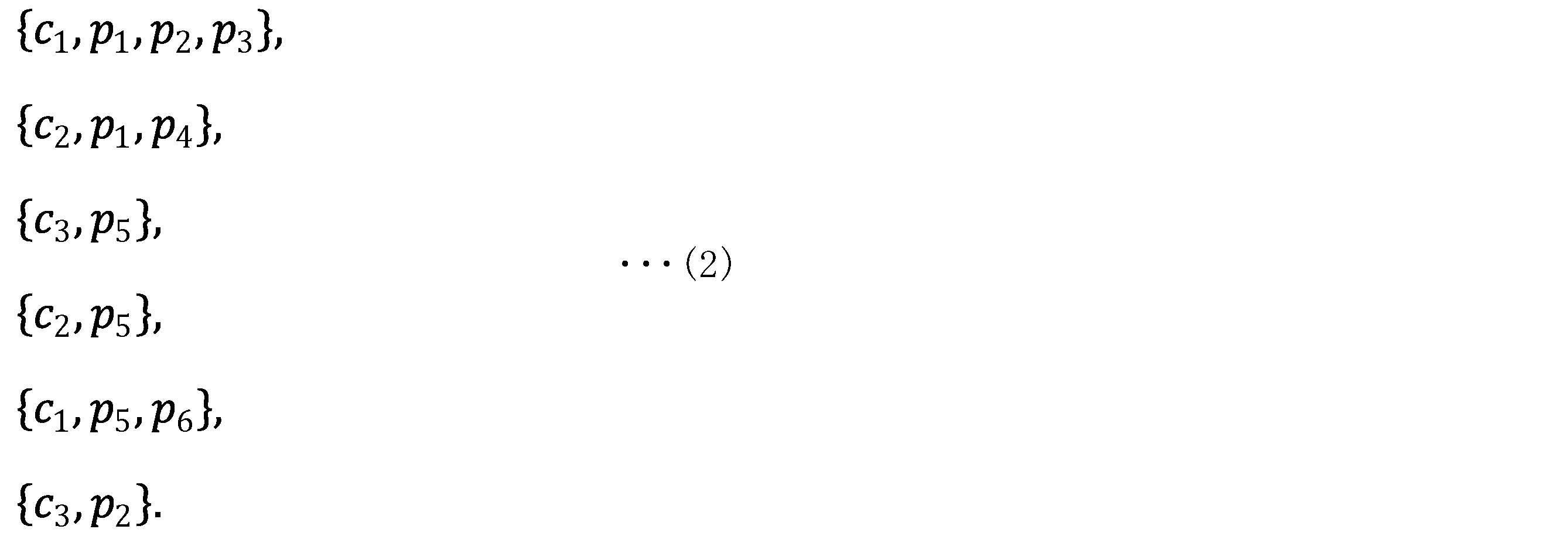
選択されたコマンドおよびパラメータに基づいて、挙動パターンを形成する。各挙動パターンは、1つのコマンドおよび上記コマンドを表す1つのパラメータを含む。

次に、上述したようにして形成されたパターンに基づいて、挙動パターンをさらに形成する。各挙動パターンは、1つのパラメータおよび上記パラメータによって表すことができる全てのコマンドを含む。

次に、上記のようにして形成されたパターンに基づいて、挙動パターンをさらに形成する。各挙動パターンは、いくつかのパラメータおよび上記パラメータによって同時に表すことができる全てのコマンドを含む。

システムの一態様においては、コマンドおよびパラメータは、ルールに基づいて挙動ログから選択される。上記ルールによって、少なくとも、下記のコマンドおよびパラメータが選択される。
・連続したi番目毎のコマンドおよび上記コマンドを表すパラメータ。インクリメントiは所定の増分である。
・前に選択されたコマンドから所定の時間の経過後に(たとえば、10秒ごとに)実行され、自身のパラメータを表すコマンド。
・ファイルの実行開始から所定の時間間隔で実行されるコマンド、および上記コマンドを表すパラメータ。
・所定のリストからのコマンド、および上記コマンドを表すパラメータ。
・所定のリストからのパラメータ、および上記パラメータによって表すことができるコマンド。
・コマンドパラメータの数が所定の閾値よりも多い場合における、コマンドの、最初またはランダムなk個のパラメータ。
In one aspect of the system, commands and parameters are selected from the behavior log based on the rules. According to the above rules, at least the following commands and parameters are selected.
-Consecutive i-th command and parameters representing the above commands. Increment i is a predetermined increment.
A command that is executed after a given amount of time (for example, every 10 seconds) from the previously selected command and represents its own parameters.
-Commands that are executed at predetermined time intervals from the start of file execution, and parameters that represent the above commands.
-Commands from a given list and parameters that represent the above commands.
-Parameters from a given list, and commands that can be represented by the above parameters.
-The first or random k parameters of a command when the number of command parameters is greater than a given threshold.
たとえば、挙動ログから、(CreateFile、ReadFile、WriteFile、DeleteFile、GetFileAttributeなどの)ハードディスクとともに動作するための全てのコマンドを選択し、選択されたコマンドを表す全てのパラメータを選択する。 For example, from the behavior log, select all commands to work with the hard disk (CreateFile, ReadFile, WriteFile, DeleteFile, GetFileAttribute, etc.) and select all parameters that represent the selected command.
さらに別の例において、挙動ログから1,000番目毎にコマンドを選択し、選択されたコマンドを表す全てのパラメータを選択する。 In yet another example, a command is selected every 1,000th from the behavior log and all parameters representing the selected command are selected.
システムの一態様において、挙動ログは、少なくとも2つのファイルから事前に形成され、上記ファイルのうち一方は安全なファイルであり、他方は悪意あるファイルである。 In one aspect of the system, the behavior log is preformed from at least two files, one of which is a safe file and the other is a malicious file.
システムのさらに別の態様において、挙動パターンの各要素を、上記挙動パターンの要素の種類などの特徴と一致させる。挙動パターンの要素(コマンドまたはパラメータ)の種類は、少なくとも、以下の通りである。
・挙動パターンの要素を数として表現することができる場合には、「数の範囲」である。
In yet another aspect of the system, each element of the behavior pattern is matched with features such as the type of element of the behavior pattern. The types of behavior pattern elements (commands or parameters) are at least as follows.
-When the element of the behavior pattern can be expressed as a number, it is a "range of numbers".
たとえば、connectコマンドのパラメータporthtml=80を構成する挙動パターンの要素に対して、挙動パターンの上記要素の種類は、「0×0000~0×FFFFの範囲の数」であってもよい。
・挙動パターンの要素をストリングの形で表現することができる場合には、「ストリング」である。
For example, the type of the above-mentioned element of the behavior pattern may be "the number in the range of 0 × 0000 to 0 × FFFF" with respect to the element of the behavior pattern constituting the parameter port html = 80 of the connect command.
-When the element of the behavior pattern can be expressed in the form of a string, it is a "string".
たとえば、connectコマンドを構成する挙動パターンの要素に対して、挙動パターンの上記要素の種類は、「32文字のサイズより少ないストリング」であってもよい。
・挙動パターンの要素を所定のデータ構造によって表すことができるデータの形で表現することができる場合には、挙動パターンの上記要素の種類は、「データ構造」であってもよい。
For example, the type of the above-mentioned element of the behavior pattern may be "a string less than the size of 32 characters" with respect to the element of the behavior pattern constituting the connect command.
-When the element of the behavior pattern can be expressed in the form of data that can be represented by a predetermined data structure, the type of the element of the behavior pattern may be "data structure".
たとえば、find_recordコマンドのパラメータ

システムのさらに別の態様において、挙動パターンは、上記挙動パターンの要素として、少なくとも、
・語彙素の形成のための所定のルール、
・事前に訓練された再帰型ニューラルネットワーク、
を用いた、挙動パターンの上記要素の語彙分析に基づいて形成されたトークンを、さらに含む。
In yet another aspect of the system, the behavior pattern is at least as an element of the behavior pattern.
・ Prescribed rules for the formation of lexemes,
Pre-trained recurrent neural network,
Further includes tokens formed based on the lexical analysis of the above elements of the behavior pattern using.
たとえば、下記のパラメータの語彙分析を用いて、
‘c:\windows\system32\data.pass’
語彙素を形成するためのルール、すなわち、
・ストリングがファイルへのパスを含む場合には、上記ファイルが在るディスクを判定する、
・ストリングがファイルへのパスを含む場合には、上記ファイルが在るフォルダを判定する、
・ストリングがファイルへのパスを含む場合には、ファイルの拡張子を判定する、
ルールに基づき、
上記語彙素は、
・ファイルへのパス、
・ファイルが在るフォルダ、
・ファイル名、
・ファイルの拡張子
であり、
下記のトークンを形成することができる。
For example, using a lexical analysis of the parameters below
'c: \ windows \ system32 \ data.pass'
The rules for forming lexemes, ie
-If the string contains a path to a file, determine the disk containing the above file.
-If the string contains the path to the file, determine the folder where the above file is located.
-If the string contains the path to the file, determine the file extension,
Based on the rules
The above vocabulary is
-Path to the file,
・ Folder where files are located,
·file name,
-It is a file extension and
The following tokens can be formed.
“paths to the file” →
‘c:\’,
“folders in which the files are located” →
‘windows’,
‘system32’,
‘windows\system32’,
“extensions of the files” →
‘.pass’
“Paths to the file” →
'c: \',
“Folders in which the files are located” →
'windows',
'system32',
'windows \ system32',
“Extensions of the files” →
'.pass'
さらに別の例において、下記のパラメータの語彙分析を用いて、
‘81.19.82.8’,‘81.19.72.38’,‘81.19.14.32’
語彙素を形成するための下記のルールに基づいて、
・パラメータがIPアドレスを構成する場合には、上記IPアドレスを表すビットマスク(または、メタ文字によって表現されるビットマスクのアナログ)を判定し(すなわち、全ての上記IPに対して等式

下記のトークンを構築することができる。
‘81.19.*.*’.
In yet another example, using the lexical analysis of the following parameters,
'81.19.82.8', '81.19.72.38', '81.19.14.32'
Based on the following rules for forming lexemes,
-When the parameter constitutes an IP address, the bitmask representing the IP address (or an analog of the bitmask represented by metacharacters) is determined (that is, an equation for all the IPs).
You can build the following tokens.
'81 .19. *. *'.
さらに別の例において、数を含む全ての利用可能なパラメータから、数のトークンを、下記の所定範囲内で形成し、
23, 16, 7224, 6125152186, 512, 2662162, 363627632, 737382, 52, 2625, 3732, 812, 3671, 80, 3200
下記の数の範囲によって選別する。
0~999
→{16, 23, 52, 80, 512, 812},
1000~9999
→{2625, 3200, 3671, 7224},
10000~
→{737382, 2662162, 363627632, 6125152186}
In yet another example, a number token is formed from all available parameters, including numbers, within the predetermined range below.
23, 16, 7224, 6125152186, 512, 2662162, 363627632, 737382, 52, 2625, 3732, 812, 3671, 80, 3200
Sort by the range of numbers below.
0 ~ 999
→ {16, 23, 52, 80, 512, 812},
1000 ~ 9999
→ {2625, 3200, 3671, 7224},
10000 ~
→ {737382, 2662162, 363627632, 6125152186}
システムのさらに別の態様において、トークンは、ストリングからなる挙動パターンの要素から形成される。 In yet another aspect of the system, tokens are formed from elements of a behavior pattern consisting of strings.
たとえば、挙動パターンは、ディスク、ディレクトリ、ファイル、ファイル拡張子などの名前を含むファイルへのパスである。この場合、トークンは、ディスクの名前およびファイル拡張子であってもよい。
C:\Windows\System32\drivers\acpi.sys
→
C:\
*.sys
For example, a behavior pattern is a path to a file that contains names such as disks, directories, files, and file extensions. In this case, the token may be the name of the disk and the file extension.
C: \ Windows \ System32 \ drivers \ acpi.sys
→
C: \
* .sys
畳み込み関数形成モジュール122は、下記のように設計される。
・得られた挙動パターンについて実行された畳み込み関数の結果の逆畳み込み関数の結果が、指定値よりも大きい得られた挙動パターンと類似性を有することになるように、挙動パターンから畳み込み関数を形成する。すなわち、

式中、
riは、挙動パターンであり、
gは、畳み込み関数であり、
g-1は、逆畳み込み関数である。
・上記のようにして形成された畳み込み関数を検出モデル機械学習モジュール132に送信する。
The convolution
-Form a convolution function from the behavior pattern so that the result of the deconvolution function of the result of the convolution function executed for the obtained behavior pattern has a similarity to the obtained behavior pattern larger than the specified value. do. That is,
During the ceremony
r i is a behavior pattern,
g is a convolution function
g -1 is a deconvolution function.
-The convolution function formed as described above is transmitted to the detection model
システムの一態様において、畳み込み関数形成モジュール122は、さらに、以下のように設計される。
・得られた挙動パターンに基づいて挙動パターンの特徴ベクトルを計算する。その場合、上記挙動パターンの特徴ベクトルは、挙動パターンの要素のハッシュ合計として表現されてもよい。
・挙動パターンの特徴ベクトルから畳み込み関数を形成する。その場合、上記畳み込み関数は、計算された特徴ベクトルと、計算された特徴ベクトルのハッシュ関数の結果の逆ハッシュ関数の結果との間の類似性の程度が所定の値よりも大きくなるように、ハッシュ関数を構成する。
In one aspect of the system, the convolution
-Calculate the feature vector of the behavior pattern based on the obtained behavior pattern. In that case, the feature vector of the behavior pattern may be expressed as the hash total of the elements of the behavior pattern.
-Form a convolution function from the feature vector of the behavior pattern. In that case, the convolution function is such that the degree of similarity between the calculated feature vector and the result of the inverse hash function of the result of the hash function of the calculated feature vector is greater than a predetermined value. Construct a hash function.
システムのさらに別の態様において、畳み込み関数は、計量学習の方法によって形成される。すなわち、所定の閾値より類似性の程度が大きい挙動パターンに対して、上記畳み込み関数を用いて得られた畳み込み間の隔たりが所定の閾値未満になるようにし、一方で、所定の閾値より類似性の程度が小さい挙動パターンに対して、上記隔たりは上記所定の閾値より大きくなるようにする。 In yet another aspect of the system, the convolution function is formed by a method of metric learning. That is, for a behavior pattern having a greater degree of similarity than a predetermined threshold, the distance between the convolutions obtained by using the convolution function is set to be less than the predetermined threshold, while the similarity is greater than the predetermined threshold. For a behavior pattern with a small degree of, the gap is set to be larger than the predetermined threshold.
たとえば、挙動パターンの特徴ベクトルを、以下のように計算してもよい。
・まず、100,000個の要素からなる、空のビットベクトルを作成する(上記ベクトルの各要素に対して、1ビットの情報が予約される)。
・挙動パターンrからの1,000個の要素が、コマンドciについてのデータを記憶するために確保され、残りの99,000個の要素が、挙動パターンrのパラメータciのために確保される。その場合、50,000個の要素(要素1001~要素51000)が、ストリングパラメータ用に確保され、25,000個の要素(要素51001~要素76000)が、数のパラメータ用に確保される。
・挙動パターンrの各コマンドciを、0~999の特定の数xiと一致させるとともに、対応するビットを、下記のように作成されたベクトルに設定する。

・ストリングに対しては、


-First, an empty bit vector consisting of 100,000 elements is created (1 bit of information is reserved for each element of the above vector).
-1,000 elements from the behavior pattern r are reserved for storing data for the command ci , and the remaining 99,000 elements are reserved for the parameter ci of the behavior pattern r. To. In that case, 50,000 elements (elements 1001 to 51000) are reserved for string parameters and 25,000 elements (elements 51001 to 76000) are reserved for number parameters.
-Match each command c i of the behavior pattern r with a specific number x i from 0 to 999, and set the corresponding bit to the vector created as shown below.
・ For strings
上述したように設定された要素を備えた上記ビットベクトルは、挙動パターンrの特徴ベクトルを構成する。 The bit vector having the elements set as described above constitutes the feature vector of the behavior pattern r.
システムのさらに別の態様において、挙動パターンの特徴ベクトルは、以下の式によって計算される。

bは、計算の位取り記数法の底であり(たとえば、2進法のベクトルについては、b=2であり、ストリング、すなわち、文字群を表すベクトルについては、b=8である)、
riは、挙動パターンのi番目の要素であり、
hは、ハッシュ関数であって、

b is the base of the scaled notation system of the calculation (for example, b = 2 for a binary vector and b = 8 for a string, i.e. a vector representing a character group).
r i is the i-th element of the behavior pattern,
h is a hash function
たとえば、挙動パターンの特徴ベクトルを、以下のように計算してもよい。
・まず、(前の例とは異なる)さらに別の空のビットベクトルを作成する。上記空のビットベクトルは1,000個の要素からなる(1ビットの情報はベクトルの各要素のために予約される)。
・以下の式によって、挙動パターンrの各パターン要素riに対してハッシュ合計を計算し、


-First, create yet another empty bit vector (different from the previous example). The empty bit vector consists of 1,000 elements (1 bit of information is reserved for each element of the vector).
-Calculate the hash total for each pattern element ri of the behavior pattern r by the following formula.
たとえば、挙動パターンの特徴ベクトルは、以下のように計算してもよい。
・まず、(前の例とは異なる)さらに別の空のベクトルを作成する。上記空のベクトルは、100,000個の要素からなる。
・下記の式により、1組のハッシュ関数{hj}を用いて、挙動パターンrの各パターン要素riに対して少なくとも2つのハッシュ合計を計算する。



-First, create yet another empty vector (different from the previous example). The empty vector consists of 100,000 elements.
-By the following formula, at least two hash sums are calculated for each pattern element r i of the behavior pattern r using one set of hash functions {h j }.
システムのさらに別の態様において、挙動パターンの特徴ベクトルの構築された畳み込み関数の結果は、挙動パターンの上記特徴ベクトルより小さいサイズとなる。 In yet another aspect of the system, the result of the constructed convolution function of the feature vector of the behavior pattern is smaller in size than the feature vector of the behavior pattern.
たとえば、特徴ベクトルは、100,000個の要素を含むビットベクトルを構成し、したがって、12,500バイトのサイズを有する。一方、上記特徴ベクトルの畳み込み関数の結果は、8つのMD5のハッシュ合計からなる1組を構成し、したがって、256バイトのサイズ、すなわち、特徴ベクトルの2%以下のサイズを有する。 For example, a feature vector constitutes a bit vector containing 100,000 elements and therefore has a size of 12,500 bytes. On the other hand, the result of the convolution function of the feature vector constitutes a set consisting of the hash sum of eight MD5s, and therefore has a size of 256 bytes, that is, a size of 2% or less of the feature vector.
システムのさらに別の態様において、特徴ベクトルと計算された特徴ベクトルの上記ハッシュ関数の結果の逆ハッシュ関数の結果との類似性の程度は、0~1の範囲の数値で表され、以下の式によって計算される。


{h(ri)}は、挙動パターンの要素のハッシュ関数の結果の組を表し、
{gi}は、挙動パターンの要素のハッシュ関数の結果の逆ハッシュ関数の結果の組を表し、
riは、挙動パターンのi番目の要素を表し、
hは、ハッシュ関数を表し、
wは、類似性の程度を表す。
たとえば、計算された特徴ベクトルは、下記のビットベクトルを構成し、
101011100110010010110111011111101000100011001001001001110101101101010001100110110100100010000001011101110011011011
この特徴ベクトルの畳み込み関数の結果は下記の通りであり、
1010011110101110101
上記のようにして得られた結果の逆畳み込み関数の結果は、下記の通りである。

{H (ri) } represents a set of the result of the hash function of the elements of the behavior pattern.
{Gi } represents the set of results of the inverse hash function of the result of the hash function of the elements of the behavior pattern.
r i represents the i-th element of the behavior pattern.
h represents a hash function
w represents the degree of similarity.
For example, the calculated feature vector constitutes the following bit vector,
101011100110010010110111011111101000100011001001001001110101101101010001100110110100100010000001011101110011011011
The result of the convolution function of this feature vector is as follows.
1010011110101110101
The result of the deconvolution function of the result obtained as described above is as follows.
システムのさらに別の態様において、パラメータとして挙動パターンの要素を使用する上記ハッシュ関数は、挙動パターンの要素の種類に依存する。

たとえば、ファイルへのパスを含むストリングを構成する挙動パターンからパラメータのハッシュ合計を計算するために、ハッシュ関数CRC32を用い、他のいずれのストリングに対しては、ハフマンアルゴリズムを、データセットに対しては、ハッシュ関数MD5を用いる。 For example, the hash function CRC32 is used to calculate the hash sum of the parameters from the behavior patterns that make up the string containing the path to the file, and the Huffman algorithm is applied to the dataset for any other string. Uses the hash function MD5.
システムのさらに別の態様において、挙動パターンの特徴ベクトルの畳み込み関数を、オートエンコーダによって形成する。この場合、入力データは、挙動パターンの上記特徴ベクトルの要素であり、出力データは、所定の閾値よりも大きい入力データに対する類似性の係数を有するデータである。 In yet another aspect of the system, the convolution function of the feature vector of the behavior pattern is formed by the autoencoder. In this case, the input data is an element of the feature vector of the behavior pattern, and the output data is data having a coefficient of similarity to the input data larger than a predetermined threshold.
検出モデル作成モジュール131は、下記のように設計される。
・悪意あるファイルを検出するためのモデルを作成する。上記作成工程は、少なくとも、
・検出モデルによる機械学習法の選択と、
・訓練モデルのパラメータの初期化と、
を含み、検出モデルによる機械学習の開始に先立って初期化された訓練モデルのパラメータが、ハイパーパラメータとして知られており、訓練選択肢準備モジュール111によって選択されたファイルのパラメータに依存する。
・上述したように作成された訓練モデルを検出モデル機械学習モジュール132に送信する。
The detection
-Create a model to detect malicious files. The above creation process is at least
・ Selection of machine learning method by detection model and
・ Initialization of training model parameters and
The parameters of the training model, which are initialized prior to the start of machine learning by the detection model, are known as hyperparameters and depend on the parameters of the file selected by the training option preparation module 111.
-Send the training model created as described above to the detection model
たとえば、検出モデルによる機械学習法を選択する際、まず、検出モデルとして、人工ニューラルネットまたはランダムフォレストのいずれを使用するかの決定がなされる。次に、次に、ランダムフォレストが選択された場合には、ランダムフォレストのノードに対する分離基準が選択されるか、または、人工ニューラルネットが選択された場合には、人工のニューラルネットのパラメータの数値を最適化する方法が選択される。さらに、機械学習のための特定の方法の選択に関する決定は、所定の種類(すなわち、データ構造、挙動パターンの要素の数、悪意あるファイルについて検索が行われるコンピュータデバイスの性能、コンピュータデバイスの利用可能なリソースなど)の入力データ(挙動パターン)を用いて悪意あるファイルの検出における上記方法の有効性(すなわち、悪意あるファイルを検出する際に生じる第1および第2の種類のエラーの数)に基づいてなされる。
さらに別の例において、検出モデルによる機械学習のための方法は、少なくとも、
・クロステスト、スライディングチェック、交差検証(CV)、
・AICおよびBICなどの基準の数学的検証、
・A/Bテスト、スプリットテスト、
・スタッキング、
に基づいて、選択される。
For example, when selecting a machine learning method based on a detection model, it is first decided whether to use an artificial neural network or a random forest as the detection model. Then, then, if a random forest is selected, the isolation criteria for the nodes in the random forest are selected, or if an artificial neural network is selected, the numerical values of the parameters of the artificial neural network. The method of optimizing is selected. In addition, decisions regarding the choice of a particular method for machine learning can be made of certain types (ie, data structures, number of elements of behavior patterns, performance of computer devices on which malicious files are searched, computer device availability. For the effectiveness of the above method in detecting malicious files (ie, the number of first and second types of errors that occur when detecting malicious files) using the input data (behavior patterns) of such resources. Made on the basis.
In yet another example, the method for machine learning with detection models is at least
・ Cross test, sliding check, cross validation (CV),
・ Mathematical verification of standards such as AIC and BIC,
・ A / B test, split test,
・ Stacking,
Is selected based on.
さらに別の例において、コンピュータデバイスの性能が低い場合、ランダムフォレストが選択され、それ以外は、人工ニューラルネットが選択される。 In yet another example, if the computer device has poor performance, a random forest is selected, otherwise an artificial neural network is selected.
システムの一態様において、機械学習は、事前に作成された未訓練の検出モデル(すなわち、モデルのパラメータが、入力データの分析に基づいて、所定の閾値よりも高い精度で出力データを作成することができない、検出モデル)に対して行われる。
システムのさらに別の態様において、検出モデルによる機械学習法は、少なくとも、
・決定木に基づいた勾配ブースティング、
・決定木、
・k近傍法、
・サポートベクトルマシン(Support Vector Machine:SVM)法、
である。
In one aspect of the system, machine learning creates output data with a pre-made untrained detection model (ie, the parameters of the model are based on the analysis of the input data and are more accurate than a predetermined threshold. Cannot be done for detection models).
In yet another aspect of the system, machine learning methods with detection models are at least
・ Gradient boosting based on decision trees,
・ Decision tree,
・ K-nearest neighbor method,
-Support Vector Machine (SVM) method,
Is.
システムのさらに別の態様において、検出モデル作成モジュール131は、さらに、検出モデル機械学習モジュール132からの要求に応じて検出モデルを作成するように設計される。その場合、あるハイパーパラメータおよび機械学習法は、前の検出モデルに対して選択されたハイパーパラメータおよび機械学習法とは異なるように選択される。
In yet another aspect of the system, the detection
検出モデル機械学習モジュール132は、検出モデルを訓練するように設計される。その場合、検出モデルのパラメータは、得られた挙動パターンについての得られた畳み込み関数を用いて計算され、検出モデルは、上記検出モデルの計算されたパラメータを用いて少なくとも1つの挙動パターンに基づいてファイルの悪意性の程度を計算するための1組のルールを構成する。
The detection model
たとえば、検出モデルは、訓練選択肢準備モジュール111によって選択された1組の既知のファイル上で訓練される。このとき、上記1組のファイルは、安全なファイルを60%、悪意あるファイルを40%含む。 For example, the detection model is trained on a set of known files selected by the training option preparation module 111. At this time, the above set of files contains 60% of safe files and 40% of malicious files.
システムの一態様において、ファイルの悪意性の程度は、0~1の数値で表され、0は、ファイルが安全であることを示し、1は、ファイルに悪意があることを示す。 In one aspect of the system, the degree of maliciousness of the file is represented by a number from 0 to 1, where 0 indicates that the file is safe and 1 indicates that the file is malicious.
システムのさらに別の態様において、挙動ログの分析に基づいて形成された挙動パターンの数の変化に依存するファイルの悪意性の程度が単調に変化することを保証する、検出モデルの訓練方法が選択される。 In yet another aspect of the system, a detection model training method is selected that ensures that the degree of maliciousness of the file varies monotonically depending on the change in the number of behavior patterns formed based on the analysis of the behavior log. Will be done.
たとえば、ファイルの悪意性の程度における単調な変化は、後続する各挙動パターンを分析した時に、計算された悪意性の程度が、前に計算された悪意性の程度以上になるであろうことを意味する(たとえば、10番目の挙動パターンの分析の後では、計算された悪意性の程度は、0.2に等しく、50番目の挙動パターンの分析の後では、悪意性の程度は、0.4となり、100番目の挙動パターンの分析の後では、悪意性の程度は、0.7となる)。 For example, a monotonous change in the degree of maliciousness of a file will indicate that the calculated degree of maliciousness will be greater than the previously calculated degree of maliciousness when analyzing each subsequent behavior pattern. Means (for example, after the analysis of the 10th behavior pattern, the calculated degree of malice is equal to 0.2, and after the analysis of the 50th behavior pattern, the degree of malice is 0. After the analysis of the 100th behavior pattern, the degree of malicious intent is 0.7).
システムのさらに別の態様においては、検出モデル機械学習モジュール132は、さらに、下記のように設計される。
・ファイルのテスト選択肢からファイルの悪意性の判定の精度を判定するために、ファイルのテスト選択肢からファイルの分析に基づいて形成されて得られた挙動ログに対して訓練された検出モデルの検査を実行する。
・検査の結果が否定的なものであった場合には、リクエストを、少なくとも、
・検出モデルの訓練に使用されている現在のものとは異なるファイルの選択肢を準備するために、訓練選択肢準備モジュール111に送り、かつ、
・現在のものとは異なる、新しい検出モデルを作成するために、検出モデル作成モジュール131に送る。
In yet another aspect of the system, the detection model
-Inspecting a trained detection model against the behavior logs formed from the file's test options based on the file's analysis to determine the accuracy of the file's maliciousness determination from the file's test options. Execute.
・ If the result of the test is negative, make a request at least.
-Sent to the training option preparation module 111 and sent to the training option preparation module 111 to prepare a file option different from the current one used for training the detection model.
-Send to the detection
さらに、訓練された検出モデルの検査は、下記のことを伴う。上記検出モデルは、訓練選択肢準備モジュール111によって選択された1組のファイルに基づいて訓練されている。そのために、上記ファイルが安全なファイルであるか、または悪意あるファイルであるかが分かっていた。悪意あるファイルを検出するためのモデルが正しく訓練されていること、すなわち、上記検出モデルは悪意あるファイルを検出するとともに安全なファイルを看過することができるということを検証するために、上記モデルの検査を行う。このため、上記検出モデルは、訓練選択肢準備モジュール111によって選択された別の1組のファイルからのファイルが悪意あるものであるかどうかを判定するために使用される。なお、上記ファイルが悪意あるものであるかどうかは事前に分かっている。このように、「見逃された」悪意あるファイルの数、および、検出された安全なファイルの数を判定する。見逃された悪意あるファイルおよび検出された安全なファイルの数が所定の閾値よりも大きい場合には、その検出モデルは、不適切に訓練されたものであると認識され、上記検出モデルに対して、(たとえば、ファイルの別の訓練選択肢に関して、前のものとは異なる検出モデルのパラメータの値を使用するなどして)機械学習を反復することが必要とされる。 In addition, testing the trained detection model involves: The detection model is trained on the basis of a set of files selected by the training option preparation module 111. Therefore, it was known whether the above file was a safe file or a malicious file. To verify that the model for detecting malicious files is properly trained, that is, the detection model can detect malicious files and overlook safe files. Perform an inspection. For this reason, the detection model is used to determine if a file from another set of files selected by the training option preparation module 111 is malicious. It is known in advance whether the above file is malicious. In this way, the number of "missed" malicious files and the number of safe files detected are determined. If the number of malicious files missed and the number of safe files detected is greater than a given threshold, then the detection model is considered improperly trained and against the above detection model. , (For example, for another training option in the file, using different detection model parameter values than the previous one), it is necessary to iterate the machine learning.
たとえば、訓練されたモデルの検査を実行するとき、ファイルのテスト選択肢から悪意あるファイルを検出する際に、第1および第2の種類のエラーの数を検査する。
そのようなエラーの数が所定の閾値よりも大きい場合、ファイルの新たな訓練およびテスト選択肢が選択されて、新たな検出モデルが作成される。
For example, when performing an inspection of a trained model, it checks the number of first and second types of errors when detecting malicious files from the file's test choices.
If the number of such errors is greater than a given threshold, new training and test options for the file are selected and a new detection model is created.
さらに別の例において、ファイルの訓練選択肢が10,000個のファイルを含み、このうち、8,500個が悪意あるものであり、1,500個が安全なものであった。検出モデルの訓練後、検出モデルを、1200個のファイルを含むファイルのテスト選択肢に関して、検査した。上記ファイルのテスト選択肢のうち、350個が悪意あるものであり、850個が安全なものであった。実行された検査の結果に従って、350個の悪意あるファイルのうち15個(4%)が検出に失敗した。一方、850個の安全なファイルのうち102個(12%)が誤って悪意あるものと認識された。未検出の悪意あるファイルの数が5%を超えるか、または、偶然に検出された安全なファイルが0.1%を超える場合、訓練された検出モデルは、不適切に訓練されたものであると認める。 In yet another example, the file training options included 10,000 files, of which 8,500 were malicious and 1,500 were safe. After training the detection model, the detection model was inspected for test options for files containing 1200 files. Of the test options in the above file, 350 were malicious and 850 were safe. According to the results of the tests performed, 15 (4%) of the 350 malicious files failed to be detected. On the other hand, 102 (12%) of the 850 safe files were mistakenly identified as malicious. If the number of undetected malicious files exceeds 5%, or the number of accidentally detected safe files exceeds 0.1%, the trained detection model is improperly trained. I admit.
システムの一態様において、システムの挙動ログは、システムの挙動の、事前に形成されたログおよびシステムの上記挙動ログの形成後にインターセプトされたコマンドに基づいて、さらに形成される。 In one aspect of the system, system behavior logs are further formed based on preformed logs of system behavior and commands intercepted after the formation of the system behavior logs.
たとえば、ファイルの悪意性または安全性について判定することが必要であるファイルの実行の開始後に、インターセプトされた実行可能なコマンドおよび上記コマンドを表すパラメータが挙動ログに記録される。これらのコマンドおよびパラメータの分析に基づいて、そのファイルの悪意性の程度を計算する。分析の結果に基づいてファイルが悪意あるものかまたは安全なものであるかの判定がなされなかった場合、コマンドのインターセプトを継続してもよい。インターセプトされたコマンドおよび上記コマンドを表すパラメータは、古い挙動ログまたは新しい挙動ログに記録される。第1の場合、挙動ログに記録された全てのコマンドおよびパラメータの分析、すなわち、悪意性の程度を計算するために前に使用されたコマンドおよびパラメータにも基づいて、悪意性の程度を計算する。 For example, after the start of execution of a file that needs to be determined for maliciousness or safety of the file, the intercepted executable commands and the parameters representing the above commands are recorded in the behavior log. Based on the analysis of these commands and parameters, the degree of maliciousness of the file is calculated. If the results of the analysis do not determine whether the file is malicious or safe, command interception may continue. The intercepted commands and the parameters representing the above commands are recorded in the old behavior log or the new behavior log. In the first case, the degree of maliciousness is calculated based on the analysis of all commands and parameters recorded in the behavior log, i.e., the commands and parameters previously used to calculate the degree of malicious intent. ..
悪意性程度計算モジュール142は、以下のように設計される。
・挙動ログ形成モジュール112から得られた挙動ログおよび検出モデル機械学習モジュール132から得られた検出モデルに基づいて、悪意性の程度を計算する。ファイルの悪意性の程度は、実行対象ファイルの悪意ある挙動を表す定量的な特徴である。(たとえば、0~1の範囲、つまり、0、すなわち、ファイルが安全な挙動のみを有する、から1、すなわち、上記ファイルが所定の悪意ある挙動を有する、の範囲内にある)
・計算された悪意性の程度を資源管理モジュール143へ送信する。
The maliciousness degree calculation module 142 is designed as follows.
-Behavior log obtained from the behavior log forming module 112 and the detection model The degree of maliciousness is calculated based on the detection model obtained from the
-Send the calculated degree of malicious intent to the resource management module 143.
資源管理モジュール143は、コンピュータシステムのセキュリティを確保する際に使用するために、得た悪意性の程度の分析に基づいて、コンピュータシステムの計算資源を割り当てるように設計される。 The resource management module 143 is designed to allocate the computational resources of the computer system based on the analysis of the degree of maliciousness obtained for use in ensuring the security of the computer system.
システムの一態様において、コンピュータシステムの計算資源は、少なくとも、
・RAM空き容量、
・ハードディスクの空き領域の容量、
・(たとえば、より深いエミュレーションにより)アンチウイルススキャニングに費やすことができる、空きプロセッサ時間(プロセッサ時間の分量)、
である。
In one aspect of the system, the computational resources of the computer system are at least
・ RAM free space,
-The amount of free space on the hard disk,
· Free processor time (amount of processor time) that can be spent on antivirus scanning (eg, with deeper emulation),
Is.
システムのさらに別の態様においては、悪意性の程度の分析は、先行する悪意性の程度の各計算の後における悪意性の程度の値における変化の動態を判定すること、および、少なくとも、
・悪意性の程度の値が増加した場合には、コンピュータシステムの追加資源を割り当てること、
・悪意性の程度の値が減少した場合には、事前に割り当てられた、コンピュータシステムの資源を解放すること、
にある。
In yet another aspect of the system, analysis of the degree of malicious intent determines the dynamics of changes in the value of the degree of malicious intent after each calculation of the preceding degree of malicious intent, and at least.
-If the value of the degree of malicious intent increases, allocate additional resources of the computer system,
-Release pre-allocated computer system resources when the degree of malicious intent decreases.
It is in.
図2は、悪意あるファイルを検出するためのモデルを用いて機械学習する方法の構成図である。 FIG. 2 is a configuration diagram of a method of machine learning using a model for detecting a malicious file.
悪意あるファイルを検出するためのモデルを用いて機械学習する方法の構成図は、ファイルを訓練する選択肢を準備するステップ211と、挙動ログを形成するステップ212と、挙動パターンを形成するステップ221と、畳み込み関数を形成するステップ222と、検出モデルを作成するステップ231と、検出モデルを訓練するステップ232と、コンピュータシステムの挙動を追跡するステップ241と、悪意性の程度を計算するステップ242と、コンピュータシステムの資源を管理するステップ243と、を含む。 The configuration diagram of the method of machine learning using a model for detecting a malicious file includes step 211 for preparing an option for training the file, step 212 for forming a behavior log, and step 221 for forming a behavior pattern. , Step 222 to form the convolution function, step 231 to create the detection model, step 232 to train the detection model, step 241 to track the behavior of the computer system, and step 242 to calculate the degree of maliciousness. Includes step 243 of managing the resources of the computer system.
ステップ211において、訓練選択肢準備モジュール111は、所定の基準にしたがって、ファイルのデータベースから少なくとも1つのファイルを選択するために使用される。この場合、選択されたファイルに基づいて、ステップ232で検出モデルの訓練を行う。 In step 211, the training option preparation module 111 is used to select at least one file from the database of files according to predetermined criteria. In this case, the detection model is trained in step 232 based on the selected file.
ステップ212において、挙動ログ形成モジュール112は、下記のことをするのに使用される。
・少なくとも1つのコマンドを、少なくとも
・ステップ211において選択されたファイルを実行する、
・ステップ211において選択されたファイルの作動のエミュレーションをする
最中にインターセプトする。
・インターセプトされた各コマンドについて、上記コマンドを表す少なくとも1つのパラメータを決定する。
・インターセプトされたコマンドおよび決定されたパラメータに基づいて、得られたファイルの挙動ログを形成する。この場合、挙動ログは、ファイルからのインターセプトされたコマンド(以後、コマンドと称する)の組を表し、各コマンドは、上記コマンドを表す少なくとも1つの定義されたパラメータ(以後、パラメータと称する)に対応する。
In step 212, the behavior log forming module 112 is used to do the following:
-Execute at least one command, at least-Execute the file selected in step 211.
-Intercept while emulating the operation of the file selected in step 211.
-For each intercepted command, determine at least one parameter representing the above command.
• Form a behavior log of the resulting file based on the intercepted commands and the determined parameters. In this case, the behavior log represents a set of intercepted commands (hereinafter referred to as commands) from the file, and each command corresponds to at least one defined parameter (hereinafter referred to as a parameter) representing the above command. do.
ステップ221において、挙動パターン形成モジュール121を使用して、ステップ212で形成した挙動ログから選択されたコマンドおよびパラメータに基づいて、少なくとも1つの挙動パターンを形成する。この場合、挙動ログは、ファイルからの実行可能なコマンド(以後、コマンドと称する)の組を表し、各コマンドは、上記コマンドを表す少なくとも1つのパラメータ(以後、パラメータと称する)に対応し、挙動パターンは、少なくとも1つのコマンドおよびパラメータからなる組であり、上記パラメータは、上記コマンドおよびパラメータからなる組からのコマンド全てを表す。
In
ステップ222において、畳み込み関数形成モジュール122を使用して、ステップ221で形成した挙動パターンの畳み込み関数を形成し、その結果、上記挙動パターンに対して実行した上記畳み込み関数の結果の逆畳み込み関数の結果は、指定された値よりも大きい上記挙動パターンとの類似性を有する。
In step 222, the convolution
ステップ231において、検出モデル作成モジュール131を使用して、検出モデルを作成する。そのため、少なくとも、
・検出モデルによる機械学習法が選択され、
・訓練モデルのパラメータが初期化される。この場合、検出モデルによる機械学習の開始に先立って初期化された訓練モデルのパラメータは、ハイパーパラメータとして知られる。
In step 231 the detection
・ Machine learning method based on detection model is selected.
-The parameters of the training model are initialized. In this case, the parameters of the training model initialized prior to the start of machine learning by the detection model are known as hyperparameters.
上記検出モデルの作成は、ステップ211で選択されたファイルのパラメータに依存する。 The creation of the detection model depends on the parameters of the file selected in step 211.
ステップ232において、検出モデル機械学習モジュール132を使用して、ステップ231において作成した検出モデルを訓練する。この場合、上記検出モデルのパラメータは、ステップ222において形成され、かつ、ステップ221において形成された挙動パターンについて実行された畳み込み関数を用いて計算される。ここで、検出モデルは、検出モデルの、計算されたパラメータを用いて、少なくとも1つの挙動パターンに基づいて、ファイルの悪意性の程度を計算するためのルールの一群を構成する。
In step 232, the detection model
ステップ241において、挙動追跡モジュール141を用いて下記のことを実施する。
・コンピュータシステム上を走っているファイルによって実行される少なくとも1つのコマンドをインターセプトする、
・インターセプトされたコマンドに基づいて上記システムの挙動ログを形成する。
In step 241 the following is performed using the behavior tracking module 141.
Intercepts at least one command executed by a file running on a computer system,
-Forms the behavior log of the above system based on the intercepted command.
ステップ242において、悪意性程度計算モジュール142を使用して、ステップ241で形成したシステムの挙動ログおよびステップ232で訓練した検出モデルに基づいて、悪意性の程度を計算する。 In step 242, the degree of maliciousness calculation module 142 is used to calculate the degree of maliciousness based on the behavior log of the system formed in step 241 and the detection model trained in step 232.
ステップ243において、資源管理モジュール143は、コンピュータシステムのセキュリティを確保する際に使用される、ステップ242で計算したような悪意性の程度の分析に基づいて、計算資源を割り当てるために使用される。 In step 243, the resource management module 143 is used to allocate computational resources based on an analysis of the degree of malicious intent as calculated in step 242, which is used in ensuring the security of the computer system.
図3は、挙動パターンの数の関数としての悪意性の程度の変化の動態例を示す。 FIG. 3 shows a dynamic example of a change in the degree of malicious intent as a function of the number of behavior patterns.
挙動パターンの数の関数としての悪意性の程度における変化の動態例は、悪意あるファイルの実行中に形成された挙動パターンの数の関数としての悪意性の程度における任意の変化の動態を示すグラフ311と、悪意あるファイルの実行中に形成された挙動パターンの数の関数としての悪意性の程度における単調な変化の動態を示すグラフ312と、安全なファイルの実行中に形成された挙動パターンの数の関数としての悪意性の程度における任意の変化の動態を示すグラフ321と、安全なファイルの実行中に形成された挙動パターンの数の関数としての悪意性の程度における単調な変化の動態を示すグラフ322と、を含む。
An example of the dynamics of change in the degree of maliciousness as a function of the number of behavior patterns is a graph showing the dynamics of any change in the degree of maliciousness as a function of the number of behavioral patterns formed during the execution of a malicious file. 311 and graph 312 showing the dynamics of monotonous changes in the degree of maliciousness as a function of the number of behavior patterns formed during the execution of the malicious file, and the behavior patterns formed during the execution of the secure file.
システムの一態様においては、実行対象ファイルの悪意性の程度は、0(ファイルが絶対的に安全な挙動をとる)~1(ファイルが所定の悪意ある挙動をとる)の範囲内の値をとる。 In one aspect of the system, the degree of maliciousness of the file to be executed takes a value in the range of 0 (the file behaves absolutely safe) to 1 (the file behaves in a predetermined manner). ..
グラフ311は、悪意あるファイルの実行中に形成された挙動パターンの数の関数として悪意性の程度における任意の変化の動態を示す。
最初、上記ファイルを実行する時点では、形成された挙動パターンの数は大きいものではなく、さらに、実行対象ファイルに悪意ある活動はない、または、最小であることがある(たとえば、データは初期化されるが、それは安全なファイルを含む多くのファイルにとって当然のことである)。その結果、計算された悪意性の程度は、0と殆ど変わらず、所定の閾値(以後、安全性基準と称する)を超えるものではない。悪意性の程度が上記閾値を超えると、実行対象ファイルの挙動は、安全であるとはみなされなくなる(グラフ上では、この閾値は、点線によって示されている)。 Initially, at the time of executing the above file, the number of behavior patterns formed is not large, and the file to be executed may have no or minimal malicious activity (for example, data initialization). But that's not surprising for many files, including safe files). As a result, the calculated degree of malicious intent is almost the same as 0 and does not exceed a predetermined threshold value (hereinafter referred to as a safety standard). When the degree of maliciousness exceeds the above threshold value, the behavior of the file to be executed is not considered to be safe (in the graph, this threshold value is indicated by a dotted line).
しかし、やがて実行対象ファイルの悪意ある活動が増加し、悪意性の程度が、1に近づき始め、安全性基準を上回り、一方、悪意性の程度が、所定の閾値(以後、悪意性基準と称する)、すなわち、それを超えると実行対象ファイルの挙動が悪意あるものであるとみなされる閾値(グラフにおいて、この閾値は破線によって示されている)に到達しないことがある。 However, the malicious activity of the file to be executed increases, and the degree of maliciousness begins to approach 1 and exceeds the safety standard, while the degree of maliciousness is a predetermined threshold (hereinafter referred to as the maliciousness standard). ), That is, the threshold at which the behavior of the file to be executed is considered to be malicious (in the graph, this threshold is indicated by a broken line) may not be reached.
増加期間の後、悪意ある活動が止むと、悪意性の程度は、再び0へ向かうことになる(時間A)。ある時間において、悪意性の程度は悪意性基準より大きくなり(時間B)、実行対象ファイルの挙動は、悪意あるものと認識され、その結果、ファイル自体が悪意あるものと認識される。 When the malicious activity ceases after the increase period, the degree of malicious intent goes to zero again (time A). At a certain time, the degree of maliciousness becomes larger than the maliciousness standard (time B), and the behavior of the execution target file is recognized as malicious, and as a result, the file itself is recognized as malicious.
悪意ある活動が増加し始める時間から、かなり遅れて、ファイルを悪意あるものとして認識することがある。その理由は、上述したアプローチは、悪意性の程度が急激に高くなる場合によく反応するからであり、これは、実行対象ファイルの悪意ある活動が長期間にわたり明瞭に発現する時に、最も頻繁に生じる。 Files may be perceived as malicious, well behind the time when malicious activity begins to increase. The reason is that the above-mentioned approach reacts well when the degree of malicious intent increases sharply, most often when the malicious activity of the file to be executed is clearly manifested over a long period of time. Occurs.
悪意ある挙動が偶発的に生じた場合(グラフ311左側参照)、計算された悪意性の程度は、上記値に到達せず、その後、実行対象ファイルの挙動の悪意性と、その結果としての実行対象ファイル自体の悪意性について判定がなされる。 When malicious behavior occurs accidentally (see the left side of Graph 311), the calculated degree of maliciousness does not reach the above value, and then the malicious behavior of the file to be executed and the resulting execution. Judgment is made about the maliciousness of the target file itself.
形成された各挙動パターンに基づかずに悪意性の程度が計算される場合(たとえば、コンピュータデバイスの性能が高くないなどの理由による)、時間A(悪意ある活動が開始する時間)および時間C(悪意ある活動が終了する時間)において悪意性の程度が計算され、一方、時間B(悪意ある活動が生じている時間)においては計算されず、その結果、計算された悪意性の程度が悪意性基準を超えず、また、実行対象ファイルの活動が悪意あるものと認識されず、よって、悪意あるファイルが検出されないことになるという状況がありうる。 If the degree of malicious intent is calculated without being based on each behavior pattern formed (for example, because the performance of the computer device is not high), time A (time when malicious activity starts) and time C (time). The degree of malicious intent is calculated at the time when the malicious activity ends), while it is not calculated at time B (the time when the malicious activity occurs), and as a result, the calculated degree of malicious intent is malicious. There may be situations where the criteria are not exceeded and the activity of the file to be executed is not recognized as malicious, so that the malicious file is not detected.
グラフ312は、悪意あるファイルの実行中に形成された挙動パターンの数の関数として悪意性の程度における単調な変化の動態を示す。 Graph 312 shows the dynamics of monotonous changes in the degree of maliciousness as a function of the number of behavioral patterns formed during the execution of the malicious file.
最初、上記ファイルを実行する時点では、形成された挙動パターンの数は大きいものではなく、さらに、実行対象ファイルに悪意ある挙動はない、または、最小であることがある(たとえば、データは初期化されるが、それは、安全なファイルを含む、多くのファイルにとって当然のことである)。その結果、計算された悪意性の程度は、0と殆ど変わらず、所定の閾値(以後、安全性基準と称する)を超えるものではない。悪意性の程度が上記閾値を超えると、実行対象ファイルの挙動は、安全であるとはみなされなくなる(グラフ上では、この閾値は、点線によって示されている)。 Initially, at the time of executing the above file, the number of behavior patterns formed is not large, and the file to be executed may have no or minimal malicious behavior (for example, data is initialized). But that's not surprising for many files, including safe files). As a result, the calculated degree of malicious intent is almost the same as 0 and does not exceed a predetermined threshold value (hereinafter referred to as a safety standard). When the degree of maliciousness exceeds the above threshold value, the behavior of the file to be executed is not considered to be safe (in the graph, this threshold value is indicated by a dotted line).
しかし、やがて実行対象ファイルの悪意ある活動が増加し、悪意性の程度が、1に近づき始め、安全性基準を上回り、一方で、悪意性の程度が、所定の閾値(以後、悪意性基準と称する)、すなわち、それを超えると、実行対象ファイルの挙動が悪意あるものであるとみなされる閾値(グラフ上では、この閾値は破線によって示されている)に到達しないことがある。 However, the malicious activity of the file to be executed increased, and the degree of maliciousness began to approach 1 and exceeded the safety standard, while the degree of maliciousness became a predetermined threshold (hereinafter referred to as the maliciousness standard). ), That is, beyond that, the threshold at which the behavior of the file to be executed is considered to be malicious (in the graph, this threshold is indicated by a broken line) may not be reached.
増加期間(A~B期間)の後、悪意ある活動が止む(B~A期間)ことがあるが、悪意性の程度はもはや低下せず、実行対象ファイルのいかなる悪意ある活動の間においても増加し続けるのみである。ある時間において、悪意性の程度が悪意性基準よりも高くなり(時間D)、実行対象ファイルの挙動は、悪意あるものとして認識される。その結果、ファイル自体が悪意あるものとして認識される。 After the increase period (A to B period), malicious activity may stop (B to A period), but the degree of maliciousness no longer decreases and increases during any malicious activity of the file to be executed. Just keep going. At a certain time, the degree of maliciousness becomes higher than the maliciousness standard (time D), and the behavior of the execution target file is recognized as malicious. As a result, the file itself is perceived as malicious.
さらに、悪意ある活動が発現した直後に、ファイルを悪意あるものとして認識する時が来ることがある。その理由は、上述したアプローチが、悪意性の程度が緩やかに増加することによく反応するからであり、これは、実行対象ファイルの悪意ある活動が長期間にわたって明瞭に発現する時と、あまり目立たない悪意ある活動が頻繁に偶発的に生じる時の両方において起こる。 In addition, it may be time to recognize a file as malicious immediately after malicious activity manifests itself. The reason is that the above-mentioned approach responds well to a gradual increase in the degree of malicious intent, which is less noticeable when the malicious activity of the file to be executed is clearly manifested over a long period of time. It occurs both when no malicious activity occurs frequently and accidentally.
悪意ある活動が偶発的に生じる場合(グラフ311左側参照)、計算された悪意性の程度は、時間の経過とともに、その値に達することがあり、到達後に、実行対象ファイルの挙動の悪意性および実行対象ファイル自体の悪意性について判定がなされる。 If malicious activity occurs accidentally (see the left side of Graph 311), the calculated degree of maliciousness may reach its value over time, after which the maliciousness of the behavior of the file to be executed and the maliciousness of the behavior of the file to be executed and Judgment is made about the maliciousness of the execution target file itself.
形成された各挙動パターンに基づかずに悪意性の程度が計算される場合(たとえば、コンピュータデバイスの性能が高くないなどの理由による)、時間A(悪意ある活動が開始する時間)および時間C(悪意ある活動が終了する時間)において悪意性の程度が計算され、一方、時間B(悪意ある活動が生じている時間)では計算されず、それにもかかわらず、悪意性の程度は単調に変化するので、計算された悪意性の程度は、その値が増加するのみであり、時間Cにおいては、悪意性の程度は悪意性基準を超えることになり、実行対象ファイルの活動は悪意あるものとして認識され、その結果、悪意あるファイルが検出される、という状況がありうる。 If the degree of malicious intent is calculated without being based on each behavior pattern formed (for example, because the performance of the computer device is not high), time A (time when malicious activity starts) and time C (time). The degree of malicious intent is calculated at the time when the malicious activity ends), while it is not calculated at time B (the time when the malicious activity occurs), and nevertheless, the degree of malicious intent changes monotonously. Therefore, the calculated degree of malicious intent only increases its value, and at time C, the degree of malicious intent exceeds the maliciousness standard, and the activity of the execution target file is recognized as malicious. As a result, malicious files may be detected.
グラフ321は、安全なファイルの実行中に形成された挙動パターンの数の関数として悪意性の程度における任意の変化の動態を示す。
最初、上記ファイルを実行する時点で、形成された挙動パターンの数は大きいものではなく、さらに、悪意ある活動、たとえば、実行対象ファイルに対して、悪意あるファイルの実行中にも実行されることがある(たとえば、ファイルの削除、コンピュータネットワークにおけるデータの転送など)「疑わしい」コマンドが実行されるといった活動はない。したがって、計算された悪意性の程度は、0ではなく、かつ、所定の閾値(以後、安全性基準と称する)、すなわち、それを超えると、実行対象ファイルの挙動が安全なものとみなされなくなる閾値(グラフにおいて、この閾値は点線で示されている)を超えない。 Initially, the number of behavior patterns formed at the time of executing the above file is not large, and it is also executed during the execution of a malicious activity, for example, the file to be executed. There is no activity such as executing a "suspicious" command (eg deleting a file, transferring data over a computer network, etc.). Therefore, if the calculated degree of malicious intent is not 0 and exceeds a predetermined threshold (hereinafter referred to as a safety standard), that is, if the degree of maliciousness is exceeded, the behavior of the execution target file is not considered to be safe. Do not exceed the threshold (in the graph, this threshold is shown by the dotted line).
しかし、多数の「疑わしい」コマンドを実行することが原因となって、実行対象ファイルの悪意ある活動はやがて増加し、悪意性の程度が1に近づき始め、一方で、悪意性の程度は、所定の閾値(以後、悪意性基準と称する)、すなわち、それを超えると、実行対象ファイルの挙動が悪意あるものであるとみなされる閾値(グラフにおいて、この閾値は破線で示されている)に到達しないものの、安全性基準を超えることもあり、その結果、ファイルは、安全なものとみなされなくなり、「疑わしい」ものとなることがある。 However, due to the execution of a large number of "suspicious" commands, the malicious activity of the file to be executed will eventually increase and the degree of maliciousness will begin to approach 1, while the degree of maliciousness will be predetermined. (Hereinafter referred to as maliciousness standard), that is, when the threshold is exceeded, the behavior of the file to be executed is considered to be malicious (in the graph, this threshold is indicated by a broken line). Although not, it may exceed safety standards, and as a result, the file may no longer be considered safe and may be "suspicious".
増加期間の後、悪意ある活動が止むことがあり、悪意性の程度は再び0に近づく(時間C)。 After a period of increase, malicious activity may cease and the degree of maliciousness approaches zero again (time C).
形成された各挙動パターンに基づかずに悪意性の程度が計算される場合(たとえば、コンピュータデバイスの性能が高くないなどの理由による)、時間B(活動が、悪意あるものに最も類似する、すなわち「疑わしい」ものになる時)においては悪意性の程度が計算されるが、時間A(「疑わしい」活動が増加している時)または時間C(「疑わしい」活動が減少している時)においては計算されず、その結果、計算された悪意性の程度が安全性基準を超え、実行対象ファイルの活動が「疑わしい」ものとみなされ(安全なものとはみなされず)、よって、安全なファイルが安全であるとみなされなくなるという状況がありうる。 If the degree of malicious intent is calculated without being based on each behavior pattern formed (for example, because the performance of the computer device is not high), time B (activity is most similar to malicious intent, ie. The degree of malice is calculated at (when it becomes "suspicious"), but at time A (when "suspicious" activity is increasing) or time C (when "suspicious" activity is decreasing). Is not calculated, and as a result, the calculated degree of malicious intent exceeds the safety criteria and the activity of the file to be executed is considered "suspicious" (not considered safe), and thus a safe file. There can be situations where is no longer considered safe.
グラフ321は、安全なファイルの実行中に形成された挙動パターンの数の関数として悪意性の程度における単調な変化の動態を示す。
最初、上記ファイルを実行する時点では、形成された挙動パターンの数は大きいものではなく、さらに、悪意ある活動、たとえば、実行対象ファイルに対して、悪意あるファイルの実行中にも実行される(たとえば、ファイルの削除、コンピュータネットワークにおけるデータの転送など)「疑わしい」コマンドが実行されるといった活動はなく、したがって、計算された悪意性の程度は、0ではなく、かつ、所定の閾値(以後、安全性基準と称する)、すなわち、それを超えると、実行対象ファイルの挙動が安全なものとみなされなくなる閾値(グラフにおいて、この閾値は点線で示されている)を超えない。 Initially, at the time of executing the above file, the number of behavior patterns formed is not large, and it is also executed during the execution of a malicious activity, for example, the file to be executed. There is no activity such as executing a "suspicious" command (eg deleting a file, transferring data over a computer network, etc.), and therefore the calculated degree of maliciousness is non-zero and has a predetermined threshold (hereafter referred to as "suspicious"). It does not exceed a threshold (referred to as a safety criterion), that is, above which the behavior of the file to be executed is not considered safe (in the graph, this threshold is indicated by a dotted line).
しかし、多数の「疑わしい」コマンドを実行することが原因となって、実行対象ファイルの悪意ある挙動がやがて増加し、悪意性の程度が1に近づき始め、一方で、悪意性の程度が、所定の閾値(以後、悪意性基準と称する)、すなわち、それを超えると、実行対象ファイルの挙動が悪意あるものであるとみなされる閾値(グラフ上で、この閾値は破線で示されている)に到達せず、かつ、安全性基準も超えないことがある。その結果、ファイルは安全なものとみなされ続ける。 However, due to the execution of a large number of "suspicious" commands, the malicious behavior of the file to be executed will eventually increase, and the degree of maliciousness will begin to approach 1, while the degree of maliciousness will be predetermined. To the threshold of (hereinafter referred to as maliciousness standard), that is, the threshold at which the behavior of the file to be executed is considered to be malicious (this threshold is shown by a broken line in the graph). It may not be reached and may not exceed safety standards. As a result, the file continues to be considered safe.
増大期間(A~B期間)の後、悪意ある活動が止む(B~A期間)ことがあるが、悪意性の程度はもはや減少せず、実行対象ファイルのいずれの悪意ある活動中に増加し続けるのみとなるものの、安全性の係数は超えない。その結果、実行対象ファイルの活動は、安全なものとみなされ、よって、ファイルは、安全であるとみなされる。 After the growth period (A to B period), malicious activity may stop (B to A period), but the degree of maliciousness no longer decreases and increases during any malicious activity of the file to be executed. It will only continue, but it will not exceed the safety factor. As a result, the activity of the file to be executed is considered safe, and thus the file is considered safe.
形成された各挙動パターンに基づかずに悪意性の程度が計算される場合(たとえば、コンピュータデバイスの性能が高くないなどの理由による)、時間B(活動が、悪意あるものに最も類似する、すなわち「疑わしい」ものになる時)においては悪意性の程度が計算されるが、時間A(「疑わしい」活動が増加している時)または時間C(「疑わしい」活動が減少している時)においては計算されず、それにもかかわらず、悪意性の程度は単調に変化するので、計算された悪意性の程度は、その値が増加するのみであり、時間A、B、Cにおいて、悪意性の程度は安全性基準を超えず、実行対象ファイルの活動は安全なものとみなされ、その結果、安全なファイルが安全であるとみなされる、という状況がありうる。 If the degree of malicious intent is calculated without being based on each behavior pattern formed (for example, because the performance of the computer device is not high), time B (activity is most similar to malicious intent, ie. The degree of malice is calculated at (when it becomes "suspicious"), but at time A (when "suspicious" activity is increasing) or time C (when "suspicious" activity is decreasing). Is not calculated, and nevertheless, the degree of malice changes monotonically, so the calculated degree of malice only increases in value and at times A, B, C, of malice. There can be situations where the degree does not exceed the safety standard and the activity of the file to be executed is considered safe, and as a result, the safe file is considered safe.
さらに、ファイルを「疑わしい」ものとしてみなす時間が、「疑わしい」活動の発現の後に生じないことがある。これは、上述したアプローチによって、悪意性の程度における滑らかな増加がもたらされ、それによって、悪意性の程度の増加における鋭いピークを回避することができるからである。 In addition, the time to consider a file as "suspicious" may not occur after the manifestation of "suspicious" activity. This is because the approach described above results in a smooth increase in the degree of malicious intent, thereby avoiding sharp peaks in the increase in the degree of malicious intent.
図4は、挙動パターンの要素間における関係の一例を示す図である。 FIG. 4 is a diagram showing an example of the relationship between the elements of the behavior pattern.
挙動パターンの要素間における関係図の例は、コマンド411(白抜きの丸)と、パラメータ412(網掛けの丸)と、1つのパラメータを備えた挙動パターン例421と、1つのコマンドを備えた挙動パターン例422とを含む。 An example of a relationship diagram between elements of a behavior pattern includes a command 411 (white circle), a parameter 412 (shaded circle), a behavior pattern example 421 with one parameter, and one command. Includes behavior pattern example 422.
ファイルの実行中に、コマンド411がインターセプトされ、下記の通り、上記コマンドを表すパラメータ412が決定された。
CreateFile 0x24e0da54 ‘.dat’
{c1, p1, p2}
ReadFile 0x24e0da54 ‘.dat’
{c2, p1, p2}
DeleteFile 0x24e0da54 ‘.dat’ ‘c:\’
{c3, p1, p2, p3}
CreateFile 0x708a0b32 ‘.dat’ 0x3be06520
{c1, p2, p3, p5}
WriteFile 0x708a0b32
{c4, p3}
WriteFile 0x708a0b32 0x3be06520 0x9902a18d1718b5124728f9 0
{c4, p3, p5, p6, p7}
CopyMemory 0x3be06520 0x9902a18d1718b5124728f9
{c5, p4, p5, p6}
ReadFile 0x9902a18d1718b5124728f9 0
{c2, p6, p7}
During the execution of the file, the
CreateFile 0x24e0da54'.dat'
{C1, p1, p2}
ReadFile 0x24e0da54'.dat'
{C2, p1, p2}
DeleteFile 0x24e0da54'.dat''c: \'
{C3, p1, p2, p3}
CreateFile 0x708a0b32'.dat' 0x3be06520
{C1, p2, p3, p5}
WriteFile 0x708a0b32
{C4, p3}
WriteFile 0x708a0b32 0x3be06520 0x9902a18d1718b5124728f9 0
{C4, p3, p5, p6, p7}
CopyMemory 0x3be06520 0x9902a18d1718b5124728f9
{C5, p4, p5, p6}
{C2, p6, p7}
コマンド411およびパラメータ412に基づいて、挙動パターン(421、422)を形成し、挙動パターンの要素間における関係を判定する。
A behavior pattern (421, 422) is formed based on the
第1のステップにおいて、1つのコマンド411と上記コマンドを表す1つのパラメータ412とを含むパターンを形成する。
{c1, p1}
{c1, p2}
{c1, p3}
{c1, p5}
{c2, p1}
{c2, p2}
{c2, p6}
{c2, p7}
{c3, p1}
{c3, p2}
{c3, p3}
{c4, p3}
{c4, p5}
{c4, p6}
{c4, p7}
{c5, p4}
{c5, p5}
{c5, p6}
In the first step, a pattern including one
{C1, p1}
{C1, p2}
{C1, p3}
{C1, p5}
{C2, p1}
{C2, p2}
{C2, p6}
{C2, p7}
{C3, p1}
{C3, p2}
{C3, p3}
{C4, p3}
{C4, p5}
{C4, p6}
{C4, p7}
{C5, p4}
{C5, p5}
{C5, p6}
示した例においては、インターセプトされた8つのコマンド(上記コマンドを表すパラメータを備える)に基づいて、19個の挙動パターンが形成されている。 In the example shown, 19 behavior patterns are formed based on eight intercepted commands (including parameters representing the above commands).
第2のステップにおいて、1つのパラメータ412と、上記パラメータ412によって表すことができる全てのコマンド411とを含むパターンを形成する。
{c1, c2, c3, p1}
{c1, c2, c3, p2}
{c1, c4, c5, p5}
{c2, c4, c5, p6}
{c1, c3, c4, p3}
{c5, p4}
{c2, c4, p7}
In the second step, a pattern including one
{C1, c2, c3, p1}
{C1, c2, c3, p2}
{C1, c4, c5, p5}
{C2, c4, c5, p6}
{C1, c3, c4, p3}
{C5, p4}
{C2, c4, p7}
示した例では、インターセプトされた8つのコマンド(上記コマンドを表すパラメータを備える)に基づいて、さらに、7つの挙動パターンが形成されている。 In the example shown, seven additional behavior patterns are formed based on the eight intercepted commands (including the parameters representing the above commands).
第3のステップにおいて、いくつかのパラメータ412と、上記パラメータ412によって表すことができる全てのコマンド411とを含むパターンを形成する。
{c1, c2, c3, p1, p2}
{c4, c5, p5, p6}
{c2, c4, p6, p7}
In the third step, a pattern is formed that includes some
{C1, c2, c3, p1, p2}
{C4, c5, p5, p6}
{C2, c4, p6, p7}
示した例では、インターセプトされた8つのコマンド(上記コマンドを表すパラメータを備える)に基づいて、さらに、3つの挙動パターンが形成されている。 In the example shown, three additional behavior patterns are formed based on the eight intercepted commands (including the parameters representing the above commands).
図5は、悪意あるファイルを検出するために訓練されたモデルを使用して、悪意あるファイルを検出するシステムの構成図である。 FIG. 5 is a block diagram of a system that detects malicious files using a model trained to detect malicious files.
悪意あるファイルを検出するために訓練されたモデルを使用して悪意あるファイルを検出するシステムの構成図は、分析対象ファイル501と、挙動ログ形成モジュール112と、検出モデル選択モジュール520と、検出モデルデータベース521と、挙動ログ分析モジュール530と、悪意性程度計算モジュール540と、決定テンプレートデータベース541と、分析モジュール550と、からなる。
The configuration diagram of the system that detects malicious files using a model trained to detect malicious files is the
システムの一態様において、システムは、さらに、実行対象ファイルの挙動ログ形成モジュール112を含み、下記のように設計されている。
・少なくとも1つのコマンドを、少なくとも、
・ファイル501の実行、
・ファイル501の実行のエミュレーション、
の最中にインターセプトする。
・インターセプトした各コマンドについて、上記コマンドを表す少なくとも1つのパラメータを決定する。
・インターセプトしたコマンドおよび決定したパラメータに基づいて、上記ファイルに対する挙動ログを形成する。この場合、インターセプトしたコマンドおよび上記コマンドを表すパラメータを、最初にインターセプトしたコマンドから直近にインターセプトしたコマンドまで時間順に挙動ログに記録する(以後、挙動ログへの書き込みと称する)。
・構築された挙動ログを、挙動ログ分析モジュール530および検出モデル選択モジュール520へ送信する。
In one aspect of the system, the system further includes a behavior log forming module 112 for the file to be executed and is designed as follows.
-At least one command, at least
-Execution of
Emulation of execution of
Intercept in the middle of.
-For each intercepted command, determine at least one parameter representing the above command.
-Form a behavior log for the above file based on the intercepted commands and the determined parameters. In this case, the intercepted command and the parameters representing the above commands are recorded in the behavior log in chronological order from the first intercepted command to the most recently intercepted command (hereinafter referred to as writing to the behavior log).
-The constructed behavior log is transmitted to the behavior
システムのさらに別の異なる態様において、挙動ログは、ファイル501の実行可能なコマンド(以後、コマンドと称する)からなる1組であり、各コマンドは、上記コマンドを表す少なくとも1つのパラメータ(以後、パラメータと称する)に対応する。
In yet another different aspect of the system, the behavior log is a set of executable commands (hereinafter referred to as commands) of
システムのさらに別の態様において、実行対象ファイル501のコマンドのインターセプトおよびインターセプトされたコマンドのパラメータの決定は、上記コンピュータデバイス上で、悪意あるファイルを検出するために訓練されたモデルを使用して、悪意あるファイルを検出するためのシステムが走っているコンピュータデバイスの性能の分析に基づいて行われる。これは、少なくとも、以下のことを含む。
・次のコマンドがインターセプトされる時まで、実行対象ファイル501の悪意性について分析することが可能かどうか(挙動ログ分析モジュール530、悪意性程度計算モジュール540、および分析モジュール550を用いて)判定する。
・悪意性に関する実行対象ファイル501の分析の結果、上記コンピュータデバイスの計算資源が所定の閾値未満まで減少するかどうかを判定する。上記コンピュータデバイスの計算資源は、少なくとも、
・上記コンピュータデバイスの性能、
・上記コンピュータデバイスの空きRAM容量、
・(ハードディスクなどの)上記コンピュータデバイスの情報記憶メディア上の空き領域の容量、
・上記コンピュータデバイスが接続されるコンピュータネットワークの帯域幅、
を含む。
In yet another aspect of the system, the interception of commands in the
-Determining whether it is possible to analyze the maliciousness of the execution target file 501 (using the behavior
As a result of the analysis of the
・ Performance of the above computer devices,
・ Free RAM capacity of the above computer device,
-The amount of free space on the information storage media of the above computer devices (such as hard disks),
-The bandwidth of the computer network to which the above computer devices are connected,
including.
悪意あるファイルの検出用に訓練されたモデルを用いて悪意あるファイルを検出するシステムの性能を高めるために、実行対象ファイル501に対する実行可能なコマンド全てを含んでいるとは限らない挙動ログを分析する必要がある。これは、悪意性についてファイル501を分析するための活動を全て連続して行うと、実行対象ファイル501に対して連続して行われる2つのコマンドの間隔よりも多くの時間がかかるからである。
Analyzing behavior logs that may not contain all the executable commands for the
例えば、実行対象ファイル501のコマンドは0.001秒毎に実行され(かつ、その結果、インターセプトされる)が、ファイル501の悪意性についての分析は0.15秒かかる。その結果、上記時間の間隔中にインターセプトされるコマンド全てが無視され、したがって、150番目毎のコマンドのみインターセプトするだけで充分となる。
For example, the command of the
検出モデル選択モジュール520は、以下のように設計されている。
・実行対象ファイル501の挙動ログから選択されたコマンドとパラメータに基づいて、悪意あるファイルを検出するためのモデルを少なくとも2つ、検出モデルデータベース521から選択する。なお、悪意あるファイルを検出するためのモデルは、悪意性の程度を判定するための決定ルールである。
・悪意性程度計算モジュール540に、悪意あるファイルを検出するためのモデルを全て送信する。
The detection model selection module 520 is designed as follows.
-Select at least two models for detecting malicious files from the
-Send all models for detecting malicious files to the maliciousness
システムの別の一態様においては、検出モデルデータベース521に保存されている悪意あるファイルを検出するためのモデルは、少なくとも1つの安全なファイルと1つの悪意あるファイルに対する機械学習法を用いて、あらかじめ訓練されている。
In another aspect of the system, the model for detecting malicious files stored in the
悪意あるファイルを検出するためのモデルについては、図1~図4で、より詳細に説明する。 The model for detecting malicious files will be described in more detail with reference to FIGS. 1 to 4.
システムのさらに別の異なる一態様において、検出モデルによる機械学習法は、少なくとも、
・決定木に基づいた勾配ブースティング、
・決定木、
・k近傍法、
・サポートベクトル、
である。
In yet another different aspect of the system, machine learning methods with detection models are at least
・ Gradient boosting based on decision trees,
・ Decision tree,
・ K-nearest neighbor method,
・ Support vector,
Is.
システムのさらに別の一態様において、検出モデルを訓練する方法によれば、挙動ログの分析に基づいて形成された挙動パターンの数の変化に依存する、ファイルの悪意性の程度における単調な変化が確実なものとなる。 In yet another aspect of the system, according to the method of training the detection model, there is a monotonous change in the degree of maliciousness of the file, which depends on the change in the number of behavior patterns formed based on the analysis of the behavior log. It will be certain.
例えば、計算されたファイル501の悪意性の程度は、ファイル501の挙動ログの分析に基づいて形成された挙動パターンの数に依存して、単調に増加するのみか、または、変化しないことがある。ファイル501の実行を開始時には、形成された挙動ログの数は小さく、計算されたファイル501の悪意性の程度は、0とほとんど異ならない。やがて、形成されたパターンの数が増加し、計算されたファイル501の悪意性の程度も増加するか、または、ファイル501の悪意ある活動がない場合は、計算される悪意性の程度は変化しない。したがって、悪意あるファイル501の実行中にファイルの悪意性の程度を計算するときはいつでも(または、いずれの挙動ログの記録から挙動パターン形成が始まっても)、悪意性の程度は、ファイル501の悪意ある活動が生じたか、または上記悪意性の程度を計算する時間までに生じなかったかを反映する。
For example, the calculated degree of maliciousness of
システムのさらに別の一態様において、検出モデルデータベース521から選択された、悪意あるファイルを検出するためのモデルは、所定の固有の特性を備えた悪意あるファイルを検出するために訓練される。
In yet another aspect of the system, a model for detecting malicious files selected from the
例えば、検出モデルデータベース521に保存された検出モデルを、以下のファイルを検出するように訓練してもよい。
・グラフィカルユーザインターフェース(Graphical User Interface:GUI)を有するファイル
・コンピュータネットワークにおいてデータを交換するファイル
・ファイル(「Trojan-Cryptors」系の悪意あるファイルなど)を暗号化するファイル
・伝播ネットワーク脆弱性(たとえば、「Net-Worms」系の悪意あるファイル)、P2Pネットワーク(たとえば、「P2P-Worms」系の悪意あるファイル)などに利用するファイル。
For example, the detection model stored in the
-Files with a Graphical User Interface (GUI) -Files that exchange data in a computer network-Files that encrypt files (such as malicious files of the "Trojan-Cryptors" type) -Propagation network vulnerabilities (for example) , "Net-Worms" type malicious file), P2P network (for example, "P2P-Worms" type malicious file), etc.
このように、悪意あるファイルを検出するために訓練されたいくつかのモデルを用いて、悪意あるファイルを検出してもよい。たとえば、悪意あるファイル「WannaCry.exe」、すなわち、実行中にユーザのコンピュータデバイス上のデータを暗号化し、ファイルが実行されるユーザのコンピュータデバイスと同じコンピュータネットワークに接続された他のコンピュータデバイスに、上記データのコピーを送信する悪意あるファイルは、検出モデル1、2、および3を用いて検出することができる。上記検出モデル1は、脆弱性を利用するファイルを検出するように訓練され、上記検出モデル2は、ファイルを暗号化するように設計されたファイルを検出するよう訓練され、上記検出モデル3は、(例えば、支払フォームや金銭の合計などに関して)なされた要求どおりに解釈可能な文字情報を含むファイルを検出するよう訓練される。さらに、計算した悪意性の程度が所定の閾値を超えるときと同様に、上記モデルを用いて計算した悪意性の程度は、互いに異なることがある。たとえば、悪意あるファイル501を検出することに成功した、悪意あるファイル検出用モデルを用いた場合、下記表に記載したような結果となりうる。

計算した悪意性の程度が0.78より大きい場合、ファイル501は、悪意あるものとみなされる。さらに、悪意性の程度(0.78など)によって、悪意性の程度が計算されたファイルに悪意がある(78%)、または安全である(22%)と判明する確率が特徴づけられる。悪意あるファイルを検出するためのいくつかのモデルを使用して、ファイル501に悪意があると見なすことができる場合、ファイル501に悪意があると判明する確率はより高くなる。たとえば、悪意あるファイルを検出するためのモデルであって、表1にそのデータが示されたモデルについて集計した悪意性の程度は、下記の式によって計算することができる。

wtotalは、集計した悪意性の程度を表し、
wiは、モデルiを使用して計算した悪意性の程度を表し、
nは、悪意性の程度を集計するために用いる、悪意あるファイル検出用モデルの数を表す。
If the calculated degree of malicious intent is greater than 0.78, then file 501 is considered malicious. In addition, the degree of malicious intent (eg 0.78) characterizes the probability that the file in which the degree of malicious intent is calculated will be found to be malicious (78%) or safe (22%). If
w total represents the total degree of malicious intent.
w i represents the degree of malicious intent calculated using the model i.
n represents the number of malicious file detection models used to aggregate the degree of malicious intent.
このように、得られた悪意性の程度集計値(0.999685)は、所定の閾値(0.78)、すなわち、計算されたファイルの悪意性の程度がその閾値を超えると、ファイルが悪意あるものとみなされる閾値よりも、かなり高い。つまり、悪意あるファイルを検出するためのいくつかのモデルを使用することによって、悪意あるファイルの判定の精度を、実質、向上させることができ、かつ、悪意あるファイルの検出中に生じる第1および第2の種類のエラーを減少させることができる。 Thus, the obtained maliciousness degree aggregate value (0.999685) is a predetermined threshold value (0.78), that is, when the calculated maliciousness degree of the file exceeds the threshold value, the file is malicious. Much higher than the threshold considered to be. That is, by using some models for detecting malicious files, the accuracy of the determination of malicious files can be substantially improved, and the first and the first and that occur during the detection of malicious files. The second kind of error can be reduced.
さらに別の例において、悪意あるファイルを検出するためのいくつかのモデルを使用することによって、集計された悪意性の程度は、悪意あるファイルを検出するための各モデルを別々に使用する場合よりも、はるかに早く、所定の閾値、すなわち、計算されたファイルの悪意性の程度がその閾値を超えると、ファイルが悪意あるものとみなされる閾値に達することができる。たとえば、悪意あるファイルを検出するためのモデルであって、そのデータが表1に示されているモデルに関して、計算した悪意性の程度が単調に変化したとすると、ファイルがその後、悪意あるものとみなされる挙動ログからのコマンドの数を、以下の式によって計算することができる。

Idetectは、挙動ログからのコマンドの数であって、その分析後にファイルが悪意あるものとみなされるコマンドの数を表し、
Iiは、挙動ログからのコマンドの数であって、モデルiを使用して、その分析後にファイルが悪意あるものとみなされるコマンドの数を表し、
wiは、モデルiを使用して計算した悪意性の程度を表し、
nは、挙動ログからのコマンドの数を計算するために使用される悪意あるファイル検出用モデルの数であって、その分析後にファイルが悪意あるものとみなされる、モデルの数を表す。
In yet another example, by using several models for detecting malicious files, the aggregated degree of maliciousness is greater than when using each model for detecting malicious files separately. Even much earlier, a predetermined threshold, i.e., a threshold at which a file is considered malicious, can be reached when the degree of maliciousness of the calculated file exceeds that threshold. For example, if a model for detecting a malicious file whose data is monotonously changed in the calculated degree of maliciousness with respect to the model shown in Table 1, the file is subsequently considered malicious. The number of commands from the considered behavior log can be calculated by the following formula.
I detect is the number of commands from the behavior log, which represents the number of commands whose file is considered malicious after its analysis.
I i is the number of commands from the behavior log, which represents the number of commands that the file is considered malicious after its analysis using model i.
w i represents the degree of malicious intent calculated using the model i.
n is the number of malicious file detection models used to calculate the number of commands from the behavior log, and represents the number of models for which the file is considered malicious after its analysis.
このように、挙動ログからのコマンドの数の得られた集計値(207)は、悪意あるファイル検出用モデルのうちの1つ(モデル2)によって、分析後にファイルが悪意あるものとみなされる挙動ログからのコマンドの最初期の数(288)よりも、はるかに低い。つまり、悪意あるファイルの検出のためのモデルをいくつか使用することで、悪意あるファイルの判定の速度(すなわち効率)を、実質、向上させることができる。 In this way, the aggregated value (207) obtained from the number of commands from the behavior log is the behavior in which the file is considered malicious after analysis by one of the malicious file detection models (model 2). Much lower than the earliest number of commands from the log (288). That is, by using some models for detecting malicious files, the speed (that is, efficiency) of determining malicious files can be substantially improved.
さらに別の例において、検出モデルデータベース521に保存された異なる検出モデルを、必ずしも固有ではない所定の特性をいくつか備えた悪意あるファイルを検出するように訓練してもよい。すなわち、検出モデル1は、グラフィカルユーザインターフェースを有し、かつ、コンピュータネットワークにおいてデータを交換するファイルを検出することができ、検出モデル2は、コンピュータネットワークにおいてデータを交換し、かつ、上記コンピュータネットワークにおいて、ネットワークの脆弱性を利用して伝播するファイルを検出することができる。ネットワークの脆弱性を利用してコンピュータネットワークにおいて伝播するファイルの一般的な特性のため、上記検出モデルは両方とも、上記悪意あるファイル「WannaCry.exe」を検出することができる。
In yet another example, different detection models stored in the
システムのさらに別の一態様において、検出モデルデータベース521から選択された、悪意あるファイルを検出するためのモデルは、ファイルの実行中に、少なくとも以下のことがなされたファイルについて、訓練された。
・実行対象ファイル501の挙動ログから選択されたコマンドと同じコマンドが実行された。
・実行対象ファイル501の挙動ログから選択されたパラメータと同じパラメータが使用された。
In yet another aspect of the system, models for detecting malicious files selected from the
-The same command as the command selected from the behavior log of the
-The same parameters selected from the behavior log of the
例えば、コマンド「CreateFileEx」、「ReadFile」、「WriteFile」、および「CloseHandle」は、挙動ログから選択されたものであり、ファイルの暗号化を含む、ファイルの変更に使用される。「Trojan-Cryptors」系の悪意あるファイルの検出に使用するために訓練された検出モデルは、検出モデルデータベース521から選択される。
For example, the commands "CreateFileEx", "ReadFile", "WriteFile", and "CloseHandle" are selected from the behavior log and are used to modify the file, including encrypting the file. Detection models trained for use in the detection of malicious files of the "Trojan-Cryptors" family are selected from the
さらに別の例において、パラメータ「8080」と「21」は、コンピュータネットワークとともに作用するためのコマンドを表す(たとえば、connect。すなわち、上記パラメータは電子アドレスへの接続ポートであることを示す。)挙動ログから選択された。コンピュータネットワークにおけるデータ交換を確実にするファイルの検出に使用するために訓練された検出モデルは、検出モデルデータベース521から選択される。
In yet another example, the parameters "8080" and "21" represent commands to work with the computer network (eg, connect, i.e., the parameter indicates that it is a connection port to an electronic address). Selected from the log. A detection model trained to be used for file detection to ensure data exchange in a computer network is selected from the
挙動ログ分析モジュール530は、以下のように設計される。
・実行対象ファイル501の挙動ログから選択されたコマンドとパラメータに基づいて、少なくとも1つの挙動パターンを形成する。このとき、上記挙動パターンは、少なくとも1つのコマンドと1つのパラメータからなる組であり、上記パラメータは、上記組からのコマンド全てを表す。
・形成された全ての挙動パターンの畳み込みを計算する。
・形成した畳み込みを、実行対象ファイルの悪意性程度計算モジュール540に送信する。
The behavior
-Form at least one behavior pattern based on the commands and parameters selected from the behavior log of the
-Calculate the convolution of all formed behavior patterns.
-The formed convolution is transmitted to the maliciousness
システムの別の一態様において、形成した挙動パターンの畳み込みは、所定の畳込関数に基づいて計算され、その結果、形成した挙動パターン全てに対して実行した上記畳み込み関数の結果の逆畳み込み関数は、所定の閾値よりも大きい、上記挙動パターンとの類似性の程度を有する。 In another aspect of the system, the convolution of the formed behavior pattern is calculated based on a given convolution function, and as a result, the deconvolution function of the result of the convolution function performed on all the formed behavior patterns is Has a degree of similarity to the above behavior pattern, which is greater than a predetermined threshold.
畳み込み関数の形成および使用(畳み込みの計算)については、図1および図2において、より詳細に説明する。 The formation and use of the convolution function (calculation of convolution) will be described in more detail in FIGS. 1 and 2.
悪意性程度計算モジュール540は、下記のように設計される。
・得られた、悪意あるファイル検出用各モデルを使用し、得られた畳み込みの分析に基づいて、実行対象ファイル501の悪意性の程度を計算する。
・計算された各悪意性の程度を分析モジュール550に送信する。
The maliciousness
-Using each of the obtained malicious file detection models, the degree of maliciousness of the
-Transmit each calculated degree of malicious intent to the
システムの別の一態様において、決定テンプレートは、悪意性の程度で構成される。 In another aspect of the system, the decision template consists of a degree of malicious intent.
たとえば、上述したモデル1、2、3に基づいて計算された悪意性の程度の構成は、それぞれ、ペア{0.95, 374}、{0.79, 288}、{0.87, 302}の集合として表すことができる。
For example, the composition of the degree of malicious intent calculated based on
さらに別の例において、上記モデル1、2、3、に基づいて計算された悪意性の程度の構成は、計算された悪意性の程度の中心的傾向の基準(0.87の場合は、算術平均)を表す。
In yet another example, the composition of the degree of malicious intent calculated based on the
さらに別の例において、悪意性の程度の構成は、時間関数としての悪意性の程度における変化か、または悪意性の程度を計算するために用いられた挙動パターンの数における変化を表す。 In yet another example, the composition of the degree of malice represents a change in the degree of malice as a time function, or a change in the number of behavior patterns used to calculate the degree of malice.
分析モジュール550は、下記のように設計される。
・得られた悪意性の程度に基づいて決定テンプレートを形成する。
・形成された決定テンプレートと、悪意あるファイルの分析に基づいて事前に形成された、決定テンプレートデータベース541から選択される所定の決定テンプレートの少なくとも1つとの間の類似性の程度が、所定の閾値を超える場合、実行対象ファイル501を悪意あるものとみなす。
The
-Form a decision template based on the degree of malicious intent obtained.
The degree of similarity between the formed decision template and at least one of the predetermined decision templates selected from the
システムの別の一態様において、決定テンプレートは、悪意性程度計算モジュール540から得られた悪意性の程度の集合である。
In another aspect of the system, the determination template is a set of maliciousness degrees obtained from the maliciousness
システムの別の一態様において、決定テンプレートは、時間関数としての悪意性の程度であるか、または、悪意性の程度を計算するのに用いた挙動パターンの数である。 In another aspect of the system, the decision template is the degree of malice as a time function, or the number of behavior patterns used to calculate the degree of malice.
システムの別の一態様において、決定テンプレートデータベース541からの決定テンプレートは、検出モデルデータベース521からのモデルの訓練に使用した悪意あるファイルの分析に基づいて、形成される。
In another aspect of the system, the decision template from the
たとえば、75,000個の安全なファイルと、25,000個の悪意あるファイルからなる、100,000個のファイルに基づいて、検出モデルを訓練(試験を含む)し、その後、検出モデルデータベース521に保存する。悪意あるファイルを検出するためのモデルを訓練した後、上記モデルを使用して、25,000個の上記悪意あるファイルのうちのいくつか(または全て)に対して決定テンプレートを形成し、その後、決定テンプレートデータベース541に入力する。すなわち、悪意あるファイル検出用モデルによる機械学習を、まず、ファイルの学習および試験サンプルに対して実施する。その結果、悪意あるファイル検出用のモデルのいくつかを訓練することができ、所定の固有の特性を備えた悪意あるファイルを検出するために、各モデルを訓練する。検出モデルの全てを訓練した後、悪意あるファイル検出用に訓練されたモデルのうち、どのモデルが、ある悪意あるファイル(上記例においては、25,000個の上記悪意あるファイル)を検出するかを判定する。これにより、ある悪意あるファイルを、ある1組の悪意あるファイル検出用モデルを用いて検出することができ、別の悪意あるファイルを、別の1組の悪意あるファイル検出用モデルを用いて検出することができ、さらに別の悪意あるファイルを、悪意あるファイル検出用の上記モデルから選択された、いくつかの、悪意あるファイル検出用モデルを用いて検出することができることがわかる。悪意あるファイル検出用のどのモデルを用いれば、どの悪意あるファイルを検出することができるかに関して得られたデータに基づいて、決定テンプレートを形成する。
For example, a detection model is trained (including testing) based on 100,000 files consisting of 75,000 safe files and 25,000 malicious files, and then the
システムの別の一態様において、分析モジュール550は、さらに、以下のように設計される。形成した決定テンプレートと、決定テンプレートデータベース541から選択される所定の決定テンプレートの少なくとも1つとの類似性の程度が、所定の閾値を超え、一方で、悪意あるファイル検出用の上記モデルを用いて計算した悪意性の程度が、所定の閾値を超えない場合に、実行対象ファイル501の挙動ログから選択されたコマンドとパラメータに基づいて、検出モデルデータベース521からの少なくとも1つの検出モデルを再訓練する。
In another aspect of the system, the
図6は、悪意あるファイルを検出するために訓練されたモデルを使用して、悪意あるファイルを検出する方法の構成図である。 FIG. 6 is a block diagram of a method of detecting a malicious file using a model trained to detect the malicious file.
悪意あるファイルを検出するために訓練されたモデルを用いて悪意あるファイルを検出するための方法の構成図は、分析対象ファイルを実行するステップ610と、挙動ログを形成するステップ620と、挙動パターンを形成するステップ630と、畳み込みを計算するステップ640と、検出モデルを選択するステップ650と、悪意性の程度を計算するステップ660と、決定テンプレートを形成するステップ670と、上記ファイルに悪意があると認識するステップ680と、上記検出モデルを再訓練するステップ690と、を含む。
The configuration diagram of the method for detecting a malicious file using a model trained to detect the malicious file is a
ステップ610において、挙動ログ形成モジュール112を用いて、少なくとも、
・分析対象ファイル501を実行するか、または、
・分析対象ファイル501の実行をエミュレートする。
At least in
-Execute the
-Emulate the execution of the
ステップ620において、挙動ログ形成モジュール112を用いて、分析対象ファイル501のための挙動ログを形成する。そのために、
・少なくとも1つの実行対象コマンドをインターセプトし、
・インターセプトされた各コマンドに対して、上記コマンドを表す、少なくとも1つのパラメータを決定し、
・インターセプトされたコマンドと上述したように決定したパラメータに基づいて、上記ファイル501の挙動ログを形成する。
In
-Intercepts at least one command to be executed and
-For each intercepted command, determine at least one parameter that represents the above command.
-The behavior log of the
ステップ630において、挙動ログ分析モジュール530を用いて、実行対象ファイル501の挙動ログから選択されたコマンドとパラメータに基づいて、少なくとも1つの挙動パターンを形成する。このとき、上記挙動パターンは、少なくとも1つのコマンドと1つのパラメータからなる組であり、上記パラメータは、上記組からのコマンド全てを表す。
In
ステップ640において、挙動ログ分析モジュール530を用いて、ステップ630で形成した全ての挙動パターンの畳み込みを計算する。
In
ステップ650において、検出モデル選択モジュール520を用いて、実行対象ファイル501の挙動ログから選択されたコマンドとパラメータに基づいて、検出モデルデータベース521から、悪意あるファイル検出用モデルを少なくとも2つ選択する。このとき、上記悪意あるファイル検出用モデルは、悪意性の程度を判定するための決定ルールである。
In
ステップ660においては、ステップ650で選択された悪意あるファイル検出用の各モデルを使用して、ステップ640で計算した畳み込みの分析に基づき、悪意性程度計算モジュール540を用いて、実行対象ファイル501の悪意性の程度を計算する。
In step 660, using each model for malicious file detection selected in
ステップ670においては、ステップ660で得られた悪意性の程度に基づき、分析モジュール550を使用して決定テンプレートを形成する。
In
ステップ680においては、ステップ670で形成した決定テンプレートと、決定テンプレートデータベース541から選択された、少なくとも1つの所定の決定テンプレートとの類似性の程度が、所定の閾値を超える場合、分析モジュール550を用いて、実行対象ファイル501を悪意あるものとみなす。
In
ステップ690においては、形成した決定テンプレートと、決定テンプレートデータベース541から選択された、少なくとも1つの所定の決定テンプレートとの類似性の程度が、所定の閾値を超え、一方、悪意あるファイル検出用の上記モデルを使用して計算した悪意性の程度が、所定の閾値を超えない場合に、実行対象ファイルの挙動ログから選択されたコマンドとパラメータに基づいて、分析モジュール550を用いて、検出モデルデータベース521からの少なくとも1つの検出モデルを再訓練する。
In
図7は、悪意あるファイルを検出するシステムの一例を示す。 FIG. 7 shows an example of a system that detects malicious files.
悪意あるファイルを検出するためのシステムの構成図は、分析対象ファイル501と、ファイル分析モジュール112と、検出モデルデータベース521と、データ収集モジュール710と、上記ファイル501の挙動に関するデータ711と、パラメータ計算モジュール720と、パラメータ計算モデル721と、分析モジュール730と、基準形成モデル731と、パラメータ補正モジュール740と、を含む。
The configuration diagram of the system for detecting a malicious file includes the
ファイル分析手段112、ファイル501、検出モデルデータベース521、および(分析モジュール550の異なる態様としての)分析モジュール730について、図1、図2、図5、および図6において、より詳細に説明する。
File analysis means 112, file 501,
データ収集モジュール710は、ファイル分析モジュール112によって収集されたファイル501の実行挙動に関するデータ711に基づいて、その挙動を特徴づける特徴ベクトルを形成するよう設計される。このとき、上記ベクトルの特徴は、数の集合として形成され、収集されたデータ711の畳み込みである。
The data acquisition module 710 is designed to form a feature vector characterizing the behavior based on the
収集したデータの畳み込みの形成例は、図1における挙動パターン形成モジュール121の動作についての説明の中で示される。
An example of forming a convolution of the collected data is shown in the description of the operation of the behavior
システムの別の一態様において、ファイル501の実行挙動に関するデータ711は、少なくとも、以下のものを含む。
・実行対象ファイル501に含まれる、またはファイル501の実行のプロセスで解釈可能なコマンド、上記コマンドに送信される属性、および戻り値。
・ファイル501の実行中に変更可能な、RAMの領域に関するデータ。
・ファイル501の静的パラメータ。
In another aspect of the system, the
-Commands contained in the
Data about RAM areas that can be changed during execution of
-Static parameters for
たとえば、上記コマンドは、コンピュータのプロセッサの命令(もしくは命令群)、WinAPI関数、または、第三者の動的ライブラリからの関数である。 For example, the above command is a computer processor instruction (or instruction group), a WinAPI function, or a function from a third-party dynamic library.
さらに別の例において、ファイル501は、プロセッサコマンド(またはdllライブラリの場合、あるプロセスのコマンド)および/またはコマンドに転送されるパラメータとしてファイル501の実行中に解釈される、生データを含む。特に、そのようなデータはポータブルコードでありうる。
In yet another example, file 501 contains raw data that is interpreted during execution of
さらに別の例において、RAM領域のデータは、以下のものであってもよい。
・(たとえば、ファジーハッシュの使用による)上記データのメモリ領域の畳み込み。
・上記メモリ領域からどの語彙素が抽出されたか、また、その使用(たとえば、使用頻度、加重特性、他の語彙素との関係など)に関して、どのような統計が収集されたかに基づいた、上記データのメモリ領域の語彙分析の結果。
・サイズ、オーナ(プロセス)、および使用権など、上記メモリ領域の静的パラメータ。
In yet another example, the data in the RAM area may be:
-Convolution of the memory area of the above data (eg by using fuzzy hashes).
-The above, based on which lexemes were extracted from the memory area and what statistics were collected regarding their use (eg, frequency of use, weighted characteristics, relationships with other lexemes, etc.). The result of a lexical analysis of the memory area of the data.
-Static parameters of the above memory area such as size, owner (process), and usage right.
ファイル501の静的パラメータは、ファイルを特徴づけ(識別する)、かつ、ファイル501の実行、分析、または変更中に変化しないか、または、ファイル501を実行する時までファイル501を特徴づける、パラメータである。
The static parameters of
特に、例えば、ファイル501の静的パラメータは、ファイル501の実行または挙動の特性に関する情報(すなわち、ファイル501の実行の結果を予測することを可能にする情報)を含んでいてもよい。
In particular, for example, the static parameters of
さらに別の例において、ファイルの静的パラメータは、ファイルのサイズ、ファイルを作成または変更する時間、ファイルのオーナ、および、ファイルの資源(電子またはIPアドレス)などである。 In yet another example, the static parameters of a file are the size of the file, the time it takes to create or modify the file, the owner of the file, and the resources of the file (electronic or IP address).
システムの別の一態様において、ファイル501の実行挙動に関するデータ711は、様々な資源(入力データチャンネル)から収集され、少なくとも、以下のものを含む。
・分析対象ファイル501によって実行されたコマンドのログ。
・オペレーティングシステム、またはオペレーティングシステムの管理下で実行されるアプリケーション(分析対象ファイル501を除く)によって、実行されるコマンドのログ。
・コンピュータネットワークを介して得たデータ。
In another aspect of the system,
-A log of commands executed by the
-A log of commands executed by the operating system or applications running under the control of the operating system (excluding
-Data obtained via a computer network.
データ収集モジュール710によって形成された特徴ベクトルに基づいて、訓練されたパラメータ計算モデル721を用いて、悪意性の程度および安全性の限界程度を計算するように、パラメータ計算モジュール720は設計される。上記悪意性の程度は、ファイル501に悪意があると判明する確率を特徴づける数値である。上記安全性の限界程度は、悪意性の程度および安全性の限界程度に依存する(図9参照)所定の条件が満たされる場合にファイル501が間違いなく安全である確率を特徴づける数値である。連続して計算される上記各程度の収集は、所定の時間法則によって表される。
The parameter calculation module 720 is designed to calculate the degree of maliciousness and the degree of safety limit using the trained parameter calculation model 721 based on the feature vector formed by the data acquisition module 710. The degree of malicious intent is a numerical value that characterizes the probability that the
システムの別の一態様において、入力データ(入力データ源、または所定の基準によって選別された出力データ源からのデータ)の各チャンネルに対して、(長さNの実数のベクトルを有する)特徴を抽出するためのシステムを作成する。すなわち、
・所与のチャンネルが、情報(たとえば、アンパックされた実行対象ファイルのログまたはシーケンス)を連続して得ることに関連する場合、入力シーケンスに対する特徴を単一のベクトルへと集合させるために、システムを追加で作成する。
・システムを作成して、所与のチャンネルからの特徴を長さKの新しいベクトルに変換する。さらに、このベクトルにおける値は、入力シーケンスの新しい要素が加工されると、単に単調に増加することがある。
In another aspect of the system, for each channel of input data (data from an input data source or an output data source screened by a given criterion), a feature (having a real vector of length N) is provided. Create a system for extraction. That is,
• When a given channel is associated with continuously obtaining information (eg, logs or sequences of unpacked files to be executed), the system to aggregate features for the input sequence into a single vector. Is additionally created.
• Create a system to transform features from a given channel into a new vector of length K. Moreover, the value in this vector may simply increase monotonically as new elements of the input sequence are machined.
システムの別の一態様において、特徴の抽出、集合、および変換用のシステムは訓練用パラメータに依存することがあり、パラメータは、モデル全体を訓練するステップにおいて後で調節される。すなわち、
・全てのアクティブチャンネルから到着する、長さKのベクトルは、特定の長さを有する1つのベクトルに、単調に集められる(例えば、最大値は素子毎に得られる)。
・集められた、単調に増加するベクトルは、1つの実数に変換され、上記実数は、調査対象プロセスの疑わしい性質を特徴づける(たとえば、上記ベクトルは、そのベクトルの要素を追加することによって、または、ベクトルのノルムを計算するなど、所定のアルゴリズムに従ってベクトルの要素に対してアクションを実行することによって、変換される)。
In another aspect of the system, the system for feature extraction, aggregation, and transformation may depend on training parameters, which are adjusted later in the step of training the entire model. That is,
• Vectors of length K arriving from all active channels are monotonically collected in one vector with a particular length (eg, the maximum value is obtained for each element).
The collected, monotonically increasing vector is converted into one real number, which characterizes the suspicious nature of the process under investigation (eg, the vector is by adding an element of that vector, or , Transformed by performing actions on the elements of a vector according to a given algorithm, such as calculating the norm of a vector).
システムの別の一態様において、パラメータ計算モデル721は、少なくとも1つの安全なファイルおよび1つの悪意あるファイルに関する機械学習法によって、あらかじめ訓練されている。 In another aspect of the system, the parameter calculation model 721 is pretrained by machine learning methods for at least one secure file and one malicious file.
システムの別の一態様において、パラメータを計算するためのモデル721を用いた機械学習法は、少なくとも
・決定木に基づいた勾配ブースティング、
・決定木、
・k近傍法、
・サポートベクトル、
である。
In another aspect of the system, machine learning methods using model 721 for calculating parameters are at least: -Decision tree-based gradient boosting,
・ Decision tree,
・ K-nearest neighbor method,
・ Support vector,
Is.
システムの別の一態様において、少なくとも、計算される悪意性の程度または安全性の限界程度は、それぞれ、ファイル501の静的データの分析に基づいて、ファイル501の開始時に計算される悪意性の程度および安全性の限界程度に依存する。
In another aspect of the system, at least the degree of maliciousness calculated or the degree of security limit is calculated at the start of
たとえば、悪意性の程度および安全性の限界程度を、下記の式によって計算してもよい。

ωは、悪意性の程度を表し、φは、安全性の限界程度を表す。
For example, the degree of malicious intent and the degree of safety limit may be calculated by the following formulas.
ω represents the degree of malicious intent, and φ represents the limit of safety.
ω0は、悪意性の程度の開始値を表し、φ0は、安全性の限界程度の開始値を表し、上記開始値はそれぞれ、ファイル501の実行パラメータには依存しないが、外部条件(オペレーティングシステムの作動パラメータなど)には依存する。
ω 0 represents the starting value of the degree of malicious intent, φ 0 represents the starting value of the limit of safety, and the above starting values do not depend on the execution parameters of the
ω(t)は、悪意性の程度を計算するのに使用される時間法則を表し、φ(t)は、安全性の限界程度を計算するのに使用される時間法則を表す。 ω (t) represents the time law used to calculate the degree of malice, and φ (t) represents the time law used to calculate the degree of safety limit.
さらに、上記時間法則は、互いに依存する、すなわち、事前に計算された、悪意性の程度および安全性の限界程度に依存する。

図9に、上述したシステムの別の態様について、より詳細に開示する。 FIG. 9 discloses another aspect of the system described above in more detail.
システムの別の一態様において、訓練されたパラメータ計算モデル721は、ファイルの悪意性の程度およびファイルの安全性の限界程度を計算するためのルールを集めたものであり、ファイル501の実行挙動に関して見出されたデータ711に依存する。
In another aspect of the system, the trained parameter calculation model 721 is a collection of rules for calculating the degree of maliciousness of a file and the limit of the safety of the file, with respect to the execution behavior of the
システムの別の一態様において、連続的に計算された悪意性の程度群と連続的に計算された安全性の限界程度群を示す時間法則は、本質的に単調である。 In another aspect of the system, the time law that indicates a continuously calculated group of maliciousness and a group of continuously calculated limits of safety is monotonous in nature.
たとえば、時間関数として悪意性の程度を表す曲線は、単調に増加する関数(f(x)=ax+bなど)によって表されてもよい。 For example, a curve representing the degree of malice as a time function may be represented by a monotonically increasing function (f (x) = ax + b, etc.).
システムの別の一態様において、連続的に計算された悪意性の程度群と連続的に計算された安全性の限界程度群を示す時間法則は、区分的に単調な性質を有する、すなわち、特定の時間間隔において単調な性質を有する。 In another aspect of the system, the time law indicating a continuously calculated degree group of malicious intent and a continuously calculated degree group of safety limits has a piecewise monotonous nature, ie, specific. It has a monotonous property at the time interval of.
説明したシステムの作動中に、(計算資源に関する制限、コンピュータ時間、最小性能などに関する要求により)、悪意性の程度を絶えず(連続的に、または、所与の周期で)判定することはできないことが多く、したがって、悪意性の程度および安全性の限界程度は、計算可能な時間の間隔(所定のものではないが、ファイル501の実行のプロセスにおいて計算することができる)において計算されうる。そのような計算もまた、ある所定の時間法則に基づいており、そのため、入力パラメータはファイルの実行のプロセス中に計算される。すなわち、ファイルの計算時に書き込むことが可能である。

さらに、悪意性の程度および安全性の限界程度を計算する時間は、事前に計算した悪意性の程度および安全性の限界程度に依存する。

たとえば、ファイル501が開始され、最初の10秒間、上記ファイルの悪意性の程度は単調に増加し、10秒後に、上記ファイルの悪意性の程度は半分となり、その後、もう一度単調に増加し始める。 For example, file 501 is started, and for the first 10 seconds, the degree of maliciousness of the file increases monotonically, and after 10 seconds, the degree of maliciousness of the file is halved and then begins to increase monotonically again.
分析モジュール730は、ファイル501の実行挙動について収集されたデータ711が、パラメータ計算モジュール720によって計算されるように悪意性の程度および安全性の限界程度に基づいて構築される、悪意性を判定するための所定の基準を満たす場合に、悪意あるファイル501の検出に関して判定するよう設計される。このとき、悪意性の程度と安全性の限界程度との間に確立される相関性という点において、上記基準は、(基準形成モデル731によって提供される)ファイルの分類のためのルールである。
The analysis module 730 determines maliciousness in which the
システムの別の一態様において、悪意性の程度と安全性の限界程度との間の相関性は、少なくとも、
・悪意性の程度と悪意性の境界条件の間の隔たりについての所定の閾値からの差、
・悪意性の程度および安全性の限界程度を表す曲線間の所与の時間間隔に結びつけられる領域の所定の閾値からの差、
・時間関数として悪意性の程度および悪意性の境界条件を表す曲線の相互増加率の所定値からの差、
である。
In another aspect of the system, the correlation between the degree of malicious intent and the degree of safety limit is at least
The difference from a given threshold for the gap between the degree of malicious intent and the boundary condition of malicious intent,
The difference from a given threshold of the region associated with a given time interval between curves representing the degree of malice and the degree of safety limit,
-Difference from the predetermined value of the mutual increase rate of the curve representing the degree of malicious intent and the boundary condition of malicious intent as a time function,
Is.
たとえば、上記相関性の最も特徴的な例を図9に示す。 For example, FIG. 9 shows the most characteristic example of the above correlation.
計算した悪意性の程度および安全性の限界程度の分析(図9参照)に基づき、パラメータ補正モジュール740は、パラメータ計算モデル721を再訓練するよう設計されている。その結果、悪意性の程度および安全性の限界程度を表す時間法則が変化すると、上記時間法則に基づいて得られた値の相関性が最大に向かう傾向がある。
The
システムの別の一態様において、パラメータ計算モデル721は、上記モデルを使用すると、のちに形成される基準が少なくとも下記のことを確実にするように、再訓練される。
・悪意性の程度および安全性の限界程度を判定する精度は、訓練されていないパラメータ計算モデルを使用する場合よりも高い。
・計算資源の利用率が、訓練されていないパラメータ計算モデルを使用する場合よりも低い。
In another aspect of the system, the parameter calculation model 721 is retrained using the model to ensure that the criteria that will be formed later are at least:
-The accuracy of determining the degree of maliciousness and the degree of safety limit is higher than when using an untrained parameter calculation model.
-The utilization of computational resources is lower than when using an untrained parameter calculation model.
たとえば、再訓練(またはさらなる再訓練)後に、悪意性の程度および安全性の限界程度を表す曲線の値間の相関係数は、より大きくなる(1に向かう傾向がある)。 For example, after retraining (or further retraining), the correlation coefficient between the values of the curves representing the degree of malice and the degree of safety limit is higher (tends towards 1).
その結果、パラメータ計算モデル721を定期的に再訓練している間、第1および第2種(偽陽性)のエラーの発生の確率は、常に低くなる。さらに、上述した様々な再訓練の基準を用いることによって、再訓練されたモデル721を用いて悪意あるファイルを検出するためのシステムは、最初(再訓練の初期段階)に第1および第2種のエラーの低下率が非常に高くなり、その結果、パラメータ計算モデル721の再訓練をほとんど繰り返すことなく、悪意あるファイル検出用システムの有効性が、100%に向かって急激に増加することが確実となる。
As a result, the probability of occurrence of type I and type II (false positive) errors is always low while the parameter calculation model 721 is being retrained on a regular basis. In addition, by using the various retraining criteria described above, the system for detecting malicious files using the retrained model 721 was initially (early stage of retraining)
図8は、悪意あるファイルを検出する方法の例を示す。 FIG. 8 shows an example of how to detect a malicious file.
悪意あるファイルを検出するための方法の構成図は、特徴ベクトルを形成するステップ810と、パラメータを計算するステップ820と、悪意あるファイルの検出に関する判定をするステップ830と、パラメータ計算モデルをさらに再訓練するステップ840と、を含む。
The configuration diagram of the method for detecting a malicious file further reiterates the parameter calculation model with
ステップ810において、ファイル501の実行挙動に関して収集したデータ711に基づいて、ファイルの実行挙動を特徴づける特徴ベクトルを形成し、上記特徴ベクトルは、数の集合の形をとる収集データの畳み込みである。
In
ステップ820において、上記のように形成した特徴ベクトルに基づき、訓練されたパラメータ計算モデル721を使用して、悪意性の程度、および安全性の限界程度を計算する。このとき、上記悪意性の程度は、ファイル501に悪意があると判明する確率を特徴づける数値であり、上記安全性の限界程度は、ファイル501に悪意があると明確に判明する確率を特徴づける数値である。連続的に計算された上記程度群は所定の時間法則によって説明される。
In
ステップ810~820は、様々な連続する、分析対象ファイル501の実行の時間間隔に対して行われる。
Steps 810-820 are performed for various consecutive execution time intervals of the analyzed
ステップ830において、ファイル501の実行挙動について収集されたデータ711が、ステップ820において計算されるように悪意性の程度および安全性の限界程度に基づいて構築される、悪意性を判定するための所定の基準を満たす(図9参照)場合に、悪意あるファイル501の検出に関する判定がなされる。上記基準は、悪意性の程度と安全性の限界程度との間に確立した相関性によりファイルを分類するためのルールである。
Predetermined for determining maliciousness, in step 830, the
ステップ840において、計算された悪意性の程度および安全性の限界程度の分析に基づいて、パラメータ計算モデル721は、さらに再訓練され、その結果、悪意性の程度および安全性の限界程度を表す時間法則が変化すると、その法則に基づいて得られた値の相関性が最大に向かう傾向がある。
In
図9は、挙動パターンの数の関数としての、悪意性の程度と安全性の限界程度の変化の動態例を示す。 FIG. 9 shows a dynamic example of changes in the degree of malicious intent and the degree of safety limit as a function of the number of behavior patterns.
図911では、分析対象ファイル501の悪意性の程度が、時間の経過とともに、増加(本質的には、公式化された挙動パターンの数の増加)する様子が観察されるという状況が示されている。さらに、増加は、安全性の限界程度においても(図3に示す悪意性の基準の一般的な場合)同様に観察される。
FIG. 911 shows a situation in which the degree of maliciousness of the analyzed
悪意あるファイル501の程度がファイル501の安全性の限界程度(図911のB)を超え始めたときに、悪意あるファイル501の検出に関する判定が行われる。
When the degree of the
ファイル501の実行中にも、また、全体としてのオペレーティングシステムの条件の分析の際にも、「疑わしい」活動が示される場合に、上記のような状況が観察される。このようにして、第1種のエラーが発生する確率は低くなる。たとえ疑わしい活動がシステムの作動中に示されても(すなわち、悪意があるとはまだみなすことができないが、安全であるとも見なすことができない活動、たとえば、初期ファイルの削除が追って行われるアーカイブパッキング)、ファイル501の悪意性の程度を計算する際、悪意あるファイルの検出に関して肯定的な判定が、ファイル501の実行中ではなくシステムの作動中の疑わしい活動に、大抵の場合、基づかずになされるようにして、上記活動は認識される。すなわち、ファイル501を悪意あるものとして認識することに関する最終判定に、ファイル501の実行活動が貢献する度合いは、システムの活動の貢献度よりも大きい。
The above situation is observed when "suspicious" activity is shown both during the execution of
たとえば、ユーザがコンピュータ上のデータのアーカイビングを行い、その結果、ハードディスクからデータを繰り返し読み出し、その後、ファイルの名称変更または削除が行われる場合に、同様の状況が観察されうる。これは、一般利用者(事務員など)のシステムに対して、悪意ある暗号化プログラムが作動している疑わしい活動とみなされうる。なぜなら、(ユーザから得られた統計データに基づいた)そのような活動は、ユーザに対しては、めったに観察されないからである。 A similar situation can be observed, for example, when a user archives data on a computer, resulting in repeated reading of data from the hard disk, followed by renaming or deleting files. This can be seen as a suspicious activity in which a malicious encryption program is running against the system of a general user (such as a clerk). This is because such activity (based on statistical data obtained from the user) is rarely observed to the user.
たとえば、ユーザコンピュータ上のソフトウェアの活動の分析中に、標準ウイルス撃退アプリケーションは、特定のアプリケーションが「疑わしい」挙動をしている、すなわち、特定のアプリケーションの挙動がウイルス撃退アプリケーションの所定のルールに従っていないという警告を、(いずれの積極的対策もとらずに)発することがある。しかし、上述したシステムは、所定のルールによって動作せず、代わりに、動的に活動の変化を評価し、その結果、悪意があるが未知であるファイル501に対して、そのファイルを悪意あるものとして検出する。
For example, during an analysis of software activity on a user computer, a standard virus repellent application has a particular application behaving "suspiciously", that is, the behavior of a particular application does not follow certain rules of the virus repellent application. May be issued (without taking any positive measures). However, the system described above does not work according to a given rule, but instead dynamically evaluates changes in activity, resulting in malicious but
さらに別の例において、ファイル501を実行する際の活動の変化は、コンピュータネットワークにおけるデータ送信の結果であり、送信されるデータの特性(頻度、量など)に依存し、また、悪意ある活動が行われている(たとえば、リモート管理(バックドア)不正プログラムが走っている)ことを示しうる。そのような活動が長引けば、上記活動に悪意があるとみなされる可能性はより高くなる。なぜなら、上記活動は、ユーザコンピュータ上の典型的なネットワーク活動とは顕著に異なるからである。
In yet another example, changes in activity when executing
図912において、時間の経過とともに、分析対象ファイル501の悪意性の程度が増加し、安全性の限界程度が減少している様子が観察されるという状況が示されている。
FIG. 912 shows a situation in which it is observed that the degree of maliciousness of the
悪意あるファイル501の程度がファイル501の安全性の限界程度(図912のB)を超え始めたときに、悪意あるファイル501の検出に関する判定が行われる。
When the degree of the
図911に描写されている状況とは逆であるが、オペレーティングシステムの条件の分析中に「疑わしい」活動が観察されない場合に、上記のような状況が確認される。このようにして、第2種のエラー(悪意あるファイルの見落とし)が発生する確率は低くなる。特にファイルまたは全体としてのオペレーティングシステムの実行中、挙動の残りが「疑わしい」とみなされない場合、疑わしい活動は、悪意あるファイルの検出について肯定的な判定を下すことに、「より強い」影響を及ぼす。 Contrary to the situation depicted in FIG. 911, the situation described above is confirmed when no "suspicious" activity is observed during the analysis of operating system conditions. In this way, the probability of a second-class error (malicious file oversight) is low. Suspicious activity has a "stronger" effect on making a positive decision about detecting malicious files, especially if the rest of the behavior is not considered "suspicious", especially while the file or operating system is running as a whole. ..
たとえば、そのような状況は、ユーザコンピュータ上のリモート管理不正プログラムの作動中に観察されることがあり、上記プログラムの結果、悪意ある活動が、偶発的にのみ現われる、すなわち、連続する上記活動の発生毎に、より「詳細に」分析されるべきである、つまり、活動に悪意があるとみなす基準は絶えず低下するはずである。しかし、信頼できるアプリケーションをユーザコンピュータ上で実行し始める場合に、そのアプリケーションの挙動は、疑わしいとみなされる可能性があるが、そのアプリケーションは信頼できる(つまり、事前に悪意性があるかどうかを検査されている)ものであるため、疑わしいとはみなされず、その後、悪意性の限界度は高くなり、それによって、正当なファイルの挙動を悪意あるものとして認識してしまうことを防ぎ、かつ、悪意あるファイルの悪意ある挙動の検知をただ遅らせる。 For example, such a situation may be observed during the operation of a remote management malicious program on a user computer, and as a result of the program, malicious activity appears only accidentally, i.e., in a series of the above activities. Each outbreak should be analyzed in more "detail", that is, the criteria for considering an activity as malicious should be constantly reduced. However, if you start running a trusted application on your computer, the behavior of that application can be considered suspicious, but the application is trusted (that is, checked for maliciousness in advance). Because it is), it is not considered suspicious, and then the limit of malicious intent is increased, thereby preventing legitimate file behavior from being perceived as malicious and malicious intent. It just delays the detection of malicious behavior in a file.
図913において、時間の経過とともに、分析対象ファイル501の悪意性の程度の増加が観察され、上記増加は、ゼロではなく、ある計算値から始まり、その結果、悪意性の基準に初期の場合よりも早く到達するか、または、初期の場合には到達していなかったであろうことに対して、上記基準に到達するという状況が描写されている。
In FIG. 913, an increase in the degree of maliciousness of the
悪意あるファイル501の程度とファイル501の安全性の限界程度との差が、所定の閾値(図913のB)未満になった場合に、悪意あるファイル501の検出に関する判定が行われる。さらに、特に、例えば、悪意あるファイル501の程度とファイル501の安全性の限界程度との差が、過去に別の所定の閾値(図913のA)より小さかった(図913のАと図913のBとの差が大きくなりえた)場合にのみ、上記の判定が行われる。
When the difference between the degree of the
たとえば、未知の資源から得たか、または「疑わしい」方法(プロセスのメモリからデータをディスクに書き込むなど)によってコンピュータ上で形成したファイル501の実行中は、悪意性の程度は、より「疑わしくない」方法によって得られたファイルの悪意性の程度より最初は高いことがある。
For example, the degree of malicious intent is less "suspicious" while the
図914において描写されている状況は、図911に描かれた状況と類似しており、唯一の違いは、悪意性の程度を表す曲線と安全性の限界程度を表す曲線は、連続していくつかの点で交差しているということである。そのような状況において、ファイル501を悪意あるものとしてみなす判定がなされるのは、上記曲線が交差しているという事実によるのではなく、交点の数により所定の閾値を超えたため、または、上記曲線によって切り取られた領域により所定の閾値を超えたためである。 The situation depicted in FIG. 914 is similar to the situation depicted in FIG. 911, the only difference being the number of consecutive curves representing the degree of malicious intent and the degree of safety limit. It means that they intersect at that point. In such a situation, the determination to consider file 501 as malicious is not due to the fact that the curves intersect, but because the number of intersections exceeds a predetermined threshold, or the curve. This is because the predetermined threshold value was exceeded due to the area cut out by.
上述したこれらの図は、悪意あるファイルの検出の有効性を高め、かつ、悪意あるファイル501を検出するに際し、第1および第2種のエラーを減少させるのに役立つ。
These figures described above help enhance the effectiveness of detecting malicious files and reduce the first and second types of errors in detecting
計算された悪意性の程度と安全性の限界程度との相関性の説明およびファイル501を悪意あるものとしてみなすことに関する決定は、下記の数学的またはアルゴリズム的な形で表現されうる。

図5は、一態様例に従って、悪意あるファイルを検出するためのシステムと方法の態様が実施されるコンピュータシステム20を示すブロック図である。なお、コンピュータシステム20は、上述したシステム100のいずれの構成要素にも相当しうる。コンピュータシステム20は、複数のコンピュータデバイスの形、または、単一のコンピュータデバイス、たとえば、デスクトップコンピュータ、ノート型コンピュータ、ラップトップコンピュータ、モバイルコンピューティングデバイス、スマートフォン、タブレットコンピュータ、サーバ、メインフレーム、埋込み型デバイス、およびその他の形のコンピュータデバイスなどの形をとりうる。
FIG. 5 is a block diagram showing a
図示するように、コンピュータシステム20は、中央処理装置(Central Processing Unit:CPU)21と、システムメモリ22と、システムバス23とを含み、システムバス23は、中央処理装置21と連携するメモリを含む様々なシステム構成要素を接続する。システムバス23は、バスメモリまたはバスメモリコントローラと、周辺バスと、ローカルバスとを含んでもよく、上記ローカルバスは、他のバスアーキテクチャと相互作用することができる。上記バスの例として、PCI、ISA、PCI-Express、HyperTransport(登録商標)、InfiniBand(登録商標)、Serial ATA、I2C,および、他の好適な相互接続が挙げられる。中央処理装置21(プロセッサとも称される)は、単一または複数のコアを有する1組または複数の組のプロセッサを含みうる。プロセッサ21は、本開示の技術を実行する1つ以上のコンピュータ実施可能コードを実行してもよい。システムメモリ22は、本開示において使用されるデータ、および/またはプロセッサ21によって実行可能なコンピュータプログラムを格納するための任意のメモリであってもよい。システムメモリ22は、RAM25などの揮発性メモリと、読み取り専用メモリ(Read Only Memory:ROM)24、フラッシュメモリ、またはこれらの組み合わせなどの不揮発性メモリと、を含んでもよい。基本入出力システム(Basic Input/Output System:BIOS)26は、ROM24を使用してオペレーティングシステムをローディングする際の要素など、コンピュータシステム20の要素間での情報の転送のための基本手続きを格納してもよい。
As shown in the figure, the
コンピュータシステム20は、1つ以上の記憶装置、たとえば、1つ以上の取り外し可能な記憶装置27、1つ以上の取り外し不可能な記憶装置28、または、これらの組合せなどを含んでもよい。1つ以上の取り外し可能な記憶装置27および1つ以上の取り外し不可能な記憶装置28は、ストレージインターフェース32を介してシステムバス23に接続される。一態様において、記憶装置、および上記記憶装置に対応するコンピュータ可読記憶媒体は、コンピュータ命令、データ構造、プログラムモジュール、およびコンピュータシステム20の他のデータを格納するための電源非依存モジュールである。システムメモリ22、取り外し可能な記憶装置27、および取り外し不可能な記憶装置28は、様々なコンピュータ可読記憶媒体を使用してもよい。コンピュータ可読記憶媒体として、たとえば、キャッシュ、SRAM、DRAM、ゼロコンデンサRAM、対トランジスタRAM、eDRAM、EDO RAM、DDR RAM、EEPROM、NRAM、RRAM(登録商標)、SONOS、PRAMなどの機械メモリ、ソリッドステートドライブ(Solid State Drive:SSD)もしくはフラッシュドライブなどにおける、フラッシュメモリまたは他のメモリ技術、ハードディスクドライブまたはフロッピーディスクなどにおける、磁気カセット、磁気テープ、および磁気ディスク記憶装置、コンパクトディスク(Compact Disk:CD-ROM)またはデジタルバーサタイルディスク(Digital Versatile Disk:DVD)などにおける光記憶装置、および、所望のデータを格納するのに使用され、コンピュータシステム20によってアクセス可能な他の媒体が挙げられる。
The
コンピュータシステム20の、システムメモリ22、取り外し可能な記憶装置27、および、取り外し不可能な記憶装置28を使用して、オペレーティングシステム35、追加のプログラムアプリケーション37、他のプログラムモジュール38、およびプログラムデータ39を格納してもよい。コンピュータシステム20は、キーボード、マウス、スタイラス、ゲームコントローラ、音声入力装置、タッチ入力装置などの入力装置40、もしくは、シリアルポート、パラレルポート、ユニバーサルシリアルバス(Universal Serial Bus:USB)などの1つ以上のI/Oポートを介するプリンタまたはスキャナーなどの他の周辺機器からのデータを通信するための周辺インターフェース46、または他の周辺インターフェースを含んでもよい。1つ以上のモニタ、プロジェクタ、または統合ディスプレイなどの表示装置47も、ビデオアダプタなどの出力インターフェース48を介して、システムバス23に接続してもよい。表示装置47に加えて、コンピュータシステム20は、スピーカおよび他の視聴覚装置などの他の周辺出力デバイス(図示せず)を備えていてもよい。
Using the
コンピュータシステム20は、1つ以上のリモートコンピュータ49とのネットワーク接続を用いて、ネットワーク環境で操作してもよい。リモートコンピュータ(またはコンピュータ)49は、コンピュータシステム20の性質を表す上で、上述の要素の大半または全てを含む、ローカルコンピュータワークステーションまたはサーバであってもよい。ルータ、ネットワークステーション、ピア接続の機器、または他のネットワークノードなどの他の装置もまた、コンピュータネットワークで存在しうるが、これらに限定されない。コンピュータシステム20は、ローカルエリアコンピュータネットワーク(Local-Area Computer Network:LAN)50、ワイドエリアコンピュータネットワーク(Wide-Area Computer Network:WAN)、イントラネット、および、インターネットなどの1つ以上のネットワークを介してリモートコンピュータ49と通信するための、1つ以上のネットワークインターフェース51またはネットワークアダプタを含んでいてもよい。ネットワークインターフェース51として、たとえば、イーサネット(登録商標)インターフェース、フレームリレーインターフェース、SONETインターフェース、および無線インターフェースが挙げられる。
The
本開示の態様は、システム、方法、および/またはコンピュータプログラム製品であってもよい。コンピュータプログラム製品は、プロセッサに本開示の態様を実行させるためのコンピュータ可読プログラム命令を有するコンピュータ可読記憶媒体を含んでもよい。 Aspects of the present disclosure may be systems, methods, and / or computer program products. The computer program product may include a computer-readable storage medium having computer-readable program instructions for causing the processor to perform aspects of the present disclosure.
コンピュータ可読記憶媒体は、コンピュータシステム20などのコンピュータデバイスのプロセッサがアクセスすることができる命令またはデータ構造の形をとるプログラムコードを保存格納することができる有形の装置でありうる。上記コンピュータ可読記憶媒体は、電子記憶装置、磁気記憶装置、光記憶装置、電磁気記憶装置、半導体記憶装置、またはこれらの任意の好適な組合せであってもよい。たとえば、そのようなコンピュータ可読記憶媒体は、RAM、ROM、EEPROM、ポータブルコンパクトディスク読み取り専用メモリ(Compact Disc Read-Only Memory:CD-ROM)、デジタルバーサタイルディスク(DVD)、フラッシュメモリ、ハードディスク、ポータブルコンピュータディスケット、メモリスティック、フロッピーディスク、または、さらに、機械的に符号化された装置、たとえば、パンチカードもしくは命令が記録される溝における突起構造などを含んでもよい。本開示において用いられるように、コンピュータ可読記憶媒体は、それ自体が一時的な信号、たとえば、電波、自由に伝播する他の電磁波、導波管もしくは伝送媒体を介して伝播する電磁波、または、ワイヤを介して送信される電気信号であると解釈されるべきではない。
The computer-readable storage medium can be a tangible device capable of storing and storing program code in the form of instructions or data structures accessible by the processor of a computer device such as the
本開示において説明したコンピュータ可読プログラム命令は、コンピュータ可読記憶媒体から、それぞれのコンピュータデバイスにダウンロードすることができるか、または、ネットワーク、たとえば、インターネット、ローカルエリアネットワーク、ワイドエリアネットワーク、および/または無線ネットワークを介して、外部コンピュータもしくは外部記憶装置にダウンロードすることができる。上記ネットワークは、銅製伝送ケーブル、光学伝送ファイバ、無線送信、ルータ、ファイアウォール、スイッチ、ゲートウェイコンピュータ、および/または、エッジサーバを含んでもよい。各コンピュータデバイスにおけるネットワークインターフェースは、ネットワークからコンピュータ可読プログラム命令を受信し、それぞれのコンピュータデバイス内のコンピュータ可読記憶媒体に保管するために、コンピュータ可読プログラム命令を転送する。 The computer-readable program instructions described in this disclosure can be downloaded from a computer-readable storage medium to their respective computer devices, or networks such as the Internet, local area networks, wide area networks, and / or wireless networks. Can be downloaded to an external computer or external storage device via. The network may include copper transmission cables, optical transmission fibers, wireless transmissions, routers, firewalls, switches, gateway computers, and / or edge servers. The network interface in each computer device receives computer-readable program instructions from the network and transfers the computer-readable program instructions for storage on a computer-readable storage medium within each computer device.
本開示の操作を実施するためのコンピュータ可読プログラム命令は、組立て命令、命令セットアーキテクチャ(Instruction-Set-Architecture:ISA)命令、機械語命令、機械依存命令、マイクロコード、ファームウェア命令、状況設定データ、またはソースコードもしくはオブジェクトコードであってもよく、上記ソースコードまたは上記オブジェクトコードは、オブジェクト指向プログラミング言語および従来の手続き型プログラミング言語を含む、1つ以上のプログラミング言語の任意の組合せで表される。コンピュータ可読プログラム命令を、スタンドアローンのソフトウェアパッケージとして、完全にユーザコンピュータ上、もしくは部分的にユーザコンピュータ上で実施するか、または、部分的にユーザコンピュータかつ部分的にリモートコンピュータ上で実施するか、完全にリモートコンピュータもしくはサーバ上で実施してもよい。後者のケースでは、リモートコンピュータは、LANもしくはWANを含む任意のタイプのネットワークを介して、ユーザコンピュータに接続してもよいし、または、上記接続は、外部コンピュータに対して(たとえば、インターネットを介して)行ってもよい。いくつかの態様において、プログラマブルロジック回路、書き換え可能ゲートアレイ(Field-Programmable Gate Array:FPGA)、またはプログラマブルロジックアレイ(Programmable Logic Array:PLA)などを含む、電子回路は、本開示の態様を実施するために、電子回路を個別化するのに上記コンピュータ可読プログラム命令の状態情報を利用して、上記コンピュータ可読プログラム命令を実行してもよい。 The computer-readable program instructions for performing the operations of the present disclosure include assembly instructions, instruction-set-architecture (ISA) instructions, machine language instructions, machine-dependent instructions, microcodes, firmware instructions, status setting data, etc. Alternatively, it may be source code or object code, and the source code or the object code is represented by any combination of one or more programming languages, including an object-oriented programming language and a conventional procedural programming language. Whether the computer-readable program instructions are executed as a stand-alone software package entirely on the user computer or partially on the user computer, or partially on the user computer and partially on the remote computer. It may be done entirely on a remote computer or server. In the latter case, the remote computer may connect to the user computer via any type of network, including LAN or WAN, or the connection to an external computer (eg, via the Internet). You may go. In some embodiments, electronic circuits, including programmable logic circuits, Field-Programmable Gate Arrays (FPGAs), or Programmable Logic Arrays (PLAs), implement aspects of the present disclosure. Therefore, the computer-readable program instruction may be executed by using the state information of the computer-readable program instruction to individualize the electronic circuit.
様々な態様において、本開示において説明したシステムおよび方法は、モジュールの観点から言及することができる。本開示において使用される「モジュール」という用語は、ハードウェアを用いて実装された、実世界の装置、構成要素、または構成要素の配置を指し、上記モジュールは、たとえば、特定用途向け集積回路(Application Specific Integrated Circuit:ASIC)もしくはFPGA、またはハードウェアとソフトウェアの組み合わせとして、たとえば、マイクロプロセッサシステムおよび(実行中に)マイクロプロセッサシステムを専用装置に変換する、モジュールの機能を実現するための1組の命令を用いて実行される。モジュールは、ハードウェア単体によって促進される一定の機能とハードウェアとソフトウェアの組み合わせによって促進される他の機能からなる2つの組み合わせとして実行されてもよい。ある実行において、モジュールの少なくとも一部、場合によっては、全部を、コンピュータシステムのプロセッサ(図10において詳述したものなど)において実行してもよい。したがって、各モジュールを様々な好適な構成で実現してもよく、本開示に示した特定の実行に限られるものではない。 In various aspects, the systems and methods described in this disclosure can be referred to in terms of modules. As used herein, the term "module" refers to a hardware-implemented real-world device, component, or component arrangement, wherein the module is, for example, an application-specific integrated circuit. Application Specific Integrated Circuit (ASIC) or FPGA, or as a combination of hardware and software, for example, a set to realize the function of a module that converts a microprocessor system and a microprocessor system (during execution) into a dedicated device. It is executed using the instruction of. Modules may be executed as two combinations consisting of certain functions promoted by a single piece of hardware and other functions promoted by a combination of hardware and software. In one execution, at least a portion, and in some cases, the entire module may be executed on a processor of a computer system (such as those detailed in FIG. 10). Therefore, each module may be realized in various suitable configurations and is not limited to the specific executions shown in the present disclosure.
明瞭化のために、態様のルーチンの特徴の全てが本明細書に開示されているわけではない。本開示のいずれの実際の実装の開発においても、開発者の特定の目標を達成するために多数の実装特有の決定が行われなければならず、これらの具体的な目標は、各種実装や各開発者に依って異なる。そのような開発努力は、複雑で時間がかかるが、本開示の恩恵を受ける当業者にとっては、日常的な工学的な取り組みであることが理解される。 For clarity, not all of the routine features of the embodiments are disclosed herein. In the development of any actual implementation of this disclosure, a number of implementation-specific decisions must be made to achieve the developer's specific goals, and these specific goals are the various implementations and each. It depends on the developer. Such development efforts are complex and time consuming, but will be understood to be routine engineering efforts for those skilled in the art who will benefit from this disclosure.
さらに、本開示において使用される表現または用語は、説明のためのものであって、限定するためのものではないことを理解されたい。その結果、当業者の知識と組み合わせ、本開示に提示される教示および指針に照らし合わせて、本明細書の用語または表現は当業者によって明白に解釈される。さらに、本明細書または特許請求の範囲におけるいずれの用語も、明示的に記載されていない限り、珍しいまたは特別な意味を有するとみなされることを意図するものではない。 Further, it should be understood that the expressions or terms used in this disclosure are for illustration purposes only and not for limitation purposes. As a result, the terms or expressions herein are expressly construed by those of skill in the art in combination with the knowledge of those of skill in the art and in the light of the teachings and guidelines presented in this disclosure. Moreover, no term in the specification or claims is intended to be considered unusual or special unless expressly stated.
本開示における様々な態様は、説明によって本開示において言及された既知のモジュールの、現在および将来において既知となる等価物を包含する。さらに、態様および適用を示し、かつ説明してきたが、本開示の利益を有する当業者には、本明細書に開示された発明概念から逸脱することなく、上述した態様および適用よりも多くの変更が可能であることが明らかであろう。 Various aspects of this disclosure include current and future known equivalents of the known modules referred to herein by description. Further, although aspects and applications have been shown and described, those skilled in the art who have the benefit of the present disclosure will experience more modifications than the embodiments and applications described above without departing from the concept of the invention disclosed herein. Will be clear that is possible.
Claims (19)
ハードウェアプロセッサが、コンピュータシステム内でのファイルの実行中、前記ファイルを監視する工程と、
前記ハードウェアプロセッサが、前記ファイルの前記実行中、挙動データに基づいて、特徴ベクトルを形成する工程であって、
前記特徴ベクトルの特徴は、前記挙動データを特徴づけ、
前記特徴ベクトルは、1組の数の形をとる前記挙動データの畳み込みを表す、
工程と、
前記ハードウェアプロセッサが、パラメータを計算するために訓練されたモデルを使用して、前記特徴ベクトルに基づいてパラメータを計算する工程であって、
前記パラメータは、i)前記ファイルに悪意がある確率を示す悪意性の程度と、ii)前記ファイルが安全であると明確に証明される確率を示す安全性の限界程度とを含み、
連続して計算された程度の集合は、所定の時間法則によって表される、
工程と、
前記ハードウェアプロセッサが、前記悪意性の程度および前記安全性の限界程度が所定の基準を満たす場合、前記ファイルに悪意があると判定する工程であって、
前記基準は、前記悪意性の程度と前記安全性の限界程度との間に確立する相関性に従って前記ファイルを分類するためのルールである、工程と、
を含む、方法。 A way to detect malicious files,
The process by which the hardware processor monitors the file while it is running in the computer system,
A step in which the hardware processor forms a feature vector based on behavioral data during the execution of the file.
The features of the feature vector characterize the behavior data and
The feature vector represents a convolution of the behavioral data in the form of a set of numbers.
Process and
A step in which the hardware processor calculates a parameter based on the feature vector using a model trained to calculate the parameter.
The parameters include i) the degree of maliciousness indicating the probability that the file is malicious, and ii) the degree of safety limit indicating the probability that the file is clearly proven to be safe.
A set of continuously calculated degrees is represented by a predetermined law of time,
Process and
A step of determining that a file is malicious when the hardware processor satisfies a predetermined criterion for the degree of malicious intent and the degree of safety limit.
The criteria are rules for classifying the files according to the correlation established between the degree of malicious intent and the degree of safety limit.
Including, how.
前記ファイルによって実行されるコマンド、前記コマンドに送信される属性、および戻り値、
実行対象の前記ファイルによって変更されるランダムアクセスメモリ(Random Access Memory:RAM)領域に関するデータ、または、
前記ファイルの静的パラメータである、
請求項1に記載の方法。 The behavior data is at least
Commands executed by the file, attributes sent to the commands, and return values,
Data related to the random access memory (RAM) area changed by the file to be executed, or
The static parameters of the file,
The method according to claim 1.
前記安全性の限界程度は、前記ファイルの起動時に、前記ファイルの静的パラメータ分析に基づいて計算する、
請求項1に記載の方法。 Further including the step of calculating the limit degree of safety based on the degree of malicious intent.
The safety limit is calculated at startup of the file based on static parameter analysis of the file.
The method according to claim 1.
前記悪意性の程度と悪意性の境界条件の間の隔たりの所定閾値からの差、
前記悪意性の程度と前記境界条件の間の所与の時間間隔に結びつけられる領域の所定閾値からの差、または、
時間関数として前記悪意性の程度および前記悪意性の境界条件を表す曲線の相互増加率の所定値からの差である、
請求項1に記載の方法。 The correlation between the degree of malicious intent and the degree of safety limit is at least
The difference from a predetermined threshold of the gap between the degree of malicious intent and the boundary condition of malicious intent,
Differences from a given threshold of the region associated with a given time interval between the degree of malicious intent and the boundary conditions, or.
As a time function, it is the difference from a predetermined value of the mutual increase rate of the curve representing the degree of malicious intent and the boundary condition of the malicious intent.
The method according to claim 1.
前記悪意性の程度および前記安全性の限界程度を判定する精度が、パラメータ計算用には訓練されていないモデルを使用する場合より高く、
計算資源の利用率が、パラメータ計算用には訓練されていないモデルを使用する場合より低くなる、
ことが確実となる、請求項1に記載の方法。 When the model is retrained to calculate the parameters and as a result of the retraining, the model is used, at least by the criteria formed later.
The accuracy of determining the degree of maliciousness and the degree of safety limit is higher than when using an untrained model for parameter calculation.
Computational resource utilization is lower than when using an untrained model for parameter calculations,
The method of claim 1, wherein this is ensured.
前記システムは、ハードウェアプロセッサを備え、
前記ハードウェアプロセッサは、
コンピュータシステム内でのファイルの実行中、前記ファイルを監視することと、
前記ファイルの前記実行中、挙動データに基づいて、特徴ベクトルを形成することであって、
前記特徴ベクトルの特徴は、前記挙動データを特徴づけ、
前記特徴ベクトルは、1組の数の形をとる前記挙動データの畳み込みを表す、ことと、
パラメータを計算するために訓練されたモデルを使用して、前記特徴ベクトルに基づいてパラメータを計算することであって、
前記パラメータは、i)前記ファイルに悪意がある確率を示す悪意性の程度と、ii)前記ファイルが安全であると明確に証明される確率を示す安全性の限界程度とを含み、 連続して計算された程度の集合は、所定の時間法則によって表される、ことと、
前記悪意性の程度および前記安全性の限界程度が所定の基準を満たす場合、前記ファイルに悪意があると判定することであって、
前記基準は、前記悪意性の程度と前記安全性の限界程度との間に確立する相関性に従って前記ファイルを分類するためのルールである、ことと、
を行うハードウェアプロセッサである、システム。 A system for detecting malicious files,
The system includes a hardware processor and
The hardware processor is
Monitoring the file while it is running in the computer system
Forming a feature vector based on the behavior data during the execution of the file.
The features of the feature vector characterize the behavior data and
The feature vector represents a convolution of the behavioral data in the form of a set of numbers.
Using a model trained to calculate the parameters, to calculate the parameters based on the feature vector,
The parameters include i) the degree of maliciousness indicating the probability that the file is malicious, and ii) the degree of safety limit indicating the probability that the file is clearly proved to be safe. The set of calculated degrees is represented by a predetermined law of time.
When the degree of malicious intent and the degree of the limit of safety satisfy a predetermined criterion, it is determined that the file is malicious.
The criteria are rules for classifying the files according to the correlation established between the degree of malicious intent and the degree of safety limit.
A system that is a hardware processor that does.
前記ファイルによって実行されるコマンド、前記コマンドに送信される属性、および戻り値、
実行対象の前記ファイルによって変更されるランダムアクセスメモリ(Random Access Memory:RAM)領域に関するデータ、または、
前記ファイルの静的パラメータである、
請求項10に記載のシステム。 The behavior data is at least
Commands executed by the file, attributes sent to the commands, and return values,
Data related to the random access memory (RAM) area changed by the file to be executed, or
The static parameters of the file,
The system according to claim 10 .
前記安全性の限界程度は、前記ファイルの起動時に、前記ファイルの静的パラメータ分析に基づいて計算される、
請求項10に記載のシステム。 The hardware processor further calculates the degree of security limit based on the degree of malicious intent.
The safety limit is calculated at startup of the file based on static parameter analysis of the file.
The system according to claim 10 .
前記悪意性の程度と悪意性の境界条件の間の隔たりの所定閾値からの差、
前記悪意性の程度と前記境界条件の間の所与の時間間隔に結びつけられる領域の所定閾値からの差、または、
時間関数として前記悪意性の程度および前記悪意性の境界条件を表す曲線の相互増加率の所定値からの差である、
請求項10に記載のシステム。 The correlation between the degree of malicious intent and the degree of safety limit is at least
The difference from a predetermined threshold of the gap between the degree of malicious intent and the boundary condition of malicious intent,
Differences from a given threshold of the region associated with a given time interval between the degree of malicious intent and the boundary conditions, or.
As a time function, it is the difference from a predetermined value of the mutual increase rate of the curve representing the degree of malicious intent and the boundary condition of the malicious intent.
The system according to claim 10 .
前記悪意性の程度および前記安全性の限界程度を判定する精度が、パラメータ計算用には訓練されていないモデルを使用する場合より高く、
計算資源の利用率が、パラメータ計算用には訓練されていないモデルを使用する場合より低くなる、
ことが確実となる、請求項10に記載のシステム。 When the model is retrained to calculate the parameters and as a result of the retraining, the model is used, at least by the criteria formed later.
The accuracy of determining the degree of maliciousness and the degree of safety limit is higher than when using an untrained model for parameter calculation.
Computational resource utilization is lower than when using an untrained model for parameter calculations,
The system according to claim 10 , wherein the system is ensured.
コンピュータシステム内でのファイルの実行中、前記ファイルを監視することと、
前記ファイルの前記実行中、挙動データに基づいて、特徴ベクトルを形成することであって、
前記特徴ベクトルの特徴は、前記挙動データを特徴づけ、
前記特徴ベクトルは、1組の数の形をとる前記挙動データの畳み込みを表す、ことと、
パラメータを計算するために訓練されたモデルを使用して、前記特徴ベクトルに基づいてパラメータを計算することであって、
前記パラメータは、i)前記ファイルに悪意がある確率を示す悪意性の程度と、ii)前記ファイルが安全であると明確に証明される確率を示す安全性の限界程度とを含み、 連続して計算された程度の集合は、所定の時間法則によって表される、ことと、
前記悪意性の程度および前記安全性の限界程度が所定の基準を満たす場合、前記ファイルに悪意があると判定することであって、
前記基準は、前記悪意性の程度と前記安全性の限界程度との間に確立する相関性に従って前記ファイルを分類するためのルールである、ことと、
を含む命令である、非一時的なコンピュータ可読記憶媒体。 A non-temporary computer-readable storage medium that stores instructions for detecting malicious files, said instructions.
Monitoring the file while it is running in the computer system,
Forming a feature vector based on behavioral data during the execution of the file.
The features of the feature vector characterize the behavior data and
The feature vector represents a convolution of the behavior data in the form of a set of numbers.
Using a model trained to calculate the parameters, to calculate the parameters based on the feature vector,
The parameters include i) the degree of maliciousness indicating the probability that the file is malicious, and ii) the degree of safety limit indicating the probability that the file is clearly proved to be safe. The set of calculated degrees is represented by a predetermined law of time.
When the degree of malicious intent and the degree of the limit of safety satisfy a predetermined criterion, it is determined that the file is malicious.
The criteria are rules for classifying the files according to the correlation established between the degree of malicious intent and the degree of safety limit.
An instruction that contains a non-temporary computer-readable storage medium.
Applications Claiming Priority (4)
| Application Number | Priority Date | Filing Date | Title |
|---|---|---|---|
| RU2018147233A RU2739865C2 (en) | 2018-12-28 | 2018-12-28 | System and method of detecting a malicious file |
| RU2018147233 | 2018-12-28 | ||
| US16/414,907 | 2019-05-17 | ||
| US16/414,907 US11176250B2 (en) | 2018-12-28 | 2019-05-17 | System and method for detection of a malicious file |
Publications (2)
| Publication Number | Publication Date |
|---|---|
| JP2020115320A JP2020115320A (en) | 2020-07-30 |
| JP7023259B2 true JP7023259B2 (en) | 2022-02-21 |
Family
ID=71121832
Family Applications (1)
| Application Number | Title | Priority Date | Filing Date |
|---|---|---|---|
| JP2019138879A Active JP7023259B2 (en) | 2018-12-28 | 2019-07-29 | Systems and methods for detecting malicious files |
Country Status (5)
| Country | Link |
|---|---|
| US (4) | US11227048B2 (en) |
| EP (1) | EP3674947B1 (en) |
| JP (1) | JP7023259B2 (en) |
| CN (1) | CN111382434B (en) |
| RU (1) | RU2739865C2 (en) |
Families Citing this family (18)
| Publication number | Priority date | Publication date | Assignee | Title |
|---|---|---|---|---|
| US11023576B2 (en) * | 2018-11-28 | 2021-06-01 | International Business Machines Corporation | Detecting malicious activity on a computer system |
| US11200318B2 (en) * | 2018-12-28 | 2021-12-14 | Mcafee, Llc | Methods and apparatus to detect adversarial malware |
| US12174956B2 (en) * | 2019-08-16 | 2024-12-24 | Zscaler, Inc. | Pattern similarity measures to quantify uncertainty in malware classification |
| US11029947B2 (en) * | 2019-08-30 | 2021-06-08 | Accenture Global Solutions Limited | Utilizing artificial intelligence to improve productivity of software development and information technology operations (DevOps) |
| US20210185080A1 (en) * | 2019-12-11 | 2021-06-17 | At&T Intellectual Property I, L.P. | Social engineering attack prevention |
| US11834060B2 (en) * | 2020-03-31 | 2023-12-05 | Denso International America, Inc. | System and method for managing vehicle subscriptions |
| JP7651678B2 (en) * | 2020-07-17 | 2025-03-26 | グラム・ラブズ,インコーポレイテッド | System, method, and server for optimizing the deployment of containerized applications |
| US20220083661A1 (en) * | 2020-09-11 | 2022-03-17 | Zscaler, Inc. | Utilizing Machine Learning to detect malicious Office documents |
| CN113010888B (en) * | 2021-03-02 | 2022-04-19 | 电子科技大学 | A neural network backdoor attack defense method based on key neurons |
| CN113221109B (en) * | 2021-03-30 | 2022-06-28 | 浙江工业大学 | An intelligent analysis method of malicious files based on generative adversarial network |
| JP7600057B2 (en) * | 2021-08-30 | 2024-12-16 | 株式会社日立製作所 | Water treatment status monitoring system and water treatment status monitoring method |
| US12067115B2 (en) | 2021-09-30 | 2024-08-20 | Acronis International Gmbh | Malware attributes database and clustering |
| US12265611B2 (en) * | 2021-12-01 | 2025-04-01 | Dell Products L.P. | System and method for monitoring and detecting of encryption based threats |
| CN114168955A (en) * | 2021-12-08 | 2022-03-11 | 恒安嘉新(北京)科技股份公司 | Method, device, equipment and medium for updating malicious program detection model |
| US12056241B2 (en) | 2021-12-27 | 2024-08-06 | Acronis International Gmbh | Integrated static and dynamic analysis for malware detection |
| US20240354410A1 (en) * | 2023-04-19 | 2024-10-24 | Arm Limited | Malware detection from approximate indicators |
| CN116910755A (en) * | 2023-09-13 | 2023-10-20 | 北京安天网络安全技术有限公司 | File detection method |
| CN116956296B (en) * | 2023-09-20 | 2023-12-01 | 北京安天网络安全技术有限公司 | Dynamic detection method for file, electronic equipment and storage medium |
Citations (1)
| Publication number | Priority date | Publication date | Assignee | Title |
|---|---|---|---|---|
| JP2019091411A (en) | 2017-10-18 | 2019-06-13 | エーオー カスペルスキー ラボAO Kaspersky Lab | System and method for managing computing resources for detection of malicious files based on machine learning model |
Family Cites Families (50)
| Publication number | Priority date | Publication date | Assignee | Title |
|---|---|---|---|---|
| US8984636B2 (en) * | 2005-07-29 | 2015-03-17 | Bit9, Inc. | Content extractor and analysis system |
| US8161548B1 (en) * | 2005-08-15 | 2012-04-17 | Trend Micro, Inc. | Malware detection using pattern classification |
| US8032714B2 (en) * | 2007-09-28 | 2011-10-04 | Aggregate Knowledge Inc. | Methods and systems for caching data using behavioral event correlations |
| US8060857B2 (en) * | 2009-01-31 | 2011-11-15 | Ted J. Biggerstaff | Automated partitioning of a computation for parallel or other high capability architecture |
| US8719935B2 (en) * | 2010-01-08 | 2014-05-06 | Microsoft Corporation | Mitigating false positives in malware detection |
| US8413244B1 (en) * | 2010-11-11 | 2013-04-02 | Symantec Corporation | Using temporal attributes to detect malware |
| WO2012071989A1 (en) * | 2010-11-29 | 2012-06-07 | 北京奇虎科技有限公司 | Method and system for program identification based on machine learning |
| US9015843B2 (en) * | 2010-12-03 | 2015-04-21 | Microsoft Corporation | Predictive malware threat mitigation |
| ES2755780T3 (en) * | 2011-09-16 | 2020-04-23 | Veracode Inc | Automated behavior and static analysis using an instrumented sandbox and machine learning classification for mobile security |
| US8584235B2 (en) * | 2011-11-02 | 2013-11-12 | Bitdefender IPR Management Ltd. | Fuzzy whitelisting anti-malware systems and methods |
| WO2014012106A2 (en) * | 2012-07-13 | 2014-01-16 | Sourcefire, Inc. | Method and apparatus for retroactively detecting malicious or otherwise undesirable software as well as clean software through intelligent rescanning |
| US11126720B2 (en) * | 2012-09-26 | 2021-09-21 | Bluvector, Inc. | System and method for automated machine-learning, zero-day malware detection |
| US9292688B2 (en) * | 2012-09-26 | 2016-03-22 | Northrop Grumman Systems Corporation | System and method for automated machine-learning, zero-day malware detection |
| RU2530210C2 (en) * | 2012-12-25 | 2014-10-10 | Закрытое акционерное общество "Лаборатория Касперского" | System and method for detecting malware preventing standard user interaction with operating system interface |
| US9501645B2 (en) * | 2013-03-15 | 2016-11-22 | Rudolf H. Hendel | System and method for the protection of computers and computer networks against cyber threats |
| US10025929B2 (en) * | 2013-03-18 | 2018-07-17 | The Trustees Of Columbia University In The City Of New York | Detection of anomalous program execution using hardware-based micro-architectural data |
| US9996694B2 (en) * | 2013-03-18 | 2018-06-12 | The Trustees Of Columbia University In The City Of New York | Unsupervised detection of anomalous processes using hardware features |
| US9448859B2 (en) * | 2013-09-17 | 2016-09-20 | Qualcomm Incorporated | Exploiting hot application programming interfaces (APIs) and action patterns for efficient storage of API logs on mobile devices for behavioral analysis |
| US9288220B2 (en) * | 2013-11-07 | 2016-03-15 | Cyberpoint International Llc | Methods and systems for malware detection |
| JP6188956B2 (en) * | 2013-12-30 | 2017-08-30 | ノキア テクノロジーズ オーユー | Malware detection inspection method and apparatus |
| US10225280B2 (en) * | 2014-02-24 | 2019-03-05 | Cyphort Inc. | System and method for verifying and detecting malware |
| US9690933B1 (en) * | 2014-12-22 | 2017-06-27 | Fireeye, Inc. | Framework for classifying an object as malicious with machine learning for deploying updated predictive models |
| US9646159B2 (en) * | 2015-03-31 | 2017-05-09 | Juniper Networks, Inc. | Multi-file malware analysis |
| US9699205B2 (en) * | 2015-08-31 | 2017-07-04 | Splunk Inc. | Network security system |
| TWI547823B (en) * | 2015-09-25 | 2016-09-01 | 緯創資通股份有限公司 | Method and system for analyzing malicious code, data processing apparatus and electronic apparatus |
| RU2617631C2 (en) * | 2015-09-30 | 2017-04-25 | Акционерное общество "Лаборатория Касперского" | Method for detection working malicious software runned from client, on server |
| CN105205396A (en) * | 2015-10-15 | 2015-12-30 | 上海交通大学 | Detecting system for Android malicious code based on deep learning and method thereof |
| US10339305B2 (en) * | 2016-02-26 | 2019-07-02 | Cylance Inc. | Sub-execution environment controller |
| US9928363B2 (en) * | 2016-02-26 | 2018-03-27 | Cylance Inc. | Isolating data for analysis to avoid malicious attacks |
| RU2628923C1 (en) * | 2016-05-20 | 2017-08-22 | Акционерное общество "Лаборатория Касперского" | System and method of distribution of files between virtual machines entering distributed system of virtual machines to implement anti-virus check |
| US10270788B2 (en) * | 2016-06-06 | 2019-04-23 | Netskope, Inc. | Machine learning based anomaly detection |
| US10972482B2 (en) * | 2016-07-05 | 2021-04-06 | Webroot Inc. | Automatic inline detection based on static data |
| CN106778241B (en) * | 2016-11-28 | 2020-12-25 | 东软集团股份有限公司 | Malicious file identification method and device |
| US20180150742A1 (en) * | 2016-11-28 | 2018-05-31 | Microsoft Technology Licensing, Llc. | Source code bug prediction |
| US11146578B2 (en) * | 2016-12-16 | 2021-10-12 | Patternex, Inc. | Method and system for employing graph analysis for detecting malicious activity in time evolving networks |
| US10645107B2 (en) * | 2017-01-23 | 2020-05-05 | Cyphort Inc. | System and method for detecting and classifying malware |
| CN106790292A (en) * | 2017-03-13 | 2017-05-31 | 摩贝(上海)生物科技有限公司 | The web application layer attacks detection and defence method of Behavior-based control characteristic matching and analysis |
| US10917419B2 (en) * | 2017-05-05 | 2021-02-09 | Servicenow, Inc. | Systems and methods for anomaly detection |
| US10089467B1 (en) * | 2017-05-23 | 2018-10-02 | Malwarebytes Inc. | Static anomaly-based detection of malware files |
| WO2018235252A1 (en) * | 2017-06-23 | 2018-12-27 | 日本電気株式会社 | Analyzer, method of analyzing log and recording medium |
| US10560487B2 (en) * | 2017-07-26 | 2020-02-11 | International Business Machines Corporation | Intrusion detection and mitigation in data processing |
| RU2654151C1 (en) | 2017-08-10 | 2018-05-16 | Акционерное общество "Лаборатория Касперского" | System and method of detection of malicious files using a trained malware detection pattern |
| RU2659737C1 (en) * | 2017-08-10 | 2018-07-03 | Акционерное общество "Лаборатория Касперского" | System and method of managing computing resources for detecting malicious files |
| US11182695B1 (en) * | 2017-08-18 | 2021-11-23 | Groupon, Inc. | Method, apparatus, and computer program product for machine learning model lifecycle management |
| JP7120708B2 (en) * | 2017-10-13 | 2022-08-17 | ホアウェイ・テクノロジーズ・カンパニー・リミテッド | System and method for cloud device collaborative real-time user usage and performance anomaly detection |
| US11568301B1 (en) * | 2018-01-31 | 2023-01-31 | Trend Micro Incorporated | Context-aware machine learning system |
| CN108629183B (en) * | 2018-05-14 | 2021-07-20 | 南开大学 | Multi-model malicious code detection method based on confidence probability interval |
| US11574051B2 (en) * | 2018-08-02 | 2023-02-07 | Fortinet, Inc. | Malware identification using multiple artificial neural networks |
| US10826932B2 (en) * | 2018-08-22 | 2020-11-03 | General Electric Company | Situation awareness and dynamic ensemble forecasting of abnormal behavior in cyber-physical system |
| RU2724710C1 (en) * | 2018-12-28 | 2020-06-25 | Акционерное общество "Лаборатория Касперского" | System and method of classifying objects of computer system |
-
2018
- 2018-12-28 RU RU2018147233A patent/RU2739865C2/en active
-
2019
- 2019-05-17 US US16/414,832 patent/US11227048B2/en active Active
- 2019-05-17 US US16/414,868 patent/US11599630B2/en active Active
- 2019-05-17 US US16/414,907 patent/US11176250B2/en active Active
- 2019-06-20 EP EP19181469.8A patent/EP3674947B1/en active Active
- 2019-07-04 CN CN201910599029.9A patent/CN111382434B/en active Active
- 2019-07-29 JP JP2019138879A patent/JP7023259B2/en active Active
-
2021
- 2021-10-12 US US17/499,413 patent/US11880455B2/en active Active
Patent Citations (1)
| Publication number | Priority date | Publication date | Assignee | Title |
|---|---|---|---|---|
| JP2019091411A (en) | 2017-10-18 | 2019-06-13 | エーオー カスペルスキー ラボAO Kaspersky Lab | System and method for managing computing resources for detection of malicious files based on machine learning model |
Non-Patent Citations (1)
| Title |
|---|
| RU 2659737 C1,2018年07月03日,pp.1-51 |
Also Published As
| Publication number | Publication date |
|---|---|
| US20200210576A1 (en) | 2020-07-02 |
| US11227048B2 (en) | 2022-01-18 |
| CN111382434A (en) | 2020-07-07 |
| US20220043910A1 (en) | 2022-02-10 |
| CN111382434B (en) | 2023-08-01 |
| RU2018147233A (en) | 2020-06-29 |
| US11880455B2 (en) | 2024-01-23 |
| US20200210577A1 (en) | 2020-07-02 |
| US11176250B2 (en) | 2021-11-16 |
| US20200210567A1 (en) | 2020-07-02 |
| JP2020115320A (en) | 2020-07-30 |
| RU2739865C2 (en) | 2020-12-29 |
| RU2018147233A3 (en) | 2020-10-09 |
| EP3674947A1 (en) | 2020-07-01 |
| US11599630B2 (en) | 2023-03-07 |
| EP3674947B1 (en) | 2022-06-22 |
Similar Documents
| Publication | Publication Date | Title |
|---|---|---|
| JP7023259B2 (en) | Systems and methods for detecting malicious files | |
| JP7405596B2 (en) | System and method for object classification of computer systems | |
| US11403396B2 (en) | System and method of allocating computer resources for detection of malicious files | |
| JP6715292B2 (en) | System and method for detecting malicious files using machine learning | |
| RU2679785C1 (en) | System and method of classification of objects | |
| JP6731988B2 (en) | System and method for detecting malicious files using a trained machine learning model | |
| JP6731981B2 (en) | System and method for managing computational resources for malicious file detection based on machine learning model | |
| RU2654151C1 (en) | System and method of detection of malicious files using a trained malware detection pattern | |
| JP2020109611A (en) | System and method for detecting source of malicious activity in computer system | |
| EP3674948B1 (en) | System and method for classification of objects of a computer system |
Legal Events
| Date | Code | Title | Description |
|---|---|---|---|
| A621 | Written request for application examination |
Free format text: JAPANESE INTERMEDIATE CODE: A621 Effective date: 20200427 |
|
| A977 | Report on retrieval |
Free format text: JAPANESE INTERMEDIATE CODE: A971007 Effective date: 20210414 |
|
| A131 | Notification of reasons for refusal |
Free format text: JAPANESE INTERMEDIATE CODE: A131 Effective date: 20210525 |
|
| A601 | Written request for extension of time |
Free format text: JAPANESE INTERMEDIATE CODE: A601 Effective date: 20210825 |
|
| A521 | Request for written amendment filed |
Free format text: JAPANESE INTERMEDIATE CODE: A523 Effective date: 20210901 |
|
| TRDD | Decision of grant or rejection written | ||
| A01 | Written decision to grant a patent or to grant a registration (utility model) |
Free format text: JAPANESE INTERMEDIATE CODE: A01 Effective date: 20220201 |
|
| A61 | First payment of annual fees (during grant procedure) |
Free format text: JAPANESE INTERMEDIATE CODE: A61 Effective date: 20220208 |
|
| R150 | Certificate of patent or registration of utility model |
Ref document number: 7023259 Country of ref document: JP Free format text: JAPANESE INTERMEDIATE CODE: R150 |
|
| R250 | Receipt of annual fees |
Free format text: JAPANESE INTERMEDIATE CODE: R250 |