JP7019250B2 - Elastic collagen sheet - Google Patents
Elastic collagen sheet Download PDFInfo
- Publication number
- JP7019250B2 JP7019250B2 JP2018035618A JP2018035618A JP7019250B2 JP 7019250 B2 JP7019250 B2 JP 7019250B2 JP 2018035618 A JP2018035618 A JP 2018035618A JP 2018035618 A JP2018035618 A JP 2018035618A JP 7019250 B2 JP7019250 B2 JP 7019250B2
- Authority
- JP
- Japan
- Prior art keywords
- collagen
- sheet
- aqueous solution
- elastic
- refibrillated
- Prior art date
- Legal status (The legal status is an assumption and is not a legal conclusion. Google has not performed a legal analysis and makes no representation as to the accuracy of the status listed.)
- Active
Links
Images


Landscapes
- Apparatus Associated With Microorganisms And Enzymes (AREA)
- Micro-Organisms Or Cultivation Processes Thereof (AREA)
- Materials For Medical Uses (AREA)
Description
本発明は、伸縮性コラーゲンシートに関する。 The present invention relates to an elastic collagen sheet.
コラーゲン材料は、細胞培養用材料、医療用材料等の生体関連分野において利用されている。多くのコラーゲン材料において、出発原料として用いるのは可溶化コラーゲン水溶液であり、可溶化コラーゲン水溶液中ではコラーゲン分子がバラバラに存在していると考えられている。 Collagen materials are used in biological fields such as cell culture materials and medical materials. In many collagen materials, a solubilized collagen aqueous solution is used as a starting material, and it is considered that collagen molecules are separately present in the solubilized collagen aqueous solution.
可溶化コラーゲン水溶液を適度なイオン強度及びpHとすると、コラーゲン分子が会合して再フィブリル化(「線維化」とも称される)したコラーゲンフィブリル(「線維化コラーゲン」とも称されるが、本発明では「再フィブリル化コラーゲンフィブリル」と称する)を取得できることが知られている。再フィブリル化コラーゲンフィブリルは、生体内に存在するコラーゲンフィブリルと同様に、コラーゲン分子が会合しD周期(約67nm)を有する構造が再現される。 When the solubilized collagen aqueous solution has an appropriate ion intensity and pH, collagen fibrils (also referred to as "fibrotic collagen") in which collagen molecules are associated and refibrillated (also referred to as "fibrosis") are referred to, but the present invention. It is known that "refibrillated collagen fibrils") can be obtained. The refibrillated collagen fibril reproduces the structure in which collagen molecules are associated and has a D period (about 67 nm), similar to the collagen fibril existing in the living body.
ところで、可溶化コラーゲン水溶液に適当な緩衝液を添加して再フィブリル化させるだけでは、得られる再フィブリル化コラーゲンフィブリルは、方向性に秩序性が無い、即ち無配向なものとなることが知られている。 By the way, it is known that the obtained refibrillated collagen fibrils are directionally unordered, that is, unoriented, simply by adding an appropriate buffer solution to the solubilized collagen aqueous solution to refibrillate. ing.
特許文献1には、細胞担体及び医療用材料としての用途に適用するための伸縮性コラーゲン成形体に関する技術が開示されている。 Patent Document 1 discloses a technique relating to an elastic collagen molded product for application as a cell carrier and a medical material.
特許文献2には、骨格筋の筋芽細胞の培養足場として用いる伸縮性を有するひも状コラーゲンの集合体に関する技術が開示されている。 Patent Document 2 discloses a technique relating to an aggregate of elastic string-like collagen used as a scaffold for culturing myoblasts of skeletal muscle.
特許文献1に記載の伸縮性コラーゲン成形体は、無配向な再フィブリル化コラーゲンフィブリルによって構成されたものである。これは、可溶化コラーゲン水溶液に適当な緩衝液を単に添加して再フィブリル化させているためであり、再フィブリル化コラーゲンフィブリルに配向性を付与する操作を行っていないことによる。 The stretchable collagen molded product described in Patent Document 1 is composed of non-oriented refibrillated collagen fibrils. This is because an appropriate buffer solution is simply added to the solubilized collagen aqueous solution to refibrillate it, and the operation of imparting orientation to the refibrillated collagen fibrils is not performed.
また、特許文献1の実施例では、可溶化コラーゲン水溶液に化学架橋剤である1-エチル-3-(3-ジメチルアミノプロピル)カルボジイミド・塩酸塩を含む緩衝液を添加して再フィブリル化と架橋をほぼ同時に行わせることによってコラーゲンゲルを得、このコラーゲンゲルを80℃の湯に浸漬する操作を行っている。このとき、コラーゲンゲルが収縮し、およそ2分後に収縮が止まり、これにより伸縮性コラーゲン成形体が得られたことが記載されている。そして、この伸縮性コラーゲン成形体を2日間の骨芽細胞培養に供し、骨芽細胞が高密度で接着した旨が記載されている。しかし、伸縮性付与のために実施した80℃の湯への浸漬は、コラーゲンの変性を引き起こしている可能性がある。このように、特許文献1に記載の伸縮性コラーゲン成形体は、生体親和性向上の観点から改善の余地があるものであった。 Further, in the example of Patent Document 1, a buffer solution containing 1-ethyl-3- (3-dimethylaminopropyl) carbodiimide / hydrochloride, which is a chemical cross-linking agent, is added to the solubilized collagen aqueous solution for refibrillation and cross-linking. Collagen gel is obtained by performing the above steps at almost the same time, and the collagen gel is immersed in hot water at 80 ° C. At this time, it is described that the collagen gel contracts and the contraction stops after about 2 minutes, whereby a stretchable collagen molded product is obtained. Then, it is described that the stretchable collagen molded product was subjected to osteoblast culture for 2 days, and the osteoblasts adhered at high density. However, immersion in hot water at 80 ° C for imparting elasticity may cause collagen denaturation. As described above, the stretchable collagen molded product described in Patent Document 1 has room for improvement from the viewpoint of improving biocompatibility.
特許文献2に記載の伸縮性を有するひも状コラーゲンの集合体は、可溶化コラーゲン水溶液中に2本のプラチナ製ワイヤーを配置し、このワイヤーに正負の直流電圧を印加し、溶液中のコラーゲン分子を電気泳動により負に印加したワイヤーに凝集させ、このゲル状のコラーゲン分子を大気中で半乾燥させて得たものである。したがって、コラーゲンの形態はコラーゲン分子の集合体であって、再フィブリル化コラーゲンフィブリルではない。生体親和性向上の観点からは、再フィブリル化コラーゲンフィブリルで構成されている方が好都合である。 For the aggregate of elastic string-like collagen described in Patent Document 2, two platinum wires are arranged in a solubilized collagen aqueous solution, a positive and negative DC voltage is applied to the wires, and collagen molecules in the solution are applied. Was aggregated on a wire applied negatively by electrophoresis, and this gel-like collagen molecule was semi-dried in the air. Therefore, the form of collagen is an aggregate of collagen molecules, not refibrillated collagen fibrils. From the viewpoint of improving biocompatibility, it is more convenient to be composed of refibrillated collagen fibrils.
ところで、体組織の中には伸長異方性を有する組織、例えば、筋肉、神経、腱、靭帯等があることが知られており、そのような組織を構成する細胞の培養に適した足場材料が要望されていた。 By the way, it is known that body tissues include tissues having elongation anisotropy, for example, muscles, nerves, tendons, ligaments, etc., and scaffolding materials suitable for culturing cells constituting such tissues. Was requested.
本発明は、生体親和性が高く、細胞培養基材として用いることができ、伸縮性及び伸長異方性を有するコラーゲン材料の提供を課題とする。 An object of the present invention is to provide a collagen material having high biocompatibility, which can be used as a cell culture substrate, and which has elasticity and elongation anisotropy.
本発明者らは、上記課題について鋭意検討した結果、意外にも略規則性をもって配向した再フィブリル化コラーゲンフィブリルによって構成されたコラーゲンシートの上面及び下面を押圧した状態で架橋処理することによって、上記課題を解決するコラーゲン材料が得られることを見出し、かかる知見に基づき本発明を完成させたものである。 As a result of diligent studies on the above-mentioned problems, the present inventors surprisingly performed cross-linking treatment in a state where the upper surface and the lower surface of the collagen sheet composed of refibrillated collagen fibrils oriented with substantially regularity were pressed. We have found that a collagen material that solves the problems can be obtained, and have completed the present invention based on such findings.
本発明は以下のとおりである。
[1]伸縮性コラーゲンシートを構成するコラーゲンが、水性溶媒の存在下で、γ線照射、電子線照射、UV照射及びプラズマ照射のうち少なくとも1種によって架橋処理された再フィブリル化コラーゲンフィブリルであって、上記再フィブリル化コラーゲンフィブリルは略規則性をもって配向したものであり、上記再フィブリル化コラーゲンフィブリルの配向方向を第1方向とし、上記伸縮性コラーゲンシート平面上において第1方向との直角方向を第2方向としたときに、少なくとも1日間20℃のリン酸緩衝生理食塩水中に完全に浸漬させた後の湿潤状態の上記伸縮性コラーゲンシートが、第1方向及び第2方向のそれぞれに伸縮性を有し、且つ、第2方向の伸長率が第1方向の伸長率よりも大きい伸長異方性を有するものである、伸縮性コラーゲンシート。
[2]以下の工程を含む上記[1]記載の伸縮性コラーゲンシートの製造方法。
略規則性をもって配向した再フィブリル化コラーゲンフィブリルによって構成された未架橋のコラーゲンシートを、その上面及び下面を押圧した状態で、水性溶媒の存在下、γ線照射、電子線照射、UV照射及びプラズマ照射のうち少なくとも1種によって架橋処理する工程。
[3]前記略規則性をもって配向した再フィブリル化コラーゲンフィブリルによって構成された未架橋のコラーゲンシートが、以下の工程A又は工程Bを含む製造方法によって製造されたものである、上記[2]記載の伸縮性コラーゲンシートの製造方法。
工程A:可溶化コラーゲン水溶液中のコラーゲン分子に配向性を付与しながら、可溶化コラーゲン水溶液を吐出しシート状に展延する方法によって得られたシート状物を、所定のイオン強度とpHを有する水溶液と接触させることによって再フィブリル化させる工程。
工程B:可溶化コラーゲン水溶液中のコラーゲン分子に配向性を付与しながら、可溶化コラーゲン水溶液をシート状に吐出する方法によって得られたシート状物を、所定のイオン強度とpHを有する水溶液と接触させることによって再フィブリル化させる工程。
[4]上記[1]記載の伸縮性コラーゲンシートに細胞を播種する播種工程と、この細胞を培養する培養工程とを含む細胞培養方法。
[5]前記培養工程が、前記伸縮性コラーゲンシートを伸縮運動させながら細胞培養することを含む、上記[4]記載の細胞培養方法。
[6]上記[1]記載の伸縮性コラーゲンシートを細胞培養基材として用い、細胞培養することによって形成された移植用材料。
[7]上記[1]記載の伸縮性コラーゲンシートを用いた医用材料。
[8]上記[1]記載の伸縮性コラーゲンシートを用いた細胞培養装置。
The present invention is as follows.
[1] The collagen constituting the elastic collagen sheet is a refibrillated collagen fibril that has been cross-linked by at least one of γ-ray irradiation, electron beam irradiation, UV irradiation and plasma irradiation in the presence of an aqueous solvent. The refibrillated collagen fibrils are oriented with substantially regularity, the orientation direction of the refibrillated collagen fibrils is the first direction, and the direction perpendicular to the first direction on the stretchable collagen sheet plane. In the second direction, the stretchable collagen sheet in a wet state after being completely immersed in a phosphate buffered physiological saline solution at 20 ° C. for at least one day is stretchable in each of the first direction and the second direction. A stretchable collagen sheet having an elongation reactivity in which the elongation rate in the second direction is larger than the elongation rate in the first direction.
[2] The method for producing an elastic collagen sheet according to the above [1], which comprises the following steps.
An uncrosslinked collagen sheet composed of refibrillated collagen fibrils oriented with substantially regularity, with the upper and lower surfaces pressed, in the presence of an aqueous solvent, γ-ray irradiation, electron beam irradiation, UV irradiation and plasma. A step of cross-linking with at least one of the irradiations.
[3] The above-mentioned [2], wherein the uncrosslinked collagen sheet composed of the refibrillated collagen fibrils oriented with substantially regularity is produced by a production method including the following step A or step B. How to make elastic collagen sheet.
Step A: A sheet-like product obtained by a method of discharging a solubilized collagen aqueous solution and spreading it into a sheet shape while imparting orientation to collagen molecules in the solubilized collagen aqueous solution has a predetermined ionic strength and pH. The process of refibrillation by contacting with an aqueous solution.
Step B: The sheet-like material obtained by the method of discharging the solubilized collagen aqueous solution into a sheet while imparting orientation to the collagen molecules in the solubilized collagen aqueous solution is brought into contact with the aqueous solution having a predetermined ionic strength and pH. The process of re-collagen by making it.
[4] A cell culture method comprising a seeding step of seeding cells on the elastic collagen sheet according to the above [1] and a culture step of culturing the cells.
[5] The cell culture method according to the above [4], wherein the culture step comprises culturing cells while stretching and contracting the stretchable collagen sheet.
[6] A material for transplantation formed by culturing cells using the elastic collagen sheet according to the above [1] as a cell culture substrate.
[7] A medical material using the elastic collagen sheet according to the above [1].
[8] A cell culture apparatus using the elastic collagen sheet according to the above [1].
以下、好ましい実施形態に基づいて本発明を詳細に説明するが、本発明は以下の実施形態に限定されるものではなく、請求項に示した範囲で種々の変更が可能である。
なお、本発明において、数値範囲に関する「数値1~数値2」という表記は、数値1を下限値とし数値2を上限値とする、両端の数値1及び数値2を含む数値範囲を意味し、「数値1以上数値2以下」と同義である。
Hereinafter, the present invention will be described in detail based on preferred embodiments, but the present invention is not limited to the following embodiments, and various modifications can be made within the scope of the claims.
In the present invention, the notation "numerical value 1 to numerical value 2" regarding the numerical value range means a numerical value range including the numerical values 1 and 2 at both ends, with the numerical value 1 as the lower limit and the numerical value 2 as the upper limit. It is synonymous with "numerical value 1 or more and numerical value 2 or less".
[伸縮性コラーゲンシート]
本発明の伸縮性コラーゲンシートは、伸縮性コラーゲンシートを構成するコラーゲンが、水性溶媒の存在下で、γ線照射、電子線照射、UV照射及びプラズマ照射のうち少なくとも1種によって架橋処理された再フィブリル化コラーゲンフィブリルであって、上記再フィブリル化コラーゲンフィブリルは略規則性をもって配向したものであり、上記再フィブリル化コラーゲンフィブリルの配向方向を第1方向とし、上記伸縮性コラーゲンシート平面上において第1方向との直角方向を第2方向としたときに、少なくとも1日間20℃のリン酸緩衝生理食塩水(PBS)中に完全に浸漬させた後の湿潤状態の上記伸縮性コラーゲンシートが、第1方向及び第2方向のそれぞれに伸縮性を有し、且つ、第2方向の伸長率が第1方向の伸長率よりも大きい伸長異方性を有するものである。
[Stretchy collagen sheet]
In the elastic collagen sheet of the present invention, the collagen constituting the elastic collagen sheet is crosslinked by at least one of γ-ray irradiation, electron beam irradiation, UV irradiation and plasma irradiation in the presence of an aqueous solvent. The refibrillated collagen fibrils are fibrillated collagen fibrils, and the refibrillated collagen fibrils are oriented with substantially regularity. The orientation direction of the refibrillated collagen fibrils is the first direction, and the first on the stretchable collagen sheet plane. When the direction perpendicular to the direction is the second direction, the above-mentioned elastic collagen sheet in a wet state after being completely immersed in a phosphate buffered physiological saline (PBS) at 20 ° C. for at least one day is the first. It has elasticity in each of the direction and the second direction, and has an elongation anisotropy in which the elongation rate in the second direction is larger than the elongation rate in the first direction.
(架橋)
本発明の伸縮性コラーゲンシートは、再フィブリル化コラーゲンフィブリルが、水性溶媒の存在下で、γ線照射、電子線照射、UV照射及びプラズマ照射のうち少なくとも1種により架橋が施されたものである。以下、これらの架橋を総称するときは「照射架橋」という。
(Crosslink)
In the elastic collagen sheet of the present invention, refibrillated collagen fibrils are crosslinked by at least one of γ-ray irradiation, electron beam irradiation, UV irradiation and plasma irradiation in the presence of an aqueous solvent. .. Hereinafter, these crosslinks are collectively referred to as "irradiation crosslinks".
ここで、本発明の伸縮性コラーゲンシートを特定するにあたって、架橋処理の規定を設けた理由を説明する。コラーゲンの架橋法として、物理的架橋法と化学的架橋法が知られている。物理的架橋法の代表例として、照射架橋と熱脱水架橋があり、化学的架橋法の代表例として、水溶性化学架橋剤又は気化能を有する化学架橋剤による架橋がある。以下、架橋法を問わず、架橋されたコラーゲンを「架橋体」と称する。 Here, in specifying the stretchable collagen sheet of the present invention, the reason why the provision of the cross-linking treatment is provided will be described. As a collagen cross-linking method, a physical cross-linking method and a chemical cross-linking method are known. Typical examples of the physical cross-linking method include irradiation cross-linking and thermal dehydration cross-linking, and typical examples of the chemical cross-linking method include cross-linking with a water-soluble chemical cross-linking agent or a chemical cross-linking agent having a vaporizing ability. Hereinafter, regardless of the cross-linking method, the cross-linked collagen is referred to as a “cross-linked product”.
まず、物理的架橋法について、照射架橋によって得られた架橋体と、熱脱水架橋によって得られた架橋体とは、架橋体同士を見比べても外観的な違いを見出すことは極めて困難であり、また、分析によってもいずれの架橋法によって架橋されたものかを区別することは極めて困難である。 First, regarding the physical cross-linking method, it is extremely difficult to find a difference in appearance between the cross-linked product obtained by irradiation cross-linking and the cross-linked product obtained by thermal dehydration cross-linking. In addition, it is extremely difficult to distinguish which cross-linking method was used for cross-linking by analysis.
次に、照射架橋によって得られた架橋体と、化学的架橋法によって得られた架橋体とは、架橋体同士を見比べても外観的な違いを見出すことは極めて困難である。化学的架橋法のうち、化学的架橋剤として、例えば、グルタルアルデヒドやポリエポキシ化合物(エチレングリコールジグリシジルエーテル、グリセロールポリグリシジルエーテル等)を用いた場合は、化学的架橋剤がコラーゲンと結合して架橋反応が起きるために、化学的架橋剤を検出できれば、両者の判別は可能である。しかし、化学的架橋剤として1-エチル-3-(3-ジメチルアミノプロピル)カルボジイミド・塩酸塩等のコラーゲンと結合しないタイプのものを用いたときには、架橋体を分析しても化学的架橋剤の痕跡を見出すことはほぼ不可能である。 Next, it is extremely difficult to find a difference in appearance between the cross-linked product obtained by irradiation cross-linking and the cross-linked product obtained by the chemical cross-linking method even when the cross-linked products are compared with each other. Of the chemical cross-linking methods, for example, when glutaaldehyde or a polyepoxy compound (ethylene glycol diglycidyl ether, glycerol polyglycidyl ether, etc.) is used as the chemical cross-linking agent, the chemical cross-linking agent binds to collagen. Since a cross-linking reaction occurs, if a chemical cross-linking agent can be detected, it is possible to distinguish between the two. However, when a type that does not bind to collagen, such as 1-ethyl-3- (3-dimethylaminopropyl) carbodiimide / hydrochloride, is used as the chemical cross-linking agent, even if the cross-linked product is analyzed, the chemical cross-linking agent It is almost impossible to find any traces.
また、架橋されていないコラーゲン(以下「未架橋体」と称する)と架橋体との区別も極めて困難である。例えば、分析によって未架橋体と架橋体の違いを見出すことは、特に照射架橋体においては架橋点の多寡の違いしかないため、極めて困難である。未架橋体は架橋体よりも一般に強度的に弱く、水中保存安定性も低い傾向があるが、それら物理的傾向の違いが架橋処理の有無に起因したものであることを立証することも極めて困難である。 In addition, it is extremely difficult to distinguish between non-crosslinked collagen (hereinafter referred to as “uncrosslinked”) and crosslinked collagen. For example, it is extremely difficult to find the difference between the uncrosslinked body and the crosslinked body by analysis because there is only a difference in the number of crosslinked points, especially in the irradiated crosslinked body. Uncrosslinked bodies are generally weaker in strength than crosslinked bodies and tend to have lower storage stability in water, but it is also extremely difficult to prove that the difference in these physical tendencies is due to the presence or absence of crosslinking treatment. Is.
以上の区別の困難性から、本発明の伸縮性コラーゲンシートが照射架橋によって架橋されたものであることを発明特定事項としたのである。 Due to the difficulty of distinguishing the above, it is a matter of invention specification that the elastic collagen sheet of the present invention is crosslinked by irradiation cross-linking.
ところで、水性溶媒の存在下で照射架橋された架橋体の一特性は、例えば、特許第5633880号公報に記載されているように、細胞培養環境や生体内環境において分解し難いというものである。例えば、この架橋体をダルベッコリン酸緩衝生理食塩水(D-PBS)中に37℃で5日間浸漬した場合の溶解率が10質量%以下であるとき、この架橋体が上記特性を有するといえる。尚、溶解率とは、D-PBS中への架橋体からの溶出成分の質量の、浸漬前の架橋体の質量に対する割合(%)である。溶解率は、ゲル浸透クロマトグラフィー(GPS)によってD-PBS中の溶出成分の分子量分布を測定する方法、又はD-PBS中の溶出成分の質量を測定する方法によって評価できる。本発明の伸縮性コラーゲンシートの溶解率も10質量%以下である。 By the way, one characteristic of the crosslinked body irradiated and crosslinked in the presence of an aqueous solvent is that, for example, as described in Japanese Patent No. 5633880, it is difficult to decompose in a cell culture environment or an in vivo environment. For example, it can be said that this crosslinked product has the above-mentioned characteristics when the dissolution rate when the crosslinked product is immersed in Dulbeccoline phosphate buffered saline (D-PBS) at 37 ° C. for 5 days has a dissolution rate of 10% by mass or less. .. The dissolution rate is the ratio (%) of the mass of the components eluted from the crosslinked body into D-PBS to the mass of the crosslinked body before immersion. The dissolution rate can be evaluated by a method of measuring the molecular weight distribution of the eluted component in D-PBS by gel permeation chromatography (GPS) or a method of measuring the mass of the eluted component in D-PBS. The dissolution rate of the elastic collagen sheet of the present invention is also 10% by mass or less.
架橋処理に適用する水性溶媒としては、水を含んでおり、本発明の伸縮性コラーゲンシートにおいて架橋が施された再フィブリル化コラーゲンフィブリルが得られる限りにおいて限定されるものではなく、例えば、水、生理食塩水、緩衝液、緩衝生理食塩水、酸性塩水溶液、中性塩水溶液、アルカリ性塩水溶液等が挙げられ、これらに有機溶媒を添加した混合溶媒でもよい。好適な一形態は、可溶化コラーゲン水溶液から再フィブリル化コラーゲンフィブリルを得るために用いた水溶液と同様の水溶液を水性溶媒として選択することである。当該水溶液のpHについては、例えば3~10の範囲内でコラーゲンの種類(酸可溶化コラーゲン、酵素可溶化コラーゲン、アルカリ可溶化コラーゲン等)に応じて適宜設定することが好ましい。一例として、酵素可溶化コラーゲンについては、pH6~8の範囲の緩衝液、緩衝生理食塩水、中性塩水溶液等を用いることが好ましい。なお、再フィブリル化コラーゲンフィブリルを比較的溶解し易い水性溶媒であっても、この水性溶媒への浸漬及び架橋処理を短時間でおこなう場合には使用可能である。好適な水性溶媒として、緩衝液及び緩衝生理食塩水を例示でき、具体例は、リン酸緩衝液、トリス緩衝液、HEPES緩衝液、酢酸緩衝液、炭酸緩衝液、クエン酸緩衝液、PBS、D-PBS、トリス緩衝生理食塩水、HEPES緩衝生理食塩水等である。 The aqueous solvent applied to the cross-linking treatment includes water and is not limited as long as the cross-linked refibrillated collagen fibrils can be obtained in the stretchable collagen sheet of the present invention, for example, water. Examples thereof include physiological saline solution, buffer solution, buffered physiological saline solution, acidic salt aqueous solution, neutral salt aqueous solution, alkaline salt aqueous solution and the like, and a mixed solvent obtained by adding an organic solvent to these may be used. A preferred embodiment is to select as the aqueous solvent an aqueous solution similar to the aqueous solution used to obtain refibrillated collagen fibrils from the solubilized collagen aqueous solution. It is preferable that the pH of the aqueous solution is appropriately set within the range of, for example, 3 to 10 according to the type of collagen (acid-solubilized collagen, enzyme-solubilized collagen, alkali-solubilized collagen, etc.). As an example, for enzyme-solubilized collagen, it is preferable to use a buffer solution having a pH in the range of 6 to 8, a buffered saline solution, a neutral salt aqueous solution, or the like. Even an aqueous solvent that is relatively easy to dissolve the refibrillated collagen fibrils can be used when the immersion in the aqueous solvent and the crosslinking treatment are performed in a short time. A buffer solution and a buffered saline solution can be exemplified as suitable aqueous solvents, and specific examples thereof include phosphate buffer solution, Tris buffer solution, HEPES buffer solution, acetate buffer solution, carbon dioxide buffer solution, citrate buffer solution, PBS, and D. -PBS, Tris buffered saline, HEPES buffered saline, etc.
照射架橋は、γ線照射、電子線照射、UV照射及びプラズマ照射のうち1種だけを実施してもよいし、2種以上を組み合わせて実施してもよい。また、1種の照射架橋を2回以上実施してもよい。照射架橋を例えば2回実施するときは、1回目で低架橋度、2回目で高架橋度が得られるように設定することが好ましい。また、2種以上を組み合わせて実施するときは、基本的には架橋度が低い照射法の後に架橋度が高い照射法を実施することが好ましく、例えば、UV照射後にγ線照射する組合せである。好適には、透過力が高く、均一に架橋させることができるγ線照射によって照射架橋を1回で行う方法である。特に、γ線照射による架橋処理では、照射線量を適宜設定することによって、高強度な伸縮性コラーゲンシートを得ることもできる。γ線照射では、線量率が固定の線源を用い、照射時間等の条件を適宜設定することにより、所定の照射線量を簡便に得ることができる。例えば、コバルト60線源を用いる場合、照射線量5~75kGyで架橋処理を行うことができる。照射線量として、好ましくは5~50kGyであり、より好ましくは10~50kGyであり、さらに好ましくは15~30kGyである。さらに、照射条件を適宜設定すれば架橋処理と同時に滅菌処理を行うことができる。そのため、架橋処理中及び架橋処理後の密封状態を保つようにすることで、滅菌済み製品として、そのまま市場に流通させることも可能である。 Irradiation cross-linking may be carried out by only one of γ-ray irradiation, electron beam irradiation, UV irradiation and plasma irradiation, or by combining two or more types. Moreover, one kind of irradiation cross-linking may be carried out twice or more. When the irradiation cross-linking is carried out, for example, twice, it is preferable to set so that a low degree of cross-linking can be obtained at the first time and a high degree of cross-linking can be obtained at the second time. When two or more types are combined, it is basically preferable to carry out an irradiation method having a low degree of cross-linking followed by an irradiation method having a high degree of cross-linking. For example, it is a combination of γ-ray irradiation after UV irradiation. .. A preferred method is to perform irradiation cross-linking once by irradiation with γ-rays, which has high penetrating power and can be cross-linked uniformly. In particular, in the cross-linking treatment by γ-ray irradiation, a high-strength elastic collagen sheet can be obtained by appropriately setting the irradiation dose. In γ-ray irradiation, a predetermined irradiation dose can be easily obtained by using a radiation source having a fixed dose rate and appropriately setting conditions such as irradiation time. For example, when a cobalt-60 source is used, the cross-linking treatment can be performed at an irradiation dose of 5 to 75 kGy. The irradiation dose is preferably 5 to 50 kGy, more preferably 10 to 50 kGy, and even more preferably 15 to 30 kGy. Further, if the irradiation conditions are appropriately set, the sterilization treatment can be performed at the same time as the crosslinking treatment. Therefore, by maintaining the sealed state during and after the crosslinking treatment, it is possible to distribute the product as a sterilized product to the market as it is.
(再フィブリル化コラーゲンフィブリル)
前述のように、可溶化コラーゲン水溶液中では、3本のポリペプチド鎖によって3重らせん構造が形成されたコラーゲン分子がバラバラに存在しているが、これに適当な緩衝液を添加し可溶化コラーゲン水溶液を適度なイオン強度及びpHとすることによって、D周期を有する再フィブリル化コラーゲンフィブリルを取得することができる。本発明の伸縮性コラーゲンシートの任意の場所を例えば倍率10,000倍の走査電子顕微鏡で観察したときに、ファイバー状構造体で構成されたものであることが確認できれば、コラーゲンの形態が再フィブリル化コラーゲンフィブリルであると判断することができる。なお、再フィブリル化コラーゲンフィブリルが水性溶媒の存在下で照射架橋されたものかの判断については、前述の架橋処理で説明したとおりであり、顕微鏡等による観察では困難である。また、再フィブリル化コラーゲンフィブリルがD周期を有することの確認は一般に走査電子顕微鏡では容易とは言えないが、再フィブリル化コラーゲンフィブリルの一部分にでもD周期が確認されれば、再フィブリル化コラーゲンフィブリル全体がD周期を有すると判断しても概ね差し支えない。
(Re-fibrillated collagen fibril)
As described above, in the solubilized collagen aqueous solution, collagen molecules in which a triple spiral structure is formed by three polypeptide chains are present separately, but solubilized collagen is added by adding an appropriate buffer solution. By adjusting the aqueous solution to an appropriate ion intensity and pH, refibrillated collagen fibrils having a D cycle can be obtained. When observing any place of the elastic collagen sheet of the present invention with a scanning electron microscope having a magnification of 10,000 times, for example, if it can be confirmed that the collagen sheet is composed of a fibrous structure, the morphology of collagen is refibrillated collagen. It can be judged to be fibril. It should be noted that the determination as to whether the refibrillated collagen fibrils were irradiated and crosslinked in the presence of an aqueous solvent is as described in the above-mentioned crosslinking treatment, and it is difficult to observe with a microscope or the like. In addition, it is generally not easy to confirm that the refibrillated collagen fibril has a D cycle with a scanning electron microscope, but if a D cycle is confirmed even in a part of the refibrillated collagen fibril, the refibrillated collagen fibril. It is generally safe to judge that the whole has a D cycle.
(配向性)
再フィブリル化コラーゲンフィブリルが略規則性をもって配向した形態は、本発明の伸縮性コラーゲンシートを全体として観察したときに、大部分の再フィブリル化コラーゲンフィブリルが略平行に配列している状態を意味するものであり、一部の再フィブリル化コラーゲンフィブリルが不規則に存在することが許容されるのは云うまでもない。ここで、「略平行」とは、全く平行はもとより、実質的に平行と認められるものを含む意図である。配向度の測定方法の一例は、本発明の伸縮性コラーゲンシートの任意の場所における10,000倍の走査電子顕微鏡像を、旭化成エンジニアリング株式会社製の画像解析ソフト「A像くん(登録商標)」で解析し、配向度を半値幅法により算出するものである。当該配向度の最大値は1であり、値が大きいほど一定方向を向いていることを示す。好適範囲は、0.5~1の範囲である。上記範囲内であれば、略規則性をもって配向している状態と云うことができる。配向度の範囲は、より好ましくは0.6~1の範囲であり、さらに好ましくは0.7~1の範囲である。
(Orientation)
The substantially ordered morphology of the refibrillated collagen fibrils means that most of the refibrillated collagen fibrils are arranged substantially in parallel when the elastic collagen sheet of the present invention is observed as a whole. It goes without saying that some refibrillated collagen fibrils are allowed to be present irregularly. Here, "substantially parallel" is intended to include not only completely parallel but also substantially parallel. As an example of the method for measuring the degree of orientation, a 10,000-fold scanning electron microscope image at an arbitrary location of the elastic collagen sheet of the present invention is analyzed by the image analysis software "A image-kun (registered trademark)" manufactured by Asahi Kasei Engineering Co., Ltd. However, the degree of orientation is calculated by the half-value width method. The maximum value of the degree of orientation is 1, and the larger the value, the more the direction is oriented. The preferred range is the range of 0.5 to 1. If it is within the above range, it can be said that the orientation is substantially regular. The range of the degree of orientation is more preferably in the range of 0.6 to 1, and even more preferably in the range of 0.7 to 1.
(伸縮性)
本発明の伸縮性コラーゲンシートの伸縮性を調べるときは、本発明の伸縮性コラーゲンシートを少なくとも1日間20℃のPBS中に完全に浸漬させた上で、湿潤状態を保持した条件下で調べる。湿潤状態を保持した条件下とすることにより、コラーゲンシートが柔軟になり、よって伸縮性の評価に適することとなる。浸漬期間は、1日間以上の期間において適宜設定すればよい。また、静置状態で浸漬すればよいが、必要に応じて気泡除去のための操作等を行ってもよい。本発明の複合体が予めPBS中で保管されていれば、液温を20℃に設定して1日間保管する。また、本発明の伸縮性コラーゲンシートがPBS以外の溶媒中で保管されていれば、20℃のPBS中に移して1日間完全に浸漬させる。
(Elasticity)
When examining the elasticity of the elastic collagen sheet of the present invention, the elastic collagen sheet of the present invention is completely immersed in PBS at 20 ° C. for at least one day, and then examined under the condition of maintaining a wet state. By keeping the wet state, the collagen sheet becomes flexible, which makes it suitable for evaluation of elasticity. The soaking period may be appropriately set for a period of one day or more. Further, although the immersion may be performed in a stationary state, an operation for removing bubbles may be performed as necessary. If the complex of the present invention has been stored in PBS in advance, the liquid temperature is set to 20 ° C. and the mixture is stored for 1 day. If the stretchable collagen sheet of the present invention is stored in a solvent other than PBS, it is transferred to PBS at 20 ° C. and completely immersed for 1 day.
本発明の伸縮性コラーゲンシートにおける伸縮性について、図1の模式図を用いて説明する。伸縮性コラーゲンシート12において、再フィブリル化コラーゲンフィブリル15が矢印18の方向に配向している。ここで、矢印18の方向の決定には厳密さは必要でなく、再フィブリル化コラーゲンフィブリル全体の配向方向を勘案し、そこから導き出される妥当性のある方向を採用すればよい。矢印18は第1方向であり、矢印31は矢印18と平行な方向である。第2方向は、伸縮性コラーゲンシート平面上において矢印18(矢印31)と直角方向となる矢印52である。
The elasticity of the elastic collagen sheet of the present invention will be described with reference to the schematic diagram of FIG. In the
本発明において、伸縮性を有することの意味は、本発明の伸縮性コラーゲンシートに適当な外力を加えて伸長させた場合に、当該外力をゼロにすれば元の形状に戻ろうとして収縮することをいう。本発明の伸縮性コラーゲンシートは、矢印31(第1方向)及び矢印52(第2方向)の方向に伸長することができ、よって伸長した分に対して収縮することができる。なお、矢印31及び矢印52を除く方向にも伸縮性を有することを排除するものではない。また、本発明の伸縮性コラーゲンシートは、矢印52(第2方向)の伸長率が矢印31(第1方向)の伸長率よりも大きいという伸長異方性を有する。ここで、伸長率は、所定方向における伸縮性コラーゲンシートの長さをL0とし、当該方向に0.5mm/秒の速度で伸長させ、最大応力を示したときの伸縮性コラーゲンシートの長さをL1としたときに、伸長率(%)=(L1-L0)/L0×100の式によって求められるものである。
In the present invention, the meaning of having elasticity is that when the elastic collagen sheet of the present invention is stretched by applying an appropriate external force, it contracts in an attempt to return to the original shape if the external force is set to zero. To say. The stretchable collagen sheet of the present invention can be stretched in the directions of arrow 31 (first direction) and arrow 52 (second direction), and thus can be contracted with respect to the stretched portion. It should be noted that it does not exclude having elasticity in the directions other than the
第2方向の伸長率は、第1方向の伸長率よりも大きければ、特に限定されることはない。好適な一形態においては、第2方向の伸長率は30%以上である。好ましくは50%以上であり、より好ましくは70%以上であり、さらに好ましくは100%以上であり、さらにより好ましくは200%以上であり、特に好ましくは300%以上であり、特により好ましくは400%以上である。 The elongation rate in the second direction is not particularly limited as long as it is larger than the elongation rate in the first direction. In one preferred embodiment, the elongation in the second direction is 30% or more. It is preferably 50% or more, more preferably 70% or more, still more preferably 100% or more, still more preferably 200% or more, particularly preferably 300% or more, and particularly more preferably 400. % Or more.
伸長異方度は、伸長異方度=(第2方向の伸長率)/(第1方向の伸長率)の式から求める。好適な一形態においては、伸長異方度は3以上である。好ましくは5以上であり、より好ましくは10以上であり、さらに好ましくは20以上であり、さらにより好ましくは30以上である。 The elongation anisotropy is obtained from the equation of elongation anisotropy = (elongation rate in the second direction) / (elongation rate in the first direction). In one preferred embodiment, the elongation anisotropy is 3 or greater. It is preferably 5 or more, more preferably 10 or more, still more preferably 20 or more, and even more preferably 30 or more.
第2方向の伸長率と伸長異方度の組み合わせについては、特に限定されるものではないが、好例として挙げられるのは次のとおりである。即ち、第2方向の伸長率が30%以上且つ伸長異方度が3以上、第2方向の伸長率が30%以上且つ伸長異方度が5以上、第2方向の伸長率が50%以上且つ伸長異方度が3以上、第2方向の伸長率が50%以上且つ伸長異方度が5以上、第2方向の伸長率が50%以上且つ伸長異方度が10以上、第2方向の伸長率が100%以上且つ伸長異方度が3以上、第2方向の伸長率が100%以上且つ伸長異方度が5以上、第2方向の伸長率が100%以上且つ伸長異方度が10以上、第2方向の伸長率が100%以上且つ伸長異方度が20以上、第2方向の伸長率が200%以上且つ伸長異方度が3以上、第2方向の伸長率が200%以上且つ伸長異方度が5以上、第2方向の伸長率が200%以上且つ伸長異方度が10以上、第2方向の伸長率が200%以上且つ伸長異方度が20以上、第2方向の伸長率が300%以上且つ伸長異方度が3以上、第2方向の伸長率が300%以上且つ伸長異方度が5以上、第2方向の伸長率が300%以上且つ伸長異方度が10以上、第2方向の伸長率が300%以上且つ伸長異方度が20以上、第2方向の伸長率が300%以上且つ伸長異方度が30以上、第2方向の伸長率が400%以上且つ伸長異方度が3以上、第2方向の伸長率が400%以上且つ伸長異方度が5以上、第2方向の伸長率が400%以上且つ伸長異方度が10以上、第2方向の伸長率が400%以上且つ伸長異方度が20以上、第2方向の伸長率が400%以上且つ伸長異方度が30以上、である。 The combination of the elongation rate and the elongation anisotropy in the second direction is not particularly limited, but the following are good examples. That is, the elongation rate in the second direction is 30% or more and the degree of elongation is 3 or more, the elongation rate in the second direction is 30% or more and the degree of elongation is 5 or more, and the elongation rate in the second direction is 50% or more. And the degree of elongation is 3 or more, the elongation rate in the second direction is 50% or more, the degree of elongation is 5 or more, the elongation rate in the second direction is 50% or more, the degree of elongation is 10 or more, and the second direction. Elongation rate is 100% or more and elongation eccentricity is 3 or more, elongation rate in the second direction is 100% or more and elongation eccentricity is 5 or more, elongation rate in the second direction is 100% or more and elongation eccentricity. Is 10 or more, the elongation rate in the second direction is 100% or more and the degree of elongation is 20 or more, the elongation rate in the second direction is 200% or more and the degree of elongation is 3 or more, and the elongation rate in the second direction is 200. % Or more and elongation anomaly is 5 or more, elongation in the second direction is 200% or more and elongation anomaly is 10 or more, elongation in the second direction is 200% or more and elongation anomaly is 20 or more, first. Elongation rate in two directions is 300% or more and elongation is 3 or more, elongation in the second direction is 300% or more and elongation is 5 or more, elongation in the second direction is 300% or more and elongation is different. The degree of elongation is 10 or more, the elongation rate in the second direction is 300% or more and the degree of elongation is 20 or more, the elongation rate in the second direction is 300% or more and the degree of elongation is 30 or more, and the elongation rate in the second direction is Is 400% or more and the degree of elongation is 3 or more, the elongation rate in the second direction is 400% or more and the degree of elongation is 5 or more, the elongation rate in the second direction is 400% or more and the degree of elongation is 10 or more. The elongation rate in the second direction is 400% or more and the degree of elongation is 20 or more, and the elongation rate in the second direction is 400% or more and the degree of elongation is 30 or more.
ところで、図1では、本発明の伸縮性コラーゲンシートの形状として、これを垂直方向から見たときの平面形状において長方形で図示したが、長方形に限定されるものではない。一例として、円形、楕円形、三角形、正方形、菱形、台形、ダンベル形等が挙げられる。 By the way, in FIG. 1, the shape of the elastic collagen sheet of the present invention is shown as a rectangle in a planar shape when viewed from a vertical direction, but the shape is not limited to a rectangle. Examples include circles, ellipses, triangles, squares, rhombuses, trapezoids, dumbbells and the like.
(その他物性)
本発明の伸縮性コラーゲンシートは、前記伸縮性を有する範囲内であれば、シート厚、密度は特に限定されることはない。シート厚は、本発明の伸縮性コラーゲンシートを少なくとも1日間20℃のPBS中に完全に浸漬させた湿潤状態において、任意の5箇所で測定した厚さの平均値である。シート厚は、例えば、10~1000μmの範囲であることが好ましい。より好ましくは50~500μmの範囲であり、さらに好ましくは100~300μmの範囲である。なお、シート厚の測定方法は特に限定されず、マイクロメータ、ノギス等の既知の測定手段が用いられ得る。
(Other physical characteristics)
The stretchable collagen sheet of the present invention is not particularly limited in sheet thickness and density as long as it is within the stretchable range. The sheet thickness is an average value of the thicknesses measured at any five points in a wet state in which the elastic collagen sheet of the present invention is completely immersed in PBS at 20 ° C. for at least one day. The sheet thickness is preferably in the range of, for example, 10 to 1000 μm. It is more preferably in the range of 50 to 500 μm, and even more preferably in the range of 100 to 300 μm. The method for measuring the sheet thickness is not particularly limited, and a known measuring means such as a micrometer or a caliper can be used.
また、密度は、伸縮性コラーゲンシートを構成するコラーゲンの密度を意味する。よって、本発明の伸縮性コラーゲンシートがその他構成要素を含有しているときは、可能な限りその他構成要素が除去された状態で密度を測定することが好ましい。密度の算出は、本発明の伸縮性コラーゲンシート中のコラーゲンの重量を伸縮性コラーゲンシートの体積で割る。ここで、当該体積は、本発明の伸縮性コラーゲンシートを少なくとも1日間20℃のPBS中に完全に浸漬させた湿潤状態において測定することによって求めたものである。密度の具体値として、例えば、100mg/cm3以上であることが好ましい。より好ましくは150mg/cm3以上であり、さらに好ましくは200mg/cm3以上である。 Further, the density means the density of collagen constituting the elastic collagen sheet. Therefore, when the elastic collagen sheet of the present invention contains other components, it is preferable to measure the density with the other components removed as much as possible. The density is calculated by dividing the weight of collagen in the stretchable collagen sheet of the present invention by the volume of the stretchable collagen sheet. Here, the volume is determined by measuring the stretchable collagen sheet of the present invention in a wet state in which it is completely immersed in PBS at 20 ° C. for at least one day. As a specific value of the density, for example, it is preferably 100 mg / cm 3 or more. It is more preferably 150 mg / cm 3 or more, and even more preferably 200 mg / cm 3 or more.
本発明の伸縮性コラーゲンシートの平面及び断面は、平滑であってもよいし、微細な凹凸を有したものであってもよい。例えば、平面において培養細胞に好適な微細な凹凸を有することは好ましい形態の1つである。 The plane and the cross section of the elastic collagen sheet of the present invention may be smooth or may have fine irregularities. For example, having fine irregularities suitable for cultured cells on a flat surface is one of the preferred forms.
[製造方法]
本発明の伸縮性コラーゲンシートの好適な製造方法は、以下の工程を含むものである。即ち、略規則性をもって配向した再フィブリル化コラーゲンフィブリルによって構成された未架橋のコラーゲンシート(以下「シートA」と称する)を、その上面及び下面を押圧した状態で、水性溶媒の存在下、γ線照射、電子線照射、UV照射及びプラズマ照射のうち少なくとも1種によって架橋処理する工程である。
[Production method]
A suitable method for producing the elastic collagen sheet of the present invention includes the following steps. That is, an uncrosslinked collagen sheet (hereinafter referred to as "sheet A") composed of refibrillated collagen fibrils oriented with substantially regularity is γ in the presence of an aqueous solvent while the upper surface and the lower surface thereof are pressed. It is a step of cross-linking treatment by at least one of ray irradiation, electron beam irradiation, UV irradiation and plasma irradiation.
シートAにおいて、「略規則性をもって配向した再フィブリル化コラーゲンフィブリル」は、本発明の伸縮性コラーゲンシートと同様に、シートAを全体として観察したときに、大部分の再フィブリル化コラーゲンフィブリルが略平行に配列している状態を意味するものであり、前記伸縮性コラーゲンシートに関する説明をシートAにも適用することができる。また、水性溶媒及び架橋処理は、前記伸縮性コラーゲンシートで説明したとおりである。 In Sheet A, "re-fibrillated collagen fibrils oriented with substantially regularity" are similar to the elastic collagen sheet of the present invention, and most of the re-fibrillated collagen fibrils are omitted when the sheet A is observed as a whole. It means a state in which they are arranged in parallel, and the description of the elastic collagen sheet can be applied to the sheet A as well. Further, the aqueous solvent and the cross-linking treatment are as described in the elastic collagen sheet.
ここで、シートAの上面及び下面を押圧した状態で、水性溶媒の存在下で照射架橋したときに起きていると推測される作用について以下に述べる。
シートAは未架橋であるため、シートAを水性溶媒の存在下となるように設定すると、水性溶媒によってシートAが膨潤する。しかし、シートAの上面及び下面を押圧した状態とすることによって、膨潤を防止することができる。さらに、適当な押圧力を加えることにより、隣接する再フィブリル化コラーゲンフィブリル同士の距離を近くすることができ、よって密接箇所数を増やすことにつながり、架橋密度を高くすることが可能となる。これにより、高強度のシートが得られるとともに、再フィブリル化コラーゲンフィブリルが略規則性をもって配向しているために、再フィブリル化コラーゲンフィブリルの長軸方向のずれによる第1方向の伸長率よりも、再フィブリル化コラーゲンフィブリル同士を引き離す方向である第2方向の伸長率が大きくなる。
Here, the action presumed to occur when the upper surface and the lower surface of the sheet A are pressed and subjected to irradiation cross-linking in the presence of an aqueous solvent will be described below.
Since the sheet A is not crosslinked, when the sheet A is set to be in the presence of an aqueous solvent, the sheet A swells due to the aqueous solvent. However, swelling can be prevented by pressing the upper surface and the lower surface of the sheet A. Furthermore, by applying an appropriate pressing force, the distance between adjacent refibrillated collagen fibrils can be shortened, which leads to an increase in the number of close locations and an increase in the crosslink density. As a result, a high-strength sheet can be obtained, and since the refibrillated collagen fibrils are oriented with substantially regularity, the elongation rate in the first direction due to the displacement in the long axis direction of the refibrillated collagen fibrils is higher than that of the elongation rate in the first direction. The elongation rate in the second direction, which is the direction in which the refibrillated collagen fibrils are separated from each other, increases.
本発明の伸縮性コラーゲンシートが得られるのであれば、シートAの押圧力については特に制限はなく、適宜設定すればよい。好適な一形態は、本発明の伸縮性コラーゲンシートにおいて所定の強度を備えるように、シートAを押圧することである。本発明の伸縮性コラーゲンシートが好適に備えるべき所定の強度の範囲については、以下で説明する方法(強度測定法)により測定された最大応力が1MPa以上となるものであることが好ましい。当該強度の上限については特に制限はされることはないが、例えば、30MPaであるが、20MPa、さらには10MPaであっても構わない。
(強度測定法)
まず伸縮性コラーゲンシートを図3(a)に示すダンベル形に加工する。簡便には、ダンベル形の型で打ち抜く。図3(a)のダンベル形を言葉で説明すると、長辺20mm、短辺10mmの長方形を基本形とした場合に、四隅の角を位置aとし、長辺上の位置aから5mmの位置を位置bとし、長辺上の位置aから7.5mmの位置を位置cとし、位置cを中心とする半径2.5mmの円弧上の点であって位置cを起点とし短辺に平行に2.5mm長方形の内側に入った点を位置dとしたきに、ダンベル形は、長辺上の位置aから5mmの位置(位置b)までの線分(線分ab)、位置bから上記円弧上を通って位置dまでの円弧、長辺に平行に位置d同士を結んだ線分、及び短辺、によって囲まれるものである。図3(b)は、ダンベル形において位置a~dを示したものである。
加工にあたっては、第1方向がダンベル形の長辺方向(図3(a)における縦方向)と平行となるようにする。
ダンベル形を長辺方向が鉛直方向となるようにし、図3(c)における符号75で示した網掛け部、即ち、短辺と線分abで囲まれた部分、をそれぞれプローブで把持し、下方のプローブを固定した状態で、上方のプローブを引張速度0.5mm/秒で鉛直上方向に移動させ、最大応力を測定する。最大応力は、最大応力=最大引張荷重÷強度測定供試前の断面積、の式によって求める。なお、強度の測定にあたっては、ダンベル形を湿潤状態とした条件下で測定する。測定に用いる好適なダンベル形は、伸縮性コラーゲンシートを少なくとも1日間20℃のPBS中に完全に浸漬させた後、湿潤状態を保持させながらダンベル形に加工したもの、又は、伸縮性コラーゲンシートをダンベル形に加工した後、ダンベル形を少なくとも1日間20℃のPBS中に完全に浸漬したもの、である。
If the stretchable collagen sheet of the present invention can be obtained, the pressing force of the sheet A is not particularly limited and may be appropriately set. A preferred embodiment is to press the sheet A so as to have a predetermined strength in the stretchable collagen sheet of the present invention. Regarding the predetermined range of strength that the elastic collagen sheet of the present invention should preferably have, it is preferable that the maximum stress measured by the method described below (strength measurement method) is 1 MPa or more. The upper limit of the strength is not particularly limited, but may be, for example, 30 MPa, 20 MPa, or even 10 MPa.
(Strength measurement method)
First, the elastic collagen sheet is processed into the dumbbell shape shown in FIG. 3 (a). For convenience, punch out with a dumbbell-shaped mold. To explain the dumbbell shape in Fig. 3 (a) in words, when a rectangle with a long side of 20 mm and a short side of 10 mm is used as the basic shape, the corners of the four corners are set as position a, and the positions 5 mm from the position a on the long side are positioned. Let b be b, and the position 7.5 mm from the position a on the long side is the position c. With the point inside as position d, the dumbbell shape passes through the line segment (line segment ab) from position a to 5 mm (position b) on the long side, and from position b on the above arc. It is surrounded by an arc up to position d, a line segment connecting positions d parallel to the long side, and a short side. FIG. 3B shows the positions a to d in the dumbbell shape.
In processing, the first direction should be parallel to the long side direction of the dumbbell shape (vertical direction in FIG. 3A).
The dumbbell shape is set so that the long side direction is the vertical direction, and the shaded portion indicated by
本発明の伸縮性コラーゲンシートが得られるのであれば、シートAを押圧するタイミングについては特に制限は無く、適宜押圧操作を行えばよい。水性溶媒によるシートAの膨潤を効果的に抑制するという観点からは、水性溶媒の存在下とする前に押圧状態とすることが好ましい。 If the stretchable collagen sheet of the present invention can be obtained, the timing of pressing the sheet A is not particularly limited, and the pressing operation may be performed as appropriate. From the viewpoint of effectively suppressing the swelling of the sheet A due to the aqueous solvent, it is preferable to put the sheet A in a pressed state before putting it in the presence of the aqueous solvent.
シートAの上面及び下面を押圧した状態とするには、押圧部材を用いることが好ましい。押圧部材は、所望の押圧力が得られるように、部材の形状を適宜選択・設計することが好ましい。押圧部材の材質は、コラーゲンとの相性や架橋方法を勘案して適宜選択すればよい。例えば、コラーゲンが付着し難い材質や照射架橋に対する耐久性の高い材質を選択することも好ましい態様の1つである。材質の具体例として、樹脂材料が挙げられる。例えば、アクリル樹脂、ポリエチレン、ポリプロピレン、ABS樹脂、ポリカーボネート、ポリエチレンテレフタレート、ポリアミド、スチロール樹脂、シリコーン樹脂、ウレタン樹脂、フェノール樹脂、エポキシ樹脂等が挙げられる。これらのうち好例はウレタン樹脂、シリコーン樹脂等であり、特に好ましくはウレタン樹脂である。押圧部材のシートAと接触する面については、特に限定されることはなく、例えば、平滑状、網目状、微細な凹凸状等であっても構わない。また、通水性又は通気性を有する押圧部材を用いることも好ましい態様の1つである。 In order to press the upper surface and the lower surface of the sheet A, it is preferable to use a pressing member. It is preferable to appropriately select and design the shape of the pressing member so that a desired pressing force can be obtained. The material of the pressing member may be appropriately selected in consideration of compatibility with collagen and the crosslinking method. For example, it is one of the preferable embodiments to select a material to which collagen does not easily adhere or a material having high durability against irradiation cross-linking. Specific examples of the material include a resin material. For example, acrylic resin, polyethylene, polypropylene, ABS resin, polycarbonate, polyethylene terephthalate, polyamide, styrene resin, silicone resin, urethane resin, phenol resin, epoxy resin and the like can be mentioned. A good example of these is a urethane resin, a silicone resin, or the like, and a urethane resin is particularly preferable. The surface of the pressing member that comes into contact with the sheet A is not particularly limited, and may be, for example, a smooth shape, a mesh shape, a fine uneven shape, or the like. Further, it is also one of the preferable embodiments to use a pressing member having water permeability or breathability.
水性溶媒の存在下での照射架橋の具体的方法は、前記のとおりである。水性溶媒の存在下で照射架橋を行ったときの作用機序については定かではないが、照射(γ線等)により発生した水のラジカルがコラーゲンの未架橋部分に作用し、これによって架橋反応を開始又は進行させると推測される。よって、架橋を目的とする部位には、水性溶媒の流動性が少なくとも分子レベルで確保されている状態とすることが好ましく、それに適した通水性を有する押圧部材を選択することが望ましい。水性溶媒の量は、特に限定されず、シートAの外形や大きさに応じて調整すればよい。例えば、少なくともシートAの表面全体が水性溶媒で覆われる状態であり、好適には、シートAが水性溶媒に完全に浸漬した状態である。また、シートAが水性溶媒に完全に浸漬していない状態、例えば、シートAの一部が水性溶媒に浸漬していない場合であっても、当該部分における浸潤性が確保できていれば、シートAが水性溶媒に浸漬した状態と言える。本願明細書では、以上例示したようなシートAに対する水性溶媒の状態を含めて、「水性溶媒の存在下」と称するものである。水性溶媒の量は適宜設定すればよいが、例えば、シートAの容量に対して、2倍以上であることが好ましく、5倍以上であることがより好ましく、10倍以上であることがさらに好ましい。 The specific method of irradiation cross-linking in the presence of an aqueous solvent is as described above. The mechanism of action when irradiation cross-linking is performed in the presence of an aqueous solvent is not clear, but water radicals generated by irradiation (γ-rays, etc.) act on the uncross-linked portion of collagen, thereby causing a cross-linking reaction. It is presumed to start or proceed. Therefore, it is preferable that the fluidity of the aqueous solvent is secured at least at the molecular level at the site for the purpose of crosslinking, and it is desirable to select a pressing member having water permeability suitable for the fluidity. The amount of the aqueous solvent is not particularly limited and may be adjusted according to the outer shape and size of the sheet A. For example, at least the entire surface of the sheet A is covered with the aqueous solvent, and preferably the sheet A is completely immersed in the aqueous solvent. Further, even when the sheet A is not completely immersed in the aqueous solvent, for example, even when a part of the sheet A is not immersed in the aqueous solvent, if the infiltration property in the portion can be ensured, the sheet It can be said that A is immersed in an aqueous solvent. In the present specification, including the state of the aqueous solvent with respect to the sheet A as exemplified above, it is referred to as "in the presence of the aqueous solvent". The amount of the aqueous solvent may be appropriately set, but for example, it is preferably 2 times or more, more preferably 5 times or more, still more preferably 10 times or more with respect to the capacity of the sheet A. ..
(シートAの製造方法)
シートAの製造方法は、シートAが得られるのであれば特に限定されることはない。好適な製造方法は、次の工程A又は工程Bを含むものである。
・工程A:可溶化コラーゲン水溶液中のコラーゲン分子に配向性を付与しながら、可溶化コラーゲン水溶液を吐出しシート状に展延する方法によって得られたシート状物を、所定のイオン強度とpHを有する水溶液と接触させることによって再フィブリル化させる工程。
・工程B:可溶化コラーゲン水溶液中のコラーゲン分子に配向性を付与しながら、可溶化コラーゲン水溶液をシート状に吐出する方法によって得られたシート状物を、所定のイオン強度とpHを有する水溶液と接触させることによって再フィブリル化させる工程。
(Manufacturing method of sheet A)
The method for producing the sheet A is not particularly limited as long as the sheet A can be obtained. A suitable manufacturing method comprises the following step A or step B.
Step A: A sheet-like product obtained by a method of discharging a solubilized collagen aqueous solution and spreading it into a sheet shape while imparting orientation to collagen molecules in the solubilized collagen aqueous solution is subjected to a predetermined ion intensity and pH. A step of refibrillation by contacting with an aqueous solution having.
Step B: A sheet-like product obtained by a method of ejecting a solubilized collagen aqueous solution into a sheet while imparting orientation to collagen molecules in the solubilized collagen aqueous solution is combined with an aqueous solution having a predetermined ionic strength and pH. The process of re-fibrillation by contacting.
工程Aと工程Bの相違点は、シート状物を得るための操作だけである。以下の説明では、特に断らない限り、工程Aと工程Bを一緒に説明する。 The only difference between step A and step B is the operation for obtaining a sheet-like material. In the following description, unless otherwise specified, step A and step B will be described together.
可溶化コラーゲン水溶液としては、3重らせん構造を有する水溶性のコラーゲンが溶解したものであることが好ましく、当該コラーゲンとして、コラーゲンの抗原決定基であるテロペプタイドが除去されたアテロコラーゲンが特に好ましい。また、コラーゲンのタイプについては特に制限はないが、生体内での存在量が多いI型が好ましい。尚、可溶化コラーゲン水溶液中にペプチド、アミノ酸、ゼラチン等が含まれていても構わないが、それらは極力排除されていることが好ましい。 The solubilized collagen aqueous solution is preferably one in which water-soluble collagen having a triple spiral structure is dissolved, and as the collagen, atelocollagen from which telopertide, which is an antigenic determinant of collagen, has been removed is particularly preferable. The type of collagen is not particularly limited, but type I, which is abundant in the living body, is preferable. Peptides, amino acids, gelatin and the like may be contained in the solubilized collagen aqueous solution, but it is preferable that they are eliminated as much as possible.
可溶化コラーゲン水溶液は、哺乳類、魚介類、鳥類、爬虫類等の生物原料のコラーゲン含有組織から公知の方法によって取得することができるものである。特に、ヒトとの共通のウイルスを有さない魚類から調製した可溶化コラーゲン水溶液が好適である。魚類由来の可溶化コラーゲン水溶液としては、各種用途への適用性の観点から変性温度が比較的高いものが好ましく、そのような魚種の好例として、オレオクロミス属が挙げられる。オレオクロミス属の中でも中国から東南アジアにかけて食用として主力に養殖されており、入手が容易であるティラピアが特に好ましい。 The solubilized collagen aqueous solution can be obtained by a known method from collagen-containing tissues of biological raw materials such as mammals, fish and shellfish, birds and reptiles. In particular, a solubilized collagen aqueous solution prepared from fish that does not have a virus common to humans is suitable. The solubilized collagen aqueous solution derived from fish preferably has a relatively high denaturation temperature from the viewpoint of applicability to various uses, and a good example of such a fish species is the genus Oreochromis. Among the genus Oreochromis, tilapia, which is mainly cultivated for food from China to Southeast Asia and is easily available, is particularly preferable.
ここで、魚鱗を原料とし、酵素を用いてコラーゲンを可溶化処理する方法について、特許第4863433号公報及び特許第5692770号公報に記載の方法を簡単に紹介する。その方法は、酸によって脱灰した鱗をペプシン等のプロテアーゼを用いて処理することによりコラーゲンをアテロ化し、必要に応じて精製処理を行うものである。精製処理には、例えば、塩析の他に、特許第5522857号公報に記載のpHが7以下の活性炭を用いる方法を適用することができる。 Here, the methods described in Japanese Patent No. 4863433 and Japanese Patent No. 5692770 will be briefly introduced as a method for solubilizing collagen using fish scale as a raw material and using an enzyme. The method involves treating scales decalcified with acid with a protease such as pepsin to atherolate collagen, and purifying the scales as necessary. For the purification treatment, for example, in addition to salting out, the method using activated carbon having a pH of 7 or less described in Japanese Patent No. 5522857 can be applied.
可溶化コラーゲン水溶液中のコラーゲン濃度については、吐出した可溶化コラーゲン水溶液が吐出形態を保持できる濃度であることが好ましい。具体的には、0.3~40質量%の範囲が好ましく、より好ましくは1~20質量%の範囲である。濃度が高くなるほどコラーゲンフィブリルが略規則性をもって配向し易くなる傾向がある。高濃度化は、公知の方法によって行えばよく、例えば、遠心分離、透析等の方法を挙げることができる。また、コラーゲンの凍結乾燥体等の固形のコラーゲンを所定の濃度となるように溶解して可溶化コラーゲン水溶液を調製してもよい。 Regarding the collagen concentration in the solubilized collagen aqueous solution, it is preferable that the discharged solubilized collagen aqueous solution has a concentration that can maintain the discharged form. Specifically, the range is preferably 0.3 to 40% by mass, and more preferably 1 to 20% by mass. The higher the concentration, the easier it is for collagen fibrils to be oriented with substantially regularity. The concentration may be increased by a known method, and examples thereof include methods such as centrifugation and dialysis. Further, a solubilized collagen aqueous solution may be prepared by dissolving solid collagen such as a freeze-dried collagen to a predetermined concentration.
可溶化コラーゲン水溶液の吐出方法は、可溶化コラーゲン水溶液中のコラーゲン分子に配向性を付与することができれば特に制限はなく、公知の方法を用いてもよい。好適には、吐出の過程において層流を生じさせるような方法を用いることである。層流を生じさせるためには、可溶化コラーゲン水溶液の濃度、粘度等の条件に応じて、流路の大きさ、流速等の条件を適宜設定することが好ましい。例えば、一定の長さを有した狭隘部を緩速で通過させる方法が好ましく、狭隘部の具体例の一例はノズル、注射針等である。吐出口の形状についても適宜設定することが好ましい。特に工程Bでは、Tダイを用いることが好ましい。 The method for discharging the solubilized collagen aqueous solution is not particularly limited as long as the collagen molecules in the solubilized collagen aqueous solution can be oriented, and a known method may be used. It is preferable to use a method that causes laminar flow in the process of discharge. In order to generate laminar flow, it is preferable to appropriately set conditions such as the size of the flow path and the flow velocity according to the conditions such as the concentration and viscosity of the solubilized collagen aqueous solution. For example, a method of passing a narrow portion having a certain length at a slow speed is preferable, and a specific example of the narrow portion is a nozzle, an injection needle, or the like. It is preferable to appropriately set the shape of the discharge port. In particular, in step B, it is preferable to use a T die.
可溶化コラーゲン水溶液を例えば面状の吐出面に吐出する場合は、(1)吐出面を固定し、吐出口を吐出面に沿って吐出方向と逆方向に移動させる、(2)吐出口を固定し、吐出方向と同じ方向に吐出面を移動させる、(3)吐出口を吐出面に沿って吐出方向と逆方向に移動させ、且つ吐出方向と同じ方向に吐出面を移動させる、等の方法を用いることができる。このとき、吐出面は水平に設置してもよいし、必要に応じ斜めに設置してもよい。吐出面は平面である必要はなく、曲面であってもよい。また、吐出口と吐出面とは離れていてもよいし、接触していてもよい。可溶化コラーゲン水溶液が吐出面に載ったときの衝撃で配向性が損なわれるときは、吐出口と吐出面とを接触させることも好ましい態様の1つである。 When discharging the solubilized collagen aqueous solution to, for example, a planar discharge surface, (1) the discharge surface is fixed, the discharge port is moved along the discharge surface in the direction opposite to the discharge direction, and (2) the discharge port is fixed. Then, the discharge surface is moved in the same direction as the discharge direction, (3) the discharge port is moved along the discharge surface in the direction opposite to the discharge direction, and the discharge surface is moved in the same direction as the discharge direction. Can be used. At this time, the discharge surface may be installed horizontally or diagonally if necessary. The discharge surface does not have to be flat and may be curved. Further, the discharge port and the discharge surface may be separated from each other or may be in contact with each other. When the orientation is impaired by the impact when the solubilized collagen aqueous solution is placed on the discharge surface, it is one of the preferred embodiments that the discharge port and the discharge surface are brought into contact with each other.
工程Aにおける展延方法については、吐出した可溶化コラーゲン水溶液の配向性を損なわないように広げ延ばすことができれば特に制限はなく、例えば、上記(1)~(3)のいずれかの方法で吐出した可溶化コラーゲン水溶液に対し、ロール、板、棒等の展延用部材を用いてシート状に成形する方法が挙げられる。具体的な方法として、例えば、棒状に吐出した可溶化コラーゲン水溶液に対し、板状の展延用部材を可溶化コラーゲン水溶液の上方向から適当な力で押しつける操作、棒状吐出の可溶化コラーゲン水溶液の棒が存在する面と平行であって棒の向きと直角方向に展延用部材を押し動かす操作、また、可溶化コラーゲン水溶液の吐出方向と順方向又は逆方向に展延用部材を押し動かす操作等の操作によってシート状に成形する方法を例示することができる。展延用部材にはコラーゲンが付着し難い材質を選択することが好ましい。また、用途に悪影響のない範囲で展延用部材にPEG等の高分子化合物を塗布することにより、コラーゲンの付着防止を図ってもよい。 The spreading method in the step A is not particularly limited as long as it can be spread and spread so as not to impair the orientation of the discharged solubilized collagen aqueous solution, and is discharged by, for example, any of the above methods (1) to (3). Examples thereof include a method of forming a sheet of the solubilized collagen aqueous solution using a spreading member such as a roll, a plate, or a rod. As a specific method, for example, an operation of pressing a plate-shaped spreading member from above with an appropriate force against a rod-shaped discharged solubilized collagen aqueous solution, or a rod-shaped discharged solubilized collagen aqueous solution. An operation of pushing and moving the spreading member in a direction parallel to the surface on which the rod is present and perpendicular to the direction of the rod, and an operation of pushing and moving the spreading member in the forward or opposite direction to the discharge direction of the solubilized collagen aqueous solution. It is possible to exemplify a method of forming into a sheet by an operation such as. It is preferable to select a material in which collagen does not easily adhere to the spreading member. Further, the adhesion of collagen may be prevented by applying a polymer compound such as PEG to the spreading member within a range that does not adversely affect the application.
吐出及び展延の一連の方法については、上記以外にも例えば金属材料の圧延方法に依拠した方法を用いてもよい。具体的には、可溶化コラーゲン水溶液を鉛直下向きに吐出し、これを水平に設置した回転方向が逆の2本のロールの間に落下させて延伸する方法である。 As a series of discharge and spreading methods, a method based on, for example, a rolling method of a metal material may be used in addition to the above. Specifically, it is a method in which a solubilized collagen aqueous solution is discharged vertically downward, and the solubilized collagen aqueous solution is placed horizontally and dropped between two rolls having opposite rotation directions to be stretched.
なお、工程Aには、可溶化コラーゲン水溶液を棒状に吐出したものを複数本平行に並べて、これを展延用部材で押し広げて棒同士を一体化させながら1枚のシート状物を得る方法、及びこの方法と同じ技術的範疇に属する方法も含まれる。 In step A, a method of arranging a plurality of rod-shaped discharged solubilized collagen aqueous solutions in parallel and spreading them with a spreading member to integrate the rods into a single sheet. , And methods that belong to the same technical category as this method.
工程Bは、可溶化コラーゲン水溶液中のコラーゲン分子に配向性を付与しながら、可溶化コラーゲン水溶液をシート状に吐出できれば特に限定されることはなく、例えば、公知のシート成形装置を用いることも好ましい態様の1つである。 The step B is not particularly limited as long as the solubilized collagen aqueous solution can be discharged in the form of a sheet while imparting orientation to the collagen molecules in the solubilized collagen aqueous solution. For example, it is preferable to use a known sheet molding apparatus. It is one of the embodiments.
次に、得られたシート状物を、所定のイオン強度とpHを有する水溶液と接触させることによって再フィブリル化させる。当該水溶液としては、再フィブリル化させることができれば特に限定されることはない。とりわけ、再フィブリル化を円滑に進めるために、無機塩の水溶液を用いることが好ましい。好例は、生理食塩水、緩衝液、緩衝生理食塩水、酸性塩水溶液、中性塩水溶液、アルカリ性塩水溶液等である。当該水溶液のpHについては、例えば3~10の範囲内でコラーゲンの種類(酸可溶化コラーゲン、酵素可溶化コラーゲン、アルカリ可溶化コラーゲン等)に応じて適宜設定することが好ましい。一例として、酵素可溶化コラーゲンについては、pH6~8の範囲の緩衝液、緩衝生理食塩水、中性塩水溶液等を用いることが好ましい。緩衝液と緩衝生理食塩水の具体例として、リン酸緩衝液、トリス緩衝液、HEPES緩衝液、酢酸緩衝液、炭酸緩衝液、クエン酸緩衝液、PBS、D-PBS、トリス緩衝生理食塩水、HEPES緩衝生理食塩水等を挙げることができる。 Next, the obtained sheet-like material is refibrillated by contacting it with an aqueous solution having a predetermined ionic strength and pH. The aqueous solution is not particularly limited as long as it can be refibrillated. In particular, it is preferable to use an aqueous solution of an inorganic salt in order to facilitate refibrillation. Preferred examples are physiological saline solution, buffer solution, buffered physiological saline solution, acid salt aqueous solution, neutral salt aqueous solution, alkaline salt aqueous solution and the like. It is preferable that the pH of the aqueous solution is appropriately set within the range of, for example, 3 to 10 according to the type of collagen (acid-solubilized collagen, enzyme-solubilized collagen, alkali-solubilized collagen, etc.). As an example, for enzyme-solubilized collagen, it is preferable to use a buffer solution having a pH in the range of 6 to 8, a buffered saline solution, a neutral salt aqueous solution, or the like. Specific examples of the buffer solution and the buffered saline solution include phosphate buffer solution, Tris buffer solution, HEPES buffer solution, acetate buffer solution, carbon dioxide buffer solution, citrate buffer solution, PBS, D-PBS, Tris buffered physiological saline solution, and the like. HEPES buffered saline and the like can be mentioned.
シート状物と所定のイオン強度とpHを有する水溶液との接触方法は、コラーゲンを再フィブリル化させることができれば特に限定はなく、例えば、シート状物を当該水溶液に浸漬する方法、当該水溶液をシート状物に散布する方法などが挙げられる。再フィブリル化が起きることは、透明又は半透明なシート状物が白濁してくることによって視覚的に観察することができる。接触方法、接触時間等の条件を適宜設定して、白色を呈するまでシート状物を十分に再フィブリル化させることが望ましい。 The contact method between the sheet-like material and the aqueous solution having a predetermined ionic strength and pH is not particularly limited as long as collagen can be refibrillated. Examples include a method of spraying on a substance. The occurrence of refibrillation can be visually observed by the transparent or translucent sheet-like material becoming cloudy. It is desirable to appropriately set conditions such as the contact method and contact time so that the sheet-like material is sufficiently refibrillated until it turns white.
ここで、可溶化コラーゲン水溶液として特に魚類由来の可溶化コラーゲン水溶液を用いたときの利点について説明する。
魚類由来の可溶化コラーゲンは哺乳類由来の可溶化コラーゲンに比べて再フィブリル化速度が速いという特性を一般に有するため、魚類由来の可溶化コラーゲン水溶液を用いたときは再フィブリル化の過程を短時間で終了させることができる、即ち、透明又は半透明なシート状物が白濁し白色を呈するまでの時間が短いということである。
再フィブリル化がゆっくり進行すれば、再フィブリル化コラーゲンフィブリルの配向度の低下につながる種々の要因(例えば、ゲル内の分子運動、温度変化等)の影響を受け易くなる。そのため、再フィブリル化速度の速い魚類由来の可溶化コラーゲン水溶液を用いることはより好ましい材料選択である、と云うことができる。
Here, the advantages of using a solubilized collagen aqueous solution derived from fish as the solubilized collagen aqueous solution will be described.
Since solubilized collagen derived from fish generally has a property that the refibrillation rate is faster than that of solubilized collagen derived from mammals, the refibrillation process can be completed in a short time when an aqueous solution of solubilized collagen derived from fish is used. It can be terminated, that is, the time until the transparent or translucent sheet-like substance becomes cloudy and becomes white is short.
If the refibrillation progresses slowly, it becomes susceptible to various factors (for example, molecular motion in the gel, temperature change, etc.) that lead to a decrease in the degree of orientation of the refibrillated collagen fibrils. Therefore, it can be said that it is a more preferable material selection to use a solubilized collagen aqueous solution derived from fish having a high refibrillation rate.
(その他構成要素)
本発明の目的が阻害されない限り、使用目的に応じて、本発明の伸縮性コラーゲンシートに、その他構成要素として各種添加剤が配合されてもよい。その他構成要素の例として、フィブリン、トロンビン、ゼラチン、ヒアルロン酸、コンドロイチン硫酸、アルギン酸等が挙げられる。
(Other components)
As long as the object of the present invention is not impaired, various additives may be added to the elastic collagen sheet of the present invention as other constituent elements depending on the purpose of use. Examples of other components include fibrin, thrombin, gelatin, hyaluronic acid, chondroitin sulfate, alginic acid and the like.
本発明の伸縮性コラーゲンシートを用いた用途の一分野は、細胞培養分野である。本発明の伸縮性コラーゲンシートは細胞培養基材として利用することができる。細胞培養の実施には、本発明の伸縮性コラーゲンシートに細胞を播種する播種工程と、この細胞を培養する培養工程とを含む細胞培養方法を用いることが好都合である。細胞の種類は、特に限定されることはなく、即ち、伸縮性を有する細胞だけでなく伸縮性を有さない細胞も適用可能である。培養液、培養環境等の培養条件は、培養細胞に適した条件に設定すればよい。 One field of application using the elastic collagen sheet of the present invention is the field of cell culture. The elastic collagen sheet of the present invention can be used as a cell culture substrate. For carrying out cell culture, it is convenient to use a cell culture method including a seeding step of seeding cells on the elastic collagen sheet of the present invention and a culture step of culturing the cells. The type of cell is not particularly limited, that is, not only a cell having elasticity but also a cell having no elasticity can be applied. The culture conditions such as the culture solution and the culture environment may be set to conditions suitable for the cultured cells.
本発明の伸縮性コラーゲンシートを用いた細胞培養方法の一形態は、前記培養工程において、細胞が播種された伸縮性コラーゲンシートを伸縮運動させながら細胞培養するものである。当該形態は、特に伸縮性を有する細胞の培養に適した方法である。 One form of the cell culture method using the stretchable collagen sheet of the present invention is to culture cells while stretching and contracting the stretchable collagen sheet in which cells are seeded in the culture step. This form is particularly suitable for culturing elastic cells.
本発明の伸縮性コラーゲンシートを用いた用途の別分野は、例えば、生体内での使用を目的とした医用材料である。医用材料として、例えば、再生医療用の足場材料、移植用材料、美容整形材料、創傷被覆材、癒着防止材、薬物輸送担体等が例示できるが、これらに限定されるものではない。移植用材料に関する態様としては、本発明の伸縮性コラーゲンシートをそのまま用いる方法の他に、例えば、本発明の伸縮性コラーゲンシートを細胞培養基材として用いて細胞培養を行い、培養細胞を含む基材をそのまま移植用材料としたものが挙げられる。 Another field of use of the stretchable collagen sheet of the present invention is, for example, a medical material intended for use in a living body. Examples of medical materials include, but are not limited to, scaffolding materials for regenerative medicine, transplantation materials, cosmetic shaping materials, wound dressings, adhesion-preventing materials, drug transport carriers, and the like. As an embodiment of the material for transplantation, in addition to the method of using the stretchable collagen sheet of the present invention as it is, for example, a group containing cultured cells by performing cell culture using the stretchable collagen sheet of the present invention as a cell culture substrate. An example is one in which the material is used as it is for transplantation.
本発明の伸縮性コラーゲンシートを用いた細胞培養装置の好適な一形態は、本発明の伸縮性コラーゲンシートを伸縮させながら細胞培養できる機構を有した装置である。好例は、本発明の伸縮性コラーゲンシートの所定位置を把持し機械的外力によって伸縮させるものである。 A preferred embodiment of the cell culture apparatus using the elastic collagen sheet of the present invention is an apparatus having a mechanism capable of culturing cells while expanding and contracting the elastic collagen sheet of the present invention. A good example is to grasp a predetermined position of the elastic collagen sheet of the present invention and expand and contract it by a mechanical external force.
以下に、本発明を実施例によりさらに詳細に説明するが、本発明はこれによって制限されるものではない。 Hereinafter, the present invention will be described in more detail by way of examples, but the present invention is not limited thereto.
(可溶化コラーゲン水溶液)
ティラピアの鱗から製造された多木化学(株)製「セルキャンパス FD-08G」(凍結乾燥品)をpH3のHCl溶液に溶解し、コラーゲン濃度1.1質量%の無色透明な可溶化コラーゲン水溶液を調製した。以下、当該可溶化コラーゲン水溶液を「可溶化コラーゲン水溶液A」と称する。
上記と同様にして、コラーゲン濃度15質量%の可溶化コラーゲン水溶液を調製した。以下、当該可溶化コラーゲン水溶液を「可溶化コラーゲン水溶液B」と称する。
(Aqueous solution of solubilized collagen)
"Cell Campus FD-08G" (freeze-dried product) manufactured by Taki Chemical Co., Ltd. manufactured from Thirapia scales is dissolved in an HCl solution at pH 3 to prepare a colorless and transparent solubilized collagen aqueous solution with a collagen concentration of 1.1% by mass. did. Hereinafter, the solubilized collagen aqueous solution is referred to as "solubilized collagen aqueous solution A".
In the same manner as above, a solubilized collagen aqueous solution having a collagen concentration of 15% by mass was prepared. Hereinafter, the solubilized collagen aqueous solution is referred to as "solubilized collagen aqueous solution B".
〔実施例1〕
可溶化コラーゲン水溶液Bは吸引により15mlシリンジに充填した。シリンジの先端に長さ約2cmの筒を取り付け、平坦なポリスチレン板上に可溶化コラーゲン水溶液Bを吐出方向と逆方向に移動させながら吐出した。続いて、プラスチック製の棒を用いて展延して、厚み約1mmのシート状物を得た。尚、プラスチック製の棒は吐出方向と順方向に押し動かした。
次に、ポリスチレン板ごとD-PBS中に静かに浸漬し、一晩室温で静置し、コラーゲンを再フィブリル化させた。得られた再フィブリル化シート状物は、白色を呈したものであった。
再フィブリル化シート状物の上面及び下面をあらかじめD-PBSに浸漬した2枚のポリウレタンスポンジ(押圧部材)で挟んで押圧した状態とし、この状態のままD-PBS中に投入して、25kGyのγ線を照射することにより、コラーゲンシートを得た。
当該コラーゲンシートを20℃のPBS中に移し、1日間当該PBS中に完全に浸漬させた。これを取り出し、湿潤状態を保持させたままで伸縮性を手で調べた。その結果、第1方向及び第2方向のそれぞれにおいて、伸長性及び元の形状に戻る収縮性、即ち、伸縮性を有しており、且つ、第2方向の伸長程度が第1方向の伸長程度よりも大きい伸長異方性を有していたことより、本発明の伸縮性コラーゲンシートであった。湿潤状態における当該伸縮性コラーゲンシートの平面視の大きさは、縦63mm、横20mmであった。当該伸縮性コラーゲンシートのシート厚(湿潤状態における任意の5箇所を測定した厚さの平均値)は280μmであった。また、密度は220mg/cm3であった。なお、密度は、当該伸縮性コラーゲンシート中のコラーゲンの重量を上記シート厚と湿潤状態におけるコラーゲンシートの面積から求めた体積で除することによって求めた。
[Example 1]
The solubilized collagen aqueous solution B was filled in a 15 ml syringe by suction. A cylinder having a length of about 2 cm was attached to the tip of the syringe, and the solubilized collagen aqueous solution B was discharged while moving in the direction opposite to the discharge direction on a flat polystyrene plate. Subsequently, it was spread using a plastic rod to obtain a sheet-like material having a thickness of about 1 mm. The plastic rod was pushed and moved in the discharge direction and the forward direction.
Next, the polystyrene plate was gently immersed in D-PBS and allowed to stand overnight at room temperature to refibrillate the collagen. The obtained refibrillated sheet-like material exhibited a white color.
The upper and lower surfaces of the refibrillated sheet are sandwiched between two polyurethane sponges (pressing members) soaked in D-PBS in advance and pressed, and then put into D-PBS in this state to 25 kGy. A collagen sheet was obtained by irradiating with γ-rays.
The collagen sheet was transferred to PBS at 20 ° C. and completely immersed in PBS for 1 day. This was taken out and the elasticity was examined by hand while keeping the wet state. As a result, in each of the first direction and the second direction, it has extensibility and contractility to return to the original shape, that is, elasticity, and the degree of extension in the second direction is the degree of extension in the first direction. It was the stretchable collagen sheet of the present invention because it had a larger elongation anisotropy. The size of the stretchable collagen sheet in a wet state in a plan view was 63 mm in length and 20 mm in width. The sheet thickness of the elastic collagen sheet (the average value of the thickness measured at any five points in a wet state) was 280 μm. The density was 220 mg / cm 3 . The density was determined by dividing the weight of collagen in the elastic collagen sheet by the volume obtained from the sheet thickness and the area of the collagen sheet in a wet state.
〔比較例1〕
可溶化コラーゲン水溶液Aの9容量部と10倍濃い濃度に作製したD-PBSの1容量部とを混合し、この混合液をシリコン製の成形器(縦40mm×横30mm、高さ2.5mm)に注入し、水分の蒸発を防ぐためにスライドグラスで上面を覆い、25℃・12時間保持して線維化コラーゲンゲルを得た。当該線維化コラーゲンゲルを、エタノール/水の容量比が50/50の混合液(以下、50/50のように表記する)、70/30、90/10、100/0に順次浸漬して、脱塩・脱水した後、膜の上下面をポリスチレン板で覆い、側面のみから脱媒させることにより乾燥させて線維化コラーゲン膜を得た。次に、当該線維化コラーゲン膜をD-PBSに浸漬した状態で、25kGyのγ線照射を行うことにより、架橋線維化コラーゲン膜を得た。
架橋線維化コラーゲン膜を20℃のPBS中に移し、1日間当該PBS中に完全に浸漬させた。これを取り出し、湿潤状態を保持させたままで伸縮性を手で調べた。その結果、いずれの方向においても伸縮性は有していたが、伸長度合いはいずれの方向でも同程度であり、伸長異方性を有さないものであった。実施例1と同様にして測定した架橋線維化コラーゲン膜の膜厚は184μmであり、密度は150mg/cm3であった。
[Comparative Example 1]
9 volumes of solubilized collagen aqueous solution A and 1 volume of D-PBS prepared at a concentration 10 times higher are mixed, and this mixed solution is used in a silicon molding machine (
The cross-linked fibrotic collagen membrane was transferred to PBS at 20 ° C and completely immersed in the PBS for 1 day. This was taken out and the elasticity was examined by hand while keeping the wet state. As a result, although it had elasticity in all directions, the degree of elongation was about the same in all directions, and it did not have elongation anisotropy. The film thickness of the crosslinked fibrotic collagen membrane measured in the same manner as in Example 1 was 184 μm, and the density was 150 mg / cm 3 .
(配向度の測定)
実施例1の伸縮性コラーゲンシートと比較例1の架橋線維化コラーゲン膜のそれぞれについて、倍率10,000倍の走査電子顕微鏡像を旭化成エンジニアリング株式会社製の画像解析ソフト「A像くん(登録商標)」で解析し、配向度を半値幅法により算出した。
その結果、配向度は、実施例1では0.778、比較例1では0であった。実施例1の伸縮性コラーゲンシートは、その配向度が0.5~1の範囲内であったことより、略規則性をもって配向している状態と云えるものであった。また、比較例1の架橋線維化コラーゲン膜は配向性が全くない状態、即ち無配向状態と云えるものであった。
図2は、倍率10,000倍の走査電子顕微鏡像であり、図2(a)は実施例1の伸縮性コラーゲンシートであり、図2(b)は比較例1の架橋線維化コラーゲン膜である。図2(a)によっても実施例1の伸縮性コラーゲンシートは略規則性をもって配向していることが確認できる。また、図2(b)からは、比較例1の架橋線維化コラーゲン膜には配向性が全くないことが確認できる。
(Measurement of orientation)
For each of the elastic collagen sheet of Example 1 and the crosslinked fibrous collagen membrane of Comparative Example 1, a scanning electron microscope image at a magnification of 10,000 times was obtained with the image analysis software "A image-kun (registered trademark)" manufactured by Asahi Kasei Engineering Co., Ltd. The analysis was performed and the degree of orientation was calculated by the half-value width method.
As a result, the degree of orientation was 0.778 in Example 1 and 0 in Comparative Example 1. Since the degree of orientation of the elastic collagen sheet of Example 1 was in the range of 0.5 to 1, it can be said that the elastic collagen sheet was oriented with substantially regularity. Further, the crosslinked fibrotic collagen membrane of Comparative Example 1 was in a state of no orientation, that is, a non-oriented state.
FIG. 2 is a scanning electron microscope image at a magnification of 10,000 times, FIG. 2 (a) is an elastic collagen sheet of Example 1, and FIG. 2 (b) is a crosslinked fibrotic collagen membrane of Comparative Example 1. It can also be confirmed from FIG. 2 (a) that the elastic collagen sheet of Example 1 is oriented with substantially regularity. Further, from FIG. 2B, it can be confirmed that the crosslinked fibrotic collagen membrane of Comparative Example 1 has no orientation at all.
(伸長率の測定)
伸長率の測定には、Stable Micro Systems製の「TEXTURE ANALYSER TA.XT.plus」を用い、プローブとして「Mini Tensile Grips A/MTG」を用いた。
実施例1の伸縮性コラーゲンシートから図3(a)に示したダンベル形2個を加工した。具体的には、実施例1の伸縮性コラーゲンシートを少なくとも1日間20℃のPBS中に完全に浸漬させた後、図3(a)における長辺方向(縦方向)を伸長方向とし、この長辺方向と第1方向が平行となるように加工したダンベル形(以下「ダンベル形1」という)と、この長辺方向と第2方向が平行となるように加工したダンベル形(以下「ダンベル形2」という)である。なお、図3(c)における符号75で示した網掛け部は、プローブで把持した部分である。また、ダンベル形の長辺方向が鉛直方向となるように設置した。
伸長率の測定において、図3(c)における符号77で示した部分の長さ、即ち、プローブで把持した網掛け部を除いた中央部分の長さをL0とした(ただし、L0の長さは把持の仕方により変化する)。符号77で示した部分を伸長させて最大応力を示したときの長さをL1とした。なお、伸長にあたっては、下方のプローブを固定した状態とし、上方のプローブを引張速度0.5mm/秒で鉛直上方向に移動させた。伸長率の測定は、ダンベル形1とダンベル形2のそれぞれについて実施した。伸長率は、伸長率(%)=(L1-L0)/L0×100の式によって求めた。なお、伸長率の測定中は湿潤状態を保持させた。
比較例1の架橋線維化コラーゲン膜についても同様にダンベル形に加工したものを用いて伸長率を測定した。ただし、比較例1の架橋線維化コラーゲン膜は配向性を有さないため、任意の方向(方向A)と、方向Aに直角な方向(方向B)の2つの方向でダンベル形に加工した。
なお、最大応力は、最大応力=最大引張荷重÷伸長率測定供試前の断面積、の式から求めた。
伸長率の測定結果を表1に示した。
また、図4に、経時的な引張荷重の変化を示したグラフを掲載した。横軸は時間(秒)であり目盛り間隔は20秒、縦軸は引張荷重(g)であり目盛り間隔は25gである。
(Measurement of elongation rate)
"TEXTURE ANALYSER TA.XT.plus" manufactured by Stable Micro Systems was used for the measurement of the elongation rate, and "Mini Tensile Grips A / MTG" was used as the probe.
Two dumbbell-shaped pieces shown in FIG. 3A were processed from the elastic collagen sheet of Example 1. Specifically, after the elastic collagen sheet of Example 1 was completely immersed in PBS at 20 ° C. for at least one day, the long side direction (longitudinal direction) in FIG. 3 (a) was set as the extension direction, and this length was taken. A dumbbell shape processed so that the side direction and the first direction are parallel (hereinafter referred to as "dumbbell type 1") and a dumbbell shape processed so that the long side direction and the second direction are parallel (hereinafter referred to as "dumbbell type 1"). 2 "). The shaded area indicated by
In the measurement of the elongation rate, the length of the portion indicated by
As for the crosslinked fibrotic collagen membrane of Comparative Example 1, the elongation rate was measured using the one processed into a dumbbell shape in the same manner. However, since the crosslinked fibrotic collagen membrane of Comparative Example 1 has no orientation, it was processed into a dumbbell shape in two directions, an arbitrary direction (direction A) and a direction perpendicular to the direction A (direction B).
The maximum stress was obtained from the formula of maximum stress = maximum tensile load ÷ cross-sectional area before the test for elongate measurement.
The measurement results of the elongation rate are shown in Table 1.
In addition, FIG. 4 shows a graph showing changes in tensile load over time. The horizontal axis is time (seconds) and the scale interval is 20 seconds, and the vertical axis is the tensile load (g) and the scale interval is 25 g.
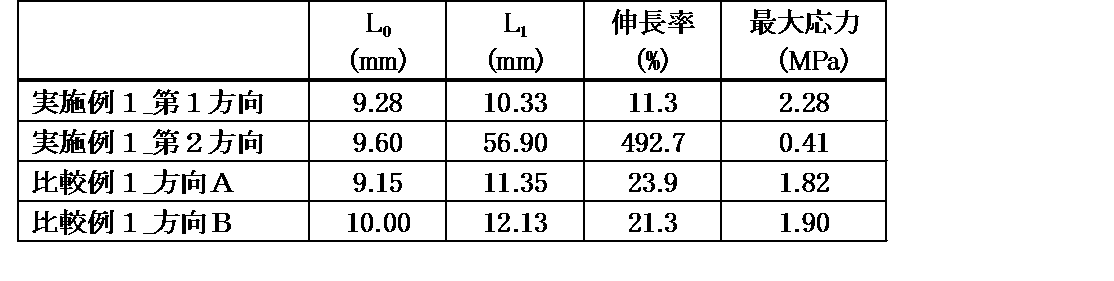
表1より、実施例1において、第2方向の伸長率が第1方向の伸長率よりも大きい伸長異方性を有するものであった。実施例1における伸長異方度は、伸長異方度=(第2方向の伸長率)/(第1方向の伸長率)の式より、43.6と計算された。 From Table 1, in Example 1, the elongation rate in the second direction had an elongation anisotropy larger than the elongation rate in the first direction. The elongation anisotropy in Example 1 was calculated to be 43.6 from the equation of elongation anisotropy = (elongation rate in the second direction) / (elongation rate in the first direction).
図5は、実施例1の伸縮性コラーゲンシートの伸び具合を示した写真である。写真中の定規の目盛りについて、例えば「50」は5cmを示す。
図5(a)は、第2方向をダンベル形の長辺方向と平行にしたものを長辺方向の両端部分をそれぞれピンセットで挟んで保持した状態のものである。なお、図5(a)ではまだ伸長させていない。
図5(b)は、図5(a)の状態から手動により第2方向と平行な方向に伸縮性コラーゲンシートを伸長させたものである。この段階では、まだ最大応力を示すには至っていない。ちなみに、同一辺上のダンベル部開始点2点間の長さについての伸長率を計算したところ、伸長率は105%であった。
FIG. 5 is a photograph showing the degree of elongation of the elastic collagen sheet of Example 1. Regarding the scale of the ruler in the photo, for example, "50" indicates 5 cm.
FIG. 5A shows a state in which the second direction is parallel to the long side direction of the dumbbell shape and both ends in the long side direction are sandwiched between tweezers and held. In addition, in FIG. 5 (a), it has not been extended yet.
FIG. 5 (b) shows a stretchable collagen sheet manually stretched in a direction parallel to the second direction from the state of FIG. 5 (a). At this stage, the maximum stress has not yet been reached. By the way, when the elongation rate for the length between the two start points of the dumbbell portion on the same side was calculated, the elongation rate was 105%.
12 伸縮性コラーゲンシート、15 再フィブリル化コラーゲンフィブリル、18 再フィブリル化コラーゲンフィブリルの配向方向、31 第1方向、52 第2方向、75 プローブで把持した部分、77 プローブで把持した網掛け部を除いた中央部分の長さ 12 Stretchable collagen sheet, 15 Refibrillated collagen fibrils, 18 Orientation direction of refibrillated collagen fibrils, 31 1st direction, 52 2nd direction, 75 Except for the part gripped by the probe, 77 The shaded part gripped by the probe The length of the central part
Claims (6)
上記再フィブリル化コラーゲンフィブリルは略規則性をもって配向したものであり、
上記再フィブリル化コラーゲンフィブリルの配向方向を第1方向とし、上記伸縮性コラーゲンシート平面上において第1方向との直角方向を第2方向としたときに、
少なくとも1日間20℃のリン酸緩衝生理食塩水中に完全に浸漬させた後の湿潤状態の上記伸縮性コラーゲンシートが、第1方向及び第2方向のそれぞれに伸縮性を有し、且つ、第2方向の伸長率が第1方向の伸長率よりも大きい伸長異方性を有するものであり、
伸長異方度=(第2方向の伸長率)/(第1方向の伸長率)の式から求められる伸長異方度が、3以上である、
伸縮性コラーゲンシート。 The collagen constituting the elastic collagen sheet is a refibrillated collagen fibril that has been crosslinked by at least one of γ-ray irradiation, electron beam irradiation, UV irradiation and plasma irradiation in the presence of an aqueous solvent.
The above-mentioned refibrillated collagen fibrils are oriented with substantially regularity.
When the orientation direction of the refibrillated collagen fibril is the first direction and the direction perpendicular to the first direction on the stretchable collagen sheet plane is the second direction,
The stretchable collagen sheet in a wet state after being completely immersed in a phosphate buffered saline solution at 20 ° C. for at least one day has elasticity in each of the first direction and the second direction, and is second. It has an elongation anisotropy in which the elongation rate in the direction is larger than the elongation rate in the first direction.
The elongation anisotropy obtained from the equation = (elongation rate in the second direction) / (elongation rate in the first direction) is 3 or more.
Elastic collagen sheet.
略規則性をもって配向した再フィブリル化コラーゲンフィブリルによって構成された未架橋のコラーゲンシートを、その上面及び下面を押圧した状態で、水性溶媒の存在下、γ線照射、電子線照射、UV照射及びプラズマ照射のうち少なくとも1種によって架橋処理する工程。
ただし、前記略規則性をもって配向した再フィブリル化コラーゲンフィブリルによって構成された未架橋のコラーゲンシートは、以下の工程A又は工程Bを含む製造方法によって製造されたものである。
工程A:可溶化コラーゲン水溶液中のコラーゲン分子に配向性を付与しながら、可溶化コラーゲン水溶液を吐出しシート状に展延する方法によって得られたシート状物を、所定のイオン強度とpHを有する水溶液と接触させることによって再フィブリル化させる工程。
工程B:可溶化コラーゲン水溶液中のコラーゲン分子に配向性を付与しながら、可溶化コラーゲン水溶液をシート状に吐出する方法によって得られたシート状物を、所定のイオン強度とpHを有する水溶液と接触させることによって再フィブリル化させる工程。 The method for producing an elastic collagen sheet according to claim 1, which comprises the following steps.
An uncrosslinked collagen sheet composed of refibrillated collagen fibrils oriented with substantially regularity, with the upper and lower surfaces pressed, in the presence of an aqueous solvent, γ-ray irradiation, electron beam irradiation, UV irradiation and plasma. A step of cross-linking with at least one of the irradiations.
However, the uncrosslinked collagen sheet composed of the refibrillated collagen fibrils oriented with substantially regularity is produced by a production method including the following step A or step B.
Step A: A sheet-like product obtained by a method of discharging a solubilized collagen aqueous solution and spreading it into a sheet shape while imparting orientation to collagen molecules in the solubilized collagen aqueous solution has a predetermined ionic strength and pH. The process of refibrillation by contacting with an aqueous solution.
Step B: The sheet-like material obtained by the method of discharging the solubilized collagen aqueous solution into a sheet while imparting orientation to the collagen molecules in the solubilized collagen aqueous solution is brought into contact with the aqueous solution having a predetermined ionic strength and pH. The process of re-collagen by making it.
Applications Claiming Priority (2)
| Application Number | Priority Date | Filing Date | Title |
|---|---|---|---|
| JP2017038778 | 2017-03-01 | ||
| JP2017038778 | 2017-03-01 |
Publications (2)
| Publication Number | Publication Date |
|---|---|
| JP2018143761A JP2018143761A (en) | 2018-09-20 |
| JP7019250B2 true JP7019250B2 (en) | 2022-02-15 |
Family
ID=63589148
Family Applications (1)
| Application Number | Title | Priority Date | Filing Date |
|---|---|---|---|
| JP2018035618A Active JP7019250B2 (en) | 2017-03-01 | 2018-02-28 | Elastic collagen sheet |
Country Status (1)
| Country | Link |
|---|---|
| JP (1) | JP7019250B2 (en) |
Families Citing this family (1)
| Publication number | Priority date | Publication date | Assignee | Title |
|---|---|---|---|---|
| JP7490668B2 (en) * | 2019-10-25 | 2024-05-27 | 富士フイルム株式会社 | Cell culture substrate and cell-attached cell culture substrate |
Citations (7)
| Publication number | Priority date | Publication date | Assignee | Title |
|---|---|---|---|---|
| WO2009084507A1 (en) | 2007-12-28 | 2009-07-09 | Osaka University | Method of preparing layered collagen gel and layered collagen gel |
| JP2013094161A (en) | 2011-10-30 | 2013-05-20 | Cellseed Inc | Tendon cell sheet and method for producing the same |
| JP2016069783A (en) | 2014-09-30 | 2016-05-09 | 多木化学株式会社 | Collagen fiber |
| JP2016077411A (en) | 2014-10-14 | 2016-05-16 | 地方独立行政法人東京都立産業技術研究センター | Method for producing collagen gel and collagen gel |
| JP2017149814A (en) | 2016-02-23 | 2017-08-31 | 多木化学株式会社 | Surface-worked collagen molded body |
| JP6570119B2 (en) | 2015-09-03 | 2019-09-04 | 多木化学株式会社 | Sheet-like collagen molding |
| JP6570120B2 (en) | 2015-09-03 | 2019-09-04 | 多木化学株式会社 | Transparent sheet-like collagen molding |
-
2018
- 2018-02-28 JP JP2018035618A patent/JP7019250B2/en active Active
Patent Citations (7)
| Publication number | Priority date | Publication date | Assignee | Title |
|---|---|---|---|---|
| WO2009084507A1 (en) | 2007-12-28 | 2009-07-09 | Osaka University | Method of preparing layered collagen gel and layered collagen gel |
| JP2013094161A (en) | 2011-10-30 | 2013-05-20 | Cellseed Inc | Tendon cell sheet and method for producing the same |
| JP2016069783A (en) | 2014-09-30 | 2016-05-09 | 多木化学株式会社 | Collagen fiber |
| JP2016077411A (en) | 2014-10-14 | 2016-05-16 | 地方独立行政法人東京都立産業技術研究センター | Method for producing collagen gel and collagen gel |
| JP6570119B2 (en) | 2015-09-03 | 2019-09-04 | 多木化学株式会社 | Sheet-like collagen molding |
| JP6570120B2 (en) | 2015-09-03 | 2019-09-04 | 多木化学株式会社 | Transparent sheet-like collagen molding |
| JP2017149814A (en) | 2016-02-23 | 2017-08-31 | 多木化学株式会社 | Surface-worked collagen molded body |
Also Published As
| Publication number | Publication date |
|---|---|
| JP2018143761A (en) | 2018-09-20 |
Similar Documents
| Publication | Publication Date | Title |
|---|---|---|
| Zhao et al. | Cell infiltrative hydrogel fibrous scaffolds for accelerated wound healing | |
| Gupta et al. | Preparation and characterization of in-situ crosslinked pectin–gelatin hydrogels | |
| Shi et al. | Three‐dimensional printing alginate/gelatin scaffolds as dermal substitutes for skin tissue engineering | |
| CN109749098B (en) | A kind of physical/chemical double cross-linked network high-strength gelatin hydrogel and preparation method thereof | |
| US9683011B2 (en) | Controlled cross-linking processing of proteins | |
| JP2023078119A (en) | microfluidic extrusion | |
| JP6399653B2 (en) | Method for producing collagen fiber | |
| WO2011119059A4 (en) | Photo-crosslinked gellan gum-based hydrogels: preparation methods and uses thereof | |
| WO2017216780A1 (en) | Gelatin polymer derived from natural sources of cold-adapted marine species and uses thereof | |
| CN103881126A (en) | Method for improving blood compatibility of material | |
| Sionkowska et al. | The influence of UV irradiation on the properties of chitosan films containing keratin | |
| TW201634063A (en) | Tissue repair material derived from fish skin and manufacturing method thereof | |
| Woerly et al. | Interactions of copolymeric poly (glyceryl methacrylate)-collagen hydrogels with neural tissue: effects of structure and polar groups | |
| CN107427608A (en) | Artificial biofilm using silk matrix and its manufacturing method | |
| JP7019250B2 (en) | Elastic collagen sheet | |
| CN111183152A (en) | Method for producing collagen vitrified gel and its purified product, and collagen vitrified gel obtained by the method and its purified product | |
| JP6570120B2 (en) | Transparent sheet-like collagen molding | |
| JP2009516038A (en) | Molded body based on crosslinked gelatinous material, method for producing the molded body, and use of the molded body | |
| JP6570119B2 (en) | Sheet-like collagen molding | |
| Sionkowska | Collagen based materials for biomedical applications: preparation and properties | |
| JP6995437B2 (en) | Collagen-chondroitin sulfate gel material | |
| JP2020105083A (en) | Crosslinked fibrotic collagen gel for oral mucosal epithelial cell culture | |
| CN1194032C (en) | Ammonolysis process of preparing polyester biomaterial with free amino on its surface | |
| JP7290302B2 (en) | Hydrogel membrane and its use | |
| Lin et al. | Effects of 1-ethyl-3-(3-dimethylaminopropyl) carbodiimide cross-linking duration on the structure of chitosan/gelatin composite bone scaffolds |
Legal Events
| Date | Code | Title | Description |
|---|---|---|---|
| A621 | Written request for application examination |
Free format text: JAPANESE INTERMEDIATE CODE: A621 Effective date: 20201222 |
|
| A977 | Report on retrieval |
Free format text: JAPANESE INTERMEDIATE CODE: A971007 Effective date: 20210922 |
|
| A131 | Notification of reasons for refusal |
Free format text: JAPANESE INTERMEDIATE CODE: A131 Effective date: 20210929 |
|
| A601 | Written request for extension of time |
Free format text: JAPANESE INTERMEDIATE CODE: A601 Effective date: 20211119 |
|
| A521 | Request for written amendment filed |
Free format text: JAPANESE INTERMEDIATE CODE: A523 Effective date: 20220113 |
|
| TRDD | Decision of grant or rejection written | ||
| A01 | Written decision to grant a patent or to grant a registration (utility model) |
Free format text: JAPANESE INTERMEDIATE CODE: A01 Effective date: 20220201 |
|
| A61 | First payment of annual fees (during grant procedure) |
Free format text: JAPANESE INTERMEDIATE CODE: A61 Effective date: 20220201 |
|
| R150 | Certificate of patent or registration of utility model |
Ref document number: 7019250 Country of ref document: JP Free format text: JAPANESE INTERMEDIATE CODE: R150 |
|
| R250 | Receipt of annual fees |
Free format text: JAPANESE INTERMEDIATE CODE: R250 |