JP6993834B2 - Method for manufacturing resin, resist composition and resist pattern - Google Patents
Method for manufacturing resin, resist composition and resist pattern Download PDFInfo
- Publication number
- JP6993834B2 JP6993834B2 JP2017196011A JP2017196011A JP6993834B2 JP 6993834 B2 JP6993834 B2 JP 6993834B2 JP 2017196011 A JP2017196011 A JP 2017196011A JP 2017196011 A JP2017196011 A JP 2017196011A JP 6993834 B2 JP6993834 B2 JP 6993834B2
- Authority
- JP
- Japan
- Prior art keywords
- group
- carbon atoms
- formula
- structural unit
- hydrocarbon group
- Prior art date
- Legal status (The legal status is an assumption and is not a legal conclusion. Google has not performed a legal analysis and makes no representation as to the accuracy of the status listed.)
- Active
Links
- 0 *C1(C(C2)C(CC(CCCC3)C3C3)C3C2C1)N Chemical compound *C1(C(C2)C(CC(CCCC3)C3C3)C3C2C1)N 0.000 description 54
- YXFVVABEGXRONW-UHFFFAOYSA-N Cc1ccccc1 Chemical compound Cc1ccccc1 YXFVVABEGXRONW-UHFFFAOYSA-N 0.000 description 5
- OFWUETKNBCXGQR-UHFFFAOYSA-N CCC(C)(C)C(Oc(cc1)ccc1[S+](c1ccccc1)c1ccccc1)=O Chemical compound CCC(C)(C)C(Oc(cc1)ccc1[S+](c1ccccc1)c1ccccc1)=O OFWUETKNBCXGQR-UHFFFAOYSA-N 0.000 description 3
- ZHKOMTFSTYQGIK-UHFFFAOYSA-N CC(C1)(C2)C1(CC1C3)C1C23O Chemical compound CC(C1)(C2)C1(CC1C3)C1C23O ZHKOMTFSTYQGIK-UHFFFAOYSA-N 0.000 description 2
- FSIAEQVJQWHKHF-UHFFFAOYSA-N CC(C(C(CC1)CC1C(C(C)=C)=O)=O)=C Chemical compound CC(C(C(CC1)CC1C(C(C)=C)=O)=O)=C FSIAEQVJQWHKHF-UHFFFAOYSA-N 0.000 description 1
- GJKGAPPUXSSCFI-UHFFFAOYSA-N CC(C)(C(c(cc1)ccc1OCCO)=O)O Chemical compound CC(C)(C(c(cc1)ccc1OCCO)=O)O GJKGAPPUXSSCFI-UHFFFAOYSA-N 0.000 description 1
- AWELXMXBBYAGPS-UHFFFAOYSA-N CC(C)(C(c(cc1)ccc1OCCOC(C(C)=C)=O)=O)O Chemical compound CC(C)(C(c(cc1)ccc1OCCOC(C(C)=C)=O)=O)O AWELXMXBBYAGPS-UHFFFAOYSA-N 0.000 description 1
- OXQMIXBVXHWDPX-UHFFFAOYSA-N CC(C)(C)N(C)C Chemical compound CC(C)(C)N(C)C OXQMIXBVXHWDPX-UHFFFAOYSA-N 0.000 description 1
- MTTLBVJNWYRKKO-UHFFFAOYSA-N CC(C)(C)N[U]=C Chemical compound CC(C)(C)N[U]=C MTTLBVJNWYRKKO-UHFFFAOYSA-N 0.000 description 1
- JBOBYAAYILQPPZ-UHFFFAOYSA-N CC(C1)(CC2C3)C1(C1)C3C1C2O Chemical compound CC(C1)(CC2C3)C1(C1)C3C1C2O JBOBYAAYILQPPZ-UHFFFAOYSA-N 0.000 description 1
- SENDHUJQSJLNGM-UHFFFAOYSA-N CC(CCC1OC1CN)(C=C)C(C)=C Chemical compound CC(CCC1OC1CN)(C=C)C(C)=C SENDHUJQSJLNGM-UHFFFAOYSA-N 0.000 description 1
- DYIZOTVDURZYAE-UHFFFAOYSA-N CC(OCC(CCC(OC)=O)OC(C)=O)(F)F Chemical compound CC(OCC(CCC(OC)=O)OC(C)=O)(F)F DYIZOTVDURZYAE-UHFFFAOYSA-N 0.000 description 1
- FEJWYONMQGZODH-UHFFFAOYSA-N CC(OCCCC(OC)=O)(F)F Chemical compound CC(OCCCC(OC)=O)(F)F FEJWYONMQGZODH-UHFFFAOYSA-N 0.000 description 1
- JPKNHCMRSVWVLK-UHFFFAOYSA-N CC1(C2)C2(CC2C3)C2C3C1 Chemical compound CC1(C2)C2(CC2C3)C2C3C1 JPKNHCMRSVWVLK-UHFFFAOYSA-N 0.000 description 1
- PSXTZIYCEURBAD-UHFFFAOYSA-N CC1(CC2C(C3)C1)CC23O Chemical compound CC1(CC2C(C3)C1)CC23O PSXTZIYCEURBAD-UHFFFAOYSA-N 0.000 description 1
- WPEGUWVISNOIMU-UHFFFAOYSA-N CC1(CC2C3C1)CC3C2O Chemical compound CC1(CC2C3C1)CC3C2O WPEGUWVISNOIMU-UHFFFAOYSA-N 0.000 description 1
- GOPZDDLHDFXXMF-UHFFFAOYSA-N CC1(CC2CC3)CC23C(CCc2ccccc2)C1 Chemical compound CC1(CC2CC3)CC23C(CCc2ccccc2)C1 GOPZDDLHDFXXMF-UHFFFAOYSA-N 0.000 description 1
- FSWCCQWDVGZMRD-UHFFFAOYSA-N CC1CC=CCC1 Chemical compound CC1CC=CCC1 FSWCCQWDVGZMRD-UHFFFAOYSA-N 0.000 description 1
- IXAHYONPDAEXPK-UHFFFAOYSA-N CC=C(CS1CCCCCC1)c1ccc(cccc2)c2c1 Chemical compound CC=C(CS1CCCCCC1)c1ccc(cccc2)c2c1 IXAHYONPDAEXPK-UHFFFAOYSA-N 0.000 description 1
- HMGGEYLELYPALX-UHFFFAOYSA-N CCC(C)(C)C(OCCCc(cc1)ccc1[S+](c1ccccc1)c1ccccc1)=O Chemical compound CCC(C)(C)C(OCCCc(cc1)ccc1[S+](c1ccccc1)c1ccccc1)=O HMGGEYLELYPALX-UHFFFAOYSA-N 0.000 description 1
- FHZOPTFULXAPDP-UHFFFAOYSA-N CCC(C)(C)C(Oc1ccc(C)cc1)=O Chemical compound CCC(C)(C)C(Oc1ccc(C)cc1)=O FHZOPTFULXAPDP-UHFFFAOYSA-N 0.000 description 1
- BBYVKFUHVFLECV-DEOSSOPVSA-N CCC(C)(C)C([O](C1)[C@@H]1c(cc1)ccc1[S+](c1ccccc1)c1ccccc1)=O Chemical compound CCC(C)(C)C([O](C1)[C@@H]1c(cc1)ccc1[S+](c1ccccc1)c1ccccc1)=O BBYVKFUHVFLECV-DEOSSOPVSA-N 0.000 description 1
- UIGVKHKLIFIGHO-UHFFFAOYSA-N CCC(C)(C)C([O](c(cc1)ccc1[S+](c1ccccc1)c1ccccc1)=C)=O Chemical compound CCC(C)(C)C([O](c(cc1)ccc1[S+](c1ccccc1)c1ccccc1)=C)=O UIGVKHKLIFIGHO-UHFFFAOYSA-N 0.000 description 1
- GVKJWSCYVNRJKS-UHFFFAOYSA-N CCC(C1)C(C2)(C3)C1CC2CC3OC(C(C(CC1C2O3)C2OC(C(F)(F)[S](C)(O)(=O)=O)=O)C1C3=O)=O Chemical compound CCC(C1)C(C2)(C3)C1CC2CC3OC(C(C(CC1C2O3)C2OC(C(F)(F)[S](C)(O)(=O)=O)=O)C1C3=O)=O GVKJWSCYVNRJKS-UHFFFAOYSA-N 0.000 description 1
- NKYOVKRTXYGFMU-UHFFFAOYSA-N CCC1(C)C(C)CC=CC1 Chemical compound CCC1(C)C(C)CC=CC1 NKYOVKRTXYGFMU-UHFFFAOYSA-N 0.000 description 1
- CUEIOYAAESVAFZ-UHFFFAOYSA-N CCCC(C)(C1)C2C=C1C2C Chemical compound CCCC(C)(C1)C2C=C1C2C CUEIOYAAESVAFZ-UHFFFAOYSA-N 0.000 description 1
- ZPUOHCOHLCIQTI-UHFFFAOYSA-N CCCCC(C1)C1C(C)(N)N Chemical compound CCCCC(C1)C1C(C)(N)N ZPUOHCOHLCIQTI-UHFFFAOYSA-N 0.000 description 1
- MDUGKLIXBZAYHE-UHFFFAOYSA-N CCOC(C)(C)C(C)(C)C(ON)=O Chemical compound CCOC(C)(C)C(C)(C)C(ON)=O MDUGKLIXBZAYHE-UHFFFAOYSA-N 0.000 description 1
- HLJKHLVJPSTJFX-UHFFFAOYSA-N CCOCCC(C)(N)N Chemical compound CCOCCC(C)(N)N HLJKHLVJPSTJFX-UHFFFAOYSA-N 0.000 description 1
- LYHODTWONYNUHY-UHFFFAOYSA-N C[S](C(C(OC(CC1CC23)(C4)C12C4C3=C1CC1)=O)(F)F)(O)(=O)=O Chemical compound C[S](C(C(OC(CC1CC23)(C4)C12C4C3=C1CC1)=O)(F)F)(O)(=O)=O LYHODTWONYNUHY-UHFFFAOYSA-N 0.000 description 1
- HEDYWTZMWLBBTN-UHFFFAOYSA-N C[S](C(C(OC(CC1CC23)(C4)CC12C4C3=O)=O)(F)F)(O)(=O)=O Chemical compound C[S](C(C(OC(CC1CC23)(C4)CC12C4C3=O)=O)(F)F)(O)(=O)=O HEDYWTZMWLBBTN-UHFFFAOYSA-N 0.000 description 1
- LLCQXJJMMSMQRP-UHFFFAOYSA-N C[S](C(C(OC1(CC2C(C3)C1)CC3C2=O)=O)(F)F)(O)(=O)=O Chemical compound C[S](C(C(OC1(CC2C(C3)C1)CC3C2=O)=O)(F)F)(O)(=O)=O LLCQXJJMMSMQRP-UHFFFAOYSA-N 0.000 description 1
- NLNLKTJMSIDJNX-UHFFFAOYSA-N C[S](C(C(OCC1(C2)CC(C3)CC2(CO)C3C1)=O)(F)F)(O)(=O)=O Chemical compound C[S](C(C(OCC1(C2)CC(C3)CC2(CO)C3C1)=O)(F)F)(O)(=O)=O NLNLKTJMSIDJNX-UHFFFAOYSA-N 0.000 description 1
- UGYUQYIWLZDWKB-UHFFFAOYSA-N C[S](CCOC(C1(CC2C(C3)C1)CC23O)=O)(O)(=O)=O Chemical compound C[S](CCOC(C1(CC2C(C3)C1)CC23O)=O)(O)(=O)=O UGYUQYIWLZDWKB-UHFFFAOYSA-N 0.000 description 1
- QKFJVDSYTSWPII-UHFFFAOYSA-N Cc(cc1)ccc1[S+](c1ccc(C)cc1)c1ccc(C)cc1 Chemical compound Cc(cc1)ccc1[S+](c1ccc(C)cc1)c1ccc(C)cc1 QKFJVDSYTSWPII-UHFFFAOYSA-N 0.000 description 1
- SCZXWUIMYMVGNU-UHFFFAOYSA-N Cc1ccc(C(c2ccccc2)c2ccc(C)cc2)cc1 Chemical compound Cc1ccc(C(c2ccccc2)c2ccc(C)cc2)cc1 SCZXWUIMYMVGNU-UHFFFAOYSA-N 0.000 description 1
Landscapes
- Exposure And Positioning Against Photoresist Photosensitive Materials (AREA)
- Materials For Photolithography (AREA)
- Addition Polymer Or Copolymer, Post-Treatments, Or Chemical Modifications (AREA)
Description
本発明は、樹脂、該樹脂を含むレジスト組成物及びレジストパターンの製造方法に関する。 The present invention relates to a resin, a resist composition containing the resin, and a method for producing a resist pattern.
特許文献1には、下記構造単位からなる樹脂を含有するレジスト組成物が記載されている。
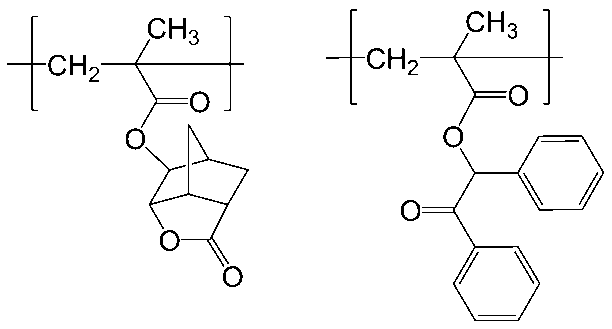
上記の樹脂を含むレジスト組成物では、得られるレジストパターンのラインエッジラフネス(LER)が必ずしも満足できない場合があった。 In the resist composition containing the above resin, the line edge roughness (LER) of the obtained resist pattern may not always be satisfactory.
本発明は、以下の発明を含む。
[1]式(aa1)で表される基を含む構造単位又は式(aa2)で表される基を含む構造単位と酸不安定基を有する構造単位とを有する樹脂。

R1及びR2は、それぞれ独立して、水素原子、ヒドロキシ基、ヒドロキシ基を有していてもよい炭素数1~18の炭化水素基を表し、該炭化水素基に含まれる-CH2-は、-O-又は-CO-に置き換わっていてもよく、R1とR2とが一緒になって環を形成してもよい。
Xは、ヒドロキシ基、ヒドロキシ基を有していてもよい炭素数1~18の炭化水素基を表し、該炭化水素基に含まれる-CH2-は、-O-又は-CO-に置き換わっていてもよい。
R33は、単結合又はヒドロキシ基を有していてもよい炭素数1~18の2価の炭化水素基を表し、該炭化水素基に含まれる-CH2-は、-O-又は-CO-に置き換わっていてもよい。
R11、R22及びR3は、それぞれ独立して、水素原子、ヒドロキシ基、ヒドロキシ基を有していてもよい炭素数1~18の炭化水素基を表し、該炭化水素基に含まれる-CH2-は、-O-又は-CO-に置き換わっていてもよく、R11とR22とが一緒になって環を形成してもよい。
X1は、単結合又は炭素数1~6のアルカンジイル基を表す。
*は、結合手を表す。]
[2]式(aa1)で表される基を含む構造単位又は式(aa2)で表される基を含む構造単位が、
ビニル基、イソプロペニル基、アクリロイル基及びメタアクリロイル基からなる群から選ばれる少なくとも1つの基と、
式(aa1)で表される基又は式(aa2)で表される基とを有する構造単位である[1]の樹脂。
[3]ビニル基、イソプロペニル基、アクリロイル基及びメタアクリロイル基からなる群から選ばれる少なくとも1つの基と、式(aa1)で表される基又は式(aa2)で表される基とを有する構造単位が、式(AA1)又は式(AA2)で表される化合物に由来する構造単位である[2]に記載の樹脂。

Rは、水素原子又はメチル基を表す。
L1は、式(L1-1)~式(L1-8)のいずれかで表される基を表す。
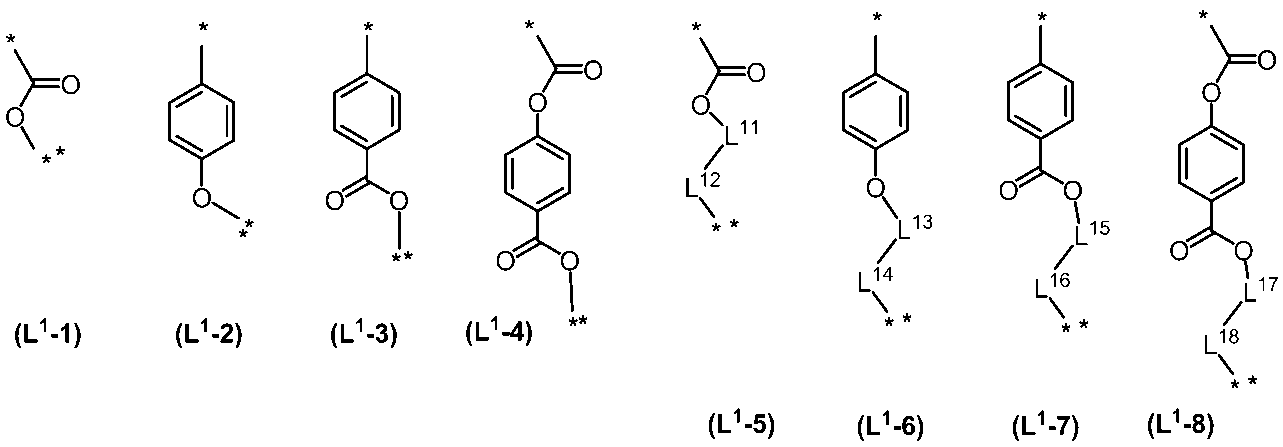
L11、L13、L15及びL17は、それぞれ独立して、炭素数1~6のアルカンジイル基を表す。
L12、L14、L16及びL18は、それぞれ独立して、-O-、-CO-、-CO-O-、-O-CO-又は-O-CO-O-を表す。
*、**は結合手であり、**はR33又はX1との結合手を表す。)]
[4][1]~[3]のいずれかに記載の樹脂及び酸発生剤を含有するレジスト組成物。
[5]前記酸発生剤から発生する酸よりも酸性度の弱い酸を発生する塩をさらに含有する[4]記載のレジスト組成物。
[6]フッ素原子を有する構造単位を含む樹脂をさらに含有する[4]又は[5]記載のレジスト組成物。
[7](1)[4]~[6]のいずれか記載のレジスト組成物を基板上に塗布する工程、
(2)塗布後の組成物を乾燥させて組成物層を形成する工程、
(3)組成物層に露光する工程、
(4)露光後の組成物層を加熱する工程、及び
(5)加熱後の組成物層を現像する工程を含むレジストパターンの製造方法。
The present invention includes the following inventions.
[1] A resin having a structural unit containing a group represented by the formula (aa1) or a structural unit containing a group represented by the formula (aa2) and a structural unit having an acid unstable group.
R 1 and R 2 each independently represent a hydrocarbon group having 1 to 18 carbon atoms which may have a hydrogen atom, a hydroxy group, and a hydroxy group, and are contained in the hydrocarbon group-CH 2- . May be replaced with —O— or —CO—, and R1 and R2 may be combined to form a ring.
X represents a hydroxy group and a hydrocarbon group having 1 to 18 carbon atoms which may have a hydroxy group, and -CH 2- contained in the hydrocarbon group is replaced with -O- or -CO-. May be.
R 33 represents a divalent hydrocarbon group having 1 to 18 carbon atoms which may have a single bond or a hydroxy group, and -CH 2- contained in the hydrocarbon group is -O- or -CO. It may be replaced with-.
R 11 , R 22 and R 3 each independently represent a hydrocarbon group having 1 to 18 carbon atoms which may have a hydrogen atom, a hydroxy group and a hydroxy group, and are contained in the hydrocarbon group. CH 2- may be replaced with —O— or —CO—, and R 11 and R 22 may be combined to form a ring.
X 1 represents a single bond or an alkanediyl group having 1 to 6 carbon atoms.
* Represents a bond. ]
[2] The structural unit containing the group represented by the formula (aa1) or the structural unit containing the group represented by the formula (aa2) is
At least one group selected from the group consisting of a vinyl group, an isopropenyl group, an acryloyl group and a metaacryloyl group, and
The resin of [1], which is a structural unit having a group represented by the formula (aa1) or a group represented by the formula (aa2).
[3] It has at least one group selected from the group consisting of a vinyl group, an isopropenyl group, an acryloyl group and a metaacryloyl group, and a group represented by the formula (aa1) or a group represented by the formula (aa2). The resin according to [2], wherein the structural unit is a structural unit derived from a compound represented by the formula (AA1) or the formula (AA2).
R represents a hydrogen atom or a methyl group.
L 1 represents a group represented by any of the formulas (L 1-1 ) to (L 1-8 ).
L 11 , L 13 , L 15 and L 17 each independently represent an alkanediyl group having 1 to 6 carbon atoms.
L 12 , L 14 , L 16 and L 18 independently represent -O-, -CO-, -CO-O-, -O-CO- or -O-CO-O-, respectively.
** and ** are bonds, and ** represents a bond with R 33 or X 1 . )]]
[4] A resist composition containing the resin and acid generator according to any one of [1] to [3].
[5] The resist composition according to [4], which further contains a salt that generates an acid having a weaker acidity than the acid generated from the acid generator.
[6] The resist composition according to [4] or [5], which further contains a resin containing a structural unit having a fluorine atom.
[7] (1) A step of applying the resist composition according to any one of [4] to [6] onto a substrate.
(2) A step of drying the applied composition to form a composition layer,
(3) Step of exposing the composition layer,
(4) A method for producing a resist pattern, which comprises a step of heating the composition layer after exposure and (5) a step of developing the composition layer after heating.
本発明の樹脂を含むレジスト組成物を用いることにより、良好なラインエッジラフネス(LER)で、レジストパターンを製造することができる。 By using the resist composition containing the resin of the present invention, a resist pattern can be produced with good line edge roughness (LER).
本明細書において「(メタ)アクリレート」とは、それぞれ「アクリレート及びメタクリレートの少なくとも一種」を意味する。「(メタ)アクリル酸」や「(メタ)アクリロイル」等の表記も、同様の意味を有する。
また、特に断りのない限り、「脂肪族炭化水素基」は直鎖及び分岐の炭化水素基を、「脂環式炭化水素基」は環状の炭化水素基及び/又は環状の炭化水素基に炭化水素基が結合した基を意味する。「芳香族炭化水素基」は芳香環に炭化水素基が結合した基をも包含する。立体異性体が存在する場合は、全ての立体異性体を包含する。
本明細書において、「レジスト組成物の固形分」とは、レジスト組成物の総量から、後述する溶剤(E)を除いた成分の合計を意味する。
As used herein, the term "(meth) acrylate" means "at least one of acrylate and methacrylate," respectively. Notations such as "(meth) acrylic acid" and "(meth) acryloyl" have the same meaning.
Unless otherwise specified, "aliphatic hydrocarbon groups" are carbonized into linear and branched hydrocarbon groups, and "aliphatic hydrocarbon groups" are carbonized into cyclic hydrocarbon groups and / or cyclic hydrocarbon groups. It means a group to which a hydrogen group is bonded. The "aromatic hydrocarbon group" also includes a group in which a hydrocarbon group is bonded to an aromatic ring. If a steric isomer is present, it includes all steric isomers.
In the present specification, the "solid content of the resist composition" means the total amount of the components excluding the solvent (E) described later from the total amount of the resist composition.
〔樹脂〕
本発明の樹脂は、式(aa1)で表される基を含む構造単位(以下「構造単位(aa1)」という場合がある。)又は式(aa2)で表される基を含む構造単位(以下「構造単位(aa2)」という場合がある。)と、酸不安定基を有する構造単位(以下「構造単位(a1)」という場合がある)とを含む樹脂(以下「樹脂(A)」という場合がある。)である。ここで、「酸不安定基」とは、脱離基を有し、酸との接触により脱離基が脱離して、親水性基(例えば、ヒドロキシ基又はカルボキシ基)を形成する基を意味する。
〔resin〕
The resin of the present invention has a structural unit containing a group represented by the formula (aa1) (hereinafter, may be referred to as "structural unit (aa1)") or a structural unit containing a group represented by the formula (aa2) (hereinafter referred to as "structural unit"). A resin (hereinafter referred to as "resin (A)") containing a "structural unit (aa2)") and a structural unit having an acid unstable group (hereinafter sometimes referred to as "structural unit (a1)"). In some cases.). Here, the "acid-unstable group" means a group having a leaving group, and the leaving group is removed by contact with an acid to form a hydrophilic group (for example, a hydroxy group or a carboxy group). do.
〔構造単位(aa1)及び構造単位(aa2)〕
構造単位(aa1)及び構造単位(aa2)は、式(aa1)で表される基及び式(aa2)で表される基を、それぞれ含む。

R1及びR2は、それぞれ独立して、水素原子、ヒドロキシ基、ヒドロキシ基を有していてもよい炭素数1~18の炭化水素基を表し、該炭化水素基に含まれる-CH2-は、-O-又は-CO-に置き換わっていてもよく、R1とR2とが一緒になって環を形成してもよい。
Xは、ヒドロキシ基、ヒドロキシ基を有していてもよい炭素数1~18の炭化水素基を表し、該炭化水素基に含まれる-CH2-は、-O-又は-CO-に置き換わっていてもよい。
R33は、単結合又はヒドロキシ基を有していてもよい炭素数1~18の2価の炭化水素基を表し、該炭化水素基に含まれる-CH2-は、-O-又は-CO-に置き換わっていてもよい。
R11、R22及びR3は、それぞれ独立して、水素原子、ヒドロキシ基、ヒドロキシ基を有していてもよい炭素数1~18の炭化水素基を表し、該炭化水素基に含まれる-CH2-は、-O-又は-CO-に置き換わっていてもよく、R11とR22とが一緒になって環を形成してもよい。
X1は、単結合又は炭素数1~6のアルカンジイル基を表す。
*は、結合手を表す。]
[Structural unit (aa1) and structural unit (aa2)]
The structural unit (aa1) and the structural unit (aa2) include a group represented by the formula (aa1) and a group represented by the formula (aa2), respectively.
R 1 and R 2 each independently represent a hydrocarbon group having 1 to 18 carbon atoms which may have a hydrogen atom, a hydroxy group, and a hydroxy group, and are contained in the hydrocarbon group-CH 2- . May be replaced with —O— or —CO—, and R1 and R2 may be combined to form a ring.
X represents a hydroxy group and a hydrocarbon group having 1 to 18 carbon atoms which may have a hydroxy group, and -CH 2- contained in the hydrocarbon group is replaced with -O- or -CO-. May be.
R 33 represents a divalent hydrocarbon group having 1 to 18 carbon atoms which may have a single bond or a hydroxy group, and -CH 2- contained in the hydrocarbon group is -O- or -CO. It may be replaced with-.
R 11 , R 22 and R 3 each independently represent a hydrocarbon group having 1 to 18 carbon atoms which may have a hydrogen atom, a hydroxy group and a hydroxy group, and are contained in the hydrocarbon group. CH 2- may be replaced with —O— or —CO—, and R 11 and R 22 may be combined to form a ring.
X 1 represents a single bond or an alkanediyl group having 1 to 6 carbon atoms.
* Represents a bond. ]
R1、R2、X、R11、R22及びR3で表される炭素数1~18の炭化水素基としては、アルキル基、単環式又は多環式の脂環式飽和炭化水素基、芳香族炭化水素基などが挙げられ、これらの基のうち2種以上を組合せたものでもよい。
アルキル基としては、メチル基、エチル基、プロピル基、ブチル基、ペンチル基、ヘキシル基、ヘプチル基、オクチル基、ノニル基、デシル基、ウンデシル基及びドデシル基等の直鎖又は分岐の基が挙げられる。
脂環式炭化水素基としては、単環式及び多環式のいずれでもよい。単環式の脂環式炭化水素基としては、例えば、シクロペンチル基、シクロへキシル基、シクロヘプチル基、シクロオクチル基等のシクロアルキル基が挙げられる。多環式の脂環式炭化水素基としては、例えば、デカヒドロナフチル基、アダマンチル基、ノルボルニル基等が挙げられる。
芳香族炭化水素基としては、フェニル基及びナフチル基等が挙げられる。
ヒドロキシ基を有する炭化水素基としては、ヒドロキシメチル基、ヒドロキシエチル基、ヒドロキシプロピル基、ヒドロキシブチル基、ヒドロキシペンチル基、ヒドロキシヘキシル基、ヒドロキシヘプチル基、ヒドロキシオクチル基、ヒドロキシノニル基、ヒドロキシデシル基、ヒドロキシウンデシル基及びヒドロキシドデシル基のヒドロキシアルキル基;等が挙げられる。
R33で表される炭素数1~18の2価の炭化水素基としては、上述した炭化水素基から水素原子を一つ取り除いた2価の基等が挙げられる。
The hydrocarbon groups having 1 to 18 carbon atoms represented by R 1 , R 2 , X, R 11 , R 22 and R 3 include alkyl groups, monocyclic or polycyclic saturated hydrocarbon groups. , Aromatic hydrocarbon groups and the like, and two or more of these groups may be combined.
Examples of the alkyl group include a linear or branched group such as a methyl group, an ethyl group, a propyl group, a butyl group, a pentyl group, a hexyl group, a heptyl group, an octyl group, a nonyl group, a decyl group, an undecyl group and a dodecyl group. Be done.
The alicyclic hydrocarbon group may be either a monocyclic or polycyclic group. Examples of the monocyclic alicyclic hydrocarbon group include cycloalkyl groups such as cyclopentyl group, cyclohexyl group, cycloheptyl group and cyclooctyl group. Examples of the polycyclic alicyclic hydrocarbon group include a decahydronaphthyl group, an adamantyl group, a norbornyl group and the like.
Examples of the aromatic hydrocarbon group include a phenyl group and a naphthyl group.
Examples of the hydrocarbon group having a hydroxy group include a hydroxymethyl group, a hydroxyethyl group, a hydroxypropyl group, a hydroxybutyl group, a hydroxypentyl group, a hydroxyhexyl group, a hydroxyheptyl group, a hydroxyoctyl group, a hydroxynonyl group, and a hydroxydecyl group. Hydroxyalkyl groups of hydroxyundesyl groups and hydroxydodecyl groups; and the like.
Examples of the divalent hydrocarbon group having 1 to 18 carbon atoms represented by R 33 include a divalent group obtained by removing one hydrogen atom from the above-mentioned hydrocarbon group.
R1、R2、X、R11、R22及びR3で表される炭化水素基に含まれる-CH2-が、-O-又は-CO-に置き換わった基としては、アルコキシ基、アルキルカルボニル基、アルキルカルボニルオキシ基、アルコキシカルボニル基、アルコキシアルコキシアルキル基、アルコキシアルキルカルボニルオキシ基、ヒドロキシアルキル基等が挙げられる。
アルコキシ基としては、メトキシ基、エトキシ基、プロポキシ基、ブトキシ基、ペンチルオキシ基、ヘキシルオキシ基、オクチルオキシ基、2-エチルヘキシルオキシ基、ノニルオキシ基、デシルオキシ基、ウンデシルオキシ基、ドデシルオキシ基等が挙げられる。
アルキルカルボニル基としては、アセチル基、プロピオニル基及びブチリル基等が挙げられる。
アルキルカルボニルオキシ基としては、メチルカルボニルオキシ基、エチルカルボニルオキシ基、n-プロピルカルボニルオキシ基、イソプロピルカルボニルオキシ基、n-ブチルカルボニルオキシ基、sec-ブチルカルボニルオキシ基、tert-ブチルカルボニルオキシ基、ペンチルカルボニルオキシ基、ヘキシルカルボニルオキシ基、オクチルカルボニルオキシ基及び2-エチルヘキシルカルボニルオキシ基等が挙げられる。
アルコキシカルボニル基としては、メトキシカルボニル基、エトキシカルボニル基、プロポキシカルボニル基、ブトキシカルボニル基、ペンチルオキシカルボニル基、ヘキシルオキシカルボニル基、オクチルオキシカルボニル基、2-エチルヘキシルオキシカルボニル基、ノニルオキシカルボニル基、デシルオキシカルボニル基、ウンデシルオキシカルボニル基、ドデシルオキシカルボニル基等が挙げられる。
アルコキシアルコキシアルキル基としては、メトキシメトキシメチル基、エトキシメトキシメチル基、プロポキシメトキシメチル基、ブトキシメトキシメチル基等が挙げられる。
アルコキシアルキルカルボニルオキシ基としては、メトキシメチルカルボニルオキシ基、エトキシメチルカルボニルオキシ基、プロポキシメチルカルボニルオキシ基、ブトキシメチルカルボニルオキシ基等が挙げられる。
ヒドロキシアルキル基としては、上述したヒドロキシ基を有する炭化水素基と同様のものが挙げられる。
The group in which -CH 2- contained in the hydrocarbon group represented by R 1 , R 2 , X, R 11 , R 22 and R 3 is replaced with -O- or -CO- is an alkoxy group or an alkyl. Examples thereof include a carbonyl group, an alkylcarbonyloxy group, an alkoxycarbonyl group, an alkoxyalkoxyalkyl group, an alkoxyalkylcarbonyloxy group, and a hydroxyalkyl group.
Examples of the alkoxy group include a methoxy group, an ethoxy group, a propoxy group, a butoxy group, a pentyloxy group, a hexyloxy group, an octyloxy group, a 2-ethylhexyloxy group, a nonyloxy group, a decyloxy group, an undecyloxy group and a dodecyloxy group. Can be mentioned.
Examples of the alkylcarbonyl group include an acetyl group, a propionyl group, a butyryl group and the like.
Examples of the alkylcarbonyloxy group include a methylcarbonyloxy group, an ethylcarbonyloxy group, an n-propylcarbonyloxy group, an isopropylcarbonyloxy group, an n-butylcarbonyloxy group, a sec-butylcarbonyloxy group, and a tert-butylcarbonyloxy group. Examples thereof include a pentylcarbonyloxy group, a hexylcarbonyloxy group, an octylcarbonyloxy group and a 2-ethylhexylcarbonyloxy group.
Examples of the alkoxycarbonyl group include a methoxycarbonyl group, an ethoxycarbonyl group, a propoxycarbonyl group, a butoxycarbonyl group, a pentyloxycarbonyl group, a hexyloxycarbonyl group, an octyloxycarbonyl group, a 2-ethylhexyloxycarbonyl group, a nonyloxycarbonyl group, and a decyl. Examples thereof include an oxycarbonyl group, an undecyloxycarbonyl group, and a dodecyloxycarbonyl group.
Examples of the alkoxyalkoxyalkyl group include a methoxymethoxymethyl group, an ethoxymethoxymethyl group, a propoxymethoxymethyl group, a butoxymethoxymethyl group and the like.
Examples of the alkoxyalkylcarbonyloxy group include a methoxymethylcarbonyloxy group, an ethoxymethylcarbonyloxy group, a propoxymethylcarbonyloxy group, a butoxymethylcarbonyloxy group and the like.
Examples of the hydroxyalkyl group include those similar to the above-mentioned hydrocarbon group having a hydroxy group.
R1及びR2が互いに結合して2価の脂環式炭化水素基を形成する場合の-CR1R2Xとしては、下記の基が挙げられる。2価の脂環式炭化水素基は、好ましくは炭素数3~12である。*はカルボニル基との結合手を表す。

R11及びR22が互いに結合して2価の脂環式炭化水素基を形成する場合の-CR11R22-X1-としては、下記の基が挙げられる。2価の脂環式炭化水素基は、好ましくは炭素数3~12である。*はカルボニル基との結合手を表す。

X1で表される炭素数1~6のアルカンジイル基としては、メチレン基、エチレン基、プロパン-1,3-ジイル基、プロパン-1,2-ジイル基、ブタン-1,4-ジイル基、ペンタン-1,5-ジイル基、ヘキサン-1,6-ジイル基、ブタン-1,3-ジイル基、2-メチルプロパン-1,3-ジイル基、2-メチルプロパン-1,2-ジイル基、ペンタン-1,4-ジイル基及び2-メチルブタン-1,4-ジイル基等が挙げられる。 Examples of the alkanediyl group having 1 to 6 carbon atoms represented by X 1 include a methylene group, an ethylene group, a propane-1,3-diyl group, a propane-1,2-diyl group and a butane-1,4-diyl group. , Pentan-1,5-diyl group, hexane-1,6-diyl group, butane-1,3-diyl group, 2-methylpropane-1,3-diyl group, 2-methylpropane-1,2-diyl Examples thereof include a group, a pentane-1,4-diyl group and a 2-methylbutane-1,4-diyl group.
構造単位(aa1)又は構造単位(aa2)は、ビニル基、イソプロペニル基、アクリロイル基及びメタアクリロイル基からなる群から選ばれる少なくとも1つの基と、式(aa1)で表される基又は式(aa2)で表される基とを有する重合性モノマーに由来する構造単位であることが好ましく、式(AA1)又は式(AA2)で表される化合物に由来する構造単位であることがより好ましい。

Rは、水素原子又はメチル基を表す。
L1は、式(L1-1)~式(L1-8)のいずれかで表される基を表す。

L11、L13、L15及びL17は、それぞれ独立して、炭素数1~6のアルカンジイル基を表す。
L12、L14、L16及びL18は、それぞれ独立して、-O-、-CO-、-CO-O-、-O-CO-又は-O-CO-O-を表す。
*、**は結合手であり、**はR33又はX1との結合手を表す。)
L11、L13、L15及びL17で表される炭素数1~6のアルカンジイル基は、X1で表されるアルカンジイル基と同様のものが挙げられる。
L1は、式(L1-1)又は式(L1-5)で表される基であることが好ましく、式(L1-1)で表される基であることがより好ましい。
The structural unit (aa1) or the structural unit (aa2) is at least one group selected from the group consisting of a vinyl group, an isopropenyl group, an acryloyl group and a metaacryloyl group, and a group represented by the formula (aa1) or a group represented by the formula (aa1). It is preferably a structural unit derived from a polymerizable monomer having a group represented by aa2), and more preferably a structural unit derived from a compound represented by the formula (AA1) or the formula (AA2).
R represents a hydrogen atom or a methyl group.
L 1 represents a group represented by any of the formulas (L 1-1 ) to (L 1-8 ).
L 11 , L 13 , L 15 and L 17 each independently represent an alkanediyl group having 1 to 6 carbon atoms.
L 12 , L 14 , L 16 and L 18 independently represent -O-, -CO-, -CO-O-, -O-CO- or -O-CO-O-, respectively.
** and ** are bonds, and ** represents a bond with R 33 or X 1 . )
Examples of the alkanediyl group having 1 to 6 carbon atoms represented by L11, L13 , L15 and L17 are the same as those represented by X1.
L 1 is preferably a group represented by the formula (L 1-1 ) or the formula (L 1-5 ), and more preferably a group represented by the formula (L 1-1 ).
式(AA1)又は式(AA2)で表される化合物としては、例えば、下記に記載の化合物が挙げられる。
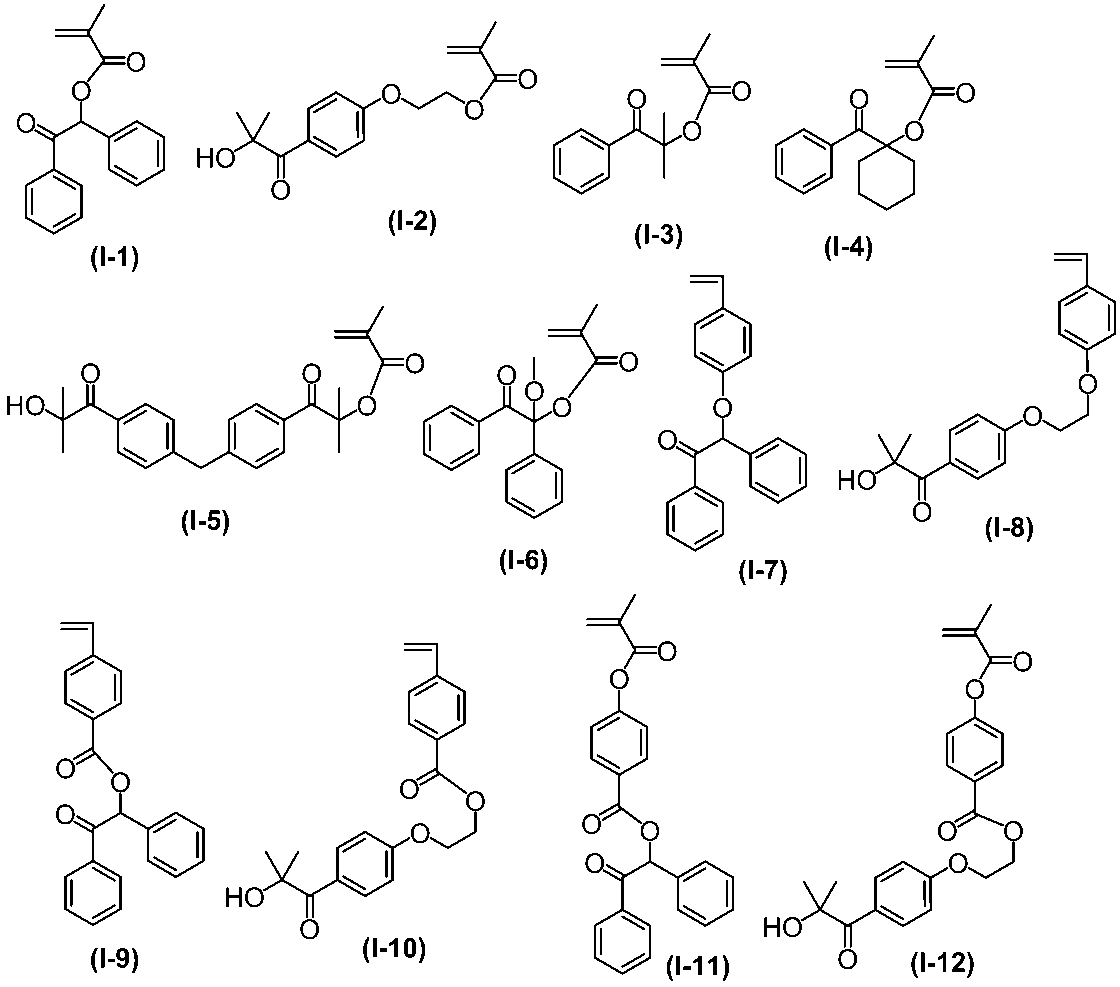
上記の化合物において、Rに相当するメチル基が水素原子に置き換わった化合物も式(AA1)又は式(AA2)で表される化合物の具体例として挙げることができ、Rに相当する水素原子がメチル基に置き換わった化合物も式(AA1)又は式(AA2)で表される化合物の具体例として挙げることができる。 Among the above compounds, a compound in which a methyl group corresponding to R is replaced with a hydrogen atom can also be mentioned as a specific example of a compound represented by the formula (AA1) or the formula (AA2), and the hydrogen atom corresponding to R is methyl. The compound replaced with the base can also be mentioned as a specific example of the compound represented by the formula (AA1) or the formula (AA2).
樹脂(A)に含まれる構造単位(aa1)又は構造単位(aa2)の含有率は、樹脂(A)の全構造単位に対して、通常1~40モル%であり、好ましくは2~30モル%であり、より好ましくは3~20モル%であり、さらに好ましくは3~10モル%である。 The content of the structural unit (aa1) or the structural unit (aa2) contained in the resin (A) is usually 1 to 40 mol%, preferably 2 to 30 mol%, based on all the structural units of the resin (A). %, More preferably 3 to 20 mol%, still more preferably 3 to 10 mol%.
〔構造単位(a1)〕
構造単位(a1)は、酸不安定基を有するモノマー(以下「モノマー(a1)」という場合がある)から導かれる。
樹脂(A)に含まれる酸不安定基は、式(1)で表される基及び/又は式(2)で表される基が好ましい。

ma及びnaは、0又は1を表し、ma及びnaのいずれか一方は1を表す。
*は結合手を表す。]
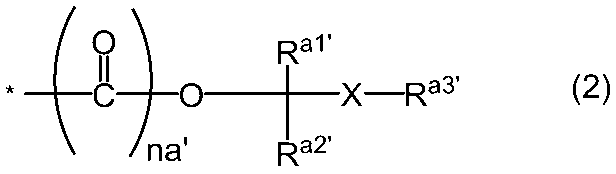
Xは、酸素原子又は硫黄原子を表す。
na´は、0又は1を表す。
*は結合手を表す。]
[Structural unit (a1)]
The structural unit (a1) is derived from a monomer having an acid unstable group (hereinafter, may be referred to as “monomer (a1)”).
The acid unstable group contained in the resin (A) is preferably a group represented by the formula (1) and / or a group represented by the formula (2).
ma and na represent 0 or 1, and either ma or na represents 1.
* Represents a bond. ]
X represents an oxygen atom or a sulfur atom.
na'represents 0 or 1.
* Represents a bond. ]
Ra1~Ra3のアルキル基としては、メチル基、エチル基、プロピル基、n-ブチル基、n-ペンチル基、n-ヘキシル基、n-ヘプチル基、n-オクチル基等が挙げられる。
Ra1~Ra3の脂環式炭化水素基は、単環式及び多環式のいずれでもよい。単環式の脂環式炭化水素基としては、シクロペンチル基、シクロへキシル基、シクロヘプチル基、シクロオクチル基等のシクロアルキル基が挙げられる。多環式の脂環式炭化水素基としては、デカヒドロナフチル基、アダマンチル基、ノルボルニル基及び下記の基(*は結合手を表す。)等が挙げられる。Ra1~Ra3の脂環式炭化水素基の炭素数は、好ましくは3~16である。

好ましくは、maは0であり、naは1である。
Ra1及びRa2が互いに結合して2価の脂環式炭化水素基を形成する場合の-C(Ra1)(Ra2)(Ra3)としては、下記の基が挙げられる。2価の脂環式炭化水素基は、好ましくは炭素数3~12である。*は-O-との結合手を表す。

The alicyclic hydrocarbon groups of R a1 to R a3 may be either monocyclic or polycyclic. Examples of the monocyclic alicyclic hydrocarbon group include cycloalkyl groups such as cyclopentyl group, cyclohexyl group, cycloheptyl group and cyclooctyl group. Examples of the polycyclic alicyclic hydrocarbon group include a decahydronaphthyl group, an adamantyl group, a norbornyl group, and the following groups (* indicates a bond). The alicyclic hydrocarbon group of R a1 to R a3 has preferably 3 to 16 carbon atoms.
Preferably, ma is 0 and na is 1.
Examples of -C (R a1 ) (R a2 ) (R a3 ) in the case where R a1 and R a 2 are bonded to each other to form a divalent alicyclic hydrocarbon group include the following groups. The divalent alicyclic hydrocarbon group preferably has 3 to 12 carbon atoms. * Represents a bond with -O-.
Ra1'~Ra3'の炭化水素基としては、アルキル基、脂環式炭化水素基、芳香族炭化水素基及びこれらを組み合わせることにより形成される基等が挙げられる。
アルキル基及び脂環式炭化水素基は、上記と同様のものが挙げられる。
芳香族炭化水素基としては、フェニル基、ナフチル基、アントリル基、p-メチルフェニル基、p-tert-ブチルフェニル基、p-アダマンチルフェニル基、トリル基、キシリル基、クメニル基、メシチル基、ビフェニル基、フェナントリル基、2,6-ジエチルフェニル基、2-メチル-6-エチルフェニル基等のアリール基等が挙げられる。
Ra2'及びRa3'が互いに結合してそれらが結合する炭素原子及びXとともに2価の複素環基を形成する場合、-C(Ra1’)(Ra3’)-X-Ra2’としては、下記の基が挙げられる。*は、結合手を表す。

Examples of the alkyl group and the alicyclic hydrocarbon group include the same as above.
Examples of the aromatic hydrocarbon group include phenyl group, naphthyl group, anthryl group, p-methylphenyl group, p-tert-butylphenyl group, p-adamantylphenyl group, trill group, xylyl group, cumenyl group, mesityl group and biphenyl. Examples thereof include an aryl group such as a group, a phenanthryl group, a 2,6-diethylphenyl group and a 2-methyl-6-ethylphenyl group.
When R a2'and R a3'bond to each other to form a divalent heterocyclic group with the carbon atom and X to which they bond, -C (R a1' ) (R a3' )-X-R a2' Examples include the following groups. * Represents a bond.
式(1)で表される基としては、1,1-ジアルキルアルコキシカルボニル基(式(1)中においてRa1~Ra3がアルキル基、ma=0、na=1、好ましくはtert-ブトキシカルボニル基)、2-アルキルアダマンタン-2-イルオキシカルボニル基(式(1)中、Ra1、Ra2及びこれらが結合する炭素原子がアダマンチル基、Ra3がアルキル基、ma=0、na=1)及び1-(アダマンタン-1-イル)-1-アルキルアルコキシカルボニル基(式(1)中、Ra1及びRa2がアルキル基、Ra3がアダマンチル基、ma=0、na=1)等、さらに以下の基が挙げられる。*は結合手を表す。

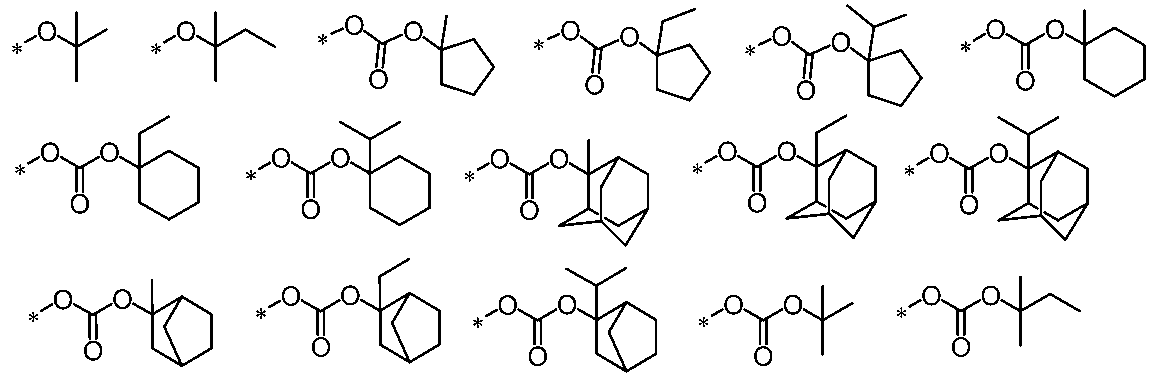
式(2)で表される基の具体例としては、以下の基が挙げられる。*は結合手を表す。
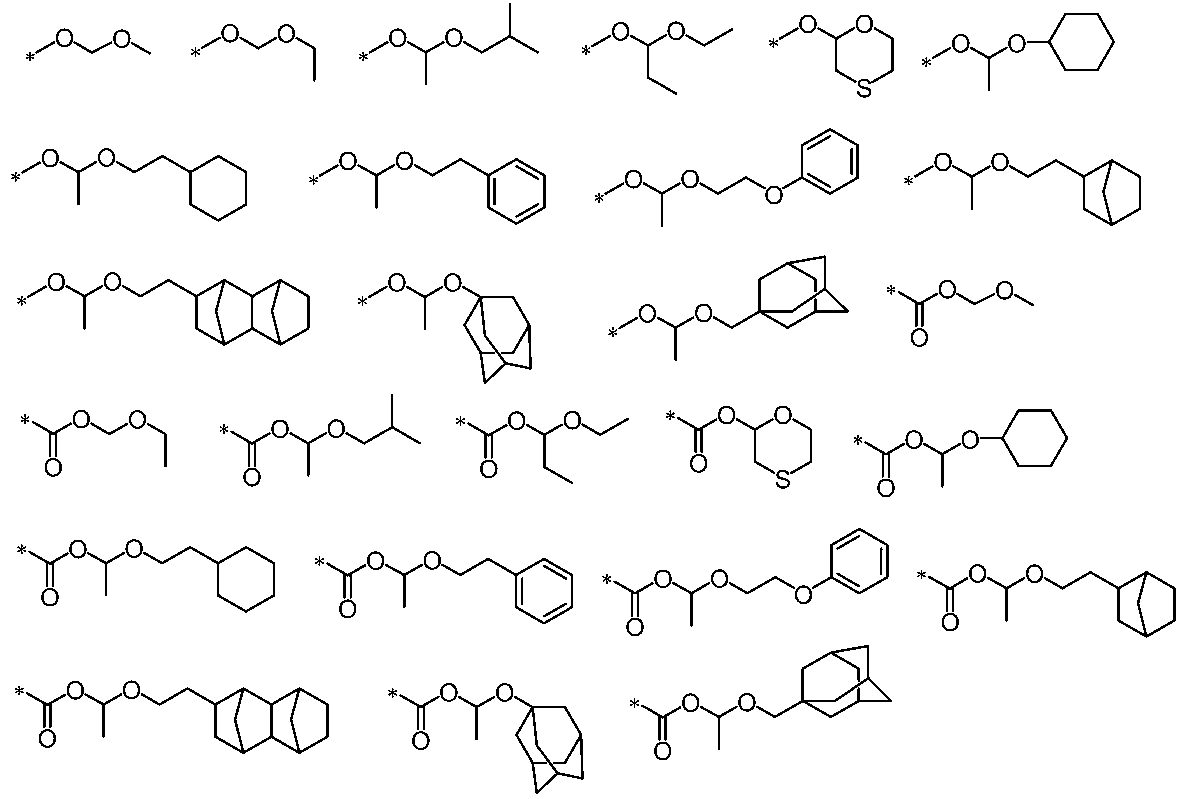
モノマー(a1)は、好ましくは、酸不安定基とエチレン性不飽和結合とを有するモノマー、より好ましくは酸不安定基を有する(メタ)アクリル系モノマーである。 The monomer (a1) is preferably a monomer having an acid unstable group and an ethylenically unsaturated bond, and more preferably a (meth) acrylic monomer having an acid unstable group.
酸不安定基を有する(メタ)アクリル系モノマーのうち、好ましくは、炭素数5~20の脂環式炭化水素基を有するものが挙げられる。脂環式炭化水素基のような嵩高い構造を有するモノマー(a1)に由来する構造単位を有する樹脂(A)をレジスト組成物に使用すれば、レジストパターンの解像度を向上させることができる。 Among the (meth) acrylic monomers having an acid unstable group, those having an alicyclic hydrocarbon group having 5 to 20 carbon atoms are preferable. If the resin (A) having a structural unit derived from the monomer (a1) having a bulky structure such as an alicyclic hydrocarbon group is used in the resist composition, the resolution of the resist pattern can be improved.
式(1)で表される基を有する(メタ)アクリル系モノマーに由来する構造単位として、好ましくは、式(a1-0)で表される構造単位(以下、構造単位(a1-0)という場合がある。)、式(a1-1)で表される構造単位(以下、構造単位(a1-1)という場合がある。)又は式(a1-2)で表される構造単位(以下、構造単位(a1-2)という場合がある。)が挙げられる。これらは単独で使用してもよく、2種以上を併用してもよい。

La01、La1及びLa2は、それぞれ独立に、-O-又は*-O-(CH2)k1-CO-O-を表し、k1は1~7のいずれかの整数を表し、*は-CO-との結合手を表す。
Ra01、Ra4及びRa5は、それぞれ独立に、水素原子又はメチル基を表す。
Ra02、Ra03及びRa04は、それぞれ独立に、炭素数1~8のアルキル基、炭素数3~18の脂環式炭化水素基又はこれらを組み合わせた基を表す。
Ra6及びRa7は、それぞれ独立に、炭素数1~8のアルキル基、炭素数3~18の脂環式炭化水素基又はこれらを組合せることにより形成される基を表す。
m1は0~14のいずれかの整数を表す。
n1は0~10のいずれかの整数を表す。
n1’は0~3のいずれかの整数を表す。]
The structural unit derived from the (meth) acrylic monomer having a group represented by the formula (1) is preferably a structural unit represented by the formula (a1-0) (hereinafter referred to as a structural unit (a1-0)). In some cases), a structural unit represented by the formula (a1-1) (hereinafter, may be referred to as a structural unit (a1-1)) or a structural unit represented by the formula (a1-2) (hereinafter, referred to as a structural unit). It may be referred to as a structural unit (a1-2)). These may be used alone or in combination of two or more.
La01 , La1 and La2 independently represent -O- or * -O- (CH 2 ) k1 -CO-O-, k1 represents an integer of 1 to 7, and * represents an integer of 1 to 7. -Represents a bond with CO-.
R a01 , R a4 and R a5 each independently represent a hydrogen atom or a methyl group.
R a02 , R a03 and R a04 independently represent an alkyl group having 1 to 8 carbon atoms, an alicyclic hydrocarbon group having 3 to 18 carbon atoms, or a group combining these groups.
R a6 and R a7 each independently represent an alkyl group having 1 to 8 carbon atoms, an alicyclic hydrocarbon group having 3 to 18 carbon atoms, or a group formed by combining them.
m1 represents any integer from 0 to 14.
n1 represents any integer from 0 to 10.
n1'represents an integer of 0 to 3. ]
Ra01、Ra4及びRa5は、好ましくはメチル基である。
La01、La1及びLa2は、好ましくは酸素原子又は*-O-(CH2)k01-CO-O-であり(但し、k01は、好ましくは1~4のいずれかの整数、より好ましくは1である。)、より好ましくは酸素原子である。
Ra02、Ra03、Ra04、Ra6及びRa7のアルキル基、脂環式炭化水素基及びこれらを組合せた基としては、式(1)のRa1~Ra3で挙げた基と同様の基が挙げられる。
Ra02、Ra03及びRa04のアルキル基の炭素数は、好ましくは1~6であり、より好ましくはメチル基又はエチル基であり、さらに好ましくはメチル基である。
Ra6及びRa7のアルキル基の炭素数は、好ましくは6以下、より好ましくは1~3、さらに好ましくは2又は3である。
Ra02、Ra03、Ra04、Ra6及びRa7の脂環式炭化水素基の炭素数は、好ましくは3~8であり、より好ましくは3~6である。
アルキル基と脂環式炭化水素基とを組合せた基は、これらアルキル基と脂環式炭化水素基とを組合せた合計炭素数が、18以下であることが好ましい。
Ra02及びRa03は、好ましくは炭素数1~6のアルキル基であり、より好ましくはメチル基又はエチル基である。
Ra04は、好ましくは炭素数1~6のアルキル基又は炭素数5~12の脂環式炭化水素基であり、より好ましくはメチル基、エチル基、シクロヘキシル基又はアダマンチル基である。
m1は、好ましくは0~3のいずれかの整数であり、より好ましくは0又は1である。
n1は、好ましくは0~3のいずれかの整数であり、より好ましくは0又は1である。
n1’は好ましくは0又は1である。
R a01 , R a4 and R a5 are preferably methyl groups.
La01 , La1 and La2 are preferably oxygen atoms or * -O- (CH 2 ) k01 -CO-O- (where k01 is preferably an integer of 1 to 4, more preferably. Is 1), more preferably an oxygen atom.
The alkyl groups of R a02 , R a03 , R a04 , R a6 and R a7 , the alicyclic hydrocarbon group and the group combining these are the same as the groups mentioned in R a1 to R a3 of the formula (1). The group is mentioned.
The alkyl groups of R a02 , R a03 and R a04 preferably have 1 to 6 carbon atoms, more preferably a methyl group or an ethyl group, and even more preferably a methyl group.
The alkyl groups of R a6 and R a7 have preferably 6 or less carbon atoms, more preferably 1 to 3 carbon atoms, and even more preferably 2 or 3 carbon atoms.
The alicyclic hydrocarbon groups of R a02 , R a03 , R a04 , R a6 and R a7 have preferably 3 to 8 carbon atoms, more preferably 3 to 6 carbon atoms.
The group in which the alkyl group and the alicyclic hydrocarbon group are combined preferably has a total carbon number of 18 or less in combination of these alkyl groups and the alicyclic hydrocarbon group.
R a02 and R a03 are preferably an alkyl group having 1 to 6 carbon atoms, and more preferably a methyl group or an ethyl group.
R a04 is preferably an alkyl group having 1 to 6 carbon atoms or an alicyclic hydrocarbon group having 5 to 12 carbon atoms, and more preferably a methyl group, an ethyl group, a cyclohexyl group or an adamantyl group.
m1 is preferably an integer of 0 to 3, and more preferably 0 or 1.
n1 is preferably an integer of 0 to 3, and more preferably 0 or 1.
n1'is preferably 0 or 1.
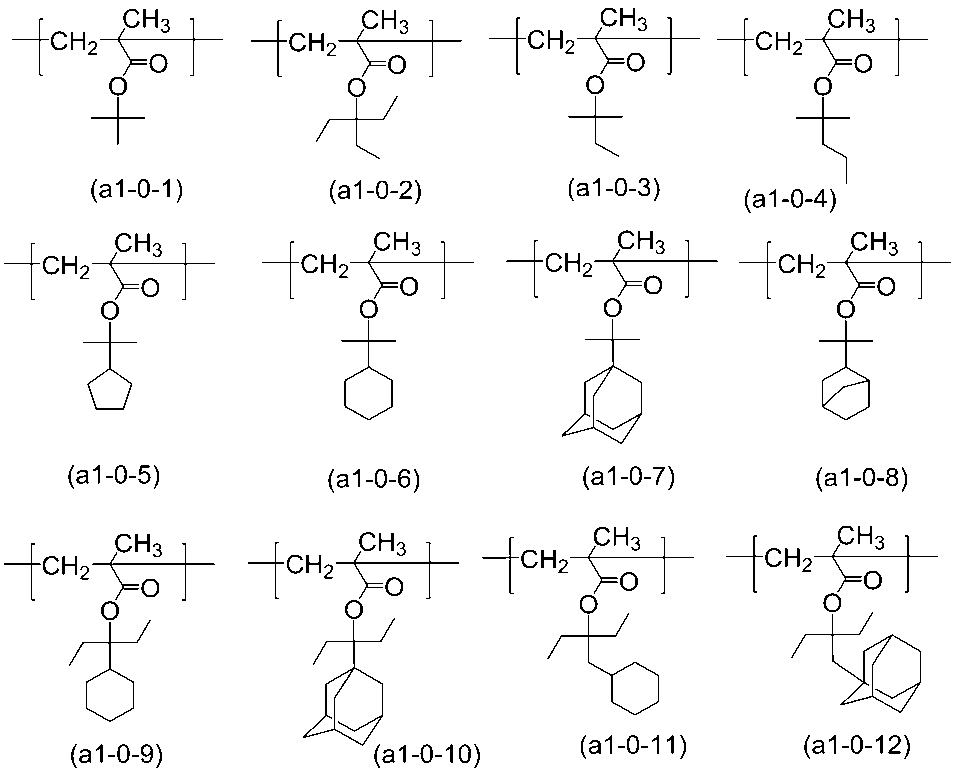
構造単位(a1-0)としては、例えば、式(a1-0-1)~式(a1-0-12)のいずれかで表される構造単位及びRa01に相当するメチル基が水素原子に置き換わった構造単位が挙げられ、式(a1-0-1)~式(a1-0-10)のいずれかで表される構造単位が好ましい。
構造単位(a1-1)を導くモノマーとしては、例えば、特開2010-204646号公報に記載されたモノマーが挙げられる。中でも、式(a1-1-1)~式(a1-1-4)のいずれかで表される構造単位及びRa4に相当するメチル基が水素原子に置き換わった構造単位が好ましく、式(a1-1-1)~式(a1-1-4)のいずれかで表される構造単位がより好ましい。

構造単位(a1-2)としては、式(a1-2-1)~式(a1-2-6)のいずれかで表される構造単位及びRa5に相当するメチル基が水素原子に置き換わった構造単位が挙げられ、式(a1-2-2)及び式(a1-2-5)が好ましい。

樹脂(A)が構造単位(a1-0)及び/又は構造単位(a1-1)及び/又は構造単位(a1-2)を含む場合、これらの合計含有率は、樹脂(A)の全構造単位に対して、通常10~95モル%であり、好ましくは15~90モル%であり、より好ましくは20~85モル%である。 When the resin (A) contains a structural unit (a1-0) and / or a structural unit (a1-1) and / or a structural unit (a1-2), the total content of these is the total structure of the resin (A). It is usually 10 to 95 mol%, preferably 15 to 90 mol%, and more preferably 20 to 85 mol% with respect to the unit.
式(2)で表される基を有する(メタ)アクリル系モノマーに由来する構造単位としては、式(a1-5)で表される構造単位(以下「構造単位(a1-5)」という場合がある)も挙げられる。
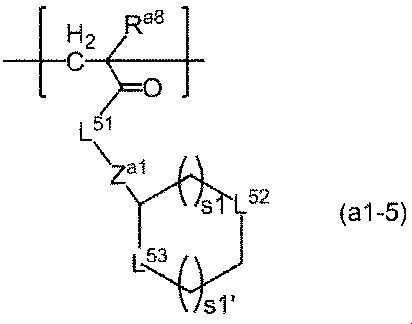
Ra8は、ハロゲン原子を有してもよい炭素数1~6のアルキル基、水素原子又はハロゲン原子を表す。
Za1は、単結合又は*-(CH2)h3-CO-L54-を表し、h3は1~4のいずれかの整数を表し、*は、L51との結合手を表す。
L51、L52、L53及びL54は、それぞれ独立に、-O-又は-S-を表す。
s1は、1~3のいずれかの整数を表す。
s1’は、0~3のいずれかの整数を表す。
The structural unit derived from the (meth) acrylic monomer having a group represented by the formula (2) is a structural unit represented by the formula (a1-5) (hereinafter referred to as “structural unit (a1-5)”). There is).
R a8 represents an alkyl group having 1 to 6 carbon atoms, a hydrogen atom or a halogen atom which may have a halogen atom.
Z a1 represents a single bond or *-(CH 2 ) h3 -CO-L 54- , h3 represents an integer of 1 to 4, and * represents a bond with L 51 .
L 51 , L 52 , L 53 and L 54 independently represent -O- or -S-, respectively.
s1 represents any integer from 1 to 3.
s1'represents an integer of 0 to 3.
ハロゲン原子としては、フッ素原子及び塩素原子が挙げられ、フッ素原子が好ましい。
ハロゲン原子を有してもよい炭素数1~6のアルキル基としては、メチル基、エチル基、プロピル基、ブチル基、ペンチル基、ヘキシル基、ヘプチル基、オクチル基、フルオロメチル基及びトリフルオロメチル基が挙げられる。
式(a1-5)においては、Ra8は、水素原子、メチル基又はトリフルオロメチル基が好ましい。
L51は、酸素原子が好ましい。
L52及びL53のうち、一方が-O-であり、他方が-S-であることが好ましい。
s1は、1が好ましい。
s1’は、0~2のいずれかの整数が好ましい。
Za1は、単結合又は*-CH2-CO-O-が好ましい。
Examples of the halogen atom include a fluorine atom and a chlorine atom, and a fluorine atom is preferable.
Alkyl groups having 1 to 6 carbon atoms which may have a halogen atom include a methyl group, an ethyl group, a propyl group, a butyl group, a pentyl group, a hexyl group, a heptyl group, an octyl group, a fluoromethyl group and a trifluoromethyl group. The group is mentioned.
In the formula (a1-5), R a8 is preferably a hydrogen atom, a methyl group or a trifluoromethyl group.
L 51 is preferably an oxygen atom.
Of L 52 and L 53 , it is preferable that one is —O— and the other is —S—.
1 is preferable for s1.
s1'is preferably an integer of 0 to 2.
Z a1 is preferably a single bond or * -CH 2 -CO-O-.
構造単位(a1-5)を導くモノマーとしては、例えば、特開2010-61117号公報に記載されたモノマーが挙げられる。中でも、式(a1-5-1)~式(a1-5-4)でそれぞれ表される構造単位が好ましく、式(a1-5-1)又は式(a1-5-2)で表される構造単位がより好ましい。
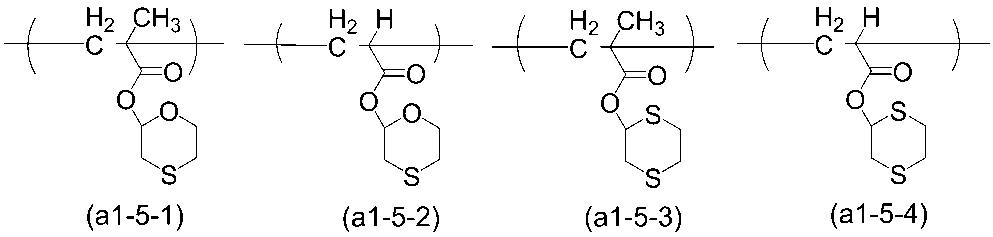
樹脂(A)が、構造単位(a1-5)を有する場合、その含有率は、樹脂(A)の全構造単位に対して、1~50モル%が好ましく、3~45モル%がより好ましく、5~40モル%がさらに好ましい。 When the resin (A) has a structural unit (a1-5), the content thereof is preferably 1 to 50 mol%, more preferably 3 to 45 mol%, based on all the structural units of the resin (A). 5-40 mol% is more preferred.
また、構造単位(a1)としては、以下の構造単位も挙げられる。

樹脂(A)が構造単位(a1-3-1)~構造単位(a1-3-7)のいずれかを含む場合、その含有率は、樹脂(A)の全構造単位に対して、10~95モル%が好ましく、15~90モル%がより好ましく、20~85モル%がさらに好ましい。 When the resin (A) contains any of the structural units (a1-3-1) to the structural units (a1-3-7), the content thereof is 10 to 10 with respect to all the structural units of the resin (A). 95 mol% is preferable, 15 to 90 mol% is more preferable, and 20 to 85 mol% is further preferable.
構造単位(a1)において式(2)で表される基を有する構造単位としては、式(a1-4)で表される構造単位(以下、「構造単位(a1-4)」という場合がある。)が挙げられる。
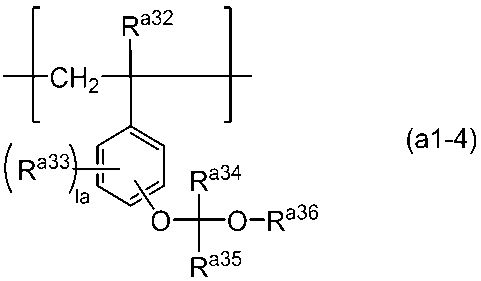
Ra32は、水素原子、ハロゲン原子、又は、ハロゲン原子を有していてもよい炭素数1~6のアルキル基を表す。
Ra33は、ハロゲン原子、ヒドロキシ基、炭素数1~6のアルキル基、炭素数1~6のアルコキシ基、炭素数2~4のアルキルカルボニル基、炭素数2~4のアルキルカルボニルオキシ基、アクリロイルオキシ基又はメタクリロイルオキシ基を表す。
laは0~4のいずれかの整数を表す。laが2以上である場合、複数のRa33は互いに同一であっても異なってもよい。
Ra34及びRa35はそれぞれ独立に、水素原子又は炭素数1~12の炭化水素基を表し、Ra36は、炭素数1~20の炭化水素基を表すか、Ra35及びRa36は互いに結合してそれらが結合する-C-O-とともに炭素数2~20の2価の炭化水素基を形成し、該炭化水素基及び該2価の炭化水素基に含まれる-CH2-は、-O-又は-S-で置き換わってもよい。]
The structural unit having a group represented by the formula (2) in the structural unit (a1) may be referred to as a structural unit represented by the formula (a1-4) (hereinafter, “structural unit (a1-4)”). .) Can be mentioned.
R a32 represents a hydrogen atom, a halogen atom, or an alkyl group having 1 to 6 carbon atoms which may have a halogen atom.
R a33 is a halogen atom, a hydroxy group, an alkyl group having 1 to 6 carbon atoms, an alkoxy group having 1 to 6 carbon atoms, an alkylcarbonyl group having 2 to 4 carbon atoms, an alkylcarbonyloxy group having 2 to 4 carbon atoms, and acryloyl. Represents an oxy group or a methacryloyloxy group.
la represents an integer of 0 to 4. When la is 2 or more, a plurality of Ra 33s may be the same or different from each other.
R a34 and R a35 independently represent a hydrogen atom or a hydrocarbon group having 1 to 12 carbon atoms, R a36 represents a hydrocarbon group having 1 to 20 carbon atoms, or R a35 and R a36 are bonded to each other. Then, together with -CO- to which they are bonded, a divalent hydrocarbon group having 2 to 20 carbon atoms is formed, and the hydrocarbon group and -CH 2- contained in the divalent hydrocarbon group are-. It may be replaced by O- or -S-. ]
Ra32及びRa33におけるアルキル基としては、メチル基、エチル基、プロピル基、イソプロピル基、ブチル基、ペンチル基及びヘキシル基等が挙げられる。該アルキル基は、炭素数1~4のアルキル基が好ましく、メチル基又はエチル基がより好ましく、メチル基がさらに好ましい。
Ra32及びRa33におけるハロゲン原子としては、フッ素原子、塩素原子及び臭素原子等が挙げられる。
ハロゲン原子を有していてもよい炭素数1~6のアルキル基としては、トリフルオロメチル基、ジフルオロメチル基、メチル基、ペルフルオロエチル基、1,1,1-トリフルオロエチル基、1,1,2,2-テトラフルオロエチル基、エチル基、ペルフルオロプロピル基、1,1,1,2,2-ペンタフルオロプロピル基、プロピル基、ペルフルオロブチル基、1,1,2,2,3,3,4,4-オクタフルオロブチル基、ブチル基、ペルフルオロペンチル基、1,1,1,2,2,3,3,4,4-ノナフルオロペンチル基、ペンチル基、ヘキシル基、ペルフルオロヘキシル基等が挙げられる。
アルコキシ基としては、メトキシ基、エトキシ基、プロポキシ基、ブトキシ基、ペンチルオキシ基及びヘキシルオキシ基等が挙げられる。なかでも、炭素数1~4のアルコキシ基が好ましく、メトキシ基又はエトキシ基がより好ましく、メトキシ基がさらに好ましい。
アルキルカルボニル基としては、アセチル基、プロピオニル基及びブチリル基が挙げられる。
アルキルカルボニルオキシ基としては、アセチルオキシ基、プロピオニルオキシ基、ブチリルオキシ基等が挙げられる。
Ra34、Ra35及びRa36における炭化水素基としては、アルキル基、脂環式炭化水素基、芳香族炭化水素基、及びこれらを組み合わせた基が挙げられ、アルキル基及び脂環式炭化水素基としては、Ra02、Ra03、Ra04、Ra6及びRa7におけるアルキル基及び脂環式炭化水素基と同様の基が挙げられる。
芳香族炭化水素基としては、フェニル基、ナフチル基、アントリル基、p-メチルフェニル基、p-tert-ブチルフェニル基、p-アダマンチルフェニル基、トリル基、キシリル基、クメニル基、メシチル基、ビフェニル基、フェナントリル基、2,6-ジエチルフェニル基、2-メチル-6-エチルフェニル基等のアリール基等が挙げられる。
組み合わせた基としては、上述したアルキル基と脂環式炭化水素基とを組み合わせた基、ベンジル基等のアラルキル基、フェニルシクロヘキシル基等のアリール-シクロヘキシル基等が挙げられる。特に、Ra36としては、炭素数1~18のアルキル基、炭素数3~18の脂環式炭化水素基、炭素数6~18の芳香族炭化水素基又はこれらを組み合わせることにより形成される基が挙げられる。
Examples of the alkyl group in R a32 and R a33 include a methyl group, an ethyl group, a propyl group, an isopropyl group, a butyl group, a pentyl group, a hexyl group and the like. The alkyl group is preferably an alkyl group having 1 to 4 carbon atoms, more preferably a methyl group or an ethyl group, and even more preferably a methyl group.
Examples of the halogen atom in R a32 and R a33 include a fluorine atom, a chlorine atom and a bromine atom.
Examples of the alkyl group having 1 to 6 carbon atoms which may have a halogen atom include a trifluoromethyl group, a difluoromethyl group, a methyl group, a perfluoroethyl group, a 1,1,1-trifluoroethyl group and 1,1. , 2,2-Tetrafluoroethyl group, ethyl group, perfluoropropyl group, 1,1,1,2,2-pentafluoropropyl group, propyl group, perfluorobutyl group, 1,1,2,2,3,3 , 4,4-Octafluorobutyl group, butyl group, perfluoropentyl group, 1,1,1,2,2,3,3,4,4-nonafluoropentyl group, pentyl group, hexyl group, perfluorohexyl group, etc. Can be mentioned.
Examples of the alkoxy group include a methoxy group, an ethoxy group, a propoxy group, a butoxy group, a pentyloxy group and a hexyloxy group. Of these, an alkoxy group having 1 to 4 carbon atoms is preferable, a methoxy group or an ethoxy group is more preferable, and a methoxy group is even more preferable.
Examples of the alkylcarbonyl group include an acetyl group, a propionyl group and a butyryl group.
Examples of the alkylcarbonyloxy group include an acetyloxy group, a propionyloxy group, a butyryloxy group and the like.
Examples of the hydrocarbon group in R a34 , R a35 and R a36 include an alkyl group, an alicyclic hydrocarbon group, an aromatic hydrocarbon group, and a group combining these, and an alkyl group and an alicyclic hydrocarbon group. Examples of the group include the same groups as the alkyl group and the alicyclic hydrocarbon group in R a02 , R a03 , R a04 , R a6 and R a7 .
Examples of the aromatic hydrocarbon group include phenyl group, naphthyl group, anthryl group, p-methylphenyl group, p-tert-butylphenyl group, p-adamantylphenyl group, trill group, xylyl group, cumenyl group, mesityl group and biphenyl. Examples thereof include an aryl group such as a group, a phenanthryl group, a 2,6-diethylphenyl group and a 2-methyl-6-ethylphenyl group.
Examples of the combined group include a group combining the above-mentioned alkyl group and an alicyclic hydrocarbon group, an aralkyl group such as a benzyl group, and an aryl-cyclohexyl group such as a phenylcyclohexyl group. In particular, Ra36 includes an alkyl group having 1 to 18 carbon atoms, an alicyclic hydrocarbon group having 3 to 18 carbon atoms, an aromatic hydrocarbon group having 6 to 18 carbon atoms, or a group formed by combining them. Can be mentioned.
式(a1-4)において、Ra32としては、水素原子が好ましい。
Ra33としては、炭素数1~4のアルコキシ基が好ましく、メトキシ基及びエトキシ基がより好ましく、メトキシ基がさらに好ましい。
laとしては、0又は1が好ましく、0がより好ましい。
Ra34は、好ましくは、水素原子である。
Ra35は、好ましくは、炭素数1~12のアルキル基又は脂環式炭化水素基であり、より好ましくはメチル基又はエチル基である。
Ra36の炭化水素基は、好ましくは、炭素数1~18のアルキル基、炭素数3~18の脂環式炭化水素基、炭素数6~18の芳香族炭化水素基又はこれらを組み合わせることにより形成される基であり、より好ましくは、炭素数1~18のアルキル基、炭素数3~18の脂肪族炭化水素基又は炭素数7~18のアラルキル基である。Ra36におけるアルキル基及び脂環式炭化水素基は、無置換であることが好ましい。Ra36における芳香族炭化水素基は、炭素数6~10のアリールオキシ基を有する芳香環が好ましい。
In the formula (a1-4), a hydrogen atom is preferable as R a32 .
As R a33 , an alkoxy group having 1 to 4 carbon atoms is preferable, a methoxy group and an ethoxy group are more preferable, and a methoxy group is further preferable.
As la, 0 or 1 is preferable, and 0 is more preferable.
R a34 is preferably a hydrogen atom.
R a35 is preferably an alkyl group or an alicyclic hydrocarbon group having 1 to 12 carbon atoms, and more preferably a methyl group or an ethyl group.
The hydrocarbon group of R a36 is preferably an alkyl group having 1 to 18 carbon atoms, an alicyclic hydrocarbon group having 3 to 18 carbon atoms, an aromatic hydrocarbon group having 6 to 18 carbon atoms, or a combination thereof. It is a group to be formed, more preferably an alkyl group having 1 to 18 carbon atoms, an aliphatic hydrocarbon group having 3 to 18 carbon atoms or an aralkyl group having 7 to 18 carbon atoms. The alkyl group and alicyclic hydrocarbon group in R a36 are preferably unsubstituted. The aromatic hydrocarbon group in R a36 is preferably an aromatic ring having an aryloxy group having 6 to 10 carbon atoms.
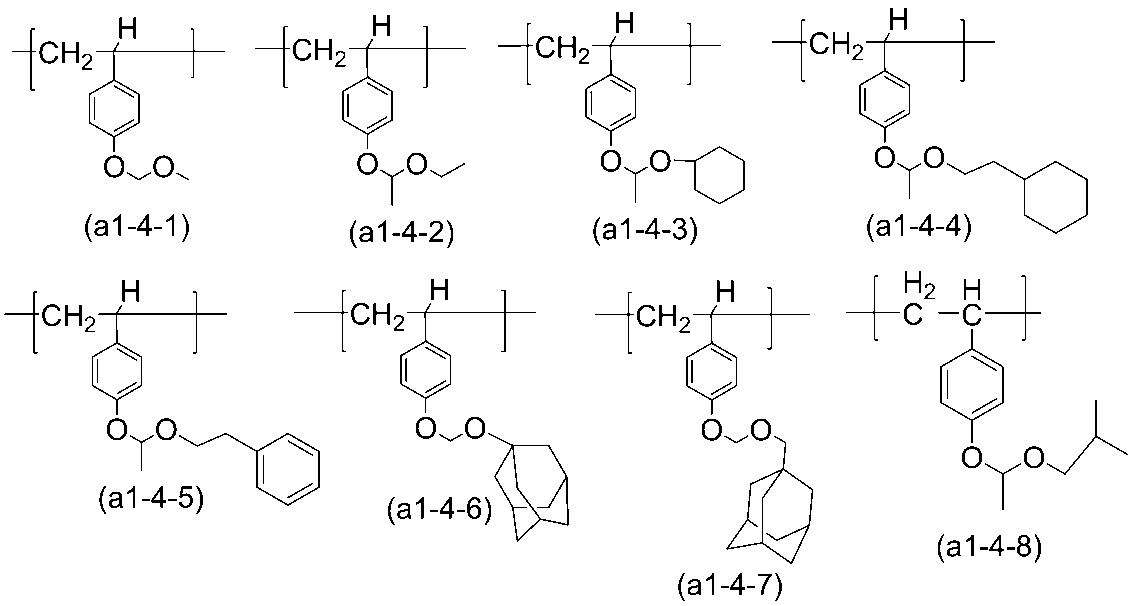
構造単位(a1-4)としては、例えば、特開2010-204646号公報に記載されたモノマー由来の構造単位が挙げられる。好ましくは、式(a1-4-1)~式(a1-4-8)でそれぞれ表される構造単位及び構造単位(a1-4)におけるRa32に相当する水素原子がメチル基に置き換わった構造単位が挙げられ、より好ましくは、式(a1-4-1)~式(a1-4-5)でそれぞれ表される構造単位が挙げられる。 Examples of the structural unit (a1-4) include structural units derived from the monomers described in JP-A-2010-204646. Preferably, the structural unit represented by the formulas (a1-4-1) to (a1-4-8) and the structure in which the hydrogen atom corresponding to Ra32 in the structural unit (a1-4) is replaced with a methyl group. Units are mentioned, and more preferably, structural units represented by the formulas (a1-4-1) to (a1-4-5) are mentioned.
〈構造単位(s)〉
樹脂(A)は、さらに、ハロゲン原子を有さず、酸不安定基を有さないモノマー(以下「モノマー(s)」という場合がある)及び/又は後述するその他の構造単位(t)を含有していてもよい。
構造単位(s)は、モノマー(s)から導かれる。構造単位(s)を導くモノマーは、レジスト分野で公知の、ハロゲン原子を有さず、酸不安定基を有さないモノマーを使用できる。
構造単位(s)としては、ヒドロキシ基又はラクトン環を有し、かつ酸不安定基を有さない構造単位が好ましい。樹脂(A)は、ヒドロキシ基を有し、かつ酸不安定基を有さない構造単位(以下「構造単位(a2)」という場合がある)及び/又はラクトン環を有し、かつ酸不安定基を有さない構造単位(以下「構造単位(a3)」という場合がある)を有する樹脂であることが好ましい。
<Structural unit (s)>
The resin (A) further contains a monomer having no halogen atom and no acid unstable group (hereinafter, may be referred to as “monomer (s)”) and / or other structural unit (t) described later. It may be contained.
The structural unit (s) is derived from the monomer (s). As the monomer for deriving the structural unit (s), a monomer that does not have a halogen atom and does not have an acid unstable group, which is known in the resist field, can be used.
As the structural unit (s), a structural unit having a hydroxy group or a lactone ring and having no acid unstable group is preferable. The resin (A) has a structural unit having a hydroxy group and no acid unstable group (hereinafter, may be referred to as “structural unit (a2)”) and / or a lactone ring, and is acid unstable. It is preferable that the resin has a structural unit having no group (hereinafter, may be referred to as “structural unit (a3)”).
〈構造単位(a2)〉
構造単位(a2)が有するヒドロキシ基は、アルコール性ヒドロキシ基でも、フェノール性ヒドロキシ基でもよい。
本発明のレジスト組成物からレジストパターンを製造するとき、露光光源としてKrFエキシマレーザ(248nm)、電子線又はEUV(超紫外光)等の高エネルギー線を用いる場合には、構造単位(a2)として、フェノール性ヒドロキシ基を有する構造単位(a2)を用いることが好ましい。また、ArFエキシマレーザ(193nm)等を用いる場合には、構造単位(a2)として、アルコール性ヒドロキシ基を有する構造単位(a2)が好ましい。構造単位(a2)としては、1種を単独で含んでいてもよく、2種以上を含んでいてもよい。
<Structural unit (a2)>
The hydroxy group of the structural unit (a2) may be an alcoholic hydroxy group or a phenolic hydroxy group.
When a resist pattern is produced from the resist composition of the present invention, when a high energy ray such as a KrF excimer laser (248 nm), an electron beam or EUV (ultraviolet light) is used as an exposure light source, the structural unit (a2) is used. , It is preferable to use the structural unit (a2) having a phenolic hydroxy group. When an ArF excimer laser (193 nm) or the like is used, the structural unit (a2) having an alcoholic hydroxy group is preferable. As the structural unit (a2), one type may be contained alone, or two or more types may be contained.
フェノール性ヒドロキシ基有する構造単位(a2)としては式(a2-A)で表される構造単位(以下「構造単位(a2-A)」という場合がある)が挙げられる。

Ra50は、水素原子、ハロゲン原子又はハロゲン原子を有してもよい炭素数1~6のアルキル基を表す。
Ra51は、ハロゲン原子、ヒドロキシ基、炭素数1~6のアルキル基、炭素数1~6のアルコキシ基、炭素数2~4のアルキルカルボニル基、炭素数2~4のアルキルカルボニルオキシ基、アクリロイルオキシ基又はメタクリロイルオキシ基を表す。
Aa50は、単結合又は*-Xa51-(Aa52-Xa52)nna-を表し、*は-Ra50が結合する炭素原子との結合手を表す。
Aa52は、炭素数1~6のアルカンジイル基を表す。
Xa51及びXa52は、それぞれ独立に、-O-、-CO-O-又は-O-CO-を表す。
nnaは、0又は1を表す。
mbは0~4のいずれかの整数を表す。mbが2以上の整数である場合、複数のRa51は互いに同一であっても異なってもよい。]
Examples of the structural unit (a2) having a phenolic hydroxy group include structural units represented by the formula (a2-A) (hereinafter, may be referred to as “structural unit (a2-A)”).
R a50 represents an alkyl group having 1 to 6 carbon atoms which may have a hydrogen atom, a halogen atom or a halogen atom.
R a51 is a halogen atom, a hydroxy group, an alkyl group having 1 to 6 carbon atoms, an alkoxy group having 1 to 6 carbon atoms, an alkylcarbonyl group having 2 to 4 carbon atoms, an alkylcarbonyloxy group having 2 to 4 carbon atoms, and acryloyl. Represents an oxy group or a methacryloyloxy group.
A a50 represents a single bond or * -X a51- (A a52- X a52 ) nna- , and * represents a bond with a carbon atom to which -R a50 is bonded.
A a52 represents an alkanediyl group having 1 to 6 carbon atoms.
X a51 and X a52 independently represent —O—, —CO—O— or —O—CO—, respectively.
nna represents 0 or 1.
mb represents any integer from 0 to 4. When mb is an integer of 2 or more, the plurality of Ra 51s may be the same or different from each other. ]
Ra50におけるハロゲン原子としては、フッ素原子、塩素原子及び臭素原子等が挙げられる。
Ra50におけるハロゲン原子を有してもよい炭素数1~6のアルキル基としては、トリフルオロメチル基、ジフルオロメチル基、メチル基、ペルフルオロエチル基、1,1,1-トリフルオロエチル基、1,1,2,2-テトラフルオロエチル基、エチル基、ペルフルオロプロピル基、1,1,1,2,2-ペンタフルオロプロピル基、プロピル基、ペルフルオロブチル基、1,1,2,2,3,3,4,4-オクタフルオロブチル基、ブチル基、ペルフルオロペンチル基、1,1,1,2,2,3,3,4,4-ノナフルオロペンチル基、n-ペンチル基、n-ヘキシル基及びn-ペルフルオロヘキシル基が挙げられる。
Ra50は、水素原子又は炭素数1~4のアルキル基が好ましい。
Ra51のアルキル基としては、メチル基、エチル基、n-プロピル基、イソプロピル基、n-ブチル基、sec-ブチル基、tert-ブチル基、n-ペンチル基、n-ヘキシル基が挙げられる。
Ra51のアルコキシ基としては、メトキシ基、エトキシ基、n-プロポキシ基、イソプロポキシ基、n-ブトキシ基、sec-ブトキシ基、tert-ブトキシ基が挙げられる。炭素数1~4のアルコキシ基が好ましく、メトキシ基又はエトキシ基がより好ましく、メトキシ基がさらに好ましい。
Ra51におけるアルキルカルボニル基としては、アセチル基、プロピオニル基及びブチリル基等が挙げられる。
Ra51におけるアルキルカルボニルオキシ基としては、アセチルオキシ基、プロピオニルオキシ基及びブチリルオキシ基が挙げられる。
Ra51は、メチル基が好ましい。
Examples of the halogen atom in R a50 include a fluorine atom, a chlorine atom and a bromine atom.
Examples of the alkyl group having 1 to 6 carbon atoms which may have a halogen atom in Ra50 include a trifluoromethyl group, a difluoromethyl group, a methyl group, a perfluoroethyl group, a 1,1,1-trifluoroethyl group and 1 , 1,2,2-tetrafluoroethyl group, ethyl group, perfluoropropyl group, 1,1,1,2,2-pentafluoropropyl group, propyl group, perfluorobutyl group, 1,1,2,2,3 , 3,4,4-Octafluorobutyl group, butyl group, perfluoropentyl group, 1,1,1,2,2,3,3,4,4-nonafluoropentyl group, n-pentyl group, n-hexyl Examples include groups and n-perfluorohexyl groups.
R a50 is preferably a hydrogen atom or an alkyl group having 1 to 4 carbon atoms.
Examples of the alkyl group of R a51 include a methyl group, an ethyl group, an n-propyl group, an isopropyl group, an n-butyl group, a sec-butyl group, a tert-butyl group, an n-pentyl group and an n-hexyl group.
Examples of the alkoxy group of R a51 include a methoxy group, an ethoxy group, an n-propoxy group, an isopropoxy group, an n-butoxy group, a sec-butoxy group and a tert-butoxy group. An alkoxy group having 1 to 4 carbon atoms is preferable, a methoxy group or an ethoxy group is more preferable, and a methoxy group is further preferable.
Examples of the alkylcarbonyl group in Ra51 include an acetyl group, a propionyl group, a butyryl group and the like.
Examples of the alkylcarbonyloxy group in Ra51 include an acetyloxy group, a propionyloxy group and a butyryloxy group.
R a51 is preferably a methyl group.
*-Xa51-(Aa52-Xa52)nna-としては、*-O-、*-CO-O-、*-O-CO-、*-CO-O-Aa52-CO-O-、*-O-CO-Aa52-O-、*-O-Aa52-CO-O-、*-CO-O-Aa52-O-CO-、*-O-CO-Aa52-O-CO-、が挙げられる。なかでも、*-CO-O-、*-CO-O-Aa52-CO-O-又は*-O-Aa52-CO-O-が好ましい。 * -X a51- (A a52- X a52 ) nna -is * -O-, * -CO-O-, * -O-CO-, * -CO-O-A a52 -CO-O-, * -O-CO-A a52 -O-, * -O-A a52 -CO-O-, * -CO-O-A a52 -O-CO-, * -O-CO-A a52 -O-CO -, Can be mentioned. Of these, * -CO-O-, * -CO-O-A a52 -CO-O- or * -O-A a52 -CO-O- are preferable.
アルカンジイル基としては、メチレン基、エチレン基、プロパン-1,3-ジイル基、プロパン-1,2-ジイル基、ブタン-1,4-ジイル基、ペンタン-1,5-ジイル基、ヘキサン-1,6-ジイル基、ブタン-1,3-ジイル基、2-メチルプロパン-1,3-ジイル基、2-メチルプロパン-1,2-ジイル基、ペンタン-1,4-ジイル基及び2-メチルブタン-1,4-ジイル基等が挙げられる。
Aa52は、メチレン基又はエチレン基であることが好ましい。
The alkanediyl group includes a methylene group, an ethylene group, a propane-1,3-diyl group, a propane-1,2-diyl group, a butane-1,4-diyl group, a pentane-1,5-diyl group, and a hexane-. 1,6-diyl group, butane-1,3-diyl group, 2-methylpropane-1,3-diyl group, 2-methylpropane-1,2-diyl group, pentane-1,4-diyl group and 2 -Methylbutane-1,4-diyl group and the like can be mentioned.
A a52 is preferably a methylene group or an ethylene group.
Aa50は、単結合、*-CO-O-又は*-CO-O-Aa52-CO-O-であることが好ましく、単結合、*-CO-O-又は*-CO-O-CH2-CO-O-であることがより好ましく、単結合又は*-CO-O-であることがさらに好ましい。 A a50 is preferably single bond, * -CO-O- or * -CO-O-A a52 -CO-O-, and is preferably single bond, * -CO-O- or * -CO-O-CH. 2 -CO-O- is more preferred, and single bond or * -CO-O- is even more preferred.
mbは0、1又は2が好ましく、0又は1がより好ましく、0が特に好ましい。
水酸基は、ベンゼン環のo-位又はp-位に結合することが好ましく、p-位に結合することがより好ましい。
The mb is preferably 0, 1 or 2, more preferably 0 or 1, and particularly preferably 0.
The hydroxyl group is preferably bonded to the o-position or the p-position of the benzene ring, and more preferably to the p-position.
構造単位(a2-A)としては、式(a2-2-1)~式(a2-2-8)で表される構造単位が挙げられる。構造単位(a2-A)は、式(a2-2-1)で表される構造単位、式(a2-2-1)で表される構造単位、式(a2-2-5)で表される構造単位及び式(a2-2-6)で表される構造単位であることが好ましい。

構造単位(a2-A)を誘導するモノマーとしては、特開2010-204634号公報、特開2012-12577号公報に記載されているモノマーが挙げられる。 Examples of the monomer for inducing the structural unit (a2-A) include the monomers described in JP-A-2010-204634 and JP-A-2012-12577.
樹脂(A)中に構造単位(a2-A)が含まれる場合、構造単位(a2-A)の含有率は、全構造単位に対して、好ましくは5~80モル%であり、より好ましくは10~70モル%であり、さらに好ましくは15~65モル%である。 When the structural unit (a2-A) is contained in the resin (A), the content of the structural unit (a2-A) is preferably 5 to 80 mol%, more preferably 5 to 80 mol% with respect to all the structural units. It is 10 to 70 mol%, more preferably 15 to 65 mol%.
アルコール性ヒドロキシ基を有する構造単位(a2)としては、式(a2-1)で表される構造単位(以下「構造単位(a2-1)」という場合がある。)が挙げられる。

La3は、-O-又は*-O-(CH2)k2-CO-O-を表し、
k2は1~7のいずれかの整数を表す。*は-CO-との結合手を表す。
Ra14は、水素原子又はメチル基を表す。
Ra15及びRa16は、それぞれ独立に、水素原子、メチル基又はヒドロキシ基を表す。
o1は、0~10のいずれかの整数を表す。
Examples of the structural unit (a2) having an alcoholic hydroxy group include structural units represented by the formula (a2-1) (hereinafter, may be referred to as “structural unit (a2-1)”).
L a3 represents -O- or * -O- (CH 2 ) k2 -CO-O-
k2 represents an integer of 1 to 7. * Represents a bond with -CO-.
R a14 represents a hydrogen atom or a methyl group.
R a15 and R a16 independently represent a hydrogen atom, a methyl group or a hydroxy group, respectively.
o1 represents an integer of 0 to 10.
式(a2-1)では、La3は、好ましくは、-O-、-O-(CH2)f1-CO-O-であり(前記f1は、1~4のいずれかの整数である)、より好ましくは-O-である。
Ra14は、好ましくはメチル基である。
Ra15は、好ましくは水素原子である。
Ra16は、好ましくは水素原子又はヒドロキシ基である。
o1は、好ましくは0~3のいずれかの整数、より好ましくは0又は1である。
In the formula (a2-1), La3 is preferably -O-, -O- (CH 2 ) f1 -CO-O- (the f1 is an integer of 1 to 4). , More preferably -O-.
R a14 is preferably a methyl group.
R a15 is preferably a hydrogen atom.
R a16 is preferably a hydrogen atom or a hydroxy group.
o1 is preferably an integer of 0 to 3, more preferably 0 or 1.
構造単位(a2-1)としては、例えば、特開2010-204646号公報に記載されたモノマーに由来する構造単位が挙げられる。式(a2-1-1)~式(a2-1-6)のいずれかで表される構造単位が好ましい。

樹脂(A)が構造単位(a2-1)を含む場合、その含有率は、樹脂(A)の全構造単位に対して、通常1~45モル%であり、好ましくは1~40モル%であり、より好ましくは1~35モル%であり、さらに好ましくは2~20モル%である。 When the resin (A) contains the structural unit (a2-1), the content thereof is usually 1 to 45 mol%, preferably 1 to 40 mol%, based on all the structural units of the resin (A). Yes, more preferably 1 to 35 mol%, still more preferably 2 to 20 mol%.
〈構造単位(a3)〉
構造単位(a3)が有するラクトン環は、β-プロピオラクトン環、γ-ブチロラクトン環、δ-バレロラクトン環のような単環でもよく、単環式のラクトン環と他の環との縮合環でもよい。好ましくは、γ-ブチロラクトン環、アダマンタンラクトン環、又は、γ-ブチロラクトン環構造を含む橋かけ環が挙げられる。
<Structural unit (a3)>
The lactone ring of the structural unit (a3) may be a monocyclic ring such as β-propiolactone ring, γ-butyrolactone ring, or δ-valerolactone ring, or a fused ring of a monocyclic lactone ring and another ring. But it may be. Preferably, a γ-butyrolactone ring, an adamantane lactone ring, or a bridged ring containing a γ-butyrolactone ring structure can be mentioned.
構造単位(a3)は、好ましくは、式(a3-1)、式(a3-2)、式(a3-3)又は式(a3-4)で表される構造単位である。これらの1種を単独で含有してもよく、2種以上を含有してもよい。
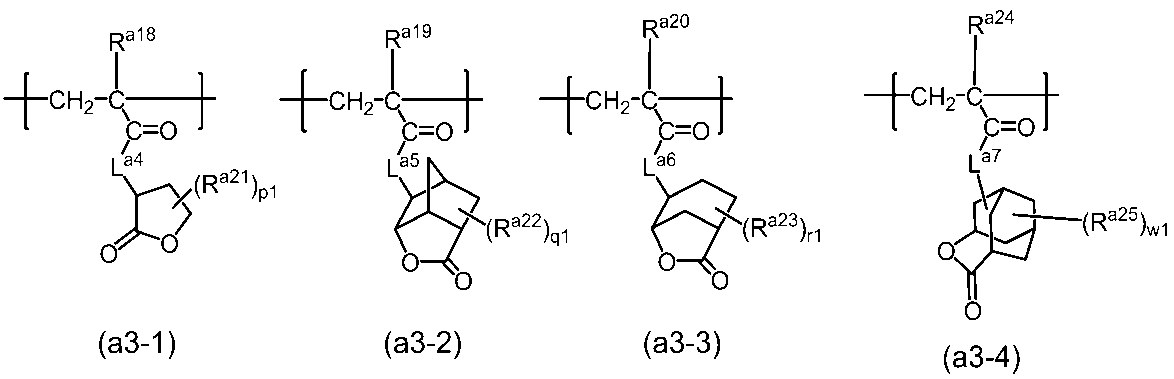
La4、La5及びLa6は、-O-又は*-O-(CH2)k3-CO-O-(k3は1~7のいずれかの整数を表す。)で表される基を表す。
La7は、-O-、*-O-La8-O-、*-O-La8-CO-O-、*-O-La8-CO-O-La9-CO-O-又は*-O-La8-O-CO-La9-O-を表す。
La8及びLa9は、それぞれ独立に、炭素数1~6のアルカンジイル基を表す。
*はカルボニル基との結合手を表す。
Ra18、Ra19及びRa20は、水素原子又はメチル基を表す。
Ra24は、ハロゲン原子を有してもよい炭素数1~6のアルキル基、水素原子又はハロゲン原子を表す。
Ra21は炭素数1~4の脂肪族炭化水素基を表す。
Ra22、Ra23及びRa25は、カルボキシ基、シアノ基又は炭素数1~4の脂肪族炭化水素基を表す。
p1は0~5のいずれかの整数を表す。
q1は、0~3のいずれかの整数を表す。
r1は、0~3のいずれかの整数を表す。
w1は、0~8のいずれかの整数を表す。
p1、q1、r1及び/又はw1が2以上のとき、複数のRa21、Ra22、Ra23及び/又はRa25は互いに同一であってもよく、異なってもよい。]
The structural unit (a3) is preferably a structural unit represented by the formula (a3-1), the formula (a3-2), the formula (a3-3) or the formula (a3-4). One of these may be contained alone, or two or more thereof may be contained.
L a4 , La 5 and La 6 represent a group represented by -O- or * -O- (CH 2 ) k3 -CO-O- (k3 represents an integer of 1 to 7). ..
L a7 is -O-, * -OL a8 -O-, * -OL a8-CO-O-, * -OL a8 - CO-O-L a9 -CO-O- or * -O-L a8 -O-CO-L a9 -O-represented.
L a8 and La 9 each independently represent an alkanediyl group having 1 to 6 carbon atoms.
* Represents a bond with a carbonyl group.
R a18 , R a19 and R a20 represent a hydrogen atom or a methyl group.
R a24 represents an alkyl group having 1 to 6 carbon atoms, a hydrogen atom or a halogen atom which may have a halogen atom.
R a21 represents an aliphatic hydrocarbon group having 1 to 4 carbon atoms.
R a22 , R a23 and R a25 represent a carboxy group, a cyano group or an aliphatic hydrocarbon group having 1 to 4 carbon atoms.
p1 represents an integer of 0 to 5.
q1 represents any integer from 0 to 3.
r1 represents any integer from 0 to 3.
w1 represents any integer from 0 to 8.
When p1, q1, r1 and / or w1 is 2 or more, the plurality of R a21 , R a22 , R a23 and / or R a25 may be the same or different from each other. ]
Ra21、Ra22、Ra23及びRa25の脂肪族炭化水素基としては、メチル基、エチル基、n-プロピル基、イソプロピル基、n-ブチル基、sec-ブチル基及びtert-ブチル基等のアルキル基が挙げられる。
Ra24のハロゲン原子としては、フッ素原子、塩素原子、臭素原子及びヨウ素原子が挙げられる。
Ra24のアルキル基としては、メチル基、エチル基、n-プロピル基、イソプロピル基、n-ブチル基、sec-ブチル基、tert-ブチル基、n-ペンチル基及びn-ヘキシル基等が挙げられ、好ましくは炭素数1~4のアルキル基が挙げられ、より好ましくはメチル基又はエチル基が挙げられる。
Ra24のハロゲン原子を有するアルキル基としては、トリフルオロメチル基、ペルフルオロエチル基、ペルフルオロプロピル基、ペルフルオロイソプロピル基、ペルフルオロブチル基、ペルフルオロsec-ブチル基、ペルフルオロtert-ブチル基、ペルフルオロペンチル基、ペルフルオロヘキシル基、トリクロロメチル基、トリブロモメチル基、トリヨードメチル基等が挙げられる。
Examples of the aliphatic hydrocarbon group of R a21 , R a22 , R a23 and R a25 include a methyl group, an ethyl group, an n-propyl group, an isopropyl group, an n-butyl group, a sec-butyl group and a tert-butyl group. Alkyl groups can be mentioned.
Examples of the halogen atom of Ra24 include a fluorine atom, a chlorine atom, a bromine atom and an iodine atom.
Examples of the alkyl group of R a24 include a methyl group, an ethyl group, an n-propyl group, an isopropyl group, an n-butyl group, a sec-butyl group, a tert-butyl group, an n-pentyl group and an n-hexyl group. An alkyl group having 1 to 4 carbon atoms is preferable, and a methyl group or an ethyl group is more preferable.
Alkyl groups having a halogen atom of Ra24 include trifluoromethyl group, perfluoroethyl group, perfluoropropyl group, perfluoroisopropyl group, perfluorobutyl group, perfluorosec-butyl group, perfluorotert-butyl group, perfluoropentyl group and perfluoro. Examples thereof include a hexyl group, a trichloromethyl group, a tribromomethyl group, and a triiodomethyl group.
La8及びLa9のアルカンジイル基としては、メチレン基、エチレン基、プロパン-1,3-ジイル基、プロパン-1,2-ジイル基、ブタン-1,4-ジイル基、ペンタン-1,5-ジイル基、ヘキサン-1,6-ジイル基、ブタン-1,3-ジイル基、2-メチルプロパン-1,3-ジイル基、2-メチルプロパン-1,2-ジイル基、ペンタン-1,4-ジイル基及び2-メチルブタン-1,4-ジイル基等が挙げられる。 The alkanediyl groups of La8 and La9 include methylene group, ethylene group, propane-1,3-diyl group, propane-1,2-diyl group, butane-1,4-diyl group and pentane-1,5. -Diyl group, hexane-1,6-diyl group, butane-1,3-diyl group, 2-methylpropane-1,3-diyl group, 2-methylpropane-1,2-diyl group, pentane-1, Examples thereof include a 4-diyl group and a 2-methylbutane-1,4-diyl group.
式(a3-1)~式(a3-3)において、La4~La6は、互いに独立に、好ましくは-O-又は、k3が1~4のいずれかの整数である*-O-(CH2)k3-CO-O-で表される基、より好ましくは-O-及び、*-O-CH2-CO-O-、さらに好ましくは酸素原子である。
Ra18~Ra21は、好ましくはメチル基である。
Ra22及びRa23は、互いに独立に、好ましくはカルボキシ基、シアノ基又はメチル基である。
p1、q1及びr1は、互いに独立に、好ましくは0~2のいずれかの整数であり、より好ましくは0又は1である。
In the formulas (a3-1) to (a3-3), La4 to La6 are independent of each other, preferably −O— or k3 is an integer of any one of 1 to 4 * —O— (. CH 2 ) A group represented by k3 -CO-O-, more preferably -O- and * -O-CH 2 -CO-O-, still more preferably an oxygen atom.
R a18 to R a21 are preferably methyl groups.
R a22 and R a23 are independent of each other, preferably a carboxy group, a cyano group or a methyl group.
p1, q1 and r1 are independent of each other, preferably an integer of 0 to 2, and more preferably 0 or 1.
式(a3-4)において、Ra24は、好ましくは水素原子又は炭素数1~4のアルキル基であり、より好ましくは水素原子、メチル基又はエチル基であり、さらに好ましくは水素原子又はメチル基である。
Ra25は、好ましくはカルボキシ基、シアノ基又はメチル基である。
La7は、好ましくは-O-又は*-O-La8-CO-O-であり、より好ましくは-O-、-O-CH2-CO-O-又は-O-C2H4-CO-O-である。
In the formula (a3-4), Ra24 is preferably a hydrogen atom or an alkyl group having 1 to 4 carbon atoms, more preferably a hydrogen atom, a methyl group or an ethyl group, and further preferably a hydrogen atom or a methyl group. Is.
Ra25 is preferably a carboxy group, a cyano group or a methyl group.
L a7 is preferably -O- or * -OL a8 -CO-O-, and more preferably -O-, -O-CH 2 -CO-O- or -O-C 2 H 4- . It is CO-O-.
式(a3-4)は、式(a3-4)’が特に好ましい。

構造単位(a3)を導くモノマーとしては、特開2010-204646号公報に記載されたモノマー、特開2000-122294号公報に記載されたモノマー、特開2012-41274号公報に記載されたモノマーが挙げられる。構造単位(a3)としては、式(a3-1-1)~式(a3-1-4)、式(a3-2-1)~式(a3-2-4)、式(a3-3-1)~式(a3-3-4)及び式(a3-4-1)~式(a3-4-12)のいずれかで表される構造単位が好ましい。 Examples of the monomer for deriving the structural unit (a3) include the monomers described in JP-A-2010-204646, the monomers described in JP-A-2000-122294, and the monomers described in JP-A-2012-41274. Can be mentioned. The structural unit (a3) includes equations (a3-1-1) to (a3-1-4), equations (a3-2-1) to equations (a3-2-4), and equations (a3-3-3). 1) The structural unit represented by any of the formulas (a3-3-4) and the formulas (a3-4-1) to (a3-4-12) is preferable.
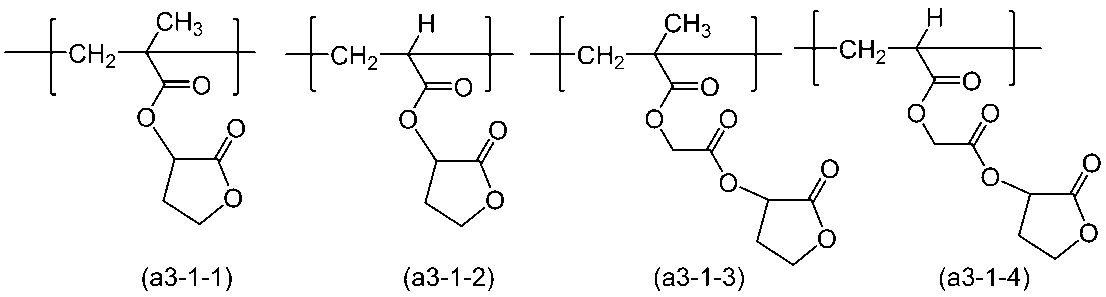


樹脂(A)が構造単位(a3)を含む場合、その合計含有率は、樹脂(A)の全構造単位に対して、通常5~70モル%であり、好ましくは10~65モル%であり、より好ましくは10~60モル%である。
また、構造単位(a3-1)、構造単位(a3-2)、構造単位(a3-3)及び構造単位(a3-4)の含有率は、それぞれ、樹脂(A)の全構造単位に対して、5~60モル%が好ましく、5~50モル%がより好ましく、10~50モル%がさらに好ましい。
When the resin (A) contains the structural unit (a3), the total content thereof is usually 5 to 70 mol%, preferably 10 to 65 mol%, based on all the structural units of the resin (A). , More preferably 10-60 mol%.
Further, the contents of the structural unit (a3-1), the structural unit (a3-2), the structural unit (a3-3) and the structural unit (a3-4) are the respective contents with respect to all the structural units of the resin (A). 5 to 60 mol% is preferable, 5 to 50 mol% is more preferable, and 10 to 50 mol% is further preferable.
<構造単位(t)>
樹脂(A)は、構造単位(a1)及び構造単位(s)以外の構造単位として、その他の構造単位(t)を含んでいてもよい。構造単位(t)としては、構造単位(a4)及び構造単位(a5)などが挙げられる。
<Structural unit (t)>
The resin (A) may contain other structural units (t) as structural units other than the structural unit (a1) and the structural unit (s). Examples of the structural unit (t) include a structural unit (a4) and a structural unit (a5).
〈構造単位(a4)〉
構造単位(a4)としては、式(a4-0)で表される構造単位が挙げられる。

R5は、水素原子又はメチル基を表す。
L4は、単結合又は2価の炭素数1~4の脂肪族飽和炭化水素基を表す。
L3は、炭素数1~8のペルフルオロアルカンジイル基又は炭素数3~12のペルフルオロシクロアルカンジイル基を表す。
R6は、水素原子又はフッ素原子を表す。]
<Structural unit (a4)>
Examples of the structural unit (a4) include a structural unit represented by the formula (a4-0).
R 5 represents a hydrogen atom or a methyl group.
L 4 represents a single bond or a divalent aliphatic saturated hydrocarbon group having 1 to 4 carbon atoms.
L 3 represents a perfluoroalkanediyl group having 1 to 8 carbon atoms or a perfluorocycloalkanediyl group having 3 to 12 carbon atoms.
R 6 represents a hydrogen atom or a fluorine atom. ]
L4の2価の脂肪族飽和炭化水素基としては、メチレン基、エチレン基、プロパン-1,3-ジイル基、ブタン-1,4-ジイル基等の直鎖状アルカンジイル基、エタン-1,1-ジイル基、プロパン-1,2-ジイル基、ブタン-1,3-ジイル基、2-メチルプロパン-1,3-ジイル基及び2-メチルプロパン-1,2-ジイル基等の分岐状アルカンジイル基が挙げられる。 Examples of the divalent aliphatic saturated hydrocarbon group of L 4 include a linear alkanediyl group such as a methylene group, an ethylene group, a propane-1,3-diyl group, a butane-1,4-diyl group, and an ethane-1. , 1-diyl group, propane-1,2-diyl group, butane-1,3-diyl group, 2-methylpropane-1,3-diyl group, 2-methylpropane-1,2-diyl group and the like. An alkanediyl group may be mentioned.
L3のペルフルオロアルカンジイル基としては、ジフルオロメチレン基、ペルフルオロエチレン基、ペルフルオロエチルフルオロメチレン基、ペルフルオロプロパン-1,3-ジイル基、ペルフルオロプロパン-1,2-ジイル基、ペルフルオロプロパン-2,2-ジイル基、ペルフルオロブタン-1,4-ジイル基、ペルフルオロブタン-2,2-ジイル基、ペルフルオロブタン-1,2-ジイル基、ペルフルオロペンタン-1,5-ジイル基、ペルフルオロペンタン-2,2-ジイル基、ペルフルオロペンタン-3,3-ジイル基、ペルフルオロヘキサン-1,6-ジイル基、ペルフルオロヘキサン-2,2-ジイル基、ペルフルオロヘキサン-3,3-ジイル基、ペルフルオロヘプタン-1,7-ジイル基、ペルフルオロヘプタン-2,2-ジイル基、ペルフルオロヘプタン-3,4-ジイル基、ペルフルオロヘプタン-4,4-ジイル基、ペルフルオロオクタン-1,8-ジイル基、ペルフルオロオクタン-2,2-ジイル基、ペルフルオロオクタン-3,3-ジイル基、ペルフルオロオクタン-4,4-ジイル基等が挙げられる。
L3のペルフルオロシクロアルカンジイル基としては、ペルフルオロシクロヘキサンジイル基、ペルフルオロシクロペンタンジイル基、ペルフルオロシクロヘプタンジイル基、ペルフルオロアダマンタンジイル基等が挙げられる。
The perfluoroalkanediyl group of L 3 includes a difluoromethylene group, a perfluoroethylene group, a perfluoroethylfluoromethylene group, a perfluoropropane-1,3-diyl group, a perfluoropropane-1,2-diyl group, and a perfluoropropane-2,2. -Diyl group, perfluorobutane-1,4-diyl group, perfluorobutane-2,2-diyl group, perfluorobutane-1,2-diyl group, perfluoropentane-1,5-diyl group, perfluoropentane-2,2 -Diyl group, perfluoropentane-3,3-diyl group, perfluorohexane-1,6-diyl group, perfluorohexane-2,2-diyl group, perfluorohexane-3,3-diyl group, perfluoroheptane-1,7 -Diyl group, perfluoroheptane-2,2-diyl group, perfluoroheptane-3,4-diyl group, perfluoroheptane-4,4-diyl group, perfluorooctane-1,8-diyl group, perfluorooctane-2,2 -Diyl group, perfluorooctane-3,3-diyl group, perfluorooctane-4,4-diyl group and the like can be mentioned.
Examples of the perfluorocycloalkanediyl group of L 3 include a perfluorocyclohexanediyl group, a perfluorocyclopentanediyl group, a perfluorocycloheptanediyl group, a perfluoroadamantandiyl group and the like.
L4は、好ましくは単結合、メチレン基又はエチレン基であり、より好ましくは、単結合、メチレン基である。
L3は、好ましくは炭素数1~6のペルフルオロアルカンジイル基であり、より好ましくは炭素数1~3のペルフルオロアルカンジイル基である。
L 4 is preferably a single bond, a methylene group or an ethylene group, and more preferably a single bond or a methylene group.
L 3 is preferably a perfluoroalkanediyl group having 1 to 6 carbon atoms, and more preferably a perfluoroalkanediyl group having 1 to 3 carbon atoms.
構造単位(a4-0)としては、以下に示す構造単位及び下記構造単位中のR5に相当するメチル基が水素原子に置き換わった構造単位が挙げられる。
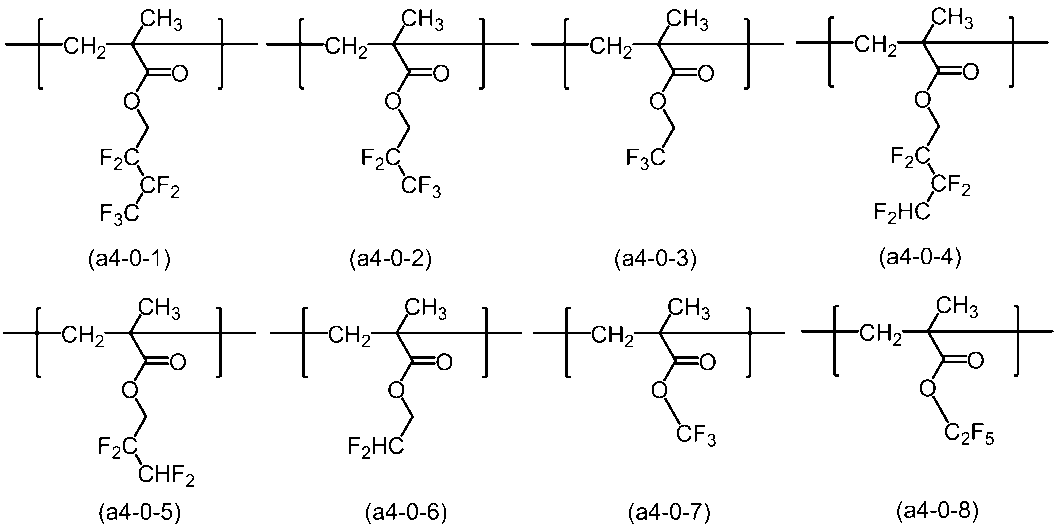

構造単位(a4)としては、式(a4-1)で表される構造単位も挙げられる。

Ra41は、水素原子又はメチル基を表す。
Ra42は、置換基を有していてもよい炭素数1~20の炭化水素基を表し、該炭化水素基に含まれる-CH2-は、-O-又は-CO-に置き換わっていてもよい。
Aa41は、置換基を有していてもよい炭素数1~6のアルカンジイル基又は式(a-g1)で表される基を表す。ただし、Aa41及びRa42のうち少なくとも1つは、置換基としてハロゲン原子(好ましくはフッ素原子)を有する。

sは0又は1を表す。
Aa42及びAa44は、それぞれ独立に、置換基を有していてもよい炭素数1~5の2価の脂肪族炭化水素基を表す。
Aa43は、単結合又は置換基を有していてもよい炭素数1~5の2価の脂肪族炭化水素基を表す。
Xa41及びXa42は、それぞれ独立に、-O-、-CO-、-CO-O-又は-O-CO-を表す。
ただし、Aa42、Aa43、Aa44、Xa41及びXa42の炭素数の合計は7以下である。〕
*は結合手であり、右側の*が-O-CO-Ra42との結合手である。]
The structural unit (a4) also includes a structural unit represented by the equation (a4-1).
R a41 represents a hydrogen atom or a methyl group.
R a42 represents a hydrocarbon group having 1 to 20 carbon atoms which may have a substituent, and -CH 2- contained in the hydrocarbon group may be replaced with -O- or -CO-. good.
A a41 represents an alkanediyl group having 1 to 6 carbon atoms which may have a substituent or a group represented by the formula (ag1). However, at least one of Aa41 and Ra42 has a halogen atom (preferably a fluorine atom) as a substituent.
s represents 0 or 1.
A a 42 and A a 44 each independently represent a divalent aliphatic hydrocarbon group having 1 to 5 carbon atoms which may have a substituent.
A a43 represents a divalent aliphatic hydrocarbon group having 1 to 5 carbon atoms which may have a single bond or a substituent.
X a41 and X a42 independently represent -O-, -CO-, -CO-O- or -O-CO-, respectively.
However, the total number of carbon atoms of A a42 , A a43 , A a44 , X a41 and X a42 is 7 or less. ]
* Is a bond, and * on the right is a bond with -O-CO-R a42 . ]
Ra42の炭化水素基としては、鎖式及び環式の脂肪族炭化水素基、芳香族炭化水素基、並びにこれらを組み合わせることにより形成される基が挙げられる。
鎖式及び環式の脂肪族炭化水素基は、炭素-炭素不飽和結合を有していてもよいが、鎖式及び環式の脂肪族飽和炭化水素基が好ましい。該脂肪族飽和炭化水素基としては、直鎖又は分岐のアルキル基及び単環又は多環の脂環式飽和炭化水素基、並びに、アルキル基及び脂環式飽和炭化水素基を組み合わせることにより形成される脂肪族炭化水素基等が挙げられる。
Examples of the hydrocarbon group of R a42 include chain and cyclic aliphatic hydrocarbon groups, aromatic hydrocarbon groups, and groups formed by combining these groups.
The chain and cyclic aliphatic hydrocarbon groups may have a carbon-carbon unsaturated bond, but chain and cyclic aliphatic saturated hydrocarbon groups are preferable. The aliphatic saturated hydrocarbon group is formed by combining a linear or branched alkyl group and a monocyclic or polycyclic alicyclic saturated hydrocarbon group, and an alkyl group and an alicyclic saturated hydrocarbon group. Examples include aliphatic hydrocarbon groups.
鎖式の脂肪族炭化水素基としては、メチル基、エチル基、n-プロピル基、n-ブチル基、n-ペンチル基、n-ヘキシル基、n-ヘプチル基、n-オクチル基、n-デシル基、n-ドデシル基、n-ペンタデシル基、n-ヘキサデシル基、n-ヘプタデシル基及びn-オクタデシル基が挙げられる。環式の脂肪族炭化水素基としては、シクロペンチル基、シクロへキシル基、シクロヘプチル基、シクロオクチル基等のシクロアルキル基;デカヒドロナフチル基、アダマンチル基、ノルボルニル基及び下記の基(*は結合手を表す。)等の多環式の脂環式炭化水素基が挙げられる。

Ra42の炭化水素基としては、鎖式及び環式の脂肪族炭化水素基並びにこれらが組み合わせることにより形成される基が好ましく、炭素-炭素不飽和結合を有していてもよいが、鎖式及び環式の脂肪族飽和炭化水素基並びにこれらを組み合わせることにより形成される基がより好ましい。
Ra42における置換基として、ハロゲン原子又は式(a-g3)で表される基が挙げられる。ハロゲン原子としては、フッ素原子、塩素原子、臭素原子及びヨウ素原子が挙げられ、好ましくはフッ素原子である。

Xa43は、酸素原子、カルボニル基、カルボニルオキシ基又はオキシカルボニル基を表す。
Aa45は、少なくとも1つのハロゲン原子を有する炭素数1~17の脂肪族炭化水素基を表す。
*は結合手を表す。]
As the hydrocarbon group of R a42 , a chain type or a cyclic type aliphatic hydrocarbon group and a group formed by a combination thereof are preferable, and a chain type may have a carbon-carbon unsaturated bond, but a chain type. And cyclic aliphatic saturated hydrocarbon groups and groups formed by combining them are more preferable.
Examples of the substituent in R a42 include a halogen atom or a group represented by the formula (ag3). Examples of the halogen atom include a fluorine atom, a chlorine atom, a bromine atom and an iodine atom, and a fluorine atom is preferable.
X a43 represents an oxygen atom, a carbonyl group, a carbonyloxy group or an oxycarbonyl group.
A a45 represents an aliphatic hydrocarbon group having 1 to 17 carbon atoms having at least one halogen atom.
* Represents a bond. ]
Aa45の脂肪族炭化水素基としては、Ra42で例示したものと同様の基が挙げられる。 Examples of the aliphatic hydrocarbon group of A a45 include the same groups as those exemplified in R a42 .
Ra42は、ハロゲン原子を有してもよい脂肪族炭化水素基が好ましく、ハロゲン原子を有するアルキル基及び/又は式(a-g3)で表される基を有する脂肪族炭化水素基がより好ましい。
Ra42がハロゲン原子を有する脂肪族炭化水素基である場合、好ましくはフッ素原子を有する脂肪族炭化水素基であり、より好ましくはペルフルオロアルキル基又はペルフルオロシクロアルキル基であり、さらに好ましくは炭素数が1~6のペルフルオロアルキル基であり、特に好ましくは炭素数1~3のペルフルオロアルキル基である。ペルフルオロアルキル基としては、ペルフルオロメチル基、ペルフルオロエチル基、ペルフルオロプロピル基、ペルフルオロブチル基、ペルフルオロペンチル基、ペルフルオロヘキシル基、ペルフルオロヘプチル基及びペルフルオロオクチル基等が挙げられる。ペルフルオロシクロアルキル基としては、ペルフルオロシクロヘキシル基等が挙げられる。
Ra42が、式(a-g3)で表される基を有する脂肪族炭化水素基である場合、式(a-g3)で表される基に含まれる炭素数を含めて、脂肪族炭化水素基の総炭素数は、15以下が好ましく、12以下がより好ましい。式(a-g3)で表される基を置換基として有する場合、その数は1個が好ましい。
R a42 is preferably an aliphatic hydrocarbon group which may have a halogen atom, and more preferably an alkyl group having a halogen atom and / or an aliphatic hydrocarbon group having a group represented by the formula (ag3). ..
When R a42 is an aliphatic hydrocarbon group having a halogen atom, it is preferably an aliphatic hydrocarbon group having a fluorine atom, more preferably a perfluoroalkyl group or a perfluorocycloalkyl group, and further preferably having a carbon number of carbon. It is a perfluoroalkyl group of 1 to 6, and particularly preferably a perfluoroalkyl group having 1 to 3 carbon atoms. Examples of the perfluoroalkyl group include a perfluoromethyl group, a perfluoroethyl group, a perfluoropropyl group, a perfluorobutyl group, a perfluoropentyl group, a perfluorohexyl group, a perfluoroheptyl group and a perfluorooctyl group. Examples of the perfluorocycloalkyl group include a perfluorocyclohexyl group.
When R a42 is an aliphatic hydrocarbon group having a group represented by the formula (ag3), the aliphatic hydrocarbon includes the number of carbon atoms contained in the group represented by the formula (ag3). The total carbon number of the group is preferably 15 or less, more preferably 12 or less. When the group represented by the formula (ag3) is used as a substituent, the number thereof is preferably one.
式(a-g3)で表される基を有する脂肪族炭化水素は、さらに好ましくは式(a-g2)で表される基である。

Aa46は、ハロゲン原子を有していてもよい炭素数1~17の脂肪族炭化水素基を表す。
Xa44は、カルボニルオキシ基又はオキシカルボニル基を表す。
Aa47は、ハロゲン原子を有していてもよい炭素数1~17の脂肪族炭化水素基を表す。
ただし、Aa46、Aa47及びXa44の炭素数の合計は18以下であり、Aa46及びAa47のうち、少なくとも一方は、少なくとも1つのハロゲン原子を有する。
*はカルボニル基との結合手を表す。]
Aliphatic hydrocarbons having a group represented by the formula (ag3) are more preferably a group represented by the formula (ag2).
A a46 represents an aliphatic hydrocarbon group having 1 to 17 carbon atoms which may have a halogen atom.
X a44 represents a carbonyloxy group or an oxycarbonyl group.
A a47 represents an aliphatic hydrocarbon group having 1 to 17 carbon atoms which may have a halogen atom.
However, the total number of carbon atoms of A a46 , A a47 and X a44 is 18 or less, and at least one of A a46 and A a47 has at least one halogen atom.
* Represents a bond with a carbonyl group. ]
Aa46の脂肪族炭化水素基の炭素数は1~6が好ましく、1~3がより好ましい。
Aa47の脂肪族炭化水素基の炭素数は4~15が好ましく、5~12がより好ましく、Aa47は、シクロヘキシル基又はアダマンチル基がさらに好ましい。
The aliphatic hydrocarbon group of A a46 preferably has 1 to 6 carbon atoms, more preferably 1 to 3 carbon atoms.
The aliphatic hydrocarbon group of A a47 preferably has 4 to 15 carbon atoms, more preferably 5 to 12 carbon atoms, and further preferably A a47 having a cyclohexyl group or an adamantyl group.
*-Aa46-Xa44-Aa47で表される部分構造(*はカルボニル基との結合手である)のより好ましい構造は、以下の構造である。

Aa41のアルカンジイル基としては、メチレン基、エチレン基、プロパン-1,3-ジイル基、ブタン-1,4-ジイル基、ペンタン-1,5-ジイル基、ヘキサン-1,6-ジイル基等の直鎖状アルカンジイル基;プロパン-1,2-ジイル基、ブタン-1,3-ジイル基、2-メチルプロパン-1,2-ジイル基、1-メチルブタン-1,4-ジイル基、2-メチルブタン-1,4-ジイル基等の分岐状アルカンジイル基が挙げられる。
Aa41のアルカンジイル基における置換基としては、ヒドロキシ基及び炭素数1~6のアルコキシ基等が挙げられる。
Aa41は、好ましくは炭素数1~4のアルカンジイル基であり、より好ましくは炭素数2~4のアルカンジイル基であり、さらに好ましくはエチレン基である。
The alkanediyl group of A a41 is a methylene group, an ethylene group, a propane-1,3-diyl group, a butane-1,4-diyl group, a pentane-1,5-diyl group, and a hexane-1,6-diyl group. Linear alkanediyl groups such as propane-1,2-diyl group, butane-1,3-diyl group, 2-methylpropane-1,2-diyl group, 1-methylbutane-1,4-diyl group, etc. Examples thereof include a branched alkanediyl group such as 2-methylbutane-1,4-diyl group.
Examples of the substituent in the alkanediyl group of A a41 include a hydroxy group and an alkoxy group having 1 to 6 carbon atoms.
A a41 is preferably an alkanediyl group having 1 to 4 carbon atoms, more preferably an alkanediyl group having 2 to 4 carbon atoms, and further preferably an ethylene group.
式(a-g1)で表される基におけるAa42、Aa43及びAa44の脂肪族炭化水素基は、炭素-炭素不飽和結合を有していてもよいが、鎖式及び環式の脂肪族飽和炭化水素基並びにこれらを組合せることにより形成される基が好ましい。該脂肪族飽和炭化水素基としては、直鎖又は分岐のアルキル基及び単環又は多環の脂環式炭化水素基、並びに、アルキル基及び脂環式炭化水素基を組合せることにより形成される脂肪族炭化水素基等が挙げられる。具体的には、メチレン基、エチレン基、プロパン-1,3-ジイル基、プロパン-1,2-ジイル基、ブタン-1,4-ジイル基、1-メチルプロパン-1,3-ジイル基、2-メチルプロパン-1,3-ジイル基、2-メチルプロパン-1,2-ジイル基等が挙げられる。
Aa42、Aa43及びAa44の脂肪族炭化水素基の置換基としては、ヒドロキシ基及び炭素数1~6のアルコキシ基等が挙げられる。
sは、0であることが好ましい。
The aliphatic hydrocarbon groups A a42 , A a43 and A a44 in the group represented by the formula (a-g1) may have a carbon-carbon unsaturated bond, but are chain-type and cyclic-type fats. Group saturated hydrocarbon groups and groups formed by combining these groups are preferable. The aliphatic saturated hydrocarbon group is formed by combining a linear or branched alkyl group and a monocyclic or polycyclic alicyclic hydrocarbon group, and an alkyl group and an alicyclic hydrocarbon group. Examples include aliphatic hydrocarbon groups. Specifically, a methylene group, an ethylene group, a propane-1,3-diyl group, a propane-1,2-diyl group, a butane-1,4-diyl group, a 1-methylpropane-1,3-diyl group, Examples thereof include 2-methylpropane-1,3-diyl group and 2-methylpropane-1,2-diyl group.
Examples of the substituent of the aliphatic hydrocarbon group of A a42 , A a43 and A a44 include a hydroxy group and an alkoxy group having 1 to 6 carbon atoms.
s is preferably 0.
Xa42が酸素原子、カルボニル基、カルボニルオキシ基又はオキシカルボニル基を表す式(a-g1)で表される基としては、以下の基等が挙げられる。以下の例示において、*及び**はそれぞれ結合手を表わし、**が-O-CO-Ra42との結合手である。

式(a4-1)で表される構造単位としては、以下に示す構造単位及び下記構造単位中のRa41に相当するメチル基が水素原子に置き換わった構造単位が挙げられる。
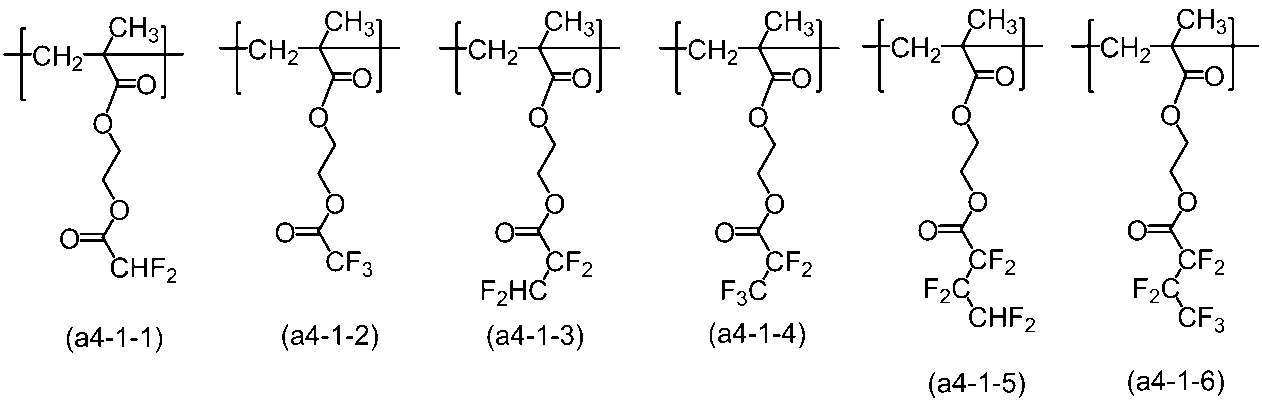

構造単位(a4)としては、式(a4-4)で表される構造単位も挙げられる。
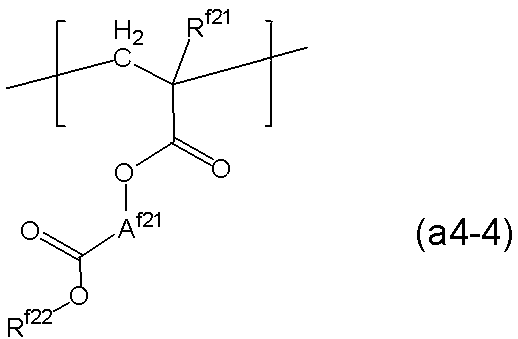
Rf21は、水素原子又はメチル基を表す。
Af21は、-(CH2)j1-、-(CH2)j2-O-(CH2)j3-又は-(CH2)j4-CO-O-(CH2)j5-を表す。
j1~j5は、それぞれ独立に、1~6のいずれかの整数を表す。
Rf22は、フッ素原子を有する炭素数1~10の炭化水素基を表す。]
The structural unit (a4) also includes a structural unit represented by the formula (a4-4).
R f21 represents a hydrogen atom or a methyl group.
A f21 represents-(CH 2 ) j1 -,-(CH 2 ) j2 -O- (CH 2 ) j3- or- (CH 2 ) j4 -CO-O- (CH 2 ) j5- .
j1 to j5 each independently represent an integer of 1 to 6.
R f22 represents a hydrocarbon group having a fluorine atom and having 1 to 10 carbon atoms. ]
Rf22のフッ素原子を有する炭化水素基は、鎖式及び環式の脂肪族炭化水素基及び芳香族炭化水素基並びにこれらの組み合わせることにより形成される基を含む。脂肪族炭化水素基としては、アルキル基(直鎖又は分岐)、脂環式炭化水素基が好ましい。
アルキル基としては、メチル基、エチル基、n-プロピル基、イソプロピル基、n-ブチル基、sec-ブチル基、tert-ブチル基、n-ペンチル基、n-ヘキシル基、n-オクチル基及び2-エチルヘキシル基が挙げられる。
脂環式炭化水素基は、単環式であってもよいし、多環式であってもよい。単環式の脂環式炭化水素基としては、シクロプロピル基、シクロブチル基、シクロペンチル基、シクロヘキシル基、メチルシクロヘキシル基、ジメチルシクロヘキシル基、シクロヘプチル基、シクロオクチル基、シクロヘプチル基、シクロデシル基等のシクロアルキル基が挙げられる。多環式の脂環式炭化水素基としては、デカヒドロナフチル基、アダマンチル基、2-アルキルアダマンタン-2-イル基、1-(アダマンタン-1-イル)アルカン-1-イル基、ノルボルニル基、メチルノルボルニル基及びイソボルニル基が挙げられる。
Hydrocarbon groups having a fluorine atom of R f22 include chain and cyclic aliphatic hydrocarbon groups and aromatic hydrocarbon groups, and groups formed by combining them. As the aliphatic hydrocarbon group, an alkyl group (straight or branched) and an alicyclic hydrocarbon group are preferable.
Alkyl groups include methyl group, ethyl group, n-propyl group, isopropyl group, n-butyl group, sec-butyl group, tert-butyl group, n-pentyl group, n-hexyl group, n-octyl group and 2 -Examples include ethylhexyl groups.
The alicyclic hydrocarbon group may be a monocyclic type or a polycyclic type. Examples of the monocyclic alicyclic hydrocarbon group include a cyclopropyl group, a cyclobutyl group, a cyclopentyl group, a cyclohexyl group, a methylcyclohexyl group, a dimethylcyclohexyl group, a cycloheptyl group, a cyclooctyl group, a cycloheptyl group, a cyclodecyl group and the like. Cycloalkyl groups can be mentioned. Examples of the polycyclic alicyclic hydrocarbon group include a decahydronaphthyl group, an adamantyl group, a 2-alkyladamantan-2-yl group, a 1- (adamantan-1-yl) alkane-1-yl group, and a norbornyl group. Examples thereof include a methylnorbornyl group and an isobornyl group.
Rf22のフッ素原子を有する炭化水素基としては、フッ素原子を有するアルキル基、フッ素原子を有する脂環式炭化水素基等が挙げられる。
フッ素原子を有するアルキル基としては、ジフルオロメチル基、トリフルオロメチル基、1,1-ジフルオロエチル基、2,2-ジフルオロエチル基、2,2,2-トリフルオロエチル基、ペルフルオロエチル基、1,1,2,2-テトラフルオロプロピル基、1,1,2,2,3,3-ヘキサフルオロプロピル基、ペルフルオロエチルメチル基、1-(トリフルオロメチル)-1,2,2,2-テトラフルオロエチル基、1-(トリフルオロメチル)-2,2,2-トリフルオロエチル基、ペルフルオロプロピル基、1,1,2,2-テトラフルオロブチル基、1,1,2,2,3,3-ヘキサフルオロブチル基、1,1,2,2,3,3,4,4-オクタフルオロブチル基、ペルフルオロブチル基、1,1-ビス(トリフルオロ)メチル-2,2,2-トリフルオロエチル基、2-(ペルフルオロプロピル)エチル基、1,1,2,2,3,3,4,4-オクタフルオロペンチル基、ペルフルオロペンチル基、1,1,2,2,3,3,4,4,5,5-デカフルオロペンチル基、1,1-ビス(トリフルオロメチル)-2,2,3,3,3-ペンタフルオロプロピル基、2-(ペルフルオロブチル)エチル基、1,1,2,2,3,3,4,4,5,5-デカフルオロヘキシル基、1,1,2,2,3,3,4,4,5,5,6,6-ドデカフルオロヘキシル基、ペルフルオロペンチルメチル基及びペルフルオロヘキシル基等のフッ化アルキル基が挙げられる。
フッ素原子を有する脂環式炭化水素基としては、ペルフルオロシクロヘキシル基、ペルフルオロアダマンチル基等のフッ化シクロアルキル基が挙げられる。
Rf22は、フッ素原子を有する炭素数1~10のアルキル基又はフッ素原子を有する炭素数1~10の脂環式炭化水素基が好ましく、フッ素原子を有する炭素数1~10のアルキル基がより好ましく、フッ素原子を有する炭素数1~6のアルキル基がさらに好ましい。
Examples of the hydrocarbon group having a fluorine atom of R f22 include an alkyl group having a fluorine atom and an alicyclic hydrocarbon group having a fluorine atom.
As the alkyl group having a fluorine atom, a difluoromethyl group, a trifluoromethyl group, a 1,1-difluoroethyl group, a 2,2-difluoroethyl group, a 2,2,2-trifluoroethyl group, a perfluoroethyl group, 1 , 1,2,2-tetrafluoropropyl group, 1,1,2,2,3,3-hexafluoropropyl group, perfluoroethylmethyl group, 1- (trifluoromethyl) -1,2,2,2- Tetrafluoroethyl group, 1- (trifluoromethyl) -2,2,2-trifluoroethyl group, perfluoropropyl group, 1,1,2,2-tetrafluorobutyl group, 1,1,2,2,3 , 3-Hexafluorobutyl group, 1,1,2,2,3,3,4,4-octafluorobutyl group, perfluorobutyl group, 1,1-bis (trifluoro) methyl-2,2,2- Trifluoroethyl group, 2- (perfluoropropyl) ethyl group, 1,1,2,2,3,3,4,4-octafluoropentyl group, perfluoropentyl group, 1,1,2,2,3,3 , 4,4,5,5-decafluoropentyl group, 1,1-bis (trifluoromethyl) -2,2,3,3,3-pentafluoropropyl group, 2- (perfluorobutyl) ethyl group, 1 , 1,2,2,3,3,4,5,5-decafluorohexyl group, 1,1,2,2,3,3,4,4,5,5,6-dodecafluoro Fluoroalkyl groups such as hexyl groups, perfluoropentylmethyl groups and perfluorohexyl groups can be mentioned.
Examples of the alicyclic hydrocarbon group having a fluorine atom include a fluorocycloalkyl group such as a perfluorocyclohexyl group and a perfluoroadamantyl group.
R f22 is preferably an alkyl group having 1 to 10 carbon atoms having a fluorine atom or an alicyclic hydrocarbon group having 1 to 10 carbon atoms having a fluorine atom, and more preferably an alkyl group having 1 to 10 carbon atoms having a fluorine atom. Preferably, an alkyl group having 1 to 6 carbon atoms having a fluorine atom is more preferable.
式(a4-4)で表される構造単位においては、Af21としては、-(CH2)j1-が好ましく、エチレン基又はメチレン基がより好ましく、メチレン基がさらに好ましい。 In the structural unit represented by the formula (a4-4), as A f21 , − (CH 2 ) j1 − is preferable, an ethylene group or a methylene group is more preferable, and a methylene group is further preferable.
式(a4-4)で表される構造単位としては、例えば、以下の構造単位及び以下の式で表される構造単位においてはRf21に相当するメチル基が水素原子に置き換わった構造単位が挙げられる。
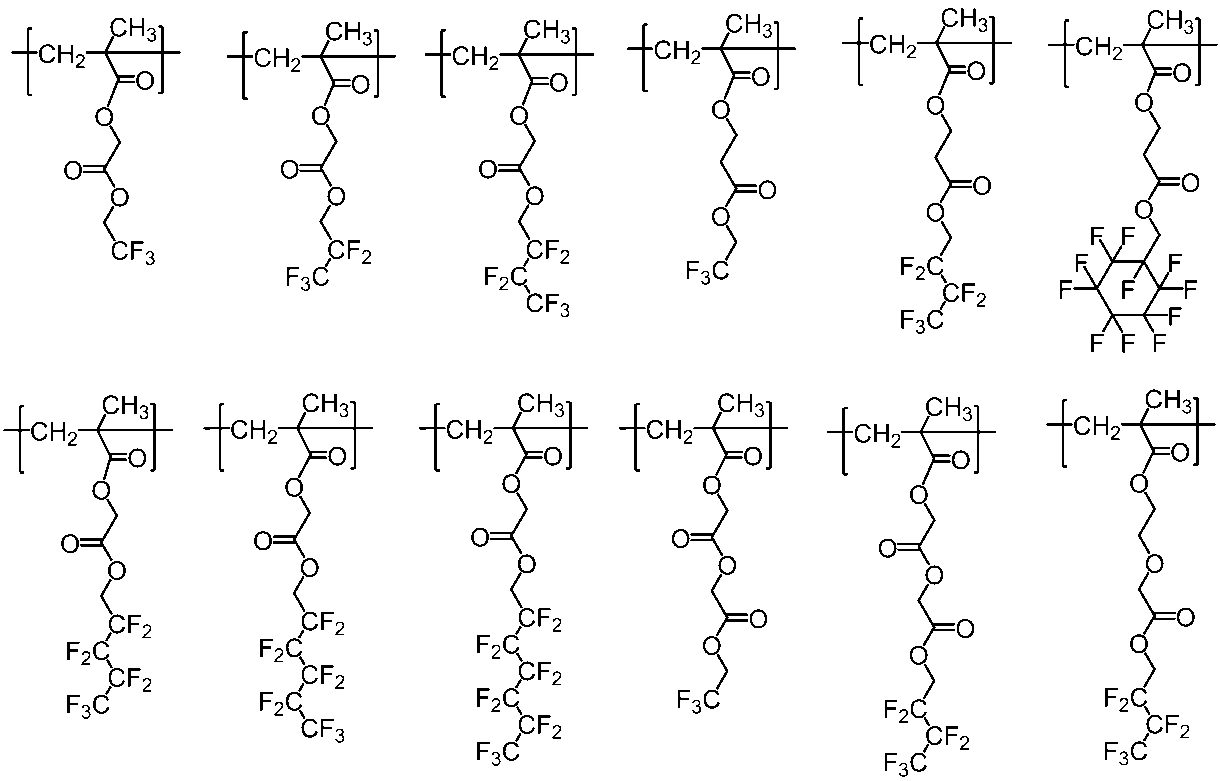
樹脂(A)が、構造単位(a4)を有する場合、その含有率は、樹脂(A)の全構造単位に対して、1~20モル%が好ましく、2~15モル%がより好ましく、3~10モル%がさらに好ましい。 When the resin (A) has a structural unit (a4), the content thereof is preferably 1 to 20 mol%, more preferably 2 to 15 mol%, and 3) with respect to all the structural units of the resin (A). -10 mol% is more preferred.
<構造単位(a5)>
構造単位(a5)が有する非脱離炭化水素基としては、直鎖、分岐又は環状の炭化水素基を有する基が挙げられる。なかでも、構造単位(a5)は、脂環式炭化水素基を有する基を含むものが好ましい。
構造単位(a5)としては、例えば、式(a5-1)で表される構造単位が挙げられる。
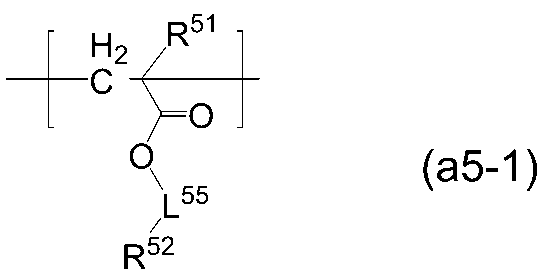
R51は、水素原子又はメチル基を表す。
R52は、炭素数3~18の脂環式炭化水素基を表し、該脂環式炭化水素基に含まれる水素原子は炭素数1~8の脂肪族炭化水素基で置換されていてもよい。但し、L51との結合位置にある炭素原子に結合する水素原子は、炭素数1~8の脂肪族炭化水素基で置換されない。
L51は、単結合又は炭素数1~18の2価の飽和炭化水素基を表し、該飽和炭化水素基に含まれるメチレン基は、酸素原子又はカルボニル基に置き換わっていてもよい。]
<Structural unit (a5)>
Examples of the non-eliminating hydrocarbon group of the structural unit (a5) include a group having a linear, branched or cyclic hydrocarbon group. Among them, the structural unit (a5) preferably contains a group having an alicyclic hydrocarbon group.
Examples of the structural unit (a5) include a structural unit represented by the formula (a5-1).
R 51 represents a hydrogen atom or a methyl group.
R 52 represents an alicyclic hydrocarbon group having 3 to 18 carbon atoms, and the hydrogen atom contained in the alicyclic hydrocarbon group may be substituted with an aliphatic hydrocarbon group having 1 to 8 carbon atoms. .. However, the hydrogen atom bonded to the carbon atom at the bonding position with L 51 is not substituted with the aliphatic hydrocarbon group having 1 to 8 carbon atoms.
L 51 represents a single bond or a divalent saturated hydrocarbon group having 1 to 18 carbon atoms, and the methylene group contained in the saturated hydrocarbon group may be replaced with an oxygen atom or a carbonyl group. ]
R52の脂環式炭化水素基としては、単環式及び多環式のいずれでもよい。単環式の脂環式炭化水素基としては、例えば、シクロプロピル基、シクロブチル基、シクロペンチル基及びシクロヘキシル基が挙げられる。多環式の脂環式炭化水素基としては、例えば、アダマンチル基及びノルボルニル基等が挙げられる。
炭素数1~8の脂肪族炭化水素基は、例えば、メチル基、エチル基、n-プロピル基、イソプロピル基、n-ブチル基、sec-ブチル基、tert-ブチル基、ペンチル基、ヘキシル基、オクチル基及び2-エチルヘキシル基等のアルキル基が挙げられる。
置換基を有した脂環式炭化水素基としては、3-メチルアダマンチル基などが挙げられる。
R52は、好ましくは、無置換の炭素数3~18の脂環式炭化水素基であり、より好ましくは、アダマンチル基、ノルボルニル基又はシクロヘキシル基である。
The alicyclic hydrocarbon group of R 52 may be either a monocyclic or polycyclic group. Examples of the monocyclic alicyclic hydrocarbon group include a cyclopropyl group, a cyclobutyl group, a cyclopentyl group and a cyclohexyl group. Examples of the polycyclic alicyclic hydrocarbon group include an adamantyl group and a norbornyl group.
The aliphatic hydrocarbon group having 1 to 8 carbon atoms includes, for example, a methyl group, an ethyl group, an n-propyl group, an isopropyl group, an n-butyl group, a sec-butyl group, a tert-butyl group, a pentyl group and a hexyl group. Alkyl groups such as octyl group and 2-ethylhexyl group can be mentioned.
Examples of the alicyclic hydrocarbon group having a substituent include a 3-methyladamantyl group.
R 52 is preferably an unsubstituted alicyclic hydrocarbon group having 3 to 18 carbon atoms, and more preferably an adamantyl group, a norbornyl group or a cyclohexyl group.
L51の2価の飽和炭化水素基としては、2価の脂肪族飽和炭化水素基及び2価の脂環式飽和炭化水素基が挙げられ、好ましくは2価の脂肪族飽和炭化水素基である。
2価の脂肪族飽和炭化水素基としては、例えば、メチレン基、エチレン基、プロパンジイル基、ブタンジイル基及びペンタンジイル基等のアルカンジイル基が挙げられる。
2価の脂環式飽和炭化水素基は、単環式及び多環式のいずれでもよい。単環式の脂環式飽和炭化水素基としては、シクロペンタンジイル基及びシクロヘキサンジイル基等のシクロアルカンジイル基が挙げられる。多環式の2価の脂環式飽和炭化水素基としては、アダマンタンジイル基及びノルボルナンジイル基等が挙げられる。
Examples of the divalent saturated hydrocarbon group of L 51 include a divalent aliphatic saturated hydrocarbon group and a divalent alicyclic saturated hydrocarbon group, and a divalent aliphatic saturated hydrocarbon group is preferable. ..
Examples of the divalent aliphatic saturated hydrocarbon group include an alkanediyl group such as a methylene group, an ethylene group, a propanediyl group, a butanjiyl group and a pentandiyl group.
The divalent alicyclic saturated hydrocarbon group may be either monocyclic or polycyclic. Examples of the monocyclic alicyclic saturated hydrocarbon group include a cycloalkanediyl group such as a cyclopentanediyl group and a cyclohexanediyl group. Examples of the polycyclic divalent alicyclic saturated hydrocarbon group include an adamantandiyl group and a norbornanediyl group.
飽和炭化水素基に含まれるメチレン基が、酸素原子又はカルボニル基で置き換わった基としては、例えば、式(L1-1)~式(L1-4)で表される基が挙げられる。下記式中、*は酸素原子との結合手を表す。

Xx1は、カルボニルオキシ基又はオキシカルボニル基を表す。
Lx1は、炭素数1~16の2価の脂肪族飽和炭化水素基を表す。
Lx2は、単結合又は炭素数1~15の2価の脂肪族飽和炭化水素基を表す。
ただし、Lx1及びLx2の合計炭素数は、16以下である。
式(L1-2)中、
Lx3は、炭素数1~17の2価の脂肪族飽和炭化水素基を表す。
Lx4は、単結合又は炭素数1~16の2価の脂肪族飽和炭化水素基を表す。
ただし、Lx3及びLx4の合計炭素数は、17以下である。
式(L1-3)中、
Lx5は、炭素数1~15の2価の脂肪族飽和炭化水素基を表す。
Lx6及びLx7は、それぞれ独立に、単結合又は炭素数1~14の2価の脂肪族飽和炭化水素基を表す。
ただし、Lx5、Lx6及びLx7の合計炭素数は、15以下である。
式(L1-4)中、
Lx8及びLx9は、単結合又は炭素数1~12の2価の脂肪族飽和炭化水素基を表す。
Wx1は、炭素数3~15の2価の脂環式飽和炭化水素基を表す。
ただし、Lx8、Lx9及びWx1の合計炭素数は、15以下である。
Examples of the group in which the methylene group contained in the saturated hydrocarbon group is replaced with an oxygen atom or a carbonyl group include groups represented by the formulas (L1-1) to (L1-4). In the following formula, * represents a bond with an oxygen atom.
X x1 represents a carbonyloxy group or an oxycarbonyl group.
L x1 represents a divalent aliphatic saturated hydrocarbon group having 1 to 16 carbon atoms.
L x2 represents a single bond or a divalent aliphatic saturated hydrocarbon group having 1 to 15 carbon atoms.
However, the total number of carbon atoms of L x 1 and L x 2 is 16 or less.
In equation (L1-2),
L x3 represents a divalent aliphatic saturated hydrocarbon group having 1 to 17 carbon atoms.
L x4 represents a single bond or a divalent aliphatic saturated hydrocarbon group having 1 to 16 carbon atoms.
However, the total number of carbon atoms of L x3 and L x4 is 17 or less.
In formula (L1-3),
L x 5 represents a divalent aliphatic saturated hydrocarbon group having 1 to 15 carbon atoms.
L x6 and L x7 each independently represent a single bond or a divalent aliphatic saturated hydrocarbon group having 1 to 14 carbon atoms.
However, the total carbon number of L x5 , L x6 and L x7 is 15 or less.
In formula (L1-4),
L x8 and L x9 represent a single bond or a divalent aliphatic saturated hydrocarbon group having 1 to 12 carbon atoms.
W x 1 represents a divalent alicyclic saturated hydrocarbon group having 3 to 15 carbon atoms.
However, the total carbon number of L x8 , L x9 and W x1 is 15 or less.
Lx1は、好ましくは、炭素数1~8の2価の脂肪族飽和炭化水素基、より好ましくは、メチレン基又はエチレン基である。
Lx2は、好ましくは、単結合又は炭素数1~8の2価の脂肪族飽和炭化水素基、より好ましくは、単結合である。
Lx3は、好ましくは、炭素数1~8の2価の脂肪族飽和炭化水素基である。
Lx4は、好ましくは、単結合又は炭素数1~8の2価の脂肪族飽和炭化水素基である。
Lx5は、好ましくは、炭素数1~8の2価の脂肪族飽和炭化水素基、より好ましくは、メチレン基又はエチレン基である。
Lx6は、好ましくは、単結合又は炭素数1~8の2価の脂肪族飽和炭化水素基、より好ましくは、メチレン基又はエチレン基である。
Lx7は、好ましくは、単結合又は炭素数1~8の2価の脂肪族飽和炭化水素基である。
Lx8は、好ましくは、単結合又は炭素数1~8の2価の脂肪族飽和炭化水素基、より好ましくは、単結合又はメチレン基である。
Lx9は、好ましくは、単結合又は炭素数1~8の2価の脂肪族飽和炭化水素基、より好ましくは、単結合又はメチレン基である。
Wx1は、好ましくは、炭素数3~10の2価の脂環式飽和炭化水素基、より好ましくは、シクロヘキサンジイル基又はアダマンタンジイル基である。
L x1 is preferably a divalent aliphatic saturated hydrocarbon group having 1 to 8 carbon atoms, and more preferably a methylene group or an ethylene group.
L x2 is preferably a single bond or a divalent aliphatic saturated hydrocarbon group having 1 to 8 carbon atoms, and more preferably a single bond.
L x3 is preferably a divalent aliphatic saturated hydrocarbon group having 1 to 8 carbon atoms.
L x4 is preferably a single bond or a divalent aliphatic saturated hydrocarbon group having 1 to 8 carbon atoms.
L x 5 is preferably a divalent aliphatic saturated hydrocarbon group having 1 to 8 carbon atoms, and more preferably a methylene group or an ethylene group.
L x6 is preferably a single bond or a divalent aliphatic saturated hydrocarbon group having 1 to 8 carbon atoms, and more preferably a methylene group or an ethylene group.
L x7 is preferably a single bond or a divalent aliphatic saturated hydrocarbon group having 1 to 8 carbon atoms.
L x8 is preferably a single bond or a divalent aliphatic saturated hydrocarbon group having 1 to 8 carbon atoms, and more preferably a single bond or a methylene group.
L x9 is preferably a single bond or a divalent aliphatic saturated hydrocarbon group having 1 to 8 carbon atoms, and more preferably a single bond or a methylene group.
W x 1 is preferably a divalent alicyclic saturated hydrocarbon group having 3 to 10 carbon atoms, and more preferably a cyclohexanediyl group or an adamantandiyl group.
式(L1-1)で表される基としては、例えば、以下に示す2価の基が挙げられる。

式(L1-2)で表される基としては、例えば、以下に示す2価の基が挙げられる。
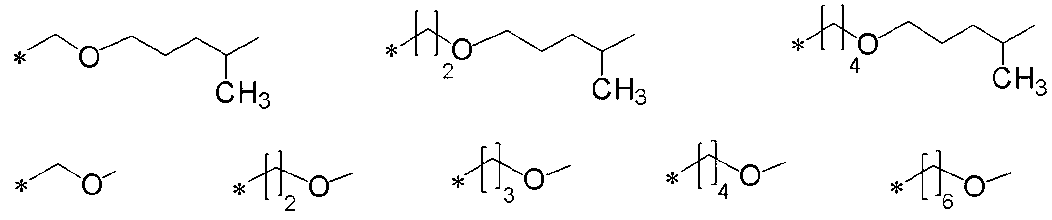
式(L1-3)で表される基としては、例えば、以下に示す2価の基が挙げられる。

式(L1-4)で表される基としては、例えば、以下に示す2価の基が挙げられる。
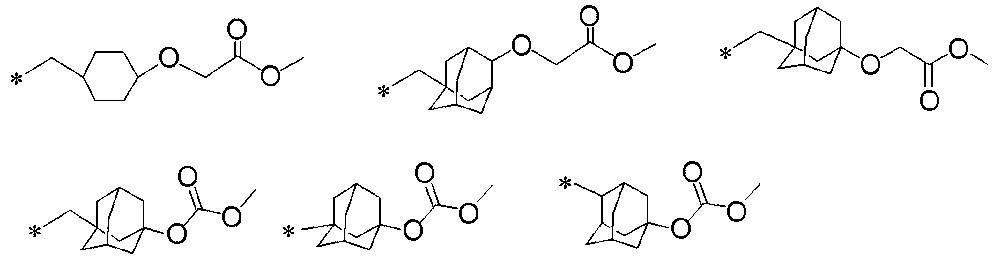
L51は、好ましくは、単結合又は式(L1-1)で表される基である。 L 51 is preferably a single bond or a group represented by the formula (L1-1).
構造単位(a5-1)としては、以下に示す構造単位及び下記構造単位中のR51に相当するメチル基が水素原子に置き換わった構造単位が挙げられる。

<構造単位(II)>
樹脂(A)は、さらに、露光により分解して酸を発生する構造単位(以下、「構造単位(II)という場合がある)を含有してもよい。構造単位(II)としては、具体的には特開2016-79235号公報に記載の構造単位が挙げられ、側鎖にスルホナート基若しくはカルボキシレート基を有する構造単位(これらの基に対する対イオンとしての有機カチオンも側鎖に含める)又は側鎖にスルホニオ基(-S+(R)(R’))を有する構造単位(この基に対する対イオンとしての有機アニオンも側鎖に含める)であることが好ましい。
<Structural unit (II)>
The resin (A) may further contain a structural unit (hereinafter, may be referred to as “structural unit (II)”) that decomposes by exposure to generate an acid. The structural unit (II) is specific. Examples of the structural unit described in JP-A-2016-79235 include a structural unit having a sulfonate group or a carboxylate group in the side chain (organic cations as counterions for these groups are also included in the side chain) or side chains. It is preferably a structural unit having a sulfonio group (-S + (R) (R')) in the chain (including an organic anion as a counterion to this group in the side chain).
側鎖にスルホナート基若しくはカルボキシレート基と有機カチオンとを有する構造単位は、式(II-2-A’)で表される構造単位であることが好ましい。

XIII3は、炭素数1~18の2価の飽和炭化水素基を表し、該飽和炭化水素基に含まれる-CH2-は、-O-、-S-又は-CO-に置き換わっていてもよく、該飽和炭化水素基に含まれる水素原子は、ハロゲン原子、ハロゲン原子を有していてもよい炭素数1~6のアルキル基又はヒドロキシ基で置き換わっていてもよい。
Ax1は、炭素数1~8のアルカンジイル基を表し、該アルカンジイル基に含まれる水素原子は、フッ素原子又は炭素数1~6のペルフルオロアルキル基で置換されていてもよい。
RA-は、スルホナート基又はカルボキシレート基を表す。
RIII3は、水素原子、ハロゲン原子又はハロゲン原子を有していてもよい炭素数1~6のアルキル基を表す。
Za+は、有機カチオンを表す。]
The structural unit having a sulfonate group or a carboxylate group and an organic cation in the side chain is preferably a structural unit represented by the formula (II-2-A').
X III3 represents a divalent saturated hydrocarbon group having 1 to 18 carbon atoms, and -CH 2- contained in the saturated hydrocarbon group may be replaced with -O-, -S- or -CO-. Often, the hydrogen atom contained in the saturated hydrocarbon group may be replaced with a halogen atom, an alkyl group having 1 to 6 carbon atoms which may have a halogen atom, or a hydroxy group.
A x1 represents an alkanediyl group having 1 to 8 carbon atoms, and the hydrogen atom contained in the alkanediyl group may be substituted with a fluorine atom or a perfluoroalkyl group having 1 to 6 carbon atoms.
RA - represents a sulfonate group or a carboxylate group.
R III3 represents an alkyl group having 1 to 6 carbon atoms which may have a hydrogen atom, a halogen atom or a halogen atom.
Za + represents an organic cation. ]
RIII3で表されるハロゲン原子としては、フッ素原子、塩素原子、臭素原子及びヨウ素原子等が挙げられる。
RIII3で表されるハロゲン原子を有していてもよい炭素数1~6のアルキル基としては、Ra8で表されるハロゲン原子を有していてもよい炭素数1~6のアルキル基と同じものが挙げられる。
Ax1で表される炭素数1~8のアルカンジイル基としては、メチレン基、エチレン基、プロパン-1,3-ジイル基、ブタン-1,4-ジイル基、ペンタン-1,5-ジイル基、ヘキサン-1,6-ジイル基、エタン-1,1-ジイル基、プロパン-1,1-ジイル基、プロパン-1,2-ジイル基、プロパン-2,2-ジイル基、ペンタン-2,4-ジイル基、2-メチルプロパン-1,3-ジイル基、2-メチルプロパン-1,2-ジイル基、ペンタン-1,4-ジイル基、2-メチルブタン-1,4-ジイル基等が挙げられる。
Examples of the halogen atom represented by R III3 include a fluorine atom, a chlorine atom, a bromine atom and an iodine atom.
The alkyl group having 1 to 6 carbon atoms which may have a halogen atom represented by R III3 includes an alkyl group having 1 to 6 carbon atoms which may have a halogen atom represented by R a8 . The same can be mentioned.
The alkanediyl group having 1 to 8 carbon atoms represented by A x1 includes a methylene group, an ethylene group, a propane-1,3-diyl group, a butane-1,4-diyl group, and a pentane-1,5-diyl group. , Hexane-1,6-diyl group, ethane-1,1-diyl group, propane-1,1-diyl group, propane-1,2-diyl group, propane-2,2-diyl group, pentane-2, 4-Diyl group, 2-methylpropane-1,3-diyl group, 2-methylpropane-1,2-diyl group, pentane-1,4-diyl group, 2-methylbutane-1,4-diyl group, etc. Can be mentioned.
XIII3で表される炭素数1~18の2価の飽和炭化水素基としては、直鎖又は分岐状アルカンジイル基、単環式又は多環式の2価の脂環飽和炭化水素基が挙げられ、これらの組み合わせてあってもよい。
具体的には、メチレン基、エチレン基、プロパン-1,3-ジイル基、プロパン-1,2-ジイル基、ブタン-1,4-ジイル基、ペンタン-1,5-ジイル基、ヘキサン-1,6-ジイル基、ヘプタン-1,7-ジイル基、オクタン-1,8-ジイル基、ノナン-1,9-ジイル基、デカン-1,10-ジイル基、ウンデカン-1,11-ジイル基、ドデカン-1,12-ジイル基等の直鎖状アルカンジイル基;ブタン-1,3-ジイル基、2-メチルプロパン-1,3-ジイル基、2-メチルプロパン-1,2-ジイル基、ペンタン-1,4-ジイル基、2-メチルブタン-1,4-ジイル基等の分岐状アルカンジイル基;シクロブタン-1,3-ジイル基、シクロペンタン-1,3-ジイル基、シクロヘキサン-1,4-ジイル基、シクロオクタン-1,5-ジイル基等のシクロアルカンジイル基;ノルボルナン-1,4-ジイル基、ノルボルナン-2,5-ジイル基、アダマンタン-1,5-ジイル基、アダマンタン-2,6-ジイル基等の2価の多環式脂環式飽和炭化水素基等が挙げられる。
Examples of the divalent saturated hydrocarbon group having 1 to 18 carbon atoms represented by X III3 include a linear or branched alkanediyl group and a monocyclic or polycyclic divalent alicyclic saturated hydrocarbon group. And may be a combination of these.
Specifically, methylene group, ethylene group, propane-1,3-diyl group, propane-1,2-diyl group, butane-1,4-diyl group, pentane-1,5-diyl group, hexane-1 , 6-Diyl group, heptane-1,7-diyl group, octane-1,8-diyl group, nonan-1,9-diyl group, decane-1,10-diyl group, undecane-1,11-diyl group , Dodecane-1,12-diyl group and other linear alkanediyl groups; butane-1,3-diyl group, 2-methylpropane-1,3-diyl group, 2-methylpropane-1,2-diyl group , Pentan-1,4-diyl group, 2-methylbutane-1,4-diyl group and other branched alkanediyl groups; cyclobutane-1,3-diyl group, cyclopentane-1,3-diyl group, cyclohexane-1 , 4-Diyl group, cyclooctane-1,5-Diyl group and other cycloalkandyl groups; norbornan-1,4-diyl group, norbornan-2,5-diyl group, adamantan-1,5-diyl group, adamantan Examples thereof include a divalent polycyclic alicyclic saturated hydrocarbon group such as -2,6-diyl group.
飽和炭化水素基に含まれる-CH2-が、-O-、-S-又は-CO-で置き換わったものとしては、例えば式(X1)~式(X53)で表される2価の基が挙げられる。ただし、飽和炭化水素基に含まれる-CH2-が、-O-、-S-又は-CO-で置き換わる前の炭素数はそれぞれ17以下である。下記式において、*はAx1との結合手を表す。


X3は、2価の炭素数1~16の飽和炭化水素基を表す。
X4は、2価の炭素数1~15の飽和炭化水素基を表す。
X5は、2価の炭素数1~13の飽和炭化水素基を表す。
X6は、炭素数1~14のアルキル基を表す。
X7は、3価の炭素数1~14の飽和炭化水素基を表す。
X8は、2価の炭素数1~13の飽和炭化水素基を表す。
X 3 represents a divalent saturated hydrocarbon group having 1 to 16 carbon atoms.
X 4 represents a divalent saturated hydrocarbon group having 1 to 15 carbon atoms.
X 5 represents a saturated hydrocarbon group having 1 to 13 divalent carbon atoms.
X 6 represents an alkyl group having 1 to 14 carbon atoms.
X 7 represents a trivalent saturated hydrocarbon group having 1 to 14 carbon atoms.
X 8 represents a saturated hydrocarbon group having 1 to 13 divalent carbon atoms.
Za+で表される有機カチオンとしては、有機オニウムカチオン、例えば有機スルホニウムカチオン、有機ヨードニウムカチオン、有機アンモニウムカチオン、有機ベンゾチアゾリウムカチオン及び有機ホスホニウムカチオンなどが挙げられ、有機スルホニウムカチオン及び有機ヨードニウムカチオンが好ましく、アリールスルホニウムカチオンがより好ましい。
具体的には、後述する酸発生剤(B)における有機カチオンZ+と同様のものが挙げられる。
Examples of the organic cation represented by Za + include organic onium cations such as organic sulfonium cations, organic iodine cations, organic ammonium cations, organic benzothiazolium cations and organic phosphonium cations, and organic sulfonium cations and organic iodine cations. Is preferred, and aryl sulfonium cations are more preferred.
Specifically, the same as the organic cation Z + in the acid generator (B) described later can be mentioned.
式(II-2-A’)で表される構造単位は、式(II-2-A)で表される構造単位であることが好ましい。

Zは、0~6のいずれかの整数を表す。
RIII2及びRIII4は、それぞれ独立して、水素原子、フッ素原子又は炭素数1~6のペルフルオロアルキル基を表し、zが2以上のとき、複数のRIII2及びRIII4は互いに同一であってもよいし、異なっていてもよい。
Qa及びQbは、それぞれ独立して、フッ素原子又は炭素数1~6のペルフルオロアルキル基を表す。]
The structural unit represented by the formula (II-2-A') is preferably the structural unit represented by the formula (II-2-A).
Z represents an integer of 0 to 6.
R III2 and R III4 independently represent a hydrogen atom, a fluorine atom, or a perfluoroalkyl group having 1 to 6 carbon atoms, and when z is 2 or more, a plurality of R III2 and R III4 are identical to each other. It may or may not be different.
Q a and Q b each independently represent a fluorine atom or a perfluoroalkyl group having 1 to 6 carbon atoms. ]
RIII2、RIII4、Qa及びQbで表される炭素数1~6のペルフルオロアルキル基としては、後述のQ1で表される炭素数1~6のペルフルオロアルキル基と同じものが挙げられる。 Examples of the perfluoroalkyl group having 1 to 6 carbon atoms represented by R III2 , R III4 , Qa and Qb include the same perfluoroalkyl group having 1 to 6 carbon atoms represented by Q1 described later. ..
式(II-2-A)で表される構造単位は、式(II-2-A-1)で表される構造単位であることが好ましい。

RIII2、RIII3、RIII4、Qa、Qb、z及びZa+は、上記と同じ意味を表す。
RIII5は、炭素数1~12の飽和炭化水素基を表す。
X2は、炭素数1~11の2価の飽和炭化水素基を表し、該飽和炭化水素基に含まれる-CH2-は、-O-、-S-又は-CO-に置き換わっていてもよく、該飽和炭化水素基に含まれる水素原子は、ハロゲン原子又はヒドロキシ基で置換されていてもよい。]
The structural unit represented by the formula (II-2-A) is preferably the structural unit represented by the formula (II-2-A-1).
R III2 , R III3 , R III4 , Q a , Q b , z and Za + have the same meanings as described above.
R III5 represents a saturated hydrocarbon group having 1 to 12 carbon atoms.
X 2 represents a divalent saturated hydrocarbon group having 1 to 11 carbon atoms, and -CH 2- contained in the saturated hydrocarbon group may be replaced with -O-, -S- or -CO-. Often, the hydrogen atom contained in the saturated hydrocarbon group may be substituted with a halogen atom or a hydroxy group. ]
RIII5で表される炭素数1~12の飽和炭化水素基としては、メチル基、エチル基、プロピル基、イソプロピル基、ブチル基、sec-ブチル基、tert-ブチル基、ペンチル基、ヘキシル基、ヘプチル基、オクチル基、ノニル基、デシル基、ウンデシル基及びドデシル基等の直鎖又は分岐のアルキル基が挙げられる。
X2で表される炭素数1~11の2価の飽和炭化水素基としては、XIII3で表される2価の飽和炭化水素基のうちの炭素数11までのものが挙げられる。
Examples of the saturated hydrocarbon group having 1 to 12 carbon atoms represented by R III5 include a methyl group, an ethyl group, a propyl group, an isopropyl group, a butyl group, a sec-butyl group, a tert-butyl group, a pentyl group and a hexyl group. Examples thereof include a linear or branched alkyl group such as a heptyl group, an octyl group, a nonyl group, a decyl group, an undecyl group and a dodecyl group.
Examples of the divalent saturated hydrocarbon group having 1 to 11 carbon atoms represented by X 2 include those having up to 11 carbon atoms among the divalent saturated hydrocarbon groups represented by X III3 .
式(II-2-A)で表される構造単位としては、式(II-2-A-2)で表される構造単位がさらに好ましい。

m及びnは、互いに独立に、1又は2を表す。]
As the structural unit represented by the formula (II-2-A), the structural unit represented by the formula (II-2-A-2) is more preferable.
m and n represent 1 or 2 independently of each other. ]
式(II-2-A-1)で表される構造単位としては、例えば、以下の構造単位及びWO2012/050015記載の構造単位が挙げられる。Za+は、有機カチオンを表す。


側鎖にスルホニオ基と有機アニオンとを有する構造単位は、式(II-1-1)で表される構造単位(以下、構造単位(II-1-1)という場合がある。)であることが好ましい。
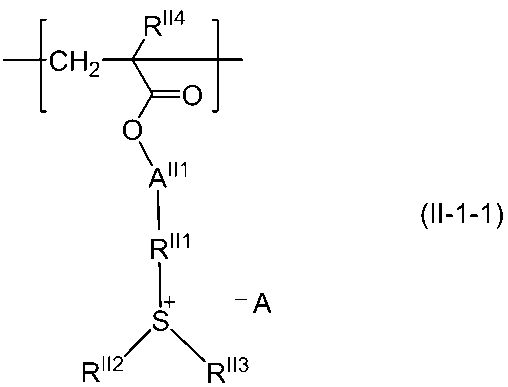
AII1は、単結合又は2価の連結基を表す。
RIIは、炭素数6~18の2価の芳香族炭化水素基を表す。
RII2及びRII3は、それぞれ独立して、炭素数1~18の炭化水素基を表し、RII2及びRII3は互いに結合してそれらが結合する硫黄原子とともに環を形成していてもよい。
RII4は、水素原子、ハロゲン原子又はハロゲン原子を有してもよい炭素数1~6のアルキル基を表す。
A-は、有機アニオンを表す。]
RII1で表される炭素数6~18の2価の芳香族炭化水素基としては、フェニレン基及びナフチレン基等が挙げられる。
RII2及びRII3で表される炭素数1~18の炭化水素基としては、R1で表される炭素数1~18の炭化水素基と同じものが挙げられる。
RII4で表されるハロゲン原子としては、フッ素原子、塩素原子、臭素原子及びヨウ素原子等が挙げられる。
RII4で表されるハロゲン原子を有していてもよい炭素数1~6のアルキル基としては、Ra8で表されるハロゲン原子を有していてもよい炭素数1~6のアルキル基と同じものが挙げられる。
AII1で表される2価の連結基としては、例えば、炭素数1~18の2価の飽和炭化水素基が挙げられ、該2価の飽和炭化水素基に含まれる-CH2-は、-O-、-S-又は-CO-で置き換わっていてもよい。具体的には、XIII3で表される炭素数1~18の2価の飽和炭化水素基と同じものが挙げられる。
The structural unit having a sulfonio group and an organic anion in the side chain is a structural unit represented by the formula (II-1-1) (hereinafter, may be referred to as a structural unit (II-1-1)). Is preferable.
A II1 represents a single bond or a divalent linking group.
R II represents a divalent aromatic hydrocarbon group having 6 to 18 carbon atoms.
R II2 and R II3 each independently represent a hydrocarbon group having 1 to 18 carbon atoms, and R II2 and R II3 may be bonded to each other to form a ring together with the sulfur atom to which they are bonded.
R II4 represents an alkyl group having 1 to 6 carbon atoms which may have a hydrogen atom, a halogen atom or a halogen atom.
A - represents an organic anion. ]
Examples of the divalent aromatic hydrocarbon group having 6 to 18 carbon atoms represented by R II1 include a phenylene group and a naphthylene group.
Examples of the hydrocarbon group having 1 to 18 carbon atoms represented by R II2 and R II3 include the same hydrocarbon group having 1 to 18 carbon atoms represented by R1.
Examples of the halogen atom represented by R II4 include a fluorine atom, a chlorine atom, a bromine atom and an iodine atom.
The alkyl group having 1 to 6 carbon atoms which may have a halogen atom represented by R II4 includes an alkyl group having 1 to 6 carbon atoms which may have a halogen atom represented by R a8 . The same can be mentioned.
Examples of the divalent linking group represented by A II1 include a divalent saturated hydrocarbon group having 1 to 18 carbon atoms, and —CH 2 − contained in the divalent saturated hydrocarbon group is It may be replaced by -O-, -S- or -CO-. Specifically, the same as the divalent saturated hydrocarbon group having 1 to 18 carbon atoms represented by X III3 can be mentioned.
式(II-1-1)中のカチオンを含む構造単位としては、以下で表される構造単位などが挙げられる。


A-で表される有機アニオンとしては、スルホン酸アニオン、スルホニルイミドアニオン、スルホニルメチドアニオン及びカルボン酸アニオン等が挙げられる。A-で表される有機アニオンは、スルホン酸アニオンが好ましく、後述する酸発生剤(B1)に含まれるアニオンであることがより好ましい。 Examples of the organic anion represented by A − include a sulfonic acid anion, a sulfonylimide anion, a sulfonylmethide anion, a carboxylic acid anion and the like. The organic anion represented by A − is preferably a sulfonic acid anion, and more preferably an anion contained in the acid generator (B1) described later.
A-で表されるスルホニルイミドアニオンとしては、以下のものが挙げられる。
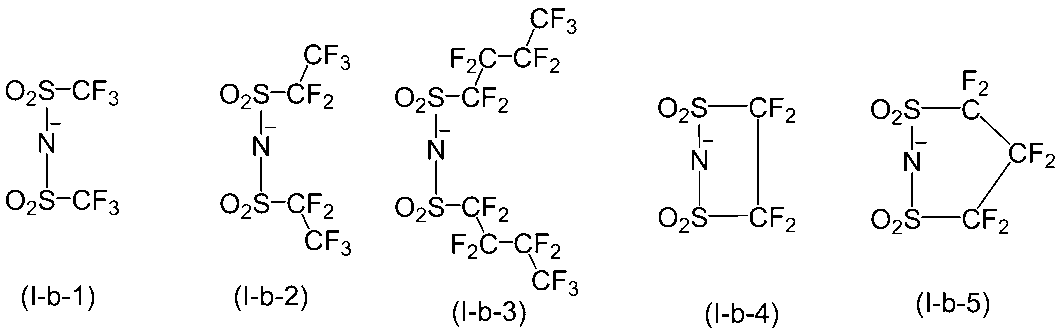
構造単位(II-1-1)としては、以下で表される構造単位などが挙げられる。

樹脂(A)中に、構造単位(II)を含有する場合の構造単位(II)の含有率は、樹脂(A)の全構造単位に対して、好ましくは1~20モル%であり、より好ましくは2~15モル%であり、さらに好ましくは3~10モル%である。 When the structural unit (II) is contained in the resin (A), the content of the structural unit (II) is preferably 1 to 20 mol% with respect to all the structural units of the resin (A), and more. It is preferably 2 to 15 mol%, more preferably 3 to 10 mol%.
樹脂(A)は、構造単位(aa1)及び/又は構造単位(aa2)と、構造単位(a1)とからなる樹脂、構造単位(aa1)及び/又は構造単位(aa2)と、構造単位(a1)と構造単位(s)とからなる樹脂、構造単位(aa1)及び/又は構造単位(aa2)と、構造単位(a1)と、構造単位(s)以外の構造単位(例えば、構造単位(a4)、構造単位(a5)、構造単位(II)からなる樹脂、構造単位(aa1)及び/又は構造単位(aa2)と、構造単位(a1)と、構造単位(s)と、構造単位(s)以外の構造単位からなる樹脂が挙げられる。なかでも、構造単位(aa1)及び/又は構造単位(aa2)と、構造単位(a1)と構造単位(s)とからなる樹脂が好ましい。
構造単位(a1)は、好ましくは構造単位(a1-1)及び構造単位(a1-2)(好ましくはシクロヘキシル基、シクロペンチル基を有する該構造単位)から選ばれる少なくとも一種、より好ましくは構造単位(a1-1)又は構造単位(a1-1)及び構造単位(a1-2)(好ましくはシクロヘキシル基、シクロペンチル基を有する該構造単位)から選ばれる少なくとも二種である。
構造単位(s)は、好ましくは構造単位(a2)及び構造単位(a3)の少なくとも一種である。構造単位(a2)は、好ましくは式(a2-1)で表される構造単位である。構造単位(a3)は、好ましくは式(a3-1-1)~式(a3-1-4)で表される構造単位、式(a3-2-1)~式(a3-2-4)及び式(a3-4-1)~式(a3-4-2)で表される構造単位から選ばれる少なくとも一種である。
The resin (A) is a resin composed of a structural unit (aa1) and / or a structural unit (aa2) and a structural unit (a1), a structural unit (aa1) and / or a structural unit (aa2), and a structural unit (a1). ) And a resin composed of a structural unit (s), a structural unit (aa1) and / or a structural unit (aa2), a structural unit (a1), and a structural unit other than the structural unit (s) (for example, the structural unit (a4)). ), Structural unit (a5), resin consisting of structural unit (II), structural unit (aa1) and / or structural unit (aa2), structural unit (a1), structural unit (s), and structural unit (s). ), And among them, a resin composed of a structural unit (aa1) and / or a structural unit (aa2), a structural unit (a1), and a structural unit (s) is preferable.
The structural unit (a1) is preferably at least one selected from a structural unit (a1-1) and a structural unit (a1-2) (preferably the structural unit having a cyclohexyl group and a cyclopentyl group), more preferably a structural unit (a1). It is at least two kinds selected from a1-1) or a structural unit (a1-1) and a structural unit (a1-2) (preferably the structural unit having a cyclohexyl group and a cyclopentyl group).
The structural unit (s) is preferably at least one of the structural unit (a2) and the structural unit (a3). The structural unit (a2) is preferably a structural unit represented by the formula (a2-1). The structural unit (a3) is preferably a structural unit represented by the formulas (a3-1-1) to (a3-1-4), and the formulas (a3-2-1) to the formula (a3-2-4). And at least one selected from the structural units represented by the formulas (a3-4-1) to (a3-4-2).
樹脂(A)を構成する各構造単位は、1種のみ又は2種以上を組み合わせて用いてもよく、これら構造単位を誘導するモノマーを用いて、公知の重合法(例えばラジカル重合法)によって製造することができる。樹脂(A)が有する各構造単位の含有率は、重合に用いるモノマーの使用量で調整できる。
樹脂(A)の重量平均分子量は、好ましくは、2,000以上(より好ましくは2,500以上、さらに好ましくは3,000以上)、50,000以下(より好ましくは30,000以下、さらに好ましくは15,000以下)である。本明細書では、重量平均分子量は、ゲルパーミエーションクロマトグラフィーで実施例に記載の条件により求めた値である。
Each structural unit constituting the resin (A) may be used alone or in combination of two or more, and is produced by a known polymerization method (for example, radical polymerization method) using a monomer for inducing these structural units. can do. The content of each structural unit of the resin (A) can be adjusted by adjusting the amount of the monomer used for the polymerization.
The weight average molecular weight of the resin (A) is preferably 2,000 or more (more preferably 2,500 or more, still more preferably 3,000 or more), 50,000 or less (more preferably 30,000 or less, still more preferable). Is 15,000 or less). In the present specification, the weight average molecular weight is a value obtained by gel permeation chromatography under the conditions described in Examples.
〔レジスト組成物〕
本発明のレジスト組成物は、樹脂(A)及び酸発生剤(以下「酸発生剤(B)」という場合がある)を含有する。
本発明のレジスト組成物は、さらに、樹脂(A)以外の樹脂、溶剤(以下「溶剤(E)」という場合がある)、クエンチャー(以下「クエンチャー(C)」という場合がある)等を含有していることが好ましい。
[Resist composition]
The resist composition of the present invention contains a resin (A) and an acid generator (hereinafter, may be referred to as "acid generator (B)").
The resist composition of the present invention further comprises a resin other than the resin (A), a solvent (hereinafter, may be referred to as "solvent (E)"), a quencher (hereinafter, may be referred to as "quencher (C)"), and the like. Is preferably contained.
<樹脂(A)以外の樹脂(X)>
本発明のレジスト組成物は、樹脂(A)以外の樹脂を含んでもよい。このような樹脂としては、例えば、構造単位(a4)を含む樹脂(以下「樹脂(X)」という場合がある。
樹脂(X)がさらに有していてもよい構造単位としては、構造単位(a1)、構造単位(a2)、構造単位(a3)、構造単位(a5)及びその他の公知構造単位が挙げられる。
樹脂(X)は、構造単位(a4)及び又は構造単位(a5)からなる樹脂であることがより好ましい。
樹脂(X)が構造単位(a4)を含む場合、その含有率は、樹脂(X)の全構造単位に対して、40モル%以上が好ましく、45モル%以上がより好ましく、50モル%以上がさらに好ましい。
樹脂(X)が構造単位(a5)を含む場合、その含有率は、樹脂(X)の全構造単位に対して、10~60モル%が好ましく、20~55モル%がより好ましく、25~50モル%がさらに好ましい。
<Resin (X) other than resin (A)>
The resist composition of the present invention may contain a resin other than the resin (A). As such a resin, for example, a resin containing a structural unit (a4) (hereinafter referred to as “resin (X)” may be used.
Examples of the structural unit that the resin (X) may further include include a structural unit (a1), a structural unit (a2), a structural unit (a3), a structural unit (a5), and other known structural units.
The resin (X) is more preferably a resin composed of the structural unit (a4) and / or the structural unit (a5).
When the resin (X) contains the structural unit (a4), the content thereof is preferably 40 mol% or more, more preferably 45 mol% or more, and 50 mol% or more with respect to all the structural units of the resin (X). Is even more preferable.
When the resin (X) contains the structural unit (a5), the content thereof is preferably 10 to 60 mol%, more preferably 20 to 55 mol%, and 25 to 25 to all the structural units of the resin (X). 50 mol% is more preferred.
樹脂(X)を構成する各構造単位は、1種のみ又は2種以上を組み合わせて用いてもよく、これら構造単位を誘導するモノマーを用いて、公知の重合法(例えばラジカル重合法)によって製造することができる。樹脂(X)が有する各構造単位の含有率は、重合に用いるモノマーの使用量で調整できる。
樹脂(X)の重量平均分子量は、好ましくは、6,000以上(より好ましくは7,000以上)、80,000以下(より好ましくは60,000以下)である。かかる樹脂(X)の重量平均分子量の測定手段は、樹脂(A)の場合と同様である。
レジスト組成物が樹脂(X)を含む場合、その含有量は、樹脂(A)100質量部に対して、好ましくは1~60質量部であり、より好ましくは1~50質量部であり、さらに好ましくは1~40質量部であり、特に好ましくは2~30質量部である。
Each structural unit constituting the resin (X) may be used alone or in combination of two or more, and is produced by a known polymerization method (for example, radical polymerization method) using a monomer for inducing these structural units. can do. The content of each structural unit of the resin (X) can be adjusted by adjusting the amount of the monomer used for the polymerization.
The weight average molecular weight of the resin (X) is preferably 6,000 or more (more preferably 7,000 or more) and 80,000 or less (more preferably 60,000 or less). The means for measuring the weight average molecular weight of the resin (X) is the same as that of the resin (A).
When the resist composition contains the resin (X), the content thereof is preferably 1 to 60 parts by mass, more preferably 1 to 50 parts by mass, and further, with respect to 100 parts by mass of the resin (A). It is preferably 1 to 40 parts by mass, and particularly preferably 2 to 30 parts by mass.
樹脂(A)と樹脂(A)以外の樹脂との合計含有率は、レジスト組成物の固形分に対して、80質量%以上99質量%以下が好ましく、90質量%以上99質量%以下が好ましい。レジスト組成物の固形分及びこれに対する樹脂の含有率は、液体クロマトグラフィー又はガスクロマトグラフィー等の公知の分析手段で測定することができる。 The total content of the resin (A) and the resin other than the resin (A) is preferably 80% by mass or more and 99% by mass or less, and preferably 90% by mass or more and 99% by mass or less with respect to the solid content of the resist composition. .. The solid content of the resist composition and the content of the resin relative to the solid content can be measured by a known analytical means such as liquid chromatography or gas chromatography.
<酸発生剤(B)>
酸発生剤は、非イオン系とイオン系とのいずれを用いてもよい。非イオン系酸発生剤としては、有機ハロゲン化物、スルホネートエステル類(例えば2-ニトロベンジルエステル、芳香族スルホネート、オキシムスルホネート、N-スルホニルオキシイミド、スルホニルオキシケトン、ジアゾナフトキノン 4-スルホネート)、スルホン類(例えばジスルホン、ケトスルホン、スルホニルジアゾメタン)等が挙げられる。イオン系酸発生剤としては、オニウムカチオンを含むオニウム塩(例えばジアゾニウム塩、ホスホニウム塩、スルホニウム塩、ヨードニウム塩)が代表的である。オニウム塩のアニオンとしては、スルホン酸アニオン、スルホニルイミドアニオン、スルホニルメチドアニオン等が挙げられる。
<Acid generator (B)>
As the acid generator, either a nonionic type or an ionic type may be used. Examples of the nonionic acid generator include organic halides, sulfonate esters (for example, 2-nitrobenzyl ester, aromatic sulfonate, oxime sulfonate, N-sulfonyloxyimide, sulfonyloxyketone, diazonaphthoquinone 4-sulfonate), and sulfones. (For example, disulfone, ketosulfone, sulfonyldiazomethane) and the like can be mentioned. As the ionic acid generator, an onium salt containing an onium cation (for example, a diazonium salt, a phosphonium salt, a sulfonium salt, an iodonium salt) is typical. Examples of the onium salt anion include a sulfonic acid anion, a sulfonylimide anion, and a sulfonylmethide anion.
酸発生剤(B)としては、特開昭63-26653号、特開昭55-164824号、特開昭62-69263号、特開昭63-146038号、特開昭63-163452号、特開昭62-153853号、特開昭63-146029号、米国特許第3,779,778号、米国特許第3,849,137号、独国特許第3914407号、欧州特許第126,712号等に記載の放射線によって酸を発生する化合物を使用することができる。また、公知の方法で製造した化合物を使用してもよい。酸発生剤(B)は、1種を単独で用いてもよく、2種以上を組み合わせて用いてもよい。 Examples of the acid generator (B) include JP-A-63-26653, JP-A-55-164824, JP-A-62-69263, JP-A-63-146038, JP-A-63-163452, and Japanese Patent Publication No. 63-163452. Kaisho 62-153853, JP-A-63-146029, US Patent No. 3,779,778, US Patent No. 3,849,137, German Patent No. 3914407, European Patent No. 126,712, etc. A compound that generates an acid by the radiation described in the above can be used. Further, a compound produced by a known method may be used. The acid generator (B) may be used alone or in combination of two or more.
酸発生剤(B)は、好ましくはフッ素含有酸発生剤であり、より好ましくは式(B1)で表される塩(以下「酸発生剤(B1)」という場合がある)である。

Q1及びQ2は、互いに独立に、フッ素原子又は炭素数1~6のペルフルオロアルキル基を表す。
Lb1は、置換基を有していてもよい炭素数1~24の2価の飽和炭化水素基を表し、該2価の飽和炭化水素基に含まれる-CH2-は、-O-又は-CO-に置き換わっていてもよく、該2価の飽和炭化水素基に含まれる水素原子は、フッ素原子又はヒドロキシ基で置換されていてもよい。
Yは、水素原子又は置換基を有していてもよい炭素数3~18の脂環式炭化水素基を表し、該脂環式炭化水素基に含まれる-CH2-は、-O-、-SO2-又は-CO-に置き換わっていてもよい。
Z+は、有機カチオンを表す。]
The acid generator (B) is preferably a fluorine-containing acid generator, and more preferably a salt represented by the formula (B1) (hereinafter, may be referred to as “acid generator (B1)”).
Q1 and Q2 independently represent a fluorine atom or a perfluoroalkyl group having 1 to 6 carbon atoms.
L b1 represents a divalent saturated hydrocarbon group having 1 to 24 carbon atoms which may have a substituent, and -CH 2- contained in the divalent saturated hydrocarbon group is -O- or. It may be replaced with —CO—, and the hydrogen atom contained in the divalent saturated hydrocarbon group may be replaced with a fluorine atom or a hydroxy group.
Y represents an alicyclic hydrocarbon group having 3 to 18 carbon atoms which may have a hydrogen atom or a substituent, and —CH 2 − contained in the alicyclic hydrocarbon group is —O—, It may be replaced with -SO 2 -or -CO-.
Z + represents an organic cation. ]
Q1及びQ2のペルフルオロアルキル基としては、トリフルオロメチル基、ペルフルオロエチル基、ペルフルオロプロピル基、ペルフルオロイソプロピル基、ペルフルオロブチル基、ペルフルオロsec-ブチル基、ペルフルオロtert-ブチル基、ペルフルオロペンチル基及びペルフルオロヘキシル基等が挙げられる。
Q1及びQ2は、互いに独立に、フッ素原子又はトリフルオロメチル基であることが好ましく、ともにフッ素原子であることがより好ましい。
The perfluoroalkyl groups of Q1 and Q2 include trifluoromethyl group, perfluoroethyl group, perfluoropropyl group, perfluoroisopropyl group, perfluorobutyl group, perfluorosec-butyl group, perfluorotert-butyl group, perfluoropentyl group and perfluoro. A hexyl group and the like can be mentioned.
Q1 and Q2 are preferably fluorine atoms or trifluoromethyl groups independently of each other, and more preferably both are fluorine atoms.
Lb1の2価の飽和炭化水素基としては、直鎖状アルカンジイル基、分岐状アルカンジイル基、単環式又は多環式の2価の脂環式飽和炭化水素基が挙げられ、これらの基のうち2種以上を組合せることにより形成される基でもよい。
具体的には、メチレン基、エチレン基、プロパン-1,3-ジイル基、ブタン-1,4-ジイル基、ペンタン-1,5-ジイル基、ヘキサン-1,6-ジイル基、ヘプタン-1,7-ジイル基、オクタン-1,8-ジイル基、ノナン-1,9-ジイル基、デカン-1,10-ジイル基、ウンデカン-1,11-ジイル基、ドデカン-1,12-ジイル基、トリデカン-1,13-ジイル基、テトラデカン-1,14-ジイル基、ペンタデカン-1,15-ジイル基、ヘキサデカン-1,16-ジイル基及びヘプタデカン-1,17-ジイル基等の直鎖状アルカンジイル基;
エタン-1,1-ジイル基、プロパン-1,1-ジイル基、プロパン-1,2-ジイル基、プロパン-2,2-ジイル基、ペンタン-2,4-ジイル基、2-メチルプロパン-1,3-ジイル基、2-メチルプロパン-1,2-ジイル基、ペンタン-1,4-ジイル基、2-メチルブタン-1,4-ジイル基等の分岐状アルカンジイル基;
シクロブタン-1,3-ジイル基、シクロペンタン-1,3-ジイル基、シクロヘキサン-1,4-ジイル基、シクロオクタン-1,5-ジイル基等のシクロアルカンジイル基である単環式の2価の脂環式飽和炭化水素基;
ノルボルナン-1,4-ジイル基、ノルボルナン-2,5-ジイル基、アダマンタン-1,5-ジイル基、アダマンタン-2,6-ジイル基等の多環式の2価の脂環式飽和炭化水素基等が挙げられる。
Examples of the divalent saturated hydrocarbon group of L b1 include a linear alkanediyl group, a branched alkanediyl group, and a monocyclic or polycyclic divalent alicyclic saturated hydrocarbon group. It may be a group formed by combining two or more kinds of groups.
Specifically, methylene group, ethylene group, propane-1,3-diyl group, butane-1,4-diyl group, pentane-1,5-diyl group, hexane-1,6-diyl group, heptane-1 , 7-Diyl group, Octane-1,8-Diyl group, Nonan-1,9-Diyl group, Decan-1,10-Diyl group, Undecan-1,11-Diyl group, Dodecan-1,12-Diyl group , Tridecane-1,13-diyl group, tetradecane-1,14-diyl group, pentadecane-1,15-diyl group, hexadecane-1,16-diyl group and heptadecane-1,17-diyl group. Alcandiyl group;
Etan-1,1-diyl group, propane-1,1-diyl group, propane-1,2-diyl group, propane-2,2-diyl group, pentane-2,4-diyl group, 2-methylpropane- Branched alkanediyl groups such as 1,3-diyl group, 2-methylpropane-1,2-diyl group, pentane-1,4-diyl group, 2-methylbutane-1,4-diyl group;
Monocyclic 2 which is a cycloalkanediyl group such as cyclobutane-1,3-diyl group, cyclopentane-1,3-diyl group, cyclohexane-1,4-diyl group, cyclooctane-1,5-diyl group, etc. Valuable alicyclic saturated hydrocarbon group;
Polycyclic divalent alicyclic saturated hydrocarbons such as norbornane-1,4-diyl group, norbornane-2,5-diyl group, adamantane-1,5-diyl group, and adamantane-2,6-diyl group. The group etc. can be mentioned.
Lb1の2価の飽和炭化水素基に含まれる-CH2-が-O-又は-CO-で置き換わった基としては、例えば、式(b1-1)~式(b1-3)のいずれかで表される基が挙げられる。なお、式(b1-1)~式(b1-3)及び下記の具体例において、*は-Yとの結合手を表す。

Lb2は、単結合又は炭素数1~22の2価の飽和炭化水素基を表し、該飽和炭化水素基に含まれる水素原子は、フッ素原子に置換されていてもよい。
Lb3は、単結合又は炭素数1~22の2価の飽和炭化水素基を表し、該飽和炭化水素基に含まれる水素原子は、フッ素原子又はヒドロキシ基に置換されていてもよく、該飽和炭化水素基に含まれるメチレン基は、酸素原子又はカルボニル基に置き換わっていてもよい。
ただし、Lb2とLb3との炭素数合計は、22以下である。
式(b1-2)中、
Lb4は、単結合又は炭素数1~22の2価の飽和炭化水素基を表し、該飽和炭化水素基に含まれる水素原子は、フッ素原子に置換されていてもよい。
Lb5は、単結合又は炭素数1~22の2価の飽和炭化水素基を表し、該飽和炭化水素基に含まれる水素原子は、フッ素原子又はヒドロキシ基に置換されていてもよく、該飽和炭化水素基に含まれるメチレン基は、酸素原子又はカルボニル基に置き換わっていてもよい。
ただし、Lb4とLb5との炭素数合計は、22以下である。
式(b1-3)中、
Lb6は、単結合又は炭素数1~23の2価の飽和炭化水素基を表し、該飽和炭化水素基に含まれる水素原子は、フッ素原子又はヒドロキシ基に置換されていてもよい。
Lb7は、単結合又は炭素数1~23の2価の飽和炭化水素基を表し、該飽和炭化水素基に含まれる水素原子は、フッ素原子又はヒドロキシ基に置換されていてもよく、該飽和炭化水素基に含まれるメチレン基は、酸素原子又はカルボニル基に置き換わっていてもよい。
ただし、Lb6とLb7との炭素数合計は、23以下である。]
Examples of the group in which -CH 2- in the divalent saturated hydrocarbon group of L b1 is replaced with -O- or -CO- are any of the formulas (b1-1) to (b1-3). The group represented by is mentioned. In the formulas (b1-1) to (b1-3) and the following specific examples, * represents a bond with −Y.
L b2 represents a single bond or a divalent saturated hydrocarbon group having 1 to 22 carbon atoms, and the hydrogen atom contained in the saturated hydrocarbon group may be substituted with a fluorine atom.
L b3 represents a single-bonded or divalent saturated hydrocarbon group having 1 to 22 carbon atoms, and the hydrogen atom contained in the saturated hydrocarbon group may be substituted with a fluorine atom or a hydroxy group, and the saturated hydrocarbon group may be substituted. The methylene group contained in the hydrocarbon group may be replaced with an oxygen atom or a carbonyl group.
However, the total number of carbon atoms of L b2 and L b3 is 22 or less.
In equation (b1-2),
L b4 represents a single bond or a divalent saturated hydrocarbon group having 1 to 22 carbon atoms, and the hydrogen atom contained in the saturated hydrocarbon group may be substituted with a fluorine atom.
L b5 represents a single-bonded or divalent saturated hydrocarbon group having 1 to 22 carbon atoms, and the hydrogen atom contained in the saturated hydrocarbon group may be substituted with a fluorine atom or a hydroxy group, and the saturated hydrocarbon group may be substituted. The methylene group contained in the hydrocarbon group may be replaced with an oxygen atom or a carbonyl group.
However, the total number of carbon atoms of L b4 and L b5 is 22 or less.
In equation (b1-3),
L b6 represents a single bond or a divalent saturated hydrocarbon group having 1 to 23 carbon atoms, and the hydrogen atom contained in the saturated hydrocarbon group may be substituted with a fluorine atom or a hydroxy group.
L b7 represents a single-bonded or divalent saturated hydrocarbon group having 1 to 23 carbon atoms, and the hydrogen atom contained in the saturated hydrocarbon group may be substituted with a fluorine atom or a hydroxy group, and the saturated hydrocarbon group may be substituted. The methylene group contained in the hydrocarbon group may be replaced with an oxygen atom or a carbonyl group.
However, the total number of carbon atoms of L b6 and L b7 is 23 or less. ]
式(b1-1)~式(b1-3)においては、飽和炭化水素基に含まれるメチレン基が酸素原子又はカルボニル基に置き換わっている場合、置き換わる前の炭素数を該飽和炭化水素基の炭素数とする。
2価の飽和炭化水素基としては、Lb1の2価の飽和炭化水素基と同様のものが挙げられる。
In the formulas (b1-1) to (b1-3), when the methylene group contained in the saturated hydrocarbon group is replaced with an oxygen atom or a carbonyl group, the number of carbon atoms before the replacement is the carbon of the saturated hydrocarbon group. Let it be a number.
Examples of the divalent saturated hydrocarbon group include those similar to the divalent saturated hydrocarbon group of L b1 .
Lb2は、好ましくは単結合である。
Lb3は、好ましくは炭素数1~4の2価の飽和炭化水素基である。
Lb4は、好ましくは炭素数1~8の2価の飽和炭化水素基であり、該2価の飽和炭化水素基に含まれる水素原子はフッ素原子に置換されていてもよい。
Lb5は、好ましくは単結合又は炭素数1~8の2価の飽和炭化水素基である。
Lb6は、好ましくは単結合又は炭素数1~4の2価の飽和炭化水素基であり、該飽和炭化水素基に含まれる水素原子はフッ素原子に置換されていてもよい。
Lb7は、好ましくは単結合又は炭素数1~18の2価の飽和炭化水素基であり、該飽和炭化水素基に含まれる水素原子はフッ素原子又はヒドロキシ基に置換されていてもよく、該2価の飽和炭化水素基に含まれるメチレン基は酸素原子又はカルボニル基に置き換わっていてもよい。
L b2 is preferably a single bond.
L b3 is preferably a divalent saturated hydrocarbon group having 1 to 4 carbon atoms.
L b4 is preferably a divalent saturated hydrocarbon group having 1 to 8 carbon atoms, and the hydrogen atom contained in the divalent saturated hydrocarbon group may be substituted with a fluorine atom.
L b5 is preferably a single bond or a divalent saturated hydrocarbon group having 1 to 8 carbon atoms.
L b6 is preferably a single bond or a divalent saturated hydrocarbon group having 1 to 4 carbon atoms, and the hydrogen atom contained in the saturated hydrocarbon group may be substituted with a fluorine atom.
L b7 is preferably a single-bonded or divalent saturated hydrocarbon group having 1 to 18 carbon atoms, and the hydrogen atom contained in the saturated hydrocarbon group may be substituted with a fluorine atom or a hydroxy group. The methylene group contained in the divalent saturated hydrocarbon group may be replaced with an oxygen atom or a carbonyl group.
Lb1の2価の飽和炭化水素基に含まれる-CH2-が-O-又は-CO-で置き換わった基としては、式(b1-1)又は式(b1-3)で表される基が好ましい。 The group in which -CH2- in the divalent saturated hydrocarbon group of L b1 is replaced with -O- or -CO- is a group represented by the formula (b1-1) or the formula (b1-3). Is preferable.
式(b1-1)で表される基としては、以下のものが挙げられる。


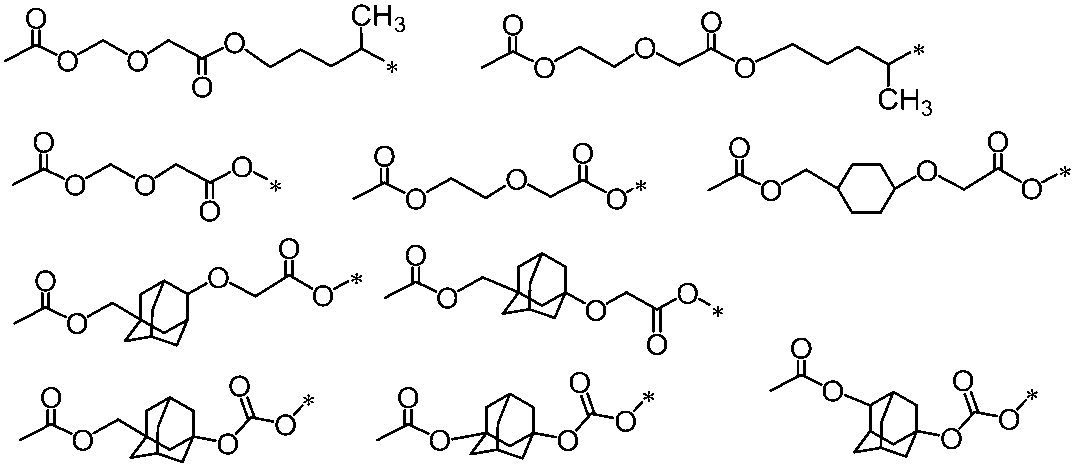

式(b1-2)で表される基としては、以下のものが挙げられる。
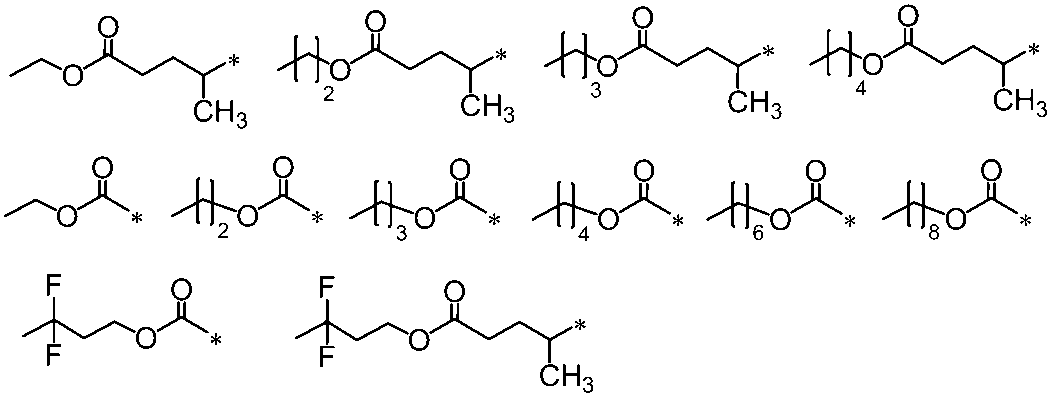
式(b1-3)で表される基としては、以下のものが挙げられる。

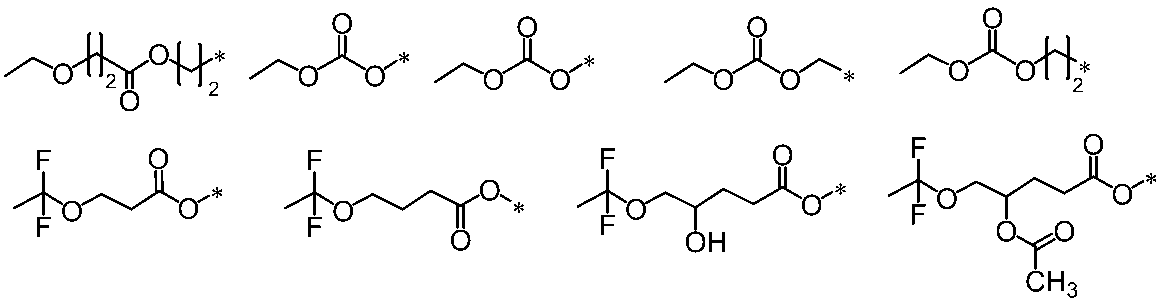
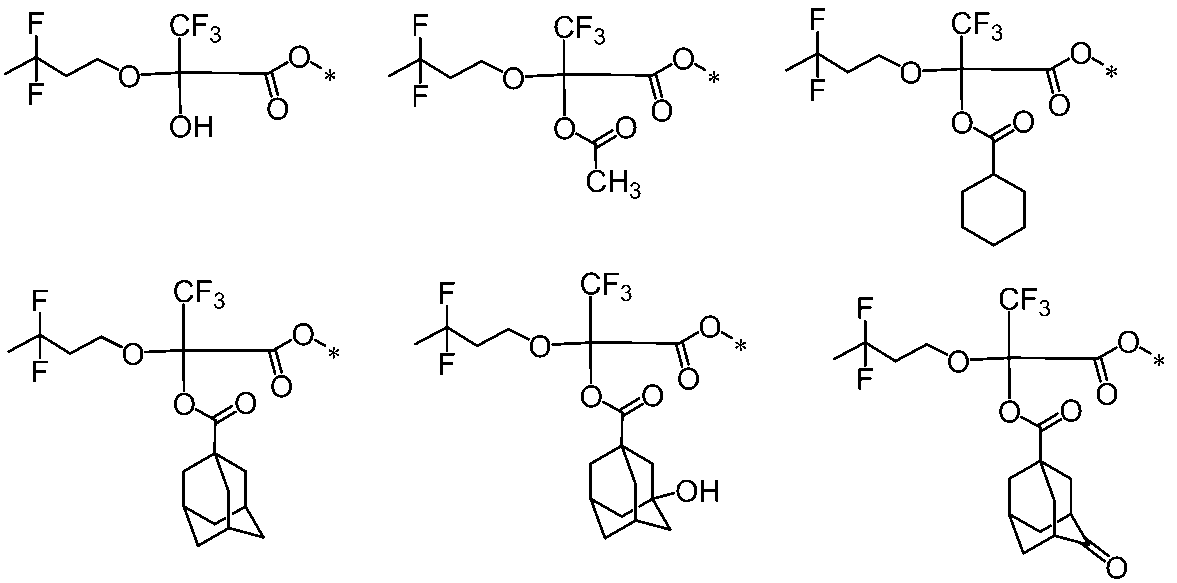

Yで表される脂環式炭化水素基としては、式(Y1)~式(Y11)で表される基が挙げられる。
Yで表される脂環式炭化水素基に含まれる-CH2-が-O-、-SO2-又は-CO-で置き換わる場合、その数は1つでもよいし、2以上の複数でもよい。そのような基としては、式(Y12)~式(Y38)で表される基が挙げられる。

When -CH 2- contained in the alicyclic hydrocarbon group represented by Y is replaced by -O-, -SO 2- or -CO-, the number may be one or two or more. .. Examples of such a group include groups represented by the formulas (Y12) to (Y38).
つまり、Yは、脂環式炭化水素基に含まれる水素原子2つがそれぞれ、酸素原子に置換され、その2つの酸素原子が炭素数1~8のアルカンジイル基と一緒になってケタール環を形成してもよいし、異なる炭素原子にそれぞれ酸素原子が結合した構造を含んでいてもよい。ただし、式(Y28)~式(Y33)等のスピロ環を構成する場合には、2つの酸素間のアルカンジイル基は、1以上のフッ素原子を有することが好ましい。また、ケタール構造に含まれるアルカンジイル基のうち、酸素原子に隣接するメチレン基には、フッ素原子が置換されていないものが好ましい。 That is, in Y, two hydrogen atoms contained in the alicyclic hydrocarbon group are each replaced with an oxygen atom, and the two oxygen atoms are combined with an arcandyl group having 1 to 8 carbon atoms to form a ketal ring. It may contain a structure in which an oxygen atom is bonded to different carbon atoms. However, when forming a spiro ring of the formulas (Y28) to (Y33), it is preferable that the alkanediyl group between the two oxygens has one or more fluorine atoms. Further, among the alkanediyl groups contained in the ketal structure, those in which the fluorine atom is not substituted in the methylene group adjacent to the oxygen atom are preferable.
中でも、好ましくは式(Y1)~式(Y20)、式(Y30)、式(Y31)のいずれかで表される基が挙げられ、より好ましくは式(Y11)、式(Y15)、式(Y16)、式(Y19)、式(Y20)、式(Y30)又は式(Y31)で表される基が挙げられ、さらに好ましくは式(Y11)、式(Y15)、式(Y20)又は式(Y30)で表される基が挙げられる。 Among them, a group represented by any one of the formula (Y1) to the formula (Y20), the formula (Y30), and the formula (Y31) is preferable, and the formula (Y11), the formula (Y15), and the formula (Y31) are more preferable. Examples include groups represented by Y16), formula (Y19), formula (Y20), formula (Y30) or formula (Y31), more preferably formula (Y11), formula (Y15), formula (Y20) or formula. Examples include the group represented by (Y30).
Yで表される脂環式炭化水素基の置換基としては、ハロゲン原子、ヒドロキシ基、炭素数1~12のアルキル基、ヒドロキシ基含有炭素数1~12のアルキル基、炭素数3~16の脂環式炭化水素基、炭素数1~12のアルコキシ基、炭素数6~18の芳香族炭化水素基、炭素数7~21のアラルキル基、炭素数2~4のアルキルカルボニル基、グリシジルオキシ基又は-(CH2)ja-O-CO-Rb1基(式中、Rb1は、炭素数1~16のアルキル基、炭素数3~16の脂環式炭化水素基又は炭素数6~18の芳香族炭化水素基を表す。jaは、0~4のいずれかの整数を表す)等が挙げられる。 The substituent of the alicyclic hydrocarbon group represented by Y includes a halogen atom, a hydroxy group, an alkyl group having 1 to 12 carbon atoms, an alkyl group containing a hydroxy group having 1 to 12 carbon atoms, and 3 to 16 carbon atoms. Alicyclic hydrocarbon group, alkoxy group with 1 to 12 carbon atoms, aromatic hydrocarbon group with 6 to 18 carbon atoms, aralkyl group with 7 to 21 carbon atoms, alkylcarbonyl group with 2 to 4 carbon atoms, glycidyloxy group Or-(CH 2 ) ja -O-CO-R b1 group (in the formula, R b1 is an alkyl group having 1 to 16 carbon atoms, an alicyclic hydrocarbon group having 3 to 16 carbon atoms or 6 to 18 carbon atoms. Represents the aromatic hydrocarbon group of. Ja represents an integer of 0 to 4) and the like.
ヒドロキシ基含有アルキル基としては、ヒドロキシメチル基、ヒドロキシエチル基等が挙げられる。
アルコキシ基としては、メトキシ基、エトキシ基、プロポキシ基、ブトキシ基、ペンチルオキシ基、ヘキシルオキシ基、ヘプチルオキシ基、オクチルオキシ基、デシルオキシ基及びドデシルオキシ基等が挙げられる。
芳香族炭化水素基としては、フェニル基、ナフチル基、アントリル基、p-メチルフェニル基、p-tert-ブチルフェニル基、p-アダマンチルフェニル基;トリル基、キシリル基、クメニル基、メシチル基、ビフェニル基、フェナントリル基、2,6-ジエチルフェニル基、2-メチル-6-エチルフェニル基等のアリール基等が挙げられる。
アラルキル基としては、ベンジル基、フェネチル基、フェニルプロピル基、ナフチルメチル基及びナフチルエチル基等が挙げられる。
アルキルカルボニル基としては、例えば、アセチル基、プロピオニル基及びブチリル基等が挙げられる。
ハロゲン原子としては、フッ素原子、塩素原子、臭素原子及びヨウ素原子等が挙げられる。
Examples of the hydroxy group-containing alkyl group include a hydroxymethyl group and a hydroxyethyl group.
Examples of the alkoxy group include a methoxy group, an ethoxy group, a propoxy group, a butoxy group, a pentyloxy group, a hexyloxy group, a heptyloxy group, an octyloxy group, a decyloxy group and a dodecyloxy group.
Examples of the aromatic hydrocarbon group include phenyl group, naphthyl group, anthryl group, p-methylphenyl group, p-tert-butylphenyl group and p-adamantylphenyl group; tolyl group, xylyl group, cumenyl group, mesityl group and biphenyl. Examples thereof include an aryl group such as a group, a phenanthryl group, a 2,6-diethylphenyl group and a 2-methyl-6-ethylphenyl group.
Examples of the aralkyl group include a benzyl group, a phenethyl group, a phenylpropyl group, a naphthylmethyl group and a naphthylethyl group.
Examples of the alkylcarbonyl group include an acetyl group, a propionyl group, a butyryl group and the like.
Examples of the halogen atom include a fluorine atom, a chlorine atom, a bromine atom and an iodine atom.
Yとしては、以下のものが挙げられる。


Yは、好ましくは置換基を有していてもよい炭素数3~18の脂環式炭化水素基であり、より好ましく置換基を有していてもよいアダマンチル基であり、これらの基を構成するメチレン基は、酸素原子、スルホニル基又はカルボニル基に置き換わっていてもよい。Yは、さらに好ましくはアダマンチル基、ヒドロキシアダマンチル基又はオキソアダマンチル基又は下記で表される基である。

酸発生剤(B1)におけるスルホン酸アニオンとしては、式(B1-A-1)~式(B1-A-55)で表されるアニオン〔以下、式番号に応じて「アニオン(B1-A-1)」等という場合がある。〕が好ましく、式(B1-A-1)~式(B1-A-4)、式(B1-A-9)、式(B1-A-10)、式(B1-A-24)~式(B1-A-33)、式(B1-A-36)~式(B1-A-40)、式(B1-A-47)~式(B1-A-55)のいずれかで表されるアニオンがより好ましい。




ここでRi2~Ri7は、例えば、炭素数1~4のアルキル基、好ましくはメチル基又はエチル基である。
Ri8は、例えば、炭素数1~12の脂肪族炭化水素基であり、好ましくは炭素数1~4のアルキル基、炭素数5~12の脂環式炭化水素基又はこれらを組合せることにより形成される基であり、より好ましくはメチル基、エチル基、シクロヘキシル基又はアダマンチル基である。
L44は、単結合又は炭素数1~4のアルカンジイル基である。
Q1及びQ2は、上記と同じ意味を表す。
酸発生剤(B1)におけるアニオンとしては、具体的には、特開2010-204646号公報に記載されたアニオンが挙げられる。
Here, R i2 to R i7 are, for example, an alkyl group having 1 to 4 carbon atoms, preferably a methyl group or an ethyl group.
R i8 is, for example, an aliphatic hydrocarbon group having 1 to 12 carbon atoms, preferably an alkyl group having 1 to 4 carbon atoms, an alicyclic hydrocarbon group having 5 to 12 carbon atoms, or a combination thereof. It is a group formed, more preferably a methyl group, an ethyl group, a cyclohexyl group or an adamantyl group.
L 44 is a single bond or an alkanediyl group having 1 to 4 carbon atoms.
Q1 and Q2 have the same meanings as above.
Specific examples of the anion in the acid generator (B1) include the anion described in JP-A-2010-204646.
酸発生剤(B1における好ましいアニオンとしては、式(B1a-1)~式(B1a-34)でそれぞれ表されるアニオンが挙げられる。
なかでも、式(B1a-1)~式(B1a-3)及び式(B1a-7)~式(B1a-16)、式(B1a-18)、式(B1a-19)、式(B1a-22)~式(B1a-34)のいずれかで表されるアニオンが好ましい。
Z+の有機カチオンとしては、有機オニウムカチオン、例えば有機スルホニウムカチオン、有機ヨードニウムカチオン、有機アンモニウムカチオン、有機ベンゾチアゾリウムカチオン及び有機ホスホニウムカチオンなどが挙げられ、中でも有機スルホニウムカチオン及び有機ヨードニウムカチオンが好ましく、アリールスルホニウムカチオンがより好ましい。
Among them, the formulas (B1a-1) to (B1a-3) and the formulas (B1a-7) to (B1a-16), the formulas (B1a-18), the formulas (B1a-19), and the formulas (B1a-22). )-Anion represented by any of the formulas (B1a-34) is preferable.
Examples of the Z + organic cation include organic onium cations such as organic sulfonium cations, organic iodine cations, organic ammonium cations, organic benzothiazolium cations and organic phosphonium cations, and among them, organic sulfonium cations and organic iodine cations are preferable. , Arylsulfonium cations are more preferred.
Z+で表される有機カチオンは、好ましくは式(b2-1)~式(b2-4)のいずれかで表されるカチオン〔以下、式番号に応じて「カチオン(b2-1)」等という場合がある。〕である。

Rb4~Rb6は、互いに独立に、炭素数1~30の脂肪族炭化水素基、炭素数3~36の脂環式炭化水素基又は炭素数6~36の芳香族炭化水素基を表し、該脂肪族炭化水素基に含まれる水素原子は、ヒドロキシ基、炭素数1~12のアルコキシ基、炭素数3~12の脂環式炭化水素基又は炭素数6~18の芳香族炭化水素基で置換されていてもよく、該脂環式炭化水素基に含まれる水素原子は、ハロゲン原子、炭素数1~18の脂肪族炭化水素基、炭素数2~4のアルキルカルボニル基又はグリシジルオキシ基で置換されていてもよく、該芳香族炭化水素基に含まれる水素原子は、ハロゲン原子、ヒドロキシ基又は炭素数1~12のアルコキシ基で置換されていてもよい。
Rb4とRb5とは、それらが結合する硫黄原子とともに環を形成してもよく、該環に含まれる-CH2-は、-O-、-SO-又は-CO-に置き換わってもよい。
Rb7及びRb8は、互いに独立に、ヒドロキシ基、炭素数1~12の脂肪族炭化水素基又は炭素数1~12のアルコキシ基を表す。
m2及びn2は、互いに独立に0~5のいずれかの整数を表す。
m2が2以上のとき、複数のRb7は同一であっても異なってもよく、n2が2以上のとき、複数のRb8は同一であっても異なってもよい。
Rb9及びRb10は、互いに独立に、炭素数1~36の脂肪族炭化水素基又は炭素数3~36の脂環式炭化水素基を表す。
Rb9とRb10とは、それらが結合する硫黄原子とともに環を形成してもよく、該環に含まれる-CH2-は、-O-、-SO-又は-CO-に置き換わってもよい。
Rb11は、水素原子、炭素数1~36の脂肪族炭化水素基、炭素数3~36の脂環式炭化水素基又は炭素数6~18の芳香族炭化水素基を表す。
Rb12は、炭素数1~12の脂肪族炭化水素基、炭素数3~18の脂環式炭化水素基又は炭素数6~18の芳香族炭化水素基を表し、該脂肪族炭化水素に含まれる水素原子は、炭素数6~18の芳香族炭化水素基で置換されていてもよく、該芳香族炭化水素基に含まれる水素原子は、炭素数1~12のアルコキシ基又は炭素数1~12のアルキルカルボニルオキシ基で置換されていてもよい。
Rb11とRb12とは、一緒になってそれらが結合する-CH-CO-を含む環を形成していてもよく、該環に含まれる-CH2-は、-O-、-SO-又は-CO-に置き換わってもよい。
Rb13~Rb18は、互いに独立に、ヒドロキシ基、炭素数1~12の脂肪族炭化水素基又は炭素数1~12のアルコキシ基を表す。
Lb31は、-S-又は-O-を表す。
o2、p2、s2、及びt2は、互いに独立に、0~5のいずれかの整数を表す。
q2及びr2は、互いに独立に、0~4のいずれかの整数を表す。
u2は、0又は1を表す。
o2が2以上のとき、複数のRb13は同一であっても異なってもよく、p2が2以上のとき、複数のRb14は同一であっても異なってもよく、q2が2以上のとき、複数のRb15は同一であっても異なってもよく、r2が2以上のとき、複数のRb16は同一であっても異なってもよく、s2が2以上のとき、複数のRb17は同一であっても異なってもよく、t2が2以上のとき、複数のRb18は同一であっても異なってもよい。]
The organic cation represented by Z + is preferably a cation represented by any of the formulas (b2-1) to (b2-4) [hereinafter, "cation (b2-1)" or the like according to the formula number. In some cases. ].
R b4 to R b6 independently represent an aliphatic hydrocarbon group having 1 to 30 carbon atoms, an alicyclic hydrocarbon group having 3 to 36 carbon atoms, or an aromatic hydrocarbon group having 6 to 36 carbon atoms. The hydrogen atom contained in the aliphatic hydrocarbon group is a hydroxy group, an alkoxy group having 1 to 12 carbon atoms, an alicyclic hydrocarbon group having 3 to 12 carbon atoms, or an aromatic hydrocarbon group having 6 to 18 carbon atoms. It may be substituted, and the hydrogen atom contained in the alicyclic hydrocarbon group is a halogen atom, an aliphatic hydrocarbon group having 1 to 18 carbon atoms, an alkylcarbonyl group having 2 to 4 carbon atoms or a glycidyloxy group. It may be substituted, and the hydrogen atom contained in the aromatic hydrocarbon group may be substituted with a halogen atom, a hydroxy group or an alkoxy group having 1 to 12 carbon atoms.
R b4 and R b5 may form a ring together with the sulfur atom to which they are bonded, and -CH 2- contained in the ring may be replaced with -O-, -SO- or -CO-. ..
R b7 and R b8 independently represent a hydroxy group, an aliphatic hydrocarbon group having 1 to 12 carbon atoms, or an alkoxy group having 1 to 12 carbon atoms.
m2 and n2 represent an integer of 0 to 5 independently of each other.
When m2 is 2 or more, the plurality of R b7s may be the same or different, and when n2 is 2 or more, the plurality of R b8s may be the same or different.
R b9 and R b10 independently represent an aliphatic hydrocarbon group having 1 to 36 carbon atoms or an alicyclic hydrocarbon group having 3 to 36 carbon atoms.
R b9 and R b10 may form a ring together with the sulfur atom to which they are bonded, and -CH 2- contained in the ring may be replaced with -O-, -SO- or -CO-. ..
R b11 represents a hydrogen atom, an aliphatic hydrocarbon group having 1 to 36 carbon atoms, an alicyclic hydrocarbon group having 3 to 36 carbon atoms, or an aromatic hydrocarbon group having 6 to 18 carbon atoms.
R b12 represents an aliphatic hydrocarbon group having 1 to 12 carbon atoms, an alicyclic hydrocarbon group having 3 to 18 carbon atoms, or an aromatic hydrocarbon group having 6 to 18 carbon atoms, and is contained in the aliphatic hydrocarbon group. The hydrogen atom may be substituted with an aromatic hydrocarbon group having 6 to 18 carbon atoms, and the hydrogen atom contained in the aromatic hydrocarbon group may be an alkoxy group having 1 to 12 carbon atoms or 1 to 12 carbon atoms. It may be substituted with 12 alkylcarbonyloxy groups.
R b11 and R b12 may be used together to form a ring containing -CH-CO- to which they are bound, and -CH 2- contained in the ring is -O-, -SO-. Alternatively, it may be replaced with -CO-.
R b13 to R b18 independently represent a hydroxy group, an aliphatic hydrocarbon group having 1 to 12 carbon atoms, or an alkoxy group having 1 to 12 carbon atoms.
L b31 represents —S— or —O—.
o2, p2, s2, and t2 represent an integer of 0 to 5 independently of each other.
q2 and r2 represent an integer of 0 to 4 independently of each other.
u2 represents 0 or 1.
When o2 is 2 or more, a plurality of R b13s may be the same or different, when p2 is 2 or more, a plurality of R b14s may be the same or different, and when q2 is 2 or more. , A plurality of R b15s may be the same or different, and when r2 is 2 or more, a plurality of R b16s may be the same or different, and when s2 is 2 or more, a plurality of R b17s may be present. It may be the same or different, and when t2 is 2 or more, a plurality of R b18s may be the same or different. ]
脂肪族炭化水素基としては、メチル基、エチル基、n-プロピル基、イソプロピル基、n-ブチル基、sec-ブチル基、tert-ブチル基、ペンチル基、ヘキシル基、オクチル基及び2-エチルヘキシル基のアルキル基が挙げられる。特に、Rb9~Rb12の脂肪族炭化水素基は、好ましくは炭素数1~12である。
脂環式炭化水素基としては、単環式又は多環式のいずれでもよく、単環式の脂環式炭化水素基としては、シクロプロピル基、シクロブチル基、シクロペンチル基、シクロへキシル基、シクロヘプチル基、シクロオクチル基、シクロデシル基等のシクロアルキル基が挙げられる。多環式の脂環式炭化水素基としては、デカヒドロナフチル基、アダマンチル基、ノルボルニル基及び下記の基等が挙げられる。

The alicyclic hydrocarbon group may be either a monocyclic group or a polycyclic group, and the monocyclic alicyclic hydrocarbon group includes a cyclopropyl group, a cyclobutyl group, a cyclopentyl group, a cyclohexyl group and a cyclo. Cycloalkyl groups such as a heptyl group, a cyclooctyl group and a cyclodecyl group can be mentioned. Examples of the polycyclic alicyclic hydrocarbon group include a decahydronaphthyl group, an adamantyl group, a norbornyl group and the following groups.
特に、Rb9~Rb12の脂環式炭化水素基の炭素数は、好ましくは3~18であり、より好ましくは4~12である。 In particular, the alicyclic hydrocarbon group of R b9 to R b12 preferably has 3 to 18 carbon atoms, and more preferably 4 to 12 carbon atoms.
水素原子が脂肪族炭化水素基で置換された脂環式炭化水素基としては、例えば、メチルシクロヘキシル基、ジメチルシクロへキシル基、2-アルキルアダマンタン-2-イル基、メチルノルボルニル基、イソボルニル基等が挙げられる。水素原子が脂肪族炭化水素基で置換された脂環式炭化水素基においては、脂環式炭化水素基と脂肪族炭化水素基との合計炭素数が好ましくは20以下である。 Examples of the alicyclic hydrocarbon group in which the hydrogen atom is substituted with an aliphatic hydrocarbon group include a methylcyclohexyl group, a dimethylcyclohexyl group, a 2-alkyladamantan-2-yl group, a methylnorbornyl group and an isobornyl group. The group etc. can be mentioned. In the alicyclic hydrocarbon group in which the hydrogen atom is substituted with an aliphatic hydrocarbon group, the total carbon number of the alicyclic hydrocarbon group and the aliphatic hydrocarbon group is preferably 20 or less.
芳香族炭化水素基としては、フェニル基、トリル基、キシリル基、クメニル基、メシチル基、p-エチルフェニル基、p-tert-ブチルフェニル基、p-シクロへキシルフェニル基、p-アダマンチルフェニル基、ビフェニリル基、ナフチル基、フェナントリル基、2,6-ジエチルフェニル基、2-メチル-6-エチルフェニル基等のアリール基が挙げられる。
芳香族炭化水素基に、脂肪族炭化水素基又は脂環式炭化水素基が含まれる場合は、炭素数1~18の脂肪族炭化水素基及び炭素数3~18の脂環式炭化水素基が好ましい。
水素原子がアルコキシ基で置換された芳香族炭化水素基としては、p-メトキシフェニル基等が挙げられる。
水素原子が芳香族炭化水素基で置換された脂肪族炭化水素基としては、ベンジル基、フェネチル基、フェニルプロピル基、トリチル基、ナフチルメチル基、ナフチルエチル基等のアラルキル基が挙げられる。
Examples of the aromatic hydrocarbon group include phenyl group, trill group, xsilyl group, cumenyl group, mesityl group, p-ethylphenyl group, p-tert-butylphenyl group, p-cyclohexylphenyl group and p-adamantylphenyl group. , Biphenylyl group, naphthyl group, phenanthryl group, 2,6-diethylphenyl group, 2-methyl-6-ethylphenyl group and other aryl groups.
When the aromatic hydrocarbon group contains an aliphatic hydrocarbon group or an alicyclic hydrocarbon group, an aliphatic hydrocarbon group having 1 to 18 carbon atoms and an alicyclic hydrocarbon group having 3 to 18 carbon atoms are included. preferable.
Examples of the aromatic hydrocarbon group in which the hydrogen atom is substituted with an alkoxy group include a p-methoxyphenyl group and the like.
Examples of the aliphatic hydrocarbon group in which the hydrogen atom is substituted with an aromatic hydrocarbon group include an aralkyl group such as a benzyl group, a phenethyl group, a phenylpropyl group, a trityl group, a naphthylmethyl group and a naphthylethyl group.
アルコキシ基としては、メトキシ基、エトキシ基、プロポキシ基、ブトキシ基、ペンチルオキシ基、ヘキシルオキシ基、ヘプチルオキシ基、オクチルオキシ基、デシルオキシ基及びドデシルオキシ基等が挙げられる。
アルキルカルボニル基としては、アセチル基、プロピオニル基及びブチリル基等が挙げられる。
ハロゲン原子としては、フッ素原子、塩素原子、臭素原子及びヨウ素原子等が挙げられる。
アルキルカルボニルオキシ基としては、メチルカルボニルオキシ基、エチルカルボニルオキシ基、n-プロピルカルボニルオキシ基、イソプロピルカルボニルオキシ基、n-ブチルカルボニルオキシ基、sec-ブチルカルボニルオキシ基、tert-ブチルカルボニルオキシ基、ペンチルカルボニルオキシ基、ヘキシルカルボニルオキシ基、オクチルカルボニルオキシ基及び2-エチルヘキシルカルボニルオキシ基等が挙げられる。
Examples of the alkoxy group include a methoxy group, an ethoxy group, a propoxy group, a butoxy group, a pentyloxy group, a hexyloxy group, a heptyloxy group, an octyloxy group, a decyloxy group and a dodecyloxy group.
Examples of the alkylcarbonyl group include an acetyl group, a propionyl group, a butyryl group and the like.
Examples of the halogen atom include a fluorine atom, a chlorine atom, a bromine atom and an iodine atom.
Examples of the alkylcarbonyloxy group include a methylcarbonyloxy group, an ethylcarbonyloxy group, an n-propylcarbonyloxy group, an isopropylcarbonyloxy group, an n-butylcarbonyloxy group, a sec-butylcarbonyloxy group, and a tert-butylcarbonyloxy group. Examples thereof include a pentylcarbonyloxy group, a hexylcarbonyloxy group, an octylcarbonyloxy group and a 2-ethylhexylcarbonyloxy group.
Rb4とRb5とがそれらが結合している硫黄原子とともに形成してもよい環は、単環式、多環式、芳香族性、非芳香族性、飽和及び不飽和のいずれの環であってもよい。この環としては、炭素数3~18の環が挙げられ、好ましくは炭素数4~18の環が挙げられる。また、硫黄原子を含む環としては、3員環~12員環が挙げられ、好ましくは3員環~7員環が挙げられ、具体的には下記の環が挙げられる。

Rb9とRb10とがそれらが結合している硫黄原子とともに形成する環は、単環式、多環式、芳香族性、非芳香族性、飽和及び不飽和のいずれの環であってもよい。この環としては、3員環~12員環が挙げられ、好ましくは3員環~7員環が挙げられ、例えば、チオラン-1-イウム環(テトラヒドロチオフェニウム環)、チアン-1-イウム環、1,4-オキサチアン-4-イウム環等が挙げられる。
Rb11とRb12とが一緒になって形成する環は、単環式、多環式、芳香族性、非芳香族性、飽和及び不飽和のいずれの環であってもよい。この環としては、3員環~12員環が挙げられ、好ましくは3員環~7員環が挙げられ、例えば、オキソシクロヘプタン環、オキソシクロヘキサン環、オキソノルボルナン環、オキソアダマンタン環等が挙げられる。
The ring formed by R b9 and R b10 together with the sulfur atom to which they are bonded may be monocyclic, polycyclic, aromatic, non-aromatic, saturated or unsaturated. good. Examples of this ring include a 3-membered ring to a 12-membered ring, preferably a 3-membered ring to a 7-membered ring, and examples thereof include a thiolan-1-ium ring (tetrahydrothiophenium ring) and a thian-1-ium. Rings, 1,4-oxatian-4-ium rings and the like can be mentioned.
The ring formed by R b11 and R b12 together may be monocyclic, polycyclic, aromatic, non-aromatic, saturated or unsaturated. Examples of this ring include a 3-membered ring to a 12-membered ring, preferably a 3-membered ring to a 7-membered ring, and examples thereof include an oxocycloheptane ring, an oxocyclohexane ring, an oxonorbornane ring, and an oxoadamantane ring. Be done.
カチオン(b2-1)~カチオン(b2-4)の中で、好ましくはカチオン(b2-1)が挙げられる。 Among the cations (b2-1) to cations (b2-4), cations (b2-1) are preferable.
カチオン(b2-1)としては、以下のカチオンが挙げられる。

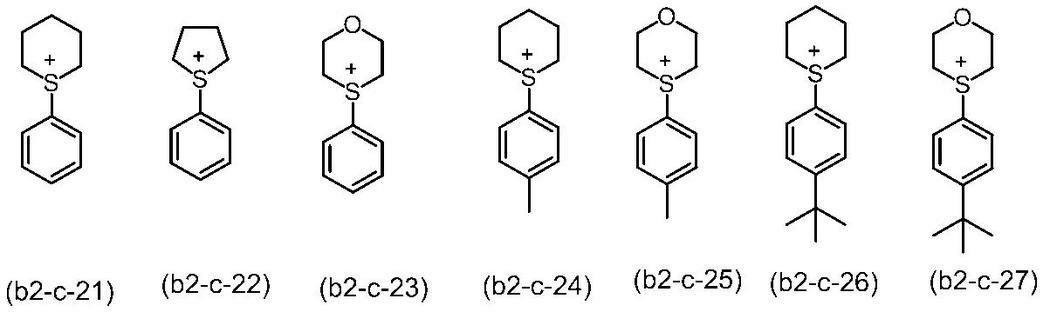
カチオン(b2-2)としては、以下のカチオンが挙げられる。

カチオン(b2-3)としては、以下のカチオンが挙げられる。

カチオン(b2-4)としては、以下のカチオンが挙げられる。

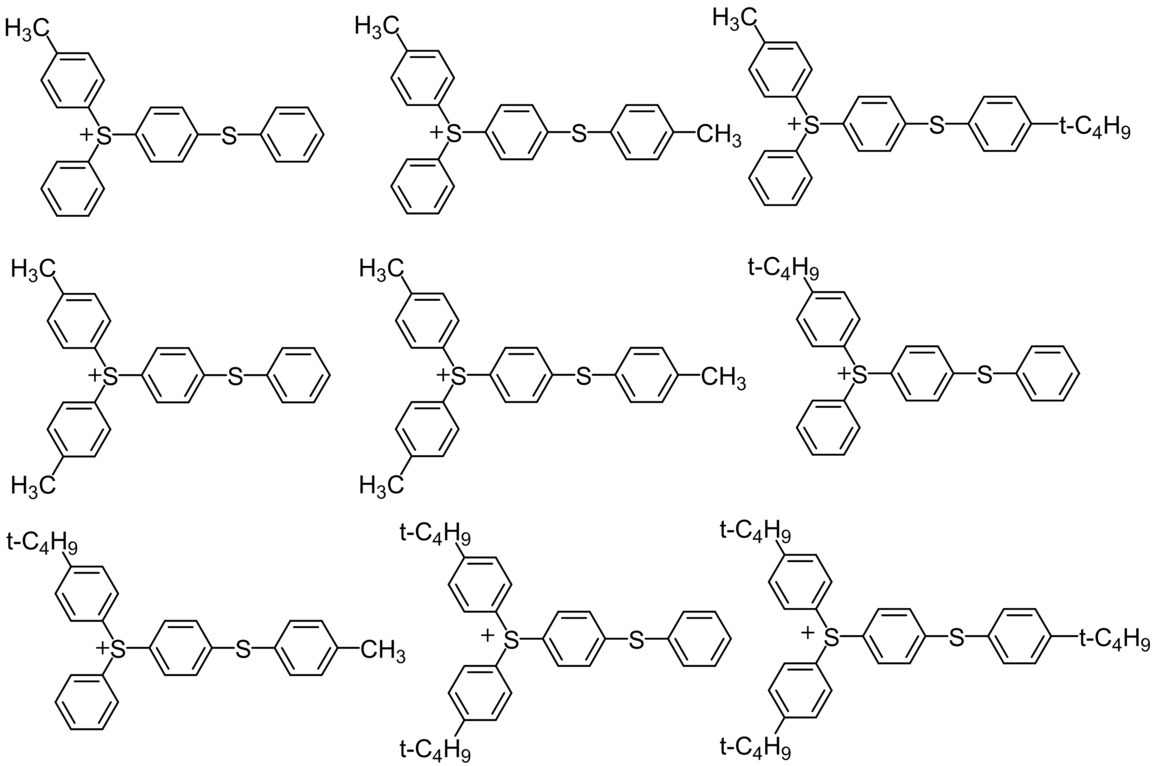
酸発生剤(B1)は、上述のスルホン酸アニオン及び上述の有機カチオンの組合せであり、これらは任意に組合せることができる。酸発生剤(B1)としては、好ましくは式(B1a-1)~式(B1a-3)及び式(B1a-7)~式(B1a-16)、式(B1a-18)、式(B1a-19)、式(B1a-22)~式(B1a-34)のいずれかで表されるアニオンとカチオン(b2-1)との組合せが挙げられる。 The acid generator (B1) is a combination of the above-mentioned sulfonic acid anion and the above-mentioned organic cation, and these can be arbitrarily combined. As the acid generator (B1), the formulas (B1a-1) to (B1a-3), the formulas (B1a-7) to the formulas (B1a-16), the formulas (B1a-18), and the formulas (B1a-) are preferable. 19), a combination of an anion represented by any of the formulas (B1a-22) to (B1a-34) and a cation (b2-1) can be mentioned.
酸発生剤(B1)としては、好ましくは式(B1-1)~式(B1-48)でそれぞれ表されるものが挙げられ、好ましくはアリールスルホニウムカチオンを含む式(B1-1)~式(B1-3)、式(B1-5)~式(B1-7)、式(B1-11)~式(B1-14)、式(B1-17)、式(B1-20)~式(B1-26)、式(B1-29)、式(B1-31)~式(B1-48)でそれぞれ表されるものが挙げられる。
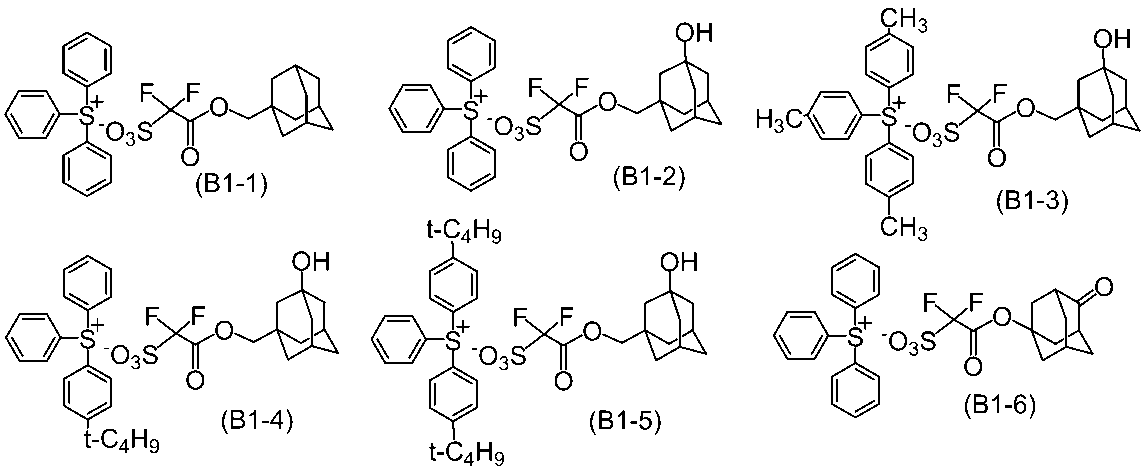
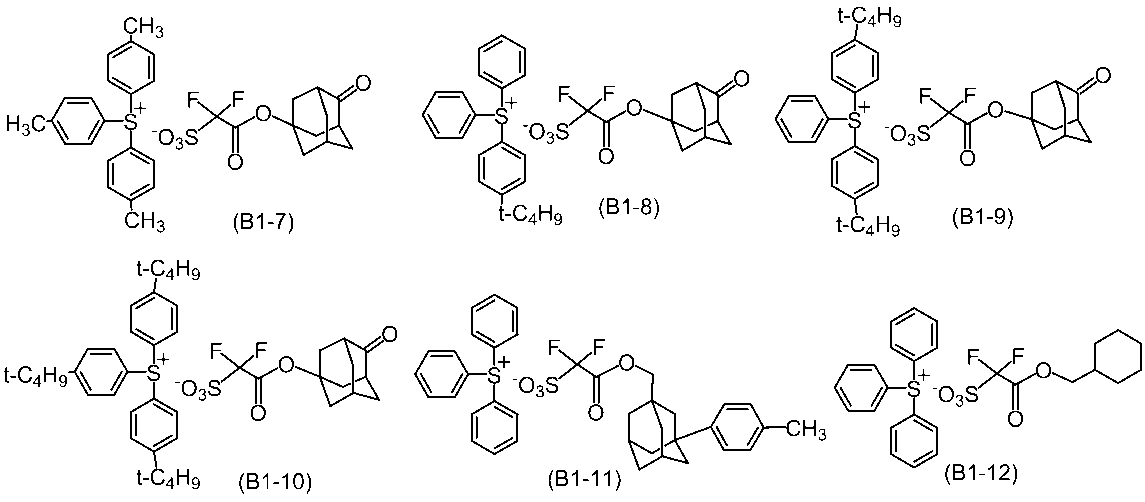


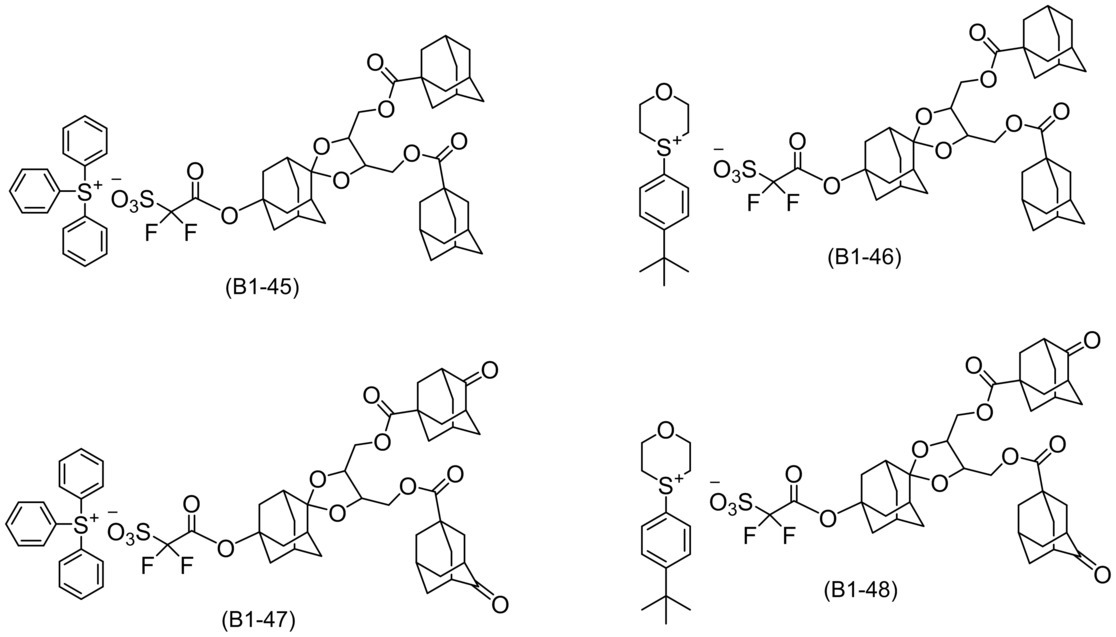
酸発生剤(B)は、酸発生剤(B1)以外の酸発生剤を含んでいてもよい。
本発明のレジスト組成物においては、酸発生剤(B1)は、1種を単独で含有してもよく、複数種を含有してもよい。
酸発生剤(B)の含有量は、樹脂(A)100質量部に対して、好ましくは1質量部以上(より好ましくは3質量部以上)、好ましくは40質量部以下(より好ましくは35質量部以下)である。
The acid generator (B) may contain an acid generator other than the acid generator (B1).
In the resist composition of the present invention, the acid generator (B1) may contain one kind alone or a plurality of kinds.
The content of the acid generator (B) is preferably 1 part by mass or more (more preferably 3 parts by mass or more), preferably 40 parts by mass or less (more preferably 35 parts by mass) with respect to 100 parts by mass of the resin (A). (Below).
<溶剤(E)>
溶剤(E)の含有率は、通常、レジスト組成物中90質量%以上、好ましくは92質量%以上、より好ましくは94質量%以上であり、99.9質量%以下、好ましくは99質量%以下である。溶剤(E)の含有率は、例えば液体クロマトグラフィー又はガスクロマトグラフィー等の公知の分析手段で測定できる。
<Solvent (E)>
The content of the solvent (E) is usually 90% by mass or more, preferably 92% by mass or more, more preferably 94% by mass or more, and 99.9% by mass or less, preferably 99% by mass or less in the resist composition. Is. The content of the solvent (E) can be measured by a known analytical means such as liquid chromatography or gas chromatography.
溶剤(E)としては、エチルセロソルブアセテート、メチルセロソルブアセテート及びプロピレングリコールモノメチルエーテルアセテート等のグリコールエーテルエステル類;プロピレングリコールモノメチルエーテル等のグリコールエーテル類;乳酸エチル、酢酸ブチル、酢酸アミル及びピルビン酸エチル等のエステル類;アセトン、メチルイソブチルケトン、2-ヘプタノン及びシクロヘキサノン等のケトン類;γ-ブチロラクトン等の環状エステル類;等を挙げることができる。溶剤(E)の1種を単独で含有してもよく、2種以上を含有してもよい。 Examples of the solvent (E) include glycol ether esters such as ethyl cellosolve acetate, methyl cellosolve acetate and propylene glycol monomethyl ether acetate; glycol ethers such as propylene glycol monomethyl ether; ethyl lactate, butyl acetate, amyl acetate and ethyl pyruvate. Esters; ketones such as acetone, methylisobutylketone, 2-heptanone and cyclohexanone; cyclic esters such as γ-butyrolactone; and the like. One type of solvent (E) may be contained alone, or two or more types may be contained.
<クエンチャー(C)>
本発明のレジスト組成物は、クエンチャー(以下「クエンチャー(C)」という場合がある)を含有していてもよい。クエンチャー(C)は、塩基性の含窒素有機化合物又は酸発生剤(B)よりも酸性度の弱い酸を発生する塩が挙げられる。
<Quencher (C)>
The resist composition of the present invention may contain a quencher (hereinafter, may be referred to as "quencher (C)"). Examples of the quencher (C) include a basic nitrogen-containing organic compound or a salt that generates an acid having a weaker acidity than the acid generator (B).
〈塩基性の含窒素有機化合物〉
塩基性の含窒素有機化合物としては、アミン及びアンモニウム塩が挙げられる。アミンとしては、脂肪族アミン及び芳香族アミンが挙げられる。脂肪族アミンとしては、第一級アミン、第二級アミン及び第三級アミンが挙げられる。
<Basic nitrogen-containing organic compounds>
Examples of the basic nitrogen-containing organic compound include amines and ammonium salts. Examples of amines include aliphatic amines and aromatic amines. Aliphatic amines include primary amines, secondary amines and tertiary amines.
具体的には、1-ナフチルアミン、2-ナフチルアミン、アニリン、ジイソプロピルアニリン、2-,3-又は4-メチルアニリン、4-ニトロアニリン、N-メチルアニリン、N,N-ジメチルアニリン、ジフェニルアミン、ヘキシルアミン、ヘプチルアミン、オクチルアミン、ノニルアミン、デシルアミン、ジブチルアミン、ジペンチルアミン、ジヘキシルアミン、ジヘプチルアミン、ジオクチルアミン、ジノニルアミン、ジデシルアミン、トリエチルアミン、トリメチルアミン、トリプロピルアミン、トリブチルアミン、トリペンチルアミン、トリヘキシルアミン、トリヘプチルアミン、トリオクチルアミン、トリノニルアミン、トリデシルアミン、メチルジブチルアミン、メチルジペンチルアミン、メチルジヘキシルアミン、メチルジシクロヘキシルアミン、メチルジヘプチルアミン、メチルジオクチルアミン、メチルジノニルアミン、メチルジデシルアミン、エチルジブチルアミン、エチルジペンチルアミン、エチルジヘキシルアミン、エチルジヘプチルアミン、エチルジオクチルアミン、エチルジノニルアミン、エチルジデシルアミン、ジシクロヘキシルメチルアミン、トリス〔2-(2-メトキシエトキシ)エチル〕アミン、トリイソプロパノールアミン、エチレンジアミン、テトラメチレンジアミン、ヘキサメチレンジアミン、4,4’-ジアミノ-1,2-ジフェニルエタン、4,4’-ジアミノ-3,3’-ジメチルジフェニルメタン、4,4’-ジアミノ-3,3’-ジエチルジフェニルメタン、2,2’-メチレンビスアニリン、イミダゾール、4-メチルイミダゾール、ピリジン、4-メチルピリジン、1,2-ジ(2-ピリジル)エタン、1,2-ジ(4-ピリジル)エタン、1,2-ジ(2-ピリジル)エテン、1,2-ジ(4-ピリジル)エテン、1,3-ジ(4-ピリジル)プロパン、1,2-ジ(4-ピリジルオキシ)エタン、ジ(2-ピリジル)ケトン、4,4’-ジピリジルスルフィド、4,4’-ジピリジルジスルフィド、2,2’-ジピリジルアミン、2,2’-ジピコリルアミン、ビピリジン等が挙げられ、好ましくはジイソプロピルアニリンが挙げられ、特に好ましくは2,6-ジイソプロピルアニリンが挙げられる。 Specifically, 1-naphthylamine, 2-naphthylamine, aniline, diisopropylaniline, 2-,3- or 4-methylaniline, 4-nitroaniline, N-methylaniline, N, N-dimethylaniline, diphenylamine, hexylamine. , Heptylamine, octylamine, nonylamine, decylamine, dibutylamine, dipentylamine, dihexylamine, diheptylamine, dioctylamine, dinonylamine, didecylamine, triethylamine, trimethylamine, tripropylamine, tributylamine, trypentylamine, trihexylamine, Triheptylamine, Trioctylamine, Trinonylamine, Tridecylamine, Methyldibutylamine, Methyldipentylamine, Methyldihexylamine, Methyldicyclohexylamine, Methyldiheptylamine, Methyldioctylamine, Methyldinonylamine, Methyldidecylamine , Ethyldibutylamine, ethyldipentylamine, ethyldihexylamine, ethyldiheptylamine, ethyldioctylamine, ethyldinonylamine, ethyldidecylamine, dicyclohexylmethylamine, tris [2- (2-methoxyethoxy) ethyl] amine, Triisopropanolamine, ethylenediamine, tetramethylenediamine, hexamethylenediamine, 4,4'-diamino-1,2-diphenylethane, 4,4'-diamino-3,3'-dimethyldiphenylmethane, 4,4'-diamino- 3,3'-diethyldiphenylmethane, 2,2'-methylenebisaniline, imidazole, 4-methylimidazole, pyridine, 4-methylpyridine, 1,2-di (2-pyridyl) ethane, 1,2-di (4) -Pyridyl) ethane, 1,2-di (2-pyridyl) ethene, 1,2-di (4-pyridyl) ethen, 1,3-di (4-pyridyl) propane, 1,2-di (4-pyridyl) Oxy) ethane, di (2-pyridyl) ketone, 4,4'-dipyridyl sulfide, 4,4'-dipyridyl disulfide, 2,2'-dipyridylamine, 2,2'-dipicorylamine, bipyridine and the like. , Preferably diisopropylaniline, and particularly preferably 2,6-diisopropylaniline.
アンモニウム塩としては、テトラメチルアンモニウムヒドロキシド、テトライソプロピルアンモニウムヒドロキシド、テトラブチルアンモニウムヒドロキシド、テトラヘキシルアンモニウムヒドロキシド、テトラオクチルアンモニウムヒドロキシド、フェニルトリメチルアンモニウムヒドロキシド、3-(トリフルオロメチル)フェニルトリメチルアンモニウムヒドロキシド、テトラ-n-ブチルアンモニウムサリチラート及びコリン等が挙げられる。 Examples of the ammonium salt include tetramethylammonium hydroxide, tetraisopropylammonium hydroxide, tetrabutylammonium hydroxide, tetrahexylammonium hydroxide, tetraoctylammonium hydroxide, phenyltrimethylammonium hydroxide, and 3- (trifluoromethyl) phenyltrimethyl. Ammonium hydroxide, tetra-n-butylammonium salicylate, choline and the like can be mentioned.
〈酸性度の弱い酸を発生する塩〉
酸発生剤から発生する酸よりも酸性度の弱い酸を発生する塩における酸性度は酸解離定数(pKa)で示される。酸発生剤から発生する酸よりも酸性度の弱い酸を発生する塩は、該塩から発生する酸のpKaが、通常-3<pKaの塩であり、好ましくは-1<pKa<7の塩であり、より好ましくは0<pKa<5の塩である。酸発生剤から発生する酸よりも弱い酸を発生する塩としては、下記式で表される塩、弱酸分子内塩(D)、並びに特開2012-229206号公報、特開2012-6908号公報、特開2012-72109号公報、特開2011-39502号公報及び特開2011-191745号公報記載の塩が挙げられる。

The acidity of a salt that produces an acid that is weaker than the acid generated by the acid generator is indicated by the acid dissociation constant (pKa). The salt that generates an acid having a weaker acidity than the acid generated from the acid generator is a salt in which the pKa of the acid generated from the salt is usually -3 <pKa, preferably -1 <pKa <7. It is more preferably a salt of 0 <pKa <5. Examples of the salt that generates an acid weaker than the acid generated from the acid generator include a salt represented by the following formula, a weak acid intramolecular salt (D), JP-A-2012-229206, and JP-A-2012-6908. , Japanese Patent Laid-Open No. 2012-72109, Japanese Patent Application Laid-Open No. 2011-39502, and Japanese Patent Application Laid-Open No. 2011-191745.

弱酸分子内塩(D)としては、以下の塩が挙げられる。
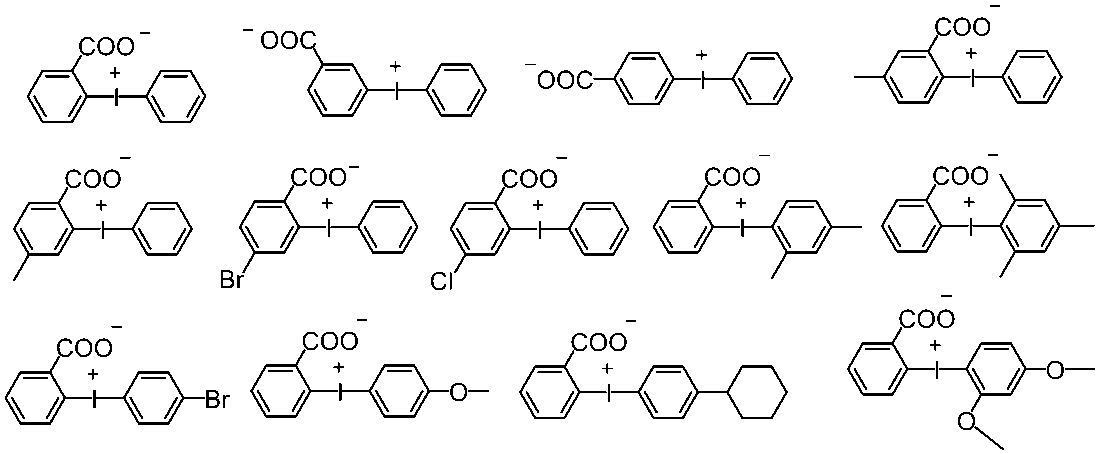
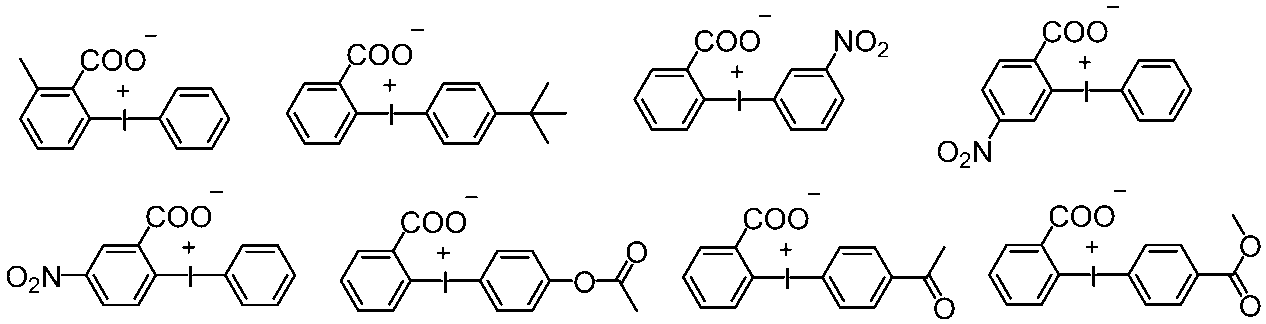
クエンチャー(C)の含有率は、レジスト組成物の固形分中、好ましくは、0.01~5質量%であり、より好ましく0.01~4質量%であり、特に好ましく0.01~3質量%である。 The content of the quencher (C) is preferably 0.01 to 5% by mass, more preferably 0.01 to 4% by mass, and particularly preferably 0.01 to 3% of the solid content of the resist composition. It is mass%.
〈その他の成分〉
本発明のレジスト組成物は、必要に応じて、上述の成分以外の成分(以下「その他の成分(F)」という場合がある。)を含有していてもよい。その他の成分(F)に特に限定はなく、レジスト分野で公知の添加剤、例えば、増感剤、溶解抑止剤、界面活性剤、安定剤、染料等を利用できる。
<Other ingredients>
If necessary, the resist composition of the present invention may contain a component other than the above-mentioned components (hereinafter, may be referred to as "other component (F)"). The other component (F) is not particularly limited, and additives known in the resist field, such as sensitizers, dissolution inhibitors, surfactants, stabilizers, dyes and the like, can be used.
〈レジスト組成物の調製〉
本発明のレジスト組成物は、本発明の樹脂(A)及び酸発生剤(B)、並びに、必要に応じて、樹脂(X)、クエンチャー(C)、溶剤(E)及びその他の成分(F)を混合することにより調製することができる。混合順は任意であり、特に限定されるものではない。混合する際の温度は、10~40℃から、樹脂等の種類や樹脂等の溶剤(E)に対する溶解度等に応じて適切な温度を選ぶことができる。混合時間は、混合温度に応じて、0.5~24時間の中から適切な時間を選ぶことができる。なお、混合手段も特に制限はなく、攪拌混合等を用いることができる。
各成分を混合した後は、孔径0.003~0.2μm程度のフィルターを用いてろ過することが好ましい。
<Preparation of resist composition>
The resist composition of the present invention comprises the resin (A) and the acid generator (B) of the present invention, and, if necessary, the resin (X), the quencher (C), the solvent (E) and other components ( It can be prepared by mixing F). The mixing order is arbitrary and is not particularly limited. The temperature at the time of mixing can be selected from 10 to 40 ° C., depending on the type of the resin or the like and the solubility of the resin or the like in the solvent (E). As the mixing time, an appropriate time can be selected from 0.5 to 24 hours depending on the mixing temperature. The mixing means is not particularly limited, and stirring and mixing or the like can be used.
After mixing each component, it is preferable to filter using a filter having a pore size of about 0.003 to 0.2 μm.
〈レジストパターンの製造方法〉
本発明のレジストパターンの製造方法は、
(1)本発明のレジスト組成物を基板上に塗布する工程、
(2)塗布後の組成物を乾燥させて組成物層を形成する工程、
(3)組成物層に露光する工程、
(4)露光後の組成物層を加熱する工程、及び
(5)加熱後の組成物層を現像する工程を含む。
<Manufacturing method of resist pattern>
The method for producing a resist pattern of the present invention is
(1) A step of applying the resist composition of the present invention onto a substrate,
(2) A step of drying the applied composition to form a composition layer,
(3) Step of exposing the composition layer,
It includes (4) a step of heating the composition layer after exposure and (5) a step of developing the composition layer after heating.
レジスト組成物を基板上に塗布するには、スピンコーター等、通常、用いられる装置によって行うことができる。基板としては、シリコンウェハ等の無機基板が挙げられる。レジスト組成物を塗布する前に、基板を洗浄してもよいし、基板上に反射防止膜等が形成されていてもよい。 The resist composition can be applied onto the substrate by a commonly used device such as a spin coater. Examples of the substrate include an inorganic substrate such as a silicon wafer. The substrate may be washed before the resist composition is applied, or an antireflection film or the like may be formed on the substrate.
塗布後の組成物を乾燥することにより、溶剤を除去し、組成物層を形成する。乾燥は、例えば、ホットプレート等の加熱装置を用いて溶剤を蒸発させること(いわゆるプリベーク)により行うか、あるいは減圧装置を用いて行う。加熱温度は50~200℃が好ましく、加熱時間は10~180秒間が好ましい。また、減圧乾燥する際の圧力は、1~1.0×10⁵Pa程度が好ましい。 By drying the composition after coating, the solvent is removed and a composition layer is formed. Drying is performed, for example, by evaporating the solvent using a heating device such as a hot plate (so-called pre-baking), or by using a depressurizing device. The heating temperature is preferably 50 to 200 ° C., and the heating time is preferably 10 to 180 seconds. The pressure for drying under reduced pressure is preferably about 1 to 1.0 × 10⁵ Pa.
得られた組成物層に、通常、露光機を用いて露光する。露光機は、液浸露光機であってもよい。露光光源としては、KrFエキシマレーザ(波長248nm)、ArFエキシマレーザ(波長193nm)、F2エキシマレーザ(波長157nm)のような紫外域のレーザ光を放射するもの、固体レーザ光源(YAG又は半導体レーザ等)からのレーザ光を波長変換して遠紫外域または真空紫外域の高調波レーザ光を放射するもの、電子線や、超紫外光(EUV)を照射するもの等、種々のものを用いることができる。尚、本明細書において、これらの放射線を照射することを総称して「露光」という場合がある。露光の際、通常、求められるパターンに相当するマスクを介して露光が行われる。露光光源が電子線の場合は、マスクを用いずに直接描画により露光してもよい。 The obtained composition layer is usually exposed using an exposure machine. The exposure machine may be an immersion exposure machine. The exposure light source includes a KrF excimer laser (wavelength 248 nm), an ArF excimer laser (wavelength 193 nm), an F 2 excima laser (wavelength 157 nm) that emits laser light in the ultraviolet region, and a solid-state laser light source (YAG or semiconductor laser). Etc.), and various ones such as those that radiate harmonic laser light in the far ultraviolet region or vacuum ultraviolet region by wavelength conversion, those that irradiate electron beams, super-ultraviolet light (EUV), etc. are used. Can be done. In addition, in this specification, irradiation of these radiations may be generically referred to as "exposure". At the time of exposure, the exposure is usually performed through a mask corresponding to the required pattern. When the exposure light source is an electron beam, it may be exposed by direct drawing without using a mask.
露光後の組成物層を、酸不安定基における脱保護反応を促進するために加熱処理(いわゆるポストエキスポジャーベーク)を行う。加熱温度は、通常50~200℃程度、好ましくは70~150℃程度である。 The composition layer after exposure is heat-treated (so-called post-exposure bake) in order to promote the deprotection reaction at the acid unstable group. The heating temperature is usually about 50 to 200 ° C, preferably about 70 to 150 ° C.
加熱後の組成物層を、通常、現像装置を用いて、現像液を利用して現像する。現像方法としては、ディップ法、パドル法、スプレー法、ダイナミックディスペンス法等が挙げられる。現像温度は5~60℃が好ましく、現像時間は5~300秒間が好ましい。現像液の種類を以下のとおりに選択することにより、ポジ型レジストパターン又はネガ型レジストパターンを製造できる。 The heated composition layer is usually developed using a developer and a developer. Examples of the developing method include a dip method, a paddle method, a spray method, and a dynamic dispense method. The development temperature is preferably 5 to 60 ° C., and the development time is preferably 5 to 300 seconds. A positive resist pattern or a negative resist pattern can be produced by selecting the type of developer as follows.
本発明のレジスト組成物からポジ型レジストパターンを製造する場合は、現像液としてアルカリ現像液を用いる。アルカリ現像液は、この分野で用いられる各種のアルカリ性水溶液であればよい。例えば、テトラメチルアンモニウムヒドロキシドや(2-ヒドロキシエチル)トリメチルアンモニウムヒドロキシド(通称コリン)の水溶液等が挙げられる。アルカリ現像液には、界面活性剤が含まれていてもよい。
現像後レジストパターンを超純水で洗浄し、次いで、基板及びパターン上に残った水を除去することが好ましい。
When producing a positive resist pattern from the resist composition of the present invention, an alkaline developer is used as the developer. The alkaline developer may be any alkaline aqueous solution used in this field. For example, an aqueous solution of tetramethylammonium hydroxide or (2-hydroxyethyl) trimethylammonium hydroxide (commonly known as choline) can be mentioned. The alkaline developer may contain a surfactant.
After development, it is preferable to wash the resist pattern with ultrapure water and then remove the substrate and the water remaining on the pattern.
本発明のレジスト組成物からネガ型レジストパターンを製造する場合は、現像液として有機溶剤を含む現像液(以下「有機系現像液」という場合がある)を用いる。
有機系現像液に含まれる有機溶剤としては、2-ヘキサノン、2-ヘプタノン等のケトン溶剤;プロピレングリコールモノメチルエーテルアセテート等のグリコールエーテルエステル溶剤;酢酸ブチル等のエステル溶剤;プロピレングリコールモノメチルエーテル等のグリコールエーテル溶剤;N,N-ジメチルアセトアミド等のアミド溶剤;アニソール等の芳香族炭化水素溶剤等が挙げられる。
有機系現像液中、有機溶剤の含有率は、90質量%以上100質量%以下が好ましく、95質量%以上100質量%以下がより好ましく、実質的に有機溶剤のみであることがさらに好ましい。
中でも、有機系現像液としては、酢酸ブチル及び/又は2-ヘプタノンを含む現像液が好ましい。有機系現像液中、酢酸ブチル及び2-ヘプタノンの合計含有率は、50質量%以上100質量%以下が好ましく、90質量%以上100質量%以下がより好ましく、実質的に酢酸ブチル及び/又は2-ヘプタノンのみであることがさらに好ましい。
有機系現像液には、界面活性剤が含まれていてもよい。また、有機系現像液には、微量の水分が含まれていてもよい。
現像の際、有機系現像液とは異なる種類の溶剤に置換することにより、現像を停止してもよい。
When a negative resist pattern is produced from the resist composition of the present invention, a developer containing an organic solvent (hereinafter, may be referred to as "organic developer") is used as the developer.
Examples of the organic solvent contained in the organic developer include a ketone solvent such as 2-hexanone and 2-heptanone; a glycol ether ester solvent such as propylene glycol monomethyl ether acetate; an ester solvent such as butyl acetate; and a glycol such as propylene glycol monomethyl ether. Examples include an ether solvent; an amide solvent such as N, N-dimethylacetamide; an aromatic hydrocarbon solvent such as anisole, and the like.
The content of the organic solvent in the organic developer is preferably 90% by mass or more and 100% by mass or less, more preferably 95% by mass or more and 100% by mass or less, and further preferably substantially only the organic solvent.
Among them, as the organic developer, a developer containing butyl acetate and / or 2-heptanone is preferable. The total content of butyl acetate and 2-heptanone in the organic developer is preferably 50% by mass or more and 100% by mass or less, more preferably 90% by mass or more and 100% by mass or less, and substantially butyl acetate and / or 2 -It is more preferable that it is only heptanone.
The organic developer may contain a surfactant. Further, the organic developer may contain a small amount of water.
At the time of development, the development may be stopped by substituting with a solvent of a type different from that of the organic developer.
現像後のレジストパターンをリンス液で洗浄することが好ましい。リンス液としては、レジストパターンを溶解しないものであれば特に制限はなく、一般的な有機溶剤を含む溶液を使用することができ、好ましくはアルコール溶剤又はエステル溶剤である。
洗浄後は、基板及びパターン上に残ったリンス液を除去することが好ましい。
It is preferable to wash the resist pattern after development with a rinsing solution. The rinsing solution is not particularly limited as long as it does not dissolve the resist pattern, and a solution containing a general organic solvent can be used, and an alcohol solvent or an ester solvent is preferable.
After cleaning, it is preferable to remove the rinse liquid remaining on the substrate and the pattern.
本発明のレジスト組成物では、樹脂(X)が、組成物層内において、表面で分布が高くなる傾向があり、液浸露光時における酸発生剤等の液浸露光液体への溶出を抑制できる。また、樹脂(X)に起因する上述した前進接触角及び後退接触角により、撥水性を発揮させて水滴が残らずに高速でのスキャン露光を可能にする。 In the resist composition of the present invention, the resin (X) tends to have a high distribution on the surface in the composition layer, and can suppress elution of an acid generator or the like into an immersion exposure liquid during immersion exposure. .. Further, the above-mentioned forward contact angle and backward contact angle caused by the resin (X) exert water repellency and enable high-speed scan exposure without leaving water droplets.
〈用途〉
本発明のレジスト組成物は、KrFエキシマレーザ露光用のレジスト組成物、ArFエキシマレーザ露光用のレジスト組成物、電子線(EB)露光用のレジスト組成物又はEUV露光用のレジスト組成物、特に電子線(EB)露光用のレジスト組成物又はEUV露光用のレジスト組成物として好適であり、半導体の微細加工に有用である。
<Use>
The resist composition of the present invention includes a resist composition for KrF excimer laser exposure, a resist composition for ArF excimer laser exposure, a resist composition for electron beam (EB) exposure, or a resist composition for EUV exposure, particularly electrons. It is suitable as a resist composition for linear (EB) exposure or a resist composition for EUV exposure, and is useful for fine processing of semiconductors.
実施例を挙げて、本発明をさらに具体的に説明する。例中、含有量ないし使用量を表す「%」及び「部」は、特記しないかぎり質量基準である。
重量平均分子量は、ゲルパーミエーションクロマトグラフィーで下記条件により求めた値である。
装置:HLC-8120GPC型(東ソー社製)
カラム:TSKgel Multipore HXL-M x 3 + guardcolumn(東ソー社製)
溶離液:テトラヒドロフラン
流量:1.0mL/min
検出器:RI検出器
カラム温度:40℃
注入量:100μl
分子量標準:標準ポリスチレン(東ソー社製)
The present invention will be described in more detail with reference to examples. In the examples, "%" and "part" indicating the content or the amount used are based on mass unless otherwise specified.
The weight average molecular weight is a value obtained by gel permeation chromatography under the following conditions.
Equipment: HLC-8120GPC type (manufactured by Tosoh)
Column: TSKgel Multipore H XL -M x 3 + guardcolumn (manufactured by Tosoh)
Eluent: Tetrahydrofuran Flow rate: 1.0 mL / min
Detector: RI detector Column temperature: 40 ° C
Injection volume: 100 μl
Molecular weight standard: Standard polystyrene (manufactured by Tosoh)
また、化合物の構造は、質量分析(LCはAgilent製1100型、MASSはAgilent製LC/MSD型)を用い、分子イオンピークを測定することで確認した。以下の実施例ではこの分子イオンピークの値を「MASS」で示す。 The structure of the compound was confirmed by measuring the molecular ion peak using mass spectrometry (LC: Agilent 1100 type, MASS: Agilent LC / MSD type). In the following examples, the value of this molecular ion peak is indicated by "MASS".
合成例1:式(I-1)で表される化合物の合成

MS(質量分析):281.1[M+H]+
Synthesis Example 1: Synthesis of a compound represented by the formula (I-1)
MS (Mass Spectrometry): 281.1 [M + H] +
合成例2:式(I-2)で表される化合物の合成

MS(質量分析):293.1[M+H]+
Synthesis Example 2: Synthesis of a compound represented by the formula (I-2)
MS (Mass Spectrometry): 293.1 [M + H] +
合成例3:式(I-3)で表される化合物の合成

MS(質量分析):233.1[M+H]+
Synthesis Example 3: Synthesis of the compound represented by the formula (I-3)
MS (Mass Spectrometry): 233.1 [M + H] +
合成例4:式(I-4)で表される化合物の合成

MS(質量分析):273.1[M+H]+
Synthesis Example 4: Synthesis of a compound represented by the formula (I-4)
MS (Mass Spectrometry): 273.1 [M + H] +
樹脂の合成
樹脂の合成において使用した化合物(モノマー)を下記に示す。

実施例1〔樹脂A1の合成〕
モノマーとして、モノマー(a1-1-3)、モノマー(a1-2-9)、モノマー(a2-1-3)、モノマー(a3-2-1)、モノマー(a3-1-1)及びモノマー(I-1)を用い、そのモル比〔モノマー(a1-1-3):モノマー(a1-2-9):モノマー(a2-1-3):モノマー(a3-2-1):モノマー(a3-1-1):モノマー(I-1)〕が28:15:5:10:37:5となるように混合し、全モノマー量の1.5質量倍のメチルエチルケトンを加えて溶液とした。そこに開始剤としてアゾビスイソブチロニトリルとアゾビス(2,4-ジメチルバレロニトリル)を全モノマー量に対してそれぞれ1.2mol%、3.6mol%添加し、75℃で約5時間加熱した。得られた反応混合物を、大量のメタノール/水混合溶媒に注いで樹脂を沈殿させ、この樹脂をろ過した。得られた樹脂を、メタノール/水混合溶媒に添加し、リパルプした後、ろ過するという精製操作を2回行い、重量平均分子量が6.0×103である共重合体を収率71%で得た。この共重合体は、以下の構造単位を有するものであり、これを樹脂A1とする。

As the monomer, the monomer (a1-1-3), the monomer (a1-2-9), the monomer (a2-1-3), the monomer (a3-2-1), the monomer (a3-1-1) and the monomer (a3-1-1) Using I-1), the molar ratio [monomer (a1-1-3): monomer (a1-2-9): monomer (a2-1-3): monomer (a3-2-1): monomer (a3) -1-1): Monomer (I-1)] was mixed so as to be 28:15: 5: 10: 37: 5, and 1.5% by mass of methyl ethyl ketone was added to prepare a solution. Azobisisobutyronitrile and azobis (2,4-dimethylvaleronitrile) were added thereto as initiators in an amount of 1.2 mol% and 3.6 mol%, respectively, based on the total amount of the monomers, and the mixture was heated at 75 ° C. for about 5 hours. .. The obtained reaction mixture was poured into a large amount of methanol / water mixed solvent to precipitate a resin, and the resin was filtered. The obtained resin was added to a mixed solvent of methanol / water, repulped, and then filtered, which was performed twice to produce a copolymer having a weight average molecular weight of 6.0 × 10³ in a yield of 71%. Obtained. This copolymer has the following structural units, and this is referred to as resin A1.
実施例2〔樹脂A2の合成〕
モノマーとして、モノマー(a1-1-3)、モノマー(a1-2-9)、モノマー(a2-1-3)、モノマー(a3-2-1)、モノマー(a3-1-1)、モノマー(II-2-A-1-1)及びモノマー(I-1)を用い、そのモル比〔モノマー(a1-1-3):モノマー(a1-2-9):モノマー(a2-1-3):モノマー(a3-2-1):モノマー(a3-1-1):モノマー(II-2-A-1-1):モノマー(I-1)〕が28:15:5:7:37:3:5となるように混合する以外は合成例1と同様に操作を行い、重量平均分子量が5.8×10³である共重合体を収率43%で得た。この共重合体は、以下の構造単位を有するものであり、これを樹脂A2とする。

As the monomer, the monomer (a1-1-3), the monomer (a1-2-9), the monomer (a2-1-3), the monomer (a3-2-1), the monomer (a3-1-1), the monomer ( II-2-A-1-1) and monomer (I-1) are used, and their molar ratio [monomer (a1-1-3): monomer (a1-2-9): monomer (a2-1-3) : Monomer (a3-2-1): Monomer (a3-1-1): Monomer (II-2-A-1-1): Monomer (I-1)] is 28:15: 5: 7: 37: The operation was carried out in the same manner as in Synthesis Example 1 except that the mixture was mixed so as to have a ratio of 3: 5, and a copolymer having a weight average molecular weight of 5.8 × 10 3 was obtained in a yield of 43%. This copolymer has the following structural units, and this is referred to as resin A2.
実施例3〔樹脂A3の合成〕
モノマーとして、モノマー(a1-1-3)、モノマー(a1-2-9)、モノマー(a2-1-3)、モノマー(a3-2-1)、モノマー(a3-1-1)及びモノマー(I-2)を用い、そのモル比〔モノマー(a1-1-3):モノマー(a1-2-9):モノマー(a2-1-3):モノマー(a3-2-1):モノマー(a3-1-1):モノマー(I-2)〕が28:15:5:10:37:5となるように混合する以外は合成例1と同様に操作を行い、重量平均分子量が5.8×10³である共重合体を収率65%で得た。この共重合体は、以下の構造単位を有するものであり、これを樹脂A3とする。

As the monomer, the monomer (a1-1-3), the monomer (a1-2-9), the monomer (a2-1-3), the monomer (a3-2-1), the monomer (a3-1-1) and the monomer (a3-1-1) Using I-2), the molar ratio [monomer (a1-1-3): monomer (a1-2-9): monomer (a2-1-3): monomer (a3-2-1): monomer (a3) -1-1): The same operation as in Synthesis Example 1 was carried out except that the monomer (I-2)] was mixed so as to be 28:15: 5: 10: 37: 5, and the weight average molecular weight was 5.8. A copolymer of × 103 was obtained in a yield of 65%. This copolymer has the following structural units, and this is referred to as resin A3.
実施例4〔樹脂A4の合成〕
モノマーとして、モノマー(a1-1-3)、モノマー(a1-2-9)、モノマー(a2-1-3)、モノマー(a3-2-1)、モノマー(a3-1-1)、モノマー(II-2-A-1-1)及びモノマー(I-2)を用い、そのモル比〔モノマー(a1-1-3):モノマー(a1-2-9):モノマー(a2-1-3):モノマー(a3-2-1):モノマー(a3-1-1):モノマー(II-2-A-1-1):モノマー(I-2)〕が28:15:5:7:37:3:5となるように混合する以外は合成例1と同様に操作を行い、重量平均分子量が6.0×10³である共重合体を収率41%で得た。この共重合体は、以下の構造単位を有するものであり、これを樹脂A4とする。

As the monomer, the monomer (a1-1-3), the monomer (a1-2-9), the monomer (a2-1-3), the monomer (a3-2-1), the monomer (a3-1-1), the monomer ( II-2-A-1-1) and monomer (I-2) are used, and their molar ratio [monomer (a1-1-3): monomer (a1-2-9): monomer (a2-1-3) : Monomer (a3-2-1): Monomer (a3-1-1): Monomer (II-2-A-1-1): Monomer (I-2)] is 28:15: 5: 7: 37: The same operation as in Synthesis Example 1 was carried out except that the mixture was mixed so as to have a ratio of 3: 5, and a copolymer having a weight average molecular weight of 6.0 × 10 3 was obtained in a yield of 41%. This copolymer has the following structural units, and this is referred to as resin A4.
実施例5〔樹脂A5の合成〕
モノマーとして、モノマー(a1-1-3)、モノマー(a1-2-9)、モノマー(a2-1-3)、モノマー(a3-2-1)、モノマー(a3-1-1)及びモノマー(I-3)を用い、そのモル比〔モノマー(a1-1-3):モノマー(a1-2-9):モノマー(a2-1-3):モノマー(a3-2-1):モノマー(a3-1-1):モノマー(I-3)〕が28:15:5:10:37:5となるように混合する以外は合成例1と同様に操作を行い、重量平均分子量が5.6×10³である共重合体を収率62%で得た。この共重合体は、以下の構造単位を有するものであり、これを樹脂A5とする。

As the monomer, the monomer (a1-1-3), the monomer (a1-2-9), the monomer (a2-1-3), the monomer (a3-2-1), the monomer (a3-1-1) and the monomer (a3-1-1) Using I-3), the molar ratio [monomer (a1-1-3): monomer (a1-2-9): monomer (a2-1-3): monomer (a3-2-1): monomer (a3) -1-1): The same operation as in Synthesis Example 1 was carried out except that the monomer (I-3)] was mixed so as to be 28:15: 5: 10: 37: 5, and the weight average molecular weight was 5.6. A copolymer of × 103 was obtained in a yield of 62%. This copolymer has the following structural units, and this is referred to as resin A5.
実施例6〔樹脂A6の合成〕
モノマーとして、モノマー(a1-1-3)、モノマー(a1-2-9)、モノマー(a2-1-3)、モノマー(a3-2-1)、モノマー(a3-1-1)、モノマー(II-2-A-1-1)及びモノマー(I-3)を用い、そのモル比〔モノマー(a1-1-3):モノマー(a1-2-9):モノマー(a2-1-3):モノマー(a3-2-1):モノマー(a3-1-1):モノマー(II-2-A-1-1):モノマー(I-3)〕が28:15:5:7:37:3:5となるように混合する以外は合成例1と同様に操作を行い、重量平均分子量が5.4×10³である共重合体を収率55%で得た。この共重合体は、以下の構造単位を有するものであり、これを樹脂A6とする。

As the monomer, the monomer (a1-1-3), the monomer (a1-2-9), the monomer (a2-1-3), the monomer (a3-2-1), the monomer (a3-1-1), the monomer ( II-2-A-1-1) and monomer (I-3) are used, and their molar ratio [monomer (a1-1-3): monomer (a1-2-9): monomer (a2-1-3) : Monomer (a3-2-1): Monomer (a3-1-1): Monomer (II-2-A-1-1): Monomer (I-3)] is 28:15: 5: 7: 37: The same operation as in Synthesis Example 1 was carried out except that the mixture was mixed so as to have a ratio of 3: 5, and a copolymer having a weight average molecular weight of 5.4 × 10 3 was obtained in a yield of 55%. This copolymer has the following structural units, and this is referred to as resin A6.
実施例7〔樹脂A7の合成〕
モノマーとして、モノマー(a1-1-3)、モノマー(a1-2-9)、モノマー(a2-1-3)、モノマー(a3-2-1)、モノマー(a3-1-1)及びモノマー(I-4)を用い、そのモル比〔モノマー(a1-1-3):モノマー(a1-2-9):モノマー(a2-1-3):モノマー(a3-2-1):モノマー(a3-1-1):モノマー(I-4)〕が28:15:5:10:37:5となるように混合する以外は合成例1と同様に操作を行い、重量平均分子量が5.4×10³である共重合体を収率58%で得た。この共重合体は、以下の構造単位を有するものであり、これを樹脂A7とする。

As the monomer, the monomer (a1-1-3), the monomer (a1-2-9), the monomer (a2-1-3), the monomer (a3-2-1), the monomer (a3-1-1) and the monomer (a3-1-1) Using I-4), the molar ratio [monomer (a1-1-3): monomer (a1-2-9): monomer (a2-1-3): monomer (a3-2-1): monomer (a3) -1-1): The same operation as in Synthesis Example 1 was carried out except that the monomer (I-4)] was mixed so as to be 28:15: 5: 10: 37: 5, and the weight average molecular weight was 5.4. A copolymer of × 103 was obtained in a yield of 58%. This copolymer has the following structural units, and this is referred to as resin A7.
実施例8〔樹脂A8の合成〕
モノマーとして、モノマー(a1-1-3)、モノマー(a1-2-9)、モノマー(a2-1-3)、モノマー(a3-2-1)、モノマー(a3-1-1)、モノマー(II-2-A-1-1)及びモノマー(I-4)を用い、そのモル比〔モノマー(a1-1-3):モノマー(a1-2-9):モノマー(a2-1-3):モノマー(a3-2-1):モノマー(a3-1-1):モノマー(II-2-A-1-1):モノマー(I-4)〕が28:15:5:7:37:3:5となるように混合する以外は合成例1と同様に操作を行い、重量平均分子量が5.5×10³である共重合体を収率52%で得た。この共重合体は、以下の構造単位を有するものであり、これを樹脂A8とする。

As the monomer, the monomer (a1-1-3), the monomer (a1-2-9), the monomer (a2-1-3), the monomer (a3-2-1), the monomer (a3-1-1), the monomer ( II-2-A-1-1) and monomer (I-4) are used, and their molar ratio [monomer (a1-1-3): monomer (a1-2-9): monomer (a2-1-3) : Monomer (a3-2-1): Monomer (a3-1-1): Monomer (II-2-A-1-1): Monomer (I-4)] is 28:15: 5: 7: 37: The same operation as in Synthesis Example 1 was carried out except that the mixture was mixed so as to have a ratio of 3: 5, and a copolymer having a weight average molecular weight of 5.5 × 10 3 was obtained in a yield of 52%. This copolymer has the following structural units, and this is referred to as resin A8.
合成例5〔樹脂AX1の合成〕
モノマーとして、モノマー(a3-2-1)及びモノマー(I-1)を用い、そのモル比〔モノマー(a3-2-1):モノマー(I-1)〕が90:10となるように混合する以外は合成例1と同様に操作を行い、重量平均分子量が6.0×10³である共重合体を収率85%で得た。この共重合体は、以下の構造単位を有するものであり、これを樹脂AX1とする。

As the monomer, a monomer (a3-2-1) and a monomer (I-1) are used, and the mixture is mixed so that the molar ratio [monomer (a3-2-1): monomer (I-1)] is 90:10. The same procedure as in Synthesis Example 1 was carried out to obtain a copolymer having a weight average molecular weight of 6.0 × 10³ in a yield of 85%. This copolymer has the following structural units, and this is referred to as resin AX1.
<レジスト組成物の調製>
表1に示す各成分及び溶剤を混合して溶解することにより得られた混合物を孔径0.2μmのフッ素樹脂製フィルターで濾過し、レジスト組成物を調製した。
<Preparation of resist composition>
The mixture obtained by mixing and dissolving each component and solvent shown in Table 1 was filtered through a fluororesin filter having a pore size of 0.2 μm to prepare a resist composition.

<樹脂>
A1:樹脂A1
A2:樹脂A2
A3:樹脂A3
A4:樹脂A4
A5:樹脂A5
A6:樹脂A6
A7:樹脂A7
A8:樹脂A8
<酸発生剤(B)>
B1-25:式(B1-25)で表される塩;特開2011-126869号公報記載の方法で合成
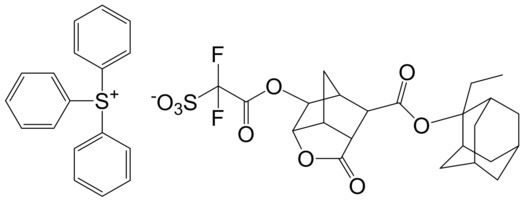
C1:特開2011-39502号公報記載の方法で合成

プロピレングリコールモノメチルエーテルアセテート 400部
プロピレングリコールモノメチルエーテル 150部
γ-ブチロラクトン 5部
<Resin>
A1: Resin A1
A2: Resin A2
A3: Resin A3
A4: Resin A4
A5: Resin A5
A6: Resin A6
A7: Resin A7
A8: Resin A8
<Acid generator (B)>
B1-25: Salt represented by the formula (B1-25); synthesized by the method described in JP-A-2011-126869
C1: Synthesized by the method described in JP-A-2011-390502.
Propylene Glycol Monomethyl Ether Acetate 400 Parts Propylene Glycol Monomethyl Ether 150 Parts γ-Butyrolactone 5 Parts
(レジスト組成物の電子線露光評価)
6インチのシリコンウェハを、ダイレクトホットプレート上で、ヘキサメチルジシラザンを用いて90℃で60秒処理した。このシリコンウェハに、レジスト組成物を、組成物層の膜厚が0.04μmとなるようにスピンコートした。その後、ダイレクトホットプレート上で、表1の「PB」欄に示す温度で60秒間プリベークして組成物層を形成した。ウェハ上に形成された組成物層に、電子線描画機〔(株)日立製作所製の「HL-800D 50keV」〕を用い、露光量を段階的に変化させてラインアンドスペースパターンを直接描画した。
露光後、ホットプレート上にて表1の「PEB」欄に示す温度で60秒間ポストエキスポジャーベークを行い、さらに2.38質量%テトラメチルアンモニウムヒドロキシド水溶液で60秒間のパドル現像を行うことにより、レジストパターンを得た。
得られたレジストパターン(ラインアンドスペースパターン)を走査型電子顕微鏡で観察し、60nmのラインアンドスペースパターンのライン幅とスペース幅とが1:1となる露光量を実効感度とした。
(Electron beam exposure evaluation of resist composition)
A 6 inch silicon wafer was treated on a direct hot plate with hexamethyldisilazane at 90 ° C. for 60 seconds. The resist composition was spin-coated on this silicon wafer so that the film thickness of the composition layer was 0.04 μm. Then, on a direct hot plate, a composition layer was formed by prebaking at the temperature shown in the “PB” column of Table 1 for 60 seconds. A line-and-space pattern was directly drawn on the composition layer formed on the wafer by using an electron beam lithography machine [“HL-800D 50keV” manufactured by Hitachi, Ltd.] by changing the exposure amount stepwise. ..
After exposure, post-exposure baking was performed on a hot plate at the temperature shown in the “PEB” column of Table 1 for 60 seconds, and further paddle development was performed for 60 seconds with a 2.38 mass% tetramethylammonium hydroxide aqueous solution. , A resist pattern was obtained.
The obtained resist pattern (line and space pattern) was observed with a scanning electron microscope, and the exposure amount at which the line width and the space width of the 60 nm line and space pattern were 1: 1 was defined as the effective sensitivity.
ラインエッジラフネス評価(LER):実効感度で製造されたレジストパターンの側壁面の凹凸の振れ幅を走査型電子顕微鏡で測定し、ラインエッジラフネスを求めた。その結果を表2に示す。 Line edge roughness evaluation (LER): The fluctuation width of the unevenness of the side wall surface of the resist pattern manufactured with effective sensitivity was measured with a scanning electron microscope, and the line edge roughness was determined. The results are shown in Table 2.
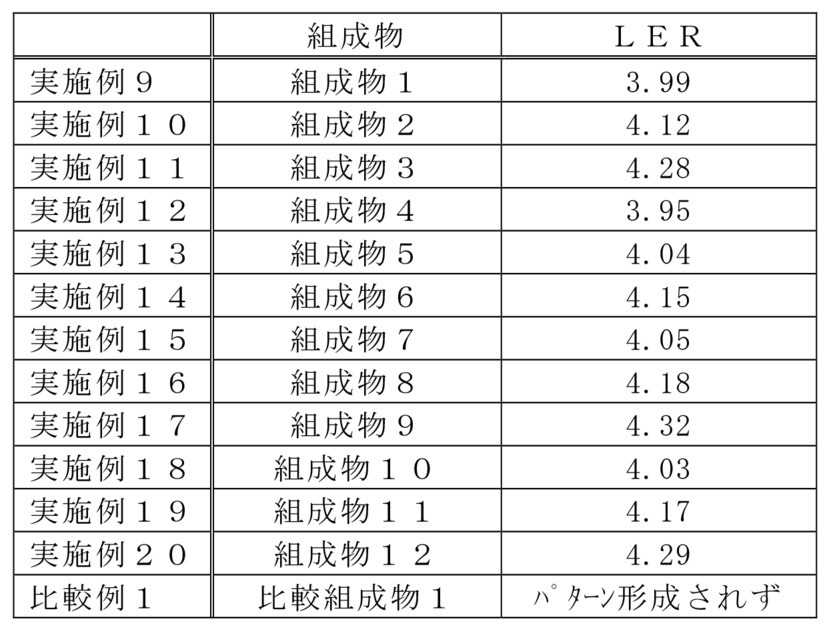
本発明の樹脂及び該樹脂を含むレジスト組成物は、良好なLERを有するレジストパターンを製造することができるので、半導体の微細加工に好適であり、産業上極めて有用である。 Since the resin of the present invention and the resist composition containing the resin can produce a resist pattern having a good LER, they are suitable for microfabrication of semiconductors and are extremely useful industrially.
Claims (9)

R1及びR2は、それぞれ独立して、水素原子、ヒドロキシ基、ヒドロキシ基を有していてもよい炭素数1~18の炭化水素基を表し、該炭化水素基に含まれる-CH2-は、-O-又は-CO-に置き換わっていてもよく、R1とR2とが一緒になって環を形成してもよい。
Xは、ヒドロキシ基、ヒドロキシ基を有していてもよい炭素数1~18の炭化水素基を表し、該炭化水素基に含まれる-CH2-は、-O-又は-CO-に置き換わっていてもよい。
R33は、単結合又はヒドロキシ基を有していてもよい炭素数1~18の2価の炭化水素基を表し、該炭化水素基に含まれる-CH2- は、-O-又は-CO-に置き換わっていてもよい。
*は、結合手を表す。] A resin having a structural unit containing a group represented by the formula (aa1) and a structural unit having an acid unstable group.
R 1 and R 2 each independently represent a hydrocarbon group having 1 to 18 carbon atoms which may have a hydrogen atom, a hydroxy group, and a hydroxy group, and are contained in the hydrocarbon group-CH 2- . May be replaced with —O— or —CO—, and R1 and R2 may be combined to form a ring.
X represents a hydroxy group and a hydrocarbon group having 1 to 18 carbon atoms which may have a hydroxy group, and -CH 2- contained in the hydrocarbon group is replaced with -O- or -CO-. May be.
R 33 represents a divalent hydrocarbon group having 1 to 18 carbon atoms which may have a single bond or a hydroxy group, and -CH 2- contained in the hydrocarbon group is -O- or -CO. It may be replaced with- .
* Represents a bond. ]

R 11’ 及びR 22’ は、それぞれ独立して、水素原子、ヒドロキシ基、ヒドロキシ基を有していてもよい炭素数1~18のアルキル基、炭素数1~18の単環式又は多環式飽和炭化水素基を表し、該炭化水素基に含まれる-CH 2 - は、-O-又は-CO-に置き換わっていてもよく、R 11’ とR 22’ とが一緒になって環を形成してもよい。
R 3 は、それぞれ独立して、水素原子、ヒドロキシ基、ヒドロキシ基を有していてもよい炭素数1~18の炭化水素基を表し、該炭化水素基に含まれる-CH 2 - は、-O-又は-CO-に置き換わっていてもよく、R 11 とR 22 とが一緒になって環を形成してもよい。
X 1 は、単結合又は炭素数1~6のアルカンジイル基を表す。
* は、結合手を表す。] A resin having a structural unit containing a group represented by the formula (aa2') and a structural unit having an acid unstable group.
R 11'and R 22'independently each have a hydrogen atom, a hydroxy group, an alkyl group having 1 to 18 carbon atoms which may have a hydroxy group, and a monocyclic or polycyclic ring having 1 to 18 carbon atoms. Representing a saturated hydrocarbon group, -CH 2- contained in the hydrocarbon group may be replaced with -O- or -CO-, and R 11'and R 22'combined to form a ring. It may be formed.
R 3 independently represents a hydrogen atom, a hydroxy group, and a hydrocarbon group having 1 to 18 carbon atoms which may have a hydroxy group, and −CH 2 − contained in the hydrocarbon group is −. It may be replaced with O- or -CO-, and R 11 and R 22 may be combined to form a ring.
X 1 represents a single bond or an alkanediyl group having 1 to 6 carbon atoms.
* Represents a bond. ]
式(a1-1)及び式(a1-2)のいずれか一方で表される酸不安定基を有する構造単位とを有する樹脂。
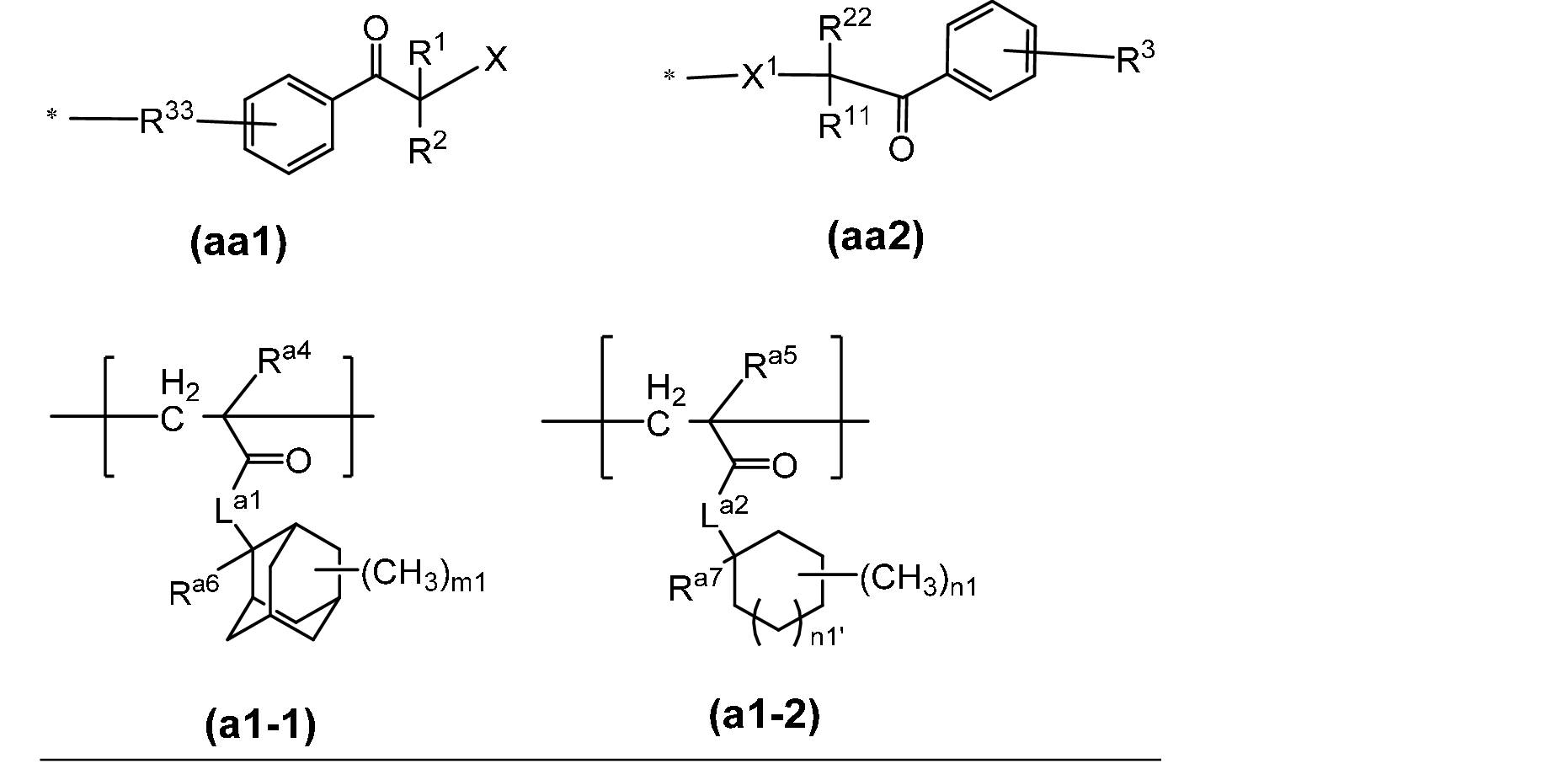
R 1 及びR 2 は、それぞれ独立して、水素原子、ヒドロキシ基、ヒドロキシ基を有していてもよい炭素数1~18の炭化水素基を表し、該炭化水素基に含まれる-CH 2 -は、-O-又は-CO-に置き換わっていてもよく、R 1 とR 2 とが一緒になって環を形成してもよい。
Xは、ヒドロキシ基、ヒドロキシ基を有していてもよい炭素数1~18の炭化水素基を表し、該炭化水素基に含まれる-CH 2 -は、-O-又は-CO-に置き換わっていてもよい。
R 33 は、単結合又はヒドロキシ基を有していてもよい炭素数1~18の2価の炭化水素基を表し、該炭化水素基に含まれる-CH 2 - は、-O-又は-CO-に置き換わっていてもよい。 R 11 、R 12 及びR 3 は、それぞれ独立して、水素原子、ヒドロキシ基、ヒドロキシ基を有していてもよい炭素数1~18の炭化水素基を表し、該炭化水素基に含まれる-CH 2 - は、-O-又は-CO-に置き換わっていてもよく、R 11 とR 22 とが一緒になって環を形成してもよい。
X 1 は、単結合又は炭素数1~6のアルカンジイル基を表す。
*は、結合手を表す。
L a1 及びL a2 は、それぞれ独立に、-O-又は*-O-(CH 2 ) k1 -CO-O-を表し、k1は1~7のいずれかの整数を表し、*は-CO-との結合手を表す。
R a4 及びR a5 は、それぞれ独立に、水素原子又はメチル基を表す。
R a6 及びR a7 は、それぞれ独立に、炭素数1~8のアルキル基、炭素数3~18の脂環式炭化水素基又はこれらを組合せることにより形成される基を表す。
m1は0~14のいずれかの整数を表す。
n1は0~10のいずれかの整数を表す。
n1’は0~3のいずれかの整数を表す。] A structural unit containing a group represented by the formula (aa1) or a structural unit containing a group represented by the formula (aa2).
A resin having a structural unit having an acid unstable group represented by either the formula (a1-1) or the formula (a1-2).
R 1 and R 2 each independently represent a hydrocarbon group having 1 to 18 carbon atoms which may have a hydrogen atom, a hydroxy group, and a hydroxy group, and are contained in the hydrocarbon group-CH 2- . May be replaced with —O— or —CO—, and R1 and R2 may be combined to form a ring.
X represents a hydroxy group and a hydrocarbon group having 1 to 18 carbon atoms which may have a hydroxy group, and -CH 2- contained in the hydrocarbon group is replaced with -O- or -CO-. May be.
R 33 represents a divalent hydrocarbon group having 1 to 18 carbon atoms which may have a single bond or a hydroxy group, and -CH 2- contained in the hydrocarbon group is -O- or -CO. It may be replaced with-. R 11 , R 12 and R 3 each independently represent a hydrocarbon group having 1 to 18 carbon atoms which may have a hydrogen atom, a hydroxy group and a hydroxy group, and are contained in the hydrocarbon group. CH 2- may be replaced with —O— or —CO—, and R 11 and R 22 may be combined to form a ring.
X 1 represents a single bond or an alkanediyl group having 1 to 6 carbon atoms.
* Represents a bond.
L a1 and La 2 independently represent -O- or * -O- (CH 2 ) k1 -CO-O-, k1 represents an integer of 1 to 7, and * represents -CO-. Represents a bond with.
R a4 and R a5 each independently represent a hydrogen atom or a methyl group.
R a6 and R a7 each independently represent an alkyl group having 1 to 8 carbon atoms, an alicyclic hydrocarbon group having 3 to 18 carbon atoms, or a group formed by combining them.
m1 represents any integer from 0 to 14.
n1 represents any integer from 0 to 10.
n1'represents an integer of 0 to 3. ]
ビニル基、イソプロペニル基、アクリロイル基及びメタアクリロイル基からなる群から選ばれる少なくとも1つの基と、
式(aa1)で表される基又は式(aa2)あるいは式(aa2’)で表される基とを有する構造単位である請求項1~3のいずれかに記載の樹脂。 The structural unit containing the group represented by the formula (aa1) or the structural unit containing the group represented by the formula (aa2) or the formula (aa2') is
At least one group selected from the group consisting of a vinyl group, an isopropenyl group, an acryloyl group and a metaacryloyl group, and
The resin according to any one of claims 1 to 3, which is a structural unit having a group represented by the formula (aa1) or a group represented by the formula (aa2) or the formula (aa2') .

Rは、水素原子又はメチル基を表す。
L1は、式(L1-1)~式(L1-8)のいずれかで表される基を表す。
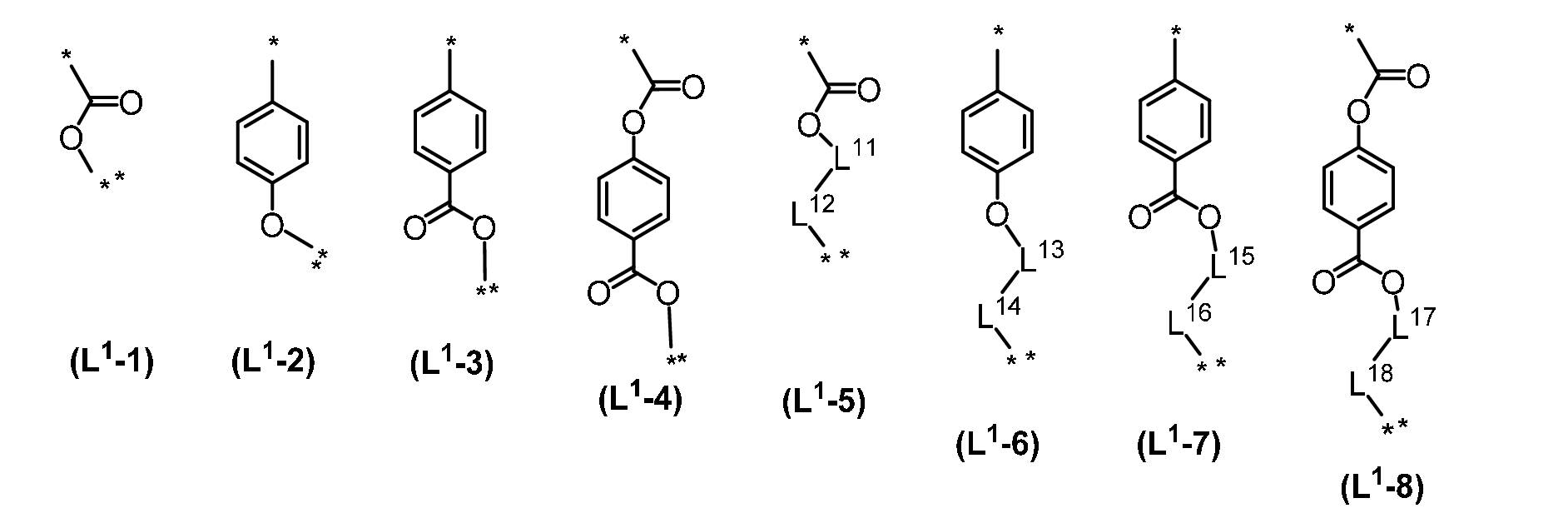
L11、L13、L15及びL17は、それぞれ独立して、炭素数1~6のアルカンジイル基を表す。
L12、L14、L16及びL18は、それぞれ独立して、-O-、-CO-、-CO-O-、-O-CO-又は-O-CO-O-を表す。
*、**は結合手であり、**はR33又はX1との結合手を表す。)] At least one group selected from the group consisting of a vinyl group, an isopropenyl group, an acryloyl group and a metaacryloyl group, and a group represented by the formula (aa1) or a group represented by the formula (aa2) or the formula (aa2') . The resin according to claim 4 , wherein the structural unit having and is a structural unit derived from a compound represented by the formula (AA1) or the formula (AA2) or the formula (AA2') .
R represents a hydrogen atom or a methyl group.
L 1 represents a group represented by any of the formulas (L 1-1 ) to (L 1-8 ).
L 11 , L 13 , L 15 and L 17 each independently represent an alkanediyl group having 1 to 6 carbon atoms.
L 12 , L 14 , L 16 and L 18 independently represent -O-, -CO-, -CO-O-, -O-CO- or -O-CO-O-, respectively.
** and ** are bonds, and ** represents a bond with R 33 or X 1 . )]]
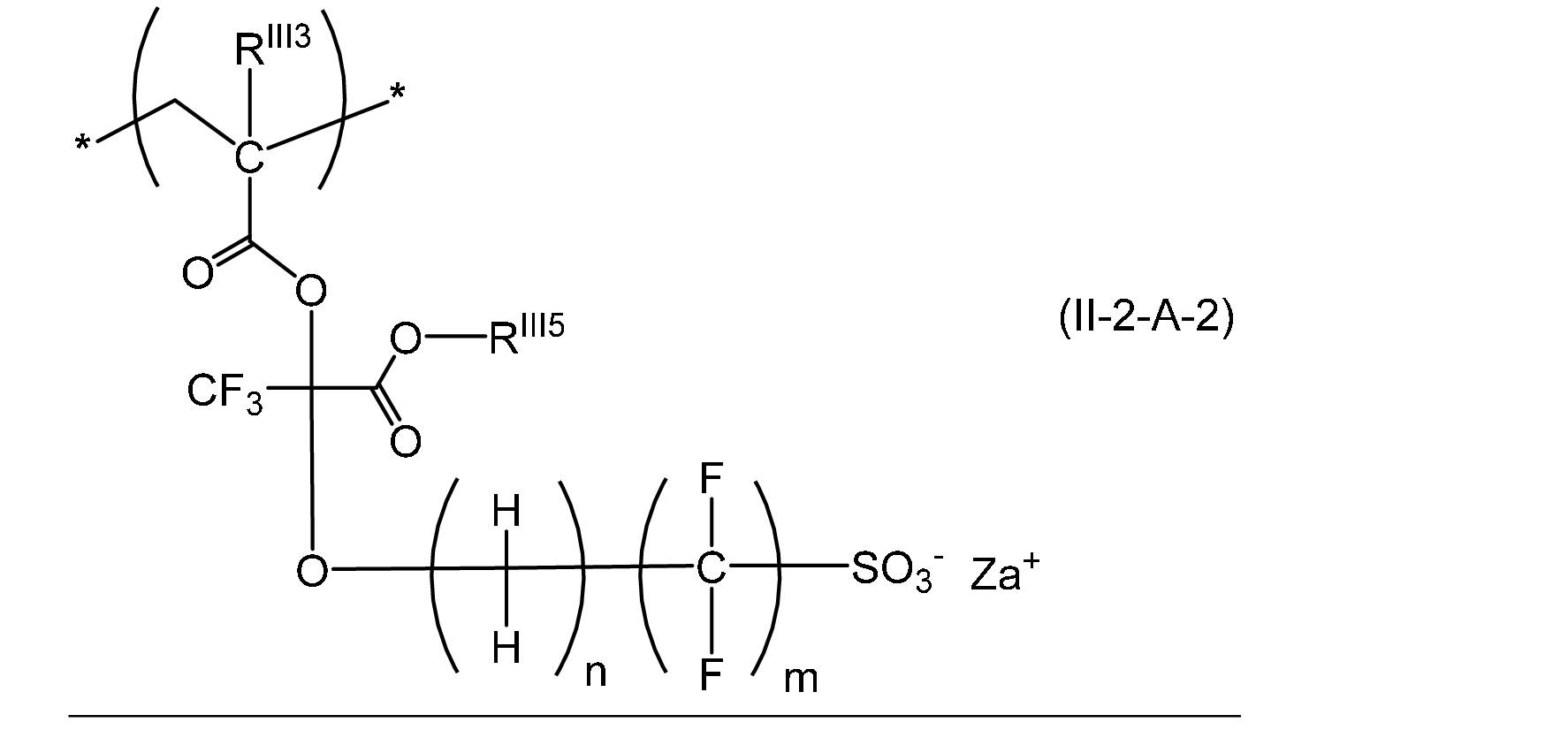
[式中、
R III3 は、水素原子、ハロゲン原子又はハロゲン原子を有していてもよい炭素数1~6のアルキル基を表す。
R III5 は、炭素数1~12の飽和炭化水素基を表す。
m 及びnは、互いに独立に、1又は2を表す。
Za + は、有機カチオンを表す。] The resist composition according to claim 6 or 7, wherein the resin according to any one of claims 1 to 5 further contains a structural unit represented by the formula (II-2-A-2) having a fluorine atom.
[During the ceremony,
R III3 represents an alkyl group having 1 to 6 carbon atoms which may have a hydrogen atom, a halogen atom or a halogen atom.
R III5 represents a saturated hydrocarbon group having 1 to 12 carbon atoms.
m and n represent 1 or 2 independently of each other.
Za + represents an organic cation. ]
(2)塗布後の組成物を乾燥させて組成物層を形成する工程、
(3)組成物層に露光する工程、
(4)露光後の組成物層を加熱する工程、及び
(5)加熱後の組成物層を現像する工程、
を含むレジストパターンの製造方法。 (1) A step of applying the resist composition according to any one of claims 6 to 8 onto a substrate.
(2) A step of drying the applied composition to form a composition layer,
(3) Step of exposing the composition layer,
(4) Step of heating the composition layer after exposure, and (5) Step of developing the composition layer after heating,
A method for manufacturing a resist pattern including.
Applications Claiming Priority (2)
| Application Number | Priority Date | Filing Date | Title |
|---|---|---|---|
| JP2016206816 | 2016-10-21 | ||
| JP2016206816 | 2016-10-21 |
Publications (2)
| Publication Number | Publication Date |
|---|---|
| JP2018070868A JP2018070868A (en) | 2018-05-10 |
| JP6993834B2 true JP6993834B2 (en) | 2022-01-14 |
Family
ID=62111629
Family Applications (1)
| Application Number | Title | Priority Date | Filing Date |
|---|---|---|---|
| JP2017196011A Active JP6993834B2 (en) | 2016-10-21 | 2017-10-06 | Method for manufacturing resin, resist composition and resist pattern |
Country Status (1)
| Country | Link |
|---|---|
| JP (1) | JP6993834B2 (en) |
Families Citing this family (2)
| Publication number | Priority date | Publication date | Assignee | Title |
|---|---|---|---|---|
| JP2020029451A (en) * | 2018-08-17 | 2020-02-27 | 住友化学株式会社 | Salt, acid generator, resist composition and manufacturing method of resist pattern |
| US11543749B2 (en) * | 2020-02-21 | 2023-01-03 | Sumitomo Chemical Company, Limited | Resist composition and method for producing resist pattern, and method for producing plated molded article |
Citations (3)
| Publication number | Priority date | Publication date | Assignee | Title |
|---|---|---|---|---|
| JP2012181510A (en) | 2011-02-09 | 2012-09-20 | Shin Etsu Chem Co Ltd | Patterning process |
| JP2013224414A (en) | 2012-03-23 | 2013-10-31 | Sumitomo Chemical Co Ltd | Resin, resist composition, and method for producing resist pattern |
| JP2015147926A (en) | 2014-01-10 | 2015-08-20 | 住友化学株式会社 | resin and resist composition |
Family Cites Families (2)
| Publication number | Priority date | Publication date | Assignee | Title |
|---|---|---|---|---|
| US4469774A (en) * | 1983-03-28 | 1984-09-04 | E. I. Du Pont De Nemours And Company | Positive-working photosensitive benzoin esters |
| KR20050071978A (en) * | 2004-01-05 | 2005-07-08 | 주식회사 동진쎄미켐 | Organic bottom anti-reflective coating compositions for krf photoresist |
-
2017
- 2017-10-06 JP JP2017196011A patent/JP6993834B2/en active Active
Patent Citations (3)
| Publication number | Priority date | Publication date | Assignee | Title |
|---|---|---|---|---|
| JP2012181510A (en) | 2011-02-09 | 2012-09-20 | Shin Etsu Chem Co Ltd | Patterning process |
| JP2013224414A (en) | 2012-03-23 | 2013-10-31 | Sumitomo Chemical Co Ltd | Resin, resist composition, and method for producing resist pattern |
| JP2015147926A (en) | 2014-01-10 | 2015-08-20 | 住友化学株式会社 | resin and resist composition |
Also Published As
| Publication number | Publication date |
|---|---|
| JP2018070868A (en) | 2018-05-10 |
Similar Documents
| Publication | Publication Date | Title |
|---|---|---|
| JP7114242B2 (en) | RESIST COMPOSITION AND RESIST PATTERN MANUFACTURING METHOD | |
| JP7299367B2 (en) | RESIST COMPOSITION AND RESIST PATTERN MANUFACTURING METHOD | |
| JP6963960B2 (en) | Method for producing salt, acid generator, resist composition and resist pattern | |
| JP7042598B2 (en) | Method for manufacturing resin, resist composition and resist pattern | |
| JP7077102B2 (en) | Method for manufacturing resin, resist composition and resist pattern | |
| JP7068840B2 (en) | Method for Producing Carboxylate, Carboxylic Acid Generator, Resist Composition and Resist Pattern | |
| JP7304127B2 (en) | RESIN, RESIST COMPOSITION AND METHOD FOR MANUFACTURING RESIST PATTERN | |
| JP2021191855A (en) | Resin, resist composition, and method for producing resist pattern | |
| JP2021193178A (en) | Resin, resist composition and method for producing resist pattern | |
| JP6993834B2 (en) | Method for manufacturing resin, resist composition and resist pattern | |
| JP7363018B2 (en) | Resin, resist composition, and method for producing resist pattern | |
| JP7098994B2 (en) | Method for manufacturing resin, resist composition and resist pattern | |
| JP7158946B2 (en) | RESIN, RESIST COMPOSITION AND METHOD FOR MANUFACTURING RESIST PATTERN | |
| JP7044545B2 (en) | Methods for Producing Compounds, Resins, Resist Compositions and Resist Patterns | |
| JP7002274B2 (en) | Methods for Producing Compounds, Resins, Resist Compositions and Resist Patterns | |
| JP7015700B2 (en) | Method for Producing Polymerizable Monomer, Resin, Resist Composition and Resist Pattern | |
| JP7026473B2 (en) | Methods for Producing Compounds, Resins, Resist Compositions and Resist Patterns | |
| JP7178169B2 (en) | RESIST COMPOSITION AND RESIST PATTERN MANUFACTURING METHOD | |
| JP6960308B2 (en) | Method for manufacturing resist composition and resist pattern | |
| JP6999330B2 (en) | Method for producing acid generator, resist composition and resist pattern | |
| JP6919365B2 (en) | Method for producing salt, acid generator, resist composition and resist pattern | |
| JP7193021B2 (en) | RESIST COMPOSITION AND RESIST PATTERN MANUFACTURING METHOD | |
| JP6865005B2 (en) | Method for manufacturing resist composition and resist pattern | |
| JP7215015B2 (en) | Compound, resin, resist composition, and method for producing resist pattern | |
| JP7009191B2 (en) | Method for manufacturing resist composition and resist pattern |
Legal Events
| Date | Code | Title | Description |
|---|---|---|---|
| A621 | Written request for application examination |
Free format text: JAPANESE INTERMEDIATE CODE: A621 Effective date: 20200831 |
|
| A977 | Report on retrieval |
Free format text: JAPANESE INTERMEDIATE CODE: A971007 Effective date: 20210528 |
|
| A131 | Notification of reasons for refusal |
Free format text: JAPANESE INTERMEDIATE CODE: A131 Effective date: 20210706 |
|
| A521 | Written amendment |
Free format text: JAPANESE INTERMEDIATE CODE: A523 Effective date: 20210818 |
|
| TRDD | Decision of grant or rejection written | ||
| A01 | Written decision to grant a patent or to grant a registration (utility model) |
Free format text: JAPANESE INTERMEDIATE CODE: A01 Effective date: 20211207 |
|
| A61 | First payment of annual fees (during grant procedure) |
Free format text: JAPANESE INTERMEDIATE CODE: A61 Effective date: 20211210 |
|
| R150 | Certificate of patent or registration of utility model |
Ref document number: 6993834 Country of ref document: JP Free format text: JAPANESE INTERMEDIATE CODE: R150 |