JP6925933B2 - Electrodes and biosensors for measuring ascorbic acid - Google Patents
Electrodes and biosensors for measuring ascorbic acid Download PDFInfo
- Publication number
- JP6925933B2 JP6925933B2 JP2017205759A JP2017205759A JP6925933B2 JP 6925933 B2 JP6925933 B2 JP 6925933B2 JP 2017205759 A JP2017205759 A JP 2017205759A JP 2017205759 A JP2017205759 A JP 2017205759A JP 6925933 B2 JP6925933 B2 JP 6925933B2
- Authority
- JP
- Japan
- Prior art keywords
- ascorbic acid
- electrode
- biosensor
- concentration
- electron acceptor
- Prior art date
- Legal status (The legal status is an assumption and is not a legal conclusion. Google has not performed a legal analysis and makes no representation as to the accuracy of the status listed.)
- Active
Links
Images


Classifications
-
- G—PHYSICS
- G01—MEASURING; TESTING
- G01N—INVESTIGATING OR ANALYSING MATERIALS BY DETERMINING THEIR CHEMICAL OR PHYSICAL PROPERTIES
- G01N33/00—Investigating or analysing materials by specific methods not covered by groups G01N1/00 - G01N31/00
- G01N33/48—Biological material, e.g. blood, urine; Haemocytometers
- G01N33/50—Chemical analysis of biological material, e.g. blood, urine; Testing involving biospecific ligand binding methods; Immunological testing
- G01N33/82—Chemical analysis of biological material, e.g. blood, urine; Testing involving biospecific ligand binding methods; Immunological testing involving vitamins or their receptors
-
- C—CHEMISTRY; METALLURGY
- C12—BIOCHEMISTRY; BEER; SPIRITS; WINE; VINEGAR; MICROBIOLOGY; ENZYMOLOGY; MUTATION OR GENETIC ENGINEERING
- C12Q—MEASURING OR TESTING PROCESSES INVOLVING ENZYMES, NUCLEIC ACIDS OR MICROORGANISMS; COMPOSITIONS OR TEST PAPERS THEREFOR; PROCESSES OF PREPARING SUCH COMPOSITIONS; CONDITION-RESPONSIVE CONTROL IN MICROBIOLOGICAL OR ENZYMOLOGICAL PROCESSES
- C12Q1/00—Measuring or testing processes involving enzymes, nucleic acids or microorganisms; Compositions therefor; Processes of preparing such compositions
- C12Q1/001—Enzyme electrodes
- C12Q1/005—Enzyme electrodes involving specific analytes or enzymes
-
- C—CHEMISTRY; METALLURGY
- C12—BIOCHEMISTRY; BEER; SPIRITS; WINE; VINEGAR; MICROBIOLOGY; ENZYMOLOGY; MUTATION OR GENETIC ENGINEERING
- C12Q—MEASURING OR TESTING PROCESSES INVOLVING ENZYMES, NUCLEIC ACIDS OR MICROORGANISMS; COMPOSITIONS OR TEST PAPERS THEREFOR; PROCESSES OF PREPARING SUCH COMPOSITIONS; CONDITION-RESPONSIVE CONTROL IN MICROBIOLOGICAL OR ENZYMOLOGICAL PROCESSES
- C12Q1/00—Measuring or testing processes involving enzymes, nucleic acids or microorganisms; Compositions therefor; Processes of preparing such compositions
- C12Q1/26—Measuring or testing processes involving enzymes, nucleic acids or microorganisms; Compositions therefor; Processes of preparing such compositions involving oxidoreductase
-
- G—PHYSICS
- G01—MEASURING; TESTING
- G01N—INVESTIGATING OR ANALYSING MATERIALS BY DETERMINING THEIR CHEMICAL OR PHYSICAL PROPERTIES
- G01N27/00—Investigating or analysing materials by the use of electric, electrochemical, or magnetic means
- G01N27/26—Investigating or analysing materials by the use of electric, electrochemical, or magnetic means by investigating electrochemical variables; by using electrolysis or electrophoresis
- G01N27/28—Electrolytic cell components
- G01N27/30—Electrodes, e.g. test electrodes; Half-cells
- G01N27/327—Biochemical electrodes, e.g. electrical or mechanical details for in vitro measurements
-
- G—PHYSICS
- G01—MEASURING; TESTING
- G01N—INVESTIGATING OR ANALYSING MATERIALS BY DETERMINING THEIR CHEMICAL OR PHYSICAL PROPERTIES
- G01N2333/00—Assays involving biological materials from specific organisms or of a specific nature
- G01N2333/90—Enzymes; Proenzymes
- G01N2333/902—Oxidoreductases (1.)
Landscapes
- Life Sciences & Earth Sciences (AREA)
- Chemical & Material Sciences (AREA)
- Health & Medical Sciences (AREA)
- Engineering & Computer Science (AREA)
- Organic Chemistry (AREA)
- Immunology (AREA)
- Molecular Biology (AREA)
- Physics & Mathematics (AREA)
- Biochemistry (AREA)
- General Health & Medical Sciences (AREA)
- Analytical Chemistry (AREA)
- Zoology (AREA)
- Wood Science & Technology (AREA)
- Proteomics, Peptides & Aminoacids (AREA)
- Microbiology (AREA)
- Biotechnology (AREA)
- General Physics & Mathematics (AREA)
- Urology & Nephrology (AREA)
- Pathology (AREA)
- Hematology (AREA)
- Biomedical Technology (AREA)
- Genetics & Genomics (AREA)
- General Engineering & Computer Science (AREA)
- Bioinformatics & Cheminformatics (AREA)
- Biophysics (AREA)
- Chemical Kinetics & Catalysis (AREA)
- Cell Biology (AREA)
- Electrochemistry (AREA)
- Medicinal Chemistry (AREA)
- Food Science & Technology (AREA)
- Investigating Or Analysing Biological Materials (AREA)
Description
本発明は、試料中のアスコルビン酸濃度を測定するための電極およびバイオセンサに関し、特に高濃度のアスコルビン酸を測定するための電極およびバイオセンサに関する。 The present invention relates to an electrode and a biosensor for measuring the ascorbic acid concentration in a sample, and more particularly to an electrode and a biosensor for measuring a high concentration of ascorbic acid.
アスコルビン酸(ビタミンC)は食事により摂取され、小腸より吸収され体内の臓器および組織へ広く分布する。生化学的にはコラーゲンの合成、カルニチンの合成、副腎皮質ホルモンの合成、カテコールアミンの合成、過酸化脂質の分解、活性酸素の分解等に関与しており、生体内で重要な役割を果たしている。近年では、ビタミンCの強い還元性による、抗がん作用、免疫力増強、そして、美肌、美白効果が着目され、高濃度ビタミンC点滴療法等に応用されている。 Ascorbic acid (vitamin C) is ingested by the diet, absorbed from the small intestine and widely distributed to organs and tissues in the body. Biochemically, it is involved in collagen synthesis, carnitine synthesis, corticosteroid synthesis, catecholamine synthesis, lipid peroxide decomposition, active oxygen decomposition, etc., and plays an important role in the body. In recent years, attention has been paid to anticancer action, immunity enhancement, skin whitening and whitening effect due to the strong reducing property of vitamin C, and it has been applied to high-concentration vitamin C instillation therapy and the like.
アスコルビン酸の測定としては、アスコルビン酸欠乏症診断のための測定や食品中のアスコルビン酸の測定等が挙げられる。また、高濃度ビタミンC点滴療法においては、血中のビタミンC濃度の即時モニタリングが必須であり、また、糖尿病における自己血糖測定においては、血中のアスコルビン酸がグルコース測定値に影響を及ぼすため、アスコルビン酸濃度の測定値によるグルコース値の補正の必要性が挙がっている。 Examples of the measurement of ascorbic acid include measurement for diagnosing ascorbic acid deficiency and measurement of ascorbic acid in foods. In addition, in high-dose vitamin C instillation therapy, immediate monitoring of blood vitamin C concentration is essential, and in autologous blood glucose measurement in diabetes, ascorbic acid in blood affects the glucose measurement value. There is a need to correct the glucose level by measuring the ascorbic acid concentration.
特許文献1には、食品中の微量栄養素として、アスコルビン酸を高速液体クロマトグラフィー(HPLC)法で測定する方法が開示されている。
特許文献2には、アスコルビン酸測定の一例として、アスコルビン酸オキシダーゼおよびフェリシアン化合物等の電子メディエーターを含む検知層を構成要素とした電極を有するバイオセンサが開示されている。
先行文献1の高速液体クロマトグラフィー(HPLC)法でのアスコルビン酸測定に関しては、装置が高価になることからコスト面の問題がある。また、上記装置は、大型の医療施設や検査センターに設置されていることが多く、装置を設置していない施設においては、検査を外注分析に出すため、リアルタイムの測定が出来ないが、特に高濃度ビタミンC点滴療法においては、ビタミンCの代謝や排出の影響を考慮し、リアルタイムな測定が望まれており、問題となっている。
先行文献2では、バイオセンサにより、簡便で即時(リアルタイム)の測定が可能であるが、アスコルビン酸オキシダーゼ等の酵素触媒を用いていることにより、非特異的な触媒反応による測定精度の悪化の問題があった。また、酵素の変性に起因しセンサの保存安定性が悪いため、酵素の処方量を増加する必要があり、コストが高くなるという課題があった。
上記に鑑み、本発明は、アスコルビン酸の即時測定を、精度よく、低コストで簡便に行うことを課題とする。
Regarding the measurement of ascorbic acid by the high performance liquid chromatography (HPLC) method of the
In
In view of the above, it is an object of the present invention to perform immediate measurement of ascorbic acid accurately, at low cost and easily.
発明者は上記課題を解決するために鋭意検討を行った結果、従来のようなHPLCやア
スコルビン酸オキシダーゼのような酵素触媒を用いることなくアスコルビン酸を精度よく簡便に測定することのできるアスコルビン酸応答電極を見出した。
すなわち、本発明は、電極と、該電極と接触し、アスコルビン酸からの電子授受を行う非触媒の電子アクセプター、並びに、アミノ酸と糖類および/または可溶性タンパク質を含む検知層を含み、該検知層において、前記電子アクセプターが前記アスコルビン酸により還元され、該電子アクセプターが前記電極で酸化されることを特徴とする、アスコルビン酸応答電極を提供する。
本発明はまた、基板と、該基板上に設けられた、前記アスコルビン酸応答電極および対極、とを含むバイオセンサを提供する。
本発明はまた、前記バイオセンサにアスコルビン酸含有試料を反応させ、前記アスコルビン酸応答電極に酸化電位を印加して応答電流を測定し、該応答電流に基づいてアスコルビン酸濃度を算出することを特徴とする、アスコルビン酸濃度の測定方法、を提供する。
本発明はまた、前記バイオセンサと、バイオセンサへの電圧印加を制御する、制御部と、バイオセンサへの電圧印加により得られる、アスコルビン酸応答電流を検出する、検出部と、前記電流値からアスコルビン酸の濃度を算出する、演算部と、前記算出されたアスコルビン酸の濃度を出力する出力部とから構成される測定装置、を提供する。
As a result of diligent studies to solve the above problems, the inventor can measure ascorbic acid accurately and easily without using conventional enzyme catalysts such as HPLC and ascorbic acid oxidase. Ascorbic acid response I found an electrode.
That is, the present invention includes an electrode, a non-catalytic electron acceptor that contacts the electrode and transfers electrons from ascorbic acid, and a detection layer containing amino acids and saccharides and / or soluble proteins, in the detection layer. Provided is an ascorbic acid response electrode, characterized in that the electron acceptor is reduced by the ascorbic acid and the electron acceptor is oxidized at the electrode.
The present invention also provides a biosensor including a substrate and the ascorbic acid response electrode and counter electrode provided on the substrate.
The present invention is also characterized in that an ascorbic acid-containing sample is reacted with the biosensor, an oxidation potential is applied to the ascorbic acid response electrode, the response current is measured, and the ascorbic acid concentration is calculated based on the response current. Provided is a method for measuring the ascorbic acid concentration.
The present invention also comprises the biosensor, a control unit that controls voltage application to the biosensor, a detection unit that detects an ascorbic acid response current obtained by applying voltage to the biosensor, and a detection unit, and the current value. Provided is a measuring device including a calculation unit for calculating the concentration of ascorbic acid and an output unit for outputting the calculated concentration of ascorbic acid.
前記「電子アクセプター」は、電子を供与できる電子ドナーの機能を持った化合物からの電子を授受できる化合物である。前記「非触媒」とは、酵素やオルガネラ等、化学反応を触媒する生体触媒の機能を持っていないか、もしくは、生体触媒の機能が小さいことを意味する。アスコルビン酸は、還元性物質として強い電子ドナーの機能を持っている。この特性を利用し、アスコルビン酸からの電子を電子アクセプターへ電子授受させることを実現した。さらに、電子ドナーからの電子を授受した電子アクセプターは、還元体となることから、電極上で電気化学的に酸化反応をさせることが出来る。さらに、前記検知層に、前記電子アクセプターに加え、適量のアミノ酸と糖類および/または可溶性タンパク質を添加することにより、電子アクセプターのみの反応系で発生する過剰な反応速度を制御することが可能になる。これにより、アスコルビン酸高濃度領域におけるセンサ性能の直線性および再現性が飛躍的に向上する。これらの種々の機能により本発明を完成させた。 The "electron acceptor" is a compound capable of giving and receiving electrons from a compound having the function of an electron donor capable of donating electrons. The "non-catalyst" means that the biocatalyst, such as an enzyme or an organelle, does not have the function of a biocatalyst that catalyzes a chemical reaction, or the function of the biocatalyst is small. Ascorbic acid has a strong electron donor function as a reducing substance. Utilizing this property, it was possible to transfer electrons from ascorbic acid to an electron acceptor. Further, since the electron acceptor that has received and received electrons from the electron donor becomes a reducing compound, it can be electrochemically subjected to an oxidation reaction on the electrode. Furthermore, by adding an appropriate amount of amino acids and sugars and / or soluble proteins to the detection layer in addition to the electron acceptor, it becomes possible to control the excessive reaction rate generated in the reaction system containing only the electron acceptor. .. This dramatically improves the linearity and reproducibility of the sensor performance in the ascorbic acid high concentration region. The present invention was completed by these various functions.
本発明のアスコルビン酸応答電極は酵素を使用しないため、非特異的な触媒反応による測定精度の悪化を抑えた精度の高いアスコルビン酸の測定が可能である。また、酵素タンパク質の変性に起因する保存安定性の問題がないため、コストを抑えることが可能である。さらに、適量のアミノ酸と糖類および/または可溶性タンパク質の存在下で、電子アクセプターとアスコルビン酸を反応させることにより、アスコルビン酸高濃度領域においても精度よく測定を行うことが可能である。したがって、本発明により、アスコルビン酸の即時測定を、精度よく、低コストで簡便に行うことが可能になった。 Since the ascorbic acid-responsive electrode of the present invention does not use an enzyme, it is possible to measure ascorbic acid with high accuracy while suppressing deterioration of measurement accuracy due to non-specific catalytic reaction. In addition, since there is no problem of storage stability due to denaturation of the enzyme protein, it is possible to reduce the cost. Furthermore, by reacting the electron acceptor with ascorbic acid in the presence of an appropriate amount of amino acids and saccharides and / or soluble proteins, it is possible to perform accurate measurement even in the ascorbic acid high concentration region. Therefore, according to the present invention, immediate measurement of ascorbic acid can be performed accurately, at low cost, and easily.
(電極の構成)
本発明のアスコルビン酸応答電極は、電極と、アスコルビン酸からの電子授受を行う非触媒の電子アクセプター、並びに、アミノ酸と糖類および/または可溶性タンパク質を含む検知層とを含み、前記検知層において、前記電子アクセプターが前記アスコルビン酸により還元され、該電子アクセプターが前記電極で酸化されることを特徴とする。
なお、検知層が酵素および電子アクセプターを含む従来の酵素電極とは異なり、本発明のアスコルビン酸応答電極では、検知層は電子アクセプターを含むが、酵素は含まない。
(Electrode configuration)
The ascorbic acid-responsive electrode of the present invention comprises an electrode, a non-catalytic electron acceptor that transfers electrons from ascorbic acid, and a detection layer containing an amino acid and a saccharide and / or a soluble protein. The electron acceptor is reduced by the ascorbic acid, and the electron acceptor is oxidized at the electrode.
In addition, unlike the conventional enzyme electrode in which the detection layer contains an enzyme and an electron acceptor, in the ascorbic acid response electrode of the present invention, the detection layer contains an electron acceptor but does not contain an enzyme.
(電極)
電極は、導電性のある素材であれば特に制限されないが、例えば、金(Au)、白金(Pt)、銀(Ag)およびパラジウム(Pd)のような金属材料、或いはグラファイト、カーボンナノチューブ、グラフェン、メソポーラスカーボン等のカーボンに代表される炭素材料を用いて形成される。電極は、例えば、絶縁性基板上に形成される。絶縁性基板は、ポリエーテルイミド(PEI)、ポリエチレンテレフタレート(PET)、ポリエチレン(PE)のような熱可塑性樹脂、ポリイミド樹脂、エポキシ樹脂のような各種の樹脂(プラスチック)、ガラス、セラミック、紙のような絶縁性材料で形成される。電極および絶縁性基板の大きさ、厚さは適宜設定可能である。
(electrode)
The electrode is not particularly limited as long as it is a conductive material, but is, for example, a metal material such as gold (Au), platinum (Pt), silver (Ag) and palladium (Pd), or graphite, carbon nanotube, graphene. , Is formed using a carbon material typified by carbon such as mesographite carbon. The electrodes are formed, for example, on an insulating substrate. Insulating substrates are made of thermoplastic resins such as polyetherimide (PEI), polyethylene terephthalate (PET), polyethylene (PE), polyimide resins, various resins (plastics) such as epoxy resins, glass, ceramics, and paper. It is made of such an insulating material. The size and thickness of the electrodes and the insulating substrate can be set as appropriate.
(電子アクセプター)
電子アクセプターとしては、アスコルビン酸から電子を受け取って還元され、電極で再酸化される、触媒作用のない化合物であればよいが、例えば、ルテニウム化合物、フェリシアン化カリウム、シトクロムC、ピロロキノリンキノン(PQQ)、NAD+、NADP+、銅錯体、およびフェナジンメトサルフェートおよびその誘導体、オスミウム錯体等が挙げられ、これらは単独で使用してもよいし、2種以上で併用してもよい。
この中では、酸化型の金属原子と配位子からなる錯体であることが好ましく、3価ルテニウム(Ru(III))と配位子からなる酸化型ルテニウム錯体であることがより好ましい。
本発明に用いる電子アクセプターは、通常の有機合成化学的手法で合成したもの、あるいは市販のものを用いることができる。
(Electron acceptor)
The electron acceptor may be a non-catalytic compound that receives electrons from ascorbic acid, is reduced, and is reoxidized at the electrode. For example, a ruthenium compound, potassium ferricyanide, cytochrome C, and pyrroloquinoline quinone (PQQ). , NAD + , NADP + , copper complex, phenazinemethsulfate and its derivatives, osmium complex and the like, and these may be used alone or in combination of two or more.
Among these, a complex composed of an oxidized metal atom and a ligand is preferable, and an oxidized ruthenium complex composed of trivalent ruthenium (Ru (III)) and a ligand is more preferable.
As the electron acceptor used in the present invention, an electron acceptor synthesized by an ordinary synthetic organic chemical method or a commercially available electron acceptor can be used.
(酸化型ルテニウム錯体)
酸化型ルテニウム錯体の配位子としては、例えば、アンモニア、ビピリジン、イミダゾール、アミノ酸、フェナントロリン、エチレンジアミン等の含窒素配位子やハロゲン配位子が挙げられる。なお、これらを組み合わせて混合配位子としてもよい。
電子アクセプターとなる酸化型ルテニウム錯体は、塩等の形態で検知層に含有させて、反応前および/または反応時に、反応性の錯体を形成するものであってもよい。このような形態も本発明に包含される。
(Oxidized ruthenium complex)
Examples of the ligand of the oxidized ruthenium complex include nitrogen-containing ligands such as ammonia, bipyridine, imidazole, amino acids, phenanthroline and ethylenediamine, and halogen ligands. In addition, you may combine these into a mixed ligand.
The oxidized ruthenium complex that serves as an electron acceptor may be contained in the detection layer in the form of a salt or the like to form a reactive complex before and / or during the reaction. Such a form is also included in the present invention.
例えば、ルテニウムアンモニア錯体としては、好ましくは以下の化合物が挙げられる。
[Ru(NH3)5X]n+
ここで、Xとしては、NH3、ハロゲン、CN、ピリジン、ニコチンアミド、ビピリジンまたはH2O等が挙げられ、これらの中でもNH3またはハロゲン(例えば、Cl、F、Br、I)が好ましい。前記化学式におけるn+は、酸化型ルテニウム(III)錯体の価数を表し、Xの種類により適宜決定される。
For example, the ruthenium ammonia complex preferably includes the following compounds.
[Ru (NH 3 ) 5 X] n +
Here, as X, NH 3 , halogen, CN, pyridine, nicotinamide, bipyridine, H 2 O and the like can be mentioned, and among these, NH 3 or halogen (for example, Cl, F, Br, I) is preferable. N + in the chemical formula represents the valence of the oxidized ruthenium (III) complex, and is appropriately determined depending on the type of X.
ビピリジンルテニウム錯体の例としては、例えば、[Ru(bipyridine)3]、[Ru(4,4’−dimethyl−2,2’−bipyridine)3]、[Ru(4,4’−diphenyl−2,2’−bipyridine)3]、[Ru(4,4’−diamino−2,2’−bipyridine)3]、[Ru(4,4’−dihydroxy−2,2’−bipyridine)3]、[Ru(4,4’−dicarboxy−2,2’−bipyridine)3]、[Ru(4,4’−dibromo−2,2’−bipyridine)3]、[Ru(5,5’−dimethyl−2,2’−bipyridine)3]、[Ru(5,5’−diphenyl−2,2’−bipyridine)3]、[Ru(5,5’−diamino−2,2’−bipyridine)3]、[Ru(5,5’−dihydroxy−2,2’−bipyridine)3]、[Ru(5,5’−dicarboxy−2,2’−bipyridine)3]、[Ru(5,5’−dibromo−2,2’−bipyridine)3]等がある。 Examples of bipyridinerutenium complexes include [Ru (bipyridine) 3 ], [Ru (4,4'-dimethyl-2,2'-bipyridine) 3 ], [Ru (4,4'-diphenyl-2,). 2'-bipyridine) 3], [ Ru (4,4'-diamino-2,2'-bipyridine) 3], [Ru (4,4'-dihydroxy-2,2'-bipyridine) 3], [Ru (4,4'-dicarboxy-2,2'-bipyridine) 3 ], [Ru (4,4'-dibromo-2,2'-bipyridine) 3 ], [Ru (5,5'-dimethyl-2, 2'-bipyridine) 3 ], [Ru (5,5'-diphenyl-2,2'-bipyridine) 3 ], [Ru (5,5'-diamino-2, 2'-bipyridine) 3 ], [Ru (5,5'-dihydroxy-2,2'-bipyridine) 3 ], [Ru (5,5'-dicarboxy-2,2'-bipyridine) 3 ], [Ru (5,5'-dibromo-2, 2'-bipyridine) 3 ] and the like.
イミダゾールルテニウム錯体の例としては、例えば、[Ru(imidazole)6]、[Ru(4−methyl−imidazole)6]、[Ru(4−phenyl−imidazole)6]、[Ru(4−amino−imidazole)6]、[Ru(4−hydroxy−imidazole)6]、[Ru(4−carboxy−imidazole)6]、[Ru(4−bromo−imidazole)6]等がある。 Examples of the imidazole ruthenium complex include, for example, [Ru (imidazole) 6 ], [Ru (4-methyl-imidazole) 6 ], [Ru (4-phenyl-imidazole) 6 ], [Ru (4-amino-imidazole) 6]. ) 6 ], [Ru (4-hydroxy-imidazole) 6 ], [Ru (4-carboxy-imidazole) 6 ], [Ru (4-bromo-imidazole) 6 ] and the like.
検知層における電子アクセプターの含有量は、測定試料の種類等によって適宜決定できるが、例えば、検知層の表面積1cm2当たり、0.1μmol〜50μmolが好ましく、より好ましくは0.1μmol〜10μmol、特に好ましくは0.1μmol〜5μmolである。
電極用試薬(検知層調製液)における電子アクセプターの含有量としては、特に限定されないが、例えば、1.5〜10質量%、好ましくは2.5〜5質量%である。
The content of the electron acceptor in the detection layer can be appropriately determined depending on the type of measurement sample and the like. For example, 0.1 μmol to 50 μmol is preferable, and 0.1 μmol to 10 μmol is particularly preferable, per 1 cm 2 of the surface area of the detection layer. Is 0.1 μmol to 5 μmol.
The content of the electron acceptor in the electrode reagent (detection layer preparation liquid) is not particularly limited, but is, for example, 1.5 to 10% by mass, preferably 2.5 to 5% by mass.
(アミノ酸、糖類、可溶性タンパク質)
本発明のアスコルビン酸応答電極においては、検知層において、電子アクセプターが試料中に含まれるアスコルビン酸から電子を受け取って還元され、還元された電子アクセプターが電極において再酸化される。
ここで、検知層においてアミノ酸と糖類の組み合わせ、アミノ酸と可溶性タンパク質の組み合わせ、またはアミノ酸と糖類と可溶性タンパク質の組み合わせを含むことにより、試薬(特に電子アクセプター)の溶解速度を調整することができ、酸化還元反応速度を調整することができる。したがって、アスコルビン酸高濃度領域まで良好な直線性を維持することができる。
また、検知層においてアミノ酸と糖類および/または可溶性タンパク質の組み合わせを含むことにより、センサ間における試薬の溶解速度も均一になるため、高濃度領域における高い再現性が得られる。
(Amino acids, sugars, soluble proteins)
In the ascorbic acid-responsive electrode of the present invention, in the detection layer, an electron acceptor receives an electron from ascorbic acid contained in the sample and is reduced, and the reduced electron acceptor is reoxidized at the electrode.
Here, by including a combination of an amino acid and a saccharide, a combination of an amino acid and a soluble protein, or a combination of an amino acid and a saccharide and a soluble protein in the detection layer, the dissolution rate of the reagent (particularly an electron acceptor) can be adjusted, and oxidation can be performed. The reduction reaction rate can be adjusted. Therefore, good linearity can be maintained up to the ascorbic acid high concentration region.
Further, by including the combination of the amino acid and the saccharide and / or the soluble protein in the detection layer, the dissolution rate of the reagent between the sensors becomes uniform, so that high reproducibility in a high concentration region can be obtained.
アミノ酸としては、可溶性に富み、前記成分と組み合わせて試薬の溶解速度の調整および酸化還元反応速度を調整できる限り特に限定されない。ここでアミノ酸は、アミノカル
ボン酸以外に、タウリンに代表されるアミノスルホン酸を含む。
アミノ酸としては、例えばグリシン、アラニン等の脂肪族アミノ酸、フェニルアラニン等の芳香族アミノ酸、プロリン等のイミノ酸、セリン、トレオニン等のオキシアミノ酸、システイン、メチオニン、タウリン等の含硫アミノ酸、バリン、ロイシン、イソロイシン等の分岐鎖アミノ酸、アスパラギン酸、グルタミン酸等の酸性アミノ酸、アスパラギン、グルタミン等の酸性アミノ酸アミド、リシン、アルギニン等の塩基性アミノ酸、トリプトファン、ヒスチジン等の複素環式アミノ酸またはそれらの塩(例えばグルタミン酸ナトリウム等)等が挙げられ、脂肪族アミノ酸、オキシアミノ酸、含硫アミノ酸、酸性アミノ酸塩が好ましい。これらは単独で使用してもよいし、2種以上で併用してもよい。
The amino acid is highly soluble and is not particularly limited as long as it can adjust the dissolution rate of the reagent and the redox reaction rate in combination with the above components. Here, the amino acid includes an aminosulfonic acid typified by taurine in addition to the aminocarboxylic acid.
Examples of amino acids include aliphatic amino acids such as glycine and alanin, aromatic amino acids such as phenylalanine, imino acids such as proline, oxyamino acids such as serine and threonine, sulfur-containing amino acids such as cysteine, methionine and taurine, valine and leucine. Branched chain amino acids such as isoleucine, acidic amino acids such as aspartic acid and glutamic acid, acidic amino acids such as asparagine and glutamine, basic amino acids such as lysine and arginine, heterocyclic amino acids such as tryptophan and histidine, or salts thereof (for example, glutamic acid). (Sodium, etc.) and the like, and aliphatic amino acids, oxyamino acids, sulfur-containing amino acids, and acidic amino acid salts are preferable. These may be used alone or in combination of two or more.
検知層におけるアミノ酸の含有量は、測定試料の種類等によって適宜決定できるが、例えば、検知層の表面積1cm2当たり、1μmol〜100μmolが好ましく、より好ましくは10μmol〜50μmol、特に好ましくは10μmmol〜15μmolである。
電極用試薬におけるアミノ酸の含有量としては、特に限定されないが、例えば、2.5〜5.0質量%、好ましくは4.5〜5.0質量%である。
The content of amino acids in the detection layer can be appropriately determined depending on the type of measurement sample and the like. For example, the content of amino acids in the detection layer is preferably 1 μmol to 100 μmol, more preferably 10 μmol to 50 μmol, and particularly preferably 10 μ mmol to 15 μmol per 1 cm 2 of the surface area of the detection layer. be.
The content of the amino acid in the reagent for the electrode is not particularly limited, but is, for example, 2.5 to 5.0% by mass, preferably 4.5 to 5.0% by mass.
糖類としては、可溶性に富み、アミノ酸と組み合わせて試薬の溶解速度の調整および酸化還元反応速度を調整できる限り特に限定されず、例えば単糖、二糖、オリゴ糖、多糖、糖アルコール、アミノ糖等が挙げられ、二糖および糖アルコールが好ましい。 The saccharide is highly soluble and is not particularly limited as long as it can adjust the dissolution rate of the reagent and the redox reaction rate in combination with an amino acid. For example, monosaccharides, disaccharides, oligosaccharides, polysaccharides, sugar alcohols, amino sugars and the like. However, disaccharides and sugar alcohols are preferable.
単糖としては、グルコース、フルクトース、マンノース、ガラクトース、キシロース、アラビノース等が挙げられる。二糖としては、トレハロース、コージビオース、ニゲロース、マルトース、イソマルトース、ラクトース、スクロース等が挙げられる。オリゴ糖としては、デキストリン、ガラクトオリゴ糖、フルクトオリゴ糖等が挙げられ、糖アルコールとしては、ソルビトール、キシリトール、エリスリトール、マンニトール、マルチトール等が挙げられる。これらは単独で使用してもよいし、2種以上で併用してもよい。 Examples of the monosaccharide include glucose, fructose, mannose, galactose, xylose, arabinose and the like. Examples of the disaccharide include trehalose, kojibiose, nigerose, maltose, isomaltose, lactose, sucrose and the like. Examples of oligosaccharides include dextrin, galactooligosaccharide, fructooligosaccharide and the like, and examples of sugar alcohols include sorbitol, xylitol, erythritol, mannitol, maltitol and the like. These may be used alone or in combination of two or more.
検知層における糖類の含有量は、測定試料の種類等によって適宜決定できるが、例えば、検知層の表面積1cm2当たり、1μmol〜100μmolが好ましく、より好ましくは1μmol〜50μmol、特に好ましくは1μmol〜10μmolである。
電極用試薬における糖類の含有量としては、特に限定されないが、例えば、1.2〜2.5質量%、好ましくは2.4〜2.5質量%である。
The content of saccharides in the detection layer can be appropriately determined depending on the type of measurement sample and the like. For example, it is preferably 1 μmol to 100 μmol, more preferably 1 μmol to 50 μmol, and particularly preferably 1 μmol to 10 μmol per 1 cm 2 of the surface area of the detection layer. be.
The content of the saccharide in the reagent for the electrode is not particularly limited, but is, for example, 1.2 to 2.5% by mass, preferably 2.4 to 2.5% by mass.
可溶性タンパク質としては、可溶性に富み、アミノ酸と組み合わせて試薬の溶解速度の調整および酸化還元反応速度を調整でき、水性溶媒に可溶性である限り特に限定されず、例えばシルクプロテイン由来のネオプロテインセイバー(NPS)(東洋紡)、ウシ、ヒト等の血清成分であるアルブミン、カゼイン、ゼラチン等の水性溶媒に可溶性のタンパク質が挙げられる。これらは単独で使用してもよいし、2種以上で併用してもよい。可溶性タンパク質の分子量は特に制限されず、例えば1,000〜100,000Da程度であってよい。 The soluble protein is highly soluble, can adjust the dissolution rate of the reagent and the oxidation-reduction reaction rate in combination with amino acids, and is not particularly limited as long as it is soluble in an aqueous solvent. For example, neoprotein saver (NPS) derived from silk protein. ) (Toyo Boseki), bovine, human and other serum components such as albumin, casein, gelatin and other aqueous solvents include proteins that are soluble in aqueous solvents. These may be used alone or in combination of two or more. The molecular weight of the soluble protein is not particularly limited and may be, for example, about 1,000 to 100,000 Da.
検知層における可溶性タンパク質の含有量は、測定試料の種類等によって適宜決定できるが、例えば、検知層の表面積1cm2当たり、0.1nmol〜50nmolが好ましく、より好ましくは10nmol〜50nmol、特に好ましくは10nmol〜30nmolである。
電極用試薬における可溶性タンパク質の含有量としては、特に限定されないが、例えば、1.2〜2.5質量%、好ましくは2.4〜2.5質量%である。
The content of the soluble protein in the detection layer can be appropriately determined depending on the type of measurement sample and the like. For example, 0.1 nmol to 50 nmol is preferable, more preferably 10 nmol to 50 nmol, and particularly preferably 10 nmol per 1 cm 2 of the surface area of the detection layer. ~ 30 nmol.
The content of the soluble protein in the reagent for the electrode is not particularly limited, but is, for example, 1.2 to 2.5% by mass, preferably 2.4 to 2.5% by mass.
本発明に用いるアミノ酸、糖類、可溶性タンパク質は、通常の有機合成化学的手法で合
成したもの、あるいは市販のものを用いることができる。
電極におけるアミノ酸と糖類との含有比(質量比)としては、通常5:1〜1:1、好ましくは2.5:1〜1:1である。電極おけるアミノ酸と可溶性タンパク質との含有比(質量比)としては、通常5:1〜1:1、好ましくは2.5:1〜1:1である。
電極における電子アクセプターとアミノ酸との含有比(質量比)としては、通常1:5〜1:1、好ましくは2:3〜1:2である。
As the amino acid, saccharide, and soluble protein used in the present invention, those synthesized by ordinary synthetic organic chemistry methods or commercially available ones can be used.
The content ratio (mass ratio) of amino acids and sugars in the electrode is usually 5: 1 to 1: 1, preferably 2.5: 1 to 1: 1. The content ratio (mass ratio) of the amino acid and the soluble protein in the electrode is usually 5: 1 to 1: 1, preferably 2.5: 1 to 1: 1.
The content ratio (mass ratio) of the electron acceptor and the amino acid in the electrode is usually 1: 5 to 1: 1, preferably 2: 3 to 1: 2.
電極製造工程において、検知層調製液として、電子アクセプター、アミノ酸、糖類、可溶性タンパク質、および溶媒または分散媒を含有したスクリーン印刷対応インクとして調製することができ、スクリーン印刷手法にて樹脂等の基材にパターンニング印刷を行い電極を形成することにより、電極作製効率を向上することができ、センサ間差を小さくすることが可能になる。 In the electrode manufacturing process, it can be prepared as a screen printing compatible ink containing an electron acceptor, amino acids, sugars, soluble proteins, and a solvent or dispersion medium as a detection layer preparation liquid, and a substrate such as a resin can be prepared by a screen printing method. By forming the electrodes by performing patterning printing on the surface, it is possible to improve the electrode manufacturing efficiency and reduce the difference between the sensors.
なお、検知層は、緩衝剤や界面活性剤などの添加剤を追加的に含んでもよく、これらの含有量は適宜設定できる。
緩衝剤としては、アミン系緩衝剤が好ましく、例えば、Tris、ACES、CHES、CAPSO、TAPS、CAPS、Bis−Tris、TAPSO、TES、TricineおよびADA等が挙げられる。これらの物質は、1種類でもよいし2種類以上を併用してもよい。また、前記緩衝剤としては、カルボキシル基を有する緩衝剤も使用でき、例えば、酢酸−酢酸Na緩衝剤、リンゴ酸−酢酸Na緩衝剤、マロン酸−酢酸Na緩衝剤、コハク酸−酢酸Na緩衝剤等が挙げられる。
界面活性剤としては、Triton X−100、CHAPS、ドデシル硫酸ナトリウム、ペルフルオロオクタンスルホン酸またはステアリン酸ナトリウムが含まれてもよい。また、アルキルアミノカルボン酸(またはその塩)、カルボキシベタイン、スルホベタインおよびホスホベタイン等が挙げられる。
The detection layer may additionally contain additives such as a buffer and a surfactant, and the contents thereof can be appropriately set.
As the buffer, an amine-based buffer is preferable, and examples thereof include Tris, ACES, CHES, CAPSO, TAPS, CAPS, Bis-Tris, TAPSO, TES, Tricine and ADA. These substances may be used alone or in combination of two or more. Further, as the buffer, a buffer having a carboxyl group can also be used, for example, acetic acid-Na acetate buffer, malic acid-Na acetate buffer, malonic acid-Na acetate buffer, succinic acid-Na acetate buffer. And so on.
Surfactants may include Triton X-100, CHAPS, sodium dodecyl sulfate, perfluorooctanesulfonic acid or sodium stearate. In addition, alkylaminocarboxylic acid (or a salt thereof), carboxybetaine, sulfobetaine, phosphobetaine and the like can be mentioned.
(電極の作製方法)
本発明のアスコルビン酸応答電極は、例えば、以下のようにして作製される。すなわち、絶縁性基板の片面に、電極として機能する金属層を形成する。例えば、所定の厚さ(例えば100μm程度)のフィルム状の絶縁性基板の片面に、金属材料をスクリーン印刷、物理蒸着(PVD、例えばスパッタリング)、或いは化学蒸着(CVD)によって成膜することによって、所望の厚さ(例えば30nm程度)を有する金属層が形成される。金属層の代わりに、炭素材料で形成された電極層を形成することもできる。次に、電極上に電子アクセプターを含む検知層調製液をコートし、乾燥させることで検知層を電極上に配置することができる。
(Method of manufacturing electrodes)
The ascorbic acid response electrode of the present invention is produced, for example, as follows. That is, a metal layer that functions as an electrode is formed on one side of the insulating substrate. For example, by forming a metal material on one side of a film-like insulating substrate having a predetermined thickness (for example, about 100 μm) by screen printing, physical vapor deposition (PVD, for example, sputtering), or chemical vapor deposition (CVD). A metal layer having a desired thickness (for example, about 30 nm) is formed. Instead of the metal layer, an electrode layer made of a carbon material can also be formed. Next, the detection layer can be arranged on the electrode by coating the electrode with a detection layer preparation liquid containing an electron acceptor and drying it.
本発明のアスコルビン酸応答電極は、試料中に含まれるアスコルビン酸の濃度を測定するためのバイオセンサに使用することができる。
上記のように、本発明のアスコルビン酸応答電極は、検知層においてアミノ酸と糖類および/または可溶性タンパク質を含むことにより、試薬(特に電子アクセプター)の溶解速度を調整することができ、酸化還元反応速度を調整することができる。すなわち、アスコルビン酸高濃度領域まで直線性を維持することができ、またセンサ間の再現性も高い。
本発明のアスコルビン酸応答電極による測定に用いられる、試料中に含まれるアスコルビン酸の濃度は特に限定されないが、例えば、50、100、200、300、500、600、800、1,000mg/dL以上であってよい。
なお、試料は測定対象物質を含む試料であれば特に制限されないが、生体試料が好ましく、血液、尿などが挙げられる。
The ascorbic acid response electrode of the present invention can be used as a biosensor for measuring the concentration of ascorbic acid contained in a sample.
As described above, the ascorbic acid response electrode of the present invention can adjust the dissolution rate of reagents (particularly electron acceptors) by containing amino acids and sugars and / or soluble proteins in the detection layer, and the redox reaction rate. Can be adjusted. That is, the linearity can be maintained up to the ascorbic acid high concentration region, and the reproducibility between the sensors is also high.
The concentration of ascorbic acid contained in the sample used for the measurement by the ascorbic acid response electrode of the present invention is not particularly limited, but is, for example, 50, 100, 200, 300, 500, 600, 800, 1,000 mg / dL or more. May be.
The sample is not particularly limited as long as it contains the substance to be measured, but a biological sample is preferable, and blood, urine, and the like can be mentioned.
(バイオセンサ)
アスコルビン酸センサとしてのバイオセンサは、本発明のアスコルビン酸応答電極(作
用極)とともに対極となる電極を含む。対極としては、バイオセンサの対極として一般的に使用できるものであればよいが、例えば、スクリーン印刷により製膜したカーボン電極や、物理蒸着(PVD、例えばスパッタリング)、或いは化学蒸着(CVD)によって成膜した金属電極や、スクリーン印刷により製膜した銀/塩化銀電極を用いることができる。
また、銀/塩化銀電極やスクリーン印刷により製膜したカーボン電極や、物理蒸着、或いは化学蒸着によって成膜した金属電極を参照極とした3電極系を用いてもよい。
(Biosensor)
The biosensor as an ascorbic acid sensor includes an electrode that serves as a counter electrode together with the ascorbic acid response electrode (working electrode) of the present invention. The counter electrode may be any electrode that can be generally used as the counter electrode of the biosensor, and is formed by, for example, a carbon electrode formed by screen printing, physical vapor deposition (PVD, for example, sputtering), or chemical vapor deposition (CVD). A filmed metal electrode or a silver / silver chloride electrode formed by screen printing can be used.
Further, a silver / silver chloride electrode, a carbon electrode formed by screen printing, or a three-electrode system using a metal electrode formed by physical vapor deposition or chemical vapor deposition as a reference electrode may be used.
本発明のアスコルビン酸応答電極(作用極)表面にアスコルビン酸を含む試料を接触させると、アスコルビン酸の酸化反応によって生じた電子が電子アクセプターに受け渡され、電子アクセプターは還元される。そして、作用極に酸化電位を印加することで、作用極表面で還元型の電子アクセプターは酸化され、これによって酸化電流が発生する。この電流値に基づいて試料中のアスコルビン酸濃度を測定することができる。 When a sample containing ascorbic acid is brought into contact with the surface of the ascorbic acid response electrode (working electrode) of the present invention, the electrons generated by the oxidation reaction of ascorbic acid are transferred to the electron acceptor, and the electron acceptor is reduced. Then, by applying an oxidation potential to the working electrode, the reduced electron acceptor is oxidized on the surface of the working electrode, thereby generating an oxidation current. The ascorbic acid concentration in the sample can be measured based on this current value.
以下、本発明のバイオセンサの一例について、図1に基づいて説明する。図1(A)〜(E)は、バイオセンサを製造する一連の工程を示した斜視図である。なお、本発明のバイオセンサは以下の態様には限定されない。 Hereinafter, an example of the biosensor of the present invention will be described with reference to FIG. 1 (A) to 1 (E) are perspective views showing a series of steps for manufacturing a biosensor. The biosensor of the present invention is not limited to the following aspects.
図1(E)に示すように、このバイオセンサAは、基板11、リード部12aを有する作用極12とリード部13aを有する対極13とから構成された電極系、絶縁層14、電子アクセプターと、アミノ酸と糖類および/または可溶性タンパク質と、緩衝液とを含む検知層16、開口部(スリット)を有するスペーサー18および貫通孔20を有するカバー19を備えている。図1(B)に示すように、基板11上には、検出部15が設けられており、検出部15には、作用極12と対極13とが、基板11の幅方向に並行して配置されている。前記両電極の一端は、それぞれリード部12a、13aとなり、これらと、検出部15における他端とが、垂直となるように配置されている(図1(A))。また、作用極12と対極13との間は、絶縁部となっている。このような電極系を備えた基板11の上には、図1(B)に示すように、リード部12a、13aおよび検出部15を除いて、絶縁層14が積層されており、絶縁層14が積層されていない前記検出部15上には、検知層16が積層されている。そして、絶縁層14の上には、図1(D)に示すように、試料導入口17aとなる一端から検出部15に対応する箇所をカバーする部分が解放した細幅な開口部(スリット)を有するスペーサー18が配置されている。さらにスペーサー18の上には、前記スペーサー18の開口部(スリット)の、試料導入口となる一端とは異なる他端に対応する箇所に貫通孔20を有するカバー19が配置されている(図1(E))。このバイオセンサAにおいて、前記開口(スリット)部の空間部分であり、かつ、前記検知層16および絶縁層14とカバー19とに挟まれた空間部分が、キャピラリー構造の試料供給部17となる。このキャピラリー17は、開口(スリット)部の試料導入口17aとなる一端および貫通孔20を介して外部と連通している。そして、前記貫通孔20が、試料を毛管現象により吸入するための空気孔となる。試料液導入口17aから供給された試料液は、毛細管現象により貫通孔20に向けてキャピラリー17内を進行し、検知層16で電極反応が起こる。
As shown in FIG. 1 (E), the biosensor A includes an electrode system composed of a
このようなバイオセンサは、例えば、以下のようにして作製できる。 Such a biosensor can be produced, for example, as follows.
まず、図1(A)に示すように、基板11上にリード部12aを有する作用極12およびリード部13aを有する対極13からなる電極系を形成する。
First, as shown in FIG. 1A, an electrode system including an working
続いて、図1(B)に示すように、前記電極系12、13を形成した基板11上に絶縁層14を形成する。この絶縁層は、電極のリード部12a、13aと、電子アクセプター等を形成する検出部15を除いた基板11上に形成する。前記絶縁層14は、例えば、絶
縁性樹脂を溶媒に溶解した絶縁ペーストを前記基板11上に印刷し、これを加熱処理または紫外線処理して形成することができる。絶縁性樹脂としては、例えば、ポリエステル、ブチラール樹脂、フェノール樹脂等が挙げられ、前記溶媒としては、例えば、カルビトールアセテート、二塩基酸エステル系混合溶剤(DBEソルベント)等が挙げられる。
Subsequently, as shown in FIG. 1 (B), the insulating
次に、図1(C)に示すように、絶縁層14が形成されていない検出部15において、基板11および電極12、13上に、検知層16を形成する。検知層16は、例えば、電子アクセプター、アミノ酸と糖類および/または可溶性タンパク質、および緩衝剤が分散された分散液を調製し、これを前記検出部15に分注して、乾燥することによって形成できる。前記分散液の調製に使用する溶媒としては、例えば、水、緩衝液、アルコール、N,N−ジメチルホルムアミド(DMF)、ジメチルスルホキシド(DMSO)等が使用できる。
Next, as shown in FIG. 1C, the
つぎに、図1(D)に示すように、絶縁層14上にスペーサー18を配置する。図示のように、スペーサー18は、前記検知層16に対応する箇所が開口部となっている。スペーサー18の材料としては、例えば、樹脂製フィルムやテープ等が使用できる。また、両面テープであれば、前記絶縁膜14との接着だけでなく、後述するカバー19も容易に接着できる。この他にも、例えば、レジスト印刷等の手段によりスペーサーを形成してもよい。
Next, as shown in FIG. 1D, the
次に、図1(E)に示すように、前記スペーサー18上にカバー19を配置する。前記カバー19の材料としては、特に制限されないが、例えば、各種プラスチック等が使用でき、好ましくは、PET等の透明樹脂が挙げられる。
Next, as shown in FIG. 1 (E), the
このバイオセンサAの使用方法について、試料が全血、測定対象物がアスコルビン酸、電子アクセプターがルテニウム(III)化合物である例を挙げて説明する。 The method of using this biosensor A will be described with reference to an example in which the sample is whole blood, the object to be measured is ascorbic acid, and the electron acceptor is a ruthenium (III) compound.
まず、全血試料をバイオセンサAの開口部17の一端(試料導入口17a)に接触させる。この開口部17は、前述のようにキャピラリー構造となっており、その他端に対応するカバー19には空気孔20が設けられているため、毛管現象によって前記試料が内部に吸引される。吸引された前記試料は、検出部15上に設けられた検知層16表面に達する。そして、表面に達した試料中のアスコルビン酸と、検知層16中のルテニウム(III)化合物とが反応する。具体的には、測定対象物であるアスコルビン酸の酸化反応により移動した電子によって、ルテニウム(III)化合物が還元され、ルテニウム(II)化合物が生成される。なお、検知層16において、ルテニウム(III)化合物の溶解速度が、アミノ酸および可溶用性タンパク質によって調節されている。電極に正の電位を印加することで、検知層16中に存在するこのルテニウム(II)化合物と、検知層16の下に位置する電極との間で、電子授受が行われ、酸化電流が流れる。これに基づいてアスコルビン酸濃度が測定できる。
First, the whole blood sample is brought into contact with one end (
具体的には、全血試料の供給から一定時間経過後、前記電圧を加える手段により対極13と作用極12との間に電圧を印加して、電極と接触している検知層中の還元型のルテニウム(II)化合物を電気化学的にルテニウム(III)化合物に酸化し、その際の酸化電流を、作用極12のリード部12aを介して前記電気信号を測定する手段等によって検出する。この酸化電流の値は、試料中のアスコルビン酸濃度に比例するため、これを前記演算手段によりアスコルビン酸濃度に演算すれば、試料中のアスコルビン酸濃度を求めることができる。
作用極12に印加する電圧としては、対極に対して正の電圧であればよいが、10〜700mV、50〜500mV、または100〜400mVが好ましい。
試料を接触させた後、所定の時間非印加の状態で保持した後、電極系に電圧を印加して
もよいし、前記試料との接触と同時に電極系に電圧を印加してもよい。非印加の状態で保持する時間としては、例えば、30秒以下、または20秒以下である。
Specifically, after a certain period of time has passed from the supply of the whole blood sample, a voltage is applied between the
The voltage applied to the working
After contacting the sample and holding it in a non-applied state for a predetermined time, a voltage may be applied to the electrode system, or a voltage may be applied to the electrode system at the same time as the contact with the sample. The time for holding in the non-applied state is, for example, 30 seconds or less, or 20 seconds or less.
(装置)
次に、図面を用いて、本発明の測定装置について説明する。ここでは、アスコルビン酸測定装置の一態様について例示したが、本発明の測定装置は以下の態様には限定されない。図2は、測定装置B内に収容された主な電子部品の構成例を示す。制御コンピュータ28、ポテンショスタット29、電力供給装置31が、筐体内に収容された基板30上に設けられている。
制御コンピュータ28は、ハードウェア的には、CPU(中央演算処理装置)のようなプロセッサと、メモリ(RAM(Random Access Memory)、ROM(Read Only Memory))のような記録媒体と、通信ユニットを含んでおり、プロセッサが記録媒体(例えばROM)に記憶されたプログラムをRAMにロードして実行することによって、出力部21、制御部22、演算部23および検出部24を備えた装置として機能する。なお、制御コンピュータ28は、半導体メモリ(EEPROM、フラッシュメモリ)やハードディスクのような、補助記憶装置を含んでいてもよい。
(Device)
Next, the measuring device of the present invention will be described with reference to the drawings. Here, one aspect of the ascorbic acid measuring device has been illustrated, but the measuring device of the present invention is not limited to the following aspects. FIG. 2 shows a configuration example of a main electronic component housed in the measuring device B. The
In terms of hardware, the
制御部22は、電圧印加のタイミング、印加電圧値などを制御する。
電力供給装置31は、バッテリ26を有しており、制御コンピュータ28やポテンショスタット29に動作用の電力を供給する。なお、電力供給装置31は、筐体の外部に置くこともできる。
ポテンショスタット29は、作用極の電位を参照電極に対して一定にする装置であり、制御部22によって制御され、端子CR、Wを用いて、アスコルビン酸センサ27の対極と作用極との間に所定の電圧を印加し、端子Wで得られる作用極の応答電流を測定し、応答電流の測定結果を検出部24に送る。
The
The
The
演算部23は検出された電流値から測定対象物質の濃度の演算を行い、記憶する。出力部21は、表示ユニット25との間でデータ通信を行い、演算部23による測定対象物質の濃度の演算結果を表示ユニット25に送信する。表示ユニット25は、例えば、測定装置Bから受信されたアスコルビン酸濃度の演算結果を所定のフォーマットで表示画面に表示することができる。
The
図3は、制御コンピュータ28によるアスコルビン酸濃度測定処理の例を示すフローチャートである。制御コンピュータ28のCPU(制御部22)は、アスコルビン酸濃度測定の開始指示を受け付けると、制御部22は、ポテンショスタット29を制御して、作用極への所定の電圧を印加し、作用極からの応答電流の測定を開始する(ステップS01)。なお、測定装置へのセンサの装着の検知を、濃度測定開始指示としてもよい。
FIG. 3 is a flowchart showing an example of ascorbic acid concentration measurement processing by the
次に、ポテンショスタット29は、電圧印加によって得られる応答電流、すなわち、試料内の測定対象物質(アスコルビン酸)に由来する電子の電極への移動に基づく電荷移動律速電流、例えば、電圧印加から1〜20秒後の定常電流を測定し、検出部24へ送る(ステップS02)。
Next, the
演算部23は、電流値に基づいて演算処理を行い、アスコルビン酸濃度を算出する(ステップS03)。例えば、制御コンピュータ28の演算部23は、アスコルビン酸濃度の計算式またはアスコルビン酸濃度の検量線データを予め保持しており、これらの計算式または検量線を用いてアスコルビン酸濃度を算出する。
The
出力部21は、アスコルビン酸濃度の算出結果を、表示ユニット25との間に形成された通信リンクを通じて表示ユニット25へ送信する(ステップS04)。その後、制御部
22は、測定エラーの有無を検知し(ステップS05)、エラーがなければ測定を終了し、アスコルビン酸濃度を表示部に表示する。エラーがあればエラー表示をした後に、図3のフローによる処理を終了する。また、算出結果を演算部23に保存し、後から算出結果を呼び出して、表示部に表示し確認することも可能である。なお、ここでは、算出結果の表示ユニット25への送信(ステップS04)後に、制御部22による測定エラー検知(ステップS05)を行っているが、これらのステップの順番を入れ替えることも可能である。
The
以下、実施例を挙げて本発明をより具体的に説明するが、本発明は以下の態様には限定されない。 Hereinafter, the present invention will be described in more detail with reference to examples, but the present invention is not limited to the following aspects.
<実施例1>
バイオセンサは、図1に示すように、以下の手順で作製した。まず、図1(A)に示すように、アスコルビン酸センサの絶縁性基板11として、PET製基板(長さ50mm、幅6mm、厚み250μm)を準備し、その一方の表面に、スクリーン印刷により、リード部をそれぞれ有する作用極12および対極13からなるカーボン電極系を形成した。
<Example 1>
As shown in FIG. 1, the biosensor was produced by the following procedure. First, as shown in FIG. 1A, a PET substrate (length 50 mm,
次に、図1(B)に示すように、前記電極上に絶縁層14を形成した。まず、絶縁性樹脂ポリエステルを、75%(wt)となるように溶媒カルビトールアセテートに溶解させて絶縁性ペーストを調製し、これを前記電極上にスクリーン印刷した。印刷条件は、300メッシュスクリーン、スキージ圧40kgであり、印刷する量は、電極面積1cm2あたり0.002mLとした。なお、検出部15上と、リード部12a、13a上には、スクリーン印刷を行わなかった。そして、155℃で20分間、加熱処理し、絶縁層14を形成した。
Next, as shown in FIG. 1 (B), an insulating
さらに、図1(C)に示すように、絶縁層14を形成しなかった検出部15に、ルテニウム化合物層(検知層)16を形成した。まず、2.9%(wt)のルテニウム化合物([Ru(NH3)6]Cl3、Heesung社製)、5.0%(wt)のタウリン、2.4%(wt)のNPS(東洋紡)、CHAPS、2-プロパノールおよび蒸留水を含むルテニウム化合物液(pH7.5)を調製した。1.0μLのルテニウム化合物液を、検出部15に分注した。センサ一枚あたりの検知層に含まれる試薬の配合量を表1に示す。
なお、検出部15の表面積は約0.02cm2であり、前記検出部15における電極12、13の表面積は約0.003cm2であった。そして、これを、25℃で乾燥させて、ルテニウム化合物層16を形成した。
Further, as shown in FIG. 1C, a ruthenium compound layer (detection layer) 16 was formed on the
The surface area of the
図1(D)に示すように、開口部を有するスペーサー18を絶縁層14上に配置した。さらに、図1(E)に示すように、スペーサー18上に空気孔となる貫通孔20を有するカバー19を配置してバイオセンサを作製した。前記カバー19と絶縁層14とに挟まれたスペーサー18の開口部の空間が、キャピラリー構造となるため、これを試料供給部17とした。このようにして作製したバイオセンサを、実施例のバイオセンサ1とした。
また、前記バイオセンサ1においてタウリンおよびNPSを蒸留水に置換した以外は同様にして比較例のバイオセンサを作製した。
As shown in FIG. 1 (D), a
Further, a biosensor of Comparative Example was produced in the same manner except that taurine and NPS were replaced with distilled water in the
次に、所定濃度(実施例については0、140、280、490、560、840、1120または1400mg/dL、比較例については0、50、100、200、300、400、600、800または1000mg/dL)となるようにアスコルビン酸(ASA)を含む、ヘマトクリット(Ht)値42%のアスコルビン酸含有全血試料を調製した。 Next, the predetermined concentration (0, 140, 280, 490, 560, 840, 1120 or 1400 mg / dL for Examples and 0, 50, 100, 200, 300, 400, 600, 800 or 1000 mg / dL for Comparative Examples). An ascorbic acid-containing whole blood sample having a hematocrit (Ht) value of 42% containing ascorbic acid (ASA) was prepared so as to be dL).
そして、各アスコルビン酸含有全血試料を前記バイオセンサの試料供給部から供給して反応させたのち、クロノアンペロメトリー法により電流値を計測した。測定シーケンスは、次のようにした:開回路20sec→200mV 20sec(エンドポイントを測定)。結果を図4に示す。実施例のバイオセンサ1を用いた場合、測定した濃度域全体に渡り、アスコルビン酸の濃度の増加に伴って応答電流が増加した電流プロファイルが得られることが確認できた。一方、比較例のバイオセンサを用いた場合、低濃度域(400mg/dL以下)においては、アスコルビン酸の濃度の増加に伴って応答電流が増加した電流プロファイルが得られたが、高濃度域(600mg/dL以上)においては、アスコルビン酸の濃度と応答電流値の間に十分に良好な直線性が得られなかった。
タウリンとNPSを添加することにより、試薬(特にルテニウム化合物)の溶解速度を下げることができた。つまり、酸化還元反応速度を調整することができ、結果として600mg/dL以上におけるアスコルビン酸高濃度領域まで良好な直線性を維持することができることが確認された。
なお、上記アスコルビン酸の測定は、全血を用いているが、全血中には、尿酸、グルタチオン等の還元性物質が存在する。本発明では、上記還元性物質の存在化においても、アスコルビン酸の測定が、広い濃度域で出来ており、本測定条件において、測定の特異性があることが確認できている。
Then, each ascorbic acid-containing whole blood sample was supplied from the sample supply section of the biosensor and reacted, and then the current value was measured by the chronoamperometry method. The measurement sequence was as follows:
By adding taurine and NPS, the dissolution rate of reagents (particularly ruthenium compounds) could be reduced. That is, it was confirmed that the redox reaction rate can be adjusted, and as a result, good linearity can be maintained up to the ascorbic acid high concentration region at 600 mg / dL or more.
Although whole blood is used for the measurement of ascorbic acid, reducing substances such as uric acid and glutathione are present in the whole blood. In the present invention, ascorbic acid can be measured in a wide concentration range even in the presence of the reducing substance, and it has been confirmed that the measurement has specificity under the present measurement conditions.
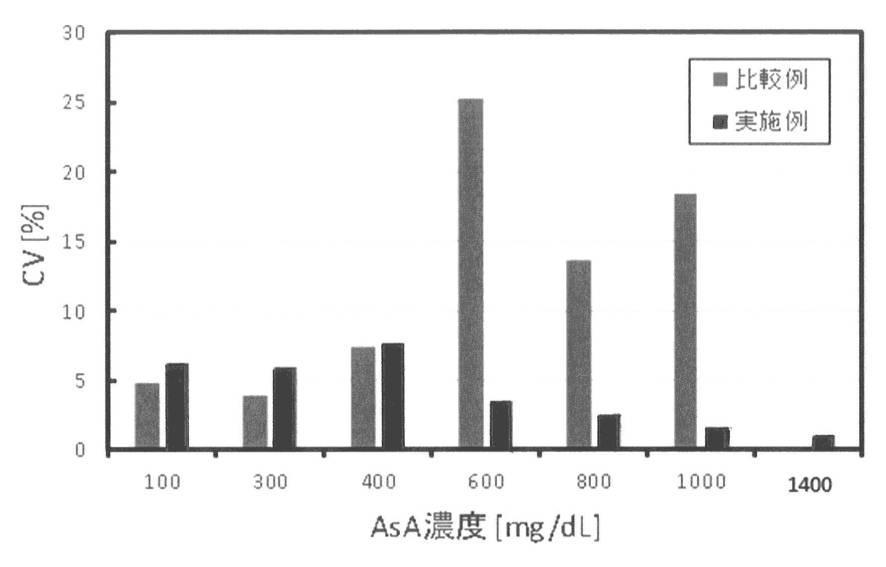
また、アスコルビン酸濃度100〜1400mg/dL(比較例については、100〜1000mg/dL)のアスコルビン酸含有全血試料を用いて、n=5における再現性(CV)(%)をCV=SD/Aveとして算出した。結果を表2および図5に示す。実施例のバイオセンサ1を用いた場合、測定した濃度域全体に渡り、再現性が得られることが確認できた。一方、比較例のバイオセンサを用いた場合、低濃度域(400mg/dL以下)においては、再現性が得られたが、高濃度域(600mg/dL以上)においては、十分に良好な再現性が得られなかった。
アミノ酸および可溶性タンパク質であるNPSを添加することにより、センサ間における試薬の溶解速度も均一になるため、高濃度領域における再現性が向上することが確認された。
Further, using an ascorbic acid-containing whole blood sample having an ascorbic acid concentration of 100 to 1400 mg / dL (100 to 1000 mg / dL for a comparative example), the reproducibility (CV) (%) at n = 5 was CV = SD /. Calculated as Ave. The results are shown in Table 2 and FIG. When the
It was confirmed that by adding the amino acid and NPS, which is a soluble protein, the dissolution rate of the reagent between the sensors became uniform, so that the reproducibility in the high concentration region was improved.
前記バイオセンサ1においてタウリンおよびNPSをそれぞれ0.5倍量とした以外は同様にしてバイオセンサ2を作製した。バイオセンサ1およびバイオセンサ2を用い、前記と同様にして、各アスコルビン酸含有全血試料について電流値を計測した。結果を図6に示す。バイオセンサ1およびバイオセンサ2を用いた場合のいずれも、アスコルビン酸の濃度と応答電流値の間に良好な直線性が得られたが、バイオセンサ1の方が直線性性能が向上した。すなわち、電極用試薬におけるタウリン濃度は4.5〜5.0%程度、NPSの添加量は2.4〜2.5%程度であるとさらに好ましいことが確認された。
The
<実施例2>
前記バイオセンサ1においてアミノ酸を下記表3に記載のアミノ酸および量、NPSを下記表3に記載の量とした以外は同様にしてバイオセンサを作製した。同バイオセンサを用い、前記と同様にして、各アスコルビン酸含有全血試料について電流値を計測した。結果を図7に示す。タウリン以外のアミノ酸であっても、直線性が改善されることが確認された。また、アミノ酸とNPSの添加量が多いほど超高濃度領域まで良好な直線性を示す)ことが確認された。
<Example 2>
A biosensor was produced in the same manner except that the amino acids in the
<実施例3>
前記バイオセンサ1においてNPSをBSAまたは糖類(キシリトール、トレハロース)とした以外は同様にしてバイオセンサを作製した。同バイオセンサを用い、前記と同様にして、各アスコルビン酸含有全血試料について電流値を計測した。結果を図8に示す。アミノ酸と共に糖類(キシリトール、トレハロース)を用いてもアスコルビン酸の濃度と応答電流値の間に良好な直線性が得られることが確認された。また、可溶性タンパク質としてBSAを用いてもアスコルビン酸の濃度と応答電流値の間に良好な直線性が得られることが確認された。
<Example 3>
A biosensor was produced in the same manner except that the NPS was BSA or a saccharide (xylitol, trehalose) in the
A・・・バイオセンサ
11・・・基板
12・・・作用極
12a・・・リード部
13・・・対極
13a・・・リード部
14・・・絶縁層
15・・・検出部
16・・・検知層
17・・・開口部(スリット)
17a・・・試料導入口
18・・・スペーサー
19・・・カバー
20・・・空気孔
B・・・測定装置
21・・・出力部
22・・・制御部
23・・・演算部
24・・・検出部
25・・・表示部ユニット
26・・・バッテリ
27・・・アスコルビン酸センサ
28・・・制御コンピュータ
29・・・ポテンショスタット
30・・・基板
31・・・電力供給装置
CR、W・・・端子
S01〜S05・・・アスコルビン酸濃度測定処理における各ステップ
A ...
17a ...
Claims (10)
アスコルビン酸からの電子授受を行う非触媒の電子アクセプター、並びに、アミノ酸と糖類および/または可溶性タンパク質を含む検知層とを含み、
前記検知層において、前記電子アクセプターが前記アスコルビン酸により還元され、該電子アクセプターが前記電極で酸化される、アスコルビン酸応答電極。 With electrodes
It contains a non-catalytic electron acceptor that transfers electrons from ascorbic acid, and a detection layer that contains amino acids and sugars and / or soluble proteins.
An ascorbic acid response electrode in which the electron acceptor is reduced by the ascorbic acid in the detection layer and the electron acceptor is oxidized at the electrode.
に記載のアスコルビン酸応答電極。
[Ru(NH3)5X]n+
ここで、Xは、NH3、ハロゲン、CN、ピリジン、ニコチンアミド、ビピリジンまたはH2Oを示し、n+は、ルテニウム(III)錯体の価数を表す。 2. The ruthenium compound is a ruthenium (III) complex represented by the following chemical formula.
Ascorbic acid response electrode according to.
[Ru (NH 3 ) 5 X] n +
Here, X represents NH 3 , halogen, CN, pyridine, nicotinamide, bipyridine or H 2 O, and n + represents the valence of the ruthenium (III) complex.
前記バイオセンサへの電圧印加を制御する、制御部と、
前記バイオセンサへの電圧印加により得られる、アスコルビン酸応答電流を検出する、検出部と、
前記電流値からアスコルビン酸の濃度を算出する、演算部と、
前記算出されたアスコルビン酸の濃度を出力する出力部とから構成される、アスコルビン酸濃度の測定装置。 With the biosensor according to claim 7 or 8.
A control unit that controls the application of voltage to the biosensor,
A detection unit that detects the ascorbic acid response current obtained by applying a voltage to the biosensor, and
An arithmetic unit that calculates the concentration of ascorbic acid from the current value,
An ascorbic acid concentration measuring device including an output unit that outputs the calculated ascorbic acid concentration.
Priority Applications (4)
| Application Number | Priority Date | Filing Date | Title |
|---|---|---|---|
| JP2017205759A JP6925933B2 (en) | 2017-10-25 | 2017-10-25 | Electrodes and biosensors for measuring ascorbic acid |
| US16/168,600 US10816558B2 (en) | 2017-10-25 | 2018-10-23 | Electrode and biosensor for measuring ascorbic acid |
| CN201811240252.6A CN109709186A (en) | 2017-10-25 | 2018-10-24 | Ascorbic acid measuring electrode and biosensor |
| EP18202621.1A EP3477290B1 (en) | 2017-10-25 | 2018-10-25 | Electrode and method for measuring ascorbic acid |
Applications Claiming Priority (1)
| Application Number | Priority Date | Filing Date | Title |
|---|---|---|---|
| JP2017205759A JP6925933B2 (en) | 2017-10-25 | 2017-10-25 | Electrodes and biosensors for measuring ascorbic acid |
Publications (2)
| Publication Number | Publication Date |
|---|---|
| JP2019078638A JP2019078638A (en) | 2019-05-23 |
| JP6925933B2 true JP6925933B2 (en) | 2021-08-25 |
Family
ID=64277490
Family Applications (1)
| Application Number | Title | Priority Date | Filing Date |
|---|---|---|---|
| JP2017205759A Active JP6925933B2 (en) | 2017-10-25 | 2017-10-25 | Electrodes and biosensors for measuring ascorbic acid |
Country Status (4)
| Country | Link |
|---|---|
| US (1) | US10816558B2 (en) |
| EP (1) | EP3477290B1 (en) |
| JP (1) | JP6925933B2 (en) |
| CN (1) | CN109709186A (en) |
Family Cites Families (15)
| Publication number | Priority date | Publication date | Assignee | Title |
|---|---|---|---|---|
| JP2658769B2 (en) * | 1991-10-21 | 1997-09-30 | 松下電器産業株式会社 | Biosensor |
| JP3024394B2 (en) * | 1992-09-30 | 2000-03-21 | 松下電器産業株式会社 | Biosensor and measurement method using the same |
| JP3370504B2 (en) | 1996-03-13 | 2003-01-27 | 松下電器産業株式会社 | Biosensor |
| ES2227796T3 (en) * | 1997-01-20 | 2005-04-01 | Kyowa Medex Co., Ltd. | METHODS AND REAGENTS FOR DETERMINING QUANTITATIVELY ASCORBIC ACID. |
| EP0884392B1 (en) * | 1997-06-03 | 2002-12-18 | Matsushita Electric Industrial Co., Ltd. | Cholesterol sensor |
| EP1474685A2 (en) | 2002-02-12 | 2004-11-10 | Biotesys Gmbh | Analysis of vital substances |
| US20060231396A1 (en) * | 2002-12-20 | 2006-10-19 | Hideaki Yamaoka | Thin analyzing device |
| US20060003400A1 (en) | 2004-06-30 | 2006-01-05 | Byrd Patricia A | Methods and compositions for characterizing a redox reagent system enzyme |
| JP4840520B2 (en) * | 2010-04-27 | 2011-12-21 | パナソニック株式会社 | Biosensor, biosensor measuring apparatus, and substrate quantification method |
| CN103154717B (en) * | 2010-09-30 | 2017-02-08 | 松下健康医疗控股株式会社 | sensor and sensor system |
| JP4930642B2 (en) * | 2011-02-16 | 2012-05-16 | パナソニック株式会社 | Biosensor, biosensor measuring apparatus, and substrate quantification method |
| JP2013083639A (en) * | 2011-09-26 | 2013-05-09 | Toto Ltd | Method for specifically detecting test substance |
| CN104316582A (en) * | 2014-11-04 | 2015-01-28 | 三诺生物传感股份有限公司 | Working electrode biological reactant and application and electrode-type test strip thereof |
| CA2972468A1 (en) * | 2014-12-31 | 2016-07-07 | Trividia Health, Inc. | Glucose test strip with interference correction |
| JP6713364B2 (en) * | 2016-07-20 | 2020-06-24 | アークレイ株式会社 | Ascorbic acid responsive electrode and biosensor |
-
2017
- 2017-10-25 JP JP2017205759A patent/JP6925933B2/en active Active
-
2018
- 2018-10-23 US US16/168,600 patent/US10816558B2/en active Active
- 2018-10-24 CN CN201811240252.6A patent/CN109709186A/en active Pending
- 2018-10-25 EP EP18202621.1A patent/EP3477290B1/en active Active
Also Published As
| Publication number | Publication date |
|---|---|
| JP2019078638A (en) | 2019-05-23 |
| CN109709186A (en) | 2019-05-03 |
| US20190120861A1 (en) | 2019-04-25 |
| EP3477290B1 (en) | 2024-01-03 |
| US10816558B2 (en) | 2020-10-27 |
| EP3477290C0 (en) | 2024-01-03 |
| EP3477290A1 (en) | 2019-05-01 |
Similar Documents
| Publication | Publication Date | Title |
|---|---|---|
| JP6713364B2 (en) | Ascorbic acid responsive electrode and biosensor | |
| US7754093B2 (en) | Biosensor having improved hematocrit and oxygen biases | |
| JP5684767B2 (en) | Lactic acid sensor | |
| TWI559001B (en) | Preparation composition for biosensor and biosensor having the composition of the preparation | |
| US20130098775A1 (en) | Glucose biosensor with improved shelf life | |
| EP3415634A1 (en) | Biosensor and measuring method using the same | |
| WO2011024487A1 (en) | Sensor and concentration measurement method | |
| JP7011906B2 (en) | Creatinine sensor | |
| JP6925933B2 (en) | Electrodes and biosensors for measuring ascorbic acid | |
| JP6721442B2 (en) | Ascorbic acid responsive electrode and biosensor | |
| JP2006275819A (en) | Biosensor | |
| JP4913355B2 (en) | Biosensor | |
| JP2007256069A (en) | Measuring method of biosensor | |
| JP2004317359A (en) | Biosensor and method of preserving enzyme | |
| JP2005010150A (en) | Biosensor |
Legal Events
| Date | Code | Title | Description |
|---|---|---|---|
| A621 | Written request for application examination |
Free format text: JAPANESE INTERMEDIATE CODE: A621 Effective date: 20200527 |
|
| A977 | Report on retrieval |
Free format text: JAPANESE INTERMEDIATE CODE: A971007 Effective date: 20210423 |
|
| A131 | Notification of reasons for refusal |
Free format text: JAPANESE INTERMEDIATE CODE: A131 Effective date: 20210427 |
|
| A521 | Request for written amendment filed |
Free format text: JAPANESE INTERMEDIATE CODE: A523 Effective date: 20210624 |
|
| TRDD | Decision of grant or rejection written | ||
| A01 | Written decision to grant a patent or to grant a registration (utility model) |
Free format text: JAPANESE INTERMEDIATE CODE: A01 Effective date: 20210713 |
|
| A61 | First payment of annual fees (during grant procedure) |
Free format text: JAPANESE INTERMEDIATE CODE: A61 Effective date: 20210804 |
|
| R150 | Certificate of patent or registration of utility model |
Ref document number: 6925933 Country of ref document: JP Free format text: JAPANESE INTERMEDIATE CODE: R150 |
|
| R250 | Receipt of annual fees |
Free format text: JAPANESE INTERMEDIATE CODE: R250 |
|
| R250 | Receipt of annual fees |
Free format text: JAPANESE INTERMEDIATE CODE: R250 |