JP6686284B2 - Article containing cured product of active energy ray curable resin composition - Google Patents
Article containing cured product of active energy ray curable resin composition Download PDFInfo
- Publication number
- JP6686284B2 JP6686284B2 JP2015064075A JP2015064075A JP6686284B2 JP 6686284 B2 JP6686284 B2 JP 6686284B2 JP 2015064075 A JP2015064075 A JP 2015064075A JP 2015064075 A JP2015064075 A JP 2015064075A JP 6686284 B2 JP6686284 B2 JP 6686284B2
- Authority
- JP
- Japan
- Prior art keywords
- meth
- polymerizable component
- acrylate
- mass
- resin composition
- Prior art date
- Legal status (The legal status is an assumption and is not a legal conclusion. Google has not performed a legal analysis and makes no representation as to the accuracy of the status listed.)
- Active
Links
Images


Landscapes
- Surface Treatment Of Optical Elements (AREA)
- Electroluminescent Light Sources (AREA)
- Polymerisation Methods In General (AREA)
- Addition Polymer Or Copolymer, Post-Treatments, Or Chemical Modifications (AREA)
- Macromonomer-Based Addition Polymer (AREA)
Description
本発明は、微細凹凸(ナノ凹凸)構造の形成に好適な活性エネルギー線硬化性樹脂組成物、この活性エネルギー線硬化性樹脂組成物を含むインプリント用原料、及びこの活性エネルギー線硬化性樹脂組成物を用いて形成した微細凹凸構造を有する物品に関する。 The present invention relates to an active energy ray-curable resin composition suitable for forming a fine unevenness (nano unevenness) structure, a raw material for imprinting containing the active energy ray-curable resin composition, and the active energy ray-curable resin composition. The present invention relates to an article having a fine concavo-convex structure formed by using a product.
表面にナノサイズの微細な凹凸が規則的に配置されている微細凹凸構造体は、連続的な屈折率の変化によって反射防止性能を発現することが知られている。このような微細凹凸構造は一般的にモスアイ構造と呼ばれる。また、この微細凹凸構造は、微細な凹凸構造を備えたハスの葉が示す超撥水性能(ロータス効果)と同様の効果を発現することも知られている。 It is known that a fine concavo-convex structure body in which nano-sized fine concavities and convexities are regularly arranged on the surface exhibits antireflection performance due to continuous change in refractive index. Such a fine concavo-convex structure is generally called a moth-eye structure. It is also known that this fine concavo-convex structure exhibits the same effect as the super water-repellent performance (lotus effect) exhibited by the lotus leaf having the fine concavo-convex structure.
微細凹凸構造を表面に有する物品の製造方法としては、例えば、下記方法が提案されている:
(i)微細凹凸構造の反転構造を表面に有するスタンパを用い、熱可塑性樹脂を射出成形又はプレス成形して、熱可塑性樹脂成形体の表面に微細凹凸構造を転写する方法;
(ii)微細凹凸構造の反転構造を表面に有するスタンパと透明基材との間に、活性エネルギー線硬化性樹脂組成物を充填し、活性エネルギー線の照射によって硬化させた後、スタンパを剥離して、硬化物に微細凹凸構造を転写する方法;及び
(iii)前記スタンパと透明基材との間に、活性エネルギー線硬化性樹脂組成物を充填した後、スタンパを剥離して、活性エネルギー線硬化性樹脂組成物に微細凹凸構造を転写し、その後、活性エネルギー線の照射によって活性エネルギー線硬化性樹脂組成物を硬化させる方法。
As a method for producing an article having a fine uneven structure on its surface, for example, the following method has been proposed:
(I) A method of transferring a fine concavo-convex structure to the surface of a thermoplastic resin molded body by injection-molding or press-molding a thermoplastic resin using a stamper having a reverse structure of the fine concavo-convex structure on its surface;
(Ii) An active energy ray-curable resin composition is filled between a stamper having an inverted structure of a fine concavo-convex structure on the surface and a transparent substrate, and the active energy ray is irradiated to cure the resin composition, and then the stamper is peeled off. And (iii) filling the active energy ray-curable resin composition between the stamper and the transparent substrate, and then peeling off the stamper to obtain the active energy ray. A method of transferring a fine concavo-convex structure to a curable resin composition and then curing the active energy ray-curable resin composition by irradiation with active energy rays.
これらの中でも、微細凹凸構造の転写性、表面組成の自由度を考慮すると、(ii)の方法が好適である。この方法は、連続生産が可能なベルト状やロール状のスタンパを用いる場合に特に好適であり、生産性に優れた方法である。 Among these, the method (ii) is preferable in consideration of the transferability of the fine concavo-convex structure and the degree of freedom of the surface composition. This method is particularly suitable when using a belt-shaped or roll-shaped stamper capable of continuous production, and is a method having excellent productivity.
微細凹凸構造が良好な反射防止性能を発現するのは、微細凹凸の隣り合う凸部又は凹部が可視光の波長以下の間隔である場合である。しかし、このような構造を有する微細凹凸構造体は、表面が平滑な、ハードコートなどで耐摩耗性処理をした成形体に比べて耐擦傷性に劣り、使用中の耐久性に問題があった。また、微細凹凸構造体の作製に使用した樹脂組成物の硬化物が十分に堅牢でないと、鋳型から離型する際や熱によって、突起同士が寄り添う現象が起き易い。 The fine concavo-convex structure exhibits good antireflection performance when the adjacent convex portions or concave portions of the fine concavo-convex structure have an interval of not more than the wavelength of visible light. However, the fine concavo-convex structure having such a structure is inferior in scratch resistance as compared with a molded body having a smooth surface and subjected to abrasion resistance treatment such as a hard coat, and has a problem in durability during use. . Further, if the cured product of the resin composition used for producing the fine concavo-convex structure is not sufficiently robust, a phenomenon in which the protrusions tend to snuggle together during mold release and heat is likely to occur.
そこで、耐久性や強度の高い微細凹凸構造を得るため、活性エネルギー線の照射により樹脂組成物を硬化させる際にスタンパの反転微細凹凸構造を転写して微細凹凸構造を形成した微細凹凸構造体や、微細凹凸構造を形成するための樹脂組成物が提案されている。 Therefore, in order to obtain a fine concavo-convex structure having high durability and strength, a fine concavo-convex structure body in which a fine concavo-convex structure is formed by transferring a reversal fine concavo-convex structure of a stamper when the resin composition is cured by irradiation with an active energy ray, A resin composition for forming a fine concavo-convex structure has been proposed.
例えば特許文献1には、最密充填されたシリカ微粒子を鋳型として可視光の波長以下の凸部(凹部)間隔を有する微細凹凸構造を作製することや、この微細凹凸構造を形成する樹脂組成物として、トリメチロールプロパントリ(メタ)アクリレート等の分子量当りの二重結合が多い多官能モノマーを含む紫外線硬化性樹脂組成物が記載されている。 For example, in Patent Document 1, the finely packed silica fine particles are used as a template to prepare a fine concavo-convex structure having convex (concave) intervals equal to or less than the wavelength of visible light, and a resin composition for forming the fine concavo-convex structure. As an example, an ultraviolet-curable resin composition containing a polyfunctional monomer having many double bonds per molecular weight such as trimethylolpropane tri (meth) acrylate is described.
また、特許文献2には、微細凹凸を有するハードコート層を有するフィルムが開示され、このハードコート層はJIS K5400に準じた鉛筆硬度試験で「H」以上の硬度を示すことが好ましいこと、そしてそのハードコート層を形成する樹脂として、ジペンタエリスリトールヘキサアクリレート、ジペンタエリスリトールペンタアクリレート、ペンタエリスリトールテトラアクリレート等の分子量当りの二重結合数が多い多官能モノマーを含む紫外線硬化性樹脂組成物が記載されている。 Further, Patent Document 2 discloses a film having a hard coat layer having fine irregularities, and it is preferable that the hard coat layer exhibits a hardness of “H” or more in a pencil hardness test according to JIS K5400, and As a resin forming the hard coat layer, an ultraviolet-curable resin composition containing a polyfunctional monomer having a large number of double bonds per molecular weight such as dipentaerythritol hexaacrylate, dipentaerythritol pentaacrylate, and pentaerythritol tetraacrylate is described. Has been done.
また、微細凹凸構造を形成するのに好ましい樹脂組成物として、以下のものが知られている:
(1)ウレタンアクリレート等のアクリレートオリゴマーと離型剤を必須成分とする光硬化性樹脂組成物(特許文献3);
(2)エトキシ化ビスフェノールAジ(メタ)アクリレート等の(メタ)アクリレート、N−ビニルピロリドン等の反応性希釈剤、光重合開始剤及びフッ素系界面活性剤から構成される光硬化性樹脂組成物(特許文献4);及び
(3)トリメチロールプロパントリ(メタ)アクリレート等の多官能(メタ)アクリレート、光重合開始剤及びポリエーテル変性シリコーンオイル等のレベリング剤を含む紫外線硬化性樹脂組成物(特許文献1)。
Further, the following resin compositions are known as preferable resin compositions for forming a fine concavo-convex structure:
(1) A photocurable resin composition containing an acrylate oligomer such as urethane acrylate and a release agent as essential components (Patent Document 3);
(2) Photocurable resin composition composed of (meth) acrylate such as ethoxylated bisphenol A di (meth) acrylate, reactive diluent such as N-vinylpyrrolidone, photopolymerization initiator and fluorine-based surfactant (Patent Document 4); and (3) a UV-curable resin composition containing a polyfunctional (meth) acrylate such as trimethylolpropane tri (meth) acrylate, a photopolymerization initiator, and a leveling agent such as a polyether-modified silicone oil ( Patent Document 1).
しかしながら、特許文献1、2に記載の微細凹凸構造体は、いずれも架橋密度の高い弾性率の高い硬化物であるが、必ずしも耐擦傷性を満足させるものではない。また、鉛筆硬度試験で「H」以上の硬度を示す硬化樹脂であっても、特に微細凹凸構造体の場合は微細突起が折れたり曲がったりして反射防止性能が損なわれる場合があり、その使用用途が限定されてしまう。また、これら微細凹凸構造体は、微細凹凸構造表面が十分な撥水性を発揮するものではない。 However, the fine concavo-convex structures described in Patent Documents 1 and 2 are cured products having a high crosslink density and a high elastic modulus, but they do not necessarily satisfy the scratch resistance. Even in the case of a cured resin having a hardness of "H" or more in a pencil hardness test, especially in the case of a fine concavo-convex structure, fine projections may be bent or bent to impair the antireflection performance. The use is limited. Further, in these fine concavo-convex structures, the surface of the fine concavo-convex structure does not exhibit sufficient water repellency.
一方、樹脂成形体に撥水性を付与するために、シリコーン化合物やフッ素化合物を用いる方法が知られている。しかし、一般的にシリコーン化合物やフッ素化合物で撥水性を発揮するようなものは、活性エネルギー線硬化性樹脂組成物に使用される一般的な多官能(メタ)アクリレートやウレタン(メタ)アクリレートなどとの相溶性が低く、透明性が求められるハードコートへの適用は限定される。 On the other hand, there is known a method of using a silicone compound or a fluorine compound in order to impart water repellency to a resin molding. However, those that exhibit water repellency with a silicone compound or a fluorine compound are generally used as a general polyfunctional (meth) acrylate or urethane (meth) acrylate used in an active energy ray-curable resin composition. Its low compatibility makes it difficult to apply to hard coats that require transparency.
本発明の主な目的は、微細凹凸構造による反射防止機能と共に、撥水性と高い耐擦傷性を有する硬化物を形成できる活性エネルギー線硬化性樹脂組成物、及びこれを用いて形成された物品を提供することにある。 The main object of the present invention is to provide an active energy ray-curable resin composition capable of forming a cured product having water repellency and high scratch resistance together with an antireflection function due to a fine concavo-convex structure, and an article formed using the same. To provide.
本発明者らは、上記目的を達成するために鋭意検討を行った結果、特定の重合性成分を含む活性エネルギー線硬化性樹脂組成物の硬化物からなる微細凹凸構造体が、撥水性と高い耐擦傷性を有することを見出し、本発明を完成した。 As a result of intensive studies to achieve the above-mentioned object, the present inventors have found that a fine uneven structure composed of a cured product of an active energy ray-curable resin composition containing a specific polymerizable component has high water repellency and high water repellency. They have found that they have scratch resistance and completed the present invention.
本発明の好ましい態様によれば、重合性成分(P)と光重合開始剤(E)を含む活性エネルギー線硬化性樹脂組成物であって、
重合性成分(P)が、重合性成分(P)の全体量100質量%に対して、
炭素数6以上アルカンジオールを原料とするアルカンジオールジ(メタ)アクリレートである重合性成分(A)50〜100質量%、
シリコーン(メタ)アクリレート及びアルキル(メタ)アクリレートの少なくとも一方である重合性成分(B)0〜50質量%、及び
分子内に3個以上の(メタ)アクリロイル基を有する多官能(メタ)アクリレートである重合性成分(C)0〜50質量%、を含み、
光重合開始剤(E)の含有率が、重合性成分(P)の全体量100質量部に対して、0.01〜10質量部である、活性エネルギー線硬化性樹脂組成物が提供される。
According to a preferred embodiment of the present invention, an active energy ray-curable resin composition containing a polymerizable component (P) and a photopolymerization initiator (E),
The polymerizable component (P) is based on 100% by mass of the total amount of the polymerizable component (P),
50-100% by mass of a polymerizable component (A), which is an alkanediol di (meth) acrylate prepared from an alkanediol having 6 or more carbon atoms,
A polymerizable component (B), which is at least one of silicone (meth) acrylate and alkyl (meth) acrylate, and a polyfunctional (meth) acrylate having 3 or more (meth) acryloyl groups in the molecule. Including a certain polymerizable component (C) 0 to 50% by mass,
An active energy ray-curable resin composition in which the content of the photopolymerization initiator (E) is 0.01 to 10 parts by mass with respect to 100 parts by mass of the total amount of the polymerizable component (P) is provided. .
本発明の他の好ましい態様によれば、重合性成分(P)と光重合開始剤(E)を含む活性エネルギー線硬化性樹脂組成物であって、
重合性成分(P)が、重合性成分(P)の全体量100質量%に対して、
炭素数7以上のアルカンジオールを原料とするアルカンジオールジ(メタ)アクリレートである重合性成分(A)1〜100質量%、
シリコーン(メタ)アクリレート及びアルキル(メタ)アクリレートの少なくとも一方である重合性成分(B)0〜50質量%、及び
分子内に3個以上の(メタ)アクリロイル基を有する多官能(メタ)アクリレートである重合性成分(C)0〜50質量%、を含み、
光重合開始剤(E)の含有率が、重合性成分(P)の全体量100質量部に対して、0.01〜10質量部である、活性エネルギー線硬化性樹脂組成物が提供される。
According to another preferred embodiment of the present invention, an active energy ray-curable resin composition containing a polymerizable component (P) and a photopolymerization initiator (E),
The polymerizable component (P) is based on 100% by mass of the total amount of the polymerizable component (P),
1 to 100% by mass of a polymerizable component (A), which is an alkanediol di (meth) acrylate made from an alkanediol having 7 or more carbon atoms,
A polymerizable component (B), which is at least one of silicone (meth) acrylate and alkyl (meth) acrylate, and a polyfunctional (meth) acrylate having 3 or more (meth) acryloyl groups in the molecule. Including a certain polymerizable component (C) 0 to 50% by mass,
An active energy ray-curable resin composition in which the content of the photopolymerization initiator (E) is 0.01 to 10 parts by mass with respect to 100 parts by mass of the total amount of the polymerizable component (P) is provided. .
本発明の他の好ましい態様によれば、上記の活性エネルギー線硬化性樹脂組成物を含むインプリント用原料が提供される。 According to another preferred embodiment of the present invention, there is provided a raw material for imprinting containing the above active energy ray-curable resin composition.
本発明の他の好ましい態様によれば、上記の活性エネルギー線硬化性樹脂組成物の硬化物を含む物品が提供される。 According to another preferred embodiment of the present invention, an article containing a cured product of the above active energy ray-curable resin composition is provided.
本発明の実施形態によれば、微細凹凸構造による反射防止機能と共に、撥水性と高い耐擦傷性を有する硬化物を形成できる活性エネルギー線硬化性樹脂組成物、及びこれを用いて形成された物品を提供することができる。 According to the embodiment of the present invention, an active energy ray-curable resin composition capable of forming a cured product having water repellency and high scratch resistance together with an antireflection function due to a fine concavo-convex structure, and an article formed using the same. Can be provided.
本発明の実施形態による活性エネルギー線硬化性樹脂組成物(X)は、重合性成分(P)と光重合開始剤(E)を含み、これに活性エネルギー線を照射することにより、重合反応が進行し、硬化するものである。 The active energy ray-curable resin composition (X) according to the embodiment of the present invention contains a polymerizable component (P) and a photopolymerization initiator (E), and irradiation with active energy rays causes the polymerization reaction to proceed. It progresses and hardens.
重合性成分(P)は、炭素数6以上のアルカンジオールを原料とするアルカンジオールジ(メタ)アクリレートである重合性成分(A)を必須成分として含み、必要に応じてさらに、シリコーン(メタ)アクリレート及び/又はアルキル(メタ)アクリレートである重合性成分(B)と、分子内に3個以上の(メタ)アクリロイル基を有する多官能(メタ)アクリレートである重合性成分(C)と、その他の重合性成分(D)を含むことができる。 The polymerizable component (P) contains, as an essential component, the polymerizable component (A) which is an alkanediol di (meth) acrylate prepared from an alkanediol having 6 or more carbon atoms as a raw material, and further contains a silicone (meth), if necessary. A polymerizable component (B) which is an acrylate and / or an alkyl (meth) acrylate, a polymerizable component (C) which is a polyfunctional (meth) acrylate having three or more (meth) acryloyl groups in the molecule, and other The polymerizable component (D) can be included.
また、この活性エネルギー線硬化性樹脂組成物は、必要に応じて内部離型剤(F)、その他の成分(G)を含んでもよい。 Moreover, this active energy ray-curable resin composition may contain an internal mold release agent (F) and other components (G) as needed.
活性エネルギー線硬化性樹脂組成物(X)の硬化物の表面が微細凹凸構造を有する場合、重合性成分(P)の組成を調整して硬化物を適切な硬さにすることが重要である。硬化物が硬すぎると、微細凹凸構造表面の耐擦傷性が低くなる傾向がある。一方、硬化物が柔らかすぎると、微細凹凸構造が維持しにくくなり、複数の凸部同士が合一してしまう場合がある。 When the surface of the cured product of the active energy ray-curable resin composition (X) has a fine uneven structure, it is important to adjust the composition of the polymerizable component (P) so that the cured product has an appropriate hardness. . If the cured product is too hard, the scratch resistance of the surface of the fine concavo-convex structure tends to be low. On the other hand, if the cured product is too soft, it becomes difficult to maintain the fine concavo-convex structure, and the plurality of convex portions may unite with each other.
重合性成分(P)が、さらに重合性成分(B)を含む場合は、
重合性成分(A)の含有率が50〜99.5質量%であり、
重合性成分(B)の含有率が0.5〜50質量%であり、
重合性成分(C)の含有率が0〜49.5質量%であることが好ましい。
When the polymerizable component (P) further contains the polymerizable component (B),
The content of the polymerizable component (A) is 50 to 99.5% by mass,
The content of the polymerizable component (B) is 0.5 to 50% by mass,
The content of the polymerizable component (C) is preferably 0 to 49.5 mass%.
重合性成分(P)が、さらに重合性成分(C)を含む場合は、
重合性成分(A)の含有率が50〜90質量%であり、
重合性成分(B)の含有率が0〜40質量%であり、
重合性成分(C)の含有率が10〜50質量%であることが好ましく、
重合性成分(A)の含有率が50〜89.5質量%であり、
重合性成分(B)の含有率が0.5〜40質量%であり、
重合性成分(C)の含有率が10〜49.5質量%であることがより好ましい。
When the polymerizable component (P) further contains the polymerizable component (C),
The content of the polymerizable component (A) is 50 to 90% by mass,
The content of the polymerizable component (B) is 0 to 40% by mass,
The content of the polymerizable component (C) is preferably 10 to 50% by mass,
The content of the polymerizable component (A) is 50 to 89.5% by mass,
The content of the polymerizable component (B) is 0.5 to 40% by mass,
The content of the polymerizable component (C) is more preferably 10 to 49.5 mass%.
重合性成分(B)のシリコーン(メタ)アクリレートとしては、オキシアルキレン骨格を有さない非オキシアルキレン化シリコーン(メタ)アクリレートが好ましい。 As the silicone (meth) acrylate of the polymerizable component (B), a non-oxyalkylenated silicone (meth) acrylate having no oxyalkylene skeleton is preferable.
重合性成分(B)のシリコーン(メタ)アクリレートとしては、下記式(1)で表される化合物が好ましい。 The silicone (meth) acrylate of the polymerizable component (B) is preferably a compound represented by the following formula (1).
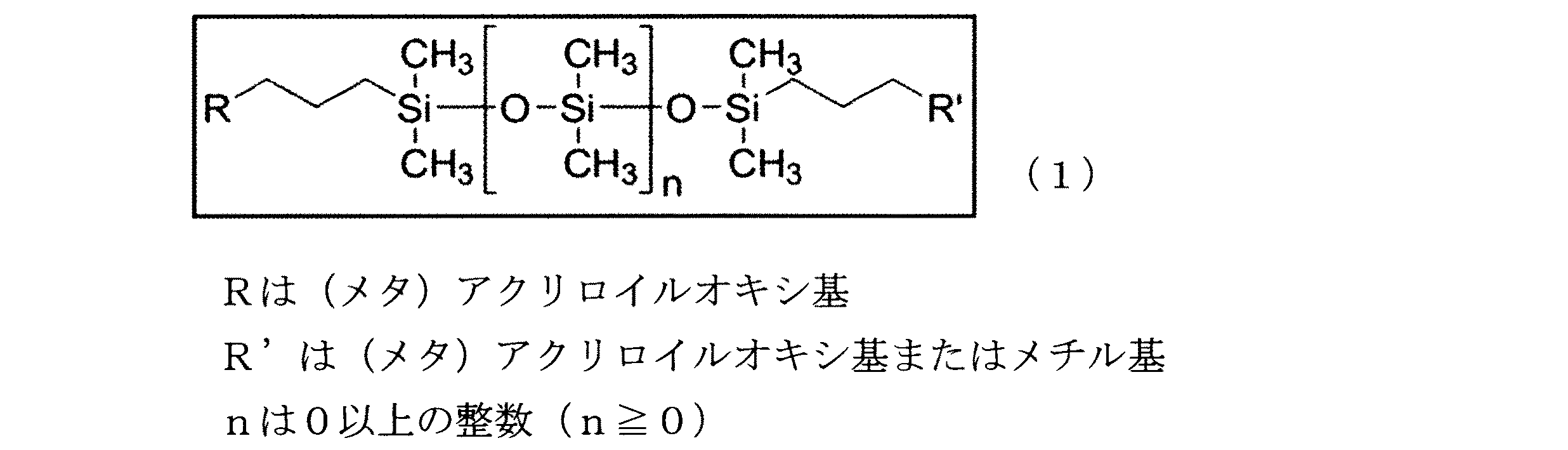
重合性成分(B)のアルキル(メタ)アクリレートとしては、アルキル基の炭素数が8〜22のアルキル(メタ)アクリレートが好ましい。 The alkyl (meth) acrylate of the polymerizable component (B) is preferably an alkyl (meth) acrylate having an alkyl group with 8 to 22 carbon atoms.
本発明の実施形態による活性エネルギー線硬化性樹脂組成物は、内部離型剤(F)を含むことができる。内部離型剤(F)としては、(ポリ)オキシアルキレンアルキルリン酸化合物が好ましい。 The active energy ray-curable resin composition according to the embodiment of the present invention may include an internal release agent (F). As the internal mold release agent (F), a (poly) oxyalkylene alkyl phosphate compound is preferable.
本発明の他の実施形態によれば、上記の活性エネルギー線硬化性樹脂組成物を含むインプリント用原料を提供できる。 According to another embodiment of the present invention, it is possible to provide a raw material for imprint containing the above active energy ray-curable resin composition.
本発明の他の実施形態によれば、上記の活性エネルギー線硬化性樹脂組成物の硬化物を含む物品を提供できる。この硬化物として硬化樹脂層を含むことができる。また、この硬化物の表面に複数の凸部からなる微細凹凸構造を有することができる。この微細凹凸構造においては、隣り合う凸部同士の平均間隔が400nm以下が好ましい。 According to another embodiment of the present invention, an article including a cured product of the above active energy ray-curable resin composition can be provided. A cured resin layer can be included as the cured product. Further, the surface of this cured product can have a fine concavo-convex structure composed of a plurality of convex portions. In this fine concavo-convex structure, it is preferable that the average interval between adjacent convex portions is 400 nm or less.
本発明の実施形態による物品は、ディスプレイ部材、反射防止物品、撥水フィルムに適用できる。 The articles according to the embodiments of the present invention can be applied to display members, antireflection articles, and water repellent films.
以下、本発明の好適な実施の形態についてさらに説明する。 Hereinafter, preferred embodiments of the present invention will be further described.
[重合性成分(A)]
重合性成分(A)は、本発明の実施形態による活性エネルギー線硬化性樹脂組成物の硬化物に対して、耐擦傷性向上、耐候性向上、基材密着性向上の効果がある。例えば、基材密着性に関しては、ポリカーボネート樹脂やアクリル樹脂に有効である。また、活性エネルギー線硬化性樹脂組成物の相溶性向上や低粘度化の効果を得ることもできる。
[Polymerizable component (A)]
The polymerizable component (A) has effects of improving scratch resistance, weather resistance, and substrate adhesion with respect to the cured product of the active energy ray-curable resin composition according to the embodiment of the present invention. For example, regarding the substrate adhesion, it is effective for polycarbonate resin and acrylic resin. Further, it is possible to obtain the effects of improving the compatibility and lowering the viscosity of the active energy ray-curable resin composition.
重合性成分(A)は、アルカンジオールジ(メタ)アクリレートであり、その原料であるアルカンジオールの炭素数は、6以上が好ましく、7以上がより好ましく、8以上がさらに好ましく、9以上が特に好ましい。アルカン部の炭素数が小さすぎると活性エネルギー線硬化性樹脂組成物の硬化物が硬くなりすぎてしまい、微細凹凸構造が脆くなって傷付きやすくなる。一方、アルカン部の炭素数が大きすぎると、アルカンジオールジ(メタ)アクリレートが結晶性を持ち、取扱い性が著しく低下する場合がある。そのため、重合性成分(A)の原料であるアルカンジオールの炭素数は、12以下が好ましく、10以下がより好ましい。また、アルカン部は直鎖構造でも分岐構造でもよく、両者の混合物でも良い。分岐構造を持たせることで結晶性を下げることができ、低温でも液状になり、取扱い性を向上させることができる。また、シクロアルカン構造は硬化物のガラス転移温度を上昇させ、硬くする効果がある。 The polymerizable component (A) is an alkanediol di (meth) acrylate, and the raw material alkanediol has preferably 6 or more carbon atoms, more preferably 7 or more carbon atoms, further preferably 8 or more carbon atoms, and particularly preferably 9 or more carbon atoms. preferable. When the carbon number of the alkane part is too small, the cured product of the active energy ray-curable resin composition becomes too hard, and the fine uneven structure becomes brittle and easily scratched. On the other hand, when the number of carbon atoms in the alkane part is too large, the alkanediol di (meth) acrylate may have crystallinity and the handleability may be significantly reduced. Therefore, the carbon number of the alkanediol, which is the raw material of the polymerizable component (A), is preferably 12 or less, more preferably 10 or less. The alkane part may have a linear structure or a branched structure, or may be a mixture of the two. By having a branched structure, the crystallinity can be lowered, and it becomes liquid even at low temperature, and the handleability can be improved. In addition, the cycloalkane structure has the effect of raising the glass transition temperature of the cured product and making it hard.
重合性成分(A)の具体例としては、例えば、1,6−ヘキサンジオールジ(メタ)アクリレート、1,7−ヘプタンジオールジ(メタ)アクリレート、1,8−オクタンジオールジ(メタ)アクリレート、1,9−ノナンジオールジ(メタ)アクリレート、1,10−デカンジオールジ(メタ)アクリレート、1,12−ドデカンジオールジ(メタ)アクリレート、1,16−ヘキサデカンジオールジ(メタ)アクリレートアクリレート、バチルアルコールジ(メタ)アクリレート、3−メチル1,5−ペンタンジオールジ(メタ)アクリレート、2−メチル−1,8−オクタンジオールジ(メタ)アクリレート、2−エチル−2−ブチル−プロパンジオールジ(メタ)アクリレート、ダイマージオールジ(メタ)アクリレート、シクロヘキサンジメタノールジ(メタ)アクリレート、トリシクロデカンジメタノールジ(メタ)アクリレート、水添ビスフェノールAジ(メタ)アクリレートなどが挙げられる。これらは1種を単独で使用しても良く、2種以上を併用しても良い。 Specific examples of the polymerizable component (A) include, for example, 1,6-hexanediol di (meth) acrylate, 1,7-heptanediol di (meth) acrylate, 1,8-octanediol di (meth) acrylate, 1,9-nonanediol di (meth) acrylate, 1,10-decanediol di (meth) acrylate, 1,12-dodecanediol di (meth) acrylate, 1,16-hexadecanediol di (meth) acrylate acrylate, batyl Alcohol di (meth) acrylate, 3-methyl-1,5-pentanediol di (meth) acrylate, 2-methyl-1,8-octanediol di (meth) acrylate, 2-ethyl-2-butyl-propanediol di ( (Meth) acrylate, dimer diol di (meth) acrylate, cyclohexyl Sanji dimethanol di (meth) acrylate, tricyclodecane dimethanol (meth) acrylate, and hydrogenated bisphenol A di (meth) acrylate. These may be used alone or in combination of two or more.
重合性成分(A)の含有割合は、重合性成分(P)の全体量100質量%のうち、1〜100質量%の範囲に設定することができ、好ましくは50〜100質量%の範囲に設定することができる。より十分な添加効果を得る点から、60質量%以上がより好ましく、70質量%以上がさらに好ましい。重合性成分(A)による十分な効果を得ながら他の重合性成分による効果を得る観点から、重合性成分(A)の含有割合は、90質量%以下が好ましく、85質量%以下がより好ましい。十分な量の重合性成分(A)を含有することにより、硬化物において、優れた耐擦傷性、耐候性、基材密着性、といった効果を得ることができ、樹脂組成物においては、低粘度化や重合性成分(B)等の他の重合性成分との相溶性向上の効果が期待できる。 The content ratio of the polymerizable component (A) can be set in the range of 1 to 100% by mass, and preferably in the range of 50 to 100% by mass, based on 100% by mass of the total amount of the polymerizable component (P). Can be set. From the viewpoint of obtaining a more sufficient addition effect, it is more preferably 60% by mass or more, and further preferably 70% by mass or more. From the viewpoint of obtaining the effect of the other polymerizable component while obtaining the sufficient effect of the polymerizable component (A), the content ratio of the polymerizable component (A) is preferably 90% by mass or less, and more preferably 85% by mass or less. . By containing a sufficient amount of the polymerizable component (A), it is possible to obtain excellent effects such as scratch resistance, weather resistance and substrate adhesion in the cured product, and in the resin composition, a low viscosity is obtained. And the effect of improving the compatibility with other polymerizable components such as the polymerizable component (B) can be expected.
[重合性成分(B)]
重合性成分(B)は、本発明の実施形態による活性エネルギー線硬化性樹脂組成物の硬化物に対して、撥水性や防汚性の付与や耐擦傷性向上の効果がある。
[Polymerizable component (B)]
The polymerizable component (B) has an effect of imparting water repellency, antifouling property and improving scratch resistance to the cured product of the active energy ray-curable resin composition according to the embodiment of the present invention.
重合性成分(B)は、シリコーン(メタ)アクリレート及び/又はアルキル(メタ)アクリレートである。以下、シリコーン(メタ)アクリレートとアクリル(メタ)アクリレートをそれぞれ分けて説明する。 The polymerizable component (B) is a silicone (meth) acrylate and / or an alkyl (meth) acrylate. Hereinafter, silicone (meth) acrylate and acrylic (meth) acrylate will be described separately.
(シリコーン(メタ)アクリレート)
シリコーン(メタ)アクリレートは、シリコーン骨格を有する(メタ)アクリレートである。以下、本発明に好適なシリコーン(メタ)アクリレートについていくつか例を挙げて具体的に説明する。
(Silicone (meth) acrylate)
Silicone (meth) acrylate is a (meth) acrylate having a silicone skeleton. The silicone (meth) acrylate suitable for the present invention will be specifically described below with some examples.
シリコーン(メタ)アクリレートとしては、例えば、下記式(1)で示される、両末端及び/又は片末端にプロピル(メタ)アクリレート構造を有するシリコーン(メタ)アクリレートが挙げられる。 Examples of the silicone (meth) acrylate include a silicone (meth) acrylate represented by the following formula (1) and having a propyl (meth) acrylate structure at both ends and / or one end.
式(1)で表されるシリコーン(メタ)アクリレートは、分子量が大きすぎると重合性成分(A)等の他の重合性成分との相溶性が低下する傾向がある。一方、分子量が小さすぎると撥水性や耐擦傷性向上の効果が得られにくくなる。そのため、式(1)で表されるシリコーン(メタ)アクリレートの重量平均分子量は500〜2000程度が好ましい。 When the molecular weight of the silicone (meth) acrylate represented by the formula (1) is too large, the compatibility with other polymerizable components such as the polymerizable component (A) tends to decrease. On the other hand, if the molecular weight is too small, it becomes difficult to obtain the effects of improving water repellency and scratch resistance. Therefore, the weight average molecular weight of the silicone (meth) acrylate represented by the formula (1) is preferably about 500 to 2000.
このような重合性成分(B)の市販品としては、例えば、JNC社製の「サイラプレーン」(登録商標)シリーズの製品名:FM−0711、FM−0721、FM−0725、FM−7711、FM−7721、FM−7725、信越化学工業社製の製品名:X−22−2445、X−22−174ASX、X−22−174BX、X−22−174DX、KF−2012、X−22−2426、X−22−2475、X−22−164、X−22−164AS、X−22−164A、X−22−164B、X−22−164C、X−22−164E、東レ・ダウコーニング社製の製品名:BY16−152C、などが挙げられる。 Examples of commercially available products of the polymerizable component (B) include, for example, product names of "Silaplane" (registered trademark) series manufactured by JNC: FM-0711, FM-0721, FM-0725, FM-7711, FM-7721, FM-7725, Shin-Etsu Chemical Co., Ltd. product name: X-22-2445, X-22-174ASX, X-22-174BX, X-22-174DX, KF-2012, X-22-2426. , X-22-2475, X-22-164, X-22-164AS, X-22-164A, X-22-164B, X-22-164C, X-22-164E, Toray Dow Corning. Product name: BY16-152C and the like.
他のシリコーン(メタ)アクリレートとしては、例えば、下記式(2)で示される、シリコーンエポキシ(メタ)アクリレートが挙げられる。
式(2)で示されるシリコーン(メタ)アクリレートの市販品としては、例えば、エボニック・ジャパン社製の「Tego」(登録商標)シリーズの製品名:Rad2011、Rad2100、Rad2500、などが挙げられる。 Examples of commercially available products of the silicone (meth) acrylate represented by the formula (2) include product names of the “Tego” (registered trademark) series manufactured by Evonik Japan: Rad2011, Rad2100, and Rad2500.
他のシリコーン(メタ)アクリレートとしては、ポリジメチルシロキサンの両末端をEO及び/又はPO変性した(メタ)アクリレートが挙げられる。その市販品としては、例えば、信越化学工業社製の製品名:X−22−1602、ビックケミー・ジャパン社製の製品名:BYK−UV3500、BYK−UV3530、エボニック・ジャパン社製の製品名:「Tego」(登録商標)シリーズ:Rad2200N、Rad2250、Rad2300、ダイセル・オルネクス社製の製品名:EBECRYL 350、などが挙げられる。なお、上記の「EO変性」はエチレンオキサイド変性を意味し、「PO変性」はプロピレンオキサイド変性を意味する。 Other silicone (meth) acrylates include (meth) acrylates obtained by modifying both ends of polydimethylsiloxane with EO and / or PO. As the commercially available product, for example, product name: X-22-1602 manufactured by Shin-Etsu Chemical Co., Ltd., product name manufactured by Big Chemie Japan: BYK-UV3500, BYK-UV3530, product name manufactured by Evonik Japan: " Tego ”(registered trademark) series: Rad2200N, Rad2250, Rad2300, product name: EBECRYL 350 manufactured by Daicel-Olnex, and the like. The above "EO modified" means ethylene oxide modified and "PO modified" means propylene oxide modified.
他のシリコーン(メタ)アクリレートとしては、ウレタン(メタ)アクリレート及び/又はポリエステル(メタ)アクリレートであって且つシリコーン骨格を有するもの、例えば(メタ)アクリロイル基を有するポリエステル変性ポリジメチルシロキサン、ポリジメチルシロキサン構造を有するウレタン(メタ)アクリレートが挙げられる。その市販品としては、例えば、ビックケミー・ジャパン社製の製品名:BYK−UV3570、Miwon Speciality Chemical社製の製品名:「Miramer」(登録商標)シリーズ:SIU100、SIU1000、SIU2400、SIP900、などが挙げられる。 Other silicone (meth) acrylates are urethane (meth) acrylates and / or polyester (meth) acrylates having a silicone skeleton, for example, polyester-modified polydimethylsiloxane having a (meth) acryloyl group, polydimethylsiloxane. Urethane (meth) acrylate which has a structure is mentioned. Examples of the commercially available product include BYK-UV3570, product name manufactured by Big Chemie Japan, and product name: "Miramer" (registered trademark) series: SIU100, SIU1000, SIU2400, SIP900, manufactured by BYK-UV3570, Miwon Specialty Chemicals. To be
上記以外のシリコーン(メタ)アクリレートの市販品としては、例えば、ビックケミー・ジャパン社製の製品名:BYK−UV3505、3530、3575、3576、ダイセル・オルネクス社製の製品名:EBECRYL 1360などが挙げられる。 Commercially available products of silicone (meth) acrylates other than the above include, for example, product names BYK-UV 3505, 3530, 3575, and 3576 manufactured by Big Chemie Japan Co., Ltd., product names manufactured by Daicel Ornex Co., Ltd .: EBECRYL 1360, and the like. .
以上で挙げた重合性成分(B)として用いるシリコーン(メタ)アクリレートの中では、式(1)で示したシリコーン(メタ)アクリレート、式(2)で示したシリコーン(メタ)アクリレート、及びBYK−UV3570から選択されるものが、撥水性、耐擦傷性、耐候性の点で好ましい。特に超撥水性を付与する点で、式(1)で示したシリコーン(メタ)アクリレートを使用することが好ましい。 Among the silicone (meth) acrylates used as the polymerizable component (B) mentioned above, the silicone (meth) acrylate represented by the formula (1), the silicone (meth) acrylate represented by the formula (2), and BYK-. The one selected from UV3570 is preferable in terms of water repellency, scratch resistance and weather resistance. Particularly, from the viewpoint of imparting super water repellency, it is preferable to use the silicone (meth) acrylate represented by the formula (1).
オキシアルキレン構造を有するシリコーン(メタ)アクリレートは相溶性が良好な反面、耐候性の点で劣る結果となる場合がある。そのため、耐候性の点からは、重合性成分(B)として、オキシアルキレン骨格を有さない非オキシアルキレン化シリコーン(メタ)アクリレートが好ましい。 While the silicone (meth) acrylate having an oxyalkylene structure has good compatibility, it may result in poor weather resistance. Therefore, from the viewpoint of weather resistance, as the polymerizable component (B), a non-oxyalkylenated silicone (meth) acrylate having no oxyalkylene skeleton is preferable.
(アルキル(メタ)アクリレート)
重合性成分(B)として用いるアルキル(メタ)アクリレートは、硬化物の撥水性と耐擦傷性を向上させる点から、アルキル基が比較的長いものが好ましい。具体的には、アルキル基の炭素数は8〜22が好ましく、12〜18がより好ましい。アルキル基は直鎖でも分岐でも良い。アルキル基は長すぎると結晶性が高まって液状での取り扱いが困難になり、短すぎると揮発性が問題になる場合がある。アルキル(メタ)アクリレートの具体的な例としては、(イソ)オクチル(メタ)アクリレート、(イソ)デシル(メタ)アクリレート、(イソ)ラウリル(メタ)アクリレート、(イソ)セチル(メタ)アクリレート、(イソ)ステアリル(メタ)アクリレート、(イソ)ベヘニル(メタ)アクリレート等が挙げられる。これらの中では、撥水性付与と取扱い性の点で、イソステアリル(メタ)アクリレートが特に好ましい。
(Alkyl (meth) acrylate)
The alkyl (meth) acrylate used as the polymerizable component (B) preferably has a relatively long alkyl group from the viewpoint of improving water repellency and scratch resistance of the cured product. Specifically, the alkyl group preferably has 8 to 22 carbon atoms, and more preferably 12 to 18 carbon atoms. The alkyl group may be linear or branched. If the alkyl group is too long, the crystallinity will be high, making it difficult to handle in a liquid state, and if it is too short, the volatility may be a problem. Specific examples of the alkyl (meth) acrylate include (iso) octyl (meth) acrylate, (iso) decyl (meth) acrylate, (iso) lauryl (meth) acrylate, (iso) cetyl (meth) acrylate, ( Examples thereof include iso) stearyl (meth) acrylate and (iso) behenyl (meth) acrylate. Among these, isostearyl (meth) acrylate is particularly preferable from the viewpoint of imparting water repellency and handling.
重合性成分(B)の含有割合は、重合性成分(P)の全体量100質量%のうち、0〜50質量%の範囲に設定することができる。十分な添加効果を得る点から、0.5質量%以上が好ましく、1質量%以上がより好ましい。重合性成分(B)の添加量が多すぎると硬化物の物性が低下して耐擦傷性が低下する場合がある。そのため、重合性成分(B)の含有割合は、40質量%以下が好ましく、20質量%以下がより好ましく、10質量%以下が特に好ましい。
重合性成分(B)の含有割合が0.5質量%以上の場合、例えば、重合性成分(A)50〜99.5質量%、重合性成分(B)0.5〜50質量%、重合性成分(C)0〜49.5質量%に設定でき、また、重合性成分(A)50〜89.5質量%、重合性成分(B)0.5〜40質量%、重合性成分(C)10〜49.5質量%に設定できる。
重合性成分(B)の含有割合が1質量%以上の場合、例えば、重合性成分(A)50〜99質量%、重合性成分(B)1〜50質量%、重合性成分(C)0〜49質量%に設定でき、また、重合性成分(A)50〜89質量%、重合性成分(B)1〜40質量%、重合性成分(C)10〜49質量%に設定できる。
The content ratio of the polymerizable component (B) can be set in the range of 0 to 50% by mass based on 100% by mass of the total amount of the polymerizable component (P). From the viewpoint of obtaining a sufficient addition effect, 0.5% by mass or more is preferable, and 1% by mass or more is more preferable. If the amount of the polymerizable component (B) added is too large, the physical properties of the cured product may deteriorate and the scratch resistance may decrease. Therefore, the content of the polymerizable component (B) is preferably 40% by mass or less, more preferably 20% by mass or less, and particularly preferably 10% by mass or less.
When the content ratio of the polymerizable component (B) is 0.5% by mass or more, for example, the polymerizable component (A) 50 to 99.5% by mass, the polymerizable component (B) 0.5 to 50% by mass, the polymerization The amount of the polymerizable component (C) can be set to 0 to 49.5% by mass, the polymerizable component (A) is 50 to 89.5% by mass, the polymerizable component (B) is 0.5 to 40% by mass, and the polymerizable component ( C) It can be set to 10 to 49.5 mass%.
When the content ratio of the polymerizable component (B) is 1% by mass or more, for example, 50 to 99% by mass of the polymerizable component (A), 1 to 50% by mass of the polymerizable component (B), and 0 of the polymerizable component (C). Can be set to 50 to 89% by mass, the polymerizable component (A) to 50 to 89% by mass, the polymerizable component (B) to 1 to 40% by mass, and the polymerizable component (C) to 10 to 49% by mass.
[重合性成分(C)]
重合性成分(C)は、3個以上の(メタ)アクリロイル基)を有する多官能(メタ)アクリレートである。重合性成分(C)により、活性エネルギー線硬化性樹脂組成物の硬化物の硬さを調節でき、耐擦傷性を向上させることができる。重合性成分(C)は、分子量あたりの(メタ)アクリロイル基の数が多いほど硬化物に硬さを付与できる。また、分子量がより小さいものや分子内にメチル基を有するものが重合性成分(B)等の他の重合性成分との相溶性に優れる。逆に、ポリエーテル構造を有するものは重合性成分(B)等の他の重合性成分との相溶性や耐候性が劣る場合がある。
[Polymerizable component (C)]
The polymerizable component (C) is a polyfunctional (meth) acrylate having 3 or more (meth) acryloyl groups. By the polymerizable component (C), the hardness of the cured product of the active energy ray-curable resin composition can be adjusted and the scratch resistance can be improved. The polymerizable component (C) can impart hardness to the cured product as the number of (meth) acryloyl groups per molecular weight increases. Further, those having a smaller molecular weight and those having a methyl group in the molecule have excellent compatibility with other polymerizable components such as the polymerizable component (B). Conversely, those having a polyether structure may be inferior in compatibility with other polymerizable components such as the polymerizable component (B) and weather resistance.
重合性成分(C)の具体例としては、例えば、トリメチロールプロパントリ(メタ)アクリレート、ジトリメチロールプロパントリ(メタ)アクリレート、ジトリメチロールプロパンテトラ(メタ)アクリレート、(ポリ)グリセリン(ポリ)アクリレート、ペンタエリスリトールトリ(テトラ)アクリレート、ペンタエリスリトールトリ(テトラ)メタクリレート、ジペンタエリスリトール(ペンタ)ヘキサアクリレート、ジペンタエリスリトール(ペンタ)ヘキサメタクリレート、ポリペンタエリスリトールポリ(メタ)アクリレート、イソシアヌル酸トリアクリレート、及びこれらのEO変性、PO変性又はカプロラクトン変性(メタ)アクリレート、並びに3官能以上のウレタン(メタ)アクリレート、3官能以上のエポキシ(メタ)アクリレート、3官能以上のポリエステル(メタ)アクリレート、などが挙げられる。これらの中でも、トリメチロールプロパントリ(メタ)アクリレート、ジトリメチロールプロパントリ(メタ)アクリレート、ジトリメチロールプロパンテトラ(メタ)アクリレート、ペンタエリスリトールトリ(テトラ)アクリレート、ペンタエリスリトールトリ(テトラ)メタクリレートが重合性成分(B)との相溶性や耐擦傷性の点で好ましい。また、EO変性物及びPO変性物は耐候性の点で懸念があるため、耐候性の点ではカプロラクトン変性物が好ましい。 Specific examples of the polymerizable component (C) include, for example, trimethylolpropane tri (meth) acrylate, ditrimethylolpropane tri (meth) acrylate, ditrimethylolpropane tetra (meth) acrylate, (poly) glycerin (poly) acrylate, Pentaerythritol tri (tetra) acrylate, pentaerythritol tri (tetra) methacrylate, dipentaerythritol (penta) hexaacrylate, dipentaerythritol (penta) hexamethacrylate, polypentaerythritol poly (meth) acrylate, isocyanuric acid triacrylate, and these EO-modified, PO-modified or caprolactone-modified (meth) acrylate, and trifunctional or higher functional urethane (meth) acrylate, trifunctional or higher functional epoxy (meth) Acrylate, trifunctional or more polyester (meth) acrylate, and the like. Among these, trimethylolpropane tri (meth) acrylate, ditrimethylolpropane tri (meth) acrylate, ditrimethylolpropane tetra (meth) acrylate, pentaerythritol tri (tetra) acrylate, pentaerythritol tri (tetra) methacrylate are polymerizable components. It is preferable in terms of compatibility with (B) and scratch resistance. Further, since the EO-modified product and the PO-modified product are concerned in terms of weather resistance, the caprolactone-modified product is preferable in terms of weather resistance.
重合性成分(C)の含有割合は、重合性成分(P)の全体量100質量%のうち、0〜50質量%の範囲、あるいは0〜49.5質量%の範囲に設定することができる。十分な添加効果を得る点から、5質量%以上が好ましく、10質量%以上がより好ましい。重合性成分(C)の添加量が多すぎると、重合性成分(B)等の他の重合性成分との相溶性の問題で活性エネルギー線硬化性樹脂組成物およびその硬化物の透明性を維持できなくなる場合がある。また、他の重合性成分の含有量を十分に確保する点から、重合性成分(C)の含有割合は、30質量%以下が好ましく、25質量%以下がより好ましい。 The content ratio of the polymerizable component (C) can be set in the range of 0 to 50% by mass or the range of 0 to 49.5% by mass in the total amount of 100% by mass of the polymerizable component (P). . From the viewpoint of obtaining a sufficient addition effect, it is preferably 5% by mass or more, and more preferably 10% by mass or more. If the addition amount of the polymerizable component (C) is too large, the transparency of the active energy ray-curable resin composition and the cured product thereof may be deteriorated due to the problem of compatibility with other polymerizable components such as the polymerizable component (B). It may not be maintained. Further, from the viewpoint of sufficiently ensuring the content of the other polymerizable component, the content ratio of the polymerizable component (C) is preferably 30% by mass or less, and more preferably 25% by mass or less.
[重合性成分(D)]
その他の重合性成分(D)は、重合性成分(P)中の他の重合性成分との共重合性を有する重合性官能基を有し、且つ重合性成分(A)、(B)、(C)に属さないものである。重合性成分(D)が有する重合性の官能基はラジカル重合性のものが好ましく、例えば、メタクリロイル基、アクリロイル基、アクリルアミド基、ビニルエーテル基、ビニル基等を挙げることができる。重合性成分(D)で付与することができる機能としては、例えば、基材密着性、希釈性、撥水性、親水性、帯電防止性、滑り性、レベリング性、耐擦傷性、耐候性、発光性、蛍光性、発色性、導電性、屈折率調整、酸化防止などが挙げられる。
[Polymerizable component (D)]
The other polymerizable component (D) has a polymerizable functional group having copolymerizability with the other polymerizable component in the polymerizable component (P), and the polymerizable components (A), (B), It does not belong to (C). The polymerizable functional group contained in the polymerizable component (D) is preferably a radically polymerizable group, and examples thereof include a methacryloyl group, an acryloyl group, an acrylamide group, a vinyl ether group, and a vinyl group. Functions that can be imparted by the polymerizable component (D) include, for example, substrate adhesion, dilutability, water repellency, hydrophilicity, antistatic properties, slipperiness, leveling properties, scratch resistance, weather resistance, and light emission. Properties, fluorescent properties, color development properties, conductivity properties, refractive index adjustment properties, antioxidation properties, and the like.
単官能の重合性成分(D)としては、例えば、メチル(メタ)アクリレート、エチル(メタ)アクリレート、n−ブチル(メタ)アクリレート、i−ブチル(メタ)アクリレート、t−ブチル(メタ)アクリレート、2−エチルヘキシル(メタ)アクリレート、ラウリル(メタ)アクリレート等のアルキル(メタ)アクリレート;ベンジル(メタ)アクリレート;イソボルニル(メタ)アクリレート、テトラヒドロフルフリル(メタ)アクリレート、アダマンチル(メタ)アクリレート、ジシクロペンタニル(メタ)アクリレート、ジシクロペンテニル(メタ)アクリレート等の脂環構造を有する(メタ)アクリレート;ジメチルアミノエチル(メタ)アクリレート、ジメチルアミノプロピル(メタ)アクリレート等のアミノ基を有する(メタ)アクリレート;ヒドロキシエチル(メタ)アクリレート、ヒドロキシプロピル(メタ)アクリレート等の水酸基を有する(メタ)アクリレート;(メタ)アクリロイルモルホリン、N,N−ジメチル(メタ)アクリルアミド等の(メタ)アクリルアミド誘導体;2−ビニルピリジン、4−ビニルピリジン、N−ビニルピロリドン、N−ビニルホルムアミド、酢酸ビニル等、1,2,2,6,6−ペンタメチル−4−ピペリジル=(メタ)アクリレート、2,2,6,6−テトラメチル−4−ピペリジル(メタ)アクリレート、アクリル酸2−ターシャリーブチル−6−(3−ターシャリーブチル−2−ヒドロキシ−5−メチルベンジル)−4−メチルフェニル、アクリル酸2−[1−(2−ヒドロキシ−3,5−ジ−ターシャリーペンチルフェニル)エチル]−4,6−ジ−ターシャリーペンチルフェニル、3−(2H−1,2,3−ベンゾトリアゾール−2−イル)−4−ヒドロキシフェネチル=メタクリラート、3,3,4,4,5,5,6,6,7,7,8,8,8−トリデカフルオロオクチル(メタ)アクリレート等のフッ素を含有する(メタ)アクリレートを挙げることができる。 Examples of the monofunctional polymerizable component (D) include methyl (meth) acrylate, ethyl (meth) acrylate, n-butyl (meth) acrylate, i-butyl (meth) acrylate, t-butyl (meth) acrylate, Alkyl (meth) acrylates such as 2-ethylhexyl (meth) acrylate and lauryl (meth) acrylate; benzyl (meth) acrylate; isobornyl (meth) acrylate, tetrahydrofurfuryl (meth) acrylate, adamantyl (meth) acrylate, dicyclopenta (Meth) acrylate having an alicyclic structure such as nyl (meth) acrylate and dicyclopentenyl (meth) acrylate; having an amino group such as dimethylaminoethyl (meth) acrylate and dimethylaminopropyl (meth) acrylate ) Acrylate; (meth) acrylate having a hydroxyl group such as hydroxyethyl (meth) acrylate and hydroxypropyl (meth) acrylate; (meth) acrylamide derivative such as (meth) acryloylmorpholine and N, N-dimethyl (meth) acrylamide; 2) -Vinylpyridine, 4-vinylpyridine, N-vinylpyrrolidone, N-vinylformamide, vinyl acetate, etc., 1,2,2,6,6-pentamethyl-4-piperidyl = (meth) acrylate, 2,2,6, 6-Tetramethyl-4-piperidyl (meth) acrylate, 2-tert-butyl-6- (3-tert-butyl-2-hydroxy-5-methylbenzyl) -4-methylphenyl acrylate, 2- [acrylic acid] 1- (2-hydroxy-3,5-di-tertiary pliers Phenyl) ethyl] -4,6-di-tert-pentylphenyl, 3- (2H-1,2,3-benzotriazol-2-yl) -4-hydroxyphenethyl methacrylate, 3,3,4,4 , 5,5,6,6,7,7,8,8,8-tridecafluorooctyl (meth) acrylate and other fluorine-containing (meth) acrylates.
2官能の重合性成分(D)は、重合性成分(A)と重合性成分(B)に含まれない2官能の重合性成分を全て含む。このような2官能の重合性成分(D)としては、例えば、1,3−ブチレングリコールジ(メタ)アクリレート、1,4−ブタンジオールジ(メタ)アクリレート、1,5−ペンタンジオールジ(メタ)アクリレート、ネオペンチルグリコールジ(メタ)アクリレート、ジエチレングリコールジ(メタ)アクリレート、トリエチレングリコールジ(メタ)アクリレート、テトラエチレングリコールジ(メタ)アクリレート、ポリエチレングリコールジ(メタ)アクリレート、ジオキサングリコールジ(メタ)アクリレート、ジプロピレングリコールジ(メタ)アクリレート、トリプロピレングリコールジ(メタ)アクリレート、アルコキシ化アルカンジオールジ(メタ)アクリレート、アルコキシ化ビスフェノールAジ(メタ)アクリレート、ヒドロキシピバリン酸ネオペンチルグリコールジ(メタ)アクリレート、カプロラクトン変性ヒドロキシピバリン酸ネオペンチルグリコールジ(メタ)アクリレート、アルコキシ化ネオペンチルグリコールジ(メタ)アクリレート、ポリカーボネートジオールジ(メタ)アクリレート、(水添)ポリブタジエン末端(メタ)アクリレート、2官能のウレタン(メタ)アクリレート、2官能のエポキシ(メタ)アクリレート、2官能のポリエステル(メタ)アクリレート、フッ素を含有する2官能の(メタ)アクリレート、などが挙げられる。 The bifunctional polymerizable component (D) includes all the bifunctional polymerizable components that are not included in the polymerizable component (A) and the polymerizable component (B). Examples of such a bifunctional polymerizable component (D) include 1,3-butylene glycol di (meth) acrylate, 1,4-butanediol di (meth) acrylate, and 1,5-pentanediol di (meth). ) Acrylate, neopentyl glycol di (meth) acrylate, diethylene glycol di (meth) acrylate, triethylene glycol di (meth) acrylate, tetraethylene glycol di (meth) acrylate, polyethylene glycol di (meth) acrylate, dioxane glycol di (meth) ) Acrylate, dipropylene glycol di (meth) acrylate, tripropylene glycol di (meth) acrylate, alkoxylated alkanediol di (meth) acrylate, alkoxylated bisphenol A di (meth) acrylate Hydroxipivalic acid neopentyl glycol di (meth) acrylate, caprolactone modified hydroxypivalic acid neopentyl glycol di (meth) acrylate, alkoxylated neopentyl glycol di (meth) acrylate, polycarbonate diol di (meth) acrylate, (hydrogenated) polybutadiene Examples thereof include terminal (meth) acrylate, bifunctional urethane (meth) acrylate, bifunctional epoxy (meth) acrylate, bifunctional polyester (meth) acrylate, and fluorine-containing bifunctional (meth) acrylate.
重合性成分(D)の含有割合は、重合性成分(A)、重合性成分(B)、重合性成分(C)の機能を阻害しない範囲であれば特に制限されるものではないが、例えば、0〜50質量%の範囲に設定することができ、0〜30質量%が好ましく、0〜10質量%がより好ましい。 The content ratio of the polymerizable component (D) is not particularly limited as long as it does not hinder the functions of the polymerizable component (A), the polymerizable component (B) and the polymerizable component (C). , 0 to 50 mass% can be set, 0 to 30 mass% is preferable, and 0 to 10 mass% is more preferable.
[光重合開始剤(E)]
光重合開始剤(E)は、活性エネルギー線を照射することで開裂し、重合反応を開始させるラジカルを発生する化合物である。活性エネルギー線としては、装置コストや生産性の点から、紫外線が好ましい。
[Photopolymerization initiator (E)]
The photopolymerization initiator (E) is a compound that is cleaved by irradiation with an active energy ray to generate a radical that initiates a polymerization reaction. As the active energy ray, ultraviolet rays are preferable from the viewpoints of apparatus cost and productivity.
紫外線によってラジカルを発生する光重合開始剤(E)としては、例えば、ベンゾフェノン、4,4−ビス(ジエチルアミノ)ベンゾフェノン、2,4,6−トリメチルベンゾフェノン、メチルオルソベンゾイルベンゾエート、4−フェニルベンゾフェノン、t−ブチルアントラキノン、2−エチルアントラキノン、チオキサントン類(2,4−ジエチルチオキサントン、イソプロピルチオキサントン、2,4−ジクロロチオキサントン等)、アセトフェノン類(ジエトキシアセトフェノン、2−ヒドロキシ−2−メチル−1−フェニルプロパン−1−オン、ベンジルジメチルケタール、1−ヒドロキシシクロヘキシル−フェニルケトン、2−メチル−2−モルホリノ(4−チオメチルフェニル)プロパン−1−オン、2−ベンジル−2−ジメチルアミノ−1−(4−モルホリノフェニル)−ブタノン等)、ベンゾインエーテル類(ベンゾインメチルエーテル、ベンゾインエチルエーテル、ベンゾインイソプロピルエーテル、ベンゾインイソブチルエーテル等)、アシルホスフィンオキシド類(2,4,6−トリメチルベンゾイルジフェニルホスフィンオキシド、ビス(2,6−ジメトキシベンゾイル)−2,4,4−トリメチルペンチルホスフィンオキシド、ビス(2,4,6−トリメチルベンゾイル)−フェニルホスフィンオキシド等)、メチルベンゾイルホルメート、1,7−ビスアクリジニルヘプタン、9−フェニルアクリジン等が挙げられる。 Examples of the photopolymerization initiator (E) that generates radicals by ultraviolet rays include benzophenone, 4,4-bis (diethylamino) benzophenone, 2,4,6-trimethylbenzophenone, methylorthobenzoylbenzoate, 4-phenylbenzophenone, and t. -Butylanthraquinone, 2-ethylanthraquinone, thioxanthones (2,4-diethylthioxanthone, isopropylthioxanthone, 2,4-dichlorothioxanthone, etc.), acetophenones (diethoxyacetophenone, 2-hydroxy-2-methyl-1-phenylpropane) -1-one, benzyl dimethyl ketal, 1-hydroxycyclohexyl-phenyl ketone, 2-methyl-2-morpholino (4-thiomethylphenyl) propan-1-one, 2-benzyl-2-di Tylamino-1- (4-morpholinophenyl) -butanone, etc., benzoin ethers (benzoin methyl ether, benzoin ethyl ether, benzoin isopropyl ether, benzoin isobutyl ether, etc.), acylphosphine oxides (2,4,6-trimethylbenzoyl) Diphenylphosphine oxide, bis (2,6-dimethoxybenzoyl) -2,4,4-trimethylpentylphosphine oxide, bis (2,4,6-trimethylbenzoyl) -phenylphosphine oxide, etc.), methylbenzoyl formate, 1, 7-bisacridinyl heptane, 9-phenylacridine and the like can be mentioned.
光重合開始剤(E)は、1種を単独で用いてもよく、2種以上を併用してもよい。併用する場合は、吸収波長の異なる2種以上を併用することが好ましい。また、必要に応じて、過硫酸塩(過硫酸カリウム、過硫酸アンモニウム等)、過酸化物(ベンゾイルパーオキシド等)、アゾ系開始剤等の熱重合開始剤を併用してもよい。 As the photopolymerization initiator (E), one type may be used alone, or two or more types may be used in combination. When used in combination, it is preferable to use two or more kinds having different absorption wavelengths together. If necessary, a thermal polymerization initiator such as a persulfate (potassium persulfate, ammonium persulfate, etc.), a peroxide (benzoyl peroxide, etc.), an azo-based initiator or the like may be used in combination.
光重合開始剤(E)の含有量は、活性エネルギー線硬化性樹脂組成物(X)が含む重合性成分(P)の合計100質量部に対して、0.01〜10質量部が好ましく、0.1〜5質量部がより好ましく、0.2〜3質量部がさらに好ましい。光重合開始剤(E)の含有量が少なすぎると、活性エネルギー線硬化性樹脂組成物(X)の硬化が完結せず、微細凹凸構造を表面に有する物品の機械物性を損なう場合がある。光重合開始剤(E)の含有量が多すぎると、硬化物内に未反応の光重合開始剤(E)が残り、可塑剤として働いてしまい、硬化物の弾性率を低下させ、耐擦傷性を損なう場合もある。また、着色の原因となる場合もある。 The content of the photopolymerization initiator (E) is preferably 0.01 to 10 parts by mass with respect to 100 parts by mass of the total of the polymerizable component (P) contained in the active energy ray-curable resin composition (X), 0.1 to 5 parts by mass is more preferable, and 0.2 to 3 parts by mass is further preferable. If the content of the photopolymerization initiator (E) is too small, the curing of the active energy ray-curable resin composition (X) may not be completed, and the mechanical properties of an article having a fine uneven structure on the surface may be impaired. If the content of the photopolymerization initiator (E) is too large, the unreacted photopolymerization initiator (E) remains in the cured product and acts as a plasticizer, decreasing the elastic modulus of the cured product and causing scratch resistance. In some cases, it may impair sex. It may also cause coloring.
[内部離型剤(F)]
内部離型剤(F)としては、例えば、(ポリ)オキシアルキレンアルキルリン酸化合物、フッ素含有化合物、シリコーン系化合物、長鎖アルキル基を有する化合物、ポリアルキレンワックス、アミドワックス、テフロンパウダー(テフロンは登録商標)等が挙げられる。これらは、1種を単独で用いてもよく、2種類以上を併用してもよい。これらの中でも、(ポリ)オキシアルキレンアルキルリン酸化合物を主成分とするものが好ましい。
内部離型剤(F)の含有率は、重合性成分(P)の全体量100質量部に対して、0.01〜2.0質量部の範囲に設定することができる。十分な離型効果を得る点から、0.05質量部以上が好ましく、0.1質量部以上がより好ましい。内部離型剤(F)の含有率が大きすぎると、活性エネルギー線硬化性樹脂組成物から内部離型剤(F)が分離したり析出したりする場合や、活性エネルギー線硬化性樹脂組成物の硬化物から内部離型剤(F)がブリードする場合がある。内部離型剤(F)の含有率は、2.0質量部以下が好ましく、1.0質量部以下がより好ましい。
[Internal release agent (F)]
Examples of the internal release agent (F) include (poly) oxyalkylene alkyl phosphate compounds, fluorine-containing compounds, silicone compounds, compounds having a long chain alkyl group, polyalkylene wax, amide wax, Teflon powder (Teflon is (Registered trademark) and the like. These may be used alone or in combination of two or more. Among these, those containing a (poly) oxyalkylene alkyl phosphate compound as a main component are preferable.
The content of the internal release agent (F) can be set in the range of 0.01 to 2.0 parts by mass with respect to 100 parts by mass of the total amount of the polymerizable component (P). From the viewpoint of obtaining a sufficient releasing effect, it is preferably 0.05 part by mass or more, and more preferably 0.1 part by mass or more. When the content of the internal release agent (F) is too large, the internal release agent (F) may separate or precipitate from the active energy ray-curable resin composition, or the active energy ray-curable resin composition. The internal release agent (F) may bleed out from the cured product. The content of the internal release agent (F) is preferably 2.0 parts by mass or less, and more preferably 1.0 part by mass or less.
(ポリ)オキシアルキレンアルキルリン酸化合物としては、離型性の点から、下記式(3)で表わされる化合物が好ましい:
(HO)3−n(O=)P[−O−(R2O)m−R1]n (3)
(R1は、アルキル基であり、R2は、アルキレン基であり、mは1〜20の整数であり、nは1〜3の整数である。)
As the (poly) oxyalkylene alkylphosphate compound, a compound represented by the following formula (3) is preferable from the viewpoint of releasability:
(HO) 3-n (O =) P [-O- (R 2 O) m -R 1] n (3)
(R 1 is an alkyl group, R 2 is an alkylene group, m is an integer of 1 to 20, and n is an integer of 1 to 3. )
式中、R1としては、炭素数1〜20のアルキル基が好ましく、炭素数3〜18のアルキル基がより好ましい。R2としては、炭素数1〜4のアルキレン基が好ましく、炭素数2〜3のアルキレン基がより好ましい。mは、1〜10の整数が好ましい。式(3)で示される(ポリ)オキシアルキレンアルキルリン酸化合物は、モノエステル体(n=1)、ジエステル体(n=2)、トリエステル体(n=3)のいずれであってもよい。また、ジエステル体またはトリエステル体の場合、1分子中の複数の(ポリ)オキシアルキレンアルキル基はそれぞれ異なっていてもよい。 In the formula, R 1 is preferably an alkyl group having 1 to 20 carbon atoms, and more preferably an alkyl group having 3 to 18 carbon atoms. As R 2 , an alkylene group having 1 to 4 carbon atoms is preferable, and an alkylene group having 2 to 3 carbon atoms is more preferable. m is preferably an integer of 1 to 10. The (poly) oxyalkylene alkyl phosphate compound represented by the formula (3) may be any of a monoester body (n = 1), a diester body (n = 2) and a triester body (n = 3). . In the case of diester or triester, a plurality of (poly) oxyalkylenealkyl groups in one molecule may be different from each other.
(ポリ)オキシアルキレンアルキルリン酸化合物の市販品としては、例えば、下記のものが挙げられる。城北化学社製、商品名:JP−506H、アクセル社製、商品名:モールドウイズINT−1856、日光ケミカルズ社製、商品名:TDP−10、TDP−8、TDP−6、TDP−2、DDP−10、DDP−8、DDP−6、DDP−4、DDP−2、TLP−4、TCP−5、DLP−10。これらの(ポリ)オキシアルキレンアルキルリン酸化合物は、1種を単独で用いてもよく、2種以上を併用してもよい。ここで挙げた内部離型剤(F)は、界面活性剤、レベリング剤、滑剤としての機能も発現する場合がある。 Examples of commercially available (poly) oxyalkylene alkyl phosphate compounds include the following. Product made by Johoku Chemical Co., Ltd., product name: JP-506H, product made by Axel, product name: Moldwith INT-1856, product made by Nikko Chemicals, product name: TDP-10, TDP-8, TDP-6, TDP-2, DDP -10, DDP-8, DDP-6, DDP-4, DDP-2, TLP-4, TCP-5, DLP-10. These (poly) oxyalkylene alkyl phosphate compounds may be used alone or in combination of two or more. The internal release agent (F) listed here may also exhibit the functions of a surfactant, a leveling agent, and a lubricant.
[その他の成分(G)]
その他の成分(G)は、必要に応じて添加される成分で、上記の重合性成分(P)、光重合開始剤(E)、内部離型剤(F)以外の成分である。その他の成分(G)は、難燃助剤、可塑剤、界面活性剤、帯電防止剤、酸化防止剤、光安定剤、重合禁止剤、紫外線吸収剤、充填剤、密着性付与剤、着色剤、強化剤、無機フィラー、耐衝撃性改質剤などを含む。その他、ラジカル重合性の官能基を有さないオリゴマーやポリマー、微量の有機溶媒等を含んでいてもよい。
[Other ingredients (G)]
The other component (G) is a component added as necessary, and is a component other than the polymerizable component (P), the photopolymerization initiator (E), and the internal release agent (F). The other component (G) is a flame retardant aid, a plasticizer, a surfactant, an antistatic agent, an antioxidant, a light stabilizer, a polymerization inhibitor, an ultraviolet absorber, a filler, an adhesion imparting agent, a colorant. , Reinforcing agents, inorganic fillers, impact modifiers and the like. In addition, it may contain an oligomer or polymer having no radically polymerizable functional group, a trace amount of an organic solvent and the like.
重合禁止剤としては、例えば、ヒドロキノン系重合禁止剤として、ヒドロキノン(HQ)、ハイドロキノンモノメチルエーテル(MEHQ)、フェノール系重合禁止剤として、2,2’−メチレン−ビス(4−メチル−6−tert−ブチルフェノール)、カテコール、ピクリン酸、ターシャリーブチルカテコール、2,6−ジターシャリーブチル−p−クレゾール(BHT)、4,4’−チオビス[エチレン(オキシ)(カルボニル)(エチレン)]ビス[2,6−ビス(1,1−ジメチルエチル)フェノール]、などが挙げられる。フェノチアジン系重合禁止剤としては、フェノチアジン、ビス(α−メチルベンジル)フェノチアジン、3,7−ジオクチルフェノチアジン、ビス(α,α−ジメチルベンジル)フェノチアジン、等が挙げられる。ここで挙げた重合禁止剤のうち、BHTなどのフェノール系重合禁止剤は、酸化防止剤としても使用することができる。 Examples of the polymerization inhibitor include hydroquinone (HQ) and hydroquinone monomethyl ether (MEHQ) as hydroquinone-based polymerization inhibitors, and 2,2′-methylene-bis (4-methyl-6-tert) as phenol-based polymerization inhibitors. -Butylphenol), catechol, picric acid, tert-butylcatechol, 2,6-ditertiarybutyl-p-cresol (BHT), 4,4'-thiobis [ethylene (oxy) (carbonyl) (ethylene)] bis [2 , 6-bis (1,1-dimethylethyl) phenol], and the like. Examples of the phenothiazine-based polymerization inhibitor include phenothiazine, bis (α-methylbenzyl) phenothiazine, 3,7-dioctylphenothiazine, and bis (α, α-dimethylbenzyl) phenothiazine. Among the polymerization inhibitors listed here, a phenolic polymerization inhibitor such as BHT can also be used as an antioxidant.
酸化防止剤としては、例えば、ヒンダードフェノール系、ベンズイミダゾール系、リン系、イオウ系、ヒンダードアミン系などの酸化防止剤が挙げられる。市販品としては、BASF社製の「IRGANOX」(登録商標)シリーズなどが挙げられる。 Examples of the antioxidant include hindered phenol-based antioxidants, benzimidazole-based antioxidants, phosphorus-based antioxidants, sulfur-based antioxidants, hindered amine-based antioxidants, and the like. Examples of commercially available products include "IRGANOX" (registered trademark) series manufactured by BASF.
光安定剤としては、例えば、ヒンダードアミン系の酸化防止剤が挙げられる。ヒンダードアミン系のラジカル補足剤である1次酸化防止剤としては、例えば、下記のものが挙げられる。BASF社製、商品名:Chimassorb 2020FDL,Chimassorb 944FDL,Tinuvin 622SF,Uvinul 5050H,Tinuvin 144,Tinuvin 765,Tinuvin 770DF,Tinuvin4050FF。 Examples of the light stabilizer include hindered amine-based antioxidants. Examples of the primary antioxidant that is a hindered amine-based radical scavenger include the following. BASF make, brand name: Chimassorb 2020FDL, Chimassorb 944FDL, Tinuvin 622SF, Uvinul 5050H, Tinuvin 144, Tinuvin 765, Tinuvin 770DF, Tinuvin 4050FF.
紫外線吸収剤としては、例えば、ベンゾフェノン系、ベンゾトリアゾール系、ヒンダードアミン系、ベンゾエート系、トリアジン系などが挙げられる。市販品としては、BASF社製の商品名:チヌビン400、チヌビン479、共同薬品(株)製の商品名:Viosorb110等が挙げられる。 Examples of the ultraviolet absorber include benzophenone-based, benzotriazole-based, hindered amine-based, benzoate-based, triazine-based and the like. Examples of commercially available products include BASF's product names: TINUVIN 400, TINUVIN 479, and Kyodo Pharmaceutical Co., Ltd.'s product name: Viosorb110.
[樹脂組成物の粘度]
本発明の実施形態による樹脂組成物(X)は、スタンパにより微細凹凸構造を形成して硬化させる場合、スタンパの表面の微細凹凸構造への流れ込みやすさの点から、適度な粘度を有することが好ましい。25℃における回転式B型粘度計で測定した、樹脂組成物の粘度は10000mPa・s以下が好ましく、より好ましくは5000mPa・s以下であり、更に好ましくは2000mPa・s以下である。なお、樹脂組成物が、25℃における粘度が10000mPa・s以上であっても、加温により上記範囲の粘度とすることによりスタンパに接触可能であるならば、好適に用いることができる。この場合、樹脂組成物の70℃における回転式B型粘度計での粘度が、5000mPa・s以下であることが好ましく、2000mPa・s以下であることがより好ましい。また、樹脂組成物の粘度が10mPa・s以上であれば、スタンパとの接触が可能であり、微細凹凸構造を表面に有する硬化物を形成することができる。
[Viscosity of resin composition]
The resin composition (X) according to the embodiment of the present invention may have an appropriate viscosity in terms of easiness of flowing into the fine uneven structure on the surface of the stamper when the fine uneven structure is formed and cured by the stamper. preferable. The viscosity of the resin composition measured with a rotary B-type viscometer at 25 ° C. is preferably 10,000 mPa · s or less, more preferably 5000 mPa · s or less, and further preferably 2000 mPa · s or less. Even if the viscosity of the resin composition at 25 ° C. is 10,000 mPa · s or more, the resin composition can be suitably used as long as it can be brought into contact with the stamper by adjusting the viscosity in the above range by heating. In this case, the viscosity of the resin composition measured by a rotary B-type viscometer at 70 ° C. is preferably 5000 mPa · s or less, and more preferably 2000 mPa · s or less. Further, when the viscosity of the resin composition is 10 mPa · s or more, contact with the stamper is possible, and a cured product having a fine uneven structure on the surface can be formed.
樹脂組成物の粘度の調整には、含有させるモノマーの種類や含有量を選択したり、粘度調整剤を用いて調整することができる。具体的には、水素結合等の分子間相互作用を有する官能基や化学構造を含むモノマーを多量に用いると、樹脂組成物の粘度は高くなる。また、分子間相互作用のない低分子量のモノマーを多量に用いると、樹脂組成物の粘度は低くなる。 The viscosity of the resin composition can be adjusted by selecting the type and content of the monomer to be contained, or by using a viscosity modifier. Specifically, when a large amount of a monomer having a functional group or a chemical structure having an intermolecular interaction such as hydrogen bond is used, the viscosity of the resin composition increases. In addition, when a large amount of low molecular weight monomer having no intermolecular interaction is used, the viscosity of the resin composition becomes low.
本発明の実施形態による樹脂組成物(X)は、粘度が比較的低いにもかかわらず、得られる硬化物は適度な硬度を有することができる。その結果、スタンパの剥離を良好に行うことができ、且つ形成された微細凹凸構造が維持され、耐擦傷性が高く、しかも、すぐれた撥水性を発揮する硬化物を得ることができる。 The resin composition (X) according to the embodiment of the present invention has a relatively low viscosity, but the obtained cured product can have an appropriate hardness. As a result, the stamper can be peeled off favorably, the formed fine concavo-convex structure is maintained, the scratch resistance is high, and a cured product exhibiting excellent water repellency can be obtained.
[成形品(微細凹凸構造体)/微細凹凸構造を有する物品]
本発明の実施形態による樹脂組成物(X)は、重合及び硬化させて成形品とすることができる。そのような成形品として、特に微細凹凸構造を表面に有する微細凹凸構造体は極めて有用である。このような微細凹凸構造体を用いた物品(微細凹凸構造を有する物品)としては、例えば、基材と、表面に微細凹凸構造を有する硬化樹脂層(微細凹凸構造体)を有するものを挙げることができる。
[Molded product (fine concavo-convex structure) / article having a fine concavo-convex structure]
The resin composition (X) according to the embodiment of the present invention can be polymerized and cured to give a molded article. As such a molded product, a fine concavo-convex structure having a fine concavo-convex structure on its surface is extremely useful. As an article using such a fine concavo-convex structure (article having a fine concavo-convex structure), for example, one having a base material and a cured resin layer (fine concavo-convex structure) having a fine concavo-convex structure on its surface can be mentioned. You can
このような微細凹凸構造体を用いた物品の一例の模式断面図を図1に示す。 A schematic cross-sectional view of an example of an article using such a fine concavo-convex structure is shown in FIG.
図1(a)に示す微細凹凸構造を有する物品10は、基材11(基材11上に形成されたコーティング層15)上に、本発明の実施形態による活性エネルギー線硬化性樹脂組成物(X)を硬化させた硬化樹脂層(表層)12が積層されたものである。硬化樹脂層12の表面は、微細凹凸構造を有する。この微細凹凸構造においては、円錐状の凸部13(凹部14)がほぼ等間隔w1で形成されている。凸部13の形状は、高さ方向に垂直な断面(基材平面と平行な面)における断面積が、凸部の頂点側から基材側に、連続的に増大する形状であることが好ましい。このような形状により、屈折率を連続的に増大させることができ、波長による反射率の変動(波長依存性)を抑制し、可視光の散乱を抑えて、低反射率の微細凹凸構造を形成できる。
The
微細凹凸構造において、凸部(凹部)の間隔w1は、可視光の波長(具体的には、400〜780nm)以下の距離とすることが好ましい。凸部の間隔w1が400nm以下であれば、可視光の散乱を抑制でき、反射防止膜として光学用途に好適に使用できる。w1は、50〜400nmがより好ましく、50〜250nmがさらに好ましく、80〜200nmが特に好ましい。 In the fine concavo-convex structure, the interval w1 between the convex portions (recesses) is preferably a distance equal to or less than the wavelength of visible light (specifically 400 to 780 nm). When the interval w1 between the convex portions is 400 nm or less, it is possible to suppress the scattering of visible light and it can be suitably used as an antireflection film for optical applications. w1 is more preferably 50 to 400 nm, further preferably 50 to 250 nm, and particularly preferably 80 to 200 nm.
また、凸部の高さ(凹部の深さ)、すなわち、凹部の底点14aと凸部の頂部13aとの垂直距離d1(以下、特に断らない限り「凸部の高さ」又は「d1」という)は、波長により反射率が変動するのを抑制できる深さとすることが好ましい。具体的には、60nm以上が好ましく、90nm以上がより好ましく、150nm以上が更に好ましく、180nm以上が特に好ましい。d1が150nm近傍では、人が一番認識しやすい550nmの波長域光の反射率を最も低くすることができ、d1が150nm以上になると、d1が高いほど、可視光域における最高反射率と最低反射率の差が小さくなる。このため、d1が150nm以上であれば、反射光の波長依存性が小さくなり、目視での色味の相違は認識されなくなる。
Also, the height of the convex portion (depth of the concave portion), that is, the vertical distance d1 between the
ここで凸部の間隔w1及び高さd1は、電界放出形走査電子顕微鏡(商品名:JSM−7400F、日本電子(株)製)による加速電圧3.00kVの画像における測定により得られる測定値の算術平均値を採用することができる。 Here, the interval w1 and height d1 of the convex portions are measured values obtained by measurement on an image with an acceleration voltage of 3.00 kV by a field emission scanning electron microscope (trade name: JSM-7400F, manufactured by JEOL Ltd.). An arithmetic mean value can be adopted.
また、凸部13は、図1(b)に示すような、釣鐘状であってもよい。その他、垂直面における断面積が、凸部の頂点側から基材側に、連続的に増大する形状として、例えば円錐台状を採用することができる。
Further, the
微細凹凸構造としては、略円錐形状、角錐形状等の突起(凸部)が規則的に配列した構造が好ましい。凸部の形状は、高さ方向に垂直な断面(基材平面と平行な面)の断面積が基材側から頂部に向かって連続的に減少する形状、すなわち、凸部の高さ方向に沿った断面形状が、三角形、台形、釣鐘型等の形状が好ましい。 The fine concavo-convex structure is preferably a structure in which protrusions (projections) having a substantially conical shape, a pyramidal shape, or the like are regularly arranged. The shape of the convex part is such that the cross-sectional area of the cross section perpendicular to the height direction (plane parallel to the base material plane) continuously decreases from the base material side toward the top, that is, in the height direction of the convex part. The cross-sectional shape is preferably triangular, trapezoidal, bell-shaped or the like.
微細凹凸構造は図1に示す実施形態に限定されるものではない。また、微細凹凸構造は、硬化樹脂層(微細凹凸構造体)の表面に形成されていればよく、例えば、基材の片面又は両面、あるいは全面又は一部(透明性、超撥水性の必要な個所)に硬化樹脂層を設け、この硬化樹脂層の外側表面に微細凹凸構造が形成されたものを提供できる。 The fine concavo-convex structure is not limited to the embodiment shown in FIG. The fine concavo-convex structure may be formed on the surface of the cured resin layer (fine concavo-convex structure). For example, one side or both sides of the base material, or the whole surface or a part (transparency, super water repellency required) It is possible to provide a cured resin layer having a fine concavo-convex structure formed on the outer surface thereof.
このような微細凹凸構造として、凸部間の間隔が可視光の波長以下であるモスアイ構造が好ましく、硬化物の表面のモスアイ構造は、空気の屈折率から硬化物(凸部の根元部分)の屈折率へと連続的に屈折率を増大させることにより、有効な反射防止手段となる。凸部間の平均間隔w1は、前述の通り、可視光の波長以下、すなわち400nm以下が好ましく、50〜400nmがより好ましく、50〜250nmがさらに好ましく、80〜200nmが特に好ましい。 As such a fine concavo-convex structure, a moth-eye structure in which the interval between the convex portions is equal to or less than the wavelength of visible light is preferable, and the moth-eye structure of the surface of the cured product is the cured product (root portion of the convex part) from the refractive index of air. By continuously increasing the refractive index to the refractive index, it becomes an effective antireflection means. As described above, the average spacing w1 between the convex portions is preferably equal to or less than the wavelength of visible light, that is, 400 nm or less, more preferably 50 to 400 nm, further preferably 50 to 250 nm, particularly preferably 80 to 200 nm.
凸部間の平均間隔w1は、電子顕微鏡画像において、隣接する凸部間の間隔(凸部の中心から隣接する凸部の中心までの距離)を50点測定し、これらの測定値を算術平均して求めた値を採用する。 The average interval w1 between the convex portions is an electron microscope image in which 50 intervals (distance from the center of the convex portion to the center of the adjacent convex portion) between the adjacent convex portions are measured, and these measured values are arithmetically averaged. The value obtained by is adopted.
凸部の高さd1は、w1が上記の範囲にある場合、特に100nm付近である場合は、80nm以上が好ましく、120nm以上がより好ましく、150nm以上が特に好ましい。d1が80nm以上であれば、反射率の充分な低減を図り、かつ、波長による反射率の変動、すなわち、反射率の波長依存性が少ない。微細凹凸構造の耐擦傷性が良好となる点から、d1は500nm以下が好ましく、400nm以下がよりこのましく、300nm以下が特に好ましい。 The height d1 of the convex portion is preferably 80 nm or more, more preferably 120 nm or more, particularly preferably 150 nm or more, when w1 is in the above range, particularly in the vicinity of 100 nm. When d1 is 80 nm or more, the reflectance is sufficiently reduced, and the reflectance varies with wavelength, that is, the wavelength dependency of the reflectance is small. From the viewpoint that the scratch resistance of the fine concavo-convex structure is good, d1 is preferably 500 nm or less, more preferably 400 nm or less, and particularly preferably 300 nm or less.
凸部の高さd1は、電子顕微鏡の30000倍画像において、凸部の最頂部と、凸部間に存在する凹部の最底部との間の、基材平面に垂直方向に沿った高さを50点測定し、これらの測定値を算術平均して求めた値を採用する。 The height d1 of the convex portion is the height along the direction perpendicular to the substrate plane between the top of the convex portion and the bottom of the concave portion existing between the convex portions in a 30,000 × image of an electron microscope. A value obtained by measuring 50 points and arithmetically averaging these measured values is adopted.
凸部のアスペクト比(凸部の高さd1/凸部間の平均間隔w1)は、反射率を十分に抑える点から0.3以上が好ましく、0.5以上がより好ましく、0.7以上が特に好ましい。耐擦傷性が良好となる点から、このアスペクト比は6以下が好ましく、4以下がより好ましく、2以下が特に好ましい。 The aspect ratio of the convex portion (height d1 of the convex portion / average distance w1 between the convex portions) is preferably 0.3 or more, more preferably 0.5 or more, and 0.7 or more from the viewpoint of sufficiently suppressing the reflectance. Is particularly preferable. This aspect ratio is preferably 6 or less, more preferably 4 or less, and particularly preferably 2 or less, from the viewpoint of good scratch resistance.
硬化樹脂層と基材はその屈折率の差が0.2以内であることが好ましく、0.1以内がより好ましく、0.05以内が特に好ましい。屈折率差が0.2以内であれば、硬化樹脂層と基材との界面における反射を抑制することができる。
微細凹凸構造層の厚みは、例えば0.5〜100μmの範囲、好ましくは1〜50μmの範囲に設定できる。
The difference in refractive index between the cured resin layer and the substrate is preferably 0.2 or less, more preferably 0.1 or less, and particularly preferably 0.05 or less. When the difference in refractive index is within 0.2, reflection at the interface between the cured resin layer and the base material can be suppressed.
The thickness of the fine concavo-convex structure layer can be set, for example, in the range of 0.5 to 100 μm, preferably in the range of 1 to 50 μm.
基材としては、微細凹凸構造を有する硬化樹脂層を支持可能なものであれば、いずれであってもよいが、微細凹凸構造体をディスプレイ部材に適用する場合、透明な、すなわち光を透過するものが好ましい。透明な基材を構成する材料としては、例えば、メチルメタクリレート(共)重合体、ポリカーボネート、スチレン(共)重合体、メチルメタクリレート−スチレン共重合体等の合成高分子、セルロースジアセテート、セルローストリアセテート、セルロースアセテートブチレート等の半合成高分子;ポリエチレンテレフタレート、ポリ乳酸等のポリエステル、ポリアミド、ポリイミド、ポリエーテルスルフォン、ポリスルフォン、ポリエチレン、ポリプロピレン、ポリメチルペンテン、ポリ塩化ビニル、ポリビニルアセタール、ポリエーテルケトン、ポリウレタン、それら高分子の複合物(ポリメチルメタクリレートとポリ乳酸の複合物、ポリメチルメタクリレートとポリ塩化ビニルの複合物等)、ガラス等の透明無機材料が挙げられる。 The substrate may be any as long as it can support the cured resin layer having a fine relief structure, but when the fine relief structure is applied to a display member, it is transparent, that is, it transmits light. Those are preferable. Examples of the material forming the transparent base material include synthetic polymers such as methyl methacrylate (co) polymer, polycarbonate, styrene (co) polymer, methyl methacrylate-styrene copolymer, cellulose diacetate, and cellulose triacetate. Semi-synthetic polymers such as cellulose acetate butyrate; polyester such as polyethylene terephthalate and polylactic acid, polyamide, polyimide, polyether sulfone, polysulfone, polyethylene, polypropylene, polymethylpentene, polyvinyl chloride, polyvinyl acetal, polyether ketone, Examples of the material include polyurethane, composites of these polymers (composite of polymethylmethacrylate and polylactic acid, composite of polymethylmethacrylate and polyvinyl chloride, etc.), transparent inorganic materials such as glass.
基材の形状はシート状、フィルム状等のいずれであってもよい。基材の製造方法も特に限定されず、例えば、射出成形、押し出し成形、キャスト成形等、いずれの製法により製造されたものを使用することができる。また、密着性、帯電防止性、耐擦傷性、耐候性等の特性の改良を目的として、透明基材の表面に、コーティングやコロナ処理が施されていてもよい。 The shape of the base material may be any of a sheet shape, a film shape and the like. The manufacturing method of the base material is not particularly limited, and for example, those manufactured by any manufacturing method such as injection molding, extrusion molding and cast molding can be used. The surface of the transparent substrate may be subjected to coating or corona treatment for the purpose of improving properties such as adhesion, antistatic property, scratch resistance and weather resistance.
このような微細凹凸構造体は、反射防止膜として適用することができ、高い耐擦傷性を有することができる。また、樹脂組成物(X)の組成種の選択や組成比の制御によって、その硬化物について、高い耐擦傷性に加えて、優れた指紋除去性等の汚染物の除去効果を得ることができる。 Such a fine concavo-convex structure can be applied as an antireflection film and can have high scratch resistance. Further, by selecting the composition type and controlling the composition ratio of the resin composition (X), it is possible to obtain not only high scratch resistance of the cured product but also excellent effects of removing contaminants such as fingerprint removability. .
[微細凹凸構造体の製造方法]
微細凹凸構造体の製造方法としては、例えば、(1)微細凹凸構造の反転構造が形成されたスタンパと基材との間に樹脂組成物を配し、活性エネルギー線の照射により樹脂組成物を硬化して、スタンパの凹凸形状を転写し、その後スタンパを剥離する方法、(2)樹脂組成物にスタンパの凹凸形状を転写してからスタンパを剥離し、その後活性エネルギー線を照射して樹脂組成物を硬化する方法等が挙げられる。これらの中でも、微細凹凸構造の転写性、表面組成の自由度の点から、(1)の方法が特に好ましい。この方法は、連続生産が可能なベルト状ロール状のスタンパを用いる場合に特に好適であり、生産性に優れた方法である。
[Method for manufacturing fine concavo-convex structure]
As the method for producing the fine concavo-convex structure, for example, (1) a resin composition is disposed between a stamper on which an inversion structure of the fine concavo-convex structure is formed and a base material, and the resin composition is irradiated with an active energy ray. A method of curing, transferring the uneven shape of the stamper, and then peeling the stamper, (2) transferring the uneven shape of the stamper to the resin composition, peeling the stamper, and then irradiating an active energy ray to the resin composition Examples include a method of curing an object. Among these, the method (1) is particularly preferable from the viewpoints of the transferability of the fine concavo-convex structure and the degree of freedom of the surface composition. This method is particularly suitable when a belt-shaped roll stamper capable of continuous production is used, and has excellent productivity.
(スタンパ)
スタンパは、微細凹凸構造体の表面に形成する微細凹凸構造の反転構造を表面に有するものである。スタンパの材料としては、金属(表面に酸化皮膜が形成されたものを含む。)、石英、ガラス、樹脂、セラミックス等が挙げられる。スタンパの形状としては、ロール状、円管状、平板状、シート状等が挙げられる。
(Stamper)
The stamper has an inverted structure of the fine concavo-convex structure formed on the surface of the fine concavo-convex structure on the surface. Examples of materials for the stamper include metals (including those having an oxide film formed on the surface), quartz, glass, resin, ceramics, and the like. Examples of the shape of the stamper include a roll shape, a circular tube shape, a flat plate shape, and a sheet shape.
スタンパに微細凹凸構造の反転構造を形成する方法は、特に限定されず、その具体例としては、電子ビームリソグラフィー法、レーザー光干渉法が挙げられる。例えば、適当な支持基板上に適当なフォトレジスト膜を塗布し、紫外線レーザー、電子線、X線等の光で露光し、現像することによって反転微細凹凸構造を形成した型を得て、この型をそのままスタンパとして使用することもできる。また、露光・現像によりパターニングされたフォトレジスト膜を介して支持基板をドライエッチングにより選択的にエッチングして、フォトレジスト膜を除去することで支持基板そのものに直接反転微細凹凸構造を形成することも可能である。 The method for forming the inversion structure of the fine concavo-convex structure on the stamper is not particularly limited, and specific examples thereof include an electron beam lithography method and a laser light interference method. For example, a suitable photoresist film is coated on a suitable supporting substrate, exposed to light such as an ultraviolet laser, an electron beam, or an X-ray, and developed to obtain a mold having an inverted fine concavo-convex structure. Can also be used as is as a stamper. It is also possible to directly etch the supporting substrate through the photoresist film patterned by exposure and development by dry etching and remove the photoresist film to directly form the inversion fine concavo-convex structure on the supporting substrate itself. It is possible.
また、その他の方法として、陽極酸化ポーラスアルミナを、スタンパとして利用することも可能である。例えば、アルミニウム基材をシュウ酸、硫酸、リン酸等を電解液として所定の電圧にて陽極酸化することにより形成される20〜200nm径の細孔構造をスタンパとして利用してもよい。この方法によれば、高純度アルミニウム基材を定電圧で長時間陽極酸化した後、一旦酸化皮膜を除去し、再び陽極酸化することで、非常に高規則性の細孔を自己組織化的に形成できる。さらに、二回目に陽極酸化する工程で、陽極酸化処理と孔径拡大処理を組み合わせることで、断面が矩形でなく三角形や釣鐘型である微細凹凸構造も形成可能となる。また、陽極酸化処理と孔径拡大処理の時間や条件を適宜調節することで、細孔最奥部の角度を鋭くすることも可能である。 Further, as another method, it is possible to use anodized porous alumina as a stamper. For example, a pore structure having a diameter of 20 to 200 nm formed by anodizing an aluminum base material using oxalic acid, sulfuric acid, phosphoric acid or the like as an electrolytic solution at a predetermined voltage may be used as a stamper. According to this method, after anodizing a high-purity aluminum base material at a constant voltage for a long time, the oxide film is once removed and then anodized again, so that very highly ordered pores are self-assembled. Can be formed. Further, by combining the anodic oxidation treatment and the pore diameter enlargement treatment in the second anodic oxidation step, it is possible to form a fine concavo-convex structure having a triangular or bell-shaped cross section instead of a rectangular shape. It is also possible to make the angle of the deepest part of the pores sharp by appropriately adjusting the time and conditions of the anodizing treatment and the pore diameter expanding treatment.
さらに、その他の方法として、微細凹凸構造を有する原型から電鋳法等で複製型を作製し、これをスタンパとして使用してもよい。 Furthermore, as another method, a replica mold may be produced from an original mold having a fine concavo-convex structure by electroforming or the like, and this may be used as a stamper.
スタンパそのものの形状は特に限定されず、例えば、平板状、ベルト状、ロール状のいずれでもよい。特に、ベルト状やロール状にすれば、連続的に微細凹凸構造を転写でき、生産性をより高めることができる。 The shape of the stamper itself is not particularly limited, and may be, for example, a flat plate shape, a belt shape, or a roll shape. In particular, if it is formed into a belt shape or a roll shape, the fine concavo-convex structure can be continuously transferred, and the productivity can be further improved.
(樹脂組成物(X)の供給と硬化工程)
このようなスタンパと基材との間に、樹脂組成物(X)を供給し配値する。スタンパと基材間に樹脂組成物を配置する方法としては、例えば、スタンパと基材間に樹脂組成物を配置した状態でスタンパと基材とを押圧することで、成型キャビティーへ樹脂組成物を注入することができる。
(Supply and curing step of resin composition (X))
The resin composition (X) is supplied and priced between the stamper and the base material. As a method of disposing the resin composition between the stamper and the base material, for example, by pressing the stamper and the base material in a state where the resin composition is disposed between the stamper and the base material, the resin composition is placed in the molding cavity. Can be injected.
スタンパと基材間に樹脂組成物を配置した後、樹脂組成物に活性エネルギー線を照射して重合硬化する。重合硬化の方法としては、紫外線照射による硬化処理が好ましい。紫外線を照射するランプとしては、例えば、高圧水銀灯、メタルハライドランプ、無電極ランプであるフュージョンランプ、UV−LEDを用いることができる。 After disposing the resin composition between the stamper and the base material, the resin composition is irradiated with active energy rays to be polymerized and cured. As a method of polymerizing and curing, curing treatment by ultraviolet irradiation is preferable. As the lamp for irradiating with ultraviolet rays, for example, a high pressure mercury lamp, a metal halide lamp, a fusion lamp which is an electrodeless lamp, or a UV-LED can be used.
紫外線の照射量は、重合開始剤の吸収波長や含有量に応じて決定すればよい。通常、その積算光量は、400〜4000mJ/cm2が好ましく、400〜2000mJ/cm2がより好ましい。積算光量が400mJ/cm2以上であれば、樹脂組成物を十分硬化させて硬化不足に因る耐擦傷性低下を抑制することができる。また、積算光量が4000mJ/cm2以下に設定することは、硬化物の着色や基材の劣化を防止する点で好ましい。照射強度も特に制限されないが、基材の劣化等を招かない程度の出力に抑えることが好ましい。 The irradiation amount of ultraviolet rays may be determined according to the absorption wavelength and content of the polymerization initiator. Normally, the integrated light quantity is preferably from 400~4000mJ / cm 2, 400~2000mJ / cm 2 is more preferable. When the integrated light amount is 400 mJ / cm 2 or more, it is possible to sufficiently cure the resin composition and suppress a decrease in scratch resistance due to insufficient curing. Moreover, it is preferable to set the integrated light amount to 4000 mJ / cm 2 or less in order to prevent coloring of the cured product and deterioration of the substrate. The irradiation intensity is not particularly limited, but it is preferable to suppress the output to such an extent as not to cause deterioration of the base material.
樹脂組成物の重合硬化後、スタンパを剥離して、微細凹凸構造を有する硬化物である微細凹凸構造体を得ることができる。 After the polymerization and curing of the resin composition, the stamper is peeled off to obtain a fine relief structure which is a cured product having a fine relief structure.
[微細凹凸構造体の用途]
このようにして得られる微細凹凸構造体は、その表面にスタンパの微細凹凸構造が鍵と鍵穴の関係で転写され、高い耐擦傷性を備えている。また、撥水性を有し、汚染物の付着防止効果を兼ね備えることができる。このような微細凹凸構造体は、連続的な屈折率の変化によって優れた反射防止性能を発現でき、反射防止フィルムや、立体形状の成形品の反射防止膜として好適である。
[Uses of fine concavo-convex structure]
The fine concavo-convex structure body thus obtained has a high scratch resistance because the fine concavo-convex structure of the stamper is transferred to the surface in the relationship of the key and the key hole. Further, it has water repellency and can also have the effect of preventing the attachment of contaminants. Such a fine concavo-convex structure can exhibit an excellent antireflection performance due to continuous changes in refractive index, and is suitable as an antireflection film or an antireflection film for a three-dimensional molded article.
このような微細凹凸構造体は、コンピュータ、テレビ、携帯電話等の、液晶表示装置、プラズマディスプレイパネル、エレクトロルミネッセンスディスプレイ、陰極管表示装置のような画像表示装置のディスプレイ部材として好適である。また、レンズ、ショーウィンドウ、眼鏡レンズ等の透明部材の表面に、微細凹凸構造体を貼り付けて使用することができる。その他、光導波路、レリーフホログラム、レンズ、偏光分離素子などの光学用途や、細胞培養シートの用途にも適用できる。また、撥水性を活かしてミラーや窓などの建材、ドアミラー用フィルムやウィンドウ用フィルムなどの車載用途、船底材料などに適用できる。 Such a fine concavo-convex structure is suitable as a display member of an image display device such as a liquid crystal display device, a plasma display panel, an electroluminescence display, and a cathode ray tube display device for computers, televisions, mobile phones and the like. Further, a fine concavo-convex structure can be attached and used on the surface of a transparent member such as a lens, a show window, and a spectacle lens. In addition, it can be applied to optical applications such as optical waveguides, relief holograms, lenses, and polarization separation elements, and cell culture sheet applications. Further, by utilizing water repellency, it can be applied to building materials such as mirrors and windows, automotive applications such as films for door mirrors and films for windows, and ship bottom materials.
[スタンパの作製方法]
微細凹凸構造体の作製に用いられるスタンパとしては、前述の通り、陽極酸化ポーラスアルミナで作製されたものが有用である。以下に、スタンパの作製方法として、アルミニウム基板の表面に、所定形状の複数の微細細孔を陽極酸化により形成する方法を、図2の工程図を用いて説明する。
[Method of manufacturing stamper]
As the stamper used for producing the fine concavo-convex structure, as described above, those made of anodized porous alumina are useful. A method of forming a plurality of fine pores of a predetermined shape on the surface of an aluminum substrate by anodic oxidation will be described below as a method of manufacturing the stamper with reference to the process chart of FIG.
工程(a)
工程(a)は、アルミニウム基材30を、定電圧下、電解液中で陽極酸化して、アルミニウム基材の表面に酸化皮膜を形成する工程である。
アルミニウム基材は、純度99%以上のアルミニウムを用いることが好ましく、より好ましくは純度99.5%以上、更に好ましくは純度99.8%以上である。アルミニウムの純度が高いと、陽極酸化したとき、不純物の偏析による可視光を散乱する大きさの凹凸構造が形成され難く、また、陽極酸化で形成される細孔が規則的に形成される。アルミニウム基材の形状は、ロール状、円管状、平板状、シート状等の所望の形状でよく、微細凹凸構造体を連続的なフィルムやシートとして得る場合はロール状とすることが好ましい。
Process (a)
The step (a) is a step of forming an oxide film on the surface of the aluminum base material by anodizing the
The aluminum base material is preferably made of aluminum having a purity of 99% or more, more preferably 99.5% or more, and further preferably 99.8% or more. When the purity of aluminum is high, it is difficult to form a concavo-convex structure having a size that scatters visible light due to segregation of impurities when anodizing, and the pores formed by anodizing are regularly formed. The shape of the aluminum base material may be a desired shape such as a roll shape, a tubular shape, a flat plate shape, or a sheet shape, and when the fine concavo-convex structure product is obtained as a continuous film or sheet, it is preferably a roll shape.
アルミニウム基材は、所定の形状に加工する際に用いた油が付着していることがあるため、予め脱脂処理をし、電解研磨処理(エッチング処理)により、表面を平滑にしておくことが好ましい。 Since the aluminum base material may have oil adhered to it when it is processed into a predetermined shape, it is preferable to degrease it in advance and make the surface smooth by electrolytic polishing (etching). .
このような表面処理アルミニウム基材を陽極酸化すると、細孔31を有する酸化皮膜32が形成される。
When such a surface-treated aluminum base material is anodized, an
電解液として、硫酸、シュウ酸、リン酸等を用いることができる。電解液としてシュウ酸を用いる場合、シュウ酸の濃度は0.7M以下が好ましい。シュウ酸の濃度が0.7M以下であると、電流値を低く抑え、緻密な組織の酸化皮膜を形成できる。化成電圧は30〜60Vが好ましい。化成電圧が30〜60Vであると、周期100nm程度の規則性で細孔が形成された陽極酸化ポーラスアルミナ層が形成できる。化成電圧がこの範囲より高くても低くても形成される細孔の規則性が低下する傾向がある。電解液の温度は、60℃以下が好ましく、45℃以下がより好ましい。電解液の温度が60℃以下であれば、いわゆる「ヤケ」の発生を抑制し、細孔が壊れたり、表面が溶けて不規則な細孔が形成されるのが抑制される。 As the electrolytic solution, sulfuric acid, oxalic acid, phosphoric acid or the like can be used. When oxalic acid is used as the electrolytic solution, the concentration of oxalic acid is preferably 0.7 M or less. When the concentration of oxalic acid is 0.7 M or less, the current value can be suppressed to a low level and an oxide film with a dense structure can be formed. The formation voltage is preferably 30 to 60V. When the formation voltage is 30 to 60 V, it is possible to form an anodized porous alumina layer in which pores are formed with regularity of a period of about 100 nm. Regardless of whether the formation voltage is higher or lower than this range, the regularity of the pores formed tends to decrease. The temperature of the electrolytic solution is preferably 60 ° C. or lower, more preferably 45 ° C. or lower. When the temperature of the electrolytic solution is 60 ° C. or lower, the occurrence of so-called “burning” is suppressed, and pores are broken or the surface is melted and irregular pores are suppressed from being formed.
また、電解液として硫酸を用いる場合、硫酸の濃度は0.7M以下が好ましい。硫酸の濃度は0.7M以下であると、電流値を低く抑え、緻密な組織の酸化皮膜を形成できる。化成電圧は25〜30Vが好ましい。化成電圧が25〜30Vであると、周期が63nm程度の規則性で細孔が形成された陽極酸化ポーラスアルミナ層が形成できる。化成電圧がこの範囲より高くても低くても形成される細孔の規則性が低下する傾向がある。電解液の温度は、30℃以下が好ましく、20℃以下がより好ましい。電解液の温度が30℃以下であれば、いわゆる「ヤケ」の発生を抑制し、細孔が壊れたり、表面が溶けて不規則な細孔が形成されるのが抑制される。 When sulfuric acid is used as the electrolytic solution, the concentration of sulfuric acid is preferably 0.7M or less. When the concentration of sulfuric acid is 0.7 M or less, the current value can be suppressed to a low level and an oxide film having a dense structure can be formed. The formation voltage is preferably 25 to 30V. When the formation voltage is 25 to 30 V, it is possible to form the anodized porous alumina layer in which the pores are formed with a regularity of about 63 nm. Regardless of whether the formation voltage is higher or lower than this range, the regularity of the pores formed tends to decrease. The temperature of the electrolytic solution is preferably 30 ° C. or lower, more preferably 20 ° C. or lower. When the temperature of the electrolytic solution is 30 ° C. or lower, the occurrence of so-called “burn” is suppressed, and the pores are broken or the surface is melted and irregular pores are suppressed.
工程(b)
工程(b)は、酸化皮膜を除去して、工程(a)において酸化皮膜に形成された細孔31部分に対応するようにアルミニウム基材の表面に陽極酸化の細孔発生点を形成する工程である。すなわち、工程(a)で形成された酸化皮膜32を除去すると、細孔31部分に対応する位置のアルミニウム基材表面に凹部33が形成されている。
この凹部33を陽極酸化の細孔発生点にすることにより規則的に配列した細孔を発生させることができる。酸化皮膜の除去には、アルミニウムを溶解せず、酸化皮膜を選択的に溶解する溶液を用いる。このような溶液としては、例えば、クロム酸/リン酸混合液等がある。
Process (b)
The step (b) is a step of removing the oxide film and forming anodization pore generation points on the surface of the aluminum base material so as to correspond to the
By using the
工程(c)
工程(c)は、アルミニウム基材を再度陽極酸化し、細孔発生点に酸化皮膜を形成することにより、細孔を形成する工程である。すなわち、工程(b)において酸化皮膜を除去したアルミニウム基材30を再度陽極酸化して、円柱状の細孔35を有する酸化皮膜34を形成する。陽極酸化は、工程(a)と同様の条件で行うことができる。陽極酸化の時間を長くするほど深い細孔を得ることができる。
Process (c)
The step (c) is a step of forming pores by anodizing the aluminum base material again and forming an oxide film at the pore generation points. That is, the
工程(d)
工程(d)は、細孔の径を拡大させる工程である。すなわち、再度陽極酸化したアルミニウム基材を、酸化皮膜を溶解する溶液に浸漬して細孔35の径を拡大させる(以下「細孔径拡大処理」という)。
酸化皮膜を溶解する溶液として、例えば、5質量%程度のリン酸水溶液等を用いることができる。細孔径拡大処理の時間を長くするほど、細孔径を拡大することができるので、目的とする形状に応じて、処理時間を設定する。
Step (d)
Step (d) is a step of expanding the diameter of the pores. That is, the anodized aluminum base material is immersed again in a solution that dissolves the oxide film to expand the diameter of the pores 35 (hereinafter referred to as "pore diameter expansion treatment").
As the solution for dissolving the oxide film, for example, a phosphoric acid aqueous solution of about 5 mass% or the like can be used. Since the pore size can be expanded as the time for the pore size expansion process is lengthened, the processing time is set according to the target shape.
工程(e)
工程(e)は、細孔径拡大処理後のアルミニウム基材を再び陽極酸化する工程である。アルミニウム基材を再び陽極酸化すると、酸化皮膜34が厚くなるのに伴い、細孔35の深さが伸張される。なお、陽極酸化は工程(a)(及び工程(c))と同様の条件で行うことができる。陽極酸化の時間を長くするほど細孔を深く形成できる。
Process (e)
The step (e) is a step of anodizing again the aluminum base material after the pore diameter expansion treatment. When the aluminum base material is anodized again, the depth of the
工程(f)
工程(f)は、工程(d)と工程(e)を繰り返し行い、細孔35の径拡大と伸張を反復する工程である。この工程により、直径が開口部から深さ方向に連続的に減少する形状の細孔35を有する酸化皮膜34が形成され、その結果、複数の微細細孔を有する陽極酸化アルミナがアルミニウム基材の表面に形成されたスタンパ20を得ることができる。工程(f)の最後は工程(d)で終わることが好ましい。
Process (f)
The step (f) is a step in which the step (d) and the step (e) are repeated, and the diameter expansion and extension of the
工程(f)の繰り返し回数は、合計で3回以上が好ましく、5回以上がより好ましい。繰り返し回数が3回以上であれば、連続的に直径が変化する細孔を形成することができ、このようなスタンパにより、反射率を低減させ得るモスアイ構造の表面を有する硬化物を形成することができる。 The total number of repetitions of step (f) is preferably 3 or more, more preferably 5 or more. When the number of repetitions is 3 or more, it is possible to form pores whose diameter continuously changes, and by using such a stamper, a cured product having a moth-eye structure surface capable of reducing reflectance can be formed. You can
細孔35の形状としては、物品の表面に形成する微細凹凸構造の反転構造であって、具体的には、略円錐形状、角錐形状、円柱形状等が挙げられ、円錐形状、角錐形状等のように、深さ方向と直交する方向の細孔断面積が最表面から深さ方向に連続的に減少する形状が好ましい。
The shape of the
細孔35間の平均間隔は、可視光の波長以下、すなわち400nm以下であることが好ましく、また、20nm以上が好ましい。細孔間の平均間隔は、電子顕微鏡画像における隣接する細孔間の間隔(細孔の中心から隣接する細孔の中心までの距離)を50点測定し、これらの値の平均値を採用する。
The average spacing between the
細孔35の深さは、80〜500nmが好ましく、120〜400nmがより好ましく、150〜300nmが更に好ましく、特に平均間隔が100nm程度の場合は、このような範囲にあることが望ましい。細孔の深さは、電子顕微鏡30000倍画像における、細孔の最底部と頂部間の距離を50点測定し、これらの値の平均値を採用する。
The depth of the
細孔35のアスペクト比(深さ/平均間隔)は、0.8〜5.0が好ましく、1.2〜4.0がより好ましく、1.5〜3.0が更に好ましい。
The aspect ratio (depth / average interval) of the
スタンパの微細凹凸構造が形成された側の表面を離型剤で処理してもよい。離型剤としては、シリコーン樹脂、フッ素樹脂、フッ素化合物、リン酸エステル等が挙げられ、リン酸エステルが特に好ましい。リン酸エステルとしては、(ポリ)オキシアルキレンアルキルリン酸化合物が好ましく、市販品としては、城北化学社製の商品名:JP−506H、アクセル社製の商品名:モールドウイズINT−1856、日光ケミカルズ社製の商品名:TDP−10、TDP−8、TDP−6、TDP−2、DDP−10、DDP−8、DDP−6、DDP−4、DDP−2、TLP−4、TCP−5、DLP−10などが挙げられる。 The surface of the stamper on the side where the fine concavo-convex structure is formed may be treated with a release agent. Examples of the release agent include silicone resins, fluororesins, fluorine compounds, and phosphoric acid esters, with phosphoric acid esters being particularly preferred. As the phosphoric acid ester, a (poly) oxyalkylenealkylphosphoric acid compound is preferable, and as commercial products, trade names: JP-506H manufactured by Johoku Chemical Co., Ltd., trade names: Accelerator MOLD WITH INT-1856, Nikko Chemicals Company brand name: TDP-10, TDP-8, TDP-6, TDP-2, DDP-10, DDP-8, DDP-6, DDP-4, DDP-2, TLP-4, TCP-5, DLP-10 etc. are mentioned.
上記で作製したスタンパを用いて形成された微細凹凸構造を表面に有する物品は、例えば図1(a)に示すように、基材11の表面に形成された硬化樹脂層12を有する。硬化樹脂層12は、樹脂組成物を上記のスタンパと接触させ硬化させた樹脂硬化物から形成された複数の凸部13を有する微細凹凸構造を有している。
An article having on its surface a fine concavo-convex structure formed using the stamper produced above has a cured
[インプリント用原料など]
本発明のインプリント用原料は、本発明の樹脂組成物を含むものであれば、特に制限されるものではなく、樹脂組成物をそのまま用いることができるが、目的とする成形品に応じて、各種添加剤を含有させることも可能である。
[Raw materials for imprint]
The raw material for imprint of the present invention is not particularly limited as long as it contains the resin composition of the present invention, and the resin composition can be used as it is, depending on the target molded article. It is also possible to contain various additives.
インプリント用原料は、スタンパを用いて、UV硬化或いは、さらに加熱硬化による硬化物の成形に使用することもできる。加熱などによって半硬化させた状態の樹脂組成物にスタンパを押し当て、形状転写した後にスタンパから剥がし、熱やUVによって完全に硬化させる、という方法を用いることもできる。 The imprint raw material can also be used for molding a cured product by UV curing or heat curing using a stamper. It is also possible to use a method in which a stamper is pressed against the resin composition in a semi-cured state by heating or the like, the shape is transferred, the stamper is peeled off, and the resin composition is completely cured by heat or UV.
上記樹脂組成物は、その他、種々の基材上に硬化被膜を形成する原料として使用することもでき、コーティング材として塗膜を形成し、活性エネルギー線を照射して硬化物を形成することもできる。 The above resin composition can also be used as a raw material for forming a cured coating on various substrates, and a coating can be formed as a coating material and irradiated with active energy rays to form a cured product. it can.
[微細凹凸構造を有する物品の連続的製造方法]
微細凹凸構造を表面に有する物品は、例えば、図3に示す製造装置を用いて、連続的に製造することができる。
[Continuous manufacturing method of article having fine concavo-convex structure]
An article having a fine concavo-convex structure on its surface can be continuously manufactured using, for example, the manufacturing apparatus shown in FIG.
図3に示す製造装置には、表面に微細凹凸構造の反転構造(図示略)を有するロール状スタンパ41と、樹脂組成物を収納するタンク43とが設けられている。ロール状スタンパ41の回転と共にその表面に沿って移動する透光性の帯状フィルムの基材42とロール状スタンパ41との間に、タンク43から樹脂組成物が供給される。ロール状スタンパ41と、空気圧シリンダ45によってニップ圧が調整されたニップロール46との間に、基材42及び樹脂組成物が挟まれ、樹脂組成物は、基材42とロール状スタンパ41との間で均一に行きわたると同時に、ロール状スタンパ41の微細凹凸構造の凹部内を充填する。ロール状スタンパ41の下方には活性エネルギー線照射装置48が設置され、基材42を通して樹脂組成物に活性エネルギー線が照射され、樹脂組成物を硬化できるようになっている。これにより、ロール状スタンパ41の表面の微細凹凸構造が転写された硬化樹脂層44が形成される。その後、剥離ロール47により、表面に微細凹凸構造が形成された硬化樹脂層44と基材42が一体化された連続した物品(微細凹凸構造体)40がロール状スタンパ41から剥離される。
The manufacturing apparatus shown in FIG. 3 is provided with a
活性エネルギー線照射装置48としては、高圧水銀ランプ、メタルハライドランプ等が好ましく、この場合の光照射エネルギー量は、100〜10000mJ/cm2が好ましい。基材42の材質としては、アクリル系樹脂、ポリカーボネート、スチレン系樹脂、ポリエステル、セルロース系樹脂(トリアセチルセルロース等)、ポリオレフィン、脂環式ポリオレフィン等を用いることができる。
As the active energy
[微細凹凸構造を有する物品の用途]
本発明の実施形態による微細凹凸構造を有する物品は、微細凹凸構造の耐擦傷性が高く、優れた撥水性を有するため、反射防止物品(反射防止フィルム、反射防止膜等)、光導波路、レリーフホログラム、レンズ、偏光分離素子等の光学物品、また撥水フィルム、としての用途展開が期待でき、特に反射防止物品と撥水フィルムとしての用途に適している。
[Use of articles having a fine concavo-convex structure]
The article having the fine concavo-convex structure according to the embodiment of the present invention has high scratch resistance of the fine concavo-convex structure and excellent water repellency, and therefore, the anti-reflection article (anti-reflection film, anti-reflection film, etc.), optical waveguide, relief. It can be expected to be used as an optical article such as a hologram, a lens, a polarization separation element, and a water repellent film, and is particularly suitable for an antireflection article and a water repellent film.
反射防止物品としては、例えば、画像表示装置(液晶表示装置、プラズマディスプレイパネル、エレクトロルミネッセンスディスプレイ、陰極管表示装置等)、レンズ、ショーウィンドウ、眼鏡等の表面に設けられる反射防止膜、反射防止フィルム、反射防止シート等が挙げられる。画像表示装置に用いる場合は、画像表示面に反射防止フィルムを直接貼り付けてもよく、画像表示面を構成する部材の表面に反射防止膜を直接形成してもよく、前面板に反射防止膜を形成してもよい。 As the antireflection article, for example, an image display device (a liquid crystal display device, a plasma display panel, an electroluminescence display, a cathode ray tube display device, etc.), an antireflection film provided on the surface of a lens, a show window, eyeglasses, etc., an antireflection film. , An antireflection sheet and the like. When used in an image display device, an antireflection film may be directly attached to the image display surface, an antireflection film may be directly formed on the surface of a member forming the image display surface, and an antireflection film may be formed on the front plate. May be formed.
撥水フィルムとしては、自動車用ドアミラーやウィンドウ類の着滴防止フィルム、あるいは着雪防止フィルムとして使用することができる。また、太陽電池や建材用ガラスなどの屋外で使用する透明基材に使用することで光透過率向上の効果と撥水性による防汚性付与の効果を同時に利用できる。 As the water-repellent film, it can be used as an anti-drop film for automobile door mirrors and windows, or as a snow-prevention film. Further, by using it for a transparent base material used outdoors such as a solar cell or a glass for building materials, the effect of improving the light transmittance and the effect of imparting antifouling property by water repellency can be utilized at the same time.
以下、実施例により本発明をさらに詳細に説明する。先ず、評価方法及びスタンパの製造例を説明する。 Hereinafter, the present invention will be described in more detail with reference to Examples. First, an evaluation method and a stamper manufacturing example will be described.
[評価方法]
[1.硬化性液の外観]
硬化性液(活性エネルギー線硬化性樹脂組成物)の外観は、透明なガラス瓶(容量20mL)に硬化性液を10mL入れ、室温23℃の条件下で蛍光灯にかざして濁りが無いかを目視で観察し、以下の指標により評価した。
○:全く濁りが無く、透明である。
×:濁りがある。
[Evaluation methods]
[1. Appearance of curable liquid]
As for the appearance of the curable liquid (active energy ray curable resin composition), put 10 mL of the curable liquid in a transparent glass bottle (
◯: It is transparent without any turbidity.
X: There is turbidity.
[2.耐擦傷性]
磨耗試験機(新東科学社製、製品名:HEiDON TRIBOGEAR TYPE−30S)を用い、物品の表面に置かれた2cm角にカットしたスチールウール(日本スチールウール社製、製品名:ボンスター#0000)に100g(25gf/cm2=0.245N/cm2)の荷重をかけ、往復距離:30mm、ヘッドスピード:平均100mm/秒にて10回往復させ、物品の表面の外観を評価した。外観評価に際しては、2.0mm厚の黒色アクリル板(三菱レイヨン社製、製品名:アクリライト)の片面に物品を貼り付け、屋内で蛍光灯にかざして目視で観察し、以下の指標により評価した。
A:擦傷部分の中で確認できる傷が10本未満である。
B:擦傷部分の中で確認できる傷が10本以上50本未満である。
C:擦傷部分の中で確認できる傷が50本以上。もしくは擦傷部分が白く曇って見える。
[2. Scratch resistance]
Using an abrasion tester (Shinto Kagaku Co., Ltd., product name: HEiDON TRIBOGEAR TYPE-30S), steel wool cut into 2 cm squares placed on the surface of the article (manufactured by Nippon Steel Wool Co., Ltd., product name: Bonster # 0000) Was applied with a load of 100 g (25 gf / cm 2 = 0.245 N / cm 2 ) and reciprocated at a reciprocating distance of 30 mm and a head speed of 100 mm / sec for 10 times to evaluate the appearance of the surface of the article. At the time of appearance evaluation, an article was attached to one surface of a 2.0 mm thick black acrylic plate (Mitsubishi Rayon Co., Ltd., product name: Acrylite), visually inspected indoors by holding it over a fluorescent lamp, and evaluated by the following indicators. did.
A: Less than 10 scratches can be confirmed in the scratched portion.
B: The number of scratches that can be confirmed in the scratched portion is 10 or more and less than 50.
C: 50 or more scratches that can be confirmed in the scratched portion. Or the scratched part looks white and cloudy.
[3.水接触角]
自動接触角計(協和界面科学社製、製品名:DM−501)を用い、物品の表面にイオン交換水を1μL滴下し、接触角を測定した。接触角の測定は3点で実施し、その平均値を採用した。
[3. Water contact angle]
Using an automatic contact angle meter (manufactured by Kyowa Interface Science Co., Ltd., product name: DM-501), 1 μL of ion-exchanged water was dropped on the surface of the article, and the contact angle was measured. The contact angle was measured at three points and the average value was adopted.
[4.スタンパの細孔の測定]
陽極酸化ポーラスアルミナからなるスタンパの一部の縦断面を1分間Pt蒸着し、電界放出形走査電子顕微鏡(日本電子社製、製品名:JSM−7400F)により加速電圧3.00kVで観察し、隣り合う細孔の間隔(周期)及び細孔の深さを測定した。具体的にはそれぞれ10点ずつ測定し、その平均値を測定値とした。
[4. Measurement of stamper pores]
A part of the longitudinal cross section of the stamper made of anodized porous alumina was vapor-deposited with Pt for 1 minute and observed with a field emission scanning electron microscope (JEOL Ltd., product name: JSM-7400F) at an acceleration voltage of 3.00 kV. The interval (cycle) of the matching pores and the depth of the pores were measured. Specifically, each of 10 points was measured, and the average value was used as the measured value.
[微細凹凸構造転写用スタンパの作製]
純度99.99質量%、電解研磨した厚さ2mmのφ65mmアルミニウム円盤をアルミニウム基材として用いた。
[Fabrication of stamper for transfer of fine concavo-convex structure]
An electrolytically polished φ65 mm aluminum disk having a purity of 99.99 mass% and a thickness of 2 mm was used as an aluminum substrate.
工程(a):
このアルミニウム円盤について、0.3Mシュウ酸水溶液中で、直流40V、温度16℃の条件で6時間陽極酸化を行った。
工程(b):
酸化皮膜が形成されたアルミニウム円盤を、6質量%リン酸/1.8質量%クロム酸混合水溶液に3時間浸漬して、酸化皮膜を除去した。
工程(c):
酸化皮膜を除去したアルミニウム円盤について、0.3Mシュウ酸水溶液中、直流40V、温度16℃の条件で30秒間陽極酸化を行った。
Process (a):
This aluminum disk was anodized in a 0.3 M oxalic acid aqueous solution for 6 hours under the conditions of DC 40 V and temperature 16 ° C.
Step (b):
The aluminum disk on which the oxide film was formed was immersed in a 6 mass% phosphoric acid / 1.8 mass% chromic acid mixed aqueous solution for 3 hours to remove the oxide film.
Step (c):
The aluminum disk from which the oxide film was removed was anodized in a 0.3 M oxalic acid aqueous solution for 30 seconds under the conditions of DC 40 V and temperature 16 ° C.
工程(d):
酸化皮膜が形成されたアルミニウム円盤を、32℃の5質量%リン酸水溶液に8分間浸漬して、細孔径拡大処理を行った。
工程(e):
この処理後のアルミニウム円盤について、0.3Mシュウ酸水溶液中、直流40V、温度16℃の条件で30秒間陽極酸化を行った。
Step (d):
The aluminum disk on which the oxide film was formed was immersed in a 5% by mass phosphoric acid aqueous solution at 32 ° C. for 8 minutes to perform a pore diameter expansion treatment.
Process (e):
The aluminum disc after this treatment was anodized in a 0.3 M oxalic acid aqueous solution for 30 seconds under the conditions of DC 40 V and temperature 16 ° C.
工程(f):
前記工程(d)および工程(e)を合計で5回繰り返し、細孔の平均間隔(周期):100nm、深さ:200nmの略円錐形状の細孔を有する陽極酸化アルミナが表面に形成されたモールド(スタンパ)を得た。
Process (f):
The step (d) and the step (e) were repeated 5 times in total, and anodized alumina having substantially conical pores with an average pore spacing (cycle) of 100 nm and a depth of 200 nm was formed on the surface. A mold (stamper) was obtained.
得られたモールドを、離型剤(商品名:TDP−8、日光ケミカルズ社製)の0.1質量%水溶液に10分間浸漬し、引き上げて一晩風乾することにより離型処理を施した。 The obtained mold was immersed in a 0.1 mass% aqueous solution of a release agent (trade name: TDP-8, manufactured by Nikko Chemicals Co., Ltd.) for 10 minutes, pulled up, and air-dried overnight for release treatment.
[活性エネルギー線硬化性樹脂組成物(X)]
実施例及び比較例で用いた、活性エネルギー線硬化性樹脂組成物(X)に含まれる重合性成分(A)、重合性成分(B)、重合性成分(C)、その他の重合性成分(D)、光重合開始剤(E)、内部離型剤(F)は、下記の表1のとおりである。
[Active energy ray curable resin composition (X)]
The polymerizable component (A), the polymerizable component (B), the polymerizable component (C), and the other polymerizable components contained in the active energy ray-curable resin composition (X) used in Examples and Comparative Examples ( D), the photopolymerization initiator (E), and the internal release agent (F) are as shown in Table 1 below.
[実施例1]
活性エネルギー線硬化性樹脂組成物(X)として、表2に示す組成の樹脂を調製した。この活性エネルギー線硬化性樹脂組成物を微細凹凸構造転写用スタンパの表面に数滴垂らし、ポリエチレンテレフタレートフィルム(東洋紡社製、製品名:A4300、厚さ:50μm)で押し広げながら被覆した。その後、フィルム側から無電極タイプのUVランプ(ヘレウス社製、Dバルブ)を用いて365nmの波長で測定した積算光量が1000mJ/cm2になるように紫外線を照射して、樹脂組成物を硬化させた。フィルムごと硬化樹脂層をスタンパから離型して、凸部の平均間隔w1:100nm、高さd1:200nmの微細凹凸構造を表面に有する物品を得た。評価結果を表2に示す。
[Example 1]
As the active energy ray-curable resin composition (X), a resin having the composition shown in Table 2 was prepared. A few drops of this active energy ray-curable resin composition were hung on the surface of a stamper for transferring a fine uneven structure, and a polyethylene terephthalate film (manufactured by Toyobo Co., Ltd., product name: A4300, thickness: 50 μm) was spread and covered. Then, the resin composition is cured by irradiating ultraviolet rays from the film side so that the integrated light amount measured at a wavelength of 365 nm using an electrodeless type UV lamp (D bulb of Heraeus Co., Ltd.) is 1000 mJ / cm 2. Let The cured resin layer was released from the stamper together with the film to obtain an article having on the surface a fine concavo-convex structure having an average spacing w of convex portions of 1: 100 nm and a height d1: 200 nm. The evaluation results are shown in Table 2.
[実施例2〜8]
活性エネルギー線硬化性樹脂組成物(X)を表2に示したものに変更した以外は、実施例1と同様に、微細凹凸構造を表面に有する物品を作製し、評価した。評価結果を表2に示す。
[Examples 2 to 8]
An article having a fine concavo-convex structure on its surface was produced and evaluated in the same manner as in Example 1 except that the active energy ray-curable resin composition (X) was changed to that shown in Table 2. The evaluation results are shown in Table 2.
[比較例1〜5]
活性エネルギー線硬化性樹脂組成物(X)を表3に示したものに変更した以外は、実施例1と同様に、微細凹凸構造を表面に有する物品を作製し、評価した。評価結果を表3に示す。
[Comparative Examples 1 to 5]
An article having a fine concavo-convex structure on its surface was prepared and evaluated in the same manner as in Example 1 except that the active energy ray-curable resin composition (X) was changed to that shown in Table 3. The evaluation results are shown in Table 3.
[評価結果/実施例と比較例の対比]
実施例1〜8の物品は、重合性成分(A)を使用した効果として、優れた耐スチールウール擦傷性を発揮した。さらに、実施例4〜8の物品は、重合性成分(B)を使用した効果として、優れた撥水性を示した。また、実施例1〜8の硬化性液(活性エネルギー線硬化性樹脂組成物(X))の外観はいずれも透明であった。
[Evaluation Result / Comparison between Example and Comparative Example]
The articles of Examples 1 to 8 exhibited excellent steel wool scratch resistance as an effect of using the polymerizable component (A). Furthermore, the articles of Examples 4 to 8 exhibited excellent water repellency as an effect of using the polymerizable component (B). In addition, the curable liquids of Examples 1 to 8 (active energy ray-curable resin composition (X)) were all transparent in appearance.
一方、比較例1〜3では、重合性成分(A)を使用していないため、耐スチールウール擦傷性が劣る結果となった。具体的には、比較例1では擦傷部分が白く曇り、比較例2では50本以上傷が付き、比較例3では50本以上傷が付くと共に擦傷部分が白く曇った。さらに比較例1及び2では重合性成分(B)も含まないため、接触角が小さく親水性を示した。比較例4及び5では、硬化性液を調製する段階で硬化性液が白く濁ってしまった(そのため、物品の評価は行わなかった)。 On the other hand, in Comparative Examples 1 to 3, since the polymerizable component (A) was not used, the steel wool scratch resistance was inferior. Specifically, the scratches were white and cloudy in Comparative Example 1, 50 or more scratches were made in Comparative Example 2, and 50 or more scratches were made in Comparative Example 3 and the scratched part was cloudy white. Further, in Comparative Examples 1 and 2, since the polymerizable component (B) was not contained, the contact angle was small and the hydrophilicity was exhibited. In Comparative Examples 4 and 5, the curable liquid became white and cloudy at the stage of preparing the curable liquid (thus, the article was not evaluated).
本発明の実施形態による微細凹凸構造を表面に有する物品は、反射防止物品(反射防止フィルム、反射防止膜等)、超撥水物品(超撥水フィルム、防汚フィルム等)、光導波路、レリーフホログラム、レンズ、偏光分離素子等の光学物品、細胞培養シートとしての用途展開が期待でき、特に反射防止物品および超撥水物品としての用途に適している。 The article having a fine concavo-convex structure on the surface according to the embodiment of the present invention is an antireflection article (antireflection film, antireflection film, etc.), super water repellent article (super water repellent film, antifouling film, etc.), optical waveguide, relief. It can be expected to find applications as optical articles such as holograms, lenses, polarization separation elements, and cell culture sheets, and is particularly suitable for use as antireflection articles and superhydrophobic articles.
反射防止物品としては、例えば、画像表示装置(液晶表示装置、プラズマディスプレイパネル、エレクトロルミネッセンスディスプレイ、陰極管表示装置等)、レンズ、ショーウィンドウ、眼鏡等の表面に設けられる反射防止膜、反射防止フィルム、反射防止シート等が挙げられる。 As the antireflection article, for example, an image display device (a liquid crystal display device, a plasma display panel, an electroluminescence display, a cathode ray tube display device, etc.), an antireflection film provided on the surface of a lens, a show window, eyeglasses, etc., an antireflection film. , An antireflection sheet and the like.
超撥水物品としては、例えば、自動車等の輸送機器のミラー(ドアミラー等)用のフィルム、水回り用リフォームフィルム、ウィンドウフィルム等の建材用のフィルムが挙げられる。 Examples of the super water-repellent article include films for mirrors (door mirrors and the like) of transportation equipment such as automobiles, reform films for water supply, and films for building materials such as window films.
10 積層体(微細凹凸構造を有する物品)
11 基材
12 表層(樹脂硬化層)
13、13b 凸部
13a 凸部の頂点
14 凹部
14a 凹部の底点
15 コーティング層
W1 隣り合う凸部の間隔
d1 凹部の底点から凸部の頂点までの垂直距離
20 スタンパ
30 アルミニウム基材
31 細孔
32 酸化皮膜
33 細孔発生点
34 酸化皮膜
35 細孔
40 微細凹凸構造を有する物品
41 ロール状スタンパ
42 基材
43 タンク
44 硬化樹脂層
45 空気圧シリンダ
46 ニップロール
47 剥離ロール
48 活性エネルギー線照射装置
10 Laminate (article having fine concavo-convex structure)
11
13, 13b
Claims (9)
前記硬化物として、基材上に形成された硬化樹脂層を含み、
前記硬化物の表面に複数の凸部からなる微細凹凸構造を有し、
重合性成分(P)が、重合性成分(P)の全体量100質量%に対して、
炭素数6以上のアルカンジオールを原料とするアルカンジオールジ(メタ)アクリレートである重合性成分(A)50〜99.5質量%、
シリコーン(メタ)アクリレート及びアルキル(メタ)アクリレートの少なくとも一方である重合性成分(B)0.5〜50質量%、及び
分子内に3個以上の(メタ)アクリロイル基を有する多官能(メタ)アクリレートである重合性成分(C)0〜49.5質量%、を含み、
光重合開始剤(E)の含有率が、重合性成分(P)の全体量100質量部に対して、0.01〜10質量部であり、
重合性成分(B)のシリコーン(メタ)アクリレートが、下記式(1)で表される化合物である、物品。
The cured product includes a cured resin layer formed on a substrate,
The surface of the cured product has a fine concavo-convex structure composed of a plurality of convex portions,
The polymerizable component (P) is based on 100% by mass of the total amount of the polymerizable component (P),
50 to 99.5% by mass of a polymerizable component (A), which is an alkanediol di (meth) acrylate made from an alkanediol having 6 or more carbon atoms,
0.5 to 50% by mass of a polymerizable component (B) which is at least one of silicone (meth) acrylate and alkyl (meth) acrylate, and a polyfunctional (meth) having three or more (meth) acryloyl groups in the molecule. Containing 0 to 49.5 mass% of a polymerizable component (C) which is an acrylate,
The content of the photopolymerization initiator (E) is 0.01 to 10 parts by mass with respect to 100 parts by mass of the total amount of the polymerizable component (P),
An article in which the silicone (meth) acrylate of the polymerizable component (B) is a compound represented by the following formula (1).
前記硬化物として、基材上に形成された硬化樹脂層を含み、
前記硬化物の表面に複数の凸部からなる微細凹凸構造を有し、
重合性成分(P)が、重合性成分(P)の全体量100質量%に対して、
炭素数6以上のアルカンジオールを原料とするアルカンジオールジ(メタ)アクリレートである重合性成分(A)50〜90質量%、
シリコーン(メタ)アクリレート及びアルキル(メタ)アクリレートの少なくとも一方である重合性成分(B)0〜40質量%、及び
分子内に3個以上の(メタ)アクリロイル基を有する多官能(メタ)アクリレートである重合性成分(C)10〜50質量%、を含み、
光重合開始剤(E)の含有率が、重合性成分(P)の全体量100質量部に対して、0.01〜10質量部であり、
重合性成分(B)のシリコーン(メタ)アクリレートが、下記式(1)で表される化合物である、物品。
The cured product includes a cured resin layer formed on a substrate,
The surface of the cured product has a fine concavo-convex structure composed of a plurality of convex portions,
The polymerizable component (P) is based on 100% by mass of the total amount of the polymerizable component (P),
50 to 90% by mass of a polymerizable component (A), which is an alkanediol di (meth) acrylate prepared from an alkanediol having 6 or more carbon atoms,
A polymerizable component (B), which is at least one of silicone (meth) acrylate and alkyl (meth) acrylate, and a polyfunctional (meth) acrylate having 3 or more (meth) acryloyl groups in the molecule. 10 to 50% by mass of a certain polymerizable component (C),
The content of the photopolymerization initiator (E) is 0.01 to 10 parts by mass with respect to 100 parts by mass of the total amount of the polymerizable component (P),
An article in which the silicone (meth) acrylate of the polymerizable component (B) is a compound represented by the following formula (1).
重合性成分(B)の含有率が0.5〜40質量%であり、
重合性成分(C)の含有率が10〜49.5質量%である、請求項1に記載の物品。 The content of the polymerizable component (A) is 50 to 89.5% by mass,
The content of the polymerizable component (B) is 0.5 to 40% by mass,
The article according to claim 1, wherein the content of the polymerizable component (C) is 10 to 49.5% by mass.
Priority Applications (1)
| Application Number | Priority Date | Filing Date | Title |
|---|---|---|---|
| JP2015064075A JP6686284B2 (en) | 2015-03-26 | 2015-03-26 | Article containing cured product of active energy ray curable resin composition |
Applications Claiming Priority (1)
| Application Number | Priority Date | Filing Date | Title |
|---|---|---|---|
| JP2015064075A JP6686284B2 (en) | 2015-03-26 | 2015-03-26 | Article containing cured product of active energy ray curable resin composition |
Publications (2)
| Publication Number | Publication Date |
|---|---|
| JP2016183252A JP2016183252A (en) | 2016-10-20 |
| JP6686284B2 true JP6686284B2 (en) | 2020-04-22 |
Family
ID=57242605
Family Applications (1)
| Application Number | Title | Priority Date | Filing Date |
|---|---|---|---|
| JP2015064075A Active JP6686284B2 (en) | 2015-03-26 | 2015-03-26 | Article containing cured product of active energy ray curable resin composition |
Country Status (1)
| Country | Link |
|---|---|
| JP (1) | JP6686284B2 (en) |
Families Citing this family (8)
| Publication number | Priority date | Publication date | Assignee | Title |
|---|---|---|---|---|
| WO2018070488A1 (en) * | 2016-10-14 | 2018-04-19 | デンカ株式会社 | Composition |
| US10670971B2 (en) | 2017-10-20 | 2020-06-02 | Magic Leap, Inc. | Configuring optical layers in imprint lithography processes |
| CN110412830B (en) * | 2018-04-27 | 2023-02-17 | 东友精细化工有限公司 | Photosensitive resin composition, photocured pattern and image display device |
| JP6926134B2 (en) * | 2019-03-15 | 2021-08-25 | シャープ株式会社 | Super water repellent film |
| JP2021017424A (en) * | 2019-07-23 | 2021-02-15 | 共栄社化学株式会社 | Organic silicon compound and energy ray-curable resin composition |
| JP7468685B2 (en) * | 2020-10-08 | 2024-04-16 | Dic株式会社 | Active energy ray curable composition, cured product, lens and camera module |
| JP7734516B2 (en) * | 2021-06-17 | 2025-09-05 | アイカ工業株式会社 | Solventless photocurable resin composition |
| WO2024063068A1 (en) * | 2022-09-22 | 2024-03-28 | ダウ・東レ株式会社 | Ultraviolet-curable composition and use thereof |
Family Cites Families (8)
| Publication number | Priority date | Publication date | Assignee | Title |
|---|---|---|---|---|
| DE10311639A1 (en) * | 2003-03-14 | 2004-09-23 | Röhm GmbH & Co. KG | Production of plastic mouldings, e.g. for glazing, machine covers or TV screens, involves coating with a varnish containing electrically-conductive metal oxide particles and inert nano-particles |
| JP2009102208A (en) * | 2007-10-25 | 2009-05-14 | Nof Corp | Anti-fog glass |
| JP2011060818A (en) * | 2009-09-07 | 2011-03-24 | Fujifilm Corp | Curable composition for imprint, cured product and method of manufacturing the same |
| JP5531712B2 (en) * | 2010-03-29 | 2014-06-25 | Tdk株式会社 | Release film and method for producing the same |
| JP2012108502A (en) * | 2010-10-28 | 2012-06-07 | Mitsubishi Rayon Co Ltd | Method for manufacturing article having fine relief structure on surface |
| US20130236681A1 (en) * | 2012-03-06 | 2013-09-12 | Chang Min Lee | Photocurable composition, barrier layer including the same, and encapsulated apparatus including the same |
| KR101579342B1 (en) * | 2012-12-12 | 2015-12-21 | 제일모직주식회사 | Photocurable composition and apparatus comprising a barrier layer formed using the same |
| JP2014210918A (en) * | 2013-04-05 | 2014-11-13 | 東洋インキScホールディングス株式会社 | Active energy ray-curable inkjet ink composition |
-
2015
- 2015-03-26 JP JP2015064075A patent/JP6686284B2/en active Active
Also Published As
| Publication number | Publication date |
|---|---|
| JP2016183252A (en) | 2016-10-20 |
Similar Documents
| Publication | Publication Date | Title |
|---|---|---|
| JP6686284B2 (en) | Article containing cured product of active energy ray curable resin composition | |
| JP5260790B2 (en) | Active energy ray-curable resin composition, fine concavo-convex structure, and method for producing fine concavo-convex structure | |
| JP4990414B2 (en) | Method for producing article having fine concavo-convex structure on surface, mold release treatment method, and active energy ray curable resin composition for mold surface release treatment | |
| JP5573836B2 (en) | Active energy ray-curable resin composition and article having fine uneven structure on surface | |
| CN103649142B (en) | Article having fine concave-convex structure on surface and image display device having same | |
| JP5958338B2 (en) | Fine uneven structure, water-repellent article, mold, and method for producing fine uneven structure | |
| JP5648632B2 (en) | Active energy ray-curable resin composition, nano uneven structure using the same, method for producing the same, and water-repellent article provided with nano uneven structure | |
| JP2014005341A (en) | Article having fine uneven structure on surface | |
| KR20140045562A (en) | Antireflection article and display device | |
| JP5876977B2 (en) | Active energy ray-curable resin composition, nano uneven structure using the same, method for producing the same, and water-repellent article provided with nano uneven structure | |
| JP2012224709A (en) | Active energy ray-curable resin composition, and nano convex/concave structure and water-repellent article using the same | |
| JP2016210150A (en) | LAMINATE, MANUFACTURING METHOD THEREOF, AND ARTICLE | |
| WO2016158979A1 (en) | Active energy ray-curable resin composition and article | |
| JP2014077040A (en) | Active energy ray-curable composition and fine uneven structure using the same | |
| JP2014076557A (en) | Method for producing article having fine rugged structure, and method for producing replica mold having fine rugged structure | |
| JP2014016453A (en) | Article with fine rugged structure and active energy ray-curable resin composition | |
| JP2017160295A (en) | Active energy ray curable resin composition, raw material for imprint, and molded product | |
| JP2014076556A (en) | Article having fine rugged structure, and method for producing the article | |
| JP2018144360A (en) | Mold manufacturing method, article manufacturing method and article |
Legal Events
| Date | Code | Title | Description |
|---|---|---|---|
| A621 | Written request for application examination |
Free format text: JAPANESE INTERMEDIATE CODE: A621 Effective date: 20180312 |
|
| A977 | Report on retrieval |
Free format text: JAPANESE INTERMEDIATE CODE: A971007 Effective date: 20180912 |
|
| A131 | Notification of reasons for refusal |
Free format text: JAPANESE INTERMEDIATE CODE: A131 Effective date: 20180925 |
|
| A521 | Request for written amendment filed |
Free format text: JAPANESE INTERMEDIATE CODE: A523 Effective date: 20181121 |
|
| A131 | Notification of reasons for refusal |
Free format text: JAPANESE INTERMEDIATE CODE: A131 Effective date: 20190212 |
|
| A521 | Request for written amendment filed |
Free format text: JAPANESE INTERMEDIATE CODE: A523 Effective date: 20190412 |
|
| A131 | Notification of reasons for refusal |
Free format text: JAPANESE INTERMEDIATE CODE: A131 Effective date: 20190903 |
|
| A521 | Request for written amendment filed |
Free format text: JAPANESE INTERMEDIATE CODE: A523 Effective date: 20191025 |
|
| TRDD | Decision of grant or rejection written | ||
| A01 | Written decision to grant a patent or to grant a registration (utility model) |
Free format text: JAPANESE INTERMEDIATE CODE: A01 Effective date: 20200303 |
|
| A61 | First payment of annual fees (during grant procedure) |
Free format text: JAPANESE INTERMEDIATE CODE: A61 Effective date: 20200316 |
|
| R151 | Written notification of patent or utility model registration |
Ref document number: 6686284 Country of ref document: JP Free format text: JAPANESE INTERMEDIATE CODE: R151 |