JP6642562B2 - Method for producing vinyl polymer-containing aqueous liquid and method for producing water and oil resistant agent - Google Patents
Method for producing vinyl polymer-containing aqueous liquid and method for producing water and oil resistant agent Download PDFInfo
- Publication number
- JP6642562B2 JP6642562B2 JP2017502486A JP2017502486A JP6642562B2 JP 6642562 B2 JP6642562 B2 JP 6642562B2 JP 2017502486 A JP2017502486 A JP 2017502486A JP 2017502486 A JP2017502486 A JP 2017502486A JP 6642562 B2 JP6642562 B2 JP 6642562B2
- Authority
- JP
- Japan
- Prior art keywords
- liquid
- organic solvent
- water
- group
- hydrophilic organic
- Prior art date
- Legal status (The legal status is an assumption and is not a legal conclusion. Google has not performed a legal analysis and makes no representation as to the accuracy of the status listed.)
- Active
Links
Images

Classifications
-
- C—CHEMISTRY; METALLURGY
- C08—ORGANIC MACROMOLECULAR COMPOUNDS; THEIR PREPARATION OR CHEMICAL WORKING-UP; COMPOSITIONS BASED THEREON
- C08F—MACROMOLECULAR COMPOUNDS OBTAINED BY REACTIONS ONLY INVOLVING CARBON-TO-CARBON UNSATURATED BONDS
- C08F220/00—Copolymers of compounds having one or more unsaturated aliphatic radicals, each having only one carbon-to-carbon double bond, and only one being terminated by only one carboxyl radical or a salt, anhydride ester, amide, imide or nitrile thereof
- C08F220/02—Monocarboxylic acids having less than ten carbon atoms; Derivatives thereof
- C08F220/10—Esters
- C08F220/22—Esters containing halogen
- C08F220/24—Esters containing halogen containing perhaloalkyl radicals
-
- C—CHEMISTRY; METALLURGY
- C08—ORGANIC MACROMOLECULAR COMPOUNDS; THEIR PREPARATION OR CHEMICAL WORKING-UP; COMPOSITIONS BASED THEREON
- C08F—MACROMOLECULAR COMPOUNDS OBTAINED BY REACTIONS ONLY INVOLVING CARBON-TO-CARBON UNSATURATED BONDS
- C08F2/00—Processes of polymerisation
- C08F2/12—Polymerisation in non-solvents
- C08F2/14—Organic medium
-
- C—CHEMISTRY; METALLURGY
- C08—ORGANIC MACROMOLECULAR COMPOUNDS; THEIR PREPARATION OR CHEMICAL WORKING-UP; COMPOSITIONS BASED THEREON
- C08F—MACROMOLECULAR COMPOUNDS OBTAINED BY REACTIONS ONLY INVOLVING CARBON-TO-CARBON UNSATURATED BONDS
- C08F2/00—Processes of polymerisation
- C08F2/12—Polymerisation in non-solvents
- C08F2/16—Aqueous medium
-
- C—CHEMISTRY; METALLURGY
- C08—ORGANIC MACROMOLECULAR COMPOUNDS; THEIR PREPARATION OR CHEMICAL WORKING-UP; COMPOSITIONS BASED THEREON
- C08F—MACROMOLECULAR COMPOUNDS OBTAINED BY REACTIONS ONLY INVOLVING CARBON-TO-CARBON UNSATURATED BONDS
- C08F214/00—Copolymers of compounds having one or more unsaturated aliphatic radicals, each having only one carbon-to-carbon double bond, and at least one being terminated by a halogen
- C08F214/18—Monomers containing fluorine
-
- C—CHEMISTRY; METALLURGY
- C08—ORGANIC MACROMOLECULAR COMPOUNDS; THEIR PREPARATION OR CHEMICAL WORKING-UP; COMPOSITIONS BASED THEREON
- C08F—MACROMOLECULAR COMPOUNDS OBTAINED BY REACTIONS ONLY INVOLVING CARBON-TO-CARBON UNSATURATED BONDS
- C08F6/00—Post-polymerisation treatments
- C08F6/008—Treatment of solid polymer wetted by water or organic solvents, e.g. coagulum, filter cakes
-
- C—CHEMISTRY; METALLURGY
- C08—ORGANIC MACROMOLECULAR COMPOUNDS; THEIR PREPARATION OR CHEMICAL WORKING-UP; COMPOSITIONS BASED THEREON
- C08F—MACROMOLECULAR COMPOUNDS OBTAINED BY REACTIONS ONLY INVOLVING CARBON-TO-CARBON UNSATURATED BONDS
- C08F6/00—Post-polymerisation treatments
- C08F6/06—Treatment of polymer solutions
- C08F6/10—Removal of volatile materials, e.g. solvents
-
- C—CHEMISTRY; METALLURGY
- C08—ORGANIC MACROMOLECULAR COMPOUNDS; THEIR PREPARATION OR CHEMICAL WORKING-UP; COMPOSITIONS BASED THEREON
- C08K—Use of inorganic or non-macromolecular organic substances as compounding ingredients
- C08K3/00—Use of inorganic substances as compounding ingredients
- C08K3/02—Elements
- C08K3/04—Carbon
-
- C—CHEMISTRY; METALLURGY
- C09—DYES; PAINTS; POLISHES; NATURAL RESINS; ADHESIVES; COMPOSITIONS NOT OTHERWISE PROVIDED FOR; APPLICATIONS OF MATERIALS NOT OTHERWISE PROVIDED FOR
- C09D—COATING COMPOSITIONS, e.g. PAINTS, VARNISHES OR LACQUERS; FILLING PASTES; CHEMICAL PAINT OR INK REMOVERS; INKS; CORRECTING FLUIDS; WOODSTAINS; PASTES OR SOLIDS FOR COLOURING OR PRINTING; USE OF MATERIALS THEREFOR
- C09D133/00—Coating compositions based on homopolymers or copolymers of compounds having one or more unsaturated aliphatic radicals, each having only one carbon-to-carbon double bond, and at least one being terminated by only one carboxyl radical, or of salts, anhydrides, esters, amides, imides, or nitriles thereof; Coating compositions based on derivatives of such polymers
- C09D133/04—Homopolymers or copolymers of esters
- C09D133/14—Homopolymers or copolymers of esters of esters containing halogen, nitrogen, sulfur or oxygen atoms in addition to the carboxy oxygen
- C09D133/16—Homopolymers or copolymers of esters containing halogen atoms
-
- C—CHEMISTRY; METALLURGY
- C09—DYES; PAINTS; POLISHES; NATURAL RESINS; ADHESIVES; COMPOSITIONS NOT OTHERWISE PROVIDED FOR; APPLICATIONS OF MATERIALS NOT OTHERWISE PROVIDED FOR
- C09D—COATING COMPOSITIONS, e.g. PAINTS, VARNISHES OR LACQUERS; FILLING PASTES; CHEMICAL PAINT OR INK REMOVERS; INKS; CORRECTING FLUIDS; WOODSTAINS; PASTES OR SOLIDS FOR COLOURING OR PRINTING; USE OF MATERIALS THEREFOR
- C09D5/00—Coating compositions, e.g. paints, varnishes or lacquers, characterised by their physical nature or the effects produced; Filling pastes
-
- D—TEXTILES; PAPER
- D21—PAPER-MAKING; PRODUCTION OF CELLULOSE
- D21H—PULP COMPOSITIONS; PREPARATION THEREOF NOT COVERED BY SUBCLASSES D21C OR D21D; IMPREGNATING OR COATING OF PAPER; TREATMENT OF FINISHED PAPER NOT COVERED BY CLASS B31 OR SUBCLASS D21G; PAPER NOT OTHERWISE PROVIDED FOR
- D21H19/00—Coated paper; Coating material
- D21H19/10—Coatings without pigments
- D21H19/14—Coatings without pigments applied in a form other than the aqueous solution defined in group D21H19/12
- D21H19/20—Coatings without pigments applied in a form other than the aqueous solution defined in group D21H19/12 comprising macromolecular compounds obtained by reactions only involving carbon-to-carbon unsaturated bonds
-
- D—TEXTILES; PAPER
- D21—PAPER-MAKING; PRODUCTION OF CELLULOSE
- D21H—PULP COMPOSITIONS; PREPARATION THEREOF NOT COVERED BY SUBCLASSES D21C OR D21D; IMPREGNATING OR COATING OF PAPER; TREATMENT OF FINISHED PAPER NOT COVERED BY CLASS B31 OR SUBCLASS D21G; PAPER NOT OTHERWISE PROVIDED FOR
- D21H21/00—Non-fibrous material added to the pulp, characterised by its function, form or properties; Paper-impregnating or coating material, characterised by its function, form or properties
- D21H21/14—Non-fibrous material added to the pulp, characterised by its function, form or properties; Paper-impregnating or coating material, characterised by its function, form or properties characterised by function or properties in or on the paper
- D21H21/16—Sizing or water-repelling agents
Landscapes
- Chemical & Material Sciences (AREA)
- Organic Chemistry (AREA)
- Chemical Kinetics & Catalysis (AREA)
- Health & Medical Sciences (AREA)
- Medicinal Chemistry (AREA)
- Polymers & Plastics (AREA)
- Life Sciences & Earth Sciences (AREA)
- Engineering & Computer Science (AREA)
- Materials Engineering (AREA)
- Wood Science & Technology (AREA)
- Addition Polymer Or Copolymer, Post-Treatments, Or Chemical Modifications (AREA)
- Processes Of Treating Macromolecular Substances (AREA)
Description
本発明は、ビニルポリマーを含有する水性液の製造方法および耐水耐油剤の製造方法に関する。 The present invention relates to a method for producing an aqueous liquid containing a vinyl polymer and a method for producing a water and oil resistant agent.
食品包装紙、食品包装容器等の食品包装材料として耐水耐油紙が用いられることがある。耐水耐油紙は、耐水耐油剤を紙等の基材に塗布するか、もしくはパルプスラリーに添加等の処理を行うことよって製造される。
耐水耐油剤としては、たとえばポリマーを含むものがある。ポリマーとしては、耐水耐油性を持ち、かつ水への溶解性および分散性に優れることから、ペンダント基として疎水性基および親水性基を有するビニルポリマーが広く用いられている。Water- and oil-resistant paper may be used as a food packaging material such as food packaging paper and food packaging containers. The water and oil resistant paper is manufactured by applying a water and oil resistant agent to a base material such as paper, or by performing processing such as addition to a pulp slurry.
Examples of the water- and oil-resistant agents include those containing a polymer. As the polymer, a vinyl polymer having a hydrophobic group and a hydrophilic group as a pendant group is widely used because it has water resistance and oil resistance, and is excellent in solubility and dispersibility in water.
前記ビニルポリマーを製造する際には、通常、有機溶媒が重合溶媒として用いられている。ビニルポリマーを食品用途の耐水耐油剤の原料として用いるためには、重合後の有機溶媒溶液から有機溶媒を除去して水分散液にする必要がある。
有機溶媒と水を含むビニルポリマーの分散液から、有機溶媒を除去する方法としては、密閉容器の外側からジャケットにより加熱することで、有機溶媒を蒸発させて除去するという方法が知られている。たとえば、特許文献1〜3の実施例では、減圧条件下とし、50〜65℃で反応容器の外側からジャケットにより密閉容器内を加熱して、アセトンを除去する方法が行われている。When producing the vinyl polymer, an organic solvent is usually used as a polymerization solvent. In order to use a vinyl polymer as a raw material of a water and oil resistant agent for food use, it is necessary to remove an organic solvent from an organic solvent solution after polymerization to form an aqueous dispersion.
As a method for removing an organic solvent from a dispersion liquid of a vinyl polymer containing an organic solvent and water, a method of evaporating and removing the organic solvent by heating with a jacket from the outside of a closed container is known. For example, in Examples of Patent Documents 1 to 3, a method is used in which the inside of a closed vessel is heated by a jacket from the outside of the reaction vessel at 50 to 65 ° C. under reduced pressure conditions to remove acetone.
しかしながら、ビニルポリマーは疎水性基および親水性基を有することから、泡立ちやすく、上述の方法では、ビニルポリマー由来の泡が有機溶媒と共に除去されてしまい、ビニルポリマーの収率が低下するという問題があった。また、泡の発生を抑えるために、穏やかな条件で加熱を行うと、有機溶媒の除去に時間がかかり、生産効率が低い。
そこで本発明は、ビニルポリマーの収率を低下することなく、生産効率の高いビニルポリマー含有水性液の製造方法を提供することを目的とする。However, since the vinyl polymer has a hydrophobic group and a hydrophilic group, it easily foams, and the above-described method has a problem that bubbles derived from the vinyl polymer are removed together with the organic solvent, and the yield of the vinyl polymer decreases. there were. In addition, if heating is performed under mild conditions to suppress the generation of bubbles, it takes time to remove the organic solvent, and the production efficiency is low.
Accordingly, an object of the present invention is to provide a method for producing a vinyl polymer-containing aqueous liquid with high production efficiency without lowering the yield of vinyl polymer.
本発明は、以下の[1]〜[15]である。
[1]疎水性基および親水性基を有するビニルポリマーが溶解または分散した、沸点100℃未満の親水性有機溶媒と水とを含む混合液を気体導出口を有する密閉容器に充填して液相と気相を形成させ、次いで、液相の液体の一部を小滴化して気相に接触させることによって前記小滴中の親水性有機溶媒を気化させるとともに、気化した親水性有機溶媒を含む気相の気体を前記密閉容器の気体導出口から取り出すことによって、液相中の親水性有機溶媒量を親水性有機溶媒と水の合計量に対して1質量%以下になるまで減少させることを特徴とするビニルポリマーを含む水性液の製造方法。
[2]前記密閉容器が、液相の液体の一部を取り出し該液体の温度を調整して気相中に小滴化して吐出させる循環系を備える、[1]の製造方法。
[3]前記密閉容器が液相の液体を導出する液体導出口と気相に液体を導入する液体導入口とを有し、前記循環系が前記液体導出口と前記液体導入口との間に形成された外部循環系であり、該外部循環系がその中を流れる液体の温度および圧力を調整する手段を有している、[2]の水性液の製造方法。The present invention is the following [1] to [15].
[1] A liquid mixture in which a vinyl polymer having a hydrophobic group and a hydrophilic group is dissolved or dispersed and which contains a hydrophilic organic solvent having a boiling point of less than 100 ° C. and water is filled in a closed container having a gas outlet. And forming a gaseous phase, and then vaporizing the hydrophilic organic solvent in the droplets by contacting the liquid phase with a gaseous phase by atomizing a part of the liquid phase liquid, and including the vaporized hydrophilic organic solvent. By taking out the gaseous gas from the gas outlet of the closed container, it is possible to reduce the amount of the hydrophilic organic solvent in the liquid phase to 1% by mass or less based on the total amount of the hydrophilic organic solvent and water. A method for producing an aqueous liquid containing a vinyl polymer.
[2] The production method according to [1], wherein the closed container includes a circulation system that takes out a part of the liquid in a liquid phase, adjusts the temperature of the liquid, makes the liquid into small droplets, and discharges the droplets.
[3] The closed container has a liquid outlet for introducing a liquid in a liquid phase and a liquid inlet for introducing a liquid in a gas phase, and the circulation system is provided between the liquid outlet and the liquid inlet. The method for producing an aqueous liquid according to [2], wherein the method is an external circulation system formed, and the external circulation system has means for adjusting the temperature and pressure of the liquid flowing therein.
[4]前記気相の圧力を大気圧以下とし、前記液相の液体の温度を当該気相における水の沸点未満とし、小滴化して気相に接触させる液体の温度を当該気相における親水性有機溶媒の沸点以上かつ水の沸点未満とする、[1]〜[3]のいずれかの製造方法。
[5]前記混合液における水の量を、水と親水性有機溶媒の合計量に対して50質量%以上、かつ水と親水性有機溶媒が共沸点を有する場合は共沸組成よりも水過剰となる量とする、[1]〜[4]のいずれかの水性液の製造方法。
[6]前記液相の液体の温度をほぼ一定に維持し、水と親水性有機溶媒の組成変化に従い前記気相の圧力を下降させながら親水性有機溶媒の除去を継続する、[1]〜[5]のいずれかの製造方法。
[7]前記気相の圧力をほぼ一定に維持し、水と親水性有機溶媒の組成変化に従い前記循環系内の液体の温度を上昇させながら親水性有機溶媒の除去を継続する、[2]〜[5]のいずれかの製造方法。[4] The pressure of the gaseous phase is equal to or lower than the atmospheric pressure, the temperature of the liquid in the liquid phase is lower than the boiling point of water in the gaseous phase, and the temperature of the liquid that is formed into droplets and brought into contact with the gaseous phase is hydrophilic in the gaseous phase. The method according to any one of [1] to [3], wherein the boiling point is equal to or higher than the boiling point of the organic solvent and lower than the boiling point of water.
[5] The amount of water in the mixed solution is 50% by mass or more based on the total amount of water and the hydrophilic organic solvent, and when water and the hydrophilic organic solvent have an azeotropic point, the amount of water is higher than the azeotropic composition. The method for producing an aqueous liquid according to any one of [1] to [4], wherein
[6] maintaining the temperature of the liquid in the liquid phase substantially constant, and continuing the removal of the hydrophilic organic solvent while lowering the pressure of the gas phase in accordance with a change in the composition of water and the hydrophilic organic solvent; The manufacturing method according to any one of [5].
[7] Maintaining the pressure of the gaseous phase substantially constant and continuing the removal of the hydrophilic organic solvent while increasing the temperature of the liquid in the circulation system according to the composition change of water and the hydrophilic organic solvent, [2] -The manufacturing method of any one of [5].
[8]前記親水性有機溶媒が、アセトン、メチルエチルケトンまたは2−プロパノールである、[1]〜[7]のいずれかの製造方法。
[9]前記疎水性基が、ポリフルオロアルキル基である、[1]〜[8]のいずれかの製造方法。
[10]前記親水性基が、酸性基または塩基性基である、[1]〜[9]のいずれかの製造方法。
[11]前記親水性基が、中和された酸性基または中和された塩基性基である、[1]〜[9]のいずれかの製造方法。
[12]前記混合液が、カルボキシ基を有するビニルモノマーとポリフルオロアルキル基を有するビニルモノマーとを含むビニルモノマー混合物を親水性有機溶媒中で共重合させて得られる、ビニルポリマーを含有する親水性有機溶媒溶液と、塩基性物質を含有する水溶液との混合液である、[11]の製造方法。
[13]前記混合液が、ジアルキルアミノ基を有するビニルモノマーとポリフルオロアルキル基を有するビニルモノマーとを含むビニルモノマー混合物を親水性有機溶媒中で共重合させて得られる、ビニルポリマーを含有する親水性有機溶媒溶液と、酸性物質を含有する水溶液との混合液である、[11]の製造方法。[8] The method according to any one of [1] to [7], wherein the hydrophilic organic solvent is acetone, methyl ethyl ketone, or 2-propanol.
[9] The method according to any one of [1] to [8], wherein the hydrophobic group is a polyfluoroalkyl group.
[10] The method according to any one of [1] to [9], wherein the hydrophilic group is an acidic group or a basic group.
[11] The method according to any one of [1] to [9], wherein the hydrophilic group is a neutralized acidic group or a neutralized basic group.
[12] A hydrophilic property containing a vinyl polymer, which is obtained by copolymerizing a vinyl monomer mixture containing a vinyl monomer having a carboxy group and a vinyl monomer having a polyfluoroalkyl group in a hydrophilic organic solvent. The method according to [11], which is a mixture of an organic solvent solution and an aqueous solution containing a basic substance.
[13] A hydrophilic liquid containing a vinyl polymer, wherein the mixture is obtained by copolymerizing a vinyl monomer mixture containing a vinyl monomer having a dialkylamino group and a vinyl monomer having a polyfluoroalkyl group in a hydrophilic organic solvent. [11] The production method according to [11], which is a mixed solution of a solution of an acidic organic solvent and an aqueous solution containing an acidic substance.
[14]前記[1]〜[13]のいずれかの製造方法によりビニルポリマー水性液を製造し、つぎに該水性液から耐水耐油剤を調製する、耐水耐油剤の製造方法。
[15]前記[14]の製造方法で得られた耐水耐油剤を基材に処理する、耐水耐油材の製造方法。[14] A method for producing a water- and oil-resistant agent, comprising producing a vinyl polymer aqueous liquid by the method of any of the above-mentioned [1] to [13], and then preparing a water- and oil-resistant agent from the aqueous liquid.
[15] A method for producing a water- and oil-resistant material, wherein the substrate is treated with the water- and oil-resistant agent obtained by the method of [14].
本発明によれば、ビニルポリマーの収率が高く、生産効率に優れたビニルポリマー含有水性液の製造方法を提供することができる。 According to the present invention, it is possible to provide a method for producing a vinyl polymer-containing aqueous liquid having a high vinyl polymer yield and excellent production efficiency.
(ビニルポリマー)
本発明におけるビニルポリマーは、ペンダント基として疎水性基および親水性基を有するポリマーである。なお、以下、「疎水性基および親水性基を有するポリマー」を「ビニルポリマーA」といい、「ビニルポリマーAを含む水性液」を単に「水性液」ともいう。
ビニルポリマーAは、疎水性基を有するモノマー(以下、モノマー(a)という。)由来の単位と塩基性基または酸性基を有するモノマー(以下、モノマー(b)という。)由来の単位とを有するポリマーまたは該ポリマーの誘導体である。誘導体とは、該ポリマーの酸性基や塩基性基を中和して得られる、中和された酸性基または中和された塩基性基を有するポリマーである。なお、中和された酸性基および中和された塩基性基の両者を、以下、「中和塩基」という。
本発明において、ビニルポリマーAが有する親水性基とは、上記酸性基、塩基性基および中和塩基のいずれかをいう。ビニルポリマーAは2種以上の親水性基を有していてもよい。
酸性基や塩基性基を有するビニルポリマーAを酸性物質や塩基性物質で中和することにより、酸性基や塩基性基の一部または全部が中和塩基となり、ビニルポリマーAの水および親水性有機溶媒への溶解性や分散性が向上する。したがって、本発明におけるビニルポリマーAとしては、中和塩基を有するビニルポリマーが好ましい。(Vinyl polymer)
The vinyl polymer in the present invention is a polymer having a hydrophobic group and a hydrophilic group as pendant groups. Hereinafter, the “polymer having a hydrophobic group and a hydrophilic group” is referred to as “vinyl polymer A”, and the “aqueous liquid containing vinyl polymer A” is also simply referred to as “aqueous liquid”.
The vinyl polymer A has a unit derived from a monomer having a hydrophobic group (hereinafter, referred to as a monomer (a)) and a unit derived from a monomer having a basic group or an acidic group (hereinafter, referred to as a monomer (b)). It is a polymer or a derivative of said polymer. A derivative is a polymer having a neutralized acidic group or a neutralized basic group, which is obtained by neutralizing an acidic group or a basic group of the polymer. In addition, both the neutralized acidic group and the neutralized basic group are hereinafter referred to as “neutralized base”.
In the present invention, the hydrophilic group of the vinyl polymer A refers to any one of the above-mentioned acidic group, basic group and neutralizing base. The vinyl polymer A may have two or more kinds of hydrophilic groups.
By neutralizing the vinyl polymer A having an acidic group or a basic group with an acidic substance or a basic substance, a part or all of the acidic group or the basic group becomes a neutralizing base, and the water and hydrophilic property of the vinyl polymer A are neutralized. Improved solubility and dispersibility in organic solvents. Therefore, as the vinyl polymer A in the present invention, a vinyl polymer having a neutralizing base is preferable.
(モノマー(a))
モノマー(a)は、疎水性基を有するモノマーである。
疎水性基としては、長鎖アルキル基またはポリフルオロアルキル基が好ましい。
長鎖アルキル基としては、炭素数8〜24の直鎖アルキル基、または短い分岐を有し直鎖部分の炭素数が10〜26の分岐アルキル基が好ましい。
ポリフルオロアルキル基としては、アルキル基の水素原子の数にして50%以上がフッ素原子に置換されたポリフルオロアルキル基が好ましく、特にアルキル基の水素原子の数にして75〜100%がフッ素原子に置換されたポリフルオロアルキル基が好ましい。なお、水素原子のすべてがフッ素原子に置換されたポリフルオロアルキル基を、以下、ペルフルオロアルキル基ともいう。ポリフルオロアルキル基としては、ペルフルオロアルキル基、またはペルフルオロアルキル基部分を有するポリフルオロアルキル基が好ましい。ポリフルオロアルキル基の炭素数は、1〜10が好ましい。ペルフルオロアルキル基の炭素数は、1〜6が好ましい。(Monomer (a))
The monomer (a) is a monomer having a hydrophobic group.
As the hydrophobic group, a long-chain alkyl group or a polyfluoroalkyl group is preferable.
As the long-chain alkyl group, a straight-chain alkyl group having 8 to 24 carbon atoms or a branched alkyl group having short branches and having 10 to 26 carbon atoms in a straight-chain portion is preferable.
As the polyfluoroalkyl group, a polyfluoroalkyl group in which 50% or more of the hydrogen atoms of the alkyl group are substituted with fluorine atoms is preferable, and 75 to 100% of the number of the hydrogen atoms of the alkyl group is preferably a fluorine atom. Is preferably a polyfluoroalkyl group. In addition, the polyfluoroalkyl group in which all of the hydrogen atoms are substituted with fluorine atoms is also referred to as a perfluoroalkyl group. As the polyfluoroalkyl group, a perfluoroalkyl group or a polyfluoroalkyl group having a perfluoroalkyl group portion is preferable. The carbon number of the polyfluoroalkyl group is preferably from 1 to 10. The number of carbon atoms of the perfluoroalkyl group is preferably from 1 to 6.
モノマー(a)がメタクリレート等の疎水性基を有するアルコールの誘導体である場合、疎水性基は、RF−R1−で表される基であることが好ましい。ただし、RFは炭素数2〜6のペルフルオロアルキル基を、R1は炭素数2〜4のアルキレン基を表す。
モノマー(a)としては、RF−R1−を有するアクリレート、メタクリレートまたはα位が塩素原子に置換されたアクリレートが特に好ましい。
モノマー(a)の具体例としては、下記の化合物が挙げられる。
C6F13C2H4OCOC(CH3)=CH2、
C6F13C2H4OCOCH=CH2、
C6F13C2H4OCOCCl=CH2、
C4F9C2H4OCOC(CH3)=CH2、
C4F9C2H4OCOCH=CH2、
C4F9C2H4OCOCCl=CH2。When the monomer (a) is a derivative of an alcohol having a hydrophobic group such as methacrylate, the hydrophobic group is preferably a group represented by R F -R 1- . Here, R F represents a perfluoroalkyl group having 2 to 6 carbon atoms, and R 1 represents an alkylene group having 2 to 4 carbon atoms.
As the monomer (a), acrylates having R F -R 1- , methacrylates, or acrylates in which the α-position is substituted with a chlorine atom are particularly preferred.
Specific examples of the monomer (a) include the following compounds.
C 6 F 13 C 2 H 4 OCOC (CH 3) = CH 2,
C 6 F 13 C 2 H 4 OCOCH = CH 2,
C 6 F 13 C 2 H 4 OCOCCl = CH 2,
C 4 F 9 C 2 H 4 OCOC (CH 3) = CH 2,
C 4 F 9 C 2 H 4 OCOCH = CH 2,
C 4 F 9 C 2 H 4 OCOCCl = CH 2.
(モノマー(b))
モノマー(b)は、塩基性基または酸性基を有するモノマーである。
酸性基としてはカルボキシ基、リン酸基、スルホン酸基等が挙げられ、塩基性基としては1級アミノ基、2級アミノ基、3級アミノ基等が挙げられる。なお、2級アミノ基としてはモノアルキルアミノ基が好ましく、3級アミノ基としてはジアルキルアミノ基が好ましく、それらの基のアルキル基としては、それぞれ、炭素数4以下のアルキル基が好ましい。(Monomer (b))
The monomer (b) is a monomer having a basic group or an acidic group.
Examples of the acidic group include a carboxy group, a phosphoric acid group, and a sulfonic group, and examples of the basic group include a primary amino group, a secondary amino group, and a tertiary amino group. The secondary amino group is preferably a monoalkylamino group, the tertiary amino group is preferably a dialkylamino group, and the alkyl group of these groups is preferably an alkyl group having 4 or less carbon atoms.
モノマー(b)としては、たとえば、酢酸等の酸性物質により中和して塩を生成しやすい塩基性基(3級アミノ基等)や、水酸化ナトリウム等の塩基性物質により中和して塩を生成しやすい酸性基(カルボキシ基等)を有するモノマーが好適に用いられる。このようなモノマー(b)由来の単位を有するビニルポリマーAの親水性有機溶媒溶液を酸性物質または塩基性物質を有する水と混合して、ビニルポリマーAの酸性基または塩基性基の一部または全部を中和することにより、中和塩基を有するビニルポリマーAを含有する親水性有機溶媒と水との混合物が得られる。 As the monomer (b), for example, a basic group (such as a tertiary amino group) that is easily neutralized with an acidic substance such as acetic acid to form a salt, A monomer having an acidic group (e.g., a carboxy group) that easily produces a compound is preferably used. A hydrophilic organic solvent solution of the vinyl polymer A having such a unit derived from the monomer (b) is mixed with water having an acidic substance or a basic substance, and a part of the acidic group or the basic group of the vinyl polymer A or By neutralizing the whole, a mixture of a hydrophilic organic solvent containing vinyl polymer A having a neutralizing base and water is obtained.
モノマー(b)の好ましい例としては、カルボキシ基またはジアルキルアミノ基を有するアクリレート、カルボキシ基またはジアルキルアミノ基を有するメタクリレート、不飽和モノカルボン酸、不飽和ポリカルボン酸等が挙げられる。モノマー(b)としては、特に、カルボキシ基またはジアルキルアミノ基を有するアクリレート、カルボキシ基またはジアルキルアミノ基を有するメタクリレート、不飽和モノカルボン酸および不飽和ポリカルボン酸が好ましい。 Preferred examples of the monomer (b) include acrylates having a carboxy group or a dialkylamino group, methacrylates having a carboxy group or a dialkylamino group, unsaturated monocarboxylic acids, and unsaturated polycarboxylic acids. As the monomer (b), an acrylate having a carboxy group or a dialkylamino group, a methacrylate having a carboxy group or a dialkylamino group, an unsaturated monocarboxylic acid, and an unsaturated polycarboxylic acid are particularly preferable.
モノマー(b)は、X−R2−で表される基を有するアルコールと、メタクリル酸等の不飽和カルボン酸とのエステルであることが好ましい。ただし、Xはカルボキシ基または3級アミノ基を、R2は炭素数1〜6のアルキレン基を表す。
モノマー(b)が不飽和モノカルボン酸または不飽和ジカルボン酸である場合は、下記式で表される化合物であることが好ましい。
CH2=C(R3)−Q−COOH
R3は、水素原子、ハロゲン原子、炭素数1〜3のアルキル基またはカルボキシ基である。Qは、炭素数1〜6のアルキレン基である。The monomer (b) is preferably an ester of an alcohol having a group represented by XR 2 -and an unsaturated carboxylic acid such as methacrylic acid. Here, X represents a carboxy group or a tertiary amino group, and R 2 represents an alkylene group having 1 to 6 carbon atoms.
When the monomer (b) is an unsaturated monocarboxylic acid or an unsaturated dicarboxylic acid, it is preferably a compound represented by the following formula.
CH 2 CC (R 3 ) -Q-COOH
R 3 is a hydrogen atom, a halogen atom, an alkyl group having 1 to 3 carbon atoms or a carboxy group. Q is an alkylene group having 1 to 6 carbon atoms.
モノマー(b)としては、下記の化合物が好ましい。
なお、以下の化合物名において、「(メタ)アクリレート」は、アクリレートとメタクリレートの総称として使用した。後述モノマー(c)においても同様である。
N,N−ジメチルアミノエチル(メタ)アクリレート、N,N−ジエチルアミノエチル(メタ)アクリレート、N,N−ジメチルアミノプロピル(メタ)アクリレート、N,N−ジイソプロピルアミノエチル(メタ)アクリレート、N,N−ジメチルアミノプロピル(メタ)アクリルアミド、N,N−ジメチルアミノオキシドエチル(メタ)アクリレート、アクリル酸、メタクリル酸、イタコン酸。The following compounds are preferred as the monomer (b).
In the following compound names, “(meth) acrylate” is used as a generic term for acrylate and methacrylate. The same applies to the monomer (c) described later.
N, N-dimethylaminoethyl (meth) acrylate, N, N-diethylaminoethyl (meth) acrylate, N, N-dimethylaminopropyl (meth) acrylate, N, N-diisopropylaminoethyl (meth) acrylate, N, N -Dimethylaminopropyl (meth) acrylamide, N, N-dimethylaminooxideethyl (meth) acrylate, acrylic acid, methacrylic acid, itaconic acid.
(その他のモノマー)
本発明に用いるビニルポリマーAは、必要に応じてモノマー(a)、モノマー(b)以外のモノマー由来の単位を含んでいてもよい。以下、モノマー(a)、モノマー(b)以外のモノマーをモノマー(c)という。
モノマー(c)としては、アクリレート類、メタクリレート類、オレフィン類、ハロゲン化オレフィン類、不飽和エーテル類、不飽和アルコールエステル類、アクリルアミド類、メタクリルアミド類、等が挙げられる。(Other monomers)
The vinyl polymer A used in the present invention may contain a unit derived from a monomer other than the monomer (a) and the monomer (b), if necessary. Hereinafter, a monomer other than the monomer (a) and the monomer (b) is referred to as a monomer (c).
Examples of the monomer (c) include acrylates, methacrylates, olefins, halogenated olefins, unsaturated ethers, unsaturated alcohol esters, acrylamides, methacrylamides, and the like.
モノマー(c)としては、架橋性官能基を有するモノマー、ヒドロキシ基を有するモノマー、またはポリオキシアルキレン鎖を有するモノマーが好ましい。架橋性官能基、ヒドロキシ基、ポリオキシアルキレン鎖を有するビニルポリマーAは、耐水耐油剤として使用した際、基材に塗布し加熱処理することにより架橋し、被処理物の耐久性等の物性を向上させることができる。架橋性官能基としては、ブロック化イソシアネート基、N−メチロール基等が挙げられる。 As the monomer (c), a monomer having a crosslinkable functional group, a monomer having a hydroxy group, or a monomer having a polyoxyalkylene chain is preferable. When used as a water- and oil-resistant agent, the vinyl polymer A having a crosslinkable functional group, a hydroxy group, and a polyoxyalkylene chain is crosslinked by being applied to a base material and then subjected to a heat treatment to improve physical properties such as durability of an object to be treated. Can be improved. Examples of the crosslinkable functional group include a blocked isocyanate group and an N-methylol group.
モノマー(c)としては、たとえば、以下の化合物が挙げられる。
エチレン、塩化ビニリデン、塩化ビニル、フッ化ビニリデン、酢酸ビニル、プロピオン酸ビニル、イソブタン酸ビニル、イソデカン酸ビニル、ステアリン酸ビニル、セチルビニルエーテル、ドデシルビニルエーテル、イソブチルビニルエーテル、エチルビニルエーテル、2−クロロエチルビニルエーテル、スチレン、α−メチルスチレン、p−メチルスチレン、(メタ)アクリルアミド、ジアセトン(メタ)アクリルアミド、メチロール化ジアセトン(メタ)アクリルアミド、ビニルアルキルケトン、ブタジエン、イソプレン、クロロプレン、ベンジル(メタ)アクリレート、ポリシロキサンを有する(メタ)アクリレート、酢酸アリル、N−ビニルカルバゾール、マレイミド、N−メチルマレイミド、グリシジル(メタ)アクリレート、N−メチロール(メタ)アクリルアミド、N−メトキシメチル(メタ)アクリルアミド、N−エトキシメチル(メタ)アクリルアミド、N−ブトキシメチル(メタ)アクリルアミド。Examples of the monomer (c) include the following compounds.
Ethylene, vinylidene chloride, vinyl chloride, vinylidene fluoride, vinyl acetate, vinyl propionate, vinyl isobutanoate, vinyl isodecanoate, vinyl stearate, cetyl vinyl ether, dodecyl vinyl ether, isobutyl vinyl ether, ethyl vinyl ether, 2-chloroethyl vinyl ether, styrene , Α-methylstyrene, p-methylstyrene, (meth) acrylamide, diacetone (meth) acrylamide, methylolated diacetone (meth) acrylamide, vinyl alkyl ketone, butadiene, isoprene, chloroprene, benzyl (meth) acrylate, polysiloxane (Meth) acrylate, allyl acetate, N-vinylcarbazole, maleimide, N-methylmaleimide, glycidyl (meth) acrylate, N Methylol (meth) acrylamide, N- methoxymethyl (meth) acrylamide, N- ethoxymethyl (meth) acrylamide, N- butoxymethyl (meth) acrylamide.
2−イソシアネートエチル(メタ)アクリレートの2−ブタノンオキシム付加体、2−イソシアネートエチル(メタ)アクリレートのピラゾール付加体、2−イソシアネートエチル(メタ)アクリレートの3,5−ジメチルピラゾール付加体、2−イソシアネートエチル(メタ)アクリレートの3−メチルピラゾール付加体、2−イソシアネートエチル(メタ)アクリレートのε−カプロラクタム付加体、3−イソシアネートプロピル(メタ)アクリレートの2−ブタノンオキシム付加体、3−イソシアネートプロピル(メタ)アクリレートのピラゾール付加体、3−イソシアネートプロピル(メタ)アクリレートの3,5−ジメチルピラゾール付加体、3−イソシアネートプロピル(メタ)アクリレートの3−メチルピラゾール付加体、3−イソシアネートプロピル(メタ)アクリレートのε−カプロラクタム付加体、4−イソシアネートブチル(メタ)アクリレートの2−ブタノンオキシム付加体、4−イソシアネートブチル(メタ)アクリレートのピラゾール付加体、4−イソシアネートブチル(メタ)アクリレートの3,5−ジメチルピラゾール付加体、4−イソシアネートブチル(メタ)アクリレートの3−メチルピラゾール付加体、4−イソシアネートブチル(メタ)アクリレートのε−カプロラクタム付加体。 2-butanone oxime adduct of 2-isocyanatoethyl (meth) acrylate, pyrazole adduct of 2-isocyanatoethyl (meth) acrylate, 3,5-dimethylpyrazole adduct of 2-isocyanatoethyl (meth) acrylate, 2-isocyanate 3-methylpyrazole adduct of ethyl (meth) acrylate, ε-caprolactam adduct of 2-isocyanateethyl (meth) acrylate, 2-butanone oxime adduct of 3-isocyanatopropyl (meth) acrylate, 3-isocyanatopropyl (meth) A) pyrazole adduct of acrylate, 3,5-dimethylpyrazole adduct of 3-isocyanatopropyl (meth) acrylate, 3-methylpyrazole adduct of 3-isocyanatopropyl (meth) acrylate, Ε-caprolactam adduct of isocyanatepropyl (meth) acrylate, 2-butanone oxime adduct of 4-isocyanatebutyl (meth) acrylate, pyrazole adduct of 4-isocyanatobutyl (meth) acrylate, 4-isocyanatobutyl (meth) acrylate 3,5-dimethylpyrazole adduct, 4-isocyanatobutyl (meth) acrylate adduct of 3-methylpyrazole, 4-isocyanatobutyl (meth) acrylate adduct of ε-caprolactam.
2−ヒドロキシエチル(メタ)アクリレート、2−ヒドロキシプロピル(メタ)アクリレート、2−ヒドロキシブチル(メタ)アクリレート、4−ヒドロキシブチル(メタ)アクリレート、ポリオキシエチレングリコールモノ(メタ)アクリレート、ポリオキシプロピレングリコールモノ(メタ)アクリレート、ポリ(オキシプロピレン−オキシテトラメチレン)グリコールモノメタクリレート、メトキシポリオキシエチレングリコール(メタ)アクリレート、トリエチレングリコールジ(メタ)アクリレート。 2-hydroxyethyl (meth) acrylate, 2-hydroxypropyl (meth) acrylate, 2-hydroxybutyl (meth) acrylate, 4-hydroxybutyl (meth) acrylate, polyoxyethylene glycol mono (meth) acrylate, polyoxypropylene glycol Mono (meth) acrylate, poly (oxypropylene-oxytetramethylene) glycol monomethacrylate, methoxypolyoxyethylene glycol (meth) acrylate, triethylene glycol di (meth) acrylate.
ビニルポリマーの具体例としては、たとえば、国際公開第2011/059039号(特許文献1)、国際公開第2005/090423号(特許文献2)、国際公開第2009/145234号(特許文献3)、国際公開第2009/57716号に記載される含フッ素共重合体が挙げられる。
本発明に用いるビニルポリマーAは、ペンダント基として疎水性基および親水性基を有することから、泡立ちやすい。Specific examples of the vinyl polymer include, for example, WO 2011/059039 (Patent Document 1), WO 2005/090423 (Patent Document 2), WO 2009/145234 (Patent Document 3), The fluorinated copolymer described in the publication 2009/57716 is mentioned.
Since the vinyl polymer A used in the present invention has a hydrophobic group and a hydrophilic group as pendant groups, it easily foams.
(親水性有機溶媒)
ビニルポリマーAを合成する際の重合反応に用いる溶媒として親水性有機溶媒を使用することにより、酸性基や塩基性基を有するビニルポリマーAが親水性有機溶媒に溶解または分散した液が得られる。本発明では、この液に水を加え、酸性基や塩基性基を有するビニルポリマーAが水と親水性有機溶媒を含有する液(以下、水と親水性有機溶媒を含有する液を「水系媒体」ともいう。)に溶解または分散した混合液を製造する。中和塩基を有するビニルポリマーAの場合は、酸性基または塩基性基を有するポリマーAが親水性有機溶媒に溶解または分散した液に酸性物質または塩基性物質を含む水溶液を加えて、中和塩基を有するビニルポリマーAが水性媒体に溶解または分散した混合液を製造する。(Hydrophilic organic solvent)
By using a hydrophilic organic solvent as a solvent used in the polymerization reaction when synthesizing the vinyl polymer A, a liquid in which the vinyl polymer A having an acidic group or a basic group is dissolved or dispersed in the hydrophilic organic solvent is obtained. In the present invention, water is added to this liquid, and the vinyl polymer A having an acidic group or a basic group is converted to a liquid containing water and a hydrophilic organic solvent (hereinafter, a liquid containing water and a hydrophilic organic solvent is referred to as an aqueous medium). ) Is produced. In the case of the vinyl polymer A having a neutralizing base, an aqueous solution containing an acidic substance or a basic substance is added to a solution in which the polymer A having an acidic group or a basic group is dissolved or dispersed in a hydrophilic organic solvent, and the neutralizing base is added. Is produced by dissolving or dispersing a vinyl polymer A having the following formula in an aqueous medium.
本発明における親水性有機溶媒は、重合後に親水性有機溶媒のみを容易に除去するために、標準気圧(101,325Pa)において水の沸点(100℃)より低い沸点を有し、ビニルポリマーAが溶解または分散できるものである。
親水性有機溶媒としては、下記のものが挙げられる。括弧内の温度は標準気圧における沸点を示す。
アセトン(56.5℃)、メチルエチルケトン(79.5℃)等のケトン類、メタノール(64.7℃)、エタノール(78.4℃)、2−プロパノール(82.4℃)等のアルコール類、酢酸エチル(77.1℃)等のエステル類、ジイソプロピルエーテル(69℃)、テトラヒドロフラン(66℃)等のエーテル類、およびこれらの混合物。取扱性の点から、アセトン、メチルエチルケトン、2−プロパノールが好ましい。The hydrophilic organic solvent in the present invention has a boiling point lower than the boiling point of water (100 ° C.) at a standard pressure (101,325 Pa) in order to easily remove only the hydrophilic organic solvent after polymerization. It can be dissolved or dispersed.
The following are mentioned as a hydrophilic organic solvent. The temperature in parentheses indicates the boiling point at standard pressure.
Ketones such as acetone (56.5 ° C.) and methyl ethyl ketone (79.5 ° C.), alcohols such as methanol (64.7 ° C.), ethanol (78.4 ° C.) and 2-propanol (82.4 ° C.); Esters such as ethyl acetate (77.1 ° C.), ethers such as diisopropyl ether (69 ° C.) and tetrahydrofuran (66 ° C.), and mixtures thereof. From the viewpoint of handleability, acetone, methyl ethyl ketone, and 2-propanol are preferred.
(混合液)
本発明における混合液は、ビニルポリマーAが水系媒体に溶解または分散した液である。混合液には、他の成分を含んでいてもよい。
他の成分としては、酸性基や塩基性基の中和に使用されかつ未反応で残った酸性物質や塩基性物質が挙げられる。(Mixture)
The mixed liquid in the present invention is a liquid in which vinyl polymer A is dissolved or dispersed in an aqueous medium. The mixture may contain other components.
Other components include an acidic substance and a basic substance which are used for neutralization of an acidic group and a basic group and remain unreacted.
酸性物質の具体例としては、塩酸、臭化水素酸、硝酸、リン酸、プロピオン酸、酢酸、リンゴ酸、イタコン酸、乳酸、クエン酸、酒石酸、コハク酸、フマル酸、ギ酸等が挙げられる。
塩基性物質の具体例としては、水酸化ナトリウム、水酸化カリウム、アンモニア、トリエチルアミン、エタノールアミン、ジエタノールアミン、トリエタノールアミン、2−アミノ−2−メチル−1−プロパノール、2−アミノ−2−メチル−1,3−プロパンジオール、2−アミノ−2−ヒドロキシメチル−1,3−プロパンジオール、ビス(ヒドロキシメチル)アミノメタン、トリス(ヒドロキシメチル)アミノメタン等の塩基性物質が挙げられる。Specific examples of the acidic substance include hydrochloric acid, hydrobromic acid, nitric acid, phosphoric acid, propionic acid, acetic acid, malic acid, itaconic acid, lactic acid, citric acid, tartaric acid, succinic acid, fumaric acid, and formic acid.
Specific examples of the basic substance include sodium hydroxide, potassium hydroxide, ammonia, triethylamine, ethanolamine, diethanolamine, triethanolamine, 2-amino-2-methyl-1-propanol, 2-amino-2-methyl- Basic substances such as 1,3-propanediol, 2-amino-2-hydroxymethyl-1,3-propanediol, bis (hydroxymethyl) aminomethane, and tris (hydroxymethyl) aminomethane are exemplified.
混合液中の水の量は、水と親水性有機溶媒の合計量に対して50質量%以上とすることが好ましい。水の量を50質量%以上とすることにより、親水性有機溶媒を除去した後の水性液中のビニルポリマーAの濃度が大きくなりすぎず、安定な水性液が得られる。水の一部は親水性有機溶媒を除去する際に親水性有機溶媒と同伴して系外に排出されることより、混合液製造当初の水の量は、得られる水性液における水の量よりも多くする必要がある。なお、水の量が50質量%以上の範囲で水と親水性有機溶媒が共沸点を有する場合は、共沸点において親水性有機溶媒とともに排出される水の量が多くなりやすいので、混合液製造当初の水の量は、共沸組成よりも水過剰となる量とすることが好ましい。 The amount of water in the mixture is preferably 50% by mass or more based on the total amount of water and the hydrophilic organic solvent. By setting the amount of water to 50% by mass or more, the concentration of the vinyl polymer A in the aqueous liquid after the removal of the hydrophilic organic solvent does not become too large, and a stable aqueous liquid is obtained. Since a part of the water is discharged out of the system together with the hydrophilic organic solvent when removing the hydrophilic organic solvent, the amount of water at the beginning of the mixed liquid production is smaller than the amount of water in the obtained aqueous liquid. Need to be more. When water and the hydrophilic organic solvent have an azeotropic point when the amount of water is 50% by mass or more, the amount of water discharged together with the hydrophilic organic solvent at the azeotropic point is likely to be large. It is preferable that the initial amount of water be an amount that makes the amount of water more than the azeotropic composition.
(水性液)
本発明の方法により上記混合液から親水性有機溶媒を除去して、水に溶解または分散したビニルポリマーAを含む水性液を得る。水性液中の親水性有機溶媒の含有量は、水性液中の親水性有機溶媒と水の合計量(100質量%)に対して1質量%以下であり、0.1質量%以下であることがより好ましい。
水性液中のビニルポリマーAの濃度は、1〜50質量%であることが好ましい。(Aqueous liquid)
By removing the hydrophilic organic solvent from the mixed solution by the method of the present invention, an aqueous solution containing the vinyl polymer A dissolved or dispersed in water is obtained. The content of the hydrophilic organic solvent in the aqueous liquid is 1% by mass or less and 0.1% by mass or less based on the total amount (100% by mass) of the hydrophilic organic solvent and water in the aqueous solution. Is more preferred.
The concentration of the vinyl polymer A in the aqueous liquid is preferably 1 to 50% by mass.
(耐水耐油剤)
本発明の製造方法で製造される耐水耐油剤は、水性液と、必要に応じて添加剤を含有する。
本発明の製造方法で製造される耐水耐油剤は、水性液をさらに水で希釈したものであってもよい。耐水耐油剤中のビニルポリマーAの固形分濃度は、1〜40質量%であることが好ましく、10〜39質量%がより好ましく、15〜35質量%が最も好ましい。ビニルポリマーAの固形分濃度が前記範囲内であることにより、ビニルポリマーAのゲル化や析出を抑えることができる。また、耐水耐油剤によって効率的に基材を処理することができる。(Water and oil resistant agent)
The water and oil resistant agent produced by the production method of the present invention contains an aqueous liquid and, as necessary, additives.
The water- and oil-resistant agent produced by the production method of the present invention may be one obtained by further diluting an aqueous liquid with water. The solid content concentration of the vinyl polymer A in the water and oil proofing agent is preferably 1 to 40% by mass, more preferably 10 to 39% by mass, and most preferably 15 to 35% by mass. When the solid content concentration of the vinyl polymer A is within the above range, gelation and precipitation of the vinyl polymer A can be suppressed. In addition, the substrate can be efficiently treated with the water and oil resistant agent.
(添加剤)
耐水耐油剤に含まれる添加剤としては、紙力増強剤、消泡剤、サイズ剤、キレート剤、凝結剤、歩留り剤、顔料、染料、pH調整剤、バインダ、酸、アルカリ等が挙げられる。(Additive)
Examples of the additives contained in the water and oil resistance include a paper strength agent, an antifoaming agent, a sizing agent, a chelating agent, a coagulant, a retention agent, a pigment, a dye, a pH adjuster, a binder, an acid, and an alkali.
(水性液の製造方法)
本発明の水性液の製造方法は、ビニルポリマーAが溶解または分散した、親水性有機溶媒と水とを含む混合液を気体導出口を有する密閉容器に充填して液相と気相を形成させ、次いで、液相の液体の一部を小滴化して気相に接触させることによって前記小滴中の親水性有機溶媒を気化させるとともに、気化した親水性有機溶媒を含む気相の気体を前記密閉容器の気体導出口から取り出すことによって、液相中の親水性有機溶媒量を親水性有機溶媒と水の合計量に対して1質量%以下になるまで減少させることを特徴とする。
液相の液体の一部を小滴化して気相に接触させるには、密閉容器の内部または外部に液相の液体を循環させる循環系を設け、該循環系によって液相の液体の一部を取り出し該液体の温度を調整して気相中に小滴化して吐出させることが好ましい。特に、密閉容器に液相の液体を導出する液体導出口と気相に液体を導入する液体導入口とを設け、循環系を液体導出口と液体導入口との間に形成された外部循環系とし、該外部循環系がその中を流れる液体の温度および圧力を調整する手段を有していることがより好ましい。循環系内の液体の温度や圧力を親水性有機溶媒が気化しやすい条件に調整することにより、より効率的に親水性有機溶媒の除去を行うことができる。
なお、本明細書において、小滴とは、粒子径が1000μm以下の液滴のことをいう。(Method for producing aqueous liquid)
In the method for producing an aqueous liquid of the present invention, a mixed liquid containing a hydrophilic organic solvent and water in which a vinyl polymer A is dissolved or dispersed is filled in a closed container having a gas outlet to form a liquid phase and a gas phase. Then, while vaporizing the hydrophilic organic solvent in the droplets by making a part of the liquid phase liquid into small droplets and contacting with the gas phase, the gaseous phase gas containing the vaporized hydrophilic organic solvent is converted into the gaseous phase. The amount of the hydrophilic organic solvent in the liquid phase is reduced to 1% by mass or less with respect to the total amount of the hydrophilic organic solvent and water by taking out from the gas outlet of the closed container.
In order to make a part of the liquid in the liquid phase small and contact with the gas phase, a circulation system for circulating the liquid in the inside or outside of the closed vessel is provided, and a part of the liquid in the liquid is provided by the circulation system. It is preferable that the liquid is taken out, the temperature of the liquid is adjusted, and the liquid is formed into small droplets and discharged. In particular, a liquid outlet for introducing the liquid in the liquid phase and a liquid inlet for introducing the liquid into the gas phase are provided in the closed container, and the circulation system is formed as an external circulation system formed between the liquid outlet and the liquid inlet. More preferably, the external circulation system has means for adjusting the temperature and pressure of the liquid flowing therein. By adjusting the temperature and pressure of the liquid in the circulation system to a condition under which the hydrophilic organic solvent is easily vaporized, the hydrophilic organic solvent can be more efficiently removed.
In the present specification, a small droplet refers to a droplet having a particle size of 1000 μm or less.
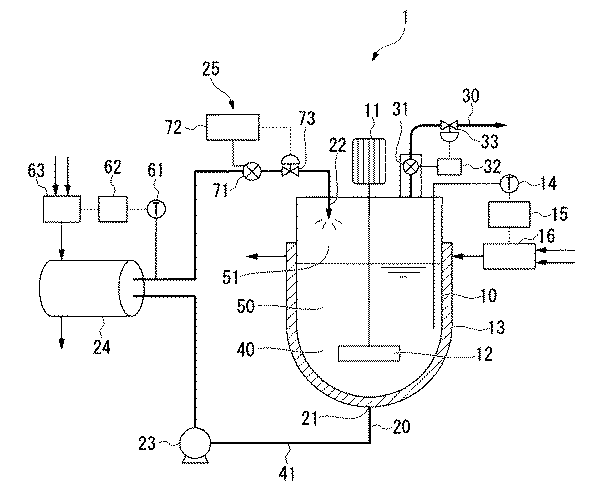
本発明の水性液の製造方法の一例として、図1に示した水性液製造装置1を用いた方法について説明する。図1に示した水性液製造装置1は、前記外部循環系を有する密閉容器の一例である。
密閉容器10には、混合液40が充填され、液相50と気相51を形成している。密閉容器10は、液相の液体を導出する液体導出口21と液体を気相に導入する液体導入口22を有しており、液体導出口21と液体導入口22とが連結して、外部循環系20を形成している。密閉容器10内の液相50の液体の一部(以下、液体導出口21から抜き出された液相50の一部の液体を混合液41と記す。)は、液体導出口21から循環ポンプ23により抜き出され、外部循環系20内と密閉容器10内を循環する。また、外部循環系20には、混合液41の温度および圧力を調整する手段を備える。外部循環系20内の混合液41の温度は、熱交換器24にて調整される。温度計61で熱交換器24の出口付近の混合液41の温度を測定し、温度制御装置62および混合器63にて、熱交換器24内の水とスチームの流量を制御することにより、混合液41の温度を調整する。外部循環系20内の混合液41の圧力は、圧力調整手段25にて調整される。外部循環系20内の圧力を圧力計71で測定し、圧力制御装置72および圧力調整弁73により外部循環系20内の圧力を制御する。外部循環系20内の混合液41を、密閉容器10の気相51において気化しやすい温度および/または圧力に調整した後、液体導入口22から気相51に小滴状に吐出する。As an example of the method for producing an aqueous liquid of the present invention, a method using the aqueous liquid production apparatus 1 shown in FIG. 1 will be described. The aqueous liquid producing apparatus 1 shown in FIG. 1 is an example of a closed container having the external circulation system.
The sealed
気体導出口30は、密閉容器10の上部に設けられている。密閉容器10内の気相51は、気体導出口30の下流側に設けた真空ポンプ(図示略)により気体導出口30から排出される。気体導出口30の入口付近の圧力を、圧力計31で測定し、圧力制御装置32、圧力調整弁33により、気体導出口30内の圧力を制御する。さらに気体導出口30から排出された気体は、凝集器(図示略)により回収される。
密閉容器10には、液相50の温度を調整するジャケット加熱器13が設けられている。温度計14で液相50の温度を測定し、温度制御装置15および混合器16にて、ジャケット加熱器13内の水とスチームの流量を制御することにより、液相50の温度を調整する。
密閉容器10には、液相50を撹拌する撹拌翼12およびこれを回転させる動力モーター11が設けられている。
水性液製造装置1の各構成は、公知のものを適宜選択して用いることができる。The
The
The
As each component of the aqueous liquid production device 1, a known component can be appropriately selected and used.
密閉容器10に充填する混合液40中の水の量は、水と親水性有機溶媒の合計量に対して50質量%以上である。ただし、水と共沸点を有する親水性有機溶媒を使用する場合には、共沸組成とならないように、調整する必要がある。共沸組成よりも水過剰となる量とすることが好ましい。
The amount of water in the
密閉容器10内の圧力は、真空ポンプにより、密閉容器内10の気相51を排出しながら、圧力計31と圧力制御装置32と圧力調整弁33とにより調整される。密閉容器10内の気相51の圧力は、大気圧以下であることが好ましく、10〜101kPaがより好ましく、20〜90kPaがさらに好ましく、30〜90kPaが最も好ましい。密閉容器10内の気相51の圧力が上記範囲内であると、熱交換器等の各機器に与えるエネルギーを削減でき、製造コストを抑えることができる。
The pressure in the sealed
密閉容器10内の液相50の温度は、ジャケット加熱器13により調節される。ジャケット加熱器13の制御は、温度計14と温度制御装置15と混合器16とにより行われる。液相50の温度は、沸騰しない温度に調整しておく必要がある。液相50の温度は、気相51における水の沸点未満であり、気相51における水系媒体の沸点(以下、Tbp℃とする。)以下であることが好ましく、Tbp℃未満であることがより好ましい。前記温度以下とすることで、密閉容器10内での泡の発生を抑制することができる。
水系媒体の沸点は、水系媒体の組成比、蒸気圧等により算出される。具体的には、後述の実施例に記載する。
また、密閉容器10内の液相50の温度は、(Tbp−50)℃以上が好ましく、Tbp−30)℃以上がより好ましく、(Tbp−10)℃以上が最も好ましい。前記温度以上であれば、製造コストを抑えられる。The temperature of the
The boiling point of the aqueous medium is calculated from the composition ratio of the aqueous medium, the vapor pressure, and the like. Specifically, this will be described in Examples described later.
The temperature of the
外部循環系20内の圧力は、循環ポンプ23と、圧力調整手段25における圧力計71、圧力制御装置72および圧力調整弁73とにより調整される。
外部循環系20内の圧力は、密閉容器10内の圧力より高ければ特に限定されない。外部循環系20内の圧力と密閉容器10内の圧力の差ΔP((外部循環系内)−(密閉容器内))は、10kPa〜1000kPaが好ましく、20kPa〜500kPaがより好ましく、30kPa〜300kPa以下が最も好ましい。The pressure in the
The pressure in the
外部循環系20内の混合液41の温度は、熱交換器24により調整される。熱交換器24の制御は、温度計61と温度制御装置62と混合器63とにより行われる。本明細書において、外部循環系20内の混合液41の温度とは、熱交換器24の出口付近の混合液41の温度を意味する。
外部循環系20内の混合液41の温度は、密閉容器10内の気相51における親水性有機溶媒の沸点以上であり、Tbp℃以上であることが好ましく、(Tbp+2)℃以上がより好ましく、(Tbp+5)℃以上がさらに好ましく、(Tbp+7)℃以上が最も好ましい。前記温度以上とすることで、親水性有機溶媒が蒸発しやすくなる。
外部循環系20内の混合液41の温度は、密閉容器10内の気相51における水の沸点未満とすることが好ましく、外部循環系20内の水系媒体の沸点以下であることがより好ましい。前記温度以下とすることで、水の蒸発を抑えることができる。The temperature of the
The temperature of the
The temperature of the
外部循環系20内の混合液41は、密閉容器10の上部にある液体導入口22から、密閉容器10の気相51中に吐出される。
液体導入口22に用いるノズルは、液体を容器内に吐出する際に用い得る公知のものでよい。なかでも、ノズルは液体を小滴状に吐出するものが好ましく、噴霧できるタイプのものがより好ましい。液体導入口22から、密閉容器10内の気相51中に小滴状に吐出あるいは噴霧することにより、混合液41中の親水性有機溶媒が蒸発しやすくなる。The
The nozzle used for the
密閉容器10内の気相51は、気体導出口30の下流側に設けた真空ポンプにより、気体導出口30内を通じて排出される。気相51が密閉容器10外に排出されることにより、親水性有機溶媒が除去される。除去された親水性有機溶媒は、気体導出口30の下流側に設けた凝集器により回収される。
The
水性液製造装置1の運転方法を以下の通り説明する。
連続的に溶媒の除去を行うと、徐々に密閉容器内の液相50の組成は変化する。すなわち、液相50中の親水性有機溶媒の濃度は、徐々に低くなり、親水性有機溶媒の蒸発量が減少する。親水性有機溶媒の除去を継続するための運転方法としては、たとえば、以下の方法1と方法2が挙げられる。
方法1:密閉容器10内の気相51の圧力をほぼ一定に維持しておき、水と親水性有機溶媒の組成変化に従い、外部循環系20内の混合液41の温度を上昇させる。
方法2:密閉容器10内の液相50の温度をほぼ一定に維持しておき、水と親水性有機溶媒の組成変化に従い、気相51の圧力を下降させる。The operation method of the aqueous liquid production device 1 will be described below.
When the solvent is continuously removed, the composition of the
Method 1: The pressure of the
Method 2: The temperature of the
本発明の水性液の製造方法では、混合液中の親水性有機溶媒を、得られる水性液中の親水性有機溶媒の含有量が水と親水性有機溶媒の合計量(100質量%)に対して1質量%以下となるまで除去する。水性液中の親水性有機溶媒の含有量が0.1質量%以下となるまで除去することが好ましい。水性液中の水と親水性有機溶媒の合計量(100質量%)中の親水性有機溶媒の含有量は、10ppm以上であれば、生産性の点から好ましい。 In the method for producing an aqueous liquid of the present invention, the content of the hydrophilic organic solvent in the obtained aqueous liquid is determined based on the total amount of water and the hydrophilic organic solvent (100% by mass). To 1% by mass or less. It is preferable to remove the hydrophilic organic solvent until the content of the hydrophilic organic solvent in the aqueous liquid becomes 0.1% by mass or less. The content of the hydrophilic organic solvent in the total amount of water and the hydrophilic organic solvent (100% by mass) in the aqueous liquid is preferably 10 ppm or more from the viewpoint of productivity.
(耐水耐油剤の製造方法)
本発明の耐水耐油剤は、本発明の水性液の製造方法で製造した水性液を調製して製造する。ここでいう調製は、ビニルポリマーA含有水性液が耐水耐油剤の原料として用いられるのであればどのような調製でもよい。ビニルポリマーA含有水性液をそのまま耐水耐油剤とする場合も、調製に含まれる。調製としては、好ましくはビニルポリマーA含有水性液を所定濃度に水で希釈する調製が好ましい。これにより耐水耐油剤を簡易に製造することができる。(Production method of water and oil resistant agent)
The water and oil resistant agent of the present invention is produced by preparing the aqueous liquid produced by the aqueous liquid producing method of the present invention. The preparation here may be any preparation as long as the vinyl polymer A-containing aqueous liquid is used as a raw material of the water and oil resistant agent. The case where the vinyl polymer A-containing aqueous liquid is used as it is as a water and oil resistant agent is also included in the preparation. As the preparation, preferably, the aqueous solution containing vinyl polymer A is diluted with water to a predetermined concentration. This makes it possible to easily produce a water and oil resistant agent.
製造された耐水耐油剤を使用する対象は、耐水耐油効果を得たいものであれば特に限定されない。たとえば、食品包装紙、食品包装容器等に用いられる紙、フィルム、繊維、不織布、石材、コンクリート等の建材等の基材に耐水性、耐油性を付与するための耐水耐油剤の成分として用いることができる。また、製造された耐水耐油剤を前記基材に処理することにより耐水耐油材が得られる。 The target of using the produced water and oil resistant agent is not particularly limited as long as it is desired to obtain a water and oil resistant effect. For example, used as a component of a water and oil resistant agent for imparting water resistance and oil resistance to base materials such as paper, films, fibers, nonwoven fabrics, stone materials, concrete materials and other building materials used in food packaging paper, food packaging containers, etc. Can be. In addition, a water- and oil-resistant material can be obtained by treating the substrate with the manufactured water- and oil-resistant agent.
(作用効果)
本発明では、ビニルポリマーAの収率が高く、生産効率に優れたビニルポリマーA含有水性液の製造方法を提供することができる。
本発明により製造されたビニルポリマーA含有水性液を用いた耐水耐油剤は、親水性有機溶媒が充分に除去されているため、食品包装紙、食品包装容器等にも用いることができる。(Effects)
According to the present invention, a method for producing a vinyl polymer A-containing aqueous liquid having a high yield of vinyl polymer A and excellent production efficiency can be provided.
The water- and oil-resistant agent using the vinyl polymer A-containing aqueous liquid produced according to the present invention can be used for food packaging paper, food packaging containers, and the like because the hydrophilic organic solvent is sufficiently removed.
実施例1〜3および比較例1で用いたビニルポリマーAは、以下の表1に示すモノマー組成に従って合成した。なお、表1に示すモノマーは以下の通りである。
(モノマー(a))
C6FMA:3,3,4,4,5,5,6,6,7,7,8,8,8−トリデカフルオロオクチルメタクリレート。
(モノマー(b))
DEAEMA:N,N−ジエチルアミノエチルメタクリレート、
MA:メタクリル酸、
IA:イタコン酸。
(モノマー(c))
3−ED:トリエチレングリコールジメタクリレート、
HEMA:2−ヒドロキシエチルメタクリレート。The vinyl polymers A used in Examples 1 to 3 and Comparative Example 1 were synthesized according to the monomer compositions shown in Table 1 below. The monomers shown in Table 1 are as follows.
(Monomer (a))
C6FMA: 3,3,4,4,5,5,6,6,7,7,8,8,8,8-tridecafluorooctyl methacrylate.
(Monomer (b))
DEAEMA: N, N-diethylaminoethyl methacrylate,
MA: methacrylic acid,
IA: itaconic acid.
(Monomer (c))
3-ED: triethylene glycol dimethacrylate,
HEMA: 2-hydroxyethyl methacrylate.
[実施例1]
図1に示すように、5Lのガラス槽、外部循環系、循環ポンプ、熱交換器、圧力調整手段、気体導出口等を接続し、水性液製造装置を作製した。
アセトン中でモノマーを重合させて製造された、表1に示すビニルポリマーAの448gがアセトンの1008gに溶解または分散した液に、酢酸の28gを水の1316gに溶解させた酢酸水溶液を混合して混合液を製造した。得られた混合液をガラス槽に入れ、ジャケット加熱器によりガラス槽内の温度を45℃となるように加熱し、ガラス槽内の圧力を50kPaとした。循環ポンプを起動し循環量を5L/分に設定し、ガラス槽の下部にある液体導出口から混合液を抜き出した。外部循環系内の圧力は100kPaになるように調整した。外部循環系内の混合液を54℃に温度調節し、ガラス槽の上部にある液体導入口からガラス槽内に混合液を吐出した。ガラス槽内の気相の一部は気体導出口から真空ポンプにより排出した。運転中に、混合液中の水とアセトンの組成が変化するのに合わせて、ガラス槽内の温度、および外部循環系の温度を上昇させた。ガラス槽内のアセトンの濃度が0.1質量%以下になったところで終了とした。
実施例1における各条件、運転開始からガラス槽内のアセトンの濃度が0.1質量%以下になるまでの時間、および運転中の泡立ちの有無を、以下の表2に示す。[Example 1]
As shown in FIG. 1, a 5 L glass tank, an external circulation system, a circulation pump, a heat exchanger, a pressure regulator, a gas outlet, and the like were connected to produce an aqueous liquid production apparatus.
An aqueous acetic acid solution in which 28 g of acetic acid was dissolved in 1316 g of water was mixed with a solution of 448 g of vinyl polymer A shown in Table 1 dissolved or dispersed in 1008 g of acetone, which was produced by polymerizing monomers in acetone. A mixture was prepared. The obtained mixed solution was put in a glass tank, and heated by a jacket heater so that the temperature in the glass tank was 45 ° C., and the pressure in the glass tank was set to 50 kPa. The circulation pump was started, the circulation amount was set to 5 L / min, and the mixture was withdrawn from the liquid outlet at the bottom of the glass tank. The pressure in the external circulation system was adjusted to 100 kPa. The temperature of the mixed solution in the external circulation system was adjusted to 54 ° C., and the mixed solution was discharged into the glass tank from a liquid inlet located at the top of the glass tank. Part of the gas phase in the glass tank was discharged from the gas outlet by a vacuum pump. During the operation, the temperature in the glass tank and the temperature of the external circulation system were increased in accordance with the change in the composition of water and acetone in the mixture. The process was terminated when the concentration of acetone in the glass tank became 0.1% by mass or less.
Table 2 below shows each condition in Example 1, the time from the start of operation to the time when the concentration of acetone in the glass tank became 0.1% by mass or less, and the presence or absence of bubbling during the operation.
[比較例1]
5Lのガラス槽と気体導出口を接続し、水性液製造装置を作製した。アセトン中で前記モノマーを重合させて製造された、表1に示すビニルポリマーAがアセトンに溶解または分散した液と酢酸水溶液とを用い、表2に示す組成の混合液を製造した。該混合液をガラス槽に入れ、ジャケット加熱器によりガラス槽内の温度を45℃となるように加熱し、ガラス槽内の圧力を50kPaとした。少しずつガラス槽内の温度を上げて、運転中に泡立ちが見られたところで昇温を止め、泡立ちがおさまったところで、昇温を再開し、アセトンを除去した。ガラス槽内のアセトン濃度が0.1質量%以下になったところで終了とした。
比較例1における各条件、運転開始からガラス槽内のアセトンの濃度が0.1質量%以下になるまでの時間、および運転中の泡立ちの有無を、表2に示す。[Comparative Example 1]
A 5 L glass tank and a gas outlet were connected to produce an aqueous liquid production apparatus. A liquid mixture having the composition shown in Table 2 was prepared using a solution in which the vinyl polymer A shown in Table 1 was dissolved or dispersed in acetone and an aqueous solution of acetic acid produced by polymerizing the monomer in acetone. The mixed solution was placed in a glass tank, and heated by a jacket heater so that the temperature in the glass tank was 45 ° C., and the pressure in the glass tank was set to 50 kPa. The temperature in the glass tank was gradually increased, and when the foaming was observed during the operation, the temperature was stopped. When the foaming was stopped, the temperature was restarted and acetone was removed. The process was terminated when the acetone concentration in the glass tank became 0.1% by mass or less.
Table 2 shows each condition in Comparative Example 1, the time from the start of operation to the time when the concentration of acetone in the glass tank became 0.1% by mass or less, and the presence or absence of foaming during the operation.
[実施例2]
アセトン中で前記モノマーを重合させて製造された、表1に示すビニルポリマーAがアセトンに溶解または分散した液と酢酸水溶液とを用い、表2に示す組成の混合液を製造した。該混合液を実施例1と同じ水性液製造装置のガラス槽に入れて、表2に示す温度、圧力等の条件で運転を行った。運転方法は実施例1と同様に、混合液中の水とアセトンの組成が変化するのに合わせて、ガラス槽内の温度、および外部循環系の温度を上昇させた。
実施例2における各条件、運転開始からガラス槽内のアセトンの濃度が0.1質量%以下になるまでの時間、および運転中の泡立ちの有無を、表2に示す。[Example 2]
A liquid mixture having the composition shown in Table 2 was prepared using a solution in which the vinyl polymer A shown in Table 1 was dissolved or dispersed in acetone and an aqueous solution of acetic acid produced by polymerizing the monomer in acetone. The mixed solution was placed in the glass tank of the same aqueous liquid production apparatus as in Example 1, and operated under the conditions such as temperature and pressure shown in Table 2. The operation method was the same as in Example 1, in which the temperature in the glass tank and the temperature of the external circulation system were increased in accordance with the change in the composition of water and acetone in the mixture.
Table 2 shows the conditions in Example 2, the time from the start of operation to the time when the concentration of acetone in the glass tank became 0.1% by mass or less, and the presence or absence of foaming during operation.
[実施例3]
アセトン中で前記モノマーを重合させて製造された、表1に示すビニルポリマーAがアセトンに溶解または分散した液と、水酸化ナトリウムを水に溶解させた水酸化ナトリウム水溶液とを用い、表2に示す組成の混合液を製造した。該混合液を実施例1と同じ水性液製造装置のガラス槽に入れて、表2に示す温度、圧力等の条件で運転を行った。運転中に、混合液中の水とアセトンの組成が変化するのに合わせて、ガラス槽内の圧力、および外部循環系の圧力を下降させた。
実施例3における各条件、運転開始からガラス槽内のアセトンの濃度が0.1質量%以下になるまでの時間、および運転中の泡立ちの有無を、表2に示す。[Example 3]
Using a solution in which vinyl polymer A shown in Table 1 was dissolved or dispersed in acetone and a sodium hydroxide aqueous solution in which sodium hydroxide was dissolved in water, produced by polymerizing the monomer in acetone, A mixed solution having the composition shown was produced. The mixed solution was placed in the glass tank of the same aqueous liquid production apparatus as in Example 1, and operated under the conditions such as temperature and pressure shown in Table 2. During the operation, the pressure in the glass tank and the pressure in the external circulation system were reduced in accordance with the change in the composition of water and acetone in the mixture.
Table 2 shows the conditions in Example 3, the time from the start of operation to the time when the concentration of acetone in the glass tank became 0.1% by mass or less, and the presence or absence of bubbling during the operation.
なお、表2における「→」は、運転中に条件を変化させていることを示す。たとえば、実施例1のガラス槽内の温度における「45→75」は、45℃で運転開始し、75℃まで上昇させたことを意味する。
また、表2における「−」は、ある範囲内の条件で運転することを示す。たとえば、実施例3のガラス槽内の温度における「66−70」は、66〜70℃の温度範囲で運転することを意味する。Note that “→” in Table 2 indicates that the condition was changed during operation. For example, “45 → 75” in the temperature in the glass bath in Example 1 means that the operation was started at 45 ° C. and increased to 75 ° C.
Further, “−” in Table 2 indicates that the operation is performed under a condition within a certain range. For example, “66-70” in the temperature in the glass vessel of Example 3 means that the operation is performed in a temperature range of 66 to 70 ° C.
表2に示すとおり、実施例1,2,3は、比較例1に比べ、泡立ちが見られなかったため、ビニルポリマーAを損失していないといえる。また、短時間で水性液を製造することが可能となった。 As shown in Table 2, since foaming was not observed in Examples 1, 2, and 3 as compared with Comparative Example 1, it can be said that vinyl polymer A was not lost. In addition, it became possible to produce an aqueous liquid in a short time.
本発明は、ビニルポリマーAと親水性有機溶媒と水を含む混合液から、親水性有機溶媒を効率的に除去するのに有用である。また、本発明により得られるビニルポリマーA含有水性液は、耐水耐油剤の成分として好適に用いられる。
なお、2015年2月26日に出願された日本特許出願2015−036915号の明細書、特許請求の範囲、要約書および図面の全内容をここに引用し、本発明の明細書の開示として、取り入れるものである。INDUSTRIAL APPLICABILITY The present invention is useful for efficiently removing a hydrophilic organic solvent from a mixed solution containing a vinyl polymer A, a hydrophilic organic solvent, and water. The vinyl polymer A-containing aqueous liquid obtained according to the present invention is suitably used as a component of a water and oil resistant agent.
The entire contents of the specification, claims, abstract and drawings of Japanese Patent Application No. 2015-036915 filed on Feb. 26, 2015 are cited here, and as the disclosure of the specification of the present invention, Incorporate.
1 水性液製造装置、10 密閉容器、11 動力モーター、12 撹拌翼、13 ジャケット加熱器、14 温度計、15 温度制御装置、16 混合器、20 外部循環系、21 液体導出口、22 液体導入口、23 循環ポンプ、24 熱交換器、25 圧力調整手段、30 気体導出口、31 圧力計、32 圧力制御装置、33 圧力調整弁、40 混合液、41 混合液、50 液相、51 気相、61 温度計、62 温度制御装置、63 混合器、71 圧力計、72 圧力制御装置、73 圧力調整弁。 DESCRIPTION OF SYMBOLS 1 Aqueous liquid production apparatus, 10 closed vessel, 11 power motor, 12 stirring blade, 13 jacket heater, 14 thermometer, 15 temperature controller, 16 mixer, 20 external circulation system, 21 liquid outlet, 22 liquid inlet , 23 circulation pump, 24 heat exchanger, 25 pressure adjusting means, 30 gas outlet, 31 pressure gauge, 32 pressure controller, 33 pressure adjusting valve, 40 mixed liquid, 41 mixed liquid, 50 liquid phase, 51 gas phase, 61 thermometer, 62 temperature controller, 63 mixer, 71 pressure gauge, 72 pressure controller, 73 pressure regulating valve.
Claims (14)
前記密閉容器が、液相の液体の一部を取り出し該液体の温度を調整して気相中に小滴化して吐出させる循環系を備える、ビニルポリマーを含む水性液の製造方法。 A liquid mixture containing a hydrophilic organic solvent having a boiling point of less than 100 ° C. and water in which a vinyl polymer having a hydrophobic group and a hydrophilic group is dissolved or dispersed is filled in a closed container having a gas outlet, and a liquid phase and a gas phase And then vaporizing the hydrophilic organic solvent in the droplets by atomizing a part of the liquid in the liquid phase and contacting it with the gas phase, and forming the gas phase containing the vaporized hydrophilic organic solvent. The amount of the hydrophilic organic solvent in the liquid phase is reduced to 1% by mass or less based on the total amount of the hydrophilic organic solvent and water by taking out the gas from the gas outlet of the closed container. A method for producing an aqueous liquid containing a vinyl polymer ,
A method for producing an aqueous liquid containing a vinyl polymer, comprising a circulation system in which the closed container takes out a part of the liquid in a liquid phase, adjusts the temperature of the liquid, makes the liquid into small droplets, and discharges the liquid .
Applications Claiming Priority (3)
| Application Number | Priority Date | Filing Date | Title |
|---|---|---|---|
| JP2015036915 | 2015-02-26 | ||
| JP2015036915 | 2015-02-26 | ||
| PCT/JP2016/055697 WO2016136908A1 (en) | 2015-02-26 | 2016-02-25 | Method for producing aqueous liquid containing vinyl polymer and method for producing water-resistant and oil-resistant agent |
Publications (2)
| Publication Number | Publication Date |
|---|---|
| JPWO2016136908A1 JPWO2016136908A1 (en) | 2017-12-07 |
| JP6642562B2 true JP6642562B2 (en) | 2020-02-05 |
Family
ID=56789003
Family Applications (1)
| Application Number | Title | Priority Date | Filing Date |
|---|---|---|---|
| JP2017502486A Active JP6642562B2 (en) | 2015-02-26 | 2016-02-25 | Method for producing vinyl polymer-containing aqueous liquid and method for producing water and oil resistant agent |
Country Status (6)
| Country | Link |
|---|---|
| US (1) | US10246604B2 (en) |
| EP (1) | EP3263609B1 (en) |
| JP (1) | JP6642562B2 (en) |
| CN (1) | CN107406533B (en) |
| ES (1) | ES2903254T3 (en) |
| WO (1) | WO2016136908A1 (en) |
Family Cites Families (13)
| Publication number | Priority date | Publication date | Assignee | Title |
|---|---|---|---|---|
| US20020004214A1 (en) * | 1999-12-21 | 2002-01-10 | Raul Goldschmidt | Method to detect modulators of histidine kinases |
| JP4092527B2 (en) * | 2000-09-29 | 2008-05-28 | 日本ゼオン株式会社 | Toner production method |
| US6596453B2 (en) | 2000-09-29 | 2003-07-22 | Zeon Corporation | Production process of polymerized toner |
| JP3797987B2 (en) * | 2003-07-11 | 2006-07-19 | Jsr株式会社 | Method for removing solvent from polymer solution and method for producing polymer |
| US20070264175A1 (en) * | 2003-11-19 | 2007-11-15 | Iversen Steen B | Method And Process For Controlling The Temperature, Pressure-And Density Profiles In Dense Fluid Processes |
| CN1934149B (en) | 2004-03-23 | 2010-11-24 | 旭硝子株式会社 | Water and oil proofing composition |
| JPWO2006008902A1 (en) * | 2004-07-16 | 2008-05-01 | 株式会社カネカ | Method for producing polymer |
| JP5002930B2 (en) * | 2005-09-13 | 2012-08-15 | 東亞合成株式会社 | Method for producing low odor emulsion |
| ES2376203T3 (en) * | 2007-05-22 | 2012-03-09 | Asahi Glass Company, Limited | COMPOSITION OF ANTI-STAIN AGENT, METHOD FOR ITS PRODUCTION AND ARTICLE TREATED WITH THE SAME. |
| TWI473822B (en) | 2008-05-28 | 2015-02-21 | Asahi Glass Co Ltd | An antifouling composition, a method for producing the same, and an article to be treated therewith |
| KR101728576B1 (en) * | 2009-11-13 | 2017-04-19 | 아사히 가라스 가부시키가이샤 | Water-resistant/oil-resistant agent composition, article treated with the composition, and processes for production of the composition and the article |
| CN102140219A (en) * | 2010-01-28 | 2011-08-03 | 复旦大学 | Water-base resin for plastic and preparation method and application thereof |
| GB2518108B (en) * | 2012-07-13 | 2020-12-09 | Cabot Corp | High structure carbon blacks |
-
2016
- 2016-02-25 JP JP2017502486A patent/JP6642562B2/en active Active
- 2016-02-25 EP EP16755652.1A patent/EP3263609B1/en not_active Not-in-force
- 2016-02-25 ES ES16755652T patent/ES2903254T3/en active Active
- 2016-02-25 CN CN201680012433.6A patent/CN107406533B/en active Active
- 2016-02-25 WO PCT/JP2016/055697 patent/WO2016136908A1/en not_active Ceased
-
2017
- 2017-07-31 US US15/664,595 patent/US10246604B2/en active Active
Also Published As
| Publication number | Publication date |
|---|---|
| CN107406533A (en) | 2017-11-28 |
| EP3263609A1 (en) | 2018-01-03 |
| US10246604B2 (en) | 2019-04-02 |
| EP3263609A4 (en) | 2018-11-07 |
| WO2016136908A1 (en) | 2016-09-01 |
| EP3263609B1 (en) | 2021-12-22 |
| JPWO2016136908A1 (en) | 2017-12-07 |
| ES2903254T3 (en) | 2022-03-31 |
| US20170327710A1 (en) | 2017-11-16 |
| CN107406533B (en) | 2020-02-18 |
Similar Documents
| Publication | Publication Date | Title |
|---|---|---|
| KR101953811B1 (en) | New reactive surfactants for emulsion polymerization, pigment dispersion, and uv coatings | |
| JP5500068B2 (en) | Antifouling agent composition, method for producing the same, and article treated using the same | |
| JP6557738B2 (en) | N, N-dialkylglucamine for stabilizing polymer dispersions | |
| JP2016513887A (en) | Processing system and method for providing a heated etchant | |
| JP5298399B2 (en) | Water / oil repellent aqueous dispersion composition and method for producing the same | |
| CN105884963A (en) | Smell-free styrene-acrylic emulsion and clean-smell coating with emulsion as film forming matter | |
| TWI325882B (en) | Water-and oil-repelling composition and manufacturing method thereof | |
| TWI788478B (en) | Water and oil resistant agent composition for paper and method for producing same, water and oil resistant paper and method for producing same | |
| EP2132232B1 (en) | Polymeric dispersions and applications thereof | |
| JP6642562B2 (en) | Method for producing vinyl polymer-containing aqueous liquid and method for producing water and oil resistant agent | |
| TWI226346B (en) | Nano fluorinated water-and oil-repellent and process for producing the same | |
| US4925884A (en) | Process for the production of concentrated emulsion polymers | |
| JP4671299B2 (en) | Polymerization of monomers with different reactivity | |
| JP6224987B2 (en) | Wood paint and method for producing the same | |
| WO2017164058A1 (en) | Fiber treating agent | |
| CN111205388A (en) | Chlorine-containing fluorocarbon water-proof and oil-proof agent copolymer emulsion and polymerization method thereof | |
| WO2015194049A1 (en) | Water-oil repellent composition and production method for water- and oil-repellent textile product | |
| JP6209082B2 (en) | Method for producing amphiphilic polymer | |
| TWI589598B (en) | Method for producing hydrophilic polymer particles | |
| JPH0651761B2 (en) | Method for producing cationic emulsion | |
| JP6234278B2 (en) | Method for producing (meth) acrylic acid polymer | |
| KR101546214B1 (en) | Fabricating method of emulsion polymer flocculant using new surfactant | |
| CN120718209A (en) | A method for improving the low temperature stability of vinyl acetate-ethylene emulsion | |
| WO2023090214A1 (en) | Polymer composition | |
| JP6534545B2 (en) | Inorganic particle dispersant |
Legal Events
| Date | Code | Title | Description |
|---|---|---|---|
| A621 | Written request for application examination |
Free format text: JAPANESE INTERMEDIATE CODE: A621 Effective date: 20180726 |
|
| A131 | Notification of reasons for refusal |
Free format text: JAPANESE INTERMEDIATE CODE: A131 Effective date: 20190820 |
|
| A521 | Request for written amendment filed |
Free format text: JAPANESE INTERMEDIATE CODE: A523 Effective date: 20190903 |
|
| TRDD | Decision of grant or rejection written | ||
| A01 | Written decision to grant a patent or to grant a registration (utility model) |
Free format text: JAPANESE INTERMEDIATE CODE: A01 Effective date: 20191203 |
|
| A61 | First payment of annual fees (during grant procedure) |
Free format text: JAPANESE INTERMEDIATE CODE: A61 Effective date: 20191216 |
|
| R150 | Certificate of patent or registration of utility model |
Ref document number: 6642562 Country of ref document: JP Free format text: JAPANESE INTERMEDIATE CODE: R150 |
|
| R250 | Receipt of annual fees |
Free format text: JAPANESE INTERMEDIATE CODE: R250 |
|
| R250 | Receipt of annual fees |
Free format text: JAPANESE INTERMEDIATE CODE: R250 |
|
| R250 | Receipt of annual fees |
Free format text: JAPANESE INTERMEDIATE CODE: R250 |
|
| R250 | Receipt of annual fees |
Free format text: JAPANESE INTERMEDIATE CODE: R250 |