JP6442284B2 - Lixisenatide and metformin for the treatment of type 2 diabetes - Google Patents
Lixisenatide and metformin for the treatment of type 2 diabetes Download PDFInfo
- Publication number
- JP6442284B2 JP6442284B2 JP2014509752A JP2014509752A JP6442284B2 JP 6442284 B2 JP6442284 B2 JP 6442284B2 JP 2014509752 A JP2014509752 A JP 2014509752A JP 2014509752 A JP2014509752 A JP 2014509752A JP 6442284 B2 JP6442284 B2 JP 6442284B2
- Authority
- JP
- Japan
- Prior art keywords
- patients
- treatment
- lixisenatide
- subject
- placebo
- Prior art date
- Legal status (The legal status is an assumption and is not a legal conclusion. Google has not performed a legal analysis and makes no representation as to the accuracy of the status listed.)
- Active
Links
Images


Classifications
-
- A—HUMAN NECESSITIES
- A61—MEDICAL OR VETERINARY SCIENCE; HYGIENE
- A61K—PREPARATIONS FOR MEDICAL, DENTAL OR TOILETRY PURPOSES
- A61K38/00—Medicinal preparations containing peptides
- A61K38/16—Peptides having more than 20 amino acids; Gastrins; Somatostatins; Melanotropins; Derivatives thereof
- A61K38/17—Peptides having more than 20 amino acids; Gastrins; Somatostatins; Melanotropins; Derivatives thereof from animals; from humans
- A61K38/22—Hormones
- A61K38/26—Glucagons
-
- A—HUMAN NECESSITIES
- A61—MEDICAL OR VETERINARY SCIENCE; HYGIENE
- A61K—PREPARATIONS FOR MEDICAL, DENTAL OR TOILETRY PURPOSES
- A61K31/00—Medicinal preparations containing organic active ingredients
- A61K31/13—Amines
- A61K31/155—Amidines (), e.g. guanidine (H2N—C(=NH)—NH2), isourea (N=C(OH)—NH2), isothiourea (—N=C(SH)—NH2)
-
- A—HUMAN NECESSITIES
- A61—MEDICAL OR VETERINARY SCIENCE; HYGIENE
- A61P—SPECIFIC THERAPEUTIC ACTIVITY OF CHEMICAL COMPOUNDS OR MEDICINAL PREPARATIONS
- A61P3/00—Drugs for disorders of the metabolism
-
- A—HUMAN NECESSITIES
- A61—MEDICAL OR VETERINARY SCIENCE; HYGIENE
- A61P—SPECIFIC THERAPEUTIC ACTIVITY OF CHEMICAL COMPOUNDS OR MEDICINAL PREPARATIONS
- A61P3/00—Drugs for disorders of the metabolism
- A61P3/04—Anorexiants; Antiobesity agents
-
- A—HUMAN NECESSITIES
- A61—MEDICAL OR VETERINARY SCIENCE; HYGIENE
- A61P—SPECIFIC THERAPEUTIC ACTIVITY OF CHEMICAL COMPOUNDS OR MEDICINAL PREPARATIONS
- A61P3/00—Drugs for disorders of the metabolism
- A61P3/08—Drugs for disorders of the metabolism for glucose homeostasis
- A61P3/10—Drugs for disorders of the metabolism for glucose homeostasis for hyperglycaemia, e.g. antidiabetics
-
- A—HUMAN NECESSITIES
- A61—MEDICAL OR VETERINARY SCIENCE; HYGIENE
- A61P—SPECIFIC THERAPEUTIC ACTIVITY OF CHEMICAL COMPOUNDS OR MEDICINAL PREPARATIONS
- A61P43/00—Drugs for specific purposes, not provided for in groups A61P1/00-A61P41/00
Landscapes
- Health & Medical Sciences (AREA)
- Life Sciences & Earth Sciences (AREA)
- Medicinal Chemistry (AREA)
- Veterinary Medicine (AREA)
- Public Health (AREA)
- General Health & Medical Sciences (AREA)
- Animal Behavior & Ethology (AREA)
- Pharmacology & Pharmacy (AREA)
- Chemical & Material Sciences (AREA)
- Epidemiology (AREA)
- Bioinformatics & Cheminformatics (AREA)
- Engineering & Computer Science (AREA)
- Endocrinology (AREA)
- Diabetes (AREA)
- Zoology (AREA)
- Chemical Kinetics & Catalysis (AREA)
- Nuclear Medicine, Radiotherapy & Molecular Imaging (AREA)
- Organic Chemistry (AREA)
- Proteomics, Peptides & Aminoacids (AREA)
- General Chemical & Material Sciences (AREA)
- Immunology (AREA)
- Gastroenterology & Hepatology (AREA)
- Hematology (AREA)
- Obesity (AREA)
- Child & Adolescent Psychology (AREA)
- Emergency Medicine (AREA)
- Acyclic And Carbocyclic Compounds In Medicinal Compositions (AREA)
- Medicines That Contain Protein Lipid Enzymes And Other Medicines (AREA)
- Pharmaceuticals Containing Other Organic And Inorganic Compounds (AREA)
- Organic Low-Molecular-Weight Compounds And Preparation Thereof (AREA)
Description
説明
本発明の主題は、2型糖尿病患者における血糖管理における使用のための組み合わせ医薬(pharmaceutical combination)であって、該組み合わせ医薬は、(a) desPro36エキセンジン−4(1−39)−Lys6−NH2 (AVE0010、リキシセナチド)又は/及びその薬学的に許容しうる塩、並びに(b) メトホルミン又は/及びその薬学的に許容しうる塩を含む。別の局面は、2型糖尿病患者におけるグルカゴンレベルの減少における使用のための組み合わせ医薬であり、該組み合わせ医薬は、(a) desPro36エキセンジン−4(1−39)−Lys6−NH2又は/及びその薬学的に許容しうる塩、並びに(b)メトホルミン又は/及びその薬学的に許容しうる塩を含む。
DESCRIPTION The subject of the present invention is a pharmaceutical combination for use in glycemic control in patients with
健常なヒトにおいて、膵臓によるインスリンの放出は、血中グルコース濃度と厳密に連動する。食後に現れる血中グルコースの増加したレベルは、インスリン分泌の各増加により迅速に釣り合いが取られる。空腹状態では、血漿インスリンレベルは基礎値まで降下し、この基礎値は、インスリン感受性器官及び組織へのグルコースの連続的な供給を確実にし、かつ夜間に肝臓グルコース産生を低レベルに維持するために十分である。 In healthy humans, insulin release by the pancreas is closely linked to blood glucose concentration. The increased level of blood glucose that appears after a meal is quickly balanced by each increase in insulin secretion. In the fasting state, plasma insulin levels drop to a basal value, which ensures a continuous supply of glucose to insulin-sensitive organs and tissues and maintains liver glucose production at low levels at night. It is enough.
1型糖尿病と対照的に、一般的に2型糖尿病においてインスリンの欠乏はないが、多くの場合、特に進行性の症例において、インスリンでの処置は、経口投与される抗糖尿病薬と組み合わせて必要とされる場合に最も適切な治療とみなされる。
In contrast to
初期症状を伴わない数年にわたる増加した血中グルコースレベルは、重大な健康リスクを表す。慢性的に増加したレベルの血中グルコースが糖尿病合併症の発症の主な原因であるということが、米国における大規模DCCT研究において明確に示された(非特許文献1)。糖尿病合併症の例は、場合により網膜症、腎症又はニューロパシーで現れ、そして失明、腎不全及び四肢の喪失に至り、かつ心血管疾患の増加した危険性を伴う小血管及び大血管の損傷である。従って、糖尿病の改善された治療は、血中グルコースを生理学的範囲にできるだけ近く維持することを主に目指さなければならないと結論づけることができる。 Increased blood glucose levels over several years without initial symptoms represent a significant health risk. It has been clearly shown in a large-scale DCCT study in the United States that chronically increased levels of blood glucose are the main cause of the development of diabetic complications (Non-Patent Document 1). Examples of diabetic complications are small and large blood vessel damage that sometimes manifests with retinopathy, nephropathy or neuropathy and leads to blindness, renal failure and limb loss, and with an increased risk of cardiovascular disease. is there. It can therefore be concluded that improved treatment of diabetes must mainly be aimed at maintaining blood glucose as close as possible to the physiological range.
2型糖尿病に罹患した過体重の患者、例えば30以上のボディマス指数(BMI)を有する患者には特定の危険性が存在する。これらの患者において、糖尿病の危険性は過体重の危険性と重なり、例えば、標準体重の2型糖尿病患者と比較して心血管疾患の増加をもたらす。従って、これらの患者において、過体重を減少させながら糖尿病を処置することが特に必要である。
There is a particular risk in overweight patients with
メトホルミンは、食事改善に反応しない非インスリン依存性糖尿病(2型糖尿病)の処置において使用されるビグアニド血糖降下薬である。メトホルミンは、インスリン感受性を改善し、そしてグルコースの腸での吸収を減少させることにより血糖管理を改善する。メトホルミンは通常、経口投与される。しかし、肥満患者におけるメトホルミンによる2型糖尿病の管理は不十分であり得る。従って、これらの患者において、2型糖尿病を管理するためのさらなる手段が必要とされ得る。
Metformin is a biguanide hypoglycemic agent used in the treatment of non-insulin dependent diabetes (
化合物desPro36エキセンジン−4(1−39)−Lys6−NH2 (AVE0010、リキシセナチド)はエキセンジン−4の誘導体である。AVE0010は特許文献1において配列番号93として開示される:
配列番号1: AVE0010 (44 AS)
H−G−E−G−T−F−T−S−D−L−S−K−Q−M−E−E−E−A−V−R−L−F−I−E−W−L−K−N−G−G−P−S−S−G−A−P−P−S−K−K−K−K−K−K−NH2
配列番号2: エキセンジン−4 (39 AS)
H−G−E−G−T−F−T−S−D−L−S−K−Q−M−E−E−E−A−V−R−L−F−I−E−W−L−K−N−G−G−P−S−S−G−A−P−P−P−S−NH2
Compound DesPro 36 Exendin -4 (1-39) -Lys 6 -NH 2 (AVE0010, lixisenatide) is a derivative of exendin-4. AVE0010 is disclosed as SEQ ID NO: 93 in US Pat.
SEQ ID NO: 1: AVE0010 (44 AS)
H-G-E-G-T-F-T-S-D-L-S-K-Q-M-E-E-E-A-V-V-R-L-F-I-E-W- L-K-N-G-G-P-S-S-S-G-A-P-P-S-K-K-K-K-K-K-NH 2
SEQ ID NO: 2: Exendin-4 (39 AS)
H-G-E-G-T-F-T-S-D-L-S-K-Q-M-E-E-E-A-V-V-R-L-F-I-E-W- L-K-N-G-G-P-S-S-G-A-P-P-P-S-NH 2
エキセンジンは、血中グルコース濃度を低下させることができる一群のペプチドである。エキセンジン類似体AVE0010は、天然エキセンジン−4配列のC末端短縮化により特徴づけられる。AVE0010は、エキセンジン−4には存在しない6つのC末端リジン残基を含む。 Exendins are a group of peptides that can lower blood glucose levels. The exendin analog AVE0010 is characterized by a C-terminal truncation of the natural exendin-4 sequence. AVE0010 contains six C-terminal lysine residues that are not present in exendin-4.
本発明の文脈において、AVE0010はその薬学的に許容しうる塩を含む。当業者は、AVE0010の薬学的に許容しうる塩が分かる。本発明において使用されるAVE0010の好ましい薬学的に許容しうる塩は酢酸塩である。 In the context of the present invention, AVE0010 includes pharmaceutically acceptable salts thereof. One skilled in the art knows pharmaceutically acceptable salts of AVE0010. A preferred pharmaceutically acceptable salt of AVE0010 used in the present invention is acetate.
本発明の実施例1において、メトホルミンに対する付加療法(add−on therapy)においてリキシセナチド(AVE0010)が血糖管理を有意に改善したということが2型糖尿病患者において実証された:
・ リキシセナチド(AVE0010)は、補正血漿グルコースAUC0:30-4:30h(h*mg/dL)をベースラインから有意に減少させた:リラグルチド群における−72.83と比較して−227.25。
・ リキシセナチドは、標準化朝食後の血漿グルコースの増加を、リラグルチドと比較してかなりより大きな程度まで減少させた。
・ 最大PPGレベル(mg/dL)に対する有意な効果と共に、リキシセナチド群において28日目にPPG変動幅(excursion)の有意な改善があった:リラグルチドと比較してリキシセナチドについて−45.50の推定平均処置差と共に、リラグルチド群における−24.93と比較してリキシセナチド群における−70.43。この差は統計的に有意であった(p<0.0001)。
・ 4週間の処置の後(28日目)に140mg/dL未満の食後2時間後血漿グルコースレベルを有する患者の数はキシセナチド群においてより多かった。
・ −1日目と比較して28日目において、リキシセナチド及びリラグルチド処置についての24時間血漿グルコースプロフィールは、食事摂取に応じて生じるピークグルコースレベルの減少と共に、血漿グルコースの全体的な減少を示した。
・ 平均HbA1Cレベルは、両方の処置群において減少した。
・ 血漿グルカゴンレベルについての減少したAUCは、リラグルチド群と比較してリキシセナチド群においてより顕著であった。
In Example 1 of the present invention, it was demonstrated in patients with
Lixisenatide (AVE0010) significantly reduced the corrected plasma glucose AUC 0: 30-4: 30h (h * mg / dL) from baseline: -227.25 compared to -72.83 in the liraglutide group. .
• Lixisenatide reduced the increase in plasma glucose after a standardized breakfast to a much greater extent compared to liraglutide.
• There was a significant improvement in PPG excursion at
• After 4 weeks of treatment (Day 28), the number of patients with plasma glucose levels less than 140 mg /
-On
• Mean HbA1C levels decreased in both treatment groups.
• Reduced AUC for plasma glucagon levels was more prominent in the lixisenatide group compared to the liraglutide group.
本発明の実施例2は、アジア諸州(counties)(中国、マレーシア、タイ、及び香港)における2型糖尿病患者における血糖管理に関する。これらの患者は、メトホルミン単独では適切に管理されない。アジア又は/及び東洋人種のこれらの患者において、研究24週目に、血糖管理の有意な改善が、プラセボ(メトホルミン単独)と比較してリキシセナチド及びメトホルミンの組み合わせにより達成され得るということが見出された:
・ リキシセナチド対プラセボの有効性を、プラセボ群(−0.47%)と比較してリキシセナチド群(−0.83%)においてHbA1cの有意な減少により実証した。プラセボに対するLS平均差異は−0.36%である(実施例2における表10)。表28は、中国人患者の部分群における同様の効果を示した。
・ HbA1c応答者の分析は、リキシセナチドとプラセボ群との間の統計学的に有意な処置差異を実証した。リキシセナチド群における患者の32.4%が6.5%以下のHbA1cを達成したが、一方でプラセボ群では、18.1%しかこの値を達成しなかった。リキシセナチド群における患者の53%は、プラセボ群における38.8%に対して7%未満のHbA1cを達成した(実施例2における表11)。
・ 標準化食事後の食後2時間後血漿グルコース(PPG)について、リキシセナチド群は、プラセボ群に勝る統計学的に有意な改善を示し、LS平均差異は−4.28mmol/Lであった(実施例2における表12)。グルコース変動幅の分析は、プラセボと比較してリキシセナチド群における−3.99mmol/LのLS平均差異を示した(実施例2の表17)。
・ プラセボと比較した空腹時血漿グルコース(FPG)の群間差異もまた、リキシセナチド群について統計学的に有意であり、−0.48mmol/LのLS平均差異であった(実施例2の表13)。
・ リキシセンチド(lixisentide)及びメトホルミンの組み合わせの全体的な安全性は、アジア/東洋患者において十分であった。
Example 2 of the present invention relates to glycemic control in
• The efficacy of lixisenatide versus placebo was demonstrated by a significant reduction in HbA 1c in the lixisenatide group (−0.83%) compared to the placebo group (−0.47%). The LS average difference relative to placebo is -0.36% (Table 10 in Example 2). Table 28 showed similar effects in a subgroup of Chinese patients.
• Analysis of HbA 1c responders demonstrated statistically significant treatment differences between lixisenatide and placebo groups. 32.4% of patients in the lixisenatide group achieved an HbA 1c of 6.5% or less, whereas in the placebo group only 18.1% achieved this value. 53% of patients in the lixisenatide group achieved less than 7% HbA 1c compared to 38.8% in the placebo group (Table 11 in Example 2).
For plasma glucose (PPG) 2 hours after meal after a standardized meal, the lixisenatide group showed a statistically significant improvement over the placebo group, and the LS mean difference was -4.28 mmol / L (Example) Table 12 in 2). Analysis of the glucose fluctuation range showed an LS average difference of −3.99 mmol / L in the lixisenatide group compared to placebo (Table 17 in Example 2).
The difference between groups in fasting plasma glucose (FPG) compared to placebo was also statistically significant for the lixisenatide group, with an LS mean difference of −0.48 mmol / L (Table 13 in Example 2). ).
• The overall safety of the combination of lixisentide and metformin was sufficient in Asian / Oriental patients.
本発明の第一の局面は、2型糖尿病患者における血糖管理における使用のための組み合わせ医薬であり、該組み合わせ医薬は、
(a) desPro36エキセンジン−4(1−39)−Lys6−NH2又は/及びその薬学的に許容しうる塩、並びに
(b) メトホルミン又は/及びその薬学的に許容しうる塩
を含む。
A first aspect of the present invention is a combination drug for use in blood glucose management in patients with
(A) desPro 36 exendin-4 (1-39) -Lys 6 -NH 2 or / and a pharmaceutically acceptable salt thereof, and (b) metformin or / and a pharmaceutically acceptable salt thereof.
本発明の実施例により実証されるように、本明細書に記載される組み合わせ医薬は、血糖管理を改善するために使用され得る。本発明において、「血糖管理の改善」又は「血糖管理」は特に、食後血漿グルコース濃度の改善、空腹時血漿グルコース濃度の改善、又は/及びHbA1c値の改善を指す。 As demonstrated by the examples of the present invention, the combination medicaments described herein can be used to improve glycemic control. In the present invention, “improvement of blood glucose control” or “blood glucose control” particularly refers to improvement of postprandial plasma glucose concentration, improvement of fasting plasma glucose concentration, and / or improvement of HbA 1c value.
本発明の第二の局面は、2型糖尿病患者における血漿グルカゴンレベルの減少における使用のための組み合わせ医薬であり、該組み合わせ医薬は、
(a) desPro36エキセンジン−4(1−39)−Lys6−NH2又は/及びその薬学的に許容しうる塩、並びに
(b) メトホルミン又は/及びその薬学的に許容しうる塩
を含む。
A second aspect of the present invention is a combination medicament for use in reducing plasma glucagon levels in patients with
(A) desPro 36 exendin-4 (1-39) -Lys 6 -NH 2 or / and a pharmaceutically acceptable salt thereof, and (b) metformin or / and a pharmaceutically acceptable salt thereof.
本発明の実施例1により実証されるように、本明細書に記載される組み合わせは、血漿グルカゴンレベルを減少させるために使用され得る。 As demonstrated by Example 1 of the present invention, the combinations described herein can be used to reduce plasma glucagon levels.
メトホルミンは、1,1−ジメチルビグアニド(CAS番号657−24−9)の国際的な一般名である。本発明において、用語「メトホルミン」はいずれかのその薬学的に許容しうる塩を含む。 Metformin is the international common name for 1,1-dimethylbiguanide (CAS number 657-24-9). In the present invention, the term “metformin” includes any pharmaceutically acceptable salt thereof.
本発明において、メトホルミンは経口投与され得る。当業者は、経口投与による2型糖尿病の処置に適したメトホルミンの処方が分かる。メトホルミンは、それを必要とする対象者(subject)に、治療効果を誘導するために十分な量で投与され得る。メトホルミンは、少なくとも1.0g/日又は少なくとも1.5g/日の用量で投与され得る。経口投与のために、メトホルミンは固形投薬形態、例えば錠剤又は丸剤で製剤化され得る。メトホルミンは、適切な薬学的に許容しうる担体、アジュバント又は/及び補助物質を用いて製剤化され得る。
In the present invention, metformin can be administered orally. One skilled in the art knows a formulation of metformin suitable for the treatment of
本発明において、desPro36エキセンジン−4(1−39)−Lys6−NH2又は/及び薬学的に許容しうる塩は、メトホルミンの投与に対する付加療法で投与され得る。 In the present invention, desPro 36 exendin-4 (1-39) -Lys 6 -NH 2 or / and a pharmaceutically acceptable salt can be administered as an additional therapy to the administration of metformin.
本発明において、用語「付加(add−on)」、「付加処置」及び「付加療法」は、メトホルミン及びAVE0010を用いた2型糖尿病の処置に関する。メトホルミン及びAVE0010は、24時間の時間間隔以内に投与され得る。メトホルミン及びAVE0010は、それぞれ1日1回の投薬量で投与され得る。メトホルミン及びAVE0010は異なる投与経路で投与され得る。メトホルミンは経口投与され得、そしてAVE0010は非経口投与され得る。
In the present invention, the terms “add-on”, “additional treatment” and “additional therapy” relate to the treatment of
本発明の組み合わせ医薬は、スルホニル尿素をさらに含み得る。この組み合わせ医薬において、スルホニル尿素は経口投与され得る。当業者はスルホニル尿素の適切な処方を知っている。スルホニル尿素は、本明細書に記載されるように、desPro36エキセンジン−4(1−39)−Lys6−NH2及びメトホルミンの組み合わせに対する付加処置で投与され得る。 The combination medicament of the present invention may further contain a sulfonylurea. In this combination medicament, the sulfonylurea can be administered orally. The person skilled in the art knows suitable formulations for sulfonylureas. The sulfonylurea can be administered as an addition treatment to the combination of desPro 36 exendin-4 (1-39) -Lys 6 -NH 2 and metformin, as described herein.
スルホニル尿素は、グリベンクラミド、グリベンクラミドMR、グリクラジド、グリクラジドLM、グリメピリド、グリピジド、グリピジドXL、グリキドン、及びトルブタミドから選択され得る。特定の実施態様において、本明細書において開示される特定のスルホニル尿素のいずれかが、本明細書に記載されるdesPro36エキセンジン−4(1−39)−Lys6−NH2及びメトホルミンの組み合わせの特定の局面と組み合わされ得る。 The sulfonylurea may be selected from glibenclamide, glibenclamide MR, gliclazide, gliclazide LM, glimepiride, glipizide, glipizide XL, gliquidone, and tolbutamide. In certain embodiments, any of the specific sulfonylureas disclosed herein is a combination of desPro 36 exendin-4 (1-39) -Lys 6 -NH 2 and metformin as described herein. May be combined with certain aspects.
グリベンクラミドの好ましい用量は10mg/日以下、10〜20mg/日又は20mg/日以上である。 A preferred dose of glibenclamide is 10 mg / day or less, 10-20 mg / day or 20 mg / day or more.
グリベンクラミドMRの好ましい用量は、6mg/日以下、6〜12mg/日、又は12mg/日以上である。 A preferred dose of glibenclamide MR is 6 mg / day or less, 6-12 mg / day, or 12 mg / day or more.
グリクラジドの好ましい用量は、160mg/日以下、160〜320mg/日、又は320mg/日以上である。 A preferred dose of gliclazide is 160 mg / day or less, 160-320 mg / day, or 320 mg / day or more.
グリクラジドLMの好ましい用量は、60mg/日以下、60〜120mg/日、又は120mg/日以上である。 A preferred dose of gliclazide LM is 60 mg / day or less, 60-120 mg / day, or 120 mg / day or more.
グリメピリドの好ましい用量は、4mg/日以下、4〜8mg/日、又は8mg/日以上である。 A preferred dose of glimepiride is 4 mg / day or less, 4-8 mg / day, or 8 mg / day or more.
グリピジドの好ましい用量は、20mg/日以下、20〜40mg/日、又は40mg/日以上である。 A preferred dose of glipizide is 20 mg / day or less, 20-40 mg / day, or 40 mg / day or more.
グリピジドXLの好ましい用量は、10mg/日以下、10〜20mg/日、又は20mg/日以上である。 A preferred dose of glipizide XL is 10 mg / day or less, 10-20 mg / day, or 20 mg / day or more.
グリキドンの好ましい用量は、60mg/日以下、60〜90mg/日、又は90mg/日以上である。 A preferred dose of glyquidon is 60 mg / day or less, 60-90 mg / day, or 90 mg / day or more.
トルブタミドの好ましい用量は、1500mg/日以下、又は1500mg/日以上である。 A preferred dose of tolbutamide is 1500 mg / day or less, or 1500 mg / day or more.
本発明の組み合わせ医薬により処置される対象者は、アジア又は/及び東洋の人種の対象者であり得る。本発明の実施例2において、アジア又は/及び東洋人種の患者において、血糖管理の有意な改善が、プラセボ(メトホルミン単独)と比較してリキシセナチド及びメトホルミンの組み合わせにより達成され得るということが見出された。 The subject treated with the combination medicament of the present invention may be a subject of Asian or / and Oriental ethnicity. In Example 2 of the present invention, it was found that significant improvement in glycemic control can be achieved in combination with lixisenatide and metformin compared to placebo (metformin alone) in Asian or / and Oriental patients. It was done.
本発明の医薬又は組み合わせにより処置される対象者は、2型糖尿病に罹患している対象者であり得る。実施例は、これらの患者において、メトホルミンと組み合わせたAVE0010の投与が有利な治療を提供するということを実証する。
A subject treated with a medicament or combination of the present invention can be a subject suffering from
本発明の医薬又は組み合わせにより処置される対象者は2型糖尿病に罹患している対象者であり得、ここで2型糖尿病は、メトホルミン単独での処置(例えば、少なくとも1.0g/日のメトホルミン又は少なくとも1.5g/日のメトホルミンの用量を3ヶ月)では適切に管理されない。本発明において、その2型糖尿病が適切に管理されていない対象者は、7%〜10%の範囲のHbA1c値を有し得る。
A subject treated with a medicament or combination of the present invention can be a subject suffering from
2型糖尿病に罹患している本発明の医薬又は組み合わせにより処置される対象者は、肥満対象者であり得る。本発明において、肥満対象者は少なくとも30kg/m2のボディマス指数を有し得る。
A subject treated with a medicament or combination of the invention suffering from
2型糖尿病に罹患している本発明の医薬又は組み合わせにより処置される対象者は、正常体重を有し得る。本発明において、正常体重を有する対象者は、17kg/m2〜25kg/m2、又は17kg/m2から30kg/m2未満の範囲のボディマス指数を有し得る。
A subject treated with a medicament or combination of the present invention suffering from
本発明の医薬又は組み合わせにより処置される対象者は、成人対象者(adult subject)であり得る。対象者は、少なくとも18歳の年齢を有し得、18〜80歳、18〜50歳、又は40〜80歳、又は50〜60歳の範囲の年齢を有し得る。対象者は50歳より若くてもよい。 A subject treated with a medicament or combination of the present invention can be an adult subject. The subject may have an age of at least 18 years and may have an age in the range of 18-80 years, 18-50 years, or 40-80 years, or 50-60 years. The subject may be younger than 50 years.
本発明の医薬又は組み合わせにより処置される対象者は、好ましくは、例えばインスリン又は/及び関連する化合物による抗糖尿病処置を受けていない。 A subject treated with a medicament or combination of the present invention preferably has not received anti-diabetic treatment with, for example, insulin or / and related compounds.
本発明の医薬又は組み合わせにより処置される対象者は、2型糖尿病に、少なくとも1年間又は少なくとも2年間罹患し得る。特に、処置される対象者において、2型糖尿病は、本発明の医薬又は組み合わせによる治療の開始の少なくとも1年前又は少なくとも2年前に診断されている。
A subject treated with a medicament or combination of the present invention may suffer from
処置される対象者は、少なくとも約8%又は少なくとも約7,5%のHbA1c値を有し得る。対象者はまた、約7〜約10%のHbA1c値を有し得る。本発明の実施例は、AVE0010による処置が2型糖尿病患者においてHbA1c値の減少を生じるということを実証する。
The subject being treated may have a HbA 1c value of at least about 8% or at least about 7.5%. The subject may also have a HbA 1c value of about 7 to about 10%. Examples of the present invention demonstrate that treatment with AVE0010 results in a decrease in HbA 1c levels in
本発明のさらに別の局面において、本明細書に記載される組み合わせは、2型糖尿病に罹患した患者においてHbA1c値を改善するために使用され得る。HbA1c値を改善することは、HbA1c値が、例えば、処置の後少なくとも1ヶ月間、少なくとも2ヶ月間、又は少なくとも3ヶ月間、6.5%又は7%未満に減少されることを意味する。
In yet another aspect of the invention, the combinations described herein can be used to improve HbA 1c levels in patients with
本発明のさらに別の局面において、本明細書に記載される組み合わせは、2型糖尿病に罹患している患者において耐糖能を改善するために使用され得る。耐糖能を改善することは、食後血漿グルコース濃度が本発明の活性薬剤により減少されることを意味する。減少は、特に、血漿グルコース濃度が正常血糖値に達するか、又は少なくともこれらの値に近づくことを意味する。
In yet another aspect of the invention, the combinations described herein can be used to improve glucose tolerance in patients suffering from
本発明において、正常血糖値は、特に60〜140mg/dl(3,3〜(bis)7,8mM/Lに対応する)の血中グルコース濃度である。この範囲は、特に空腹時条件下及び食後条件下での血中グルコース濃度を指す。 In the present invention, the normal blood glucose level is a blood glucose concentration of 60 to 140 mg / dl (corresponding to 3,3- (bis) 7,8 mM / L). This range refers to blood glucose concentration, particularly under fasting conditions and postprandial conditions.
処置される対象者は、少なくとも10mmol/L、少なくとも12mmol/L、又は少なくとも14mmol/Lの食後2時間血漿グルコース濃度を有し得る。これらの血漿グルコース濃度は正常血糖濃度を超える。 The subject to be treated may have a post-prandial 2 hour plasma glucose concentration of at least 10 mmol / L, at least 12 mmol / L, or at least 14 mmol / L. These plasma glucose concentrations exceed normal blood glucose concentrations.
処置される対象者は、少なくとも2mmol/L、少なくとも3mmol/L、少なくとも4mmol/L又は少なくとも5mmol/Lのグルコース変動幅を有し得る。本発明において、グルコース変動幅は特に、食後2時間血漿グルコース濃度と食事試験30分前の血漿グルコース濃度との差である。
A subject to be treated may have a glucose fluctuation range of at least 2 mmol / L, at least 3 mmol / L, at least 4 mmol / L, or at least 5 mmol / L. In the present invention, the glucose fluctuation range is, in particular, the difference between the
「食後」は、糖尿病学の技術分野における当業者に周知である。用語「食後」は特に、食事又は/及び実験条件下でのグルコースへの曝露の後の段階を記載する。健康なヒトにおいて、この段階は血中グルコース濃度の増加及びその後の減少により特徴づけられる。用語「食後」又は「食後段階」は、典型的には食事又は/及びグルコースへの曝露の2時間後までに終了する。 “Postprandial” is well known to those skilled in the art of diabetics. The term “post-meal” describes in particular the stage after exposure to glucose under diet or / and experimental conditions. In healthy humans, this stage is characterized by an increase and subsequent decrease in blood glucose concentration. The term “post-meal” or “post-prandial phase” typically ends by 2 hours after meal or / and glucose exposure.
本明細書において開示される処置される対象者は、少なくとも8mmol/L、少なくとも8,5mmol/L又は少なくとも9mmol/Lの空腹時血漿グルコース濃度を有し得る。これらの血漿グルコース濃度は正常血糖濃度を超える。 The subject to be treated disclosed herein may have a fasting plasma glucose concentration of at least 8 mmol / L, at least 8.5 mmol / L, or at least 9 mmol / L. These plasma glucose concentrations exceed normal blood glucose concentrations.
本発明の別の局面において、本明細書に記載される組み合わせは、2型糖尿病に
罹患している患者において空腹時血漿グルコースを改善する(すなわち減少させる)ために使用され得る。減少は、特に血漿グルコース濃度が正常血糖値に達するか又は少なくともこれらの値に近づくことを意味する。
In another aspect of the invention, the combinations described herein can be used to improve (ie, reduce) fasting plasma glucose in patients suffering from
本発明の組み合わせは、本明細書に記載される医療適用の1つ又はそれ以上の処置において、例えば2型糖尿病患者の処置において、又は2型糖尿病に関連する状態、例えば血糖管理の改善、空腹時血漿グルコース濃度の減少のため、グルコース変動幅の改善のため、食後血漿グルコース濃度の減少のため、耐糖能の改善のため、HbA1c値の改善のため、血漿グルカゴンレベルの減少のため、減量又は/及び体重増加の予防のために使用され得る。
The combination of the present invention may be used in one or more treatments of the medical applications described herein, such as in the treatment of
本発明において、desPro36エキセンジン−4(1−39)−Lys6−NH2又は/及びその薬学的に許容しうる塩は、それを必要とする対象者に、治療効果を誘導するために十分な量で投与され得る。 In the present invention, desPro 36 exendin-4 (1-39) -Lys 6 -NH 2 or / and a pharmaceutically acceptable salt thereof is sufficient to induce a therapeutic effect in a subject in need thereof. Can be administered in any amount.
本発明において、desPro36エキセンジン−4(1−39)−Lys6−NH2又は/及びその薬学的に許容しうる塩は、適切な薬学的に許容しうる担体、アジュバント又は/及び補助物質を用いて製剤化され得る。 In the present invention, desPro 36 exendin-4 (1-39) -Lys 6 -NH 2 or / and a pharmaceutically acceptable salt thereof is a suitable pharmaceutically acceptable carrier, adjuvant or / and auxiliary substance. Can be formulated.
化合物desPro36エキセンジン−4(1−39)−Lys6−NH2又は/及びその薬学的に許容しうる塩は、例えば注射(例えば筋内注射又は皮下注射により)により非経口投与され得る。適切な注射装置、活性成分を含むカートリッジ及び注射針を備えたいわゆる「ペン」が公知である。化合物desPro36エキセンジン−4(1−39)−Lys6−NH2又は/及びその薬学的に許容しうる塩は、適切な量で、例えば用量あたり10〜15μg又は用量あたり15〜20μgの範囲内の量で投与され得る。 The compound desPro 36 exendin-4 (1-39) -Lys 6 -NH 2 or / and a pharmaceutically acceptable salt thereof can be administered parenterally, for example, by injection (eg, by intramuscular or subcutaneous injection). Known so-called “pens” with suitable injection devices, cartridges containing active ingredients and injection needles are known. The compound desPro 36 exendin-4 (1-39) -Lys 6 -NH 2 or / and its pharmaceutically acceptable salt is in an appropriate amount, eg in the range of 10-15 μg per dose or 15-20 μg per dose. Can be administered.
本発明において、desPro36エキセンジン−4(1−39)−Lys6−NH2又は/及びその薬学的に許容しうる塩は、10〜20μgの範囲、10〜15μgの範囲、又は15〜20μgの範囲の日用量で投与され得る。DesPro36エキセンジン−4(1−39)−Lys6−NH2又は/及びその薬学的に許容しうる塩は、1日あたり1回の注射により投与され得る。 In the present invention, desPro 36 exendin-4 (1-39) -Lys 6 -NH 2 or / and a pharmaceutically acceptable salt thereof is in the range of 10-20 μg, in the range of 10-15 μg, or in the range of 15-20 μg. A range of daily doses can be administered. DesPro 36 Exendin -4 (1-39) -Lys 6 -NH 2 or / and a pharmaceutically acceptable salts can be administered by one injection per day.
本発明において、desPro36エキセンジン−4(1−39)−Lys6−NH2又は/及びその薬学的に許容しうる塩は、液体組成物で提供され得る。当業者は、非経口投与に適したAVE0010の液体組成物が分かる。本発明の液体組成物は、酸性又は生理的pHを有し得る。酸性pHは好ましくはpH1〜6.8、pH3.5〜6.8、pH3.5〜5の範囲である。生理学的pHは好ましくはpH2.5〜8.5、pH4.0〜8.5、又はpH6.0〜8.5の範囲である。pHは、薬学的に許容しうる希酸(典型的にはHCl)又は薬学的に許容しうる希塩基(典型的にはNaOH)により調整され得る。
In the present invention, desPro 36 exendin-4 (1-39) -Lys 6 —NH 2 or / and a pharmaceutically acceptable salt thereof may be provided in a liquid composition. One skilled in the art knows a liquid composition of AVE0010 suitable for parenteral administration. The liquid composition of the present invention may have an acidic or physiological pH. The acidic pH is preferably in the range of
desPro36エキセンジン−4(1−39)−Lys6−NH2又は/及びその薬学的に許容しうる塩を含む液体組成物は、適切な保存料を含み得る。適切な保存料は、フェノール、m−クレゾール、ベンジルアルコール、及びp−ヒドロキシ安息香酸エステルから選択され得る。好ましい保存料はm−クレゾールである。 A liquid composition comprising desPro 36 exendin-4 (1-39) -Lys 6 —NH 2 or / and a pharmaceutically acceptable salt thereof may comprise a suitable preservative. Suitable preservatives can be selected from phenol, m-cresol, benzyl alcohol, and p-hydroxybenzoate. A preferred preservative is m-cresol.
desPro36エキセンジン−4(1−39)−Lys6−NH2又は/及びその薬学的に許容しうる塩を含む液体組成物は、等張化剤を含み得る。適切な等張化剤は、グリセロール、ラクトース、ソルビトール、マンニトール、グルコース、NaCl、カルシウム又はマグネシウム含有化合物、例えばCaCl2から選択され得る。グリセロール、ラクトース、ソルビトール、マンニトール、及びグルコースの濃度は、100〜250mMの範囲内であり得る。NaClの濃度は150mMまでであり得る。好ましい等張化剤はグリセロールである。 The liquid composition comprising desPro 36 exendin-4 (1-39) -Lys 6 —NH 2 or / and a pharmaceutically acceptable salt thereof may comprise an isotonic agent. Suitable tonicity agent, glycerol, lactose, sorbitol, mannitol, glucose, NaCl, calcium or magnesium-containing compound may be selected from, for example CaCl 2. The concentration of glycerol, lactose, sorbitol, mannitol, and glucose can be in the range of 100-250 mM. The concentration of NaCl can be up to 150 mM. A preferred tonicity agent is glycerol.
desPro36エキセンジン−4(1−39)−Lys6−NH2又は/及びその薬学的に許容しうる塩を含む液体組成物は、0.5μg/mLから20μg/mLまで、好ましくは1μg/mlから5μg/mlまでのメチオニンを含み得る。好ましくは、液体組成物はL−メチオニンを含む。 A liquid composition comprising desPro 36 exendin-4 (1-39) -Lys 6 -NH 2 or / and a pharmaceutically acceptable salt thereof is 0.5 μg / mL to 20 μg / mL, preferably 1 μg / ml To 5 μg / ml methionine. Preferably, the liquid composition comprises L-methionine.
本発明のさらなる局面は、2型糖尿病患者の血糖管理の改善のための方法であり、該方法は、desPro36エキセンジン−4(1−39)−Lys6−NH2又は/及びその薬学的に許容しうる塩を、メトホルミンと組み合わせて、それを必要とする対象者に投与することを含む。特に、本明細書に記載される組み合わせが投与され得る。本発明の方法において、対象者は本明細書において定義される対象者であり得る。
A further aspect of the invention is a method for improving glycemic control in patients with
本発明のさらなる局面は、2型糖尿病患者において血漿グルカゴンレベルを減少させるための方法であり、該方法は、desPro36エキセンジン−4(1−39)−Lys6−NH2又は/及びその薬学的に許容しうる塩を、メトホルミンと組み合わせて、それを必要とする対象者に投与することを含む。特に、本明細書に記載される組み合わせが投与され得る。本発明の方法において、対象者は本明細書において定義される対象者であり得る。
A further aspect of the invention is a method for reducing plasma glucagon levels in a
本発明のさらに別の局面は、本明細書に記載されるような、医療適用の処置のための医薬の製造のための、本絵明細書に記載される組み合わせの使用に言及する。例えば、本発明の組み合わせは、2型糖尿病患者の処置のための医薬の製造のため、又は2型糖尿病に関連する状態の処置のため、例えば血糖管理の改善、空腹時血漿グルコース濃度の減少、グルコース変動幅の改善、食後血漿グルコース濃度の減少、HbA1c値の改善、又は/及び耐糖能の改善のために使用され得る。本発明の組み合わせはまた、2型糖尿病患者の血漿グルカゴンレベルの減少のための医薬の製造にも使用され得る。医薬は、本明細書に記載されるように製剤化され得る。例えば、医薬は、AVE0010又は/及びその薬学的に許容しうる塩の非経口製剤、並びにメトホルミン又は/及びその薬学的に許容しうる塩の経口製剤を含み得る。医薬は、本明細書に記載されるようなスルホニル尿素の製剤をさらに含み得る。特に、スルホニル尿素の製剤は、経口製剤である。
Yet another aspect of the present invention refers to the use of a combination described herein for the manufacture of a medicament for the treatment of medical applications, as described herein. For example, the combination of the present invention may be used for the manufacture of a medicament for the treatment of
本発明は、以下の実施例及び図面によりさらに説明される。 The invention is further illustrated by the following examples and figures.
実施例1
実施例2
要約
この実施例は、リキシセナチド処置をプラセボと、メトホルミンにより十分に管理されない2型糖尿病(T2DM)患者においてスルホニル尿素を用いるか又は用いずに比較する、無作為化、二重盲検、プラセボ対照、ツーアーム平行群、平衡設計(balanced design)の多国籍研究を記載する。この研究は、4つの国又は地域(中国、マレーシア、タイ、及び香港)の37の施設において行われた。この研究の主目的は、メトホルミンに対する付加療法としてプラセボと比較してリキシセナチドの血糖管理に対する効果を、スルホニル尿素を用いて又は用いずに、2型糖尿病(T2DM)患者において24週の期間にわたってHbA1cの減少の観点から評価することであった。
Example 2
Summary This example is a randomized, double-blind, placebo-controlled comparison of lixisenatide treatment with placebo and with or without sulfonylurea in patients with
合計で391人の患者を2つの処置群の1つに無作為に選んだ(リキシセナチド群に196人及びプラセボ群に195人)。プラセボ群の1人の無作為に選んだ患者は、個人的な理由のために研究処置に曝されなかった。合計で390人の患者が二重盲検処置に曝された。人口統計学及び患者のベースライン特徴は全体的に処置群にわたって類似したものであった。390人の患者のうち、363人(93.1%)が24週の二重盲検処置を完
了した(リキシセナチド群における179人の患者[91.3%]及びプラセボ群における184人の患者[94.8%])。2人の患者(各群で1人の患者[0.5%])は、ベースライン後有効性データの欠如のために有効性分析のための改変治療意図解析(mITT)集団から除外された。
A total of 391 patients were randomly selected into one of the two treatment groups (196 in the lixisenatide group and 195 in the placebo group). One randomly selected patient in the placebo group was not exposed to study treatment for personal reasons. A total of 390 patients were exposed to double-blind treatment. Demographics and patient baseline characteristics were generally similar across treatment groups. Of the 390 patients, 363 (93.1%) completed the 24-week double-blind treatment (179 patients in the lixisenatide group [91.3%] and 184 patients in the placebo group [ 94.8%]). Two patients (one patient in each group [0.5%]) were excluded from the Modified Treatment Intention Analysis (mITT) population for efficacy analysis due to lack of post-baseline efficacy data .
HbA1cの主要終点については、リキシセナチド対プラセボの有効性を、HbA1cにおけるベースラインから24週までの最小二乗(LS)平均変化の前もって指定された主要解析に基づいて実証した(リキシセナチド及びプラセボ群においてそれぞれ−0.83%及び−0.47%;LS平均差異対プラセボ=−0.36%;95%信頼区間[CI]: −0.551、−0.162;p値=0.0004)。 For the primary endpoint of HbA 1c , the efficacy of lixisenatide vs. placebo was demonstrated based on a pre-specified primary analysis of least squares (LS) mean change from baseline to 24 weeks in HbA 1c (Lixisenatide and placebo groups -0.83% and -0.47% respectively; LS mean difference vs. placebo = -0.36%; 95% confidence interval [CI]: -0.551, -0.162; p-value = 0.0004 ).
Cochran−Mantel Haenszel(CMH)法を使用したHbA1c応答者(すなわち、24週目に6.5以下又は7%未満のHbA1cを有する患者)の解析もまた、リキシセナチド群とプラセボ群との間で統計的に有意な処置差異を示した(HbA1cについて6.5%以下、リキシセナチド群において32.4%に対してプラセボ群において18.1%、p値=0.001;HbA1cについて7%未満、リキシセナチド群において53%に対してプラセボ群において38.8%、p値=0.003)。 Analysis of HbA 1c responders (ie patients with HbA 1c less than 6.5 or less than 7% at 24 weeks) using the Cochran-Mantel Haenszel (CMH) method is also between the lixisenatide and placebo groups Showed statistically significant treatment differences (less than 6.5% for HbA 1c , 32.4% in the lixisenatide group, 18.1% in the placebo group, p-value = 0.001; 7 for HbA 1c %, 53% in the lixisenatide group versus 38.8% in the placebo group, p-value = 0.003).
標準化食事後の食後2時間後血漿グルコース(PPG)について、リキシセナチド群は、4.28mmol/LのLS平均差異でプラセボ群に勝る統計的に有意な改善を示した(p値<0.0001)。グルコース変動幅の分析は同様の結果を示した。プラセボと比較した空腹時血漿グルコース(FPG)における群間差異もまた、0.48mmol/LのLS平均差異でリキシセナチド群について統計的に有意であった(p値=0.0109)。体重については、1.5kgまでの同様の減少が両方の処置群において観察され、統計的に有意な差異は観察されなかった(LS平均差異リキシセナチド対プラセボ=0.27kg;p値=0.2960)。救出治療(rescue therapy)を必要とする患者のパーセンテージはリキシセナチド群において3.6%及びプラセボ群において6.7%であった。 For plasma glucose (PPG) 2 hours after meal after a standardized meal, the lixisenatide group showed a statistically significant improvement over the placebo group with an LS mean difference of 4.28 mmol / L (p value <0.0001). . Analysis of glucose fluctuation range showed similar results. The intergroup difference in fasting plasma glucose (FPG) compared to placebo was also statistically significant for the lixisenatide group with an LS mean difference of 0.48 mmol / L (p value = 0.0109). For body weight, a similar decrease to 1.5 kg was observed in both treatment groups, and no statistically significant difference was observed (LS mean difference lixisenatide vs. placebo = 0.27 kg; p-value = 0.2960 ). The percentage of patients in need of rescue therapy was 3.6% in the lixisenatide group and 6.7% in the placebo group.
試験治療下で発現した有害事象(TEAE)の発生数は、プラセボ処置群と比較してリキシセナチド処置群において高かった(それぞれ64.3%及び47.4%)。死亡に至る処置上のSAEを有する患者はいなかった。深刻なTEAEを有する患者の数は両方の処置群において同様であった(それぞれリキシセナチド群及びプラセボ群において3[1.5%]及び4[2.1%])。プラセボ群(3人の患者[1.5%])よりもリキシセナチド群においてより多くの患者(11人の患者[5.6%])が、TEAEに起因して、主に胃腸障害の器官別大分類(SOC)からの有害事象(AE)に起因して処置を中止した。リキシセナチド群において最も一般的に報告されたTEAEは悪心であり、これはグルカゴン様ペプチド−1(GLP−1)受容体アゴニストの公知の安全性プロフィールと一致する。より高いパーセンテージの患者が、プラセボ処置群と比較してリキシセナチド群において悪心を有していた(それぞれ32人の患者[16.3%]及び5人の患者[2.6%])。これらの事象は、この研究の初めにより頻繁に発生した。リキシセナチド処置群において二番目に多く頻繁に報告されたTEAEは低血糖であった(18[9.2%] リキシセナチド対9[4.6%]プラセボ)。合計で16人の患者[4.1%]がプロトコルにおいて定義される症候性低血糖事象を有していた:リキシセナチド群の11人の患者(5.6%)及びプラセボ群の5人の患者(2.6%)。血中グルコース60mg/dL未満の症候性低血糖の発生率は、2つの処置群において正確に同じであった(各群において3人の患者[1.5%])。症候性低血糖事象はいずれも深刻又は重症な強度ではなかった。プラセボ群と比較してリキシセナチド群においてより高いパーセンテージの患者がめまい感及び嘔吐を有していた(めまい感については、それぞれ17人の患者[8.7%]及び8人の患者[4.1%];嘔吐については、それぞれ15人の患者[7.7%]及び2人の患者[1.0%])。合計3人の患者(リキシセナチドでの2人の患者[1.0%]及びプラセボでの1人の患者[0.5%])が、アレルギー反応評価委員会(ARAC)によりアレルギー反応と判定されたTEAEを有しており、これらのうち、リキシセナチド群の2人の患者からの2つの事象(アナフィラキシーショック及び注射部位反応)が、治験薬(IP)と関連している可能性があるとみなされた。膵炎又はカルシトニンの増加が疑われる患者はいずれの処置群でも報告されなかった。 The incidence of adverse events (TEAE) occurring under study treatment was higher in the lixisenatide treated group compared to the placebo treated group (64.3% and 47.4%, respectively). None of the patients had treatment SAE leading to death. The number of patients with severe TEAE was similar in both treatment groups (3 [1.5%] and 4 [2.1%] in the lixisenatide and placebo groups, respectively). More patients in the lixisenatide group (11 patients [5.6%]) than in the placebo group (3 patients [1.5%]), mainly due to organs of gastrointestinal disorders due to TEAE Treatment was discontinued due to adverse events (AE) from the major classification (SOC). The most commonly reported TEAE in the lixisenatide group is nausea, which is consistent with the known safety profile of glucagon-like peptide-1 (GLP-1) receptor agonists. A higher percentage of patients had nausea in the lixisenatide group compared to the placebo-treated group (32 patients [16.3%] and 5 patients [2.6%], respectively). These events occurred more frequently at the beginning of the study. The second most frequently reported TEAE in the lixisenatide treated group was hypoglycemia (18 [9.2%] lixisenatide vs. 9 [4.6%] placebo). A total of 16 patients [4.1%] had symptomatic hypoglycemic events as defined in the protocol: 11 patients in the lixisenatide group (5.6%) and 5 patients in the placebo group (2.6%). The incidence of symptomatic hypoglycemia with less than 60 mg / dL of blood glucose was exactly the same in the two treatment groups (3 patients [1.5%] in each group). None of the symptomatic hypoglycemic events was severe or severe in intensity. A higher percentage of patients in the lixisenatide group had dizziness and vomiting compared to the placebo group (for dizziness, 17 patients [8.7%] and 8 patients [4.1 respectively]. %]; For vomiting, 15 patients each [7.7%] and 2 patients [1.0%]). A total of 3 patients (2 patients with lixisenatide [1.0%] and 1 patient with placebo [0.5%]) were determined to be allergic by the Allergic Response Assessment Committee (ARAC). Of these, two of these events from two patients in the lixisenatide group (anaphylactic shock and injection site reaction) were considered likely to be related to study drug (IP) It was done. No patients with suspected pancreatitis or increased calcitonin were reported in any treatment group.
要約すれば、研究の結果は、ベースラインから24週までのHbA1cの変化、2時間後PPG、及びFPGの減少、並びに24週目におけるHbA1c応答者率により裏付けられるように血糖管理の観点から、プラセボと比較してリキシセナチドでの処置の優れた有効性を実証した。リキシセナチドは、24週の処置期間の間十分な耐容性であった。深刻なTEAEの発生数は、リキシセナチド群及びプラセボ群において同様であった。プラセボと比較してリキシセナチドで処置された患者のより高いパーセンテージの患者が症候性低血糖を経験した。しかし、60mg/dL未満の血中グルコースの症候性低血糖の発生率は、2つの処置群において正確に同じであった。悪心、めまい感及び嘔吐は、プラセボよりもリキシセナチドでより頻繁に報告された。予期しない特定の安全性の懸念は試験の間に観察されなかった。全体的に、リキシセナチドは十分に耐容性であり、そしてスルホニル尿素を用いるか又は用いずにメトホルミンで十分に管理されないT2DM患者においてプラセボ治療と比較した場合に有効性であった。 In summary, the results of the study show a change in HbA 1c from baseline to 24 weeks, a decrease in PPG and FPG after 2 hours, and a glycemic control perspective as evidenced by HbA 1c responder rates at 24 weeks. Demonstrated the superior efficacy of treatment with lixisenatide compared to placebo. Lixisenatide was well tolerated during the 24 week treatment period. The number of serious TEAEs was similar in the lixisenatide and placebo groups. A higher percentage of patients treated with lixisenatide compared with placebo experienced symptomatic hypoglycemia. However, the incidence of symptomatic hypoglycemia with blood glucose below 60 mg / dL was exactly the same in the two treatment groups. Nausea, dizziness, and vomiting were reported more frequently with lixisenatide than with placebo. No unexpected specific safety concerns were observed during the study. Overall, lixisenatide was well tolerated and effective when compared to placebo treatment in T2DM patients who were not well managed with metformin with or without sulfonylureas.
1 目的
1.1 主目的
本研究の主目的は、メトホルミンに対する付加療法として、スルホニル尿素を用いるか又は用いずに、T2DM患者において24週の期間にわたるHbA1減少の観点から、プラセボと比較してリキシセナチドの血糖管理に対する効果を評価することであった。
1. Objectives 1.1 Primary objectives The primary objective of this study was to compare with placebo in terms of HbA 1 reduction over a 24-week period in T2DM patients with or without sulfonylurea as an additional therapy for metformin. It was to evaluate the effect of lixisenatide on blood glucose control.
1.2 副次的目的
本研究の副次的目的は以下であった:
・ 以下に対する24週にわたるリキシセナチドの効果を評価すること:
− HbA1c 7%未満又はHbA1c 6.5%以下に達する患者のパーセンテージ、
− FPG、
− 標準化食事試験の間の2時間後PPG及びグルコース変動幅(全ての無作為に選ばれた患者の約50%)、
− 体重、
・ リキシセナチドの安全性及び耐容性を評価すること
・ リキシセナチドの薬物動態(PK)を評価すること及び抗リキシセナチド抗体の開発
1.2 Secondary objectives The secondary objectives of this study were:
• Assess the effects of lixisenatide over 24 weeks on:
-
-FPG,
-PPG and glucose fluctuation range after 2 hours during the standardized dietary test (about 50% of all randomly selected patients),
-Weight,
・ Evaluate the safety and tolerability of lixisenatide ・ Evaluate the pharmacokinetics (PK) of lixisenatide and develop anti-lixisenatide antibodies
2 治験設計
この研究は、二重盲検、無作為化、プラセボ対照、ツーアーム平行群、平衡設計(1:1の比)の、各アームにおいて190人の患者で計画された多国籍研究であった。この研究は、活性処置及びプラセボ処置に関して二重盲検であった。治験薬体積(すなわち、用量設定及び維持期の間の活性薬物又は適合するプラセボの用量)は知らされていた。
2 Study design This study was a multinational study designed with 190 patients in each arm in a double-blind, randomized, placebo-controlled, two-arm parallel group, balanced design (1: 1 ratio). It was. This study was double-blind for active treatment and placebo treatment. Study drug volume (ie, active drug or compatible placebo dose during dose setting and maintenance phase) was known.
これらの患者を、スクリーニング時にHbA1c(8%未満、8%以上)及びスルホニル尿素の使用(有、無)により層別化した。各スルホニル尿素層(スルホニル尿素を用いる、スルホニル尿素を用いない)の患者数は均衡するように計画された。 These patients were stratified by the use of HbA 1c (less than 8%, 8% or more) and sulfonylurea (yes, no) at screening. The number of patients in each sulfonylurea layer (with sulfonylurea, without sulfonylurea) was designed to be balanced.
この研究は、3つの期間を含んでいた: 1) 3週までのスクリーニング期間、これは2週までの初期スクリーニング期及び1週の単純盲検プラセボ導入(run−in)期を含んでいた; 2) 24週の二重盲検、プラセボ対照処置期間; 3) 永続的IP中止後の全ての患者についての3日の安全性経過観察期間(研究処置を早期中止した患者を除く)。 This study included three periods: 1) A screening period of up to 3 weeks, which included an initial screening period of up to 2 weeks and a single-blind, placebo-in (run-in) period of 1 week; 2) 24-week double-blind, placebo-controlled treatment period; 3) 3-day safety follow-up period for all patients after permanent IP discontinuation (except for patients who discontinued study treatment early).
一段階用量増加投与計画を治験において使用した。二重盲検期間の間、注射あたりの開始用量は、朝食前1時間以内(すなわち0〜60分まで)に1日1回(QD)投与される10μgリキシセナチド又は適合された体積のプラセボであった。注射あたりの用量を2週間後に20μgまで増加させたが、ただし、安全性及び耐容性により、全ての患者について研究全体を通して5回前の来診(2週)から、20μg/注射の標的処置レベル又は体積適合プラセボまでの用量増加は妨げられなかった。 A one-step dose escalation regime was used in the trial. During the double-blind period, the starting dose per injection was 10 μg lixisenatide or a matched volume placebo administered once a day (QD) within 1 hour before breakfast (ie, up to 0-60 minutes). It was. The dose per injection was increased to 20 μg after 2 weeks, however, due to safety and tolerability, the target treatment level of 20 μg / injection from 5 previous visits (2 weeks) throughout the study for all patients Or dose increases up to volume-matched placebo were not prevented.
バックグラウンド治療については、メトホルミン用量を少なくとも1.0g/日かつ1.5g/日より多くないベーライン用量で研究全体を通して安定に維持した。メトホルミンに加えてスルホニル尿素を与えられた患者において、スルホニル尿素の用量を、8%未満のスクリーニング時HbA1cを有する患者において低血糖の危険性を減少させるために25%〜50%だけ無作為に減少させた;スクリーニング時に8%以上のHbA1cを有する患者において、スルホニル尿素の用量を少なくとも最大有効容量(すなわち、現地の表示に従って推奨される最大量の半分)のそのベースライン用量で安定に維持した。 For background treatment, the metformin dose remained stable throughout the study with a baseline dose of at least 1.0 g / day and no more than 1.5 g / day. In patients who received sulfonylurea in addition to metformin, the sulfonylurea dose was randomized by 25% to 50% to reduce the risk of hypoglycemia in patients with HbA 1c at screening less than 8% In patients with 8% or more HbA 1c at screening, the sulfonylurea dose remains stable at its baseline dose of at least the maximum effective dose (ie, half the maximum recommended according to local labeling) did.
研究処置を早期に中止した患者は、研究完了の予定された日付まで研究を継続した。彼らを、プロトコルにおいて特定される研究手順に従って経過観察した(処置後3日の安全性経過観察、食事試験、及びPK評価を除く)。 Patients who discontinued study treatment early continued their study until the scheduled date of study completion. They were followed up according to the study procedure specified in the protocol (except for 3 days post-treatment safety follow-up, meal test, and PK assessment).
患者あたりの研究期間は27週±10日であった(2週のスクリーニング+1週の導入+24週の二重盲検処置+3日の経過観察まで)。詳細については、図7を参照のこと。 The study duration per patient was 27 weeks ± 10 days (2 weeks screening + 1 week introduction + 24 weeks double-blind treatment + 3 days follow-up). See Figure 7 for details.
3 主要終点及び鍵となる副次的終点
3.1 主要終点
主要有効性変数は、ベースラインから24週までのHbA1cの絶対変化であり、これは:24週目のHbA1c値 − ベースラインでのHbA1c値として定義された。
3 Primary endpoints and key secondary endpoints 3.1 Primary endpoints The primary efficacy variable is the absolute change in HbA 1c from baseline to
患者が永続的に処置を中止したか、又は24週の二重盲検処置期間の間に救出治療を受けたか、又は24週目のHbA1c値を有していなかった場合、24週二重盲検の実際の処置に基づく(on−treatment)期間の間の最後のベースライン後HbA1c測定値を24週目のHbA1c値として使用したか、又は救出の場合は救出前の最後の値を使用した(最終観察繰越[LOCF]手順)。
If the patient has permanently discontinued treatment or has received rescue treatment during the 24-week double-blind treatment period or has not had a HbA 1c value at 24 weeks, 24 weeks double The last post-baseline HbA 1c measurement during the on-treatment period was used as the HbA 1c value at
3.2 副次的終点
3.2.1 有効性終点
副次的有効性変数については、主要有効性変数と同じ、欠けている評価/早期中止を扱うための手順を適用した。
3.2 Secondary endpoints 3.2.1 Efficacy endpoints For secondary efficacy variables, the same procedures for handling missing evaluation / early discontinuation as the primary efficacy variables were applied.
連続変数
・ ベースラインから24週目までのFPGの変化(mmol/L)
・ ベースラインから24週までの標準化食事後の2時間後PPG(mmol/L)の変化
・ ベースラインから24週までの標準化食事負荷試験後のグルコース変動幅(2時間後PPG − 研究薬物投与前の食事試験の30分前の血漿グルコース)(mmol/L)の変化
・ ベースラインから24週までの体重(kg)の変化
分類別変数
・ 24週目に7%未満のHbA1cを有する患者のパーセンテージ
・ 24週目に6.5%以下のHbA1cを有する患者のパーセンテージ
・ 24週の二重盲検処置期間の間に救出治療を必要とする患者のパーセンテージ
・ ベースラインから24週目までに5%以上減量(kg)した患者のパーセンテージ。
Continuous variable-Change in FPG from baseline to 24 weeks (mmol / L)
• Change in PPG (mmol / L) after 2 hours after standardized meal from baseline to 24 weeks • Glucose fluctuation range after standardized meal load test from baseline to 24 weeks (2 hours after PPG-before study drug administration) Changes in plasma glucose) (mmol / L) 30 minutes before the dietary test for: • Changes in body weight (kg) from baseline to 24 weeks. Categorical variables • For patients with less than 7% HbA 1c at 24 weeks Percentage • Percentage of patients with HbA 1c of 6.5% or less at 24 weeks • Percentage of patients in need of rescue treatment during the 24 week double-blind treatment period • From baseline to 24 weeks Percentage of patients who lost more than 5% (kg).
3.2.2 安全性終点
安全性解析は、報告されたTEAE、並びに症候性低血糖及び重症の症候性低血糖、注射部位における局所的耐容性、アレルギー事象(ARACにより判定されるとおり)、膵炎の疑い、カルシトニンの増加、バイタルサイン、12誘導(lead)心電図(ECG)及び安全性臨床検査を含む他の安全性情報に基づくものであった。
3.2.2 Safety endpoints The safety analysis includes the reported TEAE and symptomatic and severe symptomatic hypoglycemia, local tolerability at the injection site, allergic events (as determined by ARAC), Based on other safety information including suspected pancreatitis, increased calcitonin, vital signs, 12-lead electrocardiogram (ECG) and safety laboratory tests.
主要な心血管事象もまた収集し、そして心血管判定委員会(Cardiovascular Adjudication Committee)(CAC)により判定された。この研究及び他のリキシセナチド第3相研究からのCACにより判定されかつ確認された事象を解析のためにプールし、そしてリキシセナチドの全体的な心血管評価についての統計的解析計画に基づく別の報告にまとめる。
Major cardiovascular events were also collected and determined by the Cardiovascular Adjudication Committee (CAC). Events determined and confirmed by CAC from this study and
4 サンプルサイズ計算前提
サンプルサイズ計算を、ベースラインから24週までのHbA1cの絶対変化の主要有効性変数に基づいて行った。
4 Sample size calculation assumption Sample size calculation was based on the primary efficacy variable of absolute change in HbA 1c from baseline to 24 weeks.
合計380人の患者(アームあたり190人)は、リキシセナチド処置群とプラセボ群との間のベースラインから24週までのHbA1cの絶対変化における0.5%の差異を検出するための96%の検出力をもたらすと期待され、5%有意性レベルで両側検定を用いて1.3%の共通SDと仮定した。サンプルサイズ計算は、2サンプルt検定に基づき、nQuery(R) Advisor6.01を使用して行った。 A total of 380 patients (190 per arm) were 96% to detect a 0.5% difference in absolute change in HbA 1c from baseline to 24 weeks between the lixisenatide treated group and placebo group. Expected to provide power and assumed a common SD of 1.3% using a two-sided test with a 5% significance level. Sample size calculation is based on the 2-sample t-test was performed using the nQuery (R) Advisor6.01.
5 統計方法
5.1 解析集団
mITT集団は、研究プロトコル及び手順の順守に関わらず、少なくとも1用量の二重盲検化IPを投与され、かつベースライン評価並びに有効性変数の少なくとも1回のベースライン後評価の両方を受けている、全ての無作為化患者からなるものであった。
5 Statistical Methods 5.1 Analytical Populations The mITT population is administered at least one dose of double-blind IP regardless of adherence to the study protocol and procedure, and baseline assessment and at least one base of efficacy variables It consisted of all randomized patients who received both post-line evaluations.
安全性集団は、少なくとも1用量の二重盲検IPを服用した全ての無作為化患者として定義された。 A safety population was defined as all randomized patients who took at least one dose of double-blind IP.
5.2 主要有効性解析
主要有効性変数(ベースラインから24週までのHbA1cの変化)を、固定効果として処置群(リキシセナチド及びプラセボ)、HbA1cでスクリーニングした無作為化層(8.0%未満、8.0%以上)、スルホニル尿素の使用でスクリーニングした無作為化層(有、無)、及び国を用いて、そして共変数としてベースラインHbA1c値を使用する共分散分析(ANCOVA)モデルを使用して解析した。リキシセナチドとプラセボとの間の差異、及び両側95% CI、さらにはp値をANCOVAのフレームワーク内で見積もった。
5.2 primary efficacy analysis The primary efficacy variable (change in HbA 1c from baseline to 24 weeks), treatment groups (lixisenatide and placebo) as fixed effects, randomized layer of screening with HbA 1c (8.0 %, Greater than 8.0%), randomized layer screened with sulfonylurea use (yes, no), and covariance analysis (ANCOVA) using country and baseline HbA 1c value as covariate ) Analyzed using model. Differences between lixisenatide and placebo, and 95% CI on both sides, and p-values were estimated within the framework of ANCOVA.
主要有効性変数の主要解析を、mITT集団、及び有効性変数について二重盲検の実際の処置に基づく(on−treatment)期間の間に得られた測定値に基づいて行った。食事負荷試験からのものを除く有効性変数についての二重盲検の実際の処置に基づく処置期間を、二重盲検IPの最初の投薬から、二重盲検IP注射の最後の投薬の後3日まで(中央検査室によるFPGを除く、これは1日までであった)、又は救出治療の導入までのいずれか早い方の期間として定義された。LOCF手順を、この最後の利用可能なベースライン後の実際の処置に基づくHbA1c測定(救出治療の事象における新しい薬物の開始前)を24週におけるHbA1c値とみなすことにより使用した。 A primary analysis of the primary efficacy variables was performed based on the mITT population and the measurements obtained during the on-treatment period for double-blind actual treatment for the efficacy variables. The duration of treatment based on the double-blind actual treatment for efficacy variables, except those from the dietary challenge study, from the first dose of double-blind IP to after the last dose of double-blind IP injection It was defined as the period up to 3 days (excluding FPG by the central laboratory, which was up to 1 day) or until the introduction of rescue treatment, whichever comes first. The LOCF procedure was used by considering the HbA 1c measurement (before the start of a new drug in the rescue treatment event) based on actual treatment after this last available baseline as the HbA 1c value at 24 weeks.
5.3 副次的有効性解析
PPG及びグルコース変動幅を含む食事負荷試験からの有効性変数についての二重盲検の実際の処置に基づく期間を、二重盲検IPの最初の投薬から、二重盲検IP注射の最後の投薬の日まで、又は救出処置の導入までのいずれか早い方までの期間として定義した。
5.3 Secondary Efficacy Analysis Periods based on double-blind actual treatment for efficacy variables from dietary challenge studies including PPG and glucose variability from the first dose of double-blind IP Defined as the period up to the date of the last dose of double-blind IP injection or until the introduction of rescue treatment, whichever comes first.
主要変数がα=0.05で統計的に有意であれば、試験手順を、以下の優先順位により以下の副次的有効性変数を試験するために行った。これらの試験を、終点がα=0.05で統計的に有意でないと分かるとすぐに中止した。 If the primary variable was α = 0.05 and statistically significant, the testing procedure was performed to test the following secondary efficacy variables with the following priority: These tests were stopped as soon as the endpoint was found to be statistically insignificant at α = 0.05.
1. ベースラインから24週までの標準化食事後の2時間後PPG(mmol/L)の変化、
2. ベースラインから24週までのFPG(mmol/L)の変化、
3. ベースラインから24週までの体重(kg)の変化、
4. 24週の二重盲検処置期間の間に救出治療を必要とする患者のパーセンテージ。
1. Change in PPG (mmol / L) 2 hours after standardized meal from baseline to 24 weeks,
2. FPG (mmol / L) change from baseline to 24 weeks,
3. Change in body weight (kg) from baseline to 24 weeks,
4). Percentage of patients in need of rescue therapy during the 24-week double-blind treatment period.
3.2.1の項に記載されるような24週目の全ての連続的副次的有効性変性を、主要有効性終点の主要解析について上で記載されるように同様のアプローチ及びANCOVAモデルを使用して解析した。リキシセナチドとプラセボとの間の処置平均差異の調節された推定値及び両側95% CIが提供される。 All continuous secondary efficacy alterations at 24 weeks as described in section 3.2.1 were performed using the same approach and ANCOVA model as described above for the primary analysis of primary efficacy endpoints. Was used for analysis. A adjusted estimate of treatment mean difference between lixisenatide and placebo and a two-sided 95% CI are provided.
24週における以下の分類別副次的有効性変数を、無作為化層に層化されたCMH法を使用して解析した(スクリーニング時HbA1c[8.0%未満、8%以上]及びスクリーニング時のスルホニル尿素の使用[有、無]):
・ 24週目に7.0%未満のHbA1cを有する患者のパーセンテージ、
・ 24週目に6.5%以下のHbA1cを有する患者のパーセンテージ、
・ 24週の二重盲検処置期間の間に救出治療を必要とする患者のパーセンテージ。
The following categorical secondary efficacy variables at 24 weeks were analyzed using CMH methods stratified in a randomized layer (HbA 1c at screening [less than 8.0%,> 8%] and screening) Use of sulfonylurea [Yes, No]):
The percentage of patients with HbA 1c less than 7.0% at 24 weeks,
The percentage of patients with HbA 1c of 6.5% or less at 24 weeks,
• Percentage of patients in need of rescue therapy during the 24-week double-blind treatment period.
24週目に5%以上の体重減少を有する患者の数及びパーセンテージを処置群により示した。 The number and percentage of patients with weight loss of 5% or more at 24 weeks were indicated by treatment group.
5.4 安全性解析
安全性解析は、主に実際の処置に基づく期間に基づくものであった。実際の処置に基づく期間は、二重盲検IPの最初の投薬から、救出状態にかかわらずIP投与の最後の投薬の3日後までの期間として定義される。3日の間隔は、リキシセナチドの半減期に基づいて選択された(半減期の約5倍)。
5.4 Safety analysis The safety analysis was mainly based on time periods based on actual treatment. The period based on actual treatment is defined as the period from the first dose of double-blind IP to 3 days after the last dose of IP administration, regardless of rescue status. The 3-day interval was selected based on the half-life of lixisenatide (approximately 5 times the half-life).
安全性の結果の要約(記述的統計又は頻度の表)を処置群ごとに示した。 A summary of safety results (descriptive statistics or frequency table) is shown for each treatment group.
6 結果
6.1 研究患者
6.1.1 患者説明責任
この研究は4つの国又は地域(中国、マレーシア、タイ、及び香港)の37の施設において行われた。合計で655人の患者をスクリーニングし、そして391人を2つの処置群のうちの1つに無作為に選んだ。スクリーニング不適格症(screening failure)の主な理由は、スクリーニング来診時のHbA1c値が規定されたプロトコル範囲から外れていたためであった(147人の患者[22.4%])。
6 Results 6.1 Study patients 6.1.1 Patient accountability This study was conducted in 37 institutions in four countries or regions (China, Malaysia, Thailand, and Hong Kong). A total of 655 patients were screened and 391 were randomly selected for one of the two treatment groups. The main reason for screening failure was that the HbA 1c value at the screening visit was outside the prescribed protocol range (147 patients [22.4%]).
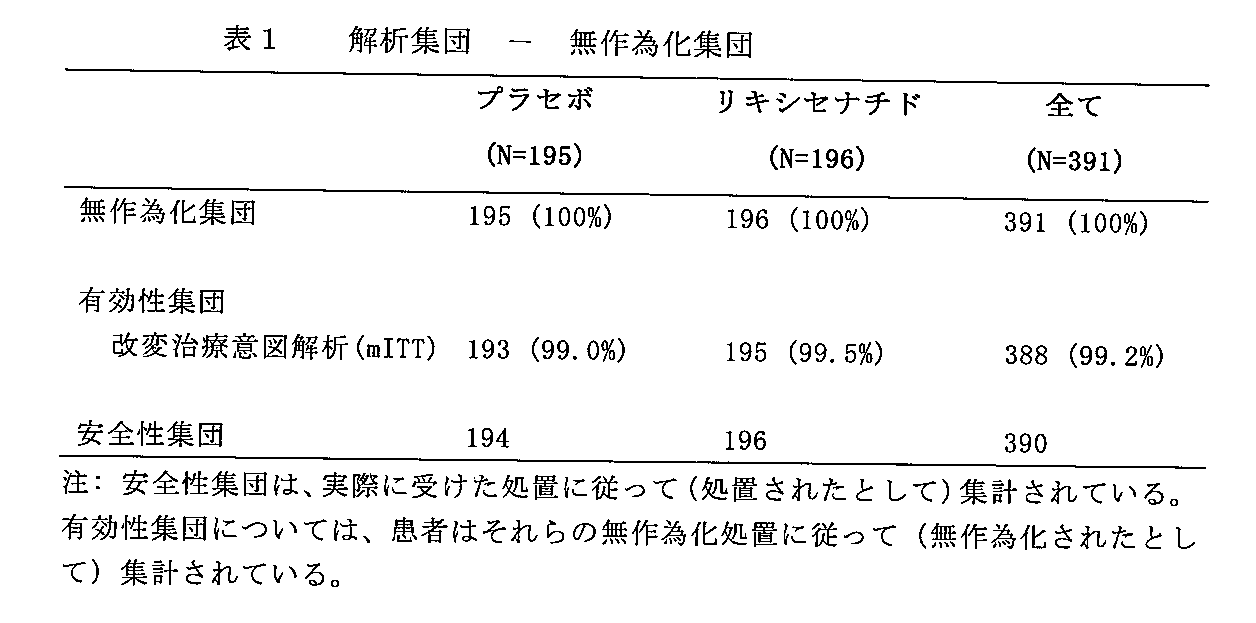
表1は、各解析集団に含まれる患者の数を提供する。1人の無作為化された患者(プラセボ群)は、患者が研究から離脱したために研究処置に曝されなかった。他の390人の無作為化された患者は研究処置に曝された。2人の患者(各群において1人の患者[0.5%])を、ベースライン後有効性データが無いために有効性解析のためのmITT集団から除外した。 Table 1 provides the number of patients included in each analysis population. One randomized patient (placebo group) was not exposed to study treatment because the patient withdrew from the study. The other 390 randomized patients were exposed to study treatment. Two patients (one patient in each group [0.5%]) were excluded from the mITT population for efficacy analysis due to lack of post-baseline efficacy data.
6.1.2 研究素質(disposition)
表2は、各処置群についての患者素質の要約を提供する。実際に行われた処置に基づく期間の間に、27人の患者は早期に研究処置を中止した。処置を中止した患者のパーセンテージは、プラセボ群よりもリキシセナチド群において高かった(それぞれ8.7%及び5.1%)。処置の中止の主な理由は「有害事象」であり(14人の患者)、プラセボ群よりもリキシセナチド群において患者が多く(それぞれ11人の患者[5.6%]及び3人の患者[1.5%])、主に胃腸障害SOCからのAEに起因するものであった(表20)。処置期間にいずれかの理由による処置中止の開始までの時間(time−to−onset)を図8に示し、これは研究の初期においてより頻繁に中止が発生したことを示す。181日目に、リキシセナチド群における2人の患者がおり、2人の患者のうちの1人は処置を中止し、そしてこれは治験担当医師による研究処置中止として記録された。
6.1.2 Research disposition
Table 2 provides a summary of patient qualities for each treatment group. During the period based on the treatment actually performed, 27 patients discontinued study treatment early. The percentage of patients who discontinued treatment was higher in the lixisenatide group than in the placebo group (8.7% and 5.1%, respectively). The main reason for discontinuing treatment was “adverse events” (14 patients), with more patients in the lixisenatide group than in the placebo group (11 patients each [5.6%] and 3 patients [1] 5%]), mainly due to AE from gastrointestinal disorder SOC (Table 20). The time-to-onset for any reason during the treatment period is shown in FIG. 8, which indicates that withdrawals occurred more frequently early in the study. On
6.1.3 人口統計学及びベースライン特徴
人口統計学及び患者のベースライン特徴は、安全性集団について2つの処置群の間で全体的に同様であった(表3)。全体的に、研究集団の年齢中央値は56歳であり、スクリーニングHbA1c中央値は7.90%であり、そしてボディマス指数(BMI)中央値は26.30kg/m2であった。
6.1.3 Demographic and baseline characteristics Demographic and patient baseline characteristics were generally similar between the two treatment groups for the safety population (Table 3). Overall, the median age of the study population was 56 years, the median screening HbA 1c was 7.90%, and the median body mass index (BMI) was 26.30 kg / m 2 .
糖尿病歴を含む疾患特徴は概して2つの処置群の間で類似したものであった(表4)。全体体に、T2DMの期間の平均(SD)は6.64(4.72)年であり、そしてT2DM開始の平均(SD)年齢は48.1(9.8)歳であった。同じ場所からの2人の患者(各処置群において1人)は、スクリーニング来診の少なくとも8ヶ月前に組み換えヒトGLP−1(rhGLP−1)に対する臨床試験に参加していたために以前にGLP−1受容体アゴニストを投与されていたことを報告した。 Disease characteristics including diabetes history were generally similar between the two treatment groups (Table 4). Overall, the mean (SD) duration of T2DM was 6.64 (4.72) years, and the mean (SD) age of onset of T2DM was 48.1 (9.8) years. Two patients from the same location (one in each treatment group) had previously participated in a clinical trial for recombinant human GLP-1 (rhGLP-1) at least 8 months prior to the screening visit and were previously GLP- It was reported that 1 receptor agonist was being administered.
バックグラウンド処置の使用(メトホルミン及び/又はスルホニル尿素)は、一般的には安全性集団について2つの処置群の間で同様であった(表5及び表6)。 The use of background treatment (metformin and / or sulfonylurea) was generally similar between the two treatment groups for the safety population (Tables 5 and 6).
全体的に、患者の約半分(174人の患者[44.6%])がスクリーニング来診時にメトホルミンに加えてスルホニル尿素を投与されていた(表6)。症例報告形式(CRF)で記録された「スクリーニング時のスルホニル尿素の使用」のパーセンテージは、表3におけるインタラクティブ・ボイス・レスポンス・システム/インタラクティブ・ウェブ・ベース・システム(Interactive Web Based System)(IVRS/IWRS)において記録された「スクリーニング時のスルホニル尿素の使用の無作為化層」とは異なるものである。しかし、2つの処置群は概して均衡が取れている。 Overall, about half of the patients (174 patients [44.6%]) received sulfonylurea in addition to metformin at the screening visit (Table 6). The percentage of “use of sulfonylurea during screening” recorded in the case report format (CRF) is shown in Interactive Web Response System / Interactive Web Based System (IVRS / Table 3). This is different from the “randomized layer of sulfonylurea use during screening” recorded in IWRS). However, the two treatment groups are generally balanced.
ベースライン有効性変数は、安全性集団について2つの処置群間で概して同程度であった(表7)。2つの群における研究集団は、HbA1c、2時間後PPG、FPG及び体重を含むベースライン血糖パラメーターに関してよく一致していた。 Baseline efficacy variables were generally comparable between the two treatment groups for the safety population (Table 7). The study populations in the two groups were in good agreement with respect to baseline glycemic parameters including HbA 1c , 2 hours later PPG, FPG and body weight.
6.1.4 投薬量及び期間
平均処置曝露は、2つの処置群間で同様であった(リキシセナチド群及びプラセボ群についてそれぞれ159.4日[22.8週]及び165.5日[23.6週])(表8)。390人の患者のうち、325人の患者(83.3%)はプロトコルにより許容される168+/−5日の研究処置を受けた(リキシセナチド群及びプラセボ群においてそれぞれ164人の患者[83.7%]及び161人の患者[83.0%])。1人のプラセボ患者は、CRFページの「処置の終点」に最後の投薬の日付を記録しなかったため、曝露期間は統計解析計画(SAP)データ取り扱い規約に従って欠測と設定された。
6.1.4 Dosage and Duration Average treatment exposure was similar between the two treatment groups (159.4 days [22.8 weeks] and 165.5 days [23.15] for the lixisenatide and placebo groups, respectively. 6 weeks]) (Table 8). Of the 390 patients, 325 patients (83.3%) received the 168 +/− 5 day study treatment allowed by the protocol (164 patients each in the lixisenatide and placebo groups [83.7 %] And 161 patients [83.0%]). Because one placebo patient did not record the date of the last medication in the “End of Treatment” on the CRF page, the exposure period was set as missing according to the Statistical Analysis Plan (SAP) data handling convention.
2つの処置群における90%より多くの患者が二重盲検処置期間の終わりに20μgの標的合計日用量であった(表9)。 More than 90% of patients in the two treatment groups had a target total daily dose of 20 μg at the end of the double-blind treatment period (Table 9).
6.2 有効性
6.2.1 主要有効性終点
主解析
予め指定された主要解析は、リキシセナチドでの処置がプラセボ群と比較して、ベースラインから24週までにHbA1cの統計的に有意な減少を生じることを実証した(表10)。HbA1cのLS平均変化はリキシセナチド群について0.83%、そしてプラセボ群については−0.47%であった;LS平均差異対プラセボは、−0.36%、95% CI:−0.551%、−0.162%;p値=0.0004であった。中国における患者は同じ傾向を示した(表28)。
6.2 Efficacy 6.2.1 Endpoints of primary efficacy Primary analysis Pre-specified primary analysis was that treatment with lixisenatide was statistically significant for HbA 1c from baseline to 24 weeks compared to placebo group (Table 10). The LS mean change in HbA 1c was 0.83% for the lixisenatide group and -0.47% for the placebo group; LS mean difference vs. placebo was -0.36%, 95% CI: -0.551 %, -0.162%; p value = 0.0004. Patients in China showed the same trend (Table 28).
図9に示されるように、両方の処置群におけるHbA1cは、8週目で既に減少しており、そして処置期間全体の間に減少し続けた。 As shown in FIG. 9, HbA1c in both treatment groups was already decreasing at 8 weeks and continued to decrease during the entire treatment period.
副次的解析
CMH法を使用したHbA1c応答者の解析はまた、リキシセナチド群とプラセボ群との間で統計的に有意な処置差異を示した(表11)。24週目に、プラセボ群における患者の38.8%と比較して、リキシセナチド群における患者の半分より多く(53.0%)が、HbA1c7%未満を達成した(p値=0.0030)。
Secondary analysis Analysis of HbA 1c responders using the CMH method also showed statistically significant treatment differences between the lixisenatide and placebo groups (Table 11). At 24 weeks, more than half of patients in the lixisenatide group (53.0%) achieved less than 7% HbA 1c compared to 38.8% of patients in the placebo group (p-value = 0.030) ).
6.2.2 副次的有効性終点
2時間後PPG評価の結果は、プラセボ群と比較してリキシセナチド群においてベースラインから24週までに統計的に有意な改善を示した(LS平均差異対プラセボ=−4.28mmol/L;p値<0.0001)(表12)。グルコース変動幅の解析は同様の結果を示した(表17)。
6.2.2 Secondary efficacy endpoint The results of the PPG assessment after 2 hours showed a statistically significant improvement in the lixisenatide group from baseline to 24 weeks compared to the placebo group (LS mean difference vs. Placebo = -4.28 mmol / L; p-value <0.0001) (Table 12). Analysis of the glucose fluctuation range showed similar results (Table 17).
FPGについては、ベーラインから24週までに統計的に有意な改善が、プラセボ群と比較してリキシセナチド群において観察された(LS平均差異 対 プラセボ=0.48mmol/L;p値=0.0109)(表13、図10)。 For FPG, a statistically significant improvement was observed in the lixisenatide group compared to the placebo group from baseline to 24 weeks (LS mean difference vs. placebo = 0.48 mmol / L; p-value = 0.0109). (Table 13, FIG. 10).
24週目でのベースラインからのLS平均体重減少は、リキシセナチド患者について1.50kg、そしてプラセボ患者について1.24kgであった(表14、図11)。2つの処置群の間で統計的に有意な差異は観察されなかった(LS平均差異 対 プラセボ=−0.27kg;p値=0.296)。リキシセナチド群におけるわずかに多い数の患者が、プラセボ患者と比較してベースラインから24週までの5%又はそれ以上の体重減少を有していた(それぞれ19.7%及び14.7%)(表15)。
The LS mean weight loss from baseline at
24週目に救出治療を必要とする患者の数は、プラセボ群における13人の患者[6.7%]と比較してリキシセナチド群において7人の患者[3.6%]であった(表16)。 The number of patients in need of rescue treatment at 24 weeks was 7 patients [3.6%] in the lixisenatide group compared to 13 patients [6.7%] in the placebo group (Table 16).
リキシセナチド処置は、プラセボ処置と比較してベースラインから24週までに食後血漿グルコース変動幅を実質的に減少させた(LS平均差異 対 プラセボ=3.99mmol/L、95% CI=−4.969、−3.010)。 Lixisenatide treatment substantially reduced the postprandial plasma glucose variability by 24 weeks from baseline compared to placebo treatment (LS mean difference vs placebo = 3.99 mmol / L, 95% CI = -4.969 , -3.010).
要約すると、この研究の結果は、スルホニル尿素を用いるか又は用いずに、メトホルミンにより十分管理されないT2DM患者におけるHbA1cの変化、HbA1c応答者、2時間後PPG、及びFPG減少により明らかなように、血糖管理に関して24週目にプラセボと比較してリキシセナチドを用いた処置の優れた有効性を実証した。 In summary, the results of this study, with or without a sulfonylurea, a change in HbA 1c in T2DM patients not adequately controlled by metformin, HbA 1c responders, after 2 hours PPG, and as evidenced by FPG reduction , Demonstrated superior efficacy of treatment with lixisenatide compared to placebo at 24 weeks for blood glucose management.
6.3 安全性
表18は、TEAEを有していた患者の概要を示す。表19及び表20は、深刻なTEAE、並びに主要SOC、高位グループ用語(HLGT)、高位用語(HLT)及び基本語(Preferred Term)(PT)による処置中止に至るTEAEを要約する
。
6.3 Safety Table 18 shows a summary of patients who had TEAE. Tables 19 and 20 summarize TEAEs leading to treatment with severe TEAEs and major SOCs, high group terms (HLGT), high terms (HLT) and preferred terms (PT).
表18に示されるように、TEAEの発生率は、プラセボ群と比較してリキシセナチド群において高かった(それぞれ64.3%及び47.4%)。7人の患者が深刻なTEAEを有し、リキシセナチド及びプラセボ群において同様の発生率であった(それぞれ3人の患者[1.5%]及び4人の患者[2.1%])。死亡に至る深刻なTEAEを有する患者はいなかった。処置の中止に至るTEAEを有する患者のパーセンテージは、プラセボ群と比較してリキシセナチド群において高く(それぞれ11人の患者[5.6%]及び3人の[1.5%])、これは胃腸障害SOCにおける不均衡に主に関連付けられた(それぞれリキシセナチド群における8人の患者[4.1%]、及びプラセボ群における0人の患者)(表20)。 As shown in Table 18, the incidence of TEAE was higher in the lixisenatide group compared to the placebo group (64.3% and 47.4%, respectively). Seven patients had severe TEAEs with similar incidence in the lixisenatide and placebo groups (3 patients [1.5%] and 4 patients [2.1%], respectively). None of the patients had serious TEAEs leading to death. The percentage of patients with TEAE leading to treatment discontinuation is higher in the lixisenatide group compared to the placebo group (11 patients [5.6%] and 3 [1.5%], respectively), Mainly associated with imbalances in impaired SOC (8 patients each in the lixisenatide group [4.1%] and 0 patients in the placebo group) (Table 20).
別表の表26は、2つの処置群における少なくとも1%の患者において発生した実際の処置に基づく期間の間のTEAEの発生率を示す。悪心が、プラセボ群(5人の患者[2.6%])と比較してリキシセナチド群(32人の患者[16.3%])において最も一般的に報告されたTEAEであった。リキシセナチド−処置患者において二番目に頻繁に報告されたTEAEは低血糖であり(18人の患者[9.2%])、続いてめまい感(17人の患者[8.7%])及び嘔吐(15人の患者[7.7%])であった。プラセボ群における対応する患者数(%)は、低血糖について9人の患者(4.6%)、めまい感について8人の患者(4.1%)、そして嘔吐について2人の患者(1.0%)であった。 Table 26 of the Appendix shows the incidence of TEAE during a period based on actual treatment that occurred in at least 1% of patients in the two treatment groups. Nausea was the most commonly reported TEAE in the lixisenatide group (32 patients [16.3%]) compared to the placebo group (5 patients [2.6%]). The second most frequently reported TEAE in lixisenatide-treated patients is hypoglycemia (18 patients [9.2%]), followed by dizziness (17 patients [8.7%]) and vomiting (15 patients [7.7%]). The corresponding number of patients (%) in the placebo group were 9 patients for hypoglycemia (4.6%), 8 patients for dizziness (4.1%), and 2 patients for vomiting (1. 0%).
実際の処置に基づく期間の間、いずれの処置群でも膵炎を疑われた患者も、リパーゼ又ははアミラーゼの少なくとも1つの値が3正常範囲の上限(ULN)以上と報告された患者もいなかった。 During the period based on actual treatment, no patient was suspected of having pancreatitis in any treatment group, and no patient reported at least one lipase or amylase value above the upper limit of three normal ranges (ULN).
リキシセナチド群における3人の患者は、実際の処置に基づく期間の間に少なくとも1つの深刻な有害事象(SAE)を経験し(表19)、これらのうち、1人の患者はリキシセナチドの最初の注射後に3つの事象(アナフィラキシーショック、急性心筋梗塞、及びラクナ梗塞)を報告され、そして処置を永久的に中止した;1人の患者は脳梗塞を経験し(処置の80日目)、これにより処置の中止に至った;1人の患者は入院を伴う腹痛を経験し(処置の13日目)、これは処置の中止には至らなかった。4人の患者における合計4つのSAEが実際の処置に基づく期間の間にプラセボ群において報告された(それぞれ高血圧、肝機能異常、前立腺炎、及び良性前立腺増殖症)。4つの事象はいずれもIPと関連がなく、永久的な研究処置の中止には至らなかった。
Three patients in the lixisenatide group experienced at least one serious adverse event (SAE) during the period based on actual treatment (Table 19), of which one patient was the first injection of lixisenatide Three events were later reported (anaphylactic shock, acute myocardial infarction, and lacunar infarction), and treatment was permanently discontinued; one patient experienced cerebral infarction (day 80 of treatment), thereby treating One patient experienced abdominal pain with hospitalization (
アナフィラキシーショック、急性心筋梗塞、ラクナ梗塞(156029017):
高血圧、脂質異常症の病歴を有し、そしてアレルギーの病歴はない66歳の男性T2DM患者は、最初のIPの投薬の10分後に、皮膚の痒み、体全体の発疹及び紅潮の開始を伴う、アレルギー型の症状を経験した。10分後に、彼の血圧は60/40mmHgに低下し(グルコース値10.2mmol/L)、そして患者が無意識になったときにアレルギーショックが起こり、そして彼の呼吸は遅くかつ浅くなった。この患者は入院し、そしてデキサメタゾン、プロメタジン及びドパミンで処置された。彼は約1時間後にアレルギーショックから回復し、そして約6時間後にアレルギー反応から回復した。同日に試験されたECG及び心筋酵素に基づいて、彼は虚血症状の無い急性心筋梗塞と診断された。彼の状態はクロピドグレル、アスピリン、低分子量ヘパリン、メトプロロール、及びクレアチンリン酸を用いた矯正処置を受けた後安定していた。研究処置をアナフィラキシーショック及び急性心筋梗塞のために中止した。永久IP中止の6日後に、脳磁気共鳴画像法(MRI)スキャンはラクナ梗塞を示した(CACにより脳卒中ではないと判定された)。2週後、この患者は回復して退院した。ラクナ梗塞後の残留効果はなかった。症例はSanofi(Pharmacovigilance)により非盲検にされ、そしてこの患者はリキシセナチドを投与された。治験担当医師はアナフィラキシーショック及び心筋梗塞の事象を治験薬に関連するものと評価し、そしてラクナ梗塞はIPに関連しないと評価した。
Anaphylactic shock, acute myocardial infarction, lacunar infarction (156029017):
A 66-year-old male T2DM patient with a history of hypertension, dyslipidemia and no history of allergies, with skin itching, whole body rash and onset of flushing 10 minutes after the first IP dose, Experienced allergic symptoms. After 10 minutes, his blood pressure dropped to 60/40 mmHg (glucose level 10.2 mmol / L) and allergic shock occurred when the patient became unconscious, and his breathing was slow and shallow. The patient was hospitalized and treated with dexamethasone, promethazine and dopamine. He recovered from allergic shock after about 1 hour and recovered from allergic reaction after about 6 hours. Based on ECG and myocardial enzymes tested on the same day, he was diagnosed with acute myocardial infarction without ischemic symptoms. His condition was stable after receiving corrective treatment with clopidogrel, aspirin, low molecular weight heparin, metoprolol, and creatine phosphate. Study treatment was discontinued due to anaphylactic shock and acute myocardial infarction. Six days after withdrawal of permanent IP, a magnetic resonance imaging (MRI) scan showed lacunar infarction (determined by CAC as not a stroke). Two weeks later, the patient recovered and was discharged. There was no residual effect after lacunar infarction. The case was unblinded by Sanofi (Pharmacovigilance) and this patient was administered lixisenatide. The investigator assessed anaphylactic shock and myocardial infarction events as related to study drug, and lacunar infarction as not related to IP.
脳梗塞(156015018):
高血圧及び脂質異常症の病歴を有する63歳男性T2DM患者は無作為にリキシセナチド処置群に選ばれ、そして試験処置の進行中(80日目)に軽度の脳梗塞を経験した。研究処置を中止した。4日後、彼は右側脱力のために入院した。脳MRIスキャンにより、急性橋梗塞、多発性脳梗塞、左側頭領域における異常なシグナル、白質病変及びアテローム性動脈硬化が明らかになった。10日後、彼は矯正処置(詳細不明)後に安定した状態で退院した。しかし、この患者は9日後に身体右側の虚脱のため再入院した。二度目の脳MRIにより、橋梗塞、多発性脳梗塞、軽い(light)脳萎縮、白質病変及びアテローム性動脈硬化であると考えられる左前前頭葉からの異常なシグナルが明らかになった。12日後に、この患者は本質的に回復したと評価され、そして抗血小板及び高血圧の治療を用いた矯正治療を受けた後に退院した。この事象は、CACにより非致死的虚血性脳卒中と最終的に判定された。治験担当医師は、この脳梗塞は治験薬と関連しないと評価した。
Cerebral infarction (156601018):
A 63-year-old male T2DM patient with a history of hypertension and dyslipidemia was randomly selected for the lixisenatide treatment group and experienced mild cerebral infarction during the course of the study treatment (day 80). Study treatment was discontinued. Four days later he was hospitalized for right hand weakness. A brain MRI scan revealed acute pontine infarction, multiple cerebral infarctions, abnormal signals in the left temporal region, white matter lesions and atherosclerosis. Ten days later, he was discharged stably after corrective action (details unknown). However, this patient was readmitted 9 days later due to collapse of the right side of the body. A second brain MRI revealed an abnormal signal from the left frontal lobe considered to be pontine infarct, multiple cerebral infarction, light brain atrophy, white matter lesions and atherosclerosis. After 12 days, the patient was assessed as having recovered essentially and discharged after receiving corrective treatment with antiplatelet and hypertension treatments. This event was ultimately determined by CAC to be non-fatal ischemic stroke. The investigator assessed that the cerebral infarction was not related to the study drug.
腹部痛(156008020):
乳癌、子宮筋腫、高血圧、脂質異常症、狭心症、肥満、高尿酸血症の関連する治療歴、並びにペニシリン及び食物のアレルギーの病歴を有する65歳女性T2DM患者は、リキシセナチド処置群に無作為に選ばれた。彼女はIPの最初の投薬の7日後に中程度の腹部膨張痛を生じた。彼女は、腹痛のさらなる評価及び診断のために5日後に入院した。研究処置を継続した。およそ11日後、患者は回復し、そして矯正処置なしに退院した。さらなる情報は入手可能でない。入院時診断はなお腹痛のままであった。治験担当医は腹痛の事象を治験薬に関連すると評価した。
Abdominal pain (156008020):
A 65-year-old female T2DM patient with a history of treatment related to breast cancer, uterine fibroids, hypertension, dyslipidemia, angina, obesity, hyperuricemia, and a history of penicillin and food allergies is randomized to the lixisenatide treatment group Was chosen. She developed moderate
高血圧(156007024):
肥満、高血圧、脂質異常症、心筋虚血、及び胆石症の病歴を有する63歳女性T2DM患者はプラセボ処置群に無作為に選ばれた。彼女は研究処置において(106日目)血圧が200/100mmHgまで上昇し中程度の高血圧を経験した。研究処置を継続した。彼女は入院してフェロジピン、ロサルタン、メトプロロール、及びシンバスタチンを用いた矯正処置を受けた。彼女の血圧は3日以内に正常化し、そして8日後に退院した。治験担当医はこの事象を治験薬に関係しないと評価した。
Hypertension (156007024):
A 63-year-old female T2DM patient with a history of obesity, hypertension, dyslipidemia, myocardial ischemia, and cholelithiasis was randomly selected for the placebo treatment group. In the study procedure (day 106) she experienced moderate hypertension with blood pressure rising to 200/100 mmHg. Study treatment continued. She was hospitalized and received corrective treatment with felodipine, losartan, metoprolol, and simvastatin. Her blood pressure normalized within 3 days and was discharged 8 days later. The investigator assessed the event as unrelated to the study drug.
肝機能異常(156030011):
脂肪肝及び脂質異常症の病歴を有する55歳男性T2DM患者はプラセボ処置群に無作為に選ばれた。彼は研究処置進行中(86日目)に重症の医学的に重篤な肝機能障害を発症した。9回目の来診時の肝機能試験(LFT)により、血清グルタミン酸ピルビン酸トランスアミナーゼ(SGPT) 571U/L(正常:6〜41U/L)、グルタミン酸オキサロ酢酸トランスアミナーゼ(SGOT) 218U/L(正常:9〜34U/L)、及びガンマグルタミルトランスフェラーゼ(GGT) 291U/L(正常: 11 52U/L)が明らかとなった。患者は悪心も嘔吐もなく嗜眠状態を感じただけであった。彼はアルコールを時々しか飲まず、そして彼の脂肪肝は十分管理されていた。患者は歯周炎の処置のためにメトロニダゾール及び伝統的な漢方薬を投与されており、これらは肝機能障害の時に使用されていた。研究処置を一時的に1週間停止し、そして患者はグリチルリチン酸ジアンモニウムを用いた矯正処置を受けた。患者のスクリーニングLFTは正常であった。無作為化来診時に、SGPTは94U/Lに上昇し、SGOTは41U/L、そしてGGTは298U/Lであった。21日後に、患者のLFTはほぼ正常であった。研究処置を6日後に再開した。治験担当医はこの事象を治験薬に関係しないと評価した。
Abnormal liver function (15660301):
A 55-year-old male T2DM patient with a history of fatty liver and dyslipidemia was randomly selected for the placebo treatment group. He developed severe medically severe liver dysfunction during the study procedure (Day 86). According to the liver function test (LFT) at the 9th visit, serum glutamate pyruvate transaminase (SGPT) 571 U / L (normal: 6 to 41 U / L), glutamate oxaloacetate transaminase (SGOT) 218 U / L (normal: 9 ˜34 U / L), and gamma glutamyltransferase (GGT) 291 U / L (normal: 11 52 U / L). The patient only felt lethargic without nausea or vomiting. He used alcohol only occasionally, and his fatty liver was well controlled. Patients were given metronidazole and traditional Chinese medicine for the treatment of periodontitis, which were used at the time of liver dysfunction. Study treatment was temporarily stopped for 1 week and the patient received corrective treatment with diammonium glycyrrhizinate. The patient's screening LFT was normal. At the randomized visit, SGPT rose to 94 U / L, SGOT was 41 U / L, and GGT was 298 U / L. After 21 days, the patient's LFT was nearly normal. Study treatment was resumed after 6 days. The investigator assessed the event as unrelated to the study drug.
前立腺炎(156015007):
高血圧及び前立腺炎の病歴を有する62歳男性T2DM患者は無作為にプラセボ処置群に選ばれた。彼は研究処置97日目に、半年間継続している軽度の腹部膨満により入院した。研究処置は継続された。矯正処置はアズトレオナム及び伝統的な漢方薬を含んでいた。患者の症状は改善し、そして彼は慢性前立腺炎と診断された11日後に退院した。治験担当医はこの事象を治験薬に関係しないものと評価した。
Prostatitis (15601507):
A 62 year old male T2DM patient with a history of hypertension and prostatitis was randomly selected for the placebo treatment group. He was hospitalized on day 97 of the study procedure due to a mild abdominal distension lasting half a year. Study treatment was continued. Orthodontic treatment included aztreonam and traditional Chinese medicine. The patient's symptoms improved and he was discharged 11 days after being diagnosed with chronic prostatitis. The investigator assessed the event as unrelated to the study drug.
良性前立腺肥大症(156008016):
高血圧及び異常脂質症の病歴を有する60歳男性T2DM患者はプラセボ処置群に無作為に選ばれた。彼は研究処置進行中に(52日目)中程度の前立腺肥大を経験した(52日目)。症状は尿意頻数、尿貯留(3日間)及び排尿困難を特徴とし、これらは1年間の間に悪化していた。研究処置を継続した。彼は入院し、そして8日後に尿道拡張及び経尿道的前立腺切除術を受けた。術後に彼は抗炎症薬を投薬された。11日後に、患者は安定した状態で退院した。治験担当医はこの事象を治験薬に関連しないと評価した。
Benign prostatic hypertrophy (156008016):
A 60 year old male T2DM patient with a history of hypertension and dyslipidemia was randomly selected for the placebo treatment group. He experienced moderate prostate enlargement (day 52) during the study procedure (day 52). Symptoms were characterized by urinary frequency, urinary retention (3 days) and difficulty urinating, which worsened during the year. Study treatment continued. He was hospitalized and underwent urethral dilatation and
リキシセナチド群における処置中止に至る最も一般的なTEAEは胃腸障害であった。11人(5.6%)のリキシセナチド処置患者が、TEAEにより処置を永久的に中止し、そしてその中でも、8人(4.1%)の患者が胃腸障害のTEAEにより処置を中止したが(表20)、これらの胃腸有害事象のうちプラセボ群において処置中止に至ったものはなかった。最も頻繁に報告された処置中止に至った事象は悪心及び嘔吐であった(それぞれ3人の患者[1.5%]及び2人の患者[1.0%])。 The most common TEAE leading to treatment discontinuation in the lixisenatide group was gastrointestinal disorders. Eleven (5.6%) patients treated with lixisenatide permanently discontinued treatment with TEAE, and among them, 8 (4.1%) patients discontinued treatment with TEAE with gastrointestinal disorders ( Table 20), none of these gastrointestinal adverse events led to treatment discontinuation in the placebo group. The most frequently reported events leading to treatment discontinuation were nausea and vomiting (3 patients [1.5%] and 2 patients [1.0%], respectively).
合計で16人の患者(4.1%)が、実際の処置に基づく期間の間に、プロトコルの定義を満たす症候性低血糖を有していた(リキシセナチド群及びプラセボ群においてそれぞれ11人[5.6%]及び5人[2.6%])(表21)。これらの事象はいずれも重症又は深刻とはみなされなかった。血中グルコース60mg/dL未満の症候性低血糖の数は2つの処置群で同じであった(各群において3人[1.5%])。さらに、2つの処置群の間で、60mg/dL未満の血中グルコースを有する数の差異は、メトホルミンに加えてスルホニル尿素を用いて処置された患者において観察されなかった(リキシセナチド群及びプラセボ群においてそれぞれ3人の患者[3.3%]及び3人の患者[3.7%])(表29)。 A total of 16 patients (4.1%) had symptomatic hypoglycemia that met the protocol definition during the period based on actual treatment (11 each in the lixisenatide and placebo groups [5 .6%] and 5 [2.6%]) (Table 21). None of these events were considered severe or serious. The number of symptomatic hypoglycemia with blood glucose below 60 mg / dL was the same in the two treatment groups (3 in each group [1.5%]). In addition, no difference in numbers between the two treatment groups with blood glucose below 60 mg / dL was observed in patients treated with sulfonylurea in addition to metformin (in the lixisenatide and placebo groups). 3 patients each [3.3%] and 3 patients [3.7%]) (Table 29).
注射部位反応事象は、治験担当医が報告した用語からコード化されたPT又はアレルギー反応判定後のARAC診断用語からコード化されたPTのいずれかで用語「注射部位(injection site)」を検索することにより同定された。実際の処置に基づく期間の間に注射部位反応を経験した患者は合計で7人(1.8%)であり(リキシセナチドで5人及びプラセボで2人)、これらはいずれも深刻でも重症でもなく、処置中止に至るものは無かった(表22)。 An injection site reaction event searches for the term “injection site” in either the PT encoded from the term reported by the investigator or the PT encoded from the ARAC diagnostic term after determining the allergic reaction. Was identified. A total of 7 patients (1.8%) experienced injection site reactions during the period based on actual treatment (5 for lixisenatide and 2 for placebo), neither of which was serious or severe None of the treatments resulted in discontinuation (Table 22).
合計で15の症例が治験担当医によりアレルギー事象の疑いがあるとして実際の処置に基づく期間の間に報告され、そして判定のためにARACに送られた。これらの症例のうち3件はARACによりアレルギー反応と判定された(リキシセナチドにおける2人の患者[1.0%]及びプラセボにおける1人の患者[0.5%])(表23)。リキシセナチド群における両方の事象はおそらくIPに関連するとARACにより判定され、それらのうち1つの事象(アナフィラキシーショック)はIPの最初の投薬後に起こり(156029017、詳細は41ページを参照のこと)、そして永久的処置中止に至り、そして1つの事象(注射部位反応)は処置の15日後に起こり(これは処置中止には至らなかった)、そして患者は処置を継続しながら回復した。 A total of 15 cases were reported during the period based on the actual treatment as suspected allergic events by the investigator and sent to ARAC for determination. Three of these cases were determined to be allergic by ARAC (2 patients [1.0%] in lixisenatide and 1 patient [0.5%] in placebo) (Table 23). Both events in the lixisenatide group were determined by ARAC to be probably related to IP, one of them (anaphylactic shock) occurred after the first dose of IP (156029017, see page 41 for details) and permanent One treatment (injection site reaction) occurred 15 days after treatment (this did not lead to treatment withdrawal) and the patient recovered with continued treatment.
血清カルシトニンの増加はTEAEとして報告されなかった(表24)。リキシセナチド群において、1人の患者は12回目の来診(処置来診の終わり)に20ng/mlより高いカルシトニン(23.6pg/mL)が見られたが、1週間以内に再検査カルシトニン値は正常に戻った(15.7pg/mL)。この症例についてAEは報告されなかった。 No increase in serum calcitonin was reported as TEAE (Table 24). In the lixisenatide group, one patient had calcitonin (23.6 pg / mL) higher than 20 ng / ml at the 12th visit (end of treatment visit), but the retest calcitonin level within one week It returned to normal (15.7 pg / mL). No AE was reported for this case.
結論として、リキシセナチドは24週の処置期間の間、十分に耐容性であった。研究処置の永久的な中止に至るTEAEの発生率は、プラセボ群よりもリキシセナチド群において高く、これは主に胃腸のTEAEに起因するものであった。深刻なTEAEの発生率は2つの処置群において同様であった。プラセボと比較してリキシセナチドで処置された患者のより高いパーセンテージが症候性低血糖を経験したが、60mg/dL未満の血中グルコースを伴う症候性低血糖を有する患者数は2つの処置群において正確に同じであった。悪心、めまい感及び嘔吐は、プラセボよりもリキシセナチドでより頻繁に観察された。新しい特定の安全性の懸念は試験の間に観察されなかった。 In conclusion, lixisenatide was well tolerated during the 24 week treatment period. The incidence of TEAE leading to permanent discontinuation of study treatment was higher in the lixisenatide group than in the placebo group, mainly due to gastrointestinal TEAE. The incidence of severe TEAE was similar in the two treatment groups. Although a higher percentage of patients treated with lixisenatide compared with placebo experienced symptomatic hypoglycemia, the number of patients with symptomatic hypoglycemia with blood glucose below 60 mg / dL is accurate in the two treatment groups It was the same. Nausea, dizziness and vomiting were observed more frequently with lixisenatide than with placebo. No new specific safety concerns were observed during the study.
7 別表
Claims (13)
(b) メトホルミン又は/及びその薬学的に許容しうる塩、並びに
(c) スルホニル尿素
を含む、2型糖尿病患者の血漿グルカゴンレベルの減少における使用のための組み合わせ医薬であって、ここで処置される対象者が、少なくとも14mmol/Lの食後2時間血漿グルコース濃度と少なくとも8%のHbA1c値を有し、前記2型糖尿病が、メトホルミン単独での処置では適切にコントロールされてない、上記組み合わせ医薬。 (A) desPro 36 Exendin -4 (1-39) -Lys 6 -NH 2 or / and a pharmaceutically acceptable salt thereof,
A combination medicament for use in reducing plasma glucagon levels in patients with type 2 diabetes, comprising (b) metformin or / and a pharmaceutically acceptable salt thereof, and (c) a sulfonylurea that the subject is, have at least 14 mmol / at least 8% of the HbA 1c value and 2 hours postprandial plasma glucose concentration of L, the type 2 diabetes are not adequately controlled in the treatment with metformin alone, the combination pharmaceutical .
とも4mmol/L又は少なくとも5mmol/Lのグルコース変動幅を有し、ここでグルコース変動幅は、食後2時間の血漿グルコース濃度と食事試験30分前の血漿グルコース濃度との差である、請求項1〜7のいずれか1項に記載の組み合わせ医薬。 The subject to be treated has a glucose fluctuation range of at least 2 mmol / L, at least 3 mmol / L, at least 4 mmol / L, or at least 5 mmol / L, where the glucose fluctuation range is defined as plasma glucose concentration and diet 2 hours after meal The combination medicine according to any one of claims 1 to 7, which is a difference from a plasma glucose concentration 30 minutes before the test.
Applications Claiming Priority (5)
| Application Number | Priority Date | Filing Date | Title |
|---|---|---|---|
| EP11166120 | 2011-05-13 | ||
| EP11166120.3 | 2011-05-13 | ||
| EP12163637 | 2012-04-10 | ||
| EP12163637.7 | 2012-04-10 | ||
| PCT/EP2012/058747 WO2012156298A1 (en) | 2011-05-13 | 2012-05-11 | Lixisenatide and metformin for treatment of diabetes type 2 |
Related Child Applications (1)
| Application Number | Title | Priority Date | Filing Date |
|---|---|---|---|
| JP2018136356A Division JP6676108B2 (en) | 2011-05-13 | 2018-07-20 | Lixisenatide and metformin for the treatment of type 2 diabetes |
Publications (2)
| Publication Number | Publication Date |
|---|---|
| JP2014514356A JP2014514356A (en) | 2014-06-19 |
| JP6442284B2 true JP6442284B2 (en) | 2018-12-19 |
Family
ID=46148833
Family Applications (2)
| Application Number | Title | Priority Date | Filing Date |
|---|---|---|---|
| JP2014509752A Active JP6442284B2 (en) | 2011-05-13 | 2012-05-11 | Lixisenatide and metformin for the treatment of type 2 diabetes |
| JP2018136356A Active JP6676108B2 (en) | 2011-05-13 | 2018-07-20 | Lixisenatide and metformin for the treatment of type 2 diabetes |
Family Applications After (1)
| Application Number | Title | Priority Date | Filing Date |
|---|---|---|---|
| JP2018136356A Active JP6676108B2 (en) | 2011-05-13 | 2018-07-20 | Lixisenatide and metformin for the treatment of type 2 diabetes |
Country Status (19)
| Country | Link |
|---|---|
| US (1) | US20130065828A1 (en) |
| EP (1) | EP2707017B1 (en) |
| JP (2) | JP6442284B2 (en) |
| KR (1) | KR20140043755A (en) |
| CN (2) | CN103841988A (en) |
| AU (1) | AU2012257849B2 (en) |
| BR (1) | BR112013029062A2 (en) |
| CA (1) | CA2835259C (en) |
| CY (1) | CY1117250T1 (en) |
| DK (1) | DK2707017T3 (en) |
| ES (1) | ES2556466T3 (en) |
| HR (1) | HRP20151369T1 (en) |
| HU (1) | HUE028459T2 (en) |
| MX (1) | MX362527B (en) |
| PL (1) | PL2707017T3 (en) |
| PT (1) | PT2707017E (en) |
| RU (1) | RU2623023C2 (en) |
| SI (1) | SI2707017T1 (en) |
| WO (1) | WO2012156298A1 (en) |
Families Citing this family (17)
| Publication number | Priority date | Publication date | Assignee | Title |
|---|---|---|---|---|
| PT2349324T (en) | 2008-10-17 | 2017-12-06 | Sanofi Aventis Deutschland | Combination of an insulin and a glp-1 agonist |
| WO2011058083A1 (en) | 2009-11-13 | 2011-05-19 | Sanofi-Aventis Deutschland Gmbh | Pharmaceutical composition comprising a glp-1 agonist, an insulin, and methionine |
| SG10201500871TA (en) | 2009-11-13 | 2015-04-29 | Sanofi Aventis Deutschland | Pharmaceutical composition comprising a glp-1 agonist and methionine |
| RS55378B1 (en) | 2010-08-30 | 2017-03-31 | Sanofi Aventis Deutschland | USE OF AVE0010 FOR MANUFACTURE OF TREATMENT OF DIABETES MELLITUS TYPE 2 |
| US9821032B2 (en) | 2011-05-13 | 2017-11-21 | Sanofi-Aventis Deutschland Gmbh | Pharmaceutical combination for improving glycemic control as add-on therapy to basal insulin |
| HRP20151068T1 (en) | 2011-08-29 | 2016-01-01 | Sanofi-Aventis Deutschland Gmbh | Pharmaceutical combination for use in glycemic control in diabetes type 2 patients |
| AR087744A1 (en) | 2011-09-01 | 2014-04-16 | Sanofi Aventis Deutschland | PHARMACEUTICAL COMPOSITION FOR USE IN THE TREATMENT OF A NEURODEGENERATIVE DISEASE |
| TWI641381B (en) | 2013-02-04 | 2018-11-21 | 法商賽諾菲公司 | Stabilized pharmaceutical formulations of insulin analogs and/or insulin derivatives |
| RU2016132340A (en) | 2014-01-09 | 2018-02-14 | Санофи | STABILIZED PHARMACEUTICAL COMPOSITIONS BASED ON INSULIN ASPART |
| SG11201604710XA (en) | 2014-01-09 | 2016-07-28 | Sanofi Sa | Stabilized pharmaceutical formulations of insulin analogues and/or insulin derivatives |
| SG11201604708VA (en) | 2014-01-09 | 2016-07-28 | Sanofi Sa | Stabilized glycerol free pharmaceutical formulations of insulin analogues and/or insulin derivatives |
| TWI758239B (en) | 2014-12-12 | 2022-03-21 | 德商賽諾菲阿凡提斯德意志有限公司 | Insulin glargine/lixisenatide fixed ratio formulation |
| TWI706779B (en) * | 2015-01-16 | 2020-10-11 | 德商賽諾菲阿凡提斯德意志有限公司 | Treatment of pediatric type 2 diabetes mellitus patients |
| TWI748945B (en) | 2015-03-13 | 2021-12-11 | 德商賽諾菲阿凡提斯德意志有限公司 | Treatment type 2 diabetes mellitus patients |
| TW201705975A (en) | 2015-03-18 | 2017-02-16 | 賽諾菲阿凡提斯德意志有限公司 | Treatment of type 2 diabetes mellitus patients |
| CN112469431A (en) * | 2018-07-23 | 2021-03-09 | 伊莱利利公司 | Methods of using GIP/GLP1 co-agonists for diabetes |
| JP7536871B2 (en) | 2019-12-19 | 2024-08-20 | アルフレックス、ユーエスエイ、リミテッド、ライアビリティー、カンパニー | Vaccination identification button for electronic identification button tags for identifying cattle vaccinated against brucellosis, and related kits and methods |
Family Cites Families (8)
| Publication number | Priority date | Publication date | Assignee | Title |
|---|---|---|---|---|
| EP1076066A1 (en) | 1999-07-12 | 2001-02-14 | Zealand Pharmaceuticals A/S | Peptides for lowering blood glucose levels |
| CN101014360A (en) * | 2004-08-03 | 2007-08-08 | 埃米斯菲尔技术公司 | Antidiabetic oral insulin-biguanide combination |
| CN101291685A (en) * | 2005-08-19 | 2008-10-22 | 安米林药品公司 | Exendin for Diabetes and Weight Loss |
| CA2660835A1 (en) * | 2006-08-17 | 2008-02-21 | Amylin Pharmaceuticals, Inc. | Dpp-iv resistant gip hybrid polypeptides with selectable propperties |
| AU2010212823B2 (en) * | 2009-02-13 | 2016-01-28 | Boehringer Ingelheim International Gmbh | Antidiabetic medications comprising a DPP-4 inhibitor (linagliptin) optionally in combination with other antidiabetics |
| ES2553593T3 (en) * | 2009-11-13 | 2015-12-10 | Sanofi-Aventis Deutschland Gmbh | Lixisenatide as a complement to metformin in the treatment of type 2 diabetes |
| US20110118180A1 (en) * | 2009-11-13 | 2011-05-19 | Sanofi-Aventis Deutschland Gmbh | Method of treatment of diabetes type 2 comprising add-on therapy to metformin |
| US20110118178A1 (en) * | 2009-11-13 | 2011-05-19 | Sanofi-Aventis Deutschland Gmbh | Method of treatment of diabetes type 2 comprising add-on therapy to insulin glargine and metformin |
-
2012
- 2012-05-11 CN CN201280034737.4A patent/CN103841988A/en active Pending
- 2012-05-11 KR KR1020137033310A patent/KR20140043755A/en not_active Ceased
- 2012-05-11 EP EP12723132.2A patent/EP2707017B1/en not_active Revoked
- 2012-05-11 CA CA2835259A patent/CA2835259C/en active Active
- 2012-05-11 ES ES12723132.2T patent/ES2556466T3/en active Active
- 2012-05-11 WO PCT/EP2012/058747 patent/WO2012156298A1/en not_active Ceased
- 2012-05-11 CN CN201711058028.0A patent/CN107693782A/en active Pending
- 2012-05-11 HU HUE12723132A patent/HUE028459T2/en unknown
- 2012-05-11 BR BR112013029062A patent/BR112013029062A2/en not_active Application Discontinuation
- 2012-05-11 AU AU2012257849A patent/AU2012257849B2/en active Active
- 2012-05-11 MX MX2013013307A patent/MX362527B/en active IP Right Grant
- 2012-05-11 PL PL12723132T patent/PL2707017T3/en unknown
- 2012-05-11 DK DK12723132.2T patent/DK2707017T3/en active
- 2012-05-11 PT PT127231322T patent/PT2707017E/en unknown
- 2012-05-11 HR HRP20151369TT patent/HRP20151369T1/en unknown
- 2012-05-11 JP JP2014509752A patent/JP6442284B2/en active Active
- 2012-05-11 SI SI201230377T patent/SI2707017T1/en unknown
- 2012-05-11 RU RU2013155474A patent/RU2623023C2/en active
- 2012-05-11 US US13/469,633 patent/US20130065828A1/en not_active Abandoned
-
2015
- 2015-12-15 CY CY20151101144T patent/CY1117250T1/en unknown
-
2018
- 2018-07-20 JP JP2018136356A patent/JP6676108B2/en active Active
Also Published As
| Publication number | Publication date |
|---|---|
| RU2623023C2 (en) | 2017-06-21 |
| EP2707017B1 (en) | 2015-09-16 |
| MX2013013307A (en) | 2014-03-12 |
| DK2707017T3 (en) | 2016-01-04 |
| WO2012156298A1 (en) | 2012-11-22 |
| CY1117250T1 (en) | 2017-04-05 |
| BR112013029062A2 (en) | 2016-11-29 |
| MX362527B (en) | 2019-01-23 |
| JP2018184441A (en) | 2018-11-22 |
| KR20140043755A (en) | 2014-04-10 |
| HRP20151369T1 (en) | 2016-01-15 |
| JP2014514356A (en) | 2014-06-19 |
| HUE028459T2 (en) | 2016-12-28 |
| EP2707017A1 (en) | 2014-03-19 |
| CN103841988A (en) | 2014-06-04 |
| US20130065828A1 (en) | 2013-03-14 |
| CN107693782A (en) | 2018-02-16 |
| ES2556466T3 (en) | 2016-01-18 |
| CA2835259C (en) | 2020-01-07 |
| PT2707017E (en) | 2016-01-12 |
| AU2012257849B2 (en) | 2017-03-30 |
| RU2013155474A (en) | 2015-06-20 |
| SI2707017T1 (en) | 2016-01-29 |
| JP6676108B2 (en) | 2020-04-08 |
| PL2707017T3 (en) | 2016-03-31 |
| CA2835259A1 (en) | 2012-11-22 |
| HK1194307A1 (en) | 2014-10-17 |
Similar Documents
| Publication | Publication Date | Title |
|---|---|---|
| JP6442284B2 (en) | Lixisenatide and metformin for the treatment of type 2 diabetes | |
| JP6367115B2 (en) | Combination medicine used for blood glucose control in patients with type 2 diabetes | |
| JP6329487B2 (en) | Treatment protocol for type 2 diabetes | |
| JP6199186B2 (en) | Use of AVE0010 for the manufacture of a medicament for the treatment of type 2 diabetes | |
| JP6066144B2 (en) | Concomitant medication | |
| JP6438944B2 (en) | Insulin glargine / lixisenatide fixed ratio formulation | |
| TWI748945B (en) | Treatment type 2 diabetes mellitus patients | |
| CN103648519A (en) | Drug combination products for the treatment of patients with type 2 diabetes | |
| AU2012257849A1 (en) | Lixisenatide and metformin for treatment of diabetes type 2 | |
| CN103402506A (en) | Combinations Used to Treat Diabetes | |
| TW201311271A (en) | Pharmaceutical combination for use in glycemic control in diabetes type 2 patients | |
| CA2685636C (en) | Method of treatment of diabetes type 2 comprising add-on therapy to metformin | |
| JP2011105609A (en) | Method for treating type-2 diabetes including add-on therapy to metformin | |
| HK1194307B (en) | Lixisenatide and metformin for treatment of diabetes type 2 | |
| HK1198577B (en) | Treatment protocol of diabetes type 2 | |
| CN106039292A (en) | Application of AVE0010 to manufacturing of medicines for treating type-2 diabetes |
Legal Events
| Date | Code | Title | Description |
|---|---|---|---|
| A621 | Written request for application examination |
Free format text: JAPANESE INTERMEDIATE CODE: A621 Effective date: 20150420 |
|
| A977 | Report on retrieval |
Free format text: JAPANESE INTERMEDIATE CODE: A971007 Effective date: 20160223 |
|
| A131 | Notification of reasons for refusal |
Free format text: JAPANESE INTERMEDIATE CODE: A131 Effective date: 20160301 |
|
| A521 | Request for written amendment filed |
Free format text: JAPANESE INTERMEDIATE CODE: A523 Effective date: 20160526 |
|
| A02 | Decision of refusal |
Free format text: JAPANESE INTERMEDIATE CODE: A02 Effective date: 20160830 |
|
| A521 | Request for written amendment filed |
Free format text: JAPANESE INTERMEDIATE CODE: A523 Effective date: 20170104 |
|
| A911 | Transfer to examiner for re-examination before appeal (zenchi) |
Free format text: JAPANESE INTERMEDIATE CODE: A911 Effective date: 20170213 |
|
| A912 | Re-examination (zenchi) completed and case transferred to appeal board |
Free format text: JAPANESE INTERMEDIATE CODE: A912 Effective date: 20170414 |
|
| A601 | Written request for extension of time |
Free format text: JAPANESE INTERMEDIATE CODE: A601 Effective date: 20180629 |
|
| A521 | Request for written amendment filed |
Free format text: JAPANESE INTERMEDIATE CODE: A523 Effective date: 20180720 |
|
| A61 | First payment of annual fees (during grant procedure) |
Free format text: JAPANESE INTERMEDIATE CODE: A61 Effective date: 20181126 |
|
| R150 | Certificate of patent or registration of utility model |
Ref document number: 6442284 Country of ref document: JP Free format text: JAPANESE INTERMEDIATE CODE: R150 |
|
| R250 | Receipt of annual fees |
Free format text: JAPANESE INTERMEDIATE CODE: R250 |
|
| R250 | Receipt of annual fees |
Free format text: JAPANESE INTERMEDIATE CODE: R250 |
|
| R250 | Receipt of annual fees |
Free format text: JAPANESE INTERMEDIATE CODE: R250 |
|
| R250 | Receipt of annual fees |
Free format text: JAPANESE INTERMEDIATE CODE: R250 |
|
| R250 | Receipt of annual fees |
Free format text: JAPANESE INTERMEDIATE CODE: R250 |