JP6394261B2 - ERW steel pipe for oil well and manufacturing method thereof - Google Patents
ERW steel pipe for oil well and manufacturing method thereof Download PDFInfo
- Publication number
- JP6394261B2 JP6394261B2 JP2014209808A JP2014209808A JP6394261B2 JP 6394261 B2 JP6394261 B2 JP 6394261B2 JP 2014209808 A JP2014209808 A JP 2014209808A JP 2014209808 A JP2014209808 A JP 2014209808A JP 6394261 B2 JP6394261 B2 JP 6394261B2
- Authority
- JP
- Japan
- Prior art keywords
- less
- steel pipe
- formula
- welded
- base material
- Prior art date
- Legal status (The legal status is an assumption and is not a legal conclusion. Google has not performed a legal analysis and makes no representation as to the accuracy of the status listed.)
- Active
Links
Images


Landscapes
- Heat Treatment Of Articles (AREA)
- Heat Treatment Of Steel (AREA)
Description
本発明は、特に、石油、天然ガス等の掘削用鋼管の用途に最適な、油井用電縫鋼管及びその製造方法に関する。 The present invention particularly relates to an oil-welded electric pipe for oil wells and a method for producing the same, suitable for use in steel pipes for drilling such as petroleum and natural gas.
近年、油井やガス井(以下、総称して油井と呼ぶ)の掘削深度はますます深くなる傾向にあり、油井用鋼管の高強度化が要求されている。また、油井用鋼管は、腐食性ガスを含む酸性化した厳しい環境(サワー環境)に曝される。このようなサワー環境では、硫化物応力割れ(Sulfide Stress Cracking、SSCという。)や水素割れ(Hydrogen Induced Cracking、HICという。)が問題になる。ここで、耐硫化物応力割れ性及び耐水素割れ性を総称して耐サワー性という。 In recent years, the drilling depth of oil wells and gas wells (hereinafter collectively referred to as oil wells) tends to become deeper, and high strength steel pipes for oil wells are required. In addition, oil well steel pipes are exposed to a severe acidified environment (sour environment) containing corrosive gas. In such a sour environment, sulfide stress cracking (referred to as SSC) and hydrogen cracking (referred to as Hydrogen Induced Cracking, HIC) become problems. Here, sulfide stress cracking resistance and hydrogen cracking resistance are collectively referred to as sour resistance.
SSCやHICは、主に、介在物や溶接部の近傍に生じるため、高強度及び耐サワー性が要求される用途には、従来、シームレス鋼管が使用されていた。しかし、最近では、シームレス鋼管は製造コストが高いため、コスト削減の観点からシームレス鋼管に匹敵する耐サワー性を有する電縫鋼管が要望されている。 Since SSC and HIC are mainly generated in the vicinity of inclusions and welds, seamless steel pipes have been conventionally used for applications requiring high strength and sour resistance. However, recently, seamless steel pipes are expensive to manufacture, and therefore, there is a demand for ERW steel pipes having sour resistance comparable to seamless steel pipes from the viewpoint of cost reduction.
電縫鋼管の耐サワー性改善技術として以下の提案がなされている。
例えば、SSCやHICの原因は、圧延方向に伸長したMnS(伸長MnSという。)などの介在物であることから、耐サワー性の向上には、介在物の形態の制御が有効である。伸長MnSの生成を抑制するために、熱間圧延によって延伸化し難いCaSなどの硫化物を形成するCaの添加が行われている。Caの添加によってMnSの形成を抑制するには、O(酸素)の含有量を低減し、S(硫黄)の含有量に応じた量のCaを添加する必要がある。そのため、耐サワー性を向上させるために、Ca、O、Sの添加量を制御した熱延鋼板が提案されている(例えば、特許文献1、2、参照)。
The following proposals have been made as techniques for improving the sour resistance of ERW pipes.
For example, the cause of SSC and HIC is inclusions such as MnS elongated in the rolling direction (referred to as elongated MnS). Therefore, control of the form of inclusions is effective for improving sour resistance. In order to suppress the formation of stretched MnS, Ca is added to form sulfides such as CaS that are difficult to be stretched by hot rolling. In order to suppress the formation of MnS by the addition of Ca, it is necessary to reduce the content of O (oxygen) and to add an amount of Ca corresponding to the content of S (sulfur). Therefore, in order to improve the sour resistance, a hot-rolled steel sheet in which the addition amount of Ca, O, and S is controlled has been proposed (for example, see Patent Documents 1 and 2).
MnSの形成の抑制により、電縫鋼管の母材部の耐サワー性は向上するが、溶接部にも耐サワー性が要求される。耐サワー性には硬さが影響することから、溶接部の近傍のビッカース硬さを250Hv以下、最大値と最小値との差を30Hv以内とした電縫鋼管が提案されている(例えば、特許文献3、4、参照)。電縫鋼管は、熱延鋼板を管状に成形し、突合せ部を電縫溶接して製造され、電縫溶接のままでは溶接部にパーライトが生成している、そのため、特許文献3、4では、電縫鋼管全体又は溶接部のみに熱処理を施し、耐サワー性を向上させている。
By suppressing the formation of MnS, the sour resistance of the base material part of the ERW steel pipe is improved, but the welded part is also required to have sour resistance. Since hardness affects sour resistance, an ERW steel pipe has been proposed in which the Vickers hardness in the vicinity of the welded portion is 250 Hv or less and the difference between the maximum value and the minimum value is within 30 Hv (for example, patents)
電縫鋼管の溶接部のみに熱処理(シーム熱処理)を施す場合、冷却が不十分であると、溶接部に帯状に並んで析出したパーライト、いわゆるパーライトバンドが生成し、耐サワー性が低下することがある。これを防止するために、溶接部を加熱した後、加速冷却し、更に、焼戻しを施す電縫鋼管の製造方法が提案されている(例えば、特許文献5、6、参照)。 When heat treatment (seam heat treatment) is applied only to the welded part of the ERW steel pipe, if the cooling is insufficient, pearlite that is deposited in a band shape on the welded part, the so-called pearlite band, is generated and sour resistance is reduced. There is. In order to prevent this, there has been proposed a method for manufacturing an electric-welded steel pipe in which a welded portion is heated, acceleratedly cooled, and further tempered (see, for example, Patent Documents 5 and 6).
最近の油井管の使用環境の苛酷化に伴って、油井用電縫鋼管に対する耐サワー性の要求水準も高度化している。従来のように溶接部の組織制御や鋼板のMnSに代表される介在物制御を個別に行っていたのでは対処できなくなってきている。そこで、電縫鋼管の高強度化と使用環境の苛酷化に対する耐久性向上の両立を図る材料設計が必要になってきている。 With the recent severe use of oil well pipes, sour resistance requirements for ERW steel pipes for oil wells are also increasing. It has become impossible to deal with the case where the microstructure control of the welded portion and the inclusion control represented by MnS of the steel plate are individually performed as in the past. Therefore, there is a need for a material design that achieves both improvement in the strength of the ERW pipe and improvement in durability against the severe use environment.
本発明は、苛酷な環境下で使用できる油井用電縫鋼管、すなわち、シームレス鋼管並みの耐サワー性を有する油井用電縫鋼管及びその製造方法を提供することを目的とする。具体的には、本発明の油井用電縫鋼管は、引張強さが450MPa以上で、NACE−TM−0177のB溶液(5%食塩+酢酸、pH3.5、1気圧硫化水素、25℃)中で降伏強さの80%以上の応力が負荷されても割れを生じないような優れた耐サワー性を有することを課題とする。 It is an object of the present invention to provide an oil well-welded steel pipe that can be used in a harsh environment, that is, an oil well-welded steel pipe having sour resistance comparable to that of a seamless steel pipe, and a method for producing the same. Specifically, the electric resistance welded steel pipe of the present invention has a tensile strength of 450 MPa or more and a B solution of NACE-TM-0177 (5% sodium chloride + acetic acid, pH 3.5, 1 atm hydrogen sulfide, 25 ° C.). The object is to have excellent sour resistance that does not cause cracking even when stress of 80% or more of the yield strength is applied.
本発明者らは、450MPa以上の引張強さ(TS)を有する電縫鋼管の耐サワー性について検討を行った。まず、電縫鋼管から採取した試験片を用いて、NACE−TM−0177のB溶液中で、降伏強さの80%以上の応力を負荷する評価試験を行い、割れが発生した試験片の破面及び組織の観察を行った。NACE−TM−0177のB溶液は、硫化水素が1気圧であり、温度が25℃で、5%の食塩及び酢酸を含み、pH3.5に調整された溶液である。 The present inventors examined the sour resistance of an electric resistance welded steel pipe having a tensile strength (TS) of 450 MPa or more. First, using a test piece taken from an ERW steel pipe, an evaluation test is performed in which a stress of 80% or more of the yield strength is applied in a B solution of NACE-TM-0177, and the test piece that has cracked is broken. The surface and the structure were observed. The B solution of NACE-TM-0177 is a solution adjusted to pH 3.5 containing hydrogen sulfide at 1 atm, temperature of 25 ° C., containing 5% sodium chloride and acetic acid.
その結果、母材部では、肉厚の中央部近傍に存在する中心偏析部で水素誘起割れ(HIC、Hydrogen Induced Cracking)が発生し、また、母材部の表面では、硬さが高くなっている部位から硫化物応力割れ(SCC、Stress Corrosion Cracking)が発生していることがわかった。
一方、電縫溶接部では、母材と同様の中心偏析に起因する水素誘起割れに加えて、パーライトに起因する硫化物応力割れが見られた。なお、電縫溶接及び電縫溶接後の熱処理によって母材とは異なる金属組織に変化している領域を「溶接部」という。
As a result, in the base metal part, hydrogen-induced cracking (HIC) occurs in the central segregation part near the center of the wall thickness, and the surface of the base material part becomes harder. It was found that sulfide stress cracking (SCC) occurred from the site.
On the other hand, in the ERW weld, sulfide stress cracking due to pearlite was observed in addition to hydrogen-induced cracking due to center segregation similar to the base metal. In addition, the area | region which has changed into the metal structure different from a base material by the heat processing after ERW welding and ERW welding is called "welding part."
これらの観察結果から、以下の知見を得た。 The following findings were obtained from these observation results.
耐サワー性を向上させるためには、ポリゴナルフェライトの生成を抑制することが重要であることは知られており、本発明に係る電縫鋼管は、母材の組織を主にアシキュラーフェライトおよびベイナイトの少なくとも一方からなる組織とする。さらに、過酷なサワー環境に耐えるため、以下の知見を得た。
(a)母材の中心偏析、特にMnSの晶出制御が、中心偏析による水素誘起割れに効果があることから、MnSの晶出制御に関する代表的パラメータであるESSP(非特許文献1参照)の最適な範囲を見出した。即ち、ESSP:1.5〜3.0に制御するとよいことを見出した。圧延方向に延伸したMnSの生成を抑制するには、S量を制限し、Caを添加することが有効であるが、CaSを形成させるために、CaがSよりも酸素との親和力が強いことから、O量の制限も必要である。
ESSP=Ca×(1−124×O)/(1.25×S)・・・(式1)
In order to improve the sour resistance, it is known that it is important to suppress the formation of polygonal ferrite, and the ERW steel pipe according to the present invention is mainly composed of acicular ferrite and a base metal structure. The structure is composed of at least one of bainite. Furthermore, in order to endure the severe sour environment, the following knowledge was acquired.
(A) Since the center segregation of the base material, particularly MnS crystallization control, is effective for hydrogen-induced cracking due to center segregation, ESSP (see Non-Patent Document 1), which is a representative parameter for MnS crystallization control, is used. We found the optimal range. That is, it has been found that it is good to control to ESSP: 1.5 to 3.0. In order to suppress the production of MnS stretched in the rolling direction, it is effective to limit the amount of S and add Ca. However, in order to form CaS, Ca has a stronger affinity for oxygen than S. Therefore, it is necessary to limit the amount of O.
ESSP = Ca × (1-124 × O) / (1.25 × S) (Formula 1)
ESSPは、酸素と結合したCaを差し引いた残りのCa(有効Ca)がSと原子量比で結合し、S量に見合うだけの有効Ca量があればMnSは形態制御されていることを示すものである。またこの式は、Caを過剰に添加するとクラスター状介在物が多く生成し有害となり、目的を達成し得ないことも示している。 ESSP indicates that the remaining Ca (effective Ca) after subtracting Ca combined with oxygen is combined with S at an atomic weight ratio, and if there is an effective Ca amount sufficient for the S amount, MnS is controlled in morphology. It is. This formula also shows that if Ca is added excessively, many cluster-like inclusions are generated and become harmful, and the purpose cannot be achieved.
すなわち、ESSPは、上式で示される有効Ca量を、MnSを形態制御させるための下限と、クラスター状介在物を生成させないための上限の間にコントロールし、それによって耐サワー性を確保するためのパラメータである。尚、溶接部の成分は母材部と同じであり、MnSは鋼板段階で析出するため、MnSは母材、溶接部を問わず影響する。従って、溶接部においてESSPが1.5〜3.0を満たさない場合、溶接部においてMnS等の介在物に起因するHICが生じるおそれがある。 That is, ESSP controls the effective Ca amount represented by the above formula between the lower limit for controlling the morphology of MnS and the upper limit for preventing the formation of cluster inclusions, thereby ensuring sour resistance. Parameter. In addition, since the component of a weld part is the same as a base material part and MnS precipitates in a steel plate stage, MnS influences regardless of a base material and a weld part. Therefore, when ESSP does not satisfy 1.5 to 3.0 in the welded portion, there is a possibility that HIC due to inclusions such as MnS may occur in the welded portion.
(b)鋼管表面にて起きる硫化物応力割れを防止するためには、母材部および溶接部の表面硬度を248Hv以下に抑制するとよいことを見出した。そのため、焼入れ性を適正に制御することにより、表面硬度を248Hv以下にできることを見出した。焼入れ性は炭素当量(CE(式3))で示すことができ、発明者らの実験の結果、CEが0.44以下であれば表面硬度をHv248以下にすることができることが分かった。
CE=C+Mn/6+(Cu+Ni)/15+(Cr+Mo+V)/5・・・(式3)
ただし、式中の元素記号はその元素の質量%を示し、元素含まない場合は、当該元素は0%として計算する。
(B) In order to prevent sulfide stress cracking occurring on the surface of the steel pipe, it has been found that the surface hardness of the base metal part and the welded part should be suppressed to 248 Hv or less. Therefore, it has been found that the surface hardness can be reduced to 248 Hv or less by appropriately controlling the hardenability. The hardenability can be shown by the carbon equivalent (CE (Formula 3)), and as a result of experiments by the inventors, it has been found that if the CE is 0.44 or less, the surface hardness can be made Hv248 or less.
CE = C + Mn / 6 + (Cu + Ni) / 15 + (Cr + Mo + V) / 5 (Formula 3)
However, the element symbol in a formula shows the mass% of the element, and when not including an element, the said element is calculated as 0%.
(c)溶接部の硫化物応力割れを防止するためには、溶接部の最高硬さを248Hv以下に抑制するだけでなく、溶接部を焼戻しベイナイト、焼戻しマルテンサイトを主体とする金属組織とし、パーライトを面積率で10%以下に制限することが必要であることが分かった。
電縫溶接ままの溶接部は硬質であり、最高硬さを抑制するためにシーム熱処理を施すことが必要である。シーム熱処理は、加熱後、加速冷却を施してパーライトの生成を抑制し、再加熱し焼戻しを行って最高硬さを低下させることができることを見出した。
(C) In order to prevent sulfide stress cracking of the welded portion, not only the maximum hardness of the welded portion is suppressed to 248 Hv or less, but the welded portion has a metal structure mainly composed of tempered bainite and tempered martensite, It has been found that it is necessary to limit the pearlite to an area ratio of 10% or less.
The welded portion as electro-welded is hard, and it is necessary to perform seam heat treatment to suppress the maximum hardness. It was found that the seam heat treatment can be accelerated after cooling to suppress the formation of pearlite, and reheated and tempered to reduce the maximum hardness.
溶接部の表面硬度の指標として、母材の表面硬度と同様に炭素当量(CE)を指標とすることができる。一方、パーライトの生成に影響する成分指標として炭素当量(CE)を適用できることを見出した。パーライトの生成を抑制するためには、CEを0.22以上にするとよいことがわかった。即ち、CE:0.26〜0.44にすると、溶接部硬さを248Hv以下に抑制するだけでなく、パーライトの生成をも抑制することができることを見出した。 As an index of the surface hardness of the welded portion, the carbon equivalent (CE) can be used as an index, similarly to the surface hardness of the base material. On the other hand, it has been found that carbon equivalent (CE) can be applied as a component index that affects the formation of pearlite. In order to suppress the formation of pearlite, it has been found that CE should be 0.22 or more. That is, it was found that when CE is set to 0.26 to 0.44, not only the weld hardness is suppressed to 248 Hv or less, but also the generation of pearlite can be suppressed.
以上の3つの条件を全て満たすことにより、優れた耐サワー性を有し、TSが450MPa以上の油井用電縫鋼管を得ることができる。 By satisfying all of the above three conditions, it is possible to obtain an electric well welded steel pipe having excellent sour resistance and TS of 450 MPa or more.
本発明の要旨は以下のとおりである。
[1] 母材部と溶接部とからなる電縫鋼管において、母材部の成分が、質量%で、
C:0.04〜0.10%、
Mn:1.00〜1.60%、
V:0.005〜0.100%、
Nb:0.005〜0.100%、
Ti:0.005〜0.030%、
Ca:0.0005〜0.0050%、
N:0.001〜0.008%、
O:0.001〜0.005%
を含有し、
Si:0.50%以下、
Al:0.05%以下、
P:0.020%以下、
S:0.0030%以下
に制限され、残部がFe及び不可避的不純物元素からなり、
下記(式1)で求められるESSPが1.5〜3.0であり、
下記(式2)で求められるCE’が0.26〜0.44であり、
母材部の金属組織は、アシキュラーフェライト、ベイナイトの一方又は両方からなり、
溶接部の金属組織は、パーライトが面積率で10%以下に制限され、残部が焼戻しベイナイト及び焼戻しマルテンサイトのうちの一方又は両方からなり、
母材部の降伏強さが400〜600MPa、引張強さが450MPa以上であり、母材部及び溶接部の最高硬度が248Hv以下であり、硫化水素が1気圧であり、温度が25℃で、5%の食塩及び酢酸を含み、pH3.5に調整された溶液中で破断が発生する応力が降伏強さの80%以上である、
ことを特徴とする油井用電縫鋼管。
ESSP=Ca×(1−124×O)/(1.25×S)・・・(式1)
CE’=C+Mn/6+V/5 ・・・(式2)
尚、式1及び式2中の各元素記号は、その元素の含有量を質量%で表す。
[2] 母材部の成分が、更に、質量%で、
Cr:1.0%以下、
Mo:0.5%以下、
Ni:1.0%以下、
Cu:1.0%以下
の1種又は2種以上を含有し、前記(式2)に変えて下記(式3)で求められるCEが0.26〜0.44であることを特徴とする上記[1]に記載の油井用電縫鋼管。
CE=C+Mn/6+(Cu+Ni)/15+(Cr+Mo+V)/5 ・・(式3)
尚、式3中の各元素記号は、その元素の含有量を質量%で表す。
[3] V及びNの含有量が、
V/N:2.0〜50.0
を満足することを特徴とする上記[1]又は[2]に記載の油井用電縫鋼管。
[4] C及びMnの含有量が、
C/Mn:0.025〜0.050
を満足することを特徴とする上記[1]〜[3]の何れかに記載の油井用電縫鋼管。
[5] 上記[1]〜[4]の何れかに記載の成分組成を有する鋼スラブを1000〜1300℃に加熱し、オーステナイト変態点(Ar3点)以上で熱間圧延して熱延鋼帯を製造し、400〜600℃で熱延鋼帯を巻き取り、熱延鋼帯を冷間で筒状に成形し、熱延鋼帯の端部同士を突合せ、熱延鋼帯を電縫溶接し、溶接部を900〜1050℃に加熱し、溶接部の肉厚中心部の冷却速度を10℃/s以上として、Ar3点〜200℃以下まで冷却することにより焼入れ処理し、溶接部を400〜AC1点に加熱して、放冷することにより焼戻し処理を行うことを特徴とする[1]〜[4]の何れかに記載の油井用電縫鋼管の製造方法。
The gist of the present invention is as follows.
[1] In an electric resistance welded steel pipe composed of a base metal part and a welded part, the component of the base metal part is mass%,
C: 0.04 to 0.10%,
Mn: 1.00 to 1.60%,
V: 0.005-0.100%,
Nb: 0.005 to 0.100%,
Ti: 0.005 to 0.030%,
Ca: 0.0005 to 0.0050%,
N: 0.001 to 0.008%,
O: 0.001 to 0.005%
Containing
Si: 0.50% or less,
Al: 0.05% or less,
P: 0.020% or less,
S: limited to 0.0030% or less, the balance is made of Fe and inevitable impurity elements,
ESSP calculated | required by the following (Formula 1) is 1.5-3.0,
CE ′ obtained by the following (formula 2) is 0.26 to 0.44,
The metal structure of the base metal part consists of one or both of acicular ferrite and bainite,
Weld metal structure, pearlite is limited to 10% or less in area ratio, Ri Do from one or both of the balance tempered bainite and tempered martensite,
The yield strength of the base metal part is 400 to 600 MPa, the tensile strength is 450 MPa or more, the maximum hardness of the base material part and the welded part is 248 Hv or less, hydrogen sulfide is 1 atm, and the temperature is 25 ° C. containing 5% salt and acid, Ru der stress rupture occurs less than 80% of the yield strength in a solution adjusted to pH 3.5,
ERW steel pipe for oil wells.
ESSP = Ca × (1-124 × O) / (1.25 × S) (Formula 1)
CE ′ = C + Mn / 6 + V / 5 (Formula 2)
In addition, each element symbol in Formula 1 and Formula 2 represents content of the element in the mass%.
[2] The component of the base material part is further mass%,
Cr: 1.0% or less,
Mo: 0.5% or less,
Ni: 1.0% or less,
Cu: One type or two or more types of 1.0% or less are contained, and CE obtained by the following (formula 3) instead of the (formula 2) is 0.26 to 0.44. The electric-welded steel pipe for oil wells as described in [1] above.
CE = C + Mn / 6 + (Cu + Ni) / 15 + (Cr + Mo + V) / 5 (Equation 3)
In addition, each element symbol in
[3] The content of V and N is
V / N: 2.0 to 50.0
The electric-welded steel pipe for oil wells according to [1] or [2] above, wherein
[4] The content of C and Mn is
C / Mn: 0.025 to 0.050
The electric well welded steel pipe according to any one of the above [1] to [3], wherein:
[5 ] A steel slab having the composition described in any one of [1] to [4] above is heated to 1000 to 1300 ° C., and hot-rolled at an austenite transformation point (Ar 3 points) or more to hot-rolled steel. The strip is manufactured, the hot-rolled steel strip is wound at 400 to 600 ° C., the hot-rolled steel strip is cold-formed into a cylindrical shape, the ends of the hot-rolled steel strip are butted together, and the hot-rolled steel strip is electro-sewn. Welding, heating the welded part to 900 to 1050 ° C, setting the cooling rate of the central thickness of the welded part to 10 ° C / s or more, quenching by cooling from Ar 3 points to 200 ° C or less, and welding parts It was heated to 400~AC 1 point, cooling method for producing oil wells for ERW pipe according to any one of which comprises carrying out the tempering treatment [1] to [4] by.
本発明によれば、引張強さが450MPa以上で、NACE−TM−0177のB溶液中で、降伏強さの80%以上の応力が負荷されても割れを生じない、すなわち、破断発生限界応力が降伏強さの80%以上である優れた耐サワー性を有する油井用電縫鋼管及びその製造を提供することが可能になる。 According to the present invention, the tensile strength is 450 MPa or more, and no crack occurs even when stress of 80% or more of the yield strength is applied in the B solution of NACE-TM-0177. It is possible to provide an electric well-welded steel pipe for oil wells having excellent sour resistance, which is 80% or more of the yield strength, and its production.
以下、本発明について詳細に説明する。まず、本発明の電縫鋼管の母材部の成分ついて説明する。なお、電縫鋼管の溶接部は、母材を加熱して溶融させ、押圧して接合されている部分であり、溶接部の成分は母材部の成分と同等である。 Hereinafter, the present invention will be described in detail. First, the components of the base material part of the electric resistance welded steel pipe of the present invention will be described. The welded portion of the ERW steel pipe is a portion where the base material is heated and melted and pressed to be joined, and the components of the welded portion are equivalent to the components of the base material portion.
C:Cは、鋼の強度を向上させる元素であり、その有効な下限として0.04%以上の添加が必要である。一方、C量が0.10%を超えると、炭化物の生成によってHICが発生し易くなるため、上限を0.10%以下とする。また、耐HIC性、溶接性や靱性の低下を抑制するには、C量の上限を0.08%以下とすることが好ましく、0.06%以下がより好ましい。 C: C is an element that improves the strength of steel, and as an effective lower limit, addition of 0.04% or more is necessary. On the other hand, if the amount of C exceeds 0.10%, HIC tends to occur due to the formation of carbides, so the upper limit is made 0.10% or less. Moreover, in order to suppress deterioration of HIC resistance, weldability and toughness, the upper limit of the C content is preferably 0.08% or less, and more preferably 0.06% or less.
Si:Siは、脱酸元素であるが、Si量が0.50%を超えると、溶接部の靱性を低下させるため、上限を0.50%以下に制限する。Si量の上限は、0.35%が好ましい。Si量の下限は特に制限せず、0%でも良いが、0.01%以上とすることが好ましい。 Si: Si is a deoxidizing element, but when the Si content exceeds 0.50%, the toughness of the welded portion is reduced, so the upper limit is limited to 0.50% or less. The upper limit of Si content is preferably 0.35%. The lower limit of the amount of Si is not particularly limited and may be 0%, but is preferably 0.01% or more.
Mn:Mnは、強度及び靱性を向上させる元素であり、1.00%以上の添加が必要である。好ましくはMn量を1.10%以上とし、より好ましくは1.20%以上とする。一方、Mn量が、1.60%を超えると、耐サワー性を低下させるため、上限を1.60%以下とする。好ましくは、Mn量の上限を1.50%以下とする。 Mn: Mn is an element that improves strength and toughness, and needs to be added in an amount of 1.00% or more. Preferably, the amount of Mn is 1.10% or more, more preferably 1.20% or more. On the other hand, if the amount of Mn exceeds 1.60%, sour resistance is lowered, so the upper limit is made 1.60% or less. Preferably, the upper limit of the amount of Mn is 1.50% or less.
P:Pは不可避的不純物として含有される。但し、含有量が0.020%を超えると、耐HIC性を損ない、また、溶接部靱性が低下する。したがって、Pの含有量の上限を0.020%以下に制限する。P量の下限は規定しないが、コストの観点から0.001%以上を含有してもよい。 P: P is contained as an inevitable impurity. However, if the content exceeds 0.020%, the HIC resistance is impaired, and the weld toughness is reduced. Therefore, the upper limit of the P content is limited to 0.020% or less. Although the lower limit of the amount of P is not specified, 0.001% or more may be contained from the viewpoint of cost.
S:Sは、不可避的不純物として含有される。また、Sは、熱間圧延時に圧延方向に延伸するMnSを生成して、耐HIC性を低下させる元素である。したがって、本発明では、S量を低減することが必要であり、上限を0.0030%以下に制限する。また、靱性を向上させるためには、S量を0.0020%以下とすることが好ましい。伸長MnSの生成を抑制するためには、より好ましくはS量を0.0010%以下、更に好ましくは0.0007%以下とする。S量の下限は規定しないが、コストの観点から0.0001%以上を含有してもよい。 S: S is contained as an inevitable impurity. Moreover, S is an element which produces | generates MnS extended | stretched in a rolling direction at the time of hot rolling, and reduces HIC resistance. Therefore, in the present invention, it is necessary to reduce the amount of S, and the upper limit is limited to 0.0030% or less. In order to improve toughness, the S content is preferably 0.0020% or less. In order to suppress the generation of elongated MnS, the amount of S is more preferably 0.0010% or less, and still more preferably 0.0007% or less. Although the lower limit of the amount of S is not specified, 0.0001% or more may be contained from the viewpoint of cost.
V:Vは、本発明では焼入れ性の制御に寄与する極めて重要な元素である。効果を得るためには、0.005%以上のVを添加することが必要である。好ましくはV量を0.010%以上とし、より好ましくは0.015%以上とする。しかし、Vを過剰に添加すると、硬さが上昇して耐サワー性が低下するため、本発明においては、V量の上限を0.100%以下とする。好ましくはV量を0.070%以下、より好ましくは0.060%以下、更に好ましくは0.050%以下とする。 V: V is an extremely important element that contributes to control of hardenability in the present invention. In order to obtain the effect, it is necessary to add 0.005% or more of V. Preferably, the V amount is 0.010% or more, more preferably 0.015% or more. However, if V is added excessively, hardness increases and sour resistance decreases, so in the present invention, the upper limit of the V amount is 0.100% or less. Preferably, the V amount is 0.070% or less, more preferably 0.060% or less, and still more preferably 0.050% or less.
Nb:Nbは、炭化物、窒化物を形成し、強度の向上に寄与する元素である。効果を得るためには、0.005%以上のNbを添加することが必要である。しかし、Nbを過剰に添加すると中心偏析部に、Nbの炭窒化物が集積し、耐HIC性が低下する。したがって、本発明においては、Nb量の上限を0.10%以下とする。また、耐HIC性を考慮した場合、Nb量の上限は0.06%以下にすることが好ましい。より好ましくはNb量を0.05%以下、更に好ましくは0.04%以下とする。 Nb: Nb is an element that forms carbides and nitrides and contributes to improvement in strength. In order to obtain the effect, it is necessary to add 0.005% or more of Nb. However, if Nb is added excessively, Nb carbonitrides accumulate in the center segregation part, and the HIC resistance is lowered. Therefore, in the present invention, the upper limit of the Nb amount is 0.10% or less. In consideration of HIC resistance, the upper limit of the Nb amount is preferably 0.06% or less. More preferably, the Nb amount is 0.05% or less, and further preferably 0.04% or less.
Ti:Tiは、通常、脱酸剤や窒化物形成元素として結晶粒の細粒化に利用される元素であり、0.005%以上添加する必要がある。一方、Tiを過剰に添加すると、炭窒化物の形成によって耐HIC性や靱性が低下する。したがって、Tiの含有量の上限は、0.030%以下に制限する。 Ti: Ti is an element usually used for refining crystal grains as a deoxidizer or nitride-forming element, and it is necessary to add 0.005% or more. On the other hand, when Ti is added excessively, HIC resistance and toughness are reduced due to the formation of carbonitride. Therefore, the upper limit of the Ti content is limited to 0.030% or less.
Al:Alは脱酸元素であるが、本発明においては、添加量が0.05%を超えるとAl酸化物が集積したクラスターが形成され、耐HIC性が低下するため、0.05%以下に制限する。Al量は、0.005%以下でもよい。Al量の下限値は特に限定せず、0%でもよいが、0.0001%以上を含有させてもよい。 Al: Al is a deoxidizing element, but in the present invention, if the addition amount exceeds 0.05%, a cluster in which Al oxides are accumulated is formed, and the HIC resistance is lowered. Limit to. The Al content may be 0.005% or less. The lower limit of the amount of Al is not particularly limited and may be 0%, but 0.0001% or more may be included.
Ca:Caは硫化物CaSを生成し、圧延方向に伸長するMnSの生成を抑制し、耐HIC性の改善に顕著に寄与する元素である。Caの添加量が0.0005%未満では、効果が得られないため、下限値を0.0005%以上とする。一方、Caの添加量が0.0050%を超えると、酸化物が集積し、耐HIC性を損なうため、上限を0.0050%以下とする。さらに好ましくは、Ca量の上限を0.0035%以下とする。 Ca: Ca is an element that generates sulfide CaS, suppresses the generation of MnS extending in the rolling direction, and contributes significantly to the improvement of HIC resistance. If the addition amount of Ca is less than 0.0005%, the effect cannot be obtained, so the lower limit is made 0.0005% or more. On the other hand, if the amount of Ca exceeds 0.0050%, oxides accumulate and the HIC resistance is impaired, so the upper limit is made 0.0050% or less. More preferably, the upper limit of the Ca content is 0.0035% or less.
N:Nは、TiN、NbN、VNなどの窒化物を形成する元素であり、窒化物を利用して加熱時のオーステナイト粒径を微細にするためには、N量の下限値を0.001%以上とすることが必要である。しかし、Nの含有量が0.008%を超えると、TiとNbの炭窒化物が集積しやすくなり、耐HIC性を損なう。したがって、N量の上限を0.008%以下とする。 N: N is an element that forms nitrides such as TiN, NbN, and VN. In order to make the austenite grain size at the time of heating using nitrides, the lower limit value of the N amount is 0.001. % Or more is necessary. However, if the N content exceeds 0.008%, Ti and Nb carbonitrides are likely to accumulate, and the HIC resistance is impaired. Therefore, the upper limit of the N amount is 0.008% or less.
O:Oは不可避的不純物として含有される。酸化物の集積を抑制して、耐HIC性を向上させるために、上限を0.0050%以下に制限する。酸化物の生成を抑制して、母材及び溶接部の靭性を向上させるためには、O量の上限値を0.0030%以下とすることが好ましい。一方、下限値は0.001%としても良い。 O: O is contained as an inevitable impurity. In order to suppress the accumulation of oxides and improve the HIC resistance, the upper limit is limited to 0.0050% or less. In order to suppress the formation of oxides and improve the toughness of the base metal and the welded portion, the upper limit value of the O content is preferably set to 0.0030% or less. On the other hand, the lower limit may be 0.001%.
更に、焼入れ性を制御するために、Cr、Mo、Ni、Cuの1種又は2種以上を含有させることができる。Cr、Mo、Ni及びCuは、焼入れ性の指標であるCEを制御するために、必要に応じて含有させればよいが、コストの観点から、それぞれ、1.0%以下、0.5%以下、1.0%以下及び1.0%以下に制限することが好ましい。効果を得るためには、Cr、Mo、Ni及びCuは、何れも0.1%以上を添加することが好ましい。 Furthermore, in order to control hardenability, 1 type (s) or 2 or more types of Cr, Mo, Ni, Cu can be contained. Cr, Mo, Ni, and Cu may be included as necessary to control CE, which is an index of hardenability, but from the viewpoint of cost, 1.0% or less and 0.5%, respectively. Hereinafter, it is preferable to limit to 1.0% or less and 1.0% or less. In order to obtain the effect, it is preferable to add 0.1% or more of Cr, Mo, Ni and Cu.
また、本実施形態においては、上記した元素以外の残部は実質的にFeからなり、不可避不純物をはじめ、本発明の作用効果を害さない元素を微量に添加することができる。不可避的不純物とは、原材料に含まれる、あるいは製造の過程で混入する成分であり、意図的に鋼に含有させたものではない成分のことをいう。 In the present embodiment, the balance other than the above-described elements is substantially made of Fe, and trace amounts of elements that do not impair the effects of the present invention, such as inevitable impurities, can be added. Inevitable impurities are components contained in raw materials or mixed in during the manufacturing process, and are components not intentionally contained in steel.
具体的には、Si、Al、P、S、O、N、Sb、Sn、Co、As、Pb、Bi及びHがあげられる。このうち、P、S、O、及びNは、上述のとおり、それぞれ、Si:0.5%以下、Al:0.05%以下、P:0.03%以下、S:0.005%以下、O:0.005%以下、N:0.008%以下となるように制御する必要がある。 Specific examples include Si, Al, P, S, O, N, Sb, Sn, Co, As, Pb, Bi, and H. Among these, P, S, O, and N are respectively Si: 0.5% or less, Al: 0.05% or less, P: 0.03% or less, S: 0.005% or less as described above. , O: 0.005% or less, N: 0.008% or less must be controlled.
その他の元素については、通常、Sb、Sn、Co及びAsは0.1%以下、Pb及びBiは0.005%以下、Hは0.0005%以下の不可避的不純物としての混入があり得るが、通常の範囲であれば、特に制御する必要はない。 Regarding other elements, normally, Sb, Sn, Co and As may be mixed as unavoidable impurities of 0.1% or less, Pb and Bi are 0.005% or less, and H is 0.0005% or less. If it is a normal range, it is not necessary to control in particular.
また、本発明の鋼管における任意の添加元素である、Cu、Ni、Cr、Mo、W、V、Zr、Ta、B、Mg、REM、Y、Hf及びReも、含有を意図しなくても不可避的不純物として混入することがあり得るが、上述した意図的に含有させる場合の含有量の上限以下であれば、下限未満であったとしても本発明の電縫鋼管に悪影響を与えるものではないので、問題はない。 Further, Cu, Ni, Cr, Mo, W, V, Zr, Ta, B, Mg, REM, Y, Hf, and Re, which are optional additive elements in the steel pipe of the present invention, are not intended to be contained. Although it may be mixed as an unavoidable impurity, it does not adversely affect the ERW pipe of the present invention even if it is less than the lower limit as long as it is less than the upper limit of the content when intentionally contained. So there is no problem.
本発明では、Caを添加して、CaSを形成させることにより、Sを固定するため、Ca、O及びSの含有量から下記(式1)によって求められるESSPは重要な指標である。ESSPが1.5未満であると、O量及びS量に対してCa量が不足し、MnSが生成して、圧延によって延伸化したMnSの生成に起因し、耐HIC性が劣化する。したがって、ESSPは1.5以上とする。好ましくはESSPを1.6以上とし、より好ましくは1.7以上とする。一方、ESSPを3.0超とするには、O量やS量を低減させるために製造コストが高くなる。したがって、本発明ではESSPを3.0以下とする。好ましくはESSPを2.8以下、より好ましくは2.6以下、更に好ましくは2.4以下とする。
ESSP=Ca×(1−124×O)/1.25×S・・・(式1)
In the present invention, since S is fixed by adding Ca to form CaS, ESSP obtained by the following (formula 1) from the contents of Ca, O, and S is an important index. If the ESSP is less than 1.5, the Ca amount is insufficient with respect to the O amount and the S amount, MnS is generated, and the HIC resistance is deteriorated due to the generation of MnS stretched by rolling. Therefore, ESSP is 1.5 or more. Preferably, ESSP is 1.6 or more, and more preferably 1.7 or more. On the other hand, in order to make ESSP more than 3.0, the manufacturing cost increases because the amount of O and the amount of S are reduced. Therefore, in the present invention, ESSP is set to 3.0 or less. The ESSP is preferably 2.8 or less, more preferably 2.6 or less, and even more preferably 2.4 or less.
ESSP = Ca × (1-124 × O) /1.25×S (Formula 1)
シーム熱処理が施される電縫鋼管の高強度と耐サワー性とを両立させるために、金属組織が異なる母材部と溶接部との強度及び硬さを同等に制御する必要がある。本発明では、母材部はアシキュラーフェライト、ベイナイトの一方又は両方からなる金属組織とし、シーム熱処理が施される溶接部は、パーライトが面積率で10%以下に制限され、残部が焼戻しベイナイト、焼戻しマルテンサイトの一方又は両方からなる金属組織とする。そのため、焼入れ性を適正に制御することが極めて重要となり、C、Mn及びVの含有量から下記(式2)によって求められるCE’、又は、C、Mn、V、Cr、Mo、Ni及びCuの含有量から下記(式3)で求められるCEを0.26〜0.44とすることが必要である。CE’又はCEが、0.26未満であると、母材部がアシキュラーフェライト、ベイナイトの一方又は両方からなる金属組織であっても、強度が低下し、溶接部ではパーライトが生じて、耐サワー性が低下する。一方、CE’又はCEが、0.44を超えると、溶接部の表面硬度が高くなり、耐サワー性が低下する。
CE’=C+Mn/6+V/5・・・(式2)
CE=C+Mn/6+(Cu+Ni)/15+(Cr+Mo+V)/5 ・・(式3)
In order to achieve both high strength and sour resistance of the ERW steel pipe subjected to seam heat treatment, it is necessary to control the strength and hardness of the base metal part and the welded part having different metal structures equally. In the present invention, the base material part has a metal structure consisting of one or both of acicular ferrite and bainite, and the welded part subjected to seam heat treatment is limited to 10% or less pearlite in area ratio, and the balance is tempered bainite. The metal structure is composed of one or both of tempered martensite. Therefore, it is extremely important to appropriately control the hardenability, and CE ′ obtained by the following (formula 2) from the contents of C, Mn, and V, or C, Mn, V, Cr, Mo, Ni, and Cu. It is necessary to make CE calculated | required by the following (Formula 3) from 0.26 to 0.44 from content of. When CE ′ or CE is less than 0.26, even if the base metal part is a metal structure composed of one or both of acicular ferrite and bainite, the strength is reduced, and pearlite is produced in the welded part, resulting in resistance to resistance. Reduces sourness. On the other hand, when CE ′ or CE exceeds 0.44, the surface hardness of the welded portion increases and sour resistance decreases.
CE ′ = C + Mn / 6 + V / 5 (Formula 2)
CE = C + Mn / 6 + (Cu + Ni) / 15 + (Cr + Mo + V) / 5 (Equation 3)
Vの添加によって焼入れ性を制御する本発明では、Vの析出物の形成を考慮して、V/Nを2.0以上とすることが好ましい。より好ましくはV/Nを4.0以上とする。V/Nは、VNの形成を考慮した指標であり、V量がN量に対して過剰であることが好ましいが、V量の増加及びN量の低減に必要とされるコストを考慮し、上限を50.0以下とすることが好ましい。より好ましくはV/Nの上限を40.0以下、更に好ましくは30.0以下とする。 In the present invention in which the hardenability is controlled by adding V, it is preferable to set V / N to 2.0 or more in consideration of formation of V precipitates. More preferably, V / N is 4.0 or more. V / N is an index considering the formation of VN, and it is preferable that the amount of V is excessive with respect to the amount of N, but considering the cost required for increasing the amount of V and reducing the amount of N, The upper limit is preferably 50.0 or less. More preferably, the upper limit of V / N is 40.0 or less, and more preferably 30.0 or less.
焼入れ性の指標であるCE’又はCEは、他の元素の含有量に比べてC量による寄与が大きい。しかし、Cはセメンタイトを形成する元素であり、パーライトの生成を促進させる場合がある。そのため、Mn量を増加させることによって、CE’又はCEを調整することが好ましい。特に、パーライト量を低減させるには、C/Mnを0.05以下とすることが好ましい。より好ましくはC/Mnを0.04以下とする。C/Mnの下限は、C量の下限0.04%と、Mn量の上限1.60%から、0.025以上とする。 CE 'or CE, which is an index of hardenability, contributes greatly to the amount of C compared to the content of other elements. However, C is an element that forms cementite and may promote the generation of pearlite. Therefore, it is preferable to adjust CE ′ or CE by increasing the amount of Mn. In particular, in order to reduce the amount of pearlite, it is preferable to set C / Mn to 0.05 or less. More preferably, C / Mn is 0.04 or less. The lower limit of C / Mn is set to 0.025 or more from the lower limit of C content of 0.04% and the upper limit of 1.60% of Mn content.
次に、本発明の電縫鋼管の母材部及び溶接部の金属組織について説明する。なお、金属組織の判別及びパーライトの面積率の測定は、光学顕微鏡観察によって行うことができる。 Next, the metal structure of the base metal part and the welded part of the ERW steel pipe of the present invention will be described. Note that the determination of the metal structure and the measurement of the area ratio of pearlite can be performed by observation with an optical microscope.
本発明の電縫鋼管の母材部の金属組織はアシキュラーフェライト、ベイナイトの一方又は両方からなる。アシキュラーフェライト及びベイナイトは、強度及び靱性に優れる金属組織である。 The metal structure of the base material part of the ERW steel pipe of the present invention is composed of one or both of acicular ferrite and bainite. Acicular ferrite and bainite are metal structures excellent in strength and toughness.
本発明では、溶接部のみに、オーステナイト変態が完了する温度Ac3以上に加熱して水冷する焼入れ処理、オーステナイト変態が開始する温度Ac1以下に加熱する焼戻し処理を、順次、施す。焼入れ処理を施した後、パーライトが過剰に生成していると、SSCの起点となり、耐サワー性が低下する。本発明では、SSCの発生を抑制し、耐サワー性を向上させるために、パーライトの面積率を10%以下に制限する。パーライトの面積率は0%でもよい。パーライトの残部は、焼入れ処理、焼戻し処理によって形成される焼戻しベイナイト及び焼戻しマルテンサイトの一方又は両方からなる金属組織である。 In the present invention, only the welded portion is sequentially subjected to a quenching process in which the austenite transformation is completed at a temperature Ac 3 or higher and water cooling, and a tempering process in which the austenite transformation is started at a temperature Ac 1 or lower is started. If pearlite is excessively formed after quenching, it becomes the starting point of SSC and sour resistance is reduced. In the present invention, the area ratio of pearlite is limited to 10% or less in order to suppress the occurrence of SSC and improve the sour resistance. The area ratio of pearlite may be 0%. The balance of pearlite is a metal structure composed of one or both of tempered bainite and tempered martensite formed by quenching and tempering.
本発明の電縫鋼管の母材部は、前述の組成及び金属組織を有し、更に、降伏強さが400〜600MPa、引張強さが450MPa以上である。母材部及び溶接部の最高硬度は、248Hvを超えると耐HIC性が低下するので、248Hv以下とする。また、本発明の電縫鋼管の母材部は、NACE−TM−0177のB溶液中で降伏強さの80%以上の応力が負荷されても割れを生じない。 The base material part of the ERW steel pipe of the present invention has the above-described composition and metal structure, and further has a yield strength of 400 to 600 MPa and a tensile strength of 450 MPa or more. When the maximum hardness of the base metal part and the welded part exceeds 248 Hv, the HIC resistance decreases, so it is set to 248 Hv or less. Moreover, the base material part of the ERW steel pipe of the present invention does not crack even when a stress of 80% or more of the yield strength is applied in the B solution of NACE-TM-0177.
次に、本発明の電縫鋼管の製造方法について説明する。電縫鋼管は、熱延鋼帯を管状に成形し、突合せ部を電縫溶接して製造される。熱延鋼帯は、まず、鋼の成分を製鋼工程で調整して連続鋳造などにより鋼片を製造し、前記鋼片を加熱し、熱間圧延を施し、加速冷却を行い、加速冷却後の鋼片をコイル状に巻取ることによって製造される。造管後、電縫鋼管の溶接部のみに、熱処理が施される。本発明の電縫鋼管の母材部には熱処理が施されないので、熱延鋼板の金属組織と同じである。 Next, the manufacturing method of the ERW steel pipe of this invention is demonstrated. The electric resistance steel pipe is manufactured by forming a hot-rolled steel strip into a tubular shape and welding the butt portion by electric resistance welding. The hot-rolled steel strip first adjusts the steel components in the steel making process to produce a steel slab by continuous casting, etc., heats the steel slab, performs hot rolling, performs accelerated cooling, and after accelerated cooling. It is manufactured by winding a steel piece into a coil. After pipe making, heat treatment is performed only on the welded portion of the ERW steel pipe. Since the base material part of the electric resistance welded steel pipe of the present invention is not subjected to heat treatment, it is the same as the metal structure of the hot-rolled steel sheet.
熱間圧延は常法で行えばよいが、好ましくは、変形抵抗を低下させるために加熱温度を1000℃以上とする。加熱温度の上限は、結晶粒の粗大化を抑制するために1300℃以下とすることが好ましい。熱間圧延の仕上げ温度は、加工フェライトの生成を抑制するため、オーステナイト変態点(Ar3点)以上とすることが好ましい。 Hot rolling may be performed by a conventional method, but preferably the heating temperature is set to 1000 ° C. or higher in order to reduce deformation resistance. The upper limit of the heating temperature is preferably 1300 ° C. or less in order to suppress the coarsening of crystal grains. The finishing temperature of hot rolling is preferably not less than the austenite transformation point (Ar 3 point) in order to suppress the formation of processed ferrite.
熱間圧延後、加速冷却を行って巻取り、熱延鋼帯とする。加速冷却は水冷でよい。電縫鋼管の母材部をアシキュラーフェライト、ベイナイトの一方又は両方からなる金属組織とし、最高硬さを248Hv以下とするため、巻取温度を400℃以上とすることが好ましい。フェライトの生成を抑制して強度を高めるには、巻取温度を600℃以下にすることが好ましい。 After hot rolling, accelerated cooling is performed for winding to obtain a hot rolled steel strip. The accelerated cooling may be water cooling. It is preferable that the coiling temperature be 400 ° C. or higher so that the base material of the electric resistance welded steel pipe has a metal structure composed of one or both of acicular ferrite and bainite and the maximum hardness is 248 Hv or less. In order to suppress the formation of ferrite and increase the strength, the winding temperature is preferably set to 600 ° C. or lower.
熱間圧延によって得られた熱延鋼帯を、冷間で筒状に成形し、端部同士を突合せ、電縫溶接する。電縫溶接の直後、溶接部には耐サワー性に有害なパーライトが生成しているため、電縫鋼管の溶接部のみに熱処理が施される。この熱処理は、オーステナイト変態が完了する温度Ac3以上に加熱して水冷する焼入れ処理後、オーステナイト変態が開始する温度Ac1以下に加熱する焼戻し処理を施すものである。 A hot-rolled steel strip obtained by hot rolling is formed into a cylindrical shape in the cold, the ends are butted together and electro-welded. Immediately after ERW welding, since pearlite harmful to sour resistance is generated in the welded portion, only the welded portion of the ERW steel pipe is subjected to heat treatment. This heat treatment is a tempering process in which the austenite transformation is heated to a temperature Ac 3 or higher and the water is cooled to a temperature Ac 3 or higher, followed by a tempering process in which the austenite transformation starts at a temperature Ac 1 or lower.
焼入れ処理では、溶接部を900〜1050℃に加熱し、溶接部の肉厚中心部の冷却速度を10℃/s以上としてAr3点〜200℃以下に冷却することが好ましい。溶接部の肉厚中心部の冷却速度は、加熱温度、板厚、水量密度によって変化するので、予め肉厚中心部に熱電対を取り付け、種々の条件(加熱温度、水量密度、板厚)で温度の時間曲線を測定し、冷却速度を求めておくことにより、制御が可能となる。溶接部のみに熱処理を施す場合は、加熱温度での保持時間を確保することが難く、焼入れ処理の加熱温度が900℃未満であると、面積率で10%を超えるパーライトが溶接部に残存する場合がある。一方、溶接部を1050℃以上に加熱すると、組織が粗大になり、靱性を損なう場合がある。冷却速度は、パーライトの生成を抑制するために10℃/s以上とすることが好ましい。冷却速度の上限は規定しないが、100℃/s超とすることは技術的に困難である。 In the quenching process, it is preferable that the welded portion is heated to 900 to 1050 ° C., and the cooling rate of the central thickness portion of the welded portion is set to 10 ° C./s or more to be cooled to Ar 3 to 200 ° C. The cooling rate of the thickness center of the weld varies depending on the heating temperature, plate thickness, and water density, so a thermocouple is attached to the thickness center in advance and under various conditions (heating temperature, water density, plate thickness). Control is possible by measuring the time curve of temperature and determining the cooling rate. When heat treatment is performed only on the welded portion, it is difficult to secure a holding time at the heating temperature, and when the heating temperature in the quenching process is less than 900 ° C., pearlite exceeding 10% in area ratio remains in the welded portion. There is a case. On the other hand, when the weld is heated to 1050 ° C. or higher, the structure becomes coarse and the toughness may be impaired. The cooling rate is preferably 10 ° C./s or more in order to suppress the formation of pearlite. Although the upper limit of the cooling rate is not specified, it is technically difficult to set the cooling rate above 100 ° C./s.
焼戻し処理では、溶接部を400〜AC1点に加熱して、放冷することが好ましい。加熱温度が400℃未満であると、最高硬度が248Hvを超えることがある。また、加熱温度がAC1点を超えると、焼入れままの硬質な組織が溶接部に生成し、最高硬さが248Hvを超えることがある。 In the tempering treatment, it is preferable that the welded portion is heated to 400 to AC 1 point and allowed to cool. When the heating temperature is less than 400 ° C., the maximum hardness may exceed 248 Hv. Moreover, when heating temperature exceeds AC 1 point, the hard structure | tissue as hardened | cured will produce | generate in a welding part, and the maximum hardness may exceed 248Hv.
表1−1及び表1−2の化学成分を有する240mmの厚みを有する鋼片を用いて、表2に示す条件(加熱温度、仕上圧延温度、巻取温度)で熱延鋼帯とした。得られた鋼帯を管状に冷間加工して端部同士を突合せ、電縫溶接し、溶接部に表2に示す条件(焼入れ温度、冷却速度、焼戻し温度)でシーム熱処理を施して、電縫鋼管を製造した。尚、表1−1及び表1−2に記載の鋼1〜44のESSP、CE’(又はCE)、V/N、C/Mn及びAr3(℃)を表1−3に示す。 A steel strip having a thickness of 240 mm having the chemical components of Table 1-1 and Table 1-2 was used to form a hot-rolled steel strip under the conditions shown in Table 2 (heating temperature, finish rolling temperature, coiling temperature). The obtained steel strip is cold-worked into a tubular shape, the ends are butted together, electro-welded and subjected to seam heat treatment under the conditions shown in Table 2 (quenching temperature, cooling rate, tempering temperature). A sewn steel pipe was produced. In addition, ESSP, CE ′ (or CE), V / N, C / Mn, and Ar 3 (° C.) of steels 1 to 44 described in Table 1-1 and Table 1-2 are shown in Table 1-3.
得られた電縫鋼管の母材部から引張試験片を採取し、降伏強さ及び引張強さを測定した。また、長手方向を鋼管の周方向とし、母材部又は溶接部が平行部の中央に位置するように、定荷重試験片を採取し、NACE TM 0177に準拠して亀裂の有無を調査した。また、母材部及び溶接部を含むマクロ試験片を採取し、母材及び溶接部の硬度を測定した。荷重は1kgである。母材及び溶接部からミクロ試験片を採取し、金属組織の観察を行った。その結果を表3−1及び表3−2に示す。 Tensile test specimens were taken from the base metal part of the obtained electric resistance welded steel pipe, and the yield strength and tensile strength were measured. Moreover, the constant load test piece was extract | collected so that a longitudinal direction might be the circumferential direction of a steel pipe and a base material part or a welding part may be located in the center of a parallel part, and the presence or absence of the crack was investigated based on NACE (TM) 0177. Moreover, the macro test piece containing a base material part and a weld part was extract | collected, and the hardness of a base material and a weld part was measured. The load is 1 kg. Micro specimens were collected from the base material and the welded portion, and the metal structure was observed. The results are shown in Table 3-1 and Table 3-2.
表3−1の「金属組織」の欄は、前記母材のミクロ試験片を構成する金属組織を表す。
また、表3−1及び表3−2の「定荷重試験結果」の“No Crack”は、割れが無かったことを意味し、“Crack”は割れが生じたことを意味する。
また、表3−2の「パーライト」の欄は、溶接部に存在するパーライトの面積率(%)を示す。また、表3−2の「残部」の欄は、観察された溶接部のミクロ試験片を構成する金属組織であって、パーライト以外の金属組織を意味する。
The column of “Metal Structure” in Table 3-1 represents the metal structure constituting the micro test piece of the base material.
In addition, “No Crack” in “Constant load test results” in Table 3-1 and Table 3-2 means that there was no crack, and “Crack” means that a crack occurred.
Moreover, the column of “pearlite” in Table 3-2 shows the area ratio (%) of pearlite existing in the welded portion. In addition, the column “Remaining” in Table 3-2 is a metal structure constituting a micro-test specimen of the observed welded portion, and means a metal structure other than pearlite.
鋼1〜22は本発明の例を示す。表3−1及び表3−2から明らかなように、これらの鋼管の母材部及び溶接部の最高硬さは248Hv以下になっており、高強度でかつ定荷重試験による割れが発生していない。一方、鋼23〜44は比較例であり、成分、母材部の金属組織、溶接部の金属組織の少なくとも一つが、本発明の範囲外である。そのため、強度が不足したり、定荷重試験で母材部、溶接部の一方又は両方に亀裂が発生している。
尚、鋼23〜44のうち、鋼23〜25、27、33、35〜38、40〜43のESSPは1.5未満であり、鋼34のESSPは3.0超である。これらの比較例は、鋼24を除き、いずれも溶接部において亀裂が生じている。
Steels 1-22 show examples of the present invention. As is clear from Table 3-1 and Table 3-2, the maximum hardness of the base metal part and the welded part of these steel pipes is 248 Hv or less, and cracks are generated in a high strength and constant load test. Absent. On the other hand, steels 23 to 44 are comparative examples, and at least one of the components, the metal structure of the base material part, and the metal structure of the weld part is out of the scope of the present invention. For this reason, the strength is insufficient, or a crack is generated in one or both of the base metal part and the welded part in the constant load test.
In addition, among the steels 23 to 44, the ESSP of the steels 23 to 25, 27, 33, 35 to 38, and 40 to 43 is less than 1.5, and the ESSP of the
実施例及び比較例のうち、アシキュラーフェライト、ベイナイトを主体とする金属組織からなる母材部について、肉厚の中央部近傍における水素誘起割れの有無と、母材部の最高硬さとESSPとの関係を調査した。その結果を図1aに示す。図1aに示されるように、母材部がアシキュラーフェライト、ベイナイトを主体とする金属組織であり、且つESSPが1.5〜3.0であっても、母材部の最高硬さが248Hvを超えると耐HIC性が低下して、水素誘起割れが生じていることが分かる。 Among the examples and comparative examples, for the base material part composed of a metallic structure mainly composed of acicular ferrite and bainite, the presence or absence of hydrogen-induced cracking in the vicinity of the central part of the wall thickness, the maximum hardness of the base material part and ESSP The relationship was investigated. The result is shown in FIG. As shown in FIG. 1a, the base material part is a metal structure mainly composed of acicular ferrite and bainite, and the maximum hardness of the base material part is 248 Hv even when ESSP is 1.5 to 3.0. It is found that the HIC resistance is lowered and hydrogen-induced cracking occurs when the value exceeds.
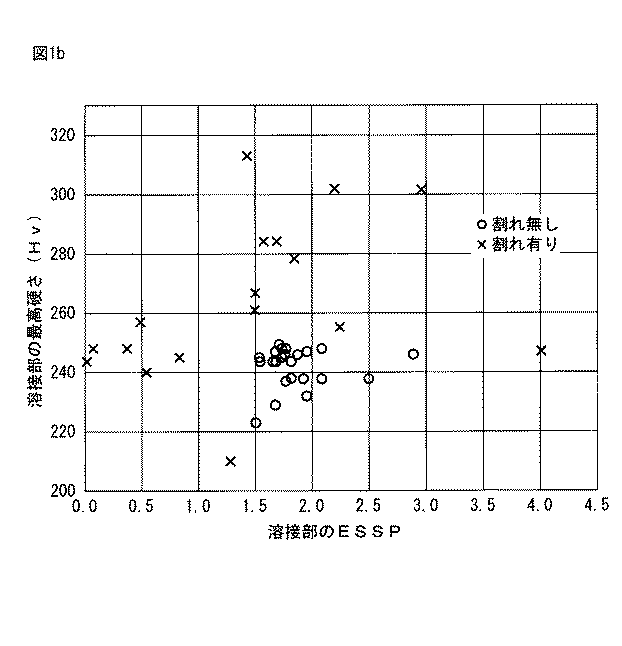
図1bは、実施例及び比較例のうち、焼戻しベイナイト、焼戻しマルテンサイトを主体とする金属組織からなる溶接部について、肉厚の中央部近傍における、水素誘起割れの有無と、溶接部の最高硬さとESSPとの関係を示す。図1bに示されるように、溶接部が焼戻しベイナイト、焼戻しマルテンサイトを主体とする金属組織であり、且つESSPが1.5〜3.0であっても、溶接部の最高硬さが248Hvを超えると耐HIC性が低下して、水素誘起割れが生じていることが分かる。 FIG. 1b shows the presence or absence of hydrogen-induced cracking in the vicinity of the center of the wall thickness and the highest hardness of the welded portion in the vicinity of the center of the thickness of the welded portion composed of a metal structure mainly composed of tempered bainite and tempered martensite. And the relationship between ESSP. As shown in FIG. 1b, even when the weld is a metal structure mainly composed of tempered bainite and tempered martensite, and the ESSP is 1.5 to 3.0, the maximum hardness of the weld is 248 Hv. When it exceeds, it turns out that HIC resistance falls and the hydrogen induction crack has arisen.
図2は、実施例及び比較例のうち、アシキュラーフェライト、ベイナイトを主体とする金属組織からなる母材部について、母材部表面における硫化物応力割れの有無と、母材部の最高硬さ及びCEとの関係を調査した結果を示す。
鋼27、33〜35、40、41及び43は、いずれもESSPが1.5〜3.0の範囲外であるために、耐HIC性の低下に起因して母材部に水素誘起割れが生じている。鋼26、29〜32は、いずれも硫化物応力割れが発生している。鋼26、29〜32は、いずれもESSPが1.5〜3.0の範囲内であり、CEが0.26〜0.44の範囲内にあるが、母材部の最高硬さ(Hv)が248を超えている。また、鋼44はESSPが1.5〜3.0の範囲内であるが、CEが0.26未満であり、母材部の組織がフェライトとパーライト組織になり、母材部の最高硬さ(Hv)が248を越えており、硫化物応力割れが発生している。
FIG. 2 shows the presence or absence of sulfide stress cracking on the surface of the base material part and the maximum hardness of the base material part of the base material part composed of a metallic structure mainly composed of acicular ferrite and bainite. And the result of investigating the relationship with CE is shown.
一方、本発明例である鋼1〜22と、比較例である鋼28、42は、いずれもCEが0.26〜0.44の範囲内であって、且つ母材部の最高硬さ(Hv)が248以下であった。このことから、硫化物応力割れを防止するには、母材部のCE’又はCEが0.26〜0.44であり、母材部の最高硬さが248以下であることが、硫化物応力割れを防止するために必要であることが分かる。 On the other hand, the steels 1-22 as examples of the present invention and the steels 28 and 42 as comparative examples both have a CE within the range of 0.26-0.44 and the maximum hardness of the base material ( Hv) was 248 or less. From this, in order to prevent sulfide stress cracking, CE ′ or CE of the base material part is 0.26 to 0.44, and the maximum hardness of the base material part is 248 or less. It can be seen that this is necessary to prevent stress cracking.
図3は、実施例及び比較例のうち、焼戻しベイナイト、焼戻しマルテンサイトを主体とする金属組織からなる溶接部について、溶接部表面における硫化物応力割れの有無と、溶接部の最高硬さ及びCEとの関係を示すグラフである。
鋼27、33〜38は、いずれもESSPが1.5〜3.0の範囲外であるために、耐HIC性の低下に起因して溶接部表面に水素誘起割れが生じている。特に、鋼34は、Caが過剰に添加されているためにCa系酸化物が多量に生成し、その結果、耐HIC性が損なわれている。鋼26、29〜32は、いずれもESSPが1.5〜3.0の範囲内であり、CEが0.26〜0.44の範囲内にあるが、溶接部の最高硬さ(Hv)が248を超えている。また、鋼44はESSPが1.5〜3.0の範囲内であるが、CEが0.26未満であり、溶接部の最高硬さ(Hv)が248を越えており、溶接部において硫化物応力割れが発生している。
FIG. 3 shows the presence or absence of sulfide stress cracking on the surface of the welded portion, the maximum hardness of the welded portion, and CE for the welded portion made of a metal structure mainly composed of tempered bainite and tempered martensite. It is a graph which shows the relationship.
一方、本発明例である鋼1〜22と、比較例である鋼39は、いずれもESSPが1.5〜3.0の範囲内であり、CEが0.26〜0.44の範囲内であって、且つ母材部の最高硬さ(Hv)が248以下であった。このことから、硫化物応力割れを防止するには、溶接部のCE’又はCEが0.26〜0.44であり、溶接部の最高硬さが248以下であることが、硫化物応力割れを防止するために必要であることが分かる。 On the other hand, steels 1-22, which are examples of the present invention, and steel 39, which is a comparative example, both have ESSP in the range of 1.5 to 3.0 and CE in the range of 0.26 to 0.44. And the highest hardness (Hv) of the base material part was 248 or less. From this, in order to prevent sulfide stress cracking, the CE ′ or CE of the welded portion is 0.26 to 0.44, and the maximum hardness of the welded portion is 248 or less. It can be seen that this is necessary to prevent this.
本発明によって得られた油井用電縫鋼管及びその製造方法は、石油、天然ガス等の掘削用鋼管の用途に好適に用いることができる。 The oil-welded ERW steel pipe obtained by the present invention and the manufacturing method thereof can be suitably used for the use of drilling steel pipes such as petroleum and natural gas.
Claims (5)
C:0.04〜0.10%、
Mn:1.00〜1.60%、
V:0.005〜0.100%、
Nb:0.005〜0.100%、
Ti:0.005〜0.030%、
Ca:0.0005〜0.0050%、
N:0.001〜0.008%、
O:0.001〜0.005%
を含有し、
Si:0.50%以下、
Al:0.05%以下、
P:0.020%以下、
S:0.0030%以下
に制限し、残部がFe及び不可避的不純物元素からなり、
下記(式1)で求められるESSPが1.5〜3.0であり、
下記(式2)で求められるCE’が0.26〜0.44であり、
前記母材部の金属組織は、アシキュラーフェライト、ベイナイトの一方又は両方からなり、
前記溶接部の金属組織は、パーライトが面積率で10%以下に制限され、残部が焼戻しベイナイト及び焼戻しマルテンサイトのうちの一方又は両方からなり、
前記母材部の降伏強さが400〜600MPa、引張強さが450MPa以上であり、前記母材部及び前記溶接部の最高硬度が248Hv以下であり、硫化水素が1気圧であり、温度が25℃で、5%の食塩及び酢酸を含み、pH3.5に調整された溶液中で破断が発生する応力が降伏強さの80%以上である、
ことを特徴とする油井用電縫鋼管。
ESSP=Ca×(1−124×O)/(1.25×S)・・・(式1)
CE’=C+Mn/6+V/5 ・・・(式2)
尚、式1及び式2中の各元素記号は、その元素の含有量を質量%で表す。 In the electric resistance welded steel pipe composed of a base material portion and a welded portion, the base material component is in mass%,
C: 0.04 to 0.10%,
Mn: 1.00 to 1.60%,
V: 0.005-0.100%,
Nb: 0.005 to 0.100%,
Ti: 0.005 to 0.030%,
Ca: 0.0005 to 0.0050%,
N: 0.001 to 0.008%,
O: 0.001 to 0.005%
Containing
Si: 0.50% or less,
Al: 0.05% or less,
P: 0.020% or less,
S: limited to 0.0030% or less, the balance consists of Fe and inevitable impurity elements,
ESSP calculated | required by the following (Formula 1) is 1.5-3.0,
CE ′ obtained by the following (formula 2) is 0.26 to 0.44,
The metal structure of the base material part is composed of one or both of acicular ferrite and bainite,
The weld metal structure, pearlite is limited to 10% or less in area ratio, Ri Do from one or both of the balance tempered bainite and tempered martensite,
The yield strength of the base metal part is 400 to 600 MPa, the tensile strength is 450 MPa or more, the maximum hardness of the base material part and the weld part is 248 Hv or less, hydrogen sulfide is 1 atm, and the temperature is 25 ℃ in contain 5% salt and acid, Ru der stress rupture occurs less than 80% of the yield strength in a solution adjusted to pH 3.5,
ERW steel pipe for oil wells.
ESSP = Ca × (1-124 × O) / (1.25 × S) (Formula 1)
CE ′ = C + Mn / 6 + V / 5 (Formula 2)
In addition, each element symbol in Formula 1 and Formula 2 represents content of the element in the mass%.
Cr:1.0%以下、
Mo:0.5%以下、
Ni:1.0%以下、
Cu:1.0%以下
の1種又は2種以上を含有し、前記(式2)に変えて下記(式3)で求められるCEが0.26〜0.44であることを特徴とする請求項1に記載の油井用電縫鋼管。
CE=C+Mn/6+(Cu+Ni)/15+(Cr+Mo+V)/5 ・・(式3)
尚、式3中の各元素記号は、その元素の含有量を質量%で表す。 The component of the base material part is further mass%,
Cr: 1.0% or less,
Mo: 0.5% or less,
Ni: 1.0% or less,
Cu: One type or two or more types of 1.0% or less are contained, and CE obtained by the following (formula 3) instead of the (formula 2) is 0.26 to 0.44. The electric-welded steel pipe for oil wells according to claim 1.
CE = C + Mn / 6 + (Cu + Ni) / 15 + (Cr + Mo + V) / 5 (Equation 3)
In addition, each element symbol in Formula 3 represents the content of the element in mass%.
V/N:2.0〜50.0
を満足することを特徴とする請求項1又は2に記載の油井用電縫鋼管。 The content of V and N is
V / N: 2.0 to 50.0
The electric-welded steel pipe for oil wells according to claim 1 or 2, wherein:
C/Mn:0.025〜0.050
を満足することを特徴とする請求項1〜3の何れか1項に記載の油井用電縫鋼管。 The content of C and Mn is
C / Mn: 0.025 to 0.050
The electric-welded steel pipe for oil wells according to any one of claims 1 to 3, wherein:
Priority Applications (1)
| Application Number | Priority Date | Filing Date | Title |
|---|---|---|---|
| JP2014209808A JP6394261B2 (en) | 2014-10-14 | 2014-10-14 | ERW steel pipe for oil well and manufacturing method thereof |
Applications Claiming Priority (1)
| Application Number | Priority Date | Filing Date | Title |
|---|---|---|---|
| JP2014209808A JP6394261B2 (en) | 2014-10-14 | 2014-10-14 | ERW steel pipe for oil well and manufacturing method thereof |
Publications (2)
| Publication Number | Publication Date |
|---|---|
| JP2016079431A JP2016079431A (en) | 2016-05-16 |
| JP6394261B2 true JP6394261B2 (en) | 2018-09-26 |
Family
ID=55955854
Family Applications (1)
| Application Number | Title | Priority Date | Filing Date |
|---|---|---|---|
| JP2014209808A Active JP6394261B2 (en) | 2014-10-14 | 2014-10-14 | ERW steel pipe for oil well and manufacturing method thereof |
Country Status (1)
| Country | Link |
|---|---|
| JP (1) | JP6394261B2 (en) |
Families Citing this family (9)
| Publication number | Priority date | Publication date | Assignee | Title |
|---|---|---|---|---|
| KR20190014081A (en) * | 2016-07-11 | 2019-02-11 | 신닛테츠스미킨 카부시키카이샤 | Sealed steel pipe for boiler excellent in stress corrosion cracking resistance and manufacturing method thereof |
| CN111094610B9 (en) * | 2017-09-19 | 2021-11-09 | 日本制铁株式会社 | Steel pipe and steel plate |
| JP6319539B1 (en) * | 2017-09-19 | 2018-05-09 | 新日鐵住金株式会社 | Steel pipe and steel plate |
| KR102457409B1 (en) * | 2018-06-29 | 2022-10-24 | 닛폰세이테츠 가부시키가이샤 | steel pipe and plate |
| JP6690787B1 (en) * | 2019-03-29 | 2020-04-28 | Jfeスチール株式会社 | ERW steel pipe, its manufacturing method, and steel pipe pile |
| JP7440741B2 (en) * | 2019-12-18 | 2024-02-29 | 日本製鉄株式会社 | ERW steel pipe for line pipe and method for manufacturing ERW steel pipe for line pipe |
| EP4116453A4 (en) * | 2020-03-04 | 2023-03-22 | Nippon Steel Corporation | STEEL PIPE AND SHEET STEEL |
| CN111719085A (en) * | 2020-06-30 | 2020-09-29 | 中国石油集团渤海石油装备制造有限公司 | Marine vessel and method of making same |
| CN116288065B (en) * | 2022-12-14 | 2024-11-29 | 鞍钢股份有限公司 | A lightweight pile coating steel plate and its production method |
Family Cites Families (9)
| Publication number | Priority date | Publication date | Assignee | Title |
|---|---|---|---|---|
| US4533405A (en) * | 1982-10-07 | 1985-08-06 | Amax Inc. | Tubular high strength low alloy steel for oil and gas wells |
| JPH05255802A (en) * | 1992-03-13 | 1993-10-05 | Nippon Steel Corp | Hot-rolled steel plate for sour-resistant high-strength steel pipe |
| US20030136476A1 (en) * | 1997-03-07 | 2003-07-24 | O'hara Randy | Hydrogen-induced-cracking resistant and sulphide-stress-cracking resistant steel alloy |
| US7169239B2 (en) * | 2003-05-16 | 2007-01-30 | Lone Star Steel Company, L.P. | Solid expandable tubular members formed from very low carbon steel and method |
| US20070267110A1 (en) * | 2006-05-17 | 2007-11-22 | Ipsco Enterprises, Inc. | Method for making high-strength steel pipe, and pipe made by that method |
| JP5504717B2 (en) * | 2009-07-08 | 2014-05-28 | 新日鐵住金株式会社 | Manufacturing method of ERW steel pipe for sour line pipe |
| CA2869879C (en) * | 2012-04-13 | 2017-08-29 | Jfe Steel Corporation | High-strength thick-walled electric resistance welded steel pipe having excellent low-temperature toughness and method for manufacturing the same |
| JP5516659B2 (en) * | 2012-06-28 | 2014-06-11 | Jfeスチール株式会社 | High-strength ERW pipe excellent in long-term softening resistance in the medium temperature range and its manufacturing method |
| JP5516680B2 (en) * | 2012-09-24 | 2014-06-11 | Jfeスチール株式会社 | ERW steel pipe excellent in HIC resistance and low temperature toughness of ERW welded part and method for producing the same |
-
2014
- 2014-10-14 JP JP2014209808A patent/JP6394261B2/en active Active
Also Published As
| Publication number | Publication date |
|---|---|
| JP2016079431A (en) | 2016-05-16 |
Similar Documents
| Publication | Publication Date | Title |
|---|---|---|
| JP6394261B2 (en) | ERW steel pipe for oil well and manufacturing method thereof | |
| JP6344538B1 (en) | Steel pipe and steel plate | |
| JP6047947B2 (en) | Thick high-strength seamless steel pipe for line pipes with excellent sour resistance and method for producing the same | |
| KR102379935B1 (en) | steel pipe and plate | |
| KR101333854B1 (en) | Thick high-tensile-strength hot-rolled steel sheet with excellent low-temperature toughness and process for production of same | |
| JP4575996B2 (en) | Steel pipe with excellent deformation characteristics and method for producing the same | |
| JP5776398B2 (en) | Low yield ratio high strength hot rolled steel sheet with excellent low temperature toughness and method for producing the same | |
| JP5679114B2 (en) | Low yield ratio high strength hot rolled steel sheet with excellent low temperature toughness and method for producing the same | |
| JP5499733B2 (en) | Thick high-tensile hot-rolled steel sheet excellent in low-temperature toughness and method for producing the same | |
| JP6327282B2 (en) | High strength hot rolled steel sheet and method for producing the same | |
| US10767250B2 (en) | Thick steel plate for structural pipes or tubes, method of producing thick steel plate for structural pipes or tubes, and structural pipes and tubes | |
| KR20110110278A (en) | Thick High Strength Hot Rolled Steel Sheet with Excellent HIC Resistance and Manufacturing Method Thereof | |
| WO2013002413A1 (en) | High strength hot-rolled steel sheet for welded steel line pipe having excellent souring resistance, and method for producing same | |
| KR102513656B1 (en) | Steel section having a thickness of at least 100 millimeters and method of manufacturing the same | |
| JP6519024B2 (en) | Method of manufacturing low yield ratio high strength hot rolled steel sheet excellent in low temperature toughness | |
| WO2015151469A1 (en) | Steel material for highly-deformable line pipes having superior strain aging characteristics and anti-hic characteristics, method for manufacturing same, and welded steel pipe | |
| JP2018188675A (en) | High strength hot-rolled steel sheet and production method thereof | |
| JP5504717B2 (en) | Manufacturing method of ERW steel pipe for sour line pipe | |
| JP6241434B2 (en) | Steel plate for line pipe, steel pipe for line pipe, and manufacturing method thereof | |
| WO2017149571A1 (en) | Low-alloy, high-strength seamless steel pipe for oil well | |
| KR20220032115A (en) | High-strength steel sheet for sour-resistant line pipe, manufacturing method thereof, and high-strength steel pipe using high-strength steel sheet for sour-resistant line pipe | |
| JP2018150585A (en) | Abrasion resistant steel sheet and method for producing the abrasion resistant steel sheet | |
| JP6131890B2 (en) | Manufacturing method and selection method of low-alloy high-strength seamless steel pipe for oil well with excellent resistance to sulfide stress corrosion cracking | |
| JP2023022159A (en) | Steel composition meeting X-65 grade API 5L PSL-2 specification with enhanced resistance to hydrogen-induced cracking (HIC) and method for producing same | |
| WO2015151468A1 (en) | Steel material for highly-deformable line pipes having superior strain aging characteristics and anti-hic characteristics, method for manufacturing same, and welded steel pipe |
Legal Events
| Date | Code | Title | Description |
|---|---|---|---|
| A621 | Written request for application examination |
Free format text: JAPANESE INTERMEDIATE CODE: A621 Effective date: 20170605 |
|
| A977 | Report on retrieval |
Free format text: JAPANESE INTERMEDIATE CODE: A971007 Effective date: 20180323 |
|
| A131 | Notification of reasons for refusal |
Free format text: JAPANESE INTERMEDIATE CODE: A131 Effective date: 20180403 |
|
| A521 | Written amendment |
Free format text: JAPANESE INTERMEDIATE CODE: A523 Effective date: 20180528 |
|
| TRDD | Decision of grant or rejection written | ||
| A01 | Written decision to grant a patent or to grant a registration (utility model) |
Free format text: JAPANESE INTERMEDIATE CODE: A01 Effective date: 20180731 |
|
| A61 | First payment of annual fees (during grant procedure) |
Free format text: JAPANESE INTERMEDIATE CODE: A61 Effective date: 20180813 |
|
| R151 | Written notification of patent or utility model registration |
Ref document number: 6394261 Country of ref document: JP Free format text: JAPANESE INTERMEDIATE CODE: R151 |
|
| S533 | Written request for registration of change of name |
Free format text: JAPANESE INTERMEDIATE CODE: R313533 |
|
| R350 | Written notification of registration of transfer |
Free format text: JAPANESE INTERMEDIATE CODE: R350 |