JP6170157B2 - Method of making alcohol from organic acid - Google Patents
Method of making alcohol from organic acid Download PDFInfo
- Publication number
- JP6170157B2 JP6170157B2 JP2015529836A JP2015529836A JP6170157B2 JP 6170157 B2 JP6170157 B2 JP 6170157B2 JP 2015529836 A JP2015529836 A JP 2015529836A JP 2015529836 A JP2015529836 A JP 2015529836A JP 6170157 B2 JP6170157 B2 JP 6170157B2
- Authority
- JP
- Japan
- Prior art keywords
- acid
- compound
- transition metal
- organic acid
- catalyst
- Prior art date
- Legal status (The legal status is an assumption and is not a legal conclusion. Google has not performed a legal analysis and makes no representation as to the accuracy of the status listed.)
- Expired - Fee Related
Links
Classifications
-
- C—CHEMISTRY; METALLURGY
- C07—ORGANIC CHEMISTRY
- C07C—ACYCLIC OR CARBOCYCLIC COMPOUNDS
- C07C29/00—Preparation of compounds having hydroxy or O-metal groups bound to a carbon atom not belonging to a six-membered aromatic ring
- C07C29/132—Preparation of compounds having hydroxy or O-metal groups bound to a carbon atom not belonging to a six-membered aromatic ring by reduction of an oxygen containing functional group
- C07C29/136—Preparation of compounds having hydroxy or O-metal groups bound to a carbon atom not belonging to a six-membered aromatic ring by reduction of an oxygen containing functional group of >C=O containing groups, e.g. —COOH
- C07C29/147—Preparation of compounds having hydroxy or O-metal groups bound to a carbon atom not belonging to a six-membered aromatic ring by reduction of an oxygen containing functional group of >C=O containing groups, e.g. —COOH of carboxylic acids or derivatives thereof
- C07C29/149—Preparation of compounds having hydroxy or O-metal groups bound to a carbon atom not belonging to a six-membered aromatic ring by reduction of an oxygen containing functional group of >C=O containing groups, e.g. —COOH of carboxylic acids or derivatives thereof with hydrogen or hydrogen-containing gases
Landscapes
- Chemical & Material Sciences (AREA)
- Organic Chemistry (AREA)
- Organic Low-Molecular-Weight Compounds And Preparation Thereof (AREA)
- Catalysts (AREA)
- Low-Molecular Organic Synthesis Reactions Using Catalysts (AREA)
Description
本発明は、単一触媒を用いた有機酸からのアルコール作製に関する。 The present invention relates to alcohol production from organic acids using a single catalyst.
序論
アルコールを酸から作製する従来の方法は少なくとも2つの異なる触媒を含む多段階の工程に関係する。例えば、対応するエステルへの有機酸の転換は通常、強酸性ポリマー触媒(例えば、AMBERLYST 70、AMBERLYST 15Wet)によって相対的に低い温度(例えば、100℃未満、例えば米国特許第US 3037052号を参照のこと)で触媒され、その後相対的に高い温度(例えば、240℃超)で銅クロマイト触媒(例えば米国特許第US 5030609号を参照のこと)によって触媒されることで、アルコールへと次いで転換される。多重触媒、高温、及びクロム含有化合物を使用すると、高価且つ複雑な工程が生じる。
Introduction Conventional methods for making alcohols from acids involve a multi-step process involving at least two different catalysts. For example, the conversion of an organic acid to the corresponding ester is typically performed at a relatively low temperature (eg, less than 100 ° C., eg, see US Pat. No. 3,030,052) with a strongly acidic polymer catalyst (eg, AMBERLYST 70, AMBERLYST 15 Wet) And then catalyzed by a copper chromite catalyst (see, eg, US Pat. No. 5,030,609) at a relatively high temperature (eg, greater than 240 ° C.), and then converted to an alcohol. . The use of multiple catalysts, high temperatures, and chromium-containing compounds results in expensive and complex processes.
本発明は上記の欠点へ少なくとも部分的に取り組む方法を含む。一実施形態において、本発明は、架橋官能性ポリマー上で支持される遷移金属を含む不均一系触媒の存在下において、有機酸化合物の溶液を加熱するステップを含む、アルコール化合物を有機酸化合物から作製する方法を含む。好ましい実施形態において、該方法はクロム又は他の触媒の存在なしに単一の容器中で実施される。多くのさらなる実施形態を記載する。 The present invention includes a method that at least partially addresses the above disadvantages. In one embodiment, the present invention provides an alcohol compound from an organic acid compound comprising heating a solution of the organic acid compound in the presence of a heterogeneous catalyst comprising a transition metal supported on a cross-linked functional polymer. Including a method of making. In a preferred embodiment, the process is performed in a single vessel without the presence of chromium or other catalysts. Many further embodiments are described.
本発明は、アルコール化合物を有機酸化合物から作製する方法を含む。好ましい実施形態において、該方法はエステル化(esterfication)反応及び還元反応の両方を触媒することが可能な単一触媒を用いて実施される。該方法を、バッチ又は連続した工程の一部として単一の容器中で実施してもよい。例えば、アルコール化合物、有機酸化合物、水素、及び対象触媒を一般的な容器中で混合してもよい。触媒(主に強酸性担体)はアルコール及び酸のフィッシャーエステル化反応を触媒する。得られたエステル含有化合物を続いて還元して、所望のモノアルコール又はジアルコール化合物を形成する。エステル化反応及び還元反応はどちらも、同じ触媒によって触媒される。好ましい実施形態において、ほかの触媒、特に銅クロマイトなどのクロム含有種は使用されない。 The present invention includes a method of making an alcohol compound from an organic acid compound. In a preferred embodiment, the process is carried out using a single catalyst capable of catalyzing both esterification and reduction reactions. The method may be carried out in a single container as part of a batch or continuous process. For example, an alcohol compound, an organic acid compound, hydrogen, and subject catalysts may be combined mixed with common vessel. Catalysts (mainly strongly acidic carriers) catalyze the Fischer esterification reaction of alcohols and acids. The resulting ester-containing compound is subsequently reduced to form the desired monoalcohol or dialcohol compound. Both esterification and reduction reactions are catalyzed by the same catalyst. In a preferred embodiment, no other catalyst is used, especially chromium-containing species such as copper chromite.
方法は、架橋官能性ポリマー上で支持された既知の水素付加金属を含む不均一系触媒の存在下において、有機酸化合物及びアルコール化合物の溶液を、200℃未満、及びより好適には190℃未満の温度(例えば、70〜200℃、より好適には80〜190℃、及びさらにより好適には90〜185℃)まで加熱するステップを含む。溶液の加熱中は、70バール未満、より好適には60バール未満の圧力(例えば、40〜70バール、及びより好適には45〜60バール)が保たれるのが好ましい。 The method comprises a solution of an organic acid compound and an alcohol compound in the presence of a heterogeneous catalyst comprising a known hydrogenation metal supported on a cross-linked functional polymer at less than 200 ° C, and more preferably less than 190 ° C. To a temperature of (eg, 70 to 200 ° C., more preferably 80 to 190 ° C., and even more preferably 90 to 185 ° C.). During the heating of the solution, it is preferred that a pressure of less than 70 bar, more preferably less than 60 bar (e.g. 40-70 bar, and more preferably 45-60 bar) is maintained.
溶液中で使用する溶媒の選択は、上述のアルコール及び有機酸化合物が可溶性である限り特に限定されない。非限定的な例として:水、エタノール、プロパノール、プロピルエステル、メチルイソブチルケトン、及びテトラヒドロフランが挙げられる。単純な化学反応プロフィールを産生するために、アルコール溶媒の用途を結果として生じた生成物と対応して用いることができる。さらに、所望の分離工程を産生するために、使用した溶媒は生成物との混和性をより低く調整することができる。 The choice of the solvent used in a solution is not specifically limited as long as the above-mentioned alcohol and organic acid compound are soluble. Non-limiting examples include: water, ethanol, propanol, propyl ester, methyl isobutyl ketone, and tetrahydrofuran. In order to produce a simple chemical reaction profile, the use of an alcohol solvent can be used corresponding to the resulting product. Furthermore, the solvent used can be adjusted to be less miscible with the product in order to produce the desired separation step.
本発明は、有機酸化合物、例えば少なくとも1つのカルボン酸官能基を含む有機酸化合物の広範囲に応用することができる。1つの好ましいクラスとして、300ダルトン未満、好適には200ダルトン未満、及びいくつかの実施形態では150ダルトン未満の分子量を有する化合物が挙げられる。1つの好ましい化合物のサブクラスとして、2つのカルボン酸官能基、例えば「ジカルボン酸」が挙げられる。別の実施形態において、有機酸化合物の好ましいクラスとして、式:
R−COOH
によって表される飽和及び不飽和化合物が挙げられ、式中、Rは、置換(例えば、カルボン酸基と)又は非置換の脂肪族基及び芳香族基から選択される炭化水素部分である。好ましい実施形態のサブクラスにおいて、炭化水素部分は2〜12個の炭素原子を含み、いくつかの実施形態では2〜8個の炭素原子を含む。Rが脂肪族部分である化合物の代表例として:ギ酸、酢酸、プロピオン酸、プロパ−2−エン酸、酪酸、吉草酸、カプロン酸、エタンチオ(ethanthic)酸、カプリル酸、ペラロン(pelaronic)カプリン酸、ウンデシル(undecyclic)酸、ラウリン酸、トリデシル酸、及びミリスチン酸が挙げられる。Rが脂肪族部分である適用可能なジカルボン酸の代表例として:シュウ酸、マロン酸、コハク酸、グルタル酸、アジピン酸、ピメリン酸、スベリン酸、アゼライン酸、及びセバシン酸が挙げられる。Rが芳香族部分であるものの代表例として:安息香酸、イソフタル酸、及びテレフタル酸、ナフタル酸、及び桂皮酸が挙げられる。
The present invention can be applied to a wide range of organic acid compounds, such as organic acid compounds containing at least one carboxylic acid functional group. One preferred class includes compounds having a molecular weight of less than 300 daltons, preferably less than 200 daltons, and in some embodiments less than 150 daltons. One preferred compound subclass includes two carboxylic acid functional groups, such as “dicarboxylic acids”. In another embodiment, as a preferred class of organic acid compounds, the formula:
R-COOH
In which R is a hydrocarbon moiety selected from substituted (eg, with a carboxylic acid group) or unsubstituted aliphatic and aromatic groups. In a subclass of preferred embodiments, the hydrocarbon moiety contains 2 to 12 carbon atoms, and in some embodiments 2 to 8 carbon atoms. Representative examples of compounds in which R is an aliphatic moiety: formic acid, acetic acid, propionic acid, prop-2-enoic acid, butyric acid, valeric acid, caproic acid, ethanethioic acid, caprylic acid, pelaronic capric acid , Undecylic acid, lauric acid, tridecylic acid, and myristic acid. Representative examples of applicable dicarboxylic acids where R is an aliphatic moiety include: oxalic acid, malonic acid, succinic acid, glutaric acid, adipic acid, pimelic acid, suberic acid, azelaic acid, and sebacic acid. Representative examples of where R is an aromatic moiety include: benzoic acid, isophthalic acid, and terephthalic acid, naphthalic acid, and cinnamic acid.
適用可能な不均一系触媒の範囲は、それらに架橋官能性ポリマー上で支持される遷移金属(例えば、Cu、Ru、Pt、Rh)、好適には銅が含まれる限り、特に限定されない。好ましい実施形態において、担体は、対応するエステルへの有機酸化合物の転換の間に、触媒としても役立つ。一実施形態において、架橋官能性ポリマーは強酸性陽イオン交換樹脂等のスルホン酸官能基を含む架橋コポリマーマトリクスである。好ましい副実施形態において、架橋コポリマーマトリクスはスチレン及びジビニルベンゼンを含む単量体混合物の反応生成物を含む。マトリクスはマクロ孔質、ゲル状(gellular)、又は相互貫入高分子網目構造を有していてもよく、好適には均一な大きさ分布又はGaussian分布を有し得るビーズ形態で(これらの用語がイオン交換技術で一般的に理解されるように)提供される。マトリクスをその後、コポリマーマトリクスと、硫酸、クロロスルホン酸、又は三酸化硫黄等のスルホン化剤とを、膨潤剤と共に又は膨潤剤なしで混合することによってスルホン化してもよい。反応は好適に高い温度、例えば100〜150℃で実施する。例えば:米国特許第US2366007号、同第US2500149号、同第US3037052号、同第US5248435号、同第US6228896号、同第US6750259号、同第US6784213号、同第US2002/002267号、及び同第US2004/0006145号を参照のこと。市販の架橋官能性ポリマーとして、どちらも強酸性であるDOWEX 50WX8又はAMBERLYST 35、及びゲル及びマクロ孔質樹脂が挙げられ、各々The Dow Chemical Companyより入手可能である。架橋官能性ポリマーは、ポリマーを、水素付加金属塩を含有する溶液中に室温で浸漬することによって水素付加金属イオンで含浸させ、次いですすぎ、乾燥してもよい;例えば、Calore,et al.,Metal Catalyst with Nano− structured Metals Supported on Strongly Acidic Cross−linked Polymer Frameworks.Part I.,Reactive&Functional Polymers 70(2010)639−646を参照のこと。水素付加金属イオンを、使用する前に、又は好適には使用する間に水素還元によって還元される前に、ゼロ価の金属に還元することができる。好ましい水素付加金属塩は硫酸銅である。好ましい実施形態において、触媒はクロム種を一切含有しない。 The range of applicable heterogeneous catalysts is not particularly limited as long as they include transition metals (eg, Cu, Ru, Pt, Rh), preferably copper, supported on the cross-linked functional polymer. In a preferred embodiment, the support also serves as a catalyst during the conversion of the organic acid compound to the corresponding ester. In one embodiment, the cross-linked functional polymer is a cross-linked copolymer matrix that includes sulfonic acid functional groups such as strongly acidic cation exchange resins. In a preferred sub-embodiment, the crosslinked copolymer matrix comprises the reaction product of a monomer mixture comprising styrene and divinylbenzene. The matrix may have a macroporous, gellar, or interpenetrating polymer network, preferably in the form of beads that may have a uniform size distribution or Gaussian distribution (these terms are Provided as commonly understood in ion exchange technology). Then the matrix, and copolymer matrix, sulfuric acid, chlorosulfonic acid, or a sulfonating agent such as sulfur trioxide, may be sulfonated by mixed-with or without swelling agent swelling agent. The reaction is preferably carried out at an elevated temperature, for example 100-150 ° C. For example: US Pat. No. 2,366,007, US Pat. No. 2,500,209, US Pat. No. 3,030,7052, US Pat. No. 5,248,435, US Pat. No. 6,228,896, US Pat. No. 6,650,259, US Pat. No. 6,784,213, US See 0006145. Commercially available cross-linked functional polymers include DOWEX 50WX8 or AMBERLYST 35, both of which are strongly acidic, and gel and macroporous resins, each available from The Dow Chemical Company. Cross-linked functional polymers may be impregnated with hydrogenated metal ions by immersing the polymer in a solution containing a hydrogenated metal salt at room temperature, then rinsed and dried; see, for example, Calore, et al. , Metal Catalyst with Nano-structured Metals Supported on Strong Acidic Cross-linked Polymer Frameworks. Part I. , Reactive & Functional Polymers 70 (2010) 639-646. The hydrogenated metal ion can be reduced to a zero valent metal before use, or preferably before being reduced by hydrogen reduction during use. A preferred hydrogenation metal salt is copper sulfate. In a preferred embodiment, the catalyst does not contain any chromium species.
適切な架橋官能性ポリマーの他の例としてDupontのSAC−13等のシリカ/ナフィオンミクロ複合材料が挙げられ、これはCalore,et al.に記載の方法に従って銅を負荷してもよい。 Other examples of suitable cross-linked functional polymers include silica / Nafion microcomposites such as Dupont's SAC-13, which are described in Calore, et al. The copper may be loaded according to the method described in.
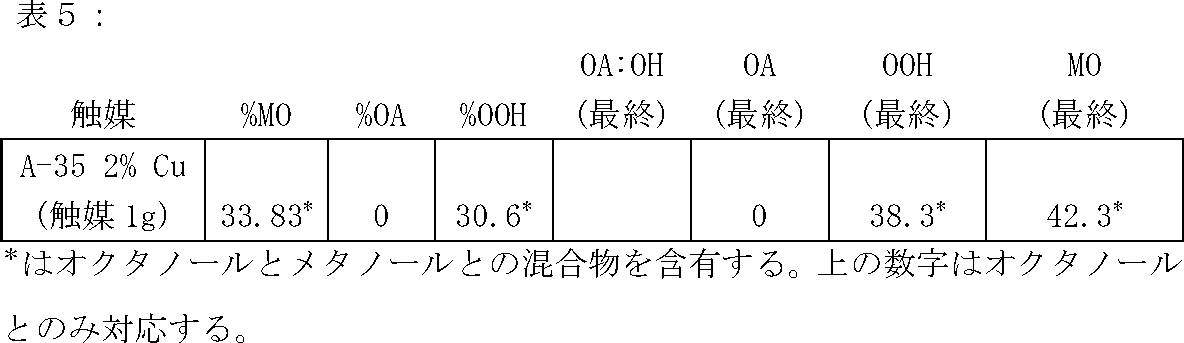
下に記載の実験を、450mLのParr反応器に充填した水素及び触媒と共に下に指定される、125mlの酸及びアルコール(体積比1:4)からなる溶液を用いて実施した。全ての触媒は下の表中の商品名で指定され、The Dow Chemical Companyより入手した。反応を180℃の試験温度及び55.2バール(800psi)の圧力で、およそ3時間実施した。各反応の酸、エステル、及びアルコール生成物の最終的な割合及び体積(mL)を、下の表に明記する。以下の略称は表中で用いられ、且つ以下の通りに規定される:
EA エチルアセテート
PP プロピオン酸プロピル
OO オクタノエート
AA アクリル酸
PA プロピオン酸
OA オクタン酸
EOH エタノール
POH プロパノール
OOH オクタノール
MO メチルオクタノエート
比較例1:
体積比1:4でプロピオン酸及びプロパノールを含み4グラムの触媒で調製した水溶液を、以下の表1に示す。触媒には金属を含浸させなかった。プロピオン酸(PA)からプロパノール(POH)への低転換、すなわち1:5.1以下のPA:POHの比率に注意されたい。
The experiment described below was performed with a solution consisting of 125 ml acid and alcohol (volume ratio 1: 4), specified below, with hydrogen and catalyst charged to a 450 mL Parr reactor. All catalysts were designated by trade names in the table below and were obtained from The Dow Chemical Company. The reaction was carried out at a test temperature of 180 ° C. and a pressure of 55.2 bar (800 psi) for approximately 3 hours. The final proportions and volumes (mL) of acid, ester, and alcohol products for each reaction are specified in the table below. The following abbreviations are used in the table and are defined as follows:
EA ethyl acetate PP propyl propionate OO octanoate AA acrylic acid PA propionic acid OA octanoic acid EOH ethanol POH propanol OOH octanol MO methyl octanoate Comparative Example 1:
An aqueous solution prepared with 4 grams of catalyst containing propionic acid and propanol in a volume ratio of 1: 4 is shown in Table 1 below. The catalyst was not impregnated with metal. Note the low conversion of propionic acid (PA) to propanol (POH), ie a ratio of PA: POH of 1: 5.1 or less.
実施例1〜4:
全ての試料において、AMBERLYST A−35は、ポリマーを金属塩溶液中に室温にておよそ8〜10時間浸漬する含浸であった。最終的な金属含有量は総触媒重量の重量パーセントとして表す。各反応溶液へ加えた触媒の総量を表に明記する。
Examples 1-4:
In all samples, AMBERLYST A-35 was an impregnation in which the polymer was immersed in a metal salt solution at room temperature for approximately 8-10 hours. The final metal content is expressed as a weight percent of the total catalyst weight. The total amount of catalyst added to each reaction solution is specified in the table.
本発明の多くの実施形態が記載されており、いくつかの例において、ある実施形態、選択、範囲、成分、又は他の特徴は、「好ましい」と評価されている。「好ましい」特徴の評価は、要求されているようなかかる特徴、本発明に必須又は重要と見なされるものとして解釈されるべきではない。
(態様)
(態様1)
有機酸化合物からアルコール化合物を作製する方法であって、スルホン酸官能基を含む架橋コポリマーマトリクスを含む架橋官能性ポリマー上で支持される、Cu、Ru、Pt、及びRhのうち少なくとも1つから選択される遷移金属を含む不均一系触媒及び水素の存在下において、有機酸化合物の溶液を加熱するステップを含む、方法。
(態様2)
前記架橋コポリマーマトリクスが、スチレン及びジビニルベンゼンを含む単量体混合物の反応生成物を含む、態様1記載の方法。
(態様3)
前記架橋官能性ポリマーが、強酸性陽イオン交換樹脂を含む、態様1記載の方法。
(態様4)
前記方法が、クロムの存在なしに実施される、態様1記載の方法。
(態様5)
唯一の触媒としての前記不均一系触媒の存在下において実施される、態様1記載の方法。
(態様6)
前記加熱ステップが、前記溶液を200℃未満の温度まで加熱することを含む、態様1記載の方法。
(態様7)
前記加熱ステップが、前記溶液を190℃未満の温度及び70バール未満の圧力まで加熱することを含む、態様1記載の方法。
(態様8)
前記方法が、単一の容器中で実施される、態様1記載の方法。
A number of embodiments of the invention have been described, and in some examples, certain embodiments, choices, ranges, ingredients, or other features have been evaluated as “preferred”. The evaluation of “preferred” features should not be construed as such features as required, or as deemed essential or important to the invention.
(Aspect)
(Aspect 1)
A method of making an alcohol compound from an organic acid compound, selected from at least one of Cu, Ru, Pt, and Rh supported on a cross-linked functional polymer comprising a cross-linked copolymer matrix containing sulfonic acid functional groups Heating the solution of the organic acid compound in the presence of a heterogeneous catalyst comprising a transition metal and hydrogen.
(Aspect 2)
The method of embodiment 1, wherein the crosslinked copolymer matrix comprises a reaction product of a monomer mixture comprising styrene and divinylbenzene.
(Aspect 3)
The method of embodiment 1, wherein the cross-linked functional polymer comprises a strongly acidic cation exchange resin.
(Aspect 4)
The method of embodiment 1, wherein the method is performed without the presence of chromium.
(Aspect 5)
A process according to embodiment 1, which is carried out in the presence of said heterogeneous catalyst as the sole catalyst.
(Aspect 6)
The method of embodiment 1, wherein the heating step comprises heating the solution to a temperature below 200 ° C.
(Aspect 7)
The method of embodiment 1, wherein the heating step comprises heating the solution to a temperature of less than 190 ° C. and a pressure of less than 70 bar.
(Aspect 8)
The method of embodiment 1, wherein the method is performed in a single container.
Claims (12)
Applications Claiming Priority (3)
| Application Number | Priority Date | Filing Date | Title |
|---|---|---|---|
| US201261695557P | 2012-08-31 | 2012-08-31 | |
| US61/695,557 | 2012-08-31 | ||
| PCT/US2013/054606 WO2014035654A1 (en) | 2012-08-31 | 2013-08-13 | Method to produce alcohols from organic acids |
Publications (3)
| Publication Number | Publication Date |
|---|---|
| JP2015532651A JP2015532651A (en) | 2015-11-12 |
| JP2015532651A5 JP2015532651A5 (en) | 2017-06-22 |
| JP6170157B2 true JP6170157B2 (en) | 2017-07-26 |
Family
ID=48998759
Family Applications (1)
| Application Number | Title | Priority Date | Filing Date |
|---|---|---|---|
| JP2015529836A Expired - Fee Related JP6170157B2 (en) | 2012-08-31 | 2013-08-13 | Method of making alcohol from organic acid |
Country Status (6)
| Country | Link |
|---|---|
| US (1) | US9187389B2 (en) |
| JP (1) | JP6170157B2 (en) |
| KR (1) | KR20150046322A (en) |
| CN (1) | CN104755449B (en) |
| DE (1) | DE112013004222T5 (en) |
| WO (1) | WO2014035654A1 (en) |
Family Cites Families (18)
| Publication number | Priority date | Publication date | Assignee | Title |
|---|---|---|---|---|
| US2366007A (en) | 1942-08-11 | 1944-12-26 | Gen Electric | Production of synthetic polymeric compositions comprising sulphonated polymerizates of poly-vinyl aryl compounds and treatment of liquid media therewith |
| US2500149A (en) | 1947-02-21 | 1950-03-14 | Dow Chemical Co | Sulfonation of copolymers of monovinyl-and polyvinyl-aromatic compounds |
| BE590370A (en) | 1959-04-29 | 1900-01-01 | ||
| IT1190783B (en) | 1981-04-29 | 1988-02-24 | Davy Mckee Oil & Chem | PROCESS FOR HYDROGENOLYSIS OF ESTERS OF CARBOXYLIC ACIDS |
| US4421939A (en) * | 1982-10-15 | 1983-12-20 | Union Carbide Corporation | Production of ethanol from acetic acid |
| GB8331794D0 (en) | 1983-11-29 | 1984-01-04 | Davy Mckee Ltd | Process |
| US4524225A (en) * | 1983-12-14 | 1985-06-18 | Uop Inc. | Acid resistant catalyst supports; reduction of fatty acids to fatty alcohols |
| GB8717989D0 (en) | 1987-07-29 | 1987-09-03 | Davy Mckee Ltd | Catalyst |
| GB8900993D0 (en) * | 1989-01-17 | 1989-03-08 | Davy Mckee London | Process |
| US5248435A (en) | 1991-12-17 | 1993-09-28 | Mitsubishi Kasei Corporation | Ion exchange resin, process for producing the same, and method for removing impurities from condensate |
| ZA938109B (en) * | 1992-10-29 | 1994-06-06 | Davy Mckee London | Process for the production of fatty alcohols |
| DE59603190D1 (en) | 1995-12-21 | 1999-10-28 | Iab Ionenaustauscher Gmbh | METHOD FOR PRODUCING STRONG ACID CATION EXCHANGERS |
| US6495660B2 (en) | 1999-10-20 | 2002-12-17 | Honeywell International Inc | Polyamide substrate |
| US6784213B2 (en) | 2001-06-22 | 2004-08-31 | Rohm And Haas Company | Method for preparation of strong acid cation exchange resins |
| US6750259B2 (en) | 2002-07-08 | 2004-06-15 | Bayer Aktiengesellschaft | Process for preparing gel-type cation exchangers |
| US7935834B2 (en) | 2004-07-01 | 2011-05-03 | Isp Investments Inc. | Catalysts for maleic acid hydrogenation to 1,4-butanediol |
| US7863489B2 (en) * | 2008-07-31 | 2011-01-04 | Celanese International Corporation | Direct and selective production of ethanol from acetic acid utilizing a platinum/tin catalyst |
| JP5363532B2 (en) * | 2010-06-30 | 2013-12-11 | ローム アンド ハース カンパニー | Multi-reactive bifunctional polymer catalyst |
-
2013
- 2013-08-13 JP JP2015529836A patent/JP6170157B2/en not_active Expired - Fee Related
- 2013-08-13 KR KR20157008067A patent/KR20150046322A/en not_active Withdrawn
- 2013-08-13 DE DE112013004222.3T patent/DE112013004222T5/en not_active Withdrawn
- 2013-08-13 CN CN201380043399.5A patent/CN104755449B/en not_active Expired - Fee Related
- 2013-08-13 WO PCT/US2013/054606 patent/WO2014035654A1/en not_active Ceased
- 2013-08-13 US US14/417,576 patent/US9187389B2/en not_active Expired - Fee Related
Also Published As
| Publication number | Publication date |
|---|---|
| US20150251982A1 (en) | 2015-09-10 |
| DE112013004222T5 (en) | 2015-06-03 |
| WO2014035654A1 (en) | 2014-03-06 |
| US9187389B2 (en) | 2015-11-17 |
| CN104755449B (en) | 2016-09-21 |
| KR20150046322A (en) | 2015-04-29 |
| CN104755449A (en) | 2015-07-01 |
| JP2015532651A (en) | 2015-11-12 |
Similar Documents
| Publication | Publication Date | Title |
|---|---|---|
| TW200301244A (en) | Metal-doped sulfonated ion exchange resin catalysts | |
| de la Iglesia et al. | Metal-organic framework MIL-101 (Cr) based mixed matrix membranes for esterification of ethanol and acetic acid in a membrane reactor | |
| CN105504128B (en) | A kind of absorption resin and its preparation method and application for Phenol-Containing Wastewater Treatment | |
| WO2001021306A1 (en) | Catalysts for hydrogenation of carboxylic acid | |
| CN101961660B (en) | Porous hybrid-resin solid acid catalyst and preparation method thereof | |
| CN103298860B (en) | The purifying of acetic acid product stream | |
| Moreno‐Marrodan et al. | Metal Nanoparticles Supported on Perfluorinated Superacid Polymers: A Family of Bifunctional Catalysts for the Selective, One‐Pot Conversion of Vegetable Substrates in Water | |
| CN105618137A (en) | Porous acidic resin catalyst, preparation method and applications thereof | |
| JP6170157B2 (en) | Method of making alcohol from organic acid | |
| WO2014120585A1 (en) | Method for performing carbon-carbon coupling reactions with cationic exchange resin supported palladium catalyst | |
| CN100448543C (en) | A kind of preparation method of Pd/resin catalyst | |
| CN1557553A (en) | Solid catalyst for producing styrene oxide by epoxidation of styrene and preparation method thereof | |
| Zhu et al. | Hydrogenolysis of glycerol to propanediols over supported Ag–Cu catalysts | |
| JP2015532651A5 (en) | ||
| CN102909041A (en) | Catalyst for synthesizing methyl sec-butyl ether, preparation method and application thereof | |
| JP6687813B2 (en) | Method for producing 1,3-cyclohexanedicarboxylic acid | |
| JP6549146B2 (en) | Catalyst resin | |
| CN1781598A (en) | Method for preparing resin assembled heteropoly acid salt catalyst | |
| EP2776159A1 (en) | Strong acid catalyst composition | |
| CN112441880B (en) | Aldehyde removing agent for glycol aldehyde removing and refining and method for glycol aldehyde removing and refining | |
| JP4609642B2 (en) | Method for producing cycloalkyl alkyl ether | |
| CN118878403A (en) | A comprehensive utilization method of mesityl oxide by-product | |
| JP3508164B2 (en) | Method for producing tertiary alcohol and method for producing catalyst thereof | |
| Zhou | Exploring Meerwein-Ponndorf-Verley reactions using metal organic framework catalysts. | |
| CN1288782A (en) | Catalyst for synthesizing methyl isobutyl ketone with acetone and its preparation |
Legal Events
| Date | Code | Title | Description |
|---|---|---|---|
| A529 | Written submission of copy of amendment under article 34 pct |
Free format text: JAPANESE INTERMEDIATE CODE: A529 Effective date: 20150224 |
|
| RD02 | Notification of acceptance of power of attorney |
Free format text: JAPANESE INTERMEDIATE CODE: A7422 Effective date: 20150318 |
|
| RD03 | Notification of appointment of power of attorney |
Free format text: JAPANESE INTERMEDIATE CODE: A7423 Effective date: 20150318 |
|
| RD04 | Notification of resignation of power of attorney |
Free format text: JAPANESE INTERMEDIATE CODE: A7424 Effective date: 20150925 |
|
| A621 | Written request for application examination |
Free format text: JAPANESE INTERMEDIATE CODE: A621 Effective date: 20160729 |
|
| A131 | Notification of reasons for refusal |
Free format text: JAPANESE INTERMEDIATE CODE: A131 Effective date: 20170228 |
|
| A977 | Report on retrieval |
Free format text: JAPANESE INTERMEDIATE CODE: A971007 Effective date: 20170228 |
|
| A524 | Written submission of copy of amendment under article 19 pct |
Free format text: JAPANESE INTERMEDIATE CODE: A524 Effective date: 20170511 |
|
| TRDD | Decision of grant or rejection written | ||
| A01 | Written decision to grant a patent or to grant a registration (utility model) |
Free format text: JAPANESE INTERMEDIATE CODE: A01 Effective date: 20170530 |
|
| A61 | First payment of annual fees (during grant procedure) |
Free format text: JAPANESE INTERMEDIATE CODE: A61 Effective date: 20170629 |
|
| R150 | Certificate of patent or registration of utility model |
Ref document number: 6170157 Country of ref document: JP Free format text: JAPANESE INTERMEDIATE CODE: R150 |
|
| LAPS | Cancellation because of no payment of annual fees |