JP6123793B2 - Resist pattern forming method and photoresist composition - Google Patents
Resist pattern forming method and photoresist composition Download PDFInfo
- Publication number
- JP6123793B2 JP6123793B2 JP2014506234A JP2014506234A JP6123793B2 JP 6123793 B2 JP6123793 B2 JP 6123793B2 JP 2014506234 A JP2014506234 A JP 2014506234A JP 2014506234 A JP2014506234 A JP 2014506234A JP 6123793 B2 JP6123793 B2 JP 6123793B2
- Authority
- JP
- Japan
- Prior art keywords
- group
- carbon atoms
- formula
- structural unit
- monovalent
- Prior art date
- Legal status (The legal status is an assumption and is not a legal conclusion. Google has not performed a legal analysis and makes no representation as to the accuracy of the status listed.)
- Active
Links
- 0 *C(*)=NO[N+](N*)[O-] Chemical compound *C(*)=NO[N+](N*)[O-] 0.000 description 4
Classifications
-
- C—CHEMISTRY; METALLURGY
- C08—ORGANIC MACROMOLECULAR COMPOUNDS; THEIR PREPARATION OR CHEMICAL WORKING-UP; COMPOSITIONS BASED THEREON
- C08F—MACROMOLECULAR COMPOUNDS OBTAINED BY REACTIONS ONLY INVOLVING CARBON-TO-CARBON UNSATURATED BONDS
- C08F220/00—Copolymers of compounds having one or more unsaturated aliphatic radicals, each having only one carbon-to-carbon double bond, and only one being terminated by only one carboxyl radical or a salt, anhydride ester, amide, imide or nitrile thereof
- C08F220/02—Monocarboxylic acids having less than ten carbon atoms; Derivatives thereof
- C08F220/10—Esters
- C08F220/12—Esters of monohydric alcohols or phenols
- C08F220/16—Esters of monohydric alcohols or phenols of phenols or of alcohols containing two or more carbon atoms
- C08F220/18—Esters of monohydric alcohols or phenols of phenols or of alcohols containing two or more carbon atoms with acrylic or methacrylic acids
- C08F220/1806—C6-(meth)acrylate, e.g. (cyclo)hexyl (meth)acrylate or phenyl (meth)acrylate
-
- C—CHEMISTRY; METALLURGY
- C08—ORGANIC MACROMOLECULAR COMPOUNDS; THEIR PREPARATION OR CHEMICAL WORKING-UP; COMPOSITIONS BASED THEREON
- C08F—MACROMOLECULAR COMPOUNDS OBTAINED BY REACTIONS ONLY INVOLVING CARBON-TO-CARBON UNSATURATED BONDS
- C08F220/00—Copolymers of compounds having one or more unsaturated aliphatic radicals, each having only one carbon-to-carbon double bond, and only one being terminated by only one carboxyl radical or a salt, anhydride ester, amide, imide or nitrile thereof
- C08F220/02—Monocarboxylic acids having less than ten carbon atoms; Derivatives thereof
- C08F220/10—Esters
- C08F220/26—Esters containing oxygen in addition to the carboxy oxygen
-
- C—CHEMISTRY; METALLURGY
- C08—ORGANIC MACROMOLECULAR COMPOUNDS; THEIR PREPARATION OR CHEMICAL WORKING-UP; COMPOSITIONS BASED THEREON
- C08F—MACROMOLECULAR COMPOUNDS OBTAINED BY REACTIONS ONLY INVOLVING CARBON-TO-CARBON UNSATURATED BONDS
- C08F220/00—Copolymers of compounds having one or more unsaturated aliphatic radicals, each having only one carbon-to-carbon double bond, and only one being terminated by only one carboxyl radical or a salt, anhydride ester, amide, imide or nitrile thereof
- C08F220/02—Monocarboxylic acids having less than ten carbon atoms; Derivatives thereof
- C08F220/10—Esters
- C08F220/34—Esters containing nitrogen, e.g. N,N-dimethylaminoethyl (meth)acrylate
-
- G—PHYSICS
- G03—PHOTOGRAPHY; CINEMATOGRAPHY; ANALOGOUS TECHNIQUES USING WAVES OTHER THAN OPTICAL WAVES; ELECTROGRAPHY; HOLOGRAPHY
- G03F—PHOTOMECHANICAL PRODUCTION OF TEXTURED OR PATTERNED SURFACES, e.g. FOR PRINTING, FOR PROCESSING OF SEMICONDUCTOR DEVICES; MATERIALS THEREFOR; ORIGINALS THEREFOR; APPARATUS SPECIALLY ADAPTED THEREFOR
- G03F7/00—Photomechanical, e.g. photolithographic, production of textured or patterned surfaces, e.g. printing surfaces; Materials therefor, e.g. comprising photoresists; Apparatus specially adapted therefor
- G03F7/004—Photosensitive materials
- G03F7/0045—Photosensitive materials with organic non-macromolecular light-sensitive compounds not otherwise provided for, e.g. dissolution inhibitors
-
- G—PHYSICS
- G03—PHOTOGRAPHY; CINEMATOGRAPHY; ANALOGOUS TECHNIQUES USING WAVES OTHER THAN OPTICAL WAVES; ELECTROGRAPHY; HOLOGRAPHY
- G03F—PHOTOMECHANICAL PRODUCTION OF TEXTURED OR PATTERNED SURFACES, e.g. FOR PRINTING, FOR PROCESSING OF SEMICONDUCTOR DEVICES; MATERIALS THEREFOR; ORIGINALS THEREFOR; APPARATUS SPECIALLY ADAPTED THEREFOR
- G03F7/00—Photomechanical, e.g. photolithographic, production of textured or patterned surfaces, e.g. printing surfaces; Materials therefor, e.g. comprising photoresists; Apparatus specially adapted therefor
- G03F7/004—Photosensitive materials
- G03F7/038—Macromolecular compounds which are rendered insoluble or differentially wettable
-
- G—PHYSICS
- G03—PHOTOGRAPHY; CINEMATOGRAPHY; ANALOGOUS TECHNIQUES USING WAVES OTHER THAN OPTICAL WAVES; ELECTROGRAPHY; HOLOGRAPHY
- G03F—PHOTOMECHANICAL PRODUCTION OF TEXTURED OR PATTERNED SURFACES, e.g. FOR PRINTING, FOR PROCESSING OF SEMICONDUCTOR DEVICES; MATERIALS THEREFOR; ORIGINALS THEREFOR; APPARATUS SPECIALLY ADAPTED THEREFOR
- G03F7/00—Photomechanical, e.g. photolithographic, production of textured or patterned surfaces, e.g. printing surfaces; Materials therefor, e.g. comprising photoresists; Apparatus specially adapted therefor
- G03F7/004—Photosensitive materials
- G03F7/038—Macromolecular compounds which are rendered insoluble or differentially wettable
- G03F7/0382—Macromolecular compounds which are rendered insoluble or differentially wettable the macromolecular compound being present in a chemically amplified negative photoresist composition
-
- G—PHYSICS
- G03—PHOTOGRAPHY; CINEMATOGRAPHY; ANALOGOUS TECHNIQUES USING WAVES OTHER THAN OPTICAL WAVES; ELECTROGRAPHY; HOLOGRAPHY
- G03F—PHOTOMECHANICAL PRODUCTION OF TEXTURED OR PATTERNED SURFACES, e.g. FOR PRINTING, FOR PROCESSING OF SEMICONDUCTOR DEVICES; MATERIALS THEREFOR; ORIGINALS THEREFOR; APPARATUS SPECIALLY ADAPTED THEREFOR
- G03F7/00—Photomechanical, e.g. photolithographic, production of textured or patterned surfaces, e.g. printing surfaces; Materials therefor, e.g. comprising photoresists; Apparatus specially adapted therefor
- G03F7/004—Photosensitive materials
- G03F7/039—Macromolecular compounds which are photodegradable, e.g. positive electron resists
- G03F7/0392—Macromolecular compounds which are photodegradable, e.g. positive electron resists the macromolecular compound being present in a chemically amplified positive photoresist composition
- G03F7/0397—Macromolecular compounds which are photodegradable, e.g. positive electron resists the macromolecular compound being present in a chemically amplified positive photoresist composition the macromolecular compound having an alicyclic moiety in a side chain
-
- G—PHYSICS
- G03—PHOTOGRAPHY; CINEMATOGRAPHY; ANALOGOUS TECHNIQUES USING WAVES OTHER THAN OPTICAL WAVES; ELECTROGRAPHY; HOLOGRAPHY
- G03F—PHOTOMECHANICAL PRODUCTION OF TEXTURED OR PATTERNED SURFACES, e.g. FOR PRINTING, FOR PROCESSING OF SEMICONDUCTOR DEVICES; MATERIALS THEREFOR; ORIGINALS THEREFOR; APPARATUS SPECIALLY ADAPTED THEREFOR
- G03F7/00—Photomechanical, e.g. photolithographic, production of textured or patterned surfaces, e.g. printing surfaces; Materials therefor, e.g. comprising photoresists; Apparatus specially adapted therefor
- G03F7/20—Exposure; Apparatus therefor
- G03F7/2041—Exposure; Apparatus therefor in the presence of a fluid, e.g. immersion; using fluid cooling means
-
- G—PHYSICS
- G03—PHOTOGRAPHY; CINEMATOGRAPHY; ANALOGOUS TECHNIQUES USING WAVES OTHER THAN OPTICAL WAVES; ELECTROGRAPHY; HOLOGRAPHY
- G03F—PHOTOMECHANICAL PRODUCTION OF TEXTURED OR PATTERNED SURFACES, e.g. FOR PRINTING, FOR PROCESSING OF SEMICONDUCTOR DEVICES; MATERIALS THEREFOR; ORIGINALS THEREFOR; APPARATUS SPECIALLY ADAPTED THEREFOR
- G03F7/00—Photomechanical, e.g. photolithographic, production of textured or patterned surfaces, e.g. printing surfaces; Materials therefor, e.g. comprising photoresists; Apparatus specially adapted therefor
- G03F7/26—Processing photosensitive materials; Apparatus therefor
- G03F7/30—Imagewise removal using liquid means
- G03F7/32—Liquid compositions therefor, e.g. developers
- G03F7/325—Non-aqueous compositions
-
- H10P76/2042—
-
- C—CHEMISTRY; METALLURGY
- C08—ORGANIC MACROMOLECULAR COMPOUNDS; THEIR PREPARATION OR CHEMICAL WORKING-UP; COMPOSITIONS BASED THEREON
- C08F—MACROMOLECULAR COMPOUNDS OBTAINED BY REACTIONS ONLY INVOLVING CARBON-TO-CARBON UNSATURATED BONDS
- C08F220/00—Copolymers of compounds having one or more unsaturated aliphatic radicals, each having only one carbon-to-carbon double bond, and only one being terminated by only one carboxyl radical or a salt, anhydride ester, amide, imide or nitrile thereof
- C08F220/02—Monocarboxylic acids having less than ten carbon atoms; Derivatives thereof
- C08F220/10—Esters
- C08F220/12—Esters of monohydric alcohols or phenols
- C08F220/16—Esters of monohydric alcohols or phenols of phenols or of alcohols containing two or more carbon atoms
- C08F220/18—Esters of monohydric alcohols or phenols of phenols or of alcohols containing two or more carbon atoms with acrylic or methacrylic acids
- C08F220/1811—C10or C11-(Meth)acrylate, e.g. isodecyl (meth)acrylate, isobornyl (meth)acrylate or 2-naphthyl (meth)acrylate
-
- G—PHYSICS
- G03—PHOTOGRAPHY; CINEMATOGRAPHY; ANALOGOUS TECHNIQUES USING WAVES OTHER THAN OPTICAL WAVES; ELECTROGRAPHY; HOLOGRAPHY
- G03F—PHOTOMECHANICAL PRODUCTION OF TEXTURED OR PATTERNED SURFACES, e.g. FOR PRINTING, FOR PROCESSING OF SEMICONDUCTOR DEVICES; MATERIALS THEREFOR; ORIGINALS THEREFOR; APPARATUS SPECIALLY ADAPTED THEREFOR
- G03F7/00—Photomechanical, e.g. photolithographic, production of textured or patterned surfaces, e.g. printing surfaces; Materials therefor, e.g. comprising photoresists; Apparatus specially adapted therefor
- G03F7/004—Photosensitive materials
- G03F7/09—Photosensitive materials characterised by structural details, e.g. supports, auxiliary layers
- G03F7/11—Photosensitive materials characterised by structural details, e.g. supports, auxiliary layers having cover layers or intermediate layers, e.g. subbing layers
Landscapes
- Physics & Mathematics (AREA)
- Chemical & Material Sciences (AREA)
- General Physics & Mathematics (AREA)
- Spectroscopy & Molecular Physics (AREA)
- Organic Chemistry (AREA)
- Medicinal Chemistry (AREA)
- Polymers & Plastics (AREA)
- Health & Medical Sciences (AREA)
- Chemical Kinetics & Catalysis (AREA)
- Materials For Photolithography (AREA)
- Addition Polymer Or Copolymer, Post-Treatments, Or Chemical Modifications (AREA)
- Engineering & Computer Science (AREA)
- Photosensitive Polymer And Photoresist Processing (AREA)
- Condensed Matter Physics & Semiconductors (AREA)
- Microelectronics & Electronic Packaging (AREA)
- Power Engineering (AREA)
- Computer Hardware Design (AREA)
- Manufacturing & Machinery (AREA)
- Optics & Photonics (AREA)
Description
本発明は、レジストパターン形成方法及びフォトレジスト組成物に関する。 The present invention relates to a resist pattern forming method and a photoresist composition.
化学増幅型のフォトレジスト組成物は、ArFエキシマレーザー光、KrFエキシマレーザー光等の遠紫外線などの電磁波や電子線等の荷電粒子線の照射により露光部に酸を生成させ、この酸の作用により露光部及び未露光部間で現像液に対する溶解性に差を生じさせ、基板上にレジストパターンを形成させる。 The chemically amplified photoresist composition generates an acid in the exposed portion by irradiation with electromagnetic waves such as far ultraviolet rays such as ArF excimer laser light and KrF excimer laser light, and charged particle beams such as electron beams. A difference in solubility in the developer is caused between the exposed part and the unexposed part, and a resist pattern is formed on the substrate.
このように露光部と未露光部とで現像液に対する溶解性に差を生じさせるため、フォトレジスト組成物としては、露光光の照射により酸を発生する酸発生体に加えて、通常、酸解離性基を有する重合体を含有するものが用いられる。かかるフォトレジスト組成物によれば、上記酸発生体から発生する酸が触媒となり、上記酸解離性基が解離してカルボキシ基等が生じる。その結果、上記重合体のアルカリ水溶液や有機溶媒等の現像液に対する溶解性が変化して、露光部及び未露光部間に溶解コントラストが生じ、種々のリソグラフィー特性に優れるレジストパターンを形成することができる(特開昭59−45439号公報及び特開2000−199953号公報参照)。 As described above, in order to cause a difference in solubility in the developer between the exposed part and the unexposed part, the photoresist composition is usually an acid dissociation in addition to an acid generator that generates an acid upon exposure to exposure light. Those containing a polymer having a functional group are used. According to such a photoresist composition, the acid generated from the acid generator serves as a catalyst, and the acid dissociable group is dissociated to generate a carboxy group or the like. As a result, the solubility of the polymer in an aqueous solution such as an alkaline aqueous solution or an organic solvent is changed, so that a dissolution contrast is generated between the exposed and unexposed areas, thereby forming resist patterns having various lithographic properties. (See Japanese Patent Laid-Open Nos. 59-45439 and 2000-199953).
このような中、最近では、さらに微細なパターンをさらに高い歩留まりで形成させることが求められており、特に、レジストパターンのEL(Exposure Latitude、露光余裕度)性能、MEEF(Mask Error Enhancement Factor)性能及び解像性能を向上させることが要求されている。しかし、上記従来のフォトレジスト組成物を用いたのでは、その溶解コントラスト等をさらに向上させるのが困難であるためか、上記要求を満たすことが難しくなっている。 Under such circumstances, recently, it has been demanded to form a finer pattern with a higher yield, and in particular, resist pattern EL (Exposure Latitude) performance, MEEF (Mask Error Enhancement Factor) performance. In addition, it is required to improve the resolution performance. However, if the conventional photoresist composition is used, it is difficult to further improve the dissolution contrast or the like, and it is difficult to satisfy the above requirements.
本発明は以上のような事情に基づいてなされたものであり、その目的は、EL性能、MEEF性能及び解像性能に優れるレジストパターンを形成できるレジストパターン形成方法を提供することにある。 The present invention has been made based on the above circumstances, and an object thereof is to provide a resist pattern forming method capable of forming a resist pattern excellent in EL performance, MEEF performance, and resolution performance.
上記課題を解決するためになされた発明は、
フォトレジスト組成物でレジスト膜を形成する工程、
上記レジスト膜を露光する工程、及び
上記露光されたレジスト膜を現像する工程
を有し、
上記フォトレジスト組成物(以下、「フォトレジスト組成物(I)」ともいう)が、
露光光の照射によりプロトン酸を発生する酸発生体(以下、「[A]酸発生体」ともいう)、及び
プロトンと共にカチオン性基を形成する基(a)を含む構造単位(以下、「構造単位(I)」ともいう)を有し、酸解離性基を含む構造単位を実質的に有さない重合体(以下、「[B]重合体」ともいう)
を含有するレジストパターン形成方法である。The invention made to solve the above problems is
Forming a resist film with a photoresist composition;
A step of exposing the resist film, and a step of developing the exposed resist film,
The photoresist composition (hereinafter also referred to as “photoresist composition (I)”)
An acid generator that generates a protonic acid upon exposure to exposure light (hereinafter also referred to as “[A] acid generator”), and a structural unit (hereinafter referred to as “structure”) that includes a group (a) that forms a cationic group with protons. Unit (I) ”) and a polymer having substantially no structural unit containing an acid dissociable group (hereinafter also referred to as“ [B] polymer ”)
It is the resist pattern formation method containing this.
本発明のレジストパターン形成方法によれば、フォトレジスト組成物(I)が[A]酸発生体及び[B]重合体を含有することで、EL性能、MEEF性能及び解像性能に優れるレジストパターンを形成することができる。これらの効果を奏する理由としては、例えば、以下のようなことが推察される。[A]酸発生体は露光光の照射によってプロトン酸を発生する。このプロトン酸が有するプロトンが[B]重合体の基(a)と共にカチオン性基を形成することで、[B]重合体とプロトン酸との塩が形成され、露光部での[B]重合体の現像液への溶解性が変化する。その結果、露光部と未露光部とで溶解コントラストが生じる。フォトレジスト組成物(I)においては、溶解コントラストが[B]重合体とその塩との間で生じるものであるため、従来の重合体の酸解離性基の解離によってエステル基とカルボキシ基等との間で生じるものに比較して大きくなる。従って、このフォトレジスト組成物(I)を用いる当該レジストパターン形成方法によれば、優れたEL性能を発揮することができる。また、当該レジストパターン形成方法によれば、この溶解コントラストの向上に加えて、[B]重合体の基(a)により、[A]酸発生体から発生する酸の拡散長を適度に短くすることができ、その結果、解像性能及びMEEF性能を向上することができる。さらに、本発明のレジストパターン形成方法は、基(a)とプロトンとのカチオン形成によって溶解コントラストを生じるものであるため、重合体の酸解離性基の解離による従来のレジストパターン形成方法に比べて、変化に要する活性化エネルギーが小さく、その結果、露光後のポストエクスポージャーベーク(PEB)工程を省略することも可能であり、スループットの向上を図ることができる。 According to the resist pattern forming method of the present invention, the photoresist composition (I) contains an [A] acid generator and a [B] polymer, so that the resist pattern is excellent in EL performance, MEEF performance, and resolution performance. Can be formed. As reasons for these effects, for example, the following can be inferred. [A] The acid generator generates protonic acid upon irradiation with exposure light. The proton of the protonic acid forms a cationic group together with the group (a) of the [B] polymer, thereby forming a salt of the [B] polymer and the protonic acid. The solubility of the coalesced developer is changed. As a result, dissolution contrast occurs between the exposed and unexposed areas. In the photoresist composition (I), since the dissolution contrast occurs between the [B] polymer and its salt, ester groups and carboxy groups and the like are formed by dissociation of acid-dissociable groups of conventional polymers. Larger than what occurs between. Therefore, according to the resist pattern forming method using this photoresist composition (I), excellent EL performance can be exhibited. Further, according to the resist pattern forming method, in addition to the improvement of the dissolution contrast, the diffusion length of the acid generated from the [A] acid generator is appropriately shortened by the group (a) of the [B] polymer. As a result, the resolution performance and MEEF performance can be improved. Furthermore, since the resist pattern formation method of the present invention produces a dissolution contrast by cation formation between the group (a) and the proton, compared with the conventional resist pattern formation method by dissociation of the acid dissociable group of the polymer. The activation energy required for the change is small, and as a result, the post-exposure bake (PEB) step after exposure can be omitted, and the throughput can be improved.
上記基(a)は、非共有電子対を有する窒素原子及び非共有電子対を有するリン原子からなる群より選ばれる少なくとも1種を含むことが好ましい。
当該レジストパターン形成方法によれば、上記基(a)が上記特定の原子を含むことで、基(a)とプロトンとのカチオン性基形成能を向上させることができ、その結果、EL性能、MEEF性能及び解像性能を向上させることができる。The group (a) preferably contains at least one selected from the group consisting of a nitrogen atom having an unshared electron pair and a phosphorus atom having an unshared electron pair.
According to the resist pattern forming method, the group (a) contains the specific atom, whereby the ability to form a cationic group between the group (a) and the proton can be improved. As a result, the EL performance, MEEF performance and resolution performance can be improved.
上記基(a)としては、下記式(a−1)〜(a−3)で表される基からなる群より選ばれる少なくとも1種が好ましい。
当該レジストパターン形成方法によれば、上記基(a)を上記特定構造を有する基とすることで、基(a)とプロトンとのカチオン性基形成能をより向上させることができ、その結果、EL性能、MEEF性能及び解像性能をより向上させることができる。 According to the resist pattern formation method, by making the group (a) a group having the specific structure, the ability to form a cationic group between the group (a) and the proton can be further improved. EL performance, MEEF performance, and resolution performance can be further improved.
上記式(a−1)で表される基としては下記式(a−1−1)〜(a−1−6)で表される基からなる群より選ばれる少なくとも1種が、上記式(a−2)で表される基としては下記式(a−2−1)で表される基が好ましい。
当該レジストパターン形成方法によれば、上記式(a−1)及び(a−2)で表される基を上記特定構造を有する基とすることで、基(a)とプロトンとのカチオン性基形成能をさらに向上させることができ、その結果、EL性能、MEEF性能及び解像性能をさらに向上させることができる。 According to the resist pattern forming method, the group represented by the formulas (a-1) and (a-2) is a group having the specific structure, so that the cationic group of the group (a) and the proton. Formability can be further improved, and as a result, EL performance, MEEF performance, and resolution performance can be further improved.
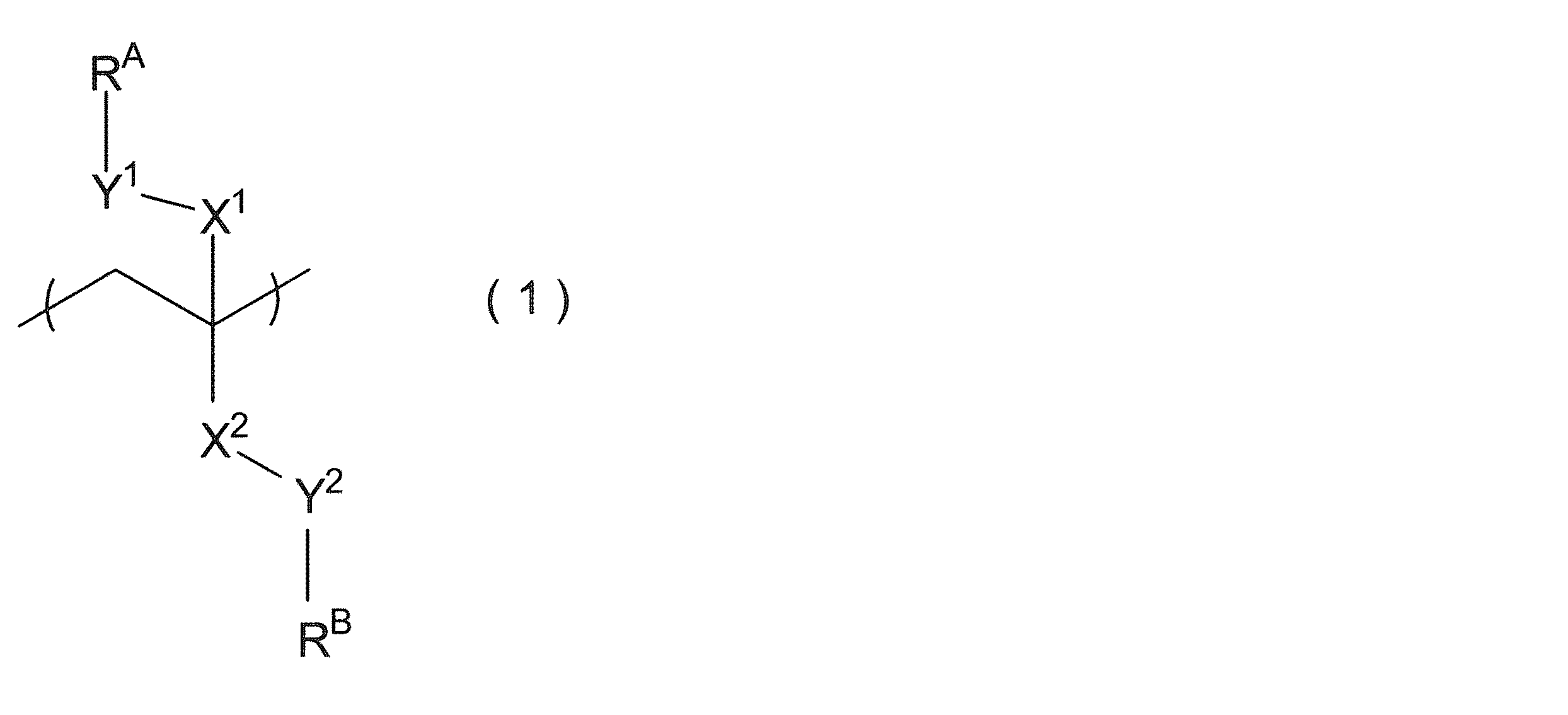
上記構造単位(I)は下記式(1)で表されることが好ましい。
当該レジストパターン形成方法によれば、構造単位(I)を上記特定構造とすることで、この構造単位(I)を[B]重合体中へ導入することがより容易となり、その結果、EL性能、MEEF性能及び解像性能がさらに向上する。 According to the resist pattern forming method, by making the structural unit (I) the specific structure, it becomes easier to introduce the structural unit (I) into the [B] polymer. Further, the MEEF performance and the resolution performance are further improved.
上記構造単位(I)としては、下記式(1−1)〜(1−4)で表される構造単位からなる群より選ばれる少なくとも1種が好ましい。
(式(1−1)〜(1−4)中、Rα、Rβ及びRεは、それぞれ独立して、水素原子又は炭素数1〜20の1価の炭化水素基である。RDは、水素原子又は炭素数1〜5の1価の鎖状炭化水素基である。REは、炭素数1〜10の2価の鎖状炭化水素基である。RF1〜RF4は、それぞれ独立して、水素原子又は炭素数1〜5の1価の鎖状炭化水素基である。RGは、水素原子又は炭素数1〜20の1価の有機基である。RHは、単結合又は炭素数1〜10の2価の鎖状炭化水素基である。RIは、炭素数1〜20の1価の有機基である。)The structural unit (I) is preferably at least one selected from the group consisting of structural units represented by the following formulas (1-1) to (1-4).
(In the formula (1-1) ~ (1-4), R α, the R beta and R epsilon, each independently, a monovalent hydrocarbon group having a hydrogen atom or a C 1 to 20 .R D Is a hydrogen atom or a monovalent chain hydrocarbon group having 1 to 5 carbon atoms, R E is a divalent chain hydrocarbon group having 1 to 10 carbon atoms, and R F1 to R F4 are Each independently a hydrogen atom or a monovalent chain hydrocarbon group having 1 to 5 carbon atoms R G is a hydrogen atom or a monovalent organic group having 1 to 20 carbon atoms R H is (It is a single bond or a divalent chain hydrocarbon group having 1 to 10 carbon atoms. R I is a monovalent organic group having 1 to 20 carbon atoms.)
当該レジストパターン形成方法によれば、構造単位(I)が上記特定構造を有することで、上述の構造単位(I)の[B]重合体中へ導入がさらに容易となり、その結果、EL性能、MEEF性能及び解像性能がさらに向上する。 According to the resist pattern forming method, since the structural unit (I) has the specific structure, the structural unit (I) can be more easily introduced into the [B] polymer. As a result, the EL performance, MEEF performance and resolution performance are further improved.
[B]重合体は、下記式(2)で表される構造単位(以下、「構造単位(II)」ともいう)をさらに有することが好ましい。
当該レジストパターン形成方法によれば、フォトレジスト組成物の[B]重合体が上記特定の構造単位をさらに有することで、[B]重合体の極性、現像液への溶解性等の物性を調整することができ、その結果、EL性能、MEEF性能及び解像性能をさらに向上させることができる。 According to the resist pattern forming method, the [B] polymer of the photoresist composition further has the specific structural unit described above, thereby adjusting the physical properties such as the polarity of the [B] polymer and the solubility in the developer. As a result, the EL performance, MEEF performance, and resolution performance can be further improved.
上記現像工程で用いる現像液が有機溶媒を含有し、ネガ型のレジストパターンを形成することが好ましい。
当該レジストパターン形成方法によれば、上記フォトレジスト組成物により、有機溶媒を含有する現像液を用いてネガ型のレジストパターンを形成させることで、溶解コントラストをより高めることができると考えられ、その結果、さらに優れたEL及びMEEFを発揮しつつ、さらに解像度の高いレジストパターンを形成させることができる。It is preferable that the developer used in the development step contains an organic solvent to form a negative resist pattern.
According to the resist pattern formation method, it is considered that the dissolution contrast can be further increased by forming a negative resist pattern using a developer containing an organic solvent with the photoresist composition. As a result, it is possible to form a resist pattern with higher resolution while exhibiting more excellent EL and MEEF.
上記有機溶媒は、アルコール系溶媒、エーテル系溶媒、ケトン系溶媒、アミド系溶媒、エステル系溶媒及び炭化水素系溶媒からなる群より選ばれる少なくとも1種であることが好ましい。
当該レジストパターン形成方法によれば、現像液の有機溶媒として上記特定の溶媒を用いることで、溶解コントラストをさらに高めることができると考えられ、その結果、さらに優れたEL及びMEEFを発揮しつつ、さらに解像度の高いレジストパターンを形成することができる。The organic solvent is preferably at least one selected from the group consisting of alcohol solvents, ether solvents, ketone solvents, amide solvents, ester solvents, and hydrocarbon solvents.
According to the resist pattern forming method, it is considered that the dissolution contrast can be further increased by using the specific solvent as the organic solvent of the developer, and as a result, while further exhibiting excellent EL and MEEF, Furthermore, a resist pattern with high resolution can be formed.
本発明のフォトレジスト組成物は、
[A]酸発生体、及び[B]重合体を含有する。The photoresist composition of the present invention comprises:
[A] An acid generator and a [B] polymer are contained.
当該フォトレジスト組成物は、上述の特性を有しており、EL性能、MEEF性能及び解像性能に優れる。 The said photoresist composition has the above-mentioned characteristic, and is excellent in EL performance, MEEF performance, and resolution performance.
当該フォトレジスト組成物は、有機溶媒を含有する現像液を用いるネガ型レジストパターン形成用として好ましく用いることができる。当該フォトレジスト組成物によれば、上述のようにして溶解コントラストを発揮させるため、有機溶媒を含有する現像液に対して溶解コントラストをより高めることができる。従って、当該フォトレジスト組成物によれば、有機溶媒を含有する現像液を用いるレジストパターン形成用に好適に用いることができ、優れたEL及びMEEFを発揮しつつ、解像度の高いネガ型のレジストパターンを形成することができる。 The photoresist composition can be preferably used for forming a negative resist pattern using a developer containing an organic solvent. According to the photoresist composition, since the dissolution contrast is exhibited as described above, the dissolution contrast can be further increased with respect to the developer containing the organic solvent. Therefore, according to the photoresist composition, it can be suitably used for forming a resist pattern using a developer containing an organic solvent, and exhibits a high-resolution negative resist pattern while exhibiting excellent EL and MEEF. Can be formed.
ここで、「有機基」とは、少なくとも1個の炭素原子を含む基をいう。 Here, the “organic group” refers to a group containing at least one carbon atom.
以上説明したように、本発明のレジストパターン形成方法及びフォトレジスト組成物によれば、優れたEL及びMEEFを発揮しつつ、解像度の高いレジストパターンを形成することができる。従って当該レジストパターン形成方法及びフォトレジスト組成物は、今後ますます微細化が進行する半導体分野のパターン形成に好適に用いることができ、さらに微細なパターンをさらに高い歩留まりで形成させることができる。 As described above, according to the resist pattern forming method and the photoresist composition of the present invention, a resist pattern with high resolution can be formed while exhibiting excellent EL and MEEF. Therefore, the resist pattern forming method and the photoresist composition can be suitably used for pattern formation in the semiconductor field where miniaturization will continue to progress in the future, and a finer pattern can be formed at a higher yield.
<レジストパターン形成方法>
当該レジストパターン形成方法は、
フォトレジスト組成物(I)でレジスト膜を形成する工程(以下、「レジスト膜形成工程」ともいう)、
上記レジスト膜を露光する工程(以下、「露光工程」ともいう)、及び
上記露光されたレジスト膜を現像する工程(以下、「現像工程」ともいう)
を有する。
当該レジストパターン形成方法によれば、特定のフォトレジスト組成物(I)を用いることで、優れたEL及びMEEFを発揮しつつ、解像度の高いレジストパターンを形成することができる。<Resist pattern formation method>
The resist pattern forming method is:
A step of forming a resist film with the photoresist composition (I) (hereinafter also referred to as a “resist film forming step”),
A step of exposing the resist film (hereinafter also referred to as “exposure step”), and a step of developing the exposed resist film (hereinafter also referred to as “development step”).
Have
According to the resist pattern forming method, by using a specific photoresist composition (I), a resist pattern with high resolution can be formed while exhibiting excellent EL and MEEF.
また、現像工程で用いる現像液が有機溶媒を含有し、ネガ型のレジストパターンを形成することが好ましい。
当該レジストパターン形成方法によれば、フォトレジスト組成物(I)により、有機溶媒を含有する現像液を用いてネガ型のレジストパターンを形成させることで、溶解コントラストをより高めることができると考えられ、その結果、より優れたEL及びMEEFを発揮しつつ、より解像度の高いレジストパターンを形成させることができる。
以下、各工程及びフォトレジスト組成物(I)について説明する。Further, it is preferable that the developer used in the development process contains an organic solvent to form a negative resist pattern.
According to the resist pattern forming method, it is considered that the dissolution contrast can be further increased by forming a negative resist pattern using a developer containing an organic solvent with the photoresist composition (I). As a result, a resist pattern with higher resolution can be formed while exhibiting better EL and MEEF.
Hereinafter, each step and the photoresist composition (I) will be described.
[レジスト膜形成工程]
本工程では、フォトレジスト組成物(I)を用い、基板上にレジスト膜を形成する。基板としては、例えばシリコンウェハ、アルミニウムで被覆されたウェハ等の従来公知の基板を使用できる。また、例えば特公平6−12452号公報や特開昭59−93448号公報等に開示されている有機系又は無機系の反射防止膜を基板上に形成してもよい。[Resist film forming step]
In this step, a photoresist film (I) is used to form a resist film on the substrate. As the substrate, for example, a conventionally known substrate such as a silicon wafer or a wafer coated with aluminum can be used. Further, for example, an organic or inorganic antireflection film disclosed in Japanese Patent Publication No. 6-12452, Japanese Patent Application Laid-Open No. 59-93448, or the like may be formed on the substrate.
塗布方法としては、例えば、回転塗布(スピンコーティング)、流延塗布、ロール塗布等が挙げられる。なお形成されるレジスト膜の膜厚としては、通常0.01μm〜1μmであり、0.01μm〜0.5μmが好ましい。 Examples of the application method include spin coating (spin coating), cast coating, roll coating, and the like. In addition, as a film thickness of the resist film formed, they are 0.01 micrometer-1 micrometer normally, and 0.01 micrometer-0.5 micrometer are preferable.
フォトレジスト組成物の塗布後、必要に応じてプレベーク(PB)によって塗膜中の溶媒を揮発させてもよい。PB温度としては、フォトレジスト組成物の配合組成によって適宜選択されるが、通常30℃〜200℃であり、50℃〜150℃が好ましい。PB時間としては、通常5秒〜600秒であり、10秒〜300秒が好ましい。 After application of the photoresist composition, the solvent in the coating film may be volatilized by pre-baking (PB) as necessary. The PB temperature is appropriately selected depending on the composition of the photoresist composition, but is usually 30 ° C to 200 ° C, preferably 50 ° C to 150 ° C. The PB time is usually 5 seconds to 600 seconds, and preferably 10 seconds to 300 seconds.
環境雰囲気中に含まれる塩基性不純物等の影響を防止するために、例えば特開平5−188598号公報等に開示されている保護膜をレジスト膜上に設けることもできる。さらに、レジスト膜からの酸発生剤等の流出を防止するために、例えば特開2005−352384号公報等に開示されている液浸用保護膜をレジスト膜上に設けることもできる。なお、これらの技術は併用できる。 In order to prevent the influence of basic impurities and the like contained in the environmental atmosphere, a protective film disclosed in, for example, JP-A-5-188598 can be provided on the resist film. Further, in order to prevent the acid generator and the like from flowing out of the resist film, a liquid immersion protective film disclosed in, for example, Japanese Patent Application Laid-Open No. 2005-352384 can be provided on the resist film. These techniques can be used in combination.
[露光工程]
本工程では、レジスト膜形成工程で形成したレジスト膜を露光する。この露光は、レジスト膜の所望の領域に特定パターンのマスク及び必要に応じて液浸液を介して縮小投影することにより露光を行う。例えば、所望の領域にアイソラインパターンマスクを介して縮小投影露光を行うことにより、アイソトレンチパターンを形成できる。また、露光は所望のパターンとマスクパターンによって2回以上行ってもよい。2回以上露光を行う場合、露光は連続して行うことが好ましい。複数回露光する場合、例えば所望の領域にラインアンドスペースパターンマスクを介して第1の縮小投影露光を行い、続けて第1の露光を行った露光部に対してラインが交差するように第2の縮小投影露光を行う。第1の露光部と第2の露光部とは直交することが好ましい。直交することにより、露光部で囲まれた未露光部において真円状のコンタクトホールパターンが形成しやすくなる。なお、露光の際に用いられる液浸液としては水やフッ素系不活性液体等が挙げられる。液浸液は、露光波長に対して透明であり、かつ膜上に投影される光学像の歪みを最小限に留めるよう屈折率の温度係数ができる限り小さい液体が好ましいが、特に露光光源がArFエキシマレーザー光(波長193nm)である場合、上述の観点に加えて、入手の容易さ、取り扱いのし易さの観点から水が好ましく、蒸留水がより好ましい。水を用いる場合、水の表面張力を減少させるとともに、界面活性力を増大させる添加剤を僅かな割合で添加しても良い。この添加剤は、ウェハ上のレジスト膜を溶解させず、かつレンズの下面の光学コートに対する影響が無視できるものが好ましい。[Exposure process]
In this step, the resist film formed in the resist film forming step is exposed. This exposure is performed by reducing and projecting onto a desired region of the resist film through a mask having a specific pattern and, if necessary, an immersion liquid. For example, an isotrench pattern can be formed by performing reduced projection exposure on a desired region through an isoline pattern mask. Moreover, you may perform exposure twice or more with a desired pattern and a mask pattern. When performing exposure twice or more, it is preferable to perform exposure continuously. In the case of performing multiple exposures, for example, a first reduced projection exposure is performed on a desired area via a line and space pattern mask, and then the second is so that the line intersects the exposed portion where the first exposure has been performed. Reduced projection exposure is performed. The first exposure part and the second exposure part are preferably orthogonal. By being orthogonal, it becomes easy to form a perfect circular contact hole pattern in the unexposed area surrounded by the exposed area. Examples of the immersion liquid used for exposure include water and a fluorine-based inert liquid. The immersion liquid is preferably a liquid that is transparent to the exposure wavelength and has a refractive index temperature coefficient that is as small as possible so as to minimize distortion of the optical image projected onto the film. In the case of excimer laser light (wavelength 193 nm), in addition to the above-mentioned viewpoints, water is preferable and distilled water is more preferable from the viewpoint of availability and ease of handling. When water is used, an additive that decreases the surface tension of water and increases the surface activity may be added in a small proportion. This additive is preferably one that does not dissolve the resist film on the wafer and can ignore the influence on the optical coating on the lower surface of the lens.
露光に使用される露光光としては、[A]酸発生体の種類に応じて適宜選択されるが、例えば、紫外線、遠紫外線、可視光線、X線、γ線等の電磁波、電子線、α線等の荷電粒子線などが挙げられる。これらの中でも、遠紫外線が好ましく、ArFエキシマレーザー(波長193nm)、KrFエキシマレーザー(波長248nm)がより好ましく、ArFエキシマレーザーがさらに好ましい。露光量等の露光条件は、フォトレジスト組成物の配合組成や含有成分の種類等に応じて適宜選択される。当該パターン形成方法においては露光工程を複数回有してもよく、複数回の露光は同じ光源を用いても異なる光源を用いても良いが、1回目の露光にはArFエキシマレーザー光を用いることが好ましい。 The exposure light used for the exposure is appropriately selected according to the type of the [A] acid generator. For example, electromagnetic waves such as ultraviolet rays, far ultraviolet rays, visible rays, X rays, γ rays, electron beams, α And charged particle beams such as a beam. Among these, far ultraviolet rays are preferable, ArF excimer laser (wavelength 193 nm) and KrF excimer laser (wavelength 248 nm) are more preferable, and ArF excimer laser is more preferable. The exposure conditions such as the exposure amount are appropriately selected according to the composition of the photoresist composition, the type of the contained component, and the like. In the pattern formation method, the exposure process may be performed a plurality of times, and the same light source or different light sources may be used for the plurality of exposures, but ArF excimer laser light is used for the first exposure. Is preferred.
上記露光後にポストエクスポージャーベーク(PEB)を行なってもよい。当該フォトレジスト組成物は、含有される重合体が酸解離基を含む構造単位を実質的に有さないので、酸解離性基の解離反応の促進は必要ないが、[A]酸発生体等から発生したプロトン酸と[B]重合体の基(a)とによるカチオン性基形成を確実に行うため、PEBを行ってもよい。PEB温度としては、通常30℃〜200℃であり、30℃〜150℃が好ましく、50℃〜100℃がより好ましい。当該フォトレジスト組成物によれば、従来の酸解離性基を含む重合体を含有するフォトレジスト組成物の場合に比べて、低い温度でPEBを行うことが可能になり、レジストパターン形成におけるエネルギー使用量の低減に資することができる。また、用いるフォトレジスト組成物が、基(a)とプロトンとによるカチオン形成によって溶解コントラストを生じるものであるため、重合体の酸解離性基の解離による従来のフォトレジスト組成物の場合に比べて、変化に要する活性化エネルギーが小さく、その結果、露光後のポストエクスポージャーベーク(PEB)工程を省略することも可能であり、スループットの向上を図ることができる。 Post-exposure baking (PEB) may be performed after the exposure. In the photoresist composition, since the contained polymer does not substantially have a structural unit containing an acid dissociable group, it is not necessary to promote the dissociation reaction of the acid dissociable group. [A] Acid generator, etc. PEB may be carried out in order to surely form a cationic group by the protonic acid generated from the [B] polymer group (a). As PEB temperature, it is 30 to 200 degreeC normally, 30 to 150 degreeC is preferable and 50 to 100 degreeC is more preferable. According to the photoresist composition, it becomes possible to perform PEB at a lower temperature than in the case of a photoresist composition containing a polymer containing a conventional acid-dissociable group, and use of energy in resist pattern formation. It can contribute to the reduction of the amount. In addition, since the photoresist composition used has a dissolution contrast due to cation formation by the group (a) and the proton, compared to the conventional photoresist composition by dissociation of the acid dissociable group of the polymer. The activation energy required for the change is small, and as a result, the post-exposure bake (PEB) step after exposure can be omitted, and the throughput can be improved.
[現像工程]
本工程では、露光工程で露光されたレジスト膜を現像液を用いて現像し、レジストパターンを形成する。[Development process]
In this step, the resist film exposed in the exposure step is developed using a developer to form a resist pattern.
上記現像液としては、水系の現像液を用いても、有機溶媒を含有する現像液を用いてもよい。上記水系の現像液を用いることにより、ポジ型のレジストパターンが、有機溶媒を含有する現像液を用いることにより、ネガ型のレジストパターンが得られる。
上記水系の現像液としては、例えば、水、塩化ナトリウム等の無機塩、4級アンモニウム塩等の有機塩等を溶解させた水溶液などが挙げられる。上記水溶液の濃度は、10質量%以下であることが好ましい。アルカリ性水溶液の濃度が10質量%を超えると、露光部も現像液に溶解し難くなる場合がある。上記水系の現像液には、有機溶媒を添加することもできる。As the developer, an aqueous developer or a developer containing an organic solvent may be used. By using the aqueous developer, a positive resist pattern can be obtained, and by using a developer containing an organic solvent, a negative resist pattern can be obtained.
Examples of the aqueous developer include an aqueous solution in which water, an inorganic salt such as sodium chloride, or an organic salt such as a quaternary ammonium salt is dissolved. The concentration of the aqueous solution is preferably 10% by mass or less. If the concentration of the alkaline aqueous solution exceeds 10% by mass, the exposed area may be difficult to dissolve in the developer. An organic solvent can also be added to the aqueous developer.
上記有機溶媒を含有する現像液としては、例えば、上述のフォトレジスト組成物の[D]溶媒として例示した有機溶媒の1種又は2種以上を含有する液体等が挙げられる。上記有機溶媒としては、アルコール系溶媒、エーテル系溶媒、ケトン系溶媒、アミド系溶媒、エステル系溶媒及び炭化水素系溶媒からなる群より選択される少なくとも1種が好ましい。これらの中で、ケトン系溶媒、エーテル系溶媒、エステル系溶媒、炭化水素系溶媒が好ましく、鎖状ケトン系溶媒、ジアルキルエーテル系溶媒、酢酸エステル系溶媒、脂環式炭化水素系溶媒がより好ましく、メチルアミルケトン、ジイソアミルエーテル、酢酸ブチル、シクロオクタンがさらに好ましく、シクロオクタンが特に好ましい。 As a developing solution containing the said organic solvent, the liquid etc. which contain 1 type, or 2 or more types of the organic solvent illustrated as the [D] solvent of the above-mentioned photoresist composition are mentioned, for example. The organic solvent is preferably at least one selected from the group consisting of alcohol solvents, ether solvents, ketone solvents, amide solvents, ester solvents, and hydrocarbon solvents. Of these, ketone solvents, ether solvents, ester solvents, and hydrocarbon solvents are preferable, and chain ketone solvents, dialkyl ether solvents, acetate solvents, and alicyclic hydrocarbon solvents are more preferable. , Methyl amyl ketone, diisoamyl ether, butyl acetate, and cyclooctane are more preferable, and cyclooctane is particularly preferable.
現像液中の有機溶媒の含有率としては、80質量%以上が好ましく、90質量%以上がより好ましく、95質量%以上がさらに好ましい。有機溶媒の含有率を上記範囲とすることで、溶解コントラストを向上させることができ、その結果、より優れたEL及びMEEFを発揮しつつ、解像度のより高いレジストパターンを形成することができる。有機溶媒以外の成分としては、例えば、水、シリコンオイル等が挙げられる。 As a content rate of the organic solvent in a developing solution, 80 mass% or more is preferable, 90 mass% or more is more preferable, 95 mass% or more is further more preferable. By making the content rate of an organic solvent into the said range, melt | dissolution contrast can be improved, As a result, a resist pattern with higher resolution can be formed, exhibiting more excellent EL and MEEF. Examples of components other than the organic solvent include water, silicon oil, and the like.
上記現像液には、必要に応じて界面活性剤を適当量添加することができる。界面活性剤としては例えば、イオン性や非イオン性のフッ素系及び/又はシリコン系界面活性剤等を用いることができる。 An appropriate amount of a surfactant can be added to the developer as necessary. As the surfactant, for example, an ionic or nonionic fluorine-based and / or silicon-based surfactant can be used.
現像方法としては、例えば現像液が満たされた槽中に基板を一定時間浸漬する方法(ディップ法)、基板表面に現像液を表面張力によって盛り上げて一定時間静止することで現像する方法(パドル法)、基板表面に現像液を噴霧する方法(スプレー法)、一定速度で回転している基板上に一定速度で現像液塗出ノズルをスキャンしながら現像液を塗出しつづける方法(ダイナミックディスペンス法)等が挙げられる。 As a developing method, for example, a method in which a substrate is immersed in a tank filled with a developer for a certain period of time (dip method), a method in which the developer is raised on the surface of the substrate by surface tension and is left stationary for a certain time (paddle method) ), A method of spraying the developer on the substrate surface (spray method), a method of continuously applying the developer while scanning the developer coating nozzle on the substrate rotating at a constant speed (dynamic dispensing method) Etc.
現像工程の現像後に、発生したスカムを洗浄するため、レジスト膜をリンス液により洗浄することが好ましい。上記リンス液としては、現像液がアルカリ現像液の場合は通常、水が用いられ、蒸留水が好ましい。また、現像液が有機溶媒を含有する現像液の場合は、通常、有機溶媒が用いられ、炭化水素系溶媒、ケトン系溶媒、エステル系溶媒、アルコール系溶媒、アミド系溶媒等が好ましく、アルコール系溶媒、エステル系溶媒がより好ましく、炭素数6〜8の1価のアルコール系溶媒がさらに好ましく、1−ヘキサノール、2−ヘキサノール、2−ヘプタノール、4−メチル−2−ペンタノールが特に好ましく、4−メチル−2−ペンタノールがさらに特に好ましい。 In order to wash the generated scum after development in the development step, it is preferable to wash the resist film with a rinse solution. As the rinse solution, when the developer is an alkaline developer, water is usually used, and distilled water is preferable. Further, when the developer is a developer containing an organic solvent, an organic solvent is usually used, and a hydrocarbon solvent, a ketone solvent, an ester solvent, an alcohol solvent, an amide solvent, etc. are preferable, and an alcohol solvent is used. Solvents and ester solvents are more preferable, monovalent alcohol solvents having 6 to 8 carbon atoms are more preferable, 1-hexanol, 2-hexanol, 2-heptanol, and 4-methyl-2-pentanol are particularly preferable. -Methyl-2-pentanol is more particularly preferred.
上記リンス液の各成分は、1種単独で又は2種以上を混合して用いることができる。リンス液中の含水率は、10質量%以下が好ましく、より好ましくは5質量%以下、さらに好ましくは3質量%以下である。含水率を10質量%以下にすることで、良好な現像特性を得ることができる。リンス液には界面活性剤を含有させてもよい。 Each component of the rinse liquid can be used alone or in combination of two or more. The water content in the rinse liquid is preferably 10% by mass or less, more preferably 5% by mass or less, and still more preferably 3% by mass or less. By setting the water content to 10% by mass or less, good development characteristics can be obtained. The rinse liquid may contain a surfactant.
リンス液による洗浄の方法としては、例えば一定速度で回転している基板上にリンス液を塗出しつづける方法(回転塗布法)、リンス液が満たされた槽中に基板を一定時間浸漬する方法(ディップ法)、基板表面にリンス液を噴霧する方法(スプレー法)等が挙げられる。 As a cleaning method using a rinsing liquid, for example, a method of continuously applying a rinsing liquid onto a substrate rotating at a constant speed (rotary coating method), a method of immersing a substrate in a bath filled with the rinsing liquid for a certain period of time ( Dip method), a method of spraying a rinsing liquid on the substrate surface (spray method), and the like.
<フォトレジスト組成物(I)>
当該レジストパターン形成方法に用いられるフォトレジスト組成物(I)は、[A]酸発生体及び[B]重合体を含有する。フォトレジスト組成物(I)は、[C]フッ素原子含有重合体及び[D]溶媒を含有することが好ましく、また、本発明の効果を損なわない範囲において、その他の成分を含有してもよい。<Photoresist composition (I)>
The photoresist composition (I) used in the resist pattern forming method contains an [A] acid generator and a [B] polymer. The photoresist composition (I) preferably contains a [C] fluorine atom-containing polymer and a [D] solvent, and may contain other components as long as the effects of the present invention are not impaired. .
フォトレジスト組成物(I)によれば、[A]酸発生体は露光光の照射によってプロトン酸を発生し、このプロトンが[B]重合体の基(a)と共にカチオン性基を形成することで、[B]重合体とプロトン酸との塩が形成され、露光部での[B]重合体の現像液への溶解性が変化する。その結果、露光部と未露光部とで溶解コントラストが生じる。フォトレジスト組成物(I)においては、溶解コントラストが[B]重合体とその塩との間で生じるものであるため、従来の重合体の酸解離性基の解離によってエステル基とカルボキシ基等との間で生じるものに比較して大きくなるものと考えられる。従って、フォトレジスト組成物(I)は、優れたEL性能を発揮することができると考えられる。また、フォトレジスト組成物(I)によれば、この溶解コントラストの向上に加えて、[B]重合体の基(a)により、[A]酸発生体から発生する酸の拡散長を適度に短くすることができると考えられ、その結果、解像性能及びMEEF性能を向上することができる。さらに、フォトレジスト組成物(I)は、基(a)とプロトンとによるカチオン形成によって溶解コントラストを生じるものであるため、重合体の酸解離性基の解離による従来のフォトレジスト組成物に比べて、変化に要する活性化エネルギーが小さく、その結果露光後のポストエクスポージャーベーク(PEB)工程を省略することも可能であり、スループットの向上を図ることができる。
以下、各成分について説明する。According to the photoresist composition (I), the [A] acid generator generates protonic acid upon irradiation with exposure light, and this proton forms a cationic group together with the group (a) of the [B] polymer. Thus, a salt of the [B] polymer and the protonic acid is formed, and the solubility of the [B] polymer in the developer at the exposed portion changes. As a result, dissolution contrast occurs between the exposed and unexposed areas. In the photoresist composition (I), since the dissolution contrast occurs between the [B] polymer and its salt, ester groups and carboxy groups and the like are formed by dissociation of acid-dissociable groups of conventional polymers. It is considered to be larger than that occurring between the two. Therefore, it is considered that the photoresist composition (I) can exhibit excellent EL performance. Further, according to the photoresist composition (I), in addition to the improvement in dissolution contrast, the diffusion length of the acid generated from the [A] acid generator is moderately increased by the group (a) of the [B] polymer. It is thought that it can be shortened, and as a result, resolution performance and MEEF performance can be improved. Furthermore, since the photoresist composition (I) produces a dissolution contrast by cation formation by the group (a) and the proton, compared with the conventional photoresist composition by dissociation of the acid dissociable group of the polymer. The activation energy required for the change is small, and as a result, the post-exposure bake (PEB) step after exposure can be omitted, and the throughput can be improved.
Hereinafter, each component will be described.
<[A]酸発生体>
[A]酸発生体は、露光光の照射によりプロトン酸を発生する物質である。この発生したプロトンが、後述する[B]重合体の基(a)と共にカチオン性基を形成することにより、露光部において[B]重合体とプロトン酸との塩が形成される。その結果、露光部と未露光部とで現像液への溶解性に差が生じ、高い溶解コントラストが発揮される。[A]酸発生体の含有形態としては、後述するような化合物の形態(以下、適宜「[A]酸発生剤」ともいう)でも、[B]重合体等の重合体の一部として組み込まれた形態でも、これらの両方の形態でもよい。<[A] Acid generator>
[A] The acid generator is a substance that generates a protonic acid when irradiated with exposure light. The generated protons form a cationic group together with the later-described [B] polymer group (a), whereby a salt of [B] polymer and a protonic acid is formed in the exposed area. As a result, a difference in solubility in the developer occurs between the exposed portion and the unexposed portion, and a high dissolution contrast is exhibited. [A] The content of the acid generator is incorporated as a part of a polymer such as a polymer [B] even in the form of a compound as described later (hereinafter also referred to as “[A] acid generator” as appropriate). Or both of these forms.
[A]酸発生剤としては、例えば、オニウム塩化合物、N−スルホニルイミド化合物、ハロゲン含有化合物、ジアゾケトン化合物等が挙げられる。 [A] Examples of the acid generator include onium salt compounds, N-sulfonylimide compounds, halogen-containing compounds, and diazoketone compounds.
オニウム塩化合物としては、例えばスルホニウム塩、テトラヒドロチオフェニウム塩、ヨードニウム塩、ホスホニウム塩、ジアゾニウム塩、ピリジニウム塩等が挙げられる。 Examples of the onium salt compounds include sulfonium salts, tetrahydrothiophenium salts, iodonium salts, phosphonium salts, diazonium salts, pyridinium salts, and the like.
スルホニウム塩としては、例えばトリフェニルスルホニウムトリフルオロメタンスルホネート、トリフェニルスルホニウムノナフルオロ−n−ブタンスルホネート、トリフェニルスルホニウムパーフルオロ−n−オクタンスルホネート、トリフェニルスルホニウム2−(ビシクロ[2.2.1]ヘプト−2−イル)−1,1,2,2−テトラフルオロエタンスルホネート、トリフェニルスルホニウム2−ビシクロ[2.2.1]ヘプト−2−イル−1,1−ジフルオロエタンスルホネートトリフェニルスルホニウム6−(アダマンタン−1−イルカルボニルオキシ)ヘキサン−1,1,2,2−テトラフルオロ−n−ヘキサンスルホネート、トリフェニルスルホニウム2−(アダマンタン−1−イルカルボニルオキシ)−1,1,3,3,3−ペンタフルオロプロパンスルホネート、トリフェニルスルホニウムカンファースルホネート、4−シクロヘキシルフェニルジフェニルスルホニウムトリフルオロメタンスルホネート、4−シクロヘキシルフェニルジフェニルスルホニウムノナフルオロ−n−ブタンスルホネート、4−シクロヘキシルフェニルジフェニルスルホニウムパーフルオロ−n−オクタンスルホネート、4−シクロヘキシルフェニルジフェニルスルホニウム2−ビシクロ[2.2.1]ヘプト−2−イル−1,1,2,2−テトラフルオロエタンスルホネート、4−シクロヘキシルフェニルジフェニルスルホニウムカンファースルホネート、4−メタンスルホニルフェニルジフェニルスルホニウムトリフルオロメタンスルホネート、4−メタンスルホニルフェニルジフェニルスルホニウムノナフルオロ−n−ブタンスルホネート、4−メタンスルホニルフェニルジフェニルスルホニウムパーフルオロ−n−オクタンスルホネート、4−メタンスルホニルフェニルジフェニルスルホニウム2−ビシクロ[2.2.1]ヘプト−2−イル−1,1,2,2−テトラフルオロエタンスルホネート、4−メタンスルホニルフェニルジフェニルスルホニウムカンファースルホネート、トリフェニルスルホニウム1,1,2,2−テトラフルオロ−6−(1−アダマンタンカルボニロキシ)−ヘキサン−1−スルホネート、トリフェニルスルホニウム2−(1−アダマンチル)−1,1−ジフルオロエタンスルホネート等が挙げられる。 Examples of the sulfonium salt include triphenylsulfonium trifluoromethanesulfonate, triphenylsulfonium nonafluoro-n-butanesulfonate, triphenylsulfonium perfluoro-n-octanesulfonate, triphenylsulfonium 2- (bicyclo [2.2.1] hept. -2-yl) -1,1,2,2-tetrafluoroethanesulfonate, triphenylsulfonium 2-bicyclo [2.2.1] hept-2-yl-1,1-difluoroethanesulfonate triphenylsulfonium 6- ( Adamantane-1-ylcarbonyloxy) hexane-1,1,2,2-tetrafluoro-n-hexanesulfonate, triphenylsulfonium 2- (adamantan-1-ylcarbonyloxy) -1,1,3,3,3 Pentafluoropropanesulfonate, triphenylsulfonium camphorsulfonate, 4-cyclohexylphenyldiphenylsulfonium trifluoromethanesulfonate, 4-cyclohexylphenyldiphenylsulfonium nonafluoro-n-butanesulfonate, 4-cyclohexylphenyldiphenylsulfonium perfluoro-n-octanesulfonate, 4 -Cyclohexylphenyldiphenylsulfonium 2-bicyclo [2.2.1] hept-2-yl-1,1,2,2-tetrafluoroethanesulfonate, 4-cyclohexylphenyldiphenylsulfonium camphorsulfonate, 4-methanesulfonylphenyldiphenylsulfonium Trifluoromethanesulfonate, 4-methanesulfonylphenyl di Enylsulfonium nonafluoro-n-butanesulfonate, 4-methanesulfonylphenyldiphenylsulfonium perfluoro-n-octanesulfonate, 4-methanesulfonylphenyldiphenylsulfonium 2-bicyclo [2.2.1] hept-2-yl-1, 1,2,2-tetrafluoroethanesulfonate, 4-methanesulfonylphenyldiphenylsulfonium camphorsulfonate, triphenylsulfonium 1,1,2,2-tetrafluoro-6- (1-adamantanecarbonyloxy) -hexane-1- Examples thereof include sulfonate, triphenylsulfonium 2- (1-adamantyl) -1,1-difluoroethanesulfonate.
テトラヒドロチオフェニウム塩としては、例えば1−(4−n−ブトキシナフタレン−1−イル)テトラヒドロチオフェニウムトリフルオロメタンスルホネート、1−(4−n−ブトキシナフタレン−1−イル)テトラヒドロチオフェニウムノナフルオロ−n−ブタンスルホネート、1−(4−n−ブトキシナフタレン−1−イル)テトラヒドロチオフェニウムパーフルオロ−n−オクタンスルホネート、1−(4−n−ブトキシナフタレン−1−イル)テトラヒドロチオフェニウム2−ビシクロ[2.2.1]ヘプト−2−イル−1,1,2,2−テトラフルオロエタンスルホネート、1−(4−n−ブトキシナフタレン−1−イル)テトラヒドロチオフェニウムカンファースルホネート、1−(6−n−ブトキシナフタレン−2−イル)テトラヒドロチオフェニウムトリフルオロメタンスルホネート、1−(6−n−ブトキシナフタレン−2−イル)テトラヒドロチオフェニウムノナフルオロ−n−ブタンスルホネート、1−(6−n−ブトキシナフタレン−2−イル)テトラヒドロチオフェニウムパーフルオロ−n−オクタンスルホネート、1−(6−n−ブトキシナフタレン−2−イル)テトラヒドロチオフェニウム2−ビシクロ[2.2.1]ヘプト−2−イル−1,1,2,2−テトラフルオロエタンスルホネート、1−(6−n−ブトキシナフタレン−2−イル)テトラヒドロチオフェニウムカンファースルホネート、1−(3,5−ジメチル−4−ヒドロキシフェニル)テトラヒドロチオフェニウムトリフルオロメタンスルホネート、1−(3,5−ジメチル−4−ヒドロキシフェニル)テトラヒドロチオフェニウムノナフルオロ−n−ブタンスルホネート、1−(3,5−ジメチル−4−ヒドロキシフェニル)テトラヒドロチオフェニウムパーフルオロ−n−オクタンスルホネート、1−(3,5−ジメチル−4−ヒドロキシフェニル)テトラヒドロチオフェニウム2−ビシクロ[2.2.1]ヘプト−2−イル−1,1,2,2−テトラフルオロエタンスルホネート、1−(3,5−ジメチル−4−ヒドロキシフェニル)テトラヒドロチオフェニウムカンファースルホネート等が挙げられる。 Examples of the tetrahydrothiophenium salt include 1- (4-n-butoxynaphthalen-1-yl) tetrahydrothiophenium trifluoromethanesulfonate, 1- (4-n-butoxynaphthalen-1-yl) tetrahydrothiophenium nona. Fluoro-n-butanesulfonate, 1- (4-n-butoxynaphthalen-1-yl) tetrahydrothiophenium perfluoro-n-octanesulfonate, 1- (4-n-butoxynaphthalen-1-yl) tetrahydrothiophene Ni-bicyclo [2.2.1] hept-2-yl-1,1,2,2-tetrafluoroethanesulfonate, 1- (4-n-butoxynaphthalen-1-yl) tetrahydrothiophenium camphorsulfonate , 1- (6-n-butoxynaphthalen-2-yl) Torahydrothiophenium trifluoromethanesulfonate, 1- (6-n-butoxynaphthalen-2-yl) tetrahydrothiophenium nonafluoro-n-butanesulfonate, 1- (6-n-butoxynaphthalen-2-yl) tetrahydro Thiophenium perfluoro-n-octanesulfonate, 1- (6-n-butoxynaphthalen-2-yl) tetrahydrothiophenium 2-bicyclo [2.2.1] hept-2-yl-1,1,2 , 2-tetrafluoroethanesulfonate, 1- (6-n-butoxynaphthalen-2-yl) tetrahydrothiophenium camphorsulfonate, 1- (3,5-dimethyl-4-hydroxyphenyl) tetrahydrothiophenium trifluoromethanesulfonate , 1- (3,5-dimethyl-4 Hydroxyphenyl) tetrahydrothiophenium nonafluoro-n-butanesulfonate, 1- (3,5-dimethyl-4-hydroxyphenyl) tetrahydrothiophenium perfluoro-n-octanesulfonate, 1- (3,5-dimethyl- 4-hydroxyphenyl) tetrahydrothiophenium 2-bicyclo [2.2.1] hept-2-yl-1,1,2,2-tetrafluoroethanesulfonate, 1- (3,5-dimethyl-4-hydroxy Phenyl) tetrahydrothiophenium camphorsulfonate and the like.
ヨードニウム塩としては、例えばジフェニルヨードニウムトリフルオロメタンスルホネート、ジフェニルヨードニウムノナフルオロ−n−ブタンスルホネート、ジフェニルヨードニウムパーフルオロ−n−オクタンスルホネート、ジフェニルヨードニウム2−ビシクロ[2.2.1]ヘプト−2−イル−1,1,2,2−テトラフルオロエタンスルホネート、ジフェニルヨードニウムカンファースルホネート、ビス(4−t−ブチルフェニル)ヨードニウムトリフルオロメタンスルホネート、ビス(4−t−ブチルフェニル)ヨードニウムノナフルオロ−n−ブタンスルホネート、ビス(4−t−ブチルフェニル)ヨードニウムパーフルオロ−n−オクタンスルホネート、ビス(4−t−ブチルフェニル)ヨードニウム2−ビシクロ[2.2.1]ヘプト−2−イル−1,1,2,2−テトラフルオロエタンスルホネート、ビス(4−t−ブチルフェニル)ヨードニウムカンファースルホネート等が挙げられる。 Examples of the iodonium salt include diphenyliodonium trifluoromethanesulfonate, diphenyliodonium nonafluoro-n-butanesulfonate, diphenyliodonium perfluoro-n-octanesulfonate, diphenyliodonium 2-bicyclo [2.2.1] hept-2-yl- 1,1,2,2-tetrafluoroethanesulfonate, diphenyliodonium camphorsulfonate, bis (4-t-butylphenyl) iodonium trifluoromethanesulfonate, bis (4-t-butylphenyl) iodonium nonafluoro-n-butanesulfonate, Bis (4-t-butylphenyl) iodonium perfluoro-n-octanesulfonate, bis (4-t-butylphenyl) iodonium 2-bicyclo [2.2 1] hept-2-yl-1,1,2,2-tetrafluoroethanesulfonate, bis (4-t- butylphenyl) iodonium camphorsulfonate, and the like.
N−スルホニルオキシイミド化合物としては、例えばN−(トリフルオロメタンスルホニルオキシ)ビシクロ[2.2.1]ヘプト−5−エン−2,3−ジカルボキシイミド、N−(ノナフルオロ−n−ブタンスルホニルオキシ)ビシクロ[2.2.1]ヘプト−5−エン−2,3−ジカルボキシイミド、N−(パーフルオロ−n−オクタンスルホニルオキシ)ビシクロ[2.2.1]ヘプト−5−エン−2,3−ジカルボキシイミド、N−(2−ビシクロ[2.2.1]ヘプト−2−イル−1,1,2,2−テトラフルオロエタンスルホニルオキシ)ビシクロ[2.2.1]ヘプト−5−エン−2,3−ジカルボキシイミド、N−(2−(3−テトラシクロ[4.4.0.12,5.17,10]ドデカニル)−1,1−ジフルオロエタンスルホニルオキシ)ビシクロ[2.2.1]ヘプト−5−エン−2,3−ジカルボキシイミド、N−(カンファースルホニルオキシ)ビシクロ[2.2.1]ヘプト−5−エン−2,3−ジカルボキシイミド等を挙げることができる。Examples of the N-sulfonyloxyimide compound include N- (trifluoromethanesulfonyloxy) bicyclo [2.2.1] hept-5-ene-2,3-dicarboximide, N- (nonafluoro-n-butanesulfonyloxy). ) Bicyclo [2.2.1] hept-5-ene-2,3-dicarboximide, N- (perfluoro-n-octanesulfonyloxy) bicyclo [2.2.1] hept-5-ene-2 , 3-dicarboximide, N- (2-bicyclo [2.2.1] hept-2-yl-1,1,2,2-tetrafluoroethanesulfonyloxy) bicyclo [2.2.1] hept- 5-ene-2,3-dicarboximide, N- (2- (3- tetracyclo [4.4.0.1 2,5 .1 7,10] dodecanyl) -1,1-difluoro-ethanone Sulfonyloxy) bicyclo [2.2.1] hept-5-ene-2,3-dicarboximide, N- (camphorsulfonyloxy) bicyclo [2.2.1] hept-5-ene-2,3 -Dicarboximide etc. can be mentioned.
これらの中で、オニウム塩化合物が好ましく、スルホニウム塩がより好ましく、トリフェニルスルホニウム6−(アダマンタン−1−イルカルボニルオキシ)−1,1,2,2−テトラフルオロ−n−ヘキサンスルホネート、トリフェニルスルホニウム2−(ビシクロ[2.2.1]ヘプト−2−イル)−1,1−ジフルオロエタンスルホネート、4−シクロヘキシルフェニルジフェニルスルホニウムノナフルオロブタンスルホネート、トリフェニルスルホニウムノナフルオロブタンスルホネート、トリフェニルスルホニウム2−(アダマンタン−1−イルカルボニルオキシ)−1,1,3,3,3−ペンタフルオロプロパンスルホネートがさらに好ましい。 Of these, onium salt compounds are preferred, sulfonium salts are more preferred, and triphenylsulfonium 6- (adamantan-1-ylcarbonyloxy) -1,1,2,2-tetrafluoro-n-hexanesulfonate, triphenyl Sulfonium 2- (bicyclo [2.2.1] hept-2-yl) -1,1-difluoroethanesulfonate, 4-cyclohexylphenyldiphenylsulfonium nonafluorobutanesulfonate, triphenylsulfonium nonafluorobutanesulfonate, triphenylsulfonium 2- (Adamantane-1-ylcarbonyloxy) -1,1,3,3,3-pentafluoropropanesulfonate is more preferred.
[A]酸発生体が[A]酸発生剤である場合の含有量としては、後述する[B]重合体100質量部に対して、0.1質量部〜100質量部が好ましく、0.5質量部〜50質量部がより好ましく、1質量部〜30質量部がさらに好ましく、5質量部〜20質量部が特に好ましく、7質量部〜15質量部がさらに特に好ましい。[A]酸発生剤の含有量を上記範囲とすることで、当該レジストパターン形成方法で形成されるレジストパターンのEL性能、MEEF性能及び解像性能を向上させることができる。[A]酸発生剤の含有量が上記下限未満だと、フォトレジスト組成物(I)の感度が低下する傾向にある。[A]酸発生剤の含有量が上記上限を超えると、フォトレジスト組成物(I)のパターン形成性が低下する場合がある。 [A] The content when the acid generator is an [A] acid generator is preferably 0.1 parts by mass to 100 parts by mass with respect to 100 parts by mass of the polymer [B] described later. 5 mass parts-50 mass parts are more preferable, 1 mass part-30 mass parts are more preferable, 5 mass parts-20 mass parts are especially preferable, and 7 mass parts-15 mass parts are still more especially preferable. [A] By making content of an acid generator into the said range, EL performance, MEEF performance, and resolution performance of the resist pattern formed with the said resist pattern formation method can be improved. [A] If the content of the acid generator is less than the above lower limit, the sensitivity of the photoresist composition (I) tends to decrease. [A] When content of an acid generator exceeds the said upper limit, the pattern formation property of photoresist composition (I) may fall.
<[B]重合体>
[B]重合体は、構造単位(I)を有し、酸解離性基を含む構造単位を実質的に有さない重合体である。[B]重合体の構造単位(I)の基(a)が、上記[A]酸発生体から発生したプロトンと共にカチオン性基を形成し、その結果、露光部において[B]重合体とプロトン酸との塩が形成されることにより、露光部及び未露光部間に高い溶解コントラストが生じる。<[B] polymer>
[B] The polymer is a polymer having the structural unit (I) and having substantially no structural unit containing an acid dissociable group. [B] The group (a) of the structural unit (I) of the polymer forms a cationic group together with the proton generated from the [A] acid generator, and as a result, the [B] polymer and proton in the exposed area. Formation of a salt with an acid causes a high dissolution contrast between the exposed and unexposed areas.
[B]重合体は、構造単位(I)以外にも、上記式(2)で表される構造単位(II)を有することが好ましく、ラクトン構造、環状カーボネート構造及びスルトン構造からなる群より選ばれる少なくとも1種の構造を含む構造単位(III)を有してもよく、これらの構造単位以外のその他の構造単位を有していてもよい。これらの構造単位は、それぞれ1種又は2種以上を有していてもよい。以下、各構造単位について説明する。 [B] The polymer preferably has the structural unit (II) represented by the above formula (2) in addition to the structural unit (I), and is selected from the group consisting of a lactone structure, a cyclic carbonate structure and a sultone structure. The structural unit (III) containing at least one kind of structure may be included, and other structural units other than these structural units may be included. Each of these structural units may have one type or two or more types. Hereinafter, each structural unit will be described.
[構造単位(I)]
構造単位(I)は、プロトンと共にカチオン性基を形成する基(a)を含む構造単位である。[Structural unit (I)]
The structural unit (I) is a structural unit containing a group (a) that forms a cationic group with protons.
基(a)としては、上記性質を有する限り特に限定されないが、例えば、非共有電子対を有する窒素原子を含む基、非共有電子対を有するリン原子を含む基等が挙げられる。 Although it does not specifically limit as long as it has the said property as group (a), For example, the group containing the nitrogen atom which has a lone pair, the group containing the phosphorus atom which has a lone pair, etc. are mentioned.
上記非共有電子対を有する窒素原子及び上記非共有電子対を有するリン原子を含む基としては、例えば、下記式(a−1)で表される1価の基(以下、「基(a−1)」ともいう)、下記式(a−2)で表される2価の基(以下、「基(a−2)」ともいう)、下記式(a−3)で表される3価の基(以下、「基(a−3)」ともいう)(これらの基をまとめて「n価の基(a)」ともいう)等が挙げられる。 Examples of the group containing a nitrogen atom having an unshared electron pair and a phosphorus atom having an unshared electron pair include a monovalent group represented by the following formula (a-1) (hereinafter referred to as “group (a- 1) ", a divalent group represented by the following formula (a-2) (hereinafter also referred to as" group (a-2) "), and a trivalent represented by the following formula (a-3). (Hereinafter also referred to as “group (a-3)”) (these groups are collectively referred to as “n-valent group (a)”) and the like.
上記基(a)を基(a−1)、基(a−2)及び基(a−3)からなる群より選ばれる少なくとも1種とすると、基(a)とプロトンとのカチオン性基形成能をより向上させることができ、その結果、当該レジストパターン形成方法で形成されるレジストパターンのEL性能、MEEF性能及び解像性能をより向上させることができる。 When the group (a) is at least one selected from the group consisting of the group (a-1), the group (a-2) and the group (a-3), a cationic group is formed between the group (a) and a proton. As a result, the EL performance, MEEF performance, and resolution performance of the resist pattern formed by the resist pattern forming method can be further improved.
上記式(a−1)、式(a−2)及び式(a−3)中、Zは、それぞれ独立して、窒素原子又はリン原子である。R、R’及びR”は、それぞれ独立して、水素原子又は炭素数1〜20の1価の有機基である。但し、R及びR’が互いに結合して、これらが結合するZと共に環構造を形成していてもよい。 In the above formula (a-1), formula (a-2) and formula (a-3), Z is independently a nitrogen atom or a phosphorus atom. R, R ′ and R ″ are each independently a hydrogen atom or a monovalent organic group having 1 to 20 carbon atoms, provided that R and R ′ are bonded to each other, and a ring is formed together with Z to which these are bonded. A structure may be formed.
上記R、R’及びR”で表される炭素数1〜20の1価の有機基としては、例えば、炭素数1〜20の1価の炭化水素基、炭化水素基と酸素原子、カルボニル基、スルホニル基、C=Nを含む基、1価の芳香族複素環基等とを組み合わせた基などが挙げられる。 Examples of the monovalent organic group having 1 to 20 carbon atoms represented by R, R ′ and R ″ include, for example, a monovalent hydrocarbon group having 1 to 20 carbon atoms, a hydrocarbon group and an oxygen atom, and a carbonyl group. , A sulfonyl group, a group containing C═N, a group combined with a monovalent aromatic heterocyclic group, and the like.
上記炭素数1〜20の1価の炭化水素基としては、例えば、炭素数1〜20の鎖状炭化水素基、炭素数3〜20の脂環式炭化水素基、炭素数6〜20の芳香族炭化水素基等が挙げられる。 Examples of the monovalent hydrocarbon group having 1 to 20 carbon atoms include a chain hydrocarbon group having 1 to 20 carbon atoms, an alicyclic hydrocarbon group having 3 to 20 carbon atoms, and an aromatic having 6 to 20 carbon atoms. Group hydrocarbon group and the like.
上記炭素数1〜20の鎖状炭化水素基としては、例えば、
メチル基、エチル基、n−プロピル基、i−プロピル基、n−ブチル基、i−ブチル基、sec−ブチル基、t−ブチル基等のアルキル基;
エテニル基、プロペニル基、ブテニル基、ペンテニル基等のアルケニル基;
エチニル基、プロピニル基、ブチニル基等のアルキニル基などが挙げられる。Examples of the chain hydrocarbon group having 1 to 20 carbon atoms include:
Alkyl groups such as methyl group, ethyl group, n-propyl group, i-propyl group, n-butyl group, i-butyl group, sec-butyl group, t-butyl group;
Alkenyl groups such as ethenyl group, propenyl group, butenyl group, pentenyl group;
Examples thereof include alkynyl groups such as ethynyl group, propynyl group and butynyl group.
上記炭素数3〜20の脂環式炭化水素基としては、例えば、
シクロプロピル基、シクロブチル基、シクロペンチル基、シクロヘキシル基、ノルボルニル基、アダマンチル基等のシクロアルキル基;
シクロペンテニル基、シクロヘキセニル基、ノルボルネニル基等のシクロアルケニル基などが挙げられる。Examples of the alicyclic hydrocarbon group having 3 to 20 carbon atoms include:
A cycloalkyl group such as a cyclopropyl group, a cyclobutyl group, a cyclopentyl group, a cyclohexyl group, a norbornyl group, an adamantyl group;
And cycloalkenyl groups such as a cyclopentenyl group, a cyclohexenyl group, and a norbornenyl group.
上記炭素数6〜20の芳香族炭化水素基としては、例えば、
フェニル基、トリル基、キシリル基、ナフチル基、アントリル基等のアリール基;
ベンジル基、フェネチル基、ナフチル基等のアラルキル基などが挙げられる。Examples of the aromatic hydrocarbon group having 6 to 20 carbon atoms include:
Aryl groups such as phenyl, tolyl, xylyl, naphthyl and anthryl;
Examples thereof include aralkyl groups such as benzyl group, phenethyl group and naphthyl group.
上記炭化水素基と酸素原子、カルボニル基、スルホニル基、C=Z(Zは窒素原子又はリン原子である)を含む基、1価の芳香族複素環基等とを組み合わせた基としては、例えば、アルコキシアルキル基、アルコキシカルボニル基、ジアルキルイミノオキシカルボニル基、ヘテロアリールカルボニル基、アルキルスルホニル基等が挙げられる。 Examples of the group in which the hydrocarbon group is combined with an oxygen atom, a carbonyl group, a sulfonyl group, a group containing C = Z (Z is a nitrogen atom or a phosphorus atom), a monovalent aromatic heterocyclic group, etc. , Alkoxyalkyl group, alkoxycarbonyl group, dialkyliminooxycarbonyl group, heteroarylcarbonyl group, alkylsulfonyl group and the like.
上記R及びR’が互いに結合してZと共に形成する環構造としては、例えば、
Zが窒素原子である場合として、アザシクロペンタン構造、アザシクロヘキサン構造、アザシクロオクタン構造等のアザシクロアルカン構造、プロピオラクラム構造、ブチロラクタム構造、バレロラクタム構造等のラクタム構造などが挙げられ、
Zがリン原子である場合として、ホスファシクロペンタン構造、ホスファシクロヘキサン構造、ホスファシクロオクタン構造のホスファシクロアルカン構造などが挙げられる。Examples of the ring structure formed by combining R and R ′ together with Z include:
Examples of the case where Z is a nitrogen atom include azacyclopentane structure, azacyclohexane structure, azacycloalkane structure such as azacyclooctane structure, propiolaclam structure, butyrolactam structure, lactam structure such as valerolactam structure, etc.
Examples of the case where Z is a phosphorus atom include a phosphacyclopentane structure, a phosphacyclohexane structure, a phosphacycloalkane structure having a phosphacyclooctane structure, and the like.
R、R’及びR”としては、水素原子、鎖状炭化水素基が好ましく、水素原子、アルキル基がより好ましく、水素原子、メチル基、エチル基がさらに好ましく、水素原子、メチル基が特に好ましく、メチル基がさらに特に好ましい。また、R及びR’の両方が鎖状炭化水素基であることが好ましく、両方がアルキル基であることがより好ましく、両方がメチル基であることがさらに好ましい。 R, R ′ and R ″ are preferably a hydrogen atom or a chain hydrocarbon group, more preferably a hydrogen atom or an alkyl group, still more preferably a hydrogen atom, a methyl group or an ethyl group, and particularly preferably a hydrogen atom or a methyl group. Further, a methyl group is particularly preferred, and both R and R ′ are preferably chain hydrocarbon groups, more preferably both are alkyl groups, and both are more preferably methyl groups.
Zとしては、基(a)のプロトンとのカチオン性基形成能がより高い観点から、窒素原子が好ましい。 Z is preferably a nitrogen atom from the viewpoint of higher ability to form a cationic group with the proton of the group (a).
基(a−1)及び基(a−2)としては、例えば、下記式(a−1−1)〜(a−1−6)及び(a−2−1)で表される基(以下、「基(a−1−1)〜(a−1−6)及び(a−2−1)」ともいう)等が挙げられる。 Examples of the group (a-1) and the group (a-2) include groups represented by the following formulas (a-1-1) to (a-1-6) and (a-2-1) (hereinafter, , "Groups (a-1-1) to (a-1-6) and (a-2-1)") and the like.
基(a−1)及び基(a−2)を、基(a−1−1)〜(a−1−6)及び基(a−2−1)からなる群より選ばれる少なくとも1種とすると、基(a)とプロトンとのカチオン性基形成能をさらに向上させることができ、その結果、当該レジストパターン形成方法で形成されるレジストパターンのEL性能、MEEF性能及び解像性能をさらに向上させることができる。 The group (a-1) and the group (a-2) are at least one selected from the group consisting of the groups (a-1-1) to (a-1-6) and the group (a-2-1); Then, it is possible to further improve the cationic group forming ability of the group (a) and the proton, and as a result, further improve the EL performance, MEEF performance and resolution performance of the resist pattern formed by the resist pattern forming method. Can be made.
上記式(a−1−1)〜(a−1−6)及び(a−2−1)中、Zは、それぞれ独立して、窒素原子又はリン原子である。Rα、Rβ、Rα1〜Rα3及びRεは、それぞれ独立して、水素原子又は炭素数1〜20の1価の炭化水素基である。Rα4は、炭素数1〜20の1価の炭化水素基である。Rγは、炭素数1〜20の2価の炭化水素基又は炭素数1〜20の2価のオキシ炭化水素基である。Rδは、置換基を有していてもよいZ原子を含む炭素数3〜20の1価の芳香族複素環基である。上記式(a−1−1)におけるRαとRβ、式(a−1−2)におけるRα1とRβ、又は式(a−1−4)におけるRα2とRα3が互いに結合して環構造を形成してもよい。In the above formulas (a-1-1) to (a-1-6) and (a-2-1), Z is each independently a nitrogen atom or a phosphorus atom. R α , R β , R α1 to R α3 and R ε are each independently a hydrogen atom or a monovalent hydrocarbon group having 1 to 20 carbon atoms. R α4 is a monovalent hydrocarbon group having 1 to 20 carbon atoms. R γ is a C 1-20 divalent hydrocarbon group or a C 1-20 divalent oxyhydrocarbon group. R δ is a C 3-20 monovalent aromatic heterocyclic group containing a Z atom which may have a substituent. R α and R β in the formula (a-1-1), R α1 and R β in the formula (a-1-2), or R α2 and R α3 in the formula (a-1-4) are bonded to each other. To form a ring structure.
Rα、Rβ、Rα1〜Rα4及びRε表される炭素数1〜20の1価の炭化水素基としては、例えば、上記式(a−1)のR及びR’で表される1価の炭化水素基として例示したものと同様の基等が挙げられる。Examples of the monovalent hydrocarbon group having 1 to 20 carbon atoms represented by R α , R β , R α1 to R α4 and R ε are represented by R and R ′ in the above formula (a-1). Examples thereof include groups similar to those exemplified as the monovalent hydrocarbon group.
上記Rγで表される炭素数1〜20の2価の炭化水素基としては、例えば、上記Rα、Rβ及びRα1〜Rα4で表される炭素数1〜20の1価の炭化水素基から1個の水素原子を除いた基等が挙げられる。Examples of the divalent hydrocarbon group having 1 to 20 carbon atoms represented by R γ include, for example, a monovalent carbon group having 1 to 20 carbon atoms represented by R α , R β and R α1 to R α4. Examples thereof include a group obtained by removing one hydrogen atom from a hydrogen group.
上記Rγで表される炭素数1〜20の2価のオキシ炭化水素基としては、例えば、上記Rα、Rβ及びRα1〜Rα4で表される炭素数1〜20の1価の炭化水素基から1個の水素原子を除いた基と、酸素原子とを組み合わせた基等が挙げられる。Examples of the divalent oxyhydrocarbon group having 1 to 20 carbon atoms represented by the R γ include, for example, a monovalent univalent hydrocarbon having 1 to 20 carbon atoms represented by the above R α , R β and R α1 to R α4 . Examples include a group obtained by combining a group obtained by removing one hydrogen atom from a hydrocarbon group and an oxygen atom.
上記Rδで表されるZ原子を含む1価の芳香族複素環基としては、例えば、
Zが窒素原子の場合として、アザシクロペンタジエニル基、1,2−ジアザシクロペンタジエニル基、1,3−ジアザシクロペンタジエニル基、アザフェニル基、1,2−ジアザフェニル基、1,3−ジアザフェニル基、1,4−ジアザフェニル基等が、
Zがリン原子の場合として、ホスファシクロペンタジエニル基、1,2−ジホスファシクロペンタジエニル基、1,3−ジホスファシクロペンタジエニル基、1,4−ジホスファシクロペンタジエニル基、ホスファフェニル基、1,2−ジホスファフェニル基、1,3−ジホスファフェニル基、1,4−ジホスファフェニル基等が挙げられる。Examples of the monovalent aromatic heterocyclic group containing a Z atom represented by R δ include, for example,
When Z is a nitrogen atom, an azacyclopentadienyl group, 1,2-diazacyclopentadienyl group, 1,3-diazacyclopentadienyl group, azaphenyl group, 1,2-diazaphenyl group, 1 , 3-diazaphenyl group, 1,4-diazaphenyl group, etc.
When Z is a phosphorus atom, phosphacyclopentadienyl group, 1,2-diphosphacyclopentadienyl group, 1,3-diphosphacyclopentadienyl group, 1,4-diphosphacyclopentadienyl Group, phosphaphenyl group, 1,2-diphosphaphenyl group, 1,3-diphosphaphenyl group, 1,4-diphosphaphenyl group and the like.
上記式(a−1−1)におけるRαとRβとが互いに結合して形成する環構造としては、例えば、アザシクロペンタン構造、アザシクロヘキサン構造、アザシクロオクタン構造、アザノルボルナン構造等が挙げられる。Examples of the ring structure formed by combining R α and R β in the above formula (a-1-1) include an azacyclopentane structure, an azacyclohexane structure, an azacyclooctane structure, an azanorbornane structure, and the like. It is done.
上記式(a−1−2)におけるRα1とRβとが互いに結合して形成する環構造としては、例えば、アザオキサシクロペンタン構造、アザオキサシクロヘキサン構造、アザオキサシクロオクタン、アザオキサノルボルナン構造等が挙げられる。Examples of the ring structure formed by combining R α1 and R β in the above formula (a-1-2) include an azaoxacyclopentane structure, an azaoxacyclohexane structure, an azaoxacyclooctane, and an azaoxanorbornane structure. Etc.
上記式(a−1−4)におけるRα2とRα3とが互いに結合して形成する環構造としては、例えば、シクロペンタン構造、シクロヘキサン構造、シクロオクタン構造、ノルボルナン構造、アダマンタン構造等が挙げられる。Examples of the ring structure formed by combining R α2 and R α3 in the above formula (a-1-4) include a cyclopentane structure, a cyclohexane structure, a cyclooctane structure, a norbornane structure, an adamantane structure, and the like. .
基(a−1)としては、これらの中で、上記式(a−1−1)で表される基が好ましく、ジアルキルアミノ基がより好ましく、ジメチルアミノ基がさらに好ましい。
基(a−2)としては、イミノ基(−NH−)、アルキルイミノ基が好ましく、アルキルイミノ基がより好ましく、メチルイミノ基がさらに好ましい。Of these, the group (a-1) is preferably a group represented by the above formula (a-1-1), more preferably a dialkylamino group, and even more preferably a dimethylamino group.
The group (a-2) is preferably an imino group (—NH—) or an alkylimino group, more preferably an alkylimino group, and still more preferably a methylimino group.
構造単位(I)としては、例えば、下記式(1)で表される構造単位(以下、「構造単位(I−1)ともいう」)等が挙げられる。 Examples of the structural unit (I) include a structural unit represented by the following formula (1) (hereinafter also referred to as “structural unit (I-1)”).
上記式(1)中、X1及びX2は、それぞれ独立して、単結合、−O−、−C(O)−、−C(O)O−、−OC(O)O−、−C(O)OC(O)−、−C(O)NH−、−OC(O)NH−又は−SO3−である。Y1及びY2は、それぞれ独立して、単結合又は−RC(RX)((L)p−*)nで表される(n+1)価の基である。但し、RCは、炭素数1〜15の(n+2)価の鎖状炭化水素基である。RXは、水素原子又は炭素数1〜20の1価の有機基である。Lは、−O−、−C(O)−、−C(O)O−、−OC(O)O−、−C(O)OC(O)−、−C(O)NH−、−OC(O)NH−又は−SO3−である。nは、1〜3である。pは、0又は1である。nが2又は3の場合、複数のpは同一でも異なっていてもよい。Lが複数の場合、複数のLは同一でも異なっていてもよい。*は、RA又はRBに結合する部位を示す。RA及びRBは、それぞれ独立して、水素原子又はn価の基(a)である。但し、X1、Y1、X2及びY2が全て単結合である場合はない。RA及びRBの少なくともいずれかはn価の基(a)である。In the above formula (1), X 1 and X 2 are each independently a single bond, —O—, —C (O) —, —C (O) O—, —OC (O) O—, — C (O) OC (O) -, - C (O) NH -, - OC (O) NH- or -SO 3 - it is. Y 1 and Y 2 are each independently a single bond or a (n + 1) -valent group represented by —R C (R X ) ((L) p — *) n . However, R C is an (n + 2) -valent chain hydrocarbon group having 1 to 15 carbon atoms. R X is a hydrogen atom or a monovalent organic group having 1 to 20 carbon atoms. L is -O-, -C (O)-, -C (O) O-, -OC (O) O-, -C (O) OC (O)-, -C (O) NH-,- OC (O) NH— or —SO 3 —. n is 1-3. p is 0 or 1. When n is 2 or 3, a plurality of p may be the same or different. When there are a plurality of L, the plurality of L may be the same or different. * Indicates a site binding to R A or R B. R A and R B are each independently a hydrogen atom or an n-valent group (a). However, X 1 , Y 1 , X 2 and Y 2 are not all single bonds. At least one of R A and R B is an n-valent group (a).
構造単位(I)を構造単位(I−1)とすると、この構造単位(I)を[B]重合体中へ導入することがより容易となり、その結果、当該レジストパターン形成方法で形成されるレジストパターンのEL性能、MEEF性能及び解像性能がさらに向上する。 When the structural unit (I) is the structural unit (I-1), it becomes easier to introduce the structural unit (I) into the [B] polymer, and as a result, it is formed by the resist pattern forming method. The EL performance, MEEF performance and resolution performance of the resist pattern are further improved.
上記式(1)におけるnが2又は3の場合、Y1又はY2の(n+1)個の結合部位のうちのn個が、RA又はRBのZ原子のn個の結合部位とそれぞれ結合して、Z原子を含む環構造を形成する。When n in the above formula (1) is 2 or 3, n of the (n + 1) binding sites of Y 1 or Y 2 are respectively the n binding sites of the Z atom of R A or R B Combine to form a ring structure containing a Z atom.
上記nが2の場合、Y1及びRA、又はY2及びRBが結合して形成する環構造としては、例えば、
Zが窒素原子の場合、アザシクロペンタン構造、アザシクロヘキサン構造、アザシクロヘプタン構造、アザシクロオクタン構造等のアザシクロアルカン構造;
Zがリン原子の場合、ホスファシクロペンタン構造、ホスファシクロヘキサン構造、ホスファシクロヘプタン構造、ホスファシクロオクタン構造等のホスファシクロアルカン構造などが挙げられる。
これらの中で、アザシクロアルカン構造が好ましく、アザシクロヘキサン構造がより好ましい。When n is 2, the ring structure formed by combining Y 1 and R A or Y 2 and R B is, for example,
When Z is a nitrogen atom, an azacycloalkane structure such as an azacyclopentane structure, an azacyclohexane structure, an azacycloheptane structure, an azacyclooctane structure;
When Z is a phosphorus atom, phosphacycloalkane structures such as a phosphacyclopentane structure, a phosphacyclohexane structure, a phosphacycloheptane structure, and a phosphacyclooctane structure are exemplified.
Among these, an azacycloalkane structure is preferable, and an azacyclohexane structure is more preferable.
上記X1及びX2としては、単結合、−C(O)−、−C(O)O−が好ましく、−C(O)−、−C(O)O−がより好ましい。X 1 and X 2 are preferably a single bond, —C (O) — or —C (O) O—, and more preferably —C (O) — or —C (O) O—.
上記Y1及びY2で表される(n+1)価の基としては、
2価の基(nが1)として、炭素数1〜5のアルカンジイル基、炭素数2〜6のアルカンジイルオキシカルボニル基が好ましく、炭素数1〜5のアルカンジイル基がより好ましく、エタンジイル基がさらに好ましい。
3価の基(nが2)として、炭素数3〜12のアルカントリイル基が好ましく、2,6−ジメチルヘプタン−2,4,6−トリイル基、ペンタン−1,3,5−トリイル基が好ましく、2,6−ジメチルヘプタン−2,4,6−トリイル基がさらに好ましい。
4価の基(nが3)として、炭素数4〜15のアルカンテトライル基が好ましく、3−エチルペンタン−1,3,5,7−テトライル基がより好ましい。As the (n + 1) -valent group represented by Y 1 and Y 2 above,
As the divalent group (n is 1), an alkanediyl group having 1 to 5 carbon atoms and an alkanediyloxycarbonyl group having 2 to 6 carbon atoms are preferable, an alkanediyl group having 1 to 5 carbon atoms is more preferable, and an ethanediyl group Is more preferable.
As the trivalent group (n is 2), an alkanetriyl group having 3 to 12 carbon atoms is preferable, and a 2,6-dimethylheptane-2,4,6-triyl group, a pentane-1,3,5-triyl group 2,6-dimethylheptane-2,4,6-triyl group is more preferable.
As the tetravalent group (n is 3), an alkanetetrayl group having 4 to 15 carbon atoms is preferable, and a 3-ethylpentane-1,3,5,7-tetrayl group is more preferable.
上記X1及びY1の組み合わせとしては、X1が単結合かつY1が鎖状炭化水素基が好ましく、X1が単結合かつY1がメタンジイル基が好ましい。
上記X2及びY2の組み合わせとしては、X2が−CO−かつY2が単結合、X2が−COO−かつY2が鎖状炭化水素基が好ましく、X2が−COかつY2が単結合、X2が−COO−かつY2がアルカンジイル基又はアルカントリイル基がより好ましく、X2が−COO−かつY2がエタンジイル基又は2,6−ジメチルヘプタン−2,4,6−トリイル基がさらに好ましい。Examples of the combination of X 1 and Y 1, preferably X 1 is a single bond and Y 1 is is a chain hydrocarbon group, X 1 is a single bond and Y 1 is preferably methylene bridge.
As a combination of the above X 2 and Y 2 , X 2 is —CO— and Y 2 is a single bond, X 2 is —COO— and Y 2 is preferably a chain hydrocarbon group, and X 2 is —CO and Y 2. Is a single bond, X 2 is —COO— and Y 2 is more preferably an alkanediyl group or an alkanetriyl group, X 2 is —COO— and Y 2 is an ethanediyl group or 2,6-dimethylheptane-2,4, More preferred is a 6-triyl group.
構造単位(I−1)としては、基(a)が非共有電子対を有する窒素原子を含む基である場合、下記式(1−1)〜(1−4)で表される構造単位からなる群より選ばれる少なくとも1種(以下、「構造単位(I−1−1)〜(I−1−4)」ともいう)が好ましい。構造単位(I)を構造単位(I−1−1)〜(I−1−4)とすることで、構造単位(I)の[B]重合体中へ導入がさらに容易となり、その結果、当該レジストパターン形成方法で形成されるレジストパターンのEL性能、MEEF性能及び解像性能がさらに向上する。 As the structural unit (I-1), when the group (a) is a group containing a nitrogen atom having an unshared electron pair, from the structural units represented by the following formulas (1-1) to (1-4) At least one selected from the group consisting of (hereinafter also referred to as “structural units (I-1-1) to (I-1-4)”) is preferable. By making the structural unit (I) into the structural units (I-1-1) to (I-1-4), the structural unit (I) can be more easily introduced into the [B] polymer. The EL performance, MEEF performance, and resolution performance of the resist pattern formed by the resist pattern forming method are further improved.
上記式(1−1)〜(1−4)中、Rα、Rβ及びRεは、それぞれ独立して、水素原子又は炭素数1〜20の1価の炭化水素基である。RDは、水素原子又は炭素数1〜5の1価の鎖状炭化水素基である。REは、炭素数1〜10の2価の鎖状炭化水素基である。RF1〜RF4は、それぞれ独立して、水素原子又は炭素数1〜5の1価の鎖状炭化水素基である。RGは、水素原子又は炭素数1〜20の1価の有機基である。RHは、単結合又は炭素数1〜10の2価の鎖状炭化水素基である。RIは、炭素数1〜20の1価の有機基である。In the above formulas (1-1) to (1-4), R α , R β and R ε are each independently a hydrogen atom or a monovalent hydrocarbon group having 1 to 20 carbon atoms. RD is a hydrogen atom or a monovalent chain hydrocarbon group having 1 to 5 carbon atoms. R E is a C 1-10 divalent chain hydrocarbon group. R F1 to R F4 are each independently a hydrogen atom or a monovalent chain hydrocarbon group having 1 to 5 carbon atoms. RG is a hydrogen atom or a monovalent organic group having 1 to 20 carbon atoms. R H is a single bond or a divalent chain hydrocarbon group having 1 to 10 carbon atoms. R I is a monovalent organic group having 1 to 20 carbon atoms.
上記RD及びRF1〜RF4で表される炭素数1〜5の1価の鎖状炭化水素基としては、例えば、
メチル基、エチル基、直鎖状又は分岐状のプロピル基、ブチル基、ペンチル基等のアルキル基;
エテニル基、直鎖状又は分岐状のプロペニル基、ブテニル基、ペンテニル基等のアルケニル基;
エチニル基、プロピニル基、直鎖状又は分岐状のブチニル基、ペンチニル基等のアルキニル基などが挙げられる。
上記RE及びRHで表される炭素数1〜10の2価の鎖状炭化水素基としては、例えば
メタンジイル基、エタンジイル基、プロパンジイル基、ブタンジイル基等のアルカンジイル基;
エテンジイル基、プロペンジイル基、ブテンジイル基等のアルケンジイル基;
エチンジイル基、プロペンジイル基、ブチンジイル基等のアルキンジイル基などが挙げられる。
RG及びRIで表される炭素数1〜20の1価の有機基としては、例えば、上記式(a−1)〜(a−3)のR、R’及びR”で表される1価の有機基と同様の基等が挙げられる。Examples of the monovalent chain hydrocarbon group having 1 to 5 carbon atoms represented by R D and R F1 to R F4 include, for example,
Alkyl groups such as methyl group, ethyl group, linear or branched propyl group, butyl group and pentyl group;
An alkenyl group such as an ethenyl group, a linear or branched propenyl group, a butenyl group, a pentenyl group;
Examples include ethynyl groups, propynyl groups, linear or branched butynyl groups, alkynyl groups such as pentynyl groups, and the like.
Examples of the divalent chain hydrocarbon group having 1 to 10 carbon atoms represented by R E and R H include alkanediyl groups such as methanediyl group, ethanediyl group, propanediyl group, butanediyl group;
Alkenediyl groups such as ethenediyl group, propenediyl group, butenediyl group;
Examples include alkynediyl groups such as ethynediyl group, propenediyl group and butynediyl group.
Examples of the monovalent organic group having 1 to 20 carbon atoms represented by R G and R I are represented by R, R ′, and R ″ in the above formulas (a-1) to (a-3). Examples thereof include the same groups as the monovalent organic group.
構造単位(I−1)としては、基(a)が非共有電子対を有する窒素原子を含む基である場合、例えば、下記式で表される構造単位等が挙げられる。 As the structural unit (I-1), when the group (a) is a group containing a nitrogen atom having an unshared electron pair, for example, a structural unit represented by the following formula can be given.
上記式中、RDは、水素原子又は炭素数1〜5の1価の鎖状炭化水素基である。In the above formula, RD is a hydrogen atom or a monovalent chain hydrocarbon group having 1 to 5 carbon atoms.
構造単位(I)としては、これらの中で、2置換アミノ基を有する構造単位、環状アミノ基を有する構造単位が好ましく、ジアルキルアミノ基を有する構造単位、アザシクロアルカン環を有する構造単位がより好ましく、ジメチルアミノ基を有する構造単位、ピペリジン環を有する構造単位がさらに好ましく、ジメチルアミノエチル(メタ)アクリレートに由来する構造単位、ジメチル(メタ)アクリルアミドに由来する構造単位、2,2,6,6−テトラメチルピペリジン−4−イル(メタ)アクリレートに由来する構造単位、1,2,2,6,6−ペンタメチルピペリジン−4−イル(メタ)アクリレートに由来する構造単位が特に好ましく、ジメチルアミノエチル(メタ)アクリレート、ジメチル(メタ)アクリルアミドに由来する構造単位がさらに特に好ましい。 Among these, the structural unit (I) is preferably a structural unit having a disubstituted amino group or a structural unit having a cyclic amino group, more preferably a structural unit having a dialkylamino group or a structural unit having an azacycloalkane ring. Preferably, a structural unit having a dimethylamino group, a structural unit having a piperidine ring is more preferable, a structural unit derived from dimethylaminoethyl (meth) acrylate, a structural unit derived from dimethyl (meth) acrylamide, 2, 2, 6, A structural unit derived from 6-tetramethylpiperidin-4-yl (meth) acrylate and a structural unit derived from 1,2,2,6,6-pentamethylpiperidin-4-yl (meth) acrylate are particularly preferred. Structures derived from aminoethyl (meth) acrylate and dimethyl (meth) acrylamide Units are even more particularly preferred.
構造単位(I)を与える単量体としては、例えば、下記式で表される化合物等が挙げられる。 As a monomer which gives structural unit (I), the compound etc. which are represented by a following formula are mentioned, for example.
構造単位(I)の含有割合としては、[B]重合体を構成する全構造単位に対して、1モル%〜100モル%が好ましく、5モル%〜70モル%がより好ましく、10モル%〜50モル%がさらに好ましく、15モル%〜35モル%が特に好ましい。構造単位(I)の含有割合を上記範囲とすることで、当該レジストパターン形成方法で形成されるレジストパターンのEL性能、MEEF性能及び解像性能を向上させることができる。構造単位(I)の含有割合が上記下限未満だと、フォトレジスト組成物(I)の感度が低下する場合がある。 As a content rate of structural unit (I), 1 mol%-100 mol% are preferable with respect to all the structural units which comprise a [B] polymer, 5 mol%-70 mol% are more preferable, 10 mol% -50 mol% is more preferable and 15 mol%-35 mol% is especially preferable. By making the content rate of structural unit (I) into the said range, EL performance, MEEF performance, and resolution performance of the resist pattern formed with the said resist pattern formation method can be improved. When the content ratio of the structural unit (I) is less than the above lower limit, the sensitivity of the photoresist composition (I) may be lowered.
[構造単位(II)]
構造単位(II)は、上記式(2)で表される構造単位である。フォトレジスト組成物(I)は、[B]重合体は、構造単位(II)をさらに有することで、物性、現像液に対する溶解性等の物性をを調整することができ、その結果、当該レジストパターン形成方法で形成されるレジストパターンのEL性能、MEEF及び解像性能を向上させることができる。[Structural unit (II)]
The structural unit (II) is a structural unit represented by the above formula (2). In the photoresist composition (I), the [B] polymer further has the structural unit (II), whereby physical properties such as physical properties and solubility in a developer can be adjusted. As a result, the resist The EL performance, MEEF and resolution performance of the resist pattern formed by the pattern forming method can be improved.
上記式(2)中、R1は、水素原子、フッ素原子又は炭素数1〜20の1価の炭化水素基である。Eは、−O−、−C(O)−、−C(O)O−、−S−、−S(O)−、−S(O)2−、−C(O)S−又は−C(S)O−である。R2は、炭素数3〜20の非酸解離性の1価の脂環式炭化水素基である。但し、R1の炭化水素基及びR2の脂環式炭化水素基が有する水素原子の一部又は全部はハロゲン原子、ヒドロキシ基、カルボキシ基、ニトロ基又はオキソ基で置換されていてもよい。In the above formula (2), R 1 is a monovalent hydrocarbon group hydrogen atom, a fluorine atom or having 1 to 20 carbon atoms. E represents —O—, —C (O) —, —C (O) O—, —S—, —S (O) —, —S (O) 2 —, —C (O) S—, or — C (S) O-. R 2 is a non-acid dissociable monovalent alicyclic hydrocarbon group having 3 to 20 carbon atoms. However, some or all of the halogen atom of the hydrogen atom of the alicyclic hydrocarbon group of a hydrocarbon group and R 2 of R 1, hydroxy group, carboxy group, may be substituted by nitro group or an oxo group.
上記R1で表される炭素数1〜20の1価の炭化水素基としては、例えば、上記構造単位(I)におけるR及びR’として例示したものと同様の基等が挙げられる。Examples of the monovalent hydrocarbon group having 1 to 20 carbon atoms represented by R 1 include groups similar to those exemplified as R and R ′ in the structural unit (I).
上記炭化水素基が有していてもよい置換基のうちのハロゲン原子としては、例えば、フッ素原子、塩素原子、臭素原子、ヨウ素原子等が挙げられる。また、上記置換基のうち、オキソ基は、上記炭化水素基の同一炭素原子に結合する2個の水素原子を1個の酸素原子で置換して形成される基を意味する。これらの置換基の中で、フッ素原子、ヒドロキシ基、カルボキシ基、オキソ基が好ましく、フッ素原子、ヒドロキシ基がより好ましい。 Examples of the halogen atom among the substituents that the hydrocarbon group may have include a fluorine atom, a chlorine atom, a bromine atom, and an iodine atom. Of the above substituents, the oxo group means a group formed by replacing two hydrogen atoms bonded to the same carbon atom of the hydrocarbon group with one oxygen atom. Among these substituents, a fluorine atom, a hydroxy group, a carboxy group, and an oxo group are preferable, and a fluorine atom and a hydroxy group are more preferable.
上記Eとしては−O−、−C(O)O−が好ましく、−C(O)O−がより好ましい。 E is preferably —O— or —C (O) O—, and more preferably —C (O) O—.
上記R2で表される炭素数1〜20の非酸解離性の1価の脂環式炭化水素基としては、例えば、
シクロプロピル基、シクロブチル基、シクロペンチル基、シクロヘキシル基、シクロペンチル基、シクロオクチル基、シクロデシル基、シクロドデシル基等の単環の脂環式炭化水素基;
ノルボルニル基、アダマンチル基、トリシクロデシル基、テトラシクロドデシル基等の多環の脂環式炭化水素基などが挙げられる。Examples of the non-acid dissociable monovalent alicyclic hydrocarbon group having 1 to 20 carbon atoms represented by R 2 include, for example,
Monocyclic alicyclic hydrocarbon groups such as cyclopropyl group, cyclobutyl group, cyclopentyl group, cyclohexyl group, cyclopentyl group, cyclooctyl group, cyclodecyl group, cyclododecyl group;
And polycyclic alicyclic hydrocarbon groups such as a norbornyl group, an adamantyl group, a tricyclodecyl group, and a tetracyclododecyl group.
上記R2の脂環式炭化水素基の置換基の説明としては、上記R1の炭化水素基の置換基と同様である。R2の脂環式炭化水素基の置換基としては、フッ素原子、ヒドロキシ基、カルボキシ基、オキソ基が好ましく、ヒドロキシ基、オキソ基がより好ましい。The explanation of the substituent of the alicyclic hydrocarbon group of R 2 is the same as the substituent of the hydrocarbon group of R 1 . As the substituent for the alicyclic hydrocarbon group of R 2 , a fluorine atom, a hydroxy group, a carboxy group, and an oxo group are preferable, and a hydroxy group and an oxo group are more preferable.
構造単位(II)としては、例えば、非置換の1価の脂環式炭化水素基を有するものとして、下記式で表される構造単位等が挙げられる。 Examples of the structural unit (II) include structural units represented by the following formulas as those having an unsubstituted monovalent alicyclic hydrocarbon group.
上記式中、R1は、上記式(2)と同義である。In said formula, R < 1 > is synonymous with the said Formula (2).
また、構造単位(II)としては、極性基を含む脂環式炭化水素基を有するものとして下記式で表される構造単位等が挙げられる。 Moreover, as structural unit (II), the structural unit etc. which are represented by a following formula as what has an alicyclic hydrocarbon group containing a polar group are mentioned.
上記式中、R1は、上記式(2)と同義である。In said formula, R < 1 > is synonymous with the said Formula (2).
構造単位(II)としては、これらの中で、[B]重合体の物性の調整の観点から、非置換の1価の脂環式炭化水素基を有する構造単位が好ましく、単環の1価の脂環式炭化水素基を有する構造単位がより好ましく、シクロアルキル(メタ)アクリレートに由来する構造単位がさらに好ましく、シクロヘキシル(メタ)アクリレートに由来する構造単位が特に好ましい。 Among these, the structural unit (II) is preferably a structural unit having an unsubstituted monovalent alicyclic hydrocarbon group from the viewpoint of adjusting the physical properties of the polymer [B]. The structural unit having an alicyclic hydrocarbon group is more preferable, the structural unit derived from cycloalkyl (meth) acrylate is more preferable, and the structural unit derived from cyclohexyl (meth) acrylate is particularly preferable.
構造単位(II)の含有割合としては、[B]重合体を構成する全構造単位に対して、0モル%〜95モル%が好ましく、10モル%〜90モル%がより好ましく、20モル%〜85モル%がさらに好ましく、50モル%〜85モル%が特に好ましい。構造単位(II)の含有割合を上記範囲とすることで、[B]重合体の極性、現像液に対する溶解性等の物性をより適度に調整することができ、その結果、当該レジストパターン形成方法で形成されるレジストパターンのEL性能、MEEF性能及び解像性能を向上させることができる。構造単位(II)の含有割合が上記上限を超えると、フォトレジスト組成物(I)の感度が低下する場合がある。 The content ratio of the structural unit (II) is preferably 0 mol% to 95 mol%, more preferably 10 mol% to 90 mol%, more preferably 20 mol%, based on all structural units constituting the [B] polymer. -85 mol% is further more preferable, and 50 mol%-85 mol% is especially preferable. By setting the content ratio of the structural unit (II) within the above range, physical properties such as the polarity of the polymer [B] and solubility in the developer can be adjusted more appropriately. As a result, the resist pattern forming method It is possible to improve the EL performance, MEEF performance and resolution performance of the resist pattern formed in (1). When the content rate of structural unit (II) exceeds the said upper limit, the sensitivity of photoresist composition (I) may fall.
[構造単位(III)]
構造単位(III)は、ラクトン構造、環状カーボネート構造及びスルトン構造からなる群より選ばれる少なくとも1種の構造を有する構造単位である。[B]重合体は、構造単位(III)をさらに有することで、極性、現像液への溶解性等の物性を調整することができ、その結果、フォトレジスト組成物(I)から形成されるレジストパターンのEL性能、MEEF性能及び解像性能を向上させることができる。また、形成されるレジスト膜と基板との密着性を向上させることができる。ここで、ラクトン構造とは、−O−C(O)−で表される結合を含む1つの環(ラクトン環)を含有する構造を示す。環状カーボネート構造とは、−O−C(O)−O−で表される結合を含む1つの環(環状カーボネート環)を含有する構造を示す。スルトン構造とは、−O−S(O)2−で表される結合を含む1つの環(スルトン環)を含有する構造を示す。[Structural unit (III)]
The structural unit (III) is a structural unit having at least one structure selected from the group consisting of a lactone structure, a cyclic carbonate structure, and a sultone structure. [B] By further having the structural unit (III), the polymer can adjust physical properties such as polarity and solubility in a developer, and as a result, the polymer is formed from the photoresist composition (I). The EL performance, MEEF performance and resolution performance of the resist pattern can be improved. In addition, the adhesion between the formed resist film and the substrate can be improved. Here, the lactone structure refers to a structure containing one ring (lactone ring) including a bond represented by —O—C (O) —. The cyclic carbonate structure indicates a structure containing one ring (cyclic carbonate ring) including a bond represented by —O—C (O) —O—. The sultone structure refers to a structure containing one ring (sultone ring) including a bond represented by —O—S (O) 2 —.
上記ラクトン構造を有する構造単位としては、例えば、下記式で表される構造単位等が挙げられる。 As a structural unit which has the said lactone structure, the structural unit etc. which are represented by a following formula are mentioned, for example.
上記式中、RL1は、水素原子、フッ素原子、メチル基又はトリフルオロメチル基である。In the above formula, R L1 represents a hydrogen atom, a fluorine atom, a methyl group or a trifluoromethyl group.
これらの中で、[B]重合体の物性の調整の観点から、ノルボルナンラクトン構造又はγ−ブチロラクトン構造を有する構造単位が好ましく、ノルボルナンラクトン構造を有する構造単位がより好ましく、無置換ノルボルナンラクトニル基を有する構造単位がさらに好ましく、ノルボルナンラクトニル(メタ)アクリレートに由来する構造単位が特に好ましい。 Among these, from the viewpoint of adjusting the physical properties of the polymer [B], a structural unit having a norbornane lactone structure or a γ-butyrolactone structure is preferable, a structural unit having a norbornane lactone structure is more preferable, and an unsubstituted norbornane lactonyl group Are more preferable, and a structural unit derived from norbornane lactonyl (meth) acrylate is particularly preferable.
上記環状カーボネート構造を有する構造単位としては、例えば、下記式で表される構造単位等が挙げられる。 As a structural unit which has the said cyclic carbonate structure, the structural unit etc. which are represented by a following formula are mentioned, for example.
上記式中、RL1は、水素原子、フッ素原子、メチル基又はトリフルオロメチル基である。In the above formula, R L1 represents a hydrogen atom, a fluorine atom, a methyl group or a trifluoromethyl group.
これらの中で、[B]重合体の物性の調整の観点から、エチレンカーボネート環構造を有する構造単位が好ましく、無置換エチレンカーボネート基を有する構造単位がより好ましく、エチレンカルボナトメチル(メタ)アクリレートに由来する構造単位がさらに好ましい。 Among these, from the viewpoint of adjusting the physical properties of the polymer [B], a structural unit having an ethylene carbonate ring structure is preferable, a structural unit having an unsubstituted ethylene carbonate group is more preferable, and ethylene carbonate methyl (meth) acrylate. The structural unit derived from is more preferable.
上記スルトン構造を有する構造単位としては、例えば、下記式で表される構造単位等が挙げられる。 Examples of the structural unit having the sultone structure include a structural unit represented by the following formula.
上記式中、RL1は、水素原子、フッ素原子、メチル基又はトリフルオロメチル基である。In the above formula, R L1 represents a hydrogen atom, a fluorine atom, a methyl group or a trifluoromethyl group.
これらの中で[B]重合体の物性の調整の観点から、ノルボルナンスルトン構造を有する構造単位が好ましく、無置換ノルボルナンスルトニル基を有する構造単位がより好ましく、ノルボルナンスルトニル(メタ)アクリレートに由来する構造単位がさらに好ましい。 Among these, from the viewpoint of adjusting the physical properties of the polymer [B], a structural unit having a norbornane sultone structure is preferable, a structural unit having an unsubstituted norbornane sutonyl group is more preferable, and derived from norbornane sutonyl (meth) acrylate. More preferred is a structural unit.
構造単位(III)としては、[B]重合体の物性の調整の観点から、ラクトン構造を有する構造単位、環状カーボネート構造を有する構造単位が好ましく、環状カーボネート構造を有する構造単位がより好ましい。 As the structural unit (III), from the viewpoint of adjusting the physical properties of the [B] polymer, a structural unit having a lactone structure and a structural unit having a cyclic carbonate structure are preferable, and a structural unit having a cyclic carbonate structure is more preferable.
[B]重合体における構造単位(III)の含有割合としては、[B]重合体を構成する全構造単位に対して0モル%〜80モル%が好ましく、5モル%〜50モル%がより好ましく、10モル%〜35モル%がさらに好ましい。構造単位(III)の含有割合を上記範囲とすることで、[B]重合体の極性、現像液に対する溶解性等の物性をより適度に調整することができ、その結果、当該レジストパターン形成方法で形成されるレジストパターンのEL性能、MEEF性能及び解像性能を向上させることができる。構造単位(III)の含有割合が上記上限を超えると、フォトレジスト組成物(I)の感度が低下する場合がある。 [B] The content ratio of the structural unit (III) in the polymer is preferably 0 mol% to 80 mol%, more preferably 5 mol% to 50 mol%, based on all the structural units constituting the [B] polymer. 10 mol% to 35 mol% is more preferable. By setting the content ratio of the structural unit (III) in the above range, the physical properties such as the polarity of the polymer [B] and the solubility in the developer can be more appropriately adjusted. As a result, the resist pattern forming method It is possible to improve the EL performance, MEEF performance and resolution performance of the resist pattern formed in (1). When the content ratio of the structural unit (III) exceeds the above upper limit, the sensitivity of the photoresist composition (I) may be lowered.
[B]重合体は、上記構造単位(I)〜(III)以外にも、その他の構造単位をさらに有していてもよい。その他の構造単位の含有割合としては、[B]重合体を構成する全構造単位に対して、通常30モル%以下であり、好ましくは20モル%以下である。 [B] The polymer may further have other structural units in addition to the structural units (I) to (III). The content ratio of other structural units is usually 30 mol% or less, preferably 20 mol% or less, based on all the structural units constituting the [B] polymer.
構造単位(I)及び構造単位(II)の含有割合の合計としては、フォトレジスト組成物(I)のEL性能を向上させる観点から、[B]重合体を構成する全構造単位に対して、75モル%以上が好ましく、85モル%以上がより好ましく、95モル%以上がさらに好ましく、99モル%以上が特に好ましい。 As the total content of the structural unit (I) and the structural unit (II), from the viewpoint of improving the EL performance of the photoresist composition (I), [B] with respect to all the structural units constituting the polymer, 75 mol% or more is preferable, 85 mol% or more is more preferable, 95 mol% or more is further preferable, and 99 mol% or more is particularly preferable.
構造単位(I)、構造単位(II)及び構造単位(III)の含有割合の合計としては、フォトレジスト組成物(I)のEL性能、MEEF性能及び解像性能を向上させる観点から、[B]重合体を構成する全構造単位に対して、80モル%以上が好ましく、90モル%以上がより好ましく、95モル%以上がさらに好ましく、99モル%以上が特に好ましい。 From the viewpoint of improving the EL performance, MEEF performance and resolution performance of the photoresist composition (I), the total content of the structural unit (I), the structural unit (II) and the structural unit (III) is [B It is preferably 80 mol% or more, more preferably 90 mol% or more, still more preferably 95 mol% or more, and particularly preferably 99 mol% or more with respect to all structural units constituting the polymer.
なお、[B]重合体は、酸解離性基を含む構造単位を実質的に有さない。「酸解離性基」とは、カルボキシ基、ヒドロキシ基等が有する水素原子を置換する基であって、酸の作用により解離する基をいう。酸解離性基を含む構造単位を実質的に有さないとは、例えば、酸解離性基を含む構造単位の含有割合が、[B]重合体を構成する全構造単位に対して、好ましくは10モル%以下であり、より好ましくは5モル%以下であり、さらに好ましくは3モル%以下であり、特に好ましくは1モル%以下であることをいう。フォトレジスト組成物(I)は、[B]重合体が上記構造単位(I)を有することに加えて、酸解離性基を含む構造単位を実質的に有さないことで、溶解コントラストを高めることができ、その結果、EL性能、MEEF性能及び解像性能を優れたものにすることができる。 In addition, the [B] polymer has substantially no structural unit containing an acid dissociable group. The “acid-dissociable group” refers to a group that substitutes a hydrogen atom of a carboxy group, a hydroxy group, etc., and dissociates by the action of an acid. Having substantially no structural unit containing an acid-dissociable group means that, for example, the content ratio of the structural unit containing an acid-dissociable group is preferably [B] with respect to all the structural units constituting the polymer. It is 10 mol% or less, more preferably 5 mol% or less, still more preferably 3 mol% or less, and particularly preferably 1 mol% or less. In the photoresist composition (I), the [B] polymer has substantially no structural unit containing an acid-dissociable group in addition to the structural unit (I), thereby increasing the dissolution contrast. As a result, the EL performance, MEEF performance, and resolution performance can be improved.
上記酸解離性基を含む構造単位としては、例えば、下記式で表される構造単位等が挙げられる。 Examples of the structural unit containing the acid dissociable group include a structural unit represented by the following formula.
上記式(0)中、R0は、水素原子、フッ素原子、メチル基又はトリフルオロメチル基である。Rpは、下記式(0−i)で表される酸解離性基である。In the above formula (0), R 0 is a hydrogen atom, a fluorine atom, a methyl group or a trifluoromethyl group. R p is an acid dissociable group represented by the following formula (0-i).
上記式(0−i)中、Rp1、Rp2及びRp3は、それぞれ独立して、炭素数1〜4のアルキル基又は炭素数3〜20の1価の脂環式炭化水素基である。但し、Rp2及びRp3が互いに結合してそれらが結合する炭素原子と共に炭素数3〜20の2価の脂環式炭化水素基を形成してもよい。In the above formula (0-i), R p1 , R p2 and R p3 are each independently an alkyl group having 1 to 4 carbon atoms or a monovalent alicyclic hydrocarbon group having 3 to 20 carbon atoms. . However, R p2 and R p3 may be bonded to each other to form a divalent alicyclic hydrocarbon group having 3 to 20 carbon atoms together with the carbon atom to which they are bonded.
<[B]重合体の合成方法>
[B]重合体は、例えば所定の各構造単位に対応する単量体を、ラジカル重合開始剤を使用し、適当な溶媒中で重合することにより合成することができる。<[B] Polymer Synthesis Method>
[B] The polymer can be synthesized, for example, by polymerizing monomers corresponding to predetermined respective structural units in a suitable solvent using a radical polymerization initiator.
上記ラジカル重合開始剤としては、アゾビスイソブチロニトリル(AIBN)、2,2’−アゾビス(4−メトキシ−2,4−ジメチルバレロニトリル)、2,2’−アゾビス(2−シクロプロピルプロピオニトリル)、2,2’−アゾビス(2,4−ジメチルバレロニトリル)、ジメチル2,2’−アゾビスイソブチレート等のアゾ系ラジカル開始剤;ベンゾイルパーオキサイド、t−ブチルハイドロパーオキサイド、クメンハイドロパーオキサイド等の過酸化物系ラジカル開始剤等などが挙げられる。これらの中で、AIBN及びジメチル2,2’−アゾビスイソブチレートが好ましく、AIBNがより好ましい。これらのラジカル重合開始剤は1種単独で又は2種以上を混合して使用することができる。 Examples of the radical polymerization initiator include azobisisobutyronitrile (AIBN), 2,2′-azobis (4-methoxy-2,4-dimethylvaleronitrile), 2,2′-azobis (2-cyclopropylpropylene). Pionitrile), azo radical initiators such as 2,2′-azobis (2,4-dimethylvaleronitrile), dimethyl 2,2′-azobisisobutyrate; benzoyl peroxide, t-butyl hydroperoxide, And peroxide radical initiators such as cumene hydroperoxide. Of these, AIBN and dimethyl 2,2'-azobisisobutyrate are preferred, and AIBN is more preferred. These radical polymerization initiators can be used alone or in combination of two or more.
上記重合に使用される溶媒としては、例えば
n−ペンタン、n−ヘキサン、n−ヘプタン、n−オクタン、n−ノナン、n−デカン等のアルカン類;
シクロヘキサン、シクロヘプタン、シクロオクタン、デカリン、ノルボルナン等のシクロアルカン類;
ベンゼン、トルエン、キシレン、エチルベンゼン、クメン等の芳香族炭化水素類;
クロロブタン類、ブロモヘキサン類、ジクロロエタン類、ヘキサメチレンジブロミド、クロロベンゼン等のハロゲン化炭化水素類;
酢酸エチル、酢酸n−ブチル、酢酸i−ブチル、プロピオン酸メチル等の飽和カルボン酸エステル類;
アセトン、メチルエチルケトン、4−メチル−2−ペンタノン、2−ヘプタノン等のケトン類;
テトラヒドロフラン、ジメトキシエタン類、ジエトキシエタン類等のエーテル類;
メタノール、エタノール、1−プロパノール、2−プロパノール、4−メチル−2−ペンタノール等のアルコール類等が挙げられる。これらの溶媒は、1種単独で又は2種以上を混合して用いてもよい。Examples of the solvent used for the polymerization include alkanes such as n-pentane, n-hexane, n-heptane, n-octane, n-nonane, and n-decane;
Cycloalkanes such as cyclohexane, cycloheptane, cyclooctane, decalin, norbornane;
Aromatic hydrocarbons such as benzene, toluene, xylene, ethylbenzene, cumene;
Halogenated hydrocarbons such as chlorobutanes, bromohexanes, dichloroethanes, hexamethylene dibromide, chlorobenzene;
Saturated carboxylic acid esters such as ethyl acetate, n-butyl acetate, i-butyl acetate and methyl propionate;
Ketones such as acetone, methyl ethyl ketone, 4-methyl-2-pentanone, 2-heptanone;
Ethers such as tetrahydrofuran, dimethoxyethanes, diethoxyethanes;
Examples include alcohols such as methanol, ethanol, 1-propanol, 2-propanol, and 4-methyl-2-pentanol. These solvents may be used alone or in combination of two or more.
上記重合における反応温度としては、通常40℃〜150℃であり、50℃〜120℃が好ましい。反応時間としては、通常1時間〜48時間であり、1時間〜24時間が好ましい。 As reaction temperature in the said superposition | polymerization, it is 40 to 150 degreeC normally, and 50 to 120 degreeC is preferable. The reaction time is usually 1 hour to 48 hours, preferably 1 hour to 24 hours.
[B]重合体のゲルパーミエーションクロマトグラフィー(GPC)によるポリスチレン換算重量平均分子量(Mw)は特に限定されないが、1,000以上500,000以下が好ましく、3,000以上100,000以下がより好ましく、5,000以上300,000以下がさらに好ましく、8,000以上20,000以下が特に好ましい。[B]重合体のMwが上記下限未満だと、得られるレジスト膜の耐熱性が低下する場合がある。[B]重合体のMwが上記上限を超えると、レジスト膜の現像性が低下する場合がある。また、[B]重合体の蒸気圧式絶対分子量測定(VPO)によるMnが1,000以上300,000以下が好ましく、2,000以上70,000以下がより好ましく、3,000以上200,000以下がさらに好ましく、5,000以上15,000以下が特に好ましい。重合体のMnが上記下限未満だと、得られるレジスト膜の耐熱性が低下する場合がある。[B]重合体のMwが上記上限を超えると、レジスト膜の現像性が低下する場合がある。 [B] The weight average molecular weight (Mw) in terms of polystyrene by gel permeation chromatography (GPC) of the polymer is not particularly limited, but is preferably 1,000 or more and 500,000 or less, more preferably 3,000 or more and 100,000 or less. Preferably, 5,000 or more and 300,000 or less are more preferable, and 8,000 or more and 20,000 or less are particularly preferable. [B] If the Mw of the polymer is less than the above lower limit, the heat resistance of the resulting resist film may be lowered. [B] If the Mw of the polymer exceeds the above upper limit, the developability of the resist film may be lowered. [B] Mn of the polymer by vapor pressure absolute molecular weight measurement (VPO) is preferably 1,000 to 300,000, more preferably 2,000 to 70,000, and more preferably 3,000 to 200,000. Is more preferable, and 5,000 or more and 15,000 or less are particularly preferable. If the polymer Mn is less than the above lower limit, the heat resistance of the resulting resist film may decrease. [B] If the Mw of the polymer exceeds the above upper limit, the developability of the resist film may be lowered.
[B]重合体のGPCによるポリスチレン換算数平均分子量(Mn)に対するMwの比(Mw/Mn)は、通常、1以上5以下であり、1以上3以下が好ましく、1以上2以下がさらに好ましい。 [B] The ratio (Mw / Mn) of Mw to the number average molecular weight (Mn) in terms of polystyrene by GPC of the polymer is usually from 1 to 5, preferably from 1 to 3, more preferably from 1 to 2. .
<[C]フッ素原子含有重合体>
フォトレジスト組成物(I)は、フッ素原子含有重合体(但し、[B]重合体に該当するものを除く)を含有していてもよい。フォトレジスト組成物(I)が、[C]フッ素原子含有重合体を含有することで、レジスト膜を形成した際に、[C]フッ素原子含有重合体の撥油性的特徴により、その分布がレジスト膜表層に偏在化する傾向があるため、液浸露光の際において、レジスト膜中の酸発生剤や酸拡散制御剤等の液浸媒体への溶出を抑制することができる。また、この[C]フッ素原子含有重合体の撥水性的特徴により、レジスト膜と液浸媒体との前進接触角が所望の範囲に制御でき、バブル欠陥の発生を抑制できる。さらに、レジスト膜と液浸媒体との後退接触角を高くすることができ、その結果、水滴を残さず、高速でのスキャン露光が可能となる。このようにフォトレジスト組成物(I)が[C]フッ素原子含有重合体を含有することにより、液浸露光法に好適なレジスト膜を形成することができる。<[C] Fluorine atom-containing polymer>
The photoresist composition (I) may contain a fluorine atom-containing polymer (except for those corresponding to the [B] polymer). When the photoresist composition (I) contains a [C] fluorine atom-containing polymer, when the resist film is formed, the distribution of the resist is different depending on the oil-repellent characteristics of the [C] fluorine atom-containing polymer. Since there is a tendency to be unevenly distributed on the surface layer of the film, elution of the acid generator and the acid diffusion controller in the resist film into the immersion medium can be suppressed during immersion exposure. Further, due to the water-repellent characteristics of the [C] fluorine atom-containing polymer, the advancing contact angle between the resist film and the immersion medium can be controlled within a desired range, and the occurrence of bubble defects can be suppressed. In addition, the receding contact angle between the resist film and the immersion medium can be increased, and as a result, high-speed scanning exposure is possible without leaving water droplets. Thus, when the photoresist composition (I) contains a [C] fluorine atom-containing polymer, a resist film suitable for the immersion exposure method can be formed.
[C]フッ素原子含有重合体としては、フッ素原子を含有する重合体である限り、特に限定されないが、通常、フッ素原子を構造中に含む単量体を1種類以上重合することにより形成することができる。フッ素原子を構造中に含む単量体としては、主鎖にフッ素原子を含むもの、側鎖にフッ素原子を含むもの、主鎖と側鎖とにフッ素原子を含むもの等が挙げられる。 [C] The fluorine atom-containing polymer is not particularly limited as long as it is a polymer containing a fluorine atom, but it is usually formed by polymerizing one or more monomers containing fluorine atoms in the structure. Can do. Examples of the monomer containing a fluorine atom in the structure include those containing a fluorine atom in the main chain, those containing a fluorine atom in the side chain, and those containing a fluorine atom in the main chain and the side chain.
主鎖にフッ素原子を含む単量体としては、例えば、α−フルオロアクリレート化合物、α−トリフルオロメチルアクリレート化合物、β−フルオロアクリレート化合物、β−トリフルオロメチルアクリレート化合物、α,β−フルオロアクリレート化合物、α,β−トリフルオロメチルアクリレート化合物、1種類以上のビニル部位の水素がフッ素原子あるいはトリフルオロメチル基等で置換された化合物等が挙げられる。 Examples of the monomer containing a fluorine atom in the main chain include an α-fluoroacrylate compound, an α-trifluoromethyl acrylate compound, a β-fluoroacrylate compound, a β-trifluoromethyl acrylate compound, and an α, β-fluoroacrylate compound. , Α, β-trifluoromethyl acrylate compounds, compounds in which one or more types of vinyl moiety hydrogen are substituted with fluorine atoms or trifluoromethyl groups, and the like.
側鎖にフッ素原子を含む単量体としては、例えば、ノルボルネンのような脂環式オレフィン化合物の側鎖がフッ素原子あるいはフルオロアルキル基やその誘導体であるもの、アクリル酸又はメタクリル酸とフルオロアルキルアルコールやその誘導体とから形成されるエステル化合物、1種類以上のオレフィンの側鎖(二重結合を含まない部位)がフッ素原子、フルオロアルキル基、その誘導基であるもの等が挙げられる。 Examples of the monomer containing a fluorine atom in the side chain include those in which the side chain of an alicyclic olefin compound such as norbornene is a fluorine atom, a fluoroalkyl group or a derivative thereof, acrylic acid or methacrylic acid, and a fluoroalkyl alcohol. And an ester compound formed from a derivative thereof and those having one or more types of olefin side chains (parts not containing a double bond) are fluorine atoms, fluoroalkyl groups, and derivatives thereof.
主鎖と側鎖にフッ素原子を含む単量体としては、例えば、α−フルオロアクリル酸、β−フルオロアクリル酸、α,β−フルオロアクリル酸、α−トリフルオロメチルアクリル酸、β−トリフルオロメチルアクリル酸、α,β−ジトリフルオロメチルアクリル酸等とフルオロアルキルアルコールやその誘導体とから形成されるエステル化合物、1種類以上のビニル部位の水素がフッ素原子、トリフルオロメチル基等で置換された化合物の側鎖をフッ素原子又はフルオロアルキル基やその誘導基で置換したもの、1種類以上の脂環式オレフィン化合物の二重結合に結合している水素をフッ素原子、トリフルオロメチル基等で置換し、かつ側鎖がフルオロアルキル基やその誘導基であるもの等が挙げられる。なお、この脂環式オレフィン化合物とは、環の一部が二重結合である化合物をいう。 Examples of monomers containing fluorine atoms in the main chain and side chain include α-fluoroacrylic acid, β-fluoroacrylic acid, α, β-fluoroacrylic acid, α-trifluoromethylacrylic acid, β-trifluoro Ester compound formed from methylacrylic acid, α, β-ditrifluoromethylacrylic acid and the like, and fluoroalkyl alcohol and its derivatives, hydrogen in one or more kinds of vinyl sites is substituted with fluorine atom, trifluoromethyl group, etc. A compound in which the side chain of the compound is substituted with a fluorine atom or a fluoroalkyl group or a derivative thereof, and hydrogen bonded to a double bond of one or more alicyclic olefin compounds is substituted with a fluorine atom, a trifluoromethyl group, or the like And those whose side chain is a fluoroalkyl group or a derivative thereof. In addition, this alicyclic olefin compound means the compound in which a part of ring is a double bond.
[C]フッ素原子含有重合体において、フッ素原子を付与する構造単位としては、特に限定されないが、下記式(C1)で表される構造単位(以下、「構造単位(C−I)」ともいう)が好ましい。 [C] In the fluorine atom-containing polymer, the structural unit for imparting a fluorine atom is not particularly limited, but is also a structural unit represented by the following formula (C1) (hereinafter also referred to as “structural unit (CI)”). ) Is preferred.
上記式(C1)中、R3は、水素原子、フッ素原子、メチル基又はトリフルオロメチル基である。Aは、単結合又は2価の連結基である。R4は、少なくとも1個のフッ素原子を有する炭素数1〜6の直鎖状若しくは分岐状のアルキル基若しくは炭素数4〜20の1価の脂環式炭化水素基、又はこれらの基の誘導基である。In the formula (C1), R 3 is a hydrogen atom, a fluorine atom, a methyl group or a trifluoromethyl group. A is a single bond or a divalent linking group. R 4 represents a linear or branched alkyl group having 1 to 6 carbon atoms having at least one fluorine atom, a monovalent alicyclic hydrocarbon group having 4 to 20 carbon atoms, or a derivative thereof. It is a group.
上記Aで表される2価の連結基としては、例えば、−O−、−S−、−COO−、−CONH−、−SO2NH−、−OCONH−等が挙げられる。これらの中で、−COO−が好ましい。Examples of the divalent linking group represented by A, for example, -O -, - S -, - COO -, - CONH -, - SO 2 NH -, - OCONH- , and the like. Of these, -COO- is preferable.
R4で表される少なくとも1個のフッ素原子を有する炭素数1〜6の直鎖状若しくは分岐状のアルキル基としては、例えば、フルオロメチル基、ジフルオロメチル基、パーフルオロメチル基、2,2,2−トリフルオロエチル基、パーフルオロエチル基、パーフルオロn−プロピル基、パーフルオロi−プロピル基、1,1,1,3,3,3−ヘキサフルオロ−2−プロピル基、パーフルオロ−n−ブチル基等が挙げられる。これらの中で、2,2,2−トリフルオロメチル基、1,1,1,3,3,3−ヘキサフルオロ−2−プロピル基が好ましい。Examples of the linear or branched alkyl group having 1 to 6 carbon atoms and having at least one fluorine atom represented by R 4 include a fluoromethyl group, a difluoromethyl group, a perfluoromethyl group, 2, 2 , 2-trifluoroethyl group, perfluoroethyl group, perfluoro n-propyl group, perfluoro i-propyl group, 1,1,1,3,3,3-hexafluoro-2-propyl group, perfluoro- An n-butyl group etc. are mentioned. Among these, 2,2,2-trifluoromethyl group and 1,1,1,3,3,3-hexafluoro-2-propyl group are preferable.
R4で表される少なくとも1個のフッ素原子を有する炭素数4〜20の1価の脂環式炭化水素基としては、例えば、フルオロシクロブチル基、フルオロシクロペンチル基、ジフルオロシクロヘキシル基、ジフルオロノルボルニル基、パーフルオロアダマンチル基等が挙げられる。Examples of the monovalent alicyclic hydrocarbon group having 4 to 20 carbon atoms and having at least one fluorine atom represented by R 4 include a fluorocyclobutyl group, a fluorocyclopentyl group, a difluorocyclohexyl group, and a difluoronorbornyl group. Nyl group, perfluoroadamantyl group, etc. are mentioned.
R4で表される上記基の誘導基としては、例えば、2−ヒドロキシ−1,1,1,3,3,3−トリフルオロ−2−プロピル基、2−ヒドロキシ−2−トリフルオロメチル−1,1,1−トリフルオロ−2−ペンチル基、2−ヒドロキシ−2−トリフルオロメチル−3−メチル−1,1,1−トリフルオロ−4−ブチル基、2−ヒドロキシ−2−トリフルオロメチル−6−メチル−4−ヘプチル基等が挙げられる。これらの中で、2−ヒドロキシ−2−トリフルオロメチル−1,1,1−トリフルオロ−2−ペンチル基、2−ヒドロキシ−2−トリフルオロメチル−3−メチル−1,1,1−トリフルオロ−4−ブチル基、2−ヒドロキシ−2−トリフルオロメチル−6−メチル−4−ヘプチル基が好ましい。Examples of the derivative group represented by R 4 include 2-hydroxy-1,1,1,3,3,3-trifluoro-2-propyl group, 2-hydroxy-2-trifluoromethyl- 1,1,1-trifluoro-2-pentyl group, 2-hydroxy-2-trifluoromethyl-3-methyl-1,1,1-trifluoro-4-butyl group, 2-hydroxy-2-trifluoro Examples include methyl-6-methyl-4-heptyl group. Among these, 2-hydroxy-2-trifluoromethyl-1,1,1-trifluoro-2-pentyl group, 2-hydroxy-2-trifluoromethyl-3-methyl-1,1,1-trimethyl A fluoro-4-butyl group and a 2-hydroxy-2-trifluoromethyl-6-methyl-4-heptyl group are preferred.
上記構造単位(C−I)を与える単量体としては、トリフルオロメチル(メタ)アクリル酸エステル、2,2,2−トリフルオロエチル(メタ)アクリル酸エステル、パーフルオロエチル(メタ)アクリル酸エステル、パーフルオロn−プロピル(メタ)アクリル酸エステル、パーフルオロi−プロピル(メタ)アクリル酸エステル、パーフルオロn−ブチル(メタ)アクリル酸エステル、パーフルオロi−ブチル(メタ)アクリル酸エステル、パーフルオロt−ブチル(メタ)アクリル酸エステル、2−(1,1,1,3,3,3−ヘキサフルオロプロピル)(メタ)アクリル酸エステル、1−(2,2,3,3,4,4,5,5−オクタフルオロペンチル)(メタ)アクリル酸エステル、パーフルオロシクロヘキシルメチル(メタ)アクリル酸エステル、1−(2,2,3,3,3−ペンタフルオロプロピル)(メタ)アクリル酸エステル、1−(3,3,4,4,5,5,6,6,7,7,8,8,9,9,10,10,10−ヘプタデカフルオロデシル)(メタ)アクリル酸エステル、1−(5−トリフルオロメチル−3,3,4,4,5,6,6,6−オクタフルオロヘキシル)(メタ)アクリル酸エステル、2−ヒドロキシ−2−トリフルオロメチル−1,1,1−トリフルオロ−2−ペンチル(メタ)アクリレート、2−ヒドロキシ−2−トリフルオロメチル−3−メチル−1,1,1−トリフルオロ−4−ブチル(メタ)アクリレート、2−ヒドロキシ−2−トリフルオロメチル−6−メチル−4−ヘプチル(メタ)アクリレート等が挙げられる。これらの中で、2,2,2−トリフルオロエチル(メタ)アクリル酸エステル、2−(1,1,1,3,3,3−ヘキサフルオロプロピル)(メタ)アクリル酸エステル、2−ヒドロキシ−2−トリフルオロメチル−1,1,1−トリフルオロ−2−ペンチル(メタ)アクリレート、2−ヒドロキシ−2−トリフルオロメチル−3−メチル−1,1,1−トリフルオロ−4−ブチル(メタ)アクリレート、2−ヒドロキシ−2−トリフルオロメチル−6−メチル−4−ヘプチル(メタ)アクリレートが好ましい。 Examples of the monomer that gives the structural unit (CI) include trifluoromethyl (meth) acrylic acid ester, 2,2,2-trifluoroethyl (meth) acrylic acid ester, and perfluoroethyl (meth) acrylic acid. Ester, perfluoro n-propyl (meth) acrylate, perfluoro i-propyl (meth) acrylate, perfluoro n-butyl (meth) acrylate, perfluoro i-butyl (meth) acrylate, Perfluoro t-butyl (meth) acrylic acid ester, 2- (1,1,1,3,3,3-hexafluoropropyl) (meth) acrylic acid ester, 1- (2,2,3,3,4 , 4,5,5-octafluoropentyl) (meth) acrylic acid ester, perfluorocyclohexylmethyl (meth) acrylate Luric acid ester, 1- (2,2,3,3,3-pentafluoropropyl) (meth) acrylic acid ester, 1- (3,3,4,4,5,5,6,6,7,7 , 8,8,9,9,10,10,10-heptadecafluorodecyl) (meth) acrylic acid ester, 1- (5-trifluoromethyl-3,3,4,4,5,6,6, 6-octafluorohexyl) (meth) acrylic acid ester, 2-hydroxy-2-trifluoromethyl-1,1,1-trifluoro-2-pentyl (meth) acrylate, 2-hydroxy-2-trifluoromethyl- Examples include 3-methyl-1,1,1-trifluoro-4-butyl (meth) acrylate, 2-hydroxy-2-trifluoromethyl-6-methyl-4-heptyl (meth) acrylate, and the like. Among these, 2,2,2-trifluoroethyl (meth) acrylic acid ester, 2- (1,1,1,3,3,3-hexafluoropropyl) (meth) acrylic acid ester, 2-hydroxy 2-trifluoromethyl-1,1,1-trifluoro-2-pentyl (meth) acrylate, 2-hydroxy-2-trifluoromethyl-3-methyl-1,1,1-trifluoro-4-butyl (Meth) acrylate and 2-hydroxy-2-trifluoromethyl-6-methyl-4-heptyl (meth) acrylate are preferred.
構造単位(C−I)の含有割合としては、[C]フッ素原子含有重合体を構成する全構造単位に対して、5モル%以上が好ましく、10モル%以上がより好ましく、20モル%がさらに好ましい。構造単位(C−I)の含有割合が上記下限未満だと、70°以上の後退接触角を達成できない場合や、レジスト膜からの酸発生剤等の溶出の抑制が不十分となる場合がある。[C]フッ素原子含有重合体は、構造単位(C−I)を1種又は2種以上を含んでいてもよい。 As a content rate of a structural unit (CI), 5 mol% or more is preferable with respect to all the structural units which comprise a [C] fluorine atom containing polymer, 10 mol% or more is more preferable, and 20 mol% is Further preferred. When the content ratio of the structural unit (C-I) is less than the lower limit, a receding contact angle of 70 ° or more may not be achieved, or suppression of elution of an acid generator or the like from the resist film may be insufficient. . [C] The fluorine atom-containing polymer may contain one or more structural units (CI).
[C]フッ素原子含有重合体は、上記構造単位(C−I)以外にも、例えば、現像液に対する溶解性を制御するための酸解離性基を有する構造単位や、ラクトン構造、環状カーボネート構造又はスルトン構造等を有する構造単位、非酸解離性の鎖状炭化水素基又は脂環式炭化水素基を有する構造単位、基板からの反射による光の散乱を抑えるため、芳香族炭化水素基を有する構造単位等の「他の構造単位」を1種類以上含有させることができる。 [C] In addition to the structural unit (C-I), the fluorine atom-containing polymer includes, for example, a structural unit having an acid dissociable group for controlling solubility in a developer, a lactone structure, and a cyclic carbonate structure. Or a structural unit having a sultone structure, a non-acid dissociable chain hydrocarbon group or a structural unit having an alicyclic hydrocarbon group, and an aromatic hydrocarbon group to suppress light scattering due to reflection from the substrate One or more kinds of “other structural units” such as structural units can be contained.
上記酸解離性基を有する構造単位としては、下記式(C2)で表される構造単位(以下、「構造単位(C−II)」ともいう)等が挙げられる。 Examples of the structural unit having an acid dissociable group include a structural unit represented by the following formula (C2) (hereinafter also referred to as “structural unit (C-II)”).
上記式(C2)中、R5は水素原子、フッ素原子、メチル基又はトリフルオロメチル基である。Rq1、Rq2及びRq3は、それぞれ独立して、炭素数1〜4の直鎖状若しくは分岐状のアルキル基、炭素数4〜20の1価の脂環式炭化水素基、又はこれらの誘導基である。但し、Rq2及びRq3が互いに結合して、これらが結合する炭素原子と共に炭素数4〜20の2価の脂環式炭化水素基を形成していてもよい。In the formula (C2), R 5 is a hydrogen atom, a fluorine atom, a methyl group or a trifluoromethyl group. R q1 , R q2 and R q3 are each independently a linear or branched alkyl group having 1 to 4 carbon atoms, a monovalent alicyclic hydrocarbon group having 4 to 20 carbon atoms, or these Derivative group. However, R q2 and R q3 may be bonded to each other to form a divalent alicyclic hydrocarbon group having 4 to 20 carbon atoms together with the carbon atom to which they are bonded.
上記Rq1、Rq2及びRq3で表される炭素数1〜4の直鎖状若しくは分岐状のアルキル基としては、例えばメチル基、エチル基、n−プロピル基、i−プロピル基、n−ブチル基、2−メチルプロピル基、1−メチルプロピル基、t−ブチル基等が挙げられる。Examples of the linear or branched alkyl group having 1 to 4 carbon atoms represented by R q1 , R q2 and R q3 include a methyl group, an ethyl group, an n-propyl group, an i-propyl group, an n- A butyl group, 2-methylpropyl group, 1-methylpropyl group, t-butyl group and the like can be mentioned.
上記Rq1、Rq2及びRq3で表される炭素数4〜20の1価の脂環式炭化水素基としては、例えば、ノルボルナン、トリシクロデカン、テトラシクロドデカン、アダマンタンや、シクロブタン、シクロペンタン、シクロヘキサン、シクロヘプタン、シクロオクタン等のシクロアルカン類から1個の水素原子を除いた基等が挙げられる。Examples of the monovalent alicyclic hydrocarbon group having 4 to 20 carbon atoms represented by R q1 , R q2 and R q3 include norbornane, tricyclodecane, tetracyclododecane, adamantane, cyclobutane and cyclopentane. , Groups obtained by removing one hydrogen atom from cycloalkanes such as cyclohexane, cycloheptane, and cyclooctane.
上記Rq2及びRq3が結合して形成する炭素数4〜20の2価の脂環式炭化水素基としては、例えば、上記Rq1、Rq2及びRq3で表される1価の脂環式炭化水素基として例示したものから1個の水素原子を除いた基等が挙げられる。Examples of the divalent alicyclic hydrocarbon group having 4 to 20 carbon atoms formed by the combination of R q2 and R q3 include a monovalent alicyclic ring represented by R q1 , R q2 and R q3. Examples thereof include groups in which one hydrogen atom has been removed from those exemplified as the formula hydrocarbon group.
上記式(C2)において、酸解離性基、すなわち、エステル基の酸素原子に結合する基としては、例えば、t−ブチル基、1−n−(1−エチル−1−メチル)プロピル基、1−n−(1,1−ジメチル)プロピル基、1−n−(1,1−ジメチル)ブチル基、1−n−(1,1−ジメチル)ペンチル基、1−(1,1−ジエチル)プロピル基、1−n−(1,1−ジエチル)ブチル基、1−n−(1,1−ジエチル)ペンチル基、1−(1−メチル)シクロペンチル基、1−(1−エチル)シクロペンチル基、1−(1−n−プロピル)シクロペンチル基、1−(1−i−プロピル)シクロペンチル基、1−(1−メチル)シクロヘキシル基、1−(1−エチル)シクロヘキシル基、1−(1−n−プロピル)シクロヘキシル基、1−(1−i−プロピル)シクロヘキシル基、1−{1−メチル−1−(2−ノルボニル)}エチル基、1−{1−メチル−1−(2−テトラシクロデカニル)}エチル基、1−{1−メチル−1−(1−アダマンチル)}エチル基、2−(2−メチル)ノルボニル基、2−(2−エチル)ノルボニル基、2−(2−n−プロピル)ノルボニル基、2−(2−i−プロピル)ノルボニル基、2−(2−メチル)テトラシクロデカニル基、2−(2−エチル)テトラシクロデカニル基、2−(2−n−プロピル)テトラシクロデカニル基、2−(2−i−プロピル)テトラシクロデカニル基、1−(1−メチル)アダマンチル基、1−(1−エチル)アダマンチル基、1−(1−n−プロピル)アダマンチル基、1−(1−i−プロピル)アダマンチル基、これらの脂環族環に結合する水素原子を炭素数1〜4の直鎖状若しくは分岐状のアルキル基又は炭素数3〜10の環状のアルキル基の1種以上あるいは1個以上で置換した基等が挙げられる。 In the above formula (C2), examples of the acid dissociable group, that is, the group bonded to the oxygen atom of the ester group include, for example, a t-butyl group, 1-n- (1-ethyl-1-methyl) propyl group, 1 -N- (1,1-dimethyl) propyl group, 1-n- (1,1-dimethyl) butyl group, 1-n- (1,1-dimethyl) pentyl group, 1- (1,1-diethyl) Propyl group, 1-n- (1,1-diethyl) butyl group, 1-n- (1,1-diethyl) pentyl group, 1- (1-methyl) cyclopentyl group, 1- (1-ethyl) cyclopentyl group 1- (1-n-propyl) cyclopentyl group, 1- (1-i-propyl) cyclopentyl group, 1- (1-methyl) cyclohexyl group, 1- (1-ethyl) cyclohexyl group, 1- (1- n-propyl) cyclohexyl group, 1- (1 i-propyl) cyclohexyl group, 1- {1-methyl-1- (2-norbornyl)} ethyl group, 1- {1-methyl-1- (2-tetracyclodecanyl)} ethyl group, 1- {1 -Methyl-1- (1-adamantyl)} ethyl group, 2- (2-methyl) norbornyl group, 2- (2-ethyl) norbornyl group, 2- (2-n-propyl) norbornyl group, 2- (2 -I-propyl) norbornyl group, 2- (2-methyl) tetracyclodecanyl group, 2- (2-ethyl) tetracyclodecanyl group, 2- (2-n-propyl) tetracyclodecanyl group, 2 -(2-i-propyl) tetracyclodecanyl group, 1- (1-methyl) adamantyl group, 1- (1-ethyl) adamantyl group, 1- (1-n-propyl) adamantyl group, 1- (1 -I-propyl) adamantyl The hydrogen atom bonded to these alicyclic rings was substituted with one or more of linear or branched alkyl groups having 1 to 4 carbon atoms or cyclic alkyl groups having 3 to 10 carbon atoms, or one or more thereof. Groups and the like.
上記構造単位(C−II)を与える単量体としては、(メタ)アクリル酸2−メチルアダマンチル−2−イルエステル、(メタ)アクリル酸2−メチル−3−ヒドロキシアダマンチル−2−イルエステル、(メタ)アクリル酸2−エチルアダマンチル−2−イルエステル、(メタ)アクリル酸2−エチル−3−ヒドロキシアダマンチル−2−イルエステル、(メタ)アクリル酸2−n−プロピルアダマンチル−2−イルエステル、(メタ)アクリル酸2−イソプロピルアダマンチル−2−イルエステル、(メタ)アクリル酸−2−メチルビシクロ[2.2.1]ヘプト−2−イルエステル、(メタ)アクリル酸−2−エチルビシクロ[2.2.1]ヘプト−2−イルエステル、(メタ)アクリル酸−8−メチルトリシクロ[5.2.1.02,6]デカン−8−イルエステル、(メタ)アクリル酸−8−エチルトリシクロ[5.2.1.02,6]デカン−8−イルエステル、(メタ)アクリル酸−4−メチルテトラシクロ[6.2.13,6.02,7]ドデカン−4−イルエステル、(メタ)アクリル酸−4−エチルテトラシクロ[6.2.13,6.02,7]ドデカン−4−イルエステル、(メタ)アクリル酸1−(ビシクロ[2.2.1]ヘプト−2−イル)−1−メチルエチルエステル、(メタ)アクリル酸1−(トリシクロ[5.2.1.02,6]デカン−8−イル)−1−メチルエチルエステル、(メタ)アクリル酸1−(テトラシクロ[6.2.13,6.02,7]ドデカン−4−イル)−1−メチルエチルエステル、(メタ)アクリル酸1−(アダマンタン−1−イル)−1−メチルエチルエステル、(メタ)アクリル酸1−(3−ヒドロキシアダマンタン−1−イル)−1−メチルエチルエステル、(メタ)アクリル酸1,1−ジシクロヘキシルエチルエステイル、(メタ)アクリル酸1,1−ジ(ビシクロ[2.2.1]ヘプト−2−イル)エチルエステル、(メタ)アクリル酸1,1−ジ(トリシクロ[5.2.1.02,6]デカン−8−イル)エチルエステル、(メタ)アクリル酸1,1−ジ(テトラシクロ[6.2.13,6.02,7]ドデカン−4−イル)エチルエステル、(メタ)アクリル酸1,1−ジ(アダマンタン−1−イル)エチルエステル、(メタ)アクリル酸1−メチル−1−シクロペンチルエステル、(メタ)アクリル酸1−エチル−1−シクロペンチルエステル、(メタ)アクリル酸1−メチル−1−シクロヘキシルエステル、(メタ)アクリル酸1−エチル−1−シクロヘキシルエステル等が挙げられる。As the monomer that gives the structural unit (C-II), (meth) acrylic acid 2-methyladamantyl-2-yl ester, (meth) acrylic acid 2-methyl-3-hydroxyadamantyl-2-yl ester, (Meth) acrylic acid 2-ethyladamantyl-2-yl ester, (meth) acrylic acid 2-ethyl-3-hydroxyadamantyl-2-yl ester, (meth) acrylic acid 2-n-propyladamantyl-2-yl ester (Meth) acrylic acid 2-isopropyladamantyl-2-yl ester, (meth) acrylic acid-2-methylbicyclo [2.2.1] hept-2-yl ester, (meth) acrylic acid-2-ethylbicyclo ester [2.2.1] Hept-2-yl ester, (meth) acrylic acid-8-methyltricyclo [5.2.1.0 2 , 6 ] decan-8-yl ester, (meth) acrylic acid-8-ethyltricyclo [5.2.1.0 2,6 ] decan-8-yl ester, (meth) acrylic acid-4-methyltetra Cyclo [6.2.1 3,6 . 0 2,7 ] dodecan-4-yl ester, (meth) acrylic acid-4-ethyltetracyclo [6.2.1 3,6 . 02,7] dodecan-4-yl ester, (meth) acrylic acid 1- (bicyclo [2.2.1] hept-2-yl) -1-methylethyl ester, (meth) acrylic acid 1- (tricyclo [ 5.2.1.0 2,6 ] decan-8-yl) -1-methylethyl ester, (meth) acrylic acid 1- (tetracyclo [6.2.1 3,6.0 0.0 2,7 ] dodecane- 4-yl) -1-methylethyl ester, (meth) acrylic acid 1- (adamantan-1-yl) -1-methylethyl ester, (meth) acrylic acid 1- (3-hydroxyadamantan-1-yl)- 1-methylethyl ester, (meth) acrylic acid 1,1-dicyclohexylethyl ester, (meth) acrylic acid 1,1-di (bicyclo [2.2.1] hept-2-yl) ethyl ester, ( Data) acrylic acid 1,1-di (tricyclo [5.2.1.0 2,6] decan-8-yl) ethyl ester, (meth) acrylic acid 1,1-di (tetracyclo [6.2.1 3,6 .0 2,7] dodecane-4-yl) ethyl ester, (meth) acrylic acid 1,1-di (adamantan-1-yl) ethyl ester, (meth) acrylic acid 1-methyl-1-cyclopentyl Examples include esters, (meth) acrylic acid 1-ethyl-1-cyclopentyl ester, (meth) acrylic acid 1-methyl-1-cyclohexyl ester, (meth) acrylic acid 1-ethyl-1-cyclohexyl ester, and the like.
これらの中でも、1−アルキル−1−シクロアルキル(メタ)アクリレートに由来する構造単位が好ましく、1−アルキル−1−シクロペンチル(メタ)アクリレートに由来する構造単位がより好ましく、1−エチル−1−シクロペンチル(メタ)アクリレートに由来する構造単位がさらに好ましい。 Among these, a structural unit derived from 1-alkyl-1-cycloalkyl (meth) acrylate is preferable, a structural unit derived from 1-alkyl-1-cyclopentyl (meth) acrylate is more preferable, and 1-ethyl-1- A structural unit derived from cyclopentyl (meth) acrylate is more preferred.
上記ラクトン構造、環状カーボネート構造又はスルトン構造を有する構造単位(以下、「構造単位(C−III)」ともいう)としては、例えば、[B]重合体の構造単位(III)と同様のもの等が挙げられる。 Examples of the structural unit having the lactone structure, cyclic carbonate structure or sultone structure (hereinafter also referred to as “structural unit (C-III)”) are the same as the structural unit (III) of the polymer [B]. Is mentioned.
上記非解離性の鎖状炭化水素基又は脂環式炭化水素基を有する構造単位(以下、「構造単位(C−IV)」ともいう)としては、例えば、下記式(C4)で表される構造単位等が挙げられる。 Examples of the structural unit having the non-dissociable chain hydrocarbon group or alicyclic hydrocarbon group (hereinafter also referred to as “structural unit (C-IV)”) are represented by the following formula (C4). Examples include structural units.
上記式(C4)中、R6は、水素原子、フッ素原子、メチル基、又はトリフルオロメチル基である。R7は、非酸解離性の炭素数1〜20の鎖状炭化水素基又は非酸解離性の炭素数4〜20の1価の脂環式炭化水素基である。この鎖状炭化水素基及び脂環式炭化水素基が有する水素原子の一部又は全部は置換されていてもよい。In the above formula (C4), R 6 represents a hydrogen atom, a fluorine atom, a methyl group, or a trifluoromethyl group. R 7 is a non-acid-dissociable chain hydrocarbon group having 1 to 20 carbon atoms or a non-acid-dissociable monovalent alicyclic hydrocarbon group having 4 to 20 carbon atoms. Some or all of the hydrogen atoms of the chain hydrocarbon group and the alicyclic hydrocarbon group may be substituted.
上記R7で表される炭素数1〜20の1価の鎖状炭化水素基としては、例えば、メチル基、エチル基、n−プロピル基、i−プロピル基、n−ブチル基、n−ヘキシル基、n−オクチル基、2−エチルヘキシル基等が挙げられる。これらの中で、2−エチルヘキシル基が好ましい。Examples of the monovalent chain hydrocarbon group having 1 to 20 carbon atoms represented by R 7 include a methyl group, an ethyl group, an n-propyl group, an i-propyl group, an n-butyl group, and an n-hexyl group. Group, n-octyl group, 2-ethylhexyl group and the like. Of these, a 2-ethylhexyl group is preferred.
上記R7で表される炭素数4〜20の1価の脂環式炭化水素基としては、例えば、シクロブタン、シクロペンタン、シクロヘキサン、ビシクロ[2.2.1]ヘプタン、ビシクロ[2.2.2]オクタン、トリシクロ[5.2.1.02,6]デカン、テトラシクロ[6.2.1.13,6.02,7]ドデカン、トリシクロ[3.3.1.13,7]デカン等のシクロアルカン類から1個の水素原子を除いた基等が挙げられる。Examples of the monovalent alicyclic hydrocarbon group having 4 to 20 carbon atoms represented by R 7 include cyclobutane, cyclopentane, cyclohexane, bicyclo [2.2.1] heptane, and bicyclo [2.2. 2] Octane, tricyclo [5.2.1.0 2,6 ] decane, tetracyclo [6.2.1.1 3,6 . And a group obtained by removing one hydrogen atom from cycloalkanes such as 0 2,7 ] dodecane and tricyclo [3.3.1.1 3,7 ] decane.
上記鎖状炭化水素基及び脂環式炭化水素基が有していてもよい置換基としては、例えば、ヒドロキシ基、シアノ基、炭素数1〜10のヒドロキシアルキル基、カルボキシ基等が挙げられる。また、置換基としては、上記脂環式炭化水素基の同一炭素原子に結合する2個の水素原子を置換する酸素原子も含まれ、この場合、カルボニル基が形成される。 As a substituent which the said chain hydrocarbon group and alicyclic hydrocarbon group may have, a hydroxy group, a cyano group, a C1-C10 hydroxyalkyl group, a carboxy group etc. are mentioned, for example. The substituent also includes an oxygen atom that replaces two hydrogen atoms bonded to the same carbon atom of the alicyclic hydrocarbon group. In this case, a carbonyl group is formed.
上記構造単位(C−IV)を与える単量体としては、2−エチルヘキシル(メタ)アクリレート、ビシクロ[2.2.1]ヘプト−2−イル(メタ)アクリレート、ビシクロ[2.2.2]オクタ−2−イル(メタ)アクリレート、トリシクロ[5.2.1.02,6]デカ−7−イル(メタ)アクリレート、テトラシクロ[6.2.1.13,6.02,7]ドデカ−9−イル(メタ)アクリレート、トリシクロ[3.3.1.13,7]デカ−1−イル(メタ)アクリレート、トリシクロ[3.3.1.13,7]デカ−2−イル(メタ)アクリレート等が挙げられる。これらの中で、鎖状炭化水素基を含む(メタ)アクリレートが好ましく、2−エチルヘキシル(メタ)アクリレートがより好ましい。Examples of the monomer that gives the structural unit (C-IV) include 2-ethylhexyl (meth) acrylate, bicyclo [2.2.1] hept-2-yl (meth) acrylate, and bicyclo [2.2.2]. Oct-2-yl (meth) acrylate, tricyclo [5.2.1.0 2,6 ] dec-7-yl (meth) acrylate, tetracyclo [6.2.1.1 3,6 . 0 2,7 ] dodec-9-yl (meth) acrylate, tricyclo [3.3.1.1 3,7 ] dec-1-yl (meth) acrylate, tricyclo [3.3.1.1 3,7 Deca-2-yl (meth) acrylate and the like. Among these, a (meth) acrylate containing a chain hydrocarbon group is preferable, and 2-ethylhexyl (meth) acrylate is more preferable.
また、上記芳香族炭化水素基を有する構造単位(以下、「構造単位(C−V)」ともいう)を与える単量体としては、例えば、スチレン、α−メチルスチレン、2−メチルスチレン、3−メチルスチレン、4−メチルスチレン、2−メトキシスチレン、3−メトキシスチレン、4−メトキシスチレン、4−(2−t−ブトキシカルボニルエチルオキシ)スチレン2−ヒドロキシスチレン、3−ヒドロキシスチレン、4−ヒドロキシスチレン、2−ヒドロキシ−α−メチルスチレン、3−ヒドロキシ−α−メチルスチレン、4−ヒドロキシ−α−メチルスチレン、2−メチル−3−ヒドロキシスチレン、4−メチル−3−ヒドロキシスチレン、5−メチル−3−ヒドロキシスチレン、2−メチル−4−ヒドロキシスチレン、3−メチル−4−ヒドロキシスチレン、3,4−ジヒドロキシスチレン、2,4,6−トリヒドロキシスチレン、4−t−ブトキシスチレン、4−t−ブトキシ−α−メチルスチレン、4−(2−エチル−2−プロポキシ)スチレン、4−(2−エチル−2−プロポキシ)−α−メチルスチレン、4−(1−エトキシエトキシ)スチレン、4−(1−エトキシエトキシ)−α−メチルスチレン、フェニル(メタ)アクリレート、ベンジル(メタ)アクリレート、4−t−ブチルフェニル(メタ)アクリレート、アセナフチレン、5−ヒドロキシアセナフチレン、1−ビニルナフタレン、2−ビニルナフタレン、2−ヒドロキシ−6−ビニルナフタレン、1−ナフチル(メタ)アクリレート、2−ナフチル(メタ)アクリレート、1−ナフチルメチル(メタ)アクリレート、1−アントリル(メタ)アクリレート、2−アントリル(メタ)アクリレート、9−アントリル(メタ)アクリレート、9−アントリルメチル(メタ)アクリレート、1−ビニルピレン等が挙げられる。これらの中で、4−t−ブチルフェニル(メタ)アクリレートが好ましい。 Examples of the monomer that gives the structural unit having an aromatic hydrocarbon group (hereinafter also referred to as “structural unit (CV)”) include styrene, α-methylstyrene, 2-methylstyrene, 3 -Methylstyrene, 4-methylstyrene, 2-methoxystyrene, 3-methoxystyrene, 4-methoxystyrene, 4- (2-t-butoxycarbonylethyloxy) styrene 2-hydroxystyrene, 3-hydroxystyrene, 4-hydroxy Styrene, 2-hydroxy-α-methylstyrene, 3-hydroxy-α-methylstyrene, 4-hydroxy-α-methylstyrene, 2-methyl-3-hydroxystyrene, 4-methyl-3-hydroxystyrene, 5-methyl -3-hydroxystyrene, 2-methyl-4-hydroxystyrene, 3-methyl-4-hydride Xylstyrene, 3,4-dihydroxystyrene, 2,4,6-trihydroxystyrene, 4-t-butoxystyrene, 4-t-butoxy-α-methylstyrene, 4- (2-ethyl-2-propoxy) styrene, 4- (2-ethyl-2-propoxy) -α-methylstyrene, 4- (1-ethoxyethoxy) styrene, 4- (1-ethoxyethoxy) -α-methylstyrene, phenyl (meth) acrylate, benzyl (meta ) Acrylate, 4-t-butylphenyl (meth) acrylate, acenaphthylene, 5-hydroxyacenaphthylene, 1-vinylnaphthalene, 2-vinylnaphthalene, 2-hydroxy-6-vinylnaphthalene, 1-naphthyl (meth) acrylate, 2-naphthyl (meth) acrylate, 1-naphthylmethyl (meth) acrylate , 1-anthryl (meth) acrylate, 2-anthryl (meth) acrylate, 9-anthryl (meth) acrylate, 9-anthrylmethyl (meth) acrylate, 1-vinylpyrene and the like. Of these, 4-t-butylphenyl (meth) acrylate is preferred.
[C]フッ素原子含有重合体は、「他の構造単位」として、構造単位(C−II)〜構造単位(C−V)をそれぞれ1種単独で又は2種以上を有していてもよい。他の構造単位の含有割合としては、[C]フッ素原子含有重合体を構成する全構造単位に対して、通常80モル%以下であり、好ましくは75モル%以下、より好ましくは70モル%以下である。 [C] The fluorine atom-containing polymer may have one or more of structural units (C-II) to (CV) as “other structural units”. . The content ratio of the other structural units is usually 80 mol% or less, preferably 75 mol% or less, more preferably 70 mol% or less, based on the total structural units constituting the [C] fluorine atom-containing polymer. It is.
<[C]フッ素原子含有重合体の合成方法>
[C]フッ素原子含有重合体は、例えば所定の各構造単位を与える単量体を、ラジカル重合開始剤を使用し、適当な溶媒中で重合することにより合成することができる。[C]フッ素原子含有重合体の合成方法としては、上記[B]重合体と同様の方法等が挙げられる。<[C] Method for Synthesizing Fluorine Atom-Containing Polymer>
[C] The fluorine atom-containing polymer can be synthesized, for example, by polymerizing a monomer giving each predetermined structural unit in a suitable solvent using a radical polymerization initiator. [C] Examples of the method for synthesizing the fluorine atom-containing polymer include the same methods as those for the above [B] polymer.
[C]フッ素原子含有重合体のMwとしては、1,000〜100,000が好ましく、2,000〜50,000がより好ましく、3,000〜30,000がさらに好ましく、4,000〜10,000が特に好ましい。[C]フッ素原子含有重合体のMwを上記特定範囲とすることで、より好ましい後退接触角を達成でき、レジスト膜からの酸発生剤等の溶出を効率的に抑制することができる。[C]フッ素原子含有重合体のMwとMnとの比(Mw/Mn)としては、通常1〜3であり、1〜2.5が好ましく、1〜2がより好ましい。 [C] The Mw of the fluorine atom-containing polymer is preferably 1,000 to 100,000, more preferably 2,000 to 50,000, still more preferably 3,000 to 30,000, and 4,000 to 10 Is particularly preferred. [C] By setting the Mw of the fluorine atom-containing polymer in the specific range, a more preferable receding contact angle can be achieved, and elution of the acid generator and the like from the resist film can be efficiently suppressed. [C] The ratio (Mw / Mn) of Mw and Mn of the fluorine atom-containing polymer is usually 1 to 3, preferably 1 to 2.5, and more preferably 1 to 2.
[[D]溶媒]
フォトレジスト組成物(I)は、通常、[D]溶媒を含有する。[D]溶媒は少なくとも上記[A]酸発生体、[B]重合体及び必要に応じて加えられる[C]フッ素原子含有重合体等の成分を溶解又は分散できれば特に限定されない。[[D] solvent]
The photoresist composition (I) usually contains a [D] solvent. [D] The solvent is not particularly limited as long as it can dissolve or disperse at least components such as the above [A] acid generator, [B] polymer, and [C] fluorine atom-containing polymer added as necessary.
[D]溶媒としては、例えば、アルコール系溶媒、エーテル系溶媒、ケトン系有機溶媒、アミド系溶媒、エステル系有機溶媒、炭化水素系溶媒等が挙げられる。 [D] Examples of the solvent include alcohol solvents, ether solvents, ketone organic solvents, amide solvents, ester organic solvents, hydrocarbon solvents, and the like.
アルコール系溶媒としては、例えば
メタノール、エタノール、n−プロパノール、iso−プロパノール、n−ブタノール、iso−ブタノール、sec−ブタノール、tert−ブタノール、n−ペンタノール、iso−ペンタノール、2−メチルブタノール、sec−ペンタノール、tert−ペンタノール、3−メトキシブタノール、n−ヘキサノール、2−メチルペンタノール、sec−ヘキサノール、2−エチルブタノール、sec−ヘプタノール、3−ヘプタノール、n−オクタノール、2−エチルヘキサノール、sec−オクタノール、n−ノニルアルコール、2,6−ジメチル−4−ヘプタノール、n−デカノール、sec−ウンデシルアルコール、トリメチルノニルアルコール、sec−テトラデシルアルコール、sec−ヘプタデシルアルコール、フルフリルアルコール、フェノール、シクロヘキサノール、メチルシクロヘキサノール、3,3,5−トリメチルシクロヘキサノール、ベンジルアルコール、ジアセトンアルコール等のモノアルコール系溶媒;
エチレングリコール、1,2−プロピレングリコール、1,3−ブチレングリコール、2,4−ペンタンジオール、2−メチル−2,4−ペンタンジオール、2,5−ヘキサンジオール、2,4−ヘプタンジオール、2−エチル−1,3−ヘキサンジオール、ジエチレングリコール、ジプロピレングリコール、トリエチレングリコール、トリプロピレングリコール等の多価アルコール系溶媒;
エチレングリコールモノメチルエーテル、エチレングリコールモノエチルエーテル、エチレングリコールモノプロピルエーテル、エチレングリコールモノブチルエーテル、エチレングリコールモノヘキシルエーテル、エチレングリコールモノフェニルエーテル、エチレングリコールモノ−2−エチルブチルエーテル、ジエチレングリコールモノメチルエーテル、ジエチレングリコールモノエチルエーテル、ジエチレングリコールモノプロピルエーテル、ジエチレングリコールモノブチルエーテル、ジエチレングリコールモノヘキシルエーテル、プロピレングリコールモノメチルエーテル、プロピレングリコールモノエチルエーテル、プロピレングリコールモノプロピルエーテル、プロピレングリコールモノブチルエーテル、ジプロピレングリコールモノメチルエーテル、ジプロピレングリコールモノエチルエーテル、ジプロピレングリコールモノプロピルエーテル等の多価アルコール部分エーテル系溶媒などが挙げられる。Examples of alcohol solvents include methanol, ethanol, n-propanol, iso-propanol, n-butanol, iso-butanol, sec-butanol, tert-butanol, n-pentanol, iso-pentanol, 2-methylbutanol, sec-pentanol, tert-pentanol, 3-methoxybutanol, n-hexanol, 2-methylpentanol, sec-hexanol, 2-ethylbutanol, sec-heptanol, 3-heptanol, n-octanol, 2-ethylhexanol , Sec-octanol, n-nonyl alcohol, 2,6-dimethyl-4-heptanol, n-decanol, sec-undecyl alcohol, trimethylnonyl alcohol, sec-tetradecyl alcohol, sec -Monoalcohol solvents such as heptadecyl alcohol, furfuryl alcohol, phenol, cyclohexanol, methylcyclohexanol, 3,3,5-trimethylcyclohexanol, benzyl alcohol, diacetone alcohol;
Ethylene glycol, 1,2-propylene glycol, 1,3-butylene glycol, 2,4-pentanediol, 2-methyl-2,4-pentanediol, 2,5-hexanediol, 2,4-heptanediol, 2 -Polyhydric alcohol solvents such as ethyl-1,3-hexanediol, diethylene glycol, dipropylene glycol, triethylene glycol, tripropylene glycol;
Ethylene glycol monomethyl ether, ethylene glycol monoethyl ether, ethylene glycol monopropyl ether, ethylene glycol monobutyl ether, ethylene glycol monohexyl ether, ethylene glycol monophenyl ether, ethylene glycol mono-2-ethylbutyl ether, diethylene glycol monomethyl ether, diethylene glycol monoethyl Ether, diethylene glycol monopropyl ether, diethylene glycol monobutyl ether, diethylene glycol monohexyl ether, propylene glycol monomethyl ether, propylene glycol monoethyl ether, propylene glycol monopropyl ether, propylene glycol monobutyl ether, dipropylene glycol Monomethyl ether, dipropylene glycol monoethyl ether, and polyhydric alcohol partial ether solvents such as dipropylene glycol monopropyl ether.
エーテル系溶媒としては、例えば、
ジエチルエーテル、ジプロピルエーテル、ジブチルエーテル等のジアルキルエーテル系溶媒;
アニソール(メチルフェニルエーテル)、エチルフェニルエーテル等のアルキルアリールエーテル系溶媒;
ジフェニルエーテル等のジアリールエーテル系溶媒などが挙げられる。As an ether solvent, for example,
Dialkyl ether solvents such as diethyl ether, dipropyl ether, dibutyl ether;
Alkyl aryl ether solvents such as anisole (methyl phenyl ether) and ethyl phenyl ether;
Examples include diaryl ether solvents such as diphenyl ether.
ケトン系溶媒としては、例えば、
アセトン、メチルエチルケトン、メチル−n−プロピルケトン、メチル−n−ブチルケトン、ジエチルケトン、メチル−iso−ブチルケトン、メチル−n−ペンチルケトン、エチル−n−ブチルケトン、メチル−n−ヘキシルケトン、ジ−iso−ブチルケトン、トリメチルノナノン等の鎖状ケトン系溶媒;
シクロペンタノン、シクロヘキサノン、シクロヘプタノン、シクロオクタノン、メチルシクロヘキサノン等の環状ケトン系溶媒;
2,4−ペンタンジオン、アセトニルアセトン、アセトフェノン等が挙げられる。Examples of ketone solvents include:
Acetone, methyl ethyl ketone, methyl-n-propyl ketone, methyl-n-butyl ketone, diethyl ketone, methyl-iso-butyl ketone, methyl-n-pentyl ketone, ethyl-n-butyl ketone, methyl-n-hexyl ketone, di-iso- Chain ketone solvents such as butyl ketone and trimethylnonanone;
Cyclic ketone solvents such as cyclopentanone, cyclohexanone, cycloheptanone, cyclooctanone, methylcyclohexanone;
2,4-pentanedione, acetonylacetone, acetophenone and the like can be mentioned.
アミド系溶媒としては、例えばN,N’−ジメチルイミダゾリジノン、N−メチルホルムアミド、N,N−ジメチルホルムアミド、N,N−ジエチルホルムアミド、アセトアミド、N−メチルアセトアミド、N,N−ジメチルアセトアミド、N−メチルプロピオンアミド、N−メチルピロリドン等が挙げられる。 Examples of the amide solvents include N, N′-dimethylimidazolidinone, N-methylformamide, N, N-dimethylformamide, N, N-diethylformamide, acetamide, N-methylacetamide, N, N-dimethylacetamide, N-methylpropionamide, N-methylpyrrolidone and the like can be mentioned.
エステル系溶媒としては、例えば、
酢酸メチル、酢酸エチル、酢酸n−プロピル、酢酸iso−プロピル、酢酸n−ブチル、酢酸iso−ブチル、酢酸sec−ブチル、酢酸n−ペンチル、酢酸i−ペンチル、酢酸sec−ペンチル、酢酸3−メトキシブチル、酢酸メチルペンチル、酢酸2−エチルブチル、酢酸2−エチルヘキシル、酢酸ベンジル、酢酸シクロヘキシル、酢酸メチルシクロヘキシル、酢酸n−ノニル、アセト酢酸メチル、アセト酢酸エチル、ジ酢酸グリコール、酢酸メトキシトリグリコール等の酢酸エステル系溶媒;
酢酸エチレングリコールモノメチルエーテル、酢酸エチレングリコールモノエチルエーテル、酢酸ジエチレングリコールモノメチルエーテル、酢酸ジエチレングリコールモノエチルエーテル、酢酸ジエチレングリコールモノ−n−ブチルエーテル、酢酸プロピレングリコールモノメチルエーテル、酢酸プロピレングリコールモノエチルエーテル、酢酸プロピレングリコールモノプロピルエーテル、酢酸プロピレングリコールモノブチルエーテル、酢酸ジプロピレングリコールモノメチルエーテル、酢酸ジプロピレングリコールモノエチルエーテル等の多価アルコール部分エーテルの酢酸エステル系溶媒;
プロピオン酸エチル、プロピオン酸n−ブチル、プロピオン酸iso−アミル、シュウ酸ジエチル、シュウ酸ジ−n−ブチル、乳酸メチル、乳酸エチル、乳酸n−ブチル、乳酸n−アミル、マロン酸ジエチル、フタル酸ジメチル、フタル酸ジエチル等の酢酸以外の酸のエステル系溶媒;
γ−ブチロラクトン、γ−バレロラクトン等のラクトン系溶媒;
ジエチルカーボネート、プロピレンカーボネート等のカーボネート系溶媒などが挙げられる。Examples of ester solvents include:
Methyl acetate, ethyl acetate, n-propyl acetate, iso-propyl acetate, n-butyl acetate, iso-butyl acetate, sec-butyl acetate, n-pentyl acetate, i-pentyl acetate, sec-pentyl acetate, 3-methoxy acetate Acetic acid such as butyl, methylpentyl acetate, 2-ethylbutyl acetate, 2-ethylhexyl acetate, benzyl acetate, cyclohexyl acetate, methyl cyclohexyl acetate, n-nonyl acetate, methyl acetoacetate, ethyl acetoacetate, glycol diacetate, methoxytriglycol acetate Ester solvents;
Acetic acid ethylene glycol monomethyl ether, acetic acid ethylene glycol monoethyl ether, acetic acid diethylene glycol monomethyl ether, acetic acid diethylene glycol monoethyl ether, acetic acid diethylene glycol mono-n-butyl ether, acetic acid propylene glycol monomethyl ether, acetic acid propylene glycol monoethyl ether, acetic acid propylene glycol monopropyl ether Acetate solvents of polyhydric alcohol partial ethers such as ether, propylene glycol monobutyl ether, dipropylene glycol monomethyl ether, and dipropylene glycol monoethyl ether;
Ethyl propionate, n-butyl propionate, iso-amyl propionate, diethyl oxalate, di-n-butyl oxalate, methyl lactate, ethyl lactate, n-butyl lactate, n-amyl lactate, diethyl malonate, phthalic acid Ester solvents of acids other than acetic acid such as dimethyl and diethyl phthalate;
Lactone solvents such as γ-butyrolactone and γ-valerolactone;
Examples thereof include carbonate solvents such as diethyl carbonate and propylene carbonate.
炭化水素系溶媒としては、例えば
n−ペンタン、i−ペンタン、n−ヘキサン、i−ヘキサン、n−ヘプタン、i−ヘプタン、2,2,4−トリメチルペンタン、n−オクタン、i−オクタン等の鎖状炭化水素系溶媒;
シクロヘキサン、メチルシクロヘキサン等の脂環式炭化水素系溶媒;
ベンゼン、トルエン、キシレン、メシチレン、エチルベンゼン、トリメチルベンゼン、メチルエチルベンゼン、n−プロピルベンゼン、i−プロピルベンゼン、ジエチルベンゼン、iso−ブチルベンゼン、トリエチルベンゼン、ジi−プロピルベンセン、n−アミルナフタレン等の芳香族炭化水素系溶媒などが挙げられる。Examples of the hydrocarbon solvent include n-pentane, i-pentane, n-hexane, i-hexane, n-heptane, i-heptane, 2,2,4-trimethylpentane, n-octane, i-octane and the like. Chain hydrocarbon solvents;
Cycloaliphatic hydrocarbon solvents such as cyclohexane and methylcyclohexane;
Aromatics such as benzene, toluene, xylene, mesitylene, ethylbenzene, trimethylbenzene, methylethylbenzene, n-propylbenzene, i-propylbenzene, diethylbenzene, iso-butylbenzene, triethylbenzene, di-propylpropylene, n-amylnaphthalene Examples include hydrocarbon solvents.
[D]溶媒としては、これらの中で、ケトン系溶媒、エステル系溶媒が好ましく、環状ケトン系溶媒、多価アルコール部分エーテルの酢酸エステル系溶媒、ラクトン系溶媒がより好ましく、シクロヘキサノン、γ−ブチロラクトン、酢酸プロピレングリコールモノメチルエーテルがさらに好ましい。フォトレジスト組成物(I)は、これらの溶媒を1種単独で又は2種以上混合して含有してもよい。 [D] Among these solvents, ketone solvents and ester solvents are preferable, cyclic ketone solvents, acetate ester solvents of polyhydric alcohol partial ethers, and lactone solvents are more preferable. Cyclohexanone and γ-butyrolactone Further, propylene glycol monomethyl ether acetate is more preferable. The photoresist composition (I) may contain these solvents alone or in combination of two or more.
<その他の成分>
フォトレジスト組成物(I)は、上記[A]〜[D]成分以外にも、酸増殖体、極性基含有脂環式構造化合物、酸拡散制御剤、界面活性剤、増感剤等のその他の成分を含有してもよい。フォトレジスト組成物(I)は、その他の任意成分をそれぞれ1種又は2種以上含んでいてもよい。<Other ingredients>
In addition to the above components [A] to [D], the photoresist composition (I) includes other materials such as an acid proliferator, a polar group-containing alicyclic structure compound, an acid diffusion controller, a surfactant, and a sensitizer. These components may be contained. The photoresist composition (I) may contain one or more other optional components.
[酸増殖体]
酸増殖体は、酸の不存在下では安定であるが、酸の存在下では、この酸の触媒反応によって分解してプロトン酸を生成する成分であり、生成したプロトン酸の量の増大に伴い分解反応が加速されるので、プロトン酸を増殖生成させることができる。フォトレジスト組成物(I)に酸増殖体を含有させることで、例えば、露光の際に[A]酸発生体から発生するプロトン酸よりも多量のプロトン酸を生成させることができる。その結果、[B]重合体の基(a)からより多くのカチオン性基を形成させることができ、露光部と未露光部との間の溶解コントラストを向上させることができ、結果として、当該レジストパターン形成方法で形成されるレジストパターンのEL性能、MEEF性能及び解像性能を向上させることができると考えられる。酸増殖体の含有形態としては、後述するような化合物の形態(以下、適宜「酸増殖剤」ともいう)でも、重合体の一部として組み込まれた形態でも、これらの両方の形態でもよい。[Acid breeder]
An acid proliferator is a component that is stable in the absence of an acid, but in the presence of an acid, it is decomposed by a catalytic reaction of this acid to produce a protonic acid. As the amount of the produced protonic acid increases, Since the decomposition reaction is accelerated, protonic acid can be grown and produced. By containing an acid proliferator in the photoresist composition (I), for example, a larger amount of proton acid can be generated than the proton acid generated from the [A] acid generator during exposure. As a result, more cationic groups can be formed from the group (a) of the [B] polymer, and the dissolution contrast between the exposed part and the unexposed part can be improved. It is considered that the EL performance, MEEF performance and resolution performance of the resist pattern formed by the resist pattern forming method can be improved. The form of the acid proliferator contained may be a form of a compound as will be described later (hereinafter also referred to as an “acid proliferator” as appropriate), a form incorporated as part of a polymer, or both of these forms.
発生した酸の触媒作用による酸増殖体の分解を誘起させるためには、発生する酸の強度としては、酸解離定数(pKa)が、好ましくは3以下、より好ましくは2以下である。pKaが3を超える弱い酸が発生した場合、酸増殖体の分解が進行しにくい傾向にある。発生する酸としては、有機スルホン酸が好ましく、メタンスルホン酸、エタンスルホン酸、プロパンスルホン酸、ブタンスルホン酸、ペンタンスルホン酸、ヘキサンスルホン酸、ヘプタンスルホン酸、オクタンスルホン酸、シクロヘキサンスルホン酸、カンファースルホン酸、トリフルオロメタンスルホン酸、2,2,2−トリフルオロエタンスルホン酸、ベンゼンスルホン酸、p−トルエンスルホン酸、p−ブロモベンゼンスルホン酸、p−ニトロベンゼンスルホン酸、2−チオフェンスルホン酸、1−ナフタレンスルホン酸、2−ナフタレンスルホン酸がより好ましい。 In order to induce degradation of the acid proliferator by the catalytic action of the generated acid, the acid dissociation constant (pKa) is preferably 3 or less, more preferably 2 or less as the strength of the acid generated. When a weak acid having a pKa exceeding 3 is generated, the decomposition of the acid proliferator tends to hardly proceed. The acid generated is preferably an organic sulfonic acid, such as methanesulfonic acid, ethanesulfonic acid, propanesulfonic acid, butanesulfonic acid, pentanesulfonic acid, hexanesulfonic acid, heptanesulfonic acid, octanesulfonic acid, cyclohexanesulfonic acid, camphorsulfone. Acid, trifluoromethanesulfonic acid, 2,2,2-trifluoroethanesulfonic acid, benzenesulfonic acid, p-toluenesulfonic acid, p-bromobenzenesulfonic acid, p-nitrobenzenesulfonic acid, 2-thiophenesulfonic acid, 1- Naphthalenesulfonic acid and 2-naphthalenesulfonic acid are more preferable.
上記酸増殖体としては、炭素環骨格を形成する炭素原子に直接又は2価の有機基を介して、下記式(E)で表されるスルホナート基が結合している化合物が好ましい。 As the acid proliferator, a compound in which a sulfonate group represented by the following formula (E) is bonded to a carbon atom forming a carbocyclic skeleton directly or via a divalent organic group is preferable.
上記式(E)中、Raは、1価の有機基である。In the above formula (E), R a is a monovalent organic group.
上記Raで表される1価の有機基としては、例えば、鎖状の有機基、脂環式構造を有する有機基、芳香環構造を有する有機基、複素環構造を有する有機基等が挙げられる。Examples of the monovalent organic group represented by R a include a chain organic group, an organic group having an alicyclic structure, an organic group having an aromatic ring structure, and an organic group having a heterocyclic structure. It is done.
上記鎖状の有機基としては、炭素数が好ましくは1〜12、より好ましくは1〜8の有機基であり、例えば、メチル基、エチル基、プロピル基、ブチル基、ペンチル基、ヘキシル基等の非置換のアルキル基;ホルミル基、アセチル基、プロピオニル基、ブチリル基等の非置換のアシル基;ビニル基、アリル基等の非置換のアルケニル基;ビニルカルボニル基、アリルカルボニル基等の非置換のアルケニルカルボニル基;これらの基の置換体等が挙げられる。 The chain organic group is preferably an organic group having 1 to 12 carbon atoms, more preferably 1 to 8 carbon atoms, such as a methyl group, an ethyl group, a propyl group, a butyl group, a pentyl group, and a hexyl group. An unsubstituted alkyl group; an unsubstituted acyl group such as a formyl group, an acetyl group, a propionyl group and a butyryl group; an unsubstituted alkenyl group such as a vinyl group and an allyl group; an unsubstituted group such as a vinylcarbonyl group and an allylcarbonyl group An alkenylcarbonyl group of the above; substituents of these groups, and the like.
上記脂環式構造を有する有機基としては、例えば、シクロヘキシル基、シクロオクチル基、ビシクロ炭化水素基、トリシクロ炭化水素基等の脂環式炭化水素基;これらの置換体等が挙げられる。 Examples of the organic group having the alicyclic structure include alicyclic hydrocarbon groups such as a cyclohexyl group, a cyclooctyl group, a bicyclohydrocarbon group, and a tricyclohydrocarbon group; and their substitutes.
上記芳香環構造を有する有機基としては、例えば、フェニル基、ナフチル基等のアリール基;ベンジル基、フェネチル基、ナフチルメチル等のアラルキル基;これらの置換体等が挙げられる。 Examples of the organic group having an aromatic ring structure include aryl groups such as phenyl group and naphthyl group; aralkyl groups such as benzyl group, phenethyl group and naphthylmethyl;
上記複素環構造を有する有機基としては、例えば、フラン、ピロール、ベンゾフラン、インドール、カルバゾール等のヘテロ原子を1つ含む5員環化合物及びその縮合環化合物;オキサゾール、ピラゾール等のヘテロ原子を2つ含む5員環化合物及びその縮合環化合物;ピラン、ピロン、クマリン、ピリジン、キノリン、イソキノリン、アクリジン等のヘテロ原子を1つ含む6員環化合物及びその縮合環化合物;ピリダジン、ピリミジン、ピラジン、フタルジン等のヘテロ原子を2つ含む6員環化合物及びその縮合環化合物等の複素環化合物から誘導された複素環基、これらの置換体等が挙げられる。 Examples of the organic group having a heterocyclic structure include a 5-membered ring compound containing one heteroatom such as furan, pyrrole, benzofuran, indole, and carbazole and a condensed ring compound thereof; two heteroatoms such as oxazole and pyrazole. 5-membered ring compounds and condensed ring compounds thereof; 6-membered ring compounds containing one heteroatom such as pyran, pyrone, coumarin, pyridine, quinoline, isoquinoline, acridine and condensed ring compounds thereof; pyridazine, pyrimidine, pyrazine, phthalidine, etc. A heterocyclic group derived from a heterocyclic compound such as a 6-membered ring compound containing two heteroatoms and a condensed ring compound thereof, and substituted products thereof.
上記基の置換体を与える置換基としては、フッ素原子、塩素原子、臭素原子、ヨウ素原子等のハロゲン原子、オキシ炭化水素基、アミノ基、置換アミノ基等が挙げられる。 Examples of the substituent that gives a substituent of the above group include a halogen atom such as a fluorine atom, a chlorine atom, a bromine atom, and an iodine atom, an oxyhydrocarbon group, an amino group, and a substituted amino group.
上記式(E)で表されるスルホナート基を有する化合物としては、例えば、下記式で表される化合物等が挙げられる。 Examples of the compound having a sulfonate group represented by the above formula (E) include compounds represented by the following formula.
上記式中、Raは、上記式(E)と同義である。Rbは、水素原子、鎖状の1価の有機基、脂環式構造を有する1価の有機基又は芳香環構造を有する1価の有機基である。Rcは、鎖状の1価の有機基、脂環式構造を有する1価の有機基又は芳香環構造を有する1価の有機基である。Lは、単結合又は2価の有機基である。In the above formula, R a has the same meaning as the above formula (E). R b is a hydrogen atom, a chain-like monovalent organic group, a monovalent organic group having an alicyclic structure, or a monovalent organic group having an aromatic ring structure. R c is a chain-like monovalent organic group, a monovalent organic group having an alicyclic structure, or a monovalent organic group having an aromatic ring structure. L is a single bond or a divalent organic group.
上記Rb及びRcで表される鎖状の有機基、脂環式構造を有する有機基及び芳香環構造を有する有機基としては、上記式(E)におけるRaで表されるそれぞれの基として例示したものと同様の基等が挙げられる。As the chain organic group represented by R b and R c , the organic group having an alicyclic structure, and the organic group having an aromatic ring structure, each group represented by R a in the above formula (E) And the same groups as those exemplified above.
Rbとしては、これらの中で、鎖状の有機基、脂環式構造を有する有機基、芳香環構造を有する有機基が好ましい。Among these, Rb is preferably a chain organic group, an organic group having an alicyclic structure, or an organic group having an aromatic ring structure.
上記Rcで表される鎖状の1価の有機基としては、フッ素原子を有していてもよいアルキル基、フッ素原子を有していてもよいシクロアルキル基が好ましい。これらの基としては、例えば、メチル基、エチル基、n−プロピル基、イソプロピル基、n−ブチル基、t−ブチル基、n−ペンチル基、シクロペンチル基、n−ヘキシル基、シクロヘキシル基、n−オクチル基、トリフルオロメチル基、ペンタフルオロエチル基、パーフルオロブチル基、パーフルオロ−t−ブチル基、パーフルオロペンチル基、パーフルオロシクロペンチル基、パーフルオロヘキシル基、パーフルオロシクロヘキシル基、パーフルオロオクチル基等が挙げられる。The chain-like monovalent organic group represented by R c is preferably an alkyl group that may have a fluorine atom or a cycloalkyl group that may have a fluorine atom. These groups include, for example, methyl group, ethyl group, n-propyl group, isopropyl group, n-butyl group, t-butyl group, n-pentyl group, cyclopentyl group, n-hexyl group, cyclohexyl group, n- Octyl group, trifluoromethyl group, pentafluoroethyl group, perfluorobutyl group, perfluoro-t-butyl group, perfluoropentyl group, perfluorocyclopentyl group, perfluorohexyl group, perfluorocyclohexyl group, perfluorooctyl group Etc.
上記Lで表される2価の有機基としては、下記式で表される基が好ましい。 The divalent organic group represented by L is preferably a group represented by the following formula.
上記酸増殖剤としては、例えば、下記式で表される化合物等が挙げられる。 Examples of the acid proliferating agent include compounds represented by the following formulas.
フォトレジスト組成物(I)における酸増殖体の含有量としては、上記酸増殖体が酸増殖剤である場合、フォトレジスト組成物(I)の感度を高める観点から、[B]重合体100質量部に対して、0質量部〜20質量部が好ましく、1質量部〜10質量部がより好ましい。酸増殖剤の含有量が上記下限未満だと、フォトレジスト組成物(I)の感度が低下する場合がある。酸増殖剤の含有量が上記上限を超えると、フォトレジスト組成物(I)のパターン形成性が低下する場合がある。 As for the content of the acid proliferator in the photoresist composition (I), when the acid proliferator is an acid proliferator, [B] 100 mass of the polymer from the viewpoint of increasing the sensitivity of the photoresist composition (I). 0 mass part-20 mass parts are preferable with respect to a part, and 1 mass part-10 mass parts are more preferable. If the content of the acid proliferating agent is less than the above lower limit, the sensitivity of the photoresist composition (I) may decrease. If the content of the acid proliferating agent exceeds the above upper limit, the pattern forming property of the photoresist composition (I) may be lowered.
[極性基含有脂環式構造化合物]
極性基含有脂環式構造化合物は、カルボキシ基、酸の作用によりカルボキシ基を生じる基及びラクトン構造を有する基からなる群より選ばれる少なくとも1種の基と脂環式構造とを有し、かつ分子量が1,000以下である化合物である。極性基含有脂環式構造化合物は、フォトレジスト組成物(I)から形成されるレジストパターンの表層ラフネスを抑制し、また、ホールパターンにおける円形性、感度等のリソグラフィー特性を向上させる効果を奏する。この効果は、有機溶媒を含有する現像液を用いるネガ型のレジストパターン形成の場合に、より効果的に発揮される。[Polar group-containing alicyclic structure compound]
The polar group-containing alicyclic structure compound has at least one group selected from the group consisting of a carboxy group, a group that generates a carboxy group by the action of an acid, and a group having a lactone structure, and an alicyclic structure, and A compound having a molecular weight of 1,000 or less. The polar group-containing alicyclic structure compound has the effect of suppressing the surface roughness of the resist pattern formed from the photoresist composition (I) and improving lithography properties such as circularity and sensitivity in the hole pattern. This effect is more effectively exhibited in the case of forming a negative resist pattern using a developer containing an organic solvent.
極性基含有脂環式構造化合物としては、例えば、
1−アダマンタンカルボン酸等のカルボキシ基を含むアダマンタン誘導体;
2,5−ビス(1−アダマンチルカルボニルオキシ)−2,5−ジメチルヘキサン等の酸の作用によりカルボキシ基を生じる基を含むアダマンタン誘導体;
2−ヒドロキシ−6−メトキシカルボニルノルボルナンラクトン等の酸の作用によりカルボキシ基を生じる基を含むノルボルナン誘導体;
3,12−ジヒドロキシコラン酸t−ブトキシカルボニルメチル、3−ヒドロキシコラン酸t−ブトキシカルボニルメチル等の酸の作用によりカルボキシ基を生じる基を含むステロイド誘導体などが挙げられる。As the polar group-containing alicyclic structure compound, for example,
An adamantane derivative containing a carboxy group such as 1-adamantanecarboxylic acid;
An adamantane derivative containing a group that generates a carboxy group by the action of an acid such as 2,5-bis (1-adamantylcarbonyloxy) -2,5-dimethylhexane;
A norbornane derivative containing a group that generates a carboxy group by the action of an acid such as 2-hydroxy-6-methoxycarbonylnorbornanelactone;
Examples thereof include steroid derivatives containing a group that generates a carboxy group by the action of an acid such as t-butoxycarbonylmethyl 3,12-dihydroxycholanate and t-butoxycarbonylmethyl 3-hydroxycholanate.
フォトレジスト組成物(I)における極性基含有脂環式構造化合物の含有量としては、[B]重合体100質量部に対して、0質量部〜10質量部が好ましく、0.1質量部〜8質量部がより好ましく、0.5質量部〜7質量部がさらに好ましく、1質量部〜6質量部が特に好ましい。極性基含有脂環式構造化合物の含有量が上記上限を超えると、フォトレジスト組成物(I)のパターン形成性が低下する場合がある。 As content of the polar group containing alicyclic structure compound in photoresist composition (I), 0 mass part-10 mass parts are preferable with respect to 100 mass parts of [B] polymers, and 0.1 mass part- 8 parts by mass is more preferable, 0.5 parts by mass to 7 parts by mass is further preferable, and 1 part by mass to 6 parts by mass is particularly preferable. If the content of the polar group-containing alicyclic structure compound exceeds the above upper limit, the pattern forming property of the photoresist composition (I) may be lowered.
[酸拡散制御剤]
フォトレジスト組成物(I)においては、[B]重合体がプロトンと共にカチオン性基を形成する基(a)を有し、[A]酸発生体から生じる酸の拡散を制御する役割を発揮することができると考えられるので、必ずしも必要ないと思われるが、必要に応じて、酸拡散制御剤を含有させることができる。[Acid diffusion control agent]
In the photoresist composition (I), the [B] polymer has a group (a) that forms a cationic group together with protons, and [A] plays a role of controlling the diffusion of acid generated from the acid generator. The acid diffusion control agent may be included as necessary.
上記酸拡散制御剤としては、例えば、
モノ(シクロ)アルキルアミン類、ジ(シクロ)アルキルアミン類、トリ(シクロ)アルキルアミン類、アルキルアニリン類、ジアミン類、トリアミン類等のアミン化合物;
N−t−アルキルオキシカルボニル基含有アミノ化合物、アミド類等のアミド基含有化合物;
尿素、メチルウレア等のウレア化合物;
イミダゾール類、ピリジン類、ピペラジン類等の含窒素複素環化合物;
例えば、下記式(F1)又は下記式(F2)で表されるオニウム塩化合物等からなる光崩壊性塩基などが挙げられる。Examples of the acid diffusion control agent include:
Amine compounds such as mono (cyclo) alkylamines, di (cyclo) alkylamines, tri (cyclo) alkylamines, alkylanilines, diamines, triamines;
Nt-alkyloxycarbonyl group-containing amino compounds, amide group-containing compounds such as amides;
Urea compounds such as urea and methylurea;
Nitrogen-containing heterocyclic compounds such as imidazoles, pyridines, piperazines;
For example, a photodegradable base composed of an onium salt compound represented by the following formula (F1) or the following formula (F2) can be used.
上記式(F1)及び(F2)中、R8〜R12は、それぞれ独立して、水素原子、アルキル基、アルコキシ基、ヒドロキシ基又はハロゲン原子である。G−及びQ−は、それぞれ独立して、OH−、RB−COO−又はRB−SO3 −である。但し、RBは、アルキル基、アリール基、アラルキル基又は下記式(F3)で表されるアニオンである。In the above formulas (F1) and (F2), R 8 to R 12 are each independently a hydrogen atom, an alkyl group, an alkoxy group, a hydroxy group, or a halogen atom. G − and Q − are each independently OH − , R B —COO — or R B —SO 3 — . However, R B is an alkyl group, an aryl group, an anion represented by aralkyl or formula (F3).
上記式(F3)中、R13は、水素原子の一部又は全部がフッ素原子で置換されていてもよい炭素数1〜12の直鎖状若しくは分岐状のアルキル基、又は炭素数1〜12の直鎖状若しくは分岐状のアルコキシ基である。uは、0〜2の整数である。 In the above formula (F3), R13 is a linear or branched alkyl group having 1 to 12 carbon atoms, in which part or all of the hydrogen atoms may be substituted with fluorine atoms, or a group having 1 to 12 carbon atoms. It is a linear or branched alkoxy group. u is an integer of 0-2.
上記酸拡散制御剤としては、例えば、下記式で表される化合物等が挙げられる。 Examples of the acid diffusion controller include compounds represented by the following formulas.
フォトレジスト組成物(I)における酸拡散制御剤の含有量としては、[B]重合体100質量部に対して、10質量部未満が好ましく、8質量部未満がより好ましい。酸拡散制御剤の含有量が上記上限を超えると、フォトレジスト組成物(I)の感度が低下する場合がある。 The content of the acid diffusion controller in the photoresist composition (I) is preferably less than 10 parts by mass, more preferably less than 8 parts by mass with respect to 100 parts by mass of the [B] polymer. If the content of the acid diffusion controller exceeds the above upper limit, the sensitivity of the photoresist composition (I) may decrease.
[界面活性剤]
界面活性剤は、フォトレジスト組成物(I)の塗布性、ストリエーション、現像性等を改良する効果を奏する。界面活性剤としては、例えばポリオキシエチレンラウリルエーテル、ポリオキシエチレンステアリルエーテル、ポリオキシエチレンオレイルエーテル、ポリオキシエチレンn−オクチルフェニルエーテル、ポリオキシエチレンn−ノニルフェニルエーテル、ポリエチレングリコールジラウレート、ポリエチレングリコールジステアレート等のノニオン系界面活性剤等が挙げられる。市販品としては、KP341(信越化学工業製)、ポリフローNo.75、同No.95(以上、共栄社化学製)、エフトップEF301、同EF303、同EF352(以上、トーケムプロダクツ製)、メガファックF171、同F173(以上、大日本インキ化学工業製)、フロラードFC430、同FC431(以上、住友スリーエム製)、アサヒガードAG710、サーフロンS−382、同SC−101、同SC−102、同SC−103、同SC−104、同SC−105、同SC−106(以上、旭硝子工業製)等が挙げられる。[Surfactant]
The surfactant has an effect of improving the coating property, striation, developability and the like of the photoresist composition (I). Examples of the surfactant include polyoxyethylene lauryl ether, polyoxyethylene stearyl ether, polyoxyethylene oleyl ether, polyoxyethylene n-octylphenyl ether, polyoxyethylene n-nonylphenyl ether, polyethylene glycol dilaurate, polyethylene glycol diacrylate. Nonionic surfactants such as stearate are listed. Commercially available products include KP341 (manufactured by Shin-Etsu Chemical Co., Ltd.), Polyflow No. 75, no. 95 (above, manufactured by Kyoeisha Chemical Co., Ltd.), F-top EF301, EF303, EF352 (above, manufactured by Tochem Products), MegaFac F171, F173 (above, manufactured by Dainippon Ink & Chemicals), Fluorad FC430, FC431 ( As above, manufactured by Sumitomo 3M, Asahi Guard AG710, Surflon S-382, SC-101, SC-102, SC-103, SC-104, SC-105, SC-106 (above, Asahi Glass Industry) Manufactured) and the like.
[増感剤]
増感剤は、[A]酸発生体から発生する酸の生成量を増加する作用を示すものであり、フォトレジスト組成物(I)の「みかけの感度」を向上させる効果を奏する。[Sensitizer]
The sensitizer has an effect of increasing the amount of acid generated from the [A] acid generator, and has the effect of improving the “apparent sensitivity” of the photoresist composition (I).
増感剤としては、例えばカルバゾール類、アセトフェノン類、ベンゾフェノン類、ナフタレン類、フェノール類、ビアセチル、エオシン、ローズベンガル、ピレン類、アントラセン類、フェノチアジン類等が挙げられる。 Examples of the sensitizer include carbazoles, acetophenones, benzophenones, naphthalenes, phenols, biacetyl, eosin, rose bengal, pyrenes, anthracenes, phenothiazines and the like.
<フォトレジスト組成物の調製>
フォトレジスト組成物(I)は、例えば、[A]酸発生体、[B]重合体、[C]フッ素原子含有重合体、その他の任意成分及び[D]溶媒を所定の割合で混合することにより調製することができる。得られた混合液は、例えば、孔径0.2μm程度のフィルター等でろ過することが好ましい。フォトレジスト組成物(I)の全固形分濃度としては、0.1質量%〜50質量%が好ましく、0.5質量%〜25質量%がより好ましく、1質量%〜10質量%がさらに好ましい。<Preparation of photoresist composition>
In the photoresist composition (I), for example, [A] acid generator, [B] polymer, [C] fluorine atom-containing polymer, other optional components, and [D] solvent are mixed at a predetermined ratio. Can be prepared. The obtained mixed solution is preferably filtered through, for example, a filter having a pore size of about 0.2 μm. The total solid concentration of the photoresist composition (I) is preferably 0.1% by mass to 50% by mass, more preferably 0.5% by mass to 25% by mass, and further preferably 1% by mass to 10% by mass. .
以下、本発明を実施例によりさらに具体的に説明するが、本発明はこれらの実施例に制限されるものではない。各物性値の測定方法について以下に示す。 EXAMPLES Hereinafter, the present invention will be described more specifically with reference to examples, but the present invention is not limited to these examples. The measuring method of each physical property value is shown below.
[13C−NMR分析]
重合体の13C−NMR分析は、核磁気共鳴装置(JNM−EX270、日本電子製)を使用して行った。[ 13 C-NMR analysis]
The 13 C-NMR analysis of the polymer was performed using a nuclear magnetic resonance apparatus (JNM-EX270, manufactured by JEOL Ltd.).
[Mw及びMn]
[C]フッ素原子含有重合体のMw及びMnは、GPCカラム(東ソー製、G2000HXL 2本、G3000HXL 1本、G4000HXL 1本)を用い、流量1.0ミリリットル/分、溶出溶媒テトラヒドロフラン、カラム温度40℃の分析条件で、単分散ポリスチレンを標準とするGPCにより測定した。[Mw and Mn]
[C] Mw and Mn of the fluorine atom-containing polymer are GPC columns (manufactured by Tosoh Corporation, two G2000HXL, one G3000HXL, one G4000HXL), a flow rate of 1.0 ml / min, an elution solvent tetrahydrofuran, a column temperature of 40. The measurement was performed by GPC using monodisperse polystyrene as a standard under analytical conditions of ° C.
<[B]重合体の合成>
[B]重合体の合成に使用した単量体について下記に示す。<[B] Synthesis of polymer>
[B] Monomers used for polymer synthesis are shown below.
<[B]重合体の合成>
[合成例1]
単量体(M−1)4.75g(25モル%)、単量体(M−8)15.25g(75モル%)を2−ブタノン40gに溶解し、さらに重合開始剤としてのAIBN0.40g(単量体の総モル数に対して2モル%)を溶解させた溶液を調製した。次に20gの2−ブタノンを投入した200mLの三口フラスコを30分窒素パージした後、反応釜を攪拌しながら80℃に加熱し、上記調製した単量体溶液を、滴下漏斗を用いて3時間かけて滴下した。滴下開始を重合開始時間とし、重合反応を6時間実施した。重合終了後、重合反応溶液を水冷して30℃以下に冷却し、400gのメタノールへ投入して、析出した白色粉末を濾別した。濾別した白色粉末を80gずつのメタノールを用いてスラリー状にして洗浄することを2回行った後、再度濾別し、50℃にて17時間乾燥し、白色粉末の重合体(B−1)を得た。13C−NMR分析の結果、単量体(M−1)に由来する構造単位:単量体(M−8)に由来する構造単位の各含有割合は27モル%:73モル%であった。<[B] Synthesis of polymer>
[Synthesis Example 1]
4.75 g (25 mol%) of monomer (M-1) and 15.25 g (75 mol%) of monomer (M-8) were dissolved in 40 g of 2-butanone, and AIBN 0. 5 as a polymerization initiator was further dissolved. A solution in which 40 g (2 mol% based on the total number of moles of monomers) was dissolved was prepared. Next, a 200 mL three-necked flask charged with 20 g of 2-butanone was purged with nitrogen for 30 minutes, and then the reaction kettle was heated to 80 ° C. with stirring, and the monomer solution prepared above was added using a dropping funnel for 3 hours. It was dripped over. The polymerization start was carried out for 6 hours with the start of dropping as the polymerization start time. After completion of the polymerization, the polymerization reaction solution was cooled with water and cooled to 30 ° C. or lower, poured into 400 g of methanol, and the precipitated white powder was separated by filtration. The white powder separated by filtration was washed twice by slurrying with 80 g of methanol and then filtered again and dried at 50 ° C. for 17 hours to obtain a white powder polymer (B-1 ) As a result of 13 C-NMR analysis, the content ratio of the structural unit derived from the monomer (M-1): the structural unit derived from the monomer (M-8) was 27 mol%: 73 mol%. .
[合成例2〜13]
合成例1において、下記表1に示す種類及び使用量(モル%)の各単量体を用いた以外は、合成例1と同様に操作して、重合体(B−2)〜(B−11)並びに(b−1)及び(b−2)を合成した。各重合体の各構造単位含有割合(モル%)の値を表1に合わせて示す。[Synthesis Examples 2 to 13]
In Synthesis Example 1, the polymers (B-2) to (B-) were operated in the same manner as in Synthesis Example 1 except that the monomers and amounts (mol%) shown in Table 1 below were used. 11) and (b-1) and (b-2) were synthesized. Table 1 shows the values of the respective structural unit contents (mol%) of the respective polymers.
<[C]フッ素原子含有重合体の合成>
[C]フッ素原子含有重合体の合成に用いた単量体について下記に示す。<Synthesis of [C] fluorine atom-containing polymer>
[C] Monomers used for the synthesis of the fluorine atom-containing polymer are shown below.
[合成例14]
単量体(M−13)35.8g(70モル%)及び単量体(M−14)14.2g(30モル%)を2−ブタノン100gに溶解し、さらに重合開始剤としてのジメチル−2.2’−アゾビスイソブチレート5.17gを溶解させた溶液を調製した。次に50gの2−ブタノンを投入した500mLの三口フラスコを30分窒素パージした後、反応釜を攪拌しながら80℃に加熱し、上記調製した単量体溶液を滴下漏斗を用いて3時間かけて滴下した。滴下開始を重合開始時間とし、重合反応を6時間実施した。重合終了後、重合反応溶液を水冷し30℃以下に冷却してから、2L分液漏斗に移液した後、150gのn−ヘキサンで重合反応溶液を均一に希釈し、600gのメタノールを投入して混合した。次いで、30gの蒸留水を投入し、さらに攪拌して30分静置した。その後、回収した下層に、酢酸プロピレングリコールモノメチルエーテル117gを加えて、重合体(C−1)の30質量%溶液を得た。重合体(C−1)のMwは、7,000であり、Mw/Mn=1.60であった。13C−NMR分析の結果、単量体(M−13)に由来する構造単位:単量体(M−14)に由来する構造単位の各含有割合は、73モル%:27モル%であった。[Synthesis Example 14]
Monomer (M-13) 35.8 g (70 mol%) and monomer (M-14) 14.2 g (30 mol%) were dissolved in 100 g of 2-butanone, and dimethyl- A solution in which 5.17 g of 2.2′-azobisisobutyrate was dissolved was prepared. Next, a 500 mL three-necked flask charged with 50 g of 2-butanone was purged with nitrogen for 30 minutes, and then the reaction kettle was heated to 80 ° C. with stirring. And dripped. The polymerization start was carried out for 6 hours with the start of dropping as the polymerization start time. After completion of the polymerization, the polymerization reaction solution is cooled with water and cooled to 30 ° C. or lower, transferred to a 2 L separatory funnel, and then uniformly diluted with 150 g of n-hexane, and 600 g of methanol is added. And mixed. Next, 30 g of distilled water was added, and the mixture was further stirred and allowed to stand for 30 minutes. Thereafter, 117 g of propylene glycol monomethyl ether acetate was added to the recovered lower layer to obtain a 30% by mass solution of the polymer (C-1). Mw of the polymer (C-1) was 7,000, and Mw / Mn = 1.60. As a result of 13 C-NMR analysis, the content ratio of the structural unit derived from the monomer (M-13): the structural unit derived from the monomer (M-14) was 73 mol%: 27 mol%. It was.
下記表2に示す種類及び使用量(モル%)の各単量体を用いた以外は、合成例14と同様にして、重合体(C−2)〜(C−4)を合成した。各重合体のMw、Mw/Mn及び各構造単位含有割合(モル%)の値を表2に合わせて示す。 Polymers (C-2) to (C-4) were synthesized in the same manner as in Synthesis Example 14 except that the monomers shown in Table 2 below and the amounts used (mol%) were used. The values of Mw, Mw / Mn, and each structural unit content (mol%) of each polymer are shown in Table 2.
<フォトレジスト組成物の調製>
フォトレジスト組成物の調製に用いた[A]酸発生剤及び[D]溶媒について以下に示す。<Preparation of photoresist composition>
The [A] acid generator and the [D] solvent used for the preparation of the photoresist composition are shown below.
[[A]酸発生剤]
A−1:トリフェニルスルホニウム6−(アダマンタン−1−イルカルボニルオキシ)−1,1,2,2−テトラフルオロ−n−ヘキサンスルホネート(下記式(A−1)で表される化合物)
A−2:トリフェニルスルホニウム2−(ビシクロ[2.2.1]ヘプト−2−イル)−1,1−ジフルオロエタンスルホネート(下記式(A−2)で表される化合物)
A−3:4−シクロヘキシルフェニルジフェニルスルホニウムノナフルオロブタンスルホネート(下記式(A−3)で表される化合物)
A−4:トリフェニルスルホニウムノナフルオロブタンスルホネート(下記式(A−4)で表される化合物)
A−5:トリフェニルスルホニウム2−(アダマンタン−1−イルカルボニルオキシ)−1,1,3,3,3−ペンタフルオロプロパンスルホネート(下記式(A−5)で表される化合物)[[A] acid generator]
A-1: Triphenylsulfonium 6- (adamantan-1-ylcarbonyloxy) -1,1,2,2-tetrafluoro-n-hexanesulfonate (compound represented by the following formula (A-1))
A-2: Triphenylsulfonium 2- (bicyclo [2.2.1] hept-2-yl) -1,1-difluoroethanesulfonate (compound represented by the following formula (A-2))
A-3: 4-cyclohexylphenyldiphenylsulfonium nonafluorobutanesulfonate (compound represented by the following formula (A-3))
A-4: Triphenylsulfonium nonafluorobutanesulfonate (compound represented by the following formula (A-4))
A-5: Triphenylsulfonium 2- (adamantan-1-ylcarbonyloxy) -1,1,3,3,3-pentafluoropropanesulfonate (compound represented by the following formula (A-5))
<[D]溶媒>
D−1:酢酸プロピレングリコールモノメチルエーテル
D−2:シクロヘキサノン
D−3:γ−ブチロラクトン<[D] solvent>
D-1: Propylene glycol monomethyl ether acetate D-2: Cyclohexanone D-3: γ-Butyrolactone
[実施例1]
[A]酸発生剤としての(A−1)10.8質量部、[B]重合体としての(B−1)100質量部、[C]重合体としての(C−1)3質量部、並びに[D]溶媒としての(D−1)1,972質量部、(D−2)845質量部及び(D−3)30質量部を混合し、各成分を混合して均一溶液とした。その後、この均一溶液を、孔径0.2μmのメンブランフィルターを用いてろ過することにより、フォトレジスト組成物を調製した。[Example 1]
[A] 10.8 parts by mass of (A-1) as an acid generator, 100 parts by mass of (B-1) as a [B] polymer, 3 parts by mass of (C-1) as a [C] polymer In addition, (D-1) 1,972 parts by mass, (D-2) 845 parts by mass and (D-3) 30 parts by mass as a solvent were mixed, and each component was mixed to obtain a uniform solution. . Thereafter, this homogeneous solution was filtered using a membrane filter having a pore size of 0.2 μm to prepare a photoresist composition.
[実施例2〜11並びに比較例1及び2]
表3に示す種類、量の各成分を使用した以外は実施例1と同様に操作して、各実施例及び比較例のフォトレジスト組成物を調製した。表3中、実施例10の[A]酸発生剤についての「−」は、[A]酸発生剤が[B]重合体の一部として組み込まれた形態であることを示す。[Examples 2 to 11 and Comparative Examples 1 and 2]
Except having used each component of the kind and quantity shown in Table 3, it operated similarly to Example 1 and prepared the photoresist composition of each Example and the comparative example. In Table 3, "-" for the [A] acid generator of Example 10 indicates that the [A] acid generator is incorporated as part of the [B] polymer.
<レジストパターンの形成>
12インチシリコンウェハ上に、下層反射防止膜(ARC66、ブルワーサイエンス製)をスピンコーター(CLEAN TRACK Lithius Pro i、東京エレクトロン製)を使用して塗布した後、205℃で60秒間加熱することにより膜厚0.105μmの下層反射防止膜を形成した。次いで、上記スピンコーターを使用して、各フォトレジスト組成物を塗布し、90℃で60秒間PBを行った後23℃で30秒間冷却することにより膜厚0.100μmのレジスト膜を形成した。次いで、ArF液浸露光装置(NSR−S610C、ニコン精機カンパニー製)を使用し、NA=1.3、クアドロポールの光学条件にて、ベストフォーカスの条件で露光した。露光は1/4倍投影で行い、レチクル上のサイズは0.220μmクロム/0.440μmピッチで、マスクバイアスは0nmであった。その後、上記スピンコーターが有するホットプレートにて表4に示すPEB温度で60秒間PEBを行い、次いで23℃で30秒間冷却した。その後、表4に示す現像液にて30秒間パドル現像を行い、4−メチル−2−ペンタノールで7秒間リンスを行った。それから、2,000rpm、15秒間振り切りでスピンドライすることにより、0.055μmホール/0.110μmピッチのレジストパターンを形成した。<Formation of resist pattern>
A lower antireflection film (ARC66, manufactured by Brewer Science) was applied on a 12-inch silicon wafer using a spin coater (CLEAN TRACK Lithius Pro i, manufactured by Tokyo Electron), and then heated at 205 ° C. for 60 seconds. A lower antireflection film having a thickness of 0.105 μm was formed. Next, using the spin coater, each photoresist composition was applied, subjected to PB at 90 ° C. for 60 seconds, and then cooled at 23 ° C. for 30 seconds to form a resist film having a thickness of 0.100 μm. Next, using an ArF immersion exposure apparatus (NSR-S610C, manufactured by Nikon Seiki Company), exposure was performed under the best focus condition under the optical conditions of NA = 1.3 and quadropole. The exposure was performed by 1/4 times projection, the size on the reticle was 0.220 μm chrome / 0.440 μm pitch, and the mask bias was 0 nm. Thereafter, PEB was performed for 60 seconds at the PEB temperature shown in Table 4 on the hot plate of the spin coater, and then cooled at 23 ° C. for 30 seconds. Thereafter, paddle development was performed for 30 seconds with the developer shown in Table 4, and rinsing was performed with 4-methyl-2-pentanol for 7 seconds. Then, a resist pattern having a 0.055 μm hole / 0.110 μm pitch was formed by spin-drying at 2,000 rpm for 15 seconds.
<評価>
上記各実施例及び比較例のフォトレジスト組成物を用い、下記表4に示す現像液を用いて形成したレジストパターンについて、下記方法に従い、以下の評価を行った。評価結果を表4に合わせて示す。<Evaluation>
The following evaluation was performed according to the following method about the resist pattern formed using the developing solution shown in following Table 4 using the photoresist composition of each said Example and a comparative example. The evaluation results are shown in Table 4.
[EL性能]
縮小投影露光後のホールパターンの直径が0.055μm、ピッチが0.110μmとなるように、ドットパターンを有するマスクを用い、液浸水を介して露光し、形成されるホールパターンが直径0.055μm、ピッチが0.110μmのホールサイズとなるような露光量を最適露光量とした場合、形成されるホールパターンの直径が0.055μmの±10%以内となる場合の露光量の範囲の、最適露光量に対する割合を露光余裕度(EL)(%)とした。ELの数値を表4に示す。ELの値が大きいほど、露光量変化に対するパターニング性能の変化量が小さく良好であると評価できる。[EL performance]
Using a mask having a dot pattern so that the hole pattern has a diameter of 0.055 μm and a pitch of 0.110 μm after reduced projection exposure, the hole pattern formed is exposed to immersion water and has a diameter of 0.055 μm. When the exposure amount that makes the hole size 0.110 μm is the optimum exposure amount, the optimum exposure range when the diameter of the hole pattern to be formed is within ± 10% of 0.055 μm The ratio to the exposure amount was defined as the exposure margin (EL) (%). The numerical values of EL are shown in Table 4. It can be evaluated that the larger the value of EL is, the smaller the change amount of the patterning performance with respect to the exposure amount change is better.
[MEEF性能]
上記最適露光量において、縮小投影露光後のホールパターンのターゲットサイズが0.051μm、0.053μm、0.057μm、0.059μmとするマスクパターンを用いて、レジスト膜を露光し、ピッチが0.110μmとなるホールパターンを形成した。縮小投影露光後のホールパターンのターゲットサイズ(μm)を横軸に、形成されたホールパターンのサイズ(μm)を縦軸にプロットした時の直線の傾きを求め、この値をMEEF性能とした。MEEF性能の数値を表4に示す。MEEF性能は、その値が1に近いほどマスク再現性が高いことを示す。MEEF性能は、その数値が1.1以上4.0未満の場合は「良好」と、4.0以上の場合は「不良」と評価できる。[MEEF performance]
The resist film is exposed using a mask pattern in which the target size of the hole pattern after reduced projection exposure is 0.051 μm, 0.053 μm, 0.057 μm, and 0.059 μm at the above optimal exposure amount, and the pitch is set to 0. A hole pattern of 110 μm was formed. The slope of the straight line when the target size (μm) of the hole pattern after reduced projection exposure was plotted on the horizontal axis and the size (μm) of the formed hole pattern was plotted on the vertical axis was determined as the MEEF performance. Table 4 shows the numerical values of MEEF performance. The MEEF performance indicates that the closer the value is to 1, the higher the mask reproducibility. The MEEF performance can be evaluated as “good” when the numerical value is 1.1 or more and less than 4.0, and “bad” when the numerical value is 4.0 or more.
[解像性能]
縮小投影露光後のパターンのピッチサイズが0.104μmになるマスクパターンを用いて、液浸水を介して縮小投影露光し、露光量を大きくしていった際に得られるホールの最小寸法を測定し、解像性能とした。解像性能は、0.045μm以下の場合は「A」(良好)と、0.045μmを超える場合は「B」(不良)と評価した。[Resolution performance]
Using the mask pattern with a pattern pitch size of 0.104 μm after reduced projection exposure, perform the reduced projection exposure through immersion water, and measure the minimum hole size obtained when the exposure amount is increased. It was set as resolution performance. The resolution performance was evaluated as “A” (good) when 0.045 μm or less, and “B” (defective) when exceeding 0.045 μm.
表4に示される結果から明らかなように、実施例のフォトレジスト組成物はEL性能、MEEF性能及び解像性能に優れることがわかった。 As is clear from the results shown in Table 4, it was found that the photoresist compositions of the examples were excellent in EL performance, MEEF performance, and resolution performance.
本発明のレジストパターン形成方法及びフォトレジスト組成物によれば、優れたEL及びMEEFを発揮しつつ、解像度の高いレジストパターンを形成することができる。従って、当該レジストパターン形成方法及びフォトレジスト組成物によれば、今後ますます微細化が進行する半導体プロセス分野に好適に用いることができ、さらに微細なレジストパターンを、さらに高い歩留まりで形成させることができる。 According to the resist pattern forming method and the photoresist composition of the present invention, it is possible to form a resist pattern with high resolution while exhibiting excellent EL and MEEF. Therefore, according to the resist pattern forming method and the photoresist composition, the resist pattern forming method and the photoresist composition can be suitably used in the field of semiconductor processing, which will be further miniaturized in the future, and a finer resist pattern can be formed at a higher yield. it can.
Claims (14)
上記レジスト膜を露光する工程、及び
上記露光されたレジスト膜を現像する工程
を有し、
上記フォトレジスト組成物が、
露光光の照射によりプロトン酸を発生する酸発生体、
プロトンと共にカチオン性基を形成する基(a)を含む構造単位を有し、酸解離性基を含む構造単位を実質的に有さない重合体(但し、フッ素原子及び珪素原子の少なくとも一方を有するものを除く)、及び
上記重合体とは異なるフッ素原子含有重合体
を含有し、
上記基(a)が、非共有電子対を有する窒素原子を含み、
上記現像工程で用いる現像液が有機溶媒を含有し、ネガ型のレジストパターンを形成するレジストパターン形成方法。 Forming a resist film with a photoresist composition;
A step of exposing the resist film, and a step of developing the exposed resist film,
The photoresist composition is
An acid generator that generates a protonic acid upon irradiation with exposure light;
A polymer having a structural unit containing a group (a) that forms a cationic group together with a proton and having substantially no structural unit containing an acid dissociable group (provided that the polymer has at least one of a fluorine atom and a silicon atom) excluding stuff), and contain different fluorine-containing polymer and the polymer,
The group (a) contains a nitrogen atom having an unshared electron pair;
A resist pattern forming method in which the developer used in the developing step contains an organic solvent to form a negative resist pattern.
プロトンと共にカチオン性基を形成する基(a)を含む構造単位を有し、酸解離性基を含む構造単位を実質的に有さない重合体(但し、フッ素原子及び珪素原子の少なくとも一方を有するものを除く)、及び
上記重合体とは異なるフッ素原子含有重合体
を含有し、
上記基(a)が、非共有電子対を有する窒素原子を含み、
有機溶媒を含有する現像液を用いるネガ型レジストパターン形成用であるフォトレジスト組成物。 An acid generator that generates a protonic acid upon irradiation with exposure light;
A polymer having a structural unit containing a group (a) that forms a cationic group together with a proton and having substantially no structural unit containing an acid dissociable group (provided that the polymer has at least one of a fluorine atom and a silicon atom) excluding stuff), and contain different fluorine-containing polymer and the polymer,
The group (a) contains a nitrogen atom having an unshared electron pair;
A photoresist composition for forming a negative resist pattern using a developer containing an organic solvent.
Applications Claiming Priority (3)
| Application Number | Priority Date | Filing Date | Title |
|---|---|---|---|
| JP2012062884 | 2012-03-19 | ||
| JP2012062884 | 2012-03-19 | ||
| PCT/JP2013/057751 WO2013141222A1 (en) | 2012-03-19 | 2013-03-18 | Resist pattern forming method and photoresist composition |
Publications (2)
| Publication Number | Publication Date |
|---|---|
| JPWO2013141222A1 JPWO2013141222A1 (en) | 2015-08-03 |
| JP6123793B2 true JP6123793B2 (en) | 2017-05-10 |
Family
ID=49222679
Family Applications (1)
| Application Number | Title | Priority Date | Filing Date |
|---|---|---|---|
| JP2014506234A Active JP6123793B2 (en) | 2012-03-19 | 2013-03-18 | Resist pattern forming method and photoresist composition |
Country Status (5)
| Country | Link |
|---|---|
| US (1) | US9594303B2 (en) |
| JP (1) | JP6123793B2 (en) |
| KR (1) | KR102025782B1 (en) |
| TW (1) | TWI625596B (en) |
| WO (1) | WO2013141222A1 (en) |
Families Citing this family (10)
| Publication number | Priority date | Publication date | Assignee | Title |
|---|---|---|---|---|
| US9158198B2 (en) * | 2012-07-31 | 2015-10-13 | Rohm And Haas Electronic Materials Llc | Photoresist compositions and methods of forming photolithographic patterns |
| JP6541460B2 (en) * | 2015-06-24 | 2019-07-10 | 東京応化工業株式会社 | Pattern formation method |
| US9984998B2 (en) * | 2016-01-06 | 2018-05-29 | Taiwan Semiconductor Manufacturing Company, Ltd. | Devices employing thermal and mechanical enhanced layers and methods of forming same |
| JP6520753B2 (en) | 2016-02-19 | 2019-05-29 | 信越化学工業株式会社 | Positive resist material and pattern forming method |
| JP7264019B2 (en) * | 2018-12-14 | 2023-04-25 | 信越化学工業株式会社 | Positive resist material and pattern forming method |
| JP7494731B2 (en) * | 2020-02-04 | 2024-06-04 | 信越化学工業株式会社 | Positive resist material and pattern forming method |
| CN112802764B (en) | 2020-12-31 | 2024-03-26 | 上海易卜半导体有限公司 | Package and method of forming the same |
| JP7626044B2 (en) * | 2021-01-20 | 2025-02-04 | 信越化学工業株式会社 | Positive resist material and pattern forming method |
| US12422751B2 (en) | 2021-05-28 | 2025-09-23 | Shin-Etsu Chemical Co., Ltd. | Positive resist composition and pattern forming process |
| WO2023154365A1 (en) * | 2022-02-10 | 2023-08-17 | Tokyo Electron Limited | Selective deprotection via dye diffusion |
Family Cites Families (27)
| Publication number | Priority date | Publication date | Assignee | Title |
|---|---|---|---|---|
| JPS57178238A (en) * | 1981-04-27 | 1982-11-02 | Konishiroku Photo Ind Co Ltd | Photosensitive composition |
| US4491628A (en) | 1982-08-23 | 1985-01-01 | International Business Machines Corporation | Positive- and negative-working resist compositions with acid generating photoinitiator and polymer with acid labile groups pendant from polymer backbone |
| US4910122A (en) | 1982-09-30 | 1990-03-20 | Brewer Science, Inc. | Anti-reflective coating |
| JPH0612452B2 (en) | 1982-09-30 | 1994-02-16 | ブリュ−ワ−・サイエンス・インコ−ポレイテッド | Method of manufacturing integrated circuit device |
| JPH02118651A (en) * | 1988-10-28 | 1990-05-02 | Matsushita Electric Ind Co Ltd | pattern forming material |
| TW201803B (en) * | 1991-04-15 | 1993-03-11 | Hoechst Ag | |
| DE69214035T2 (en) | 1991-06-28 | 1997-04-10 | Ibm | Anti-reflective coatings |
| JP3943741B2 (en) | 1999-01-07 | 2007-07-11 | 株式会社東芝 | Pattern formation method |
| US6410202B1 (en) * | 1999-08-31 | 2002-06-25 | Eastman Kodak Company | Thermal switchable composition and imaging member containing cationic IR dye and methods of imaging and printing |
| JP4551701B2 (en) | 2004-06-14 | 2010-09-29 | 富士フイルム株式会社 | Protective film forming composition for immersion exposure and pattern forming method using the same |
| JP5035560B2 (en) * | 2007-07-04 | 2012-09-26 | 信越化学工業株式会社 | Resist material and pattern forming method using the same |
| JP2009139852A (en) * | 2007-12-10 | 2009-06-25 | Fujifilm Corp | Preparation method of lithographic printing plate and lithographic printing plate precursor |
| JP5285940B2 (en) * | 2008-03-26 | 2013-09-11 | 富士フイルム株式会社 | Negative resist composition and resist pattern forming method using the same |
| JP5146606B2 (en) * | 2009-09-28 | 2013-02-20 | Jsr株式会社 | Radiation sensitive resin composition, resist pattern forming method, and polymer |
| EP2508542B1 (en) * | 2009-12-01 | 2014-07-16 | Mitsubishi Rayon Co., Ltd. | Method of producing a polymer using monomers having a piperidine skeleton, and molded body |
| WO2011083872A1 (en) * | 2010-01-08 | 2011-07-14 | Fujifilm Corporation | Pattern forming method, actinic ray-sensitive or radiation-sensitive resin composition and resist film |
| JP5450114B2 (en) * | 2010-01-08 | 2014-03-26 | 富士フイルム株式会社 | Pattern forming method, chemically amplified resist composition, and resist film |
| JP5598350B2 (en) * | 2010-02-16 | 2014-10-01 | 信越化学工業株式会社 | Chemically amplified negative resist composition for electron beam or EUV and pattern forming method |
| JP5598351B2 (en) * | 2010-02-16 | 2014-10-01 | 信越化学工業株式会社 | Chemically amplified positive resist composition for electron beam or EUV and pattern forming method |
| JP2012087294A (en) * | 2010-09-21 | 2012-05-10 | Sumitomo Chemical Co Ltd | Resin, resist composition, and manufacturing method of resist pattern |
| JP5440515B2 (en) * | 2011-01-14 | 2014-03-12 | 信越化学工業株式会社 | Resist material and pattern forming method |
| JP6084157B2 (en) * | 2011-03-08 | 2017-02-22 | 東京応化工業株式会社 | Resist pattern forming method |
| WO2013069750A1 (en) * | 2011-11-11 | 2013-05-16 | Jsr株式会社 | Composition for forming resist upper layer film, method for forming resist pattern, compound, method for producing compound, and polymer |
| JP5846061B2 (en) * | 2012-07-09 | 2016-01-20 | 信越化学工業株式会社 | Pattern formation method |
| JP5910445B2 (en) * | 2012-09-28 | 2016-04-27 | Jsr株式会社 | Composition for forming liquid immersion upper layer film and method for forming resist pattern |
| JP5790678B2 (en) * | 2013-02-15 | 2015-10-07 | 信越化学工業株式会社 | Pattern formation method |
| JP5842841B2 (en) * | 2013-02-18 | 2016-01-13 | 信越化学工業株式会社 | Pattern formation method |
-
2013
- 2013-03-18 JP JP2014506234A patent/JP6123793B2/en active Active
- 2013-03-18 WO PCT/JP2013/057751 patent/WO2013141222A1/en not_active Ceased
- 2013-03-18 KR KR1020147025796A patent/KR102025782B1/en active Active
- 2013-03-19 TW TW102109631A patent/TWI625596B/en active
-
2014
- 2014-09-19 US US14/491,445 patent/US9594303B2/en active Active
Also Published As
| Publication number | Publication date |
|---|---|
| KR102025782B1 (en) | 2019-09-26 |
| JPWO2013141222A1 (en) | 2015-08-03 |
| KR20140135985A (en) | 2014-11-27 |
| TW201344364A (en) | 2013-11-01 |
| WO2013141222A1 (en) | 2013-09-26 |
| US20150010866A1 (en) | 2015-01-08 |
| TWI625596B (en) | 2018-06-01 |
| US9594303B2 (en) | 2017-03-14 |
Similar Documents
| Publication | Publication Date | Title |
|---|---|---|
| JP6123793B2 (en) | Resist pattern forming method and photoresist composition | |
| KR101279715B1 (en) | Method for forming pattern and developer | |
| JP5994882B2 (en) | Resist pattern forming method | |
| KR101194479B1 (en) | Radiation-sensitive resin composition for forming resist pattern | |
| JP2013011858A (en) | Developer | |
| JP5263453B2 (en) | Resist pattern forming method and radiation-sensitive resin composition | |
| WO2014017144A1 (en) | Method for forming negative resist pattern and photoresist composition | |
| JP6255906B2 (en) | Radiation sensitive resin composition and negative resist pattern forming method | |
| JP6273689B2 (en) | Radiation sensitive resin composition, resist pattern forming method, polymer, compound and method for producing the same | |
| JP6060967B2 (en) | Photoresist composition and resist pattern forming method | |
| JP6347197B2 (en) | Resist pattern refinement composition and pattern formation method | |
| JP5867298B2 (en) | Photoresist composition and resist pattern forming method | |
| JP6136811B2 (en) | Photoresist composition and negative resist pattern forming method | |
| JP2016167050A (en) | Radiation-sensitive resin composition, resist pattern formation method, polymer and compound | |
| JP6679998B2 (en) | Pattern formation method | |
| JP5573730B2 (en) | Radiation sensitive resin composition and pattern forming method using the same | |
| JP6406105B2 (en) | Pattern forming method and resist pattern miniaturization composition | |
| WO2012046543A1 (en) | Resist pattern formation method and radiation-sensitive resin composition | |
| JP2016224123A (en) | Radiation-sensitive resin composition and resist pattern forming method | |
| JPWO2012111450A1 (en) | Photoresist composition and resist pattern forming method |
Legal Events
| Date | Code | Title | Description |
|---|---|---|---|
| A621 | Written request for application examination |
Free format text: JAPANESE INTERMEDIATE CODE: A621 Effective date: 20150716 |
|
| A131 | Notification of reasons for refusal |
Free format text: JAPANESE INTERMEDIATE CODE: A131 Effective date: 20160614 |
|
| A521 | Request for written amendment filed |
Free format text: JAPANESE INTERMEDIATE CODE: A523 Effective date: 20160705 |
|
| A02 | Decision of refusal |
Free format text: JAPANESE INTERMEDIATE CODE: A02 Effective date: 20161122 |
|
| A521 | Request for written amendment filed |
Free format text: JAPANESE INTERMEDIATE CODE: A523 Effective date: 20170125 |
|
| A911 | Transfer to examiner for re-examination before appeal (zenchi) |
Free format text: JAPANESE INTERMEDIATE CODE: A911 Effective date: 20170201 |
|
| TRDD | Decision of grant or rejection written | ||
| A01 | Written decision to grant a patent or to grant a registration (utility model) |
Free format text: JAPANESE INTERMEDIATE CODE: A01 Effective date: 20170307 |
|
| A61 | First payment of annual fees (during grant procedure) |
Free format text: JAPANESE INTERMEDIATE CODE: A61 Effective date: 20170320 |
|
| R150 | Certificate of patent or registration of utility model |
Ref document number: 6123793 Country of ref document: JP Free format text: JAPANESE INTERMEDIATE CODE: R150 |
|
| R250 | Receipt of annual fees |
Free format text: JAPANESE INTERMEDIATE CODE: R250 |
|
| R250 | Receipt of annual fees |
Free format text: JAPANESE INTERMEDIATE CODE: R250 |
|
| R250 | Receipt of annual fees |
Free format text: JAPANESE INTERMEDIATE CODE: R250 |
|
| R250 | Receipt of annual fees |
Free format text: JAPANESE INTERMEDIATE CODE: R250 |
|
| R250 | Receipt of annual fees |
Free format text: JAPANESE INTERMEDIATE CODE: R250 |
|
| R250 | Receipt of annual fees |
Free format text: JAPANESE INTERMEDIATE CODE: R250 |
|
| S111 | Request for change of ownership or part of ownership |
Free format text: JAPANESE INTERMEDIATE CODE: R313111 |
|
| R350 | Written notification of registration of transfer |
Free format text: JAPANESE INTERMEDIATE CODE: R350 |