JP5925100B2 - Method for producing polypropylene composition - Google Patents
Method for producing polypropylene composition Download PDFInfo
- Publication number
- JP5925100B2 JP5925100B2 JP2012221254A JP2012221254A JP5925100B2 JP 5925100 B2 JP5925100 B2 JP 5925100B2 JP 2012221254 A JP2012221254 A JP 2012221254A JP 2012221254 A JP2012221254 A JP 2012221254A JP 5925100 B2 JP5925100 B2 JP 5925100B2
- Authority
- JP
- Japan
- Prior art keywords
- polypropylene composition
- hnt
- polymerization catalyst
- polymerization
- polypropylene
- Prior art date
- Legal status (The legal status is an assumption and is not a legal conclusion. Google has not performed a legal analysis and makes no representation as to the accuracy of the status listed.)
- Expired - Fee Related
Links
Images


Classifications
-
- C—CHEMISTRY; METALLURGY
- C08—ORGANIC MACROMOLECULAR COMPOUNDS; THEIR PREPARATION OR CHEMICAL WORKING-UP; COMPOSITIONS BASED THEREON
- C08F—MACROMOLECULAR COMPOUNDS OBTAINED BY REACTIONS ONLY INVOLVING CARBON-TO-CARBON UNSATURATED BONDS
- C08F10/00—Homopolymers and copolymers of unsaturated aliphatic hydrocarbons having only one carbon-to-carbon double bond
- C08F10/04—Monomers containing three or four carbon atoms
- C08F10/06—Propene
-
- C—CHEMISTRY; METALLURGY
- C08—ORGANIC MACROMOLECULAR COMPOUNDS; THEIR PREPARATION OR CHEMICAL WORKING-UP; COMPOSITIONS BASED THEREON
- C08F—MACROMOLECULAR COMPOUNDS OBTAINED BY REACTIONS ONLY INVOLVING CARBON-TO-CARBON UNSATURATED BONDS
- C08F4/00—Polymerisation catalysts
- C08F4/42—Metals; Metal hydrides; Metallo-organic compounds; Use thereof as catalyst precursors
- C08F4/44—Metals; Metal hydrides; Metallo-organic compounds; Use thereof as catalyst precursors selected from light metals, zinc, cadmium, mercury, copper, silver, gold, boron, gallium, indium, thallium, rare earths or actinides
- C08F4/60—Metals; Metal hydrides; Metallo-organic compounds; Use thereof as catalyst precursors selected from light metals, zinc, cadmium, mercury, copper, silver, gold, boron, gallium, indium, thallium, rare earths or actinides together with refractory metals, iron group metals, platinum group metals, manganese, rhenium technetium or compounds thereof
- C08F4/62—Refractory metals or compounds thereof
- C08F4/64—Titanium, zirconium, hafnium or compounds thereof
- C08F4/659—Component covered by group C08F4/64 containing a transition metal-carbon bond
- C08F4/65912—Component covered by group C08F4/64 containing a transition metal-carbon bond in combination with an organoaluminium compound
-
- C—CHEMISTRY; METALLURGY
- C08—ORGANIC MACROMOLECULAR COMPOUNDS; THEIR PREPARATION OR CHEMICAL WORKING-UP; COMPOSITIONS BASED THEREON
- C08F—MACROMOLECULAR COMPOUNDS OBTAINED BY REACTIONS ONLY INVOLVING CARBON-TO-CARBON UNSATURATED BONDS
- C08F4/00—Polymerisation catalysts
- C08F4/42—Metals; Metal hydrides; Metallo-organic compounds; Use thereof as catalyst precursors
- C08F4/44—Metals; Metal hydrides; Metallo-organic compounds; Use thereof as catalyst precursors selected from light metals, zinc, cadmium, mercury, copper, silver, gold, boron, gallium, indium, thallium, rare earths or actinides
- C08F4/60—Metals; Metal hydrides; Metallo-organic compounds; Use thereof as catalyst precursors selected from light metals, zinc, cadmium, mercury, copper, silver, gold, boron, gallium, indium, thallium, rare earths or actinides together with refractory metals, iron group metals, platinum group metals, manganese, rhenium technetium or compounds thereof
- C08F4/62—Refractory metals or compounds thereof
- C08F4/64—Titanium, zirconium, hafnium or compounds thereof
- C08F4/659—Component covered by group C08F4/64 containing a transition metal-carbon bond
- C08F4/6592—Component covered by group C08F4/64 containing a transition metal-carbon bond containing at least one cyclopentadienyl ring, condensed or not, e.g. an indenyl or a fluorenyl ring
-
- Y—GENERAL TAGGING OF NEW TECHNOLOGICAL DEVELOPMENTS; GENERAL TAGGING OF CROSS-SECTIONAL TECHNOLOGIES SPANNING OVER SEVERAL SECTIONS OF THE IPC; TECHNICAL SUBJECTS COVERED BY FORMER USPC CROSS-REFERENCE ART COLLECTIONS [XRACs] AND DIGESTS
- Y02—TECHNOLOGIES OR APPLICATIONS FOR MITIGATION OR ADAPTATION AGAINST CLIMATE CHANGE
- Y02P—CLIMATE CHANGE MITIGATION TECHNOLOGIES IN THE PRODUCTION OR PROCESSING OF GOODS
- Y02P20/00—Technologies relating to chemical industry
- Y02P20/50—Improvements relating to the production of bulk chemicals
- Y02P20/52—Improvements relating to the production of bulk chemicals using catalysts, e.g. selective catalysts
Landscapes
- Chemical & Material Sciences (AREA)
- Health & Medical Sciences (AREA)
- Chemical Kinetics & Catalysis (AREA)
- Medicinal Chemistry (AREA)
- Polymers & Plastics (AREA)
- Organic Chemistry (AREA)
- Transition And Organic Metals Composition Catalysts For Addition Polymerization (AREA)
- Polymerisation Methods In General (AREA)
- Compositions Of Macromolecular Compounds (AREA)
- Polymerization Catalysts (AREA)
- Addition Polymer Or Copolymer, Post-Treatments, Or Chemical Modifications (AREA)
Description
本発明は、ポリプロピレン組成物の製造方法及びポリプロピレン組成物に関する。 The present invention relates to a method for producing a polypropylene composition and a polypropylene composition.
従来、ポリプロピレンは、優れた物性を有する材料として広く用いられている。ポリプロピレンは、その弾性率を向上させる目的で、ガラス繊維等のフィラーを混合して複合体化される。このようなポリプロピレンの製造方法としては、種々の方法が提案されている。 Conventionally, polypropylene has been widely used as a material having excellent physical properties. Polypropylene is made into a composite by mixing fillers such as glass fibers for the purpose of improving its elastic modulus. Various methods have been proposed for producing such polypropylene.
例えば、プロピレンを重合させてナノコンポジットポリマーを製造する方法が提案されている(例えば、特許文献1参照)。この方法では、メチルアルミノキサン(以下、「MAO」という。)で処理した層状ケイ酸塩(以下、「OMLS」という。)上に担持されたジルコノセン触媒により、プロピレン重合が行われる。フィラーとして有用なクレーの具体例として、ハロイサイトが例示され、減圧下で乾燥させたクレーを用いることで、より高い活性が得られるとされている。 For example, a method for producing a nanocomposite polymer by polymerizing propylene has been proposed (see, for example, Patent Document 1). In this method, propylene polymerization is performed with a zirconocene catalyst supported on a layered silicate (hereinafter referred to as “OMLS”) treated with methylaluminoxane (hereinafter referred to as “MAO”). As a specific example of clay useful as a filler, halloysite is exemplified, and it is said that higher activity can be obtained by using clay dried under reduced pressure.
また例えば、プロピレンを重合させてポリプロピレンフィルムを製造する方法が提案されている(例えば、特許文献2参照)。この方法では、先ずシリカ担持MAOを反応系に添加し、その後、室温にて反応させて得た固体触媒を添加することで、プロピレン重合が行われる。フィラーとして作用する粘土鉱物の具体例として、ハロイサイトが例示されている。 Further, for example, a method for producing a polypropylene film by polymerizing propylene has been proposed (see, for example, Patent Document 2). In this method, first, silica-supported MAO is added to the reaction system, and then a solid catalyst obtained by reacting at room temperature is added to carry out propylene polymerization. A halloysite is illustrated as a specific example of the clay mineral which acts as a filler.
しかしながら、従来の製造方法により製造されたポリプロピレン組成物は、フィラーを混合することで弾性率は向上するものの、引張強度(破断伸び)が低下するという課題があった。これは、フィラーの凝集や偏在が原因と考えられるが、高せん断力で撹拌を行った場合には、ポリプロピレン自体が劣化するという問題があった。 However, the polypropylene composition produced by the conventional production method has a problem that the tensile strength (breaking elongation) is lowered although the elastic modulus is improved by mixing the filler. This is considered to be caused by the aggregation and uneven distribution of the filler. However, when stirring is performed with a high shear force, there is a problem that the polypropylene itself deteriorates.
本発明は上記に鑑みてなされたものであり、その目的は、ポリプロピレンにフィラーを混合した場合であっても、引張強度(破断伸び)の低下を抑制できるポリプロピレン組成物の製造方法及びポリプロピレン組成物を提供することにある。 The present invention has been made in view of the above, and an object of the present invention is to provide a method for producing a polypropylene composition and a polypropylene composition capable of suppressing a decrease in tensile strength (breaking elongation) even when a filler is mixed with polypropylene. Is to provide.
上記目的を達成するため本発明は、ポリプロピレン組成物の製造方法であって、重合触媒をハロイサイトナノチューブに吸着させる吸着工程と、溶媒にプロピレンモノマーを飽和させる飽和工程と、前記吸着工程で重合触媒を吸着させたハロイサイトナノチューブと、前記飽和工程でプロピレンモノマーを飽和させた溶媒とを混合する混合工程と、前記混合工程で混合されたプロピレンモノマーを重合させることで、ポリプロピレン組成物を得る重合工程と、を有することを特徴とする。 To achieve the above object, the present invention provides a method for producing a polypropylene composition, comprising an adsorption step for adsorbing a polymerization catalyst on halloysite nanotubes, a saturation step for saturating a propylene monomer in a solvent, and a polymerization catalyst in the adsorption step. A mixing step of mixing the adsorbed halloysite nanotubes with a solvent saturated with a propylene monomer in the saturation step, a polymerization step of obtaining a polypropylene composition by polymerizing the propylene monomer mixed in the mixing step; It is characterized by having.
本発明に係る製造方法では、フィラーとしてハロイサイトナノチューブを用いるため、ポリプロピレン組成物はポリプロピレンそのものの比重に近い比重を有する。そのため、組成物中でハロイサイトナノチューブが沈降したり浮いたりすることがなく、ハロイサイトナノチューブをポリプロピレン組成物全体に均一に分散させることができる。これにより、フィラーの凝集や偏在による引張強度(破断伸び)の低下を抑制できる。
また、均一に分散されたハロイサイトナノチューブの表面には、重合触媒が吸着されているため、重合反応が効率良く進行し、機械強度の高いポリプロピレン組成物を効率良く製造できる。
さらには、重合触媒がハロイサイトナノチューブの表面に吸着されていることから、その表面上でプロピレンからポリプロピレンが生成するため、ポリプロピレンとハロイサイトナノチューブの接触性が向上する結果、優れた機械強度が得られる。
In the production method according to the present invention, since halloysite nanotubes are used as the filler, the polypropylene composition has a specific gravity close to that of polypropylene itself. Therefore, the halloysite nanotube does not settle or float in the composition, and the halloysite nanotube can be uniformly dispersed throughout the polypropylene composition. Thereby, the fall of the tensile strength (breaking elongation) by aggregation and uneven distribution of a filler can be suppressed.
Moreover, since the polymerization catalyst is adsorbed on the surface of the uniformly dispersed halloysite nanotube, the polymerization reaction proceeds efficiently, and a polypropylene composition having high mechanical strength can be produced efficiently.
Furthermore, since the polymerization catalyst is adsorbed on the surface of the halloysite nanotube, polypropylene is produced from propylene on the surface, so that the contact property between the polypropylene and the halloysite nanotube is improved, resulting in excellent mechanical strength.
この場合、上記重合触媒として、トリブチルアルミニウムを用いることが好ましい。 In this case, it is preferable to use tributylaluminum as the polymerization catalyst.
この発明では、重合触媒としてトリブチルアルミニウムを用いる。これにより、触媒毒を不活性化でき、重合反応を促進できる。ひいては、ポリプロピレン組成物の弾性率及び引張強度(破断伸び)をより向上できる。 In this invention, tributylaluminum is used as the polymerization catalyst. Thereby, the catalyst poison can be inactivated and the polymerization reaction can be promoted. As a result, the elasticity modulus and tensile strength (breaking elongation) of a polypropylene composition can be improved more.
この場合、上記重合触媒として、ジルコノセンのキラル体を用いることが好ましい。 In this case, a chiral zirconocene is preferably used as the polymerization catalyst.
この発明では、重合触媒としてジルコノセンのキラル体を用いる。これにより、重合反応の収率を向上できる。 In the present invention, a chiral product of zirconocene is used as a polymerization catalyst. Thereby, the yield of a polymerization reaction can be improved.
また、本発明に係るポリプロピレン組成物は、上記製造方法により得られ、且つ上記ハロイサイトナノチューブを4〜8質量%含有することを特徴とする。 Moreover, the polypropylene composition according to the present invention is obtained by the above production method and contains 4 to 8% by mass of the halloysite nanotube.
本発明に係るポリプロピレン組成物は、上記製造方法により製造されることで、上述と同等の効果を有する。また、ハロイサイトナノチューブを4〜8質量%含有することで、強化剤としての量が適正化されると同時に、重合触媒の担体としての量が適正化されるため、重合度が向上する。これにより、組成物の弾性率、引張強度及び曲げ強度をより向上できる。 The polypropylene composition according to the present invention is produced by the above production method, and thus has the same effect as described above. Further, by containing 4 to 8% by mass of halloysite nanotubes, the amount as a reinforcing agent is optimized, and at the same time, the amount as a carrier for the polymerization catalyst is optimized, so the degree of polymerization is improved. Thereby, the elastic modulus, tensile strength, and bending strength of the composition can be further improved.
本発明によれば、ポリプロピレンにフィラーを混合した場合であっても、破断伸び及び引張強度の低下を抑制できるポリプロピレン組成物の製造方法及びポリプロピレン組成物を提供できる。 ADVANTAGE OF THE INVENTION According to this invention, even if it is a case where a filler is mixed with a polypropylene, the manufacturing method and polypropylene composition of a polypropylene composition which can suppress the fall of breaking elongation and tensile strength can be provided.
以下、本発明の実施形態について詳しく説明する。
[製造方法]
本実施形態に係るポリプロピレン組成物の製造方法は、吸着工程と、飽和工程と、混合工程と、重合工程と、を有する。
Hereinafter, embodiments of the present invention will be described in detail.
[Production method]
The method for producing a polypropylene composition according to the present embodiment includes an adsorption process, a saturation process, a mixing process, and a polymerization process.
吸着工程は、重合触媒をハロイサイトナノチューブ(以下、「HNT」という。)に吸着させる工程である。
具体的には、例えば重合助触媒のMAO溶液中にHNTを添加した後、重合触媒を添加する。これにより、HNTの表面に重合触媒が吸着する。
The adsorption step is a step of adsorbing the polymerization catalyst on the halloysite nanotube (hereinafter referred to as “HNT”).
Specifically, for example, after adding HNT to the MAO solution of the polymerization promoter, the polymerization catalyst is added. Thereby, a polymerization catalyst adsorb | sucks to the surface of HNT.
HNTは、フィラーとして用いられ、本実施形態に係るポリプロピレン組成物の強化剤として機能する。HNTは、その表面が無極性である一方で、内部が極性を有する中空棒状のフィラーである。
また本実施形態では、HNTは重合触媒の担体としても機能する。
HNT is used as a filler and functions as a reinforcing agent for the polypropylene composition according to this embodiment. HNT is a hollow rod-like filler having a nonpolar surface and a polar interior.
In this embodiment, HNT also functions as a carrier for the polymerization catalyst.
重合触媒としては、アルキルアルミニウム、ジアルキル亜鉛、ジアルキルマグネシウム、アルキルリチウム、ジルコノセンのキラル体等が用いられる。これらのうち、アルキルアルミニウム及びジルコノセンのキラル体が好ましく用いられる。
アルキルアルミニウムとしては、トリメチルアルミニウム、トリエチルアルミニウム、トリブチルアルミニウム、トリイソブチルアルミニウムハイドライド(TiBAL)、エチルアルミニウムセスキクロリド等が例示される。これらのうち、トリブチルアルミニウムが好ましく用いられる。
なお、本実施形態では、上記列挙した重合触媒を単独使用又は併用できる。
As a polymerization catalyst, alkyl aluminum, dialkyl zinc, dialkyl magnesium, alkyl lithium, zirconocene chiral compounds and the like are used. Of these, chiral bodies of alkylaluminum and zirconocene are preferably used.
Examples of the alkylaluminum include trimethylaluminum, triethylaluminum, tributylaluminum, triisobutylaluminum hydride (TiBAL), ethylaluminum sesquichloride and the like. Of these, tributylaluminum is preferably used.
In the present embodiment, the above listed polymerization catalysts can be used alone or in combination.
飽和工程は、溶媒にプロピレンモノマーを飽和させる工程である。
具体的には、例えば溶媒中に所定の圧力でプロピレンモノマーを供給する。これにより、溶媒にプロピレンモノマーが飽和する。
The saturation step is a step of saturating the propylene monomer in the solvent.
Specifically, for example, a propylene monomer is supplied into a solvent at a predetermined pressure. This saturates the propylene monomer in the solvent.
溶媒としては、ベンゼン、トルエン、キシレン、メチルスチレン、エチルベンゼン等の液状芳香族化合物や、液状アルカン等が例示される。これら液状芳香族化合物や液状アルカンを併用してもよい。これらのうち、トルエンが好ましく用いられる。 Examples of the solvent include liquid aromatic compounds such as benzene, toluene, xylene, methylstyrene, and ethylbenzene, and liquid alkanes. These liquid aromatic compounds and liquid alkanes may be used in combination. Of these, toluene is preferably used.
混合工程は、吸着工程で重合触媒を吸着させたHNTと、飽和工程でプロピレンモノマーを飽和させた溶媒とを混合する工程である。
具体的には、例えば反応器中でプロピレンモノマーを飽和させた溶媒に対して、重合触媒が表面に吸着したHNTを添加して混合する。
The mixing step is a step of mixing HNT in which the polymerization catalyst is adsorbed in the adsorption step and a solvent in which the propylene monomer is saturated in the saturation step.
Specifically, for example, HNT adsorbed on the surface of the polymerization catalyst is added to and mixed with a solvent saturated with propylene monomer in a reactor.
重合工程は、混合工程で混合されたプロピレンモノマーを重合させることで、ポリプロピレン組成物を得る。即ち、本実施形態の重合工程では、プロピレンモノマーをスラリー重合させる。 In the polymerization step, the propylene monomer mixed in the mixing step is polymerized to obtain a polypropylene composition. That is, in the polymerization step of this embodiment, the propylene monomer is slurry-polymerized.
なお、本実施形態に係るポリプロピレン組成物の製造方法では、吸着工程の前に、乾燥工程を有することが好ましい。
フィラーとしてのHNTは、クレーの表面に水が結合したものである。水は、重合触媒を不活性化させるため、可能な限り除去する必要がある。そこで、乾燥工程では、HNTに対して、例えば真空乾燥を実施する。これにより、水の存在による重合触媒の活性の低下を抑制できる。ひいては、重合反応を十分に促進でき、引張強度を向上させることができる。
In addition, in the manufacturing method of the polypropylene composition which concerns on this embodiment, it is preferable to have a drying process before an adsorption | suction process.
HNT as a filler has water bonded to the surface of the clay. Water needs to be removed as much as possible to inactivate the polymerization catalyst. Therefore, in the drying process, for example, vacuum drying is performed on the HNT. Thereby, the fall of the activity of the polymerization catalyst by presence of water can be suppressed. As a result, the polymerization reaction can be sufficiently accelerated and the tensile strength can be improved.
本実施形態に係るポリプロピレン組成物の製造方法によれば、以下の効果が奏される。
即ち、本実施形態に係る製造方法では、フィラーとしてHNTを用いるため、ポリプロピレン組成物はポリプロピレンそのものの比重に近い比重を有する。そのため、組成物中でHNTが沈降したり浮いたりすることがなく、HNTをポリプロピレン組成物全体に均一に分散させることができる。これにより、フィラーの凝集や偏在による引張強度(破断伸び)の低下を抑制できる。
また、均一に分散されたHNTの表面には、重合触媒が吸着されているため、重合反応が効率良く進行し、機械強度の高いポリプロピレン組成物を効率良く製造できる。
さらには、重合触媒がHNTの表面に吸着されていることから、その表面上でプロピレンからポリプロピレンが生成するため、ポリプロピレンとHNTの接触性が向上する結果、優れた機械的強度が得られる。
According to the manufacturing method of the polypropylene composition concerning this embodiment, the following effects are produced.
That is, in the manufacturing method according to this embodiment, since HNT is used as the filler, the polypropylene composition has a specific gravity close to that of polypropylene itself. Therefore, HNT does not settle or float in the composition, and HNT can be uniformly dispersed throughout the polypropylene composition. Thereby, the fall of the tensile strength (breaking elongation) by aggregation and uneven distribution of a filler can be suppressed.
Moreover, since the polymerization catalyst is adsorbed on the uniformly dispersed surface of HNT, the polymerization reaction proceeds efficiently, and a polypropylene composition having high mechanical strength can be produced efficiently.
Furthermore, since the polymerization catalyst is adsorbed on the surface of HNT, polypropylene is produced from propylene on the surface, and as a result, the contact property between polypropylene and HNT is improved, resulting in excellent mechanical strength.
また本実施形態では、重合触媒としてトリブチルアルミニウムを用いることにより、触媒毒を不活性化でき、重合反応を促進できる。ひいては、ポリプロピレン組成物の弾性率及び引張強度(破断伸び)をより向上できる。
ここで、触媒毒とは、配位化合物であり、エステル、アミン、アミド、ケトン、アルデヒド、エーテル(チオエーテル等の硫黄誘導体を含む)等の一般的なヘテロ元素含有化合物、又は、水、アミン、有機酸、無機酸、アルコール等のブレンステッド酸化合物等を意味する。
In this embodiment, by using tributylaluminum as a polymerization catalyst, the catalyst poison can be inactivated and the polymerization reaction can be promoted. As a result, the elasticity modulus and tensile strength (breaking elongation) of a polypropylene composition can be improved more.
Here, the catalyst poison is a coordination compound, and is a common hetero element-containing compound such as ester, amine, amide, ketone, aldehyde, ether (including sulfur derivatives such as thioether), water, amine, It means Bronsted acid compounds such as organic acid, inorganic acid, alcohol and the like.
また本実施形態では、重合触媒としてジルコノセンのキラル体を用いることにより、重合反応の収率を向上できる。 Moreover, in this embodiment, the yield of a polymerization reaction can be improved by using the chiral body of a zirconocene as a polymerization catalyst.
[ポリプロピレン組成物]
本実施形態に係るポリプロピレン組成物は、上記製造方法により製造される。また、組成物中に上述のHNTを、4〜8質量%含有する。
これにより、強化剤としての量が適正化されると同時に、重合触媒の担体としての量が適正化されるため、重合度が向上する。これにより、ポリプロピレン組成物の弾性率、引張強度及び曲げ強度をより向上できる。
[Polypropylene composition]
The polypropylene composition according to this embodiment is produced by the production method described above. Moreover, 4-8 mass% of above-mentioned HNT is contained in a composition.
As a result, the amount as the reinforcing agent is optimized, and at the same time, the amount as the carrier of the polymerization catalyst is optimized, so that the degree of polymerization is improved. Thereby, the elasticity modulus, tensile strength, and bending strength of a polypropylene composition can be improved more.
本実施形態に係るポリプロピレン組成物は、種々の用途に適用され、バンパーやホイールトリム等の自動車外装部材の他、インストルメントパネル等の自動車内装部材に適用される。 The polypropylene composition according to this embodiment is applied to various uses, and is applied to automobile interior members such as instrument panels as well as automobile exterior members such as bumpers and wheel trims.
なお、本発明は上記実施形態に限定されるものではなく、本発明の目的を達成できる範囲での変形、改良は本発明に含まれる。 It should be noted that the present invention is not limited to the above-described embodiment, and modifications and improvements within the scope that can achieve the object of the present invention are included in the present invention.
次に、本発明を実施例に基づいてさらに詳細に説明するが、本発明はこれに限定されるものではない。 Next, the present invention will be described in more detail based on examples, but the present invention is not limited thereto.
[実施例1]
ポリプロピレン組成物中の含有量が3.85質量%となるように、所定量のHNTを、MAO溶液(MAOの含有量が10質量%(アルミニウム含有量が5.25質量%に相当)のトルエン溶液)中に添加してHNT/MAO溶液とし、1日撹拌した。反応開始30分前に、HNT/MAO溶液中に重合触媒を添加して、HNT/MAO/重合触媒溶液とした。重合触媒としては、ジルコノセンのキラル体を用い、その配合量は6.1μmolとした。
[Example 1]
A predetermined amount of HNT is added to MAO solution (MAO content is 10% by mass (aluminum content is equivalent to 5.25% by mass)) so that the content in the polypropylene composition is 3.85% by mass. Solution) to give an HNT / MAO solution and stirred for 1 day. 30 minutes before the start of the reaction, a polymerization catalyst was added to the HNT / MAO solution to obtain an HNT / MAO / polymerization catalyst solution. As a polymerization catalyst, a chiral product of zirconocene was used, and its blending amount was 6.1 μmol.
一方、10Lステンレス製反応器内に、乾燥させたトルエンを4L入れた。初期温度30℃から、所望の温度まで加熱した。この反応器内に、プロピレンを所望の圧力(2bar=200000Pa)で供給し、トルエンに飽和させた。マスフローコントローラの流量がゼロとなり、プロピレンの飽和が完了した後、圧を解放した。 On the other hand, 4 L of dried toluene was placed in a 10 L stainless steel reactor. Heat from an initial temperature of 30 ° C. to the desired temperature. Propylene was fed into the reactor at the desired pressure (2 bar = 200000 Pa) and saturated with toluene. After the mass flow controller flow was zero and the propylene saturation was complete, the pressure was released.
次いで、反応器内にHNT/MAO/触媒溶液を導入して混合した後、重合反応を開始した。なお、重合反応は不活性アルゴン雰囲気下で実施した。 Next, after introducing and mixing the HNT / MAO / catalyst solution into the reactor, the polymerization reaction was started. The polymerization reaction was carried out in an inert argon atmosphere.
重合開始から90分経過後、プロピレンを除去することで重合反応を終了させた。また、50mlのエタノールを添加することで重合反応をクエンチさせた。これにより、実施例1のポリプロピレン組成物を得た。 After 90 minutes from the start of polymerization, the polymerization reaction was terminated by removing propylene. Further, the polymerization reaction was quenched by adding 50 ml of ethanol. Thereby, the polypropylene composition of Example 1 was obtained.
[実施例2〜10]
HNT含有量、初期温度及び反応時間を表1に示すように変更した以外は、実施例1と同様の操作を行うことにより、実施例2〜10のポリプロピレン組成物を得た。
[Examples 2 to 10]
Except having changed HNT content, initial temperature, and reaction time as shown in Table 1, the same composition as Example 1 was performed and the polypropylene composition of Examples 2-10 was obtained.
[比較例1]
HNT含有量をゼロ、即ちHNTを配合せず、初期温度及び反応時間を表1に示すように変更した以外は、実施例1と同様の操作を行うことにより、比較例1のポリプロピレン組成物を得た。
[Comparative Example 1]
The polypropylene composition of Comparative Example 1 was obtained by performing the same operation as in Example 1 except that the HNT content was zero, that is, HNT was not blended, and the initial temperature and reaction time were changed as shown in Table 1. Obtained.
[引張試験]
各実施例及び比較例で得たポリプロピレン組成物について、引張試験を実施した。具体的には、DIN−EN ISO 527に準拠した引張試験を、以下の条件で実施した。試験結果を図1に示した。
<試験条件>
試験装置:インストロン社製3366型万能材料試験機
測定荷重:10kN
試料装入:機械式グリップ
引張速度(ヤング率):伸び率0%から0.5%まで1mm/分
引張速度(破断降伏点):伸び率0.5%から50mm/分
試験温度:室温
[Tensile test]
Tensile tests were performed on the polypropylene compositions obtained in each Example and Comparative Example. Specifically, a tensile test based on DIN-EN ISO 527 was performed under the following conditions. The test results are shown in FIG.
<Test conditions>
Test equipment: 3366 type universal material testing machine manufactured by Instron, Inc. Measurement load: 10 kN
Sample loading: Mechanical grip tensile speed (Young's modulus):
[3点曲げ試験]
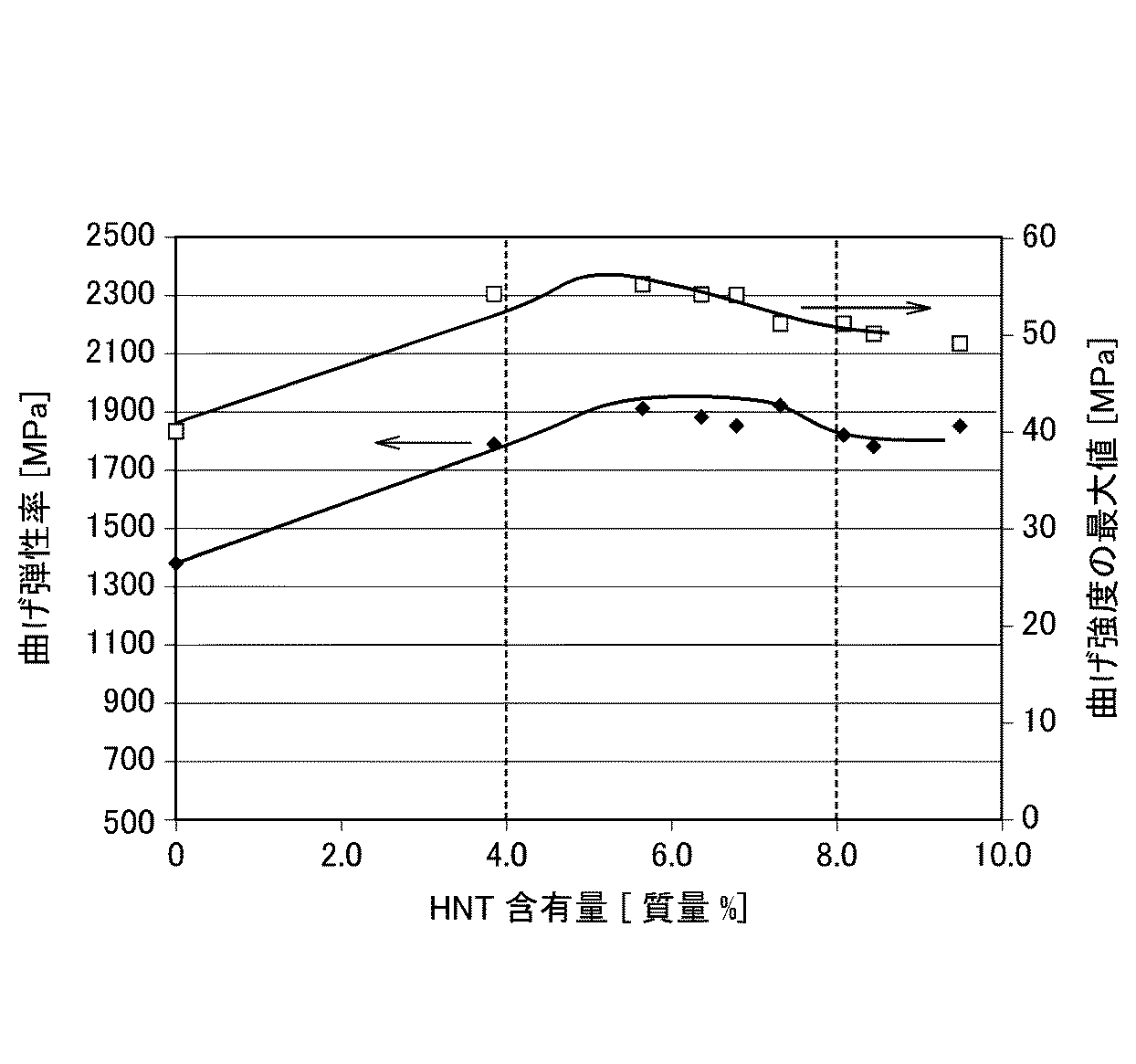
各実施例及び比較例で得たポリプロピレン組成物について、3点曲げ試験を実施した。具体的には、DIN−EN ISO 178に準拠した3点曲げ試験を、以下の条件で実施した。試験結果を図2に示した。
<試験条件>
試験装置:インストロン社製3366型万能材料試験機
試験速度:1mm/分
支持スパン:68mm
試験温度:室温
[3-point bending test]
A three-point bending test was performed on the polypropylene compositions obtained in each of the examples and comparative examples. Specifically, a three-point bending test based on DIN-EN ISO 178 was performed under the following conditions. The test results are shown in FIG.
<Test conditions>
Test equipment: Instron 3366 type universal material testing machine Test speed: 1 mm / min Support span: 68 mm
Test temperature: Room temperature
図1は、ポリプロピレン組成物中のHNT含有量(質量%)と、引張弾性率(MPa)及び引張強度(MPa)との関係を示す図である。図1において、上方の曲線は引張弾性率の挙動を示し、下方の曲線は引張強度の挙動を示している。この図1に示されるように、本実施例に係るポリプロピレン組成物は、比較例に係るポリプロピレン組成物よりも引張弾性率が高いことが分かった。特に、本実施例に係るポリプロピレン組成物では、HNT含有量が4〜8質量%のときに、引張弾性率及び引張強度が向上することが分かった。 FIG. 1 is a diagram showing the relationship between the HNT content (% by mass), the tensile modulus (MPa), and the tensile strength (MPa) in the polypropylene composition. In FIG. 1, the upper curve shows the behavior of the tensile modulus, and the lower curve shows the behavior of the tensile strength. As shown in FIG. 1, it was found that the polypropylene composition according to this example had a higher tensile elastic modulus than the polypropylene composition according to the comparative example. In particular, in the polypropylene composition according to the present example, it was found that the tensile modulus and the tensile strength were improved when the HNT content was 4 to 8% by mass.
図2は、ポリプロピレン組成物中のHNT含有量(質量%)と、曲げ弾性率(MPa)及び曲げ強度の最大値(MPa)との関係を示す図である。図2において、上方の曲線は曲げ強度の最大値を示し、下方の曲線は曲げ弾性率を示している。この図2に示されるように、本実施例に係るポリプロピレン組成物は、比較例に係るポリプロピレン組成物よりも曲げ弾性率及び曲げ強度の最大値が高いことが分かった。特に、本発明に係るポリプロピレン組成物では、HNT含有量が4〜8質量%のときに、曲げ弾性率及び曲げ強度が向上することが分かった。 FIG. 2 is a diagram showing the relationship between the HNT content (% by mass) in the polypropylene composition, the flexural modulus (MPa), and the maximum bending strength (MPa). In FIG. 2, the upper curve indicates the maximum bending strength, and the lower curve indicates the bending elastic modulus. As shown in FIG. 2, it was found that the polypropylene composition according to this example had higher bending elastic modulus and bending strength than the polypropylene composition according to the comparative example. In particular, in the polypropylene composition according to the present invention, it was found that when the HNT content is 4 to 8% by mass, the flexural modulus and the flexural strength are improved.
以上の結果から、本発明に係るポリプロピレン組成物では、HNT含有量が4〜8質量%のときに、弾性率に加え、引張強度(破断伸び)及び曲げ強度が向上することが確認された。 From the above results, it was confirmed that in the polypropylene composition according to the present invention, when the HNT content is 4 to 8% by mass, the tensile strength (breaking elongation) and the bending strength are improved in addition to the elastic modulus.
なお、本願発明は上記実施例に限定されるものではない。例えば、重合触媒としては、ジルコノセンのキラル体に限定されるものではなく、同量のトリブチルアルミニウムを用いても良い。 In addition, this invention is not limited to the said Example. For example, the polymerization catalyst is not limited to a zirconocene chiral compound, and the same amount of tributylaluminum may be used.
Claims (3)
重合触媒をハロイサイトナノチューブに吸着させる吸着工程と、
溶媒にプロピレンモノマーを飽和させる飽和工程と、
前記吸着工程で重合触媒を吸着させたハロイサイトナノチューブと、前記飽和工程でプロピレンモノマーを飽和させた溶媒とを混合する混合工程と、
前記混合工程で混合されたプロピレンモノマーを重合させることで、ポリプロピレン組成物を得る重合工程と、を有することを特徴とするポリプロピレン組成物の製造方法。 A method for producing a polypropylene composition, comprising:
An adsorption step for adsorbing the polymerization catalyst on the halloysite nanotube;
A saturation step of saturating the solvent with propylene monomer;
A mixing step of mixing the halloysite nanotubes adsorbed with the polymerization catalyst in the adsorption step and the solvent saturated with the propylene monomer in the saturation step;
And a polymerization step of obtaining a polypropylene composition by polymerizing the propylene monomer mixed in the mixing step.
Priority Applications (2)
| Application Number | Priority Date | Filing Date | Title |
|---|---|---|---|
| JP2012221254A JP5925100B2 (en) | 2012-10-03 | 2012-10-03 | Method for producing polypropylene composition |
| DE102012221584.0A DE102012221584B4 (en) | 2012-10-03 | 2012-11-26 | Process for preparing a polypropylene composition and polypropylene composition |
Applications Claiming Priority (1)
| Application Number | Priority Date | Filing Date | Title |
|---|---|---|---|
| JP2012221254A JP5925100B2 (en) | 2012-10-03 | 2012-10-03 | Method for producing polypropylene composition |
Publications (2)
| Publication Number | Publication Date |
|---|---|
| JP2014074098A JP2014074098A (en) | 2014-04-24 |
| JP5925100B2 true JP5925100B2 (en) | 2016-05-25 |
Family
ID=50276322
Family Applications (1)
| Application Number | Title | Priority Date | Filing Date |
|---|---|---|---|
| JP2012221254A Expired - Fee Related JP5925100B2 (en) | 2012-10-03 | 2012-10-03 | Method for producing polypropylene composition |
Country Status (2)
| Country | Link |
|---|---|
| JP (1) | JP5925100B2 (en) |
| DE (1) | DE102012221584B4 (en) |
Families Citing this family (3)
| Publication number | Priority date | Publication date | Assignee | Title |
|---|---|---|---|---|
| JP5925100B2 (en) | 2012-10-03 | 2016-05-25 | 本田技研工業株式会社 | Method for producing polypropylene composition |
| WO2017005280A1 (en) | 2015-07-03 | 2017-01-12 | Abb Technology Ltd | Next level nanocomposites for electrical insulation |
| CN108264686B (en) * | 2018-01-19 | 2020-03-10 | 福州大学 | Preparation method of corn rod-shaped polyaniline-loaded halloysite nanotube modified polypropylene |
Family Cites Families (20)
| Publication number | Priority date | Publication date | Assignee | Title |
|---|---|---|---|---|
| US4358400A (en) * | 1981-01-12 | 1982-11-09 | Chevron Research Company | Residual oil processing catalysts |
| US5466766A (en) * | 1991-05-09 | 1995-11-14 | Phillips Petroleum Company | Metallocenes and processes therefor and therewith |
| JP3423506B2 (en) * | 1995-10-26 | 2003-07-07 | 三菱化学株式会社 | Polypropylene resin composition and method for producing the same |
| JP3959132B2 (en) | 1996-03-19 | 2007-08-15 | 住友化学株式会社 | Aluminum compound-containing solid catalyst component, olefin polymerization catalyst, and process for producing olefin polymer |
| US6110858A (en) * | 1996-12-18 | 2000-08-29 | Tosoh Corporation | Olefin polymerization catalysts and process for producing olefin polymers |
| PT954542E (en) * | 1997-01-17 | 2003-02-28 | Korea Ptg Co Ltd | PROCESS FOR THE PREPARATION OF POLYETHETHYLENE DERESTERS ETER GLYCOL USING A HALLOYSITE CATALYST |
| JPH10245418A (en) * | 1997-03-03 | 1998-09-14 | Mitsubishi Chem Corp | Method for producing olefin polymer |
| JPH11106418A (en) * | 1997-09-30 | 1999-04-20 | Idemitsu Petrochem Co Ltd | Catalyst for polymerization of olefin-based monomer, production of olefin-based polymer, and production of styrene-based polymer |
| JP4240634B2 (en) * | 1999-02-12 | 2009-03-18 | 日本ポリプロ株式会社 | Biaxially stretched multilayer film |
| KR20020050892A (en) * | 2000-12-22 | 2002-06-28 | 유현식 | Polyolefin nano-composite |
| CN1261216C (en) * | 2003-05-30 | 2006-06-28 | 中国石油化工股份有限公司 | Hydrocarbon cracking catalyst with molecular sieve and preparing method thereof |
| US8557907B2 (en) * | 2005-08-26 | 2013-10-15 | Macro-M S.A. De C.V. | Reactive block copolymers for the preparation of inorganic tubule-polymer composites |
| US20070148457A1 (en) * | 2005-09-14 | 2007-06-28 | Naturalnano, Inc. | Radiation absorptive composites and methods for production |
| US7776943B2 (en) | 2006-06-12 | 2010-08-17 | The Regents Of The University Of California | Method for forming exfoliated clay-polyolefin nanocomposites |
| CN101134913B (en) * | 2006-08-31 | 2011-05-18 | 中国石油化工股份有限公司 | Hydrocarbons catalytic conversion method |
| CN101134172B (en) * | 2006-08-31 | 2010-10-27 | 中国石油化工股份有限公司 | A hydrocarbon conversion catalyst |
| KR101540680B1 (en) * | 2008-01-09 | 2015-07-30 | 차이나 페트로리움 앤드 케미컬 코포레이션 | A catalyst for converting acid-containing inferior curde oil, and processes for making and using same |
| CN103210020B (en) * | 2010-10-25 | 2015-01-14 | 应用矿物公司 | Nucleating agent for polyethylene |
| JP2012221254A (en) | 2011-04-08 | 2012-11-12 | Fujitsu Ltd | Parallel processing optimization device and simulation program |
| JP5925100B2 (en) | 2012-10-03 | 2016-05-25 | 本田技研工業株式会社 | Method for producing polypropylene composition |
-
2012
- 2012-10-03 JP JP2012221254A patent/JP5925100B2/en not_active Expired - Fee Related
- 2012-11-26 DE DE102012221584.0A patent/DE102012221584B4/en not_active Expired - Fee Related
Also Published As
| Publication number | Publication date |
|---|---|
| DE102012221584B4 (en) | 2019-09-26 |
| JP2014074098A (en) | 2014-04-24 |
| DE102012221584A1 (en) | 2014-04-03 |
Similar Documents
| Publication | Publication Date | Title |
|---|---|---|
| CN101679556B (en) | Super-solution homogeneous propylene polymerization | |
| TWI654208B (en) | Method for producing olefin polymer | |
| CN104507986B (en) | Heterocyclic organic compounds as electron donors for polyolefin catalysts | |
| JP5680637B2 (en) | Production method of polydienes | |
| JP5993879B2 (en) | Anti-vibration rubber composition, crosslinked anti-vibration rubber composition and anti-vibration rubber | |
| HK1049174A1 (en) | Organometal catalyst compositions | |
| JP5925100B2 (en) | Method for producing polypropylene composition | |
| JP5898977B2 (en) | Anti-vibration rubber composition, crosslinked anti-vibration rubber composition and anti-vibration rubber | |
| JP6697452B2 (en) | Oxalic acid diamide as a modifier for polyolefin catalysts | |
| CN103992437B (en) | Preparation and application of macromolecular silane coupling agent used for ethylene propylene diene monomer rubber | |
| JP5891048B2 (en) | Anti-vibration rubber composition, crosslinked anti-vibration rubber composition and anti-vibration rubber | |
| JP5893937B2 (en) | Anti-vibration rubber composition, crosslinked anti-vibration rubber composition and anti-vibration rubber | |
| JP2013155301A (en) | Vibration-proof rubber composition and vibration-proof rubber | |
| CN104854177A (en) | Processes for preparing epoxidized polymers | |
| JP5845099B2 (en) | Anti-vibration rubber composition, crosslinked anti-vibration rubber composition and anti-vibration rubber | |
| JP4368397B2 (en) | Method for producing solid titanium catalyst for olefin polymerization | |
| JP6519466B2 (en) | Method of drying polymer powder | |
| CN1150214C (en) | α-Olefin Polymerization Catalyst System and Its Application in α-Olefin Polymerization | |
| CN106928379A (en) | Preparation method of composite carrier for polyolefin and application of composite carrier | |
| JP5735897B2 (en) | Anti-vibration rubber composition, crosslinked anti-vibration rubber composition and anti-vibration rubber | |
| JP5990426B2 (en) | Method for producing polymerization catalyst composition and polymerization catalyst composition | |
| CN1840553A (en) | Ethylene-alpha-olefin copolymer | |
| CN1267191C (en) | organometallic catalyst composition | |
| TW201925304A (en) | Polymer blend | |
| JP4952168B2 (en) | Method for producing vinyl cis-polybutadiene composition |
Legal Events
| Date | Code | Title | Description |
|---|---|---|---|
| A621 | Written request for application examination |
Free format text: JAPANESE INTERMEDIATE CODE: A621 Effective date: 20141128 |
|
| A131 | Notification of reasons for refusal |
Free format text: JAPANESE INTERMEDIATE CODE: A131 Effective date: 20150929 |
|
| A977 | Report on retrieval |
Free format text: JAPANESE INTERMEDIATE CODE: A971007 Effective date: 20150930 |
|
| A521 | Request for written amendment filed |
Free format text: JAPANESE INTERMEDIATE CODE: A523 Effective date: 20151116 |
|
| TRDD | Decision of grant or rejection written | ||
| A01 | Written decision to grant a patent or to grant a registration (utility model) |
Free format text: JAPANESE INTERMEDIATE CODE: A01 Effective date: 20160412 |
|
| A61 | First payment of annual fees (during grant procedure) |
Free format text: JAPANESE INTERMEDIATE CODE: A61 Effective date: 20160419 |
|
| R150 | Certificate of patent or registration of utility model |
Ref document number: 5925100 Country of ref document: JP Free format text: JAPANESE INTERMEDIATE CODE: R150 |
|
| LAPS | Cancellation because of no payment of annual fees |