JP5719172B2 - Refrigerated storage of organ-cultured skin equivalents for clinical use - Google Patents
Refrigerated storage of organ-cultured skin equivalents for clinical use Download PDFInfo
- Publication number
- JP5719172B2 JP5719172B2 JP2010534213A JP2010534213A JP5719172B2 JP 5719172 B2 JP5719172 B2 JP 5719172B2 JP 2010534213 A JP2010534213 A JP 2010534213A JP 2010534213 A JP2010534213 A JP 2010534213A JP 5719172 B2 JP5719172 B2 JP 5719172B2
- Authority
- JP
- Japan
- Prior art keywords
- packaging container
- gel support
- cells
- organ
- skin equivalent
- Prior art date
- Legal status (The legal status is an assumption and is not a legal conclusion. Google has not performed a legal analysis and makes no representation as to the accuracy of the status listed.)
- Expired - Fee Related
Links
Images


Classifications
-
- A—HUMAN NECESSITIES
- A01—AGRICULTURE; FORESTRY; ANIMAL HUSBANDRY; HUNTING; TRAPPING; FISHING
- A01N—PRESERVATION OF BODIES OF HUMANS OR ANIMALS OR PLANTS OR PARTS THEREOF; BIOCIDES, e.g. AS DISINFECTANTS, AS PESTICIDES OR AS HERBICIDES; PEST REPELLANTS OR ATTRACTANTS; PLANT GROWTH REGULATORS
- A01N1/00—Preservation of bodies of humans or animals, or parts thereof
- A01N1/10—Preservation of living parts
-
- A—HUMAN NECESSITIES
- A01—AGRICULTURE; FORESTRY; ANIMAL HUSBANDRY; HUNTING; TRAPPING; FISHING
- A01N—PRESERVATION OF BODIES OF HUMANS OR ANIMALS OR PLANTS OR PARTS THEREOF; BIOCIDES, e.g. AS DISINFECTANTS, AS PESTICIDES OR AS HERBICIDES; PEST REPELLANTS OR ATTRACTANTS; PLANT GROWTH REGULATORS
- A01N1/00—Preservation of bodies of humans or animals, or parts thereof
- A01N1/10—Preservation of living parts
- A01N1/12—Chemical aspects of preservation
- A01N1/128—Chemically defined matrices for immobilising, holding or storing living parts, e.g. alginate gels; Chemically altering living parts, e.g. by cross-linking
-
- A—HUMAN NECESSITIES
- A01—AGRICULTURE; FORESTRY; ANIMAL HUSBANDRY; HUNTING; TRAPPING; FISHING
- A01N—PRESERVATION OF BODIES OF HUMANS OR ANIMALS OR PLANTS OR PARTS THEREOF; BIOCIDES, e.g. AS DISINFECTANTS, AS PESTICIDES OR AS HERBICIDES; PEST REPELLANTS OR ATTRACTANTS; PLANT GROWTH REGULATORS
- A01N1/00—Preservation of bodies of humans or animals, or parts thereof
- A01N1/10—Preservation of living parts
- A01N1/14—Mechanical aspects of preservation; Apparatus or containers therefor
- A01N1/146—Non-refrigerated containers specially adapted for transporting or storing living parts whilst preserving
-
- A—HUMAN NECESSITIES
- A01—AGRICULTURE; FORESTRY; ANIMAL HUSBANDRY; HUNTING; TRAPPING; FISHING
- A01N—PRESERVATION OF BODIES OF HUMANS OR ANIMALS OR PLANTS OR PARTS THEREOF; BIOCIDES, e.g. AS DISINFECTANTS, AS PESTICIDES OR AS HERBICIDES; PEST REPELLANTS OR ATTRACTANTS; PLANT GROWTH REGULATORS
- A01N1/00—Preservation of bodies of humans or animals, or parts thereof
- A01N1/10—Preservation of living parts
- A01N1/14—Mechanical aspects of preservation; Apparatus or containers therefor
- A01N1/146—Non-refrigerated containers specially adapted for transporting or storing living parts whilst preserving
- A01N1/148—Non-refrigerated containers specially adapted for transporting or storing living parts whilst preserving with provisions specially adapted for transporting
Landscapes
- Life Sciences & Earth Sciences (AREA)
- Health & Medical Sciences (AREA)
- Zoology (AREA)
- Dentistry (AREA)
- General Health & Medical Sciences (AREA)
- Wood Science & Technology (AREA)
- Engineering & Computer Science (AREA)
- Environmental Sciences (AREA)
- Micro-Organisms Or Cultivation Processes Thereof (AREA)
- Materials For Medical Uses (AREA)
- Chemical & Material Sciences (AREA)
- Dispersion Chemistry (AREA)
- Hematology (AREA)
Description
本発明は、先端技術プログラム(Advanced Technology Program)により付与された助成金番号NIST 70NANB3H3011による政府の支援を受けてなされた。米国政府は本発明において一定の権利を有する。 This invention was made with government support from grant number NIST 70NANB3H3011 awarded by the Advanced Technology Program. The US government has certain rights in this invention.
発明の分野
本発明は、概して、ヒト患者への皮膚移植に用いられる、器官培養によって作られた皮膚同等物を発送および保管するためのシステムおよび方法に関する。
The present invention relates generally to systems and methods for shipping and storing skin equivalents made by organ culture used for skin transplantation in human patients.
背景
新しく浮上しつつあるティッシュエンジニアリング(TE)分野は、今後10年の間に、臓器の疾患および機能不全の処置において、かなり進歩する態勢が整っている。2001年に、米国(U.S.)および欧州での販売が認可された、細胞をベースとする治療法は23あった。このうち、9つが皮膚代用品または皮膚移植片であり、100を超える製品が開発中であった(De Bree, Genomics-based Drug Data Report and Regenerative Therapy (1)2:77-96 (2001)(非特許文献1))。2007年には、操作された組織(engineered tissue)、細胞をベースとする治療法、または関連技術の開発に、およそ100社が関与していた(Applied Data Research, February 2007)。全体的に見て、この産業の1995〜2001年の年間成長率は16%であった。「構造」産業セグメント(例えば、皮膚、骨、軟骨)の1998〜2001年の成長率は85%であった。2004年において、ティッシュエンジニアリングによる皮膚代替品/代用品および活性のある創傷修復モジュレーターの米国市場は、約1億9500万ドルであった。売上高は9.5%の複合年間成長率で増加し、2014年には約4億8100万ドルに達すると予想されている(MedTech Insight, Windhover Information, September 2005)。先端創傷治療技術の全米国市場は、2005年では230億ドル超であった。2006年末までに、この市場は260億ドル近くに達し、5年間にわたって12.3%の平均年間成長率で成長し、2011年には460億ドルに達するであろう(BCC Research, PHM011E, January 2007)。創傷治療の世界市場は2006年では72億米ドルと推定され、2つのセクター、従来のセクターおよび先端セクターからなる(Espicom Business Intelligence, 2007)。従来の創傷治療製品は、主に、織布および不織布のスポンジ、ぴったり密着する包帯、ならびに非粘着性包帯などのローテクのガーゼ包帯からなる。先端創傷治療セグメント(世界で41億米ドル)は、年10%の2桁成長で、最も急速に成長している分野である(Espicom Business Intelligence, 2007)。
BACKGROUND The emerging tissue engineering (TE) field is poised to make significant progress in the treatment of organ disease and dysfunction over the next decade. In 2001, there were 23 cell-based therapies approved for sale in the United States (US) and Europe. Of these, nine were skin substitutes or skin grafts, and over 100 products were under development (De Bree, Genomics-based Drug Data Report and Regenerative Therapy (1) 2: 77-96 (2001)) Non-patent document 1)). In 2007, approximately 100 companies were involved in the development of engineered tissue, cell-based therapies, or related technologies (Applied Data Research, February 2007). Overall, the annual growth rate for this industry from 1995 to 2001 was 16%. The growth rate from 1998 to 2001 in the “structural” industry segment (eg skin, bone, cartilage) was 85%. In 2004, the US market for tissue engineering skin substitutes / substitutes and active wound repair modulators was approximately $ 195 million. Sales are expected to increase at a compound annual growth rate of 9.5%, reaching approximately $ 481 million in 2014 (MedTech Insight, Windhover Information, September 2005). The total US market for advanced wound care technology was over $ 23 billion in 2005. By the end of 2006, this market will have reached nearly $ 26 billion and will grow at an average annual growth rate of 12.3% over five years, reaching $ 46 billion in 2011 (BCC Research, PHM011E, January 2007) . The global market for wound care is estimated at USD 7.2 billion in 2006 and consists of two sectors, traditional and advanced sectors (Espicom Business Intelligence, 2007). Conventional wound care products mainly consist of low-tech gauze bandages such as woven and non-woven sponges, snug bandages, and non-adhesive bandages. The Advanced Wound Treatment segment (US $ 4.1 billion worldwide) is the fastest growing area with double-digit growth of 10% per year (Espicom Business Intelligence, 2007).
ヒトの健康分野において、操作された組織および臓器の画期的なかつ経済的に重要な申請が数多く存在するが、この産業の全ての経済的潜在能力は達成したとは言い難い。現在、これらの技術における35億ドル超の国際投資にもかかわらず、世界中のティッシュエンジニアリング公開会社のうち一社しか利益を出していない(Lysaght and Reyes, Tissue Engineering 7(5):485-93 (2001)(非特許文献2))。 Although there are many innovative and economically important applications for engineered tissues and organs in the human health field, it is difficult to say that the full economic potential of this industry has been achieved. Currently, despite over $ 3.5 billion in international investments in these technologies, only one of the world's public tissue engineering companies is profitable (Lysaght and Reyes, Tissue Engineering 7 (5): 485-93 (2001) (Non-Patent Document 2)).
操作された組織が医療従事者、 医療提供者、および関係者(second party payer)に受け入れられるのを妨げている主因は、操作された組織を効果的かつ効率的に保存する手段が無いことである。生細胞および組織製品の特質のために、長期間の保管は実現不可能である。現行の操作された組織は、多くの場合、生存率および機能を維持するために注意深く管理された条件下で保管および発送しなければならない。典型的には、操作された組織製品は生産するのに数週間または数週間かかるが、製造して数時間後または数日後に使用しなければならない。結果として、TE企業は、最大生産能力で生産設備を連続操業し、棚卸資産損失(すなわち、廃棄しなければならない売れ残った製品)の費用を負担しなければならない。ただでさえ費用のかかる製造プロセスに加えて、これらの棚卸資産損失は、価格を非現実的な水準に追い込んでいる。具体的な一例として、APLIGRAFは、製造に約4週間必要であり、10日未満で用いられ、使用するまで20〜23℃に維持しなければならない。別の例として、EPICELは、携帯型インキュベーターに入れられて、看護師がマサチューセッツ州ケンブリッジから使用現場まで運び、到着したらすぐに用いられる。このような制約のために、便利でかつ費用対効果の大きい製品を開発することが大きな課題となっている。 The main reason preventing the manipulated tissue from being accepted by health professionals, healthcare providers, and second party payers is the lack of an effective and efficient means of storing the manipulated tissue. is there. Due to the nature of living cells and tissue products, long-term storage is not feasible. Current engineered tissues often have to be stored and shipped under carefully controlled conditions to maintain viability and function. Typically, engineered tissue products take weeks or weeks to produce, but must be used hours or days after manufacture. As a result, TE companies must operate production equipment continuously at maximum production capacity and bear the cost of inventory loss (ie, unsold products that must be discarded). In addition to costly manufacturing processes, these inventory losses are driving prices to unrealistic levels. As a specific example, APLIGRAF requires about 4 weeks to manufacture, is used in less than 10 days, and must be maintained at 20-23 ° C. until use. As another example, EPICEL is placed in a portable incubator where nurses are transported from Cambridge, Massachusetts to the point of use and used as soon as they arrive. Because of these constraints, it has become a major challenge to develop convenient and cost-effective products.
保管問題の解決策として凍結保存が検討されてきたが、氷の形成、冷害、および浸透圧平衡により組織損傷を誘導することが知られている。APLIGRAFの他に、他の唯一認可されている、生きた皮膚同等物であるORCELが、凍結製品として、現在、臨床試験されているが、使用前に-100℃より低い温度で維持しなければならないという欠点がある。このことは、高価で、危険で、かつあらゆる場所(例えば、地方の診療所および野戦病院)で利用可能な液体窒素保管を使用することを意味している。さらに、凍結製品の配達には、使用前に組織を首尾よく解凍するために、エンドユーザー側での特別な訓練が必要である。 Cryopreservation has been considered as a solution to the storage problem, but it is known to induce tissue damage through ice formation, cold damage, and osmotic balance. In addition to APLIGRAF, ORCEL, the only other approved, live skin equivalent, is currently being clinically tested as a frozen product, but must be maintained at temperatures below -100 ° C prior to use. There is a disadvantage of not becoming. This means using liquid nitrogen storage that is expensive, dangerous, and available everywhere (eg, local clinics and field hospitals). In addition, the delivery of frozen products requires special training on the end user side to successfully thaw the tissue before use.
従って、当技術分野において必要とされているものは、使用現場で日常的に利用できる条件下で保管するために、操作された組織および細胞を調製する改善した方法である。全ての医療施設には冷蔵保管庫があるので、標準的な冷蔵庫に入れて長期間、保管することができる皮膚同等物が開発されれば、これらの製品の利用可能性および臨床上の有用性が大幅に改善するだろう。 Accordingly, what is needed in the art is an improved method of preparing engineered tissues and cells for storage under conditions that are routinely available at the point of use. All medical facilities have refrigerated storage, so if a skin equivalent that can be stored for a long time in a standard refrigerator is developed, the availability and clinical utility of these products Will improve significantly.
いくつかの態様において、本発明は、器官培養された皮膚同等物を使用者に発送し、ヒト患者に対する皮膚移植処置において皮膚同等物を使用する方法を提供する。この方法は、真皮層および表皮層を含む器官培養された皮膚同等物、ならびにゲル支持体を含む滅菌包装容器を準備する工程;皮膚同等物がゲル支持体と接触するように、無菌条件下で皮膚同等物を滅菌包装容器に入れる工程;滅菌包装容器の温度を摂氏2〜8℃に下げる工程;摂氏2〜8℃で滅菌包装容器を使用者に発送する工程;使用現場で滅菌包装容器を摂氏2〜8℃で保管する工程であって、ここで、滅菌包装容器の無菌性および完全性は維持される、工程;ならびに包装容器から器官培養された皮膚同等物を取り出し、培養工程が間に入ることなく、患者に適用する工程を含む。本発明は、特定のタイプのケラチノサイトを含む皮膚同等物に限定されない。いくつかの態様において、器官培養された皮膚同等物は、NIKS細胞を含む。本発明は、特定のタイプのゲル支持体に限定されない。いくつかの態様において、ゲル支持体はアガロースゲル支持体である。本発明は、特定のタイプの滅菌包装容器に限定されない。いくつかの態様において、滅菌包装容器はヒートシール可能である。さらなる態様において、皮膚同等物は透過性膜を介してゲル支持体と接触する。 In some embodiments, the present invention provides a method of shipping an organ-cultured skin equivalent to a user and using the skin equivalent in a skin transplant procedure for a human patient. This method comprises the steps of providing an organ-cultured skin equivalent comprising a dermal layer and an epidermal layer, and a sterile packaging container comprising a gel support; under aseptic conditions such that the skin equivalent is in contact with the gel support. The process of placing the skin equivalent in a sterile packaging container; the process of lowering the temperature of the sterile packaging container to 2-8 ° C; the process of sending the sterile packaging container to the user at 2-8 ° C; Storage at 2-8 degrees Celsius, wherein the sterility and integrity of the sterile packaging container is maintained; and the organ-cultured skin equivalent is removed from the packaging container and the incubation process is Applying to the patient without entering. The present invention is not limited to skin equivalents containing a particular type of keratinocytes. In some embodiments, the organ-cultured skin equivalent comprises NIKS cells. The present invention is not limited to a particular type of gel support. In some embodiments, the gel support is an agarose gel support. The present invention is not limited to a particular type of sterile packaging container. In some embodiments, the sterile packaging container is heat sealable. In a further embodiment, the skin equivalent contacts the gel support through a permeable membrane.
いくつかの態様において、本発明は、皮膚移植処置において使用するための器官培養された皮膚同等物を発送および保管する方法を提供する。この方法は、真皮層および表皮層を含む器官培養された皮膚同等物、ならびにゲル支持体を含む滅菌包装容器を準備する工程;包装日に、皮膚同等物がゲル支持体と接触するように、無菌条件下で皮膚同等物を滅菌包装容器に入れる工程;滅菌包装容器の温度を摂氏2〜8℃に下げる工程;摂氏2〜8℃で滅菌包装容器を使用者に発送する工程;使用現場で滅菌包装容器を摂氏2〜8℃で保管する工程であって、ここで、滅菌包装容器の無菌性および完全性は、包装日から8〜15日間、維持される、工程を含む。本発明は、特定のタイプのケラチノサイトを含む皮膚同等物に限定されない。いくつかの態様において、器官培養された皮膚同等物は、NIKS細胞を含む。本発明は、特定のタイプのゲル支持体に限定されない。いくつかの態様において、ゲル支持体はアガロースゲル支持体である。本発明は、特定のタイプの滅菌包装容器に限定されない。いくつかの態様において、滅菌包装容器はヒートシール可能である。さらなる態様において、皮膚同等物は透過性膜を介してゲル支持体と接触する。 In some embodiments, the present invention provides a method for shipping and storing organ-cultured skin equivalents for use in skin graft procedures. The method comprises the steps of providing an organ-cultured skin equivalent comprising a dermis layer and an epidermis layer, and a sterile packaging container comprising a gel support; on the packaging day, such that the skin equivalent is in contact with the gel support Placing the skin equivalent in a sterile packaging container under aseptic conditions; lowering the temperature of the sterile packaging container to 2-8 ° C .; sending the sterile packaging container to the user at 2-8 ° C .; Storing the sterile packaging container at 2-8 degrees Celsius, wherein the sterility and integrity of the sterile packaging container is maintained for 8-15 days from the packaging date. The present invention is not limited to skin equivalents containing a particular type of keratinocytes. In some embodiments, the organ-cultured skin equivalent comprises NIKS cells. The present invention is not limited to a particular type of gel support. In some embodiments, the gel support is an agarose gel support. The present invention is not limited to a particular type of sterile packaging container. In some embodiments, the sterile packaging container is heat sealable. In a further embodiment, the skin equivalent contacts the gel support through a permeable membrane.
いくつかの態様において、本発明は、皮膚移植処置において使用するための器官培養された皮膚同等物を、使用者に発送する方法を提供する。この方法は、真皮層および表皮層を含む器官培養された皮膚同等物、ならびにゲル支持体を含む滅菌包装容器を準備する工程であって、ゲル支持体は最少培地を用いて形成される、工程;皮膚同等物がゲル支持体と接触するように、無菌条件下で皮膚同等物を滅菌包装容器に入れる工程;滅菌包装容器の温度を摂氏2〜8℃に下げる工程;摂氏2〜8℃で滅菌包装容器を使用者に発送する工程;使用現場で滅菌包装容器を摂氏2〜8℃で保管する工程であって、ここで、滅菌包装容器の無菌性および完全性は維持される、工程を含む。本発明は、特定のタイプのケラチノサイトを含む皮膚同等物に限定されない。いくつかの態様において、器官培養された皮膚同等物は、NIKS細胞を含む。本発明は、特定のタイプのゲル支持体に限定されない。いくつかの態様において、ゲル支持体はアガロースゲル支持体である。本発明は、特定のタイプの滅菌包装容器に限定されない。いくつかの態様において、滅菌包装容器はヒートシール可能である。さらなる態様において、皮膚同等物は透過性膜を介してゲル支持体と接触する。 In some embodiments, the present invention provides a method of shipping an organ-cultured skin equivalent for use in a skin transplant procedure to a user. The method comprises the steps of providing an organ-cultured skin equivalent comprising a dermis layer and an epidermis layer, and a sterile packaging container comprising a gel support, wherein the gel support is formed using a minimal medium. Placing the skin equivalent in a sterile packaging container under aseptic conditions such that the skin equivalent is in contact with the gel support; reducing the temperature of the sterile packaging container to 2-8 degrees Celsius; at 2-8 degrees Celsius Sending the sterilized packaging container to the user; storing the sterilized packaging container at 2-8 degrees Celsius at the point of use, wherein the sterility and integrity of the sterile packaging container is maintained; Including. The present invention is not limited to skin equivalents containing a particular type of keratinocytes. In some embodiments, the organ-cultured skin equivalent comprises NIKS cells. The present invention is not limited to a particular type of gel support. In some embodiments, the gel support is an agarose gel support. The present invention is not limited to a particular type of sterile packaging container. In some embodiments, the sterile packaging container is heat sealable. In a further embodiment, the skin equivalent contacts the gel support through a permeable membrane.
いくつかの態様において、本発明は、最少培地を含むゲル支持体を含む、発送チャンバーと、ゲル支持体と接触している透過性膜上で支持されている、皮膚同等物とを含む、キットであって、発送チャンバーは、滅菌した袋を用いて収容されている、キットを提供する。本発明は、特定のタイプのケラチノサイトを含む皮膚同等物に限定されない。いくつかの態様において、器官培養された皮膚同等物は、NIKS細胞を含む。本発明は、特定のタイプのゲル支持体に限定されない。いくつかの態様において、ゲル支持体はアガロースゲル支持体である。本発明は、特定のタイプの滅菌包装容器に限定されない。いくつかの態様において、滅菌包装容器はヒートシール可能である。さらなる態様において、皮膚同等物は透過性膜を介してゲル支持体と接触する。 In some embodiments, the invention comprises a kit comprising a shipping chamber comprising a gel support comprising a minimal medium and a skin equivalent supported on a permeable membrane in contact with the gel support. The shipping chamber then provides a kit that is housed using a sterile bag. The present invention is not limited to skin equivalents containing a particular type of keratinocytes. In some embodiments, the organ-cultured skin equivalent comprises NIKS cells. The present invention is not limited to a particular type of gel support. In some embodiments, the gel support is an agarose gel support. The present invention is not limited to a particular type of sterile packaging container. In some embodiments, the sterile packaging container is heat sealable. In a further embodiment, the skin equivalent contacts the gel support through a permeable membrane.
いくつかの態様において、本発明は、チャンバー上部およびチャンバー底部を含み、チャンバー底部の表面にゲル支持体が載っている発送チャンバーを含み、ゲル支持体と接触している透過性膜の上に皮膚同等物をさらに含み、チャンバー上部がチャンバー底部の上に配置されると、皮膚同等物がゲル支持体に載って固定されるように、チャンバー上部から延びる延長部分をさらに含む、製造物品をさらに提供する。いくつかの態様において、ゲル支持体は最少培地を用いて形成される。
[本発明1001]
器官培養された皮膚同等物を使用者に発送し、ヒト患者に対する皮膚移植処置において該皮膚同等物を使用する方法であって、以下の工程を含む方法:
真皮層および表皮層を含む、該器官培養された皮膚同等物、ならびにゲル支持体を含む滅菌包装容器を準備する工程;
該皮膚同等物が該ゲル支持体と接触するように、無菌条件下で該皮膚同等物を滅菌包装容器に入れる工程;
該滅菌包装容器の温度を摂氏2〜8℃に下げる工程;
摂氏2〜8℃で該滅菌包装容器を使用者に発送する工程;
使用現場で該滅菌包装容器を摂氏2〜8℃で保管する工程であって、ここで、滅菌包装容器の無菌性および完全性は維持される、工程;ならびに
該包装容器から該器官培養された皮膚同等物を取り出し、培養工程が間に入ることなく、患者に適用する工程。
[本発明1002]
器官培養された皮膚同等物がNIKS細胞を含む、本発明1001の方法。
[本発明1003]
ゲル支持体がアガロースゲル支持体である、本発明1001の方法。
[本発明1004]
滅菌包装容器がヒートシール可能である、本発明1001の方法。
[本発明1005]
皮膚同等物が透過性膜を介してゲル支持体と接触する、本発明1001の方法。
[本発明1006]
皮膚移植処置において使用するための器官培養された皮膚同等物を発送および保管する方法であって、以下の工程を含む方法:
真皮層および表皮層を含む、該器官培養された皮膚同等物、ならびにゲル支持体を含む滅菌包装容器を準備する工程;
包装日に、該皮膚同等物が該ゲル支持体と接触するように、無菌条件下で該皮膚同等物を滅菌包装容器に入れる工程;
該滅菌包装容器の温度を摂氏2〜8℃に下げる工程;
摂氏2〜8℃で該滅菌包装容器を使用者に発送する工程;
使用現場で該滅菌包装容器を摂氏2〜8℃で保管する工程であって、ここで、滅菌包装容器の無菌性および完全性は、該包装日から8〜15日間、維持される、工程。
[本発明1007]
器官培養された皮膚同等物がNIKS細胞を含む、本発明1006の方法。
[本発明1008]
ゲル支持体がアガロースゲル支持体である、本発明1006の方法。
[本発明1009]
滅菌包装容器がヒートシール可能である、本発明1006の方法。
[本発明1010]
皮膚同等物が透過性膜を介してゲル支持体と接触する、本発明1006の方法。
[本発明1011]
皮膚移植処置において使用するための器官培養された皮膚同等物を、使用者に発送する方法であって、以下の工程を含む方法:
真皮層および表皮層を含む、該器官培養された皮膚同等物、ならびにゲル支持体を含む滅菌包装容器を準備する工程であって、該ゲル支持体が最少培地を用いて形成される、工程;
該皮膚同等物が該ゲル支持体と接触するように、無菌条件下で該皮膚同等物を滅菌包装容器に入れる工程;
該滅菌包装容器の温度を摂氏2〜8℃に下げる工程;
摂氏2〜8℃で該滅菌包装容器を使用者に発送する工程;
使用現場で該滅菌包装容器を摂氏2〜8℃で保管する工程であって、ここで、滅菌包装容器の無菌性および完全性は維持される、工程。
[本発明1012]
器官培養された皮膚同等物がNIKS細胞を含む、本発明1011の方法。
[本発明1013]
ゲル支持体がアガロースゲル支持体である、本発明1011の方法。
[本発明1014]
滅菌包装容器がヒートシール可能である、本発明1011の方法。
[本発明1015]
皮膚同等物が透過性膜を介してゲル支持体と接触する、本発明1011の方法。
[本発明1016]
最少培地を含むゲル支持体を含む、発送チャンバーと、
該ゲル支持体と接触している透過性膜上で支持されている、皮膚同等物
とを含む、キットであって、該発送チャンバーは、滅菌した袋を用いて収容されている、キット。
[本発明1017]
器官培養された皮膚同等物がNIKS細胞を含む、本発明1016のキット。
[本発明1018]
ゲル支持体がアガロースゲル支持体である、本発明1016のキット。
[本発明1019]
滅菌包装容器がヒートシール可能である、本発明1016のキット。
[本発明1020]
皮膚同等物が透過性膜を介してゲル支持体と接触する、本発明1016のキット。
[本発明1021]
チャンバー上部およびチャンバー底部を有し、チャンバー底部の表面にゲル支持体が載っている発送チャンバーを含み、該ゲル支持体と接触している透過性膜の上に皮膚同等物をさらに含み、該チャンバー上部が該チャンバー底部の上に配置されると、該皮膚同等物が該ゲル支持体に載って固定されるように、該チャンバー上部から延びる延長部分をさらに含む、物品。
[本発明1022]
ゲル支持体が最少培地を用いて形成される、本発明1021の物品。
In some embodiments, the present invention includes a delivery chamber that includes a chamber top and a chamber bottom, the gel support resting on a surface of the chamber bottom, and the skin over the permeable membrane in contact with the gel support. Further provided is an article of manufacture that further includes an equivalent and further includes an extension that extends from the top of the chamber such that the skin equivalent rests on the gel support when the chamber top is positioned over the chamber bottom. To do. In some embodiments, the gel support is formed using a minimal medium.
[Invention 1001]
A method of shipping an organ-cultured skin equivalent to a user and using the skin equivalent in a skin transplantation procedure for a human patient comprising the following steps:
Providing a sterile packaging container comprising the organ-cultured skin equivalent comprising a dermis layer and an epidermis layer, and a gel support;
Placing the skin equivalent in a sterile packaging container under aseptic conditions such that the skin equivalent contacts the gel support;
Lowering the temperature of the sterile packaging container to 2-8 ° C .;
Shipping the sterilized packaging container to the user at 2-8 degrees Celsius;
Storing the sterile packaging container at a point of use at 2-8 degrees Celsius, wherein the sterility and integrity of the sterile packaging container is maintained; and
A step of taking out the organ-cultured skin equivalent from the packaging container and applying it to the patient without intervening the culture step.
[Invention 1002]
The method of the present invention 1001, wherein the organ-cultured skin equivalent comprises NIKS cells.
[Invention 1003]
The method of the present invention 1001, wherein the gel support is an agarose gel support.
[Invention 1004]
The method of the present invention 1001, wherein the sterile packaging container is heat sealable.
[Invention 1005]
The method of the present invention 1001, wherein the skin equivalent is contacted with the gel support through a permeable membrane.
[Invention 1006]
A method of shipping and storing an organ-cultured skin equivalent for use in a skin graft procedure comprising the following steps:
Providing a sterile packaging container comprising the organ-cultured skin equivalent comprising a dermis layer and an epidermis layer, and a gel support;
Placing the skin equivalent in a sterile packaging container under aseptic conditions such that the skin equivalent contacts the gel support on the packaging date;
Lowering the temperature of the sterile packaging container to 2-8 ° C .;
Shipping the sterilized packaging container to the user at 2-8 degrees Celsius;
Storing the sterile packaging container at 2-8 degrees Celsius at the point of use, wherein the sterility and integrity of the sterile packaging container is maintained for 8-15 days from the packaging date.
[Invention 1007]
The method of the present invention 1006, wherein the organ-cultured skin equivalent comprises NIKS cells.
[Invention 1008]
The method of the present invention 1006, wherein the gel support is an agarose gel support.
[Invention 1009]
The method of the present invention 1006, wherein the sterile packaging container is heat sealable.
[Invention 1010]
The method of the present invention 1006, wherein the skin equivalent is contacted with the gel support through a permeable membrane.
[Invention 1011]
A method of shipping an organ-cultured skin equivalent for use in a skin transplant procedure to a user, comprising the following steps:
Providing the organ-cultured skin equivalent comprising a dermis layer and an epidermis layer, and a sterile packaging container comprising a gel support, wherein the gel support is formed using a minimal medium;
Placing the skin equivalent in a sterile packaging container under aseptic conditions such that the skin equivalent contacts the gel support;
Lowering the temperature of the sterile packaging container to 2-8 ° C .;
Shipping the sterilized packaging container to the user at 2-8 degrees Celsius;
Storing the sterile packaging container at 2-8 degrees Celsius at the point of use, wherein the sterility and integrity of the sterile packaging container is maintained.
[Invention 1012]
The method of the present invention 1011 wherein the organ-cultured skin equivalent comprises NIKS cells.
[Invention 1013]
The method of the present invention 1011 wherein the gel support is an agarose gel support.
[Invention 1014]
The method of the present invention 1011, wherein the sterile packaging container is heat sealable.
[Invention 1015]
The method of the present invention 1011 wherein the skin equivalent is contacted with the gel support through a permeable membrane.
[Invention 1016]
A shipping chamber comprising a gel support comprising a minimal medium;
A skin equivalent supported on a permeable membrane in contact with the gel support
And the delivery chamber is housed using a sterilized bag.
[Invention 1017]
The kit of the present invention 1016, wherein the organ-cultured skin equivalent comprises NIKS cells.
[Invention 1018]
The kit of the present invention 1016, wherein the gel support is an agarose gel support.
[Invention 1019]
The kit of the present invention 1016, wherein the sterile packaging container is heat sealable.
[Invention 1020]
The kit of the present invention 1016, wherein the skin equivalent is contacted with the gel support through a permeable membrane.
[Invention 1021]
A delivery chamber having a chamber top and a chamber bottom with a gel support resting on a surface of the chamber bottom, further comprising a skin equivalent on a permeable membrane in contact with the gel support, the chamber An article further comprising an extension extending from the top of the chamber such that the skin equivalent rests on the gel support when the top is positioned over the bottom of the chamber.
[Invention 1022]
The article of the invention 1021 wherein the gel support is formed using a minimal medium.
定義
本明細書で使用する「ヒト皮膚同等物」および「ヒト皮膚代用物」という用語は、重層して扁平上皮になっている、インビトロで得られたケラチノサイト培養物を指すために同義に用いられる。典型的には、皮膚同等物は器官培養によって生産され、ケラチノサイト層に加えて真皮層を含む。
Definitions As used herein, the terms “human skin equivalent” and “human skin substitute” are used interchangeably to refer to an in vitro obtained keratinocyte culture that is stratified into a squamous epithelium. . Typically, skin equivalents are produced by organ culture and include a dermis layer in addition to a keratinocyte layer.
本明細書で使用する「NIKS(登録商標)細胞」という用語は、細胞株ATCC CRL-1219として寄託された細胞の特徴を有する細胞を指す。 As used herein, the term “NIKS® cells” refers to cells having the characteristics of cells deposited as cell line ATCC CRL-1219.
「相同性」という用語は相補性の程度を指す。相同性は部分的なものでもよく、完全なものでもよい(すなわち、同一性)。部分的に相補的な配列は、完全に相補的な核酸分子が標的核酸とハイブリダイズするのを少なくとも部分的に阻害する核酸分子であり、機能的な用語を用いて「実質的に相同」と呼ばれる。「結合の阻害」という用語は、核酸結合に関して用いられる場合、標的配列との結合における相同配列の競合によって引き起こされる結合の阻害を指す。完全に相補的な配列と標的配列とのハイブリダイゼーションの阻害は、低ストリンジェンシー条件下でハイブリダイゼーション法(サザンブロットまたはノザンブロット、溶液ハイブリダイゼーションなど)を用いて調べることができる。実質的に相同な配列またはプローブは、低ストリンジェンシー条件下で、完全に相同な核酸分子と標的との結合(すなわち、ハイブリダイゼーション)において競合し、結合を阻害する。だからといって、低ストリンジェンシー条件は非特異的結合が許される条件というわけではない。低ストリンジェンシー条件では、2つの配列の互いとの結合が特異的な(すなわち、選択的な)相互作用であることが必要とされる。非特異的結合が無いことは、部分的な程度の相補性もない(例えば、同一性が約30%未満の)第2の標的を使用することによって試験することができる。非特異的結合の非存在下では、プローブは第2の非相補的な標的にハイブリダイズしない。 The term “homology” refers to a degree of complementarity. Homology may be partial or complete (ie identity). A partially complementary sequence is a nucleic acid molecule that at least partially inhibits a completely complementary nucleic acid molecule from hybridizing to a target nucleic acid and is used in functional terms to be “substantially homologous”. be called. The term “inhibition of binding” when used in reference to nucleic acid binding refers to inhibition of binding caused by competition of homologous sequences for binding to a target sequence. Inhibition of hybridization between a completely complementary sequence and a target sequence can be examined using hybridization methods (Southern blot or Northern blot, solution hybridization, etc.) under low stringency conditions. Substantially homologous sequences or probes compete for binding between fully homologous nucleic acid molecules and the target (ie, hybridization) and inhibit binding under conditions of low stringency. That said, low stringency conditions are not a condition that allows non-specific binding. Low stringency conditions require that the binding of the two sequences to each other is a specific (ie, selective) interaction. The absence of non-specific binding can be tested by using a second target that does not have a partial degree of complementarity (eg, less than about 30% identity). In the absence of non-specific binding, the probe will not hybridize to the second non-complementary target.
「遺伝子」という用語は、ポリペプチドまたは前駆体(例えば、KGF-2)の生成に必要なコード配列を含む核酸(例えば、DNA)配列を指す。ポリペプチドは完全長コード配列によってコードされてもよく、完全長または断片の所望の活性または機能特性(例えば、酵素活性、リガンド結合、シグナル伝達など)が保持されている限り、コード配列の任意の部分によってコードされてもよい。この用語は、構造遺伝子のコード領域、ならびに遺伝子が完全長mRNAの長さに対応するように、コード領域の5'末端および3'末端に隣接して位置し、両末端から約1kbの距離にわたる配列も含む。コード領域の5'側に位置し、mRNAに存在する配列は、5'非翻訳配列と呼ばれる。コード領域の3'側または下流に位置し、mRNAに存在する配列は、3'非翻訳配列と呼ばれる。「遺伝子」という用語は、遺伝子のcDNA形態およびゲノム形態の両方を含む。遺伝子のゲノム形態またはクローンは、「イントロン」または「介在領域」または「介在配列」と呼ばれる非コード配列が間にあるコード領域を含有する。イントロンは、核RNA(hnRNA)に転写される遺伝子セグメントである。イントロンは、エンハンサーなどの調節エレメントを含有してもよい。イントロンは、核転写物または一次転写物から除去される、すなわち「スプライシング」される。従って、イントロンはメッセンジャーRNA(mRNA)転写物に存在しない。mRNAは、翻訳中に、新生ポリペプチドにあるアミノ酸の配列または順序を指定するように機能する。 The term “gene” refers to a nucleic acid (eg, DNA) sequence that includes coding sequences necessary for the production of a polypeptide or precursor (eg, KGF-2). A polypeptide may be encoded by a full-length coding sequence and may be any of the coding sequences as long as the desired activity or functional properties of the full-length or fragment are retained (e.g., enzyme activity, ligand binding, signal transduction, etc.) It may be coded by part. This term is located adjacent to the coding region of the structural gene, as well as the 5 ′ and 3 ′ ends of the coding region so that the gene corresponds to the length of the full-length mRNA, and spans a distance of about 1 kb from both ends. Includes sequences. A sequence located 5 'to the coding region and present in the mRNA is referred to as a 5' untranslated sequence. Sequences located 3 'or downstream of the coding region and present in the mRNA are referred to as 3' untranslated sequences. The term “gene” includes both cDNA and genomic forms of a gene. A genomic form or clone of a gene contains a coding region between which there are non-coding sequences termed “introns” or “intervening regions” or “intervening sequences”. Introns are gene segments that are transcribed into nuclear RNA (hnRNA). Introns may contain regulatory elements such as enhancers. Introns are removed or “spliced” from the nuclear or primary transcript. Thus, introns are not present in messenger RNA (mRNA) transcripts. The mRNA functions during translation to specify the sequence or order of amino acids in a nascent polypeptide.
本明細書で使用する「をコードする核酸分子」、「をコードするDNA配列」、および「をコードするDNA」という用語は、デオキシリボ核酸鎖に沿ったデオキシリボヌクレオチドの順序または配列を指す。これらのデオキシリボヌクレオチドの順序によって、ポリペプチド(タンパク質)鎖に沿ったアミノ酸の順序が決まる。このように、DNA配列はアミノ酸配列をコードする。 As used herein, the terms “nucleic acid molecule encoding,” “DNA sequence encoding,” and “DNA encoding” refer to the order or sequence of deoxyribonucleotides along the deoxyribonucleic acid strand. The order of these deoxyribonucleotides determines the order of amino acids along the polypeptide (protein) chain. Thus, the DNA sequence encodes an amino acid sequence.
本明細書で使用する「組換えDNA分子」という用語は、分子生物学的技法によって連結されたDNAセグメントからなるDNA分子を指す。 As used herein, the term “recombinant DNA molecule” refers to a DNA molecule that consists of DNA segments joined together by molecular biological techniques.
本明細書で使用する「精製された」または「精製する」という用語は、試料からの夾雑物の除去を指す。 As used herein, the term “purified” or “purify” refers to the removal of contaminants from a sample.
本明細書で使用する「ベクター」という用語は、DNAセグメントをある細胞から別の細胞に移す核酸分子に関して用いられる。「ビヒクル」という用語は、時として、「ベクター」と同義に用いられる。 As used herein, the term “vector” is used in reference to nucleic acid molecules that transfer a DNA segment from one cell to another. The term “vehicle” is sometimes used synonymously with “vector”.
本明細書で使用する「発現ベクター」という用語は、所望のコード配列、および特定の宿主生物における機能的に連結されたコード配列の発現に必要な適切な核酸配列を含有する組換えDNA分子を指す。原核生物における発現に必要な核酸配列は、通常、プロモーター、オペレーター(任意)、およびリボソーム結合部位を、多くの場合、他の配列と共に含む。真核細胞は、プロモーター、エンハンサー、ならびに終結シグナルおよびポリアデニル化シグナルを利用することが知られている。 As used herein, the term “expression vector” refers to a recombinant DNA molecule that contains the desired coding sequence and the appropriate nucleic acid sequence necessary for expression of the operably linked coding sequence in a particular host organism. Point to. The nucleic acid sequences required for expression in prokaryotes usually include a promoter, an operator (optional), and a ribosome binding site, often with other sequences. Eukaryotic cells are known to utilize promoters, enhancers, and termination and polyadenylation signals.
「機能的に連結された」は近位を指し、ここで、このように述べられた成分が意図されたやり方で機能する関係にある。調節配列は、調節配列と適合する条件下でコード配列が発現するように連結されていると、コード配列に「機能的に連結され」ている。 “Functionally linked” refers to proximal, where the components so described function in a way that is intended. A regulatory sequence is “operably linked” to a coding sequence when it is ligated in such a way that the coding sequence is expressed under conditions compatible with the regulatory sequences.
本明細書で使用する「トランスフェクション」という用語は、真核細胞への外来DNAの導入を指す。トランスフェクションは、当技術分野において公知の様々な手段によって達成することができる。このような手段には、リン酸カルシウム-DNA共沈殿、DEAE-デキストランを介したトランスフェクション、ポリブレンを介したトランスフェクション、エレクトロポレーション、マイクロインジェクション、リポソーム融合、リポフェクション、プロトプラスト融合、レトロウイルス感染、バイオリスティックが含まれる。 As used herein, the term “transfection” refers to the introduction of foreign DNA into eukaryotic cells. Transfection can be accomplished by various means known in the art. Such means include calcium phosphate-DNA coprecipitation, DEAE-dextran transfection, polybrene mediated transfection, electroporation, microinjection, liposome fusion, lipofection, protoplast fusion, retroviral infection, biolistic Is included.
「安定トランスフェクション」または「安定にトランスフェクトされた」という用語は、トランスフェクトされる細胞のゲノムへの外来DNAの導入および組込みを意味する。「安定トランスフェクタント」という用語は、ゲノムDNAに外来DNAが安定に組み込まれている細胞を指す。 The term “stable transfection” or “stably transfected” refers to the introduction and integration of foreign DNA into the genome of the cell to be transfected. The term “stable transfectant” refers to a cell that has stably integrated foreign DNA into the genomic DNA.
「一過的トランスフェクション」または「一過的にトランスフェクトされた」という用語は、外来DNAがトランスフェクトされる細胞のゲノムに組み込まれない、細胞への外来DNAの導入を意味する。外来DNAは、数日間、トランスフェクト細胞の核に残り続ける。この間、外来DNAは、染色体内の内因性遺伝子の発現を支配する調節制御の影響下にある。「一過的トランスフェクタント」という用語は、外来DNAを取り込んでいるが、このDNAを組み込んでいない細胞を指す。 The term “transient transfection” or “transiently transfected” means the introduction of foreign DNA into a cell that does not integrate into the genome of the cell into which it is transfected. The foreign DNA remains in the nuclei of the transfected cells for several days. During this time, exogenous DNA is under the influence of regulatory controls that govern the expression of endogenous genes within the chromosome. The term “transient transfectant” refers to cells that have taken up foreign DNA but have not incorporated this DNA.
詳細な説明
本発明は、概して、ヒト患者への皮膚移植に用いられる、器官培養によって作られた皮膚同等物を発送および保管するためのシステムおよび方法に関する。特に、本発明は、無菌法を用いて無菌の皮膚同等物を生産および包装し、臨床用途のために無菌術野において開封するまで15日間まで、保管中に皮膚同等物の無菌性を維持する方法に関する。便宜のために、本発明の説明を以下のセクションにおいて示す。
DETAILED DESCRIPTION The present invention relates generally to systems and methods for shipping and storing skin equivalents made by organ culture used for skin transplantation into human patients. In particular, the present invention produces and packages sterile skin equivalents using aseptic techniques and maintains the sterility of the skin equivalents during storage for up to 15 days until opened in a sterile surgical field for clinical use. Regarding the method. For convenience, the description of the invention is presented in the following sections.
A)器官培養によって生産された皮膚同等物
本発明は、扁平上皮に分化することができる特定の細胞供給源の使用に限定されない。実際には、本発明は、初代ケラチノサイトおよび不死化ケラチノサイトを含む、扁平上皮に分化することができる様々な細胞株および細胞供給源の使用を意図する。細胞供給源には、生検のためにヒトおよび死体(cavaderic)ドナーから採取されたケラチノサイトおよび真皮線維芽細胞(Auger et al, In Vitro Cell. Dev. Biol. - Animal 36:96-103;米国特許第5,968,546号および同第5,693,332号。これらはそれぞれ参照により本明細書に組み入れられる)、新生児包皮(Asbill et al, Pharm. Research 17(9):1092-97(2000);Meana et al, Burns 24:621-30(1998);米国特許第4,485,096号;同第6,039,760号;および同第5,536,656号。これらはそれぞれ参照により本明細書に組み入れられる)、ならびに不死化ケラチノサイト細胞株、例えば、NMl細胞(Baden, In Vitro Cell. Dev. Biol. 23(3):205-213(1987))、HaCaT細胞(Boucamp et al, J. cell. Boil. 106:761-771(1988))、およびNIKS(登録商標)細胞(細胞株BC-1-Ep/SL;米国特許第5,989,837号、参照により本明細書に組み入れられる;ATCC CRL-12191)が含まれる。望ましいタンパク質を発現または同時発現することができる細胞株を生産するために、これらの細胞株はそれぞれ培養または遺伝子組換えすることができる。特に好ましい態様において、NIKS(登録商標) 細胞が用いられる。新規ヒトケラチノサイト細胞株(二倍体に近い不死化ケラチノサイト(near-diploid immortalized keratinocytes)、すなわちNIKS(登録商標))の発見により、ヒトケラチノサイトを遺伝的に操作する機会が得られる。NIKS(登録商標)細胞の特有の利点は、遺伝的に均一で病原体を含まないヒトケラチノサイトの安定した供給源であることである。この理由から、NIKS(登録商標)細胞は、ヒト皮膚により類似した特性を備えた培養皮膚同等物を得るために遺伝子工学およびゲノム遺伝子発現のアプローチを適用するのに有用である。NIKS(登録商標)ケラチノサイト細胞株は、ウィスコンシン大学で同定されて特徴が明らかにされたもので、非腫瘍形成性であり、安定した核型を示し、単層培養および器官培養のいずれにおいても正常な分化を示す。NIKS(登録商標)細胞は培養下で完全に重層化した皮膚同等物を形成する。これらの培養物は、これまでに検討したいずれの基準によっても、初代ヒトケラチノサイトから形成された器官培養物と区別不能である。しかしながら、初代細胞とは異なり、不死化NIKS(登録商標)細胞は単層培養下で無限に増殖を続ける。これにより、細胞を遺伝的に操作して、新たな有用な特性を備えた新たな細胞クローンを単離する機会が得られる(Allen-Hoffmann et al., J. Invest. Dermatol., 114(3): 444-455(2000))。
A) Skin equivalent produced by organ culture The present invention is not limited to the use of specific cell sources that can differentiate into squamous epithelium. Indeed, the present invention contemplates the use of various cell lines and cell sources that can differentiate into squamous epithelium, including primary and immortalized keratinocytes. Cell sources include keratinocytes and dermal fibroblasts (Auger et al, In Vitro Cell. Dev. Biol.-Animal 36: 96-103; USA) taken from human and cavaderic donors for biopsy. Patents 5,968,546 and 5,693,332, each incorporated herein by reference), neonatal foreskin (Asbill et al, Pharm. Research 17 (9): 1092-97 (2000); Meana et al, Burns 24: 621-30 (1998); U.S. Pat.Nos. 4,485,096; 6,039,760; and 5,536,656, each incorporated herein by reference), and immortalized keratinocyte cell lines, such as NMl cells (Baden, In Vitro Cell. Dev. Biol. 23 (3): 205-213 (1987)), HaCaT cells (Boucamp et al, J. cell.Boil. 106: 761-771 (1988)), and NIKS ( ® cells (cell line BC-1-Ep / SL; US Patent No. 5,989,837, incorporated herein by reference; ATCC CRL-12191). These cell lines can be cultured or genetically modified, respectively, to produce cell lines that can express or co-express the desired protein. In a particularly preferred embodiment, NIKS® cells are used. Novel human keratinocyte cell line (diploid near immortalized keratinocytes (n ear-diploid i mmortalized k eratinocytes), i.e. NIKS (registered trademark)) The discovery of provides an opportunity to genetically engineer human keratinocytes. A unique advantage of NIKS® cells is that they are a stable source of genetically uniform, pathogen-free human keratinocytes. For this reason, NIKS® cells are useful for applying genetic engineering and genomic gene expression approaches to obtain cultured skin equivalents with more similar characteristics to human skin. The NIKS® keratinocyte cell line, identified and characterized at the University of Wisconsin, is non-tumorigenic, exhibits a stable karyotype, and is normal in both monolayer and organ cultures Showing good differentiation. NIKS® cells form a fully stratified skin equivalent in culture. These cultures are indistinguishable from organ cultures formed from primary human keratinocytes by any of the criteria examined so far. However, unlike primary cells, immortalized NIKS® cells continue to grow indefinitely in monolayer culture. This provides an opportunity to genetically manipulate the cells and isolate new cell clones with new useful properties (Allen-Hoffmann et al., J. Invest. Dermatol., 114 (3 ): 444-455 (2000)).
NIKS(登録商標)細胞は、外見上正常な男児から単離されたヒト新生児包皮ケラチノサイトのBC-1-Ep株から生じたものである。初期の継代において、BC-1-Ep細胞は、培養正常ヒトケラチノサイトにとって非定型的な形態特徴および増殖特徴を全く示さなかった。培養BC-1-Ep細胞は重層化を示した上に、プログラム細胞死の特徴も示した。複製寿命を決定するために、BC-1-Ep細胞が老化するまで、標準的なケラチノサイト増殖培地中にて3×105個/100mm培養皿の密度で連続培養し、毎週継代した(約1:25の分割比)。第15継代までに、集団内のほとんどのケラチノサイトは、大きく平坦な細胞が認められる発育不全コロニーが数多く存在することから判断して老化したものと考えられた。しかしながら、第16継代では、細胞サイズの小さいケラチノサイトが明らかに認められた。第17継代までには、培養物には小型ケラチノサイトしか存在しなくなり、大型の老化ケラチノサイトは認められなくなった。この危機的と思われる時期を生き延びた、この結果得られた小型ケラチノサイトの集団は、形態的に均一な外観を示し、細胞間接着および扁平な外観の細胞の生産を含む、典型的なケラチノサイトの特徴を呈するケラチノサイトのコロニーを生じた。この老化時期を生き延びたケラチノサイトを、3×105個/100mm培養皿の密度で連続培養した。典型的には、培養物は7日間以内に約8×106個の細胞密度に達した。この安定した細胞増殖速度は少なくとも59回の継代にわたって維持され、このことから細胞が不死性を獲得したことが示された。最初の老化性集団から出現したケラチノサイトは当初、BC-1-Ep/自然発生株と命名され、現在ではNIKS(登録商標)と呼ばれている。NIKS(登録商標)細胞株に対しては、HIV-1、HIV-2、EBV、CMV、HTLV-1、HTLV-2、HBV、HCV、B-19パルボウイルス、HPV-16およびHPV-31のプロウイルスDNA配列の存在に関するスクリーニングが、PCRまたはサザン分析のいずれかを用いて行われている。これらのウイルスはいずれも検出されなかった。 NIKS® cells originated from the BC-1-Ep strain of human neonatal foreskin keratinocytes isolated from apparently normal boys. At early passages, BC-1-Ep cells did not show any atypical morphological and proliferation characteristics for cultured normal human keratinocytes. Cultured BC-1-Ep cells showed stratification as well as characteristics of programmed cell death. To determine the replication lifetime, the cells were continuously cultured in standard keratinocyte growth medium at a density of 3 × 10 5 cells / 100 mm culture dish and passaged weekly until BC-1-Ep cells aged. 1:25 split ratio). By the 15th passage, most keratinocytes in the population were considered to have aged due to the large number of underdeveloped colonies with large and flat cells. However, at the 16th passage, keratinocytes with small cell size were clearly observed. By the 17th passage, only small keratinocytes were present in the culture and no large aging keratinocytes were observed. The resulting population of small keratinocytes that survived this critical period showed a morphologically uniform appearance, including the production of cells with cell-cell adhesion and a flat appearance of keratinocytes. A characteristic keratinocyte colony was produced. The keratinocytes that survived this aging period were continuously cultured at a density of 3 × 10 5 cells / 100 mm culture dish. Typically, the culture reached a density of about 8 × 10 6 cells within 7 days. This stable cell growth rate was maintained for at least 59 passages, indicating that the cells acquired immortality. Keratinocytes that emerged from the first aging population were originally named BC-1-Ep / spontaneous strain and are now called NIKS®. For NIKS® cell lines, HIV-1, HIV-2, EBV, CMV, HTLV-1, HTLV-2, HBV, HCV, B-19 parvovirus, HPV-16 and HPV-31 Screening for the presence of proviral DNA sequences has been performed using either PCR or Southern analysis. None of these viruses were detected.
第3継代の親BC-1-Ep細胞ならびに第31および54継代のNIKS細胞に対して染色体分析を行った。親BC-1-Ep細胞は、XYを含め、46本の正常染色体すべてを有していた。第31継代では、すべてのNIKS(登録商標)細胞が47本の染色体を有し、第8染色体長腕の同腕染色体1本を余分に有していた。他に大きな染色体異常および標識染色体は検出されなかった。第54継代では、すべての細胞が第8染色体の同腕染色体を含んでいた。
Chromosomal analysis was performed on parental BC-1-Ep cells at passage 3 and NIKS cells at
NIKS(登録商標)細胞株およびBC-1-EpケラチノサイトのDNAフィンガープリントは、分析した12個の遺伝子座すべてで同一であり、このことからNIKS(登録商標)細胞が親BC-1-Ep集団から派生したことが示された。NIKS(登録商標)細胞株が親BC-1-EpのDNAフィンガープリントを偶然に有している確率は4×10-16である。ヒトケラチノサイトの3種類の供給源であるED-1-Ep、SCC4およびSCC13yからのDNAフィンガープリントはBC-1-Epのパターンとは異なっていた。このデータは、他のヒトED-1-Ep、SCC4およびSCC13yから単離されたケラチノサイトが、BC-1-Ep細胞とも互いに類縁関係にないことも示している。NIKS(登録商標)のDNAフィンガープリントのデータは、NIKS(登録商標)細胞株を同定する明確な手法を提供するものである。 The DNA fingerprints of NIKS® cell lines and BC-1-Ep keratinocytes are identical at all 12 loci analyzed, indicating that NIKS® cells are the parental BC-1-Ep population. It was shown that it was derived from. The probability that the NIKS® cell line has the DNA fingerprint of the parent BC-1-Ep by chance is 4 × 10 −16 . The DNA fingerprints from ED-1-Ep, SCC4 and SCC13y, three sources of human keratinocytes, differed from the BC-1-Ep pattern. This data also shows that keratinocytes isolated from other human ED-1-Ep, SCC4 and SCC13y are not related to BC-1-Ep cells. NIKS® DNA fingerprint data provides a clear way to identify NIKS® cell lines.
p53機能の喪失は、培養細胞における増殖能力の向上および不死化頻度の増加と関連している。NIKS(登録商標)細胞におけるp53の配列は、発表されているp53配列(GenBankアクセッション番号:M14695)と同一である。ヒトの場合、p53はコドン72のアミノ酸によって区別される2種類の主要な多型として存在している。NIKS(登録商標)細胞におけるp53の対立遺伝子は両方とも野生型であり、コドン72にアルギニンをコードする配列CGCがある。もう一方の一般的な型のp53は、この位置にプロリンを有する。NIKS(登録商標)細胞におけるp53の全配列はBC-1-Ep前駆細胞と同一である。NIKS(登録商標)細胞ではRbも野生型であることが明らかになっている。 Loss of p53 function is associated with increased proliferative capacity and increased immortality in cultured cells. The sequence of p53 in NIKS® cells is identical to the published p53 sequence (GenBank accession number: M14695). In humans, p53 exists as two major polymorphisms distinguished by the amino acid at codon 72. Both alleles of p53 in NIKS® cells are wild-type and there is a sequence CGC encoding arginine at codon 72. Another common type of p53 has a proline at this position. The entire sequence of p53 in NIKS® cells is identical to BC-1-Ep progenitor cells. In NIKS® cells, Rb has also been shown to be wild type.
足場非依存的な増殖はインビボでの腫瘍発生能と高度に相関している。この理由から、寒天またはメチルセルロースを含む培地中でのNIKS(登録商標)細胞の足場非依存的な増殖特性を調べた。寒天またはメチルセルロースを含む培地中に4週間おいた後も、NIKS(登録商標)細胞は単細胞であり続けた。NIKS(登録商標)細胞の増殖の遅い変異体を検出するために、このアッセイを合計8週間にわたって継続したが、全く観察されなかった。 Anchorage-independent growth is highly correlated with in vivo tumorigenicity. For this reason, the anchorage-independent growth characteristics of NIKS® cells in media containing agar or methylcellulose were examined. NIKS® cells remained single after 4 weeks in medium containing agar or methylcellulose. This assay was continued for a total of 8 weeks in order to detect slow growing mutants of NIKS® cells, but none was observed.
親BC-1-Epケラチノサイトおよび不死化NIKS(登録商標)ケラチノサイト細胞株の腫瘍発生能を明らかにするために、無胸腺ヌードマウスの側腹部に細胞を注入した。ヒト扁平上皮癌細胞株SCC4を、これらの動物における腫瘍形成に関する陽性対照として用いた。試料の注入は、SCC4細胞が片側の側腹部に注入され、親BC-1-EpケラチノサイトまたはNIKS(登録商標)細胞が反対側の側腹部に注入されるようにデザインした。この注射方式により、動物から腫瘍形成差をなくすことができ、マウスが腫瘍形成性細胞の盛んな増殖に耐えうることが確認された。親BC-1-Epケラチノサイト(第6継代)およびNIKS(登録商標)ケラチノサイト(第35継代)はいずれも無胸腺ヌードマウスにおいて腫瘍を形成しなかった。 To elucidate the tumorigenic potential of parental BC-1-Ep keratinocytes and immortalized NIKS® keratinocyte cell lines, cells were injected into the flank of athymic nude mice. The human squamous cell carcinoma cell line SCC4 was used as a positive control for tumor formation in these animals. Sample injection was designed such that SCC4 cells were injected into one flank and parental BC-1-Ep keratinocytes or NIKS® cells were injected into the opposite flank. By this injection method, it was confirmed that the difference in tumor formation from the animal could be eliminated, and that the mouse could tolerate vigorous proliferation of tumorigenic cells. Neither parent BC-1-Ep keratinocytes (passage 6) nor NIKS® keratinocytes (passage 35) formed tumors in athymic nude mice.
NIKS(登録商標)細胞を表面培養および器官培養における分化能力に関して分析した。器官培養の技法は実施例において詳述される。特に好ましい態様において、本発明の器官培養された皮膚同等物は、コラーゲンおよび類似の物質ならびに線維芽細胞から形成された真皮同等物を含む。ケラチノサイト、例えば、NIKS(登録商標)細胞、またはNIKS(登録商標)細胞と患者に由来する細胞の組み合わせが真皮同等物に播種され、器官培養プロセスの後に、扁平分化を特徴とする表皮層を形成する。 NIKS® cells were analyzed for differentiation potential in surface and organ cultures. Organ culture techniques are detailed in the examples. In a particularly preferred embodiment, the organ-cultured skin equivalent of the present invention comprises collagen and similar substances and dermal equivalents formed from fibroblasts. Keratinocytes, for example, NIKS® cells, or a combination of NIKS® cells and patient-derived cells are seeded in the dermal equivalent and form an epidermal layer characterized by squamous differentiation after the organ culture process To do.
表面培養下の細胞に関しては、扁平分化のマーカーである角化膜の形成をモニタリングした。培養ヒトケラチノサイトでは、角化膜構築の初期段階にインボルクリン、シスタチン-αおよび他のタンパク質から構成される未熟構造の形成が起こり、これが成熟角化膜の内側3分の1を占める。接着性BC-1 Ep細胞またはNIKS(登録商標)細胞株に由来するケラチノサイトのうち角化膜を形成するのは2%未満である。この所見は、集密に達する以前の、活動的に増殖しているケラチノサイトによって形成される角化膜は5%未満であることを示した以前の研究とも一致する。NIKS(登録商標)細胞株が分化誘導を受けた場合に角化膜を形成しうるか否かを明らかにするために、細胞を表面培養物から取り出し、メチルセルロースによって半固体にした培地中で24時間浮遊培養した。ケラチノサイトの細胞間接着および細胞-基層接着の喪失により、ケラチンの差異を伴う発現および角化膜の形成を含む、終末分化の様々な様相をインビトロで誘発することが可能である。NIKS(登録商標)ケラチノサイトは親ケラチノサイトと同程度、通常はより多くの角化膜を形成した。これらの所見は、この細胞型に特異的な分化構造の形成を誘発する能力をNIKS(登録商標)ケラチノサイトが失っていないことを示す。 Regarding cells in surface culture, the formation of keratinized film, which is a marker of squamous differentiation, was monitored. In cultured human keratinocytes, the formation of immature structures composed of involucrin, cystatin-α and other proteins occurs early in the corneal membrane assembly, which accounts for the inner third of the mature keratinocytes. Less than 2% of keratinocytes derived from adherent BC-1 Ep cells or NIKS® cell lines form cornified membranes. This finding is consistent with previous studies that showed that less than 5% of the keratinocytes formed by actively proliferating keratinocytes before reaching confluence. To determine if the NIKS® cell line is capable of forming a cornified membrane when undergoing differentiation induction, the cells are removed from the surface culture and cultured in a medium solidified with methylcellulose for 24 hours. Suspension culture was performed. The loss of keratinocyte cell-cell adhesion and cell-substratum adhesion can induce various aspects of terminal differentiation in vitro, including expression with keratin differences and formation of the cornified membrane. NIKS® keratinocytes formed as much keratinized membrane as the parent keratinocytes, usually more. These findings indicate that NIKS® keratinocytes have not lost the ability to induce the formation of differentiation structures specific to this cell type.
NIKS(登録商標)ケラチノサイトが扁平分化を生じ得ることを確かめるために、この細胞を器官培養下で培養した。プラスチック基層上で増殖させて培地中に浸漬したケラチノサイト培養物は複製するが、分化は限定的であった。詳細には、ヒトケラチノサイトは集密化して、3層またはそれ以上の層のケラチノサイトからなるシートを形成する限定的な重層化を起こす。光学顕微鏡および電子顕微鏡によれば、組織培養下で形成される多層シートの構造と完全なヒト皮膚の構造の間には大きな差がある。これに対して、器官培養法では、ケラチノサイトがインビボに類似した条件下で増殖および分化を行うことが可能である。詳細には、細胞は、真皮線維芽細胞が繊維性コラーゲン基層に包埋したものからなる生理的基層に付着する。器官培養物は気体培地界面で維持される。これにより、上方のシート内の細胞は空気に曝露されるのに対して、増殖中の基底細胞はコラーゲンゲルを通して拡散によって供給される栄養分の勾配に接した状態に保たれる。これらの条件下では正しい組織構造が形成される。正常に分化している表皮のいくつかの特徴が明らかに認められる。親細胞およびNIKS(登録商標)細胞株のいずれにおいても、立方基底細胞の単層が表皮と真皮同等物との接合部に存在する。形態が円形で核細胞質比が高いことは、ケラチノサイト集団が活動的に分裂していることを表す。正常ヒト表皮では、基底細胞が分裂するたびに娘細胞が生じ、上方の分化中の組織層に移動する。娘細胞のサイズは拡大し、平坦化して扁平になる。最終的にはこれらの細胞は脱核し、角化した角質構造を形成する。この正常な分化プロセスは、親細胞およびNIKS(登録商標)細胞のいずれの上層にも認められる。平坦化した扁平細胞の外観がケラチノサイトの上層に認められ、このことから器官培養物で重層化が起こったことが示される。器官培養物の最上部分では、脱核した扁平細胞が培養物の上部から剥落する。現在のところ、器官培養下で増殖させた親ケラチノサイトとNIKS(登録商標)ケラチノサイト細胞株との間に、光顕レベルでは分化における組織学的な差は観察されていない。 In order to confirm that NIKS® keratinocytes could cause squamous differentiation, the cells were cultured in organ culture. Keratinocyte cultures grown on plastic substrates and immersed in the medium replicate, but have limited differentiation. Specifically, human keratinocytes condense and undergo limited stratification, forming a sheet composed of three or more layers of keratinocytes. According to light and electron microscopes, there is a great difference between the structure of the multilayer sheet formed under tissue culture and the structure of complete human skin. In contrast, organ culture methods allow keratinocytes to grow and differentiate under similar conditions in vivo. Specifically, the cells attach to a physiological substratum consisting of dermal fibroblasts embedded in a fibrous collagen substratum. Organ cultures are maintained at the gas medium interface. This keeps cells in the upper sheet exposed to air, while growing basal cells remain in contact with the nutrient gradient supplied by diffusion through the collagen gel. Under these conditions the correct tissue structure is formed. Several features of the normally differentiated epidermis are clearly visible. In both parental and NIKS® cell lines, a monolayer of cubic basal cells is present at the junction of the epidermis and dermal equivalent. A circular morphology and a high nucleocytoplasm ratio indicate that the keratinocyte population is actively dividing. In normal human epidermis, daughter cells are generated each time the basal cells divide and migrate to the upper differentiating tissue layer. Daughter cells grow in size, flatten and flatten. Eventually these cells enucleate and form keratinized keratinous structures. This normal differentiation process is found in the upper layers of both parental cells and NIKS® cells. The appearance of flattened squamous cells is observed in the upper layer of keratinocytes, indicating that stratification has occurred in the organ culture. At the top of the organ culture, the enucleated squamous cells are detached from the top of the culture. Currently, no histological differences in differentiation have been observed at the light microscopic level between parental keratinocytes grown in organ culture and NIKS® keratinocyte cell lines.
親(第5継代)およびNIKS(登録商標)(第38継代)器官培養物のより詳細な特徴を観察するため、ならびに組織学的な観察所見を確認するために、電子顕微鏡を用いて試料を分析した。親細胞および不死化ヒトケラチノサイト細胞株NIKS(登録商標)を15日間の器官培養を行った後に回収し、重層化の程度を示すために基底層に対して垂直に切片化した。親細胞およびNIKS(登録商標)細胞株はいずれも器官培養下で広範な重層化を生じ、正常ヒト表皮の特徴を備えた構造を形成する。親細胞およびNIKS(登録商標)細胞株の器官培養物には大量のデスモソームが形成される。基底層の形成および基底ケラチノサイト層における随伴性のヘミデスモソームも、親細胞および細胞株の両方に認められた。 Using an electron microscope to observe more detailed features of parent (passage 5) and NIKS® (passage 38) organ cultures, as well as to confirm histological observations Samples were analyzed. Parental cells and immortalized human keratinocyte cell line NIKS® were harvested after 15 days of organ culture and sectioned perpendicular to the basal layer to show the degree of stratification. Both parental cells and NIKS® cell lines undergo extensive stratification under organ culture and form structures with the characteristics of normal human epidermis. Large quantities of desmosomes are formed in organ cultures of parental cells and NIKS® cell lines. Basal layer formation and concomitant hemidesmosomes in the basal keratinocyte layer were also found in both parental cells and cell lines.
ヘミデスモソームはケラチノサイトの基底層への付着性を高める特殊な構造であり、組織の完全性および強度の維持に役立つ。これらの構造の存在は、親細胞またはNIKS(登録商標)細胞が多孔性支持体に直接付着した領域で特に顕著であった。これらの所見は、線維芽細胞を含む多孔性支持体上で培養したヒト包皮ケラチノサイトを用いて以前に得られた超微細構造の所見と一致する。光顕および電顕レベルでの分析により、器官培養下のNIKS(登録商標)細胞株が重層化し、分化し、正常ヒト表皮に認められるデスモソーム、基底層およびヘミデスモソームなどの構造を形成しうることが示されている。 The hemidesmosome is a special structure that increases the adhesion of keratinocytes to the basal layer and helps maintain tissue integrity and strength. The presence of these structures was particularly prominent in regions where parental cells or NIKS® cells were directly attached to the porous support. These findings are consistent with the ultrastructural findings previously obtained using human foreskin keratinocytes cultured on porous supports containing fibroblasts. Analyzes at the light and electron microscope levels indicate that NIKS® cell lines in organ culture can be stratified and differentiated to form structures such as desmosomes, basal layers, and hemidesmosomes found in normal human epidermis It is shown.
B)発送、保管、および現場での使用
いくつかの好ましい態様では、本発明は、皮膚移植処置において使用するための器官培養された皮膚同等物を、使用者に発送および保管するための方法、キットおよび装置を提供する。本発明は、器官培養されたヒト皮膚同等物を生産する特定の方法に限定されない。実際には、様々な方法を使用することができる。好ましい態様において、本発明の器官培養された皮膚同等物は、前記の方法および実施例に記載の方法またはその変更によって生産される。
B) Shipping, storage, and field use In some preferred embodiments, the present invention provides a method for shipping and storing an organ-cultured skin equivalent for use in a skin graft procedure to a user, Kits and equipment are provided. The present invention is not limited to a particular method for producing organ-cultured human skin equivalents. In practice, various methods can be used. In a preferred embodiment, the organ-cultured skin equivalent of the present invention is produced by the methods described in the foregoing methods and examples or modifications thereof.
以前の発送および保管のシステムは、複合培地を使用することと、皮膚同等物を使用する前に最適な培養条件下で生き返らせる必要があることに頼っていた。例えば、EpiDerm(商標)皮膚同等物は真皮同等物が欠如しており、EGF、インシュリン、ヒドロコルチゾン、および他の知的所有権下にある因子を含むゲル化培地に載せて、2〜8℃で発送される。皮膚同等物が使用現場に到着したら、これ以上保管するには、使用前に皮膚同等物を生き返らせるために、皮膚同等物をHypoThermasol(商標)などの最適な液体培地に浸漬し、37℃で培養することが必要であると報告されている。例えば、Cook et al, Tissue Engineering l(4):361-77(1995)を参照されたい。他の研究により、室温での保管が最適であると証明されている。Robb et al., J. Burn Care Rehab. 22(6):393-396(2001)。このようなシステムは、解梱し、使用前に皮膚同等物または死体移植片を液体培地中で培養することが必要である。これは、包装された組織の無菌性を維持しなければならない臨床用途には現実的でない。 Previous shipping and storage systems relied on the use of complex media and the need to be revitalized under optimal culture conditions before using the skin equivalent. For example, EpiDermTM skin equivalent lacks dermal equivalent and is placed on a gelling medium containing EGF, insulin, hydrocortisone, and other intellectual property factors at 2-8 ° C. Shipped. Once the skin equivalent has arrived at the point of use, for further storage, immerse the skin equivalent in an optimal liquid medium such as HypoThermasolTM and reinvigorate the skin equivalent at 37 ° C before use. It is reported that it is necessary to culture. See, for example, Cook et al, Tissue Engineering l (4): 361-77 (1995). Other studies have shown that storage at room temperature is optimal. Robb et al., J. Burn Care Rehab. 22 (6): 393-396 (2001). Such systems require unpacking and culturing skin equivalents or cadaver grafts in liquid medium prior to use. This is not practical for clinical applications where the sterility of the packaged tissue must be maintained.
本発明のいくつかの態様において、器官培養された皮膚同等物は、使用現場に発送するために製造現場で無菌包装される。これが行われる日が「包装日」である。好ましい態様において、器官培養された皮膚同等物は、無菌条件下で滅菌包装容器に入れて密封される。好ましい態様において、器官培養された皮膚同等物はゲル支持体と接触した状態で入れられる。本発明は特定のゲル支持体に限定されない。いくつかの好ましい態様では、ゲル支持体はアガロースである。好ましい態様において、ゲル支持体は最少培地を用いて生成されるか、最少培地を含む。驚いたことに、本発明者らは、成長因子(例えば、上皮細胞成長因子、インシュリン、およびインシュリン様成長因子1)、ならびにステロイド(例えば、ヒドロコルチゾン)などの活性のある生物学的薬剤を含む複合培地とは対照的に、最少培地を添加したゲル支持体上で、器官培養された皮膚同等物を、長期間、維持できることを発見した。最少培地は、生物学的に活性のある成長因子およびホルモンを実質的に含まない培地である。実質的に含まないとは、例えば、培地が、約1mg/ml、0.5mg/ml、100ug/ml、50ug/ml、10ug/ml、1ug/ml、500ng/ml、100ng/ml、10ng/ml、1ng/ml、または0.1ng/ml未満の成長因子(例えば、EGF、IGF-1、もしくはインシュリン)またはステロイド(例えば、ヒドロコルチゾン)を含むことを意味する。いくつかの好ましい態様では、最少培地はDMEMおよびF12の混合物であり、無血清である。 In some embodiments of the present invention, the organ-cultured skin equivalent is aseptically packaged at the manufacturing site for shipping to the site of use. The date on which this is done is the “packaging date”. In a preferred embodiment, the organ-cultured skin equivalent is sealed in a sterile packaging container under aseptic conditions. In a preferred embodiment, the organ-cultured skin equivalent is placed in contact with the gel support. The present invention is not limited to a particular gel support. In some preferred embodiments, the gel support is agarose. In a preferred embodiment, the gel support is produced using a minimal medium or includes a minimal medium. Surprisingly, the inventors have shown that a complex comprising growth factors (e.g. epithelial cell growth factor, insulin, and insulin-like growth factor 1) and active biological agents such as steroids (e.g. hydrocortisone). In contrast to the medium, it has been found that organ-cultured skin equivalents can be maintained on gel supports supplemented with minimal medium for long periods of time. A minimal medium is a medium that is substantially free of biologically active growth factors and hormones. Substantially free, for example, the medium is about 1 mg / ml, 0.5 mg / ml, 100 ug / ml, 50 ug / ml, 10 ug / ml, 1 ug / ml, 500 ng / ml, 100 ng / ml, 10 ng / ml , 1 ng / ml, or less than 0.1 ng / ml growth factor (eg, EGF, IGF-1, or insulin) or steroid (eg, hydrocortisone). In some preferred embodiments, the minimal medium is a mixture of DMEM and F12 and is serum free.
いくつかの好ましい態様では、ゲル支持体は発送チャンバーの中に形成されるか、発送チャンバーの中に入れられる。本発明の発送チャンバーを図1に図示した。図1を見ると、発送チャンバー100は、好ましくは、直径約150mmおよび高さ約20mmのp150組織培養皿から構築される。発送チャンバーは、好ましくは、チャンバー上部110およびチャンバー底部115を含む。チャンバー底部115は、好ましくは、チャンバー側壁120およびチャンバー底面125を含む。好ましい態様において、ゲル支持体130はチャンバー底面上に形成される。いくつかの好ましい態様では、発送チャンバーは、透過性膜140およびインサート延長部分142を含むインサート135を含む。好ましい態様において、皮膚同等物145は透過性膜140の上に形成される。いくつかの好ましい態様では、インサート135の透過性膜140はゲル支持体130と接触した状態で入れられる。いくつかの好ましい態様では、発送チャンバー100の中のゲル支持体130の高さは、インサート135が発送チャンバー100の中のゲル支持体130の上に置かれた時に、インサート延長部分142が上方に延び、チャンバー上部110がチャンバー底部115の上に置かれた時に、インサート延長部分142がチャンバー上部110と接触して、チャンバー上部110およびインサート延長部分142が加える下向きの力によってインサート135がゲル支持体130の上で固定されるような高さである。
In some preferred embodiments, the gel support is formed in or placed in the shipping chamber. The shipping chamber of the present invention is illustrated in FIG. Referring to FIG. 1, the
いくつかの好ましい態様では、滅菌包装容器の温度は約2〜8℃に下げられる。驚いたことに、本発明者らは、器官培養された皮膚同等物が低温で発送および保管でき、皮膚移植および創傷閉鎖処置において使用するために、生存率を維持することを発見した。低温で発送および保管できるので、器官培養された皮膚同等物の製造、発送、および使用の融通性が大幅に高まる。これは、10日未満で用いられ、使用するまで20〜23℃に維持しなければならない他の器官培養された皮膚同等物、例えば、APLIGRAF(登録商標)の製造、発送、および使用とは全く対照的である。本発明の方法および装置を用いると、器官培養された皮膚同等物は、好ましくは、包装日の15日後まで使用することができる。保管期間の延長は、器官培養された皮膚同等物の使用の融通性を大幅に高める。 In some preferred embodiments, the temperature of the sterile packaging container is reduced to about 2-8 ° C. Surprisingly, the inventors have discovered that organ-cultured skin equivalents can be shipped and stored at low temperatures and maintain viability for use in skin transplantation and wound closure procedures. The ability to ship and store at low temperatures greatly increases the flexibility of manufacturing, shipping, and use of organ-cultured skin equivalents. This is completely different from the manufacture, shipping, and use of other organ-cultured skin equivalents, such as APLIGRAF®, that are used in less than 10 days and must be maintained at 20-23 ° C. until use. In contrast. With the method and apparatus of the present invention, organ-cultured skin equivalents can preferably be used up to 15 days after the packaging date. The extended shelf life greatly increases the flexibility of using organ-cultured skin equivalents.
好ましい態様において、滅菌包装容器は断熱容器の中に入れられ、発送中の滅菌包装容器の温度を2〜8℃に維持するために、コールドパック(cold pack)、好ましくは、ゲルコールドパックを用いて包装される。病院、救急医療病院、軍の医療部隊、または他の医療施設などの使用現場に到着したら、滅菌包装容器は断熱容器から取り出され、使用するまで、保管のために2〜8℃の冷蔵設備に入れられる。いくつかの好ましい態様では、滅菌包装容器の完全性(および無菌性)は、医師または他の介護者が、例えば、手術室において使用する直前まで維持される。好ましい態様では、器官培養された皮膚同等物を皮膚移植または創傷閉鎖処置において使用する前に、間にある培養工程または生き返らせる期間は必要とされない。この特徴は、組織を高い温度で保管し、使用のために液体培地中で高い温度で生き返らせなければならない以前の方法を上回る、予想外の大幅な改善である。 In a preferred embodiment, the sterile packaging container is placed in an insulated container and a cold pack, preferably a gel cold pack, is used to maintain the temperature of the shipping sterile packaging container at 2-8 ° C. Packaged. When arriving at the point of use, such as a hospital, emergency medical hospital, military medical unit, or other medical facility, the sterile packaging container is removed from the insulated container and refrigerated at 2-8 ° C for storage until use Can be put. In some preferred embodiments, the integrity (and sterility) of the sterile packaging container is maintained until just before use by a physician or other caregiver, for example, in an operating room. In a preferred embodiment, no intervening culture steps or periods of revitalization are required before the organ-cultured skin equivalent is used in a skin graft or wound closure procedure. This feature is an unexpected and significant improvement over previous methods where tissue must be stored at high temperatures and revitalized in liquid media for use at high temperatures.
C)治療用途
本発明の保存された細胞、臓器および組織は、治療的に使用できるものと考えられる。
C) Therapeutic uses It is contemplated that the preserved cells, organs and tissues of the present invention can be used therapeutically.
いくつかの態様では、この細胞、臓器および組織を利用して慢性皮膚創傷を治療する。慢性皮膚創傷(例えば、静脈性潰瘍、糖尿病性潰瘍、褥瘡)の治療の成功は重大な問題である。そのような創傷の治癒には多くの場合、1年をはるかに上回る治療が必要になる。治療法の選択肢としては現在のところ、包帯法および壊死組織切除法(壊死組織を一掃するために化学物質もしくは外科処置を利用すること)ならびに/または感染症の場合には抗生物質が挙げられる。これらの治療選択肢には長い期間および多くの患者のコンプライアンスが必要になる。したがって、医師による慢性創傷の治癒の成功を高め、創傷治癒の速度を速めることができる治療法はこの分野においてまだ満たされていない必要性を満たすだろう。したがって、本発明は、本発明の細胞(例えば、NIKS(登録商標)細胞)を含む皮膚同等物を用いた皮膚創傷の治療を意図するものである。いくつかの態様では、NIKS(登録商標)細胞を創傷部位に局所的に適用する。他の態様では、 NIKS(登録商標)細胞を含む皮膚同等物を部分層創傷に対する移植に使用する。他の態様では、NIKS(登録商標)細胞を含む皮膚同等物を全層創傷に対する移植に使用する。他の態様では、NIKS(登録商標)細胞を含む皮膚同等物を使用して、胃腸管を裏打ちする粘膜の内部創傷、潰瘍性大腸炎、および癌治療によって引き起こされる可能性のある粘膜の炎症を含むがこれらに限定されない、多くのタイプの内部創傷を治療する。さらに他の態様では、発現性のNIKS(登録商標)細胞を含む皮膚同等物を一時的または永続的な創傷包帯として使用する。 In some embodiments, the cells, organs and tissues are utilized to treat chronic skin wounds. Successful treatment of chronic skin wounds (eg, venous ulcers, diabetic ulcers, pressure sores) is a significant problem. Healing such wounds often requires treatment that goes well beyond a year. Treatment options currently include bandaging and debridement (using chemicals or surgical procedures to clear the necrotic tissue) and / or antibiotics in the case of infections. These treatment options require a long period of time and the compliance of many patients. Therefore, treatments that can increase the success of healing of chronic wounds by physicians and increase the speed of wound healing will meet the unmet need in the field. Accordingly, the present invention is intended for the treatment of skin wounds using skin equivalents comprising the cells of the present invention (eg, NIKS® cells). In some embodiments, NIKS® cells are applied topically to the wound site. In other embodiments, skin equivalents comprising NIKS® cells are used for transplantation to partial layer wounds. In other embodiments, skin equivalents comprising NIKS® cells are used for transplantation to full thickness wounds. In other embodiments, skin equivalents containing NIKS® cells are used to prevent mucosal internal wounds lining the gastrointestinal tract, ulcerative colitis, and mucosal inflammation that may be caused by cancer treatment. Many types of internal wounds are treated, including but not limited to. In yet another embodiment, a skin equivalent comprising expressive NIKS® cells is used as a temporary or permanent wound dressing.
細胞を含む皮膚同等物は、創傷閉鎖および熱傷治療の用途にも有用である。熱傷治療および創傷閉鎖のための自己移植片および同種移植片の使用は、 Myers et al., A. J. Surg. 170(1): 75-83 (1995)ならびに米国特許第5,693,332号; 第5,658,331号; および第6,039,760号に記載されており、これらはそれぞれ参照により本明細書に組み入れられる。いくつかの態様では、皮膚同等物は DERMAGRAFTまたはINTEGRAなどの代用真皮とともに用いることができる。他の態様では、皮膚同等物は標準的なケラチノサイト供給源(例えば、NIKS(登録商標)細胞)および移植片を受けることになる患者由来のケラチノサイトの両方を用いて生産される。したがって、この皮膚同等物は2種類の供給源由来のケラチノサイトを含む。なおさらなる態様では、皮膚同等物はヒト組織単離物に由来するケラチノサイトを含む。したがって、本発明は、熱傷によって生じた創傷を含む、創傷の閉鎖方法であって、皮膚同等物および創傷に罹患した患者を提供する段階、ならびに創傷が閉鎖される条件下で患者を皮膚同等物によって治療する段階を含む。 Skin equivalents containing cells are also useful for wound closure and burn treatment applications. The use of autografts and allografts for burn treatment and wound closure is described by Myers et al., AJ Surg. 170 (1): 75-83 (1995) and U.S. Patent Nos. 5,693,332; 5,658,331; and No. 6,039,760, each of which is incorporated herein by reference. In some embodiments, the skin equivalent can be used with a substitute dermis such as DERMAGRAFT or INTEGRA. In other embodiments, skin equivalents are produced using both a standard keratinocyte source (eg, NIKS® cells) and a keratinocyte from a patient who will receive the graft. This skin equivalent thus contains keratinocytes from two sources. In yet a further aspect, the skin equivalent comprises keratinocytes derived from human tissue isolate. Accordingly, the present invention provides a method of closing a wound, including a wound caused by a burn, comprising providing a skin equivalent and a patient suffering from a wound, and the patient under the condition that the wound is closed. Treating with.
なおさらなる態様では、細胞は、さらなる治療薬を被験体に提供するように操作される。本発明は特定の治療薬の送達に限定されない。実際には、酵素、ペプチド、ペプチドホルモン、他のタンパク質、リボソームRNA、リボザイムおよびアンチセンスRNAを含むが、これらに限定されない、様々な治療薬を被験体に送達できるものと考えられる。これらの治療薬は、遺伝的障害を是正する目的を含むがこれに限定されない、様々な目的で送達することができる。いくつかの特に好ましい態様では、遺伝的先天性代謝異常(例えば、アミノ酸尿 (aminoacidopathesis))患者を解毒する目的で、治療薬を送達し、ここで、移植片は野生型組織として機能する。治療薬の送達によって障害が是正されるものと考えられる。いくつかの態様では、細胞を、治療薬(例えば、インスリン、凝固第IX因子、エリスロポエチンなど)をコードするDNA構築体で形質転換し、この細胞を被験体に移植する。次いで、治療薬は、移植片から患者の血流またはその他の組織に送達される。好ましい態様では、治療薬をコードする核酸を、適したプロモーターに作動可能に連結させる。本発明は特定のプロモーターの使用に限定されない。実際には、誘導的、構成的、組織特異的、およびケラチノサイト特異的なプロモーターを含むが、これらに限定されない、様々なプロモーターの使用が考えられる。いくつかの態様では、治療薬をコードする核酸は、ケラチノサイト内に直接(すなわち、リン酸カルシウム共沈法、またはリポソームを介したトランスフェクション法により)導入される。他の好ましい態様では、治療薬をコードする核酸をベクターとして提供し、このベクターを当技術分野において公知の方法によってケラチノサイト内に導入する。いくつかの態様では、ベクターはプラスミドなどのエピソーム性ベクターである。他の態様では、ベクターはケラチノサイトのゲノム中に組み込まれる。組込みベクターの例には、レトロウイルスベクター、アデノ随伴ウイルスベクターおよびトランスポゾンベクターが含まれるが、これらに限定されない。 In yet a further aspect, the cells are engineered to provide additional therapeutic agents to the subject. The present invention is not limited to the delivery of specific therapeutic agents. Indeed, it is believed that a variety of therapeutic agents can be delivered to a subject, including but not limited to enzymes, peptides, peptide hormones, other proteins, ribosomal RNA, ribozymes and antisense RNA. These therapeutic agents can be delivered for a variety of purposes, including but not limited to the purpose of correcting genetic disorders. In some particularly preferred embodiments, therapeutic agents are delivered for the purpose of detoxifying patients with genetic inborn errors of metabolism (eg, aminoacidopathesis), where the graft functions as wild type tissue. The delivery of therapeutics is thought to correct the disorder. In some embodiments, the cells are transformed with a DNA construct encoding a therapeutic agent (eg, insulin, coagulation factor IX, erythropoietin, etc.) and the cells are transplanted into the subject. The therapeutic agent is then delivered from the graft to the patient's bloodstream or other tissue. In a preferred embodiment, the nucleic acid encoding the therapeutic agent is operably linked to a suitable promoter. The present invention is not limited to the use of a specific promoter. In practice, the use of various promoters is contemplated, including but not limited to inducible, constitutive, tissue specific, and keratinocyte specific promoters. In some embodiments, the nucleic acid encoding the therapeutic agent is introduced directly into the keratinocytes (ie, by calcium phosphate coprecipitation or liposome-mediated transfection). In other preferred embodiments, the nucleic acid encoding the therapeutic agent is provided as a vector and the vector is introduced into the keratinocytes by methods known in the art. In some embodiments, the vector is an episomal vector such as a plasmid. In other embodiments, the vector is integrated into the genome of the keratinocyte. Examples of integration vectors include, but are not limited to, retroviral vectors, adeno-associated viral vectors, and transposon vectors.
実験
以下の実施例は、本発明のある特定の好ましい態様および局面を証明するおよびさらに説明するために提供されるものであり、本発明の範囲を制限するものとみなされるべきではない。
The following examples are provided to demonstrate and further illustrate certain preferred embodiments and aspects of the present invention, and are not to be considered as limiting the scope of the invention.
以下の実験の開示においては、以下の略号を用いる:eq(当量);M(モル濃度);mM(ミルモル濃度);μM(マイクロモル濃度);N(規定濃度);mol(モル);mmol(ミリモル);μmol(マイクロモル);nmol(ナノモル);g(グラム);mg(ミリグラム);μg(マイクログラム);ng(ナノグラム);lまたはL(リットル);ml(ミリリットル);μl(マイクロリットル);cm(センチメートル);mm(ミリメートル);μm(マイクロメートル);nm(ナノメートル);℃(摂氏温度);U(単位)、mU(ミリ単位);min.(分);sec.(秒);%(パーセント);kb(キロベース);bp(塩基対);PCR(ポリメラーゼ連鎖反応);BSA(ウシ血清アルブミン)。 The following abbreviations are used in the following experimental disclosures: eq (equivalent); M (molar); mM (mil molar); μM (micromolar); N (normal concentration); mol (molar); mmol (Mmol); μmol (micromol); nmol (nanomol); g (gram); mg (milligram); μg (microgram); ng (nanogram); l or L (liter); ml (milliliter); μl ( Microliter); cm (centimeter); mm (millimeter); μm (micrometer); nm (nanometer); ° C (degrees Celsius); U (unit), mU (millimeter); min. sec. (seconds);% (percent); kb (kilobase); bp (base pair); PCR (polymerase chain reaction); BSA (bovine serum albumin).
実施例1
本実施例は、皮膚同等物を生産する方法について述べる。
Example 1
This example describes a method for producing skin equivalents.
培地
器官培養のプロセスには以下の6種類の培地を用いる:3T3フィーダー細胞培地(TM);ヒト線維芽細胞増殖培地(FGM);NIKS(登録商標)培地(NM);プレーティング培地(PM);重層化培地A(SMA);および重層化培地B(SMB)。TMは、単層培養においてNIKS(登録商標)細胞のフィーダー細胞として作用する3T3細胞を増殖させるために用いられる。TMは、10%仔ウシ血清(Hyclone)を添加したダルベッコ変法イーグル培地(DME, GibcoBRL)の混合物である。FGMは、STRATAGRAFT(登録商標)皮膚同等物およびSTATATEST皮膚同等物の真皮同等層に用いる正常ヒト真皮線維芽細胞(NHDF)を増殖させるために使われる市販の線維芽細胞増殖培地(Clonetics)である。NMはNIKS(登録商標)ケラチノサイトを増殖させるために用いられる。NMはハムF-12培地(GibcoBRL)およびDMEの3:1混合物に、2.5% fetal clone II(Hyclone)、0.4μg/mlヒドロコルチゾン(Calbiochem)、8.4ng/mlコレラ毒素(ICN)、5μg/mlインスリン(Sigma)、24μg/mlアデニン(Sigma)および10ng/ml上皮成長因子(EGF, R&D systems)を添加したものである。PMは、NIKS(登録商標)細胞を真皮同等物上に播種する際に用いる培地である。EGFが除去され、血清が0.2%に減少し、CaCl2(Sigma)が1.88nmの最終カルシウム濃度にまで添加されている以外は、PMはNMと同じである。SMAは、1mg/mlウシ血清アルブミン(BSA)、1μMイソプロテレノール、10μMカルニチン、10μMセリン、25μMオレイン酸、15μMリノール酸、7μMアラキドン酸、1μM α-トコフェロール、0.05mg/mlアスコルビン酸(すべてSigma)および1ng/ml EGFを添加したPMと同じものである。SMBは、STRATATEST皮膚同等物の上皮重層化段階およびSTRATAGRAFT(登録商標)皮膚同等物の増殖時に用いられる。SMBは、fetal clone II血清補充成分が存在することを除けば、SMAと同じものである。
Medium 6 types of medium are used for the organ culture process: 3T3 feeder cell medium (TM); human fibroblast growth medium (FGM); NIKS® medium (NM); plating medium (PM) Stratified medium A (SMA); and stratified medium B (SMB). TM is used to grow 3T3 cells that act as feeder cells for NIKS® cells in monolayer culture. TM is a mixture of Dulbecco's modified Eagle medium (DME, GibcoBRL) supplemented with 10% calf serum (Hyclone). FGM is a commercial fibroblast growth medium (Clonetics) used to grow normal human dermal fibroblasts (NHDF) for use in the dermal equivalent layer of STRATAGRAFT® skin equivalent and STATATEST skin equivalent . NM is used to grow NIKS® keratinocytes. NM is a 3: 1 mixture of Ham F-12 medium (GibcoBRL) and DME, 2.5% fetal clone II (Hyclone), 0.4 μg / ml hydrocortisone (Calbiochem), 8.4 ng / ml cholera toxin (ICN), 5 μg / ml Insulin (Sigma), 24 μg / ml adenine (Sigma) and 10 ng / ml epidermal growth factor (EGF, R & D systems) were added. PM is a medium used when NIKS® cells are seeded on the dermis equivalent. PM is the same as NM except EGF is removed, serum is reduced to 0.2% and CaCl 2 (Sigma) is added to a final calcium concentration of 1.88 nm. SMA is 1 mg / ml bovine serum albumin (BSA), 1 μM isoproterenol, 10 μM carnitine, 10 μM serine, 25 μM oleic acid, 15 μM linoleic acid, 7 μM arachidonic acid, 1 μM α-tocopherol, 0.05 mg / ml ascorbic acid (all Sigma ) And 1 ng / ml EGF added PM. SMB is used during the epithelial stratification stage of STRATATEST skin equivalent and during the growth of STRATAGRAFT® skin equivalent. SMB is the same as SMA, except that there is a fetal clone II serum supplement.
フィーダーの調製
STRATAGRAFT(登録商標)皮膚同等物の器官培養を開始する前に、3T3フィーダー細胞を調製し、次いで、そのまま用いるか、後に用いるために凍結する。3T3細胞を集密に達するまで増殖させ、マイトマイシン-C(TMに溶解して4ug/ml, Roche)で4時間処理する。次いで、細胞を洗浄し、再懸濁し、NIKS(登録商標)の増殖を補助する目的で、1.25×10⁶個/100mm組織培養皿の密度でプレーティングする。凍結したフィーダーを用いる場合には、2×106個入りの1mlを含む1本の凍結アンプルを解凍し、新鮮なTMで希釈し、2枚の100mm組織培養皿にプレーティングする。これは、NIKS(登録商標)細胞をプレーティングする1前にNIKS(登録商標)細胞の増殖に必要と考えられるだけの数の培養皿に対して行う。
Feeder preparation
Prior to initiating organ culture of STRATAGRAFT® skin equivalent, 3T3 feeder cells are prepared and then used as is or frozen for later use. 3T3 cells are grown to confluency and treated with mitomycin-C (4 ug / ml, Roche dissolved in TM) for 4 hours. The cells are then washed, resuspended and plated at a density of 1.25 × 10 6 cells / 100 mm tissue culture dish to aid in the growth of NIKS®. When using frozen feeders, thaw one frozen ampoule containing 1 ml of 2 × 10 6 , dilute with fresh TM, and plate on two 100 mm tissue culture dishes. This is done on as many culture dishes as necessary for the growth of
真皮同等物の調製
第0日目に、凍結NHDF細胞を解凍してプレーティングを行う。その翌日(第1日目)、細胞にFGM-2を供給して残留性の凍結保護剤を除去し、第3日目にも再び行う。第4日目に、それらを真皮同等物に用いるために回収する。真皮同等物を調製するには、ラット尾部コラーゲン(I型, Becton-Dickinson)をまず0.03N酢酸で3mg/mlに希釈して、氷上で冷却する。濃縮ハムF12培地の混合物(通常強度の8.7倍、pH7.5のHEPESで緩衝化)をfetal clone II(ウシ血清を添加した)と混合する。この2種類の溶液は最終の溶液体積の11.5%および10%である。この培地混合物に1N NaOHを添加する(最終溶液の2.5%)。次いで、この混合物に希釈コラーゲンを添加(74%)する。この混合物に2%体積の懸濁線維芽細胞(STRATAGRAFT(登録商標)真皮同等物の場合は1.3×10⁶個)を添加する。STRATATESTの場合、組織培養インサート(Millipore Corp.のMILLICELL)に100μlずつ分注し、100mm組織培養皿に入れる。ゲル形成のために30分間おいた後、この培養皿に、FGM-2 20mlを満たす。それぞれの真皮同等物の表面に1滴または2滴のF-12-血清混合物を滴下する。STRATAGRAFT(登録商標)皮膚同等物にはCorning社のTRANSWELLインサートを用いる。各インサートに真皮同等物13mlを注ぎ入れる。ゲル形成のために30分間おいた後、FGM-2 80mlを150mm組織培養皿内のTRANSWELLインサートの周囲に入れて、10mlを真皮同等物の上に入れる。このインサートは使用時まで37℃、5%CO2、相対湿度90%のインキュベーター内に入れておく。真皮同等物にNIKS(登録商標)細胞を播種する時に、組織培養インサートの底面から培地を供給するために、インサートを滅菌ステンレス鋼メッシュの上に載せることによって気体界面に挙上する。
Preparation of dermal equivalent On
NIKS(登録商標)の増殖および播種
第0日目に、フィーダーをNM中にプレーティングする。第1日目に、NIKS(登録商標)細胞をフィーダーの上に約3×10⁵個/100mm培養皿の密度でプレーティングする。第2日目に、NIKS(登録商標)細胞に新鮮なNMを供給して残留性の凍結保護剤を除去する。第4日目および第6日目にもNIKS(登録商標)細胞に供給する。(STRATAGRAFT(登録商標)皮膚同等物サイズの培養の場合、必要とされる細胞の数が増えるので、NIKS(登録商標)培養を1週間早く開始する)。第8日目にNIKS(登録商標)細胞を回収し、カウントし、PM中に再懸濁させる。MIILLICELLまたはTRANSWELLインサートの表面に、NIKS(登録商標)細胞4.65×105個/cm2を播種する。この培養皿に金属製リフトの下方までPM 30ml(STRATAGRAFT(登録商標)皮膚同等物の場合には100ml)を供給し、これを再びインキュベーター内に入れる。第10日目に、この培養物にSMAを供給する。第12日目、第14日目、第16日目、第18日目、第20日目、および第22日目に、この培養物にSMBを供給する。第12日目に、この培養物を湿度75%のインキュベーターに移し、この中にその培養物を成熟までの間ずっと入れておく。
NIKS® growth and seeding On
実施例2
本実施例は、2〜8℃で1日の皮膚同等物の保管が20〜25℃の保管より優れていることを証明する。
概要:
STRATAGRAFT(登録商標)皮膚組織は、正常ヒト真皮線維芽細胞を含有するコラーゲンゲル上に、生きた表皮ケラチノサイトからなる完全に重層化した層を有する、生きている皮膚代用組織である。最上の表皮層は、表皮から過剰な水分が失われるのを防ぐ透過性バリアーを形成する。これらの重要な構造特性および機能特性(生存率、組織学的特性、およびバリアー機能)を測定するアッセイは、ある期間にわたってSTRATAGRAFT(登録商標)皮膚組織の品質をモニタリングするための安定性指示(stability-indicating)アッセイとして知られている。
Example 2
This example demonstrates that storage of skin equivalents at 2-8 ° C for one day is superior to storage at 20-25 ° C.
Overview:
STRATAGRAFT® skin tissue is a living skin substitute tissue that has a fully layered layer of living epidermal keratinocytes on a collagen gel containing normal human dermal fibroblasts. The uppermost skin layer forms a permeable barrier that prevents the loss of excess water from the epidermis. Assays that measure these important structural and functional properties (viability, histological properties, and barrier function) are stability indicators for monitoring the quality of STRATAGRAFT® skin tissue over time. -indicating) assay.
STRATAGRAFT(登録商標)皮膚組織の生産プロセスは31日間続く。生産プロセスの終わりに、STRATAGRAFT(登録商標)皮膚組織は器官培養条件から取り出され、HEPES-緩衝液 栄養分-アガロース発送チャンバーにプレーティングされる。これは、臨床で使用する前に、STRATAGRAFT(登録商標)皮膚組織の生存率、バリアー機能、および組織学的構造を維持するようにデザインされている。本研究は、発送チャンバーを2℃〜8℃または20℃〜25℃で1日、保管した後に、STRATAGRAFT(登録商標)皮膚組織特性を比較するために行った。2℃〜8℃または20℃〜25℃で1日の保管期間後に、STRATAGRAFT(登録商標)皮膚組織の2つの独立したロットを、生存率、バリアー機能、および組織学的特性について分析した。これらの温度で保管された組織のバリアー機能および組織学的特性は同等であった。しかしながら、2℃〜8℃で保管すると、20℃〜25℃で保管された組織より生存率の高い組織が得られた。本研究は、STRATAGRAFT(登録商標)皮膚組織を2℃〜8℃で1日、保管することによって、20℃〜25℃で保管された組織の組織特性と類似する、またはこれより優れた組織特性が得られたことを証明した。 The production process of STRATAGRAFT® skin tissue continues for 31 days. At the end of the production process, STRATAGRAFT® skin tissue is removed from the organ culture conditions and plated into a HEPES-buffer nutrient-agarose shipping chamber. It is designed to maintain the survival rate, barrier function, and histological structure of STRATAGRAFT® skin tissue prior to clinical use. This study was conducted to compare the STRATAGRAFT® skin tissue properties after storing the shipping chamber at 2-8 ° C or 20-25 ° C for 1 day. After a one-day storage period at 2 ° C.-8 ° C. or 20 ° C.-25 ° C., two independent lots of STRATAGRAFT® skin tissue were analyzed for viability, barrier function, and histological properties. The barrier function and histological properties of tissues stored at these temperatures were comparable. However, when stored at 2 ° C. to 8 ° C., a tissue with a higher survival rate than that stored at 20 ° C. to 25 ° C. was obtained. This study is similar to or better than that of tissue stored at 20 ° C to 25 ° C by storing STRATAGRAFT® skin tissue at 2 ° C to 8 ° C for 1 day Proved that.
実験デザイン:
2つの独立したSTRATAGRAFT(登録商標)ロットを、Waisman Clinical Biomanufacturing Facility(WCBF)においてcGMPの下で生産し、本研究に使用した。STRATAGRAFT(登録商標)生産プロセスの第28日目に、各ロットから1つの組織を、Stratatech品質管理によって、生存率、バリアー機能、および組織学的特性についての標準作業手順書(SOP)に従って試験した。各ロットにある残りの6つの組織を、プロセス第28日目およびプロセス第30日目に送り込んだ。プロセス第31日目に、6つの組織を発送チャンバーに載せ、3つずつ2℃〜8℃または20℃〜25℃で1日、保管した。組織分析条件を標準化するために、分析前に、2℃〜8℃で保管された組織を20℃〜25℃で1時間温めた。
Experimental design:
Two independent STRATAGRAFT® lots were produced under cGMP in the Waisman Clinical Biomanufacturing Facility (WCBF) and used for this study. On day 28 of the STRATAGRAFT® production process, one tissue from each lot was tested by Stratatech Quality Control according to the Standard Operating Procedures (SOP) for survival, barrier function, and histological characteristics . The remaining six organizations in each lot were sent on process day 28 and
結果:
生存率:
データを以下の表1および表2ならびに図2に示した。20℃〜25℃で1日、保管したSTRATAGRAFT(登録商標)皮膚組織、および2℃〜8℃で1日、保管したSTRATAGRAFT(登録商標)皮膚組織からの試料は全て、生存率の合格基準(A550>0.533)を満たした。2℃〜8℃で保管された組織の生存率は第28日目QC組織と同等であり、20℃〜25℃で保管された組織の生存率より高かった。
result:
Survival rate :
The data is shown in Tables 1 and 2 below and FIG. All samples from STRATAGRAFT® skin tissue stored at 20 ° C. to 25 ° C. for 1 day and STRATAGRAFT® skin tissue stored at 2 ° C. to 8 ° C. for 1 day were all accepted for survival ( A550 > 0.533) was satisfied. The survival rate of the tissue stored at 2 ° C. to 8 ° C. was equivalent to the QC tissue on day 28, and higher than the survival rate of the tissue stored at 20 ° C. to 25 ° C.
(表1)生存率の概要
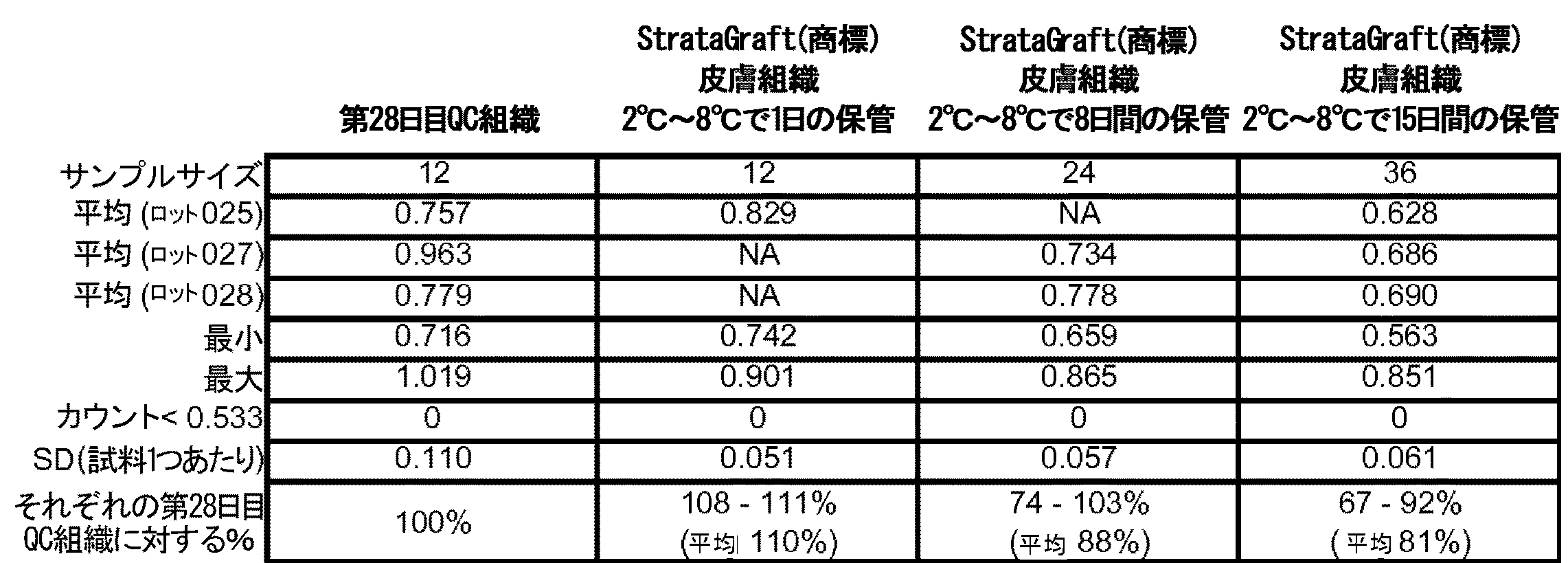
(表2)生存率の個別値
バリアー機能:
バリアー機能データを以下の表3および表4に示した。バリアー機能の合格基準は、全ての読み取り値が、DPM初期値<294および10秒間隔にわたるDPM変化<658を有さなければならないことである。
Barrier function :
Barrier function data are shown in Tables 3 and 4 below. The acceptance criteria for the barrier function is that all readings must have a DPM initial value < 294 and a DPM change < 658 over a 10 second interval.
第28日目QC組織および20℃〜25℃で保管されたSTRATAGRAFT(登録商標)皮膚組織のバリアー機能は許容可能であった。2℃〜8℃で保管されたSTRATAGRAFT(登録商標)皮膚組織の1つからの読み取り値の1つのDPM初期値が、合格基準を上回っていた(表4の太字)。この失敗した読み取りは、水たまりのある組織部分で起こったと書き留められた。従って、組織表面上の水たまりは、高い初期値の原因である可能性が高い。2℃〜8℃で保管されたSTRATAGRAFT(登録商標)皮膚組織からの他の全ての読み取り値は合格基準を満たし、20℃〜25℃で保管された組織からのバリアー機能読み取り値と同等であった。第28日目QC組織と比較して、これらの温度で保管された後に、バリアー機能はわずかに改善した。このデータは、20℃〜25℃または2℃〜8℃で1日、保管されたSTRATAGRAFT(登録商標)皮膚組織のバリアー機能は同等であると証明した。 The barrier function of Day 28 QC tissue and STRATAGRAFT® skin tissue stored at 20 ° C to 25 ° C was acceptable. One DPM initial value of readings from one of the STRATAGRAFT® skin tissues stored at 2-8 ° C. exceeded the acceptance criteria (bold in Table 4). This unsuccessful reading was noted to have occurred in a puddle of tissue. Therefore, a puddle on the tissue surface is likely to be the cause of the high initial value. All other readings from STRATAGRAFT® skin tissue stored at 2 ° C to 8 ° C met the acceptance criteria and were equivalent to barrier function readings from tissue stored at 20 ° C to 25 ° C. It was. Compared to day 28 QC tissue, the barrier function improved slightly after storage at these temperatures. This data proved that the barrier function of STRATAGRAFT® skin tissue stored at 20 ° C.-25 ° C. or 2 ° C.-8 ° C. for 1 day was equivalent.
(表3)バリアー機能概要の表
(表4)バリアー機能の個別値
組織学的特性:
パラフィン包埋され、ヘマトキシリンおよびエオシンで染色されたSTRATAGRAFT(登録商標)組織切片の代表的な外観には、真皮層の中の線維芽細胞、表皮層と真皮層との間の接合部にある小さな有核ケラチノサイトからなる基底層、基底層の上にある、分化しつつあるケラチノサイトからなる複数の層、および平らな角質細胞からなる層が含まれる。全ての組織は組織学的特性の規定に準拠した。2℃〜8℃で保管されたSTRATAGRAFT(登録商標)皮膚組織の組織構造は、20℃〜25℃で保管された組織構造と同等であり、保管された組織セットは両方とも第28日目QC組織と同等であった。
Histological characteristics :
Typical appearance of STRATAGRAFT® tissue sections embedded in paraffin and stained with hematoxylin and eosin include fibroblasts in the dermis layer, small at the junction between the epidermis and dermis layers It includes a basal layer composed of nucleated keratinocytes, a plurality of layers composed of differentiating keratinocytes on the basal layer, and a layer composed of flat keratinocytes. All tissues complied with the histological characteristics. The tissue structure of STRATAGRAFT® skin tissue stored at 2 ° C to 8 ° C is equivalent to the tissue structure stored at 20 ° C to 25 ° C, and both stored tissue sets are day 28 QC It was equivalent to the organization.
結論:
2℃〜8℃で1日、保管することによって、20℃〜25℃での保管より生存率の高いSTRATAGRAFT(登録商標)皮膚組織が得られた。2℃〜8℃で1日、保管された組織および20℃〜25℃で1日、保管された組織のバリアー機能および組織学的特性は同等であった。これらの結果は、2℃〜8℃の低温で1日、保管しても、20℃〜25℃で保管された組織と比較して、STRATAGRAFT(登録商標)皮膚の組織特性は悪影響を受けないことを証明している。
Conclusion:
By storing at 2 ° C. to 8 ° C. for 1 day, STRATAGRAFT® skin tissue with higher survival rate was obtained than storage at 20 ° C. to 25 ° C. The barrier function and histological properties of tissues stored at 2 ° C. to 8 ° C. for 1 day and those stored at 20 ° C. to 25 ° C. for 1 day were comparable. These results show that STRATAGRAFT® skin tissue properties are not adversely affected when stored at low temperatures of 2-8 ° C for 1 day compared to tissues stored at 20-25 ° C Prove that.
実施例3
本実施例は、2〜8℃で8日間、保管された皮膚同等物が、20℃〜25℃で1日しか保管されなかった組織と同等であるか、またはこれより優れていることを証明する。保管温度を下げても、20℃〜25℃で保管された組織と同等の組織品質が維持されることが示している(実施例2を参照されたい)。STRATAGRAFT(登録商標)組織を2〜8℃で8日間、保管できれば、STRATAGRAFT(登録商標)組織が臨床用途に利用可能な日数が延びるだろう。本研究は、20℃〜25℃で1日、保管された組織と2〜8℃で8日間、保管された組織の比較性を試験した。2〜8℃で保管されたが、もう7日間保管した組織において、組織生存率が改善した。
Example 3
This example demonstrates that the skin equivalent stored for 8 days at 2-8 ° C is equivalent to or better than the tissue stored for only 1 day at 20-25 ° C. To do. It has been shown that tissue quality equivalent to that stored at 20 ° C. to 25 ° C. is maintained even when the storage temperature is lowered (see Example 2). If the STRATAGRAFT® tissue can be stored at 2-8 ° C. for 8 days, the number of days that the STRATAGRAFT® tissue will be available for clinical use will be extended. This study tested the comparability of tissues stored at 20 ° C to 25 ° C for 1 day and stored at 2-8 ° C for 8 days. Tissue survival was improved in tissues stored at 2-8 ° C but stored for another 7 days.
実験デザイン:
本研究は、WCBFにおいてcGMPの下で製造した1つの組織バッチ、およびStratatech試験生産施設において生産した2つのバッチを使用した。プロセス第28日目に、各バッチから1つの組織を分析した。残りの6つの組織を第28日目および第30日目に送り込み、プロセス第31日目に発送チャンバーに載せた。分析前に、各バッチから3つの組織を、20℃〜25℃で1日、保管した。各バッチから残りの3つの組織を2〜8℃で8日間、保管した。分析前に、2〜8℃で8日間、保管した組織を、20℃〜25℃で1時間、平衡状態にした。
Experimental design :
This study used one tissue batch produced under cGMP at WCBF and two batches produced at the Stratatech test production facility. On the 28th day of the process, one tissue from each batch was analyzed. The remaining 6 tissues were delivered on
結果:
組織生存率:
生存率データを表5および図3に示した。生存率の試料は全て合格基準を満たした(A550 >0.533)。しかしながら、3つ全てのロット内比較において(図3の左パネル)、2〜8℃で8日間、保管された組織の生存率は、20℃〜25℃で1日、保管された組織より高かった。20℃〜25℃で1日、保管された組織の平均A550値は0.709であり、それに対して、2〜8℃で8日間、保管された組織の平均A550値は0.831であった。このデータから、2〜8℃でのSTRATAGRAFT(登録商標)組織の保管は、20℃〜25℃での保管より良好に組織生存率を維持できることが分かる。
Result :
Tissue survival rate :
Survival data are shown in Table 5 and FIG. All survival samples met the acceptance criteria (A 550 > 0.533). However, in all three lot comparisons (left panel in Figure 3), the survival rate of tissues stored at 2-8 ° C for 8 days is higher than that stored at 20 ° C-25 ° C for 1 day. It was. The average A 550 value for tissues stored at 20 ° C. to 25 ° C. for 1 day was 0.709, whereas the average A 550 value for tissues stored at 2-8 ° C. for 8 days was 0.831. From this data, it can be seen that storage of STRATAGRAFT® tissue at 2-8 ° C. can maintain tissue viability better than storage at 20-25 ° C.
(表5)組織生存率データの概要
バリアー機能:
Novaインピーダンス計を用いて組織を分析した。データを表6および表7に示した。読み取り値は全て、STRATAGRAFT(登録商標)組織のロット発売基準を満たした(初期読み取り値<294、変化<658)。このデータは、STRATAGRAFT(登録商標)組織が2〜8℃で8日間、保管されても、20℃〜25℃で1日、保管された後に分析された組織と比較して、組織バリアー機能は悪影響を受けないことを示唆している。
Barrier function :
Tissue was analyzed using a Nova impedance meter. Data are shown in Tables 6 and 7. All readings met the STRATAGRAFT® organization's lot release criteria (initial reading < 294, change < 658). This data shows that even when STRATAGRAFT® tissue is stored at 2-8 ° C for 8 days, compared to the tissue analyzed after storage at 20 ° C-25 ° C for 1 day, This suggests that it will not be adversely affected.
(表6)バリアー機能データ
(表7)バリアー機能概要の表
組織学的特性:
2〜8℃で8日間、保管された3つの組織セットの全ての組織構造は、STRATAGRAFT(登録商標)組織の合格基準を満たした。対照的に、20℃〜25℃で1日、保管された3つのSTRATAGRAFT(登録商標)ロットのうち2つは、非常に多くの細胞間隙を有する非定型的な組織学的特性を有していた。このデータは、STRATAGRAFT(登録商標)組織が2〜8℃で8日間、保管されても、20℃〜25℃で1日、保管された組織と比較して、組織学的特性は悪影響を受けないことを示唆している。
Histological characteristics :
All tissue structures of the three tissue sets stored at 2-8 ° C. for 8 days met the acceptance criteria for STRATAGRAFT® tissue. In contrast, two of the three STRATAGRAFT® lots stored at 20 ° C to 25 ° C for 1 day have atypical histological characteristics with a large number of cell gaps. It was. This data shows that STRATAGRAFT® tissue was stored at 2-8 ° C for 8 days, but the histological properties were adversely affected compared to tissue stored at 20 ° C-25 ° C for 1 day. Suggests not.
結論:
本研究において、2〜8℃で8日間、保管されたSTRATAGRAFT(登録商標)組織の生存率、組織学的特性、およびバリアー機能特性は、20℃〜25℃で1日、保管された組織と同等であるか、またはこれより優れていた。この結果は、2〜8℃で8日まで保管しても、STRATAGRAFT(登録商標)組織の特性は悪影響を受けないことを証明している。
Conclusion :
In this study, the survival rate, histological properties, and barrier functional properties of STRATAGRAFT® tissues stored at 2-8 ° C for 8 days were compared with those stored at 20 ° C-25 ° C for 1 day. It was equivalent or better. This result demonstrates that the properties of the STRATAGRAFT® tissue are not adversely affected when stored at 2-8 ° C. for up to 8 days.
実施例4
STRATAGRAFT(登録商標)皮膚組織を発送チャンバーに載せて15日まで保管することができる期間延長は、臨床用途のためにSTRATAGRAFT(登録商標)組織の利用可能性を高めるので非常に望ましい。本実施例は、皮膚同等物を栄養分-アガロース発送チャンバーに載せて8日より長く、保管するには、2〜8℃を超える温度では最適以下であることを証明する。
Example 4
An extension of the period during which STRATAGRAFT® skin tissue can be stored in the delivery chamber and stored for up to 15 days is highly desirable as it increases the availability of STRATAGRAFT® tissue for clinical use. This example demonstrates that skin equivalents are sub-optimal at temperatures above 2-8 ° C. for storage longer than 8 days in nutrient-agarose shipping chambers.
実験デザイン:
Stratatechのプロセス開発研究所(process development laboratory)で生産されたSTRATAGRAFT(登録商標)組織を、生産プロセスの第28日目に、栄養分-アガロース発送チャンバーに載せて包装し、約2〜8℃、15℃、または22.5℃で、1日、4日間、8日間、15日間、または29日間、保管した。指示された保管期間の後に、組織の生存率および組織学的特性を分析した。バリアー機能の測定は全ての組織で行わず、このため、このデータは示さなかった。
Experimental design :
STRATAGRAFT® tissue produced in Stratatech's process development laboratory is packed on a nutrient-agarose shipping chamber on the 28th day of the production process at approximately 2-8 ° C, 15 Stored at 0 ° C or 22.5 ° C for 1 day, 4 days, 8 days, 15 days, or 29 days. After the indicated storage period, tissue viability and histological characteristics were analyzed. Barrier function measurements were not performed on all tissues and thus this data was not shown.
結果:
本研究からの生存率データを図4に示した。4日間の保管まで、組織生存率を維持する能力の点で保管温度は全て同等であった。8日間の保管の後に、2〜8℃で保管された組織または15℃で保管された組織からの生存率結果は互いに同等であり、20℃〜25℃で保管された組織の生存率結果より優れていた。15日間または29日間の保管の後に、2〜8℃で保管された組織は、15℃または20℃〜25℃で保管された組織と比較して高い生存率を示した。
Result :
The survival data from this study is shown in FIG. All storage temperatures were comparable in terms of ability to maintain tissue viability up to 4 days of storage. After 8 days of storage, the survival results from tissues stored at 2-8 ° C or tissues stored at 15 ° C are comparable to each other, from the survival results of tissues stored at 20 ° C-25 ° C It was excellent. After storage for 15 or 29 days, tissues stored at 2-8 ° C. showed higher survival rates compared to tissues stored at 15 ° C. or 20 ° C.-25 ° C.
結論:
本研究は、保管が8日を過ぎると、組織生存率を助ける能力の点で、2〜8℃での皮膚同等物の保管は15℃を上回る温度での保管より頑強であることを証明する。
Conclusion :
This study demonstrates that after 8 days of storage, storage of skin equivalents at 2-8 ° C is more robust than storage at temperatures above 15 ° C in terms of ability to help tissue survival .
実施例5
STRATAGRAFT(登録商標)皮膚組織を発送チャンバーに載せて15日まで保管することができる期間延長は、臨床用途のためにSTRATAGRAFT(登録商標)組織の利用可能性を高めるので非常に望ましい。本研究は、STRATAGRAFT(登録商標)皮膚組織を、栄養分無添加アガロースを含有する発送チャンバーに載せて、2〜8℃で15日間、保管する実現可能性を試験するために行った。
Example 5
An extension of the period during which STRATAGRAFT® skin tissue can be stored in the delivery chamber and stored for up to 15 days is highly desirable as it increases the availability of STRATAGRAFT® tissue for clinical use. This study was conducted to test the feasibility of storing STRATAGRAFT® skin tissue in a shipping chamber containing nutrient-free agarose and storing at 2-8 ° C. for 15 days.
実験デザイン:
WCBFにおいて生産された3つの独立したSTRATAGRAFT(登録商標)皮膚組織ロットからの組織を、本研究のために使用した。各ロットから無作為に選択した1つの組織を、STRATAGRAFT(登録商標)皮膚組織生産プロセスの第28日目に試験した。各ロットにある残りの6つの組織には、プロセス第28日目およびプロセス第30日目に、SMB培地を供給した。プロセス第31日目に、6つの組織を発送チャンバーに載せ、2〜8℃で、1日、8日間、または15日間、保管した。指定された保管間隔の後に、組織を20℃〜25℃で1時間インキュベートし、次いで、生存率、バリアー機能、および組織学的特性について分析した。
Experimental design :
Tissues from three independent STRATAGRAFT® skin tissue lots produced at WCBF were used for this study. One tissue randomly selected from each lot was tested on day 28 of the STRATAGRAFT® skin tissue production process. The remaining 6 tissues in each lot were fed with SMB media on process day 28 and
結果:
生存率:
生存率データを表8および表9ならびに図4に示した。合格基準は、全ての試料のA550が>0.533であることである。本研究において、第28日目QC組織、および2〜8℃で、1日、8日間、または15日間、保管されたSTRATAGRAFT(登録商標)皮膚組織は全て生存率合格基準を満たした。
Result :
Survival rate :
Survival data are shown in Tables 8 and 9 and FIG. The acceptance criteria is that all samples have an A 550 > 0.533. In this study, all STRATAGRAFT® skin tissues stored at day 28 QC tissue and at 2-8 ° C. for 1, 8, or 15 days met survival criteria.
(表8)生存率の概要
(表9)生存率の個別値
バリアー機能:
バリアー機能データを下の表10および表11ならびに図5に示した。バリアー機能の合格基準は、全ての読み取り値が、DPM初期値<294および10秒間隔にわたるDPM変化<658を有さなければならないことである。
Barrier function :
Barrier function data are shown in Tables 10 and 11 below and FIG. The acceptance criteria for the barrier function is that all readings must have a DPM initial value < 294 and a DPM change < 658 over a 10 second interval.
2〜8℃で1日、保管されたSTRATAGRAFT(登録商標)皮膚組織、および2〜8℃で8日間、保管されたSTRATAGRAFT(登録商標)皮膚組織は全て、バリアー機能の合格基準を満たした。2〜8℃で15日間、保管された組織から、許容できないほど高いDPM初期値を示した読み取り値(表11の灰色の網掛け)が1つだけあった。15日間、保管された組織からの他の全ての読み取り値は、合格基準を満たした。この高いDPM初期値は、2〜8℃で保管された組織によく見られる、保管中に組織表面上に結露がたまったことによる可能性がある。このただ1つの高い読み取り値を除けば、全ての保管された組織のバリアー機能は、第28日目QC組織と同等であった。このデータから、2〜8℃での保管期間が長くなっても組織バリアー機能は悪影響を受けないことが証明された。 STRATAGRAFT® skin tissue stored at 2-8 ° C. for 1 day and STRATAGRAFT® skin tissue stored at 2-8 ° C. for 8 days all met pass criteria for barrier function. There was only one reading (gray shading in Table 11) that showed an unacceptably high initial DPM value from tissues stored at 2-8 ° C for 15 days. All other readings from the tissue stored for 15 days met the acceptance criteria. This high initial DPM value is likely due to condensation on the tissue surface during storage, which is common in tissues stored at 2-8 ° C. With the exception of this single high reading, the barrier function of all stored tissues was comparable to the Day 28 QC tissue. This data proved that the tissue barrier function was not adversely affected by prolonged storage at 2-8 ° C.
(表10)バリアー機能概要の表
(表11)バリアー機能の個別値
組織学的特性:
一般的に、2〜8℃で15日間、保管された組織は、線維芽細胞を含有する真皮と必要な全ての組織層を含有する表皮からなる典型的な組織学的構造を示した。
Histological characteristics :
In general, tissues stored at 2-8 ° C. for 15 days exhibited a typical histological structure consisting of the dermis containing fibroblasts and the epidermis containing all necessary tissue layers.
結論:
本研究の結果は、2〜8℃で15日間まで保管されたSTRATAGRAFT(登録商標)組織が、STRATAGRAFT(登録商標)組織のロット発売基準を満たすことを証明する。一般的に、保管期間を15日まで延ばすことで、バリアー機能は悪影響を受けなかった。2〜8℃で15日間、保管された組織の生存率は、STRATAGRAFT(登録商標)組織の合格基準を満たした。15日間、保管された組織は、組織学的特性の合格基準も満たした。
Conclusion :
The results of this study demonstrate that STRATAGRAFT® tissue stored at 2-8 ° C. for up to 15 days meets the STRATAGRAFT® tissue lot release criteria. In general, the barrier function was not adversely affected by extending the storage period to 15 days. The survival rate of tissues stored for 15 days at 2-8 ° C. met the acceptance criteria for STRATAGRAFT® tissues. Tissues stored for 15 days also met acceptance criteria for histological characteristics.
実施例6
本実施例は、発送用の発送チャンバーおよび滅菌包装容器がどのように作られるかについて述べる。
Example 6
This example describes how a shipping chamber and sterilized packaging container for shipping is made.
アガロース45gを水1455mlに溶解して混合することによって、3%アガロース溶液を調製する。混合物を攪拌し、次いで、アガロースを溶解するためにオートクレーブする(121℃、60分)。F12培地粉末24g、DMEM培地粉末10.0g、およびHEPES粉末7.2gを水1455mlに溶解して混合することによって、2X培地溶液を調製する。全ての粉末が溶解するまで混合物を攪拌し、pHを7.3〜7.5に調節する。2X培地溶液および3%アガロース溶液を40℃の水浴に30〜60分間入れる。次いで、2X培地溶液を濾過滅菌し、Sterivex(商標)フィルターに通して、3%アガロース溶液に無菌的に添加する。次いで、結果として生じた溶液60mlを、滅菌p150培養皿(150mmX20mm円形組織培養皿)に無菌的に分注し、ゲル化させる。すぐに使用しなければ、使用するまで保管のために、発送チャンバーをヒートシール可能な滅菌バックに入れる。発送のために、Transwellインサート(7.5cm直径(44cm2)、孔径0.4ミクロン)の中にある皮膚同等物を、発送チャンバーの中にあるアガロースに無菌的に載せ、p150プレート上部を発送チャンバーの上に載せ、無菌条件下で固定する。次いで、発送チャンバーを、滅菌したヒートシール可能な袋に入れ、密封して、発送用包装容器を得る。発送用包装容器を2〜8℃で保管および発送し、使用現場では2〜8℃で、包装時から8〜15日間、使用直前まで保管することができる。包装容器の完全性は、使用時まで維持することができ、使用前に皮膚同等物を生き返らせる必要はない。 A 3% agarose solution is prepared by dissolving 45 g of agarose in 1455 ml of water and mixing. The mixture is stirred and then autoclaved to dissolve the agarose (121 ° C., 60 minutes). A 2X medium solution is prepared by dissolving 24 g of F12 medium powder, 10.0 g of DMEM medium powder, and 7.2 g of HEPES powder in 1455 ml of water and mixing. The mixture is stirred until all powder is dissolved and the pH is adjusted to 7.3-7.5. Place 2X medium solution and 3% agarose solution in 40 ° C water bath for 30-60 minutes. The 2X media solution is then filter sterilized and passed through a Sterivex ™ filter and aseptically added to a 3% agarose solution. The resulting 60 ml solution is then aseptically dispensed into a sterile p150 culture dish (150 mm x 20 mm circular tissue culture dish) and allowed to gel. If not used immediately, place the shipping chamber in a heat-sealable sterilization bag for storage until use. For shipping, the skin equivalent in a Transwell insert (7.5 cm diameter (44 cm 2 ), pore size 0.4 micron) is aseptically placed on the agarose in the shipping chamber and the top of the p150 plate is placed above the shipping chamber. And fix under aseptic conditions. The shipping chamber is then placed in a sterilized heat-sealable bag and sealed to obtain a shipping packaging container. The shipping packaging container can be stored and shipped at 2-8 ° C., and can be stored at 2-8 ° C. at the site of use for 8-15 days from the time of packaging until just before use. The integrity of the packaging container can be maintained until use, and it is not necessary to revitalize the skin equivalent before use.
実施例7
本実施例は、皮膚同等物を生産する簡素化した方法について述べる。
Example 7
This example describes a simplified method for producing skin equivalents.
培地
器官培養のプロセスには以下の3種類の培地を用いる。これらは全て、全ての培地からコレラ毒素が省かれている以外は、米国特許第7,407,805号に記載のSMB培地の処方をベースとしている。FM01は、皮膚同等物の真皮同等層において使用するための正常ヒト真皮線維芽細胞(NHDF)を増殖させるために用いられる。FM01の処方は、Fetal Clone II血清(2%最終)を含有し、コレラ毒素を欠く以外はSMBと同じである。KM01は、NIKS(登録商標)ケラチノサイトを増殖させるのに用いられ、2.5%fetal clone IIを含有し、さらなる上皮細胞成長因子(EGF)が最終濃度5ng/mlまで添加される以外はSMBと同じ組成を有する。SM01は、皮膚同等物生産の表皮重層化段階に用いられ、コレラ毒素が省かれている以外はSMBと同一である。
Medium The following three types of medium are used for the organ culture process. These are all based on the SMB media formulation described in US Pat. No. 7,407,805, except that cholera toxin is omitted from all media. FM01 is used to grow normal human dermal fibroblasts (NHDF) for use in the dermal equivalent layer of the skin equivalent. The formula for FM01 is the same as SMB except it contains Fetal Clone II serum (2% final) and lacks cholera toxin. KM01 is used to propagate NIKS® keratinocytes, contains 2.5% fetal clone II, and has the same composition as SMB except that additional epidermal growth factor (EGF) is added to a final concentration of 5 ng / ml Have SM01 is used in the epidermis stratification stage of skin equivalent production and is identical to SMB except that cholera toxin is omitted.
真皮同等物の調製
第0日目に、凍結NHDF細胞を解凍し、プレーティングする。翌日(第1日目)、細胞にFM01を供給して残留性の凍結保護剤を除去し、第3日目にも再び行う。第4日目に、それらを真皮同等物に用いるために回収する。真皮同等物を調製するには、最初に、I型ラット尾部コラーゲンを0.03N酢酸で3mg/mlに希釈し、氷上で冷却する。濃縮F12培地(通常強度の8.7倍、pH7.5のHEPESで緩衝化)の混合物を、fetal clone IIと混合する。これらの2つの溶液は、最終溶液体積の11.3%および9.6%である。1N NaOHを培地混合物に添加する(最終溶液の2.4%)。次いで、希釈コラーゲンを混合物に添加する(74.7%)。2%体積の懸濁線維芽細胞(2.78X10⁶/ml)を混合物に添加する。9mlの最終真皮同等物混合物を、それぞれの75mm TRANSWELLインサート(Corning Costar)に注ぐ。50〜70分のゲル形成期間の後に、Transwellインサートを、150mm培養皿の中にあるステンレス鋼メッシュの表面に移す。FM01 80mlを、150mmディッシュのTRANSWELLインサートの外側に入れ、10mlを真皮同等物の上部に載せる。真皮同等物を、器官培養において使用する前に4〜5日間、37℃、5%CO2、90%相対湿度のインキュベーターに入れる。
Preparation of dermal equivalent On
NIKS(登録商標)の増殖および播種
NIKS(登録商標)細胞を解凍し、100mmディッシュ1つにつき約5x10⁵細胞の密度でプレーティングする。NIKS(登録商標)培養は、マウスフィーダー細胞の存在下または非存在下で行うことができる。第1日目に、残留性の凍結保護剤を除去するために、NIKS(登録商標)細胞に新鮮なKM01を供給する。第3日目に、NIKS(登録商標)細胞に、再度、KM01を供給する。第4日目に、最初のp100培養物からNIKS(登録商標)細胞を回収し、1.2x10⁶/フラスコの密度で225cm2培養フラスコに播種する。第7日目および8日目に、NIKS(登録商標)培養に新鮮な培地を供給する。第9日目に、NIKS(登録商標)細胞を回収し、計数し、SM01に再懸濁する。2.27X104NIKS(登録商標)細胞/cm2を真皮同等物の表面に播種する。ディッシュに培養物を送り込み、空気-培地の界面まで持ち上げる。培養物を75%に湿度が管理されたインキュベーターに移し、この中にその培養物を成熟のまでの間ずっと入れておく。第14日目、第18日目、第22日目、第25日目、第28日目、および第30日目に、培養物にSM01を供給する。
NIKS® propagation and seeding
NIKS® cells are thawed and plated at a density of approximately 5 × 10 5 cells per 100 mm dish. NIKS® culture can be performed in the presence or absence of mouse feeder cells. On the first day, NIKS® cells are fed with fresh KM01 to remove residual cryoprotectant. On the third day, NIKS® cells are again fed with KM01. On the fourth day, NIKS® cells are harvested from the initial p100 culture and seeded in a 225 cm 2 culture flask at a density of 1.2 × 10 6 / flask. On days 7 and 8, the NIKS® culture is fed with fresh media. On day 9, NIKS® cells are harvested, counted and resuspended in SM01. 2.27X10 4 NIKS® cells / cm 2 are seeded on the surface of the dermal equivalent. Feed culture to dish and lift to air-medium interface. The culture is transferred to an incubator controlled at 75% humidity and the culture is kept in it until maturity. On the 14th day, 18th day, 22nd day, 25th day, 28th day, and 30th day, SM01 is supplied to the culture.
実施例8
簡素化した手順を用いて生産されたSTRATAGRAFT(登録商標)皮膚組織を、発送チャンバーに載せて15日まで保管することは、臨床用途のために組織の利用可能性を高めるので非常に望ましい。本実施例は、簡素化した手順を用いて生産された皮膚同等物を栄養分-アガロース発送チャンバーに載せて2〜8℃で15日まで保管することが許容可能であることを証明する。
Example 8
It is highly desirable to store STRATAGRAFT® skin tissue produced using a simplified procedure in a delivery chamber for up to 15 days, as this increases tissue availability for clinical use. This example demonstrates that it is acceptable to store skin equivalents produced using a simplified procedure in a nutrient-agarose shipping chamber at 2-8 ° C. for up to 15 days.
実験デザイン:
Stratatechのプロセス開発研究所で生産されたSTRATAGRAFT(登録商標)組織を、生産プロセスの第31日目に、栄養分-アガロース発送チャンバーに載せて包装し、約2〜8℃で、8日間または15日間、保管した。指示された保管期間の後に、組織の生存率、バリアー機能、および組織学的特性を分析した。
Experimental design :
STRATAGRAFT® tissue produced at Stratatech's Process Development Laboratory is packaged on a nutrient-agarose shipping chamber on the 31st day of the production process, at approximately 2-8 ° C for 8 or 15 days Stored. After the indicated storage period, tissue viability, barrier function, and histological characteristics were analyzed.
結果:
生存率:
本研究からの生存率データを図7に示した。8日間または15日間、保管されたSTRATAGRAFT(登録商標)皮膚組織は、生存率の合格基準を満たした。保管期間が長くなるにつれて、組織生存率は減少した。それにもかかわらず、生存率の値はかなり一定しており、全ての値は下限を優に超えた。
Result :
Survival rate :
The survival data from this study is shown in FIG. STRATAGRAFT® skin tissue stored for 8 or 15 days met the acceptance criteria for survival. As storage time increased, tissue viability decreased. Nevertheless, survival values were fairly constant and all values were well above the lower limit.
バリアー機能:
バリアー機能データを以下の図8に示した。2〜8℃で8日間または15日間、保管されたSTRATAGRAFT(登録商標)皮膚は全て、バリアー機能の合格基準を満たした。保管が長くなるにつれて、DPM初期値およびDPM変化値はわずかに増加したが、バリアー機能は保持された。
Barrier function :
The barrier function data is shown in FIG. 8 below. All STRATAGRAFT® skin stored at 2-8 ° C. for 8 or 15 days met the acceptance criteria for barrier function. With longer storage, the initial DPM value and the DPM change value increased slightly, but the barrier function was retained.
組織学的特性:
一般的に、2〜8℃で8日間または15日間、保管されたSTRATAGRAFT(登録商標)皮膚組織は、典型的な表皮層の頂上にある線維芽細胞含有コラーゲン真皮の全てを示した。これらの組織には、凝縮した核の数の増加および上部表皮層におけるエオシン染色の減少を含む、いくつかのよく見られる保管に関連する影響が見られた。
Histological characteristics :
In general, STRATAGRAFT® skin tissue stored at 2-8 ° C. for 8 or 15 days showed all of the fibroblast-containing collagen dermis on top of a typical epidermal layer. These tissues had several common storage-related effects, including an increase in the number of condensed nuclei and a decrease in eosin staining in the upper epidermal layer.
結論:
本研究は、2〜8℃で8日間または15日間、保管されたSTRATAGRAFT(登録商標)皮膚組織の生存率、バリアー機能、および組織学的特性が許容可能であることを証明する。
Conclusion :
This study demonstrates that the survival rate, barrier function, and histological properties of STRATAGRAFT® skin tissue stored at 2-8 ° C. for 8 or 15 days are acceptable.
以上の本明細書中で言及した全ての刊行物および特許は、参照により本明細書に組み入れられる。本発明の範囲および精神から逸脱することなく、本発明の記述の方法およびシステムに関する様々な変更および変形が当業者には明らかであろう。本発明を好ましい具体的な態様に関連して記述してきたが、特許請求の範囲に記載される本発明は、そのような具体的な態様に不当に制限されるべきではないものと理解されるべきである。実際に、本発明を実行するために記述した様式に関し、分子生物学、生化学、または関連分野の当業者にとって明らかな種々の変更は、以下の特許請求の範囲に入るものと意図される。 All publications and patents mentioned in the above specification are herein incorporated by reference. Various changes and modifications to the method and system of the description of the invention will be apparent to those skilled in the art without departing from the scope and spirit of the invention. While the invention has been described in connection with preferred specific embodiments, it is understood that the invention as claimed should not be unduly limited to such specific embodiments Should. Indeed, various modifications that will be apparent to those skilled in the art of molecular biology, biochemistry, or related fields with respect to the manner described for carrying out the invention are intended to be within the scope of the following claims.
Claims (15)
真皮層および表皮層を含む、該器官培養された皮膚同等物、ならびにゲル支持体を含む滅菌包装容器を準備する工程;
包装日に、該皮膚同等物が該ゲル支持体と接触するように、無菌条件下で該皮膚同等物を滅菌包装容器に入れる工程;
該滅菌包装容器の温度を摂氏2〜8℃に下げる工程;
摂氏2〜8℃で該滅菌包装容器を使用者に発送する工程;
使用現場で該滅菌包装容器を摂氏2〜8℃で保管する工程であって、ここで、滅菌包装容器の無菌性および完全性は、該包装日から8〜15日間、維持される、工程。 A method of shipping and storing an organ-cultured skin equivalent for use in a skin graft procedure comprising the following steps:
Providing a sterile packaging container comprising the organ-cultured skin equivalent comprising a dermis layer and an epidermis layer, and a gel support;
Placing the skin equivalent in a sterile packaging container under aseptic conditions such that the skin equivalent contacts the gel support on the packaging date;
Lowering the temperature of the sterile packaging container to 2-8 ° C .;
Shipping the sterilized packaging container to the user at 2-8 degrees Celsius;
Storing the sterile packaging container at 2-8 degrees Celsius at the point of use, wherein the sterility and integrity of the sterile packaging container is maintained for 8-15 days from the packaging date.
真皮層および表皮層を含む、該器官培養された皮膚同等物、ならびにゲル支持体を含む滅菌包装容器を準備する工程であって、該ゲル支持体が最少培地を用いて形成される、工程;
該皮膚同等物が該ゲル支持体と接触するように、無菌条件下で該皮膚同等物を滅菌包装容器に入れる工程;
該滅菌包装容器の温度を摂氏2〜8℃に下げる工程;
摂氏2〜8℃で該滅菌包装容器を使用者に発送する工程;
使用現場で該滅菌包装容器を摂氏2〜8℃で保管する工程であって、ここで、滅菌包装容器の無菌性および完全性は維持される、工程。 A method of shipping an organ-cultured skin equivalent for use in a skin transplant procedure to a user, comprising the following steps:
Providing the organ-cultured skin equivalent comprising a dermis layer and an epidermis layer, and a sterile packaging container comprising a gel support, wherein the gel support is formed using a minimal medium;
Placing the skin equivalent in a sterile packaging container under aseptic conditions such that the skin equivalent contacts the gel support;
Lowering the temperature of the sterile packaging container to 2-8 ° C .;
Shipping the sterilized packaging container to the user at 2-8 degrees Celsius;
Storing the sterile packaging container at 2-8 degrees Celsius at the point of use, wherein the sterility and integrity of the sterile packaging container is maintained.
該ゲル支持体と接触している透過性膜上で支持されている、器官培養された皮膚同等物
とを含む、キットであって、該発送チャンバーは、滅菌した袋を用いて収容されている、キット。 A shipping chamber comprising a gel support comprising a minimal medium;
A kit comprising an organ-cultured skin equivalent supported on a permeable membrane in contact with the gel support, wherein the shipping chamber is contained using a sterile bag ,kit.
Applications Claiming Priority (3)
| Application Number | Priority Date | Filing Date | Title |
|---|---|---|---|
| US98791107P | 2007-11-14 | 2007-11-14 | |
| US60/987,911 | 2007-11-14 | ||
| PCT/US2008/083585 WO2009065005A1 (en) | 2007-11-14 | 2008-11-14 | Cold storage of organotypically cultured skin equivalents for clinical applications |
Publications (2)
| Publication Number | Publication Date |
|---|---|
| JP2011502538A JP2011502538A (en) | 2011-01-27 |
| JP5719172B2 true JP5719172B2 (en) | 2015-05-13 |
Family
ID=40639155
Family Applications (1)
| Application Number | Title | Priority Date | Filing Date |
|---|---|---|---|
| JP2010534213A Expired - Fee Related JP5719172B2 (en) | 2007-11-14 | 2008-11-14 | Refrigerated storage of organ-cultured skin equivalents for clinical use |
Country Status (10)
| Country | Link |
|---|---|
| US (2) | US20090145087A1 (en) |
| EP (1) | EP2215212B1 (en) |
| JP (1) | JP5719172B2 (en) |
| AU (1) | AU2008322567B2 (en) |
| CA (1) | CA2705758C (en) |
| DK (1) | DK2215212T3 (en) |
| ES (1) | ES2649534T3 (en) |
| NO (1) | NO2215212T3 (en) |
| PT (1) | PT2215212T (en) |
| WO (1) | WO2009065005A1 (en) |
Families Citing this family (8)
| Publication number | Priority date | Publication date | Assignee | Title |
|---|---|---|---|---|
| JP5719172B2 (en) | 2007-11-14 | 2015-05-13 | ストラタテック コーポレーション | Refrigerated storage of organ-cultured skin equivalents for clinical use |
| CA2742595C (en) | 2008-11-04 | 2014-04-01 | Stratatech Corporation | Dried and irradiated skin equivalents for ready use |
| US20100330046A1 (en) * | 2009-05-21 | 2010-12-30 | Stratatech Corporation | Human skin substitutes expressing il-12 |
| FR2990106B1 (en) * | 2012-05-03 | 2014-05-09 | Genoskin | SYSTEM FOR SURVIVAL MAINTENANCE AND TRANSPORT OF SKIN BIOSPSIES AND ITS APPLICATIONS |
| PT2967836T (en) * | 2013-03-13 | 2019-01-21 | Stratatech Corp | CRIOPRESERVATION OF VIABLE HUMAN SKIN REPLACEMENTS |
| US9868931B2 (en) * | 2014-08-08 | 2018-01-16 | James David Pfau | Methods and an apparatus for transporting live cells |
| IL268255B2 (en) | 2017-01-27 | 2024-02-01 | Stratatech Corp | Tissue tank systems |
| EP4346933A1 (en) * | 2021-05-28 | 2024-04-10 | Stratatech Corporation | Allogeneic cultured keratinocyte products |
Family Cites Families (33)
| Publication number | Priority date | Publication date | Assignee | Title |
|---|---|---|---|---|
| US4485096A (en) | 1982-02-26 | 1984-11-27 | Massachusetts Institute Of Technology | Tissue-equivalent and method for preparation thereof |
| FR2628077B1 (en) * | 1988-03-07 | 1990-08-03 | Guilhem Jacques | CONTAINER FOR TRANSPORTING GRAFT |
| IL95429A (en) | 1989-09-15 | 1997-09-30 | Organogenesis | Living tissue equivalents comprising hydrated collagen lattice and a collagen gel and their production |
| US5110722A (en) * | 1989-11-09 | 1992-05-05 | Cryolife, Inc. | Cell, tissue or organ storage solution |
| CA2080693C (en) | 1990-04-24 | 2001-11-27 | Mark Eisenberg | Composite living skin equivalents |
| IT1248934B (en) | 1990-06-01 | 1995-02-11 | Fidia Spa | BIOCOMPATIBLE PERFORATED MEMBRANES, PROCESSES FOR THEIR PREPARATION, THEIR USE AS A SUPPORT FOR THE IN VITRO GROWTH OF EPITHELIAL CELLS, ARTIFICIAL LEATHER THUS OBTAINED AND THEIR USE IN LEATHER TRANSPLANTS |
| WO1993008776A1 (en) | 1991-11-01 | 1993-05-13 | Culture Technology, Inc. | Cultured skin graft carrier |
| US5405742A (en) * | 1993-07-16 | 1995-04-11 | Cyromedical Sciences, Inc. | Solutions for tissue preservation and bloodless surgery and methods using same |
| US5681740A (en) * | 1995-06-05 | 1997-10-28 | Cytotherapeutics, Inc. | Apparatus and method for storage and transporation of bioartificial organs |
| US5843766A (en) * | 1995-06-07 | 1998-12-01 | Advanced Tissue Sciences, Inc. | Apparatus for the growth and packaging of three dimensional tissue cultures |
| US5693332C1 (en) | 1995-08-11 | 2001-01-09 | Univ California | Human keratinocytes supported on a hydrophilic membrane and methods of using same to effect wound closure |
| US5968546A (en) * | 1997-05-16 | 1999-10-19 | Baur; Marcus | Keratinocyte culture from precursor cells |
| WO1999035453A1 (en) * | 1998-01-12 | 1999-07-15 | Safetherm S.A. | Method for processing data concerning the transport of biological material and implementing device |
| US5989837A (en) | 1998-07-13 | 1999-11-23 | Wisconsin Alumni Research Foundation | Immortalized human keratinocyte cell line |
| US6146883A (en) * | 1998-09-14 | 2000-11-14 | Navicyte, Inc. | Packing device for transporting confluent cell monolayers |
| WO2001005942A2 (en) | 1999-07-20 | 2001-01-25 | Epitech S.A. | Improved keratinocyte culture and uses thereof |
| FR2798668B1 (en) * | 1999-09-17 | 2001-12-21 | Genevrier Lab | NEW PROCESS FOR THE TRANSPORT OF CELLS AND THE GRAFTS THUS CARRIED OUT |
| JP4317366B2 (en) * | 2001-03-02 | 2009-08-19 | ストラタテック コーポレーション | Improved skin substitute and use thereof |
| US6974697B2 (en) * | 2001-03-02 | 2005-12-13 | Stratech Corporation | Skin substitutes with improved barrier function |
| JP2003070460A (en) * | 2001-09-06 | 2003-03-11 | Menicon Co Ltd | Backing base material for membrane tissue and method for storing / transporting membrane tissue using the same |
| NZ536205A (en) | 2002-04-30 | 2008-04-30 | Stratatech Corp | Keratinocytes expressing exogenous angiogenic growth factors |
| US7229820B2 (en) * | 2002-06-13 | 2007-06-12 | Wilson Wolf Manufacturing Corporation | Apparatus and method for culturing and preserving tissue constructs |
| AU2003254298A1 (en) | 2002-08-02 | 2004-02-23 | Stratatech Corporation | Species specific dna detection |
| CA2527822A1 (en) | 2003-05-30 | 2004-12-23 | Stratatech Corporation | Room temperature storage of organs |
| US7674291B2 (en) | 2003-08-01 | 2010-03-09 | Stratatech Corporation | Human skin equivalents expressing exogenous polypeptides |
| US20060141627A1 (en) | 2004-11-18 | 2006-06-29 | Stratatech Corporation | Vectors for stable gene expression |
| CA2600177C (en) * | 2005-03-01 | 2011-06-14 | Stratatech Corporation | Human skin equivalents expressing exogenous polypeptides |
| AU2006227752B2 (en) | 2005-03-17 | 2010-10-21 | Stratatech Corporation | Skin substitutes with improved purity |
| US8074465B2 (en) * | 2005-09-12 | 2011-12-13 | Genzyme Corporation | Thermally insulated transport container for cell-based products and related methods |
| JP5719172B2 (en) | 2007-11-14 | 2015-05-13 | ストラタテック コーポレーション | Refrigerated storage of organ-cultured skin equivalents for clinical use |
| KR101020486B1 (en) | 2008-09-23 | 2011-03-08 | 강원대학교산학협력단 | Novel 1,3-butadien-2-yl methyl amine derivative and preparation method thereof using organic indium reagent |
| CA2742595C (en) | 2008-11-04 | 2014-04-01 | Stratatech Corporation | Dried and irradiated skin equivalents for ready use |
| US20100330046A1 (en) | 2009-05-21 | 2010-12-30 | Stratatech Corporation | Human skin substitutes expressing il-12 |
-
2008
- 2008-11-14 JP JP2010534213A patent/JP5719172B2/en not_active Expired - Fee Related
- 2008-11-14 CA CA2705758A patent/CA2705758C/en active Active
- 2008-11-14 NO NO08850430A patent/NO2215212T3/no unknown
- 2008-11-14 DK DK08850430.3T patent/DK2215212T3/en active
- 2008-11-14 EP EP08850430.3A patent/EP2215212B1/en active Active
- 2008-11-14 US US12/271,455 patent/US20090145087A1/en not_active Abandoned
- 2008-11-14 ES ES08850430.3T patent/ES2649534T3/en active Active
- 2008-11-14 PT PT88504303T patent/PT2215212T/en unknown
- 2008-11-14 AU AU2008322567A patent/AU2008322567B2/en active Active
- 2008-11-14 WO PCT/US2008/083585 patent/WO2009065005A1/en not_active Ceased
-
2016
- 2016-12-12 US US15/375,755 patent/US10743533B2/en active Active
Also Published As
| Publication number | Publication date |
|---|---|
| PT2215212T (en) | 2017-12-01 |
| CA2705758C (en) | 2015-10-06 |
| DK2215212T3 (en) | 2017-11-27 |
| US10743533B2 (en) | 2020-08-18 |
| EP2215212A4 (en) | 2013-02-27 |
| ES2649534T3 (en) | 2018-01-12 |
| JP2011502538A (en) | 2011-01-27 |
| US20170339943A1 (en) | 2017-11-30 |
| AU2008322567B2 (en) | 2013-01-17 |
| WO2009065005A1 (en) | 2009-05-22 |
| CA2705758A1 (en) | 2009-05-22 |
| NO2215212T3 (en) | 2018-01-27 |
| EP2215212A1 (en) | 2010-08-11 |
| US20090145087A1 (en) | 2009-06-11 |
| AU2008322567A1 (en) | 2009-05-22 |
| EP2215212B1 (en) | 2017-08-30 |
Similar Documents
| Publication | Publication Date | Title |
|---|---|---|
| US10743533B2 (en) | Cold storage of organotypically cultured skin equivalents for clinical applications | |
| JP4522667B2 (en) | Methods and compositions for tissue regeneration | |
| EP1326654B1 (en) | Methods and compositions for tissue regeneration | |
| JP6580028B2 (en) | Cryopreservation of viable human skin substitute | |
| US9867904B2 (en) | Dried and irradiated skin equivalents for ready use |
Legal Events
| Date | Code | Title | Description |
|---|---|---|---|
| A621 | Written request for application examination |
Free format text: JAPANESE INTERMEDIATE CODE: A621 Effective date: 20111108 |
|
| A521 | Request for written amendment filed |
Free format text: JAPANESE INTERMEDIATE CODE: A523 Effective date: 20120927 |
|
| A131 | Notification of reasons for refusal |
Free format text: JAPANESE INTERMEDIATE CODE: A131 Effective date: 20130926 |
|
| A601 | Written request for extension of time |
Free format text: JAPANESE INTERMEDIATE CODE: A601 Effective date: 20131219 |
|
| A602 | Written permission of extension of time |
Free format text: JAPANESE INTERMEDIATE CODE: A602 Effective date: 20131227 |
|
| A521 | Request for written amendment filed |
Free format text: JAPANESE INTERMEDIATE CODE: A523 Effective date: 20140318 |
|
| A02 | Decision of refusal |
Free format text: JAPANESE INTERMEDIATE CODE: A02 Effective date: 20140917 |
|
| A521 | Request for written amendment filed |
Free format text: JAPANESE INTERMEDIATE CODE: A523 Effective date: 20150109 |
|
| A521 | Request for written amendment filed |
Free format text: JAPANESE INTERMEDIATE CODE: A821 Effective date: 20150109 |
|
| A911 | Transfer to examiner for re-examination before appeal (zenchi) |
Free format text: JAPANESE INTERMEDIATE CODE: A911 Effective date: 20150203 |
|
| TRDD | Decision of grant or rejection written | ||
| A01 | Written decision to grant a patent or to grant a registration (utility model) |
Free format text: JAPANESE INTERMEDIATE CODE: A01 Effective date: 20150223 |
|
| A61 | First payment of annual fees (during grant procedure) |
Free format text: JAPANESE INTERMEDIATE CODE: A61 Effective date: 20150320 |
|
| R150 | Certificate of patent or registration of utility model |
Ref document number: 5719172 Country of ref document: JP Free format text: JAPANESE INTERMEDIATE CODE: R150 |
|
| R250 | Receipt of annual fees |
Free format text: JAPANESE INTERMEDIATE CODE: R250 |
|
| R250 | Receipt of annual fees |
Free format text: JAPANESE INTERMEDIATE CODE: R250 |
|
| R250 | Receipt of annual fees |
Free format text: JAPANESE INTERMEDIATE CODE: R250 |
|
| R250 | Receipt of annual fees |
Free format text: JAPANESE INTERMEDIATE CODE: R250 |
|
| R250 | Receipt of annual fees |
Free format text: JAPANESE INTERMEDIATE CODE: R250 |
|
| R250 | Receipt of annual fees |
Free format text: JAPANESE INTERMEDIATE CODE: R250 |
|
| R250 | Receipt of annual fees |
Free format text: JAPANESE INTERMEDIATE CODE: R250 |
|
| LAPS | Cancellation because of no payment of annual fees |