JP5307896B2 - Stereo image encoding method, stereo image encoding device, and stereo image encoding program - Google Patents
Stereo image encoding method, stereo image encoding device, and stereo image encoding program Download PDFInfo
- Publication number
- JP5307896B2 JP5307896B2 JP2011527484A JP2011527484A JP5307896B2 JP 5307896 B2 JP5307896 B2 JP 5307896B2 JP 2011527484 A JP2011527484 A JP 2011527484A JP 2011527484 A JP2011527484 A JP 2011527484A JP 5307896 B2 JP5307896 B2 JP 5307896B2
- Authority
- JP
- Japan
- Prior art keywords
- frequency component
- correspondence
- parallax
- parallax compensation
- encoding
- Prior art date
- Legal status (The legal status is an assumption and is not a legal conclusion. Google has not performed a legal analysis and makes no representation as to the accuracy of the status listed.)
- Expired - Fee Related
Links
- 238000000034 method Methods 0.000 title claims description 78
- 238000006243 chemical reaction Methods 0.000 claims description 23
- 230000000875 corresponding effect Effects 0.000 description 7
- 238000004364 calculation method Methods 0.000 description 4
- 238000010586 diagram Methods 0.000 description 4
- 238000000638 solvent extraction Methods 0.000 description 4
- 230000000694 effects Effects 0.000 description 3
- 230000002596 correlated effect Effects 0.000 description 2
- 230000007423 decrease Effects 0.000 description 2
- 210000001747 pupil Anatomy 0.000 description 2
- 238000013139 quantization Methods 0.000 description 2
- 210000001525 retina Anatomy 0.000 description 2
- 230000009466 transformation Effects 0.000 description 2
- LEGNTRAAJFCGFF-UHFFFAOYSA-N 2-(diazomethyl)-9h-fluorene Chemical compound C1=CC=C2C3=CC=C(C=[N+]=[N-])C=C3CC2=C1 LEGNTRAAJFCGFF-UHFFFAOYSA-N 0.000 description 1
- 241000255925 Diptera Species 0.000 description 1
- 238000000354 decomposition reaction Methods 0.000 description 1
- 238000006073 displacement reaction Methods 0.000 description 1
- 230000001788 irregular Effects 0.000 description 1
Images




Classifications
-
- H—ELECTRICITY
- H04—ELECTRIC COMMUNICATION TECHNIQUE
- H04N—PICTORIAL COMMUNICATION, e.g. TELEVISION
- H04N19/00—Methods or arrangements for coding, decoding, compressing or decompressing digital video signals
- H04N19/50—Methods or arrangements for coding, decoding, compressing or decompressing digital video signals using predictive coding
- H04N19/597—Methods or arrangements for coding, decoding, compressing or decompressing digital video signals using predictive coding specially adapted for multi-view video sequence encoding
-
- H—ELECTRICITY
- H04—ELECTRIC COMMUNICATION TECHNIQUE
- H04N—PICTORIAL COMMUNICATION, e.g. TELEVISION
- H04N13/00—Stereoscopic video systems; Multi-view video systems; Details thereof
- H04N13/10—Processing, recording or transmission of stereoscopic or multi-view image signals
- H04N13/106—Processing image signals
- H04N13/111—Transformation of image signals corresponding to virtual viewpoints, e.g. spatial image interpolation
Landscapes
- Engineering & Computer Science (AREA)
- Multimedia (AREA)
- Signal Processing (AREA)
- Compression Or Coding Systems Of Tv Signals (AREA)
- Testing, Inspecting, Measuring Of Stereoscopic Televisions And Televisions (AREA)
Description
本発明は、二つの異なる視点から得られたステレオ画像データを符号化するステレオ画像符号化方法、ステレオ画像符号化装置及びステレオ画像符号化プログラムに関する。 The present invention relates to a stereo image encoding method, a stereo image encoding device, and a stereo image encoding program for encoding stereo image data obtained from two different viewpoints.
3次元の奥行きをもった映像を表示する3次元ディスプレイ方式として、例えば、偏光フィルタ方式(polarizing filter system)、カラーフィルタ方式(color filter system)、時分割方式(time−multiplexed system)などがあげられる(非特許文献1参照)。これらの方式はいずれも、映像を見る人間の左右の目に対して、例えば、図8に示すように、対象物101について、左目の網膜に写る像102と右目の網膜に写る像103とが異なるように、異なる映像を提示し、右目と左目で見ることができる対象物の位置または視方向の差、すなわち、両眼視差(Binocular parallax)によって立体視(stereoscopic vision)を実現している。
Examples of the three-dimensional display method for displaying an image having a three-dimensional depth include a polarizing filter system, a color filter system, a time-multiplexed system, and the like. (Refer nonpatent literature 1). In any of these methods, for example, as shown in FIG. 8, an
2つの視点の符号化には、MPEG−2 MVP (Multiview Profile)やMPEG−4 AVC MVC (Multiview Coding)などを用いることができる。これらの方法では、動き補償(motion compensation)に似た視差補償(view compensation)を用いて、視点間の冗長性を利用している(非特許文献2、4、5を参照)。
For encoding from two viewpoints, MPEG-2 MVP (Multiview Profile), MPEG-4 AVC MVC (Multiview Coding), or the like can be used. In these methods, redundancy between viewpoints is used by using disparity compensation similar to motion compensation (see Non-Patent
具体的には、左右どちらか一方の視点の画像を独立して復号することができるベース・ビュー画像として符号化し、他方の視点の画像をベース・ビュー画像を参照して視差補償することができる、ノン・ベース・ビュー画像として符号化する多視点画像符号化装置が開示されている(例えば、特許文献1参照)。このような視差補償を、参照元の画像と参照先の画像を視点に応じて区別して非対称に実行することから、非対称的な視差補償と呼ぶ。 Specifically, either the left or right viewpoint image can be encoded as a base view image that can be decoded independently, and the other viewpoint image can be parallax compensated with reference to the base view image. A multi-view image encoding device that encodes a non-base view image is disclosed (see, for example, Patent Document 1). Such parallax compensation is referred to as asymmetric parallax compensation because the reference source image and the reference destination image are asymmetrically executed according to the viewpoint.
かかる多視点画像符号化装置は、例えば図9に示すように、まず、時間t1において、ベース・ビュー画像である左目用画像51をフレーム内符号化する。ノン・ベース・ビュー画像である右目用画像52は、左目用画像51を参照元とする視差補償により、フレーム間符号化する。次に、時間t3において、左目用画像55は、前の左目用画像51を参照元とする動き補償によりフレーム間符号化を行なう。右目用画像56は、前の右目用画像52に対して動き補償により、または、左目用画像55に対して視差補償によりフレーム間符号化を行う。次に、時間t2において、左目用画像53は、既に符号化した左目用画像51、55の復号画像を用いて動き補償によるフレーム間符号化を行う。右目用画像54は、既に符号化した右目用画像52、56の復号画像を用いて動き補償によるフレーム間符号化を行う。さらに、これらの符号化を実行する際、ブロック・マッチングを実行して予測誤差を測定し、予測誤差が所定の閾値を超えた場合には、動き補償、視差補償などを行わずに、フレーム内符号化を実行するなどして、世代耐性を保つようにしている(例えば、特許文献1)。
For example, as shown in FIG. 9, the multi-view image encoding apparatus first encodes the left-
一般に、動き補償は、予測元の絵と比べて、予測先の絵の品質を低下させやすい。非対称的な視差補償においても同様に、参照元の視点の画像と比べて、参照先の視点の画像の品質を低下させやすい。このため、MPEG−2 MVPやAVC MVCのような、非対称的な視差補償を用いる符号化方法では、ベース・ビュー画像として用いる一方の視点、例えば左目の画像に比べて、ノン・ベース・ビュー画像として用いる他方の視点、例えば右目の画像は品質が低下しやすいという問題がある。この問題を解決するため、ベース・ビュー画像として用いる画像データを量子化する際に用いる量子化ステップのサイズを、ノン・ベース・ビュー画像として用いる画像データを量子化する際に用いる量子化ステップのサイズより小さくするようにして、ベース・ビュー画像として用いる画像データの質を高く保つ符号化装置も開示されている(例えば、特許文献2)。 In general, motion compensation tends to lower the quality of a prediction destination picture compared to the prediction source picture. Similarly, in the asymmetric parallax compensation, the quality of the image at the reference destination viewpoint is easily lowered as compared with the image at the reference source viewpoint. For this reason, in an encoding method using asymmetric parallax compensation, such as MPEG-2 MVP and AVC MVC, a non-base view image compared to one viewpoint used as a base view image, for example, a left eye image. There is a problem that the quality of the other viewpoint used as the image, for example, the image of the right eye is likely to deteriorate. In order to solve this problem, the size of the quantization step used when quantizing the image data used as the base view image is set to the size of the quantization step used when quantizing the image data used as the non-base view image. There is also disclosed an encoding device that keeps the quality of image data used as a base-view image high so as to be smaller than the size (for example, Patent Document 2).
しかしながら、特許文献1に記載の符号化装置のように、随時、ブロック・マッチングを実行して予測誤差を測定し、予測誤差が所定の閾値を超えた場合には、フレーム間符号化ではなく、フレーム内符号化を実行するとしても、閾値を超えない程度に高い予測誤差が連続すると、世代耐性を保つことは困難になる。さらに、閾値を小さく設けると、動き補償、視差補償などを実行する頻度が低くなり、符号化効率が下がるという課題がある。さらに、参照元の画像と比較して参照先の画像の品質が低下しやすいという課題は依然として解決することはできない。
However, as in the encoding device described in
また、特許文献2に記載の符号化装置のように、ノン・ベース・ビューの予測残差の品質をベース・ビューの画像の品質に近づけるように符号化しても、ベース・ビュー画像に対するノン・ベース・ビュー画像の質は低くなり、ベース・ビュー画像とノン・ベース・ビュー画像との質のバランスは不均一となる。このため、視聴者にとっては、ノン・ベース・ビュー画像を見る方の目の負担は高まる。このように非対称的な視差補償には、参照元の画像と比較して参照先の画像の品質が低下しやすいという課題がある。
Further, as in the encoding device described in
本発明は、これらの課題を解決するためになされたもので、二つの異なる視点から得られたステレオ画像に対して、符号化と復号を繰り返したときに品質が低下しにくく、世代耐性に優れたステレオ画像符号化方法、ステレオ画像符号化装置、及びステレオ画像符号化プログラムを提供することを目的とする。 The present invention has been made to solve these problems. For stereo images obtained from two different viewpoints, the quality is hardly deteriorated when encoding and decoding are repeated, and the generation resistance is excellent. Another object is to provide a stereo image encoding method, a stereo image encoding device, and a stereo image encoding program.
本発明の第1の態様によると、二つの異なる視点から得られた画像データを符号化するステレオ画像符号化方法であって、第1の視点から得られた第1の画像データを所定の周波数範囲と解像度によって分けられた第1の周波数成分に、第2の視点から得られた第2の画像データを所定の周波数範囲と解像度によって分けられた第2の周波数成分に変換する周波数変換ステップと、前記第1の画像データと前記第2の画像データとを比較して、対応関係を分析する対応関係分析ステップと、前記対応関係分析ステップで分析した対応関係に基づいて、前記第1の周波数成分と前記第2の周波数成分とに選択的に、回転処理による対称的な視差補償を実行して、視差補償した第1の周波数成分と視差補償した第2の周波数成分を取得する視差補償実行ステップと、前記対応関係分析ステップで分析した対応関係に基づいて、前記第1の周波数成分と、前記第2の周波数成分と、前記視差補償した第1の周波数成分と前記視差補償した第2の周波数成分とを選択的に符号化する符号化ステップと、を含むステレオ画像符号化方法を提供する。 According to a first aspect of the present invention, there is provided a stereo image encoding method for encoding image data obtained from two different viewpoints, wherein the first image data obtained from the first viewpoint has a predetermined frequency. A frequency conversion step of converting the second image data obtained from the second viewpoint into a first frequency component divided by the range and the resolution into a second frequency component divided by the predetermined frequency range and the resolution; And comparing the first image data with the second image data to analyze a correspondence relationship, and based on the correspondence relationship analyzed in the correspondence relationship analysis step, the first frequency A parallax compensation is performed by selectively performing a symmetric parallax compensation by a rotation process on the component and the second frequency component to obtain a parallax-compensated first frequency component and a parallax-compensated second frequency component. The first frequency component, the second frequency component, the parallax-compensated first frequency component, and the parallax-compensated second, based on the execution step and the correspondence analyzed in the correspondence analysis step A stereo image encoding method including an encoding step of selectively encoding the frequency components of the stereo image.
この構成によって、本発明のステレオ画像符号化方法は、前記第1の周波数成分と、前記第2の周波数成分とに対して選択的に行う回転処理により、一方の視点の画像を他方の視点の画像と比較して優越的に扱うことのないように、対称的な視差補償を実行するので、視点間の画像の品質の差を小さくすることができ、復号と符号化を繰り返したときに、品質が低下しにくい、世代耐性のよいステレオ画像符号化を実行することができる。 With this configuration, the stereo image encoding method of the present invention can convert an image of one viewpoint to an image of the other viewpoint by a rotation process that is selectively performed on the first frequency component and the second frequency component. Symmetric parallax compensation is performed so that it is not handled preferentially compared to images, so the difference in image quality between viewpoints can be reduced, and when decoding and encoding are repeated, It is possible to execute stereo image coding that is difficult to deteriorate in quality and has good generation tolerance.
さらに、本発明によると、前記周波数変換ステップは、サブバンド分割を実行するステップを含んでもよい。これによって、本発明のステレオ画像符号化方法は、所定の周波数範囲と解像度によって分けられたサブバンド・サンプルからなる周波数成分を得ることができる。 Further, according to the present invention, the frequency conversion step may include a step of performing subband division. Thus, the stereo image encoding method of the present invention can obtain frequency components composed of subband samples divided by a predetermined frequency range and resolution.
さらに、本発明によると、前記対応関係分析ステップは、ステレオ・マッチングに基づいて対応関係を分析するステップを含んでもよい。これによって、本発明のステレオ画像符号化方法は、前記第1の画像データと前記第2の画像データという二次元のデータから3次元の情報を得て対応関係を分析することができる。 Further, according to the present invention, the correspondence analysis step may include a step of analyzing the correspondence based on stereo matching. As a result, the stereo image encoding method of the present invention can analyze the correspondence by obtaining three-dimensional information from the two-dimensional data of the first image data and the second image data.
さらに、本発明によると、前記対応関係分析ステップは、前記第1の周波数成分と前記第2の周波数成分のうち、低解像度の周波数成分を比較して対応関係を分析するステップを含んでもよい。これによって、本発明のステレオ画像符号化方法は、対応関係分析に要する計算量を削減することができる。 Further, according to the present invention, the correspondence analysis step may include a step of analyzing a correspondence relationship by comparing a low-resolution frequency component of the first frequency component and the second frequency component. Thus, the stereo image encoding method of the present invention can reduce the amount of calculation required for the correspondence analysis.
さらに、本発明によると、前記対応関係分析ステップは、前記第1の画像データと前記第2の画像データに含まれる奥行き情報に基づいて対応関係を分析するステップを含んでもよい。これによって、本発明のステレオ画像符号化方法は、対応関係分析に要する計算量を削減することができる。 Further, according to the present invention, the correspondence analysis step may include a step of analyzing the correspondence based on depth information included in the first image data and the second image data. Thus, the stereo image encoding method of the present invention can reduce the amount of calculation required for the correspondence analysis.
さらに、本発明によると、前記対応関係分析ステップは、分析した対応関係に基づいて、前記第1の周波数成分と第2の周波数成分とを視差補償ブロックと非視差補償ブロックに分割するステップを含み、前記視差補償実行ステップは、前記第1の周波数成分と第2の周波数成分の前記視差補償ブロックに対して視差補償を実行して視差補償した第1の周波数成分と視差補償した第2の周波数成分を生成するステップを含み、前記符号化ステップは、視差補償した第1の周波数成分と視差補償した第2の周波数成分と前記非視差補償ブロックに該当する前記第1の周波数成分と前記第2の周波数成分とを、前記視差補償ブロックと前記非視差補償ブロックの分割の情報とともに独立して符号化するステップを含んでもよい。このような情報を本ステレオ画像符号化方法による符号化によって生成するビットストリームに含ませることによって、本発明のステレオ画像符号化方法は、生成したビットストリームを後に任意のデコーダによって復号することを可能にする。 Further, according to the present invention, the correspondence relationship analyzing step includes a step of dividing the first frequency component and the second frequency component into a disparity compensation block and a non-disparity compensation block based on the analyzed correspondence relationship. In the parallax compensation execution step, the first frequency component subjected to the parallax compensation by performing the parallax compensation on the parallax compensation block of the first frequency component and the second frequency component and the second frequency subjected to the parallax compensation Generating a component, wherein the encoding step includes: a first frequency component with parallax compensation; a second frequency component with parallax compensation; the first frequency component corresponding to the non-parallax compensation block; May be separately encoded together with information on division of the parallax compensation block and the non-parallax compensation block. By including such information in the bitstream generated by encoding according to the present stereo image encoding method, the stereo image encoding method of the present invention can later decode the generated bitstream by an arbitrary decoder. To.
さらに、本発明によると、前記分割するステップは、同一の解像度のサブバンドには同一のブロック分割の方法を実行する、または、所与のサブバンドのブロック分割の方法に基づいて他のサブバンドのブロック分割の方法を予測し、前記符号化ステップは、ブロック分割の方法が予測されたサブバンドについては、ブロック分割の方法の予測残差を符号化するようにしてもよい。ここで、ブロック分割の方法とは、ブロック分割のパターンと同義である。これによって、本発明のステレオ画像符号化方法は、同一の解像度のサブバンドについて同じブロック分割の方法を用いることに加えて、ブロック分割の方法を予測符号化することにより、符号量を削減できる。 Further, according to the present invention, the dividing step performs the same block division method for subbands of the same resolution, or other subbands based on the block division method of a given subband. The block division method may be predicted, and the encoding step may encode the prediction residual of the block division method for a subband for which the block division method is predicted. Here, the block division method is synonymous with the block division pattern. Thus, the stereo image encoding method of the present invention can reduce the amount of codes by predictively encoding the block division method in addition to using the same block division method for subbands of the same resolution.
本発明の第2の態様によると、二つの異なる視点から得られた画像データを符号化するステレオ画像符号化装置であって、第1の視点から得られた第1の画像データを所定の周波数範囲と解像度によって分けられた第1の周波数成分に、第2の視点から得られた第2の画像データを所定の周波数範囲と解像度によって分けられた第2の周波数成分に変換する周波数変換部と、前記第1の画像データと前記第2の画像データとを比較して、対応関係を分析する対応関係分析部と、前記対応関係分析部で分析した対応関係に基づいて、前記第1の周波数成分と前記第2の周波数成分とに選択的に、回転処理による対称的な視差補償を実行して、視差補償した第1の周波数成分と視差補償した第2の周波数成分を取得する視差補償実行部と、前記対応関係分析部で分析した対応関係に基づいて、前記第1の周波数成分と、前記第2の周波数成分と、前記視差補償した第1の周波数成分と前記視差補償した第2の周波数成分とを選択的に符号化する符号化部と、を含むステレオ画像符号化装置を提供する。 According to the second aspect of the present invention, there is provided a stereo image encoding device for encoding image data obtained from two different viewpoints, wherein the first image data obtained from the first viewpoint is processed at a predetermined frequency. A frequency conversion unit that converts the second image data obtained from the second viewpoint into a second frequency component divided by a predetermined frequency range and resolution into a first frequency component divided by the range and resolution; , Comparing the first image data with the second image data and analyzing the correspondence relationship, and the first frequency based on the correspondence relationship analyzed by the correspondence relationship analysis portion Execute parallax compensation symmetrically by rotation processing selectively for the component and the second frequency component, and obtain parallax-compensated first frequency component and parallax-compensated second frequency component Part and said pair Based on the correspondence analyzed by the relationship analysis unit, the first frequency component, the second frequency component, the parallax-compensated first frequency component, and the parallax-compensated second frequency component are selected. And a stereo image encoding device including an encoding unit that performs encoding.
この構成によって、本発明のステレオ画像符号化装置は、前記第1の周波数成分と、前記第2の周波数成分とに対して選択的に行う回転処理により、一方の視点の画像を他方の視点の画像と比較して優越的に扱うことのないように、対称的な視差補償を実行するので、視点間の画像の品質の差を小さくすることができ、復号と符号化を繰り返したときに、品質が低下しにくい、世代耐性のよいステレオ画像符号化を実行することができる。 With this configuration, the stereo image encoding device of the present invention can convert an image of one viewpoint to an image of the other viewpoint by a rotation process that is selectively performed on the first frequency component and the second frequency component. Symmetric parallax compensation is performed so that it is not handled preferentially compared to images, so the difference in image quality between viewpoints can be reduced, and when decoding and encoding are repeated, It is possible to execute stereo image coding that is difficult to deteriorate in quality and has good generation tolerance.
本発明の第3の態様によると、コンピュータに二つの異なる視点から得られた画像データを符号化するステレオ画像符号化処理を実行させるステレオ画像符号化プログラムであって、コンピュータを、第1の視点から得られた第1の画像データを所定の周波数範囲と解像度によって分けられた第1の周波数成分に、第2の視点から得られた第2の画像データを所定の周波数範囲と解像度によって分けられた第2の周波数成分に変換する周波数変換部と、前記第1の画像データと前記第2の画像データとを比較して、対応関係を分析する対応関係分析部と、前記対応関係分析部で分析した対応関係に基づいて、前記第1の周波数成分と前記第2の周波数成分とに選択的に、回転処理による対称的な視差補償を実行して、視差補償した第1の周波数成分と視差補償した第2の周波数成分を取得する視差補償実行部と、前記対応関係分析部で分析した対応関係に基づいて、前記第1の周波数成分と、前記第2の周波数成分と、前記視差補償した第1の周波数成分と前記視差補償した第2の周波数成分とを選択的に符号化する符号化部と、して機能させるステレオ画像符号化プログラムを提供する。 According to a third aspect of the present invention, there is provided a stereo image encoding program for causing a computer to execute a stereo image encoding process for encoding image data obtained from two different viewpoints. The first image data obtained from the first frequency component divided by a predetermined frequency range and resolution, and the second image data obtained from the second viewpoint is divided by the predetermined frequency range and resolution. A frequency conversion unit for converting to a second frequency component, a correspondence analysis unit that compares the first image data and the second image data and analyzes a correspondence relationship, and a correspondence analysis unit Based on the analyzed correspondence, the first frequency component and the second frequency component are selectively subjected to symmetric parallax compensation by a rotation process, and the first frequency subjected to parallax compensation is executed. A parallax compensation execution unit that obtains a second frequency component that has been parallax-compensated with the component, the first frequency component, the second frequency component, and the second frequency component based on the correspondence analyzed by the correspondence analysis unit Provided is a stereo image encoding program that functions as an encoding unit that selectively encodes the first frequency component subjected to parallax compensation and the second frequency component subjected to parallax compensation.
この構成によって、本発明のステレオ画像符号化プログラムは、前記第1の周波数成分と、前記第2の周波数成分とに対して選択的に行う回転処理により、一方の視点の画像を他方の視点の画像と比較して優越的に扱うことのないように、対称的な視差補償をコンピュータに実行させることができるので、視点間の画像の品質の差を小さくすることができ、復号と符号化を繰り返したときに、品質が低下しにくい、世代耐性のよいステレオ画像符号化を実行することができる。 With this configuration, the stereo image encoding program of the present invention converts the image of one viewpoint into the image of the other viewpoint by a rotation process that is selectively performed on the first frequency component and the second frequency component. Symmetric parallax compensation can be performed by the computer so that it is not handled preferentially compared to images, so that the difference in image quality between viewpoints can be reduced, and decoding and encoding can be performed. When iteratively, it is possible to execute stereo image coding that is difficult to deteriorate in quality and has high generation tolerance.
本発明によれば、二つの異なる視点から得られたステレオ画像に対して、符号化と復号を繰り返したときに品質が低下しにくく、世代耐性に優れたステレオ画像符号化方法、ステレオ画像符号化装置、及びステレオ画像符号化プログラムを提供することができる。 According to the present invention, a stereo image encoding method and a stereo image encoding that are less likely to deteriorate in quality when repeated encoding and decoding are performed on stereo images obtained from two different viewpoints, and that have excellent generation tolerance. An apparatus and a stereo image encoding program can be provided.
以下、本発明の実施形態について図面を参照して説明する。 Embodiments of the present invention will be described below with reference to the drawings.
<対称的な視差補償の原理>
まず、本発明の対称的な視差補償の前提技術について説明する。<Principle of symmetrical parallax compensation>
First, the prerequisite technique for symmetrical parallax compensation of the present invention will be described.
図1は、左右の二つの異なる視点から得られた画像、すなわちステレオ画像を表示する3次元ディスプレイにおける像の位置ずれxと再生される像の深さzと輻輳角の差δ(デルタ)の関係を模式的に表す図である。説明の便宜上、右目の視線を観察者の左右の目を通る線に垂直にしている。左右の目に対応する像がディスプレイ上で同じ位置Aにあるとき、再生像は位置Aに再生される。このときの輻輳角をθ(シータ)とし、輻輳角の差δを交差視差と呼ぶ。輻輳角の差δが正であるとき、左目像はA’の位置となり、再生像はB’の位置に飛び出して見える。輻輳角の差δが負であるとき、左目像はA’’の位置となり、再生像は出し、B’’の位置に引っ込んで見える。このときの輻輳角の差δを非交差視差と呼ぶ。 FIG. 1 shows an image obtained from two different left and right viewpoints, that is, an image positional shift x, a reproduced image depth z, and a convergence angle difference δ (delta) in a three-dimensional display displaying a stereo image. It is a figure showing a relation typically. For convenience of explanation, the line of sight of the right eye is perpendicular to the line passing through the left and right eyes of the observer. When the images corresponding to the left and right eyes are at the same position A on the display, the reproduced image is reproduced at position A. The convergence angle at this time is θ (theta), and the convergence angle difference δ is called cross parallax. When the convergence angle difference δ is positive, the left-eye image is at the position A ′, and the reproduced image appears to jump out to the position B ′. When the convergence angle difference δ is negative, the left-eye image is at the position A ″, and the reproduced image appears and is retracted to the position B ″. The convergence angle difference δ at this time is called non-crossing parallax.
ここで、ディスプレイにおける位置ずれxと、再生像の深さz、輻輳角(convergence angle)の差δ〔rad〕の関係は、輻輳角θや輻輳角の差δの絶対値が十分小さいと仮定すると、以下のように表せる。

典型的な視距離は、画素数で測って、D=3400〔pel〕程度である。典型的な瞳孔間隔は65mmであるので、画素ピッチを0.5mm/pelとすると、P=65/0.5=130〔pel〕程度となる。また、典型的な輻輳角の差δのとる範囲は、安全性を考慮して、±2度程度であると考えられる。以上の典型的なパラメータでは、ディスプレイ上のずれxは±120〔pel〕程度となる。また、再生位置が発散せずに正しく再生されるにはx>−Pである必要がある。 A typical viewing distance is about D = 3400 [pel] measured by the number of pixels. Since the typical pupil interval is 65 mm, when the pixel pitch is 0.5 mm / pel, P = 65 / 0.5 = 130 [pel]. In addition, a range of a typical convergence angle difference δ is considered to be about ± 2 degrees in consideration of safety. With the above typical parameters, the deviation x on the display is about ± 120 [pel]. Also, x> −P is necessary for the reproduction position to be reproduced correctly without divergence.
図2は、典型的なパラメータにおける、輻輳角の差δと再生像の深さzの関係を示すグラフである。ここでは、δの範囲を±2度としている。図2に示すように、点線で示すD=3400〔pel〕を境として、輻輳角の差δが正の値、すなわち交差視差の場合、再生像は引っ込み、輻輳角の差δが負の値、すなわち非交差視差の場合、再生像は飛び出す。このように、輻輳角の差δに応じて、再生像を視距離の半分程度の位置まで飛び出させたり、十分遠くまで引っ込ませたりできることがわかる。 FIG. 2 is a graph showing the relationship between the convergence angle difference δ and the reproduced image depth z in typical parameters. Here, the range of δ is ± 2 degrees. As shown in FIG. 2, when D = 3400 [pel] indicated by the dotted line is a boundary, the convergence angle difference δ is a positive value, that is, in the case of cross parallax, the reproduced image is retracted, and the convergence angle difference δ is a negative value. That is, in the case of non-crossing parallax, the reproduced image pops out. Thus, it can be seen that the reproduced image can be projected to a position about half the viewing distance or retracted to a sufficient distance depending on the convergence angle difference δ.
以上から、左右の画像のディスプレイ上での位置ずれは、典型的にはDCTブロックの幅よりも大きくなることがわかる。このため、DCT変換を用いるコーデックでは、同じディスプレイの位置に対する左右の画像のDCTブロック間の相関は高くないので、視差補償が必要になる。本発明では、従来技術の課題を解決するため、二つの異なる視点から得られた画像に対して、対称的な視差補償を行う。 From the above, it can be seen that the displacement of the left and right images on the display is typically larger than the width of the DCT block. For this reason, in a codec using DCT transform, the correlation between the DCT blocks of the left and right images with respect to the same display position is not high, and thus parallax compensation is necessary. In the present invention, in order to solve the problems of the prior art, symmetrical parallax compensation is performed on images obtained from two different viewpoints.
しかし、以下の理由から、DCT変換を用いるコーデックと対称的な視差補償を効率的に組み合わせることは困難であると考えられる。まず、対称的な視差補償を実行するためには、左右の画像で相関のあるブロックを見つける必要があるが、DCT変換を用いるコーデックでは、変換ブロックの開始位置が変換ブロック幅の倍数に制限されるため、相関のあるブロックを正確に見つけることが困難である。また、変換ブロック幅を小さくすると符号化効率が落ちる、逆に変換ブロック幅を大きくするとモスキート・ノイズが目立つなどの弊害が生じる。さらに、変換ブロック幅を変則的にすると、処理が複雑になる。したがって、DCT変換を用いるコーデックでは、高い精度で対称的な視差補償を実行することができない。 However, it is considered difficult to efficiently combine a codec using DCT transform and symmetrical parallax compensation for the following reasons. First, in order to perform symmetric parallax compensation, it is necessary to find a correlated block in the left and right images, but in a codec using DCT transform, the start position of the transform block is limited to a multiple of the transform block width. Therefore, it is difficult to accurately find a correlated block. In addition, when the transform block width is reduced, the encoding efficiency is lowered. Conversely, when the transform block width is increased, mosquito noise is noticeable. Furthermore, if the conversion block width is irregular, the processing becomes complicated. Therefore, a codec that uses DCT transform cannot perform symmetric parallax compensation with high accuracy.
そこで、次に説明する本発明の代表的な実施の形態の符号化処理では、例えば、JPEG2000(非特許文献6参照)などで用いられる、ウェーブレット変換を実行する。JPEG2000のウェーブレット変換はサブバンド変換として実現されており、低周波数の周波数成分を再帰的に分解することによって、それぞれが所定の解像度と所定の周波数成分を有する複数のサブバンドを生成する。これらのサブバンドの各々は符号化ブロックに分割されて独立して符号化される。このため、DCT変換を用いるコーデックと異なり、周波数変換の単位と符号化の単位が一致しないので、より柔軟な形の符号化ブロックに分割できる。本発明の代表的な実施の形態では、この符号化ブロックの単位で視差補償を実行する。 Therefore, in the encoding processing according to the representative embodiment of the present invention described below, wavelet transform used in, for example, JPEG2000 (see Non-Patent Document 6) is executed. The JPEG2000 wavelet transform is realized as a subband transform, and a plurality of subbands each having a predetermined resolution and a predetermined frequency component are generated by recursively decomposing low frequency frequency components. Each of these subbands is divided into encoded blocks and encoded independently. For this reason, unlike the codec using DCT transform, the unit of frequency conversion and the unit of encoding do not match, so that it can be divided into more flexible encoded blocks. In the exemplary embodiment of the present invention, the parallax compensation is performed in units of this coding block.
<本発明の代表的な実施の形態>
図3は、本発明の一実施の形態のステレオ画像符号化装置10の概略ブロック図である。本実施の形態のステレオ画像符号化装置10は、制御部11と、ウェーブレット変換部12と、ブロック分割部13と、M/S(Mid/Side)ステレオ部14と、エントロピー符号化部15とを含む。<Typical embodiments of the present invention>
FIG. 3 is a schematic block diagram of the stereo
制御部11は、入力されたステレオ画像データの対応関係を分析して、得られた分析関係に基づいてブロック分割部13、M/Sステレオ部14、エントロピー符号化部15を制御する。ウェーブレット変換部12は、右視点の画像データと左視点の画像データからなるステレオ画像データにウェーブレット変換を実行して複数のサブバンドを生成する。
ブロック分割部13は、制御部11が実行する対応関係の分析結果に基づいて、ウェーブレット変換部12によって生成されたサブバンドを視差補償を実行する視差補償ブロックと視差補償を実行しない非視差補償ブロックに分割する。M/Sステレオ部14は、制御部11が実行する対応関係の分析結果に基づいて、ブロック分割部13によってブロック分割されたブロックのうち、視差補償ブロックと判定されたブロックにM/Sステレオを実行するが、非視差補償ブロックはそのままエントロピー符号化部15に出力する。エントロピー符号化部15は、制御部11が実行する対応関係の分析結果に基づいて、ブロック分割部13によってブロック分割されたブロックのうち、M/Sステレオ部14によってM/Sステレオを実行した視差補償ブロックと、非視差補償ブロックと判定されたブロックと、ブロック分割部13が実行したブロック分割の情報に対して、それぞれ独立してエントロピー符号化し、ビットストリームを出力する。The
Based on the analysis result of the correspondence relationship executed by the
ここで、ウェーブレット変換部12は、ウェーブレット変換の過程で生成される低解像度画像を制御部11に入力し、制御部11は、こうして入力された低解像度画像の情報に基づいて、左右のステレオ画像データを構成するサンプルの対応関係を求めるようにしてもよい。制御部11は、こうして求めた対応関係に基づいて、ブロック分割部13やM/Sステレオ部14を制御し、ブロック分割の方法もエントロピー符号化部に出力する。
Here, the
図4は、本実施の形態におけるステレオ画像符号化装置の機能構成を示すブロック図である。本実施の形態では、ステレオ画像符号化装置は、周波数変換部21と、対応関係分析部22と、視差補償実行部23と符号化部24と、を含む。
FIG. 4 is a block diagram showing a functional configuration of the stereo image coding apparatus according to the present embodiment. In the present embodiment, the stereo image encoding device includes a
周波数変換部21は、図3のウェーブレット変換部12とブロック分割部13によって構成され、二つの異なる視点から得られたステレオ画像のデータから、第1の視点、例えば、左目から得られた第1の画像データを所定の周波数範囲と解像度によって分けられた第1の周波数成分と、第2の視点、例えば、右目から得られた第2の画像データを所定の周波数範囲と解像度によって分けられた第2の周波数成分に変換する。
The
対応関係分析部22は、図3の制御部11によって構成され、第1のサブバンド・サンプルのブロックと第2のサブバンド・サンプルのブロックとを比較して、対応関係を分析する。視差補償実行部23は、図3のM/Sステレオ部14によって構成され、対応関係分析部22で分析した対応関係に基づいて、第1の周波数成分と第2の周波数成分とに、選択的に回転処理による対称的な視差補償を実行して、視差補償した第1の周波数成分と視差補償した第2の周波数成分を取得する。
The correspondence
符号化部24は、対応関係分析部22で分析した対応関係に基づいて、第1の周波数成分と、第2の周波数成分と、視差補償した第1の周波数成分と視差補償した第2の周波数成分とを選択的に符号化する。
The
より具体的には、周波数変換部21は、サブバンド分割を実行し、さらに対応関係分析部22が分析した対応関係に基づいて、視差補償を行うサブバンド・サンプルのブロックと、視差補償を行わないサブバンド・サンプルのブロックにブロック分割を行う。
More specifically, the
また、対応関係分析部22は、第1の周波数成分である第1のサブバンド・サンプルのブロックと第2の周波数成分である第2のサブバンド・サンプルのブロックとの対応関係を、例えば、ステレオ・マッチングに基づいて分析することができる。さらに、対応関係分析部22は、第1の周波数成分と第2の周波数成分のうち、低解像度の周波数成分を比較して対応関係を分析するようにしてもよいし、第1の画像データと第2の画像データに含まれる奥行き情報に基づいて対応関係を分析するようにしてもよい。また、マッチしない領域すなわち、一方の視点から見える物体の領域によって他方の視点から見える物体の領域が隠れてしまう、重なり(occlusion)領域をできるだけ少なくするなどの制約条件をつけてマッチングを実行してもよい。
Also, the
次に、このようにして構成された本実施の形態のステレオ画像符号化装置10が実行する処理について図5を参照して説明する。なお、以下の処理は、ステレオ画像符号化装置10に含まれる図示されていないCPUおよびCPUに関連するソフトウェアによる制御によって実行される。
Next, processing executed by the stereo
ステップS1で、周波数変換部21は、二つの異なる視点から得られたステレオ画像のデータから、第1の視点、例えば、左目から得られた第1の画像データを所定の周波数範囲と解像度によって分けられた第1の周波数成分と、第2の視点、例えば、右目から得られた第2の画像データを所定の周波数範囲と解像度によって分けられた第2の周波数成分に変換する。本実施の形態では、周波数変換部21は、ステレオ画像の画像データをウェーブレット変換により周波数変換してサブバンドを得る。
In step S1, the
ステップS2で、対応関係分析部22は、第1の画像データと第2の画像データとを比較して、対応関係を分析する。具体的には、対応関係分析部22は、ステレオ画像データの対応関係を分析する。
In step S2, the
より詳細には、対応関係分析部22は、第1の周波数成分である第1のサブバンド・サンプルのブロックと第2の周波数成分である第2のサブバンド・サンプルのブロックとを比較して、対応関係を分析する。第1のサブバンド・サンプルのブロックと第2のサブバンド・サンプルのブロックとの対応関係は、例えば、ステレオ・マッチングに基づいて分析することができる。これによって、第1のサブバンド・サンプルのブロックと第2のサブバンド・サンプルのブロックという二次元のデータから3次元の情報を得て対応関係を分析することができる。さらに、対応関係分析部22は、第1の周波数成分と第2の周波数成分のうち、低解像度の周波数成分を比較して対応関係を分析するようにしてもよいし、第1の画像データと第2の画像データに含まれる奥行き情報に基づいて対応関係を分析するようにしてもよい。また、マッチしない領域すなわち、一方の視点から見える物体の領域によって他方の視点から見える物体の領域が隠れてしまう、重なり(occlusion)領域をできるだけ少なくするなどの制約条件をつけてマッチングを実行してもよい。これによって、対応関係分析に要する計算量を削減することができる。
More specifically, the
ステップS3で、前記対応関係分析ステップで分析した対応関係に基づいて、第1の周波数成分と第2の周波数成分を、視差補償成分と非視差補償成分に分割する。本実施の形態では、対応関係分析部22は、得られた対応関係に基づいてサブバンドを視差補償ブロックと非視差補償ブロックに分割する。
In step S3, the first frequency component and the second frequency component are divided into a parallax compensation component and a non-parallax compensation component based on the correspondence relationship analyzed in the correspondence relationship analysis step. In the present embodiment, the
具体的には、対応関係分析部22が分析した対応関係に基づいて、周波数変換部21は、第1の周波数成分である第1のサブバンド・サンプルと第2の周波数成分である第2のサブバンド・サンプルの中で、対応関係があると判定したブロックのサブバンド・サンプルを視差補償成分である視差補償ブロックとして視差補償実行部23に送出し、対応関係がないと判定したブロックのサンプルを非視差補償成分である非視差補償ブロックとしてそのまま符号化部24に送出する。
Specifically, based on the correspondence analyzed by the
ステップS4で、視差補償実行部23は、視差補償成分、すなわち、視差補償ブロックについて対称的な視差補償を実行する。
In step S4, the parallax
ステップS5で、符号化部24は、こうして送られてきた非視差補償成分と、視差補償した視差補償成分に対して独立して符号化を実行する。
In step S5, the
図6A及び図6Bを参照して、本実施の形態のステレオ画像符号化装置10が実行する対応関係の分析、視差補償成分と非視差補償成分への分割、及び対称的な視差補償と符号化について詳細に説明する。
With reference to FIGS. 6A and 6B, analysis of correspondence relationship performed by stereo
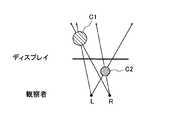
図6Aに、ステレオ画像符号化装置10が符号化する右視点の画像と左視点の画像からなるステレオ画像の一例を示す。深さ(図1のz参照)が異なって見える対象物は、左右の視点に対して異なる位置に存在する。図6Aでは、3次元ディスプレイにおいて非交差視差により飛び出して見える再生像をC1とし、交差視差により引っ込んで見える再生像をC2としている。図6Bに、周波数変換部21が、図6Aのステレオ画像にサブバンド変換を実行して生成した左(L)視点のサブバンド31と右(R)視点のサブバンド32より、対応関係のあるブロックを分割して視差補償を実行する例を示す。本実施の形態の対称的な視差補償では、サブバンドを適当な高さのストライプに分割し、さらにこのストライプからブロックを分割する。
FIG. 6A shows an example of a stereo image composed of a right viewpoint image and a left viewpoint image encoded by the stereo
ここで、ブロックを切り出すストライプの高さはすべてのサブバンドで同一としてもよいし、可変としてもよい。ストライプにおいて、対応関係があり、かつ、視差がほぼ等しいサンプルを有する列をまとめて、視差補償ブロックを構成する。視差補償ブロックは必ず左右でペアになるように、かつ、ブロックどうしが重ならないように構成する。図6Bでは、再生像C1と再生像C2に関連するブロックを分割して抽出している。本発明によると、対応関係のあるブロックを視差補償ブロックとして対称的な視差補償を行って符号化し、それ以外の対応関係がないと判断されたブロックは非視差補償ブロックとして視差補償を行わずに、そのまま符号化する。 Here, the height of the stripe from which the block is cut out may be the same in all subbands or may be variable. In the stripes, columns having samples that have a corresponding relationship and have substantially the same parallax are combined to form a parallax compensation block. The parallax compensation blocks are always configured as a pair on the left and right sides, and the blocks do not overlap each other. In FIG. 6B, blocks related to the reproduced image C1 and the reproduced image C2 are divided and extracted. According to the present invention, a block having a correspondence relationship is encoded by performing symmetric parallax compensation using a parallax compensation block, and a block determined to have no other correspondence relationship is not subjected to parallax compensation as a non-parallax compensation block. The data is encoded as it is.
対称的な視差補償として、本実施の形態では、AAC(非特許文献3参照)などで用いられるM/Sステレオ(Mid/Side Stereo)を用いる。具体的には、視差補償する左右の画像のブロックについて、対応する左のサンプルLと右のサンプルRを独立して符号化する代わりに、対応する左のサンプルLと右のサンプルRの和Mと差Sを用いて符号化する。L、RからM、Sへの変換を以下に定義する。L、RからM、Sへの変換は、左のサンプルLと右のサンプルRを所定の角度、本実施の形態では、45度の角度で回転する処理に相当する。
対応関係分析部22は、左右の画像のサブバンド31、32のブロックに対して、対応関係のあるブロックであるか否かを、左右の画像のマッチング、またはステレオ・マッチングに基づいて判断する。ステレオ・マッチングは、テンプレートに基づくマッチング(template−based matching)や特徴量に基づくマッチング(feature−based matching)などの方法によって、サンプル(ピクセルやサブバンド・サンプルを含む)ごとの対応関係を求める手法である。対応関係分析部22は、マッチングの精度を上げるため、マッチしない領域すなわち、一方の視点から見える物体の領域によって他方の視点から見える物体の領域が隠れてしまう、重なり(occlusion)領域をできるだけ少なくするなどの制約条件をつけてマッチングを実行してもよい。また、対応関係分析部22は、マッチングの計算量を削減するために、例えば、ウェーブレット変換による多重解像度解析を利用して、低解像度画像において求めた対応関係から高解像度における対応関係を予測するようにしてもよい。また、左右の視点に、例えば深さマップ(depth map)などの奥行き情報が付加されている場合は、この奥行き情報を手がかりに対応関係を求めるようにしてもよい。
The
図7に、左視点のサブバンド・サンプルの集まりLと右視点のサブバンド・サンプルの集まりRとの対応関係の例を示す。図7において、サブバンドは16サンプルの幅があるとして、対応関係を左右のサンプルの間の矢印で表す。矢印のないサンプルは対応関係がないことを表す。例えば、Lの2番目のサンプルとRの3番目のサンプルは対応するが、Lの1番目のサンプルはRのサブバンド・サンプルとは対応関係を持たない。また、Lの2番目から4番目のサンプルは同じ視差を持つ。このように対応関係を有するサンプルどうしを視差補償ブロックとしてまとめる(L[2,4]と書く)。対応するRの3番目から5番目のサンプルも視差補償ブロックにまとめる(R[3,5]と書く)。L[2,4]とR[3,5]は対称的な視差補償を行うペアになる。同様に、L[8,12]とR[6,10]はペアの視差補償ブロックとなる。その他のブロック、L[0,1],L[5,7],L[13,15],R[0,2],R[11,15]はそれぞれペアを持たず、非視差補償ブロックとなる。 FIG. 7 shows an example of the correspondence between the left-view subband sample collection L and the right-view subband sample collection R. In FIG. 7, assuming that the subband has a width of 16 samples, the correspondence is represented by an arrow between the left and right samples. Samples without arrows represent no correspondence. For example, the second sample of L corresponds to the third sample of R, but the first sample of L has no correspondence with the R subband sample. The second to fourth samples of L have the same parallax. The samples having such a correspondence relationship are collected as a parallax compensation block (written as L [2, 4]). The corresponding third through fifth samples of R are also grouped into a parallax compensation block (written as R [3,5]). L [2,4] and R [3,5] are a pair that performs symmetrical parallax compensation. Similarly, L [8,12] and R [6,10] are a pair of parallax compensation blocks. The other blocks, L [0,1], L [5,7], L [13,15], R [0,2], R [11,15] do not have pairs, Become.
符号化部24は、非視差補償成分と、視差補償した視差補償成分に対して独立して符号化を実行する。本実施の形態において、非視差補償成分、すなわち、非視差補償ブロックに分割された第1の周波数成分と第2の周波数成分、すなわち、左のサンプルLと右のサンプルRであり、視差補償した視差補償成分とは、視差補償ブロックに分割された左のサンプルLと右のサンプルRに、M/Sステレオを実行して生成した和Mと差Sである。
The
本実施の形態では、視差補償ブロックには対称的な視差補償、具体的には、M/Sステレオを適用する。視差補償ブロックに属さないサンプルは、非視差補償ブロックにまとめる。非視差補償ブロックはペアにならず、それぞれ独立して符号化する。視差補償ブロックや非視差補償ブロックは、レート歪みをより細かく最適化するため、さらに分割してもよい。デコーダにおいてエンコーダと同じブロック分割を行えるように、ブロック分割の方法の情報は符号化ストリームに含める必要がある。ブロック分割の方法は、符号量を低減するため、同じ解像度、すなわち同じ分解レベルのサブバンドには同じブロック分割の方法を用いるようにしてもよい。 In the present embodiment, symmetrical parallax compensation, specifically, M / S stereo is applied to the parallax compensation block. Samples that do not belong to the parallax compensation block are collected into a non-parallax compensation block. Non-parallax compensation blocks are not paired and are encoded independently. The parallax compensation block and the non-parallax compensation block may be further divided in order to optimize the rate distortion more finely. Information on the block division method needs to be included in the encoded stream so that the decoder can perform the same block division as the encoder. In order to reduce the code amount, the block division method may use the same block division method for subbands having the same resolution, that is, the same decomposition level.
また、低い解像度、すなわち高い分解レベルのバンドのブロック分割の方法については、高い解像度、すなわち低い分解レベルのバンドのブロック分割の方法から予測して、その予測残差のみを符号化するようにしてもよい。例えば、低解像度バンドのあるストライプのブロック分割方法を、そのストライプに対応する高解像度バンドの一以上のストライプの分割方法から、例えば、中央値をとるなどして予測した、低解像度バンドのストライプにおけるサンプルの対応関係から計算することができる。このとき、予測したサンプルの対応関係が実際の対応関係と異なる場合は、その差、すなわち、予測残差を符号化しストリームに含めることで、正しい対応関係を得ることができ、正しいブロック分割方法が得られる。同様の手法で、高い解像度、すなわち低い分解レベルのバンドのブロック分割の方法についても低い解像度、すなわち、高い分解レベルのバンド・ブロック分割の方法から予測することもできる。また、同様の手法で、より一般的には、あるサブバンドのブロック分割の方法から、他のブロック分割の方法を予測することができる。したがって、視差補償ブロックと非視差補償ブロックを含む、第1の周波数成分と第2の周波数成分の複数のブロックを含むサブバンドに対して、同一の解像度のサブバンドには同一のブロック分割の方法を実行する、または、所与のサブバンドのブロック分割の方法に基づいて他のサブバンドのブロック分割の方法を予測し、符号化ステップは、ブロック分割の方法が予測されたサブバンドについては、ブロック分割の方法の予測残差のみを符号化することも可能である。ここで、ブロック分割の方法とは、ブロック分割のパターンと同義である。 In addition, with respect to a method of block division of a band with low resolution, that is, a high resolution level, prediction is performed from a method of block division of a band with high resolution, that is, a low resolution level, and only the prediction residual is encoded. Also good. For example, a block division method of a stripe having a low resolution band is predicted from a division method of one or more stripes of a high resolution band corresponding to the stripe, for example, by taking a median value, etc. It can be calculated from the correspondence between samples. At this time, if the correspondence relationship of the predicted sample is different from the actual correspondence relationship, the correct correspondence can be obtained by encoding the difference, that is, the prediction residual, and including it in the stream. can get. In a similar manner, the block resolution method for high resolution, ie, low resolution level bands, can also be predicted from the method of band resolution and block resolution for low resolution, ie, high resolution levels. Further, in a similar manner, more generally, another block division method can be predicted from a block division method of a certain subband. Therefore, for the subband including a plurality of blocks of the first frequency component and the second frequency component including the parallax compensation block and the non-parallax compensation block, the same block division method is used for the subband of the same resolution. Or predicting the block partitioning method of other subbands based on the block partitioning method of a given subband, and the encoding step for the subband for which the block partitioning method is predicted, It is also possible to encode only the prediction residual of the block division method. Here, the block division method is synonymous with the block division pattern.
具体的には、上述のステップS4で視差補償を行ったブロックと、ステップS3で非視差補償ブロックと判定されたブロックを含むサブバンドに対して、ステップS5で、制御部10は、ブロック分割の方法が予測されたサブバンドについては、ブロック分割の方法の予測残差のみを符号化するようにしてもよい。これによって、同一の解像度のサブバンドについて同じブロック分割の方法を用いることに加えて、ブロック分割の方法を予測符号化することにより、一層の符号量の削減が可能になる
Specifically, in step S5, the
さらに、本実施の形態のステレオ画像符号化方法は、一方の視点のサブバンド・サンプルである第1の周波数成分と、他方の視点のサブバンド・サンプルである第2の周波数成分とに対して選択的に行う回転処理により、一方の視点の画像を他方の視点の画像と比較して優越的に扱うことのないように、対称的な視差補償を実行するので、視点間の画像の品質の差を小さくすることができ、復号と符号化を繰り返したときに、品質が低下しにくい、世代耐性のよいステレオ画像符号化を実行することができる。 Furthermore, the stereo image encoding method of the present embodiment is applied to the first frequency component that is a subband sample of one viewpoint and the second frequency component that is a subband sample of the other viewpoint. By performing a selective rotation process, symmetric parallax compensation is performed so that the image of one viewpoint is not treated preferentially compared with the image of the other viewpoint. The difference can be reduced, and it is possible to execute stereo image coding with good generation tolerance and quality that hardly deteriorates when decoding and coding are repeated.
以上説明したように、本実施の形態のステレオ画像符号化装置は、非対称的な視差補償の代わりに、対称的な視差補償を用いることによって、一方の視点の画像を他方の視点の画像と比較して、優越的に扱うことのないように、対称的に符号化することにより、視点間の品質の差を小さくできる。ただし、対称的な視差補償を用いるフレームを、動き補償の参照先にすることは難しい場合は、参照元にすることはできるので、対称的な視差補償は主にIフレームのみに使ってもよい。また、対称的な視差補償を行う場合、DCTのような比較的小さい変換ブロックよりも大きなブロックを用いることが好ましい。さらに、視点間の品質の差を小さくできるので、デコードとエンコードを繰り返したときに、品質が低下しにくく、世代耐性も向上する。このため、Iフレームのみを用いて、編集コーデックとして使える。 As described above, the stereo image coding apparatus according to the present embodiment compares the image of one viewpoint with the image of the other viewpoint by using symmetric parallax compensation instead of asymmetric parallax compensation. Thus, the quality difference between the viewpoints can be reduced by encoding symmetrically so that it is not handled preferentially. However, if it is difficult to make a frame using symmetric parallax compensation as a reference destination for motion compensation, it can be used as a reference source. Therefore, symmetric parallax compensation may be mainly used only for I frames. . When performing symmetrical parallax compensation, it is preferable to use a block larger than a relatively small transform block such as DCT. Furthermore, since the quality difference between the viewpoints can be reduced, the quality is not easily lowered and the generation tolerance is improved when decoding and encoding are repeated. Therefore, it can be used as an editing codec using only I frames.
また、コンピュータを利用して本発明を実施する場合、上述の機能を実行するハードウェアまたはプログラムとして実装してもよく、また、コンピュータに上述の機能を実行させるプログラムを記憶した、コンピュータが読み取り可能な記憶媒体として実装してもよい。このように本発明によると、より簡易で効果的なステレオ画像の符号化方法、符号化装置、及び符号化プログラムを提供することができる。 When the present invention is implemented using a computer, the present invention may be implemented as hardware or a program that executes the above-described function, or a computer-readable program that stores a program that causes the computer to execute the above-described function. It may be mounted as a simple storage medium. As described above, according to the present invention, it is possible to provide a simple and effective stereo image encoding method, encoding apparatus, and encoding program.
以上、本発明の実施の形態について説明したが、本発明は上述した実施の形態に限定されるものではない。また、本発明の実施の形態に記載された効果は、本発明から生じる最も好適な効果を列挙したものに過ぎず、本発明による効果は、本発明の実施例に記載されたものに限定されるものではない。 Although the embodiment of the present invention has been described above, the present invention is not limited to the above-described embodiment. Further, the effects described in the embodiments of the present invention are merely a list of the most preferable effects resulting from the present invention, and the effects of the present invention are limited to those described in the examples of the present invention. It is not something.
例えば、上述の実施の形態では、符号化方式の一例としてJPEG2000方式を言及して説明したが、本発明が適用可能な符号化方式はJPEG2000方式に限定されない。本発明は、サブバンド分割を行うほぼ如何なる符号化方式に適用可能である。 For example, in the above-described embodiment, the JPEG2000 system has been described as an example of the encoding system, but the encoding system to which the present invention is applicable is not limited to the JPEG2000 system. The present invention can be applied to almost any coding scheme that performs subband division.
10 ステレオ画像符号化装置
11 制御部
12 ウェーブレット変換部
13 ブロック分割部
14 M/Sステレオ部
15 エントロピー符号化部
21 周波数変換部
22 対応関係分析部
23 視差補償実行部
24 符号化部
DESCRIPTION OF
Claims (9)
第1の視点から得られた第1の画像データを所定の周波数範囲と解像度によって分けられた第1の周波数成分に変換し、第2の視点から得られた第2の画像データを所定の周波数範囲と解像度によって分けられた第2の周波数成分に変換する周波数変換ステップと、
前記第1の画像データと前記第2の画像データとを比較して、対応関係を分析する対応関係分析ステップと、
前記対応関係分析ステップで分析した対応関係に基づいて、前記第1の周波数成分と前記第2の周波数成分とに選択的に、回転処理による対称的な視差補償を実行して視差補償した第1の周波数成分と視差補償した第2の周波数成分とを取得する視差補償実行ステップと、
前記対応関係分析ステップで分析した対応関係に基づいて、前記第1の周波数成分と、前記第2の周波数成分と、前記視差補償した第1の周波数成分と前記視差補償した第2の周波数成分とを選択的に符号化する符号化ステップと、
を含む、前記ステレオ画像符号化方法。A stereo image encoding method for encoding image data obtained from two different viewpoints,
The first image data obtained from the first viewpoint is converted into a first frequency component divided by a predetermined frequency range and resolution, and the second image data obtained from the second viewpoint is converted to a predetermined frequency. A frequency conversion step of converting to a second frequency component divided by range and resolution;
A correspondence analysis step of comparing the first image data with the second image data and analyzing the correspondence;
Based on the correspondence analyzed in the correspondence analysis step, the first frequency component and the second frequency component are selectively subjected to symmetric parallax compensation by rotation processing to perform first parallax compensation. A parallax compensation execution step for obtaining a frequency component of the second frequency component and a second frequency component subjected to parallax compensation;
Based on the correspondence analyzed in the correspondence analysis step, the first frequency component, the second frequency component, the parallax-compensated first frequency component, and the parallax-compensated second frequency component An encoding step for selectively encoding
The stereo image encoding method comprising:
前記視差補償実行ステップは、前記第1の周波数成分と第2の周波数成分の前記視差補償ブロックに対して視差補償を実行して視差補償した第1の周波数成分と視差補償した第2の周波数成分を生成するステップを含み、
前記符号化ステップは、視差補償した第1の周波数成分と視差補償した第2の周波数成分と前記非視差補償ブロックに該当する前記第1の周波数成分と前記第2の周波数成分とを、前記視差補償ブロックと前記非視差補償ブロックの分割の情報とともに独立して符号化するステップを含む、請求項1記載のステレオ画像符号化方法。The correspondence analysis step includes a step of dividing the first frequency component and the second frequency component into a disparity compensation block and a non-disparity compensation block based on the analyzed correspondence relationship,
In the parallax compensation execution step, the first frequency component subjected to the parallax compensation by performing the parallax compensation on the parallax compensation block of the first frequency component and the second frequency component and the second frequency component subjected to the parallax compensation Including the step of generating
In the encoding step, the parallax-compensated first frequency component, the parallax-compensated second frequency component, the first frequency component corresponding to the non-parallax compensation block, and the second frequency component are converted into the parallax. The stereo image coding method according to claim 1, further comprising a step of independently coding together with information on division of a compensation block and the non-parallax compensation block.
前記符号化ステップは、ブロック分割の方法が予測されたサブバンドについては、ブロック分割の方法の予測残差を符号化する、請求項6記載のステレオ画像符号化方法。The dividing step performs the same block division method for subbands of the same resolution, or predicts the block division method of other subbands based on the block division method of a given subband. And
The stereo image encoding method according to claim 6, wherein the encoding step encodes a prediction residual of the block division method for a subband for which the block division method is predicted.
第1の視点から得られた第1の画像データを所定の周波数範囲と解像度によって分けられた第1の周波数成分に変換し、第2の視点から得られた第2の画像データを所定の周波数範囲と解像度によって分けられた第2の周波数成分に変換する周波数変換部と、
前記第1の画像データと前記第2の画像データとを比較して、対応関係を分析する対応関係分析部と、
前記対応関係分析部で分析した対応関係に基づいて、前記第1の周波数成分と前記第2の周波数成分とに選択的に、回転処理による対称的な視差補償を実行して、視差補償した第1の周波数成分と視差補償した第2の周波数成分を取得する視差補償実行部と、
前記対応関係分析部で分析した対応関係に基づいて、前記第1の周波数成分と、前記第2の周波数成分と、前記視差補償した第1の周波数成分と前記視差補償した第2の周波数成分とを選択的に符号化する符号化部と、
を含む、前記ステレオ画像符号化装置。A stereo image encoding device for encoding image data obtained from two different viewpoints,
The first image data obtained from the first viewpoint is converted into a first frequency component divided by a predetermined frequency range and resolution, and the second image data obtained from the second viewpoint is converted to a predetermined frequency. A frequency conversion unit for converting to a second frequency component divided by range and resolution;
A correspondence analysis unit that compares the first image data with the second image data and analyzes the correspondence;
Based on the correspondence analyzed by the correspondence analysis unit, the first frequency component and the second frequency component are selectively subjected to symmetric parallax compensation by rotation processing to perform parallax compensation. A parallax compensation execution unit that acquires a first frequency component and a second frequency component that has undergone parallax compensation;
Based on the correspondence analyzed by the correspondence analysis unit, the first frequency component, the second frequency component, the parallax-compensated first frequency component, and the parallax-compensated second frequency component An encoding unit that selectively encodes;
The stereo image encoding device comprising:
前記コンピュータを、
第1の視点から得られた第1の画像データを所定の周波数範囲と解像度によって分けられた第1の周波数成分に、第2の視点から得られた第2の画像データを所定の周波数範囲と解像度によって分けられた第2の周波数成分に変換する周波数変換部と、
前記第1の画像データと前記第2の画像データとを比較して、対応関係を分析する対応関係分析部と、
前記対応関係分析部で分析した対応関係に基づいて、前記第1の周波数成分と前記第2の周波数成分とに選択的に、回転処理による対称的な視差補償を実行して、視差補償した第1の周波数成分と視差補償した第2の周波数成分を取得する視差補償実行部と、
前記対応関係分析部で分析した対応関係に基づいて、前記第1の周波数成分と、前記第2の周波数成分と、前記視差補償した第1の周波数成分と前記視差補償した第2の周波数成分とを選択的に符号化する符号化部と、
して機能させる、前記ステレオ画像符号化プログラム。A stereo image encoding program for causing a computer to execute a stereo image encoding process for encoding image data obtained from two different viewpoints,
The computer,
The first image data obtained from the first viewpoint is converted into a first frequency component divided by a predetermined frequency range and resolution, and the second image data obtained from the second viewpoint is set as a predetermined frequency range. A frequency conversion unit for converting to a second frequency component divided by resolution;
A correspondence analysis unit that compares the first image data with the second image data and analyzes the correspondence;
Based on the correspondence analyzed by the correspondence analysis unit, the first frequency component and the second frequency component are selectively subjected to symmetric parallax compensation by rotation processing to perform parallax compensation. A parallax compensation execution unit that acquires a first frequency component and a second frequency component that has undergone parallax compensation;
Based on the correspondence analyzed by the correspondence analysis unit, the first frequency component, the second frequency component, the parallax-compensated first frequency component, and the parallax-compensated second frequency component An encoding unit that selectively encodes;
The stereo image encoding program that is caused to function.
Applications Claiming Priority (1)
| Application Number | Priority Date | Filing Date | Title |
|---|---|---|---|
| PCT/JP2009/003970 WO2011021240A1 (en) | 2009-08-20 | 2009-08-20 | Stereo image encoding method, stereo image encoding device, and stereo image encoding program |
Publications (2)
| Publication Number | Publication Date |
|---|---|
| JPWO2011021240A1 JPWO2011021240A1 (en) | 2013-01-17 |
| JP5307896B2 true JP5307896B2 (en) | 2013-10-02 |
Family
ID=43606711
Family Applications (1)
| Application Number | Title | Priority Date | Filing Date |
|---|---|---|---|
| JP2011527484A Expired - Fee Related JP5307896B2 (en) | 2009-08-20 | 2009-08-20 | Stereo image encoding method, stereo image encoding device, and stereo image encoding program |
Country Status (3)
| Country | Link |
|---|---|
| US (1) | US20120224027A1 (en) |
| JP (1) | JP5307896B2 (en) |
| WO (1) | WO2011021240A1 (en) |
Families Citing this family (8)
| Publication number | Priority date | Publication date | Assignee | Title |
|---|---|---|---|---|
| JP5627498B2 (en) * | 2010-07-08 | 2014-11-19 | 株式会社東芝 | Stereo image generating apparatus and method |
| JP2014099671A (en) * | 2011-03-03 | 2014-05-29 | Panasonic Corp | 3d image reproduction device |
| JP6167525B2 (en) * | 2012-03-21 | 2017-07-26 | 株式会社リコー | Distance measuring device and vehicle |
| US9836433B1 (en) * | 2012-04-02 | 2017-12-05 | Rockwell Collins, Inc. | Image processing using multiprocessor discrete wavelet transform |
| JP6046923B2 (en) * | 2012-06-07 | 2016-12-21 | キヤノン株式会社 | Image coding apparatus, image coding method, and program |
| ITTO20120647A1 (en) * | 2012-07-24 | 2014-01-25 | St Microelectronics Srl | PROCEDURES AND SYSTEMS FOR THE TREATMENT OF STEREOSCOPIC IMAGES, COMPUTER PRODUCTS AND RELATIVE SUPPORT |
| US10602187B2 (en) | 2015-11-30 | 2020-03-24 | Intel Corporation | Efficient, compatible, and scalable intra video/image coding using wavelets and HEVC coding |
| US9955176B2 (en) * | 2015-11-30 | 2018-04-24 | Intel Corporation | Efficient and scalable intra video/image coding using wavelets and AVC, modified AVC, VPx, modified VPx, or modified HEVC coding |
Citations (5)
| Publication number | Priority date | Publication date | Assignee | Title |
|---|---|---|---|---|
| JPH06113337A (en) * | 1992-09-30 | 1994-04-22 | Fujitsu Ltd | Orthogonal transform coding method for multi-view stereoscopic video |
| JPH0746630A (en) * | 1993-07-28 | 1995-02-14 | Victor Co Of Japan Ltd | Stereoscopic video signal compression device |
| JPH10191394A (en) * | 1996-12-24 | 1998-07-21 | Sharp Corp | Multi-view image coding device |
| JPH11341520A (en) * | 1998-05-28 | 1999-12-10 | Kdd Corp | Encoding device for stereo video |
| JP2003319416A (en) * | 2002-04-25 | 2003-11-07 | Sharp Corp | Stereoscopic image encoding device and stereoscopic image decoding device |
Family Cites Families (5)
| Publication number | Priority date | Publication date | Assignee | Title |
|---|---|---|---|---|
| EP0938235A1 (en) * | 1998-02-20 | 1999-08-25 | Canon Kabushiki Kaisha | Digital signal coding and decoding |
| AU2003298681A1 (en) * | 2002-11-21 | 2004-06-18 | Vision Iii Imaging, Inc. | Critical alignment of parallax images for autostereoscopic display |
| KR100679054B1 (en) * | 2006-02-15 | 2007-02-06 | 삼성전자주식회사 | Apparatus and method for displaying stereoscopic images |
| US7538876B2 (en) * | 2006-06-12 | 2009-05-26 | The Boeing Company | Efficient and accurate alignment of stereoscopic displays |
| WO2008035665A1 (en) * | 2006-09-20 | 2008-03-27 | Nippon Telegraph And Telephone Corporation | Image encoding method, decoding method, device thereof, image decoding device, program thereof, and storage medium containing the program |
-
2009
- 2009-08-20 JP JP2011527484A patent/JP5307896B2/en not_active Expired - Fee Related
- 2009-08-20 WO PCT/JP2009/003970 patent/WO2011021240A1/en not_active Ceased
- 2009-08-20 US US13/391,258 patent/US20120224027A1/en not_active Abandoned
Patent Citations (5)
| Publication number | Priority date | Publication date | Assignee | Title |
|---|---|---|---|---|
| JPH06113337A (en) * | 1992-09-30 | 1994-04-22 | Fujitsu Ltd | Orthogonal transform coding method for multi-view stereoscopic video |
| JPH0746630A (en) * | 1993-07-28 | 1995-02-14 | Victor Co Of Japan Ltd | Stereoscopic video signal compression device |
| JPH10191394A (en) * | 1996-12-24 | 1998-07-21 | Sharp Corp | Multi-view image coding device |
| JPH11341520A (en) * | 1998-05-28 | 1999-12-10 | Kdd Corp | Encoding device for stereo video |
| JP2003319416A (en) * | 2002-04-25 | 2003-11-07 | Sharp Corp | Stereoscopic image encoding device and stereoscopic image decoding device |
Also Published As
| Publication number | Publication date |
|---|---|
| JPWO2011021240A1 (en) | 2013-01-17 |
| US20120224027A1 (en) | 2012-09-06 |
| WO2011021240A1 (en) | 2011-02-24 |
Similar Documents
| Publication | Publication Date | Title |
|---|---|---|
| JP5307896B2 (en) | Stereo image encoding method, stereo image encoding device, and stereo image encoding program | |
| US8274551B2 (en) | Method and apparatus for generating header information of stereoscopic image data | |
| US8537200B2 (en) | Depth map generation techniques for conversion of 2D video data to 3D video data | |
| US20090015662A1 (en) | Method and apparatus for encoding and decoding stereoscopic image format including both information of base view image and information of additional view image | |
| CN104885450B (en) | Image encoding method, image decoding method, image encoding device, image decoding device, image encoding program, and image decoding program | |
| KR101648094B1 (en) | Image encoding method, image decoding method, image encoding device, image decoding device, image encoding program, image decoding program, and recording medium | |
| US20150350678A1 (en) | Image encoding method, image decoding method, image encoding apparatus, image decoding apparatus, image encoding program, image decoding program, and recording media | |
| KR20150046154A (en) | Image encoding method, image decoding method, image encoding device, image decoding device, image encoding program, image decoding program, and recording medium | |
| US20160316224A1 (en) | Video Encoding Method, Video Decoding Method, Video Encoding Apparatus, Video Decoding Apparatus, Video Encoding Program, And Video Decoding Program | |
| US20150016517A1 (en) | Encoding device and encoding method, and decoding device and decoding method | |
| CN103686192A (en) | Apparatus and method for processing image using correlation between views | |
| US9602831B2 (en) | Method and apparatus for processing video signals | |
| US10911779B2 (en) | Moving image encoding and decoding method, and non-transitory computer-readable media that code moving image for each of prediction regions that are obtained by dividing coding target region while performing prediction between different views | |
| Maugey et al. | Consistent view synthesis in interactive multiview imaging | |
| JP2011228929A (en) | 3d encoder, 3d encoding method and program | |
| KR20110136014A (en) | Apparatus and method for encoding / decoding multiview depth image | |
| KR20120096317A (en) | Method and apparatus of coding stereoscopic video | |
| KR20120084628A (en) | Apparatus and method for encoding and decoding multi-view image | |
| KR101356890B1 (en) | Method and apparatus of inter-view video encoding and decoding in hybrid codecs for multi-view video coding | |
| He et al. | A depth image coding method for 3DTV system based on edge enhancement | |
| KR20130056803A (en) | Apparatus and method for multi-view depth image encoding/decoding using color image |
Legal Events
| Date | Code | Title | Description |
|---|---|---|---|
| TRDD | Decision of grant or rejection written | ||
| A01 | Written decision to grant a patent or to grant a registration (utility model) |
Free format text: JAPANESE INTERMEDIATE CODE: A01 Effective date: 20130604 |
|
| A61 | First payment of annual fees (during grant procedure) |
Free format text: JAPANESE INTERMEDIATE CODE: A61 Effective date: 20130627 |
|
| R150 | Certificate of patent or registration of utility model |
Free format text: JAPANESE INTERMEDIATE CODE: R150 |
|
| S111 | Request for change of ownership or part of ownership |
Free format text: JAPANESE INTERMEDIATE CODE: R313113 |
|
| R350 | Written notification of registration of transfer |
Free format text: JAPANESE INTERMEDIATE CODE: R350 |
|
| R250 | Receipt of annual fees |
Free format text: JAPANESE INTERMEDIATE CODE: R250 |
|
| R250 | Receipt of annual fees |
Free format text: JAPANESE INTERMEDIATE CODE: R250 |
|
| LAPS | Cancellation because of no payment of annual fees |