JP5192373B2 - Protective coating for window glass - Google Patents
Protective coating for window glass Download PDFInfo
- Publication number
- JP5192373B2 JP5192373B2 JP2008518404A JP2008518404A JP5192373B2 JP 5192373 B2 JP5192373 B2 JP 5192373B2 JP 2008518404 A JP2008518404 A JP 2008518404A JP 2008518404 A JP2008518404 A JP 2008518404A JP 5192373 B2 JP5192373 B2 JP 5192373B2
- Authority
- JP
- Japan
- Prior art keywords
- meth
- acrylate
- coating
- composition
- weight
- Prior art date
- Legal status (The legal status is an assumption and is not a legal conclusion. Google has not performed a legal analysis and makes no representation as to the accuracy of the status listed.)
- Expired - Fee Related
Links
- 239000005357 flat glass Substances 0.000 title 1
- 239000011253 protective coating Substances 0.000 title 1
- 239000000203 mixture Substances 0.000 claims description 229
- 238000000576 coating method Methods 0.000 claims description 195
- 239000000853 adhesive Substances 0.000 claims description 191
- 230000001070 adhesive effect Effects 0.000 claims description 191
- 239000011248 coating agent Substances 0.000 claims description 173
- -1 isononyl Chemical group 0.000 claims description 116
- 239000011521 glass Substances 0.000 claims description 110
- NIXOWILDQLNWCW-UHFFFAOYSA-M acrylate group Chemical group C(C=C)(=O)[O-] NIXOWILDQLNWCW-UHFFFAOYSA-M 0.000 claims description 81
- 229920003023 plastic Polymers 0.000 claims description 72
- 239000004033 plastic Substances 0.000 claims description 67
- 150000001875 compounds Chemical class 0.000 claims description 54
- 239000000758 substrate Substances 0.000 claims description 48
- 229920005989 resin Polymers 0.000 claims description 46
- 239000011347 resin Substances 0.000 claims description 46
- 239000000049 pigment Substances 0.000 claims description 45
- 239000000945 filler Substances 0.000 claims description 35
- 239000003054 catalyst Substances 0.000 claims description 31
- 125000000524 functional group Chemical group 0.000 claims description 31
- 239000003085 diluting agent Substances 0.000 claims description 30
- 239000002270 dispersing agent Substances 0.000 claims description 30
- BLRPTPMANUNPDV-UHFFFAOYSA-N Silane Chemical compound [SiH4] BLRPTPMANUNPDV-UHFFFAOYSA-N 0.000 claims description 28
- 238000006116 polymerization reaction Methods 0.000 claims description 26
- 238000000034 method Methods 0.000 claims description 22
- 238000005299 abrasion Methods 0.000 claims description 21
- 239000012948 isocyanate Substances 0.000 claims description 20
- 150000002513 isocyanates Chemical class 0.000 claims description 20
- 230000005855 radiation Effects 0.000 claims description 19
- 150000001412 amines Chemical class 0.000 claims description 18
- 125000004469 siloxy group Chemical group [SiH3]O* 0.000 claims description 16
- 239000003999 initiator Substances 0.000 claims description 15
- 229910000077 silane Inorganic materials 0.000 claims description 15
- 239000000975 dye Substances 0.000 claims description 14
- NIXOWILDQLNWCW-UHFFFAOYSA-N acrylic acid group Chemical group C(C=C)(=O)O NIXOWILDQLNWCW-UHFFFAOYSA-N 0.000 claims description 13
- UFHFLCQGNIYNRP-UHFFFAOYSA-N Hydrogen Chemical compound [H][H] UFHFLCQGNIYNRP-UHFFFAOYSA-N 0.000 claims description 12
- 229910052739 hydrogen Inorganic materials 0.000 claims description 12
- 239000001257 hydrogen Substances 0.000 claims description 12
- YDKNBNOOCSNPNS-UHFFFAOYSA-N methyl 1,3-benzoxazole-2-carboxylate Chemical compound C1=CC=C2OC(C(=O)OC)=NC2=C1 YDKNBNOOCSNPNS-UHFFFAOYSA-N 0.000 claims description 11
- LYCAIKOWRPUZTN-UHFFFAOYSA-N Ethylene glycol Chemical compound OCCO LYCAIKOWRPUZTN-UHFFFAOYSA-N 0.000 claims description 10
- PPBRXRYQALVLMV-UHFFFAOYSA-N Styrene Chemical compound C=CC1=CC=CC=C1 PPBRXRYQALVLMV-UHFFFAOYSA-N 0.000 claims description 10
- 239000010409 thin film Substances 0.000 claims description 9
- HRPVXLWXLXDGHG-UHFFFAOYSA-N Acrylamide Chemical compound NC(=O)C=C HRPVXLWXLXDGHG-UHFFFAOYSA-N 0.000 claims description 8
- 150000002148 esters Chemical class 0.000 claims description 8
- 230000000977 initiatory effect Effects 0.000 claims description 8
- SMZOUWXMTYCWNB-UHFFFAOYSA-N 2-(2-methoxy-5-methylphenyl)ethanamine Chemical compound COC1=CC=C(C)C=C1CCN SMZOUWXMTYCWNB-UHFFFAOYSA-N 0.000 claims description 7
- 238000006845 Michael addition reaction Methods 0.000 claims description 7
- 230000002378 acidificating effect Effects 0.000 claims description 7
- 150000003512 tertiary amines Chemical class 0.000 claims description 7
- CERQOIWHTDAKMF-UHFFFAOYSA-N Methacrylic acid Chemical compound CC(=C)C(O)=O CERQOIWHTDAKMF-UHFFFAOYSA-N 0.000 claims description 6
- 125000002496 methyl group Chemical group [H]C([H])([H])* 0.000 claims description 6
- OFOBLEOULBTSOW-UHFFFAOYSA-N Propanedioic acid Natural products OC(=O)CC(O)=O OFOBLEOULBTSOW-UHFFFAOYSA-N 0.000 claims description 5
- ZJCCRDAZUWHFQH-UHFFFAOYSA-N Trimethylolpropane Chemical compound CCC(CO)(CO)CO ZJCCRDAZUWHFQH-UHFFFAOYSA-N 0.000 claims description 5
- ZFSLODLOARCGLH-UHFFFAOYSA-N isocyanuric acid Chemical compound OC1=NC(O)=NC(O)=N1 ZFSLODLOARCGLH-UHFFFAOYSA-N 0.000 claims description 5
- 239000011976 maleic acid Substances 0.000 claims description 5
- VZCYOOQTPOCHFL-UHFFFAOYSA-N trans-butenedioic acid Natural products OC(=O)C=CC(O)=O VZCYOOQTPOCHFL-UHFFFAOYSA-N 0.000 claims description 5
- PEDCQBHIVMGVHV-UHFFFAOYSA-N Glycerine Chemical compound OCC(O)CO PEDCQBHIVMGVHV-UHFFFAOYSA-N 0.000 claims description 4
- QYKIQEUNHZKYBP-UHFFFAOYSA-N Vinyl ether Chemical class C=COC=C QYKIQEUNHZKYBP-UHFFFAOYSA-N 0.000 claims description 4
- SZXQTJUDPRGNJN-UHFFFAOYSA-N dipropylene glycol Chemical compound OCCCOCCCO SZXQTJUDPRGNJN-UHFFFAOYSA-N 0.000 claims description 4
- WXZMFSXDPGVJKK-UHFFFAOYSA-N pentaerythritol Chemical compound OCC(CO)(CO)CO WXZMFSXDPGVJKK-UHFFFAOYSA-N 0.000 claims description 4
- JAHNSTQSQJOJLO-UHFFFAOYSA-N 2-(3-fluorophenyl)-1h-imidazole Chemical compound FC1=CC=CC(C=2NC=CN=2)=C1 JAHNSTQSQJOJLO-UHFFFAOYSA-N 0.000 claims description 3
- NLHHRLWOUZZQLW-UHFFFAOYSA-N Acrylonitrile Chemical compound C=CC#N NLHHRLWOUZZQLW-UHFFFAOYSA-N 0.000 claims description 3
- WHNWPMSKXPGLAX-UHFFFAOYSA-N N-Vinyl-2-pyrrolidone Chemical class C=CN1CCCC1=O WHNWPMSKXPGLAX-UHFFFAOYSA-N 0.000 claims description 3
- 229910019142 PO4 Inorganic materials 0.000 claims description 3
- 125000000959 isobutyl group Chemical group [H]C([H])([H])C([H])(C([H])([H])[H])C([H])([H])* 0.000 claims description 3
- VZCYOOQTPOCHFL-UPHRSURJSA-N maleic acid Chemical compound OC(=O)\C=C/C(O)=O VZCYOOQTPOCHFL-UPHRSURJSA-N 0.000 claims description 3
- LVHBHZANLOWSRM-UHFFFAOYSA-N methylenebutanedioic acid Natural products OC(=O)CC(=C)C(O)=O LVHBHZANLOWSRM-UHFFFAOYSA-N 0.000 claims description 3
- 125000004108 n-butyl group Chemical group [H]C([H])([H])C([H])([H])C([H])([H])C([H])([H])* 0.000 claims description 3
- 239000010452 phosphate Substances 0.000 claims description 3
- 230000000379 polymerizing effect Effects 0.000 claims description 3
- 150000003440 styrenes Chemical class 0.000 claims description 3
- DTGKSKDOIYIVQL-WEDXCCLWSA-N (+)-borneol Chemical group C1C[C@@]2(C)[C@@H](O)C[C@@H]1C2(C)C DTGKSKDOIYIVQL-WEDXCCLWSA-N 0.000 claims description 2
- JWYVGKFDLWWQJX-UHFFFAOYSA-N 1-ethenylazepan-2-one Chemical compound C=CN1CCCCCC1=O JWYVGKFDLWWQJX-UHFFFAOYSA-N 0.000 claims description 2
- IEORSVTYLWZQJQ-UHFFFAOYSA-N 2-(2-nonylphenoxy)ethanol Chemical compound CCCCCCCCCC1=CC=CC=C1OCCO IEORSVTYLWZQJQ-UHFFFAOYSA-N 0.000 claims description 2
- WMYINDVYGQKYMI-UHFFFAOYSA-N 2-[2,2-bis(hydroxymethyl)butoxymethyl]-2-ethylpropane-1,3-diol Chemical compound CCC(CO)(CO)COCC(CC)(CO)CO WMYINDVYGQKYMI-UHFFFAOYSA-N 0.000 claims description 2
- 125000000954 2-hydroxyethyl group Chemical group [H]C([*])([H])C([H])([H])O[H] 0.000 claims description 2
- GAWIXWVDTYZWAW-UHFFFAOYSA-N C[CH]O Chemical group C[CH]O GAWIXWVDTYZWAW-UHFFFAOYSA-N 0.000 claims description 2
- 239000007983 Tris buffer Substances 0.000 claims description 2
- XYLMUPLGERFSHI-UHFFFAOYSA-N alpha-Methylstyrene Chemical compound CC(=C)C1=CC=CC=C1 XYLMUPLGERFSHI-UHFFFAOYSA-N 0.000 claims description 2
- KPUWHANPEXNPJT-UHFFFAOYSA-N disiloxane Chemical class [SiH3]O[SiH3] KPUWHANPEXNPJT-UHFFFAOYSA-N 0.000 claims description 2
- 235000011187 glycerol Nutrition 0.000 claims description 2
- ACCCMOQWYVYDOT-UHFFFAOYSA-N hexane-1,1-diol Chemical compound CCCCCC(O)O ACCCMOQWYVYDOT-UHFFFAOYSA-N 0.000 claims description 2
- 125000004051 hexyl group Chemical group [H]C([H])([H])C([H])([H])C([H])([H])C([H])([H])C([H])([H])C([H])([H])* 0.000 claims description 2
- WGCNASOHLSPBMP-UHFFFAOYSA-N hydroxyacetaldehyde Natural products OCC=O WGCNASOHLSPBMP-UHFFFAOYSA-N 0.000 claims description 2
- 125000004029 hydroxymethyl group Chemical group [H]OC([H])([H])* 0.000 claims description 2
- FPYJFEHAWHCUMM-UHFFFAOYSA-N maleic anhydride Chemical compound O=C1OC(=O)C=C1 FPYJFEHAWHCUMM-UHFFFAOYSA-N 0.000 claims description 2
- 125000005395 methacrylic acid group Chemical group 0.000 claims description 2
- ZQXSMRAEXCEDJD-UHFFFAOYSA-N n-ethenylformamide Chemical compound C=CNC=O ZQXSMRAEXCEDJD-UHFFFAOYSA-N 0.000 claims description 2
- SLCVBVWXLSEKPL-UHFFFAOYSA-N neopentyl glycol Chemical compound OCC(C)(C)CO SLCVBVWXLSEKPL-UHFFFAOYSA-N 0.000 claims description 2
- 229920000847 nonoxynol Polymers 0.000 claims description 2
- 125000002347 octyl group Chemical group [H]C([*])([H])C([H])([H])C([H])([H])C([H])([H])C([H])([H])C([H])([H])C([H])([H])C([H])([H])[H] 0.000 claims description 2
- WDHYRUBXLGOLKR-UHFFFAOYSA-N phosphoric acid;prop-2-enoic acid Chemical compound OC(=O)C=C.OP(O)(O)=O WDHYRUBXLGOLKR-UHFFFAOYSA-N 0.000 claims description 2
- 229920001223 polyethylene glycol Polymers 0.000 claims description 2
- UWHCKJMYHZGTIT-UHFFFAOYSA-N tetraethylene glycol Chemical compound OCCOCCOCCOCCO UWHCKJMYHZGTIT-UHFFFAOYSA-N 0.000 claims description 2
- 229920001567 vinyl ester resin Chemical class 0.000 claims description 2
- 230000001737 promoting effect Effects 0.000 claims 2
- IEPRKVQEAMIZSS-UHFFFAOYSA-N Di-Et ester-Fumaric acid Natural products CCOC(=O)C=CC(=O)OCC IEPRKVQEAMIZSS-UHFFFAOYSA-N 0.000 claims 1
- PBOSTUDLECTMNL-UHFFFAOYSA-N lauryl acrylate Chemical compound CCCCCCCCCCCCOC(=O)C=C PBOSTUDLECTMNL-UHFFFAOYSA-N 0.000 claims 1
- 239000006223 plastic coating Substances 0.000 claims 1
- 125000002572 propoxy group Chemical group [*]OC([H])([H])C(C([H])([H])[H])([H])[H] 0.000 claims 1
- PAPBSGBWRJIAAV-UHFFFAOYSA-N ε-Caprolactone Chemical compound O=C1CCCCCO1 PAPBSGBWRJIAAV-UHFFFAOYSA-N 0.000 claims 1
- 239000008199 coating composition Substances 0.000 description 38
- 239000002318 adhesion promoter Substances 0.000 description 35
- 229920000642 polymer Polymers 0.000 description 33
- 238000009472 formulation Methods 0.000 description 31
- 238000012360 testing method Methods 0.000 description 27
- 150000003254 radicals Chemical class 0.000 description 24
- 125000000217 alkyl group Chemical group 0.000 description 23
- 239000006185 dispersion Substances 0.000 description 22
- 238000001723 curing Methods 0.000 description 21
- 239000006229 carbon black Substances 0.000 description 20
- 238000006243 chemical reaction Methods 0.000 description 19
- XLYOFNOQVPJJNP-UHFFFAOYSA-N water Substances O XLYOFNOQVPJJNP-UHFFFAOYSA-N 0.000 description 19
- 239000002253 acid Substances 0.000 description 18
- 125000003545 alkoxy group Chemical group 0.000 description 18
- 229920005862 polyol Polymers 0.000 description 18
- 150000003077 polyols Chemical class 0.000 description 18
- 229920001296 polysiloxane Polymers 0.000 description 18
- 230000005540 biological transmission Effects 0.000 description 17
- 238000002156 mixing Methods 0.000 description 17
- XUIMIQQOPSSXEZ-UHFFFAOYSA-N Silicon Chemical compound [Si] XUIMIQQOPSSXEZ-UHFFFAOYSA-N 0.000 description 16
- 239000007795 chemical reaction product Substances 0.000 description 16
- 239000002131 composite material Substances 0.000 description 16
- PYGSKMBEVAICCR-UHFFFAOYSA-N hexa-1,5-diene Chemical group C=CCCC=C PYGSKMBEVAICCR-UHFFFAOYSA-N 0.000 description 16
- 239000002245 particle Substances 0.000 description 16
- PNEYBMLMFCGWSK-UHFFFAOYSA-N aluminium oxide Inorganic materials [O-2].[O-2].[O-2].[Al+3].[Al+3] PNEYBMLMFCGWSK-UHFFFAOYSA-N 0.000 description 15
- 239000004615 ingredient Substances 0.000 description 15
- 125000001971 neopentyl group Chemical group [H]C([*])([H])C(C([H])([H])[H])(C([H])([H])[H])C([H])([H])[H] 0.000 description 15
- 239000000126 substance Substances 0.000 description 15
- OKTJSMMVPCPJKN-UHFFFAOYSA-N Carbon Chemical compound [C] OKTJSMMVPCPJKN-UHFFFAOYSA-N 0.000 description 14
- IAYPIBMASNFSPL-UHFFFAOYSA-N Ethylene oxide Chemical compound C1CO1 IAYPIBMASNFSPL-UHFFFAOYSA-N 0.000 description 14
- 239000003112 inhibitor Substances 0.000 description 14
- 239000007788 liquid Substances 0.000 description 14
- 239000000463 material Substances 0.000 description 14
- 229920000570 polyether Polymers 0.000 description 14
- 150000001252 acrylic acid derivatives Chemical class 0.000 description 13
- 239000000654 additive Substances 0.000 description 13
- 239000004094 surface-active agent Substances 0.000 description 13
- JLZIIHMTTRXXIN-UHFFFAOYSA-N 2-(2-hydroxy-4-methoxybenzoyl)benzoic acid Chemical compound OC1=CC(OC)=CC=C1C(=O)C1=CC=CC=C1C(O)=O JLZIIHMTTRXXIN-UHFFFAOYSA-N 0.000 description 12
- 238000003801 milling Methods 0.000 description 12
- 239000000843 powder Substances 0.000 description 12
- RTAQQCXQSZGOHL-UHFFFAOYSA-N Titanium Chemical compound [Ti] RTAQQCXQSZGOHL-UHFFFAOYSA-N 0.000 description 11
- 238000003848 UV Light-Curing Methods 0.000 description 11
- 239000002518 antifoaming agent Substances 0.000 description 11
- 239000011324 bead Substances 0.000 description 11
- 125000002887 hydroxy group Chemical group [H]O* 0.000 description 11
- 239000000178 monomer Substances 0.000 description 11
- 229920002635 polyurethane Polymers 0.000 description 11
- 239000004814 polyurethane Substances 0.000 description 11
- 239000004593 Epoxy Substances 0.000 description 10
- 229920002274 Nalgene Polymers 0.000 description 10
- 239000004721 Polyphenylene oxide Substances 0.000 description 10
- 125000001931 aliphatic group Chemical group 0.000 description 10
- 210000003298 dental enamel Anatomy 0.000 description 10
- IQPQWNKOIGAROB-UHFFFAOYSA-N isocyanate group Chemical group [N-]=C=O IQPQWNKOIGAROB-UHFFFAOYSA-N 0.000 description 10
- 239000004611 light stabiliser Substances 0.000 description 10
- 239000000047 product Substances 0.000 description 10
- HEMHJVSKTPXQMS-UHFFFAOYSA-M Sodium hydroxide Chemical compound [OH-].[Na+] HEMHJVSKTPXQMS-UHFFFAOYSA-M 0.000 description 9
- ATJFFYVFTNAWJD-UHFFFAOYSA-N Tin Chemical compound [Sn] ATJFFYVFTNAWJD-UHFFFAOYSA-N 0.000 description 9
- 239000006096 absorbing agent Substances 0.000 description 9
- 239000012965 benzophenone Substances 0.000 description 9
- 229910052751 metal Inorganic materials 0.000 description 9
- 239000002184 metal Substances 0.000 description 9
- 238000002360 preparation method Methods 0.000 description 9
- 229910052710 silicon Inorganic materials 0.000 description 9
- OWYWGLHRNBIFJP-UHFFFAOYSA-N Ipazine Chemical compound CCN(CC)C1=NC(Cl)=NC(NC(C)C)=N1 OWYWGLHRNBIFJP-UHFFFAOYSA-N 0.000 description 8
- 230000000996 additive effect Effects 0.000 description 8
- RWCCWEUUXYIKHB-UHFFFAOYSA-N benzophenone Chemical compound C=1C=CC=CC=1C(=O)C1=CC=CC=C1 RWCCWEUUXYIKHB-UHFFFAOYSA-N 0.000 description 8
- 229920001577 copolymer Polymers 0.000 description 8
- OJMIONKXNSYLSR-UHFFFAOYSA-N phosphorous acid Chemical compound OP(O)O OJMIONKXNSYLSR-UHFFFAOYSA-N 0.000 description 8
- 239000004014 plasticizer Substances 0.000 description 8
- 229920006395 saturated elastomer Polymers 0.000 description 8
- 150000004756 silanes Chemical class 0.000 description 8
- SCPYDCQAZCOKTP-UHFFFAOYSA-N silanol Chemical compound [SiH3]O SCPYDCQAZCOKTP-UHFFFAOYSA-N 0.000 description 8
- 229920002554 vinyl polymer Polymers 0.000 description 8
- PSGCQDPCAWOCSH-UHFFFAOYSA-N (4,7,7-trimethyl-3-bicyclo[2.2.1]heptanyl) prop-2-enoate Chemical compound C1CC2(C)C(OC(=O)C=C)CC1C2(C)C PSGCQDPCAWOCSH-UHFFFAOYSA-N 0.000 description 7
- 239000004698 Polyethylene Substances 0.000 description 7
- VYPSYNLAJGMNEJ-UHFFFAOYSA-N Silicium dioxide Chemical compound O=[Si]=O VYPSYNLAJGMNEJ-UHFFFAOYSA-N 0.000 description 7
- 239000000919 ceramic Substances 0.000 description 7
- 238000004132 cross linking Methods 0.000 description 7
- UHESRSKEBRADOO-UHFFFAOYSA-N ethyl carbamate;prop-2-enoic acid Chemical class OC(=O)C=C.CCOC(N)=O UHESRSKEBRADOO-UHFFFAOYSA-N 0.000 description 7
- 239000000543 intermediate Substances 0.000 description 7
- 229920000573 polyethylene Polymers 0.000 description 7
- 239000010703 silicon Substances 0.000 description 7
- 239000007787 solid Substances 0.000 description 7
- 239000000243 solution Substances 0.000 description 7
- 238000003756 stirring Methods 0.000 description 7
- 125000000391 vinyl group Chemical group [H]C([*])=C([H])[H] 0.000 description 7
- LFQSCWFLJHTTHZ-UHFFFAOYSA-N Ethanol Chemical compound CCO LFQSCWFLJHTTHZ-UHFFFAOYSA-N 0.000 description 6
- YXFVVABEGXRONW-UHFFFAOYSA-N Toluene Chemical compound CC1=CC=CC=C1 YXFVVABEGXRONW-UHFFFAOYSA-N 0.000 description 6
- 230000002411 adverse Effects 0.000 description 6
- 230000015572 biosynthetic process Effects 0.000 description 6
- 238000009835 boiling Methods 0.000 description 6
- 125000004432 carbon atom Chemical group C* 0.000 description 6
- 150000001768 cations Chemical class 0.000 description 6
- 238000009833 condensation Methods 0.000 description 6
- 230000005494 condensation Effects 0.000 description 6
- 238000005516 engineering process Methods 0.000 description 6
- 239000010408 film Substances 0.000 description 6
- 239000006260 foam Substances 0.000 description 6
- 125000004435 hydrogen atom Chemical group [H]* 0.000 description 6
- BUZRAOJSFRKWPD-UHFFFAOYSA-N isocyanatosilane Chemical class [SiH3]N=C=O BUZRAOJSFRKWPD-UHFFFAOYSA-N 0.000 description 6
- 239000003381 stabilizer Substances 0.000 description 6
- 125000003903 2-propenyl group Chemical group [H]C([*])([H])C([H])=C([H])[H] 0.000 description 5
- SJECZPVISLOESU-UHFFFAOYSA-N 3-trimethoxysilylpropan-1-amine Chemical compound CO[Si](OC)(OC)CCCN SJECZPVISLOESU-UHFFFAOYSA-N 0.000 description 5
- GWEVSGVZZGPLCZ-UHFFFAOYSA-N Titan oxide Chemical compound O=[Ti]=O GWEVSGVZZGPLCZ-UHFFFAOYSA-N 0.000 description 5
- 238000007792 addition Methods 0.000 description 5
- 150000001408 amides Chemical class 0.000 description 5
- 125000003118 aryl group Chemical group 0.000 description 5
- 239000003795 chemical substances by application Substances 0.000 description 5
- 239000004927 clay Substances 0.000 description 5
- 238000002474 experimental method Methods 0.000 description 5
- 230000004927 fusion Effects 0.000 description 5
- 238000003475 lamination Methods 0.000 description 5
- 239000003446 ligand Substances 0.000 description 5
- 239000011159 matrix material Substances 0.000 description 5
- 125000000956 methoxy group Chemical group [H]C([H])([H])O* 0.000 description 5
- 229920000058 polyacrylate Polymers 0.000 description 5
- 150000003839 salts Chemical class 0.000 description 5
- FZHAPNGMFPVSLP-UHFFFAOYSA-N silanamine Chemical class [SiH3]N FZHAPNGMFPVSLP-UHFFFAOYSA-N 0.000 description 5
- 238000003860 storage Methods 0.000 description 5
- 239000003981 vehicle Substances 0.000 description 5
- ZDQNWDNMNKSMHI-UHFFFAOYSA-N 1-[2-(2-prop-2-enoyloxypropoxy)propoxy]propan-2-yl prop-2-enoate Chemical compound C=CC(=O)OC(C)COC(C)COCC(C)OC(=O)C=C ZDQNWDNMNKSMHI-UHFFFAOYSA-N 0.000 description 4
- PUGOMSLRUSTQGV-UHFFFAOYSA-N 2,3-di(prop-2-enoyloxy)propyl prop-2-enoate Chemical compound C=CC(=O)OCC(OC(=O)C=C)COC(=O)C=C PUGOMSLRUSTQGV-UHFFFAOYSA-N 0.000 description 4
- TZZGHGKTHXIOMN-UHFFFAOYSA-N 3-trimethoxysilyl-n-(3-trimethoxysilylpropyl)propan-1-amine Chemical compound CO[Si](OC)(OC)CCCNCCC[Si](OC)(OC)OC TZZGHGKTHXIOMN-UHFFFAOYSA-N 0.000 description 4
- 229920000742 Cotton Polymers 0.000 description 4
- KFZMGEQAYNKOFK-UHFFFAOYSA-N Isopropanol Chemical compound CC(C)O KFZMGEQAYNKOFK-UHFFFAOYSA-N 0.000 description 4
- CERQOIWHTDAKMF-UHFFFAOYSA-M Methacrylate Chemical compound CC(=C)C([O-])=O CERQOIWHTDAKMF-UHFFFAOYSA-M 0.000 description 4
- NBIIXXVUZAFLBC-UHFFFAOYSA-N Phosphoric acid Chemical compound OP(O)(O)=O NBIIXXVUZAFLBC-UHFFFAOYSA-N 0.000 description 4
- BOTDANWDWHJENH-UHFFFAOYSA-N Tetraethyl orthosilicate Chemical compound CCO[Si](OCC)(OCC)OCC BOTDANWDWHJENH-UHFFFAOYSA-N 0.000 description 4
- QTBSBXVTEAMEQO-UHFFFAOYSA-N acetic acid Substances CC(O)=O QTBSBXVTEAMEQO-UHFFFAOYSA-N 0.000 description 4
- QVGXLLKOCUKJST-UHFFFAOYSA-N atomic oxygen Chemical group [O] QVGXLLKOCUKJST-UHFFFAOYSA-N 0.000 description 4
- 239000002585 base Substances 0.000 description 4
- ISAOCJYIOMOJEB-UHFFFAOYSA-N benzoin Chemical compound C=1C=CC=CC=1C(O)C(=O)C1=CC=CC=C1 ISAOCJYIOMOJEB-UHFFFAOYSA-N 0.000 description 4
- 125000004386 diacrylate group Chemical group 0.000 description 4
- 150000001993 dienes Chemical class 0.000 description 4
- 235000014113 dietary fatty acids Nutrition 0.000 description 4
- 229920001971 elastomer Polymers 0.000 description 4
- 238000010894 electron beam technology Methods 0.000 description 4
- NKSJNEHGWDZZQF-UHFFFAOYSA-N ethenyl(trimethoxy)silane Chemical compound CO[Si](OC)(OC)C=C NKSJNEHGWDZZQF-UHFFFAOYSA-N 0.000 description 4
- 125000001495 ethyl group Chemical group [H]C([H])([H])C([H])([H])* 0.000 description 4
- 239000000194 fatty acid Substances 0.000 description 4
- 229930195729 fatty acid Natural products 0.000 description 4
- 150000004665 fatty acids Chemical class 0.000 description 4
- 229920005570 flexible polymer Polymers 0.000 description 4
- 238000000227 grinding Methods 0.000 description 4
- 239000012760 heat stabilizer Substances 0.000 description 4
- 230000007062 hydrolysis Effects 0.000 description 4
- 238000006460 hydrolysis reaction Methods 0.000 description 4
- 125000001841 imino group Chemical group [H]N=* 0.000 description 4
- 238000004519 manufacturing process Methods 0.000 description 4
- 125000004430 oxygen atom Chemical group O* 0.000 description 4
- 125000004437 phosphorous atom Chemical group 0.000 description 4
- 229920001228 polyisocyanate Polymers 0.000 description 4
- 239000005056 polyisocyanate Substances 0.000 description 4
- 230000008569 process Effects 0.000 description 4
- 238000010526 radical polymerization reaction Methods 0.000 description 4
- 239000012763 reinforcing filler Substances 0.000 description 4
- APSBXTVYXVQYAB-UHFFFAOYSA-M sodium docusate Chemical group [Na+].CCCCC(CC)COC(=O)CC(S([O-])(=O)=O)C(=O)OCC(CC)CCCC APSBXTVYXVQYAB-UHFFFAOYSA-M 0.000 description 4
- 229910052719 titanium Inorganic materials 0.000 description 4
- 239000010936 titanium Substances 0.000 description 4
- BPSIOYPQMFLKFR-UHFFFAOYSA-N trimethoxy-[3-(oxiran-2-ylmethoxy)propyl]silane Chemical compound CO[Si](OC)(OC)CCCOCC1CO1 BPSIOYPQMFLKFR-UHFFFAOYSA-N 0.000 description 4
- OVBFMUAFNIIQAL-UHFFFAOYSA-N 1,4-diisocyanatobutane Chemical compound O=C=NCCCCN=C=O OVBFMUAFNIIQAL-UHFFFAOYSA-N 0.000 description 3
- OVSKIKFHRZPJSS-UHFFFAOYSA-N 2,4-D Chemical compound OC(=O)COC1=CC=C(Cl)C=C1Cl OVSKIKFHRZPJSS-UHFFFAOYSA-N 0.000 description 3
- RWLDCNACDPTRMY-UHFFFAOYSA-N 3-triethoxysilyl-n-(3-triethoxysilylpropyl)propan-1-amine Chemical compound CCO[Si](OCC)(OCC)CCCNCCC[Si](OCC)(OCC)OCC RWLDCNACDPTRMY-UHFFFAOYSA-N 0.000 description 3
- 239000005995 Aluminium silicate Substances 0.000 description 3
- JOYRKODLDBILNP-UHFFFAOYSA-N Ethyl urethane Chemical compound CCOC(N)=O JOYRKODLDBILNP-UHFFFAOYSA-N 0.000 description 3
- SJRJJKPEHAURKC-UHFFFAOYSA-N N-Methylmorpholine Chemical compound CN1CCOCC1 SJRJJKPEHAURKC-UHFFFAOYSA-N 0.000 description 3
- OVRNDRQMDRJTHS-KEWYIRBNSA-N N-acetyl-D-galactosamine Chemical compound CC(=O)N[C@H]1C(O)O[C@H](CO)[C@H](O)[C@@H]1O OVRNDRQMDRJTHS-KEWYIRBNSA-N 0.000 description 3
- 235000008098 Oxalis acetosella Nutrition 0.000 description 3
- RVGRUAULSDPKGF-UHFFFAOYSA-N Poloxamer Chemical compound C1CO1.CC1CO1 RVGRUAULSDPKGF-UHFFFAOYSA-N 0.000 description 3
- 239000005062 Polybutadiene Substances 0.000 description 3
- 108010009736 Protein Hydrolysates Proteins 0.000 description 3
- 229910000831 Steel Inorganic materials 0.000 description 3
- 244000028419 Styrax benzoin Species 0.000 description 3
- 235000000126 Styrax benzoin Nutrition 0.000 description 3
- 235000008411 Sumatra benzointree Nutrition 0.000 description 3
- 244000126309 Trifolium dubium Species 0.000 description 3
- 230000032683 aging Effects 0.000 description 3
- 235000012211 aluminium silicate Nutrition 0.000 description 3
- 229960002130 benzoin Drugs 0.000 description 3
- 125000000484 butyl group Chemical group [H]C([*])([H])C([H])([H])C([H])([H])C([H])([H])[H] 0.000 description 3
- 125000002091 cationic group Chemical group 0.000 description 3
- 238000010538 cationic polymerization reaction Methods 0.000 description 3
- 230000008859 change Effects 0.000 description 3
- 239000000356 contaminant Substances 0.000 description 3
- 230000002950 deficient Effects 0.000 description 3
- 125000004177 diethyl group Chemical group [H]C([H])([H])C([H])([H])* 0.000 description 3
- 235000013870 dimethyl polysiloxane Nutrition 0.000 description 3
- 230000000694 effects Effects 0.000 description 3
- 230000007613 environmental effect Effects 0.000 description 3
- 150000002191 fatty alcohols Chemical class 0.000 description 3
- 239000011152 fibreglass Substances 0.000 description 3
- 229920001002 functional polymer Polymers 0.000 description 3
- 235000019382 gum benzoic Nutrition 0.000 description 3
- 239000007970 homogeneous dispersion Substances 0.000 description 3
- 238000006459 hydrosilylation reaction Methods 0.000 description 3
- 238000007641 inkjet printing Methods 0.000 description 3
- 125000001449 isopropyl group Chemical group [H]C([H])([H])C([H])(*)C([H])([H])[H] 0.000 description 3
- NLYAJNPCOHFWQQ-UHFFFAOYSA-N kaolin Chemical compound O.O.O=[Al]O[Si](=O)O[Si](=O)O[Al]=O NLYAJNPCOHFWQQ-UHFFFAOYSA-N 0.000 description 3
- 230000007246 mechanism Effects 0.000 description 3
- MPQXHAGKBWFSNV-UHFFFAOYSA-N oxidophosphanium Chemical class [PH3]=O MPQXHAGKBWFSNV-UHFFFAOYSA-N 0.000 description 3
- AUONHKJOIZSQGR-UHFFFAOYSA-N oxophosphane Chemical compound P=O AUONHKJOIZSQGR-UHFFFAOYSA-N 0.000 description 3
- 229910052760 oxygen Inorganic materials 0.000 description 3
- 239000001301 oxygen Substances 0.000 description 3
- NWVVVBRKAWDGAB-UHFFFAOYSA-N p-methoxyphenol Chemical compound COC1=CC=C(O)C=C1 NWVVVBRKAWDGAB-UHFFFAOYSA-N 0.000 description 3
- ISWSIDIOOBJBQZ-UHFFFAOYSA-N phenol group Chemical group C1(=CC=CC=C1)O ISWSIDIOOBJBQZ-UHFFFAOYSA-N 0.000 description 3
- AQSJGOWTSHOLKH-UHFFFAOYSA-N phosphite(3-) Chemical class [O-]P([O-])[O-] AQSJGOWTSHOLKH-UHFFFAOYSA-N 0.000 description 3
- 150000003014 phosphoric acid esters Chemical class 0.000 description 3
- 229920000435 poly(dimethylsiloxane) Polymers 0.000 description 3
- 229920000098 polyolefin Polymers 0.000 description 3
- 230000002028 premature Effects 0.000 description 3
- 125000001436 propyl group Chemical group [H]C([*])([H])C([H])([H])C([H])([H])[H] 0.000 description 3
- 239000000376 reactant Substances 0.000 description 3
- 150000004671 saturated fatty acids Chemical class 0.000 description 3
- 238000007650 screen-printing Methods 0.000 description 3
- 150000003377 silicon compounds Chemical class 0.000 description 3
- 239000010959 steel Substances 0.000 description 3
- MDDUHVRJJAFRAU-YZNNVMRBSA-N tert-butyl-[(1r,3s,5z)-3-[tert-butyl(dimethyl)silyl]oxy-5-(2-diphenylphosphorylethylidene)-4-methylidenecyclohexyl]oxy-dimethylsilane Chemical compound C1[C@@H](O[Si](C)(C)C(C)(C)C)C[C@H](O[Si](C)(C)C(C)(C)C)C(=C)\C1=C/CP(=O)(C=1C=CC=CC=1)C1=CC=CC=C1 MDDUHVRJJAFRAU-YZNNVMRBSA-N 0.000 description 3
- 125000003396 thiol group Chemical class [H]S* 0.000 description 3
- 150000004670 unsaturated fatty acids Chemical class 0.000 description 3
- 235000021122 unsaturated fatty acids Nutrition 0.000 description 3
- 238000009736 wetting Methods 0.000 description 3
- 229910052724 xenon Inorganic materials 0.000 description 3
- FHNFHKCVQCLJFQ-UHFFFAOYSA-N xenon atom Chemical compound [Xe] FHNFHKCVQCLJFQ-UHFFFAOYSA-N 0.000 description 3
- 229910052726 zirconium Inorganic materials 0.000 description 3
- PCLLJCFJFOBGDE-UHFFFAOYSA-N (5-bromo-2-chlorophenyl)methanamine Chemical compound NCC1=CC(Br)=CC=C1Cl PCLLJCFJFOBGDE-UHFFFAOYSA-N 0.000 description 2
- 125000004191 (C1-C6) alkoxy group Chemical group 0.000 description 2
- YXIWHUQXZSMYRE-UHFFFAOYSA-N 1,3-benzothiazole-2-thiol Chemical compound C1=CC=C2SC(S)=NC2=C1 YXIWHUQXZSMYRE-UHFFFAOYSA-N 0.000 description 2
- BVQVLAIMHVDZEL-UHFFFAOYSA-N 1-phenyl-1,2-propanedione Chemical compound CC(=O)C(=O)C1=CC=CC=C1 BVQVLAIMHVDZEL-UHFFFAOYSA-N 0.000 description 2
- VOBUAPTXJKMNCT-UHFFFAOYSA-N 1-prop-2-enoyloxyhexyl prop-2-enoate Chemical compound CCCCCC(OC(=O)C=C)OC(=O)C=C VOBUAPTXJKMNCT-UHFFFAOYSA-N 0.000 description 2
- WJFKNYWRSNBZNX-UHFFFAOYSA-N 10H-phenothiazine Chemical compound C1=CC=C2NC3=CC=CC=C3SC2=C1 WJFKNYWRSNBZNX-UHFFFAOYSA-N 0.000 description 2
- VQMHSKWEJGIXGA-UHFFFAOYSA-N 2-(benzotriazol-2-yl)-6-dodecyl-4-methylphenol Chemical compound CCCCCCCCCCCCC1=CC(C)=CC(N2N=C3C=CC=CC3=N2)=C1O VQMHSKWEJGIXGA-UHFFFAOYSA-N 0.000 description 2
- ZSSVCEUEVMALRD-UHFFFAOYSA-N 2-[4,6-bis(2,4-dimethylphenyl)-1,3,5-triazin-2-yl]-5-(octyloxy)phenol Chemical compound OC1=CC(OCCCCCCCC)=CC=C1C1=NC(C=2C(=CC(C)=CC=2)C)=NC(C=2C(=CC(C)=CC=2)C)=N1 ZSSVCEUEVMALRD-UHFFFAOYSA-N 0.000 description 2
- UHFFVFAKEGKNAQ-UHFFFAOYSA-N 2-benzyl-2-(dimethylamino)-1-(4-morpholin-4-ylphenyl)butan-1-one Chemical compound C=1C=C(N2CCOCC2)C=CC=1C(=O)C(CC)(N(C)C)CC1=CC=CC=C1 UHFFVFAKEGKNAQ-UHFFFAOYSA-N 0.000 description 2
- ZYAASQNKCWTPKI-UHFFFAOYSA-N 3-[dimethoxy(methyl)silyl]propan-1-amine Chemical compound CO[Si](C)(OC)CCCN ZYAASQNKCWTPKI-UHFFFAOYSA-N 0.000 description 2
- FMGBDYLOANULLW-UHFFFAOYSA-N 3-isocyanatopropyl(trimethoxy)silane Chemical compound CO[Si](OC)(OC)CCCN=C=O FMGBDYLOANULLW-UHFFFAOYSA-N 0.000 description 2
- UUEWCQRISZBELL-UHFFFAOYSA-N 3-trimethoxysilylpropane-1-thiol Chemical compound CO[Si](OC)(OC)CCCS UUEWCQRISZBELL-UHFFFAOYSA-N 0.000 description 2
- XDLMVUHYZWKMMD-UHFFFAOYSA-N 3-trimethoxysilylpropyl 2-methylprop-2-enoate Chemical compound CO[Si](OC)(OC)CCCOC(=O)C(C)=C XDLMVUHYZWKMMD-UHFFFAOYSA-N 0.000 description 2
- UJOBWOGCFQCDNV-UHFFFAOYSA-N 9H-carbazole Chemical compound C1=CC=C2C3=CC=CC=C3NC2=C1 UJOBWOGCFQCDNV-UHFFFAOYSA-N 0.000 description 2
- CSCPPACGZOOCGX-UHFFFAOYSA-N Acetone Chemical compound CC(C)=O CSCPPACGZOOCGX-UHFFFAOYSA-N 0.000 description 2
- KWOLFJPFCHCOCG-UHFFFAOYSA-N Acetophenone Chemical compound CC(=O)C1=CC=CC=C1 KWOLFJPFCHCOCG-UHFFFAOYSA-N 0.000 description 2
- IJGRMHOSHXDMSA-UHFFFAOYSA-N Atomic nitrogen Chemical compound N#N IJGRMHOSHXDMSA-UHFFFAOYSA-N 0.000 description 2
- VTYYLEPIZMXCLO-UHFFFAOYSA-L Calcium carbonate Chemical compound [Ca+2].[O-]C([O-])=O VTYYLEPIZMXCLO-UHFFFAOYSA-L 0.000 description 2
- RTZKZFJDLAIYFH-UHFFFAOYSA-N Diethyl ether Chemical compound CCOCC RTZKZFJDLAIYFH-UHFFFAOYSA-N 0.000 description 2
- RWSOTUBLDIXVET-UHFFFAOYSA-N Dihydrogen sulfide Chemical class S RWSOTUBLDIXVET-UHFFFAOYSA-N 0.000 description 2
- QIGBRXMKCJKVMJ-UHFFFAOYSA-N Hydroquinone Chemical compound OC1=CC=C(O)C=C1 QIGBRXMKCJKVMJ-UHFFFAOYSA-N 0.000 description 2
- 229920002633 Kraton (polymer) Polymers 0.000 description 2
- 229920001730 Moisture cure polyurethane Polymers 0.000 description 2
- 229920003171 Poly (ethylene oxide) Polymers 0.000 description 2
- GOOHAUXETOMSMM-UHFFFAOYSA-N Propylene oxide Chemical compound CC1CO1 GOOHAUXETOMSMM-UHFFFAOYSA-N 0.000 description 2
- FAPWRFPIFSIZLT-UHFFFAOYSA-M Sodium chloride Chemical compound [Na+].[Cl-] FAPWRFPIFSIZLT-UHFFFAOYSA-M 0.000 description 2
- QAOWNCQODCNURD-UHFFFAOYSA-N Sulfuric acid Chemical compound OS(O)(=O)=O QAOWNCQODCNURD-UHFFFAOYSA-N 0.000 description 2
- XLOMVQKBTHCTTD-UHFFFAOYSA-N Zinc monoxide Chemical compound [Zn]=O XLOMVQKBTHCTTD-UHFFFAOYSA-N 0.000 description 2
- QCWXUUIWCKQGHC-UHFFFAOYSA-N Zirconium Chemical compound [Zr] QCWXUUIWCKQGHC-UHFFFAOYSA-N 0.000 description 2
- MCMNRKCIXSYSNV-UHFFFAOYSA-N Zirconium dioxide Chemical compound O=[Zr]=O MCMNRKCIXSYSNV-UHFFFAOYSA-N 0.000 description 2
- 229960000583 acetic acid Drugs 0.000 description 2
- DZBUGLKDJFMEHC-UHFFFAOYSA-N acridine Chemical compound C1=CC=CC2=CC3=CC=CC=C3N=C21 DZBUGLKDJFMEHC-UHFFFAOYSA-N 0.000 description 2
- 125000004423 acyloxy group Chemical group 0.000 description 2
- 239000012790 adhesive layer Substances 0.000 description 2
- 125000003302 alkenyloxy group Chemical group 0.000 description 2
- 229920005628 alkoxylated polyol Polymers 0.000 description 2
- 125000002877 alkyl aryl group Chemical group 0.000 description 2
- 125000005336 allyloxy group Chemical group 0.000 description 2
- 229910000147 aluminium phosphate Inorganic materials 0.000 description 2
- 125000003368 amide group Chemical group 0.000 description 2
- 125000003277 amino group Chemical group 0.000 description 2
- 125000002344 aminooxy group Chemical group [H]N([H])O[*] 0.000 description 2
- 239000003945 anionic surfactant Substances 0.000 description 2
- MWPLVEDNUUSJAV-UHFFFAOYSA-N anthracene Chemical compound C1=CC=CC2=CC3=CC=CC=C3C=C21 MWPLVEDNUUSJAV-UHFFFAOYSA-N 0.000 description 2
- 150000004056 anthraquinones Chemical class 0.000 description 2
- 239000003963 antioxidant agent Substances 0.000 description 2
- 125000000732 arylene group Chemical group 0.000 description 2
- 238000000498 ball milling Methods 0.000 description 2
- 230000008901 benefit Effects 0.000 description 2
- 150000008366 benzophenones Chemical class 0.000 description 2
- IISBACLAFKSPIT-UHFFFAOYSA-N bisphenol A Chemical compound C=1C=C(O)C=CC=1C(C)(C)C1=CC=C(O)C=C1 IISBACLAFKSPIT-UHFFFAOYSA-N 0.000 description 2
- PXKLMJQFEQBVLD-UHFFFAOYSA-N bisphenol F Chemical compound C1=CC(O)=CC=C1CC1=CC=C(O)C=C1 PXKLMJQFEQBVLD-UHFFFAOYSA-N 0.000 description 2
- 239000006227 byproduct Substances 0.000 description 2
- 125000002843 carboxylic acid group Chemical group 0.000 description 2
- 238000004140 cleaning Methods 0.000 description 2
- 239000008119 colloidal silica Substances 0.000 description 2
- 239000000084 colloidal system Substances 0.000 description 2
- 239000003086 colorant Substances 0.000 description 2
- 238000006482 condensation reaction Methods 0.000 description 2
- 125000004122 cyclic group Chemical group 0.000 description 2
- 230000007547 defect Effects 0.000 description 2
- 230000000593 degrading effect Effects 0.000 description 2
- 150000001983 dialkylethers Chemical class 0.000 description 2
- DOIRQSBPFJWKBE-UHFFFAOYSA-N dibutyl phthalate Chemical compound CCCCOC(=O)C1=CC=CC=C1C(=O)OCCCC DOIRQSBPFJWKBE-UHFFFAOYSA-N 0.000 description 2
- WHGNXNCOTZPEEK-UHFFFAOYSA-N dimethoxy-methyl-[3-(oxiran-2-ylmethoxy)propyl]silane Chemical compound CO[Si](C)(OC)CCCOCC1CO1 WHGNXNCOTZPEEK-UHFFFAOYSA-N 0.000 description 2
- 239000004205 dimethyl polysiloxane Substances 0.000 description 2
- 238000004090 dissolution Methods 0.000 description 2
- VTIXMGZYGRZMAW-UHFFFAOYSA-N ditridecyl hydrogen phosphite Chemical compound CCCCCCCCCCCCCOP(O)OCCCCCCCCCCCCC VTIXMGZYGRZMAW-UHFFFAOYSA-N 0.000 description 2
- 125000003438 dodecyl group Chemical group [H]C([H])([H])C([H])([H])C([H])([H])C([H])([H])C([H])([H])C([H])([H])C([H])([H])C([H])([H])C([H])([H])C([H])([H])C([H])([H])C([H])([H])* 0.000 description 2
- 239000000806 elastomer Substances 0.000 description 2
- FWDBOZPQNFPOLF-UHFFFAOYSA-N ethenyl(triethoxy)silane Chemical compound CCO[Si](OCC)(OCC)C=C FWDBOZPQNFPOLF-UHFFFAOYSA-N 0.000 description 2
- 125000001301 ethoxy group Chemical group [H]C([H])([H])C([H])([H])O* 0.000 description 2
- 238000011156 evaluation Methods 0.000 description 2
- 238000001704 evaporation Methods 0.000 description 2
- 230000008020 evaporation Effects 0.000 description 2
- 239000007888 film coating Substances 0.000 description 2
- 238000009501 film coating Methods 0.000 description 2
- 239000005329 float glass Substances 0.000 description 2
- 230000003760 hair shine Effects 0.000 description 2
- 229910052736 halogen Inorganic materials 0.000 description 2
- 150000002367 halogens Chemical class 0.000 description 2
- 238000007542 hardness measurement Methods 0.000 description 2
- 230000003301 hydrolyzing effect Effects 0.000 description 2
- 238000007654 immersion Methods 0.000 description 2
- 230000006872 improvement Effects 0.000 description 2
- 230000001965 increasing effect Effects 0.000 description 2
- 238000007373 indentation Methods 0.000 description 2
- WTFXARWRTYJXII-UHFFFAOYSA-N iron(2+);iron(3+);oxygen(2-) Chemical compound [O-2].[O-2].[O-2].[O-2].[Fe+2].[Fe+3].[Fe+3] WTFXARWRTYJXII-UHFFFAOYSA-N 0.000 description 2
- SZVJSHCCFOBDDC-UHFFFAOYSA-N iron(II,III) oxide Inorganic materials O=[Fe]O[Fe]O[Fe]=O SZVJSHCCFOBDDC-UHFFFAOYSA-N 0.000 description 2
- 150000002576 ketones Chemical class 0.000 description 2
- 238000010030 laminating Methods 0.000 description 2
- 239000010410 layer Substances 0.000 description 2
- 230000000670 limiting effect Effects 0.000 description 2
- 239000012669 liquid formulation Substances 0.000 description 2
- 230000007774 longterm Effects 0.000 description 2
- DMKSVUSAATWOCU-HROMYWEYSA-N loteprednol etabonate Chemical compound C1CC2=CC(=O)C=C[C@]2(C)[C@@H]2[C@@H]1[C@@H]1CC[C@@](C(=O)OCCl)(OC(=O)OCC)[C@@]1(C)C[C@@H]2O DMKSVUSAATWOCU-HROMYWEYSA-N 0.000 description 2
- 229910002085 magnesia-stabilized zirconia Inorganic materials 0.000 description 2
- QSHDDOUJBYECFT-UHFFFAOYSA-N mercury Chemical compound [Hg] QSHDDOUJBYECFT-UHFFFAOYSA-N 0.000 description 2
- 229910052753 mercury Inorganic materials 0.000 description 2
- 238000013008 moisture curing Methods 0.000 description 2
- KBJFYLLAMSZSOG-UHFFFAOYSA-N n-(3-trimethoxysilylpropyl)aniline Chemical compound CO[Si](OC)(OC)CCCNC1=CC=CC=C1 KBJFYLLAMSZSOG-UHFFFAOYSA-N 0.000 description 2
- 239000002105 nanoparticle Substances 0.000 description 2
- 239000002736 nonionic surfactant Substances 0.000 description 2
- 239000012860 organic pigment Substances 0.000 description 2
- DXGLGDHPHMLXJC-UHFFFAOYSA-N oxybenzone Chemical compound OC1=CC(OC)=CC=C1C(=O)C1=CC=CC=C1 DXGLGDHPHMLXJC-UHFFFAOYSA-N 0.000 description 2
- 239000003973 paint Substances 0.000 description 2
- 230000036961 partial effect Effects 0.000 description 2
- 150000002978 peroxides Chemical class 0.000 description 2
- 150000002989 phenols Chemical class 0.000 description 2
- 229950000688 phenothiazine Drugs 0.000 description 2
- FAQJJMHZNSSFSM-UHFFFAOYSA-N phenylglyoxylic acid Chemical compound OC(=O)C(=O)C1=CC=CC=C1 FAQJJMHZNSSFSM-UHFFFAOYSA-N 0.000 description 2
- 230000000704 physical effect Effects 0.000 description 2
- SATCULPHIDQDRE-UHFFFAOYSA-N piperonal Chemical compound O=CC1=CC=C2OCOC2=C1 SATCULPHIDQDRE-UHFFFAOYSA-N 0.000 description 2
- 229920002857 polybutadiene Polymers 0.000 description 2
- 229920000728 polyester Polymers 0.000 description 2
- 229920001155 polypropylene Polymers 0.000 description 2
- 229920001451 polypropylene glycol Polymers 0.000 description 2
- 125000002924 primary amino group Chemical group [H]N([H])* 0.000 description 2
- 238000012545 processing Methods 0.000 description 2
- 230000001681 protective effect Effects 0.000 description 2
- 150000003242 quaternary ammonium salts Chemical class 0.000 description 2
- 239000002516 radical scavenger Substances 0.000 description 2
- 238000004064 recycling Methods 0.000 description 2
- 235000003441 saturated fatty acids Nutrition 0.000 description 2
- 230000003678 scratch resistant effect Effects 0.000 description 2
- 229940116351 sebacate Drugs 0.000 description 2
- CXMXRPHRNRROMY-UHFFFAOYSA-L sebacate(2-) Chemical compound [O-]C(=O)CCCCCCCCC([O-])=O CXMXRPHRNRROMY-UHFFFAOYSA-L 0.000 description 2
- 150000004760 silicates Chemical class 0.000 description 2
- 239000000377 silicon dioxide Substances 0.000 description 2
- 238000002791 soaking Methods 0.000 description 2
- 230000000087 stabilizing effect Effects 0.000 description 2
- 229910052572 stoneware Inorganic materials 0.000 description 2
- TXDNPSYEJHXKMK-UHFFFAOYSA-N sulfanylsilane Chemical class S[SiH3] TXDNPSYEJHXKMK-UHFFFAOYSA-N 0.000 description 2
- 125000000472 sulfonyl group Chemical group *S(*)(=O)=O 0.000 description 2
- LFQCEHFDDXELDD-UHFFFAOYSA-N tetramethyl orthosilicate Chemical compound CO[Si](OC)(OC)OC LFQCEHFDDXELDD-UHFFFAOYSA-N 0.000 description 2
- 229920001169 thermoplastic Polymers 0.000 description 2
- 239000004416 thermosoftening plastic Substances 0.000 description 2
- 238000002834 transmittance Methods 0.000 description 2
- FRGPKMWIYVTFIQ-UHFFFAOYSA-N triethoxy(3-isocyanatopropyl)silane Chemical compound CCO[Si](OCC)(OCC)CCCN=C=O FRGPKMWIYVTFIQ-UHFFFAOYSA-N 0.000 description 2
- IMNIMPAHZVJRPE-UHFFFAOYSA-N triethylenediamine Chemical compound C1CN2CCN1CC2 IMNIMPAHZVJRPE-UHFFFAOYSA-N 0.000 description 2
- YUYCVXFAYWRXLS-UHFFFAOYSA-N trimethoxysilane Chemical compound CO[SiH](OC)OC YUYCVXFAYWRXLS-UHFFFAOYSA-N 0.000 description 2
- 239000000080 wetting agent Substances 0.000 description 2
- 229910001233 yttria-stabilized zirconia Inorganic materials 0.000 description 2
- QNODIIQQMGDSEF-UHFFFAOYSA-N (1-hydroxycyclohexyl)-phenylmethanone Chemical compound C=1C=CC=CC=1C(=O)C1(O)CCCCC1 QNODIIQQMGDSEF-UHFFFAOYSA-N 0.000 description 1
- MXFQRSUWYYSPOC-UHFFFAOYSA-N (2,2-dimethyl-3-prop-2-enoyloxypropyl) prop-2-enoate Chemical compound C=CC(=O)OCC(C)(C)COC(=O)C=C MXFQRSUWYYSPOC-UHFFFAOYSA-N 0.000 description 1
- QGLWBTPVKHMVHM-KTKRTIGZSA-N (z)-octadec-9-en-1-amine Chemical compound CCCCCCCC\C=C/CCCCCCCCN QGLWBTPVKHMVHM-KTKRTIGZSA-N 0.000 description 1
- NDQXKKFRNOPRDW-UHFFFAOYSA-N 1,1,1-triethoxyethane Chemical compound CCOC(C)(OCC)OCC NDQXKKFRNOPRDW-UHFFFAOYSA-N 0.000 description 1
- BPXVHIRIPLPOPT-UHFFFAOYSA-N 1,3,5-tris(2-hydroxyethyl)-1,3,5-triazinane-2,4,6-trione Chemical compound OCCN1C(=O)N(CCO)C(=O)N(CCO)C1=O BPXVHIRIPLPOPT-UHFFFAOYSA-N 0.000 description 1
- RXYPXQSKLGGKOL-UHFFFAOYSA-N 1,4-dimethylpiperazine Chemical compound CN1CCN(C)CC1 RXYPXQSKLGGKOL-UHFFFAOYSA-N 0.000 description 1
- NJPUGXZMKBZIQZ-UHFFFAOYSA-N 1,5-dioxaspiro[5.5]undecane-3,3-dicarboxylic acid Chemical compound O1CC(C(=O)O)(C(O)=O)COC11CCCCC1 NJPUGXZMKBZIQZ-UHFFFAOYSA-N 0.000 description 1
- VNQXSTWCDUXYEZ-UHFFFAOYSA-N 1,7,7-trimethylbicyclo[2.2.1]heptane-2,3-dione Chemical compound C1CC2(C)C(=O)C(=O)C1C2(C)C VNQXSTWCDUXYEZ-UHFFFAOYSA-N 0.000 description 1
- YEYVEBGTPCPGFS-UHFFFAOYSA-N 1-(2,2,6,6-tetramethylpiperidin-4-yl)pyrrolidine-2,5-dione Chemical compound C1C(C)(C)NC(C)(C)CC1N1C(=O)CCC1=O YEYVEBGTPCPGFS-UHFFFAOYSA-N 0.000 description 1
- KOHAAQZNKXPOID-UHFFFAOYSA-N 1-(2-tert-butylphenyl)pyrrole-2,5-dione Chemical compound CC(C)(C)C1=CC=CC=C1N1C(=O)C=CC1=O KOHAAQZNKXPOID-UHFFFAOYSA-N 0.000 description 1
- ZVDJGAZWLUJOJW-UHFFFAOYSA-N 1-(4-ethenylphenyl)ethyl-trimethoxysilane Chemical compound CO[Si](OC)(OC)C(C)C1=CC=C(C=C)C=C1 ZVDJGAZWLUJOJW-UHFFFAOYSA-N 0.000 description 1
- ZDJBEIFRRVXFFW-UHFFFAOYSA-N 1-[2-(trifluoromethyl)phenyl]pyrrole-2,5-dione Chemical compound FC(F)(F)C1=CC=CC=C1N1C(=O)C=CC1=O ZDJBEIFRRVXFFW-UHFFFAOYSA-N 0.000 description 1
- OSSNTDFYBPYIEC-UHFFFAOYSA-N 1-ethenylimidazole Chemical compound C=CN1C=CN=C1 OSSNTDFYBPYIEC-UHFFFAOYSA-N 0.000 description 1
- 239000012956 1-hydroxycyclohexylphenyl-ketone Substances 0.000 description 1
- PJSZEJYVBCJGNO-UHFFFAOYSA-N 10-oxo-10-(2,2,6,6-tetramethyl-1-octoxypiperidin-4-yl)oxydecanoic acid Chemical compound CCCCCCCCON1C(C)(C)CC(OC(=O)CCCCCCCCC(O)=O)CC1(C)C PJSZEJYVBCJGNO-UHFFFAOYSA-N 0.000 description 1
- 238000001644 13C nuclear magnetic resonance spectroscopy Methods 0.000 description 1
- PIZHFBODNLEQBL-UHFFFAOYSA-N 2,2-diethoxy-1-phenylethanone Chemical compound CCOC(OCC)C(=O)C1=CC=CC=C1 PIZHFBODNLEQBL-UHFFFAOYSA-N 0.000 description 1
- LTMRRSWNXVJMBA-UHFFFAOYSA-L 2,2-diethylpropanedioate Chemical compound CCC(CC)(C([O-])=O)C([O-])=O LTMRRSWNXVJMBA-UHFFFAOYSA-L 0.000 description 1
- KWVGIHKZDCUPEU-UHFFFAOYSA-N 2,2-dimethoxy-2-phenylacetophenone Chemical compound C=1C=CC=CC=1C(OC)(OC)C(=O)C1=CC=CC=C1 KWVGIHKZDCUPEU-UHFFFAOYSA-N 0.000 description 1
- OXBLVCZKDOZZOJ-UHFFFAOYSA-N 2,3-Dihydrothiophene Chemical compound C1CC=CS1 OXBLVCZKDOZZOJ-UHFFFAOYSA-N 0.000 description 1
- 150000003923 2,5-pyrrolediones Chemical class 0.000 description 1
- BGRKGHSKCFAPCL-UHFFFAOYSA-N 2-(2-methylbutan-2-yl)phenol Chemical compound CCC(C)(C)C1=CC=CC=C1O BGRKGHSKCFAPCL-UHFFFAOYSA-N 0.000 description 1
- RLYHOBWTMJVPGB-UHFFFAOYSA-N 2-(3,4-dimethoxyphenyl)-4,6-bis(trichloromethyl)-1,3,5-triazine Chemical compound C1=C(OC)C(OC)=CC=C1C1=NC(C(Cl)(Cl)Cl)=NC(C(Cl)(Cl)Cl)=N1 RLYHOBWTMJVPGB-UHFFFAOYSA-N 0.000 description 1
- QRHHZFRCJDAUNA-UHFFFAOYSA-N 2-(4-methoxyphenyl)-4,6-bis(trichloromethyl)-1,3,5-triazine Chemical compound C1=CC(OC)=CC=C1C1=NC(C(Cl)(Cl)Cl)=NC(C(Cl)(Cl)Cl)=N1 QRHHZFRCJDAUNA-UHFFFAOYSA-N 0.000 description 1
- PUBNJSZGANKUGX-UHFFFAOYSA-N 2-(dimethylamino)-2-[(4-methylphenyl)methyl]-1-(4-morpholin-4-ylphenyl)butan-1-one Chemical compound C=1C=C(N2CCOCC2)C=CC=1C(=O)C(CC)(N(C)C)CC1=CC=C(C)C=C1 PUBNJSZGANKUGX-UHFFFAOYSA-N 0.000 description 1
- GOXQRTZXKQZDDN-UHFFFAOYSA-N 2-Ethylhexyl acrylate Chemical compound CCCCC(CC)COC(=O)C=C GOXQRTZXKQZDDN-UHFFFAOYSA-N 0.000 description 1
- GJKGAPPUXSSCFI-UHFFFAOYSA-N 2-Hydroxy-4'-(2-hydroxyethoxy)-2-methylpropiophenone Chemical compound CC(C)(O)C(=O)C1=CC=C(OCCO)C=C1 GJKGAPPUXSSCFI-UHFFFAOYSA-N 0.000 description 1
- XHZPRMZZQOIPDS-UHFFFAOYSA-N 2-Methyl-2-[(1-oxo-2-propenyl)amino]-1-propanesulfonic acid Chemical compound OS(=O)(=O)CC(C)(C)NC(=O)C=C XHZPRMZZQOIPDS-UHFFFAOYSA-N 0.000 description 1
- NQOGBCBPDVTBFM-UHFFFAOYSA-N 2-[2-(2-hydroxypropoxy)propoxy]propan-1-ol;prop-2-enoic acid Chemical compound OC(=O)C=C.CC(O)COC(C)COC(C)CO NQOGBCBPDVTBFM-UHFFFAOYSA-N 0.000 description 1
- LJRSZGKUUZPHEB-UHFFFAOYSA-N 2-[2-(2-prop-2-enoyloxypropoxy)propoxy]propyl prop-2-enoate Chemical compound C=CC(=O)OC(C)COC(C)COC(C)COC(=O)C=C LJRSZGKUUZPHEB-UHFFFAOYSA-N 0.000 description 1
- MCNPOZMLKGDJGP-UHFFFAOYSA-N 2-[2-(4-methoxyphenyl)ethenyl]-4,6-bis(trichloromethyl)-1,3,5-triazine Chemical compound C1=CC(OC)=CC=C1C=CC1=NC(C(Cl)(Cl)Cl)=NC(C(Cl)(Cl)Cl)=N1 MCNPOZMLKGDJGP-UHFFFAOYSA-N 0.000 description 1
- GTEXIOINCJRBIO-UHFFFAOYSA-N 2-[2-(dimethylamino)ethoxy]-n,n-dimethylethanamine Chemical compound CN(C)CCOCCN(C)C GTEXIOINCJRBIO-UHFFFAOYSA-N 0.000 description 1
- HEQOJEGTZCTHCF-UHFFFAOYSA-N 2-amino-1-phenylethanone Chemical compound NCC(=O)C1=CC=CC=C1 HEQOJEGTZCTHCF-UHFFFAOYSA-N 0.000 description 1
- IVLXQGJVBGMLRR-UHFFFAOYSA-N 2-aminoacetic acid;hydron;chloride Chemical compound Cl.NCC(O)=O IVLXQGJVBGMLRR-UHFFFAOYSA-N 0.000 description 1
- 125000000022 2-aminoethyl group Chemical group [H]C([*])([H])C([H])([H])N([H])[H] 0.000 description 1
- OTMMWFBAUBABTM-UHFFFAOYSA-N 2-benzyl-1-(3,4-dimethoxyphenyl)-2-(dimethylamino)butan-1-one Chemical compound C=1C=C(OC)C(OC)=CC=1C(=O)C(CC)(N(C)C)CC1=CC=CC=C1 OTMMWFBAUBABTM-UHFFFAOYSA-N 0.000 description 1
- MCRZWYDXIGCFKO-UHFFFAOYSA-L 2-butylpropanedioate Chemical compound CCCCC(C([O-])=O)C([O-])=O MCRZWYDXIGCFKO-UHFFFAOYSA-L 0.000 description 1
- QPCZLWABNCOSEF-UHFFFAOYSA-N 2-diazopyranthren-1-one Chemical class [N+](=[N-])=C1C(C=2C=C3C=CC4=CC5=C6C=CC=CC6=CC6=CC=C7C=C(C2C=C1)C3=C4C7=C65)=O QPCZLWABNCOSEF-UHFFFAOYSA-N 0.000 description 1
- NLGDWWCZQDIASO-UHFFFAOYSA-N 2-hydroxy-1-(7-oxabicyclo[4.1.0]hepta-1,3,5-trien-2-yl)-2-phenylethanone Chemical compound OC(C(=O)c1cccc2Oc12)c1ccccc1 NLGDWWCZQDIASO-UHFFFAOYSA-N 0.000 description 1
- FHFVUEXQSQXWSP-UHFFFAOYSA-N 2-hydroxy-2,2-dimethoxy-1-phenylethanone Chemical compound COC(O)(OC)C(=O)C1=CC=CC=C1 FHFVUEXQSQXWSP-UHFFFAOYSA-N 0.000 description 1
- 239000012957 2-hydroxy-2-methyl-1-phenylpropanone Substances 0.000 description 1
- OLVMPQNPFWQNTC-UHFFFAOYSA-N 2-hydroxy-2-phenyl-1-(2-phenylphenyl)ethanone Chemical compound C=1C=CC=CC=1C(O)C(=O)C1=CC=CC=C1C1=CC=CC=C1 OLVMPQNPFWQNTC-UHFFFAOYSA-N 0.000 description 1
- ZWVHTXAYIKBMEE-UHFFFAOYSA-N 2-hydroxyacetophenone Chemical compound OCC(=O)C1=CC=CC=C1 ZWVHTXAYIKBMEE-UHFFFAOYSA-N 0.000 description 1
- OMIGHNLMNHATMP-UHFFFAOYSA-N 2-hydroxyethyl prop-2-enoate Chemical compound OCCOC(=O)C=C OMIGHNLMNHATMP-UHFFFAOYSA-N 0.000 description 1
- YIUOAAUFVBZQPM-UHFFFAOYSA-N 2-methyl-1,3,5-triazine Chemical compound CC1=NC=NC=N1 YIUOAAUFVBZQPM-UHFFFAOYSA-N 0.000 description 1
- LWRBVKNFOYUCNP-UHFFFAOYSA-N 2-methyl-1-(4-methylsulfanylphenyl)-2-morpholin-4-ylpropan-1-one Chemical compound C1=CC(SC)=CC=C1C(=O)C(C)(C)N1CCOCC1 LWRBVKNFOYUCNP-UHFFFAOYSA-N 0.000 description 1
- RZVINYQDSSQUKO-UHFFFAOYSA-N 2-phenoxyethyl prop-2-enoate Chemical compound C=CC(=O)OCCOC1=CC=CC=C1 RZVINYQDSSQUKO-UHFFFAOYSA-N 0.000 description 1
- DAWJJMYZJQJLPZ-UHFFFAOYSA-N 2-sulfanylprop-2-enoic acid Chemical compound OC(=O)C(S)=C DAWJJMYZJQJLPZ-UHFFFAOYSA-N 0.000 description 1
- SFDGJDBLYNJMFI-UHFFFAOYSA-N 3,1-benzoxazin-4-one Chemical compound C1=CC=C2C(=O)OC=NC2=C1 SFDGJDBLYNJMFI-UHFFFAOYSA-N 0.000 description 1
- JRBJSXQPQWSCCF-UHFFFAOYSA-N 3,3'-Dimethoxybenzidine Chemical compound C1=C(N)C(OC)=CC(C=2C=C(OC)C(N)=CC=2)=C1 JRBJSXQPQWSCCF-UHFFFAOYSA-N 0.000 description 1
- YEXOWHQZWLCHHD-UHFFFAOYSA-N 3,5-ditert-butyl-4-hydroxybenzoic acid Chemical compound CC(C)(C)C1=CC(C(O)=O)=CC(C(C)(C)C)=C1O YEXOWHQZWLCHHD-UHFFFAOYSA-N 0.000 description 1
- KKAJSJJFBSOMGS-UHFFFAOYSA-N 3,6-diamino-10-methylacridinium chloride Chemical compound [Cl-].C1=C(N)C=C2[N+](C)=C(C=C(N)C=C3)C3=CC2=C1 KKAJSJJFBSOMGS-UHFFFAOYSA-N 0.000 description 1
- IKYAJDOSWUATPI-UHFFFAOYSA-N 3-[dimethoxy(methyl)silyl]propane-1-thiol Chemical compound CO[Si](C)(OC)CCCS IKYAJDOSWUATPI-UHFFFAOYSA-N 0.000 description 1
- PZGPQHUDWCTLPB-UHFFFAOYSA-N 3-[dimethoxy(methyl)silyl]propyl prop-2-enoate;3-trimethoxysilylpropyl prop-2-enoate Chemical compound CO[Si](C)(OC)CCCOC(=O)C=C.CO[Si](OC)(OC)CCCOC(=O)C=C PZGPQHUDWCTLPB-UHFFFAOYSA-N 0.000 description 1
- ZCRUJAKCJLCJCP-UHFFFAOYSA-N 3-[methoxy(dimethyl)silyl]propyl prop-2-enoate Chemical compound CO[Si](C)(C)CCCOC(=O)C=C ZCRUJAKCJLCJCP-UHFFFAOYSA-N 0.000 description 1
- NNTRMVRTACZZIO-UHFFFAOYSA-N 3-isocyanatopropyl-dimethoxy-methylsilane Chemical compound CO[Si](C)(OC)CCCN=C=O NNTRMVRTACZZIO-UHFFFAOYSA-N 0.000 description 1
- DCQBZYNUSLHVJC-UHFFFAOYSA-N 3-triethoxysilylpropane-1-thiol Chemical compound CCO[Si](OCC)(OCC)CCCS DCQBZYNUSLHVJC-UHFFFAOYSA-N 0.000 description 1
- KBQVDAIIQCXKPI-UHFFFAOYSA-N 3-trimethoxysilylpropyl prop-2-enoate Chemical compound CO[Si](OC)(OC)CCCOC(=O)C=C KBQVDAIIQCXKPI-UHFFFAOYSA-N 0.000 description 1
- ULVDMKRXBIKOMK-UHFFFAOYSA-N 4,5,6,7-tetrachloro-2,3-dihydroisoindol-1-one Chemical compound ClC1=C(Cl)C(Cl)=C2CNC(=O)C2=C1Cl ULVDMKRXBIKOMK-UHFFFAOYSA-N 0.000 description 1
- JAEQOSKUYPMJAT-UHFFFAOYSA-N 4-(2-methoxyethyl)morpholine Chemical compound COCCN1CCOCC1 JAEQOSKUYPMJAT-UHFFFAOYSA-N 0.000 description 1
- STEYNUVPFMIUOY-UHFFFAOYSA-N 4-Hydroxy-1-(2-hydroxyethyl)-2,2,6,6-tetramethylpiperidine Chemical compound CC1(C)CC(O)CC(C)(C)N1CCO STEYNUVPFMIUOY-UHFFFAOYSA-N 0.000 description 1
- ZMSQJSMSLXVTKN-UHFFFAOYSA-N 4-[2-(2-morpholin-4-ylethoxy)ethyl]morpholine Chemical compound C1COCCN1CCOCCN1CCOCC1 ZMSQJSMSLXVTKN-UHFFFAOYSA-N 0.000 description 1
- HVCNXQOWACZAFN-UHFFFAOYSA-N 4-ethylmorpholine Chemical compound CCN1CCOCC1 HVCNXQOWACZAFN-UHFFFAOYSA-N 0.000 description 1
- NDWUBGAGUCISDV-UHFFFAOYSA-N 4-hydroxybutyl prop-2-enoate Chemical compound OCCCCOC(=O)C=C NDWUBGAGUCISDV-UHFFFAOYSA-N 0.000 description 1
- UWSMKYBKUPAEJQ-UHFFFAOYSA-N 5-Chloro-2-(3,5-di-tert-butyl-2-hydroxyphenyl)-2H-benzotriazole Chemical compound CC(C)(C)C1=CC(C(C)(C)C)=CC(N2N=C3C=C(Cl)C=CC3=N2)=C1O UWSMKYBKUPAEJQ-UHFFFAOYSA-N 0.000 description 1
- IZSHZLKNFQAAKX-UHFFFAOYSA-N 5-cyclopenta-2,4-dien-1-ylcyclopenta-1,3-diene Chemical group C1=CC=CC1C1C=CC=C1 IZSHZLKNFQAAKX-UHFFFAOYSA-N 0.000 description 1
- FIHBHSQYSYVZQE-UHFFFAOYSA-N 6-prop-2-enoyloxyhexyl prop-2-enoate Chemical compound C=CC(=O)OCCCCCCOC(=O)C=C FIHBHSQYSYVZQE-UHFFFAOYSA-N 0.000 description 1
- PGDIJTMOHORACQ-UHFFFAOYSA-N 9-prop-2-enoyloxynonyl prop-2-enoate Chemical compound C=CC(=O)OCCCCCCCCCOC(=O)C=C PGDIJTMOHORACQ-UHFFFAOYSA-N 0.000 description 1
- GJCOSYZMQJWQCA-UHFFFAOYSA-N 9H-xanthene Chemical compound C1=CC=C2CC3=CC=CC=C3OC2=C1 GJCOSYZMQJWQCA-UHFFFAOYSA-N 0.000 description 1
- 239000004925 Acrylic resin Substances 0.000 description 1
- 229920000178 Acrylic resin Polymers 0.000 description 1
- 239000012958 Amine synergist Substances 0.000 description 1
- 239000004342 Benzoyl peroxide Substances 0.000 description 1
- OMPJBNCRMGITSC-UHFFFAOYSA-N Benzoylperoxide Chemical compound C=1C=CC=CC=1C(=O)OOC(=O)C1=CC=CC=C1 OMPJBNCRMGITSC-UHFFFAOYSA-N 0.000 description 1
- BTBUEUYNUDRHOZ-UHFFFAOYSA-N Borate Chemical compound [O-]B([O-])[O-] BTBUEUYNUDRHOZ-UHFFFAOYSA-N 0.000 description 1
- WKBOTKDWSSQWDR-UHFFFAOYSA-N Bromine atom Chemical compound [Br] WKBOTKDWSSQWDR-UHFFFAOYSA-N 0.000 description 1
- 125000006538 C11 alkyl group Chemical group [H]C([H])([H])C([H])([H])C([H])([H])C([H])([H])C([H])([H])C([H])([H])C([H])([H])C([H])([H])C([H])([H])C([H])([H])C([H])([H])* 0.000 description 1
- SXNICUVVDOTUPD-UHFFFAOYSA-N CC1=CC(C)=CC(C)=C1C(=O)P(=O)C1=CC=CC=C1 Chemical compound CC1=CC(C)=CC(C)=C1C(=O)P(=O)C1=CC=CC=C1 SXNICUVVDOTUPD-UHFFFAOYSA-N 0.000 description 1
- VEXZGXHMUGYJMC-UHFFFAOYSA-M Chloride anion Chemical compound [Cl-] VEXZGXHMUGYJMC-UHFFFAOYSA-M 0.000 description 1
- ZAMOUSCENKQFHK-UHFFFAOYSA-N Chlorine atom Chemical compound [Cl] ZAMOUSCENKQFHK-UHFFFAOYSA-N 0.000 description 1
- 239000004971 Cross linker Substances 0.000 description 1
- XFXPMWWXUTWYJX-UHFFFAOYSA-N Cyanide Chemical compound N#[C-] XFXPMWWXUTWYJX-UHFFFAOYSA-N 0.000 description 1
- MQIUGAXCHLFZKX-UHFFFAOYSA-N Di-n-octyl phthalate Natural products CCCCCCCCOC(=O)C1=CC=CC=C1C(=O)OCCCCCCCC MQIUGAXCHLFZKX-UHFFFAOYSA-N 0.000 description 1
- SNRUBQQJIBEYMU-UHFFFAOYSA-N Dodecane Natural products CCCCCCCCCCCC SNRUBQQJIBEYMU-UHFFFAOYSA-N 0.000 description 1
- ZMDDERVSCYEKPQ-UHFFFAOYSA-N Ethyl (mesitylcarbonyl)phenylphosphinate Chemical compound C=1C=CC=CC=1P(=O)(OCC)C(=O)C1=C(C)C=C(C)C=C1C ZMDDERVSCYEKPQ-UHFFFAOYSA-N 0.000 description 1
- JIGUQPWFLRLWPJ-UHFFFAOYSA-N Ethyl acrylate Chemical compound CCOC(=O)C=C JIGUQPWFLRLWPJ-UHFFFAOYSA-N 0.000 description 1
- PIICEJLVQHRZGT-UHFFFAOYSA-N Ethylenediamine Chemical compound NCCN PIICEJLVQHRZGT-UHFFFAOYSA-N 0.000 description 1
- 206010073306 Exposure to radiation Diseases 0.000 description 1
- PXGOKWXKJXAPGV-UHFFFAOYSA-N Fluorine Chemical compound FF PXGOKWXKJXAPGV-UHFFFAOYSA-N 0.000 description 1
- 101100154972 Human herpesvirus 6B (strain Z29) U24A gene Proteins 0.000 description 1
- 229920013646 Hycar Polymers 0.000 description 1
- 229920001732 Lignosulfonate Polymers 0.000 description 1
- 229920005479 Lucite® Polymers 0.000 description 1
- PEEHTFAAVSWFBL-UHFFFAOYSA-N Maleimide Chemical compound O=C1NC(=O)C=C1 PEEHTFAAVSWFBL-UHFFFAOYSA-N 0.000 description 1
- LOMVENUNSWAXEN-UHFFFAOYSA-N Methyl oxalate Chemical compound COC(=O)C(=O)OC LOMVENUNSWAXEN-UHFFFAOYSA-N 0.000 description 1
- GYCMBHHDWRMZGG-UHFFFAOYSA-N Methylacrylonitrile Chemical compound CC(=C)C#N GYCMBHHDWRMZGG-UHFFFAOYSA-N 0.000 description 1
- HUDKQXZWVAEDBS-UHFFFAOYSA-N N(=C=O)[SiH2]OC Chemical compound N(=C=O)[SiH2]OC HUDKQXZWVAEDBS-UHFFFAOYSA-N 0.000 description 1
- SVYKKECYCPFKGB-UHFFFAOYSA-N N,N-dimethylcyclohexylamine Chemical compound CN(C)C1CCCCC1 SVYKKECYCPFKGB-UHFFFAOYSA-N 0.000 description 1
- SECXISVLQFMRJM-UHFFFAOYSA-N N-Methylpyrrolidone Chemical compound CN1CCCC1=O SECXISVLQFMRJM-UHFFFAOYSA-N 0.000 description 1
- DFPAKSUCGFBDDF-UHFFFAOYSA-N Nicotinamide Chemical group NC(=O)C1=CC=CN=C1 DFPAKSUCGFBDDF-UHFFFAOYSA-N 0.000 description 1
- CTQNGGLPUBDAKN-UHFFFAOYSA-N O-Xylene Chemical compound CC1=CC=CC=C1C CTQNGGLPUBDAKN-UHFFFAOYSA-N 0.000 description 1
- 239000004743 Polypropylene Substances 0.000 description 1
- 239000004793 Polystyrene Substances 0.000 description 1
- 239000004372 Polyvinyl alcohol Substances 0.000 description 1
- BUGBHKTXTAQXES-UHFFFAOYSA-N Selenium Chemical compound [Se] BUGBHKTXTAQXES-UHFFFAOYSA-N 0.000 description 1
- 239000003677 Sheet moulding compound Substances 0.000 description 1
- 239000006087 Silane Coupling Agent Substances 0.000 description 1
- ULUAUXLGCMPNKK-UHFFFAOYSA-N Sulfobutanedioic acid Chemical class OC(=O)CC(C(O)=O)S(O)(=O)=O ULUAUXLGCMPNKK-UHFFFAOYSA-N 0.000 description 1
- NINIDFKCEFEMDL-UHFFFAOYSA-N Sulfur Chemical compound [S] NINIDFKCEFEMDL-UHFFFAOYSA-N 0.000 description 1
- 229910010413 TiO 2 Inorganic materials 0.000 description 1
- 230000006750 UV protection Effects 0.000 description 1
- HGBBFIVJLKAPGV-UHFFFAOYSA-N [(2,4-dipentoxyphenyl)-(2,4,6-trimethylbenzoyl)phosphoryl]-(2,4,6-trimethylphenyl)methanone Chemical compound CCCCCOC1=CC(OCCCCC)=CC=C1P(=O)(C(=O)C=1C(=CC(C)=CC=1C)C)C(=O)C1=C(C)C=C(C)C=C1C HGBBFIVJLKAPGV-UHFFFAOYSA-N 0.000 description 1
- ORLQHILJRHBSAY-UHFFFAOYSA-N [1-(hydroxymethyl)cyclohexyl]methanol Chemical compound OCC1(CO)CCCCC1 ORLQHILJRHBSAY-UHFFFAOYSA-N 0.000 description 1
- YKTSYUJCYHOUJP-UHFFFAOYSA-N [O--].[Al+3].[Al+3].[O-][Si]([O-])([O-])[O-] Chemical compound [O--].[Al+3].[Al+3].[O-][Si]([O-])([O-])[O-] YKTSYUJCYHOUJP-UHFFFAOYSA-N 0.000 description 1
- AFILSFBTXJLAKW-UHFFFAOYSA-N [PH3]=O.CC1=C(C(=O)C2=C(C=CC=C2)C2=CC=CC=C2)C(=CC(=C1)C)C Chemical compound [PH3]=O.CC1=C(C(=O)C2=C(C=CC=C2)C2=CC=CC=C2)C(=CC(=C1)C)C AFILSFBTXJLAKW-UHFFFAOYSA-N 0.000 description 1
- NOZAQBYNLKNDRT-UHFFFAOYSA-N [diacetyloxy(ethenyl)silyl] acetate Chemical compound CC(=O)O[Si](OC(C)=O)(OC(C)=O)C=C NOZAQBYNLKNDRT-UHFFFAOYSA-N 0.000 description 1
- UKLDJPRMSDWDSL-UHFFFAOYSA-L [dibutyl(dodecanoyloxy)stannyl] dodecanoate Chemical compound CCCCCCCCCCCC(=O)O[Sn](CCCC)(CCCC)OC(=O)CCCCCCCCCCC UKLDJPRMSDWDSL-UHFFFAOYSA-L 0.000 description 1
- DUVRJGHTIVORLW-UHFFFAOYSA-N [diethoxy(methyl)silyl]methanethiol Chemical compound CCO[Si](C)(CS)OCC DUVRJGHTIVORLW-UHFFFAOYSA-N 0.000 description 1
- DNQFCBLYUTWWCH-UHFFFAOYSA-N [ethoxy(dimethyl)silyl]methyl 2-methylprop-2-enoate Chemical compound CCO[Si](C)(C)COC(=O)C(C)=C DNQFCBLYUTWWCH-UHFFFAOYSA-N 0.000 description 1
- VEBCLRKUSAGCDF-UHFFFAOYSA-N ac1mi23b Chemical compound C1C2C3C(COC(=O)C=C)CCC3C1C(COC(=O)C=C)C2 VEBCLRKUSAGCDF-UHFFFAOYSA-N 0.000 description 1
- 150000008062 acetophenones Chemical class 0.000 description 1
- YRKCREAYFQTBPV-UHFFFAOYSA-N acetylacetone Chemical compound CC(=O)CC(C)=O YRKCREAYFQTBPV-UHFFFAOYSA-N 0.000 description 1
- 150000007513 acids Chemical class 0.000 description 1
- 150000001251 acridines Chemical class 0.000 description 1
- 229940023020 acriflavine Drugs 0.000 description 1
- 239000004480 active ingredient Substances 0.000 description 1
- 125000002015 acyclic group Chemical group 0.000 description 1
- 239000001361 adipic acid Substances 0.000 description 1
- 235000011037 adipic acid Nutrition 0.000 description 1
- 238000005054 agglomeration Methods 0.000 description 1
- 230000002776 aggregation Effects 0.000 description 1
- 150000001298 alcohols Chemical class 0.000 description 1
- 150000001299 aldehydes Chemical class 0.000 description 1
- 125000005250 alkyl acrylate group Chemical group 0.000 description 1
- 125000004414 alkyl thio group Chemical group 0.000 description 1
- 125000002947 alkylene group Chemical group 0.000 description 1
- 150000004645 aluminates Chemical class 0.000 description 1
- 229910052782 aluminium Inorganic materials 0.000 description 1
- XAGFODPZIPBFFR-UHFFFAOYSA-N aluminium Chemical compound [Al] XAGFODPZIPBFFR-UHFFFAOYSA-N 0.000 description 1
- 150000003863 ammonium salts Chemical class 0.000 description 1
- 125000000129 anionic group Chemical group 0.000 description 1
- PYKYMHQGRFAEBM-UHFFFAOYSA-N anthraquinone Natural products CCC(=O)c1c(O)c2C(=O)C3C(C=CC=C3O)C(=O)c2cc1CC(=O)OC PYKYMHQGRFAEBM-UHFFFAOYSA-N 0.000 description 1
- 230000003078 antioxidant effect Effects 0.000 description 1
- 229940027998 antiseptic and disinfectant acridine derivative Drugs 0.000 description 1
- 239000012298 atmosphere Substances 0.000 description 1
- WURBFLDFSFBTLW-UHFFFAOYSA-N benzil Chemical compound C=1C=CC=CC=1C(=O)C(=O)C1=CC=CC=C1 WURBFLDFSFBTLW-UHFFFAOYSA-N 0.000 description 1
- QRUDEWIWKLJBPS-UHFFFAOYSA-N benzotriazole Chemical compound C1=CC=C2N[N][N]C2=C1 QRUDEWIWKLJBPS-UHFFFAOYSA-N 0.000 description 1
- 239000012964 benzotriazole Substances 0.000 description 1
- 125000003236 benzoyl group Chemical group [H]C1=C([H])C([H])=C(C([H])=C1[H])C(*)=O 0.000 description 1
- 235000019400 benzoyl peroxide Nutrition 0.000 description 1
- 125000001797 benzyl group Chemical group [H]C1=C([H])C([H])=C(C([H])=C1[H])C([H])([H])* 0.000 description 1
- 230000001588 bifunctional effect Effects 0.000 description 1
- SGWHIVHMTJJAGX-UHFFFAOYSA-N bis(10-methylundecyl) benzene-1,2-dicarboxylate Chemical compound CC(C)CCCCCCCCCOC(=O)C1=CC=CC=C1C(=O)OCCCCCCCCCC(C)C SGWHIVHMTJJAGX-UHFFFAOYSA-N 0.000 description 1
- BJQHLKABXJIVAM-UHFFFAOYSA-N bis(2-ethylhexyl) phthalate Chemical compound CCCCC(CC)COC(=O)C1=CC=CC=C1C(=O)OCC(CC)CCCC BJQHLKABXJIVAM-UHFFFAOYSA-N 0.000 description 1
- SXXILWLQSQDLDL-UHFFFAOYSA-N bis(8-methylnonyl) phenyl phosphite Chemical class CC(C)CCCCCCCOP(OCCCCCCCC(C)C)OC1=CC=CC=C1 SXXILWLQSQDLDL-UHFFFAOYSA-N 0.000 description 1
- CSXPRVTYIFRYPR-UHFFFAOYSA-N bis(ethenyl)-diethoxysilane Chemical compound CCO[Si](C=C)(C=C)OCC CSXPRVTYIFRYPR-UHFFFAOYSA-N 0.000 description 1
- MQDJYUACMFCOFT-UHFFFAOYSA-N bis[2-(1-hydroxycyclohexyl)phenyl]methanone Chemical compound C=1C=CC=C(C(=O)C=2C(=CC=CC=2)C2(O)CCCCC2)C=1C1(O)CCCCC1 MQDJYUACMFCOFT-UHFFFAOYSA-N 0.000 description 1
- 229910052797 bismuth Inorganic materials 0.000 description 1
- NSPSPMKCKIPQBH-UHFFFAOYSA-K bismuth;7,7-dimethyloctanoate Chemical compound [Bi+3].CC(C)(C)CCCCCC([O-])=O.CC(C)(C)CCCCCC([O-])=O.CC(C)(C)CCCCCC([O-])=O NSPSPMKCKIPQBH-UHFFFAOYSA-K 0.000 description 1
- 229920001400 block copolymer Polymers 0.000 description 1
- 238000006664 bond formation reaction Methods 0.000 description 1
- 229930006711 bornane-2,3-dione Natural products 0.000 description 1
- GDTBXPJZTBHREO-UHFFFAOYSA-N bromine Substances BrBr GDTBXPJZTBHREO-UHFFFAOYSA-N 0.000 description 1
- 229910052794 bromium Inorganic materials 0.000 description 1
- OCWYEMOEOGEQAN-UHFFFAOYSA-N bumetrizole Chemical compound CC(C)(C)C1=CC(C)=CC(N2N=C3C=C(Cl)C=CC3=N2)=C1O OCWYEMOEOGEQAN-UHFFFAOYSA-N 0.000 description 1
- 125000004106 butoxy group Chemical group [*]OC([H])([H])C([H])([H])C(C([H])([H])[H])([H])[H] 0.000 description 1
- 229910000019 calcium carbonate Inorganic materials 0.000 description 1
- 239000000298 carbocyanine Substances 0.000 description 1
- 150000001721 carbon Chemical group 0.000 description 1
- 229910052799 carbon Inorganic materials 0.000 description 1
- 125000002915 carbonyl group Chemical group [*:2]C([*:1])=O 0.000 description 1
- 125000003178 carboxy group Chemical group [H]OC(*)=O 0.000 description 1
- 150000001732 carboxylic acid derivatives Chemical class 0.000 description 1
- 150000001735 carboxylic acids Chemical class 0.000 description 1
- 239000004359 castor oil Substances 0.000 description 1
- 235000019438 castor oil Nutrition 0.000 description 1
- 239000003093 cationic surfactant Substances 0.000 description 1
- 238000005524 ceramic coating Methods 0.000 description 1
- 229910000420 cerium oxide Inorganic materials 0.000 description 1
- PBAYDYUZOSNJGU-UHFFFAOYSA-N chelidonic acid Natural products OC(=O)C1=CC(=O)C=C(C(O)=O)O1 PBAYDYUZOSNJGU-UHFFFAOYSA-N 0.000 description 1
- 239000000460 chlorine Substances 0.000 description 1
- 229910052801 chlorine Inorganic materials 0.000 description 1
- 238000009500 colour coating Methods 0.000 description 1
- 239000000306 component Substances 0.000 description 1
- 238000013329 compounding Methods 0.000 description 1
- 238000001816 cooling Methods 0.000 description 1
- 239000007822 coupling agent Substances 0.000 description 1
- 238000005336 cracking Methods 0.000 description 1
- VJVSVVKPKFFKQW-UHFFFAOYSA-N cyclohexane prop-2-enoic acid Chemical class OC(=O)C=C.OC(=O)C=C.C1CCCCC1 VJVSVVKPKFFKQW-UHFFFAOYSA-N 0.000 description 1
- 125000000113 cyclohexyl group Chemical group [H]C1([H])C([H])([H])C([H])([H])C([H])(*)C([H])([H])C1([H])[H] 0.000 description 1
- PESYEWKSBIWTAK-UHFFFAOYSA-N cyclopenta-1,3-diene;titanium(2+) Chemical compound [Ti+2].C=1C=C[CH-]C=1.C=1C=C[CH-]C=1 PESYEWKSBIWTAK-UHFFFAOYSA-N 0.000 description 1
- 238000005034 decoration Methods 0.000 description 1
- 238000007872 degassing Methods 0.000 description 1
- 239000008367 deionised water Substances 0.000 description 1
- 229910021641 deionized water Inorganic materials 0.000 description 1
- 230000032798 delamination Effects 0.000 description 1
- 239000000412 dendrimer Substances 0.000 description 1
- 229920000736 dendritic polymer Polymers 0.000 description 1
- 230000001419 dependent effect Effects 0.000 description 1
- RUYJNKYXOHIGPH-UHFFFAOYSA-N dialuminum;trioxido(trioxidosilyloxy)silane Chemical compound [Al+3].[Al+3].[O-][Si]([O-])([O-])O[Si]([O-])([O-])[O-] RUYJNKYXOHIGPH-UHFFFAOYSA-N 0.000 description 1
- 229910003460 diamond Inorganic materials 0.000 description 1
- 239000010432 diamond Substances 0.000 description 1
- 150000008049 diazo compounds Chemical class 0.000 description 1
- 239000012954 diazonium Substances 0.000 description 1
- 150000001989 diazonium salts Chemical class 0.000 description 1
- JGFBRKRYDCGYKD-UHFFFAOYSA-N dibutyl(oxo)tin Chemical compound CCCC[Sn](=O)CCCC JGFBRKRYDCGYKD-UHFFFAOYSA-N 0.000 description 1
- 239000012975 dibutyltin dilaurate Substances 0.000 description 1
- ZJIPHXXDPROMEF-UHFFFAOYSA-N dihydroxyphosphanyl dihydrogen phosphite Chemical class OP(O)OP(O)O ZJIPHXXDPROMEF-UHFFFAOYSA-N 0.000 description 1
- 125000005442 diisocyanate group Chemical group 0.000 description 1
- HBGGXOJOCNVPFY-UHFFFAOYSA-N diisononyl phthalate Chemical compound CC(C)CCCCCCOC(=O)C1=CC=CC=C1C(=O)OCCCCCCC(C)C HBGGXOJOCNVPFY-UHFFFAOYSA-N 0.000 description 1
- XMQYIPNJVLNWOE-UHFFFAOYSA-N dioctyl hydrogen phosphite Chemical compound CCCCCCCCOP(O)OCCCCCCCC XMQYIPNJVLNWOE-UHFFFAOYSA-N 0.000 description 1
- PPSZHCXTGRHULJ-UHFFFAOYSA-N dioxazine Chemical compound O1ON=CC=C1 PPSZHCXTGRHULJ-UHFFFAOYSA-N 0.000 description 1
- 150000002019 disulfides Chemical class 0.000 description 1
- 239000012990 dithiocarbamate Substances 0.000 description 1
- 150000004659 dithiocarbamates Chemical class 0.000 description 1
- MCPKSFINULVDNX-UHFFFAOYSA-N drometrizole Chemical compound CC1=CC=C(O)C(N2N=C3C=CC=CC3=N2)=C1 MCPKSFINULVDNX-UHFFFAOYSA-N 0.000 description 1
- 238000001035 drying Methods 0.000 description 1
- 239000008393 encapsulating agent Substances 0.000 description 1
- 230000002708 enhancing effect Effects 0.000 description 1
- YQGOJNYOYNNSMM-UHFFFAOYSA-N eosin Chemical compound [Na+].OC(=O)C1=CC=CC=C1C1=C2C=C(Br)C(=O)C(Br)=C2OC2=C(Br)C(O)=C(Br)C=C21 YQGOJNYOYNNSMM-UHFFFAOYSA-N 0.000 description 1
- 150000002118 epoxides Chemical class 0.000 description 1
- FEHYCIQPPPQNMI-UHFFFAOYSA-N ethenyl(triphenoxy)silane Chemical compound C=1C=CC=CC=1O[Si](OC=1C=CC=CC=1)(C=C)OC1=CC=CC=C1 FEHYCIQPPPQNMI-UHFFFAOYSA-N 0.000 description 1
- MABAWBWRUSBLKQ-UHFFFAOYSA-N ethenyl-tri(propan-2-yloxy)silane Chemical compound CC(C)O[Si](OC(C)C)(OC(C)C)C=C MABAWBWRUSBLKQ-UHFFFAOYSA-N 0.000 description 1
- WOXXJEVNDJOOLV-UHFFFAOYSA-N ethenyl-tris(2-methoxyethoxy)silane Chemical compound COCCO[Si](OCCOC)(OCCOC)C=C WOXXJEVNDJOOLV-UHFFFAOYSA-N 0.000 description 1
- RIZMRRKBZQXFOY-UHFFFAOYSA-N ethion Chemical compound CCOP(=S)(OCC)SCSP(=S)(OCC)OCC RIZMRRKBZQXFOY-UHFFFAOYSA-N 0.000 description 1
- CWAFVXWRGIEBPL-UHFFFAOYSA-N ethoxysilane Chemical group CCO[SiH3] CWAFVXWRGIEBPL-UHFFFAOYSA-N 0.000 description 1
- IIQWTZQWBGDRQG-UHFFFAOYSA-N ethyl 2-methylprop-2-enoate;isocyanic acid Chemical compound N=C=O.CCOC(=O)C(C)=C IIQWTZQWBGDRQG-UHFFFAOYSA-N 0.000 description 1
- TZMFJUDUGYTVRY-UHFFFAOYSA-N ethyl methyl diketone Natural products CCC(=O)C(C)=O TZMFJUDUGYTVRY-UHFFFAOYSA-N 0.000 description 1
- 238000005562 fading Methods 0.000 description 1
- 239000000835 fiber Substances 0.000 description 1
- 238000010304 firing Methods 0.000 description 1
- GNBHRKFJIUUOQI-UHFFFAOYSA-N fluorescein Chemical compound O1C(=O)C2=CC=CC=C2C21C1=CC=C(O)C=C1OC1=CC(O)=CC=C21 GNBHRKFJIUUOQI-UHFFFAOYSA-N 0.000 description 1
- 229910052731 fluorine Inorganic materials 0.000 description 1
- 239000011737 fluorine Substances 0.000 description 1
- 238000005187 foaming Methods 0.000 description 1
- 229910021485 fumed silica Inorganic materials 0.000 description 1
- 238000002290 gas chromatography-mass spectrometry Methods 0.000 description 1
- 238000001879 gelation Methods 0.000 description 1
- ZEMPKEQAKRGZGQ-XOQCFJPHSA-N glycerol triricinoleate Natural products CCCCCC[C@@H](O)CC=CCCCCCCCC(=O)OC[C@@H](COC(=O)CCCCCCCC=CC[C@@H](O)CCCCCC)OC(=O)CCCCCCCC=CC[C@H](O)CCCCCC ZEMPKEQAKRGZGQ-XOQCFJPHSA-N 0.000 description 1
- 150000004820 halides Chemical class 0.000 description 1
- 125000005843 halogen group Chemical group 0.000 description 1
- 238000010438 heat treatment Methods 0.000 description 1
- NZYMWGXNIUZYRC-UHFFFAOYSA-N hexadecyl 3,5-ditert-butyl-4-hydroxybenzoate Chemical compound CCCCCCCCCCCCCCCCOC(=O)C1=CC(C(C)(C)C)=C(O)C(C(C)(C)C)=C1 NZYMWGXNIUZYRC-UHFFFAOYSA-N 0.000 description 1
- WNLRTRBMVRJNCN-UHFFFAOYSA-N hexanedioic acid Natural products OC(=O)CCCCC(O)=O WNLRTRBMVRJNCN-UHFFFAOYSA-N 0.000 description 1
- 239000008240 homogeneous mixture Substances 0.000 description 1
- 239000012456 homogeneous solution Substances 0.000 description 1
- 239000012943 hotmelt Substances 0.000 description 1
- 125000001183 hydrocarbyl group Chemical group 0.000 description 1
- XMBWDFGMSWQBCA-UHFFFAOYSA-N hydrogen iodide Chemical class I XMBWDFGMSWQBCA-UHFFFAOYSA-N 0.000 description 1
- 150000003949 imides Chemical class 0.000 description 1
- 239000001023 inorganic pigment Substances 0.000 description 1
- 230000002452 interceptive effect Effects 0.000 description 1
- 150000002500 ions Chemical class 0.000 description 1
- PXZQEOJJUGGUIB-UHFFFAOYSA-N isoindolin-1-one Chemical compound C1=CC=C2C(=O)NCC2=C1 PXZQEOJJUGGUIB-UHFFFAOYSA-N 0.000 description 1
- 239000003350 kerosene Substances 0.000 description 1
- QDLAGTHXVHQKRE-UHFFFAOYSA-N lichenxanthone Natural products COC1=CC(O)=C2C(=O)C3=C(C)C=C(OC)C=C3OC2=C1 QDLAGTHXVHQKRE-UHFFFAOYSA-N 0.000 description 1
- 230000031700 light absorption Effects 0.000 description 1
- 239000000155 melt Substances 0.000 description 1
- 150000001247 metal acetylides Chemical class 0.000 description 1
- 150000002739 metals Chemical class 0.000 description 1
- NYGZLYXAPMMJTE-UHFFFAOYSA-M metanil yellow Chemical group [Na+].[O-]S(=O)(=O)C1=CC=CC(N=NC=2C=CC(NC=3C=CC=CC=3)=CC=2)=C1 NYGZLYXAPMMJTE-UHFFFAOYSA-M 0.000 description 1
- FQPSGWSUVKBHSU-UHFFFAOYSA-N methacrylamide Chemical compound CC(=C)C(N)=O FQPSGWSUVKBHSU-UHFFFAOYSA-N 0.000 description 1
- VNWKTOKETHGBQD-UHFFFAOYSA-N methane Chemical compound C VNWKTOKETHGBQD-UHFFFAOYSA-N 0.000 description 1
- 125000001434 methanylylidene group Chemical group [H]C#[*] 0.000 description 1
- ARYZCSRUUPFYMY-UHFFFAOYSA-N methoxysilane Chemical group CO[SiH3] ARYZCSRUUPFYMY-UHFFFAOYSA-N 0.000 description 1
- YLHXLHGIAMFFBU-UHFFFAOYSA-N methyl phenylglyoxalate Chemical compound COC(=O)C(=O)C1=CC=CC=C1 YLHXLHGIAMFFBU-UHFFFAOYSA-N 0.000 description 1
- 239000002808 molecular sieve Substances 0.000 description 1
- MQWFLKHKWJMCEN-UHFFFAOYSA-N n'-[3-[dimethoxy(methyl)silyl]propyl]ethane-1,2-diamine Chemical compound CO[Si](C)(OC)CCCNCCN MQWFLKHKWJMCEN-UHFFFAOYSA-N 0.000 description 1
- AGJAGDZKBOREGL-UHFFFAOYSA-N n,n-bis(trimethoxysilyl)propan-1-amine Chemical compound CCCN([Si](OC)(OC)OC)[Si](OC)(OC)OC AGJAGDZKBOREGL-UHFFFAOYSA-N 0.000 description 1
- DRRZZMBHJXLZRS-UHFFFAOYSA-N n-[3-[dimethoxy(methyl)silyl]propyl]cyclohexanamine Chemical compound CO[Si](C)(OC)CCCNC1CCCCC1 DRRZZMBHJXLZRS-UHFFFAOYSA-N 0.000 description 1
- LZGUHMNOBNWABZ-UHFFFAOYSA-N n-nitro-n-phenylnitramide Chemical compound [O-][N+](=O)N([N+]([O-])=O)C1=CC=CC=C1 LZGUHMNOBNWABZ-UHFFFAOYSA-N 0.000 description 1
- 125000004123 n-propyl group Chemical group [H]C([H])([H])C([H])([H])C([H])([H])* 0.000 description 1
- OBJNZHVOCNPSCS-UHFFFAOYSA-N naphtho[2,3-f]quinazoline Chemical class C1=NC=C2C3=CC4=CC=CC=C4C=C3C=CC2=N1 OBJNZHVOCNPSCS-UHFFFAOYSA-N 0.000 description 1
- 229940117969 neopentyl glycol Drugs 0.000 description 1
- 229910052757 nitrogen Inorganic materials 0.000 description 1
- FATBGEAMYMYZAF-KTKRTIGZSA-N oleamide Chemical compound CCCCCCCC\C=C/CCCCCCCC(N)=O FATBGEAMYMYZAF-KTKRTIGZSA-N 0.000 description 1
- 150000002902 organometallic compounds Chemical class 0.000 description 1
- 125000002524 organometallic group Chemical group 0.000 description 1
- 150000002923 oximes Chemical class 0.000 description 1
- BMMGVYCKOGBVEV-UHFFFAOYSA-N oxo(oxoceriooxy)cerium Chemical compound [Ce]=O.O=[Ce]=O BMMGVYCKOGBVEV-UHFFFAOYSA-N 0.000 description 1
- 125000005702 oxyalkylene group Chemical group 0.000 description 1
- 238000012856 packing Methods 0.000 description 1
- 238000010422 painting Methods 0.000 description 1
- 230000035515 penetration Effects 0.000 description 1
- HVAMZGADVCBITI-UHFFFAOYSA-N pent-4-enoic acid Chemical compound OC(=O)CCC=C HVAMZGADVCBITI-UHFFFAOYSA-N 0.000 description 1
- UKODFQOELJFMII-UHFFFAOYSA-N pentamethyldiethylenetriamine Chemical compound CN(C)CCN(C)CCN(C)C UKODFQOELJFMII-UHFFFAOYSA-N 0.000 description 1
- 125000001147 pentyl group Chemical group C(CCCC)* 0.000 description 1
- PNJWIWWMYCMZRO-UHFFFAOYSA-N pent‐4‐en‐2‐one Natural products CC(=O)CC=C PNJWIWWMYCMZRO-UHFFFAOYSA-N 0.000 description 1
- 150000002976 peresters Chemical class 0.000 description 1
- 125000002080 perylenyl group Chemical group C1(=CC=C2C=CC=C3C4=CC=CC5=CC=CC(C1=C23)=C45)* 0.000 description 1
- CSHWQDPOILHKBI-UHFFFAOYSA-N peryrene Natural products C1=CC(C2=CC=CC=3C2=C2C=CC=3)=C3C2=CC=CC3=C1 CSHWQDPOILHKBI-UHFFFAOYSA-N 0.000 description 1
- 239000003348 petrochemical agent Substances 0.000 description 1
- 238000005191 phase separation Methods 0.000 description 1
- 150000002988 phenazines Chemical class 0.000 description 1
- PZXHOJFANUNWGC-UHFFFAOYSA-N phenyl 2-oxoacetate Chemical class O=CC(=O)OC1=CC=CC=C1 PZXHOJFANUNWGC-UHFFFAOYSA-N 0.000 description 1
- 125000001997 phenyl group Chemical group [H]C1=C([H])C([H])=C(*)C([H])=C1[H] 0.000 description 1
- NBIIXXVUZAFLBC-UHFFFAOYSA-K phosphate Chemical compound [O-]P([O-])([O-])=O NBIIXXVUZAFLBC-UHFFFAOYSA-K 0.000 description 1
- 125000002467 phosphate group Chemical group [H]OP(=O)(O[H])O[*] 0.000 description 1
- XYFCBTPGUUZFHI-UHFFFAOYSA-O phosphonium Chemical compound [PH4+] XYFCBTPGUUZFHI-UHFFFAOYSA-O 0.000 description 1
- 150000003013 phosphoric acid derivatives Chemical group 0.000 description 1
- 229910052698 phosphorus Inorganic materials 0.000 description 1
- 239000003504 photosensitizing agent Substances 0.000 description 1
- 125000005498 phthalate group Chemical class 0.000 description 1
- IEQIEDJGQAUEQZ-UHFFFAOYSA-N phthalocyanine Chemical compound N1C(N=C2C3=CC=CC=C3C(N=C3C4=CC=CC=C4C(=N4)N3)=N2)=C(C=CC=C2)C2=C1N=C1C2=CC=CC=C2C4=N1 IEQIEDJGQAUEQZ-UHFFFAOYSA-N 0.000 description 1
- QWYZFXLSWMXLDM-UHFFFAOYSA-M pinacyanol iodide Chemical compound [I-].C1=CC2=CC=CC=C2N(CC)C1=CC=CC1=CC=C(C=CC=C2)C2=[N+]1CC QWYZFXLSWMXLDM-UHFFFAOYSA-M 0.000 description 1
- 229940081310 piperonal Drugs 0.000 description 1
- 229920000233 poly(alkylene oxides) Polymers 0.000 description 1
- 239000004417 polycarbonate Substances 0.000 description 1
- 229920000515 polycarbonate Polymers 0.000 description 1
- 125000005575 polycyclic aromatic hydrocarbon group Chemical group 0.000 description 1
- 239000004848 polyfunctional curative Substances 0.000 description 1
- 239000003505 polymerization initiator Substances 0.000 description 1
- 239000004926 polymethyl methacrylate Substances 0.000 description 1
- 229920002223 polystyrene Polymers 0.000 description 1
- 239000005077 polysulfide Substances 0.000 description 1
- 229920001021 polysulfide Polymers 0.000 description 1
- 150000008117 polysulfides Polymers 0.000 description 1
- 229920001343 polytetrafluoroethylene Polymers 0.000 description 1
- 239000004810 polytetrafluoroethylene Substances 0.000 description 1
- 229920002451 polyvinyl alcohol Polymers 0.000 description 1
- 229920000036 polyvinylpyrrolidone Polymers 0.000 description 1
- 239000001267 polyvinylpyrrolidone Substances 0.000 description 1
- 235000013855 polyvinylpyrrolidone Nutrition 0.000 description 1
- 230000001376 precipitating effect Effects 0.000 description 1
- 238000001556 precipitation Methods 0.000 description 1
- QCTJRYGLPAFRMS-UHFFFAOYSA-N prop-2-enoic acid;1,3,5-triazine-2,4,6-triamine Chemical class OC(=O)C=C.NC1=NC(N)=NC(N)=N1 QCTJRYGLPAFRMS-UHFFFAOYSA-N 0.000 description 1
- 238000010298 pulverizing process Methods 0.000 description 1
- JEXVQSWXXUJEMA-UHFFFAOYSA-N pyrazol-3-one Chemical compound O=C1C=CN=N1 JEXVQSWXXUJEMA-UHFFFAOYSA-N 0.000 description 1
- 150000003246 quinazolines Chemical class 0.000 description 1
- 150000003252 quinoxalines Chemical class 0.000 description 1
- 229920013730 reactive polymer Polymers 0.000 description 1
- 239000012744 reinforcing agent Substances 0.000 description 1
- 230000008439 repair process Effects 0.000 description 1
- PYWVYCXTNDRMGF-UHFFFAOYSA-N rhodamine B Chemical compound [Cl-].C=12C=CC(=[N+](CC)CC)C=C2OC2=CC(N(CC)CC)=CC=C2C=1C1=CC=CC=C1C(O)=O PYWVYCXTNDRMGF-UHFFFAOYSA-N 0.000 description 1
- 239000005060 rubber Substances 0.000 description 1
- OARRHUQTFTUEOS-UHFFFAOYSA-N safranin Chemical compound [Cl-].C=12C=C(N)C(C)=CC2=NC2=CC(C)=C(N)C=C2[N+]=1C1=CC=CC=C1 OARRHUQTFTUEOS-UHFFFAOYSA-N 0.000 description 1
- 239000004576 sand Substances 0.000 description 1
- CXMXRPHRNRROMY-UHFFFAOYSA-N sebacic acid Chemical class OC(=O)CCCCCCCCC(O)=O CXMXRPHRNRROMY-UHFFFAOYSA-N 0.000 description 1
- 125000002914 sec-butyl group Chemical group [H]C([H])([H])C([H])([H])C([H])(*)C([H])([H])[H] 0.000 description 1
- 229910052711 selenium Inorganic materials 0.000 description 1
- 239000011669 selenium Substances 0.000 description 1
- 230000035945 sensitivity Effects 0.000 description 1
- 125000005373 siloxane group Chemical group [SiH2](O*)* 0.000 description 1
- URGAHOPLAPQHLN-UHFFFAOYSA-N sodium aluminosilicate Chemical compound [Na+].[Al+3].[O-][Si]([O-])=O.[O-][Si]([O-])=O URGAHOPLAPQHLN-UHFFFAOYSA-N 0.000 description 1
- 239000011780 sodium chloride Substances 0.000 description 1
- HUAUNKAZQWMVFY-UHFFFAOYSA-M sodium;oxocalcium;hydroxide Chemical compound [OH-].[Na+].[Ca]=O HUAUNKAZQWMVFY-UHFFFAOYSA-M 0.000 description 1
- 239000007921 spray Substances 0.000 description 1
- 238000005507 spraying Methods 0.000 description 1
- 125000004079 stearyl group Chemical group [H]C([*])([H])C([H])([H])C([H])([H])C([H])([H])C([H])([H])C([H])([H])C([H])([H])C([H])([H])C([H])([H])C([H])([H])C([H])([H])C([H])([H])C([H])([H])C([H])([H])C([H])([H])C([H])([H])C([H])([H])C([H])([H])[H] 0.000 description 1
- 125000000542 sulfonic acid group Chemical group 0.000 description 1
- RWSOTUBLDIXVET-UHFFFAOYSA-O sulfonium Chemical compound [SH3+] RWSOTUBLDIXVET-UHFFFAOYSA-O 0.000 description 1
- 229910052717 sulfur Inorganic materials 0.000 description 1
- 239000011593 sulfur Substances 0.000 description 1
- 239000000454 talc Substances 0.000 description 1
- 229910052623 talc Inorganic materials 0.000 description 1
- 150000003505 terpenes Chemical class 0.000 description 1
- 235000007586 terpenes Nutrition 0.000 description 1
- 125000004213 tert-butoxy group Chemical group [H]C([H])([H])C(O*)(C([H])([H])[H])C([H])([H])[H] 0.000 description 1
- 125000000999 tert-butyl group Chemical group [H]C([H])([H])C(*)(C([H])([H])[H])C([H])([H])[H] 0.000 description 1
- 238000010998 test method Methods 0.000 description 1
- 125000000383 tetramethylene group Chemical group [H]C([H])([*:1])C([H])([H])C([H])([H])C([H])([H])[*:2] 0.000 description 1
- 238000001029 thermal curing Methods 0.000 description 1
- 125000005323 thioketone group Chemical group 0.000 description 1
- YRHRIQCWCFGUEQ-UHFFFAOYSA-N thioxanthen-9-one Chemical compound C1=CC=C2C(=O)C3=CC=CC=C3SC2=C1 YRHRIQCWCFGUEQ-UHFFFAOYSA-N 0.000 description 1
- 230000009974 thixotropic effect Effects 0.000 description 1
- 239000012974 tin catalyst Substances 0.000 description 1
- KSBAEPSJVUENNK-UHFFFAOYSA-L tin(ii) 2-ethylhexanoate Chemical compound [Sn+2].CCCCC(CC)C([O-])=O.CCCCC(CC)C([O-])=O KSBAEPSJVUENNK-UHFFFAOYSA-L 0.000 description 1
- 150000003609 titanium compounds Chemical class 0.000 description 1
- 239000004408 titanium dioxide Substances 0.000 description 1
- JMXKSZRRTHPKDL-UHFFFAOYSA-N titanium ethoxide Chemical compound [Ti+4].CC[O-].CC[O-].CC[O-].CC[O-] JMXKSZRRTHPKDL-UHFFFAOYSA-N 0.000 description 1
- OGIDPMRJRNCKJF-UHFFFAOYSA-N titanium oxide Inorganic materials [Ti]=O OGIDPMRJRNCKJF-UHFFFAOYSA-N 0.000 description 1
- UMFJXASDGBJDEB-UHFFFAOYSA-N triethoxy(prop-2-enyl)silane Chemical compound CCO[Si](CC=C)(OCC)OCC UMFJXASDGBJDEB-UHFFFAOYSA-N 0.000 description 1
- UDUKMRHNZZLJRB-UHFFFAOYSA-N triethoxy-[2-(7-oxabicyclo[4.1.0]heptan-4-yl)ethyl]silane Chemical compound C1C(CC[Si](OCC)(OCC)OCC)CCC2OC21 UDUKMRHNZZLJRB-UHFFFAOYSA-N 0.000 description 1
- UZIAQVMNAXPCJQ-UHFFFAOYSA-N triethoxysilylmethyl 2-methylprop-2-enoate Chemical compound CCO[Si](OCC)(OCC)COC(=O)C(C)=C UZIAQVMNAXPCJQ-UHFFFAOYSA-N 0.000 description 1
- GKASDNZWUGIAMG-UHFFFAOYSA-N triethyl orthoformate Chemical compound CCOC(OCC)OCC GKASDNZWUGIAMG-UHFFFAOYSA-N 0.000 description 1
- ZIBGPFATKBEMQZ-UHFFFAOYSA-N triethylene glycol Chemical compound OCCOCCOCCO ZIBGPFATKBEMQZ-UHFFFAOYSA-N 0.000 description 1
- LFRDHGNFBLIJIY-UHFFFAOYSA-N trimethoxy(prop-2-enyl)silane Chemical compound CO[Si](OC)(OC)CC=C LFRDHGNFBLIJIY-UHFFFAOYSA-N 0.000 description 1
- UOKUUKOEIMCYAI-UHFFFAOYSA-N trimethoxysilylmethyl 2-methylprop-2-enoate Chemical compound CO[Si](OC)(OC)COC(=O)C(C)=C UOKUUKOEIMCYAI-UHFFFAOYSA-N 0.000 description 1
- HVLLSGMXQDNUAL-UHFFFAOYSA-N triphenyl phosphite Chemical compound C=1C=CC=CC=1OP(OC=1C=CC=CC=1)OC1=CC=CC=C1 HVLLSGMXQDNUAL-UHFFFAOYSA-N 0.000 description 1
- WFKWXMTUELFFGS-UHFFFAOYSA-N tungsten Chemical compound [W] WFKWXMTUELFFGS-UHFFFAOYSA-N 0.000 description 1
- 229910052721 tungsten Inorganic materials 0.000 description 1
- 239000010937 tungsten Substances 0.000 description 1
- 238000002211 ultraviolet spectrum Methods 0.000 description 1
- 238000001429 visible spectrum Methods 0.000 description 1
- 239000011800 void material Substances 0.000 description 1
- 238000005303 weighing Methods 0.000 description 1
- 239000008096 xylene Substances 0.000 description 1
- 239000011787 zinc oxide Substances 0.000 description 1
- 229910052845 zircon Inorganic materials 0.000 description 1
Images


Classifications
-
- C—CHEMISTRY; METALLURGY
- C09—DYES; PAINTS; POLISHES; NATURAL RESINS; ADHESIVES; COMPOSITIONS NOT OTHERWISE PROVIDED FOR; APPLICATIONS OF MATERIALS NOT OTHERWISE PROVIDED FOR
- C09D—COATING COMPOSITIONS, e.g. PAINTS, VARNISHES OR LACQUERS; FILLING PASTES; CHEMICAL PAINT OR INK REMOVERS; INKS; CORRECTING FLUIDS; WOODSTAINS; PASTES OR SOLIDS FOR COLOURING OR PRINTING; USE OF MATERIALS THEREFOR
- C09D4/00—Coating compositions, e.g. paints, varnishes or lacquers, based on organic non-macromolecular compounds having at least one polymerisable carbon-to-carbon unsaturated bond ; Coating compositions, based on monomers of macromolecular compounds of groups C09D183/00 - C09D183/16
-
- B—PERFORMING OPERATIONS; TRANSPORTING
- B60—VEHICLES IN GENERAL
- B60J—WINDOWS, WINDSCREENS, NON-FIXED ROOFS, DOORS, OR SIMILAR DEVICES FOR VEHICLES; REMOVABLE EXTERNAL PROTECTIVE COVERINGS SPECIALLY ADAPTED FOR VEHICLES
- B60J1/00—Windows; Windscreens; Accessories therefor
-
- C—CHEMISTRY; METALLURGY
- C03—GLASS; MINERAL OR SLAG WOOL
- C03C—CHEMICAL COMPOSITION OF GLASSES, GLAZES OR VITREOUS ENAMELS; SURFACE TREATMENT OF GLASS; SURFACE TREATMENT OF FIBRES OR FILAMENTS MADE FROM GLASS, MINERALS OR SLAGS; JOINING GLASS TO GLASS OR OTHER MATERIALS
- C03C17/00—Surface treatment of glass, not in the form of fibres or filaments, by coating
- C03C17/006—Surface treatment of glass, not in the form of fibres or filaments, by coating with materials of composite character
- C03C17/007—Surface treatment of glass, not in the form of fibres or filaments, by coating with materials of composite character containing a dispersed phase, e.g. particles, fibres or flakes, in a continuous phase
-
- C—CHEMISTRY; METALLURGY
- C08—ORGANIC MACROMOLECULAR COMPOUNDS; THEIR PREPARATION OR CHEMICAL WORKING-UP; COMPOSITIONS BASED THEREON
- C08G—MACROMOLECULAR COMPOUNDS OBTAINED OTHERWISE THAN BY REACTIONS ONLY INVOLVING UNSATURATED CARBON-TO-CARBON BONDS
- C08G18/00—Polymeric products of isocyanates or isothiocyanates
- C08G18/06—Polymeric products of isocyanates or isothiocyanates with compounds having active hydrogen
- C08G18/70—Polymeric products of isocyanates or isothiocyanates with compounds having active hydrogen characterised by the isocyanates or isothiocyanates used
- C08G18/71—Monoisocyanates or monoisothiocyanates
- C08G18/718—Monoisocyanates or monoisothiocyanates containing silicon
-
- C—CHEMISTRY; METALLURGY
- C09—DYES; PAINTS; POLISHES; NATURAL RESINS; ADHESIVES; COMPOSITIONS NOT OTHERWISE PROVIDED FOR; APPLICATIONS OF MATERIALS NOT OTHERWISE PROVIDED FOR
- C09D—COATING COMPOSITIONS, e.g. PAINTS, VARNISHES OR LACQUERS; FILLING PASTES; CHEMICAL PAINT OR INK REMOVERS; INKS; CORRECTING FLUIDS; WOODSTAINS; PASTES OR SOLIDS FOR COLOURING OR PRINTING; USE OF MATERIALS THEREFOR
- C09D175/00—Coating compositions based on polyureas or polyurethanes; Coating compositions based on derivatives of such polymers
- C09D175/04—Polyurethanes
-
- C—CHEMISTRY; METALLURGY
- C09—DYES; PAINTS; POLISHES; NATURAL RESINS; ADHESIVES; COMPOSITIONS NOT OTHERWISE PROVIDED FOR; APPLICATIONS OF MATERIALS NOT OTHERWISE PROVIDED FOR
- C09D—COATING COMPOSITIONS, e.g. PAINTS, VARNISHES OR LACQUERS; FILLING PASTES; CHEMICAL PAINT OR INK REMOVERS; INKS; CORRECTING FLUIDS; WOODSTAINS; PASTES OR SOLIDS FOR COLOURING OR PRINTING; USE OF MATERIALS THEREFOR
- C09D175/00—Coating compositions based on polyureas or polyurethanes; Coating compositions based on derivatives of such polymers
- C09D175/04—Polyurethanes
- C09D175/06—Polyurethanes from polyesters
-
- C—CHEMISTRY; METALLURGY
- C09—DYES; PAINTS; POLISHES; NATURAL RESINS; ADHESIVES; COMPOSITIONS NOT OTHERWISE PROVIDED FOR; APPLICATIONS OF MATERIALS NOT OTHERWISE PROVIDED FOR
- C09D—COATING COMPOSITIONS, e.g. PAINTS, VARNISHES OR LACQUERS; FILLING PASTES; CHEMICAL PAINT OR INK REMOVERS; INKS; CORRECTING FLUIDS; WOODSTAINS; PASTES OR SOLIDS FOR COLOURING OR PRINTING; USE OF MATERIALS THEREFOR
- C09D175/00—Coating compositions based on polyureas or polyurethanes; Coating compositions based on derivatives of such polymers
- C09D175/04—Polyurethanes
- C09D175/14—Polyurethanes having carbon-to-carbon unsaturated bonds
- C09D175/16—Polyurethanes having carbon-to-carbon unsaturated bonds having terminal carbon-to-carbon unsaturated bonds
-
- C—CHEMISTRY; METALLURGY
- C03—GLASS; MINERAL OR SLAG WOOL
- C03C—CHEMICAL COMPOSITION OF GLASSES, GLAZES OR VITREOUS ENAMELS; SURFACE TREATMENT OF GLASS; SURFACE TREATMENT OF FIBRES OR FILAMENTS MADE FROM GLASS, MINERALS OR SLAGS; JOINING GLASS TO GLASS OR OTHER MATERIALS
- C03C2217/00—Coatings on glass
- C03C2217/40—Coatings comprising at least one inhomogeneous layer
- C03C2217/43—Coatings comprising at least one inhomogeneous layer consisting of a dispersed phase in a continuous phase
- C03C2217/46—Coatings comprising at least one inhomogeneous layer consisting of a dispersed phase in a continuous phase characterized by the dispersed phase
- C03C2217/47—Coatings comprising at least one inhomogeneous layer consisting of a dispersed phase in a continuous phase characterized by the dispersed phase consisting of a specific material
- C03C2217/475—Inorganic materials
-
- C—CHEMISTRY; METALLURGY
- C03—GLASS; MINERAL OR SLAG WOOL
- C03C—CHEMICAL COMPOSITION OF GLASSES, GLAZES OR VITREOUS ENAMELS; SURFACE TREATMENT OF GLASS; SURFACE TREATMENT OF FIBRES OR FILAMENTS MADE FROM GLASS, MINERALS OR SLAGS; JOINING GLASS TO GLASS OR OTHER MATERIALS
- C03C2217/00—Coatings on glass
- C03C2217/40—Coatings comprising at least one inhomogeneous layer
- C03C2217/43—Coatings comprising at least one inhomogeneous layer consisting of a dispersed phase in a continuous phase
- C03C2217/46—Coatings comprising at least one inhomogeneous layer consisting of a dispersed phase in a continuous phase characterized by the dispersed phase
- C03C2217/48—Coatings comprising at least one inhomogeneous layer consisting of a dispersed phase in a continuous phase characterized by the dispersed phase having a specific function
- C03C2217/485—Pigments
-
- C—CHEMISTRY; METALLURGY
- C08—ORGANIC MACROMOLECULAR COMPOUNDS; THEIR PREPARATION OR CHEMICAL WORKING-UP; COMPOSITIONS BASED THEREON
- C08K—Use of inorganic or non-macromolecular organic substances as compounding ingredients
- C08K3/00—Use of inorganic substances as compounding ingredients
- C08K3/02—Elements
- C08K3/08—Metals
Landscapes
- Chemical & Material Sciences (AREA)
- Engineering & Computer Science (AREA)
- Organic Chemistry (AREA)
- Life Sciences & Earth Sciences (AREA)
- Materials Engineering (AREA)
- Wood Science & Technology (AREA)
- Chemical Kinetics & Catalysis (AREA)
- Composite Materials (AREA)
- Dispersion Chemistry (AREA)
- General Chemical & Material Sciences (AREA)
- Geochemistry & Mineralogy (AREA)
- Mechanical Engineering (AREA)
- Health & Medical Sciences (AREA)
- Medicinal Chemistry (AREA)
- Polymers & Plastics (AREA)
- Paints Or Removers (AREA)
- Surface Treatment Of Glass (AREA)
Description
この出願は、2005年6月20日に出願された米国仮出願No.60/692,318に基づく優先権を主張する。 This application is filed with US provisional application no. Claim priority based on 60 / 692,318.
この発明は、ガラス、プラスチックまたは耐磨耗被覆で被覆されたプラスチックのための被覆に関する。本発明の被覆は、好ましくは着色され、その被覆によって好ましい条件の下で99%以上の光の透過を防ぐ。更に、本発明は、ガラスまたは被覆されたプラスチックに被覆を塗布する方法、および、構造物、例えば自動車または建物にそのような被覆されたガラスまたはプラスチックの窓を結合する方法に関する。別の実施態様においては、本発明は、本発明の被覆およびガラスまたは被覆されたプラスチックに配置されたときに本発明の被覆に結合しそして構造物の表面にも結合する接着剤を含む、構造物にガラスまたは被覆されたプラスチックを結合するのに有用な系である。好ましい実施態様においては、ガラスまたは被覆されたプラスチックは、結合作業の前に窓に下塗り剤を塗布する必要なしに構造物に結合することができる。 The present invention relates to a coating for glass, plastic or plastic coated with a wear-resistant coating. The coating of the present invention is preferably colored and prevents 99% or more light transmission under the preferred conditions by the coating. The invention further relates to a method for applying a coating to glass or coated plastic and to a method for bonding such a coated glass or plastic window to a structure, for example an automobile or building. In another embodiment, the invention comprises a structure comprising the inventive coating and an adhesive that, when placed on glass or coated plastic, bonds to the inventive coating and also to the surface of the structure. It is a useful system for bonding glass or coated plastic to objects. In a preferred embodiment, the glass or coated plastic can be bonded to the structure without the need to apply a primer to the window prior to the bonding operation.
構造物への窓の結合は、しばしば、汚染物質を取り除くために接着剤が塗布されることになっている窓表面をきれいにすること、接着剤が塗布されることになっている窓の領域に下塗り剤を塗布すること、その後一般に窓の外周縁に接着剤を塗布することを必要とする。その後、接着剤が塗布された窓は、接着剤が窓枠と窓の間に配置された状態で、構造物の窓枠に入れられ、決まった場所に窓を保持するために接着剤が硬化される。典型的には、窓の表面の上、外周縁あたりには、しばしばエナメルまたはフリットと呼ばれる被覆が配置されてきた。この被覆は、典型的には、紫外線に曝露されることによって接着剤が劣化するのを防ぐために用いられる黒縁であり、下にある色装飾および接着剤を隠す手段である。エナメルは、典型的には、セラミック系であり、硬化するのに約500℃〜700℃の焼成温度を必要する。接着剤がそのようなエナメルに結合するためには、下塗り剤が必要である。下塗り剤は、窓の表面に置かれたセラミックエナメルの表面に塗布される。一般に、セラミックエナメルは、ガラスを成形する前にガラスに塗布される。多くのフロントガラス(windshield)用途では、ガラスを曲げる必要がある。ほとんどの作業において、ガラスは、セラミックエナメルの塗布および硬化の後に、成形するために曲げられる。 The bonding of the window to the structure often cleans the window surface where the adhesive is to be applied to remove contaminants, in the area of the window where the adhesive is to be applied. It requires applying a primer, and then generally applying an adhesive to the outer periphery of the window. The window with the adhesive applied is then placed in the window frame of the structure with the adhesive placed between the window frame and the adhesive is cured to hold the window in place. Is done. Typically, coatings, often called enamels or frits, have been placed over the surface of the window and around the outer periphery. This coating is typically a black border used to prevent the adhesive from degrading upon exposure to ultraviolet light and is a means of hiding the underlying color decoration and adhesive. Enamel is typically a ceramic system and requires a firing temperature of about 500 ° C to 700 ° C to cure. In order for the adhesive to bond to such enamel, a primer is required. The primer is applied to the surface of the ceramic enamel placed on the surface of the window. In general, the ceramic enamel is applied to the glass before forming the glass. Many windshield applications require the glass to be bent. In most operations, the glass is bent to form after application and curing of the ceramic enamel.
この方法に関する問題点は、接着剤とガラス上に置かれたエナメルとの間の良好な耐久性のある結合を得るために、下塗り剤が必要とされるということである。さらに、これらのセラミックエナメルを硬化するのに必要な高い温度は望ましくない。さらに、ガラスの中に融合した無機セラミック被覆は、ガラスの製造中に生じるガラス中の欠陥があるとき、または車両の寿命が終わったときに、ガラスの再生利用を困難にする。 The problem with this method is that a primer is required to obtain a good durable bond between the adhesive and the enamel placed on the glass. Furthermore, the high temperatures required to cure these ceramic enamels are undesirable. In addition, the inorganic ceramic coating fused into the glass makes it difficult to recycle the glass when there are defects in the glass that occur during the manufacture of the glass or when the life of the vehicle is over.
必要なのは、非常に高い硬化温度を必要とせずに塗布することができ、下塗り剤の前塗布を必要とせずに標準的な接着剤に結合することができ、かつガラスの再生利用を容易にする、ガラス用被覆である。 What is needed is that it can be applied without the need for very high curing temperatures, can be bonded to standard adhesives without the need for pre-application of a primer, and facilitates glass recycling It is a coating for glass.
1つの実施態様において、本発明は、
a)少なくとも1つの重合可能な官能基を有する、1つまたはそれ以上の薄膜形成性樹脂、
b)薄膜形成性樹脂と反応し得る、1つまたはそれ以上の反応性希釈剤、
c)組成物がガラスに接着するのを促進することができる、1つまたはそれ以上のケイ素、チタン、ジルコニウム、アルミニウム、または金属を含有する化合物、
d)硬化したときに組成物に耐磨耗性を付与することができる、1つまたはそれ以上の充填剤、および
e)薄膜形成性樹脂と反応性であり、酸性基をも含有する、1つまたはそれ以上の化合物、
を含む組成物である。
In one embodiment, the present invention provides:
a) one or more film-forming resins having at least one polymerizable functional group,
b) one or more reactive diluents capable of reacting with the film-forming resin;
c) one or more silicon, titanium, zirconium, aluminum, or metal containing compounds that can help the composition adhere to the glass;
d) one or more fillers that can impart abrasion resistance to the composition when cured, and e) are reactive with the film-forming resin and also contain acidic groups. One or more compounds,
It is a composition containing this.
好ましい実施態様においては、その組成物は、さらに、f)1つまたはそれ以上の、紫外線の透過を妨げることができる顔料、または被覆に色を付与することができる染料を含む。別の好ましい実施態様においては、薄膜形成性樹脂を重合することができる官能基は、照射または遊離基源もしくは陽イオン源にさらされたときに、重合する。別の好ましい実施態様においては、その組成物は、さらにg)照射にさらされたときに薄膜形成性樹脂の重合を開始させることができる、またはカチオン重合を開始させる、1つまたはそれ以上の触媒または開始剤を含む。より好ましい実施態様においては、薄膜形成性樹脂は、遊離基にさらされたときに重合する不飽和部分を含む。 In a preferred embodiment, the composition further comprises f) one or more pigments that can prevent the transmission of UV light, or dyes that can impart color to the coating. In another preferred embodiment, the functional group capable of polymerizing the film-forming resin polymerizes when exposed to radiation or a free radical or cation source. In another preferred embodiment, the composition further comprises g) one or more catalysts capable of initiating polymerization of the film-forming resin or initiating cationic polymerization when exposed to radiation. Or it contains an initiator. In a more preferred embodiment, the film-forming resin includes an unsaturated moiety that polymerizes when exposed to free radicals.
別の実施態様においては、本発明は、ガラスまたは被覆されたプラスチックの1つまたはそれ以上の表面の一部分の上に配置された上述の硬化した被覆を有する、ガラスまたはその上に置かれた耐磨耗性被覆を有するプラスチックであって、その被覆は約1%以下の光線透過率および約100N/mm2以上、より好ましくは200N/mm2以上のユニバーサル硬度を示すものである。別の実施態様においては、本発明は、上述の硬化した組成物で構成された被覆である。さらに別の実施態様においては、本発明は、窓枠および窓を含む窓構造物であって、その窓はガラスまたは耐磨耗性被覆で被覆されたプラスチックのいずれかを含み、ガラスまたは被覆されたプラスチックの表面の上に配置された上述の硬化した被覆を有するものである。別の実施態様においては、硬化した被覆は、接着剤に結合し、その接着剤はさらに構造物の窓枠に結合する。
本発明は、また、構造物にガラスまたは被覆されたプラスチックを結合するための系であって、その系は本発明の被覆組成物と接着剤とを含み、その接着剤はガラスまたは被覆されたプラスチックの上に配置され硬化されたときに本発明の被覆組成物に結合し、そしてさらに構造物の表面に結合する、系を含む。好ましくは、接着剤は、イソシアネート、シロキシまたはそれらの混合物の官能基(functional moieties)を含む。
In another embodiment, the present invention provides a glass or a resistant coating placed thereon having a cured coating as described above disposed on a portion of one or more surfaces of the glass or coated plastic. A plastic having an abradable coating, wherein the coating exhibits a light transmission of about 1% or less and a universal hardness of about 100 N / mm 2 or more, more preferably 200 N / mm 2 or more. In another embodiment, the present invention is a coating comprised of the cured composition described above. In yet another embodiment, the present invention is a window structure comprising a window frame and a window, the window comprising either glass or plastic coated with an abrasion resistant coating, glass or coated. And having the above-described cured coating disposed on a plastic surface. In another embodiment, the cured coating is bonded to an adhesive that further bonds to the window frame of the structure.
The present invention is also a system for bonding glass or coated plastic to a structure, the system comprising the coating composition of the present invention and an adhesive, the adhesive being glass or coated A system that binds to the coating composition of the present invention when placed on a plastic and cured, and further binds to the surface of the structure. Preferably, the adhesive comprises functional moieties of isocyanate, siloxy or mixtures thereof.
別の実施態様においては、本発明は、ガラス、プラスチックまたは耐磨耗性被覆プラスチックを被覆する方法であって、(a)ガラスまたは耐磨耗性被覆を施されたプラスチックの窓に本発明の被覆を塗布すること、および(b)被覆された窓をその被覆が硬化する条件にさらすことを含む。好ましい実施態様においては、ガラスは、被覆が塗布されることになっている表面が湾曲しているように、曲げられる。1つの実施態様においては、被覆は、着色され、窓の1つの表面の外周縁に塗布される。さらに別の実施態様においては、本発明は構造物に窓を結合する方法であって、窓の外周縁の上に配置された本発明の硬化した組成物を含む被覆の表面に、イソシアネート、シロキシまたはイソシアネートとシロキシの両方の官能基を有する接着剤を塗布すること、(c)接着剤が窓と窓枠の間に位置するような状態で、窓を構造物の窓枠と接触させること、および(d)接着剤を硬化させることを含む。 In another embodiment, the present invention is a method of coating glass, plastic or wear-resistant coated plastic, comprising: (a) a glass or plastic window having a wear-resistant coating; Applying a coating, and (b) exposing the coated window to conditions in which the coating cures. In a preferred embodiment, the glass is bent so that the surface to which the coating is to be applied is curved. In one embodiment, the coating is colored and applied to the outer periphery of one surface of the window. In yet another embodiment, the present invention is a method of bonding a window to a structure, wherein the surface of the coating comprising the cured composition of the present invention disposed on the outer periphery of the window is coated with isocyanate, siloxy. Or applying an adhesive having both isocyanate and siloxy functional groups, (c) contacting the window with the window frame of the structure with the adhesive positioned between the window and the window frame, And (d) curing the adhesive.
本発明の被覆および本発明の被覆に関連して記述した方法は、従来技術に対して著しい長所がある。 The coatings of the present invention and the methods described in connection with the coatings of the present invention have significant advantages over the prior art.
本発明の被覆は、特に、窓のような基板の成形の後に塗布を許容する曲面に塗布することができる。 The coating of the present invention can be applied to a curved surface that allows application, particularly after the formation of a substrate such as a window.
この被覆は高温でガラスの中に融合されないので、その被覆は、それが用いられた構造物の寿命が終わったときにまたはガラスもしくはプラスチック基板に欠陥があったときのいずれかにおいて、ガラスまたは耐磨耗性被覆で被覆されたプラスチックの再生利用を可能にする。 Since the coating is not fused into the glass at high temperatures, the coating is either glass or resistant to either the end of the life of the structure in which it is used or the glass or plastic substrate is defective. Allows recycling of plastic coated with an abradable coating.
ガラス物質に結合するための既知の接着剤は、本発明の硬化した被覆に下塗り剤なしの方式で結合することができる。 Known adhesives for bonding to glass materials can be bonded to the cured coatings of the present invention in a primer-free manner.
本発明の被覆への接着剤の結合は、厳しい条件の下で耐久性があり、ガラスまたはプラスチックが結合された構造物の寿命の全期間でなくともかなりの部分の間続くことが期待される。 The bonding of the adhesive to the coating of the present invention is expected to be durable under harsh conditions and continue for a significant portion if not the entire lifetime of the structure to which the glass or plastic is bonded. .
更に、その被覆は、耐磨耗性であり、良好な不透明度、すなわち低い、好ましくは約1%未満の、紫外線透過率を提供する。 Furthermore, the coating is abrasion resistant and provides good opacity, i.e. low UV transmission, preferably less than about 1%.
1つの態様において、本発明は、ガラスおよび前もって耐磨耗性被覆で被覆されたプラスチックを被覆するのに有用な被覆組成物である。代わりに、その被覆組成物は、プラスチック基板を被覆し、そして被覆された表面を耐磨耗性にするために使用することができる。その組成物の1つの成分は、通常の硬化手法によって硬化することができる連続的な母体(matrix)を形成することができる薄膜形成性樹脂である。薄膜形成性樹脂は、連続的な薄膜を形成し、そして合理的な条件の下で硬化するいかなる樹脂であってもよい。薄膜形成性樹脂は、合理的な条件の下で重合し、それ故に連続的な母体を形成することができ、そして多くの環境的影響力に強い1つまたはそれ以上の部分(moieties)を含有する。好ましい実施態様において、好ましくは、遊離基にまたはカチオン反応条件にさらされたときに、薄膜形成性樹脂は重合する。好ましい実施態様において、薄膜形成性樹脂は、紫外線または電子線のような照射にさらされることによって硬化する樹脂である。好ましい実施態様において、薄膜形成性樹脂は、ビニル、アクリレート、スチレン(styrenic)、ジエン、メタクリレート、アリル、チオレン(thiolene)、ビニルエーテル、不飽和エステル、イミド、N−ビニル、アクリルアミドを含有する部分およびそれらの混合物などのような、遊離基にさらされたときに重合する官能基を含む。より好ましい実施態様において、薄膜形成性樹脂の上の官能基はアクリルおよび/またはメタクリル部分である。多くの実施態様において、薄膜形成性樹脂は、上述の官能基を有するオリゴマーまたはプレポリマーである。好ましい種類のオリゴマーおよびプレポリマーの中には、脂肪族および芳香族ウレタンアクリレートのようなウレタンアクリレート、エポキシアクリレート、メラミンアクリレート、ポリエステルアクリレート、ポリエーテルアクリレート、シリコーンアクリレート、樹木状(dendritic)アクリレート、ポリブタジエンアクリレート、アミンアクリレート、アクリルアクリレート、アミドおよびスピロオルト炭酸エステル、またはそれらの混合物がある。より好ましい種類のオリゴマーおよびプレポリマーは、脂肪族ウレタンアクリレートである。商業上利用可能な脂肪族ウレタンアクリレートオリゴマーまたはプレポリマーの具体例としては、サイテック・サーフィス・スペシャルティーズ社(Cytec Surface Specialties)からEBECRYLの商標および264、265、284N、1290、4866、8210、8301、8402、8405、5129および8411の名称で入手できるもの;CN985B88、964、944B85、963B80、CN929、CN996、CN968、CN980、CN981、CN982B90、CN983、CN991;CN2920、CN2921、CN9006、CN9008、CN9009、CN9010の名称でサートマー社(Sartomer)から入手可能なもの;ラーン社(Rahn)から入手可能なGENOMER 4302および4316;コーニス社(Cognis)から入手可能なPHOTOMER 6892および6008;コーワ社(Kowa)から入手可能なNK OLIGOTM U24AおよびU−15HATMが挙げられる。追加の脂肪族ウレタンアクリレートの供給者としては、ボーマー・スペシャルティーズ社(Bomar Specialties)から入手可能なBR144または970のような脂肪族ウレタンアクリレートBRシリーズ、またはバスフ社から入手可能な脂肪族ウレタンアクリレートLAROMERシリーズが挙げられる。 In one embodiment, the present invention is a coating composition useful for coating glass and plastic previously coated with an abrasion resistant coating. Alternatively, the coating composition can be used to coat plastic substrates and make the coated surface wear resistant. One component of the composition is a film-forming resin that can form a continuous matrix that can be cured by conventional curing techniques. The film-forming resin may be any resin that forms a continuous film and cures under reasonable conditions. Thin film forming resins polymerize under reasonable conditions and therefore can form a continuous matrix and contain one or more moieties that are resistant to many environmental impacts To do. In a preferred embodiment, preferably the film-forming resin polymerizes when exposed to free radicals or cationic reaction conditions. In a preferred embodiment, the film-forming resin is a resin that cures upon exposure to radiation such as ultraviolet light or electron beams. In a preferred embodiment, the film-forming resin comprises vinyl, acrylate, styrenic, diene, methacrylate, allyl, thiolene, vinyl ether, unsaturated ester, imide, N-vinyl, acrylamide containing moieties and the like Functional groups that polymerize when exposed to free radicals, such as mixtures of In a more preferred embodiment, the functional group on the film-forming resin is an acrylic and / or methacrylic moiety. In many embodiments, the film-forming resin is an oligomer or prepolymer having the functional groups described above. Among the preferred types of oligomers and prepolymers are urethane acrylates such as aliphatic and aromatic urethane acrylates, epoxy acrylates, melamine acrylates, polyester acrylates, polyether acrylates, silicone acrylates, dendritic acrylates, polybutadiene acrylates. , Amine acrylates, acrylic acrylates, amides and spiroorthocarbonates, or mixtures thereof. A more preferred class of oligomers and prepolymers are aliphatic urethane acrylates. Specific examples of commercially available aliphatic urethane acrylate oligomers or prepolymers include the EBECRYL trademark and 264, 265, 284N, 1290, 4866, 8210, 8301, 8301, from Cytec Surface Specialties. Available under the names 8402, 8405, 5129 and 8411; CN985B88, 964, 944B85, 963B80, CN929, CN996, CN968, CN980, CN981, CN982B90, CN983, CN991; CN2920, CN2921, 9008C, N9006C Available by name from Sartomer; GENOMER 4302 and 431 available from Rahn ; NK OLIGO TM U24A and U-15HA TM, available from Kowa Company (Kowa); cornice Inc. (Cognis) available PHOTOMER 6892 and 6008 from. Additional aliphatic urethane acrylate suppliers include the aliphatic urethane acrylate BR series such as BR144 or 970 available from Bomar Specialties, or the aliphatic urethane acrylate LAROMER available from Basff. Series.
適切な薄膜を形成するために、分子量は重要な属性である。薄膜形成性樹脂のより低い分子量が、好ましくは、薄膜形成性樹脂が基板に被覆された時に連続的な母体を形成し、それが硬化しても薄膜の性質を保持し連続的な母体であるように、選択される。分子量の上限は、薄膜形成性樹脂が合理的な条件の下で加工されることができる最も高い分子量である。生じる組成物が当業者によって典型的に使用される装置を使用して加工することができるような、より高分子量のデンドリマーが使用されてもよい。薄膜形成性樹脂は、基板に塗布され硬化されたときに、連続的な母体を形成するのに十分な量で組成物の中に存在する。好ましい実施態様において、薄膜形成性樹脂は、組成物の質量を基準に、約10質量部以上、より好ましくは約15質量部以上の量で存在する。好ましくは、薄膜形成性樹脂は、組成物の質量を基準に、約70質量部以下、より好ましくは約60質量部以下、より好ましくは約50質量部以下、そして最も好ましくは40質量部以下の量で組成物の中に存在する。ここで使用するときは、質量部は、すべて、言及された基材または組成物の100質量部を基準とする。被覆組成物の場合には、これは、質量が被覆組成物の100質量部を基準にしていることを意味する。 Molecular weight is an important attribute in order to form a suitable thin film. The lower molecular weight of the thin film forming resin preferably forms a continuous matrix when the thin film forming resin is coated on the substrate and retains the properties of the thin film even when it is cured and is a continuous matrix. As selected. The upper limit of molecular weight is the highest molecular weight that the film-forming resin can be processed under reasonable conditions. Higher molecular weight dendrimers may be used such that the resulting composition can be processed using equipment typically used by those skilled in the art. The thin film forming resin is present in the composition in an amount sufficient to form a continuous matrix when applied to the substrate and cured. In a preferred embodiment, the film-forming resin is present in an amount of about 10 parts by weight or more, more preferably about 15 parts by weight or more, based on the weight of the composition. Preferably, the film-forming resin is about 70 parts by weight or less, more preferably about 60 parts by weight or less, more preferably about 50 parts by weight or less, and most preferably 40 parts by weight or less, based on the weight of the composition. Present in the composition in an amount. As used herein, all parts by weight are based on 100 parts by weight of the referenced substrate or composition. In the case of a coating composition, this means that the mass is based on 100 parts by weight of the coating composition.
組成物は、さらに、組成物が所望の粘度を有するのに十分な量の反応性希釈剤を含んでもよい。一般に、所望の粘度は、組成物が加工されることができ、良好な被覆を形成するようなものである。重合条件下で薄膜形成性樹脂と反応しかつ低い粘度を有するいかなる化合物も使用することができる。反応性希釈剤は、それが系の他の活性成分と反応する1つの官能基を有するという点で、単官能であってもよい。別の実施態様においては、反応性希釈剤は、薄膜形成性樹脂の硬化中に形成されるポリマー鎖間の結合を導入するために薄膜形成性樹脂と反応することができるいかなる多官能化合物であってもよい。ここで使用するときは、多官能とは、平均して2つまたはそれ以上の官能基を、より好ましくは3つまたはそれ以上の官能基を意味する。好ましくは、多官能反応性希釈剤は、約3以下の官能価を有する。ここで使用するときは、多官能とは、それが、実際の官能価とは全く異なって、2つまたはそれ以上の理論的な官能価を有する化合物に関するという点において、名目上の性質において適用されるものとする。特に、処理の結果としての欠陥または副産物の生成は、化合物がこの定義に従って多官能かどうか決める際には、無視される。実際には、理論上二官能または多官能である多くの化合物は、副産物の生成および不完全な反応のために、理論値より低い官能価を有する。好ましくは、反応性希釈剤は、遊離基またはカチオン反応機構によって反応する化合物にさらされたときに重合する不飽和化合物を有する。反応性希釈剤において使用することができる官能基の具体例としては、ビニル、アクリレート、スチレン(styrenic)、ジエン、メタクリレート、アリル、アクリルアミド、メタクリルアミド、脂環式エポキシド、α−エポキシド、アクリロニトリル、およびメタクリロニトリルを含有する部分ならびにそれらの組み合わせなどが挙げられる。好ましい官能基は、遊離基にさらされたときに重合する官能基である。好ましい遊離基にさらされたときに重合する官能基の中には、ビニル、アクリレート、スチレン、ジエン、メタクリレート、およびアリルを含有する部分ならびにそれらの組み合わせなどがある。
有用な単官能の反応性希釈剤の代表的な具体例としては、スチレン、α−メチルスチレン、置換スチレン、ビニルエステル、ビニルエーテル、N−ビニル−2−ピロリドン、(メタ)アクリルアミド、N−置換(メタ)アクリルアミド、(メタ)アクリル酸オクチル、ノニルフェノールエトキシラート(メタ)アクリレート、(メタ)アクリル酸イソノニル、(メタ)アクリル酸イソボルニル、(メタ)アクリル酸2−(2−エトキシエトキシ)エチル、(メタ)アクリル酸2−エチルヘキシル、(メタ)アクリル酸ラウリル、(メタ)アクリル酸β−カルボキシエチル、(メタ)アクリル酸イソブチル、脂環式エポキシド、α−エポキシド、(メタ)アクリル酸2−ヒドロキシエチル、(メタ)アクリロニトリル、無水マレイン酸、イタコン酸、(メタ)アクリル酸イソデシル、(メタ)アクリル酸ドデシル、(メタ)アクリル酸n−ブチル、(メタ)アクリル酸メチル、(メタ)アクリル酸ヘキシル、(メタ)アクリル酸、N−ビニルカプロラクタム、N−ビニルホルムアミド、(メタ)アクリル酸ステアリル、ヒドロキシ官能性カプロラクトンエステル(メタ)アクリル酸エステル、(メタ)アクリル酸イソオクチル、(メタ)アクリル酸ヒドロキシエチル、(メタ)アクリル酸ヒドロキシメチル、(メタ)アクリル酸ヒドロキシプロピル、(メタ)アクリル酸ヒドロキシイソプロピル、(メタ)アクリル酸ヒドロキシブチル、(メタ)アクリル酸ヒドロキシイソブチル、(メタ)アクリル酸テトラヒドロフルフリル、これらの組み合わせなどが挙げられる。
1つの好ましい実施態様においては、反応性希釈剤は単官能アクリル酸エステルである。好ましい単官能アクリル酸エステルの中には、アクリル酸2−(2−オキシ)エチル、アクリル酸2−フェノキシエチル、アクリル酸ヒドロキシルエチル、その他の長鎖アルキルのアクリル酸エステル、アクリル酸イソボルニル、環式トリメチロールプロパンホルマルアクリレート、単官能脂肪族ウレタンアクリレート、それらの混合物などがある。
より好ましい実施態様においては、反応性希釈剤はポリアクリレートである。ポリアクリレート反応性希釈剤の具体例としては、エチレングリコールジ(メタ)アクリレート、ヘキサンジオールジ(メタ)アクリレート、トリエチレングリコールジ(メタ)アクリレート、テトラエチレングリコールジ(メタ)アクリレート、ジプロピレングリコールジ(メタ)アクリレート、トリメチロールプロパントリ(メタ)アクリレート、エトキシ化トリメチロールプロパントリ(メタ)アクリレート、グリセリントリ(メタ)アクリレート、ペンタエリトリトールトリ(メタ)アクリレート、ペンタエリトリトールテトラ(メタ)アクリレート、トリス(2−ヒドロキシルエチル)イソシアヌーレートトリアクリレート、ジトリメチロールプロパンテトラ(メタ)アクリレート、およびプロポキシ化ネオペンチルグリコールジアクリレートまたはプロポキシ化グリコールトリアクリレートのようなアルコキシ化ポリオールで誘導されたジまたはポリアクリレート、ネオペンチルグリコールジ(メタ)アクリレート、これらの組み合わせなどが挙げられる。
好ましい反応性希釈剤は、1,6−ヘキサンジオールジアクリレート、1,9−ノナンジオールジアクリレート、1,4−ブタンジオールアクリレート、トリシクロデカンジメタノールジアクリレート、シクロヘキサンジメタノールジアクリレート、アルコキシ化シクロヘキサンジアクリレート、トリプロピレングリコールジアクリレートなどのようなジアクリレートである。
より好ましい反応性希釈剤としては、プロポキシ化ネオペンチルグリコールジアクリレート、プロポキシ化グリセリルトリアクリレートおよびトリプロピレングリコールジアクリレートが挙げられる。
希釈剤は、多くのよくある環境上の攻撃に耐えることができる強靭な薄膜および所望の被覆塗布方法になじみやすい粘度を付与するのに十分な量で組成物中に存在する。もっとも好ましい単官能アクリル酸エステルモノマーの中には、アクリル酸イソボルニルがある。反応性希釈剤は、組成物の所望の粘度を達成するのに十分な量で存在する。好ましくは、反応性希釈剤は、組成物の質量を基準に、約2質量部以上、好ましくは約5質量部以上、そしてより好ましくは約10質量部以上の量で組成物中に存在する。反応性希釈剤は、好ましくは、組成物の質量を基準に、約30質量部以下、より好ましくは約25質量部以下、そして最も好ましくは約20質量部以下の量で組成物中に存在する。
The composition may further comprise a reactive diluent in an amount sufficient for the composition to have the desired viscosity. In general, the desired viscosity is such that the composition can be processed to form a good coating. Any compound that reacts with the film-forming resin under polymerization conditions and has a low viscosity can be used. The reactive diluent may be monofunctional in that it has one functional group that reacts with other active ingredients of the system. In another embodiment, the reactive diluent is any polyfunctional compound that can react with the film forming resin to introduce bonds between polymer chains formed during curing of the film forming resin. May be. As used herein, polyfunctional means on average 2 or more functional groups, more preferably 3 or more functional groups. Preferably, the multifunctional reactive diluent has a functionality of about 3 or less. As used herein, polyfunctionality applies in its nominal nature in that it relates to a compound having two or more theoretical functionalities that are quite different from the actual functionality. Shall be. In particular, the generation of defects or by-products as a result of processing is ignored in determining whether a compound is multifunctional according to this definition. In practice, many compounds that are theoretically difunctional or polyfunctional have a functionality lower than the theoretical value due to the formation of by-products and incomplete reactions. Preferably, the reactive diluent has an unsaturated compound that polymerizes when exposed to a compound that reacts by a free radical or cationic reaction mechanism. Specific examples of functional groups that can be used in the reactive diluent include vinyl, acrylate, styrenic, diene, methacrylate, allyl, acrylamide, methacrylamide, cycloaliphatic epoxide, α-epoxide, acrylonitrile, and Examples thereof include a portion containing methacrylonitrile and a combination thereof. Preferred functional groups are those that polymerize when exposed to free radicals. Among the functional groups that polymerize when exposed to preferred free radicals are moieties containing vinyl, acrylate, styrene, diene, methacrylate, and allyl, and combinations thereof.
Representative examples of useful monofunctional reactive diluents include styrene, α-methylstyrene, substituted styrene, vinyl ester, vinyl ether, N-vinyl-2-pyrrolidone, (meth) acrylamide, N-substituted ( (Meth) acrylamide, octyl (meth) acrylate, nonylphenol ethoxylate (meth) acrylate, isononyl (meth) acrylate, isobornyl (meth) acrylate, 2- (2-ethoxyethoxy) ethyl (meth) acrylate, (meth ) 2-ethylhexyl acrylate, lauryl (meth) acrylate, β-carboxyethyl (meth) acrylate, isobutyl (meth) acrylate, alicyclic epoxide, α-epoxide, 2-hydroxyethyl (meth) acrylate, (Meth) acrylonitrile, maleic anhydride, itacone , Isodecyl (meth) acrylate, dodecyl (meth) acrylate, n-butyl (meth) acrylate, methyl (meth) acrylate, hexyl (meth) acrylate, (meth) acrylic acid, N-vinylcaprolactam, N -Vinylformamide, stearyl (meth) acrylate, hydroxy-functional caprolactone ester (meth) acrylic ester, isooctyl (meth) acrylate, hydroxyethyl (meth) acrylate, hydroxymethyl (meth) acrylate, (meth) acrylic Examples thereof include hydroxypropyl acid, hydroxyisopropyl (meth) acrylate, hydroxybutyl (meth) acrylate, hydroxyisobutyl (meth) acrylate, tetrahydrofurfuryl (meth) acrylate, and combinations thereof.
In one preferred embodiment, the reactive diluent is a monofunctional acrylate ester. Among the preferred monofunctional acrylates are 2- (2-oxy) ethyl acrylate, 2-phenoxyethyl acrylate, hydroxylethyl acrylate, other long chain alkyl acrylates, isobornyl acrylate, cyclic Examples include trimethylolpropane formal acrylate, monofunctional aliphatic urethane acrylate, and mixtures thereof.
In a more preferred embodiment, the reactive diluent is a polyacrylate. Specific examples of the polyacrylate reactive diluent include ethylene glycol di (meth) acrylate, hexanediol di (meth) acrylate, triethylene glycol di (meth) acrylate, tetraethylene glycol di (meth) acrylate, dipropylene glycol di (Meth) acrylate, trimethylolpropane tri (meth) acrylate, ethoxylated trimethylolpropane tri (meth) acrylate, glycerin tri (meth) acrylate, pentaerythritol tri (meth) acrylate, pentaerythritol tetra (meth) acrylate, tris ( 2-hydroxy ethyl) isocyanurate Nu triacrylate, ditrimethylolpropane tetra (meth) acrylate, and propoxylated neopentyl glycol di Acrylate or di or polyacrylate such induced with alkoxylated polyols as propoxylated glycol triacrylate, neopentyl glycol di (meth) acrylate, combinations thereof, and the like.
Preferred reactive diluents are 1,6-hexanediol diacrylate, 1,9-nonanediol diacrylate, 1,4-butanediol acrylate, tricyclodecane dimethanol diacrylate, cyclohexane dimethanol diacrylate, alkoxylated cyclohexane Diacrylates such as diacrylate, tripropylene glycol diacrylate and the like.
More preferred reactive diluents include propoxylated neopentyl glycol diacrylate, propoxylated glyceryl triacrylate and tripropylene glycol diacrylate.
The diluent is present in the composition in an amount sufficient to provide a tough film that can withstand many common environmental attacks and a viscosity that is amenable to the desired coating application method. Among the most preferred monofunctional acrylate monomers is isobornyl acrylate. The reactive diluent is present in an amount sufficient to achieve the desired viscosity of the composition. Preferably, the reactive diluent is present in the composition in an amount of about 2 parts by weight or more, preferably about 5 parts by weight or more, and more preferably about 10 parts by weight or more, based on the weight of the composition. The reactive diluent is preferably present in the composition in an amount of no more than about 30 parts by weight, more preferably no more than about 25 parts by weight, and most preferably no more than about 20 parts by weight, based on the weight of the composition. .
好ましい実施態様においては、反応性希釈剤の混合物が、本発明の被覆において使用される。最も好ましくは、単官能希釈剤、二官能希釈剤および三官能希釈剤の混合物が使用される。2%を超える官能基を有する反応性希釈剤の量は、被覆の耐引っかき性を改善する量である。好ましくは、官能価が2を超える反応性希釈剤は、約1質量部以上、より好ましくは約3質量部以上、そして最も好ましくは約4質量部以上の量で存在する。好ましくは、官能価が2を超える反応性希釈剤は、約15質量部以下、より好ましくは約12質量部以下、そして最も好ましくは約10質量部以下の量で存在する。 In a preferred embodiment, a mixture of reactive diluents is used in the coating of the present invention. Most preferably, a mixture of monofunctional, bifunctional and trifunctional diluents is used. The amount of reactive diluent having more than 2% functional groups is an amount that improves the scratch resistance of the coating. Preferably, the reactive diluent having a functionality greater than 2 is present in an amount of about 1 part by weight or more, more preferably about 3 parts by weight or more, and most preferably about 4 parts by weight or more. Preferably, the reactive diluent having a functionality greater than 2 is present in an amount of no more than about 15 parts by weight, more preferably no more than about 12 parts by weight, and most preferably no more than about 10 parts by weight.
反応性希釈剤の選択は、未硬化の被覆の貼合せ時間(working time)および貯蔵寿命(shelf life)に影響を及ぼす。貼合せ時間は、官能基が最初に反応を始めてから液体の被覆配合物の表面に皮ができるまでの時間である。貯蔵寿命は、硬化性組成物がもはやその意図した目的に使用することができないほどに硬化するまで、その組成物を貯蔵することができる期間である。遊離基抑制剤が液体の組成物を安定化させるために使用されない場合は、次の反応性希釈剤、すなわちプロポキシ化ネオペンチルグリコールジアクリレートおよびプロポキシ化グリセリルトリアクリレートが、貼合せ時間と保存寿命の両方に関して最適の性能を提供する。 The choice of reactive diluent affects the working time and shelf life of the uncured coating. The laminating time is the time from when the functional group first reacts until the skin is formed on the surface of the liquid coating formulation. The shelf life is the period of time during which a curable composition can be stored until it cures so that it can no longer be used for its intended purpose. If free radical inhibitors are not used to stabilize the liquid composition, the following reactive diluents, propoxylated neopentyl glycol diacrylate and propoxylated glyceryl triacrylate, can be used for bonding time and shelf life. Provides optimal performance for both.
その組成物は、ガラス、被覆されたプラスチックおよび/またはイソシアナートもしくはシロキシ官能接着剤へのその組成物の結合を増強することができる1つまたはそれ以上の接着促進剤をさらに含む。接着促進剤(カップリング剤)は、ここでは、一緒に接着される基板の少なくとも1つの表面の基と反応し、結合しおよび/または会合することができる少なくとも1つの基を有する物質と定義される。1つの非限定的な実施態様においては、接着促進剤は、少なくとも2つの表面(それらの2つの表面は表面が似ていてもよいし似ていなくてもよい。)の界面における分子の橋として役立つことができる。接着促進剤は、別の非限定的な実施態様において、モノマーであってもよいし、オリゴマーであってもよいし、重合体であってもよい。そのような物質としては、シランのような有機金属化合物、チタン酸塩、ジルコニウム酸塩、アルミン酸塩、金属含有化合物、アルミン酸ジルコニウム、それの加水分解物、およびそれらの混合物が挙げられるが、それらに限定されるものではない。好ましくは、そのような接着促進剤は、チタンまたはケイ素を含み、最も好ましくはシロキシ(ケイ素および酸素)結合を含む。好ましくは、ケイ素含有接着促進剤は、米国特許第5,502,045号明細書第2欄第8行〜第20行および第3欄第3行〜第54行(引用によってここに含まれる。)に開示されているようなポリシロキサン、米国特許第6,306,924号明細書第2欄第26行〜第39行および第3欄第24行〜第42行(関連する部分は引用によってここに含まれる。)に開示されているようなテトラオルト珪酸塩、およびマフディー(Mahdi)らの米国特許第6,355,127号明細書第21欄第44行〜第22欄第38行(関連する部分は引用によってここに含まれる。)に開示されているような多官能シラン、またはこれらのシランおよびその他の中間体の反応生成物である接着促進剤である。
シランカップリング剤の具体例としては、限定するものではないが、ビニルトリアセトキシシラン、ビニルトリメトキシシラン、ビニルトリ(2−メトキシエトキシ)シラン、ビニルトリフェノキシシラン、ビニルトリイソプロポキシシラン、ビニルトリ−t−ブトキシシラン、ジビニルジエトキシシラン、γ−グリシドキシプロピルトリメトキシシラン、アリルトリエトキシシラン、アリルトリメトキシシラン、(3−アクリルオキシプロピル)ジメチルメトキシシラン、(3−アクリルオキシプロピル)メチルジメトキシシラン、(3−アクリルオキシプロピル)トリメトキシシラン、(メタクリルオキシメチル)ジメチルエトキシシラン、メタクリルオキシメチルトリエトキシシラン、メタクリルオキシメチルトリメトキシシラン、メタクリルオキシプロピルジメチルエトキシシラン、メタクリルオキシプロピルトリメトキシシラン、スチリルエチルトリメトキシシラン、メルカプトメチルメチルジエトキシシラン、3−メルカプトプロピルメチルジメトキシシラン、3−メルカプトプロピルトリエトキシシラン、3−メルカプトプロピルトリメトキシシラン、およびアミノプロピルトリメトキシシラン、ビス(トリメトキシシリル)プロピルアミン、もしくはビス(トリエトキシシリル)プロピルアミンのようなアミノシラン;それらの少なくとも部分的な加水分解物、またはそれらの混合物が挙げられる。
本発明に有用なチタン酸塩、ジルコニウム酸塩またはジルコアルミン酸塩接着促進剤としては、ウー(Wu)らの米国特許第6,649,016号明細書第7欄第23行〜第8欄第53行(関連する部分は引用によってここに含まれる。)に記述されたものが挙げられる。好ましいチタン接着促進剤としては、デュポン社からTYZORの商品名で商業上入手できるもの、またはテトラ(2,2−ジアリルオキシメチル)ブチル・ジ(ジトリデシル)ホスフィト・チタナート(ケンリッチ・ペトロケミカル社(Kenrich Petrochemicals, Inc.)からKR55として商業上入手できる);ネオペンチル(ジアリル)オキシ・トリネオデカノイル・チタナート;ネオペンチル(ジアリル)オキシ・トリ(ドデシル)ベンゼン−スルホニル・チタナート;ネオペンチル(ジアリル)オキシ・トリ(ジオクチル)ホスファト・チタナート;ネオペンチル(ジアリル)オキシ・トリ(ジオクチル)ピロホスファト・チタナート;ネオペンチル(ジアリル)オキシ・トリ(N−エチレンジアミノ)エチル・チタナート;ネオペンチル(ジアリル)オキシ・トリ(m−アミノ)フェニルチタナート;ネオペンチル(ジアリル)オキシ・トリヒドロキシカプロイル・チタナート;イソプロピルジメチルアクリルイソステアロイルチタナート;テトライソプロピル(ジオクチル)ホスフィトチタナート;それらの少なくとも部分的な加水分解物、またはそれらの混合物が挙げられる。
好ましいジルコニウム接着促進剤としては、ジルコンアルミン酸塩が挙げられる。ジルコニウム酸塩接着促進剤の具体例としては、限定するものではないが、テトラ(2,2−ジアリルオキシメチル)ブチル・(ジ(ジトリデシル)ホスフィト・ジルコナート(ケンリッチ・ペトロケミカル社からKZ55として商業上入手できる。);ネオペンチル(ジアリル)オキシ・トリネオデカノイル・ジルコナート;ネオペンチル(ジアリル)オキシ・トリ(ドデシル)ベンゼン−スルホニル・ジルコナート;ネオペンチル(ジアリル)オキシ・トリ(ジオクチル)ホスファト・ジルコナート;ネオペンチル(ジアリル)オキシ・トリ(ジオクチル)ピロホスファト・ジルコナート;ネオペンチル(ジアリル)オキシ・トリ(N−エチレンジアミノ)エチル・ジルコナート;ネオペンチル(ジアリル)オキシ・トリ(m−アミノ)フェニル・ジルコナート;ネオペンチル(ジアリル)オキシ・トリメタクリル・ジルコナート;ネオペンチル(ジアリル)オキシ・トリアクリル・ジルコナート;ジネオペンチル(ジアリル)オキシ・ジパラアミノベンゾイル・ジルコナート;ジネオペンチル(ジアリル)オキシ・ジ(3−メルカプト)プロピオニル・ジルコナート;それらの少なくとも部分的な加水分解物、またはそれらの混合物が挙げられる。
一般に、接着促進剤は、ガラス、プラスチックまたは被覆されたプラスチックへの、被覆の耐久性のある接着を達成するのに、そして好ましくはイソシアナートまたはシロキシ官能性接着剤への耐久性のある接着を形成するのに、十分な量で存在する。使用する接着促進剤の量が少なすぎると、ガラス、プラスチック、被覆されたプラスチックおよび/または接着剤への被覆は不十分な接着を示すであろう。使用する接着促進剤の量が多すぎると、被覆組成物は不安定になるかもしれない。この明細書において「不安定」とは、所望の硬化条件にさらされる前に、組成物が硬化するかもしれないことを意味する。接着促進剤は、好ましくは、組成物質量基準で、約1質量部以上、より好ましくは約6質量部以上、そして最も好ましくは約8質量部以上、そして好ましくは約10質量部以上の量で存在する。好ましくは、接着促進剤は、組成物質量基準で、約30質量部以下、そしてより好ましくは約20質量部以下の量で存在する。
好ましい実施態様においては、組成物は、2つのシラン接着促進剤、すなわちポリシロキサンおよびテトラオルトシリケートの群から選ばれたものおよび多官能シランの群から選ばれた第二のもの、のいずれか1つまたは両方を含む。
好ましいテトラアルキルオルトシリケートは、次の式によって記述される:
The composition further includes one or more adhesion promoters that can enhance the bonding of the composition to glass, coated plastic, and / or isocyanate or siloxy functional adhesives. An adhesion promoter (coupling agent) is defined herein as a substance having at least one group that can react with, bind to and / or associate with at least one surface group of substrates that are bonded together. The In one non-limiting embodiment, the adhesion promoter is as a molecular bridge at the interface of at least two surfaces (the two surfaces may or may not be similar). Can be helpful. In another non-limiting embodiment, the adhesion promoter may be a monomer, an oligomer, or a polymer. Such materials include organometallic compounds such as silanes, titanates, zirconates, aluminates, metal-containing compounds, zirconium aluminates, hydrolysates thereof, and mixtures thereof, It is not limited to them. Preferably such adhesion promoter comprises titanium or silicon, most preferably siloxy (silicon and oxygen) bonds. Preferably, the silicon-containing adhesion promoter is incorporated herein by reference in US Pat. No. 5,502,045, column 2, lines 8-20 and column 3, lines 3-54. US Pat. No. 6,306,924, column 2, lines 26-39 and column 3, lines 24-42 (relevant portions are incorporated by reference). And tetraorthosilicates as disclosed in US Pat. No. 6,355,127,
Specific examples of the silane coupling agent include, but are not limited to, vinyltriacetoxysilane, vinyltrimethoxysilane, vinyltri (2-methoxyethoxy) silane, vinyltriphenoxysilane, vinyltriisopropoxysilane, vinyltri-t. -Butoxysilane, divinyldiethoxysilane, γ-glycidoxypropyltrimethoxysilane, allyltriethoxysilane, allyltrimethoxysilane, (3-acryloxypropyl) dimethylmethoxysilane, (3-acryloxypropyl) methyldimethoxysilane (3-acryloxypropyl) trimethoxysilane, (methacryloxymethyl) dimethylethoxysilane, methacryloxymethyltriethoxysilane, methacryloxymethyltrimethoxysilane, Cryloxypropyldimethylethoxysilane, methacryloxypropyltrimethoxysilane, styrylethyltrimethoxysilane, mercaptomethylmethyldiethoxysilane, 3-mercaptopropylmethyldimethoxysilane, 3-mercaptopropyltriethoxysilane, 3-mercaptopropyltrimethoxysilane And aminosilanes such as aminopropyltrimethoxysilane, bis (trimethoxysilyl) propylamine, or bis (triethoxysilyl) propylamine; their at least partial hydrolysates, or mixtures thereof.
Examples of titanate, zirconate or zircoalmate adhesion promoters useful in the present invention include Wu et al. US Pat. No. 6,649,016, column 7, line 23 to column 8. What is described in line 53 (relevant parts are included here by reference). Preferred titanium adhesion promoters are those commercially available from DuPont under the trade name TYZOR, or tetra (2,2-diallyloxymethyl) butyl di (ditridecyl) phosphite titanate (Kenrich Petrochemical Co., Ltd.). Commercially available as KR55 from Petrochemicals, Inc.); neopentyl (diallyl) oxy-trineodecanoyl titanate; neopentyl (diallyl) oxy-tri (dodecyl) benzene-sulfonyl titanate; neopentyl (diallyl) oxy-tri (Dioctyl) phosphato titanate; neopentyl (diallyl) oxy tri (dioctyl) pyrophosphato titanate; neopentyl (diallyl) oxy tri (N-ethylenediamino) ethyl titanate; neopentyl (di) Allyl) oxy-tri (m-amino) phenyl titanate; neopentyl (diallyl) oxy-tri-hydroxy caproyl-titanate; isopropyldimethylsilyl acrylic isostearyl A Roiruchitanato; tetraisopropyl (dioctyl) phosphite titanate; they at least partially Hydrolysates, or mixtures thereof.
Preferred zirconium adhesion promoters include zircon aluminate. Specific examples of zirconate adhesion promoters include, but are not limited to, tetra (2,2-diallyloxymethyl) butyl (di (ditridecyl) phosphite zirconate (Kenrich Petrochemical Co., Ltd. as KZ55). Neopentyl (diallyl) oxy trineodecanoyl zirconate; Neopentyl (diallyl) oxy tri (dodecyl) benzene-sulfonyl zirconate; Neopentyl (diallyl) oxy tri (dioctyl) phosphato zirconate; Neopentyl ( Diallyl) oxy tri (dioctyl) pyrophosphato zirconate; neopentyl (diallyl) oxy tri (N-ethylenediamino) ethyl zirconate; neopentyl (diallyl) oxy tri (m-amino) Nylenyl zirconate; Neopentyl (diallyl) oxy trimethacrylic zirconate; Neopentyl (diallyl) oxy triacrylic zirconate; Dineopentyl (diallyl) oxy diparaaminobenzoyl zirconate; Dineopentyl (diallyl) oxy di (3-mercapto) Propionyl zirconate; their at least partial hydrolysates, or mixtures thereof.
In general, adhesion promoters are used to achieve durable adhesion of the coating to glass, plastic or coated plastic, and preferably to durable adhesion to isocyanate or siloxy functional adhesives. It is present in an amount sufficient to form. If too little adhesion promoter is used, the coating on glass, plastic, coated plastic and / or adhesive will exhibit poor adhesion. If too much adhesion promoter is used, the coating composition may become unstable. As used herein, “unstable” means that the composition may cure before being exposed to the desired curing conditions. The adhesion promoter is preferably in an amount of about 1 part by weight or more, more preferably about 6 parts by weight or more, and most preferably about 8 parts by weight or more, and preferably about 10 parts by weight or more based on the amount of the composition. Exists. Preferably, the adhesion promoter is present in an amount of no more than about 30 parts by weight, and more preferably no more than about 20 parts by weight, based on the amount of composition material.
In a preferred embodiment, the composition is one of two silane adhesion promoters, one selected from the group of polysiloxanes and tetraorthosilicates and the second selected from the group of multifunctional silanes. Including one or both.
A preferred tetraalkylorthosilicate is described by the following formula:
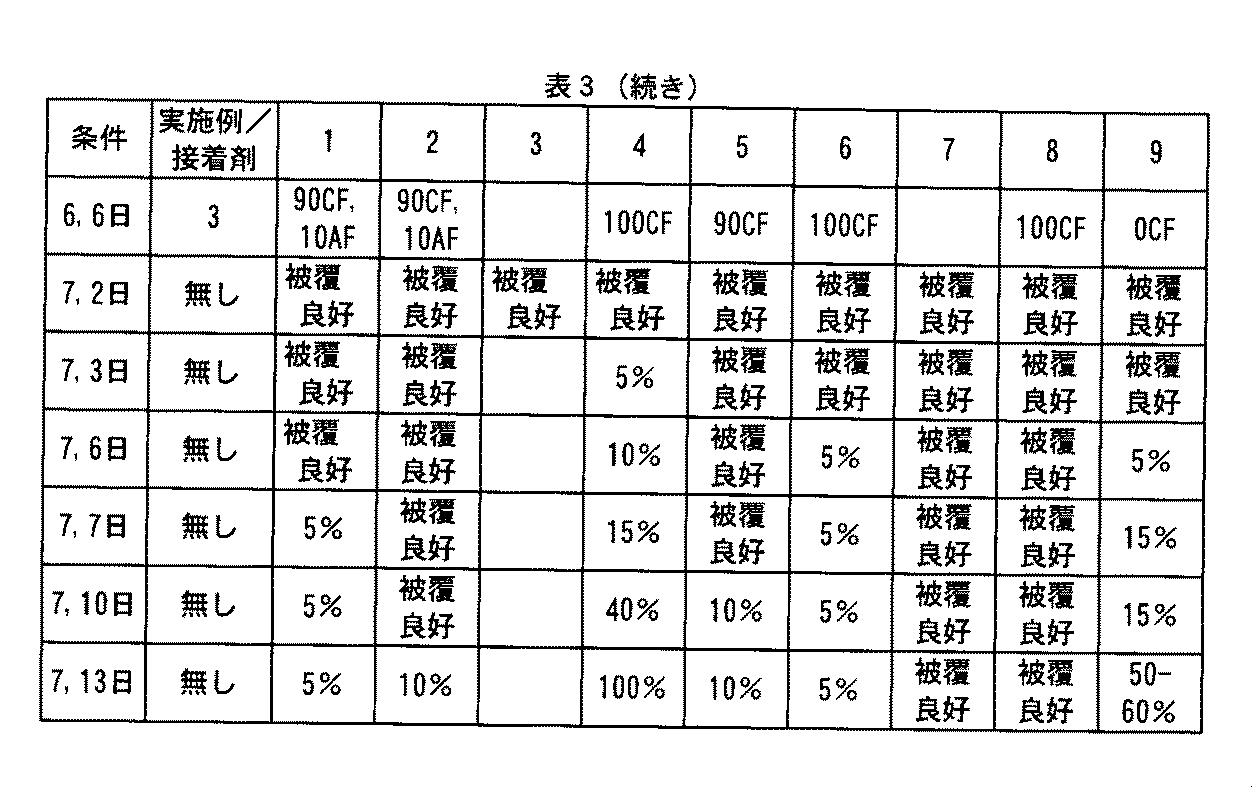
ここで、AはSiであり、Xは、出現毎に別々に、水の存在下で四置換化合物から加水分解されることができる、加水分解可能な基である。
加水分解可能な基の具体例としては、ハロゲン(例えば塩素、フッ素および臭素)、ホルミルオキシ、アセトキシ、プロピオニルオキシ、バレリルオキシ、ステアロイルオキシ、ベンゾイルオキシ、ナフトイルオキシ、トルイルオキシ、マレオイルオキシ、アルコキシ、アルキルチオ、ビニルオキシ、アリルオキシ、ビニルエーテルオキシ、メタクリルオキシおよびアクリルオキシが挙げられるが、それらに限定されるものではない。これらのおよびその他の基は、IUPAC命名法規則(1969)に従ってここに定義される。好ましくは、加水分解可能な基Xは、独立に、アルコキシ基またはエチレン性不飽和を含む基である。好ましくは、アルコキシ基はC1〜C6アルコキシである。加水分解すると、C1〜C6アルコキシ基は揮発性アルコールを形成し、それは蒸発によって被覆組成物から逃げることができる。そのようなC1〜C6アルコキシ基の具体例としては、メトキシ、エトキシ、イソプロポキシ、n−ブトキシ、sec−ブトキシ、イソブトキシおよびtert−ブトキシが挙げられるが、それらに限定されるものではない。好ましくは、アルコキシ基はメトキシおよびエトキシである。加水分解可能な基がエチレン性不飽和を含むときは、エチレン性不飽和は、被覆組成物の中の他のエチレン性不飽和化合物と反応するかもしれない。そのようなエチレン性不飽和を含む加水分解可能な基は、ビニルオキシ、アリルオキシ、ビニルエーテルオキシ、メタクリルオキシおよびアクリルオキシが挙げられるが、それらに限定されるものではない。Xは、各場合で、同一であってもよいし異なっていてもよいことが考えられる。好ましくは、四置換された化合物は、被覆組成物に容易に加えられるように、液体である。その代わりに、四置換された化合物は被覆組成物に可溶の固体であってもよい。本発明の組成物は、四置換された化合物を1種類だけ含んでいてもよいし、四置換された化合物の混合物を含んでいてもよい。
テトラメトキシシランおよびテトラエトキシシランは、テトラメチルオルトシリケートおよびテトラエチルオルトシリケートとして、それぞれウィスコンシン・ミルウォーキーのオールドリッチ・ケミカル社(the Aldrich Chemical Company)、SILBONDの商標でシルボンド社(Silbond Corporation)から、購入することができる。
本発明に有用な好ましいポリシロキサンは、好ましくは、次の式によって示される。
Here, A is Si and X is a hydrolyzable group that can be hydrolyzed from the tetrasubstituted compound in the presence of water separately for each occurrence.
Specific examples of hydrolyzable groups include halogen (eg, chlorine, fluorine and bromine), formyloxy, acetoxy, propionyloxy, valeryloxy, stearoyloxy, benzoyloxy, naphthoyloxy, toluyloxy, maleoyloxy, alkoxy, Examples include, but are not limited to, alkylthio, vinyloxy, allyloxy, vinyl etheroxy, methacryloxy, and acrylicoxy. These and other groups are defined herein according to IUPAC nomenclature rules (1969). Preferably, the hydrolyzable group X is independently an alkoxy group or a group containing ethylenic unsaturation. Preferably, the alkoxy group is a C 1 -C 6 alkoxy. Upon hydrolysis, the C 1 -C 6 alkoxy group forms a volatile alcohol that can escape from the coating composition by evaporation. Specific examples of such C 1 -C 6 alkoxy groups include, but are not limited to, methoxy, ethoxy, isopropoxy, n-butoxy, sec-butoxy, isobutoxy and tert-butoxy. Preferably the alkoxy groups are methoxy and ethoxy. When the hydrolyzable group contains ethylenic unsaturation, the ethylenic unsaturation may react with other ethylenically unsaturated compounds in the coating composition. Such hydrolyzable groups containing ethylenic unsaturation include, but are not limited to, vinyloxy, allyloxy, vinyl etheroxy, methacryloxy and acryloxy. It is conceivable that X may be the same or different in each case. Preferably, the tetrasubstituted compound is a liquid so that it can be easily added to the coating composition. Alternatively, the tetrasubstituted compound may be a solid that is soluble in the coating composition. The composition of the present invention may contain only one kind of tetrasubstituted compound or a mixture of tetrasubstituted compounds.
Tetramethoxysilane and tetraethoxysilane are purchased as tetramethylorthosilicate and tetraethylorthosilicate from the Aldrich Chemical Company of Wisconsin Milwaukee and Silbond Corporation under the trademark SILBOND, respectively. be able to.
Preferred polysiloxanes useful in the present invention are preferably represented by the following formula:
ここで、YおよびZは、独立して、ハロゲン、アミノ、アルキルおよびアルコキシからなる群から選ばれ、nは1以上であり、そして、各Xは、上に定義したとおりのものである。ここで使用するときは、用語「アルキル」とは、一価の直鎖または枝分れ鎖の炭素原子の基を意味し、メチル、エチル、n−プロピル、イソプロピル、n−ブチル、sec−ブチル、イソブチル、tert−ブチルなどが例示されるが、それらに限定されるものではない。ここで使用するときは、用語「アルコキシ」とは、酸素原子を介して分子の残りに付いたアルキル基を意味し、メトキシ、エトキシ、イソプロポキシ、n−ブトキシ、sec−ブトキシ、イソブトキシ、tert−ブトキシなどが例示されるが、それらに限定されるものではない。好ましくは、アルコキシ基のアルキルの部分は低級アルキル基である。ここで使用するときは、用語「低級アルキル基」とは、1〜10個の炭素原子を有するアルキル基を意味し、分岐でも非分岐でもよく、環状でも非環状でもよい。低級アルキル基のいくつかの具体例としては、メチル、エチル、プロピル、イソプロピル、ブチル、ペンチルおよびシクロヘキシルが挙げられるが、それらに限定されるものではない。もっとも好ましくは、それぞれのアルキル基はメチルまたはエチルである。ここで使用するときは、用語「低級アルコキシ基」とは、酸素原子を介して分子の残りに付いたアルキル基であって、そのアルキル基が低級アルキル基であるものを意味する。 Here, Y and Z are independently selected from the group consisting of halogen, amino, alkyl and alkoxy, n is 1 or more, and each X is as defined above. As used herein, the term “alkyl” means a monovalent straight or branched carbon atom group, methyl, ethyl, n-propyl, isopropyl, n-butyl, sec-butyl. , Isobutyl, tert-butyl and the like, but are not limited thereto. As used herein, the term “alkoxy” refers to an alkyl group attached to the rest of the molecule through an oxygen atom, and includes methoxy, ethoxy, isopropoxy, n-butoxy, sec-butoxy, isobutoxy, tert- Examples include butoxy and the like, but are not limited thereto. Preferably, the alkyl part of the alkoxy group is a lower alkyl group. As used herein, the term “lower alkyl group” means an alkyl group having 1 to 10 carbon atoms, which may be branched or unbranched, and may be cyclic or acyclic. Some specific examples of lower alkyl groups include, but are not limited to, methyl, ethyl, propyl, isopropyl, butyl, pentyl and cyclohexyl. Most preferably, each alkyl group is methyl or ethyl. As used herein, the term “lower alkoxy group” means an alkyl group attached to the rest of the molecule through an oxygen atom, where the alkyl group is a lower alkyl group.
シロキサン主鎖は線状でもよいし分岐でもよいことが考えられる。Xのいくつかがアルコキシ基で、Xのいくつかがシロキサン基であるとき、分岐構造が生じる。また、各アルコキシ基は、同一であってもよいし、異なっていてよいことが考えられる。好ましくは、ポリ(シロキサン)は、重合体被覆組成物に容易に加えられるように、液体である。その代わりに、ポリ(シロキサン)は重合体被覆組成物に可溶の固体であってもよい。本発明の組成物は、ポリ(シロキサン)を1種類だけ含んでいてもよいし、ポリ(シロキサン)の混合物を含んでいてもよい。 It is conceivable that the siloxane main chain may be linear or branched. When some of X are alkoxy groups and some of X are siloxane groups, a branched structure occurs. Further, it is conceivable that each alkoxy group may be the same or different. Preferably, the poly (siloxane) is a liquid so that it can be easily added to the polymer coating composition. Alternatively, the poly (siloxane) may be a solid that is soluble in the polymer coating composition. The composition of the present invention may contain only one type of poly (siloxane) or may contain a mixture of poly (siloxanes).
多官能シランは、シラン官能基と第二の官能基(エポキシ、アミノ、ビニル、イソシアナート、イソシアヌラート、メルカプト、アクリレート、メタクリラート基など)を有する化合物を含む。透明被覆または着色被覆で被覆されたもののような被覆された表面への接着のための好ましい接着促進剤としては、例えば、アミノアルコキシシラン、ビニルアルコキシシラン、イソシアナトアルコキシシラン、エポキシアルコキシシラン、メルカプトシランおよびイソシアヌラート官能性アルコキシシランが挙げられる。
より好ましい多官能シランとしては、γ−グリシドキシ−プロピルトリメトキシシラン、γ−アミノプロピルトリメトキシシラン、γ−イソシアナトプロピルトリメトキシシラン、n−β−(アミノエチル)γ−アミノプロピル−トリメトキシシラン、n−(2−アミノエチル)−3−アミノプロピルメチルジメトキシシラン、3−アミノプロピルメチル−ジメトキシシラン、3−アミノプロピルメチルジメトキシシラン、ビス(γ−トリメトキシシリル−プロピルアミン)、ビス(トリエトキシシリル)プロピルアミン、n−フェニル−γ−アミノプロピル−トリメトキシシラン、γ−イソシアナトプロピル−メチルジメトキシシラン、γ−イソシアナトプロピルトリエトキシシラン、β−(3,4−エポキシシクロヘキシル)エチル−トリエトキシシラン、γ−グリシドキシプロピルメチルジメトキシシラン、トリス(γ−トリメトキシシリルプロピル)イソシアヌラート、3−アクリルオキシプロピルトリメトキシシラン、3−メタクリルオキシプロピルトリメトキシシラン、ビニルトリエトキシシラン、またはビニルトリメトキシシランが挙げられる。
Multifunctional silanes include compounds having a silane functional group and a second functional group (epoxy, amino, vinyl, isocyanate, isocyanurate, mercapto, acrylate, methacrylate group, etc.). Preferred adhesion promoters for adhesion to coated surfaces such as those coated with transparent or colored coatings include, for example, aminoalkoxysilanes, vinylalkoxysilanes, isocyanatoalkoxysilanes, epoxyalkoxysilanes, mercaptosilanes And isocyanurate-functional alkoxysilanes.
More preferable polyfunctional silanes include γ-glycidoxy-propyltrimethoxysilane, γ-aminopropyltrimethoxysilane, γ-isocyanatopropyltrimethoxysilane, n-β- (aminoethyl) γ-aminopropyl-trimethoxysilane. N- (2-aminoethyl) -3-aminopropylmethyldimethoxysilane, 3-aminopropylmethyl-dimethoxysilane, 3-aminopropylmethyldimethoxysilane, bis (γ-trimethoxysilyl-propylamine), bis (tri Ethoxysilyl) propylamine, n-phenyl-γ-aminopropyl-trimethoxysilane, γ-isocyanatopropyl-methyldimethoxysilane, γ-isocyanatopropyltriethoxysilane, β- (3,4-epoxycyclohexyl) ethyl- Triet Sisilane, γ-glycidoxypropylmethyldimethoxysilane, tris (γ-trimethoxysilylpropyl) isocyanurate, 3-acryloxypropyltrimethoxysilane, 3-methacryloxypropyltrimethoxysilane, vinyltriethoxysilane, or vinyl A trimethoxysilane is mentioned.
別の好ましい実施態様においては、接着促進剤は、1つまたはそれ以上の活性水素を含む官能基をさらに含むシロキサンと2つまたはそれ以上のアクリレート基を有する化合物とのマイケル付加生成物である。反応生成物は、好ましくは4つ以上、より好ましくは6つ以上のシロキシ基を有する。反応生成物は好ましくは活性水素原子を含まない。反応生成物は、好ましくは、遊離基の存在下で反応することができる少なくとも1つの不飽和基も有する。好ましくは、アクリレート含有反応物は、ジアクリル酸プロポキシ化ネオペンチルグリコール、トリアクリル酸プロポキシ化グリセリルのようなアルコキシ化ポリオール誘導ジもしくはポリアクリル酸エステル、またはジアクリル酸ヘキサンジオール、ジアクリル酸トリプロピレングリコール、ジアクリル酸ジプロピレングリコール、ジアクリル酸シクロヘキサンジメタノール、ジアクリル酸アルコキシ化シクロヘキサンジメタノール、ジアクリル酸ノナンジオールなどのようなその他のジアクリル酸エステルである。マイケル付加生成物は、約30℃から約60℃、好ましくは約55℃までの高温で、活性水素原子を有する官能基がすべて反応するのに十分な時間、反応物を反応させることによって調製される(例えばアミンはすべて第三級アミンである)。好ましくは、反応物は、高温で、約72時間より長い時間、反応させられる。マイケル付加生成物のアルコキシ基の性質は、本発明の被覆組成物の硬化の速度に影響を与える。メトキシ基はより速く加水分解する。したがって、メトキシ基がシロキシ基の上に見いだされるとき、硬化反応はより速く進む。より高級なアルコキシ基が存在するときは、反応は遅くなる。全反応速度およびしたがって貼合せ時間は、接着促進剤上のアルコキシ基の相対量および存在する高級アルコキシ基に対するメトキシ基の比率を調節することによって調節することができる。 In another preferred embodiment, the adhesion promoter is one or Michael addition products of siloxane compound having two or more acrylate groups further comprising a more active hydrogen including functional groups . The reaction product preferably has 4 or more, more preferably 6 or more siloxy groups. The reaction product preferably does not contain active hydrogen atoms. The reaction product preferably also has at least one unsaturated group capable of reacting in the presence of free radicals. Preferably, the acrylate-containing reactant is an alkoxylated polyol-derived di- or polyacrylic ester such as propoxylated neopentyl glycol diacrylate, propoxylated glyceryl triacrylate, or hexanediol diacrylate, tripropylene glycol diacrylate, diacrylic Other diacrylic esters such as dipropylene glycol acid, cyclohexanedimethanol diacrylate, alkoxylated diacrylate cyclohexanedimethanol, nonanediol diacrylate, and the like. The Michael addition product is prepared by reacting the reactants at a high temperature from about 30 ° C. to about 60 ° C., preferably about 55 ° C., for a time sufficient for all functional groups having active hydrogen atoms to react. (For example, all amines are tertiary amines). Preferably, the reactants are allowed to react at an elevated temperature for more than about 72 hours. The nature of the alkoxy group of the Michael addition product affects the rate of cure of the coating composition of the present invention. The methoxy group hydrolyzes faster. Thus, when a methoxy group is found on a siloxy group, the curing reaction proceeds faster. When higher alkoxy groups are present, the reaction is slower. The overall reaction rate and thus the lamination time can be adjusted by adjusting the relative amount of alkoxy groups on the adhesion promoter and the ratio of methoxy groups to higher alkoxy groups present.
別の実施態様においては、接着促進剤は多数のアルコキシシラン部分を有する高分子量付加物である。好ましくは、その付加物は3つ以上のアルコキシシラン部分を有し、より好ましくは6つ以上のアルコキシシラン部分を有する。好ましくは、その付加物は、約500Da以上、より好ましくは1,000Da以上の数平均分子量を有する。その付加物は、好ましくは、反応性水素含有部分を含まない。好ましい実施態様においては、その付加物は、γ−プロピルトリメトキシエポキシシランまたはγ−プロピルトリエトキシエポキシシランのようなエポキシシランを、反応性水素含有部分を有する1つまたはそれ以上のシランと、活性水素含有部分と比較してエポキシ当量が過剰に存在する条件下で反応させた生成物である。好ましくは、活性水素含有部分に対するエポキシ部分の当量比は、約1.1以上であり、より好ましくは約1.12である。好ましくは、活性水素含有部分に対するエポキシ当量の当量比は、約1.14以下である。好ましい活性水素含有部分は、アミンおよびメルカプトであり、アミンがもっとも好ましい。エポキシシラン活性水素含有シラン反応生成物は、その後、テトラメチレンジイソシアナート(TMDI)のような脂肪族ジまたはポリイソシアナートと活性水素官能性部分含有シラン(例えばアミノシランまたはメルカプトシラン)との反応生成物と反応させられる。2つの反応生成物は、生じる付加物が活性水素原子もイソシアナート基も含有しないように十分な比率での反応である。生じる付加物は、基板および接着剤系への被覆組成物の長期接着を増強するために十分な量で被覆組成物に加えられる。好ましくは、高分子量アルコキシシラン含有付加物は、約1質量部以上、より好ましくは約5質量部以上の量で存在する。高分子量アルコキシシラン含有付加物は、好ましくは、約15質量部以下、より好ましくは約10質量部以下の量で存在する。高分子量アルコキシシラン付加物は、好ましくは、上述したような反応性希釈剤と混合して、本発明の被覆組成物に加えられる。好ましい実施態様においては、接着促進剤は、アルコキシシラン基を含有するマイケル付加生成物と高分子量アルコキシシラン付加物の混合物を含む。好ましくは、2種類の付加物は、約1〜約15、より好ましくは約1〜約5の比率で使用される。 In another embodiment, the adhesion promoter is a high molecular weight adduct having multiple alkoxysilane moieties. Preferably, the adduct has 3 or more alkoxysilane moieties, more preferably 6 or more alkoxysilane moieties. Preferably, the adduct has a number average molecular weight of about 500 Da or more, more preferably 1,000 Da or more. The adduct is preferably free of reactive hydrogen-containing moieties. In a preferred embodiment, the adduct comprises an epoxy silane, such as γ-propyltrimethoxyepoxysilane or γ-propyltriethoxyepoxysilane, with one or more silanes having reactive hydrogen-containing moieties and an active The product reacted under conditions where there is an excess of epoxy equivalents compared to the hydrogen-containing moiety. Preferably, the equivalent ratio of epoxy moiety to active hydrogen-containing moiety is about 1.1 or greater, more preferably about 1.12. Preferably, the equivalent ratio of epoxy equivalents to active hydrogen containing moieties is about 1.14 or less. Preferred active hydrogen-containing moieties are amine and mercapto, with amines being most preferred. The epoxy silane active hydrogen containing silane reaction product is then reacted with an aliphatic di or polyisocyanate such as tetramethylene diisocyanate (TMDI) and an active hydrogen functional moiety containing silane (eg amino silane or mercapto silane). React with things. The two reaction products are reactions in a sufficient ratio such that the resulting adduct does not contain active hydrogen atoms or isocyanate groups. The resulting adduct is added to the coating composition in an amount sufficient to enhance the long term adhesion of the coating composition to the substrate and adhesive system. Preferably, the high molecular weight alkoxysilane-containing adduct is present in an amount of about 1 part by weight or more, more preferably about 5 parts by weight or more. The high molecular weight alkoxysilane-containing adduct is preferably present in an amount of about 15 parts by weight or less, more preferably about 10 parts by weight or less. The high molecular weight alkoxysilane adduct is preferably added to the coating composition of the present invention in admixture with a reactive diluent as described above. In a preferred embodiment, the adhesion promoter comprises a mixture of a Michael addition product containing alkoxysilane groups and a high molecular weight alkoxysilane adduct. Preferably, the two adducts are used in a ratio of about 1 to about 15, more preferably about 1 to about 5.
組成物はさらに充填剤を含む。充填剤は、硬化した組成物の耐磨耗性と表面硬度を改善することができるいかなる充填剤であってもよい。さらに、充填剤は被覆組成物中に分散されることができるものでなければならない。充填剤の好ましい種類は、ケイ酸塩、アルミナ、ジルコニア、カーバイドまたはその他の高い硬度(約7より大きなモース硬さ)を有する充填剤、それらの組み合わせなどである。好ましい充填剤は、ケイ酸塩およびアルミナであり、アルミナがより好ましい。好ましい充填剤は表面ヒドロキシルを含有するものである。本発明に有用なより好ましいアルミナはα−アルミナである。好ましくは、充填剤は、約10ミクロン以下、最も好ましくは5ミクロン以下の粒径を有する。充填剤は、表面硬度および耐磨耗性を増強するのに十分な量で、そして均質な分散が調製され得るような量で存在する。好ましくは、充填剤は、組成物質量基準で、約5質量%以上、より好ましくは約25質量%以上、そして最も好ましくは約30質量%以上の量で存在する。充填剤は、好ましくは、組成物質量基準で、約60質量部以下、より好ましくは約50質量部以下、最も好ましくは約40質量部以下の量で存在する。 The composition further comprises a filler. The filler can be any filler that can improve the abrasion resistance and surface hardness of the cured composition. In addition, the filler must be capable of being dispersed in the coating composition. Preferred types of fillers are silicates, alumina, zirconia, carbides or other fillers with high hardness (Mohs hardness greater than about 7), combinations thereof and the like. Preferred fillers are silicates and alumina, with alumina being more preferred. Preferred fillers are those containing surface hydroxyls. A more preferred alumina useful in the present invention is α-alumina. Preferably, the filler has a particle size of about 10 microns or less, most preferably 5 microns or less. The filler is present in an amount sufficient to enhance surface hardness and abrasion resistance and in an amount such that a homogeneous dispersion can be prepared. Preferably, the filler is present in an amount of about 5% by weight or more, more preferably about 25% by weight or more, and most preferably about 30% by weight or more, based on the amount of composition. The filler is preferably present in an amount of about 60 parts by weight or less, more preferably about 50 parts by weight or less, and most preferably about 40 parts by weight or less, based on the amount of composition material.
この組成物は、さらに、薄膜形成性樹脂と反応しかつ酸性部分をも含有する化合物を含む。特に、その化合物は、薄膜形成性樹脂に含有されている官能部分と反応する官能基または部分を有する。好ましくは、そのような反応性基は、遊離基、放射線または陽イオンにさらされたときに反応する。そのような部分については前述した。薄膜形成性樹脂と反応しかつ酸性部分を含有する化合物は、ガラス、プラスチックまたは被覆されたプラスチックへのおよび接着剤系への組成物の結合を増強する目的で存在する。好ましくは、酸基は強酸基であり、そのような強酸としてはカルボン酸、リン酸、硫酸およびスルホン酸基が挙げられる。好ましい酸基は、カルボン酸基およびホスフェート酸のようなリン酸基である。最も好ましい酸基はカルボン酸基である。好ましくは、その化合物は、酸基を有し、かつ遊離基、放射線にさらされたときに重合する、または陽イオンと接触したときに反応する、1つまたはそれ以上の官能基を有する化合物である。アクリル酸基、ビニル基、アリル基、ビニルエーテル基またはメタクリル酸基のような遊離基または放射線にさらされたときに重合する化合物が好ましい。好ましくは、無官能アルキル鎖がエチレン性不飽和基を強酸基に連結する。酸含有化合物の好ましい種類の中には、酸性官能性アクリレートまたはメタクリレートがあり、メタクリル酸、アクリル酸、アクリル化された(acrylated)リン酸エステル、マレイン酸モノ−2−(メタクリルオキシ)エチル、または燐酸モノアクリレート、マレイン酸、イタコン酸、それらの混合物などを例示できる。その酸は、ガラス、被覆されたプラスチックおよび/または接着剤への結合を増強するのに十分な量で存在する。使用する酸の量が多すぎると、組成物の安定性は悪影響を受けるかもしれない。反応性酸含有化合物は、組成物基準で約1質量部以上、好ましくは約4質量部以上の量で組成物中に存在する。反応性酸化合物は、好ましくは、約10質量部以下、より好ましくは約8質量部以下の量で組成物中に存在する。 The composition further comprises a compound that reacts with the film-forming resin and also contains an acidic moiety. In particular, the compound has a functional group or moiety that reacts with the functional moiety contained in the thin film forming resin. Preferably, such reactive groups react when exposed to free radicals, radiation or cations. Such a part has been described above. Compounds that react with the film-forming resin and contain an acidic moiety are present for the purpose of enhancing the bonding of the composition to glass, plastic or coated plastic and to the adhesive system. Preferably, the acid group is a strong acid group, and such strong acids include carboxylic acid, phosphoric acid, sulfuric acid and sulfonic acid groups. Preferred acid groups are carboxylic acid groups and phosphate groups such as phosphate acids. The most preferred acid group is a carboxylic acid group. Preferably, the compound is a compound having an acid group and having one or more functional groups that are free radicals, polymerize when exposed to radiation, or react when contacted with a cation. is there. Acrylic acid, vinyl group, allyl group, compounds which polymerize when or vinyl ether groups exposed to free radicals or radiation, such as Metaku acrylic acid groups are preferred. Preferably, the non-functional alkyl chain connects the ethylenically unsaturated group to the strong acid group. Among the preferred type of acid-containing compounds, or an acidic functional acrylate may Metaku relations, methacrylic acid, acrylic acid, acrylated (acrylated) phosphoric acid esters, maleic acid mono-2- (methacryloxy) ethyl Or phosphoric acid monoacrylate, maleic acid, itaconic acid, mixtures thereof and the like. The acid is present in an amount sufficient to enhance bonding to glass, coated plastic and / or adhesive. If too much acid is used, the stability of the composition may be adversely affected. The reactive acid-containing compound is present in the composition in an amount of about 1 part by weight or more, preferably about 4 parts by weight or more, based on the composition. The reactive acid compound is preferably present in the composition in an amount of about 10 parts by weight or less, more preferably about 8 parts by weight or less.
組成物はさらに顔料または染料を含んでもよい。顔料または染料は、所望の色を付与するためにまたは組成物に不透明性を付与するために存在することができる。好ましくは、顔料または染料は耐久性を有する。耐久性とは、十分な戸外耐久性を有し、日光および悪天候にさらされたときに退色に耐えることを意味する。好ましくは、顔料は被覆を通して光線透過率を減少させる。好ましい実施態様においては、顔料は、被覆を通過する光線透過率を、被覆に接する光線の1パーセント未満に減らすことができる。更に、顔料または染料は、ガラス、プラスチック、被覆されたプラスチックまたは接着剤への被覆の結合を妨害しないことが好ましい。本発明に有用な顔料または染料は、有機のものであってもよいし、無機のものであってもよい。好ましい無機顔料としては、黒色酸化鉄、酸化亜鉛、酸化セリウムおよびチタニア(TiO2)が挙げられ、一方、好ましい有機顔料としては、カーボンブラック、フタロシアニン、アントラキノン、ペリレン、カルバゾール、モノアゾおよびジアゾベンズイミダゾロン、イソインドリノン、モノアゾナフトール、ジアリールイデピラゾロン(diarylidepyrazolones)、ローダミン、インジゴイド、キナクリドン(quinacridones)、ジアゾピアントロン(diazopyranthrones)、ジニトロアニリン、ピラゾロン、ジアニシジン、ピアントロン、テトラクロロイソインドリノン、ジオキサジン、モノアゾアクリリド(monoazoacrylides)、アントラピリミジンおよびそれらの混合物が挙げられる。有機顔料は、主要な分子に付けられた官能基に依存して、異なって遮光され、または異なる色を有するであろうことは当業者によって認識されるであろう。本発明の組成物に有用な市販の顔料の目録は米国特許出願公開第2002/0086914号明細書に開示されている(関連する部分は引用によってここに含まれる。)。好ましい顔料としては、カーボンブラックまたは黒色酸化鉄が挙げられる。組成物が窓を被覆するために使用される実施態様においては、利用される顔料は黒色顔料であることが好ましい。さらに、顔料はカーボンブラックであることが好ましい。いかなる既知のカーボンブラックも、本発明において利用することができる。カーボンブラックのいくつかの等級は伝導性であり、他のものは非伝導性になるように処理されている。カーボンブラックは、被覆が利用される環境に合うように選択されるべきである。例えば、いくつかの自動車用途は、カーボンブラックが、車両の窓の上にまたはその窓の近くに配置された他の機能を妨害するのを防ぐために非伝導性であることを必要とする。他の環境においては、被覆が伝導率を有することが望ましいかもしれず、伝導性のカーボンブラックが選択されるかもしれない。顔料または染料は、被覆に所望の機能を与えるのに十分な量で使用される。特に、顔料または染料が単に被覆に使用される場合は、所望の色を得るために十分な量の顔料または染料が使用される。逆に、顔料が被覆に不透明性を導入するために加えられる場合は、所望の水準の不透明性を導入するのに十分な量の顔料が使用される。好ましい実施態様においては、顔料は黒であり、それゆえ、被覆に不透明性を導入するために利用される。好ましくは、染料は半透明である。顔料は、硬化した被覆が、所望の被覆厚さにおいて、好ましくは1パーセント未満の、所望の光透過率を示すような量で存在するべきである。好ましくは、顔料または染料は、約1質量部以上、より好ましくは約2質量部以上、さらにより好ましくは約3質量部以上、より好ましくは約5質量部以上、最も好ましくは約8質量部以上の量で存在する。好ましくは、有用な顔料の量は、約15質量部以下、最も好ましくは約12質量部以下である。 The composition may further comprise a pigment or dye. Pigments or dyes can be present to impart the desired color or to impart opacity to the composition. Preferably, the pigment or dye is durable. Durability means having sufficient outdoor durability and resisting fading when exposed to sunlight and bad weather. Preferably, the pigment reduces light transmission through the coating. In a preferred embodiment, the pigment can reduce the light transmission through the coating to less than 1 percent of the light in contact with the coating. Further, it is preferred that the pigment or dye does not interfere with the bonding of the coating to glass, plastic, coated plastic or adhesive. The pigment or dye useful in the present invention may be organic or inorganic. Preferred inorganic pigments include black iron oxide, zinc oxide, cerium oxide and titania (TiO 2 ), while preferred organic pigments include carbon black, phthalocyanine, anthraquinone, perylene, carbazole, monoazo and diazobenzimidazolone. , Isoindolinone, monoazonaphthol, diarylidepyrazolones, rhodamine, indigoid, quinacridones, diazopyranthrones, dinitroaniline, pyrazolone, dianisidine, piantron, tetrachloroisoindolinone, dioxazine, monoazoacrylic And monoazoacrylides, anthrapyrimidines and mixtures thereof. It will be appreciated by those skilled in the art that organic pigments will be shaded differently or have a different color depending on the functional group attached to the primary molecule. An inventory of commercially available pigments useful in the compositions of the present invention is disclosed in US 2002/0086914 (relevant portions are incorporated herein by reference). Preferred pigments include carbon black or black iron oxide. In embodiments where the composition is used to coat windows, the pigment utilized is preferably a black pigment. Furthermore, the pigment is preferably carbon black. Any known carbon black can be utilized in the present invention. Some grades of carbon black are conductive and others are treated to be non-conductive. Carbon black should be selected to suit the environment in which the coating is utilized. For example, some automotive applications require that carbon black be non-conductive to prevent interfering with other functions located on or near the vehicle window. In other circumstances, it may be desirable for the coating to have conductivity, and conductive carbon black may be selected. The pigment or dye is used in an amount sufficient to give the coating the desired function. In particular, if a pigment or dye is simply used for coating, a sufficient amount of pigment or dye is used to obtain the desired color. Conversely, if a pigment is added to introduce opacity to the coating, a sufficient amount of pigment is used to introduce the desired level of opacity. In a preferred embodiment, the pigment is black and is therefore utilized to introduce opacity to the coating. Preferably the dye is translucent. The pigment should be present in an amount such that the cured coating exhibits the desired light transmission at the desired coating thickness, preferably less than 1 percent. Preferably, the pigment or dye is about 1 part by weight or more, more preferably about 2 parts by weight or more, even more preferably about 3 parts by weight or more, more preferably about 5 parts by weight or more, most preferably about 8 parts by weight or more. Present in the amount of. Preferably, the amount of useful pigment is about 15 parts by weight or less, most preferably about 12 parts by weight or less.
組成物は、さらに、硬化条件下で薄膜形成性樹脂の硬化を開始させることができる触媒または開始剤を含んでもよい。好ましくは、それらの硬化条件は、遊離基または陽イオンを生成させるのに十分なものである。好ましい触媒または開始剤としては、遊離基の生成によって遊離ラジカル重合を開始させるもしくは陽イオンを生成する光開始剤(photoinitiators)、または熱にさらされたときに遊離基を生成するまたは陽イオンを生成もしくは放出する熱開始剤が挙げられる。化学線への対応する感度を有する光開始剤系は、通常、本発明の化合物を含有する配合物に混ぜられ、照射されたときに重合を開始させることができる反応性化学種の生成をもたらす。好ましい実施態様においては、開始剤は、照射にさらされたときに遊離基重合を開始させる化合物である。光開始剤の具体例としては、α−アミノケトン、α−ヒドロキシケトン、ホスフィンオキシド、フェニルグリオキサラート、チオキサントン、ベンゾフェノン、ベンゾインエーテル、オキシムエステル、アミン相乗剤、マレイミド、それらの混合物などが挙げられる。好ましい光開始剤としては、次の範疇の化合物、すなわちホスフィンオキシド、ケトンおよびそれらの誘導体、ベンゾフェノン、カルボシアニンおよびメチン、アントラセンなどのような多環式芳香族炭化水素、ならびにキサンテン、サフラニンおよびアクリジンのような染料が挙げられる。より一般には、これらは、本質的に、次の大範疇の1つに属する化学物質である:ペンタンジオン、ベンジル、ピペロナール、ベンゾインおよびそのハロゲン化誘導体、ベンゾインエーテル、アントラキノンおよびその誘導体、p,p′−ジメチルアミノベンゾフェノン、ベンゾフェノンなどのようなカルボニル基を含有する化合物;ジおよびポリスルフィド、キサントゲナート、メルカプタン、ジチオカルバマート、チオケトン、β−ナフトセレンアゾリン(napthoselenazolines)のような、硫黄またはセレンを含有する化合物;ペルオキシド;アゾニトリル、ジアゾ化合物、ジアジド、アクリジン誘導体、フェナジン、キノキサリン、キナゾリンおよびオキシムエステル(例えば1−フェニル−1,2−プロパンジオン2−[O−(ベンゾイル)オキシム])のような窒素を含有する化合物;ハロゲン化ケトンまたはアルデヒド、ハロゲン化メチルアリール、ハロゲン化または二ハロゲン化スルホニルのようなハロゲン化された化合物;ジアゾニウム塩、アゾキシベンゼンおよび誘導体、ローダミン、エオシン、フルオレセイン、アクリフラビンなどのようなホスフィンオキシドおよび光開始剤染料。通常の光開始剤としては、2,2−ジエトキシアセトフェノン、ジメトキシフェニルアセトフェノン、フェニルベンゾイン、ベンゾフェノン、置換されたベンゾフェノン、ホスフィンオキシドなどが挙げられる。ベンゾフェノンやそれに類似する化合物が光開始剤として使用されるときは、第三級アミンまたは重合したアミン(たとえば第二級もしくは第一級アミン末端ポリ(プロピレンオキシド)ポリオール)のような相乗剤が、光吸収エネルギーを重合開始遊離基へ変換するのを増強するために用いられることが、当業者に理解される。 The composition may further comprise a catalyst or initiator capable of initiating curing of the film-forming resin under curing conditions. Preferably, the curing conditions are sufficient to generate free radicals or cations. Preferred catalysts or initiators include photoinitiators that initiate free radical polymerization or cation generation by free radical generation, or generate free radicals or cations when exposed to heat. Or the thermal initiator to discharge | release is mentioned. Photoinitiator systems with corresponding sensitivity to actinic radiation are usually mixed in formulations containing the compounds of the invention and result in the generation of reactive species that can initiate polymerization when irradiated. . In a preferred embodiment, the initiator is a compound that initiates free radical polymerization when exposed to radiation. Specific examples of the photoinitiator include α-aminoketone, α-hydroxyketone, phosphine oxide, phenylglyoxalate, thioxanthone, benzophenone, benzoin ether, oxime ester, amine synergist, maleimide, and a mixture thereof. Preferred photoinitiators include the following categories of compounds: phosphine oxides, ketones and their derivatives, polycyclic aromatic hydrocarbons such as benzophenone, carbocyanine and methine, anthracene, and the like, as well as xanthene, safranine and acridine. Such dyes. More generally, they are essentially chemicals belonging to one of the following broad categories: pentanedione, benzyl, piperonal, benzoin and its halogenated derivatives, benzoin ethers, anthraquinones and their derivatives, p, p Compounds containing carbonyl groups such as' -dimethylaminobenzophenone, benzophenone, etc .; di and polysulfides, xanthogenates, mercaptans, dithiocarbamates, thioketones, sulfur or selenium, such as β-naphthoselenazolines Peroxides; azonitriles, diazo compounds, diazides, acridine derivatives, phenazines, quinoxalines, quinazolines and oxime esters (eg 1-phenyl-1,2-propanedione 2- [O- (benzoyl) Compounds containing nitrogen such as oximes]); halogenated ketones or aldehydes, halogenated compounds such as methylaryl halides, halogenated or dihalogenated sulfonyls; diazonium salts, azoxybenzenes and derivatives, rhodamines, Phosphine oxides and photoinitiator dyes such as eosin, fluorescein, acriflavine and the like. Typical photoinitiators include 2,2-diethoxyacetophenone, dimethoxyphenylacetophenone, phenylbenzoin, benzophenone, substituted benzophenone, phosphine oxide, and the like. When benzophenone or similar compounds are used as photoinitiators, synergists such as tertiary amines or polymerized amines (eg secondary or primary amine-terminated poly (propylene oxide) polyols) It will be appreciated by those skilled in the art that it can be used to enhance the conversion of light absorption energy into polymerization initiating free radicals.
光開始剤は、不飽和を含有する分子または開始剤に、光によって伝搬されたエネルギーの一部を供給する。不飽和系によってまたは光開始剤によって、光増感剤は、組成物の重合または架橋を開始させる遊離基またはイオンを生成する。
また、既知の光開始剤との混合物を使用することも可能である。例えばカンファーキノン;ベンゾフェノン;ベンゾフェノン誘導体(例えば1−[4−(4−ベンゾイル−フェニルスルホニル)−フェニル]−2−メチル−2−(トルエン−4−スルホニル)−プロパン−1−オン);アセトフェノン、アセトフェノン誘導体、例えばα−ヒドロキシシクロアルキルフェニルケトンまたはジアルコキシアセトフェノン;α−ヒドロキシ−またはα−アミノアセトフェノン、例えばオリゴ−[2−ヒドロキシ−2−メチル−1−[4−(1−メチルビニル)−フェニル]プロパノン]、2−ヒドロキシ−2−メチル−1−フェニル−プロパノン、2−ヒドロキシ−1−[4−(2−ヒドロキシエトキシ)−フェニル]−2−メチル−プロパン−1−オン、2−メチル−1−[4−(メチルチオ)フェニル]−2−(4−モルホリニル)−プロパン−1−オン、2−ジメチルアミノ−2−(4−メチルベンジル)−1−(4−モルホリン−4−イル−フェニル)−ブタン−1−オン、2−ベンジル−2−ジメチルアミノ−1−(3,4−ジメトキシフェニル)−ブタン−1−オン、2−ベンジル−2−ジメチルアミノ−1−(4−モルホリン−4−イル−フェニル)ブタン−1−オン、2−メチル−1−(4−メチルスルホニル−フェニル)−2−モルホリン−4−イル−プロパン−1−オン;4−アロイル−1,3−ジオキソラン;ベンゾインアルキルエーテルおよびベンジルケタール、例えばベンジルジメチルケタール、フェニルグリオキサラートおよびその誘導体、例えばギ酸メチルベンゾイル;二量体グリオキサル酸フェニル、例えばオキソ−フェニル−酢酸2−[2−(2−オキソ−2−フェニル−アセトキシ)−エトキシ]−エチルエステル;ペルエステル、例えば、例えば欧州特許第126541号明細書(米国特許第4,777,191号明細書および米国特許第4,970,244号明細書、引用によってここに含まれる。)に記述されているような、ベンゾフェノン−テトラカルボン酸ペルエステル;モノアシルホスフィンオキシド、例えば(2,4,6−トリメチルベンゾイル)−ビフェニル−ホスフィンオキシドまたはフェニル−(2,4,6−トリメチルベンゾイル)−ホスフィン酸エチルエステル、ビスアシルホスフィンオキシド、例えば、ビス(2,6−ジメトキシベンゾイル)−(2,4,4−トリメチル−ペンタ−1−イル)ホスフィンオキシド、ビス(2,4,6−トリメチルベンゾイル−フェニルホスフィンオキシドまたはビス(2,4,6−トリメチルベンゾイル)−(2,4−ジペントキシフェニル)ホスフィンオキシド、トリスアシルホスフィンオキシド;ハロメチルトリアジン、例えば、2−[2−(4−メトキシ−フェニル)−ビニル]−4,6−ビス−トリクロロメチル−[1,3,5]トリアジン、2−(4−メトキシ−フェニル)−4,6−ビス−トリクロロメチル−[1,3,5]トリアジン、2−(3,4−ジメトキシ−フェニル−4,6−ビス−トリクロロメチル−[1,3,5]トリアジン、2−メチル−4,6−ビス−トリクロロメチル−[1,3,5]トリアジン;ヘキサアリールビスイミダゾール/共開始剤系、例えば2−メルカプトベンズチアゾールと一緒にオルト−クロロヘキサフェニル−ビスイミダゾール;フェロセニウム(ferrocenium)化合物またはチタノセン、例えばジシクロペンタジエニルビス(2,6−ジフルオロ−3−ピロロフェニル)チタン;例えば英国特許第2,339,571号明細書(米国特許第6,596,445号明細書、引用によってここに含まれる。)に記述されているようなホウ酸塩光開始剤またはO−アシルオキシム光開始剤との混合物を使用することも可能である。
A photoinitiator supplies a portion of the energy transmitted by light to a molecule or initiator containing unsaturation. By an unsaturated system or by a photoinitiator, the photosensitizer generates free radicals or ions that initiate polymerization or crosslinking of the composition.
It is also possible to use mixtures with known photoinitiators. For example camphor quinone; benzophenone; benzophenone derivatives (e.g. 1- [4- (4-benzoyl - phenylsulfanyl e sulfonyl) - phenyl] -2-methyl-2- (toluene-4-sulfonyl) - propan-1-one); Acetophenone, acetophenone derivatives such as α-hydroxycycloalkyl phenyl ketone or dialkoxyacetophenone; α-hydroxy- or α-aminoacetophenone such as oligo- [2-hydroxy-2-methyl-1- [4- (1-methylvinyl ) -Phenyl] propanone], 2-hydroxy-2-methyl-1-phenyl-propanone, 2-hydroxy-1- [4- (2-hydroxyethoxy) -phenyl] -2-methyl-propan-1-one, 2-Methyl-1- [4- (methylthio) phenyl] -2 (4-morpholinyl) -propan-1-one, 2-dimethylamino-2- (4-methylbenzyl) -1- (4-morpholin-4-yl-phenyl) -butan-1-one, 2-benzyl- 2-dimethylamino-1- (3,4-dimethoxyphenyl) -butan-1-one, 2-benzyl-2-dimethylamino-1- (4-morpholin-4-yl-phenyl) butan-1-one, 2-methyl-1- (4-Mechirusuru e sulfonyl - phenyl) -2-morpholin-4-yl - propan-1-one; 4-aroyl-1,3-dioxolane; benzoin alkyl ethers and benzil ketals, for example benzil dimethyl Ketals, phenylglyoxalates and derivatives thereof such as methylbenzoyl formate; dimeric phenyl glyoxalates such as oxo- Enyl-acetic acid 2- [2- (2-oxo-2-phenyl-acetoxy) -ethoxy] -ethyl ester; perester, such as for example EP 126541 (US Pat. No. 4,777,191) And U.S. Pat. No. 4,970,244, incorporated herein by reference); benzophenone-tetracarboxylic acid peresters; monoacylphosphine oxides such as (2,4,6 -Trimethylbenzoyl) -biphenyl-phosphine oxide or phenyl- (2,4,6-trimethylbenzoyl) -phosphinic acid ethyl ester, bisacylphosphine oxide, for example bis (2,6-dimethoxybenzoyl)-(2,4,4) 4-trimethyl-pent-1-yl) phosphine oxide, bis (2 , 4,6-trimethylbenzoyl-phenylphosphine oxide or bis (2,4,6-trimethylbenzoyl)-(2,4-dipentoxyphenyl) phosphine oxide, trisacylphosphine oxide; halomethyltriazine, such as 2- [2- (4-Methoxy-phenyl) -vinyl] -4,6-bis-trichloromethyl- [1,3,5] triazine, 2- (4-methoxy-phenyl) -4,6-bis-trichloromethyl -[1,3,5] triazine, 2- (3,4-dimethoxy-phenyl-4,6-bis-trichloromethyl- [1,3,5] triazine, 2-methyl-4,6-bis-trichloro Methyl- [1,3,5] triazine; with hexaarylbisimidazole / co-initiator system, eg 2-mercaptobenzthiazole Ortho-chlorohexaphenyl-bisimidazole; ferrocenium compound or titanocene, such as dicyclopentadienyl bis (2,6-difluoro-3-pyrrolophenyl) titanium; eg British Patent 2,339,571 (US Pat. No. 6,596,445, incorporated herein by reference). It is also possible to use mixtures with borate photoinitiators or O-acyloxime photoinitiators as described in).
また、熱遊離基開始剤を加えることも可能である。例えば、過酸化ベンゾイル(他の適切なペルオキシドは米国特許第4,950,581号明細書第19欄第17行〜第25行(引用によってここに含まれる。)に記述されている。)またはカチオン重合開始剤(例えば、米国特許第4,950,581号明細書第18欄第60行〜第19欄第10行(引用によってここに含まれる。)に記述されているような、芳香族スルホニウム、ホスホニウムまたはヨードニウム塩)を加えることも可能である。ヨードニウム塩の具体例は、(4−イソブチルフェニル)−4−メチルフェニル−ヨードニウムヘキサフルオロホスフェートである。例えば米国特許第6,153,662号明細書または米国特許第6,150,431号明細書(両方とも引用によってここに含まれる。)に記述されているような、マレイミド誘導体もまた存在してもよい。言及することができる具体例は、N−(2−トリフルオロメチルフェニル)マレイミドおよびN−(2−tert−ブチルフェニル)マレイミドである。 It is also possible to add a thermal free radical initiator. For example, benzoyl peroxide (other suitable peroxides are described in U.S. Pat. No. 4,950,581, column 19, lines 17-25 (incorporated herein by reference)) or Aromatics as described in cationic polymerization initiators (eg, as described in US Pat. No. 4,950,581, column 18, line 60 to column 19, line 10 (hereby incorporated by reference)). It is also possible to add sulfonium, phosphonium or iodonium salts). A specific example of an iodonium salt is (4-isobutylphenyl) -4-methylphenyl-iodonium hexafluorophosphate. There are also maleimide derivatives as described, for example, in US Pat. No. 6,153,662 or US Pat. No. 6,150,431, both of which are hereby incorporated by reference. Also good. Specific examples that may be mentioned are N- (2-trifluoromethylphenyl) maleimide and N- (2-tert-butylphenyl) maleimide.
光開始剤の好ましい種類の中には、α−アミノケトン、ホスフィンオキシド、α−ヒドロキシケトン、それらの混合物などがあり、なかでもホスフィンオキシドが最も好ましい。好ましい光開始剤の中には、IRGACURE184の商標および名称でチバガイギー社(Ciba Geigy)から入手可能な1−ヒドロキシシクロヘキシルフェニルケトン、IRGACURE369またはIRGACURE379の商標および名称でチバガイギー社から入手可能な2−ベンジル2−N−ジメチルアミノ−1−(4−モルホリノフェニル)−1−ブタノン、およびLUCIRIN TPOの商標でバスフ社から入手可能なホスフィンオキシド、チバ社から入手可能なIRGACURE819、それらの混合物(たとえばサートマー社(Sartomer)のSARCURETM SR1135またはランバート社のESCACURE KTO46(α−ヒドロキシケトンベンゾフェノン誘導体とホスフィンオキシドの混合物)などがある。好ましくは、触媒または開始剤は、後に記述するような適切な重合条件にさらされたときに重合反応に触媒として作用するのに十分な量で存在する。好ましくは、触媒または開始剤は、組成物質量基準で、約0.1質量部以上、より好ましくは約1質量部以上、さらに好ましくは約2質量部以上、最も好ましくは約4質量部以上の量で存在する。好ましくは、触媒または開始剤は、組成物質量基準で、約20質量部以下、より好ましくは約12質量部以下、さらに好ましくは約10質量部以下、最も好ましくは約8質量部以下の量で存在する。 Among the preferred types of photoinitiators are α-amino ketones, phosphine oxides, α-hydroxy ketones, mixtures thereof, and the like, with phosphine oxide being most preferred. Among the preferred photoinitiators are 1-hydroxycyclohexyl phenyl ketone, IRGACURE 369 or IRGACURE 379 available from Ciba Geigy under the trade name and name IRGACURE 184, and 2-benzyl-2 available from Ciba Geigy Corporation. -N-dimethylamino-1- (4-morpholinophenyl) -1-butanone, and phosphine oxide available from Basf under the trademark LUCIRIN TPO, IRGACURE 819 available from Ciba, mixtures thereof (eg Sartomer ( SARCURE TM SR1135 or Lambert's ESCACURE KTO46 (a mixture of α- hydroxyketone benzophenone derivatives and a phosphine oxide Sartomer)), and the like. preferably The catalyst or initiator is present in an amount sufficient to act as a catalyst for the polymerization reaction when exposed to suitable polymerization conditions as described below. The catalyst or initiator is preferably present in an amount of about 0.1 parts by weight or more, more preferably about 1 part by weight or more, more preferably about 2 parts by weight or more, and most preferably about 4 parts by weight or more. , About 20 parts by weight or less, more preferably about 12 parts by weight or less, more preferably about 10 parts by weight or less, and most preferably about 8 parts by weight or less based on the amount of the compositional substance.
本発明の被覆組成物は、2つの機構で硬化する。まず第一に、それは、不飽和部分の遊離基重合または陽イオン重合の結果として硬化する。さらに、被覆はシラノール縮合によって硬化する。シラノール縮合は大気の湿気にさらされたときに進行する。これは、触媒が存在しない状態での比較的遅い硬化機構である。シラノール縮合は、接着剤系に関して後述するように、酸、塩基または有機金属触媒によって触媒される。本発明の被覆組成物は酸性含有化合物を含有し、反応を触媒するアミンを含有していてもよい。その代わりに、後述するような湿気硬化触媒を加えてもよい。 The coating composition of the present invention cures by two mechanisms. First of all, it cures as a result of free radical or cationic polymerization of unsaturated moieties. Furthermore, the coating is cured by silanol condensation. Silanol condensation proceeds when exposed to atmospheric moisture. This is a relatively slow cure mechanism in the absence of a catalyst. Silanol condensation is catalyzed by an acid, base or organometallic catalyst, as described below for the adhesive system. The coating composition of the present invention contains an acid-containing compound and may contain an amine that catalyzes the reaction. Instead, a moisture curing catalyst as described later may be added.
組成物は、さらに、液体媒体中の固体粒子の分散を安定化させかつ連続的な空隙のない薄膜の生成を容易する分散剤または界面活性剤を含んでもよい。適切な分散剤はすべて表面活性化合物であり、好ましくは陽イオン、陰イオンおよび非イオン界面活性剤、ならびに本発明の組成物中の成分を分散させ、そして組成物を安定化させる、すなわち組成物が相分離するのを防ぎ、成分が組成物から沈殿するのを防ぐ、重合体分散剤である。本発明に従って使用することができる分散剤の具体例としては、陰イオン界面活性剤が挙げられる。例えばリグノスルホン酸塩、スルホ琥珀酸ジアルキル、硫酸化されたまたはスルホン化された脂肪酸または脂肪酸エステル、エチレンオキシドおよび/またはプロピレンオキシドと、飽和もしくは不飽和脂肪酸、脂肪族アルコール、脂肪族アミン、脂環式アルコール、または無機の酸素含有酸もしくは多塩基カルボン酸によって末端がエステル化された脂肪族芳香族炭化水素との反応生成物が挙げられる。有用な分散剤としては、次の非イオン界面活性剤、すなわちエチレンオキシドと、高級脂肪酸、飽和または不飽和の脂肪族アルコール、脂肪族アミン、メルカプタン、脂肪酸アミド、脂肪酸アルキルオール(alkylol)アミドまたは脂肪族アミンとの、またはアルキルフェノールとの、またはアルキルチオフェノールとの付加生成物の種類からのエチレンオキシド付加物(当該化合物1モル当たり5〜100モルのエチレンオキシドが使用される)、ならびにエチレンオキシド−プロピレンオキシドブロック重合体およびエチレン−ジアミン−エチレンオキシド−プロピレンオキシド付加物が挙げられる。これらの例としては、8〜20個の炭素原子を有する飽和および/または不飽和脂肪族アルコールとアルコール1モル当たり20〜100モルのエチレンオキシドとの反応生成物、好ましくは飽和線状C16−C18アルコールとアルコール1モル当たり25〜80モル、特に25モルのエチレンオキシドとの反応生成物;8〜20個の炭素原子を有する飽和または不飽和脂肪酸と、酸1モル当たり5〜20モルのエチレンオキシドとの反応生成物;7〜12個の炭素原子を有するアルキルフェノールとフェノールの水酸基1モル当たり5〜25モルのエチレンオキシドとの反応生成物、好ましくはモノまたはジアルキルフェノールとフェノールの水酸基1モル当たり10〜20モルのエチレンオキシドとの反応生成物;20個以下の炭素原子を有する飽和または不飽和脂肪酸アミドと酸アミド1モル当たり5〜20モルのエチレンオキシドとの反応生成物、好ましくはオレイン酸アミドと酸アミド1モル当たり8〜15モルのエチレンオキシドとの反応生成物;8〜20個の炭素原子を有する飽和または不飽和脂肪族アミンとアミン1モル当たり5〜20モルのエチレンオキシドとの反応生成物、好ましくはオレイルアミンとアミン1モル当たり8〜15モルのエチレンオキシドとの反応生成物;エチレンオキシドが10〜80パーセントでかつ分子量が1,000〜80,000のエチレンオキシド−プロピレンオキシドブロック重合体;エチレンジアミンとのエチレンオキシド−プロピレンオキシド付加物が挙げられる。分散剤の別の有用な種類は重合体の分散剤および保護コロイドであり、それらとしては、両親媒性の共重合体、ブロック共重合体またはグラフトもしくは櫛型重合体、特にアクリル酸、メタクリル酸またはそれらの塩を主成分とするもの、ヒドロキシアルキル(メタ)アクリル酸、アミノアルキル(メタ)アクリル酸またはそれらの塩、2−アクリルアミド−2−メチルプロパンスルホン酸(AMPS)またはそれらの塩、無水マレイン酸またはそれらの塩、(メタ)アクリルアミドまたは置換された(メタ)アクリルアミド、ビニル複素環、例えばビニルピロリドン、ビニルイミダゾール、ならびに(ポリエチレンオキシド)PEOまたはEO/PO(エチレンオキシド/プロピレンオキシド)共重合体のセグメントを含有する両親媒性重合体が挙げられる。適切な保護コロイドの具体例は、ポリビニルアルコール、ポリビニルピロリドンまたはその共重合体である。また、合成モノマーの共重合体、特にカルボキシル基を有するモノマーの共重合体、例えば2−ビニルピロリドンと3−ビニルプロピオン酸との共重合体またはマレイン酸共重合体およびそれらの塩も適切である。 The composition may further comprise a dispersant or surfactant that stabilizes the dispersion of the solid particles in the liquid medium and facilitates the formation of a continuous void-free thin film. Suitable dispersing agents are all surface-active compounds, preferably dispersing cationic, anionic and nonionic surfactants and components in the composition of the invention and stabilizing the composition, ie the composition Is a polymer dispersant that prevents phase separation and prevents components from precipitating out of the composition. Specific examples of dispersants that can be used in accordance with the present invention include anionic surfactants. For example lignosulfonates, sulfosuccinates dialkyl sulfated or sulfonated fatty acids or fatty San'e ester, with ethylene oxide and / or propylene oxide, saturated or unsaturated fatty acids, fatty alcohols, fatty amines, cycloaliphatic Reaction products with cyclic alcohols or aliphatic aromatic hydrocarbons terminally esterified with inorganic oxygen-containing or polybasic carboxylic acids. Useful dispersants include the following nonionic surfactants: ethylene oxide and higher fatty acids, saturated or unsaturated fatty alcohols, aliphatic amines, mercaptans, fatty acid amides, fatty acid alkylol amides or aliphatic Ethylene oxide adducts from the class of addition products with amines or with alkylphenols or with alkylthiophenols (5 to 100 mol of ethylene oxide are used per mol of the compound), as well as ethylene oxide-propylene oxide block polymers And ethylene-diamine-ethylene oxide-propylene oxide adducts. Examples of these are the reaction products of saturated and / or unsaturated fatty alcohols having 8 to 20 carbon atoms with 20 to 100 mol of ethylene oxide per mol of alcohol, preferably saturated linear C 16 -C. Reaction products of 18 alcohols with 25 to 80 moles, in particular 25 moles of ethylene oxide per mole of alcohol; saturated or unsaturated fatty acids having 8 to 20 carbon atoms and 5 to 20 moles of ethylene oxide per mole of acid A reaction product of an alkylphenol having 7 to 12 carbon atoms and 5 to 25 moles of ethylene oxide per mole of phenolic hydroxyl group, preferably 10 to 20 per mole of hydroxyl group of mono or dialkylphenol and phenol. Reaction product with moles of ethylene oxide; up to 20 carbons A reaction product of a saturated or unsaturated fatty acid amide having a child with 5 to 20 moles of ethylene oxide per mole of acid amide, preferably a reaction product of oleic acid amide with 8 to 15 moles of ethylene oxide per mole of acid amide; Reaction product of saturated or unsaturated aliphatic amines having 8 to 20 carbon atoms with 5 to 20 moles of ethylene oxide per mole of amine, preferably oleylamine with 8 to 15 moles of ethylene oxide per mole of amine Products; ethylene oxide-propylene oxide block polymers with 10 to 80 percent ethylene oxide and 1,000 to 80,000 molecular weight; ethylene oxide-propylene oxide adducts with ethylene diamine. Another useful class of dispersants are polymeric dispersants and protective colloids, including amphiphilic copolymers, block copolymers or graft or comb polymers, especially acrylic acid, methacrylic acid. Or those based on salts thereof, hydroxyalkyl (meth) acrylic acid, aminoalkyl (meth) acrylic acid or salts thereof, 2-acrylamido-2-methylpropanesulfonic acid (AMPS) or salts thereof, anhydrous Maleic acid or salts thereof, (meth) acrylamide or substituted (meth) acrylamide, vinyl heterocycles such as vinylpyrrolidone, vinylimidazole, and (polyethylene oxide) PEO or EO / PO (ethylene oxide / propylene oxide) copolymers Amphipathic heavy containing segments of Body, and the like. Specific examples of suitable protective colloids are polyvinyl alcohol, polyvinyl pyrrolidone or copolymers thereof. Also suitable are copolymers of synthetic monomers, in particular copolymers of monomers having a carboxyl group, such as copolymers of 2-vinylpyrrolidone and 3-vinylpropionic acid or maleic acid copolymers and their salts. .
もっとも好ましい分散剤および界面活性剤としては、SOLSPERSE32000および39000の商標でノベオン社(Noveon)から入手可能な重合体アミド超分散剤、およびVARIQUAT CC−59の商標および名称でデグサ社から入手可能なジエチルポリプロポキシメチルアンモニウム=クロリドおよびVARIQUAT CC−42NSの商標および名称でデグサ社から入手可能なジエチルポリプロポキシ2−ヒドロキシアンモニウムホスフェートのようなポリプロピレンオキシド系アンモニウム塩、およびローディア社(Rhodia)から入手可能なRHODAFAC RS−610およびRE610のようなリン酸エステルなどが挙げられる。分散剤は、顔料および充填剤粒子を分散させるために機能し、それらの集塊および沈降を防ぐ。分散剤および/または界面活性剤は、連続的な空隙のないフィルムを達成しかつ均質な組成物の生成を容易にするのに十分な量で存在する。使用する分散剤の量が多すぎると、接着剤への被覆の接着が悪影響を受けるかもしれない。使用する分散剤の量が少なすぎると、組成物は均質な混合物を形成しないかもしれない。分散剤は、好ましくは、組成物質量基準で、約0.5質量部以上、最も好ましくは約1.0質量部以上の量で使用される。分散剤および/または界面活性剤は、好ましくは、組成物質量基準で、約10質量部以下、もっとも好ましくは約5質量部以下の量で使用される。一般に、分散剤の濃度は、顔料および/または充填剤の量を基準に計算される。したがって、分散剤の量は、好ましくは、顔料および充填剤の量を基準に、約0.5質量部以上、より好ましくは約1質量部以上、さらに好ましくは5.0質量部以上、最も好ましくは約10質量部以上である。分散剤の量は、好ましくは、顔料および充填剤の量を基準に、約75質量部以下、より好ましくは約50質量部以下である。分散剤の適切な量は、充填剤および顔料の表面積に大きく依存し、したがって調節されなければならない。 Most preferred dispersants and surfactants include polymeric amide superdispersants available from Noveon under the SOLPERSE 32000 and 39000 trademarks, and diethyl available from Degussa under the VARIQUAT CC-59 trademark and name. Polypropoxymethylammonium chloride and polypropylene oxide based ammonium salts such as diethyl polypropoxy 2-hydroxyammonium phosphate available from Degussa under the trademarks and names VARIQUAT CC-42NS, and RHODAFAC available from Rhodia And phosphate esters such as RS-610 and RE610. The dispersant functions to disperse the pigment and filler particles, preventing their agglomeration and settling. The dispersant and / or surfactant is present in an amount sufficient to achieve a continuous void-free film and facilitate the production of a homogeneous composition. If too much dispersant is used, the adhesion of the coating to the adhesive may be adversely affected. If too little dispersant is used, the composition may not form a homogeneous mixture. The dispersant is preferably used in an amount of about 0.5 parts by weight or more, most preferably about 1.0 parts by weight or more, based on the amount of the composition material. The dispersant and / or surfactant is preferably used in an amount of about 10 parts by weight or less, most preferably about 5 parts by weight or less, based on the amount of the composition material. Generally, the dispersant concentration is calculated based on the amount of pigment and / or filler. Accordingly, the amount of dispersant is preferably about 0.5 parts by weight or more, more preferably about 1 part by weight or more, even more preferably 5.0 parts by weight or more, and most preferably based on the amount of pigment and filler. Is about 10 parts by mass or more. The amount of dispersant is preferably about 75 parts by weight or less, more preferably about 50 parts by weight or less, based on the amount of pigment and filler. The appropriate amount of dispersant is highly dependent on the surface area of the filler and pigment and must therefore be adjusted.
組成物は、さらに、基板の湿潤および被覆の外観を改善するために存在する界面活性剤を含んでもよい。基板の湿潤および被覆の外観を改善するのに有用ないかなる界面活性剤も使用することができる。好ましい界面活性剤としては、被覆間接着に限定された影響を及ぼすもの、たとえば低シリコーン含有量のポリジメチルシロキサン、シリコーンアクリル酸エステル、シリコーンを含まない湿潤剤/界面活性剤、それらの混合物などが挙げられる。より好ましい界面活性剤としては、被覆間接着に影響を及ぼさない低シリコーン含有量のポリエーテル変性ポリジメチルシロキサン、シリコーンアクリル酸エステル、およびシリコーンを含まない湿潤剤、それらの混合物などが挙げられる。最も好ましい界面活性剤としては、シリコーンアクリル酸エステル、たとえばTEGO RAD 2100、2200N、2250および2300の商標および名称でテゴ・ケミー社(Tego Chemie)(デグサ社)から入手可能なものまたはビーワイケー・ケミー社(BYK Chemie)から入手可能なBYK UV 3500系列(3500、3510、3530、3570)、またはユーシービー社(UCB)のModaflowのようなポリアクリル酸エステルが挙げられる。界面活性剤は、被覆の表面外観、基板の濡れおよび均展性(leveling)を改善するのに十分な量で組成物中に存在する。好ましくは、界面活性剤は、組成物質量基準で、約0.05質量部以上、より好ましくは約0.1質量部以上、最も好ましくは約0.2質量部以上の量で存在する。界面活性剤は、好ましくは、組成物質量基準で、約1質量部以下、より好ましくは約0.5質量部以下の量で存在する。 The composition may further comprise a surfactant present to improve the wetting of the substrate and the appearance of the coating. Any surfactant useful to improve the wetting of the substrate and the appearance of the coating can be used. Preferred surfactants include those that have a limited effect on adhesion between coatings, such as polydimethylsiloxanes with low silicone content, silicone acrylates, silicone-free wetting agents / surfactants, mixtures thereof, and the like. Can be mentioned. More preferred surfactants include low silicone content polyether-modified polydimethylsiloxane, silicone acrylate, and silicone-free wetting agents, mixtures thereof, etc. that do not affect intercoat adhesion. Most preferred surfactants are silicone acrylates, such as those available from Tego Chemie (Degussa) under the trade names and names of TEGO RAD 2100, 2200N, 2250 and 2300, or BK Chemie. And polyacrylic esters such as BYK UV 3500 series (3500, 3510, 3530, 3570) available from (BYK Chemie) or Modaflow from UCB. The surfactant is present in the composition in an amount sufficient to improve the surface appearance of the coating, the wetting of the substrate and the leveling. Preferably, the surfactant is present in an amount of about 0.05 parts by weight or more, more preferably about 0.1 parts by weight or more, and most preferably about 0.2 parts by weight or more, based on the amount of composition. The surfactant is preferably present in an amount of about 1 part by weight or less, more preferably about 0.5 part by weight or less, based on the amount of the compositional material.
組成物は、さらに、消泡剤および/または脱気剤を含んでもよい。本発明の組成物は、処理中に泡立ち、それが被覆の表面および外観に関して問題を引き起こすかもしれない。泡立ちまたは気泡の生成を防ぎかつ組成物の接着性に悪影響を及ぼさないいかなる消泡剤および/または脱気剤も使用することができる。好ましい消泡剤は、シリコーン消泡剤、シリコーンを含まない消泡剤、ポリアクリル酸エステル消泡剤、それらの混合物などである。より好ましい消泡剤としては、ルーブリゾール社(Lubrizol)から入手可能なFOAM BLASTTM 20F、FOAM BLASTTM 30およびFOAM BLASTTM 550ポリアクリル酸エステル消泡剤;デグサ社から入手可能なTEGO AIREXTM 920ポリアクリル酸エステル消泡剤およびTEGO AIREXTM 980またはFOAMEX NTMシリコーン系消泡剤またはビーワイケー・ケミー社のBYK 1790シリコーン無含有消泡剤が挙げられる。消泡剤/脱気剤は、気泡および/または泡の生成を防ぐのに十分な量で本発明の組成物中に存在する。使用する量が多すぎると、所望の表面および接着剤への接着は悪影響を受けるかもしれない。好ましくは、消泡剤および/または脱気剤は、組成物質量基準で、約0.05質量部以上、より好ましくは約0.1質量部以上の量で存在する。好ましくは、消泡剤/脱気剤は、組成物質量基準で、約1.0質量部以下の量で存在する。 The composition may further comprise an antifoam and / or a deaerator. The composition of the present invention foams during processing, which may cause problems with the surface and appearance of the coating. Any antifoam and / or deaerator that prevents foaming or bubble formation and does not adversely affect the adhesion of the composition can be used. Preferred antifoaming agents are silicone antifoaming agents, silicone-free antifoaming agents, polyacrylate defoaming agents, mixtures thereof and the like. More preferred antifoaming agents include FOAM BLAST ™ 20F , FOAM BLAST ™ 30 and FOAM BLAST ™ 550 polyacrylate defoaming agents available from Lubrizol; TEGO AIREX ™ 920 available from Degussa. Polyacrylic ester antifoams and TEGO AIREX ™ 980 or FOAMX N ™ silicone antifoams or BYK 1790 silicone-free antifoams from BK Chemie. The antifoam / deaerator is present in the composition of the present invention in an amount sufficient to prevent the formation of bubbles and / or foam. If too much is used, adhesion to the desired surface and adhesive may be adversely affected. Preferably, the antifoaming agent and / or degassing agent is present in an amount of about 0.05 parts by weight or more, more preferably about 0.1 parts by weight or more, based on the amount of the composition. Preferably, the antifoam / deaerator is present in an amount of about 1.0 parts by weight or less based on the amount of composition material.
本発明の組成物は、さらに、硬化条件にさらされる前に重合するのを防ぐ目的で組成物の中に存在する重合防止剤を含んでもよい。組成物の中に含まれる官能基の重合を防ぐいかなる重合防止剤をも使用することができる。遊離基にさらされたときに官能基が重合する好ましい実施態様においては、次の種類の重合防止剤、すなわちヒドロキノン、フェノチアジン、それらの混合物などを使用することができる。好ましい重合防止剤の中には、4−メトキシフェノール(MEHQ)、フェノチアジン、アベシア社(Avecia)から入手可能なXENOXYL、チバ社のIRGASTAB UV10、ラーン社(Rahn)から入手可能なADDITIVETM01−468またはGENORADTM16がある。最も好ましい重合防止剤はフェノチアジンである。一般に、重合防止剤は、重合条件にさらす前に重合するのを抑制するのに十分な量で存在する。重合防止剤は、要望どおりに遊離基にさらされたときに、組成物が重合しないような量で存在するべきではない。好ましくは、重合防止剤は、組成物質量基準で、約0.05質量部以上、より好ましくは約0.1質量部以上、最も好ましくは約0.2質量部以上の量で存在する。好ましくは、重合防止剤は、組成物質量基準で、約2質量部以下、より好ましくは約1質量部以下の量で存在する。
The composition of the present invention may further comprise a polymerization inhibitor present in the composition for the purpose of preventing polymerization prior to exposure to curing conditions. Any polymerization inhibitor that prevents polymerization of the functional groups contained in the composition can be used. In preferred embodiments in which the functional groups polymerize when exposed to free radicals, the following types of polymerization inhibitors can be used: hydroquinone, phenothiazine, mixtures thereof, and the like. Among the preferred polymerization inhibitors are 4-methoxyphenol (MEHQ), phenothiazine, XENOXYL available from Avecia, IRGASTAB UV10 from Ciba, ADDITITE ™ 01-468 available from Rahn. Or
組成物は、さらに、耐水性および/または組成物の基板への接着を改善する化合物または重合体を含んでもよい。この目的に有用な化合物の中には、ポリブタジエン・アクリル酸エステル、シリル化重合体(たとえばイソシアナトシランとヒドロキシ官能性アクリル酸エステルまたはアミノシランと多官能アクリル酸エステルの反応生成物)がある。耐候性を改善するために、次の成分、すなわち、チバガイギー社のTINUVINTM123もしくは5100またはクラリアント社(Clariant)のSANDUVORTMTB−02もしくは3058のような当業者に知られているヒンダードアミン光安定剤、チバガイギー社から入手可能なTINUVINTM400もしくは1130、クラリオン社(Clarion)から入手可能なSANDUVORTMPR−31またはザハトレーベン社(Sachtleben)から入手可能なHOMBITECTMRM300のような当業者に知られている紫外線吸収剤安定剤を加えてもよい。組成物は、さらに、当業者によく知られているもののような酸化防止剤、例えば、チバガイギー社のIRGANOXTM1035または1076、またはETHANOXTM376と、アルベマール社のETHAFOSTM368を含んでもよい。組成物は、また、組成物の加水分解安定性を改善するために湿気捕捉剤をも含んでもよい。組成物の機能を妨害しない当業者に知られているいかなる湿気捕捉剤も使用することができる。好ましい湿気捕捉剤の中には、ビニルトリメトキシシラン、オルト蟻酸トリエチル、オルト酢酸トリエチル、およびグレース・デービソン社から入手可能なSYLOSIVTMのようなモレキュラーシーブ粉末がある。 The composition may further comprise a compound or polymer that improves water resistance and / or adhesion of the composition to the substrate. Among the compounds useful for this purpose are polybutadiene acrylates, silylated polymers (eg, reaction products of isocyanatosilanes and hydroxy functional acrylates or aminosilanes and polyfunctional acrylates). In order to improve the weather resistance, the following components are known: the hindered amine light stabilizers known to the person skilled in the art, such as TINUVIN ™ 123 or 5100 from Ciba Geigy or SANDUVOR ™ TB-02 or 3058 from Clariant Known to those skilled in the art, such as TINUVIN ™ 400 or 1130 available from Ciba Geigy, SANDUVOR ™ PR-31 available from Clarion or HOMBITEC ™ RM300 available from Sachtleben A UV absorber stabilizer may be added. The composition may further comprise an antioxidant, such as those well known to those skilled in the art, such as Ciba Geigy's IRGANOX ™ 1035 or 1076, or ETHANOX ™ 376, and Albemarle's ETHAFOS ™ 368. The composition may also include a moisture scavenger to improve the hydrolytic stability of the composition. Any moisture scavenger known to those skilled in the art that does not interfere with the function of the composition can be used. Among the preferred moisture scavengers are molecular sieve powders such as vinyltrimethoxysilane, triethyl orthoformate, triethyl orthoacetate, and SYLOSIV ™ available from Grace Davison.
組成物は、さらに、硬度および耐磨耗性を改善する目的で、コロイドシリカアクリル酸エステルを含んでもよい。好ましいコロイドシリカアクリル酸エステルの中には、アクリル酸イソボルニル、ジアクリル酸ヘキサンジオール、アクリル酸トリプロピレングリコール、プロポキシ化ネオペンチルグリコールジアクリレート、プロポキシ化グリセリルトリアクリレートまたはアクリレートオリゴマーのようなアクリル酸エステル中のシリカナノ粒子分散系がある。そのような分散系は、HIGHLINK NANOの商標でクラリアント社から、およびNANOCRYLの商標でハンゼ・ケミー社(Hanse-Chemie)から入手可能である。ナノフェーズ・テクノロジーズ社(Nanophase Technologies)のNANODURまたはビーワイケー・ケミー社のNANOBYKのようなアクリル酸エステルモノマー中のコロイドアルミナナノ粒子分散系もまた、被覆の硬度および耐引っかき性を改善するために、使用することができる。さらに、シャムロック・テクノロジーズ社(Shamrock Technologies)のEVERGLIDEまたはS−390製品系列のような、アクリル酸エステルモノマー中のポリエチレン、ポリテトラフルオロエチレンまたはポリプロピレンワックス分散系が、耐引っかき性および滑りをさらに改善するために、使用することができる。代わりに、ワックスは粉末の形で加えることもできる。ワックス分散系は、好ましくは、約0.5質量部以上、好ましくは約1以上の量で存在する。ワックス分散系は、被覆の約10質量部以下、好ましくは5質量部以下の量で存在する。 The composition may further comprise colloidal silica acrylate for the purpose of improving hardness and wear resistance. Among the preferred colloidal silica acrylates are acrylate esters such as isobornyl acrylate, hexanediol diacrylate, tripropylene glycol acrylate, propoxylated neopentyl glycol diacrylate, propoxylated glyceryl triacrylate or acrylate oligomers. There is a silica nanoparticle dispersion system. Such dispersions are available from Clariant under the HIGHLINK NANO trademark and from Hanse-Chemie under the NANOCRYL trademark. Colloidal alumina nanoparticle dispersions in acrylate monomers such as Nanophase Technologies' NANODUR or BK Chemie's NANOBYK can also be used to improve the hardness and scratch resistance of the coating. can do. In addition, polyethylene, polytetrafluoroethylene or polypropylene wax dispersions in acrylate monomers, such as Shamrock Technologies' EVERGLIDE or S-390 product line, further improve scratch resistance and slippage. Can be used to do. Alternatively, the wax can be added in powder form. The wax dispersion is preferably present in an amount of about 0.5 parts by weight or more, preferably about 1 or more. The wax dispersion is present in an amount of about 10 parts by weight or less, preferably 5 parts by weight or less of the coating.
柔軟剤(flexibilizers)またはゴム強化剤(tougheners)もまた、被覆の可撓性および接着を改善するために使用することができる。被覆の可撓性または強靭性を改善しかつ本発明の被覆の所望の特性を損なわない当技術分野で既知のいかなる柔軟剤または強化剤も使用することができる。好ましい柔軟剤は、ルーサイト社(Lucite)(イネオス・レジンズ社(Ineos Resins))のELVACITETM熱可塑性アクリルビーズ樹脂またはネベオン社(Noveon)のHYCAR樹脂のような熱可塑性アクリルビーズ樹脂である。 Flexibilizers or rubber tougheners can also be used to improve the flexibility and adhesion of the coating. Any softener or reinforcing agent known in the art that improves the flexibility or toughness of the coating and does not detract from the desired properties of the coating of the present invention can be used. Preferred softeners are thermoplastic acrylic bead resins, such as ELVACITE ™ thermoplastic acrylic bead resin from Lucite (Ineos Resins) or HYCAR resin from Noveon.
被覆組成物は、好ましくは、それが処理されるのをすなわちポンプで送られ塗布されるのを可能にしかつ基板上に被覆されたときに空隙のない薄膜の生成を容易する粘度を有する。使用することができる比粘度は塗布方法に左右されるであろう。例えば、スクリーン印刷のための配合物は、インクジェット印刷に使用される配合物よりもはるかに高い粘度を必要とするであろう。例えば、組成物がスクリーン印刷によって塗布される場合は、組成物は典型的には約2,000センチポアズ以上、より好ましくは約5,000センチポアズ以上の粘度有する。好ましくは、組成物は、50,000センチポアズ以下の粘度を有する。組成物がインクジェット印刷によって塗布される場合は、組成物は5センチポアズ以上の粘度を有する。好ましくは、組成物は、50センチポアズ以下の粘度を有する。組成物が基板の上にそれを噴霧することによって塗布される場合は、組成物は5センチポアズ以上の粘度を有する。好ましくは、組成物は、100センチポアズ以下の粘度を有する。 The coating composition preferably has a viscosity that allows it to be processed, i.e., pumped and applied, and facilitates the formation of a void free film when coated on a substrate. The specific viscosity that can be used will depend on the application method. For example, a formulation for screen printing will require a much higher viscosity than a formulation used for inkjet printing. For example, if the composition is applied by screen printing, the composition typically has a viscosity of about 2,000 centipoise or more, more preferably about 5,000 centipoise or more. Preferably, the composition has a viscosity of 50,000 centipoise or less. When the composition is applied by ink jet printing, the composition has a viscosity of 5 centipoise or more. Preferably, the composition has a viscosity of 50 centipoise or less. When the composition is applied by spraying it onto a substrate, the composition has a viscosity of 5 centipoise or greater. Preferably, the composition has a viscosity of 100 centipoise or less.
本発明の組成物は、成分を接触させ混合することによって調製することができる。これを達成する方法および装置は、当業者によく知られている。物質は、安定した均質な分散系が調製されるような条件の下で接触されられる。この結果を与えるいかなる装置および方法も使用することができる。物質は、およそ外界温度(約20〜25℃)〜約60℃で、好ましくは外界温度で、接触させることができる。成分は、空気中で混合することができ、好ましくは組成物の加水分解安定性を改善するために乾燥した環境で混合することができる。物質は、均質な分散系を調製するのに十分な時間、混合される。好ましくは、物質は、約60分間以上、より好ましくは約90分間以上混合される。好ましくは、物質は、約240分以下、より好ましくは約180分以下の時間の間混合される。分散系中の粒子および顔料が大きすぎると、その組成物から調製された粒子または被覆は劣った外観を有するかもしれない。したがって、充填剤および顔料は、組成物中への分散を可能にしかつ適度な可撓性および外観を有する空隙のない連続的な被覆の調製を可能にする粒径で存在することが望まれる。粒径が大きすぎる場合は、組成物は摩砕工程を受けてもよい。この摩砕は、そのような摩砕(すなわちボールミル、水平または垂直媒体摩砕、砂または小石摩砕など)を行なうための、当業者に知られているいかなる装置で行なってもよい。好ましくは、粒径は10ミクロン以下、より好ましくは5ミクロン未満である。 The composition of the present invention can be prepared by contacting and mixing the components. Methods and apparatus for accomplishing this are well known to those skilled in the art. The material is contacted under conditions such that a stable and homogeneous dispersion is prepared. Any device and method that provides this result can be used. The material can be contacted at about ambient temperature (about 20-25 ° C.) to about 60 ° C., preferably at ambient temperature. The components can be mixed in air, preferably in a dry environment to improve the hydrolytic stability of the composition. The materials are mixed for a time sufficient to prepare a homogeneous dispersion. Preferably, the substances are mixed for about 60 minutes or more, more preferably for about 90 minutes or more. Preferably, the materials are mixed for a time of about 240 minutes or less, more preferably about 180 minutes or less. If the particles and pigment in the dispersion are too large, particles or coatings prepared from the composition may have a poor appearance. Accordingly, it is desirable that the fillers and pigments be present in a particle size that allows for dispersion in the composition and allows for the preparation of a continuous, void-free coating having reasonable flexibility and appearance. If the particle size is too large, the composition may undergo a milling process. This milling may be performed in any apparatus known to those skilled in the art for performing such milling (ie ball mill, horizontal or vertical media milling, sand or pebble milling, etc.). Preferably, the particle size is 10 microns or less, more preferably less than 5 microns.
一旦組成物が均質な溶液を形成するために混合され、粒径が組成物のニーズに合わせて調節されれば、被覆は貯蔵することができる。好ましくは、組成物は、不安定性を防ぐために乾燥した環境で貯蔵される。好ましい実施態様においては、本発明の被覆組成物に加えられる前に、充填剤および/または顔料は分散剤の助けを借りて反応性希釈剤中に分散させられる。顔料または充填剤の粒径が大きすぎる場合は、その分散系は、本発明の組成物にそれらを加える前に、摩砕工程を受ける。 Once the composition is mixed to form a homogeneous solution and the particle size is adjusted to the needs of the composition, the coating can be stored. Preferably, the composition is stored in a dry environment to prevent instability. In a preferred embodiment, the filler and / or pigment is dispersed in the reactive diluent with the aid of a dispersant before being added to the coating composition of the present invention. If the particle size of the pigment or filler is too large, the dispersion will undergo a milling step before adding them to the composition of the present invention.
被覆は、当業者に既知のいかなる手段でガラスまたは被覆されたプラスチックに塗布してもよい。それは、慣用の手段で塗布することができる。たとえば、ブラシやローラーを使用して、表面の上に噴霧して、インクジェット印刷、スクリーン印刷などで塗布することができる。好ましくは、組成物はロボットの塗布装置を使用して塗布することができる。そのような装置は当業者によく知られている。基板の表面への被覆の塗布の後、被覆は、重合条件、すなわち組成物が重合をする条件にさらされる。薄膜形成性樹脂および他の反応性成分の官能基が遊離基にさらされたときに反応するものであるような組成物については、これは、触媒または開始剤に、遊離基の生成および遊離基重合を開始させるいくつかの操作を行なうことを意味する。好ましい実施態様においては、触媒または開始剤は光開始剤であり、重合は組成物を紫外線または電子線のような照射にさらすことによって開始される。放射線官能基の架橋を達成するために使用されるエネルギー源は、化学線(たとえば紫外または可視領域のスペクトルの波長を有する放射線)、加速粒子(例えば電子線放射線)、熱(例えば熱または赤外線)などであってもよい。好ましくは、エネルギー源は化学線または加速粒子である。なぜなら、そのようなエネルギー源は架橋の開始および速度に対する優れた制御を与えるからである。さらに、化学線および加速粒子は比較的低い温度で硬化させるために使用することができる。これは、熱硬化法を使用するときに放射線で硬化し得る基の架橋を開始させるために必要とされるかもしれない比較的高い温度に敏感かもしれない成分を劣化させないようにする。適切な化学線源としては、水銀ランプ、無電極ランプ、キセノンランプ、カーボンアークランプ、タングステンフィラメントランプ、レーザー、電子線エネルギー、日光などが挙げられる。紫外線、特に、キセノンランプ、中圧水銀ランプまたは無電極ランプからの紫外線が最も好ましい。好ましくは、開始剤は光開始剤であり、この実施態様においては、重合は紫外線にさらされることによって開始される。組成物がさらされる放射線の量は、光開始剤の存在下で遊離基重合の開始を生じ、かつ被覆の所望の最終特性を与える量である。 The coating may be applied to the glass or coated plastic by any means known to those skilled in the art. It can be applied by conventional means. For example, it can be sprayed on the surface using a brush or a roller and applied by inkjet printing, screen printing, or the like. Preferably, the composition can be applied using a robotic applicator. Such devices are well known to those skilled in the art. After application of the coating to the surface of the substrate, the coating is exposed to polymerization conditions, i.e. conditions under which the composition polymerizes. For compositions where the functional groups of the film-forming resin and other reactive components are those that react when exposed to free radicals, this may involve free radical generation and free radicals in the catalyst or initiator. It means performing several operations to initiate the polymerization. In a preferred embodiment, the catalyst or initiator is a photoinitiator and polymerization is initiated by exposing the composition to radiation such as ultraviolet light or electron beam. The energy sources used to achieve the cross-linking of the radiation functional groups are actinic radiation (eg radiation with a wavelength in the ultraviolet or visible spectrum), accelerated particles (eg electron beam radiation), heat (eg heat or infrared) It may be. Preferably, the energy source is actinic radiation or accelerated particles. This is because such an energy source provides excellent control over the initiation and rate of crosslinking. Furthermore, actinic radiation and accelerated particles can be used to cure at relatively low temperatures. This avoids degrading components that may be sensitive to the relatively high temperatures that may be required to initiate cross-linking of groups that can be cured with radiation when using thermal curing methods. Suitable sources of actinic radiation include mercury lamps, electrodeless lamps, xenon lamps, carbon arc lamps, tungsten filament lamps, lasers, electron beam energy, sunlight, and the like. Ultraviolet light, particularly ultraviolet light from a xenon lamp, medium pressure mercury lamp or electrodeless lamp is most preferred. Preferably, the initiator is a photoinitiator and in this embodiment the polymerization is initiated by exposure to ultraviolet light. The amount of radiation to which the composition is exposed is that amount that causes the initiation of free radical polymerization in the presence of the photoinitiator and provides the desired final properties of the coating.
別の実施態様においては、本発明は、本発明の硬化した被覆を表面に設けたガラスまたは耐磨耗性被覆プラスチックである。ガラスまたはプラスチックは平らであってもよいし形があってもよい。形のあるガラスには、曲面を有するガラスが含まれる。本発明の被覆を有するガラスまたは被覆プラスチックは、ガラスまたは被覆プラスチックが当業者によって使用されることが知られているいかなる用途にも使用することができる。好ましくは、ガラスまたは被覆プラスチックは窓として使用され、被覆は窓の外周縁上に見いだされる。好ましくは、被覆は、光が窓を構造物の中に接着する接着剤と接触するのを防ぐために、それが光の透過を阻止することができるように、窓の外周縁に配置される。外周縁上の被覆は、窓の外周縁のまわりに配置された窓枠木部(trim)構成要素をも隠す。好ましくは、被覆は、被覆がさらされる紫外線の約1パーセント以下、より好ましくは約0.5パーセント以下の紫外線透過率を示す。好ましい実施態様においては、ガラスは曲面であり、本発明の被覆の利点は、ガラスが成形された後にガラスに被覆を設けることができることである。好ましくは、ガラスは、被覆を塗布する前にあらかじめ成形される。好ましくは、硬化した被覆は、ASTM D1044試験による500サイクルの後、被覆が1パーセント未満の光透過率を保持するような耐磨耗性を示す。好ましくは、被覆は、ASTM D1044試験に従って測定したとき、およそΔパーセントT<1パーセント、より好ましくはおよそΔパーセントT<0.75パーセント、最も好ましくはおよそΔパーセントT<0.5パーセントの耐磨耗性を示す。 In another embodiment, the present invention is a glass or abrasion resistant coated plastic provided with a cured coating of the present invention on the surface. The glass or plastic may be flat or shaped. Shaped glass includes glass having a curved surface. The glass or coated plastic having the coating of the present invention can be used for any application where glass or coated plastic is known to be used by those skilled in the art. Preferably, glass or coated plastic is used as the window and the coating is found on the outer periphery of the window. Preferably, the coating is placed on the outer periphery of the window so that it can block light transmission to prevent light from coming into contact with the adhesive that bonds the window into the structure. The covering on the outer periphery also conceals the window frame trim components located around the outer periphery of the window. Preferably, the coating exhibits an ultraviolet transmission of about 1 percent or less, more preferably about 0.5 percent or less of the ultraviolet light to which the coating is exposed. In a preferred embodiment, the glass is curved and an advantage of the coating of the present invention is that the glass can be provided with a coating after it has been formed. Preferably, the glass is pre-shaped before applying the coating. Preferably, the cured coating exhibits abrasion resistance such that the coating retains less than 1 percent light transmission after 500 cycles according to ASTM D1044 test. Preferably, the coating has an abrasion resistance of about Δ percent T <1 percent, more preferably about Δ percent T <0.75 percent, and most preferably about Δ percent T <0.5 percent, as measured according to ASTM D1044 test. Shows wear.
被覆されたガラスまたはプラスチックは、好ましくは窓として使用され、好ましくは自動車の窓として使用される。図1は本発明による窓を図示する。図1は、さらに、窓(10)の外周縁のまわりに配置されたフリット(11)を有する窓(10)を図示する。 The coated glass or plastic is preferably used as a window, preferably as an automobile window. FIG. 1 illustrates a window according to the present invention. FIG. 1 further illustrates a window (10) having a frit (11) disposed around the outer periphery of the window (10).
別の実施態様において、本発明は、窓の外周縁に設けられた硬化被覆とその被覆に塗布された接着剤とを有する、ガラスまたは被覆プラスチックで作られた窓である。図2は本発明の1つの実施態様を示し、その実施態様においては、窓(10)がその上に配置されたフリット(11)を有し、窓の上のフリットには接着剤(12)のビードが塗布されている。接着剤(12)のビードは、それが、窓の外周縁を完全に封じることができる、接着剤(12)の連続的なビードを形成するように、窓(10)の外周縁に配置される。 In another embodiment, the present invention is a window made of glass or coated plastic having a cured coating disposed on the outer periphery of the window and an adhesive applied to the coating. FIG. 2 shows one embodiment of the present invention, in which the window (10) has a frit (11) disposed thereon, and the frit above the window has an adhesive (12). Bead is applied. The bead of adhesive (12) is placed on the outer periphery of the window (10) so that it forms a continuous bead of adhesive (12) that can completely seal the outer periphery of the window. The
窓の外周縁に配置される接着剤ビードは、窓を構造物に接着するのに有用ないかなる既知の接着剤ビードであってもよい。1つの実施態様においては、接着剤は、湿気にさらされたときに硬化する、イソシアナート官能性接着剤、シロキシ官能性接着剤、またはイソシアナート官能性接着剤とシロキシ官能性接着剤の組み合わせであることができる。本発明の系は、金属、被覆されたプラスチックおよび/またはガラスのような非多孔性の表面に接着するために設計されたいかなるイソシアナート官能性接着剤をも利用することができる。有用な接着剤系の具体例は、米国特許第4,374,237号明細書、米国特許第4,687,533号明細書、米国特許第4,780,520号明細書、米国特許第5,063,269号明細書、米国特許第5,623,044号明細書、米国特許第5,603,798号明細書、米国特許第5,852,137号明細書、米国特許第5,976,305号明細書、米国特許第5,852,137号明細書、米国特許第6,512,033号明細書に開示されており、それらの関連する部分は引用によってここに含まれる。ここで使用することができる市販の接着剤の具体例は、ダウ・ケミカル社から入手可能なBETASEALTM15630、15625、61355接着剤、エフテック社(Eftec)から入手可能なEFBONDTMフロントガラス(windshield)接着剤、横浜ゴム株式会社から入手可能なWS151TMおよびWS212TM接着剤、ならびにシーカ社(Sika Corporation)から入手可能なSIKAFLEXTM接着剤である。 The adhesive bead disposed on the outer periphery of the window may be any known adhesive bead useful for bonding the window to the structure. In one embodiment, the adhesive is an isocyanate functional adhesive, a siloxy functional adhesive, or a combination of an isocyanate functional adhesive and a siloxy functional adhesive that cures when exposed to moisture. Can be. The system of the present invention can utilize any isocyanate functional adhesive designed to adhere to non-porous surfaces such as metals, coated plastics and / or glass. Examples of useful adhesive systems are U.S. Pat. No. 4,374,237, U.S. Pat. No. 4,687,533, U.S. Pat. No. 4,780,520, U.S. Pat. No. 5,063,269, US Pat. No. 5,623,044, US Pat. No. 5,603,798, US Pat. No. 5,852,137, US Pat. No. 5,976. 305, U.S. Pat. No. 5,852,137, U.S. Pat. No. 6,512,033, the relevant portions of which are hereby incorporated by reference. Specific examples of commercially available adhesives that can be used here are BETASEAL ™ 15630, 15625, 61355 adhesive available from Dow Chemical Company, EFBOND ™ windshield available from Eftec Corp. adhesives, SIKAFLEX TM adhesive available from WS151 TM and WS212 TM adhesive available from Yokohama rubber Co., and Sika Corporation (Sika Corporation).
1つの実施態様においては、本発明の接着剤組成物は、たわみやすい主鎖を有し、シラノール縮合可能なシラン部分を有する重合体を含む。たわみやすい主鎖を有する重合体は、シラノール縮合可能なシランで官能化され得るたわみやすい主鎖を有するいかなる重合体であってもよい。好ましい重合体主鎖の中には、ポリエーテル、ポリウレタン、ポリオレフィンなどがある。より好ましい重合体主鎖の中には、ポリエーテルおよびポリウレタンがあり、最も好ましいのはポリエーテルである。そのような接着剤組成物の具体例は、マフディー(Mahdi)の米国特許出願公開第2002/01550号明細書に開示されたものである。さらに好ましくは、重合体はシラノール縮合可能なシラン部分を有するポリエーテルである。ある実施態様において、本発明に有用な重合体は、行本らの米国特許第4,906,707号明細書、岩切らの米国特許第5,342,914号明細書;行本の米国特許第5,063,270号明細書;行本らの米国特許第5,011,900号明細書;または鈴木らの米国特許第5,650,467号明細書(これらのすべてが引用によってここに含まれる。)に開示されているような重合体である。より好ましくは、そのような重合体は、1分子当たり少なくとも1つの反応性ケイ素基を含むオキシアルキレン重合体である。 In one embodiment, the adhesive composition of the present invention comprises a polymer having a flexible backbone and a silane moiety capable of silanol condensation. The polymer having a flexible backbone can be any polymer having a flexible backbone that can be functionalized with a silanol-condensable silane. Among the preferred polymer backbones are polyethers, polyurethanes, polyolefins and the like. Among the more preferred polymer backbones are polyethers and polyurethanes, most preferred are polyethers. Specific examples of such adhesive compositions are those disclosed in Mahdi US Patent Application Publication No. 2002/01550. More preferably, the polymer is a polyether having a silane moiety capable of silanol condensation. In certain embodiments, polymers useful in the present invention include: Yukimoto et al. US Pat. No. 4,906,707; Iwakiri et al. US Pat. No. 5,342,914; No. 5,063,270; U.S. Pat. No. 5,011,900; or Suzuki et al., US Pat. No. 5,650,467, all of which are hereby incorporated by reference. In the polymer). More preferably, such a polymer is an oxyalkylene polymer containing at least one reactive silicon group per molecule.
用語「反応性ケイ素基」または「シラノール縮合し得る反応性シラン」は、加水分解可能な基または水酸基がケイ素原子に結合しており、そしてシラノール縮合反応によって架橋し得る、ケイ素を含んでいる基を意味する。加水分解可能な基は、特に限定されるものではなく、通常の加水分解可能な基から選ばれる。具体的な例は、水素原子、ハロゲン原子、アルコキシ基、アシルオキシ基、ケトオキシマート(ketoximate)基、アミノ基、アミド基、酸アミド基、アミノオキシ基、メルカプト基およびアルケニルオキシ基である。それらの中でも好ましいのは、水素原子、アルコキシ基、アシルオキシ基、ケトオキシマート基、アミノ基、アミド基、アミノオキシ基、メルカプト基およびアルケニルオキシ基である。アルコキシ基がより好ましく、メトキシまたはエトキシ基が、それらの穏やかな加水分解性能のために取り扱いが容易なので、もっとも好ましい。1〜3個の水酸基または加水分解可能な基が1つのケイ素原子に結合していてもよい。反応性ケイ素基1個につき2個またはそれ以上の水酸基または加水分解可能な基が存在する場合、それらは同一であってもよいし異なっていてもよい。反応性ケイ素基は1個またはそれ以上のケイ素原子を有することができる。 The term “reactive silicon group” or “reactive silane capable of silanol condensation” refers to a silicon-containing group in which a hydrolyzable group or hydroxyl group is bonded to a silicon atom and can be crosslinked by a silanol condensation reaction. Means. The hydrolyzable group is not particularly limited and is selected from ordinary hydrolyzable groups. Specific examples are hydrogen atom, halogen atom, alkoxy group, acyloxy group, ketoximate group, amino group, amide group, acid amide group, aminooxy group, mercapto group and alkenyloxy group. Among these, a hydrogen atom, an alkoxy group, an acyloxy group, a ketooximate group, an amino group, an amide group, an aminooxy group, a mercapto group, and an alkenyloxy group are preferable. Alkoxy groups are more preferred, and methoxy or ethoxy groups are most preferred because of their ease of handling due to their mild hydrolysis performance. One to three hydroxyl groups or hydrolyzable groups may be bonded to one silicon atom. If there are two or more hydroxyl groups or hydrolyzable groups per reactive silicon group, they may be the same or different. The reactive silicon group can have one or more silicon atoms.
1つの実施態様においては、接着剤組成物において使用されるたわみやすい重合体は、ここに記述されるようなポリオールを、それに結合された加水分解可能な部分を有する少なくとも1つのシラン部分を有するイソシアナトシランと、ポリオールの上に末端シラン部分を置くようにポリオールの水酸基部分がイソシアナトシランのイソシアナート部分と反応するような条件下で、接触させることにより調製された、シリル末端プレポリマーである。好ましくは、その接触は、触媒を添加せずに行なわれる。シリル末端プレポリマーを調製するために使用することができるポリオールには、接着剤およびエラストマー用途において有用なポリウレタンプレポリマーを調製するのに有用なポリオールがあり、当業者によく知られている。バート(Bhat)らの米国特許第5,672,652号明細書(第4欄第5行〜第60行参照)(関連する部分は引用によってここに含まれる。)は、シラン末端プレポリマーを調製するのに有用な好ましいポリオールを開示している。ポリエーテルポリオールは、質量平均分子量が好ましくは約2,000以上、より好ましくは約3,000以上、さらに好ましくは約6,000以上、さらに好ましくは約10,000以上、そして最も好ましくは12,000以上である。生じるポリエーテルポリオールは、質量平均分子量が好ましくは約20,000以下、より好ましくは約16,000以下、さらに好ましくは約14,000以下、そして最も好ましくは約12,000以下である。ポリオールは好ましくは低い不飽和含量を示し、好ましくはポリオール1グラム当たり不飽和が約0.04ミリ当量以下、そしてより好ましくはポリオール1グラム当たり不飽和が約0.02ミリ当量以下である。さらに、この実施態様において有用なポリオールとして挙げられるのは、ポリオレフィン主鎖および末端水酸基を有する重合体である。そのようなポリオールの具体例は、KRATONTM Liquid L−2203重合体のような末端水酸基を有するKRATONTMポリエチレン/ブチレン重合体である。二金属シアン化物(double metal cyanide)触媒を使用して調製されたポリアルキレンオキシド系ポリエーテルポリオールも、本発明において使用することができる。それらは、低不飽和含量のため特に魅力的である。 In one embodiment, the flexible polymer used in the adhesive composition is an isocyanate having at least one silane moiety having a hydrolyzable moiety attached to a polyol as described herein. A silyl-terminated prepolymer prepared by contacting natosilane with a hydroxyl moiety of the polyol that reacts with the isocyanate moiety of the isocyanatosilane to place the terminal silane moiety on the polyol. . Preferably, the contacting is done without adding a catalyst. Polyols that can be used to prepare silyl-terminated prepolymers include polyols useful for preparing polyurethane prepolymers useful in adhesive and elastomer applications and are well known to those skilled in the art. US Pat. No. 5,672,652 to Bhat et al. (See column 4, lines 5-60), relevant portions are hereby incorporated by reference). Preferred polyols useful for the preparation are disclosed. The polyether polyol preferably has a weight average molecular weight of about 2,000 or more, more preferably about 3,000 or more, more preferably about 6,000 or more, further preferably about 10,000 or more, and most preferably 12, 000 or more. The resulting polyether polyol preferably has a weight average molecular weight of about 20,000 or less, more preferably about 16,000 or less, even more preferably about 14,000 or less, and most preferably about 12,000 or less. The polyol preferably exhibits a low unsaturation content, preferably no more than about 0.04 milliequivalents of unsaturation per gram of polyol, and more preferably no more than about 0.02 milliequivalents of unsaturation per gram of polyol. Further, polyols useful in this embodiment are polymers having a polyolefin backbone and terminal hydroxyl groups. A specific example of such a polyol is a KRATON ™ polyethylene / butylene polymer having a terminal hydroxyl group, such as KRATON ™ Liquid L-2203 polymer. Polyalkylene oxide-based polyether polyols prepared using a double metal cyanide catalyst can also be used in the present invention. They are particularly attractive because of their low unsaturation content.
ポリオールは反応性シリコーン官能プレポリマーを調製するためにイソシアナトシランと反応させることができる。そのようなイソシアナトシランは、それに結びついている加水分解可能な部分を有するシラン基を必要とする。本発明に有用なイソシアナトシランは、米国特許第4,618,656号明細書第3欄第24行〜第34行(引用によってここに含まれる。)に記述されている。有機官能シランを有するポリオールの反応は、米国特許第4,625,012号明細書(引用によってここに含まれる。)に開示されているもののような従来のプロセスを使用して行なうことができる。所望により、米国特許第4,625,012号明細書第5欄第14行〜第23行に開示されたもののような標準的なポリウレタン触媒を加えてもよい。ポリオールとのイソシアナトシランの反応は、約0℃以上、より好ましくは約25℃以上、そして好ましくは約150℃以下、最も好ましくは約80℃以下の温度で起こり得る。この反応は、好ましくは、不活性雰囲気で行なわれる。その反応は、所望のシラン官能価が達成されるまで進行させられる。 The polyol can be reacted with isocyanatosilane to prepare a reactive silicone functional prepolymer. Such isocyanatosilanes require a silane group with a hydrolyzable moiety attached to it. Isocyanatosilanes useful in the present invention are described in US Pat. No. 4,618,656, column 3, lines 24 to 34 (incorporated herein by reference). The reaction of polyols having organofunctional silanes can be carried out using conventional processes such as those disclosed in US Pat. No. 4,625,012, which is hereby incorporated by reference. If desired, standard polyurethane catalysts such as those disclosed in US Pat. No. 4,625,012, column 5, lines 14-23 may be added. The reaction of the isocyanatosilane with the polyol can occur at a temperature of about 0 ° C. or higher, more preferably about 25 ° C. or higher, and preferably about 150 ° C. or lower, most preferably about 80 ° C. or lower. This reaction is preferably carried out in an inert atmosphere. The reaction is allowed to proceed until the desired silane functionality is achieved.
別の実施態様においては、重合体は、加水分解可能なシラン基を有するポリウレタン系主鎖であってもよい。そのような物質は、チャン(Chang)の米国特許第4,622,369号明細書およびポール(Pohl)の米国特許第4,645,816号明細書(それらの関連する部分は引用によってここに含まれる。)に開示されている。 In another embodiment, the polymer may be a polyurethane backbone having hydrolyzable silane groups. Such materials are described in Chang, US Pat. No. 4,622,369 and Pohl, US Pat. No. 4,645,816, the relevant portions of which are hereby incorporated by reference. Included).
別の実施態様においては、主鎖は、それに結合したケイ素部分を有するポリエーテルまたはポリオレフィンのようなたわみやすい重合体であってもよい。不飽和結合を有するたわみやすい重合体は、ケイ素部分が不飽和結合を有する1つまたはそれ以上の炭素鎖をも有するケイ素に結合した水素または水酸基を有する化合物と反応させることができる。ケイ素化合物は、ヒドロシリル化反応によって不飽和結合の場所で重合体に付け加えることができる。この反応は、川久保の米国特許第4,788,254号明細書第12欄第38行〜第61行、米国特許第3,971,751号明細書、米国特許第5,223,597号明細書、米国特許第4,923,927号明細書、米国特許第5,409,995号明細書および米国特許第5,567,833号明細書(引用によってここに含まれる。)に記述されている。調製された重合体は、米国特許第5,567,833号明細書第17欄第31行〜第57行および米国特許第5,409,995号明細書(引用によってここに含まれる。)に記述されているようなヒドロシリル化架橋剤およびヒドロシリル化触媒の存在下に架橋することができる。
In another embodiment, the backbone may be a flexible polymer such as a polyether or polyolefin having a silicon moiety attached to it. Flexible polymers having unsaturated bonds can be reacted with compounds having hydrogen or hydroxyl groups bonded to silicon where the silicon moiety also has one or more carbon chains with unsaturated bonds. The silicon compound can be added to the polymer at the location of the unsaturated bond by a hydrosilylation reaction. This reaction is described in Kawakubo U.S. Pat. No. 4,788,254,
好ましいシロキシ官能重合体は、ポリエーテルもしくはポリウレタン主鎖が約6,000以上の数平均分子量を有するトリアルコキシシラン官能ポリエーテルもしくはポリウレタン、またはポリエーテルもしくはポリウレタンの主鎖を有するジアルコキシシラン官能重合体である。好ましくは、ポリエーテルまたはポリウレタン主鎖を有するトリアルコキシシラン官能重合体は、約10,000以上、より好ましくは約12,000以上の質量平均分子量を有する。好ましくは、ポリエーテルまたはポリウレタン主鎖は、20,000以下、最も好ましくは16,000以下の数平均分子量を有する。 Preferred siloxy functional polymers are trialkoxysilane functional polyethers or polyurethanes having a polyether or polyurethane backbone having a number average molecular weight of about 6,000 or greater, or dialkoxysilane functional polymers having a polyether or polyurethane backbone. It is. Preferably, the trialkoxysilane functional polymer having a polyether or polyurethane backbone has a weight average molecular weight of about 10,000 or more, more preferably about 12,000 or more. Preferably, the polyether or polyurethane backbone has a number average molecular weight of 20,000 or less, most preferably 16,000 or less.
プレポリマーは、接着剤がガラスまたは被覆プラスチックを別の基板、たとえば金属、プラスチック、複合材料または繊維ガラスに接着することができるような十分な量で、接着剤組成物中に存在する。好ましくは、プレポリマーは、接着剤質量基準で、約30質量%以上、より好ましくは約40質量%以上、さらに好ましくは約45質量%以上、最も好ましくは約50質量%以上の量で存在する。より好ましくは、プレポリマーは、接着剤質量基準で、約99.8質量%以下、最も好ましくは約85質量%以下の量で存在する。 The prepolymer is present in the adhesive composition in an amount sufficient to allow the adhesive to adhere the glass or coated plastic to another substrate, such as a metal, plastic, composite or fiberglass. Preferably, the prepolymer is present in an amount of about 30 wt% or more, more preferably about 40 wt% or more, more preferably about 45 wt% or more, and most preferably about 50 wt% or more, based on the adhesive weight. . More preferably, the prepolymer is present in an amount of about 99.8% by weight or less, most preferably about 85% by weight or less, based on the adhesive weight.
シロキシ官能基を含む接着剤組成物は、さらに、シラノール縮合反応を触媒する、当業者に知られた1つまたはそれ以上の触媒を含む。好ましい触媒は、当技術分野においてよく知られているスズ触媒である(米国特許出願公開第2002/0100550号明細書の段落[0042]参照。引用によってここに含まれる。)。接着剤配合物中の触媒の量は、好ましくは、約0.01質量%以上、より好ましくは約0.1質量%以上、最も好ましくは約0.2質量%以上、そして好ましくは約5質量%以下、さらに好ましくは約1.0質量%以下、さらに好ましくは0.5質量%以下、最も好ましくは約0.4質量%以下である。接着剤組成物は、さらに、米国特許出願公開第2002/0100550号明細書の段落[43−47]に記述されているような加水分解可能なシリコン化合物のようなシロキシ部分のための硬化剤を含むことができる。加水分解可能なシリコン化合物は、反応性ケイ素基を有しかつシロキサン結合形成によって架橋することができる、たわみやすい重合体100質量部当たり、約0.01〜約20質量部、好ましくは約0.1〜約10質量部の量で使用される。それが約20質量部を超えると、硬化後のゴム状弾性に悪影響を及ぼす。シリコーン反応性重合体を架橋することができるそのような加水分解可能なシリコーン化合物のさらなる具体例は、米国特許第5,541,266号明細書(引用によってここに含まれる。)に開示されている。他のそのような可能性のある添加剤には、米国特許第4,837,274号明細書第7欄第12行〜第9欄第15行(引用によってここに含まれる。)に開示されるような有機シリコーン化合物Bがある。
The adhesive composition comprising a siloxy functional group further comprises one or more catalysts known to those skilled in the art that catalyze the silanol condensation reaction. A preferred catalyst is a tin catalyst well known in the art (see paragraph [0042] of US 2002/0100550, incorporated herein by reference). The amount of catalyst in the adhesive formulation is preferably about 0.01 wt% or more, more preferably about 0.1 wt% or more, most preferably about 0.2 wt% or more, and preferably about 5 wt%. % Or less, more preferably about 1.0% by mass or less, further preferably 0.5% by mass or less, and most preferably about 0.4% by mass or less. The adhesive composition further comprises a curing agent for the siloxy moiety, such as a hydrolyzable silicon compound as described in paragraphs [43-47] of US 2002/0100550. Can be included. The hydrolyzable silicon compound has from about 0.01 to about 20 parts by weight, preferably about 0.1 parts per 100 parts by weight of the flexible polymer having reactive silicon groups and capable of crosslinking by siloxane bond formation. Used in an amount of 1 to about 10 parts by weight. When it exceeds about 20 parts by mass, the rubbery elasticity after curing is adversely affected. Further specific examples of such hydrolyzable silicone compounds that can crosslink silicone reactive polymers are disclosed in US Pat. No. 5,541,266, incorporated herein by reference. Yes. Other such potential additives are disclosed in U.S. Pat. No. 4,837,274, column 7,
本発明に有用なポリイソシアナート官能接着剤は、一般に、イソシアナート官能基を有するプレポリマー、プレポリマーの硬化のための触媒、およびその他の当業者によく知られている添加剤を含む。本発明に使用されるプレポリマーは、ポリウレタン接着剤組成物に使用される慣用のプレポリマーであってもよい。好ましい実施態様においては、プレポリマーは、シラン官能基を有する化合物または重合体と混合される。別の好ましい実施態様において、プレポリマーはイソシアナート官能基とともにシラン官能基も含む。シラン官能基を有するウレタンプレポリマーは、接着剤に使用される全プレポリマーとして使用してもよいし、またはシラン官能基を持たないプレポリマーと混合してもよい。 The polyisocyanate functional adhesives useful in the present invention generally include prepolymers having isocyanate functional groups, catalysts for curing the prepolymer, and other additives well known to those skilled in the art. The prepolymer used in the present invention may be a conventional prepolymer used in polyurethane adhesive compositions. In a preferred embodiment, the prepolymer is mixed with a compound or polymer having a silane functional group. In another preferred embodiment, the prepolymer includes silane functional groups as well as isocyanate functional groups. The urethane prepolymer having a silane functional group may be used as the whole prepolymer used in the adhesive, or may be mixed with a prepolymer having no silane functional group.
本発明に使用される接着剤の調製に使用される望ましいウレタンプレポリマーは、少なくとも約2.0の平均イソシアナート官能価および少なくとも約2,000の分子量を有するいかなる化合物であってもよい。好ましくは、プレポリマーの平均イソシアナート官能価は、少なくとも約2.2、より好ましくは少なくとも約2.4である。好ましくは、イソシアナート官能価は、多くとも約4.0、より好ましくは多くとも約3.5、最も好ましくは多くとも約3.0である。好ましくは、プレポリマーの質量平均分子量は、少なくとも約2,500であり、より好ましくは少なくとも約3,000であり;そして好ましくは多くとも約40,000、さらに好ましくは多くとも約20,000、より好ましくは多くとも約15,000、最も好ましくは多くとも約10,000である。プレポリマーは、任意の適切な方法によって調製することができる。たとえば、少なくとも2つのイソシアナート反応性基を含むイソシアナート反応性化合物を、化学量論量より過剰の量のポリイソシアナートと、対応するプレポリマーを生成するのに十分な反応条件の下で、反応させることによって調製することができる。謝(Hsieh)らの米国特許第5,852,137号明細書第4欄第65行〜第5欄第7行(引用によってここに含まれる。)参照。プレポリマーを調製するのに使用される適切なポリイソシアナートは、謝らの米国特許第5,852,137号明細書第2欄第40行〜第3欄第45行(引用によってここに含まれる。)に開示されている。プレポリマー中のイソシアナート含有量は、好ましくは約0.1%〜約10%の範囲に、より好ましくは約1.0%〜約5.0%の範囲に、そして最も好ましくは約1.5%〜約3.0%の範囲にある。 Desirable urethane prepolymers used in preparing the adhesives used in the present invention can be any compound having an average isocyanate functionality of at least about 2.0 and a molecular weight of at least about 2,000. Preferably, the average isocyanate functionality of the prepolymer is at least about 2.2, more preferably at least about 2.4. Preferably, the isocyanate functionality is at most about 4.0, more preferably at most about 3.5, and most preferably at most about 3.0. Preferably, the prepolymer has a weight average molecular weight of at least about 2,500, more preferably at least about 3,000; and preferably at most about 40,000, more preferably at most about 20,000, More preferably at most about 15,000, most preferably at most about 10,000. The prepolymer can be prepared by any suitable method. For example, an isocyanate-reactive compound containing at least two isocyanate-reactive groups, under a reaction condition sufficient to produce an excess of stoichiometric amount of polyisocyanate and the corresponding prepolymer, It can be prepared by reacting. See U.S. Pat. No. 5,852,137, column 4, line 65 to column 5, line 7 (incorporated herein by reference) of Hsieh et al. Appropriate polyisocyanates used to prepare the prepolymer are disclosed in U.S. Pat. No. 5,852,137, column 2, line 40 to column 3, line 45 (included herein by reference). .). The isocyanate content in the prepolymer is preferably in the range of about 0.1% to about 10%, more preferably in the range of about 1.0% to about 5.0%, and most preferably about 1.%. It is in the range of 5% to about 3.0%.
イソシアナート官能プレポリマーは、接着剤がガラスまたは被覆されたプラスチックを金属、プラスチック、繊維ガラスまたは複合材料のような所望の基板に接着することができるような十分な量で、接着剤組成物の中に存在する。好ましくは、イソシアナート官能プレポリマーは、接着剤組成物質量基準で、約20質量部以上、より好ましくは約30質量部以上、最も好ましくは約40質量部以上の量で存在する。好ましくは、イソシアナート官能プレポリマーは、接着剤組成物質量基準で、約99.8質量部以下、より好ましくは約98質量部以下、最も好ましくは約85質量部以下の量で存在する。 The isocyanate-functional prepolymer is a sufficient amount of the adhesive composition so that the adhesive can adhere the glass or coated plastic to the desired substrate such as metal, plastic, fiberglass or composite. Present in. Preferably, the isocyanate functional prepolymer is present in an amount of about 20 parts by weight or more, more preferably about 30 parts by weight or more, and most preferably about 40 parts by weight or more, based on the amount of adhesive composition material. Preferably, the isocyanate functional prepolymer is present in an amount of about 99.8 parts by weight or less, more preferably about 98 parts by weight or less, and most preferably about 85 parts by weight or less, based on the amount of adhesive composition material.
多くの実施態様において、ある形で存在するシランを有することが望ましい。接着剤配合物の中にシラン官能基を含む好ましい方法は、呉(Wu)らの米国特許第6,512,033号明細書第5欄第38行〜第7欄第27行、米国特許第5,623,044号明細書、米国特許第4,374,237号明細書、米国特許第4,345,053号明細書および米国特許第4,625,012号明細書(関連する部分は引用によってここに含まれる。)に開示されている。存在するシランの量は、基板表面への接着剤の接着を増強する量である。存在するシランの量は、接着剤質量基準で、好ましくは約0.1質量部以上、最も好ましくは約0.5質量部以上である。使用されるシランの量は、好ましくは約10質量部以下、最も好ましくは約2.0質量部以下である。 In many embodiments, it is desirable to have a silane present in some form. A preferred method of including silane functional groups in the adhesive formulation is described in Wu et al. US Pat. No. 6,512,033, column 5, line 38 to column 7, line 27, US Pat. No. 5,623,044, U.S. Pat. No. 4,374,237, U.S. Pat. No. 4,345,053 and U.S. Pat. No. 4,625,012 (relevant portions are cited) Are hereby incorporated by reference). The amount of silane present is that which enhances the adhesion of the adhesive to the substrate surface. The amount of silane present is preferably about 0.1 parts by weight or more, and most preferably about 0.5 parts by weight or more, based on the weight of the adhesive. The amount of silane used is preferably about 10 parts by weight or less, most preferably about 2.0 parts by weight or less.
接着剤は、また、イソシアナート部分と水または活性水素含有化合物との反応を触媒する触媒をも含む。触媒は、イソシアナート部分と水または活性水素含有化合物との反応のための当業者に知られたいかなる触媒でもよい。好ましい触媒の中には、有機スズ化合物、アルカン酸金属(metal alkanoates)および第三級アミン、たとえばジモルホリノジアルキルエーテルがある。有用な有機スズ触媒の中には、アルキルオキソスズ、アルカン酸第一スズ、ジアルキルカルボン酸スズおよびスズメルカプチドのような化合物がある。アルカン酸第一スズとしては、オクタン酸第一スズが挙げられる。アルキルオキソスズとしては、ジブチルオキソスズおよびその誘導体のようなジアルキルオキソスズが挙げられる。有機スズ触媒は、好ましくは、ジアルキルジカルボン酸スズまたはジアルキルスズジメルカプチドである。ジアルキルジカルボン酸スズは、好ましくは式(R1OC(O))2−Sn−(R1)2に相当する。式中、R1は、出現毎に独立してC1−10アルキル、好ましくはC1−3アルキル、そして最も好ましくはメチルである。全炭素原子数が比較的少ないジアルキルジカルボン酸スズは、それらが本発明に使用される組成物においてより活性な触媒であるので、好ましい。好ましいジアルキルジカルボン酸塩としては、1,1−ジメチルジラウリン酸スズ、1,1−ジブチル二酢酸スズおよび1,1−ジメチルジマレイン酸塩が挙げられる。有機スズ触媒は、接着剤質量基準で、約60ppm以上、より好ましくは120ppm以上の量で存在する。有機スズ触媒は、接着剤質量基準で、約1.0質量部以下、より好ましくは約0.5質量部以下、最も好ましくは約0.1質量部以下の量で存在する。 The adhesive also includes a catalyst that catalyzes the reaction of the isocyanate moiety with water or an active hydrogen-containing compound. The catalyst may be any catalyst known to those skilled in the art for the reaction of isocyanate moieties with water or active hydrogen containing compounds. Among the preferred catalysts are organotin compounds, metal alkanoates and tertiary amines such as dimorpholino dialkyl ethers. Among the useful organotin catalysts are compounds such as alkyloxotins, stannous alkanoates, tin dialkylcarboxylates and tin mercaptides. Examples of stannous alkanoate include stannous octoate. Alkyloxotins include dialkyloxotins such as dibutyloxotin and its derivatives. The organotin catalyst is preferably a tin dialkyldicarboxylate or a dialkyltin dimercaptide. The tin dialkyldicarboxylate preferably corresponds to the formula (R 1 OC (O)) 2 —Sn— (R 1 ) 2 . Wherein R 1 is independently C 1-10 alkyl, preferably C 1-3 alkyl, and most preferably methyl for each occurrence. Tin dialkyl dicarboxylates with a relatively low total number of carbon atoms are preferred because they are more active catalysts in the compositions used in the present invention. Preferred dialkyl dicarboxylates include 1,1-dimethyldilaurate tin, 1,1-dibutyldiacetate and 1,1-dimethyldimaleate. The organotin catalyst is present in an amount of about 60 ppm or more, more preferably 120 ppm or more, based on the adhesive mass. The organotin catalyst is present in an amount of about 1.0 parts by weight or less, more preferably about 0.5 parts by weight or less, and most preferably about 0.1 parts by weight or less, based on the weight of the adhesive.
好ましい第三級アミンの中には、ジモルホリノジアルキルエーテル、ジ((ジアルキルモルホリノ)アルキル)エーテル、ビス−(2−ジメチルアミノエチル)エーテル、トリエチレンジアミン、ペンタメチルジエチレントリアミン、N,N−ジメチルシクロヘキシルアミン、N,N−ジメチルピペラジン、4−メトキシエチルモルホリン、N−メチルモルホリン、N−エチルモルホリン、およびそれらの混合物;およびアルカン酸金属、たとえばオクタン酸ビスマスまたはネオデカン酸ビスマスなどがある。より好ましい第三級アミンは、ジモルホリノジエチルエーテルまたはジ−(2−(3,5−ジメチルモルホリノ)エチル)エーテルである。第三級アミンは、好ましくは、接着剤質量基準で、約0.01質量部以上、より好ましくは約0.05質量部以上、さらに好ましくは約0.1質量部以上、最も好ましくは約0.2質量部以上の量で使用され、そして約2.0質量部以下、より好ましくは約1.75質量部以下、さらに好ましくは約1.0質量部以下、そして最も好ましくは約0.4質量部以下の量で使用される。 Among the preferred tertiary amines are dimorpholino dialkyl ether, di ((dialkylmorpholino) alkyl) ether, bis- (2-dimethylaminoethyl) ether, triethylenediamine, pentamethyldiethylenetriamine, N, N-dimethylcyclohexylamine. , N, N-dimethylpiperazine , 4-methoxyethylmorpholine, N-methylmorpholine, N-ethylmorpholine, and mixtures thereof; and metal alkanoates such as bismuth octoate or bismuth neodecanoate. More preferred tertiary amines, or dimorpholinodiethyl ether di - is (2- (3,5-dimethyl morpholinoethyl) ethyl) ether. The tertiary amine is preferably about 0.01 parts by weight or more, more preferably about 0.05 parts by weight or more, more preferably about 0.1 parts by weight or more, and most preferably about 0 parts by weight, based on the weight of the adhesive. Used in an amount of 2 parts by weight or more and about 2.0 parts by weight or less, more preferably about 1.75 parts by weight or less, more preferably about 1.0 parts by weight or less, and most preferably about 0.4 parts by weight. Used in an amount of less than parts by mass.
接着剤組成物は、さらに、安定化量の有機亜リン酸エステル(organophosphite)を含んでもよい。有機亜リン酸エステルは、好ましくは、基板表面への接着剤組成物の結合の耐久性を増強するために十分な量で存在する。好ましくは、リン原子の少なくとも1つは、フェニルのような芳香族部分に結合した酸素原子に結合している。好ましくは、リン原子の少なくとも1つは、アルキル部分に結合した酸素原子に結合している。好ましくは、リン原子の少なくとも1つは、酸素部分を通して、芳香族部分およびアルキル部分の両方に結合している。本発明において使用するための好ましい有機亜リン酸エステルは、亜リン酸エステル上の配位子が、少なくとも1つの脂肪族部分を有する配位子と少なくとも1つの芳香族部分を有する配位子を含む、または芳香族および脂肪族構造の両方を有する少なくとも1つの配位子すなわちアルカリール(alkaryl)を含む、亜リン酸エステルである。この明細書において使用するときは、配位子とは、亜リン酸エステルのリン原子に結合した酸素に結合した基をいう。好ましい実施態様において、亜リン酸エステルは、次式に該当する。
P−(OR2)3 または (R2O)2−P−OR3O−P−(OR2)2
好ましくは、R2は、出現毎に独立して、C6−18アルキル、C7−30アルカリールまたはC6−20アリールであり、より好ましくはC6−12アルキル、そして最も好ましくはC9−12アルキルである。好ましくは、R3は、出現毎に独立して、C6−18アルキレン、C7−30アルカリーレン(alkarylene)またはC6−20アリーレン(arylene)であり、より好ましくはC7−30アルカリーレンまたはC6−20アリーレン、さらに好ましくはC7−30アルカリーレン、そして最も好ましくは二価のビスフェニル構造、例えば1,3プロピレンジフェニルまたはメチレンジフェニルである。好ましくは、二価のビスフェニルはビスフェノールAまたはビスフェノールFを主成分とする。ここで使用するときは、「アルキル」とは飽和直鎖または分岐の炭素鎖を意味する。
The adhesive composition may further comprise a stabilizing amount of an organic phosphite. The organic phosphite is preferably present in an amount sufficient to enhance the durability of bonding of the adhesive composition to the substrate surface. Preferably, at least one of the phosphorus atoms is bonded to an oxygen atom bonded to an aromatic moiety such as phenyl. Preferably at least one of the phosphorus atoms is bonded to an oxygen atom bonded to the alkyl moiety. Preferably, at least one of the phosphorus atoms is bonded to both the aromatic and alkyl moieties through an oxygen moiety. Preferred organic phosphites for use in the present invention are those in which the ligand on the phosphite is a ligand having at least one aliphatic moiety and a ligand having at least one aromatic moiety. A phosphite that contains or contains at least one ligand, alkaryl, having both aromatic and aliphatic structure. As used herein, a ligand refers to a group bonded to oxygen bonded to the phosphorus atom of a phosphite. In a preferred embodiment, the phosphite corresponds to the following formula:
P- (OR 2) 3 or (R 2 O) 2 -P- OR 3 O-P- (OR 2) 2
Preferably, R 2 is, independently of each occurrence, C 6-18 alkyl, C 7-30 alkaryl or C 6-20 aryl, more preferably C 6-12 alkyl, and most preferably C 9 -12 alkyl. Preferably, R 3 is, independently at each occurrence, C 6-18 alkylene, C 7-30 alkarylene or C 6-20 arylene, more preferably C 7-30 alkalin. Or a C 6-20 arylene, more preferably a C 7-30 alkali-lene, and most preferably a divalent bisphenyl structure such as 1,3 propylene diphenyl or methylene diphenyl. Preferably, the divalent bisphenyl is based on bisphenol A or bisphenol F. As used herein, “alkyl” means a saturated straight or branched carbon chain.
好ましい有機亜リン酸エステルの中には、ポリ(ジプロピレングリコール)フェニルホスフィット(DOVERPHOS 12の商標および名称でドーバー・ケミカル社(Dover Chemical Corporation)から入手可能)、テトラキスイソデシル4,4′イソプロピリデンジホスフィット(DOVERPHOS 675の商標および名称でドーバー・ケミカル社から入手可能)、およびフェニルジイソデシルホスフィット(DOVERPHOS 7の商標および名称でドーバー・ケミカル社から入手可能)がある。好ましくは、有機亜リン酸エステルは、約0.1質量%以上、より好ましくは約0.2質量%以上の量で接着剤中に存在する。好ましくは、有機亜リン酸エステルは、約1.0質量%以下、より好ましくは約0.5質量%以下の量で接着剤中に存在する。 Among the preferred organic phosphites are poly (dipropylene glycol) phenyl phosphite (available from Dover Chemical Corporation under the trademark and name DOVERPHOS 12), tetrakisisodecyl 4,4 'isopropyl There are redene diphosphites (available from Dover Chemical under the DOVERPHOS 675 trademark and name) and phenyl diisodecyl phosphites (available from Dover Chemical under the DOVERPHOS 7 trademark and name). Preferably, the organic phosphite is present in the adhesive in an amount of about 0.1% by weight or more, more preferably about 0.2% by weight or more. Preferably, the organic phosphite is present in the adhesive in an amount of about 1.0% by weight or less, more preferably about 0.5% by weight or less.
好ましい実施態様においては、接着剤は光安定剤を含む。その系が、それが接着される構造物の寿命のかなりの期間、基板への耐久力のある接着を維持するのを容易にするいかなる光安定剤が使用されてもよい。好ましい光安定剤はヒンダードアミン光安定剤である。ヒンダードアミン光安定剤としては、一般に、TINUVINTM144、マロン酸n−ブチル−(3,5−ジ−tert−ブチル−4−ヒドロキシベンジル)ビス−(1,2,2,6−ペンタメチル−4−ピペリジニル);TINUVINTM622、4−ヒドロキシ−2,2,6,6−テトラメチル−1−ピペリジンエタノールを含有する琥珀酸ジメチル重合体;TINUVINTM77、セバシン酸ビス(2,2,6,6−テトラメチル−4−ピペリジニル);TINUVINTM123、セバシン酸ビス−(1−オクチルオキシ−2,2,6,6−テトラメチル−4−ピペリジニル;TINUVINTM765、セバシン酸ビス(1,2,2,6,6−ペンタメチル−4−ピペリジニル)のようなチバ・ガイギー社から入手可能なもの;サイテック社(Cytec)から入手可能なCHIMASSORBTM944 ポリ[[6−[1,1,3,3−テトラメチル−ブチル)アミノ]−1,3,5−トリアジン−2,4−ジイル][(2,2,6,6−テトラメチル−4−ピペリジニル)イミノ]−1,6−ヘキサンジイル[(2,2,6−テトラメチル−4−ピペリジニル)イミノ]]);CYASORBTMUV−500、1,5−ジオキサスピロ(5,5)ウンデカン3,3−ジカルボン酸,ビス(2,2,6,6−テトラメチル−4−ピペリジニル)エステル;CYASORBTMUV−3581、3−ドデシル−1−(2,2,6,6−テトラメチル−4−ピペリジル−ピロリジン−2,5−ジオン)およびCYASORBTMUV−3346、ポリ[(6−モルホリノ−s−トリアジン−2,4−ジイル)[2,2,6,6−テトラメチル−4−ピペリジル)イミノ]−ヘキサメチレン[(2,2,6,6−テトラメチル−4−ピペリジル)イミノ]]が挙げられる。より好ましいヒンダード光アミン安定剤としては、TINUVINTM123 セバシン酸ビス(1−オクチルオキシ−2,2,6,6−テトラメチル−4−ピペリジニル)およびTINUVINTM765 セバシン酸ビス(1,2,2,6,6−ペンタメチル−4−ピペリジニルが挙げられる。基板への接着の耐久性を増強するのに十分な量の光安定剤を使用することができる。好ましくは、光安定剤は、接着剤組成物または透明な下塗剤の質量基準で、約0.1質量部以上、より好ましくは約0.2質量部以上、最も好ましくは約0.3質量部以上の量で使用される。好ましくは、存在する光安定剤の量は、接着剤組成物または透明な下塗剤の質量基準で、約3質量部以下、より好ましくは約2質量部以下、そして最も好ましくは約1質量部以下である。 In a preferred embodiment, the adhesive includes a light stabilizer. Any light stabilizer that facilitates the system to maintain a durable bond to the substrate for a significant period of the life of the structure to which it is bonded may be used. A preferred light stabilizer is a hindered amine light stabilizer. The hindered amine light stabilizer, generally, TINUVIN TM 144, n-butyl malonate - (3,5-di --TeR t - butyl-4-hydroxybenzyl) bis - (1,2,2,6- pentamethyl -4 -Piperidinyl); TINUVIN ™ 622, dimethyl oxalate polymer containing 4-hydroxy-2,2,6,6-tetramethyl-1-piperidineethanol; TINUVIN ™ 77, bis (2,2,6, sebacate) 6-tetramethyl-4-piperidinyl); TINUVIN ™ 123, bis- (1-octyloxy-2,2,6,6-tetramethyl-4-piperidinyl sebacate) ; TINUVIN ™ 765, bis (1,2 sebacate) , 2,6,6-pentamethyl-4-piperidinyl) from Ciba Geigy Possible; CHIMASSORB ™ 944 poly [[6- [1,1,3,3-tetramethyl-butyl) amino] -1,3,5-triazine-2,4-available from Cytec Diyl] [(2,2,6,6-tetramethyl-4-piperidinyl) imino] -1,6-hexanediyl [(2,2,6-tetramethyl-4-piperidinyl) imino]]); CYASORB ™ UV-500, 1,5-dioxaspiro (5,5) undecane 3,3-dicarboxylic acid, bis (2,2,6,6-tetramethyl-4-piperidinyl) ester; CYASORB ™ UV-3581, 3-dodecyl -1- (2,2,6,6-tetramethyl-4-piperidyl - pyrrolidine-2,5-dione) and CYASORB TM UV-3346, poly [( -Morpholino-s-triazine-2,4-diyl) [2,2,6,6-tetramethyl-4-piperidyl) imino] -hexamethylene [(2,2,6,6-tetramethyl-4-piperidyl) ) Imino]]. More preferred hindered photoamine stabilizers include TINUVIN ™ 123 bis (1-octyloxy-2,2,6,6-tetramethyl-4-piperidinyl) and TINUVIN ™ 765 bis (1,2,2). , 6,6-pentamethyl-4-piperidinyl A sufficient amount of light stabilizer can be used to enhance the durability of adhesion to the substrate, preferably the light stabilizer is an adhesive. It is used in an amount of about 0.1 parts by weight or more, more preferably about 0.2 parts by weight or more, and most preferably about 0.3 parts by weight or more based on the weight of the composition or transparent primer. The amount of light stabilizer present is about 3 parts by weight or less, more preferably about 2 parts by weight or less, and most preferably about 1 based on the weight of the adhesive composition or transparent primer. It is equal to or less than the amount section.
接着剤配合物は、当業者に知られているような接着剤配合物において一般に使用されるその他の添加剤を含んでもよい。接着剤配合物には、接着剤組成物に使用するために当技術分野において知られている充填剤を配合することができる。そのような物質の添加によって、粘度、流量、垂れなどのような物理的性質を改質することができる。しかしながら、プレポリマーの水分に敏感な基の時期尚早の加水分解を防ぐために、接着剤組成物に添加する前に完全に充填剤を乾燥することが好ましい。 The adhesive formulation may include other additives commonly used in adhesive formulations as known to those skilled in the art. Adhesive formulations can be formulated with fillers known in the art for use in adhesive compositions. By adding such materials, physical properties such as viscosity, flow rate, sag, etc. can be modified. However, in order to prevent premature hydrolysis of moisture sensitive groups of the prepolymer, it is preferred to dry the filler completely before adding it to the adhesive composition.
本発明に有用な接着剤の随意の成分には補強充填剤がある。そのような充填剤は、当業者によく知られており、カーボンブラック、二酸化チタン、炭酸カルシウム、表面処理されたシリカ、酸化チタン、ヒュームドシリカおよびタルクが例示できる。補強充填剤は、接着剤の強度を高めかつ接着剤にチキソトロープ性を与えるのに十分な量で使用される。好ましくは、補強充填剤は、接着剤組成物の約1質量部以上、より好ましくは約15質量部以上、そして最も好ましくは約20質量部以上の量で存在する。好ましくは、補強充填剤は、接着剤組成物の約40質量部以下、より好ましくは約35質量部以下、そして最も好ましくは約33質量部以下の量で存在する。 An optional component of the adhesive useful in the present invention is a reinforcing filler. Such fillers are well known to those skilled in the art and can be exemplified by carbon black, titanium dioxide, calcium carbonate, surface treated silica, titanium oxide, fumed silica and talc. The reinforcing filler is used in an amount sufficient to increase the strength of the adhesive and to impart thixotropic properties to the adhesive. Preferably, the reinforcing filler is present in an amount of about 1 part by weight or more of the adhesive composition, more preferably about 15 parts by weight or more, and most preferably about 20 parts by weight or more. Preferably, the reinforcing filler is present in an amount of no more than about 40 parts by weight of the adhesive composition, more preferably no more than about 35 parts by weight, and most preferably no more than about 33 parts by weight.
接着剤組成物における随意の物質の中には、粘土がある。本発明に有用な好ましい粘土としては、カオリン、表面処理されたカオリン、焼成されたカオリン、珪酸アルミニウムおよび表面処理された無水珪酸アルミニウムが挙げられる。粘土は、ポンプで送ることができる接着剤の配合を容易にするいかなる形態でも使用することができる。好ましくは、粘土は、微粉砕された粉末、噴霧乾燥したビーズまたは細かく砕かれた粒子の形態である。粘土は、接着剤組成物の約0質量部以上、より好ましくは約1質量部以上、そしてさらに好ましくは約6質量部以上の量で使用することができる。好ましくは、粘土は、接着剤組成物の約20質量部以下、より好ましくは、約10質量部以下の量で使用される。 Among the optional materials in the adhesive composition is clay. Preferred clays useful in the present invention include kaolin, surface treated kaolin, calcined kaolin, aluminum silicate and surface treated anhydrous aluminum silicate. The clay can be used in any form that facilitates the formulation of an adhesive that can be pumped. Preferably, the clay is in the form of a finely divided powder, spray dried beads or finely divided particles. Clay can be used in an amount of about 0 parts by weight or more of the adhesive composition, more preferably about 1 part by weight or more, and even more preferably about 6 parts by weight or more. Preferably, the clay is used in an amount of about 20 parts by weight or less, more preferably about 10 parts by weight or less of the adhesive composition.
本発明に有用な接着剤組成物は、さらに、流動学的性質を所望の稠度に改質するために可塑剤を含むことができる。そのような物質は、好ましくは、水を含まず、反応性基に不活性であり、接着剤において使用される重合体と相溶性である。適切な可塑剤は当技術分野においてよく知られており、好ましい可塑剤としては、フタル酸ジアルキルのようなフタル酸アルキル(ここで、フタル酸アルキルは、混合C7、C9およびC11アルキル基を有する線状のもの、フタル酸ジイソノニル、フタル酸ジイソドデシル、フタル酸ジオクチルまたはフタル酸ジブチルである。)、部分的に水素化されたテルペン(「HB−40」として商業上入手可能)、リン酸トリオクチル、エポキシ可塑剤、トルエンスルファミド、クロロパラフィン、アジピン酸エステル、ヒマシ油、トルエン、キシレン、n−メチルピロリドンおよびアルキルナフタレンが挙げられる。接着剤組成物中の可塑剤の量は、所望の流動学的性質を付与する量であって、その系の中の触媒および他の成分を分散させ、かつ所望の粘度を付与するのに十分な量である。ここに開示された可塑剤の量は、プレポリマーの調製中に、および接着剤の配合中に加えられた量を含む。好ましくは、可塑剤は、接着剤組成物質量基準で、約0質量部以上、より好ましくは約5質量部以上、さらに好ましくは約10質量部以上、そして最も好ましくは約20質量部以上の量で接着剤組成物中で使用される。可塑剤は、好ましくは、接着剤組成物の合計量基準で、約45質量部以下、より好ましくは約40質量部以下、さらにより好ましくは約30質量部以下、そして最も好ましくは約25質量部以下の量で使用される。 The adhesive composition useful in the present invention can further include a plasticizer to modify the rheological properties to the desired consistency. Such materials are preferably free of water, inert to reactive groups, and compatible with polymers used in adhesives. Suitable plasticizers are well known in the art, and preferred plasticizers include alkyl phthalates such as dialkyl phthalates (where alkyl phthalates are mixed C 7 , C 9 and C 11 alkyl groups). , Diisononyl phthalate, diisododecyl phthalate, dioctyl phthalate or dibutyl phthalate), partially hydrogenated terpenes (commercially available as “HB-40”), phosphoric acid Examples include trioctyl, epoxy plasticizer, toluenesulfamide, chloroparaffin, adipic acid ester, castor oil, toluene, xylene, n-methylpyrrolidone and alkylnaphthalene. The amount of plasticizer in the adhesive composition is an amount that imparts the desired rheological properties and is sufficient to disperse the catalyst and other components in the system and provide the desired viscosity. It is an amount. The amount of plasticizer disclosed herein includes the amount added during preparation of the prepolymer and during compounding of the adhesive. Preferably, the plasticizer is about 0 parts by weight or more, more preferably about 5 parts by weight or more, more preferably about 10 parts by weight or more, and most preferably about 20 parts by weight or more, based on the amount of adhesive composition material. In an adhesive composition. The plasticizer is preferably about 45 parts by weight or less, more preferably about 40 parts by weight or less, even more preferably about 30 parts by weight or less, and most preferably about 25 parts by weight, based on the total amount of the adhesive composition. Used in the following amounts.
本発明に有用な接着剤組成物は、さらに、水分から接着剤組成物を保護するように機能する安定剤を含むことができ、それによって、接着剤配合物中の架橋することができる重合体の進行を抑制しそしてその重合体の時期尚早の架橋を防ぐ。そのような安定剤の中には、ビニルトリメトキシシランのようなヒドロカルビルアルコキシシラン、マロン酸ジエチルおよびアルキル化フェノールがある。そのような安定剤は、好ましくは、接着剤組成物の全質量基準で、約0.1質量部以上、好ましくは約0.5質量部以上、そしてより好ましくは約0.8質量部以上の量で使用される。そのような安定剤は、接着剤組成物質量基準で、約5.0質量部以下、より好ましくは約2.0質量部以下、もっとも好ましくは約1.4質量部以下の量で使用される。 The adhesive composition useful in the present invention can further comprise a stabilizer that functions to protect the adhesive composition from moisture, thereby allowing the polymer to be crosslinked in the adhesive formulation. And the premature crosslinking of the polymer is prevented. Included among such stabilizers, hydrocarbyl alkoxysilanes such as vinyltrimethoxysilane, there are diethyl malonate and alkylated phenol. Such stabilizers are preferably about 0.1 parts by weight or more, preferably about 0.5 parts by weight or more, and more preferably about 0.8 parts by weight or more, based on the total weight of the adhesive composition. Used in quantity. Such stabilizers are used in amounts of about 5.0 parts by weight or less, more preferably about 2.0 parts by weight or less, and most preferably about 1.4 parts by weight or less, based on the amount of adhesive composition material. .
本発明において使用される接着剤組成物は、さらに、マフディーらの米国特許第6,828,403号明細書第11欄第50行〜第12欄第57行、および呉の米国特許第6,512,033号明細書第5欄第38行〜第6および7欄第35行(両方とも引用によってここに含まれる。)に記述されたもののような当業者に既知の接着促進剤を含むことができる。好ましい接着促進剤は、アミノアルコキシシラン、ビニルアルコキシシラン、イソシアナトアルコキシシランおよびイソシアヌレート官能アルコキシシランである。付加的な接着促進剤のうちでより好ましいものとしては、γ−グリシドキシプロピルトリメトキシシラン、γ−イソシアナト−プロピルトリメトキシシラン、n−フェニル−γ−アミノプロピルトリメトキシシラン、γ−イソシアナトプロピルメチルジメトキシシラン、γ−イソシアナトプロピルトリエトキシシラン、β−(3,4−エポキシシクロヘキシル)エチルトリエトキシシラン、γ−グリシドキシプロピルメチル−ジメトキシシラン、トリス−(γ−トリメトキシシリルプロピル)イソシアヌレート、ビニルトリエトキシシラン、またはビニルトリメトキシシランが挙げられる。そのような付加的な接着促進剤は、接着剤のガラスまたは他の基板表面への接着を、基板への接着の重ね剪断強さおよび破壊モードを試験することによって通常決定される所望の水準に、促進するのに十分な量で存在する。好ましくは、接着促進剤の量は、接着剤質量基準で、約10質量部以下、より好ましくは約5質量部以下、そして最も好ましくは約2質量部以下である。好ましくは、接着促進剤の量は、接着剤質量基準で、約0.01質量部以上、より好ましくは約0.1質量部以上、そして最も好ましくは約0.5質量部以上である。
The adhesive compositions used in the present invention are further described in U.S. Pat. No. 6,828,403, Muffde et al.,
接着剤組成物は、また、当技術分野において既知の熱安定剤を含むこともできる。好ましい熱安定剤の中には、アルキル置換されたフェノール、亜リン酸エステル、セバシン酸エステルおよび桂皮酸エステルがある。好ましくは、熱安定剤の量は、接着剤質量基準で、約5質量部以下、より好ましくは約2質量部以下、そして最も好ましくは約1.0質量部以下である。好ましくは、熱安定剤の量は、接着剤質量基準で、約0.01質量部以上、そして最も好ましくは約0.5質量部以上である。 The adhesive composition can also include heat stabilizers known in the art. Among the preferred heat stabilizers are alkyl substituted phenols, phosphites, sebacates and cinnamic esters. Preferably, the amount of heat stabilizer is about 5 parts by weight or less, more preferably about 2 parts by weight or less, and most preferably about 1.0 parts by weight or less, based on the weight of the adhesive. Preferably, the amount of heat stabilizer is about 0.01 parts by weight or more, and most preferably about 0.5 parts by weight or more, based on the weight of the adhesive.
別の好ましい実施態様においては、使用される接着剤組成物は、さらに、紫外線吸収剤を含むことができる。接着剤の基板への接着の耐久性を増強するいかなる紫外線吸収剤も使用することができる。好ましい紫外線吸収剤としては、ベンゾフェノンおよびベンゾトリアゾールが挙げられる。より好ましい紫外線吸収剤としては、TINUVINTMP、2−(2′−ヒドロキシ−5′−メチルフェニル)−ベンゾトリアゾール;TINUVINTM326、2−(5−クロロ−2H−ベンゾトリアゾール−2−イル)−6−(1,1−ジメチルエチル)−4−メチルフェノール;TINUVINTM213 ポリ(オキシ−1,2−エタンジイル),(α,(3−(3−(2H−ベンゾトリアゾール−2−イル)−5−(1,1−ジメチルエチル−4−ヒドロキシフェニル)−1−オキソプロピル)−ω−ヒドロキシ;ポリ(オキシ−1,2−エタンジイル),(α,(3−(3−(4H−ベンゾトリアゾール−2−イル)−5−(1,1−ジメチルエチル)−4−ヒドロキシフェニル)−1−オキソプロピル−ω−(α,(3−(3−(2H−ベンゾトリアゾール−2−イル)−5−(1,1−ジメチルエチル)−4−ヒドロキシフェニル)−1−オキソプロピル);TINUVINTM327、2−(3,5−ジ−tert−ブチル−2−ヒドロキシフェノール)−5−クロロベンゾトリアゾール;TINUVINTM571、2−(2H−ベンゾトリアゾール−2−イル)−6−ドデシル−4−メチルフェノール(分岐および線状);TINUVINTM328、2−(2H−ベンゾトリアゾール−2−イル)−4,6−ビス(1,1−ジメチルプロピルフェノールのようなチバガイギー社製のもの、およびCYASORBTMUV−9、2−ヒドロキシ−4−メトキシベンゾフェノン;CYASORBTMUV−24、2,2′−ジヒドロキシ−4−メトキシベンゾフェノン;CYASORBTMUV−1164、[4,6−ビス(2,4−ジメチルフェニル)−1,3,5−トリアジン−2−イル]−5−(オクチルオキシ)フェノール;CYASORBTMUV−2337、2−(2′−ヒドロキシ−3′,5′−ジ−t−アミルフェニルベンゾトリアゾール;CYASORBTMUV−2908、3,5−ジ−t−ブチル−4−ヒドロキシ安息香酸,ヘキサデシルエステル;CYASORBTMUV−5337、2−(2′−ヒドロキシ−3′,5′−ジ−t−ブチルフェニル)−5−クロロベンゾトリアゾール;CYASORBTMUV−531、2−ヒドロキシ−4−n−オクタオキシベンゾフェノン;およびCYASORBTMUV−3638、2,2−(1,4−フェニレン)ビス[4H−3,1−ベンゾオキサジン−4−オン]のようなサイテック社製のものが挙げられる。より好ましい紫外線吸収剤としては、CYASORBTMUV−531、2−ヒドロキシ−4−n−オクタオキシベンゾフェノン、およびTINUVINTM571 2−(2H−ベンゾトリアゾール−2−イル)−6−ドデシル−4−メチルフェノール(分岐および線状)が挙げられる。好ましくは、紫外線吸収剤は、接着剤の基板への接着の耐久性を増強するのに十分な量で使用される。好ましくは、紫外線吸収剤は、接着剤組成物質量基準で、約0.1質量部以上、より好ましくは約0.2質量部以上、そして最も好ましくは約0.3質量部以上の量で使用される。好ましくは、紫外線吸収剤は、接着剤組成物質量基準で、約3質量部以下、より好ましくは約2質量部以下、そして最も好ましくは約1質量部以下の量で使用される。 In another preferred embodiment, the adhesive composition used can further comprise a UV absorber. Any UV absorber that enhances the durability of adhesion of the adhesive to the substrate can be used. Preferred ultraviolet absorbers include benzophenone and benzotriazole. More preferred UV absorbers include TINUVIN ™ P, 2- (2′-hydroxy-5′-methylphenyl) -benzotriazole; TINUVIN ™ 326, 2- (5-chloro-2H-benzotriazol-2-yl) -6- (1,1-dimethylethyl) -4-methylphenol; TINUVIN ™ 213 poly (oxy-1,2-ethanediyl), (α, (3- (3- (2H-benzotriazol-2-yl) −5- (1,1-dimethylethyl-4-hydroxyphenyl) -1-oxopropyl) -ω-hydroxy; poly (oxy-1,2-ethanediyl), (α, (3- (3- ( 4 H -Benzotriazol-2-yl) -5- (1,1-dimethylethyl) -4-hydroxyphenyl) -1-oxopropyl-ω- (α, (3- (3- (2H-benzotriazol-2-yl) -5- (1,1-dimethylethyl) -4-hydroxyphenyl) -1-oxopropyl); TINUVIN ™ 327, 2- (3,5-di- tert-butyl-2-hydroxyphenol) -5-chlorobenzotriazole; TINUVIN ™ 571,2- (2H-benzotriazol-2-yl) -6-dodecyl-4-methylphenol (branched and linear); TINUVIN ™ 328, 2- (2H-benzotriazol-2-yl) -4,6-bis (1,1-dimethylpropylphenol), such as those manufactured by Ciba Geigy, and CYASORB ™ UV-9, 2-hydroxy-4- Methoxybenzophenone; CYASORB ™ UV-24, 2,2'-dihydroxy-4-meth Xylbenzophenone; CYASORB ™ UV-1164 , [ 4,6-bis (2,4-dimethylphenyl) -1,3,5-triazin-2-yl] -5- (octyloxy) phenol; CYASORB ™ UV-2337 2- (2′-hydroxy-3 ′, 5′-di-t-amylphenylbenzotriazole; CYASORB ™ UV-2908, 3,5-di-t-butyl-4-hydroxybenzoic acid, hexadecyl ester; CYASORB ™ UV-5337, 2- (2'-hydroxy-3 ', 5'-di-t-butylphenyl) -5-chlorobenzotriazole; CYASORB ™ UV-531,2-hydroxy-4-n-octaoxy benzophenone; and CYASORB TM UV-3638,2,2- (1,4- Fe Ren) bis [4H-3,1-benzoxazin-4-one] those Cytec like can be mentioned. More preferred UV absorbers include CYASORB ™ UV-531,2-hydroxy-4-n-octaoxybenzophenone, and TINUVIN ™ 571 2- (2H-benzotriazol-2-yl) -6-dodecyl-4-methyl Phenol (branched and linear) is mentioned. Preferably, the UV absorber is used in an amount sufficient to enhance the durability of adhesion of the adhesive to the substrate. Preferably, the UV absorber is used in an amount of about 0.1 parts by weight or more, more preferably about 0.2 parts by weight or more, and most preferably about 0.3 parts by weight or more, based on the amount of the adhesive composition material. Is done. Preferably, the UV absorber is used in an amount of about 3 parts by weight or less, more preferably about 2 parts by weight or less, and most preferably about 1 part by weight or less, based on the amount of adhesive composition material.
接着剤組成物を配合するために、1つまたはそれ以上のプレポリマーおよびシラン含有化合物(存在する場合)は、好ましくは、エラストマー組成物において使用される先行技術において知られている充填剤および添加剤と混合される。そのような物質の添加によって、粘度、流量、垂れなどのような物理的性質を改質することができる。しかしながら、重合体の水分に敏感な基の時期尚早の加水分解を防ぐために、充填剤は、それと混合する前に完全に乾燥されなければならない。 To formulate the adhesive composition, one or more prepolymers and silane-containing compounds (if present) are preferably added to the fillers and additions known in the prior art used in elastomer compositions. Mixed with the agent. By adding such materials, physical properties such as viscosity, flow rate, sag, etc. can be modified. However, to prevent premature hydrolysis of the moisture sensitive groups of the polymer, the filler must be completely dried before mixing with it.
接着剤組成物において一般に使用される他の成分が、本発明において使用される接着剤組成物において使用されてもよい。そのような物質は当業者によく知られており、たとえば酸化防止剤を挙げることができる。 Other ingredients commonly used in adhesive compositions may be used in the adhesive composition used in the present invention. Such materials are well known to those skilled in the art and can include, for example, antioxidants.
一般に、窓のようなガラスまたは被覆プラスチックを基板に接着する方法は、その上に被覆される本発明の組成物を有する構造物に接着されることになっているガラスまたは被覆プラスチックの部分に沿ったガラスまたは被覆プラスチックの表面に接着剤を塗布することを含む。接着剤は、その後、ガラスまたは被覆プラスチックと第二の基板との間に接着剤が配置されるように第二の基板と接触させられる。接着剤は、ガラスまたは被覆プラスチックと基板との間の耐久力のある接着を形成するために硬化させられる。好ましい実施態様においては、一方の基板は、ガラスまたは耐磨耗性の被覆を有する被覆されたプラスチック(被覆プラスチック)であり、他方の基板は、プラスチック、金属、繊維ガラスまたは複合材料の基板(例えば硬化したシート成形コンパウンド)であり、それは所望により塗装されていてもよい。この方法は、耐酸塗料で塗装された基板には特に効果的である。一般に、接着剤は大気の湿気がある状態において外界温度で塗布される。大気の湿気への曝露は接着剤の硬化を生じるのに十分である。硬化は、対流熱またはマイクロ波加熱によって硬化する接着剤に熱を加えることによってさらに促進することができる。耐磨耗性被覆で被覆されたプラスチックは、透明であればいかなるプラスチックであってもよく、たとえばポリカーボネート、アクリル樹脂、水素化されたポリスチレンまたはスチレン含有量が50%を越える水素化スチレン共役ジエンブロック共重合体であってもよい。耐磨耗性被覆は、耐磨耗性であればいかなる被覆をも含むことができ、たとえばポリシロキサン被覆を含むことができる。好ましくは、被覆は着色された紫外線防止添加剤を有する。 In general, the method of adhering a glass or coated plastic such as a window to a substrate is along the portion of the glass or coated plastic that is to be bonded to a structure having the composition of the present invention coated thereon. Applying an adhesive to the surface of the glass or coated plastic. The adhesive is then contacted with the second substrate such that the adhesive is placed between the glass or coated plastic and the second substrate. The adhesive is cured to form a durable bond between the glass or coated plastic and the substrate. In a preferred embodiment, one substrate is a glass or coated plastic with a wear-resistant coating (coated plastic) and the other substrate is a plastic, metal, fiberglass or composite substrate (eg, Cured sheet molding compound), which may be painted if desired. This method is particularly effective for substrates coated with an acid resistant paint. Generally, the adhesive is applied at ambient temperature in the presence of atmospheric moisture. Exposure to atmospheric moisture is sufficient to cause the adhesive to cure. Curing can be further facilitated by applying heat to the adhesive that cures by convection heat or microwave heating. The plastic coated with an abrasion resistant coating may be any plastic as long as it is transparent, for example polycarbonate, acrylic resin, hydrogenated polystyrene or hydrogenated styrene conjugated diene block with a styrene content greater than 50%. A copolymer may also be used. The abrasion resistant coating can include any coating that is abrasion resistant, for example, a polysiloxane coating. Preferably, the coating has a colored anti-UV additive.
本発明の別の実施例においては、本発明の透明な組成物は、透明なプラスチック基板上の透明な耐磨耗性被覆として使用することができる。そのような被覆は、硬化したときに被覆に不透明性を導入する顔料を含有するべきではない。したがって、本発明の硬化した被覆を有する透明なプラスチック基板は、構造物中の窓として使用することができる。その被覆は、透明なプラスチックに耐磨耗性を付与する。透明な被覆は既知の紫外線防止添加剤を含有することができる。不透明性を導入する顔料を含有する本発明の被覆は、その後、窓の外周縁のあたりの被覆プラスチック窓の表面に塗布することができる。 In another embodiment of the present invention, the transparent composition of the present invention can be used as a transparent abrasion resistant coating on a transparent plastic substrate. Such coatings should not contain pigments that introduce opacity to the coating when cured. Thus, the transparent plastic substrate having the cured coating of the present invention can be used as a window in a structure. The coating imparts abrasion resistance to the transparent plastic. The transparent coating can contain known UV protection additives. The coating of the present invention containing a pigment that introduces opacity can then be applied to the surface of the coated plastic window around the perimeter of the window.
別の実施態様においては、接着剤は、官能基を有するたわみやすい主鎖を含み、かつ接着剤のためのカプセル化された硬化剤をさらに含む、キュア・オン・デマンド接着剤であってもよい。そのような接着剤は、米国特許第6,355,127号明細書(関連する部分は引用によってここに含まれる。)に開示されている。キュア・オン・デマンド接着剤は、構造物への窓の取り付けとは別の時におよび場所で塗布することができる。典型的には、接着剤は、窓を構造物と接触させる直前に、接着剤の硬化を開始させるために、カプセル化された硬化剤の解放を引き起こす条件にさらされる。これは、典型的には、カプセル化剤を溶融し硬化剤を解放する熱に接着剤をさらすことによって行われ、それによって接着剤の硬化を開始する。別の実施態様においては、接着剤は、結晶性ポリエステルを含有するゆっくりと硬化するポリウレタン接着剤であってもよい。そのような接着剤は、窓をそれが接着される構造物と接触させる前に、接着剤にホットメルト性を与えかつ冷却時に迅速な生強度を付与するように、加熱される。そのような接着剤は、遠隔の場所から窓が構造物と接触させられる場所へ運ぶことができる。 In another embodiment, the adhesive may be a cure-on-demand adhesive that includes a flexible backbone with functional groups and further includes an encapsulated curing agent for the adhesive. . Such adhesives are disclosed in US Pat. No. 6,355,127, relevant portions are incorporated herein by reference. The cure-on-demand adhesive can be applied at a time and location separate from the attachment of the window to the structure. Typically, the adhesive is subjected to conditions that cause the release of the encapsulated hardener to initiate the hardening of the adhesive just prior to contacting the window with the structure. This is typically done by subjecting the adhesive to heat that melts the encapsulant and releases the curing agent, thereby initiating curing of the adhesive. In another embodiment, the adhesive may be a slowly curing polyurethane adhesive containing a crystalline polyester. Such an adhesive is heated to impart hot melt properties to the adhesive and provide rapid green strength upon cooling prior to contacting the window with the structure to which it is bonded. Such adhesive can be carried from a remote location to where the window is in contact with the structure.
別の実施態様においては、本発明は、構造物に接着剤によって接着されてその上に設けられ本発明の硬化した被覆組成物を有するガラスまたは耐磨耗性被覆プラスチックを有する構造物である。ガラスまたは被覆プラスチックは好ましくは窓であり、構造物は好ましくは自動車または建物である。図3は、構造物と窓との接着の段のある断面図を図示する。その図はガラス(10)および有機フリット(11)を示す。有機フリット(11)に隣接して、接着剤(12)およびそれが接着される構造物のフランジ(13)が配置されている。図4は、先行技術の接着方法の断面図を示す。ガラス(10)、セラミックエナメルフリット(14)、透明な下塗剤層(15)、黒く塗りつぶされた下塗剤層(16)、接着剤(12)および示されるような構造物のフランジ(13)を示す。 In another embodiment, the present invention is a structure having a glass or abrasion resistant coated plastic that is adhered to the structure with an adhesive and provided thereon with the cured coating composition of the present invention. The glass or coated plastic is preferably a window and the structure is preferably an automobile or a building. FIG. 3 illustrates a cross-sectional view with a step of bonding between the structure and the window. The figure shows glass (10) and organic frit (11). Adjacent to the organic frit (11) is an adhesive (12) and a flange (13) of the structure to which it is bonded. FIG. 4 shows a cross-sectional view of a prior art bonding method. Glass (10), ceramic enamel frit (14), clear primer layer (15), black painted primer layer (16), adhesive (12) and flange (13) of the structure as shown. Show.
別の実施態様においては、構造物は自動車である。図5は、自動車に接着されたガラスを有する自動車を図示する。外周縁のまわりにフリット(23)を有するフロントガラス(22)を有する自動車(21)が示されている。また、クォーターガラスの外周縁のまわりに配置されたフリット(26)を有する、中に接着されたクォーターガラス(25)も示されている。また、後部ガラス(back light)(27)のまわりに配置されたフリット(28)を有する後部ガラス(27)も図示されている。 In another embodiment, the structure is an automobile. FIG. 5 illustrates an automobile having glass bonded to the automobile. An automobile (21) is shown having a windshield (22) with a frit (23) around the outer periphery. Also shown is a quarter glass (25) bonded therein having a frit (26) disposed about the outer periphery of the quarter glass. Also shown is a rear glass (27) having a frit (28) disposed around a back light (27).
一般に、窓は下記工程によって構造物の中に配置される。その工程は、組成物が硬化される窓の外周縁の上に配置されたガラスの組成物の被覆を有する窓から始まる。そのような窓は、窓の外周縁のまわりに本発明の被覆を有し、ここに記述されるような接着剤ビードが被覆上の窓の外周縁のまわりに塗布されている。その上に接着剤が置かれた窓は、窓と構造物の間に接着剤が位置するように、窓フランジと接触させる。接着剤は硬化させられる。車両においては、クォーターガラス、フロントガラス、後部ガラスおよびサンルーフは、本発明の被覆および系を使用して接着することができる。 Generally, the window is placed in the structure by the following process. The process begins with a window having a coating of glass composition disposed on the outer periphery of the window where the composition is cured. Such windows have the coating of the present invention around the outer periphery of the window, and an adhesive bead as described herein is applied around the outer periphery of the window on the coating. The window on which the adhesive is placed is brought into contact with the window flange so that the adhesive is located between the window and the structure. The adhesive is cured. In vehicles, quarter glass, windshield, rear glass and sunroof can be bonded using the coatings and systems of the present invention.
ポリウレタンプレポリマーに関し、平均イソシアナート官能価および分子量は、呉の米国特許第6,512,033号明細書第11欄第3行〜第29行およびバートの米国特許第5,922,809号明細書第12欄第65行〜第13欄第26行(引用によってここに含まれる。)によって決定される。
For polyurethane prepolymers, the average isocyanate functionality and molecular weight are given in U.S. Pat. No. 6,512,033,
本発明の組成物は、欠点のあるまたは損傷を受けた被覆またはフリットを修復するために使用することができる。その被覆は、有機であってもよいし、無機であってもよいし、それらの混合物であってもよい。本発明の組成物は、被覆の損傷を受けたまたは欠点のある部分に塗布し、硬化条件にさらすことができる。例えば、窓の外周縁のあたりの損傷を受けたセラミックエナメルは、本発明の被覆を使用して修復することができる。修復される被覆の色に、本発明の組成物を一致させることができる。 The compositions of the present invention can be used to repair a defective or damaged coating or frit. The coating may be organic, inorganic, or a mixture thereof. The compositions of the present invention can be applied to damaged or defective areas of the coating and exposed to curing conditions. For example, damaged ceramic enamel around the outer periphery of the window can be repaired using the coating of the present invention. The composition of the present invention can be matched to the color of the coating to be repaired.
この組成物は、ガラスまたは透明なプラスチック上の被覆を要求するいかなる用途にも使用することができる。例えば、建物、輸送車両、家具、器具、容器(飲料、家庭用品など)などに使用することができる。 This composition can be used for any application requiring a coating on glass or transparent plastic. For example, it can be used for buildings, transportation vehicles, furniture, appliances, containers (drinks, household items, etc.).
質量部は、ここで使用するときは、組成物100質量部に対する含有量をいう。 A mass part, when used here, refers to the content relative to 100 parts by mass of the composition.
次の実施例は、例証の目的だけのために含められており、発明の範囲を限定するものではない。別段の言及がない限り、部および%はすべて質量基準である。 The following examples are included for illustrative purposes only and are not intended to limit the scope of the invention. Unless otherwise stated, all parts and percentages are by weight.
実施例1〜9
本発明のいくつかの被覆配合物を、以下に記述するように作った。
Examples 1-9
Several coating formulations of the present invention were made as described below.
次の成分を、マックス60カップ(Max 60 cup)に加え、防止剤および分散剤が完全に溶解しせかつ顔料および充填剤が樹脂でぬれるのを確実にするために、30分間、高速混合した。 The following ingredients were added to a Max 60 cup and mixed at high speed for 30 minutes to ensure that the inhibitor and dispersant were completely dissolved and the pigments and fillers were wet with the resin. .
高速混合した後、配合物および8mmマグネシア安定化ジルコニア粉砕媒体を、8オンス(237ml)プラスチックNALGENETM粉砕瓶に加えた。混合物を24時間ボールミル粉砕した。微粉砕媒体は、配合物の1/3〜1/2のみを占めるように加えた。混合物は24時間ボールミル粉砕した。ボールミル粉砕の後に、下に示すように、追加の成分を加えた。 After high speed mixing, the formulation and 8 mm magnesia stabilized zirconia grinding media were added to an 8 ounce (237 ml) plastic NALGENE ™ grinding bottle. The mixture was ball milled for 24 hours. The milling media was added to account for only 1/3 to 1/2 of the formulation. The mixture was ball milled for 24 hours. After ball milling, additional ingredients were added as shown below.
表2中の添加成分は、次の順序で加えた。光開始剤(チバガイギー社から入手可能なIRGACURETM379 α−アミノケトン光開始剤)を加え、混合物を少なくとも1時間撹拌板上で混合した。その後、接着促進剤(ジー・イー・シリコーン社(GE Silicones)から入手可能なSILQUESTTMA1170接着促進剤(ビス−(3−トリメトキシシリルプロピル)アミン)を加え、混合物を少なくとも1時間撹拌板上で混合した。その後、実施例2〜5および7の各々について特定の添加剤を加え、混合物を少なくとも1時間撹拌板上で混合した。実施例2の添加剤は、SILQUESTTMA−Link35プロピルトリメトキシイソシアナトシラン;実施例3の添加剤は、興和株式会社(Kowa)/サン・エステル社(San Esters)製KARENZTMMOIイソシアナートエチルメタクリレート;実施例4の添加剤は、デュポン社製TYZORTMTnBTチタン化合物(titanate);実施例5の添加剤は、オルト珪酸テトラエチル;そして実施例7の添加剤は、チバ社製TINUVINTM123ヒンダードアミン光安定剤であった。実施例6においては、IRGACURETM379光開始剤を、ラムソン社(Lambson)/アセト社(Aceto Corporation)から入手可能なSPEEDCURETM3040登録工業所有権を有する(proprietary)混合光開始剤と取り替えた。
被覆は15番引落しロッド(number 15 drawdown rod)でガラスのスズ面(tin-side)に塗布し、600W/インチのFusion D電球、1.5インチ(3.8cm)のランプとパートの(lamp-to-part)距離(LPD)、10fpm、1パスで紫外線硬化した。ガラスのスズ面は紫外線蛍光灯の下で青く光る面である。
The additive components in Table 2 were added in the following order. Photoinitiator (IRGACURE ™ 379 α-aminoketone photoinitiator available from Ciba Geigy) was added and the mixture was mixed on a stir plate for at least 1 hour. Thereafter, an adhesion promoter (SILQUEST ™ A1170 adhesion promoter (bis- (3-trimethoxysilylpropyl) amine) available from GE Silicones) is added and the mixture is left on the stir plate for at least 1 hour. The specific additives for each of Examples 2-5 and 7 were then added and the mixture was mixed on a stir plate for at least 1 hour.The additive of Example 2 was SILQUEST ™ A-Link 35 propyl tripropylate. Methoxyisocyanatosilane; the additive of Example 3 is KARENZ ™ MOI isocyanate ethyl methacrylate manufactured by Kowa / San Esters; the additive of Example 4 is TYZOR ™ manufactured by DuPont. TnBT titanium compound (titanate); the additive of Example 5 is tetraethyl orthosilicate The additive of Example 7 was a Ciba TINUVIN TM 123 hindered amine light stabilizer. In Example 6, the IRGACURE TM 379 photoinitiator from Lamson Corporation (Lambson) / aceto Corporation (Aceto Corporation) Replaced with the available SPEEDCURE ™ 3040 registered proprietary mixed photoinitiator.
The coating was applied to the tin-side of the glass with a
次の3つの異なる接着剤配合物の試料を試験した。BETASEALTM15625イソシアナート官能接着剤(以下、接着剤1)、BETASEALTM15630イソシアナートおよびシラン官能接着剤(以下、接着剤2)およびBETASEALTM61355イソシアナート官能接着剤(以下、接着剤3)。試料は下に記述するQKA試験に従って調製した。接着剤を塗布した後、接着剤を塗布した被覆ガラスパネルを、QKA試験を行なう前に、異なる環境条件に曝露した。曝露条件(接着剤の硬化の条件)は次に記述するとおりである。23℃および50%の相対湿度(RH)で7日間(条件1);90℃で14日間(条件2);90℃で4週間(条件3);38℃および100%RHで14日間(条件4);38℃および100%RHで4週間(条件5);23℃および50%RHで7日間硬化し、その後、90℃水浴中で1日、2日、5日および6日間(条件6);被覆試料(接着剤なし)は、曝露の31日間は90℃で加熱し、30日間は90℃水浴中で加熱し(条件7);30℃、80%RHで30日間曝露し(条件8)、そしてその後90℃水浴中で1〜5日間曝露した(条件9)。試料は、また、23℃および50%RHで7日間硬化した後、1,000時間耐候試験機条件(条件10)および2,000時間耐候試験機条件(条件11)に曝露した。結果を表3にまとめた。CFは凝集破壊を意味し、接着剤ビードはビードを通して引き裂かれた。AFは接着剤と基板との間の接着が壊れる接着層破損を意味し、接着剤は表面からはがれた。表3において、表に記載された百分率は、被覆の剥離百分率を指す。 The following three different adhesive formulation samples were tested. BETASEAL ™ 15625 isocyanate functional adhesive (hereinafter adhesive 1), BETASEAL ™ 15630 isocyanate and silane functional adhesive (hereinafter adhesive 2) and BETASEAL ™ 61355 isocyanate functional adhesive (hereinafter adhesive 3). Samples were prepared according to the QKA test described below. After applying the adhesive, the coated glass panel with the applied adhesive was exposed to different environmental conditions before performing the QKA test. The exposure conditions (conditions for curing the adhesive) are as described below. 7 days at 23 ° C. and 50% relative humidity (RH) (condition 1); 14 days at 90 ° C. (condition 2); 4 weeks at 90 ° C. (condition 3); 14 days at 38 ° C. and 100% RH (conditions) 4); 4 weeks at 38 ° C. and 100% RH (condition 5); cured at 23 ° C. and 50% RH for 7 days, then in a 90 ° C. water bath for 1, 2, 5 and 6 days (condition 6) ); Coated samples (without adhesive) were heated at 90 ° C. for 31 days of exposure and heated in a 90 ° C. water bath for 30 days (condition 7); exposed for 30 days at 30 ° C. and 80% RH (conditions) 8), and then exposed in a 90 ° C. water bath for 1-5 days (condition 9). Samples were also cured at 23 ° C. and 50% RH for 7 days before being exposed to 1,000 hour weathering machine conditions (condition 10) and 2,000 hour weathering machine conditions (condition 11). The results are summarized in Table 3. CF means cohesive failure and the adhesive bead was torn through the bead. AF means breakage of the adhesive layer where the bond between the adhesive and the substrate is broken, and the adhesive peeled off the surface. In Table 3 , the percentages listed in the table refer to the percentage peel of the coating.
迅速ナイフ接着(QKA)試験
この試験においては、接着剤を引きはがすときに、接着剤/基板界面に鋭いナイフで刻み目を付ける。その結果は凝集破壊(ウレタン接着剤の内部の破壊)の%として表に記載されているが、望ましい結果は100%CF(凝集破壊)である。代替の破壊様式は、基板の表面への接着剤の接着の破壊である接着層破損である。
Rapid Knife Adhesion (QKA) Test In this test, the adhesive / substrate interface is scored with a sharp knife when the adhesive is peeled off. The result is listed in the table as% of cohesive failure (internal failure of urethane adhesive), but the desired result is 100% CF (cohesive failure). An alternative failure mode is adhesive layer failure, which is a failure of the adhesive bond to the surface of the substrate.
実施例10
次の成分添加順序を使用した。アクリル酸イソボルニル(GENOMERTM1121、ラーン社)12.70g、トリプロピレングリコールジアクリレート(TRPGDATM、ユーシービー社(UCB))6.00g、アクリル酸(アクロス・オーガニック社(Acros Organics)製)5.34g、オルト珪酸テトラエチル(SILBONDTMpure、シルボンド社)5.00g、ポリエーテル改質ポリジメチルシロキサン(BYKTMUV3510、ビーワイケー・ケミー社)0.36g、重合防止剤(ADDITIVETM01−468、ラーン社)0.50g、重合体分散剤(SOLSPERSETM32000、アベシア社)2.20g、そして脂肪族ウレタンアクリレートオリゴマー(CNTM985B88、サートマー社)21.10g。これらの成分をフラックテック社(Flack Tek)製「マックス60カップ(Max 60 Cup)」に加え、次にハウシルト高速ミキサー(Hauschild Speed Mixer)DAC 150 FVZ−Kを使用して、1000〜1500RPMで4分間、高速混合した。その混合工程を、均質な配合物を保証するために、再度、さらに4分間繰り返した。その後、この均質な配合物を8オンス(237ml)プラスチックNALGENETM瓶に注ぎ、次にカーボンブラック顔料(MOGULTME、キャボット社)11.00gおよびアルミナ(RC LS DBM、バイコウスキー・マラコフ社)32.02gを加えた。液状樹脂配合物、カーボンブラックおよびアルミナは、顔料/充填剤を樹脂で濡らすために、木製舌圧子(tongue depressor)を用いて手で撹拌した。その後、円筒状のマグネシア安定化ジルコニア微粉砕(摩砕)媒体(直径=88mm、高さ=8mm)100グラムを、NALGENETM瓶に加えた。前述の成分をすべて含むNALGENETM瓶は、その後、ダイヤル設定50のローラーミルの上に置き、固体の凝集物すべてが解体しかつ液状樹脂中に顔料/充填剤を適切に分散させるために一晩(12〜20時間)微粉砕した。微粉砕の後、ボールミル粉砕した配合物20グラムを、1オンス(30ml)ガラス瓶に加え、次にα−ヒドロキシケトン光開始剤(IRGACURETM184、チバ社)0.4g、α−アミノケトン光開始剤(IRGACURETM369、チバ社)0.8g、およびモノアシルホスフィンオキシド光開始剤(LUCIRINTMTPO、バスフ社)0.1gを加えた。その混合物を、固体の光開始剤を溶解するために少なくとも1時間、撹拌棒を用い磁気撹拌板上で混合した。その後、ビス(3−トリメトキシシリルプロピル)アミン(SILQUESTTMA−1170、ジー・イー・シリコーン社)2gを加えた。その混合物を約1.5時間撹拌板上で混合した。生じた組成物は、表に記載された成分を最終質量百分率で含む。
Example 10
The following component addition sequence was used. 4.70 g of isobornyl acrylate (GENOMER ™ 1121, Lahn), 6.00 g of tripropylene glycol diacrylate (TRPGDA ™ , UCB), acrylic acid (manufactured by Acros Organics) 5. 34 g, tetraethyl orthosilicate (SILBOND ™ pure, Silbond) 5.00 g, polyether-modified polydimethylsiloxane (BYK ™ UV3510, BK Chemie) 0.36 g, polymerization inhibitor (ADDITIVE ™ 01-468, Learn) ) 0.50 g, polymer dispersant (SOLPERSE ™ 32000, Avecia) 2.20 g, and aliphatic urethane acrylate oligomer (CN ™ 985B88, Sartomer) 21.10 g. These ingredients are added to Flack Tek's "Max 60 Cup" and then 4 at 1000-1500 RPM using a Hauschild Speed Mixer DAC 150 FVZ-K. High speed mixing for minutes. The mixing process was repeated again for an additional 4 minutes to ensure a homogeneous formulation. This homogeneous formulation is then poured into an 8 ounce (237 ml) plastic NALGENE ™ bottle, then 11.00 g of carbon black pigment (MOGUL ™ E, Cabot) and alumina (RC LS DBM, Baikowski Malakoff) 32.02 g was added. The liquid resin formulation, carbon black and alumina were agitated by hand with a wooden tongue depressor to wet the pigment / filler with the resin. Thereafter, 100 grams of cylindrical magnesia stabilized zirconia milling media (diameter = 88 mm, height = 8 mm) was added to the NALGENE ™ bottle. The NALGENE TM bottle containing all of the above ingredients is then placed on a roller mill with a dial setting of 50 to allow all solid agglomerates to break up and disperse the pigment / filler appropriately in the liquid resin overnight. (12-20 hours) Finely pulverized. After milling, 20 grams of the ball milled formulation is added to a 1 ounce (30 ml) glass bottle, then 0.4 g α-hydroxyketone photoinitiator (IRGACURE ™ 184, Ciba), α-aminoketone photoinitiator. 0.8 g (IRGACURE ™ 369, Ciba) and 0.1 g monoacylphosphine oxide photoinitiator (LUCIRIN ™ TPO, Basf) were added. The mixture was mixed on a magnetic stir plate with a stir bar for at least 1 hour to dissolve the solid photoinitiator. Thereafter, 2 g of bis (3-trimethoxysilylpropyl) amine (SILQUEST ™ A-1170, GE Silicone) was added. The mixture was mixed on a stirring plate for about 1.5 hours. The resulting composition contains the ingredients listed in the table in final mass percentages.
キャット・アイ・マニュファクチャリング社(Cat-I Manufacturing)製ソーダ石灰フロートガラス基板(4インチ(10.2cm)×4インチ(10.2cm)×5mm厚さ)は、被覆を塗布する前にすべての表面の汚染物質を除去するために、イソプロパノールを浸透させた木綿雑巾できれいにした。ガラス基板をきれいにした後、被覆組成物は、約10ミクロン(0.01mm)の乾燥薄膜被覆厚さが得られるように、10番ワイヤー巻きロッドを使用して、ガラス基板の「スズ面」に塗布した。1分間の接触時間の後、被覆は、600W/インチ(2.54cm)のFusion D電球(ヒュージョンUVシステム社(Fusion UV system))を使用して、ランプとパートの距離1.5インチ(3.8cm)で、10フィート(3メートル)/分で、1回の通過で、10秒未満で、空気中で紫外線硬化した。特定の輻射照度および線量条件は、EIT社製パワーパック(Power Puck)放射計で測定した。 Cat-I Manufacturing's soda lime float glass substrate (4 inches (10.2 cm) x 4 inches (10.2 cm) x 5 mm thickness) is all In order to remove contaminants on the surface, a cotton rag soaked with isopropanol was used. After cleaning the glass substrate, the coating composition is applied to the “tin surface” of the glass substrate using a # 10 wire wound rod so that a dry film coating thickness of about 10 microns (0.01 mm) is obtained. Applied. After a 1 minute contact time, the coating was made using a 600 W / inch (2.54 cm) Fusion D bulb (Fusion UV system) with a lamp-to-part distance of 1.5 inches (3 .8 cm) at 10 feet (3 meters) / min in one pass and UV cured in air in less than 10 seconds. Specific irradiance and dose conditions were measured with an EIT Power Puck radiometer.
紫外線硬化の後、被覆は硬く耐引掻性がある。 After UV curing, the coating is hard and scratch resistant.
被覆試験
紫外線硬化の24時間後に、被覆されたガラス試料について次の試験をした。被覆のユニバーサル硬度、ビッカース硬度およびモジュラスを決定するために用いられる微小押込試験(Micro-indentation);ASTM D3363による鉛筆硬度を決定するために用いられる鉛筆硬度;被覆の初期乾燥接着力を決定するために用いられるASTM D3359によるクロスハッチ/テープ剥離接着強さ試験、被覆の耐水性を評価するために用いられる100℃沸騰水浸漬、被覆の耐磨耗性を評価するために用いられる鋼綿、および被覆の不透明性を評価するために用いられる光透過率。
結果
ユニバーサル硬度=258.31N/mm2
ビッカース硬度=19.60
モジュラス=10.02 GPa
鉛筆硬度≧5H
クロスハッチ/テープ剥離接着強さ=合格
100℃沸騰水浸漬=6日後に剥離なし
鋼綿=わずかの引っ掻きおよび光沢
光透過率=0.31%
Coating Test The following test was performed on the coated glass samples 24 hours after UV curing. Micro-indentation used to determine universal hardness, Vickers hardness and modulus of coating; pencil hardness used to determine pencil hardness according to ASTM D3363; to determine initial dry adhesion of coating A cross-hatch / tape peel adhesion strength test according to ASTM D3359, used in a 100 ° C. boiling water immersion used to evaluate the water resistance of the coating, a steel cotton used to evaluate the wear resistance of the coating, and The light transmission used to evaluate the opacity of the coating.
Result Universal hardness = 258.31 N / mm 2
Vickers hardness = 19.60
Modulus = 10.02 GPa
Pencil hardness ≧ 5H
Cross hatch / tape peel adhesion strength = pass 100 ° C. boiling water immersion = no peeling after 6 days = scratch and slight light transmittance = 0.31%
実施例11〜15
表に記載された成分を、マックス100カップに加え、防止剤と分散剤が完全に溶解するのを保証するために約5分間高速混合し、次にマックス100カップにカーボンブラックを加えた。
Examples 11-15
The ingredients listed in the table were added to the Max 100 cup and mixed at high speed for about 5 minutes to ensure complete dissolution of the inhibitor and dispersant, then carbon black was added to the Max 100 cup.
その混合物は、カーボンブラックが十分に分散することを保証するために、マックス60カップ中で高速混合した。高速混合した後、この配合物はすべて、8オンス(237ml)プラスチックNALGENETM微粉砕瓶に加え、次の成分をNALGENETM瓶に加えた。その配合物を24時間ボールミル粉砕した。 The mixture was mixed at high speed in a Max 60 cup to ensure that the carbon black was well dispersed. After high speed mixing, all of this formulation was added to an 8 ounce (237 ml) plastic NALGENE ™ milling bottle and the following ingredients were added to the NALGENE ™ bottle. The blend was ball milled for 24 hours.
実施例11〜14については、上に記述した基礎配合物に、表に記載された成分を加え、TINUVINTM123の添加の後かつSILQUESTTMA−1170の添加の前に混合物を約1時間撹拌板上で混合した以外は、実施例1〜9に関して記述したように混合を行なった。 For Examples 11-14, the ingredients listed in the table are added to the base formulation described above and the mixture is stirred for about 1 hour after the addition of TINUVIN ™ 123 and before the addition of SILQUEST ™ A-1170. Mixing was performed as described for Examples 1-9 except that mixing on the plate.
被覆は、15番DBロッドでガラスのスズ面に塗布し、D電球、1.5インチ(3.8cm)LPD、毎分10フィート(毎分3メートル)、1回通過で紫外線硬化した。 The coating was applied to the tin surface of the glass with a # 15 DB rod and UV cured with a D bulb, 1.5 inch (3.8 cm) LPD, 10 feet per minute (3 meters per minute), one pass.
実施例15
実施例15では、実施例11〜14の基礎配合物に、下記の成分を加え、混合は記述するように行なった。最初の6つの成分をマックス60カップに加え、防止剤と分散剤が完全に溶解するのを保証するために30分間高速混合し、その後、カーボンブラックをマックス60カップに加えた。その混合物を、カーボンブラックが十分に分散することを保証するために、マックス60カップ中で高速混合した。高速混合の後、この配合物を、8オンス(237ml)プラスチックNALGENETM微粉砕瓶に加え、アルミナをNALGENETM瓶に加えた。その混合物を24時間ボールミル粉砕した。
Example 15
In Example 15, the following ingredients were added to the base formulations of Examples 11-14 and mixing was performed as described. The first six ingredients were added to a Max 60 cup and mixed at high speed for 30 minutes to ensure complete dissolution of the inhibitor and dispersant, after which carbon black was added to the Max 60 cup. The mixture was mixed at high speed in a Max 60 cup to ensure that the carbon black was well dispersed. After high speed mixing, the formulation was added to an 8 ounce (237 ml) plastic NALGENE ™ pulverization bottle and alumina was added to the NALGENE ™ bottle. The mixture was ball milled for 24 hours.
ボールミル粉砕した後、光開始剤、シランおよびアクリル酸を下表に記載したように後添加し、実施例1〜9に記述したように処理した。 After ball milling, the photoinitiator, silane and acrylic acid were post-added as described in the table below and processed as described in Examples 1-9.
被覆は、15番DBロッドでガラスのスズ面に塗布し、D電球、1.5インチ(3.8cm)LPD、毎分10フィート(毎分3メートル)、1回通過で紫外線硬化した。 The coating was applied to the tin surface of the glass with a # 15 DB rod and UV cured with a D bulb, 1.5 inch (3.8 cm) LPD, 10 feet per minute (3 meters per minute), one pass.
迅速ナイフ接着および耐候試験機試験を、実施例1〜9に記述したように行なった。結果を表10および11にまとめた。条件12は、接着剤を乾燥器の中で90℃で30日間さらした。条件13は、相対湿度100%で38℃の乾燥器の中で30日間である。
Rapid knife adhesion and weathering machine testing was performed as described in Examples 1-9. The results are summarized in Tables 10 and 11.
次の中間体を実施例16〜38で使用するために調製した。 The following intermediates were prepared for use in Examples 16-38.
カーボンブラック分散系の調製
カーボンブラック分散系を作る前に、カーボンブラック粉末(MOGULTM E、キャボット社)は吸着された水分をすべて除去するために、200℃で少なくとも2日間乾燥器中で乾燥した。カーボンブラック分散体(合計44g)は、まず、プロポキシ化ネオペンチルグリコールジアクリレート単量体(SR 9003、サートマー社)20.68gに、第四級アンモニウム塩分散剤(デグサ社製VARIQUATTM CC−42NS、ジエチルポリプロポキシメチルアンモニウムクロリド)1.32gを添加し、その成分をマックス60カップを用いてFlackTek SpeedMixerTM(型式DAC 150 FV−K、フラックテック社)中で2,500RPMで3分間混合することによって調製した。分散剤が溶解した後、乾燥したカーボンブラック粉末22gを上記の溶液に添加し、再び2,000RPMで5分間混合した。各成分の濃度は次のとおりであった。プロポキシ化ネオペンチルグリコールジアクリレートSRTM 9003、サートマー社(47%);第四級アンモニウム塩分散剤VARIQUATTM CC−42NS、デグサ社(3%)およびカーボンブラック粉末(MOGULTM E、キャボット社)乾燥品(50%)。
Preparation of Carbon Black Dispersion Before making the carbon black dispersion, the carbon black powder (MOGUL ™ E, Cabot) was dried in an oven at 200 ° C for at least 2 days to remove any adsorbed moisture. . The carbon black dispersion (44 g in total) was first added to 20.68 g of propoxylated neopentyl glycol diacrylate monomer (SR 9003, Sartomer), quaternary ammonium salt dispersant (VARIQUAT ™ CC-42NS manufactured by Degussa), was added diethyl Polypro port carboxymethyl ammonium chloride) 1.32 g, it is mixed with 2,500 RPM 3 min FlackTek SpeedMixer TM (model DAC 150 FV-K, FlackTek Inc.) in using a Max 60 cup and the component It was prepared by. After the dispersant was dissolved, 22 g of dried carbon black powder was added to the above solution and mixed again at 2,000 RPM for 5 minutes. The concentration of each component was as follows. Propoxylated neopentyl glycol diacrylate SR ™ 9003, Sartomer (47%); quaternary ammonium salt dispersant VARIQUAT ™ CC-42NS, Degussa (3%) and carbon black powder (MOGUL ™ E, Cabot) dried (50%).
高速混合した後、上記の溶液を125mlのNalgene瓶に移し、60gのイットリア安定化ジルコニア微粉砕用玉(球形状、d=5mm)を充填し、固体の凝集物をすべて解体し、かつ単量体の中に顔料を適切に分散させるために、ユニット化されたボールミル(jar mill)(USストーンウェア社(U.S. Stoneware))で30rpmで少なくとも3日間微粉砕した。微粉砕した後、分散系の品質を、細かさ水準のヘグマン評価(Hegman rating)が少なくとも7以上(すなわちのすべての粒子が10ミクロン未満)であることを確認するために磨砕度計器(Fineness of Grind Gage)で検査した。 After high speed mixing, the above solution is transferred to a 125 ml Nalgene bottle, filled with 60 g of yttria-stabilized zirconia ball for grinding (spherical shape, d = 5 mm), all solid agglomerates are disassembled and In order to properly disperse the pigment in the body, it was pulverized in a unitized ball jar mill (US Stoneware) at 30 rpm for at least 3 days. After milling, the quality of the dispersion is checked to ensure that the fineness level Hegman rating is at least 7 or higher (ie all particles are less than 10 microns). of Grind Gage).
アルミナ分散系の調製
アルミナ分散系を作る前に、アルミナ粉末(RC LS DBM、バイコウスキー・マラコフ社)は、吸着された水分をすべて除去するために、200℃で少なくとも2日間乾燥器中で乾燥した。アルミナ分散系(合計64g)は、まず、プロポキシ化ネオペンチルグリコールジアクリレート単量体(SRTM 9003、サートマー社)13.58gに、リン酸エステル分散剤(RHODAFACTM RS−610、ローディア社)0.50gを添加し、その成分をマックス60カップを用いてFlackTek SpeedMixerTM(型式DAC 150 FV−K、フラックテック社)中で2,500rpmで3分間混合することによって調製した。分散剤が完全に混合された後、乾燥したアルミナ粉末49.92gを上記の溶液に添加し、再び2,500rpmで5分間混合した。各成分の濃度は次のとおりである。プロポキシ化ネオペンチルグリコールジアクリレート(SRTM 9003、サートマー社)(21.22質量%);リン酸エステル分散剤(RHODAFACTM RS−610、ローディア社)(0.78質量%)およびアルミナ粉末 (RC LS DBM、バイコウスキー・マラコフ社、200℃乾燥品)(78質量%)。
Preparation of Alumina Dispersion Prior to making the alumina dispersion, the alumina powder (RC LS DBM, Baikowski Malakoff) was removed in a dryer at 200 ° C. for at least 2 days to remove all adsorbed moisture. Dried. The alumina dispersion (total of 64 g) was prepared by first adding 13.58 g of propoxylated neopentylglycol diacrylate monomer (SR TM 9003, Sartomer) to phosphoric acid ester dispersant (RHODAFAC TM RS-610, Rhodia) 0 .50 g was added and the ingredients were prepared by mixing for 3 minutes at 2500 rpm in a FlackTek SpeedMixer ™ (model DAC 150 FV-K, Flacktech) using a Max 60 cup. After the dispersant was thoroughly mixed, 49.92 g of dried alumina powder was added to the above solution and again mixed at 2,500 rpm for 5 minutes. The concentration of each component is as follows. Propoxylated neopentyl glycol diacrylate (SR TM 9003, Sartomer) (21.22% by mass); Phosphate ester dispersant (RHODAFAC ™ RS-610, Rhodia) (0.78% by mass) and alumina powder (RC LS DBM, Baikovsky Malakoff, 200 ° C. dried product) (78% by mass).
高速混合した後、上記の溶液を125mlのNalgene瓶に移し、イットリア安定化ジルコニア微粉砕用玉(球形状、d=5mm)60gを充填し、固体の凝集物をすべて解体しかつ単量体中に充填剤を適切に分散させるために、ユニット化されたボールミル(USストーンウェア社)で30rpmで少なくとも3日間微粉砕した。微粉砕した後、分散系の品質を、細かさ水準のヘグマン評価が少なくとも7以上(すなわちすべての粒子が10ミクロン未満)であることを確認するために磨砕度計器で検査した。 After high speed mixing, the above solution is transferred to a 125 ml Nalgene bottle, filled with 60 g of yttria-stabilized zirconia ball for grinding (spherical shape, d = 5 mm), disassembled all solid agglomerates, and in monomer In order to properly disperse the filler, the powder was pulverized in a unitized ball mill (US Stoneware) at 30 rpm for at least 3 days. After milling, the quality of the dispersion was examined with a grind meter to ensure that the fineness level Hegman rating was at least 7 (ie, all particles less than 10 microns).
ポリエチレン分散系の調製
ポリエチレン分散系(合計20g)は、アクリル酸イソボルニル単量体(SRTM 506D、サートマー社)10gにポリエチレン粉末(S−395N1、シャムロック・テクノロジーズ社)10gを添加し、その成分をマックス60カップを用いて、FlackTek SpeedMixerTM(型式DAC 150 FV−K、フラックテック社)中で3000RPMで5分間混合することによって調製した。生じたペーストの濃度は次のとおりである。アクリル酸イソボルニル(SRTM 506D、サートマー社)(50質量%)およびポリエチレン粉末(S−395N1TM、シャムロック・テクノロジーズ社)(50質量%)。
Preparation of polyethylene dispersion The polyethylene dispersion (20 g in total) was prepared by adding 10 g of polyethylene powder (S-395N1, Shamrock Technologies) to 10 g of isobornyl acrylate monomer (SR TM 506D, Sartomer). Was prepared by mixing for 5 minutes at 3000 RPM in a FlackTek SpeedMixer ™ (model DAC 150 FV-K, Flacktec) using a Max 60 cup. The concentration of the resulting paste is as follows. Isobornyl acrylate (SR ™ 506D, Sartomer) (50% by mass) and polyethylene powder (S-395N1 ™ , Shamrock Technologies) (50% by mass).
マイケル付加物接着促進剤の調製
マイケル付加物は、ガラス瓶中で、ビス[3−(トリメトキシシリル)プロピル]アミン(SILQUESTTM A−1170、ジー・イー・シリコーン社)またはビス[3−(トリエトキシシリル)−プロピル]アミン(DYNASYLANTM 1122、デグサ社)0.03モルを、0.03モルのプロポキシ化ネオペンチルグリコールジアクリレート単量体(SRTM 9003、サートマー社)に添加し、ボルテックスミキサーで1分間混合することによって調製した。生じた溶液は、反応を完結しかつアクリル酸エステルにアミノシランをグラフトするために、少なくとも3日間55℃で加熱した。生じたマイケル付加生成物は、C−13 NMRおよびGC−MSで確認した。付加物1はビス(3−(トリメトキシシリル)プロピル)アミンを用いて作られ、付加物2はビス(3−トリエチルオキシシリル)プロピル)アミンを用いて作られる。
Preparation of Michael Adduct Adhesion Promoters Michael adducts are prepared in glass bottles in bis [3- (trimethoxysilyl) propyl] amine (SILQUEST ™ A-1170, GE Silicone) or bis [3- (tri Ethoxysilyl) -propyl] amine (DYNASYLAN ™ 1122, Degussa) 0.03 mol is added to 0.03 mol of propoxylated neopentylglycol diacrylate monomer (SR ™ 9003, Sartomer) and vortex mixer For 1 minute. The resulting solution was heated at 55 ° C. for at least 3 days to complete the reaction and graft the aminosilane to the acrylate ester. The resulting Michael addition product was confirmed by C-13 NMR and GC-MS. Adduct 1 is made using bis (3- (trimethoxysilyl) propyl) amine and Adduct 2 is made using bis (3-triethyloxysilyl) propyl) amine.
実施例16
紫外線フリット被覆組成物の調製
最終被覆組成物(50g)は、上記の中間体を、マックス60カップを用いて、FlackTek SpeedMixerTM(型式DAC 150 FV−K、フラックテック社)中で3000RPMで5分間単に混合することによって調製される。残りの成分を添加し、均質な配合物が生じるまで、繰り返し高速混合する。特定の成分および濃度を表13に記載する。
Example 16
Preparation of UV Frit Coating Composition The final coating composition (50 g) was prepared by using the above intermediate in a FlackTek SpeedMixer ™ (model DAC 150 FV-K, Flacktech) at 3000 RPM for 5 minutes. Prepared simply by mixing. The remaining ingredients are added and mixed repeatedly at high speed until a homogeneous blend is produced. Specific ingredients and concentrations are listed in Table 13.
成分のすべてを高速混合した後、配合物は、今、ガラス基板上に塗布される準備ができている。 After high speed mixing of all of the ingredients, the formulation is now ready to be applied onto a glass substrate.
被覆塗布および紫外線硬化
キャット・アイ・マニュファクチャリング社製ソーダ石灰フロートガラス基板(4インチ(102mm)×4インチ(102mm)×5mm厚さ)は、被覆を塗布する前に表面の汚染物質をすべて除去するために、イソプロパノールを浸透させた木綿雑巾できれいにした。ガラス基板をきれいにした後、被覆組成物は、13±2ミクロンの乾燥薄膜被覆厚さ(プロフィール測定器(profilometry)によって確認された最終被覆厚さ)をもたらすように、10番ワイヤー巻きロッドを用いて、ガラス基板の「スズ面」(ガラス基板の「スズ面」とは蛍光灯に当てたときに水色に光る面である。)に塗布した。1分間の接触時間の後、被覆は、600W/インチのFusion D電球(ヒュージョンUVシステム社)を用いて、ランプとパートの距離1.5インチ(3.81cm)で、10フィート/分(3.05メートル)で、1回の通過で、10秒未満で空気中で紫外線硬化した。表5に示されるように、特定の輻射照度および線量の条件は、EIT社製パワーパック放射計で測定した。
Coating application and UV curing Cat Eye Manufacturing Soda Lime Float Glass Substrate (4 "(102mm) x 4" (102mm) x 5mm thickness) removes all surface contaminants before applying the coating To remove, clean with a cotton rag soaked in isopropanol. After cleaning the glass substrate, the coating composition uses a # 10 wire wound rod to provide a dry film coating thickness of 13 ± 2 microns (final coating thickness as determined by a profiler). Then, it was applied to the “tin surface” of the glass substrate (the “tin surface” of the glass substrate is a surface that shines light blue when exposed to a fluorescent lamp). After a 1 minute contact time, the coating was 10 feet / minute (3 inches) using a 600 W / inch Fusion D bulb (Fusion UV Systems) at a lamp-to-part distance of 1.5 inches (3.81 cm). .05 meters) and UV cured in air in less than 10 seconds in a single pass. As shown in Table 5, specific irradiance and dose conditions were measured with a power pack radiometer manufactured by EIT.
紫外線硬化の後、被覆は、不粘着性であり、耐引掻性がある。しかしながら、完全な機械的性質および接着性能は、グラフトされたアミノシランのアルコキシ基からの被覆の第二の水分硬化のために、紫外線硬化の1〜2週間後に発現する。 After UV curing, the coating is tack free and scratch resistant. However, full mechanical properties and adhesion performance develop after 1-2 weeks of UV curing due to the second moisture cure of the coating from the alkoxy groups of the grafted aminosilane.
特性試験
液体被覆配合物−貼合せ時間(working time)
貼合せ時間は、これらの水分に敏感な被覆配合物が、大気条件にさらされたときに皮を張り始める前の時間と定義される。この実験においては、0.5mlの液体被覆配合物がプラスチック秤量皿に分配され、その試料は被覆配合物が皮を張り始める時を決定するために周期的に点検される。一旦、配合物が皮を張ったならば、貼合せ時間とともに、実験室の中の温度および湿度も記録される。
Property Test Liquid Coating Formulation-Working time
Lamination time is defined as the time before these moisture sensitive coating formulations begin to skin when exposed to atmospheric conditions. In this experiment, 0.5 ml of the liquid coating formulation is dispensed into a plastic weighing pan and the sample is checked periodically to determine when the coating formulation begins to peel. Once the formulation is skinned, the temperature and humidity in the laboratory are recorded along with the lamination time.
液体被覆配合物−貯蔵安定性
貯蔵安定性は、ASTM D4144−94の修正版に従って測定した。この実験において、30mlのガラス瓶中の液体被覆配合物10gを、55℃に設定された乾燥器の中に10日間置いた。10日後に、液体被覆配合物は、ゲル化、皮張りまたは顔料および充填剤の沈澱の兆候があるか検査した。さらに、紫外線硬化された被覆の性能に影響があるかどうか見るために、促進老化実験の後に、いくつかの被覆配合物を被覆した。液体配合物は、55℃で10日間貯蔵した後、ゲル化または顔料および充填剤の硬い充填(hard packing)の兆候がない場合は、貯蔵安定性があると考えられる。これらの被覆配合物は、室温(25℃)で6か月の貯蔵寿命を有すると予測される。
Liquid Coating Formulation—Storage Stability Storage stability was measured according to a modified version of ASTM D4144-94. In this experiment, 10 g of the liquid coating formulation in a 30 ml glass bottle was placed in a dryer set at 55 ° C. for 10 days. After 10 days, the liquid coating formulation was examined for signs of gelling, skinning or pigment and filler precipitation. In addition, several coating formulations were coated after accelerated aging experiments to see if there was an impact on the performance of UV cured coatings. A liquid formulation is considered storage stable after 10 days of storage at 55 ° C. if there is no indication of gelation or hard packing of pigments and fillers. These coating formulations are expected to have a shelf life of 6 months at room temperature (25 ° C.).
被覆外観−不透明性
ガラス上の被覆の不透明性を特徴づけるために、被覆の光透過率パーセントを、ASTM D1003およびD1044に従って、曇り度計(haze meter)(Haze−Gard Plus、ビーワイケー・ガードナー社(Byk-Gardner))で測定した。不透明性データはすべて、1インチ(2.54cm)の開孔寸法(port hole size)で全透過率モードで得た。
Coating Appearance—Opacity To characterize the opacity of a coating on glass, the percent light transmission of the coating was measured according to ASTM D1003 and D1044, a haze meter (Haze-Gard Plus, BK Gardner, Inc.). Byk-Gardner)). All opacity data was obtained in full transmission mode with a 1 inch (2.54 cm) port hole size.
微小押込硬度試験
ガラス上の被覆の硬度を評価するために、フィッシャー・テクノロジー社(Fischer Technology)製FISCHERSCOPETMH100Cコンピューター制御超低荷重動的微小押込システムを、フィッシャー・テクノロジー社製WIN−HCUTM制御ソフトウェアと共に用いた。この試験においては、底面が正方形で対辺角度が136°の直立のダイヤモンド錐体の形のビッカース圧子は、5mNの力(速度=5mN/20秒)を加えて被覆の表面に押込んだ。その後、最大荷重を20秒間(クリープステップ)保持し、それに続いて荷重を解放した(速度=5mN/20秒)。最後の20秒間のクリープステップがこの試験サイクルを完結させる。圧子の形状および加えた力に対する浸透深さを考慮に入れることによって、ユニバーサル硬度測定(HU)が得られる。
Microindentation Hardness Test To evaluate the hardness of the coating on the glass, a FischerScope ™ H100C computer controlled ultra-low load dynamic microindentation system from Fischer Technology is used as a WIN-HCU TM control from Fischer Technology. Used with software. In this test, a Vickers indenter in the form of an upright diamond cone with a square bottom and an opposite side angle of 136 ° was forced into the surface of the coating with a force of 5 mN (speed = 5 mN / 20 seconds). Thereafter, the maximum load was maintained for 20 seconds (creep step), and then the load was released (speed = 5 mN / 20 seconds). The last 20 second creep step completes the test cycle. By taking into account the shape of the indenter and the penetration depth for the applied force, a universal hardness measurement (HU) is obtained.
クロスハッチ接着
ガラスへの紫外線硬化被覆の接着は、ASTM D3359(クロスハッチ接着)に従って測定した。この試験のために、被覆された試料を、カッター刃で刻みつけ、被覆を切断し、クロスハッチパターン(典型的に線と線の間に2mmの間隔をあけ、10カット×10カット)を形成した。その後、二重被覆紙テープ(3M No. 410)を、刻みつけた領域に貼り、加圧し、次に被覆された試料の表面に垂直な方向に鋭く剥ぎ取った。その後、被覆とテープを視覚的に検査し、被覆のいくらかがテープによって基板から剥がれたかどうかを見た。被覆の5パーセント超が剥がれた場合、被覆は接着試験に不合格である。接着試験のための特別のASTM評価を表14に示す。
Cross Hatch Adhesion The adhesion of the UV curable coating to the glass was measured according to ASTM D3359 (Cross Hatch Adhesion). For this test, the coated sample was chopped with a cutter blade, and the coating was cut to form a cross hatch pattern (typically 10 mm × 10 cut with 2 mm spacing between lines). . Thereafter, a double coated paper tape (3M No. 410) was applied to the engraved area, pressed, and then sharply peeled off in a direction perpendicular to the surface of the coated sample. The coating and tape were then visually inspected to see if some of the coating was removed from the substrate by the tape. If more than 5 percent of the coating is removed, the coating fails the adhesion test. Special ASTM ratings for the adhesion test are shown in Table 14.
ASTM評価システムに基づき、4Bおよび5Bの接着評価が望ましい。 Based on the ASTM evaluation system, 4B and 5B adhesion evaluations are desirable.
沸騰水接着
ガラス上への紫外線硬化被覆の接着を評価するために、被覆パネルを、100℃に設定された水浴(フィッシャー・サイエンティフィック社(Fisher Scientific)、Isotemp 210)を用いて、沸騰水(紫外線硬化後の24時間)に浸した。被覆パネルを、24時間ごとに、接着破壊(すなわち被覆剥離、泡、膨れ、深割れなど)の何らかの兆候があるか検査した。6日間浸漬の後、接着破壊のない被覆パネルは水浴から取り出した。24時間乾燥した後に、被覆パネルのクロスハッチ接着をASTM D3359に従って検査した。
Boiling water adhesion To evaluate the adhesion of UV-curing coatings on glass, the coated panels were heated to boiling water using a water bath (Fisher Scientific, Isotemp 210) set at 100 ° C. (24 hours after UV curing) The coated panel was inspected every 24 hours for any signs of adhesion failure (ie, delamination, foam, blistering, deep cracking, etc.). After soaking for 6 days, the coated panel without adhesive failure was removed from the water bath. After drying for 24 hours, the coated panels were inspected for cross hatch adhesion according to ASTM D3359.
接着剤への接着
紫外線硬化被覆へのダウ社のBETASEALTMガラス接着用接着剤の接着を評価するために、QKA試験を用いた。試料は次の3つの異なる接着剤配合物で試験した。BETASEALTM15625接着剤、BETASEALTM15685接着剤およびBETASEALTM15845接着剤。BETASEALTM接着剤は紫外線硬化の7日後に被覆に塗布した。塗布後、接着剤は、QKA試験の前に、約70°Fおよび相対湿度(RH)40〜50%で6日間硬化させた。
Adhesion to Adhesive A QKA test was used to evaluate the adhesion of Dow's BETASEAL ™ glass adhesive to UV curable coatings. Samples were tested with three different adhesive formulations: BETASEAL ™ 15625 adhesive, BETASEAL ™ 15685 adhesive and BETASEAL ™ 15845 adhesive. BETASEAL ™ adhesive was applied to the coating 7 days after UV curing. After application, the adhesive was cured for 6 days at about 70 ° F. and relative humidity (RH) 40-50% prior to QKA testing.
耐磨耗性試験
磨耗試験はすべて、ASTM D1044に従って、CS−10F磨耗輪を装備したテーバー磨耗試験機(Taber Abraser)(型式5150、テーバー・インダストリーズ社(Taber Industries, Inc.))を用いて、全磨耗荷重1000グラム(各車輪500グラム)で、幅および長さが4インチ(102mm)で厚さが5mmの寸法のガラスに塗布した被覆について行なった。この実験においては、磨耗輪は、指定された回転数(サイクル)で環状のパターンで被覆の表面を回転し、それによって被覆が磨耗された(引っ掻かれた)環状の軌跡を作る。我々の目的のために、被覆試料は500または1000のサイクルでテーバー磨耗試験した。光透過率の変化パーセントが被覆の耐磨耗性を評価する基準であり、それはASTM D1003に従って、曇り度計を用いて、被覆の磨耗していない領域と磨耗した領域の光透過率の差を測定することによって決定した。ガラス上の不透明な被覆については、テーバー磨耗後の光透過率パーセントの変化は1パーセント未満であるべきである。
Abrasion Resistance Tests All abrasion tests are conducted using a Taber Abraser (model 5150, Taber Industries, Inc.) equipped with CS-10F wear wheels in accordance with ASTM D1044. The coating was applied to glass having a total wear load of 1000 grams (500 grams per wheel), a width and length of 4 inches (102 mm) and a thickness of 5 mm. In this experiment, the wear wheel rotates the surface of the coating in an annular pattern at a specified number of revolutions (cycles), thereby creating an annular trajectory where the coating is worn (scratched). For our purposes, the coated samples were Taber abrasion tested at 500 or 1000 cycles. The percent change in light transmission is a measure for assessing the wear resistance of the coating, which, according to ASTM D1003, uses a haze meter to determine the difference in light transmission between the unworn and worn areas of the coating. Determined by measuring. For opaque coatings on glass, the percent light transmission change after Taber wear should be less than 1 percent.
耐薬品性
耐薬品性は、ASTM C724に従って、紫外線硬化被覆について試験した。この試験では、被覆パネルの上に化学薬品を15分間置き、蒸発を防ぐために時計皿で覆った。15分後、その化学薬品を脱イオン水で洗い流し、被覆を検査した。被覆を評価するために、等級1(被覆への影響なし)〜7(被覆は完全に除去される)を用いる。等級が4以下であれば、被覆は合格である。次の化学薬品を用いた。すなわち、灯油、エタノール、4%酢酸水溶液、5%水酸化ナトリウム水溶液、および5%塩化ナトリウム水溶液。
Chemical Resistance Chemical resistance was tested on UV cured coatings according to ASTM C724. In this test, the chemical was placed on the coated panel for 15 minutes and covered with a watch glass to prevent evaporation. After 15 minutes, the chemical was rinsed with deionized water and the coating was inspected. Grades 1 (no effect on the coating) to 7 (the coating is completely removed) are used to evaluate the coating. If the grade is 4 or less, the coating is acceptable. The following chemicals were used. That is, kerosene, ethanol, 4% aqueous acetic acid, 5% aqueous sodium hydroxide, and 5% aqueous sodium chloride.
実施例17〜20
この実施例は、2つのマイケル付加物接着促進剤の使用が下塗剤なしでガラスへの耐久力があり長期のぬれた接着をもたらすことを実証する。配合物は、表15に示すように、表に記載され混合された物質を用いて、調製した。
Examples 17-20
This example demonstrates that the use of two Michael adduct adhesion promoters is durable to glass and provides long term wet adhesion without a primer. Formulations were prepared using the materials listed and mixed as shown in Table 15.
結果を表16にまとめて示す。 The results are summarized in Table 16.
上記のデータは、両方の接着促進剤を含む被覆が優れた乾燥および湿潤接着を有することを示す。そのデータは、両方の接着促進剤が用いられたとき、沸騰水接着の顕著な改善を示す。さらに、両方の接着促進剤を有する被覆は、紫外線硬化の7日後の硬度の改善も示す。 The above data shows that coatings containing both adhesion promoters have excellent dry and wet adhesion. The data shows a significant improvement in boiling water adhesion when both adhesion promoters are used. Furthermore, the coating with both adhesion promoters also shows an improvement in hardness after 7 days of UV curing.
実施例21〜26
これらの実施例は、アクリル酸またはマイケル付加物のいずれかの濃度を減少させることが、接着または他の性能特性に著しく影響せずに、貼合せ時間を著しく長くすることができることを示す。配合物およびそれらの調製を表17に示す。
Examples 21-26
These examples show that reducing the concentration of either acrylic acid or Michael adduct can significantly increase the lamination time without significantly affecting adhesion or other performance characteristics. The formulations and their preparation are shown in Table 17.
結果を表18にまとめて示す。 The results are summarized in Table 18.
これらの被覆はすべて、乾燥状態で試験したとき、BETASEALTM接着剤へのQKA100%CF接着に合格した。 All of these coatings passed QKA 100% CF adhesion to BETASEAL ™ adhesive when tested in the dry state.
実施例27〜33
これらの実験は、ヘキサエトキシマイケル付加物(付加物II)の量を増加させることによって、接着に悪影響を与えることなく、貼合せ時間を増加させることができること示す。
Examples 27-33
These experiments show that by increasing the amount of hexaethoxymichael adduct (Adduct II), the lamination time can be increased without adversely affecting adhesion.
実施例21〜26に記述したような基礎配合物を調製し、マックス20カップに入れた。付加物IおよびIIを異なる比率で配合物に添加し、前に記述したように試験する。付加物Iはメトキシシラン基をすべて有し、付加物IIはエトキシシラン基をすべて有する。表19は、配合物の付加物の量を示す。表20は試験結果を示す。 A base formulation as described in Examples 21-26 was prepared and placed in a Max 20 cup. Addends I and II are added to the formulation in different ratios and tested as previously described. Adduct I has all methoxysilane groups and Adduct II has all ethoxysilane groups. Table 19 shows the amount of blend adduct. Table 20 shows the test results.
実施例34
表21に記述したように調製した一連の被覆を紫外線硬化し、指定した時間の後に硬度を試験した。結果を表22にまとめて示す。
Example 34
A series of coatings prepared as described in Table 21 were UV cured and tested for hardness after the specified time. The results are summarized in Table 22.
被覆パネルを、紫外線硬化(曝露期間の間、典型的な実験室状態は約65°F、RH55%であった。)後、7日間大気の湿気に曝露された後、硬度はほぼ3倍になる。 The coated panel was exposed to atmospheric moisture for 7 days after UV curing (typical laboratory conditions were about 65 ° F. and RH 55% during the exposure period), and the hardness almost tripled. Become.
実施例35
表13に記述した配合物をガラスの上に被覆し、上述したように用いた。その被覆について、紫外線硬化から14日後に耐薬品性を試験した。結果を表23にまとめて示す。その被覆について、耐磨耗性も試験し、結果を表24にまとめて示す。その被覆を促進老化試験にも曝露した。結果を表25にまとめて示す。
Example 35
The formulations described in Table 13 were coated on glass and used as described above. The coating was tested for
表22は、水酸化ナトリウム溶液だけが被覆に有意の影響を与えることを示す。しかしながら、被覆は、依然として水酸化ナトリウム溶液に対する合格点を有する。 Table 22 shows that only sodium hydroxide solution has a significant effect on the coating. However, the coating still has a passing score for sodium hydroxide solution.
表23は、被覆が優れた耐磨耗性を有すること、そして1000テーバーサイクルの後でさえ、磨耗した領域の光透過率の変化がわずか0.06%(1%未満の試験規格よりはるかに下)であることを示す。被覆は、また、#000鋼綿に対する優れた耐引っかき性を有していた(被覆の表面をこするのに鋼綿を用いたときに、最小限の引掻傷だけが観察された。)。 Table 23 shows that the coating has excellent wear resistance and that even after 1000 Taber cycles, the change in light transmission in the worn area is only 0.06% (much less than the test standard of less than 1%) Below). The coating also had excellent scratch resistance to # 000 steel (only minimal scratches were observed when using steel to rub the surface of the coating). .
表25は、老化した配合物が依然として優れた乾燥および湿潤接着を示すことを示す。さらに、55℃で液体被覆配合物を熟成すると、接着に影響を与えずに、貼合せ時間を著しく改善する。これらの被覆はすべて、24時間沸騰水に浸漬した後と同様に、乾燥状態で試験したときも、BETASEALTM接着剤に対する100%CF接着に合格した。 Table 25 shows that the aged formulation still exhibits excellent dry and wet adhesion. Furthermore, aging the liquid coating formulation at 55 ° C. significantly improves laminating time without affecting adhesion. All of these coatings passed 100% CF adhesion to BETASEAL ™ adhesive when tested in the dry state, as well as after soaking in boiling water for 24 hours.
実施例36〜42:様々な色の被覆
これらの被覆は、様々な顔料分散体を用いることによって、黒に加えて、他の色にできることを示すために。これらの着色した被覆は、自動車塗装用、またはガラス上の装飾塗料用のような自動車以外の用途に用いることもできる。
Examples 36-42: Various color coatings To show that these coatings can be made in other colors in addition to black by using various pigment dispersions. These colored coatings can also be used in applications other than automobiles, such as for automotive painting or decorative paints on glass.
次のペン・カラー社(Penn Color)製顔料分散体を本発明の着色被覆を調製するために用いた。各顔料はプロポキシ化ネオペンチルグリコールジアクリレートに分散した。配合物は、表26に記述するように、調製した。 The following Penn Color pigment dispersion was used to prepare the colored coating of the present invention. Each pigment was dispersed in propoxylated neopentyl glycol diacrylate. Formulations were prepared as described in Table 26.
結果は、被覆は、液体配合物の貯蔵安定性または硬化被覆の接着に著しく影響せずに、様々な他の色を用いて作ることができることを示す。さらに、これらの被覆はすべて、乾燥状態で試験したときに、BETASEALTM接着剤に対する100%CF接着に合格した。 The results show that the coating can be made with a variety of other colors without significantly affecting the storage stability of the liquid formulation or the adhesion of the cured coating. In addition, all of these coatings passed 100% CF adhesion to BETASEAL ™ adhesive when tested in the dry state.
実施例37〜38
高分子量アルコキシシラン官能付加物を、下に記述するように、調製した。その付加物を付加物IIIと呼ぶ。
Examples 37-38
High molecular weight alkoxysilane functional adducts were prepared as described below. This adduct is called adduct III.
高分子量付加物は、DYNASILANTM Damoアミノプロピルトリメトキシシラン222gおよびSILQUESTTM A−187エポキシプロピルトリメトキシシラン269g(エポキシ当量:アミン当量比率14:1)を添加し60℃で5時間に混合することによって調製した。得られた反応生成物中間体Aについて、アミンおよびエポキシ当量を試験した。目標アミン当量は240〜250である。アクリル酸イソボルニル50.04gを中間体A28.03gに添加し、温度を40〜45℃に調節する。中間体B21.93gを、撹拌しながらゆっくりと添加する。混合物を15分間混合した。中間体Bは、(TMDI)と、トリメチルヘキサエチレンジイソシアナート91.31gと、DYNASILONTM MTMOメルカプトプロピルトリメトキシシラン58.41gとを接触させ、そして50℃で混合することによって調製した。ジブチルスズジラウレート(0.105g)0.105gトルエンを0.705g中に添加した。混合物は60分間85℃に発熱する。反応は、イソシアナート含有量が15.6〜16%になるまで進行させる。 High molecular weight adducts, Dynasilan TM Damo aminopropyl trimethoxy silane 222g and SILQUEST TM A-187 epoxypropyl trimethoxy silane 269 g (epoxy equivalent: amine equivalent ratio 14: 1) mixture to 5 hours added 60 ° C. The It was prepared by. The resulting reaction product intermediate A was tested for amine and epoxy equivalents. The target amine equivalent is 240-250. Add 50.04 g of isobornyl acrylate to 28.03 g of Intermediate A and adjust the temperature to 40-45 ° C. 21.93 g of intermediate B is slowly added with stirring. The mixture was mixed for 15 minutes. Intermediate B was prepared by contacting (TMDI), 91.31 g of trimethylhexaethylene diisocyanate, and 58.41 g of DYNASILON ™ MTMO mercaptopropyltrimethoxysilane and mixing at 50 ° C. Dibutyltin dilaurate (0.105 g) 0.105 g Toluene was added to 0.705 g. The mixture exotherms to 85 ° C. for 60 minutes. The reaction is allowed to proceed until the isocyanate content is 15.6-16%.
生じた付加物を、表29に記述したそして表29に記述したように調製した被覆配合物に用いた。 The resulting adduct was used in a coating formulation described in Table 29 and prepared as described in Table 29.
被覆は、#10、#8針金を巻いた棒を用いて、ガラスの「スズ面」にガラスに塗布し、13ミクロンの乾燥繊維被覆厚さを得た。被覆は、毎分10フィートで一対で10秒の滞留時間でキセノンランプからの紫外線によって硬化した。被覆は3日後に試験した。接着剤を前述したように塗布し、異なる曝露条件の後に試験した。結果を表29にまとめて示す。 The coating was applied to the glass on the “tin surface” of the glass, using a rod wound with # 10, # 8 wire, to give a dry fiber coating thickness of 13 microns. The coating was cured by ultraviolet radiation from a xenon lamp with a 10 second dwell time at 10 feet per minute. The coating was tested after 3 days. The adhesive was applied as described above and tested after different exposure conditions. The results are summarized in Table 29.
カタプラズマ(cataplasma)試験手順は、試料を、7日間70℃で加熱した水浴に入れる。試料を原綿に包み、ポリエチレン袋の中に密封する。次に、試料を−20℃で16時間冷凍庫の中に置き、その後、試料を2時間室温に放置した。そのサイクルを複数回繰り返し、その後、試料を袋から取り出し、QKA試験を行った。 The cataplasma test procedure places a sample in a water bath heated at 70 ° C. for 7 days. Wrap the sample in raw cotton and seal it in a polyethylene bag. The sample was then placed in a freezer at −20 ° C. for 16 hours, after which the sample was left at room temperature for 2 hours. The cycle was repeated multiple times, after which the sample was removed from the bag and subjected to a QKA test.
試験した被覆は、ユニバーサル硬度181、ビッカース硬度14、モジュラス(6Pa)4.82、最大窪み875マイクロメートル、および光透過率パーセント0.22%を示した。
The tested coatings were universal hardness 181,
Claims (12)
b)薄膜形成性樹脂と反応することができる1つまたはそれ以上の反応性希釈剤;
c)1つまたはそれ以上の水素を含む官能基をさらに含むシロキサンと2つまたはそれ以上のアクリレート基を有する化合物とのマイケル付加生成物(ただしマイケル付加生成物は4つ以上のシロキシ基および少なくとも1つのアクリレート基を有し、アミンはすべて第三級アミンである。)を含む、組成物のガラスへの接着を促進することができる1つまたはそれ以上の化合物;
d)重合したときに組成物に耐磨耗性を付与することができる1つまたはそれ以上の充填剤;および
e)薄膜形成性樹脂と反応し、少なくとも1つの酸性基を含む、1つまたはそれ以上の化合物
を含むガラスまたはプラスチック用被覆組成物であって、
薄膜形成性樹脂が、アクリルまたはメタクリル部分を有するオリゴマーまたはプレポリマーであり、
反応性希釈剤が、スチレン、α−メチルスチレン、置換スチレン、ビニルエステル、ビニルエーテル、N−ビニル−2−ピロリドン、(メタ)アクリルアミド、N−置換(メタ)アクリルアミド、(メタ)アクリル酸オクチル、ノニルフェノールエトキシラート(メタ)アクリレート、(メタ)アクリル酸イソノニル、(メタ)アクリル酸イソボルニル、(メタ)アクリル酸2−(2−エトキシエトキシ)エチル、(メタ)アクリル酸2−エチルヘキシル、(メタ)アクリル酸ラウリル、(メタ)アクリル酸β−カルボキシエチル、(メタ)アクリル酸イソブチル、脂環式エポキシド、α−エポキシド、(メタ)アクリル酸2−ヒドロキシエチル、(メタ)アクリロニトリル、無水マレイン酸、イタコン酸、(メタ)アクリル酸イソデシル、(メタ)アクリル酸ドデシル、(メタ)アクリル酸n−ブチル、(メタ)アクリル酸メチル、(メタ)アクリル酸ヘキシル、(メタ)アクリル酸、N−ビニルカプロラクタム、N−ビニルホルムアミド、(メタ)アクリル酸ステアリル、ヒドロキシ官能性カプロラクトンエステル(メタ)アクリル酸エステル、(メタ)アクリル酸イソオクチル、(メタ)アクリル酸ヒドロキシエチル、(メタ)アクリル酸ヒドロキシメチル、(メタ)アクリル酸ヒドロキシプロピル、(メタ)アクリル酸ヒドロキシイソプロピル、(メタ)アクリル酸ヒドロキシブチル、(メタ)アクリル酸ヒドロキシイソブチル、(メタ)アクリル酸テトラヒドロフルフリル、エチレングリコールジ(メタ)アクリレート、ヘキサンジオールジ(メタ)アクリレート、トリエチレングリコールジ(メタ)アクリレート、テトラエチレングリコールジ(メタ)アクリレート、ジプロピレングリコールジ(メタ)アクリレート、トリメチロールプロパントリ(メタ)アクリレート、エトキシ化トリメチロールプロパントリ(メタ)アクリレート、グリセリントリ(メタ)アクリレート、ペンタエリトリトールトリ(メタ)アクリレート、ペンタエリトリトールテトラ(メタ)アクリレート、トリス(2−ヒドロキシルエチル)イソシアヌーレートトリアクリレート、ジトリメチロールプロパンテトラ(メタ)アクリレート、プロポキシ化ネオペンチルグリコールジアクリレート、プロポキシ化グリコールトリアクリレートおよびネオペンチルグリコールジ(メタ)アクリレートからなる群から選ばれ、そして
薄膜形成性樹脂と反応し、少なくとも1つの酸性基を含む、1つまたはそれ以上の化合物が、メタクリル酸、アクリル酸、アクリル化されたリン酸エステル、マレイン酸モノ−2−(メタクリルオキシ)エチル、燐酸モノアクリレート、マレイン酸およびイタコン酸からなる群から選ばれる、組成物。a) one or more film-forming resins having at least one polymerizable functional group;
b) one or more reactive diluents capable of reacting with the film-forming resin;
c) Michael addition product of a siloxane further containing one or more hydrogen-containing functional groups and a compound having two or more acrylate groups, provided that the Michael addition product contains four or more siloxy groups and at least One or more compounds capable of promoting adhesion of the composition to the glass, including one acrylate group and all amines are tertiary amines) ;
d) one or more fillers that can impart abrasion resistance to the composition when polymerized; and e) one or more that reacts with the film-forming resin and contains at least one acidic group A glass or plastic coating composition comprising a further compound comprising :
The film-forming resin is an oligomer or prepolymer having an acrylic or methacrylic moiety;
Reactive diluents are styrene, α-methylstyrene, substituted styrene, vinyl ester, vinyl ether, N-vinyl-2-pyrrolidone, (meth) acrylamide, N-substituted (meth) acrylamide, octyl (meth) acrylate, nonylphenol Ethoxylate (meth) acrylate, isononyl (meth) acrylate, isobornyl (meth) acrylate, 2- (2-ethoxyethoxy) ethyl (meth) acrylate, 2-ethylhexyl (meth) acrylate, (meth) acrylic acid Lauryl, β-carboxyethyl (meth) acrylate, isobutyl (meth) acrylate, alicyclic epoxide, α-epoxide, 2-hydroxyethyl (meth) acrylate, (meth) acrylonitrile, maleic anhydride, itaconic acid, Isodecyl (meth) acrylate, ( T) Dodecyl acrylate, n-butyl (meth) acrylate, methyl (meth) acrylate, hexyl (meth) acrylate, (meth) acrylic acid, N-vinylcaprolactam, N-vinylformamide, (meth) acrylic acid Stearyl, hydroxy-functional caprolactone ester (meth) acrylic acid ester, isooctyl (meth) acrylate, hydroxyethyl (meth) acrylate, hydroxymethyl (meth) acrylate, hydroxypropyl (meth) acrylate, (meth) acrylic acid Hydroxyisopropyl, hydroxybutyl (meth) acrylate, hydroxyisobutyl (meth) acrylate, tetrahydrofurfuryl (meth) acrylate, ethylene glycol di (meth) acrylate, hexanediol di (meth) acrylate, trie Lenglycol di (meth) acrylate, tetraethylene glycol di (meth) acrylate, dipropylene glycol di (meth) acrylate, trimethylolpropane tri (meth) acrylate, ethoxylated trimethylolpropane tri (meth) acrylate, glycerin tri (meth) ) Acrylate, pentaerythritol tri (meth) acrylate, pentaerythritol tetra (meth) acrylate, tris (2-hydroxylethyl) isocyanurate triacrylate, ditrimethylolpropane tetra (meth) acrylate, propoxylated neopentyl glycol diacrylate, propoxy Selected from the group consisting of glycated glycol triacrylate and neopentyl glycol di (meth) acrylate, and
One or more compounds that react with the film-forming resin and contain at least one acidic group are methacrylic acid, acrylic acid, acrylated phosphate ester, mono-2- (methacryloxy) ethyl maleate , A composition selected from the group consisting of phosphoric acid monoacrylate, maleic acid and itaconic acid .
a)1つまたはそれ以上の薄膜形成性樹脂10〜70質量部;
b)1つまたはそれ以上の反応性希釈剤2〜30質量部;
c)接着を促進することができる1つまたはそれ以上の化合物1〜30質量部;
d)1つまたはそれ以上の顔料1〜15質量部;
e)1つまたはそれ以上の充填剤5〜60質量部;
f)少なくとも1つの酸性基を含む1つまたはそれ以上の化合物1〜10質量部;および
g)1つまたはそれ以上の触媒または開始剤2〜20質量部;
を含む請求項3に記載の組成物。When the composition is 100 parts by mass,
a) 10 to 70 parts by weight of one or more thin film forming resins;
b) 2-30 parts by weight of one or more reactive diluents;
c) 1-30 parts by weight of one or more compounds capable of promoting adhesion;
d) 1-15 parts by weight of one or more pigments;
e) 5 to 60 parts by weight of one or more fillers;
f) 1-10 parts by weight of one or more compounds containing at least one acidic group; and g) 2-20 parts by weight of one or more catalysts or initiators;
The composition of claim 3 comprising:
窓はガラスまたは耐磨耗性プラスチックのいずれかを含み、
窓が、ガラスまたは被覆されたプラスチックの表面の上に配置された、請求項1〜3のいずれか1項に記載の硬化した被覆を有することを特徴とする窓構造物。A window structure including a window frame and a window,
The window contains either glass or wear-resistant plastic,
Windows, arranged on the glass or coated plastic surface, a window structure is characterized by having a cured coating according to any one of claims 1-3.
(c)接着剤が窓と窓枠との間に位置するように、窓を構造物の窓枠と接触させること、
および(d)接着剤を硬化させること、を含む構造物に窓を接着する方法。Applying an isocyanate, siloxy or an adhesive having both isocyanate and siloxy functional groups to the surface of the cured coating according to any one of claims 1 to 3 disposed on the outer periphery of the window about,
(C) contacting the window with the window frame of the structure such that the adhesive is located between the window and the window frame;
And (d) curing the adhesive, and a method of bonding the window to the structure.
Applications Claiming Priority (3)
| Application Number | Priority Date | Filing Date | Title |
|---|---|---|---|
| US69231805P | 2005-06-20 | 2005-06-20 | |
| US60/692,318 | 2005-06-20 | ||
| PCT/US2006/024369 WO2007002328A1 (en) | 2005-06-20 | 2006-06-20 | Protective coating for window glass |
Publications (3)
| Publication Number | Publication Date |
|---|---|
| JP2008544070A JP2008544070A (en) | 2008-12-04 |
| JP2008544070A5 JP2008544070A5 (en) | 2012-05-31 |
| JP5192373B2 true JP5192373B2 (en) | 2013-05-08 |
Family
ID=37037207
Family Applications (1)
| Application Number | Title | Priority Date | Filing Date |
|---|---|---|---|
| JP2008518404A Expired - Fee Related JP5192373B2 (en) | 2005-06-20 | 2006-06-20 | Protective coating for window glass |
Country Status (8)
| Country | Link |
|---|---|
| EP (1) | EP1904589B1 (en) |
| JP (1) | JP5192373B2 (en) |
| KR (1) | KR101268150B1 (en) |
| CN (1) | CN101218311B (en) |
| CA (1) | CA2610961A1 (en) |
| MX (1) | MX2007016092A (en) |
| RU (1) | RU2415167C2 (en) |
| WO (1) | WO2007002328A1 (en) |
Families Citing this family (47)
| Publication number | Priority date | Publication date | Assignee | Title |
|---|---|---|---|---|
| US7781493B2 (en) | 2005-06-20 | 2010-08-24 | Dow Global Technologies Inc. | Protective coating for window glass |
| US7931773B2 (en) | 2006-10-05 | 2011-04-26 | Dow Global Technologies Llc | Primer composition for glass bonding |
| MX2009006626A (en) * | 2006-12-19 | 2009-06-30 | Dow Global Technologies Inc | Adhesion promotion additives and methods for improving coating compositions. |
| US7939161B2 (en) | 2006-12-19 | 2011-05-10 | Dow Global Technologies Llc | Encapsulated panel assemblies and methods for making same |
| JP5044733B2 (en) * | 2007-03-07 | 2012-10-10 | ナルックス株式会社 | Near-infrared curable ink composition and printing method using the same |
| WO2009009159A1 (en) | 2007-07-12 | 2009-01-15 | Dow Global Technologies, Inc. | Colored primer compositions and methods |
| CN101903483B (en) * | 2007-12-18 | 2014-09-10 | 陶氏环球技术公司 | Protective coating for window glass having enhanced adhesion to glass bonding adhesives |
| CN101993203A (en) * | 2009-08-28 | 2011-03-30 | 王广武 | Electron beam radiation curing film glass and manufacturing method thereof |
| EP2412767A1 (en) | 2010-07-30 | 2012-02-01 | LUXeXcel Holding BV. | Printing ink, use of printing ink, article and method for manufacturing an article |
| RU2475507C1 (en) * | 2011-09-14 | 2013-02-20 | Общество с ограниченной ответственностью "Пента-91" (ООО "Пента-91") | Benzoxazine siloxanes and heat-curable composition based thereon with epoxy resin |
| CN103974999B (en) | 2011-10-07 | 2016-01-20 | 树脂核动力工业有限公司 | By the crosslinkable cross-linkable composition of true Michael reaction and the resin for said composition |
| RU2492000C1 (en) * | 2012-02-02 | 2013-09-10 | Алексей Владимирович Крылов | Method of coat application onto glass or ceramic surface |
| EP2636653A1 (en) | 2012-03-09 | 2013-09-11 | Sika Technology AG | Glass building panel and method for manufacturing |
| US20130298469A1 (en) * | 2012-05-08 | 2013-11-14 | Guardian Industries Corp., | Silanol-inclusive adhesives, articles including components bonded to one another using silanol-inclusive adhesives, and/or associated methods |
| US10828968B2 (en) | 2012-05-08 | 2020-11-10 | Central Glass Company, Limited | Insulated glass units including silanol-inclusive adhesives, and/or associated methods |
| CN102847671B (en) * | 2012-06-15 | 2014-04-16 | 江苏同力机械有限公司 | Method for coating non-adhesive coating on surface of elevator or staircase and non-adhesive coating |
| CN102731166B (en) * | 2012-06-27 | 2013-11-06 | 卡罗比亚釉料(昆山)有限公司 | Hydrophobic glass glaze |
| CN103085637B (en) * | 2013-02-05 | 2014-12-03 | 福耀玻璃工业集团股份有限公司 | Automobile glass edge covering assembly |
| JP6061728B2 (en) * | 2013-02-27 | 2017-01-18 | 株式会社オートネットワーク技術研究所 | Radical and anion combined photo-curing material |
| US10017607B2 (en) | 2013-04-08 | 2018-07-10 | Allnex Netherlands B.V. | Composition crosslinkable by real michael addition (RMA) reaction |
| RU2545302C1 (en) * | 2013-11-28 | 2015-03-27 | Закрытое акционерное общество "Научно-производственное предприятие "Спектр" | Anticorrosion coating composition |
| US20160024331A1 (en) * | 2014-07-23 | 2016-01-28 | Kelmardan International Inc. | Polymerizable Thiol-ene Ink and Coating Composition |
| RU2577284C1 (en) * | 2015-02-24 | 2016-03-10 | Федеральное государственное бюджетное образовательное учреждение высшего профессионального образования "Волгоградский государственный технический университет" (ВолгГТУ) | Polyester composition |
| CN107683312B (en) | 2015-04-17 | 2020-12-08 | 欧尼克斯荷兰有限公司 | Improved epoxy primer for improving adhesion of RMA crosslinkable coating compositions |
| CN107660228B (en) | 2015-04-17 | 2021-07-06 | 欧尼克斯荷兰有限公司 | Method for curing RMA crosslinkable resin coatings, RMA crosslinkable compositions and resins used therein |
| US20180134913A1 (en) | 2015-04-17 | 2018-05-17 | Allnex Netherlands B.V. | Floor coating compositions |
| WO2016166334A1 (en) | 2015-04-17 | 2016-10-20 | Nuplex Resins B.V. | Process for the manufacture of a crosslinkable composition |
| WO2017007014A1 (en) * | 2015-07-08 | 2017-01-12 | 旭硝子株式会社 | Functional glass articles and method for producing same |
| US9682612B2 (en) * | 2015-11-24 | 2017-06-20 | Thunder Power New Energy Vehicle Development Company Limited | Photochromic vehicle window |
| RU2620057C1 (en) * | 2015-12-25 | 2017-05-22 | Публичное акционерное общество "Межрегиональная распределительная сетевая компания Центра" (ПАО "МРСК Центра") | Uv resistant polymer composition for treatment of fibre glass filaments |
| CN106675377A (en) * | 2016-10-26 | 2017-05-17 | 三友(天津)高分子技术有限公司 | Ultraviolet curing coating for glass |
| KR102210938B1 (en) * | 2017-11-28 | 2021-02-01 | 주식회사 엘지화학 | A composition for shielding a waveguide edge with excellent adhesion |
| CN110498914B (en) * | 2018-05-17 | 2022-06-03 | 臻鼎科技股份有限公司 | Modified liquid crystal high-molecular polymer, high-molecular film and corresponding preparation method |
| CN108752993B (en) * | 2018-05-21 | 2021-01-05 | 浙江西溪玻璃有限公司 | Preparation process of toughened glass surface protective coating |
| TWI877218B (en) * | 2019-09-19 | 2025-03-21 | 德商漢高股份有限及兩合公司 | Photocurable (meth)acrylate compositions |
| RU197515U1 (en) * | 2019-10-21 | 2020-05-12 | Михаил Юрьевич Смирнов | Car windshield STOP |
| JP7266516B2 (en) * | 2019-12-13 | 2023-04-28 | 株式会社オートネットワーク技術研究所 | Surface protective agent composition and coated wire with terminal |
| KR102396091B1 (en) * | 2020-02-28 | 2022-05-10 | 주식회사 케이씨씨 | Primer composition for glass adhesive |
| CN114075398B (en) * | 2020-08-21 | 2025-03-14 | 宣伟(广东)新材料有限公司 | Coating composition and coated product comprising a coating formed by the coating composition |
| WO2022195612A1 (en) * | 2021-03-18 | 2022-09-22 | Saint-Gobain Glass France | A heat treatble glass article with an enamel coating |
| CN113480191A (en) * | 2021-06-18 | 2021-10-08 | Tcl华星光电技术有限公司 | Glass surface treating agent, substrate, preparation method of substrate and display panel |
| WO2023278282A1 (en) * | 2021-06-29 | 2023-01-05 | Cytec Industries Inc. | Compositions and methods for protecting coatings from the deleterious effects of exposure to uv-c light |
| FR3127941B1 (en) * | 2021-10-12 | 2023-09-08 | Saint Gobain | Process for obtaining laminated curved glazing |
| KR102474137B1 (en) * | 2022-02-15 | 2022-12-05 | (주)이녹스첨단소재 | Adhesive sheet and OPTICAL DISPLAY COMPRISING THE SAME |
| WO2024078992A1 (en) * | 2022-10-10 | 2024-04-18 | Evonik Operations Gmbh | Composition and method for treating the surface of glass |
| CN117050645B (en) * | 2023-08-14 | 2025-08-05 | 杭州之江有机硅化工有限公司 | Automobile windshield microcrack repair liquid and preparation method thereof |
| CN118909495B (en) * | 2024-10-10 | 2024-12-24 | 淄博科睿特新材料科技有限公司 | A kind of thermoplastic resin coating and its preparation method and application |
Family Cites Families (15)
| Publication number | Priority date | Publication date | Assignee | Title |
|---|---|---|---|---|
| US4232088A (en) * | 1978-04-12 | 1980-11-04 | General Electric Company | Polycarbonate articles coated with an adherent, durable organopolysiloxane coating and process for producing same |
| US4839122A (en) * | 1983-09-26 | 1989-06-13 | Libbey-Owens-Ford Co. | Reaction injection molding of window gasket |
| CA1259090A (en) * | 1983-09-26 | 1989-09-05 | Libbey-Owens-Ford Co. | Preformed window assembly and method of making the same |
| RU2084415C1 (en) * | 1993-01-15 | 1997-07-20 | Государственный научно-исследовательский институт химии и технологии полимеров им.акад.В.А.Каргина с опытным заводом | Method of manufacturing silicate glass-based laminated products |
| RU2088623C1 (en) * | 1993-01-15 | 1997-08-27 | Государственный научно-исследовательский институт химии и технологии полимеров им.акад.В.А.Каргина с опытным заводом | Method of producing silicate glass-base flaky articles |
| CA2141515A1 (en) * | 1994-02-08 | 1995-08-09 | John D. Blizzard | Abrasion-resistant coating |
| CA2141516A1 (en) * | 1994-06-13 | 1995-12-14 | John D. Blizzard | Radiation-curable oligomer-based coating composition |
| DE19535936A1 (en) * | 1995-09-27 | 1997-04-03 | Basf Lacke & Farben | Acrylated polyether polyol and its use for radiation-curable formulations |
| US5648173A (en) * | 1996-01-25 | 1997-07-15 | Dow Corning Corporation | Room temperature, moisture-curable abrasion-resistant coating composition having enhancable weatherability |
| DE19720292C1 (en) * | 1997-05-15 | 1998-06-04 | Ppg Industries Inc | Radiation-cured coating material, especially for cans |
| JP4917196B2 (en) * | 1999-09-24 | 2012-04-18 | Jsr株式会社 | Resin composition and cured product thereof |
| DE19961632A1 (en) * | 1999-12-14 | 2001-06-28 | Inst Oberflaechenmodifizierung | Surface coating kit, radiation-curable coating agent and process for producing scratch-resistant, abrasion-resistant and adhesive coatings |
| ITTO20020069A1 (en) * | 2002-01-24 | 2003-07-24 | Metlac Spa | PAINT FOR PLASTIC MATERIALS AND PAINTING METHOD USING SUCH PAINT. |
| US6649016B2 (en) * | 2002-03-04 | 2003-11-18 | Dow Global Technologies Inc. | Silane functional adhesive composition and method of bonding a window to a substrate without a primer |
| EP1694795B2 (en) * | 2003-12-10 | 2016-03-30 | Dow Global Technologies LLC | System for bonding glass into a structure |
-
2006
- 2006-06-20 EP EP06773798.1A patent/EP1904589B1/en not_active Not-in-force
- 2006-06-20 CA CA002610961A patent/CA2610961A1/en not_active Abandoned
- 2006-06-20 KR KR1020077029534A patent/KR101268150B1/en not_active Expired - Fee Related
- 2006-06-20 JP JP2008518404A patent/JP5192373B2/en not_active Expired - Fee Related
- 2006-06-20 CN CN2006800222513A patent/CN101218311B/en not_active Expired - Fee Related
- 2006-06-20 MX MX2007016092A patent/MX2007016092A/en active IP Right Grant
- 2006-06-20 RU RU2008102078/05A patent/RU2415167C2/en not_active IP Right Cessation
- 2006-06-20 WO PCT/US2006/024369 patent/WO2007002328A1/en not_active Ceased
Also Published As
| Publication number | Publication date |
|---|---|
| RU2415167C2 (en) | 2011-03-27 |
| EP1904589B1 (en) | 2017-03-08 |
| JP2008544070A (en) | 2008-12-04 |
| KR20080031866A (en) | 2008-04-11 |
| CA2610961A1 (en) | 2007-01-04 |
| MX2007016092A (en) | 2008-03-10 |
| WO2007002328A1 (en) | 2007-01-04 |
| CN101218311A (en) | 2008-07-09 |
| CN101218311B (en) | 2012-11-21 |
| KR101268150B1 (en) | 2013-05-31 |
| RU2008102078A (en) | 2009-07-27 |
| EP1904589A1 (en) | 2008-04-02 |
Similar Documents
| Publication | Publication Date | Title |
|---|---|---|
| JP5192373B2 (en) | Protective coating for window glass | |
| US8080299B2 (en) | Protective coating for window glass | |
| JP5264766B2 (en) | Adhesion promoting additives and methods for improving coating compositions | |
| KR101587666B1 (en) | Protective coating for window glass having enhanced adhesion to glass bonding adhesives | |
| US7786183B2 (en) | Coated glass articles | |
| BRPI0613787A2 (en) | coating composition, article, coating, window frame, method for coating a glass, method for attaching a window to a frame and kit |
Legal Events
| Date | Code | Title | Description |
|---|---|---|---|
| A521 | Request for written amendment filed |
Free format text: JAPANESE INTERMEDIATE CODE: A523 Effective date: 20090619 |
|
| A621 | Written request for application examination |
Free format text: JAPANESE INTERMEDIATE CODE: A621 Effective date: 20090619 |
|
| A131 | Notification of reasons for refusal |
Free format text: JAPANESE INTERMEDIATE CODE: A131 Effective date: 20120110 |
|
| A524 | Written submission of copy of amendment under article 19 pct |
Free format text: JAPANESE INTERMEDIATE CODE: A524 Effective date: 20120404 |
|
| TRDD | Decision of grant or rejection written | ||
| A01 | Written decision to grant a patent or to grant a registration (utility model) |
Free format text: JAPANESE INTERMEDIATE CODE: A01 Effective date: 20130108 |
|
| A61 | First payment of annual fees (during grant procedure) |
Free format text: JAPANESE INTERMEDIATE CODE: A61 Effective date: 20130131 |
|
| R150 | Certificate of patent or registration of utility model |
Free format text: JAPANESE INTERMEDIATE CODE: R150 |
|
| FPAY | Renewal fee payment (event date is renewal date of database) |
Free format text: PAYMENT UNTIL: 20160208 Year of fee payment: 3 |
|
| LAPS | Cancellation because of no payment of annual fees |