JP5037964B2 - Wet non-woven fabric - Google Patents
Wet non-woven fabric Download PDFInfo
- Publication number
- JP5037964B2 JP5037964B2 JP2007032313A JP2007032313A JP5037964B2 JP 5037964 B2 JP5037964 B2 JP 5037964B2 JP 2007032313 A JP2007032313 A JP 2007032313A JP 2007032313 A JP2007032313 A JP 2007032313A JP 5037964 B2 JP5037964 B2 JP 5037964B2
- Authority
- JP
- Japan
- Prior art keywords
- fiber
- component
- nonwoven fabric
- fibers
- melting point
- Prior art date
- Legal status (The legal status is an assumption and is not a legal conclusion. Google has not performed a legal analysis and makes no representation as to the accuracy of the status listed.)
- Active
Links
Images


Classifications
-
- D—TEXTILES; PAPER
- D04—BRAIDING; LACE-MAKING; KNITTING; TRIMMINGS; NON-WOVEN FABRICS
- D04H—MAKING TEXTILE FABRICS, e.g. FROM FIBRES OR FILAMENTARY MATERIAL; FABRICS MADE BY SUCH PROCESSES OR APPARATUS, e.g. FELTS, NON-WOVEN FABRICS; COTTON-WOOL; WADDING ; NON-WOVEN FABRICS FROM STAPLE FIBRES, FILAMENTS OR YARNS, BONDED WITH AT LEAST ONE WEB-LIKE MATERIAL DURING THEIR CONSOLIDATION
- D04H1/00—Non-woven fabrics formed wholly or mainly of staple fibres or like relatively short fibres
- D04H1/40—Non-woven fabrics formed wholly or mainly of staple fibres or like relatively short fibres from fleeces or layers composed of fibres without existing or potential cohesive properties
- D04H1/42—Non-woven fabrics formed wholly or mainly of staple fibres or like relatively short fibres from fleeces or layers composed of fibres without existing or potential cohesive properties characterised by the use of certain kinds of fibres insofar as this use has no preponderant influence on the consolidation of the fleece
- D04H1/4391—Non-woven fabrics formed wholly or mainly of staple fibres or like relatively short fibres from fleeces or layers composed of fibres without existing or potential cohesive properties characterised by the use of certain kinds of fibres insofar as this use has no preponderant influence on the consolidation of the fleece characterised by the shape of the fibres
-
- D—TEXTILES; PAPER
- D01—NATURAL OR MAN-MADE THREADS OR FIBRES; SPINNING
- D01F—CHEMICAL FEATURES IN THE MANUFACTURE OF ARTIFICIAL FILAMENTS, THREADS, FIBRES, BRISTLES OR RIBBONS; APPARATUS SPECIALLY ADAPTED FOR THE MANUFACTURE OF CARBON FILAMENTS
- D01F8/00—Conjugated, i.e. bi- or multicomponent, artificial filaments or the like; Manufacture thereof
- D01F8/04—Conjugated, i.e. bi- or multicomponent, artificial filaments or the like; Manufacture thereof from synthetic polymers
- D01F8/06—Conjugated, i.e. bi- or multicomponent, artificial filaments or the like; Manufacture thereof from synthetic polymers with at least one polyolefin as constituent
-
- D—TEXTILES; PAPER
- D04—BRAIDING; LACE-MAKING; KNITTING; TRIMMINGS; NON-WOVEN FABRICS
- D04H—MAKING TEXTILE FABRICS, e.g. FROM FIBRES OR FILAMENTARY MATERIAL; FABRICS MADE BY SUCH PROCESSES OR APPARATUS, e.g. FELTS, NON-WOVEN FABRICS; COTTON-WOOL; WADDING ; NON-WOVEN FABRICS FROM STAPLE FIBRES, FILAMENTS OR YARNS, BONDED WITH AT LEAST ONE WEB-LIKE MATERIAL DURING THEIR CONSOLIDATION
- D04H1/00—Non-woven fabrics formed wholly or mainly of staple fibres or like relatively short fibres
- D04H1/40—Non-woven fabrics formed wholly or mainly of staple fibres or like relatively short fibres from fleeces or layers composed of fibres without existing or potential cohesive properties
- D04H1/42—Non-woven fabrics formed wholly or mainly of staple fibres or like relatively short fibres from fleeces or layers composed of fibres without existing or potential cohesive properties characterised by the use of certain kinds of fibres insofar as this use has no preponderant influence on the consolidation of the fleece
- D04H1/4282—Addition polymers
- D04H1/4291—Olefin series
-
- D—TEXTILES; PAPER
- D21—PAPER-MAKING; PRODUCTION OF CELLULOSE
- D21H—PULP COMPOSITIONS; PREPARATION THEREOF NOT COVERED BY SUBCLASSES D21C OR D21D; IMPREGNATING OR COATING OF PAPER; TREATMENT OF FINISHED PAPER NOT COVERED BY CLASS B31 OR SUBCLASS D21G; PAPER NOT OTHERWISE PROVIDED FOR
- D21H13/00—Pulp or paper, comprising synthetic cellulose or non-cellulose fibres or web-forming material
- D21H13/10—Organic non-cellulose fibres
- D21H13/12—Organic non-cellulose fibres from macromolecular compounds obtained by reactions only involving carbon-to-carbon unsaturated bonds
- D21H13/14—Polyalkenes, e.g. polystyrene polyethylene
-
- D—TEXTILES; PAPER
- D21—PAPER-MAKING; PRODUCTION OF CELLULOSE
- D21H—PULP COMPOSITIONS; PREPARATION THEREOF NOT COVERED BY SUBCLASSES D21C OR D21D; IMPREGNATING OR COATING OF PAPER; TREATMENT OF FINISHED PAPER NOT COVERED BY CLASS B31 OR SUBCLASS D21G; PAPER NOT OTHERWISE PROVIDED FOR
- D21H15/00—Pulp or paper, comprising fibres or web-forming material characterised by features other than their chemical constitution
- D21H15/02—Pulp or paper, comprising fibres or web-forming material characterised by features other than their chemical constitution characterised by configuration
- D21H15/04—Pulp or paper, comprising fibres or web-forming material characterised by features other than their chemical constitution characterised by configuration crimped, kinked, curled or twisted fibres
-
- D—TEXTILES; PAPER
- D21—PAPER-MAKING; PRODUCTION OF CELLULOSE
- D21H—PULP COMPOSITIONS; PREPARATION THEREOF NOT COVERED BY SUBCLASSES D21C OR D21D; IMPREGNATING OR COATING OF PAPER; TREATMENT OF FINISHED PAPER NOT COVERED BY CLASS B31 OR SUBCLASS D21G; PAPER NOT OTHERWISE PROVIDED FOR
- D21H5/00—Special paper or cardboard not otherwise provided for
- D21H5/12—Special paper or cardboard not otherwise provided for characterised by the use of special fibrous materials
- D21H5/1218—Special paper or cardboard not otherwise provided for characterised by the use of special fibrous materials of crimped or crimpable fibres
-
- D—TEXTILES; PAPER
- D21—PAPER-MAKING; PRODUCTION OF CELLULOSE
- D21H—PULP COMPOSITIONS; PREPARATION THEREOF NOT COVERED BY SUBCLASSES D21C OR D21D; IMPREGNATING OR COATING OF PAPER; TREATMENT OF FINISHED PAPER NOT COVERED BY CLASS B31 OR SUBCLASS D21G; PAPER NOT OTHERWISE PROVIDED FOR
- D21H5/00—Special paper or cardboard not otherwise provided for
- D21H5/12—Special paper or cardboard not otherwise provided for characterised by the use of special fibrous materials
- D21H5/20—Special paper or cardboard not otherwise provided for characterised by the use of special fibrous materials of organic non-cellulosic fibres too short for spinning, with or without cellulose fibres
- D21H5/202—Special paper or cardboard not otherwise provided for characterised by the use of special fibrous materials of organic non-cellulosic fibres too short for spinning, with or without cellulose fibres polyolefins
-
- Y—GENERAL TAGGING OF NEW TECHNOLOGICAL DEVELOPMENTS; GENERAL TAGGING OF CROSS-SECTIONAL TECHNOLOGIES SPANNING OVER SEVERAL SECTIONS OF THE IPC; TECHNICAL SUBJECTS COVERED BY FORMER USPC CROSS-REFERENCE ART COLLECTIONS [XRACs] AND DIGESTS
- Y10—TECHNICAL SUBJECTS COVERED BY FORMER USPC
- Y10T—TECHNICAL SUBJECTS COVERED BY FORMER US CLASSIFICATION
- Y10T428/00—Stock material or miscellaneous articles
- Y10T428/29—Coated or structually defined flake, particle, cell, strand, strand portion, rod, filament, macroscopic fiber or mass thereof
- Y10T428/2913—Rod, strand, filament or fiber
- Y10T428/2922—Nonlinear [e.g., crimped, coiled, etc.]
-
- Y—GENERAL TAGGING OF NEW TECHNOLOGICAL DEVELOPMENTS; GENERAL TAGGING OF CROSS-SECTIONAL TECHNOLOGIES SPANNING OVER SEVERAL SECTIONS OF THE IPC; TECHNICAL SUBJECTS COVERED BY FORMER USPC CROSS-REFERENCE ART COLLECTIONS [XRACs] AND DIGESTS
- Y10—TECHNICAL SUBJECTS COVERED BY FORMER USPC
- Y10T—TECHNICAL SUBJECTS COVERED BY FORMER US CLASSIFICATION
- Y10T428/00—Stock material or miscellaneous articles
- Y10T428/29—Coated or structually defined flake, particle, cell, strand, strand portion, rod, filament, macroscopic fiber or mass thereof
- Y10T428/2913—Rod, strand, filament or fiber
- Y10T428/2922—Nonlinear [e.g., crimped, coiled, etc.]
- Y10T428/2924—Composite
Landscapes
- Engineering & Computer Science (AREA)
- Textile Engineering (AREA)
- Chemical & Material Sciences (AREA)
- Chemical Kinetics & Catalysis (AREA)
- General Chemical & Material Sciences (AREA)
- Nonwoven Fabrics (AREA)
- Multicomponent Fibers (AREA)
- Paper (AREA)
- Yarns And Mechanical Finishing Of Yarns Or Ropes (AREA)
- Cleaning Implements For Floors, Carpets, Furniture, Walls, And The Like (AREA)
- Artificial Filaments (AREA)
Abstract
Description
本発明は、嵩高な抄造紙を得るのに好適な繊維に関する。ここで抄造紙を湿式不織布とも呼称する。すなわち本発明は、嵩高な湿式不織布を得るのに適した繊維に関する。本発明はより詳しくは、熱処理工程による繊維間融着による嵩高さの維持が可能な湿式不織布用繊維に関するものである。 The present invention relates to a fiber suitable for obtaining a bulky papermaking paper. Here, the papermaking paper is also referred to as a wet nonwoven fabric. That is, the present invention relates to a fiber suitable for obtaining a bulky wet nonwoven fabric. In more detail, this invention relates to the fiber for wet nonwoven fabrics which can maintain the bulkiness by the fusion | melting between fibers by a heat treatment process.
一般的に嵩高の不織布を得るには、カード法やエアレイド法といった乾式加工法が用いられている。乾式法では繊維に種々の形状の捲縮を付与させることで嵩高な不織布が得易いものの、目付や繊維の分散ムラが大きいため、高い均一性を要求する用途では使用が困難である。例えば、電池のセパレータの用途では、使用する不織布の目付や繊維の分散ムラが大きいことが、短絡や電解液の漏れの原因となり、また、高性能フィルター用途では薄肉な箇所への流量ムラとなり、ハップ材用途では薬液の漏れ等の原因となる。
また、ウェブの状態で嵩高であっても、複合繊維などの合成繊維では熱処理による不織布化によって、高い不織布強度を有することが可能な反面、繊維成分の熱溶融によるヘタリや、他の繊維との接着により自由度が制御され嵩が減少することが知られている。
In general, a dry processing method such as a card method or an airlaid method is used to obtain a bulky nonwoven fabric. In the dry method, a bulky nonwoven fabric can be easily obtained by imparting crimps of various shapes to the fiber, but since the basis weight and dispersion of the fiber are large, it is difficult to use in applications that require high uniformity. For example, in battery separator applications, large non-woven fabric weight and uneven dispersion of fibers can cause short circuits and electrolyte leakage, and in high-performance filter applications, uneven flow rate to thin parts, In the case of hap materials, it may cause chemical leakage.
In addition, even if the web is bulky, synthetic fibers such as composite fibers can be made non-woven by heat treatment to have a high non-woven strength. It is known that the degree of freedom is controlled by bonding and the bulk is reduced.
一方、湿式抄紙法は古来の紙梳き技術から発展したものであり、現在ではパルプ等の天然繊維の他に、安価に且つ安定供給されることから合成繊維や合成パルプが比較的に多く用いられている。湿式抄紙法はこれら繊維状物を水中に均一分散し、梳き上げることで様々な特性を有し、目付や厚みに高い均一性を有している抄造紙(湿式抄紙法で得られる不織布)が得られる。用途としては汎用に障子紙や、ウェットティッシュ等、また高機能用途では均一な膜厚を要求される高性能フィルター、更に膜の厚さに起因する高い保液力が要求される電池セパレーター等、幅広い分野に用いられている。
これらの抄造紙の繊維状物には、抄造紙の強度や付加価値のある特性を持たせる為に機能性の合成繊維を含むものが多い。これらの合成繊維としては水中での分散性を向上させる為に、繊維同士が絡み難く分散し易いようにストレート状の短繊維が多く用いられる。その結果、得られる抄造紙は、ストレート繊維の乏しい嵩高さを反映した薄い紙状のものとなる。このため、湿式抄紙法は嵩高の不織布を得る製法としては不向きであると考えられてきた。
On the other hand, the wet papermaking method was developed from the traditional papermaking technology, and now, in addition to natural fibers such as pulp, synthetic fibers and synthetic pulp are used relatively frequently because they are cheaply and stably supplied. ing. In the wet papermaking method, these fibrous materials are evenly dispersed in water and then rolled up to produce papermaking paper (nonwoven fabric obtained by the wet papermaking method) that has various characteristics and high uniformity in basis weight and thickness. can get. Applications include shoji paper and wet tissue for general use, high-performance filters that require a uniform film thickness for high-performance applications, and battery separators that require high liquid retention due to the film thickness. Used in a wide range of fields.
Many of these papermaking paper fibrous materials contain functional synthetic fibers in order to give the papermaking paper strength and added-value characteristics. As these synthetic fibers, in order to improve the dispersibility in water, straight short fibers are often used so that the fibers are not easily entangled and easily dispersed. As a result, the resulting paper is a thin paper that reflects the poor bulkiness of straight fibers. For this reason, it has been considered that the wet papermaking method is not suitable as a production method for obtaining a bulky nonwoven fabric.
このような問題を解決する為に、電池セパレータ用途において抄造紙の保液力を向上させるために、高い剛性を有する無機繊維、特にガラス繊維を混抄することが提案されている(特許文献1参照)。これは微細なガラス繊維が緻密なマトリックスを形成しながらも、一定の嵩を保持する剛性を有する為、保液する空隙を確保している。また、合成繊維の熱収縮により立体的な捲縮を繊維に発現させ嵩高化を行う、潜在捲縮繊維のみを使用して不織布を製造する方法が提案されている(特許文献2参照)。しかし、ガラス繊維を用いる方法においては嵩高化が行える一方、価格が非常に高価であることや、環境負荷の面から廃棄、焼却が困難な素材であることから好適な方法とは言い難い。また、潜在捲縮繊維のみを用いる方法においては、嵩高化は繊維の収縮によって発現するため、製品寸法の安定性が悪いことや、目付のムラが発生し易いこと等の操作性の面から好適な方法とは言い難い。さらには、収縮時に繊維が適度に自由度を有して移動できるような加工装置の導入が必要となり、設備投資としてもコスト的な不利は免れない。
このように、目付や繊維分散の均一性を維持しながら、嵩高さを有する不織布を得ることは非常に困難であった。
In order to solve such a problem, it has been proposed to mix inorganic fibers having high rigidity, particularly glass fibers, in order to improve the liquid retention of papermaking in battery separator applications (see Patent Document 1). ). This is because the fine glass fibers form a dense matrix and have a rigidity to maintain a certain volume, so that a space for retaining the liquid is secured. In addition, a method for producing a nonwoven fabric using only latently crimped fibers, in which three-dimensional crimps are expressed in the fibers by heat shrinkage of synthetic fibers to increase the bulk, has been proposed (see Patent Document 2). However, the method using glass fiber can be bulky, but it is difficult to say that it is a preferable method because it is very expensive and is a material that is difficult to dispose of or incinerate from the viewpoint of environmental load. Further, in the method using only the latently crimped fibers, the bulkiness is manifested by the shrinkage of the fibers, and therefore, it is preferable from the viewpoint of operability such as poor product size stability and easy occurrence of unevenness in basis weight. It's hard to say. Furthermore, it is necessary to introduce a processing device that allows the fibers to move with a moderate degree of freedom when shrinking, and the cost disadvantage is unavoidable as a capital investment.
As described above, it was very difficult to obtain a bulky nonwoven fabric while maintaining the basis weight and the uniformity of fiber dispersion.
本発明は上記問題を解決し、目付や繊維分散の均一性を維持し且つ、従来にはない嵩高さを有する抄造紙の原料となる湿式不織布用繊維を提供することを目的とする。 SUMMARY OF THE INVENTION An object of the present invention is to solve the above-mentioned problems, and to provide a fiber for wet nonwoven fabric that is a raw material for papermaking paper that maintains the basis weight and uniformity of fiber dispersion and has a bulkiness that has not existed before.
本発明者らは、上記目的を達成すべく鋭意検討を行った結果、湿式抄紙法において嵩高い抄造紙を作ることができる、以下の湿式不織布用繊維を完成するに至った。
従って本発明は、繊維径3〜40μmの顕在捲縮性繊維を30〜100質量%、繊維径3〜40μmの潜在捲縮性繊維を0〜70質量%の範囲で含む湿式不織布用繊維である。
本発明の実施態様として、潜在捲縮性繊維を含まず、顕在捲縮性繊維の繊維長が3〜7mmである上記の湿式不織布用繊維がある。
本発明で使用する顕在捲縮性繊維の例として、捲縮数5〜25山/インチの熱可塑性樹脂から構成される合成繊維であって、ジグザグ型、スパイラル型、オーム型の少なくとも1種類の捲縮形状が長さ方向に連続して付与されている顕在捲縮性繊維がある。
本発明で使用する潜在捲縮性繊維の例として、融点Tm(℃)が110≦Tm≦147で、プロピレンを主体としてプロピレン以外のα−オレフィンを一元または多元的に共重合したプロピレン共重合体を第1成分とする複合繊維であって、第1成分と第2成分の複合の形態が繊維横断面における第1成分と第2成分の面積比において65/35〜35/65の範囲である、潜在捲縮性繊維が挙げられる。本発明で使用する複合繊維である潜在捲縮性繊維の第2成分として、158℃以上の融点を有するポリプロピレンが挙げられる。本発明で使用する複合繊維である潜在捲縮性繊維の別の実施態様として、第2成分がポリエチレンである潜在捲縮性繊維がある。
As a result of diligent studies to achieve the above object, the present inventors have completed the following wet nonwoven fabric fibers that can produce a bulky papermaking paper by the wet papermaking method.
Therefore, this invention is a fiber for wet nonwoven fabrics which contains 30-100 mass% of actual crimpable fibers with a fiber diameter of 3-40 micrometers, and 0-70 mass% of latent crimpable fibers with a fiber diameter of 3-40 micrometers. .
As an embodiment of the present invention, there is a fiber for wet nonwoven fabric as described above, which does not include latent crimpable fibers, and the actual crimpable fibers have a fiber length of 3 to 7 mm.
Examples of the actual crimpable fibers used in the present invention are synthetic fibers composed of a thermoplastic resin having 5 to 25 crimps / inch of crimps, and include at least one of zigzag type, spiral type, and ohmic type. There are obvious crimped fibers in which crimped shapes are continuously applied in the length direction.
As an example of the latent crimpable fiber used in the present invention, a melting point Tm (° C.) is 110 ≦ Tm ≦ 147, and a propylene copolymer in which an α-olefin other than propylene is copolymerized as a main component or in a multi-component manner. Is a composite fiber having a first component and a composite form of the first component and the second component in a range of 65/35 to 35/65 in the area ratio of the first component and the second component in the fiber cross section. And latent crimpable fibers. Examples of the second component of the latent crimpable fiber, which is a composite fiber used in the present invention, include polypropylene having a melting point of 158 ° C. or higher. Another embodiment of the latent crimpable fiber that is a composite fiber used in the present invention is a latent crimpable fiber in which the second component is polyethylene.
本発明の湿式不織布用繊維は、従来にない嵩高さと高い不織布強度と、更には均一な目付を有した湿式不織布を得るのに好適である。
本発明の湿式不織布用繊維による作用効果は具体的には以下のようである。
(1)顕在捲縮性繊維の嵩高さと潜在捲縮発現による嵩高さの効果が組合わさり、これまでにない嵩高な抄造紙が得ることが可能になった。
(2)顕在捲縮性繊維の捲縮強度や繊維長を調節すること、また繊維を構成する樹脂を適宜選定することで、捲縮繊維においても湿式用途で良好な繊維分散性の発現が可能となり、均一な地合いを維持することが可能となった。
(3)公知の熱処理法による不織布化を行ってもこれまでにない嵩高性を維持し、且つ熱接着による高い抄造紙強度を有する抄造紙が得られることが可能になった。
本発明の湿式不織布用繊維から得られた嵩高不織布は、ワイパー等の民生品やフィルター材料や電池用材料等の工業品に好適に使用することができる。
The fiber for wet nonwoven fabric of the present invention is suitable for obtaining a wet nonwoven fabric having unprecedented bulkiness, high nonwoven fabric strength, and even basis weight.
The effect by the fiber for wet nonwoven fabrics of this invention is specifically as follows.
(1) The bulkiness of the actual crimpable fiber is combined with the effect of the bulkiness due to the expression of latent crimp, and it has become possible to obtain an unprecedented bulky papermaking paper.
(2) By adjusting the crimp strength and fiber length of the actual crimpable fiber, and by appropriately selecting the resin constituting the fiber, it is possible to develop good fiber dispersibility even for crimped fibers in wet applications. It became possible to maintain a uniform texture.
(3) Even if the nonwoven fabric is made by a known heat treatment method, it is possible to obtain a papermaking paper that has an unprecedented bulkiness and has a high papermaking strength by thermal bonding.
The bulky nonwoven fabric obtained from the fiber for wet nonwoven fabric of the present invention can be suitably used for consumer products such as wipers, and industrial products such as filter materials and battery materials.
以下、本発明を詳細に説明する。
本発明の繊維は、少なくとも抄造紙の嵩高に寄与する短繊維として、繊維径3〜40μmの顕在捲縮性繊維(以下、繊維(A)ともいう。)を30〜100質量%、繊維径3〜40μmの潜在捲縮性繊維(以下、繊維(B)ともいう。)を0〜70質量%の範囲で含む湿式不織布用繊維であり、湿式抄紙法によって混合抄紙してウェブを形成し、熱処理接着または機械交絡等の公知の加工法によって不織布化するのに好適に用いられる。
Hereinafter, the present invention will be described in detail.
The fibers of the present invention are 30% to 100% by mass of an actual crimpable fiber (hereinafter also referred to as fiber (A)) having a fiber diameter of 3 to 40 μm and a fiber diameter of 3 as short fibers contributing to at least the bulkiness of the papermaking paper. A fiber for wet non-woven fabric containing -40 μm latent crimpable fiber (hereinafter also referred to as fiber (B)) in the range of 0 to 70% by mass. It is suitably used for forming a nonwoven fabric by a known processing method such as adhesion or mechanical entanglement.
本発明の湿式不織布用繊維は顕在捲縮性繊維(A)を必須成分とする。得られる湿式不織布の嵩高性をさらに改善するために潜在捲縮性繊維(B)を含んでいてもよい。また、本発明の効果を妨げない範囲であれば、さらに他の繊維(以降、繊維(C)ともいう。)と共に不織布を構成してもよい。但し、嵩高化の面から、本発明の湿式不織布用繊維が、70質量%以上を占めるのが好ましく、特に、80質量%以上を占めるのが好ましい。 The fiber for wet nonwoven fabrics of the present invention contains the actual crimpable fiber (A) as an essential component. In order to further improve the bulkiness of the resulting wet nonwoven fabric, the latent crimpable fiber (B) may be included. Moreover, as long as the effect of this invention is not disturbed, you may comprise a nonwoven fabric with another fiber (henceforth a fiber (C)) further. However, from the viewpoint of increasing the bulk, it is preferable that the fibers for wet nonwoven fabric of the present invention occupy 70% by mass or more, and particularly 80% by mass or more.
本発明の湿式不織布用繊維は、顕在捲縮性繊維(A)の構成が30質量%未満では目的とする嵩高さが得られず、十分な強度が保持され難い。また、潜在捲縮性繊維(B)が70質量%を超えると、熱処理加工によってウェブから不織布化される過程で、繊維の熱収縮が大きすぎでウェブが破断して抄造紙が得られない。 In the fiber for wet nonwoven fabric of the present invention, if the configuration of the actual crimpable fiber (A) is less than 30% by mass, the target bulkiness cannot be obtained, and sufficient strength is hardly maintained. On the other hand, if the latent crimpable fiber (B) exceeds 70% by mass, in the process of forming the nonwoven fabric from the web by heat treatment, the thermal contraction of the fiber is so great that the web breaks and papermaking cannot be obtained.
本発明における顕在捲縮性繊維(A)とは、ジグザク型捲縮やスパイラル型やオーム型の立体捲縮等の顕在捲縮を有する熱可塑性樹脂からなる合成繊維である。顕在捲縮性繊維(A)は好ましくは、熱融着性繊維として、熱処理で該顕在捲縮繊維同士の交点及びまたは該顕在捲縮繊維と他の抄造紙を構成する繊維との交点が融着するような各種の熱可塑性樹脂を繊維化した、単一繊維(単一繊維とは複合繊維に対するものであり、1種類の均一成分からなる繊維であり、その成分が1種類の樹脂もしくは2種類以上の樹脂の混合物であることを問わない。以下同様)や複合繊維等である。
該熱可塑性樹脂は、紡糸可能な熱可塑性樹脂であれば特別な制限はない。例えば、ポリプロピレン、高密度ポリエチレン、低密度ポリエチレン、線状低密度ポリエチレン、プロピレンと他のαオレフィンとの二元もしくは多元共重合体、ポリエチレンテレフタレート、ポリブチレンテレフタレート、イソフタル酸を共重合体の一成分として含む低融点ポリエステル、ナイロン6、ナイロン66、低融点ポリアミド、ポリ塩化ビニル、ポリウレタン、ポリスチレン、ポリスルホン、ポリトリフロロクロロエチレン、ポリテトラフロロエチレン及びこれらの混合物が何れも使用できる。
The actual crimpable fiber (A) in the present invention is a synthetic fiber made of a thermoplastic resin having an actual crimp such as a zigzag crimp or a spiral or ohmic solid crimp. The actual crimped fiber (A) is preferably a heat-fusible fiber, and the intersection between the actual crimped fibers and / or the fibers constituting the other paper-making paper are melted by heat treatment. Single fiber (single fiber is a composite fiber and is composed of one kind of uniform component, and the component is one kind of resin or 2 It does not matter whether it is a mixture of more than one kind of resin, the same applies hereinafter) and composite fibers.
The thermoplastic resin is not particularly limited as long as it can be spun. For example, polypropylene, high density polyethylene, low density polyethylene, linear low density polyethylene, binary or multicomponent copolymers of propylene and other α-olefins, polyethylene terephthalate, polybutylene terephthalate, isophthalic acid Low melting point polyester,
本発明における顕在捲縮性繊維(A)が熱融着性の複合繊維の場合、繊維を構成する複数の熱可塑性樹脂が10℃以上の融点差を有しており、低融点熱可塑性樹脂が少なくとも繊維表面の一部を形成する複合繊維が使用できる。該複合繊維の例として、繊維断面の形状が鞘芯型、並列型、海島型、中空型、多分割型等の複合繊維が例示できる。但し嵩高化の面から繊維に剛性を持たせるために中実型の鞘芯型、並列型、海島型が好ましく使用できる。さらには、スパイラル型の立体捲縮が発現し易い並列型や鞘芯型の高融点熱可塑性樹脂の重心が繊維断面の重心の位置と異なる箇所に配された偏芯鞘芯型がより好ましく使用できる。
複合繊維の熱可塑性樹脂の組み合せとして、高密度ポリエチレン/ポリプロピレン、低密度ポリエチレン/ポリプロピレン、プロピレンと他のα−オレフィンとの二元もしくは多元共重合体/ポリプロピレン、高密度ポリエチレン/ポリエチレンテレフタレート、低密度ポリエチレン/ポリエチレンテレフタレート、線状低密度ポリエチレン/ポリエチレンテレフタレート等が例示できる。
When the actual crimpable fiber (A) in the present invention is a heat-fusible composite fiber, the plurality of thermoplastic resins constituting the fiber have a melting point difference of 10 ° C. or more, and the low-melting-point thermoplastic resin is A composite fiber that forms at least a part of the fiber surface can be used. Examples of the composite fiber include composite fibers having a fiber cross-sectional shape such as a sheath core type, a parallel type, a sea-island type, a hollow type, and a multi-segment type. However, a solid sheath-core type, a parallel type, and a sea-island type can be preferably used in order to give the fiber rigidity in terms of bulkiness. Furthermore, the eccentric sheath core type in which the center of gravity of the high melting point thermoplastic resin of the parallel type or the sheath core type that is easy to express spiral type three-dimensional crimps is different from the position of the center of gravity of the fiber cross section is more preferably used. it can.
Composite fiber thermoplastic resin combinations include high density polyethylene / polypropylene, low density polyethylene / polypropylene, binary or multi-component copolymers of propylene and other α-olefins / polypropylene, high density polyethylene / polyethylene terephthalate, low density Examples thereof include polyethylene / polyethylene terephthalate and linear low density polyethylene / polyethylene terephthalate.
本発明における顕在捲縮性繊維(A)が熱融着性のポリオレフィン系複合繊維の場合、高融点側に使用する成分は繊維の剛直性を向上させる面から融点158℃以上の結晶性ポリプロピレンが好ましい。抄造紙の嵩高さは、顕在捲縮性繊維(A)においては捲縮を有している繊維の剛直性に依存していると考えられる。すなわち、繊維の剛直性は、熱融着性複合繊維では低融点側が溶融接着の機能を果たすため、繊維の高融点側の成分に依存していると考えられる。ゆえに高融点側の樹脂に関しては結晶性が高い樹脂が好ましいと考えられる。しかし、繊維の曳糸性や延伸性、さらには得られた繊維の湿式抄紙法の分散性を考慮して、他のポリオレフィンが選択される場合もある。 In the case where the actual crimpable fiber (A) in the present invention is a heat-fusible polyolefin-based composite fiber, the component used on the high melting point side is a crystalline polypropylene having a melting point of 158 ° C. or higher from the viewpoint of improving the rigidity of the fiber. preferable. The bulkiness of the papermaking paper is considered to depend on the rigidity of the fibers having crimps in the actual crimpable fibers (A). That is, it is considered that the rigidity of the fiber depends on the component on the high melting point side of the fiber because the low melting point side functions as a melt bond in the heat-fusible conjugate fiber. Therefore, regarding the resin on the high melting point side, it is considered that a resin having high crystallinity is preferable. However, other polyolefins may be selected in consideration of the spinnability and stretchability of the fibers and the dispersibility of the obtained fibers by the wet papermaking method.
また、顕在捲縮性繊維(A)が複合繊維の場合、構成する樹脂成分の面積比(鞘芯型複合繊維の場合、繊維を軸方向と直行する方向に切った切断面における鞘成分となる低融点熱可塑性樹脂と芯成分となる高融点熱可塑性樹脂の面積比)が、低融点熱可塑性樹脂/高融点熱可塑性樹脂が70/30〜30/70の範囲であることが好ましく、60/40〜40/60の範囲であることがさらに好ましい。さらに、繊維に剛直性を持たせるためには、高融点成分の比率を上げて、低融点熱可塑性樹脂/高融点熱可塑性樹脂が50/50〜40/60の範囲とするのが好ましい。 Moreover, when the actual crimpable fiber (A) is a composite fiber, the area ratio of the resin component to be formed (in the case of a sheath-core type composite fiber, it becomes a sheath component in a cut surface obtained by cutting the fiber in a direction perpendicular to the axial direction. The area ratio of the low-melting point thermoplastic resin and the high-melting point thermoplastic resin as the core component) is preferably such that the low-melting point thermoplastic resin / the high-melting point thermoplastic resin is in the range of 70/30 to 30/70, More preferably, it is in the range of 40 to 40/60. Furthermore, in order to give the fiber rigidity, it is preferable to increase the ratio of the high melting point component so that the low melting point thermoplastic resin / high melting point thermoplastic resin is in the range of 50/50 to 40/60.
本発明の顕在捲縮性繊維(A)が複合繊維の場合、該繊維の表面の一部に長さ方向に沿って連続して露出する低融点成分に、反応性官能基を有したビニルモノマーからなる重合体を含む樹脂(変性剤)を含有させることができる。
変性剤は、反応性官能基を有した樹脂であり、該反応性官能基としては、水酸基、アミノ、ニトリル、ニトリロ、アミド、カルボニル、カルボキシル、グリシジル等の基が挙げられる。変性ポリオレフィンは、前記反応性官能基を有するビニルモノマーを用いて重合することができ、ブロック、ランダム、ラダー等の共重合体、グラフト共重合体のいずれも使用することができる。反応性官能基を有するビニルモノマーとしては、無水マレイン酸、マレイン酸、アクリル酸、メタクリル酸、フマル酸、イタコン酸等から選択された不飽和カルボン酸、その誘導体、またはその無水物を少なくとも1種含むビニルモノマー、スチレン、α−メチルスチレン等のスチレン類、メタクリル酸メチル、メタクリル酸エチル、メタクリル酸2−ヒドロキシエチル、メタクリル酸ジメチルアミノエチル等のメタクリル酸エステル類、または同様なアクリル酸エステル等を少なくとも1種含むビニルモノマー、グリシジルアクリレート、グリシジルメタクリレート、ブテンカルボン酸エステル類、アリルグリシジルエーテル、3.4−エポキシブテン、5.6−エポキシ−1−ヘキセン、ビニルシクロヘキセンモノオキシド等を少なくとも1種含むビニルモノマーを挙げることができる。
When the actual crimpable fiber (A) of the present invention is a composite fiber, a vinyl monomer having a reactive functional group on a low melting point component continuously exposed along a length direction on a part of the surface of the fiber A resin (modifier) containing a polymer consisting of can be contained.
The modifier is a resin having a reactive functional group, and examples of the reactive functional group include groups such as a hydroxyl group, amino, nitrile, nitrilo, amide, carbonyl, carboxyl, and glycidyl. The modified polyolefin can be polymerized using the vinyl monomer having the reactive functional group, and any of a block copolymer, a random copolymer, a ladder copolymer, and a graft copolymer can be used. As the vinyl monomer having a reactive functional group, at least one unsaturated carboxylic acid selected from maleic anhydride, maleic acid, acrylic acid, methacrylic acid, fumaric acid, itaconic acid, a derivative thereof, or an anhydride thereof is used. Containing vinyl monomers, styrenes such as styrene and α-methylstyrene, methacrylic acid esters such as methyl methacrylate, ethyl methacrylate, 2-hydroxyethyl methacrylate, dimethylaminoethyl methacrylate, or similar acrylic esters, etc. At least one vinyl monomer, glycidyl acrylate, glycidyl methacrylate, butenecarboxylic acid ester, allyl glycidyl ether, 3.4-epoxybutene, 5.5-epoxy-1-hexene, vinylcyclohexene monoxide, etc. And vinyl monomers containing one.
上記の変性剤としては、一般的に変性剤の全質量に対して前記反応性官能基を有するビニルモノマーを、0.05〜2.0mol/kgの変性率で有することが好ましく、0.05〜0.2mol/kgの変性率の変性剤を利用することがより好ましい。 As said modifier, it is preferable to generally have the vinyl monomer which has the said reactive functional group with respect to the total mass of a modifier at the modification rate of 0.05-2.0 mol / kg, It is more preferable to use a denaturing agent having a denaturation rate of ˜0.2 mol / kg.
上記の変性剤が混合される熱可塑性樹脂がポリオレフィン系樹脂やポリエステル系樹脂の場合、混合して得られた繊維が不織布を構成する際に他のセルロース系繊維や、無機物との接着性が高いことや、繊維表面に官能基を有することで親水性が向上することから、本発明では変性剤として、不飽和カルボン酸又はその誘導体からなるビニルモノマーとポリオレフィンとからなる変性ポリオレフィンを好ましく用いることができる。 When the thermoplastic resin to which the above modifier is mixed is a polyolefin resin or a polyester resin, when the fiber obtained by mixing constitutes a nonwoven fabric, it has high adhesion to other cellulosic fibers and inorganic substances. In addition, since the hydrophilicity is improved by having a functional group on the fiber surface, in the present invention, it is preferable to use a modified polyolefin composed of a vinyl monomer composed of an unsaturated carboxylic acid or a derivative thereof and a polyolefin as the modifier. it can.
上記の変性ポリオレフィンのうち、グラフト共重合体である変性ポリオレフィンが、ポリマー強度が高く、繊維加工性が良好であることから、より好ましく利用でき、変性率に関しては、繊維加工性及び本発明の効果を妨げない範囲で可能な限り、高変性率であることが好ましい。 Among the above-mentioned modified polyolefins, modified polyolefins that are graft copolymers can be used more preferably because of their high polymer strength and good fiber processability. With regard to the modification rate, fiber processability and the effects of the present invention A high denaturation rate is preferable as long as it does not interfere with the above.
変性ポリオレフィンの幹ポリマーとしては、ポリエチレン、ポリプロピレン、ポリブテン−1等が用いられる。ポリエチレンとしては、高密度ポリエチレ、線状低密度ポリエチレン、低密度ポリエチレンが用いられる。これらは、密度が0.90〜0.97g/cm3、融点は、100〜135℃程度のポリマーである。ポリプロピレンとしては、プロピレン単独重合体、プロピレンを主成分とする、プロピレンと他のα−オレフィンとの共重合体が用いられる。これらは、融点130〜170℃程度のポリマーである。ポリブテン−1は、融点が110〜130℃程度のポリマーである。
これらのポリマーの中では、融点、共重合、グラフト共重合の容易性を考慮するとポリエチレンが好ましく、不織布強度を向上させるためには、ポリマー強度が高い、高密度ポリエチレンがより好ましい。
As the trunk polymer of the modified polyolefin, polyethylene, polypropylene, polybutene-1, or the like is used. As the polyethylene, high density polyethylene, linear low density polyethylene, and low density polyethylene are used. These are polymers having a density of 0.90 to 0.97 g / cm 3 and a melting point of about 100 to 135 ° C. As the polypropylene, a propylene homopolymer and a copolymer of propylene and another α-olefin having propylene as a main component are used. These are polymers having a melting point of about 130 to 170 ° C. Polybutene-1 is a polymer having a melting point of about 110 to 130 ° C.
Among these polymers, polyethylene is preferable in view of melting point, copolymerization, and ease of graft copolymerization, and high-density polyethylene having high polymer strength is more preferable in order to improve the strength of the nonwoven fabric.
上記変性ポリオレフィンを含む低融点成分には、変性ポリオレフィンの単独、少なくとも2種の変性ポリオレフィンの混合物、少なくとも1種の変性ポリオレフィンと他の熱可塑性樹脂との混合物等を利用することができる。
変性ポリオレフィンは、未変性のポリオレフィンと比較した場合、一般的にポリマー強度が低下する傾向であるため、繊維強度をより高く維持するためには、低融点成分として、高変性率の変性ポリオレフィンと未変性のポリオレフィンとの混合物を用いることが好ましい。
As the low melting point component containing the modified polyolefin, a modified polyolefin alone, a mixture of at least two modified polyolefins, a mixture of at least one modified polyolefin and another thermoplastic resin, or the like can be used.
The modified polyolefin generally has a tendency to decrease the polymer strength when compared with the unmodified polyolefin. Therefore, in order to maintain a higher fiber strength, a modified polyolefin having a high modification rate and an unmodified polyolefin can be used as a low melting point component. It is preferable to use a mixture with a modified polyolefin.
変性剤と他の熱可塑性樹脂とを混合する場合には、0.1mol/kg程度以上の高変性率の変性剤を用いることが好ましい。変性剤を用いることにより、本発明の湿式不織布用繊維による抄造紙の帯電性を向上させるという効果を付加することができる。また、変性剤を構成する幹ポリマーと同じ熱可塑性樹脂と混合することが好ましい。混合する他の熱可塑性樹脂としては相溶性の面から変性ポリオレフィンの幹ポリマーと同じポリマーを用いることが特に好ましい。 When mixing the modifier with other thermoplastic resins, it is preferable to use a modifier with a high modification rate of about 0.1 mol / kg or more. By using the modifier, it is possible to add an effect of improving the chargeability of the papermaking paper by the wet nonwoven fabric fiber of the present invention. Moreover, it is preferable to mix with the same thermoplastic resin as the trunk polymer which comprises a modifier. As the other thermoplastic resin to be mixed, it is particularly preferable to use the same polymer as the backbone polymer of the modified polyolefin from the viewpoint of compatibility.
本発明における顕在捲縮性繊維(A)の繊維径は、3〜40μmである。湿式抄紙法における水中での繊維の分散性や、後記の潜在捲縮性繊維(B)や他の繊維(C)との混合性、得られる抄造紙の風合い等の点から繊維径は10〜30μmがより好ましい。捲縮繊維の繊維径は、太い繊維の方が繊維の剛直性が高まり繊維の嵩が向上する。そのため太い繊維の方が得られる抄造紙の嵩高化も容易ではあるが、繊維間孔径が粗くなり空隙数の少ない抄造紙となるため、フィルター用途やワイパー用途では対象物を捕集できなくなり、電池セパレータ用途では分離膜の機能を有さなくなる等本来の機能を損なう虞がある。
本発明の湿式不織布用繊維を構成する繊維の繊維径3〜40μmは、抄造紙に所望される嵩高さと且つ剛直性と膜機能の両立を図るのに好適な繊維径であると考えられる。
The fiber diameter of the actual crimpable fiber (A) in the present invention is 3 to 40 μm. The fiber diameter is 10 to 10 in terms of dispersibility of fibers in water in the wet papermaking method, miscibility with latent crimpable fibers (B) and other fibers (C), and the texture of the resulting papermaking paper. 30 μm is more preferable. As for the fiber diameter of the crimped fiber, a thicker fiber increases the rigidity of the fiber and improves the bulk of the fiber. For this reason, it is easy to increase the bulk of the papermaking paper from which thick fibers are obtained, but since the paper-making paper has a small inter-fiber pore size and a small number of voids, it is impossible to collect the object in filter applications and wiper applications. In the separator application, the original function may be impaired, for example, the function of the separation membrane is lost.
The fiber diameter of 3 to 40 μm of the fibers constituting the fiber for wet nonwoven fabric of the present invention is considered to be a fiber diameter suitable for achieving both bulkiness desired for papermaking, rigidity and membrane function.
本発明における顕在捲縮性繊維(A)はジグザグ型、スパイラル型、オーム型の少なくとも1種類の捲縮形状が長さ方向に連続して5〜25山/インチの捲縮数が付与されていることが好ましい。さらに抄造紙の嵩高性の面からは捲縮形状としてはスパイラル型、オーム型の立体捲縮が、湿式抄紙法における繊維の分散性の面からは5から10山/インチの捲縮数が好ましい。また、抄造紙の嵩高性の面から、捲縮を付与する工程において蒸気を用いて捲縮の形状を固定した繊維を使用することができる。 In the present invention, the actual crimpable fiber (A) has at least one kind of crimped shape of zigzag type, spiral type, and ohmic type and is given a number of crimps of 5 to 25 ridges / inch continuously in the length direction. Preferably it is. Furthermore, from the viewpoint of bulkiness of the papermaking paper, the crimped shape is preferably a spiral type or ohmic type, and the number of crimps is preferably 5 to 10 ridges / inch from the viewpoint of fiber dispersibility in the wet papermaking method. . In addition, in terms of the bulkiness of the papermaking paper, fibers in which the crimped shape is fixed using steam in the step of imparting crimps can be used.
本発明における顕在捲縮性繊維(A)の繊維長は、得られた抄造紙の嵩高性や抄造紙強力を考慮すると3〜30mmの物を使用することができる。さらに、湿式抄紙法における水中での繊維の分散性や、後記の潜在捲縮性繊維(B)や他の繊維との混合性を考慮すると3〜15mmが好ましい。また、顕在捲縮性繊維(A)の捲縮数が15〜25山/インチと高い物や、蒸気を用いて形状を固定した物については3〜7mmのカット長が好ましく用いられる。 The fiber length of the actual crimpable fiber (A) in the present invention can be 3 to 30 mm considering the bulkiness and paper strength of the resulting paper. Furthermore, in consideration of the dispersibility of the fiber in water in the wet papermaking method and the miscibility with the latent crimpable fiber (B) described later and other fibers, 3 to 15 mm is preferable. In addition, a cut length of 3 to 7 mm is preferably used for a material in which the number of crimps of the actual crimpable fiber (A) is as high as 15 to 25 crests / inch or a material whose shape is fixed using steam.
本発明の湿式不織布用繊維が、潜在捲縮性繊維(B)を含まないで構成される場合、本発明における嵩高効果は顕在捲縮性繊維(A)に依存されるため、顕在捲縮性繊維(A)の捲縮については蒸気を用いて形状を固定した物や捲縮数が15〜25山/インチと高い物が好ましく用いられる。このとき、繊維長については、湿式抄紙法における水中での繊維の分散性や他の繊維との混合性を考慮して3〜7mmのカット長が好ましく用いられる。 When the fiber for wet nonwoven fabric of the present invention is constituted without containing the latent crimpable fiber (B), the bulky effect in the present invention depends on the actual crimpable fiber (A), so For the crimping of the fiber (A), a material whose shape is fixed using steam or a material having a high number of crimps of 15 to 25 peaks / inch is preferably used. At this time, about the fiber length, a cut length of 3 to 7 mm is preferably used in consideration of dispersibility of the fiber in water and mixing with other fibers in the wet papermaking method.
本発明における潜在捲縮性繊維(B)とは、潜在倦縮性複合繊維が適当である。該潜在倦縮性複合繊維を構成する第1成分としては、加工性の点から、比較的低温で熱収縮を起こし、なおかつ繊維形成性を有する、融点Tm(℃)が110≦Tm≦147の範囲にあるプロピレン共重合体が挙げられる。この様なプロピレン共重合体はプロピレンを主として、これと他のα−オレフィンとを共重合することにより得ることができる。このようなα−オレフィンとしては、例えばエチレン、ブテン−1、ペンテン−1、ヘキセン−1、ヘプテン−1、オクテン−1、4−メチル−ペンテン−1などを例示でき、またこれらのα−オレフィンのうち2種以上を併用することもできる。プロピレン共重合体の具体例としてはエチレン−プロピレン二元共重合体、プロピレン−ブテン−1二元共重合体、エチレン−プロピレン−ブテン−1三元共重合体、プロピレン−ヘキセン−1二元共重合体、プロピレン−オクテン−1二元共重合体等、およびこれらの混合物を例示することができる。これらの共重合体は通常、ランダム共重合体であるがブロック共重合体であってもよい。 The latent crimpable fiber (B) in the present invention is suitably a latent crimpable conjugate fiber. As the first component constituting the latent crimpable conjugate fiber, the melting point Tm (° C.) of 110 ≦ Tm ≦ 147, which causes thermal shrinkage at a relatively low temperature and has fiber-forming properties from the viewpoint of workability. Examples include propylene copolymers in the range. Such a propylene copolymer can be obtained by copolymerizing mainly propylene and other α-olefins. Examples of such α-olefins include ethylene, butene-1, pentene-1, hexene-1, heptene-1, octene-1, 4-methyl-pentene-1, and these α-olefins. Two or more of them can be used in combination. Specific examples of the propylene copolymer include an ethylene-propylene binary copolymer, a propylene-butene-1 binary copolymer, an ethylene-propylene-butene-1 ternary copolymer, and a propylene-hexene-1 binary copolymer. Examples thereof include polymers, propylene-octene-1 binary copolymers, and mixtures thereof. These copolymers are usually random copolymers but may be block copolymers.
本発明の潜在倦縮性複合繊維である繊維(B)の第1成分として使用できる、融点Tm(℃)が前述した範囲内に含まれるプロピレン共重合体の中でも、90〜98質量%のプロピレン、1〜7質量%のエチレン、1〜5質量%のブテン−1からなるエチレン−プロピレン−ブテン−1三元共重合体や、90〜98質量%のプロピレン、2〜10質量%のエチレンからなるエチレン−プロピレン二元共重合体がコスト面から好ましく、熱によって収縮処理する際の低温加工性、収縮力の観点からは、第1成分として、90〜96質量%のプロピレン、4〜10質量%のエチレンからなるエチレン−プロピレン二元共重合体や、90〜96質量%のプロピレン、3〜7質量%のエチレン、1〜5質量%のブテン−1からなるエチレン−プロピレン−ブテン−1三元共重合体を用いることがより好ましい。
なお、これら樹脂において融点Tm(℃)が110℃未満であるものは、ゴム弾性を強く示すために、得られた繊維の水中での分散性に悪影響を与える傾向がある。また、融点Tm(℃)が147℃を超えるプロピレン共重合体を第1成分として使用した場合には、得られた繊維の収縮性は通常のポリプロピレン単成分繊維、ポリエチレン/ポリプロピレン複合繊維程度まで低下してしまう傾向がある。したがって、組成が前述した範囲内にあるプロピレン共重合体を第1成分として使用することで、繊維の分散性、熱収縮性を両立した潜在捲縮性繊維(B)を好適に得ることができる。
なお、本発明の繊維の熱収縮性を極端に低下させない程度、または熱収縮性を軽度に抑制する程度であれば、必要に応じて第1成分に二酸化チタン,炭酸カルシウムおよび水酸化マグネシウム等の無機物や、難燃剤、顔料及びその他のポリマーを添加しても差し支えない。
Among propylene copolymers having a melting point Tm (° C.) that can be used as the first component of the fiber (B) that is the latent crimpable conjugate fiber of the present invention, 90 to 98% by mass of propylene 1 to 7% by mass of ethylene, 1 to 5% by mass of ethylene-propylene-butene-1 terpolymer consisting of butene-1, 90 to 98% by mass of propylene, and 2 to 10% by mass of ethylene. The ethylene-propylene binary copolymer is preferable from the viewpoint of cost. From the viewpoint of low temperature processability and shrinkage force when shrinking by heat, 90 to 96% by mass of propylene, 4 to 10% by mass as the first component. % Ethylene-propylene binary copolymer, 90-96 mass% propylene, 3-7 mass% ethylene, ethylene-propylene composed of 1-5 mass% butene-1 - it is more preferable to use butene-1 terpolymer.
In these resins, those having a melting point Tm (° C.) of less than 110 ° C. show strong rubber elasticity, and thus tend to adversely affect the dispersibility of the obtained fibers in water. In addition, when a propylene copolymer having a melting point Tm (° C.) exceeding 147 ° C. is used as the first component, the shrinkability of the obtained fiber is reduced to the level of ordinary polypropylene single component fiber or polyethylene / polypropylene composite fiber. There is a tendency to end up. Therefore, by using a propylene copolymer having a composition in the above-described range as the first component, the latent crimpable fiber (B) having both fiber dispersibility and heat shrinkability can be suitably obtained. .
In addition, as long as the heat shrinkability of the fiber of the present invention is not extremely reduced or the heat shrinkability is moderately suppressed, titanium dioxide, calcium carbonate, magnesium hydroxide and the like may be included in the first component as necessary. Inorganic substances, flame retardants, pigments and other polymers may be added.
本発明で使用する潜在倦縮性複合繊維である繊維(B)の第2成分として、融点158℃以上のポリプロピレンが好適に用いられる。融点158℃以上のポリプロピレンとは、表面平滑性に優れる結晶性ポリプロピレンであり、ホモポリプロピレン若しくはプロピレンと少量の、通常は2質量%以下のα−オレフィンとの共重合体である。
このようなポリプロピレンとしては、汎用のチーグラー・ナッタ触媒、メタロセン触媒から得られる結晶性ポリプロピレンを例示できる。その中でも曳糸性、潜在捲縮性の点から、後述する方法によって測定するQ値(重量平均分子量/数平均分子量)が小さい、すなわち好ましくは4以下、より好ましくは3以下である分子量分布が狭い結晶性ポリプロピレンが本発明においては好適に使用できる。
As the second component of the fiber (B), which is a latent crimpable conjugate fiber used in the present invention, polypropylene having a melting point of 158 ° C. or higher is preferably used. Polypropylene having a melting point of 158 ° C. or higher is a crystalline polypropylene having excellent surface smoothness, and is a copolymer of homopolypropylene or propylene and a small amount, usually 2% by mass or less, of an α-olefin.
Examples of such polypropylene include crystalline polypropylene obtained from general-purpose Ziegler-Natta catalysts and metallocene catalysts. Among them, a molecular weight distribution having a small Q value (weight average molecular weight / number average molecular weight) measured by the method described later, that is, preferably 4 or less, more preferably 3 or less, from the viewpoint of spinnability and latent crimpability. Narrow crystalline polypropylene can be suitably used in the present invention.
本発明の効果を著しく損なわなければ、第2成分として、これらの結晶性ポリプロピレン同士を混合したものや、異なる分子量分布、MFR等を有する結晶性ポリプロピレンや他の熱可塑性樹脂を添加したものを用いたり、また必要に応じて、二酸化チタン、炭酸カルシウムおよび水酸化マグネシウム等の無機物や、難燃剤、顔料及びその他のポリマーを添加してもよい。 As long as the effects of the present invention are not significantly impaired, a mixture of these crystalline polypropylenes, a crystalline polypropylene having a different molecular weight distribution, MFR, or other thermoplastic resin is used as the second component. If necessary, inorganic substances such as titanium dioxide, calcium carbonate and magnesium hydroxide, flame retardants, pigments and other polymers may be added.
本発明における潜在倦縮性繊維(B)においては、第2成分が融点158℃以上のポリプロピレンの場合、通常第1成分の融点Tm(℃)よりも融点が高いために、第1成分のプロピレン共重合体を繊維の熱融着成分として利用することもできる。つまり、高圧水流によって繊維同士を交絡させたウェブにエンボス加工、ヒートピン加工等の手法により繊維同士を熱接着し、不織布の風合い、嵩高性を損なわない範囲で不織布の強度を向上させたり、伸縮性を調整することもできる。特に第2成分のポリプロピレンの融点である158℃以下で、第1成分のプロピレン共重合体の融点以上の温度範囲で熱処理した場合には不織布化と収縮処理を同時に施すことができるため、不織布製造工程を簡略化することができる。なお第1、第2成分について、互いの融点Tm(℃)が13℃以上、より好ましくは23℃以上離れていることが望ましい。 In the latent crimpable fiber (B) in the present invention, when the second component is polypropylene having a melting point of 158 ° C. or higher, the melting point is usually higher than the melting point Tm (° C.) of the first component. The copolymer can also be used as a heat fusion component of the fiber. In other words, the fibers are entangled with each other by a method such as embossing and heat pin processing on a web in which the fibers are entangled with a high-pressure water stream, and the strength of the nonwoven fabric is improved within a range that does not impair the texture and bulkiness of the nonwoven fabric. Can also be adjusted. In particular, when a heat treatment is performed at a temperature not higher than 158 ° C., which is the melting point of the second component polypropylene, and at a temperature higher than the melting point of the first component propylene copolymer, the non-woven fabric and the shrinkage treatment can be performed simultaneously. The process can be simplified. In addition, about 1st, 2nd component, it is desirable that mutual melting | fusing point Tm (degreeC) is 13 degreeC or more, More preferably, it is 23 degreeC or more away.
本発明における潜在倦縮性複合繊維である繊維(B)の第2成分としては、ポリエチレンも好適に用いられる。使用できるポリエチレンとは、以下に述べるような融点、密度の区分で大きく分類される高密度ポリエチレン、直鎖状低密度ポリエチレン、低密度ポリエチレンを挙げることができる。 Polyethylene is also preferably used as the second component of the fiber (B) that is a latent crimpable conjugate fiber in the present invention. Examples of the polyethylene that can be used include high-density polyethylene, linear low-density polyethylene, and low-density polyethylene that are broadly classified according to the melting point and density categories as described below.
本発明でいう高密度ポリエチレンとは、公知のチーグラーナッタ触媒を用いて低圧法で重合された、エチレン単独の重合体もしくは少量の、通常は最大2重量%までの割合のC3〜C12の高級アルケンをコモノマーとして含有するエチレン系共重合体であり、一般に0.941〜0.965g/cm3の密度、および127℃以上の融点を有するポリエチレンである。 The high density polyethylene as used in the present invention is a polymer of ethylene alone or a small amount of a C3 to C12 higher alkene, usually in a proportion of up to 2% by weight, polymerized by a low pressure method using a known Ziegler-Natta catalyst. Is a polyethylene copolymer having a density of 0.941 to 0.965 g / cm 3 and a melting point of 127 ° C. or higher.
本発明でいう直鎖状低密度ポリエチレンとは、公知のチーグラーナッタ触媒を用いて重合された、実質的な長分岐鎖を持たない、通常15wt%以下の割合のC3〜C12の高級アルケンをコモノマーとして含有するエチレン系共重合体を指しており、一般に0.925〜0.940g/cm3の密度、および127℃未満の融点を有するポリエチレンである。 The linear low density polyethylene referred to in the present invention is a comonomer of a C3 to C12 higher alkene polymerized using a known Ziegler-Natta catalyst and having no substantial long-branched chain, usually in a proportion of 15 wt% or less. Is a polyethylene generally having a density of 0.925 to 0.940 g / cm 3 and a melting point of less than 127 ° C.
本発明でいう低密度ポリエチレンとは、高圧法で重合された、一般に密度0.910〜0.940g/cm3、および融点120℃以下の、分岐鎖が多く結晶性の低いポリエチレンである。 The low-density polyethylene as used in the present invention is a polyethylene having a high density of 0.910 to 0.940 g / cm 3 and a melting point of 120 ° C. or less, which is polymerized by a high-pressure method, and has a lot of branched chains and low crystallinity.
さらに、メタロセン触媒を用いて重合されたポリエチレン系樹脂は、上記の樹脂よりもさらに低い融点を有することから繊維同士を熱接着する場合の低温加工性の面から有利であると同時に、狭い分子量分布を有することから紡糸安定性に大きく寄与するため、本発明の第2成分として好適に使用できる。 Furthermore, polyethylene resins polymerized using a metallocene catalyst have a lower melting point than the above resins, which is advantageous in terms of low-temperature processability when heat-bonding fibers together, and at the same time a narrow molecular weight distribution Therefore, it can be used suitably as the second component of the present invention.
本発明における潜在倦縮性複合繊維である繊維(B)の第2成分においては、低温加工性や工程安定性を付与するために、これらのポリエチレンから選ばれる数種の樹脂を混合することや、または本発明の目的を妨げない程度であれば、必要に応じて、二酸化チタン,炭酸カルシウムおよび水酸化マグネシウム等の無機物や、難燃剤、顔料及びその他のポリマーを添加してもよい。 In the second component of the fiber (B) which is a latent crimpable conjugate fiber in the present invention, several resins selected from these polyethylenes may be mixed in order to impart low temperature processability and process stability. If necessary, inorganic substances such as titanium dioxide, calcium carbonate and magnesium hydroxide, flame retardants, pigments and other polymers may be added as long as they do not interfere with the object of the present invention.
本発明における潜在倦縮性複合繊維である繊維(B)の第2成分に、第1成分の融点Tm(℃)よりも融点が低いポリエチレンを用いることで、繊維に熱接着性を付与することもできる。つまり必要に応じて第1成分と第2成分に融点差を持たせるように樹脂を適宜選択すれば、高圧水流によって繊維同士を交絡させたウェブにエンボス加工、ヒートピン加工等の手法により繊維同士を熱接着し、不織布の風合い、嵩高性を損なわない範囲で不織布の強度を向上させたり、伸縮性を調整することもできる。特に第1成分の融点以下、第2成分の融点以上の温度範囲で熱処理した場合には不織布化と収縮処理を同時に施すことができるため、不織布製造工程を簡略化することができる。なおこの時、第2成分の融点は第1成分の融点Tm(℃)よりも5℃以上、より好ましくは10℃以上低いことが望ましい。 By using polyethylene having a melting point lower than the melting point Tm (° C.) of the first component as the second component of the fiber (B), which is a latent crimpable conjugate fiber in the present invention, imparting thermal adhesiveness to the fiber. You can also. In other words, if the resin is appropriately selected so that the first component and the second component have a melting point difference as required, the fibers are entangled with each other by a technique such as embossing and heat pinning. The strength of the nonwoven fabric can be improved and the stretchability can be adjusted within a range that does not impair the texture and bulkiness of the nonwoven fabric. In particular, when the heat treatment is performed in a temperature range not higher than the melting point of the first component and not lower than the melting point of the second component, the nonwoven fabric production process and the shrinkage treatment can be performed simultaneously, so that the nonwoven fabric manufacturing process can be simplified. At this time, the melting point of the second component is preferably 5 ° C. or more, more preferably 10 ° C. or more lower than the melting point Tm (° C.) of the first component.
本発明における潜在倦縮性繊維(B)の第1成分と第2成分の面積比(すなわち繊維を繊維軸方向と直交する方向に切った切断面における鞘成分と芯成分の面積比)が、35/65〜65/35の範囲であることが好ましく、さらに45/55〜55/45の範囲であることがより好ましい。この面積比が35/65以上(好ましくは45/55以上)であれば、熱処理時(収縮加工時)に潜在捲縮性によって生じる収縮力から繊維に十分な捲縮を付与させることができるので嵩高い不織布を得ることができる。また65/35以下(好ましくは55/45以下)であれば、繊維は過剰な収縮を起こさず不織布を均一に収縮させることができ、繊維塊の発生などは起こらない。 The area ratio of the first component and the second component of the latent crimpable fiber (B) in the present invention (that is, the area ratio of the sheath component and the core component in the cut surface obtained by cutting the fiber in a direction perpendicular to the fiber axis direction) It is preferably in the range of 35/65 to 65/35, and more preferably in the range of 45/55 to 55/45. If this area ratio is 35/65 or more (preferably 45/55 or more), sufficient crimp can be imparted to the fiber from the shrinkage force generated by latent crimping during heat treatment (shrinking). A bulky nonwoven fabric can be obtained. Moreover, if it is 65/35 or less (preferably 55/45 or less), the fiber does not cause excessive shrinkage, and the nonwoven fabric can be uniformly shrunk, and the generation of fiber mass does not occur.
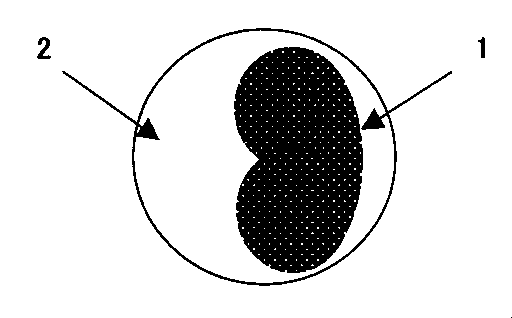
本発明における潜在倦縮性繊維(B)の断面図を、添付の図1〜4に例示する。本発明における潜在倦縮性繊維(B)において第1成分と第2成分の複合形態は、第2成分が融点158℃以上のポリプロピレンの場合、第1成分を鞘側に配置した偏心鞘芯型とするのが好ましい。これは複合繊維が偏心鞘芯型構造をとった場合には、熱処理時に嵩高性を十分に発現できるだけの捲縮が発現しやすいからである。偏心鞘芯型の配置は、図1のような断面形状が一般的であるが、図2のように偏心の程度を大きくし、第2成分が一部繊維の表面に露出した形状でも、潜在捲縮性を高めることができるため、本発明の効果が繊維表面に一部露出した第2成分の摩擦により妨げられない程度であるならば採用することができる。さらに、図3に示すように露出した第2成分が繊維表面上の50%を占める形状では最も潜在捲縮性を高めることができるため、本発明の繊維の加工性、熱接着性を妨げられない程度であるならば採用することができる。また、図4に示すように、芯成分の断面形状が異形(非円形)である場合も熱収縮の差による潜在捲縮性を高めることができる。 Cross-sectional views of the latent crimpable fiber (B) in the present invention are illustrated in the attached FIGS. The composite form of the first component and the second component in the latent crimpable fiber (B) in the present invention is an eccentric sheath core type in which the first component is disposed on the sheath side when the second component is polypropylene having a melting point of 158 ° C. or higher. Is preferable. This is because, when the conjugate fiber has an eccentric sheath-core structure, crimps that can sufficiently exhibit bulkiness during heat treatment are likely to occur. The arrangement of the eccentric sheath core type is generally a cross-sectional shape as shown in FIG. 1, but even if the degree of eccentricity is increased as shown in FIG. 2 and the second component is partially exposed on the fiber surface, Since the crimpability can be enhanced, the present invention can be employed as long as the effect of the present invention is not hindered by the friction of the second component partially exposed on the fiber surface. Furthermore, as shown in FIG. 3, in the shape in which the exposed second component occupies 50% on the fiber surface, the potential crimpability can be enhanced most, so that the processability and thermal adhesiveness of the fiber of the present invention are hindered. If it is not, it can be adopted. Moreover, as shown in FIG. 4, even when the cross-sectional shape of the core component is irregular (non-circular), the latent crimpability due to the difference in thermal shrinkage can be enhanced.
本発明における潜在倦縮性繊維(B)の第2成分がポリエチレンの場合、第2成分を鞘側に配置した偏心鞘芯型とするのが好ましい。これは複合繊維が偏心鞘芯型構造をとった場合には、熱処理時に嵩高性を十分に発現できるだけの捲縮が発現しやすいためである。偏心鞘芯型の配置は、図1のような断面形状が一般的であるが、図2のように偏心の程度を大きくし、第1成分が一部繊維の表面に露出した形状でも、潜在捲縮性を高めることができるため、本発明の効果が繊維表面に一部露出した第1成分の摩擦により妨げられない程度であるならば採用することができる。さらに、図3に示すように露出した第1成分が繊維表面上の50%を占める形状では最も潜在捲縮性を高めることができるため、本発明の繊維の加工性、熱接着性を妨げられない程度であるならば採用することができる。また、図4に示すように、芯成分の断面形状が異形(非円形)である場合も熱収縮の差による潜在捲縮性を高めることができる。 When the second component of the latent crimpable fiber (B) in the present invention is polyethylene, it is preferable to use an eccentric sheath core type in which the second component is disposed on the sheath side. This is because, when the composite fiber has an eccentric sheath-core structure, crimps that can sufficiently exhibit bulkiness during heat treatment are likely to occur. The arrangement of the eccentric sheath core type is generally a cross-sectional shape as shown in FIG. 1, but even if the degree of eccentricity is increased as shown in FIG. 2 and the first component is partially exposed on the fiber surface, Since the crimpability can be enhanced, the present invention can be adopted as long as the effect of the present invention is not hindered by the friction of the first component partially exposed on the fiber surface. Furthermore, as shown in FIG. 3, in the shape in which the exposed first component occupies 50% on the fiber surface, the latent crimpability can be most enhanced, so that the processability and thermal adhesiveness of the fiber of the present invention are hindered. If it is not, it can be adopted. Moreover, as shown in FIG. 4, even when the cross-sectional shape of the core component is irregular (non-circular), the latent crimpability due to the difference in thermal shrinkage can be enhanced.
本発明における潜在倦縮性繊維(B)は、単独で湿式抄紙法によってウェブに加工した状態で、後述する方法によって測定する熱収縮率が捲縮を伴って少なくとも30%以上の熱収縮率を示すことが好ましい。熱収縮率が30%を大幅に下回る場合、捲縮の発現が十分でないため、顕在捲縮性繊維(A)とともに得られる不織布の嵩は低くなる傾向がある。 The latent crimpable fiber (B) in the present invention has a thermal shrinkage rate of at least 30% or more with a crimp, with the thermal shrinkage rate measured by a method described later, in a state where it is processed into a web by a wet papermaking method. It is preferable to show. When the heat shrinkage ratio is significantly less than 30%, crimps are not sufficiently developed, and therefore the bulk of the nonwoven fabric obtained together with the actual crimpable fibers (A) tends to be low.
本発明における潜在倦縮性繊維(B)の繊維径は、3〜40μmの範囲である。潜在倦縮性繊維(B)では40μmを超える太い繊維では繊維の剛直性が高まるため、熱収縮時の潜在倦縮の発現が弱くなる。また、湿式抄紙法における水中での繊維の分散性や、前記の顕在捲縮性繊維(A)や他の繊維との混合性、得られる抄造紙の風合い等の点を考慮すると、繊維径は10〜25μmが好ましい。 The fiber diameter of the latent crimpable fiber (B) in the present invention is in the range of 3 to 40 μm. In the latent crimpable fiber (B), the thick fiber exceeding 40 μm increases the rigidity of the fiber, so that the expression of the latent crimp during heat shrinkage is weakened. In consideration of the dispersibility of fibers in water in the wet papermaking method, miscibility with the above-described crimped fibers (A) and other fibers, and the texture of the resulting papermaking paper, the fiber diameter is 10-25 micrometers is preferable.
本発明における潜在倦縮性繊維(B)は、熱収縮によって発現する倦縮以外にも、本発明の効果を妨げない程度にジグザグ型やオーム型の少なくとも1種類の捲縮形状が長さ方向に連続して5〜25山/インチの捲縮数が付与されている繊維が使用できる。但し倦縮付与により発現する潜在倦縮が減少することや繊維の分散性の面からは、ジグザグ型やオーム型の少なくとも1種類の捲縮が5〜10山/インチの捲縮数であることが好ましい。 The latent crimpable fiber (B) in the present invention has at least one crimped shape of zigzag type and ohmic type in the length direction to the extent that the effects of the present invention are not hindered, other than crimps that are manifested by heat shrinkage. In addition, fibers having a crimp number of 5 to 25 ridges / inch can be used. However, in terms of the reduction of latent crimps generated by the provision of crimps and the dispersibility of the fibers, at least one kind of crimps of zigzag type and ohmic type should have a number of crimps of 5 to 10 ridges / inch. Is preferred.
本発明における潜在倦縮性繊維(B)の繊維長は、得られた抄造紙の嵩高性や抄造紙強力を考慮すると3〜30mmが適当である。さらに、湿式抄紙法における前記の顕在捲縮性繊維(A)や他の繊維との混合性や、熱収縮による潜在倦縮の発現性を考慮すると3〜15mmが好ましい。 The fiber length of the latent crimpable fiber (B) in the present invention is suitably 3 to 30 mm in consideration of the bulkiness of the obtained papermaking paper and papermaking paper strength. Furthermore, in consideration of the miscibility with the above-described actual crimpable fiber (A) and other fibers in the wet papermaking method and the expression of latent crimp due to heat shrinkage, 3 to 15 mm is preferable.
以下に本発明において顕在捲縮性繊維(A)及び潜在倦縮性繊維(B)として用いられる、熱接着性複合繊維を製造する工程を示す。
低融点熱可塑性樹脂が繊維表面の少なくとも一部を形成するように並列型口金、または低融点熱可塑性樹脂を鞘成分とし高融点熱可塑性樹脂を芯成分とする鞘芯型口金、若しくは偏心鞘芯型口金を用い、通常用いられる溶融紡糸機により熱可塑性樹脂を紡出する。このとき、口金直下をクエンチにより送風し、半溶融状態の熱可塑性樹脂を冷却することによって、未延伸状態の熱接着性複合繊維を製造する。このとき、溶融した熱可塑性樹脂の吐出量及び未延伸糸の引取速度を任意に設定し、目標繊度に対して1〜5倍程度の繊維径の未延伸糸とする。
なお、繊維表面を形成する低融点熱可塑性樹脂の割合は、繊維断面円周率で50%以上の場合に熱接着力が充分となり、特に50〜100%の場合には強力となり好ましいが、同時にエレクトレット特性を向上させる為には必ずしもこの限りではない。得られた未延伸糸は、通常用いられる延伸機により延伸することによって、延伸糸(捲縮加工前の熱接着性複合繊維)とすることができる。なお、通常の場合、40〜120℃に加熱したロールとロールの間を、ロール間の速度比が1:1〜1:5の範囲となるように延伸処理を施す。得られた延伸糸は必要に応じて、ボックス型の捲縮加工機により捲縮が付与されトウとする。
繊維処理剤の付着工程については、未延伸糸の引き取り時にキスロールにて付着する方法や、延伸時/後にタッチロール法、浸漬法、噴霧法等で付着する方法があり、これらの方法の少なくとも一種の工程にて付着される。該トウを、押し切りカッターを用いて用途に合わせた任意の繊維長に切断し、使用される。
The process of manufacturing the thermoadhesive conjugate fiber used as the actual crimpable fiber (A) and the latent crimpable fiber (B) in the present invention is shown below.
A parallel-type die so that the low-melting thermoplastic resin forms at least a part of the fiber surface, or a sheath-core die having a low-melting thermoplastic resin as a sheath component and a high-melting thermoplastic resin as a core component, or an eccentric sheath core Using a die die, a thermoplastic resin is spun by a commonly used melt spinning machine. At this time, the thermoadhesive conjugate fiber in an unstretched state is manufactured by blowing air just below the base by quenching and cooling the semi-molten thermoplastic resin. At this time, the discharge amount of the melted thermoplastic resin and the take-up speed of the undrawn yarn are arbitrarily set to obtain an undrawn yarn having a fiber diameter of about 1 to 5 times the target fineness.
The ratio of the low-melting-point thermoplastic resin forming the fiber surface is preferably sufficient when the fiber cross-sectional circumference is 50% or more, and particularly when 50 to 100%, the strength becomes strong. This is not necessarily the case for improving electret characteristics. The obtained undrawn yarn can be made into a drawn yarn (heat-adhesive conjugate fiber before crimping) by drawing with a drawing machine usually used. In a normal case, stretching is performed between the rolls heated to 40 to 120 ° C. so that the speed ratio between the rolls is in the range of 1: 1 to 1: 5. The drawn yarn thus obtained is crimped by a box-type crimping machine as necessary to form a tow.
As for the process of attaching the fiber treatment agent, there are a method of attaching with a kiss roll at the time of taking an undrawn yarn, and a method of attaching by a touch roll method, a dipping method, a spray method, etc. at the time of drawing / after, at least one of these methods It is attached in the process. The tow is cut into an arbitrary fiber length according to the application using a push cutter and used.
湿式不織布を製造するに当たり、本発明の湿式不織布用繊維の他に加えることのできる他の繊維(C)としては特に限定されず、例えばポリプロピレンやポリエチレン及びポリエチレン/ポリプロピレン複合繊維等のポリオレフィン系繊維、ポリエチレンテレフタレート、ポリブチレンテレフタレート等のポリエステル系繊維、ナイロン6、ナイロン66等のポリアミド繊維、ポリ乳酸、ポリブチレンサクシネート等の生分解性繊維、レーヨン繊維、人工パルプ等の合成繊維や、針葉樹パルプ、広葉樹パルプ、パルプ、木綿、麻等の天然繊維等が目的に応じて利用できる。
In producing the wet nonwoven fabric, the other fiber (C) that can be added in addition to the fiber for wet nonwoven fabric of the present invention is not particularly limited. For example, polyolefin fibers such as polypropylene, polyethylene and polyethylene / polypropylene composite fiber, Polyester fibers such as polyethylene terephthalate and polybutylene terephthalate, polyamide fibers such as
嵩高な湿式不織布は、本発明の湿式不織布用繊維を湿式抄紙法によって単独または他の繊維と混合抄紙して得られたウェブを、熱処理接着またはスパンレース法をはじめとした機械交絡等の公知の加工法によって不織布化されることで得られる。機械交絡等による不織布化法では抄紙用ウェブでは繊維長が短く交絡させるには十分ではないことや、交絡の強度が熱融着による一体化の方が強いことから、嵩高で強度を有する抄造紙を得るには、熱処理接着による不織布化法が好ましい。 The bulky wet nonwoven fabric is a web obtained by making the wet nonwoven fabric fiber of the present invention alone or mixed with other fibers by a wet papermaking method. It is obtained by making it into a non-woven fabric by a processing method. Nonwoven fabric by mechanical entanglement, etc., because the paper length of the papermaking web is short enough to be entangled and the strength of entanglement is stronger by integration by thermal fusion, making the papermaking paper bulky and strong In order to obtain the non-woven fabric, a non-woven fabric forming method by heat treatment adhesion is preferable.
嵩高な湿式不織布を製造するためには、本発明の湿式不織布用繊維を水を媒体とする抄紙機を用い単独または混合抄紙してウェブを得る。抄紙機は、例えば、円網型抄紙機、長網型抄紙機、等がいずれも使用できる。また水槽、攪拌機、網等を備えた簡易型抄紙機も使用できる。得られたウェブは脱水処理、圧密化処理し、或いはその処理なしで、各種熱処理またはスパンレース法をはじめとした機械交絡等の公知の加工法によって不織布化され抄造紙が得られる。機械交絡等による不織布化法では構成している繊維が十分に固定されていない為嵩が易い反面、抄紙用ウェブでは繊維長が短く交絡させるには十分ではないことや、熱融着による一体化の方が交絡の強度が強いことから十分な不織布強力が得られないことがある。嵩高で強度を有する抄造紙を得るには、熱処理接着による不織布化法が好ましい。 In order to produce a bulky wet nonwoven fabric, a web is obtained by single or mixed paper making using a paper machine using the wet nonwoven fabric fiber of the present invention as a water medium. As the paper machine, for example, a circular net type paper machine or a long net type paper machine can be used. A simple paper machine equipped with a water tank, a stirrer, a net, or the like can also be used. The obtained web is subjected to dehydration treatment, consolidation treatment, or without such treatment, and is made into a non-woven fabric by a known processing method such as various heat treatments or mechanical entanglement such as a spunlace method to obtain a papermaking paper. Non-woven fabrics such as mechanical entanglement tend to be bulky because the fibers are not sufficiently fixed. On the other hand, paper making webs are not long enough to be entangled, and are integrated by thermal fusion. Since the entanglement strength is stronger, sufficient nonwoven fabric strength may not be obtained. In order to obtain a bulky and strong papermaking paper, a non-woven fabric forming method by heat treatment adhesion is preferable.
嵩高な湿式不織布を製造するためには、主として湿式抄紙法にて混合抄紙したウェブに熱処理を施す工程で、本発明の顕在倦縮性繊維(A)の嵩高効果を維持しながら、潜在捲縮性複合繊維(B)の潜在捲縮を発現させると同時に、ウェブを均一に熱収縮および/または融着させて一体化する必要がある。
加熱処理には、汎用の熱風循環装置や、フローティングドライヤー等の加熱処理装置が使用できるが、ウェブをより均一に伝熱させることができるフローティングドライヤーの使用がより好ましい。この装置の特徴はウェブの搬送空間の上面及び下面に設置されたノズルから熱風を噴出し、この熱風によりウェブを浮遊させ、空気搬送と同時に熱収縮を生じさせるためにより均一な不織布が得られることである。しかしながらいずれの装置を使用する場合においてもウェブが切れたり、繊維が飛散することを防ぐために、ニードルパンチ法、エンボスロール法、超音波融着法および/または高圧水流交絡法等の公知の不織布加工法を用いることで、ウェブを仮止めしておくことが重要である。また、本発明の顕在倦縮性繊維(A)や潜在捲縮性繊維(B)が熱融着および/または収縮を起こさない低温度で熱接着する成分を含ませておき、ウェブを仮接着しておく方法も好ましく用いられる。
In order to produce a bulky wet non-woven fabric, a latent crimp is achieved while maintaining the bulky effect of the actual crimpable fiber (A) of the present invention in the step of heat-treating the web that has been mixed and made by wet papermaking. It is necessary to develop the latent crimp of the conductive composite fiber (B) and at the same time to uniformly integrate the web by heat shrinking and / or fusing.
For the heat treatment, a general-purpose hot air circulation device or a heat treatment device such as a floating dryer can be used, but the use of a floating dryer capable of transferring the web more uniformly is more preferable. The feature of this device is that hot air is blown out from nozzles installed on the upper and lower surfaces of the web conveyance space, the web is floated by this hot air, and heat shrinkage occurs simultaneously with air conveyance, so that a more uniform nonwoven fabric can be obtained. It is. However, in order to prevent the web from being cut or the fibers from being scattered when using any of the apparatuses, known nonwoven fabric processing such as needle punching, embossing roll, ultrasonic fusion and / or high-pressure hydroentanglement It is important to temporarily fix the web by using the method. In addition, a component that is thermally bonded at a low temperature at which the actual crimpable fiber (A) or the latent crimpable fiber (B) of the present invention does not cause thermal fusion and / or shrinkage is included, and the web is temporarily bonded. This method is also preferably used.
本発明の湿式不織布用繊維を用いて得られる不織布の目付は、使用目的によって適宜選ばれる。例えば、ウェットティッシュや障子紙、電池材料などに使用される場合には、5〜100g/m2の範囲、フィルター材や土木資材に用いられる場合には、50〜2000g/m2の範囲がそれぞれ好ましく用いられるが、この限りではない。また、不織布は目的に応じてカード不織布やエアレイド不織布等の短繊維不織布または、スパンボンド不織布やメルトブロー不織布等長繊維不織布と積層することができる。 The basis weight of the nonwoven fabric obtained using the fiber for wet nonwoven fabric of the present invention is appropriately selected depending on the purpose of use. For example, when used for wet tissue, shoji paper, battery materials, etc., the range is 5 to 100 g / m 2 , and when used for filter materials and civil engineering materials, the range is 50 to 2000 g / m 2. Although it is preferably used, this is not restrictive. Moreover, a nonwoven fabric can be laminated | stacked with short fiber nonwoven fabrics, such as a card nonwoven fabric and an airlaid nonwoven fabric, or long fiber nonwoven fabrics, such as a spun bond nonwoven fabric and a melt blown nonwoven fabric, according to the objective.
本発明の湿式不織布用繊維を使用すれば、従来得るのが困難であった比容積が10cm2/g以上の、特には、13cm2/g以上の、目付けや繊維の分散性が均一で且つ、強度を有した抄造紙を簡便に得ることができる。 If the fiber for wet nonwoven fabric of the present invention is used, the specific volume, which has been difficult to obtain in the past, is 10 cm 2 / g or more, particularly 13 cm 2 / g or more, and the basis weight and fiber dispersibility are uniform and Thus, a papermaking paper having strength can be easily obtained.
次に、本発明を実施例によって具体的に説明するが、本発明は以下の実施例のみに限定されるものではない。なお、実施例、比較例において用いられている用語の定義及び測定方法は以下の通りである。
(1)融点:(単位:℃)
ティー・エイ・インスツルメント製示差走査熱量計DSC−Q10により、熱可塑性重合体を10℃/分で昇温した時に得られた融解吸収曲線上のピークに対応する温度をその熱可塑性重合体の融点とした。
(2)MFR:(単位:g/10分)
JIS−K−7210 条件14(230℃、21.18N)に準じて測定した。MFRは熱可塑性重合体を試料とし測定した値である。
(3)Q値:(重量平均分子量/数平均分子量)
Q値はゲルパーミエイションクロマトグラフ法により求めた、熱可塑性重合体の重量平均分子量(Mw)と数平均分子量(Mn)の比(Mw/Mn)である。なお、ここでは紡糸前の熱可塑性重合体の値を示した。
EXAMPLES Next, although an Example demonstrates this invention concretely, this invention is not limited only to a following example. The definitions of terms used in Examples and Comparative Examples and the measurement methods are as follows.
(1) Melting point: (unit: ° C)
The temperature corresponding to the peak on the melt absorption curve obtained when the temperature of the thermoplastic polymer was raised at 10 ° C./min by a differential scanning calorimeter DSC-Q10 manufactured by TA Instruments Inc. Of melting point.
(2) MFR: (Unit: g / 10 min)
It measured according to JIS-K-7210 condition 14 (230 degreeC, 21.18N). MFR is a value measured using a thermoplastic polymer as a sample.
(3) Q value: (weight average molecular weight / number average molecular weight)
The Q value is a ratio (Mw / Mn) of the weight average molecular weight (Mw) and the number average molecular weight (Mn) of the thermoplastic polymer obtained by gel permeation chromatography. Here, the value of the thermoplastic polymer before spinning is shown.
(4)繊度:(単位:dtex)
JIS−L−1015に準じて測定した。
(5)繊維径:(単位:μm)
繊度と繊維を構成する比重から下記式にて算出した。
繊維径(μm)=繊度(dtex)/〔(第1成分樹脂比重×繊維構成比+第2成分樹脂比重×繊維構成比)/106/3.14〕×104×2
(6)捲縮数:(単位:山数/2.54cm)
短繊維試料については、10本の繊維について、2.54cm当たりの捲縮数を数え、平均した値をここでは捲縮数とした。
(7)単糸強度:(単位:cN/dtex)
JIS−L−1015に準じて測定した。
(4) Fineness: (unit: dtex)
It measured according to JIS-L-1015.
(5) Fiber diameter: (unit: μm)
It calculated with the following formula from the specific gravity which comprises a fineness and a fiber.
Fiber diameter (μm) = fineness (dtex) / [(first component resin specific gravity × fiber component ratio + second component resin specific gravity × fiber component ratio) / 10 6 /3.14]×10 4 × 2
(6) Number of crimps: (unit: number of mountains / 2.54 cm)
For the short fiber sample, the number of crimps per 2.54 cm was counted for 10 fibers, and the average value was taken as the number of crimps here.
(7) Single yarn strength: (unit: cN / dtex)
It measured according to JIS-L-1015.
(8)熱収縮率:(単位:%)
簡易抄紙機(TAPPI)にて25×25cm、目付約80g/m2のウェブを作成し、脱水処理した後、クラフト紙にのせて145℃に維持した対流型熱風乾燥機に入れ、5分間加熱処理した。熱処理前後のウェブからそれぞれの辺の長さを測定し、熱収縮率を次式により算出した。
熱収縮率(%)=(1−a/25)×100
なお、式中のaは熱処理したウェブ辺の長さである。
(9)繊維分散性
湿式繊維の水中での分散性(繊維同士の開繊性、繊維の分散性)を測定し、以下の3段階で評価した。
良好(○):繊維同士の開繊、繊維の分散状況が最も好ましいもの。
良(△):繊維同士の開繊、または繊維の分散のいずれかが良好なもの。
不良(×):繊維同士の開繊不良や、繊維の分散不良(繊維結束、絡み)が見られるもの。
(8) Thermal contraction rate: (unit:%)
Create a web of 25 x 25 cm and a weight of about 80 g / m 2 with a simple paper machine (TAPPI), dehydrate it, put it in a convection hot air dryer maintained at 145 ° C on kraft paper, and heat for 5 minutes Processed. The length of each side was measured from the web before and after the heat treatment, and the thermal shrinkage was calculated by the following formula.
Thermal contraction rate (%) = (1−a / 25) × 100
In the formula, a is the length of the heat-treated web side.
(9) Fiber dispersibility The dispersibility of wet fibers in water (openness between fibers, dispersibility of fibers) was measured and evaluated in the following three stages.
Good (O): Most preferable fiber opening and fiber dispersion.
Good ((triangle | delta)): The thing in which either the opening of fibers or dispersion | distribution of a fiber is favorable.
Defect (x): fiber opening failure between fibers and fiber dispersion failure (fiber binding, entanglement) are observed.
(10)地合い
目付約70g/m2の抄造紙の地合いについて以下のような3段階の基準で目視判定した。
良好(○):均一に熱収縮を起こし、地合いが良好な不織布が得られたもの
良(△):ほぼ均一に熱収縮を起こし、地合いの乱れが僅かに見られるものの、実用上問題ないと考えられるもの
不良(×):熱収縮が均一に起こらず地合いの乱れがあるもの、または収縮率が小さいもの
(11)比容積:(単位:cm3/g)
目付約70g/m2の抄造紙を2g/m2の圧力で測定した厚みから下記計算式で比容積を算出し嵩高さを比較。
比容積(cm3/g)=厚み(mm)/目付(g/m2)×1000
(12)不織布強力:(単位:N/5cm)
目付約70g/m2の抄造紙を15×5cmの短冊状に3点取り、島津精機製引張試験機にて長短部の上下各5cmをチャックの挟み代にして、チャック間10cm、速度200m2/secで上下に引張り試験を実施。測定結果から破断したときの最大応力と伸度を測定。
(10) Texture The texture of paper-making paper having a basis weight of about 70 g / m 2 was visually judged according to the following three-stage criteria.
Good (○): Non-woven fabric with uniform heat shrinkage and good texture was obtained. Good (△): Heat shrinkage almost uniform with slight disturbance of texture, but no problem in practical use. Possible defects NG (x): heat shrinkage does not occur uniformly and the texture is disturbed, or the shrinkage rate is small (11) Specific volume: (unit: cm 3 / g)
The specific volume is calculated by the following formula from the thickness of a papermaking paper having a basis weight of about 70 g / m 2 measured at a pressure of 2 g / m 2 , and the bulkiness is compared.
Specific volume (cm 3 / g) = thickness (mm) / weight per unit (g / m 2 ) × 1000
(12) Nonwoven fabric strength: (unit: N / 5 cm)
Basis weight of about 70 g / m 2 of papermaking paper 15 × 5cm of
[実施例1〜6、比較例1〜4]
(1) 本発明における顕在捲縮性繊維(A)として各種顕在捲縮性繊維(A−1)、(A−2)及び(A−3)の製造
表1に示すように、値の異なる結晶性ポリプロピレンのいずれかを第1成分として用い、MFRの異なる高密度ポリエチレンを第2成分とし、押出機、孔径0.8mmの並列型紡糸口金と、巻取り装置等を備えた紡糸装置と、多段加熱ロールとスタッファーボックス型クリンパー(蒸気による捲縮形状の固定が可能)を備えた延伸装置を用い、各種複合繊維を製造した。なお、(A−1)にはクリンパー設備で0.002Mpaの蒸気圧を与え、捲縮形状の固定化処理を行った。
[Examples 1-6, Comparative Examples 1-4]
(1) Production of various manifested crimpable fibers (A-1), (A-2) and (A-3) as the manifested crimpable fibers (A) in the present invention, as shown in Table 1, differing in value A spinning device including any one of crystalline polypropylene as a first component, a high-density polyethylene having a different MFR as a second component, an extruder, a parallel-type spinneret with a hole diameter of 0.8 mm, a winding device, and the like, Various composite fibers were manufactured using a drawing apparatus equipped with a multi-stage heating roll and a stuffer box type crimper (which can fix the crimped shape by steam). For (A-1), a crimp pressure of 0.002 Mpa was applied by a crimper facility, and crimped immobilization treatment was performed.
(2) 本発明における潜在捲縮性繊維(B)として各種潜在捲縮性繊維(B−1)、(B−2)及び(B−3)の製造
表1に示すように、エチレン−プロピレン二元共重合体を第1成分として用い、Q値の小さい結晶性ポリプロピレンを第2成分とし、押出機、孔径0.8mmの並列型紡糸口金と、巻取り装置等を備えた紡糸装置と、多段加熱ロールと必要に応じてスタッファーボックス型クリンパーを備えた延伸装置を用い、各種複合繊維を製造した。
(2) Production of various latent crimpable fibers (B-1), (B-2) and (B-3) as latent crimpable fibers (B) in the present invention, as shown in Table 1, ethylene-propylene A spinning device comprising a binary copolymer as a first component, a crystalline polypropylene having a small Q value as a second component, an extruder, a parallel-type spinneret with a hole diameter of 0.8 mm, a winding device, and the like; Various composite fibers were produced using a drawing apparatus equipped with a multistage heating roll and, if necessary, a stuffer box type crimper.
(3) 比較として顕在捲縮の付与が無く、潜在捲縮性も殆ど持たない繊維(C)である各種繊維(C−1)、(C−2)及び(C−3)の製造
表1に示すように、Q値の小さい結晶性ポリプロピレンを第1成分として用い、MFRの異なる高密度ポリエチレンを第2成分とし、押出機、孔径0.8mmの並列型紡糸口金と同心鞘芯型紡糸口金のいずれか一種と、巻取り装置等を備えた紡糸装置と、多段加熱ロールを備えた延伸装置を用い、各種複合繊維を製造した。
(3) Manufacture of various fibers (C-1), (C-2) and (C-3) which are fibers (C) which have no apparent crimping property and have almost no latent crimping property as a comparison. As shown in Fig. 1, a high-quality polyethylene having a different QFR is used as the first component, using a crystalline polypropylene having a small Q value as the second component, an extruder, a parallel type spinneret with a hole diameter of 0.8 mm, and a concentric sheath type spinneret. Various composite fibers were produced using any one of the above, a spinning device equipped with a winding device or the like, and a drawing device equipped with a multistage heating roll.
それぞれの複合繊維の詳細について、表1に繊維を構成する樹脂、製造条件、及び繊維の形状を、表2に繊維の糸質や捲縮形状と、各繊維の水中分散性や熱収縮等のデータを示した。なお表2中、顕在捲縮性繊維(A−2′)は(A−2)の繊維長を変化させたものである。
表1に記載した繊維の具体的断面形状は、図2、3及び5に示した。表中、Homo-PPは結晶性ポリプロピレンを表し、HDPEは高密度ポリエチレンを表し、co-PPは密度0.922g/cm3のエチレン-プロピレン共重合体(エチレン成分3.5質量%)を表す。
For details of each composite fiber, Table 1 shows the resin constituting the fiber, manufacturing conditions, and fiber shape, Table 2 shows the fiber quality and crimped shape of the fiber, and the dispersibility in water and heat shrinkage of each fiber. The data is shown. In Table 2, the actual crimpable fiber (A-2 ′) is obtained by changing the fiber length of (A-2).
Specific cross-sectional shapes of the fibers described in Table 1 are shown in FIGS. In the table, Homo-PP represents crystalline polypropylene, HDPE represents high-density polyethylene, and co-PP represents an ethylene-propylene copolymer (ethylene component 3.5 mass%) having a density of 0.922 g / cm 3 .
上記のように得られた繊維(A)、繊維(B)とおよび/または一般に得られる繊維(C)とを、表3〜4に示す実施例1〜6、比較例1〜4の比率で湿式抄紙法によって混合抄紙し、ウェブを得て、それぞれの熱処理条件で不織布化し抄造紙を得た。得られた抄造紙はその嵩高性を評価する為に、東洋精機製のデジ・シックネス・テスターにて圧力2g/cm2でJIS−K−6767に準じて抄造紙の厚みを測定し、下記式より比容積を算出した。
比容積(cm3/g)=厚み(mm)×1000/目付(g/m2)
得られた各抄造紙の結果について表3〜4に合わせて示す。
The fibers (A) and fibers (B) obtained as described above and / or the fibers (C) generally obtained are shown in Tables 3 to 4 in the ratios of Examples 1 to 6 and Comparative Examples 1 to 4. Mixed paper was made by a wet paper making method, webs were obtained, and nonwoven fabrics were made into non-woven fabrics under the respective heat treatment conditions. In order to evaluate the bulkiness of the resulting papermaking, the thickness of the papermaking paper was measured according to JIS-K-6767 at a pressure of 2 g / cm 2 with a digital thickness tester manufactured by Toyo Seiki. More specific volume was calculated.
Specific volume (cm 3 / g) = thickness (mm) × 1000 / weight per unit (g / m 2 )
It shows according to Tables 3-4 about the result of each obtained papermaking.
各例における操作と結果を以下に説明する。
[実施例1]
繊維(A−1)と繊維(B−1)を水中に均一に分散させ丸網型抄紙機にてウェブを作成し、これを脱水、乾燥工程を経て、サクション型スルーエアー機にて130℃で熱接着を行い目的とする抄造紙を得た。ウェブの繊維の分散性も良好で、熱収縮も均一に発現していた。また、得られた抄造紙は比容積が16.8cm3/gと嵩高で且つ、抄造紙強力が54.1N/5cmと高強力であった。
The operation and result in each example will be described below.
[Example 1]
Fiber (A-1) and fiber (B-1) are uniformly dispersed in water, a web is prepared with a round net type paper machine, this is subjected to dehydration and drying steps, and 130 ° C. with a suction type through air machine. And the desired papermaking paper was obtained. The dispersibility of the web fibers was good and the heat shrinkage was evenly expressed. Further, the obtained papermaking was bulky with a specific volume of 16.8 cm 3 / g and papermaking paper strength was 54.1 N / 5 cm and high strength.
[実施例2]
繊維(A−2)と繊維(B−1)を水中に均一に分散させ丸網型抄紙機にてウェブを作成し、これを脱水、乾燥工程を経て、サクション型スルーエアー機にて130℃で熱接着を行い目的とする抄造紙を得た。ウェブの繊維の分散性も良好で、熱収縮も均一に発現していた。また、得られた抄造紙は比容積が18.4cm3/gと非常に嵩高で且つ、抄造紙強力が50.5N/5cmと高強力であった。
[Example 2]
The fiber (A-2) and the fiber (B-1) are uniformly dispersed in water, and a web is prepared with a round net type paper machine. This is subjected to a dehydration and drying process, and 130 ° C. with a suction type through air machine. And the desired papermaking paper was obtained. The dispersibility of the web fibers was good and the heat shrinkage was evenly expressed. Moreover, the obtained papermaking was very bulky with a specific volume of 18.4 cm 3 / g, and the papermaking paper strength was as high as 50.5 N / 5 cm.
[実施例3]
繊維(A−3)と繊維(B−1)を水中に均一に分散させ丸網型抄紙機にてウェブを作成し、これを脱水、乾燥工程を経て、サクション型スルーエアー機にて130℃で熱接着を行い目的とする抄造紙を得た。ウェブの繊維の分散性も良好で、熱収縮も均一に発現していた。また、得られた抄造紙は比容積が16.4cm3/gと嵩高で且つ、抄造紙強力が67.7N/5cmと高強力であった。
[Example 3]
Fiber (A-3) and fiber (B-1) are uniformly dispersed in water, a web is prepared with a round net type paper machine, this is subjected to dehydration and drying steps, and 130 ° C. with a suction type through air machine. And the desired papermaking paper was obtained. The dispersibility of the web fibers was good and the heat shrinkage was evenly expressed. Moreover, the obtained papermaking was bulky with a specific volume of 16.4 cm 3 / g and the papermaking paper strength was as high as 67.7 N / 5 cm.
[実施例4]
繊維(A−3)と繊維(B−1)を水中に均一に分散させ丸網型抄紙機にてウェブを作成し、これを脱水、乾燥工程を経て、サクション型スルーエアー機にて130℃で実施例3の熱風の風速条件より速い風速条件下で熱接着を行い目的とする抄造紙を得た。ウェブの繊維の分散性も良好で、熱収縮も均一に発現していた。得られた抄造紙では比容積が13.7cm3/gと嵩高さも維持しながら、抄造紙強力が95.4N/5cmと非常に高い強力を示した。実施例3よりも繊維同士の熱接着が進んだ分だけ嵩が若干低下したものと考えられる。
[Example 4]
The fiber (A-3) and the fiber (B-1) are uniformly dispersed in water, a web is prepared with a round net type paper machine, this is subjected to dehydration and drying steps, and 130 ° C. with a suction type through air machine. Thus, heat bonding was performed under wind speed conditions higher than the hot wind speed conditions of Example 3 to obtain the intended papermaking paper. The dispersibility of the web fibers was good and the heat shrinkage was evenly expressed. The obtained papermaking paper showed a very high strength of 95.4 N / 5 cm while maintaining a specific volume of 13.7 cm 3 / g and bulkiness. It is considered that the bulk was slightly reduced as much as the thermal bonding between fibers progressed more than in Example 3.
[実施例5]
繊維(A−1)と繊維(B−2)を水中に均一に分散させ丸網型抄紙機にてウェブを作成し、これを脱水、乾燥工程を経て、サクション型スルーエアー機にて130℃で熱接着を行い目的とする抄造紙を得た。ウェブから繊維の分散性は良好で収縮も均一に発現していたが、抄造紙表面に毛羽立ちがみられた。また、得られた抄造紙は比容積が16.0cm3/gと嵩高で且つ、抄造紙強力が61.5N/5cmと高強力であった。潜在性捲縮を有する繊維(B−2)にも顕在捲縮を付与したため、嵩の面では潜在性捲縮の強度が低下した分、顕在捲縮の付与によってカバーされた形になった。表面の毛羽立ちは構成する繊維が何れもスパイラル形状の立体捲縮を有し、各繊維の融着成分(低融点成分)が接触する確立が低下したため繊維交点が減少し表面で毛羽立ちが見られたと考えられる。
[Example 5]
Fiber (A-1) and fiber (B-2) are uniformly dispersed in water, a web is prepared with a round net type paper machine, this is subjected to dehydration and drying steps, and 130 ° C. with a suction type through air machine. And the desired papermaking paper was obtained. Although the dispersibility of the fiber from the web was good and the shrinkage was evenly expressed, the surface of the paper was fuzzy. Moreover, the obtained papermaking was bulky with a specific volume of 16.0 cm 3 / g, and the papermaking paper strength was as high as 61.5 N / 5 cm. Since the actual crimp was also imparted to the fiber (B-2) having latent crimp, the bulk was reduced by the decrease in the strength of the latent crimp, and the fiber was covered with the actual crimp. The fluff on the surface is that each of the constituent fibers has a spiral-shaped three-dimensional crimp, and the probability that the fusion component (low melting point component) of each fiber will be in contact with each other has decreased, so that the number of fiber intersections has decreased and fuzz has been seen on the surface. Conceivable.
[実施例6]
繊維(A−1)を水中に均一に分散させ丸網型抄紙機にてウェブを作成し、これを脱水、乾燥工程を経て、サクション型スルーエアー機にて130℃で熱接着を行い目的とする抄造紙を得た。ウェブの繊維の分散性は良好であったが、一部に繊維の開繊不良が見られた。また、得られた抄造紙は潜在捲縮性繊維(B)による熱収縮繊維による効果が無いにも関わらず比容積が16.5cm3/gと嵩高で且つ、抄造紙強力が193.5N/5cmと高強力であった。
[Example 6]
The fiber (A-1) is uniformly dispersed in water, a web is prepared with a round net type paper machine, this is subjected to dehydration and drying processes, and heat-bonded at 130 ° C. with a suction type through air machine. Paper making paper was obtained. Although the dispersibility of the web fibers was good, some of the fibers were poorly opened. In addition, the obtained papermaking paper is bulky with a specific volume of 16.5 cm 3 / g and a papermaking paper strength of 193.5 N / g, although there is no effect of the heat-shrinkable fibers due to the latent crimpable fibers (B). It was as strong as 5 cm.
[比較例1]
繊維(C−1)と繊維(C−2)を水中に均一に分散させ丸網型抄紙機にてウェブを作成し、これを脱水、乾燥工程を経て、サクション型スルーエアー機にて135℃で熱接着を行い目的とする抄造紙を得た。ウェブの繊維の分散性も良好で、熱収縮も均一に発現していた。しかし、得られた抄造紙は強力が103.9N/5cmと高強力であったものの、比容積が11.2cm3/gと低く目的とする嵩高性は得られなかった。
[Comparative Example 1]
Fiber (C-1) and fiber (C-2) are uniformly dispersed in water, a web is prepared with a round net type paper machine, this is subjected to dehydration and drying steps, and 135 ° C. with a suction type through air machine. And the desired papermaking paper was obtained. The dispersibility of the web fibers was good and the heat shrinkage was evenly expressed. However, although the resulting papermaking had a high strength of 103.9 N / 5 cm, the specific volume was as low as 11.2 cm 3 / g, and the desired bulkiness was not obtained.
[比較例2]
繊維(C−1)と繊維(C−2)を水中に均一に分散させ丸網型抄紙機にてウェブを作成した。これを脱水、乾燥工程を経た後、熱接着による嵩の低減を緩和させる為、サクション型スルーエアー機の温度を125℃と低温にして熱接着を行った。得られたウェブは繊維の分散性は問題は見られなかった。また、抄造紙は比容積が13.8cm3/gと目的とする嵩高性は得られたが、強力が34.1N/5cmと著しく低くウェブが仮接着された状態であった。
[Comparative Example 2]
Fiber (C-1) and fiber (C-2) were uniformly dispersed in water, and a web was prepared with a round net type paper machine. This was subjected to dehydration and drying steps, and then heat bonding was performed with the temperature of the suction type through air machine as low as 125 ° C. in order to alleviate the reduction in bulk due to heat bonding. The obtained web showed no problem with fiber dispersibility. The papermaking paper had a specific volume of 13.8 cm 3 / g and the desired bulkiness was obtained, but the strength was extremely low at 34.1 N / 5 cm, and the web was temporarily bonded.
[比較例3]
繊維(C−1)と繊維(C−3)を水中に均一に分散させ丸網型抄紙機にてウェブを作成した。これを脱水、乾燥工程を経た後、サクション型スルーエアー機の温度を130℃にして熱接着を行った。得られたウェブは繊維の分散性は問題は見られなかった。しかし、抄造紙は比容積が10.0cm3/gと低く、繊維の太繊度化もよる嵩高性効果は得られず嵩が減少する結果となった。繊維の太繊度化による効果は顕在捲縮を有する繊維では捲縮の剛性を上がる為厚み方向の剛性が高まり嵩高効果が発現していると考えられるが、太繊度の捲縮が無い繊維では繊維の構成本数が減少し、厚み方向の繊維の充填密度も低くなるため厚み方向の圧力に弱く、加工工程で嵩が低下しているのではないかと考えられる。
[Comparative Example 3]
Fiber (C-1) and fiber (C-3) were uniformly dispersed in water, and a web was prepared with a round net type paper machine. This was subjected to dehydration and drying steps, and then the heat of the suction type through air machine was set to 130 ° C. for thermal bonding. The obtained web showed no problem with fiber dispersibility. However, the papermaking paper has a low specific volume of 10.0 cm 3 / g, and the bulkiness effect due to the increase in fiber fineness cannot be obtained, resulting in a decrease in bulk. The effect of increasing the fineness of the fiber is considered to be due to the increase in the rigidity of the crimp in the fiber having the actual crimp. Therefore, it is considered that it is weak against pressure in the thickness direction and the bulk is reduced in the processing step.
[比較例4]
繊維(B−1)と繊維(C−2)を水中に均一に分散させ丸網型抄紙機にてウェブを作成し、これを脱水、乾燥工程を経て、サクション型スルーエアー機にて140℃で熱接着を行い目的とする抄造紙を得た。ウェブの繊維の分散性も良好で、熱収縮も均一に発現していた。しかし、得られた抄造紙の比容積は10.3cm3/gと目的とする十分な嵩高性は得られなかった。一般の繊維(C−2)がスパイラル捲縮等の立体捲縮を有さないため、繊維(B)を混合しても抄造紙の強力は十分であったが、嵩高効果が得られないことが確認できた。
[Comparative Example 4]
The fiber (B-1) and the fiber (C-2) are uniformly dispersed in water, a web is prepared with a round net type paper machine, this is subjected to dehydration and drying steps, and then 140 ° C. with a suction type through air machine. And the desired papermaking paper was obtained. The dispersibility of the web fibers was good and the heat shrinkage was evenly expressed. However, the specific volume of the papermaking paper obtained was 10.3 cm 3 / g, and the intended sufficient bulkiness could not be obtained. Since the general fiber (C-2) does not have a three-dimensional crimp such as a spiral crimp, even if the fiber (B) is mixed, the strength of the papermaking paper is sufficient, but a bulky effect cannot be obtained. Was confirmed.
[比較例5]
繊維(B−1)と繊維(C−1)を水中に均一に分散させ丸網型抄紙機にてウェブを作成し、これを脱水、乾燥工程を経て、サクション型スルーエアー機にて130℃で熱接着を行い目的とする抄造紙を得た。ウェブの繊維の分散性も良好で、熱収縮も均一に発現していた。しかし、得られた抄造紙の比容積は12.2cm3/gと目的とする十分な嵩高性は得られなかった。スパイラル捲縮を有する一般の繊維(C−1)に繊維(B)を混合することで、ある程度の効果は見られたが十分な嵩高効果が得られない結果であった。
[Comparative Example 5]
Fiber (B-1) and fiber (C-1) are uniformly dispersed in water, a web is prepared with a round net type paper machine, this is subjected to dehydration and drying steps, and 130 ° C. with a suction type through air machine. And the desired papermaking paper was obtained. The dispersibility of the web fibers was good and the heat shrinkage was evenly expressed. However, the specific volume of the resulting papermaking was 12.2 cm 3 / g, and the intended sufficient bulkiness could not be obtained. By mixing the fiber (B) with the general fiber (C-1) having spiral crimps, a certain effect was observed, but a sufficient bulky effect was not obtained.
1 偏心鞘芯形複合繊維を構成する第1成分
2 偏心鞘芯形複合繊維を構成する第2成分
3 並列型複合繊維を構成する第1成分
4 並列型複合繊維を構成する第2成分
5 複合繊維を構成する第1成分
6 複合繊維を構成する第2成分
DESCRIPTION OF SYMBOLS 1 1st component which comprises an eccentric sheath core
Claims (8)
Priority Applications (8)
| Application Number | Priority Date | Filing Date | Title |
|---|---|---|---|
| JP2007032313A JP5037964B2 (en) | 2007-02-13 | 2007-02-13 | Wet non-woven fabric |
| PCT/JP2008/052793 WO2008099960A1 (en) | 2007-02-13 | 2008-02-13 | Fiber for wetlaid non-woven fabric |
| KR1020097015524A KR101187219B1 (en) | 2007-02-13 | 2008-02-13 | Fiber for wetlaid non-woven fabric |
| BRPI0807030-0A BRPI0807030B1 (en) | 2007-02-13 | 2008-02-13 | FIBER FOR A NON-FABRIC CLOTHED BY HUMIDITY |
| EP08711604A EP2111490B1 (en) | 2007-02-13 | 2008-02-13 | Fiber for wetlaid non-woven fabric |
| AT08711604T ATE542955T1 (en) | 2007-02-13 | 2008-02-13 | FIBER FOR WET NON-WOVEN FABRIC |
| US12/524,262 US10161064B2 (en) | 2007-02-13 | 2008-02-13 | Fiber for wetlaid non-woven fabric |
| CN2008800045861A CN101605939B (en) | 2007-02-13 | 2008-02-13 | Fibers for wet-laid nonwoven fabrics |
Applications Claiming Priority (1)
| Application Number | Priority Date | Filing Date | Title |
|---|---|---|---|
| JP2007032313A JP5037964B2 (en) | 2007-02-13 | 2007-02-13 | Wet non-woven fabric |
Publications (2)
| Publication Number | Publication Date |
|---|---|
| JP2008196077A JP2008196077A (en) | 2008-08-28 |
| JP5037964B2 true JP5037964B2 (en) | 2012-10-03 |
Family
ID=39690180
Family Applications (1)
| Application Number | Title | Priority Date | Filing Date |
|---|---|---|---|
| JP2007032313A Active JP5037964B2 (en) | 2007-02-13 | 2007-02-13 | Wet non-woven fabric |
Country Status (8)
| Country | Link |
|---|---|
| US (1) | US10161064B2 (en) |
| EP (1) | EP2111490B1 (en) |
| JP (1) | JP5037964B2 (en) |
| KR (1) | KR101187219B1 (en) |
| CN (1) | CN101605939B (en) |
| AT (1) | ATE542955T1 (en) |
| BR (1) | BRPI0807030B1 (en) |
| WO (1) | WO2008099960A1 (en) |
Cited By (1)
| Publication number | Priority date | Publication date | Assignee | Title |
|---|---|---|---|---|
| JP2009074226A (en) * | 2007-08-31 | 2009-04-09 | Es Fibervisions Co Ltd | Shrinkable fiber for porous molded body |
Families Citing this family (16)
| Publication number | Priority date | Publication date | Assignee | Title |
|---|---|---|---|---|
| WO2011007875A1 (en) * | 2009-07-17 | 2011-01-20 | ダイワボウホールディングス株式会社 | Crimped composite fiber, and fibrous mass and textile product using the same |
| EP3885480B1 (en) * | 2010-10-25 | 2024-09-11 | SWM Luxembourg Sarl | Filtration material using fiber blends that contain strategically shaped fibers and/or charge control agents |
| JP5741225B2 (en) * | 2011-06-01 | 2015-07-01 | Jnc株式会社 | Heat-fusible composite fiber and non-woven fabric using the same |
| JP5927295B2 (en) * | 2012-06-14 | 2016-06-01 | ニッポン高度紙工業株式会社 | Fiber using olefin resin, nonwoven fabric using the fiber, separator for alkaline storage battery |
| CN104928797A (en) * | 2015-06-10 | 2015-09-23 | 中国化学纤维工业协会 | Composite polyolefin fiber and preparation method thereof |
| US10252200B2 (en) | 2016-02-17 | 2019-04-09 | Hollingsworth & Vose Company | Filter media including a filtration layer comprising synthetic fibers |
| US11014030B2 (en) | 2016-02-17 | 2021-05-25 | Hollingsworth & Vose Company | Filter media including flame retardant fibers |
| CZ2016612A3 (en) * | 2016-09-30 | 2018-05-16 | Pegas Nonwovens S.R.O. | A spunbonded non-woven fabric for the acquisition distribution layer and an absorbent product |
| JP7180357B2 (en) * | 2018-01-31 | 2022-11-30 | 東レ株式会社 | crimped yarn |
| WO2020027356A1 (en) * | 2018-08-03 | 2020-02-06 | 주식회사 성창오토텍 | Wet nonwoven fabric for hydrocarbon trap of gasoline engine air cleaner and method for producing same |
| JP7263778B2 (en) * | 2019-01-08 | 2023-04-25 | 東レ株式会社 | latent crimp yarn |
| PL3771763T3 (en) * | 2019-07-30 | 2022-04-04 | Reifenhäuser GmbH & Co. KG Maschinenfabrik | Device and method for producing nonwoven fabric from crimped fibers |
| JP6754021B1 (en) | 2020-03-30 | 2020-09-09 | 宇部エクシモ株式会社 | A method for manufacturing a charged sheath core structure fiber, a non-woven fabric obtained from the fiber, a composite non-woven fabric, a non-woven fabric processed product, and a non-woven fabric processed product. |
| DE102020116889A1 (en) | 2020-06-26 | 2021-12-30 | ACD Antriebstechnik GmbH | Three-phase boost converter with PFC |
| CN112323258B (en) * | 2020-10-10 | 2023-12-19 | 佛山市裕丰无纺布有限公司 | Manufacturing process of hot air fluffy cloth |
| JP2022186109A (en) * | 2021-06-04 | 2022-12-15 | 日本バイリーン株式会社 | Nonwoven fabric and separator for electrochemical element |
Family Cites Families (32)
| Publication number | Priority date | Publication date | Assignee | Title |
|---|---|---|---|---|
| US3900678A (en) * | 1965-10-23 | 1975-08-19 | Asahi Chemical Ind | Composite filaments and process for the production thereof |
| JPS58136867A (en) | 1982-02-05 | 1983-08-15 | チッソ株式会社 | Production of heat bonded nonwoven fabric |
| JP2513467B2 (en) | 1986-05-19 | 1996-07-03 | 日本バイリ−ン株式会社 | Polyolefin-based wet non-woven fabric |
| US5102724A (en) * | 1987-06-10 | 1992-04-07 | Kanebo, Ltd. | Two-way stretch fabric and method for the preparation thereof |
| US4891262A (en) * | 1987-12-16 | 1990-01-02 | Asahi Kasei Kogyo Kabushiki Kaisha | High strength wet-laid nonwoven fabric and process for producing same |
| JP2682130B2 (en) * | 1989-04-25 | 1997-11-26 | 三井石油化学工業株式会社 | Flexible long-fiber non-woven fabric |
| JP2598162B2 (en) * | 1990-10-12 | 1997-04-09 | 帝人株式会社 | High elastic nonwoven |
| JP3046347B2 (en) | 1990-11-28 | 2000-05-29 | 三菱製紙株式会社 | Filter material for deodorization and method for producing the same |
| JPH06302313A (en) | 1993-04-13 | 1994-10-28 | Mitsui Petrochem Ind Ltd | Sealed lead acid battery separator |
| CA2136575A1 (en) * | 1994-06-03 | 1995-12-04 | Ty J. Stokes | Highly crimpable conjugate fibers and nonwoven webs made therefrom |
| US5597645A (en) * | 1994-08-30 | 1997-01-28 | Kimberly-Clark Corporation | Nonwoven filter media for gas |
| JP3400128B2 (en) * | 1994-08-30 | 2003-04-28 | 株式会社クラレ | Aqueous composition and laminate |
| US5522810A (en) * | 1995-06-05 | 1996-06-04 | Kimberly-Clark Corporation | Compressively resistant and resilient fibrous nonwoven web |
| JPH0967786A (en) * | 1995-08-25 | 1997-03-11 | Toray Ind Inc | Heat resistant wet non-woven fabric |
| JP3326325B2 (en) * | 1996-03-08 | 2002-09-24 | 三島製紙株式会社 | Swellable laminated sheet |
| JPH09273096A (en) * | 1996-04-08 | 1997-10-21 | Teijin Ltd | Polyester wet fabric |
| JPH11131346A (en) * | 1997-10-30 | 1999-05-18 | Mitsubishi Paper Mills Ltd | Low modulus wet nonwoven and manufacturing method |
| JPH11291377A (en) | 1998-04-06 | 1999-10-26 | Chisso Corp | Composite nonwoven fabric |
| JP3309181B2 (en) * | 1999-03-08 | 2002-07-29 | チッソ株式会社 | Polyolefin-based splittable composite fiber and fiber molded article using the same |
| JP4438181B2 (en) * | 1999-05-11 | 2010-03-24 | チッソ株式会社 | Latent crimpable conjugate fiber and nonwoven fabric using the same |
| US6274237B1 (en) * | 1999-05-21 | 2001-08-14 | Chisso Corporation | Potentially crimpable composite fiber and a non-woven fabric using the same |
| JP4433567B2 (en) | 1999-05-21 | 2010-03-17 | チッソ株式会社 | Latent crimpable conjugate fiber and nonwoven fabric using the same |
| SE518438C2 (en) * | 1999-09-01 | 2002-10-08 | Sca Hygiene Prod Ab | Method for hydroentangling polymer fibers and hydroentangled fabric comprising polymer fibers |
| DE60227390D1 (en) | 2001-09-28 | 2008-08-14 | Invista Tech Sarl | DEHNIBRABLE NON-MATERIAL AND METHOD FOR THE PRODUCTION THEREOF |
| EP1452633B1 (en) * | 2001-11-30 | 2009-10-28 | Teijin Limited | Machine crimped synthetic fiber having latent three-dimensional crimpability and method for production thereof |
| JP3790459B2 (en) * | 2001-12-07 | 2006-06-28 | 大和紡績株式会社 | Thermal adhesive composite fiber and method for producing the same, and nonwoven fabric and synthetic paper using the same |
| US20040010894A1 (en) * | 2002-07-17 | 2004-01-22 | Avgol Ltd. | Method for making a hydroentangled nonwoven fabric and the fabric made thereby |
| JP2005082939A (en) * | 2003-09-10 | 2005-03-31 | Teijin Fibers Ltd | Polyester fiber having modified cross section and used for papermaking |
| US20050148266A1 (en) * | 2003-12-30 | 2005-07-07 | Myers David L. | Self-supporting pleated electret filter media |
| JP2005330612A (en) | 2004-05-19 | 2005-12-02 | Japan Vilene Co Ltd | Nonwoven fabric and method for producing the same |
| JP4782489B2 (en) | 2005-06-27 | 2011-09-28 | トヨタ紡織株式会社 | Filter media for filters |
| JP4809015B2 (en) * | 2005-08-01 | 2011-11-02 | 日本エステル株式会社 | Polylactic acid stretchable nonwoven fabric and method for producing the same |
-
2007
- 2007-02-13 JP JP2007032313A patent/JP5037964B2/en active Active
-
2008
- 2008-02-13 BR BRPI0807030-0A patent/BRPI0807030B1/en not_active IP Right Cessation
- 2008-02-13 AT AT08711604T patent/ATE542955T1/en active
- 2008-02-13 EP EP08711604A patent/EP2111490B1/en not_active Not-in-force
- 2008-02-13 KR KR1020097015524A patent/KR101187219B1/en active Active
- 2008-02-13 WO PCT/JP2008/052793 patent/WO2008099960A1/en not_active Ceased
- 2008-02-13 US US12/524,262 patent/US10161064B2/en active Active
- 2008-02-13 CN CN2008800045861A patent/CN101605939B/en not_active Expired - Fee Related
Cited By (1)
| Publication number | Priority date | Publication date | Assignee | Title |
|---|---|---|---|---|
| JP2009074226A (en) * | 2007-08-31 | 2009-04-09 | Es Fibervisions Co Ltd | Shrinkable fiber for porous molded body |
Also Published As
| Publication number | Publication date |
|---|---|
| BRPI0807030A2 (en) | 2014-04-22 |
| US10161064B2 (en) | 2018-12-25 |
| EP2111490A4 (en) | 2010-05-05 |
| KR20090092848A (en) | 2009-09-01 |
| KR101187219B1 (en) | 2012-10-02 |
| BRPI0807030B1 (en) | 2017-12-12 |
| CN101605939B (en) | 2012-11-07 |
| ATE542955T1 (en) | 2012-02-15 |
| US20090324947A1 (en) | 2009-12-31 |
| EP2111490A1 (en) | 2009-10-28 |
| JP2008196077A (en) | 2008-08-28 |
| WO2008099960A1 (en) | 2008-08-21 |
| CN101605939A (en) | 2009-12-16 |
| EP2111490B1 (en) | 2012-01-25 |
Similar Documents
| Publication | Publication Date | Title |
|---|---|---|
| JP5037964B2 (en) | Wet non-woven fabric | |
| KR101421317B1 (en) | Wet nonwoven and filter | |
| KR101441723B1 (en) | Thin paper | |
| CN102822399B (en) | Polyolefin-based split-type conjugate fibre, fibrous mass and cell separator using same, and production method for same | |
| CN104066491B (en) | Filter material for filter, manufacturing method thereof, and filter | |
| TWI686520B (en) | Polyester binder fiber | |
| WO2000053831A1 (en) | Split type conjugate fiber, method for producing the same and fiber formed article using the same | |
| JP2014074246A (en) | Wet nonwoven fabric for liquid filtration filter and liquid filtration filter | |
| JP4185748B2 (en) | Nonwoven fabric and separator for lithium ion secondary battery | |
| JP7241279B2 (en) | Core-sheath type composite fiber, method for producing the same, and fiber assembly containing the same | |
| JP2012092461A (en) | Thin paper | |
| JP2012237084A (en) | Nonwoven fabric for filter and air filter | |
| JP5102723B2 (en) | Crimpable composite fiber and fiber structure using the same | |
| JP7697822B2 (en) | Heat-bondable composite fibers and carded nonwoven fabrics | |
| JP6462368B2 (en) | Wet nonwovens and shoji paper and products | |
| JP4453179B2 (en) | Split fiber and fiber molded body using the same | |
| JP4026279B2 (en) | Split type composite fiber and fiber molded body using the same | |
| JP7680241B2 (en) | Thermally adhesive splittable composite short fiber, wet-laid nonwoven fabric and its manufacturing method | |
| JP3198198U (en) | Thermal insulation sheet and textile products | |
| JPS6039412A (en) | Mixed yarn for forming nonwoven fabric | |
| JP2019210569A (en) | Nonwoven fabric | |
| JPH02289101A (en) | Interlining | |
| JP2002124240A (en) | Battery separator |
Legal Events
| Date | Code | Title | Description |
|---|---|---|---|
| A621 | Written request for application examination |
Free format text: JAPANESE INTERMEDIATE CODE: A621 Effective date: 20091015 |
|
| A131 | Notification of reasons for refusal |
Free format text: JAPANESE INTERMEDIATE CODE: A131 Effective date: 20120312 |
|
| A521 | Request for written amendment filed |
Free format text: JAPANESE INTERMEDIATE CODE: A523 Effective date: 20120607 |
|
| TRDD | Decision of grant or rejection written | ||
| A01 | Written decision to grant a patent or to grant a registration (utility model) |
Free format text: JAPANESE INTERMEDIATE CODE: A01 Effective date: 20120625 |
|
| A01 | Written decision to grant a patent or to grant a registration (utility model) |
Free format text: JAPANESE INTERMEDIATE CODE: A01 |
|
| A61 | First payment of annual fees (during grant procedure) |
Free format text: JAPANESE INTERMEDIATE CODE: A61 Effective date: 20120705 |
|
| FPAY | Renewal fee payment (event date is renewal date of database) |
Free format text: PAYMENT UNTIL: 20150713 Year of fee payment: 3 |
|
| R150 | Certificate of patent or registration of utility model |
Free format text: JAPANESE INTERMEDIATE CODE: R150 Ref document number: 5037964 Country of ref document: JP Free format text: JAPANESE INTERMEDIATE CODE: R150 |
|
| R250 | Receipt of annual fees |
Free format text: JAPANESE INTERMEDIATE CODE: R250 |
|
| R250 | Receipt of annual fees |
Free format text: JAPANESE INTERMEDIATE CODE: R250 |
|
| R250 | Receipt of annual fees |
Free format text: JAPANESE INTERMEDIATE CODE: R250 |
|
| R250 | Receipt of annual fees |
Free format text: JAPANESE INTERMEDIATE CODE: R250 |
|
| R250 | Receipt of annual fees |
Free format text: JAPANESE INTERMEDIATE CODE: R250 |
|
| R250 | Receipt of annual fees |
Free format text: JAPANESE INTERMEDIATE CODE: R250 |
|
| R250 | Receipt of annual fees |
Free format text: JAPANESE INTERMEDIATE CODE: R250 |
|
| R250 | Receipt of annual fees |
Free format text: JAPANESE INTERMEDIATE CODE: R250 |
|
| R250 | Receipt of annual fees |
Free format text: JAPANESE INTERMEDIATE CODE: R250 |
|
| R250 | Receipt of annual fees |
Free format text: JAPANESE INTERMEDIATE CODE: R250 |