JP4975526B2 - Negative electrode active material for lithium secondary battery, method for producing the same, and lithium secondary battery including the same - Google Patents
Negative electrode active material for lithium secondary battery, method for producing the same, and lithium secondary battery including the same Download PDFInfo
- Publication number
- JP4975526B2 JP4975526B2 JP2007153122A JP2007153122A JP4975526B2 JP 4975526 B2 JP4975526 B2 JP 4975526B2 JP 2007153122 A JP2007153122 A JP 2007153122A JP 2007153122 A JP2007153122 A JP 2007153122A JP 4975526 B2 JP4975526 B2 JP 4975526B2
- Authority
- JP
- Japan
- Prior art keywords
- negative electrode
- active material
- electrode active
- secondary battery
- lithium secondary
- Prior art date
- Legal status (The legal status is an assumption and is not a legal conclusion. Google has not performed a legal analysis and makes no representation as to the accuracy of the status listed.)
- Expired - Fee Related
Links
Images


Classifications
-
- H—ELECTRICITY
- H01—ELECTRIC ELEMENTS
- H01M—PROCESSES OR MEANS, e.g. BATTERIES, FOR THE DIRECT CONVERSION OF CHEMICAL ENERGY INTO ELECTRICAL ENERGY
- H01M4/00—Electrodes
- H01M4/02—Electrodes composed of, or comprising, active material
- H01M4/36—Selection of substances as active materials, active masses, active liquids
- H01M4/38—Selection of substances as active materials, active masses, active liquids of elements or alloys
- H01M4/40—Alloys based on alkali metals
-
- H—ELECTRICITY
- H01—ELECTRIC ELEMENTS
- H01M—PROCESSES OR MEANS, e.g. BATTERIES, FOR THE DIRECT CONVERSION OF CHEMICAL ENERGY INTO ELECTRICAL ENERGY
- H01M4/00—Electrodes
- H01M4/02—Electrodes composed of, or comprising, active material
- H01M4/36—Selection of substances as active materials, active masses, active liquids
- H01M4/48—Selection of substances as active materials, active masses, active liquids of inorganic oxides or hydroxides
- H01M4/485—Selection of substances as active materials, active masses, active liquids of inorganic oxides or hydroxides of mixed oxides or hydroxides for inserting or intercalating light metals, e.g. LiTi2O4 or LiTi2OxFy
-
- C—CHEMISTRY; METALLURGY
- C01—INORGANIC CHEMISTRY
- C01G—COMPOUNDS CONTAINING METALS NOT COVERED BY SUBCLASSES C01D OR C01F
- C01G31/00—Compounds of vanadium
- C01G31/006—Compounds containing vanadium, with or without oxygen or hydrogen, and containing two or more other elements
-
- C—CHEMISTRY; METALLURGY
- C01—INORGANIC CHEMISTRY
- C01G—COMPOUNDS CONTAINING METALS NOT COVERED BY SUBCLASSES C01D OR C01F
- C01G37/00—Compounds of chromium
- C01G37/006—Compounds containing chromium, with or without oxygen or hydrogen, and containing two or more other elements
-
- C—CHEMISTRY; METALLURGY
- C01—INORGANIC CHEMISTRY
- C01G—COMPOUNDS CONTAINING METALS NOT COVERED BY SUBCLASSES C01D OR C01F
- C01G39/00—Compounds of molybdenum
- C01G39/006—Compounds containing molybdenum, with or without oxygen or hydrogen, and containing two or more other elements
-
- C—CHEMISTRY; METALLURGY
- C01—INORGANIC CHEMISTRY
- C01G—COMPOUNDS CONTAINING METALS NOT COVERED BY SUBCLASSES C01D OR C01F
- C01G41/00—Compounds of tungsten
- C01G41/006—Compounds containing tungsten, with or without oxygen or hydrogen, and containing two or more other elements
-
- C—CHEMISTRY; METALLURGY
- C01—INORGANIC CHEMISTRY
- C01G—COMPOUNDS CONTAINING METALS NOT COVERED BY SUBCLASSES C01D OR C01F
- C01G45/00—Compounds of manganese
- C01G45/12—Complex oxides containing manganese and at least one other metal element
- C01G45/1221—Manganates or manganites with trivalent manganese, tetravalent manganese or mixtures thereof
- C01G45/1228—Manganates or manganites with trivalent manganese, tetravalent manganese or mixtures thereof of the type (MnO2)-, e.g. LiMnO2 or Li(MxMn1-x)O2
-
- C—CHEMISTRY; METALLURGY
- C01—INORGANIC CHEMISTRY
- C01G—COMPOUNDS CONTAINING METALS NOT COVERED BY SUBCLASSES C01D OR C01F
- C01G49/00—Compounds of iron
- C01G49/009—Compounds containing iron, with or without oxygen or hydrogen, and containing two or more other elements
-
- C—CHEMISTRY; METALLURGY
- C01—INORGANIC CHEMISTRY
- C01G—COMPOUNDS CONTAINING METALS NOT COVERED BY SUBCLASSES C01D OR C01F
- C01G51/00—Compounds of cobalt
- C01G51/40—Complex oxides containing cobalt and at least one other metal element
- C01G51/42—Complex oxides containing cobalt and at least one other metal element containing alkali metals, e.g. LiCoO2
- C01G51/44—Complex oxides containing cobalt and at least one other metal element containing alkali metals, e.g. LiCoO2 containing manganese
- C01G51/50—Complex oxides containing cobalt and at least one other metal element containing alkali metals, e.g. LiCoO2 containing manganese of the type (MnO2)n-, e.g. Li(CoxMn1-x)O2 or Li(MyCoxMn1-x-y)O2
-
- H—ELECTRICITY
- H01—ELECTRIC ELEMENTS
- H01M—PROCESSES OR MEANS, e.g. BATTERIES, FOR THE DIRECT CONVERSION OF CHEMICAL ENERGY INTO ELECTRICAL ENERGY
- H01M10/00—Secondary cells; Manufacture thereof
- H01M10/02—Details
-
- H—ELECTRICITY
- H01—ELECTRIC ELEMENTS
- H01M—PROCESSES OR MEANS, e.g. BATTERIES, FOR THE DIRECT CONVERSION OF CHEMICAL ENERGY INTO ELECTRICAL ENERGY
- H01M10/00—Secondary cells; Manufacture thereof
- H01M10/05—Accumulators with non-aqueous electrolyte
- H01M10/052—Li-accumulators
-
- H—ELECTRICITY
- H01—ELECTRIC ELEMENTS
- H01M—PROCESSES OR MEANS, e.g. BATTERIES, FOR THE DIRECT CONVERSION OF CHEMICAL ENERGY INTO ELECTRICAL ENERGY
- H01M4/00—Electrodes
- H01M4/02—Electrodes composed of, or comprising, active material
- H01M4/36—Selection of substances as active materials, active masses, active liquids
- H01M4/48—Selection of substances as active materials, active masses, active liquids of inorganic oxides or hydroxides
-
- H—ELECTRICITY
- H01—ELECTRIC ELEMENTS
- H01M—PROCESSES OR MEANS, e.g. BATTERIES, FOR THE DIRECT CONVERSION OF CHEMICAL ENERGY INTO ELECTRICAL ENERGY
- H01M4/00—Electrodes
- H01M4/02—Electrodes composed of, or comprising, active material
- H01M4/36—Selection of substances as active materials, active masses, active liquids
- H01M4/48—Selection of substances as active materials, active masses, active liquids of inorganic oxides or hydroxides
- H01M4/50—Selection of substances as active materials, active masses, active liquids of inorganic oxides or hydroxides of manganese
- H01M4/505—Selection of substances as active materials, active masses, active liquids of inorganic oxides or hydroxides of manganese of mixed oxides or hydroxides containing manganese for inserting or intercalating light metals, e.g. LiMn2O4 or LiMn2OxFy
-
- H—ELECTRICITY
- H01—ELECTRIC ELEMENTS
- H01M—PROCESSES OR MEANS, e.g. BATTERIES, FOR THE DIRECT CONVERSION OF CHEMICAL ENERGY INTO ELECTRICAL ENERGY
- H01M4/00—Electrodes
- H01M4/02—Electrodes composed of, or comprising, active material
- H01M4/36—Selection of substances as active materials, active masses, active liquids
- H01M4/48—Selection of substances as active materials, active masses, active liquids of inorganic oxides or hydroxides
- H01M4/52—Selection of substances as active materials, active masses, active liquids of inorganic oxides or hydroxides of nickel, cobalt or iron
- H01M4/525—Selection of substances as active materials, active masses, active liquids of inorganic oxides or hydroxides of nickel, cobalt or iron of mixed oxides or hydroxides containing iron, cobalt or nickel for inserting or intercalating light metals, e.g. LiNiO2, LiCoO2 or LiCoOxFy
-
- H—ELECTRICITY
- H01—ELECTRIC ELEMENTS
- H01M—PROCESSES OR MEANS, e.g. BATTERIES, FOR THE DIRECT CONVERSION OF CHEMICAL ENERGY INTO ELECTRICAL ENERGY
- H01M4/00—Electrodes
- H01M4/02—Electrodes composed of, or comprising, active material
- H01M4/36—Selection of substances as active materials, active masses, active liquids
- H01M4/58—Selection of substances as active materials, active masses, active liquids of inorganic compounds other than oxides or hydroxides, e.g. sulfides, selenides, tellurides, halogenides or LiCoFy; of polyanionic structures, e.g. phosphates, silicates or borates
- H01M4/5825—Oxygenated metallic salts or polyanionic structures, e.g. borates, phosphates, silicates, olivines
-
- C—CHEMISTRY; METALLURGY
- C01—INORGANIC CHEMISTRY
- C01P—INDEXING SCHEME RELATING TO STRUCTURAL AND PHYSICAL ASPECTS OF SOLID INORGANIC COMPOUNDS
- C01P2002/00—Crystal-structural characteristics
- C01P2002/50—Solid solutions
- C01P2002/52—Solid solutions containing elements as dopants
-
- C—CHEMISTRY; METALLURGY
- C01—INORGANIC CHEMISTRY
- C01P—INDEXING SCHEME RELATING TO STRUCTURAL AND PHYSICAL ASPECTS OF SOLID INORGANIC COMPOUNDS
- C01P2002/00—Crystal-structural characteristics
- C01P2002/50—Solid solutions
- C01P2002/52—Solid solutions containing elements as dopants
- C01P2002/54—Solid solutions containing elements as dopants one element only
-
- C—CHEMISTRY; METALLURGY
- C01—INORGANIC CHEMISTRY
- C01P—INDEXING SCHEME RELATING TO STRUCTURAL AND PHYSICAL ASPECTS OF SOLID INORGANIC COMPOUNDS
- C01P2002/00—Crystal-structural characteristics
- C01P2002/70—Crystal-structural characteristics defined by measured X-ray, neutron or electron diffraction data
- C01P2002/74—Crystal-structural characteristics defined by measured X-ray, neutron or electron diffraction data by peak-intensities or a ratio thereof only
-
- C—CHEMISTRY; METALLURGY
- C01—INORGANIC CHEMISTRY
- C01P—INDEXING SCHEME RELATING TO STRUCTURAL AND PHYSICAL ASPECTS OF SOLID INORGANIC COMPOUNDS
- C01P2006/00—Physical properties of inorganic compounds
- C01P2006/40—Electric properties
-
- Y—GENERAL TAGGING OF NEW TECHNOLOGICAL DEVELOPMENTS; GENERAL TAGGING OF CROSS-SECTIONAL TECHNOLOGIES SPANNING OVER SEVERAL SECTIONS OF THE IPC; TECHNICAL SUBJECTS COVERED BY FORMER USPC CROSS-REFERENCE ART COLLECTIONS [XRACs] AND DIGESTS
- Y02—TECHNOLOGIES OR APPLICATIONS FOR MITIGATION OR ADAPTATION AGAINST CLIMATE CHANGE
- Y02E—REDUCTION OF GREENHOUSE GAS [GHG] EMISSIONS, RELATED TO ENERGY GENERATION, TRANSMISSION OR DISTRIBUTION
- Y02E60/00—Enabling technologies; Technologies with a potential or indirect contribution to GHG emissions mitigation
- Y02E60/10—Energy storage using batteries
Landscapes
- Chemical & Material Sciences (AREA)
- Organic Chemistry (AREA)
- Inorganic Chemistry (AREA)
- Chemical Kinetics & Catalysis (AREA)
- Electrochemistry (AREA)
- General Chemical & Material Sciences (AREA)
- Engineering & Computer Science (AREA)
- Manufacturing & Machinery (AREA)
- Crystallography & Structural Chemistry (AREA)
- Battery Electrode And Active Subsutance (AREA)
- Secondary Cells (AREA)
Description
本発明は、リチウム2次電池用負極活物質、その製造方法、及びそれを含むリチウム2次電池に関し、より詳細には、容量を向上させることができ、サイクル寿命特性を向上させることができるリチウム2次電池用負極活物質、その製造方法、及びそれを含むリチウム2次電池に関する。 The present invention relates to a negative electrode active material for a lithium secondary battery, a method for producing the same, and a lithium secondary battery including the same, and more specifically, lithium capable of improving capacity and improving cycle life characteristics. The present invention relates to a negative electrode active material for a secondary battery, a manufacturing method thereof, and a lithium secondary battery including the same.
最近の携帯用小型電子機器の電源として脚光を浴びているリチウム2次電池は、有機電解液を使用しており、既存のアルカリ水溶液を使用した電池より2倍以上の高い放電電圧を示して、高いエネルギー密度を示す電池である。 Lithium secondary batteries, which have been in the limelight as the power source of recent portable electronic devices, use organic electrolytes, exhibit a discharge voltage more than twice that of batteries using existing alkaline aqueous solutions, It is a battery that exhibits a high energy density.
リチウム2次電池の正極活物質としては、LiCoO2、LiMn2O4、LiNi1−xCoxO2(0<X<1)などのようにリチウムの挿入が可能な構造からなるリチウムや、遷移金属からなる酸化物を主に使用してきた。 As the positive electrode active material of the lithium secondary battery, lithium having a structure capable of inserting lithium such as LiCoO 2 , LiMn 2 O 4 , LiNi 1-x Co x O 2 (0 <X <1), Oxides composed of transition metals have been mainly used.
負極活物質としては、リチウムの挿入/脱離が可能な人工黒鉛、天然黒鉛、ハードカーボンを含む多様な形態の炭素系材料を使用してきた。前記炭素系材料のうちの黒鉛は、リチウムに比べて放電電圧が−0.2Vと低く、この負極活物質を使用した電池は、3.6Vの高い放電電圧を示して、エネルギー密度の面で利点があり、さらに、優れた可逆性でリチウム2次電池のサイクル寿命特性を保障するので、最も幅広く使用されている。しかし、黒鉛活物質は、極板の製造時に黒鉛の密度(理論密度2.2g/cc)が低く、極板の単位体積当たりのエネルギー密度の面で容量が低いという問題があり、高い放電電圧では使用される有機電解液との副反応が起こりやすく、電池の誤動作及び過充電などによって発火あるいは爆発の危険性がある。 As the negative electrode active material, various forms of carbon-based materials including artificial graphite capable of inserting / extracting lithium, natural graphite, and hard carbon have been used. Graphite among the carbon-based materials has a discharge voltage as low as −0.2 V compared to lithium, and a battery using this negative electrode active material shows a high discharge voltage of 3.6 V in terms of energy density. In addition, it has the most widespread use because it ensures the cycle life characteristics of lithium secondary batteries with excellent reversibility. However, the graphite active material has a problem that the density of the graphite (theoretical density 2.2 g / cc) is low during the production of the electrode plate, and the capacity is low in terms of the energy density per unit volume of the electrode plate. Then, side reactions with the organic electrolyte used tend to occur, and there is a risk of fire or explosion due to malfunction or overcharge of the battery.
このような問題を解決するために、最近、酸化物負極が開発されている。富士フィルムが研究開発した非晶質の錫酸化物は、重量当たり800mAh/gの高容量を示すが、初期不可逆容量が50%程度になる致命的な問題があり、放電電圧が0.5V以上であり、非晶質特有の全体積でスムーズな電圧プロファイル(smooth voltage profile)によって電池に具現するのが難しい問題がある。また、充放電によって錫酸化物のうちの一部が酸化物から錫金属に還元されるなどの付随的な問題も深刻に発生し、錫酸化物を電池に使用するのをより一層難しくしている。 In order to solve such a problem, an oxide negative electrode has been recently developed. Amorphous tin oxide researched and developed by Fujifilm has a high capacity of 800 mAh / g per weight, but there is a fatal problem that the initial irreversible capacity is about 50%, and the discharge voltage is 0.5 V or more. There is a problem that it is difficult to implement in a battery with a smooth voltage profile with a total volume peculiar to amorphous. In addition, incidental problems such as reduction of some of the tin oxide from oxide to tin metal due to charging and discharging also occur seriously, making it more difficult to use tin oxide in batteries. Yes.
その他にも、酸化物負極として、特許文献1に、LiaMgbVOc(0.05≦a≦3、0.12≦b≦2、2≦2c−a−2b≦5)負極活物質が開示されている。また、非特許文献1では、Li1.1V0.9O2のリチウム2次電池負極の特性が発表されている。
In addition, as an oxide negative electrode,
しかし、酸化物負極では満足できるような電池性能を示すことができず、それに関する研究が進められている。
本発明は、前記問題を解決するためのものであって、本発明の目的は、容量を向上させることができ、サイクル寿命特性を向上させることができるリチウム2次電池用負極活物質を提供することにある。 The present invention is for solving the above-described problems, and an object of the present invention is to provide a negative electrode active material for a lithium secondary battery that can improve capacity and cycle life characteristics. There is.
本発明の他の目的は、前記負極活物質を経済的に簡単に製造することができるリチウム2次電池用負極活物質の製造方法を提供することにある。 Another object of the present invention is to provide a method for producing a negative electrode active material for a lithium secondary battery, in which the negative electrode active material can be easily produced economically.
本発明の他の目的は、前記負極活物質を含むリチウム電解質2次電池を提供することにある。 Another object of the present invention is to provide a lithium electrolyte secondary battery including the negative electrode active material.
前記目的を達成するために、本発明は、下記の化学式1で示される化合物を含み、粒子の平均の大きさが30nm乃至10μmであるリチウム2次電池用負極活物質を提供する。
In order to achieve the above object, the present invention provides a negative active material for a rechargeable lithium battery including a compound represented by the following
[化学式1]
Li1+xV1−x−yMyO2+z
[Chemical Formula 1]
Li 1 + x V 1- xy My O 2 + z
上記の式で、0.01≦x≦0.5、0≦y≦0.3、−0.2≦z≦0.2であり、Mは、遷移金属、アルカリ金属、アルカリ土類金属、半金属、及びこれらの組み合わせからなる群より選択されるのが好ましく、Fe、Al、Cr、Mo、Ti、W、Zr、Sr、Mn、及びこれらの組み合わせからなる群より選択されるのがより好ましい。 In the above formula, 0.01 ≦ x ≦ 0.5, 0 ≦ y ≦ 0.3, −0.2 ≦ z ≦ 0.2, and M is a transition metal, alkali metal, alkaline earth metal, Preferably selected from the group consisting of metalloids and combinations thereof, more preferably selected from the group consisting of Fe, Al, Cr, Mo, Ti, W, Zr, Sr, Mn, and combinations thereof. preferable.
本発明で、前記負極活物質の粒子の平均の大きさは、0.5μm乃至20μmであるのがより好ましい。 In the present invention, the average size of the negative electrode active material particles is more preferably 0.5 μm to 20 μm.
前記負極活物質は、CuKαによってX線回折強度を測定した時、(003)面の回折強度:(104)面の回折強度の比率が1:0.01乃至1であるのが好ましく、1:0.1乃至1であるのがより好ましい。 When the X-ray diffraction intensity is measured by CuKα, the negative electrode active material preferably has a ratio of (003) plane diffraction intensity: (104) plane diffraction intensity of 1: 0.01 to 1: More preferably, it is 0.1 to 1.
また、本発明の負極活物質は、0.5Cで5回充放電する前後の比表面積の増加が最大20倍以下であるのが好ましく、2乃至20倍であるのがより好ましい。 Further, in the negative electrode active material of the present invention, the increase in specific surface area before and after being charged and discharged 5 times at 0.5 C is preferably 20 times or less, more preferably 2 to 20 times.
本発明は、また、リチウム原料物質及びバナジウム原料物質を酸及び水の混合溶媒中で混合して中間生成物を製造する工程;及びこの中間生成物を乾燥したり熱分解する工程;を含むリチウム2次電池用負極活物質の製造方法を提供する。前記熱分解工程は、70乃至400℃で行うのが好ましい。 The present invention also includes a step of mixing an lithium source material and a vanadium source material in a mixed solvent of acid and water to produce an intermediate product; and a step of drying or pyrolyzing the intermediate product. A method for producing a negative electrode active material for a secondary battery is provided. The thermal decomposition step is preferably performed at 70 to 400 ° C.
前記混合工程で、M原料物質をさらに混合することもできる。また、前記乾燥または熱分解工程を行った後でか焼工程をさらに含むこともできる。前記か焼工程は、700乃至1300℃で行うのが好ましい。 In the mixing step, the M raw material can be further mixed. Further, it may further include a calcination step after the drying or pyrolysis step. The calcination step is preferably performed at 700 to 1300 ° C.
本発明の製造方法において、前記リチウム原料物質は、酸及び水溶性化合物を使用することができ、その代表的な例としては、Li2C2O4、LiOH、LiNO3、Li2SO4、LiOH・H2O、LiNO3・xH2O、Li2SO4・xH2O、及びこれらの組み合わせからなる群より選択されるものがある。 In the production method of the present invention, an acid and a water-soluble compound can be used as the lithium source material, and typical examples thereof include Li 2 C 2 O 4 , LiOH, LiNO 3 , Li 2 SO 4 , There are those selected from the group consisting of LiOH.H 2 O, LiNO 3 .xH 2 O, Li 2 SO 4 .xH 2 O, and combinations thereof.
前記バナジウム原料物質は、水不溶性化合物を使用することができ、その代表的な例としては、V2O3、V2O4、V2O5、NH4VO3、及びこれらの組み合わせからなる群より選択されるものがある。 The vanadium raw material may be a water-insoluble compound, and representative examples thereof include V 2 O 3 , V 2 O 4 , V 2 O 5 , NH 4 VO 3 , and combinations thereof. Some are selected from the group.
本発明の製造方法において、前記酸は、1つ以上のカルボキシル基を含む弱酸を使用することができ、その代表的な例としては、カルボン酸、シュウ酸、クエン、及びこれらの組み合わせからなる群より選択されるものがある。 In the production method of the present invention, the acid may be a weak acid containing one or more carboxyl groups, and representative examples thereof include a group consisting of carboxylic acid, oxalic acid, citric acid, and combinations thereof. Some are more selected.
本発明は、また、前記負極活物質を含む負極;リチウムイオンの挿入及び脱離が可能な正極活物質を含む正極;及び非水電解質;を含むリチウム2次電池を提供する。 The present invention also provides a lithium secondary battery comprising: a negative electrode including the negative electrode active material; a positive electrode including a positive electrode active material capable of inserting and removing lithium ions; and a nonaqueous electrolyte.
本発明のリチウム2次電池用負極活物質は、向上した容量特性及びサイクル寿命特性を示すリチウム2次電池を提供することができる。 The negative electrode active material for a lithium secondary battery of the present invention can provide a lithium secondary battery exhibiting improved capacity characteristics and cycle life characteristics.
以下、本発明をより詳細に説明する。 Hereinafter, the present invention will be described in more detail.
本発明は、リチウム2次電池用負極活物質に関し、本発明の負極活物質は、下記の化学式1で示される化合物を含む。
The present invention relates to a negative electrode active material for a lithium secondary battery, and the negative electrode active material of the present invention includes a compound represented by the following
[化学式1]
Li1+xV1−x−yMyO2+z
[Chemical Formula 1]
Li 1 + x V 1- xy My O 2 + z
上記の式で、0.01≦x≦0.5、0≦y≦0.3、−0.2≦z≦0.2であり、Mは、遷移金属、アルカリ金属、アルカリ土類金属、半金属、及びこれらの組み合わせからなる群より選択されるのが好ましく、Fe、Al、Cr、Mo、Ti、W、Zr、Sr、Mn、及びこれらの組み合わせからなる群より選択されるのがより好ましい。 In the above formula, 0.01 ≦ x ≦ 0.5, 0 ≦ y ≦ 0.3, −0.2 ≦ z ≦ 0.2, and M is a transition metal, alkali metal, alkaline earth metal, Preferably selected from the group consisting of metalloids and combinations thereof, more preferably selected from the group consisting of Fe, Al, Cr, Mo, Ti, W, Zr, Sr, Mn, and combinations thereof. preferable.
本発明の負極活物質は、粒子の平均の大きさが50nm乃至30μmであるのが好ましく、0.5μm乃至20μmであるのがより好ましい。前記負極活物質の粒子の平均の大きさが50nm未満である場合には、電極の製造のために負極活物質組成物を製造する時に溶媒を大量に使用しなければならないので実質的な電極の製造が難しく、30μmを超える場合には、高率特性が低下するので好ましくない。 In the negative electrode active material of the present invention, the average particle size is preferably 50 nm to 30 μm, and more preferably 0.5 μm to 20 μm. When the average particle size of the negative electrode active material is less than 50 nm, a large amount of solvent must be used when manufacturing the negative electrode active material composition for manufacturing the electrode. Manufacture is difficult, and when it exceeds 30 μm, the high rate characteristic is lowered, which is not preferable.
前記負極活物質は、CuKαによってX線回折強度を測定した時、(003)面の回折強度:(104)面の回折強度の比率が1:0.01乃至1であるのが好ましく、1:0.1乃至1であるのがより好ましい。(003)面の回折強度:(104)面の回折強度の比率が前記範囲からはずれる場合には、結晶性が低下して結果的にリチウムと反応する容量が減少するので好ましくない。 When the X-ray diffraction intensity is measured by CuKα, the negative electrode active material preferably has a ratio of (003) plane diffraction intensity: (104) plane diffraction intensity of 1: 0.01 to 1: More preferably, it is 0.1 to 1. Diffraction intensity of (003) plane: If the ratio of diffraction intensity of (104) plane is out of the above range, it is not preferable because the crystallinity is lowered and consequently the capacity to react with lithium is decreased.
前記負極活物質は、充放電の前後にクラック(crack)が発生しないので、比表面積の差が殆どない。つまり、本発明の負極活物質は、0.5Cで5回充放電する前後の比表面積の増加が20倍以下、より好ましくは2乃至20倍であるので、従来の固相法で製造された負極活物質の比表面積の差が30乃至50倍であるのに比べて非常に小さく、充放電が繰り返されることによる容量の低下を減少させることができる、つまりサイクル寿命特性を向上させることができる負極活物質である。 Since the negative electrode active material does not crack before and after charging / discharging, there is almost no difference in specific surface area. That is, the negative electrode active material of the present invention was manufactured by a conventional solid phase method because the increase in specific surface area before and after charging and discharging 5 times at 0.5 C was 20 times or less, more preferably 2 to 20 times. The difference in specific surface area of the negative electrode active material is very small as compared with 30 to 50 times, so that the decrease in capacity due to repeated charge and discharge can be reduced, that is, the cycle life characteristics can be improved. It is a negative electrode active material.
このような物性の本発明の負極活物質は、下記のような工程で製造される。 The negative electrode active material of the present invention having such physical properties is produced by the following steps.
まず、リチウム原料物質及びバナジウム原料物質を酸及び水の混合溶媒中で混合する。この時、目的生成物によってM原料物質をさらに混合することもできる。 First, a lithium raw material and a vanadium raw material are mixed in a mixed solvent of acid and water. At this time, the M raw material may be further mixed according to the target product.
前記リチウム原料物質としては、酸及び水溶性(acid and water soluble)化合物を使用するのが好ましく、その代表的な例としては、Li2C2O4、LiOH、LiNO3、Li2SO4、LiOH・H2O、LiNO3・xH2O、Li2SO4・xH2Oなどの水和物及びこれらの組み合わせからなる群より選択されるものがある。 As the lithium source material, it is preferable to use an acid and a water-soluble compound, and typical examples thereof include Li 2 C 2 O 4 , LiOH, LiNO 3 , Li 2 SO 4 , There are those selected from the group consisting of hydrates such as LiOH.H 2 O, LiNO 3 .xH 2 O, Li 2 SO 4 .xH 2 O and combinations thereof.
前記バナジウム原料物質としては、水不溶性(water insoluble)化合物が好ましく、その代表的な例としては、V2O3、V2O4、V2O5、NH4VO3、及びこれらの組み合わせからなる群より選択されるものがあり、経済的なV2O5が好ましい。従来のリチウム原料物質及びバナジウム原料物質を固体で混合し(milling)、窒素雰囲気下でか焼する固相法では、経済的なV2O5は使用することができないので、製造費用が多くかかる短所があった。 The vanadium raw material is preferably a water insoluble compound, and typical examples thereof include V 2 O 3 , V 2 O 4 , V 2 O 5 , NH 4 VO 3 , and combinations thereof. There are those selected from the group consisting of: economical V 2 O 5 is preferred. In the solid-phase method in which a conventional lithium source material and vanadium source material are mixed in a solid and calcined in a nitrogen atmosphere, economical V 2 O 5 cannot be used, and thus manufacturing costs are high. There were disadvantages.
前記リチウム原料物質、バナジウム原料物質、または必要であればM原料物質の混合比率は、前記[化学式1]で示される化合物を含む負極活物質が得られるように適切に調節することができる。 The mixing ratio of the lithium raw material, vanadium raw material, or M raw material, if necessary, can be appropriately adjusted so that a negative electrode active material containing the compound represented by [Chemical Formula 1] is obtained.
前記M原料物質としては、遷移金属、アルカリ金属、アルカリ土類金属、半金属、及びこれらの組み合わせからなる群より選択される化合物がある。前記化合物の種類としては、酸化物、硝酸塩、水酸化物、及びこれらの組み合わせがある。 Examples of the M raw material include compounds selected from the group consisting of transition metals, alkali metals, alkaline earth metals, metalloids, and combinations thereof. Examples of the compound include oxides, nitrates, hydroxides, and combinations thereof.
前記酸は、リチウム原料物質を溶解することができ、バナジウム原料物質を還元させることができ、溶解したリチウム原料物質及び還元されたバナジウム原料物質をキレーション(chelation)させることができる1つ以上のカルボキシル基を有する弱酸(weak acid)が好ましく、その代表的な例としては、カルボン酸、シュウ酸、シトリン酸、及びこれらの組み合わせからなる群より選択されるものがある。 The acid is capable of dissolving the lithium source material, reducing the vanadium source material, and one or more carboxyls capable of chelating the dissolved lithium source material and the reduced vanadium source material. Weak acids having a group are preferred, representative examples of which are selected from the group consisting of carboxylic acid, oxalic acid, citric acid, and combinations thereof.
前記酸及び水の混合溶媒で、酸及び水の混合比率は、0.5乃至5:9.5乃至5体積比であるのが好ましい。前記酸が溶解したリチウム原料物質及び還元されたバナジウム原料物質をキレーションさせる役割を果たすので、酸の使用量が0.5体積比未満である場合には、リチウム原料物質があまり溶解されず、結果的にバナジウム原料物質が残り、5体積比を超える場合には、その後のか焼工程で酸に炭素成分が残存するようになるので好ましくない。 In the mixed solvent of acid and water, the mixing ratio of acid and water is preferably 0.5 to 5: 9.5 to 5 volume ratio. Since the acid plays a role in chelating the lithium source material in which the acid is dissolved and the reduced vanadium source material, when the amount of the acid used is less than 0.5 volume ratio, the lithium source material is not so much dissolved, the result In particular, if the vanadium raw material remains and exceeds 5 volume ratio, the carbon component remains in the acid in the subsequent calcination step, which is not preferable.
この混合工程によって、中間生成物が得られる。 By this mixing step, an intermediate product is obtained.
前記中間生成物には、熱分解が効率的に行われる部分が存在するため、低温でも熱分解が行われる。 Since the intermediate product has a portion where the thermal decomposition is efficiently performed, the thermal decomposition is performed even at a low temperature.
次に、得られた中間生成物を乾燥して、乾燥生成物を得る。この乾燥工程で溶媒が揮発されて、リチウム、バナジウム、及び選択的にMを含む塩が形成されて沈殿する。前記塩の種類は、使用される酸によって適切に異なり、その例として、酸としてシュウ酸を使用する場合にはオキサレート塩(oxalate salt)が形成される。前記乾燥工程は、70乃至400℃で行うのが好ましい。この乾燥工程によって溶媒を乾燥させて揮発させるが、乾燥工程を70℃未満の温度で行う場合には、溶媒の乾燥がうまく行われず、400℃より高い温度で行う場合には、中間生成物が分解されるので好ましくない。 Next, the obtained intermediate product is dried to obtain a dry product. In this drying step, the solvent is volatilized and a salt containing lithium, vanadium, and optionally M is formed and precipitated. The type of the salt varies appropriately depending on the acid used. For example, when oxalic acid is used as the acid, an oxalate salt is formed. The drying step is preferably performed at 70 to 400 ° C. In this drying step, the solvent is dried and volatilized. However, when the drying step is performed at a temperature lower than 70 ° C., the solvent is not successfully dried. When the drying step is performed at a temperature higher than 400 ° C., an intermediate product is formed. Since it is decomposed, it is not preferable.
次に、前記乾燥生成物をか焼する。このか焼工程で塩が分解されて、本発明の負極活物質が製造される。このか焼工程は、700乃至1300℃で行うのが好ましい。前記か焼工程は、従来の1300乃至1500℃より低い温度で行うことができ、リチウムが揮発したりバナジウムが過酸化されるのを防止することができて、結晶化度が高い負極活物質を製造することができる。 Next, the dried product is calcined. In this calcination step, the salt is decomposed to produce the negative electrode active material of the present invention. This calcination step is preferably performed at 700 to 1300 ° C. The calcination step can be performed at a temperature lower than the conventional 1300 to 1500 ° C., can prevent lithium from volatilizing or vanadium from being oxidized, and can form a negative electrode active material having high crystallinity. Can be manufactured.
また、前記乾燥工程を行う代わりに、前記中間生成物を熱分解して、本発明の負極活物質を製造することもできる。前記熱分解工程では、乾燥及びか焼工程が同時に起こる。前記熱分解工程で前記塩が分解される。前記熱分解工程は、400乃至700℃で行うのが好ましい。また、前記熱分解工程以降にか焼工程を追加的に行うこともできる。前記か焼工程は、700乃至1300℃で行うのが好ましい。 Further, instead of performing the drying step, the intermediate product can be pyrolyzed to produce the negative electrode active material of the present invention. In the pyrolysis step, drying and calcination steps occur simultaneously. The salt is decomposed in the thermal decomposition step. The thermal decomposition step is preferably performed at 400 to 700 ° C. Further, a calcination step can be additionally performed after the thermal decomposition step. The calcination step is preferably performed at 700 to 1300 ° C.
本発明の負極活物質は、リチウム2次電池に使用される。このようなリチウム2次電池は、使用するセパレータ及び電解質の種類によって、リチウムイオン電池、リチウムイオンポリマー電池、及びリチウムポリマー電池に分類され、形態によって、円筒型、角型、コイン型、パウチ型などに分類され、サイズによって、バルクタイプ及び薄膜タイプに分類される。これら電池の構造及び製造方法は、この分野で公知であるので、詳細な説明は省略する。 The negative electrode active material of the present invention is used for a lithium secondary battery. Such lithium secondary batteries are classified into lithium ion batteries, lithium ion polymer batteries, and lithium polymer batteries depending on the type of separator and electrolyte used, and depending on the form, cylindrical type, rectangular type, coin type, pouch type, etc. It is classified into bulk type and thin film type according to size. Since the structure and manufacturing method of these batteries are known in this field, detailed description is omitted.
図1に本発明のリチウム2次電池の代表的な例を示した。図1に示したように、前記リチウム2次電池1は、正極3、負極2、及び前記正極3と負極2との間に位置するセパレータ4に含浸された電解液を含む電池容器5、前記電池容器5を封入する封入部材6を含む。
FIG. 1 shows a typical example of the lithium secondary battery of the present invention. As shown in FIG. 1, the lithium
前記リチウム2次電池は、本発明の負極活物質を含む負極、正極活物質を含む正極、及び非水電解質を含む。 The lithium secondary battery includes a negative electrode including the negative electrode active material of the present invention, a positive electrode including a positive electrode active material, and a non-aqueous electrolyte.
前記負極は、本発明の負極活物質、バインダー、及び選択的に導電剤を含む。 The negative electrode includes the negative electrode active material of the present invention, a binder, and optionally a conductive agent.
前記バインダーは、活物質粒子を互いによく付着させ、正極活物質を電流集電体によく付着させるために使用されるものであって、その例としては、ポリビニルアルコール、カルボキシメチルセルロース、ヒドロキシプロピレンセルロース、ジアセチレンセルロース、ポリ塩化ビニル、ポリビニルピロリドン、ポリテトラフルオロエチレン、ポリフッ化ビニリデン、ポリエチレン、またはポリプロピレンなどがあるが、これに限定されない。 The binder is used to adhere the active material particles well to each other and the positive electrode active material to the current collector. Examples thereof include polyvinyl alcohol, carboxymethyl cellulose, hydroxypropylene cellulose, Examples include, but are not limited to, diacetylene cellulose, polyvinyl chloride, polyvinyl pyrrolidone, polytetrafluoroethylene, polyvinylidene fluoride, polyethylene, and polypropylene.
また、前記導電剤は、電極に導電性を付与するために使用されるものであって、電池で化学変化を起こさない電子伝導性材料であればいずれも使用することができ、その例として、天然黒鉛、人造黒鉛、カーボンブラック、アセチレンブラック、ケッチェンブラック、炭素繊維、銅、ニッケル、アルミニウム、銀などの金属粉末または金属繊維などがあり、また、ポリフェニレン誘導体などの導電性材料を1種または1種以上混合して使用することもできる。 In addition, the conductive agent is used to impart conductivity to the electrode, and any electron conductive material that does not cause a chemical change in the battery can be used. There are natural graphite, artificial graphite, carbon black, acetylene black, ketjen black, carbon fiber, metal powder such as copper, nickel, aluminum, silver, or metal fiber, and one or more conductive materials such as polyphenylene derivatives One or more kinds can be mixed and used.
前記負極は、また、前記負極活物質、バインダー、及び選択的に導電剤を含む負極活物質層を支持する集電体を含み、その例としては、銅ホイル、ニッケルホイル、ステレンス鋼ホイル、チタニウムホイル、発泡(foam)ニッケル、発泡銅、導電性金属がコーティングされたポリマー基材、及びこれらの組み合わせからなる群より選択されるものを使用することができる。 The negative electrode also includes a current collector that supports the negative electrode active material layer including the negative electrode active material, a binder, and optionally a conductive agent. Examples of the negative electrode include copper foil, nickel foil, stainless steel foil, and titanium. One selected from the group consisting of foil, foamed nickel, foamed copper, polymer substrate coated with a conductive metal, and combinations thereof can be used.
前記正極に含まれる正極活物質としては、リチウムの可逆的な挿入及び脱離が可能な化合物(リチウム挿入化合物)を使用することができる。具体的には、コバルト、マンガン、ニッケル、及びこれらの組み合わせから選択される金属とリチウムとの複合化合物のうちの1種以上を使用することができ、下記の化学式2乃至26のうちのいずれか1つで示される化合物を使用するのがより好ましい。
As the positive electrode active material contained in the positive electrode, a compound capable of reversible insertion and extraction of lithium (lithium insertion compound) can be used. Specifically, one or more of a complex compound of lithium and a metal selected from cobalt, manganese, nickel, and combinations thereof can be used, and any one of the following
[化学式2]
LiaA1−bBbD2
(上記の式で、0.95≦a≦1.1、0≦b≦0.5である。)
[Chemical formula 2]
Li a A 1-b B b D 2
(In the above formula, 0.95 ≦ a ≦ 1.1 and 0 ≦ b ≦ 0.5.)
[化学式3]
LiaE1−bBbO2−cFc
(上記の式で、0.95≦a≦1.1、0≦b≦0.5、0≦c≦0.05である。)
[Chemical formula 3]
Li a E 1-b B b O 2-c F c
(In the above formula, 0.95 ≦ a ≦ 1.1, 0 ≦ b ≦ 0.5, 0 ≦ c ≦ 0.05.)
[化学式4]
LiE2−bBbO4−cFc
(上記の式で、0≦b≦0.5、0≦c≦0.05である。)
[Chemical formula 4]
LiE 2-b B b O 4-c F c
(In the above formula, 0 ≦ b ≦ 0.5 and 0 ≦ c ≦ 0.05.)
[化学式5]
LiaNi1−b−cCobBcDα
(上記の式で、0.95≦a≦1.1、0≦b≦0.5、0≦c≦0.05、0<α≦2である。)
[Chemical formula 5]
Li a Ni 1-bc Co b B c D α
(In the above formula, 0.95 ≦ a ≦ 1.1, 0 ≦ b ≦ 0.5, 0 ≦ c ≦ 0.05, 0 <α ≦ 2.)
[化学式6]
LiaNi1−b−cCobBcO2−αFα
(上記の式で、0.95≦a≦1.1、0≦b≦0.5、0≦c≦0.05、0<α<2である。)
[Chemical formula 6]
Li a Ni 1-bc Co b B c O 2-α F α
(In the above formula, 0.95 ≦ a ≦ 1.1, 0 ≦ b ≦ 0.5, 0 ≦ c ≦ 0.05, and 0 <α <2.)
[化学式7]
LiaNi1−b−cCobBcO2−αF2
(上記の式で、0.95≦a≦1.1、0≦b≦0.5、0≦c≦0.05、0<α<2である。)
[Chemical formula 7]
Li a Ni 1-bc Co b B c O 2 -α F 2
(In the above formula, 0.95 ≦ a ≦ 1.1, 0 ≦ b ≦ 0.5, 0 ≦ c ≦ 0.05, and 0 <α <2.)
[化学式9]
LiaNi1−b−cMnbBcDα
(上記の式で、0.95≦a≦1.1、0≦b≦0.5、0≦c≦0.05、0<α≦2である。)
[Chemical formula 9]
Li a Ni 1-b-c Mn b B c D α
(In the above formula, 0.95 ≦ a ≦ 1.1, 0 ≦ b ≦ 0.5, 0 ≦ c ≦ 0.05, 0 <α ≦ 2.)
[化学式10]
LiaNi1−b−cMnbBcO2−αFα
(上記の式で、0.95≦a≦1.1、0≦b≦0.5、0≦c≦0.05、0<α<2である。)
[Chemical formula 10]
Li a Ni 1-b-c Mn b B c O 2-α F α
(In the above formula, 0.95 ≦ a ≦ 1.1, 0 ≦ b ≦ 0.5, 0 ≦ c ≦ 0.05, and 0 <α <2.)
[化学式11]
LiaNi1−b−cMnbBcO2−αF2
(上記の式で、0.95≦a≦1.1、0≦b≦0.5、0≦c≦0.05、0<α<2である。)
[Chemical formula 11]
Li a Ni 1-b-c Mn b B c O 2-
(In the above formula, 0.95 ≦ a ≦ 1.1, 0 ≦ b ≦ 0.5, 0 ≦ c ≦ 0.05, and 0 <α <2.)
[化学式12]
LiaNibEcGdO2
(上記の式で、0.90≦a≦1.1、0≦b≦0.9、0≦c≦0.5、0.001≦d≦0.1である。)
[Chemical formula 12]
Li a Ni b E c G d
(In the above formula, 0.90 ≦ a ≦ 1.1, 0 ≦ b ≦ 0.9, 0 ≦ c ≦ 0.5, 0.001 ≦ d ≦ 0.1.)
[化学式13]
LiaNibCocMndGeO2
(上記の式で、0.90≦a≦1.1、0≦b≦0.9、0≦c≦0.5、0≦d≦0.5、0.001≦e≦0.1である。)
[Chemical formula 13]
Li a Ni b Co c Mn d Ge O 2
(In the above formula, 0.90 ≦ a ≦ 1.1, 0 ≦ b ≦ 0.9, 0 ≦ c ≦ 0.5, 0 ≦ d ≦ 0.5, 0.001 ≦ e ≦ 0.1. is there.)
[化学式14]
LiaNiGbO2
(上記の式で、0.90≦a≦1.1、0.001≦b≦0.1である。)
[Chemical formula 14]
Li a NiG b O 2
(In the above formula, 0.90 ≦ a ≦ 1.1 and 0.001 ≦ b ≦ 0.1.)
[化学式15]
LiaCoGbO2
(上記の式で、0.90≦a≦1.1、0.001≦b≦0.1である。)
[Chemical formula 15]
Li a CoG b O 2
(In the above formula, 0.90 ≦ a ≦ 1.1 and 0.001 ≦ b ≦ 0.1.)
[化学式16]
LiaMnGbO2
(上記の式で、0.90≦a≦1.1、0.001≦b≦0.1である。)
[Chemical formula 16]
Li a MnG b O 2
(In the above formula, 0.90 ≦ a ≦ 1.1 and 0.001 ≦ b ≦ 0.1.)
[化学式17]
LiaMn2GbO4
(上記の式で、0.90≦a≦1.1、0.001≦b≦0.1である。)
[Chemical formula 17]
Li a Mn 2 G b O 4
(In the above formula, 0.90 ≦ a ≦ 1.1 and 0.001 ≦ b ≦ 0.1.)
[化学式18]
QO2
[Chemical formula 18]
QO 2
[化学式19]
QS2
[Chemical formula 19]
QS 2
[化学式20]
LiQS2
[Chemical formula 20]
LiQS 2
[化学式21]
V2O5
[Chemical formula 21]
V 2 O 5
[化学式22]
LiV2O5
[Chemical formula 22]
LiV 2 O 5
[化学式23]
LiIO2
[Chemical formula 23]
LiIO 2
[化学式24]
LiNiVO4
[Chemical formula 24]
LiNiVO 4
[化学式25]
Li(3−f)J2(PO4)3(0≦f≦3)
[Chemical formula 25]
Li (3-f) J 2 (PO 4 ) 3 (0 ≦ f ≦ 3)
[化学式26]
Li(3−f)Fe2(PO4)3(0≦f≦2)
[Chemical formula 26]
Li (3-f) Fe 2 (PO 4 ) 3 (0 ≦ f ≦ 2)
前記化学式2乃至26において、Aは、Ni、Co、Mn、及びこれらの組み合わせからなる群より選択され、Bは、Al、Ni、Co、Mn、Cr、Fe、Mg、Sr、V、希土類元素、及びこれらの組み合わせからなる群より選択され、Dは、O、F、S、P、及びこれらの組み合わせからなる群より選択され、Eは、Co、Mn、及びこれらの組み合わせからなる群より選択され、Fは、F、S、P、及びこれらの組み合わせからなる群より選択され、Gは、Al、Cr、Mn、Fe、Mg、La、Ce、Sr、V、及びこれらの組み合わせからなる群より選択される遷移金属またはランタン族元素であり、Qは、Ti、Mo、Mn、及びこれらの組み合わせからなる群より選択され、Iは、Cr、V、Fe、Sc、Y、及びこれらの組み合わせからなる群より選択され、Jは、V、Cr、Mn、Co、Ni、Cu、及びこれらの組み合わせからなる群より選択されるものである。
In
前記正極は、また、バインダー及び導電剤を含む。バインダー及び導電剤の種類は、前記負極のバインダー及び導電剤の種類と同一なので、その説明は省略する。また、正極は、集電体を含み、その例として、アルミニウムホイルが一般的であるが、これに限定されない。 The positive electrode also includes a binder and a conductive agent. Since the types of the binder and the conductive agent are the same as the types of the binder and the conductive agent of the negative electrode, description thereof is omitted. The positive electrode includes a current collector. As an example, an aluminum foil is generally used, but the present invention is not limited to this.
このような構成の負極及び正極は、全て活物質、バインダー、及び選択的に導電剤を溶媒中で混合して活物質層形成用組成物を製造した後、この組成物を電流集電体に塗布して製造される。このような電極の製造方法は、当該分野で公知の内容であるので、本明細書で詳細な説明は省略する。前記溶媒としては、電池の製造時に使用される一般的な溶媒はいずれも使用することができ、代表的なものとして、N−メチルピロリドンがあるが、これに限定されない。 In the negative electrode and the positive electrode having such a structure, an active material, a binder, and a conductive agent are selectively mixed in a solvent to produce a composition for forming an active material layer, and then the composition is used as a current collector. Manufactured by coating. Since the manufacturing method of such an electrode is a well-known content in the said field | area, detailed description is abbreviate | omitted in this specification. As the solvent, any common solvent used in the production of batteries can be used, and a typical example is N-methylpyrrolidone, but is not limited thereto.
本発明のリチウム2次電池において、非水電解質は、非水性有機溶媒及びリチウム塩を含む。 In the lithium secondary battery of the present invention, the nonaqueous electrolyte includes a nonaqueous organic solvent and a lithium salt.
前記非水性有機溶媒は、電池の電気化学的反応に関与するイオンが移動できる媒質の役割を果たす。前記非水性有機溶媒としては、カーボネート系、エステル系、エーテル系、ケトン系、アルコール系、または非陽性子性溶媒がある。前記カーボネート系溶媒としては、ジメチルカーボネート(DMC)、ジエチルカーボネート(DEC)、ジプロピルカーボネート(DPC)、メチルプロピルカーボネート(MPC)、エチルプロピルカーボネート(EPC)、メチルエチルカーボネート(MEC)、エチルメチルカーボネート(EMC)、エチレンカーボネート(EC)、プロピレンカーボネート(PC)、ブチレンカーボネート(BC)などがあり、前記エステル系溶媒としては、n−メチルアセテート、n−エチルアセテート、n−プロピルアセテート、ジメチルアセテート、メチルプロピオン酸塩、エチルプロピオン酸塩、γ−ブチロラクトン、デカノライド(decanolide)、バレロラクトン、メバロノラクトン(mevalonolactone)、カプロラクトン(caprolactone)、などがある。前記エーテル系溶媒としては、ジブチルエーテル、テトラグライム、ジグライム、ジメトキシエタン、2−メチルテトラヒドロフラン、テトラヒドロフランなどがあり、前記ケトン系溶媒としては、シクロヘキサノンなどがある。また、前記アルコール系溶媒としては、エチルアルコール、イソプロピルアルコールなどがあり、前記非陽性子性溶媒としては、R−CN(Rは、炭素数2乃至20の直鎖構造、分枝構造、または環構造炭化水素基であり、二重結合芳香環またはエーテル結合を含む)などのニトリル類、ジメチルホルムアミドなどのアミド類、1,3−ジオキソランなどのジオキソラン類、スルホラン(sulfolane)類などがある。 The non-aqueous organic solvent serves as a medium through which ions involved in the electrochemical reaction of the battery can move. Examples of the non-aqueous organic solvent include carbonate-based, ester-based, ether-based, ketone-based, alcohol-based, and non-positive solvent. Examples of the carbonate solvent include dimethyl carbonate (DMC), diethyl carbonate (DEC), dipropyl carbonate (DPC), methyl propyl carbonate (MPC), ethyl propyl carbonate (EPC), methyl ethyl carbonate (MEC), and ethyl methyl carbonate. (EMC), ethylene carbonate (EC), propylene carbonate (PC), butylene carbonate (BC), etc., and the ester solvents include n-methyl acetate, n-ethyl acetate, n-propyl acetate, dimethyl acetate, Methyl propionate, ethyl propionate, γ-butyrolactone, decanolide, valerolactone, mevalonolactone (mevalonolactone), Pro-lactone (caprolactone), and the like. Examples of the ether solvent include dibutyl ether, tetraglyme, diglyme, dimethoxyethane, 2-methyltetrahydrofuran, and tetrahydrofuran. Examples of the ketone solvent include cyclohexanone. Examples of the alcohol solvent include ethyl alcohol and isopropyl alcohol, and examples of the non-positive solvent include R-CN (where R represents a linear structure having 2 to 20 carbon atoms, a branched structure, or a ring structure). Nitriles such as structural hydrocarbon groups (including double bond aromatic rings or ether bonds), amides such as dimethylformamide, dioxolanes such as 1,3-dioxolane, sulfolanes, and the like.
前記非水性有機溶媒は、単独または1つ以上を混合して使用することができ、1つ以上を混合して使用する場合の混合比率は、目的とする電池の性能によって適切に調節することができ、これは当該分野の当業者には公知である。 The non-aqueous organic solvents may be used alone or in combination of one or more, and the mixing ratio in the case of using one or more in combination may be appropriately adjusted according to the performance of the target battery. This is possible and known to those skilled in the art.
また、前記カーボネート系溶媒の場合、環状(cyclic)カーボネート及び鎖状(chain)カーボネートを混合して使用することもできる。この場合、環構造カーボネート及び鎖構造カーボネートは、1:1乃至1:9の体積比で混合して使用するのが、電解液の性能が優れるので好ましい。 In the case of the carbonate-based solvent, a cyclic carbonate and a chain carbonate may be mixed and used. In this case, it is preferable that the ring structure carbonate and the chain structure carbonate are mixed and used at a volume ratio of 1: 1 to 1: 9 because the performance of the electrolytic solution is excellent.
本発明の非水性有機溶媒は、前記カーボネート系溶媒に芳香族炭化水素系有機溶媒をさらに含むこともできる。この時、前記カーボネート系溶媒及び芳香族炭化水素系有機溶媒は、1:1乃至30:1の体積比で混合して使用される。 The non-aqueous organic solvent of the present invention may further contain an aromatic hydrocarbon organic solvent in the carbonate solvent. At this time, the carbonate solvent and the aromatic hydrocarbon organic solvent are mixed at a volume ratio of 1: 1 to 30: 1.
前記芳香族炭化水素系有機溶媒としては、下記の化学式27の芳香族炭化水素系化合物がある。 Examples of the aromatic hydrocarbon organic solvent include an aromatic hydrocarbon compound represented by the following chemical formula 27.
前記芳香族炭化水素系有機溶媒は、ベンゼン、フルオロベンゼン、1,2−ジフルオロベンゼン、1,3−ジフルオロベンゼン、1,4−ジフルオロベンゼン、1,2,3−トリフルオロベンゼン、1,2,4−トリフルオロベンゼン、クロロベンゼン、1,2−ジクロロベンゼン、1,3−ジクロロベンゼン、1,4−ジクロロベンゼン、1,2,3−トリクロロベンゼン、1,2,4−トリクロロベンゼン、アイオードベンゼン、1,2−ジアイオードベンゼン、1,3−ジアイオードベンゼン、1,4−ジアイオードベンゼン、1,2,3−トリアイオードベンゼン、1,2,4−トリアイオードベンゼン、トルエン、フルオロトルエン、1,2−ジフルオロトルエン、1,3−ジフルオロトルエン、1,4−ジフルオロトルエン、1,2,3−トリフルオロトルエン、1,2,4−トリフルオロトルエン、クロロトルエン、1,2−ジクロロトルエン、1,3−ジクロロトルエン、1,4−ジクロロトルエン、1,2,3−トリクロロトルエン、1,2,4−トリクロロトルエン、アイオードトルエン、1,2−ジアイオードトルエン、1,3−ジアイオードトルエン、1,4−ジアイオードトルエン、1,2,3−トリアイオードトルエン、1,2,4−トリアイオードトルエン、キシレン、及びこれらの組み合わせからなる群より選択されるものを使用するのが好ましい。
The aromatic hydrocarbon organic solvent is benzene, fluorobenzene, 1,2-difluorobenzene, 1,3-difluorobenzene, 1,4-difluorobenzene, 1,2,3-trifluorobenzene, 1,2, 4-trifluorobenzene, chlorobenzene, 1,2-dichlorobenzene, 1,3-dichlorobenzene, 1,4-dichlorobenzene, 1,2,3-trichlorobenzene, 1,2,4-trichlorobenzene,
前記非水性電解質は、電池の寿命を向上させるために、ビニレンカーボネートまたはフルオロエチレンカーボネートなどの寿命向上添加剤をさらに含むこともできる。このような寿命向上添加剤をさらに含む場合、その使用量は適切に調節することができる。 The non-aqueous electrolyte may further include a life improving additive such as vinylene carbonate or fluoroethylene carbonate in order to improve the life of the battery. When such a life improving additive is further included, the amount used can be adjusted appropriately.
前記リチウム塩は、前記有機溶媒に溶解されて電池内でリチウムイオンの供給源として作用して、基本的なリチウム2次電池の作動を可能にし、正極と負極との間のリチウムイオンの移動を促進する役割を果たす物質である。このようなリチウム塩は、LiPF6、LiBF4、LiSbF6、LiAsF6、LiCF3SO3、LiN(SO2C2F5)2、LiN(CF3SO2)2、LiC4F9SO3、LiClO4、LiAlO4、LiAlCl4、LiN(CxF2x+1SO2)(CyF2y+1SO2)(ここで、x及びyは自然数である。)、LiCl、LiI、リチウムビスオキサレートボレート(lithium bisoxalate borate)、及びこれらの組み合わせからなる群より選択されるものを支持(supporting)電解塩として含む。リチウム塩の濃度は、0.1乃至2.0Mの範囲内で使用するのが好ましい。リチウム塩の濃度が0.1M未満である場合には、電解質の電導度が低下して電解質の性能が低下し、2.0Mを超える場合には、電解質の粘度が増加してリチウムイオンの移動性が減少する問題がある。 The lithium salt is dissolved in the organic solvent and acts as a lithium ion supply source in the battery to enable basic lithium secondary battery operation, and the movement of lithium ions between the positive electrode and the negative electrode. It is a substance that plays a role in promoting. Such lithium salts, LiPF 6, LiBF 4, LiSbF 6, LiAsF 6, LiCF 3 SO 3, LiN (SO 2 C 2 F 5) 2, LiN (CF 3 SO 2) 2, LiC 4 F 9 SO 3 , LiClO 4 , LiAlO 4 , LiAlCl 4 , LiN (C x F 2x + 1 SO 2 ) (C y F 2y + 1 SO 2 ) (where x and y are natural numbers), LiCl, LiI, lithium bisoxalate borate (Lithium bisoxalate borate), and those selected from the group consisting of combinations thereof are included as supporting electrolytic salts. The concentration of the lithium salt is preferably used within the range of 0.1 to 2.0M. When the concentration of the lithium salt is less than 0.1M, the conductivity of the electrolyte is lowered and the performance of the electrolyte is lowered. When the concentration is more than 2.0M, the viscosity of the electrolyte is increased and lithium ions move. There is a problem that the sex decreases.
また、本発明の電解質として固体電解質を使用する場合には、ポリエチレン酸化物重合体電解質、または1つ以上のポリオルガノシロキサン側鎖またはポリオキシアルキレン側鎖を含む重合体電解質、Li2S−SiS2、Li2S−GeS2、Li2S−P2S5、またはLi2S−B2S3などのような硫化物電解質、Li2S−SiS2−Li3PO4、またはLi2S−SiS2−Li3SO4などのような無機電解質などを好ましく使用することができる。 When a solid electrolyte is used as the electrolyte of the present invention, a polyethylene oxide polymer electrolyte, or a polymer electrolyte containing one or more polyorganosiloxane side chains or polyoxyalkylene side chains, Li 2 S—SiS 2 , sulfide electrolytes such as Li 2 S—GeS 2 , Li 2 S—P 2 S 5 , or Li 2 S—B 2 S 3 , Li 2 S—SiS 2 —Li 3 PO 4 , or Li 2 An inorganic electrolyte such as S—SiS 2 —Li 3 SO 4 can be preferably used.
リチウム2次電池の種類によって、正極と負極との間にセパレータが位置することもある。このようなセパレータとしては、ポリエチレン、ポリプロピレン、ポリフッ化ビニリデン、またはこれらの2層以上の多層膜を使用することができ、ポリエチレン/ポリプロピレンの2層セパレータ、ポリエチレン/ポリプロピレン/ポリエチレンの3層セパレータ、ポリプロピレン/ポリエチレン/ポリプロピレンの3層セパレータなどのような混合多層膜を使用することもできる。 Depending on the type of lithium secondary battery, a separator may be located between the positive electrode and the negative electrode. As such a separator, polyethylene, polypropylene, polyvinylidene fluoride, or a multilayer film of two or more layers thereof can be used. Polyethylene / polypropylene two-layer separator, polyethylene / polypropylene / polyethylene three-layer separator, polypropylene A mixed multilayer film such as a three-layer separator of polyethylene / polypropylene can also be used.
以下、本発明の実施例及び比較例を記載する。下記の実施例は、本発明の好ましい一実施例にすぎず、本発明は下記の実施例に限定されない。 Examples of the present invention and comparative examples will be described below. The following examples are only preferred examples of the present invention, and the present invention is not limited to the following examples.
(実施例1)
Li2C2O4及びV2O3をカルボン酸及び水の混合溶媒(混合比率は5:5体積比である。)中で混合して、中間生成物を製造した。この時、Li2C2O4及びV2O3の混合比率は1.1:0.9モルとした。前記中間生成物を200℃で乾燥した。前記乾燥工程で溶媒は揮発して除去されて、リチウムバナジウムオキサレート塩が生成されて沈殿した。得られた生成物を700℃で熱分解して、1000℃でか焼して、Li1.1V0.9O2負極活物質を製造した。製造された負極活物質の粒子の平均の大きさは、1乃至20μmであった。
Example 1
Li 2 C 2 O 4 and V 2 O 3 were mixed in a mixed solvent of carboxylic acid and water (mixing ratio is 5: 5 volume ratio) to produce an intermediate product. At this time, the mixing ratio of Li 2 C 2 O 4 and V 2 O 3 was 1.1: 0.9 mol. The intermediate product was dried at 200 ° C. In the drying step, the solvent was volatilized and removed, and lithium vanadium oxalate salt was produced and precipitated. The obtained product was pyrolyzed at 700 ° C. and calcined at 1000 ° C. to produce a Li 1.1 V 0.9 O 2 negative electrode active material. The average particle size of the manufactured negative electrode active material was 1 to 20 μm.
製造された負極活物質を、ポリフッ化ビニリデンバインダー及びカーボンブラック導電剤と90:5:5重量%の比率でN−メチルピロリドン溶媒中で混合して、負極活物質スラリーを製造した。前記負極活物質スラリーを銅ホイルにコーティングして乾燥及び圧延して、負極を製造した。 The prepared negative electrode active material was mixed with a polyvinylidene fluoride binder and a carbon black conductive agent at a ratio of 90: 5: 5 wt% in an N-methylpyrrolidone solvent to prepare a negative electrode active material slurry. The negative electrode active material slurry was coated on copper foil, dried and rolled to produce a negative electrode.
(実施例2)
Li2C2O4及びV2O3を1.2:0.8モル比で混合して、Li1.2V0.8O2負極活物質を製造したことを除いては、前記実施例1と同一に製造した。
(Example 2)
The Li 2 C 2 O 4 and V 2 O 3 1.2: were mixed in 0.8 molar ratio, except that to produce a Li 1.2 V 0.8 O 2 negative active material, the above described Prepared identically to Example 1.
(実施例3)
Li2C2O4及びV2O3を1.3:0.7モル比で混合して、Li1.3V0.7O2負極活物質を製造したことを除いては、前記実施例1と同一に製造した。
(Example 3)
Except that Li 2 C 2 O 4 and V 2 O 3 were mixed at a 1.3: 0.7 molar ratio to produce a Li 1.3 V 0.7 O 2 negative electrode active material, the above implementation was performed. Prepared identically to Example 1.
(比較例1)
LiOH及びV2O3を1:0.5モル比で混合して、この混合物を粉砕した。粉砕生成物を900℃で熱処理するか焼工程を行った後、篩い分けるスクリーニング工程によってLiVO2負極活物質を製造した。製造された負極活物質の粒子の平均の大きさは、5乃至20μmであった。この負極活物質を利用して、前記実施例1と同様な方法で負極を製造した。
(Comparative Example 1)
LiOH and V 2 O 3 were mixed in a 1: 0.5 molar ratio and the mixture was ground. After the pulverized product was heat treated at 900 ° C., a LiVO 2 negative electrode active material was produced by a screening step of sieving. The average particle size of the manufactured negative electrode active material was 5 to 20 μm. Using this negative electrode active material, a negative electrode was produced in the same manner as in Example 1.
(比較例2)
粒子の平均の大きさが18μmの天然黒鉛負極活物質をポリフッ化ビニリデンバインダーと94:6重量%の比率でN−メチルピロリドン溶媒中で混合して、負極活物質スラリーを製造し、このスラリーを銅ホイルにコーティングして負極を製造した。
(Comparative Example 2)
A natural graphite negative electrode active material having an average particle size of 18 μm was mixed with a polyvinylidene fluoride binder at a ratio of 94: 6 wt% in an N-methylpyrrolidone solvent to produce a negative electrode active material slurry. A negative electrode was manufactured by coating with copper foil.
前記実施例1乃至3及び比較例1乃至2によって製造された負極を利用して、通常の方法でリチウム2次電池を製造した後、初期放電容量及び初期効率を測定し、その結果を下記の表1に示した。また、この電池を0.5Cで5回充放電した後、負極の比表面積を測定して初期比表面積と比較し、その結果を下記の表1に示した。同時に、CuKα線を利用してX線回折強度を測定して、I(104)/I(003)の回折強度の比率を下記の表1に示した。 Using the negative electrodes manufactured according to Examples 1 to 3 and Comparative Examples 1 and 2, a lithium secondary battery was manufactured by an ordinary method, and then initial discharge capacity and initial efficiency were measured. It is shown in Table 1. Moreover, after charging / discharging this battery 5 times at 0.5 C, the specific surface area of the negative electrode was measured and compared with the initial specific surface area, and the results are shown in Table 1 below. At the same time, the X-ray diffraction intensity was measured using CuKα rays, and the ratio of the diffraction intensity of I (104) / I (003) is shown in Table 1 below.
前記表1に示したように、実施例1乃至3の負極を利用した電池は、初期放電容量及び初期効率が比較例1に比べて非常に優れている。また、実施例1乃至3の負極を利用した電池は、初期放電容量が比較例2に比べて優れており、初期効率が比較例1よりは多少低下したが、5回充放電後の比表面積の増加が実施例1乃至3は約2.5倍乃至3倍であるのに比べて、比較例2は測定不能なほど増加したことが分かる。また、このような比表面積の増加は、比較例1の場合にも測定不能なほど増加したことが分かる。 As shown in Table 1, the batteries using the negative electrodes of Examples 1 to 3 have very excellent initial discharge capacity and initial efficiency as compared with Comparative Example 1. In addition, the batteries using the negative electrodes of Examples 1 to 3 had an initial discharge capacity superior to that of Comparative Example 2, and the initial efficiency was somewhat lower than that of Comparative Example 1, but the specific surface area after 5 charge / discharge cycles. It can be seen that the increase in the comparative example 2 was unmeasurable compared to the increase of about 2.5 to 3 times in Examples 1 to 3. In addition, it can be seen that such an increase in specific surface area was also increased in the case of Comparative Example 1 so that it could not be measured.
同時に、I(104)/I(003)の強度の比率が0.1である比較例1は、強度の比率が0.24乃至0.26程度である実施例1乃至3に比べて初期放電容量が顕著に低下したことが分かる。同時に、比較例2は、天然黒鉛であって、I(104)及びI(003)でピークが測定されず、この比率を測定することができないので、前記表1に*で示した。 At the same time, Comparative Example 1 in which the intensity ratio of I (104) / I (003) is 0.1 is more initial discharge than Examples 1 to 3 in which the intensity ratio is about 0.24 to 0.26. It can be seen that the capacity has decreased significantly. At the same time, Comparative Example 2 is natural graphite, and peaks are not measured at I (104) and I (003), and this ratio cannot be measured.
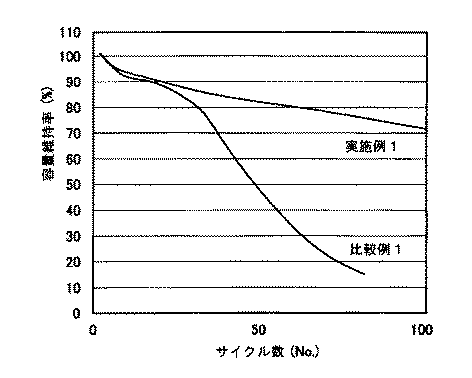
同時に、前記実施例1及び比較例1の電池に対して0.5Cで充放電を繰り返して、その容量維持率、つまりサイクル寿命特性を測定し、その結果を図2に示した。図2は1回の充放電時の容量に対する充放電を繰り返した後の容量の比率を示した容量維持率、つまり相対値である。図2に示した1番目の値は、1回の充放電時の容量であるため、実施例1及び比較例1の両方で、実際の容量値と関係なく100%で示した。 At the same time, the batteries of Example 1 and Comparative Example 1 were repeatedly charged and discharged at 0.5 C to measure the capacity retention rate, that is, the cycle life characteristics. The results are shown in FIG. FIG. 2 shows a capacity retention ratio, that is, a relative value, indicating the ratio of the capacity after repeated charge / discharge with respect to the capacity during one charge / discharge. Since the first value shown in FIG. 2 is the capacity at the time of one charge / discharge, it is shown as 100% regardless of the actual capacity value in both Example 1 and Comparative Example 1.
図2に示したように、実施例1の負極を利用した電池は、100回の充放電後にも容量維持率が70%程度であるが、比較例1の電池は、約30回の充放電で容量が顕著に低下し、約80回の充放電後には20%以下に低下したことが分かる。 As shown in FIG. 2, the battery using the negative electrode of Example 1 has a capacity retention rate of about 70% even after 100 charge / discharge cycles, but the battery of Comparative Example 1 has about 30 charge / discharge cycles. It can be seen that the capacity was remarkably reduced and decreased to 20% or less after about 80 charge / discharge cycles.
本発明の単純な変形または変更はこの分野の通常の知識を有する者によって容易に実施され、このような変形や変更は全て本発明の領域に含まれるとみなされる。 Simple variations or modifications of the invention are readily implemented by those having ordinary skill in the art, and all such variations and modifications are considered to be within the scope of the invention.
1 リチウム2次電池
2 負極
3 正極
4 セパレータ
5 電池容器
6 封入部材
DESCRIPTION OF
Claims (11)
前記中間生成物を乾燥したり熱分解する工程;を含む、下記の化学式1で示される化合物を含み、粒子の平均の大きさが1μm乃至20μmであるリチウム2次電池用負極活物質の製造方法。
[化学式1]
Li1+xV1−x−yMyO2+z
(上記の式で、0.01≦x≦0.5、0≦y≦0.3、−0.2≦z≦0.2であり、Mは、Fe、Al、Cr、Mo、Ti、W、Zr、Sr、Mn、及びこれらの組み合わせからなる群より選択されるものである。) Mixing a lithium source material and a vanadium source material in a mixed solvent of acid and water to produce an intermediate product;
A method for producing a negative electrode active material for a lithium secondary battery, comprising a compound represented by the following chemical formula 1 and having an average particle size of 1 μm to 20 μm, comprising: a step of drying or thermally decomposing the intermediate product .
[Chemical Formula 1]
Li 1 + x V 1- xy My O 2 + z
(In the above formula, 0.01 ≦ x ≦ 0.5, 0 ≦ y ≦ 0.3, −0.2 ≦ z ≦ 0.2, and M is Fe, Al, Cr, Mo, Ti, It is selected from the group consisting of W, Zr, Sr, Mn, and combinations thereof.)
Applications Claiming Priority (2)
| Application Number | Priority Date | Filing Date | Title |
|---|---|---|---|
| KR1020070036561A KR100953615B1 (en) | 2007-04-13 | 2007-04-13 | Anode active material for lithium secondary battery, manufacturing method thereof and lithium secondary battery comprising same |
| KR10-2007-0036561 | 2007-04-13 |
Publications (2)
| Publication Number | Publication Date |
|---|---|
| JP2008262890A JP2008262890A (en) | 2008-10-30 |
| JP4975526B2 true JP4975526B2 (en) | 2012-07-11 |
Family
ID=39227436
Family Applications (1)
| Application Number | Title | Priority Date | Filing Date |
|---|---|---|---|
| JP2007153122A Expired - Fee Related JP4975526B2 (en) | 2007-04-13 | 2007-06-08 | Negative electrode active material for lithium secondary battery, method for producing the same, and lithium secondary battery including the same |
Country Status (5)
| Country | Link |
|---|---|
| US (2) | US20080254365A1 (en) |
| EP (1) | EP1980534B1 (en) |
| JP (1) | JP4975526B2 (en) |
| KR (1) | KR100953615B1 (en) |
| CN (1) | CN101286561A (en) |
Families Citing this family (15)
| Publication number | Priority date | Publication date | Assignee | Title |
|---|---|---|---|---|
| KR100759410B1 (en) * | 2006-11-20 | 2007-09-19 | 삼성에스디아이 주식회사 | Anode active material for lithium secondary battery, manufacturing method thereof and lithium secondary battery comprising same |
| KR100778450B1 (en) * | 2006-11-22 | 2007-11-28 | 삼성에스디아이 주식회사 | Anode active material for lithium secondary battery, preparation method thereof and lithium secondary battery comprising same |
| KR100814880B1 (en) * | 2006-11-22 | 2008-03-18 | 삼성에스디아이 주식회사 | Anode active material for lithium secondary battery, preparation method thereof and lithium secondary battery comprising same |
| KR100805123B1 (en) * | 2007-02-15 | 2008-02-21 | 삼성에스디아이 주식회사 | Lithium secondary battery |
| JP5511128B2 (en) * | 2007-06-07 | 2014-06-04 | 三星エスディアイ株式会社 | Anode material for non-aqueous secondary battery and non-aqueous secondary battery |
| KR100918048B1 (en) * | 2007-09-07 | 2009-09-22 | 삼성에스디아이 주식회사 | Lithium secondary battery |
| KR100898291B1 (en) * | 2007-09-12 | 2009-05-18 | 삼성에스디아이 주식회사 | Lithium secondary battery |
| US9287554B2 (en) * | 2010-09-02 | 2016-03-15 | Sumitomo Chemical Company, Limited | Positive electrode active material |
| KR101236436B1 (en) * | 2010-09-30 | 2013-02-21 | 주식회사 모간 | High power anode material for lithium secondary battery and preparation method thereof |
| CN102280625B (en) * | 2011-07-07 | 2013-12-11 | 湘潭大学 | Method for manufacturing carbon-coated vanadate composite fiber of lithium ion battery anode material |
| TW201501398A (en) * | 2013-06-28 | 2015-01-01 | Univ Ming Chi Technology | Method to manufacture and synthesize the composite material of Lithium titanate /carbon anode |
| US11569494B2 (en) * | 2013-10-23 | 2023-01-31 | Cps Technology Holdings Llc | Aqueous cathode slurry |
| CN106063013A (en) * | 2014-03-06 | 2016-10-26 | 夏普株式会社 | Battery anode with preloaded metals |
| CN107845781B (en) * | 2016-09-19 | 2022-01-18 | 微宏动力系统(湖州)有限公司 | Negative electrode active material for lithium ion secondary battery, method for producing same, and lithium ion secondary battery |
| CN109860582B (en) * | 2018-12-28 | 2022-04-19 | 蜂巢能源科技股份有限公司 | Positive electrode material of lithium ion battery and preparation method thereof |
Family Cites Families (27)
| Publication number | Priority date | Publication date | Assignee | Title |
|---|---|---|---|---|
| JPH06275265A (en) * | 1993-03-19 | 1994-09-30 | Seiko Instr Inc | Nonaqueous electrolyte secondary battery |
| US5700598A (en) * | 1996-07-11 | 1997-12-23 | Bell Communications Research, Inc. | Method for preparing mixed amorphous vanadium oxides and their use as electrodes in reachargeable lithium cells |
| US6071489A (en) * | 1996-12-05 | 2000-06-06 | Samsung Display Device Co., Ltd. | Methods of preparing cathode active materials for lithium secondary battery |
| US6517974B1 (en) * | 1998-01-30 | 2003-02-11 | Canon Kabushiki Kaisha | Lithium secondary battery and method of manufacturing the lithium secondary battery |
| KR100274236B1 (en) * | 1998-05-13 | 2001-02-01 | 김순택 | Cathode Active Material for Lithium Secondary Battery and Manufacturing Method Thereof |
| US6221531B1 (en) * | 1998-07-09 | 2001-04-24 | The University Of Chicago | Lithium-titanium-oxide anodes for lithium batteries |
| US6316143B1 (en) * | 1999-12-22 | 2001-11-13 | The United States Of America As Represented By The Secretary Of The Army | Electrode for rechargeable lithium-ion battery and method of fabrication |
| JP2002110243A (en) * | 2000-09-29 | 2002-04-12 | Pionics Co Ltd | Lithium secondary battery |
| US7387851B2 (en) * | 2001-07-27 | 2008-06-17 | A123 Systems, Inc. | Self-organizing battery structure with electrode particles that exert a repelling force on the opposite electrode |
| US8252465B2 (en) * | 2001-01-19 | 2012-08-28 | Samsung Sdi Co., Ltd. | Electrolyte for lithium secondary battery and lithium secondary battery comprising same |
| JP2003068305A (en) * | 2001-03-01 | 2003-03-07 | Sumitomo Metal Ind Ltd | Anode material for lithium secondary battery and method for producing the same |
| US6730437B2 (en) * | 2001-06-19 | 2004-05-04 | Wilson Greatbatch Ltd. | Anode for nonaqueous secondary electrochemical cells |
| US6926992B2 (en) * | 2001-06-29 | 2005-08-09 | Kabushiki Kaisha Toshiba | Nonaqueous electrolyte secondary battery |
| KR100413800B1 (en) * | 2001-10-17 | 2004-01-03 | 삼성에스디아이 주식회사 | Fluoride copolymer, polymer electrolyte comprising the same and lithium battery employing the polymer electrolyte |
| KR100449073B1 (en) * | 2002-10-15 | 2004-09-18 | 한국전자통신연구원 | Cathode material for lithium secondary batteries and method for manufacturing the Same |
| KR100497251B1 (en) * | 2003-08-20 | 2005-06-23 | 삼성에스디아이 주식회사 | Protective composition for negative electrode of lithium sulfur battery and lithium sulfur battery fabricated by using same |
| US8026003B2 (en) * | 2003-08-21 | 2011-09-27 | Samsung Sdi Co., Ltd. | Negative active material for a non-aqueous electrolyte battery, and a non-aqueous electrolyte battery comprising the same |
| KR101062563B1 (en) * | 2003-10-24 | 2011-09-06 | 니폰 제온 가부시키가이샤 | Binder for Electric Double Layer Capacitor Electrode |
| KR100570648B1 (en) * | 2004-01-26 | 2006-04-12 | 삼성에스디아이 주식회사 | Anode active material for lithium secondary battery, manufacturing method thereof and lithium secondary battery comprising same |
| KR100717780B1 (en) * | 2004-10-27 | 2007-05-11 | 삼성에스디아이 주식회사 | Anode active material for nonaqueous electrolyte secondary battery, manufacturing method thereof and nonaqueous electrolyte secondary battery comprising same |
| US20060236528A1 (en) * | 2005-04-25 | 2006-10-26 | Ferro Corporation | Non-aqueous electrolytic solution |
| JP5101010B2 (en) * | 2005-12-21 | 2012-12-19 | 三星エスディアイ株式会社 | Negative electrode active material for lithium secondary battery, lithium secondary battery, and method for producing negative electrode active material for lithium secondary battery |
| JP5207589B2 (en) * | 2005-12-22 | 2013-06-12 | 三星エスディアイ株式会社 | Method for producing negative electrode active material for lithium secondary battery |
| KR100759410B1 (en) * | 2006-11-20 | 2007-09-19 | 삼성에스디아이 주식회사 | Anode active material for lithium secondary battery, manufacturing method thereof and lithium secondary battery comprising same |
| KR100814880B1 (en) * | 2006-11-22 | 2008-03-18 | 삼성에스디아이 주식회사 | Anode active material for lithium secondary battery, preparation method thereof and lithium secondary battery comprising same |
| KR100778450B1 (en) * | 2006-11-22 | 2007-11-28 | 삼성에스디아이 주식회사 | Anode active material for lithium secondary battery, preparation method thereof and lithium secondary battery comprising same |
| US7824802B2 (en) * | 2007-01-17 | 2010-11-02 | The United States Of America As Represented By The Secretary Of The Army | Method of preparing a composite cathode active material for rechargeable electrochemical cell |
-
2007
- 2007-04-13 KR KR1020070036561A patent/KR100953615B1/en not_active Expired - Fee Related
- 2007-06-08 JP JP2007153122A patent/JP4975526B2/en not_active Expired - Fee Related
- 2007-11-29 US US11/947,708 patent/US20080254365A1/en not_active Abandoned
- 2007-12-17 CN CNA2007103001218A patent/CN101286561A/en active Pending
-
2008
- 2008-01-03 EP EP08100042A patent/EP1980534B1/en not_active Not-in-force
-
2012
- 2012-11-26 US US13/685,678 patent/US20130087737A1/en not_active Abandoned
Also Published As
| Publication number | Publication date |
|---|---|
| KR100953615B1 (en) | 2010-04-20 |
| KR20080092759A (en) | 2008-10-16 |
| US20130087737A1 (en) | 2013-04-11 |
| US20080254365A1 (en) | 2008-10-16 |
| JP2008262890A (en) | 2008-10-30 |
| EP1980534A1 (en) | 2008-10-15 |
| EP1980534B1 (en) | 2013-03-13 |
| CN101286561A (en) | 2008-10-15 |
Similar Documents
| Publication | Publication Date | Title |
|---|---|---|
| JP4975526B2 (en) | Negative electrode active material for lithium secondary battery, method for producing the same, and lithium secondary battery including the same | |
| JP4942618B2 (en) | Negative electrode active material for lithium secondary battery, method for producing the same, and lithium secondary battery | |
| EP1923352B1 (en) | Negative active material for rechargeable lithium battery, method of preparing the same, and rechargeable lithium battery including the same | |
| JP5208176B2 (en) | Negative electrode active material for lithium secondary battery, manufacturing method thereof, and lithium secondary battery including the same | |
| US20080233479A1 (en) | Negative active material for rechargeable lithium battery and rechargeable lithium battery including same | |
| KR101155913B1 (en) | Negative active material for rechargeable lithium battery and rechargeable lithium battery including same | |
| JP2012043765A (en) | Negative electrode active material for lithium secondary battery, method of producing the same, and lithium secondary battery including the negative electrode active material | |
| CN102576866A (en) | Positive active electrode material for lithium secondary battery, process for preparing the same and lithium secondary battery | |
| KR20120004209A (en) | Anode active material for lithium secondary battery and lithium secondary battery comprising same | |
| KR20100064631A (en) | Cathode active material, and cathode and lithium battery comprising same | |
| JP2012503293A (en) | Negative electrode active material for lithium secondary battery, method for producing the same, and lithium secondary battery including the same | |
| KR102378595B1 (en) | Positive active material for rechargeable lithium battery, method of preparing the same, and rechargeable lithium battery including the same | |
| KR102368363B1 (en) | Positive active material for rechargeable lithium battery, method of preparing the same, and rechargeable lithium battery including the same | |
| CN109314279B (en) | Lithium secondary battery electrolyte and lithium secondary battery comprising same | |
| KR100814885B1 (en) | Lithium secondary battery | |
| KR101523081B1 (en) | Complex of positive electrode active material and fluorine compound, manufacturing method of the same, and rechargable lithium battery including the complex | |
| KR20080093782A (en) | Manufacturing method of negative electrode active material for lithium secondary batteries and lithium secondary battery comprising negative electrode active material prepared according to the method | |
| KR101250205B1 (en) | Positive active material for rechargeable lithium battery, method for manufacturing thereof and rechargeable lithium battery using the same | |
| KR102372645B1 (en) | Positive active material for rechargeable lithium battery, method of preparing the same, and rechargeable lithium battery including the same | |
| KR101223556B1 (en) | Negative active material for rechargeable lithium battery and rechargeable lithium battery including same | |
| KR101342511B1 (en) | Method of preparing negative active material for rechargeable lithium battery and rechargeable lithium battery inclulding nagative active material prepared therefrom | |
| KR20080093779A (en) | Manufacturing method of negative electrode active material for lithium secondary batteries and lithium secondary battery comprising negative electrode active material prepared according to the method | |
| KR20080093778A (en) | Manufacturing method of negative electrode active material for lithium secondary batteries and lithium secondary battery comprising negative electrode active material prepared according to the method | |
| EP4601032A1 (en) | Negative electrode active material for lithium secondary battery, method for preparing same, and lithium secondary battery comprising same | |
| KR20080093777A (en) | Manufacturing method of negative electrode active material for lithium secondary batteries and lithium secondary battery comprising negative electrode active material prepared according to the method |
Legal Events
| Date | Code | Title | Description |
|---|---|---|---|
| A131 | Notification of reasons for refusal |
Free format text: JAPANESE INTERMEDIATE CODE: A131 Effective date: 20100907 |
|
| A521 | Written amendment |
Free format text: JAPANESE INTERMEDIATE CODE: A523 Effective date: 20101206 |
|
| A02 | Decision of refusal |
Free format text: JAPANESE INTERMEDIATE CODE: A02 Effective date: 20110927 |
|
| A521 | Written amendment |
Free format text: JAPANESE INTERMEDIATE CODE: A523 Effective date: 20120123 |
|
| A911 | Transfer to examiner for re-examination before appeal (zenchi) |
Free format text: JAPANESE INTERMEDIATE CODE: A911 Effective date: 20120202 |
|
| TRDD | Decision of grant or rejection written | ||
| A01 | Written decision to grant a patent or to grant a registration (utility model) |
Free format text: JAPANESE INTERMEDIATE CODE: A01 Effective date: 20120313 |
|
| A01 | Written decision to grant a patent or to grant a registration (utility model) |
Free format text: JAPANESE INTERMEDIATE CODE: A01 |
|
| A61 | First payment of annual fees (during grant procedure) |
Free format text: JAPANESE INTERMEDIATE CODE: A61 Effective date: 20120411 |
|
| R150 | Certificate of patent or registration of utility model |
Free format text: JAPANESE INTERMEDIATE CODE: R150 |
|
| FPAY | Renewal fee payment (event date is renewal date of database) |
Free format text: PAYMENT UNTIL: 20150420 Year of fee payment: 3 |
|
| R250 | Receipt of annual fees |
Free format text: JAPANESE INTERMEDIATE CODE: R250 |
|
| LAPS | Cancellation because of no payment of annual fees |