JP4919555B2 - Lubricating oil composition for automatic transmission - Google Patents
Lubricating oil composition for automatic transmission Download PDFInfo
- Publication number
- JP4919555B2 JP4919555B2 JP2001262497A JP2001262497A JP4919555B2 JP 4919555 B2 JP4919555 B2 JP 4919555B2 JP 2001262497 A JP2001262497 A JP 2001262497A JP 2001262497 A JP2001262497 A JP 2001262497A JP 4919555 B2 JP4919555 B2 JP 4919555B2
- Authority
- JP
- Japan
- Prior art keywords
- group
- branched
- lubricating oil
- sulfur
- mass
- Prior art date
- Legal status (The legal status is an assumption and is not a legal conclusion. Google has not performed a legal analysis and makes no representation as to the accuracy of the status listed.)
- Expired - Fee Related
Links
Classifications
-
- C—CHEMISTRY; METALLURGY
- C10—PETROLEUM, GAS OR COKE INDUSTRIES; TECHNICAL GASES CONTAINING CARBON MONOXIDE; FUELS; LUBRICANTS; PEAT
- C10M—LUBRICATING COMPOSITIONS; USE OF CHEMICAL SUBSTANCES EITHER ALONE OR AS LUBRICATING INGREDIENTS IN A LUBRICATING COMPOSITION
- C10M169/00—Lubricating compositions characterised by containing as components a mixture of at least two types of ingredient selected from base-materials, thickeners or additives, covered by the preceding groups, each of these compounds being essential
- C10M169/04—Mixtures of base-materials and additives
-
- C—CHEMISTRY; METALLURGY
- C10—PETROLEUM, GAS OR COKE INDUSTRIES; TECHNICAL GASES CONTAINING CARBON MONOXIDE; FUELS; LUBRICANTS; PEAT
- C10M—LUBRICATING COMPOSITIONS; USE OF CHEMICAL SUBSTANCES EITHER ALONE OR AS LUBRICATING INGREDIENTS IN A LUBRICATING COMPOSITION
- C10M171/00—Lubricating compositions characterised by purely physical criteria, e.g. containing as base-material, thickener or additive, ingredients which are characterised exclusively by their numerically specified physical properties, i.e. containing ingredients which are physically well-defined but for which the chemical nature is either unspecified or only very vaguely indicated
-
- C—CHEMISTRY; METALLURGY
- C10—PETROLEUM, GAS OR COKE INDUSTRIES; TECHNICAL GASES CONTAINING CARBON MONOXIDE; FUELS; LUBRICANTS; PEAT
- C10M—LUBRICATING COMPOSITIONS; USE OF CHEMICAL SUBSTANCES EITHER ALONE OR AS LUBRICATING INGREDIENTS IN A LUBRICATING COMPOSITION
- C10M2203/00—Organic non-macromolecular hydrocarbon compounds and hydrocarbon fractions as ingredients in lubricant compositions
- C10M2203/10—Petroleum or coal fractions, e.g. tars, solvents, bitumen
- C10M2203/1006—Petroleum or coal fractions, e.g. tars, solvents, bitumen used as base material
-
- C—CHEMISTRY; METALLURGY
- C10—PETROLEUM, GAS OR COKE INDUSTRIES; TECHNICAL GASES CONTAINING CARBON MONOXIDE; FUELS; LUBRICANTS; PEAT
- C10M—LUBRICATING COMPOSITIONS; USE OF CHEMICAL SUBSTANCES EITHER ALONE OR AS LUBRICATING INGREDIENTS IN A LUBRICATING COMPOSITION
- C10M2203/00—Organic non-macromolecular hydrocarbon compounds and hydrocarbon fractions as ingredients in lubricant compositions
- C10M2203/10—Petroleum or coal fractions, e.g. tars, solvents, bitumen
- C10M2203/102—Aliphatic fractions
- C10M2203/1025—Aliphatic fractions used as base material
-
- C—CHEMISTRY; METALLURGY
- C10—PETROLEUM, GAS OR COKE INDUSTRIES; TECHNICAL GASES CONTAINING CARBON MONOXIDE; FUELS; LUBRICANTS; PEAT
- C10M—LUBRICATING COMPOSITIONS; USE OF CHEMICAL SUBSTANCES EITHER ALONE OR AS LUBRICATING INGREDIENTS IN A LUBRICATING COMPOSITION
- C10M2209/00—Organic macromolecular compounds containing oxygen as ingredients in lubricant compositions
- C10M2209/02—Macromolecular compounds obtained by reactions only involving carbon-to-carbon unsaturated bonds
- C10M2209/08—Macromolecular compounds obtained by reactions only involving carbon-to-carbon unsaturated bonds containing monomers having an unsaturated radical bound to a carboxyl radical, e.g. acrylate type
- C10M2209/084—Acrylate; Methacrylate
-
- C—CHEMISTRY; METALLURGY
- C10—PETROLEUM, GAS OR COKE INDUSTRIES; TECHNICAL GASES CONTAINING CARBON MONOXIDE; FUELS; LUBRICANTS; PEAT
- C10M—LUBRICATING COMPOSITIONS; USE OF CHEMICAL SUBSTANCES EITHER ALONE OR AS LUBRICATING INGREDIENTS IN A LUBRICATING COMPOSITION
- C10M2215/00—Organic non-macromolecular compounds containing nitrogen as ingredients in lubricant Compositions
- C10M2215/24—Organic non-macromolecular compounds containing nitrogen as ingredients in lubricant Compositions having hydrocarbon substituents containing thirty or more carbon atoms, e.g. nitrogen derivatives of substituted succinic acid
- C10M2215/28—Amides; Imides
-
- C—CHEMISTRY; METALLURGY
- C10—PETROLEUM, GAS OR COKE INDUSTRIES; TECHNICAL GASES CONTAINING CARBON MONOXIDE; FUELS; LUBRICANTS; PEAT
- C10M—LUBRICATING COMPOSITIONS; USE OF CHEMICAL SUBSTANCES EITHER ALONE OR AS LUBRICATING INGREDIENTS IN A LUBRICATING COMPOSITION
- C10M2219/00—Organic non-macromolecular compounds containing sulfur, selenium or tellurium as ingredients in lubricant compositions
- C10M2219/02—Sulfur-containing compounds obtained by sulfurisation with sulfur or sulfur-containing compounds
-
- C—CHEMISTRY; METALLURGY
- C10—PETROLEUM, GAS OR COKE INDUSTRIES; TECHNICAL GASES CONTAINING CARBON MONOXIDE; FUELS; LUBRICANTS; PEAT
- C10M—LUBRICATING COMPOSITIONS; USE OF CHEMICAL SUBSTANCES EITHER ALONE OR AS LUBRICATING INGREDIENTS IN A LUBRICATING COMPOSITION
- C10M2219/00—Organic non-macromolecular compounds containing sulfur, selenium or tellurium as ingredients in lubricant compositions
- C10M2219/02—Sulfur-containing compounds obtained by sulfurisation with sulfur or sulfur-containing compounds
- C10M2219/022—Sulfur-containing compounds obtained by sulfurisation with sulfur or sulfur-containing compounds of hydrocarbons, e.g. olefines
-
- C—CHEMISTRY; METALLURGY
- C10—PETROLEUM, GAS OR COKE INDUSTRIES; TECHNICAL GASES CONTAINING CARBON MONOXIDE; FUELS; LUBRICANTS; PEAT
- C10M—LUBRICATING COMPOSITIONS; USE OF CHEMICAL SUBSTANCES EITHER ALONE OR AS LUBRICATING INGREDIENTS IN A LUBRICATING COMPOSITION
- C10M2219/00—Organic non-macromolecular compounds containing sulfur, selenium or tellurium as ingredients in lubricant compositions
- C10M2219/02—Sulfur-containing compounds obtained by sulfurisation with sulfur or sulfur-containing compounds
- C10M2219/024—Sulfur-containing compounds obtained by sulfurisation with sulfur or sulfur-containing compounds of esters, e.g. fats
-
- C—CHEMISTRY; METALLURGY
- C10—PETROLEUM, GAS OR COKE INDUSTRIES; TECHNICAL GASES CONTAINING CARBON MONOXIDE; FUELS; LUBRICANTS; PEAT
- C10M—LUBRICATING COMPOSITIONS; USE OF CHEMICAL SUBSTANCES EITHER ALONE OR AS LUBRICATING INGREDIENTS IN A LUBRICATING COMPOSITION
- C10M2219/00—Organic non-macromolecular compounds containing sulfur, selenium or tellurium as ingredients in lubricant compositions
- C10M2219/04—Organic non-macromolecular compounds containing sulfur, selenium or tellurium as ingredients in lubricant compositions containing sulfur-to-oxygen bonds, i.e. sulfones, sulfoxides
- C10M2219/046—Overbased sulfonic acid salts
-
- C—CHEMISTRY; METALLURGY
- C10—PETROLEUM, GAS OR COKE INDUSTRIES; TECHNICAL GASES CONTAINING CARBON MONOXIDE; FUELS; LUBRICANTS; PEAT
- C10M—LUBRICATING COMPOSITIONS; USE OF CHEMICAL SUBSTANCES EITHER ALONE OR AS LUBRICATING INGREDIENTS IN A LUBRICATING COMPOSITION
- C10M2219/00—Organic non-macromolecular compounds containing sulfur, selenium or tellurium as ingredients in lubricant compositions
- C10M2219/06—Thio-acids; Thiocyanates; Derivatives thereof
- C10M2219/062—Thio-acids; Thiocyanates; Derivatives thereof having carbon-to-sulfur double bonds
- C10M2219/066—Thiocarbamic type compounds
-
- C—CHEMISTRY; METALLURGY
- C10—PETROLEUM, GAS OR COKE INDUSTRIES; TECHNICAL GASES CONTAINING CARBON MONOXIDE; FUELS; LUBRICANTS; PEAT
- C10M—LUBRICATING COMPOSITIONS; USE OF CHEMICAL SUBSTANCES EITHER ALONE OR AS LUBRICATING INGREDIENTS IN A LUBRICATING COMPOSITION
- C10M2219/00—Organic non-macromolecular compounds containing sulfur, selenium or tellurium as ingredients in lubricant compositions
- C10M2219/08—Thiols; Sulfides; Polysulfides; Mercaptals
-
- C—CHEMISTRY; METALLURGY
- C10—PETROLEUM, GAS OR COKE INDUSTRIES; TECHNICAL GASES CONTAINING CARBON MONOXIDE; FUELS; LUBRICANTS; PEAT
- C10M—LUBRICATING COMPOSITIONS; USE OF CHEMICAL SUBSTANCES EITHER ALONE OR AS LUBRICATING INGREDIENTS IN A LUBRICATING COMPOSITION
- C10M2219/00—Organic non-macromolecular compounds containing sulfur, selenium or tellurium as ingredients in lubricant compositions
- C10M2219/10—Heterocyclic compounds containing sulfur, selenium or tellurium compounds in the ring
- C10M2219/104—Heterocyclic compounds containing sulfur, selenium or tellurium compounds in the ring containing sulfur and carbon with nitrogen or oxygen in the ring
- C10M2219/106—Thiadiazoles
-
- C—CHEMISTRY; METALLURGY
- C10—PETROLEUM, GAS OR COKE INDUSTRIES; TECHNICAL GASES CONTAINING CARBON MONOXIDE; FUELS; LUBRICANTS; PEAT
- C10M—LUBRICATING COMPOSITIONS; USE OF CHEMICAL SUBSTANCES EITHER ALONE OR AS LUBRICATING INGREDIENTS IN A LUBRICATING COMPOSITION
- C10M2219/00—Organic non-macromolecular compounds containing sulfur, selenium or tellurium as ingredients in lubricant compositions
- C10M2219/10—Heterocyclic compounds containing sulfur, selenium or tellurium compounds in the ring
- C10M2219/104—Heterocyclic compounds containing sulfur, selenium or tellurium compounds in the ring containing sulfur and carbon with nitrogen or oxygen in the ring
- C10M2219/108—Phenothiazine
-
- C—CHEMISTRY; METALLURGY
- C10—PETROLEUM, GAS OR COKE INDUSTRIES; TECHNICAL GASES CONTAINING CARBON MONOXIDE; FUELS; LUBRICANTS; PEAT
- C10M—LUBRICATING COMPOSITIONS; USE OF CHEMICAL SUBSTANCES EITHER ALONE OR AS LUBRICATING INGREDIENTS IN A LUBRICATING COMPOSITION
- C10M2223/00—Organic non-macromolecular compounds containing phosphorus as ingredients in lubricant compositions
- C10M2223/02—Organic non-macromolecular compounds containing phosphorus as ingredients in lubricant compositions having no phosphorus-to-carbon bonds
-
- C—CHEMISTRY; METALLURGY
- C10—PETROLEUM, GAS OR COKE INDUSTRIES; TECHNICAL GASES CONTAINING CARBON MONOXIDE; FUELS; LUBRICANTS; PEAT
- C10M—LUBRICATING COMPOSITIONS; USE OF CHEMICAL SUBSTANCES EITHER ALONE OR AS LUBRICATING INGREDIENTS IN A LUBRICATING COMPOSITION
- C10M2223/00—Organic non-macromolecular compounds containing phosphorus as ingredients in lubricant compositions
- C10M2223/02—Organic non-macromolecular compounds containing phosphorus as ingredients in lubricant compositions having no phosphorus-to-carbon bonds
- C10M2223/04—Phosphate esters
- C10M2223/045—Metal containing thio derivatives
-
- C—CHEMISTRY; METALLURGY
- C10—PETROLEUM, GAS OR COKE INDUSTRIES; TECHNICAL GASES CONTAINING CARBON MONOXIDE; FUELS; LUBRICANTS; PEAT
- C10M—LUBRICATING COMPOSITIONS; USE OF CHEMICAL SUBSTANCES EITHER ALONE OR AS LUBRICATING INGREDIENTS IN A LUBRICATING COMPOSITION
- C10M2223/00—Organic non-macromolecular compounds containing phosphorus as ingredients in lubricant compositions
- C10M2223/02—Organic non-macromolecular compounds containing phosphorus as ingredients in lubricant compositions having no phosphorus-to-carbon bonds
- C10M2223/04—Phosphate esters
- C10M2223/047—Thioderivatives not containing metallic elements
-
- C—CHEMISTRY; METALLURGY
- C10—PETROLEUM, GAS OR COKE INDUSTRIES; TECHNICAL GASES CONTAINING CARBON MONOXIDE; FUELS; LUBRICANTS; PEAT
- C10N—INDEXING SCHEME ASSOCIATED WITH SUBCLASS C10M RELATING TO LUBRICATING COMPOSITIONS
- C10N2010/00—Metal present as such or in compounds
- C10N2010/04—Groups 2 or 12
-
- C—CHEMISTRY; METALLURGY
- C10—PETROLEUM, GAS OR COKE INDUSTRIES; TECHNICAL GASES CONTAINING CARBON MONOXIDE; FUELS; LUBRICANTS; PEAT
- C10N—INDEXING SCHEME ASSOCIATED WITH SUBCLASS C10M RELATING TO LUBRICATING COMPOSITIONS
- C10N2030/00—Specified physical or chemical properties which is improved by the additive characterising the lubricating composition, e.g. multifunctional additives
- C10N2030/06—Oiliness; Film-strength; Anti-wear; Resistance to extreme pressure
-
- C—CHEMISTRY; METALLURGY
- C10—PETROLEUM, GAS OR COKE INDUSTRIES; TECHNICAL GASES CONTAINING CARBON MONOXIDE; FUELS; LUBRICANTS; PEAT
- C10N—INDEXING SCHEME ASSOCIATED WITH SUBCLASS C10M RELATING TO LUBRICATING COMPOSITIONS
- C10N2040/00—Specified use or application for which the lubricating composition is intended
- C10N2040/04—Oil-bath; Gear-boxes; Automatic transmissions; Traction drives
- C10N2040/042—Oil-bath; Gear-boxes; Automatic transmissions; Traction drives for automatic transmissions
-
- C—CHEMISTRY; METALLURGY
- C10—PETROLEUM, GAS OR COKE INDUSTRIES; TECHNICAL GASES CONTAINING CARBON MONOXIDE; FUELS; LUBRICANTS; PEAT
- C10N—INDEXING SCHEME ASSOCIATED WITH SUBCLASS C10M RELATING TO LUBRICATING COMPOSITIONS
- C10N2040/00—Specified use or application for which the lubricating composition is intended
- C10N2040/04—Oil-bath; Gear-boxes; Automatic transmissions; Traction drives
- C10N2040/045—Oil-bath; Gear-boxes; Automatic transmissions; Traction drives for continuous variable transmission [CVT]
-
- C—CHEMISTRY; METALLURGY
- C10—PETROLEUM, GAS OR COKE INDUSTRIES; TECHNICAL GASES CONTAINING CARBON MONOXIDE; FUELS; LUBRICANTS; PEAT
- C10N—INDEXING SCHEME ASSOCIATED WITH SUBCLASS C10M RELATING TO LUBRICATING COMPOSITIONS
- C10N2060/00—Chemical after-treatment of the constituents of the lubricating composition
- C10N2060/14—Chemical after-treatment of the constituents of the lubricating composition by boron or a compound containing boron
Landscapes
- Chemical & Material Sciences (AREA)
- Chemical Kinetics & Catalysis (AREA)
- General Chemical & Material Sciences (AREA)
- Oil, Petroleum & Natural Gas (AREA)
- Organic Chemistry (AREA)
- Lubricants (AREA)
Description
【0001】
【発明の属する技術分野】
本発明は自動変速機用潤滑油組成物に関し、詳しくは自動車のベルト式CVTに適用した場合にμ−V特性を正勾配にしてスクラッチノイズの発生を防止することができ、さらにμ−V特性を長期間正勾配に保持し得るベルト式CVTに有利に用いることができる自動変速機用潤滑油組成物に関する。
【0002】
【従来の技術】
現在自動車用の自動変速機はロックアップクラッチ付きトルクコンバータと湿式クラッチと遊星歯車を組み合わせた変速部および油圧制御部からなるものが広く採用されているが、有段変速であるために燃費効率が悪くまた変速ショックによる不快感といった欠点がある。この欠点を補うものとして金属ベルトを介して動力を伝達し、無段階変速する無段変速機(ベルト式CVT)が実用化されている。
【0003】
ベルト式CVTは、駆動プーリと被駆動プーリおよび動力を伝達するためのベルトとから構成され、ベルトはエレメント(以下、コマと称する)とそれを保持するベルト(鋼帯)より構成されている。このようなベルト式CVTに用いる潤滑油としては、冷却性、潤滑性、耐摩耗性を有し、かつ変速機を構成する材料に共通点が多いことなどから、従来から有段の自動変速機(AT)に充填されるATF(Automatic Transmission Fluid)が広く使われてきた。しかしながら、近年ベルトCVTを用いた自動車においては、ある種のものについては、例えば、車庫入れ、発進時等に特有の雑音(スクラッチノイズ)が発生する現象、いわゆるスクラッチ現象が生じることがわかっている。
【0004】
このスクラッチ現象は、CVTの後にある歯車の歯打ち音によるものであり、これは被駆動プーリの回転むらにその原因があることが既に見出されている。更に、その回転むらはベルトとコマの摩擦係数(μ)の変化が滑り速度(V)の変化に対して負勾配にある時に発生することも見出されている(例えば、特開平9−263782号公報)。従来からベルト式CVTに充填されてきたATFはμ−V特性が必ずしも良好ではなく、また長期間使用した場合のμ−V特性の変動が大きいため、スクラッチノイズを完全に防止することができず、その結果、スクラッチ現象が発生しやすかった。
【0005】
【発明が解決しようとする課題】
ATFでこのようなスクラッチ現象を完全に防止するためには、上記μ−V特性が必ず正勾配になるようなATF配合技術を開発することが必要であり、更に、このような要求性能は新油時のみならず、一定期間走行した後の潤滑油においてもその性能を満たし、長期間そのような性能が保持されていることが望まれる。一定期間走行した後の潤滑油は酸化劣化が進行し、特に潤滑油中にイオウ分を比較的多く含む場合に上記μ−V特性が低下しやすくなることがわかった。
【0006】
従って、本発明の課題は、ベルト式CVTのμ−V特性を正勾配にしてスクラッチ現象を防止すると共に、長期間μ−V特性を正勾配に保持することのできるベルト式CVTにも好適な自動変速機用潤滑油組成物を提供することにある。
【0007】
【課題を解決するための手段】
本発明者は前記課題を解決するために鋭意検討した結果、特定の添加剤を特定の元素比となるように配合した組成物が、前記課題を解決できることを見出し本発明を完成するに至った。
【0008】
本発明は、潤滑油基油に、リン酸モノエステル類、リン酸ジエステル類、リン酸トリエステル類、亜リン酸モノエステル類、亜リン酸ジエステル類、亜リン酸トリエステル類、(亜)リン酸エステル類の塩、リン酸、亜リン酸、アルキルジチオリン酸亜鉛、及びこれらの混合物から選ばれるリン系添加剤、カルシウムスルホネート、カルシウムフェネート及びカルシウムサリシレートから選ばれるカルシウム系清浄剤、ホウ酸変性コハク酸イミド、及び(A)チアジアゾール及び/またはベンゾチアゾール、(B)ジチオカーバメート、(C)ジチオホスフェート、(D)トリチオホスファイト、及び(E)ポリスルフィド、又は(A)〜(E)の誘導体から選ばれる少なくとも1種のイオウ系添加剤を含み、組成物全量基準における元素分析値で、リン:カルシウム:ホウ素:イオウの元素比が、質量比で、1:(0.1〜1):(0.1〜0.8):(0.4〜2.45)であり、かつ組成物全量基準におけるリン元素濃度が0.02〜0.05質量%であり、基油に由来するイオウ濃度が0〜0.1質量%、そしてイオウ系添加剤に由来するイオウ濃度が0.01〜0.15質量%であることを特徴とする自動変速機用潤滑油組成物にある。
【0010】
本発明の潤滑油組成物に含まれるカルシウム系清浄剤が、全塩基価が20〜450mgKOH/gであるカルシウムスルホネートであることが好ましい。
【0011】
【発明の実施の形態】
本発明の自動変速機用潤滑油組成物は、潤滑油基油に、リン、カルシウム、ホウ素、及び硫黄の各元素が含まれてなるものであり、これらの元素のうちイオウは、組成物中の基油、あるいは添加剤、例えば、イオウ系添加剤および/またはカルシウム清浄剤のうちカルシウムスルホネート又はカルシウムフェネートに由来するものであり、またその他の元素は、例えば、リン元素はリン系添加剤及び一部のイオウ系添加剤、カルシウム元素はカルシウム系清浄剤、ホウ素元素はホウ酸変性コハク酸イミド及び/又はアルカリ金属ホウ酸塩若しくはその水和物の各添加剤にそれぞれ由来するものである。以下にこれらの成分について順に説明する。
(1)基油
本発明の自動変速機用潤滑油組成物における潤滑油基油としては、通常の潤滑油の基油として用いられる任意の鉱油及び/又は合成油が使用できる。
【0012】
鉱油としては、具体的には例えば、原油を常圧蒸留及び減圧蒸留して得られた潤滑油留分を、溶剤脱れき、溶剤抽出、水素化分解、溶剤脱ろう、接触脱ろう、水素化精製、硫酸洗浄、及び白土処理等の精製処理等を単独あるいは適宜組み合わせて精製したパラフィン系、ナフテン系等の油やノルマルパラフィン等を挙げることができる。
【0013】
また合成油としては、特に制限はないが、ポリ−α−オレフィン(例えば、1−オクテンオリゴマー、1−デセンオリゴマー、エチレン−プロピレンオリゴマー等)若しくはその水素化物、イソブテンオリゴマー若しくはその水素化物、イソパラフィン、アルキルベンゼン、アルキルナフタレン、ジエステル(例えば、ジトリデシルグルタレート、ジ2−エチルヘキシルアジペート、ジイソデシルアジペート、ジトリデシルアジペート、及びジ2−エチルヘキシルセバケート等)、ポリオールエステル(例えば、トリメチロールプロパンカプリレート、トリメチロールプロパンペラルゴネート、ペンタエリスリトール2−エチルヘキサノエート、及びペンタエリスリトールペラルゴネート等)、ポリオキシアルキレングリコール、ジアルキルジフェニルエーテル、及びポリフェニルエーテル等を挙げることができる。
【0014】
潤滑油基油の動粘度は、特に制限はないが、100℃における動粘度は、1〜10mm2/sであることが好ましく、より好ましくは2〜8mm2/sである。
【0015】
また基油に由来する潤滑油中のイオウ濃度は、0.1質量%以下であり、好ましくは、0.05質量%以下、更に好ましくは、0.005質量%以下である。イオウ濃度が0.1質量%を超える場合には長時間にわたって安定したμ−V特性を維持することが困難となる。
(2)イオウ系添加剤
本発明で用いることができるイオウ系添加剤としては、下記(A)〜(E)で示される化合物を挙げることができる。
(A)チアジアゾール及び/またはベンゾチアゾール
チアジアゾールとしては、具体的には例えば、下記の一般式(1)で表される化合物等が挙げられる。
【0016】
【化1】
一般式(1)において、R1は、炭素数1〜30、好ましくは6〜24の、直鎖状または分枝状のアルキル基を示し、R2は、水素原子または炭素数1〜30の直鎖状または分枝状のアルキル基、好ましくは水素原子または炭素数1〜24の直鎖状または分枝状のアルキル基を示し、aおよびbはそれぞれ別個に、1、2又は3を示し、好ましくは1又は2である。
【0018】
ベンゾチアゾールとしては、具体的には、下記の一般式(2)で表される化合物等が挙げられる。
【0019】
【化2】
一般式(2)において、R3は炭素数1〜4の直鎖状または分枝状のアルキル基、好ましくはメチル基またはエチル基を示し、R4は炭素数1〜30、好ましくは6〜24の、直鎖状または分枝状のアルキル基を示し、cは、0〜3の整数、好ましくは0又は1を示し、dは1〜3の整数、好ましくは1又は2を示す。
【0021】
(A)成分を含有させる場合、上記一般式(1)及び(2)で表される化合物の中から選ばれる一種の化合物を単独で用いても良く、異なる構造を有する2種以上の化合物を併用しても良い。
(B)ジチオカーバメート
ジチオカーバメートとしては、任意のジチオカーバメートが使用可能であるが、下記の一般式(3)、又は一般式(4)で表される化合物が好ましい具体例として挙げられる。
【0022】
【化3】
一般式(3)及び(4)において、R5 、R6 、R7、R8、R9及びR10はそれぞれ個別に、炭素数1〜30、好ましくは1〜20の炭化水素基を示し、Xは、S(硫黄原子)又はメチレン基(−CH2−)を示し、そしてeは0〜6の整数を示す。
【0024】
上記R5〜R10で表される炭素数1〜30の炭化水素基としては、例えば、アルキル基、シクロアルキル基、アルキルシクロアルキル基、アルケニル基、アリール基、アルキルアリール基、及びアリールアルキル基を挙げることができる。
【0025】
上記アルキル基としては、具体的には、メチル基、エチル基、プロピル基、ブチル基、ペンチル基、ヘキシル基、ヘプチル基、オクチル基、ノニル基、デシル基、ウンデシル基、ドデシル基、トリデシル基、テトラデシル基、ペンタデシル基、ヘキサデシル基、ヘプタデシル基、オクタデシル基等のアルキル基(これらアルキル基は直鎖状でも分枝状でもよい)を挙げることができる。
【0026】
上記シクロアルキル基としては、具体的には、シクロペンチル基、シクロヘキシル基、シクロヘプチル基等の炭素数5〜7のシクロアルキル基を挙げることができる。
【0027】
上記アルキルシクロアルキル基としては、具体的には、メチルシクロペンチル基、ジメチルシクロペンチル基、メチルエチルシクロペンチル基、ジエチルシクロペンチル基、メチルシクロヘキシル基、ジメチルシクロヘキシル基、メチルエチルシクロヘキシル基、ジエチルシクロヘキシル基、メチルシクロヘプチル基、ジメチルシクロヘプチル基、メチルエチルシクロヘプチル基、ジエチルシクロヘプチル基等の炭素数6〜11のアルキルシクロアルキル基(アルキル基のシクロアルキル基への置換位置も任意である)を挙げることができる。
【0028】
上記アルケニル基としては、具体的には、ブテニル基、ペンテニル基、ヘキセニル基、ヘプテニル基、オクテニル基、ノネニル基、デセニル基、ウンデセニル基、ドデセニル基、トリデセニル基、テトラデセニル基、ペンタデセニル基、ヘキサデセニル基、ヘプタデセニル基、オクタデセニル基等のアルケニル基(これらアルケニル基は直鎖状でも分枝状でもよく、また二重結合の位置も任意である)を挙げることができる。
【0029】
上記アリール基としては、具体的には、フェニル基、ナフチル基等のアリール基を挙げることができる。
【0030】
上記アルキルアリール基としては、具体的には、トリル基、キシリル基、エチルフェニル基、プロピルフェニル基、ブチルフェニル基、ペンチルフェニル基、ヘキシルフェニル基、ヘプチルフェニル基、オクチルフェニル基、ノニルフェニル基、デシルフェニル基、ウンデシルフェニル基、ドデシルフェニル基等の炭素数7〜18のアルキルアリール基(アルキル基は直鎖状でも分枝状でもよく、またアリール基への置換位置も任意である)を挙げることができる。
【0031】
上記アリールアルキル基としては、具体的には、ベンジル基、フェニルエチル基、フェニルプロピル基、フェニルブチル基、フェニルペンチル基、フェニルヘキシル基等の炭素数7〜12のアリールアルキル基(これらアルキル基は直鎖状でも分枝状でもよい)を挙げることができる。
【0032】
これらの(B)成分は、1種類あるいは2種類以上を任意に配合することができる。
(C)ジチオホスフェート
ジチオホスフェートとしては、下記の一般式(5)で表される化合物の中から選ばれる1種のジアルキルジチオリン酸又は2種類以上のジアルキルジチオリン酸混合物を挙げることができる。
【0033】
【化4】
一般式(5)において、R11、及びR12は、それぞれ個別に、炭素数2〜30、好ましくは3〜20の炭化水素基を示す。R11、及びR12で表される2〜30の炭化水素素基としては、前記一般式(3)におけるR5〜R8で表される炭化水素基の例と同じものを挙げることができる。
(D)トリチオホスファイト
トリチオホスファイトとしては,炭素数2〜30、好ましくは3〜20の炭化水素基を含有するトリチオホスファイト化合物を挙げることができる。上記2〜30の炭化水素素基としては、前記一般式(3)におけるR5〜R8で表される炭化水素基の例と同じものを挙げることができる。
(E)ポリスルフィド
ポリスルフィドは一般にジヒドロカルビルポリスルフィド又は硫化オレフィンと呼ばれる硫黄系化合物であり、具体的には下記一般式(6)で表される。
【0035】
R13 −Sf −R14 (6)
一般式(6)において、R13及びR14はそれぞれ別個に、炭素数3〜20の直鎖状又は分枝状のアルキル基、炭素数6〜20のアリール基、炭素数6〜20のアルキルアリール基あるいは炭素数6〜20のアリールアルキル基を示し、fは2〜6、好ましくは2〜5の整数を示す。
【0036】
上記R13及びR14で表されるアルキル基としては、具体的には、n−プロピル基、イソプロピル基、n−ブチル基、イソブチル基、sec−ブチル基、tert−ブチル基、直鎖又は分枝ペンチル基、直鎖又は分枝ヘキシル基、直鎖又は分枝ヘプチル基、直鎖又は分枝オクチル基、直鎖又は分枝ノニル基、直鎖又は分枝デシル基、直鎖又は分枝ウンデシル基、直鎖又は分枝ドデシル基、直鎖又は分枝トリデシル基、直鎖又は分枝テトラデシル基、直鎖又は分枝ペンタデシル基、直鎖又は分枝ヘキサデシル基、直鎖又は分枝ヘプタデシル基、直鎖又は分枝オクタデシル基、直鎖又は分枝ノナデシル基、直鎖又は分枝イコシル基を挙げることができる。
【0037】
上記R13及びR14で表されるアリール基としては、具体的には、フェニル基、ナフチル基などを挙げることができる。
【0038】
上記R13及びR14で表されるアルキルアリール基としては、具体的には、トリル基(全ての構造異性体を含む)、エチルフェニル基(全ての構造異性体を含む)、直鎖又は分枝プロピルフェニル基(全ての構造異性体を含む)、直鎖又は分枝ブチルフェニル基(全ての構造異性体を含む)、直鎖又は分枝ペンチルフェニル基(全ての構造異性体を含む)、直鎖又は分枝ヘキシルフェニル基(全ての構造異性体を含む)、直鎖又は分枝ヘプチルフェニル基(全ての構造異性体を含む)、直鎖又は分枝オクチルフェニル基(全ての構造異性体を含む)、直鎖又は分枝ノニルフェニル基(全ての構造異性体を含む)、直鎖又は分枝デシルフェニル基(全ての構造異性体を含む)、直鎖又は分枝ウンデシルフェニル基(全ての構造異性体を含む)、直鎖又は分枝ドデシルフェニル基(全ての構造異性体を含む)、キシリル基(全ての構造異性体を含む)、エチルメチルフェニル基(全ての構造異性体を含む)、ジエチルフェニル基(全ての構造異性体を含む)、ジ(直鎖又は分枝)プロピルフェニル基(全ての構造異性体を含む)、ジ(直鎖又は分枝)ブチルフェニル基(全ての構造異性体を含む)、メチルナフチル基(全ての構造異性体を含む)、エチルナフチル基(全ての構造異性体を含む)、直鎖又は分枝プロピルナフチル基(全ての構造異性体を含む)、直鎖又は分枝ブチルナフチル基(全ての構造異性体を含む)、ジメチルナフチル基(全ての構造異性体を含む)、エチルメチルナフチル基(全ての構造異性体を含む)、ジエチルナフチル基(全ての構造異性体を含む)、ジ(直鎖又は分枝)プロピルナフチル基(全ての構造異性体を含む)、ジ(直鎖又は分枝)ブチルナフチル基(全ての構造異性体を含む)などを挙げることができる。
【0039】
上記R13及びR14で表されるアリールアルキル基としては、具体的には、ベンジル基、フェニルエチル基(全ての異性体を含む)、フェニルプロピル基(全ての異性体を含む)などを挙げることができる。
【0040】
上記R13及びR14は、それぞれプロピレン、1−ブテン又はイソブチレンから誘導された炭素数3〜18のアルキル基、炭素数6〜8のアリール基、炭素数7〜8のアルキルアリール基、あるいは炭素数7〜8のアリールアルキル基であることが好ましい。
【0041】
具体的には、上記アルキル基としては、例えば、イソプロピル基、プロピレン2量体から誘導される分枝状ヘキシル基(全ての分枝状異性体を含む)、プロピレン3量体から誘導される分枝状ノニル基(全ての分枝状異性体を含む)、プロピレン4量体から誘導される分枝状ドデシル基(全ての分枝状異性体を含む)、プロピレン5量体から誘導される分枝状ペンタデシル基(全ての分枝状異性体を含む)、プロピレン6量体から誘導される分枝状オクタデシル基(全ての分枝状異性体を含む)、sec−ブチル基、tert−ブチル基、1−ブテン2量体から誘導される分枝状オクチル基(全ての分枝状異性体を含む)、イソブチレン2量体から誘導される分枝状オクチル基(全ての分枝状異性体を含む)、1−ブテン3量体から誘導される分枝状ドデシル基(全ての分枝状異性体を含む)、イソブチレン3量体から誘導される分枝状ドデシル基(全ての分枝状異性体を含む)、1−ブテン4量体から誘導される分枝状ヘキサデシル基(全ての分枝状異性体を含む)、イソブチレン4量体から誘導される分枝状ヘキサデシル基(全ての分枝状異性体を含む)などを挙げることができる。アリール基としては、例えば、フェニル基を挙げることができる。アルキルアリール基としては、例えば、トリル基(全ての構造異性体を含む)、エチルフェニル基(全ての構造異性体を含む)、キシリル基(全ての構造異性体を含む)などを挙げることができる。アリールアルキル基としては、例えば、ベンジル基、フェネチル基(全ての異性体を含む)などを挙げることができる。
【0042】
本発明の潤滑油組成物には、前記(A)〜(E)、及びそれらの誘導体で示されるイオウ系添加剤の中からその内の一種の化合物を単独であるいはそれらの中から2種以上を適宜組み合わせて使用することができる。本発明では、イオウ系添加剤の含有量は、(A)〜(E)及びそれらの誘導体で示される化合物に由来するイオウ元素と、他の添加剤に由来するイオウ元素とをあわせたイオウ元素濃度が潤滑油組成物全量基準で0.01〜0.15質量%で、かつ(A)〜(E)及びそれらの誘導体で示される化合物に由来するリン元素と、リン系添加剤のリン元素とをあわせたリン元素濃度が潤滑油組成物全量基準で0.01質量%〜0.06質量%の範囲となる量であることが好ましい。イオウ系添加剤の含有量が、イオウ元素として0.01質量%未満またはリン元素として0.01質量%未満の場合は、μ−V特性の改善に効果がなく、イオウ元素として0.15質量%を超える場合、あるいはリン元素として0.06質量%を超える場合は、酸化安定性が悪化するため、それぞれ好ましくない。
【0043】
さらにより良いμ−V特性を得るためには、イオウ系添加剤の含有量は、潤滑油組成物全量基準で(A)〜(E)及びそれらの誘導体で示される化合物に由来するイオウ元素と、他の添加剤に由来するイオウ元素とをあわせたイオウ濃度が潤滑油組成物全量基準で0.01〜0.15質量%で、かつ(A)〜(E)及びそれらの誘導体で示される化合物に由来するリン元素と、リン系添加剤のリン元素とをあわせたリン元素濃度が潤滑油組成物全量基準で0.02〜0.05質量%の範囲となる量にあることが好ましい。
【0044】
上記炭素数2〜30の炭化水素基としては、例えば、アルキル基、シクロアルキル基、アルキルシクロアルキル基、アルケニル基、アリール基、アルキルアリール基、及びアリールアルキル基を挙げることができる。
【0045】
上記アルキル基としては、具体的には、エチル基、プロピル基、ブチル基、ペンチル基、ヘキシル基、ヘプチル基、オクチル基、ノニル基、デシル基、ウンデシル基、ドデシル基、トリデシル基、テトラデシル基、ペンタデシル基、ヘキサデシル基、ヘプタデシル基、オクタデシル基等のアルキル基(これらのアルキル基は直鎖状でも分枝状でもよい)を挙げることができる。
【0046】
上記シクロアルキル基としては、具体的には、シクロペンチル基、シクロヘキシル基、シクロヘプチル基等の炭素数5〜7のシクロアルキル基を挙げることができる。
【0047】
上記アルキルシクロアルキル基としては、具体的には、メチルシクロペンチル基、ジメチルシクロペンチル基、メチルエチルシクロペンチル基、ジエチルシクロペンチル基、メチルシクロヘキシル基、ジメチルシクロヘキシル基、メチルエチルシクロヘキシル基、ジエチルシクロヘキシル基、メチルシクロヘプチル基、ジメチルシクロヘプチル基、メチルエチルシクロヘプチル基、ジエチルシクロヘプチル基等の炭素数6〜11のアルキルシクロアルキル基(アルキル基のシクロアルキル基への置換位置も任意である)を挙げることができる。
【0048】
上記アルケニル基としては、具体的には、ブテニル基、ペンテニル基、ヘキセニル基、ヘプテニル基、オクテニル基、ノネニル基、デセニル基、ウンデセニル基、ドデセニル基、トリデセニル基、テトラデセニル基、ペンタデセニル基、ヘキサデセニル基、ヘプタデセニル基、オクタデセニル基等のアルケニル基(これらのアルケニル基は直鎖状でも分枝状でもよく、また二重結合の位置も任意である)を挙げることができる。
【0049】
上記アリール基としては、具体的には、フェニル基、ナフチル基等の炭素数6〜18のアリール基を挙げることができる。
【0050】
上記アルキルアリール基としては、具体的には、トリル基、キシリル基、エチルフェニル基、プロピルフェニル基、ブチルフェニル基、ペンチルフェニル基、ヘキシルフェニル基、ヘプチルフェニル基、オクチルフェニル基、ノニルフェニル基、デシルフェニル基、ウンデシルフェニル基、ドデシルフェニル基等の炭素数7〜18のアルキルアリール基(アルキル基は直鎖状でも分枝状でもよく、またアリール基への置換位置も任意である)を挙げることができる。
【0051】
上記アリールアルキル基としては、具体的には、ベンジル基、フェニルエチル基、フェニルプロピル基、フェニルブチル基、フェニルペンチル基、フェニルヘキシル基等の炭素数7〜12のアリールアルキル基(これらのアルキル基は直鎖状でも分枝状でもよい)等を挙げることができる。
【0052】
(F)成分の好ましい化合物としては、具体的には、リン酸;亜リン酸;ジプロピルジチオリン酸亜鉛、ジブチルジチオリン酸亜鉛、ジペンチルジチオリン酸亜鉛、ジヘキシルジチオリン酸亜鉛、ジヘプチルジチオリン酸亜鉛、ジオクチルジチオリン酸亜鉛等のアルキルジチオリン酸亜鉛(アルキル基は直鎖状でも分枝状でもよい);モノプロピルホスフェート、モノブチルホスフェート、モノペンチルホスフェート、モノヘキシルホスフェート、モノヘプチルホスフェート、モノオクチルホスフェート等のリン酸モノアルキルエステル(アルキル基は直鎖状でも分枝状でもよい);モノフェニルホスフェート、モノクレジルホスフェート等のリン酸モノ(アルキル)アリールエステル;ジプロピルホスフェート、ジブチルホスフェート、ジペンチルホスフェート、ジヘキシルホスフェート、ジヘプチルホスフェート、ジオクチルホスフェート等のリン酸ジアルキルエステル(アルキル基は直鎖状でも分枝状でもよい);ジフェニルホスフェート、ジクレジルホスフェート等のリン酸ジ(アルキル)アリールエステル;トリプロピルホスフェート、トリブチルホスフェート、トリペンチルホスフェート、トリヘキシルホスフェート、トリヘプチルホスフェート、トリオクチルホスフェート等のリン酸トリアルキルエステル(アルキル基は直鎖状でも分枝状でもよい);トリフェニルホスフェート、トリクレジルホスフェート等のリン酸トリ(アルキル)アリールエステル;
モノプロピルホスファイト、モノブチルホスファイト、モノペンチルホスファイト、モノヘキシルホスファイト、モノヘプチルホスファイト、モノオクチルホスファイト等の亜リン酸モノアルキルエステル(アルキル基は直鎖状でも分枝状でもよい);モノフェニルホスファイト、モノクレジルホスファイト等の亜リン酸モノ(アルキル)アリールエステル;ジプロピルホスファイト、ジブチルホスファイト、ジペンチルホスファイト、ジヘキシルホスファイト、ジヘプチルホスファイト、ジオクチルホスファイト等の亜リン酸ジアルキルエステル(アルキル基は直鎖状でも分枝状でもよい);ジフェニルホスファイト、ジクレジルホスファイト等の亜リン酸ジ(アルキル)アリールエステル;トリプロピルホスファイト、トリブチルホスファイト、トリペンチルホスファイト、トリヘキシルホスファイト、トリペプチルホスファイト、トリオクチルホスファイト等の亜リン酸トリアルキルエステル(アルキル基は直鎖状でも分枝状でもよい);トリフェニルホスファイト、トリクレジルホスファイト等の亜リン酸トリ(アルキル)アリールエステル;及びこれらの混合物等が例示できる。
【0053】
また、上記の(亜)リン酸エステル類の塩としては、具体的には、リン酸モノエステル、リン酸ジエステル、亜リン酸モノエステル、亜リン酸ジエステル等に、アンモニアや炭素数1〜8の炭化水素基又は水酸基含有炭化水素基のみを分子中に含有するアミン化合物等の窒素化合物を作用させて、残存する酸性水素の一部又は全部を中和した塩等が例示できる。
【0054】
上記窒素化合物としては、具体的には、アンモニア;モノメチルアミン、モノエチルアミン、モノプロピルアミン、モノブチルアミン、モノペンチルアミン、モノヘキシルアミン、モノヘプチルアミン、モノオクチルアミン、ジメチルアミン、メチルエチルアミン、ジエチルアミン、メチルプロピルアミン、エチルプロピルアミン、ジプロピルアミン、メチルブチルアミン、エチルブチルアミン、プロピルブチルアミン、ジブチルアミン、ジペンチルアミン、ジヘキシルアミン、ジヘプチルアミン、及びジオクチルアミン等のアルキルアミン(アルキル基は直鎖状でも分枝状でもよい);モノメタノールアミン、モノエタノールアミン、モノプロパノールアミン、モノブタノールアミン、モノペンタノールアミン、モノヘキサノールアミン、モノヘプタノールアミン、モノオクタノールアミン、モノノナノールアミン、ジメタノールアミン、メタノールエタノールアミン、ジエタノールアミン、メタノールプロパノールアミン、エタノールプロパノールアミン、ジプロパノールアミン、メタノールブタノールアミン、エタノールブタノールアミン、プロパノールブタノールアミン、ジブタノールアミン、ジペンタノールアミン、ジヘキサノールアミン、ジヘプタノールアミン、及びジオクタノールアミン等のアルカノールアミン(アルカノール基は直鎖状でも分枝状でもよい);及びこれらの混合物等が例示できる。
【0055】
本発明の自動変速機用潤滑油組成物において(F)成分を含有させる場合、その含有量は、(F)成分に由来するリン元素とその他の添加剤に由来するリン元素との合計のリン元素濃度が、組成物全量基準で0.01〜0.06質量%となる量である。上記リン元素濃度が、0.01質量%未満の場合は、耐摩耗性に対して効果がなく、一方、その濃度が、0.06質量%を超える場合は、酸化安定性が悪化するため、それぞれ好ましくない。さらに改善されたμ−V特性を得るためには、(F)成分の含有量は、(F)成分に由来するリン元素とその他の添加剤に由来するリン元素との合計のリン元素濃度が、組成物全量基準で0.02〜0.05質量%となる量であるのが好ましい。
(4)(G)カルシウム系清浄剤
本発明で用いることができる(G)カルシウム系清浄剤は、その全塩基価が通常20〜450mgKOH/g、好ましくは50〜400mgKOH/gの塩基性カルシウム清浄剤である。ここで全塩基価とは、JIS K2501「石油製品及び潤滑油−中和価試験法」の7.に準拠して測定される過塩素酸法による全塩基価を意味する。
【0056】
(G)成分の具体例としては、例えば、下記の中から選ばれる1種類又は2種類以上のカルシウム清浄剤等が挙げられる。
(G−1)全塩基価が20〜450mgKOH/gのカルシウムスルホネート
(G−2)全塩基価が20〜450mgKOH/gのカルシウムフェネート
(G−3)全塩基価が20〜450mgKOH/gのカルシウムサリシレート
(G−1)カルシウムスルホネートとしては、より具体的には、例えば分子量100〜1500、好ましくは200〜700のアルキル芳香族化合物をスルホン化することによって得られるアルキル芳香族スルホン酸のカルシウム塩が好ましく用いられ、アルキル芳香族スルホン酸としては、具体的にはいわゆる石油スルホン酸や合成スルホン酸等が挙げられる。
【0057】
石油スルホン酸としては、一般に鉱油の潤滑油留分のアルキル芳香族化合物をスルホン化したものやホワイトオイル製造時に副生する、いわゆるマホガニー酸等が用いられる。また合成スルホン酸としては、例えば洗剤の原料となるアルキルベンゼン製造プラントから副生したり、ポリオレフィンをベンゼンにアルキル化することにより得られる、直鎖状や分枝状のアルキル基を有するアルキルベンゼンを原料とし、これをスルホン化したもの、あるいはジノニルナフタレンをスルホン化したもの等が用いられる。またこれらのアルキル芳香族化合物をスルホン化する際のスルホン化剤は特に制限はないが、通常発煙硫酸や硫酸が用いられる。
【0058】
(G−2)カルシウムフェネートとしては、より具体的には、炭素数4〜30、好ましくは6〜18の直鎖状又は分枝状のアルキル基を少なくとも1個有するアルキルフェノール、このアルキルフェノールと硫黄とを反応させて得られるアルキルフェノールサルファイド、又はこのアルキルフェノールとホルムアルデヒドとを反応させて得られるアルキルフェノールのマンニッヒ反応生成物のカルシウム塩が好ましく用いられる。
【0059】
(G−3)カルシウムサリシレートとしては、より具体的には、炭素数4〜30、好ましくは6〜18の直鎖状又は分枝状のアルキル基を少なくとも1個有するアルキルサリチル酸のカルシウム塩が好ましく用いられる。
【0060】
上記カルシウムスルホネート、カルシウムフェネート及びカルシウムサリシレートには、それらの金属塩が20〜450mgKOH/gの範囲にある限りにおいて、アルキル芳香族スルホン酸、アルキルフェノール、アルキルフェノールサルファイド、アルキルフェノールのマンニッヒ反応生成物、又はアルキルサリチル酸等を、直接、酸化カルシウムや水酸化カルシウムと反応させたり、あるいは一度ナトリウム塩やカリウム塩等のアルカリ金属塩としてからカルシウム塩と置換させること等により得られる中性塩(正塩)だけでなく、さらにこれらの中性塩(正塩)と過剰のカルシウム塩や水酸化カルシウムや酸化カルシウムを水の存在下で加熱することにより得られるカルシウム塩や、炭酸ガスの存在下で中性塩(正塩)を塩基性カルシウム塩と反応させることにより得られる過塩基性カルシウム塩(超塩基性塩)も含まれる。これらの反応は、通常、溶媒(ヘキサン等の脂肪族炭化水素溶剤、キシレン等の芳香族炭化水素溶剤、軽質潤滑油基油等)中で行われる。
【0061】
なお、金属系清浄剤は通常軽質潤滑油基油等で希釈された状態で市販されており、また入手可能であるが、一般的にその金属含有量が1.0〜20質量%、好ましくは2.0〜16質量%のものを用いる。
【0062】
本発明の自動変速機用潤滑油組成物において、(G)成分を含有させる場合、その含有量は特に限定されないが、組成物全量基準で、0.01〜5.0質量%であるのが好ましく、0.05〜4.0質量%であるのがより好ましい。(G)成分の含有量が0.01質量%未満の場合には湿式クラッチの繰り返し圧縮に対する強度低下を抑制する効果が不充分となりやすく、一方、5.0質量%を超えると組成物の酸化安定性が低下しやすくなる。
【0063】
上記アルキル基又はアルケニル基の炭素数は40〜400、好ましくは60〜350である。アルキル基又はアルケニル基の炭素数が40未満の場合は化合物の潤滑油基油に対する溶解性が低下し、一方、アルキル基又はアルケニル基の炭素数が400を越える場合は、組成物の低温流動性が悪化するため、それぞれ好ましくない。
【0064】
本発明で用いるコハク酸イミドとしては、より具体的には、下記の式(7)又は(8)で示される化合物等が例示できる。
【0065】
【化5】
一般式(7)において、R21は炭素数40〜400、好ましくは60〜350のアルキル基又はアルケニル基を示し、mは1〜5、好ましくは2〜4の整数を示す。
【0067】
【化6】
一般式(8)において、R22及びR23は、それぞれ個別に、炭素数40〜400、好ましくは60〜350のアルキル基又はアルケニル基を示し、nは0〜4の整数を示し、好ましくは1、2又は3である。
【0069】
上記コハク酸イミドには、ポリアミンの一端に無水コハク酸が付加した式(7)で示されるいわゆるモノタイプのコハク酸イミドと、ポリアミンの両端に無水コハク酸が付加した式(8)で示されるいわゆるビスタイプのコハク酸イミドがあるが、(H)成分としては、そのいずれでも、またこれらの混合物でも使用可能である。またホウ酸変性コハク酸イミドとは、上記コハク酸イミドにホウ酸を作用させて、残存するアミノ基及び/又はイミノ基の一部又は全部を中和したり、アミド化した、いわゆるホウ酸変性化合物のことである。
【0070】
本発明の自動変速機用潤滑油組成物において(H)成分を含有させる場合、その含有量は、組成物全量基準で、通常0.01〜10.0質量%であり、好ましくは、0.1〜7.0質量%である。(H)成分の含有量が、0.01質量%未満の場合には、充分な清浄効果が得られず、一方、10.0質量%を超える場合には、組成物の低温流動性が大幅に悪化しやすくなる。
【0071】
これらのアルカリ金属ホウ酸塩は、例えば、ホウ酸とアルカリ金属(カリウム/ナトリウム)との原子比が2.0〜4.5(ホウ素/アルカリ金属)の範囲となるように水酸化カリウム若しくは水酸化ナトリウムとホウ酸とを水に溶解させ、この溶液を中性のアルカリ土類金属スルホネート又はコハク酸イミド系無灰分散剤を含む油溶液に加え、激しく撹拌して油中水型エマルジョンを作り、其れを脱水することでホウ酸カリウム水和物もしくはホウ酸ナトリウム水和物の微粒子状分散液として得ることができる。
【0072】
本発明の金属ベルト式無段変速機用潤滑油組成物において、任意に選ばれた1種類あるいは2種類以上の(I)成分の配合比は任意であるが、潤滑油組成物全量基準でホウ素元素量として好ましくは0.002質量%以上であり、より好ましくは0.005質量%以上である。一方、潤滑油組成物全量基準でホウ素元素量として好ましくは0.1質量%以下であり、より好ましくは0.06質量%以下である。(I)成分の含有量が、潤滑油組成物全量基準でホウ素元素量として0.002質量%に満たない場合は、(A)成分配合による潤滑油組成物の金属間摩擦特性の向上効果に乏しく、一方、その含有量が、潤滑油組成物全量基準でホウ素元素量として0.1質量%を超える場合には、潤滑油組成物の貯蔵安定性が低下し易くなる。
(7)その他の添加剤
本発明の自動変速機用潤滑油組成物には、スクラッチ防止性能を更に高めるために、及びその他の潤滑油としての性能を維持、向上させるために種々の公知の添加剤を併用することができる。このような添加剤としては、例えば、無灰分散剤、上記(G)成分以外の金属系清浄剤、摩擦調整剤、酸化防止剤、粘度指数向上剤、消泡剤、及び腐食防止剤を挙げることができる。
(J)無灰分散剤
本発明の自動変速機用潤滑油組成物に併用可能な無灰分散剤としては、潤滑油用の無灰分散剤として通常用いられる任意の化合物が使用可能であるが、例えば炭素数40〜400のアルキル基又はアルケニル基を分子中に少なくとも1個有する窒素化合物(例えば、アミノ基及び又はイミノ基を有する化合物)又はその誘導体、あるいはアルケニルコハク酸イミドの変性品等が挙げられる。
【0073】
上記アルキル基又はアルケニル基としては、直鎖状でも分枝状でもよいが、好ましいものとしては、具体的には、プロピレン、1−ブテン、イソブチレン等のオレフィンのオリゴマーやエチレンとプロピレンのコオリゴマーから誘導される分枝状アルキル基や分枝状アルケニル基等が挙げられる。アルキル基又はアルケニル基の炭素数は40〜400、好ましくは60〜350である。アルキル基又はアルケニル基の炭素数が40未満の場合は化合物の潤滑油基油に対する溶解性が低下し、一方、アルキル基又はアルケニル基の炭素数が400を越える場合は、組成物の低温流動性が悪化するため、それぞれ好ましくない。
【0074】
また、上記窒素化合物の誘導体としては、具体的には例えば、窒素化合物に炭素数2〜30のモノカルボン酸(脂肪酸等)やシュウ酸、フタル酸、トリメリット酸、ピロメリット酸等の炭素数2〜30のポリカルボン酸を作用させて、残存するアミノ基及び/又はイミノ基の一部又は全部を中和したり、アミド化した、いわゆる酸変性化合物、前記窒素化合物に硫黄化合物を作用させた硫黄変性化合物、及び前記窒素化合物に酸変性、硫黄変性から選ばれた2種以上の変性を組み合わせた変性化合物等が挙げられる。
【0075】
本発明においては、上記無灰分散剤の中から任意に選ばれた1種類あるいは2種類以上の化合物を任意の量で含有させることができるが、通常その含有量は、潤滑油組成物全量基準で0.1〜10質量%である。
(K)金属系清浄剤
本発明の自動変速機用潤滑油組成物に併用可能な(G)成分以外の金属系清浄剤としては、潤滑油用金属系清浄剤として通常用いられる任意の化合物が使用可能であり、例えば、アルカリ金属又はアルカリ土類金属のスルホネート、フェネート、サリシレート、及びナフテネート等を挙げることができる。本発明の組成物ではこれらの化合物を単独であるいは二種類以上組み合わせて使用できる。アルカリ金属としてはナトリウムやカリウム、アルカリ土類金属としてはマグネシウム等が例示される。本発明で用いる金属系清浄剤は、具体的には、マグネシウムのスルホネート、フェネート、又はサリシレートが好ましい。なお、これらの金属系清浄剤の全塩基価及び添加量は要求される潤滑油の性能に応じて任意に選択することができる。
【0076】
本発明においては、上記金属系清浄剤の中から任意に選ばれた1種類あるいは2種類以上の化合物を任意の量で含有させることができるが、通常その含有量は、潤滑油組成物全量基準で0.01〜5質量%である。
(L)摩擦調整剤
本発明の自動変速機用潤滑油組成物に併用可能な摩擦調整剤としては、潤滑油用の摩擦調整剤として通常用いられる任意の化合物が使用可能であるが、炭素数6〜30のアルキル基又はアルケニル基、特に炭素数6〜30の直鎖アルキル基又は直鎖アルケニル基を分子中に少なくとも1個有する、アミン化合物、脂肪酸エステル、脂肪酸アミド、脂肪酸金属塩等が挙げられる。
【0077】
アミン化合物としては、例えば、炭素数6〜30の直鎖状若しくは分枝状、好ましくは直鎖状の脂肪族モノアミン、直鎖状若しくは分枝状、好ましくは直鎖状の脂肪族ポリアミン、又はこれらの脂肪族アミンのアルキレンオキシド付加物等が例示できる。脂肪酸エステルとしては、例えば、炭素数7〜31の直鎖状又は分枝状、好ましくは直鎖状の脂肪酸と、脂肪族1価アルコール又は脂肪族多価アルコールとのエステル等が例示できる。脂肪酸アミドとしては、例えば、炭素数7〜31の直鎖状又は分枝状、好ましくは直鎖状の脂肪酸と、脂肪族モノアミン又は脂肪族ポリアミンとのアミド等が例示できる。脂肪酸金属塩としては、例えば、炭素数7〜31の直鎖状又は分枝状、好ましくは直鎖状の脂肪酸の、アルカリ土類金属塩(マグネシウム塩、カルシウム塩等)や亜鉛塩等が挙げられる。
【0078】
本発明においては、これらの摩擦調整剤の中から任意に選ばれた1種類あるいは2種類以上の化合物を任意の量で含有させることができるが、通常その含有量は、潤滑油組成物全量基準で0.01〜5.0質量%、好ましくは0.03〜3.0質量%である。
(M)酸化防止剤
本発明の自動変速機用潤滑油組成物に併用可能な酸化防止剤としては、フェノール系化合物やアミン系化合物等の潤滑油に一般的に使用されているものであれば使用可能である。
【0079】
具体的には、2−6−ジ−tert−ブチル−4−メチルフェノール等のアルキルフェノール類;メチレン−4、4−ビスフェノール(2、6−ジ−tert−ブチル−4−メチルフェノール)等のビスフェノール類;フェニル−α−ナフチルアミン等のナフチルアミン類、ジアルキルジフェニルアミン類;ジ−2−エチルヘキシルジチオリン酸亜鉛等のジアルキルジチオリン酸亜鉛類;(3、5−ジ−tert−ブチル−4−ヒドロキシフェニル)脂肪酸(プロピオン酸等)と1価又は多価アルコール、例えばメタノール、オクタデカノール、1、6ヘキサジオール、ネオペンチルグリコール、チオジエチレングリコール、トリエチレングリコール、ペンタエリスリトール等とのエステル等が挙げられる。
【0080】
本発明においては、上記酸化防止剤の中から任意に選ばれた1種類あるいは2種類以上の化合物を任意の量を含有させることができるが、通常その含有量は、潤滑油組成物全量基準で0.01〜5.0質量%である。
(N)粘度指数向上剤
本発明の自動変速機用潤滑油組成物に併用可能な粘度指数向上剤としては、具体的には、各種メタクリル酸エステルから選ばれる1種又は2種以上のモノマーの重合体又は共重合体若しくはその水添物などのいわゆる非分散型粘度指数向上剤、又はさらに窒素化合物を含む各種メタクリル酸エステルを共重合させたいわゆる分散型粘度指数向上剤等が例示できる。その他の粘度指数向上剤の具体例としては、非分散型又は分散型エチレン-α-オレフィン共重合体(α −オレフィンとしてはプロピレン、1−ブテン、1−ペンテン等が例示できる)又はその水素化物、ポリイソブチレン又はその水添物、スチレン-ジエン水素化共重合体、スチレン-無水マレイン酸エステル共重合体及びポリアルキルスチレン等を挙げることができる。
【0081】
これらの粘度指数向上剤の分子量は、せん断安定性を考慮して選定することが好ましい。具体的には、粘度指数向上剤の数平均分子量は、例えば分散型及び非分散型ポリメタクリレートの場合では、通常5,000〜150,000、好ましくは5,000〜35,000のもの、ポリイソブチレン又はその水素化物の場合は通常800〜5,000、好ましくは1,000〜4,000のもの、そしてエチレン-α-オレフィン共重合体又はその水素化物の場合は通常800〜150,000、好ましくは3,000〜12,000のものを用いる。
【0082】
これらの粘度指数向上剤の中でもエチレン-α-オレフィン共重合体又はその水素化物を用いた場合には、特にせん断安定性に優れた潤滑油組成物を得ることができる。
【0083】
本発明においては、これらの粘度指数向上剤の中から任意に選ばれた1種類あるいは2種類以上の化合物を任意の量で含有させることができるが、通常その含有量は、潤滑油組成物全量基準で0.1〜40.0質量%である。
(O)消泡剤
本発明の自動変速機用潤滑油組成物に併用可能な消泡剤としては、潤滑油用の消泡剤として通常用いられる任意の化合物が使用可能であるが、例えば、ジメチルシリコーン、フルオロシリコーン等のシリコーン類が挙げられる。本発明の潤滑油組成物には、これらの中から任意に選ばれた1種類あるいは2種類以上の化合物を任意の量で含有させることができるが、通常その含有量は、潤滑油組成物全量基準で0.001〜0.05質量%である。
(P)腐食防止剤
本発明の自動変速機用潤滑油組成物に併用可能な腐食防止剤としては、潤滑油用の腐食防止剤として通常用いられる任意の化合物が使用可能であるが、例えば、ベンゾトリアゾール系、トリルトリアゾール系、イミダゾール系化合物等が挙げられる。本発明の潤滑油組成物には、これらの中から任意に選ばれた1種類あるいは2種類以上の化合物を任意の量で含有させることができるが、通常その含有量は、潤滑油組成物全量基準で0.01〜3.0質量%である。
本発明の潤滑油組成物において、該組成物全量基準における元素分析値で、組成物中のリン、カルシウム、ホウ素、そしてイオウの質量比は、リン:カルシウム:ホウ素:イオウ=1:(0.1〜2):(0.06〜2):(0.2〜20)である。この比は、リン:カルシウム:ホウ素:イオウ=1:(0.1〜1.0):(0.1〜0.8):(0.4〜5.0)であることが好ましい。
【0084】
潤滑油組成物中のリン元素濃度は、組成物全量基準で0.010〜0.060質量%であり、好ましくは、0.020〜0.050質量%である。
【0085】
基油に由来するイオウ濃度は、基油中に0〜0.1質量%であり、イオウ系添加剤に由来するイオウ濃度は、0.01〜0.15質量%である。上記各元素の質量比、リン元素濃度、及び基油中のイオウ濃度、そしてイオウ系添加剤中のイオウ濃度が、それぞれ上記の範囲以外では、μ−V特性が悪化し、スクラッチ現象が発生しやすくなる。
【0086】
【実施例】
以下に本発明を実施例及び比較例によってさらに具体的に説明するが、本発明はこれらによって何ら限定されるものではない。
(実施例1〜8)及び(比較例1〜5)
表1に示すような組成の本発明の潤滑油組成物(実施例1〜8)及び比較用の潤滑油組成物(比較例1〜5)をそれぞれ調製した。得られた組成物について、下記のμ‐V特性試験を行い、評価した。その評価結果を表1に併記した。
(μ−V特性の試験方法)
μ‐V特性は、下記の摩擦試験によって評価した。
【0087】
装置:FalexNo.6摩擦試験機
面圧:3Mpa
油温:80℃
μ‐V特性の評価:すべり速度0.005m/s及び0.020m/sの摩擦係数値を測定し、すべり速度(m/s)に対する摩擦係数の勾配を求める。この勾配の正負とスクラッチ現象の有無との間に相関があり、勾配値が正であればスクラッチ現象は発生しないが、負であればスクラッチ現象が発生する可能性が高い。
【0088】
【表1】
表1に示す結果から明らかなとおり、本発明の潤滑油組成物(実施例1〜8)の場合には、μ‐V特性評価において全て正勾配を得ることができるが、リン、カルシウム、ホウ素、及びイオウの各元素の元素比(質量比)が、本発明で規定する範囲を満たさない比較例1〜5の潤滑油組成物においては、μ‐V特性評価において正勾配を得ることができない。
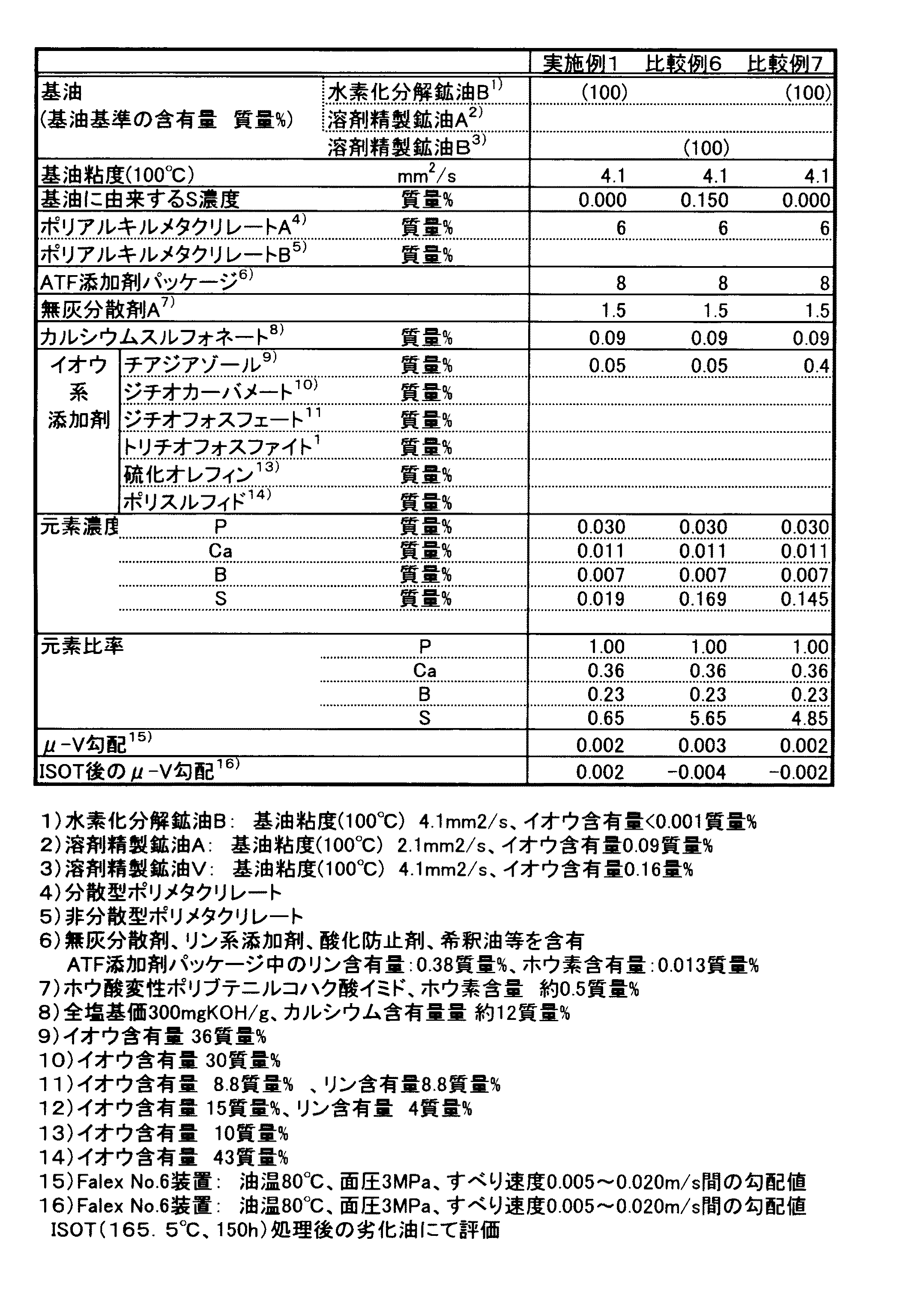
(比較例6〜7)
表2に示すような比較用の潤滑油組成物(比較例6〜7)を調製した。得られた組成物と上記で得た実施例1とを用いて、一定時間走行前後(酸化劣化前後)の潤滑油のμ‐V特性を評価した。潤滑油組成物の酸化劣化処理はASTM JJIS K 2514に記載のISOTの方法に準拠し、油温165.5℃、時間150時間の条件で実施した。その評価結果を表2に示す。
【0090】
【表2】
表2に示す結果から明らかな通り、実施例1の組成物は酸化劣化後もμ‐V特性が正勾配を維持しているのに対して、基油に由来するイオウ濃度が高い比較例6の組成物および添加剤に由来するイオウ濃度が高い比較例7の組成物は酸化劣化後にはμ‐V特性が悪化して負勾配を示している。
【0092】
【発明の効果】
本発明の潤滑油組成物を用いることにより、ベルトとエレメントのμ−V特性を正勾配にしてスクラッチ現象を防止することができ、さらにμ−V特性を長期間正勾配に保持することができる。従って、本発明の潤滑油組成物は、ベルトCVT等の無段変速機用として好適である。また本発明の自動変速機用潤滑油組成物は有段式の自動変速機、リミテッドスリップデフ機構を有する終減速機にも好適に使用できる。[0001]
BACKGROUND OF THE INVENTION
The present invention relates to a lubricating oil composition for an automatic transmission, and more specifically, when applied to a belt-type CVT of an automobile, the μ-V characteristic can be set to a positive gradient to prevent the occurrence of scratch noise, and the μ-V characteristic. The present invention relates to a lubricating oil composition for an automatic transmission that can be advantageously used for a belt-type CVT capable of maintaining a positive slope for a long time.
[0002]
[Prior art]
At present, automatic transmissions for automobiles are widely used, which consist of a torque converter with a lock-up clutch, a transmission unit that combines a wet clutch and a planetary gear, and a hydraulic control unit. It is also bad and has the disadvantage of discomfort due to shift shock. In order to make up for this drawback, a continuously variable transmission (belt type CVT) that transmits power through a metal belt and continuously shifts has been put into practical use.
[0003]
The belt type CVT includes a driving pulley, a driven pulley, and a belt for transmitting power, and the belt includes an element (hereinafter referred to as a frame) and a belt (steel strip) that holds the element. As a lubricating oil used in such a belt type CVT, since it has cooling properties, lubricity, wear resistance, and has many common features in the materials constituting the transmission, it has conventionally been a stepped automatic transmission. ATF (Automatic Transmission Fluid) filled in (AT) has been widely used. However, in recent years, it has been found that a certain type of automobile using a belt CVT has a phenomenon that a noise (scratch noise) peculiar to, for example, entering a garage or starting, a so-called scratch phenomenon occurs. .
[0004]
This scratch phenomenon is due to the gear rattling noise after the CVT, and it has already been found that this is caused by uneven rotation of the driven pulley. Further, it has been found that the rotation unevenness occurs when the change in the friction coefficient (μ) between the belt and the coma has a negative gradient with respect to the change in the sliding speed (V) (for example, Japanese Patent Laid-Open No. 9-263788). Issue gazette). Conventionally, the ATF filled in the belt type CVT does not necessarily have a good μ-V characteristic, and since the fluctuation of the μ-V characteristic when used for a long time is large, scratch noise cannot be completely prevented. As a result, the scratch phenomenon was likely to occur.
[0005]
[Problems to be solved by the invention]
In order to completely prevent such a scratch phenomenon in ATF, it is necessary to develop an ATF blending technology that always makes the μ-V characteristic have a positive slope. It is desired that not only the oil but also the lubricating oil after running for a certain period of time satisfies the performance and maintains such performance for a long time. It has been found that the lubricating oil after running for a certain period of time undergoes oxidative deterioration, and particularly when the lubricating oil contains a relatively large amount of sulfur, the μ-V characteristic tends to be lowered.
[0006]
Therefore, the object of the present invention is suitable for a belt-type CVT that can prevent the scratch phenomenon by making the μ-V characteristic of the belt-type CVT a positive gradient and can maintain the μ-V characteristic at a positive gradient for a long period of time. The object is to provide a lubricating oil composition for an automatic transmission.
[0007]
[Means for Solving the Problems]
As a result of intensive studies to solve the above problems, the present inventors have found that a composition in which a specific additive is blended so as to have a specific element ratio can solve the above problems, and has completed the present invention. .
[0008]
The present invention provides a lubricating base oil containing phosphoric acid monoesters, phosphoric acid diesters, phosphoric acid triesters, phosphorous acid monoesters, phosphorous acid diesters, phosphorous acid triesters, (sub) Phosphoric additives selected from salts of phosphate esters, phosphoric acid, phosphorous acid, zinc alkyldithiophosphate, and mixtures thereof, calcium detergents selected from calcium sulfonate, calcium phenate and calcium salicylate, boric acid Modified succinimide, and (A) thiadiazole and / or benzothiazole, (B) dithiocarbamate, (C) dithiophosphate, (D) trithiophosphite, and (E) polysulfide, or (A) to (E) Including at least one sulfur-based additive selected from derivatives, and the elemental content based on the total amount of the composition The value, phosphate: calcium: boron: elemental ratio of sulfur, a mass ratio, 1: (0.11:) (0.1-0.8:) (0.4~ 2.45), and the phosphorus element concentration on the basis of the total amount of the composition is0.02-0.05Automatic transmission characterized in that the sulfur concentration derived from the base oil is 0 to 0.1 mass% and the sulfur concentration derived from the sulfur-based additive is 0.01 to 0.15 mass%. It is in the machine lubricating oil composition.
[0010]
Included in the lubricating oil composition of the present inventionIt is preferable that the calcium-based detergent is calcium sulfonate having a total base number of 20 to 450 mgKOH / g.
[0011]
DETAILED DESCRIPTION OF THE INVENTION
The lubricating oil composition for an automatic transmission according to the present invention is one in which each element of phosphorus, calcium, boron, and sulfur is contained in a lubricating base oil. Among these elements, sulfur is contained in the composition. Base oils or additives such as sulfur additives and / or calcium detergents derived from calcium sulfonate or calcium phenate, and other elements such as phosphorus elements are phosphorus additives And some sulfur additives, calcium element is derived from calcium detergent, boron element is derived from boric acid-modified succinimide and / or alkali metal borate or its hydrate additives. . Hereinafter, these components will be described in order.
(1) Base oil
As the lubricating base oil in the lubricating oil composition for automatic transmissions of the present invention, any mineral oil and / or synthetic oil used as a base oil for ordinary lubricating oils can be used.
[0012]
Specifically, as mineral oil, for example, a lubricating oil fraction obtained by subjecting crude oil to atmospheric distillation and reduced pressure distillation is subjected to solvent removal, solvent extraction, hydrocracking, solvent dewaxing, catalytic dewaxing, hydrogenation. Examples thereof include paraffinic and naphthenic oils, normal paraffins, and the like purified by purification, washing with sulfuric acid, and purification treatment such as clay treatment alone or in combination.
[0013]
The synthetic oil is not particularly limited, but poly-α-olefin (for example, 1-octene oligomer, 1-decene oligomer, ethylene-propylene oligomer, etc.) or a hydride thereof, isobutene oligomer or a hydride thereof, isoparaffin, Alkylbenzenes, alkylnaphthalenes, diesters (eg, ditridecyl glutarate, di2-ethylhexyl adipate, diisodecyl adipate, ditridecyl adipate, and di-2-ethylhexyl sebacate), polyol esters (eg, trimethylolpropane caprylate, trimethylol) Propane pelargonate, pentaerythritol 2-ethylhexanoate, and pentaerythritol pelargonate), polyoxyalkylene glycol, dialkyl Phenyl ether, and polyphenyl ether and the like.
[0014]
The kinematic viscosity of the lubricating base oil is not particularly limited, but the kinematic viscosity at 100 ° C. is 1 to 10 mm.2/ S, preferably 2 to 8 mm.2/ S.
[0015]
The sulfur concentration in the lubricating oil derived from the base oil is 0.1% by mass or less, preferably 0.05% by mass or less, and more preferably 0.005% by mass or less. When the sulfur concentration exceeds 0.1% by mass, it becomes difficult to maintain stable μ-V characteristics for a long time.
(2) Sulfur additives
Examples of the sulfur-based additive that can be used in the present invention include compounds represented by the following (A) to (E).
(A) Thiadiazole and / or benzothiazole
Specific examples of thiadiazole include compounds represented by the following general formula (1).
[0016]
[Chemical 1]
In the general formula (1), R1Represents a linear or branched alkyl group having 1 to 30 carbon atoms, preferably 6 to 24 carbon atoms, and R2Represents a hydrogen atom or a linear or branched alkyl group having 1 to 30 carbon atoms, preferably a hydrogen atom or a linear or branched alkyl group having 1 to 24 carbon atoms, and a and b are 1, 2 or 3 is shown separately, preferably 1 or 2.
[0018]
Specific examples of benzothiazole include compounds represented by the following general formula (2).
[0019]
[Chemical 2]
In the general formula (2), RThreeRepresents a linear or branched alkyl group having 1 to 4 carbon atoms, preferably a methyl group or an ethyl group, and RFourRepresents a linear or branched alkyl group having 1 to 30 carbon atoms, preferably 6 to 24, c represents an integer of 0 to 3, preferably 0 or 1, and d represents 1 to 3 An integer, preferably 1 or 2 is indicated.
[0021]
When the component (A) is contained, one kind of compound selected from the compounds represented by the general formulas (1) and (2) may be used alone, and two or more kinds of compounds having different structures may be used. You may use together.
(B) Dithiocarbamate
As the dithiocarbamate, any dithiocarbamate can be used, and preferred examples include compounds represented by the following general formula (3) or general formula (4).
[0022]
[Chemical Formula 3]
General formula (3)And (4)RFive , R6 , R7, R8, R9And RTenEach independently represents a hydrocarbon group having 1 to 30 carbon atoms, preferably 1 to 20 carbon atoms, and X represents S (sulfur atom) or a methylene group (-CH2-) And e represents an integer of 0-6.
[0024]
R aboveFive~ RTenAs a C1-C30 hydrocarbon group represented by these, an alkyl group, a cycloalkyl group, an alkylcycloalkyl group, an alkenyl group, an aryl group, an alkylaryl group, and an arylalkyl group can be mentioned, for example.
[0025]
Specific examples of the alkyl group include methyl, ethyl, propyl, butyl, pentyl, hexyl, heptyl, octyl, nonyl, decyl, undecyl, dodecyl, tridecyl, Examples thereof include alkyl groups such as a tetradecyl group, a pentadecyl group, a hexadecyl group, a heptadecyl group, and an octadecyl group (these alkyl groups may be linear or branched).
[0026]
Specific examples of the cycloalkyl group include cycloalkyl groups having 5 to 7 carbon atoms such as a cyclopentyl group, a cyclohexyl group, and a cycloheptyl group.
[0027]
Specific examples of the alkylcycloalkyl group include a methylcyclopentyl group, a dimethylcyclopentyl group, a methylethylcyclopentyl group, a diethylcyclopentyl group, a methylcyclohexyl group, a dimethylcyclohexyl group, a methylethylcyclohexyl group, a diethylcyclohexyl group, and a methylcycloheptyl group. Group, a dimethylcycloheptyl group, a methylethylcycloheptyl group, a diethylcycloheptyl group and the like, and an alkylcycloalkyl group having 6 to 11 carbon atoms (the substitution position of the alkyl group to the cycloalkyl group is also optional). .
[0028]
Specific examples of the alkenyl group include butenyl, pentenyl, hexenyl, heptenyl, octenyl, nonenyl, decenyl, undecenyl, dodecenyl, tridecenyl, tetradecenyl, pentadecenyl, hexadecenyl, An alkenyl group such as a heptadecenyl group and an octadecenyl group (these alkenyl groups may be linear or branched, and the position of the double bond is also optional).
[0029]
Specific examples of the aryl group include aryl groups such as a phenyl group and a naphthyl group.
[0030]
Specific examples of the alkylaryl group include tolyl group, xylyl group, ethylphenyl group, propylphenyl group, butylphenyl group, pentylphenyl group, hexylphenyl group, heptylphenyl group, octylphenyl group, nonylphenyl group, An alkylaryl group having 7 to 18 carbon atoms, such as a decylphenyl group, an undecylphenyl group, or a dodecylphenyl group (the alkyl group may be linear or branched, and the substitution position on the aryl group is arbitrary); Can be mentioned.
[0031]
Specific examples of the arylalkyl group include arylalkyl groups having 7 to 12 carbon atoms such as benzyl group, phenylethyl group, phenylpropyl group, phenylbutyl group, phenylpentyl group, and phenylhexyl group (these alkyl groups are It may be linear or branched).
[0032]
These (B) components can be arbitrarily blended in one kind or two or more kinds.
(C) Dithiophosphate
Examples of the dithiophosphate include one dialkyl dithiophosphoric acid or a mixture of two or more dialkyl dithiophosphoric acids selected from compounds represented by the following general formula (5).
[0033]
[Formula 4]
In the general formula (5), R11And R12Each independently represents a hydrocarbon group having 2 to 30 carbon atoms, preferably 3 to 20 carbon atoms. R11And R12As the hydrocarbon group represented by 2 to 30, R in the general formula (3)Five~ R8The same thing as the example of the hydrocarbon group represented by these can be mentioned.
(D) Trithiophosphite
Examples of the trithiophosphite include a trithiophosphite compound containing a hydrocarbon group having 2 to 30 carbon atoms, preferably 3 to 20 carbon atoms. Examples of the hydrocarbon group of 2 to 30 include R in the general formula (3).Five~ R8The same thing as the example of the hydrocarbon group represented by these can be mentioned.
(E) Polysulfide
The polysulfide is a sulfur-based compound generally called dihydrocarbyl polysulfide or sulfurized olefin, and is specifically represented by the following general formula (6).
[0035]
R13 -Sf -R14 (6)
In the general formula (6), R13And R14Are each independently a linear or branched alkyl group having 3 to 20 carbon atoms, an aryl group having 6 to 20 carbon atoms, an alkylaryl group having 6 to 20 carbon atoms, or an arylalkyl group having 6 to 20 carbon atoms. F represents an integer of 2-6, preferably 2-5.
[0036]
R above13And R14Specific examples of the alkyl group represented by: n-propyl group, isopropyl group, n-butyl group, isobutyl group, sec-butyl group, tert-butyl group, linear or branched pentyl group, linear Or a branched hexyl group, a linear or branched heptyl group, a linear or branched octyl group, a linear or branched nonyl group, a linear or branched decyl group, a linear or branched undecyl group, a linear or branched Branched dodecyl group, linear or branched tridecyl group, linear or branched tetradecyl group, linear or branched pentadecyl group, linear or branched hexadecyl group, linear or branched heptadecyl group, linear or branched octadecyl And a straight-chain or branched nonadecyl group and a straight-chain or branched icosyl group.
[0037]
R above13And R14Specific examples of the aryl group represented by the formula include a phenyl group and a naphthyl group.
[0038]
R above13And R14Specific examples of the alkylaryl group represented by the formula include a tolyl group (including all structural isomers), an ethylphenyl group (including all structural isomers), a linear or branched propylphenyl group (all ), Linear or branched butylphenyl group (including all structural isomers), linear or branched pentylphenyl group (including all structural isomers), linear or branched hexyl Phenyl group (including all structural isomers), linear or branched heptylphenyl group (including all structural isomers), linear or branched octylphenyl group (including all structural isomers), linear Or branched nonylphenyl group (including all structural isomers), linear or branched decylphenyl group (including all structural isomers), linear or branched undecylphenyl group (including all structural isomers) Including), linear or branched Phenyl group (including all structural isomers), xylyl group (including all structural isomers), ethylmethylphenyl group (including all structural isomers), diethylphenyl group (including all structural isomers) , Di (linear or branched) propylphenyl group (including all structural isomers), di (linear or branched) butylphenyl group (including all structural isomers), methylnaphthyl group (all structures) Isomers), ethyl naphthyl groups (including all structural isomers), linear or branched propyl naphthyl groups (including all structural isomers), linear or branched butyl naphthyl groups (including all structural isomers) ), Dimethylnaphthyl group (including all structural isomers), ethylmethylnaphthyl group (including all structural isomers), diethylnaphthyl group (including all structural isomers), di (linear or linear) Branch) professional Runafuchiru (including all structural isomers) group, (including all structural isomers) di (straight or branched) butylnaphthyl group and the like.
[0039]
R above13And R14Specific examples of the arylalkyl group represented by: benzyl group, phenylethyl group (including all isomers), phenylpropyl group (including all isomers), and the like.
[0040]
R above13And R14Are each an alkyl group having 3 to 18 carbon atoms, an aryl group having 6 to 8 carbon atoms, an alkylaryl group having 7 to 8 carbon atoms, or an aryl having 7 to 8 carbon atoms derived from propylene, 1-butene or isobutylene, respectively. An alkyl group is preferred.
[0041]
Specifically, examples of the alkyl group include an isopropyl group, a branched hexyl group derived from a propylene dimer (including all branched isomers), and a moiety derived from a propylene trimer. Branched nonyl group (including all branched isomers), branched dodecyl group derived from propylene tetramer (including all branched isomers), branch derived from propylene pentamer Branched pentadecyl group (including all branched isomers), branched octadecyl group (including all branched isomers) derived from propylene hexamer, sec-butyl group, tert-butyl group Branched octyl groups derived from 1-butene dimer (including all branched isomers), branched octyl groups derived from isobutylene dimer (all branched isomers Derived from 1-butene trimer) Branched dodecyl group (including all branched isomers), branched dodecyl group derived from isobutylene trimer (including all branched isomers), derived from 1-butene tetramer Branched hexadecyl groups (including all branched isomers), branched hexadecyl groups (including all branched isomers) derived from isobutylene tetramer, and the like. Examples of the aryl group include a phenyl group. Examples of the alkylaryl group include a tolyl group (including all structural isomers), an ethylphenyl group (including all structural isomers), a xylyl group (including all structural isomers), and the like. . Examples of the arylalkyl group include a benzyl group and a phenethyl group (including all isomers).
[0042]
In the lubricating oil composition of the present invention, the above (A) to (E)And their derivativesAmong the sulfur-based additives represented by the formula (1), one kind of compound can be used alone, or two or more kinds thereof can be used in appropriate combination. In the present invention, the content of the sulfur-based additive is (A) to (E).And their derivativesThe sulfur element concentration of the sulfur element derived from the compound represented by the above and the sulfur element derived from other additives is 0.01 to 0.15% by mass based on the total amount of the lubricating oil composition, and (A) ~ (E)And their derivativesIn an amount such that the phosphorus element concentration of the phosphorus element derived from the compound represented by the above and the phosphorus element of the phosphorus additive is in the range of 0.01% by mass to 0.06% by mass based on the total amount of the lubricating oil composition Preferably there is. When the content of the sulfur-based additive is less than 0.01% by mass as the sulfur element or less than 0.01% by mass as the phosphorus element, there is no effect in improving the μ-V characteristics, and 0.15% by mass as the sulfur element. When the amount exceeds 0.06%, or when the amount exceeds 0.06% by weight as the phosphorus element, oxidation stability deteriorates, which is not preferable.
[0043]
In order to obtain even better μ-V characteristics, the content of the sulfur-based additive is (A) to (E) based on the total amount of the lubricating oil composition.And their derivativesThe sulfur concentration of the sulfur element derived from the compound represented by the above and the sulfur element derived from other additives is 0.01 to 0.15% by mass based on the total amount of the lubricating oil composition, and (A) to (E)And their derivativesThe phosphorus element concentration of the phosphorus element derived from the compound represented by the above and the phosphorus element of the phosphorus additive is in an amount in the range of 0.02 to 0.05% by mass based on the total amount of the lubricating oil composition. Is preferred.
[0044]
Examples of the hydrocarbon group having 2 to 30 carbon atoms include an alkyl group, a cycloalkyl group, an alkylcycloalkyl group, an alkenyl group, an aryl group, an alkylaryl group, and an arylalkyl group.
[0045]
Specific examples of the alkyl group include ethyl, propyl, butyl, pentyl, hexyl, heptyl, octyl, nonyl, decyl, undecyl, dodecyl, tridecyl, tetradecyl, Examples thereof include alkyl groups such as pentadecyl group, hexadecyl group, heptadecyl group and octadecyl group (these alkyl groups may be linear or branched).
[0046]
Specific examples of the cycloalkyl group include cycloalkyl groups having 5 to 7 carbon atoms such as a cyclopentyl group, a cyclohexyl group, and a cycloheptyl group.
[0047]
Specific examples of the alkylcycloalkyl group include a methylcyclopentyl group, a dimethylcyclopentyl group, a methylethylcyclopentyl group, a diethylcyclopentyl group, a methylcyclohexyl group, a dimethylcyclohexyl group, a methylethylcyclohexyl group, a diethylcyclohexyl group, and a methylcycloheptyl group. Group, a dimethylcycloheptyl group, a methylethylcycloheptyl group, a diethylcycloheptyl group and the like, and an alkylcycloalkyl group having 6 to 11 carbon atoms (the substitution position of the alkyl group to the cycloalkyl group is also optional). .
[0048]
Specific examples of the alkenyl group include butenyl, pentenyl, hexenyl, heptenyl, octenyl, nonenyl, decenyl, undecenyl, dodecenyl, tridecenyl, tetradecenyl, pentadecenyl, hexadecenyl, Examples thereof include alkenyl groups such as heptadecenyl group and octadecenyl group (these alkenyl groups may be linear or branched, and the position of the double bond is also arbitrary).
[0049]
Specifically as said aryl group, C6-C18 aryl groups, such as a phenyl group and a naphthyl group, can be mentioned.
[0050]
Specific examples of the alkylaryl group include tolyl group, xylyl group, ethylphenyl group, propylphenyl group, butylphenyl group, pentylphenyl group, hexylphenyl group, heptylphenyl group, octylphenyl group, nonylphenyl group, An alkylaryl group having 7 to 18 carbon atoms, such as a decylphenyl group, an undecylphenyl group, or a dodecylphenyl group (the alkyl group may be linear or branched, and the substitution position on the aryl group is arbitrary); Can be mentioned.
[0051]
Specific examples of the arylalkyl group include arylalkyl groups having 7 to 12 carbon atoms such as benzyl group, phenylethyl group, phenylpropyl group, phenylbutyl group, phenylpentyl group, and phenylhexyl group (these alkyl groups). May be linear or branched).
[0052]
Specific examples of the preferred compound (F) include phosphoric acid; phosphorous acid; zinc dipropyldithiophosphate, zinc dibutyldithiophosphate, zinc dipentyldithiophosphate, zinc dihexyldithiophosphate, zinc diheptyldithiophosphate, and dioctyl. Zinc alkyl dithiophosphates such as zinc dithiophosphate (the alkyl group may be linear or branched); monopropyl phosphate, monobutyl phosphate, monopentyl phosphate, monohexyl phosphate, monoHeptylPhosphoric acid monoalkyl esters such as phosphate and monooctyl phosphate (the alkyl group may be linear or branched); mono (alkyl) aryl phosphates such as monophenyl phosphate and monocresyl phosphate; dipropyl phosphate; Dibutyl phosphate, dipentyl phosphate, dihexyl phosphate, diHeptylDialkyl phosphates such as phosphate and dioctyl phosphate (the alkyl group may be linear or branched); di (alkyl) aryl phosphates such as diphenyl phosphate and dicresyl phosphate; tripropyl phosphate, tributyl phosphate, tributyl phosphate Pentyl phosphate, trihexyl phosphate, triHeptylTrialkyl phosphates such as phosphate and trioctyl phosphate (the alkyl group may be linear or branched); Tri (alkyl) aryl phosphates such as triphenyl phosphate and tricresyl phosphate;
Monopropyl phosphite, monobutyl phosphite, monopentyl phosphite, monohexyl phosphite, monoHeptylPhosphite, monooctyl phosphite, etc. phosphorous acid monoalkyl ester (alkyl group may be linear or branched); monophenyl phosphite, monocresyl phosphite, etc. mono (alkyl) aryl phosphite Esters: dipropyl phosphite, dibutyl phosphite, dipentyl phosphite, dihexyl phosphite, diHeptylDialkyl phosphites such as phosphites and dioctyl phosphites (the alkyl group may be linear or branched); di (alkyl) aryl phosphites such as diphenyl phosphites and dicresyl phosphites; tripropyl Phosphite, tributyl phosphite, tripentyl phosphite, trihexyl phosphite, tripeptyl phosphite, trioctyl phosphite and the like phosphorous acid trialkyl esters (the alkyl group may be linear or branched); Examples thereof include tri (alkyl) aryl phosphites such as triphenyl phosphite and tricresyl phosphite; and mixtures thereof.
[0053]
Specific examples of the salts of the above (phosphite) phosphates include phosphoric acid monoesters, phosphoric acid diesters, phosphorous acid monoesters, phosphorous acid diesters, etc., and ammonia and carbon atoms of 1 to 8 carbon atoms. And a salt obtained by neutralizing a part or all of the remaining acidic hydrogen by acting a nitrogen compound such as an amine compound containing only the hydrocarbon group or hydroxyl group-containing hydrocarbon group in the molecule.
[0054]
Specific examples of the nitrogen compound include ammonia; monomethylamine, monoethylamine, monopropylamine, monobutylamine, monopentylamine, monohexylamine, monoheptylamine, monooctylamine, dimethylamine, methylethylamine, diethylamine, Alkylamines such as methylpropylamine, ethylpropylamine, dipropylamine, methylbutylamine, ethylbutylamine, propylbutylamine, dibutylamine, dipentylamine, dihexylamine, diheptylamine, and dioctylamine (the alkyl group may be linear or May be branched); monomethanolamine, monoethanolamine, monopropanolamine, monobutanolamine, monopentanolamine, monohexanolamine, Noheptanolamine, monooctanolamine, monononanolamine, dimethanolamine, methanolethanolamine, diethanolamine, methanolpropanolamine, ethanolpropanolamine, dipropanolamine, methanolbutanolamine, ethanolbutanolamine, propanolbutanolamine, dibutanolamine And alkanolamines such as dipentanolamine, dihexanolamine, diheptanolamine, and dioctanolamine (the alkanol group may be linear or branched); and mixtures thereof.
[0055]
When the component (F) is contained in the lubricating oil composition for an automatic transmission according to the present invention, the content is the total phosphorus of the phosphorus element derived from the component (F) and the phosphorus element derived from other additives. The element concentration is an amount that is 0.01 to 0.06 mass% based on the total amount of the composition. When the phosphorus element concentration is less than 0.01% by mass, there is no effect on the wear resistance. On the other hand, when the concentration exceeds 0.06% by mass, the oxidation stability deteriorates. Each is not preferred. In order to obtain further improved μ-V characteristics, the content of the component (F) is such that the total phosphorus element concentration of the phosphorus element derived from the component (F) and the phosphorus element derived from other additives is The amount is preferably 0.02 to 0.05% by mass based on the total amount of the composition.
(4) (G) Calcium-based detergent
The (G) calcium-based detergent that can be used in the present invention is a basic calcium detergent having a total base number of usually 20 to 450 mgKOH / g, preferably 50 to 400 mgKOH / g. Here, the total base number is 7. JIS K2501 "Petroleum products and lubricants-Neutralization number test method". It means the total base number measured by the perchloric acid method based on
[0056]
Specific examples of the component (G) include one or two or more calcium detergents selected from the following.
(G-1) Calcium sulfonate having a total base number of 20 to 450 mgKOH / g
(G-2) Calcium phenate having a total base number of 20 to 450 mgKOH / g
(G-3) Calcium salicylate having a total base number of 20 to 450 mgKOH / g
More specifically, (G-1) calcium sulfonate is preferably a calcium salt of an alkyl aromatic sulfonic acid obtained by sulfonating an alkyl aromatic compound having a molecular weight of 100 to 1500, preferably 200 to 700, for example. Specific examples of the alkyl aromatic sulfonic acid used include so-called petroleum sulfonic acid and synthetic sulfonic acid.
[0057]
As the petroleum sulfonic acid, those obtained by sulfonating an alkyl aromatic compound of a lubricating oil fraction of mineral oil or so-called mahoganic acid which is produced as a by-product when white oil is produced is used. As the synthetic sulfonic acid, for example, an alkylbenzene having a linear or branched alkyl group obtained as a by-product from an alkylbenzene production plant that is a raw material for detergents or by alkylating polyolefin with benzene is used as a raw material. , Sulfonated ones thereof, sulfonated ones of dinonylnaphthalene, and the like are used. The sulfonating agent for sulfonating these alkyl aromatic compounds is not particularly limited, but usually fuming sulfuric acid or sulfuric acid is used.
[0058]
(G-2) More specifically, the calcium phenate is an alkylphenol having at least one linear or branched alkyl group having 4 to 30 carbon atoms, preferably 6 to 18 carbon atoms, and the alkylphenol and sulfur. Alkylphenol sulfide obtained by reacting with or a calcium salt of a Mannich reaction product of alkylphenol obtained by reacting this alkylphenol with formaldehyde is preferably used.
[0059]
(G-3) More specifically, as calcium salicylate, a calcium salt of alkyl salicylic acid having at least one linear or branched alkyl group having 4 to 30 carbon atoms, preferably 6 to 18 carbon atoms is preferable. Used.
[0060]
The above calcium sulfonate, calcium phenate and calcium salicylate have alkyl aromatic sulfonic acid, alkylphenol, alkylphenol sulfide, Mannich reaction product of alkylphenol, or alkyl as long as their metal salt is in the range of 20 to 450 mg KOH / g. Only with neutral salt (normal salt) obtained by reacting salicylic acid directly with calcium oxide or calcium hydroxide, or once replacing alkali metal salt such as sodium salt or potassium salt with calcium salt. In addition, these neutral salts (normal salts) and calcium salts obtained by heating excess calcium salts, calcium hydroxide and calcium oxide in the presence of water, and neutral salts in the presence of carbon dioxide ( Orthosalt) basic cal Obtained by reaction with um salt overbased calcium salts (overbased salts) are also included. These reactions are usually performed in a solvent (an aliphatic hydrocarbon solvent such as hexane, an aromatic hydrocarbon solvent such as xylene, a light lubricant base oil, or the like).
[0061]
The metal detergent is usually marketed in a state diluted with a light lubricating base oil or the like, and can be obtained. Generally, the metal content is 1.0 to 20% by mass, preferably The thing of 2.0-16 mass% is used.
[0062]
In the lubricating oil composition for an automatic transmission of the present invention, when the component (G) is contained, the content is not particularly limited, but is 0.01 to 5.0% by mass based on the total amount of the composition. Preferably, it is 0.05-4.0 mass%. (G) When the content of the component is less than 0.01% by mass, the effect of suppressing the decrease in strength against repeated compression of the wet clutch tends to be insufficient, whereas when it exceeds 5.0% by mass, the oxidative stability of the composition Tends to decrease.
[0063]
The alkyl group or alkenyl group has 40 to 400 carbon atoms, preferably 60 to 350 carbon atoms. When the carbon number of the alkyl group or alkenyl group is less than 40, the solubility of the compound in the lubricating base oil decreases, whereas when the carbon number of the alkyl group or alkenyl group exceeds 400, the low temperature fluidity of the composition Are worse, respectively.
[0064]
More specifically, examples of the succinimide used in the present invention include compounds represented by the following formula (7) or (8).
[0065]
[Chemical formula 5]
In the general formula (7), Rtwenty oneRepresents an alkyl group or an alkenyl group having 40 to 400 carbon atoms, preferably 60 to 350, and m represents an integer of 1 to 5, preferably 2 to 4.
[0067]
[Chemical 6]
In the general formula (8), Rtwenty twoAnd Rtwenty threeEach independently represents an alkyl or alkenyl group having 40 to 400 carbon atoms, preferably 60 to 350 carbon atoms, and n represents an integer of 0 to 4, preferably 1, 2 or 3.
[0069]
The succinimide is represented by the so-called monotype succinimide represented by the formula (7) in which succinic anhydride is added to one end of the polyamine, and the formula (8) in which succinic anhydride is added to both ends of the polyamine. There are so-called bis-type succinimides, and as the component (H), any of them or a mixture thereof can be used. Further, boric acid-modified succinimide is a so-called boric acid-modified, in which boric acid is allowed to act on the succinimide to neutralize a part or all of the remaining amino group and / or imino group, or amidate. It is a compound.
[0070]
When the component (H) is contained in the lubricating oil composition for an automatic transmission according to the present invention, the content thereof is usually 0.01 to 10.0% by mass, preferably 0.0. 1 to 7.0% by massis there. (H)Component content is 0.When the amount is less than 01% by mass, a sufficient cleaning effect cannot be obtained. On the other hand, when the amount exceeds 10.0% by mass, the low-temperature fluidity of the composition tends to be greatly deteriorated.
[0071]
These alkali metal borates are, for example, potassium hydroxide or water so that the atomic ratio of boric acid and alkali metal (potassium / sodium) is in the range of 2.0 to 4.5 (boron / alkali metal). Sodium oxide and boric acid are dissolved in water, this solution is added to an oil solution containing a neutral alkaline earth metal sulfonate or succinimide ashless dispersant, and stirred vigorously to make a water-in-oil emulsion. It can be obtained as a fine particle dispersion of potassium borate hydrate or sodium borate hydrate by dehydrating it.
[0072]
In the lubricating oil composition for a metal belt type continuously variable transmission according to the present invention, the blending ratio of one or two (I) components arbitrarily selected is arbitrary, but boron is based on the total amount of the lubricating oil composition. The amount of element is preferably 0.002% by mass or more, and more preferably 0.005% by mass or more. On the other hand, the amount of boron element is preferably 0.1% by mass or less, more preferably 0.06% by mass or less, based on the total amount of the lubricating oil composition. When the content of the component (I) is less than 0.002% by mass as the amount of boron element based on the total amount of the lubricating oil composition, the effect of improving the intermetallic friction characteristics of the lubricating oil composition by blending the component (A) On the other hand, when the content exceeds 0.1% by mass as the amount of boron element based on the total amount of the lubricating oil composition, the storage stability of the lubricating oil composition tends to be lowered.
(7) Other additives
The lubricating oil composition for an automatic transmission according to the present invention can be used in combination with various known additives in order to further improve the anti-scratch performance and to maintain and improve the performance as other lubricating oil. . Examples of such additives include ashless dispersants, metallic detergents other than the above component (G), friction modifiers, antioxidants, viscosity index improvers, antifoaming agents, and corrosion inhibitors. Can do.
(J) Ashless dispersant
As the ashless dispersant that can be used in combination with the lubricating oil composition for automatic transmissions of the present invention, any compound that is usually used as an ashless dispersant for lubricating oils can be used. For example, alkyl having 40 to 400 carbon atoms. A nitrogen compound having at least one group or alkenyl group in the molecule (for example, a compound having an amino group and / or an imino group) or a derivative thereof, or a modified product of alkenyl succinimide.
[0073]
The alkyl group or alkenyl group may be linear or branched, but specifically, preferred are olefin oligomers such as propylene, 1-butene and isobutylene, and ethylene and propylene co-oligomers. Examples thereof include branched alkyl groups and branched alkenyl groups. Carbon number of an alkyl group or an alkenyl group is 40-400, Preferably it is 60-350. When the carbon number of the alkyl group or alkenyl group is less than 40, the solubility of the compound in the lubricating base oil decreases, whereas when the carbon number of the alkyl group or alkenyl group exceeds 400, the low temperature fluidity of the composition Are worse, respectively.
[0074]
Moreover, as a derivative | guide_body of the said nitrogen compound, carbon number, such as C2-C30 monocarboxylic acid (fatty acid etc.), oxalic acid, phthalic acid, trimellitic acid, pyromellitic acid, etc. specifically, is mentioned to a nitrogen compound. 2 to 30 polycarboxylic acids are allowed to act to neutralize a part or all of the remaining amino groups and / or imino groups, or amidated, so-called acid-modified compounds, and sulfur compounds to act on the nitrogen compounds. Sulfur-modified compounds and modified compounds obtained by combining the nitrogen compound with two or more kinds of modifications selected from acid modification and sulfur modification.
[0075]
In the present invention, one or two or more compounds arbitrarily selected from the above ashless dispersants can be contained in any amount, but usually the content is based on the total amount of the lubricating oil composition. It is 0.1-10 mass%.
(K) Metal detergent
As the metallic detergent other than the component (G) that can be used in combination with the lubricating oil composition for an automatic transmission of the present invention, any compound that is usually used as a metallic detergent for a lubricating oil can be used. Examples include alkali metal or alkaline earth metal sulfonates, phenates, salicylates, and naphthenates. In the composition of this invention, these compounds can be used individually or in combination of 2 or more types. Examples of the alkali metal include sodium and potassium, and examples of the alkaline earth metal include magnesium. Specifically, the metal detergent used in the present invention is preferably magnesium sulfonate, phenate, or salicylate. In addition, the total base number and addition amount of these metallic detergents can be arbitrarily selected according to the required performance of the lubricating oil.
[0076]
In the present invention, one or two or more compounds arbitrarily selected from the above metal-based detergents can be contained in any amount, and the content is usually based on the total amount of the lubricating oil composition. 0.01 to 5% by mass.
(L) Friction modifier
As the friction modifier that can be used in combination with the lubricating oil composition for an automatic transmission of the present invention, any compound that is usually used as a friction modifier for lubricating oils can be used, but an alkyl group having 6 to 30 carbon atoms. Alternatively, an amine compound, a fatty acid ester, a fatty acid amide, a fatty acid metal salt, or the like having at least one alkenyl group, particularly a straight-chain alkyl group or straight-chain alkenyl group having 6 to 30 carbon atoms in the molecule.
[0077]
Examples of the amine compound include linear or branched, preferably linear aliphatic monoamines having 6 to 30 carbon atoms, linear or branched, preferably linear aliphatic polyamines, or Examples include alkylene oxide adducts of these aliphatic amines. Examples of the fatty acid ester include esters of linear or branched, preferably linear, fatty acids having 7 to 31 carbon atoms with aliphatic monohydric alcohols or aliphatic polyhydric alcohols. Examples of fatty acid amides include amides of linear or branched, preferably linear fatty acids having 7 to 31 carbon atoms and aliphatic monoamines or aliphatic polyamines. Examples of the fatty acid metal salt include an alkaline earth metal salt (magnesium salt, calcium salt, etc.) or zinc salt of a linear or branched, preferably linear fatty acid having 7 to 31 carbon atoms. It is done.
[0078]
In the present invention, one or two or more compounds arbitrarily selected from these friction modifiers can be contained in any amount, but the content is usually based on the total amount of the lubricating oil composition. 0.01 to 5.0 mass%, preferably 0.03 to 3.0 mass%.
(M) Antioxidant
As the antioxidant that can be used in combination with the lubricating oil composition for an automatic transmission of the present invention, any antioxidant that is generally used in lubricating oils such as phenolic compounds and amine compounds can be used.
[0079]
Specifically, alkylphenols such as 2-6-di-tert-butyl-4-methylphenol; bisphenols such as methylene-4,4-bisphenol (2,6-di-tert-butyl-4-methylphenol) Naphthylamines such as phenyl-α-naphthylamine, dialkyldiphenylamines; zinc dialkyldithiophosphates such as zinc di-2-ethylhexyldithiophosphate; (3,5-di-tert-butyl-4-hydroxyphenyl) fatty acid ( And an ester of monovalent or polyhydric alcohol such as methanol, octadecanol, 1,6 hexadiol, neopentyl glycol, thiodiethylene glycol, triethylene glycol, pentaerythritol and the like.
[0080]
In the present invention, an arbitrary amount of one or two or more compounds arbitrarily selected from the above antioxidants can be contained, but the content is usually based on the total amount of the lubricating oil composition. It is 0.01-5.0 mass%.
(N) Viscosity index improver
As the viscosity index improver that can be used in combination with the lubricating oil composition for automatic transmissions of the present invention, specifically, a polymer or copolymer of one or more monomers selected from various methacrylic esters or Examples thereof include so-called non-dispersed viscosity index improvers such as hydrogenated substances, or so-called dispersed viscosity index improvers obtained by copolymerizing various methacrylic esters containing nitrogen compounds. Specific examples of other viscosity index improvers include non-dispersed or dispersed ethylene-α-olefin copolymers (the α-olefin can be exemplified by propylene, 1-butene, 1-pentene, etc.) or hydrides thereof. And polyisobutylene or a hydrogenated product thereof, styrene-diene hydrogenated copolymer, styrene-maleic anhydride ester copolymer, and polyalkylstyrene.
[0081]
The molecular weight of these viscosity index improvers is preferably selected in consideration of shear stability. Specifically, the number average molecular weight of the viscosity index improver is usually from 5,000 to 150,000, preferably from 5,000 to 35,000 in the case of dispersed and non-dispersed polymethacrylates. In the case of isobutylene or a hydride thereof, usually 800 to 5,000, preferably 1,000 to 4,000, and in the case of an ethylene-α-olefin copolymer or a hydride thereof, usually 800 to 150,000, Preferably, 3,000 to 12,000 are used.
[0082]
Among these viscosity index improvers, when an ethylene-α-olefin copolymer or a hydride thereof is used, a lubricating oil composition particularly excellent in shear stability can be obtained.
[0083]
In the present invention, one or two or more compounds arbitrarily selected from these viscosity index improvers can be contained in any amount, but the content is usually the total amount of the lubricating oil composition. It is 0.1-40.0 mass% on the basis.
(O) Antifoaming agent
As the antifoaming agent that can be used in combination with the lubricating oil composition for an automatic transmission of the present invention, any compound that is usually used as an antifoaming agent for lubricating oil can be used. For example, dimethyl silicone, fluorosilicone, etc. These silicones can be mentioned. The lubricating oil composition of the present invention may contain one or two or more compounds arbitrarily selected from these in any amount, but the content is usually the total amount of the lubricating oil composition. It is 0.001-0.05 mass% on the basis.
(P) Corrosion inhibitor
As the corrosion inhibitor that can be used in combination with the lubricating oil composition for automatic transmissions of the present invention, any compound that is usually used as a corrosion inhibitor for lubricating oils can be used. For example, benzotriazole-based, tolyltriazole And imidazole compounds. The lubricating oil composition of the present invention may contain one or two or more compounds arbitrarily selected from these in any amount, but the content is usually the total amount of the lubricating oil composition. It is 0.01-3.0 mass% on the basis.
In the lubricating oil composition of the present invention, the mass ratio of phosphorus, calcium, boron, and sulfur in the composition based on the elemental analysis value based on the total amount of the composition is phosphorus: calcium: boron: sulfur = 1: (0. 1-2) :( 0.06-2) :( 0.2-20). This ratio is preferably phosphorus: calcium: boron: sulfur = 1: (0.1 to 1.0) :( 0.1 to 0.8) :( 0.4 to 5.0).
[0084]
The phosphorus element concentration in the lubricating oil composition is 0.010 to 0.060 mass%, preferably 0.020 to 0.050 mass%, based on the total amount of the composition.
[0085]
The sulfur concentration derived from the base oil is 0-0.1 mass%,IThe sulfur concentration derived from the sulfur-based additive is 0.01 to0.15 qualityIn%is there. When the mass ratio of each of the above elements, the phosphorus element concentration, the sulfur concentration in the base oil, and the sulfur concentration in the sulfur-based additive are outside the above ranges, the μ-V characteristic deteriorates and a scratch phenomenon occurs. It becomes easy.
[0086]
【Example】
The present invention will be described more specifically with reference to examples and comparative examples below, but the present invention is not limited to these examples.
(Examples 1-8) and (Comparative Examples 1-5)
Lubricating oil compositions (Examples 1 to 8) of the present invention having compositions as shown in Table 1 and comparative lubricating oil compositions (Comparative Examples 1 to 5) were prepared. The obtained composition was evaluated by the following μ-V characteristic test. The evaluation results are also shown in Table 1.
(Test method for μ-V characteristics)
The μ-V characteristics were evaluated by the following friction test.
[0087]
Equipment: Falex No.6 friction tester
Surface pressure: 3Mpa
Oil temperature: 80 ° C
Evaluation of μ-V characteristics: Friction coefficient values at a sliding speed of 0.005 m / s and 0.020 m / s are measured, and a gradient of the friction coefficient with respect to the sliding speed (m / s) is obtained. There is a correlation between the positive and negative of the gradient and the presence or absence of the scratch phenomenon. If the gradient value is positive, the scratch phenomenon does not occur, but if it is negative, the scratch phenomenon is likely to occur.
[0088]
[Table 1]
As is clear from the results shown in Table 1, in the case of the lubricating oil compositions of the present invention (Examples 1 to 8), a positive gradient can be obtained in all μ-V characteristic evaluations, but phosphorus, calcium, boron In the lubricating oil compositions of Comparative Examples 1 to 5 in which the element ratio (mass ratio) of each element of sulfur and sulfur does not satisfy the range defined in the present invention, a positive gradient cannot be obtained in the μ-V characteristic evaluation. .
(Comparative Examples 6-7)
A comparative lubricating oil composition (Comparative Examples 6 to 7) as shown in Table 2 was prepared. Using the obtained composition and Example 1 obtained above, the μ-V characteristics of the lubricating oil before and after running for a certain period of time (before and after oxidation deterioration) were evaluated. The oxidation deterioration treatment of the lubricating oil composition was carried out under the conditions of an oil temperature of 165.5 ° C. and a time of 150 hours in accordance with the ISOT method described in ASTM JIS K 2514. The evaluation results are shown in Table 2.
[0090]
[Table 2]
As is clear from the results shown in Table 2, the composition of Example 1 maintains a positive gradient in μ-V characteristics even after oxidative degradation, whereas Comparative Example 6 has a high sulfur concentration derived from the base oil. The composition of Comparative Example 7 having a high concentration of sulfur derived from the composition of No. 1 and the additive showed a negative gradient due to the deterioration of the μ-V characteristic after oxidative degradation.
[0092]
【The invention's effect】
By using the lubricating oil composition of the present invention, it is possible to prevent the scratch phenomenon by making the μ-V characteristics of the belt and the element positive, and to keep the μ-V characteristics at a positive gradient for a long time. . Therefore, the lubricating oil composition of the present invention is suitable for a continuously variable transmission such as a belt CVT. The lubricating oil composition for an automatic transmission of the present invention can also be suitably used for a stepped automatic transmission and a final reduction gear having a limited slip differential mechanism.
Claims (1)
Priority Applications (6)
| Application Number | Priority Date | Filing Date | Title |
|---|---|---|---|
| JP2001262497A JP4919555B2 (en) | 2001-08-30 | 2001-08-30 | Lubricating oil composition for automatic transmission |
| EP02746088.0A EP1422287B1 (en) | 2001-08-30 | 2002-07-16 | Lubricating oil composition for automatic transmission |
| CNB028170113A CN100406543C (en) | 2001-08-30 | 2002-07-16 | Lubricating oil composition for automatic transmission |
| PCT/JP2002/007207 WO2003020858A1 (en) | 2001-08-30 | 2002-07-16 | Lubricating oil composition for automatic transmission |
| US10/773,531 US20040167041A1 (en) | 2001-08-30 | 2004-02-06 | Lubricating oil compositions for automatic transmissions |
| US12/233,981 US20090018038A1 (en) | 2001-08-30 | 2008-09-19 | Lubricating oil compositions for automatic transmissions |
Applications Claiming Priority (1)
| Application Number | Priority Date | Filing Date | Title |
|---|---|---|---|
| JP2001262497A JP4919555B2 (en) | 2001-08-30 | 2001-08-30 | Lubricating oil composition for automatic transmission |
Publications (2)
| Publication Number | Publication Date |
|---|---|
| JP2003073683A JP2003073683A (en) | 2003-03-12 |
| JP4919555B2 true JP4919555B2 (en) | 2012-04-18 |
Family
ID=19089384
Family Applications (1)
| Application Number | Title | Priority Date | Filing Date |
|---|---|---|---|
| JP2001262497A Expired - Fee Related JP4919555B2 (en) | 2001-08-30 | 2001-08-30 | Lubricating oil composition for automatic transmission |
Country Status (5)
| Country | Link |
|---|---|
| US (2) | US20040167041A1 (en) |
| EP (1) | EP1422287B1 (en) |
| JP (1) | JP4919555B2 (en) |
| CN (1) | CN100406543C (en) |
| WO (1) | WO2003020858A1 (en) |
Families Citing this family (19)
| Publication number | Priority date | Publication date | Assignee | Title |
|---|---|---|---|---|
| US20040214729A1 (en) * | 2003-04-25 | 2004-10-28 | Buitrago Juan A. | Gear oil composition having improved copper corrosion properties |
| CN1761821A (en) * | 2003-05-30 | 2006-04-19 | 大众汽车有限公司 | Double-clutch drive |
| US20050124508A1 (en) * | 2003-12-04 | 2005-06-09 | Iyer Ramnath N. | Compositions for improved friction durability in power transmission fluids |
| JP4885442B2 (en) * | 2004-11-26 | 2012-02-29 | Jx日鉱日石エネルギー株式会社 | Lubricating oil composition and drive transmission device using the same |
| US7531486B2 (en) | 2005-03-31 | 2009-05-12 | Exxonmobil Chemical Patents Inc. | Additive system for lubricant |
| US8034754B2 (en) | 2005-03-31 | 2011-10-11 | The Lubrizol Corporation | Fluids for enhanced gear protection |
| US7648948B2 (en) | 2005-04-08 | 2010-01-19 | Exxonmobil Chemical Patents Inc. | Additive system for lubricants |
| US7803332B2 (en) | 2005-05-31 | 2010-09-28 | Exxonmobil Chemical Patents Inc. | Reactor temperature control |
| JP5219834B2 (en) * | 2005-12-15 | 2013-06-26 | ザ ルブリゾル コーポレイション | Lubricant composition for final reduction shaft |
| US7906465B2 (en) * | 2006-07-14 | 2011-03-15 | Afton Chemical Corp. | Lubricant compositions |
| JP5225696B2 (en) * | 2008-01-18 | 2013-07-03 | 出光興産株式会社 | Lubricating oil composition and continuously variable transmission |
| DE102009001301A1 (en) * | 2008-03-11 | 2009-09-24 | Volkswagen Ag | Method for lubricating a component only for the clutch of an automatic transmission, which requires lubrication |
| WO2010048244A1 (en) * | 2008-10-23 | 2010-04-29 | The Lubrizol Corporation | Lubricating composition containing metal carboxylate |
| JP5941316B2 (en) | 2012-03-29 | 2016-06-29 | Jxエネルギー株式会社 | Lubricating oil composition |
| JP5889695B2 (en) | 2012-03-29 | 2016-03-22 | Jx日鉱日石エネルギー株式会社 | Lubricating oil composition |
| FR3009309B1 (en) * | 2013-08-02 | 2016-10-07 | Total Marketing Services | LUBRICATING COMPOSITIONS FOR TRANSMISSIONS |
| CN104560297B9 (en) * | 2013-10-18 | 2019-03-08 | 吉坤日矿日石能源株式会社 | Lubricating oil composition for reduction gears of hybrid or electric vehicles |
| JP7428364B2 (en) * | 2018-10-15 | 2024-02-06 | 国立大学法人 名古屋工業大学 | Vibration damping mass device and vibration damping mass device set |
| JP2023161722A (en) * | 2022-04-26 | 2023-11-08 | Eneos株式会社 | lubricating oil composition |
Family Cites Families (38)
| Publication number | Priority date | Publication date | Assignee | Title |
|---|---|---|---|---|
| JPH0692593B2 (en) * | 1985-09-03 | 1994-11-16 | 出光興産株式会社 | Lubricating oil composition for power transmission |
| US5110488A (en) * | 1986-11-24 | 1992-05-05 | The Lubrizol Corporation | Lubricating compositions containing reduced levels of phosphorus |
| US5185090A (en) | 1988-06-24 | 1993-02-09 | Exxon Chemical Patents Inc. | Low pressure derived mixed phosphorous- and sulfur-containing reaction products useful in power transmitting compositions and process for preparing same |
| US5443744A (en) * | 1993-12-17 | 1995-08-22 | Exxon Chemical Patent Inc. | Non silicone aggresive alkyl phosphates as lubrication oil additives |
| KR100239817B1 (en) * | 1994-12-09 | 2000-01-15 | 만셀 케이쓰 로드니 | A method for improving the antioxidant properties of a lubricating oil composition using a lubricating oil composition comprising a lubricating oil and an additive combination, a concentrate containing an additive combination and an additive combination |
| BR9509885A (en) * | 1994-12-09 | 1997-10-21 | Exxon Chemical Patents Inc | Oil-soluble additive lubricating oil composition concentrated composition and process for forming the additive |
| JP3928981B2 (en) | 1995-09-14 | 2007-06-13 | 昭和シェル石油株式会社 | Lubricating oil composition |
| AU719520B2 (en) * | 1995-09-19 | 2000-05-11 | Lubrizol Corporation, The | Additive compositions for lubricants and functional fluids |
| JP4354014B2 (en) * | 1995-10-05 | 2009-10-28 | 出光興産株式会社 | Lubricating oil composition for continuously variable transmission |
| US5750476A (en) | 1995-10-18 | 1998-05-12 | Exxon Chemical Patents Inc. | Power transmitting fluids with improved anti-shudder durability |
| US5635459A (en) * | 1995-10-27 | 1997-06-03 | The Lubrizol Corporation | Borated overbased sulfonates for improved gear performance in functional fluids |
| JPH09263782A (en) * | 1996-03-28 | 1997-10-07 | Idemitsu Kosan Co Ltd | Continuously variable transmission oil composition |
| US5840663A (en) | 1996-12-18 | 1998-11-24 | Exxon Chemical Patents Inc. | Power transmitting fluids improved anti-shudder durability |
| US5726132A (en) * | 1997-02-28 | 1998-03-10 | The Lubrizol Corporation | Oil composition for improving fuel economy in internal combustion engines |
| US6613722B1 (en) * | 1997-03-07 | 2003-09-02 | Exxon Chemical Patents Inc. | Lubricating composition |
| US5792733A (en) * | 1997-08-14 | 1998-08-11 | The Lubrizol Corporation | Antiwear compositions containing phosphorus compounds and olefins |
| JPH11116982A (en) | 1997-10-09 | 1999-04-27 | Mitsubishi Oil Co Ltd | Lubricating oil composition |
| US6034040A (en) * | 1998-08-03 | 2000-03-07 | Ethyl Corporation | Lubricating oil formulations |
| JP2000063878A (en) | 1998-08-25 | 2000-02-29 | Japan Energy Corp | Continuously variable transmission oil composition |
| US6103673A (en) * | 1998-09-14 | 2000-08-15 | The Lubrizol Corporation | Compositions containing friction modifiers for continuously variable transmissions |
| JP3977940B2 (en) * | 1998-10-07 | 2007-09-19 | 新日本石油株式会社 | Lubricating oil composition for metal belt type continuously variable transmission |
| JP3977941B2 (en) * | 1998-10-07 | 2007-09-19 | 新日本石油株式会社 | Lubricating oil composition for metal belt type continuously variable transmission |
| JP3977942B2 (en) | 1998-10-07 | 2007-09-19 | 新日本石油株式会社 | Lubricating oil composition for metal belt type continuously variable transmission |
| WO2000029523A1 (en) * | 1998-11-13 | 2000-05-25 | Japan Energy Corporation | Oil composition for non-stage transmission |
| US6451745B1 (en) * | 1999-05-19 | 2002-09-17 | The Lubrizol Corporation | High boron formulations for fluids continuously variable transmissions |
| WO2000071646A1 (en) * | 1999-05-24 | 2000-11-30 | The Lubrizol Corporation | Mineral gear oils and transmission fluids |
| US6225266B1 (en) | 1999-05-28 | 2001-05-01 | Infineum Usa L.P. | Zinc-free continuously variable transmission fluid |
| JP4698781B2 (en) * | 1999-09-27 | 2011-06-08 | 出光興産株式会社 | Lubricating oil composition |
| JP2001342486A (en) * | 2000-06-05 | 2001-12-14 | Tonengeneral Sekiyu Kk | Lubricating oil composition for continuously variable transmission |
| JP4691233B2 (en) * | 2000-06-05 | 2011-06-01 | 東燃ゼネラル石油株式会社 | Lubricating oil composition for continuously variable transmission |
| JP5283297B2 (en) | 2001-09-17 | 2013-09-04 | Jx日鉱日石エネルギー株式会社 | Lubricating oil composition |
| US7026273B2 (en) * | 2001-11-09 | 2006-04-11 | Infineum International Limited | Lubricating oil compositions |
| US6852679B2 (en) * | 2002-02-20 | 2005-02-08 | Infineum International Ltd. | Lubricating oil composition |
| US6534451B1 (en) * | 2002-04-05 | 2003-03-18 | Infineum International Ltd. | Power transmission fluids with improved extreme pressure lubrication characteristics and oxidation resistance |
| CA2485529A1 (en) * | 2002-05-09 | 2003-11-20 | The Lubrizol Corporation | Continuously variable transmission fluids comprising a combination of calcium- and magnesium-overbased detergents |
| US20050101494A1 (en) * | 2003-11-10 | 2005-05-12 | Iyer Ramnath N. | Lubricant compositions for power transmitting fluids |
| CA2496100A1 (en) * | 2004-03-10 | 2005-09-10 | Afton Chemical Corporation | Power transmission fluids with enhanced extreme pressure characteristics |
| WO2007052833A1 (en) * | 2005-11-02 | 2007-05-10 | Nippon Oil Corporation | Lubricating oil composition |
-
2001
- 2001-08-30 JP JP2001262497A patent/JP4919555B2/en not_active Expired - Fee Related
-
2002
- 2002-07-16 EP EP02746088.0A patent/EP1422287B1/en not_active Revoked
- 2002-07-16 WO PCT/JP2002/007207 patent/WO2003020858A1/en not_active Ceased
- 2002-07-16 CN CNB028170113A patent/CN100406543C/en not_active Expired - Fee Related
-
2004
- 2004-02-06 US US10/773,531 patent/US20040167041A1/en not_active Abandoned
-
2008
- 2008-09-19 US US12/233,981 patent/US20090018038A1/en not_active Abandoned
Also Published As
| Publication number | Publication date |
|---|---|
| EP1422287A4 (en) | 2014-04-16 |
| JP2003073683A (en) | 2003-03-12 |
| CN100406543C (en) | 2008-07-30 |
| EP1422287A1 (en) | 2004-05-26 |
| WO2003020858A1 (en) | 2003-03-13 |
| US20090018038A1 (en) | 2009-01-15 |
| CN1549853A (en) | 2004-11-24 |
| EP1422287B1 (en) | 2016-02-17 |
| US20040167041A1 (en) | 2004-08-26 |
Similar Documents
| Publication | Publication Date | Title |
|---|---|---|
| JP4199945B2 (en) | Lubricating oil composition | |
| JP4919555B2 (en) | Lubricating oil composition for automatic transmission | |
| JP4663843B2 (en) | Lubricating oil composition | |
| EP1428866B1 (en) | Lubricating oil composition | |
| JP3977941B2 (en) | Lubricating oil composition for metal belt type continuously variable transmission | |
| US20080139424A1 (en) | Lubricating oil composition | |
| US20040204325A1 (en) | Transmission fluid compositions for automobiles | |
| JP3977940B2 (en) | Lubricating oil composition for metal belt type continuously variable transmission | |
| JP3977942B2 (en) | Lubricating oil composition for metal belt type continuously variable transmission | |
| US20010010293A1 (en) | Traction drive fluid | |
| US7704928B2 (en) | Lubricating oil composition for manual transmission | |
| JP2002302691A (en) | Lubricating oil composition | |
| JP4993821B2 (en) | Lubricating oil composition | |
| JP4673487B2 (en) | Lubricating oil composition for metal belt type continuously variable transmission | |
| JP4138311B2 (en) | Transmission oil composition for automobiles | |
| JP2002194371A (en) | Viscosity index improver and lubricating oil composition | |
| JP2006206924A (en) | Lubricating oil composition for metal belt type continuously variable transmission | |
| JP2000303085A (en) | Fluid for traction drive | |
| JP2006241468A (en) | Lubricating oil composition for metal belt type continuously variable transmission | |
| JP2004197019A (en) | Lubricating oil composition for metal belt type or metal chain type continuously variable transmission | |
| JP2001040381A (en) | Fluid for traction drive | |
| JP2001055591A (en) | Fluid for traction drive | |
| JP2006241469A (en) | Lubricating oil base oil for metal belt type continuously variable transmission and lubricating oil composition containing the base oil |
Legal Events
| Date | Code | Title | Description |
|---|---|---|---|
| A621 | Written request for application examination |
Free format text: JAPANESE INTERMEDIATE CODE: A621 Effective date: 20080430 |
|
| A131 | Notification of reasons for refusal |
Free format text: JAPANESE INTERMEDIATE CODE: A131 Effective date: 20110510 |
|
| A521 | Written amendment |
Free format text: JAPANESE INTERMEDIATE CODE: A523 Effective date: 20110708 |
|
| A02 | Decision of refusal |
Free format text: JAPANESE INTERMEDIATE CODE: A02 Effective date: 20110802 |
|
| A521 | Written amendment |
Free format text: JAPANESE INTERMEDIATE CODE: A523 Effective date: 20111101 |
|
| A911 | Transfer to examiner for re-examination before appeal (zenchi) |
Free format text: JAPANESE INTERMEDIATE CODE: A911 Effective date: 20111221 |
|
| TRDD | Decision of grant or rejection written | ||
| A01 | Written decision to grant a patent or to grant a registration (utility model) |
Free format text: JAPANESE INTERMEDIATE CODE: A01 Effective date: 20120131 |
|
| A01 | Written decision to grant a patent or to grant a registration (utility model) |
Free format text: JAPANESE INTERMEDIATE CODE: A01 |
|
| A61 | First payment of annual fees (during grant procedure) |
Free format text: JAPANESE INTERMEDIATE CODE: A61 Effective date: 20120131 |
|
| R150 | Certificate of patent or registration of utility model |
Ref document number: 4919555 Country of ref document: JP Free format text: JAPANESE INTERMEDIATE CODE: R150 Free format text: JAPANESE INTERMEDIATE CODE: R150 |
|
| FPAY | Renewal fee payment (event date is renewal date of database) |
Free format text: PAYMENT UNTIL: 20150210 Year of fee payment: 3 |
|
| R250 | Receipt of annual fees |
Free format text: JAPANESE INTERMEDIATE CODE: R250 |
|
| R250 | Receipt of annual fees |
Free format text: JAPANESE INTERMEDIATE CODE: R250 |
|
| S531 | Written request for registration of change of domicile |
Free format text: JAPANESE INTERMEDIATE CODE: R313531 |
|
| S533 | Written request for registration of change of name |
Free format text: JAPANESE INTERMEDIATE CODE: R313533 |
|
| R350 | Written notification of registration of transfer |
Free format text: JAPANESE INTERMEDIATE CODE: R350 |
|
| R250 | Receipt of annual fees |
Free format text: JAPANESE INTERMEDIATE CODE: R250 |
|
| S533 | Written request for registration of change of name |
Free format text: JAPANESE INTERMEDIATE CODE: R313533 |
|
| R350 | Written notification of registration of transfer |
Free format text: JAPANESE INTERMEDIATE CODE: R350 |
|
| R250 | Receipt of annual fees |
Free format text: JAPANESE INTERMEDIATE CODE: R250 |
|
| R250 | Receipt of annual fees |
Free format text: JAPANESE INTERMEDIATE CODE: R250 |
|
| LAPS | Cancellation because of no payment of annual fees |