JP4892129B2 - Silicone composition for forming a peelable cured film - Google Patents
Silicone composition for forming a peelable cured film Download PDFInfo
- Publication number
- JP4892129B2 JP4892129B2 JP2000400618A JP2000400618A JP4892129B2 JP 4892129 B2 JP4892129 B2 JP 4892129B2 JP 2000400618 A JP2000400618 A JP 2000400618A JP 2000400618 A JP2000400618 A JP 2000400618A JP 4892129 B2 JP4892129 B2 JP 4892129B2
- Authority
- JP
- Japan
- Prior art keywords
- cured film
- viscosity
- blocked
- mpa
- weight
- Prior art date
- Legal status (The legal status is an assumption and is not a legal conclusion. Google has not performed a legal analysis and makes no representation as to the accuracy of the status listed.)
- Expired - Fee Related
Links
Classifications
-
- C—CHEMISTRY; METALLURGY
- C08—ORGANIC MACROMOLECULAR COMPOUNDS; THEIR PREPARATION OR CHEMICAL WORKING-UP; COMPOSITIONS BASED THEREON
- C08L—COMPOSITIONS OF MACROMOLECULAR COMPOUNDS
- C08L83/00—Compositions of macromolecular compounds obtained by reactions forming in the main chain of the macromolecule a linkage containing silicon with or without sulfur, nitrogen, oxygen or carbon only; Compositions of derivatives of such polymers
- C08L83/04—Polysiloxanes
-
- C—CHEMISTRY; METALLURGY
- C08—ORGANIC MACROMOLECULAR COMPOUNDS; THEIR PREPARATION OR CHEMICAL WORKING-UP; COMPOSITIONS BASED THEREON
- C08K—Use of inorganic or non-macromolecular organic substances as compounding ingredients
- C08K5/00—Use of organic ingredients
- C08K5/02—Halogenated hydrocarbons
-
- C—CHEMISTRY; METALLURGY
- C08—ORGANIC MACROMOLECULAR COMPOUNDS; THEIR PREPARATION OR CHEMICAL WORKING-UP; COMPOSITIONS BASED THEREON
- C08K—Use of inorganic or non-macromolecular organic substances as compounding ingredients
- C08K5/00—Use of organic ingredients
- C08K5/54—Silicon-containing compounds
- C08K5/541—Silicon-containing compounds containing oxygen
- C08K5/5415—Silicon-containing compounds containing oxygen containing at least one Si—O bond
- C08K5/5419—Silicon-containing compounds containing oxygen containing at least one Si—O bond containing at least one Si—C bond
-
- C—CHEMISTRY; METALLURGY
- C09—DYES; PAINTS; POLISHES; NATURAL RESINS; ADHESIVES; COMPOSITIONS NOT OTHERWISE PROVIDED FOR; APPLICATIONS OF MATERIALS NOT OTHERWISE PROVIDED FOR
- C09D—COATING COMPOSITIONS, e.g. PAINTS, VARNISHES OR LACQUERS; FILLING PASTES; CHEMICAL PAINT OR INK REMOVERS; INKS; CORRECTING FLUIDS; WOODSTAINS; PASTES OR SOLIDS FOR COLOURING OR PRINTING; USE OF MATERIALS THEREFOR
- C09D183/00—Coating compositions based on macromolecular compounds obtained by reactions forming in the main chain of the macromolecule a linkage containing silicon, with or without sulfur, nitrogen, oxygen, or carbon only; Coating compositions based on derivatives of such polymers
- C09D183/04—Polysiloxanes
-
- Y—GENERAL TAGGING OF NEW TECHNOLOGICAL DEVELOPMENTS; GENERAL TAGGING OF CROSS-SECTIONAL TECHNOLOGIES SPANNING OVER SEVERAL SECTIONS OF THE IPC; TECHNICAL SUBJECTS COVERED BY FORMER USPC CROSS-REFERENCE ART COLLECTIONS [XRACs] AND DIGESTS
- Y10—TECHNICAL SUBJECTS COVERED BY FORMER USPC
- Y10T—TECHNICAL SUBJECTS COVERED BY FORMER US CLASSIFICATION
- Y10T428/00—Stock material or miscellaneous articles
- Y10T428/31504—Composite [nonstructural laminate]
- Y10T428/31652—Of asbestos
- Y10T428/31663—As siloxane, silicone or silane
Landscapes
- Chemical & Material Sciences (AREA)
- Chemical Kinetics & Catalysis (AREA)
- Organic Chemistry (AREA)
- Health & Medical Sciences (AREA)
- Medicinal Chemistry (AREA)
- Polymers & Plastics (AREA)
- Life Sciences & Earth Sciences (AREA)
- Engineering & Computer Science (AREA)
- Materials Engineering (AREA)
- Wood Science & Technology (AREA)
- Paints Or Removers (AREA)
Description
【0001】
【発明の属する技術分野】
本発明は剥離性硬化皮膜形成用シリコーン組成物に関し、詳しくは、各種紙材,ラミネート紙,合成樹脂フィルム,金属箔などの各種基材の表面に粘着性物質に対する剥離性の硬化皮膜を形成し得る、無溶剤型の剥離性硬化皮膜形成用シリコーン組成物に関する。
【0002】
【従来の技術】
オルガノポリシロキサンを主成分とする硬化性シリコーン組成物は、その硬化皮膜が粘着性物質に対して剥離性を示すため、粘着テープや粘着シートの剥離ライナーとして使用されている。ところがこの種の組成物には、用途によっては剥離性に加えて、紙同士、プラスチックフィルム同士あるいは紙−プラスチックフィルム相互間や、紙とプラスチックフィルムと人間の手との間でのスベリ性が要求される場合が多い。そのため、従来、このような特性を備えた剥離性硬化皮膜形成用シリコーン組成物として、有機溶剤溶液タイプや水性エマルジョンタイプなどのシリコーン組成物が数多く提案されている。しかしながら、前者の有機溶剤溶液タイプは、離型性、スベリ性、硬化特性に優れるものの、多量の有機溶剤を必要とするため大気汚染や作業者の健康に悪影響をおよぼし、さらに溶剤回収装置に多額の費用がかかる等の問題点があった。また、後者の水性エマルジョンタイプは、皮膜形成のために高温・長時間の加熱が必要であり、生産性が低いという欠点があった。加えて、乳化が困難であることから高分子量のオルガノポリシロキサンを使用しにくく、また、乳化剤等を使用するため、得られた硬化皮膜の諸特性が有機溶剤溶液タイプに比べて劣るという欠点があった。
【0003】
一方、有機溶剤や水を用いない無溶剤型の剥離性硬化皮膜形成用シリコーン組成物として、例えば25℃における粘度が50〜4000mPa・sのビニル基含有ジオルガノポリシロキサン、1分子中に少なくともケイ素原子に結合した水素原子を3個有するオルガノハイドロジェンポリシロキサン、白金系触媒および活性抑制剤からなる組成物が提案されている(特公昭52-47485号公報参照)。しかし、この組成物の硬化皮膜は、上記したような有機溶剤溶液タイプの皮膜に比べてスベリ性が悪く、このため用途が限定されるという欠点があった。また、分子鎖両末端がトリアルキルシロキシ基で封鎖されたビニル基含有ポリシロキサン100〜50重量部とジメチルビニルシロキシ基で封鎖されたビニル基含有ポリシロキサン0〜50重量部の混合物、メチルハイドロジェンポリシロキサンと白金系触媒からなる無溶剤型のシリコーン組成物も知られている(特開平7-258606号公報参照)。この組成物はスベリ性がやや向上するものの十分とは言えず、硬化性も低いため、用途によっては満足できるものではなかった。例えば、この組成物をクラフトテープの剥離剤として使用すると、スベリ性が十分ではないためテープをダンボール等に貼りつけるときにテープと手との間の摩擦抵抗が大きくなり、その結果、手を傷つけたり、テープ圧着に力が入らなくて感圧接着剤がダンボールに密着せず経時的に剥離するといった問題点があった。尚、スベリ性を改善するために、ジメチルシロキサンオイル,ポリエーテル変性シリコーンオイル,界面活性剤,ワックスなどを添加する方法も試みられているが、硬化皮膜表面にこれら添加剤の一部がマイグレートすることにより、粘着剤の接着力が低下するという欠点があった。
【0004】
【発明が解決しようとする課題】
本発明者らは上記欠点を解消するために鋭意検討した結果、本発明に到達した。
即ち、本発明の目的は、硬化性に優れ、硬化後は、紙やプラスチックフィルム等の各種基材に、優れた剥離性とスベリ性を有し、かつ、粘着性物質の粘着特性を低下させることのない硬化皮膜を形成し得る剥離性硬化皮膜形成用シリコーン組成物を提供することにある。
【0005】
【課題を解決するための手段】
本発明は、(A)下記(A-1)成分99〜90重量部と (A-2)成分1〜10重量部との混合物 100重量部、(A-1)25℃における粘度が5〜1,000mPa・sであり、分子鎖両末端がジメチルアルケニルシロキシ基で封鎖され、アルケニル基含有量が全有機基の0.2〜10.0モル%である直鎖状ジオルガノポリシロキサン(A-2)25℃における粘度が4,000〜8,000mPa・sであり、分子鎖両末端がトリメチルシロキシ基で封鎖され、側鎖に少なくとも2個のけい素原子に結合したアルケニル基を有し、アルケニル基含有量が全有機基の0.1〜0.2モル%である直鎖状ジオルガノポリシロキサン(B)25℃における粘度が1〜1,000mPa・sであり、一分子中に少なくとも3個のケイ素原子結合水素原子を有するオルガノハイドロジェンポリシロキサン 3〜50重量部、および(C)白金系触媒 触媒量からなり、実質的に有機溶剤を含有しないことを特徴とする剥離性硬化皮膜形成用シリコーン組成物に関する。
【0006】
以下、本発明組成物について詳細に説明する。
本発明組成物の主成分である(A-1)成分は、分子鎖両末端がジメチルアルケニルシロキシ基で封鎖され、アルケニル基含有量が全有機基の0.2〜10.0モル%である直鎖状ジオルガノポリシロキサンである。このような(A-1)成分としては、一般式:
【化1】
【0007】
(A-2)成分は本発明組成物の硬化皮膜にすべり性を付与する成分であり、分子鎖両末端がトリメチルシロキシ基で封鎖され、アルケニル基含有量が全有機基の0.1〜0.2モル%である直鎖状のアルケニル基含有ジオルガノポリシロキサンである。このような(A-2)成分としては、
【化1】
【0008】
(A)成分は上記(A-1)成分99〜90重量部と(A-2)成分1〜10重量部との混合物であり、(A-1)成分94〜98重量部と(A-2)成分6〜2重量部を混合することが好ましい。
【0009】
(B)成分のオルガノハイドロジェンポリシロキサンは、架橋剤として作用する成分である。このオルガノハイドロジェンポリシロキサンは、一分子中に少なくとも3個のケイ素原子結合水素原子を有し、その結合位置は特に限定されない。水素原子以外のケイ素原子に結合する有機基としては、メチル基,エチル基,プロピル基,ブチル基,ペンチル基,ヘキシル基等のアルキル基;フェニル基,トリル基,キシリル基等のアリール基;ベンジル基,フェネチル基等のアラルキル基のような脂肪族不飽和結合を含有しない一価炭化水素基が挙げられる。本成分の25℃における粘度は1〜1,000mPa・sである。本成分の配合量は、(A)成分100重量部に対して3〜50重量部の範囲である。これは、本成分の配合量が3重量部未満であると本発明組成物の硬化が不十分になり、また、50重量部を越えると硬化皮膜の剥離抵抗値が経時的に変化するためである。
【0010】
(C)成分の白金系触媒は、本発明組成物の硬化を促進するための触媒であり、白金黒,白金担持シリカ,白金担持活性炭等の白金および塩化白金酸,塩化白金酸のアルコール溶液,塩化白金酸とオレフィンとの錯体,塩化白金酸とアルケニルシロキサンとの錯体等の白金系化合物が例示される。本成分の配合量は触媒量であればよく、好ましくは(A)成分と(B)成分の合計量に対して、白金金属量が1〜1,000ppm となるような量である。
【0011】
本発明組成物は、上記(A)成分〜(C)成分からなるものであるが、これらの成分に加えて、3−メチル−1−ブチン−3−オール,1−エチニル−1−シクロヘキサノール,フェニルブチノール,ベンゾトリアゾール等の硬化遅延剤、微粉末シリカ等の無機質充填剤,顔料,耐熱性添加剤,有機樹脂粉末,染料等の剥離性硬化皮膜形成用シリコーン組成物の添加剤として公知とされる成分を添加配合することは、本発明の目的を損わない限り差し支えない。硬化遅延剤の配合量は、(A)成分と(B)成分の合計量100重量部に対して0.01〜2.0重量部が好ましい。本発明組成物の25℃における粘度は、塗工性の面から50〜1,000mPa・sの範囲であることが好ましく、この粘度範囲であれば有機溶剤を使用せずに塗工することができる。
【0012】
本発明組成物は、上記(A)成分〜(C)成分を均一に混合することによって容易に製造することができる。この場合、(A)成分と(B)成分を混合した後、(C)成分、あるいは(C)成分と硬化遅延剤を加えて混合することが好ましい。
【0013】
以上のような本発明組成物は、これを各種紙材,ラミネート紙,合成樹脂フィルム等の各種基材の表面に塗工して硬化させることにより、これらの基材表面に粘着性物質に対する剥離性皮膜を形成し、さらにこの硬化皮膜は、すべり性に優れ、粘着性物質の粘着特性を低下させないという特徴を有する。加えて本発明組成物は実質的に有機溶剤を含有しないため、環境保全、作業環境改善等の観点から好ましいという利点を有する。また、本発明組成物は、上記(A)成分と(B)成分の配合比率を変化させることにより、低速度から高速度における剥離抵抗値をコントロールできるという利点を有する。これらのことから、本発明組成物は特にクラフトテープの剥離剤として有用である。また、剥離ライナ−以外にも剥離性塗料として使用することができる。
【0014】
【実施例】
次に、本発明を実施例により詳細に説明する。なお、実施例中の粘度の値は、25℃において測定した値である。また、剥離性硬化皮膜形成用シリコーン組成物の硬化皮膜の剥離抵抗値、動摩擦係数、シリコ−ン移行性および粘着性物質の残留接着率(%)の測定は下記の方法に従って行った。
○剥離抵抗値
剥離性硬化皮膜形成用シリコーン組成物を紙の表面に所定量塗工して硬化皮膜を形成させた。この皮膜表面に、アクリル系粘着剤[東洋インキ(株)製,商品名:オリバインBPS5127]を塗布し、これを温度70℃、2分間の条件で加熱乾燥した。次いでこれに貼合わせ紙を貼り合わせ、196.2mN/cm2の荷重をかけて、温度25℃、湿度60%の条件下で24時間放置した。次にテンシロンおよび高速剥離試験機を用いて、0.3m/分,100m/分の各速度において角度180度で貼合わせ紙を引張り、剥離に要した力(mN)を測定した。尚、試料幅はすべて2.5cmとした。
○動摩擦係数
剥離性硬化皮膜形成用シリコーン組成物を紙の表面に所定量塗工し硬化させて剥離紙を作成した。この剥離紙を高速剥離試験機の試料台の上に剥離面を表にして固定した。また、同様にして作成した剥離紙を5cm×5cm×1cmの試料ホルダーに剥離紙面が外側になるように巻きつけた上で固定して、試料台の上の剥離紙面上に1.962Nの荷重をかけて置いた。高速剥離試験機を用いて、10m/分の速度において試料ホルダーを引張り、このとき要した抵抗(N)を測定した。抵抗値から、次式に従って動摩擦係数を算出した。この値が小さいほどすべり性に優れている。
【式1】
剥離性硬化皮膜形成用シリコーン組成物を紙の表面に所定量塗工して硬化皮膜を形成させた。この皮膜表面に、粘着テープ[日東電工(株)製,商品名:ニットーポリエステル粘着テープ31B]を貼合わせ、196.2mN/cm2の荷重をかけて70℃で20時間エージングした。次いで粘着テープをはがしてステンレス板に貼付け、196.2mN/cm2の荷重をかけて25℃で30分間放置した後、角度180度,速度0.3m/分の条件で粘着テープを引張り、剥離に要した力(mN)を測定した。また、ブランク試験として、テフロンシートに上記の粘着テ−プを上記と同様に貼合わせて、この粘着テープの剥離に要した力(mN)を上記と同様に測定した。これらの値から、次式に従って残留接着率(%)を算出した。
【式2】
剥離性硬化皮膜形成用シリコーン組成物を紙の表面に所定量塗工し硬化させて剥離紙を作成した。この剥離紙表面に、清浄なポリエステルフィルムを貼合わせ、プレスで981N/cm2の荷重をかけて、25℃で30分間放置した。次いで、ポリエステルフィルムをはがし取り、そのポリエステルフィルムの剥離紙と接触していた面にマジックインキ(登録商標)で線を書き、インキのはじきの程度を測定した。インキのはじきがなければシリコーン移行がないものとし、インキのはじきがあればシリコーン移行があるものとした。
【0015】
【実施例1】
粘度10,000mPa・sの分子鎖両末端ジメチルビニルシロキシ基封鎖ジメチルシロキサン・メチルビニルシロキサン共重合体(ジメチルシロキサン単位98モル%,メチルビニルシロキサン単位2モル%)20重量部と、粘度60mPa・sの分子鎖両末端ジメチルビニルシロキシ基封鎖ポリジメチルシロキサン67.2重量部を混合して、粘度250mPa・sのビニル基含有ジオルガノポリシロキサン混合物(ビニル基含有量3.1モル%)を得た。次いでこれに、粘度7,000mPa・sの分子鎖両末端トリメチルシロキシ基封鎖ジメチルシロキサン・メチルヘキセニルシロキサン共重合体(ジメチルシロキサン単位99.6モル%,メチルヘキセニルシロキサン単位0.4モル%)3.5重量部、粘度20mPa・sの分子鎖両末端トリメチルシロキシ基封鎖メチルハイドロジェンポリシロキサン9重量部および1−エチニル−1−シクロヘキサノール0.3重量部を加えて、これらを均一に混合した。さらにこの混合物に、塩化白金酸と1,3−ジビニルテトラメチルジシロキサンとの錯塩を白金金属量が100ppmとなるような量添加配合して、粘度270mPa・sの剥離性硬化皮膜形成用シリコーン組成物を調製した。
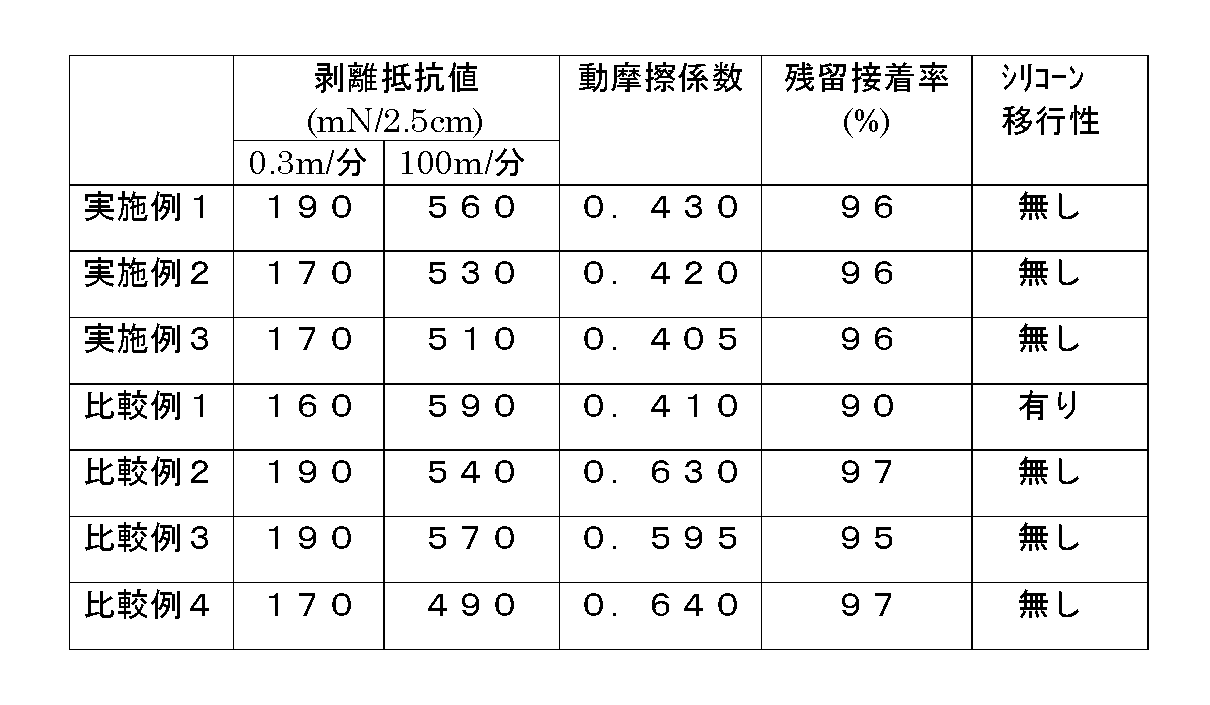
得られた剥離性硬化皮膜形成用シリコ−ン組成物を、ポリエチレンラミネ−ト上質紙の表面に約1.0g/m2となるような量塗布し、次いで、これを150℃で30秒間加熱処理して硬化皮膜を形成させた。この硬化皮膜の剥離抵抗値,動摩擦係数,シリコーン移行性および残留接着率を測定した。これらの結果を表1に示した。
【0016】
【比較例1】
実施例1において、粘度7,000mPa・sの分子鎖両末端トリメチルシロキシ基封鎖ジメチルシロキサン・メチルヘキセニルシロキサン共重合体(ジメチルシロキサン単位99.6モル%,メチルヘキセニルシロキサン単位0.4モル%)の代わりに、粘度7000mPa・sの分子鎖両末端トリメチルシロキシ基封鎖ポリジメチルシロキサンを配合した以外は実施例1と同様にして、剥離性硬化皮膜形成用シリコーン組成物を調製した。
得られた剥離性硬化皮膜形成用シリコ−ン組成物を、ポリエチレンラミネ−ト上質紙の表面に約1.0g/m2となるような量塗布し、次いで、これを130℃で20秒間加熱処理して硬化皮膜を形成させた。この硬化皮膜の剥離抵抗値,動摩擦係数,シリコーン移行性および残留接着率を測定した。これらの結果を表1に示した。
【0017】
【比較例2】
実施例1において、粘度7,000mPa・sの分子鎖両末端トリメチルシロキシ基封鎖ジメチルシロキサン・メチルヘキセニルシロキサン共重合体(ジメチルシロキサン単位99.6モル%,メチルヘキセニルシロキサン単位0.4モル%)の代わりに、粘度7,000mPa・sの分子鎖両末端トリメチルシロキシ基封鎖ジメチルシロキサン・メチルヘキセニルシロキサン共重合体(ジメチルシロキサン単位98モル%,メチルヘキセニルシロキサン単位2モル%)を配合した以外は実施例1と同様にして、剥離性硬化皮膜形成用シリコーン組成物を調製した。
得られた剥離性硬化皮膜形成用シリコ−ン組成物を、ポリエチレンラミネ−ト上質紙の表面に約1.0g/m2となるような量塗布し、次いで、これを130℃で20秒間加熱処理して硬化皮膜を形成させた。この硬化皮膜の剥離抵抗値,動摩擦係数,シリコーン移行性および残留接着率を測定した。これらの結果を表1に示した。
【0018】
【比較例3】
実施例1において、粘度7,000mPa・sの分子鎖両末端トリメチルシロキシ基封鎖ジメチルシロキサン・メチルヘキセニルシロキサン共重合体(ジメチルシロキサン単位99.6モル%,メチルヘキセニルシロキサン単位0.4モル%)の代わりに、粘度500mPa・sの分子鎖両末端ジメチルビニルシロキシ基封鎖ジメチルシロキサン・メチルビニルシロキサン共重合体(ジメチルシロキサン単位99.5モル%,メチルビニルシロキサン単位0.5モル%)を配合した以外は実施例1と同様にして、剥離性硬化皮膜形成用シリコーン組成物を調製した。
得られた剥離性硬化皮膜形成用シリコ−ン組成物を、ポリエチレンラミネ−ト上質紙の表面に約1.0g/ m2となるような量塗布し、次いで、これを130℃で20秒間加熱処理して硬化皮膜を形成させた。この硬化皮膜の剥離抵抗値,動摩擦係数,シリコーン移行性および残留接着率を測定した。これらの結果を表1に示した。
【0019】
【実施例2】
粘度400mPa・sの分子鎖両末端ジメチルビニルシロキシ基封鎖ジメチルシロキサン・メチルビニルシロキサン共重合体(ジメチルシロキサン単位96モル%,メチルビニルシロキサン単位4モル%)83.7重量部に、粘度4,000mPa・sの分子鎖両末端トリメチルシロキシ基封鎖ジメチルシロキサン・メチルヘキセニルシロキサン共重合体(ジメチルシロキサン単位99.6モル%,メチルヘキセニルシロキサン単位0.4モル%)7.0重量部、粘度20mPa・sの分子鎖両末端トリメチルシロキシ基封鎖メチルハイドロジェンポリシロキサン9重量部および1−エチニル−1−シクロヘキサノール0.3重量部を加えて、これらを均一に混合した。次いでこれに、塩化白金酸と1,3−ジビニルテトラメチルジシロキサンとの錯塩を白金金属量が100ppmとなるような量添加配合して、粘度400mPa・sの剥離性硬化皮膜形成用シリコーン組成物を調製した。
得られた剥離性硬化皮膜形成用シリコ−ン組成物を、ポリエチレンラミネ−ト上質紙の表面に約1.0g/m2となるような量塗布し、次いで、これを130℃で20秒間加熱処理して硬化皮膜を形成させた。この硬化皮膜の剥離抵抗値,動摩擦係数,シリコーン移行性および残留接着率を測定した。これらの結果を表1に示した。
【0020】
【実施例3】
実施例2において、粘度4,000mPa・sの分子鎖両末端トリメチルシロキシ基封鎖ジメチルシロキサン・メチルヘキセニルシロキサン共重合体(ジメチルシロキサン単位99.6モル%,メチルヘキセニルシロキサン単位0.4モル%)の代わりに、粘度8,000mPa・sの分子鎖両末端トリメチルシロキシ基封鎖ジメチルシロキサン・メチルヘキセニルシロキサン共重合体(ジメチルシロキサン単位99.8モル%,メチルヘキセニルシロキサン単位0.2モル%)を配合した以外は実施例2と同様にして、粘度500mPa・sの剥離性硬化皮膜形成用シリコーン組成物を調製した。
得られた剥離性硬化皮膜形成用シリコ−ン組成物を、ポリエチレンラミネ−ト上質紙の表面に約1.0g/m2となるような量塗布し、次いで、これを130℃で20秒間加熱処理して硬化皮膜を形成させた。この硬化皮膜の剥離抵抗値,動摩擦係数,シリコーン移行性および残留接着率を測定した。これらの結果を表1に示した。
【0021】
【比較例4】
粘度400mPa・sの分子鎖両末端ジメチルビニルシロキシ基封鎖ジメチルシロキサン・メチルビニルシロキサン共重合体(ジメチルシロキサン単位96モル%,メチルビニルシロキサン単位4モル%)90.7重量部に、粘度20mPa・sの分子鎖両末端トリメチルシロキシ基封鎖メチルハイドロジェンポリシロキサン9重量部および1−エチニル−1−シクロヘキサノール0.3重量部を加えて、これらを均一に混合した。次いでこれに、塩化白金酸と1,3−ジビニルテトラメチルジシロキサンとの錯塩を白金金属量が100ppmとなるような量添加配合して、剥離性硬化皮膜形成用シリコーン組成物を調製した。
得られた剥離性硬化皮膜形成用シリコ−ン組成物を、ポリエチレンラミネ−ト上質紙の表面に約1.0g/m2となるような量塗布し、次いで、これを130℃で20秒間加熱処理して硬化皮膜を形成させた。この硬化皮膜の剥離抵抗値,動摩擦係数,シリコーン移行性および残留接着率を測定した。これらの結果を表1に示した。
【0022】
【表1】
【発明の効果】
本発明組成物は、上記(A)成分〜(C)成分からなり、特に(A)成分として(A-1)成分と(A-2)成分の混合物を使用しているので、硬化後、剥離性、すべり性に優れた皮膜を形成し、かつ、この剥離性硬化皮膜に粘着した粘着性物質の残留接着率を低下させることがないという特徴を有する。[0001]
BACKGROUND OF THE INVENTION
The present invention relates to a silicone composition for forming a peelable cured film. Specifically, a peelable cured film for an adhesive substance is formed on the surface of various substrates such as various paper materials, laminated paper, synthetic resin films, and metal foils. The present invention relates to a solvent-free silicone composition for forming a peelable cured film.
[0002]
[Prior art]
A curable silicone composition containing organopolysiloxane as a main component is used as a release liner for pressure-sensitive adhesive tapes and pressure-sensitive adhesive sheets because the cured film exhibits releasability with respect to pressure-sensitive adhesive substances. However, depending on the application, this type of composition requires not only peelability, but also smoothness between paper, between plastic films, between paper and plastic films, and between paper, plastic films, and human hands. Often done. Therefore, conventionally, many silicone compositions such as organic solvent solution type and aqueous emulsion type have been proposed as silicone compositions for forming a peelable cured film having such characteristics. However, although the former organic solvent solution type is excellent in releasability, smoothness, and curing characteristics, it requires a large amount of organic solvent, which adversely affects air pollution and the health of workers. There was a problem such as high costs. In addition, the latter aqueous emulsion type has a drawback in that it requires high temperature and long time heating to form a film, resulting in low productivity. In addition, since it is difficult to emulsify, it is difficult to use a high molecular weight organopolysiloxane, and since an emulsifier is used, the properties of the obtained cured film are inferior to those of an organic solvent solution type. there were.
[0003]
On the other hand, a solvent-free peelable cured film-forming silicone composition using no organic solvent or water, for example, a vinyl group-containing diorganopolysiloxane having a viscosity of 50 to 4000 mPa · s at 25 ° C., and at least silicon in one molecule A composition comprising an organohydrogenpolysiloxane having three hydrogen atoms bonded to an atom, a platinum-based catalyst, and an activity inhibitor has been proposed (see Japanese Patent Publication No. 52-47485). However, the cured film of this composition has a drawback in that the slipperiness is poor compared to the organic solvent solution type film as described above, and the application is thus limited. Further, a mixture of 100 to 50 parts by weight of a vinyl group-containing polysiloxane blocked with trialkylsiloxy groups at both ends of the molecular chain and 0 to 50 parts by weight of a vinyl group-containing polysiloxane blocked with dimethylvinylsiloxy groups, methyl hydrogen A solventless silicone composition comprising polysiloxane and a platinum-based catalyst is also known (see JP-A-7-258606). Although this composition has a slightly improved sliding property, it cannot be said that it is sufficient, and since the curability is low, it was not satisfactory depending on the application. For example, when this composition is used as a release agent for kraft tape, the sliding property is not sufficient, so the frictional resistance between the tape and the hand increases when the tape is applied to cardboard, etc., resulting in damage to the hand. There is also a problem that the pressure-sensitive adhesive does not adhere to the corrugated cardboard and does not adhere to the cardboard and peels over time because no force is applied to the tape crimping. In order to improve the smoothness, a method of adding dimethylsiloxane oil, polyether-modified silicone oil, surfactant, wax, etc. has been tried, but some of these additives are migrated on the surface of the cured film. As a result, the adhesive strength of the pressure-sensitive adhesive is reduced.
[0004]
[Problems to be solved by the invention]
As a result of intensive studies to solve the above-mentioned drawbacks, the present inventors have reached the present invention.
That is, the object of the present invention is excellent in curability, and after curing, it has excellent peelability and smoothness on various substrates such as paper and plastic films, and reduces the adhesive properties of adhesive substances. An object of the present invention is to provide a silicone composition for forming a peelable cured film capable of forming a cured film without any problem.
[0005]
[Means for Solving the Problems]
In the present invention, (A) 99 to 90 parts by weight of the following component (A-1) and 1 to 10 parts by weight of the component (A-2) 100 parts by weight, and (A-1) the viscosity at 25 ° C. is 5 to 5 parts. A linear diorganopolysiloxane having a molecular chain of both ends blocked with dimethylalkenylsiloxy groups and an alkenyl group content of 0.2 to 10.0 mol% of all organic groups (A -2) Viscosity at 25 ° C. is 4,000 to 8,000 mPa · s, both ends of the molecular chain are blocked with trimethylsiloxy groups, and the side chain has an alkenyl group bonded to at least two silicon atoms. The linear diorganopolysiloxane (B) having an alkenyl group content of 0.1 to 0.2 mol% of all organic groups has a viscosity of 1 to 1,000 mPa · s at 25 ° C. Organo having at least three silicon-bonded hydrogen atoms Idro polysiloxane 3-50 parts by weight, and (C) consists of platinum catalyst a catalytic amount, about cured release coating-forming silicone composition, characterized by containing substantially no organic solvent.
[0006]
Hereinafter, the composition of the present invention will be described in detail.
The component (A-1), which is the main component of the composition of the present invention, has both molecular chain ends blocked with dimethylalkenylsiloxy groups, and the alkenyl group content is 0.2 to 10.0 mol% of the total organic groups. Linear diorganopolysiloxane. As such component (A-1), the general formula:
[Chemical 1]
[0007]
Component (A-2) is a component that imparts slipperiness to the cured film of the composition of the present invention. Both ends of the molecular chain are blocked with trimethylsiloxy groups, and the alkenyl group content is 0.1 to 0 of all organic groups. It is a linear alkenyl group-containing diorganopolysiloxane that is 2 mol%. As such (A-2) component,
[Chemical 1]
[0008]
Component (A) is a mixture of 99 to 90 parts by weight of component (A-1) and 1 to 10 parts by weight of component (A-2), and 94 to 98 parts by weight of component (A-1) and (A- 2) It is preferable to mix 6 to 2 parts by weight of the component.
[0009]
The (B) component organohydrogenpolysiloxane is a component that acts as a crosslinking agent. This organohydrogenpolysiloxane has at least three silicon-bonded hydrogen atoms in one molecule, and the bonding position is not particularly limited. Examples of organic groups bonded to silicon atoms other than hydrogen atoms include alkyl groups such as methyl, ethyl, propyl, butyl, pentyl, and hexyl groups; aryl groups such as phenyl, tolyl, and xylyl groups; benzyl And monovalent hydrocarbon groups that do not contain an aliphatic unsaturated bond such as an aralkyl group such as a phenethyl group or a phenethyl group. The viscosity of this component at 25 ° C. is 1 to 1,000 mPa · s. The compounding amount of this component is in the range of 3 to 50 parts by weight with respect to 100 parts by weight of component (A). This is because if the amount of this component is less than 3 parts by weight, the composition of the present invention will be insufficiently cured, and if it exceeds 50 parts by weight, the peel resistance value of the cured film will change over time. is there.
[0010]
The platinum-based catalyst of component (C) is a catalyst for accelerating the curing of the composition of the present invention. Platinum such as platinum black, platinum-supported silica, platinum-supported activated carbon, etc., chloroplatinic acid, chloroplatinic acid alcohol solution, Examples thereof include platinum compounds such as a complex of chloroplatinic acid and an olefin, and a complex of chloroplatinic acid and an alkenylsiloxane. The compounding amount of this component may be a catalyst amount, and is preferably an amount such that the amount of platinum metal is 1 to 1,000 ppm with respect to the total amount of component (A) and component (B).
[0011]
The composition of the present invention comprises the above components (A) to (C), but in addition to these components, 3-methyl-1-butyn-3-ol, 1-ethynyl-1-cyclohexanol Known as additives for silicone compositions for forming peelable cured films such as curing retarders such as, phenylbutynol and benzotriazole, inorganic fillers such as fine powdered silica, pigments, heat resistant additives, organic resin powders and dyes Addition and blending of the components may be carried out as long as the object of the present invention is not impaired. As for the compounding quantity of a hardening retarder, 0.01-2.0 weight part is preferable with respect to 100 weight part of total amounts of (A) component and (B) component. The viscosity at 25 ° C. of the composition of the present invention is preferably in the range of 50 to 1,000 mPa · s from the viewpoint of coating properties, and can be applied without using an organic solvent within this viscosity range. it can.
[0012]
The composition of the present invention can be easily produced by uniformly mixing the components (A) to (C). In this case, after mixing (A) component and (B) component, it is preferable to add and mix (C) component or (C) component and a curing retarder.
[0013]
The composition of the present invention as described above is applied to the surface of various base materials such as various paper materials, laminated paper, and synthetic resin film and cured to peel off the adhesive material on the surface of these base materials. In addition, this cured film has a feature that it is excellent in slipperiness and does not deteriorate the adhesive property of the adhesive substance. In addition, since the composition of the present invention does not substantially contain an organic solvent, it has an advantage that it is preferable from the viewpoints of environmental protection and work environment improvement. Moreover, this invention composition has the advantage that the peeling resistance value in low speed from high speed can be controlled by changing the compounding ratio of the said (A) component and (B) component. From these facts, the composition of the present invention is particularly useful as a release agent for kraft tape. In addition to the release liner, it can be used as a peelable paint.
[0014]
【Example】
Next, the present invention will be described in detail with reference to examples. In addition, the value of the viscosity in an Example is the value measured in 25 degreeC. Moreover, the measurement of the peeling resistance value of a cured film of the silicone composition for peelable cured film formation, a dynamic friction coefficient, silicone transferability, and the residual adhesive rate (%) of an adhesive substance was performed in accordance with the following method.
○ Peeling resistance value A predetermined amount of the peelable cured film-forming silicone composition was applied to the surface of the paper to form a cured film. An acrylic pressure-sensitive adhesive [manufactured by Toyo Ink Co., Ltd., trade name: Olivevine BPS5127] was applied to the surface of the film, and this was heat-dried at a temperature of 70 ° C. for 2 minutes. Next, a laminated paper was laminated on this, and a load of 196.2 mN / cm 2 was applied, and the mixture was allowed to stand for 24 hours under conditions of a temperature of 25 ° C. and a humidity of 60%. Next, using Tensilon and a high-speed peeling tester, the laminated paper was pulled at an angle of 180 degrees at each speed of 0.3 m / min and 100 m / min, and the force (mN) required for peeling was measured. All the sample widths were 2.5 cm.
A dynamic friction coefficient peelable cured film-forming silicone composition was applied to the surface of the paper and cured to prepare a release paper. The release paper was fixed on the sample stage of a high-speed peel tester with the release surface facing up. Also, the release paper prepared in the same manner was wrapped around a 5 cm × 5 cm × 1 cm sample holder with the release paper surface facing outward, and fixed, and a load of 1.962 N was applied on the release paper surface on the sample table. I put it over. Using a high speed peel tester, the sample holder was pulled at a speed of 10 m / min, and the resistance (N) required at this time was measured. The dynamic friction coefficient was calculated from the resistance value according to the following formula. The smaller this value, the better the slipperiness.
[Formula 1]
[Formula 2]
[0015]
[Example 1]
A dimethylvinylsiloxy group-blocked dimethylsiloxane / methylvinylsiloxane copolymer (98 mol% dimethylsiloxane unit, 2 mol% methylvinylsiloxane unit) with both ends of a molecular chain having a viscosity of 10,000 mPa · s and a viscosity of 60 mPa · s 67.2 parts by weight of dimethylvinylsiloxy-blocked polydimethylsiloxane blocked at both ends of the molecular chain was mixed to obtain a vinyl group-containing diorganopolysiloxane mixture (vinyl group content 3.1 mol%) having a viscosity of 250 mPa · s. . Next, a dimethylsiloxane / methylhexenylsiloxane copolymer blocked with trimethylsiloxy groups at both ends of the molecular chain having a viscosity of 7,000 mPa · s (dimethylsiloxane unit 99.6 mol%, methylhexenylsiloxane unit 0.4 mol%) 3. 5 parts by weight, 9 parts by weight of methyl hydrogen polysiloxane blocked with trimethylsiloxy group-blocked methylhydrogen polysiloxane having a viscosity of 20 mPa · s and 0.3 parts by weight of 1-ethynyl-1-cyclohexanol were added and mixed uniformly. Further, a complex composition of chloroplatinic acid and 1,3-divinyltetramethyldisiloxane was added to this mixture in an amount so that the amount of platinum metal was 100 ppm, and a silicone composition for forming a peelable cured film having a viscosity of 270 mPa · s. A product was prepared.
The obtained silicone composition for forming a peelable cured film was applied to the surface of polyethylene laminate fine paper in an amount of about 1.0 g / m 2 and then heated at 150 ° C. for 30 seconds. The cured film was formed by processing. The peel resistance, dynamic friction coefficient, silicone transferability and residual adhesion rate of this cured film were measured. These results are shown in Table 1.
[0016]
[Comparative Example 1]
In Example 1, a dimethylsiloxane / methylhexenylsiloxane copolymer blocked with a trimethylsiloxy group at both ends of a molecular chain having a viscosity of 7,000 mPa · s (dimethylsiloxane unit 99.6 mol%, methylhexenylsiloxane unit 0.4 mol%) Instead, a silicone composition for forming a peelable cured film was prepared in the same manner as in Example 1 except that a polydimethylsiloxane blocked with both ends of a molecular chain having a viscosity of 7000 mPa · s was blended.
The obtained silicone composition for forming a peelable cured film was applied to the surface of a polyethylene laminate fine paper in an amount of about 1.0 g / m 2 and then heated at 130 ° C. for 20 seconds. The cured film was formed by processing. The peel resistance, dynamic friction coefficient, silicone transferability and residual adhesion rate of this cured film were measured. These results are shown in Table 1.
[0017]
[Comparative Example 2]
In Example 1, a dimethylsiloxane / methylhexenylsiloxane copolymer blocked with a trimethylsiloxy group at both ends of a molecular chain having a viscosity of 7,000 mPa · s (dimethylsiloxane unit 99.6 mol%, methylhexenylsiloxane unit 0.4 mol%) Instead of the examples, except that a dimethylsiloxane / methylhexenylsiloxane copolymer having a viscosity of 7,000 mPa · s and having both ends of a molecular chain blocked with a trimethylsiloxy group was blocked (dimethylsiloxane unit 98 mol%, methylhexenylsiloxane unit 2 mol%). In the same manner as in Example 1, a silicone composition for forming a peelable cured film was prepared.
The obtained silicone composition for forming a peelable cured film was applied to the surface of a polyethylene laminate fine paper in an amount of about 1.0 g / m 2 and then heated at 130 ° C. for 20 seconds. The cured film was formed by processing. The peel resistance, dynamic friction coefficient, silicone transferability and residual adhesion rate of this cured film were measured. These results are shown in Table 1.
[0018]
[Comparative Example 3]
In Example 1, a dimethylsiloxane / methylhexenylsiloxane copolymer blocked with trimethylsiloxy groups at both ends of a molecular chain having a viscosity of 7,000 mPa · s (99.6 mol% of dimethylsiloxane units, 0.4 mol% of methylhexenylsiloxane units). Instead of blending a dimethylvinylsiloxy group-blocked dimethylsiloxane / methylvinylsiloxane copolymer with a viscosity of 500 mPa · s (dimethylsiloxane unit 99.5 mol%, methylvinylsiloxane unit 0.5 mol%). Prepared a peelable cured film-forming silicone composition in the same manner as in Example 1.
The obtained silicone composition for forming a peelable cured film was applied to the surface of a polyethylene laminate fine paper in an amount of about 1.0 g / m 2 and then heated at 130 ° C. for 20 seconds. The cured film was formed by processing. The peel resistance, dynamic friction coefficient, silicone transferability and residual adhesion rate of this cured film were measured. These results are shown in Table 1.
[0019]
[Example 2]
A dimethylvinylsiloxy group-blocked dimethylsiloxane / methylvinylsiloxane copolymer (96 mol% dimethylsiloxane unit, 4 mol% methylvinylsiloxane unit) having a viscosity of 400 mPa · s and having both ends dimethylvinylsiloxy group blocked, and a viscosity of 4,000 mPas.・ Trimethylsiloxy group-blocked dimethylsiloxane / methylhexenylsiloxane copolymer (99.6 mol% of dimethylsiloxane units, 0.4 mol% of methylhexenylsiloxane units) 7.0 parts by weight, viscosity 20 mPa · s 9 parts by weight of methylhydrogenpolysiloxane blocked with trimethylsiloxy groups at both ends of the molecular chain and 0.3 part by weight of 1-ethynyl-1-cyclohexanol were added and mixed uniformly. Subsequently, a complex composition of chloroplatinic acid and 1,3-divinyltetramethyldisiloxane is added and blended in such an amount that the amount of platinum metal becomes 100 ppm, and a silicone composition for forming a peelable cured film having a viscosity of 400 mPa · s. Was prepared.
The obtained silicone composition for forming a peelable cured film was applied to the surface of a polyethylene laminate fine paper in an amount of about 1.0 g / m 2 and then heated at 130 ° C. for 20 seconds. The cured film was formed by processing. The peel resistance, dynamic friction coefficient, silicone transferability and residual adhesion rate of this cured film were measured. These results are shown in Table 1.
[0020]
[Example 3]
In Example 2, a dimethylsiloxane / methylhexenylsiloxane copolymer blocked with a trimethylsiloxy group blocked at both ends of a molecular chain having a viscosity of 4,000 mPa · s (99.6 mol% of dimethylsiloxane units, 0.4 mol% of methylhexenylsiloxane units). Instead, a dimethylsiloxane / methylhexenylsiloxane copolymer having a viscosity of 8,000 mPa · s at both ends of the molecular chain blocked with a trimethylsiloxy group was blocked (dimethylsiloxane unit 99.8 mol%, methylhexenylsiloxane unit 0.2 mol%). Except for the above, a silicone composition for forming a peelable cured film having a viscosity of 500 mPa · s was prepared in the same manner as in Example 2.
The obtained silicone composition for forming a peelable cured film was applied to the surface of a polyethylene laminate fine paper in an amount of about 1.0 g / m 2 and then heated at 130 ° C. for 20 seconds. The cured film was formed by processing. The peel resistance, dynamic friction coefficient, silicone transferability and residual adhesion rate of this cured film were measured. These results are shown in Table 1.
[0021]
[Comparative Example 4]
A dimethylvinylsiloxy group-blocked dimethylsiloxane / methylvinylsiloxane copolymer (96 mol% of dimethylsiloxane units, 4 mol% of methylvinylsiloxane units) with a viscosity of 400 mPa · s is added to 90.7 parts by weight of a dimethylvinylsiloxy group-blocked dimethylvinylsiloxy group. 9 parts by weight of methylhydrogenpolysiloxane blocked with trimethylsiloxy groups at both ends of the molecular chain and 0.3 part by weight of 1-ethynyl-1-cyclohexanol were added and mixed uniformly. Next, a complex composition of chloroplatinic acid and 1,3-divinyltetramethyldisiloxane was added and blended in such an amount that the amount of platinum metal was 100 ppm to prepare a silicone composition for forming a peelable cured film.
The obtained silicone composition for forming a peelable cured film was applied to the surface of a polyethylene laminate fine paper in an amount of about 1.0 g / m 2 and then heated at 130 ° C. for 20 seconds. The cured film was formed by processing. The peel resistance, dynamic friction coefficient, silicone transferability and residual adhesion rate of this cured film were measured. These results are shown in Table 1.
[0022]
[Table 1]
【Effect of the invention】
The composition of the present invention comprises the above components (A) to (C), and in particular, since a mixture of the components (A-1) and (A-2) is used as the component (A), after curing, It has a feature that it forms a film excellent in peelability and slipperiness and does not lower the residual adhesion rate of the adhesive substance adhered to the peelable cured film.
Claims (1)
(A-1)25℃における粘度が5〜1,000mPa・sであり、分子鎖両末端がジメチルアルケニルシロキシ基で封鎖され、アルケニル基含有量が全有機基の0.2〜10.0モル%である直鎖状ジオルガノポリシロキサン
(A-2)25℃における粘度が4,000〜8,000mPa・sであり、分子鎖両末端がトリメチルシロキシ基で封鎖され、側鎖に少なくとも2個のけい素原子に結合したアルケニル基を有し、アルケニル基含有量が全有機基の0.1〜0.2モル%である直鎖状ジオルガノポリシロキサン
(B)25℃における粘度が1〜1,000mPa・sであり、一分子中に少なくとも3個のケイ素原子結合水素原子を有するオルガノハイドロジェンポリシロキサン 3〜50重量部、
および
(C)白金系触媒 触媒量
からなり、実質的に有機溶剤を含有しないことを特徴とする剥離性硬化皮膜形成用シリコーン組成物。(A) 100 parts by weight of a mixture of 99 to 90 parts by weight of the following component (A-1) and 1 to 10 parts by weight of component (A-2)
(A-1) The viscosity at 25 ° C. is 5 to 1,000 mPa · s, both ends of the molecular chain are blocked with dimethylalkenylsiloxy groups, and the alkenyl group content is 0.2 to 10.0 mol of all organic groups. % Linear diorganopolysiloxane
(A-2) An alkenyl group having a viscosity at 25 ° C. of 4,000 to 8,000 mPa · s, both ends of the molecular chain blocked with trimethylsiloxy groups, and bonded to at least two silicon atoms in the side chain A linear diorganopolysiloxane (B) having an alkenyl group content of 0.1 to 0.2 mol% of all organic groups, a viscosity at 25 ° C. of 1 to 1,000 mPa · s, and one molecule 3 to 50 parts by weight of an organohydrogenpolysiloxane having at least 3 silicon-bonded hydrogen atoms in it,
And (C) a platinum-based catalyst. A silicone composition for forming a peelable cured film, comprising a catalytic amount and substantially free of an organic solvent.
Priority Applications (4)
| Application Number | Priority Date | Filing Date | Title |
|---|---|---|---|
| JP2000400618A JP4892129B2 (en) | 2000-12-28 | 2000-12-28 | Silicone composition for forming a peelable cured film |
| US10/024,062 US6562469B2 (en) | 2000-12-28 | 2001-12-18 | Silicone composition for forming cured release coatings |
| KR1020010085866A KR20020055412A (en) | 2000-12-28 | 2001-12-27 | Silicone composition for forming cured release coatings |
| EP01130858A EP1221468A1 (en) | 2000-12-28 | 2001-12-27 | Essentially solventless silicone composition for forming cured release coatings |
Applications Claiming Priority (1)
| Application Number | Priority Date | Filing Date | Title |
|---|---|---|---|
| JP2000400618A JP4892129B2 (en) | 2000-12-28 | 2000-12-28 | Silicone composition for forming a peelable cured film |
Related Child Applications (1)
| Application Number | Title | Priority Date | Filing Date |
|---|---|---|---|
| JP2011218901A Division JP5167399B2 (en) | 2011-10-03 | 2011-10-03 | Substrate with a peelable cured film formed on the surface |
Publications (2)
| Publication Number | Publication Date |
|---|---|
| JP2002201417A JP2002201417A (en) | 2002-07-19 |
| JP4892129B2 true JP4892129B2 (en) | 2012-03-07 |
Family
ID=18865179
Family Applications (1)
| Application Number | Title | Priority Date | Filing Date |
|---|---|---|---|
| JP2000400618A Expired - Fee Related JP4892129B2 (en) | 2000-12-28 | 2000-12-28 | Silicone composition for forming a peelable cured film |
Country Status (4)
| Country | Link |
|---|---|
| US (1) | US6562469B2 (en) |
| EP (1) | EP1221468A1 (en) |
| JP (1) | JP4892129B2 (en) |
| KR (1) | KR20020055412A (en) |
Families Citing this family (24)
| Publication number | Priority date | Publication date | Assignee | Title |
|---|---|---|---|---|
| JP3781105B2 (en) * | 2001-07-12 | 2006-05-31 | 信越化学工業株式会社 | Silicone composition and release film using the same |
| GB0316162D0 (en) * | 2003-07-10 | 2003-08-13 | Dow Corning | Silicone release coating compositions |
| JP4524549B2 (en) * | 2003-08-14 | 2010-08-18 | 信越化学工業株式会社 | Release agent composition for silicone adhesive and release sheet using the same |
| US7244800B2 (en) * | 2003-12-12 | 2007-07-17 | Rhodia Chimie | Reduction of coefficient of friction for thermal addition curable solventless silicone release coating systems |
| JP2005336270A (en) * | 2004-05-25 | 2005-12-08 | Shin Etsu Chem Co Ltd | Liquid silicone rubber coating composition and air bag |
| WO2006070947A1 (en) * | 2004-12-28 | 2006-07-06 | Dow Corning Toray Co., Ltd. | Solvent-free organopolysiloxane composition for forming releasable cured coating film |
| KR101351815B1 (en) * | 2005-07-28 | 2014-01-15 | 다우 코닝 코포레이션 | Release coating compositions having improved release force profiles |
| FR2901800B1 (en) * | 2006-05-31 | 2008-08-29 | Rhodia Recherches & Tech | CROSS-LINKABLE SILICONE COMPOSITION FOR THE PRODUCTION OF ANTI-ADHERENT COATINGS FOR POLYMERIC FILMS |
| JP5207626B2 (en) * | 2006-12-26 | 2013-06-12 | 東レ・ダウコーニング株式会社 | Heat curable silicone rubber composition for rubber laminate comprising silicone rubber layer and different rubber layer, rubber laminate and method for producing the same |
| EP2170985B1 (en) * | 2007-07-19 | 2019-06-19 | Imerys Talc America, Inc. | Silicone coatings, methods of making silicone coated articles and coated articles therefrom |
| JP5398148B2 (en) * | 2008-01-22 | 2014-01-29 | 三菱樹脂株式会社 | Release film |
| CN101649158B (en) * | 2009-08-25 | 2012-06-27 | 苏州大学 | Organosilicon insulating impregnating varnish and preparation method thereof |
| JP2012207192A (en) * | 2011-03-30 | 2012-10-25 | Dow Corning Toray Co Ltd | Two-component silicone rubber composition |
| WO2015058398A1 (en) * | 2013-10-25 | 2015-04-30 | Dow Corning (China) Holding Co., Ltd. | Solventless release coating organopolysiloxane composition and sheet-form substrate having cured release coating |
| US20150307759A1 (en) | 2014-04-28 | 2015-10-29 | Ames Rubber Corporation | Solventless curable coating systems and uses thereof |
| KR101932405B1 (en) * | 2014-06-27 | 2018-12-27 | 다우 코닝 타이완 인코포레이티드 | Silicone release coating composition and low release force emulsion silicone release coating for films and papers having cured release coating |
| JP2016098319A (en) * | 2014-11-21 | 2016-05-30 | 信越化学工業株式会社 | Low friction silicone coating agent composition, and method of forming low friction silicone rubber coating film |
| KR102273090B1 (en) * | 2015-06-08 | 2021-07-06 | 신에쓰 가가꾸 고교 가부시끼가이샤 | Silicone composition for release paper or release film, release paper and release film |
| US10695629B2 (en) | 2016-04-04 | 2020-06-30 | Karsten Manufacturing Corporation | Golf club heads with cavities and inserts and related methods |
| US11618306B2 (en) | 2016-10-27 | 2023-04-04 | Nicholas J. Singer | Skeleton for truck bed and convertible top |
| KR102326676B1 (en) * | 2018-10-12 | 2021-11-15 | 주식회사 엘지화학 | Method of manufacturing silicon heat-radiadting pad and heat-radiating member comprising silicon heat-radiating pad |
| EP4017925B1 (en) * | 2019-08-22 | 2024-01-24 | Dow Silicones Corporation | Polyorganosiloxane release coating composition |
| CN111484620B (en) * | 2020-05-27 | 2021-11-23 | 北京天山新材料技术有限公司 | Adhesion promoter for addition type silicone rubber, preparation method and application thereof |
| CN120129721A (en) | 2022-11-18 | 2025-06-10 | 陶氏东丽株式会社 | Curable organopolysiloxane composition and laminate |
Family Cites Families (6)
| Publication number | Priority date | Publication date | Assignee | Title |
|---|---|---|---|---|
| DE2540582C3 (en) | 1975-09-11 | 1980-03-20 | Fritz 6057 Dietzenbach Juestl | Pet cage |
| JPS61264052A (en) * | 1985-05-17 | 1986-11-21 | Shin Etsu Chem Co Ltd | Silicone composition for release paper |
| JPH0619028B2 (en) * | 1989-01-17 | 1994-03-16 | 信越化学工業株式会社 | Organopolysiloxane composition for release coating |
| US4946878A (en) * | 1990-01-29 | 1990-08-07 | Dow Corning Corporation | Rapidly curable extrudable organosiloxane compositions |
| JP2915778B2 (en) * | 1994-03-23 | 1999-07-05 | 信越化学工業株式会社 | Silicone composition for release paper |
| JP5219318B2 (en) | 1998-11-25 | 2013-06-26 | 東レ・ダウコーニング株式会社 | Silicone composition for forming a peelable cured film |
-
2000
- 2000-12-28 JP JP2000400618A patent/JP4892129B2/en not_active Expired - Fee Related
-
2001
- 2001-12-18 US US10/024,062 patent/US6562469B2/en not_active Expired - Fee Related
- 2001-12-27 EP EP01130858A patent/EP1221468A1/en not_active Withdrawn
- 2001-12-27 KR KR1020010085866A patent/KR20020055412A/en not_active Withdrawn
Also Published As
| Publication number | Publication date |
|---|---|
| US6562469B2 (en) | 2003-05-13 |
| KR20020055412A (en) | 2002-07-08 |
| US20020123569A1 (en) | 2002-09-05 |
| JP2002201417A (en) | 2002-07-19 |
| EP1221468A1 (en) | 2002-07-10 |
Similar Documents
| Publication | Publication Date | Title |
|---|---|---|
| JP4892129B2 (en) | Silicone composition for forming a peelable cured film | |
| JP4639361B2 (en) | Silicone composition for forming a peelable cured film | |
| JP3504692B2 (en) | Silicone composition for peelable cured film formation | |
| JP5219318B2 (en) | Silicone composition for forming a peelable cured film | |
| EP0640664A2 (en) | Silicone emulsion compositions | |
| WO2020090209A1 (en) | Silicone emulsion composition | |
| JP2003192896A (en) | Silicone emulsion composition and release film with good adhesion to plastic film substrate | |
| JPH07188562A (en) | Silicone release composition | |
| JP3607441B2 (en) | Peelable cured film-forming organopolysiloxane composition | |
| JP5101888B2 (en) | Solvent-free peelable cured film-forming organopolysiloxane composition | |
| JP4367670B2 (en) | Silicone composition for forming a peelable cured film | |
| JP3891260B2 (en) | Curable silicone release agent composition and release paper | |
| JP2915778B2 (en) | Silicone composition for release paper | |
| JP4233652B2 (en) | Silicone composition for forming a peelable cured film | |
| JPH0619028B2 (en) | Organopolysiloxane composition for release coating | |
| JP2003261855A (en) | Silicone composition for forming peelable cured film | |
| JP4169976B2 (en) | Solvent-free addition reaction curable organopolysiloxane composition | |
| JP4093542B2 (en) | Curable silicone release agent composition and release paper using the same | |
| JPH0616941A (en) | Organopolysiloxane composition for forming peelable cured coating film | |
| JP5167399B2 (en) | Substrate with a peelable cured film formed on the surface | |
| JP4753023B2 (en) | Silicone release agent composition and method for producing adhesive paper | |
| JPH04272959A (en) | Releasing silicone composition | |
| JP2009215428A (en) | Release agent composition and release sheet | |
| JPS601899B2 (en) | Silicone composition for release | |
| JPS6346787B2 (en) |
Legal Events
| Date | Code | Title | Description |
|---|---|---|---|
| A621 | Written request for application examination |
Free format text: JAPANESE INTERMEDIATE CODE: A621 Effective date: 20071218 |
|
| A977 | Report on retrieval |
Free format text: JAPANESE INTERMEDIATE CODE: A971007 Effective date: 20101217 |
|
| A131 | Notification of reasons for refusal |
Free format text: JAPANESE INTERMEDIATE CODE: A131 Effective date: 20110125 |
|
| A521 | Request for written amendment filed |
Free format text: JAPANESE INTERMEDIATE CODE: A523 Effective date: 20110328 |
|
| A02 | Decision of refusal |
Free format text: JAPANESE INTERMEDIATE CODE: A02 Effective date: 20110705 |
|
| A521 | Request for written amendment filed |
Free format text: JAPANESE INTERMEDIATE CODE: A523 Effective date: 20111003 |
|
| A911 | Transfer to examiner for re-examination before appeal (zenchi) |
Free format text: JAPANESE INTERMEDIATE CODE: A911 Effective date: 20111013 |
|
| TRDD | Decision of grant or rejection written | ||
| A01 | Written decision to grant a patent or to grant a registration (utility model) |
Free format text: JAPANESE INTERMEDIATE CODE: A01 Effective date: 20111213 |
|
| A01 | Written decision to grant a patent or to grant a registration (utility model) |
Free format text: JAPANESE INTERMEDIATE CODE: A01 |
|
| A61 | First payment of annual fees (during grant procedure) |
Free format text: JAPANESE INTERMEDIATE CODE: A61 Effective date: 20111219 |
|
| R150 | Certificate of patent or registration of utility model |
Free format text: JAPANESE INTERMEDIATE CODE: R150 |
|
| FPAY | Renewal fee payment (event date is renewal date of database) |
Free format text: PAYMENT UNTIL: 20141222 Year of fee payment: 3 |
|
| R250 | Receipt of annual fees |
Free format text: JAPANESE INTERMEDIATE CODE: R250 |
|
| LAPS | Cancellation because of no payment of annual fees |