JP4757936B2 - Pattern recognition method and apparatus, pattern recognition program and recording medium therefor - Google Patents
Pattern recognition method and apparatus, pattern recognition program and recording medium therefor Download PDFInfo
- Publication number
- JP4757936B2 JP4757936B2 JP2009172170A JP2009172170A JP4757936B2 JP 4757936 B2 JP4757936 B2 JP 4757936B2 JP 2009172170 A JP2009172170 A JP 2009172170A JP 2009172170 A JP2009172170 A JP 2009172170A JP 4757936 B2 JP4757936 B2 JP 4757936B2
- Authority
- JP
- Japan
- Prior art keywords
- state
- pattern recognition
- reward value
- likelihood
- hypothesis
- Prior art date
- Legal status (The legal status is an assumption and is not a legal conclusion. Google has not performed a legal analysis and makes no representation as to the accuracy of the status listed.)
- Expired - Fee Related
Links
Images


Classifications
-
- G—PHYSICS
- G10—MUSICAL INSTRUMENTS; ACOUSTICS
- G10L—SPEECH ANALYSIS TECHNIQUES OR SPEECH SYNTHESIS; SPEECH RECOGNITION; SPEECH OR VOICE PROCESSING TECHNIQUES; SPEECH OR AUDIO CODING OR DECODING
- G10L15/00—Speech recognition
- G10L15/08—Speech classification or search
Landscapes
- Engineering & Computer Science (AREA)
- Computational Linguistics (AREA)
- Health & Medical Sciences (AREA)
- Audiology, Speech & Language Pathology (AREA)
- Human Computer Interaction (AREA)
- Physics & Mathematics (AREA)
- Acoustics & Sound (AREA)
- Multimedia (AREA)
- Machine Translation (AREA)
- Information Retrieval, Db Structures And Fs Structures Therefor (AREA)
Description
本発明は、入力信号の特徴パラメータを、認識パターンがルートからリーフノードに至る木構造状のパスで表現される状態遷移モデルと照合し、リーフノードに到達した最尤な状態遷移パスを認識結果とするパターン認識に係り、特に、音声認識に好適なパターン認識に関する。 The present invention compares the feature parameters of the input signal with a state transition model in which the recognition pattern is represented by a tree-structured path from the root to the leaf node, and recognizes the most likely state transition path that has reached the leaf node. In particular, the present invention relates to pattern recognition suitable for speech recognition.
音声認識は、時系列の音声データに対して、予め定義された連鎖可能な単語の繋がり(単語系列)の中から、もっとも確率の高い単語系列を求めるプロセスとして定式化されている。現在主流のHMM(Hidden Markov Model、隠れマルコフモデル)に基づく音声認識エンジンでは、(1)単語を単位として文を構成する単語系列を探索するステップ、および(2)音素を単位として様々な単語について尤もらしい開始時刻および終了時刻を探索するステップ、の2階層で探索が行われる。 Speech recognition is formulated as a process for obtaining a word sequence with the highest probability from word chain sequences (word sequences) defined in advance for time-series speech data. In speech recognition engines based on the current mainstream HMM (Hidden Markov Model), (1) searching for word sequences that make up sentences in units of words, and (2) various words in units of phonemes The search is performed in two layers, a step of searching for a plausible start time and end time.
上記(2)のステップにおいて、各単語はHMM系列として表現される。多くの場合、単語はその読みに従って音素系列に分解され、それぞれの音素について用意された音素HMMを連結することで単語のHMM系列が構成される。図7は、一直線状のHMM系列の一例を示した図である。 In the step (2), each word is expressed as an HMM sequence. In many cases, words are decomposed into phoneme sequences according to the reading, and the HMM sequences of words are constructed by concatenating phoneme HMMs prepared for each phoneme. FIG. 7 is a diagram illustrating an example of a straight HMM sequence.
単語の探索は、HMM系列に対するビタービ(Viterbi)アルゴリズムによって実行される。認識結果の候補の1つである仮説は、開始時刻(1つ前の単語の終了時刻の次の時刻)にHMM系列の先頭の状態に入り、ある時刻(終了時刻)にHMM系列の末尾の状態から出てくる。ビタービアルゴリズムは、仮説がHMM系列に入った時刻から出てくる時刻までの時間の、音声データとHMM系列との音響的特徴との一致度を確率値として出力する。より正確には、この確率値は対数化された尤度(L = log P)で表現され、「音響尤度」と呼ばれる。 The word search is performed by the Viterbi algorithm for the HMM sequence. The hypothesis, which is one of the recognition result candidates, is entered at the beginning of the HMM sequence at the start time (next time after the end time of the previous word), and at the end of the HMM sequence at a certain time (end time). Come out of state. The Viterbi algorithm outputs, as a probability value, the degree of coincidence between the speech data and the acoustic feature of the HMM sequence from the time when the hypothesis enters the HMM sequence to the time when it appears. More precisely, this probability value is expressed in logarithmic likelihood (L = log P) and is called “acoustic likelihood”.
認識処理の途中では単語が確定していないので、様々な単語のHMM系列に対して同時並行してビタービアルゴリズムが実行される。すなわち、様々な単語のHMM系列の状態のそれぞれに、その時点までの音響尤度を保存した仮説が一時記憶される。この仮説は「状態仮説」と呼ばれる。 Since the word is not fixed during the recognition process, the Viterbi algorithm is executed simultaneously on the HMM sequences of various words. That is, hypotheses that store the acoustic likelihood up to that point are temporarily stored in the HMM sequence states of various words. This hypothesis is called the “state hypothesis”.
実際の音声認識では、膨大な種類に及ぶ単語系列を探索するために状態仮説の数は膨大になる。状態仮説の数を節約するために、異なる単語間で先頭から共通の部分HMM系列がマージされる。これは、異なる単語間でも同時刻に共通の部分HMM系列の探索を開始すれば、共通部分の各状態の「音響尤度」は同一だからである。このマージにより、図8に示したような「木構造辞書」が形成される。 In actual speech recognition, the number of state hypotheses is enormous in order to search for word sequences covering a huge variety. In order to save the number of state hypotheses, common partial HMM sequences are merged from the beginning between different words. This is because the “acoustic likelihood” of each state of the common part is the same if a search for a common partial HMM sequence is started at the same time even between different words. By this merging, a “tree structure dictionary” as shown in FIG. 8 is formed.
しかしながら、このような認識対象語彙の「木構造辞書化」を行ってもなお、状態仮説数は爆発的に増大してしまう。そこで、通常は時刻ごとに全ての状態仮説の尤度を比較し、尤度の高い状態仮説だけを次の時刻の探索に残し、尤度の低い状態仮説は探索途中で破棄する「枝刈り」の処理が行われる。代表的な枝刈り手法としては、全状態仮説中の最大尤度から一定の尤度幅以内にある状態仮説を残す一定ビーム幅による枝刈りや、尤度の高い状態仮説から一定個数の状態仮説を残す最大状態仮説数による枝刈りがあり、両手法は併用されるのが一般的である。 However, even if such a recognition target vocabulary is “tree-structured”, the number of state hypotheses increases explosively. Therefore, we usually compare the likelihood of all state hypotheses at each time, leave only the state hypotheses with high likelihood in the next time search, and discard the state hypotheses with low likelihood during the search. Is performed. Typical pruning techniques include pruning with a constant beam width that leaves a state hypothesis that is within a certain likelihood range from the maximum likelihood in all state hypotheses, or a certain number of state hypotheses from a high likelihood state hypothesis. There is a pruning by the maximum number of hypotheses that leave, and both methods are generally used together.
一方、上記(1)のステップは、記述文法に基づく音声認識と、確率言語モデルに基づく音声認識とに大別される。 On the other hand, the step (1) is roughly divided into speech recognition based on a description grammar and speech recognition based on a probabilistic language model.
記述文法に基づく音声認識では、音声認識エンジンが受理する文のセットが単語のネットワークとして用意される。これは「文法」と呼ばれ、その一例を図3に示している。音声認識処理では、文法の文頭のノードから探索が開始され、まず先頭の単語が探索される。単語の探索は上記(2)のステップで行われる。(2)のステップで状態仮説の1つが単語末尾の状態から出てくると、(1)のステップでその単語を経由した遷移先のノードに「単語仮説」と呼ばれる文法レベルの仮説が記録される。単語仮説には、単語のID、開始時刻、終了時刻、遷移元ノードのID、遷移先ノードのID、音声始端からのその時点までの累積尤度が格納される。 In speech recognition based on the description grammar, a set of sentences accepted by the speech recognition engine is prepared as a word network. This is called “grammar” and an example is shown in FIG. In the speech recognition process, the search is started from the node at the beginning of the grammar, and the first word is searched first. The word search is performed in step (2) above. When one of the state hypotheses comes out of the last state of the word in step (2), a grammatical level hypothesis called “word hypothesis” is recorded in the transition destination node via the word in step (1). The The word hypothesis stores the ID of the word, the start time, the end time, the ID of the transition source node, the ID of the transition destination node, and the cumulative likelihood up to that point from the voice start end.
単語仮説が生成された次の時刻には、そのノードから始まる全ての単語について、上記(2)のステップにより探索が開始される。こうして、時間の進行に沿って(1)のステップと(2)のステップとが繰り返されることで、文法で定義される探索空間の全体が探索される。最終的には、音声終端の時刻に文法の文末のノードに到達した単語仮説のうち、累積尤度がもっとも高い仮説に至った単語履歴が認識結果として出力される。 At the next time when the word hypothesis is generated, the search for all the words starting from the node is started by the above step (2). Thus, the entire search space defined by the grammar is searched by repeating the steps (1) and (2) along with the progress of time. Eventually, the word history that has reached the hypothesis with the highest cumulative likelihood among the word hypotheses that have reached the node at the end of the grammar at the time of speech termination is output as the recognition result.
確率言語モデルに基づく音声認識では、上記の文法の代わりに「確率言語モデル」が用いられる。通常、数個(N個)の単語の連鎖の様々な組み合わせに対して、最後の単語を除くN-1単語を条件として最後の単語の条件付出現確率を定義する「N-gram」と呼ばれるモデルが用いられる。前後2単語の連鎖を単位とするものは「bigram」、3単語の連鎖を単位とするものは「trigram」と呼ばれる。図9はbigramの一例を示した図である。 In speech recognition based on a probabilistic language model, a “probabilistic language model” is used instead of the above grammar. Usually called “N-gram” which defines the conditional appearance probability of the last word for various combinations of several (N) word chains, with the N-1 word except the last word as a condition A model is used. A unit having a chain of two words before and after is called “bigram”, and a unit having a chain of three words is called “trigram”. FIG. 9 is a diagram showing an example of bigram.
確率言語モデルに基づく音声認識では、探索空間がネットワークとして用意されないが、記述文法に基づく音声認識の場合と同様に、仮説を用いて文頭の無音(sil)から探索が開始され、文末の無音(sil)の末尾の状態に到達した仮説は探索を終了する。最終的な認識結果の決定や枝刈りの基準となる尤度としては、確率言語モデルが有する言語尤度を音響尤度に加算した値が用いられる。 In speech recognition based on a probabilistic language model, the search space is not prepared as a network, but as in speech recognition based on descriptive grammar, the search is started from silence at the beginning of the sentence (sil) using hypotheses, and silence at the end of the sentence ( The hypothesis that reaches the last state of sil) ends the search. As the likelihood serving as a reference for final recognition result determination and pruning, a value obtained by adding the language likelihood of the stochastic language model to the acoustic likelihood is used.
非特許文献1では、確率言語モデルに基づく音声認識における「言語尤度の先読み」が提案されている。N-gramで与えられる言語尤度は、探索中の単語が確定した時点で確定するが、言語尤度をできるだけ早い時点で探索処理に反映させるために、木構造辞書の分岐ノードに差し掛かったときに、その分岐ノードから到達しうる複数の単語のうち、最大の言語尤度が暫定的な言語尤度として累積尤度に加えられる。
Non-Patent
例えば、図8の木構造辞書と図9の確率言語モデルとを用いた音声認識において、文頭の無音(sil)に続く単語の頭文字/k/を探索中の状態仮説には、「sil-九時」,「sil-会社」および「sil-買い物」の3つのうち、最大値となる「sil-九時」の言語確率0.050を対数化したlog0.050が加えられる。最初の分岐を越えて/k/の次の/a/を探索中の状態仮説には、分岐前のlog0.050は破棄して、「sil-会社」および「sil-買い物」の言語確率のうち最大値となる「sil-会社」の0.020を対数化したlog0.020が加えられる。「買い物」の/m/まで進んだ状態仮説には、log0.020は破棄してlog0.010が加えられる。こうして木構造辞書の探索が進み、状態仮説がリーフに近づくにつれて単語が限定されていき、より正確な言語確率が付与されるようになる。この「言語尤度の先読み」の効果は非常に強力であり、非特許文献1では、ディクテーションタスクの処理時間が1/30に削減されたと報告している。
For example, in speech recognition using the tree structure dictionary of FIG. 8 and the probabilistic language model of FIG. 9, the state hypothesis that is searching for the initial letter / k / following the silence of the sentence head is “sil- The log 0.050 is added to the logarithm of the language probability 0.050 of “sil-9: 00”, which is the maximum value among the three, “9:00”, “sil-company” and “sil-shopping”. For the state hypothesis searching for / a / next to / k / beyond the first branch, log0.050 before the branch is discarded and the language probabilities of “sil-company” and “sil-shopping” are discarded. The log 0.020 logarithm of 0.020 of the maximum “sil-company” is added. Log 0.020 is discarded and log 0.010 is added to the state hypothesis that has advanced to / m / of “shopping”. Thus, as the search of the tree structure dictionary proceeds and the state hypothesis approaches the leaf, the words are limited and more accurate language probabilities are given. The effect of this “Language likelihood look-ahead” is very powerful, and Non-Patent
非特許文献2では、比較的新しい枝刈り手法としてEqual Depth Pruning(木構造辞書の深さに依存する枝刈り)が提案されている。このEqual Depth Pruningでは、尤度に基づく枝刈りにおいて、木構造辞書のルートに近い状態からリーフに近い状態まで様々な深さに存在する状態仮説を満遍なく残すために、全状態仮説のうちの最大尤度を基準とする代わりに、深さ(ルートからの状態数)ごとに基準となる最大尤度が求められ、深さごと個別に一定ビーム幅による枝刈りが行われる。
Non-Patent
非特許文献1の「言語確率の先読み」は、木構造辞書の効率的な探索に非常に強力な効果をもたらす。しかしながら、言語確率をもたない記述文法に基づく音声認識では同手法を利用できない。
“Language probabilistic look-ahead” in Non-Patent
非特許文献2の"Equal depth pruning"は、記述文法に基づく音声認識でも利用できる枝刈り手法である。しかしながら、木構造辞書において1から数十に及ぶ深さのそれぞれに対して、時刻ごとに枝刈りの基準となる尤度を、対象状態仮説の集合の中の最大尤度として求めるために性能が安定せず、状態仮説数を極限まで削減することは難しい。
“Equal depth pruning” in Non-Patent
本発明の目的は、上記した従来技術の課題を解決し、認識率を低下させることなく状態仮説を効率良く枝刈りできるパターン認識方法および装置ならびにパターン認識プログラムおよびその記録媒体を提供することにある。 An object of the present invention is to solve the above-described problems of the prior art and provide a pattern recognition method and apparatus, a pattern recognition program, and a recording medium thereof that can efficiently prun the state hypothesis without reducing the recognition rate. .
上記の目的を達成するために、本発明は、入力信号の特徴パラメータを認識パターンがルートからリーフノードに至る木構造状のパスで表現された状態遷移モデルと照合し、リーフノードに到達した最尤な状態遷移パスを認識結果とするパターン認識装置において、以下のような手段を講じた点に特徴がある。 In order to achieve the above object, the present invention compares the feature parameters of an input signal with a state transition model in which a recognition pattern is represented by a tree-like path from a root to a leaf node, and reaches the leaf node. The pattern recognition apparatus that uses a reasonable state transition path as a recognition result is characterized by the following measures.
(1)入力信号の特徴パラメータを状態遷移モデルと照合し、状態遷移モデルの各状態に対する特徴パラメータの尤度を算出する手段と、各状態から到達可能なリーフノード数に応じた報酬値を算出する手段と、所定の時刻周期で、各状態にある状態仮説の累積尤度と報酬値との加算値同士を比較し、加算値の低い状態仮説を探索対象から除外する枝刈り手段とを具備したことを特徴とする。 (1) The feature parameter of the input signal is checked against the state transition model, the likelihood of the feature parameter for each state of the state transition model is calculated, and the reward value is calculated according to the number of leaf nodes that can be reached from each state And a pruning unit that compares the cumulative value of the state hypothesis in each state with the reward value at a predetermined time period and excludes a state hypothesis having a low addition value from the search target. It is characterized by that.
(2)尤度を算出する手段は、状態遷移モデルの各状態にある状態仮説を自己遷移およびL-R遷移させながら遷移先の各状態において尤度を算出し、報酬値を算出する手段は、木構造のルートノードと分岐後のノードへのL-R遷移において報酬値を算出・更新することを特徴とする。 (2) The means for calculating the likelihood is a means for calculating the likelihood in each state of the transition destination while causing the state hypothesis in each state of the state transition model to undergo self-transition and LR transition, and calculating the reward value. The reward value is calculated and updated in the LR transition to the root node of the structure and the node after the branch.
(3)報酬値を算出する手段は、到達可能なリーフノード数の増大に従い、一定値に漸近しながら報酬値が大きくなる単調増加関数を用いて報酬値を算出することを特徴とする。 (3) The means for calculating the reward value is characterized in that the reward value is calculated using a monotonically increasing function that increases the reward value asymptotically approaching a certain value as the number of reachable leaf nodes increases.
(4)報酬値を算出する手段は、到達可能なリーフノード数が「1」のときに報酬値を「0」にすることを特徴とする。 (4) The means for calculating the reward value is characterized by setting the reward value to “0” when the number of reachable leaf nodes is “1”.
(5)木構造の状態遷移モデルが単語の木構造辞書であることを特徴とする。 (5) The tree structure state transition model is a word tree structure dictionary.
(6)単語の種別によっては、前述の単調増加関数に従わず、例外的に特殊な報酬値を設定できることを特徴とする。 (6) Depending on the type of word, an exceptional special reward value can be set without following the above monotonically increasing function.
本発明によれば、以下のような効果が達成される。 According to the present invention, the following effects are achieved.
(1)状態遷移モデルの状態ごとに、当該状態から到達可能なリーフノード数が多くなるほど値が大きくなる報酬値が算出されて各状態の累積尤度に加算され、この加算値に基づいて枝刈りが実行されるので、到達可能なリーフノード数の多い状態の尤度が嵩上げされる。その結果、到達可能なリーフノード数の多い状態が早期に枝刈りされて探索空間が狭められてしまう事態を減少させることができるようになる。 (1) For each state of the state transition model, a reward value that increases as the number of leaf nodes reachable from the state increases and is added to the cumulative likelihood of each state. Since mowing is performed, the likelihood of a state with a large number of reachable leaf nodes is raised. As a result, it is possible to reduce the situation where the state where the number of reachable leaf nodes is large is pruned early and the search space is narrowed.
(2)報酬値が分岐後のノードへのL-R遷移において算出、更新されるようにしたので、報酬値の更新回数が最小限に抑えられ、パターン認識の処理負荷を軽減できるようになる。 (2) Since the reward value is calculated and updated at the LR transition to the node after branching, the number of updates of the reward value can be minimized and the pattern recognition processing load can be reduced.
(3)報酬値が、少ないパラメータの単調増加関数を用いて算出されるので、到達可能なリーフノード数に対する報酬値の最適化が容易になる。 (3) Since the reward value is calculated using a monotonically increasing function with few parameters, it becomes easy to optimize the reward value with respect to the number of reachable leaf nodes.
(4)到達可能なリーフノード数が「1」のときの報酬値を「0」にしたので、探索の確率的フレームワークを崩すことなく、これを維持することができる。 (4) Since the reward value when the number of reachable leaf nodes is “1” is set to “0”, it can be maintained without destroying the probabilistic framework of search.
(5)木構造辞書に基づく音声認識処理の枝刈りを効率良く行えるようになる。 (5) Pruning speech recognition processing based on a tree structure dictionary can be performed efficiently.
(6)単語の種別に応じて、到達可能なリーフノード数と報酬値との関係を異ならせることができるので、例外を考慮して報酬値を最適化できるようになる。 (6) Since the relationship between the number of reachable leaf nodes and the reward value can be varied according to the type of word, the reward value can be optimized in consideration of exceptions.
以下、図面を参照して本発明の実施形態について詳細に説明する。ここでは始めに、本発明の基本的な考え方について説明し、次いで、ブロック図およびフローチャートを参照して一実施形態を詳細に説明する。 Hereinafter, embodiments of the present invention will be described in detail with reference to the drawings. Here, the basic concept of the present invention will be described first, and then an embodiment will be described in detail with reference to a block diagram and a flowchart.
認識パターンがルートノードから複数のリーフノードに至るパスで表現された木構造は、多数のリーフに到達可能な少数のルートノードおよびルートに近いノードと、到達可能なリーフが確定もしくは数種類に限定される多数のリーフに近いノードから構成される。 The tree structure in which the recognition pattern is represented by a path from the root node to multiple leaf nodes is limited to a few root nodes that can reach many leaves and nodes close to the root, and to reachable leaves. It is composed of nodes that are close to many leaves.
枝刈りの対象となる状態仮説には、ルートに近いノードに存在する少数の状態仮説と、リーフに近いノードに存在する多数の状態仮説とが含まれる。枝刈りの影響を考えると、ルートに近いノードに存在する少数の状態仮説が大幅に枝刈りされると、多様なリーフに到達する可能性がいっぺんに消滅するので影響が大きい。一方、リーフに近いノードに存在する状態仮説が枝刈りされても、限定されたリーフへ到達する可能性が消滅するだけなので影響が小さい。 The state hypothesis that is the target of pruning includes a small number of state hypotheses that exist at nodes close to the root and a large number of state hypotheses that exist at nodes close to leaves. Considering the effect of pruning, if a small number of state hypotheses existing at nodes close to the root are greatly pruned, the possibility of reaching various leaves disappears all at once, and this has a great effect. On the other hand, even if a state hypothesis existing in a node close to a leaf is pruned, the possibility of reaching a limited leaf only disappears, so the influence is small.
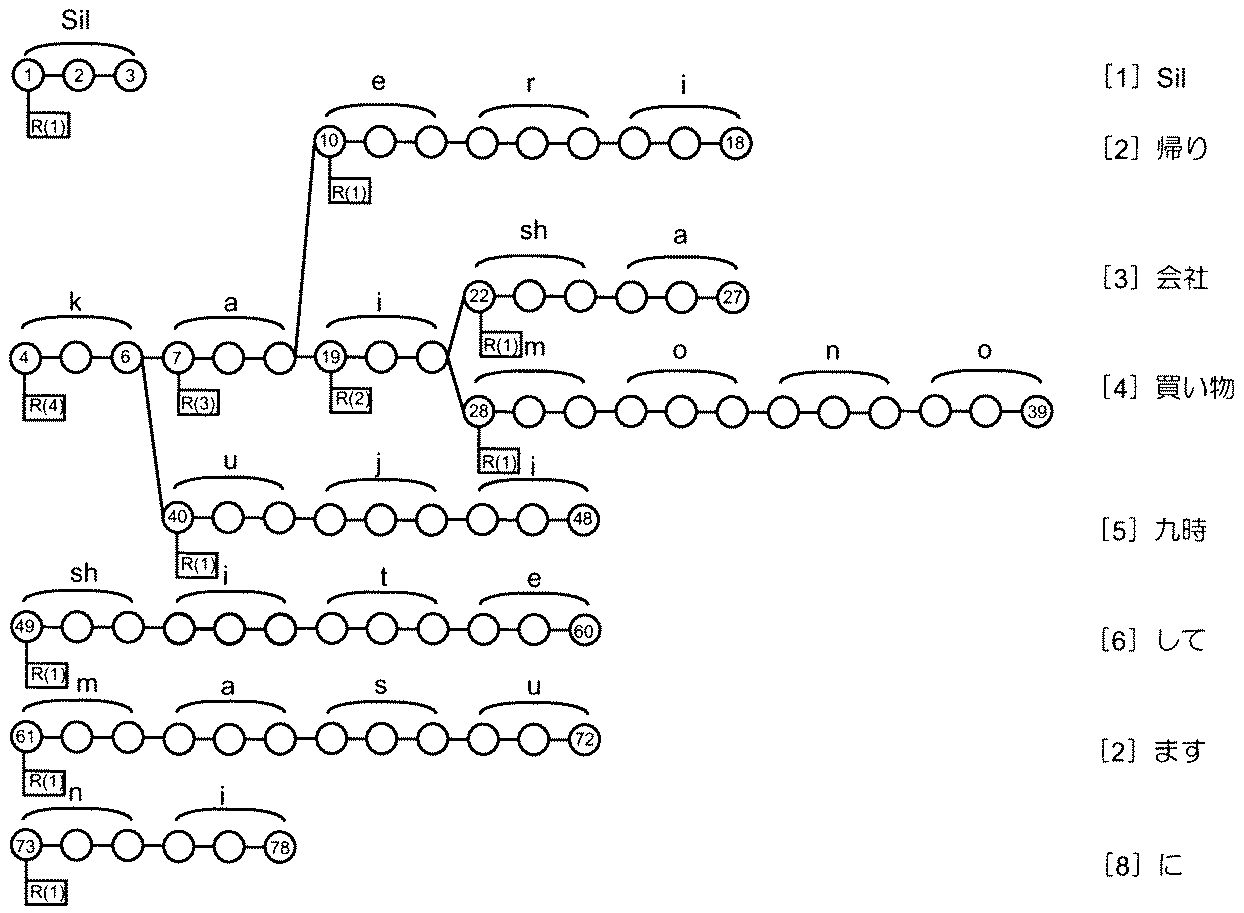
図1を参照してさらに具体的に説明すれば、音素列「k」で始まる4つの単語「帰り」,「会社」,「買い物」,「九時」の木構造辞書では、音素列「ku」で始まる単語は「九時(kuji)」に限定されるので、状態仮説が音素列「ku」の探索空間を過ぎれば単語が確定する。これに対して、音素列「ka」で始まる単語は「帰り」,「会社」,「買い物」の3つであるため、音素列「ka」の探索空間を過ぎても単語が確定しない。 More specifically, referring to FIG. 1, in the tree structure dictionary of four words “return”, “company”, “shopping”, and “9:00” starting with the phoneme sequence “k”, the phoneme sequence “ku” Are limited to “kuji”, so if the state hypothesis passes the search space for the phoneme sequence “ku”, the word is fixed. On the other hand, since the words starting with the phoneme string “ka” are “Return”, “Company”, and “Shopping”, the word is not fixed even after the search space for the phoneme string “ka”.
ここで、ある時刻で自己遷移またはLR遷移した全ての状態仮説を対象に枝刈りを行うとき、従来技術であれば、ビーム幅や最大許容仮説数で決まる上位n個の状態仮説のみが残る。このとき、状態仮説が多くの単語に到達する可能性を残すためには、探索空間の広い範囲にわたって、その状態仮説が上位n個の中に漏れなく残るようにすることが望ましい。しかしながら、実際には単語が確定する状態仮説のみが上位を占めてしまうような場合があり、このような場合には、多くの単語に到達する可能性が一度に失われてしまう。 Here, when pruning is performed for all state hypotheses that have made a self-transition or LR transition at a certain time, only the top n state hypotheses that are determined by the beam width and the maximum allowable number of hypotheses remain. At this time, in order to leave the possibility that the state hypothesis reaches many words, it is desirable that the state hypothesis remains in the top n without any omission over a wide range of the search space. However, in reality, there are cases where only the state hypothesis that the word is determined occupies the upper rank, and in such a case, the possibility of reaching many words is lost at once.
すなわち、図1において音素列「ka」の状態仮説が全て枝刈りされるようなことになると、その時点で3つの単語「帰り」,「会社」,「買い物」が探索空間から外れてしまい、必然的に単語「九時」が探索結果に確定してしまう。 That is, when all the state hypotheses of the phoneme sequence “ka” are pruned in FIG. 1, the three words “return”, “company”, and “shopping” are removed from the search space at that time. Inevitably, the word “9 o'clock” is fixed in the search result.
本発明では、ルートに近いノードからは到達可能なリーフ個数が多く、リーフに近づくに従って到達可能なリーフ個数が減少し、リーフが確定した時点で到達可能なリーフ個数が「1」になることに着目し、到達可能なリーフ個数に応じた一時的な報酬値を尤度に加算して枝刈りを行うことを考える。 In the present invention, the number of leaves that can be reached from a node close to the root is large, the number of leaves that can be reached decreases as the leaf is approached, and the number of leaves that can be reached becomes “1” when the leaf is determined. Considering that pruning is performed by adding a temporary reward value according to the number of reachable leaves to the likelihood.
換言すれば、本発明では探索空間の広い状態仮説が早期に枝刈りされることを防止するために、探索空間のより広い状態仮説により多くの報酬値を与えて累積尤度に加算することで、探索空間の広い状態仮説ほど枝刈りされにくくすることを考える。 In other words, in the present invention, in order to prevent the state hypothesis with a wide search space from being pruned early, a larger reward value is given to the state hypothesis with a wider search space and added to the cumulative likelihood. Consider a state hypothesis with a wider search space that is less likely to be pruned.
そして、本発明では各状態から到達可能なリーフノード数(ここでは、単語数)x、およびリーフノード数xに応じた報酬値をR(x)とし、リーフノード数xと報酬値R(x)との関係が、図2のように単調増加関数として定義される。さらに具体的に説明すれば、リーフノード数xと報酬値R(x)との関係が、本実施形態では、到達可能なリーフノード数xが「1」のときに報酬値R(x)を「0」とし、到達可能なリーフノード数が「1」よりも大きい範囲では単調増加かつ一定値に漸近する関数として定義される。 In the present invention, the number of leaf nodes reachable from each state (here, the number of words) x and the reward value corresponding to the number of leaf nodes x are R (x), and the number of leaf nodes x and the reward value R (x ) Is defined as a monotonically increasing function as shown in FIG. More specifically, the relationship between the number of leaf nodes x and the reward value R (x) is as follows. In this embodiment, the reward value R (x) is calculated when the reachable number of leaf nodes x is “1”. In the range where the number of reachable leaf nodes is greater than “1” with “0”, the function is defined as a function that monotonously increases and gradually approaches a constant value.
図1に示した例では、音素列[ka]の状態仮説については、到達可能なリーフノード数xが「帰り」,「会社」,「買い物」の3つなので報償値R(3)が付与される。音素列[ku]の状態仮説については、到達可能なリーフノード数xが「九時」の1つなので報償値R(1)が付与される。音素列[kai]の状態仮説については、到達可能なリーフノード数xが「会社」,「買い物」の2つなので報償値R(2)が付与される。 In the example shown in FIG. 1, the reward hypothesis value R (3) is assigned to the state hypothesis of the phoneme string [ka] because the number x of reachable leaf nodes is “return”, “company”, and “shopping”. Is done. The state hypothesis of the phoneme string [ku] is given a reward value R (1) because the reachable number of leaf nodes x is one of “9 o'clock”. Regarding the state hypothesis of the phoneme string [kai], the award value R (2) is given because the number x of reachable leaf nodes is “company” and “shopping”.
また、記述文法が図3のようであれば、図4に示したように、上記以外の単語「sil(無音)」,「して」,「ます」,「に」の木構造辞書についても状態仮説が並列に進むので、音素列[sil],[sh],[m],[n]のように到達可能なリーフノード数xが「1」の各状態仮説には報償値R(1)が付与され、音素列「k」のように到達可能なリーフノード数xが「4」の状態仮説には報償値R(4)が付与されることになる。 If the descriptive grammar is as shown in FIG. 3, as shown in FIG. 4, the word “sil (silence)”, “te”, “mas”, “ni” tree structure dictionaries other than the above are also used. Since the state hypotheses proceed in parallel, the reward value R (1 (1) is assumed for each state hypothesis where the number of reachable leaf nodes x is “1” such as phoneme sequences [sil], [sh], [m], [n]. ) And a reward hypothesis value R (4) is assigned to a state hypothesis having a reachable leaf node number x “4” such as a phoneme string “k”.
本発明では、到達可能なリーフノード数が「1」において報酬値が「0」となるような関数を定義する。探索がリーフに近づいてリーフノードが確定すると、尤度に加算される報酬値が「0」になるので、探索の確率的フレームワークが崩されずに保たれる。なお、厳密には、音声認識における同音異義語や同音の接頭辞をもつ別の単語など、リーフノードにおいて到達可能なリーフノード数が1よりも大きい場合もあるが、このような場合でも「0」にならない報酬値は、単語仮説を出力する時点で「0」に補正することが可能である。 In the present invention, a function is defined such that the reward value is “0” when the number of reachable leaf nodes is “1”. When the search approaches the leaf and the leaf node is determined, the reward value added to the likelihood becomes “0”, so that the probabilistic framework of the search is kept intact. Strictly speaking, there may be a case where the number of leaf nodes that can be reached in a leaf node, such as a homonym in speech recognition or another word having a prefix of the same tone, is greater than one. A reward value that does not become "" can be corrected to "0" when the word hypothesis is output.
また、到達可能なリーフノード数xと報酬値R(x)との関係は一つに限定されるものではなく、音声モデルについては図2の関係を定義し、無音モデルや雑音モデルといった特殊な音響モデルについては例外的に他の関係を定義するようにしても良い。 In addition, the relationship between the number of reachable leaf nodes x and the reward value R (x) is not limited to one. For the speech model, the relationship shown in FIG. 2 is defined, and a special model such as a silence model or a noise model is defined. As for the acoustic model, other relationships may be defined exceptionally.
すなわち、音声認識では「無音」や様々な「雑音」(例えば車が通り過ぎた音)も単語の1つとして認識され、音声モデルと共に無音モデルや雑音モデルも用意される。無音モデルや雑音モデルは、他のモデルと共有するノードがないので到達可能な単語数は最初から最後まで「1」となり、図2の関係では報酬値が常に「0」となってしまう。しかしながら、一般的には文頭や文中の無音/雑音の後は(単語を跨いで)多様な表現に発展する可能性があるので、無音/雑音を探索中の仮説に対する枝刈りは甘めにする方が性能が上がる。そこで、無音/雑音などの枝分かれのない特殊な単語に対してのみ、例外的に「0」でない報酬値を与える関係を別途に用意しても良い。 That is, in the speech recognition, “silence” and various “noises” (for example, a sound passed by a car) are recognized as one of the words, and a silence model and a noise model are prepared together with the speech model. Since the silence model and the noise model do not share nodes with other models, the number of reachable words is “1” from the beginning to the end, and the reward value is always “0” in the relationship of FIG. However, in general, after silence / noise in a sentence or after a sentence, there is a possibility that it will develop into various expressions (across words), so the pruning for hypotheses while searching for silence / noise is made sweeter. Will improve performance. Thus, a relationship that exceptionally gives a reward value other than “0” may be separately prepared only for special words having no branch such as silence / noise.
次いで、本発明の一実施形態について詳細に説明する。図5は、本発明のパターン認識を適用した音声認識装置の主要部の構成を示したブロック図である。 Next, an embodiment of the present invention will be described in detail. FIG. 5 is a block diagram showing the configuration of the main part of a speech recognition apparatus to which the pattern recognition of the present invention is applied.
音声信号入力部11は、入力された音声信号をデジタル信号に変換する。音響分析部12は、音声デジタル信号を音響分析して音響特徴パラメータを抽出し、これをパラメータ記憶部13に一時記憶する。音響特徴パラメータとは、入力音声を一定時間間隔(例えば10ms:以下、フレームと表現する)毎に分析して得られる特徴ベクトルである。したがって、音声信号は特徴ベクトルの時系列X=x1,x2…xtに変換される。第1探索部14は、第1データベース19に記憶されている記述文法/確率言語モデルに基づいて、単語を単位として文を構成する単語系列を探索する
The audio
第2探索部15において、自己遷移部151は、探索過程で各状態仮説を自己遷移させる。LR遷移部152は、探索過程で各状態仮説をLR遷移させる。尤度計算部153は、前記自己遷移およびLR遷移において、音響特徴パラメータの時系列データを、第2データベース20に記憶された木構造辞書および第3データベース21に記憶された音響モデルと照合して音響的な尤度を算出し、この音響尤度を時間方向に累積して累積尤度を求める。本実施形態では、文法の制約から木構造辞書の状態系列が複数に枝分れする場合、第2探索部15は枝の数だけ状態仮説を複製し、枝ごとに状態仮説を進行させて尤度を計算する。
In the
報酬付与部154は、探索過程において各状態仮説に、到達可能な単語数(リーフノード数)xに応じた報酬値R(x)を付与して累積尤度を嵩上げする。枝刈り部155は、探索過程で各状態の累積尤度と報酬値R(x)との加算値を所定の時間周期で比較し、尤度の低い状態仮説を枝刈りして探索対象から除外する。
The
単語仮説出力部16は、単語末尾まで進んだ状態仮説の単語仮説を出力する。単語仮説蓄積部17は、単語末尾まで進んだ全ての状態仮説の単語仮説を蓄積する。前記第1および第2検索部14,15による検索および単語仮説の出力は、音響特徴パラメータの時系列データの入力が終了するまで繰り返される。認識結果判定部18は、時系列データの入力が終了すると、単語仮説の集合のうち文法上の最後のHMM状態まで到達したものの中から累積尤度が最も高い状態系列にバックトレースを実行して認識結果を判定する。
The word
図6は、本発明のパターン認識方法を適用した音声認識の手順を示したフローチャートであり、主に前記第2探索部15の動作を示している。
FIG. 6 is a flowchart showing the procedure of speech recognition to which the pattern recognition method of the present invention is applied, and mainly shows the operation of the
ステップS1では、有効な状態仮説の一つが今回の計算対象として選択される。ステップS2では、今回の状態仮説に対して自己遷移が実施され、その音響尤度が算出される。ステップS3では、現在までの累積尤度に今回の音響尤度が加算されて当該累積尤度が更新される。ステップS4では、今回のタイミングに対応した全ての状態仮説に関して自己遷移および尤度計算が完了したか否かが判定される。完了していなければステップS1へ戻り、今回のタイミングで遷移すべき他の状態仮説についても上記の各処理が繰り返される。 In step S1, one of valid state hypotheses is selected as the current calculation target. In step S2, self-transition is performed for the current state hypothesis, and its acoustic likelihood is calculated. In step S3, the current acoustic likelihood is added to the cumulative likelihood up to now, and the cumulative likelihood is updated. In step S4, it is determined whether self-transition and likelihood calculation have been completed for all state hypotheses corresponding to the current timing. If not completed, the process returns to step S1, and the above-described processes are repeated for other state hypotheses to be transitioned at the current timing.
今回のタイミングに対応した全ての状態仮説に関して自己遷移および尤度計算が完了するとステップS5へ進み、改めて今回のタイミングに対応した有効な状態仮説の一つが計算対象として選択される。ステップS6では、今回の状態仮説に対してL-R遷移が実施され、その音響尤度が計算される。ステップS7では、現在までの累積尤度に今回の音響尤度が加算されて当該累積尤度が更新される。 When the self-transition and the likelihood calculation are completed for all the state hypotheses corresponding to the current timing, the process proceeds to step S5, and one of the valid state hypotheses corresponding to the current timing is selected again as a calculation target. In step S6, LR transition is performed on the current state hypothesis, and its acoustic likelihood is calculated. In step S7, the current acoustic likelihood is added to the cumulative likelihood up to now, and the cumulative likelihood is updated.
ステップS8では、今回のL-R遷移により木構造が分岐したか否かが判定される。分岐していればステップS9へ進み、確率言語モデルに基づいて言語尤度の先読みが実施され、到達可能な全ての単語の言語尤度の最大値(先読み値)が累積尤度に加算される。ステップS10では、遷移先から到達可能な単語数(リーフノード数)xが次式(1)に適用されて報酬値R(x)が算出され、今回の状態仮説に既登録の報酬値R(x)が更新される。次式(1)では、到達可能な単語数xが「1」のときに報酬値R(x)が「0」となるので、探索の確率的フレームワークが崩されることなく維持される。なお、符号a,bは正の定数である。
In step S8, it is determined whether or not the tree structure has branched due to the current LR transition. If it is branched, the process proceeds to step S9, where language likelihood prefetching is performed based on the probabilistic language model, and the maximum language likelihood values (prefetching values) of all reachable words are added to the cumulative likelihood. . In step S10, the number of words reachable from the transition destination (the number of leaf nodes) x is applied to the following equation (1) to calculate the reward value R (x), and the reward value R ( x) is updated. In the following equation (1), when the reachable number of words x is “1”, the reward value R (x) is “0”, so that the probabilistic framework for searching is maintained without being destroyed. The symbols a and b are positive constants.
ステップS11では、遷移先に自己遷移の状態仮説が存在する場合に、その累積尤度とL-R遷移後の状態仮説の累積尤度とが比較され、大きい方の状態仮説を残して小さい方が破棄される。ステップS12では、今回のタイミングで遷移すべき全ての状態仮説に関して、上記のL-R遷移が完了したか否かが判定される。完了していなければステップS5へ戻り、今回のタイミングで遷移すべき他の状態仮説についても上記の各処理が繰り返される。 In step S11, when there is a state hypothesis of self-transition at the transition destination, the cumulative likelihood is compared with the cumulative likelihood of the state hypothesis after LR transition, and the smaller one is discarded with the larger state hypothesis remaining. Is done. In step S12, it is determined whether or not the LR transition has been completed for all state hypotheses to be transitioned at the current timing. If not completed, the process returns to step S5, and the above processes are repeated for other state hypotheses that should be transitioned at the current timing.
その後、今回のタイミングで遷移すべき全ての状態仮説について上記の各処理が完了するとステップS13へ進み、枝刈り処理が実行される。本実施形態では、時刻t、状態jの各尤度αj(t)として、累積尤度と報酬値R(x)との加算値が用いられ、時刻tにおける全状態仮説の中で最大の尤度αmax(t)と各尤度αj(t)とが比較される。そして、次式(2)を満足する状態仮説が次の時刻の探索空間に残され、次式(3)を満足する状態仮説は次の時刻の探索空間から除外される。θpruningはビーム幅である。
Thereafter, when each of the above processes is completed for all the state hypotheses to be transitioned at the current timing, the process proceeds to step S13, and a pruning process is executed. In the present embodiment, an added value of the cumulative likelihood and the reward value R (x) is used as each likelihood αj (t) at time t and state j, and the maximum likelihood among all state hypotheses at time t. The degree αmax (t) and each likelihood αj (t) are compared. Then, the state hypothesis satisfying the following equation (2) is left in the search space at the next time, and the state hypothesis satisfying the following equation (3) is excluded from the search space at the next time. θpruning is the beam width.
ステップS14では、枝刈り後に残った状態仮説の一つが選択される。ステップS15では、選択された状態仮説が単語末尾の状態仮説であるか否かが判定され、単語末尾の状態仮説であれば、ステップS16へ進んで単語仮説が出力される。ステップS17では、次の単語の先頭の状態に遷移する仮想的な状態仮説が設定される。ステップS18では、枝刈り後に残った全ての状態仮説に関して上記の処理が完了したか否かが判定される。完了していなければ前記ステップS14へ戻り、状態仮説を変更しながら各処理が繰り返される。ステップS19では、次フレームの有無が判定され、次フレームが存在すればステップS1へ戻り、次フレームの音響特徴パラメータを対象に上記した各処理が繰り返される。 In step S14, one of the state hypotheses remaining after pruning is selected. In step S15, it is determined whether or not the selected state hypothesis is a state hypothesis at the end of the word. If it is the state hypothesis at the end of the word, the process proceeds to step S16 and the word hypothesis is output. In step S17, a hypothetical state hypothesis for transitioning to the first state of the next word is set. In step S18, it is determined whether or not the above processing has been completed for all state hypotheses remaining after pruning. If not completed, the process returns to step S14, and each process is repeated while changing the state hypothesis. In step S19, it is determined whether or not there is a next frame. If there is a next frame, the process returns to step S1, and the above-described processes are repeated for the acoustic feature parameter of the next frame.
全てのフレームに関して上記の処理が終了して探索が文末フレームまで到達すると、ステップS20では、これまでに文法上の最後のHMM状態まで到達した全ての状態仮説が、その累積尤度の順にソートされ、累積尤度が上位の複数または唯一の状態仮説にバックトレースが実施されて認識結果が出力される。 When the above processing is completed for all frames and the search reaches the end-of-sentence frame, in step S20, all state hypotheses that have reached the last HMM state in the grammar are sorted in the order of their cumulative likelihoods. The backtrace is performed on a plurality of or only one state hypothesis having the highest cumulative likelihood, and the recognition result is output.
上記の検索手順を含む一連のパターン認識手順は、コンピュータにより実行可能なプログラム言語で記述することができ、当該プログラムをCD-ROMやDVDなどの記憶媒体に記録し、これをコンピュータに読み込ませて実行させることによりパターン認識装置を構成することができる。 A series of pattern recognition procedures including the above search procedure can be described in a program language that can be executed by a computer. The program is recorded on a storage medium such as a CD-ROM or DVD, and is read by a computer. By executing this, a pattern recognition apparatus can be configured.
なお、上記の実施形態では本発明を状態仮説がビーム幅に基づいて枝刈りされる場合を例にして説明したが、本発明はこれのみに限定されるものではなく、状態仮説の累積尤度をヒストグラム化し、最大許容仮説数に基づいて枝刈りする場合にも同様に適用できる。 In the above embodiment, the present invention has been described by taking the case where the state hypothesis is pruned based on the beam width as an example. However, the present invention is not limited to this, and the cumulative likelihood of the state hypothesis. The above can be similarly applied to the case where a histogram is formed and pruning is performed based on the maximum allowable number of hypotheses.
また、上記した実施形態では、本発明を音声認識を例にして説明したが、他のパターン認識にも同様に適用できる。 In the above-described embodiment, the present invention has been described by taking voice recognition as an example. However, the present invention can be similarly applied to other pattern recognition.
11…音声信号入力部,12…音響分析部,13…パラメータ記憶部,14…第1探索部,15…第2探索部,16…単語仮説出力部,17…単語仮説蓄積部,18…認識結果判定部,19…第1データベース,20…第2データベース,21…第3データベース,151…尤度計算部,152…自己遷移部,153…LR遷移部,154…報酬付与部,155…枝刈り部
DESCRIPTION OF
Claims (11)
入力信号の特徴パラメータを状態遷移モデルと照合し、状態遷移モデルの各状態に対する特徴パラメータの尤度を算出する手段と、
前記各状態から到達可能なリーフノード数に応じた報酬値を算出する手段と、
所定の時刻周期で、各状態にある状態仮説の累積尤度と報酬値との加算値同士を比較し、加算値の低い状態仮説を探索対象から除外する枝刈り手段とを具備したことを特徴とするパターン認識装置。 The feature parameter extracted from the input signal is checked against the state transition model of the tree structure in which the recognition pattern is expressed by the path from the root to multiple leaf nodes, and the most likely state transition path reaching the leaf node is recognized. In the pattern recognition device
Means for comparing the feature parameters of the input signal with the state transition model and calculating the likelihood of the feature parameters for each state of the state transition model;
Means for calculating a reward value according to the number of leaf nodes reachable from each state;
A pruning unit that compares the cumulative likelihood of the state hypothesis in each state with the reward value in a predetermined time period and excludes the state hypothesis having a low addition value from the search target is provided. A pattern recognition device.
前記報酬値を算出する手段は、L-R遷移先が分岐後の状態の場合に報酬値を更新することを特徴とする請求項1に記載のパターン認識装置。 The means for calculating the likelihood calculates the likelihood in each state of the transition destination while performing the self-transition and the LR transition of the state hypothesis in each state of the state transition model,
The pattern recognition apparatus according to claim 1, wherein the means for calculating the reward value updates the reward value when the LR transition destination is in a state after branching.
入力信号の特徴パラメータを状態遷移モデルと照合し、状態遷移モデルの各状態に対する特徴パラメータの尤度を算出する手順と、
前記各状態から到達可能なリーフノード数に応じた報酬値を算出する手順と、
所定の時刻周期で、各状態にある状態仮説の累積尤度と報酬値との加算値同士を比較し、加算値の低い状態仮説を探索対象から除外する枝刈り手順とを含むことを特徴とするパターン認識方法。 The feature parameter extracted from the input signal is checked against the state transition model of the tree structure in which the recognition pattern is expressed by the path from the root to multiple leaf nodes, and the most likely state transition path reaching the leaf node is recognized. In the pattern recognition method
A procedure for matching the feature parameters of the input signal with the state transition model and calculating the likelihood of the feature parameters for each state of the state transition model;
A procedure for calculating a reward value according to the number of leaf nodes that can be reached from each state,
A pruning procedure for comparing a cumulative hypothesis of a state hypothesis in each state with a reward value at a predetermined time period and excluding a state hypothesis having a low sum from the search target. Pattern recognition method.
Priority Applications (2)
| Application Number | Priority Date | Filing Date | Title |
|---|---|---|---|
| JP2009172170A JP4757936B2 (en) | 2009-07-23 | 2009-07-23 | Pattern recognition method and apparatus, pattern recognition program and recording medium therefor |
| US12/841,416 US8612227B2 (en) | 2009-07-23 | 2010-07-22 | Method and equipment of pattern recognition, its program and its recording medium for improving searching efficiency in speech recognition |
Applications Claiming Priority (1)
| Application Number | Priority Date | Filing Date | Title |
|---|---|---|---|
| JP2009172170A JP4757936B2 (en) | 2009-07-23 | 2009-07-23 | Pattern recognition method and apparatus, pattern recognition program and recording medium therefor |
Publications (2)
| Publication Number | Publication Date |
|---|---|
| JP2011027910A JP2011027910A (en) | 2011-02-10 |
| JP4757936B2 true JP4757936B2 (en) | 2011-08-24 |
Family
ID=43498065
Family Applications (1)
| Application Number | Title | Priority Date | Filing Date |
|---|---|---|---|
| JP2009172170A Expired - Fee Related JP4757936B2 (en) | 2009-07-23 | 2009-07-23 | Pattern recognition method and apparatus, pattern recognition program and recording medium therefor |
Country Status (2)
| Country | Link |
|---|---|
| US (1) | US8612227B2 (en) |
| JP (1) | JP4757936B2 (en) |
Families Citing this family (12)
| Publication number | Priority date | Publication date | Assignee | Title |
|---|---|---|---|---|
| GB0420464D0 (en) | 2004-09-14 | 2004-10-20 | Zentian Ltd | A speech recognition circuit and method |
| KR20120045582A (en) * | 2010-10-29 | 2012-05-09 | 한국전자통신연구원 | Apparatus and method for creating acoustic model |
| EP2893435B1 (en) * | 2012-09-07 | 2019-05-08 | Carnegie Mellon University | Methods for hybrid gpu/cpu data processing |
| JP6222114B2 (en) * | 2013-01-25 | 2017-11-01 | 日本電気株式会社 | Solution search device, solution search method, and solution search program |
| JP6014519B2 (en) * | 2013-03-06 | 2016-10-25 | Kddi株式会社 | Search device in probabilistic finite state transition model |
| US9514747B1 (en) * | 2013-08-28 | 2016-12-06 | Amazon Technologies, Inc. | Reducing speech recognition latency |
| US20160302115A1 (en) * | 2013-12-04 | 2016-10-13 | Telefonaktiebolaget Lm Ericsson (Publ) | Backhaul of Client Network Nodes |
| US10453445B2 (en) * | 2016-02-16 | 2019-10-22 | Carnegie Mellon University | System and method for multi-user GPU-accelerated speech recognition engine for client-server architectures |
| US10199037B1 (en) * | 2016-06-29 | 2019-02-05 | Amazon Technologies, Inc. | Adaptive beam pruning for automatic speech recognition |
| US10347245B2 (en) * | 2016-12-23 | 2019-07-09 | Soundhound, Inc. | Natural language grammar enablement by speech characterization |
| WO2022137439A1 (en) * | 2020-12-24 | 2022-06-30 | 日本電気株式会社 | Information processing system, information processing method, and computer program |
| CN112766350B (en) * | 2021-01-12 | 2024-02-02 | 深圳前海微众银行股份有限公司 | Method, device and equipment for constructing two-classification model and computer readable storage medium |
Family Cites Families (15)
| Publication number | Priority date | Publication date | Assignee | Title |
|---|---|---|---|---|
| US5349645A (en) * | 1991-12-31 | 1994-09-20 | Matsushita Electric Industrial Co., Ltd. | Word hypothesizer for continuous speech decoding using stressed-vowel centered bidirectional tree searches |
| US5699456A (en) * | 1994-01-21 | 1997-12-16 | Lucent Technologies Inc. | Large vocabulary connected speech recognition system and method of language representation using evolutional grammar to represent context free grammars |
| US5677990A (en) * | 1995-05-05 | 1997-10-14 | Panasonic Technologies, Inc. | System and method using N-best strategy for real time recognition of continuously spelled names |
| US5706397A (en) * | 1995-10-05 | 1998-01-06 | Apple Computer, Inc. | Speech recognition system with multi-level pruning for acoustic matching |
| US6006181A (en) * | 1997-09-12 | 1999-12-21 | Lucent Technologies Inc. | Method and apparatus for continuous speech recognition using a layered, self-adjusting decoder network |
| US6374219B1 (en) * | 1997-09-19 | 2002-04-16 | Microsoft Corporation | System for using silence in speech recognition |
| US5983180A (en) * | 1997-10-23 | 1999-11-09 | Softsound Limited | Recognition of sequential data using finite state sequence models organized in a tree structure |
| US6285981B1 (en) * | 1998-06-30 | 2001-09-04 | Texas Instruments Incorporated | Speed up speech recognition search using macro evaluator |
| US6442520B1 (en) * | 1999-11-08 | 2002-08-27 | Agere Systems Guardian Corp. | Method and apparatus for continuous speech recognition using a layered, self-adjusting decoded network |
| WO2003005344A1 (en) * | 2001-07-03 | 2003-01-16 | Intel Zao | Method and apparatus for dynamic beam control in viterbi search |
| JP2003208195A (en) * | 2002-01-16 | 2003-07-25 | Sharp Corp | Continuous speech recognition device and continuous speech recognition method, continuous speech recognition program, and program recording medium |
| US6879954B2 (en) * | 2002-04-22 | 2005-04-12 | Matsushita Electric Industrial Co., Ltd. | Pattern matching for large vocabulary speech recognition systems |
| JP4427530B2 (en) * | 2006-09-21 | 2010-03-10 | 株式会社東芝 | Speech recognition apparatus, program, and speech recognition method |
| GB2453366B (en) * | 2007-10-04 | 2011-04-06 | Toshiba Res Europ Ltd | Automatic speech recognition method and apparatus |
| US8392187B2 (en) * | 2009-01-30 | 2013-03-05 | Texas Instruments Incorporated | Dynamic pruning for automatic speech recognition |
-
2009
- 2009-07-23 JP JP2009172170A patent/JP4757936B2/en not_active Expired - Fee Related
-
2010
- 2010-07-22 US US12/841,416 patent/US8612227B2/en not_active Expired - Fee Related
Also Published As
| Publication number | Publication date |
|---|---|
| US20110022385A1 (en) | 2011-01-27 |
| JP2011027910A (en) | 2011-02-10 |
| US8612227B2 (en) | 2013-12-17 |
Similar Documents
| Publication | Publication Date | Title |
|---|---|---|
| JP4757936B2 (en) | Pattern recognition method and apparatus, pattern recognition program and recording medium therefor | |
| JP4543294B2 (en) | Voice recognition apparatus, voice recognition method, and recording medium | |
| US7013277B2 (en) | Speech recognition apparatus, speech recognition method, and storage medium | |
| JP4802434B2 (en) | Voice recognition apparatus, voice recognition method, and recording medium recording program | |
| US6961701B2 (en) | Voice recognition apparatus and method, and recording medium | |
| JPWO2001065541A1 (en) | Voice recognition device, voice recognition method, and recording medium | |
| Alleva et al. | An improved search algorithm using incremental knowledge for continuous speech recognition | |
| JP5447373B2 (en) | Language model score prefetch value assigning apparatus and method, and program recording medium | |
| Karanasou et al. | Discriminatively trained phoneme confusion model for keyword spotting. | |
| US20040158468A1 (en) | Speech recognition with soft pruning | |
| JP5309343B2 (en) | Pattern recognition method and apparatus, pattern recognition program and recording medium therefor | |
| JP6026224B2 (en) | Pattern recognition method and apparatus, pattern recognition program and recording medium therefor | |
| JPH09134192A (en) | Statistical language model forming device and speech recognition device | |
| JP5008078B2 (en) | Pattern recognition method and apparatus, pattern recognition program and recording medium therefor | |
| US20040148163A1 (en) | System and method for utilizing an anchor to reduce memory requirements for speech recognition | |
| JP3550350B2 (en) | Voice recognition method and program recording medium | |
| JP4883717B2 (en) | Voice recognition method and apparatus, voice recognition program and recording medium therefor | |
| JP4600705B2 (en) | Voice recognition apparatus, voice recognition method, and recording medium | |
| Fu et al. | Combination of multiple predictors to improve confidence measure based on local posterior probabilities | |
| JP2999726B2 (en) | Continuous speech recognition device | |
| KR20040092572A (en) | Speech recognition method of processing silence model in a continous speech recognition system | |
| JP4696400B2 (en) | Voice recognition apparatus, voice recognition method, program, and recording medium | |
| KR100557650B1 (en) | Speech Recognition Using Context-dependent Phoneme Duration Information | |
| Trinh et al. | An empirical study of multipass decoding for vietnamese LVCSR. | |
| Raut | Discriminative adaptive training and Bayesian inference for speech recognition |
Legal Events
| Date | Code | Title | Description |
|---|---|---|---|
| A977 | Report on retrieval |
Free format text: JAPANESE INTERMEDIATE CODE: A971007 Effective date: 20110425 |
|
| TRDD | Decision of grant or rejection written | ||
| A01 | Written decision to grant a patent or to grant a registration (utility model) |
Free format text: JAPANESE INTERMEDIATE CODE: A01 Effective date: 20110511 |
|
| A01 | Written decision to grant a patent or to grant a registration (utility model) |
Free format text: JAPANESE INTERMEDIATE CODE: A01 |
|
| A61 | First payment of annual fees (during grant procedure) |
Free format text: JAPANESE INTERMEDIATE CODE: A61 Effective date: 20110601 |
|
| R150 | Certificate of patent or registration of utility model |
Ref document number: 4757936 Country of ref document: JP Free format text: JAPANESE INTERMEDIATE CODE: R150 Free format text: JAPANESE INTERMEDIATE CODE: R150 |
|
| FPAY | Renewal fee payment (event date is renewal date of database) |
Free format text: PAYMENT UNTIL: 20140610 Year of fee payment: 3 |
|
| LAPS | Cancellation because of no payment of annual fees |