JP4683881B2 - Antitumor active - Google Patents
Antitumor active Download PDFInfo
- Publication number
- JP4683881B2 JP4683881B2 JP2004244933A JP2004244933A JP4683881B2 JP 4683881 B2 JP4683881 B2 JP 4683881B2 JP 2004244933 A JP2004244933 A JP 2004244933A JP 2004244933 A JP2004244933 A JP 2004244933A JP 4683881 B2 JP4683881 B2 JP 4683881B2
- Authority
- JP
- Japan
- Prior art keywords
- group
- fesium
- lactobacillus
- groups
- lactic acid
- Prior art date
- Legal status (The legal status is an assumption and is not a legal conclusion. Google has not performed a legal analysis and makes no representation as to the accuracy of the status listed.)
- Expired - Lifetime
Links
Images

Landscapes
- Medicines Containing Material From Animals Or Micro-Organisms (AREA)
Description
この発明は、乳酸菌の代謝産物を用いた抗腫瘍活性剤に関する。 The present invention relates to an antitumor active agent using a metabolite of lactic acid bacteria.
乳酸菌の発ガン予防効果は、マウスなどを用いていろいろ検証されているが、いずれも発ガン予防作用としての機能に着目されているもので、特に乳酸菌代謝産物についてのガンの増殖抑制作用に関しては、必ずしも顕著な効果を得ているものとは言い得ないのが現状である。
なお、乳酸菌を用いた増殖抑制作用に関しては、乳酸菌研究集談会編「乳酸菌の科学と技術」327ページ表8.4に明らかにされているが、これは、L.カゼイをマウスに経口投与したものである。しかしながら、乳酸菌を直接投与しても、それが生菌として機能をすることはほとんどないことが、明らかにされている。したがって、この従来の投与方法の場合には、L.カゼイを生菌として機能させるために、その投与方法等を工夫しなければならないという問題があるが、その投与方法に関しては何ら言及されていない。
Cancer prevention effects of lactic acid bacteria have been verified in various ways using mice, etc., all of which have been focused on the function as a carcinogenesis prevention action, especially regarding the cancer growth inhibition action of lactic acid bacteria metabolites However, the current situation is that it cannot always be said that a remarkable effect is obtained.
The growth inhibitory action using lactic acid bacteria is clarified in Table 8.4 on page 327 of “Science and Technology of Lactic Acid Bacteria” edited by Lactic Acid Bacteria Research Meeting. Casei was orally administered to mice. However, it has been clarified that even when lactic acid bacteria are directly administered, they hardly function as viable bacteria. Therefore, in the case of this conventional administration method, L.P. In order for casei to function as a living bacterium, there is a problem that its administration method must be devised, but no mention is made of its administration method.
この発明の目的は、投与方法も簡単で、しかもガンの増殖抑制作用が顕著な乳酸菌代謝産物を提供することである。 An object of the present invention is to provide a lactic acid bacterium metabolite that has a simple administration method and has a remarkable cancer growth inhibitory action.
第1の発明は、B.ロンガム(Bifidobacterium
longum)、B.ビフィダム(Bifidobacterium bifidum)、B.アドレセンティス(Bifidobacterium
adolescentis)、L.アシドフィラス(Lactobacillus acidophilus)、L.ブレビス(Lactobacillus
brevis)、L.ジェンセニイ(Lactobacillus jensenii)、L.パラカゼイ(Lactobacillus
paracasei subsp. paracasei)、L.ガセリー(Lactobacillus
gasseri)、L.ブルガリクス(Lactobacillus delbrueckii subsp.bulgaricus)、L.ヘルベティカス(Lactobacillus
helveticus)、L.カゼイ(Lactobacillus casei subsp. casei)、L.ラモナウサス(Lactobacillus
rhamnosus)、L.デルブリッキィ(Lactobacillus delbrueckii subsp. delbrueckii)、L.ラクチス(Lactococcus
lactis)、E.フェシウム(Enterococcus faecium)、S.サーモフィラス(Streptococcus thermophilus)からなる16種の乳酸菌を用いるとともに、それら3属の乳酸菌から選択した1種または2種以上の乳酸菌を用いて複数のグループを形成し、それらグループ毎に継代培養して共棲状態を維持し、この継代培養されたグループ単位の乳酸菌同士をさらに共棲培養して得た乳酸菌培養液を、加熱滅菌した後にろ過して得たろ液と、このろ液をろ過したときの残渣を粉末化した粉末とを混合してなることを前提とする。
The first invention is B.I. Longum (Bifidobacterium
longum), B.I. Bifidobacterium bifidum, B. Adrecentis (Bifidobacterium
adolescentis), L. Lactobacillus acidophilus, L. Brevis (Lactobacillus
brevis), L.M. Lactobacillus jensenii, L. Paracasei (Lactobacillus
paracasei subsp. paracasei), L. Gasserie (Lactobacillus
gasseri), L.M. Bulgaricus (Lactobacillus delbrueckii subsp. Bulgaricus), L. Helveticas (Lactobacillus)
helveticus), L.H. Casei (Lactobacillus casei subsp. Casei), L. Ramonausus (Lactobacillus)
rhamnosus), L. Delbrickii (Lactobacillus delbrueckii subsp. Delbrueckii), L. Lactococcus
lactis), E.I. Enterococcus faecium, S. Using 16 types of lactic acid bacteria consisting of thermophilus (Streptococcus thermophilus) , one or more types of lactic acid bacteria selected from these 3 genera were used to form multiple groups and subcultured for each group. The lactic acid bacteria culture solution obtained by maintaining the symbiotic state and further culturing the cultivated lactic acid bacteria of the subcultured group unit with each other after heat sterilization, and the filtrate obtained by filtering this filtrate It is assumed that the residue is mixed with powdered powder.
そして、その培養時には、上記16種の乳酸菌のうち、E.フェシウムおよびL.ヘルベティカスを第1グループ、E.フェシウムおよびL.アシドフィラスを第2グループ、E.フェシウムおよびL.ガセリーを第3グループ、E.フェシウム、L.アシドフィラスおよびL.ブレビスを第4グループ、E.フェシウム、L.アシドフィラスおよびL.ブレビスを第5グループ、E.フェシウム、L.アシドフィラス、L.ブレビス、L.パラカゼイを第6グループ、B.アドレセンティス単体を第7グループ、L.デルブリッキィおよびL.ガセリーを第8グループ、L.デルブリッキィ単体を第9グループ、E.フェシウム、L.ジェンセニイ、L.パラカゼイおよびL.ブレビスを第10グループ、L.アシドフィラス単体を第11グループ、E.フェシウムおよびL.ガセリーを第12グループ、L.パラカゼイ単体を第13グループ、L.ガセリー、E.フェシウムおよびB.ビフィダムを第14グループ、B.ロンガム、S.サーモフィラスおよびE.フェシウムを第15グループ、L.ガセリーを単体で第16グループ、L.ブルガリクスおよびS.サーモフィラスを第17グループ、L.ガセリー、L.ラクチス、L.ガセリーおよびE.フェシウムを第18グループ、L.ガセリー、S.サーモフィラスおよびL.ブルガリクスを第19グループ、L.ラクチスを単体で第20グループ、L.ガセリーおよびE.フェシウムを第21グループ、L.ラモナウサスを単体で第22グループ、L.カゼイを単体で第23グループ、B.ロンガムを単体で第24グループとする。そして、それぞれのグループ毎に継代培養した培養液を生成するとともに、それら培養液のうち、第1,2グループ同士、第3,4グループ同士、第5,6グループ同士、第7,8グループ同士、第9,10グループ同士、第11,12グループ同士、第13,14グループ同士、第15,16グループ同士、第17,18グループ同士、第19,20グループ同士、第21,22グループ同士、第23,24グループ同士で1次培養し、さらに、第1,2グループと第3,4グループ、第5,6グループと第7,8グループ、第9,10グループと第11,12グループ、第13,14グループと第15,16グループ、第17,18グループと第19,20グループ、第21,22グループと第23,24グループ同士とで2次培養し、さらに、これら各2次培養液を混合して3次培養する点に特徴を有する。
Of the 16 types of lactic acid bacteria , E. Fesium and L. Helveticas in the first group, E. Fesium and L. Acidophilus in the second group, E.I. Fesium and L. Gasseley is the third group, E.I. Fesium, L.C. Acidophilus and L. Brevis the 4th group, E. Fesium, L.C. Acidophilus and L. Brevis the 5th group, E. Fesium, L.C. Acidophilus, L.H. Brevis, L. Paracasei in the sixth group Adrecentis alone is
第2発明は、3次培養液を、加熱して乳酸菌を滅菌し、冷却して脂肪分を凝固させてからそれを自然ろ過して上記ろ液を得た点に特徴を有する。 The second invention is characterized in that the tertiary culture solution is heated to sterilize lactic acid bacteria and cooled to coagulate fat, and then naturally filtered to obtain the filtrate .
この発明によれば、腫瘍抑制効果が大きく、しかも、乳酸菌の代謝産物からなるので、人体に対して副作用が少ないという効果を発揮することができる。また、乳酸菌を生菌として用いるのではなく、その代謝産物を利用しているので、生菌を体内に導く場合よりも、その投与方法が簡単になる。 According to this invention, large tumor suppression effect, moreover, since the metabolites of the lactic acid bacteria can exert an effect of less side effects on the human body. In addition, since lactic acid bacteria are not used as viable bacteria but their metabolites are used, the administration method is simpler than when the live bacteria are introduced into the body.
この実施形態における抗腫瘍活性剤を生成するために、ラクトバチルス(Lactobacillus)菌属に属する乳酸菌、ビフィドバクテリウム(Bifidobacterium)菌属に属する乳酸菌、ストレプトコッカス(Streptococcus)菌属に属する乳酸菌のいずれかに属する複数の乳酸菌を用いた。 In order to produce the antitumor active agent in this embodiment, any of lactic acid bacteria belonging to the genus Lactobacillus, lactic acid bacteria belonging to the genus Bifidobacterium, and lactic acid bacteria belonging to the genus Streptococcus Several lactic acid bacteria belonging to were used.
そして、上記ラクトバチルス(Lactobacillus)菌属に属する乳酸菌として、L.アシドフィラス(Lactobacillus acidophilus)、L.ブレビス(Lactobacillus brevis)、L.ジェンセニイ(Lactobacillus jensenii)、L.パラカゼイ(Lactobacillus paracasei subsp. paracasei)、L.ガセリー(Lactobacillus gasseri)、L.ブルガリクス(Lactobacillus delbrueckii subsp.bulgaricus)、L.ヘルベティカス(Lactobacillus helveticus)、L.カゼイ(Lactobacillus casei subsp. casei)、L.ラモナウサス(Lactobacillus rhamnosus)、L.デルブリッキィ(Lactobacillus delbrueckii subsp. delbrueckii)、L.ラクチス(Lactococcus lactis)を1種または2種以上用いた。 As a lactic acid bacterium belonging to the genus Lactobacillus, L. Lactobacillus acidophilus, L. Brevis (Lactobacillus brevis), L. Lactobacillus jensenii, L. Paracasei (Lactobacillus paracasei subsp. Paracasei), L. Gasseri (Lactobacillus gasseri), L. Bulgaricus (Lactobacillus delbrueckii subsp. Bulgaricus), L. Lactobacillus helveticus, L. Casei (Lactobacillus casei subsp. Casei), L. Lactobacillus rhamnosus, L. Delbrickii (Lactobacillus delbrueckii subsp. Delbrueckii), L. One kind or two or more kinds of Lactococcus lactis were used.
上記ビフィドバクテリウム(Bifidobacterium)菌属に属する乳酸菌として、B.ロンガム(Bifidobacterium longum)、B.ビフィダム(Bifidobacterium bifidum)、B.アドレセンティス(Bifidobacterium adolescentis)を1種または2種以上用いた。 As lactic acid bacteria belonging to the genus Bifidobacterium, B. Bongidobacterium longum, B. Bifidobacterium bifidum, B. One type or two or more types of Adrecentis (Bifidobacterium adolescentis) were used.
また、ストレプトコッカス(Streptococcus)菌属に属する乳酸菌として、S.サーモフィラス(Streptococcus thermophilus)、E.フェシウム(Enterococcus faecium)、L.ラクチス(Lactococcus lactis)の1種または2種以上を用いた。 As lactic acid bacteria belonging to the genus Streptococcus, S. Thermophilus (Streptococcus thermophilus), E.I. Enterococcus faecium, L. One or more of Lactococcus lactis was used.
そして、以上の乳酸菌を次のようにして培養した。
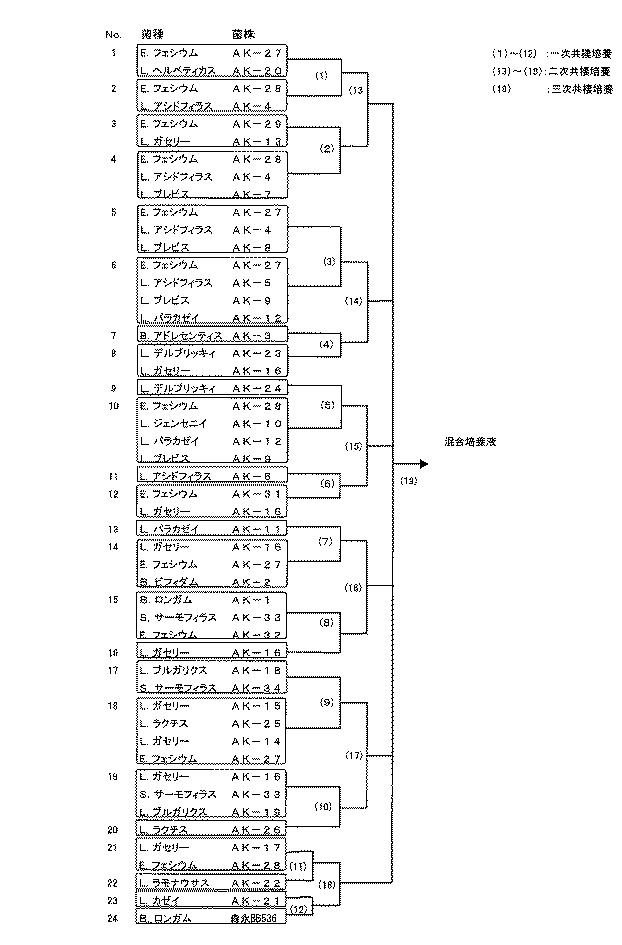
先ず、複数の乳酸菌を、24のグループに分け、それらをグループ毎に継代培養したが、そのグループ分けは次の通りである。すなわち、図1に示すように、第1グループはE.フェシウムおよびL.ヘルベティカスで構成し、第2グループは、E.フェシウムおよびL.アシドフィラスで構成している。第3グループはE.フェシウムおよびL.ガセリーで構成し、第4グループは、E.フェシウム、L.アシドフィラスおよびL.ブレビスで構成している。
And the above lactic acid bacteria were cultured as follows.
First, a plurality of lactic acid bacteria were divided into 24 groups, and they were subcultured for each group. The grouping is as follows. That is, as shown in FIG. Fesium and L. The second group consists of E. helveticas. Fesium and L. It consists of acidophilus. The third group is E.E. Fesium and L. The fourth group consists of E. Gasseley. Fesium, L.C. Acidophilus and L. Consists of Brevis.
第5グループは、E.フェシウム、L.アシドフィラスおよびL.ブレビスで構成し、第6グループは、E.フェシウム、L.アシドフィラス、L.ブレビス、L.パラカゼイで構成し、第7グループは、B.アドレセンティス単体で構成している。 The fifth group is E.I. Fesium, L. Acidophilus and L. The sixth group consists of E.Brevis. Fesium, L. Acidophilus, L.H. Brevis, L. The seventh group consists of paracasei. It consists of Adrecentis alone.
第8グループは、L.デルブリッキィおよびL.ガセリーで構成し、第9グループはL.デルブリッキィ単体で構成し、第10グループは、E.フェシウム、L.ジェンセニイ、L.パラカゼイおよびL.ブレビスで構成し、第11グループは、L.アシドフィラス単体で構成している。 The eighth group is Delbricky and L. The 9th group consists of L. Gasseley. The 10th group consists of E.D. Fesium, L. Genseny, L. Paracasei and L. The eleventh group consists of L.B. It consists of Acidophilus alone.
第12グループは、E.フェシウムおよびL.ガセリーで構成し、第13グループは、L.パラカゼイ単体で構成し、第14グループは、L.ガセリー、E.フェシウムおよびB.ビフィダムで構成し、第15グループは、B.ロンガム、S.サーモフィラスおよびE.フェシウムで構成している。第16グループ、L.ガセリー単体で構成し、第17グループは、L.ブルガリクスおよびS.サーモフィラスで構成している。 The twelfth group is Fesium and L. The thirteenth group consists of L. The 14th group is composed of L. Paracasei alone. Gassely, E.M. Fesium and B.I. The 15th group consists of B. Longum, S.M. Thermophilus and E. coli. It consists of fesium. 16th group, L.M. The 17th group consists of L. Bulgarix and S. It consists of thermophilus.
第18グループは、L.ガセリー、L.ラクチス、L.ガセリーおよびE.フェシウムで構成し、第19グループは、L.ガセリー、S.サーモフィラスおよびL.ブルガリクスで構成し、第20グループは、L.ラクチス単体で構成し、第21グループは、L.ガセリーおよびE.フェシウムで構成し、第22グループ、L.ラモナウサス単体で構成し、第23グループは、L.カゼイ単体で構成し、第24グループは、B.ロンガム単体で構成している。 The eighteenth group is Gassely, L.C. Lactis, L. Gasserie and E.C. The 19th group consists of L.F. Gassley, S.M. Thermophilus and L. The 20th group consists of L.B. Lactis is a simple substance. Gasserie and E.C. Fesium, 22nd group, L. It consists of Ramonausus alone, and the 23rd group Casei consists of a single case. It is composed of longum alone.
上記のようにした各グループを、それらのグループ毎に継代培養するとともに、それら培養液のうち、第1,2グループ同士、第3,4グループ同士、第5,6グループ同士、第7,8グループ同士、第9,10グループ同士、第11,12グループ同士、第13,14グループ同士、第15,16グループ同士、第17,18グループ同士、第19,20グループ同士、第21,22グループ同士、第23,24グループ同士で1次培養した。 While subculturing each group made as described above for each group, among those culture solutions, the first and second groups, the third and fourth groups, the fifth and sixth groups, the seventh, 8 groups, 9th, 10th group, 11th, 12th group, 13th, 14th group, 15th, 16th group, 17th, 18th group, 19th, 20th group, 21st, 22nd group Primary culture was performed between the groups and the 23rd and 24th groups.
さらに、上記第1,2グループと第3,4グループ、第5,6グループと第7,8グループ、第9,10グループと第11,12グループ、第13,14グループと第15,16グループ、第17,18グループと第19,20グループ、第21,22グループと第23,24グループ同士とで2次培養し、さらに、これら各2次培養液を混合して3次培養した。
そして、上記のようにして得た3次培養液を、加熱して乳酸菌を滅菌し、それをろ過してろ液を得るとともに、そのろ液をろ過したときの残渣を粉末化して目的の粉末を得た。
Further, the first, second and third groups, the fourth and fifth groups, the fifth and sixth groups, the seventh and eighth groups, the ninth and tenth groups, the eleventh and twelfth groups, the thirteenth and fourteenth groups, and the fifteenth and sixteenth groups. Secondary culture was performed between the 17th and 18th groups and the 19th and 20th groups, the 21st and 22nd groups and the 23rd and 24th groups, and these secondary cultures were further mixed and subjected to tertiary culture.
Then, the tertiary culture solution obtained as described above is heated to sterilize lactic acid bacteria and filtered to obtain a filtrate, and the residue obtained by filtering the filtrate is pulverized to obtain the target powder. Obtained.
上記のようにして得たろ液を4倍に濃縮した濃縮液と、上記ろ液の残渣から得た粉末ととを混合して、その混合物質をMeth-A sarcomaを移植したマウスに経口投与したところ、十分な抗腫瘍活性が認められた。すなわち、8週齢のBALB/c系雄性マウスにMeth-A
sarcomaを移植するとともに、その移植後一定量の上記ろ液および粉末を、移植14日前から1日1回28日間連日経口投与した。その結果、腫瘍の増殖率が47.2%という抗腫瘍活性が認められた。
The concentrate obtained by concentrating the filtrate obtained as described above four times and the powder obtained from the filtrate residue were mixed, and the mixed substance was orally administered to a mouse transplanted with Meth-A sarcoma. However, sufficient antitumor activity was observed. That is, 8 weeks old BALB / c male mice were treated with Meth-A
While transplanting sarcoma, a certain amount of the above filtrate and powder were orally administered once a day for 28 days once a day from 14 days before transplantation. As a result, an antitumor activity with a tumor growth rate of 47.2% was observed.
各グループの乳酸菌は次のようにして継代培養したものである。すなわち、各グループのそれぞれの乳酸菌は、それらを継代培養した場合にも、共生状態を維持できるであろうことを予測しながら集合させたものである。 Each group of lactic acid bacteria was subcultured as follows. That is, each lactic acid bacterium in each group is assembled while predicting that a symbiotic state will be maintained even when they are subcultured.
そして、各乳酸菌グループの培養培地は、日水製薬株式会社製のGAM半流動高層培地、BL寒天培地あるいは変法GAM寒天培地からなる3種類の培地を、乳酸菌に応じて使い分けるとともに、これらの培地において、32℃で12時間培養した。その後、37℃で12時間培養し、さらに40℃で24時間培養した。グループ化した乳酸菌を上記のようにして継代培養するとともに、その培養液を5℃で冷蔵保存しておいた。
なお、第24グループのB.ロンガムは、森永乳業株式会社製の菌株である森永BB536を用いた。
As the culture medium of each lactic acid bacteria group, three types of medium consisting of GAM semi-fluid high layer medium, BL agar medium or modified GAM agar medium manufactured by Nissui Pharmaceutical Co., Ltd. are used according to the lactic acid bacteria, and these mediums are used. Incubated at 32 ° C. for 12 hours. Then, it culture | cultivated at 37 degreeC for 12 hours, and also cultured at 40 degreeC for 24 hours. The grouped lactic acid bacteria were subcultured as described above, and the culture solution was refrigerated at 5 ° C.
In the 24th group, B.I. As the longum, Morinaga BB536, a strain produced by Morinaga Milk Industry Co., Ltd., was used.
このようにして継代培養をするとともに、それらグループ毎に同定をしたが、その同定試験は社団法人日本食品分析センターに依頼した。そして、その同定試験の概要は、各グループの検体を寒天平板培地に直接接種・培養し、優勢に生育した形状の異なる集落を釣菌してグループ毎に乳酸菌を分離し、この分離菌について形態観察、生理的性状試験および菌体内DNAのGC含有量の測定を行い、次の文献を参考に同定したものである。 In this way, subculture was performed and identification was made for each group. The identification test was requested from the Japan Food Analysis Center. The outline of the identification test is as follows. Each group of specimens is directly inoculated and cultured on an agar plate medium, and colonies with different shapes that have grown predominantly are isolated and lactic acid bacteria are separated for each group. Observation, physiological property test, and measurement of GC content of intracellular DNA were performed and identified with reference to the following literature.
1.Sneath,P.H.A.,Mair,N.S.,Sharpe,M.E. and Holt,J.G. : “Bergey’s Manual of Systematic Bacteriology” Vol.2, (1986) Williams & Wilkins.
2.Holt,J.G., Krieg,N.R., Sneath,P.H.A., Staley,J.T. and Williams,S.T. : “Bergey’s Manual of Determinative Bacteriology”Ninth Edition(1994)Williams & Wilkins.
3.光岡知足:“腸内菌の世界”,(1984)叢文社.
4.辨野義巳:微生物6,3-14(1990).
5.厚生省生活衛生局監修:“食品衛生検査指針-微生物編-”(1990)日本食品衛生協会.
6.Schleifer,K.H. and Kilpper-Balz,R. : Int.J.Syst.Bacteriol.,34,31-34(1984).
上記同定の結果、図1に示すように、34の菌株が特定されるとともに、それらが共生状態を維持していることが確認された。
1. Sneath, PHA, Mair, NS, Sharpe, ME and Holt, JG: “Bergey's Manual of Systematic Bacteriology” Vol.2, (1986) Williams & Wilkins.
2. Holt, JG, Krieg, NR, Sneath, PHA, Staley, JT and Williams, ST: “Bergey's Manual of Determinative Bacteriology” Ninth Edition (1994) Williams & Wilkins.
3. Tomokazu Mitsuoka: “The World of Enteric Bacteria”, (1984) Sobunsha.
4). Yoshino Kanno:
5. Supervised by Ministry of Health and Welfare, Health Sanitation Bureau: “Food Sanitation Inspection Guidelines-Microorganisms” (1990) Japan Food Sanitation Association.
6). Schleifer, KH and Kilpper-Balz, R .: Int. J. Syst. Bacteriol., 34, 31-34 (1984).
As a result of the above identification, as shown in FIG. 1, it was confirmed that 34 strains were identified and maintained in a symbiotic state.
上記のようにして継代培養した培養液を1次共棲培養したが、図1においては、(1)〜(12)までが、1次共棲培養に当たる。そして、この1次共棲培養では、日水製薬株式会社製のGAM半流動高層培地、BL寒天培地あるいは変法GAM寒天培地からなる3種類の培地を、1次共棲培養用培地として使用するとともに、これら1次共棲培養用培地を、乳酸菌に応じて使い分けた。 The culture solution subcultured as described above was subjected to primary co-cultivation. In FIG. 1, (1) to (12) correspond to primary co-cultivation. And in this primary co-cultivation culture, while using three types of medium consisting of a GAM semi-fluid high layer medium, BL agar medium or modified GAM agar medium manufactured by Nissui Pharmaceutical Co., Ltd. as the primary co-culture medium, These primary co-cultivation culture media were selectively used according to lactic acid bacteria.
そして、上記3種類のいずれかの1次共棲培養用培地に対して、グループ化した乳酸菌を添加して1次培養を行ったが、例えば、上記のようにグループ化した乳酸菌の培地が、流動性の高い培地で、しかも、乳酸菌にビフィズス菌を含んでいる場合には、1次共棲培養用培地に対して10%の乳酸菌を添加した。ビフィズス菌を含んでいないグループの場合には、同じく1次共棲培養用培地に対して3%の乳酸菌を添加した。 Then, the grouped lactic acid bacteria were added to the medium for any one of the three types of primary co-cultivation, and the primary culture was performed. For example, the grouped lactic acid bacteria medium was fluidized as described above. When the lactic acid bacterium contained bifidobacteria in a high-quality medium, 10% lactic acid bacterium was added to the primary co-culturing medium. In the case of the group not containing bifidobacteria, 3% lactic acid bacteria were added to the medium for primary co-cultivation.
また、グループ化した乳酸菌の培地が、固形性の高い培地の場合には、白金耳でつり上げた1回の量を1次共棲培養用培地に添加した。
そして、これら培地において、37℃でpH4.6になるまで約6〜12時間培養した。
In addition, when the grouped lactic acid bacteria culture medium is a medium with high solidity, a single amount lifted with a platinum loop was added to the primary co-cultivation culture medium.
And in these culture media, it culture | cultivated for about 6 to 12 hours until it became pH 4.6 at 37 degreeC.
2次共棲培養では、培地として豆乳と脱脂乳とを4:1の割合で混合し、この混合液に、ブドウ糖0.5%(w/w)、酵母エキス0.4%(w/w)および既生成分である3次共棲培養液を1%(w/w)添加した。そして、この培地を37℃でpH4.55になるまで約6〜10時間培養を行った。なお、この2次培養において、その培地や添加要素は、どの菌に対しても全て同じにした。 In secondary co-cultivation, soy milk and skim milk are mixed in a ratio of 4: 1 as a medium, and 0.5% (w / w) of glucose, 0.4% (w / w) of yeast extract and pre-produced content are mixed with this mixture. 1% (w / w) of the third cultivated broth was added. Then, this medium was cultured at 37 ° C. until it reached pH 4.55 for about 6 to 10 hours. In this secondary culture, the medium and additive elements were all the same for all bacteria.
3次培養は、豆乳:脱脂乳を8:1の割合で混合し、この混合液にブドウ糖0.5%(w/w)、酵母エキス0.4%(w/w)および既生成分である3次共棲培養液を1%(w/w)添加した。このようにした培地を用いて、最初に32℃で24時間培養し、次に40℃で48時間培養し、さらに37℃で24時間培養した。 In the third culture, soymilk: skim milk is mixed at a ratio of 8: 1, and 0.5% (w / w) of glucose, 0.4% (w / w) of yeast extract, and tertiary symbiosis that is already produced. 1% (w / w) of the culture solution was added. The medium thus prepared was first cultured at 32 ° C. for 24 hours, then cultured at 40 ° C. for 48 hours, and further cultured at 37 ° C. for 24 hours.
上記のようにして3次培養した混合培養液を、高圧蒸気滅菌法を用いて乳酸菌を滅菌した。つまり、120℃程度に加熱した滅菌装置内で、上記3次培養液を65℃に保って40分間加熱し、3次培養液中の乳酸菌を滅菌した。そして、この滅菌した最終培養液を15℃まで冷却して、脂肪分等の不要物を凝固させた。このように脂肪分を凝固させたのは、その脂肪分をろ過によって除去しやすくするためである。このように脂肪分を除去すれば、ろ過したときのろ液が懸濁するのを防ぐことができる。また、脂肪分が酸化することによって、ろ液の中に酸化物が増加することも防止できる。 Lactic acid bacteria were sterilized using the high-pressure steam sterilization method for the mixed culture liquid subjected to the third culture as described above. That is, in the sterilization apparatus heated to about 120 ° C., the tertiary culture solution was heated at 65 ° C. for 40 minutes to sterilize the lactic acid bacteria in the tertiary culture solution. The sterilized final culture solution was cooled to 15 ° C. to coagulate unnecessary substances such as fat. The reason why the fat is coagulated in this manner is to facilitate removal of the fat by filtration. If the fat is removed in this manner, the filtrate when filtered can be prevented from being suspended. Moreover, it can also prevent that an oxide increases in a filtrate, when fat content oxidizes.
上記のように冷却した培養液は、それに12%の無水エタノールを添加して、高速ホモジナイザーで破砕したが、このように培養液を破砕することによって、この後で実行するろ過が短時間にできることになる。 The culture broth cooled as described above was added with 12% absolute ethanol and crushed with a high-speed homogenizer. By crushing the culture broth in this way, the subsequent filtration can be performed in a short time. become.
そして、上記滅菌した培養液を、3μmのろ紙を用いて自然ろ過した後、それに10kgのウエイトをかけてさらに搾るとともに、この搾った液を0.1〜0.2μmの中空糸膜でろ過して不純物を取り除き、乳酸菌の代謝産物からなるろ液を得た。
なお、上記ろ液は、その生成プロセスで、上記したように滅菌のために加熱されるが、このように加熱処理をすることによって、乳酸菌中に含まれている成分を熱抽出させることができる。
And after naturally filtering the said sterilized culture solution using a 3 micrometer filter paper, while applying a 10-kg weight to it and further squeezing, this squeezed liquid is filtered with a 0.1-0.2 micrometer hollow fiber membrane, and impurities are removed. The filtrate consisting of metabolites of lactic acid bacteria was obtained.
In addition, although the said filtrate is heated for sterilization as mentioned above in the production | generation process, the component contained in lactic acid bacteria can be heat-extracted by performing heat processing in this way. .
さらに、上記のようにしてろ過した残渣を、1.2トンの圧力を作用させて圧搾して固形化するとともに、この固形化した残渣を、さらにスライスした後、乾燥し、それを粉末精製機にかけて粒子が60メッシュの粉末を得た。
そして、ろ液10mlに対して粉末2000mgの割合で混合して抗腫瘍活性剤を生成した。
Further, the residue filtered as described above is squeezed and solidified by applying a pressure of 1.2 tons, and the solidified residue is further sliced and then dried, and then the powder refiner To obtain a powder of 60 mesh particles.
And it mixed in the ratio of 2000 mg of powder with respect to 10 ml of filtrate, and produced | generated the antitumor active agent.
なお、上記のようにして得られたろ液には、表1および表2に示したような物質が含まれていた。表2はアミノ酸の分析試験の結果であり、このアミノ酸の分析方法は、アミノ酸自動分析法を用いた。ただし、表2中、トリプトファンは高速クロマトグラフ法を用いて分析した。 The filtrate obtained as described above contained substances as shown in Tables 1 and 2. Table 2 shows the results of an amino acid analysis test, and an amino acid automatic analysis method was used as the amino acid analysis method. In Table 2, tryptophan was analyzed using a high-speed chromatographic method.
また、乳酸菌の生成物である上記粉末の成分を調べたところ、表3に示すように、非水溶性物質としてのアミノ酸や、γ−アミノ酪酸等いろいろな生理活性物質が存在していることが判明した。 Further, when the components of the above powder, which is a product of lactic acid bacteria, were examined, as shown in Table 3, various physiologically active substances such as amino acids as water-insoluble substances and γ-aminobutyric acid were present. found.
このアミノ酸の含有量は驚異的であり、抗腫瘍活性にも好影響を及ぼすものと推測できる。なぜなら、上記アミノ酸は、免疫細胞の原料として非常に重要であるとともに、これら免疫細胞がガン細胞や細菌を攻撃するために産生する一酸化炭素や免疫グロブリンにも非常に重要となるからである。 It is speculated that the content of this amino acid is amazing and has a positive effect on the antitumor activity. This is because the amino acid is very important as a raw material for immune cells, and is also very important for carbon monoxide and immunoglobulin produced by these immune cells to attack cancer cells and bacteria.
なお、この実施例では、前記した1次培養〜3次培養の各プロセスで、上記のようにして生成したろ液を培養培地に添加したところ、目的乳酸菌の増殖が促進されることが判明したが、その理由として、次のことが考えられる。
すなわち、上記表2に示したように、当該ろ液には、微生物の栄養因子が多く含まれていることが分かる。したがって、上記ろ液を目的乳酸菌の培養培地にさらに添加することによって、この目的乳酸菌の増殖が促進されることが考えられる。
In this example, it was found that, when the filtrate produced as described above was added to the culture medium in each of the above-described primary culture to tertiary culture, the growth of the target lactic acid bacteria was promoted. However, the following can be considered as the reason.
That is, as shown in Table 2 above, it can be seen that the filtrate contains a lot of microbial nutrient factors. Therefore, it is considered that the growth of the target lactic acid bacteria is promoted by further adding the filtrate to the culture medium of the target lactic acid bacteria.
さらに、表2に示したように、このろ液には、多量のアミノ酸が含まれている。したがって、目的乳酸菌の培養培地にこのろ液を添加することによって、アミノ酸を代謝して目的の乳酸菌が育成されると考えられる。 Furthermore, as shown in Table 2, this filtrate contains a large amount of amino acids. Therefore, it is considered that by adding this filtrate to the culture medium of the target lactic acid bacteria, the target lactic acid bacteria are grown by metabolizing amino acids.
また、上記分析結果には表れないが、16種類もの乳酸菌を共棲培養することによって、このろ液には、各種の菌が作用し合って生成された特有の代謝産物も多く含まれていると思われる。これら代謝産物の豊富な種類も上記目的乳酸菌の増殖促進に影響を与えている可能性がある。
いずれにしても、上記の成果は、16種類もの乳酸菌を共棲培養した結果と考えられる。言い換えると、4種類程度の乳酸菌を共棲培養した程度では、このような成果は得られないであろうことが推測できる。
Moreover, although it does not appear in the above analysis results, it can be said that, by co-culturing 16 types of lactic acid bacteria, this filtrate contains many unique metabolites produced by the action of various bacteria. Seem. The abundant types of these metabolites may have an effect on the promotion of the growth of the target lactic acid bacteria.
In any case, the above results are considered to be the result of
(実験例)
そして、上記ろ液および粉末を混合した抗腫瘍活性剤を、マウスに経口投与したが、このマウスは、BALB/c系雄性マウス(8週齢:日本エスエルシー(株))を用い、バリアーシステムの環境下で、6日間訓化飼育した後に、Meth-A sarcoma細胞を、鼠蹊部皮下に移植して実験に供したもので、その実験の経緯は次の通りである。
(Experimental example)
And the antitumor active agent which mixed the said filtrate and powder was orally administered to the mouse | mouth, This mouse | mouth uses a BALB / c type | system | group male mouse (8 weeks old: Nippon SLC Co., Ltd.), barrier system After being bred for 6 days in this environment, Meth-A sarcoma cells were transplanted subcutaneously in the buttocks and used for the experiment. The history of the experiment is as follows.
上記マウスを、非投与群、ろ液5ml/kgの投与群、ろ液10ml/kgの投与群、粉末2000mg/kgの投与群、実施例の抗腫瘍活性剤であるろ液10ml/kgおよび粉末2000mg/kgの混合投与群に分け、それら各群に10匹のマウスを用いた。
The mice were divided into the non-administration group, the
そして、上記各マウスには、上記したそれぞれの被験物質を、体重10g当たり0.1mlの割合で、ガン細胞移植14日前から1日1回28日間連日経口投与した。
投与15日目(day0)にBALB/c系雄性マウスの腹腔内で継代中のマウスMeth-A sarcoma細胞を注射器にて無菌的に採取し、生理食塩液を用いて1.0×10⁷個/mlの細胞浮遊液に調製した。この細胞浮遊液0.2ml(2.0×106個/マウス)をBALB/c系雄性マウスの鼠蹊部皮下に移植した。
Each mouse was orally administered with each test substance described above at a rate of 0.1 ml per 10 g of body weight once a day for 28 days once a day from 14 days before cancer cell transplantation.
On the 15th day (day 0) after administration, mouse Meth-A sarcoma cells subcultured in the peritoneal cavity of BALB / c male mice were aseptically collected with a syringe and 1.0 × 10 7 using physiological saline. Per cell / ml of cell suspension. 0.2 ml (2.0 × 10 6 cells / mouse) of this cell suspension was transplanted subcutaneously into the buttocks of BALB / c male mice.
移植15日目(day14)の各被験物質投与群および非投与群の平均腫瘍重量を求め、以下の式を用いて増殖率T/C(%)を求めた。
T/C(%)=(各投与群の平均腫瘍重量/非投与群の平均腫瘍重量)×100
上記の計算式の基で、増殖率を求めたところ、表4に示したように実施例の抗腫瘍活性剤であるろ液10ml/kgおよび粉末2000mg/kgの混合投与群では、その増殖率が47.2%という増殖抑制効果が認められた。
The average tumor weight of each test substance administration group and non-administration group on the 15th day of transplantation (day 14) was determined, and the proliferation rate T / C (%) was determined using the following formula.
T / C (%) = (average tumor weight of each administration group / average tumor weight of non-administration group) × 100
When the growth rate was determined based on the above formula, as shown in Table 4, in the mixed administration group of the
これに対して、非投与群の増殖率は100%であり、ろ液5ml/kgの投与群の増殖率は84.7%であり、ろ液10ml/kgの投与群の増殖率は93.0%であり、粉末2000mg/kgの投与群の増殖率は89.0%であった。
上記の結果からも明らかなように、実施例の抗腫瘍活性剤であるろ液10ml/kgおよび粉末2000mg/kgの混合投与群に大きな有意差が認められた。
In contrast, the growth rate of the non-administered group was 100%, the growth rate of the administration group of 5 ml / kg of filtrate was 84.7%, and the growth rate of the administration group of 10 ml / kg of filtrate was 93. 0%, and the growth rate of the powder 2000 mg / kg administration group was 89.0%.
As is clear from the above results, a large significant difference was observed in the mixed administration group of the
上記のように有意差が認められたのは、上記実施例のろ液が、16種類もの乳酸菌を培養した結果の代謝産物であることが、大きく寄与しているものと思われる。また、人体の腸内には、1種類の菌ではなく、100種類以上もの菌と発酵物質が生息しているので、上記のように16種類もの乳酸菌を共棲培養させた後に代謝産物は、それらが体内の免疫力を強化するのに役立つことは、容易に推測される。 The significant difference was recognized as described above because the filtrate of the above example is a metabolite resulting from culturing 16 types of lactic acid bacteria. In addition, since more than 100 types of bacteria and fermented substances live in the intestines of the human body instead of a single type of bacteria, after metabolizing 16 types of lactic acid bacteria as described above, metabolites are those It is easily speculated that helps to strengthen the body's immunity.
また、この実施例のように、16種類もの乳酸菌を共棲培養することによって、各種の菌が作用し合って生成された特有の代謝産物には、その種類も豊富に含まれ、これら種々の代謝産物が腸内の乳酸菌の活性化に影響することも推測できる。 Further, as in this example, as many as 16 kinds of lactic acid bacteria are co-cultured, and various kinds of unique metabolites produced by the action of various bacteria are included in abundant kinds. It can also be assumed that the product affects the activation of lactic acid bacteria in the intestine.
この発明は、抗ガン剤として有用である。 This invention is useful as an anticancer agent.
Claims (2)
longum)、B.ビフィダム(Bifidobacterium bifidum)、B.アドレセンティス(Bifidobacterium
adolescentis)、L.アシドフィラス(Lactobacillus acidophilus)、L.ブレビス(Lactobacillus
brevis)、L.ジェンセニイ(Lactobacillus jensenii)、L.パラカゼイ(Lactobacillus
paracasei subsp. paracasei)、L.ガセリー(Lactobacillus
gasseri)、L.ブルガリクス(Lactobacillus delbrueckii subsp.bulgaricus)、L.ヘルベティカス(Lactobacillus
helveticus)、L.カゼイ(Lactobacillus casei subsp. casei)、L.ラモナウサス(Lactobacillus
rhamnosus)、L.デルブリッキィ(Lactobacillus delbrueckii subsp. delbrueckii)、L.ラクチス(Lactococcus
lactis)、E.フェシウム(Enterococcus faecium)、S.サーモフィラス(Streptococcus thermophilus)からなる16種の乳酸菌を用いるとともに、これらのうち、E.フェシウムおよびL.ヘルベティカスを第1グループ、E.フェシウムおよびL.アシドフィラスを第2グループ、E.フェシウムおよびL.ガセリーを第3グループ、E.フェシウム、L.アシドフィラスおよびL.ブレビスを第4グループ、E.フェシウム、L.アシドフィラスおよびL.ブレビスを第5グループ、E.フェシウム、L.アシドフィラス、L.ブレビス、L.パラカゼイを第6グループ、B.アドレセンティス単体を第7グループ、L.デルブリッキィおよびL.ガセリーを第8グループ、L.デルブリッキィ単体を第9グループ、E.フェシウム、L.ジェンセニイ、L.パラカゼイおよびL.ブレビスを第10グループ、L.アシドフィラス単体を第11グループ、E.フェシウムおよびL.ガセリーを第12グループ、L.パラカゼイ単体を第13グループ、L.ガセリー、E.フェシウムおよびB.ビフィダムを第14グループ、B.ロンガム、S.サーモフィラスおよびE.フェシウムを第15グループ、L.ガセリーを単体で第16グループ、L.ブルガリクスおよびS.サーモフィラスを第17グループ、L.ガセリー、L.ラクチス、L.ガセリーおよびE.フェシウムを第18グループ、L.ガセリー、S.サーモフィラスおよびL.ブルガリクスを第19グループ、L.ラクチスを単体で第20グループ、L.ガセリーおよびE.フェシウムを第21グループ、L.ラモナウサスを単体で第22グループ、L.カゼイを単体で第23グループ、B.ロンガムを単体で第24グループとし、それぞれのグループ毎に継代培養して共生状態を維持するとともに、それら培養液のうち、第1,2グループ同士、第3,4グループ同士、第5,6グループ同士、第7,8グループ同士、第9,10グループ同士、第11,12グループ同士、第13,14グループ同士、第15,16グループ同士、第17,18グループ同士、第19,20グループ同士、第21,22グループ同士、第23,24グループ同士で1次培養し、さらに、第1,2グループと第3,4グループ、第5,6グループと第7,8グループ、第9,10グループと第11,12グループ、第13,14グループと第15,16グループ、第17,18グループと第19,20グループ、第21,22グループと第23,24グループ同士とで2次培養し、さらに、これら各2次培養液を混合して3次培養して得た乳酸菌培養液を、加熱滅菌した後にろ過して得たろ液と、このろ液をろ過したときの残渣を粉末化した粉末とを混合してなる抗腫瘍活性剤。 B. Longum (Bifidobacterium
longum), B.I. Bifidobacterium bifidum, B. Adrecentis (Bifidobacterium
adolescentis), L. Lactobacillus acidophilus, L. Brevis (Lactobacillus
brevis), L.M. Lactobacillus jensenii, L. Paracasei (Lactobacillus
paracasei subsp. paracasei), L. Gasserie (Lactobacillus
gasseri), L.M. Bulgaricus (Lactobacillus delbrueckii subsp. Bulgaricus), L. Helveticas (Lactobacillus)
helveticus), L.H. Casei (Lactobacillus casei subsp. Casei), L. Ramonausus (Lactobacillus)
rhamnosus), L. Delbrickii (Lactobacillus delbrueckii subsp. Delbrueckii), L. Lactococcus
lactis), E.I. Enterococcus faecium, S. While using 16 kinds of lactic acid bacteria consisting of thermophilus (Streptococcus thermophilus), Fesium and L. Helveticas in the first group, E. Fesium and L. Acidophilus in the second group, E.I. Fesium and L. Gasseley is the third group, E.I. Fesium, L.C. Acidophilus and L. Brevis the 4th group, E. Fesium, L.C. Acidophilus and L. Brevis the 5th group, E. Fesium, L.C. Acidophilus, L.H. Brevis, L. Paracasei in the sixth group Adrecentis alone is group 7; Delbricky and L. Gasselie is in the 8th group, L.C. Delbricky alone is the ninth group, E.D. Fesium, L.C. Genseny, L. Paracasei and L. Brevis the 10th group, L. Acidophilus alone is group 11; Fesium and L. Gasserie was placed in the 12th group, L. Paracasei alone was added to the 13th group, L. Gassely, E.M. Fesium and B.I. Bifidum is the 14th group. Longum, S.M. Thermophilus and E. coli. Fecium was added to the 15th group, L.P. Gasserie alone, group 16; Bulgarix and S. Thermophilus in the 17th group, L. Gassely, L.C. Lactis, L. Gasserie and E.C. Fesium was added to the 18th group, L.C. Gassley, S.M. Thermophilus and L. Bulgarix was introduced in the 19th group, L.B. Lactis alone, 20th group, L. Gasserie and E.C. Fecium was added to the 21st group, L.P. In the 22nd group, L. Casei alone, group 23, B.I. Longum alone is used as the 24th group, and subcultured for each group to maintain the symbiotic state, and among these culture solutions, the 1st, 2nd group, 3rd, 4th group, 5th, 6th Groups, 7th, 8th group, 9th, 10th group, 11th, 12th group, 13th, 14th group, 15th, 16th group, 17th, 18th group, 19th, 20th group Primary cultures between the 21st and 22nd groups, the 23rd and 24th groups, the 1st and 2nd groups, the 3rd and 4th groups, the 5th and 6th groups, the 7th and 8th groups, the 9th, 10th group, 11th and 12th group, 13th and 14th group, 15th and 16th group, 17th and 18th group, 19th and 20th group, 21st and 22nd group, 23rd and 2nd group Was subcultured in a group with each other, further, filtrated lactic acid bacteria culture fluid obtained by 3 subcultured by mixing each of these secondary cultures and the filtrate obtained by filtration after heat sterilization, the filtrate An antitumor active agent obtained by mixing a powder obtained by pulverizing the residue.
Priority Applications (1)
| Application Number | Priority Date | Filing Date | Title |
|---|---|---|---|
| JP2004244933A JP4683881B2 (en) | 2003-08-27 | 2004-08-25 | Antitumor active |
Applications Claiming Priority (2)
| Application Number | Priority Date | Filing Date | Title |
|---|---|---|---|
| JP2003302878 | 2003-08-27 | ||
| JP2004244933A JP4683881B2 (en) | 2003-08-27 | 2004-08-25 | Antitumor active |
Publications (2)
| Publication Number | Publication Date |
|---|---|
| JP2005097280A JP2005097280A (en) | 2005-04-14 |
| JP4683881B2 true JP4683881B2 (en) | 2011-05-18 |
Family
ID=34467217
Family Applications (1)
| Application Number | Title | Priority Date | Filing Date |
|---|---|---|---|
| JP2004244933A Expired - Lifetime JP4683881B2 (en) | 2003-08-27 | 2004-08-25 | Antitumor active |
Country Status (1)
| Country | Link |
|---|---|
| JP (1) | JP4683881B2 (en) |
Cited By (1)
| Publication number | Priority date | Publication date | Assignee | Title |
|---|---|---|---|---|
| JP2016202139A (en) * | 2015-04-28 | 2016-12-08 | 株式会社光英科学研究所 | Method for producing health food |
Families Citing this family (30)
| Publication number | Priority date | Publication date | Assignee | Title |
|---|---|---|---|---|
| US9587224B2 (en) | 2011-07-11 | 2017-03-07 | National University Corporation Kumamoto University | Method for producing pluripotent cell using bacterium having fermentation ability |
| GB201112091D0 (en) | 2011-07-14 | 2011-08-31 | Gt Biolog Ltd | Bacterial strains isolated from pigs |
| GB201117313D0 (en) | 2011-10-07 | 2011-11-16 | Gt Biolog Ltd | Bacterium for use in medicine |
| GB201306536D0 (en) | 2013-04-10 | 2013-05-22 | Gt Biolog Ltd | Polypeptide and immune modulation |
| JP5918290B2 (en) * | 2014-03-19 | 2016-05-18 | 株式会社バイオジェノミクス | Method for producing lactic acid bacteria production substance, lactic acid bacteria production substance, allergic dermatitis inhibitor and systemic allergic reaction inhibitor |
| HUE035569T2 (en) | 2014-12-23 | 2018-05-28 | 4D Pharma Res Ltd | A bacteroides thetaiotaomicron strain and its use in reducing inflammation |
| KR20170091157A (en) | 2014-12-23 | 2017-08-08 | 4디 파마 리서치 리미티드 | Pirin polypeptide and immune modulation |
| MA41060B1 (en) | 2015-06-15 | 2019-11-29 | 4D Pharma Res Ltd | Compositions comprising bacterial strains |
| LT3360559T (en) | 2015-06-15 | 2019-12-27 | 4D Pharma Research Limited | Compositions comprising bacterial strains |
| HUE045413T2 (en) | 2015-06-15 | 2019-12-30 | 4D Pharma Res Ltd | Compositions comprising bacterial strains |
| MA41010B1 (en) | 2015-06-15 | 2020-01-31 | 4D Pharma Res Ltd | Compositions comprising bacterial strains |
| ES2753779T3 (en) | 2015-06-15 | 2020-04-14 | 4D Pharma Res Ltd | Blautia stercosis and wexlerae for use in the treatment of inflammatory and autoimmune diseases |
| JP6858406B2 (en) * | 2015-07-27 | 2021-04-14 | セティ株式会社 | Lactic acid bacteria composition, fermented milk and its production method, and fermented milk production kit |
| CN108513545B (en) | 2015-11-20 | 2020-11-03 | 4D制药研究有限公司 | Compositions comprising bacterial strains |
| GB201520497D0 (en) | 2015-11-20 | 2016-01-06 | 4D Pharma Res Ltd | Compositions comprising bacterial strains |
| GB201520631D0 (en) | 2015-11-23 | 2016-01-06 | 4D Pharma Res Ltd | Compositions comprising bacterial strains |
| GB201520638D0 (en) | 2015-11-23 | 2016-01-06 | 4D Pharma Res Ltd | Compositions comprising bacterial strains |
| SG11201807195VA (en) | 2016-03-04 | 2018-09-27 | 4D Pharma Plc | Compositions comprising bacterial blautia strains for treating visceral hypersensitivity |
| GB201612191D0 (en) | 2016-07-13 | 2016-08-24 | 4D Pharma Plc | Compositions comprising bacterial strains |
| TW201821093A (en) | 2016-07-13 | 2018-06-16 | 英商4D製藥有限公司 | Composition comprising a bacterial strain |
| KR101943862B1 (en) * | 2016-12-02 | 2019-01-31 | 주식회사 락토메이슨 | Method of concentrating killed-lactic acid bacteria using membrane filter |
| GB201621123D0 (en) | 2016-12-12 | 2017-01-25 | 4D Pharma Plc | Compositions comprising bacterial strains |
| HUE054164T2 (en) | 2017-05-22 | 2021-08-30 | 4D Pharma Res Ltd | Preparations containing bacterial strains |
| JP6978514B2 (en) | 2017-05-24 | 2021-12-08 | フォーディー ファーマ リサーチ リミテッド4D Pharma Research Limited | Composition containing bacterial strain |
| JP2020523326A (en) | 2017-06-14 | 2020-08-06 | フォーディー ファーマ リサーチ リミテッド4D Pharma Research Limited | Composition comprising a bacterial strain |
| ES2855701T3 (en) | 2017-06-14 | 2021-09-24 | 4D Pharma Res Ltd | Compositions comprising bacterial strains |
| SMT202000695T1 (en) | 2017-06-14 | 2021-01-05 | 4D Pharma Res Limited | Compositions comprising bacterial strains |
| EP3648780A1 (en) | 2017-07-05 | 2020-05-13 | Evelo Biosciences, Inc. | Compositions and methods of treating cancer using bifidobacterium animalis ssp. lactis |
| CA3078335A1 (en) * | 2017-10-02 | 2019-04-11 | University Of Florida Research Foundation, Incorporated | Materials and methods for inhibiting tumor growth |
| KR102307603B1 (en) * | 2020-11-13 | 2021-10-05 | 주식회사 비피도 | Composition with Bifidobacterium longum RAPO (KCTC13773BP) for preventing or treating cancer |
Family Cites Families (6)
| Publication number | Priority date | Publication date | Assignee | Title |
|---|---|---|---|---|
| JPH0696538B2 (en) * | 1985-12-19 | 1994-11-30 | 株式会社アドバンス | Anti-carcinogen |
| JP2932283B2 (en) * | 1989-07-14 | 1999-08-09 | 雪印乳業株式会社 | Method for producing fermented milk containing bifidobacteria |
| JP3510639B2 (en) * | 1991-06-28 | 2004-03-29 | カルピス株式会社 | Functional food or health food with a function to regulate interleukin production |
| JPH0892112A (en) * | 1994-09-28 | 1996-04-09 | Yakult Honsha Co Ltd | Cytokine production promoter |
| JP2886130B2 (en) * | 1996-03-18 | 1999-04-26 | 全国農業協同組合連合会 | Antitumor agent |
| JPH11199494A (en) * | 1998-01-10 | 1999-07-27 | Nichinichi Seiyaku Kk | Immunopotentiator using enteric capsure |
-
2004
- 2004-08-25 JP JP2004244933A patent/JP4683881B2/en not_active Expired - Lifetime
Cited By (1)
| Publication number | Priority date | Publication date | Assignee | Title |
|---|---|---|---|---|
| JP2016202139A (en) * | 2015-04-28 | 2016-12-08 | 株式会社光英科学研究所 | Method for producing health food |
Also Published As
| Publication number | Publication date |
|---|---|
| JP2005097280A (en) | 2005-04-14 |
Similar Documents
| Publication | Publication Date | Title |
|---|---|---|
| JP4683881B2 (en) | Antitumor active | |
| Süle et al. | Evaluation of culture media for selective enumeration of bifidobacteria and lactic acid bacteria | |
| CA2692654C (en) | Zinc-enriched biomass, method for the preparation thereof and pro-biotic, cosmetic, dietary and nutraceutic products comprising the same | |
| JP6088821B2 (en) | Survivability improver for lactic acid bacteria and / or bifidobacteria | |
| JP2012017282A5 (en) | ||
| RU2012140052A (en) | COMPOSITION CONTAINING PROBIOTIC BACTERIA FOR USE IN THE TREATMENT OF IMMUNE DISORDERS | |
| CN102216444B (en) | Blood cholesterol-lowering strain of Lactobacillus delbrueckii | |
| TWI785815B (en) | Process for promoting growth of probiotics | |
| CN107582573A (en) | A kind of probiotics drops and preparation method thereof | |
| CN117917475B (en) | Lactobacillus plantarum P16 for regulating intestinal flora and its application, product and method | |
| Jun et al. | Safety assessment of potential lactic acid bacteria Bifidobacterium longum SPM1205 isolated from healthy Koreans | |
| JPWO2017047777A1 (en) | Serotonin deficiency ameliorating agent after stress load release | |
| TW201300526A (en) | Method for manufacturing culture medium, and culture medium manufactured by method | |
| Alfano et al. | Lactobacillus plantarum: Microfiltration experiments for the production of probiotic biomass to be used in food and nutraceutical preparations | |
| JP4540376B2 (en) | Lactic acid bacteria production substances | |
| JP5610472B2 (en) | Novel lactic acid bacteria and novel lactic acid bacteria-containing composition | |
| JP6061530B2 (en) | NASH preventive and therapeutic agent | |
| Moriya et al. | Evaluation of culture media for counts of Bifidobacterium animalis in the presence of yoghurt bacteria | |
| JPWO2017047776A1 (en) | Blood tryptophan concentration increase inhibitor | |
| JP2004135535A (en) | Lactobacillus product and method for producing the same | |
| JP2016202139A (en) | Method for producing health food | |
| JP5980785B2 (en) | New bifidobacteria and their use | |
| Ziarno | In vitro cholesterol uptake by Lactobacillus acidophilus isolates | |
| Ziarno | Survival of lactic acid bacteria in simulated duodenal fluid depending on cholesterol presence | |
| JP2020100574A (en) | Moisturizing function agent for skin |
Legal Events
| Date | Code | Title | Description |
|---|---|---|---|
| A621 | Written request for application examination |
Free format text: JAPANESE INTERMEDIATE CODE: A621 Effective date: 20070820 |
|
| A131 | Notification of reasons for refusal |
Free format text: JAPANESE INTERMEDIATE CODE: A131 Effective date: 20101019 |
|
| A521 | Request for written amendment filed |
Free format text: JAPANESE INTERMEDIATE CODE: A523 Effective date: 20101207 |
|
| TRDD | Decision of grant or rejection written | ||
| A01 | Written decision to grant a patent or to grant a registration (utility model) |
Free format text: JAPANESE INTERMEDIATE CODE: A01 Effective date: 20110111 |
|
| A01 | Written decision to grant a patent or to grant a registration (utility model) |
Free format text: JAPANESE INTERMEDIATE CODE: A01 |
|
| A61 | First payment of annual fees (during grant procedure) |
Free format text: JAPANESE INTERMEDIATE CODE: A61 Effective date: 20110208 |
|
| FPAY | Renewal fee payment (event date is renewal date of database) |
Free format text: PAYMENT UNTIL: 20140218 Year of fee payment: 3 |
|
| R150 | Certificate of patent or registration of utility model |
Ref document number: 4683881 Country of ref document: JP Free format text: JAPANESE INTERMEDIATE CODE: R150 Free format text: JAPANESE INTERMEDIATE CODE: R150 |
|
| R250 | Receipt of annual fees |
Free format text: JAPANESE INTERMEDIATE CODE: R250 |
|
| R250 | Receipt of annual fees |
Free format text: JAPANESE INTERMEDIATE CODE: R250 |
|
| R250 | Receipt of annual fees |
Free format text: JAPANESE INTERMEDIATE CODE: R250 |
|
| S531 | Written request for registration of change of domicile |
Free format text: JAPANESE INTERMEDIATE CODE: R313531 |
|
| R250 | Receipt of annual fees |
Free format text: JAPANESE INTERMEDIATE CODE: R250 |
|
| R350 | Written notification of registration of transfer |
Free format text: JAPANESE INTERMEDIATE CODE: R350 |
|
| R250 | Receipt of annual fees |
Free format text: JAPANESE INTERMEDIATE CODE: R250 |
|
| R250 | Receipt of annual fees |
Free format text: JAPANESE INTERMEDIATE CODE: R250 |
|
| R250 | Receipt of annual fees |
Free format text: JAPANESE INTERMEDIATE CODE: R250 |
|
| R250 | Receipt of annual fees |
Free format text: JAPANESE INTERMEDIATE CODE: R250 |
|
| R250 | Receipt of annual fees |
Free format text: JAPANESE INTERMEDIATE CODE: R250 |
|
| RD03 | Notification of appointment of power of attorney |
Free format text: JAPANESE INTERMEDIATE CODE: R3D03 |
|
| R250 | Receipt of annual fees |
Free format text: JAPANESE INTERMEDIATE CODE: R250 |
|
| R250 | Receipt of annual fees |
Free format text: JAPANESE INTERMEDIATE CODE: R250 |
|
| EXPY | Cancellation because of completion of term |